Absolutely Chiswick West & Richmond Magazine Jun 2026
Chiswick, West & Richmond
JUNE 2026 / £3.95
PLUS FRIDA MANIA
Tate Modern investigates an icon
• GARDEN PARTY
The return of al fresco living
• LOOK SHARP
The cutting edge of Japanese knives
More than 50 pages of inspiration and insight SPECIAL
EDITOR IN CHIEF
PENDLE HARTE
MAMA EDITOR
CARLY GLENDINNING
ART DIRECTOR PAWEL KUBA
MAGAZINE DESIGNER MARIANA SUZUKI
DESIGNERS
BRUNA FACCIN, PAMELLA MORENO
PRODUCTION MANAGER
DANICA BRODIE
PORTFOLIO MANAGER GEMMA GRAY
SENIOR MEDIA CONSULTANT STELLA ADAMS
SENIOR MEDIA CONSULTANTS PAIGE COLE, CLAIRE CORNISH
FINANCIAL DIRECTOR
JERRIE KOLECI
CREDIT CONTROL MANAGER ALEXANDRA HVID
DIRECTORS
CRAIG DAVIES, JAMES FUSCHILLO, ABIGAIL GARDNER
MANAGING DIRECTOR SHERIF SHALTOUT
For editorial enquiries please email: pendle@zest-media.com
For advertising enquiries please call craig@zest-media.com
advertising 07818 690 386 or email: 020 7704 0588
124 City Road, London, EC1V 2NX, London N1 7EU; zest.london
Zest Media Publications Ltd. cannot accept responsibility for unsolicited submissions, manuscripts and photographs. While every care is taken, prices and details are subject to change and Zest Media Publications Ltd. take no responsibility for omissions or errors. We reserve the right to publish and edit any letters. All rights reserved.
Follow Us On Facebook @ABSOLUTELYMAGAZINES Twitter & Instagram @ABSOLUTELY_MAGS Website absolutelymagazines.com
LETTER Editor’s
ABSOLUTELY’S June issue highlights
This is the time of year when the annual spring clean begins to pay off. Light floods through the house as the smells and feels of summer return, and we really appreciate clean windows and clear surfaces – which is why it's so apt that our June issue is another Home special. We're thinking not just about interiors but also about gardens, which of course are really just outdoor rooms. So think fabrics and accessories, just like inside. We're looking at comfortable furniture, stylish summery crockery and outdoor kitchens as we plan to spend the next few months living, dining and hosting in the fresh air. And meanwhile, the issue also include lots of ideas for places to eat, shop and entertain yourself. Enjoy June.
PENDLE HARTE EDITOR
PEARL DROP
Melanie Georgacopoulos' beautiful jewellery collection includes this Ascending Tria ring with three white freshwater pearls and one larger lavender one. melaniegeorgacopoulos.com
Wish LIST
EDITOR’S PICK
SILK CUT
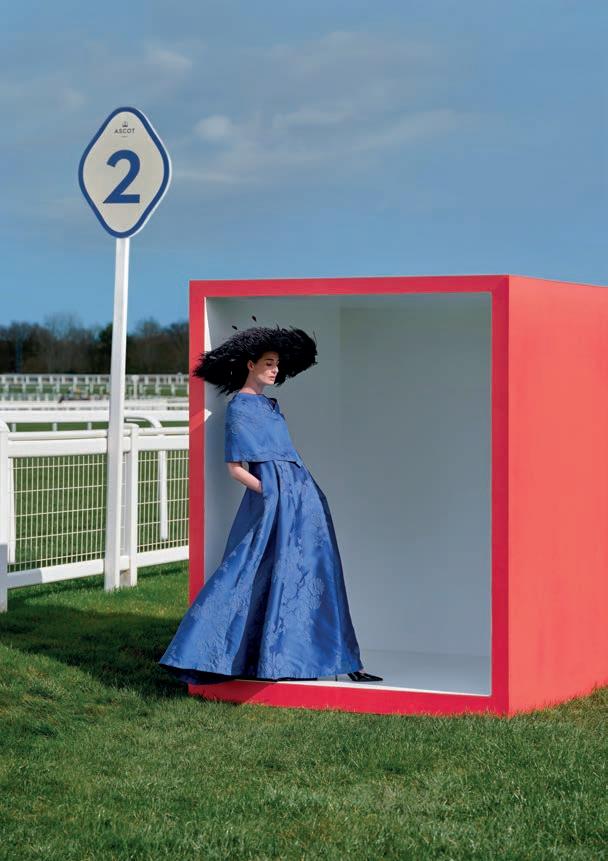
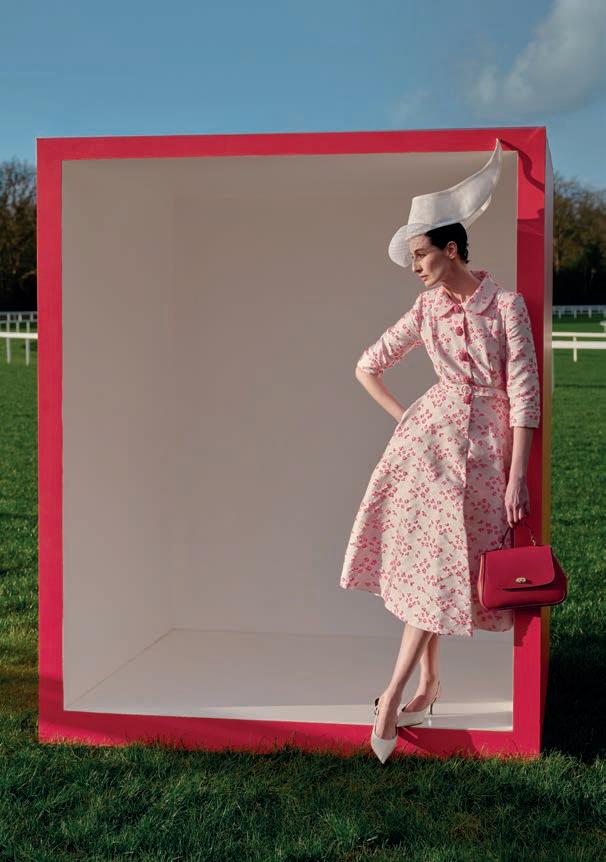
‘Show Us Your Silks’, one of the themes in this year's Royal Ascot Handbook: The Art of Dressing Well. It's a playful nod to the bold graphics and colours of jockey silks. ascot.com
SMALL THINGS
The Piccolo is an elegant miniature version of Neo 87100's Alice bag that comes in the brand's classic monochrome colour palette. We love the silver leather, but the orange suede is tempting too. neo87100.com
STITCH UP
Bou Soie's scrunchies are handmade by a team of seamstresses in their Dalston studio/boutique – and they're stocked at V&A East's fabulous new shop too. bousoie.com
PRETTY PLATES
Dior Maison's Champs de Tulipes collection is a tribute to fl oral poetry and art de vivre cra ed from Limoges porcelain and highlighted with 24-karat gold details. dior.com
CHECK MATE
SOFT TOUCH
Stripe & Stare is a certifi ed B Corp underwear and nightware brand that prioritises transparency and ethical sourcing as well as comfort. Because these are the so est things we've ever worn. stripeandstare.com
Bikini season is upon us – and London's best selection can be found at Battersea's Amelie's Follies. For us it's pink gingham all the way. ameliesfollies.co.uk
FLAT OUT
IN THE PINK
Bucherer, Mothridate, Soro Jewellery and Longines all contribute to this year's Ascot looks, as defi ned in the annual handbook. Make sure you're dressed to impress. ascot.com
A sandal must always be magenta, we believe, and our current favourite is the beautifully so leather Nottibianchi from Tuscany's and memory foam, it's designed for
GET A LIFT
Hotel Mike's upli ing new bath and body salts are designed with the environment in mind, formulated with a careful selection of fermented, upcycled and biotech active ingredients. hotelmike.co.uk
CULTURE
The Agenda
Marilyn Monroe: A Portrait
4
Exploring Monroe’s life, career and legacy in celebration of her 100th burthday, this exhibition includes portraits by many of the greatest photographers and artists of the 20th and 21st centuries, including Andy Warhol, Pauline Boty and Richard Avedon.
mkgallery.org
13-21 June
MUSEUM OF THE HOME
An expansive and inclusive celebration of folk traditions, spanning performance, visual media, storytelling and more. Highlights include an opening talk from Simon Costin, director of Cornwall’s Museum of Witchcraft; an embroidery workshop based on Lewis Carroll’s Jabberwocky from the Fabled Thread; an exploration of global music with cellist Ezra Escobar and a dive into Vietnamese folk tales with Major Books. museumofthehome.org.uk
20 June - 12 September
DUKE OF YORK'S THEATRE
A West End transfer for the Old Vic’s acclaimed and Olivier Awardnominated production of Tom Stoppard’s Arcadia, directed by Carrie Cracknell. A dazzling collision of science and romance, Arcadia explores the beauty of curiosity, the ache of lost knowledge and the timeless thrill of discovery. arcadiawestend.co.uk
ART
JULIO LE PARC
FROM 11 JUNE, TATE MODERN
Organised in close collaboration with the artist and his Atelier, the exhibition will feature over 60 works spanning Le Parc’s extraordinary 70-year career, including interactive installations, striking light sculptures, and geometric abstract paintings.
Arranged in a winding, mazelike manner, the exhibition will follow Le Parc’s career-long mission to activate the viewer. tate.org.uk
PHOTOGRAPHY
Japanese women photographers
24 June - 27 September
THE PHOTOGRAPHERS
GALLERY
Rewriting the story of Japanese photography through the eyes of women and showcasing the work of 27 groundbreaking artists from the 1950s to today, Japanese Women Photographers highlights the perspectives that have shaped how Japan sees itself – and how it is seen by the world. tpg.org.uk
HACKNEY ART WEEK
See Aborough-wide celebration of contemporary creativity, bringing together more than 130 artists and creatives across 60 venues. Far from a traditional art week, Hackney becomes a loose constellation of happenings. Markets, exhibitions, murals, workshops pop up across studios, streets and neighbourhood spaces, where exhibitions, food, music and performance intersect in unexpected ways. hackneyartweek.com
A preview of the lineup in the Southbank Centre's 75th year
Hof Styles' eclectic tastes, and emerging British talent. The genre-spanning lineup pairs
arry Styles is the 31st curator of Meltdown, the annual artistcurated festival at the Southbank Centre, joining a prestigious lineage that includes David Bowie, Yoko Ono, Nick Cave and Patti Smith. The festival runs from 11–21 June, coinciding with a landmark year for Styles, who also released his fourth studio album in March and announced a world tour featuring 12 nights at Wembley Stadium. Over 11 days, the Southbank Centre will present a celebration of Styles' eclectic tastes, spanning pop, soul, electronic, rock, and underground and emerging British talent. The genre-spanning lineup pairs established alternative acts with emerging voices, including Stephen Fretwell, Dev Hynes (Blood Orange), Nilüfer Yanya, Warpaint, and bar italia, alongside jazz heavyweights Kamasi Washington and Shabaka Hutchings. The centrepiece is Styles' one-night-only orchestral performance on 16 June at the Royal Festival Hall, in collaboration with Grammy Award-winning conductor Jules Buckley. Rather than a standard ticket sale, seats are being allocated via a prize draw, with proceeds going to the Southbank Centre's charitable work supporting young people and communities across the UK.
southbankcentre.co.uk
HARRY STYLES
LE CHAT NOIR
Be
transported to the original Paris cabaret in this spectacular immersive production
It's not the most promising location. A small queue of people in feather boas has formed at the end of a dead-end street in West Kensington, all of them looking much too glamorous for their surroundings, especially since it's broad daylight. But through the door, the scene changes. It's goodbye to drab 21st century west London and bonsoir to Monmartre, where it's 1896 and we are welcomed as regulars to Le Chat Noir. This is the birthplace of cabaret, but tonight will be the club's last night. Owner Rodolphe Salis may be in financial trouble but he's pledged to put on a last blast of anarchy and excess, and that's why we're here. The room is beautiful, every detail considered, from the table lamps to the impressive absinthe drippers and the iconic cat posters on the walls. We're shown to our table and given champagne; a plate of charcuterie and cheese is already waiting.
Goodbye to drab 21st century west London and bonsoir to 1890s Monmartre
This is an ambitious production, not least because it includes a three-course meal as well as three hours of nonstop entertainment and music. There's a five-piece band: Guy Button on violin, Peteris Sokolovskis on cello, Will Fry on percussion, Áine McLoughlin on accordion, and Alex Ullman on piano, plus frequent appearances from a slightly geeky pianist called Erik Satie. Established cabaret artist Joe Morose plays Salis with great charisma and style, shouting "Get drunk! Stay drunk" at regular intervals, even before the absinthe appears. The acts keep coming with their mix of comedy, mime, dance and music until the interval, when a flurry of waiters deliver plates of coq au vin. Soon afterwards, the absinthe hour arrives, accompained by a green fairy and a green haze, and the brave among us (actually, as far as we can see, everyone, which is a strong statement for a Tuesday evening) partake. Absinthe drippers are on every table, their simple technology sending drops of iced water slowly through a cube of sugar and into a waiting glass of the green spirit. Watch as it turns cloudy, and dilute it to your own strength, but beware: it is only Tuesday, and you're not really in Paris.
Lost Estate's ambitious immersive productions have been going since 2017 and there's a lot to admire. Visually, it's a treat, costumes, lighting and scenery all brilliantly conceived, and performances are exciting and authentic. It's an expensive night out, though, and we overheard someone saying they could have gone to actual Monmartre for the price of their tickets – but who's counting?
thelostestate.com
Booking until 27 September
Frida Kahlo’s face is emblazoned on everything from cushions and mugs to socks and pencil cases. How did this happen to an obscure artist from Mexico? That’s the question Tate Modern is asking this summer
Irida mania
t’s an extraordinary thing that an artist who spent much of her career in relative obscurity, painting on small tin panels in a house in Coyoacán and frequently overshadowed by her more celebrated husband, has become the most recognisable artist in the world. More recognisable than Picasso and more merchandised than Warhol, her face appears on tote bags in Stockholm, tequila bottles in Tokyo and Barbie packaging in Buenos Aires. This summer, Tate Modern aims not merely to show us Frida Kahlo's work, but to ask how any of this happened.
Frida: The Making of an Icon is the first major exhibition to take that question seriously, and it opens with a premise that is easy to underestimate. Rather than positioning Kahlo as a solitary genius who arrived fully formed from the hills of Mexico City, the show traces a decades-long process of construction, reception, appropriation and reinvention, set in motion by Kahlo herself. Developed with the Museum of Fine Arts, Houston, this is the first time in over 20 years that UK audiences have had access to the full range of her practice, with more than 30 works on display alongside photographs, personal artefacts and pieces by the contemporary artists she has shaped.
access to the full range of her practice, with more than 30 works on display alongside
The show begins where Kahlo began: with the self. She painted herself approximately 55 times, a fact that is sometimes cited City, the show traces a decades-long process
exhibition's treatment of Frida's relationship with Surrealism is handled with appropriate nuance
as evidence of narcissism and more accurately understood as a form of rigorous philosophical inquiry. Who am I? What do I carry? What do I refuse? Self-Portrait (With Velvet Dress) from 1926 appears here, one of her earliest major works, alongside Self-Portrait with Loose Hair from 1938, and together they establish the visual grammar she would spend her life refining: the Tehuana dress, the unapologetic unibrow, the gaze that gives nothing away. These works are placed in dialogue with her contemporaries in what is now called the Mexican Renaissance: Diego Rivera's portrait of her from around 1935 and María Izquierdo's Dream and Premonition from 194. The e ect is to situate Kahlo
within an intellectual and artistic community rather than above it, which turns out to make her more interesting.
The exhibition's treatment of her relationship with Surrealism is handled with appropriate nuance. Kahlo famously rejected the label (she once said she painted her own reality, not her dreams) but André Breton saw something in her work that aligned with his movement's fascination with the unconscious, the bodily and the strange. When she exhibited at the Julien Levy Gallery in New York in 1938, Breton subsequently invited her to Paris, where the French national collection acquired The Frame, one of the first works by a 20th century Mexican artist to enter the
LEFT, FROM TOP1: Frida Kahlo, Untitled [Self-portrait with thorn necklace and hummingbird] 1940. Nickolas Muray Collection of Mexican Art 2: Frida Kahlo, Self-Portrait with Loose Hair 1946. Private collection. 3: Frida Kahlo, Self-Portrait (With Velvet Dress) 1926. Private Collection. 4: Diego Rivera, Portrait of Frida Kahlo c.1935. Los Angeles County Museum of Art.
Revolutionary technology brand new to the UK...
FLAWLESS SKIN SECONDS IN
The ground-breaking BBL® HEROic™ and MOXI™ by Sciton has arrived at The Door W4, offering revolutionary, science backed results for:
•Fine Lines &Wrinkles
•Pigmentation & Sun Damage
•Sagging Skin
•ActiveAcne
•Redness or Rosacea
•ThreadVeins &Vascular Lesions
This treatment was life-changing for me...
Visible results in one session with no-downtime options available
Treat anywhere on the body in a single short session
Cool and comfortable
CoolComfort™ technology used in every treatment
12 years of clinical testing across hundreds of patients
BOOK
A FREE CONSULTATION
020 8742 8822
The Chicana/o
movement claimed her as an emblem of
cultural resistance
Louvre. Tate shows this alongside paintings by Kati Horna and Leonor Fini, exploring a shared iconographic territory of masks, skeletons and the threshold between sleeping and waking that cuts across national and movement boundaries.
The political dimension of Kahlo's legacy receives serious attention. Her reputation in the United States was built not by galleries or critics but by the Chicana/o movement of the late 1960s, which claimed her as an emblem of cultural resistance during a period of acute civil rights tension. Her 1933 collage My Dress Hangs There, with its acid view of American materialism, resonated with communities navigating the di cult space between Mexican heritage and American aspiration. Meanwhile, in Mexico artists like Nahúm B. Zenil and Georgina Quintana were, by the late 1980s, using Kahlo's visual language to interrogate nationalism and patriarchal norms from within in a more complex and uncomfortable inheritance than the straightforwardly celebratory one that tends to dominate popular accounts.
The feminist reclamation runs through the exhibition's middle section with particular force. Kahlo's self-portraits, depicting body hair, post-surgical scarring, miscarriage, female sexuality, were argumentative, insisting on the political content of the female body at a moment when that argument still required considerable courage. Works by Kiki Smith, Judy Chicago and Ana Mendieta shown alongside hers demonstrate how completely that argument was heard, and how far it travelled.
The exhibition closes with what it calls "Fridamania": a room containing over 200 objects generated by the global Kahlo merchandise industry. Barbies. Perfume. T-shirts. The 1983 Hayden Herrera biography, now translated into more than 25 languages, which e ectively launched the modern cult. The gap between the woman painting alone in Coyoacán and the face on a thousand products may be hard to process, but that discomfort is the point. Tate is asking us to look clearly at what fame does to an artist, and what we do with an artist once she becomes famous. With Kahlo, the answer turns out to be: almost everything imaginable.
Frida: The Making of an Icon opens at Tate Modern on 25 June
THIS PAGE CLOCKWISE FROM TOP RIGHT: Dynamite Damsels (1976) (C)
Roberta Gregory, Rupert Kinnard, Cathartic Comics Betterment of Parental Guilt (1988), Come Out Comix, 1979 (C) Mary Wings
llustration shapes the books we read as children and the covers that identify paperbacks and yet in Britain it has never had a dedicated public space of its own. At least not until this month, when the Quentin Blake Centre for Illustration opens in Clerkenwell as the UK's only permanent place for the art form.
The idea came from Sir Quentin Blake, now 92 and best known for illustrating Roald Dahl's books, who established the charitable organisation behind the centre in 2002. His House of Illustration had operated from rented space in King's Cross but it closed in 2020 after six years. "I have long dreamt of a permanent place with 'illustration' above the door," Blake says, "and now the amazing reality is that we have it." The £12.5 million project received £3.75 million from the National Lottery Heritage Fund, alongside investment from the London Borough of Islington and contributions from trusts, foundations and philanthropists. The new site is a Grade II-listed former Engine House, restored by Tim Ronalds Architects to contain three galleries, an illustration library, public gardens, a café and a shop. It's an attractive, characterful setting that suits the work it will house.
The opening programme consists of three simultaneous exhibitions, which between them cover a pleasingly wide range of territory. The first, Quentin Blake: Performance, brings together more than 100 original drawings, including work created for Roald Dahl's The Enormous Crocodile and Macbeth, alongside preparatory material and Blake's own works, exploring his long-standing interest in theatre, circus and performance as subjects. Among the highlights are nearly 40 depictions of Macbeth characters as birds — one of Blake's most recent projects, on public display for the first time. Blake describes his approach to illustration as similar to directing a play, "except that you also get to design the scenery and play all the parts."
The second exhibition is Queer as Comics, tracing comics, strip cartoons, graphic novels and zines representing LGBTQIA+ perspectives since the 1940s as the first major exhibition of its kind in the UK. Curated by comics specialist Paul Gravett, it features over 60 artists including Tove Jansson, Alison Bechdel, Rupert Kinnard and Tom of Finland, with most artworks on public display for the first time. Highlights include the UK's first published gay comic strip, a 1969 James Bond parody, and Jansson's Moomin strip for the London Evening News, whose quietly queer-coded characters are now seen as a first of their kind in mainstream British publishing. "Comics have a long tradition of being subversive," says curator Gravett. "They lend themselves perfectly to queer themes."
Rounding out the programme is MURUGIAH: Ever Feel Like..., the artist's first solo show, exploring his Sri Lankan heritage and Welsh upbringing through sculpture, painting, prints and sketches. The work draws on Hollywood film, science fiction and 2000s pop punk — a mix that sounds unlikely on paper but coheres into something vivid and distinctive. Together, the three exhibitions make a clear statement about what the centre intends to be: not a shrine to a single artist or era, but a genuinely broad platform for illustration in all its forms. As director Lindsey Glen puts it, "Every day, people all over the world use illustration to share stories and ideas — to communicate, express, inform and persuade." The aim is simply to give that work the attention it deserves.
Quentin Blake Centre for Illustration opens Friday 5 June 2026. New River Head, Clerkenwell, London EC1R 1AG. qbcentre.org.uk
WATCH THAT MAN
A 360 experience dedicated to David Bowie comes to Kings Cross
Is this the future of exhibitions? We’re not simply looking at things here. Lightroom’s groundbreaking show David Bowie: You’re Not Alone is a multimedia spectacle and an intimate and revealing selfportrait. This is a full immersion in the world of David Bowie, designed to appeal to long-standing fans as well as a new, young audience.
The 360° experience is written and directed by Mark Grimmer (Creative Director for the V&A’s David Bowie Is exhibition) and Tom Wexler. You’re Not Alone showcases some of Bowie’s landmark performances that redefined popular culture, using a mixture of iconic, rarely seen and never-before-exhibited material, selected from thousands of hours of film in the vaults of the David Bowie Archive in New York. Audiences have the chance to feel they have travelled through time to experience Bowie in performance - up close and first-hand. Each track in the show has been newly reconfigured to utilise Lightroom's specialised spatial audio system by multiple Olivier and Tony award-winning sound designer Gareth Fry (Harry Potter & The Cursed Child, David Bowie Is).
This is David Bowie, the man himself. Instead of magnifying the myth through the lens of Ziggy Stardust, Aladdin Sane or The Thin White Duke, You’re Not Alone places its focus on the man behind the masks: the provocateur, the polymath, the shapeshifting icon in his enduring, human form.
The film is structured in thematic chapters in a looping presentation, giving a unique insight into Bowie's perspective on the subjects most important to him, including theatricality, spirituality, songwriting and the transformative power of creativity. There are surreal moments, like the transatlantic TV interview with Russell Harty in 1975, in which Bowie artfully takes control of the narrative and the interviewer is reduced to asking him questions about the colour of his hair. Elsewhere, the reconstructed set of the inimitable Diamond Dogs tour materialises before our very eyes, igniting a Bowie performance unlike any other captured on film.
footage, photography, drawings, lyrics, personal notes and audio recordings. David Bowie: You're Not Alone celebrates Bowie's boundless curiosity as a force that connected people across continents and generations, as well as his enduring cultural impact today.
The show builds on Lightroom’s growing repertoire of critically acclaimed shows that have now been seen by over 1.5 million visitors globally, including creative collaborations with David Hockney, Tom Hanks, Anna Wintour and Vogue and Apple TV. Mark Grimmer, who also wrote and directed Lightroom’s David Hockney: Bigger & Closer (not smaller and further away) said: "It says something about our relationship with artistic heroes that we're drawn to mystery, otherness, the alien... in Bowie's case, this is our construct, not his. Throughout his career, Bowie repeatedly resisted being figured as anything but human. Rather than undermining his mystique, we designed a show to celebrate Bowie as a champion of human creativity, focusing on the message he expressed time and again: that art, in all its forms, is our best hope for understanding what it means to be alive."
Lewis Cubitt Square, London, N1C 4DY; lightroom.uk
Bringing together a wealth of visual material from a wide range of sources, the show combines rare performance
“A dazzling 360° dive into David Bowie’s world — intimate, immersive and unforgettable.”
DISCOVER THE WEB OF CULTURE IN WEST LONDON
25 TO 28 JUNE 2026
“The artwork draws from the colours and textures of Kensington’s cultural heritage”
URBAN ART
Kensington + Chelsea Art Week 2026 expands its public art programme across the borough
Kensington + Chelsea Art Week FRINGE returns from 25–28 June with this year’s curatorial theme, Web of Life, exploring ideas of belonging, ecology, waterways, sound and collective identity. In partnership with Kindred Studios at their flagship North Kensington location on Kensal Road — a massive 10,000-square-foot creative space accommodating around 300 to 450 artists and makers will be hosting art shows, workshops, music and performances across 5 floors, equipped print and ceramics workshops day and evening on 27 June with Kids Day on 28 June. Once again, KCAW public art trail will connect the borough from North Kensington to Holland Park, Kensington High Street and Chelsea Theatre, whilst also celebrating the annual Chelsea Arts Club mural created for its legendary summer fête.
Additional public artworks include a new sculptural installation by locally based artist Annie Trevorah for Holland Park, exploring hybrid ecologies, flora and fauna through organic sculptural forms developed especially for Art Week.
Among the headline public art installations is Rooted in Kensington paying tribute to bioecology and the “missing tree” on the Tree Island located on Phillimore Walk. Created by Toy Studio and artist MAMIMU in partnership with Opportunity Kensington, the installation incorporates sculptural seating, planting and signage inspired by underground ecological systems, pollinator networks and urban biodiversity. Aa a playful and reflective public space with Pollinator Pathmaker planting and ecological storytelling for gathering, reflection and inter-species coexistence, launching during the London Festival of Architecture 2026 under the overarching theme of Belonging. In North Kensington, architect and RCA alumnus Peter Morris, a contestant in Sky Arts TV series Landscape Artist of the Year heat 2 and Grand Designs broadcast later in 2026, is creating a collaborative mural on Freston Road with Morley College students, responding directly to the Web of Life theme through vivid garden-inspired forms and immersive painted environments.
Chelsea Theatre will become a key southern hub for the festival, hosting an art and food market on 26 June alongside artist takeovers and community activity. Planned works include artwork produced by young participants from JK Arts’ after-school clubs in collaboration with artist J. King and Chelsea Youth Club. The project will celebrate key figures from the World’s End community through a series of six original portraits, beginning with a tribute to the late Chad Alexander — Chelsea-born DJ, educator and much-loved local figure. Alongside exhibitions and installations, the programme will explore KCAW’s wider curatorial strands, including the Waterways of London, canal-side activations by artist Maya Sandbar and live sound interventions inspired by steel pan culture and the borough’s diverse musical heritage, with galleries, artist studios and museums throwing open their doors to celebrate local arts.
kcaw.co.uk
MAMIMU'S JUNE
MINEYAMA-SMITHSON
‘ROOTED IN KENSINGTON’ ICONOGRAPHY DESIGN BY ARTIST MAMIMU
MAKING GOOD
Traditional skills are at risk of being forgotten. Genny Maderia looks into the movements to keep them alive
There is a quiet crisis unfolding across Britain, one not marked by sudden collapse, but by gradual disappearance. In workshops tucked behind high streets, along riverbanks, and in rural outbuildings, skills once passed seamlessly from one generation to the next are thinning out. Shoemaking, watch making, basketry, and boatbuilding, trades that once underpinned both local economies and national identity, are now listed, quite literally, as endangered. The growing index compiled by Heritage Crafts does not read like a celebration of tradition. It reads like a warning. But to frame this purely as a story of nostalgia would be to miss the point entirely. The real question is not how to preserve these crafts, but how to make them matter again, economically, culturally,
At a time when sustainability, traceability, and quality are increasingly valued by consumers, traditional crafts o er precisely the kind of slow, skilled production that the modern economy claims to prioritise
structurally, in a modern Britain that has, for decades, deprioritised the act of making.
At the heart of the issue lies a deeper imbalance. Britain has long privileged the symbolic over the practical: monuments over manufacture, heritage over industry. Craft has been culturally admired but economically sidelined, celebrated in museums while struggling to survive in the marketplace. This disconnect has left many traditional skills in a precarious position, respected, but not supported; visible, but not viable.
Now that fragility is being exposed. Globalisation has shifted production overseas, where scale and cost e ciency dominate. At home, rising rents, material costs and a lack of a ordable workspace are making it increasingly di cult for makers to sustain their practices. Meanwhile, the workforce itself is ageing. In many sectors, the average craftsperson is nearing retirement, with too few apprentices entering the pipeline to replace them.
Few sectors illustrate this tension more clearly than bespoke shoemaking. Names like John Lobb remain globally respected, synonymous with quality, heritage, and craftsmanship. Yet behind the polished image lies a more complex reality. In the words of Jonathan Hunter Lobb, one of three brothers of the fifth generation of the family to run the company, “ours is a company that exists today as a result of its steadfast commitment to training successive generations of craftsmen and women, passionate about their craft and craftsmanship. Living testimony to the physical and mental benefits of daily interaction with the materials of their trade. The wood sculpted by the last makers and tree makers, the tanned leather worked by the hands of closers (upper makers) and makers (bottom makers), honing skills that take years to master e ectively.” Even those brands committed to apprenticeship schemes face challenges. The economics are unforgiving: training
is costly, margins are tight and the return on investment is long-term. For smaller, independent makers, the barriers are even higher. Without structural support, the risk is not just that these businesses struggle, but that entire skill sets quietly disappear with them.
There are, of course, e orts underway to reverse the trend. Organisations such as the Worshipful Company of Cordwainers, proudly the largest private supporter of footwear education and craft in the UK. “Over the last decade, we have awarded grants for bursaries, scholarships and apprenticeships totalling over £1 million pounds as well as running the celebrated annual Cordwainers Footwear Awards to promote emerging talent” says Penny Graham, Cordwainers Company Clerk. “We would like to see design and technology opportunities for young people widened at all levels of education, to help re-establish the craft of footwear as an aspirational career opportunity”.
Queen Elizabeth Scholarship Trust, and Heritage Craft are also working to support training, fund apprenticeships, and raise the profile of endangered crafts. Their work is vital, but it is, by necessity, targeted. More support is needed.
More recently, the UK’s ratification of the UNESCO Convention for the Safeguarding of the Intangible Cultural Heritage has signalled a shift in recognition. It places traditional skills within a global framework, acknowledging their cultural value and the need for protection. Yet recognition alone does not equate to sustainability. Without meaningful integration into economic policy, education systems, and industrial strategy, craft risks remaining a protected category rather than a thriving sector.
The comparison with countries such as Japan and Germany is instructive. In Japan, certain craftspeople are designated “Living National Treasures,” their skills recognised as integral to national identity and supported accordingly. In Germany, the apprenticeship system remains robust, embedded within both education and industry. In both contexts, craft is not treated as a nostalgic relic, but as a form of infrastructure, essential, productive, and future-facing.
Britain, by contrast, has yet to fully reconcile its relationship with making. Craft is often positioned as artisanal, boutique, or luxury, valuable, but niche. Yet this framing overlooks its broader potential. At a time when sustainability, traceability, and quality are increasingly valued by consumers, traditional crafts o er precisely the kind of slow, skilled production that the modern economy claims to prioritise.
The challenge, then, is not a lack of relevance, but of alignment. How do you connect the cultural value of craft with commercial viability? How do you create conditions in which making is not just admired, but economically sustainable?
Part of the answer lies in education. For too long, vocational training has been overshadowed by academic pathways, with making often perceived as a secondary option rather than a primary career. Rebalancing this perception is essential, not simply to fill apprenticeship schemes, but to re-establish craft as a respected and aspirational profession.
Policy also has a role to play. Tax incentives for small-scale manufacturers, investment in shared workspaces and support for local production networks could help to lower the barriers to entry and sustain existing practices. Equally, there is scope for greater integration between craft and other sectors, design, architecture, technology, where traditional skills can be recontextualised and revalued. Commercial backing is perhaps the most critical piece of the puzzle. Without a viable market, even the most skilled craftsperson cannot survive. This is where
How do you connect the cultural value of craft with commercial viability?
both consumers and industry come into play. Choosing to invest in quality, durability, and provenance is not simply a lifestyle decision; it is an economic one, with direct implications for the survival of these skills.
Events such as London Craft Week and The Cordwainer’s Footwear Awards, provide important platforms, bringing visibility to makers and connecting them with new audiences. But visibility must translate into long-term support. A week, or a moment of attention, however well-intentioned, cannot o set years of structural neglect. What is needed is a shift in perspective. To see craft not as heritage to be preserved, but as capability to be developed. To move beyond the idea of saving endangered skills, and instead ask how they can be integrated into a contemporary economy that values
both innovation and tradition. Deborah Carré of Bespoke shoemakers school, Carré Ducker commented “Our living heritage is every bit as valuable as any other, but we haven’t looked after it. We’re seduced by countries where design and craft are safeguarded, invested in and woven into everyday life, like Japan and Scandinavia. Imagine the impact if our craft economy saw the same safeguarding and investment?”
Ultimately, this is not about looking backwards. It is about deciding what kind of future Britain wants to build, and whether that future includes the skills, knowledge, and materials that have shaped its past.
The question is not whether craft can survive. It is whether it will be given the conditions to do so.
And that is a choice.
AT HOME WITH ART
Artists at Home returns to West London this June with fresh energy and established talent
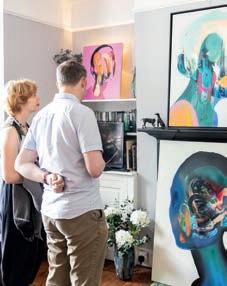
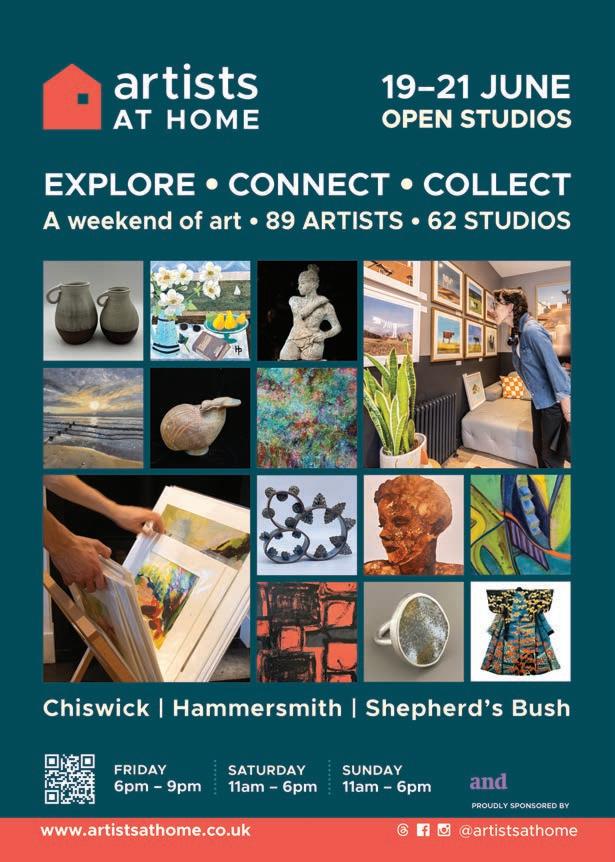
Artists at Home returns to Chiswick, Hammersmith and Shepherds Bush from 19–21 June, o ering visitors the chance to step inside working studios, meet artists in their own environments, and experience a wide range of contemporary art across West London. Now in its sixth decade, the much-loved open studio event continues to evolve, bringing together exciting new voices alongside artists with long-established practices. Across the weekend, visitors can follow a trail through local homes and studios, discovering painting, ceramics, printmaking, photography, jewellery and more. What makes Artists at Home distinctive is its informality and directness: this is not a traditional gallery setting, but an opportunity to encounter work where it is made, speak to artists about their process, and
experience the creativity embedded within the community. It o ers a more personal and accessible way of engaging with art.
This year introduces ten new artists, each bringing fresh perspectives and approaches. Among them are ceramic artist Karen Young, whose work explores texture and abstract sculptural forms embellished with lustres and metallic leaf; painter Jan Anil, who creates expressive landscapes and seascapes using oils and inks; and Catherine Beckett, whose contemporary jewellery focuses on layered surfaces and rich texture. Together, they add new energy and variety to the event.
Alongside these newcomers are established artists who continue to shape the identity of Artists at Home. Among them are Mary West and Gillian Brett, both of whom have enjoyed particularly successful years. Their work reflects years of experience and a sustained commitment to their practice, o ering visitors the opportunity to see how artistic ideas evolve over time. The balance between emerging and established artists remains central to the appeal of the event, creating a lively dialogue across disciplines.
Visitors can expect a rich mix of work, from bold large-scale paintings and intimate studies to sculptural ceramics, finely crafted jewellery and photography o ering closely observed perspectives. Whether drawn to colour, texture, form or process, there is something to capture every visitor’s attention.
Beyond the artwork itself, Artists at Home o ers a relaxed and welcoming atmosphere. Many artists are available throughout the weekend to talk informally about their ideas, materials and techniques, giving visitors insight into the thinking behind the work. For many, this direct connection is what makes the event memorable.
The walkable neighbourhoods of Chiswick, Hammersmith and Shepherds Bush provide the perfect backdrop, encouraging visitors to explore both art and community at a gentle pace. With new artists joining, established artists building on strong years, and an impressive range of work on show, this year’s Artists at Home promises to be one of the most engaging yet.
19-21 June; artistsathome.co.uk
MARY WEST
IIntroducing The Circle, where the design world connects A COMMUNITY BUILT ON TRUST, DISCRETION AND SHARED AMBITION
CIRCLE BACK
n an industry built on vision, quality and craftsmanship, the most valuable currency has always been the right connection made at the right moment. A conversation between a founder and a financier. An introduction between an architect and a developer. A shared table between a creative director and a client who truly understands their work. These are the moments that shape careers, launch projects and open doors that no amount of digital networking ever could. It was this belief – that the most meaningful relationships are established in person and with intention – that gave rise to The Circle. Founded in London by award-winning marketing agency Luxury Marketing House, The Circle is an exclusive international business club, capped at 500 members globally. It connects founders, entrepreneurs and senior decision-makers operating at the highest level of the luxury sector, and within its membership, the
worlds of design and interiors are strongly and proudly represented. Interior designers, architects, property developers, luxury homeware brands and creative directors sit alongside financiers, hoteliers, brand founders and investors – a community united not by one industry alone, but by an unwavering commitment to excellence in everything they do.
Membership is by application only, ensuring a community built on trust, discretion and shared ambition. The Circle is deliberately curated rather than simply collected – a room full of inspiring people in which meaningful connection always takes precedence over volume.
Across a global calendar of intimate lunches, inspiring panel discussions and international gatherings in London, Dubai, Monte Carlo, Sydney, New York and Miami, members come together to exchange insights, explore collaborations and develop long-lasting relationships.
The design and interiors world has been central to many of The Circle's most celebrated events – from panel discussions such as ‘Conversations in Design & Architecture’, to curated gatherings hosted within some of the world's most striking spaces. For those working at the forefront of design and interiors, The Circle o ers something truly unparalleled.
In a world that increasingly mistakes noise for influence, The Circle remains committed to something altogether more considered. Connection with purpose. Community with standards. And a shared belief that the most extraordinary things – in design, in business and in life – are always created together.
The Circle is open to founders, senior leaders and decision-makers operating within the luxury sector.
Discover The Circle at www.luxurymarketinghouse.com/ thecircle and @lmh_thecircle
& DRINK
MARRAKECH SPIRIT
EL FENN X BROADWICK SOHO
The spirit of El Fenn Marrakech arrives in Soho this month as Flute, the rooftop jewel of Broadwick Soho, transforms into a vibrant, living extension of Marrakech’s most eclectic hotel. This seasonal residency fuses a special curation of contemporary art, inspired dining, and cultural exchange. Expect maximalism on all fronts: a sensory collision of colours, textures, fun flavours, and Marrakech spirit. broadwicksoho.com
WHAT TO DRINK
GRAPE news
Wine recommendations for the month
By THE WINE SOCIETY
Azevedo Loureiro-Alvarinho, Vinho Verde 2025
£10.95
Delicately fragrant, smartly dressed blend of the region's best-known grapes, loureiro and alvarinho, with little or no Vinho Verde spritz. The Loureiro brigs an attractive citrus-blossom character and the alvarinho a delicious creamy peach quality.
Familie Mantler Dry Rosé, Niederösterreich 2025
TASTING
London’s food news and most exciting openings this month
By PENDLE HARTE
£9.50
The fresh air of the rolling Austrian hills is captured in this crisp, dry and refreshing pale rosé. This delicate pale-pink has notes of strawberry and raspberry fruit on the nose. The palate is uncomplicated, vibrant and focused, with deliciously mouth-watering zestiness and an apricot twist.
Ponte da Boga P Mencía, Ribeira Sacra 2024
£12.50
A perfumed, peppery and fruit-forward red with all the hallmarks of the mencía grape, crunchy sour cherry and blackcurrant mingle with floral and spicy notes of violet and black liquorice. This is a fresh and vibrant red for lovers of pinot noir, grenache or gamay.
Since it was founded back in 1874, The Wine Society has dared to do business a little differently. Bringing together a community united by a shared love of wine, The Society is a co-operative and owned by its members. This means there is no requirement to pump profit into annual dividends or bonuses for shareholders – all profits go back into the business.
The Wine Society welcomes all wine lovers. Become a member today and receive £20 off toward your first order. thewinesociety.com
Sky high
BREAD STREET KITCHEN
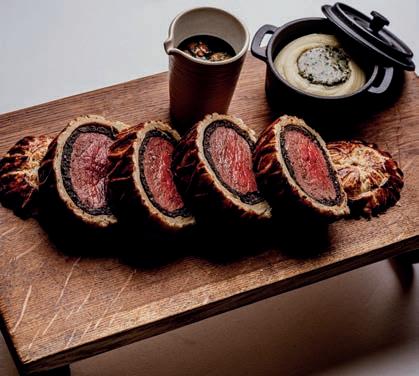
Gordon Ramsay has just opened his 100th restaurant, on the 59th floor of Europe's highest building at 22 Bishopsgate. Bread Street Kitchen o ers an all-day menu with favourites including an impressive beef Wellington, plus wagyu meatballs, barley miso salmon, chicken and caviar nuggets and a luxe afternoon tea too. And the views are spectacular, of course.
gordonramsayrestaurants.com
Food and music
POLLINI
Pollini, in North Kensington's elegant Ladbroke Hall has a new look and a new menu, plus an expanded events calendar, establishing itself as a go-to address for evenings that blend food and music. The menu is share-led, rooted in seasonality and Italian tradition, and there are regular Jazz nights and DJ sets. ladbrokehall.com
Viva Mexico
THE NED
TAKE THREE Summer drinks
VILLEMARIN PICPOUL
Everybody loves Picpoul de Pinet, the perfect summer wine and Ormarine Villemarin Picpoul is a Majestic favourite. £12.50 majestic.co.uk
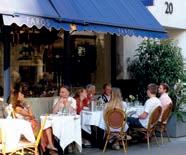
Faros is a busy, stylish Italian in Great Portland Street, with a sister in Holborn – and it's a great spot for a Spritz and a bowl of pasta or a pizza. Lots of pavement seating for summer and high class Italian favourites make it a winner.
farosrestaurant.co.uk
HUGO SPRITZ
Black Lines has devised a ready mixed Hugo spritz for summer and it's a refreshing treat with elderflower, citrus and a hint of gin along with lightly sparkling wine.
blacklinesdrinks.com
Bero's alcohol-free beers are the best ones we've tasted, and the brand is owned by Tom Holland. We like the Pils best but the IPA's a close contender. berobrewing.com
Opening this month, Mour in Marylebone will centre around seasonal British produce cooked with Mediterranean influence; fresh pastas, sharing plates, quality meats and fish, alongside martini-led cocktails and a Mediterranean wine list.
mour.uk
The Ned, City of London welcomes an exciting culinary arrival as Los Félix, Miami's celebrated Michelin-star Mexican restaurant comes to Cantina Malibu, The Ned’s Mexican restaurant. Los Félix will present a month-long residency beginning 4th June. thened.com MOUR
ABSOLUTELY eats out…
ACRE
Golborne Road’s small corner restaurant comes into its own in summer
By PENDLE HARTE
Thomas Straker’s second Golborne Road restaurant is Acre, a small corner site with a large outdoor terrace and a buzzy, European vibe. Inside it’s chic, with a semicircular bar, closeset tables and super friendly sta . I’m here mostly for the tomatoes, which I’d seen someone else eating last summer and not forgotten. And even at this early stage in the season, Acre’s tomatoes are excellent, appearing on the menu in several guises. First o , though, I’m
having a Campari spritz from an appealing list of cocktail and spritz, and it’s a great accompaniment to pan con tomate, which is perfection with its combination of sweet juicy tomatoes and rich, peppery olive oil. Other snacks include fresh and crisp tuna tostadas, plus clever prawn toasts that are actually caramelised fried briochy things with a prawn inside.
To start, a bream crudo comes with chervil, cucumber and pickled jalapeno: it’s a beautifully composed plate and a lovely mix of sweet, soft fish, crunchy cucumber and sharp chilli. A salad of burrata, asparagus, mint and candied pecan
“Clever prawn toasts are actually caramelised briochy things with a prawn inside”
is just as clever – candied pecans sound unlikely but the sweetness and texture are brilliant with creamy burrata and fresh greens. Acre is famed for its chill smash burger – at the table next to us, all four diners are clearly enjoying them – but we swerve those, for now. Instead, for me it’s a seabass fillet with corno peppers and –joy! – san marzano tomatoes. The fish sits on a generous bed of sweet roast red peppers and delicious tomatoes. A perfectly cooked bavette with a classy chimichurri comes with a side order of, yes, more tomatoes, served simply and flawlessly in large chunks with olive oil and supersized basil leaves. A simple scoop of rhubarb ripple ice cream is a lovely shared pudding – creamy and tart. We love Acre and will be back for burgers and more tomatoes on the sunny terrace.
60 Golborne Road, W10 acre-london.com
Mains £22- £36
One of London’s best terraces
'The dude from Good Food' Barney Desmazery takes 25 of the UK’s most popular dishes and gives them a spin for each season
ONE DISH
FOUR WAYS
MAKE AHEAD
The fritters can be fried, cooled and kept in the fridge for up to 2 days. Reheat in a hot oven or air fryer. The dressing keeps well for a day in the fridge – just give it a quick stir before serving.
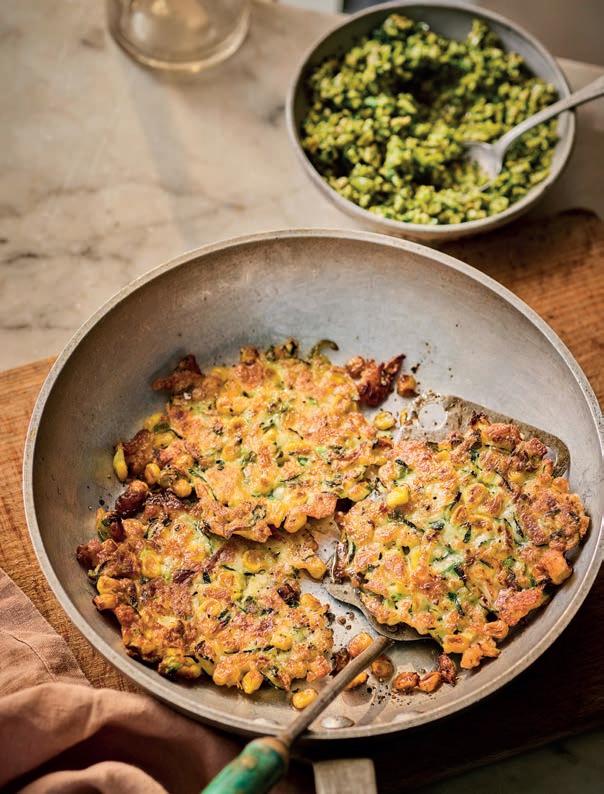
Sweetcorn, Courgette and Halloumi Fritters
Makes 6 large fritters
When I lived in Australia, nearly 30 years ago, the brilliant Bill Granger had just the one little restaurant. It rewrote the rules for breakfast, and it was there that I had sweetcorn pancakes for the first time, which I’ve been making and evolving ever since. This version is as happy with eggs for breakfast as it is with a nice punchy dressing as a starter (appetizer) or as a light meal with a salad.
INGREDIENTS
• 1 large courgette, grated
• 1 corn on the cob, kernels sliced o , or 100g frozen sweetcorn, defrosted
• 100g halloumi, coarsely grated
• 2 spring onions, finely sliced
• 1 egg
• 2 tbsp self-raising flour
• 2 tbsp cornflour
• oil, for frying
• salt and freshly ground black pepper FOR THE DRESSING (OPTIONAL)
• 100g green olives, pitted small handful of parsley or mint leaves juice of ½ lemon
• 4 tbsp olive oil
METHOD
1 If serving straight away, make the dressing by blitzing together all the ingredients in a blender or finely chopping the olives and herbs and mixing with the lemon juice and oil into a loose dressing.
2 To make the fritters, tip the grated courgette into a colander and toss with a generous pinch of salt. Leave for 10–15 minutes, then squeeze out as much water as you can – the most e cient way to do this is to transfer it to a clean dish towel and wring it as tightly as possible, really trying to get every last drop out of it.
3 Tip the courgette, corn, halloumi, spring onion and egg into a bowl, scatter over the flours, and season with pepper. Scrunch it all together with your hands, so you have a sticky mix.
4 Heat a layer of oil in a frying pan and pat out rough patties between your hands, making them as thin as possible – the thickness of two stacked pound coins is ideal. Slip them into the oil and cook in batches for 3–4 minutes on each side (turning carefully) until crisp and browned – don’t be afraid to take them to a deep brown, as this is when they will be best.
5 Drizzle the dressing, if using, over the warm fritters to serve.
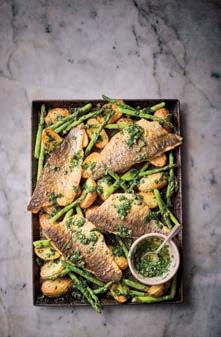
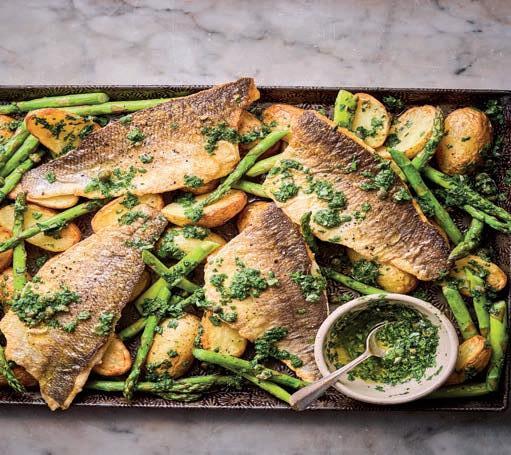
Tray-Baked Sea Bass with Asparagus with New Potatoes
Serves 4
The perfect spring one-pan supper, which I also do with larger, whole sea bass when I can get them, but they take a little longer to cook, though not as long as you’d think. Giving someone new potatoes without something to dip them into should be a crime, so I’ve gone with a punchy, anchovy-spiked salsa verde, but any iteration of a herb-based dressing or pesto would work just as well.
INGREDIENTS
• 1kg baby new potatoes, cut in half if large
• 3 tbsp extra virgin olive oil
• 300g asparagus, woody ends snapped and each spear cut into 2 or 3 pieces
• 4 sea bass fillets
• salt and freshly ground black pepper
FOR THE SALSA VERDE
• 2 handfuls of parsley leaves, roughly chopped handful of basil leaves, roughly chopped
• 1 tbsp capers (baby capers)
• 1 tsp Dijon mustard
• juice of ½ large lemon
• 1 anchovy (optional)
• 6–8 tbsp olive oil small garlic clove, peeled and minced
METHOD
1 To make the salsa verde, tip all the ingredients together into a small food processor and blitz to a chunky paste, or for a more labour-intensive salsa, chop the herbs with the capers and anchovy (if using) on a board, then tip into a bowl and stir in the other ingredients. This sauce can be made a day ahead and kept chilled.
2 Preheat the oven to 210°C/190°C fan/gas 7. Tip the potatoes onto a large baking tray (pan), drizzle with the olive oil, season, and toss to coat. Roast for 25–30 minutes, turning once or twice, until golden and starting to crisp.
3 Once the potatoes are tender, scatter the asparagus over the tray and give it a shake, then roast for 5 minutes more.
4 Sit the sea bass fillets on top, skin-side up, then return the tray to the oven and roast for 10–12 minutes until the fish is just cooked through and the asparagus is tender. Spoon over the dressing and serve straight from the tray.
Miso Caramel Brown Butter
Pretzel Cheesecake
Makes 12 slices
Salt seasons sweet as well as savoury, and it’s one of my favourite dessert ingredients, which is why you’ll notice every sweet recipe in this book is lightly seasoned with flaky sea salt. From salted caramel we get miso caramel, and there’s been a trend for very light, Japanesestyle cheesecakes seasoned with miso, but as I’m not a fan of their texture, these weren’t going in the book, so instead I updated my much-loved salted caramel cheesecake.
INGREDIENTS
• 100g butter, melted, plus extra for the cake tin
• 75g pretzels
• 175g golden caster sugar
• 750g cream cheese
• 2 tbsp plain flour
• 1 tsp vanilla extract
• 250g caramel spread or dulce de leche from a tin or jar
• 1 tbsp white miso, plus 1 tsp for the topping
• 4 eggs
• large pinch of flaky sea salt
METHOD
1 Preheat the oven to 160°C/140°C fan/ gas 3. Grease a 20cm (9in) springform cake tin and line the base and sides with baking parchment. Heat the butter in a pan until it stops foaming and turns nutty brown, then take it o the heat and leave to cool. Tip the pretzels and 25g of the sugar into a food processor with the brown butter and blitz until you have the
MAKE AHEAD
Bake and chill up to 2 days ahead, then top with the miso caramel before serving. The cheesecake also freezes well (without the topping) for up to 3 months.
texture of wet sand. Alternatively, bash the pretzels in a food bag with a rolling pin and stir in the butter. Press the mixture firmly into the base of the cake tin, then chill while you make the filling.
2 Scrape the cream cheese into a large bowl with the remaining sugar, flour, vanilla extract, 3 tablespoons of caramel spread and 1 tablespoon of the miso. Beat until completely smooth. Beat in the eggs, one at a time, until you have a thick, custardy mixture. Pour this over the pretzel base, scraping the bowl clean, and bake for 50 minutes or until there is
just a slight wobble in the centre of the cheesecake. Turn o the oven and leave the cheesecake in the oven to cool for an hour, then chill until needed.
3 When you’re ready to serve, loosen the sides of the cheesecake from the cake tin with a knife and remove the base, or serve directly from the tin base. Mix the remaining caramel spread with 1 teaspoon of miso and the flaky sea salt, then spoon this over the cheesecake, swirling it with the back of a spoon.
The cheesecake will happily sit at room temperature for a couple of hours.
“Expertise comes from Japanese, Southeast Asian and contemporary fine dining kitchens”
OCULINARY journey
Skewd Asia, a new chapter in luxury pan-Asian dining
pened in November 2025, Skewd Asia is the latest concept from the multi awardwinning team behind the Skewd brand, an immersive Pan-Asian dining experience inspired by a 2,000year culinary journey across Asia.
The concept reflects the migration of Turkic culture from Central Asia through Japan, China, Korea, Mongolia and Southeast Asia before arriving in Anatolia. This journey forms the foundation of the restaurant’s identity, influencing the menu, cooking techniques, interiors and atmosphere.
Throughout the restaurant, guests will notice references to this story, including tables named after ancient cities and regions connected to the Silk Road, adding a sense of culture and discovery to the dining experience.
Created by the Fire & Ice Group, whose portfolio also includes Firedog, Skewd Kitchen and Skewd at The Grove within the prestigious Grove Hotel, the brand has spent over 15 years building a reputation around quality, hospitality and open-fire cooking.
At Skewd Asia, the focus shifts toward luxury Pan-Asian dining while remaining true to the same core values: exceptional produce, atmosphere and guest experience. At the centre of the restaurant is its open kitchen concept, allowing guests to fully experience the theatre of the dining room. Flames rise from the robata charcoal grill, sushi chefs work behind the counter, and every dish is prepared in full view, creating a strong connection between guest, chef and kitchen.
The culinary team has been recruited from some of the country’s leading restaurants, bringing expertise across Japanese, Southeast Asian and contemporary fine dining kitchens.
The menu combines premium ingredients with bold flavours and refined presentation, from beautifully prepared sashimi and
signature sushi rolls to robata-grilled specialities and A5 Japanese Wagyu dishes.
Beyond the food, atmosphere plays an equally important role. With resident DJs on Friday and Saturday evenings, handcrafted cocktails, beautiful interiors and striking hand-painted graffiti-style art walls, Skewd Asia has quickly established itself as one of North London’s most exciting dining destinations. Operating with a large team, the Fire & Ice Group continues to focus on delivering memorable experiences where food, music, design and hospitality come together seamlessly.
127-129 Cockfosters Road, EN4 0DA; skewdasia.com
FASHION
Spill the tea
LILI CURIA
Steeped is part of Lili Curia's Limited Series of capsule collections, shaped by material-led design and produced in very small quantities. It's built around deadstock Italian canvas dyed using chamomile tea, revisiting Lili Curia signatures through material treatment and expressive detail. The chamomile dyeing introduces natural variation and softness, creating subtle shifts in tone that emphasise time, process, and the character of the canvas itself. lilicuria.com
a DAY at the RACES
Erin O’Connor launches the inaugural Royal Ascot Colour of the Year, Bright Tomato
Mariella Wyse has dicovered a winning formula for clothes that women really want to wear. Absolutely finds out how
By PENDLE HARTE
Q Wyse London has a fast-moving collection of clothes that women want to wear. How have you built that up?
A Through being a customer myself. I started the brand because of clothes I felt were missing from my wardrobe. I am our customer, and I think my love of making clothes really helped. I understand how clothes make you feel and how to adapt the shape and colour for maximum enhancement. I have listened and learned massively from the customer – for the first four years I did sales direct to the customer and learnt so much
Q Who is the Wyse woman, and can you describe her style?
A The Wyse woman is a super chic, super smart dresser. She wants to look cool, but somewhat polished, but also with a twist. She doesn’t take herself seriously. She doesn’t want to feel worn by the clothes, but more elevated. She owns the look – the look doesn’t own her.
Q Your background wasn't in fashion - how did the business start?
A I have worked in fashion magazines and I have loved making clothes. It started by accident; I was helping a friend with a knitted accessory business. She said you’ve got tonnes of ideas, what do you want to do? I said make cashmere jumpers with a twist – she gave me the name of a small factory. It grew from there.
Q And it grew in lockdown. Why was that?
A I changed our business model from being part wholesale part retail to a simple direct to consumer model. I cancelled all our wholesale orders, told the team we’d
gather remotely and then thought – how do I do this. I’d already done some Instagram work, but I turned the camera on myself and started doing daily Instagram lives. I asked the customer what they thought of the product. We’d converse; it was an extraordinary time. We really shot up. It was such a unique time but one where listening really paid o .
Q You model many pieces yourself. How important is Instagram for the business? Very important. I can really express how a piece is supposed to be worn and how it feels. I can give styling advice and explain why we’ve designed it the way we have, it’s a confirmation of knowledge but also being relatable to the customer so they are not feeling alienated, they see a woman their own age wearing the pieces.
Q How did you decide which locations were key for the stores? In many ways our locations are decided
by where the customer is. There is a personal connection to some of our stores too. Our first store was in Marylebone High Street, probably one of my favourite London high streets. I just love everything about it. Also, the King’s Road is close to my heart as my father had a record trading store on it that opened in the 1960s. It was a really happening place. Southwold was chosen as I have close friends there! A mix of fact and feel!
Q Clothes are made in small runs. What's the significance of that? How does the process work?
A We produce in small runs so that we don’t over manufacture and ensures we sell through. It’s a tighter, more e cient way to run a business. We do repeat in to things when they are very successful or due to high demand. It does mean we sell on “pre-order” sometimes, but I feel that is a more sensible way to run a business. The team are very nimble.
MARIELLA WYSE
EURO STARS DIOR
2
Jonathan Anderson's playful, colourful designs are imbued with a fresh, joyful energy. The ready-to-wear collection features bucket hats and silk scarves in an atmosphere blending lightness with Mediterranean charm. dior.com
HEAT WAVE FASHION CLINIC
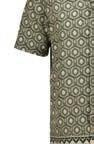
The new men's collection of summer fashion at Fashion Clinic includes this Orlebar Brown shirt and these Fedeli swimshorts, plus lots more stylish pieces. fashionclinic.com
ON DECK SEBARGO
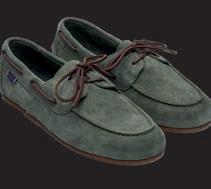
The Owen boat shoe is a modern spin on a timeless classic. Cra ed in so Italian leather, it comes in several colours and fi nishes for effortless style. sebargo.co.uk
GET SHIRTY SAINT LAURENT
The Cassandre cotton and linenblend gabardine overshirt is made in Italy and embroidered with a tonal 'YSL' logo at the chest patch pocket. £1,290 ysl.com
TOP HAT? ASCOT
If you're heading to Ascot but unsure what to wear, then consult the new Royal Ascot Handbook: The Art of Dressing Well, a celebration of British heritage, individuality and contemporary style. ascot.com
BEAUTY
NOTES
The latest in luxury makeup and skincare
By PENDLE HARTE
CITY SKIN
TEOXANE
Teoxane Urban Shield SPF30 is built around urban ageing. It’s triple shield protects from UVA/ UVB rays, pollution and oxidative stress - not just sun damage, but also dullness, pigmentation and barrier stress from city life. £60 teoxane.com
ACTIVE
INGREDIENT
HOTEL, MIKE
We are loving Hotel, Mike’s hydrating hand and body wash with notes of cut grass, spiced pepper, and marine air. The new, female-founded bath and bodycare brand blends highperformance skincare with a playful, modern approach to sustainability. £26 hotelmike.co.uk
REVIEW
The Longevity test, via the Lucie App
AGET THE GLOW
BARBARA STURM
The new skincare-infused Everything Bronzing Drops are designed for e ortless, everyday radiance, delivering a natural, sun-kissed bronze while hydrating and smoothing the complexion. Rooted in Dr. Sturm’s science-driven approach to glow, this next-generation bronzing-skincare hybrid perfects, nourishes and illuminates in one step. £125 en.drbarbarbarasturm.com
re you curious to find out your biological age? Not your chronological age. This is the age your body really thinks it is, as a result of everything you’ve ever done to it. It’s a bit of a daunting prospect, like getting your exam results on a test you forgot to revise for. But happily the process is easy enough, and thanks to the fabulous Lucie App, I am sitting in the comfort of my own home for the duration.
Lucie is a clever app that connects experts in the worlds of beauty, wellness, fitnesss and medicine with clients in London and the Cotswolds. It works with E ect doctors, whose mobile team are here to give me a verdict on my longevity – but first I’m hooked up to an IV drip to boost my vitamin levels, and treated to a small fingerprick test to calculate my iron. The longevity test focuses on breath, creating a metabolic blueprint by assesing my cardio-respiratoy fitness and my fat-burning e ciency. This happens through a gas mask-type apparatus that’s strapped tightly to my face for 15 minutes (while the IV is in my arm) and I am told to just relax. Results are almost immediate, and a full report arrives in my inbox outlining my various scores and advice on how to improve them. And my age? I’m going well. Three years down on my actual years. I’ll take that.
EDITOR’S PICK
BLUE LAGOON Mineral Mask, £80 uk.skinscience.bluelagoon.com
ZO SKIN HEALTH
ZO Sunscreen + Powder Broad Spectrum SPF30, £59 skin65.co.uk
CHITO CARE
Body lotion, £49 chitocare.co.uk
GENTLE CARE
Lip balm, £18 uk.gentle-care.com
BLUE LAGOON BL+ eye serum, £140 uk.skinscience. bluelagoon.com
SKIN SCIENCE
EDITOR’S PICK
TEOXANE Urban Shield SPF30, £60 teoxane.co.uk
BELIF
Super Drops Sun Serum 50+, £22 harrods.com
ESK Enlighten Gold, £77 eskcare.com
High tech skincare for summer
By PENDLE HARTE
IMAGE SKINCARE Daily Prevention protect and refresh mist, £52 imageskincare.co.uk
IMAGE SKINCARE I Mask hydrating hydrogel sheet mask, £48 imageskincare.co.uk
PROTECT AND THRIVE
Enhance your hair's natural texture with Innersense's
Air Dry Styling Cream
Innersense Organic Beauty introduces Air Dry Styling Cream, a lightweight styling essential designed to bring ease, softness and polish to modern hair routines. Developed for all hair textures and patterns, Innersense’s Air Dry Styling Cream supports natural movement while helping hair feel smooth, hydrated and protected in changing environments.
Created with both professional stylists and ingredient conscious consumers in mind, the formula reflects a growing shift toward lower maintenance styling routines that still deliver refined results. Innersense’s Air Dry Styling Cream is designed to enhance the hair’s natural texture rather than reshape it, allowing waves, curls, coils and straight styles to feel e ortless, touchable and intentional.
The multi tasking cream o ers soft hold and lightweight definition while helping to minimise frizz and support long lasting smoothness. Clinically proven to provide 72 hour frizz control, even in humidity, the formula also delivers heat protection up to 4230°C alongside defence against UV exposure and environmental stressors. Hair feels protected without heaviness or residue, making it suitable for everyday styling across a variety of techniques and routines.
Innersense’s Air Dry Styling Cream performs whether hair is air dried naturally, di used or styled with heat tools. Stylists can use it to refine texture, smooth the cuticle, refresh second day hair or create polished finishes with flexible hold. The versatility of the formula allows it to move seamlessly between blow dries, natural styling and soft lived in finishes while helping reduce the need for multiple styling products behind the chair.
At the heart of the formula is a blend of clean, hair caring ingredients selected
for both performance and hair wellness. Algin, derived from algae, creates flexible structure while helping to lock in hydration and smooth the hair’s surface. Amino acids help support hair strength and moisture retention while enhancing softness and manageability. Baobab oil, rich in essential fatty acids and vitamins, nourishes the hair and helps improve shine and resilience.
Innersense’s commitment to clean chemistry is reflected throughout the formula. Air Dry Styling Cream is made without silicones, synthetic polymers or heavy film forming ingredients, allowing the product to rinse clean while maintaining a lightweight feel on the hair. The result is smooth, touchable styling support that complements the long term integrity of the hair.
“HAIR FEELS PROTECTED WITHOUT HEAVINESS OR RESIDUE”
The sensory experience is equally intentional. The lightweight cream texture distributes easily through damp or dry hair and leaves styles feeling soft, natural and breathable. A subtle lavender sage fragrance brings a calming element to the styling experience while aligning with the brand’s wellness inspired approach to beauty.
As salon clients continue to seek products that support healthier styling habits and simplified routines, Innersense’s Air Dry Styling Cream o ers a modern approach to everyday styling. Thoughtfully formulated and stylist approved, it delivers flexible performance, clean ingredient credibility and e ortless texture enhancement in one versatile product.
Goodwood’s Wellness Retreats are designed to help you regain your energy, restore balance and take control of your health—whether you’re looking to reset your gut, build resilience, or future-proof your wellbeing. Hosted on our 11,000-acre estate, each retreat blends
THE RIGHT MOVE
Moving to Castle View is not only a lifestyle choice, but a logical one too in a world of increasing bills
Moving home is often seen as a cost: stamp duty, removals, new furniture etc. But for many people, especially in later life, the right move can actually save money month after month. One of the clearest examples of this at Castle View is homeowner, Ann.
Like a lot of people in a traditional family house, Ann and her husband Richard were spending a growing amount on energy. Older properties can be draughty, hard to heat and full of rooms you barely use but still pay to keep warm. Since moving to their apartment at Castle View, Ann has seen their energy and utility bills drop by over a third. That kind of saving doesn’t just look good on paper; it changes how relaxed you feel about day-to-day life.
The di erence is largely down to the way the apartments are built. They’re well insulated,
with triple-glazed windows and plenty of natural light. Ann talks about only needing the heating on for a short time, even in the colder months, because the warmth simply stays in the apartment. Instead of constantly topping up the heat, the space holds a comfortable temperature with much less e ort.
This has a knock-on e ect on how you live. You can put the heating on when you need it, without that familiar worry about what it’s going to do to the next bill. You can enjoy a bright, warm home without having to shut o parts of the house or
sit in just one room to keep costs down. For many people, particularly those on a fixed income, that sense of ease is just as important as the numbers themselves.
Then there are the running costs you don’t always think about at first. In a modern apartment, there’s no roof to fix, no gutters to clear, no big repair jobs suddenly appearing out of nowhere. At Castle View, those responsibilities sit with the building, not with individual homeowners. For someone like Ann, that means fewer unexpected expenses and less time and money spent on maintenance.
Shared spaces also play their part.
With a bistro, library and rooftop lounge on site, there are warm, welcoming places to spend time without heating your own apartment all day. Meeting a friend downstairs for co ee or joining an event becomes part of normal life, and as a bonus, you’re not paying to keep every room at home warm while you’re out of it.
It changes how relaxed you feel about daily life
Ann’s experience shows that a move isn’t just about a nicer view or a di erent postcode. Done thoughtfully, it can be a way to bring your monthly outgoings under control, reduce the hidden costs of maintaining an older home and enjoy a more comfortable, sociable way of living at the same time.
Learn more at castleviewwindsor.co.uk
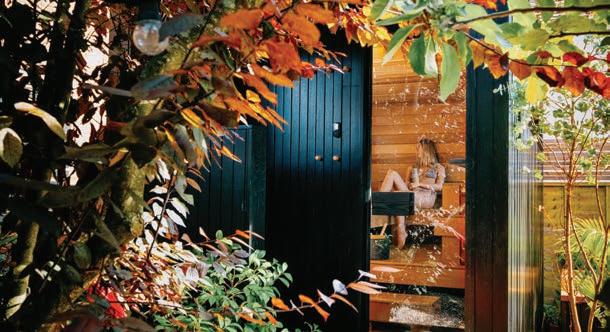
the traditional sauna experience, upgraded
CLEVERLY COMPACT FOR THE CITY
LUXURIOUSLY LARGE IN THE WILD
classic design, best in class, built to last
CARE , considered beautifully
In the best care settings, nothing feels accidental
The chair placed where the morning light falls. The garden path wide enough for an unhurried walk. The cup of tea made as someone likes it, before they have had to explain. The team member who notices a change in mood, appetite or energy, and understands that these small details often say the most. This is the world CHD Living has spent more than 40 years creating.
A family owned provider of health and social care services across Surrey and South London, CHD Living has grown with a clear belief that care should never feel like a compromise. It should o er safety, expertise and reassurance, but also beauty, comfort, purpose and warmth. For the people it supports, and for the families who trust CHD Living with those they love, that balance matters deeply.
The organisation provides residential care, nursing care, specialist dementia care, complex care, rehabilitation and care at home. Its services are varied, but the philosophy behind them is consistent. Every person should be supported as an individual, with their routines, preferences, history and personality understood and respected.
CHD Living calls this Creating Happiness Daily. It is a simple phrase, but its meaning is layered. Happiness in care is rarely about grand gestures. More often, it is found in the familiar. A favourite song playing at the right time. A meal that brings back a memory. A conversation that restores confidence. The ability to remain connected to family, community and self, even when care needs change. This thoughtful approach has earned national recognition. In 2025, CHD Living was named Residential Elderly Care Provider of the Year, Medium Group, at the HealthInvestor Awards, a reflection
“Every person should be supported as an individual”
of its leadership, quality and commitment to residents and families. Brownscombe Care Residences in Haslemere, one of CHD Living’s flagship homes, has also been featured in the Knight Frank Luxury Care Home Guide for the fifth consecutive year, recognising a standard of care and environment that continues to stand out.
Yet what defines CHD Living is not recognition alone. It is the organisation’s ability to combine ambition with intimacy. Its homes are designed to feel welcoming and considered, with gardens, lounges, dining spaces and bedrooms that support comfort and belonging. Its rehabilitation services help people rebuild strength, independence and confidence after illness or injury. Its care at home teams bring support into the place many people most want to remain. Its complex care services provide specialist input while protecting dignity and individuality.
For families, CHD Living o ers something invaluable: the sense that care is being thought about properly. Not just delivered, but considered. Not just scheduled, but shaped around real life.
As expectations of later life continue to evolve, CHD Living remains quietly confident in what it has always known. Excellent care is not only clinical skill, though that is essential. It is the ability to make someone feel safe without making their world smaller. To provide support without taking over. To create a place where people are known, valued and able to keep living with comfort, dignity and joy.
To find out more visit chdliving.co.uk or call 01428 772 469
Kasia Fiszer
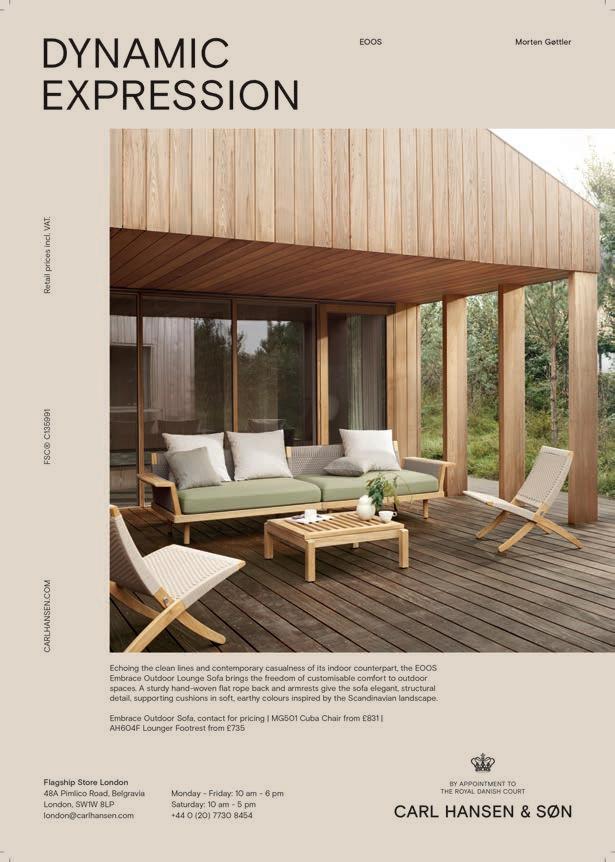
Nordic elegance
CARL HANSEN & SØN
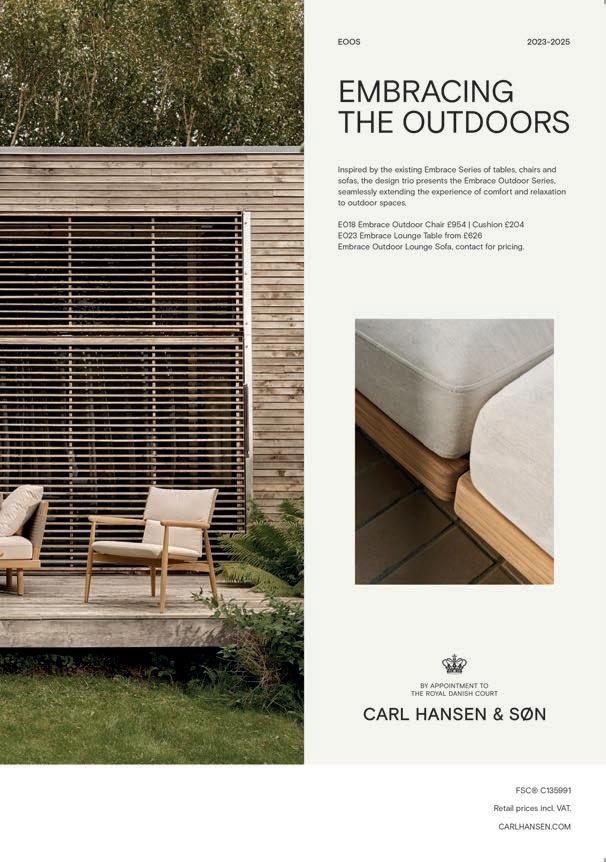
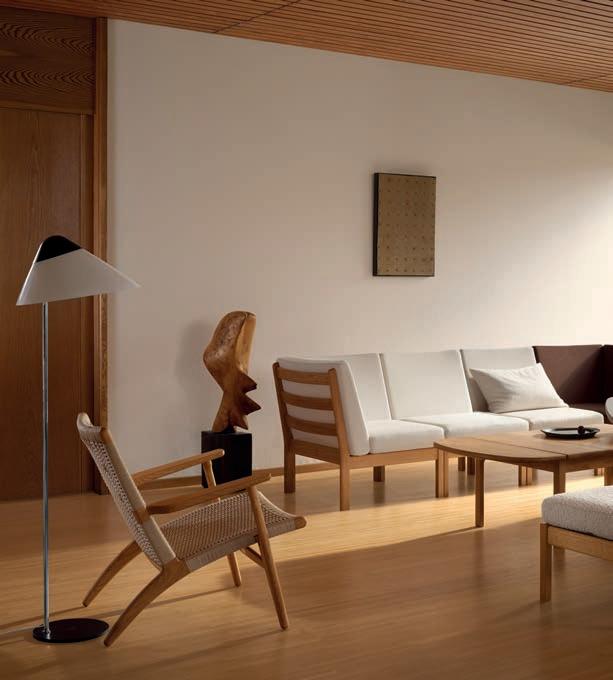
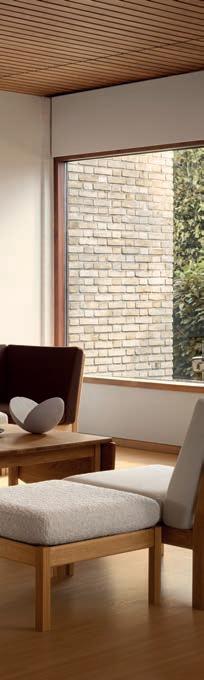
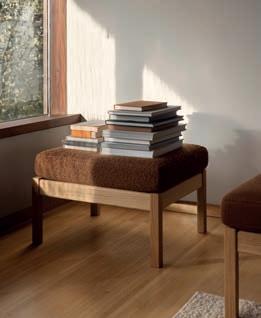
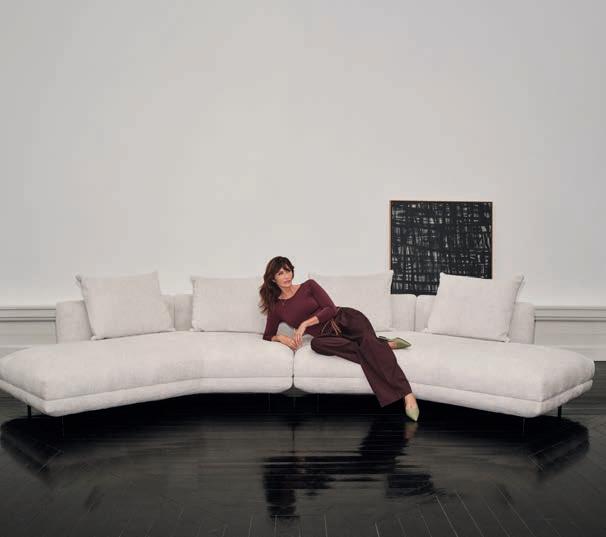
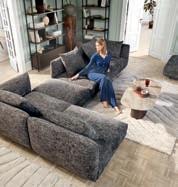
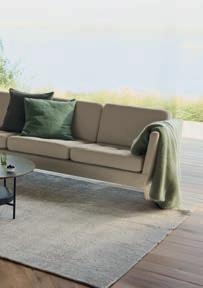
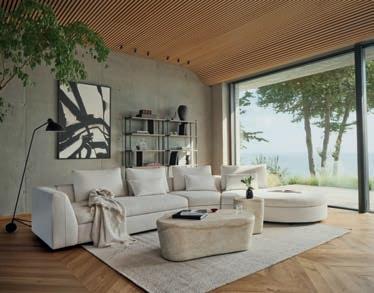
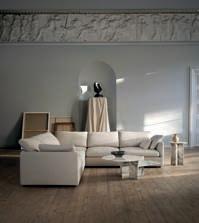
A classic design from Hans J Wegner, the CH280 modular sofa was designed in 1980 and yet it feels very contemporary today.
Carl Hansen & Søn Flagship Store London, 48A Pimlico Road, SW1W 8LP; 020 7730 8454 @carlhansenandson_london | carlhansen.com
inside this section
TOP TEN: GARDEN DECOR p88
HOUSE TOUR p92
PAINT COLOURS p97
STYLING YOUR RENTAL p106
THE CULT OF JAPANESE KNIVES p112
SHADE SEEKER Channel vintage beach clubs and sun-drenched Mediterranean terraces in your urban garden with this Bounder Stripe parasol in claret. £395 staycationvintageparasols.com
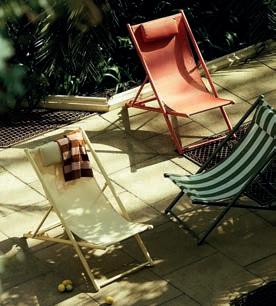
Cult Furniture’s reimagining of the classic deckchair includes a clever cushion, and perfects the simple folding mechanism. We’ll have the stripey one please. £69 cultfurniture.com have the stripey one please. £69
SLING BACK
The Marcy sling chair is a a modern design made with robust tubular frames. All-weather fabric seat and backrest slings are bolstered by plump cushioning. £149 johnlewis.com
SUN SEAT
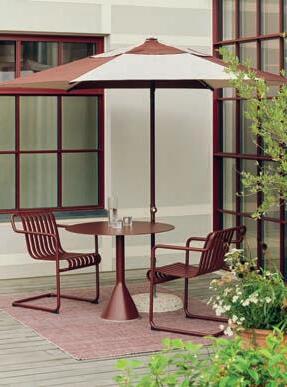
New to Hay’s classic Palissade collection is the cantilevered armchair, which retains the original symmetrical design and adds a new lightness thanks to its fl oating frame. £485 hay.com
VINTAGE STYLE
GIMME SHELTER
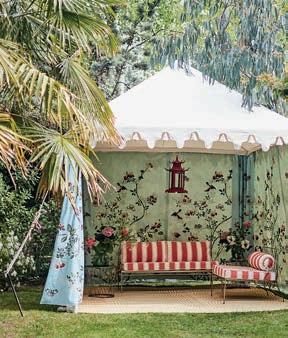
Add a touch of glamour to your garden with an impressive pergola from Raj Tent Club’s stylish selection. We love this fl oral print inner canopy. From £2,500 rajtentclubshop.com
Angraves vintage rattan chairs are a stunning addition to a conservatory, and Raj Tent Club is currently selling a lovely set of fourn Be quick! £800 rajtentclubshop.com
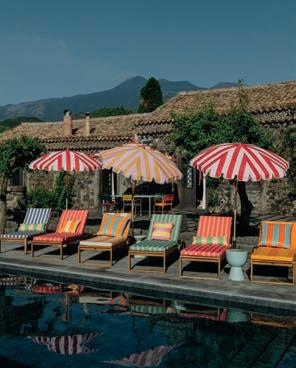
Colours of Arley’s Elements Collection of fabrics is resistant to water, mould, UV and stains. Perfect for pool loungers then. coloursofarley.com
STRUNG OUT
Bunting brings instant joy to any space, epecially when it’s striped. Choose from a huge selection at the Stripes Company. £23 thestripescompany.com
HOT SEAT
Swy Home’s new garden collection offers 24 hour delivery for emergency barbecues and last-minute weather improvements. We love this garden sofa in olive, £479 swyfthome.com
SUMMER SHADES
OCTAEVO
Octaevo is a Barcelona-based design studio creating contemporary objects shaped by a distinctly Mediterranean design language. The studio develops a range of objects that balance everyday function with a sculptural approach to form. octaevo.com
NEWS Updates from the industry IN THE
Compiled by PENDLE HARTE
WITH THE FLOW
DB CERAMICS
Ceramicist Deborah Brett has launched a debut collection of hand-formed porcelain Flow trays, distilling her signature aesthetic into a compact, covetable form. Each piece is hand-shaped, echoing the rhythmic tides surrounding her Ibiza home. dbceramic.co.uk
POT LUCK
CLINK STREET CERAMICS
The Rave Culture Theory series of stoneware vases explores the origins of rave culture in the early 1990s, including the legendary Acid House raves held in a nightclub on Clink Street in 1988. They're stocked at V&A
East's fabulous new shop.
FINE WORK
FELDSPAR
Feldspar is a family-run design brand creating beautiful things made to last using heritage processes. Their fi ne bone china wares are handmade and handpainted at their workshops in Devon. Each object has an elegant and simple aesthetic. feldspar.studio
TULIP TRIBUTE
DIOR MAISON
Dior Maison has launched a new collection of crockery that echoes the Tulipe line conceived by Monsieur Dior for the spring-summer 1953 haute couture collection, with tulips a symbol of love and renewal. dior.com
Dior for the spring-summer
Light AND SHADE
The South Wing is Laura Sawyer’s immersive exploration of colour, calm and the emotional power of interiors
Photography BETH DAVIS
The South London home of creative consultant, stylist and event designer Laura Sawyer, The South Wing, is a study in how thoughtful colour and atmosphere can shape an experience. As Founder and Creative Director of The Detail, a creative agency specialising in brand experience and event design, Laura approaches design through movement, mood, and sensory impact. Her home became a space to explore these ideas, allowing colour to dictate flow, light to influence perception, and rooms to elicit emotion.
Sawyer is a prop stylist and creative and she has spent the better part of her career making other people’s spaces look beautiful. Doing it for herself, it turns out, was both easier and more exhilarating. “I could create my perfect environment,” she says. So she did — and then she called it The South Wing, which tells you everything you need to know about the confidence of the vision.
The house dates to 1875. High ceilings, original features, a south-facing garden, and a wooded backdrop that means the view from the rear windows shifts with the seasons. Sawyer kept the bones intact and rethought almost everything else, designing and project-managing the renovation herself. She brought in her wood-scientist father for the technical headaches — damp, timber — and assembled a team of tradespeople selected on a simple basis: anyone who told her it was a huge job didn’t get the work. The interiors sit somewhere between boutique hotel and well-loved family home, which is precisely the point. Colour flows through the house in what Sawyer calls “sister” shades — related, harmonious, just different enough that you notice the transitions without quite being able to name them. “I wanted it to flow,” she says. “It helps with the feeling of calm.” Upstairs, a dressing room connects to the main bedroom through a concealed archway with pocket doors; furniture is adaptable, rooms have multiple lives. There are surprises — small, considered, deliberate — placed throughout.
For this project, Laura turned to Mylands, whose South London heritage and paints offered the expertise and pigmentation she required. Working alongside the Mylands team, she developed a unified palette across the house, ensuring the shades connected seamlessly from room to room. Each colour was selected not only for its visual effect but also for the way it interacts with light, creating dynamic moods throughout the day. She says: “Working with Mylands was very hands-on and collaborative. What I appreciated was that the guidance went beyond colour. I’m always designing for presence rather than spectacle, and the depth of the paint really supports that.”
Inspired by boutique hotels and the sense of effortless luxury they offer, Laura designed The South Wing to feel welcoming and full of subtle surprises. Mylands worked closely with Laura to develop a cohesive palette that could support these ideas. Colour was approached as a tool to set the emotional tone from the outset. Unexpected details such as the playful striped ceiling in the kitchen with Pediment No.73 create moments of discovery throughout the home.
Soho Pink No. 266 was one of the first shades Laura was drawn to, chosen for the yoga room for its warmth, sophistication, and ability to shift subtly in light. The darker, more enveloping Myrtle Green No.168 defines the guest bedroom, creating a cocooning atmosphere that combines comfort with luxury. In the bathroom, the soft neutral Holbein Chamber No.07 brings a light and airy feel that complements the marble.
The high pigmentation of Mylands paints was essential to achieving this layered effect. Colours respond to the changing light to give each space depth, presence, and a cinematic quality. The result is a home that feels alive, changing subtly with the time of day, and providing an environment where atmosphere and function are intertwined.
What strikes you about the house, beyond the beauty of the thing, is its patience. Sawyer is still searching for the right rug for one room. She isn’t in a hurry. “I know it will be exhilarating to find the right piece,” she says. In a world of fast interiors and faster regret, there’s something quietly radical about a home that’s prepared to wait for what it deserves.
“Colours respond to the changing light to give each space depth, presence, and a cinematic quality”
RED HOT LICK
Reds are very 2026 and Lick's Red 01 is a burnt, earthy tone that looks great in a living or dining room. The matt texture won't reflect light, creating a cosy, welcoming feel, while the red is intense without being overwhelming. lick.com
BENJAMIN MOORE
Golden Chalice is a mustard colour with a hint of green that feels both retro and contemporary. Pair it with similar colours from the same palette of golds, browns and yellows for striking results. benjaminmoorepaint.co.uk
FEEL GROUNDED FENWICK & TILLBROOK
Marshland Muddle is a warm taupe inspired by damp soil and dri wood. Earthy, grounding, and an easy mid neutral. Available in all six paint finishes, from £28 for 1 litre. fenwickandtillbrook.com
PRETTY GREEN EARTHBORN
Riverbank is an unapologetic green that looks great with a muted pink. We love it for kitchen cabinets, but it will bring energy to any room, whether on the walls or the woodwork. earthbornpaints.co.uk
PLASTER CAST COAT
Sybill is a deep plaster pink with a terracotta edge that pairs excellently with browns, reds and pinks. It works in all spaces. coatpaints.com
Entering Connie Barton’s home, you are welcomed by beautifully curated colours and warm natural materials, making the space feel truly wholesome and inviting. As we make our way into the living room, it is as if London has disappeared. In here, we are seated in Connie’s cosy, mustard coloured sofa, where we have the most enchanting view of what can only be described as an urban jungle - their garden. Sitting here enjoying the view, Connie starts telling us about her career with graphic design. Connie’s journey began in New York, where she spent time after university visiting design studios and offering to make them cups of tea in exchange for valuable insights. But while she was in New York, Connie was offered work in London, which later turned into a full-time job. “At my first job, I learned so much about the design process, different materials, the importance of space, and the right furniture and lighting. This job influenced my love of modernist design and taught me how great design plays an important part in everyday life. It also brought me back to England, and I have lived in South London ever since”.
In 2013, Connie ventured into creating her own independent design studio, which specialises in graphic design, branding and art direction. In 2011 her husband Tom opened his very first Honest Burgers site in Brixton. Connie helped Tom with the brand DNA and design, but as more restaurants followed, juggling this alongside a full-time job proved to be too much, and Studio Connie was born.
Connie explains that it is the world around her that influences and inspires her. Growing up in a large family in idyllic, rural Rutland, Connie spent much of her childhood being creative and escaping into alternate worlds through books and drawings: “I now realise what a luxury childhood boredom was. We had no option but to make up our own fun and create our own worlds to keep us occupied.” Today, Connie still ventures into new worlds of inspiration through music, photography, interiors and product design or when she
PERSONAL
SPACE
Graphic designer Connie Barton lives in a unique home with a magical, jungle-like garden in south London
and Tom holiday in the wild Scottish Highlands. Many of her clients also work within the creative industry, and Connie finds it very inspiring to bring their world and ideas to life through her work: “The most important part of my job is listening and asking the right questions to ensure I can comfortably step into the client’s shoes and really understand their world. Often clients will send me books or visual references - anything that excites them. Like a magpie, I’ll gather all these treasures, words and references before beginning the
design process in my beloved sketchbook”. Moving the conversation to their home, Connie tells us that they bought the house in 2015 after seeing it just once in the dark. “Tom fell in love with the house, I fell in love with the garden and its gnarly old mulberry tree. When the previous owner dug out the rear extension, they also built up the height of the garden so that you look directly out at the beautiful planting rather than looking down from above. It’s genius. That’s what gives it the jungle-like feel”, Connie tells us. Being a traditional Victo-
rian house with a contemporary extension, the house is made up of an exciting mix of old and new. With its wooden ceilings and large windows overlooking the wondrous garden, the home feels warm and welcoming, and the light wells, which have been added throughout the house, naturally tie the whole space together.
Feeling so connected to nature whilst sitting in urban south London is truly unique, and over the years, Connie’s love for the garden has not lessened: “My favourite spot is in the living room, sat with a brew on our cosy sofa and looking out through the big windows. Every season is beautiful in its own way. When the sun hits the pond and reflects light across the ceiling, it’s particularly magical. Especially when it’s warm enough to slide the windows fully open, and the garden and the house become one –that’s when you hear the sounds of running water and birdsong from outside. Our own secret garden in a corner of the city”.
Quoting Ilse Crawford, Connie has prioritised decorating those spaces where she spends most of her time - only inviting things she genuinely enjoys into her home. When asked what home means to her, Connie explains that she is drawn to spaces that feel personal and authentic and that her home is full of cherished memories: “Home is where my loved ones are. Our home here has slowly become a private gallery all of our own. Our shared interests, lessons and adventures as we’ve grown up together are all here, from the art hanging on the walls and the stacks of books to the pebbles collected at our favourite beaches that I use as paperweights”.
Story and pictures courtesy of fermliving.co.uk
LINES
BEAUTY
By PENDLE HARTE
Simple style
Carl Hansen & Søn relaunches more classic pieces by Hans J Wegner: a sofa and a coffee table
Carl Hansen & Søn presents the CH280 Modular Sofa, designed by Hans J. Wegner in 1980 – a piece that captivates with its refi ned functionality and timeless simplicity.
The sofa consists of three elements – an armrest section, a middle section and a footstool – which can be combined in every conceivable way. With its low seat and gently reclined backrest, the sofa invites both relaxed conversation and effortless comfort.
Characteristically for Hans J. Wegner, the sofa has an exposed wooden frame that is not concealed by upholstery, while the backrest has slightly curved wooden slats that give the sofa a robust yet lightweight appearance. By using a simple coupling bracket, an unlimited number of modules can be connected lengthwise or at 90° to create your own personal configuration.
Characteristically
The cushions are upholstered by hand with removable textile covers.
Alongside the modular sofa, Carl Hansen & Søn is also launching another Hans J. Wegner design from 1980 – the CH086 Coffee Table. The minimalist table is crafted from solid oak and features two extension leaves with brushed stainless steel hinges, mounted on each side of the table. The extensions for the leaves are hidden underneath the tabletop, which is both practical and spacesaving, while it also ensures stability. The coffee table is available in three different heights.
Knud Erik Hansen, third generation owner of Carl Hansen & Søn, says: “Hans J. Wegner is held in high esteem by Carl Hansen & Søn, which is why we are thrilled to welcome the CH280 Modular Sofa and the CH086 Coffee Table into our collection. Both are incredibly versatile, and characterised by sublime craftsmanship, high functionality and a simple aesthetic.”
Both CH280 and CH086 are made by skilled cabinetmakers and upholsterers at Carl Hansen & Søn on Funen, Denmark.The CH280 Modular Sofa and the CH086 Coffee Table are in stores from 20 August.
Carl Hansen & Søn Flagship Store London, 48A Pimlico Road, SW1W 8LP; 020 7730 8454 @carlhansenandson_london carlhansen.com
CH280 FOOTSTOOL
For a generation rewriting the rules of how and where we live, the question of what makes a home has never felt more urgent — or more personal. Longerterm renting is no longer a stepping stone reluctantly occupied while waiting for a mortgage to materialise. For urban creatives, expats and digital nomads, it has become a way of life. The challenge, then, is not how to escape it, but how to inhabit it fully.
That is precisely the provocation at the heart of Home For Now: Living Well Without Staying Long, a new book by Niko Da os and Paul Firmin, the founders of Earl of East, the London-based multisensory lifestyle brand beloved for its candles, botanicals and quietly considered approach to everyday ritual. Drawing on their own years
as long-term renters, Da os and Firmin have written what amounts to a manifesto against the psychology of limbo — the familiar, deflating sense that real life begins only once you own the walls around you.
“For years, renting felt like a state of limbo, but we learned that you don’t need a deed to lay down roots,” they write. “Belonging is an active choice. It’s created through daily rituals, sensory anchors, and the cherished objects you carry with you to your next address.” It is a simple idea, and a quietly radical one.
The book’s central argument rests on the power of the senses. Light, scent and textiles, Da os and Firmin contend, are the fastest and most democratic tools available to anyone trying to make a space feel like theirs. A particular candle lit each evening, a favourite throw pulled over a rented sofa, curtains that block the cold grey light of a
north-facing window — these are not trivial gestures. They are the building blocks of atmosphere, and atmosphere is what separates a space you endure from one you genuinely inhabit.
The individuals profiled throughout the book bring this philosophy to life in ways that are both practical and unexpectedly moving. In East London, Scott Bennett and his architect partner demonstrate what can happen when a couple resists the urge to furnish quickly. Their rented basement flat was assembled slowly and deliberately — only objects chosen for meaning and longevity were allowed in. A grandmother’s painting. Salvaged coffee table legs repurposed with intention. Nothing arrived without a story attached to it. The result is a home that feels not provisional but rehearsed: every piece ready, when the time comes, to travel to
ABSOLUTELY magazines
the next address and perform the same anchoring work all over again.
Across the Atlantic, in a one-bedroom rental perched on a gentle slope in Ojai, California, Irene Legaspi and Matthew McCallum offer a different kind of lesson — one about presence rather than precision. They painted over the colours they inherited, filled their rooms with pottery from Oaxaca and handwoven textiles from Peru, and let the scent of pine, sage and citrus do the rest. Their home is not defined by what they own but by where they have been and what they chose to bring back: objects that carry memory, texture and the particular warmth of a life deliberately lived.
Their home is not defined by what they own but by where they have been
Then there is Brigette Muller, who rents a 1920s railroad apartment in Brooklyn’s Greenpoint and has no patience for halfmeasures. She repainted the walls, installed a marble countertop and replaced the windows, operating under a mantra that will resonate with anyone who has ever stood in a beige rental and felt their spirit quietly diminish: make it feel like yours, for however long it’s yours.
What unites these portraits, and what gives the book its genuine emotional weight, is the understanding that security is not a property condition. It is a practice. Da os and Firmin are not offering decorating tips so much as a reorientation of how we think about belonging. In a world of increasing mobility, the ability to create sanctuary repeatedly, in different rooms, different cities, different countries, is not a consolation prize for those who couldn’t afford to buy. It is its own sophisticated skill, one that rewards attention, sensory intelligence and a willingness to commit to the present tense.
Home For Now arrives at exactly the right moment. As the gap between renting and owning widens and the notion of a forever home recedes, this book makes the case, warmly, practically and with considerable style, that a meaningful home was never really about the mortgage. It was always about the ritual.
Home For Now: Living Well Without Staying Long by Niko Da os and Paul Firmin is published by Gestalten.
Marco Joe Fazio
Onice Smeralda
Creative
SPONTANEITY
Deirdre Dyson's new Melange rug collection arrives in London
Lady Deirdre Dyson's Melange hand knotted rug collection made its debut at Maison & Objet in Paris this January and has remained on view at her Paris gallery for the past six months. This summer, the collection crosses the Channel to hang at her Chelsea flagship at 554 Kings Road, SW6 and will be on display from the 1st June.
Deirdre set aside the constraints of a single overarching theme and instead embraced what she calls 'creative spontaneity' - the result being a gloriously eclectic suite of rug designs.
Each carpet is a stunning, standalone work, yet all are bound together by a shared sense of play and wit. Geometric (GLASSY GREENS, CRYSTAL and ‘O’) and kaleidoscopic shapes (MOULIN, TRIPTYCH) recur throughout, while a unifying palette of warm taupe neutrals (POUCH, SAFARI) is punctuated by bold strokes of burgundy, purple and burnt orange. Crafted in luxurious wool and silk, these carpets are works of art in their own right - designed to complement and anchor any considered interior scheme.
'I decided to move away from any preset objective and relied entirely on a random design process — ideas that just popped into my head,' explains Deirdre. 'There are references to past works through overlays and floating shapes, while some carpets feel figurative and others more angular and geometric. What became clear is that the designs are characteristically mine. As an improvised collection, the results feel fresh and surprising, and I hope there is something for everyone — something to suit a broad range of contemporary styles.'Every Deirdre Dyson carpet is made to measure, tailored to each customer's exact specification in Tibetan wool and pure silk, available across the full colour spectrum.
Goodweave-certified and handwoven by skilled Nepalese craftspeople, Deirdre
Dyson carpets are available for both private residential and commercial spaces in any size, shape and design variation.
deirdredyson.com
554 Kings Road, London SW6 2DZ 12 Rue des Saint-Pères, 75007 Sales@deirdredyson.com. 020 7384 4464
join us on Thursday 11th June for the annual Chelsea Design Quarter (CDQ) Summer Street Party to view the new collection and enjoy drinks
CUTTING edge
Absolutely meets Jay Patel, founder of the Japanese Knife Co, to discuss blades, skills and business
Words PENDLE HARTE
Of course, the Japanese Knife shops have been around for some time, but its bright, big new store on Baker Street caught my attention, and it seemed to be selling more than just knives. Ceramics, specifically, and clever Japanese
kitchen accessories. What’s the story behind the shop, I wondered, and why was I noticing them now? I sought out Jay Patel, founder and owner of the business, and discovered that his is quite an interesting story – and also that the reason I was noticing the stores more was precisely because there was more to them than just knives.
Q There are now five stores in London. What makes Japanese knives so special?
A Japanese blades are designed for fine precision cutting rather than cleaving your way through things. Think about the cuisine – about 30-40 % of Japanese food is about presenting raw cut ingredients, so the chef’s job is only to cut. The average western knife is thick, and while it’s very sharp, it’s made from one layer of steel which makes it heavier, and suited to heavier work. For butchery I’d certainly use a regular European blade. Japanese blades are made from multiple layers of hard steel clad in soft steel, making them suited to the way Japanese chefs cut with great delicacy.
Q And how did you come to learn this?
A I had a fashion business in London in the 80s and sold my company to Terence Conan’s Storehouse, which put me on an exclusion contract. I couldn’t work in fashion any more and I had money and time plus an interest in cooking, so I travelled around learning to cook. When a chef in Japan gave me a knife, I loved it and ended up working as an
apprentice blacksmith for 10 years there. That was seven years of making and two years of sharpening, then a year at the fish market learning how to cut fish. All of these things are different skills; handles are a different skill too. In Japan, 10 years is very short for an apprenticeship. Your master would let you put your name under his after that now but it used to be 15 to 20 years before you could put your name on anything. I loved the art of making knives, they are hand made with your spirit inside.
Q Why is the process so long?
A The Japanese idea is to do one thing and do it well. They have a history of making beautiful blades, dating back to Samurai swords, and an affinity with steel. They have always pursued perfection, if they can’t get it perfect they don’t do it. After WW2 Japan banned the making of all swords, so a lot of the blacksmiths turned their hand to other utensils. Since then Japanese brands have become so successful.
Q So what did this mean for you?
A All of this changed the way I cut, and I started to see the European methods
Sharpness is very addictive. It’s almost like a drug
as very heavy-handed. I came back to the UK in 1997 and found nobody selling Japanese knives, so I started the company as a mail order business. There was no internet then, of course, and we were mostly supplying other stores. But clearly Japanese knives can be way more efficient for the domestic chef, and easier to maintain.
Q Who is your customer now?
A We have a lot of professional chefs, and they will choose based on functionality: how long a knife stays sharp and how comfortable to use. Domestic users will prioritise the aesthetic. We provide a service where people can come for maintenance and to try things. Department stores aren’t allowed to let you touch knives before you buy them, but I believe you should always try them out and find one that feels right for you. Even though 70% of our customers are professional chefs, more of our income comes from domestic chefs indulging a passion. Because sharpness is very addictive. It’s almost like a drug, you crave more sharpness.
Q Why do domestic cooks like them?
A We show people how to use them; you get much more pleasure out of it if you know how to use it properly. There’s a
JAY PATEL
After WW2, Japan banned the making of all swords, so blacksmiths turned their hand to other utensils
primeval pleasure in slicing things well, and it makes a big difference. Cutting an onion with a blunt knife you cry, a proper sharp knife you don’t cry, because all the acid and sugars remain in the food, they haven’t been torn. The Japanese often prepare food that’s raw. Sashimi should be bone dry and matt not glossy, no oils should escape.
Q And what about the other items you sell?
A For the fi rst 10 years it was just knives and we have over 2000 models in store. Buying knives is a very male thing and 60% of our customers are male. Even though women choose everything else in the kitchen, men get very nerdy about the technical aspects. A husband and wife would come in and the wife would get
bored, so I needed stuff to occupy them. I started with ceramics and now we do loads of stuff for the home and garden, We also sell the largest selection of iron cookware anywhere outside Japan, and people want traditional Japanese ceramics. I design my own glassware too, and with Matcha becoming so popular we are selling a lot of accessories for that too now. I’m 71 and I can’t make knives any more, since I broke my hands in an accident, but I still sharpen, even though they shake a bit. In every one of our shops there’s at least one person who’s worked in Japan: that's really important to me. We have kitchens in every store when you can try everything we sell. I can’t understand how you can buy tools without trying them out.
Designed for Living Artfully Crafted,
TBoConcept explores the evolving role of the sofa, where Danish craftsmanship, sculptural design and everyday comfort come together at the heart of the modern home
here are few pieces of furniture as central to everyday life as the sofa. It is where mornings begin slowly, where conversations continue long into the evening, and where family, friends and quiet moments naturally come together. More than any other piece in the home, the sofa defines how a space feels – not simply how it looks.
In Danish design, this understanding has always been instinctive. Furniture is never created for appearance alone, but for the way it supports the rhythms of real life. Beauty and function exist together, creating spaces that feel both refined and deeply comfortable.
For more than 70 years, BoConcept has refined this philosophy, creating sofas that are architectural yet inviting, sculptural yet practical, and always designed around the people who live with them.
Today, as homes continue to evolve into spaces for work, relaxation, entertaining and connection, the role of the sofa has become more important than ever. It must offer comfort, certainly, but it must also adapt effortlessly to modern living while reflecting the personality of the home it sits within. This is where Danish design continues to lead.
DESIGNED AROUND LIVING
A well-designed sofa does more than complete a room – it shapes how that room is experienced.
Whether placed in a compact city apartment, an open-plan family home or a dedicated entertaining space, the right sofa creates balance between comfort, proportion and functionality. At BoConcept, every sofa begins with this principle: furniture should respond naturally to the way people live.
From sleek two-seaters to expansive modular configurations, each design is created to offer flexibility without compromising aesthetics. Some interiors call for architectural clarity and structured silhouettes, while others embrace softness, depth and a more relaxed sense of comfort. The beauty of contemporary sofa design lies in its ability to offer both.
With more than 120 fabrics and leathers, multiple module options, interchangeable leg styles and tailored configurations, every BoConcept sofa can be customised to suit both space and lifestyle. It is not simply about choosing a sofa – it is about creating one that feels entirely personal.
SCULPTURAL COMFORT
If functionality shapes the experience of a sofa, form defines its presence. BoConcept’s latest sofa collections explore a softer design language, one
rooted in organic curves, generous proportions and silhouettes that bring warmth and character to contemporary interiors. At the centre of this expression sits Salamanca.
Low, lounge-like and unmistakably relaxed, Salamanca introduces a subtle 1970s bohemian influence into the modern home. Designed with oversized proportions and a distinctive floating base, it carries a strong architectural presence while maintaining a sense of visual lightness.
Its moveable back cushions allow for complete flexibility, creating a cocooning silhouette that adapts naturally to the way you sit, recline or gather. Whether configured as a freestanding sofa or expanded into a modular lounge arrangement, Salamanca is designed to encourage a slower, more relaxed way of living.
ORGANIC LUXURY
Where Salamanca embraces softness through scale, Bergamo refines comfort through precision. Designed by Morten Georgsen, Bergamo is an exploration of organic luxury, combining sculptural curves with an elegant, contemporary expression. Refined stitching flows seamlessly across the base, arms and backrest, creating a sense of continuity that feels both calm and considered.
Its curved forms soften contemporary interiors, while loose back cushions offer flexibility throughout the day, adapting naturally to different seating positions. The result is a sofa that feels quietly luxurious – modern in character, timeless in appeal, and deeply comfortable to live with.
For those drawn to softer silhouettes and a more cocooning aesthetic, Bolzano offers another interpretation of modern Danish living.
Also designed by Morten Georgsen, Bolzano is defined by its signature curved frame, which wraps seamlessly around the design to create a striking sculptural form. Rounded edges, generous proportions and carefully balanced comfort combine to create a sofa that feels as inviting as it looks.
Placed within open-plan interiors, Bolzano becomes more than seating. It becomes a focal point – bringing softness, warmth and quiet confidence to the room.
A NEW DIALOGUE
BoConcept’s latest collaborations continue to evolve the language of comfort. Milano, created in partnership with CLAUDIO BELLINI Studio, introduces a fresh dialogue between Danish restraint and Italian elegance.
Low, deep and effortlessly relaxed, Milano combines architectural structure with plush, sink-in comfort. Slim armrests, softly curved cushions and generous proportions create a silhouette that feels both sculptural and inviting, while its modular construction allows it to adapt
BERGAMO SOFA
SALAMANCA SOFA
OSAKA SOFA
MILANO SOFA
from an elegant three-seater to a more expansive lounge configuration.
Slightly lower and deeper than traditional seating, Milano creates an immediate sense of comfort – inviting you to slow down, settle in and experience the home in a different way.
A DESIGN THAT ENDURES
Some designs evolve with time. Others define it. Since its introduction in 1999, Indivi has become one of BoConcept’s most iconic sofa designs – a true expression of contemporary Scandinavian living. Twenty-five years later, it remains as relevant as ever.
Its clean lines, compact proportions and exceptional configurability have made it a favourite across generations and interiors alike. Available in multiple modules, corner combinations and resting configurations, Indivi adapts effortlessly to changing homes and changing lifestyles.
Enhanced with high-quality foam for lasting support and available in a wide range of fabrics, finishes and leg styles,
it reflects BoConcept’s belief that great design is never static. It evolves with the people who live with it.
WHERE DESIGN MEETS DURABILITY
A sofa is one of the most used pieces in the home. It must feel beautiful, but it must also stand the test of time. That commitment to longevity is built into every BoConcept collection from the very beginning. Frames are engineered for structural durability, foam cores are selected for long-lasting resilience, and every seam, stitch and finish is crafted with precision.
Materials are equally considered. Leather offers timeless elegance and durability, developing character with age, while fabric introduces warmth, texture and personality through an extensive collection of tactile finishes and performance materials.
Every detail is chosen with intention, ensuring each sofa continues to feel as beautiful and comfortable in years to come as it does on day one.
THE SOFA, PERSONALISED
Perhaps the greatest luxury in contemporary interiors is not abundance, but individuality. No two homes live in exactly the same way, which is why every BoConcept sofa is designed as a starting point rather than a finished statement. Through modular layouts, custom fabrics, tailored dimensions and expert design guidance, each piece becomes an extension of the people who live with it.
Through BoConcept’s complimentary Interior Design Service, customers can explore layouts, materials and configurations before making a final decision, creating spaces that feel beautifully resolved, deeply personal and designed for real life.
THE DANISH WAY
Since 1952, BoConcept has remained committed to the principles that define Danish design: craftsmanship, functionality, quality materials and timeless aesthetics.
Through BoConcept’s versatile collections, that philosophy continues to evolve – proving that true comfort is not simply about how something feels, but how naturally it becomes part of everyday life.
To explore the collection and discover a sofa designed around the way you live, visit one of BoConcept’s stores in Battersea Reach, Guildford, Harrods, Finchley Road, Tottenham Court Road, Notting Hill, Westfield London, Fenwick Kingston, Fenwick Brent Cross or St Albans. Wherever your design journey begins, BoConcept’s complimentary Interior Design Service offers expert guidance, helping you create a space that feels beautifully considered and deeply personal.
BOLZANO SOFA
BERGAMO SOFA
INDIVI SOFA
Interiors EXCEPTIONAL
How Primrose Interiors enhances lives by creating character homes
Based in the heart of Primrose Hill, Primrose Interiors has built a reputation for delivering refined, bespoke interiors throughout Hampstead and St John’s Wood. Specialising in luxury residential design and build projects, the company offers a complete turnkey service, transforming properties from concept through to completion with meticulous attention to detail. Their portfolio also extends across some of London’s most prestigious postcodes, including Mayfair, Knightsbridge, Kensington, Regent’s Park and Notting Hill.
Founded on more than 30 years of industry expertise, Primrose Interiors is led by a highly experienced team of interior designers, builders, decorators and skilled craftspeople who work collaboratively to create homes that are both beautiful and deeply personal. From fullscale renovations and structural reconfigurations to bespoke joinery and custom upholstery, every project is approached with the same commitment to quality, creativity and precision.
What distinguishes Primrose Interiors is its integrated approach. Clients benefit from having a single, trusted point of contact throughout the entire process, ensuring a seamless experience from the initial consultation to the final styling touches. The company also works closely with an established network of architects, structural engineers and specialist trades, allowing even the most ambitious visions to be realised with confidence and care.
The Primrose Hill showroom serves as both a creative hub and a curated retail destination, where clients can explore an extensive collection of luxury materials, fabrics and finishes. Alongside this, the company’s dedicated joinery workshop produces handcrafted furniture and fitted pieces tailored precisely to each space and lifestyle. Every detail is considered, resulting in interiors that feel sophisticated, functional and uniquely individual. Primrose Interiors has become particularly well regarded among discerning homeowners seeking a highly personalised service and an uncompromising
level of finish. Their portfolio ranges from elegant period homes to contemporary family residences, each united by a strong sense of craftsmanship, understated luxury and enduring design.
At the heart of the company is a belief that exceptional interiors should enhance the way people live. Whether restoring the character of a heritage property or creating a modern sanctuary from the ground up, Primrose Interiors delivers spaces that are thoughtfully designed, expertly executed and built to stand the test of time.
primrose-interiors.com
“The changes enhanced the coherence of the historic house”
TSPACE MAKER
Hideaway House is a transformative reimagining of a unique detached home in East Dulwich by nimtim architects
he house is a detached villa placed in the middle of an urban block of Victorian terraces. Accessed via a narrow footpath, it is bordered in all sides by rear gardens. As a result, it feels incredibly secluded for its location: quiet, calm and surrounded by plants, trees and wildlife.
The house was already bright and open but did not suit the requirements of the family, with small unconnected rooms and not enough bedrooms. Nimtim’s briefing process identified a need for a new bedroom suite and other bedrooms that could accommodate the transition from childhood to adulthood, plus allow visitors to stay comfortably and independently. The brief also included a new garden that gave more space for enjoying and occupying the external spaces rather than merely observing them. The intention was to celebrate the unique context of the house by reinforcing its connection to the surrounding gardens.
The proposals created a new bedroom suite in the roof space with sensitive and imperceptible adjustments to the existing roof pitch. The changes had no impact on any of the surrounding gardens and enhanced the coherence of the historic house.
Elsewhere, window openings were enlarged and rationalised with simple high quality timber window frames bringing a consistency to the the external elevations that didn’t previously exist.
Inside, walls were removed and new connections and views created between internal and external spaces. Despite this open-ness, rooms could still be closed off to provide privacy and quietness when required. Nimtim introduced a palette of simple high quality materials that ran from inside to out creating a coherence through the whole home. In-built joinery using a highly contrasted Douglas Fir emphasises this consistency and texture.
For the garden, nimtim collaborated with Andrew Bentham who delivered the garden following an initial concept scheme and layout by nimtim architects. The garden introduces more space for seating and coming together with generous and rich planting placed in the middle of the space allowing the garden to make the most of the greenery already surrounding it.
Photography by Megan Taylor
A“Today’s bathrooms are designed as places to unwind, reset, and escape”
in style
Espresso Design introduces Cesar’s new Ondula bathroom collection
s luxury interiors continue to place greater emphasis on wellbeing and calm, the bathroom has become one of the most important spaces in the home. No longer purely functional, today’s bathrooms are designed as places to unwind, reset, and escape from the pace of everyday life. Reflecting this shift, Espresso Design has introduced Ondula, a striking new bathroom collection by Italian brand Cesar, designed by acclaimed creative duo Garcia Cumini.
Inspired by the movement created when a drop of water touches a still surface, Ondula brings a sense of softness and fluidity into contemporary bathroom design. Gentle curves, rippling textures and subtle reflections create an atmosphere that feels calm, balanced, and restorative — combining sculptural beauty with everyday practicality.
Garcia Cumini conceived the collection as a celebration of light, movement, and nature. Surfaces appear to flow seamlessly, while the interplay of shadow and reflection adds depth and warmth to the space. The result is a bathroom collection that feels elegant yet understated, bringing emotional warmth to minimalist interiors.
The launch of Ondula also reflects a growing trend towards more sensory, design-led bathrooms. Clients are increasingly seeking spaces that feel personal and immersive, with natural forms and tactile materials replacing colder, purely func -
tional aesthetics. Bathrooms are becoming extensions of the living space — carefully considered environments that support wellness as much as design.
For Espresso Design, introducing Cesar’s bathroom collection marks a natural expansion of the studio’s contemporary interior offering. Known for creating award-winning luxury kitchens, the company continues to evolve its portfolio with the same focus on craftsmanship, innovation, and timeless Italian design.
Presented within a fully styled setting, Ondula allows visitors to experience how thoughtful bathroom design can completely transform the atmosphere of a home. Every detail has been carefully curated to showcase the balance between practicality and elegance that defines the collection.
Cesar’s new Ondula bathroom range is now on display at Espresso Design’s showroom in Chelsea Harbour, offering clients and design professionals the opportunity to experience the collection firsthand.
espressodesign.co.uk
invigorated FEEL
Jensen Beds: the sleep that makes your day
Jensen Beds has been creating premium beds in Norway since 1947, combining Scandinavian craftsmanship, innovative sleep technology and timeless design to deliver exceptional comfort. Deeply rooted in Norwegian heritage, the brand is known for its dedication to quality, attention to detail and the belief that great sleep is essential to everyday wellbeing – helping you wake up fully rested, every morning.
Made in Norway
Just outside Oslo, along the shores of the Drammen Fjord, lies the small coastal town of Svelvik – home to Jensen Beds for generations. Here, skilled craftsmanship and a strong design tradition continue to shape every product. Each bed is handmade in Norway using carefully selected materials and advanced comfort technology, ensuring both durability and a refined sleeping experience. Every Jensen bed is backed by a 25-year guarantee against frame or spring breakage, reflecting the brand’s commitment to long-lasting quality.
Get your bedroom ready for the summer season
As the warmer months approach,
Jensen introduces one of its most innovative sleep technologies: Jensen TempSmart™. Designed to help maintain an optimal sleeping temperature throughout the night, TempSmart™ creates a more balanced and comfortable sleep environment, even during warm summer nights. Jensen TempSmart™ products are sold separately and are an easy and affordable way to upgrade your sleep experience. If you find yourself tossing and turning during the night, it is often because your body temperature is either too high or too low. The right duvet, pillow and bed linen is therefore important for a good night sleep.
The advanced temperatureregulating materials absorb, store and release excess body heat when needed, helping to reduce overheating and chilling during sleep. The result is a more
stable sleeping climate and improved comfort through the night.
Friendly to nature – and you Jensen’s beds are made in Norway using only materials, production methods and suppliers that live up to their highly set expectations. To prove their sincerity they work with leading sustainability labels, such as the Forest Stewardship Council (FSC). It makes them sleep better.
Re-thinking and re-using
The planet demands us to be smarter when it comes to the use of resources. And beds are no exception. Working with circular design, Jensen extends the life cycle of their beds and accessories, without compromising their quality. Their aim is always to make beds that stand the test of time, while constantly working to reduce their footprint.
Experience Jensen in Chelsea Harbour
For those wanting to experience Norwegian sleep comfort firsthand, Jensen Beds can be discovered at the showroom in Chelsea Harbour Design Centre, London. Located among some of the world’s leading interior and design brands, the showroom offers visitors the opportunity to explore the full collection of Norwegianmade beds, experience the quality of the materials and receive expert guidance in creating the perfect sleep sanctuary.
Discover your perfect night’s sleep at jensen-beds.com/uk
Carefully
Explore
Light work
Light, structure and steel in a Teddington Victorian house
There’s a certain type of house that really captures attention, and very often it’s not the biggest, grandest, loudest or boldest property on the block. Quite the opposite, in fact, for this is the house in which rooms line up with a certain logic, light moves cleanly through the plan and materials sit where they should without drawing attention to themselves.
In London, the many acres of Victorian homes often rely on that kind of judgement when they are brought up to date. The shell is solid, yet the house itself needs the kind of personal touches that take it into the realm of the home.
Iconic black steel window and door manufacturer Crittall Windows has an annual awards ceremony – Crittall House of the Year (CHOTY) – that recognises residential projects across the United Kingdom where steel windows and doors are used with care and restraint.
A previous winner of this prestigious award is a Victorian house in Teddington. From the outside, the change is measured. Corporate W20® external screens are set into the existing red brick, giving the rear of the house a stronger sense of structure without breaking from its context. The glazing opens the ground floor towards the garden and brings daylight deeper into the plan, so the interior feels more connected to the outside space.
Inside, internal screens shape how the house is used. They divide rooms without closing them off, so movement stays easy and sightlines remain open. The layout reads clearly, with each space doing its job while still feeling part of a whole.
As the day changes, so does the atmosphere inside. Light reaches further than before, especially in the middle of the house where it once felt reduced. Steel and glass pick up subtle shifts in brightness, giving the interior a steady variation without disruption.
Crittall Windows supplies steel systems for homes where proportion and light are carefully reworked rather than reinvented. In the Teddington house, that approach is clear in the way the external screens and internal partitions work together to improve flow, daylight and connection to the garden.
The result is a house that feels more coherent. The Victorian structure is unchanged, yet its clearer internal logic means that rooms connect more directly, light reaches further and the rear of the building holds a stronger relationship with the garden. It is careful adjustment, as opposed to total transformation, that makes it whole.
crittall-windows.co.uk
HEART OF THE HOME
HOW TO USE STONE IN YOUR KITCHEN
Stone is the ultimate choice for kitchen worktops and flooring. Loved by designers for its versatility, stone is the perfect long-lasting investment for classic and contemporary kitchens.
There are many reasons for choosing stone, not least the elegance and timeless beauty of the material. Natural stone is practical, hardwearing, stylish and low maintenance: a winning recipe for the heart of the home.
For sheer durability, granite is hard to beat – it is naturally resistant to heat, scratches, acidic spills and harsh cleaners. As one of the hardest natural stones, each slab features distinct colours and patterns, often with a tiny sparkle, making granite a strong all-rounder.
Marble is softer and wears over time, giving an aged patina that adds character to worktops. Each piece is uniquely veined and, once treated with modern sealants, makes for an opulent focal point in the kitchen. However its tendency to wear means it is not for those who want that “just out of the showroom” look to last forever.
Quartzite is often mistaken for marble because of its similar veining and colour variations, but it is much harder and more resistant to daily damage. Colourful and decorative, quartzite creates an eye-catch-
ing centrepiece for the kitchen. It is rarer than granite and therefore more expensive.
For those that want an alternative with the same qualities but without the variations in colour and veining of a natural product, sintered stone slabs such as Dekton by Cosentino are available. These man-made materials are heat-proof, scratch-proof and very durable. They come in a variety of colours and styles, including many that mimic marble and other natural stones.
Whether it is crafted from natural or manmade stone, a bespoke stone worktop can transform your kitchen with luxury that lasts, by blending quality design and enduring beauty. Custom additions can include integrated sinks, drainage grooves, sleek splashbacks and contrasting or complementary kitchen island surfaces.
Choosing a stone countertop is an excellent long-term investment, too, as it delivers unmatched value. Each hand-finished piece is expertly designed to withstand decades of daily life and ever-changing trends. Stone can be seamlessly integrated into any interior design style and will stand the test of time in any setting.
stoneCIRCLE has been fabricating stone for interiors since 1968 and works with top architects and interior designers on some of the most desirable residences. They have their own teams of installers working across the south of England fitting the stone they fabricate. Please contact them to discuss how you could use stone to transform your home.
stone-circle.com 0125 685 0380
Statement living
Curate a space to reflect your lifestyle and personality with Cult Furniture
Luxury interiors are shifting. Less about perfection, more about personality, yet still thoughtfully curated. Our homes are becoming reflections of personal taste; layered and characterful. In a world saturated with fast trends and algorithmled inspiration, there’s a growing desire to create interiors with confidence, longevity and a sense of individual identity that feels expressive.
This evolving approach to design sits at the heart of Cult’s philosophy. As The Home of Iconic Design, Cult believe spaces should feel as distinctive as the people living in them, balancing functionality and statement aesthetics with warmth and texture.
One of the defining movements shaping interiors right now is the rise of modern luxury achieved through mixed materials. We’re seeing homeowners move beyond minimalist uniformity in favour of richer, more tactile combinations: the softness of honed marble paired with mirrors, tables and lighting in striking high-gloss fin-
“Interiors that feel elevated without losing comfort or authenticity”
ishes that reflect light into a room. Sculptural travertine alongside warm walnut tones, like the popular Santana range, or grounding burl wood in pieces like the Dalton Coffee Table and organic form of the Arco Mirror, add effortless depth and personality to a room.
These materials are no longer reserved for formal interiors or untouchable spaces. Instead, they’re being reimagined for modern living. The result is interiors that feel elevated without losing comfort or authenticity.
For London homes, where space can often be compact, but style is highly considered, materiality plays an essential role in shaping the atmosphere. A carefully chosen statement piece, like the Akira Coffee Table in Walnut with Emperador Brown Honed Marble, or Travertine, can completely transform how a room feels, bringing depth, contrast and a sense of intention to even the smallest of spaces. What makes this movement especially exciting is its confidence. It encourages people to move away from safe, trend-led decorating and instead embrace pieces with presence.
Cult see luxury not as excess, but as self-expression. Creating a home that feels iconic isn’t about following rules; it’s about curating a space that reflects your lifestyle and your personality.
Shop online at cultfurniture.com or visit their London showroom 811-813, Wandsworth Rd, London SW8 3JH. Use ABJUNE for Free Delivery.
Art
AS A WAY OF EXPERIENCING, UNDERSTANDING AND CREATING LIFE
For Carolin Rechberg, art is everything. Here’s why
Artworks are like vehicles of transformation, a process of being, as the process of making with alert senses and perception, to perceive what arrives in sensations, in experience, in understanding, in thoughts, in reflection. This process of realising, ideation and gathering information and insights continues beyond the process of creating into the way that one encounters moments in life, the environment, the way one interacts with one’s senses, in sensitivity and in acute awareness in the precious moments, interconnected, shaping life itself, impacting beyond one’s lifetime.
The echo of our existence and that of art extends beyond the lifespan of the individual. We know and see through history, the mark individuals leave in our lives, artists, craftsmanship providing products of everyday life, the exchange with nature and animals, the urban environment, and nowadays technology albeit in a from life removed form, all shape the ways of our behaviour and approach to how we are and interact in life, and what we ourselves leave as a legacy.
Art can be another vehicle, to a conscious way of living. Not only for the persona creating the art, with in this case the experience of her identity and background, but for everyone and the environment interacting with the artwork, whether consciously or unconsciously, ever after its inception. The dialogue exists on different levels of communication. In a physical sense, sensory, emotionally, mentally, spiritually, or in the subconscious through simply providing an accent in the environment, and therefore shaping the experience of it on an energetic and atmospheric level.
LEFT
The power of art can not be debated. Everything, our whole infrastructure of existence, stems from the creative process undergone by humans. All products, elements of infrastructure are byproducts, intentional or unintentional created by humans through ideation in the exchange and study with matter and existence. If one is willing, one remembers that everything that we utilise to live and are able to inhabit to live, is in its origin from a process of creation. Art itself is and can be a return to this elementary state of being in communion with matter as a creator and also letting matter create through the input of energy. The force being the guiding artist’s hand, as well as chemical attributes inherent and at work in matter. Resulting in inventions found through the observation and perception of intentional and subconscious experimentation and play, from the pursuit to communicate experiences of the human condition and spirit, as well as to imitate the wonders of the natural world, to understand its patterns, rhythms and language, heading its wisdom to build functional systems to
“Every environment, changing of light and mood, shifts the perception to reveal facets one might have not received prior”
survive, and potentially contribute to an equilibrium, in existence.
While we humans can be a disturbing force in the ecosystem of earth, art is one of the ways of knowing and areas of knowledge, which can depending on its merit and purpose contribute to a more harmonious, joyful and beautiful existence, with the wonders of all other plants and species with which we are initially intended to share the world. The idea of with nature, rather than man versus nature and life. As in life, in art it is all about perspective, how it is shaped and therefore how we experience and exist in the world.
In the end it is the echo of art that may be in cases silent but leave impressions on the inner eye of the human extending beyond the very own recognition.
But its evidential impact is seen across the arc of time in the culture of human existence.
With this in mind, Carolin Rechberg creates in a manner of a cyclical interdisciplinary process, where each medium of art in which she crafts artworks lends to a gathering of information and understanding, whilst simultaneously resulting in artworks embodying her continued research of experiencing and evoking conscious presence of being, through art.
Carolin Rechberg will launch a new website to share recent artwork this summer, and the archive of work created in the past 20 years.
carolinrechberg.com carolins.studio@gmail.com
Assume the State of Water ABOVE Contemplation Stone Arc III
HEAT WAVE
BIG GREEN EGG
The iconic egg is much more than a barbecue (though it does that too). When coupled with Falcon's classic heat resistant Enamelware it can produce things like this homemade focaccia. You can also make pies, tarts and cakes. Who knew?
biggreenegg.co.uk
GAME CHANGER MASTERBUILT
Masterbuilt's Gravity Series XT is no joke. Holding up to 24 hours of fuel, it’s ideal for low-and-slow classics like brisket or pulled pork, while a WiFi-enabled digital fan ensures precise temperature control. masterbuilt.com
PIZZA CHEF MASTERBUILT
Also from Masterbuilt is the clever Pizza Oven insert, which quickly transforms any barbecue into a pizza oven, enabling you to switch from pitmaster to pizzaiola in no time at all. masterbuilt.com
AUTO PILOT
KAMADO JOE
The Konnected Joe is the world’s fi rst digitally connected ceramic grill. Combining the fl avour and theatre of traditional charcoal cooking with modern technology, it offers effortless fi re-lighting and precise temperature control. kamadojoe.com
MULTI TASK VALORIANI
Valoriani ovens are so much more than pizza ovens. They can handle curries, stews, roasted fi sh, meat or vegetable dishes, cakes, pasta dishes, jacket potatoes, shellfi sh delights, steaks and other grilled foods. valorianiuk.com
We’re passionate about creating furniture that stands the test of time
Quality & style
Lisa Coppin, Chief Creative Officer at The Cotswold Company introduces the new showroom in Kingston-upon-Thames
Q Can you tell us about The Cotswold Company’s Kingston-upon-Thames showroom and what local residents can expect when they visit?
A Our new Kingston-upon-Thames showroom marks a major milestone for the brand, our first retail space in London. Spanning more than 4,000 square feet, the showroom offers customers the opportunity to explore one of the most extensive ranges of The Cotswold Company’s bestselling collections.
The space features a curated selection of upholstery alongside a fully integrated dedicated consultation area, the Upholstery Hub. Four beautifully styled bedroom sets highlight some of our bestselling collections, including Chantilly, Winchcombe, Bibury and Camille, alongside our award-winning mattresses. Visitors will also find freestanding kitchen furniture, home office pieces and a wide range of soft furnishings and accessories.
Q What are some of the ways customers can refresh their homes to embrace the season?
A Swapping in lightweight linens and cottons through cushions, throws or bedding can instantly create a fresher, airier feel. Natural materials such as rattan, wood and neutral ceramics also add warmth and relaxed, organic character. Earlier this year we launched our Ready-Made Curtain collection, including beautiful sheer linen styles that are perfect for bringing a light, summery feel to living rooms and bedrooms. We’ve also introduced new designs, including a limestone colourway in our much-loved Chester range, a capsule collection of rattan furniture, and new additions to our best-selling Camille collection featuring
elegant, French antique-inspired shapes in a light limewash oak finish.
Q The Cotswold Company is renowned for crafting well-made, long-lasting furniture. How does this commitment to quality and durability shape the company’s approach? We’re passionate about creating furniture and homeware that stand the test of time, not only in terms of quality, but also style. All of our furniture comes with a 15-year structural guarantee, and we focus on thoughtful details, from the paint finishes and handles to the raw materials we use.
The Cotswold Company - 27 Thames Street, Kingston upon Thames, KT1 1PH +44 20 3764 6263. cotswoldco.com
Open house
What to consider when buying replacement windows and doors: advice from Ayrton Bespoke
There are many reasons you might want to replace windows and doors in your home from reducing drafts, improving heat insulation to home improvement and renovations. With thoughtful consideration and the help of an expert, such enhancements can increase the value of your property and ensure a long-lasting investment.
For this reason, we introduce you to Ayrton Bespoke, experts in period replacement timber doors and windows. Ayrton specialise in accurately replicated sash or casement windows and individually made front and back doors that will enhance the character of your period home. They have an impressive reputation with more 5* Google Reviews than any other timber window and door company in London.
Before you invest in new window or door replacements, have a look at Ayrton.
10 IMPORTANT DECISIONS FOR WINDOW AND DOOR REPLACEMENTS:
■ Buy from a local window specialist (not a builder – they don’t make windows and doors)
■ See the products up close before you buy
■ Property is valuable – use timber –and accurately replicate the original features
“New windows can increase the value of your property and ensure a longlasting investment”
■ Don’t buy on price – buy cheaply and you will pay twice
■ Look for comprehensive guarantees
■ See examples of local work – even talk to an existing customer
■ Good windows and doors take time to make – allow 14 weeks
■ Expect answers on the detail – what is the design process, do you have a showroom, are your fitters employees? What aftercare can we expect from you?
■ Make sure the company also fits the windows and doors and does NOT sub-contract
■ Check out their Google reviews Ayrton Bespoke is London’s leading period timber window and door replacement company. Visit their showrooms in Wandsworth, Notting Hill, Crouch End or Dulwich.
Readers will receive an exclusive 10% offer off all windows and doors.
Creating a nursery is about more than choosing furniture for the baby years - it’s about designing a space that feels calm and practical while remaining connected to the rest of the home. Increasingly, parents are moving away from overly themed interiors in favour of timeless pieces that can evolve alongside family life. It’s no surprise then that the Japandi trend, with its blend of Scandinavian simplicity and Japanese-inspired warmth, has become such a popular choice for modern nurseries.
Tutti Bambini’s Japandi 3-Piece Room Set taps perfectly into this look, combining natural wood finishes with woven rattan details for a nursery that feels soft, relaxed and e ortlessly stylish. Available in Light Oak and Warm Walnut, the collection brings together a cot bed, chest changer and wardrobe designed to work beautifully together while o ering the practicality every growing family needs.
What really sets the collection apart is the way it has been designed with longevity in mind. At the heart of the set is the Japandi Cot Bed, which adapts as your child grows. With three adjustable mattress heights, it evolves through the di erent stages of early childhood before
SLEEP TIGHT
The Japandi trend is a popular choice for nurseries, says Tutti Bambini
“The real appeal of the Japandi collection is its timelessness”
converting into a toddler bed suitable up to around six years old. It’s the kind of thoughtful design that makes life easier for parents, while also creating a familiar and comfortable space for little ones over time.
The details throughout the collection have clearly been carefully considered too. Smooth edges, non-toxic finishes and built-in teething rails bring peace of mind during the early years, while soft-close drawers help
keep the nursery feeling calm and quiet, something every parent can appreciate during nap times or late-night changes.
Storage has also been approached with modern family life in mind. The chest changer’s generously sized drawers help keep everyday essentials neatly organised, while the wardrobe combines shelving, drawers and hanging space to adapt as storage needs change over time. Thoughtful details, such as the integrated LED sensor light, add an extra layer of practicality, softly illuminating the space during quieter night-time moments without disturbing the room’s calm atmosphere.
Beyond the practical features, the real appeal of the Japandi collection is its timelessness. The neutral palette, natural textures and clean lines mean the furniture never feels tied to a particular age or trend. As children grow and rooms evolve, the pieces continue to sit naturally within the home, making them feel like a lasting part of the family space rather than a temporary nursery purchase.
Balancing style and durability while keeping everyday functionality, the Japandi Room Set proves that nursery furniture can evolve with the family while feeling every bit as considered as the rest of the home.
tuttibambini.com
They left. Or did they?
Smart home systems are designed for convenience, but are you keeping yours safe?
When someone leaves — a partner, member of staff, contractor or housekeeper — attention usually turns to the visible handover. The keys returned. The final conversation. The practicalities settled. What is far less often addressed is who still has access to the version of your life that runs quietly inside your walls, devices and accounts.
Modern homes are not secured by a single lock. They are secured by dozens of digital ones, and most households have never audited them properly.
Consider what a connected home can hold. The smart lock a former housekeeper was added to three years ago. The security camera app still installed on an ex-partner’s phone. The home automation system a contractor configured during a renovation and
never fully handed back. The shared iCloud or Google account still syncing family photographs and, with them, embedded location data. The location-sharing network still broadcasting where you and your children are to someone removed from your life, but not from your settings. The alarm app registered to an email address that no longer feels secure.
Individually, these may seem administrative. Together, they can form a live window into your home, routines, movements and family — held by people who no longer have any legitimate reason to hold it.
This is not a theoretical concern. In separation, dispute and household staff-change scenarios, these issues arise regularly. A system installed in good faith during a relationship continues to operate long after trust has broken down. A member of staff leaves without structured o oarding and remains listed as an authorised user on an
access log nobody has reviewed. Shared accounts — from cloud storage and subscriptions to location services — can remain untouched for months, or even years, after the relationship or arrangement that created them has ended. The household has moved on. The access has not.
Part of the problem is design. Many smart home systems are built for convenience, not for separation, dispute or staff turnover. They make adding a user easy. Removing one completely, permanently and with certainty can be far less straightforward. Many offer limited audit functions, while others leave no obvious sign that access remains active. Unlike a physical key, digital access cannot be seen sitting on someone else’s keyring.
Life transitions are when this matters most. A separation. A tenancy ending. A staff member leaving. A business partnership dissolving. Each is a moment when the circle of trusted access should contract. Too often, it does not — not because people are careless, but because the question is never asked.
The solution is not technical complexity. It is discipline: treating digital access with the same seriousness as physical keys, auditing it at every point of change, and revoking it with certainty rather than assumption.
Your home may be as secure as you believe. But in our experience, the gap between assumed security and actual security is often found in the apps still running quietly on someone else’s phone.
valkyrie.co.uk
Kalkan Regency, Penthouse Pool Suite - Draco, Kalkan, Turkey
TRAVEL
CAPTURE
CASTLE
GREEN RETREAT
Corfu's lush landscape and warm welcome have proved irresistible for generations of travellers, including Sandy Cadiz-Smith
Strikingly lush and green, Corfu sits in the Ionian Sea just o Greece’s north-west coast, looking more like a Mediterranean rainforest than your typical sun-baked island.
It’s drenched with more rain than any other Greek isle, which explains those rolling emerald hills, wildflower-strewn meadows, and lush landscapes rising above turquoise seas. And let’s not forget the olive trees – over two million of them dotting the valleys.
The island’s past is written in its streets, its piazzas and its flavours. The Venetians ruled here for over 400 years, leaving behind graceful Italianate architecture, elegant streetscapes and the pastel-washed facades that give Corfu Town its romantic glow. Then came the British for a brisk
50 years, adding their own stylish (and somewhat quirky) touches, with stately neoclassical buildings, cricket on the Spianada and ginger beer. It’s easy to see why so many people have wanted to make this beautiful place their home.
The island’s topography adds drama. Corfu is hilly, and every twist in the road reveals another gasp-inducing vista. Olive groves shimmer silver in the breeze, the sea glows in shifting shades of blue and sleepy villages tumble down slopes stitched with narrow roads. It’s under this golden Ionian light that we begin to experience Corfu’s quiet magic on the way to our home for the week – Grecotel Luxme Costa Botanica on the island’s north coast.
Set across more than 80 acres of tropical gardens and shaded walkways, Costa Botanica stretches gently down to a gorgeous mile-long sandy beach. The
resort is crisscrossed with shady, fragrant pathways with dramatic hillsides behind, looking almost like a painted backdrop. We’re staying in the Summer House, one of four traditional Corfiot-style buildings around the pool and just moments from the sea. Our suite is bright and cool, with whitewashed walls, soft linens and doors that open onto a shaded terrace. It has all the space, calm and comfort you could want from any island escape.
But what really sets Costa Botanica apart is its Luxury Made Easy (LUXME) approach, which means guests can completely switch o . It's the all-inclusive experience done properly, with no need to sign a bill, let alone reach for your wallet. The rhythm of each day soon unfolds –mouth-watering breakfast bu ets give way to languid hours by the pool, leisurely lunches, and sun-drenched afternoons at
“Olive groves shimmer silver in the breeze and the sea glows in shifting shades of blue”
the beach with endless cocktails, crepes and scoops of gelato.
At the heart of the resort is the Piazza Popolare, a village-style square that captures the soul of the property. Here you’ll find several of the resort’s dining venues, including Botanica Fine Dining, where we enjoyed our favourite meal - a lavish lobster feast matched with Greek wines. In total, five restaurants o er an eclectic range of palate pleasers – from Mediterranean classics and Italian comfort dishes to Greek favourites and Asian-inspired dishes.
When we need a change of pace, the resort’s sparkling new luxury spa is our sanctuary. There’s an indoor pool overlooking lush gardens, a large relaxation area and treatment rooms where we enjoy indulgent facials. The chic wine bar is another favourite, where the knowledgeable sommelier guides us through the best of Greek (and other) wines. We even roll up our sleeves for a hands-on Corfiot cooking
class. With so much to experience on-site, it’s tempting never to leave.
But a little exploration is an absolute must on such a beautiful (and navigable) island. One morning, we set o by jeep to discover the island’s rugged northwest corner. It’s an exhilarating ride with bumpy o -road stretches and breathtaking views at every turn. We pause for co ee at Lakones, enjoy lunch overlooking the sparkling waters of Arillas Bay and stop for olive oil and beer tastings along the way. We also visit Sven’s house – instantly recognisable to fans of The Durrells. The Durrell family's 1935 move here – and the subsequent recollections of writers Gerald and Lawrence – transformed the island into a must-visit idyll for generations of British nature lovers and dreamers.
The rich cultural blend is perhaps most visible in Corfu Old Town. A UNESCO World Heritage Site, it’s a captivating mishmash of Venetian grace,
British stateliness and Greek charm. The labyrinthine alleyways of Corfu Town are made for wandering, with tucked-away churches, artisan boutiques and leafy squares that invite you to sit and reflect on the island’s long and layered story.
Our final evening brings a memorable experience – a visit to Danilia Village, faithful recreation of a 1930s Corfiot hamlet. We explore quaint buildings and courtyards before settling in at the open-air taverna for a feast of meze-style nibbles, fresh salads and meats cooked over an open fire. Local wine flows freely, as does conversation, as the sun sets behind the rooftops.
This feels like a distillation of everything Corfu embodies – glorious scenery, rich culture, irresistible food and a warm welcome. The perfect closing note to our time spent in the beauty and serenity of our Corfiot idyll at Costa Botanica.
grecotel.com/resort-costabotanica
DANUBE
“Layers of Roman, Ottoman and Austro-Hungarian history are woven into daily life”
DISC OVERY
A river cruise of the less travelled Lower Danube delivers spectacular scenery and an immersion into Europe's borderlands
By SANDY CADIZ-SMITH
Cruising the Lower Danube is one of those rare travel experiences that manages to be rewarding, relaxing and revelatory. This is a less-discovered stretch of the river where small towns, bustling local markets, family-run vineyards and cities gilded by time feel refreshingly untouched by the crowds. It surprises us with its beauty and sense of history – and also with the shared cultural connections along this shared waterway.
Our journey begins with a flight into Bucharest, followed by boarding in the southern Romanian city of Giurgiu where AmaMagna awaits. At twice the width of the average river ship, and with contemporary decor, she feels wonderfully spacious and bright.
Before we’ve quite caught our breath, we’re gliding upriver and crossing borders. The Danube forms a natural frontier between nations, and we glide e ortlessly between them. As we drift between Romania, Bulgaria, Serbia, Croatia and Hungary, the Danube reveals itself not merely as a waterway, but as a lifeline that has shaped cultures for centuries. Layers of Roman, Ottoman and AustroHungarian history aren’t confined to museums here, they are woven into daily life. You feel it in the architecture, taste it in the cuisine and sense it in the stories shared by locals. Bulgaria greets us first, with calls in Rousse (Ruse), Svishtov and
Vidin. In Vidin, a visit to a local winery reveals the country’s deep-rooted wine heritage.
Later, we sail toward Golubac, entering the vast Iron Gates locks at dawn. As the ship slowly rises between towering concrete walls, the sunrise washes the sky in soft pinks.
Drifting through the dramatic Iron Gates Gorge is awe-inspiring. Here, the Danube narrows between sheer cli s that rise almost cathedral-like from the water. From the top deck, the views are breathtaking, and the silence and the grandeur all-encompassing.
Nature knows how to show o along this river.
Then we're in Serbia and Golubac’s fairytale 14th-century fortress dominates the landscape, glowing golden as the sun begins to dip. Belgrade follows – and brings another revelation. Serbia’s capital is a place of sweeping river views, grand churches and astonishing resilience. It has been conquered over 40 times and rebuilt each time anew. That indomitable spirit is palpable in the warm and welcoming people.
Crossing into Croatia, Ilok’s ancient winemaking traditions continue the narrative, and we follow up with a final satisfying tasting near Mohács before we sail into Budapest. And what an arrival it is. The Hungarian capital glows in welcome, its illuminated skyline providing a magnificent finale.
Throughout, AmaMagna remains our luxurious floating sanctuary. Ever-smiling Cruise Director Stefan is encyclopaedic in his knowledge of places along the route, while life
“ Life onboard slips into an easy rhythm of indulgence with panoramic views”
onboard slips into an easy rhythm of indulgence with panoramic views. Our elegant suite is incredibly spacious with floor-to-ceiling doors leading out to a balcony. There’s a large, luxurious bathroom and more than enough storage space. We enjoy exceptional dining, with four restaurants to choose from. The Main Dining Room has a comprehensive, brasserie-style menu and lays on fabulous bu ets. The Chef’s Table o ers a theatrical tasting experience, while Jimmy’s Wine Bar & Restaurant serves relaxed, convivial meals. Up on deck, Al Fresco Restaurant pairs Mediterranean plates with unforgettable widescreen river views.
Entertainment is intimate and charming, from daily musical performances to surprisingly competitive games of 'Name That Tune'. For alternative entertainment, the Zen Wellness Studio runs everything from seated stretch sessions to high-intensity workouts and bracing walks around the top deck. Cultural evenings bring Bulgarian and Croatian folklore vividly to life, teaching us more about the ancient traditions of this fascinating region.
Our cruise along this quieter stretch of the Danube proves to be far more than a journey between ports. It is an immersion into landscapes of dramatic beauty, with histories and cultures supported and shaped by the mighty Danube.
For more information about river voyages, visit amawaterways.com
BUDAPEST
POOL DESK, AMAMAGNA
AT SEA
Tennis star Jannik Sinner partners with Explora Journeys in a new vision for ocean travel
A BESPOKE GUEST EXPERIENCE FOCUSED ON LONGTERM PHYSICAL AND MENTAL VITALITY
Explora Journeys has launched In Balance: A Jannik Sinner Ocean Wellness Programme, which is now open for reservation. This marks a significant evolution of the brand’s partnership with Grand Slam champion and Global Brand Ambassador Jannik Sinner, and opens a new chapter for wellbeing at sea.
The programme will be brought to life through Jannik’s presence during a special segmentof EXPLORA III’s Prelude Journey. Taking place before her Maiden Journey, thanks to the ship’s early delivery, this unprecedented five-night sailing from Genoa to Civitavecchia (Rome), from 24 to 29 July 2026 will welcome
Jannik aboard from 24 to 25 July.
Developed in close collaboration with Jannik and his Performance Team, In Balance: A Jannik Sinner Ocean Wellness Programme translates the discipline of elite competition into a bespoke guest experience focused on long-term physical and mental vitality. Bookings for the full wellness programme debuting aboard EXPLORA I and EXPLORA II are now live on Explora Journeys’ website.
“Jannik embodies the composure and meticulous focus that define our vision for ocean travel," said Anna Nash, President of Explora Journeys. “This partnership goes beyond wellness; it is about creating the space and providing the expertise
for our guests to find clarity, balance and peace of mind at sea. “Welcoming Jannik aboard EXPLORA III for her first journey adds a special sense of occasion, as we introduce both our newest ship and this new wellness programme to further enrich the Ocean State of Mind.”
Rooted in the brand’s Ocean Wellness philosophy, the Jannik Sinner Ocean Wellness Programme reimagines high performance through a holistic lens. Inspired by Jannik’s calm discipline and the composed style of play that defines Jannik’s game, which appears fluid and e ortless yet is underpinned by years of rigorous preparation, the programme is structured around four foundational pillars:
JANNICK SINNER ONBOARD THE EXPLORA
• Train : one-to-one workout session focusing on precision, control and balanced performance, adapting elite performance principles for a range of fitness levels.
• Re-centre: guided breathwork practice, supporting mental clarity and nervous system regulation through calm, intentional breathing techniques.
• Restore: a restorative treatment combining targeted muscle-release techniques with therapeutic touch to ease fatigue, enhance mobility, and promote deep relaxation.
• Renew: programme concludes with a revitalizing wellness circuit in the thermal area of Ocean Wellness – The Spa, where alternating hot and cold therapies stimulate circulation, support recovery, and restore balance.
Every element has been thoughtfully designed to anchor guests in the present moment, allowing the Ocean State of Mind to extend well beyond their time at sea.
The EXPLORA III Mediterranean Prelude Journey O ering an intimate behind-thescenes ocean experience alongside the visionaries and leadership who brought the ship to life, EXPLORA III’s Mediterranean Prelude Journey departs from Genoa on 24 July, calling at Marseille, Saint-Tropez, Villefranche-sur-Mer and Livorno, before arriving in Civitavecchia (Rome) on 29 July.
Jannik and his Performance Team will join guests onboard for the first leg, from Genoa to Marseille, participating in a carefully curated programme of onboard experiences:
• Intimate Q&A Sessions: O ering all guests direct access to Jannik, exploring the mindset, the discipline and philosophy behind his approach to elite performance.
• Charity Gala Dinner: An elegant evening at the French-inspired Fil Rouge restaurant, attended by Jannik Sinner and Explora Journeys’ leadership. This exclusive event supports both the Jannik Sinner Foundation and the MSC Foundation.
• Private Coaching Sessions: A limited number of guests will have the opportunity to participate in private coaching sessions, led by members of Jannik Sinner’s professional Coaching and Performance Team, with appearances by Jannik Sinner throughout the programme.
A limited number of guests will also have the opportunity to experience In Balance wellness sessions, guided by Jannik Sinner’s dedicated Performance Team, with appearances by Jannik Sinner throughout the experience.
Following the Prelude Journey, EXPLORA III arrives in Barcelona on 1 August for her o cial Naming Ceremony. She then departs on her Maiden Journey from Barcelona to Lisbon on 3 August, marking the start of an inaugural season that spans Western Europe, the United Kingdom, Iceland and Greenland.
To learn more about In Balance: A Jannik Sinner Ocean Wellness Programme or the EXPLORA III Mediterranean Prelude Journey, visit explorajourneys.com
THE OCEAN STATE OF MIND WILL EXTEND WELL BEYOND YOUR TIME AT SEA
in the Derbyshire Peak District
w Lodges sleep 2 - 8 people
w Perfect for couples, families & celebrations
w Hot tubs available
w Pet friendly
w Health & fitness centre
w Restaurant & bar
w Woodland location
w Visit the Peak District
w Activities for all ages
w Soft play centre
w Mini golf, tennis & games room
w Cycle hire & nature trails
By the time the first sails appear on the Solent horizon during Cowes Week, the Isle of Wight has already slipped into its summer rhythm. Long lunches overlooking marinas drift into late afternoons, paddleboarders appear on the water before the heat settles in and waterside terraces begin to fill as crews return ashore.
For a growing number of a uent buyers across the South East, the island is no longer simply somewhere to visit for a long weekend. Increasingly, it is becoming woven into how they choose to spend their time altogether.
The Isle of Wight has always occupied a slightly di erent position within Britain's coastal culture. Close enough to London for a spontaneous Friday departure, yet far enough removed to feel genuinely disconnected from city life, it has long attracted sailors, creatives and those drawn to a quieter form of luxury.
That relationship is shifting, quietly but noticeably. Buyers are looking beyond
ESCAPE
The Isle of Wight’s quiet return to luxury
hotels and seasonal rentals towards ownership itself: a private coastal base that o ers flexibility, privacy and immediate access to the Solent lifestyle without the formality or upkeep often associated with traditional second homes.
At Woodside Coastal Retreat, Darwin Escapes has released a limited collection of luxury lodges for ownership, creating a rare opportunity to establish a foothold in one of the South Coast's most quietly desirable locations.
Set between Cowes and Fishbourne, Woodside Coastal combines a secluded beach with woodland trails and easy access to the island's sailing scene. Days tend to unfold around the rhythm of the island itself, from mornings on the water to woodland walks and long lunches overlooking the Solent.
It speaks to a broader shift in how discerning travellers behave. Darwin Escapes' own research shows UK travellers took an average of 4.3 domestic holidays over the last two years, reflecting a growing preference for frequent, spontaneous escapes over singular annual retreats.
The lodges are designed with that in mind. Open-plan interiors, fully equipped kitchens, private decking and hot tubs create an environment that feels far closer to a contemporary coastal residence than traditional holiday accommodation. Owners also have access to the bar and gym at nearby sister resort Woodside Bay Lodge Retreat. When not in use, owners can place their lodge into Darwin Escapes' managed sublet programme, o setting running costs while retaining the freedom to return whenever they choose.
Prices average around £150,000, with free site fees currently available until February 2028.
EDUCATION
SCHOOL'S
HOMESCHOOL POSITIVES
Despite the recent negative attention, Simply Learning Tuition founder and director Nathaniel McCullagh argues that, when delivered well, homeschooling can be education at its finest
Homeschooling is hitting the headlines right now. In the past few years, the number of families choosing Elective Home Education (EHE) has shot up across the country, causing concern in many quarters. The media are overwhelmingly framing this as a change for the worse. Annual figures published by the Department for Education shows there were 126,000 children choosing EHE on the October census date last year, up almost 13 per cent from autumn 2024. Extraordinarily, the Department of Education only started collecting data on families opting out in the autumn of 2022, so data from earlier years isn’t as reliable but, according to figures obtained by the BBC through Freedom of Information (FOI) requests, some 28,550 were being homeschooled in 2019-2020. A teacher turned elective home education o cer told The Times recently that she had a caseload of 239 families in 2019, adding: “Now it’s 700. The numbers are o the scale”. There are many reasons cited for the increase. Some families feel they do not have a choice. These are the ‘last resort’ home educators, the families who have
run out of options. For many in this group, their child’s mental health is a major reason – 16% of those in last year’s census said mental health challenges were the reason for withdrawing their child from school. Mental health covers a wide range of issues – anxiety, bullying, or a child may have special educational needs or disabilities (SEND) that their school is unable to meet adequately. Children with SEND index particularly high on homeschooling metrics. There is also an increasing number of young people who may refuse to attend school due to an overwhelming anxiety – what is now known as Emotionally Based School Avoidance or EBSA.
There are parents who may feel dissatisfaction with the school curriculum’s suitability – for instance parents who have a child who is gifted and talented. There is also a growing minority who reject mainstream education and want their children to be educated through a more ‘nurturing’ approach. Interestingly, 12% of those choosing EHE for their children on last October’s census did so for preferential or philosophical reasons.
The one unifying factor here is Covid. Homeschooling numbers in the UK surged upwards after the pandemic. Subsequent lockdowns crossed a Rubicon in breaking
the contract between home and school, leaving us in a new reality. The children’s commissioner for England, Dame Rachel de Souza is “deeply, deeply concerned” by the rising numbers. “I don’t think it is a positive choice for many young people,” she says. “Many of these children are the lockdown generation who actually were at home and have found it di cult to get back.”
While I appreciate those concerns and would concur with other educators that the best place for most children is in a mainstream school, we see home schooling in a more positive light at Simply Learning Tuition (SLT). Whether parents come to it by choice or challenge, we know it can provide an excellent education – the sort of education that has been provided to a small number of very fortunate students for millennia. A tutor and child in a personalised, one-on-one environment can have profoundly positive consequences for the child and for their wider family. First, it is important to establish what excellent homeschooling isn’t. It isn’t an overstretched parent taking their child out of school in the belief they are ‘saving’ them from mainstream education and can provide an adequate education themselves. It isn’t online learning when a child at home
“There were 126,000 children choosing EHE on the October census date last year, up almost 13 per cent from autumn 2024”
joins an online lesson with 50 other learners – this can work very well when carefully structured – but it isn’t homeschooling. To me, excellence must always be a teacher, in the home, working in person with a child. Our homeschooling is a managed education programme. We do not simply provide a raft of tutors to teach a child disparate subjects at home. We manage every aspect of their education, liaising with family and often the child’s school. We act as a replacement school, but in the home, working to each family’s timetable and synchronising every aspect of the child’s learning. It is expensive, but it provides an exceptional standard of education to enable children to achieve their potential.
We also never view homeschooling as the end goal. More often than not we are homeschooling a child with the express aim of ensuring their seamless return to school. If a family comes to us in crisis –
the child has a long-term illness, SEND or behavioural issues – the programme will be centred on returning that child to school when they are fit, happy and ready to thrive in that mainstream setting.
We have supported many children whose families have chosen EHE because they have wellbeing issues. In this situation, our specialist tutors will adopt an approach that supports emotional security as much as academic progress. If a child is recovering from illness or has mental health issues, we can provide a comprehensive team of therapists, including occupational therapists, SEND tutors and executive function coaches, who help them to reengage with learning at their own pace. This alleviates pressure while rebuilding confidence and self-belief. Over time, it can support a successful transition back into mainstream education and leave a
lasting foundation of resilience, e ective coping strategies and personal agency. This approach can be life-changing for parents too. No parent can feel at peace if they have a child who is struggling; we can enable a child to not only survive but thrive and get back to meaningful life. We have seen the profoundly positive e ect this has on the whole family dynamic time and time again.
EHE isn’t always about overcoming challenges. Increasing numbers of families choose to home educate for positive reasons. Either they are globally mobile and their lifestyle is too peripatetic for a single school or they take time out to travel together, believing this to be a profoundly positive form of learning. We recently looked after a family who took a year o to explore the Mediterranean aboard a 39m yacht. A residential tutor travelled with their two boys (both with acute SEND), delivering a full-time education that enabled both to return to school with no learning gap following an amazing family experience.
We also look after gifted and talented children and those following elite pathways –whether they are film or sports stars. We understand the demands that a starring role can place on a child and the requirement for carefully structured programmes that
“Increasing numbers of families home educate for positive reasons – their lifestyle is too peripatetic for a single school or they take time out to travel together”
fit in around training schedules, rehearsals, and international travel. Programmes can be designed to provide seamless continuity in both learning and performance.
As an example, we are currently supporting a 16-year-old GCSE student representing Britain as an Olympiclevel show jumper. Travel, training and competition make conventional schooling impractical. The student’s dyslexia requires pacing, strategy and confidence-building. Our hybrid programme combines in-person tuition in London with online teaching while travelling. A team of tutors are covering GCSE subjects in great depth, and sessions are actively managed and stacked around shifting schedules to prevent missed learning. A dedicated academic mentor coordinates tutors, parents and SLT, ensuring outcomes are met and the student feels supported.
Homeschooling, done the right way, represents mentoring at its very finest. Time spent with an expert tutor enables learning that is personal, rigorous and profoundly human. This sort of education takes immense resource and isn’t available to everyone – but maybe we do need to reframe the discussion to consider when it can be positive, beneficial and practical option.
Leaders should take note: current homeschooling figures show that there is a for need for education to be delivered di erently for some young people. At SLT we see the positive results of homeschooling in the children who grow into intellectually curious, confident young people with a great belief in their own value and place in the world.
ABOVE & BELOW A HYBRID PROGRAMME COMBINES IN-PERSON TUITION IN LONDON WITH ONLINE TEACHING
SCHOOL'S OUT
From performing arts to multi-sport adventures, London's summer holiday camps o er something for every child — and a little breathing room for parents. Here's our pick of the best options for 2026
The school gates haven't closed yet, but savvy London parents know that summer holiday planning begins in spring, or even earlier. With six weeks stretching ahead and children to entertain, the capital's ever-growing roster of holiday camps has never been more varied, more imaginative, or more in demand. Spaces fill fast, so consider this your essential guide to booking with confidence.
CAMP BEAUMONT
ages 3–14 · 29 london venues · from £43/day
One of the capital's most established names, Camp Beaumont runs across more than 29 school locations throughout London and the South East. Their programme tiers — Playtime, Magic, Active, and Teens — mean the experience genuinely scales with age. Younger ones can expect clay-making and imaginative play; older children are drawn into Aqua Olympics, Archery Tag, and Wet, Wild & Wacky sessions. A full day runs 8.30am to 5.30pm, and flexible booking by
the day, week, or full summer makes it an adaptable choice for working families.
XUK DAY CAMP
ages 3–12 · brookland school, north london · ofsted registered Based at Brookland School in North London, XUK Day Camp is Ofstedregistered and builds its reputation on warmth as much as activity. Mini Minors (ages 3–6) and the main XUK Day programme (ages 7–12) o er sports, arts and crafts, drama, and outdoor adventure, all delivered by sta trained in safeguarding and child protection. Standard hours run 9.30am to 3.30pm, with early and late options extending to 8.30am and 5pm for families who need greater flexibility. "Spaces fill fast — and the most popular weeks can be gone by May."
AMERICAN SCHOOL IN
LONDON SUMMER PROGRAM
ages 4–17 · st john's wood & canons park · 15 june – 21 august
The ASL Summer Program is a wonderfully broad operation, running from 15 June to 21 August across its Waverley Place campus and playing fields at Canons Park. Children can dip into multi-sports — think softball, ultimate frisbee, dodgeball, and flag football — or choose specialist weeks in art and design, creative writing, or swimming. The Page-Turners and Pathfinders literacy camp for ages 7–10 is a particular highlight, culminating in a self-authored mini-book. All camps are booked by the week, making it easy to mix and match across the summer.
KIDS EDEN CAMP
ages 3–11 · battersea/clapham junction · meals included South Londoners have long cherished this creative gem. Based in Clapham Junction, Kids EDEN Camp sets itself apart with thoughtfully themed weeks — each one woven around galleries, yoga, food culture, and creative arts. Led by qualified nursery nurses and teaching assistants with years of experience, the sessions combine
imaginative workshops with trips to places like the Houses of Parliament and local museums. Meals are provided, which parents consistently cite as a significant relief, and the daily debrief means you'll always know how your child spent the day.
MOUVE DANCE & PERFORMING ARTS CAMP
ages 3–12 · hendon, nw4 · 21 july – 8 august · from £48/day
Billed as the largest independent dance and performing arts camp in North London, MOUVE delivers three consecutive weeks of street dance, ballet, contemporary, musical theatre, gymnastics, and drama. Children are split into three carefully matched age groups, and each week culminates in a Friday showcase performance for families — a genuine event that children work towards all week. Single days and full weeks are both available, with a discount for booking the latter. Spaces, particularly in the first week of August, are known to vanish quickly.
SUPERCAMPS
ages 3–12 · nine london venues · from £43/day
With nine venues spread across the capital — from Putney to Notting Hill — SuperCamps o ers the kind of reach that makes it a practical choice for families across London. All venues o er multi-activity camps blending sports, arts and crafts, and games, with specialist courses at selected sites. New for 2026 are expanded nursery spaces for ages 3–4, a welcome addition for parents of younger children who previously found options limited. The activity roster includes a pleasing sense of the unexpected, with Archery Tag and ZooLab sessions among the highlights.
London's summer camp scene has matured considerably in recent years. The best programmes no longer merely supervise — they o er something a child will carry into September: a new skill, a Friday performance moment, or simply the memory of a brilliant week. Whether your child burns with creative energy or just wants to run around in the sunshine, there is a camp here with their name on it.
Before You Book: A Quick Checklist
■ Check Ofsted registration — it matters for safeguarding standards.
■ Confirm hours suit your working day, including early dropoff and late pick-up options.
■ Ask about meals and packed lunch policies — some camps provide food, others don't.
■ Look for age-grouped sessions rather than mixed-age groups for younger children.
■ Book sooner rather than later — the most popular weeks in July and August fill by early summer.
At Brentwood Preparatory School, they have found the ‘sweet spot’ of modern education. By combining award-winning, world class facilities with an individualised approach to pastoral care, they o er a rare dual advantage: the expansive opportunities of a progressive learning environment delivered within the warm, nurturing environment of a small school community where pupil wellbeing is at the heart of everything they do.
It is often assumed that a school must choose between being small and nurturing or large and well resourced, but Brentwood Prep is the exception to that rule. Having fully integrated their state-of-the-art developments, they provide their children with a breadth and depth of academic and co-curricular programmes that few schools in the country can match, all while maintaining a village-school atmosphere where every child is known and valued.
Head of Prep, Alice Goodfellow, explains: “Every child at Brentwood Prep is important,
balance
Big school opportunities, small school feel: life at Brentwood Prep
they only get one shot at their education and we take that responsibility very seriously. Our established Pastoral team, which includes two Pastoral Mentors, and Heads of Year, ensures our care remains highly personalised. Class and Form Teachers play a significant role in being a child’s constant in school life, someone that knows them well and who they can turn to for advice at any point. All adults at Brentwood Prep go out of their way to have positive, regular interactions with the children, this is their community, this is where they belong.”
This growth of the Shenfield Road campus was meticulously planned to achieve an optimum balance. Paradoxically, as the school’s facilities expanded, the pupil-tosta ratio was significantly reduced: more sta means more time to dedicate to each child. This investment in people ensures that the ‘small school feel’ is protected by a dedicated team that provides a personalised experience for every child.
The benefits of this ‘big school’ infrastructure are woven into the fabric of daily life. A rich, varied academic enrichment programme is
built directly into the timetable, ensuring every child – rather than just a select few – enjoys access to elite-level academic and co-curricular challenges. This sense of opportunity extends to their vibrant House culture, where children have ample opportunities for leadership roles and chances for pupils to represent their peers. Furthermore, their team of coaching sta and extensive grounds mean that every child, regardless of ability, has the opportunity to represent the school in sports.
“We have reached a point where we o er the best of both worlds,” Alice adds. “The growth of the school has actually allowed us to know our pupils better. We have the resources to o er an incredible range of activities, but we remain small enough to ensure no child is left on the sidelines. Our pupils are the main beneficiaries of an approach that o ers them the world, while keeping their happiness and wellbeing at the very centre of it.”
Brentwood Preparatory School will hold its next Open Morning on Saturday 6th June 2026. To register, or find out more information, visit brentwoodschool.co.uk
Pupils in Year 6 and Year 8 at Broomwood, one of Clapham’s leading prep schools, are celebrating another record-breaking year after being o ered an exceptional 47 scholarships, the highest number in the school’s history. Nearly half of the scholarships awarded were for academic achievement, alongside awards across sport, music, drama, art and all-round excellence, reflecting both the breadth of talent within the year groups and Broomwood’s commitment to nurturing every child as an individual. S cholarship o ers came from some of the
top senior schools in the country, including Alleyn's School, Brighton College, JAGS, Dulwich College and Epsom College, further strengthening Broomwood’s reputation for preparing children to thrive at the next stage of their education.
Alongside the scholarship success, Broomwood pupils also received more than 230 o ers from a wide range of leading senior schools, including academically selective London day schools and prestigious boarding schools outside the capital, reflecting the breadth of opportunities available to families and the school’s tailored approach to supporting every child’s next step.
Speaking about the news, Principal and Head of the Broomwood Boys,
Michael Hodge said: ‘We are incredibly proud of all the pupils who have achieved scholarships this year. To receive a record-breaking 47 scholarships is a remarkable accomplishment and reflects the hard work, ambition and character of our pupils, alongside the dedication and expertise of our sta .
‘Nearly half of the scholarships awarded were academic scholarships, which is a tremendous achievement for our pupils and teaching sta alike. Over the last five years, scholarship o ers at Broomwood have increased by more than 50 per cent, reflecting the strength of teaching, pastoral support and individual encouragement across the school.
‘Just as importantly, the wider range of o ers received by our pupils demonstrates the success of our personalised approach. Every child’s journey is di erent, and we work closely with families to ensure pupils move on to schools where they will truly flourish.’
L ouisa McCa erty, Head of Broomwood Girls, added: ‘This has been a truly exceptional year for scholarships and senior school destinations, and we are delighted to celebrate the achievements of our pupils. From academics and music to sport, drama and the arts, the range of awards highlights the many di erent strengths that are nurtured and celebrated across the school community.
‘We are committed to ensuring every child is known, encouraged and challenged to achieve their very best, and it is wonderful to see our pupils recognised in this way as they move on to the next stage of their educational journey.’
The scholarship success continues Broomwood’s strong tradition of preparing pupils for a wide range of senior schools, while ensuring children benefit from a broad and balanced prep school education. Through specialist teaching, extensive co-curricular opportunities and a strong focus on individual growth, Broomwood aims to develop confident, capable and well-rounded young people ready to flourish both in school and beyond.
“To receive a record-breaking 47 scholarships is a remarkable accomplishment”
This success comes at an especially exciting time for Broomwood, which was recently included in Talk Education’s prestigious ‘Talk Education 250’ list of the best schools in the country, and was named Independent Prep School of the Year in London for the second consecutive year at the Private Education Awards 2026. Last month, Broomwood also announced it would be expanding its Pre-School (3+) provision to include an additional class, further strengthening its early years o ering.
Broomwood also operates a bus service across London, with routes serving areas including Pimlico, Wimbledon, Battersea and Tooting Bec, making the school accessible to families across the capital.
The main entry points to Broomwood are PreSchool, Reception, Year 3 and Year 7, although the school may have places available in other year groups. For more information, visit broomwood.com or contact their admissions team at admissions@broomwood.com
MONEY TALK
di erence from a prenup is that they are signed after the marriage has happened. Any pre or postnuptial agreements should clearly define expectations, which can avoid disputes both against an estate in the event of death or upon the breakdown of the marriage. The importance of nuptial agreements in wealth management and estate planning
In Court
A common misnomer is that nuptial agreements are not worth the paper they are written on, because they aren’t legally binding. However, the Courts are increasingly ruling in favour of nuptial agreements and it is therefore recommended to have an agreement in place – this is even more important in blended families.
and estate planning
The importance of nuptial agreements in wealth management
Marrying for tax advantages in the event of your death may not be the most romantic reason for tying the knot, or the most practical if you don’t quite get to “til death do us part” and end up separating instead. Despite the irony, divorce is a key consideration of a marriage and how you will ultimately protect your assets if you separate, but not enough people think about it until it is too late.
Financial claims and ending a marriage
Marriage creates certain financial rights and obligations – and it is important to mention at this point that the law protects spouses that are married or in civil partnerships. There is no such thing as common law for cohabiting couples. On the breakdown
of a marriage or civil partnership financial claims can be brought under the Matrimonial Causes Act 1973 to seek orders in respect of capital, pension and income.
The importance of a pre-nuptial agreement
Prenuptial agreements, or “prenups”, are becoming more common –especially as people are marrying at an older age and will they want to protect any assets they bring into the marriage or civil partnership. They might also want to ensure that specific assets are passed down to children from previous relationships.
A prenup is an agreement you sign before you get married that ringfences significant assets, like property, a business or even an inheritance, to be protected in the event of a separation. You can also sign a postnuptial agreement – or a postnup. These are less well known, but the main
Also, if you are considering bequeathing or gifting to children, and they are in a relationship that could potentially breakdown, the inheritance or gift could be included as part of divorce proceedings by your child’s spouse. A nuptial agreement will protect any inheritance or gift.
Thinking ahead
While you will always hope and plan for a happy, long marriage a nuptial agreement will help protect you and your family when engaging in estate planning or wealth management in the event of a separation. There may also be other matters that need to be considered such as the alternative to an outright gift and setting up a family trust. These are complex issues that need to be considered.
Downs Solicitors has a diverse multidisciplinary team who work closely together. In cases of this instance our family and private client team work closely together to provide you and your family with the protection you need.
Terina Farnan, Partner, Head of Family Law 01932 588 581; t.farnan@downslaw.co.uk
Downs Solicitors have o ces in Cobham, Dorking, Godalming and Reigate; downslaw.co.uk
TERINA FARNAN
HOME TRUTHS
What do rising mortgage rates mean for your move? Anne Byard, partner and head of residential property at Owen White Caitlin, o ers some advice
From a conveyancing perspective, changes in mortgage rates can be unsettling for buyers and sellers alike. When rates move quickly, as they have during the first half of 2026, uncertainty naturally follows, particularly for those already progressing through a property transaction.
Mortgage rates respond to factors including inflation expectations, global economic events and lender funding costs. During periods of volatility, lenders may adjust pricing or temporarily withdraw products while reassessing their position. Such shifts are not unusual within the property cycle, but they place greater emphasis on careful planning, clear communication and steady management throughout a transaction.
MORTGAGE OFFERS AND TIMING
Among recent transactions, one noticeable feature has been the speed at which some mortgage pricing has changed. Buyers who
discussed borrowing earlier in the year are sometimes finding that product availability or repayment figures now di er from initial expectations, prompting a review with their mortgage adviser so financial and legal work can progress with certainty. Where a formal mortgage o er has not yet been secured, timing becomes increasingly important, and close coordination between broker and solicitor helps keep matters moving smoothly. For buyers who already hold a mortgage o er, validity periods become particularly relevant. Where o ers were issued at lower rates, there is understandably a preference to avoid reapplying if completion is delayed. From a solicitor’s viewpoint, managing timing ensures mortgage conditions, contractual deadlines and completion dates remain aligned, with early discussions helping where extensions or revised arrangements are required.
THE WIDER PROPERTY CHAIN
Mortgage rate movements can also influence property chains. Because many
transactions depend on interconnected sales and purchases, changes to borrowing costs elsewhere in the chain may occasionally a ect overall progress. Experience consistently shows that clear communication between solicitors, estate agents, brokers, buyers and sellers help identify issues early and maintain momentum.
A MEASURED LEGAL APPROACH
Despite unnerving headlines, rising rates do not automatically prevent successful transactions. A measured approach is often the most e ective response. Many buyers are reassessing a ordability with their mortgage advisers, while the conveyancing solicitor’s role remains focused on safeguarding the legal position and managing contractual risk throughout the process.
Periods of market change can create pressure either to accelerate completion or pause entirely. In practice, steady progression is usually preferable. Proper legal investigations remain essential regardless of market conditions, and consistent communication remains the strongest protection for buyers and sellers alike. Keeping a conveyancer informed of any changes to mortgage arrangements, whether involving a new lender, revised borrowing levels or updated o ers, allows documentation and completion planning to be managed e ciently.
MOVING FORWARD WITH CONFIDENCE
Property markets will always evolve, but transactions supported by early preparation, clear advice and open communication remain the most likely to progress smoothly.
For many movers, having experienced legal advisers alongside them provides reassurance at every stage. Owen White Catlin’s residential property team is always happy to o er calm, practical guidance whenever support is needed.