„URTEXT” IN MUSIC AS A CONCEPT WHAT CAN WE LEARN FROM STUDYING SONGS BY MACHAUT AND BARTÓK? László Vikárius
László Vikárius
„URTEXT” IN MUSIC AS A CONCEPT WHAT
CAN WE LEARN
FROM STUDYING SONGS BY MACHAUT AND BARTÓK?
2026 © László Vikárius (Habilitation Lecture, 2019)
© Liszt Ferenc Zeneművészeti Egyetem, 2026
Published by the Liszt Ferenc Academy of Music (1061 Budapest, Liszt Ferenc tér 8., Hungary)
Publisher: Dr. Gábor Farkas, Rector
Editors: László Vikárius, Gergely Fazekas
English translation by the author, translation revised by Péter Laki
Layout and typesetting: András Váradi
Printed by: C.M.Y.K International Kft.
The original Hungarian version of the study was published in 2024 with the support of the Musicology Programme of the Doctoral School and the Musicology Department of the Liszt Academy.
ISSN (online)
ISSN 3094-4635 (printed)
ISBN 978-963-7181-89-4 (online)
ISBN 978-963-7181-88-7 (printed)
Kulturális és Innovációs
Minisztérium
The German word Urtext can be rendered in English literally as “ancient text.” As we shall see, however, “original text” would be a better translation. What we generally mean by Urtext is some kind of a “pure,” “uncontaminated” text. The word has been used in connection with music only since the late 19 th century. Its use was, by and large, restricted to the music of certain periods, repertoires and even specific genres. Whatever the original meaning of the term is, though, Urtext has taken on some additional connotations, beyond what the word itself would suggest. Even though this might be debated, the word seems to refer to some kind of “authentic” or “genuine” form of a given musical work, which can be convincingly identified with the work itself. (It is perhaps advisable to signal early on that reasons for differentiating between “work” and its “text” should also be part of the discussion.) On the other hand, there is a clear, if unacknowledged or occasionally unconscious, tendency to identify the Urtext with “authorial intention.” No wonder that this idea is part and parcel of the less strictly formulated definition in The Oxford Dictionary of Music, intended for a wider, non-specialist readership:
Orig[inal]. text, meaning an ed[itio]n. of a score giving, or purporting to give, composer’s intentions without later editorial additions[.]1
In this essay, I will show how an investigation of the ideas and considerations implied in the term Urtext, as it relates to music, might reveal a more general conceptual framework of our thinking. Although I shall be concerned with the appearance and actual meaning of the word and also with its later usage, I wish to start by examining a musical example, which, at first sight, might appear very remote, even irrelevant for the question. But I hope to show that it is not.
Guillaume de Machaut’s three-part chanson, the rondelet “Dame mon cuer,” is built on the characteristic type of rondeau with an eight-line stanza of eight-syllable lines (octosyllabe) with two rhymes. The verses that use the second rhyme in the stanza end with a silent e vowel. (I indicate this by the inserted “ah’s” in my translation.)
Machaut, “Rondelet,” Remede de Fortune, ll. 4109–4116
Dame mon cuer en vous remaint, Comment que de vous me departe.
Par fine amour qui en moy maint, Dame, mon cuer en vous remaint. Or pri Dieu que li vostres m’aint, Sans ce qu’en nulle autre amour parte. Dame, mon cuer en vous remaint, Comment que de vous me departe.
Lady, my heart remains with you
Even if I have to leave you, ah!
Thanks to my courtly love for you, Lady, my heart remains with you. Should God grant your love for me, too, Without sharing it with others, ah!
Lady, my heart remains with you
Even if I have to leave you, ah!
English translation of the revised and edited version of the essay based on the habilitation lecture held on 10 May 2019 in the Lecture Hall I at the Liszt Ferenc Academy of Music. The edited form was prepared as part of the research project of the Musicology Department at the Liszt Academy. This booklet has been published as part of the “Booklets of Musicology” development within the “Digital development of practical training at the Liszt Academy of Music” project (RRF-2.1.2-21-2022-00040).
1 “Urtext,” in The Oxford Dictionary of Music, https://www.oxfordreference.com/view/10.1093/oi/authority. 20110803114931686. Last accessed: 5 Jan. 2026.
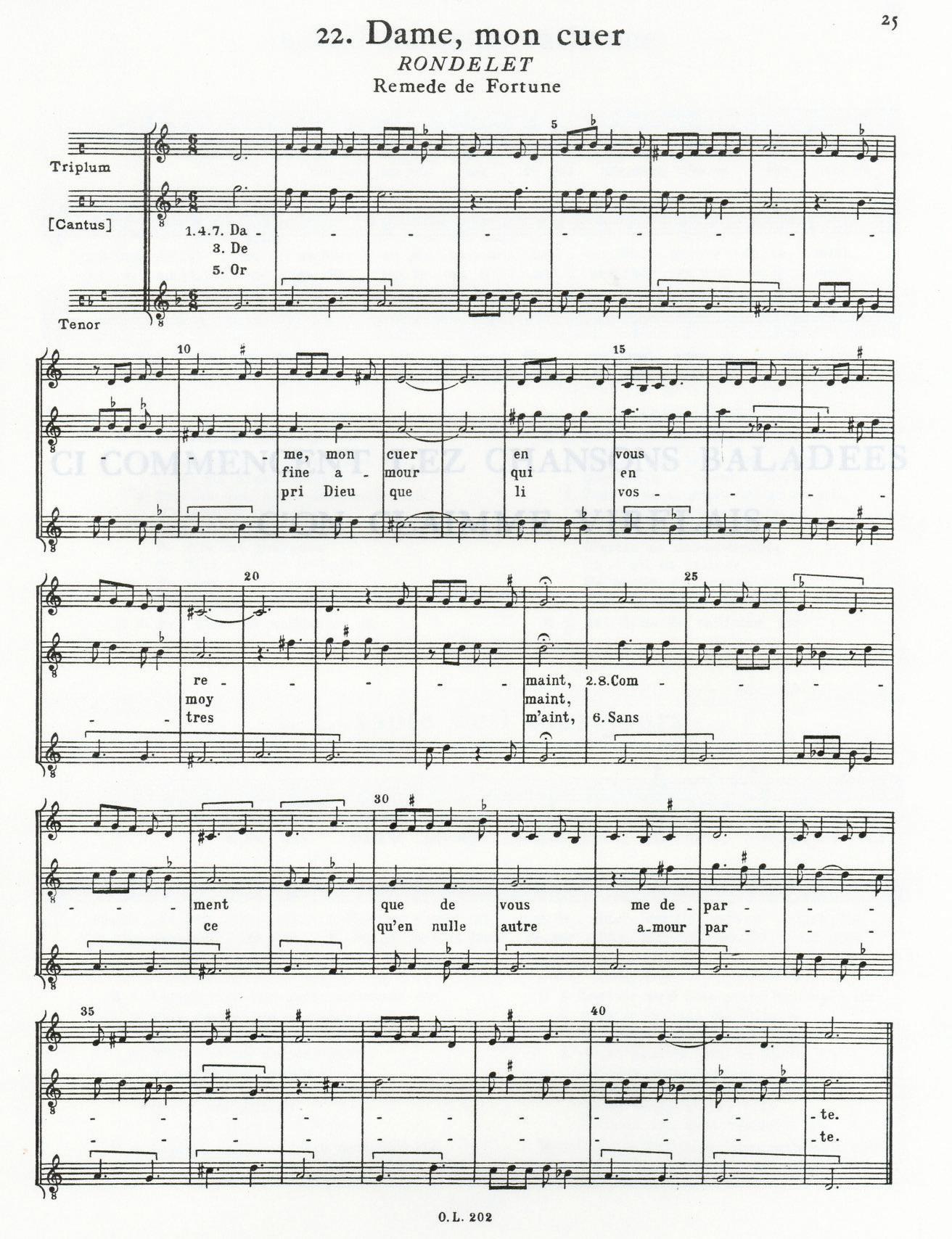
The two rhymes are naturally associated with, and emphasized by, two different cadences (Example 1). 2 The piece starts with a fifth-octave chord built on G. The vocal part (cantus), as if to express the gesture of addressing the “Lady,” starts from a high note and the first line ends, again, on G (in the tenor). At the same time, the cantus, which covers an octave and a third from high A to F-sharp, reaches the fifth at the end of the first verse. The second verse starts with a new sonority, a chord built on F, which also includes the third of the chord, and ends with a fifth-octave chord on D. The cantus, once again, ends on a high D but due to a hypothetical (unwritten) cadential formula, proposed by the editor, the appearance of the recommended E-flat creates a Phrygian cadence. (This E-flat can be identified, according to the hexachordal thinking of the period, as an “e-fa,” part of the hexachordum fictum built on “b-ut,” that is, an ut on B-flat.) The listener does not perceive this sonority as a fully satisfactory ending; it is too alien to the G sonority of the beginning. Are we reading (and hearing) too much into this change of tonal center if we associate it with the idea of “leaving” or “departure?” In any case, the two rhyme words themselves emphasize the central opposition of “remaint” (remains) and “departe” (leave).
The rhyme scheme is, thus, a–b–a–a–a–b–a–b. The name rondeau refers to round dance (circularity); accordingly, the musical structure is characterized by the returns of the refrain lines. The phrase structure of the song naturally follows the rhyme scheme. In the textbook representation of the rondeau, the refrain lines are indicated by capital letters: ABaAabAB. What is striking is that “Dame, mon cuer” ends on a sonority different from that at the beginning.
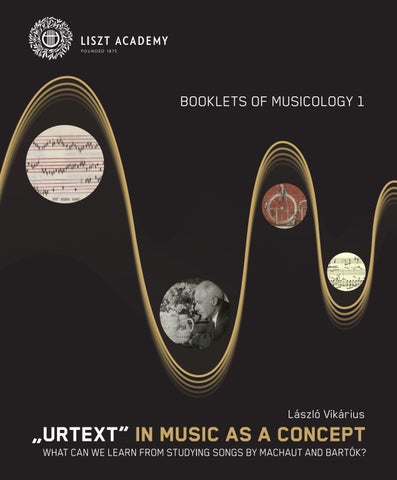
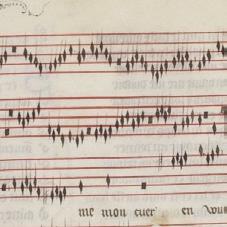
Gothic Voices, a group of singers directed by the musicologist and performer Christopher Page, recorded the song in a purely vocal version – in spite of the fact that in the manuscript, only one of the three voices is provided with a text. By general consensus, the untexted voices should be performed on “soft” instruments (according to the terminology of the period: bas instruments, as opposed to loud hauts instruments): appropriate woodwind, plucked or bowed string instruments might be chosen, which would fit the original notation perfectly (Facsimile 1).
3 Yet an all-vocal performance can still be very effective and convincing both musically and expressively. On the one hand, the sophisticated harmonic style of the song contains important expressive possibilities (only selectively discussed above). On the other, the song displays an almost equally rich melismatic style in all three voices. As Lawrence Earp writes in his still extremely useful 1995 Machaut handbook:
This practice [of all-vocal performance], while still unjustified, is not too objectionable for a highly melismatic rondeau such as this one, since it is usually possible for all three voices to set a syllable in the same place, and thus to declaim at the same rate.4
2 I reproduce the piece here from Guillaume de Machaut, Les Rondeaux, Les Virelais, Œuves complètes, vol. V, Transcription de Leo Schrade (Les Remparts, Monaco: L’Oiseau Lyre, 1977, O.L. 202), 25.
3 Digital images of the Machaut manuscripts preserved in the Bibliothèque nationale in Paris are available at the Gallica website: https://gallica.bnf.fr/accueil/fr/content/accueil-fr?mode=desktop. See specifically Manuscript “C” from the Machaut sources, Fr. 1586, here: https://gallica.bnf.fr/ark:/12148/btv1b8449043q?rk=64378;0. Last accessed: 5 Jan. 2026.
4 Lawrence Earp, Guillaume de Machaut: A Guide to Research (New York and London: Garland, 1995), 397–398.
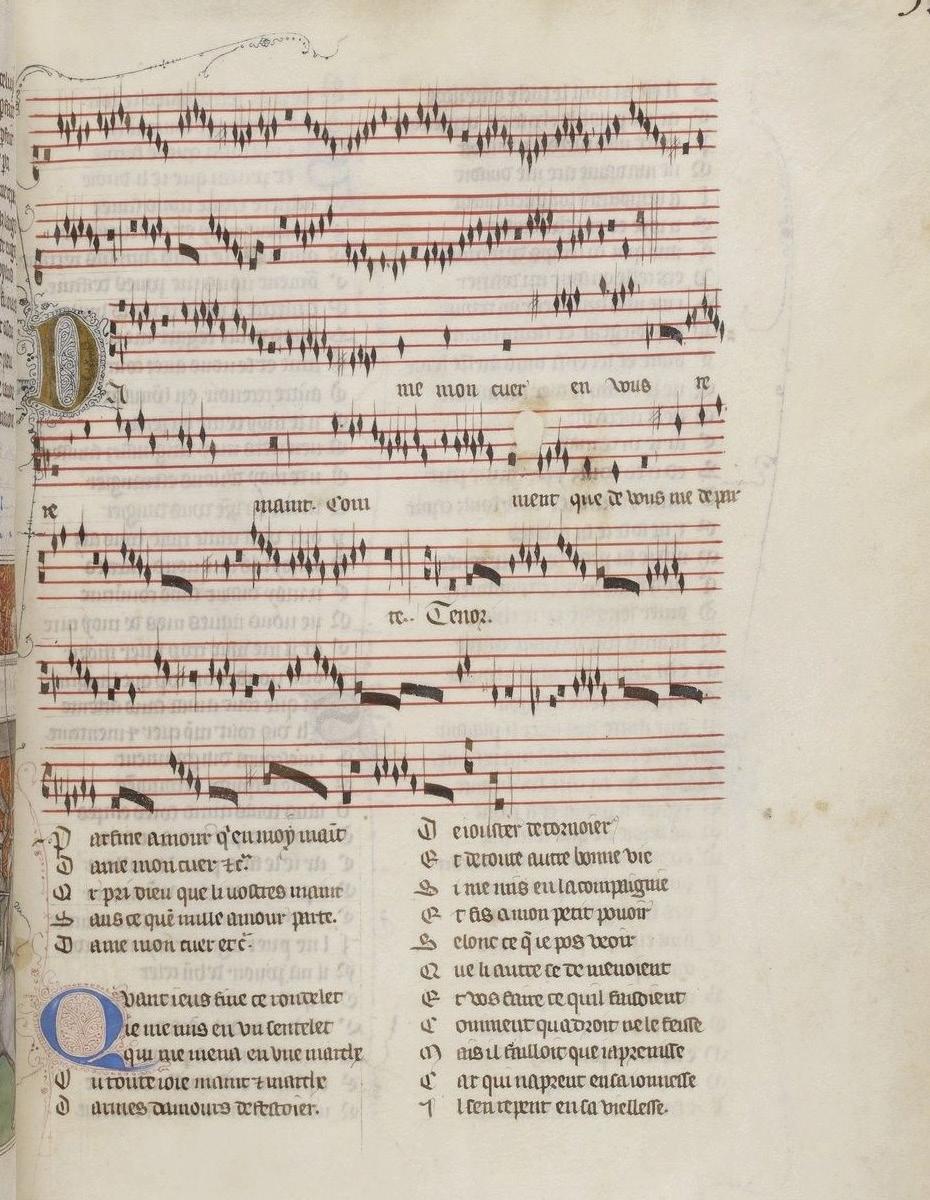
At the time when he was writing, Earp actually considered the performance by Gothic Voices the best that was known to him. Clear declamation, so excellently realized by this group of singers, is essential exactly because of the masterly setting of the text where the placement and delivery of each word, whether syllabic or melismatic, seem to be very carefully planned. Suffice it to point out the long melisma on the word of address “Dame,” which starts not only the first line but also the refrain, or the disquieting caesura in the middle of the first verse on the word “cuer” with its A-major chord in root position with a clearly indicated C-sharp in the tenor – a chord that sounds quite remote in the context of the G mode opening. (The “c-mi” is, again, part of another remote and relatively unusual scale, the one built on a-ut, another hexachordum fictum.) The uneven rhythm of the textual delivery is particularly effective in an all-vocal performance. That emotionally excited unevenness is clearly one of the chief characteristics of the music, while the actual vocal part, the cantus, with its daring skips and turns (for example, from A to high F-sharp or from high A to low B-flat a major seventh apart) blends in completely with the other voices in this all-vocal performance, in which the wide vocal range of the cantus also becomes less noticeable. These are, however, just a few of the differences between notation and performance, as the participation of a small group of singers, as opposed to a solo singer as presumably intended, raises quite a few additional questions.
The obvious contradiction between the score and Page’s performance directly relates to our enquiry about the Urtext. Without entering a debate about this particular issue, I do wish to observe that modern editorial practices might partly be responsible for modern performance practice and for the choice of an all-vocal performance in particular.
The differences between original ars nova notation and a modern critical edition are quite obvious. It is hardly necessary to mention how many changes are needed to “translate” medieval concepts of rhythm and metre for the modern interpreter. Modern editors have to add bar lines, non-existent in the original scores; use auxiliary markings such as brackets to mark a group of notes originally written as ligatures; and deal with the varying value of signs such as the semibreve, sometimes transcribed as a quarter-note and other times as a dotted quarter, depending on context and mensuration. The spatial arrangement of notes (e.g. a minima and a semibreve placed close to one another might indicate that the two together make up a “perfection,” while two “perfect” semibreves might generally be placed with some distance between them) suggests a different perception of time and event than does modern notation, where the shape of the note, at least in principle, unequivocally defines its rhythmic value and exact duration. The original mensural notation needs to be read with an understanding of rhythmic relationships. Similarly, when using original parts from 14th -and 15th -century sources, singers and players must align their parts to others’ by ear. Unlike the usual full-score format of modern editions, the original codices were written in separate parts, collected, however, on the same page or on facing pages, so that the music could be directly performed from a single manuscript. This difference is important for us here because the original notation would certainly not encourage the idea of singing the untexted parts with text, whereas a full score, even if only one voice is provided with text, lends itself easily to an all-vocal approach.
There is an even graver problem caused by the difference between the original form and the modern appearance of Machaut’s composition. Leo Schrade included this three-part chanson (that is, a composition setting a French-texted secular poem) in an appendix to Machaut’s other rondeaux. The editor’s inscription clearly shows that the piece (a rondelet by genre designation) is part of Remede de Fortune. In a similar fashion, Schrade included in the volume of virelais, another chanson from Remede, “Dame, a vous sans retolir.” Remede de Fortune is one
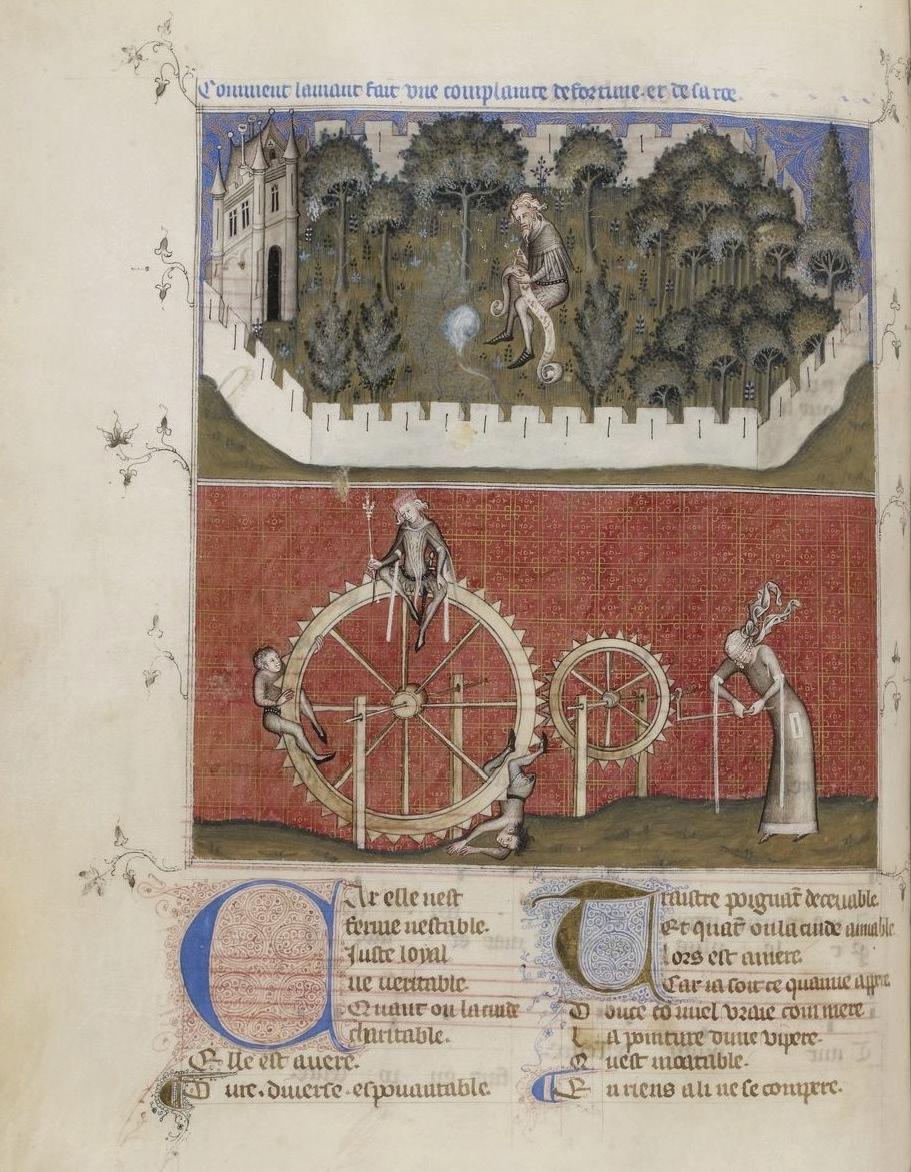
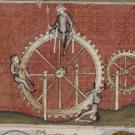
of Machaut’s longest epic poems, a dit. 5 While the title may occasionally be interpreted as a remedy “against bad luck,” the remedy is actually needed against Fortuna, that is, “luck,” rather than exclusively “bad luck.” The blindfolded Fortuna represents life’s and fate’s capriciousness according to medieval thinking, originating in classical Antiquity. This is how she is depicted in Machaut’s work with her fateful wheel (rota Fortunae).6 The epic poem was probably written for Bonne, daughter of John of Luxembourg and wife of John the Good, who died young during the 1348–1349 plague pandemic, the Black Death that swept through most of Europe.7 In the centre of the narrative lies amour courtois, or fin amour which is also explicitly named in the text of the rondelet itself. The Lover (l’Amant) wishes to conquer the Lady of the castle by worshiping her (she is Bonne herself according to the tale). He has to endure many hardships in the process, and the final outcome remains quite uncertain. The conquest itself is, however, less important than the teaching of Hope (Espérence), who dissuades him from trusting luck (Fortuna) at all, since luck is always changeable.8
Another, richly illustrated page from Manuscript “C,” the earliest source of this narrative poem, helps us understand the basic situation (Facsimile 2). While in the first of the two images on the same page the Lover is just writing his complainte (itself a special poetic genre) about the mutability of Luck, the picture below shows the blindfolded Fortuna with her wheel and the unlucky characters (including a king) who trust her. Another page also shows how the Lover composes a ballade to her Lady: “Dame de qui toute ma joie vient,” that is, “Lady, from whom all my joy stems.”
Machaut’s late Le livre dou Voir dit or The Book of the True Tale is probably better known than Remede de Fortune. This is his other long narrative poem which includes, as Remede does, inserted lyrics with music. In Voir dit, even the act of composing becomes a subject of discussion.9 What is special about the lyrics in Remede de Fortune, however, is that they constitute a systematically compiled set of models for all lyric genres of the period: lai, complainte (a monophonic strophic song), virelai (here called chanson balladee) and ballade. The rondelet appears in the last place, in lines 4109–4116 within this long narrative of more than 4300 lines. Knowing the context sheds new light on the song. A bilingual French- English edition of Remede de Fortune presents the compositions in an appendix, rather than within the main body of the narrative, but it is still much closer to the original text (the Urtext), thereby preserving the original context, something that cannot be said about the “complete edition.” The presentation with the original context, in turn, may influence our perception of not only the content but also its form. If we realize that the
5 See Guillaume de Machaut, Le Jugement du roy de Behaigne and Remede de Fortune, ed. James I. Wimsatt and William W. Kibler, music ed. Rebecca A. Baltzer, The Chaucer Library (Athens and London: The University of Georgia Press, 1988).
6 In Hungarian, the phrase “a szerencse forgandó,” literally “luck rotates” or “is liable to rotate,” i.e. change, preserves the idea that luck governs the “turns” of events.
7 Bonne is actually named in lines 54–56 of the poem, which seems to prove that she was meant to be the dedicatee, cf. the Introduction to Wimsatt and Kibler’s edition, 34.
8 A short summary of Remede de Fortune can be read in the notes (https://www.earlymusic.bc.ca/wp-content/uploads/2019/03/ CATH-06-Machaut-Blue-Heron-FINAL-at-12-pages.pdf.) to a concert performance by the Blue Heron ensemble directed by Scott Metcalfe that took place on 23 March 2019 at Christ Church in Vancouver as part of the concert series Early Music Vancouver (EMV). See EMV’s website: https://www.earlymusic.bc.ca/events/machaut-le-remede/. Last accessed: 5 Jan. 2026. More recently, see the CD Guillame de Machaut, Songs from Remede de Fortune, The Orlando Consort (London: Hyperion, 2023, CDA68399), with notes by Anne Stone.
9 Cf. Wulf Arlt, “Machaut,” The New Grove Dictionary of Music and Musicians, https://www.oxfordmusiconline.com/grovemusic/ display/10.1093/gmo/9781561592630.001.0001/omo-9781561592630-e-0000051865?rskey=MUx00j&result=1. Last accessed: 5 Jan. 2026. As an exception, the same article is printed in English translation as written originally in German for Musik in Geschichte und Gegenwart, which indicates the unique authority of the entry. For a relatively recent edition containing modern French translation of this famous poetical work, see Guillaume de Machaut, Le Livre du voir dit (Le Dit véridique), édition critique et traduction par Paul Imbs, introduction, coordination et révision Jacqueline Cerquiglini-Toulet, Lettres Gothiques (Paris: Librairie Générale Française, 1999).
Lover as a singer is actually the performer of the song as suggested by the illustrations (the execution of which was overseen by Machaut himself), then it is rather unlikely that one would consider it natural to present this song, strongly linked to the troubadour and trouvère tradition, in an allvocal performance in the manner of a motet or a later madrigal.
Machaut’s rondelet is, then, part of a long narrative poem, which should be taken into consideration in the analysis and interpretation of this piece. But is it reasonable at all to wish to approach the concept of Urtext on the basis of a 14th-century manuscript?
The Machaut manuscripts occupy a very special position in the history of music as several of them were prepared under the oversight of the poet-musician himself. “Vesci lordenance que G. de Machau wet quil ait en son livre,” “[h]ere is the order that G de Machau[t] wants his book to have” according to the inscription before the table of contents in the last and most complete Manuscript “A.”10 The inscription appears to lend authority to the poems and compositions included in the codex. His works, his “things” (“choses”), as works were often called in the Middle Ages and beyond, are collected and presented as a legacy in a “complete edition.” The pieces included are considered as individual “works.” In her book on Machaut, Elizabeth Eva Leach rightly points out that even the shortest pieces, filling just half a page, are assigned a separate line within the table of contents.11 It is still half a millennium before the gradual introduction of European copyright in the 18th and 19th centuries.12 It is another question whether in Machaut’s time the authorial position was earned by the musician or rather the poet. Since, however, the Machaut manuscripts can well be interpreted as part of the troubadour tradition, we do not need to differentiate between his two skills.13
The Machaut manuscripts, collections of his poetic and musical works, are also important for us because they document with unique authority the existence of different variants and revised forms of the same piece: a virelai appearing in one source as a monophonic song might be found with an added tenor part in another source; a three-part piece might be supplemented with a fourth part; or an earlier contratenor part might be replaced by another in a different manuscript.
10 Elizabeth Eva Leach, Guillaume de Machaut: Secretary, Poet, Musician (Ithaca and London: Cornell University Press, 2011), 86 11 Ibid., 86–87.
12 The first law governing copyright in England was passed in 1709. In international law, it is the Berne convention of 1886 that can be regarded as foundational. See Peter Kleiner, E.P. Skone James, Gavin McFarlane and Melville B. Nimmer, „Copyright”, in The New Grove Dictionary of Music and Musicians https://www.oxfordmusiconline.com/grovemusic/view/10.1093/ gmo/9781561592630.001.0001/omo-9781561592630-e-0000040690?rskey=LWJRvG. Last accessed: 5 Jan. 2026. See, furthermore, Viktor Ranschburg, A szerzői jog nemzetközi védelmére alkotott berni egyezmény vonatkozással Magyarországra [The Berne Convention Created for the International Copyright Protection and Its relation to Hungary] (Budapest: Hoffmann Alfréd, 1901), http://mek.oszk.hu/13000/13028/pdf/13028ocr.pdf. Last accessed: 5 Jan. 2026.
13 It is worth remembering that the lament by Eustache Deschamps, a double ballade, underlines Machaut’s double function as poet and composer. A single setting of Deschamps’s poem is preserved in the Chantilly Codex. According to its inscription, the composer is indicated as F. (probably François) Andrieu, thought to be identical with Magister Franciscus. The idea that the beginning of the refrain, the text “La mort Machaut” [Machaut’s death] is set with fermatae is an obvious expressive gesture, which, at the same time, seems to refer as a conscious allusion to Machaut’s own setting of the text part “ex Maria virgine” in the Credo of his Mass. The performance of these passages, highlighted by the homophonic chords each of them having a fermata and generally identified as a noema (idea), would need a special discussion. This might be worth mentioning here as the notes and chords with fermatae are good examples of the gap between “text” and “performance practice” which may be explained by some lost local conventions. For a facsimile edition of the composition, see Codex Chantilly: Bibliothèque du château de Chantilly, 564: Introduction and Facsimile, ed. Yolanda Plumley and Anne Stone (Turnhout: Brepos, 2008).
But is it necessary to bring up all the difficulties involved with editing and performing Machaut and “early music” in general if we wish to discuss questions related to the concept of Urtext generally linked to later music?
The musicology curriculum at the Liszt Ferenc University of Music, like in the analogous curricula of other universities, clearly separates the transcription of early notations, including mensural notation, from philology related to later periods. In Budapest, Urtext as a subject serves to supplement palaeography in courses for musicology students. Together, the two appear to cover the entirety of European music and its notation, distinguishing between two different historical periods and, indeed, two different methodologies.
That the curriculum in Budapest uses these special terms, palaeography and Urtext, to name their respective subjects seems not only logical but also useful. Both terms make their scholarly character immediately clear; one does not need to know their exact meaning to understand their scholarly nature. For the student, they might even promise some kind of initiation into a secret knowledge. The first term, a combination of two Greek words, palaios (old) and graphō (to write) or graphē (writing), refers to an auxiliary or ancillary science of history (historische Hilfswissenschaft), a scholarly discipline that deals with the history of writing, accents and punctuation marks. Its main and most natural field of study is Antiquity and the Latin Middle Ages. If we use it for the study of more remote cultures (e.g., Far East) or to vernacular languages, then it is already a further application of the term for new areas. Palaeography in music, on the other hand, principally refers to the notation of early polyphonic music of the Middle Ages and the Renaissance. This interpretation is canonized by Willi Apel’s study, The Notation of Polyphonic Music, still used in Hungary as a textbook for palaeography. This use of the term in music is also attested by the fact that when it is applied to another special field, it is often specified with a qualifier, as in “plainchant palaeography.” Internationally, the facsimile series, Paléographie musicale, launched in 1889 by the Benedictine monks of Solesmes with the aim of collecting and publishing the most important sources of plainchant, actually linked the term with the monophonic music of medieval liturgy. And yet it is understood that the term refers, first and foremost, to the notation of early Western polyphony.
The name of the other subject, Urtext, introduced to supplement the palaeography of early polyphony, is surprisingly similar to palaeography in its origin and etymology. Due to this parallelism, the two might even seem synonymous. The word Urtext is a compound from “Ur” (old, ancient) and “text” whereas palaeography is made up of “palaios” (also old, ancient) and “graphē” (writing, that is, text). But Urtext has become a kind of watchword for philological activity related to musical compositions since the more recent historical periods of the 18th and 19th centuries. Despite the similarity of the two names, there is a basic difference between them. Musical palaeography is mainly concerned with notational systems and methods of medieval and Renaissance polyphony (in other words, a study of signs, a kind of semiotics), as well as entire periods and repertoires. Urtext, on the other hand, is principally concerned with individual works. The succinct and highly informative entry “Urtext” in the Riemann-Musiklexikon, which can well be regarded as a sound starting point, quite naturally names the individual composition as its starting point and primary object.
Urtext is the text of a work as established on the basis of several sources. For this reason, it is not necessarily identical with the readings preserved in the autograph or the first edition. An Urtext edition is generally the result of a comparison of autograph sketches and complete manuscripts, copyists’ copies, first editions and later editions from the composer’s lifetime together with their sets of proofs, with additional sources (e.g., the composer’s statements in letters and other contemporary verbal
documents) taken into consideration. Establishing the Urtext, which can often be surmised only on the basis of the source situation, is one of the main aims of a critical edition (Denkmälerausgabe, i.e., monument-type edition) or a complete edition (Gesamtausgabe). Whereas these editions are rarely labeled as Urtext (the New Bach Edition is special as it is also intended for practical use), the concept is common in practical editions. Editions labeled this way, mainly of classical and romantic chamber music, strive to reproduce the final form of the text according to the composer’s wishes, while allowing for a certain modernization of the notation and some editorial additions, clearly marked as such, containing performance instructions like fingering or bowing. These editions wish to be seen as different from revised editions, in which the authentic text has been treated by the editor in an interpretive manner (phrasing). The series Urtext classischer Musikwerke, published between 1895 and 1899 by the Royal Academy of Arts in Berlin, used the designation Urtext for the first time.14
The above-mentioned series, Urtext classischer Musikwerke, was published with an “Allgemeiner Vorbericht” printed in all its volumes.15 From this introductory text it becomes clear what dangers the editors saw in the publishing practices of their time that prompted them to launch a new type of edition, in which the text of a work was made available in its unadulterated form.
The more the circle of those who cultivated the music of our classical masters widened, the more the need was voiced by some to offer a helping hand, with so-called “annotated” editions, to those with weaker skills and less developed understanding. Some of these in turn served as a basis for other publications of similar intention; thus several alien layers have gradually been superimposed on certain works.
Above all, piano and violin music has become the object of such endeavours. Since original editions of these compositions are no longer in print this has led to a situation where performers and teachers have been unable to obtain access to a work in the form in which the Master originally published it.
It is the most immediate aim of these Urtext editions to prevent the gradual deterioration of sources that could occur if the current state of affairs continued. Wherever a publication supervised by the composer ( Autor) is available, we are publishing it without any alterations or additions, other than the silent correction of unequivocal printing errors. Uncertain details will be marked as such.16
14 “Urtext,” in Riemann Musiklexikon, Sachteil, ed. Willibald Gurlitt and Hans Heinrich Eggebrecht (Mainz: B. Schott’s Söhne, 1967): “Urtext ist der Text eines Werkes, der aus einer oder mehreren Quellen erschlossen wird; er entspricht daher nicht immer den im Autograph oder Erstdruck überlieferten Lesarten. Die Urtext-Ausgabe ist möglicherweise das Ergebnis einer Synopsis von autographen Skizzen und vollständigen Niederschriften, Abschriften von Kopistenhand, Erstdrucken und später folgenden Originalausgaben mit ihren Korrekturbögen unter Berücksichtigung weiterer Quellen (z. B. briefliche Mitteilungen des Autors, zeitgenössische Äußerungen). Die Feststellung des auf Grund der Quellenlage oft nur zu vermutenden Urtextes ist eines der Ziele jeder kritischen Denkmäler- oder Gesamtausgabe. Während sich diese jedoch nur selten Urtext-Ausgaben nennen (Neue Bach-Ausgabe, die gleichzeitig für die Praxis bestimmt ist), ist dieser Begriff auf dem Gebiet der praktischen Ausgabe geläufig. Die so bezeichneten Ausgaben, meist Werke der klassischen und romantischen Kammermusik, beanspruchen damit, die vom Komponisten gewollte textliche Endgestalt wiederzugeben, von einer gewissen Modernisierung des Notenbildes und dem vom Herausgeber hinzugefügten und kenntlich gemachten Beiwerk technischer Spielhilfen (Fingersatz, Bogenstrich) abgesehen. Sie wollen damit deutlich von Bearbeitungsausgaben unterschieden sein, bei denen der authentische Text interpretierend vom Bearbeiter verändert ist (Phrasierung). Die Reihe Urtext classischer Musikwerke, herausgegeben 1895–99 von der Königlichen Akademie der Künste zu Berlin, verwendet die Bezeichnung Urtext erstmalig.”
15 Fortunately, the Library of the Liszt Academy of Music still keeps a number of volumes from this important series in its holdings. It is thanks to the librarians that I am able to quote part of this text here.
16 “Je weiter mit der Zeit die Kreise geworden sind, in denen die Musik unserer classischen Meister geübt wird, desto häufiger hat man auf gewissen Seiten das Bedürfniss empfunden, dem schwächeren Können und unentwickelten Verständniss durch sogenannte “bezeichnete” Ausgaben zu Hilfe zu kommen. Nicht wenige von diesen haben dann wieder anderen Ausgaben gleicher Bestimmung als Grundlage gedient, so sind manche Werke, allmählich mit einer vielfachen Schicht fremder Zuthaten überzogen worden. Vor allem ist die Clavier- und Violinmusik Gegenstand solcher Bestrebungen gewesen. Sie haben aber, da die Originalausgaben der meisten dieser Compositionen aus dem Handel verschwunden […], endlich dahin geführt, dass dem ausübenden Künstler oder dem Lehrer in sehr vielen Fällen die Möglichkeit ganz genommen ist, ein Werk in derjenigen Gestalt sich zu verschaffen, in der es der Meister ursprünglich vor der Welt hat erscheinen lassen. Der Gefahr einer Quellenversumpfung vorzubeugen, die sich auf
The series started with Sonatas and Phantasies by Mozart, edited by Ernst Rudorff, and included Suites by Johann Sebastian Bach, selected piano pieces by Carl Philip Emanuel Bach, Beethoven’s Sonatas and Chopin’s Etudes. In her important dissertation about the history of 19th-century editions of classical music, characterized chiefly by interpretative editions, Annette Oppermann discusses this series as the final stage represented by the appearance of the new concept of Urtext editions.17
Several decades after the publication of the pioneering Berlin series, Béla Bartók considered it important to stress the significance of Urtext editions. He contrasted it with the pedagogical “instructive” editions familiar to him both from his studies and from his own work on performing editions of music by J.S. Bach, Haydn, Mozart, Beethoven and other composers. In a motion prepared for a session of the Permanent Committee of Arts and Letters of the League of Nations in 1932, he called for the publication of Urtext editions side by side with facsimile editions of autograph manuscripts.
We are aware that among circulated publications musical works are subject above all to distortions and textual forgeries . . . nearly every modern musical publication that is available to the public is replete with arbitrary performing indications. The editorial commentaries change these performing indications without any scruple; indeed, they even suppress them. In fact, without regard for the existing notation, they go so far as to change noteheads just as arbitrarily as they do the performing indications.18
Thus Bartók urges for the publication of “authentic” editions, that is, Urtext editions, instead of editions with arbitrary performing indications.
The problems and the efforts to solve them, however, seem to be specific to a certain historical era. As Stanley Boorman writes in his entry on “Urtext” in The New Grove Dictionary of Music and Musicians, a more recent and more critical discussion:
This claim that a modern edition is an “Urtext” is difficult to support. . . . any original text rarely exists for music composed before the 18th century, and any attempt at its reconstruction is not only impossible but also of questionable value. Even for music from 1700 on, few sources can be transcribed into a modern edition without editorial intervention. With manuscripts as difficult to read as those of Beethoven, many of the scratches and splotches require interpretation, and many of these even involve pitches. . . . Finally, again, many composers revise both details and large-scale elements, and it is not always possible to establish which version was the later. Any of these requires editorial intervention and renders suspect the claims of any modern Urtext edition.
Because of these elements, an Urtext edition is no less a reflection of its times than one with an avowed editorial intervention[.]19
diesem Wege allmählich vollziehen könnte, ist der nächste Zweck der Ausgabe dieser Urtexte. Wo von den Autoren selbst besorgte Ausgaben vorhanden sind, werden diese ohne jegliche Änderung und Zuthat wiedergegeben, und nur dort, wo Druckfehler mit Sicherheit zu erkennen waren, ist stillschweigend ihre Correktur erfolgt. Zweifelhafte Stellen sind als solche kenntlich gemacht.” “Allgemeiner Vorbericht” in Urtext classischer Musikwerke (Berlin: Königliche Akademie der Künste, 1895–1898). I am quoting this passage from the “Vorbericht” of the edition of Chopin’s Etudes, preserved in the Library of the Liszt Academy of Music.
17 Annette Oppermann, Musikalische Klassiker-Ausgaben des 19. Jahrhunders: Eine Studie zur deutschen Editionsgeschichte am Beispiel von Bachs Wohltemperiertem Clavier und Beethovens Klaviersonaten (Göttingen: Vandenhoechen & Ruprecht, 2001).
18 Béla Bartók, “Motion in the Committee of Intellectual Co-operation of the League of Nations,” in Béla Bartók Essays, ed. Benjamin Suchoff (London: Faber & Faber, 1976), 499.
19 Stanley Boorman, “Urtext,” in The New Grove Dictionary of Music and Musicicians (2001), https://www.oxfordmusiconline. com/grovemusic/view/10.1093/gmo/9781561592630.001.0001/omo-9781561592630-e-0000028851?rskey=amrbWG . Last accessed: 5 Jan. 2026.
Long before the word “Urtext” was used in editions of music, it appeared in the monumental Deutsches Wörterbuch, started by the Grimm brothers in 1838, where it refers to texts from classical Antiquity or the Bible in the original languages, as opposed to translations. Even earlier, Herder and Goethe used the term in their writings. The following passage from Herder, reprinted in the Wörterbuch, is especially instructive for us because of its relevance to music history. In the chapter titled “Homer als Sänger betrachtet” within his longer essay “Homer ein Günstling der Zeit,” Herder explains that Homer, and later the Homeridae and the Rhapsodes (Rhapsōdoi), did not recite the hexameters but rather sang them and that their performance changed from one occasion to the next.
Anyone who has tried it will know what laws the presence of an audience imposes on the speaker; he cannot say everything there that he could say at another place, and he cannot say it the same way. Since it was the aim of the Rhapsodos to become one with the audience, and to let Homeric enthusiasm, pleasure and all the artistry of the muses stream from his own soul to the soul of the audience – for which he even had recourse to dramatic art – so, if one imagines the vividness employed by the Greeks during the delivery of the text, the narrative and the extemporization, then the idea of a rigid recitation of memorized verses, supposedly unchanged for centuries, will appear unimaginable. It is hardly possible to tell a story, delivered on the spur of the moment, exactly with the same words twice; and although here the melody and the meter served to keep the singer within a strict framework, that framework was defined so loosely that the speaker could never become an automaton, repeating the same sounds without any changes. It is an instinct in our nature to add something of our own to what has been learned; we instinctively wish to mark the moment, the hour, the circle of those present, with something individual, even if we must achieve this by something extrinsic, something unnecessary. This is why all the folk songs of the world change constantly; no single region sings its own songs in an unchangeable form. Even our slow-paced church hymns, when people learn them by heart, are not free from additions, inserted words and outpourings of the heart. Thus, whoever believes in an original text [Urtext] by Homer, as it flowed from his mouth, believes too much.20
Herder’s idea of the constant variability of Homeric recitation sounds surprisingly similar to Bartók’s views – not only about the performance of folk song but also about the composer’s performance of his own work.
20 “Jedermann, der es versucht hat, weiß, was die lebendige Gegenwart einer Versammlung dem Sprechenden für Gesetze auflegt; hier kann er nicht alles sagen, was er dort sagen konnte; er kann es nicht auf dieselbe Art sagen. Und da es der Zweck des Rhapsoden war, mit der Versammlung gleichsam ganz Eins zu werden, und aus seiner in ihre Seelen homerische Begeisterung, Vergnügen und Muse hinüber zu strömen, wozu er sogar auch mimische Kunst anwandte; so ist, wenn man sich dabey die griechische Lebhaftigkeit im Vortrage, im Erzählen, im Extemporiren erdichteter Geschichte einigermassen vorstellt, ein steifes Recitiren auswendig gelernter Verse, die unter allen Völkern Griechenlandes Jahrhunderte lang dieselbe geblieben wären, ganz undenkbar. Kaum läßt sich eine Geschichte, zumal im Feuer der Beredsamkeit, zweymal mit denselben Worten erzählen; und obgleich hier der Gesang und das Sylbenmaas dazu da war, daß es den Sänger innerhalb fester Schranken erhalten sollte: so waren diese Schranken doch so weit gesteckt, daß er unmöglich zu einer Sprachmaschine werden konnte, die unabänderlich dieselben Töne wiederholte. Es ist ein Trieb in unsrer Natur, zu dem Gelernten Eignes hinzuzuthun; es ist ein Trieb in ihr, diesen Augenblick, diese Stunde, diesen Kreis mit etwas Eignem zu bezeichnen, wenn es auch mit etwas Ungehörigem und Entbehrlichem wäre. So variiren alle Volkslieder auf der Erde; keine Provinz singt die Ihrigen ohne Veränderung. Selbst unsre langsam-tönenden Kirchenlieder, wenn sie vom Volk auswendig gelernt werden, sind von Zusätzen, Worteinschaltungen und Herzens-Ergiessungen nicht frei. Wer also an einen Urtext Homers, wie er aus seinem Munde floß, glauben kann, der glaubt viel.” For Herder’s writing, see the website of the Friedrich Schiller Archive: https://www.friedrich-schiller-archiv.de/die-horen/ die-horen-1795-stueck-9/vi-homer-guenstling-zeit/. Last accessed: 5 Jan. 2026. It was originally published in Schiller’s monthly journal, Die Horen, between 1795 and 1797.
[T]he composer himself, when he is the performer of his own composition, does not always perform his work in exactly the same way. Why? Because he lives; because perpetual variability is a trait of a living creature’s character.21
As mentioned earlier, examples for the word Urtext in the German dictionary mainly refer to the text in the original language (Grundtext). 22 This is why it is so surprising that by the second half of the 20 th century the word seems to refer exclusively to music, even in German. The Meyer encyclopaedia discusses Urtext exclusively as a musical term. 23 It seems that the word had been monopolised by editors of music. Yet, as we shall see, its original meaning still lingers on. *
Considering both literary language (or simply literature) and music, the concept of Urtext presupposes an author (composer) who may or may not be identifiable by name. At the same time, the concept also presumes the existence of a written text, which is ideally fixed forever. In order to establish the definitive form of a text in writing, our task is twofold. First, we have to determine the words themselves – the characters and necessary diacritical marks. Second, we need to attend to the exact shaping (one might say, delivery) of the characters, i.e., markings of division, spaces between words, capitalization (not used in every language), punctuation marks or paragraphs. 24 In Western musical notation, it is mainly pitch and rhythm that can be regarded as parallel with the basic elements of text, namely, characters. A gradual historical evolution is behind the complex system of notation used today. The staff itself and conventional note shapes for rhythmic values (starting with the mensural notation) as well as signs for rests (necessary for polyphonic music) are essential elements. But a lot of additional auxiliary markings are still necessary to display exact pitch and intervallic relationships, such as clefs, accidentals and key signatures. Similarly, additional metric markings are necessary, such as a systematic use of ligatures in modal notation, mensural signs or, later, time signatures to make rhythmic notation unequivocal. In order to describe the exact sound, one also has to specify the performing forces (vocal and instrumental). Further conventional markings in verbal texts such as space, capitalization, punctuation marks or new paragraphs might be compared to performance instructions in music. Individual instruments such as keyboard or strings need even more specific signs such as fingering, pedal marking, bow-strokes, etc. Signs for the performance of individual notes or groups of notes such as accents, slurs, staccato dots and strokes, dynamics, tempo markings (including tempo changes) and separation marks (fermata,
21 Bartók, “Mechanical Music,” in Béla Bartók Essays, 298.
22 In this context, it might be instructive to mention a kind of spontaneous choice of phrase by a twentieth-century writer. When discussing the original manuscript of his Tonio Kröger, Thomas Mann uses the word “Urschrift”: “Ich habe die Urschrift lange nicht in der Hand gehabt, sehe sie aber deutlich vor mir.” [It was long ago that I had the original manuscript (Urschrift: autograph) in my hand but I still clearly see it with my mind’s eye.] See Thomas Mann, Tonio Kröger, commentary and documents by Werner Bellmann (Stuttgart: Philipp Reclam jun., 2001), 53, for the source of the quotation, see Thomas Mann, Gesammelte Werke in dreizehn Bänden (Frankfurt a. M.: S. Fischer, 1974), XI, 115.
23 Cf. s.v. “Urtext,” in Meyers enzyklopädisches Lexikon: in 25 Bänden (Mannheim: Lexikonverlag, 1971–1979), vol. 24.
24 Here I am referring to differentiation, similar to that between “essential” and “accidental” elements, important concepts in philology and editorial practice, see Georg Feder, Musikphilologie: Eine Einführung in die musikalische Textkritik, Hermeneutik und Editionstechnik (Darmstadt: Wissenschaftliche Buchgesellschaft, 1987), 58–61. Concerning the differentiation between substanziell and akzidentell, and between nicht-iterierend (non-repeating ) and iterierend (repeating), see furthermore, James Grier, The Critical Editing of Music: History, Method and Practice (Cambridge: Cambridge University Press, 1996), 104–108. These differentiations have chief relevance for what is generally called the “copy-text” method.
double bar-line, Luftpause) might all be regarded as “accidental” rather than “essential.” One might even tend to characterize them as necessarily changeable and “relative,” depending on circumstances.
An important aspect of musical notation is the fact that it developed in close connection to verbal texts. (Here I am leaving out of consideration other types such as the Greek instrumental notational system or tablatures.) The earliest musical notations, which still form the basis of our current system, first appeared as a group of auxiliary markings (adiastematic neumes). They later began to be used diastematically, especially with the introduction of the staff, representing the relationship between individual “atomized” notes (differentiation between punctum and virga, development of different neumes and ligatures). Parallel with the practical sources of plainchant notation for the liturgy, other notational systems were also introduced, chiefly for polyphonic music, like letter-notation, and daseia signs. In general, the notation aims at guaranteeing the correct delivery of a text. This also suggests that, ideally, the text itself, without musical auxiliary signs, was also delivered in a comparable way, including the occasional possibility of multipart (even primitive polyphonic) singing (cantare super librum).
The close links between early notation and verbal text delivery are further attested by the existence of set formulas, as in the psalm tones and reading tones in which the shaping of text delivery is indeed central. Some of the melodic elements in psalm tones (musical gestures, neumes) in psalm tones function as punctuation marks such as comma, colon, or question mark. In early polyphony, not only textbook examples representing the singing technique known as organum are inseparable from the delivery of the liturgical text; certain textual units within the liturgy are central to the history of organum. The interchangeable discant sections in early motets all serve the delivery of clearly marked units of the liturgical text in heightened, ornamented form. And if we consider secular music – we are now back to the music of Machaut and its equivalent in the Italian trecento – the centrality of formes fixes once again shows the interdependence of music and text (poem). There was no need for any special musical articulations in Machaut’s music for his rondeau because the structure of the poem was so closely mirrored by the music. This is true, even though, as has been shown, the text itself was probably sung by a single voice and the two additional parts were played by instruments. The articulation of form was obviously dictated by the singing voice.
We can observe a basic two-layered structure of musical notation in the ever-richer body of sources for the music from the 18th to the 20 th centuries, where we can often consult different stages of a composition in authorial manuscripts. A case in point is provided by the sources of Béla Bartók’s works, which have been studied and analysed in detail. 25 Sketches and even drafts of complete pieces or movements often contain only pitches and rhythm. Everything else, including tempo, dynamics, articulation, accents, etc. are added either in later manu-
25 See László Somfai’s “Manuscript versus Urtext: The Primary Sources of Bartók’s Work,” Studia Musicologica vol. 23, nos. 1–4 (1981), 17–66 and his Béla Bartók: Composition, Concepts, and Autograph Sources (Berkeley, CA: University of California Press, 1996). In addition, Somfai has published numerous seminal articles on Bartók sources and compositions. The Béla Bartók Complete Critical Edition series, edited at the Budapest Bartók Archives and published by G. Henle, Munich and Editio Musica Budapest Zeneműkiadó, Budapest since 2016, is a direct continuation of Somfai’s pioneering work. Between 2016 and 2024, nine volumes were published, out of a planned forty-eight (in the chronological order of publication): For Children, Concerto for Orchestra, Works for Piano 1914–1920, Choruses, Mikrokosmos (two volumes: edition and critical commentary), String Quartets Nos. 1–6 (two volumes) and Folk Song Arrangements for Voice and Piano, all edited by him or his former pupils.
scripts, or in later compositional stages appearing in the same manuscript. Occasionally, however, one may come across some markings, which would be thought to belong to the later “superficial” or “accidental” layers of notation, related to performance, but still appear already in the earliest layer. These exceptions generally indicate that the performance details (for instance, staccato or certain special tempo indication, exceptional marking of dynamics) are central to the basic compositional idea. 26
To illustrate the basic difference between a draft and a final fair copy manuscript, I shall discuss a single composition by Bartók. My choice, perhaps surprisingly, was dictated by my engagement with the Machaut chanson. As an interesting contrast or even counterpart, I offer the discussion of a folk song arrangement for voice and piano by Bartók, no. 13 from Twenty Hungarian Folk Songs (1929). This important series of folk song arrangements was deliberately compiled to illustrate the different historical types of Hungarian peasant songs, proceeding from older to ever more recent specimens (Figure 1). Bartók apparently wanted to offer a cross-section of different types of Hungarian folk melodies, arranged in his most advanced compositional idiom. He was probably inspired by the series of gramophone recordings he had made for His Master’s Voice in 1928. 27 For this set of recordings, Bartók accompanied on the piano a number of folk song arrangements by Zoltán Kodály, composed during the 1920s as part of Kodály’s multi-volume Hungarian Folk Music series. From his own output, Bartók selected two groups of songs from Eight Hungarian Folk Songs (1907–1917) and five of the 1906 Hungarian Folk Songs, a series jointly published with Kodály. The latter selection was actually a set of thorough revisions in which the old pieces were provided with rewritten accompaniments. 28 Another possible inspiration might have come from the publication of a Hungarian volume within Heinrich Möller’s series Das Lied der Völker 29 The conspicuous scholarly organization of Twenty Hungarian Folk Songs makes it particularly likely that after the publication of the German version of his basic study Das ungarische Volkslied and during the preparation of its English translation as Hungarian Folk Music, Bartók wished to present his view of Hungarian peasant songs in an artistic form as well.30
The song “Pár-ének” (Plea and Promise) that I am going to discuss in the following (see its text below) was published in volume 3 of the four-volume set.31 It was among the songs of
26 Yusuke Nakahara’s edition of the complete Mikrokosmos in the Béla Bartók Complete Critical Edition offers an especially rich documentation of the compositional process through transcriptions of different layers and compositional stages of each piece. See Béla Bartók, Mikrokosmos: Critical Commentary, Béla Bartók Complete Critical Edition vol. 41, ed. Yusuke Nakahara (Munich: G. Henle and Budapest: Editio Musica Budapest, 2020).
27 Cf. Vera Lampert, “Twenty Hungarian Folk Songs, for Voice and Piano, 1929,” sleeve notes Béla Bartók, Twenty Hungarian Folk Songs, Four Songs from the Mikrokosmos, Village Scenes, Erika Sziklay (soprano), István Lantos (piano), Complete Edition (Budapest: Hungaroton, SLPX 11610), 7, See more recently, Béla Bartók, Folk Song Arrangements for Voice and Piano, ed. Vera Lampert and Viola Biró, Béla Bartók Complete Critical Edition vol. 10 (Munich: G. Henle and Budapest: Editio Musica Budapest Zeneműkiadó, 2024), 31*–34*.
28 These revised versions were first published by Denijs Dille as Five Hungarian Folk Songs (Budapest: Editio Musica Budapest, 1970, Z. 6341). A new edition, based on both manuscript sketches and recordings, of these songs have been included in the new critical edition of all folk song arrangements for voice and piano. See Bartók, Folk Song Arrangements for Voice and Piano, 160–165 (the edition based on the recordings), and 282–283 (the transcription of the sketches).
29 Concerning Bartók’s reaction to Möller’s publication, see my article, “Bartók contra Möller or A Hidden Scholarly ars poetica,” The Musical Quarterly vol. 90, no. 1 (2007), 43–71.
30 On the gradual development of the final order of the series, see Csilla Mária Pintér, “A bánat dalai: egységesítő komponensek Bartók Húsz magyar népdalában” [The Songs of Sorrow: Unifying Components in Bartók’s Twenty Hungarian Folksongs], Magyar Zene vol. 60, no. 1 (2022), 76–88.
31 My translation closely follows Vera Lampert’s translation as printed in Appendix II in Bartók, Folk Song Arrangements for Voice and Piano, 205. I have, however, included some rhymes even though this required changing the word order.
mixed origin, the so-called Class C. Interestingly, the complete set of all twenty songs was never performed by Bartók in concert. He used the set, rather, as an anthology, just as he had done with other works of his from which he freely created suites for concert occasions. A first selection was presented at his 6 January 1930 concert in London, when he accompanied his trusted Hungarian singer partner, Mária Basilides, in four songs from this set, then still awaiting publication. A few weeks later, on 30 January, Basilides performed sixteen of the twenty songs, arranged in two longer sets, as part of a concert devoted to works by Debussy, Kodály and Bartók. In 1933, the composer selected and orchestrated five songs to be published as Five Hungarian Folk Songs for voice and orchestra. “Pár-ének” was not included in any of these selections. As far as we know, Bartók played no. 13 only a single time, in Amsterdam on 29 January 1935.32
Bartók: “Pár-ének” “Plea and Promise”
Ne hagyj el, angyalom, megöregszem, Lábaim nem birnak, megbetegszem, Támadékom te legyél, nálam nélkül ne legyél, Panaszimnak higgyél.
Nem hagylak, angyalom, nem hagylak el, Lábaid nem birnak, megöregszel, Támadékod én leszek, nálad nélkül nem leszek, Panaszidnak hiszek.
Rózsám, nem hagylak el!
Don’t leave me, my angel, old shall I grow, My legs won’t carry me, ill shall I grow. My support you should be, without me you shouldn’t be, My complaints you should believe.
I shall not leave you, my angel, I shall not leave you, You’ll grow old and your legs won’t carry you. Your support I shall be, without you I shan’t be, Your complaints I do believe.
My sweetheart, I won’t leave you!
The song is based on a folk song collected in late March or, perhaps, in early April 1907 in the village Felsőireg (now Iregszemcse) in Tolna County (Facsimile 3).33 Bartók must have found both the melody and the text particularly interesting, since he not only selected it as no. 240 for his 1924 study, A magyar népdal, but also included it as one of only twelve examples in his article “La musique populaire hongroise,” published in La Revue musicale in 1921.34 In this article, Bartók presented the three main historical layers of Hungarian peasant songs in the earlier order of Old, Mixed and New Styles, and the examples follow that order. It was only later that he rearranged the order of styles as (A) Old,
32 It was sung by Berthe Seroen as the very first number in the first of two selections from the set immediately following the performance of the First Sonata for Violin and Piano (1921) performed by Zoltán Székely and the composer. The first selection from Twenty Hungarian Folk Songs was made up of nos. 13, 4, 10, 11 and 12.
33 The master sheet of the folk song is available in the database Hungarian Folk Songs: Complete Collection by Béla Bartók, second revised digital edition, ed. István Pávai and Pál Richter, on the website of the Institute for Musicology, https://systems.zti.hu/br/ en. Last accessed: 5 Jan. 2026. According to information provided by Béla Bartók, Jr., this collecting trip, the first after Bartók’s appointment as piano teacher at the Academy of Music in Budapest, took place during the Easter holiday between 27 and 30 March 1907, when Bartók stayed at a guest house in Felsőireg (now Iregszemcse). He visited the area where a brother-in-law, Lajos Huber, was a farm officer. Huber was related to Elza Bartók’s husband, Emil Oláh Tóth. (Elza Bartók Oláh Tóth was the composer’s younger sister.) The song was notated in Bartók’s music collecting field book “M IV” (BH: I/98, Gábor Vásárhelyi’s collection), p. 62. For the sources, see the database Folk Music in Bartók’s Compositions, ed. Márton Kerékfy and Viola Biró, on the website of the Institute for Musicology, https://bartok-nepzene.zti.hu/en/browse/record/BB098-L250-13/. Last accessed: 5 Jan. 2026. As an interesting difference in the notation of the melody in the field book as opposed to its form on the master sheet and that in the composition is the use of the Gypsy scale (in the original notation ending on C, the scale is C–D–E–F–G–A-flat–B–C).
34 See English translation as “Hungarian Folk Music” (1921), in Béla Bartók Essays, 58–70. The song is printed as Example 7 on p. 65.
(B) New and (C) Mixed, thereby emphasizing a “national” point of view partly independent of the putative chronology. The first two styles were considered more “original” creations within Hungarian folklore, while the last, mixed, group contained the most elements borrowed from foreign sources, thus displaying characteristics of non-Hungarian origin. Yet in Twenty Hungarian Folk Songs, Bartók obviously returned to the idea of a more strictly historical presentation of songs. The four volumes follow a sequence of “Sad Songs” and “Dance Songs,” both mainly based on the Old Style, “Diverse Songs” in Mixed Style, and finally “New Songs” in New Style (see Figure 1).35
Figure 1 Twenty Hungarian Folk Songs for voice and piano (1929)
Series I (Sad Songs)
1. In Prison (“Minden ember szerencsésen”), Lento, parlando
2. Old Lament (“Olyan árva vagyok”), Non troppo lento, parlando
3. The Fugitive (“Erdők, völgyek, szűk ligetek”), Andante, parlando
4. Herdsman’s Song (“Mikor guláslegény voltam”), Andante, parlando
Series II (Dance Songs)
5. Székely Slow Dance (“Azt akartam én megtudni”), Maestoso
6. Székely Fast Dance (“Ne busuljon komámasszony”), Allegro
7. Swineherd’s Dance (“Megösmerni a kanászt”), Allegro
8. Six-Florin Song (“A cseroldalt összejártam”), Allegro
Series III (Diverse Songs)
9. Shepherd’s Teasing Song (“Volt-e olyan juhász”), Andante
10. Jesting Song (“Két krajcárom volt nékem”), Allegro
11. Matchmaking Song (1) (“Sárga csikó csengő rajta”), Moderato, scherzando
12. Matchmaking Song (2) (“Virágéknál ég a világ”), Allegro
13. Plea and Promise (“Ne hagyj el, angyalom”), Adagio non troppo
14. Complaint (“Beteg az én rózsám nagyon”), Andante
15. Drinking Song (“Ó én édes pintes üvegem”), Non troppo vivo
Series IV (New Songs)
16. I (“Hej, édesanyám”), Allegro
17. II (“Érik a ropogós cseresznye”), Più allegro
18. III (“Már Dobozon régen leesett a hó”), Moderato
19. IV (“Sárga kukoricaszár”), Allegretto
20. V (“Búza, búza, búza”), Allegro non troppo
35 As an interesting coincidence, among the examples in the French article, the original folk song used in “Pár-ének,” “Ne hagyj el angyalom” [Don’t leave me, my angel] is printed as the seventh song and comes directly after “Virágéknál ég a világ” [The light is burning at the Virágs’ house], which, as “Párosító” (2) [Matchmaking Song], also immediately precedes “Pár-ének” in Twenty Hungarian Folk Songs. See Béla Bartók Essays, 65.
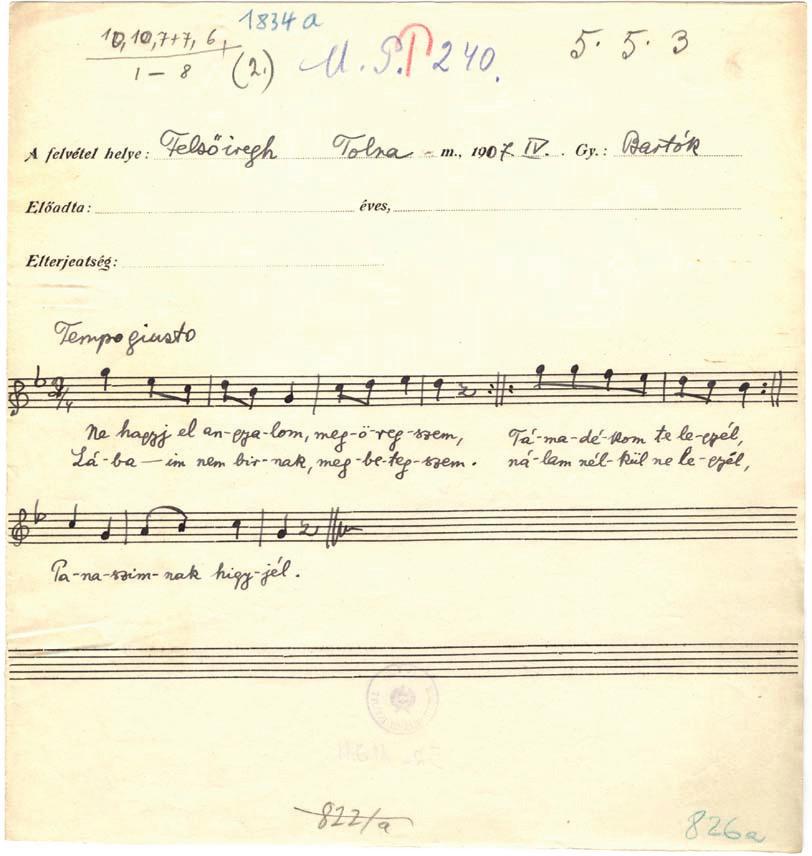
The text of the single stanza of the folk song appearing in the sources of the collection is used in the arrangement without any changes. The archaic-sounding words (“támadék” instead of “támaszték,” meaning “support” or “panaszim” instead of “panaszaim” meaning “my complaints”) are carefully, even joyfully preserved. According to Bartók’s analysis of the stanza, shown in the upper left corner of the master sheet, it consists of four heterometric lines with 10, 10, 7+7 and 6 syllables, respectively. The melodic structure is accordingly A, A, b+b, C. Bartók, in any case, interpreted it as a quatrain, as one can see from the way he indicated the cadences in the upper right-hand corner (5, 5, 3). Bartók was probably interested in such irregular forms within this mixed group of folk songs. The G on which the song ends could also be interpreted as the dominant of a melodic C-minor scale.
Before briefly investigating the sources, it is instructive to take a look at the final form of the song as it appears in the composer’s fair copy preserved in the Bartók Archives (Facsimile 4).36 The most conspicuous difference between the song as it appears on the master sheet and its final form in the arrangement is the number of stanzas: a single stanza on the master sheet and two full stanzas (plus a final verse) in the arrangement. The second stanza is, in all probability, the composer’s own addition rather than a folk text. Unlike in other cases when he occasionally takes over stanzas from other related or variant folk songs, in this case he seems to have created this second stanza directly from the first. Bartók rephrased the “plea” in the first stanza as a “promise” from the partner in the second stanza. In order to do so, all he needed was to change the verbal forms.37 The Hungarian title of the song, “Pár-ének” wittily refers to the “couple” (Hungarian “pár ”) as well as the two halves of the song (the second stanza serving as a “pár,” partner or counterpart to the first). At the same time the somewhat unusual expression “Pár-ének” may sound as a variant of the more common word for “dialogue”: “párbeszéd.”
One of the most characteristic features of the arrangement is the dialogue form. Compositions based on a dialogue represent a special type in Bartók’s works.38 Conceivably, one of the initial ideas was the setting of the two stanzas in two different keys, and here the two keys are in the distance of a tritone so they represent the most remote tonal relation possible. In the final version of the song, the melody in the first stanza ends on B whereas in the second stanza it ends on F. Since, however, the melody could or should be interpreted as ending on
36 In the critical edition, it is identified with the siglum AP1 (BA-N: 2008-1), actually a blue contact copy of the engraver’s copy, which I have reproduced here in negative and grayscale for better readability. Its detailed description is in Bartók, Folk Song Arrangements for Voice and Piano, 264.
37 The second person imperative forms of the first stanza (“Ne hagyj el” [Do not leave me], “ne legyél” [do not be]) are replaced by first person indicative of future (“Nem hagylak” [I am not leaving you], “nem leszek” [I shall not be]). On the contrary, first person forms are changed to second person forms (“megöregszem” [I shall grow old], “megöregszel” [you shall grow old]). Similarly, the first person possessive pronoun will be changed to second person (instead of “Lábaim” [my legs], “Támdékom” [my support], “Panaszimnak” [in my complaints], “Lábaid” [your legs], “Támadékod” [your support], “Panaszidnak” [in your complaints]). As regards these grammatical changes in the second stanza, the procedure anticipates how Bartók compiled and composed the end of the third part of the libretto for Cantata profana, where the original first person plural forms (“De mi nem megyünk / Mert a mi szarvunk…” [But we shall not go / For our antlers…]) were replaced by third person plural forms (“De ők nem mennek / Mert az ő szarvuk…” [But they cannot go / For their antlers…]). In the case of Cantata profana, Bartók originally wrote the text of the third part in Romanian and only later translated it into Hungarian.
38 Thus, for instance, No. 5 in Slovak Folk Songs for male voices (1917) is based on a dialogue. More dialogues can be found in Twenty-Seven Choruses (1935), see “Leánykérő,” “Madárdal,” and “Párnás táncdal” [“Proposing to a Girl,” “Bird Song” and “Pillow Dance”]. There are, however, purely instrumental folk song arrangements which are based on dialogues, such as “Elmész rózsám” (vol. II, no. 41, rev. ed. vol. I, no. 39) in For Children (1908–1911). Just three years before composing Twenty Hungarian Folk Songs, Bartók used the title “Párbeszéd,” “Dialogue” for the first four two-part contrapuntal pieces that form the first volume of the Nine Little Piano Pieces (1926).
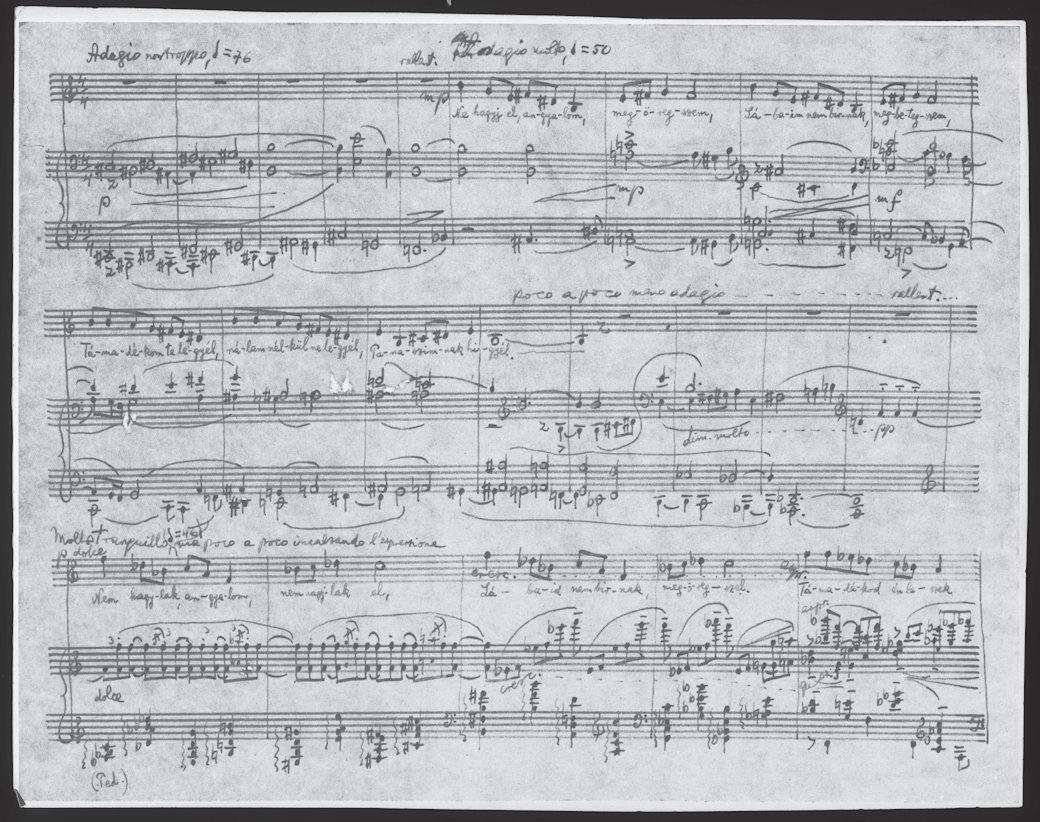
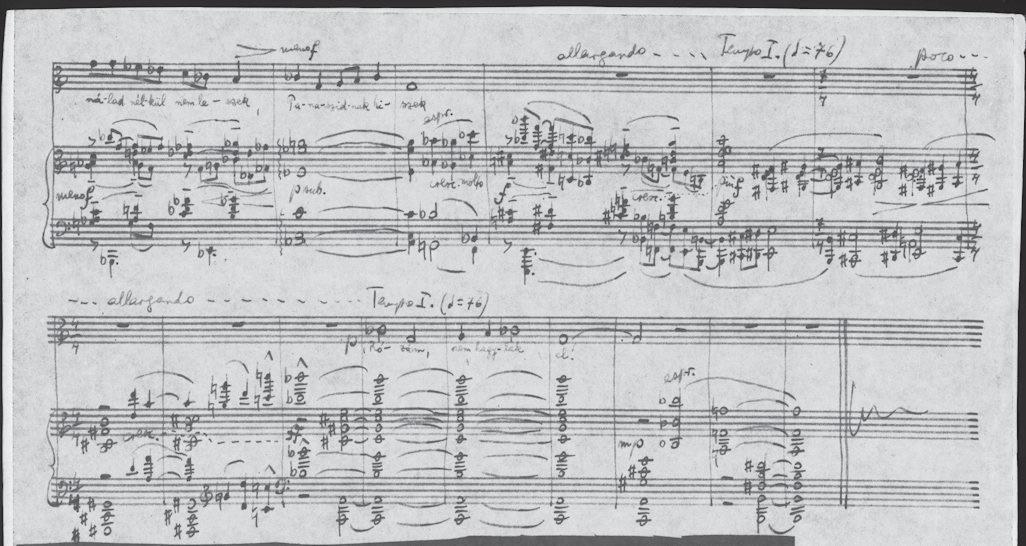
the dominant, the first stanza is in fact in E minor and the second in B-flat minor. However, as Vera Lampert has pointed out, the piece actually ends with the poignant contrast of B major and the note F, the final sonority of the arrangement.39
The short contrapuntal introduction uses the fourth species of two-part counterpoint, with syncopations in the contrapuntal voice.40 Seemingly chromatic, it actually uses two different pentatonic systems simultaneously (upper voice: C-sharp–D-sharp–F-sharp–G-sharp–B; lower voice: A-sharp–B-sharp–D-sharp–E-sharp–G-sharp), carefully avoiding the tonic E. Already this introduction resorts to the special effect of octave doubling for colouring. The contrapuntal accompaniment of the first stanza also uses octave doubling in one or, occasionally, two parts. The music at the end of the first stanza, in accordance with the poetic content, avoids any closure and immediately continues with strict counterpoint recalling the introduction, now in three parts. This bridge passage reaches D-flat major, parallel to the key, B-flat minor, of the second stanza. (The A-flat, which is part of the D-flat major triad, is useful as modal seventh to B-flat minor.) The Molto tranquillo […] ma poco a poco incalzando l’espressione instruction (that is, gradually intensifying the expression), which starts p, dolce and through cresc. reaches f, espr. is in sharp contrast to the first stanza, which, apart from the initial Adagio molto tempo and mp dynamics, lacks any performance markings. Only the bridge passage has a new marking poco a poco meno adagio, then rallent. and dim. molto, as well as pp before the new tempo of the second stanza. Adding to the contrast between the music of the two stanzas, the accompaniment in the second stanza is also different from that in the first: apart from the dolce instruction, the rhythm is characterized by continuous triplet motion, tied notes, ornamental appoggiaturas in the right hand and broken chords providing the quarter-note pulsation in the left. The short final line, “Panaszidnak hiszek” (Your complaints I do believe), is accompanied by a single broken chord, struck subito p. While in the final section the introduction seems to be recalled, it is interrupted by a single bar where the syncopated triplet motion is heard again and for the last time. The more lavish accompaniment of the second stanza remains present in the final section with its widely spaced notes and octave doublings. This type of sound will provide the final effect of the song, except for the surprise repetition of the final phrase still in B-flat minor ending on F as it is still the partner who is speaking. This closing leap of B-flat–F is echoed over the cadence in B-major. Instead of analysing in detail Bartók’s first incomplete draft which survives for this song (Facsimile 5), I shall limit its examination to describing the characteristics of its notation, especially the differences when compared to the final manuscript. In this way we are able to consider what might have appeared as essential and accidental elements during the compositional process. In other words, the manuscript tells us what the composer considered important to write down at an initial stage (presumably, ideas he wanted to make sure he would remember) and what he felt he could safely wait to add at a later stage. Some of what was added later could well have been implied already in the original layer without being recorded, while other elements could have been left to be decided upon later.
39 “This type of folk song with its question-and-answer scheme (see text of folk songs) offers different types of arrangements for the two strophes. With the deep register and slow, protracted syncopations of the first strophe Bartók underscores distress, while the second verse with its more resolved movement, broader register and ringing high positions expresses support and security. The contrast in tonality is also interesting: the two strophes are of B and F tonality respectively; and in the closing chord the two tonal planes, a polar distance apart, sound simultaneously.” Lampert, “Twenty Hungarian Folk Songs, for Voice and Piano, 1929,” 8.
40 Cf. Knud Jeppesen, Counterpoint: The Polyphonic Vocal Style of the Sixteenth-Century, trans. Glen Haydon (Englewood Clifs, NJ: Prentice-Hall, Inc., 1939), 130–135, see https://dn790007.ca.archive.org/0/items/counterpointpoly00jepp/counterpointpoly00jepp.pdf. Last accessed: 5 Jan. 2026.
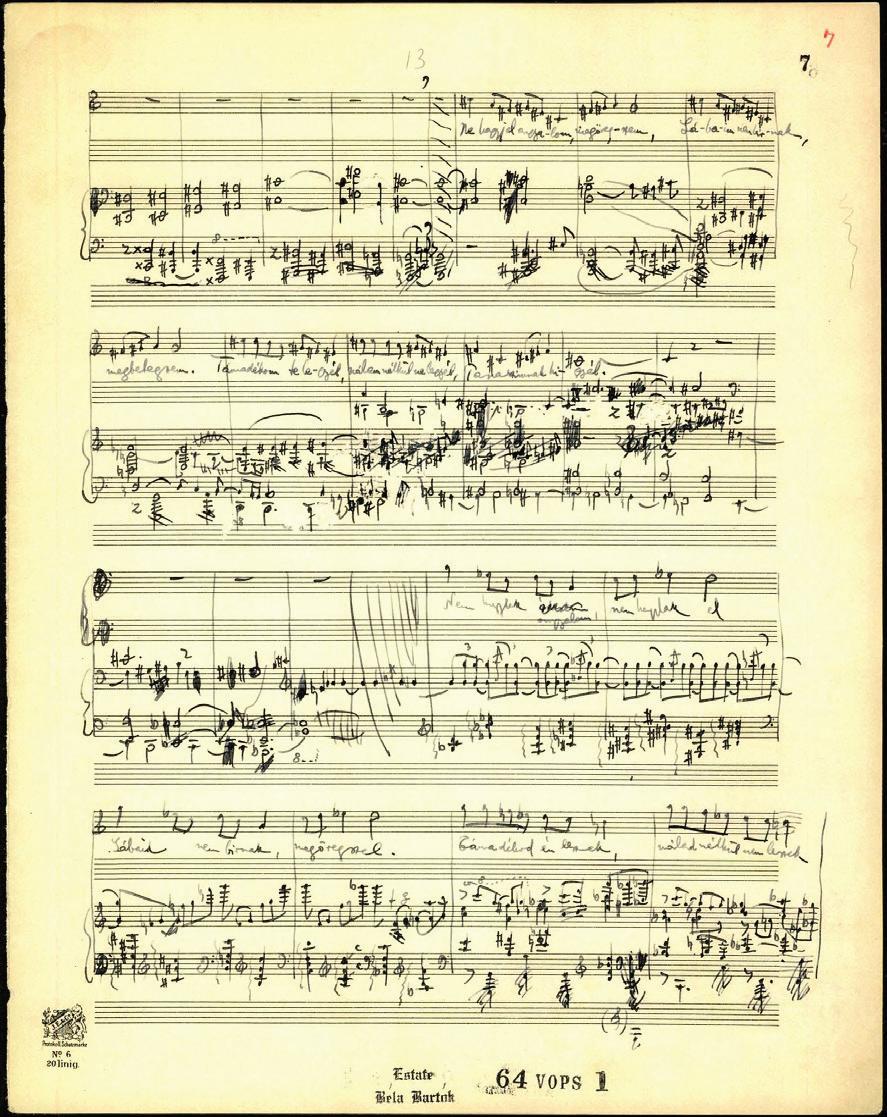
5 Twenty Hungarian Folk songs, first page of the draft of no. 13,
with the kind permission of the Sacher Foundation)
The music is a major second higher in the heavily revised draft. The fair copy was also first written in the key of the draft, which Bartók later transposed.41 In the original version, the melody in the second stanza ends on G and so it is in C minor just like the folk song on the master sheet, as opposed to the F-sharp minor first stanza. The (disquieting?) series of sharp and double-sharp accidentals in the first stanza is as conspicuous as the (comforting?) simplicity of the key in the second. The draft, despite numerous changes and revisions, contains the music in a fully developed form. The polar opposition of the two keys of the two stanzas (here, as mentioned already, F-sharp minor and C minor) appears to have been an essential part of the original idea of composition. The bridge passage originally contained an extra bar, which was cancelled already in this manuscript. The writing has more than one layer. The text of the first stanza was entered only subsequently, rather than together with the melody. It is interesting that Bartók first wrote a slightly different text at the beginning of the second stanza, “Nem hagylak édesem” [I don’t leave you, my sweetheart], which was then changed to “angyalom” [my angel]. This appears to confirm the possibility that the text of the second stanza was actually written during the compositional process.
When we compare the two manuscripts, it is also interesting to see what the composer did not feel necessary to write down in the draft. No title or tempo marking is added in the draft. The tempo indication, appearing only in the final copy, is supplemented even by an exact metronome marking in the final copy.42 The duration of the piece at the end of the song was entered even later. Several tempo modifications were added in the final version, making the tempo slightly slower before the start of the first stanza. The bridge passage is more lively, poco a poco meno adagio, then an added rallentando leads to the second stanza. No dynamic markings or accents appear in the draft. As mentioned above, the second stanza was later provided with especially detailed instructions (dolce, Molto tranquillo, ma poco a poco incalzando l’espressione). Although the end of the piece in the draft is not reproduced here, it still lacks the dynamic curve (ff, p and finally mp) in the coda.
Despite the lack of certain details in the notation, the draft does contain elements that anticipate the final elaboration. As an unusual marking in such an early manuscript (probably as a later insertion), a separation mark appears before the beginning of the first stanza to indicate the vocal entry. Although the contrast in the second stanza is mainly indicated by the change of key and the higher register, the broken chords and the triplets in the accompaniment might already suggest something of the character, which was later marked as dolce. Looking at the final version from the vantage point of the draft, the later notation appears to be largely “instructive” or “pedagogical” in its precision, to use László Somfai’s term for Bartók’s more detailed notation, often characteristic of folk song arrangements. (A ne plus ultra of this type of notation is the score of Improvisations for piano, 1920.) Bartók obviously wanted to make his notation as clear as possible because of the unusual synthesis between folk music and his progressive avant-garde compositional style.
While we have assessed some characteristic differences between the draft and the fair copy, we still have not discussed all the primary sources of the composition. Within the manuscript of the complete draft of Twenty Hungarian Folk Songs, another manuscript, an early sketch or
41 The fair copy of the early version is on pp. 67–68 in the manuscript 64VoPFC1 in the Bartók Collection of the Basel Paul Sacher Foundation. In front of the beginning of the song Bartók instructed: “Tr. egész hanggal le” [Transpose a whole tone down]. The same manuscript, on pp. 45–46 preserves the transposed version.
42 Cf. manuscript 64VoPFC1, which served as the engraver’s copy.
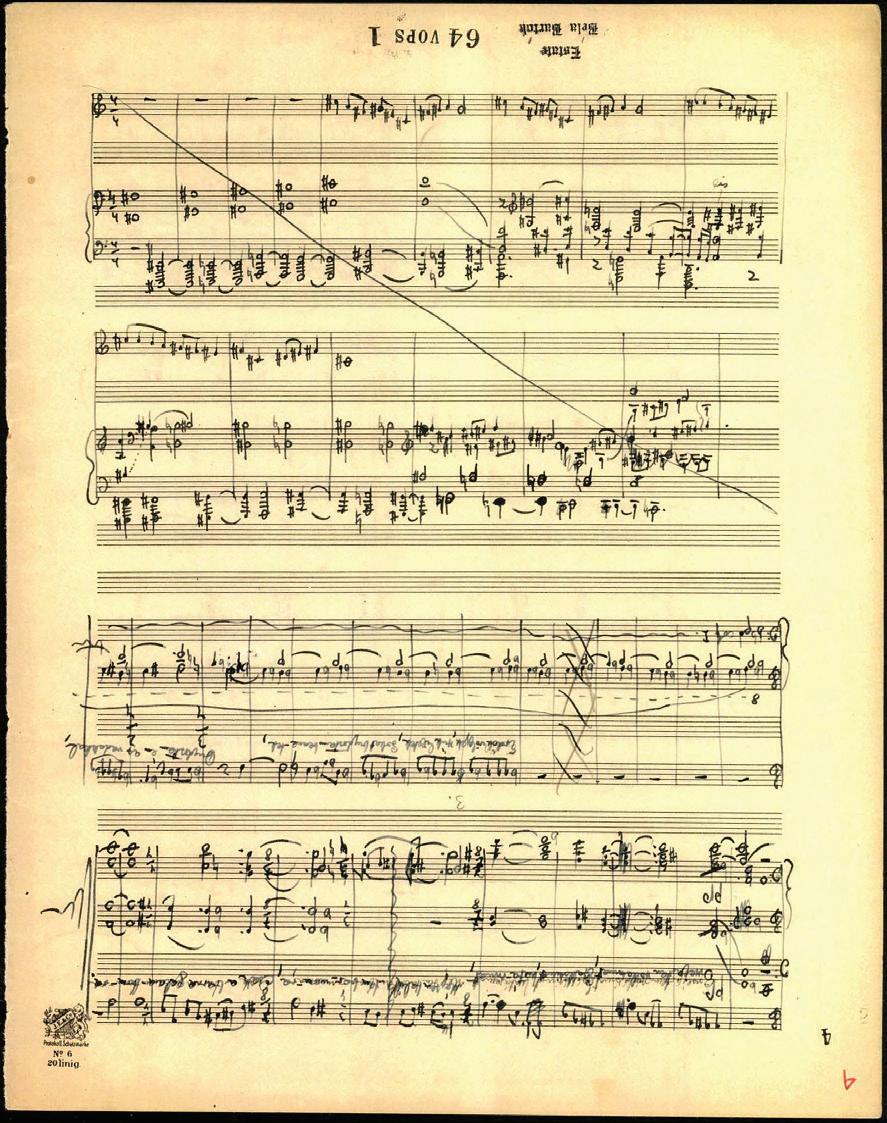
fragmentary draft for “Pár-ének” also survives (Facsimile 6, Example 2). It can be found in the current lower section of p. 4 of this manuscript. Originally, this was the upper section of the page, later turned upside down.43 The two systems of the 15-bar sketch contain about half of the song: the introduction, the first stanza and the beginning of the bridge passage. The first stanza is in F-sharp minor just like in the first draft. The conjecture that the melody was first written in the draft without the text which was added subsequently, is confirmed, as the sketch has no text at all. This early stage of composition shows the piece in a partly different form. The short introduction is just four bars long. Although the first note differs from the version in the draft, the basic idea is the same. Here too, strict counterpoint with syncopation is employed with octave doubling in both voices. Seeing that a partly different beginning also uses strict counterpoint, it is tempting to see something symbolic in this opening. A similar two-part counterpoint starts the first “Dialogue” (“Párbeszéd,” originally “Canon”), composed for Bartók’s second wife Ditta Pásztory in 1926 – a symbol probably analogously appearing already in the first movement of the early Violin Concerto (1907–1908), composed for Stefi Geyer, which is then also related to the contrapuntal first movement of the First String Quartet. A common feature in the two versions of the song introduction is the use of strong dissonances. The draft has a minor-second clash at the beginning: D-sharp/C-double sharp (in accordance with the final version, although still in F-sharp minor rather than E minor). The dissonance is similar but tonally simpler or more direct in the sketch: F-sharp/E-sharp, the tonic and the minor second below, in F-sharp minor.
The early version in the sketch seems to reveal the compositional idea even more immediately. The main function of the introduction is to lead to the first note of the song. To achieve this, the early version uses a four-bar rising whole-tone scale: F-sharp–G-sharp–A-sharp–Bsharp, leading to C-sharp. In the later, more elaborate version, the similarly rising scale choses pentatonicism instead, followed by a short melodic extension: D-sharp–E-sharp–G-sharp–Asharp–C-sharp. The subsequent ascending fourth and descending fifth emphasise the pentatonic scale even more strongly. The note values are also changed. The sketch uses whole notes whereas the draft uses half notes. Despite the greater density of shorter note values, the later version is longer due to the digression in the progression and the fermata-like ending indicated by the separation mark. (In the sketch, the scale reaches the first note of the melody concurrently with the vocal entrance. In the final version, the first note is better prepared as it is first introduced, then circumscribed.) Furthermore, the introduction is more clearly separated from the song itself in the final version. A tied note in the accompaniment leaves free space for the beginning of the song, producing a more dramatic effect as it allows the voice to come into greater prominence.
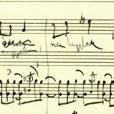
The sketch offers an excellent illustration of why it is so problematic to interpret a working manuscript that was only intended for the composer’s own use.44 Although the notation is mostly legible, the final bar, where Bartók used an empty staff between the vocal part and the piano system to introduce revisions to the accompaniment, is notated in several versions, which are mutually exclusive in some cases. While the composer’s markings pose serious challenges for the outsider, they might turn out to be decipherable in the end, at least in part. It is
43 After cancelling the sketch for No. 13, Bartók used the page to start the composition of No. 3
44 Friedemann Sallis uses the very appropriate term “working copy,” which clearly indicates that the manuscript is not intended for anybody else than the composer himself. Cf. Friedemann Sallis, Music Sketches (Cambridge: Cambridge University Press, 2015), 4, etc. and especially 161 and following pages.
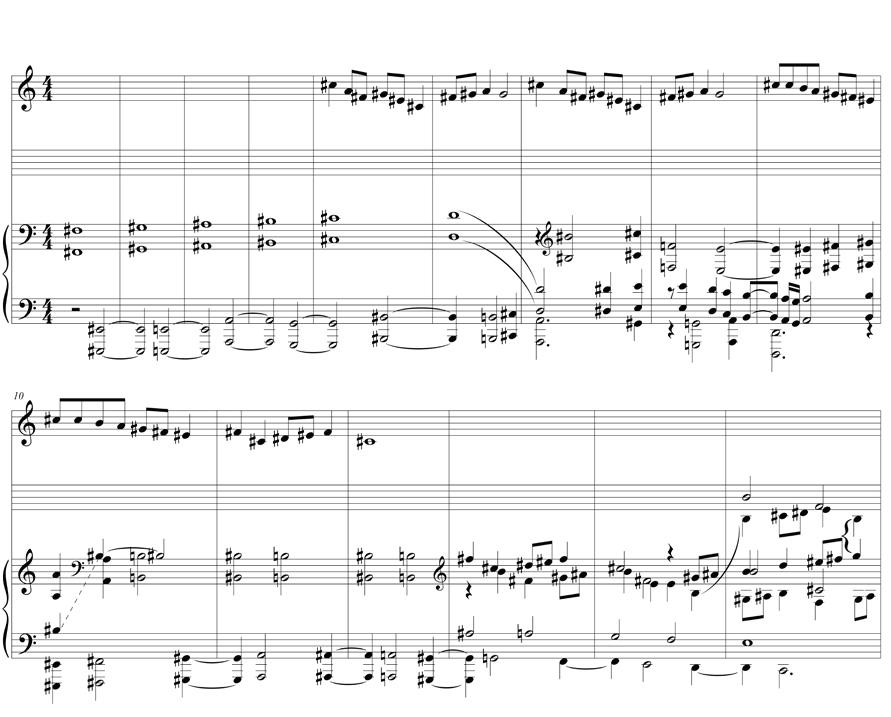
Example 2 Bartók, “Pár-ének” (Plea and Promise), transcription of an early fragmentary sketch preserved inside the autograph draft (64VoPS1), p. 4
obvious that the revised right-hand part in the staff above is also to be read in G clef, as proven by the tied-over B natural. However, the seemingly highest three notes (G-sharp–A-sharp–B) in the second half of the bar, in the same staff, should most probably be read in an unwritten bass clef, whereas the seemingly lower voices are still to be read in the marked G clef, The reading according to the bass clef is also supported by the inserted brace that links the final note to the identical final note in the extra staff. This is how the different competing layers of the passage may slowly be separated from one another.
But why is this sketch preserved separately from the later draft? One possibility is that at that point Bartók had not yet made a final decision about the form of the song. Since the source only had a single stanza, it is conceivable that Bartók was first planning to compose just that one stanza. If so, then the decision to add a second, newly written stanza must have come only later – which in turn raises the question as to whether he was planning a complete dialogue with “plea” and “promise” from the outset.
Short of examining the whole manuscript exhaustively, I shall consider here only a few aspects of it that might explain the appearance of the additional source within the manuscript. 45 Bartók used a 20-stave Eberle manuscript paper (with the manufacturer’s mark “No. 6, 20 linig”) for the complete draft. (At the end of the draft, a single sheet of a different type of manuscript paper was used.) On this type of paper, the manufacturer’s marking is printed only on the first page of a four-page folded sheet (bifolio).46 Although all bifolios were cut in half in the complete manuscript, so that they now survive as a series of separate leaves (folios), it is possible that their sequence still follows, at least in part, the original sequence of bifolios. In any case, it is possible to ascertain that the present p. 1, on which the draft of no. 7 starts, was certainly not the first page of composition, since this is a page without manufacturer’s marking and so it was certainly not the first page of a complete bifolio. On the other hand, the present pp. 1–4 could well have formed a bifolio and Bartók might have started composing on the present p. 4, which was the first page of a bifolio and which was later used turned upside down. Consequently, the fragmentary sketch of no. 13 is certainly older than the draft of no. 7. This would in turn suggest that Bartók might have put no. 13 aside for some time, to resume the composition in a newly started draft later. It is conspicuous that when he returned to the piece, he once again started a fresh bifolio (pp. 7–8 and 13–14 seem to have belonged together) and used the first two pages for the complete draft of no. 13. Thus, it is possible that, having put aside the bifolio with the cancelled sketch, he was able to continue composing on another bifolio and so no. 13 might actually have been composed first in the whole series.
Urtext in music is a particularly difficult concept because the “work” reaches its definitive form not in writing but only in performance. This is why the differentiation between the two layers of signs, the essential ones that define the “text” and the accidental ones relevant mainly for the performance, is so significant in this context.
45 The paper structure of the complete manuscript was published in the critical commentary to Bartók, Folk Song Arrangements for Voice and Piano, 260.
46 Cf. László Somfai’s comprehensive table showing all paper types used by Bartók during his career in László Somfai, Béla Bartók: Composition, Concepts, and Autograph Sources, 97.
In his study on critical editing, James Grier defines the relationship between the text of a work and the work itself in the following way:
The work of music . . . participates in a very different relationship with its physical manifestations, whether in sound or in writing, a relationship that fundamentally affects the textual condition of the work in music. That difference begins from the recognition that the written text of a work, its score, is not self-sufficient, that text and work, therefore, are not synonymous. Where, then, does the work of music exist? Roman Ingarden locates it in the collaborative intentionality of composer and performer through the mediation of the score.47
Following this, Grier discusses the actual addressee of the notation:
Musical notation also carries a distinctive type of meaning, for the text of a musical work addresses not the listener, who occupies the same position as the reader in literature, but a quite different person, the performer. . . . [T]he text of a musical work functions, in the first instance, as the means of communication between composer and performer. This relationship clarifies the nature of a musical text: a musical score contains a set of instructions to the performer for the execution of the work transmitted in the score.48
It should be noted that the listener’s position may sometimes differ from that of the reader. There is generally a difference of degree: the listener is usually more passive than the reader. The reader, unlike the listener, may “perform” the text silently, but occasionally also loudly, by reading it to themselves.
In his study cited earlier, Georg Feder, deeply involved in the general history of ideas, also gives a definition of the relationship between text and work:
The work is . . . more than any single interpretation of it, even if it is an interpretation by the composer himself; it is more than a sum of individual performances and more than the musical text [der Notentext]. It is neither real nor ideal but an “intentional” object: the imagined construction [Gebilde] that the composer prescribed in the musical text [Notentext, notation] so that it can be heard through the imagination of the singers and players, and speak to the imagination of the listener.49
Feder also emphasizes that “a musical text [Notentext, notation] can have [two] different types of relationship to the sound: it can precede it or follow it, it can be a ‘prescription’ or a ‘description’ [transcription].”50 Here Feder echoes Charles Seeger’s basic pair of terms “prescriptive” and “descriptive notation.” The remark is especially interesting as Bartók was deeply involved with the practice of both types of notation. His transcriptions of folk music belong to the category of Nach-Schrift or “descriptive notation” whereas his compositions were basically written using Vor-Schrift or “prescriptive notation.” The latter was intended for the performer, often himself.
47 Grier, The Critical Editing of Music, 21.
48 Ibid., 23.
49 “Das Werk ist . . . mehr als die einzelne klangliche Interpretation, und sei es eine solche des Komponisten selbst; es ist mehr als die Summe der einzelnen Aufführungen und mehr als der Notentext. Es ist kein realer und kein idealer, sondern ein ‘intentionaler’ Gegenstand: das imaginierte Gebilde, das der Komponist im Notentext vorgeschrieben hat, damit es durch die Imagination des Sängers und Spielers zum Klingen gebracht wird und die Imagination des Hörers anspricht.” See Feder, Musikphilologie, 14. In connection with the idea of intentionality, both Grier and Feder refer to the work of Roman Ingarden.
50 “Ein Notentext kann in verschiedenem Verhältnis zum Klang stehen: er kann ihm vorangehen oder ihm folgen, kann ‘VorSchrift’ oder ‘Nach-Schrift’ sein.” See Feder, Musikphilologie, 15.
We could argue, however, that even the literary text is only realized in full when it is “performed” through reading. In addition, “literature” is a collective term covering many different types of text: reading a shorter piece of prose or a short story might take significantly less effort than reading a poem. In a poem, the poetic means are so important that without identifying at least some of them, the reception of the poem will be significantly poorer than it would be otherwise. With regard to music, we can also argue that seemingly arbitrary instructions added to the notation might actually be more helpful to the realization of the work, than a purer and clearer (and therefore more authentic) notation.
Writing is always dependent on its time and circumstances and it is part of a social practice.51 Among all verbal art forms, it is obviously drama that is closest to music. Drama also requires a performance before an audience for whom the text is recited and acted out. Quite naturally, drama also requires and often contains written instructions for the performers, which are not part of the text to be heard. This is why it might be useful to briefly consider the editions and concomitant editorial problems posed by the works of William Shakespeare.
Modern Shakespeare editions generally provide philological guidance as well as explanations to vocabulary, grammar, names and subjects. The two basic sources, the Quarto and the Folio editions, which were closest to the author in time, often contain spelling or punctuation errors and inconsistencies, even lines assigned to the wrong character, inconsistent naming of characters or mistakes in the division into scenes and acts. All these issues make it necessary for the edition to adopt certain principles of normalization and correction. It is relatively rare for an editor to insist on preserving the original punctuation. In his edition of Midsummer Night’s Dream, Burton Raffel argues:
[I]n spite of these equivocations and uncertainties, it remains true that, to a very considerable extent, punctuation tends to result from just how the mind responsible for that punctuating hears the text. And twenty-first century minds have no business, in such matters, overruling seventeenth-century ones. Whoever the compositors were, they were more or less Shakespeare’s contemporaries, and we are not. Accordingly, when the First Quarto text uses a comma, we are being signaled that they (whoever ‘they’ were) did not hear the text coming to a syntactic stop but continuing to some later stopping point. To replace Quarto commas with editorial periods is thus risky and, in a lyrically textured play, on the whole an undesirable practice.52
The reference to hearing as the origin and last arbiter of punctuation is especially instructive for musicians. It especially underlines the parallel between drama and music, between a stage performance of either a literary work or a musical composition.
We can further consider the relevance of editions of Scripture (a major model for any kind of editorial undertaking) for editions of music. While the text of Scripture is not necessarily or exclusively intended to be “performed” or “read aloud,” it is in fact a text prepared for liturgical use and thus for live delivery. Evidence for this is not only the already mentioned reading and psalm tones with their set formulae for punctuation in the Christian liturgy. When the Masoretes worked on the final consolidation of the Hebrew text of the Bible, they were as much concerned with adding markings for unmarked vowels as with the addition of accent
51 Cf. Grier, The Critical Editing of Music, 16. Concerning how the work of art is defined socially, Grier refers to Jerome J. McGann’s works.
52 William Shakespeare, A Midsummer Night’s Dream, Fully annotated, with an Introduction, by Burton Raffel, With an essay by Harold Bloom, The Annotated Shakespeare (New Haven and London: Yale University Press, 2005), xvii.
signs. The Masoretic accents form a complex system of punctuation with different signs to show that two or more words belong together and other signs representing varying degrees of separation between words. Accents can be either “connecting” or “separating” marks and so their function is analogous to phrasing in music. (It is particularly relevant to musicologists that Masoretic accents also constitute a form of musical notation as each accent corresponds to a certain melodic gesture or neume.)53
One of the main tasks of music philology consists in considering the two layers of notation, i.e., the identification and interpretation of signs, with their different meanings depending on the context (in the sense of palaeography) on one hand, and, on the other, the clarification of how to shape and divide the series of signs that constitute writing. (The Riemann-Lexikon’s insistence on the primary importance of phrasing is no accident.) The second of these tasks concerns the delivery of the text, its performance. The written text of the work (either musical or literary) can never be fully identified with the work itself, because the work is also dependent on its reception through the reader, the performer or the listener.
In this essay I have discussed two songs where the musical composition is based on a verbal text closely linked to a melody. In Machaut’s chanson, the poem is representative of the most refined literary style of the period, the poet-composer’s own text. The song, which is part of a longer literary work, is at the same time intended to serve as a model for a special type of poetic-musical form. The rondelet offers a particular delivery of the text by providing a melody to which it can be sung. Moreover, through the two added voices (both, as we have seen, probably intended for instrumental performance), the melody is imbedded in an advanced polyphonic texture, which proved to be foundational for the further development of harmony in European composition. My brief investigation of Machaut’s song attempted to show the artistry of composition and expression, as well as the interrelatedness of text and music, but also the difficulties inherent in preparing it for a modern edition.
The “originality” of Bartók’s song for voice and piano derives in part from the fact that the composer draws on a live tradition, in which he discovered, recorded and transcribed text and melody together. He took the folk song and provided it with an original accompaniment in his own 20 th -century idiom. By doing so, his main aims were to preserve his source, to use it at a higher artistic level, to interpret it and turn it into a modern concert item, a vehicle of his own individual ideas and expressive needs. The surviving documents of the composition of the song pose very different challenges for the philologist than does Machaut’s song. The compositional sources, in which “essential” and “accidental,” “textual” and “performance” elements are recorded in significant detail, shed a penetrating light on the thinking of the composer and the creative process itself.
We can study both songs as individual works of art. As has been pointed out, Urtext is concerned with the individual work in contrast with palaeography, which is concerned with sign systems. At the same time, however, the term Urtext originally referred to texts of Greek and Latin antiquity as well as the Bible. It implied our awareness of being the heirs of the high culture of a past age and, at the same time, a consciousness of our own emerging culture. The application of the concept of Urtext to music points to the singular social position of the musical work and of music in general. Could the importance of the Urtext idea in music be an
53 For a critical edition of the Hebrew Bible, see Biblia Hebraica Stuttgartensia, which is provided with a detailed list of accents. (In fact, there are two largely overlapping but still not identical systems, one used in poetical texts such as the Book of Psalms or the Song of Songs and one used in books generally characterized as prose texts.)
indication that European culture might have accomplished something truly “original” in the course of its history? The concept has a great deal to do with the music aesthetic of early German romanticism. It goes hand in hand with the growing interest in authors’ and composers’ autographs (and sketches) during the 19 th century, a corollary of the cult of artistic genius, and the genius composer in particular.
One could argue that the issues discussed here – work of art, original text, authorial intention – might be survivals of a now anachronistic Kunstreligion, a notion rooted in 19 th -century romanticism. This is indeed true. I would not even deny that it is far from harmless to try to conjure up such spirits. (They have repeatedly shown their dark side in 20 th -century history.) So it is better to be aware of the danger. That I am alluding to this aspect might reveal how ready I am to accept a sceptical view or, to use a more scholarly expression: a critical approach to the “Urtext” concept. At the same time – and perhaps this is the main “tenet” of what I have been trying to demonstrate – there is something mystical about a work of art, about a musical composition – the way it moves and influences us, the way we live with it and are reluctant to part with it (as in the case of Machaut’s Amant) and the way it can serve as a source of support (as the person addressed as “my angel” in Bartók’s song). And finally, the question might not be out of place here: Could Religion itself ever exist without Kunst, was it not always some form of Kunst that helped us become so thoroughly bound up with Religion?