Anna Dalos
Anna Dalos
Anna Dalos
Anna Dalos
2025 © Dalos Anna (Habilitation presentation, 2019)
© Liszt Ferenc Zeneművészeti Egyetem, 2025
Published by the Liszt Ferenc Academy of Music (1061 Budapest, Liszt Ferenc tér 8., Hungary)
Publisher: Dr. Gábor Farkas, Rector
Editors: László Vikárius, Gergely Fazekas
The English version was published for the 50 th anniversary of the Kodály Institute of the Liszt Ferenc Academy of Music, and on the occasion of the 27th International Kodály Symposium, held in Kecskemét, August 4-8, 2025.
The original Hungarian version of the study was published in 2024 with the support of the Musicology Programme of the Doctoral School and the Musicology Department of the Liszt Academy.
Publication manager: Judit Rajk, Director of the Kodály Institute
Editor: Edit Marosi
English translation: Anna Dalos, Brian McLean
Layout and typesetting: András Váradi
Printed by: Keskeny és Társai 2001 Kft.
Cover photos: László Mátyus (Museum of Fine Arts), Liszt Ferenc Academy of Music, HUN-REN RCH Institute for Musicology.
This booklet has been published as part of the “Booklets of Musicology” development within the “Digital development of practical training at the Liszt Academy of Music” project (RRF-2.1.2-21-2022-00040).
ISSN 3094-4856 (online)
ISSN 3094-4635 (print) ISBN 978-963.7181-87-0 (online)

When Zoltán Kodály, on his 1966 American journey, called on the way at Berkeley CA, during a public debate at the Corvin Hungarian Club, he made some sharp critical comments on the performances of the Hungarian State Folk Ensemble, and strongly criticized Miklós Rábai’s choreography for the Kállai kettős (Kálló Double Dance), which Kodály had composed in 1951. The composer’s disapproval was triggered by the approach Rábai had taken in so shaping the Hungarian State Folk Ensemble’s production that, as Kodály put it, “the dance is pre-eminent, anything else incidental.”1 In that light, it seems almost fateful that the archive film of the State Folk Ensemble’s original performance of the Kálló Double Dance is silent: we merely see the dancers moving. 2 Kodály’s wry verdict on Rábai’s choreography—“You can do anything. It may still be better than Rábai’s solution”3—conveys very consciously an idea of the function of dance. Although the composer had yet to manifest systematically in writing his concept of its artistic significance, his remarks and references on dance, and still more his compositions, testify to his creative and scholarly interest in the art that stands closest to music.
The importance of dance, dance songs and related children’s songs features also in his 1906 doctoral thesis, The Strophic Structure of Hungarian Folk Song:
Originally, every closed form of rhythm is related to physical activity. As soon as the orchestral sounding rids itself of the isochronics of a compelling accompaniment of dancing or working movements, the exact, rigorous temporal conditions will loosen, and the path will open to conveying the specific linguistic rhythm of the text and the purely musical elements (of which even rhythm is not the essence), so that free performance–“tempo rubato”–will be born, as the first developmental step by which a song is shaped into spoken verse.4
Kodály’s wording makes it clear how he interpreted dance songs marked by even rhythm as a more ancient and primitive form of song-centered music than tempo rubato singing, which he saw as a further step toward the singing of free rhythms, a form in which natural rhythms of language and even “purely musical elements” predominate. Kodály sees this rhythmic music as “damaging the enforcement of the text” in dance and children’s songs.5
Kodály’s triple hierarchy—rhythm, text, melody—reflects his readings of Friedrich Nietzsche. The 24-year-old Kodály presents this in his dissertation in a form that almost quotes covertly a passage from Nietzsche’s high-impact study, The Birth of Tragedy from the Spirit of Music (1872, rev. 1886), where Nietzsche stresses the primacy of melody over text.6 However, Kodály, in describing tempo rubato, moves from the high priority of melody to talk of loosening strict time
1 Zoltán Kodály, “A Corvin Magyar Clubban. Előadás és vita Berkeley-ben” [In the Corvin Hungarian Club. Paper and discussion in Berkeley], in Visszatekintés. III Hátrahagyott írások, beszédek, nyilatkozatok by Zoltán Kodály, ed. by Ferenc Bónis (Budapest: Zeneműkiadó, 1989), 186.
2 https://www.youtube.com/watch?v=FKkxX4-a03k (last access: April 12, 2025).
3 Kodály, A Corvin Magyar Clubban, 190.
4 Zoltán Kodály, “A magyar népdal strófaszerkezete” [The Strophic Structure of Hungarian Folk Song], in Visszatekintés II. Összegyűjtött írások, beszédek, nyilatkozatok by Zoltán Kodály, ed. by Ferenc Bónis (Budapest: Zeneműkiadó, 1964), 16.
5 Ibid., 27.
6 Kodály refers to Nietzsche in footnote number 12: “It is the first step toward objecting, interpreting and imitating the melody, the mother of the poetry.” Ibid, 506. Nietzsche’s wording is the following: “Melody is therefore primary and universal, and as such may admit of several objectivations, in several texts”, in The Birth of Tragedy or Hellenism and Pessimism by Friedrich Nietzsche, transl. by WM. A. Haussmann (London: George Allen & Unwin, 1923), 51.
conditions and asserting that even rhythm does not belong to the “essence” of purely musical elements. As the quotation divines, uneven rhythm is the main element in free musical interpretation, and in this way, Kodály distinguishes the three decisive parameters of vocal music and shows how decisive they are in musical interpretation.
This early fragmented side-idea seems to run through his career. It appears in a passage in his 1941 study Folk Music and Art Music, when recalling the piano playing of Theodor Leschetizky and Ernst von Dohnányi:
There is a well-known saying about the rhythm of Leschetizky, the renowned Viennese piano teacher: a good performance is, actually, a continuous series of rhythmic errors. He understands under errors the small deviations from the rigid accuracy of the score values. Ernst von Dohnányi, one of the greatest living performers of the plastic rhythm today, tells us the story, that he was happy to play dance music in his younger days at dance sessions among the circle of his friends, but there was a complaint that they could not dance to his accompaniment, as he did not play entirely “rhythmically.”7
So Kodály was concerned with such rhythmic inaccuracies: it says much that he refers to Dohnányi’s interpretation of dance accompaniment, unsuccessful in practice, but exemplary in artistic terms. And when it comes to dancing, let us think primarily of waltzes, which were as decisive in Kodály’s and his wife, Emma’s œuvre8 as in Dohnányi’s. Several can be found in the works of Kodály’s first mature period (1906–1923), their general feature being a seeming intention to insert some rhythmic inaccuracy into them. Valsette, written in 1906, could not be danced to, due to its recurrent asynchrony of rhythm: the emphasis often shifts between the two hands and the three waltz beats are interspersed by two-beat formulae. The right hand also, though it usually slips away from the left, follows the two-beat meter on the whole, and the triple division is clear only in the middle part of the piece in the right hand (Example 1). In the piano accompaniments to Kodály’s songs and his piano pieces, the otherwise unusual three-four pulses serve as clear waltz reminders. Although there is no open waltz reference in the figures accompanying the middle part of the song “Az élet dele” (The Meridian of Life) from the cycle Megkésett melódiák (Belated Melodies, Op. 6, 1913), the gestures are clear from the first-beat accents and the triple pulse of the vocal line. The waltz allusion evokes fine moments in life: beatific hours of love (Example 2a). Such a waltzing happy memory recurs in the piano postlude to the song (Example 2b). It also appears as a blithe symbol for happiness in the third of the cycle Three Songs (Op. 14, 1918–1924), “Várj meg, madaram” (Stay Sweet Bird). Here Kodály employs his wife Emma’s waltz, and with this personal quotation points out how the waltz ties in with feelings of fulfilled love and directly with Emma’s person and their close relationship. So, the full waltz form unfolds at the song’s formal peak, by the text: “Enyém Erzsóka” (“Lizzy is mine”, Example 3).
There is likewise a clear waltz message in the seventh of the Seven Piano Pieces (Op. 11). The waltz character appears in the underlying triple pulsation, in the formulae of the accompaniment. In some typical turns in the melody Kodály intrudes sensitively on the inherent rhythmic pulse of the dance by pausing on the first beat, transferring the chordal accompaniment and arpeggios suddenly from the left hand to the right, inserting quadruple bars into the triple
7 Zoltán Kodály, “Magyarság a zenében” [Hungarianness in Music], in Kodály, Visszatekintés II., 244.
8 András Batta, „Booklet”, in Songs and Piano Pieces by Emma Kodály (Budapest: Hungaroton, 2004, HCD 32289), 16.
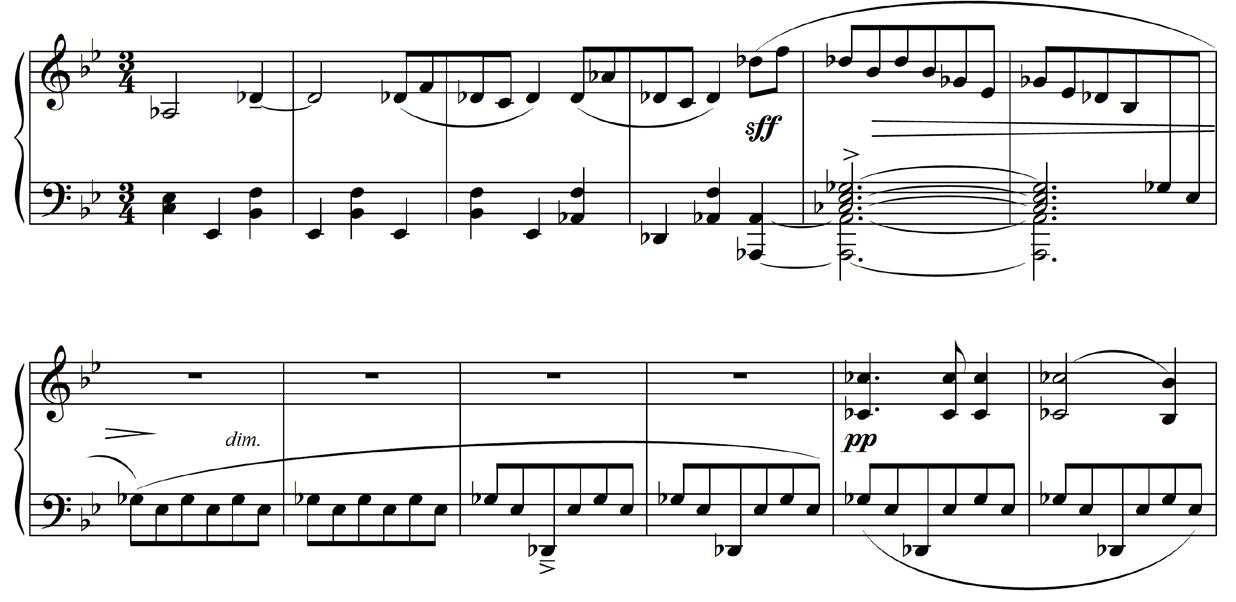
Example 1, Valsette, bars 27–38.
© Copyright by Universal Music Publishing Editio Musica Budapest
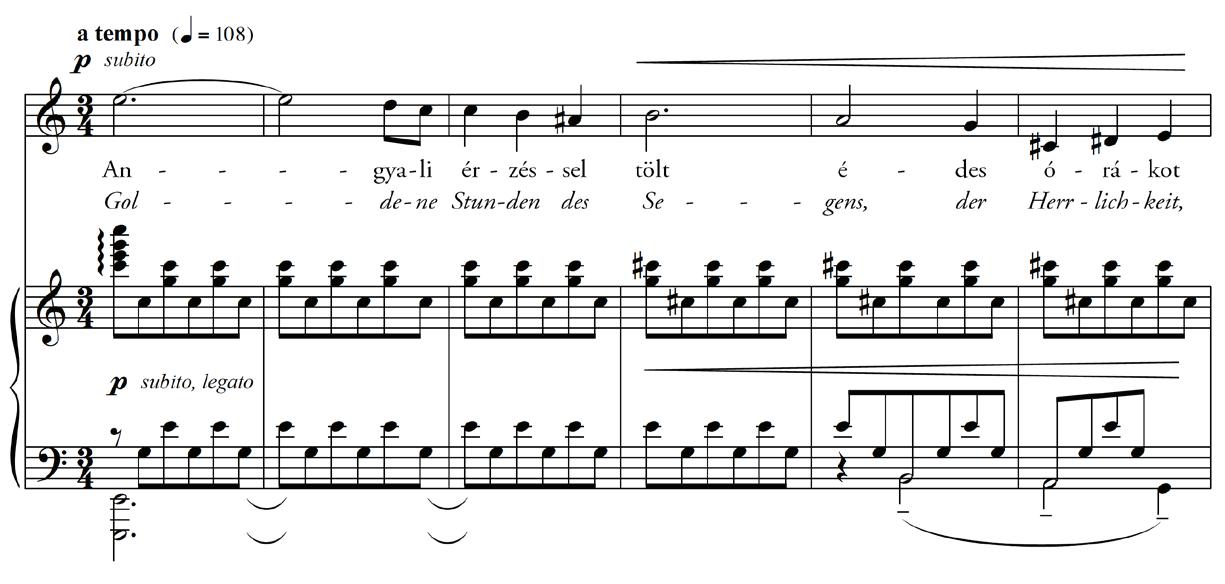
Example 2a, Megkésett melódiák: Az élet dele, bars 63–68.
© Copyright by Universal Music Publishing Editio Musica Budapest
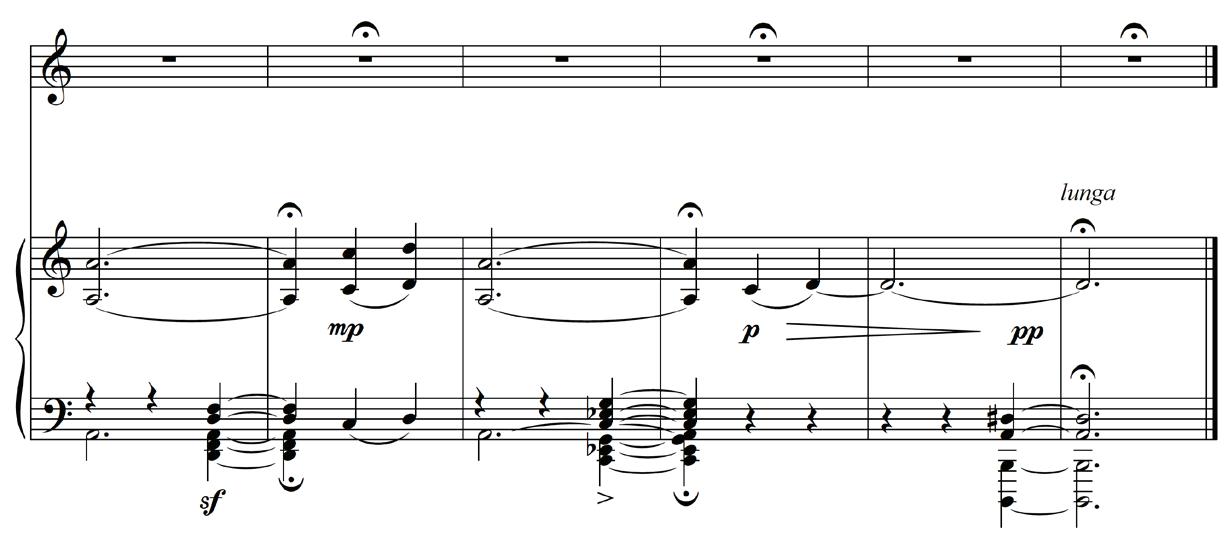
Example 2b, Megkésett melódiák: Az élet dele, bars 109–114.
© Copyright by Universal Music Publishing Editio Musica Budapest
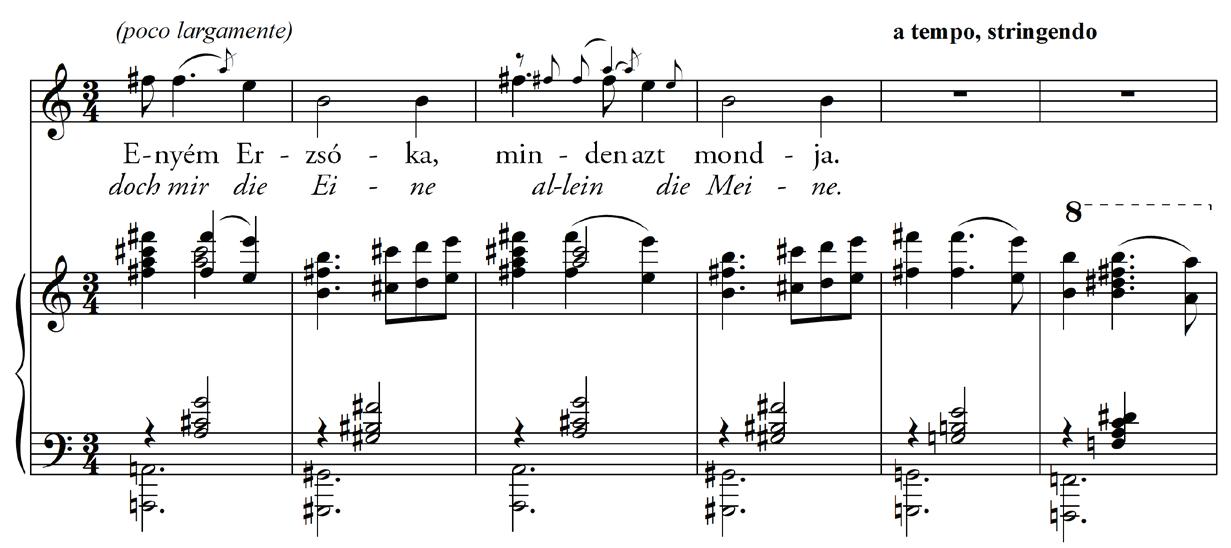
Example 3, Három ének: Várj meg, madaram, bars 124–129.
© Copyright 1939 by Boosey & Hawkes Music Publishers Ltd.
structure, and using ornamented pentatonic formulae to evoke folk-music instruments. Thus, he deliberately works into it the rhythmic elasticity he enjoyed so much in Dohnányi’s piano performance, while recalling the waltz and the fulfilled love it conveys. These waltz gestures of the songs and piano pieces also tie in with the date of composition – March 17, 1917, Emma’s birthday.
Apart from the waltzes mentioned before, there appear two other classical dances in Kodály’s œuvre: two numbers bear the instruction “Tempo di menuetto” in the singspiel Háry János (Nos. 11 and 23), and there is a Gavotte composed in 1951. The majority of dances in Kodály’s pieces are, however, mainly Hungarian folk dances.
Table 1, Hungarian folk dances with title in Kodály’s pieces
Recruiting Dance from Háry János (1928), see also: Hungarian Folk Music Vol. 6, Verbunkos
Dances of Marosszék, 1929
Dance Song, 1929
Dances of Galanta, 1933
Christmas Dance of the Shepherds, 1935
Children Dances, 1945
Kálló Double Dance, 1951
Dance motion as a performing instruction
The Good House Wife, 1936
Three Gömör Folk Songs, 1937
Kálló Double Dance, 1951
Lads from Harasztos, 1961
“Dance” appears in the titles of two great series – Dances of Marosszék (1929) and Dances of Galánta (1933) –, in two children’s choruses – Táncnóta (Dance Song, 1929) and Karácsonyi pásztortánc (Christmas Dance of the Shepherds, 1935) – and in the piano cycle Gyermektáncok (Children Dances, 1945). The titles of Kállai kettős and Toborzó (Recruiting Dance) in Háry János9 refer directly to dances, but omit the actual Hungarian word tánc [dance]. One finds an instruction in the first movement of Kállai kettős: “Slow dance motion.” “Dance motion” (tánclépés) appears as one in three children’s and girls’ choruses: Jó gazd’asszony (The Good Housewife, 1936), the second part of Három gömöri népdal (Three Gömör Folk Songs, 1937), and Harasztosi legények (Lads from Harasztos, 1961).
Yet such titles or instructions affect only a smallish proportion of Kodály’s dance movements and characters. One often finds parts or sections in instrumental and vocal compositions where Kodály refers plainly to dances.
9 It is more than telling that this piece appears in Kodály’s series, Magyar népzene [Hungarian Folk Music] with the title “Verbunkos.”
Table 2, Dance scenes, dance movements on Kodály’s pieces
Instrumental works
Sonata for Cello and Piano, Op. 4, finale
Duo, Op. 7 finale
Sonata for Solo Cello, Op. 8, finale
String Quartet No. 2, Op. 10, finale
Serenade, Op. 12, finale
Hungarian Rondo
Vocal works
Hungarian Folk Songs: The Bad Wife (II/9), Sisters (IV/19), Bagpipe Song (V/31), Mrs. Puci (IX/49), A Lead-In (IX/52), Let No One Be Sad (X/57)
Works for Choir:
Drunk Reverly
St. Gregorius Day
Mátra Pictures
Songs from Karád
Stage Works:
Háry János (7, 9, 14, 21)
The Spinning Room
Table 2 shows works that clearly apply dance characters, in other words have passages where dance formulae appear or which depict dancing scenes.10 These musical references to Hungarian folk dance weave through Kodály’s life’s work from 1910 to the 1960s, signifying that Hungarian folk dance can intrude for him in any genre and a wide range of musical contexts. Closer analysis also links such references with well-defined types with characteristic connotations. To interpret these involves examining Kodály’s sporadic statements about dance, which return notably to the concept and interpretation of Hungarian music of the late 19 th and early 19 th centuries, a period, Kodály argues, when the very understanding of music basically derived from dance. Kodály brought irony to bear more than once on the typical self-image of 19 th -century Hungarians, whose ideal of “tears of merriment”11 and way of life tied to a generally accepted belief: “I can’t live without music.”12 Kodály made it clear that he rated this layer of music making markedly lower than autonomous art music as provided by him and his friend Béla Bartók. As he put it, “The music consumption of Hungarian society stagnated at a stage where it could not develop.”13
Looking back on the beginning of the careers of both composers, Kodály wrote in a private and consequently fragmentary note:
10 The mere fact that some folk songs in Kodály’s Hungarian Folk Music-series contain stylistic features that allude to verbunkos, does not mean that these songs are automatically considered as dances. For example, the fifth volume of the Hungarian Folk Music-series contains 17th- and 18 th-century love songs, which use verbunkos elements, but these songs are not dances.
11 Kodály reflects on this topic in his 1939 study, “What is Hungarian in Music”, in The Selected Writings of Zoltán Kodály, ed. by Ferenc Bónis (Budapest: Corvina Press, 1974), 32.
12 Kodály mentions this in his study, “Szentirmaytól Bartókig” [From Szentirmay to Bartók], in Kodály, Visszatekintés II, 467. Kodály speaks about the backwardness of Hungarian audience of 19 th century: “I can”t live without music—this is the password of almost all Hungarians. But with kind of music is this? One that you can also dine at. ‘Tafelmusik’ [Table music]. Music that doesn’t take the clinking of glasses, no one needed.”
13 Ibid., Kodály considered the middle class to be uneducated, and this explained why the middle class felt that peasant music was alien to it: “It is alien to those who think that Hungarian music is nothing more than the style of a few hundred tunes composed in the mid-19 th-century, which had its roots only in the Hungarian middle class, and to which the smell of pubs and the gypsy atmosphere are associated.” Zoltán Kodály, Magyar zene, magyar nyelv, magyar vers [Hungarian Music, Hungarian Language, Hungarian Poetry], ed. by Lajos Vargyas (Budapest: Szépirodalmi, 1993), 46.
With us a new plan (unconsciously)[:] it is not the “csárda” [wayside inn], it is life, the whole life of the Hungarians, which must be present in the music, not just when he’s drinking, dancing and being obstreperous. But in the better part of his life: when he’s working, plowing, praying. Looking at [such old] front pages, Hungary seems as if it were a kind of Okatootája or pays de Cocaigne, where there’s razzle-dazzle all day, and if someone gets hungry he can cut a piece off the fried pigs running by.14
The word “Okatootája” refers to a poem by the 19 th -century Hungarian poet Sándor Petőfi, a kind of political pamphlet from 1847, in which Hungary is compared to an imaginary cultureless country of that name. The phrase “pays de Cocaigne”, on the other hand, recalls a Pieter Bruegel painting, Eldorado, whose Hungarian version seems to be caught by the fried pigs running by. Nor do Kodály’s other notes hide his contempt for the image Hungary had presented to the world in the latter half of the 19 th century, where the trio of “drinking, dancing and being obstreperous” form the typical recurring motif. Thus, Kodály underlined in his note how he set himself a prime artistic aim in his works of presenting the full life of Hungarians, not just the forms of cultural consumption he recalled from his childhood as typical of Hungarian small towns at the turn of the century:
I grew up in the typical environment of a rural Hungarian town. I inhaled with the air the music that sounded there. I saw merriment typical of such places. I took part in it, until I came to see that it was a literal Hungarian interpretation of Luther’s Wein–Weib–Gesang that was actually humiliating the dignity of music. It had no more of a vital role than alcohol had. L[uther] set out his gold words to glorify a higher music that could be savored without wine. Indeed the culture of music begins where music is so loved that one can leave out any simultaneous, more materialistic pleasures.15
Kodály points to the lower rank of such entertainment music and the dance culture closely related to it. For this culture was part of a way or concept of life that left no chance for the culture of music to unfold at a higher level. Kodály interpreted the musical stagnancy and uncultured artistic consumption found in the last third of the 19 th century as marks of disease and the main obstacle to Hungarians developing national unity. To Kodály’s mind, the necessity for a nation’s unity was its cultural unity. This issue became especially acute after the defeat in World War I, when Hungary, as part of the shattered Austro-Hungarian Monarchy, lost two-thirds of its territory, including the most valuable regions of Hungarian folk culture: Transylvania and Upper Hungary:
There was no Hungarian music [in the last two decades of the 19 th century], which could be listened to sitting in silence. Its orchestration sounded with the ring of glass. Without wine next morning: empty nothingness. The grieving, kerchiefed Hungarian (we all remember such a ballroom song). With fearsome, obscured eyes, dancing red-faced the “szupécsárdás” for hours, then sitting and singing on when all others have gone. Accompanied home in the morning by the faithful, ever sane Gypsies. Why do Hungarians wail? How come they were so big and strong long ago? Because they were united back then.16
14 Ibid.
15 Zoltán Kodály, Közélet, vallomások, zeneélet [Public Life, Testimonies, Music Life], ed. by Lajos Vargyas (Budapest: Szépirodalmi, 1989), 143.
16 Kodály, Magyar zene, magyar nyelv, magyar vers, 56
Kodály’s description contains two features that deserve attention. One is the comic neologism “szupécsárdás”—for Franz von Suppé’s familiar Czardas—as a typical part of the international Hungarian image of the day, acknowledged also by Hungarian audiences. The other is how Kodály links the orchestration of late 19 th -century Hungarian music with the ringing sound of glass. For that and other noises behind rural dance become typical in Kodály’s dance instrumentations, for example in the first part of Kállai kettős (“Felülről fúj az őszi szél” [The autumn wind blows from above]), where the violin and the cimbalom parts create the effect of ringing of sound of glass.
At least as important is that Kodály’s note, like many published writings of his in the 1930s, expresses delicate concern at the disunity of Hungarian culture and society. Kodály sees the topos of a wailing Hungarian only as a consequence of bad social and cultural habits, not as a point-set for the Hungarian psyche:
No one can call weeping in merriment the sole content of the Hungarian soul. We hear more in the old songs: snippets of the heroic struggles of past centuries, the voice of monumental heroism.17
This “voice of monumental heroism” is a prominent character in Kodály’s great orchestral works of the 1930s. It marks the dramatic climax in the Dances of Marosszék, the Dances of Galánta, and the closing choral section of Kodály’s singspiel Háry János as well, which quotes earlier instrumental dance passages from the work. The “monumental heroism” is formed alike in each case. A virtuoso scale or trill leads up to the slow-moving dance melody (Example 4). Alongside the heroism there emerges from the musical environment a broadly unfolding dance melody, bringing elegance, grace, and a melodic dominance that clearly mark the character—the character “proud Hungarian”—described by analysts as typical of Hungarian male dances.18 These are junctures at which Kodály represents the true face he sees in the Hungarians.19

Copyright by Universal Edition A. G. and Boosey & Hawkes Music Publishers Ltd.
17 Zoltán Kodály, “A magyar karének útja“ [The Path of Hungarian Choir Movement], in Visszatekintés I. Összegyűjtött írások, beszédek, nyilatkozatok by Zoltán Kodály, ed. by Ferenc Bónis (Budapest: Zeneműkiadó, 1964), 54.
18 See for example Marián Réthei Prikkel, A magyarság táncai [The Dances of Hungarians] (Budapest: Stádium, 1924), 30–32.
19 As he puts it in connection with the “true face” of Hungarians: “Hungarians are tragic and heroic, lusty and faithful, honest, but, at the same time, the ruses of the indigenous Hungarians are still alive. They are sad and feeling lost, but, at the same time, they are serene. It is a mixture of bad and good features, which, sometimes, are mutually exclusive.” Kodály, Magyar zene, magyar nyelv, magyar vers, 104.
László Somfai, writing on the problems of final dance movements in Bartók’s works, points out why the form of fast closing movements in his post-1921 compositions “is not faultless”: the composer imposes recapitulation sections, even when the “static” themes in them would deserve only one appearance. 20 The practice of “ecstatic-relieving dance fantasies”, as Somfai calls them, belongs to the 1921–1928 period. Such final dance movements in Kodály’ works appear, mainly between 1910 and 1924, in all last movements of his chamber works except String Quartet No. 1. 21
Yet Kodály’s finales cannot be said to have a clear sonata or sonata/rondo form, so that the traditional requirement of using recapitulation strictly takes on a different meaning in these compositions. The dense modulation processes and mono- or even multi-thematic structures that predominate in them bring the first main section of the exposition near to being a development section. Indeed Kodály purposely blurs the boundaries of the formal sections, so that listeners may not always detect which part of the sonata form is being played at a given moment. Still, it is possible with the last movement of the Sonata for Cello and Piano (Op. 4, 1909–1910) to define precisely the main theme of the exposition, the subsequent transition that mimics bagpipe music, and the secondary theme following it, though the thematic elements of the secondary theme have appeared in the section of the main one. Moreover, this secondary theme runs straight into the development, without any closing formulae. Both definable themes appear in the development, but the section as a while functions more as a long, harmonically discouraging re-transition. This formal uncertainty appears also in the fact that the tonality of the exposition does not return at the start of the recapitulation. The double return fails and the tonality clarifies only, temporarily, in the transition as a recapitulation mimicking bagpipe music. Yet this tonality still remains uncertain, not just before, but after the transition, where it changes almost every second or third bar. Finally, clear tonal closure cannot be ensured by the textbook return of the thematic materials: Kodály recalls the theme of the first, slow movement, which allows a much awaited, but slightly fudged birth of G major in the piano part. Yet the tonal ambiguity remains: the piano’s clear G major accompanied by the cello’s F sharp Locrian scale.
Still, the bagpipe music is decisive as a ceaselessly recurrent thematic element in Kodály’s works. He falls back on this typical musical practice in every case, as an accessory of dance scenes, instrumental or vocal. Bagpipe music appears not only in the early chamber works, but in the best known Kodály choruses: Gergelyjárás (St. Gregory’s Day, 1926), Mátrai képek (Mátra Pictures, 1931), Karádi nóták (Songs from Karád, 1934) and Dudanóta (Bagpipe song, c. 1924) from the Hungarian Folk Music series volume 5. Kodály’s interest in the instrument is clear: he collected nearly fifty examples of bagpipe music performed by peasants, 22 though as a collec tor he was tuned mainly to a vocal repertoire. His great study of Hungarian folk music (1936) tells how bagpipes tunes represent the oldest, pre-medieval layer of dance music:
20 László Somfai, “’Per finire.’ Some Aspects of the Finale in Bartók’s Cyclic Form”, Studia Musicologica 11/1–4 (1969): 398–399.
21 It is surprising that Bartók completed his instrumental works with slow movement during the same period. Ibid., 394. For the individual characteristics of Kodály’s String Quartet No. 1 see my analyses of the final movement: Anna Dalos, Zoltán Kodály’s World of Music (Oakland CA: University of California Press, 2020), 45–55.
22 Lujza Tari, Kodály Zoltán, a hangszeres népzene kutatója [Zoltán Kodály, Researcher of Instrumental Folk Music] (Budapest: Balassi Kiadó, 2001), 364–365. However, he collected mostly violin and folk flute music.
Ones in possession of the necessary data, it will not be surprising if medieval elements also are shown to have survived in Hungarian folk-dance music. Indeed, there is reason to believe that the primitive, irregularly repeated pairs of bars, often heard on the bagpipe, are remnants of an even remoter past. Hungarian bagpipers always play song tunes, but after a few variations they turn to a figured closing passage, the aprája [diminution]. This is either without text or else has short improvised dance-words belonging to it. Often interminably repeated, the aprája is nothing but primitive dance music consisting of very few notes (=oligotonic).… A single motif is repeated at least two or three times, and sometimes as many as eight or ten, before going on to another. 23
While stressing the antiquity of the practice of repeating pairs of bars, as in bagpipe music, Kodály makes another point: bagpipe music derives originally from vocal melodies with texts. Indeed Kodály saw this lack of autonomy, this transfer from vocal music, as a main feature in Hungary’s instrumental folk music. His preface to the score of Dances of Marosszék published by Universal Edition Wien in 1930 stresses again that the dances quoted in the orchestral piece were originally all vocal, though they show up in Kodály’s work as instrumental. 24 Yet the composer also observed in many of his writings that when Gypsy musicians provided instrumental music in a village—particularly at weddings, where wealthier peasants were almost bound to hire paid musicians25—people did not sing to it. 26 The demand for large Gypsy bands—as Kodály put it—grew in the villages only in the last third of the 19 th century: “It is a fact that fifty-sixty years ago, even wealthy peasants had only one bagpipe player at a wedding.... People played the music themselves. Their main instruments were the bagpipes, pipe and zither— which they always made themselves.”27 In another note he says, “People never sing beside a Gypsy musician. Peasants only need Gypsy musicians for dancing at a wedding, if they have the money for it.”28
Thus, Kodály distinguished two types of music provided for dance: solo play on folk instruments and the dance accompaniments of Gypsy bands. He stressed the inherently vocal side in both cases, but he saw the former as more ancient, and in view of the way it was practiced, more authentic. Yet he clearly made use of both types in his works: while Hungarian Rondo (1917), Dances of Marosszék and Dances of Galanta adapt the Gypsy practice to classical art music, the chamber music of his first mature period, or the pieces mentioned earlier that use bagpipe imitation, reflect an authentic, ancient practice of instrumental folk music. Also worth noting is that bagpipe imitation appears in Kodály’s œuvre for the last time in the sixth movement of his 1945 piano cycle, Children’s Dances, while the sound and practice of folk bands is last recalled in 1951, in the Kálló Double Dance. His most intense interest as a composer in the two types of dance practice appears between 1910 and 1938.
23 Zoltán Kodály, Folk Music of Hungary, trans. by Ronald Tempest, Cynthia Jolly (Budapest: Corvina, 1971), 140.
24 Zoltán Kodály, “Marosszéki táncok. Előszó a partitúrához” [Dances of Marosszék. Preface to the Score], Kodály, in Visszatekintés II., 485.
25 Kodály, Folk Music of Hungary, transl by Ronald Tempest and Cynthia Jolly (Budapest: Corvina Press, 1971), 127.
26 Ibid., 126. See also: Zoltán Kodály, “A máramarosi román népzene. Bartók ‘Volksmusik der Rumänen von Maramureš’ című könyvének ismertetése” [Review of Bartók’s Book “Folk Music of the Rumanians in Maramureš”], Kodály, in Visszatekintés II., 438.
27 Zoltán Kodály, „Népzenénk“ [Our Folk Music], Kodály, in Visszatekintés III., 387.
28 Kodály, Magyar zene, magyar nyelv, magyar vers, 269.
The evocation of bagpipe music in his works was probably intended to lend authenticity, or rather present essential sides of the peasant world in their original form and function, while harmonizing them with modern, 19 th century music. While original form and function was decisive in the vocal works of the 1920s and 1930s, his aim in the early instrumental works was rather to reconcile authentic folk art with his image of musical modernity.
The finales of the three chorus works—Gergelyjárás for children’s choir, Mátrai képek for mixed choir, and Karádi nóták for men’s choir—that follow folk customs set up dance scenes. They all soon become a modern bacchanalia, heard not only in the primitive use of roaring bagpipe fifths and series of repeated pairs of bars, but in their texts, which evoke unbridled eating and drinking as well. The Mátrai képek and Karádi nóták make unmistakable references to sexual games in the texts that summon a bacchanalia too.29 All three end in the ecstatic, as participants shed their human shape: the children turn into instruments at the end of Gergelyjárás (besides the bagpipe, the soprano line refers to a Jew’s harp), and the adults in Mátrai képek and Karádi nóták enter into an ecstatic, animal state of mind through seemingly endless repetition of the bagpipe music and the phrases, as a kind of quodlibet at the end of the compositions.
The chamber works of the 1910s follow a path set by Op. 4. The Duo (Op. 7, 1914), the Solo Sonata (Op. 8, 1915), the String Quartet No. 2 (Op. 10, 1916–1918) and the Serenade (Op. 12, 1919–1920) use different ways to expand the concept of a dance finale, but each with bagpipe music at the center. The folk-dance theme heard as the second subject group in the last movement of the Duo and the four dances in the second movement of the String Quartet No. 2 are all accompanied by a bagpipe bass at a fifth, although the form of the String Quartet finale differs slightly, bringing a chain of four dances through repetition and interludes between them: slow introduction: flute improvisation—lament—dance 1—fast part: dance 2— transition—dance 3—transition—dance 4—transition—dance 2–transition–dance 3–dance 1–dance 4–dance 1.30 Those of other dance movements follow the fluidity of Op. 4.
The first subject group in the last movement of the Solo Sonata starts with what can be seen as a main theme (bars 1–57). Then comes a second theme evoking bagpipe style (bars 57–277), but it rest thematically on the second part of the first subject group (Example 5). Kodály goes on to build up the section as a development. The third subject group evokes the style of Bach’s suites for cello and the chordal arpeggios typical of these, which lead to a double bar line that ends the exposition (bars 277–340). The middle part, starting at “Tempo I”, brings instrumental effects (tremolo, sul ponticello), but avoids melodies or clear rhythmic figures. The recapitulation begins at the Meno mosso passage by recapturing the main theme (bar 435), although it is more condensed than the first time. The recapitulation prepares for a return of the second subject group, which, however, resembles a second development section, which eventually allows the earlier bagpipe music to appear in full form (bar 460). The movement ends in the spirit of the sonata principle with the arpeggio formulae evocative of Bach, which earlier functioned as the thematic material for the third subject group. Though the frames of sonata form appear in its structure, the two appearances of the second subject group, in both cases similar to a development, take a more prominent role. Especially the second appearance
29 In Mátra Pictures: “Whoever marries off a daughter/must have a thick feather bed”, and in Songs of Karád: „Out of the copse, pig!/ Just its ears arce showing./The swineheard boy’ll/play with his bride under the bush.”
30 For the interpretation of the form see my analysis: Dalos, Zoltán Kodálys’ World of Music, 81–85.
of the mixture of second subject group and development leads to an unexpected end, for the bagpipe apotheosis of the Solo Sonata—played by a single cello—is one of loneliness.
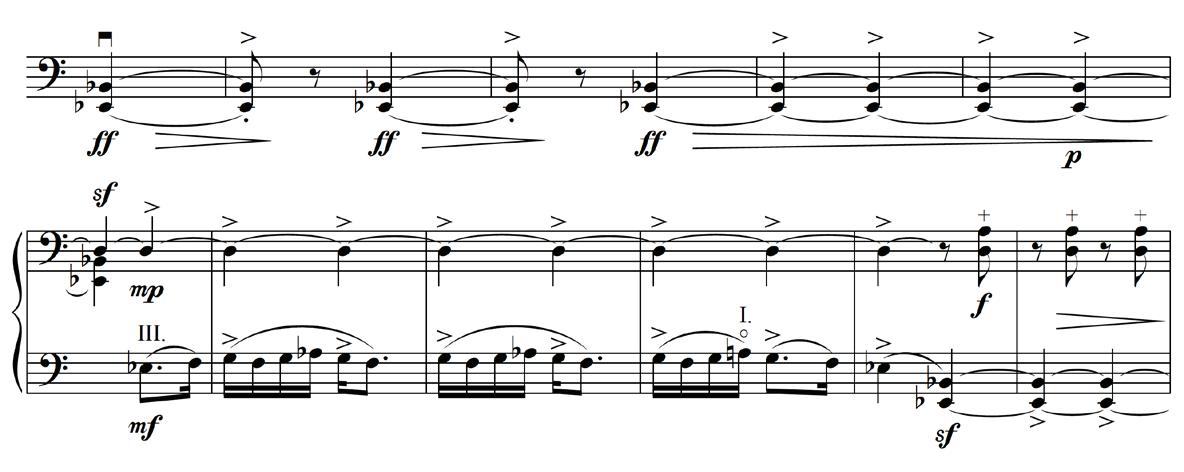
Example 5, Solo Sonata, bars 57–67.
Copyright by Universal Edition A. G. and Boosey & Hawkes Music Publishers Ltd.
Bagpipe music plays a different role in the third movement of the Serenade. One can only assume there was a hidden program in the Serenade, as documentary evidence is lacking,31 but the second movement certainly depicts a love scene32 and it may be assumed that the martial/ masculine main theme of first movement paints the composer’s own portrait. In the last movement, however, Kodály falls back onto a frame in sonata form, if quite loosely: after a “curtainsup” gesture, the movement starts with a scalar theme, followed by a syncopated motif that draws in an accompanying folk-dance figure. This is followed by bagpipe music, also acting as an accompanying figure, and by the first dance with melodic elements heard at last. The second dance, which appears to be a reverse form of the first, ties in attacca with what happened earlier. The third dance, where repetition of figures dominates, not melody, has a syncopated accompanying figure distinct from the second. After the third dance, the sequence of the first dance transposition appears, but the second dance is replaced by a slow dirge of interplay, to which, in a form of a closing formula, the scalar theme of the opening is paired. So the third dance comes in mid-movement as quasi-development. The whole movement rests clearly on dances and accompanying figures for dances, placed consecutively with no development principle. This sequence of non-stop dances—perhaps a happy-ever-after symbol for lovers dancing in ecstasy33—creates a scene that comes to rest only in a dirge of interplay that allows us to turn to ourselves. Yet the interplay is a dance as well, evoking the slow section of a verbunkos, a “Slow Hungarian” as a version of the “proud Hungarian” topos mentioned earlier, and allied to the opening scale motif of the movement (Example 6).
31 See about the possible hidden program of the Serenade the recollection of violinist Vilmos Tátrai: Ferenc Bónis (ed.), Így láttuk Kodályt [Kodály As We Saw Him] (Budapest: Püski, 1994), 91.
32 This is how György Kroó interprets the slow movement: “Kodály: Szerenád, op. 12” in Erkel Ferencről, Kodály Zoltánról és korukról. Magyar zenetörténeti tanulmányok [On Ferenc Erkel, Zoltán Kodály and their Time. Studies on Hungarian Music History] (Budapest: Püski, 2001), 191.
33 Kodály was not averse to the idea of a composition having such content. This is borne out by the somewhat mocking notes he wrote downs about Bartók’s love for Jelly Arányi around 1955: “First Sonata, 1921: Jelly, sarcastic remarks by Parisians. Sonata: ‘love me. We would be able the play together like this in our whole life…’” Kodály, Magyar zene, magyar nyelv, magyar vers, 210.
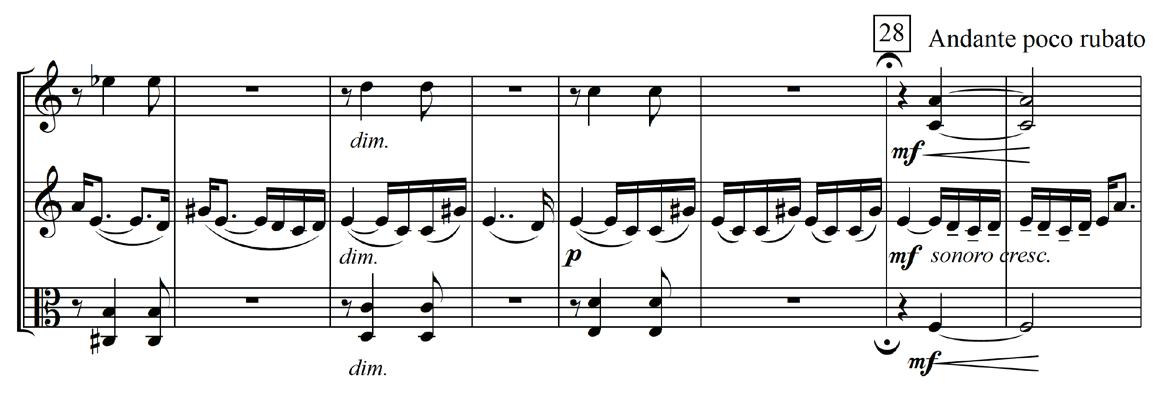
Examlpe 6, Serenade, third movement, 6 bars before and 2 bars after No. 28
Copyright by Universal Edition A. G. and Boosey & Hawkes Music Publishers Ltd.
The last movement of the Duo for violin and cello (Op. 7) shows many features of the finales presented earlier, but Kodály seems to have done his utmost in attempting to build his work on motifs, thematic fragments and accompanying figures, rather than clear themes or characteristic melodies. He interprets the sonata form as a monumental development. Bagpipe music is prominent again, as in other chamber works.
The movement follows the traditional form of Hungarian rhapsodies: a slow-motion improvisatory introduction and a fast, dance-based section. The first part of the fast section distinguishes the main and the secondary theme areas. The former packs mainly accompanying figures and melodic fragments, the latter (19 bars after No. 6) is more typical, being bagpipe music with a complete, characteristic folk tune. Yet despite their distinctiveness, neither draws on regular, periodically recurring elements, but follows the principle of an aprája: short, improvised musical figures that appear in bagpipe music as described by Kodály and involve the techniques of development in the music process.
The main and secondary theme areas create a two-part structure (A and B), repeated in a condensed form in the second part of the movement, which omits the real development section. Both parts A and B are shorter in the recapitulation. The return of part B is so short that it acts as an interlude. This is backed by the way the movement closes in a stretta based thematically on the formulae of part A. So the recapitulation (second part of the movement) ultimately takes on an a–b–a structure, whose b section (the shortened part B) relies on a variation of the bagpipe music of the first part, so that the regular two-four pairs of bars are hooked only by syncopated accompanying figures (Example 7), while the short return of the bagpipe music seems to upset the dancer’s balance, and the regular two fours turn sometimes into three. Further proof of the dancer’s tumble is the exaggerated hiccuping ornamentation of the bagpipe melody (Example 8). The second appearance is clearly a drunken man’s dance. Kodály, in his writings quoted earlier, mentioned in many cases that heavy drinking was essential to Hungarian music and dance culture at the end of the 19 th century. However, bagpipe music and the instrument itself not only mark the coupling of drunkenness off through this
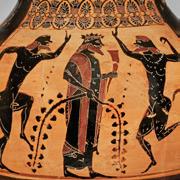
connection, but also through its close tie with the Dionysus cult.34 It is likely that Kodály, in referring to the bagpipes as primordial in his great study of Hungarian folk music, himself alludes to the ancient origins of the instrument and its playing. Depictions of bagpipes (or aulos) often link with those of the Dionysus cult.35 On the Hungarian bagpipes—not without reason called the “goat pipes”—the visible images depict drinking and sexual scenes.36
Nietzsche’s essay The Birth of Tragedy from Spirit of Music, to which the young Kodály refers in his dissertation on the strophic structure of Hungarian folk music, also recalls the survival of the Bacchic choirs in European culture, with the practices of St. John’s and St. Vitus’ dances.37 These re-enter in Kodály’s choruses Gergelyjárás, Mátra Pictures and Songs from Karád. The 1907 diary records of Kodály’s Voyage en Hongrie show him already aware of the severe alcoholism among male peasants.38 Perhaps that was why he stressed so often that he himself drank little: “I cannot boast of a rambunctious past. The wine I have drunk in my life would fit into one or two Gönc barrels”, 39 that is 36 US gallons.
Yet he saw excess alcohol consumption as integral to folk culture, which may explain why a drunken man’s dance appears in the last movement of the Duo. The drafting of drunkenness in 1914 was preceded by Bartók’s piano piece, A Bit Drunk from the cycle Three Burlesques (1908–1910). Kodály knew of Bartók’s second movement when he composed the Duo, for it was the most intense period in their friendship, when they worked almost in a shared workshop and many parallels can be seen in their works and their poetic ideas.40 The outbreak of World War I meant renewal of their friendship and further parallels between the two œuvres.
The four-fours of Bartók’s A Bit Drunk with hiccup-like ornaments, like in the bagpipe music of Kodály’s Duo, prevent a consistent pulsation. Bartók’s own piano performances even highlight this unevenness, 41 as do unexpected shifts in the otherwise primitive melody to high or deeper registers, as well as sudden and almost always interrupted melodic/emotional amplitudes. But while Bartók’s piano work is a self-sufficient programmatic, character piece, Kodály puts his burlesque scene into a longer work as an interlude. Yet this distinctive musical type was rephrased in several compositions. In its simplest form it comes in the interludes of the closing piece in Children Dances from 1945.
34 The aulos was connected to the Dionysus cult from the Hellenistic times onwards (while lyre and khitara belonged to the cult of Apollo). See: Warren Anderson–Thomas J. Mathiesen, “Dionysos”, in The New Grove Dictionary of Music and Musicians, ed. by Stanlie Sadie, Vol. 7 (London: Macmillan, 2001), 362–363. The Antique aulos belongs to the family of bagpipe instruments, shows many similarities especially with the Italian “zampogna.” William A. Cocks–Anthony C. Baines–Roderick D. Cannon, “Bagpipe”, in Grove Dictionary, Vol. 2, 471–484. Aulos was to be meant a pagan instrument. In the Greek tradition, the Phrygian Satyr, Marsyas was held the most prolific player of the instrument. The connection of the instrument to a satyr proves as well that the instrument belonged to the Dionysus cult. Later, from the middle of the 5th century BC Ancient Greeks tried to Hellenize the instrument, and it was connected to the figures of Pallas Athene and Apollo. Annie Blis, “Aulos”, in Grove Dictionary, Vol. 2, 178–184.
35 However, Dionysus was never depicted with an aulos on Greek vases, only his followers, the satyrs and mainases (in Roman: Maenads) are illustrated with the instrument. Anderson–Mathiesen, “Dionysus”, 362.
36 Bálint Sárosi, “Duda” [Bagpipe], in Magyar néprajzi lexikon [Hungarian Ethnographic Lexicon], Vol. 1, ed. by Gyula Ortutay (Budapest: Akadémiai Kiadó, 1977), 615–617.
37 Nietzsche, The Birth of Tragedy, 26.
38 Zoltán Kodály, Voyage en Hongrie, ed. by Márta Szekeres-Farkas (Budapest: Múzsák, n.d.), [36.]
39 Kodály, Magyar zene, magyar nyelv, magyar vers, 146.
40 About the shared workshop see my study: “Az ifjú Bartók Kodály-képe” [The Young Bartók’s Picture on Kodály], in Kodály és a történelem Tizenkét tanulmány [Kodály and History. 12 Studies] by Anna Dalos (Budapest: Rózsavölgyi, 2015), 57–66.
41 László Somfai (ed.), Bartók at the Piano 1. (Budapest: Hungaroton, 1994). HCD 12363-28.
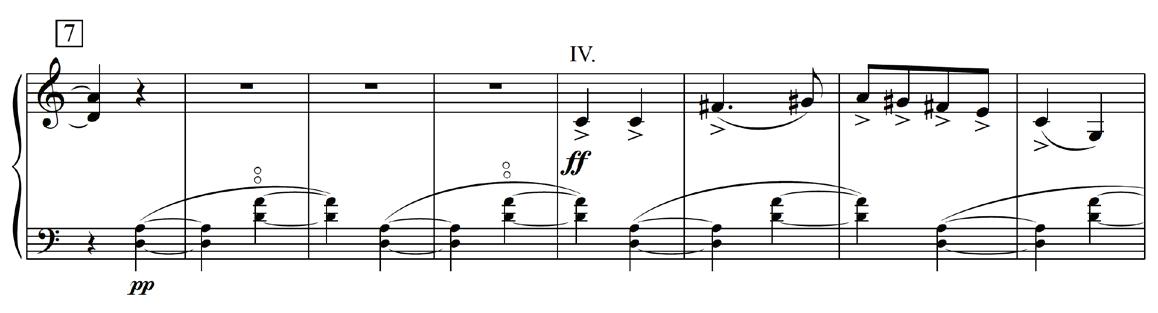
Example 7, Duo, third movement, 19 bars after No. 6
Copyright by Universal Edition A. G. and Boosey & Hawkes Music Publishers Ltd.
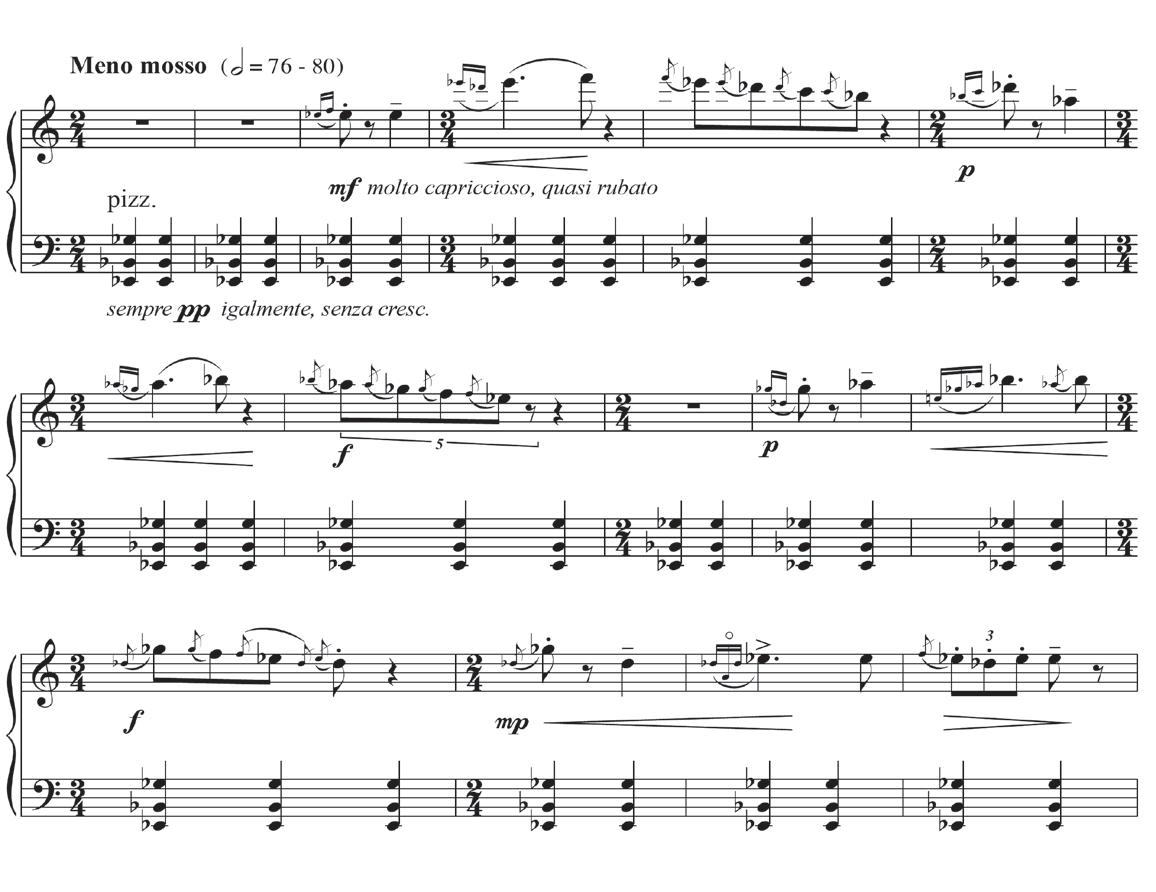
Example 8, Duo, third movement, 13 bars after No. 11
Copyright by Universal Edition A. G. and Boosey & Hawkes Music Publishers Ltd.
A drunken man’s dance features also in the finale of Kodály’s two orchestral dances. In both, Kodály puts the drunken scene in the first part or at the start of the finale, after the noble rondo themes that present a “proud Hungarian” image and the brisk dance interludes. In the four-four finale of the Dances of Marosszék, an ornamented melody is coupled with the humming appoggiaturas on low strings and woodwinds. The image of drunkenness links also to the shakiness of tonality: we slip from D major to B flat major. There is piquancy in the use of wind in the B flat major section: the parallel motion of clarinets and oboes against the counterpoint of the bassoon pervert the seemingly clear tonality that has appeared before (Example 9). The drunken beginning soon turns into a euphoric roundelay.
The theme of this roundelay has a folk origin, 42 and in shape resembles the closing theme of the Hungarian Rondo (Example 10), the preliminary study for the Dances of Marosszék, which cites a Transylvanian man’s dance, a csűrdöngölő.43 Kodály in his great study on Hungarian folk music himself calls the last dance theme of the Dances of Marosszék csűrdöngölő, but underlines that the popular melody used in the Hungarian Rondo and in the dance series is in fact of Western European origin, appearing in the Gavotta styriaca movement of the seventeenthcentury Austrian composer Johann Heinrich Schmelzer’s Balletti a 4 (Pastorella). 44 Later, in the
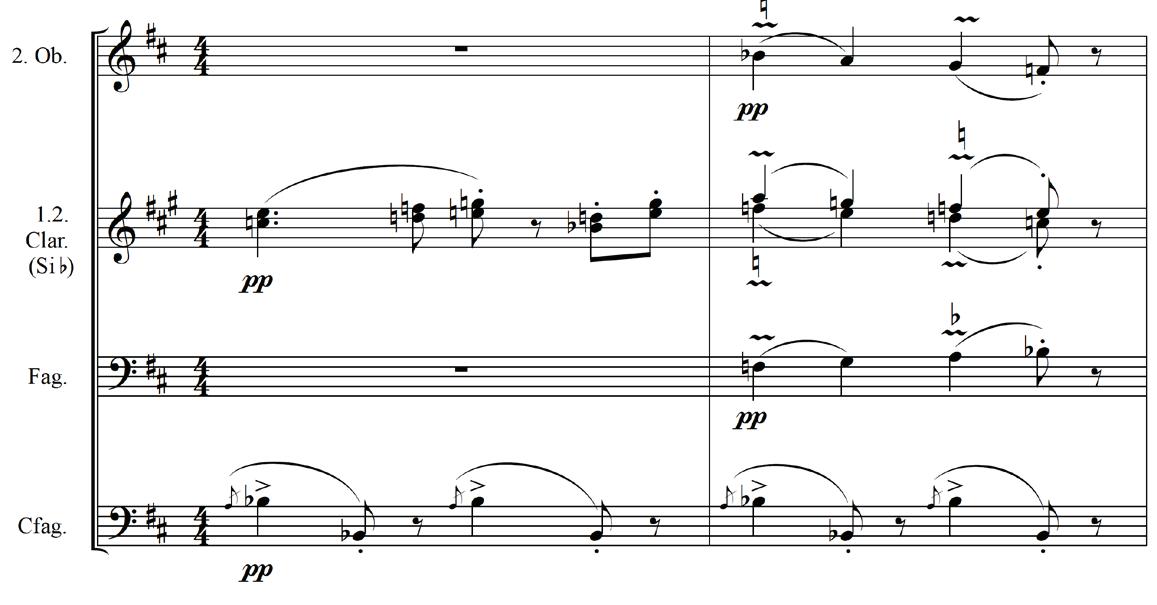
Example 9, Dances of Marosszék, bars 288–289.
Copyright by Universal Edition A. G. and Boosey & Hawkes Music Publishers Ltd.
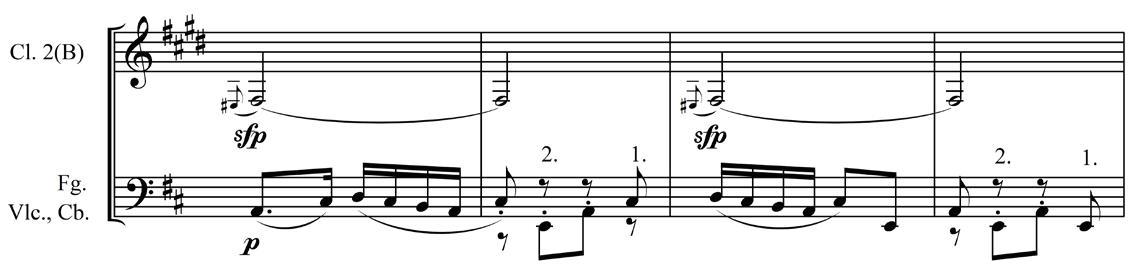
Example 10, Hungarian Rondo, bars 173-176.
© Copyright by Universal Music Publishing Editio Musica Budapest
42 Bálint Sárosi, “Hangszeres népzene Kodály műveiben: a Galántai és a Marosszéki táncok” [Instrumental Folk Music in Kodály’s Works: Dances of Galanta and Marosszék], Ethnographia 43/4 (1982): 521.
43 György Martin, “Legényes” [The Young Men’s Dance], in Magyar néprajzi lexikon, Vol. 3 ed. by Gyula Ortutay (Budapest: Akadémiai Kiadó, 1980), 431–434.
44 Kodály, Folk Music of Hungary, 139.
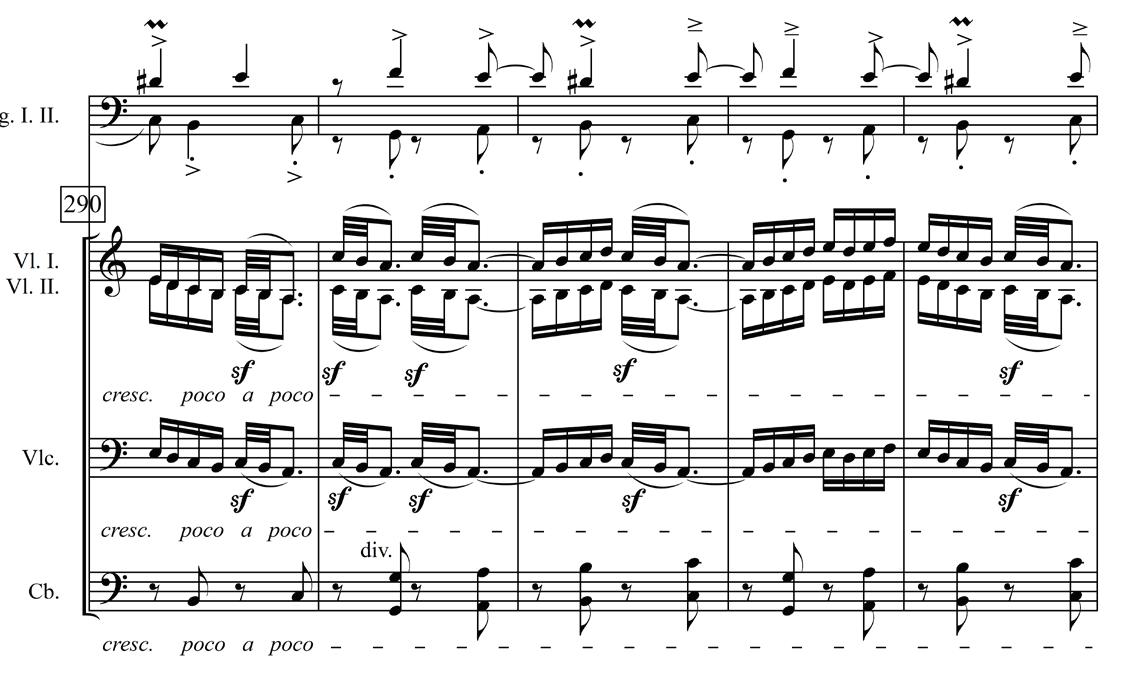
Example 11, Dances of Galanta, bars 290–294.
Copyright by Universal Edition A. G. and Boosey & Hawkes Music Publishers Ltd.
1950s, Kodály was irritated by his younger contemporaries’ fondness for the csűrdöngölő precisely because of its Western European origin.45 But he does not develop fully the drunken man’s dance in the csürdöngölő of the Hungarian Rondo, even if the regularly recurrent syncopation depicts the stumbling of the dancer’s legs.
The finale of Dances of Galánta treats the drunken man’s dance in more detail than the Dances of Marosszék does. Kodály begins the finale with syncopation, and even in other works such as the Kálló Double Dance seems to interpret the figure as a characteristic rhythmic element. The syncopation underlines the music’s rhythmic character. Although continuous syncopation echoes the sound of the accompanying instruments in folk ensembles, Kodály transforms this rhythmic figure into a key composing instrument, not only in the inner parts like the counterpoint created by the two bassoons (Example 11), but in the rhythmic slicing, which makes listeners wonder where the arsis should go. The syncopation is the drive behind the continuous modulation that marks the beginning of the finale.46
After this passage of uncertain tonality comes the motif of the drunken man’s dance. His stumbling is rendered by the acciaccaturas of the deep basses and the bumpy chords of the horns. The false sounds of the clarinet play not folk music, but a historical melody, 47 creating non-customary relations between the four tones: a diminished fourth and minor seventh intervals appear (Example 12). Although the clarinet theme is followed here by clear tonality, the emergence of an ecstatic dance is repeatedly interrupted, on the first occasion by the complete
45 As he formulated: “[Ferenc] Szabó, [Endre] Szervánszky, [Endre] Székely: cannot live without csürdöngölő, although I have shown that [it is the Gavotta styriaca]”, Kodály, Magyar zene, magyar nyelv, magyar vers, 69.
46 The modulation plan is the following: a minor–b minor–E major–e minor–d minor–B flat major.
47 Sárosi, “Hangszeres népzene Kodály műveiben,“ 517.
form of the drunken man’s dance (Example 13). Both the bumpy accompaniment and the strange motif sound off-key, and although the virtuoso dance melody emerges at the end, the apotheosis of the closing dance is hindered by the syncopated theme of the beginning of the finale and the “proud Hungarian” melody of the slow rondo theme.
Particularly important is that Kodály again uses a tune of German origin in the drunken man’s dance of the Dances of Galánta. 48 In the song Puciné (Mrs. Puci), published in the ninth volume of the Hungarian Folk Music series, which lauds drinking, Kodály “translates” the accompaniment into German with chords spread between the two hands. The song itself suggests West European relations by beginning in a major key. One remark written by Kodály makes clear his assumption that as soon as dance music originally based on vocal music, loses its relation to vocal music with text, it falls under the influence of alien elements and so begins to decline:
Instrumental csárdás, dance music, avoids a problem: the unification of text with music. By doing so, it rejects a handhold: the rhythm of the text. The music left free digresses. So long as it remains true to the spirit of the original rhythm, the result is a desirable enrichment. But strangenesses appear. The waltz from Vienna also shows up, and these csárdás dances, which are in fact disguised waltzes or polkas, by no means present further development of the csárdás, but rather a decline in it.49
So the drunken man’s dance projects an image of a declining culture—not as a burlesque scene, but as a nation’s tragedy. It is therefore useful to confront it with movements in which the songs are sung. Then the orchestra can play instrumentally decorated versions of the melodies as an accompaniment. Examples appear in the first and third movements of the Kálló Double Dance, the recruiting dance of Háry János and many numbers of the Spinning Room. The Ne búsuljon senki menyecskéje [No One’s Bride Should Yearn] song from the Spinning Room, which appeared in the ninth volume of Kodály’s Hungarian Folk Music series as well, is likewise special in this respect. Here it begins with a bass motif of acciaccaturas characteristic of the drunken man’s dance, while the accompaniment evokes West European models again by leaping from tonic to dominant. This “Westernization” ties in with the man strophe, but the drunken man’s dance is followed by a Hungarian dance interlude, in which the ornamented melody rests on the main tones of the folk song. This Hungarian theme accompanies the woman strophe (Example 14), and as alcoholism is not seen as a woman’s disease in peasant society, the dance loses its drunken character.50
48 János Bereczky et al., Kodály Zoltán népdalfeldolgozásainak dallam- és szövegforrásai [The Musical and Textual Sources of Zoltán Kodály’s Folk Song Arrangements] (Budapest: Zeneműkiadó, 1984), 186–191.,
49 Kodály, Magyar zene, magyar nyelv, magyar vers, 103.
50 Kodály, Voyage en Hongrie, [36].
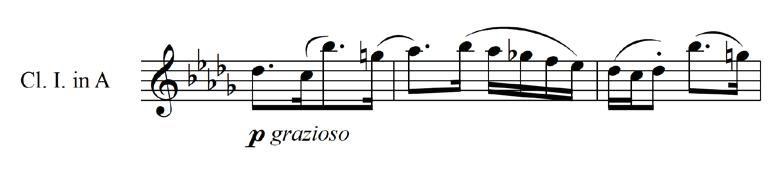
Example 12, Dances of Galanta, bars 346-348 (clarinet)
Copyright by Universal Edition A. G. and Boosey & Hawkes Music Publishers Ltd.
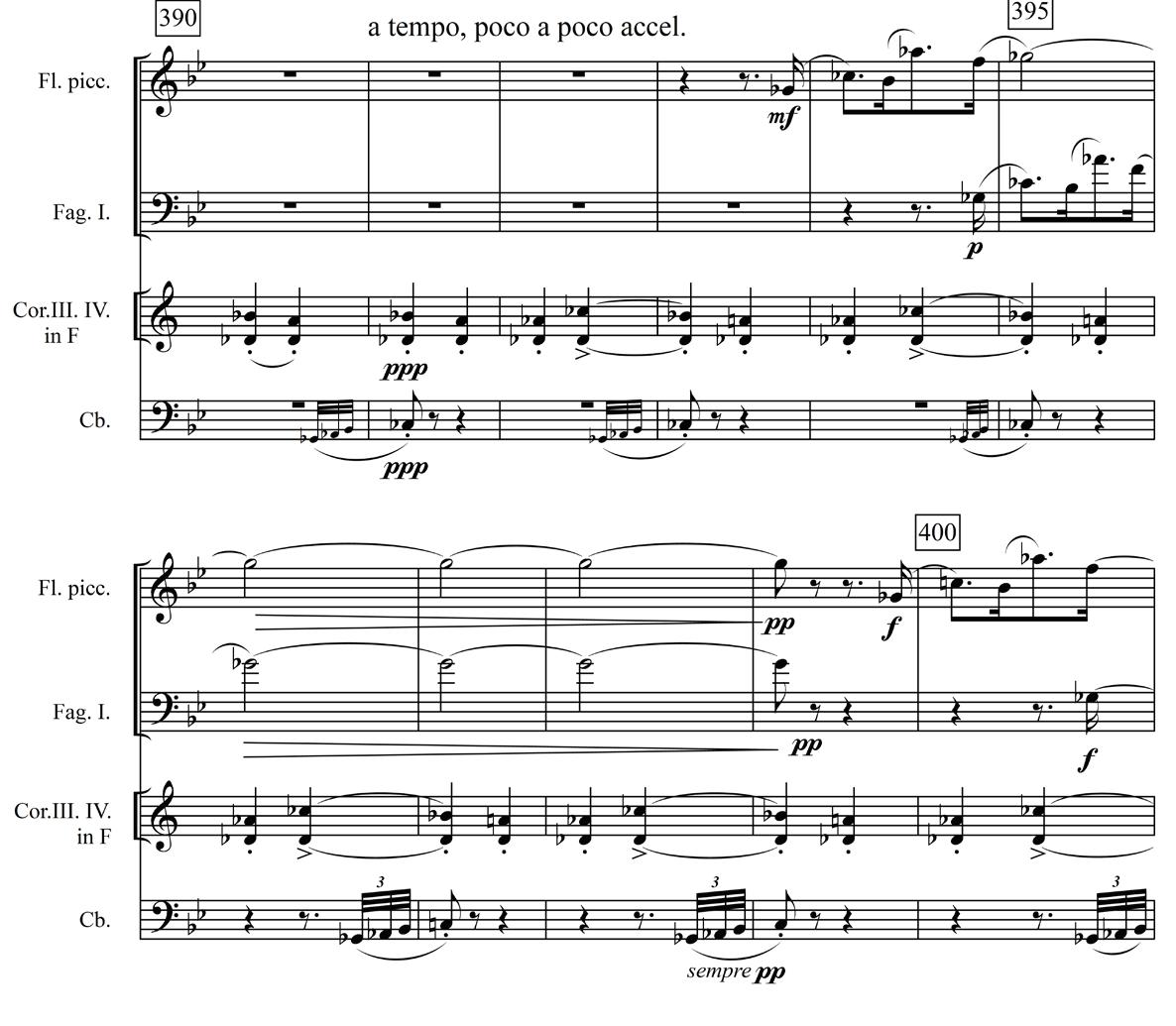
Example 13, Dances of Galanta, bars 390–400.
Copyright by Universal Edition A. G. and Boosey & Hawkes Music Publishers Ltd.
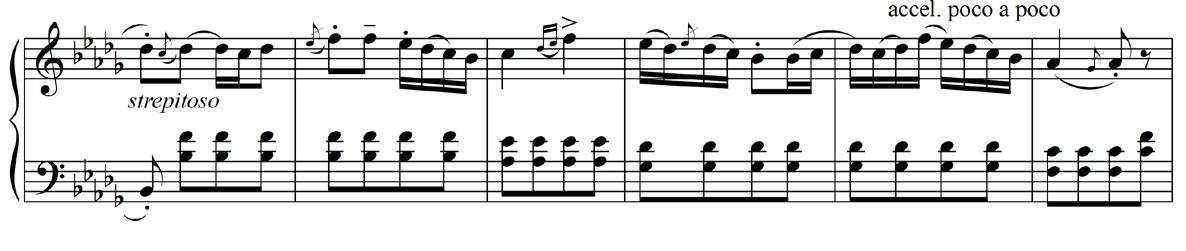
Example 14, Ne búsoljon senki menyecskéje, bars 16–21.
© Copyright by Universal Music Publishing Editio Musica Budapest
Kodály distinguished the rhythmic and melodic elements of music several times in his music. Back in 1906, when he published with Bartók twenty so-entitled Hungarian folk songs, he differentiated two song types in the preface:
In musical performance care must be taken with whether it is a dance song or a hallgató [a song for listening]. A dance song has even tempo, though its evenness slackens when no one dances to it. The performance of a hallgató is free, but exaggerated rubato appears only in performances by Gypsies. It is not known by peasants, or if so, the peasants have learned it from the Gypsies.51
Later, in 1921, in a preface to a joint publication with Bartók, Hungarians of Transylvania – Folks Songs, he secluded the two types of performance behind Italian instructions: tempo giusto and tempo rubato. 52 The types represented for Kodály the dual nature of music and music-making. Tempo giusto he saw as ever related to motion and dance, for as he put it in 1939, “The rhythm.... originates from the dance and brings with it the time and emphasis of ancient, instinctive motions.”53
The same idea is put forward in a remark about Bartók, written supposedly quite late, in 1953:
Rhythm was dominant in Bartók’s performance. This sometimes had a surprising effect in older, well-known compositions, not just in his own [works]. If the Russian ballet had not passed by him and had involved him in work on one or two commissions, we would see wonders today, and it is questionable whether Strav[insky] would have kept his monocracy.54
Therefore, the main characteristic of Bartók’s piano playing is rhythm. And it is precisely this rhythmic dominance, characteristic of Bartók’s works, that would have enabled Bartók, if he had written more ballets, to compete even with Stravinsky. But, what Kodály does not explicitly state in this note, might say even more than this: in contrast to Bartók, he, more than likely, wanted to be seen primarily as a melodic composer. What is more: in the early twenties, Bartók himself drew attention to the incomparability of Kodály’s melodic invention.55
However, the seeming contrast between the rhythmic Bartók and melodic Kodály distracts attention from the fact that contrasting rhythmic and melodic elements represent a decisive shaping principle in Kodály’s works. One basic way appears in the second volume of Kodály’s Hungarian Folk Music series, in the A rossz feleség (The Bad Wife).56 The song, with a double-variation form, alternates two scenes: a bad wife’s dance in a tavern and a suppliant melody from her daughter calling her mother home. Not only are the wife’s dance song and the girl’s mourning melody opposed, but
51 Zoltán Kodály, “Magyar népdalok énekhangra, zongorakísérettel. Jegyzetek“ [Hungarian Folks Songs for Voice and Piano Accompaniment. Notes], in Kodály, Visszatekintés III., 229. The notes are not published in the English edition of Kodály’s selected writings: “Hungarian Folksongs. Foreword”, in Kodály, The Selected Writings, 9–10.
52 Zoltán Kodály, “Erdélyi magyar népdalok. Előljáró beszéd” [Transylvanian Folk Songs. Foreword], in Kodály, Visszatekintés III., 288.
53 Zoltán Kodály, “Magyarság a zenében” [Hungarianness in Music], Kodály, in Visszatekintés II., 244.
54 Kodály, Magyar zene, magyar nyelv, magyar vers, 54.
55 As Bartók put it, Kodály has “A strong, broadly flowing melodic invention….”, Béla Bartók, “The Development of Art Music In Hungary”, The Chesterian, New Series 20 (January 1922) 101–107. See also: https://bartok-irasai.zti.hu/en/irasok/the-development-of-art-music-inhungary-2/ (last access: April 14, 2025).
56 See about this arrangement the study of László Vikárius: “A rossz feleség balladája” [The Bad Wife’s Ballad], Magyar Zene 46/3 (2008), 261–272. The orchestration of the ballad appears in Székely fonó as well.
Kodály inserts bagpipe music as an interlude between the two. This bagpipe music and the mother’s dance song are highly rhythmical ( Allegro con brio and strepitoso are Kodály’s instructions), whereas the girl’s mourning song is emphatically melodious (Lento, doloroso)
Kodály’s rondo-based orchestral dances rest on a contrast between rhythmic and melodic materials as well. Even the Hungarian Rondo using the Western csűrdöngölő has a melodic rondo theme, which alternates with rhythmic interludes. The same applies to Dances of Marosszék and Dances of Galanta: the melodious rondo themes aim to state authentic Hungarinness: the “voice of monumental heroism” or the character of “proud Hungarians.” Yet, the rhythmic finales and the drunken man’s dance show victory for the “rotten” rhythm over the “ideal” melody. The Dances of Galanta, as has been seen, reach a sublime climax in its ecstatic, rhythmic finale: the rondo theme occurs, as a moment of purification, shortly (bars 566–578).57
Kodály’s second singspiel The Spinning Room (1932) also consists of folk melodies and dance inserts—of alternate melodic and rhythmic sections, like an extended version of The Bad Wife. Kodály knew that his stage work was no traditional opera, and statements he made around the first performance in 1932 responded to critics’ comments on its structural alienation from operatic tradition. Critics missed the use of recitatives, and complained that Kodály inserted pantomime scenes in places where recitatives would usually further the plot. Yet Kodály had his own idea: “If the critics are disturbed by the pantomime, they should think about it: they are watching the act on stage, from a distance where pure words would not reach them, only the music and motion.”58
The Spinning Room’s structure (Table 3) clearly shows how “pure” melodic music appears on stage and when it turns to pantomime. Indeed Kodály labels the sections dominated by motion and rhythm as mummery or pantomime. In such mummeries he follows a more chromatic way of harmonization, and, at the same time, he works mainly with short motifs. The musical sections are clearly dominated by melody. The rhythmic, motion-induced parts, whether pantomime or mummery, represent the voice of the community and tie in mainly with the chorus’s performance. These sections seem strikingly insensitive to the emotions of the soloists, who express their feelings in melodic formulae that create the actual dramatic acts of the work. The melodic sections set out to present processes in the souls of the actors. This relates them primarily to the protagonists of the opera, such as the Housewife and her companion, the Fiancé.
57 There is a similar climax in the Hungarian Rondo and in the Serenade’s third movement.
58 Zoltán Kodály, “A Székely fonóról és az eljövendő magyar operáról. Nyilatkozat” [On Székely fonó and the Future Hungarian Opera. Statement], Kodály, Visszatekinéts III., 493.
Table 3, The stucture of Székely fonó
Scene Number Song Type
1. 1. [Orchtestral Prelude]
“Elmenyek, elmenyek”/duet Melodic
2. [A little girl runs in] Rhythmic – pantomime
A citrusfa/duet Melodic
2. House search Rhythmic – pantomime
“A citrusfa”/duet Melodic
3. 3. “Nekem olyan emberecske”/ women’s choir Rhythmic – dance
4. “Üres ládám”/women’s choir Rhythmic – dance, at the end: pantomime
5. “Szomorú fűzfának”/Housewife Melodic
6. “Én elmentem”/housewife Rhythmic – pantomime
4. 7. “Jók a leányok”/men’s and women’s choir Rhythmic – dance
8. Silent play Rhythmic – pantomime
5. 9. The Ballad of Ilona Görög 4 solos, women’s choir
Changeable:
A Melodic/Solo
B Rhythmic/women’s choir
A/B Melodic-Rhythmic/Solos + women’s choir
Av Melodic/Solos
C Rhythmic/Women’s Choir
A/C Melodic/Rhythmic/Solos + women’s choir
Av Melodic/Solos
D Melodic/women’s choir (lament)
A/D Melodic/solos + women’s choir
A Melodic/solos – a the end: dance
10. Pairing play
“Hess légy”/mixed choir Rhythmic – dance
10a “Te túl rózsám”/Housewife Melodic
6. 11. “Most jöttem”/The Flea Rhythmic – dance
12. “Egy nagyórú bolha”/mixed choir Rhythmic – dance (A bit drunk) – pantomime
13. “A csitári helyek alatt”/duet Melodic
14. Tempo di Marcia Rhythmic – pantomime
El kéne indulni”/The Flea Rhythmic (A bit drunk) – dance
15. “A rossz feleség”/ Housewife Rhythmic – dance
16. “Az hol én elmegyek”/Fiancé Melodic
17. Gendarmes Rhythmic – pantomime
7. 18. “A citrusfa” [recapitulation] Melodic – pantomime
19. “Tőlem a nap”/Housewife Melodic
20. Intermezzo Melodic – pantomime
21. “Jaj, de szépen”/Housewife, mixed choir
“Mondd meg rózsám”/duet “Én istenem”/mixed choir
A Rhythmic – dance
B Rhythmic – dance (with a transitional instrumental dance)
Av Rhythmic – dance
However, Kodály often combines rhythmic and melodic sections within certain scenes and numbers by playing them either successively or simultaneously. In this sense, the Ballad of Ilona Görög plays a central role in the singspiel. It functions as a drama within the drama, or rather a piece of theater within the theater. The text and melody of the ballad are heard from four soloists: the young man László Bertelaki, his mother, the young woman Ilona Görög, and her mother. Bertelaki’s mother, seeking to meet her son’s wishes, tries to attract Ilona with wondrous things. This she can ultimately achieve only by pretending her son is dead. Concurrently, Ilona’s mother tries to do her best to save her daughter from seduction. While the drama of the four takes place in a conversational, melodic form, the women’s chorus, in contrast to the dramatic events, sing their own numbers: the first two are dance songs that contrast the ballad’s melodiousness on the one hand, and the chorus’s insensibility on the other hand. However, when Bertelaki seemingly dies, the choir starts to sing a mourning song, as if the sole emotional state the community can manage is an act of mourning.
The scene ends in slow dance music that representing the tone of the heroic character, “proud Hungarian.”
The regular sections of rhythmic dancing and melodic emotion are combined in other cases too, for example in the Housewife’s song, Kitrákotty mese (Cocricoo). According to the score instructions, the Housewife must tell a little girl a story, in which various pets must be bought at the fair. This is the one time in the whole work when the Housewife descends from the sphere of her sensitive soul to the realities of life, for the sake of a child. Here she starts dancing and accompanies her pantomime with a remarkably rhythmic and dance-like song of her own. Performances of The Spinning Room usually apply ballet dancers to this scene, though Kodály himself was surprised by the solution, as a statement he made before the 1933 La Scala première of The Spinning Room indicates.59
The last two pantomime scenes in the singspiel move in the opposite direction. Here dance music is accompanied by powerful melodic gestures. Kodály recalls the folk song A Citrusfa (The Lime Tree) from the beginning of the singspiel for the orchestra at No. 18, and the choir accompanies it with sighs of mourning. After the Housewife’s lamentation (No. 19), the orchestral intermezzo uses passionate melodies to represent the soul of the lonely heroine. It is as if the Housewife can no longer find words and melodies to express her feelings, and the motions will not suffice to do so either. Music for its own sake—one might say “absolute music”—takes over the rhythmical motion and melody. This, as Kodály put it, amounts to the “the whole life of Hungarians, which must be present in the music.” Yet the more valuable side of Hungarinness can only be expressed in music that is detached from rhythmic and melodic concepts.
59 When writing about the elderly choreographer, Giovanni Pratesi, Kodály calls him “a small, gray-haired mannekin, who bounces, dances and yells all day. The song about the fair is here played by ballet dancers. But no one could do it so gorgeously as Pratesi does. He shows them how to do it. He understands everything immediately, so I hope that the dances will be perfect.” Zoltán Kodály, “A Székely fonó milánói bemutatója előtt. Nyilatkozat” [Before the First Performance of Székely fonó in Milan. Statemen], in Kodály, Visszatekintés III.,500.