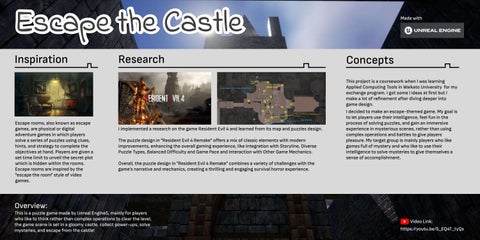
Escape rooms, also known as escape games, are physical or digital adventure games in which players solve a series of puzzles using clues, hints, and strategy to complete the objectives at hand. Players are given a set time limit to unveil the secret plot which is hidden within the rooms. Escape rooms are inspired by the "escape the room" style of video games.
Research
I implemented a research on the game Resident Evil 4 and learned from its map and puzzles design.
The puzzle design in "Resident Evil 4 Remake" offers a mix of classic elements with modern improvements, enhancing the overall gaming experience, like Integration with Storyline, Diverse Puzzle Types, Balanced Difficulty and Game Pace and Interaction with Other Game Mechanics.
Overall, the puzzle design in "Resident Evil 4 Remake" combines a variety of challenges with the game's narrative and mechanics, creating a thrilling and engaging survival horror experience.
Concepts
This project is a coursework when I was learning Applied Computing Tools in Waikato University for my exchange program. I got some I ideas at first but I make a lot of refinement after diving deeper into game design.
I decided to make an escape-themed game. My goal is to let players use their intelligence, feel fun in the process of solving puzzles, and gain an immersive experience in mysterious scenes, rather than using complex operations and battles to give players pleasure. My target group is mainly players who like games full of mystery and who like to use their intelligence to solve mysteries to give themselves a sense of accomplishment.
Overview:
This is a puzzle game made by Unreal Engine5, mainly for players who like to think rather than complex operations to clear the level, the game scene is set in a gloomy castle, collect power-ups, solve mysteries, and escape from the castle! Video
Game Flow
Level Design
Born in a cell of a mysterious castle
Level 1
Solve two puzzles to open the gate
See exit but missing wound to escape Found you just get back in front of the exit
Level 2
Solve three puzzles to get the wound Cast magic using the wound and escape
Sketches
For the first level I implemented a indirect door puzzle,plyer should go one way first to open the door of the room, and this will block the way you came, players should go forward along the way back to the puzzle room, solve the puzzle and open the door to next level.
Regarding the second level, I adopted a closed-loop design, that is, after the player comes out of the cell, there is only one way to go, but after solving various puzzles, the player will circle back to the place where he just came out of the cell. This design can give player a sense of surprise and make the entire level appear more unified.
Puzzles Design
The types of puzzles include picking up items and interacting, triggering mechanisms in a specific order to open iron doors, light certain flames to activate the switch, moving blocks to specific locations to allow players to move forward, and also include elevators and cut scenes. The first puzzle allows the player to obtain items and then interact with the scene. The player is born in a cell and needs to find the key and use it to open the iron door of the cell.
I designed a combination puzzle that requires player to stand on three gold blocks in order and light the flame to open the iron door. Regarding the interaction method and lighting sequence, I set up two prompts in the room. They are to use several cylinders to simulate "wires" connected from the bottom of each gold nugget to the level exit to let players know what needs to be done on the gold nugget. And the number of torches on the wall corresponds to the order of interaction.
Blue Prints
After player come out of the cell, they will take the elevator to the upper level
The most complicated combination puzzle blue print
Level blue print
Cut scene blue print
Block moving puzzle
Light puzzle
Block turning puzzle
Scenes
Firstly I decided to use the terrain brush and the material that already had in UE to create a large and vivid terrain, and I changed the color of the ambient light to make it darker, while reducing the brightness of the overall environment. This is to increase the mystery of the scene and make player more immersed in the game. I used a terrain brush to draw a circle of mountains around it, and used the "water" plug-in in UE5 to create rivers and lakes.
Cut scene sequencer
Some open walls to show player destination
Fog effects to create mystique
Text instructions and sign objects for mentioning player
Reflection
Regarding the advantages, my scene design is relatively vivid, with mysterious ambient light and ancient style, giving players an immersive gaming experience. The closed-loop design of the castle is very continuous, and the selection of materials is consistent, which makes the entire level appear complete and unified.
Regarding the shortcomings, I could have designed some puzzles to be more interactive, but I encountered a lot of difficulties when editing the blueprint. Since I couldn't solve it and I didn't have much time, I could only simplify my interactions in some puzzles.
About the game future, more levels can be implemented to the game, and I think some stories can also be put into the game to create experience. Meanwhile, offer player more choice of escaping the castle is also a good idea.
And I also did a lot of refinements on puzzle types, level depth, instructions and arts.
https://youtu.be/-7V1ZbhadqA
https://eglow.itch.io/bullet-dash
TheRenaissance Storm
Overview
This is a lightweight German board game based on the background of the Renaissance, in addition to the historical background of the display, it also contains the real market operation link, I want to let players understand the macro market through this game, and convey the economic concept of win-win cooperation.
Base Info
TYPE of Play: Board Game
Position: Designer
Players Number(most): 4
Contents: Map*1
Gold Token*50
Other Token*10
Card*49
Event list*1
Inspiration
The Renaissance period, spanning from the 14th to the 17th century, was a time of significant cultural, artistic, and intellectual revival in Europe. It was also a period of important developments in trade
Research
Tarot cards are renowned for their unique and intricate artistic styles, which often feature detailed illustrations that are rich in symbolism. Each card's artwork is carefully crafted to represent abstract concepts, emotions, or situations, allowing for a broad spectrum of interpretations.
I’m going to use the Tarot cards‘ art style
I planned to gain ideas and learn from a light-weight but very classic German board game, “Splendor”.
I drew a flow chart for this board game(upper right figure) and found that "Splendor" is praised for its simple rules and quick learning curve, making it accessible for new players to jump right into the game.
Despite its simplicity, "Splendor" offers strategic decision-making through card-driven and set collection mechanics, providing players with meaningful choices and strategic planning.
Meanwhile, the game features exquisite artwork and high-quality gem tokens, offering both visual and tactile enjoyment.
"Splendor" has high replay value, as each game can offer different strategies and outcomes, keeping the game fresh and engaging. The game maintains a good balance among different types of gems, ensuring that no single gem becomes too dominant in any given game, which keeps the competition fair and the gameplay balanced.
Renaissance
Iteration
Objective: Players aim to accumulate prestige to win, gained through career cards.
Starting Resources: Each player begins with a limited amount of money (up to 6 coins) and a chosen role (e.g., artist, architect, scientist).
Resource Management: Players acquire resources like water, wood, stone, and metal to advance their careers, with restrictions on acquisition.
Talent Recruitment: Players hire talents with various abilities, which costs money.
Finding in test:
The game embodies a certain degree of strategy, but lacks the interaction between players, so that players are independent and complete tasks with others, lacking game and fun
Too many card slots give players too much room to choose, lack a certain randomness and a sense of surprise in the game, which not only lengthens the game time but also makes the game plodding.
Version2
Rules:
Resource Cards: Each player starts with five random resource cards, keeps two, and places three in their market
evelopment Cards: Players buy these with resources and get three coins in return
Trading: Resource cards can be traded one for one or bought with two, three, or four cards
Inflation: The cost of resource cards might double due to inflation
Coin Management: Players must manage their coin spaces, which could affect their wealth
Career Advancement: Players attract people and gain reputation to progress in their careers
Market Management: Players need to manage their market space effectively
Public Market: Players can draw and place cards in the public market to influence their own market
Reputation: Gained by attracting people and advancing in careers, it s a key to winning the game.
Finging in test:
The strategy of exchanging gold coins for resources makes the game too linear, lacks some changes in the game process, and weakens the role of resource cards, which will also make players feel that the game is too complicated; At the same time, with the addition of more markets and coin mechanics, the lack of strategy was also exposed, and the game needed more game content to increase its playability
The improved flow has more breadth, allowing players to have multiple options in a single turn, each with its own unique role. The whole game flow is rich and interesting
The final rules contain several new things like restriction on trading cards, more ways of using money and some extra rule to provide player more thought.
Final Rules:
In the final version, players are allowed to hold some resources cards in their hands and other players can not see the cards. Players can decide which cards or coins to be put in their private market.
Player can choose do one thing to do in their round from these two: turn over a card on public market and get 1 coin, trade at most two cards from private market(including self-market).
When trading cards, player should follow these rules:
1. Each player can only trade at most two cards for ordinary trade.
2. Each market can only have 1 card to be trade.
3. Coins or Same resource can only trade one type of resource.
4. Only the cards and coins in players hands can be used for trade.
(These rules added strategy to game and made the game more fun)
About coins:
The coin token in market will be considered as a resource card for trade.
Player’s coins should be listed beside their development cards below their private market.
If a player owned 5 or more coins at a time(including the coins in market), then it will be considered as inflation, next player can draw a cards from his hands or take a card from his market if he do not have cards in his hands.
When doing super trade, players can ues 3 coins as a substitution for at most 1 resource.
About development cards & Character cards:
If you want to buy a development card or character card from public market, it should be opened, and you have to trade corresponding resources on the card. This will be considered a spuer trade and their is no limit on the number of the resources.
(Take the card you want to trade first means you started the super trade, will )
If player owns 4 development card at a time, that player must buy at least 1 character cards to run the industry, or that player can not buy more development cards.
Public market
Development Cards
MAP & Resource Cards
The entire game map consists of a public market and a private market for each player, which is used to store the total library and cards drawn by the players, and a private market for the goods that each player wants to trade, and the actions of each player each turn are also closely related to the market .
Coin, wood,water and metal are the resource for user to buy development cards and trade other resources.However, coins and other three resource have different usage.
Game Art
Collecting development cards are the basic way for players to reach the winning condition.Each development card has its own point bonuses and different resource requirements, and the development card borrows from the art style of tarot cards, making it more fantastical while retaining the overall style of the Renaissance simplicity and elegance.
Private market
Character cards
A secondary way of reaching the winning condition. All chacacters have different resource requirements for palyer to invite them, and they can give player massive increase on their points. They are designed normally for the mid-to-late game. And the cards have pure color background to highlight the characters.
Testing GameArt
Start: Players draw cards and gain coins from public market as the accumulation of their resources.
Earlier stage: Every player can buy or trade at most two cards each round. The card trade follows a certain rule, players should make decisions wisely about their deals.
Middle Stage: Players gradually get their direction of trading and gain few development cards. All coins and development cads should be put and show right under players’ private market. And there are other rules like Inflation: player who owns 5 or more coins should let the player on the right draw a resource card from your hand since your good have lost value.
End Stage: Players buy character card using more resource and gain more points. The game end after a player reach 15 points,
Warriors’ Treasure
Warriors’ Treasure
2D Platformer RPG Game
Inspiration
Flow Chart
A warrior is looking for ancient treasure on the floating island, it is said that whoever obtains the treasure on that island will gain the power to become the mightiest hero across the entire continent. The brave man go across the plain, forest and hive, and finally reaches the floating island...
In parkour, experienced traceurs can use friction to quickly jump back and forth between two walls to reach higher places, which is also the origin of my game's core mechanicswall sliding and wall jumping.
After multiple refinement I developed a looped flow chart.
Video Link: https://youtu.be/ymGWZnPmIoM
Play Online: https://eglow.itch.io/warriors-treasure
Made with:
A castle build on a high island above, which is my game’s final destination.
Research
“Monster Snctuary” level design focuses on exploration and combat.
"Celeste" features challenging level design, with each level containing multiple sections.
Level Design
Plains Level:
The first plain level provides basic operation instructions. The level is very basic, helping players get familiar with moving, jumping, and wall-jumping operations.
The second plain level has a slightly increased difficulty, with steps, floating stones, and giant trees included in the scene. Players need to flexibly use the wall-jump technique to pass the level along a limited route.
Forest Level:
The difficulty of the jungle level is further increased, requiring players to make precise, consecutive jumps to avoid thorns and enter the next level. The map has a strong coherence, and players need to plan their subsequent actions in advance while jumping.
Hive Level:
This level is set inside a massive beehive, presenting players with a spatial challenge. Design: The level design requires players to make precise jumps and dodges within tight spaces, while also dealing with the spikes found within the beehive.
Float Island level:
This level is the final stage of the game, where players need to continuously perform wall-jumps to climb upwards. The difficulty mainly stems from the need for players to have precise control over the rhythm and the endurance required for repetitive actions. After completing a series of maneuvers, the player will obtain the coveted warrior's treasure.
Small Levels
Player's normal jump path will be blocked, and the wall jump mechanism will need to be used reasonably to pass the level
Sometimes the jump path above is blocked, and the player can move down to a specific position by sliding the wall and walljump to a new platform
Code Small Levels
Player need to control the direction of their descent while freefalling, while timing to pick up a wall in the other direction, while quickly jumping back onto the platform before the character slides to the lowest position
Each time the player hits the "mushroom", it will be ejected to a higher position, and the player needs to accurately control the impact amplitude and the trajectory of the character's movement when it is ejected into the air, this new mechanic and the movement of the wearing amplitude are different from the previous levels, giving players a new experience and freshness
Move & Jump
Wall Slide
Judge if the player is on the wall by a specific area attach to player, if on the wall, trigger the animation and reduce its gravity to make it slide on the wall.
Save point
Press E to interact with save point rock and it will change the picture on the rock. And all the data will be saved to an array in this scene.
Game Future
After After the first version of the game was completed, I invited some classmates to test it. After trial play and feedback from other game design major classmates, the main directions for optimizing my game are:
1. The core gameplay of wall-jumping operation logic. If the left and right movement keys are held down continuously in the air during a jump, it will affect the direction of the jump; when jumping, players need to hold down the left and right direction keys to cling to a wall, but the jump is default in the opposite direction, and there is no need to switch direction
2. The art needs to be more reasonable and rich. Some art makes it difficult for players to distinguish between the background and the platform; the background art needs to be
3. The level mechanisms need to be diversified. More mechanisms can be added to enrich