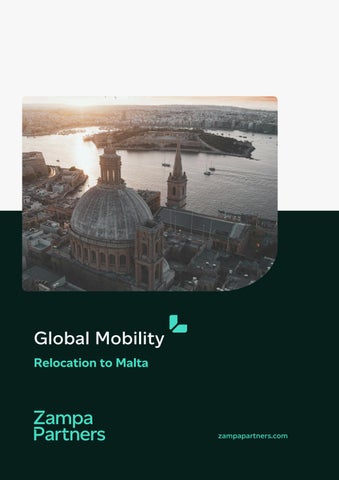
Global Mobility Relocation to Malta
zampapartners.com
2
Table of Contents Chapter 01
04
Relocation to Malta Chapter 02
26
Living in Malta: practical considerations Chapter 03
32
How we support you
3
Global Mobility
Chapter 01
Residence, tax & relocation guide Why Malta? Malta has established itself as a leading destination for internationally mobile individuals seeking a stable and accessible European base. Combining EU membership, a favourable tax framework, and a high quality of life, Malta continues to attract entrepreneurs, retirees, remote workers, investors and families from around the world. The resident non-domiciled tax regime Malta’s resident non-domiciled tax regime is one of the most attractive in Europe. It allows individuals who are tax residents but not domiciled in Malta to benefit from a remittance-based taxation system. Here’s how it works: Foreign income is only taxed if remitted to Malta. Foreign capital gains are not subject to tax, even if brought into Malta. Local income and capital gains are taxed at standard progressive rates (up to 35%). A minimum annual tax of €5,000 applies only if foreign income exceeds €35,000. Unlike other jurisdictions such as the UK, Malta does not impose deemed domicile rules, meaning individuals can retain their non-domiciled status indefinitely. Malta’s tax regime is complemented by other financial and legal advantages: No wealth, inheritance, or gift taxes. No tax on foreign income kept abroad. Extensive double taxation treaty network with over 70 countries, including the US, UK, and most EU states. No obligation to declare foreign assets. This handbook provides an overview of Malta's principal residence programmes and the tax and practical considerations associated with relocating to Malta.
4
It is intended for: High-net-worth individuals seeking residence solutions within the European Union; Retirees considering Malta as a long-term residence destination; Remote workers and internationally mobile professionals; Entrepreneurs and founders seeking to establish or expand business operations in Malta. Flexible residency options Malta offers several residency pathways tailored to different profiles: The Global Residence Programme for non-EU nationals. The Residence Programme for EU/EEA/Swiss nationals. The Malta Retirement Programme for applicants whose main source of income is a pension. The United Nations Pensions Programme (UNPP) for recipients of a United Nations pension. The Highly Skilled Individuals Rules for the taxation of highly skilled professionals. Nomad Residence Permit for remote professionals. The Startup Residence Programme for international entrepreneurs. Key advantages European Union and Schengen Membership – Access to the EU single market and visa-free travel within the Schengen Area. English-speaking environment – English is an official language and widely used in business, education and public administration. Established business environment – A well-regulated jurisdiction with a strong professional services sector and a pro-business outlook. Attractive tax framework – Malta offers a remittance basis of taxation for eligible non-domiciled individuals, an extensive double tax treaty network and a number of special residence programmes. High quality of life – A Mediterranean lifestyle supported by quality healthcare, international schools and modern infrastructure. Strategic location – Situated at the crossroads of Europe, North Africa and the Middle East. Diversified economy – Strong growth across financial services, technology, fintech, gaming and professional services sectors.
5
Global Mobility
Scope This handbook covers: Malta's principal residence programmes. Practical aspects of living in Malta. How Zampa Partners can support clients throughout the relocation process.
6
Malta residence programmes Malta’s residence framework includes a range of routes designed for different categories of internationally mobile individuals. Some applicants may relocate under ordinary residence rules, while others may benefit from a dedicated programme offering special tax status, a specific employment-based regime, or a residence route tailored to remote workers, retirees, entrepreneurs or highly skilled professionals. The choice of programme should therefore be assessed considering the applicant’s nationality, income profile, family circumstances, property plans and long-term relocation objectives.
Malta’s Global Residence Programme (GRP) Malta offers a structured pathway to residence through The Global Residence Programme (GRP), tailored for non-EU nationals seeking to establish residence in a European Union Member State within an efficient tax framework. Key features Validity and renewability: Has no fixed expiry and remains valid indefinitely as long as all eligibility conditions are met. Favourable tax regime: 15% flat tax on foreign income remitted to Malta. Minimum tax: €15,000 per annum Schengen access: Short-term travel within the Schengen Area (up to 90 days within any 180‑day period). Family inclusion: Dependants may be included under a single application. Note: Dependants include the beneficiary’s spouse, minor children, and children who are not minors but who because of the circumstances of illness or disability of serious gravity, are unable to maintain themselves. Eligibility criteria The programme is open to: Non‑EU, non‑EEA, and non‑Swiss nationals. Individuals who are financially self-sufficient.
7
Global Mobility
Property requirements Applicants must hold a qualifying property under one of the following options: Purchase: from €275,000 (or €220,000 in South Malta/Gozo). Rental: from €9,600 per year (or €8,750 in South Malta/Gozo). Tax treatment The GRP operates on a remittance-based taxation system: 15% flat tax on foreign income of the beneficiary or his/her dependants remitted to Malta. Minimum annual tax of €15,000 per beneficiary and his/her dependants. Income arising in Malta is taxed at the standard rate of 35%. Application and renewal fees A non-refundable administrative fee needs to be paid in respect of any application for special tax status in terms of The Global Residence Programme by means of a bank draft payable to the Commissioner for Revenue. The administrative fee is that of €6,000 except where the qualifying owned property is situated in the south of Malta, in which case the administrative fee is that of €5,500.
8
Malta’s Residence Programme (RP) Malta offers a structured pathway to residence through The Residence Programme (RP), tailored for EU, EEA, and Swiss nationals seeking to establish residence in a European Union Member State within an efficient tax framework. Key features Validity and renewability: Has no fixed expiry and remains valid indefinitely as long as all eligibility conditions are met. Favourable taxation: 15% flat tax on foreign income remitted to Malta. Minimum tax: €15,000 per annum. Family inclusion: Dependants may be included under a single application. Note: Dependants include the beneficiary’s spouse, minor children, and children who are not minors but who because of the circumstances of illness or disability of serious gravity, are unable to maintain themselves. Eligibility criteria The programme is specifically aimed at: EU, EEA, or Swiss nationals. Applicants who are financially self-sufficient.
9
Global Mobility
Property requirements Applicants must hold a qualifying property under one of the following options: Purchase: from €275,000 (or €220,000 in South Malta/Gozo). Rental: from €9,600 per year (or €8,750 in South Malta/Gozo). Tax treatment The RP operates under Malta’s remittance-based taxation system, offering: 15% flat tax on foreign income of the beneficiary or his/her dependants remitted to Malta. Minimum annual tax of €15,000 per beneficiary and his/her dependants. Income arising in Malta is taxed at the standard rate of 35%. Application and renewal fees A non-refundable administrative fee needs to be paid in respect of any application for special tax status in terms of The Residence Programme by means of a bank draft payable to the Commissioner for Revenue. The administrative fee is that of €6,000 except where the qualifying owned property is situated in the south of Malta, in which case the administrative fee is that of €5,500.
10
Malta’s Retirement Programme (MRP) The Malta Retirement Programme (MRP) offers retirees whose primary source of income is a pension, the opportunity to establish residence in Malta and benefit from an attractive tax framework. It provides a structured route to residency within a stable EU jurisdiction. Key features Validity and renewability: Has no fixed expiry and remains valid indefinitely as long as all eligibility conditions are met. Favourable taxation: 15% flat tax on foreign pension income remitted to Malta. Minimum tax: €7,500 per annum for the main applicant (+ €500 per dependent). Schengen access: Short-term travel within the Schengen Area (90 days within any 180‑day period). Family inclusion: Dependants may be included under a single application. Note: Dependants include the beneficiary’s spouse, minor children, and children who are not minors but who because of the circumstances of illness or disability of serious gravity, are unable to maintain themselves. Eligibility criteria The programme is specifically aimed at: EU, EEA, Swiss, and non‑EU nationals. Applicants must show financial self-sufficiency. Pension must constitute at least 75% of total chargeable income. Property requirements Applicants must hold a qualifying property under one of the following options: Purchase: from €275,000 (or €220,000 in South Malta/Gozo). Rental: from €9,600 per year (or €8,750 in South Malta/Gozo).
11
Global Mobility
Tax treatment The MRP operates under Malta’s remittance-based taxation system, specifically tailored to pension income: 15% flat tax on any foreign income remitted to Malta by the beneficiary or his/her dependants. Minimum annual tax of €7,500 (+ €500 for every dependent). Income arising in Malta is taxed at the standard rate of 35%. Application and renewal fees A non-refundable administrative fee of €2,500 needs to be paid upon application by means of a bank draft or cheque issued by the ARM payable to the Commissioner for Revenue.
12
Malta’s United Nations Pensions Programme (UNPP) The United Nations Pensions Programme (UNPP) offers a dedicated residence and tax framework in Malta for recipients of a United Nations pension or widow’s/widower’s Benefit. The programme provides an attractive tax treatment whilst allowing beneficiaries to establish their principal residence in Malta. Key features Validity and renewability: The special tax status remains valid provided all programme conditions continue to be satisfied. Special tax status: Applicants must receive at least 40% of their pension income in Malta. Favourable taxation: 15% flat tax on foreign-source income (excluding qualifying UN pension income) remitted to Malta. Minimum tax: €10,000 per annum for the main beneficiary and an additional €5,000 where both spouses receive a UN pension. Schengen access: Short‑term travel within the Schengen Area (90 days within any 180‑day period). Family inclusion: Dependants may be included under the same application. Note: Dependants include beneficiary's spouse, children who are over the age of 18 but under the age of 25, including adopted children and children who are in the care and custody of the beneficiary, the beneficiary’s spouse or the person with whom the beneficiary is in a stable and durable relationship, who are not economically active; and brothers, sisters and direct relatives in the ascending line of the beneficiary. Eligibility requirements To qualify for the programme, an applicant must: Be in receipt of a UN pension or Widow’s/Widower’s Benefit, with at least 40% received in Malta. Show financial self-sufficiency. Clean criminal record and successful due diligence. Not benefit from other Malta residence and tax programmes. Maintain comprehensive health insurance. Be a fit and proper person.
13
Global Mobility
Property requirements Applicants must hold a qualifying property under one of the following options: Purchase: from €275,000 (or €220,000 in the south of Malta/Gozo). Rental: from €9,600 per year (or €8,750 in the south of Malta/Gozo). Tax treatment An individual who has been granted special tax status shall be exempt from income tax on UN pension or widow’s/widower’s benefit received in Malta. 15% flat tax on foreign-source income (excluding qualifying UN pension income) received by the beneficiary. Dependants will be charged to tax separately at the normal rates as per Article 56 of Malta’s income Tax Act. Minimum annual tax of €10,000 for the main beneficiary and an additional €5,000 where both spouses receive a UN pension. Income arising in Malta is taxed at the standard rate of 35%. Application and renewal fees A non-refundable administrative fee of €4,000 needs to be paid upon application by means of a bank draft or cheque issued by the ARM payable to the Commissioner for Revenue. Applications in respect of which the qualifying property is a qualifying owned property situated in the south of Malta or Gozo, the non-refundable administrative fee shall be that of €3,500. Note: The Global Residence Programme, The Residence Programme, The Malta Retirement Programme, and The United Nations Pensions Programme will remain available for applications until 31 December 2026, with beneficiaries retaining their special tax status until 2031. Thereafter, any renewals of the status will be subject to the provisions of the new Individual Tax Programme.
14
15
Global Mobility
Malta’s new Individual Tax Programme Effective from 1 January 2027, Malta's new Individual Tax Programme (ITP) introduces a consolidated tax residence framework for individuals seeking to relocate to Malta. The programme brings together a number of existing residence schemes under a single legislative framework and offers eligible applicants the opportunity to obtain special tax status and benefit from a preferential tax regime. Key features A 15% flat tax rate: On foreign-source income remitted to Malta. Minimum annual tax: Liabilities ranging from €15,000 to €35,000, depending on the applicable status category. Family inclusion: Eligible dependants may be included under the same application. Schengen access: Short‑term travel within the Schengen Area (90 days within any 180‑day period). Validity and renewability: Runs for a fixed five-year term from the appointed day, renewable for further five-year periods as long as all eligibility conditions are met. Who can apply? The programme is designed for foreign individuals establishing Malta as their principal place of residence and provides four categories of special tax status: Global Resident Status (non-EU, non-EEA and non-Swiss nationals) EU/EEA/Swiss Resident Status (EU, EEA and Swiss nationals) Retired Pensioner Status UN Pensioner Status
16
Eligibility requirements Applicants must satisfy a number of conditions, including: Hold a qualifying residential property in Malta: purchase value: minimum €700,000 annual rental value: minimum €14,000 Maintain valid health insurance covering risks normally covered for Maltese nationals throughout the European Union. Demonstrate sufficient stable and regular financial resources to support themselves and their dependants. Hold a valid travel document. Be able to communicate adequately in one of Malta's official languages. Confirm that they are not domiciled in Malta and do not intend to establish domicile in Malta within five years of the application. Tax treatment The Individual Tax Programme operates on Malta's remittance basis of taxation, whereby foreign-source income is taxed only when received in Malta. Under the programme: Foreign-source income remitted to Malta is subject to tax at a flat rate of 15%. Malta-source income remains taxable at the standard rate of 35%. A minimum annual tax liability applies, depending on the relevant status category. STATUS CATEGORY
MINIMUM ANNUAL TAX
Global Resident Status
€35,000
EU/EEA/Swiss Resident Status
€35,000
Retired Pensioner Status
€15,000
UN Pensioner Status
€20,000
17
Global Mobility
Transitional provisions The Individual Tax Programme will come into force on 1 January 2027. Until 31 December 2026, the existing residence programmes, namely the Global Residence Programme (GRP), Residence Programme (RP), Malta Retirement Programme (MRP) and United Nations Pensions Programme (UNPP), will remain in force and will continue to apply until 2031. Thereafter, any renewal of that status will be required to be made under the ITP. From 1 January 2027, new applicants seeking to benefit from a special tax status in Malta will be required to apply under the Individual Tax Programme, subject to the applicable eligibility criteria and conditions. This transitional period provides prospective applicants and advisers with an opportunity to assess the most suitable route based on their circumstances before the new consolidated framework becomes fully operative. Application and renewal fees The non-refundable administrative fee shall amount to €8,500. Any application for renewal shall be submitted to the Commissioner, in such form and accompanied by such documents as the Commissioner may require and by paying a non-refundable administrative fee of €2,500 upon application. Conclusion The ITP introduces a more unified approach to Malta's residence-based tax regimes, whilst preserving many of the features that have made Malta an attractive destination for international individuals and families. As the new framework takes shape, understanding the eligibility requirements and long-term implications of each option will be key to making an informed relocation decision.
18
Highly Skilled Individuals The Highly Skilled Individuals Rules introduce a consolidated framework for the taxation of highly skilled professionals, aimed at attracting talent to Malta, covering a range of sectors, including financial services, gaming, aviation, maritime, offshore oil and gas, family offices, healthcare, and STEM. Key features Favourable taxation: 15% flat tax on qualifying employment income derived from an eligible office. Validity and renewability: Initial benefit period of 5 years, extendable twice for further 5‑year periods (up to 15 years in total). Eligibility criteria The regime is available to: EU, non-EU, EEA, or Swiss nationals. Individuals who possess the requisite professional qualifications, generally evidenced by a post-secondary qualification of at least three years’ duration or, where permitted, five years of comparable professional experience. Occupy senior or specialised roles within regulated or recognised sectors with a minimum annual income of €65,000, exclusive of fringe benefits, increased by €10,000 every 5 years. Tax treatment The 15% rate applies without the possibility of claiming deductions, credits, reductions or set-offs, except for deductions permitted under Article 23 of the Income Tax Management Act. Applies to income up to €7,000,000, with any excess taxed at standard rates. The preferential rate applies only where the income is fully and correctly declared.
19
Global Mobility
Nomad Residence Permit Malta is a competitive European destination through the introduction of the Nomad Residence Permit (“NRP”), offering non‑EU individuals a flexible residence solution for remote professionals within an EU framework. Key features Validity and renewability: Issued for an initial period of one year and renewable for a total duration of up to four years. Schengen access: Enables short-term travel within the Schengen Area (up to 90 days within any 180‑day period). Foreign employment: Income must be derived exclusively from foreign sources, allowing an individual to work remotely from Malta. The foreign employer shall not be subject to any reporting obligations in Malta. Family members: Inclusion of immediate family members is allowed.
20
Eligibility criteria Eligible individuals fall within one of the following categories: work for an employer registered in a foreign country and have a contract of work; conduct business activities for a company registered in a foreign country and of which the applicant is a partner/shareholder; offer freelance or consulting services, to clients whose permanent establishments are in a foreign country, and with whom the applicant has contracts. In addition, applicants must show: A minimum annual gross income of €42,000. The ability to work independently of location. Adequate accommodation arrangements in Malta. Valid health insurance coverage. Compliance with due diligence and background verification requirements Tax treatment Under Malta’s Nomad Residence Permit framework, qualifying individuals may benefit from a temporary exemption from Maltese income tax on qualifying remote work income during the first 12 months from the issuance of the permit, provided their presence in Malta is considered merely casual, after which a 10% flat tax rate may apply to qualifying “authorised work” income, subject to the individual’s tax residency status and the applicable Maltese tax rules. Dependants included under a Nomad Residence Permit do not automatically acquire the right to work in Malta. Where a dependent would like to work in Malta, they need to apply for a Single Permit with Identità. Income derived from such employment is subject to the standard progressive rates of income tax. Application and renewal fees A non-refundable application fee of €300 per person, to be paid to Residency Malta Agency via bank transfer from the main applicant’s bank account. A fee of €100 for the issuance of a residency card by Identità.
21
Global Mobility
Malta’s Startup Residence Programme The Startup Residence Programme (“SRP”) facilitates the relocation of international entrepreneurs, including founders, co-founders, and key employees, who are looking to establish or expand innovative business ventures in Malta. Key features Validity and renewability: Issued for an initial period of 3 years, and extendable for a further 5 years, subject to continued eligibility. Family members: Inclusion of immediate family members is allowed. Team flexibility: Up to six co‑founders may apply under the same startup. Schengen access: Enables short-term travel within the Schengen Area (up to 90 days within any 180‑day period). These features make Malta a practical jurisdiction for entrepreneurs seeking flexibility and EU market access. Eligibility criteria Applicants must: Be a non-EU, non-EEA, and non-Swiss national. Be at least 18 years old. Be a founder or co‑founder of a startup (not older than seven years). Have no prior rejected residence or citizenship applications in Malta or abroad. Demonstrate a concrete intention to develop or expand the business in Malta. Ensure that the business is innovative and not formed through mergers or acquisitions. The startup must maintain a minimum tangible investment or paid-up share capital of €25,000. An extra €10,000 is required for each co-founder beyond the first four applicants. A maximum of six co‑founders may apply under the programme. Core employees must have a full-time employment contract in Malta with the company which has benefited from the Malta Startup Residence Programme and have an annual gross salary of at least €30,000.
22
Tax treatment No preferential tax rates apply under this Programme. Accordingly, the standard tax rates and rules set out in Malta's Income Tax Act apply. However, Malta's full imputation system remains fully available. Under this system, any tax paid by the company is credited to the shareholder upon the distribution of dividends, thereby eliminating economic double taxation. Application and renewal fees €750 for each adult applicant / dependants for a 3-year Startup Residence Programme. €300 to Identità for the issuance of the residence card, for each successful individual applicant covering a 3-year permit. After 3 years, a residence card fee of €500 applies for the next 5 years and a fee of €300 applies for permits renewed for a further three years. Founders, co-founders, and core employees must pay Jobsplus a fee of €690 for the employment licence that covers the duration of the licence for the first three years. After 3 years, founders and co-founders must pay Jobsplus a fee of €1,150 for the renewal of the employment licence that covers the duration of the licence for the next five years. Core employees must pay a further €690 to cover the duration of the licence for the next three years.
23
Global Mobility
Programme comparison This comparison should be read as a summary only. Programme rules, tax treatment, eligibility criteria, fees, and transitional provisions should be assessed on a case-by-case basis before any application is made. PROGRAMME
ELIGIBILITY
TAX TREATMENT
Non-EU, non-EEA and non-Swiss nationals seeking special tax status in Malta.
15% tax on foreign-source income remitted to Malta; Malta-source income taxable at 35%.
EU, EEA and Swiss nationals seeking special tax status in Malta.
15% tax on foreign-source income remitted to Malta; Malta-source income taxable at 35%.
Retirees whose main source of income is pension income.
15% tax on qualifying foreign-source income remitted to Malta; Malta-source income taxable at 35%.
Recipients of a UN pension or widow’s/widower’s Benefit.
Qualifying UN pension income exempt; other foreign-source income taxed at 15% when remitted.
New applicants from 1 January 2027 seeking special tax status under the consolidated framework.
15% tax on foreign-source income remitted to Malta, subject to the applicable category.
Senior or specialised professionals in qualifying sectors.
15% tax on qualifying employment income, subject to applicable conditions.
Non-EU remote workers and freelancers working for foreign employers or clients.
Temporary exemption may apply for the first year; 10% tax may apply thereafter to qualifying authorised work income.
Non-EU founders, co-founders, core employees of innovative startups.
Standard Maltese corporate income tax of 35% apply. Malta operates a full imputation system whereby tax paid at company level is fully attributed to shareholders upon distribution of dividends, eliminating economic double taxation.
Global Residence Programme (GRP)
Residence Programme (RP)
Malta Retirement Programme (MRP)
United Nations Pensions Programme (UNPP)
Individual Tax Programme (ITP)
Highly Skilled Individuals Rules
Nomad Residence Permit (NRP)
Startup Residence Programme (SRP)
24
MINIMUM TAX/KEY THRESHOLD
PROPERTY
Minimum annual tax of €15,000 per beneficiary and his/her dependants.
Purchase: from €275,000 (or €220,000 in the south of Malta/Gozo). Rental: from €9,600 per year (or €8,750 in the south of Malta/Gozo).
Minimum annual tax of €15,000 per beneficiary and his/her dependants.
Purchase: from €275,000 (or €220,000 in the south of Malta/Gozo). Rental: from €9,600 per year (or €8,750 in the south of Malta/Gozo).
€7,500 minimum annual tax per beneficiary plus €500 per dependants.
Purchase: from €275,000 (or €220,000 in the south of Malta/Gozo). Rental: from €9,600 per year (or €8,750 in the south of Malta/Gozo).
€10,000 minimum annual tax, additional €5,000 where both spouses receive a UN pension.
Purchase: from €275,000 (or €220,000 in the south of Malta/Gozo). Rental: from €9,600 per year (or €8,750 in the south of Malta/Gozo).
Minimum annual tax of €15,000, €30,000 or €35,000 depending on status category.
Purchase: from €700,000 Rental: from €14,000
Minimum annual income of €65,000, exclusive of fringe benefits, increased by €10,000 every 5 years.
Having a qualifying residence in Malta.
Minimum annual gross income of €42,000.
Valid property rental/purchase agreement covering the whole duration of the permit upon approval of application.
Minimum tangible investment or paid-up share capital of €25,000, with additional amounts for larger founder teams.
Having a qualifying residence in Malta.
25
Global Mobility
Chapter 02
Living in Malta: practical considerations Relocating to Malta involves a range of practical considerations beyond immigration and tax planning. Key areas include: Residential arrangements, including property acquisition and rental options. Healthcare, with access to both public and private medical services. Education, including a range of public, private, and international schools. Connectivity, with direct links to major European cities. Language and integration, supported by English as an official language. Lifestyle and safety, offering a stable and secure environment for individuals and families.
26
Global Mobility
Top Residential Areas in Malta Key Locations, Lifestyle and Property Prices (1–2 Bedroom Apartments): Securing suitable residential arrangements forms a fundamental part of relocating to Malta. Property acquisition or rental not only determines an individual’s living environment but also plays a critical role in satisfying the eligibility criteria of most residence programmes.
28
AREA
BEST SUITED FOR
LIFESTYLE
Sliema
Professionals, expats
Urban, walkable, seafront
St Julian’s
Young professionals, remote workers
Vibrant, modern
Valletta
Professionals, lifestyle-driven clients
Cultural, central, walkable
Swieqi / Pembroke / Madliena
Families, senior professionals
Quiet, suburban
Central Malta Naxxar, Attard, Mosta
Families, professionals, long-term residents
Residential, well-connected, community-oriented
North Malta Mellieħa, St Paul’s Bay, Xemxija
Families, retirees, remote workers
Coastal, more space, relaxed
South Malta Żejtun, Marsaskala, Marsaxlokk
Cost-conscious individuals
Local, quieter, authentic
Gozo
Retirees, remote workers
Rural, low-density, relaxed
RENTAL RANGE
PURCHASE RANGE
KEY ADVANTAGE
€1,100 – €2,200+
approx. €280,000 – €500,000+
Premium location with strong demand and high resale value.
€1,100 – €2,400+
approx. €300,000 – €550,000+
High demand driven by business and expatriate community.
€1,000 – €2,000+
approx. €300,000 – €600,000+
Unique and prestigious properties.
€1,000 – €1,800+
approx. €250,000 – €450,000+
Larger properties and proximity to international schools.
€900 – €1,400+
approx. €220,000 – €420,000+
Strategic central location with good value and long-term demand.
€750 – €1,400+
approx. €200,000 – €400,000+
Good balance between cost and quality of life.
€600 – €1,200+
approx. €180,000 – €320,000+
More affordable with increasing interest from expatriates.
€500 – €800+
approx. €150,000 – €300,000+
Lower property costs and slower pace of life.
29
Global Mobility
Healthcare in Malta: access to both public and private medical services For individuals considering Maltese residence programmes, access to healthcare is one of the main considerations. Healthcare in Malta operates through two complementary pillars: A public healthcare system, funded through taxation and social security contributions, provides free or subsidised care at the point of delivery. A private healthcare sector, offering faster access, broader choice, and additional comfort through private clinics and hospitals. Benefits for residents and international clients: The public system offers: General practitioner visits. Hospital treatment. Emergency care. The private sector offers: Shorter waiting times. Quick access to specialists. Flexible appointment scheduling. Malta’s healthcare system provides a reliable framework for residents, combining comprehensive public coverage with the efficiency and flexibility of private care. This dual structure ensures that individuals can access essential medical services while also benefiting from faster, more personalised treatment options when needed.
30
Education in Malta: school options for international families Malta offers a broad education system that includes public, church, private, independent, and international schools. This gives families flexibility when choosing the most suitable learning environment, while maintaining strong academic standards aligned with European and international frameworks. The Maltese education system follows a British-style structure. Education is compulsory between the ages of 5 and 16 and is organised into four main stages: Pre-primary education. Primary education. Secondary education. Post-secondary and tertiary education. Teaching is generally delivered in English and Maltese, supporting Malta’s bilingual environment and helping international students integrate more easily.
Connectivity in Malta: air and sea links Malta’s central Mediterranean location, together with its established air and sea connections, makes it a highly accessible base for international residents, business travellers, and globally mobile individuals. The island is served by Malta International Airport, its main gateway for international travel, and is supported by ferry services connecting Malta with Sicily, Gozo, and key coastal areas. Air connectivity Malta International Airport offers extensive direct connectivity across Europe and selected destinations beyond Europe. This makes travel to and from Malta relatively straightforward for residents who require regular access to international business, family, or lifestyle hubs. Direct flights to more than 100 destinations across Europe and beyond. Connections to more than 30 countries through a range of international and regional airlines. Regular routes to major commercial, financial, and transport hubs, supporting both business and leisure travel. 31
Global Mobility
Chapter 03
How we support you From relocation to ongoing compliance, having the right partner ensures a smooth and efficient process at every stage. At Zampa Partners, we provide comprehensive, end-to-end support tailored to your individual needs. Before commencing any application, we guide clients through a structured process to identify the most suitable solution: Initial consultation to understand your objectives and personal circumstances. Eligibility assessment to confirm qualification for relevant residence programme. Programme selection tailored to your profile, timeline, and investment strategy. This ensures that each client proceeds with clarity, confidence, and a well-defined strategy. Our services typically include: Programme selection and eligibility assessment Tax structuring and pre-relocation planning Gathering of due-diligence documents Liaison with the relevant Maltese authorities Ongoing compliance, reporting and renewals Preparation and submission of applications Malta offers a broad and flexible residence framework for individuals, families, retirees, remote workers, and entrepreneurs seeking an EU-based relocation solution. Choosing the right programme requires a careful assessment of immigration eligibility, tax residence, property requirements, family needs, and long-term lifestyle objectives. With structured planning and professional guidance, Malta can provide a practical and sustainable base for international mobility, business expansion, retirement, or long-term residence planning. Zampa Partners can support clients throughout the process, from programme selection and application preparation to relocation planning and ongoing compliance.
32
DISCLAIMER This handbook is provided for general information purposes only and does not constitute legal, tax, immigration, financial, or investment advice. Programme rules, tax treatment, eligibility criteria, fees, and administrative requirements may change, and professional advice should be obtained before taking any action based on individual circumstances.
33
Global Mobility
230, Works Business Centre Second Floor, Eucharistic Congress Road Mosta | Malta MST 9039 +356 2235 0000 info@zampapartners.com
zampapartners.com