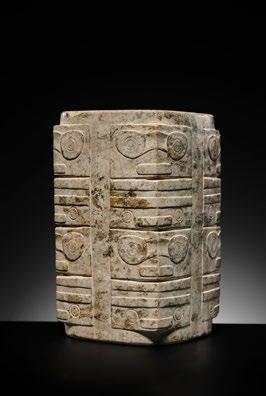
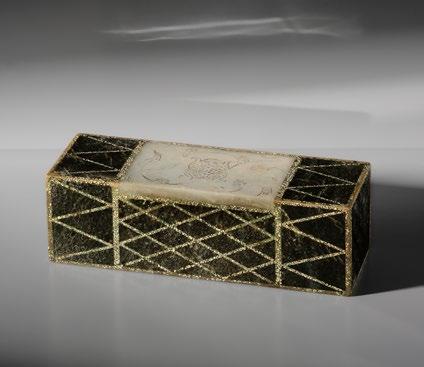
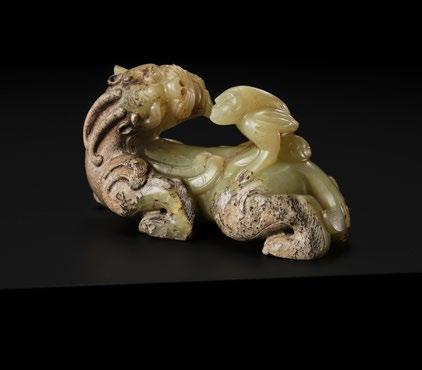
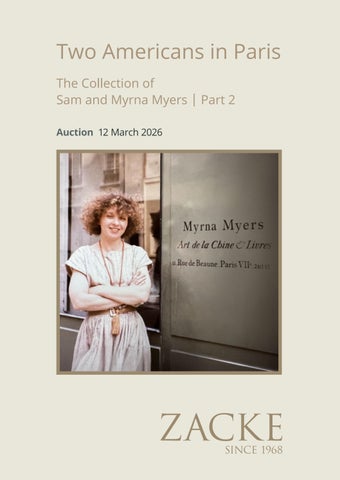
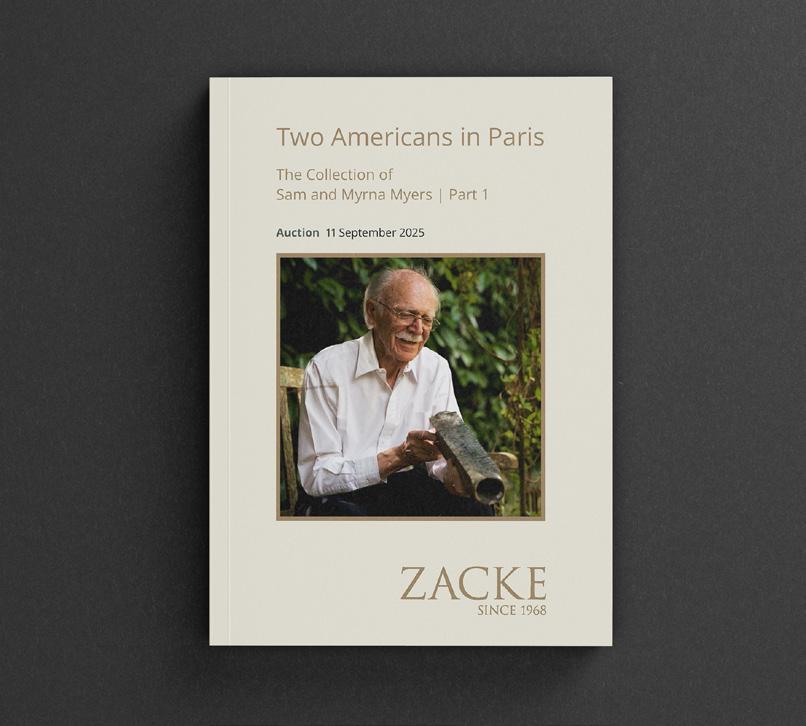
Two Americans in Paris
The Collection of Sam and Myrna Myers | Part 2
Auction 12 March 2026
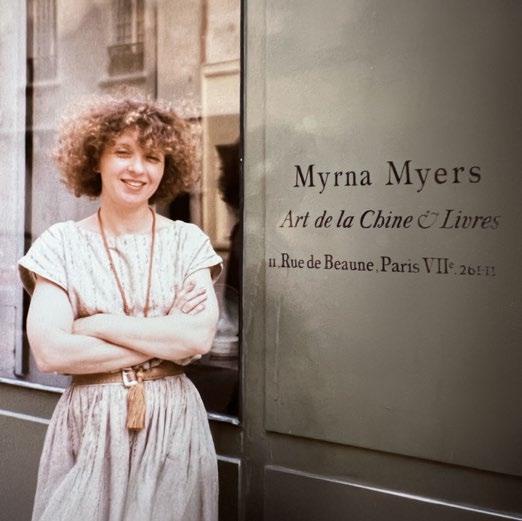

Auction 12 March 2026
CATALOG TAM0326
NO RESERVE LIVE AUCTION
12 March 2026, 11 am CET
All lots in this auction are offered with No Reserve, allowing bids below the starting prices to be considered. Please note that the starting prices have been set at exceptionally low levels to encourage participation. We encourage you to take advantage of this unique opportunity to acquire remarkable pieces at highly competitive prices.
SESSION 1 Lots 1–153 Print Catalog
SESSION 2 Lots 154–322 Online Catalog
EXHIBITION
2–10 March, Monday–Friday 10 am–6 pm as well as by appointment
GALERIE ZACKE
Zelinkagasse 6, 1010 Vienna Austria
Tel +43 1 532 04 52 E-mail office@zacke.at
www.zacke.at
12 March 2026
Lots 154–322

Publisher
Galerie Zacke founded 1968 © SZA Versteigerungen & Vertriebs GmbH
1010 Wien
Zelinkagasse 6, Austria, Europe
Tel (0043-1) 532 04 52
Email: office@zacke.at
Editors
Susanne Zacke
Marion Schor
Experts
Alexander Zacke
Max Zacke
Catalogers
Ananya Casius
Anne-Aymone Gabriel
Daniel Gonzalez-Gracia
Tatjana Borodin
Assistance and Translation
Anna-Maria Pollmann
Jue Zhang
Mieko Gray
Photography
Georg Bodenstein
David Lindengrün
Cesilio Cesar Garcia
Jonas Matyassy
Loreen Sasse
Design
Christina Zhang
Printing
Print Alliance
HAV Produktions GmbH
Website www.zacke.at
© GALERIE ZACKE
Reproduction forbidden
BIDDING FORM FOR THE AUCTION Two Americans in Paris: The Collection of Sam and Myrna Myers Part 2 ON DATE 12 March 2 02 6
PLEASE RAISE MY BID BY ONE BIDDING INCREMENT (ca. 10%) IF NECESSARY
IMPORTANT NOTICE:
Bids do not include buyer’s premium and VAT. Margin taxation applies. Items with added VAT are marked in the online catalog.
TELEPHONE BIDS:
If you like to bid by telephone, please state ‘TEL’ in the ‘BID IN EURO’ column instead of a Euro amount. Galerie Zacke will call you on the day of the auction, on the telephone number provided, 5 lots before the lot you are bidding on and the bidding will commence at the starting price, as stated in the catalog.
If Galerie Zacke cannot reach you during the auction, Galerie Zacke will bid the starting price on your behalf.
TERMS OF PAYMENT, SHIPPING AND COLLECTION:
NAME
AD D RESS CITY, COUNTRY
POSTCODE
PHONE NUMBER
CREDIT CARD PAYMENT PLEASE CHECK THE DESIRED CARD
COLLECTION BY CLIENT WITH PAYMENT ON THE PREMISES IN CASH, BY CERTIFIED CHEQUE OR CREDIT CARD
INVOICE PAYMENT
VIA BANK WIRE AFTER RECEIPT OF INVOICE SHIPPING AFTER RECEIPT OF PAYMENT
EXPRESS PARCEL SERVICE
REQUIRED (ACCORDING TO TERMS AND CONDITIONS OF GALERIE ZACKE)
SHIPPING INSURANCE
REQUIRED (ACCORDING TO TERMS AND CONDITIONS OF GALERIE ZACKE)
GALERIE ZACKE
Zelinkagasse 6, 1010 Vienna, Austria
Email: office@zacke.at
Tel: +43-1-532 04 52 Fax: +43-1-532 04 52 20
IMPORTANT NOTICE:
Whenever making a bid, whether personally or via an agent, in writing, online, telephone, or in any other way, the bidder fully and unconditionally accepts the Terms of Auction, the ‘Important Information’ section in the auction catalog, the Terms and Conditions (AGB) of Galerie Zacke, §1-48, the Fee Tariff, and the Bidding Increments table, all as published on www.zacke.at on the day of the auction.
ABSENTEE BIDDING FORM FOR THE AUCTION Two Americans in Paris: The Collection of Sam and Myrna Myers Part 2 ON DATE 12 March 2 02 6
Dear Collectors,
We have opened our 6,000-square-foot exhibition, showroom, and auction rooms at Zelinkagasse 6, 1010 Vienna!
Starting 2 March you’ll be able to explore the exceptional pieces featured in this auction at Zelinkagasse 6, 1010 Vienna.
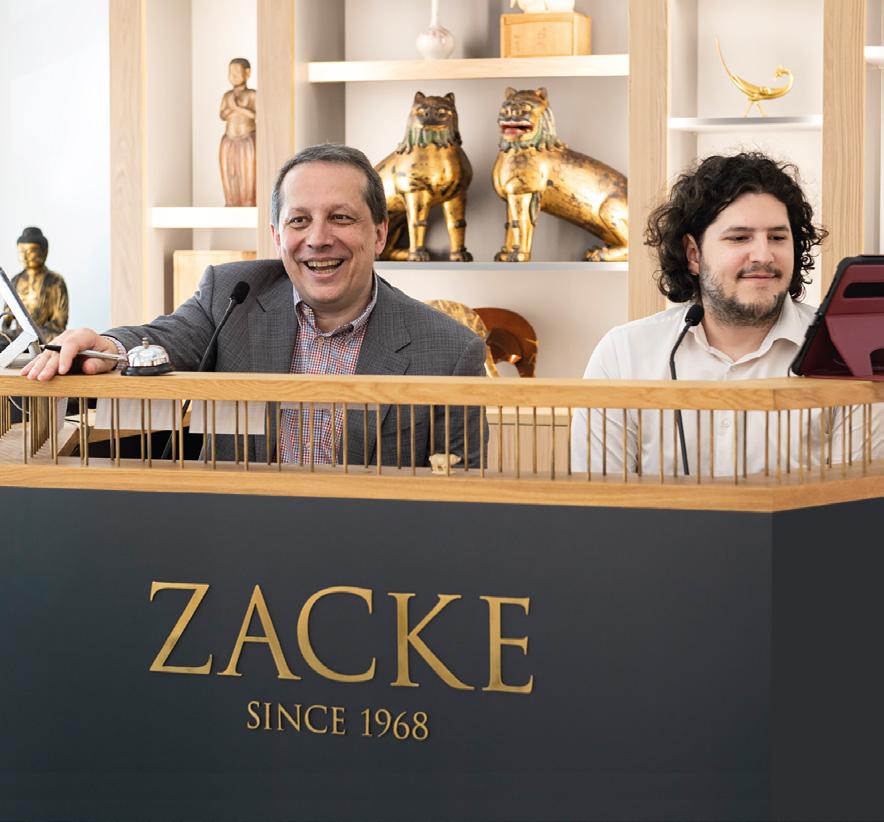
12 March 2026 at 11 am CET
Attend in person at our auction room at Zelinkagasse 6 or participate online via Zacke Live – and enjoy premium buyer’s terms with no additional online bidding fees
Register now: www.zacke.at
All lots in this auction are offered with No Reserve, allowing bids below the starting prices to be considered.
Please note that the starting prices have been set at exceptionally low levels to encourage participation. We encourage you to take advantage of this unique opportunity to acquire remarkable pieces at highly competitive prices.
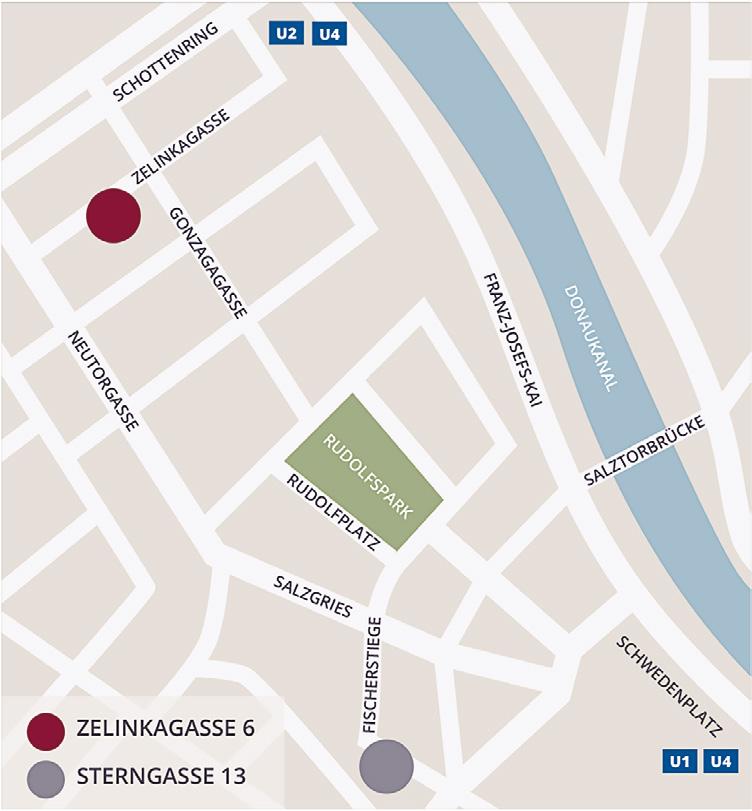
Our additional auction and preview space at Zelinkagasse 6 in Vienna’s 1st district is just a seven-minute walk from our 10,000-square-foot office, photography, video, and cataloging hub at Sterngasse 13.
Easily accessible by public transport or car (a parking garage is located nearby).
By Public Transport: SCHOTTENRING station (U2, U4, tram lines 1, 31, 71, D, and bus 3A)
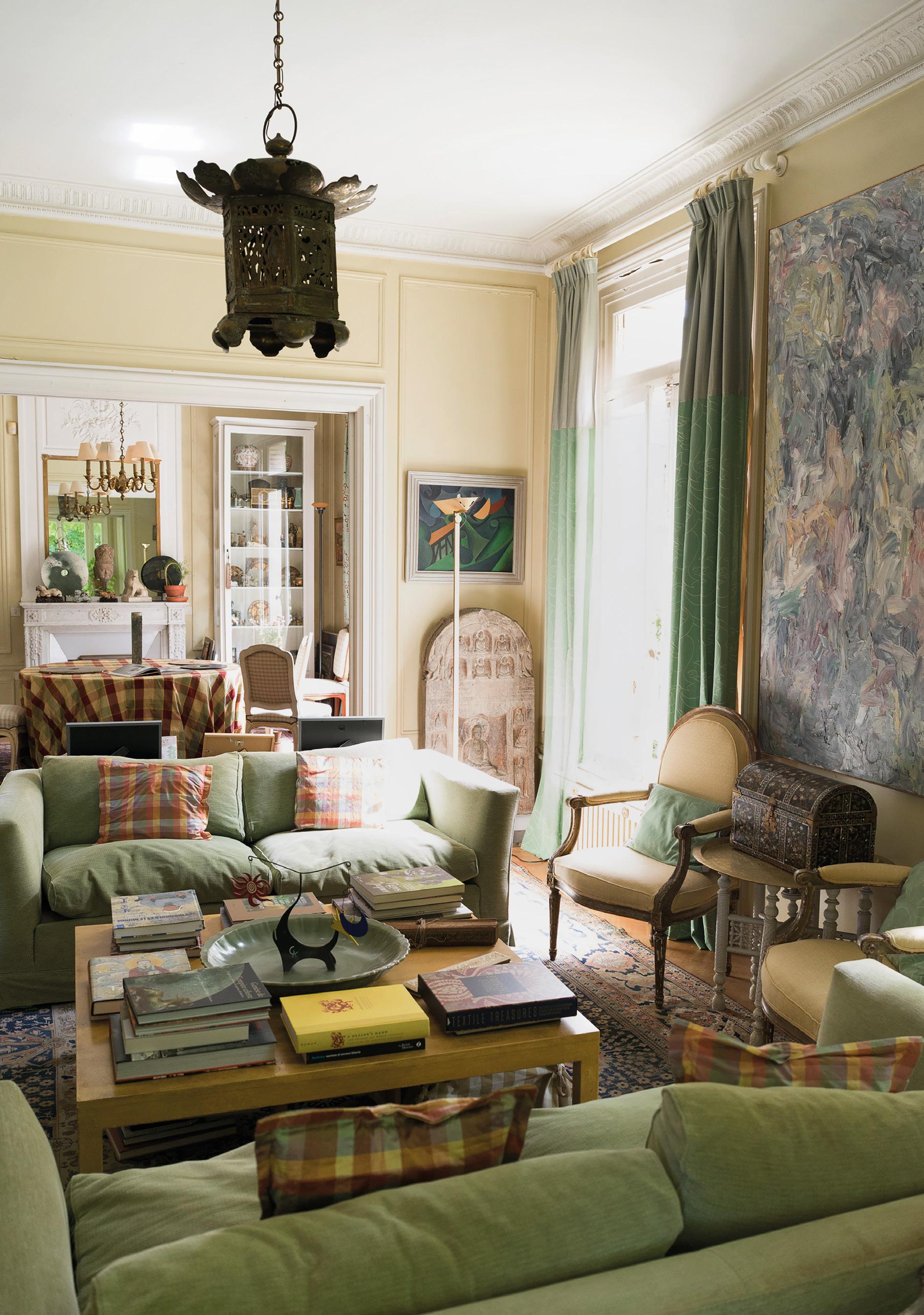
The Collection of Sam and Myrna Myers Part 2
Dear Customers,
It is with great pleasure that we present the second part of the Sam and Myrna Myers Collection—an extraordinary ensemble that has traveled across continents and inspired scholars, connoisseurs, and collectors alike. It is, without question, one of the most significant and important collections ever entrusted to this gallery.
A small portion of the collection was previously offered at Sotheby’s London. Despite its historical importance, the November 2021 sale faced considerable challenges caused by the global pandemic and the effects of Brexit, resulting in mixed outcomes – quite the opposite of earlier, highly successful appearances of objects from the collection at major auctions. Consequently, London
was ruled out as a venue for subsequent sales.
On 11 September 2025, the first part of the Sam and Myrna Myers Collection was auctioned in our rooms with outstanding success, achieving a 100% sell-through rate—a white-glove sale.
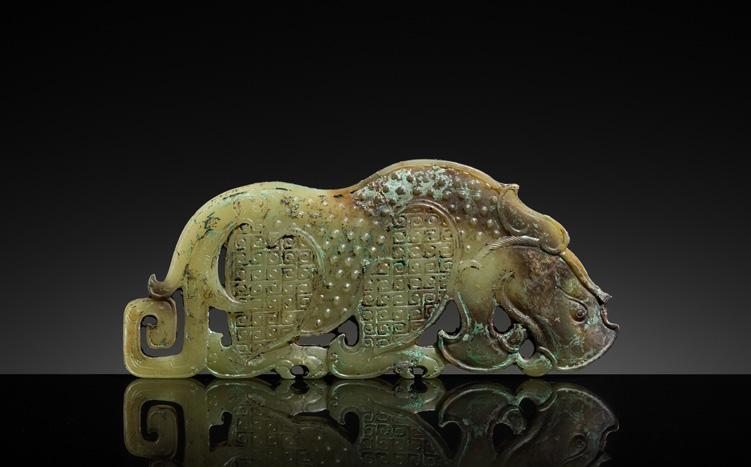
A FINE AND LARGE GREEN JADE ‘RHINOCEROS’ PLAQUE, WARRING STATES PERIOD-WESTERN HAN DYNASTY
Sold for EUR 130,000
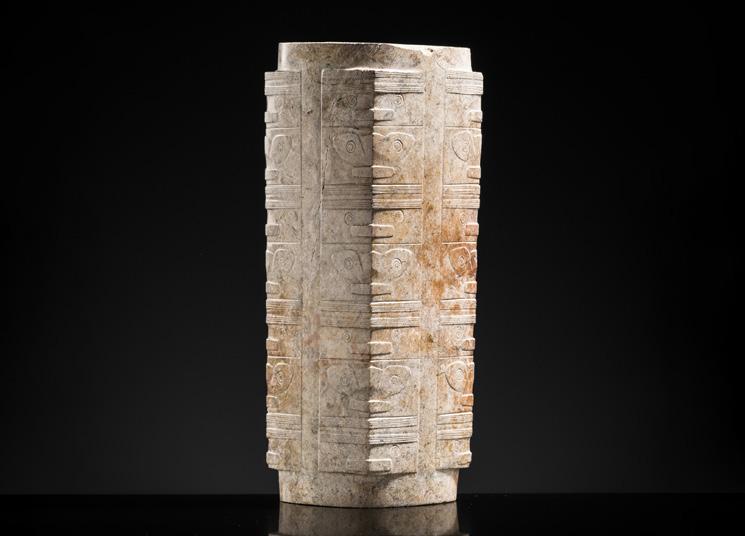
Below are selected highlights from this auction:
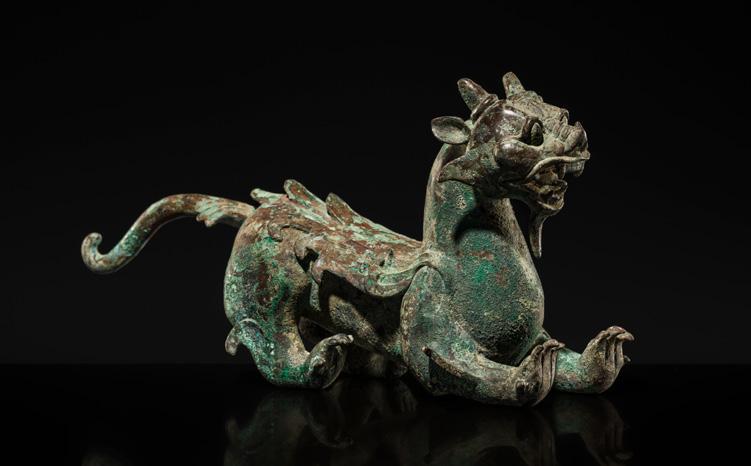
A RARE AND IMPORTANT BRONZE FIGURE OF A BIXIE, HAN DYNASTY
Sold for EUR 104,000
In December 2025, we also conducted a targeted private sale for our established collectors of ancient jades. Demand was exceptionally strong, and the results below reflect the success of this discreet offering:
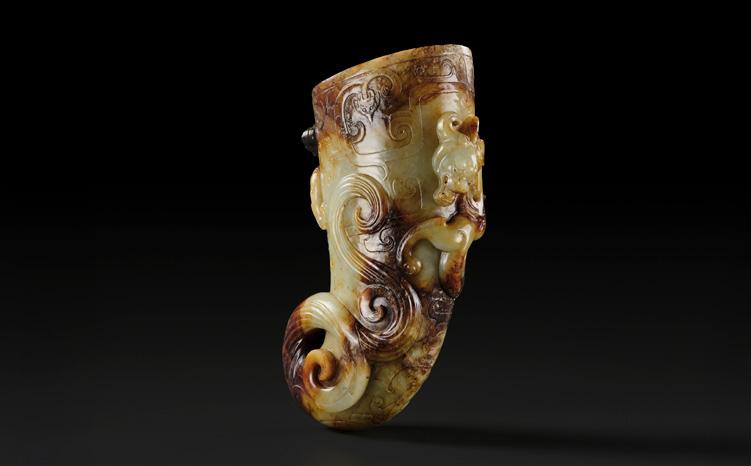
A MAGNIFICENT CELADON AND RUSSET JADE ‘DRAGONS AND PHOENIX’ RHYTON, WESTERN HAN DYNASTY
Sold for EUR 33,800
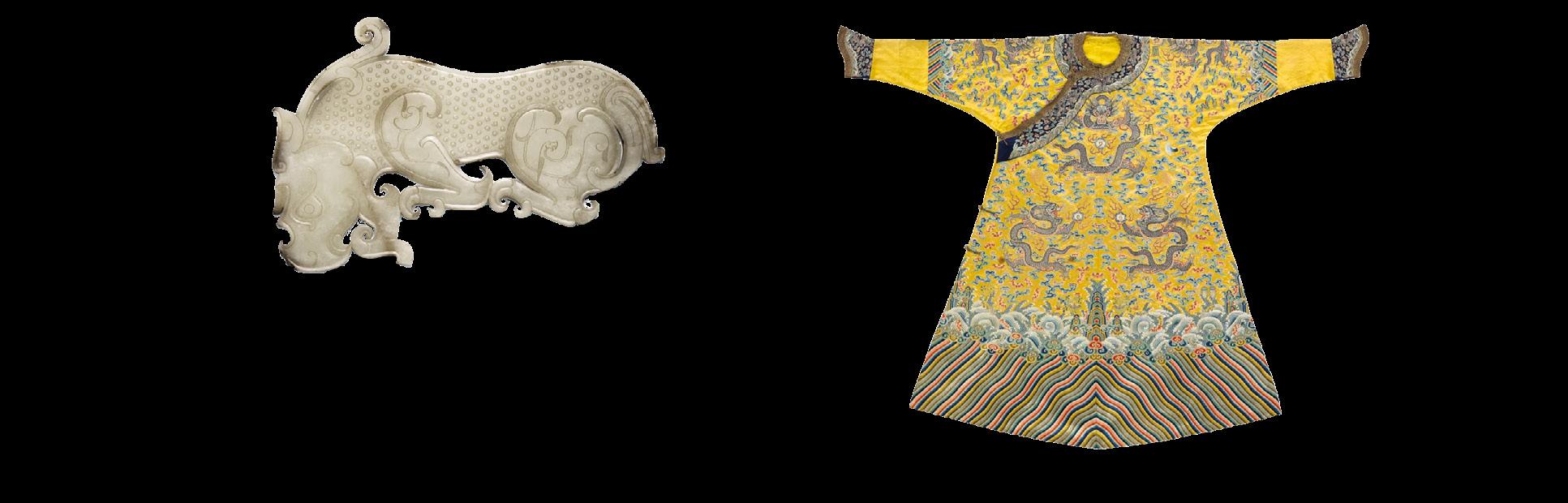
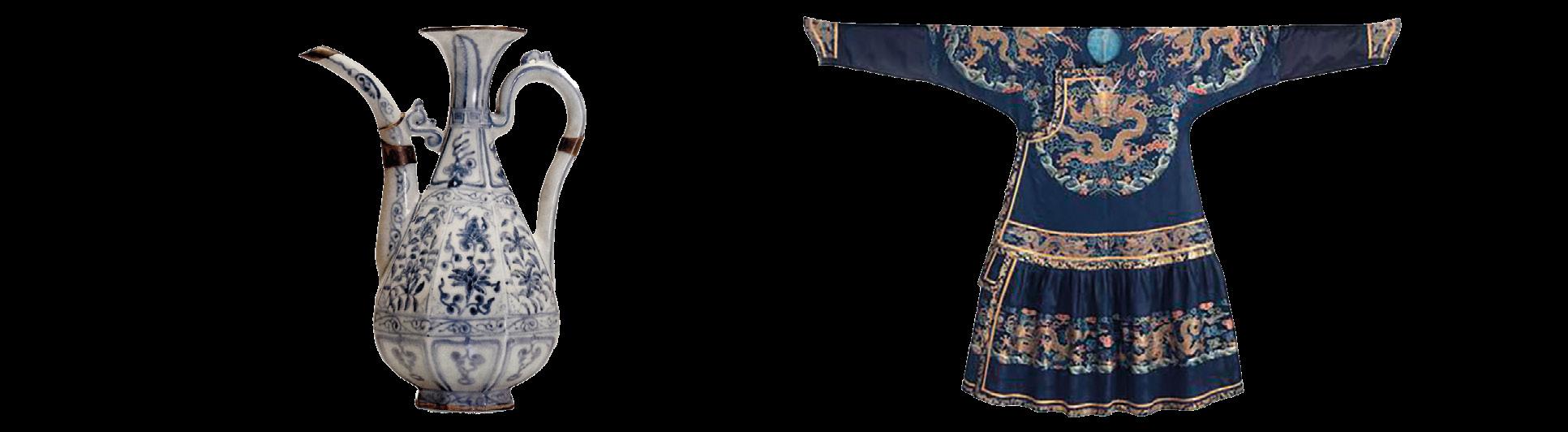
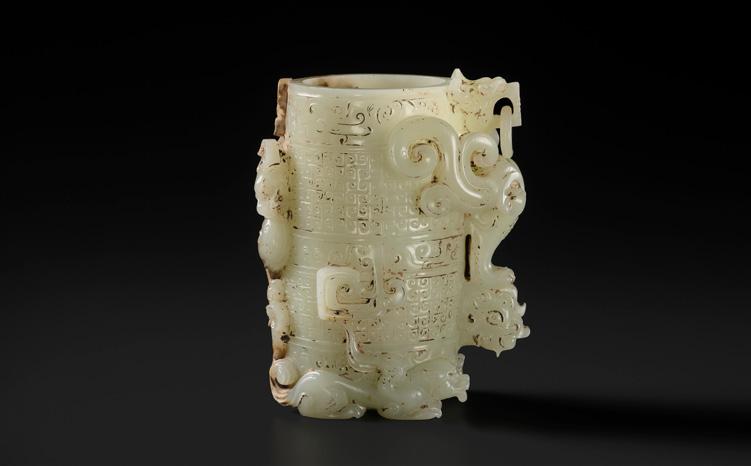
AN EXCEEDINGLY RARE WHITE JADE ‘VERMILION BIRD’ VESSEL, WESTERN HAN DYNASTY
Sold for EUR 23,400
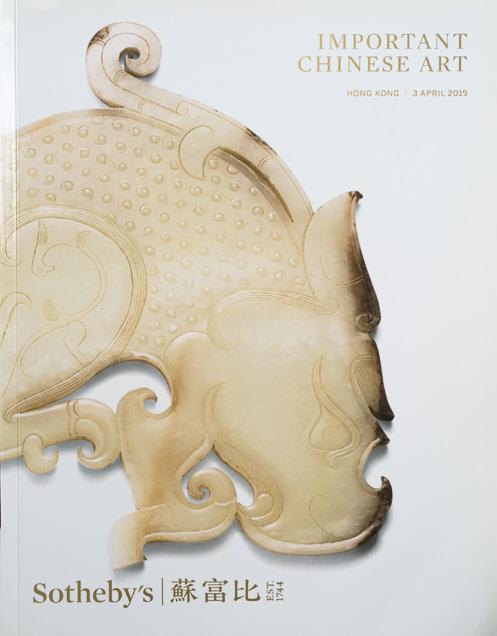
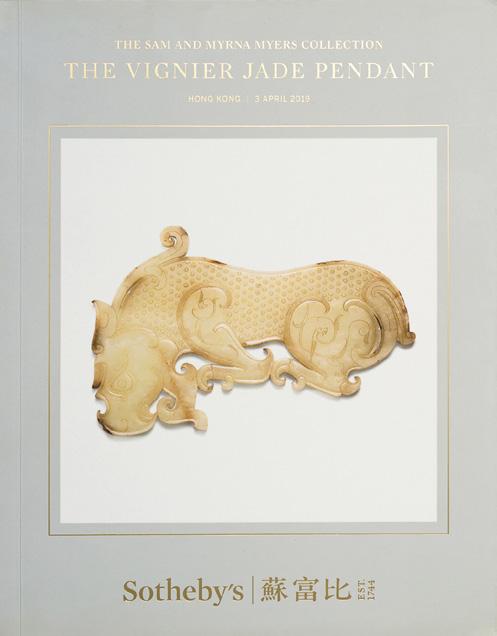
Sotheby’s Hong Kong, 3 April 2019, lot 3620, Jade Animal-Shaped Plaque, Eastern Zhou dynasty, sold for HKD 26,575,000
Sotheby’s Hong Kong, 10 April 2006, lot 1540, ‘Twelve-Symbol Dragon’ Robe, Qianlong period, sold for an undisclosed amount and later estimated at HKD 20,000,000 (Sotheby’s Hong Kong, 5 October 2016, lot 3307)
Musée Guimet
1 April 1990, Blue and White Ewer, Yuan dynasty, sold for EUR 1,250,000
Los Angeles County Museum of Art
7 April 2017, Man’s Formal Court Robe, Chaopao, Kangxi period, sold for USD 300,000
Rubin Museum of Art
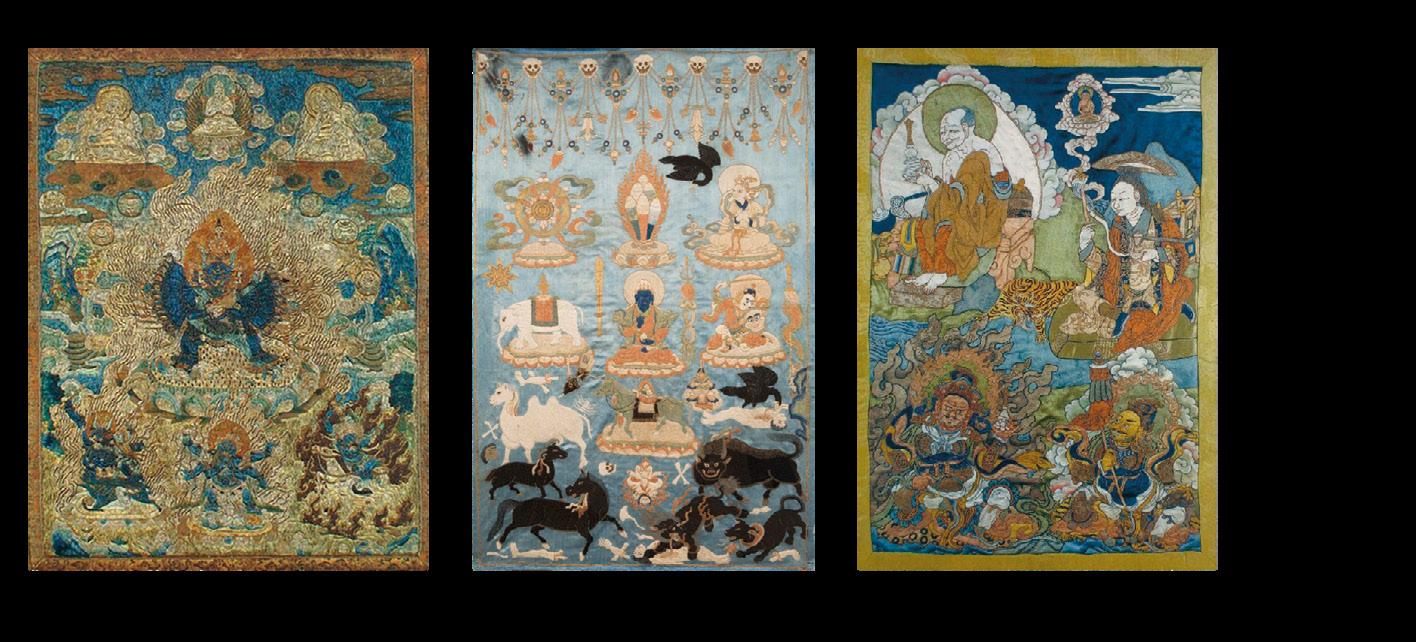
22 March 2004, Three Thangka, Qing dynasty, sold for USD 145,000

Their first acquisitions came from the Mediterranean and Mesopotamia, but in 1968, they were introduced to Chinese porcelains in Ghent, initially focusing on 17th-century blue and white wares. As their collection expanded, Myrna suggested diversifying into other areas of Chinese art. In 1974, she remarked, “I’m getting pretty tired of Chinese porcelain. Why don’t you see what else you can find?” Sam, puzzled, asked, “What would you like?” Myrna replied, “I don’t know. Maybe sculpture or jade.”
During a trip to the United States, Sam purchased a shoebox filled with unidentified jades, which marked the beginning of more than 40 years of study and research. The shoebox contained pre-Colombian and Chinese jades, including a Han dynasty cicada, which Myrna wore for many years. Their collection grew to include significant pieces from renowned collections, including those of Armand Trampitsch (1893–1970) and Charles Vignier (1863–1934).
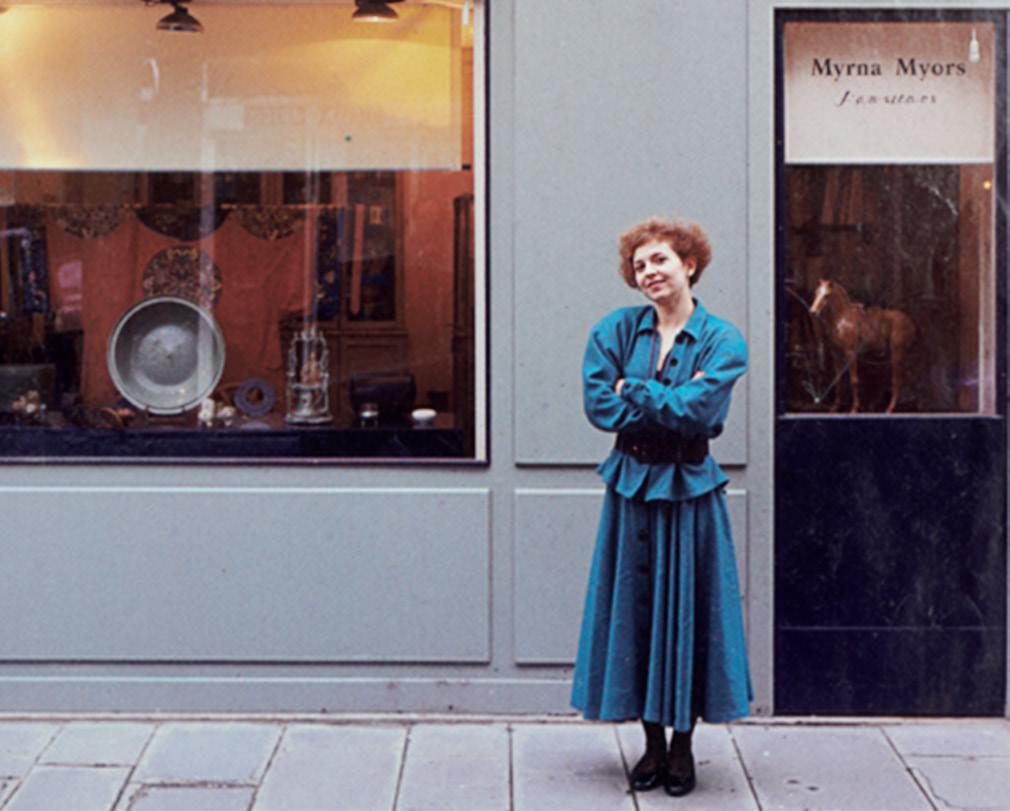
Myrna and Sam Myers were both second-generation Americans, their parents having risen through the classic immigrant experience following the Depression. As Myrna often quipped, “I married up in life. My father was a grocer, but Sam’s was a delicatessen man.” Both were the first in their families to attend college, and neither grew up surrounded by antiques or art.
The couple’s introduction to antiques began during their time in New York, but it was in Paris that their passion for collecting truly flourished. Initially drawn to glass, ceramics, copper, and carved wooden objects, they were not yet focused on anything of particular importance. However, their first trip to Switzerland in 1966 changed the course of their collecting journey. There, they discovered the Casa Serodine antique shop in Ascona, which would become a key location for their growing collection. Over the next few years, they returned to Ascona to acquire more pieces.

Simultaneously, Myrna developed a deep passion for East Asian silks, which would become one of the defining aspects of her legacy. In 1974, at the Maastricht Fair, she was captivated by the Tibetan silks displayed by Moke Mokotoff, whose vibrant colors and intricate designs complemented the Chinese porcelain she had been collecting. This sparked a lifelong fascination with Far Eastern textiles, particularly Tibetan and Chinese pieces. Her journey led her to Krishna Riboud, a Paris-based textile scholar, who was in the process of establishing the AEDTA, an Asian textile study center. Riboud’s mentorship played a pivotal role in Myrna’s immersion in Asian textiles, where she contributed to publications and attended conferences. Her growing interest in the symbolic meaning of the dragon robe, inspired by John Vollmer’s writings, became a key focus in her expanding collection of Ming and Qing costumes.

In 1976, Myrna officially became an antique dealer in Paris after graduating from the Ecole du Louvre. She hosted salons and meticulously researched each exhibition, writing comprehensive summaries

on the history, significance, and meaning of the pieces displayed. This marked the beginning of her professional career as a dealer, researcher, and expert in Asian art and antiques.
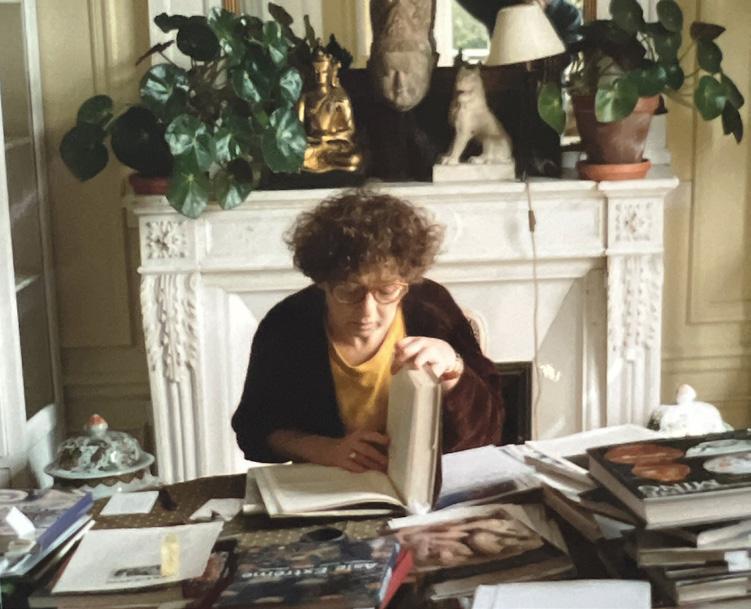
Three decades later, Myrna began to secure the legacy of the collection she had built. She achieved this through major donations: most notably, her extensive, well-documented, and widely exhibited textile collection to the Musée Guimet, as well as substantial contributions to the Musée des Arts Asiatiques in Nice, a museum “greatly indebted to her,” according to its director Adrien Bossard. Beyond these gifts, numerous sales to museums took place, often at symbolic prices more akin to donations than commercial transactions.
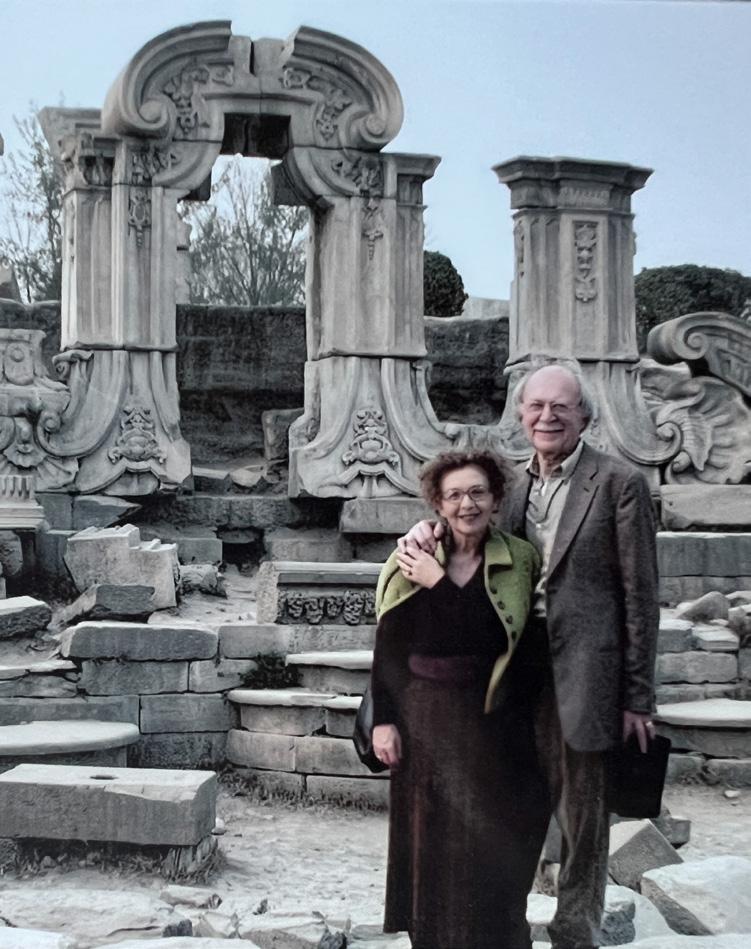

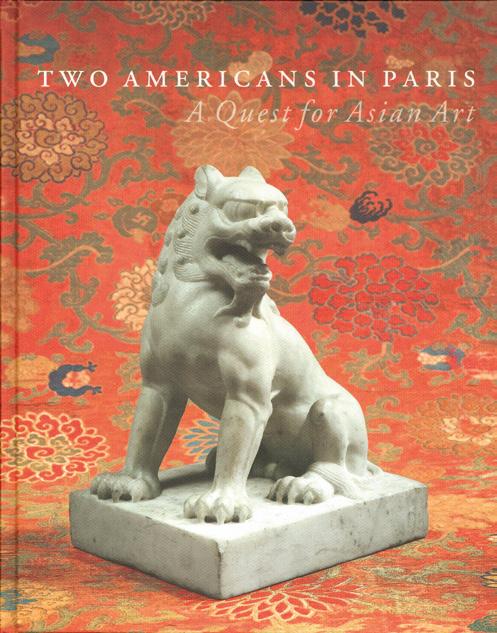
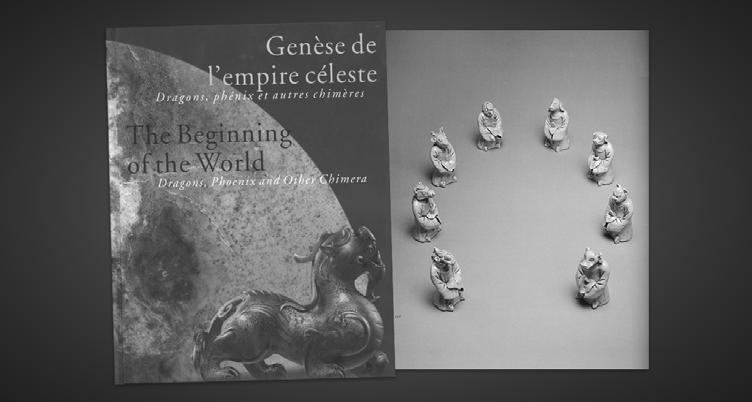
After Myrna’s passing in 2012, Sam Myers continued this work with extraordinary dedication. He spearheaded a project of grand scale: The traveling exhibition and comprehensive publication of their collection, realized under the direction of Jean-Paul Desroches, general curator at the Musée Guimet, and Myrna’s professor at the Ecole du Louvre. This exhibition, which included many of the objects now offered in this sale, brought the collection to the Kimbell Art Museum in Fort Worth, the Musée Pointe-à-Callière in Montréal, the Fondation Baur in Geneva, and the Musée des Arts Asiatiques, and was accompanied by two state-of-the-art catalogs, Two Americans in Paris and The Beginning of the World. Now 91 years old, Sam remains committed to safeguarding and sharing the collection that defined both his and Myrna’s life.
Their mutual passion for Asian art, deepened by their devotion to each other, not only enriched their own lives but also left a lasting impact on countless museums, exhibitions, and scholarly publications, along with their visitors and readers.
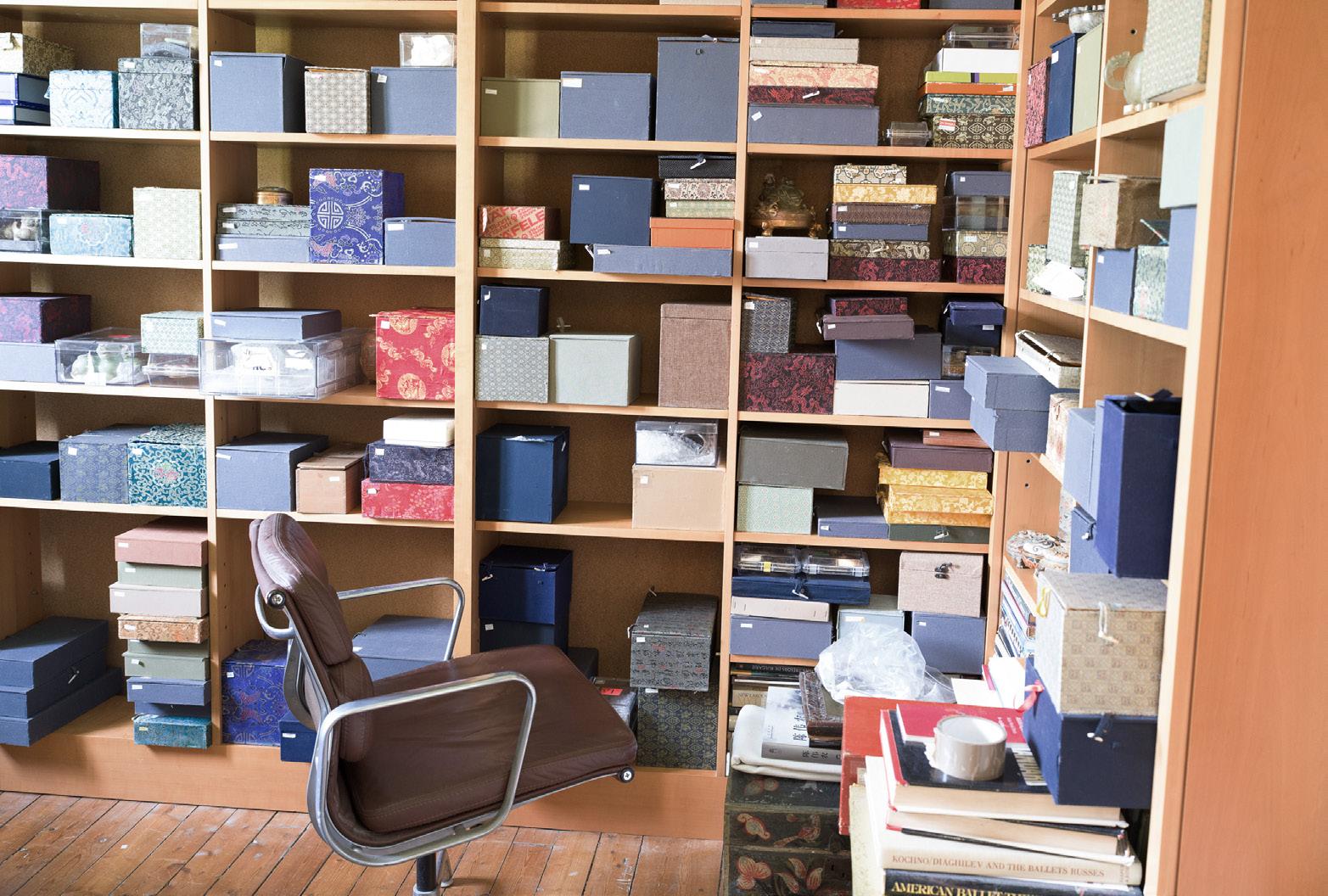
The Myers Collection is the largest and most important private collection of Chinese jade in the West, with many of its most significant pieces entirely unknown to the public. For Sam and Myrna, it was always essential to maintain a core of outstanding jades, most

originating from old, distinguished collections and acquired during the 1960s and 1970s. These jades have rarely been seen and remain a well-guarded secret. It is uncertain how many will appear at auction in the coming years, but several certainly will.
This auction honors the remarkable artworks and lasting legacy of two collectors whose vision and generosity have profoundly influenced the understanding and appreciation of Asian art for generations. We hope that as you explore this second catalog of the Myers Collection, you experience the same joy, passion, and connection that Sam and Myrna felt while collecting these extraordinary pieces.
Sincerely,
Alex and Max Zacke
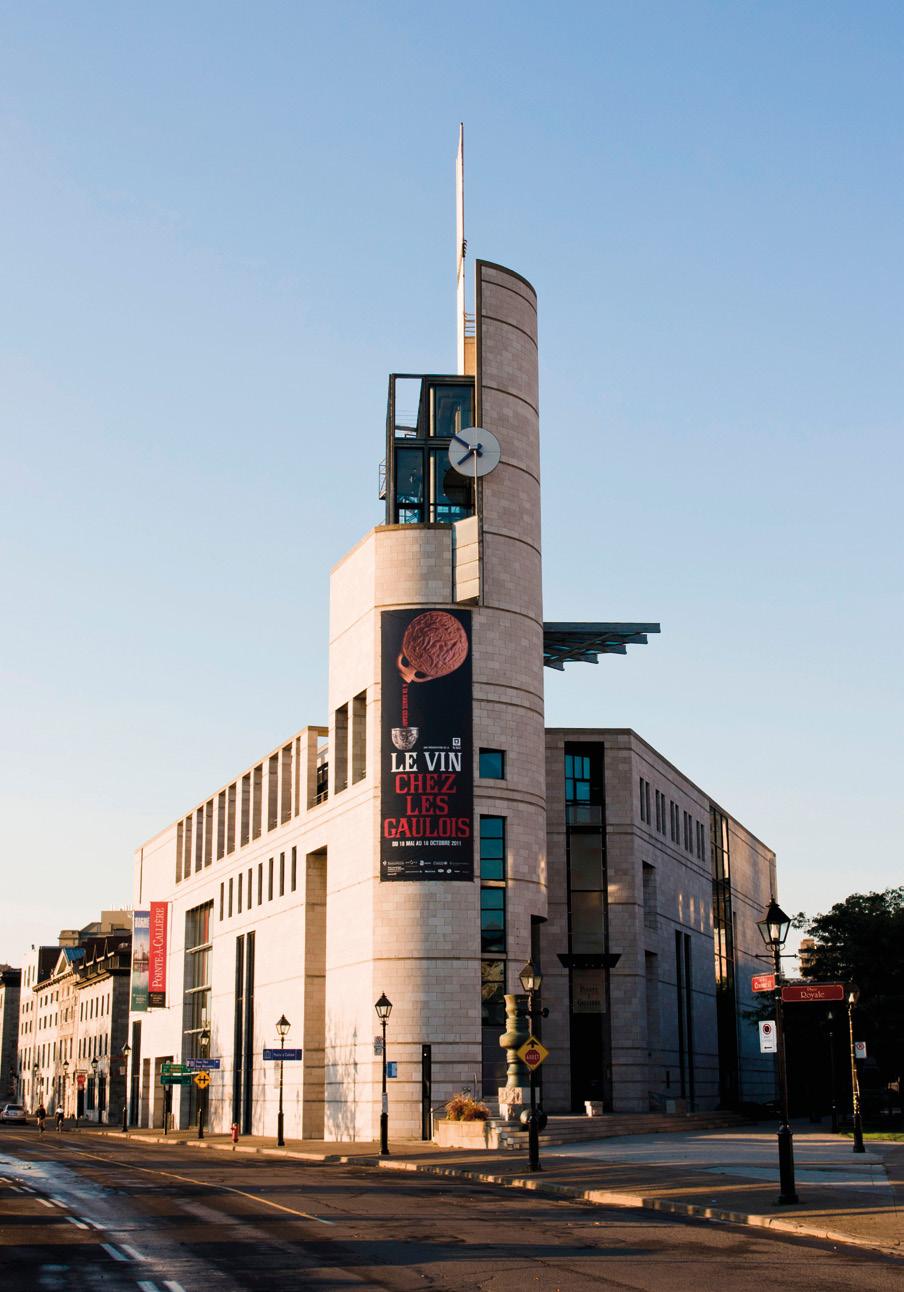
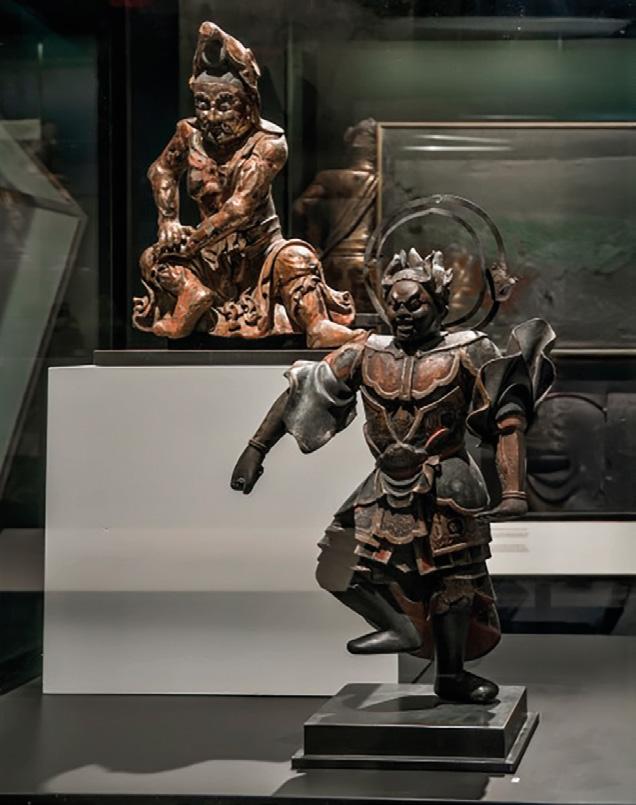
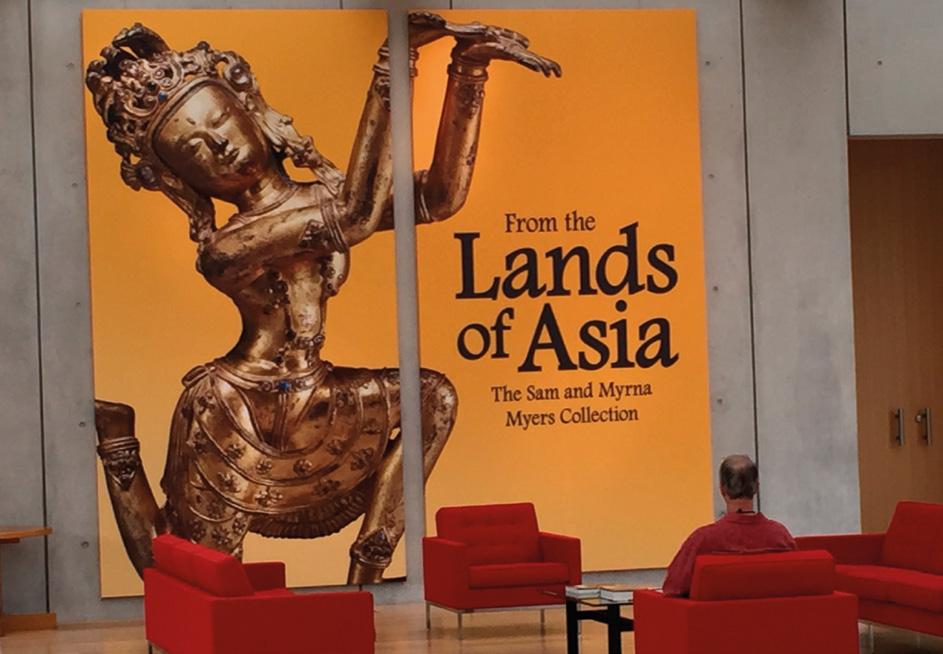
Pointe-à-Callière Museum
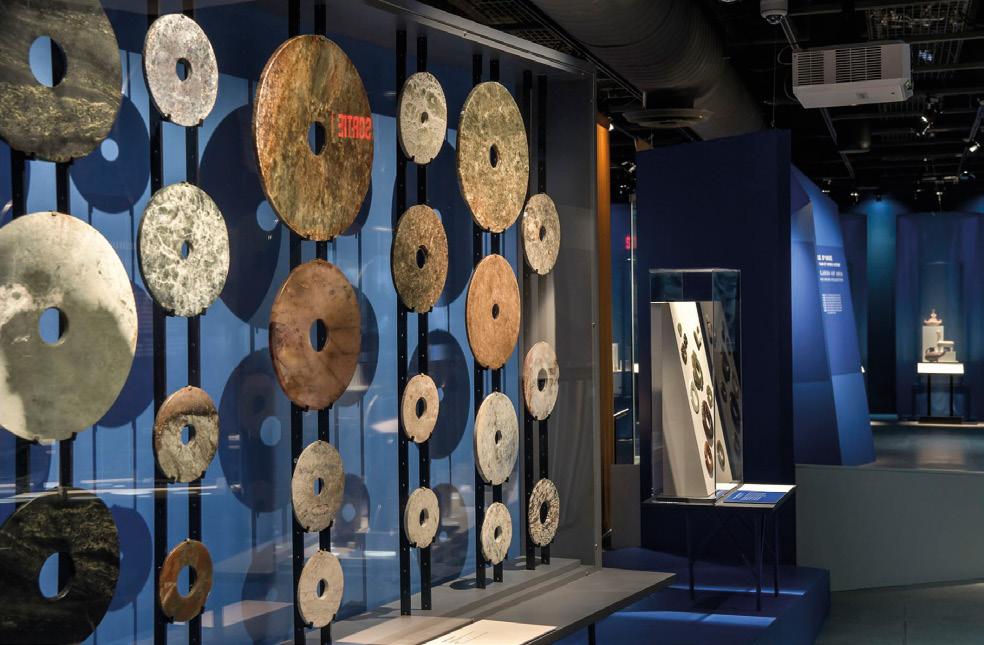
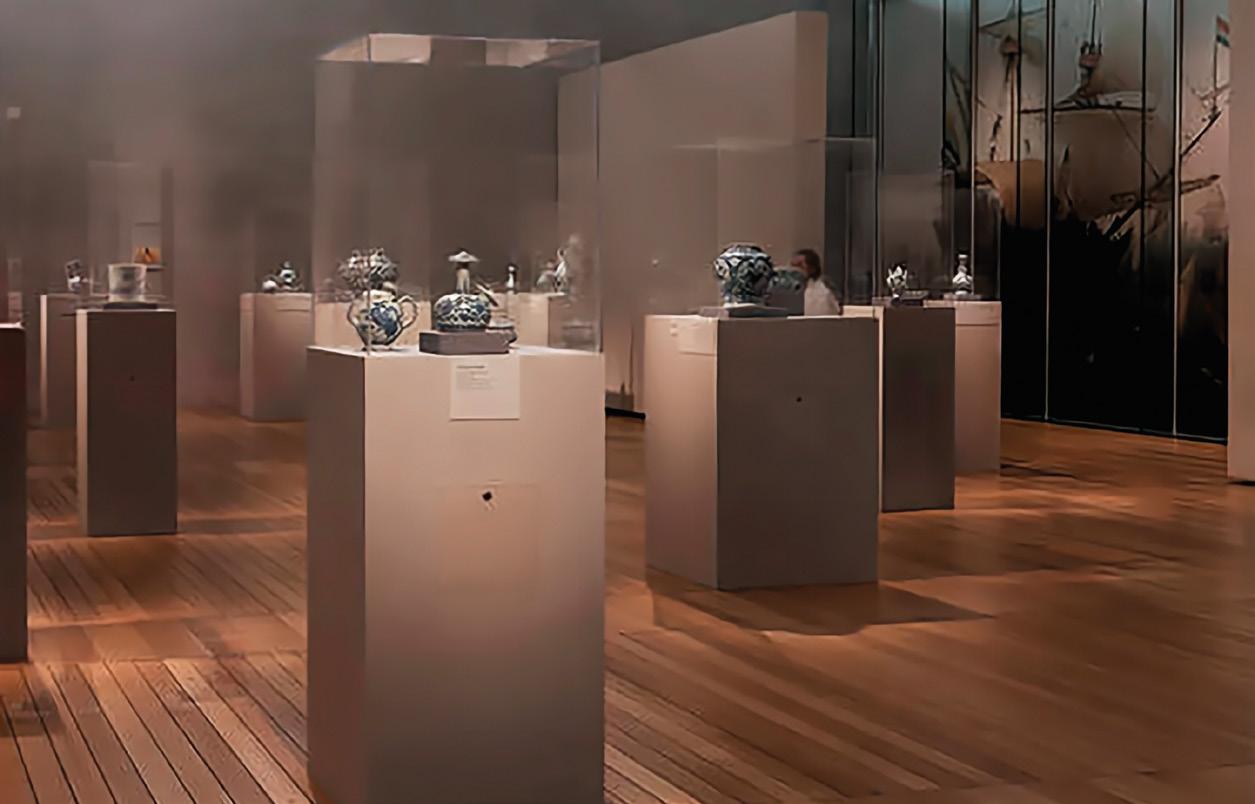
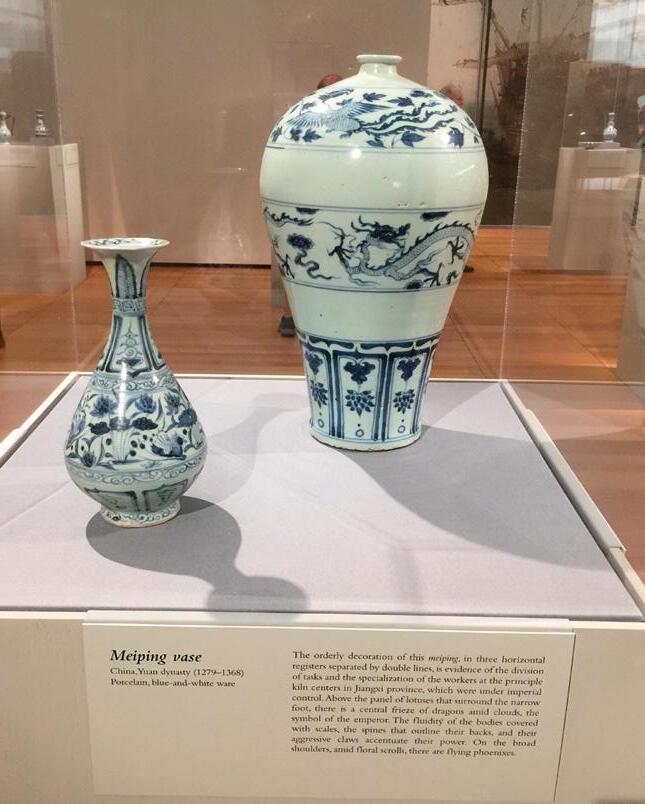
From the Lands of Asia. The Sam and Myrna Myers Collection, Montréal, 17 November 2016 - 19 March 2017
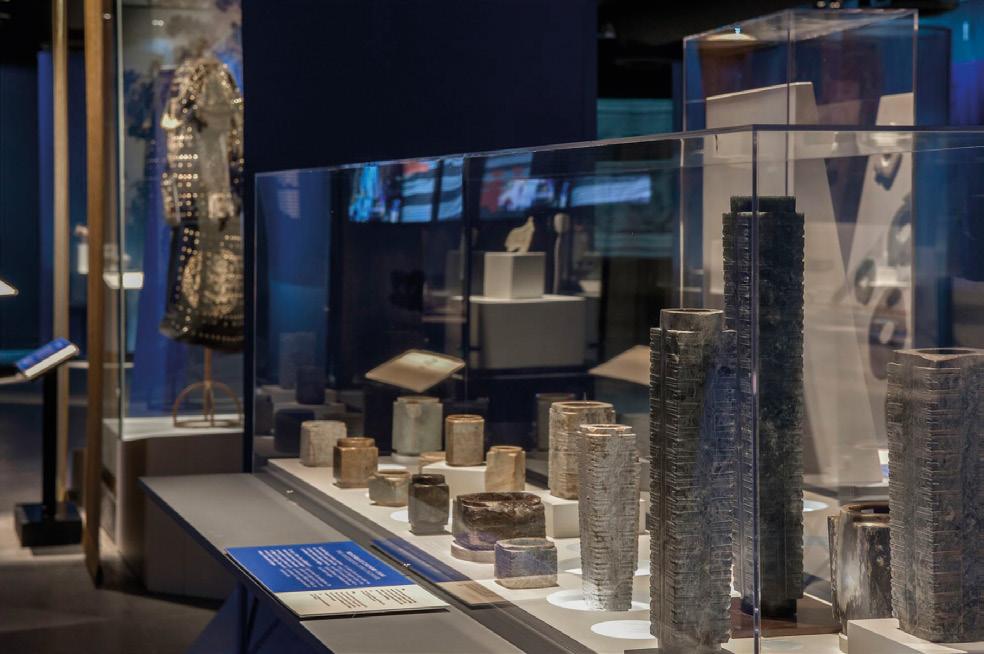
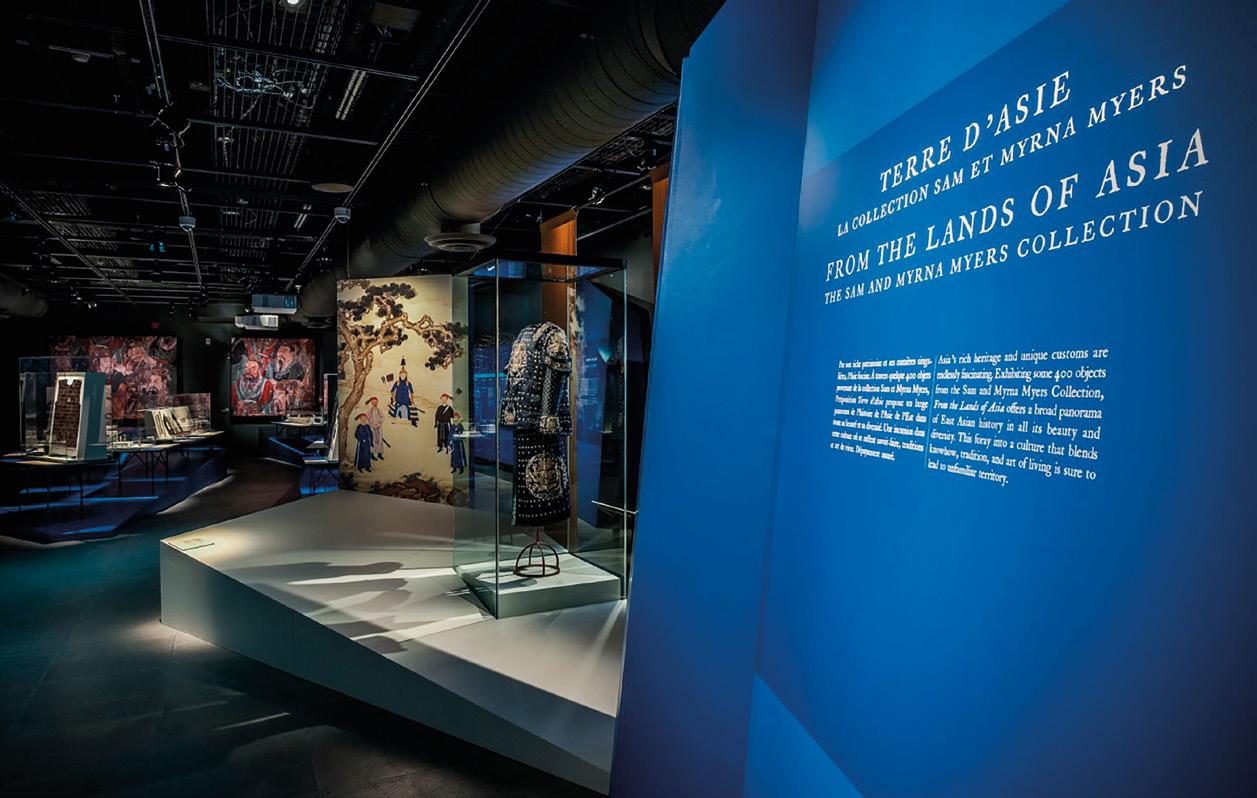
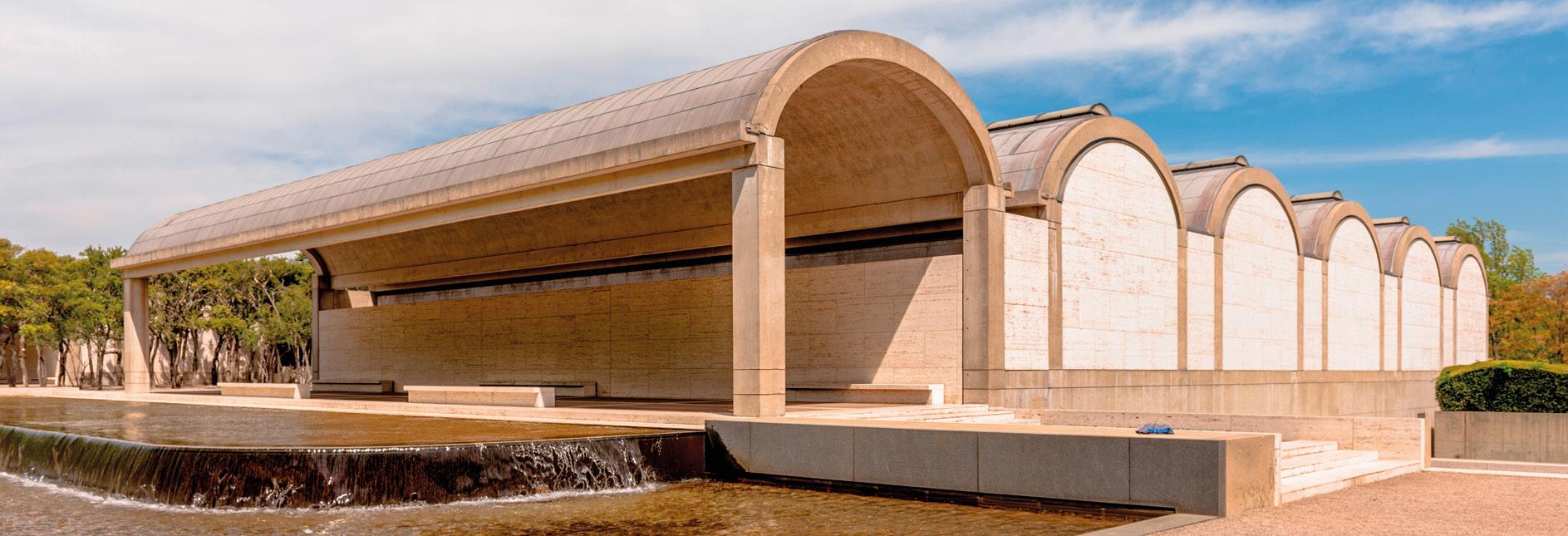
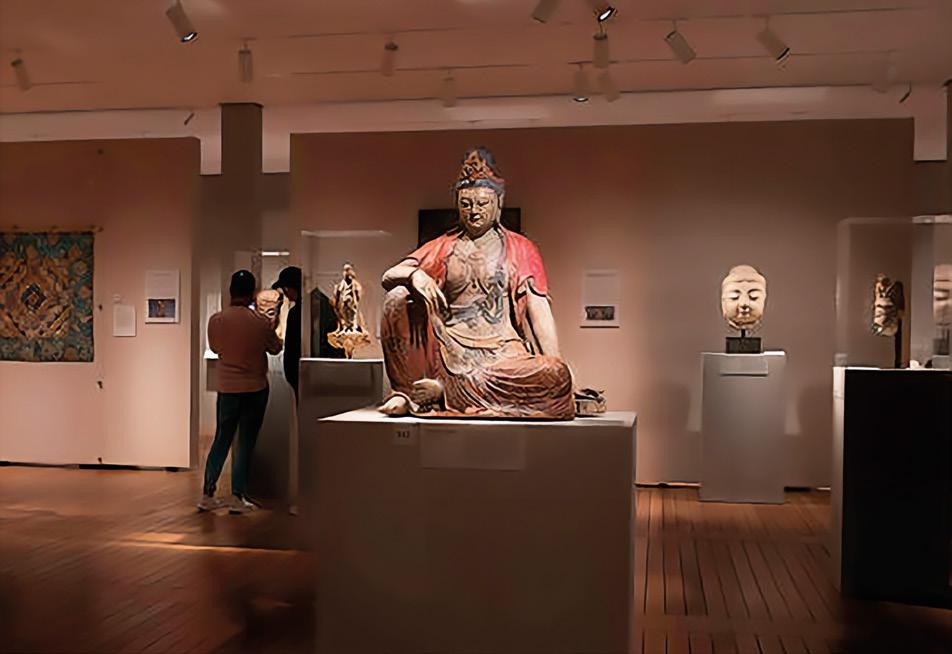
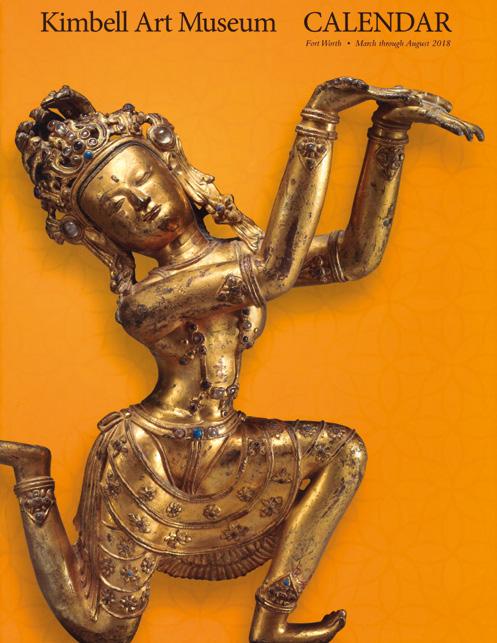
From the Lands of Asia. The Sam and Myrna Myers Collection, Fort Worth, Texas, 4 March - 19 August 2018
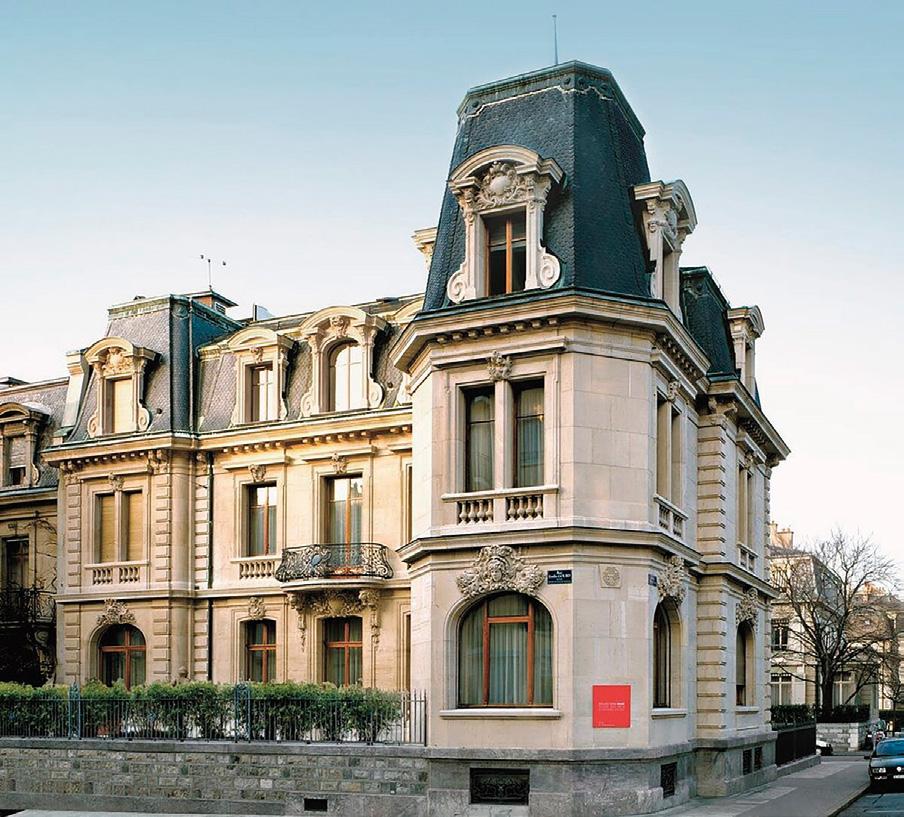
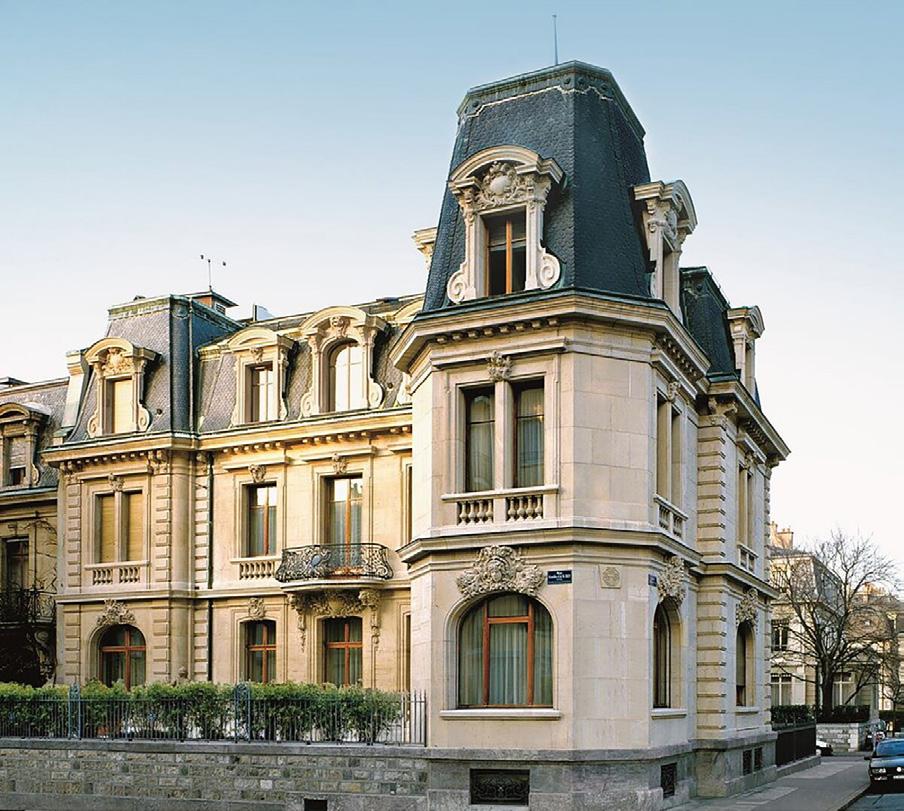
Fondation Baur
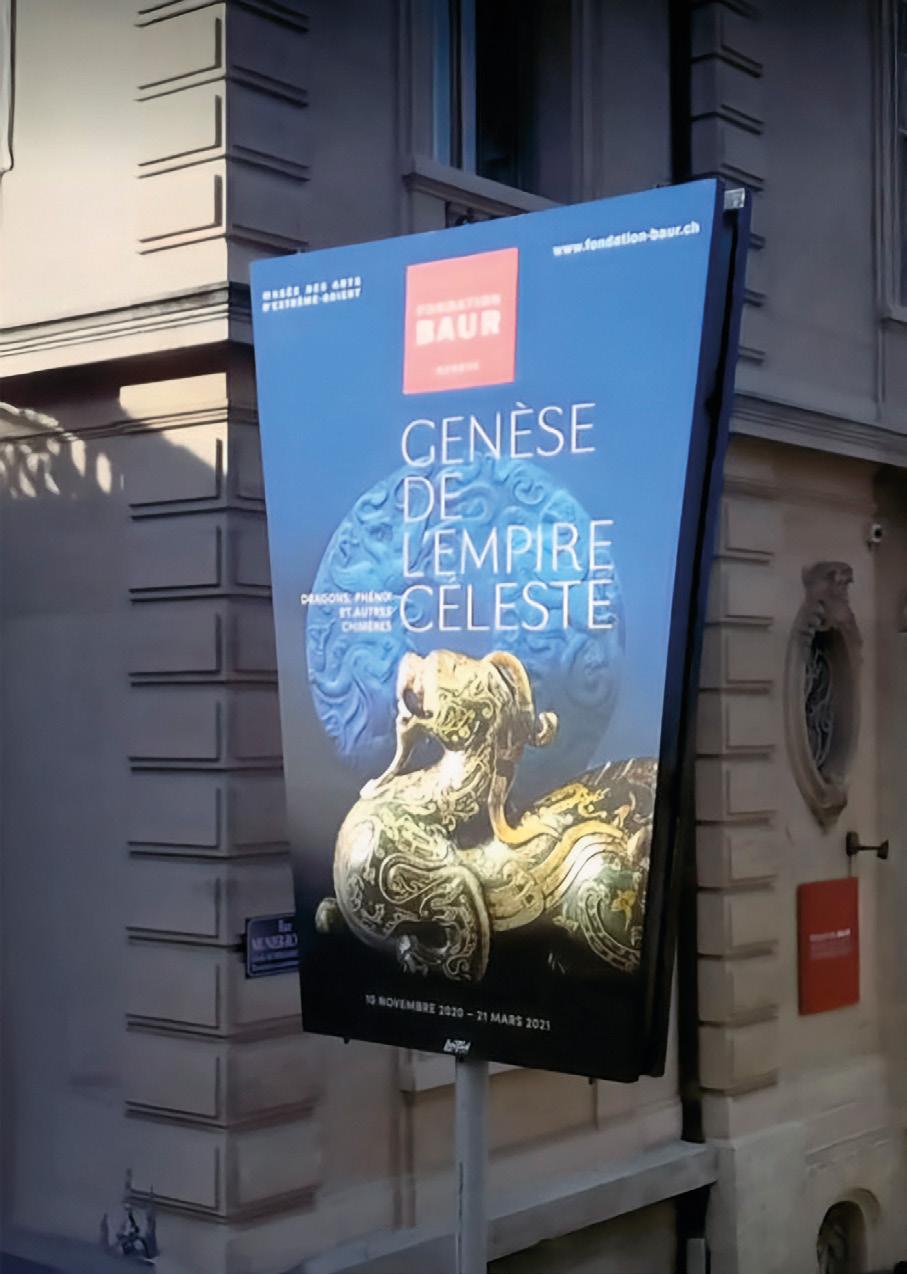
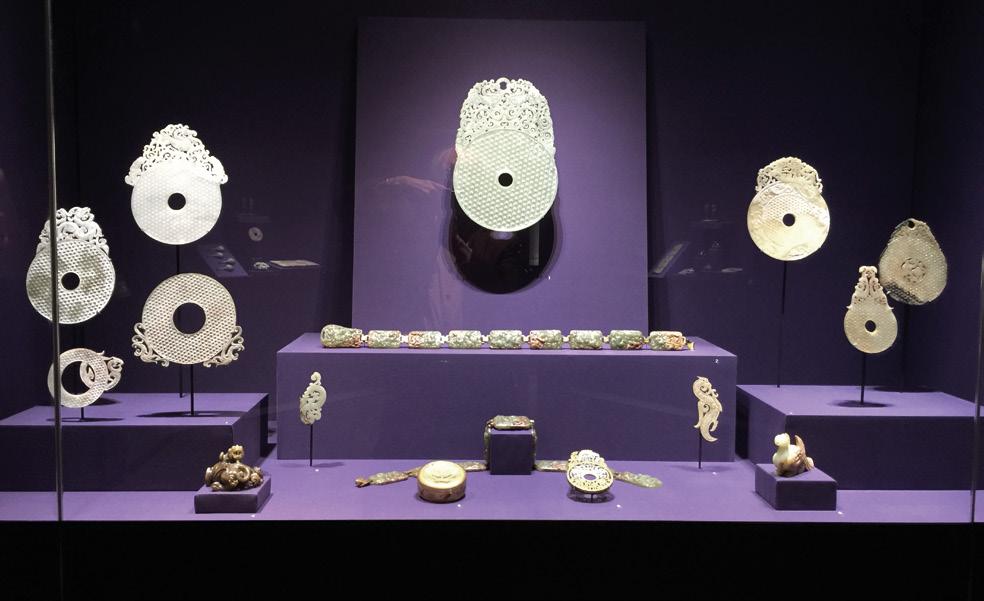
The Beginning of the World – According to the Chinese. Dragons, Phoenix and Other Chimera, Geneva, 11 November 2020 - 23 May 2021
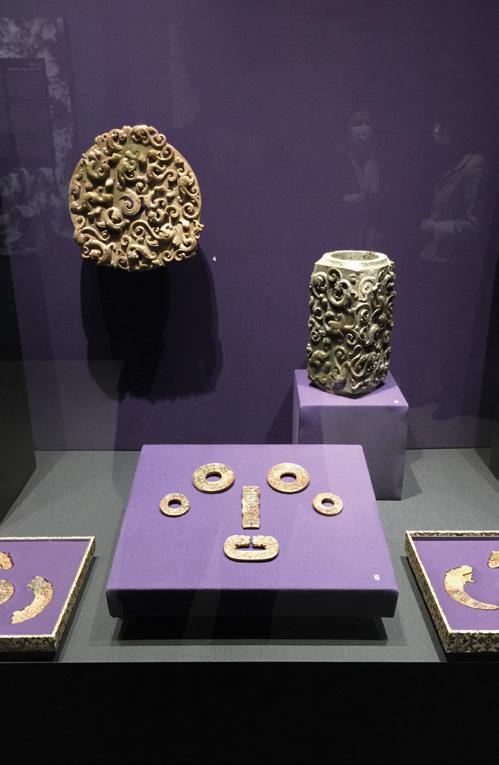
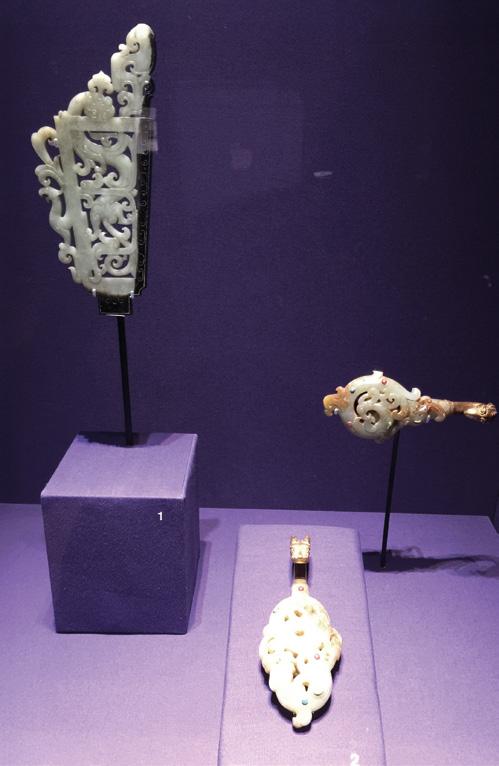
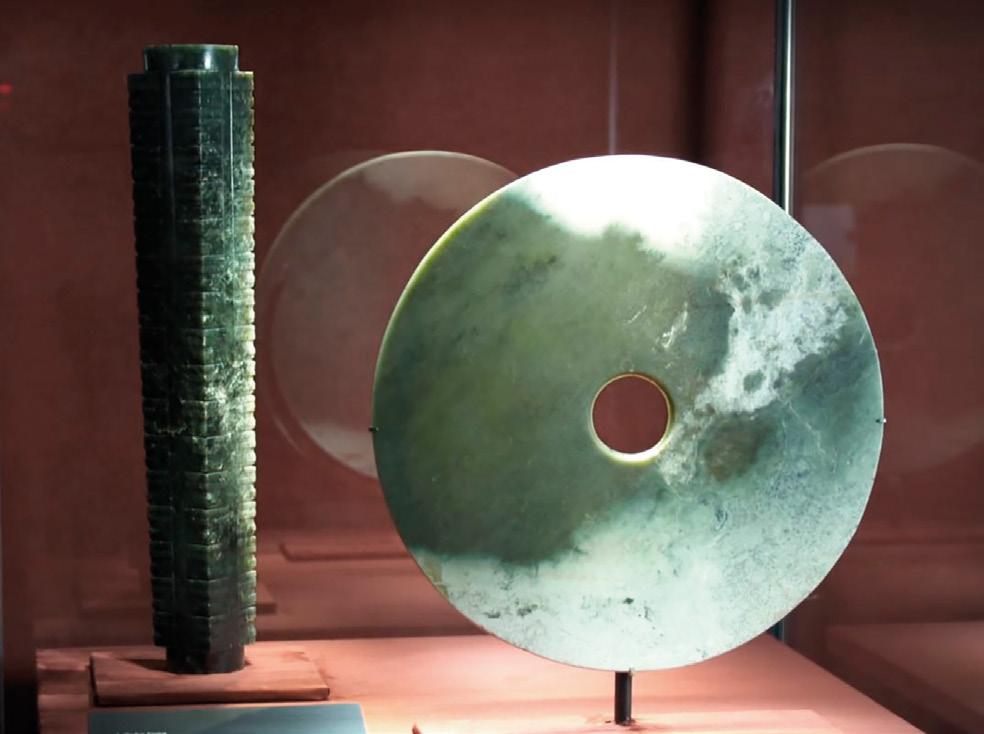
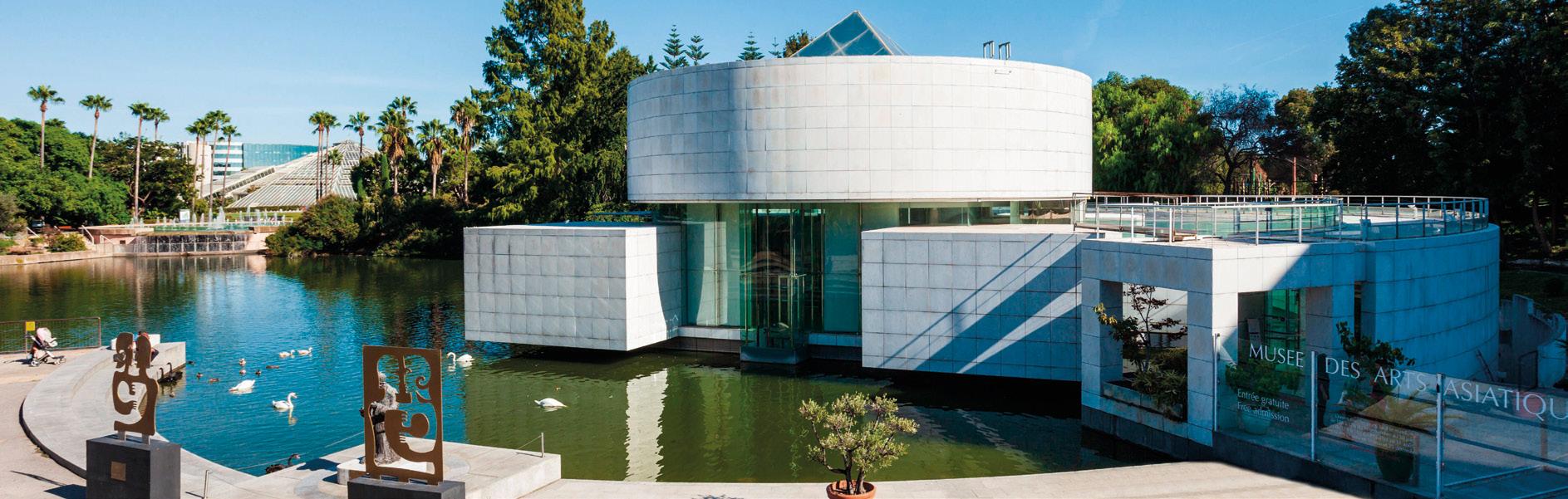
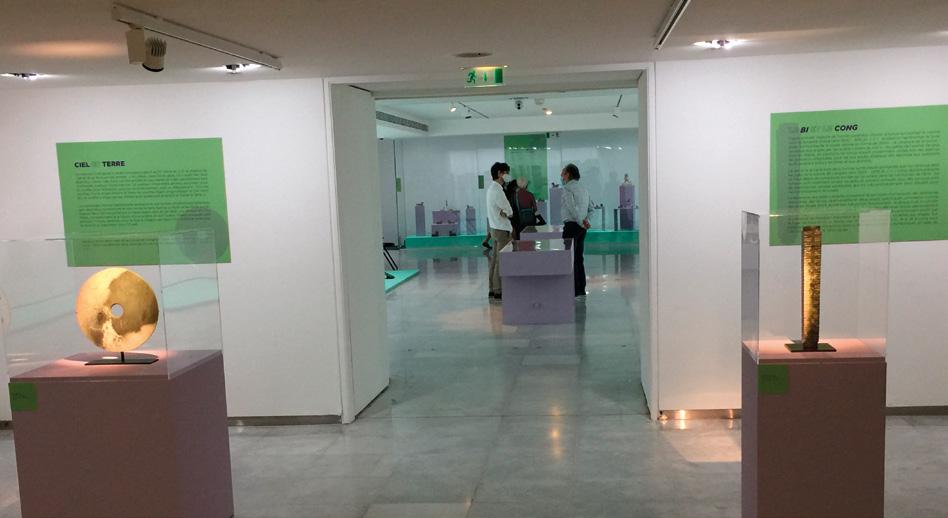
The Beginning of the World – According to the Chinese. Dragons, Phoenix and Other Chimera, Nice, Summer 2021
1 A LARGE GREEN-GLAZED POTTERY ‘HILL’ JAR AND COVER, HAN DYNASTY
PUBLISHED
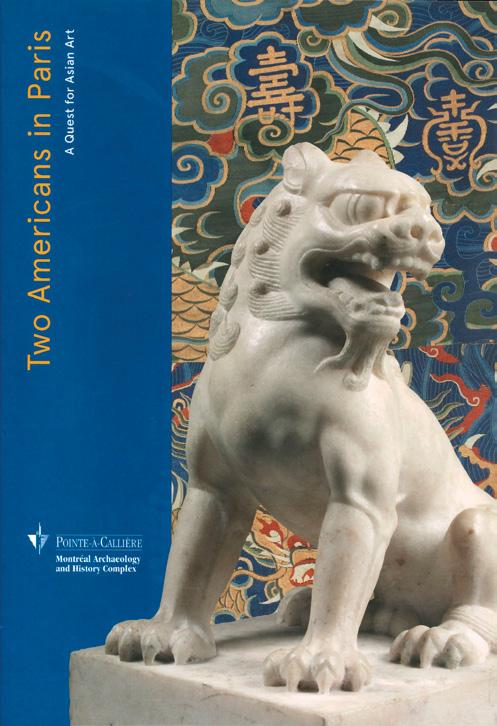
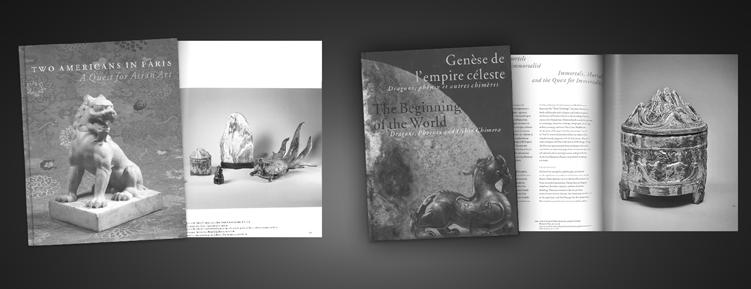
1. Jean-Paul Desroches (ed.) et al, Two Americans in Paris. A Quest for Asian Art, Paris, 2016, p. 159, no. 264.
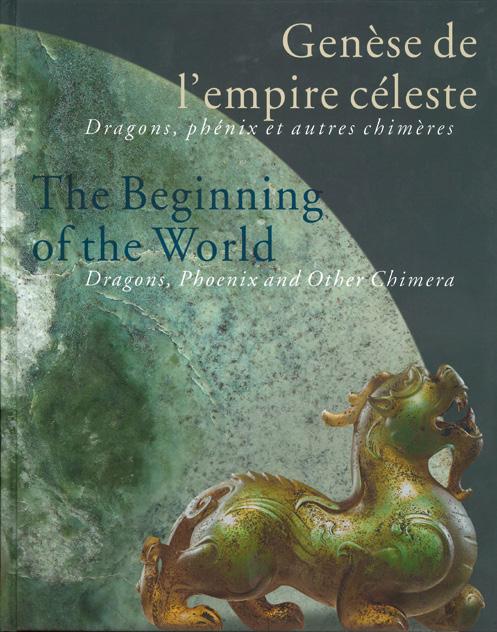
2. Jean-Paul Desroches (ed.) et al, The Beginning of the World. Dragons, Phoenix and Other Chimera, Fondation Baur, Geneva, 2020, p. 182-183, no. 109.
Exhibited:
1. Pointe-à-Callière Museum, From the Lands of Asia. The Sam and Myrna Myers Collection, Montréal, 17 November 2016-19 March 2017.
2. Kimbell Art Museum, From the Lands of Asia. The Sam and Myrna Myers Collection, Fort Worth, Texas, 4 March-19 August 2018.
3. Musée Départemental des Arts Asiatiques, The Beginning of the World – According to the Chinese. Dragons, Phoenix and Other Chimera, Nice, Summer 2021.
4. Fondation Baur, The Beginning of the World – According to the Chinese. Dragons, Phoenix and Other Chimera, Geneva, 11 November 2020-23 May 2021.
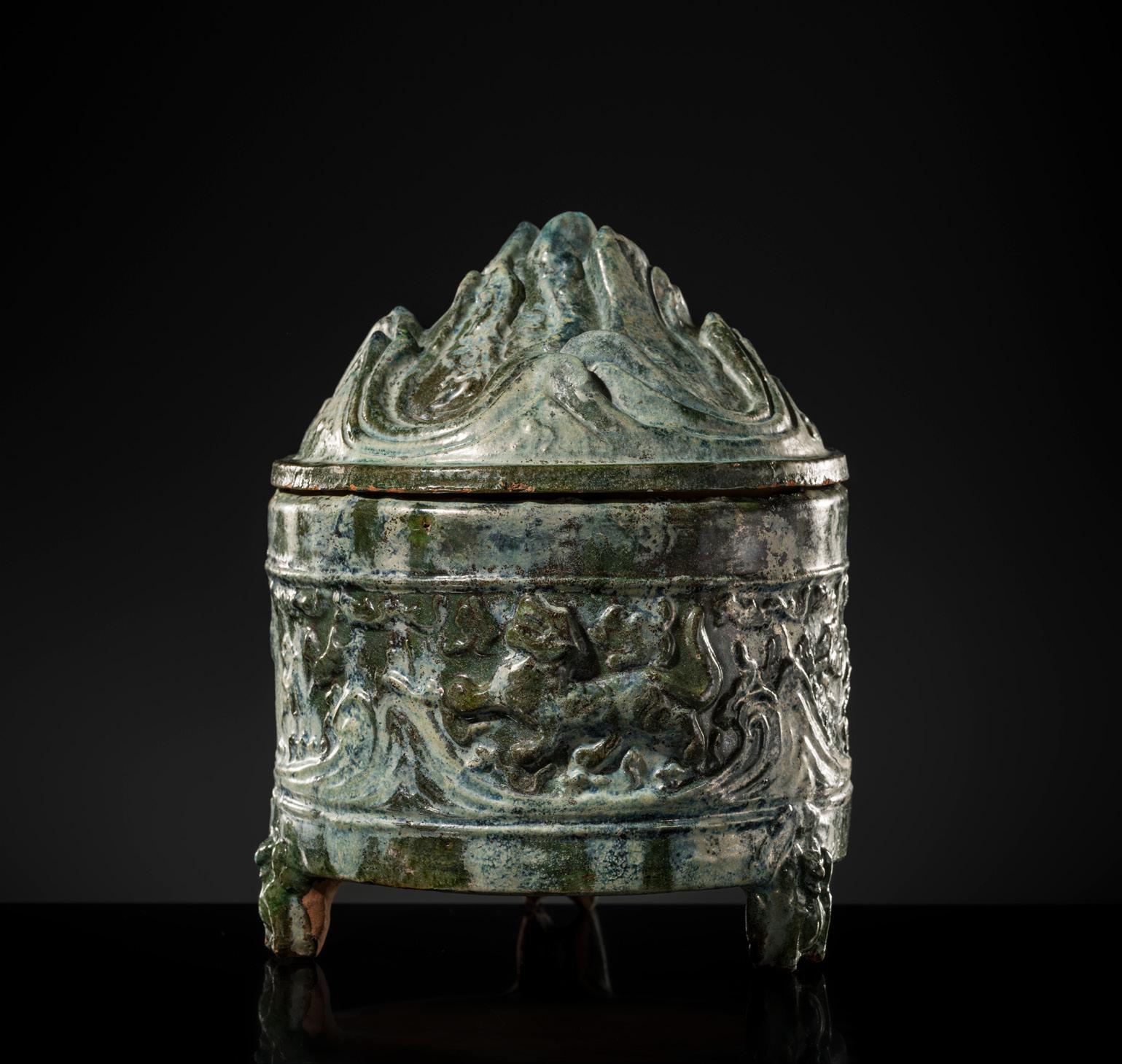
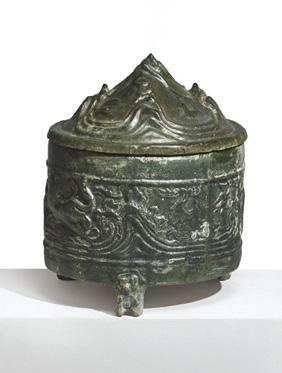
China, 206 BC to 220 AD. Heavily potted, the cylindrical jar is raised on three bear feet and molded around the exterior with a hunting scene of figures and various animals. The cover is modeled with mountain peaks interspersed with further animals surrounding a central peak. The exterior is covered in a rich green glaze, transmuting into splashes of lighter green and white. The underside remains unglazed.
Provenance: The Collection of Sam and Myrna Myers, Paris, France. Acquired between circa 1965-2012.
Condition: Very good condition with old wear, commensurate with age. Firing flaws, including fritting, pitting, few chips to the edges and glaze losses.
Weight: 4,141 g (total)
Dimensions: Height 18.5 cm (excl. cover), 29 cm (incl. cover), Diameter 23 cm
AUCTION RESULT COMPARISON
Type: Related
Auction: Sotheby’s New York, 15 September 2018, lot 1388
Price: USD 6,875 or approx. EUR 6,500 converted and adjusted for inflation at the time of writing
Description: A green-glazed pottery 'hill' jar and cover Han dynasty
Expert remark: Compare the related form, decoration and color of the glaze. Note the smaller size (15.6 cm).
Estimate EUR 3,000
Starting price EUR 1,500
2
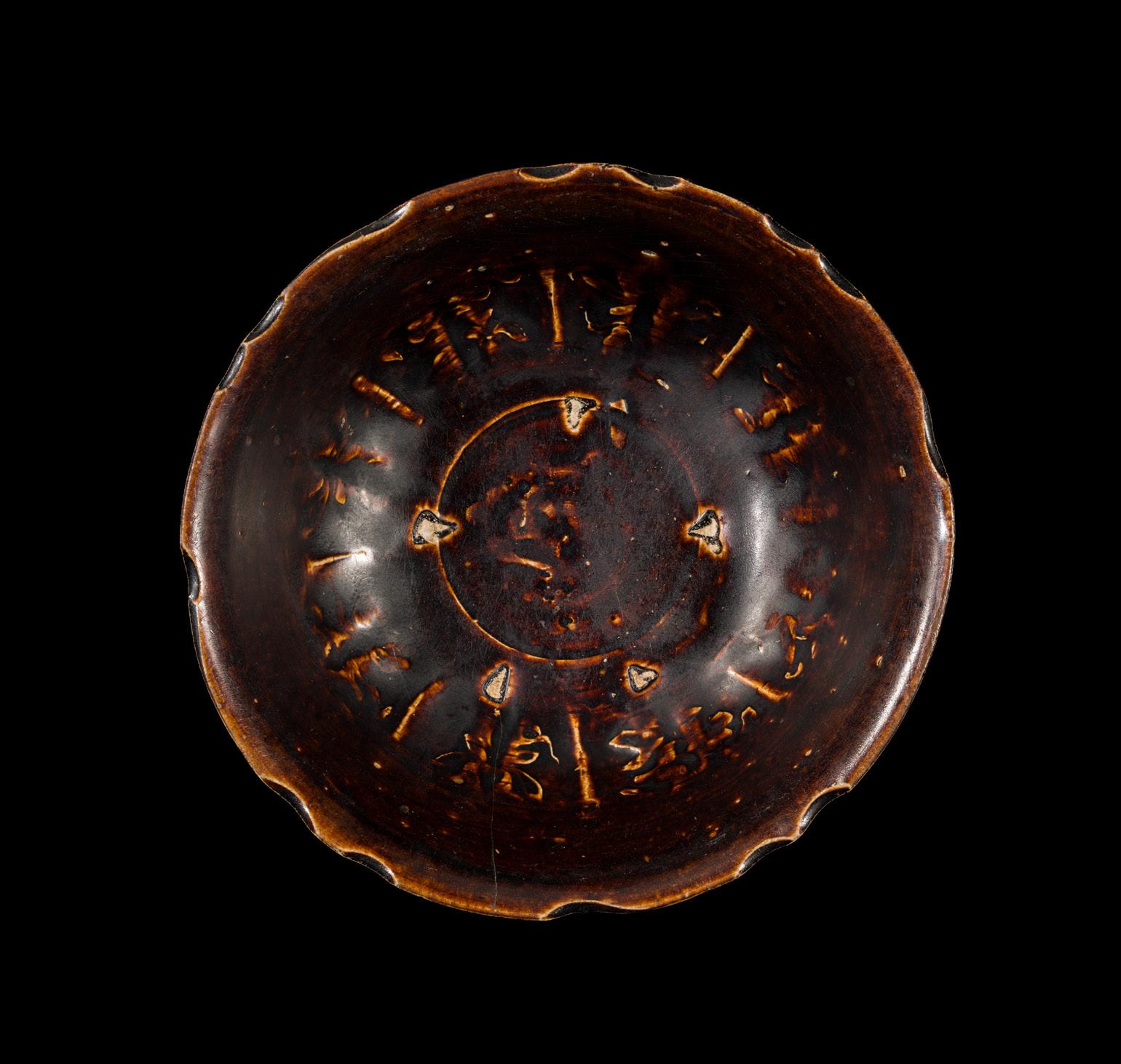
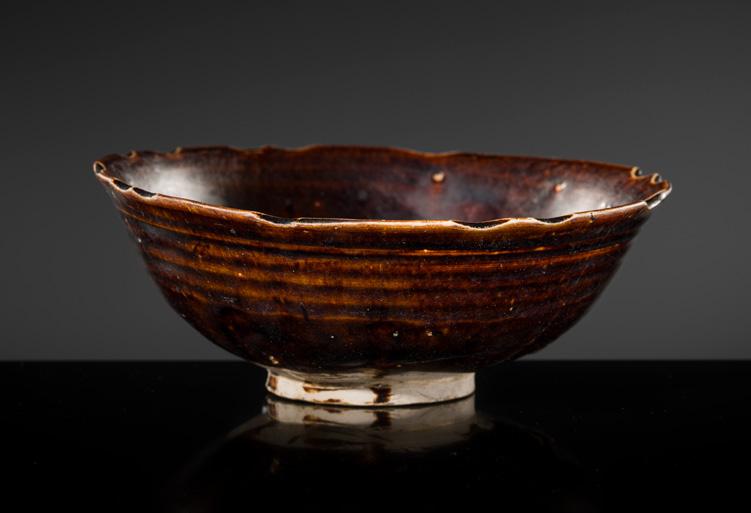
AN UNUSUAL RUSSET AND BLACK GLAZED ‘INSCRIBED’ BOWL, SONG DYNASTY, PROBABLY YAOZHOU KILNS
China, 960–1234. Well-crafted pottery with deep, rounded sides resting on a short, circular foot rising to a slightly outward-curving rim with distinctive round notches. Overall, it is covered with a black glaze through which rust-brown tones shimmer; the fine structure inside the bowl creates a pattern highlighted by areas where the light-colored body shows through. In places, this interior pattern suggests forms that recall abstracted Chinese characters. The glaze falls short of the foot, revealing the buff-colored body.
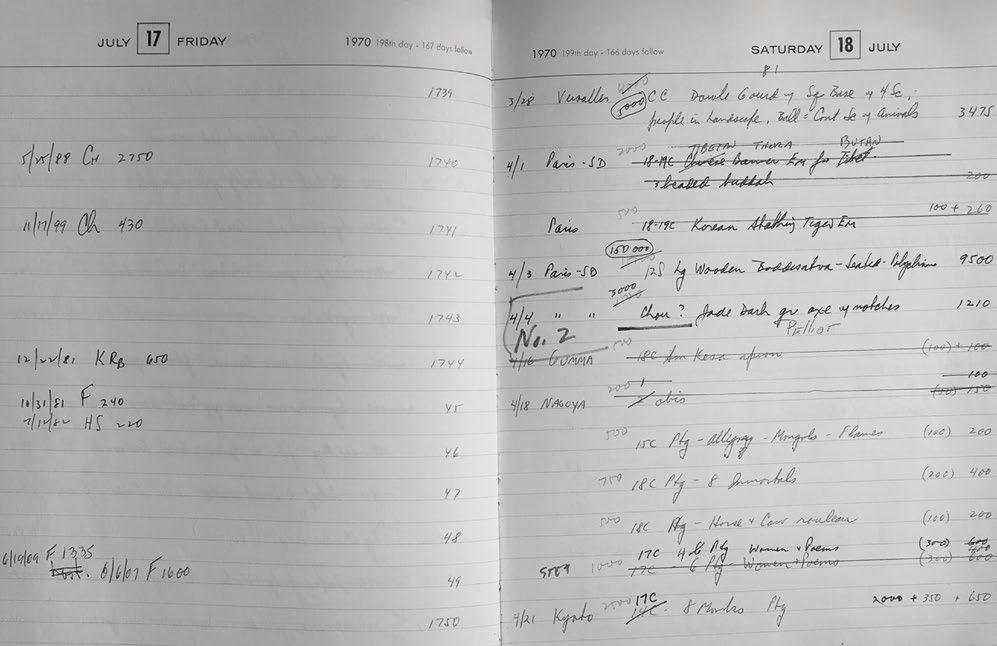
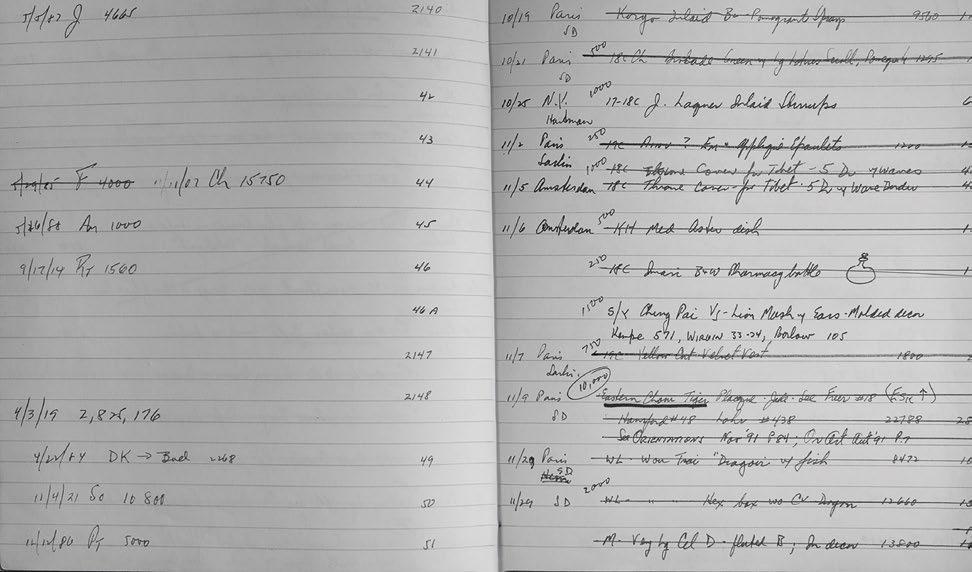
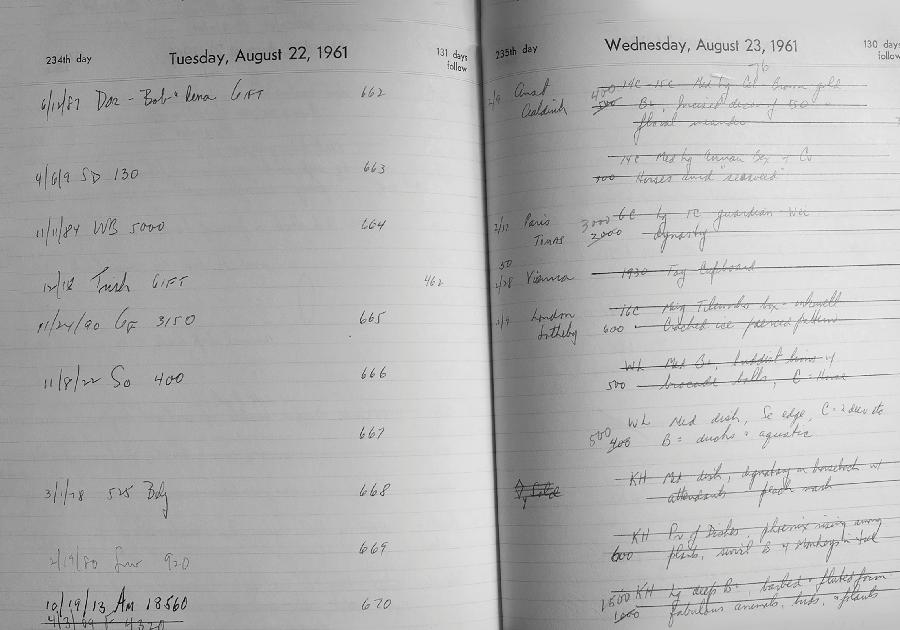
Provenance: The Collection of Sam and Myrna Myers, Paris, France. Acquired on 17 February 1972 in Paris, according to the Myers ledger, and in the collection for 54 years.
Condition: Good condition with expected wear and firing irregularities, including fritting, distinct spur marks and glaze recesses, light surface scratches, a hairline crack of 6 cm, and a small touchup to the glaze at the rim.
Weight: 296 g
Dimensions: Height 6 cm, Diameter 16.5 cm
The striking pattern on this bowl is created by layers of russet to deep dark glaze, which, together with the distinctive notched rim, make it a rare and compelling piece. Its characteristic form, known as zhan, and its lustrous glaze reflect the influence of Jian wares produced in Fujian province. By the Northern Song period, tea wares from Jianyang were highly prized by tea connoisseurs, scholars, and even the imperial court, and they in turn inspired ceramic manufactories throughout both northern and southern China.
AUCTION RESULT COMPARISON
Type: Related
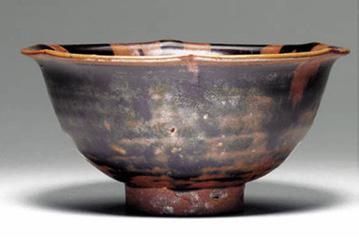
Auction: Christie’s New York, 16 October 2001, lot 75
Price: USD 10,575 or approx. EUR 16,500 converted and adjusted for inflation at the time of writing
Description: A rare Yaozhou black and russet-glazed bowl, Northern Song dynasty, 11th century Expert remark: Compare the related modeling, and notched rim, and coloration. Note the different glaze and smaller size (12.1 cm).
Estimate EUR 2,000
Starting price EUR 1,000
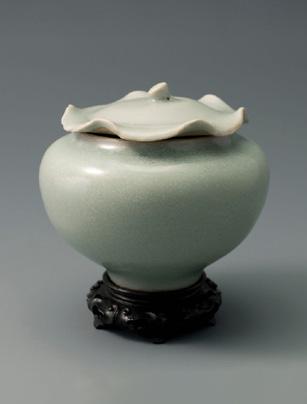
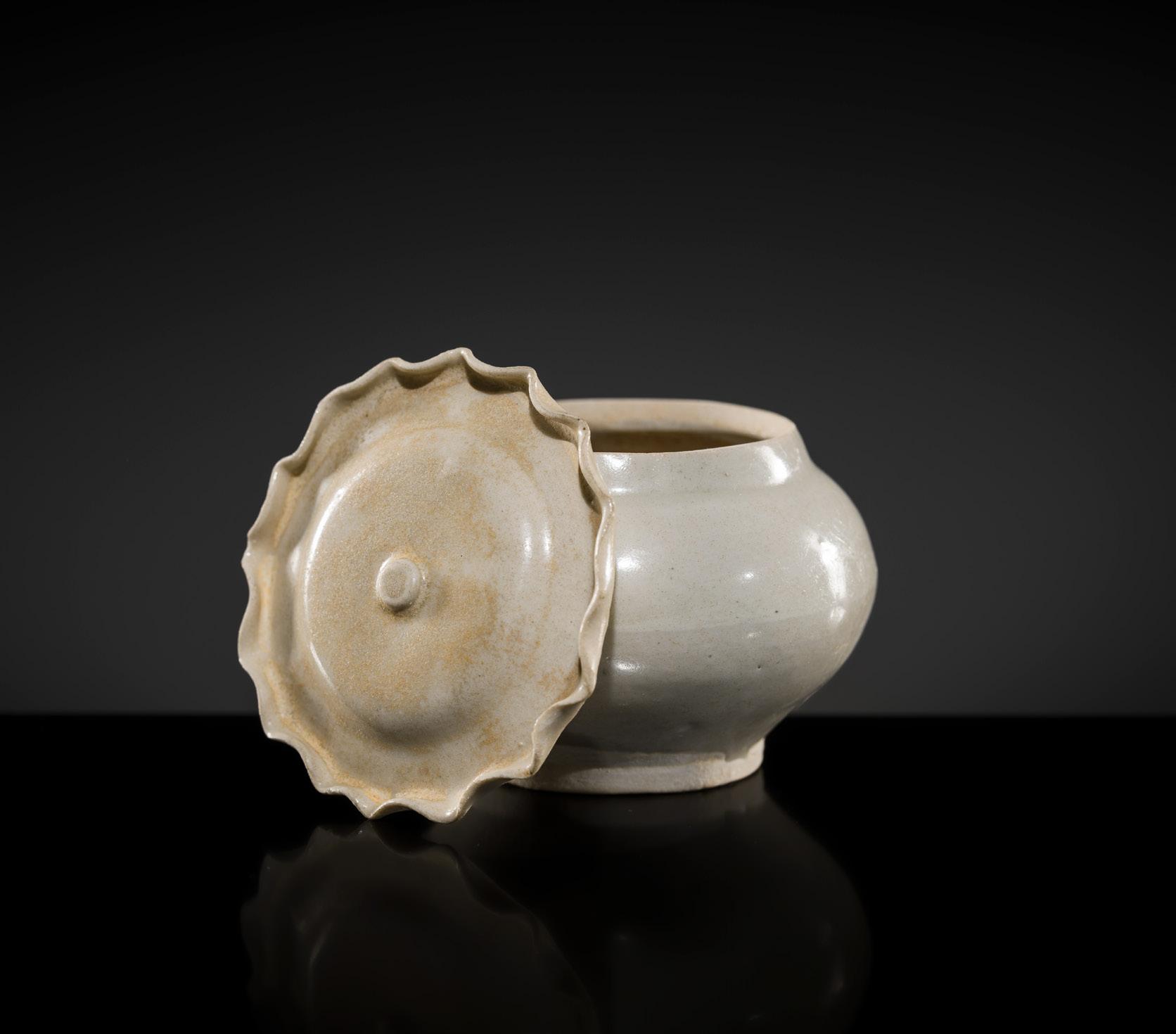
3 A RARE LONGQUAN PALE CELADON JAR AND COVER, SOUTHERN SONG DYNASTY
China, 1127-1279. Delicately potted, of baluster form rising from a short convex base encircled by an unglazed foot. The lotus leaf–form cover has an undulating rim. Both the jar and cover are covered overall in an attractive glaze of beige to light celadon tone. The lid is fitted with a small knob. (2)
Provenance: The Collection of Sam and Myrna Myers, Paris, France. Acquired between circa 1965-2012.
Condition: Good condition with minor wear and firing flaws, including fritting to the foot, small pitting, few dark spots, a tiny chip to the rim. The interior with soiling.
Weight: 136 g (total)
Dimensions: Height 5.7 cm (excl. cover), 6.7 cm (incl. cover), Diameter 8.6 cm
LITERATURE COMPARISON
Compare a closely related jar and cover, dated to 1271-1368, in the Guangdong Provincial Museum.
AUCTION RESULT COMPARISON
Type: Closely related
Auction: Christie’s Hong Kong, 3 December 2021, lot 2825
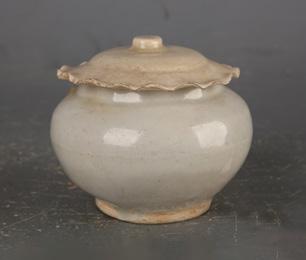
Price: HKD 175,000 or approx. EUR 21,000 converted and adjusted for inflation at the time of writing.
Description: A rare small Longquan celadon jar and cover, southern song dynasty (1127-1279)
Expert remark: Compare the closely related form and glaze. Note the slightly smaller size (7 cm).
Estimate EUR 1,500
Starting price EUR 700
4
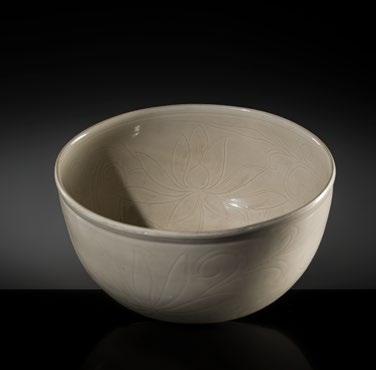
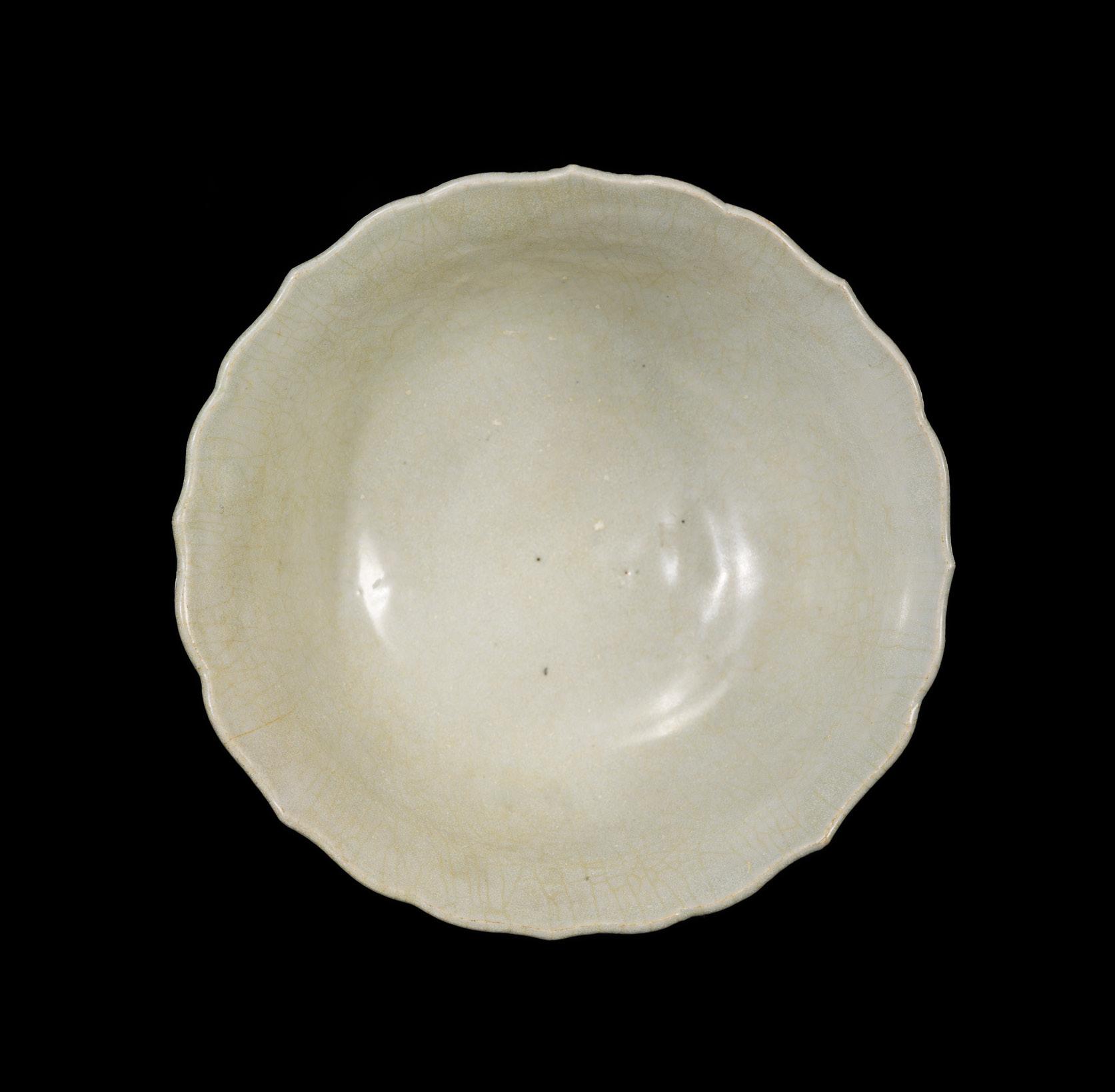
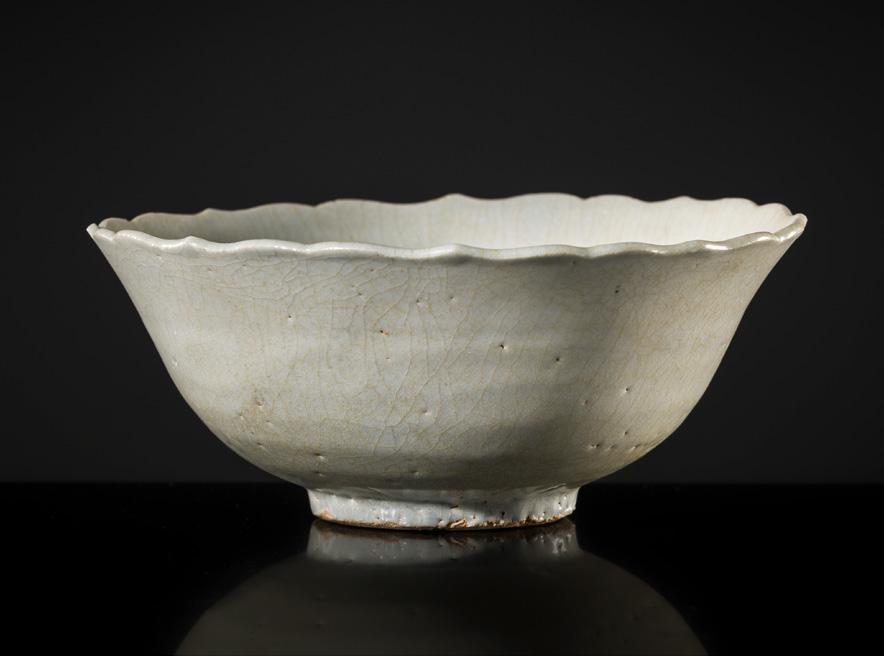
A WHITE GLAZED DING-TYPE FOLIATE PORCELAIN BOWL, SONG DYNASTY
China, 960-1279. Finely potted with slightly rounded sides supported on a short, circular foot, rising to a flaring and distinctively lobed rim. Both the interior and exterior of the bowl are covered with an attractive white glaze exhibiting a dense network of fine crackles. The base remains unglazed, and is inscribed with a single character in black ink.
Provenance: The Collection of Sam and Myrna Myers, Paris, France. Acquired between circa 1965-2012.
Condition: Very good condition with minor wear and firing flaws including crackling to the glaze, light fritting as well as few dark spots.
Weight: 257 g
Dimensions: Height 6.2 cm, Diameter 15.4 cm
Estimate EUR 1,000
Starting price EUR 500
A
AND
PUBLISHED
Exhibited:
1. Fondation Baur, The Beginning of the World – According to the Chinese. Dragons, Phoenix and Other Chimera, Geneva, 11 November 2020-23 May 2021 (the zodiac figures).
2. Musée Départemental des Arts Asiatiques, The Beginning of the World – According to the Chinese. Dragons, Phoenix and Other Chimera, Nice, Summer 2021 (the zodiac figures).
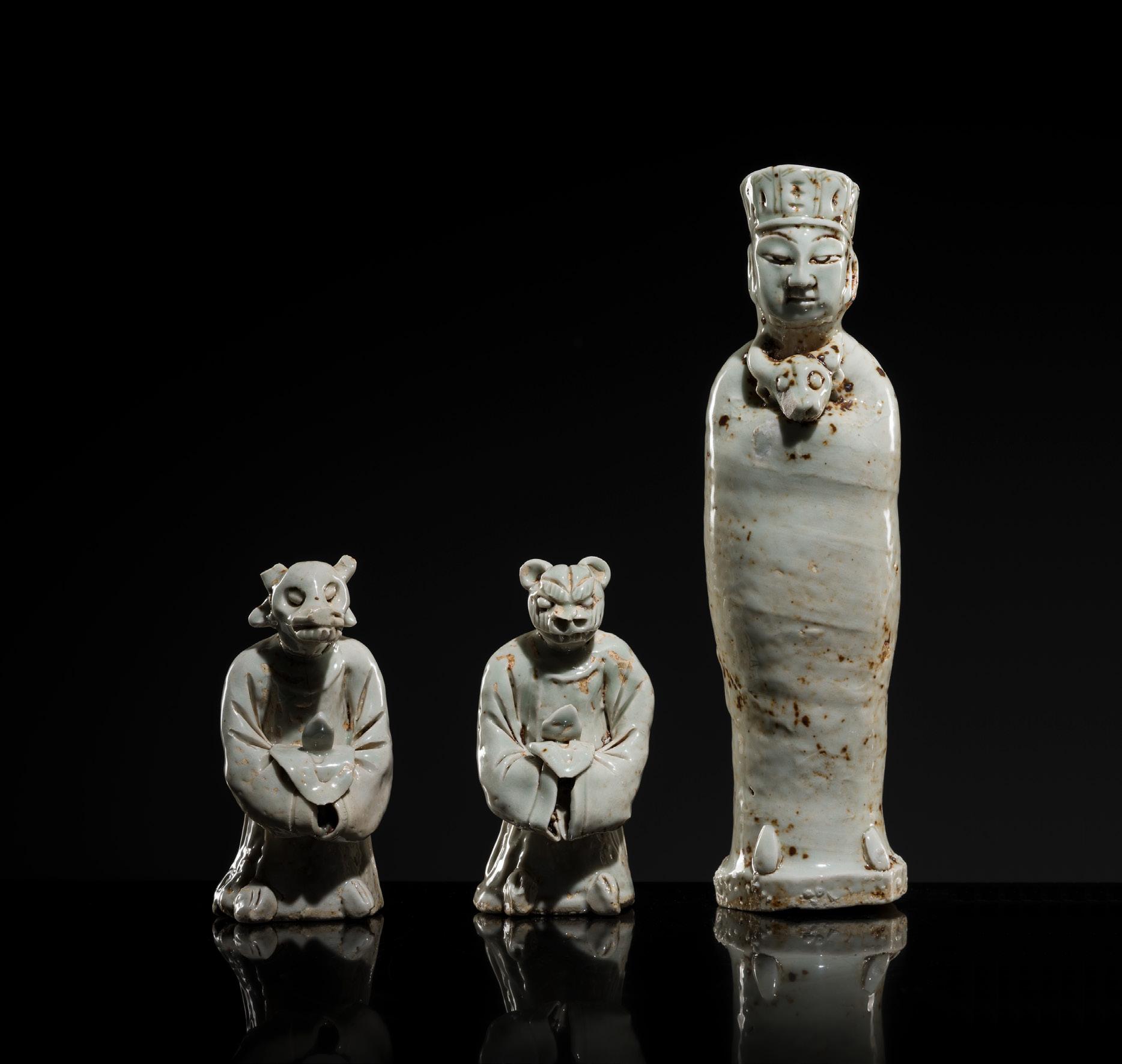
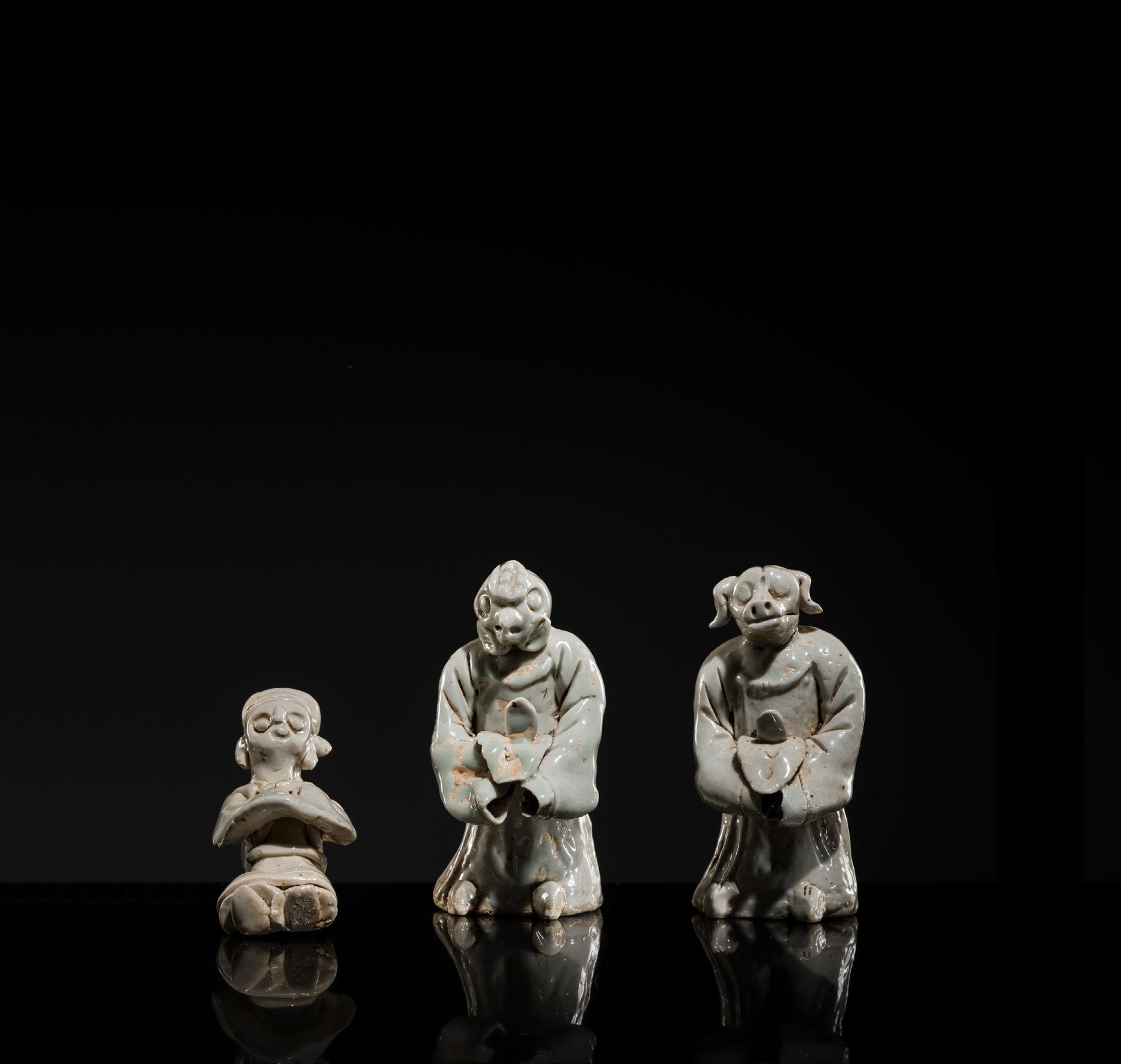
China, 960-1279. The set comprising of a group of four smaller zodiac figures of an ox, tiger, rooster, and pig, modeled as a human figure standing ramrod straight with hands clasped beneath the long sleeves of court robes; a fifth taller zodiac figure covered almost entirely in a swaddle with the head of an ox to his chest; and a robed human figure leaning back as he relaxes with hands clasped to his chest. (6)
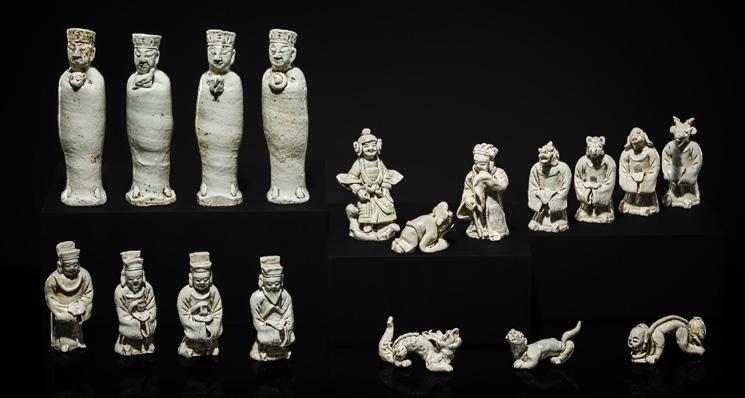
AUCTION RESULT COMPARISON
Type: Closely related
Auction: Zacke, Vienna, 11 September 2025, lot 34
Price: EUR 19,500
Description: A fine collection of eighteen Qingbai figures, Song dynasty
Provenance: The Collection of Sam and Myrna Myers, Paris, France.
Acquired between circa 1965-2012.
Condition: Good condition, commensurate with age. Expected firing irregularities including age cracks, encrustations, dark spots, pitting, and glaze recesses. Scattered small chips, mineral deposits, and tiny losses, all as expected.
Weight: 68.7 g (the smallest), 277.6 g (the largest)
Dimensions: Height 5.7 cm (the smallest), 19 cm (the largest)
Zodiac figures first appeared during the Han dynasty as artisans began casting representations of the animals in bronze as offerings. From the Northern Wei dynasty onwards, the zodiacal animals began to be anthropomorphized, as seen on several examples in the present lot.
Estimate EUR 3,000
Starting price EUR 1,500
Expert remark: Compare the closely related modeling, expression, glaze, and similar stance of the zodiac figures. Note the size (4-18.4 cm) and that the present lot is also from the same collection.
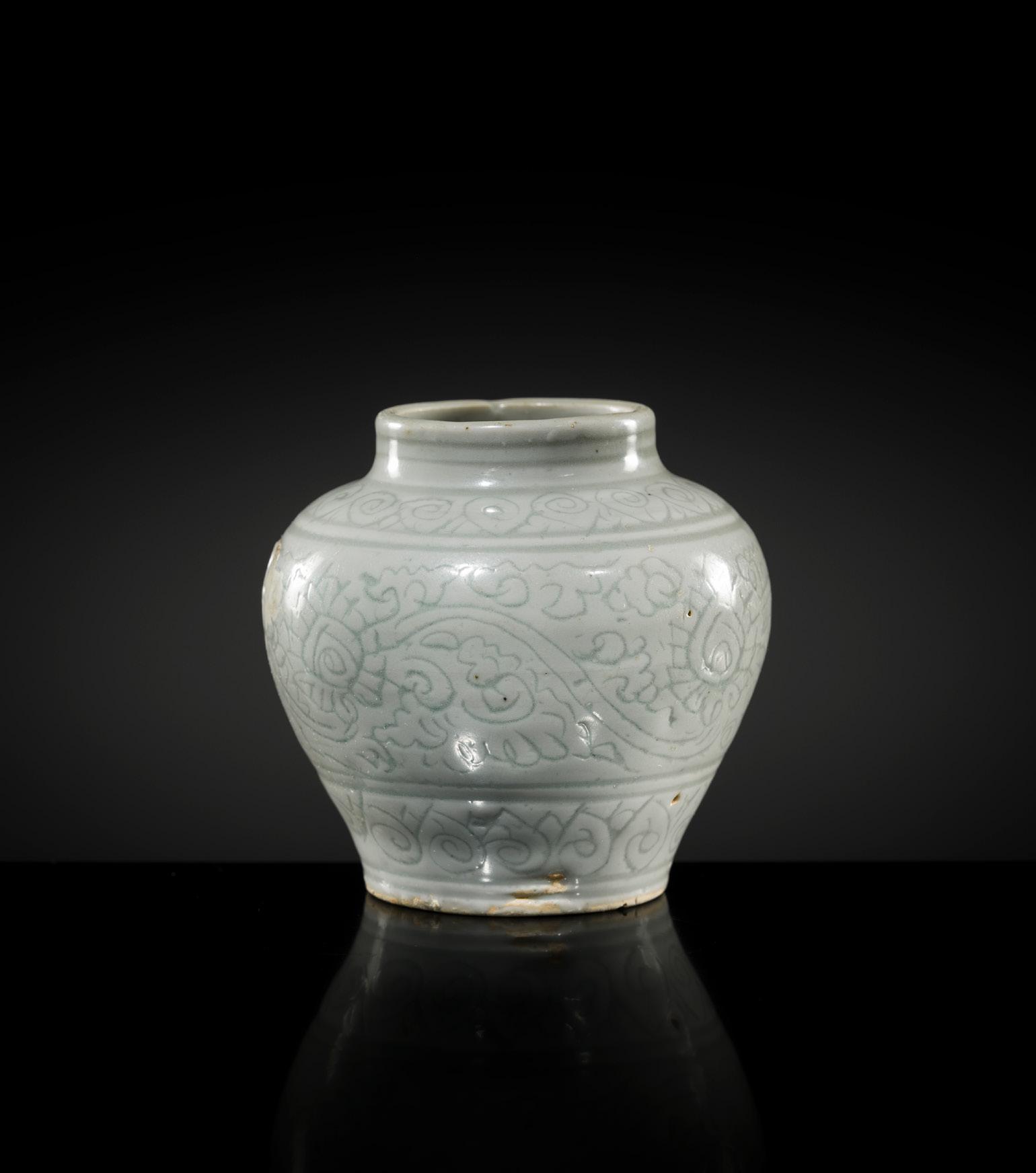
6 A NEATLY CARVED SMALL QINGBAI ‘LOTUS’ JAR, SOUTHERN SONG DYNASTY
China, 1127–1279. Finely potted with a swelling, high-shouldered body supported on a ring foot and rising to a short, narrow neck. The globular body is incised with a central band of lotus flowers and scrolling foliage, flanked by two additional bands of scrolls. All covered in a pale blue glaze, the underside remains unglazed.
Provenance: The Collection of Sam and Myrna Myers, Paris, France. According to the Myers ledger acquired on 19 September 1974 in New York and in the collection for 52 years.
Condition: Good condition with old wear and firing flaws, including pitting, dark spots and glaze recesses.
Weight: 239 g
Dimensions: Height 9.4 cm
AUCTION RESULT COMPARISON
Type: Closely related
Auction: Sotheby’s London, 10 November 2010, lot 176
Price: GBP 4,000 or approx. EUR 8,000 converted and adjusted for inflation at the time of writing
Description: A 'Qingbai' carved jar and cover Southern Song dynasty
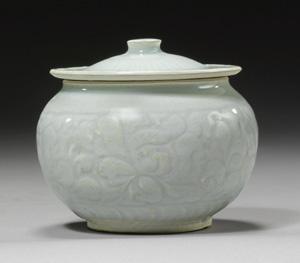
Expert remark: Compare the related form, decoration and color of the glaze. Note the cover.
Estimate EUR 1,000
Starting price EUR 500
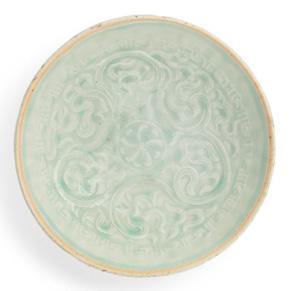
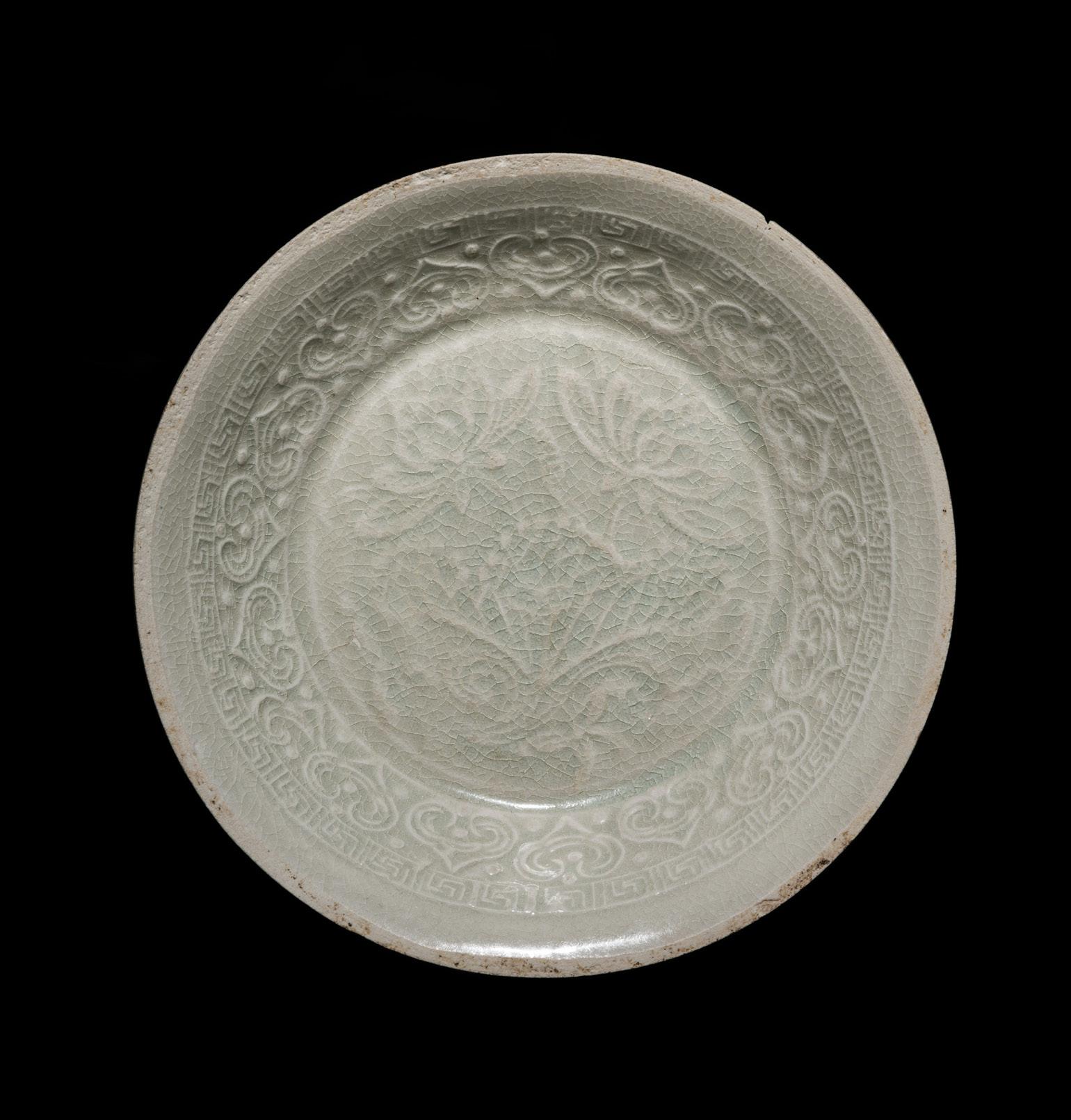
China, 1127–1279. Delicately potted with shallow, rounded sides rising from a low foot, the interior finely molded with three lotus blossoms, encircled by a band of heart-shaped leaves and a key-fret band, and covered overall with a very pale green-blueish glaze, finely crackled overall, save for the rim, which exposes the fine white body.
Provenance: The Collection of Sam and Myrna Myers, Paris, France.
Acquired on 15 December 1976, at Drouot, according to the Myers ledgers.
Condition: Good condition with old wear and firing flaws including dark spots, expected fritting to the rim and foot, and a tiny nick.
Weight: 130 g
Dimensions: Height 2.7 cm, Diameter 15 cm
This dish is outstanding for its intricately rendered scene of three lotus flowers and leaves. The depth and clarity of the design, from the naturalistic modeling of the flowers and leaves makes this dish particularly special and rare. Dishes with such sophisticated designs were made using
a mold, a technique that began to be used at the Qingbai kilns in the early 12th century and one that allowed for greater precision. These molds were similar to those used for casting metal vessels, and indeed many designs on molded Qingbai wares are also found on contemporary metalware.
AUCTION RESULT COMPARISON
Type: Related
Auction: Sotheby's New York, 17 March 2021, lot 112
Mid-Estimate: USD 8,190 or approx. EUR 10,000 converted and adjusted for inflation at the time of writing
Description: A rare molded Qingbai bowl, Southern Song / Yuan dynasty
Expert remark: Compare the glaze, form, style, and molded décor.
Estimate EUR 1,000
Starting price EUR 500
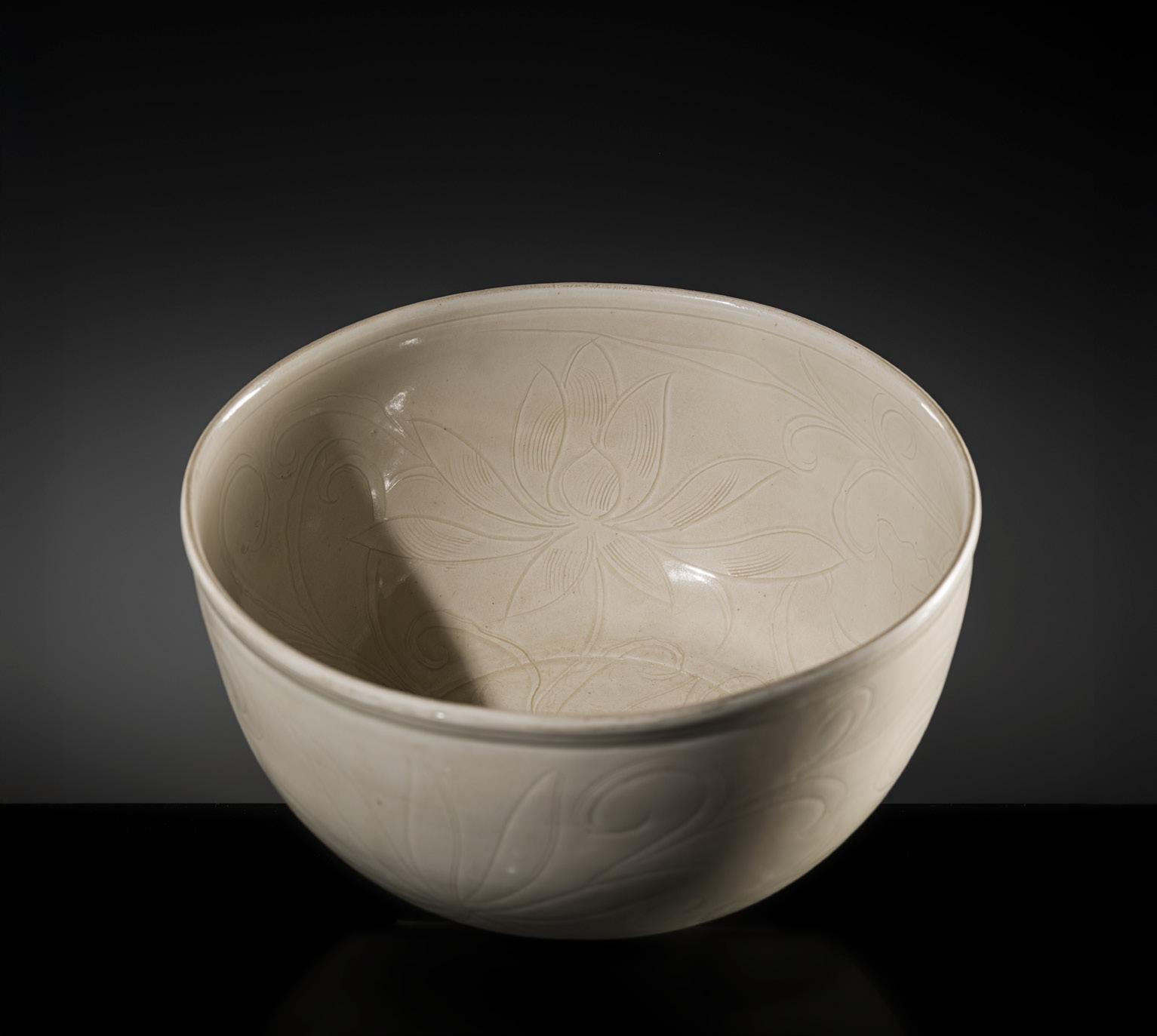
8 A RARE AND MASTERFULLY CARVED LARGE 'DING' BOWL, NORTHERN SONG DYNASTY
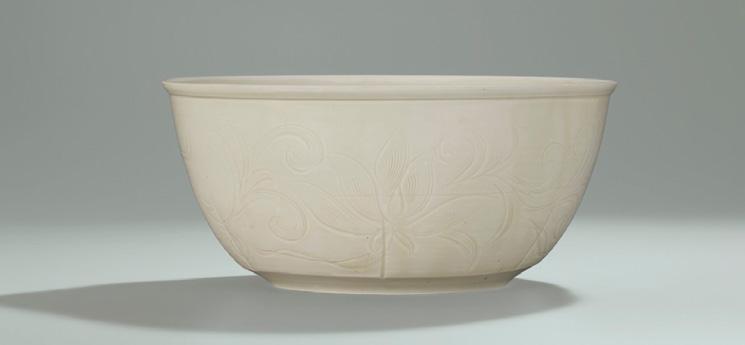
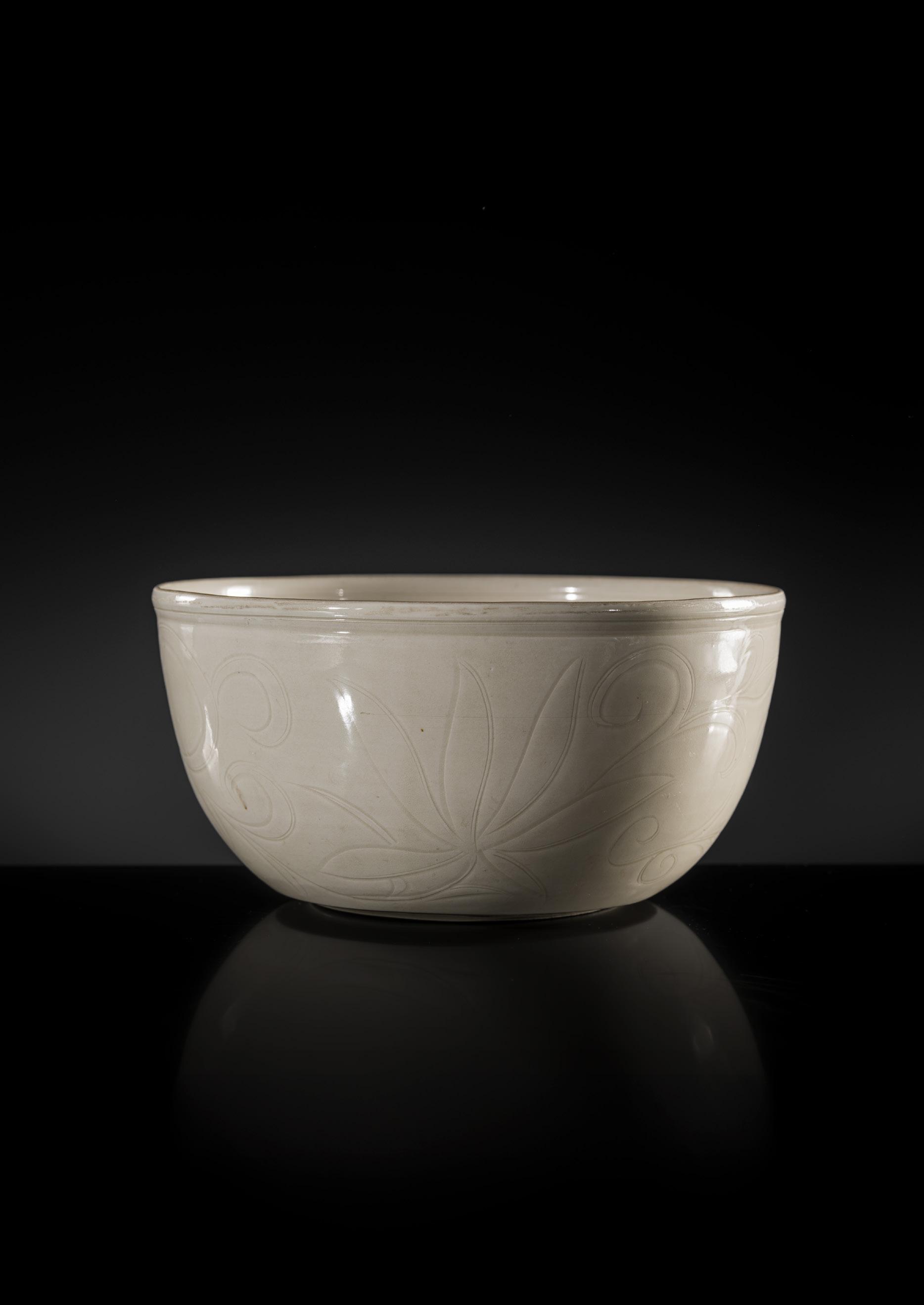
China, 11th-12th century. Elegantly potted with rounded sides rising from a beveled foot encircling the slightly recessed base to a gently everted rim. The exterior is freely carved with sprays of lotus flowers and incised with fine lines. The interior is carved with further lotus blossoms and a sagittaria leaf. The piece is overall covered with an even ivory-white glaze, with the exception of the rim, which reveals the fine white body.
Provenance: The Do-Ki Aono collection, Japan. The Collection of Sam and Myrna Myers, Paris, France, acquired from the above on 1 October 1989, and in the collection for 37 years, according to the Myers ledger. Dô-Ki Aono (1939–2002) was a noted Japanese painter and illustrator active in the mid- to late 20th century. Born Yoichiro Ogawa, he worked under the name Dô-Ki Aono and produced a body of work that included gouaches and figural compositions. His pieces have appeared in European auctions and in private collections, and vintage posters of his work were released by galleries such as Galerie Myrna Myers in Paris, indicating presence also in the European art market. Aono’s stylistic influences reportedly included modern Western artists like Picasso alongside elements drawn from Japanese visual culture. Aono was a distinguished collector of ancient Chinese ceramics and works of art, who is said to have traded with other noted collectors like J.M. Hu, CT Loo, and Edward T. Chow.
Condition: Excellent condition with minor wear and firing flaws, including few dark spots, tiny glaze poolings and recesses. A minsucule drill hole from sample-taking to the underside. The corresponding TL test document was lost long time ago and is therefore not available. The test can be repeated upon request of the winning bidder, after full payment has been received.
Weight: 860 g
Dimensions: Height 12 cm, Diameter 23 cm
This bowl is a specific type of white ware called Ding type, so named for the Ding kilns in Hebei province that produced them. Ding ware is characterized by a soft white clay for the body and a warm toned ivorywhite glaze of smooth consistency. The soft clay allowed for incisions and impressions of designs, such as the motifs of leafy vine scrolls and lotus blossoms or buds that appear on the interior of this bowl. The warm tone of this glaze is permeated with a distinct greenish tinge.
AUCTION RESULT COMPARISON
Type: Closely related
Auction: Christie’s Hong Kong, 28 May 2014, lot 3212
Price: HKD 21,400,000 or approx. EUR 3,000,000 converted and adjusted for inflation at the time of writing
Description: A very rare and superbly carved large ding bowl, Northern song dynasty (960-1127)
Expert remark: Compare the closely related form, glaze, decoration. Note the size (26.7 cm).
Estimate EUR 15,000
Starting price EUR 7,500
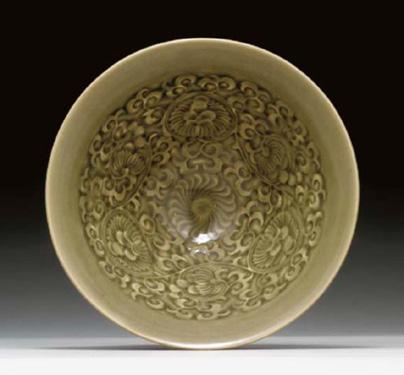
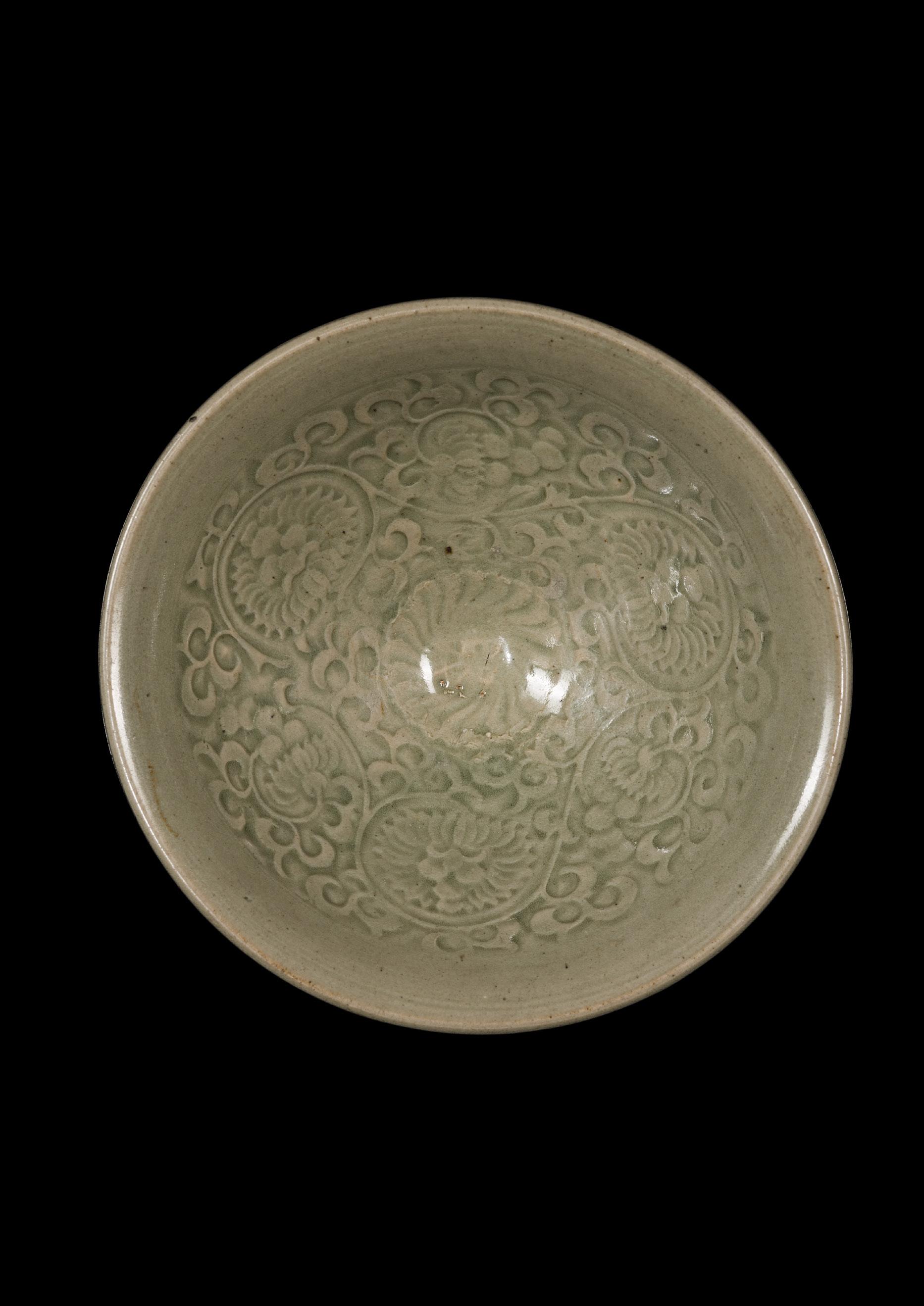
9 A LARGE YAOZHOU CELADON-GLAZED ’CHRYSANTHEMUM’ BOWL, NORTHERN SONG-JIN DYNASTY
Expert’s note:
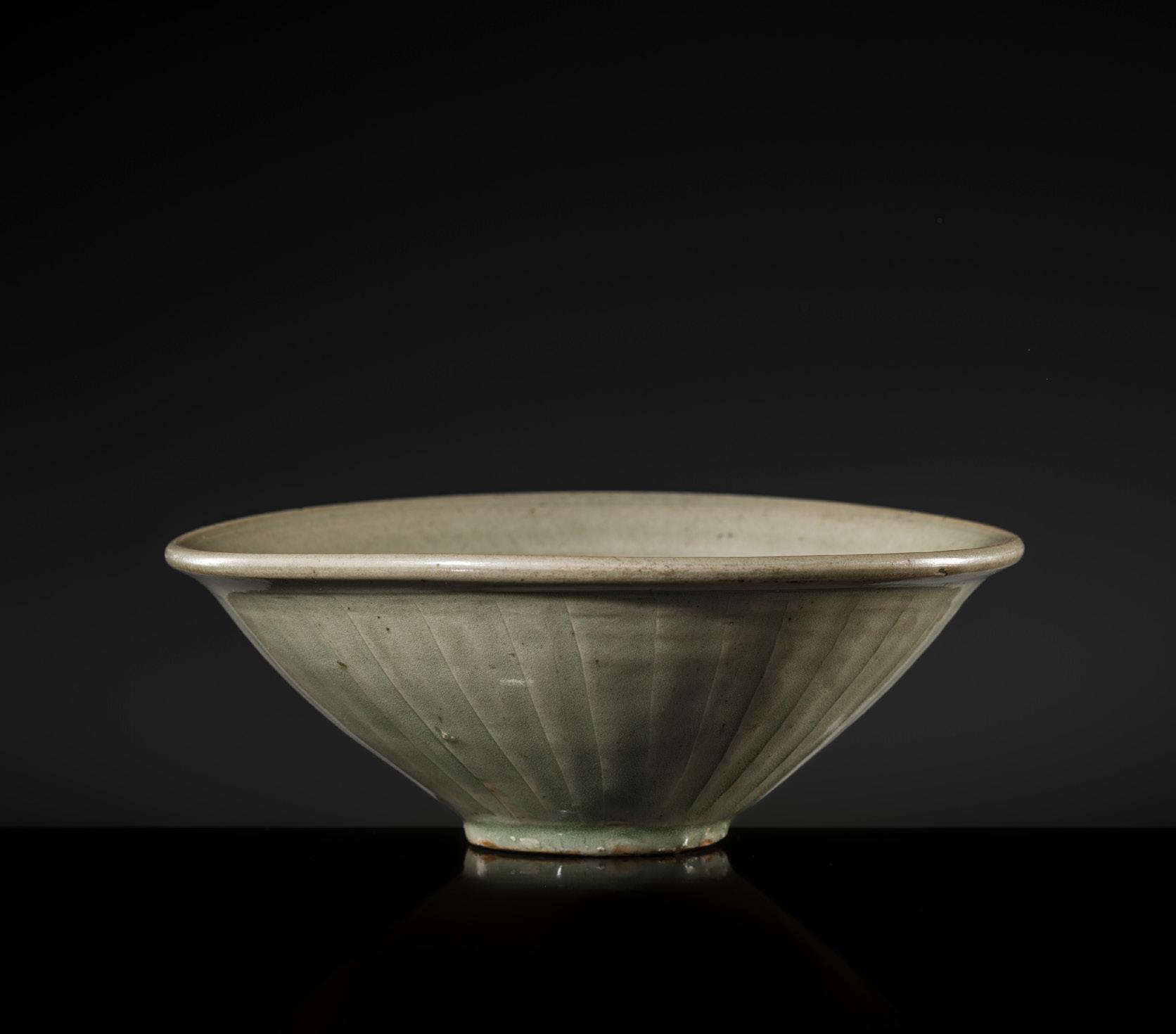
The darker, more saturated green in the carved lines creates a refined sense of depth and texture, hallmark traits of the best Yaozhou wares. While Yaozhou bowls of this general pattern are well known, the inclusion of the sagittaria leaf in the present design is rare and distinguishes this example as a work of particular importance.
China, 960-1127. Well potted, the deep conical body is raised on a shallow ring foot and flares slightly at the rim. The interior is molded with a central flowerhead surrounded by stylized chrysanthemum scrolls below a band, while the exterior is carved with narrow, simplified petals rising to a line border. The entire surface is covered with a glaze of greenish celadon tone.
Provenance: The Collection of Sam and Myrna Myers, Paris, France. Acquired on the 13 December 1976 from Christie's and in the collection for 49 years, according to the Myers ledger. Note that this information could not be verified independently.
Condition: Very good condition with minor wear and firing flaws, including small pitting, few dark spots, tiny pooling and glaze recesses.
Weight: 514 g
Dimensions: Height 7.5 cm, Diameter 20.5 cm
AUCTION RESULT
COMPARISON
Type: Closely related
Auction: Christie’s New York, 24 March 2004, lot 153
Price: USD 38,240 or approx. EUR 56,500 converted and adjusted for inflation at the time of writing
Description: A large Yaozhou celadon molded conical bowl, Northern song/Jin dynasty, 12th13th century
Expert remark: Compare the closely related form, glaze, decoration and the size (19 cm).
Estimate EUR 10,000
Starting price EUR 5,000
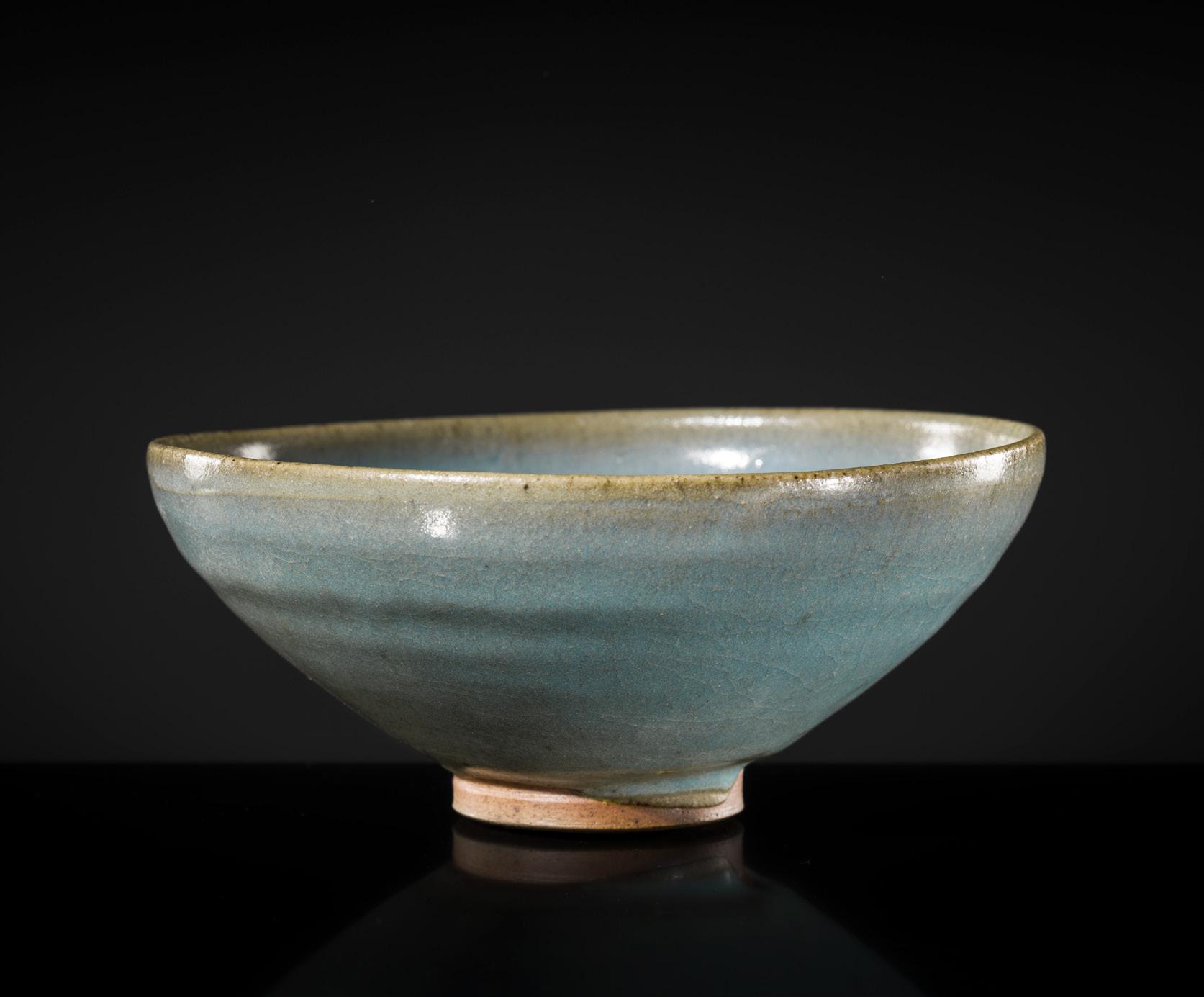
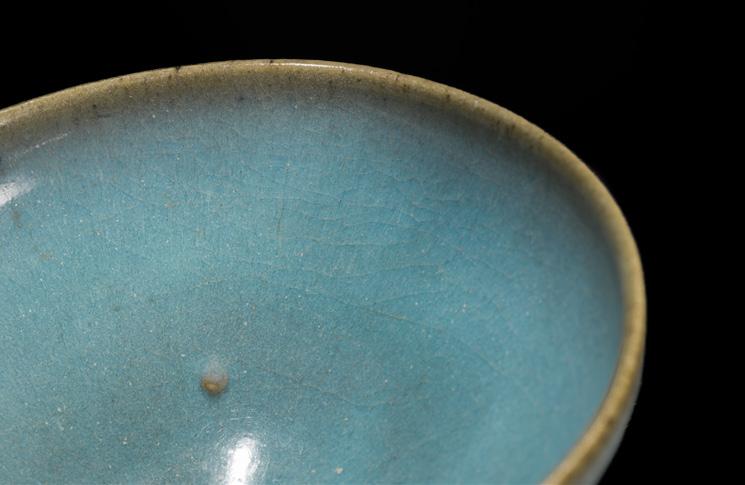
A MAGNIFICENT LAVENDER-BLUE-GLAZED JUN BOWL, LATE NORTHERN SONG-JIN DYNASTY
China, 12th-13th century. Finely potted with deep rounded sides rising from a short foot, covered overall with an opaque glaze of lavender-blue suffused with a crackle, thinning to mushroom at the rim, pooling elegantly around the body, and stopping unevenly just above the unglazed foot.
Provenance: The Collection of Sam and Myrna Myers, Paris, France, acquired from the above. With an old collection label to the base ‘No 2 40.001’. According to the Myers ledger, this was purchased at Sotheby's London, 9 December 1991, lot 224, and has been in the collection ever since. (this information could not be verified)
Condition: Very good condition with minor wear and firing flaws including small open bubbles, light fritting to the rim and minor glaze recesses.
Weight: 674 g
Dimensions: Height 9.5 cm, Diameter 20.9 cm
Literature comparison:
Compare a closely related Jun bowl, dated to the 13th-14th century, 21 cm (diameter), in the Metropolitan Museum of Art, object number 1975.1.1654.
AUCTION RESULT COMPARISON
Type: Closely related
Auction: Sotheby’s New York, 12 September 2018, lot 218
Price: USD 37,500 or approx. EUR 136,000 converted and adjusted for inflation at the time of writing
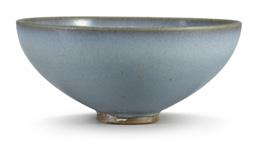
Description: A lavender-blue 'jun' bowl Northern Song dynasty
Expert remark: Compare the closely related form and glaze, color, pooling stopping just above the short unglazed foot and size (19.7 cm).
Estimate EUR 3,000
Starting price EUR 1,500
A LONGQUAN CELADON CARVED ‘PEONY AND LOTUS’ BOWL, LATE SOUTHERN SONG-YUAN
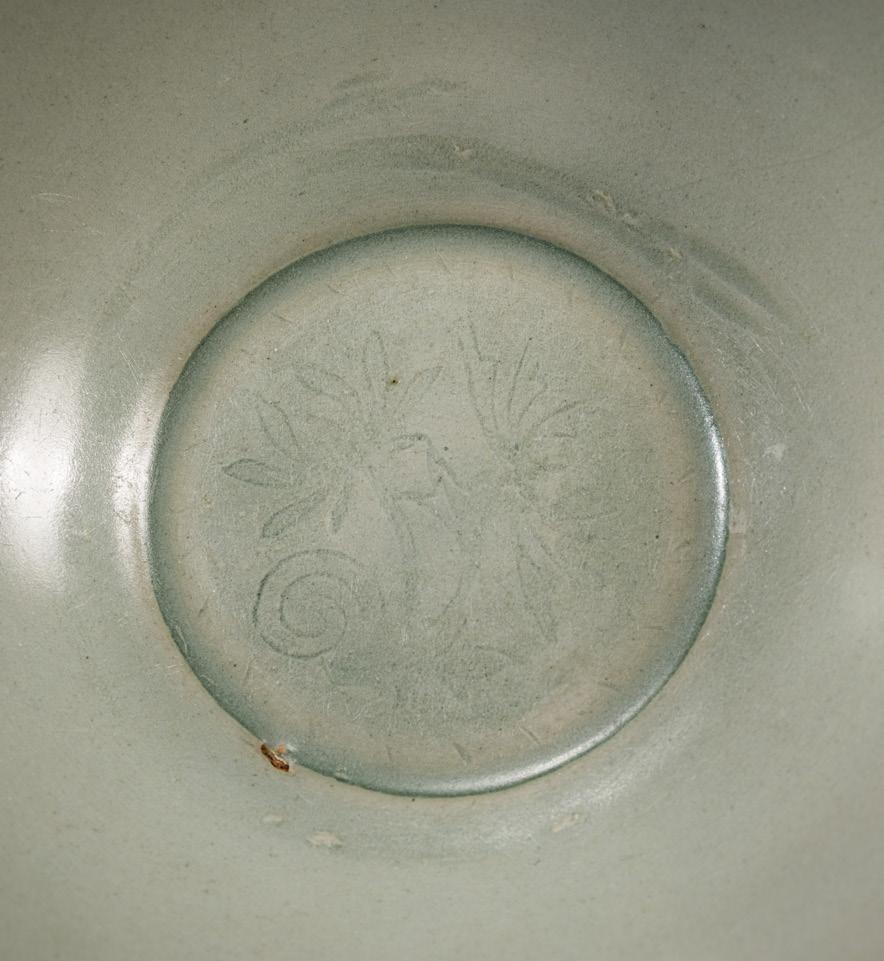
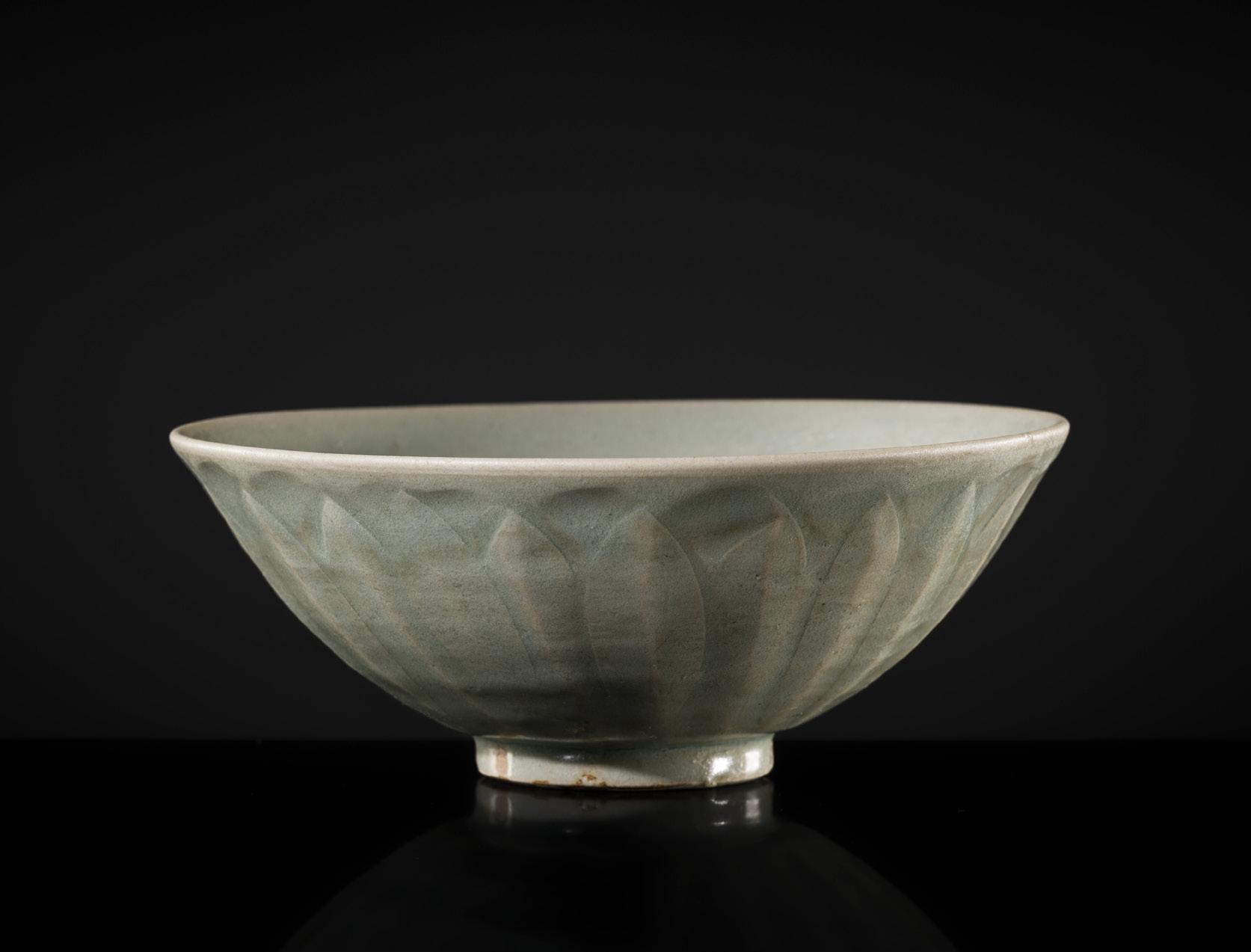
China, 13th century. Finely potted with deep, rounded sides supported on a short foot to a broad rim. Neatly incised at the center with peony blossoms. The exterior decorated with lotus petals. All covered in an even glaze of rich celadon to green tone. The foot remains unglazed.
Provenance: The Collection of Sam and Myrna Myers, Paris, France. Acquired between circa 1965-2012.
Condition: Very good condition with expected wear and firing flaws, including pitting, few dark spots, glaze recesses and very light surface scratches.
Weight: 444 g
Dimensions: Height 6.8 cm, Diameter 17.2 cm
AUCTION RESULT COMPARISON
Type: Closely related
Auction: Christie’s New York, 18 March 2016, lot 1530
Price: USD 23,750 or approx. EUR 27,500 converted and adjusted for inflation at the time of writing
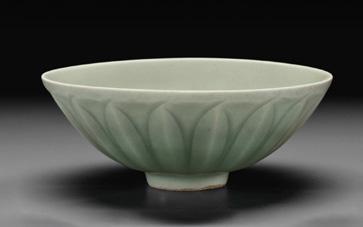
Description: A Longquan celadon carved bowl, Southern Song dynasty, 13th century
Expert remark: Compare the related color of the glaze, decoration of the lotus petals and size (17.1 cm).
Estimate EUR 3,000
Starting price EUR 1,500
12
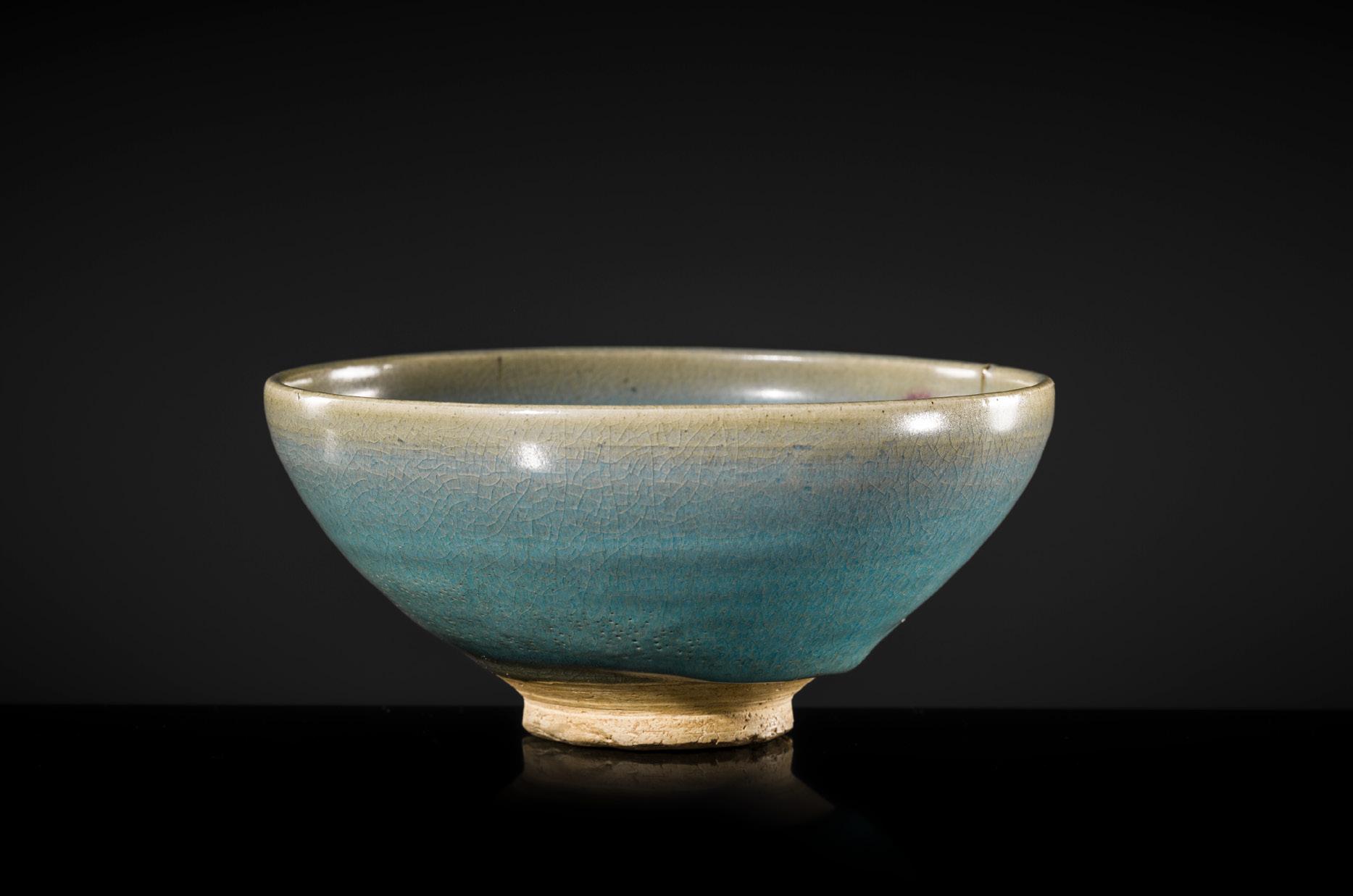
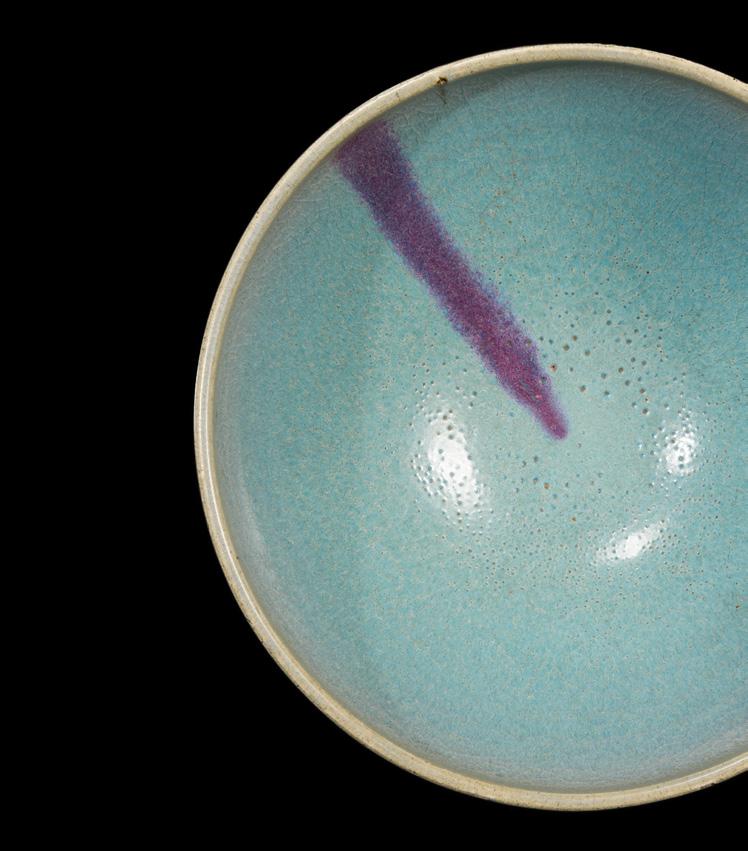
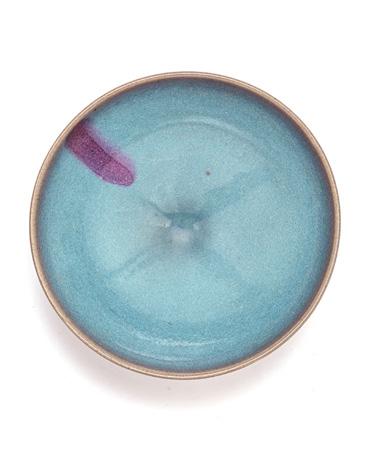
China, 13th–14th century. The bowl has deep, rounded sides rising from a short circular foot to a straight rim, covered in a thick skyblue glaze thinning to a mushroom tone at the rim and stopping irregularly above the unglazed foot, revealing the body of the ware. The interior is decorated with a large splash of suffused purple color, along with a small brown drip at the rim.
Provenance: The Collection of Sam and Myrna Myers, Paris, France. Acquired between circa 1965-2012.
Condition: Very good condition with minor wear and firing flaws including small open bubbles, light fritting to the rim and minor glaze recesses.
Weight: 545 g
Dimensions: Height 8.2 cm, Diameter 18 cm
The dramatic purple splash, creating a colorful contrast to the thick bright blue glaze, is a typical feature of Jun ware and particularly well accomplished in this example. Such splashes were created through the application of purplish-red pigments derived from copper, over the thick bluish glaze. These colorful marks were either painted in broad stokes or splashed over the dried blue ground before being fired in a reduction kiln, resulting in flamboyant patches of purple, lavender and tones of deep blue.
AUCTION RESULT COMPARISON
Type: Closely related
Auction: Bonhams London, 2 November 2020, lot 333
Price: GBP 5,312 or approx. EUR 8,500 converted and adjusted for inflation at the time of writing
Description: A 'Jun' purplesplashed bowl, Yuan/Ming Dynasty
Expert remark: Compare the closely related form, glaze, colors and size (17.8 cm).
Estimate EUR 4,000
Starting price EUR 2,000
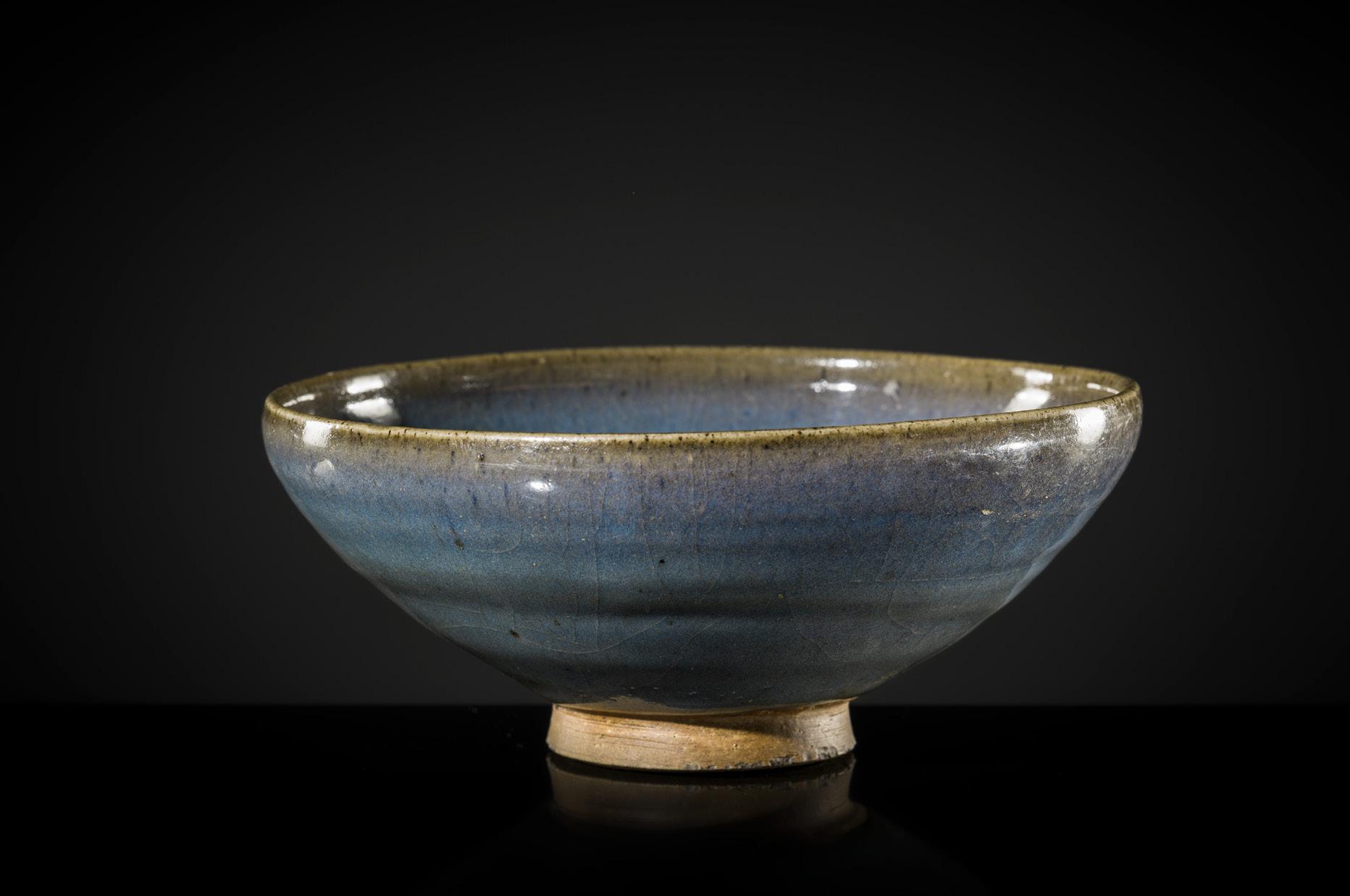
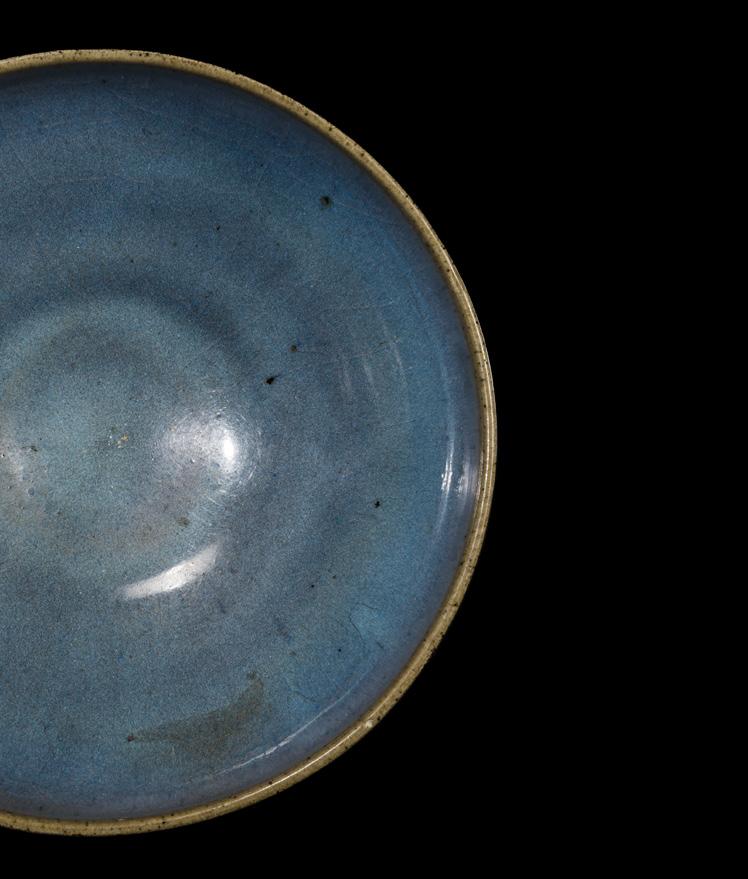
China, 12th–14th century. Finely potted with deep, rounded sides rising from a short foot, covered overall with an opaque blue glaze suffused with crackle, thinning to a mushroom tone at the rim with dark mottles, pooling elegantly around the body, and stopping unevenly just above the unglazed foot.
Provenance: The Collection of Sam and Myrna Myers, Paris, France. According to the Myers ledgers acquired on 9 December 1991, and 35 years in the collection.
Condition: Very good condition with minor wear and firing flaws including few small open bubbles, light fritting to the rim, dark spots, glaze recesses, particularly near the foot.
Weight: 728 g
Dimensions: Height 9 cm, Diameter 20.5 cm
Jun ware, with its type site represented by the Juntai kilns in the former region of Junzhou, modern-day Yuxian, Henan province, was produced by many different manufactories in Henan, including the Ru kilns at Qingliangsi in Baofeng, probably from the end of the Northern Song period (960-1127) until at least the Ming dynasty (1368-1644). In comparison to the other important Song wares, the bodies of ‘Jun’ wares are more thickly potted, which is a contributing factor to the more simplistic forms as well as the viscous glazes. As water from the glaze is absorbed by the porous biscuit in the firing, the glaze appears thicker, lending itself to a more substantial covering.
Literature comparison:
Compare a closely related, blue-glazed Jun bowl, dated to the 11th-12th century, 23 cm (diameter), in the Yousef Jameel Centre for Islamic and Asian Art, accession number LI1301.355.
AUCTION RESULT COMPARISON
Type: Closely related
Auction: Christie’s New York, 22 March 2023, lot 539
Price: USD 30,000 or approx. EUR 27,500 converted and adjusted for inflation at the time of writing
Description: A large Jun bowl, Northern Song-Jin dynasty (960-1234)
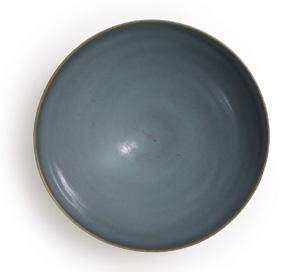
Expert remark: Compare the closely related form, glaze, and color. Note the related size (21.6 cm).
Estimate EUR 3,000
Starting price EUR 1,500
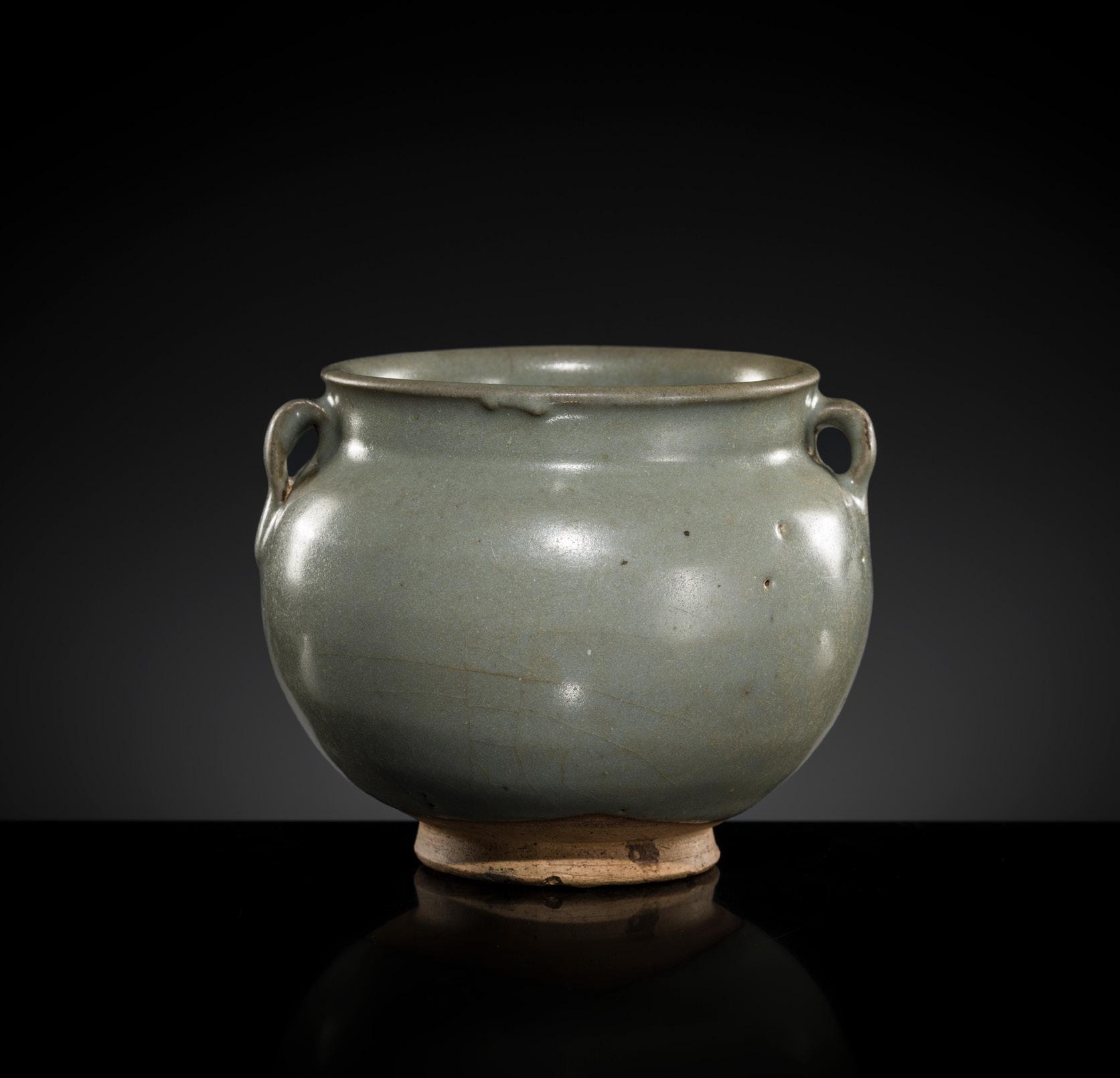
China, 1115-1234. Well potted with deep rounded sides supported on a gently spreading foot and rising to a broad shoulder and straight rim with a gently everted mouth set with a pair of earlug handles, covered with a finely crackled glaze of sky-blue tone, stopping irregularly above the foot on the exterior and at the base on the interior, pooling in thick drops and revealing the buff ware underneath.
Provenance: The Collection of Sam and Myrna Myers, Paris, France. Acquired between circa 1965-2012.
Condition: Very good condition with minor wear and manufacturing irregularities including glaze recesses, pitting, crackling, and burst bubbles. Few small chips to the foot.
Weight: 622.6 g
Dimensions: Height 10.9 cm
Jun ware, with its type site represented by the Juntai kilns in the former region of Junzhou, modern-day Yuxian, Henan province, was
produced by many different manufactories in Henan, including the Ru kilns at Qingliangsi in Baofeng, probably from the end of the Northern Song period (960-1127) until at least the Ming dynasty (1368-1644). In comparison to the other important Song wares, the bodies of ‘Jun’ wares are more thickly potted, which is a contributing factor to the more simplistic forms as well as the viscous glazes. As water from the glaze is absorbed by the porous biscuit in the firing, the glaze appears thicker, lending itself to a more substantial covering.
AUCTION RESULT COMPARISON
Type: Related
Auction: Christie’s Hong Kong, 4 April 2017, lot 108
Price: HKD 325,000 or approx. EUR 41,500 converted and adjusted for inflation at the time of writing
Description: A Jun handled jar, Northern Song-Jin Dynasty
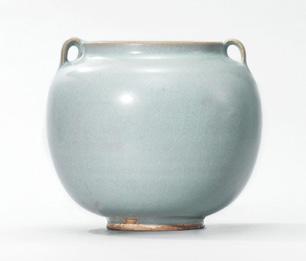
Expert remark: Compare the closely related form and glaze with similar pooling. Note the size (12 cm).
Estimate EUR 2,000
Starting price EUR 1,000
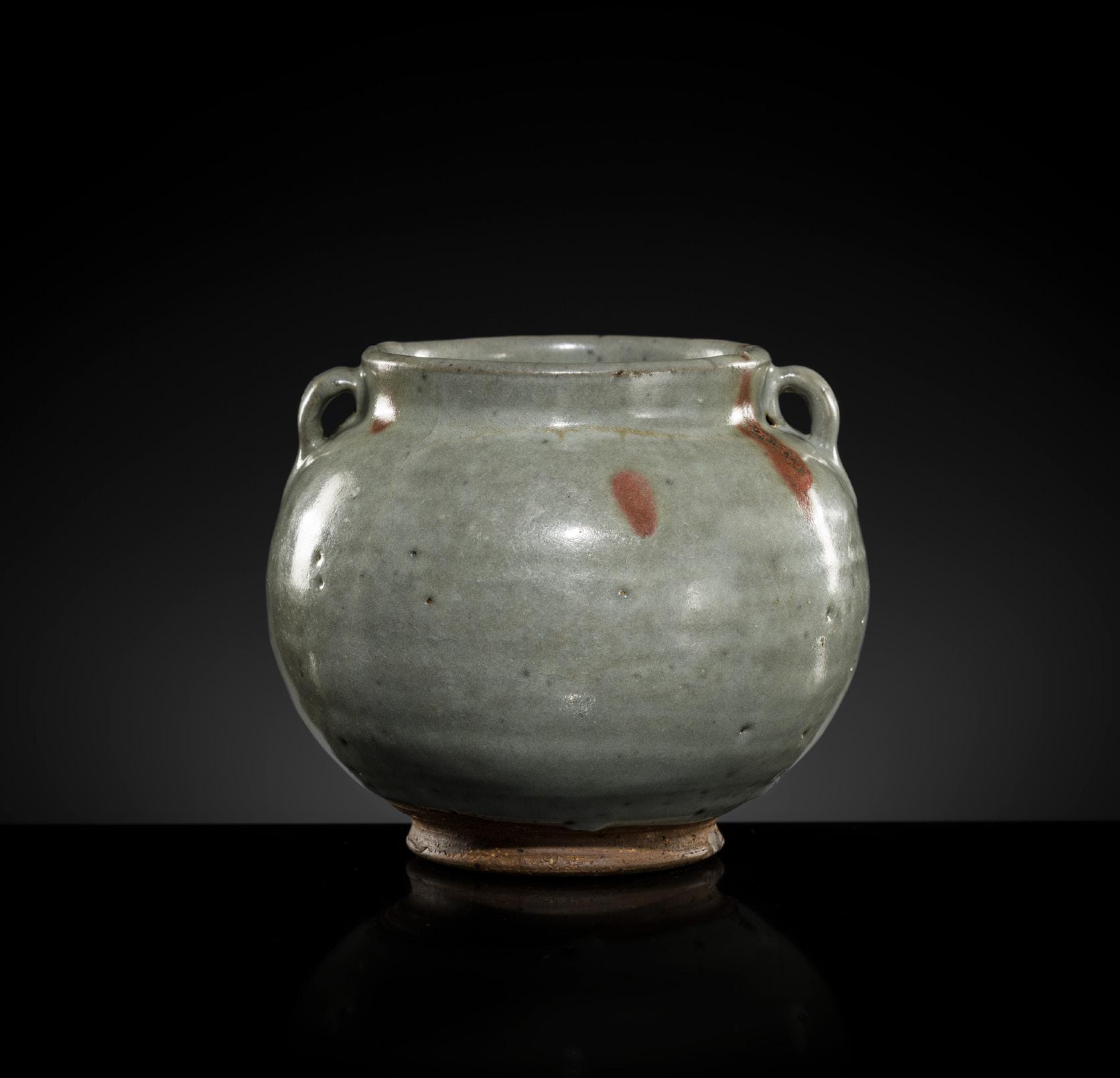
China, 1115-1234. Well potted with deep rounded sides supported on a gently spreading foot and rising to a broad shoulder and straight rim with a gently everted mouth set with a pair of ear-lug handles, covered with a rich, finely crackled sky-blue glaze highlighted at the shoulder and rim with a streaky splash of deep lavender and crimson tone suffused with hues of malachite green, stopping irregularly above the foot on the exterior and at the base on the interior, pooling in thick drops and revealing the buff ware underneath.
Provenance: The Collection of Sam and Myrna Myers, Paris, France. Acquired between circa 1965-2012.
Condition: Good condition with wear and manufacturing irregularities including glaze recesses, pitting, dark spots, crackling, and burst bubbles. Few small chips to the foot and two cracks with associated minuscule touchups.
Weight: 866.2 g
Dimensions: Height 12.9 cm
The dramatic purple splash, creating a colorful contrast to the thick bright blue glaze, is a typical feature of Jun ware and particularly well accomplished in this example. Such splashes were created through the application of purplish-red pigments derived from copper, over the thick bluish glaze. These colorful marks were either painted in broad strokes or splashed over the dried blue ground before being fired in a reduction kiln, resulting in flamboyant patches of purple, lavender and tones of deep blue.
AUCTION RESULT COMPARISON
Type: Related
Auction: Christie’s Hong Kong, 2 December 2015, lot 2810
Price: HKD 375,000 or approx.
EUR 50,000 converted and adjusted for inflation at the time of writing
Description: A Jun twin-handled jar, Jin
dynasty
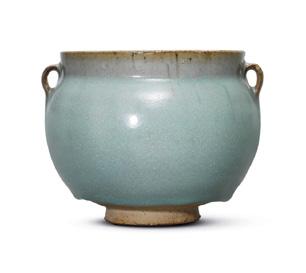
Expert remark: Compare the closely related form and glaze with similar pooling. Note the size (12 cm).
Estimate EUR 2,000
Starting price EUR 1,000
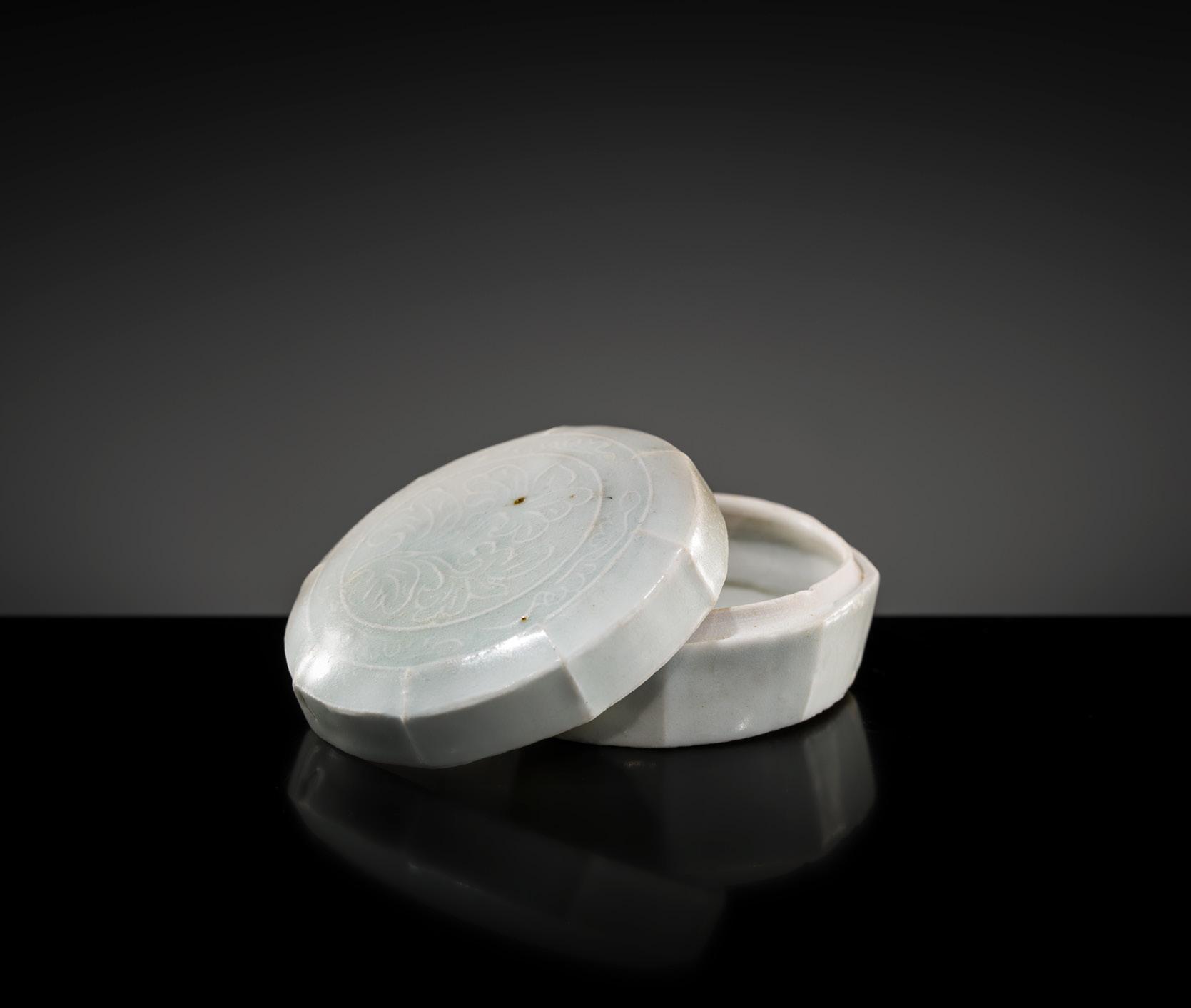
A QINGBAI WARE LOBED ‘LOTUS’ BOX AND COVER, SOUTHERN SONG TO YUAN DYNASTY
China, 12th-13th century. Finely modeled, of octagonal form, the box with gently tapering sides, surmounted by a slightly domed cover, the top decorated in relief with a central medallion containing stylized lotus blossoms, framed by a double-lined border with additional floral motifs. The exterior entirely covered in a pale blue glaze, while the base remains unglazed, revealing the white biscuit.
Provenance: The Collection of Sam and Myrna Myers, Paris, France. According to the Myers ledger acquired on 14 October 1977, and 49 years in the collection.
Condition: Very good condition with minor wear and inherent firing irregularities, including occasional dark spots. Scattered minute nicks and few small chips to the body of the box.
Weight: 146.3 g
Dimensions: Height 4.4 cm, Diameter 8.5 cm
Literature comparison:
Compare a related Qingbai ware box and cover, Southern Song dynasty, 12th-13th century, 5.2 cm diameter, in the Cleveland Museum of Art, museum number 1972.256.b. Compare a closely related Qingbai box and cover, Yuan dynasty, 13th-14th century, 8.6 cm diameter, in the British Museum, museum number 1947,0712.81. a.
Estimate EUR 1,500
Starting price EUR 700
AUCTION RESULT COMPARISON
Type: Closely related
Auction: Christie’s New York, 16 October 2001, lot 110
Price: USD 4,700 or approx.
EUR 7,500 converted and adjusted for inflation at the time of writing
Description: A large Qingbai molded lobed box and cover, Southern Song to Yuan dynasty, 12th-13th century
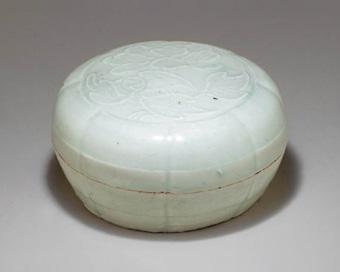
Expert remark: Compare the related form of the box, glazing technique, and decorative style. Note the larger size (15 cm).
AUCTION RESULT COMPARISON
Type: Closely related
Auction: Sotheby’s London, 11 May 2006, lot 207
Estimate: GBP 4,000 or approx.
EUR 9,500 converted and adjusted for inflation at the time of writing
Description: A molded Qingbai ‘peony’ box and cover, Song dynasty
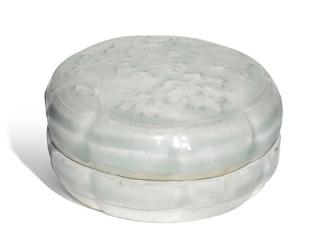
Expert remark: Compare the related form of the box, glazing technique, and decorative style.
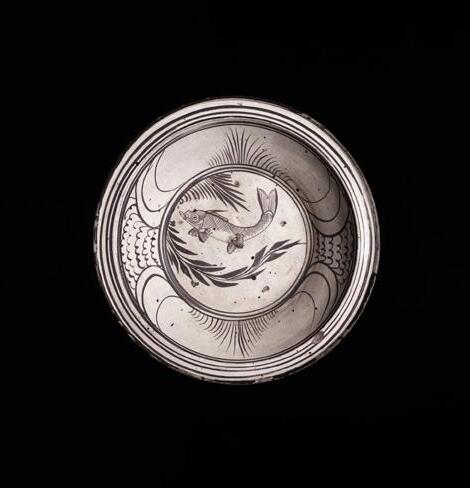
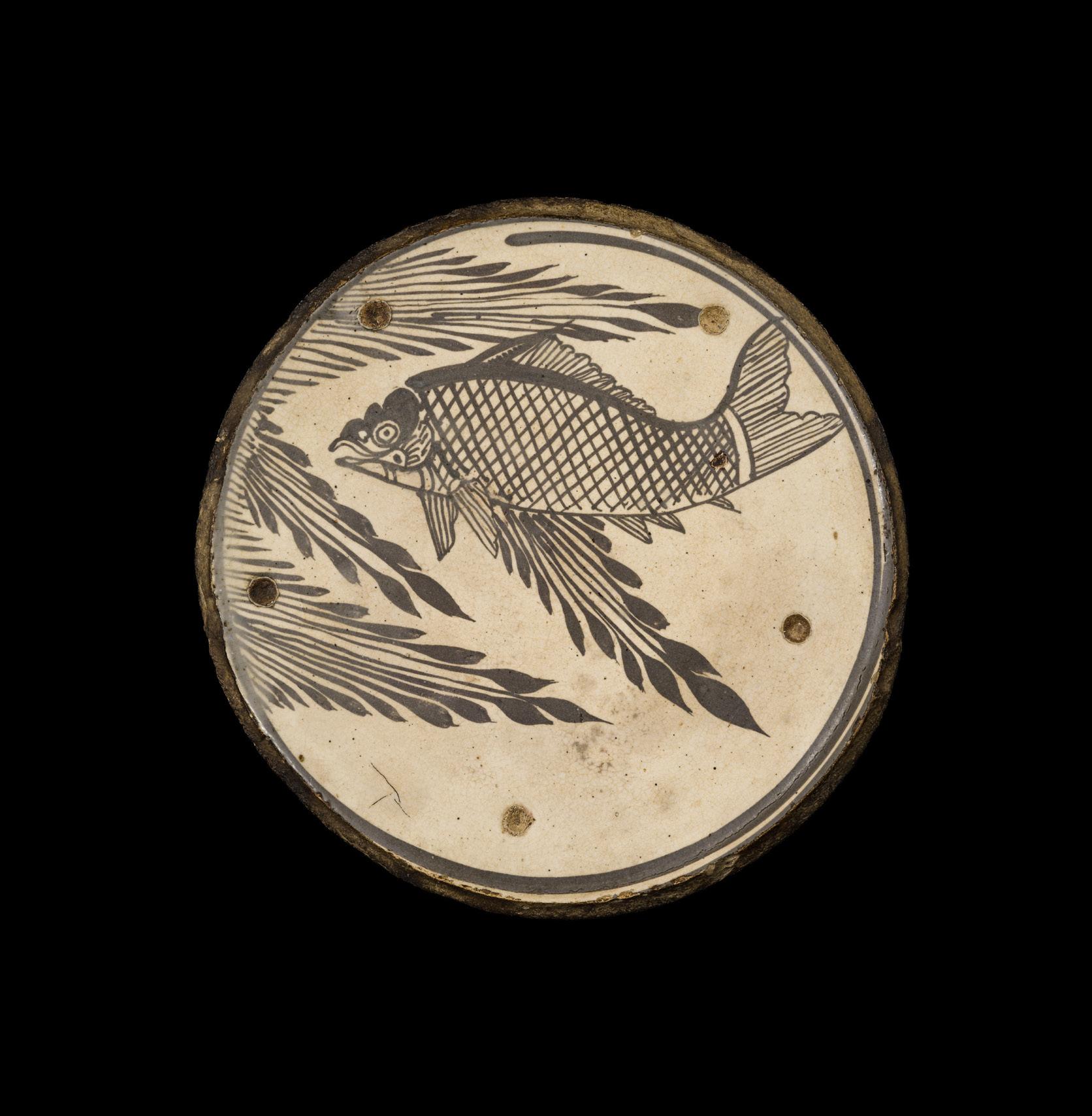
A CIZHOU BASIN FRAGMENT WITH A FINELY PAINTED CARP, YUAN
China, 1279-1368. Originally the well to a Cizhou pottery basin, masterfully painted in black and white slip to depict a carp swimming amid water weeds, the exterior sides covered in black slip. The underside unglazed and with a circular recess at the center.
Provenance: The Collection of Sam and Myrna Myers, Paris, France. Acquired between circa 1965-2012. The base with three labels, ‘1’, ‘A245’, and ‘1823’.
Condition: Condition commensurate with age. Ancient wear, obvious losses, and firing irregularities including spur marks to the top, firing cracks, and scratches to the base.
Weight: 1.4 kg Dimensions: Diameter 24.1 cm
LITERATURE COMPARISON
Compare a related Cizhou ware basin with fish of similar color, dated to the Yuan dynasty, 34.6 cm diameter, in the British Museum, museum number 1973,0726.258 (fig. 1). Compare a related Cizhou basin with carp and water weeds, dated Yuan dynasty, in the Art Institute of Chicago, reference number 1997.383.
Estimate EUR 1,000 Starting price EUR 500
18
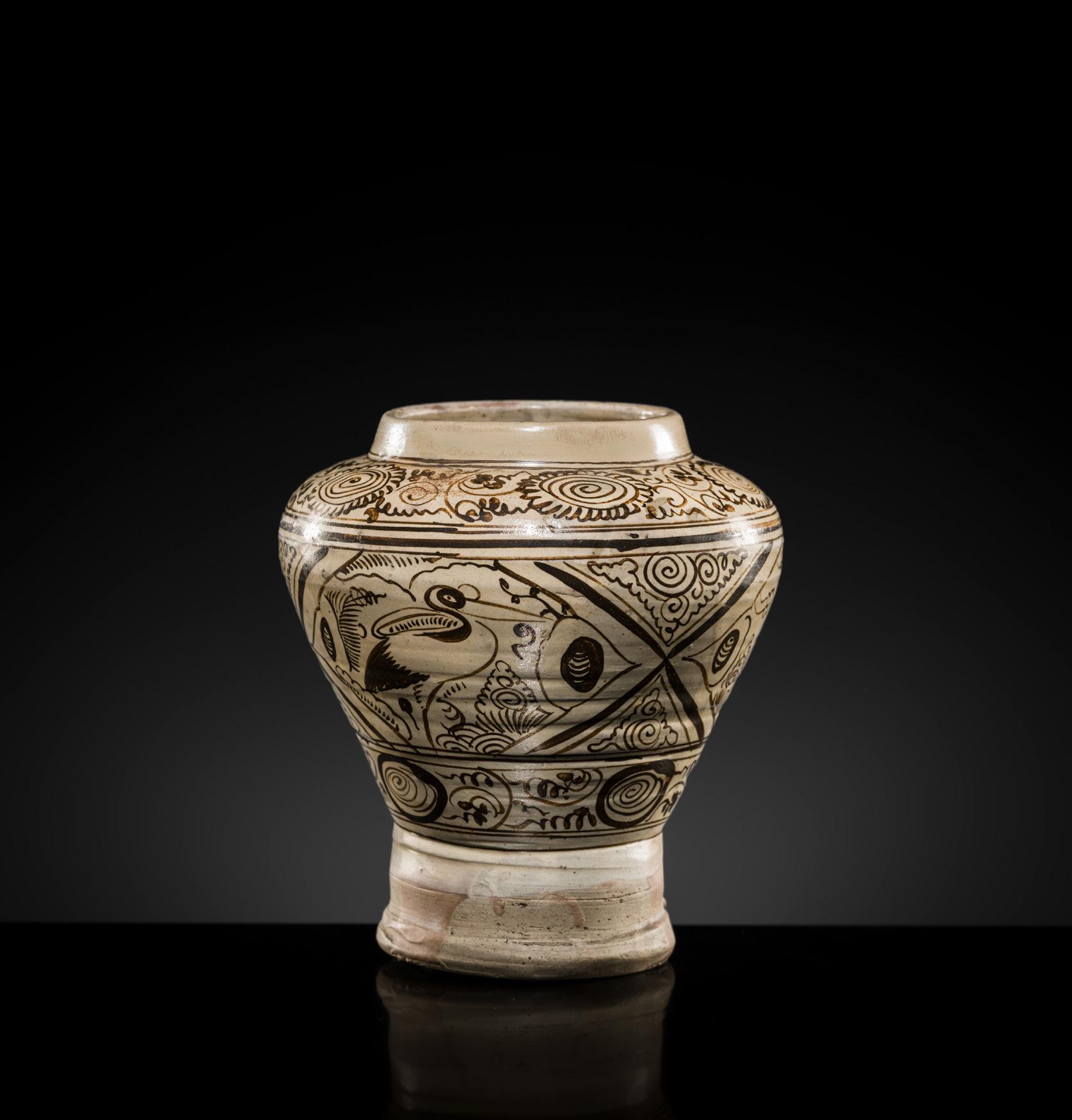
A FINE CIZHOU PAINTED POTTERY VASE, JIN-YUAN DYNASTY
China, 1115-1368. Well potted, of baluster form rising from a recessed base to a short neck, painted in black-to-brown slip on a cream ground, with three panels depicting a young man, a phoenix, and a heron, all framed by bands of scrolling foliage and blossoms. The underside remains unglazed.
Provenance: The Collection of Sam and Myrna Myers, Paris, France. Acquired on 6 May 1971 in London, according to the Myers ledger, and in the collection for 55 years.
Condition: Good condition with expected wear, and manufacturing irregularities including pottery lines, pitting, glaze recesses, and a firing crack to the underside. A hairline crack rising from the foot to the shoulder. Presenting well.
Weight: 1,540 g
Dimensions: Height 18.2 cm, Length 16.2 cm
The subject most likely derived from a popular theatre play, known as zaju, in which music, singing and spoken texts were combined. The texts of these
plays were often printed in woodcuts and accompanied by images, that were copied by painters and used in decorating Cizhou ware. According to Koos de Jong such vases could have been a gift from the parents to the son if he passed the state exam or if he got married.
LITERATURE COMPARISON
Compare a closely related Cizhou baluster vase, dated to Yuan dynasty (1276-1368), 16.3 cm (high), in the Natural Historical Museum Stockholm, object number XLVIII:V:F.e.02._HWY (fig. 1). Compare a related, larger, Cizhou painted jar with an official or scholar, 31 cm tall, in the Metropolitan Museum of Art, object number 1975.1.1664.
Estimate EUR 2,000
Starting price EUR 1,000
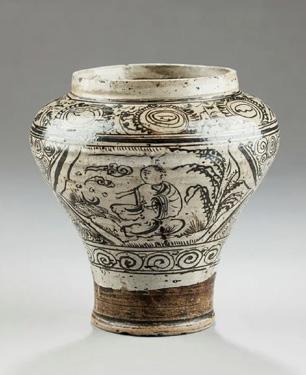
fig. 1
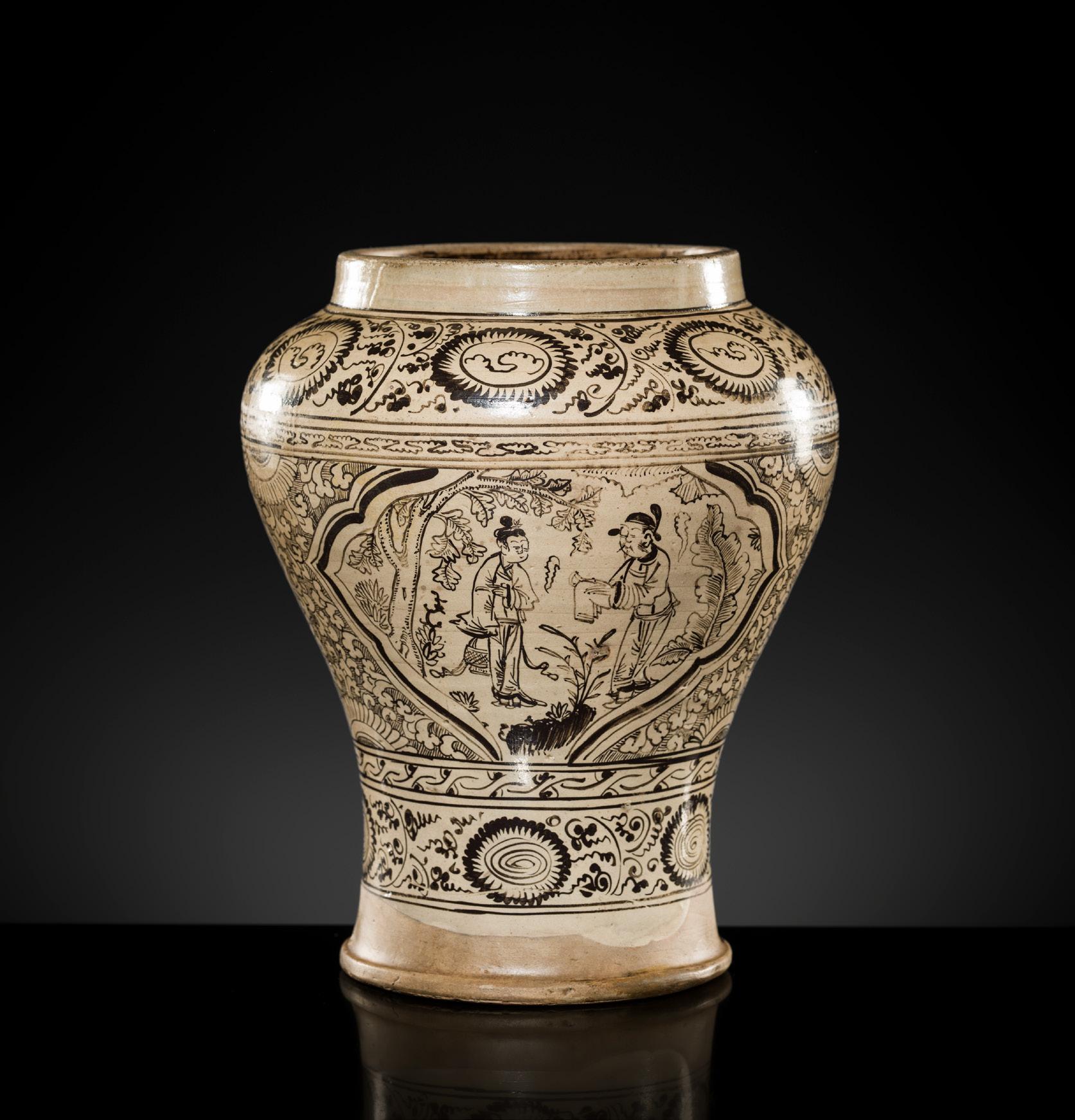
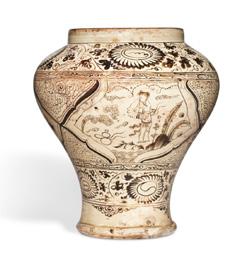
A CIZHOU PAINTED 'FIGURAL' BALUSTER VASE, YUAN-EARLY MING DYNASTY
China, 14th century. The narrow lower body sweeping to a broad shoulder and rising to an upright rim, covered overall in an ivory glaze and elaborately painted with dark chocolate-brown designs, the broad register below the shoulder painted with three shaped cartouches, two enclosing figures within landscapes and the third with a crane, the spaces between the cartouches filled with scrolling foliage, bordered above and below by bands of waves, clouds, and floral scrolls occupying the shoulder and lower body.
Provenance: The Collection of Sam and Myrna Myers, Paris, France. Acquired between circa 1965-2012.
Condition: Good condition with expected old wear and firing flaws. Some flaking to the slip, tiny bruises to edges, light scratches, few tiny losses, small old repairs, and few stabilized hairline cracks.
Weight: 3,398 g
Dimensions: Height 26.4 cm
AUCTION RESULT COMPARISON
Type: Closely related
Auction: Christie’s New York, 24 October 2022, lot 1016
Price: USD 20,160 or approx. EUR 19,000 converted and adjusted for inflation at the time of writing
Description: A Chinese brown-painted Cizhou pottery vase, Jin-Yuan dynasty Expert remark: Note the size (26.6 cm).
Estimate EUR 3,000
Starting price EUR 1,500
20
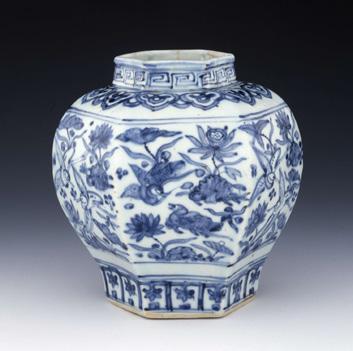
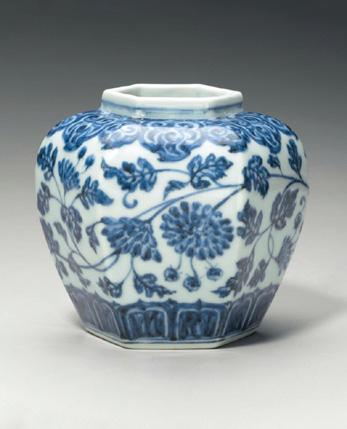
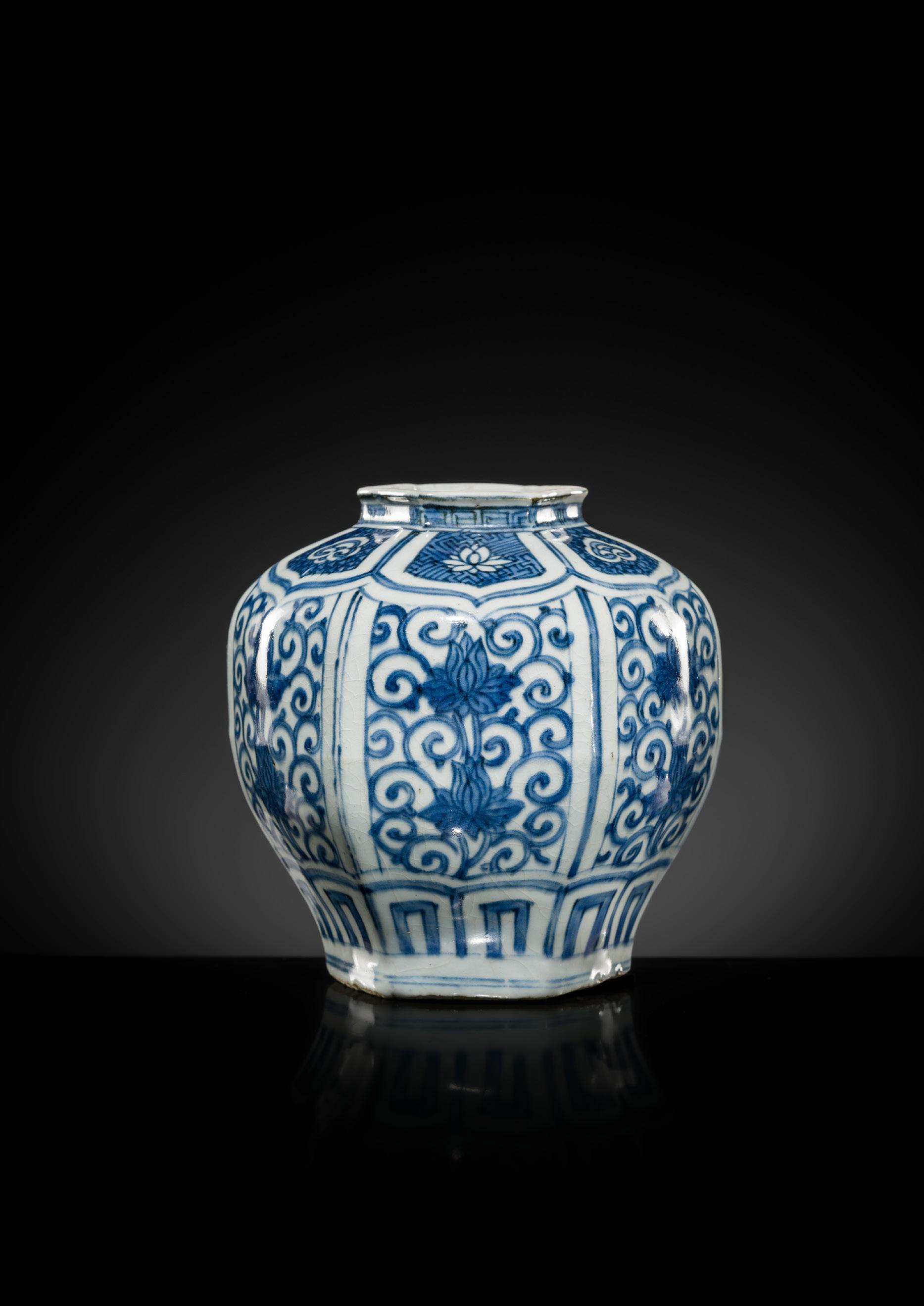
A RARE BLUE AND WHITE 'LOTUS' HEXAGONAL JAR, EARLY MING DYNASTY
Expert's Note:
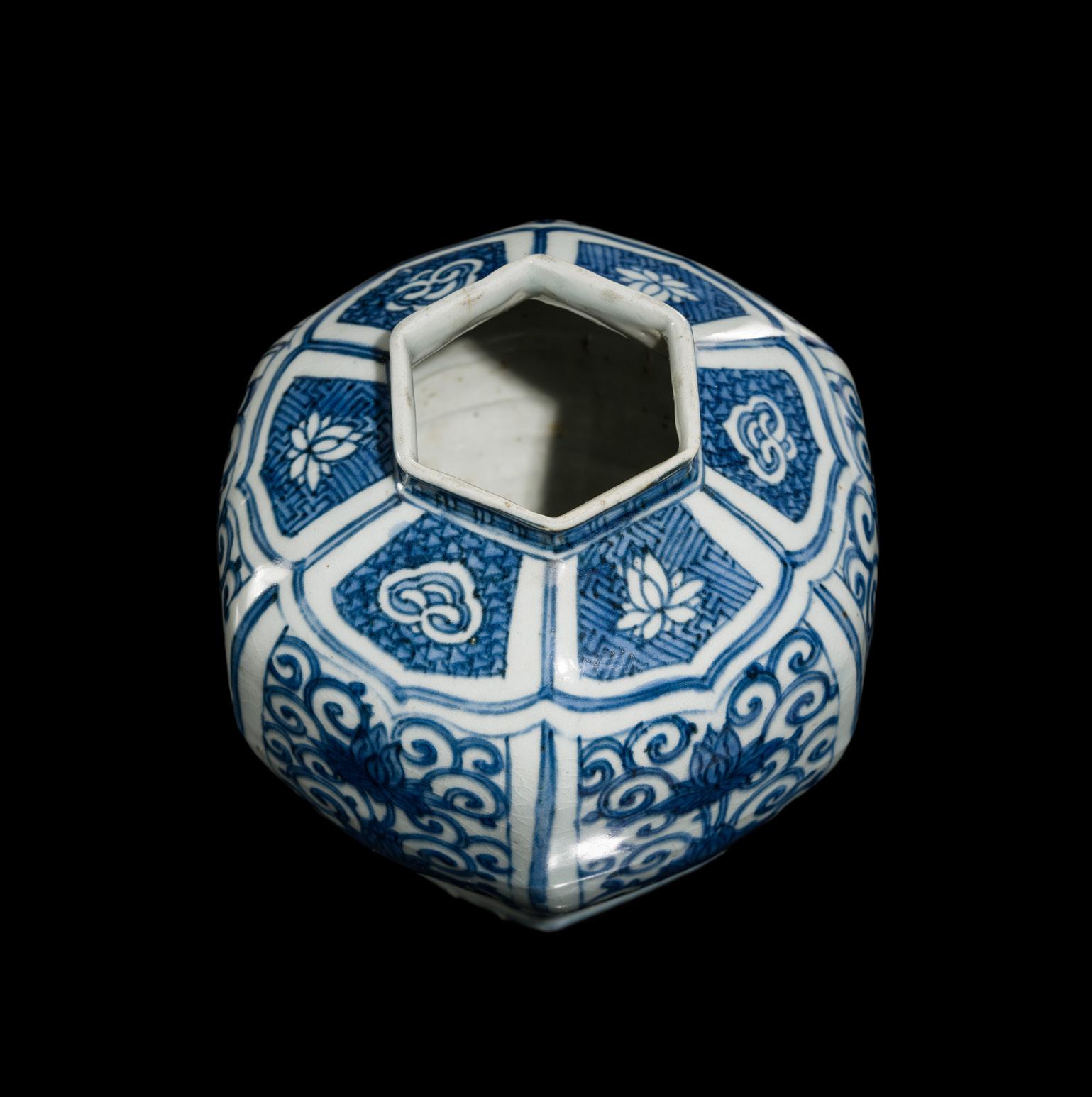
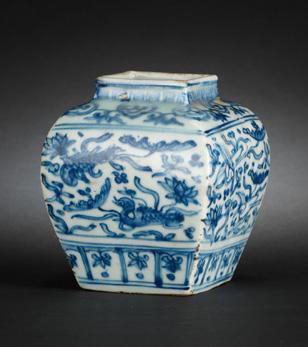
This exceptionally rare hexagonal jar belongs to a group of small blue and white jars produced during the Ming dynasty, primarily dated to the early 15th century, but also extending into the 16th century. All are decorated in a rich underglaze blue, characterized by the 'heaped and piled' effect, featuring either floral motifs or a combination of flowers and fruiting branches. A related blue and white hexagonal jar, decorated with lotus ponds, cranes, and mandarin ducks, can be found in the British Museum (registration number 1931,0713.1).
China, 15th – 16th century. Finely potted, the slightly spread foot rising to a hexagonal, ovoid body surmounted by a short, straight neck with a lipped rim, exquisitely painted with lobed panels enclosing lotus blossoms amid scrolls. The shoulder is encircled by lotus petals with lotus flowers and ruyi-heads, while the neck is decorated with a key-fret band, all above a band of tall lappets encircling the foot. The foot reveals the light beige ware.
Provenance: The Collection of Sam and Myrna Myers, Paris, France. Acquired between circa 1965-2012.
Condition: Very good condition with old wear and firing flaws, including fritting to the rim and foot, pooling, dark spots, and fine glaze crackling.
Weight: 914 g
Dimensions: Height 17 cm
LITERATURE COMPARISON
Compare a related blue and white hexagonal jar, dated to 1522-1566, 15.3 cm (high), in the British Museum, registration number 1931,0713.1.
AUCTION RESULT COMPARISON
Type: Closely related
Auction: Christie’s New York, 15 September 2017, lot 1180
Price: USD 75,000 or approx. EUR 84,000 converted and adjusted for inflation at the time of writing
Description: A rare small blue and white hexagonal jar, early Ming dynasty, 15th century
Expert remark: Compare the related form, glaze and decoration. Note the smaller size (11.3 cm).
Estimate EUR 8,000
Starting price EUR 4,000
21
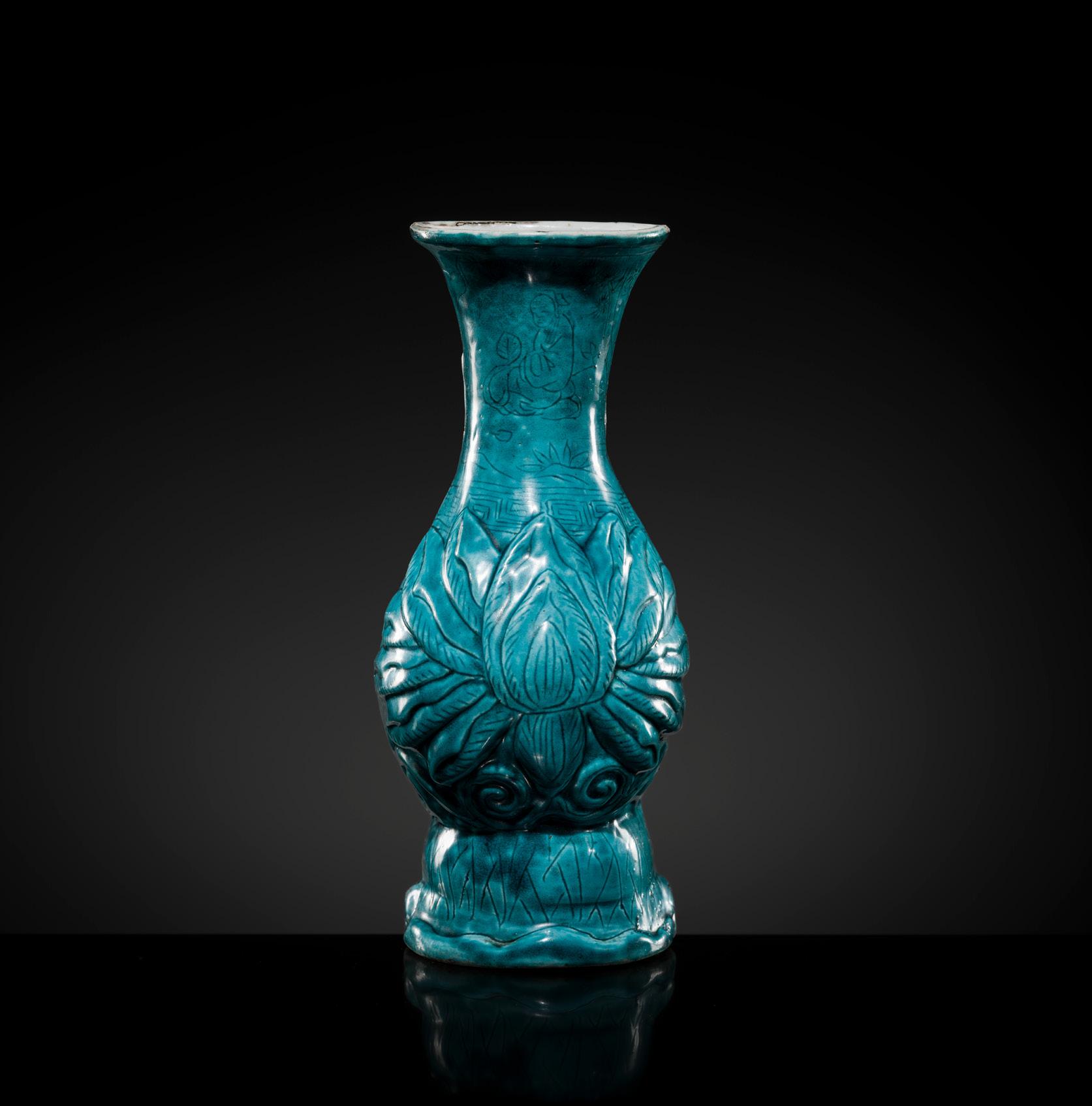
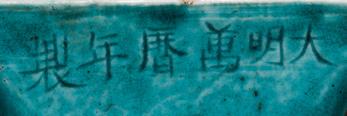
AN EXTREMELY RARE TURQUOISE-GLAZED ‘LOTUS’ WALL VASE, WANLI MARK AND PERIOD
China, 1572–1620. Of half-baluster form, rising from a slightly recessed base to a broad, flaring mouth with a gently everted rim, covered overall in a vibrant turquoise glaze. The body is carved in relief with a large blooming lotus flower above scrolling foliage, framed by a foliate band near the base and a key-fret band above. The neck is delicately incised with a scene depicting a scholar beneath a pine tree.
The reverse bears a six-character Wanli mark, da Ming Wanli nianzhi
Provenance: The Collection of Sam and Myrna Myers, Paris, France. According to the Myers ledger acquired on 17 June 1983 and in the collection for 43 years.
Condition: Good condition with expected wear and firing flaws, including glaze recesses, pitting, dark spots, soiling and encrustations, and a small chip to the aperture.
Weight: 821 g
Dimensions: Height 23.3 cm
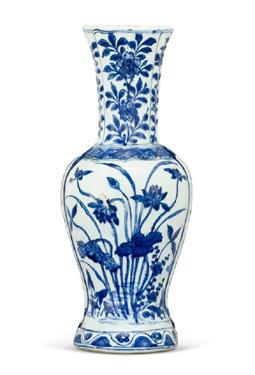
AUCTION RESULT COMPARISON
Type: Related
Auction: Sotheby’s Hong Kong, 27 November 2020, lot 422
Price: HKD 94,500 or approx. EUR 11,000 converted and adjusted for inflation at the time of writing
Description: A blue and white 'lotus pond' wall vase mark and period of Wanli
Expert remark: Compare form, mark, and period. Note the different design and larger size (33.8 cm).
Estimate EUR 6,000
Starting price EUR 3,000
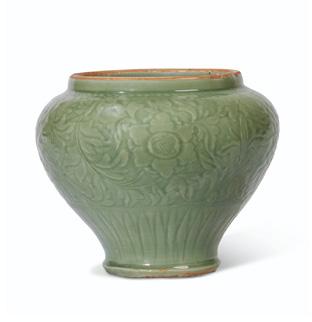
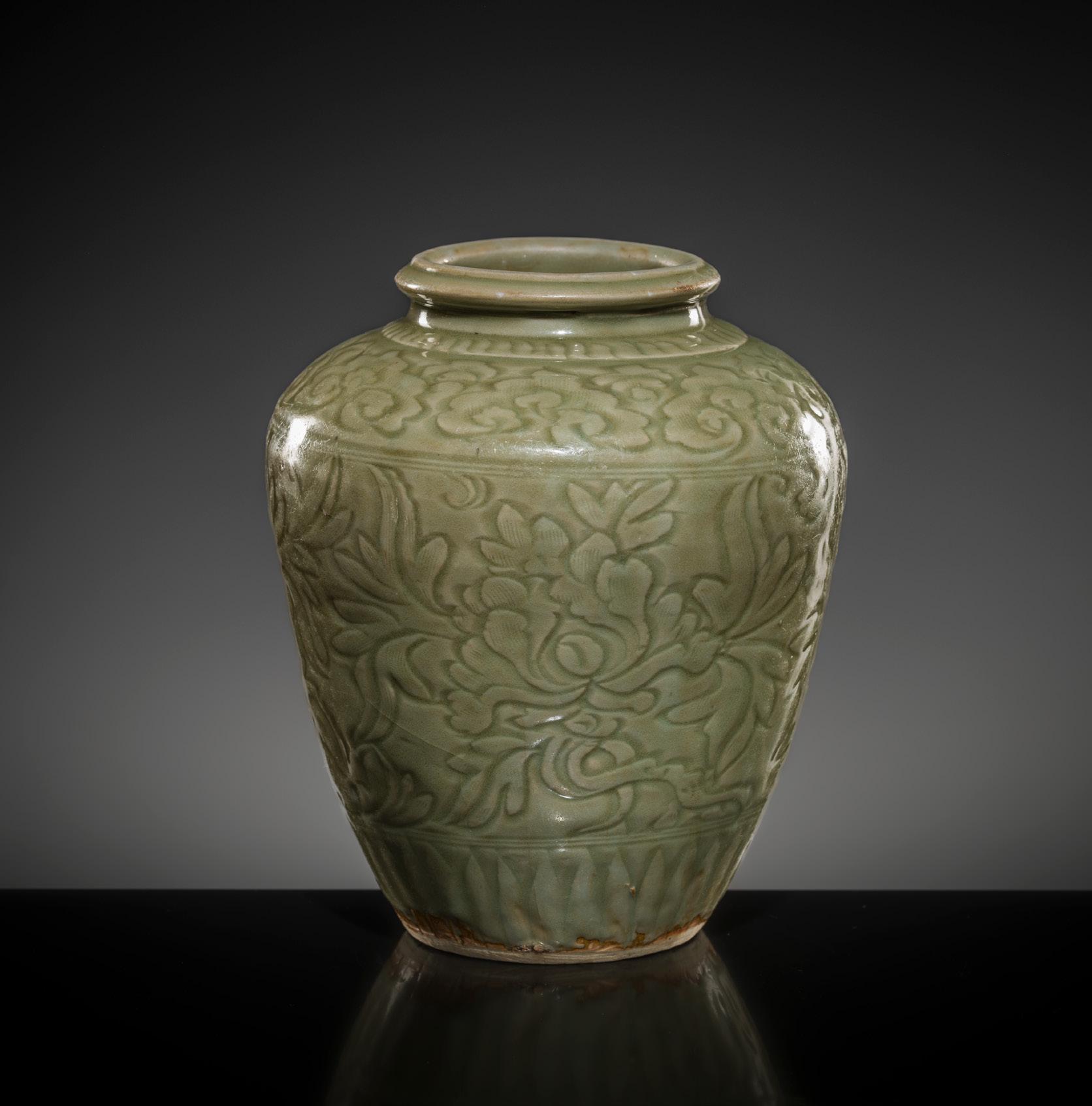
China, 14th–15th century. Of baluster form, rising from a narrow foot to gently rounded shoulders before tapering slightly toward the mouth, the exterior is finely incised with a continuous floral design composed of large blooming flowers and scrolling leafy tendrils. The entire surface is covered in a soft celadon glaze of warm olive-green tone, thinning at the foot to reveal the pale stoneware body beneath.
Provenance: The Collection of Sam and Myrna Myers, Paris, France. Acquired on the 11 February 1973 in Paris and in the collection for 53 years, according to the Myers ledger.
Condition: Good condition with old wear and firing flaws, including fritting to the foot, few dark spots, small pitting, glaze recesses, a hairline crack to the foot rising over both sides of the body. Presenting very well.
Weight: 2,625 g
Dimensions: Height 22.2 cm
AUCTION RESULT COMPARISON
Type: Related
Auction: Christie’s Paris, 10 December 2021, lot 601
Price: EUR 11,250 or approx. EUR 14,500 adjusted for inflation at the time of writing
Description: A Longquan celadon moulded 'flower' jar, China, Ming dynasty, 14th-15th century
Expert remark: Compare the related form and glaze. Note the size (29 cm).
Estimate EUR 3,000
Starting price EUR 1,500
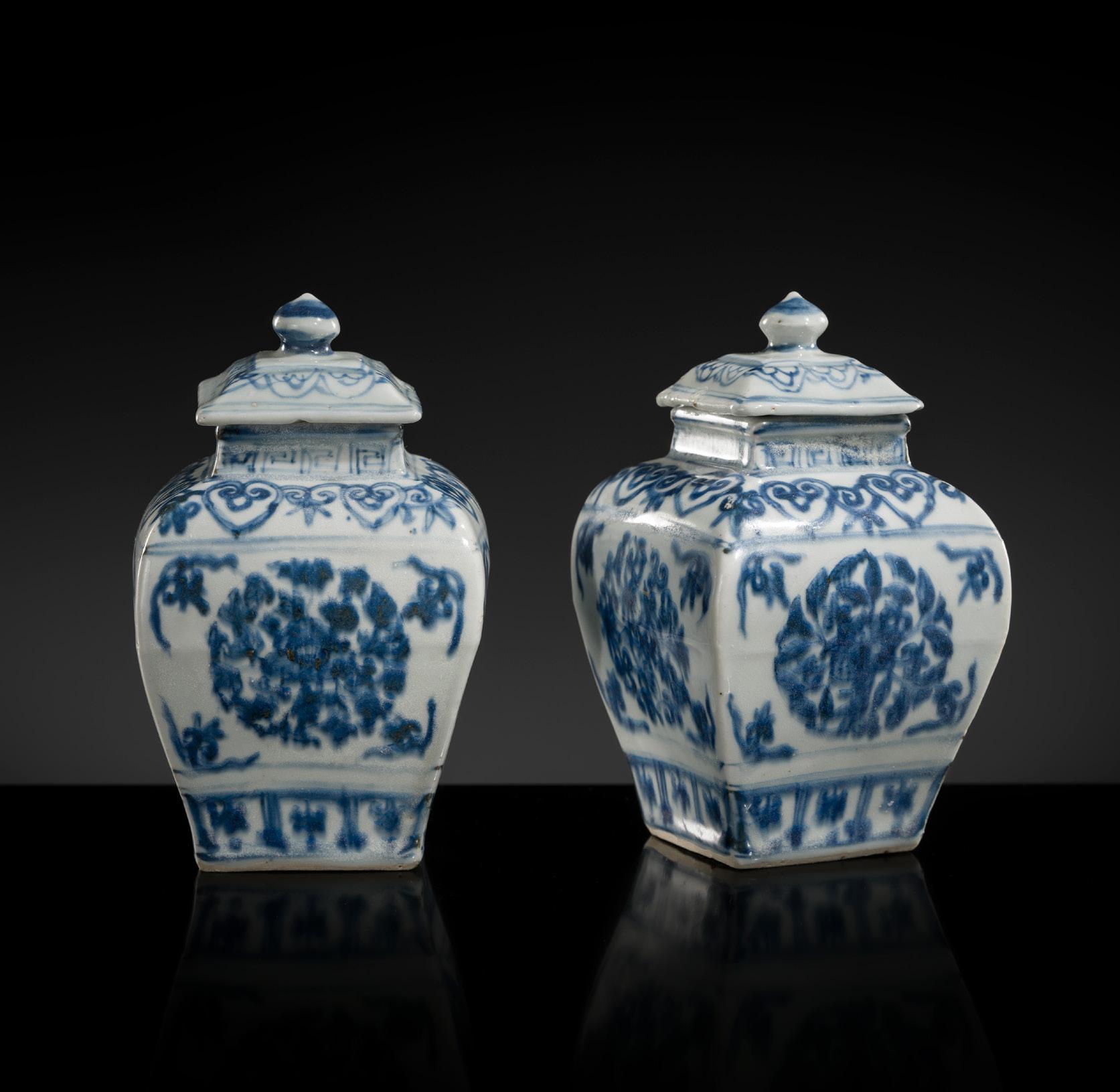
A PAIR OF BLUE AND WHITE SQUARE BALUSTER VASES AND COVERS, FOUR-CHARACTER MARK, MING DYNASTY
China, 16th century. Of square baluster form, rising to a straight neck and lipped rim, the exterior is painted on each side with roundels of peony blossoms, with additional flower heads at each corner. The base is decorated with a lappet, the shoulder with a ruyi and the neck with a key-fret band. Each is fitted with a gently domed cover decorated with an additional ruyi band and topped with a knop-form finial. (4)
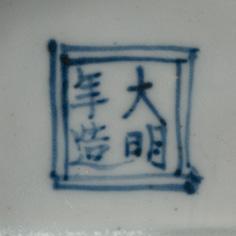
The base bears a four-character mark da Ming nianzhao
Provenance: The Collection of Sam and Myrna Myers, Paris, France. Acquired between circa 1965-2012.
Condition: Good condition with old wear and firing flaws, including pitting, and dark spots. Tiny chips to the edges and rubbing to the glaze.
Weight: 885 g (total)
Dimensions: Height 12.2 cm (each excl. cover), 15 cm (each incl. cover)
Jars of this square form were popular during the Ming dynasty, particularly in the Jiajing reign (1521-1567) and display the creative freedom enjoyed by craftsmen active at Jingdezhen in this period. Porcelain production experienced a renewed flowering under Jiajing, as the court’s increased demand for luxurious items resulted in the engagement of
private kilns that worked alongside the imperial kilns, and introduced an increased number of unconventional forms and designs, including square jars such as the present lot.
AUCTION RESULT COMPARISON
Type: Closely related
Auction: Bonhams London, 5 November 2009, lot 99
Price: GBP 6,240 or approx. EUR 13,500 converted and adjusted for inflation at the time of writing
Description: A blue and white square vase, Xuande four-character mark, 16th century
Expert remark: Compare the related form, decoration and size (11 cm excl. cover). Note the missing cover and that the lot comprises only one vase.
Estimate EUR 4,000
Starting price EUR 2,000
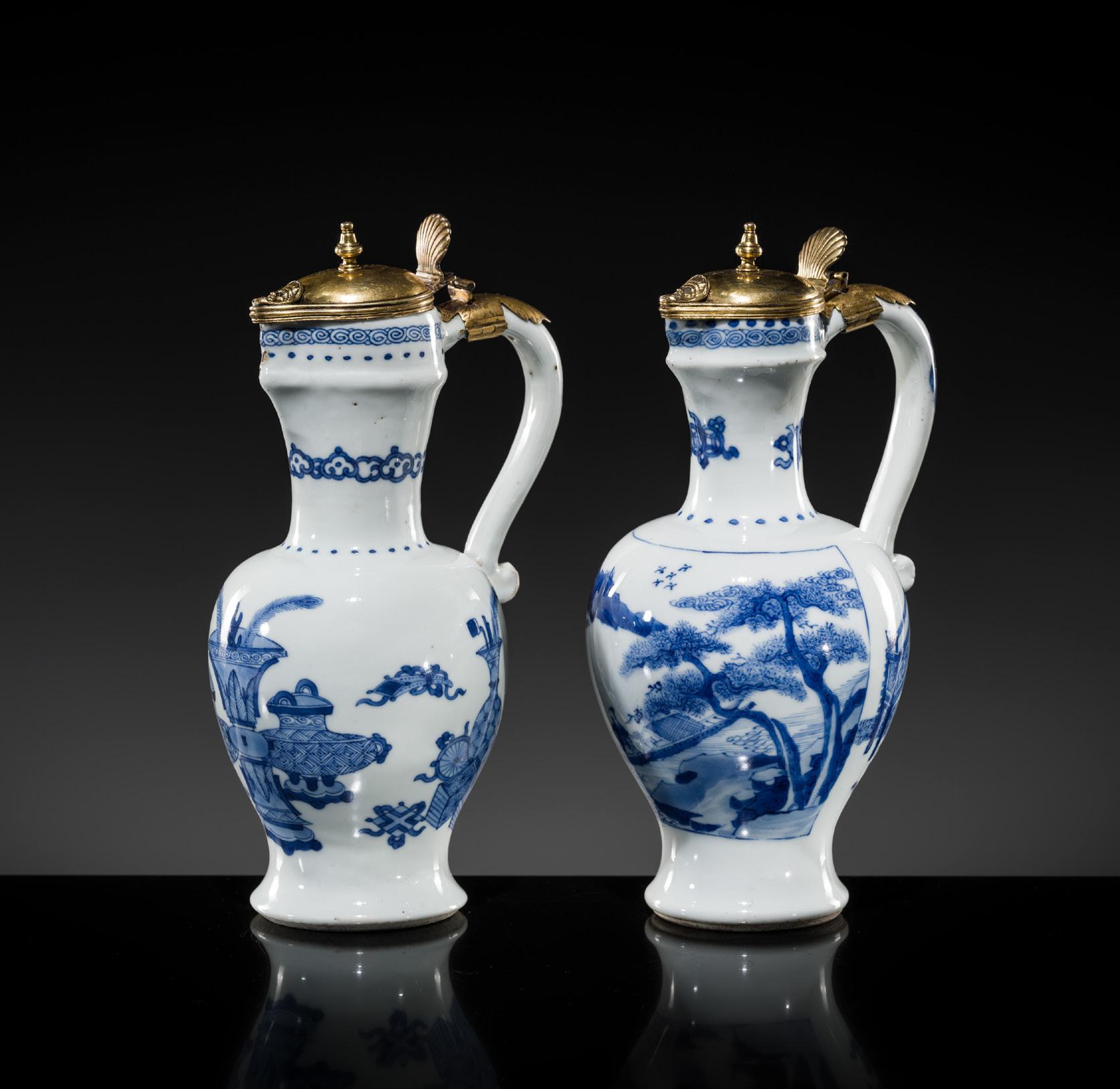
A PAIR OF GILT-BRONZE MOUNTED BLUE AND WHITE EWERS, TRANSITIONAL PERIOD
China, 17th century (ewers); Northern Europe, 18th century (mounts). Each of baluster form, rising from a gently flaring foot to a rounded body and tall, tapering neck, fitted with a slightly flared mount and a high strap handle springing from the shoulder and curving upward to meet the rim.
Both bodies are finely painted in underglaze blue: the first decorated with elements from the ‘hundred antiques’ (ba bao) repertoire, including a tripod vessel and various scholar’s implements, with the neck encircled by a dotted and a ruyi band, and the mouth rim further adorned with dotted and scrolling cloud bands; the second depicting a landscape with rocky outcrops and a figure in a boat on water among scholar’s objects, with additional dotted bands to the neck.
Both are fitted with gilt-bronze mounts shaped as leaves. (4)
Provenance: The Collection of Sam and Myrna Myers, Paris, France. Acquired between circa 1965-2012.
Condition: Good condition overall. The porcelain: old wear and some firing flaws, including fritting to the mouth, pitting, and few dark spots. Small chips to the foot. The bronze mounts: warping, losses and repairs.
Weight: 1,242 g (total)
Dimensions: Height 20 cm (each excl. cover), 22.3 cm (each incl. cover)
AUCTION RESULT COMPARISON
Type: Closely related Auction: Sotheby’s New York, 20 November 2020, lot 27
Price: USD 6,930 or approx. EUR 7,500 converted and adjusted for inflation at the time of writing.
Description: A Chinese blue and white porcelain ewer with silver-gilt mounts, the porcelain circa 1640; the mounts maker's mark hv probably for Heinrich Udesheim, Bonn, circa 1735
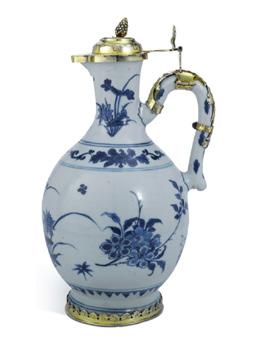
Expert remark: Compare the closely related form, glaze and mounting. Note the larger size (26.5 cm) and that the present lot is a pair.
Estimate EUR 3,000
Starting price EUR 1,500
25
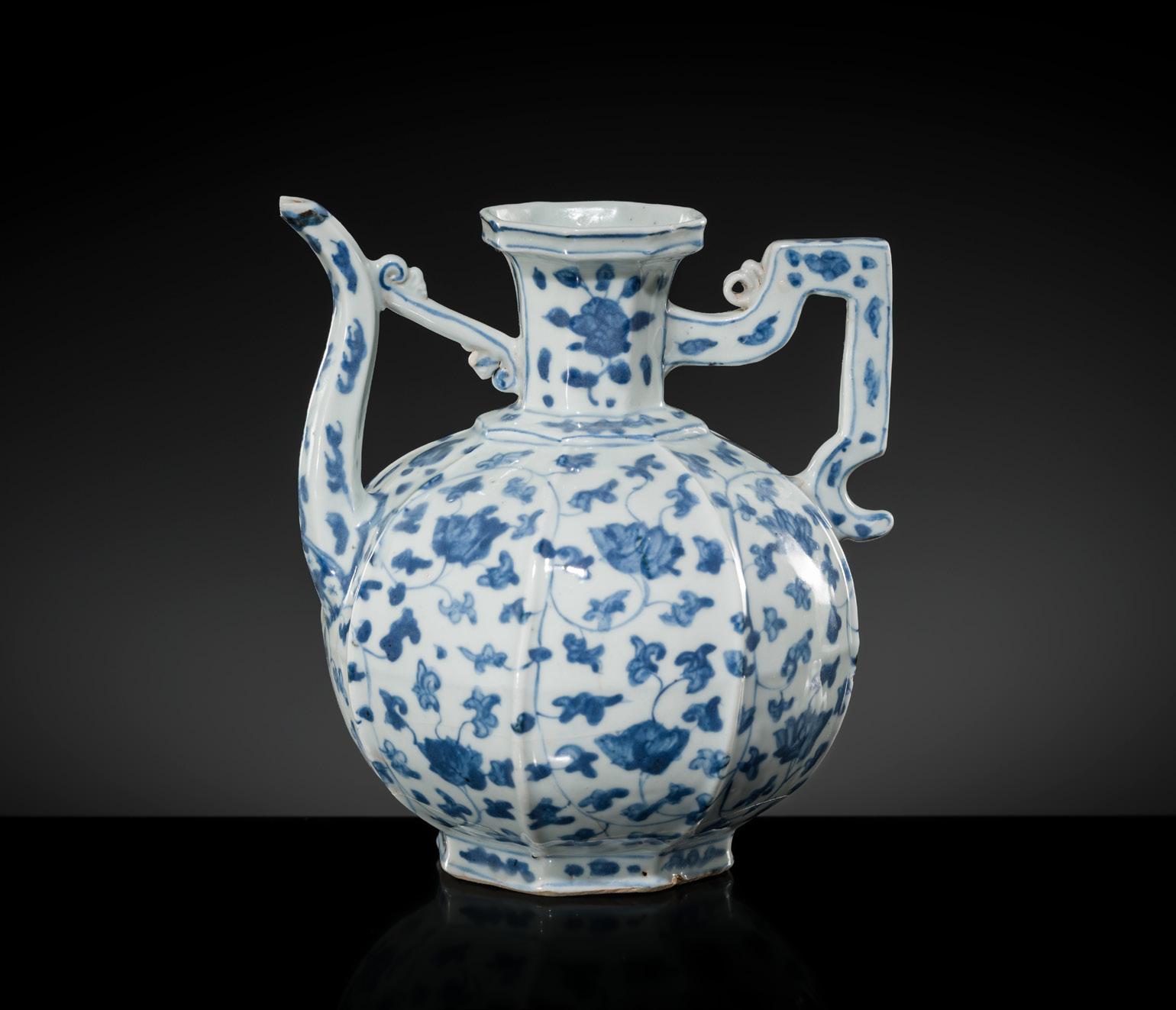
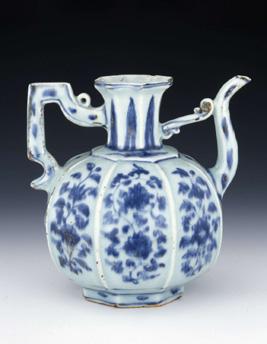
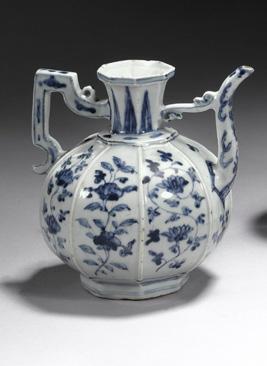
A RARE BLUE AND WHITE 'LOTUS' EWER, 15TH TO MID-16TH CENTURY
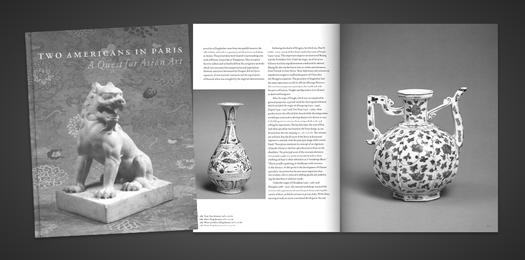
PUBLISHED
Jean-Paul Desroches (ed.) et al, Two Americans in Paris. A Quest for Asian Art, Paris, 2016, p. 175, no. 284.
Exhibited:
1. Pointe-à-Callière Museum, From the Lands of Asia. The Sam and Myrna Myers Collection, Montréal, 17 November 2016-19 March 2017.
2. Kimbell Art Museum, From the Lands of Asia. The Sam and Myrna Myers Collection, Fort Worth, Texas, 4 March-19 August 2018.
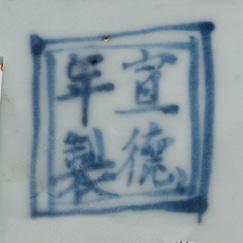
China. Of Islamic metalware form, the lobed octagonal body rising from a short straight foot to a short flaring neck with everted straight rim, set to one side with an elegant S-shaped spout secured by an S-shaped strut and to the other with a strap handle, painted with scrolling leafy flower sprays below floral sprays at the neck.
The base with a four-character Xuande mark Xuande nianzhi
Provenance: Pierre Cornette De Saint-Cyr, 17 October 1983, lot 26, information according to the Myers ledger (could not be independently verified). The Collection of Sam and Myrna Myers, Paris, France, acquired from the above, and in the collection since 43 years.
Condition: Good condition with old wear and firing flaws, including fritting to the rim and foot, dark spots, a fine hairline to the mouth and an obvious chip to the spout. A small repair to the lower body with an encircling crack.
Weight: 647 g
Dimensions: Height 16.5 cm
The present lot is an early and rare example of ewers of this form, as most similar pieces were produced during the Zhengde or early Jiajing periods.
LITERATURE COMPARISON
Compare a closely related blue and white lotus ewer, dated to 1505–1521, 19.1 cm (high), in the Boston Museum of Fina Arts, accession number 1976.24. Compare another closely related blue and white lotus ewer, dated to 1506-1540, 15 cm (high), in the British Museum, registration number Franks.748.b (fig. 1).
AUCTION RESULT COMPARISON
Type: Closely related
Auction: Sotheby’s London, 13 May 2009, lot 187
Price: GBP 6,000 or approx. EUR 13,000 converted and adjusted for inflation at the time of writing
Description: A rare blue and white ewer Ming dynasty, early 16th century
Expert remark: Compare the closely related form, glaze and decoration.
Estimate EUR 2,000
Starting price EUR 1,000
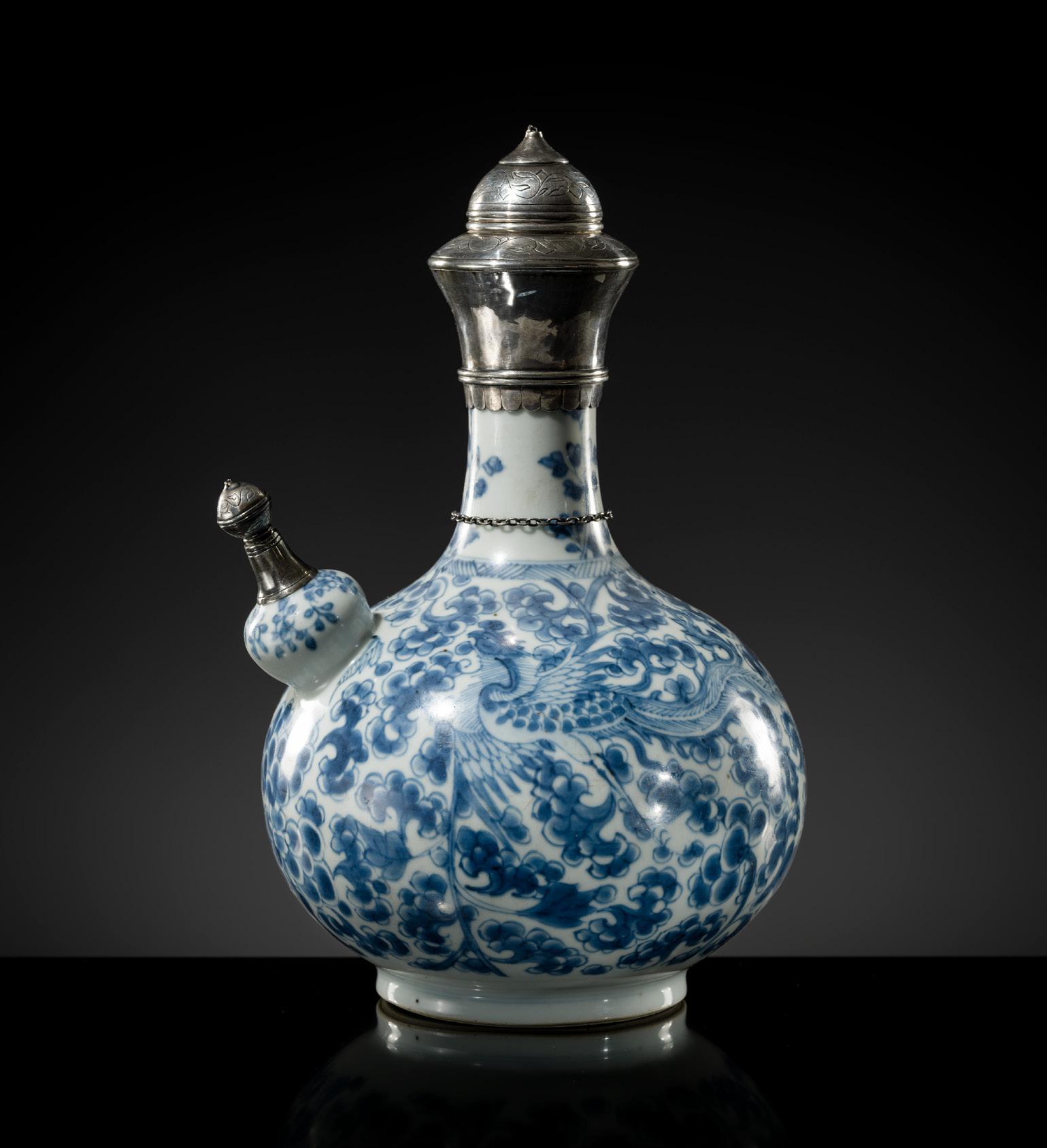
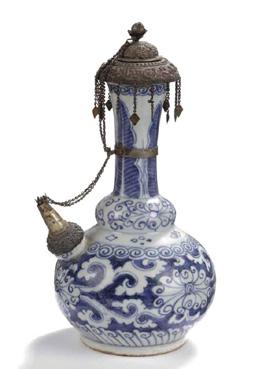
A SILVER-MOUNTED BLUE AND WHITE ’PHOENIX’ KENDI, FOR THE ISLAMIC EXPORT MARKET, LATE MING TO EARLY QING DYNASTY
China, 17th century. Heavily potted, of globular form, rising from a low, gently spreading foot to a tall, slender neck fitted with metal mounts and a domed metal cover. Set at the shoulder is a short, tubular spout, also capped with a metal mount and connected to the neck by a delicate chain. The rounded body is finely painted in underglaze cobalt blue with a dynamic phoenix shown in flight amid dense scrolling leafy tendrils.
Provenance: The Collection of Sam and Myrna Myers, Paris, France.
Acquired between circa 1965-2012.
Condition: Very good condition with old wear and firing flaws, including pitting to the underside, few dark spots, light surface scratches and minor tarnish to the silver. Damages to the metal chain.
Weight: 1,841 g
Dimensions: Height 29.3 cm
This blue-and-white kendi was made for the Islamic export market, where such vessels were highly prized for their practicality and decorative appeal. Kendis, characterized by their globular bodies and side spouts, were
widely used in Islamic regions for the pouring of water and ritual ablutions, and were produced in large numbers by Chinese kilns specifically for overseas demand.
AUCTION RESULT COMPARISON
Type: Closely related
Auction: Christie’s Paris, 23 March 2011, lot 98
Price: EUR 11,500 or approx. EUR 14,500 adjusted for inflation at the time of writing.
Description: A Chinese late Ming blue and white silver-mounted kendi, 17th century, the contemporaneous silver mounts Dutch East Indies
Expert remark: Compare the related form, glaze and mount. Note the slightly smaller size (26 cm).
Estimate EUR 3,000
Starting price EUR 1,500
27
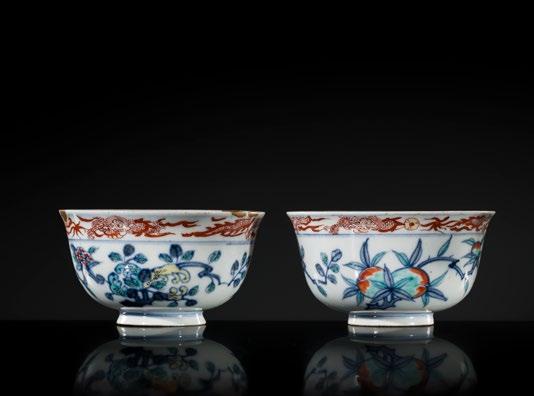
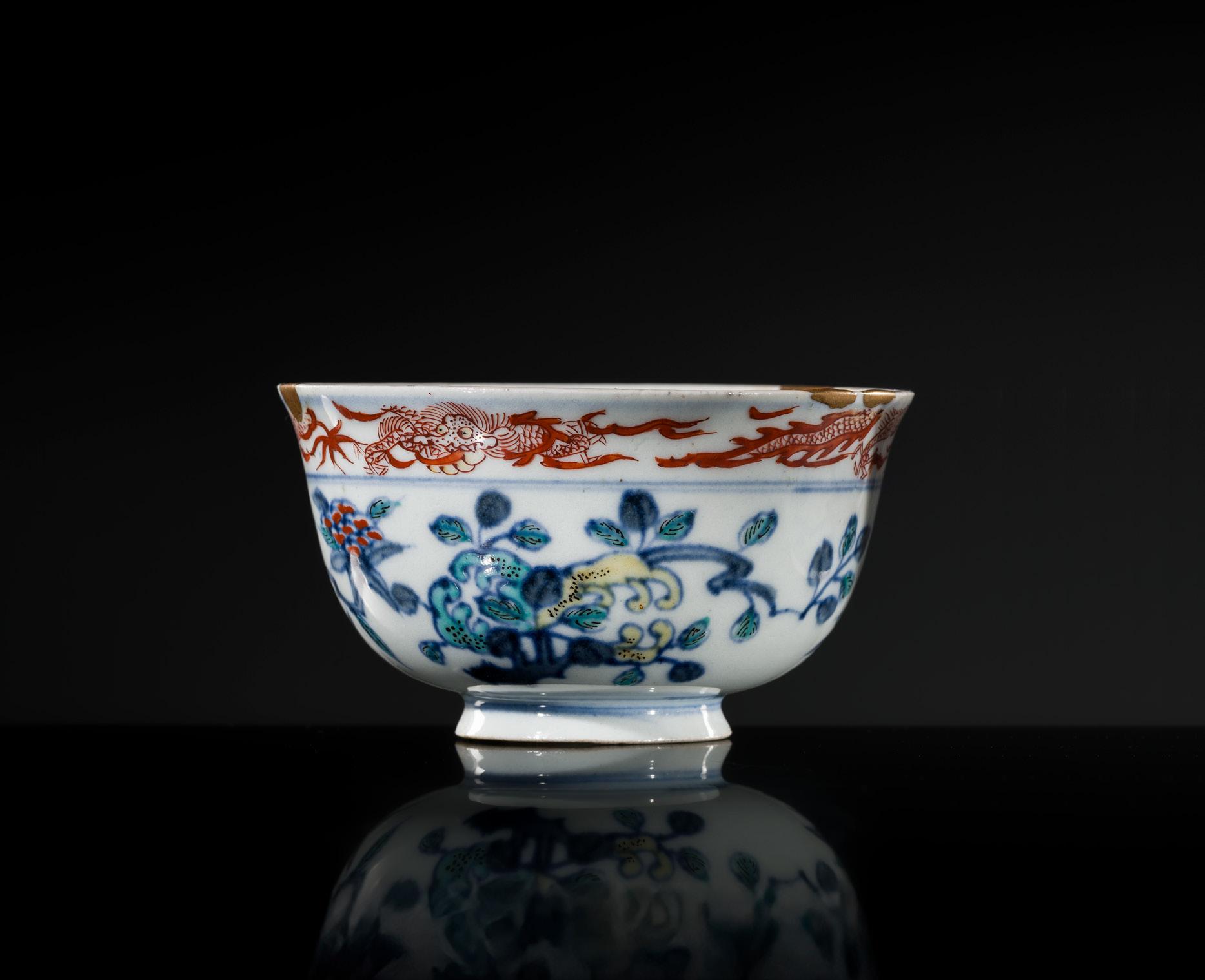
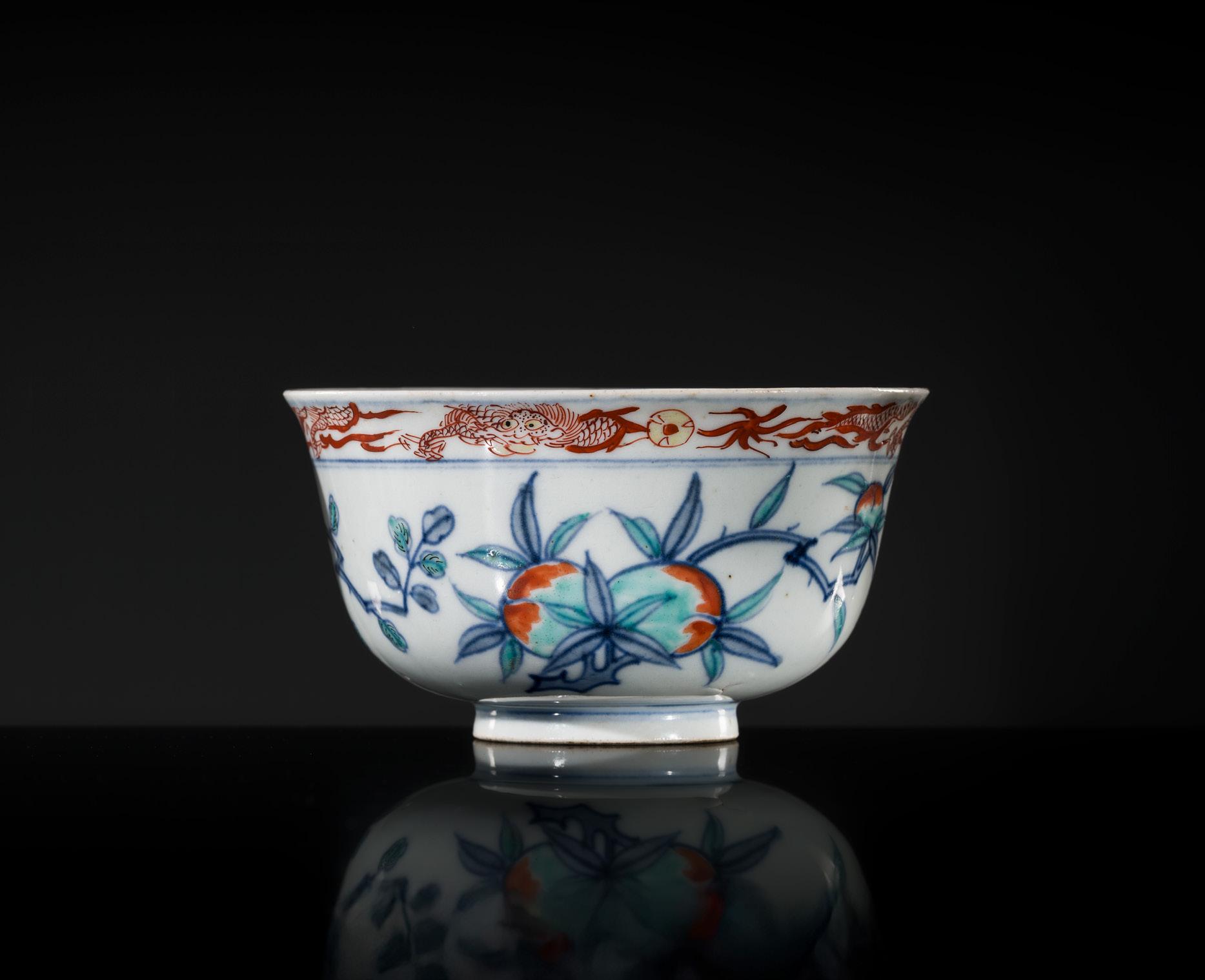
AN EXTREMELY RARE PAIR OF DOUCAI 'SANDUO' BOWLS, 16TH TO 17TH CENTURY
China, circa 1540-1680. Each finely potted with rounded sides rising to a gently everted mouth rim, delicately painted on the exterior with enamels in underglaze-blue outlines to depict three fruiting and flowering sprays of pomegranate, lychee, and finger citron, together forming the auspicious sanduo, ‘Three Abundances.’
The interior medallion features a leafy cluster of peaches in shaded apple-green and iron-red, enclosed within double lines repeated below the rim, as well as an iron-red dragon band around both the exterior and interior rims. (2)
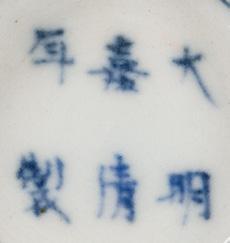
The base of each with a six-character mark da Ming Jiajing nianzhi and either of the period (1522-1566) or slightly later, up to the 17th century.
Provenance: The Collection of Sam and Myrna Myers, Paris, France. According to the Myers ledger acquired on 19 December 1977 from Laméris and in the collection for 49 years. Frides Laméris (1921–2003) was a Dutch specialist in antique glass and porcelain. She co-founded Laméris Glass & Antiques in Amsterdam in 1963 with Trudy Laméris. Over the decades she became widely respected for her connoisseurship and expertise. She also appeared as an expert on the Dutch television program “Tussen Kunst en Kitsch.” After her death, the Laméris gallery continued under the next generation of the family.
Condition: Very good condition with old wear and firing flaws, including fritting, glaze crackling, few dark spots, rubbing and flaking to the enamels and glaze. Some minor Kintsugi repairs.
Weight: 422 g (total)
Dimensions: Height 6.5 cm, Diameter 12 cm (each)
The present pair of bowls belongs to an extremely rare group of Jiajing doucai-decorated vessels closely following Chenghua prototypes. A related washer of larger size (16 cm diameter) in the Shanghai Museum is illustrated by Lu Minghua, Mingdai guanyao ciqi, Shanghai, 2007, p. 211, pl. 4-10.
The Shanghai example is dated to the Jiajing period, although the base is unglazed. It is possible that the original reign mark may have been removed. A related small cup decorated with flower sprays, bearing a Jiajing reign mark, from the J.M. Hu Collection, was sold at Christie's New York, 15 September 2009, lot 353. The latter is based on earlier Ming prototypes from the Chenghua stratum at Jingdezhen.
No directly comparable prototypes for the present pair of bowls appear to be found among extant Chenghua or Jiaqing examples. The fruiting branches on the current bowls also relate to the decoration found on a number of pieces from the Chenghua stratum at Zhushan, Jingdezhen, included in the Tsui Museum of Art exhibition A Legacy of Chenghua, Hong Kong, 1993, illustrated in the catalog, nos. C115, C117 and C122.
In these bowls, the characteristic doucai process is evident: the designs are first drawn in underglaze blue and then completed with enamel colors, including iron red and translucent apple green applied above the glaze. While related to the broader wucai tradition, the decoration follows the more disciplined doucai approach, in which the blue outlines define the composition and the enamels softly fill and enrich the motifs.
The present lot is an early example from the Jiajing reign, which was later refined during the Yongzheng Emperor's period. The design of
fruiting branches and the dragon-band motif references two of several Chinese Emperor's passions: the reverence for antiquity and the love of auspicious symbols, both of which were integral to the decoration of all Imperial residences and belongings. The present design, featuring sprays of fruiting finger citron, lychee, and pomegranate, represents a variation of the auspicious sanduo ('three abundances') motif. These fruits are symbols of endless long life, an abundance of offspring, and plentiful blessings. The pomegranate, bursting with seeds, symbolizes the wish for plentiful offspring; the lychee, whose Chinese name lizhi is homophonous with the phrase 'establish a son' (lizi), represents an abundance of descendants; and the finger citron, often referred to as 'the Buddha's hand,' serves as an emblem of longevity, happiness, and good fortune. The dragon band around the rim further reinforces the auspicious theme.
AUCTION RESULT COMPARISON
Type: Related
Auction: Christie’s New York, 20 September 2013, lot 1295
Price: USD 543,750 or approx. EUR 644,000 converted and adjusted for inflation at the time of writing
Description: An extremely rare doucai brush washer, Jiajing six-character mark in underglaze blue within a double circle and of the period (1522-1566)
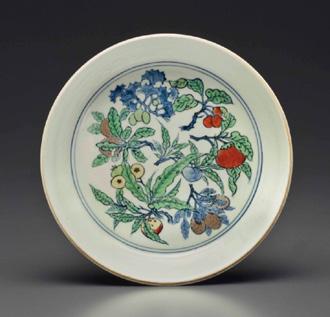
Expert remark: Compare the similar motif, decoration, enamels and period. Note also the similar size (14.1 cm).
Estimate EUR 8,000
Starting price EUR 4,000
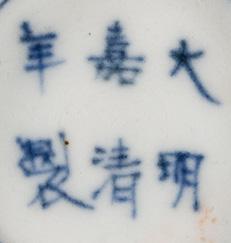
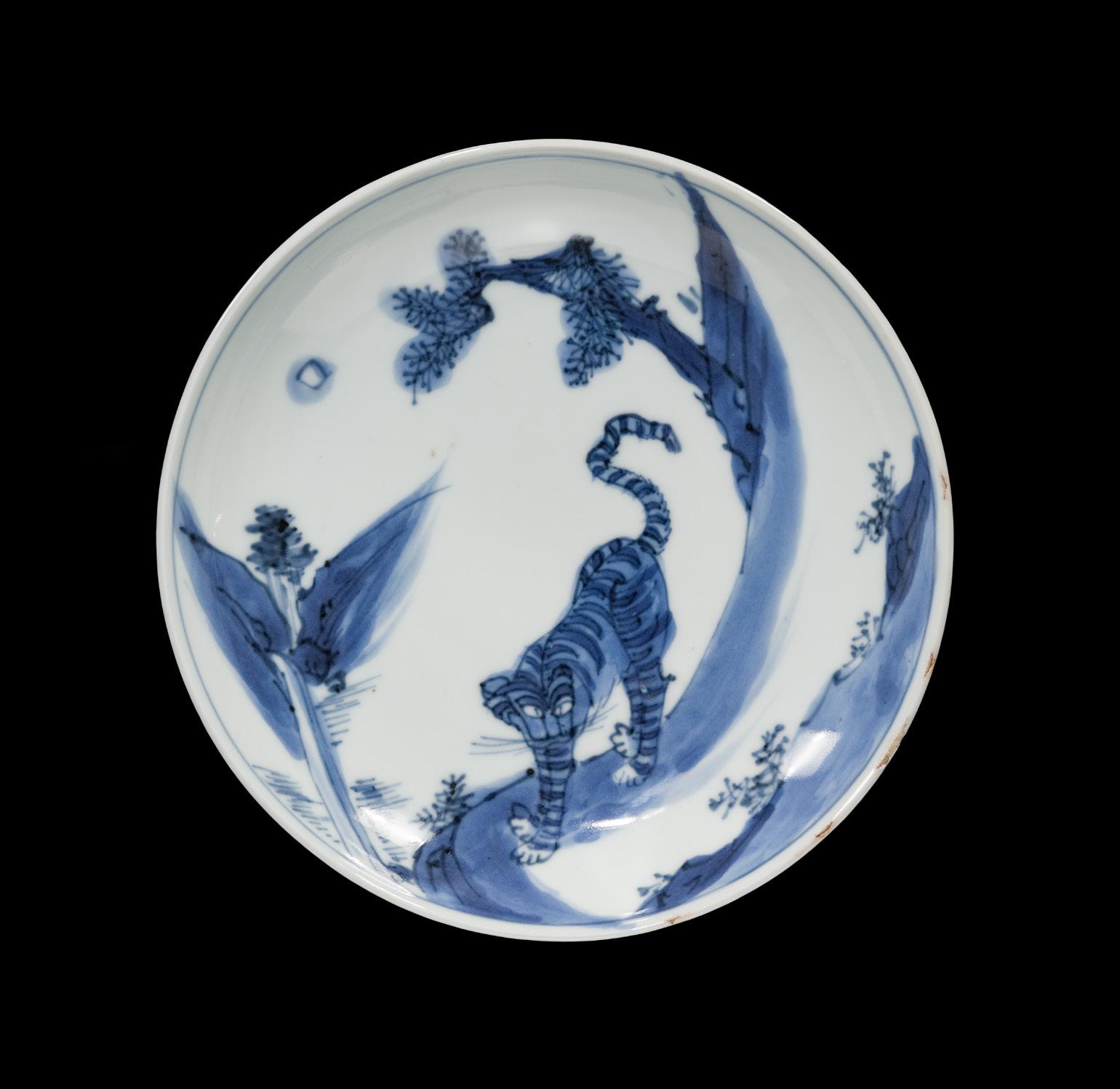
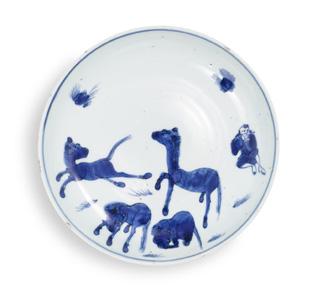
A BLUE AND WHITE ‘TIGER’ KO-SOMETSUKE DISH, MING DYNASTY, TIANQI PERIOD
China, 1621–1627. The steep, rounded sides rise from a short, tapered foot to an everted rim. The interior is painted in underglaze blue, depicting a tiger standing on a rocky outcrop beneath the moon and a pine branch, set within a river landscape with a waterfall.
Provenance: The Collection of Sam and Myrna Myers, Paris, France. Acquired between circa 1965-2012.
Condition: Very good condition with minor wear and manufacturing irregularities including expected fritting around the rims and foot as well as few dark spots and pooling.
Weight: 151 g
Dimensions: Height 3 cm, Diameter 14.5 cm
Kosometsuke, literally ‘old blue and white’, refers to porcelains made specifically to cater to the Japanese taste. With the growing demand for wares for tea drinking and kaiseki meals during the tea ceremony in Japan, Chinese kilns developed new, irregular shapes and decorations. Kosometsuke porcelain was intentionally manufactured using poorly levigated clay and roughly potted with inconsistencies or imperfections that appealed to the Japanese. Typical Kosometsuke wares are often slightly warped in shape and bear rim ‘frits’ from manufacture which were intentionally made and often perceived as damage or a mistake during firing.
Often the glaze would flake off the body of the piece and the edges, known as mushikui, or ‘earth worm nibbles’, were particularly prized.
AUCTION RESULT COMPARISON
Type: Closely related
Auction: Sotheby’s London, 22 February 2022, lot 17
Price: GBP 2,268 or approx. EUR 3,500 converted and adjusted for inflation at the time of writing
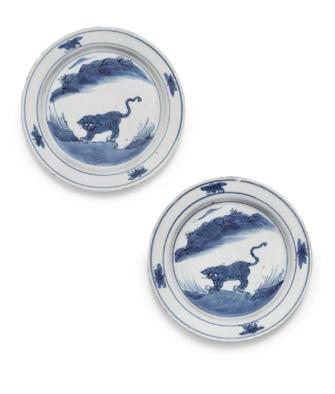
Description: A pair of Ko-sometsuke blue and white 'tiger' saucer dishes Ming dynasty, Tianqi period Expert remark: Compare the closely related modeling, form, glaze, decoration and size (14.8 cm). Note that the lot is a pair.
Estimate EUR 1,000
Starting price EUR 500
29
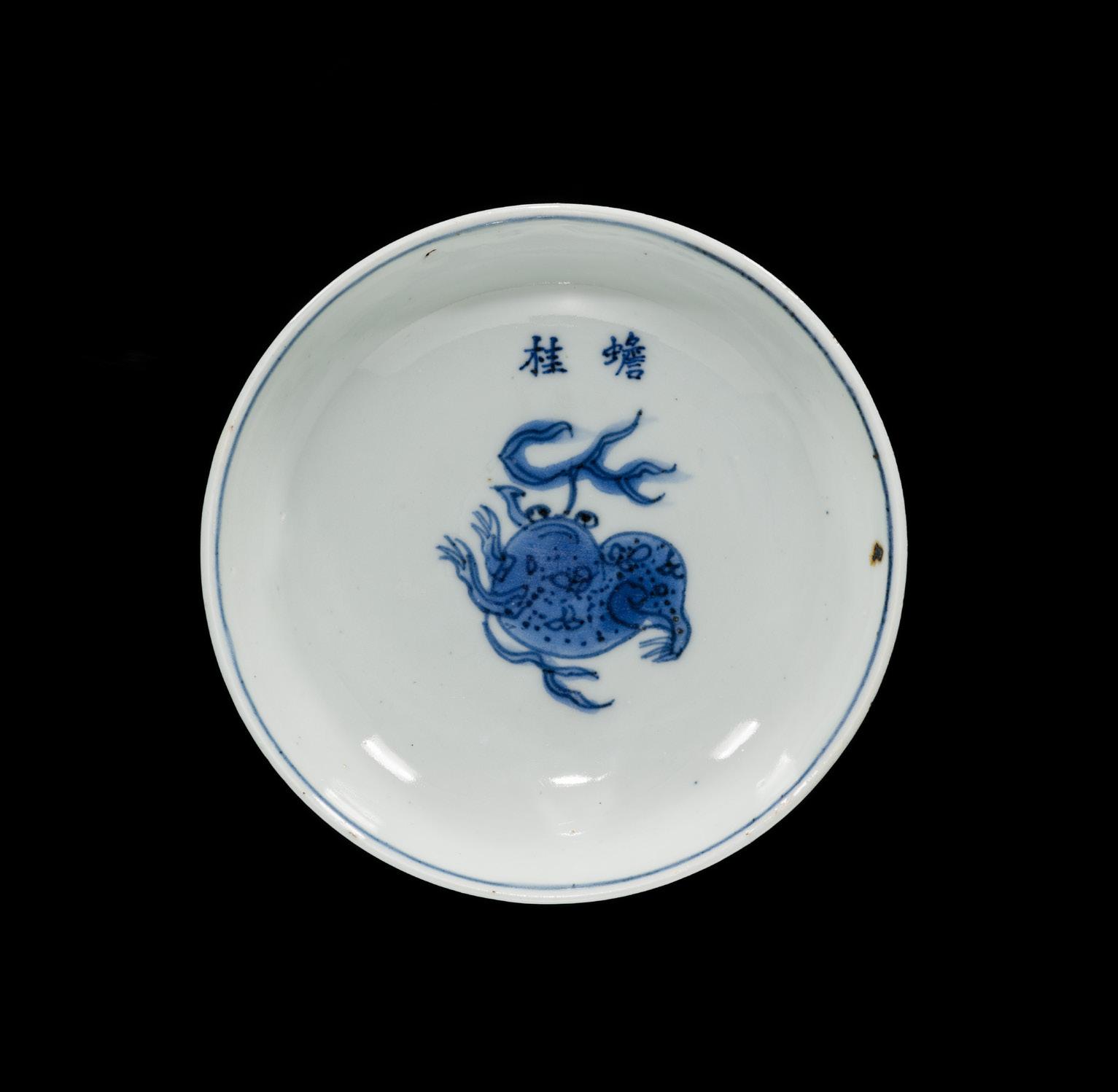
A BLUE AND WHITE ‘TOAD OF ABUNDANCE’ KO-SOMETSUKE DISH, MING DYNASTY, TIANQI PERIOD
China, 1621–1627. The steep, rounded sides rising from a short, tapered foot. The interior is painted in underglaze blue, depicting a charming looking toad spreading its feet standing in front of seaweed.
Inscription: Atop the toad is inscribed Zhong chan, 種蟾 , [toad of abundance].
Provenance: The Collection of Sam and Myrna Myers, Paris, France. Acquired on 3 September 1976, according to the Myers ledger, and in the collection for 50 years.
Condition: Very good condition with minor wear and manufacturing irregularities including expected fritting around the rims and foot as well as few dark spots and pooling.
Weight: 145 g
Dimensions: Height 3.8 cm, Diameter 12.7 cm
Wabi-sabi, the Japanese aesthetic that finds beauty in imperfection, transience, and natural irregularity, lies at the heart of the appreciation of ko-sometsuke wares. Kosometsuke, literally meaning “old blue and white,” refers to Chinese porcelains produced specifically to suit Japanese tastes, particularly for use in tea drinking and kaiseki dining associated with the tea
ceremony. In response to this demand, Chinese kilns deliberately adopted irregular forms, asymmetrical profiles, and spontaneous decoration that resonated with the wabi-sabi ideal. These wares were intentionally made from poorly levigated clay and roughly potted, resulting in warped shapes, firing flaws, and rim fritting that might otherwise be considered defects. Features such as glaze flaking and mushikui along the edges were not only accepted but actively prized, embodying the tea aesthetic’s reverence for impermanence and imperfection.
AUCTION RESULT COMPARISON
Type: Related
Auction: Sotheby’s Hong Kong, 9 September 2025, lot 5179
Price: HKD 19,050 or approx. EUR 2,000 converted and adjusted for inflation at the time of writing
Description: A blue and white 'horse' Ko-sometsuke dish, 17th century Expert remark: Compare the related modeling, form, and glaze. Note the different motif and larger size (21.5 cm).
Estimate EUR 1,000
Starting price EUR 500

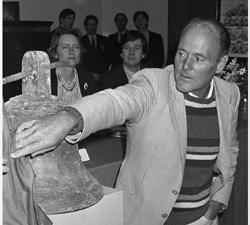
Michael Hatcher unveils a bell found at the ‘Nanking cargo’ site, 1986
THE HATCHER CARGO (LOTS 30–32)
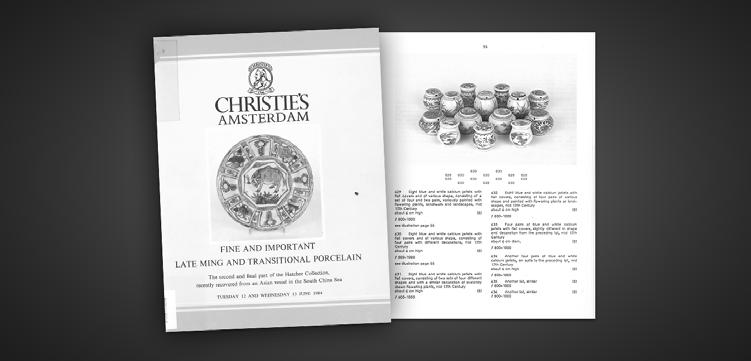
The present lots were recovered among some 25,000 objects found on the wreck of an unidentified Asian ship in the South China Sea. This ship is known as the 'Hatcher cargo’ after Captain Michael Hatcher who discovered her in 1983. There is no written record testifying to the exact year of her sinking but the covers of two oviform jars inscribed in underglaze blue
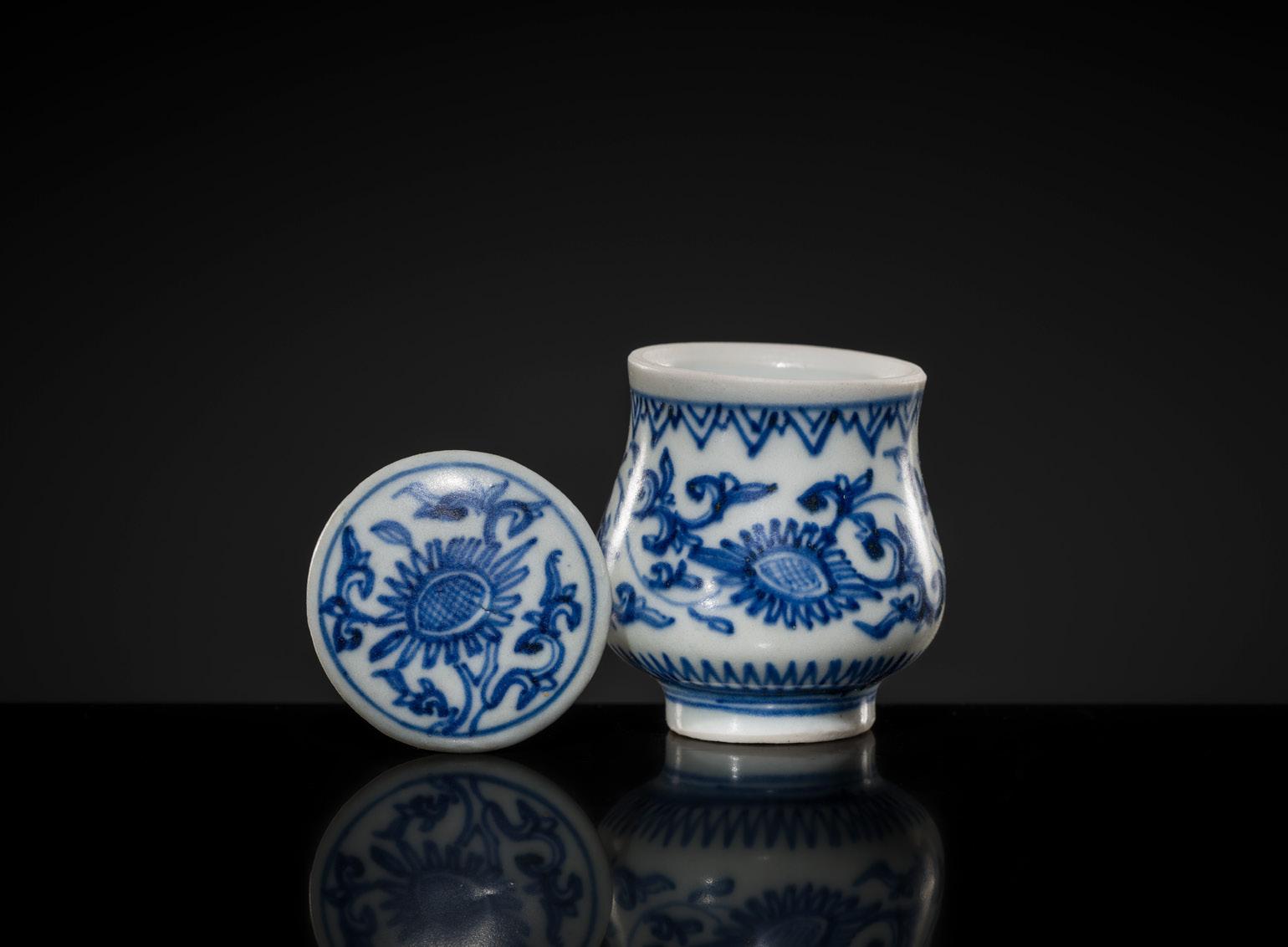
30 A MINIATURE BLUE AND WHITE ‘CHRYSANTHEMUM’ JAR AND COVER, TRANSITIONAL PERIOD, FROM THE HATCHER CARGO
China, c. 1643-1645. Finely potted, the jarlet rising from a small, ring foot to a gently swelling belly body to a short, narrow neck. The globular body is painted with a frieze of chrysanthemum scrolls between a band of lotus petals above and a band of zig-zag. The flat cover depicts another chrysanthemum. (2)
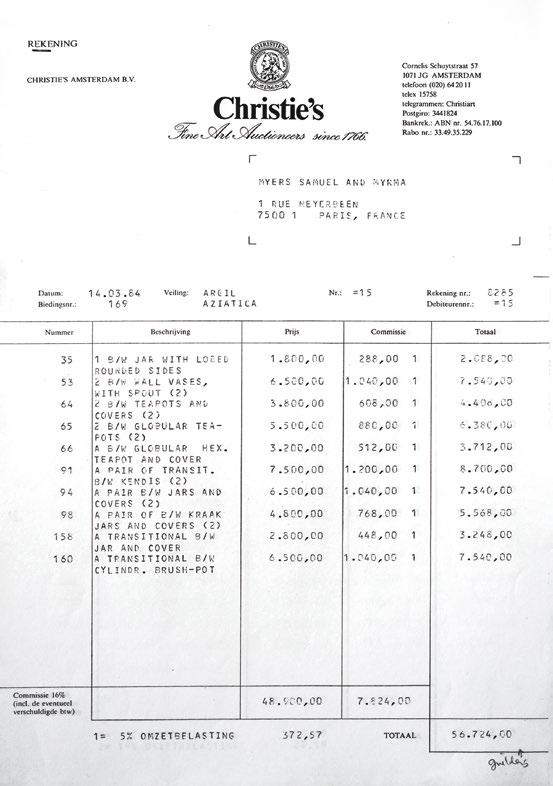
Provenance: Michael Hatcher, recovered from the ‘Hatcher wreck’ in 1983. Christie’s Amsterdam, Fine and Important Late Ming and Transitional Porcelain, 12-13 June 1984, lot 630. The Collection of Sam and Myrna Myers, Paris, France. Acquired between circa 1965-2012. Condition: Good condition with minor wear and firing flaws, including fritting, a tiny firing crack and pooling to the interior as well as rubbing to the glaze. Presenting very well.
Weight: 63 g
Dimensions: Height 5 cm, Diameter 4.5 cm
Estimate EUR 1,500
Starting price EUR 700
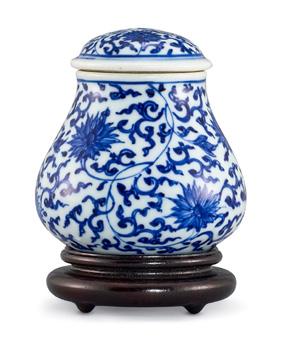
AUCTION RESULT COMPARISON
Type: Related
Auction: Sotheby’s Hong Kong, 27 November 2020, lot 449
Price: HKD 81,900 or approx. EUR 10,000 converted and adjusted for inflation at the time of writing
Description: A blue and white jar and cover Qing dynasty, 18th century
Expert remark: Compare the related form, glaze, and decoration. Note the larger size (7.1 cm), wood stand and later date.
with a cyclical date corresponding to 1643 make fairly precise dating of the wreck possible. The cargo primarily consisted of two types of blue-and-white porcelain made at Jingdezhen at the end of the Ming dynasty – late variations of 'kraak' ware and examples of a 'transitional' style characterized by landscape motifs and naturalistic plants and birds. The ship may have been
on its way to Indonesia, carrying also spices, silk and other commodities for sale to the Dutch whose East India Company had offices in Batavia (modern Jakarta). Chinese junks sailing to Batavia or Bantam varied in size from 200 to 800 tons. The journey out was made over three weeks during December and January and the return trip took place in June and July.
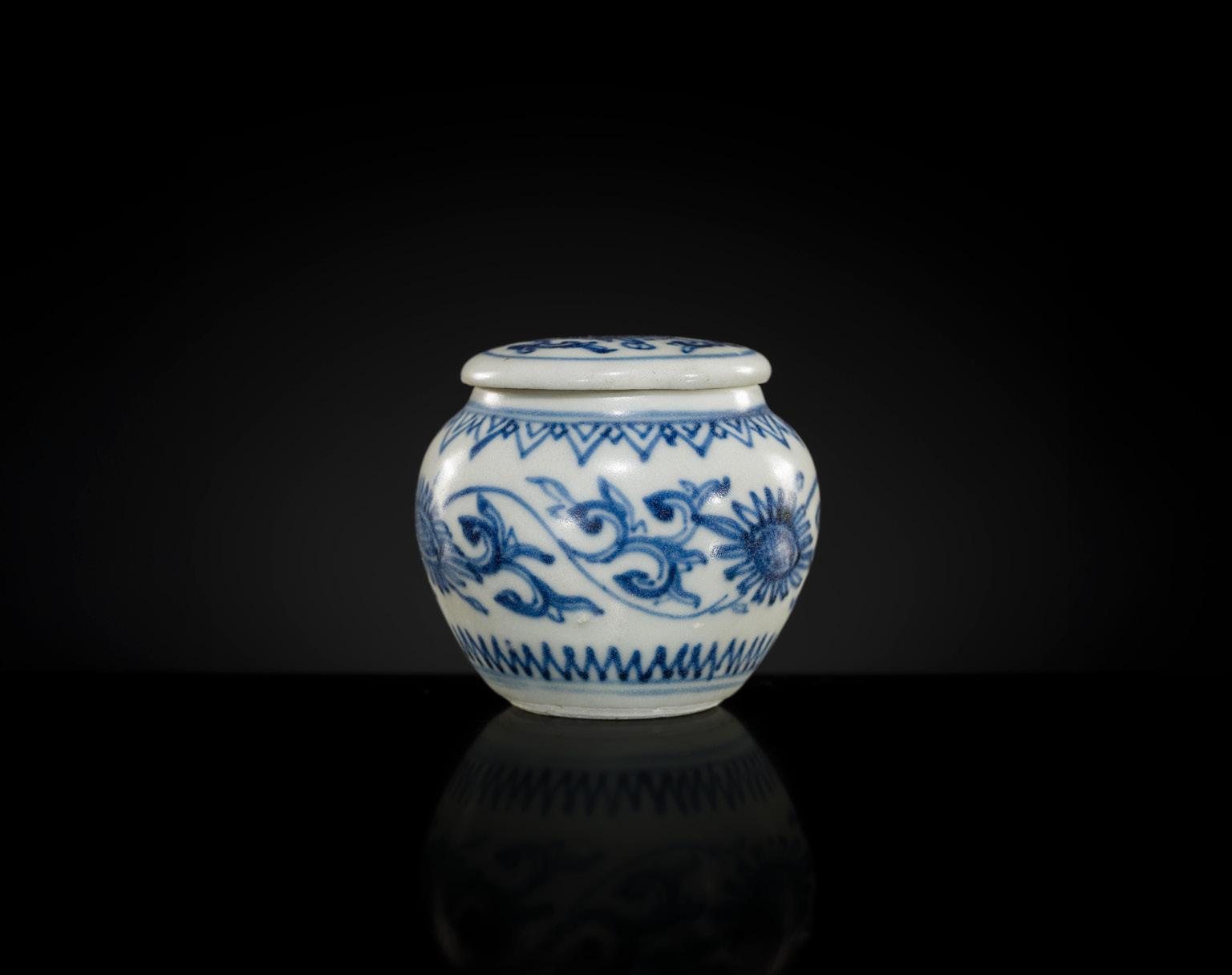
A MINIATURE BLUE AND WHITE ‘CHRYSANTHEMUM’ JAR AND COVER, TRANSITIONAL PERIOD, FROM THE HATCHER CARGO
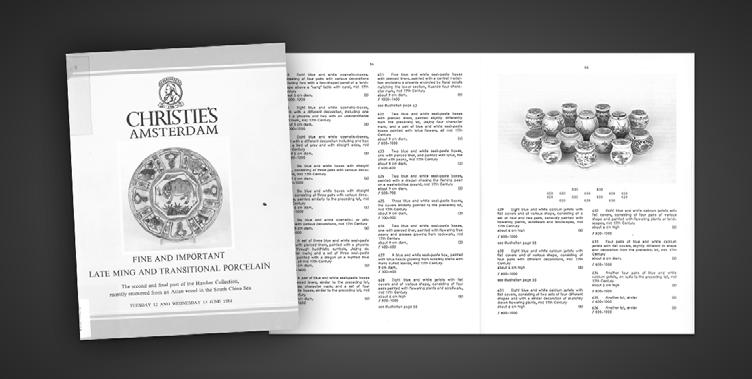
The catalog for the auction in which the present lot was sold at Christie’s Amsterdam, 12-13 June 1984, lot 628
China, c. 1643-1645. Finely potted with a swelling, high-shouldered body supported on a ring foot and rising to a short, narrow neck. The globular body is painted with a frieze of chrysanthemum scrolls between a band of lotus petals above and a band of zig-zag. The flat cover depicts another chrysanthemum. (2)
Provenance: Michael Hatcher, recovered from the ‘Hatcher wreck’ in 1983. Christie’s Amsterdam, Fine and Important Late Ming and Transitional Porcelain, 12-13 June 1984, lot 628. The Collection of Sam and Myrna Myers, Paris, France. Acquired between circa 1965-2012. With a label to the underside of the lid ‘Recovered from an Asian vessel sunk in the South China Sea’. Michael Hatcher (b. 1940) is a British explorer and marine salvor who specialized in salvage work in the South China Sea. In 1981, he was involved in investigating the wreck of the Dutch submarine K XVII. He is especially known for his recovery of large quantities of Chinese porcelain from the VOC ship Geldermalsen (known as the ‘Nanking cargo’) which was sold at Christie's in Amsterdam in 1986. Previously, he had discovered another ship in the South China Sea, which became known as the ‘Hatcher cargo’. A part of the cargo salvaged in this wreck was sold at Christie’s Amsterdam in June 1984.
Condition: Good condition with old wear and firing flaws, including fritting, tiny pitting, and rubbing to the glaze. An obvious chip to the rim.
Weight: 46 g
Dimensions: Height 4.7 cm, Diameter 5 cm
Estimate EUR 1,500
Starting price EUR 700
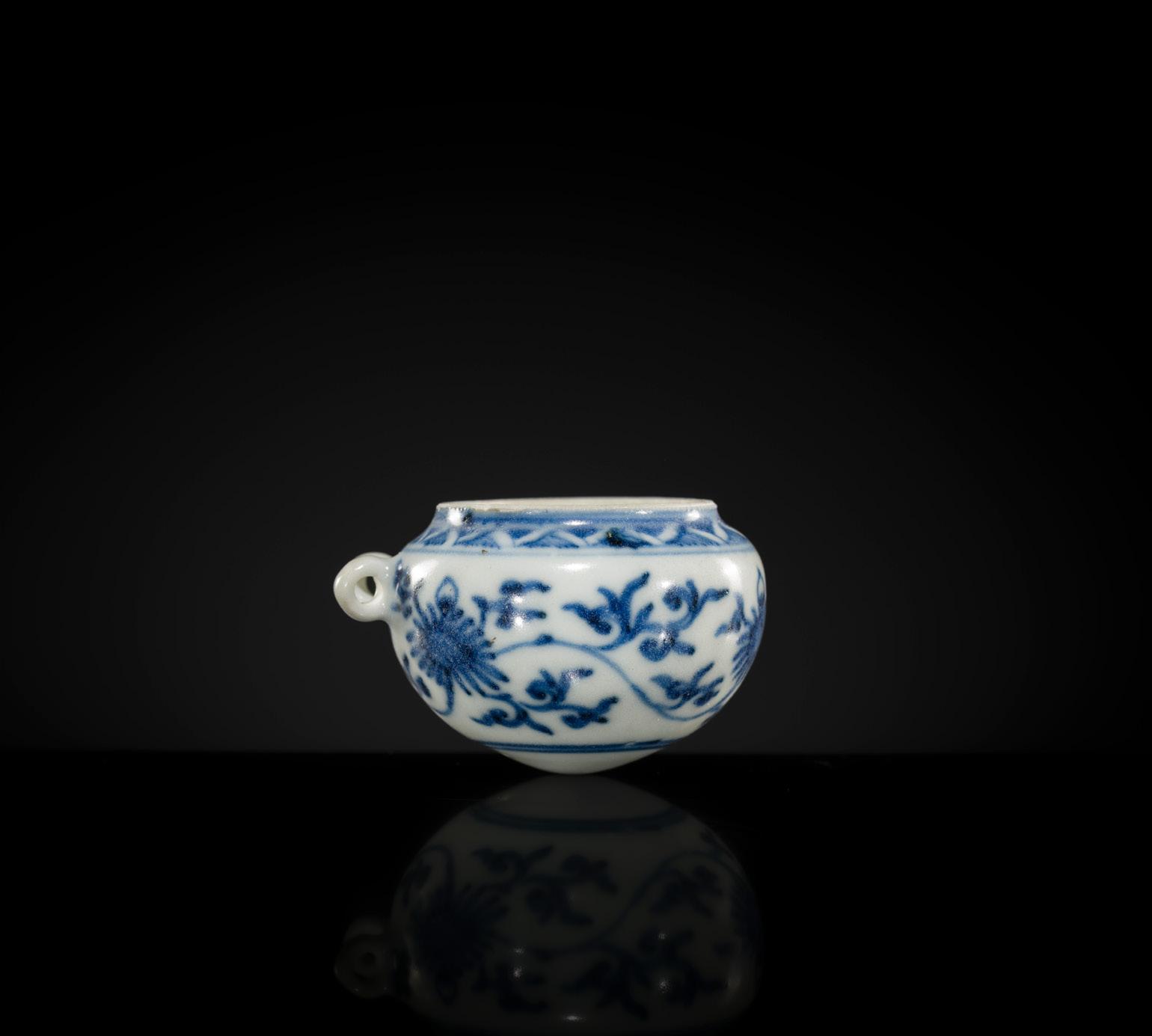
A FINE BLUE AND WHITE ‘LOTUS’ BIRD FEEDER, TRANSITIONAL PERIOD, FROM THE HATCHER CARGO
China, c. 1643-1645. Delicately potted with a slightly pointed base rising to a compressed globular body below a tapering mouth rim, applied to one shoulder with a small double-loop handle, painted on the exterior with cobalt in inky-blue tones, featuring a band of scrolling lotus flanked by a V-shaped band.
Provenance: Michael Hatcher, recovered from the ‘Hatcher wreck’ in 1983. Christie’s Amsterdam, The Private Collection of Captain M. Hatcher, 14 February 1985, lot 125. The Collection of Sam and Myrna Myers, Paris, France. Acquired between circa 1965-2012. With an old auction label ‘Hatcher Collection, Christie’s, Feb. ‘85’. Michael Hatcher (b. 1940) is a British explorer and marine salvor who specialized in salvage work in the South China Sea. In 1981, he was involved in investigating the wreck of the Dutch submarine K XVII. He is especially known for his recovery of large quantities of Chinese porcelain from the VOC ship Geldermalsen (known as the ‘Nanking cargo’) which was sold at Christie's in Amsterdam in 1986. Previously, he had discovered another ship in the South China Sea, which became known as the ‘Hatcher cargo’. A part of the cargo salvaged in this wreck was sold at Christie’s Amsterdam in February 1985.
Condition: Very good condition with old wear and firing flaws, including fritting, tiny pitting, and rubbing to the glaze.
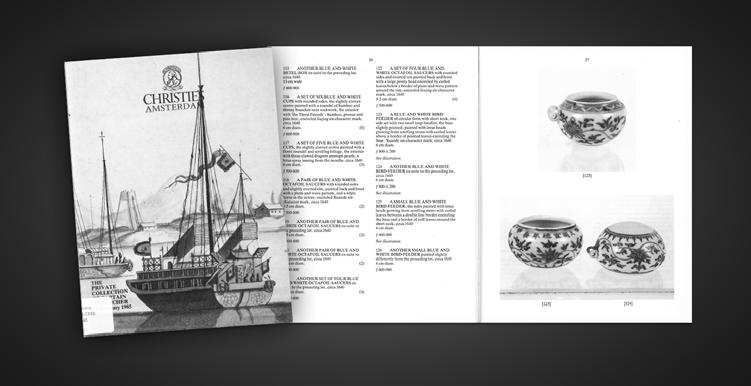
The catalog for the auction in which the present lot was sold at Christie’s Amsterdam, 14 February 1985, lot 125
Weight: 16 g
Dimensions: Height 3 cm, Length 4.6 cm
Estimate EUR 1,000
Starting price EUR 500
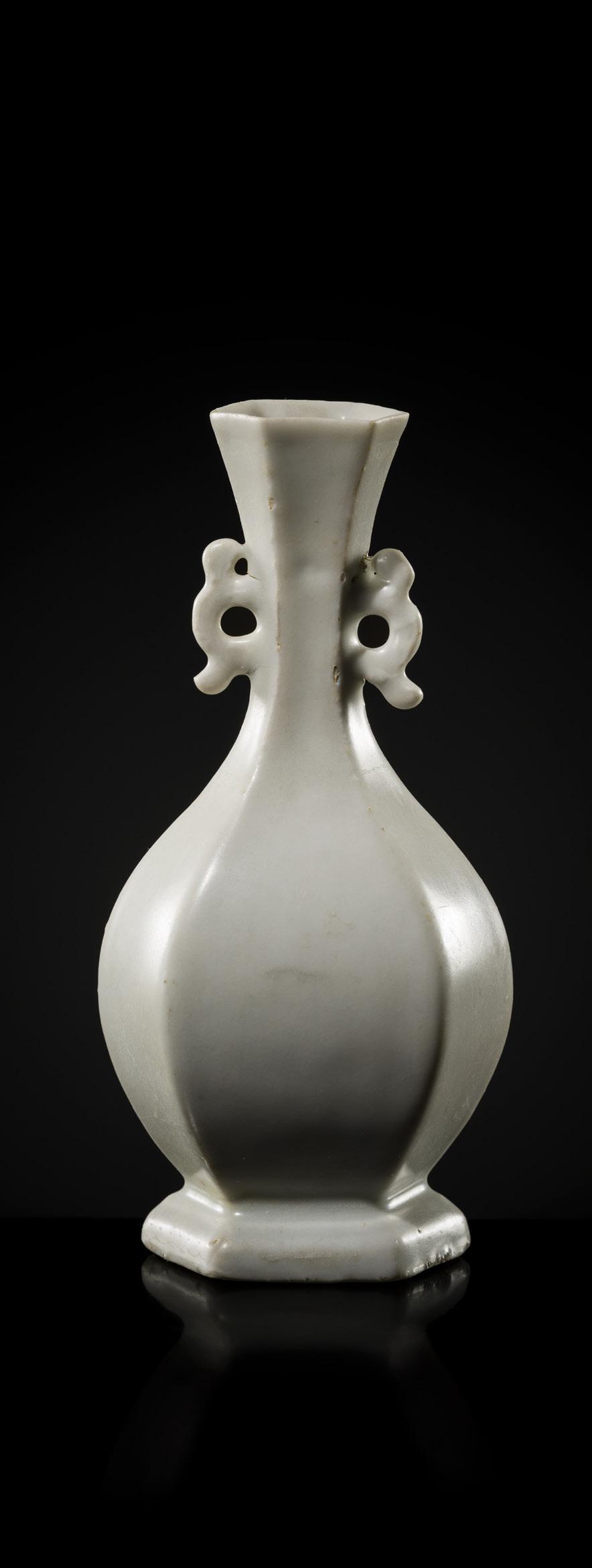
China, early 18th century. Of hexagonal section, the body is supported on a conforming spreading foot and rises to a waisted neck and a galleried rim. The neck is fitted with a pair of openwork chilong-form handles. The vessel is covered overall in an even white glaze.
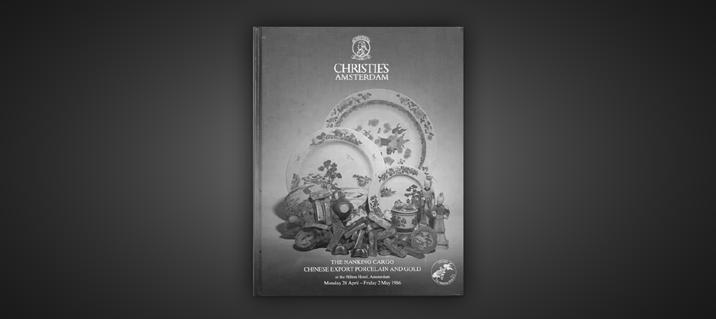
The catalog cover for the auction in which the present lot was sold at Christie’s Amsterdam, 28 April-2 May 1986
Provenance: Michael Hatcher, recovered from the ‘Nanking Cargo’ in 1985. Christie’s Amsterdam, The Nanking cargo, Chinese export porcelain and gold, 28 April-2 May 1986, lot 3252A. The Collection of Sam and Myrna Myers, Paris, France, acquired from the above. With the auction label ‘Christie’s, LOT 3252A The Nanking Cargo’. Michael Hatcher (b. 1940) is a British explorer and marine salvor who specialized in salvage work in the South China Sea. In 1981, he was involved in investigating the wreck of the Dutch submarine K XVII. He is especially known for his recovery of large quantities of Chinese porcelain from the VOC ship Geldermalsen (known as the ‘Nanking cargo’) which was sold at Christie's in Amsterdam in 1986. Previously, he had discovered another ship in the South China Sea, which became known as the ‘Hatcher cargo’. Condition: Good condition with expected wear and firing flaws, including firing cracks to the handle, pitting, dark spots, encrustations to the base.
Weight: 108 g
Dimensions: Height 13 cm
Nanking Cargo refers to the immense cargo of Chinese porcelain (blue and white, often with floral patterns) that sank in the South China Sea in 1752 aboard the Dutch ship Geldermalsen. It was salvaged in 1985 by salvage expert Michael Hatcher and auctioned at Christie's in Amsterdam in 1986, with the porcelain pieces remarkably well preserved thanks to the packaging material, tea. This discovery provided insights into the Chinese export market of the 18th century and the demand for Chinese ceramics in Europe.
Estimate EUR 1,500
Starting price EUR 700
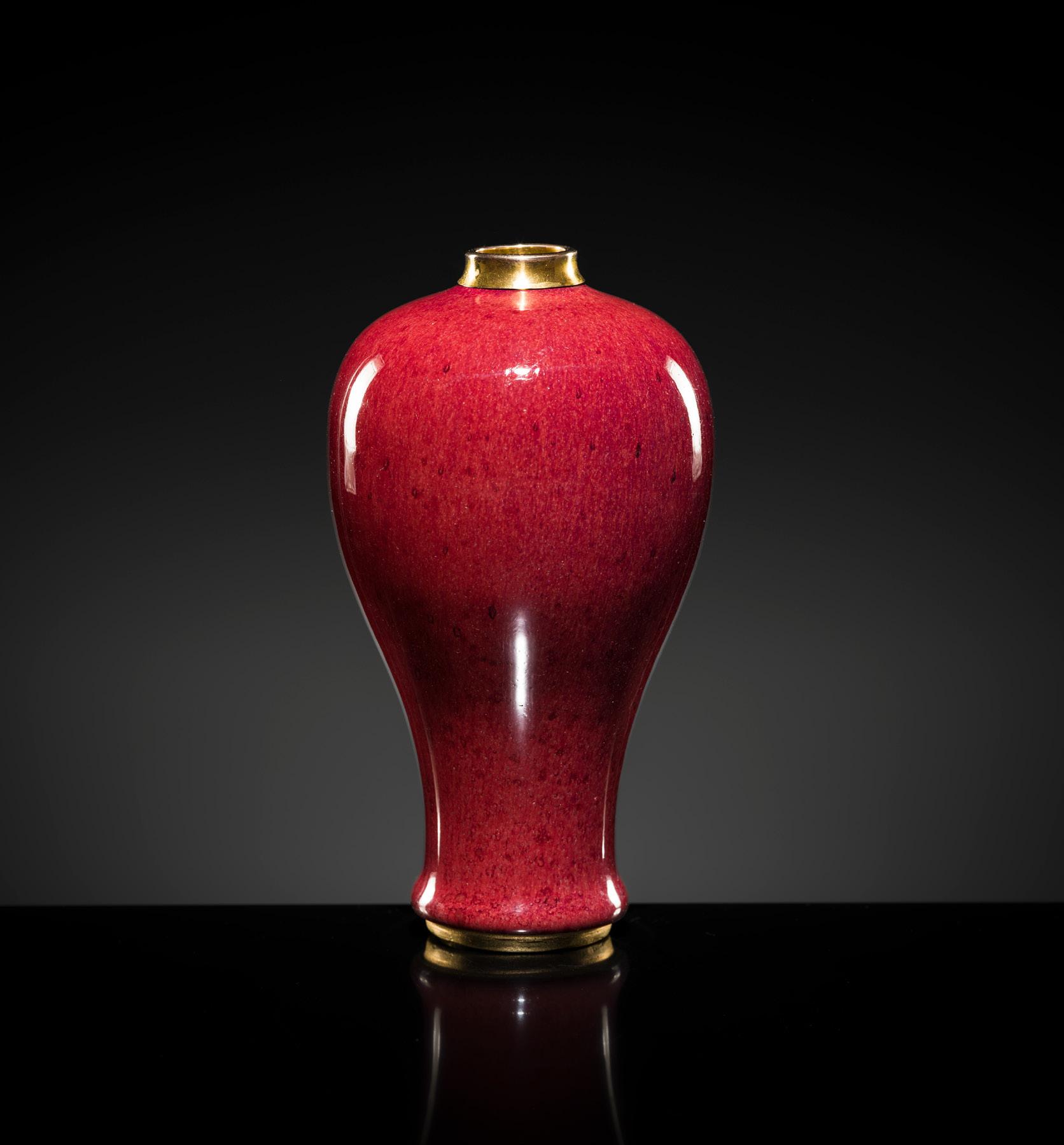
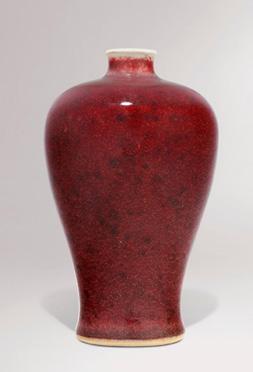
A FINE SMALL COPPER-RED GLAZED LANGYAO VASE, MEIPING, KANGXI PERIOD (1662-1722)
Of classic form with flaring foot, broad shoulders, and short neck, covered to the exterior in a vibrant glaze of crushed strawberry red infused with darker flecks. The white base covered in gilt-lacquer. The mouth neatly set with a 23-carat-gold fitting
Provenance: The Collection of Sam and Myrna Myers, Paris, France. The base with a collection number ‘A 44’’. According to the Myers ledger acquired in London on 30 March 1976, and for 50 years in the collection.
Condition: Good condition with minor old wear and light surface scratches. Condition not inspected below the 23-carat-gold fitting to the neck, which is ancient, cannot be removed, and may be a later addition. The white base covered in gilt-lacquer, which may be of a later date as well.
Weight: 446 g
Dimensions: Height 17.5 cm
AUCTION RESULT COMPARISON
Type: Closely related
Auction: Christie’s Hong Kong, 30 October 2025, lot 925
Price: HKD 3,937,000 or approx. EUR 432,000 converted and adjusted for inflation at the time of writing
Description: A fine small copper-red glazed langyao vase, meiping, Kangxi period (16621722)
Expert remark: Compare the similar form, size (17.3 cm), color and movement of the glaze.
Estimate EUR 3,000
Starting price EUR 1,500
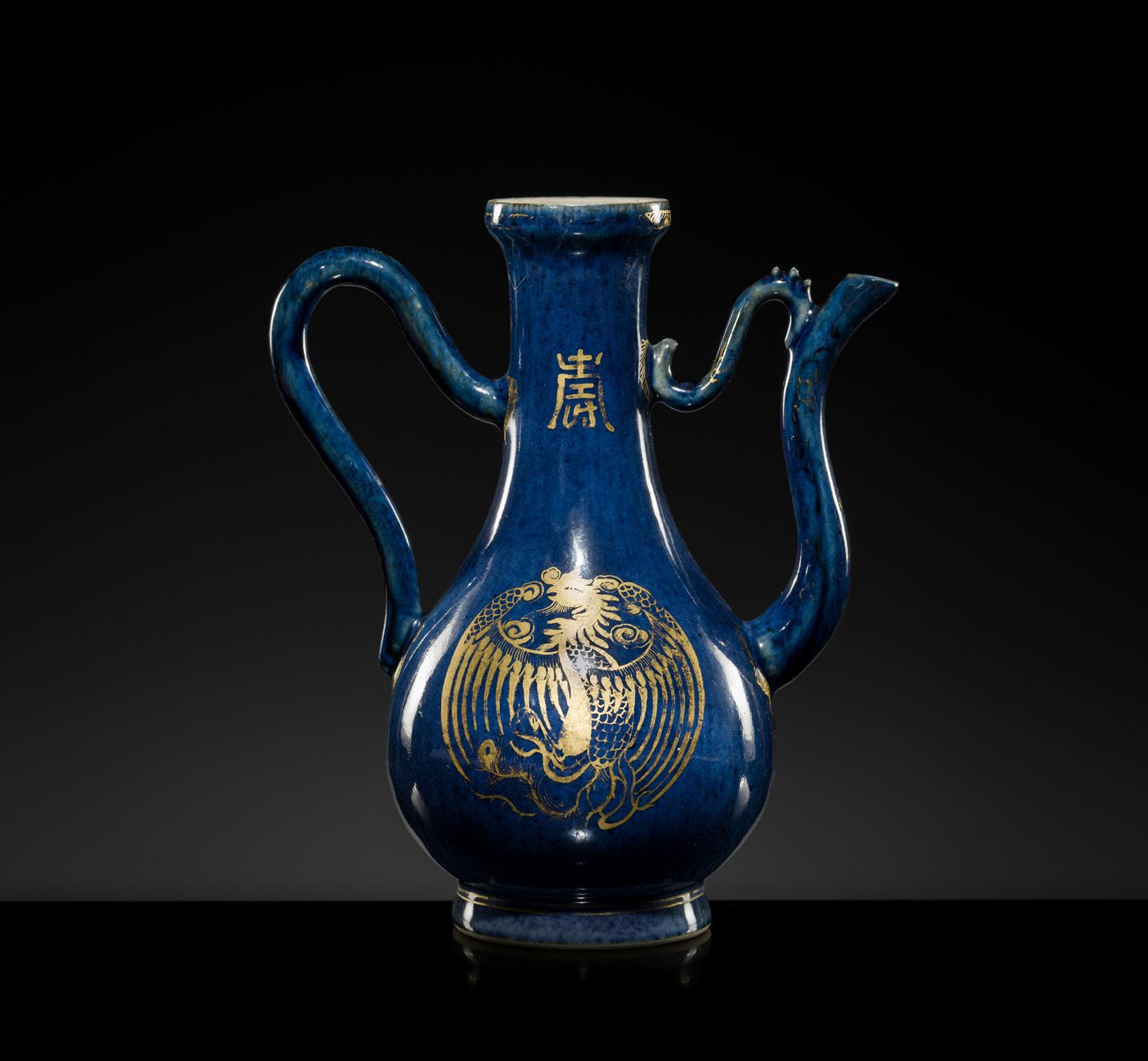
A POWDER-BLUE-GROUND AND GILT-DECORATED EWER, KANGXI PERIOD
China, 1662–1722. Finely potted, rising from a rounded, bulbous body to a tall, waisted neck, terminating in a flat, slightly everted rim. The body is fitted with a sinuous handle and a spout applied at shoulder height, the spout attached to the neck with an S-shaped strut. Covered with a powder-blue glaze and decorated with a gilt phoenix on the body and inscriptions on each side.
Provenance: The Collection of Sam and Myrna Myers, Paris, France. Acquired between circa 1965-2012.
Condition: Condition commensurate with age and type, showing old wear and firing flaws, including fritting, rubbing to gilt. U-shaped repair to the mouth and spout with associated touchups.
Weight: 461 g
Dimensions: Height 18.2 cm
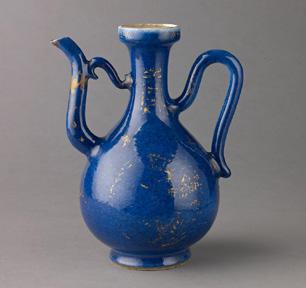
LITERATURE COMPARISON
Compare a closely related powder-blue glazed ewer, dated to 1662–1722, 17.3 cm (high), in the Metropolitan Museum of Art, object number 1975.1.1694.
AUCTION RESULT COMPARISON
Type: Closely related
Auction: Christie’s London, 16 September 1999, lot 306
Price: GBP 2,300 or approx. EUR 6,500 converted and adjusted for inflation at the time of writing.
Description: A pair of powder-blueground gilt-decorated ewers and covers, Kangxi (1662-1722)
Expert remark: Compare the closely related form, glaze and color. Note the slightly larger size (21 cm) and that the lot comprises a set. Also note the substantial wear to the gilt, which is much better preserved on the present lot.
Estimate EUR 2,000
Starting price EUR 1,000
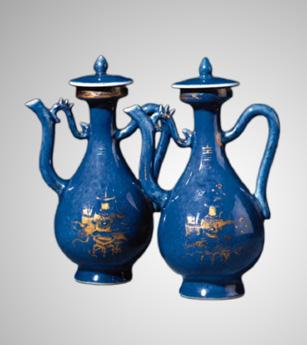
China, circa 17th century. Heavily potted, the upper cauldron with deep, rounded sides supported on three shaped legs modeled with humanoid faces evocative of ancient taotie masks, and resting upon a thick circular disc pierced with a central aperture.
The vessel rises to a projecting rim, subtly formed to suggest the dripping of boiled substance on the interior, and fitted with two upright, rectangular handles. The exterior decorated with two encircling registers, the lower showing Guanyin reclining on a recumbent cow and Shoulao seated with regal ease, accompanied by various bodhisattvas, both seated and standing, set amid palm leaves and lingzhi fungus, while the upper presents the Buddhas of the Four Directions.
The outer surface entirely covered with a lustrous dark-brown glaze, evenly stopped around the rim on the interior to reveal the buffcolored ceramic body beneath.
Provenance: The Collection of Sam and Myrna Myers, Paris, France. Acquired between circa 1965-2012.
Condition: Good condition with surface wear and inherent firing irregularities. Expected traces of usage. Evidence of restoration, mostly to the dripping rim and applied handles. Minute chips along the foot rim. Occasional minor nicks and faint surface scratches.
Weight: 2,713 g
Dimensions: Height 23.1 cm, Diameter 15.6 cm
The present stoneware steamer derives its form from the archaic ritual vessel known as a ‘yan’, employed principally for steaming food, particularly grains, in ceremonial contexts. It comprised a deep upper bowl, or ‘zeng’, with a perforated base, set upon (or in later examples, cast integrally with) a lower, tripod-footed vessel known as a ‘li’. Boiling water
contained in the lower vessel would generate steam, cooking the contents of the upper bowl.
The ‘yan’ emerged during the late Shang dynasty, c. 12th–11th century BC, and persisted as a prominent form throughout the Western Zhou and early Spring and Autumn periods, ultimately yielding to rectangular, four-legged steamers by the close of the latter. Early examples exhibited restrained ornamentation, often with narrow bands of stylized animal masks encircling the upper vessel, while the tripod legs of the ‘li’ were distinctively embellished with taotie motifs or animalistic representations.
Interest in Shang and Western Zhou ritual bronzes during the Qing dynasty extended beyond antiquarian curiosity, forming part of an official cultural and intellectual program aimed at linking Qing sovereignty to the authority and legitimacy of ancient Chinese forebears. Emperor Qianlong, for instance, assembled and cataloged thousands of antiquities in monumental undertakings such as the Xiqing Gujian, regarding these objects as tangible emblems of a historical ‘golden age’ that buttressed both his Imperial authority and cultural identity.
LITERATURE COMPARISON
Compare a related bronze steamer (yan) with taotie masks, Western Zhou dynasty, 11th-10th century BC, in the Tokyo National Museum, collection reference number TJ4788 (fig. 1). Compare a related bronze steamer (yan) with taotie masks, late Shang dynasty, 11th century BC, 38.1 cm high, in the Minneapolis Institute of Art, accession number 50.46.90. Compare a related bronze steamer (yan), Qing dynasty, 18th century, 38.4 cm high, in the Walters Art Museum, accession number 54.2175.
Estimate EUR 2,000
Starting price EUR 1,000
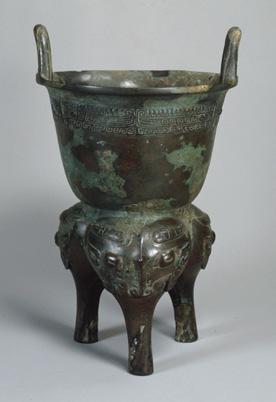
1
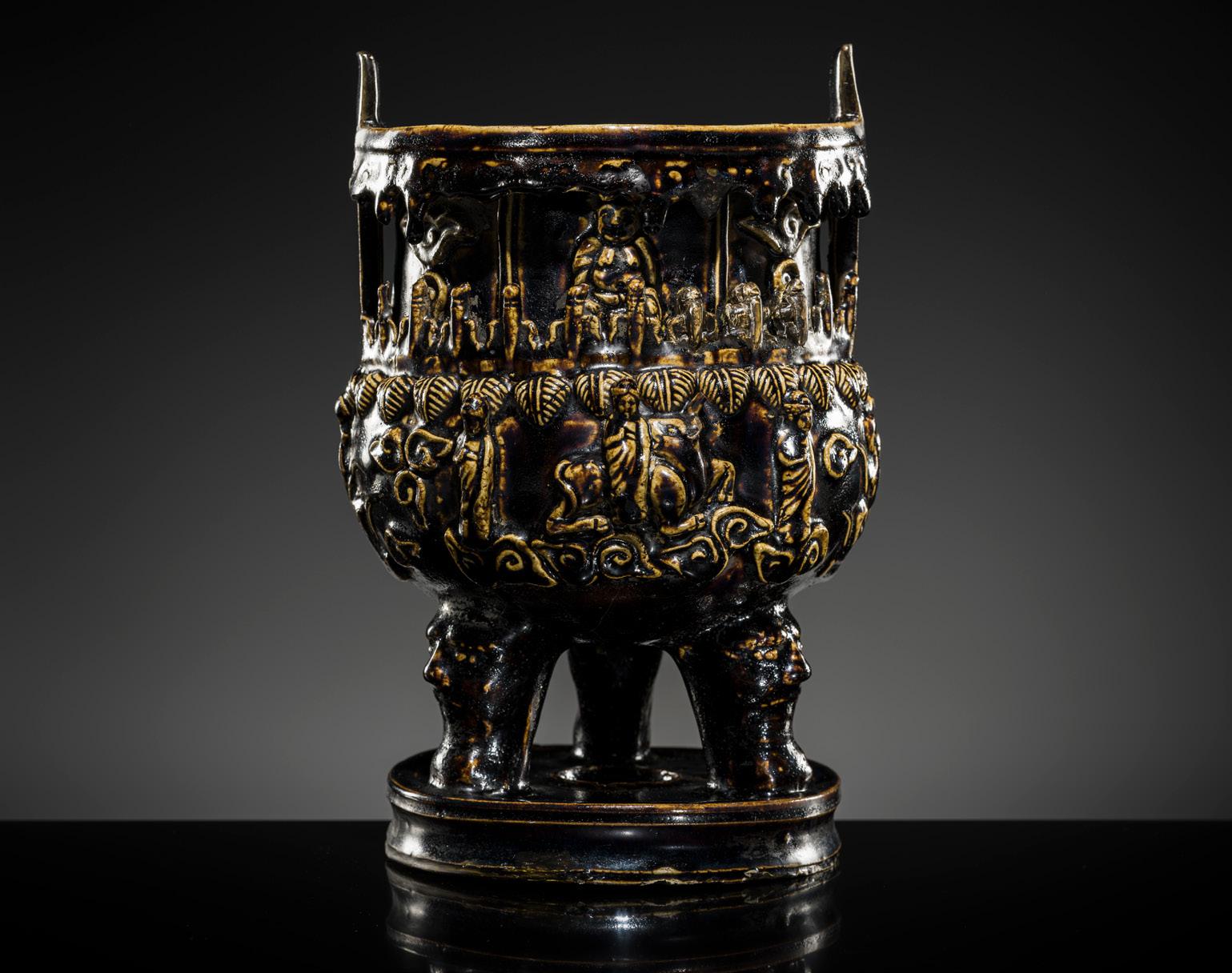
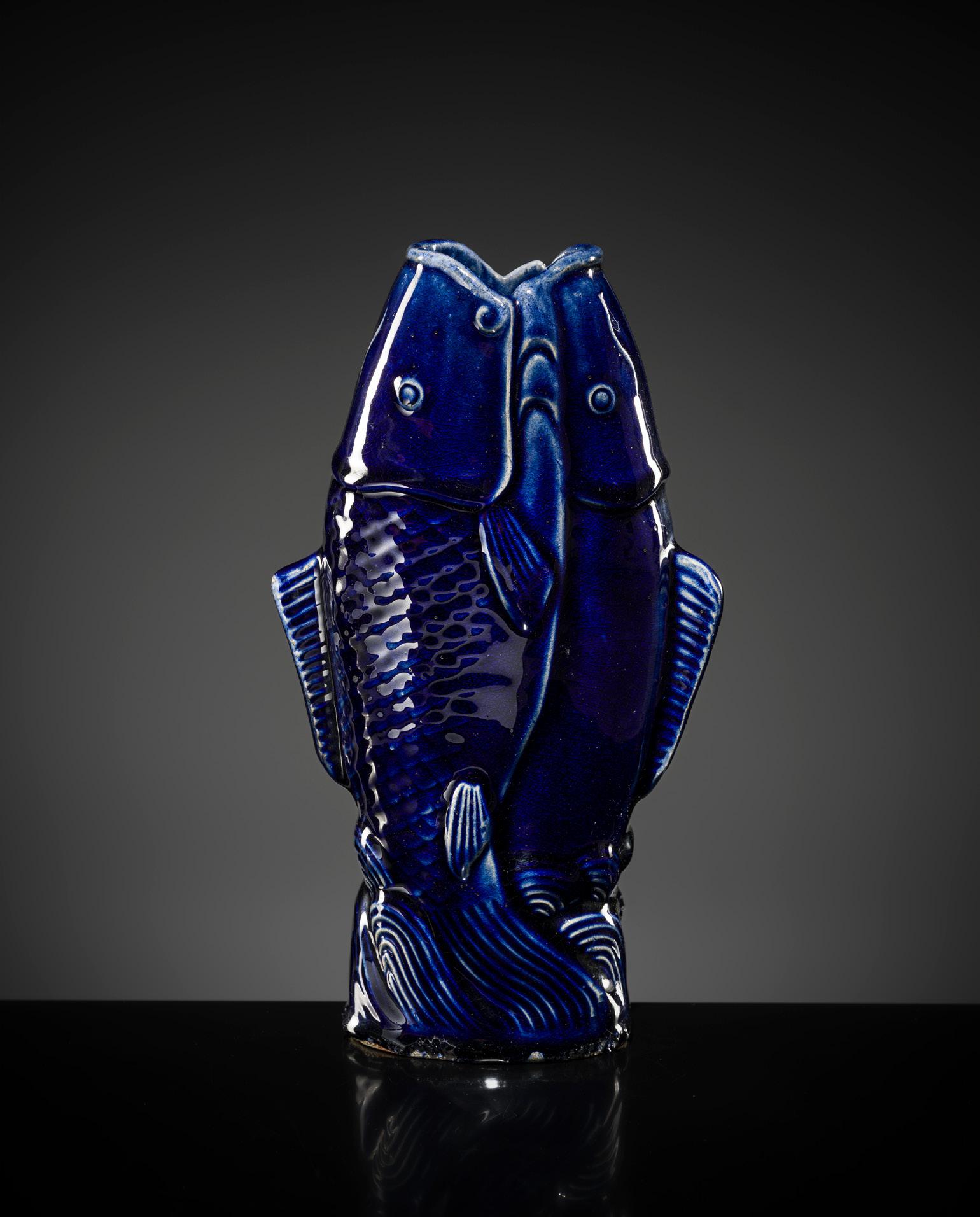
China, 18th-19th century. Heavily potted in the form of two conjoined fish, supported on a waisted fin base that rises over a rounded body, flanked by two fins and leading to a lipped rim shaped like the fish's open mouth. Overall covered in an attractive deep blue glaze, with finely carved scales and eyes. The foot remains unglazed.
Provenance: The Collection of Sam and Myrna Myers, Paris, France. Acquired between circa 1965-2012.
Condition: Good condition with old wear and firing flaws, including few small open bubbles, fritting, and rubbing to the glaze. Losses to the glaze near the base.
Weight: 1,290 g
Dimensions: Height 27.4 cm
AUCTION RESULT COMPARISON
Type: Related
Auction: Christie’s New York, 29 March 2017, lot 47
Price: USD 2,375 or approx. EUR 13,500 converted and adjusted for inflation at the time of writing
Description: A clair-de-lune-glazed 'twin fish' vase, late Qing dynasty
Expert remark: Compare the related form and pottery manner. Note the different color and size (24.8 cm).
Estimate EUR 2,000
Starting price EUR 1,000
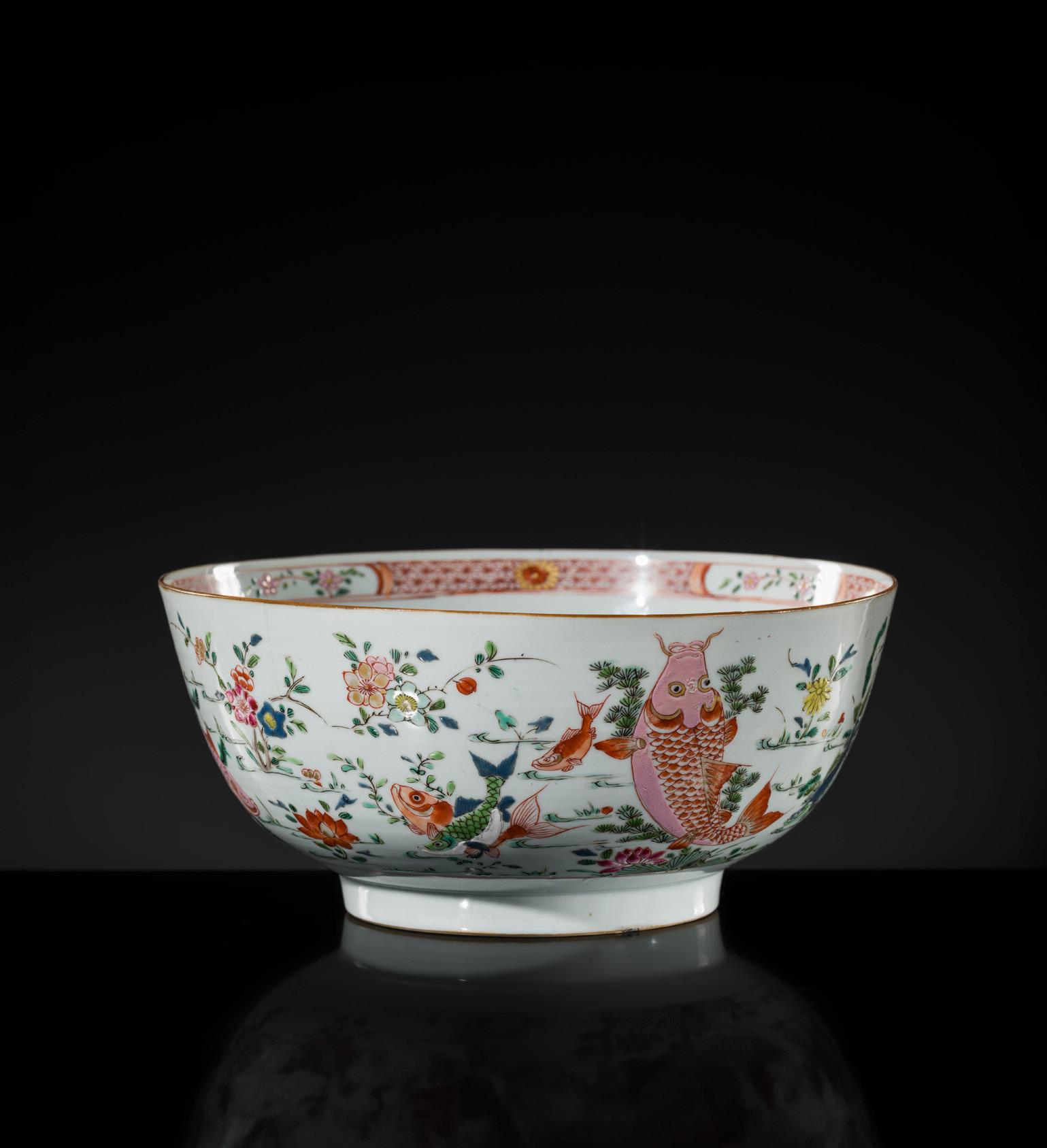
38 A LARGE FAMILLE ROSE ‘LOTUS POND’ BOWL, QING DYNASTY
China, 18th -19th century. Delicately potted, the deep sides are supported on a short, straight foot and rise to a gently everted rim. The exterior is finely painted in polychrome enamels and iron red with a continuous scene of lotus and wildflowers growing from a pond, accompanied by carp and fishermen in boats. The rim is neatly lined in gilt. The interior features a central flower head and an ironred band with cartouches around the inner rim.
Provenance: The Collection of Sam and Myrna Myers, Paris, France. Acquired between circa 1965-2012.
Condition: Good condition with old wear and firing flaws, including fritting to the foot, pitting, few dark spots, a fine 5 cm hairline to the rim, and typical losses to the enamels and gilt. Presenting very well.
Weight: 1,125 g
Dimensions: Height 11.4 cm, Diameter 25 cm
AUCTION RESULT COMPARISON
Type: Related
Auction: Christie’s London, 17 May 2013, lot 1398
Price: GBP 3,750 or approx. EUR 7,000 converted and adjusted for inflation at the time of writing
Description: A famille rose 'lotus and egret' bowl, Yongzheng period (1723-35)
Expert remark: Compare the related form, motif of a lotus pond, and enamels. Note the slightly smaller size (20 cm) and that the lot comprises a set.
Estimate EUR 3,000
Starting price EUR 1,500
China, 18th-19th century. Finely potted, of broad cylindrical form, rising from a recessed base to a slightly flared rim. The exterior is finely decorated, combining underglaze blue outlines with overglaze enamels in iron red, green, and purple. The surface is densely covered with the ‘hundred bats’ motif, depicting iron-red bats in flight amid scrolling cloud patterns.
Provenance: The Collection of Sam and Myrna Myers, Paris, France.
Acquired on the 9 October 1987 at Drouot, Paris, and in the collection for 39 years, according to the Myers ledger.
Condition: Fair condition with old wear and firing flaws, including fritting to the foot, few dark spots, small pitting, rubbing to the enamels, soiling to the interior. Major condition issues and corresponding repairs to the base with associate cracks and chips as well as touchups to the enamels. The inside of the base filled for stabilization.
Weight: 19.7 kg
Dimensions: Height 30.3 cm, Diameter 57 cm
The ‘hundred bats’ motif, known as Baifu in Chinese, is a highly auspicious and traditional design in Chinese art, particularly prominent
on imperial porcelain during the Qing Dynasty. The bat (fu) is a powerful symbol of good fortune and happiness because the character for "bat" is a homophone for the character for ‘fortune’ or ‘happiness’ (fu). The ‘hundred bats’ motif, therefore, conveys a wish for vast or countless happiness to ‘pile up to the sky’.
AUCTION RESULT COMPARISON
Type: Closely related
Auction: Christie’s Paris, 14 December 2018, lot 48
Price: EUR 125,000 or approx.
EUR 142,000 adjusted for inflation at the time of writing
Description: A massive Doucai jardiniere, China, Qing dynasty, 18th-19th century
Expert remark: Compare the related form, Doucai decoration and size (61 cm).
Note the different motif.
Estimate EUR 4,000
Starting price EUR 2,000
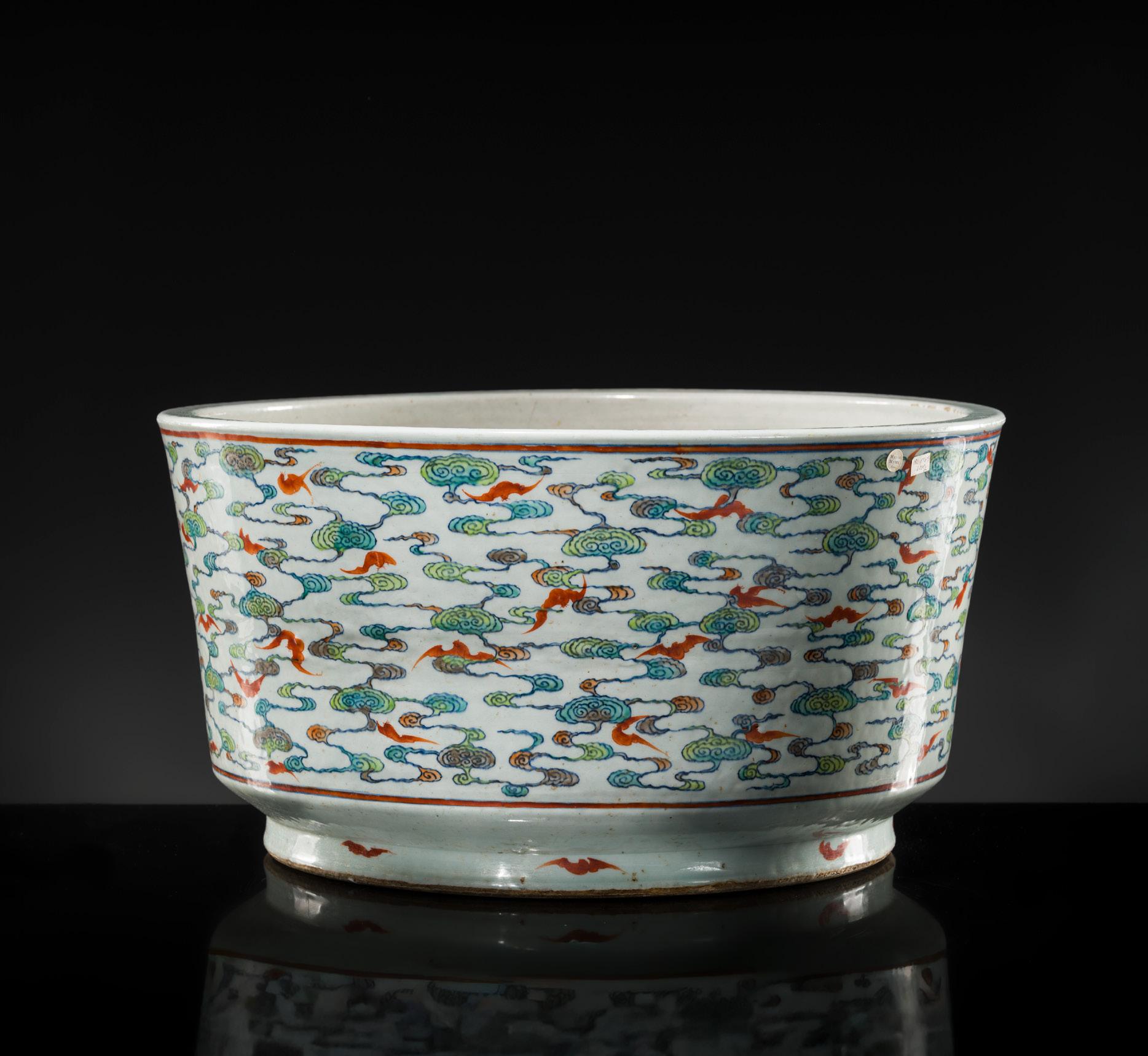
During the fifteenth century, when Ming-dynasty China closed its ports and introduced export bans on ceramics, the Vietnamese ceramic industry flourished. Potters, especially those located near the small village of Chu Dau in the Red River Delta, produced thousands of wares for export to regions as far west as Egypt and as far east as Japan.
These lots were part of the cargo on a teakwood junk , a type of boat with Chinese origins, defined by a high stern and projecting bow, that sank during the late fifteenth or early sixteenth century near the Cham Islands in the South China Sea. The boat, which likely originated in Thailand, was heading toward the Philippines and was heavily laden with ceramic cargo. It likely fell victim to the treacherous sea currents or to a typhoon. Seventy meters (nearly 230 feet) below the surface, the boat lay underwater, undisturbed until 1993, when Vietnamese fishermen from Hoi An accidently recovered ceramics with their nets. The fishermen attempted to keep the shipwreck a secret. However, after they strategically dragged metal rakes across the wreckage, hundreds of ceramics were broken and dislodged, thereby floating into other fishermen’s nets, and ultimately flooding the art market. It was not until 1997, when two Japanese dealers were detained in the Da Nang airport with baggage filled with fifteenth-century pottery that the Vietnamese government obtained knowledge of the wreck’s exact location and enlisted the expertise of both archaeologists and the Ministry of Culture.
In 1997, the Vietnamese government secured the assistance of the Vietnamese National Salvage Corporation (VISAL); Saga Horizon, a Malaysian marine engineering company; and Oxford University’s Marine Archaeology
Research Division. The scientific study of the wreckage depended upon an advance team with cutting-edge technology, as the extreme depth of the wreck and the dangerous currents made it impossible for archeologists to conduct standard air dives. Managed by marine archeologist Frank Pope, led by the Oxford’s esteemed marine archeologist Mensun Bound, and financed by Singaporean businessman Ong Soo Hin, the team executed three complex, risky excavations that cost nearly fourteen million dollars. Between 1996 and 1999, the team ultimately recovered nearly three hundred thousand artifacts.
Once retrieved from the floor of the South China Sea, all artifacts were inventoried, tagged with an excavation sticker that noted the excavation partners and the unique object number, and stored in three huge warehouses. Vietnam’s National History Museum retained all ‘oneof-a-kind’ objects, and the Ministry of Culture distributed hundreds of ceramics to regional museums. The remaining inventory of artifacts was sent to Butterfields, an American auction house based in San Francisco and now owned by Bonhams. The three-part auction of the ‘Hoi An Hoard’ took place from October 11 to October 13, 2000, both live and online, using eBay’s innovative live auction technology. Indeed, this was a groundbreaking event, as it was one of the first auctions to happen both digitally and in person. Collectors, however, were simply not ready to buy works of art online, as nearly sixty percent of the lots did not sell. On December 3, 2000, Butterfields hosted another sale that featured pieces from the Hoi An Hoard. This sale provided a rare opportunity for avid ceramic collectors to purchase important pieces of Vietnamese material culture at reasonable prices, as museums had already purchased major pieces in the October sale.
40 A RETICULATED BLUE AND WHITE STONEWARE EWER, LÊ DYNASTY, LATE 15TH CENTURY, FROM THE HOI AN HOARD
Exhibited:
1. Pointe-à-Callière Museum, From the Lands of Asia. The Sam and Myrna Myers Collection, Montréal, 17 November 2016-19 March 2017.
2. Kimbell Art Museum, From the Lands of Asia. The Sam and Myrna Myers Collection, Fort Worth, Texas, 4 March-19 August 2018.
Vietnam, Hai Duong province, Chu Dau kilns. Heavily potted, the pear-shaped body rising from a flaring foot to a waisted neck with an everted rim, set with a long, upturned handle and elegantly curved spout. The body applied with two reticulated panels, of teardrop form, depicting a stylized parrot amid foliage. The sides meticulously painted in cobalt blue with a pair of cranes soaring among flowerheads and scrolling tendrils, framed above by a band of stiff plantain leaves and below by lotus petals. The handle and spout further decorated with swirling clouds. The panels, unglazed to reveal the buff-colored ceramic underneath, highlighted with red pigments.
Provenance: Recovered between 1997 and 1999 from the Hoi An Hoard Shipwreck Site, Vietnam. The base with an excavation label, ‘Saga Hoi An Hoard Visal, 6951’. Butterfields, San Francisco, California, USA. The Collection of Sam and Myrna Myers, Paris, France, according to the Myers ledger acquired from the above on 5 November 2000.
Condition: Good condition with surface wear and inherent firing irregularities, including light pitting, occasional dark spots, and minor fissures around the handle. Expected traces of usage. Scattered minor nicks and few small chips. The glaze intentionally crackled, as is to be expected from this type of wares. The applied panels with distinct remnants of red pigment.
Weight: 880.8 g
Dimensions: Height 23.7 cm
The form of this elegant ewer was probably imported from the Chinese tradition, originally inspired by West Asian metalwork. Although heavily influenced by the Chinese ceramic tradition, Vietnam materials and potting styles are unique. Technically not ‘porcelain’, these stonewares are different in appearance from Chinese and other Southeast Asian ceramics as they are typically more heavily potted and have an off-white clay body.
Jean-Paul Desroches (ed.) et al, Two Americans in Paris: A Quest for Asian Art, Paris, 2016, p. 207, no. 330 (partlot).
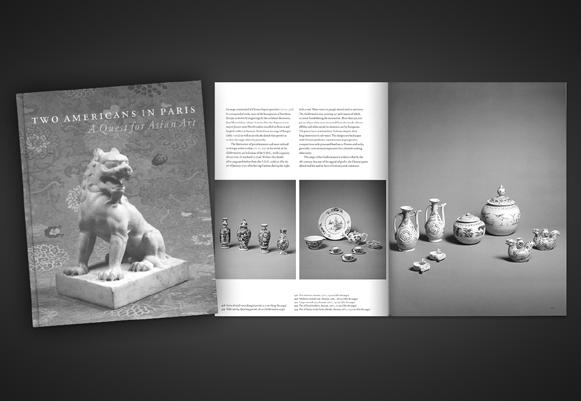
AUCTION RESULT COMPARISON
Type: Closely related
Auction: Zacke Vienna, 11 September 2025, lot 186
Price: EUR 23,400
Description: A reticulated blue and white ewer, Lê dynasty, late 15th century, from the Hoi An Hoard
Expert remark: Compare the closely related form, color of the glaze, and decorative style. Note the similar size (23.9 cm) and the provenance, as this lot was formerly part of the Sam and Myrna Myers Collection.
AUCTION RESULT COMPARISON
Type: Closely related
Auction: Christie’s Paris, 10 December 2020, lot 97
Price: EUR 12,500 or approx. EUR 14,500 adjusted for inflation at the time of writing
Description: A blue and white enameled stoneware vase, Vietnam, c. 16th century
Expert remark: Compare similar form, decoration, and motifs. Note the larger size (29.2 cm).
Estimate EUR 6,000
Starting price EUR 3,000
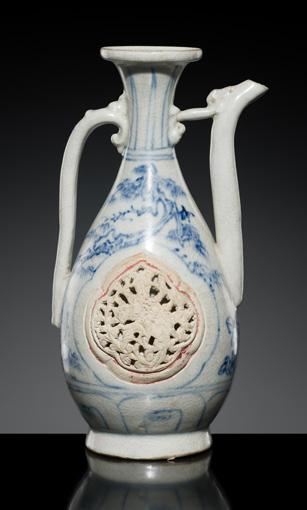
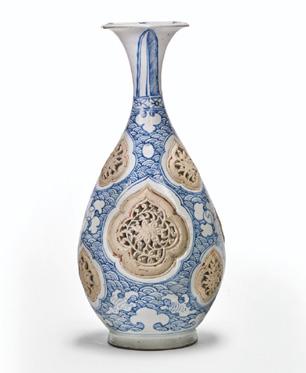
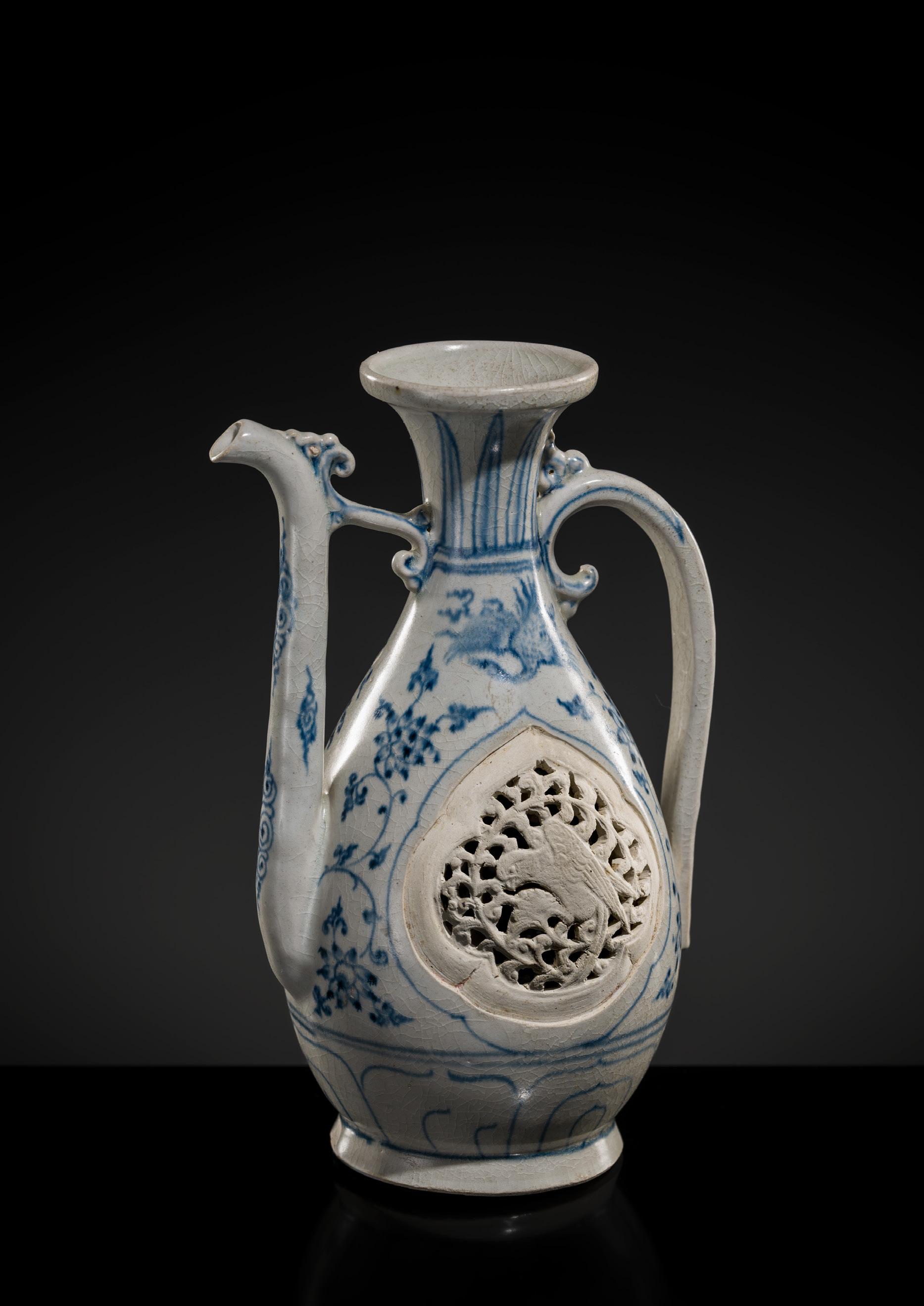
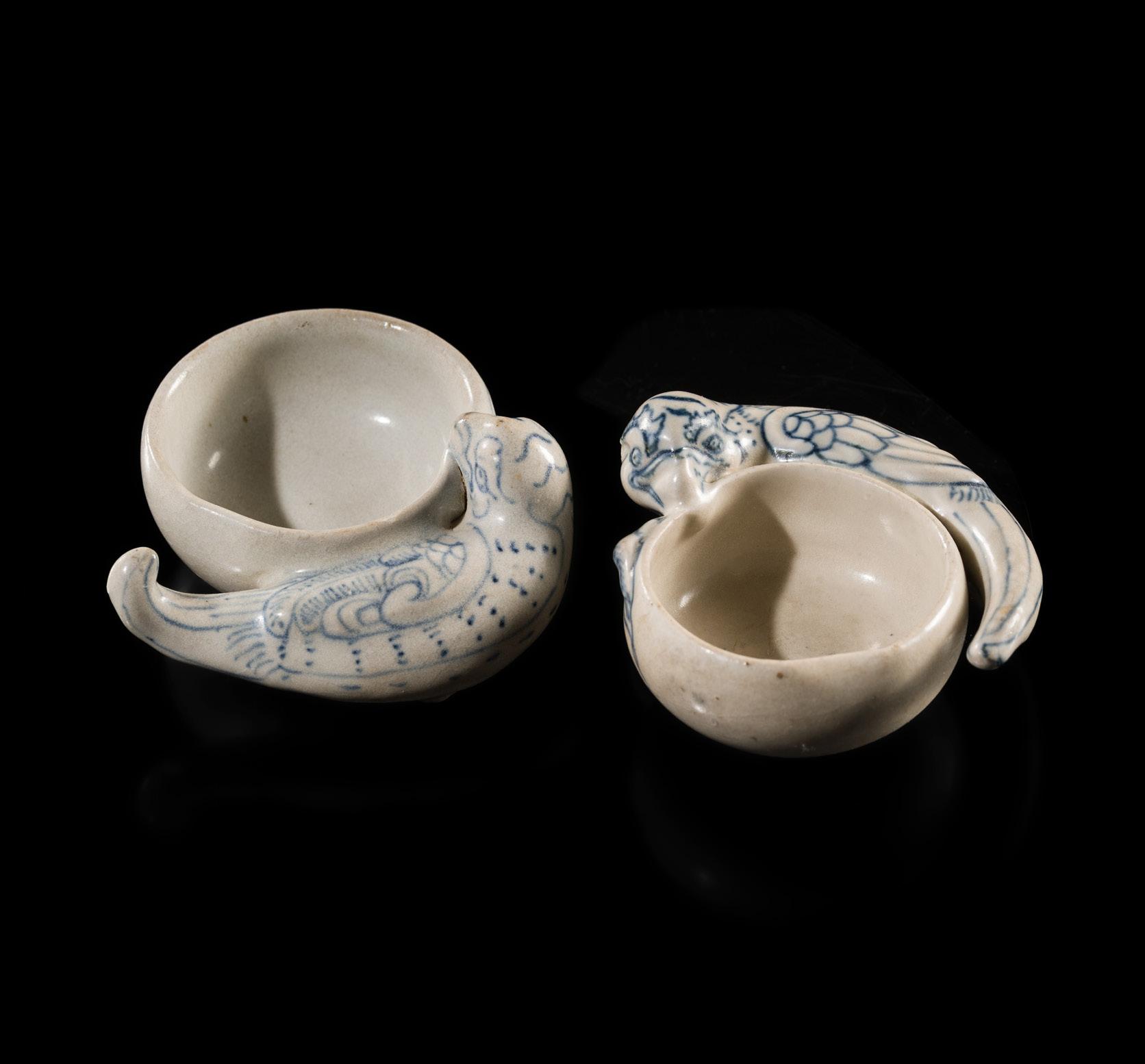
41 A PAIR OF RARE BLUE AND WHITE STONEWARE BRUSH WASHERS, LÊ DYNASTY, 15TH CENTURY, FROM THE HOI AN HOARD
Vietnam, Hai Duong province, Chu Dau kilns. Each well-modeled as a parrot, with its tail gently curved and head raised, peering into a peach-shaped bowl, supported with its beak and hollowed to serve as a water container. The exterior decorated in underglaze blue, with the plumage of the birds neatly rendered. The flattened base of each vessel left unglazed, revealing the buff-colored ceramic beneath. (2)
Provenance: Recovered between 1997 and 1999 from the Hoi An Hoard Shipwreck Site, Vietnam. Each base with corresponding excavation labels, ‘Saga Hoi An Hoard Visal, 3132’ and ‘Saga Hoi An Hoard Visal, 10431’. Drouot, Paris, France. The Collection of Sam and Myrna Myers, Paris, France, according to the Myers ledger acquired from the above on 22 November 1998.
Condition: Very good condition with surface wear and inherent firing irregularities, including light pitting and minimal areas of glaze recess. Distinct traces of usage. Sparse nicks and minute nibbling along the edges.
Weight: 274.5 g (total)
Dimensions: Length 9 cm (each)
LITERATURE COMPARISON
Compare a closely related peachshaped, blue and white stoneware brush washer with parrot decoration, from the Chu Dau kiln site in Hai Duong province, Vietnam, Lê dynasty, 14501550, 6.2 cm diameter, in the National Palace Museum, Taipei, Taiwan, accession number 000250N000000000 (fig. 1). Compare a closely related blue and white stoneware ‘parrot’ brush washer, Vietnam, Lê dynasty, 15th century, 9.3 cm long, in the Art Institute of Chicago, reference number 2005.84. fig. 1
Estimate EUR 1,000 Starting price EUR 500
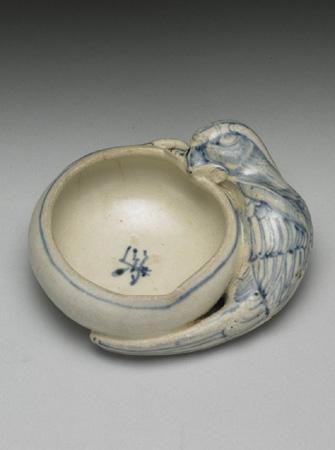
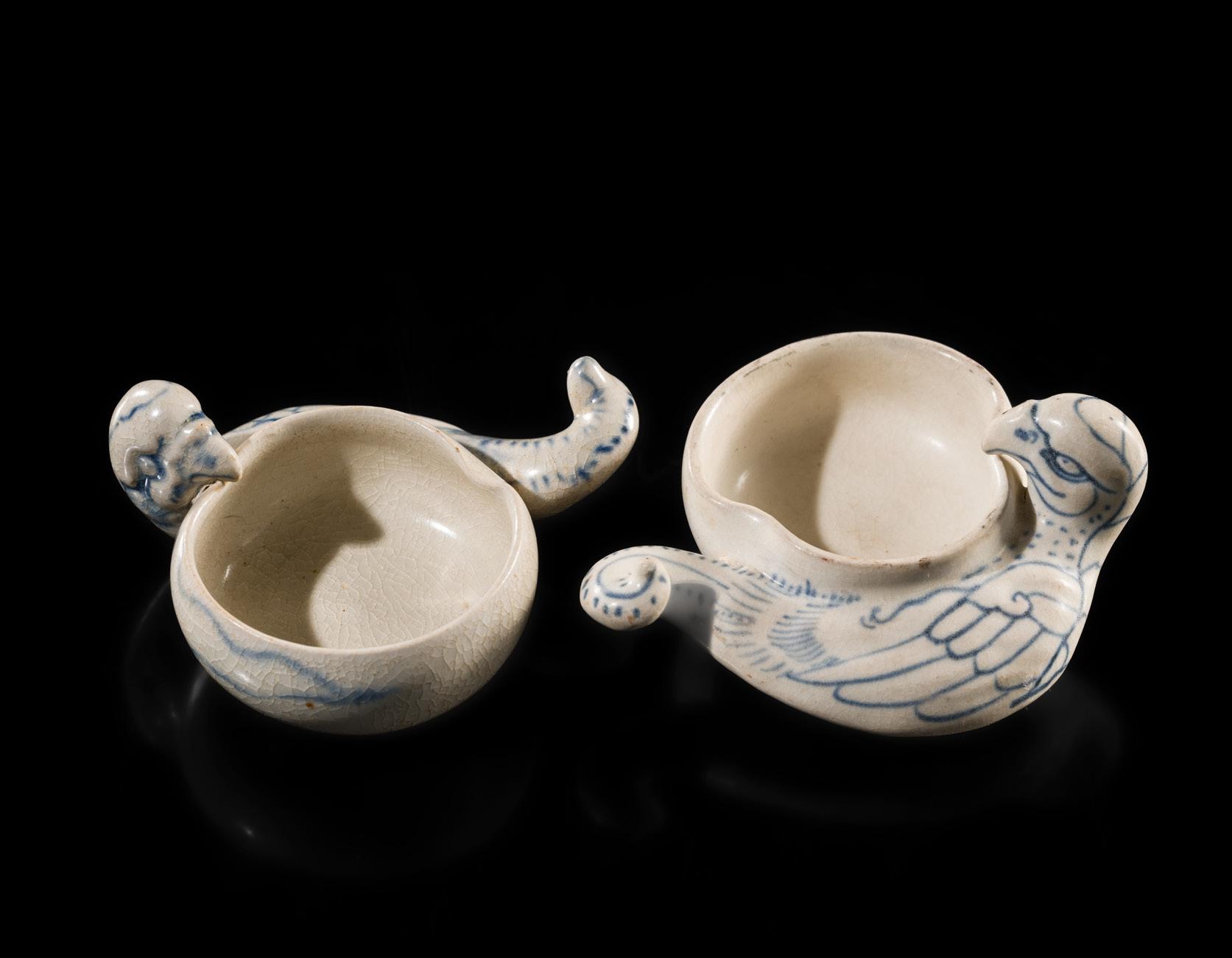
42
A PAIR OF BLUE AND WHITE ‘PARROT’ BRUSHWASHERS, FROM THE HOI AN CARGO
Vietnam, Annam, 15th century. Each finely potted with a rounded bowl and a parrot handle, featuring a curling tail and raised head. Decorated in blue and white underglaze, with swirling lines representing the plumage, and one bowl further adorned with additional swirling lines. The underside remains unglazed. (2)
Provenance: Recovered between 1997 and 1999 from the Hoi An Hoard Shipwreck Site, Vietnam. Each base with corresponding excavation labels, ‘Saga Hoi An Hoard Visal, 10082’ and ‘Saga Hoi An Hoard Visal, 10102’. The Collection of Sam and Myrna Myers, Paris, France. Acquired between circa 1965-2012.
Condition: Very good condition with old wear and firing flaws, including firing cracks, fritting, and few dark spots.
Weight: 258 g (total)
Dimensions: Height 4.2 cm and 4.4 cm, Length 9.5 cm and 10 cm
LITERATURE COMPARISON
Compare a closely related blue and white cup with a parrot, dated between 14501550, 6 cm and 6.5 cm (diameter), in the National Palace Museum, inventory number 000249N000000000 (fig. 1) and 000248N000000000.
Estimate EUR 1,000
Starting price EUR 500
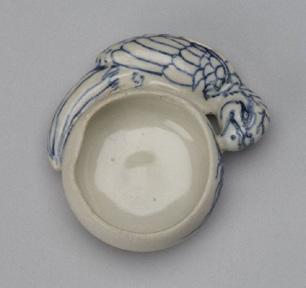
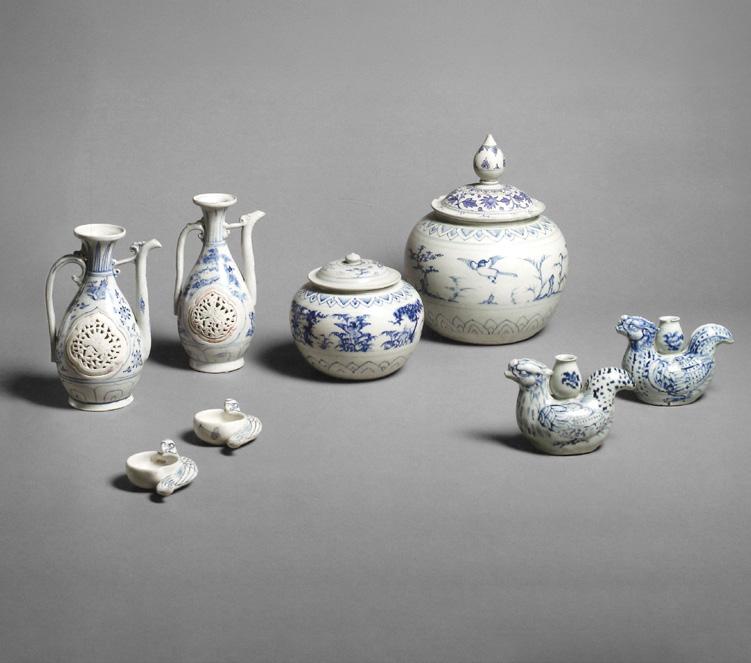
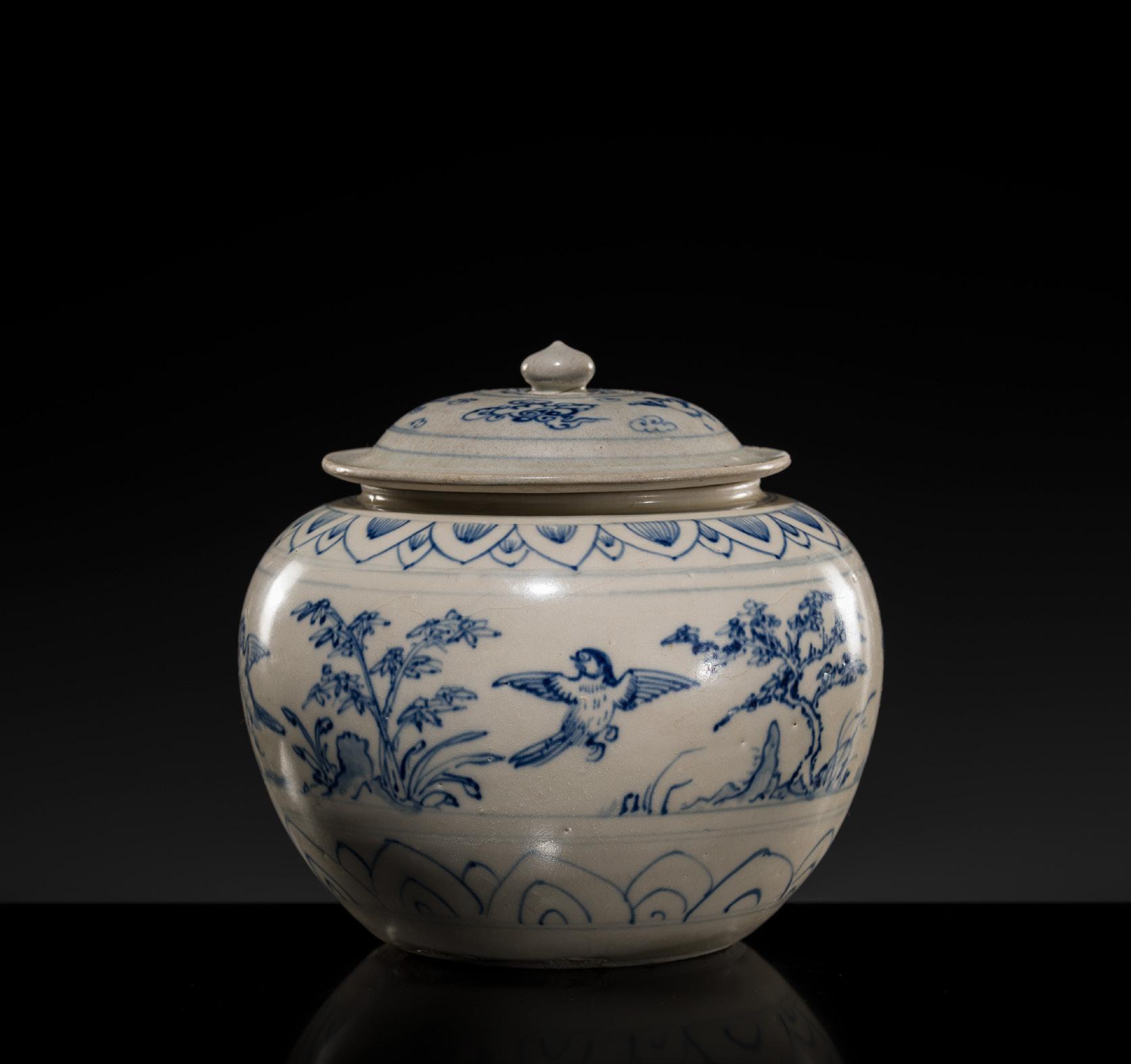
A BLUE AND WHITE STONEWARE JAR AND COVER, LÊ DYNASTY, 15TH CENTURY, FROM THE HOI AN HOARD
Vietnam, Hai Duong province, Chu Dau kilns. Finely potted, of compressed globular form, rising from a gently recessed foot to a short, slightly tapered neck with a lipped rim. The exterior painted in underglaze blue with four birds alternating with lush trees and windblown reeds, framed above and below by lotus-petal bands. The gently domed cover decorated with additional birds among swirling clouds and topped by a knop-form finial. The base left unglazed, revealing the buff-colored ceramic beneath.
Provenance: Recovered between 1997 and 1999 from the Hoi An Hoard Shipwreck Site, Vietnam. The base with an excavation label, ‘Saga Hoi An Hoard Visal, 7071’. Butterfields, San Francisco, California, USA. The Collection of Sam and Myrna Myers, Paris, France, according to the Myers ledger acquired from the above on 11 October 2000.
Condition: Very good condition with surface wear and inherent firing irregularities, including light pitting and small hairlines. Minimal traces of usage. Occasional minute nicks and a visible chip on the rim of the cover. The exterior with minor surface alteration consistent with objects recovered from maritime salvage.
Weight: 1,132 g
Dimensions: Height 16.5 cm (incl. cover)
Literature comparison:
Compare a related blue and white stoneware jar and cover, Vietnam, Lê dynasty, 15th-16th century, in the Phoenix Art Museum, object number 2000.109.1.A.
AUCTION RESULT COMPARISON
Type: Closely related
Auction: Zacke Vienna, 11 September 2025, lot 36
Price: EUR 7,150
Description: A blue and white jar and cover, Lê dynasty, late 15th century, from the Hoi An Hoard Expert remark: Compare the closely related form, decorative style, and color of the glaze. Note the similar size (16.2 cm) and the provenance, as this lot was formerly part of the Sam and Myrna Myers Collection.
Estimate EUR 3,000
Starting price EUR 1,500
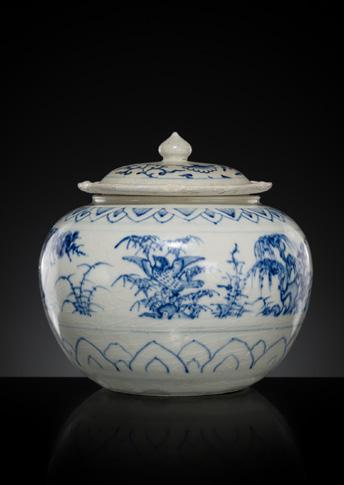
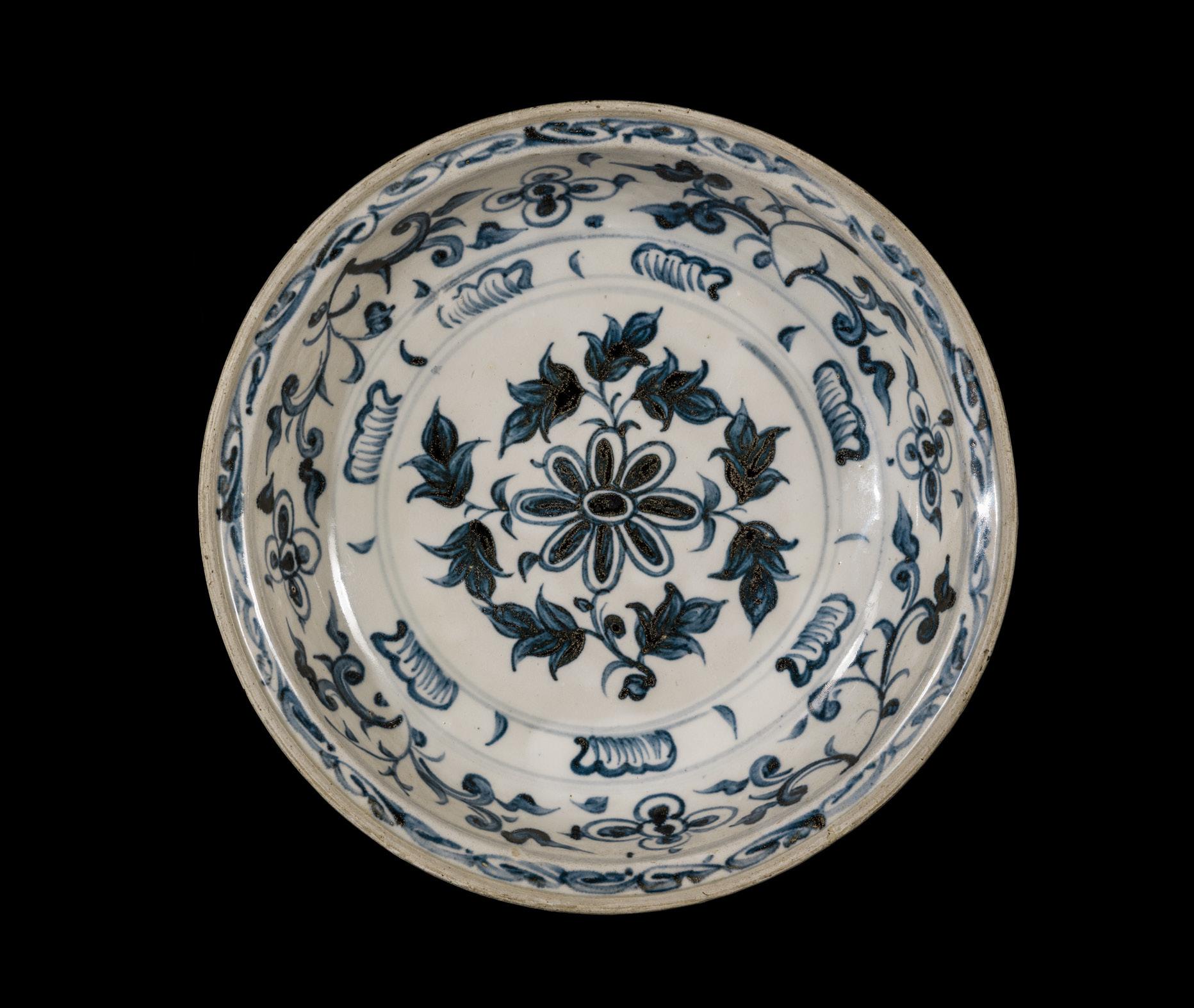
AN ANNAM BLUE AND WHITE-GLAZED STONEWARE ‘FLORAL’ DISH, 15TH-16TH CENTURY
Vietnam, probably Hai D’uong Province. Well-potted, with deep, rounded sides resting on a short, slightly tapered foot, rising to an everted rim with a thick lip. The interior painted in underglaze blue with a central medallion containing an abstracted peony, surrounded by stylized petals and scrolling floral motifs on the cavetto, the exterior encircled with a large lappet band. The base, left unglazed, coated with a brown wash.
Provenance: The Collection of Sam and Myrna Myers, Paris, France. According to the Myers ledger acquired on 2 September 1979, directly from a Vietnam refugee family.
Condition: Good condition with minor wear and inherent firing irregularities, including light pitting and occasional dark spots. Minimal traces of usage. Scattered minor nicks, shallow surface scratches, and few minute chips along the edges.
Weight: 915 g Dimensions: Diameter 25.8 cm
The present dish is characteristic of the Hoi An shipwreck cargo, recovered near Cu Lao Cham Island, off the coast of Da Nang, central Vietnam. It is decorated in cobalt blue on a white slip and finished with a translucent glaze, with freely drawn brushwork that reflects the hallmarks of mass production, executed by a skilled hand with confident, practiced strokes. Vietnamese kilns did not produce true porcelain, but rather a high-
fired stoneware. The discovery of the Hoi An shipwreck in the late 1990s revealed the extensive scale of Vietnamese glazed ceramic production at its height in the early 16th century.
Literature comparison: Compare a closely related blue and white-glazed stoneware ‘floral’ dish, Vietnam, 1450-1550, 24.2 cm diameter, in the National Palace Museum, Taipei, Taiwan, accession number 000205N000000000. Compare a closely related dish with six-petalled flower design and floral scroll on cavetto, Vietnam, probably Hai D’uong Province, early 16th century, 23.8 cm diameter, in the Metropolitan Museum of Art, object number 2019.570.15.
AUCTION RESULT COMPARISON
Type: Closely related
Auction: Christie’s New York, 21 March 2007, lot 300
Price: USD 2,880 or approx. EUR 4,000 converted and adjusted for inflation at the time of writing
Description: A blue and white lotus dish, Vietnam, 15th century
Expert remark: Compare the closely related form, decorative style, and color of the glaze. Note the larger size (36 cm).
Estimate EUR 2,000
Starting price EUR 1,000
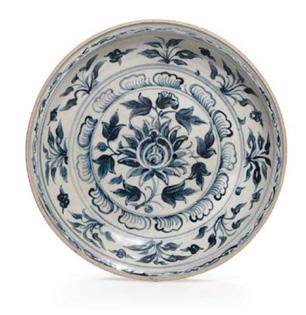
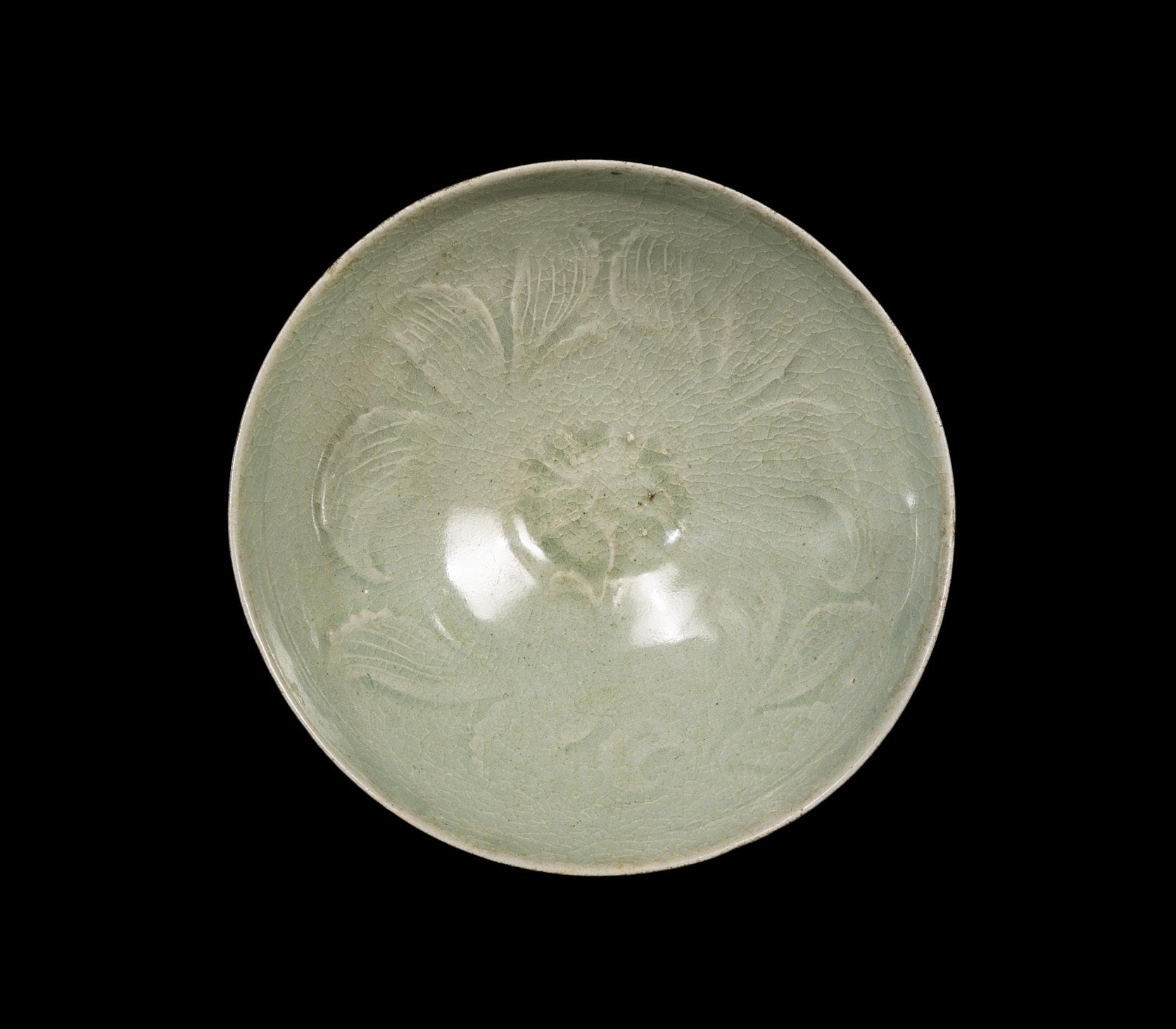
45 A CELADON STONEWARE FOLIATE BOWL, GORYEO DYNASTY
Korea, 12th century. Finely potted with deep, rounded sides supported on a short foot to a broad rim. Boldly carved in the center with remnants of a lotus blossom, encircled by a band of finely carved leaves with delicately rendered striations. All covered in an even glaze of rich celadon to green tone.
Provenance: The Collection of Sam and Myrna Myers, Paris, France. Acquired between circa 1965-2012.
Condition: Good condition with expected wear and firing flaws, including pooling, pitting, dark spots, glaze recesses and few chips to the ring foot.
Weight: 387 g
Dimensions: Height 6.6 cm, Diameter 18.2 cm
LITERATURE COMPARISON
Compare a related celadon bowl with stylized flowers and leaves, dated to the mid-late 12th century, 17.1 cm (diameter), in the Art Institute Chicago, reference number 1964.958.
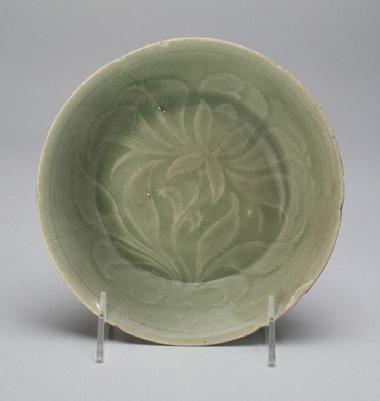
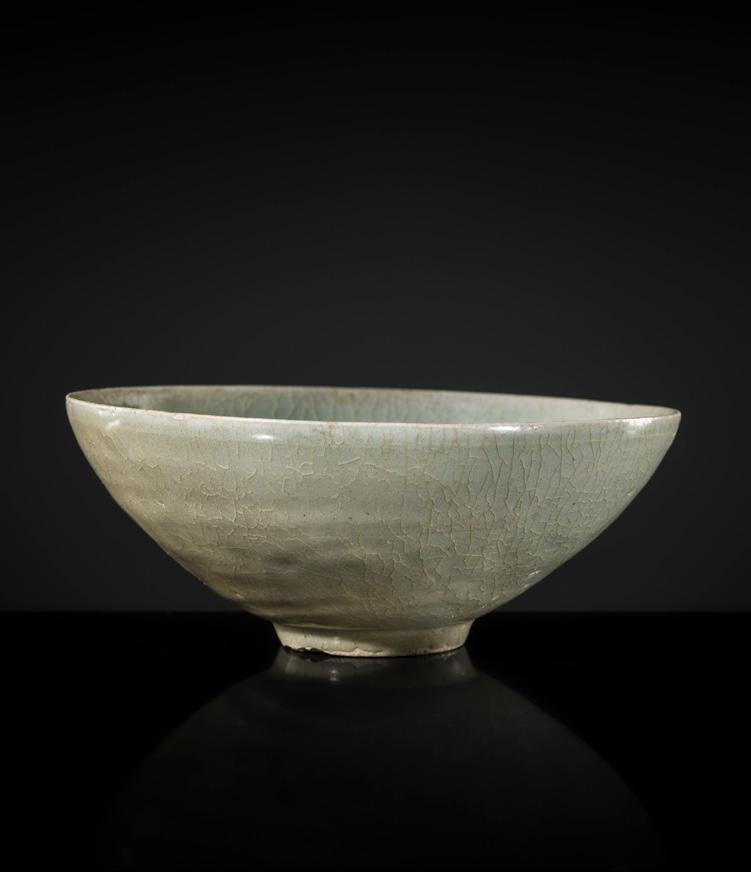
Estimate
Korea, 11th-12th century. Finely potted, the globular body resting on a short, slightly splayed foot with a recessed base, and surmounted by a slender neck ending in a high, gently flared mouth with an everted rim. The exterior, with subtle horizontal ridges particularly visible around the body, uniformly covered in a pale, richly crackled celadon glaze, which stops evenly inside the neck and around the foot.
Provenance: The Collection of Sam and Myrna Myers, Paris, France.
Acquired between circa 1965-2012.
Condition: Very good condition with minor wear and inherent firing irregularities, including light pitting, scattered dark spots, and glaze recess. The mouth slightly warped. Few minute nicks and occasional small chips around the foot. The glaze intentionally crackled, as expected from this type of ware.
Weight: 1,684 g
Dimensions: Height 28.2 cm
Celadon wares, the most celebrated ceramics of Korea, reflect the refined aesthetic sensibilities of Goryeo culture. Although produced in many kilns,
the finest examples reserved for the royal court, the aristocracy, and wealthy Buddhist temples came from kilns in Gangjin, South Jeolla Province, and Bu’an, North Jeolla Province, regions in the southwestern peninsula rich in high-quality stoneware clays. Twelfth-century vessels were characterized by molded, incised, or carved decoration, while thirteenth- and fourteenthcentury examples often display designs inlaid in black and white slips.
LITERATURE COMPARISON
Compare a related celadon-glazed ceramic bottle vase, Korea, Goryeo dynasty, 11th century, 23.5 cm high, in the Tokyo National Museum, institutional control number TG-65. Compare a closely related celadon-glazed ceramic bottle vase, Korea, Goryeo dynasty, 11th-12th century, 28 cm high, in the Herbert F. Johnson Museum of Art, Cornell University, object number 65.250 (fig. 1). fig. 1
Estimate EUR 2,000
Starting price EUR 1,000
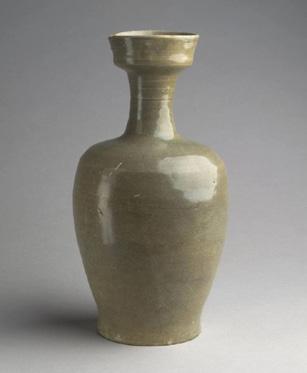
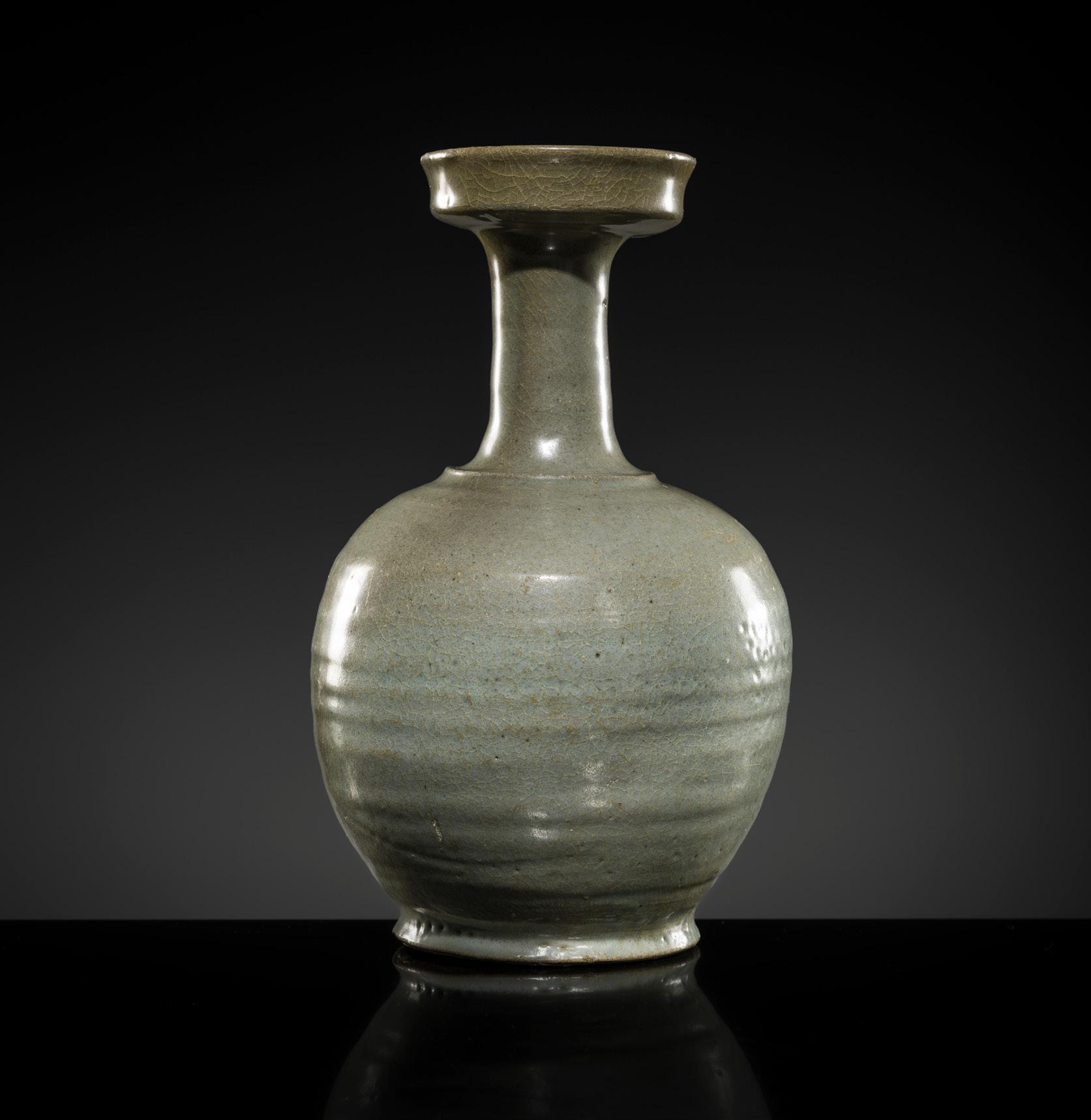
47
Exhibited:
1. Fondation Baur, The Beginning of the World – According to the Chinese. Dragons, Phoenix and Other Chimera, Geneva, 11 November 2020-23 May 2021.
2. Musée Départemental des Arts Asiatiques, The Beginning of the World – According to the Chinese. Dragons, Phoenix and Other Chimera, Nice, Summer 2021.
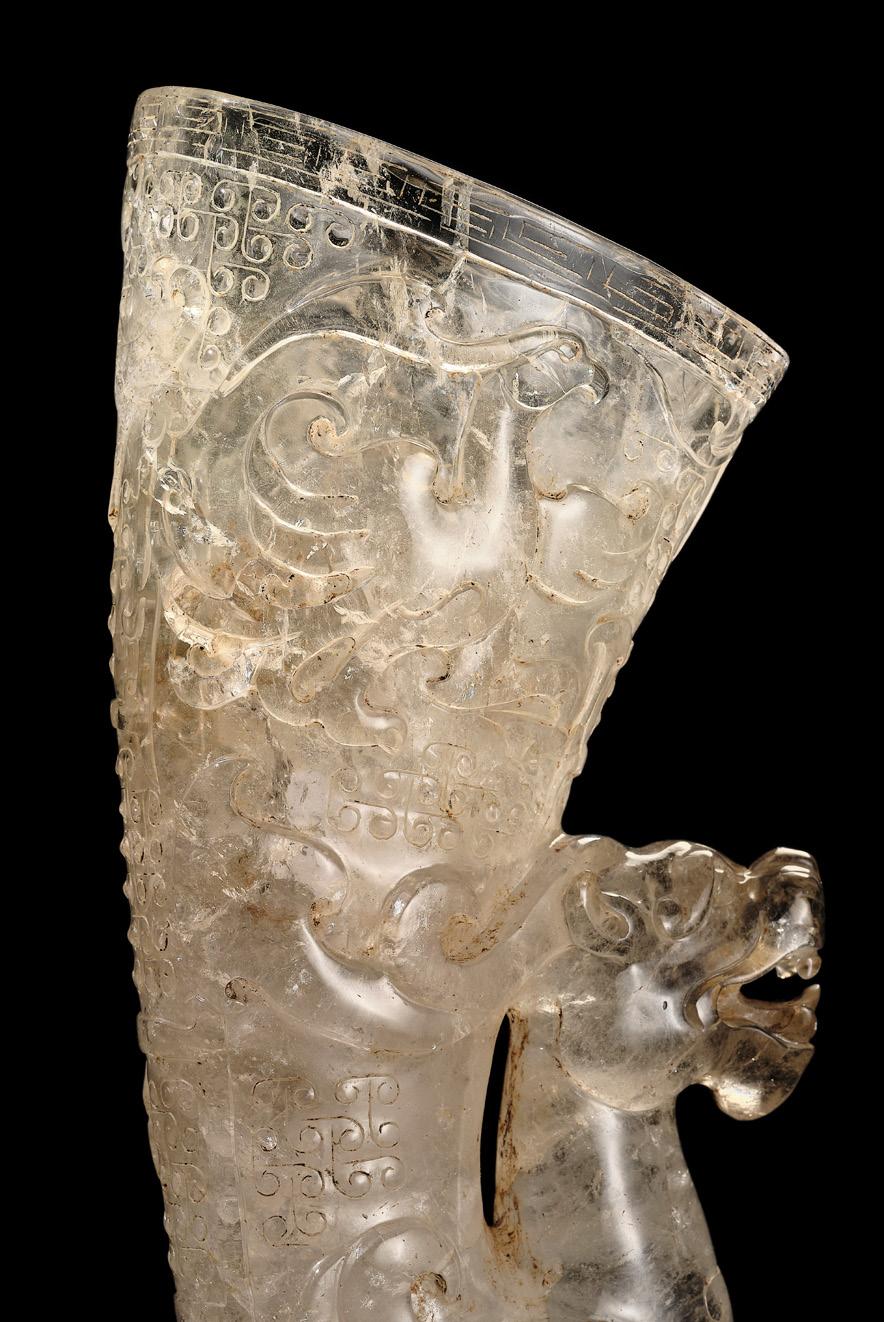
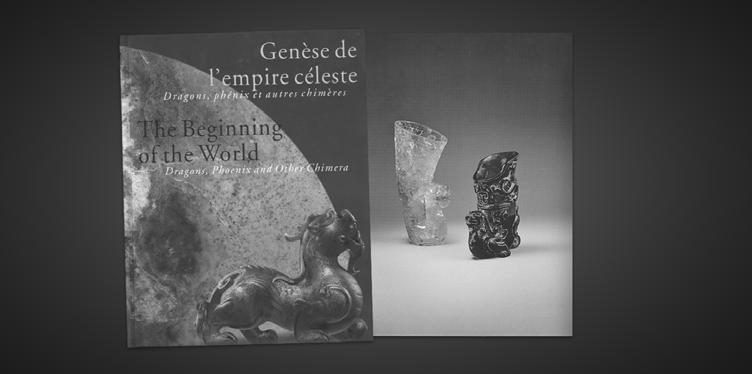
PUBLISHED
Jean-Paul Desroches (ed.) et al, The Beginning of the World. Dragons, Phoenix and Other Chimera, Fondation Baur, Geneva, 2020, p. 234-235, no. 162.
China, 202 BC-220 AD. Of trumpet form, terminating in the body of a sinuously carved dragon with its tall neck resting against the contours of the vessel, resplendent wings to the side, mouth wide open revealing sharp fangs and a lolling tongue, all below a broad snout and wide eyes under furrowed brows. The body of the vessel variously carved with interconnected C-scrolls and comma spirals, as well as with a majestic phoenix and additional dragons.
Provenance: The Collection of Sam and Myrna Myers, Paris, France. Acquired between circa 1965-2012.
Condition: Good condition with expected wear, signs of burial, natural inclusions, tiny nibbling, few minuscule nicks, and small chips. The stone with natural fissures, some of which may have developed into small hairline cracks.
Weight: 1,746.3 g
Dimensions: Height 24 cm
The rhyton, derived from the Greek word for ‘flowing water’, was a type of drinking vessel used both in daily life and on ritual occasions. In its simplest form, it resembled the horn of an animal, while more elaborate examples concluded in the head of an animal, serving as a symbolic guardian of the liquid contained within. A spout at the mouth allowed for the controlled outpouring of its contents.
Rhyton-shaped cups appeared in China as early as the Western Han dynasty. These vessels were among the many foreign forms introduced following the imperial expansions under Emperor Wu in the late 2nd century BC, a period characterized by increased contact with distant regions through the extensive network of routes collectively known as the Silk Road. Despite their origins in antiquity, rhyton continued to be employed as drinking vessels in Central Asia well into the 8th century. This is attested by Sogdian mural paintings discovered at Panjakent which depict banquet scenes with princely figures seated cross-legged and drinking from such vessels, as illustrated in Paola D’Amore and Giovanna Lombardo (eds.), Oxus. Tesori dell’Asia Centrale, Rome, 1993, p. 50, no. 70.
Estimate EUR 6,000
Starting price EUR 3,000
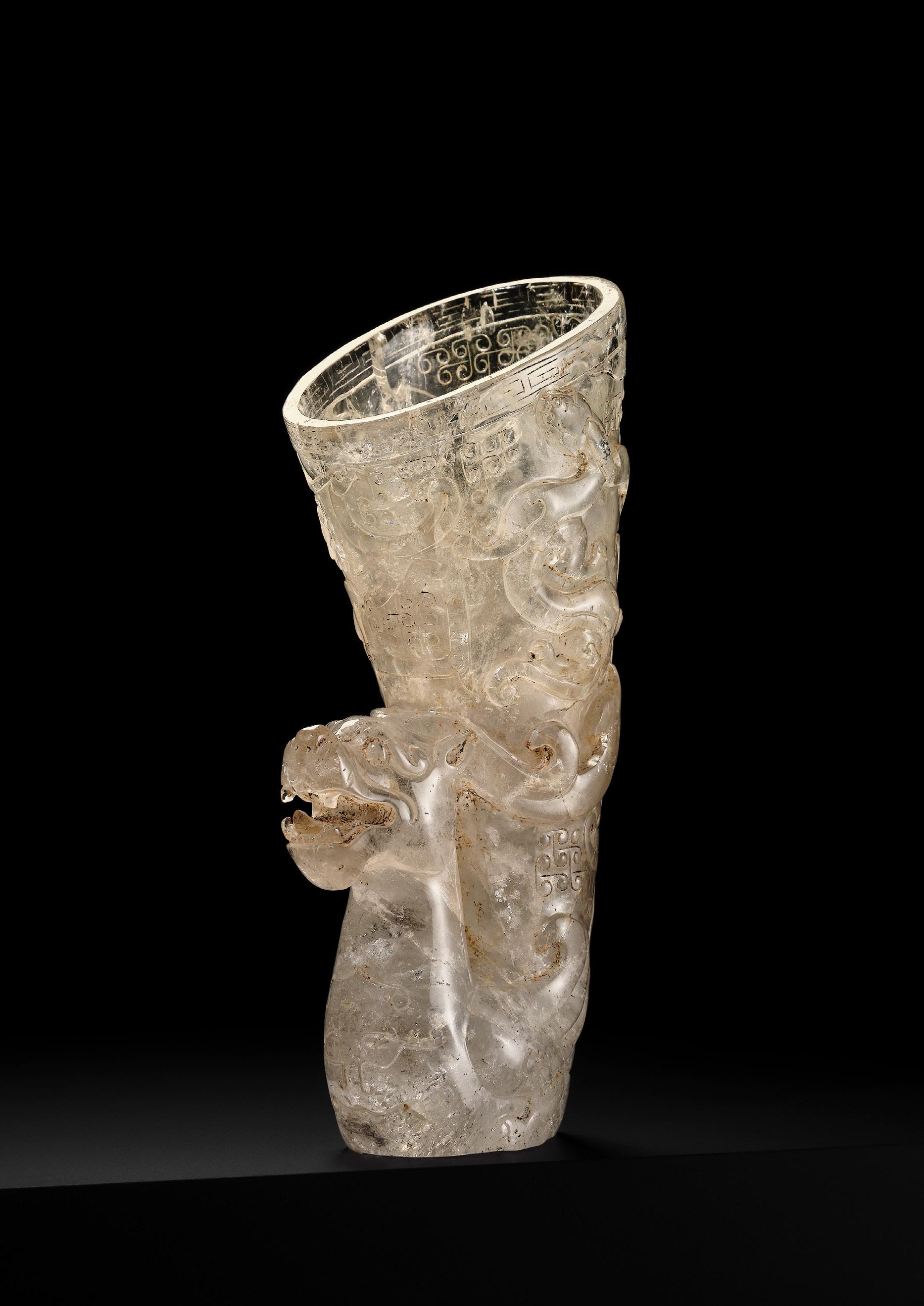
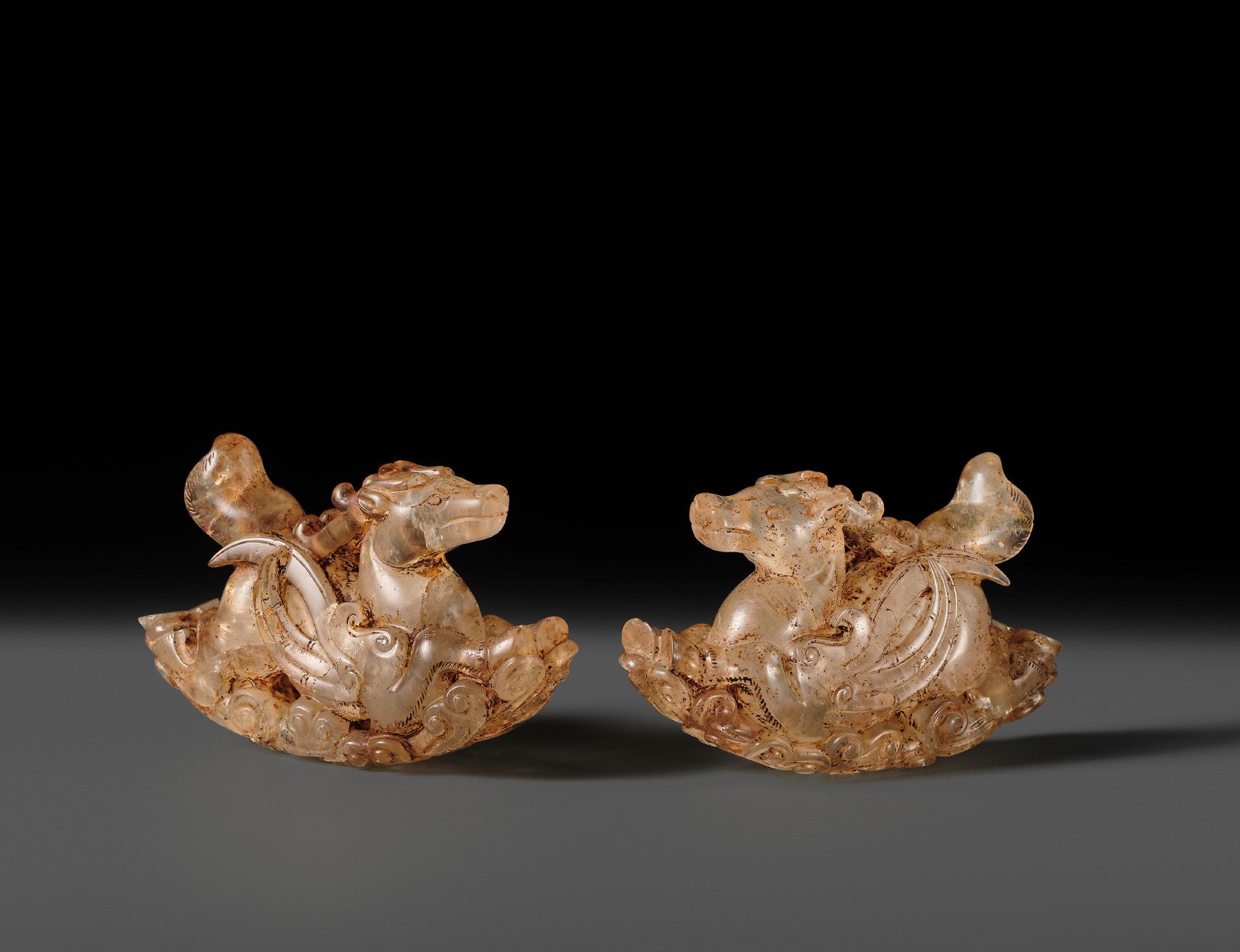
A PAIR OF ROCK CRYSTAL CARVINGS OF LONGMA, LIAO DYNASTY
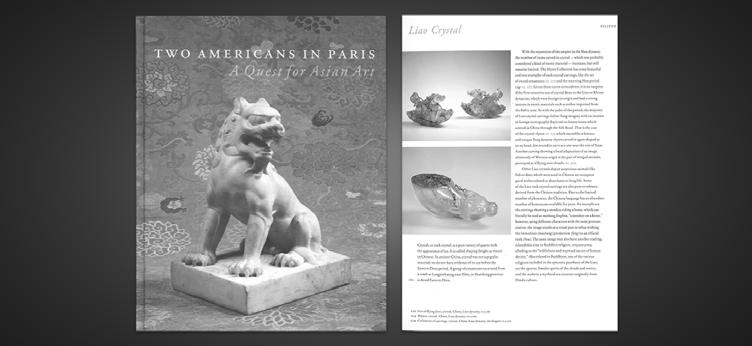
PUBLISHED
Jean-Paul Desroches (ed.) et al, Two Americans in Paris. A Quest for Asian Art, Paris, 2016, p. 162, no. 272.
Exhibited:
1. Pointe-à-Callière Museum, From the Lands of Asia. The Sam and Myrna Myers Collection, Montréal, 17 November 2016-19 March 2017.
2. Kimbell Art Museum, From the Lands of Asia. The Sam and Myrna Myers Collection, Fort Worth, Texas, 4 March-19 August 2018.
China, 10th-11th century. Each dexterously carved, the fabled winged horse with dragon scales depicted in full stride with outstretched limbs, soaring above swirling clouds aided by elegantly curved wings flanking its back. Its muscular body extending into a bushy tail rising gracefully into the air and a proudly held head with a prominent snout and sweeping antlers. (2)
USA
Provenance: The Collection of Sam and Myrna Myers, Paris, France. Acquired between circa 1965-2012.
Condition: Good condition with ancient wear, natural imperfection, such as fissures, some of which have developed into hairline cracks, minor nicks, light scratches, and extensive signs of staining, likely resulting from prolonged burial within soils rich in iron oxides.
Weight: 703.7 g
Dimensions: Length 11.5 cm
The Longma is a mythical creature in Chinese mythology, a legendary "dragon-horse" with the body of a horse, dragon scales, and often wings. It symbolizes auspiciousness, divine favor, and the coming of a great leader, and it is said to bring good fortune and vital messages. Seeing a Longma was considered a powerful omen, as it was believed to carry a map with the 8 trigrams of the I Ching (Bagua) on its back.
Estimate EUR 4,000
Starting price EUR 2,000
A LARGE ROCK CRYSTAL FIGURE OF A PHOENIX, HAN DYNASTY
China, 206 BC-220 AD. Boldly carved, the crouching beast standing on its two muscular feet, the body with long curled wings and tail feathers, its head tilted backwards, featuring a curved beak below almond-shaped eyes and surmounted by a horn. The translucent stone with few natural inclusions.
Provenance: The Collection of Sam and Myrna Myers, Paris, France.
Acquired between circa 1965-2012.
Condition: Very good condition with expected old wear, few tiny nicks, signs of weathering, prolonged burial, and soil encrustations. The stone with natural fissures, some of which have developed into thin hairline cracks.
Weight: 828.3 g
Dimensions: Length 17.6 cm
Rock crystal is traditionally valued for its translucent quality as a symbol of purity, and is referred to as shuijing, literally meaning ‘water essence’.
Estimate EUR 3,000
Starting price EUR 1,500
LITERATURE COMPARISON
Compare a related rock crystal figure of a bixie, dated Han dynasty, illustrated in Jean-Paul Desroches (ed.) et al, The Beginning of the World. Dragons, Phoenix and Other Chimera, Fondation Baur, Geneva, 2020, p. 165 and 167, no. 96.
Compare a related jade ‘phoenix’ finial, dated Han dynasty, 5.7 cm long, at Sotheby’s Hong Kong, 4 December 2024, lot 9449 (fig. 1). fig. 1
AUCTION RESULT COMPARISON
Type: Related
Auction: China Guardian, Hong Kong, 6 October 2015, lot 463
Price: HKD 180,000 or approx. EUR 24,500 converted and adjusted for inflation at the time of writing
Description: A rock crystal vermilion bird, Han dynasty
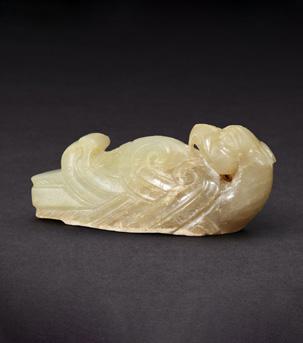
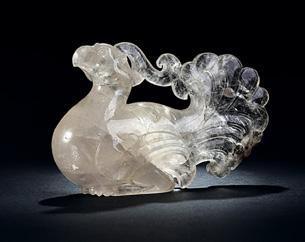
Expert remark: Compare the similar material and subject. Note the size (10 cm).
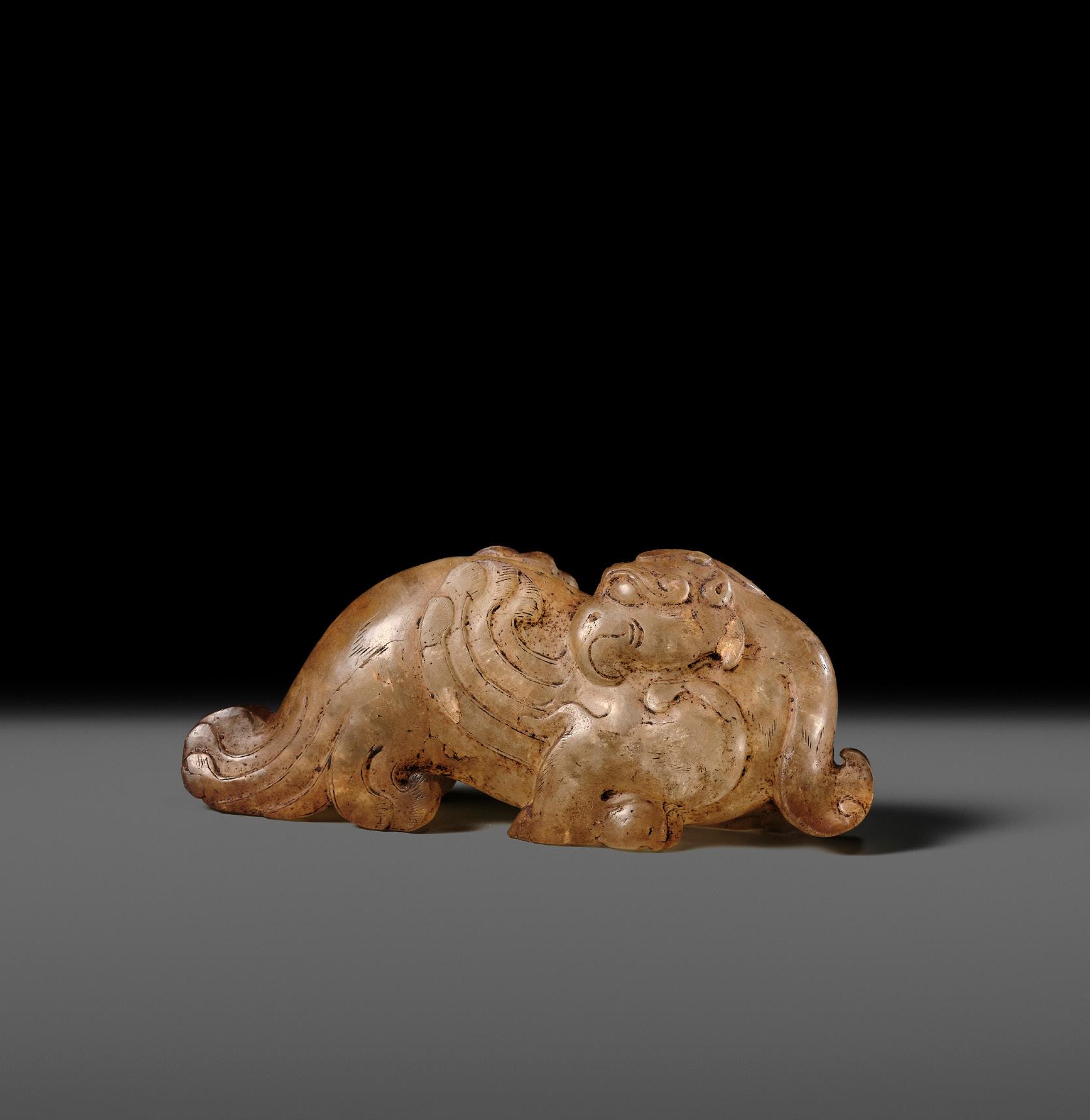
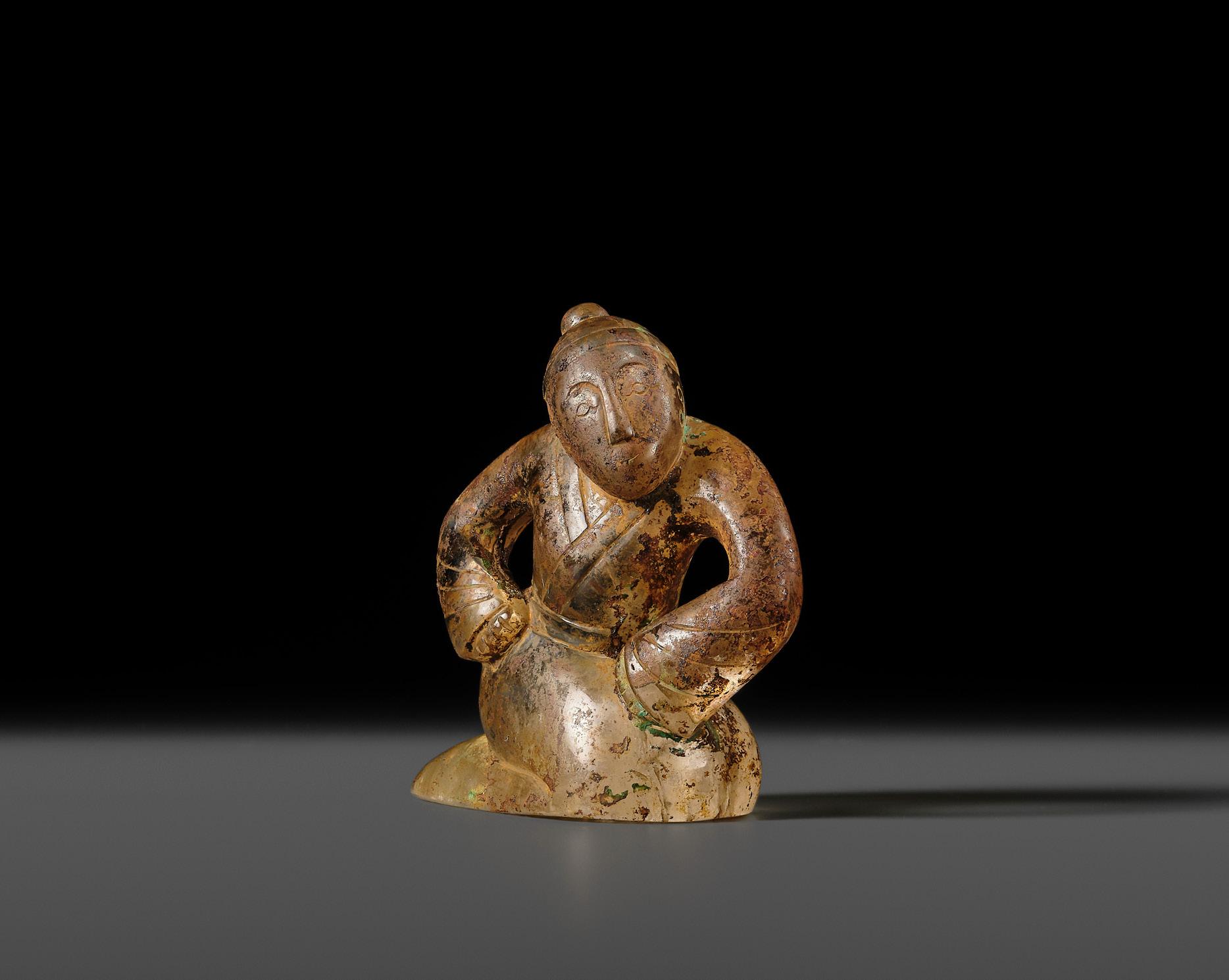
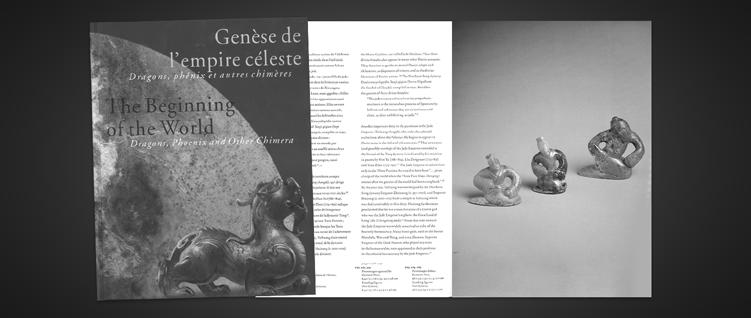
PUBLISHED
Jean-Paul Desroches (ed.) et al, The Beginning of the World. Dragons, Phoenix and Other Chimera, Fondation Baur, Geneva, 2020, p. 196 and 198, no. 122.
Exhibited:
1. Fondation Baur, The Beginning of the World – According to the Chinese. Dragons, Phoenix and Other Chimera, Geneva, 11 November 2020-23 May 2021.
2. Musée Départemental des Arts Asiatiques, The Beginning of the World – According to the Chinese. Dragons, Phoenix and Other Chimera, Nice, Summer 2021.
China, 202 BC-220 AD. Finely carved as a kneeling figure with elbows bent and hands held before the waist. Dressed in a long robe flaring near the hem and wearing a hat with circular finial issuing a long sash. The oval face with a long nose and almond-shaped eyes above a smiling mouth. The translucent stone with some inclusions.
Provenance: The Collection of Sam and Myrna Myers, Paris, France. Acquired between circa 1965-2012.
Condition: Very good condition with ancient wear, signs of prolonged burial, minuscule nibbling, areas of malachite encrustations, and remnants of surface corrosion, most likely due to objects made from iron buried nearby. The stone with natural fissures some of which may have developed into thin hairline cracks.
Weight: 303.1 g
Dimensions: Height 9.2 cm, Length 9.9 cm
The present rock crystal figure follows the style of dress and body posture found at burial pottery figures of attendants in the Han dynasty. In accordance with beliefs of the afterlife, people during the Han dynasty were interred with all the provisions needed and luxuries acquired in life. Pottery models of attendants were a common feature of funerary accompaniments.
Literature comparison:
Compare a related earthenware figure of a woman, dated to the 2nd3rd century, in the National Museum of Asian Art, Smithsonian Institution, accession number S2012.9.3135.
Estimate EUR 4,000
Starting price EUR 2,000
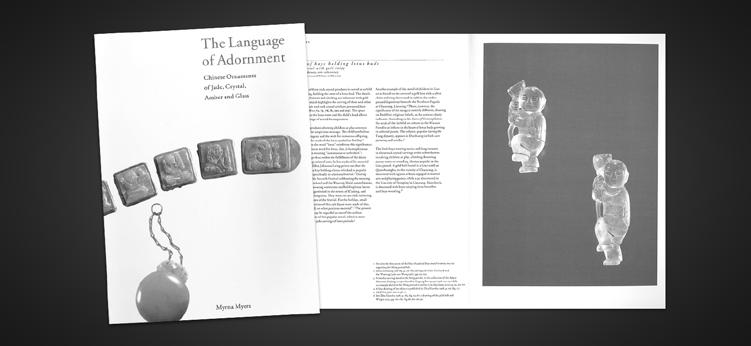
PUBLISHED
China, 10th-11th century. Each of these rock crystal pendants is carved as a child dancing and holding the stem of a lotus bud. The details of the features and clothing are enhanced with fine gilding. The space between the lotus stem and the child's head allows the passage of a cord for suspension. (2)
Provenance: The Collection of Sam and Myrna Myers, Paris, France.
Acquired between circa 1965-2012.
Condition: Very good condition with expected wear, natural inclusions, signs of burial, tiny nibbling, light scratches, and some rubbing to gilding.
Weight: 61.4 g and 65 g
Dimensions: 7.5 cm and 8.9 cm
These pendants showing children at play convey a particular auspicious message. The child symbolizes male progeny and the wish for numerous offspring, just as the seeds of the lotus symbolize fertility. A pun on the word "lotus" reinforces this significance. The Chinese word for lotus, lian, is homophonous with lian meaning "continuous or unbroken": the image thus evokes the fulfillment of the desire for a long series of sons.
In her study of Jin material culture, Ellen Johnston Laing points out that the motif of a boy holding a lotus is linked to popular lore and specifically to a famous festival: "During the Double Seventh Festival celebrating the meeting of the Cowherd and the Weaving Maid constellations, children wearing waistcoats and holding lotus leaves or plants gamboled in the streets of K'aifeng, and later, in Hangchou. They were, we are told, imitating the cult hero of the festival. For the holiday, small representations of this cult figure were made of clay, ivory, gold, or other precious material". The present example may be regarded as one of the earliest appearances of this popular motif, which is more familiar in jade carvings of later periods.
Literature comparison:
Compare a closely related rock crystal boy with lotus, dated to the Liao Dynasty, 9.4 cm height, in the Metropolitan Museum, object number 2008.326.
Estimate EUR 3,000
Starting price EUR 1,500
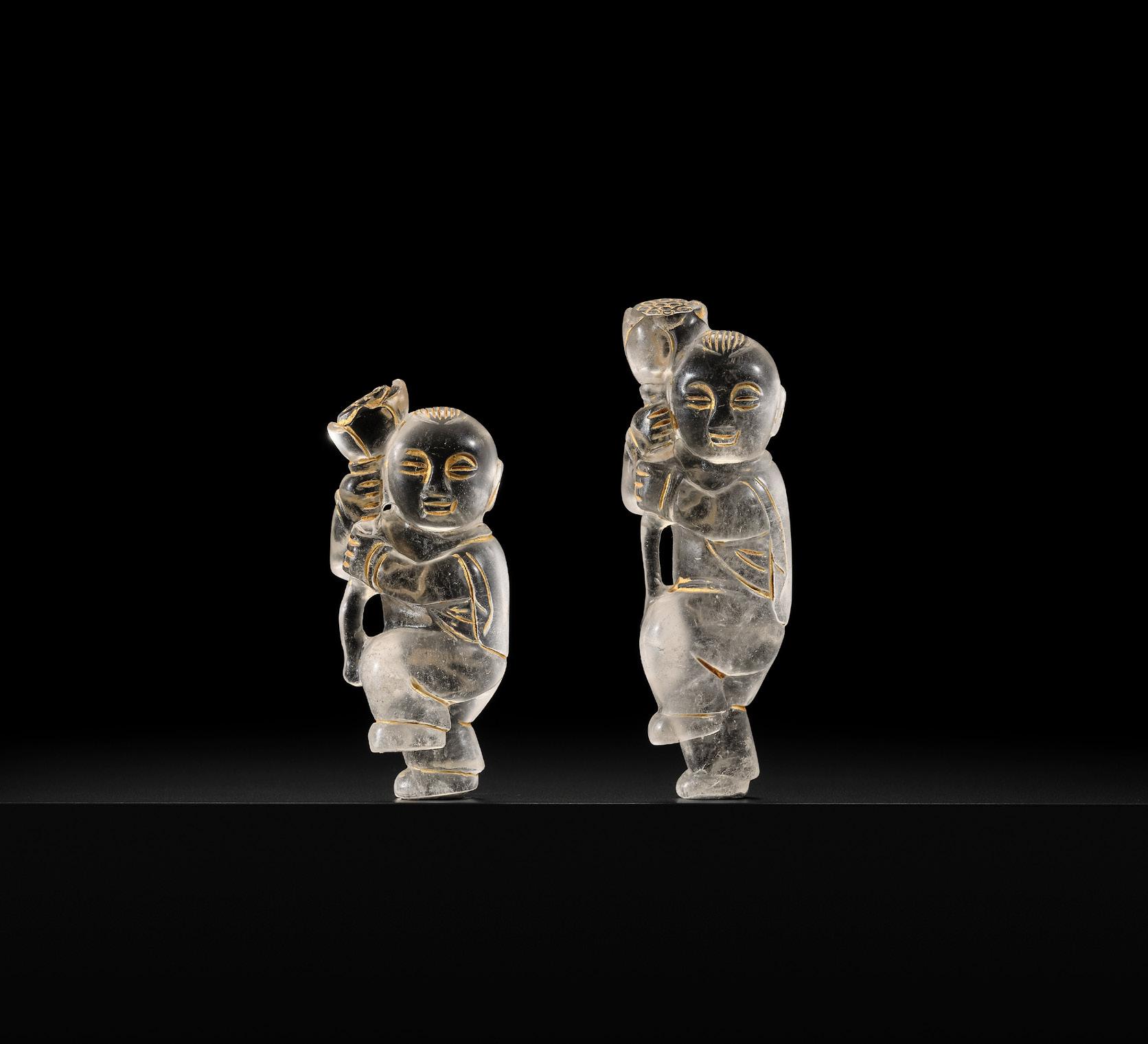
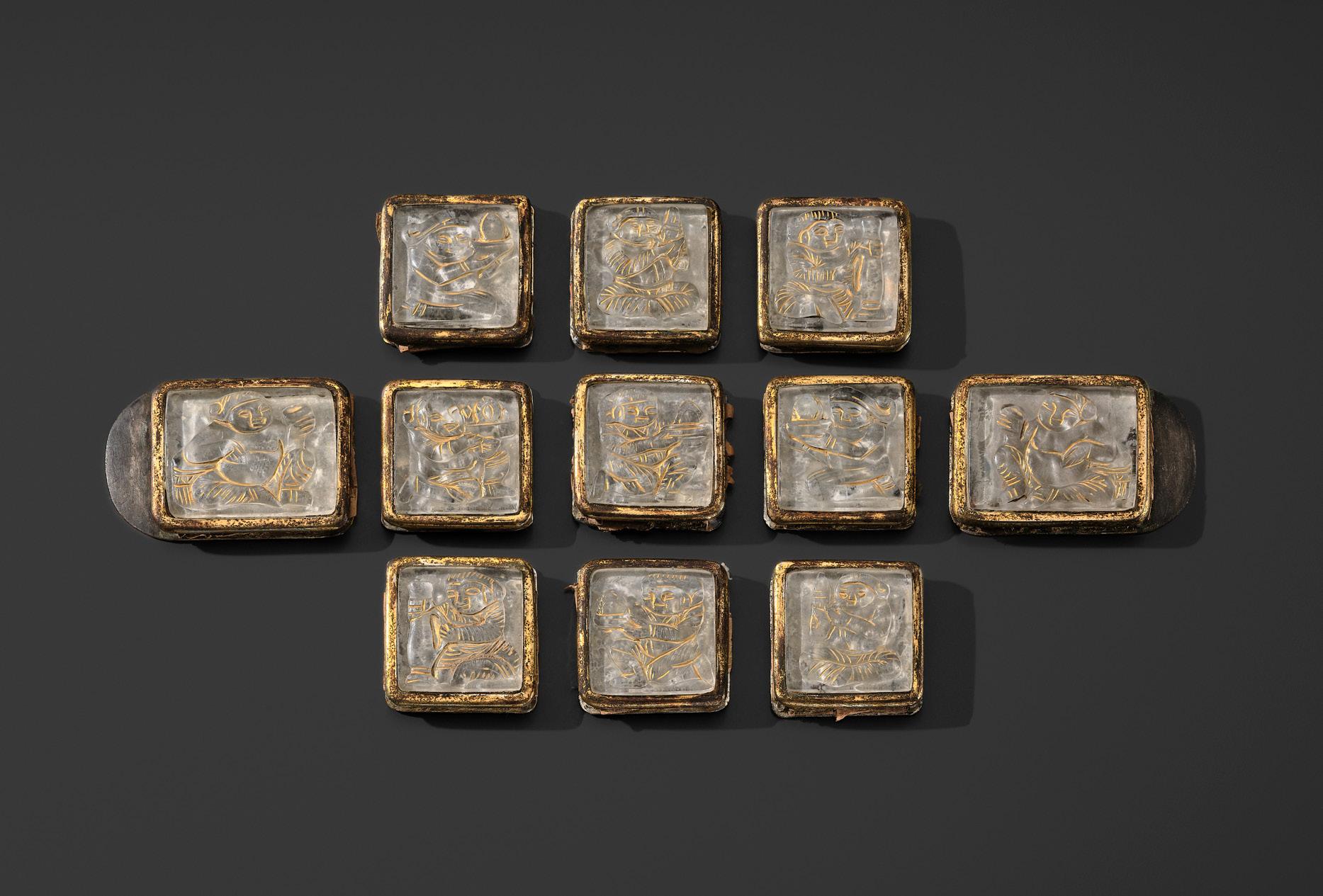
52
PUBLISHED
Myrna Myers (ed.) & Filippo Salviati (auth.), The Language of Adornment. Chinese Ornaments of Jade, Crystal, Amber and Glass, Paris, 2002, no. 113.
Expert’s note:
The belt set illustrated in this lot is the synthesis of two cultural traditions, the nomadic and the Chinese. As a dress accessory, the belt reflects the nomadic heritage of the Liao, while the choice of rock crystal is distinctively Chinese.
China, 10th-11th century. Each rock crystal plaque, rectangular in form, mounted within gilt silver fittings, originally attached to a leather and fabric belt, and carved in high relief with incised gilt accents. The ensemble comprises two groups of plaques, each decorated with identical figures oriented in opposing directions.
The two terminal plaques depicting a seated man with a swollen face, resting one arm on a cushion placed upon a low table while rising a cup, evoking a banquet scene. The remaining plaques featuring various attendants carrying trays with offerings, crosslegged musicians playing the ‘sheng’ (mouth organ), and a young man
holding a flask. All figures attired in the characteristic loose-fitting tunics, long trousers, and headwear typical of Central Asian dress from the period. (11)
Provenance: The Collection of Sam and Myrna Myers, Paris, France. Acquired between circa 1965-2012.
Condition: Condition consistent with age, with ancient wear and distinct traces of usage. The rock crystal plaques with inherent natural imperfections, including small fissures, few minute nicks, and light rubbing to gilt decoration. The bronze mounts with light warping, occasional minor dents, and light surface scratches. Extensive rubbing to gilding and some remnants of old fibers.
Weight: 303.3 g (total)
Dimensions: Length 3.3 to 5.4 cm
The servants and musicians depicted on these plaques may be considered as attendants of the Queen Mother of the West, thereby alluding to the Paradise of the Immortals, as observed by Jessica Rawson, and they were believed to confer auspicious and protective qualities upon the wearer of the belt. See Jessica Rawson, Chinese Jade from the Neolithic to the Qing, London, 1995, p. 326.
LITERATURE COMPARISON
Compare a related set of nine agate belt plaques with musicians and dancers, Tang dynasty, dated 618-906, 5.3 cm long, in the British Museum, museum number 1937,0416.129-137 (fig. 1). Compare a related set of ten decorative belt plaques, dated to the Tang dynasty, in the Metropolitan Museum of Art, accession number 1992.165.22a–j.
Estimate EUR 3,000
Starting price EUR 1,500
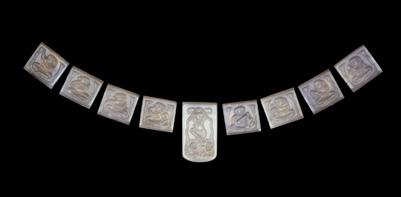
fig. 1
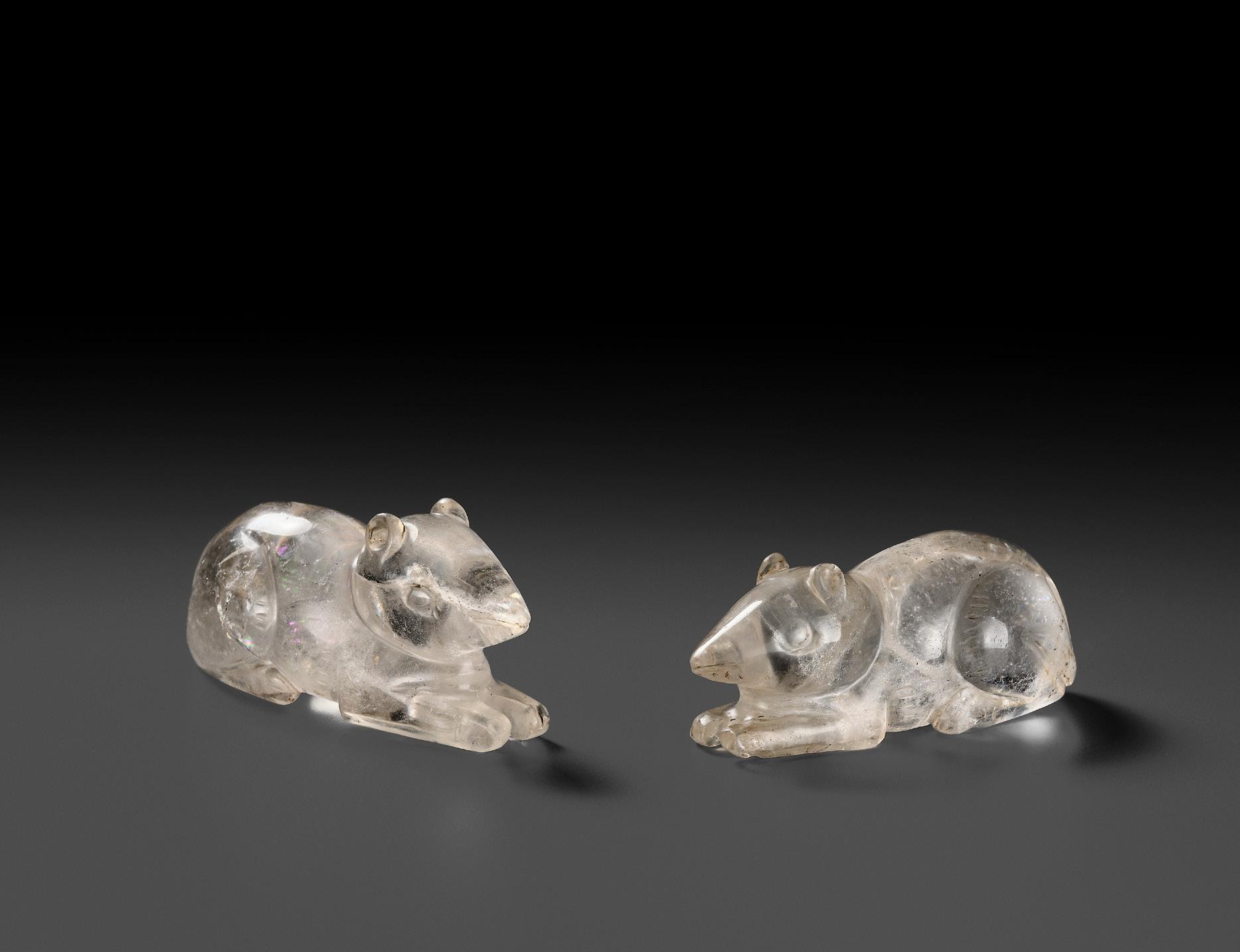
China, 10th-11th century. The rodent is depicted at rest, its limbs extended flat against the ground, the long pointed snout detailed with wide eyes and alert ears, and the hind detailed further with incised markings delineating fur. (2)
Provenance: The Collection of Sam and Myrna Myers, Paris, France.
Acquired between circa 1965-2012.
Condition: Very good condition with expected wear, natural inclusions, signs of burial, tiny nibbling, shallow chips, and minor nicks. The stone with natural fissures, some of which may have developed into small hairline cracks.
Weight: 88.9 g and 102.4 g
Dimensions: Length 7.6 cm and 7.8 cm
The rat is seldom represented in the arts of China, despite it being the first of the Twelve Animals of the Chinese Zodiac. In popular lore, the rat is associated with riches and therefore considered an auspicious image. White rats were believed to live one hundred years and to possess the power of divination. They were supposedly able to predict good or bad luck for a whole year and capable of foreseeing distant events.
Literature comparison:
This pair of rock crystal carvings can be considered a rare occurrence of the motif, along with a Liao rock crystal rat pendant excavated in Jiwangyingzi, Guanjiayingzi, 4 cm wide, and included in the exhibition Gilded Splendor: Treasures of China's Liao Empire (960-1125), Asia Society, New York, 2006, pp. 288-289, cat. no. 79b.
Estimate EUR 2,000
Starting price EUR 1,000
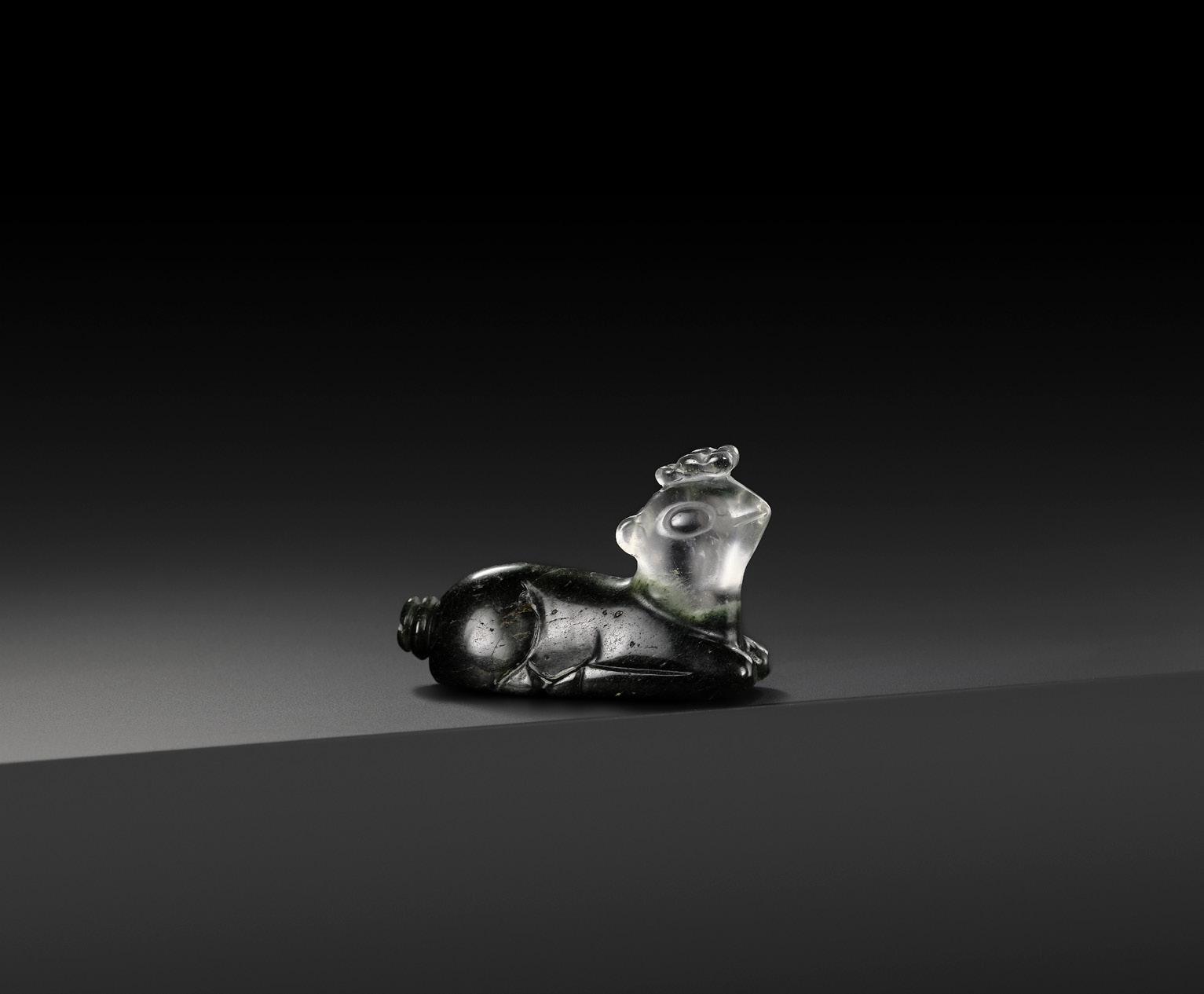
54
PUBLISHED
Myrna Myers (ed.) & Filippo Salviati (auth.), The Language of Adornment. Chinese Ornaments of Jade, Crystal, Amber and Glass, Paris, 2002, no. 84.
Expert’s note: The artisan who carved this deer skillfully incorporated a natural imperfection in the material to enrich its aesthetic appeal. The homogeneous spinach-green color, caused by natural impurities in the rock crystal, distinguishes and focuses the attention on the head of the animal, making this piece unique among similar works from the Liao period.
China, 10th-11th century. Finely carved as a recumbent deer with the legs tucked beneath its body, displaying a lustrous spinach-green hue. The compact form of the animal extending into a short, rounded tail shaped as a double ring, while the slightly raised, translucent head is distinguished by a pointed snout, boldly detailed with oval eyes, small ears, and a schematically rendered set of antlers. A vertical channel pierced through the body suggesting its use as a pendant.
Provenance: The Collection of Sam and Myrna Myers, Paris, France. Acquired between circa 1965-2012.
Condition: Very good condition with minor wear, natural imperfections, minuscule nicks, surface scratches, a few small chips.
Weight: 29.5 g Dimensions: Length 5 cm
For the Liao, the deer had special ritual significance. As explained by Tsao Hsingyuan, deer hunting was one of the major seasonal occupations of the Liao, becoming particularly important following changes in ritual practice which occurred around the mid-10th century. Preserved deer meat became an offering presented during ancestor worship in contrast to offerings of fruit and grains, central to the rites of the agricultural society of the Chinese. Deer hunting, the consumption of deer meat, and its use in ancestor worship were acts by which the Liao affirmed their nomadic cultural identity.
See: Tsao Hsingyuan, “Deer for the Palace. A reconsideration of the ‘Deer in an Autumn Forest’ paintings”, in: Hearn K. Maxwell and Judith G. Smith (eds.), Arts of the Sung and Yuan, New York, 1996, p. 194-195.
LITERATURE COMPARISON
Compare a closely related pair of rock crystal carvings of deer with gold inlay, Liao dynasty, dated 10th-11th century, 5.8 cm long, illustrated in: Myrna Myers (ed.) & Filippo Salviati (auth.), The Language of Adornment. Chinese Ornaments of Jade, Crystal, Amber and Glass, Paris, 2002, no. 83 (fig. 1) and Jean-Paul Desroches (ed.) et al, Two Americans in Paris: A Quest for Asian Art, Paris, 2016, p. 163, no. 274.
Estimate EUR 2,000
Starting price EUR 1,000
fig. 1
1. Jean-Paul Desroches (ed.) et al, Two Americans in Paris. A Quest for Asian Art, Paris, 2016, p. 163, no. 274.
2. Myrna Myers (ed.) & Filippo Salviati (auth.), The Language of Adornment. Chinese Ornaments of Jade, Crystal, Amber and Glass, Paris, 2002, no. 93 (one of the pair).
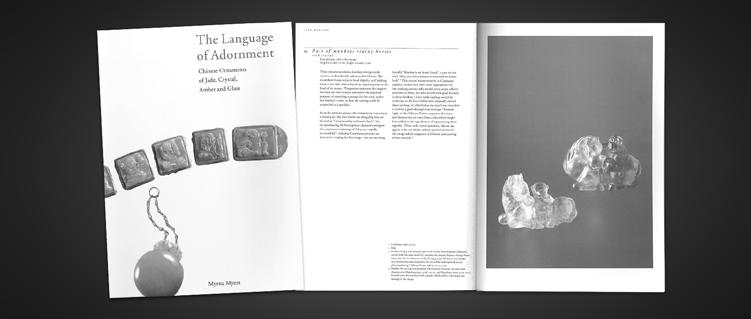
Exhibited:
1. Pointe-à-Callière Museum, From the Lands of Asia. The Sam and Myrna Myers Collection, Montréal, 17 November 2016-19 March 2017.
2. Kimbell Art Museum, From the Lands of Asia. The Sam and Myrna Myers Collection, Fort Worth, Texas, 4 March-19 August 2018.
China, 10th-11th century. Naturalistically carved as a monkey sitting astride a recumbent steed, resting with the legs tucked under the body and the head slightly turned, as if glancing back at its rider. The ape positioned upon the hindquarters, with its hands gently placed on the head of its mount, conveying the harmonious rapport between the two animals and providing a passage for the cord, under the arm of the monkey, so that the carving may be suspended as a pendant.
Provenance: The Collection of Sam and Myrna Myers, Paris, France. Acquired between circa 1965-2012.
Condition: The head of the monkey with a small repair. Otherwise good condition with expected old wear, natural imperfections, minute nicks, light scratches, and minor areas of soil encrustation.
Weight: 136.6 g
Dimensions: Length 7.6 cm
The composition constitutes a visual pun: the four words ‘ma shang feng hou’ can be read as ‘crazy monkey on horse’s back’, but by substituting the homophone characters one gets the auspicious rendering of ‘may you rapidly be ennobled’. Schuyler Cammann provides an alternative reading for this image: ‘hou zai ma shang’, literally ‘monkey is on horse’s back’, a pun on the wish ‘may your descendants be mounted on horses’. This second interpretation, as Cammann explains, would have been more appropriate for low-ranking people who would never attain official positions or titles, but who would wish good fortune to their children. See: Schuyler Cammann, Substance and Symbol in Chinese Toggles, Philadelphia, 1962, p. 125.
Estimate EUR 3,000
Starting price EUR 1,500
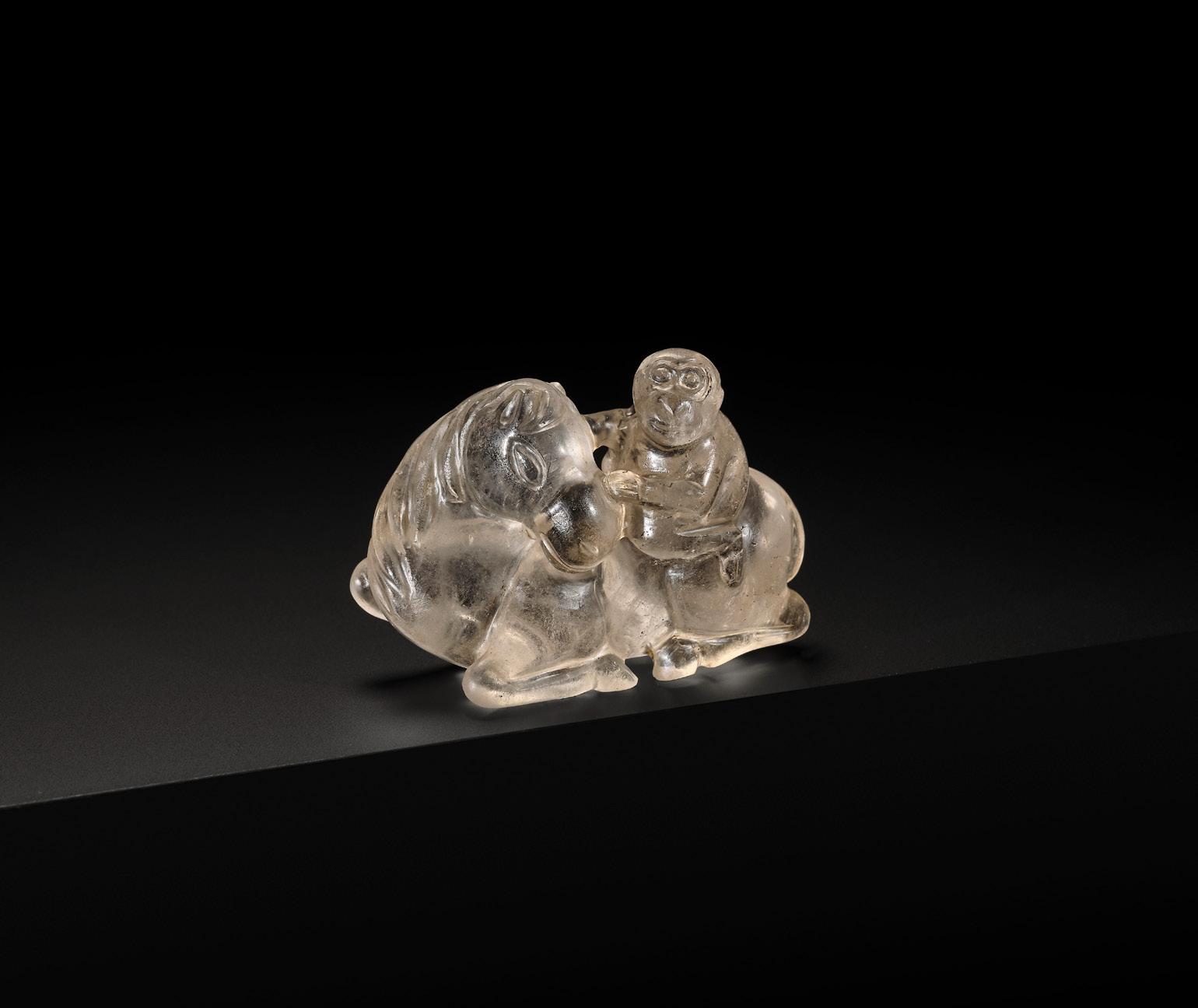
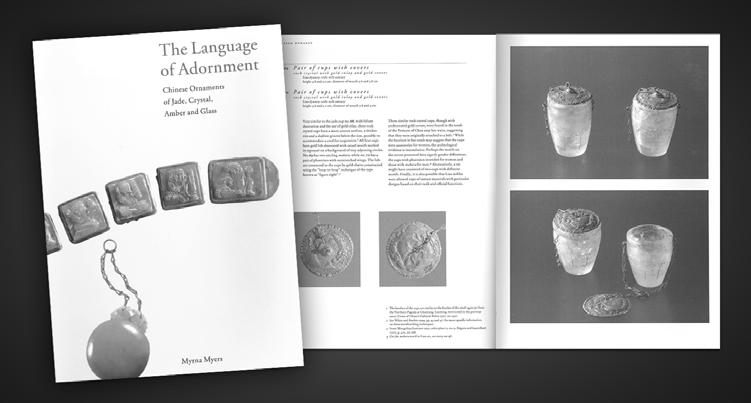
PUBLISHED (PART LOT):
China, 10th-11th century. Each finely carved with a short, rounded body gently tapering toward a flat foot and rising to a thick-lipped mouth with a shallow groove below the rim, possibly intended to accommodate a cord for suspension. The body boldly incised with stylized petal motifs and embellished with gold foil.
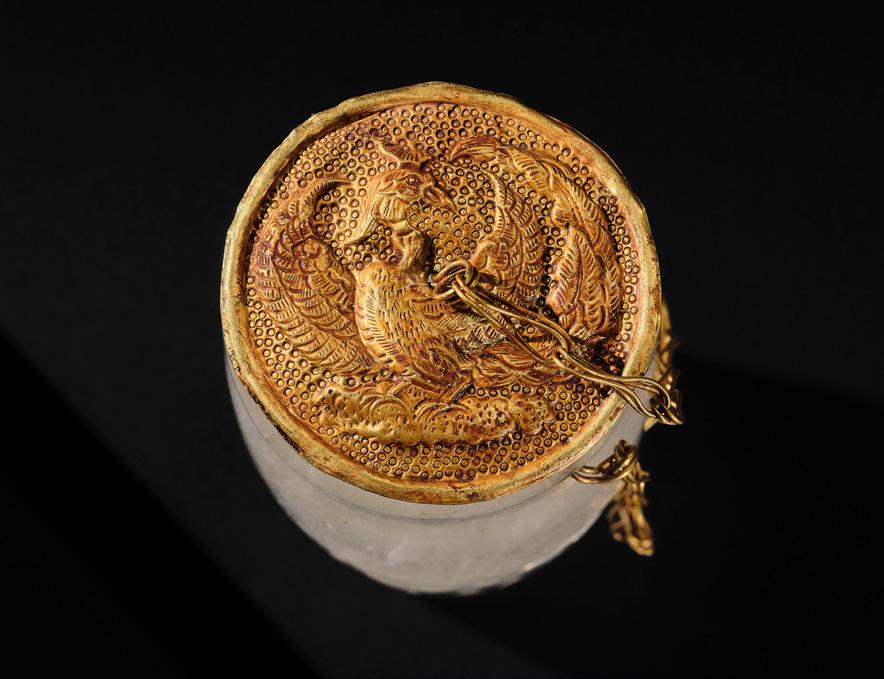
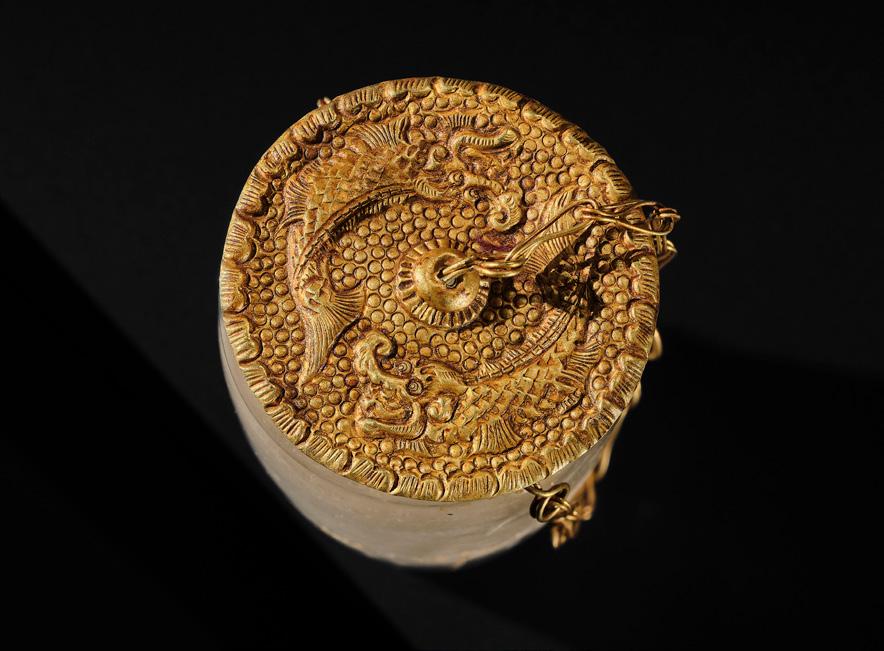
Both cups fitted with a gold lid, decorated with finely embossed designs on a ring-punched ground, depicting circling makaras and phoenixes with outstretched wings. The lids connected to the cups by gold chains. (2)
Provenance: The Collection of Sam and Myrna Myers, Paris, France. Acquired between circa 1965-2012.
Condition: Very good condition with minor wear and natural inclusions. Light traces of use. Occasional minute nicks and few small chips to edges.
Weight: 169.6 g (total)
Dimensions: Height 4.8 cm and 5.1 cm, diameter (mouth) 3.6 cm and 3.8 cm
Three comparable rock crystal cups, albeit with plain gold covers, were discovered near the waist of the Princess of Chen in her tomb indicating that they were likely suspended from a belt. The Princess was interred alongside her husband, Xiao Shaoju, with their bodies laid side by side on a wooden funerary couch and their sumptuous attire and personal ornaments provided visual testimony to elite Khitan burial customs, reflecting aspirations for a luxurious afterlife.
Many of the objects found within the tomb were spirit goods (mingqi) intended exclusively for the grave rather than for daily use. In numerous cases, garments and accessories were clearly gendered, underscoring the identity of the deceased. While the mask of the prince was adorned with a mustache and distinctively masculine accessories, such as a small knife and an awl, were suspended from his belt, the cincture of the princess bore feminine accoutrements, including gold purses, jade implements, and crystal containers. Given that the consort of the Princess of Chen is recorded as a devotee of Taoism, it is conceivable that these containers once held herbs or substances associated with Taoist practices.
In instances where crystal containers were used by men, it was often the decorative motifs on the covers that conveyed distinctions of gender: vessels adorned with phoenixes were likely intended for women, while those featuring makaras may have been reserved for men. It is also plausible that members of the Liao aristocracy were entitled to vessels of particular materials and designs, reflecting their social rank and official position.
The 1986 discovery of the joint tomb of the Princess of the State of Chen and her husband in Southeastern Inner Mongolia revealed an unparalleled richness in funerary attire characteristic of the Liao dynasty. This marked the first discovery of an undisturbed royal tomb from this period, offering a rare glimpse into a little-understood historical era when the semi-nomadic Khitan ruled vast territories of Northeastern China.
LITERATURE COMPARISON
Compare a related group of three rock crystal cups with undecorated gold covers, from the tomb of the Princess of Chen and Xiao Shaoju at Qinglongshan Town, Naiman Banner, Liao dynasty, dated 10th-11th century, 3.5 cm high, held by the Research Institute of Cultural Relics and Archaeology of Inner Mongolia, and included in the exhibition organized by Asia Society, Gilded Splendor. Treasures of China’s Liao Empire (907-1125), New York, Cologne, and Switzerland, 2006-2007, and illustrated in the exhibition catalog, p. 329, no. 101a-c.
Estimate EUR 6,000
Starting price EUR 3,000
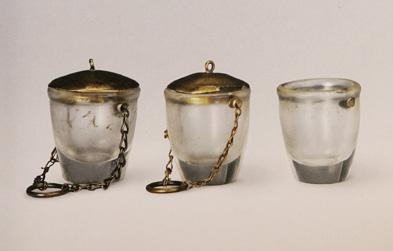
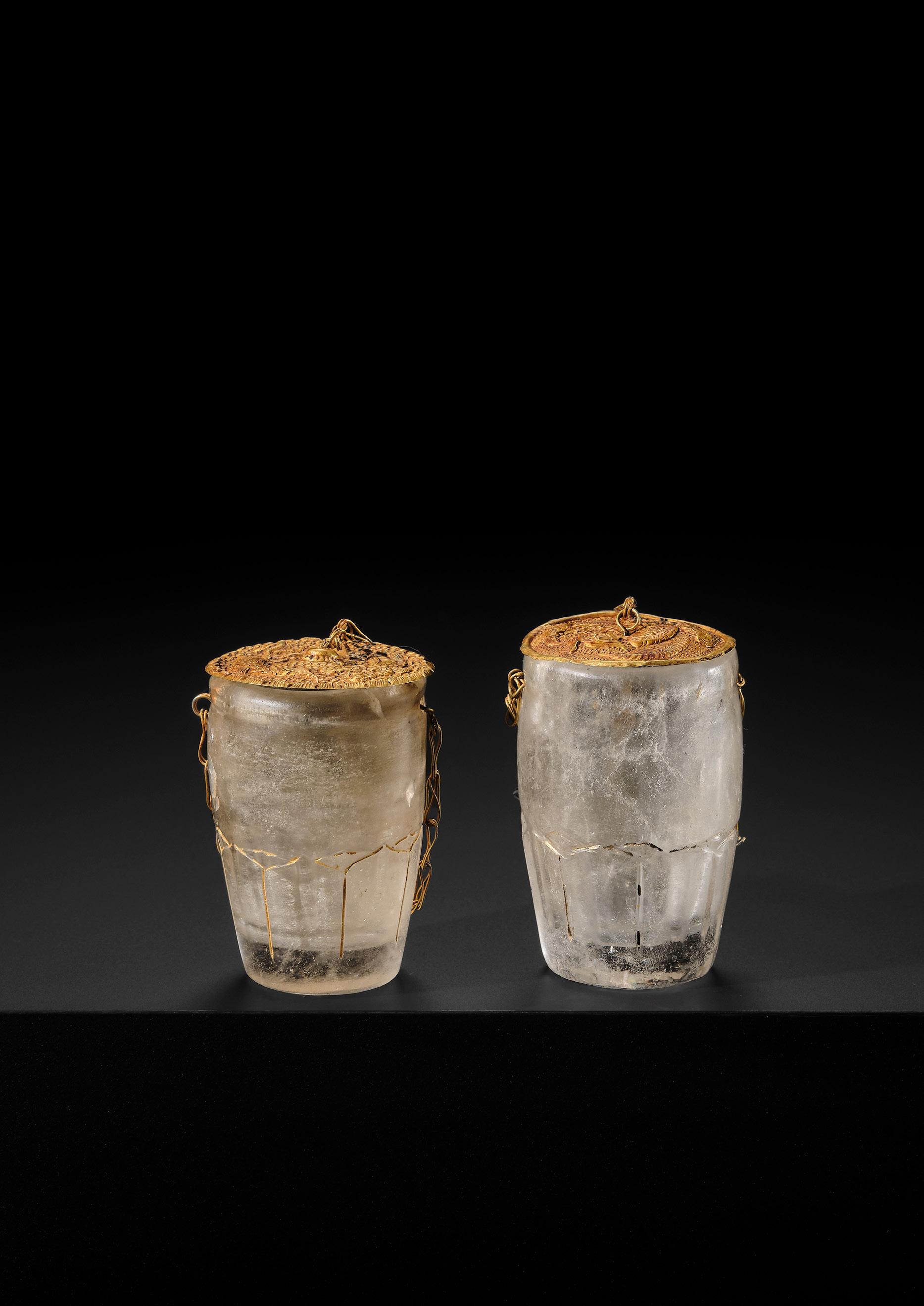
57 A SUPERB JADE AND GILT-BRONZE BELT HOOK, EASTERN ZHOU DYNASTY
PUBLISHED
Jean-Paul Desroches (ed.) et al, Two Americans in Paris: A Quest for Asian Art, Paris, 2016, p. 74, no. 160.
Exhibited:
1. Pointe-à-Callière Museum, From the Lands of Asia. The Sam and Myrna Myers Collection, Montréal, 17 November 2016-19 March 2017.
2. Kimbell Art Museum, From the Lands of Asia. The Sam and Myrna Myers Collection, Fort Worth, Texas, 4 March-19 August 2018.
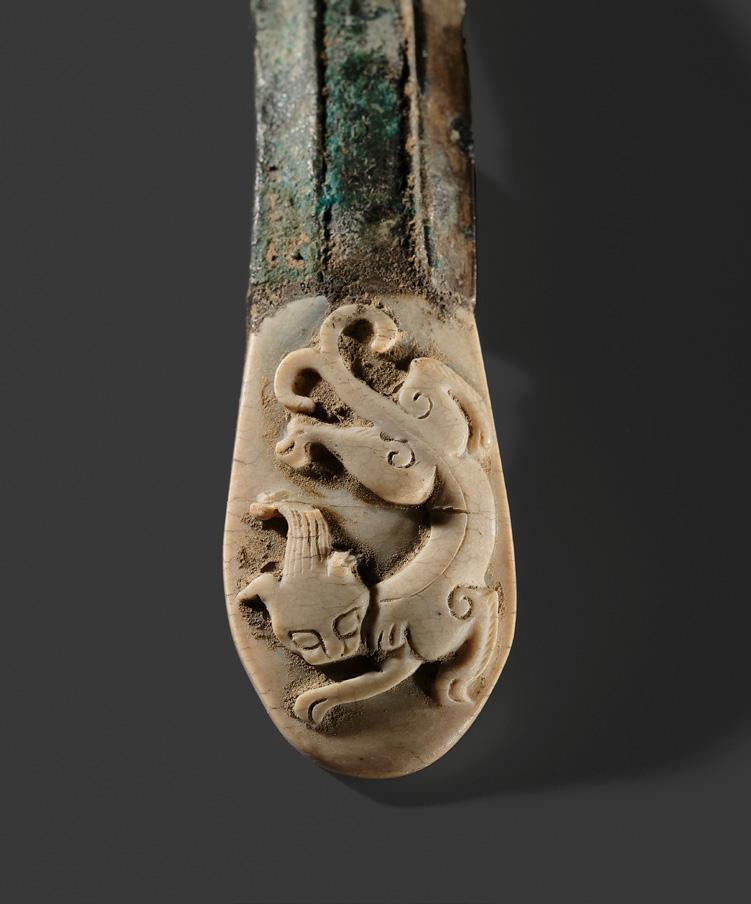
China, 5th-4th century BC. Of typical form, the bronze shaft extending to curved jade terminals, the lower end adorned with a coiling mythical beast carved in high relief, while the upper end modeled in the form of a lobed dragon head. Both jade segments bearing a creamy-white tone, due to extensive natural alteration, though traces of the original celadon jade color remain visible beneath. The reverse with an oval button.
Provenance: The Collection of Sam and Myrna Myers, Paris, France. According to the Myers ledger acquired on 10 October 1985 at Drouot in Paris and in the collection for 41 years.
Condition: Good condition with surface wear, casting irregularities, and natural age-related imperfections. The jade terminals with evidence of breakage and associated fissures. Few minute nicks and minor nibbling along the edges. The bronze shaft with a rich, naturally grown patina, some areas of malachite and soil encrustation, and extensive rubbing to gilding.
Weight: 42.8 g
Dimensions: Length 10.5 cm
LITERATURE COMPARISON
Compare a related gold and jade belt hook, Eastern Zhou dynasty, Warring States period, 475-221 BC, 12.6 cm long, in the Smithsonian National Museum of Asian Art, accession number F1954.120.
AUCTION RESULT COMPARISON
Type: Closely related
Auction: Bonhams Hong Kong, 5 April 2016, lot 40
Price: HKD 1,720,000 or approx. EUR 222,000 converted and adjusted for inflation at the time of writing
Description: A rare jade and gold-inlaid bronze spoon, Warring States period to Han dynasty
Expert remark: Compare the related use of jade and bronze in utilitarian implements of the period and similar patina to the bronze mountings. Note the larger size (20 cm).
Estimate EUR 8,000
Starting price EUR 4,000
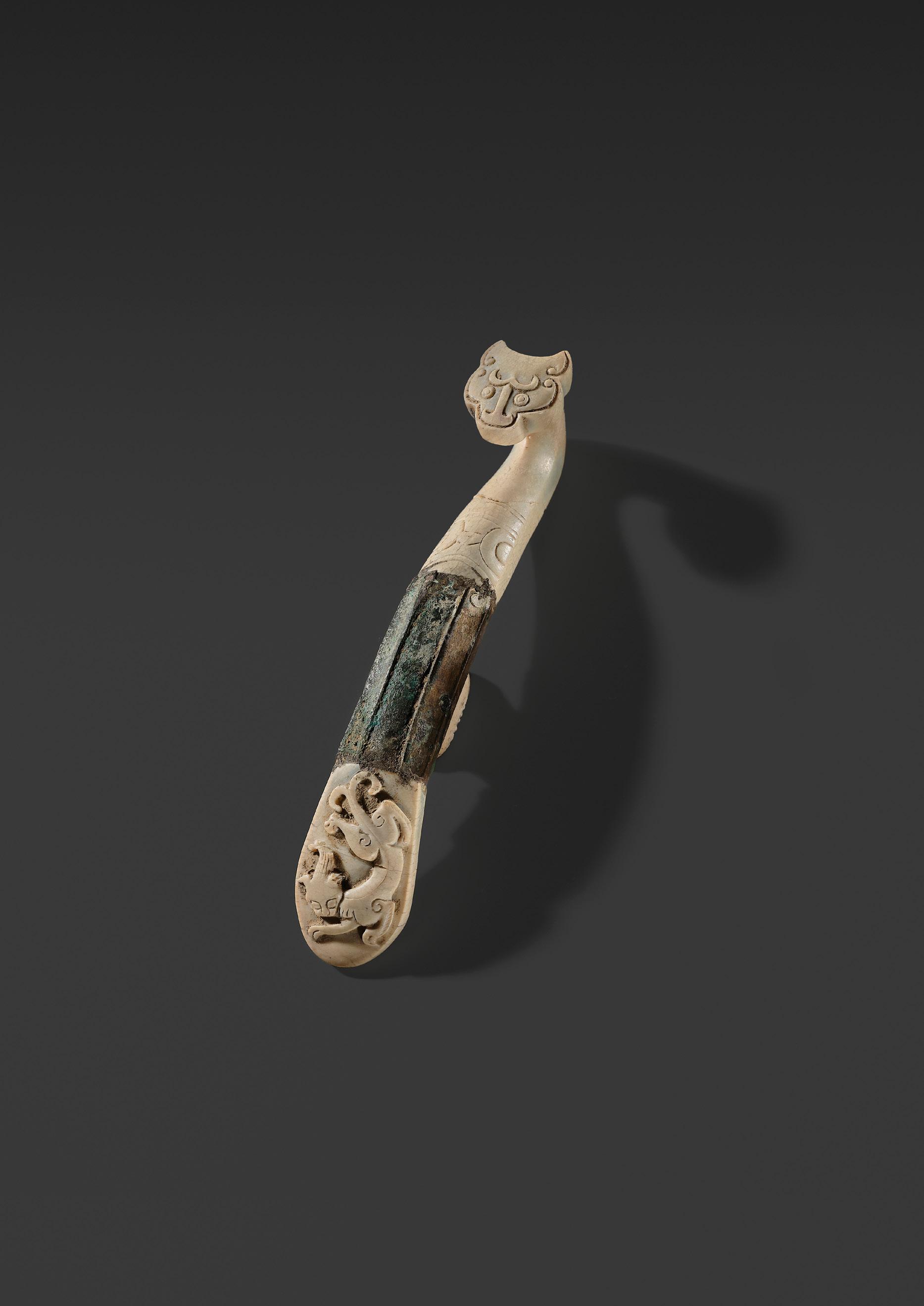
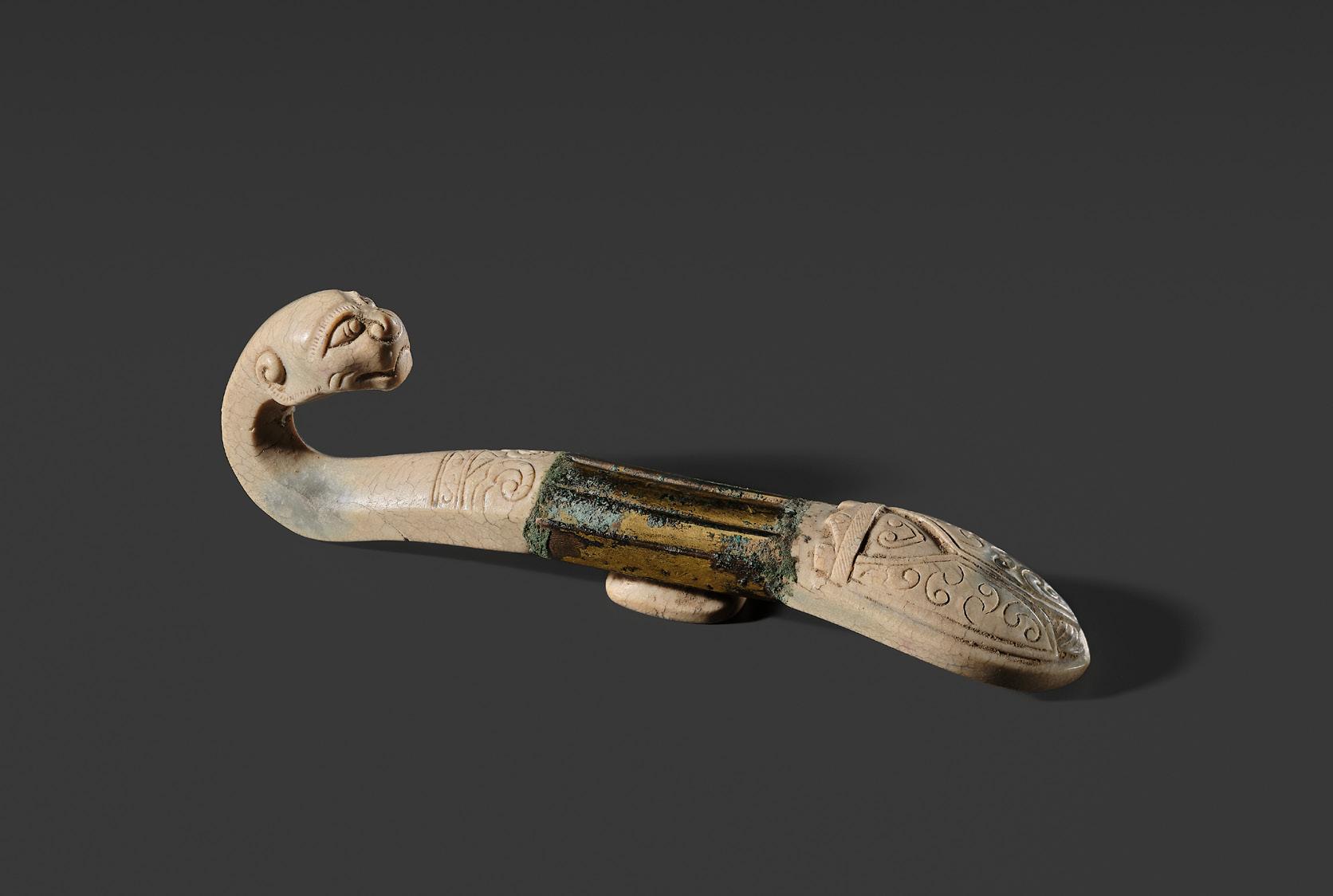
58
PUBLISHED
Jean-Paul Desroches (ed.) et al, Two Americans in Paris: A Quest for Asian Art, Paris, 2016, p. 74, no. 162.
Exhibited:
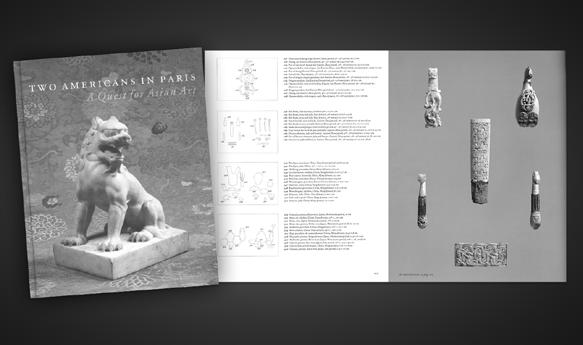
1. Pointe-à-Callière Museum, From the Lands of Asia. The Sam and Myrna Myers Collection, Montréal, 17 November 2016-19 March 2017.
2. Kimbell Art Museum, From the Lands of Asia. The Sam and Myrna Myers Collection, Fort Worth, Texas, 4 March-19 August 2018.
China, 5th-4th century BC. Of typical form, the bronze shaft extending to curved jade terminals, the lower end adorned with a ‘cicada’ tongue amulet carved in high relief and decorated with incised scrollwork, while the upper end modeled in the form of a lobed dragon head. Both jade segments bearing a creamy-white tone, due to extensive alteration, though traces of the original celadon jade color remain visible beneath. The reverse with an oval button.
Provenance: The Collection of Sam and Myrna Myers, Paris, France. According to the Myers ledger acquired on 10 October 1985 at Drouot in Paris and in the collection for 41 years.
Condition: Good condition with surface wear, casting irregularities, and natural age-related imperfections. Light traces of weathering. Occasional minute nicks and shallow surface scratches. The bronze shaft with a rich, naturally grown patina, some areas of malachite and soil encrustation, and rubbing to gilding.
Weight: 50.1 g
Dimensions: Length 11.6 cm
Literature comparison: Compare a related jade-inlaid gilt-bronze garment hook with masks, Warring States period to Western Han dynasty, 475 BC-9 AD, 9 cm long, in the Smithsonian National Museum of Asian Art, accession number F1953.82.
AUCTION RESULT COMPARISON
Type: Related
Auction: Christie’s Hong Kong, 28 November 2018, lot 2765
Price: HKD 1,500,000 or approx. EUR 186,500 converted and adjusted for inflation at the time of writing
Description: A white jade ‘dragon’ belt hook with a bronze fixture, early Western Han dynasty, c. 206-141 BC
Expert remark: Compare the related use of jade and bronze in utilitarian implements of the period and similar patina to the bronze mountings. Note the similar size (9.8 cm).
Estimate EUR 8,000
Starting price EUR 4,000
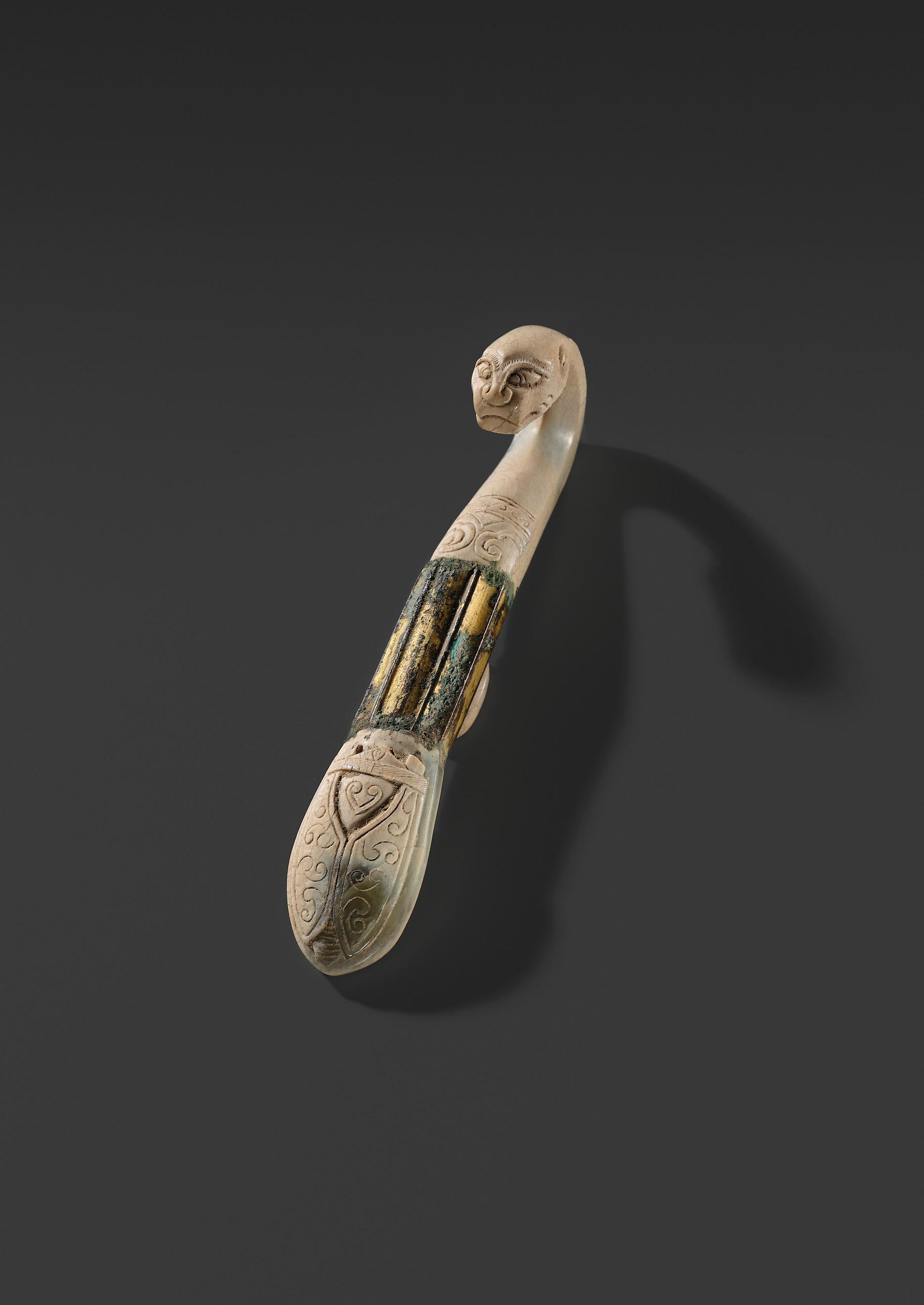
59
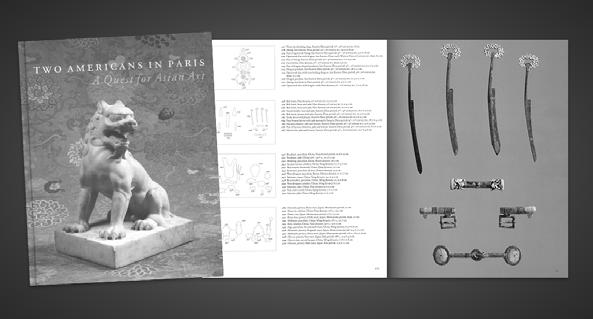
PUBLISHED (PART LOT)
Jean-Paul Desroches (ed.) et al, Two Americans in Paris: A Quest for Asian Art, Paris, 2016, p. 75, no. 166.
Exhibited:
1. Pointe-à-Callière Museum, From the Lands of Asia. The Sam and Myrna Myers Collection, Montréal, 17 November 2016-19 March 2017.
2. Kimbell Art Museum, From the Lands of Asia. The Sam and Myrna Myers Collection, Fort Worth, Texas, 4 March-19 August 2018.
China, 4th-3rd century BC. Each element composed of a square bronze buckle, freely rotating around a truncated conical shaft. The buckle support cast in the form of a stylized head of a mythical beast gripping the frame, while the shafts decorated with a variety of geometric motifs. Each piece fitted at the terminal with jade elements: three of cylindrical form, gently tapering toward the end, and decorated with horizontal bands of crosshatched lines and scrollwork, from which emerges a finely carved, prominent beast head projecting from the shaft. The fourth example terminates in a truncated conical jade finial, carved in high relief with S- and C-shaped scrolls. The opaque stone of creamy white tone, as a result of extensive alteration, while the bronze surfaces display a rich, naturally developed patina.
Provenance: The Collection of Sam and Myrna Myers, Paris, France. Acquired between circa 1965-2012.
Condition: Good condition, commensurate with age, with surface wear and inherent natural imperfections, including small fissures. Distinct traces of weathering and corrosion. Losses and minor old repairs possible. Extensive signs of usage. Scattered minor nicks and few minute chips. The jade surface visibly altered and the bronze surface with a rich, naturally grown patina with some areas of vibrant malachite and soil encrustations.
Weight: 372.3 g (total)
Dimensions: Length 8.1 cm to 8.8 cm
These harness elements were part of the luxurious equestrian equipment used by the aristocracy of the time, designed to both embellish and reinforce the straps of the saddle, as well as to secure the bridle, yoke, or pectoral decorations of the horse. Beyond its practical function, the use of jade in such elements reflects the high status of its owner, as these equestrian ornaments served as visible symbols of prestige and power. These accessories were employed in both every day and ceremonial contexts, integrating the horse, an essential animal for warfare and transportation, into the visual language of authority characteristic of Eastern Zhou nobility.
AUCTION RESULT COMPARISON
Type: Related
Auction: Christie’s Hong Kong, 29 November 2022, lot 2764
Price: HKD 819,000 or approx.
EUR 94,500 converted and adjusted for inflation at the time of writing
Description: A very rare set of jade and bronze ‘chilong’ chariot fittings
Expert remark: Compare the related function, tubular form, and ‘chilong’ subject. Note the larger size (15.7 cm) and later dating.
Estimate EUR 15,000
Starting price EUR 7,500

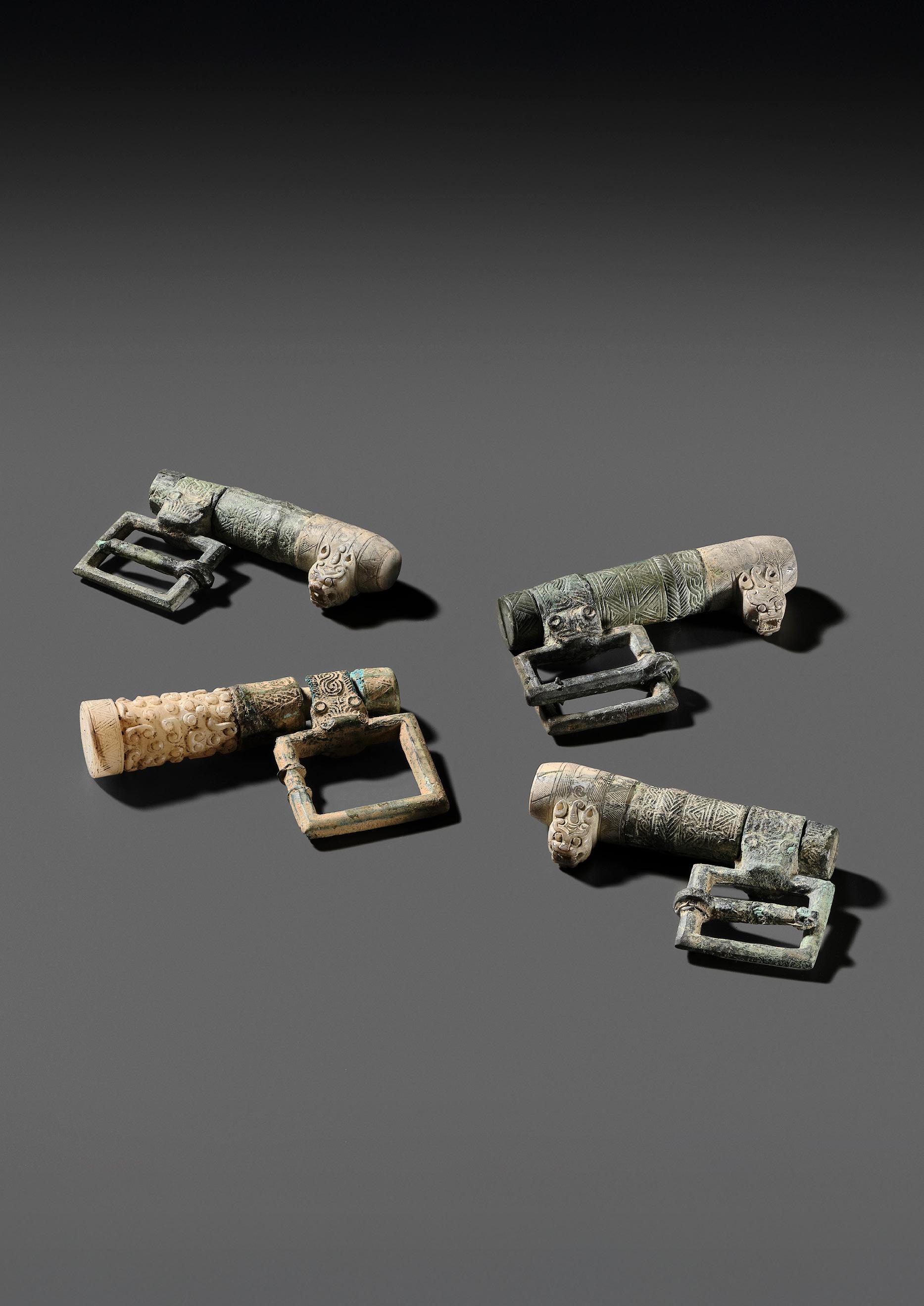
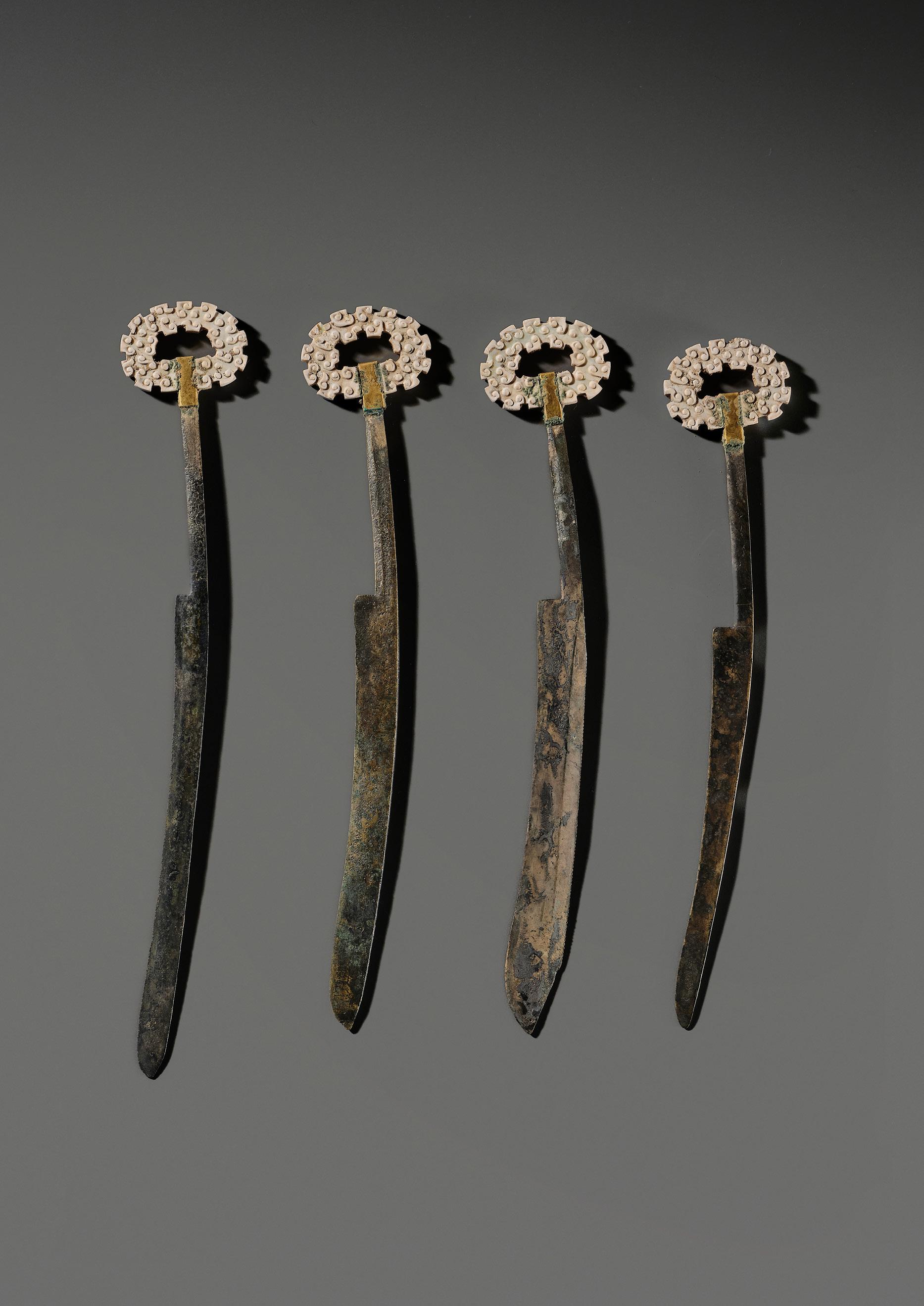
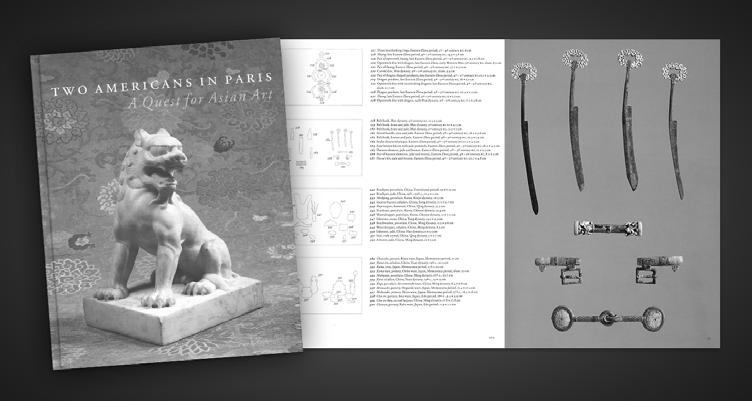
PUBLISHED
Jean-Paul Desroches (ed.) et al, Two Americans in Paris: A Quest for Asian Art, Paris, 2016, p. 75, no. 164.
Exhibited:
1. Pointe-à-Callière Museum, From the Lands of Asia. The Sam and Myrna Myers Collection, Montréal, 17 November 2016-19 March 2017.
2. Kimbell Art Museum, From the Lands of Asia. The Sam and Myrna Myers Collection, Fort Worth, Texas, 4 March-19 August 2018.
China, 4th-3rd century BC. Each knife composed of a slender, flat blade with a slight sweeping profile, beveled on one edge and terminating in a curved point, seamlessly extending to a thin shaft. The handle mounted with a jade pommel in the form of a perforated, coiled ring with a serrated profile, its surface finely decorated on both sides with high-relief C-shaped curls, and joined to the blade by a gilt fitting. The semi-translucent stone of a whitish tone resulting from extensive natural alteration. (4)
Provenance: The Collection of Sam and Myrna Myers, Paris, France. Acquired between circa 1965-2012.
Condition: Very good condition, commensurate with age, with ancient wear. The bronze blades with inherent casting irregularities and distinct traces of corrosion. Light warping and minor nibbling along the edges. Some areas of malachite encrustation around the gilt fittings. The jade elements with natural imperfections, one of them with minor evidence of breakage, with associated old fills. Few small nicks and occasional minuscule chips. The surface with small areas of soil encrustation.
Weight: 223.4 g (total)
Dimensions: Length 25.9 cm to 28.1 cm
USA
AUCTION RESULT COMPARISON
Type: Related
Auction: Christie’s Hong Kong, 29 November 2024, lot 1051
Price: HKD 3,024,000 or approx. EUR 339,000 converted and adjusted for inflation at the time of writing
Description: A jade-hilt bronze knife and a bronze-inset jade scabbard, late Spring and Autumn period to Western Han dynasty, c. 570 BC-8 AD
Expert remark: Compare the closely related form, manner of carving with similar ‘taotie’ decoration and color of the calcified stone. Note the smaller size of the jade-hilt bronze knife (16 cm) and that the lot comprises an additional bronzeinset jade scabbard.
Estimate EUR 15,000
Starting price EUR 7,500
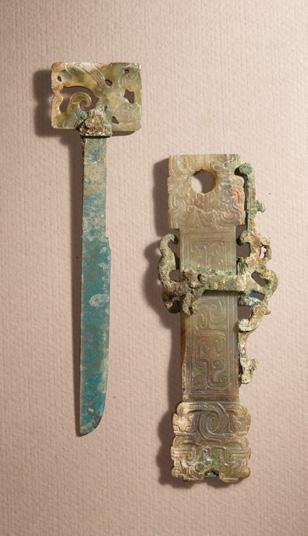
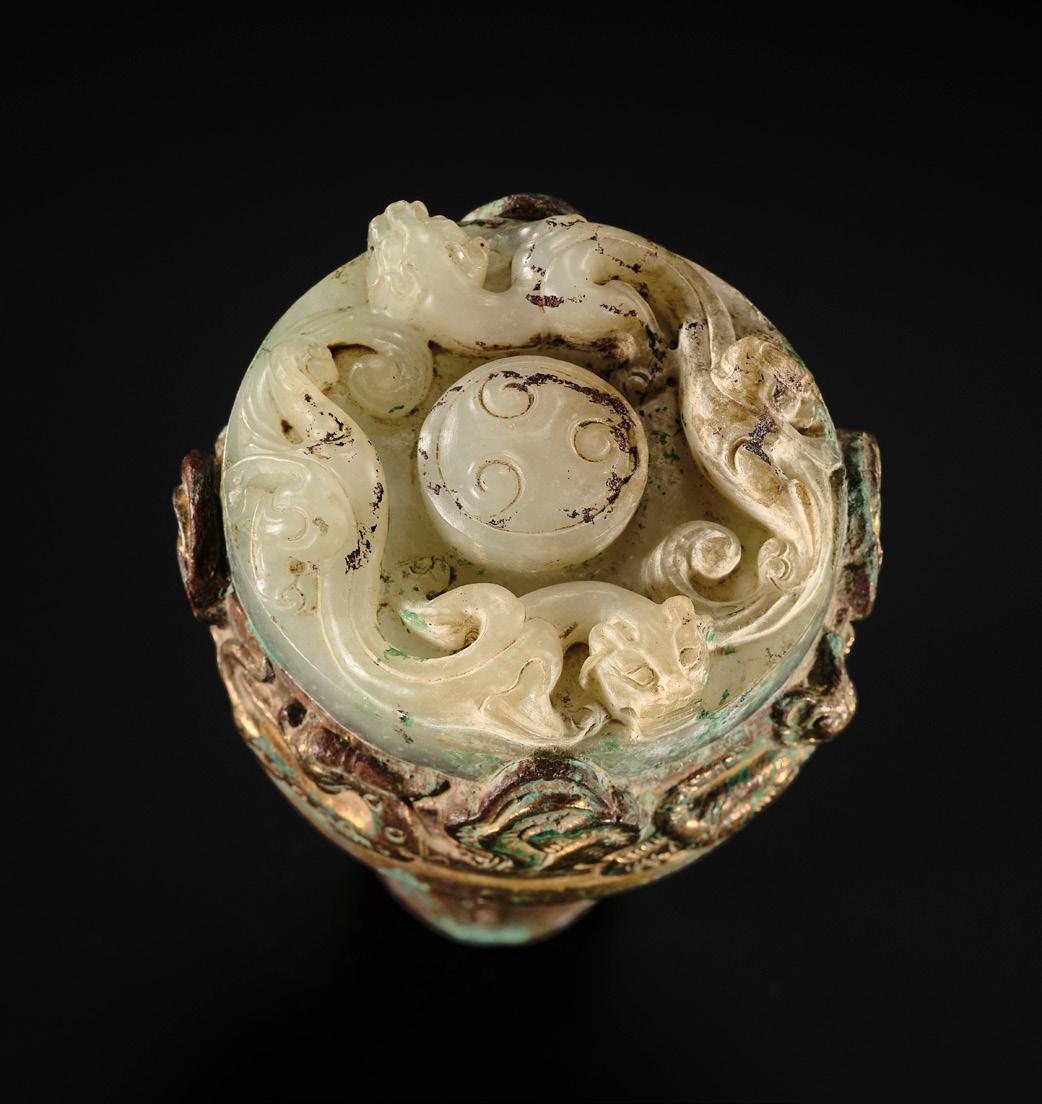
61 A VERY RARE JADE-INLAID GILT-BRONZE ‘DRAGON’ FINIAL, WESTERN HAN DYNASTY
China, c. 207 BC-9 AD. Finely cast, the head of the pommel cylindrical in form, supported on a slender hollow shaft, the sides decorated in high relief with an encircling band of mythical beasts and inlaid with a substantial jade disc, its upper surface carved in varying degrees of relief with coiling dragons (chilong). The stone of an even white tone, with cloudy inclusions and some areas of opaque calcification.
Provenance: The Collection of Sam and Myrna Myers, Paris, France. Acquired between circa 1965-2012.
Condition: Condition commensurate with age, with ancient wear and typical signs of use. Expected traces of weathering and corrosion. The jade inset with inherent natural imperfections. Scattered minor nicks, losses, and shallow surface scratches. The surface with extensive areas of malachite and soil encrustation, indicating a prolonged period of burial.
Weight: 245.1 g
Dimensions: Length 7.6 cm
Skillfully incorporating two distinctively different materials and transforming them into a functional work of art, the present belt hook demonstrates the high level of craftsmanship displayed by artisans during the late Eastern Zhou to Han dynasty.
LITERATURE COMPARISON
Compare a closely related jade-inlaid gilt-bronze ‘dragon’ finial, Western Han dynasty, 206 BC-9 AD, 5.3 cm long, in the Smithsonian National Museum of Asian Art, accession number LTS1985.1.264.19.
Estimate EUR 6,000
Starting price EUR 3,000

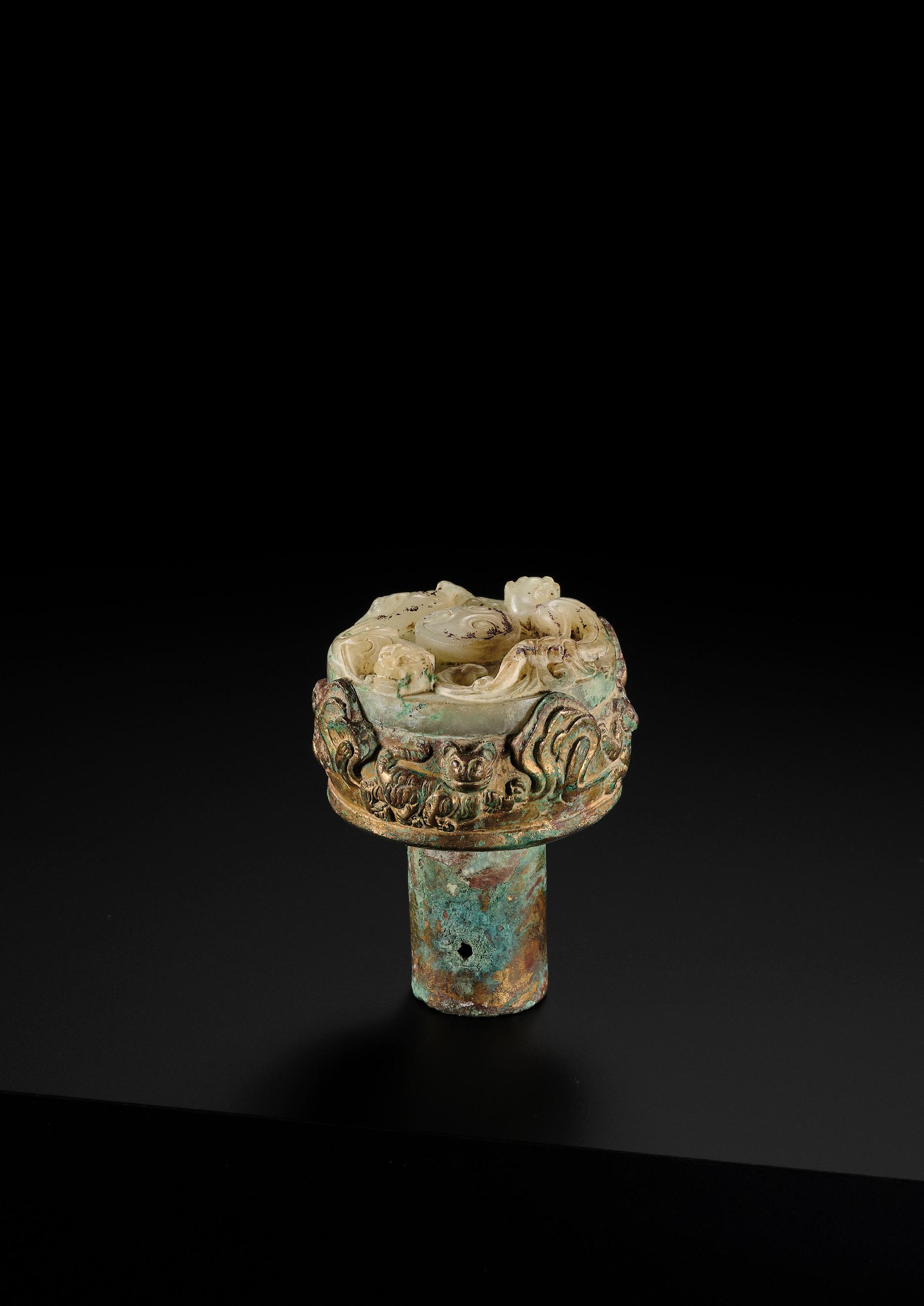
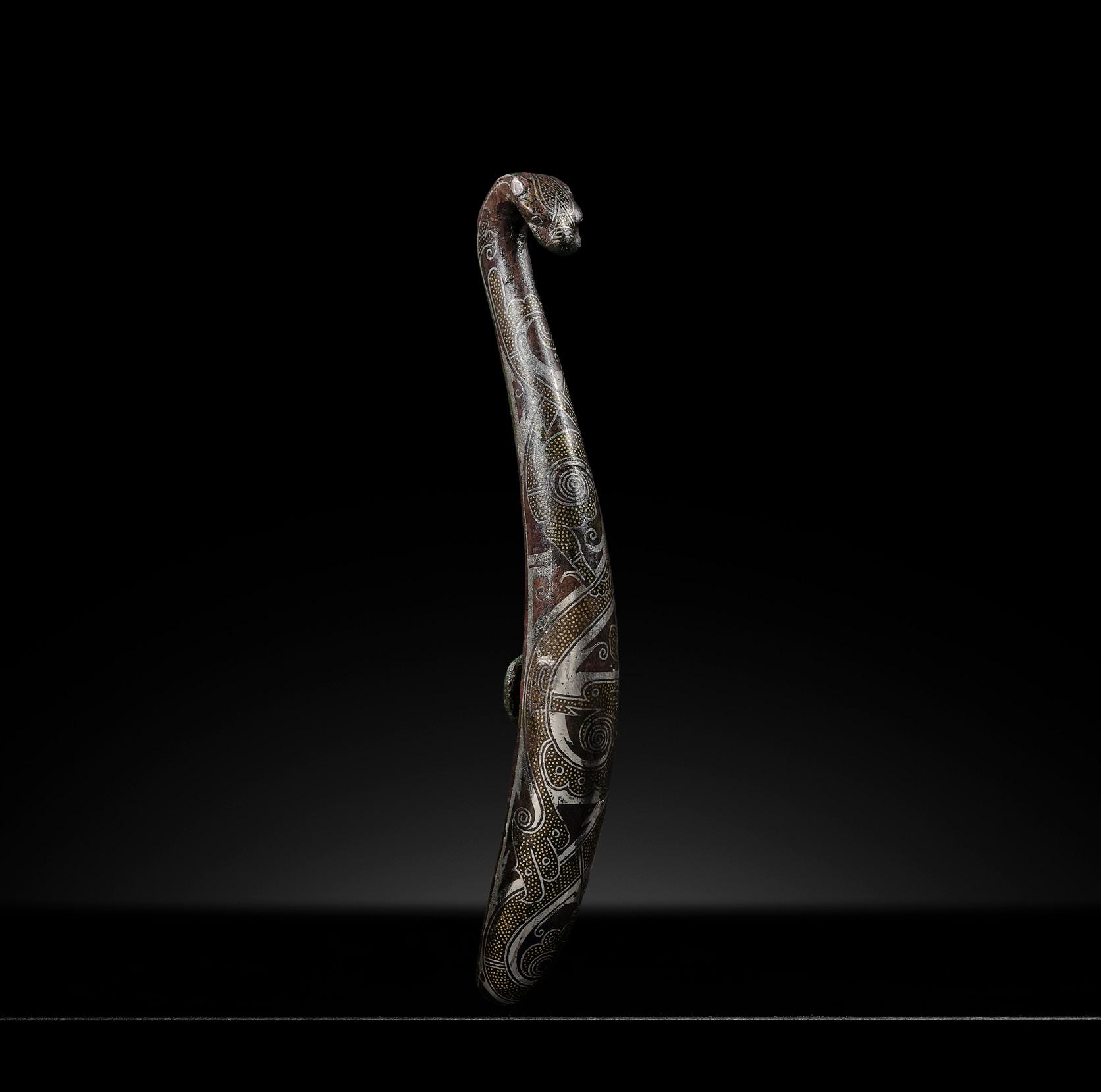
62
A GOLD AND SILVER-INLAID BRONZE BELT HOOK, DAIGOU, WARRING STATES-HAN DYNASTY
China, 475 BC-220 AD. The slender rounded shaft intricately inlaid with silver sheet and wire, and gilt stippling, forming overlapping scrolls evocative of intertwined beasts punctuated with spiral designs and a geometric pattern, all below the finely modeled and similarly decorated hook in the form of a dragon’s head, the underside with a circular button.
Provenance: The Collection of Sam and Myrna Myers, Paris, France. Acquired between circa 1965-2012.
Condition: Very good condition, commensurate with age. Wear, casting irregularities, traces of use, signs of burial, encrustations, expected tarnish and minor losses to inlays. The bronze with a fine, naturally grown, dark patina with scattered malachite encrustation.
Weight: 71.9 g
Dimensions: Height 11.7 cm
Literature comparison:
Compare a related gold and silver-inlaid bronze belt hook, dated to the Han dynasty, 12.8 cm long, in the Palace Museum, Beijing, illustrated in The Complete Collection of Treasures of the Palace Museum. Bronze Articles for Daily Use, vol. 28, Hong Kong, 2006, p. 131, no. 110.
AUCTION RESULT COMPARISON
Type: Closely related
Auction: Christie’s New York, 18 March 2021, lot 607
Price: USD 60,000 or approx. EUR 64,000 converted and adjusted for inflation at the time of writing
Description: A gold and silver inlaid bronze belt hook, Warring States period (475-221 BC)
Expert remark: Compare the closely related form, manner of casting, and inlaid decoration. Note the size (11.5 cm).
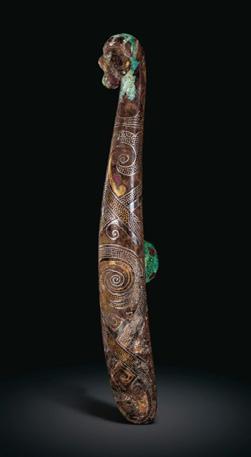
Estimate EUR 2,000
Starting price EUR 1,000
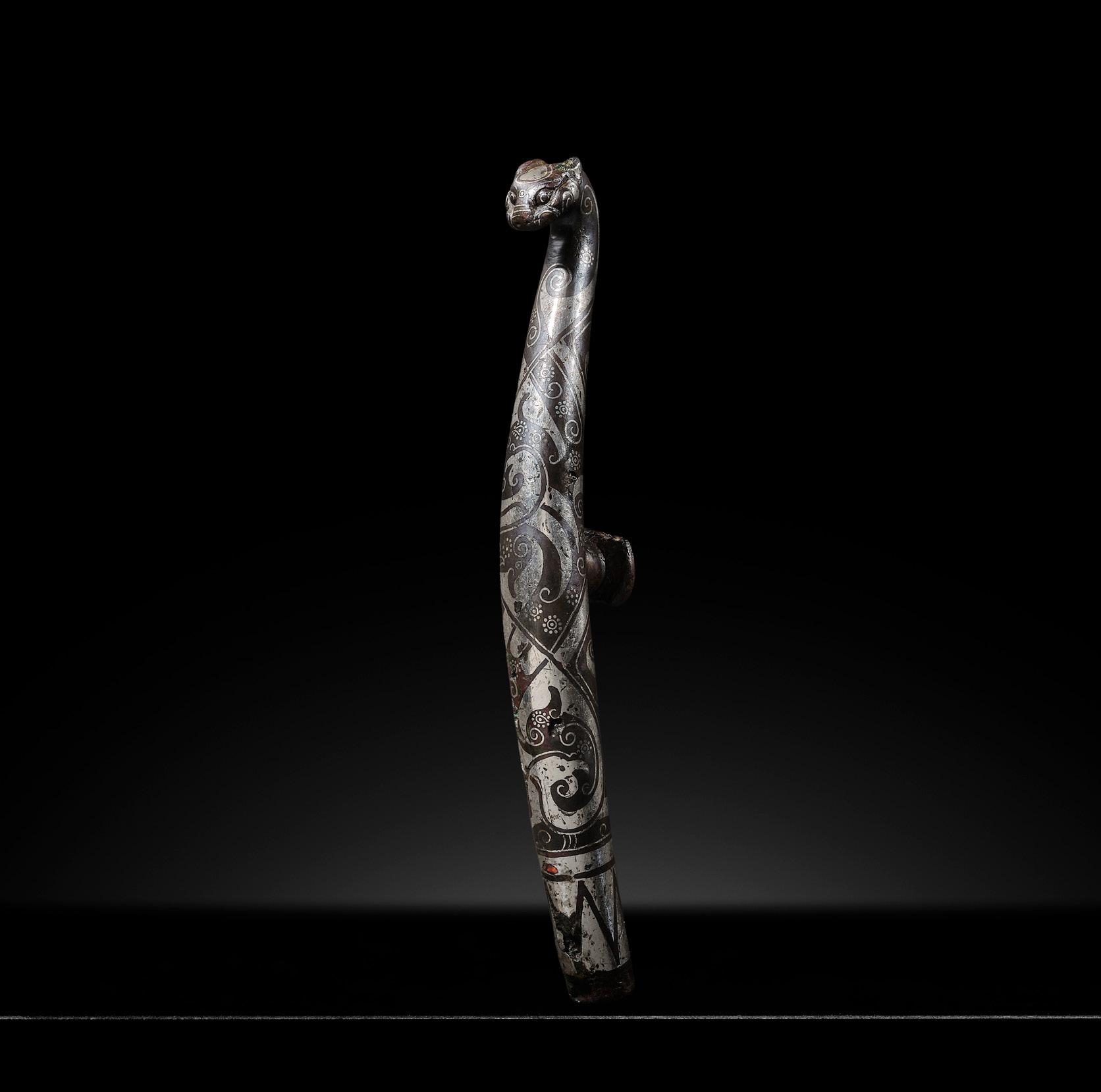
China, 4th-1st century BC. The slender, rounded shaft intricately inlaid with silver sheet and wire, forming overlapping and intertwined phoenixes interspersed with spiral motifs and foliate heads framed by a geometric band to the base. The upper end terminates in a finely modeled hook shaped as a dragon’s head, similarly decorated and set with silver-wire ringed eyes. The underside bears an oval button inlaid with silver scrolls for attachment.
Provenance: The Collection of Sam and Myrna Myers, Paris, France. Acquired between circa 1965-2012.
Condition: Good condition, commensurate with age. Wear, casting irregularities, traces of use, signs of burial, small losses, encrustations, expected tarnish and minor losses to inlays. The bronze with a fine, naturally grown, dark patina.
Weight: 91.3 g
Dimensions: Height 12 cm
AUCTION RESULT COMPARISON
Type: Closely related Auction: Christie’s New York, 16 September 2010, lot 874
Price: USD 4,375 or approx. EUR 5,700 converted and adjusted for inflation at the time of writing
Description: A silver-decorated bronze garment hook, late Western-eastern Han dynasty, circa 1st century BC -3rd century AD Expert remark: Compare the closely related form and similar decoration. Note the size (19.3 cm).
Estimate EUR 2,000
Starting price EUR 1,000
A BRONZE HALBERD BLADE (GE), EASTERN ZHOU DYNASTY
China, 770-221 BC. Crisply cast, the elongated blade (yuan), with beveled edges and a subtle median ridge, extending from a curved lower edge to a pointed tip, and issuing from a slotted shaft pierced with two rectangular slits for attachment. The short tang (nei) decorated on each side with an abstract linear motif in low relief.
Provenance: The Collection of Sam and Myrna Myers, Paris, France. Acquired between circa 1965-2012.
Condition: Good condition, commensurate with age, with expected wear and inherent casting irregularities. Distinct traces of weathering and corrosion. Occasional small nicks, light surface scratches, and nibbling along the edges. The bronze surface with extensive areas of attractive malachite and azurite encrustations.
Weight: 279.9 g
Dimensions: Length 26.7 cm
The dagger-axe (ge) was a type of polearm employed in China from the Longshan culture through the Han dynasty, that consisted of a daggershaped blade affixed by its tang to a perpendicular wooden shaft. The earliest examples were executed in stone, subsequently in bronze, while jade variants were reserved for ceremonial contexts.
The dagger-axe constituted the first weapon in Chinese history that was not simultaneously utilitarian as a hunting or agrarian implement. Devoid of a thrusting point, it was deployed in open terrain, permitting the full leverage of its elongated shaft. Its introduction onto the battlefield precedes both the advent of chariot warfare and the later predominance of closely arrayed infantry formations.
LITERATURE COMPARISON
Compare a closely related bronze halberd blade, Eastern Zhou dynasty, c. 5th-4th century BC, 12.4 cm long, in the Metropolitan Museum of Asian Art, object number 1985.214.29 (fig. 1). Compare a closely related bronze halberd blade, Eastern Zhou dynasty, Spring and Autumn period, c. 6th-5th century BC, 19.6 cm long, in the National Palace Museum, Taipei, accession number 000026N000000000. fig. 1
AUCTION RESULT COMPARISON
Type: Closely related
Auction: Sotheby’s New York, 27 September 2021, lot 505 Price: USD 3,780 or approx. EUR 4,000 converted and adjusted for inflation at the time of writing
Description: An archaic bronze halberd blade (Ge), Eastern Zhou dynasty
Expert remark: Compare the closely related form, manner of casting, and superficial malachite encrustations. Note the similar size (25.3 cm).
Estimate EUR 2,000
Starting price EUR 1,000
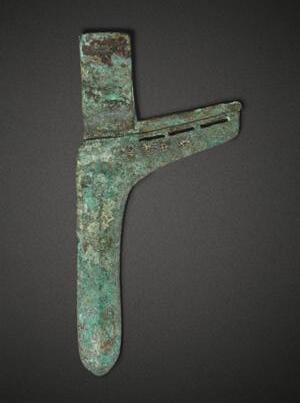
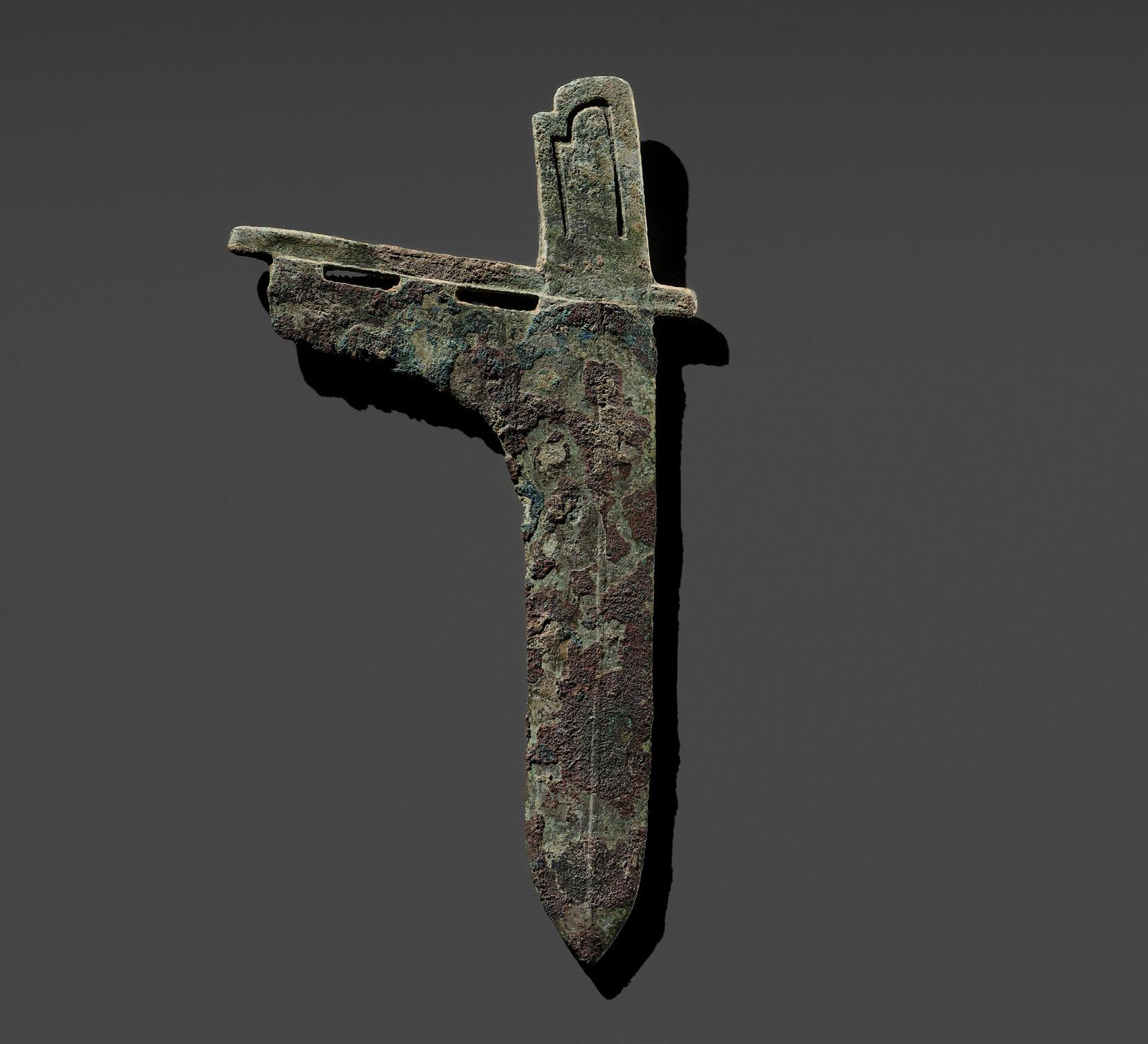
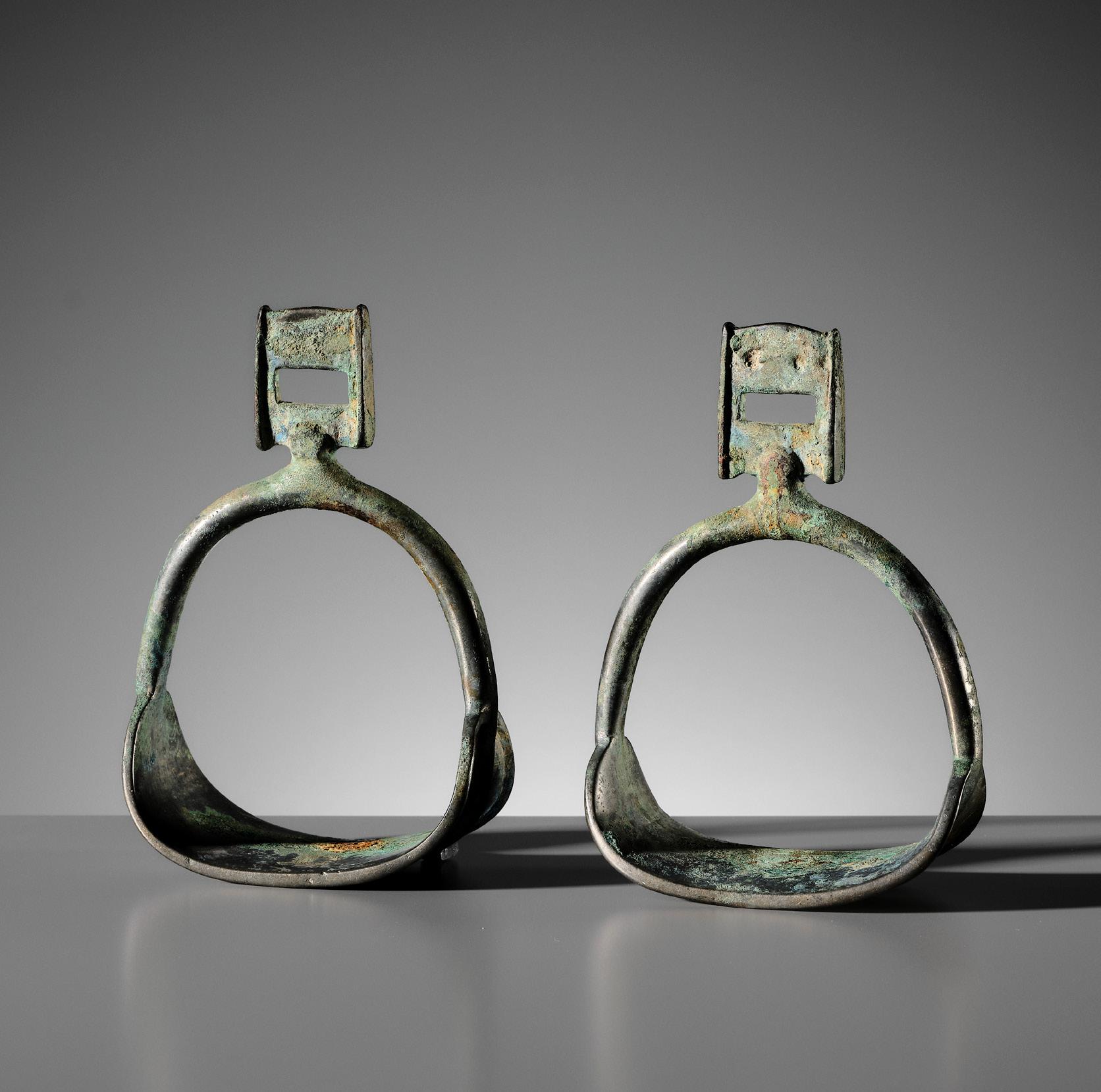
A PAIR OF RARE SILVERED COPPER ALLOY STIRRUPS, TANG DYNASTY
China, 618-907. The horseshoe-shaped stirrup with a straight handle and a rectangular buckle with raised borders in the form of an archaic ‘gui’ head, with a rectangular slit for attachment to the saddle. The stirrup ring with a wide footrest with a central longitudinal ridge on the underside, slightly turned downwards at both edges. (2)
Provenance: The Collection of Sam and Myrna Myers, Paris, France. According to the Myers ledger, this was acquired on 25 February 1997 in Hong Kong and has been in the collection for 29 years.
Condition: Very good condition with surface wear and inherent casting irregularities. Distinct traces of weathering and corrosion with associated minor losses. Expected signs of usage. Scattered small nicks and faint surface scratches. The metal surface with extensive areas of attractive malachite and azurite encrustations.
Weight: 1,078 g (total)
Dimensions: Height 19.3 cm (each)
The introduction of the stirrup represented a pivotal development in the evolution of Chinese equestrian equipment during the Wei, Jin, and Northern and Southern Dynasties. The compact stirrup established a secure interface between rider and horse, providing a primary point of support that
enabled the rider to maintain balance and stability while keeping the hands free. This innovation proved indispensable in both quotidian and warfare contexts. The integration of stirrup and saddle significantly enhanced cavalry performance and accelerated the advance of military campaigns.
LITERATURE COMPARISON
A pair of stirrups related to the present lot, dating to the Tang dynasty, were excavated in 1986 at Wulanbulang Village, Haoqinying Township, Hohhot City, subsequently transferred to Hohhot Museum in 1991 and classified as a firstclass cultural relic in 2003 by the Cultural Relics Appraisal Committee of the Inner Mongolia Autonomous Region (fig. 1). Another related examplar, inlaid with gold, was recovered from the tomb of Shi Huang, first Emperor of the Qin Dynasty, near Xi’an, Shaanxi Province, and is now held by the Capital Museum of China, Beijing.
Estimate EUR 3,000
Starting price EUR 1,500
1
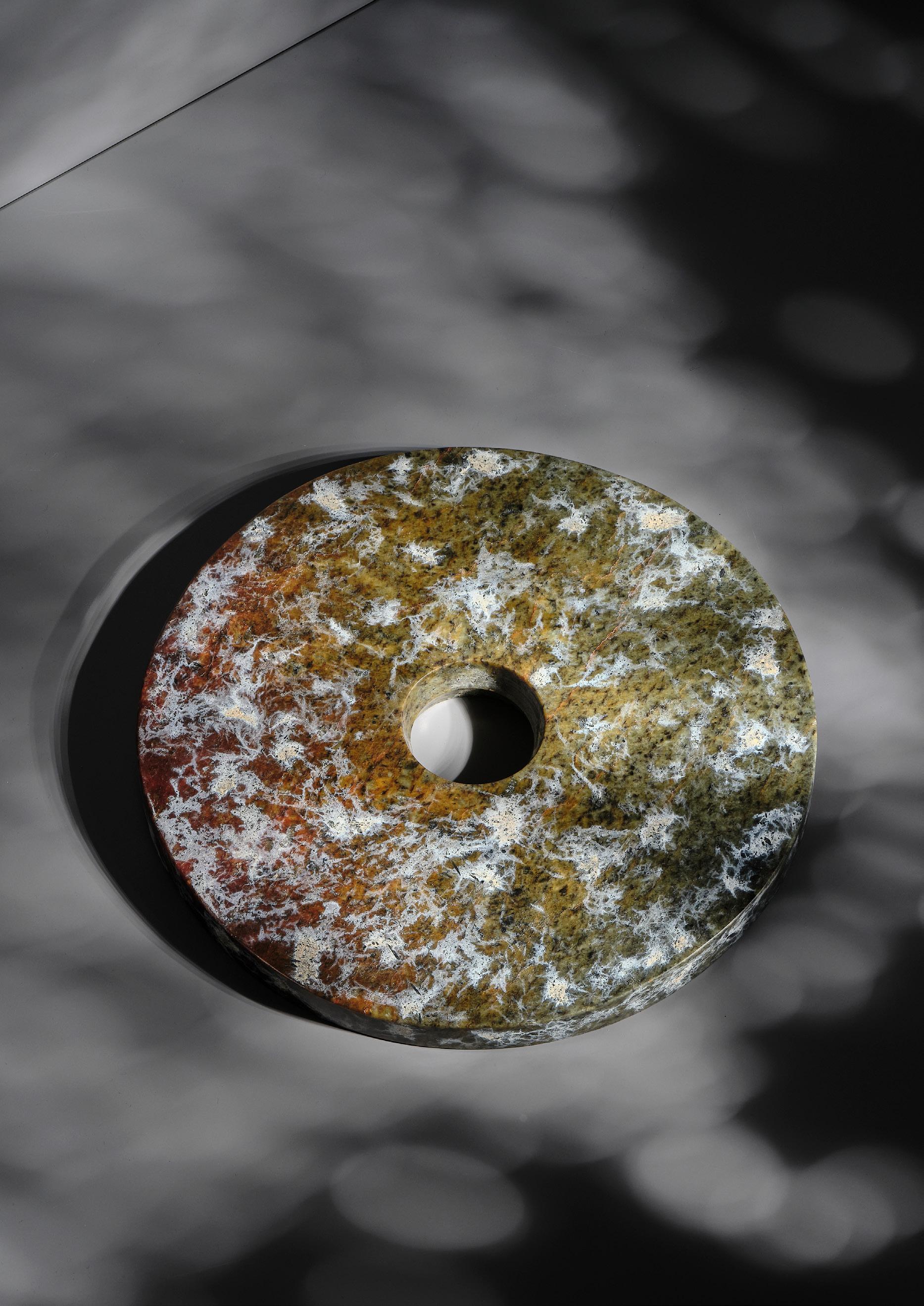

66
AN EXCEPTIONALLY THICK (1.6 CM) SPINACH GREEN AND RUSSET JADE ‘CLOUDED’ DISK (BI), LATE NEOLITHIC PERIOD, LIANGZHU CULTURE
China, c. 3300-2250. Of circular form, with a central aperture drilled from both sides to form an encircling ridge. The opaque stone of a spinach-green and russet color, with dark mottling and scattered, cloud-like areas of creamy-white calcification.
Expert’s note:
The stone shows natural internal “clouding” caused by variations in crystallization and long-term mineral alteration within the jade. These mist-like inclusions run through the body, not the surface, as seen in the central aperture and they confirm that the feature is inherent to the material. Such characteristics develop slowly and reflect the stone’s geological history.
Provenance: The Collection of Sam and Myrna Myers, Paris, France. Acquired between circa 1965-2012.
Condition: Very good condition with minor wear and natural agerelated imperfections, such as small fissures and inclusions. Occasional minute nicks and faint surface scratches. Minor nibbling along the edges.
Weight: 1,836 g
Dimensions: Diameter 20.2 cm, Depth 1.6 cm
Jade ‘bi’ disks are a type of jade which continued to be crafted in numbers by cultures located in central and northwest China during the transitional period between the Neolithic and Bronze Age. Most of these discs range in size between ten and twenty centimeters. The considerable size and weight of the present example, due to its substantial thickness, requires both hands to hold it comfortably, indicates that it was displayed and employed within a ritual context. Its surfaces were thoroughly polished, except for the central aperture, which was drilled from both sides of the jade with bamboo segments and sand abrasives. The ridge at the midpoint marks the place where the two drilled channels meet.
Literature comparison:
Compare a closely related spinach green and russet jade disk (bi), late Neolithic period, Liangzhu culture, c. 3300-2250, 31.8 cm diameter, in the Smithsonian National Museum of Asian Art, accession number F1917.79.
AUCTION RESULT COMPARISON
Type: Closely related
Auction: Christie’s New York, 19 March 2015, lot 487
Price: USD 40,000 or approx. EUR 47,000 converted and adjusted for inflation at the time of writing
Description: A large, opaque, mottled dark green and ivory hardstone ‘bi’ disk, Neolithic period, Liangzhu culture, 3rd millennium BC
Expert remark: Compare the closely related form, manner of carving, and color of the stone. Note the similar size (21 cm).
Estimate EUR 15,000
Starting price EUR 7,500
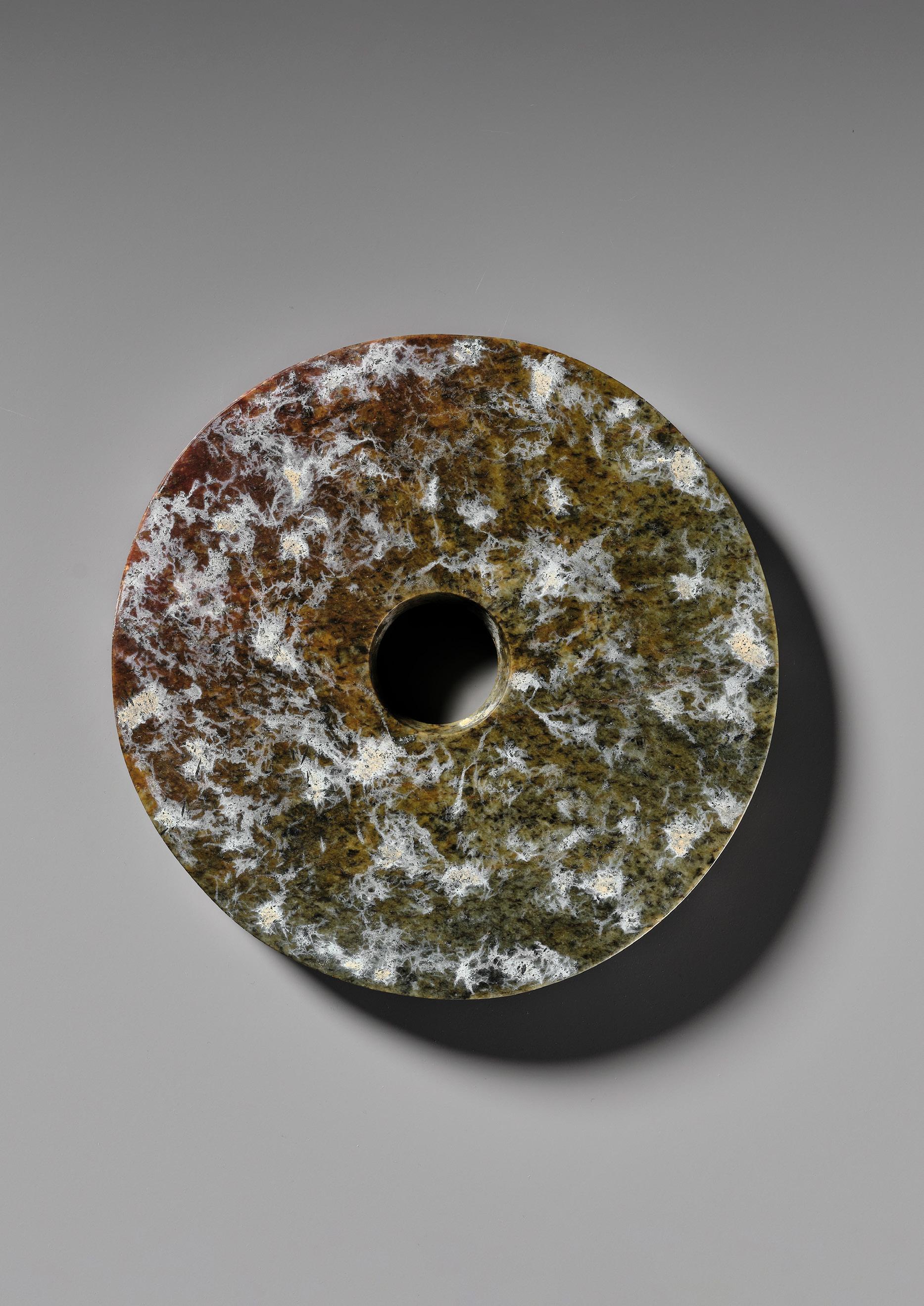
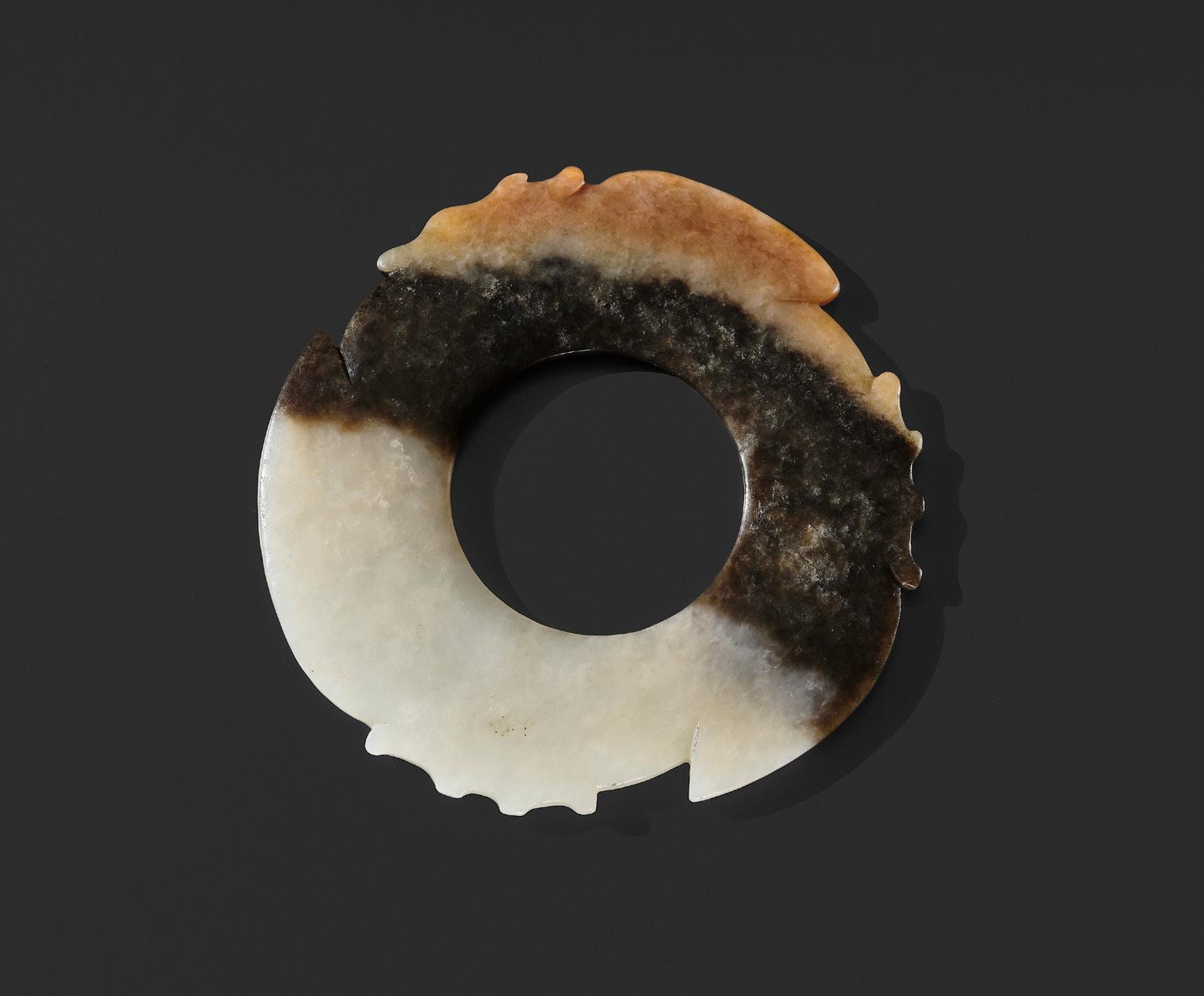
67 A RARE WHITE, BROWN, AND RUSSET JADE NOTCHED DISK (YABI), LATE NEOLITHIC PERIOD, DAWENKOU OR LONGSHAN CULTURE
China, c. 2200-2000 BC. Of circular form, the outer rim finely carved with three pronounced notches rising to pointed tips and articulated with small, raised projections. The interior pierced by a large circular aperture. The translucent stone of an attractive interplay of white, brown, and russet tones, accented with cloudy inclusions and dark mottling.
Provenance: The Collection of Sam and Myrna Myers, Paris, France. According to the Myers ledger acquired on 14 February 1985 in Amsterdam and in the collection for 41 years.
Condition: Very good condition with minor wear and natural agerelated imperfections. Few minor nicks and faint surface scratches.
Weight: 59.1 g
Dimensions: 8.9 cm
Longshan and Dawenkou, located in the Shandong province area, between the cultural sphere of Hongshan in the North and that of the Liangzhu to the South, were two late Neolithic cultures which used jade items, primarily as status symbols and emblems of power. Compared to their neighbors and antecedents, the Dawenkou and Longshan cultures made less use of jade, which was worked mostly as small ornaments, tablet-shaped axes or ritual blades. The jades of these cultures, such as the notched rings exemplified by the present lot, represent a development of earlier shapes.
Notched rings form a category of their own and are still poorly understood, though a line of development of this peculiar form can be traced to small Hongshan culture ornaments. Over time, the indentations carved on these small jades gradually developed into pointed projections, usually three in
number. The latest Neolithic examples show an increase in the size of the discs and the addition of small, regular notches carved on the sections of the border comprised between the projections. These notches are a recurring feature on jades crafted during the transition from the late Neolithic to the Bronze Age (c. 2200-1900).
As noted by Filippo Salviati, these regular notches may represent a faint memory of the outline of the feathered headdress worn by the Liangzhu anthropomorphic figures and were carved on jades reserved for the elite members of these late Neolithic and early Bronze Age societies. See Filippo Salviati, Early Bronze Age, in Jean-Paul Desroches (ed.) et al, Two Americans in Paris: A Quest for Asian Art, 2016, p. 46.
AUCTION RESULT COMPARISON
Type: Closely related
Auction: Christie’s Hong Kong, 28 November 2018, lot 2709
Price: HKD 1,000,000 or approx. EUR 124,500 converted and adjusted for inflation at the time of writing
Description: A celadon jade notched disc (yabi)
Expert remark: Compare the closely related form, manner of carving, and color of the stone. Note the slightly larger size (13 cm).
Estimate EUR 8,000
Starting price EUR 4,000
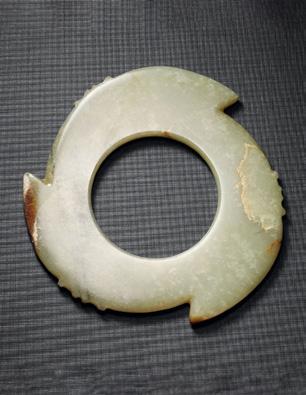
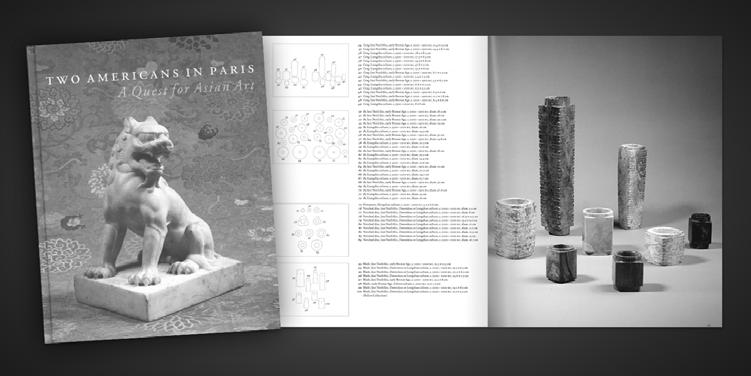
PUBLISHED
Desroches (ed.) et al, Two Americans in Paris: A Quest for Asian Art, Paris, 2016, p. 43, no. 38.
Exhibited:
1. Pointe-à-Callière Museum, From the Lands of Asia. The Sam and Myrna Myers Collection, Montréal, 17 November 2016-19 March 2017.
2. Kimbell Art Museum, From the Lands of Asia. The Sam and Myrna Myers Collection, Fort Worth, Texas, 4 March-19 August 2018.
China, c. 3300-2200 BC. The thick-walled cong with gently rounded sides and a cylindrical interior, carved to each corner with a stylized human and animal mask design. The faces divided with a gently recessed vertical band to the center of each side. The opaque stone of an appealing interplay of grey and yellow tones, covered overall with extensive areas of whitish calcification.
Provenance: The Collection of Sam and Myrna Myers, Paris, France, according to the Myers ledger acquired in Hong Kong on 26 June 1995, and in the collection for 31 years.
Condition: Good condition, commensurate with age, with expected wear and inherent natural imperfections, such as inclusions and small fissures. Distinct traces of weathering and erosion, with old, smoothened chips along the edges. Scattered minor nicks and faint surface scratches. The stone surface with extensive areas of opaque calcification and soil encrustation, indicating a prolonged period of burial.
Weight: 1,542 g
Dimensions: Height 14.3 cm
The Liangzhu culture and its remarkable jade artifacts came to prominence in the late 1980s, when the discovery of several significant cemeteries brought international attention to the richness of their tomb contents. Since then, a wave of new archaeological findings has dramatically transformed our understanding of this late Neolithic civilization. At the Mojiaoshan site, Chinese archaeologists have uncovered the remains of a vast, walled settlement covering 750 acres. This site, the largest known walled settlement from late Neolithic China, includes palatial foundations, jade workshops, habitation zones, and a sophisticated network of internal waterways.
Distinguished by their quantity, variety, and superb craftsmanship, Liangzhu jades are among the most iconic artifacts in the history of Chinese civilization. Among them, the jade cong stands out as the most emblematic. These objects feature a square exterior surrounding a circular inner hollow, with each corner serving as a vertical axis for the carving of symmetrical mask motifs. Early examples are typically squat and intricately decorated with deities or animal forms. In contrast, later versions are tall and slender, with stylized facial features dominated by prominent eyes and noses.
The present cong is incised with four horizontal tiers featuring sixteen ‘crowned divine figure’ motifs. Two parallel lines above each figure signify the crown, while short horizontal ridges depict the nose. The eyes consist of double circles connected by short lines, with two short extensions on either side to mark the corners of the eyes.
Expert’s note:
Of particular interest are in the present lot the subtly irregular concentric ridges on the interior, which bear witness to the manner and sequential stages in which the jade cong was perforated from both ends. The residual traces of the labor-intensive carving process remain discernible on the inner walls, whose slightly roughened surface and pale tonality stand in deliberate contrast to the flawlessly polished exterior, thereby underscoring both the painstaking labor and the technical proficiency of those responsible for the realization of this magnificent artifact.
Literature comparison:
Compare a closely related four-tiered jade cong, Neolithic period, Liangzhu culture, Lake Tai region, c. 3300-2250 BC, 10.5 cm high, in the Smithsonian National Museum of Asian Art, accession number F1968.36.
AUCTION RESULT COMPARISON
Type: Closely related
Auction: Bonhams Hong Kong, 28 November 2017, lot 1
Price: HKD 4,660,000 or approx. EUR 591,000 converted and adjusted for inflation at the time of writing
Description: A rare grey and green jade ritual vessel, cong, Neolithic period, Liangzhu culture
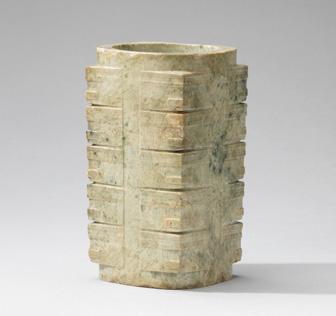
Expert remark: Compare the closely related manner of carving, decorative motifs, and similarly calcified stone. Note the smaller size (11 cm).
AUCTION RESULT COMPARISON
Type: Closely related
Auction: Christie’s Hong Kong, 27 November 2019, lot 2719
Price: HKD 31,325,000 or approx. EUR 3,800,000 converted and adjusted for inflation at the time of writing
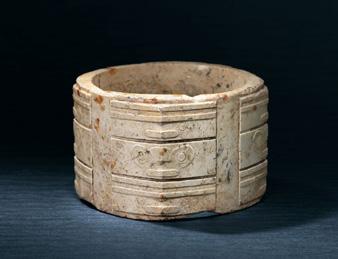
Description: An extremely rare threetiered jade cong, Liangzhu culture, c. 3300-2300 BC
Expert remark: Compare the closely related manner of carving, decorative motifs, and similarly calcified stone. Note the smaller size (7.8 cm).
Estimate EUR 30,000
Starting price EUR 15,000
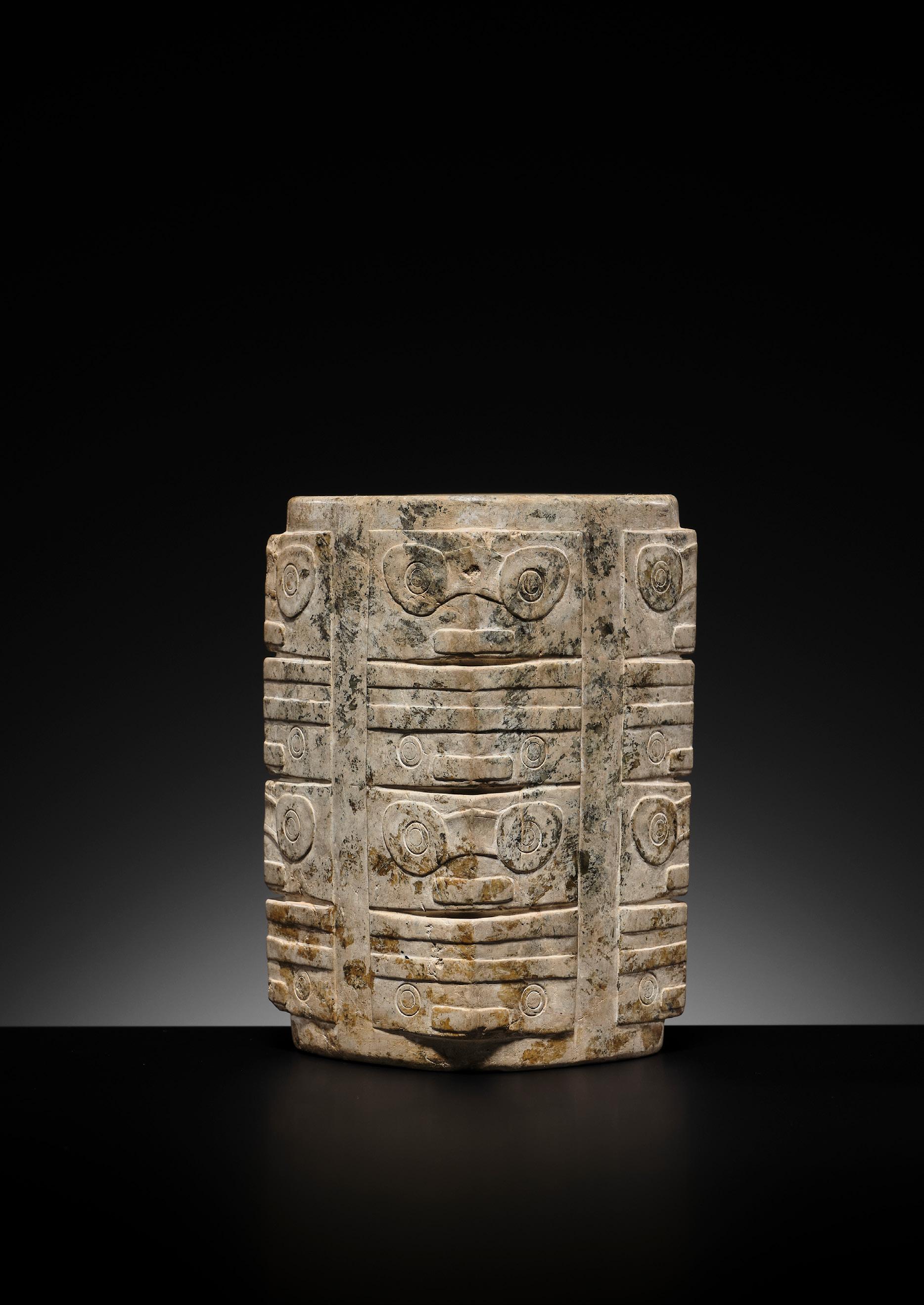
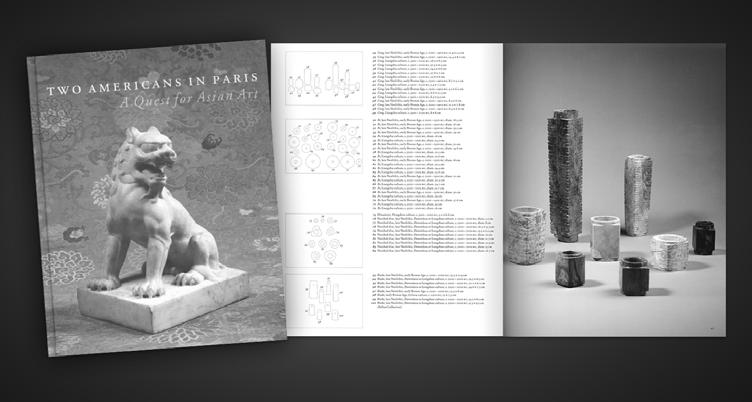
PUBLISHED
Exhibited:
1. Pointe-à-Callière Museum, From the Lands of Asia. The Sam and Myrna Myers Collection, Montréal, 17 November 2016-19 March 2017.
2. Kimbell Art Museum, From the Lands of Asia. The Sam and Myrna Myers Collection, Fort Worth, Texas, 4 March-19 August 2018.
China, c. 3300-2200 BC. Of cylindrical form with square projections on four corners, the sides slightly tapering towards the base, each corner carved with a stylized mask comprising twin bands of narrow parallel grooves above incised circular ‘eyes’ and a short, raised band with rounded ends for the ‘nose’. The opaque stone of brownish and greenish tones with dark inclusions and some areas of creamy-white calcification.
Provenance: The Collection of Sam and Myrna Myers, Paris, France. According to the Myers ledger, this was acquired on 22 July 1996, and has been in the collection for 30 years.
Condition: Very good condition, commensurate with age, with expected wear and inherent natural imperfections, such as inclusions and small fissures. Distinct traces of weathering and erosion, with signs of prolonged burial. Few minuscule nicks and old smoothened chips.
Weight: 1,392 g
Dimensions: Height 23.6 cm
The Liangzhu culture and its remarkable jade artifacts came to prominence in the late 1980s, when the discovery of several significant cemeteries brought international attention to the richness of their tomb contents. Since then, a wave of new archaeological findings has dramatically transformed our understanding of this late Neolithic civilization. At the Mojiaoshan site, Chinese archaeologists have uncovered the remains of a vast, walled settlement covering 750 acres. This site, the largest known walled settlement from late Neolithic China, includes palatial foundations, jade workshops, habitation zones, and a sophisticated network of internal waterways.
Distinguished by their quantity, variety, and superb craftsmanship, Liangzhu jades are among the most iconic artifacts in the history of Chinese civilization. Among them, the jade cong stands out as the most emblematic. These objects feature a square exterior surrounding a circular inner hollow, with each corner serving as a vertical axis for the carving of symmetrical mask motifs. Early examples are typically squat and intricately decorated with deities or animal forms. In contrast, later versions are tall and slender, with stylized facial features dominated by prominent eyes and noses.
The development of tall cong is here fully realized in one of the best known of all types. It belongs to the category of larger cong fully displayed in tomb M3 at Jiangsu Wujin Sidun. Although large examples are abundant in this tomb, fourteen of the thirty-two found are over 20 cm in height. Very few tombs with such an abundance of cong have come to light, though a few large cong have come from smaller tombs. There are a number of large multi-tiered cong in museums in Asia and the West, and these pieces may all have come from one or two large tombs discovered in the late nineteenth or early twentieth century. Large cong must have been known as early as the Song period, when they were copied in Longquan celadon and Guan ware. Ming Wilson (Chinese Jades, London, 2004, pp. 15-16) suggests that the Song potters might have been inspired by the jade cong unearthed during the construction of their new capital at Lin’an, modern-day Hangzhou, where many cong were found in recent decades.
Literature comparison:
Compare two closely related Liangzhu jade cong, one with seven elements and the other with seventeen, both from the collection of Sir Joseph Hotung and now in the British Museum, registration numbers 2022,3034.242 and 2022,3034.241, dated to 3300-2200 BC, 23.3 cm and 49 cm high, in the British Museum, discussed by Jessica Rawson in Chinese Jade from the Neolithic to the Qing, cat. no. 5 and 6, respectively.
AUCTION RESULT COMPARISON
Type: Closely related
Auction: Sotheby’s Hong Kong, 9 April 2024, lot 3603
Price: HKD 1,651,000 or approx. EUR 182,000 converted and adjusted for inflation at the time of writing
Description: A mottled jade cong, Neolithic period, Liangzhu culture
Expert remark: Compare the closely related form, manner of carving, and color of the stone. Note the similar size (23.8 cm).
AUCTION RESULT COMPARISON
Type: Related
Auction: Christie’s Hong Kong, 29 November 2017, lot 2710
Price: HKD 8,500,000 or approx. EUR 1,065,000 converted and adjusted for inflation at the time of writing
Description: An exceedingly rare nine-tiered jade cong, late Liangzhu culture, c. 2600-2300
BC
Expert remark: Compare the closely related form, manner of carving, and color of the stone. Note the similar size (23.5 cm).
Estimate EUR 40,000
Starting price EUR 20,000
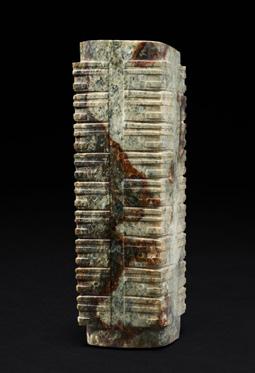
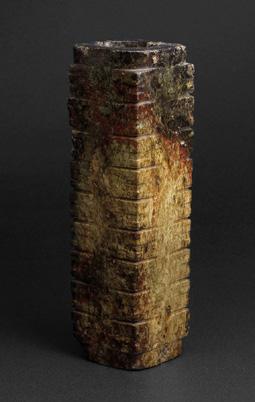
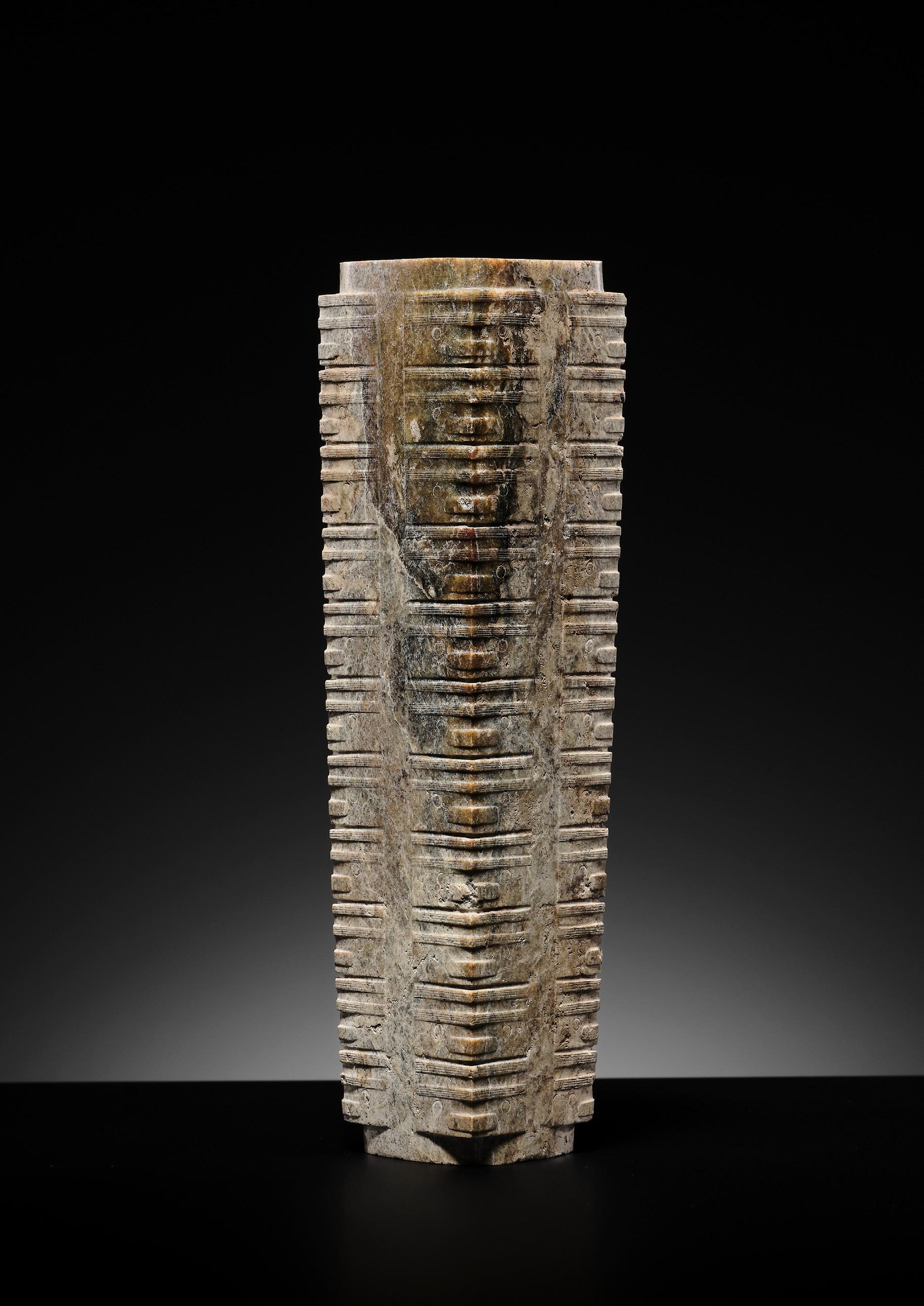
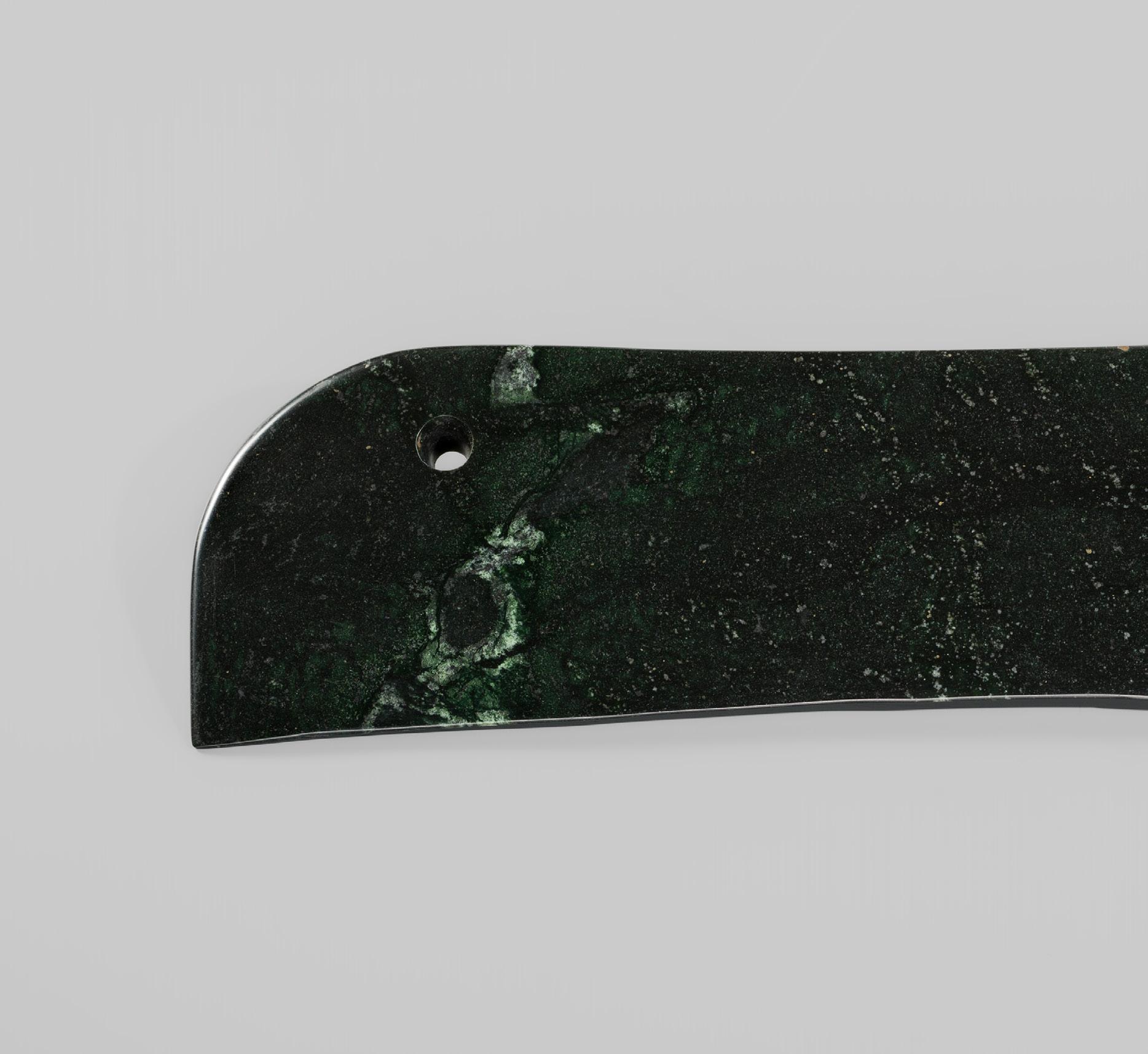
70 A DARK GREEN CEREMONIAL REAPING KNIFE, LATE NEOLITHIC PERIOD, LONGSHAN CULTURE
China, c. 2500-2200 BC. Of rectangular form, thinly carved, with the long edges slightly convex, one corner distinctly rounded, and the cutting edge carefully beveled. The undecorated surface drilled from one side with three equidistant circular perforations aligned near the upper edge, and with two additional adjacent holes placed near one lower corner of the blade. The opaque stone of variegated dark green tones, with whitish speckles and inclusions.
Provenance: The Collection of Sam and Myrna Myers, Paris, France. Acquired between circa 1965-2012.
Condition: Very good condition with minor wear and natural agerelated imperfections. Occasional minuscule nicks and shallow surface scratches.
Weight: 971.9 g
Dimensions: Length 40.8 cm
With a padded silk storage box. (2)
Ceremonial blades carved from jade constitute an important category of objects among Neolithic jade-working cultures. Closely related jade ceremonial blades to the present lot, displaying subtle variations in form and workmanship, have been excavated at a range of Neolithic sites, most notably those associated with the Longshan and Qijia cultures. Some examples later attained truly monumental proportions, such as a knife from Sanxingdui with a damaged length of 162 cm, and an unprovenanced specimen (damaged length 101.9 cm) in the Sonnenschein Collection, Art Institute of Chicago. Several comparably large trapezoidal knives are further distinguished by the presence of grimacing or humanoid imagery, as well as fine serrations, suggesting an increasing degree of ritualization of this form as it spread into the middle Yellow River basin. For an extended discussion of the evolution of these ceremonial jade carvings along the northern bend of the Yellow River, see Jenny F. So, Early Jades in the Harvard Art Museums, 2019, p. 89–90.
Literature comparison:
Compare a closely related dark green jade ceremonial reaping knife, late Neolithic period, Longshan culture, 38.6 cm long, in the National Palace Museum, Taipei, accession number 000688N000000000. Compare a closely related dark green jade trapezoidal knife with indentations, late Neolithic period, Longshan culture, c. 3000-1900 BC, 61 cm long, in the Harvard Art Museums, object number 1943.50.31.
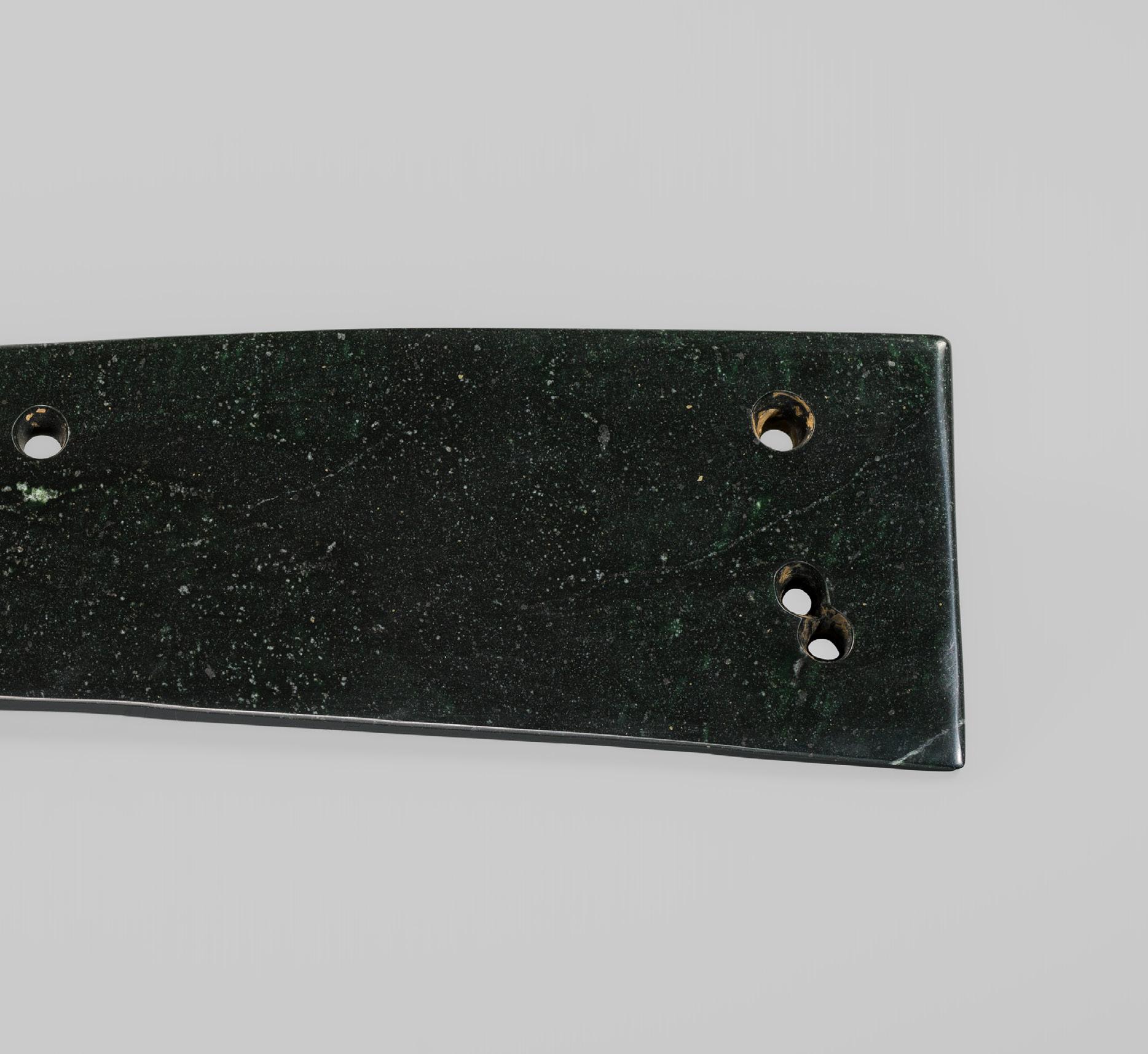
AUCTION RESULT COMPARISON
Type: Closely related
Auction: Christie’s Hong Kong, 27 November 2019, lot 2744
Price: HKD 500,000 or approx. EUR 60,500 converted and adjusted for inflation at the time of writing
Description: A large dark green jade ceremonial reaping knife, late Neolithic period, Longshan culture, c. 2500-2000 BC
Expert remark: Compare the closely related form, manner of carving, and color of the stone. Note the smaller size (33.2 cm).
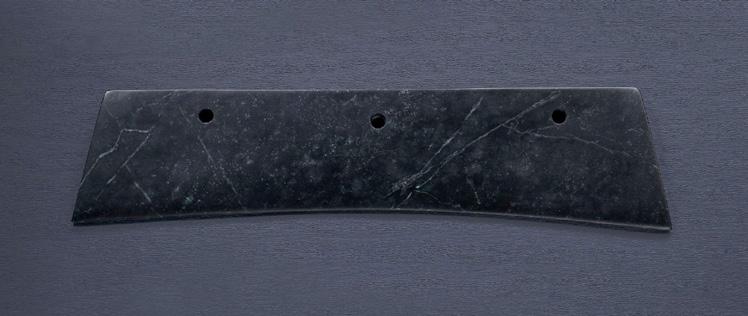
AUCTION RESULT COMPARISON
Type: Related
Auction: Sotheby’s Hong Kong, 9 October 2020, lot 42
Price: HKD 1,000,000 or approx. EUR 118,000 converted and adjusted for inflation at the time of writing
Description: A massive black jade ceremonial blade, late Neolithic period
Expert remark: Compare the related form, manner of carving, and color of the stone. Note the larger size (56.7 cm).
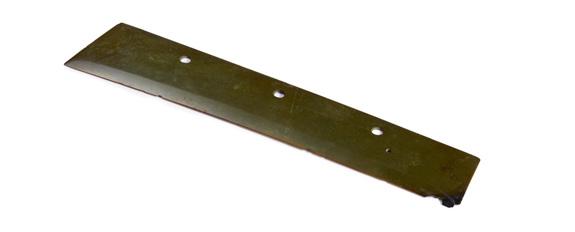
Estimate EUR 10,000
Starting price EUR 5,000
China, c. 2300-1800 BC. The thickly cut blade of gently waisted outline, flaring towards the curved and beveled cutting edge with a bifurcated tip, drilled from one side above the rectangular tang with a circular aperture flanked by pairs of notches with serrated flanges to the edges. The stone of an opaque, partially calcified yellow-green color with patches of russet inclusions and creamy beige tones.
Provenance: The Collection of Sam and Myrna Myers, Paris, France. Acquired between circa 1965-2012.
Condition: Very good condition, commensurate with age. Expected ancient wear, natural fissures, some nibbling, small losses, and an old smoothened chip to the blade.
Weight: 668.6 g
Dimensions: Length 57.8 cm
Large jade blades such as the present example have no direct prototypes among Neolithic stone tools, and the origin of their distinctive shape remains unknown (see Jessica Rawson, Chinese Jade from the Neolithic to the Qing, London, 1995, p. 188). Often finely and thinly carved at considerable scale, these blades suggest a ceremonial function and have also been interpreted as sceptres. While this type flourished during the Erlitou period in the Central Plains, its broader distribution is striking— yet notably focused on two key sites: Guanghan in Sichuan and Shimao in northern Shaanxi (see Yang Boda, ‘Jade Zhang in the Collection of the Palace Museum, Beijing,’ in Chinese Jade. Selected Articles from Orientations 1983-1996, pp. 141-146; and Jessica Rawson, ibid., pp. 188-191). The strong presence of such blades at Shimao, particularly in elite contexts, underscores their importance within its ceremonial and political landscape.
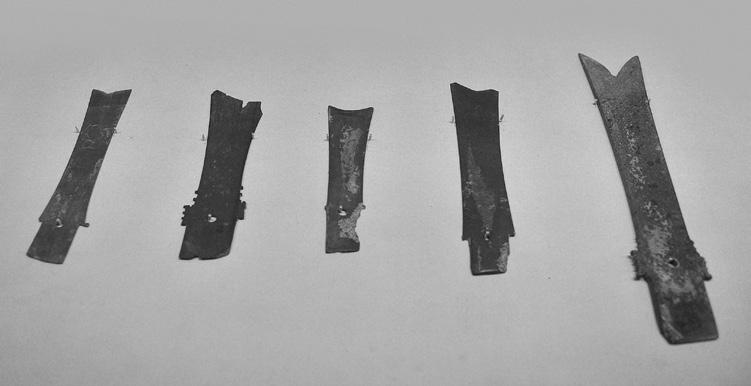
The Shimao Culture has dramatically reshaped how we understand the origins of complex society in ancient China, challenging long-held views that early civilization radiated solely from the Central Plains. Discovered in the 1970s but only recognized as a major urban site decades later,
Shimao was a massive stone-walled city in northern Shaanxi, complete with fortifications, palatial terraces, jade-inlaid walls, and zones for ritual sacrifice. Its monumental architecture—including a stepped pyramid crowned by elite residences—and its evidence of advanced craft production and longdistance exchange suggest it was not a periphery, but a dynamic heartland. Far from being a passive recipient of influence, Shimao appears to have been a powerful, independent center of exchange and innovation at the origin of many Middle Yellow River traditions, which would inform the development of the slightly later Erlitou culture.
EXPERT’S NOTE
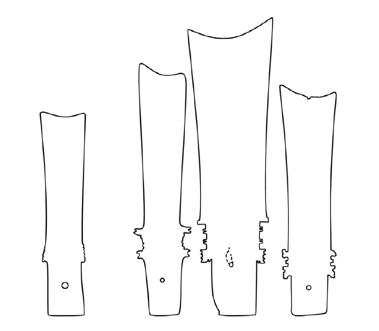
The present blade is also comparable to examples excavated from ritual pits at the Xinzhai Wenhuazui site in Henan province (see Deng Cong, Yazhang yu guojia qiyuan, Beijing, 2018, no. 4), further supporting its function in pre-Erlitou sacrificial contexts. According to research by Japanese archaeologist Okamura Hidenori, the yazhang originated as a ritual object used in sacrificial rites before the Erlitou Culture, becoming one of the most important ceremonial jade types during the Erlitou period itself.
Literature comparison:
Compare a related jade blade, dated to late Shang to Western Zhou dynasty, 43 cm long, in the Jinsha Site Museum, Chengdu. Compare a related jade blade, dated to the Shang dynasty, 54 cm long, in the Crocker Art Museum, Sacramento, accession number 2022.15.6.
AUCTION RESULT COMPARISON
Type: Closely related
Auction: Christie’s New York, 14 September 2012, lot 1002
Price: USD 74,500 or approx. EUR 79,500 converted and adjusted for inflation at the time of writing
Description: A brownish-olive jade ceremonial blade, yazhang
Expert remark: Compare the closely related stone, manner of carving, and size (30.5 cm), and related form.
Estimate EUR 15,000
Starting price EUR 7,500
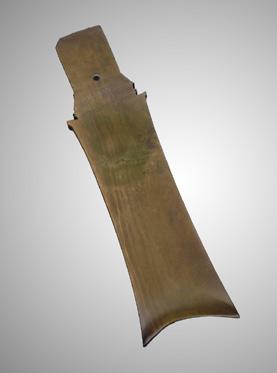
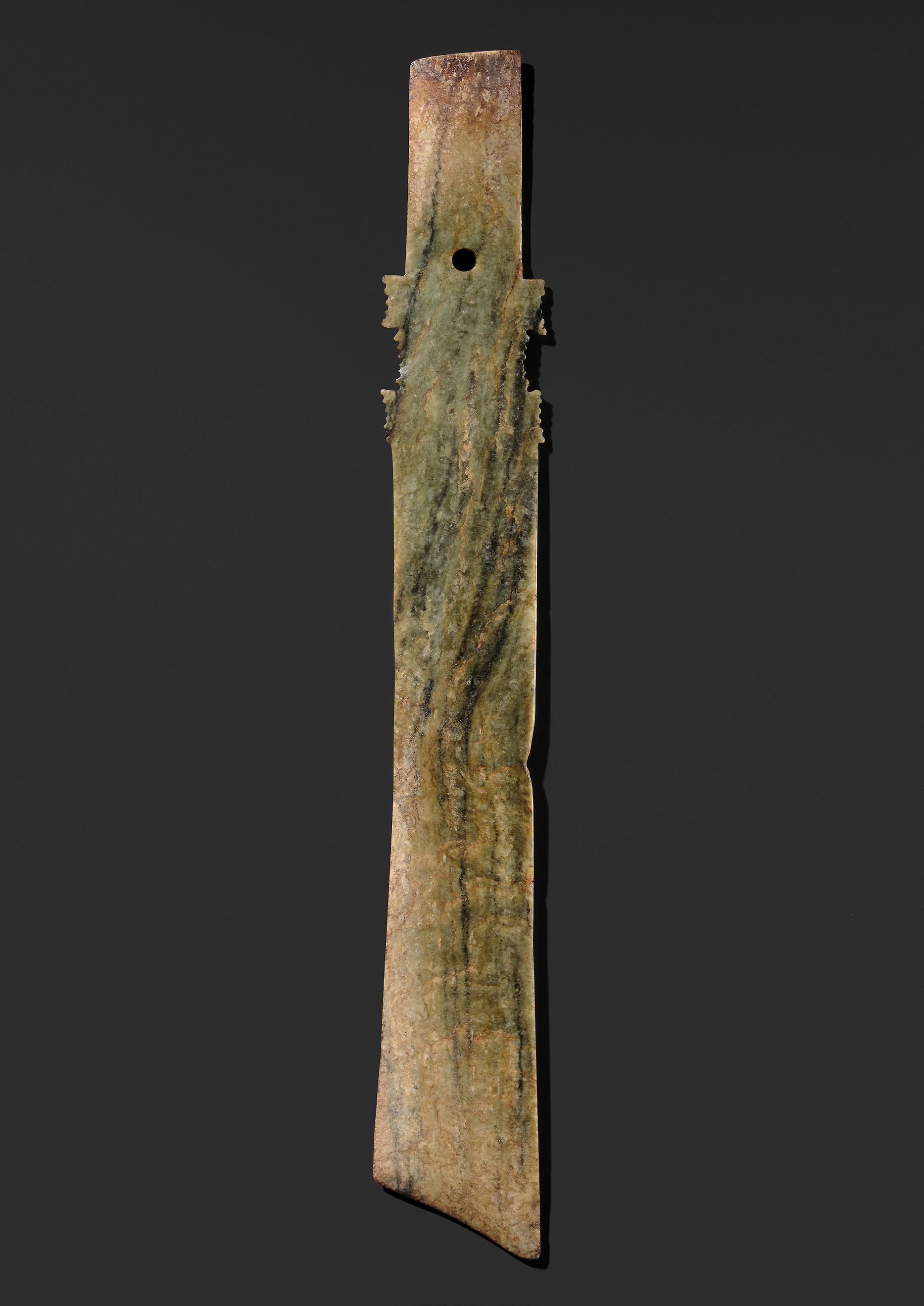
China, c. 2300-1800 BC. The gently waisted blade flaring towards the strikingly curved end, opposite the tang on the other end above a pierced hole and toothed projections on either side. The mostly opaque stone of a dark green hue with black shadings, streaks, and specks.
Provenance: The Collection of Sam and Myrna Myers, Paris, France. Acquired between circa 1965-2012.
Condition: Very good condition, commensurate with age, with ancient wear and inherent natural imperfections, such as inclusions and small fissures. Smoothened chips and losses. Ancient cracks (possibly breaks) with signs of old restoration. Occasional minute nicks and shallow surface scratches. The stone surface with small areas of soil encrustation.
Weight: 432.5 g
Dimensions: Length 48.2 cm
Large jade blades such as the present example have no direct prototypes among Neolithic stone tools, and the origin of their distinctive shape remains unknown. Often finely and thinly carved at considerable scale, these blades suggest a ceremonial function and have also been interpreted as scepters. While this type flourished during the Erlitou period in the Central Plains, its broader distribution is striking, yet notably focused on two key sites, Guanghan in Sichuan and Shimao in northern Shaanxi. The strong presence of such blades at Shimao, particularly in elite contexts, underscores their importance within its ceremonial and political landscape. See Yang Boda, Jade Zhang in the Collection of the Palace Museum, Beijing, in Chinese Jade. Selected Articles from Orientations 1983-1996, p. 141-146; and Jessica Rawson, Chinese Jade from the Neolithic to the Qing, 1995, p. 188-191.
The Shimao Culture has dramatically reshaped how we understand the origins of complex society in ancient China, challenging long-held views that early civilization radiated solely from the Central Plains. Discovered in the 1970s but only recognized as a major urban site decades later, Shimao was a massive stone-walled city in northern Shaanxi, complete with fortifications, palatial terraces, jade-inlaid walls, and zones for ritual sacrifice. Its monumental architecture, including a stepped pyramid crowned by elite residences, and its evidence of advanced craft production and long-distance exchange suggest it was not a periphery, but a dynamic heartland. Far from being a passive recipient of influence, Shimao appears to have been a powerful, independent center of exchange and innovation at the origin of many Middle Yellow River traditions, which would inform the development of the slightly later Erlitou culture.
Expert’s note:
The present blade is also comparable to examples excavated from ritual pits at the Xinzhai Wenhuazui site in Henan province, further supporting its function in pre-Erlitou sacrificial contexts. According to research by Japanese archaeologist Okamura Hidenori, the ‘yazhang’ originated as a ritual object used in sacrificial rites before the Erlitou Culture, becoming one of the most important ceremonial jade types during the Erlitou period itself. See Deng Cong, Yazhang yu guojia qiyuan, Beijing, 2018, no. 4.
AUCTION RESULT COMPARISON
Type: Closely related
Auction: Sotheby’s Hong Kong, 9 April 2024, lot 3610
Price: HKD 5,842,000 or approx. EUR 650,000 converted and adjusted for inflation at the time of writing
Description: A rare and large jade ceremonial blade (yazhang), Neolithic period to early Shang dynasty, c. 2000-1500 BC
Expert remark: Compare the closely related form, manner of carving, and color of the stone. Note the smaller size (35.8 cm).
AUCTION RESULT COMPARISON
Type: Closely related
Auction: Christie’s Hong Kong, 30 November 2020, lot 2702
Price: HKD 2,250,000 or approx. EUR 264,000 converted and adjusted for inflation at the time of writing
Description: A dark green jade ceremonial blade (yazhang), Erlitou culture or slightly earlier
Expert remark: Compare the closely related form, manner of carving, and color of the stone, with similar toothed projections. Note the smaller size (32 cm).
Estimate EUR 15,000
Starting price EUR 7,500
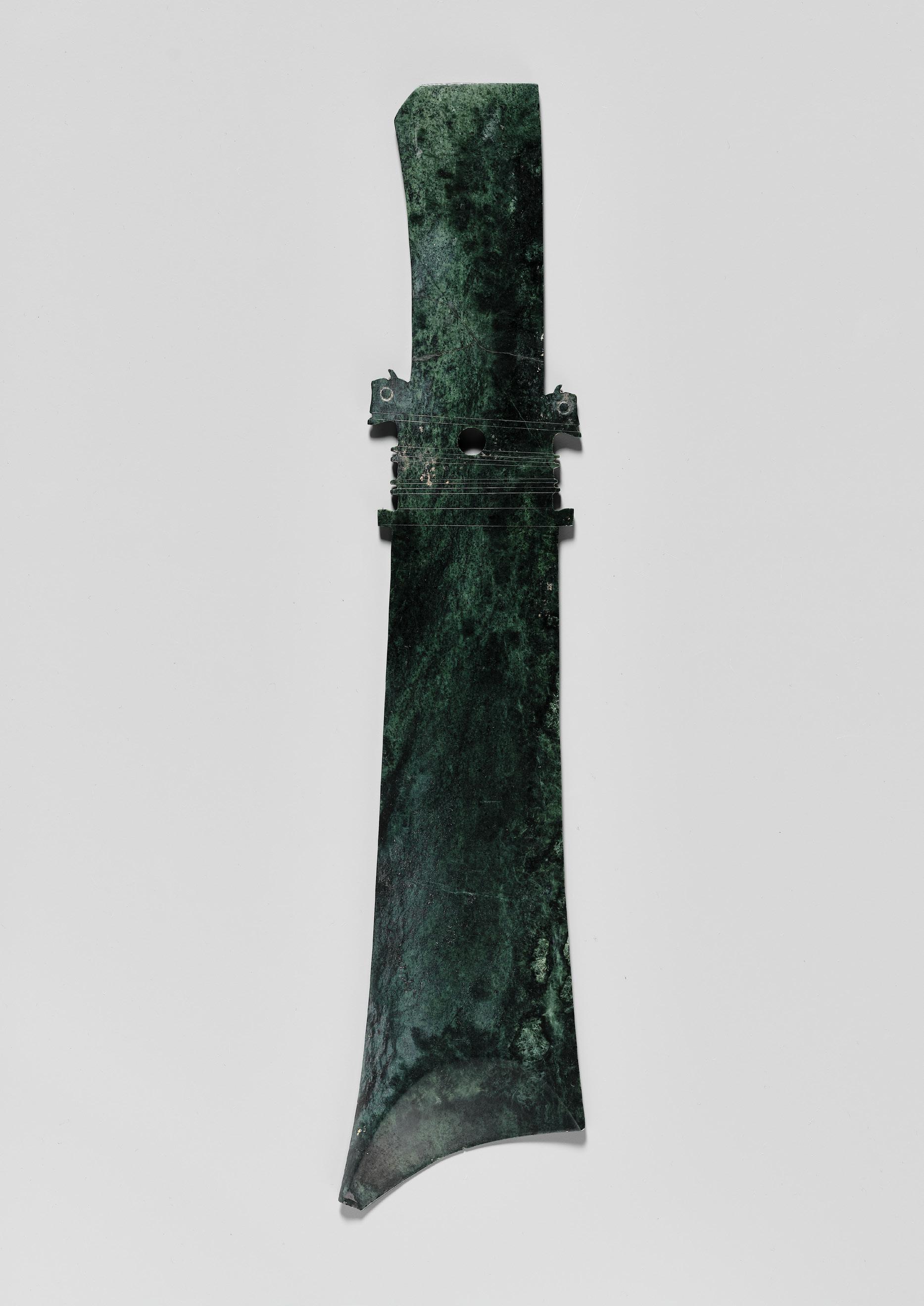
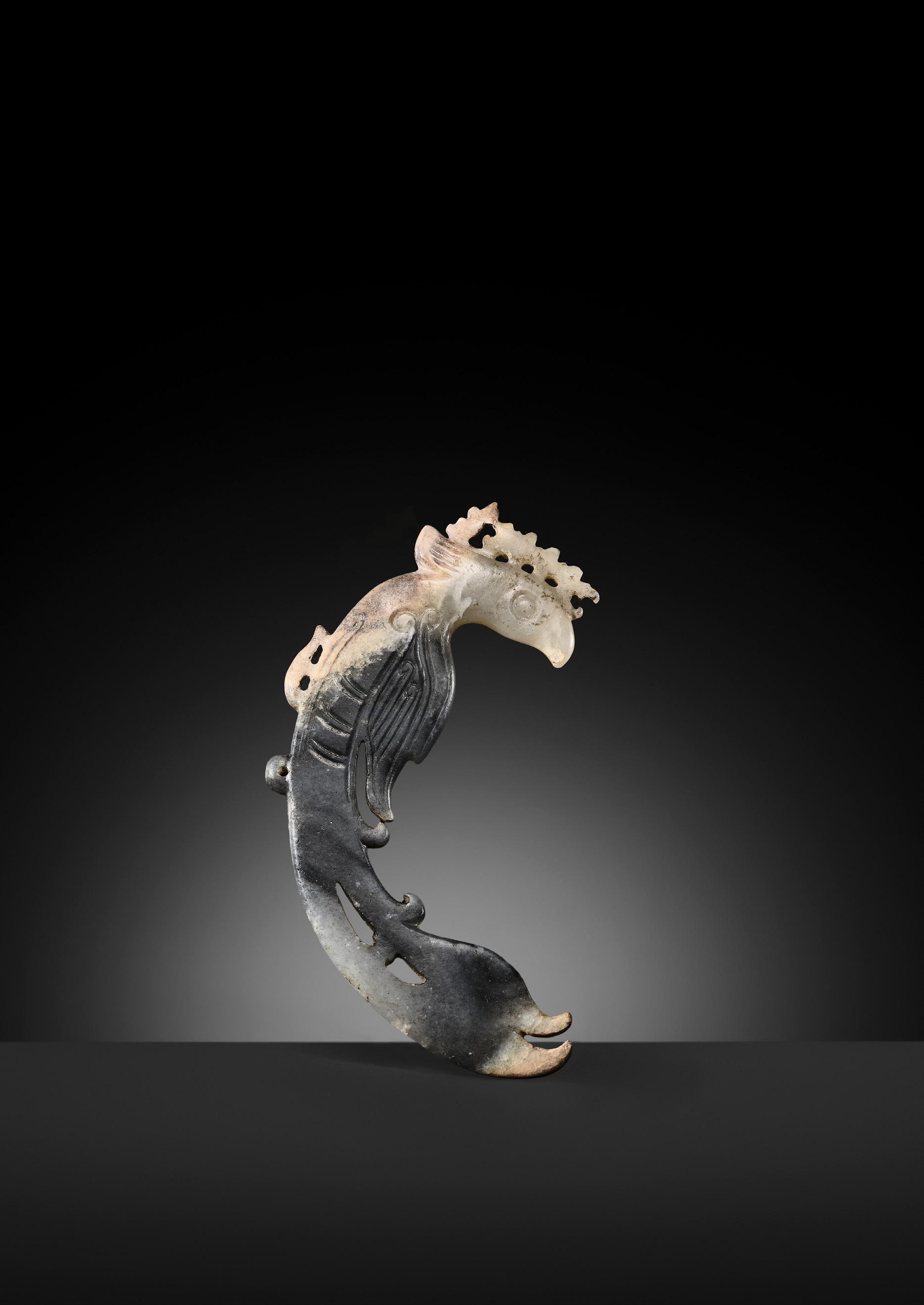
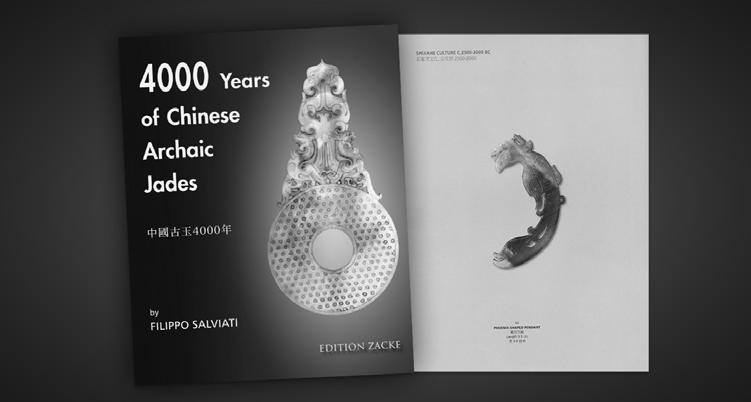
PUBLISHED
Filippo Salviati, 4000 Years of Chinese Archaic Jades, 2017, p. 40, no. 45.
China, 2200-1600 BC. Finely carved, the curved and flattened pendant carved in the form of a phoenix with a crest pierced in several places, round bulging eyes, neatly incised wings, and furcated tail. The translucent stone of blackish-gray and white tones with patches of cream and brown.
Provenance: Collection of Irene and Wolfgang Zacke, Vienna, Austria. Galerie Zacke, Vienna, 21 October 2021, lot 72 (sold for EUR 9,480 or approx. EUR 11,500 adjusted for inflation at the time of writing).
The Collection of Sam and Myrna Myers, Paris, France, acquired from the above.
Condition: Very good condition with minor wear and inherent natural imperfections. Light traces of weathering and erosion. Few minute nicks, shallow surface scratches, and occasional minuscule chips. and losses here and there.
Weight: 22.5 g
Dimensions: Length 9.2 cm
The jade-working tradition in the lower Yangzi River region was carried forward by the Shijiahe culture (Tianmen County, Hubei, c. 25002000 BC) after the abrupt end of the Liangzhu culture shortly before 2000 BC, for reasons that remain unclear and are likely related to a combination of climatic and social changes. Shijiahe jades exhibit a high level of technical refinement: decorative motifs were executed in relief rather than incised, and openwork carving were frequently employed. Human heads, masks, and bird motifs, probably derived from Liangzhu prototypes, constituted the principal categories of Shijiahe ornament.
The present phoenix-like jade carving closely corresponds to a comparable jade excavated from the late Shang dynasty tomb of Fu Hao (c. 1200 BC), sharing a gently curved body, elongated tail, and crested head. This parallel attests to the wide circulation of Shijiahe jades beyond the original geographical boundaries of the culture. Furthermore, Shijiahe facial motifs were partially adopted in the jades of the subsequent Longshan culture (c. 2600-1900 BC), contributing to the dissemination in central China of forms and decorative schemes originally developed by the jade-working cultures of southern China.

Prof. Filippo Salviati
The Tomb of Fu Hao is an important archaeological site located at Yinxu, the ruins of the ancient Shang dynasty capital Yin, within modern-day Anyang in Henan Province, China. Discovered in 1976 by archaeologist Zheng Zhenxiang, the tomb was identified as the final resting place of Queen and military general Fu Hao, who died around 1200 BC. Fu Hao is believed to be the Lady Hao mentioned in oracle bone inscriptions by King Wu Ding and one of his many wives. The tomb contained an extraordinary array of artifacts, including 755 jade objects, which encompassed both contemporary Shang jades and older pieces from the Longshan, Liangzhu, Hongshan, and Shijiahe cultures.
Literature comparison:
Compare a closely related jade carving of a phoenix, Shang dynasty, Anyang phase, c. 1300-1050 BC, 13.6 cm long, unearthed from the tomb of Fu Hao, Anyang, Henan province, in 1976, and held by the National Museum of China.
AUCTION RESULT COMPARISON
Type: Related
Auction: Christie’s Hong Kong, 29 November 2017, lot 2723
Price: HKD 1,250,000 or approx. EUR 157,500 converted and adjusted for inflation at the time of writing
Description: A jade tiger, late Neolithic period, post-Shijiahe culture, c. 2100-1600 BC
Expert remark: Compare the related form and manner of carving. Note the similar size (9.7 cm).
Estimate EUR 8,000
Starting price EUR 4,000
74 AN EXCEEDINGLY RARE JADE SACRIFICIAL VESSEL IN THE FORM OF A MYTHICAL CREATURE WITH TAOTIE IMAGERY, POSSIBLY SHANG TO WESTERN ZHOU DYNASTY
China, c. late 2nd to early 1st millennium BC or later. Boldly carved in the form of an anthropomorphic kneeling creature, distinguished by a powerful beast-like head with a fierce expression, defined by a pair of bulging eyes, a prominent snout, and a gaping mouth revealing its tongue and sharp fangs. The arms of the figure raised above the shoulders to support a vessel with deep sides and a slightly everted rim. The exterior embellished with a subtle scrolling pattern and abstract animal masks carved in high relief against the rough texture of the ensemble. The semi-translucent stone, originally of soft celadon tone, overall deeply corroded from long-time burial.
Provenance: The Collection of Sam and Myrna Myers, Paris, France. According to Sam Myers acquired between circa 1980 and 2000 and in the collection for at least 25 years, probably longer.
Condition: Fair condition, commensurate with age, with ancient wear and inherent natural imperfections. Distinct traces of weathering and burial corrosion. Small perforations and evidence of breakage to the vessel, with associated signs of restoration visible under UV light examination. Scattered small nicks and few minor chips, mostly along the rim. The stone surface with pronounced areas of soil encrustation and signs of natural alteration.
Weight: 839.9 g
Dimensions: Height 17.3 cm
Although its precise meaning and origins remain uncertain and its function has been variously interpreted, this characteristic animal face was closely associated with religious and ceremonial contexts, as the objects on which it appears are almost invariably linked to such events or functions. Its totemic presence is thought to constitute a symbolic representation of the forces of nature. Typical features of the mask include large, prominent eyes; stylized eyebrows, horns, nose crest, and ears; a curled upper lip bearing exposed fangs with no lower jaw; and, in some cases, two lateral legs.
Expert’s note:
Both the cultural attribution and dating must remain hypothetical, as no directly comparable examples are known. The surface of the present figure, subtly carved in high relief with a repeated pattern of distinctive taotie masks, aligns it with hardstone artifacts produced during the Shang dynasty and early Western Zhou period. Moreover, the state of preservation, with extensive areas of burial corrosion and color alteration indicative of millennia of interment, suggests considerable age. Nonetheless, in the absence of direct comparanda, a precise chronological or geographical attribution cannot currently be established.
Estimate EUR 10,000
Starting price EUR 5,000
Taotie is the term employed by modern scholars to designate an ancient Chinese mythological creature frequently depicted on bronze and jade artifacts from the late 2nd millennium BC. Taotie masks became a central element of Shang ritual art and were particularly prominent in the decorative schemes of Western Zhou bronze vessels known as ‘dings’, three- to four-legged cauldrons used in food rituals (fig. 1), as well as other types of ritual wine vessels (fig. 2). Over time, the motif also gained independent status as a distinctive formal and decorative feature of the period (fig. 3-4).
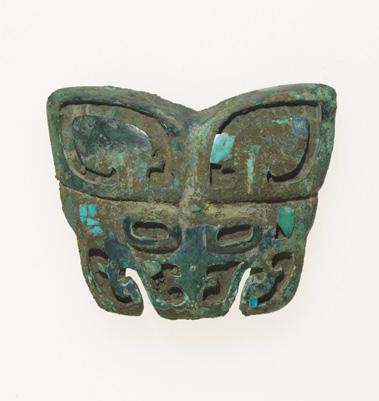
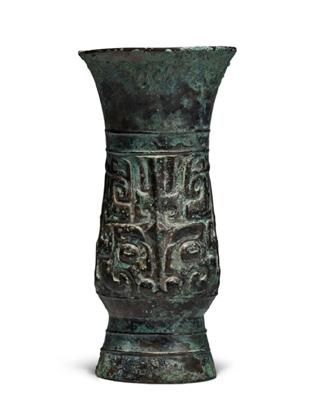
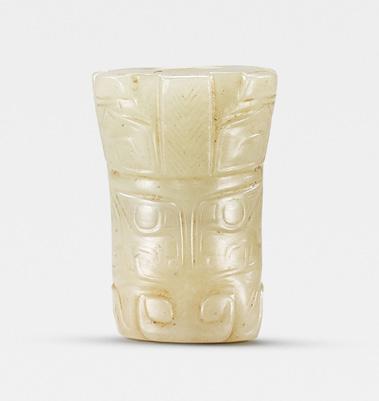
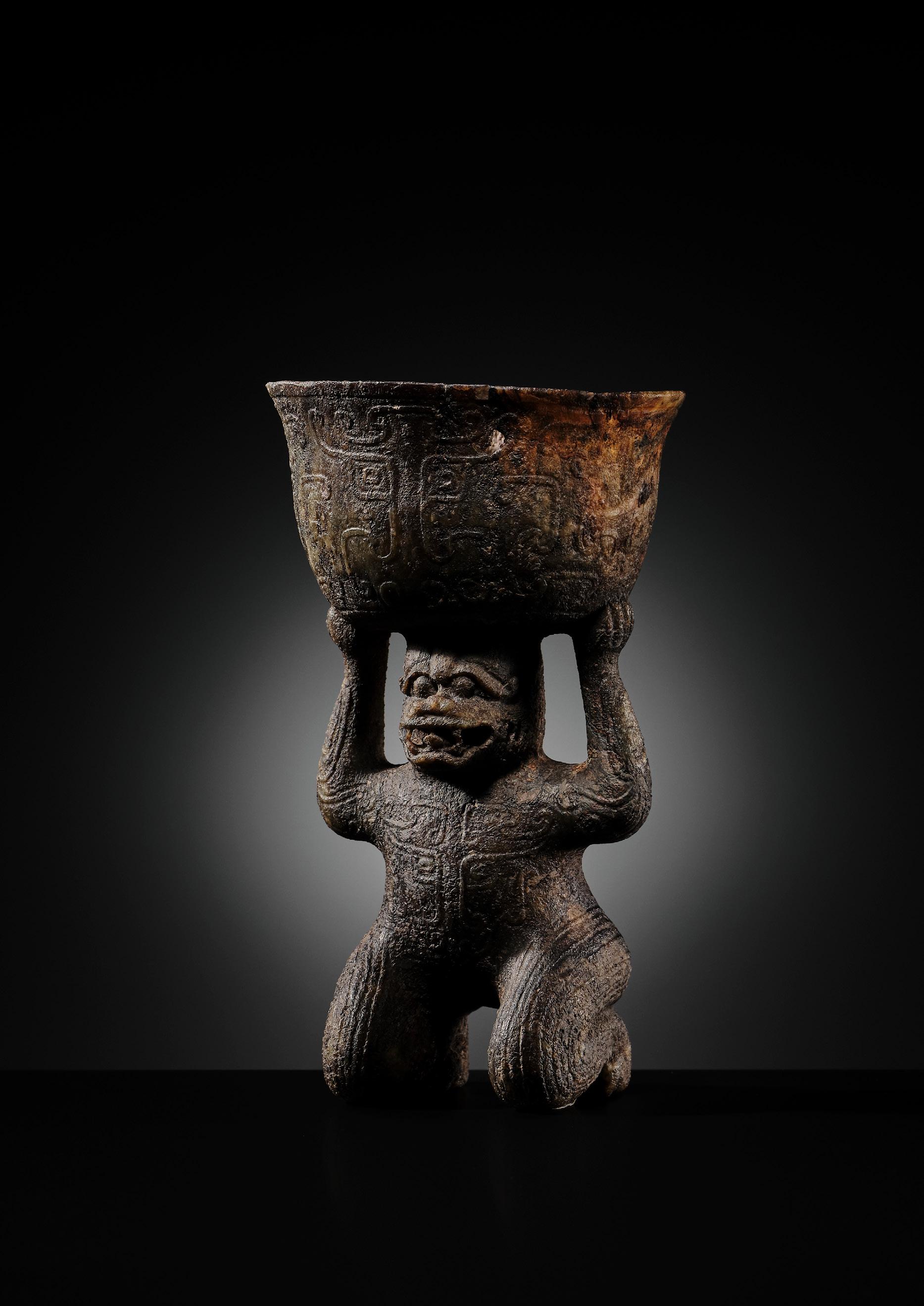
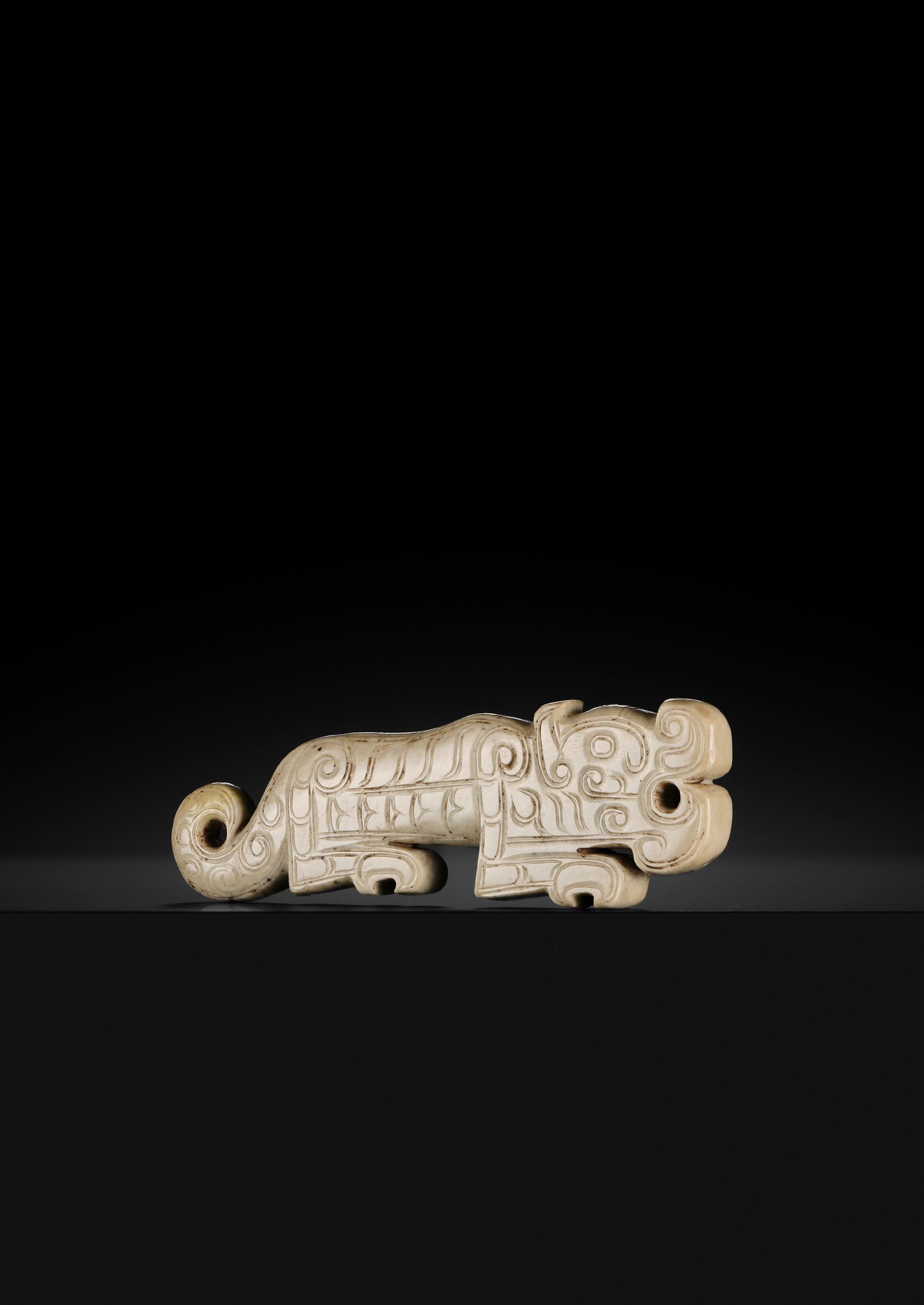
China, c. 1600-1050 BC. Finely carved in the form of a crouching tiger in profile, its body with legs tucked beneath, decorated with delicately incised double-line grooves, extending into a curled tail and a powerful head with gaping mouth, both pierced for suspension. The opaque stone of an attractive whitish tone, accented with dark speckles and cloudy inclusions.
Provenance: The Collection of Sam and Myrna Myers, Paris, France. Acquired between circa 1965-2012.
Condition: Very good condition, commensurate with age, with minor wear and inherent natural imperfections, such as inclusions and fissures, some of which have developed into small hairlines. Light traces of weathering and erosion. Few minute nicks, shallow surface scratches, and occasional minuscule chips. The stone surface with small areas of soil encrustation.
Weight: 80.8 g
Dimensions: Length 11.1 cm
The tiger, called ‘hu’ or ‘laohu’ in Chinese, is among the most recognizable charismatic megafauna worldwide. Originating in China and northern Central Asia, the tiger was known to the earliest Chinese, who likely feared, admired, and respected it for its strength, ferocity, and regal bearing. Although precise symbolism during the Shang period (c. 1600-1046 BC) remains unknown, the tiger certainly fulfilled a totemic, tutelary, and talismanic function. By the Western Han period (206 BC–9 AD), roughly a millennium after the production of this pendant, the tiger was regarded as the ‘king of the hundred beasts’ (baishou zhi wang), due to its power and ferocity, as well as distinctive forehead markings that commonly resemble the character ‘wang’, meaning ‘king’. In addition, not only did the tiger figure among the twelve animals of the Chinese zodiac, but it gained a place among the auspicious animals that symbolize the four cardinal directions: the White Tiger, or ‘baihu’, of the west, the Azure Dragon of the east, the Vermilion Bird of the south, and the Black Tortoise of the north.
Jade tigers of this type appear to be directly derived from contemporary depictions of tigers on bronzes produced in southern China. Jessica Rawson has addressed this formal and iconographic correspondence in Chinese Jade from the Neolithic to the Qing, 1995, p. 206, where she illustrates a line drawing of a bronze tiger and a jade exemplar from the tomb of Lady Fu Hao, consort of King Wu Ding (r. 1324-1265 BC). Further closely related examples of tiger carvings are attested in the reference book Tomb of Lady Hao at Yinxu in Anyang, 1980, pl. 135.
AUCTION RESULT
COMPARISON
Type: Closely related
Auction: Christie’s Hong Kong, 30 November 2020, lot 2727
Price: HKD 437,500 or approx. EUR 52,500 converted and adjusted for inflation at the time of writing
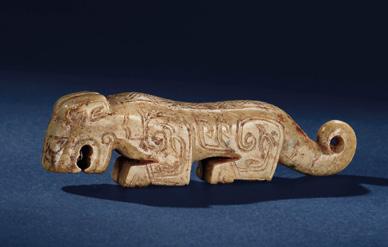
Description: A jade carving of a tiger, Shang dynasty, c. 1600-1046 BC
Expert remark: Compare the closely related recumbent pose of the animal, with analogous manner of carving and incised double-lined decoration. Note the much smaller size (8.3 cm).
AUCTION RESULT COMPARISON
Type: Closely related
Auction: Sotheby’s Hong Kong, 2 April 2019, lot 3443
Price: HKD 350,000 or approx. EUR 43,500 converted and adjusted for inflation at the time of writing
Description: A celadon and russet jade figure of a beast, Shang dynasty Expert remark: Compare the closely related recumbent pose of the animal, with analogous manner of carving and incised double-lined decoration. Note the slightly similar size (10.3 cm).
Estimate EUR 10,000
Starting price EUR 5,000
China, c. 1300-1050 BC. Thinly carved, the large, straight blade terminating in a pointed tip, the tang pierced by a single perforation drilled from one side, decorated in high relief with a taotie mask and a phoenix on either face, while one side additionally inscribed with an array of six finely incised ideograms.
The translucent stone of a celadon tone, with extensive areas of white calcification and russet veining.
Provenance: The Collection of Sam and Myrna Myers, Paris, France. Acquired between circa 1965-2012.
Condition: Good condition, commensurate with age, with surface wear and inherent natural imperfections, such as inclusions and small fissures. Expected traces of weathering. Minor nibbling along the edges and few minute chips, one of them visibly reattached. Scattered minuscule nicks and shallow surface scratches. Calcification and surface alteration.
Weight: 339.4 g
Dimensions: Length 40.1 cm
With an associated padded storage box. (2)
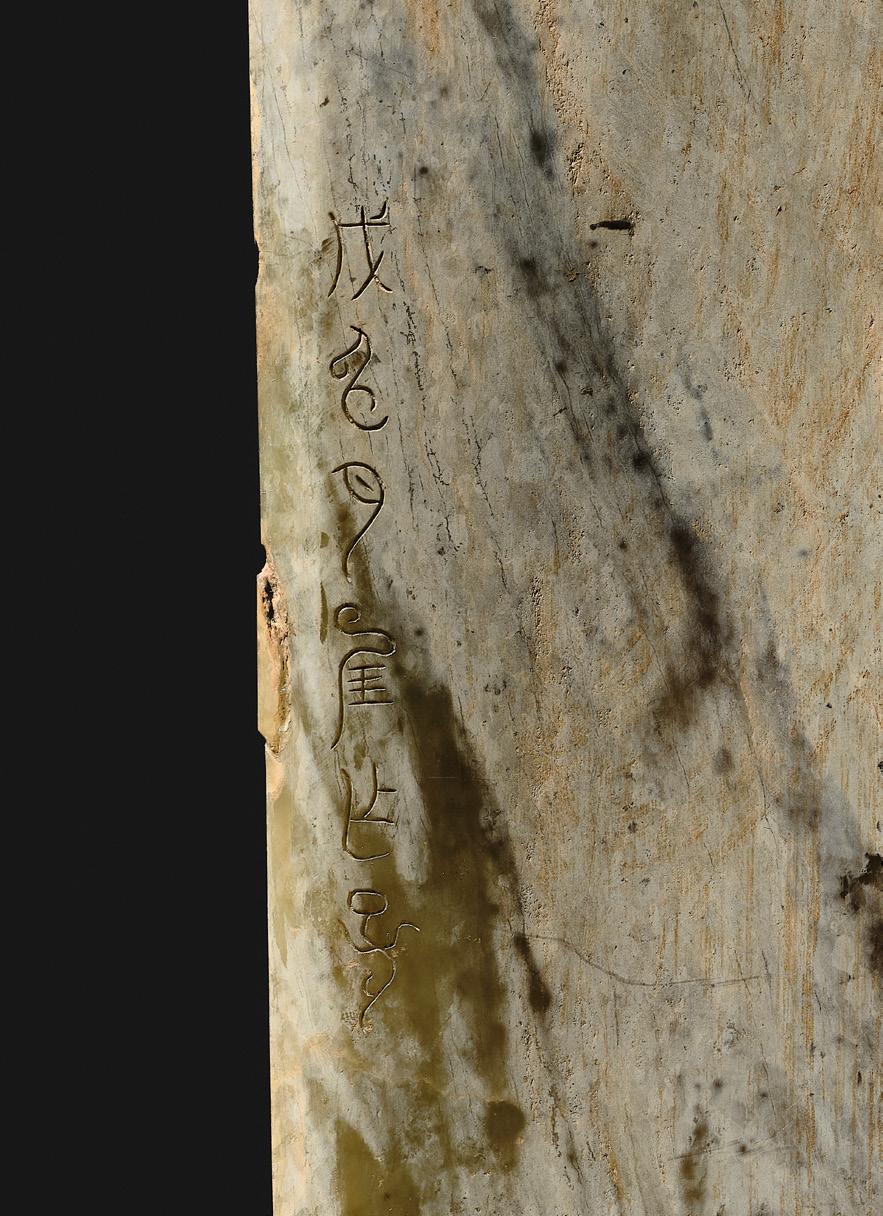
Following the invention of bronze, weapons such as blades and daggers were also produced in more refined materials, notably jade, for ceremonial purposes. The present blade represents a jade adaptation of a weapon type widely distributed across many regions of China during the Shang period, distinguished by its characteristic V-shaped outline. The perforation in the tang indicates the point at which the blade was originally mounted onto a wooden shaft. Unusually, the tang is decorated on both sides with a stylized phoenix and a taotie mask, the latter being one of the principal motifs of the Shang artistic repertoire.
The significance of such ceremonial blades within Shang dynasty society is underscored by both the quantity and the exceptional quality of examples excavated from the tomb of Fu Hao (d. c. 1200 BC), consort of King Wu Ding (r. 1324–1266 BC). Discovered near the Shang capital of Anyang in Henan province, her tomb offers valuable insight into the diversity of scale, design, and technical refinement achieved in jade carving during her lifetime.
See Yinxu Fu Hao mu / Tomb of Lady Hao at Yinxu in Anyang, 1980, pl. 107113, and Jessica Rawson, Chinese Jade. From the Neolithic to the Qing, 1995, p. 40–41.
LITERATURE COMPARISON
Compare a related jade ceremonial dagger-axe (ge) with animal masks, Shang dynasty, c. 1600-1046 BC, 4.4 cm long, in the Cleveland Museum of Asian Art, accession number 1983.2. Compare a closely related jade dagger-axe with ‘taotie’ design, Shang to Western Zhou dynasty, 11th-10th century BC, 11 cm long, in the Harvard Art Museums, object number 1943.50.91, illustrated in Max Loehr and Louisa G. Fitzgerald Huber, Ancient Chinese Jades from the Grenville L. Winthrop Collection in the Fogg Art Museum, 1975, cat. no. 67.
AUCTION RESULT COMPARISON
Type: Closely related
Auction: Sotheby's New York, 13 October 2021, lot 3670
Price: HKD 2,268,000 or approx. EUR 272,500 converted and adjusted for inflation at the time of writing
Description: A massive archaic jade ceremonial blade (ge), Shang dynasty
Expert remark: Compare the closely related form, manner of carving, and color of the stone. Note the larger size (54 cm).
AUCTION RESULT COMPARISON
Type: Closely related
Auction: Sotheby's New York, 22 March 2011, lot 63
Price: USD 68,500 or approx. EUR 84,500 converted and adjusted for inflation at the time of writing
Description: A rare archaic jade dagger, late Shang dynasty to early Western Zhou dynasty
Expert remark: Compare the closely related form, manner of carving with similar ‘taotie’ decoration and color of the calcified stone. Note the much smaller size (14 cm).
Estimate EUR 30,000
Starting price EUR 15,000
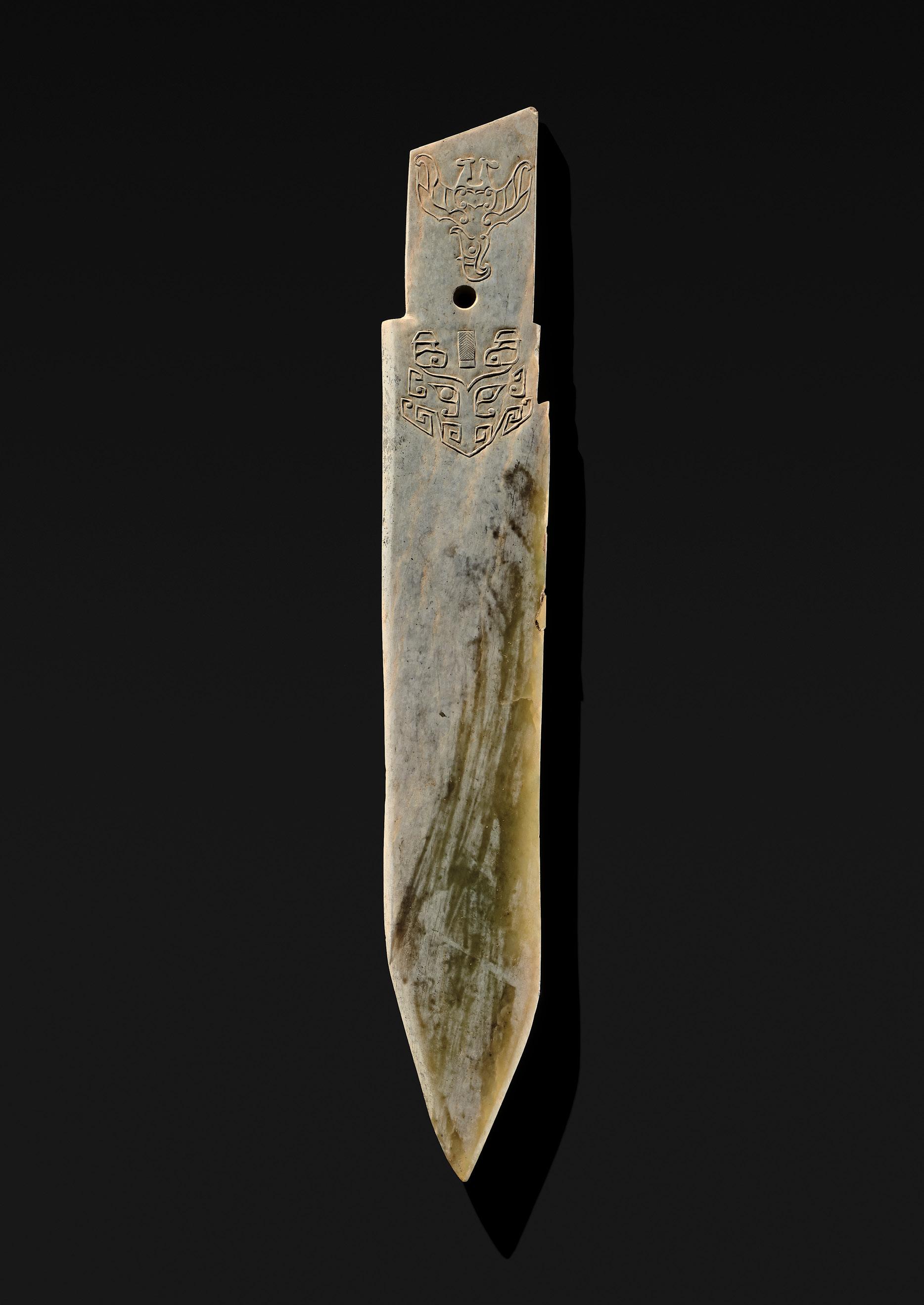
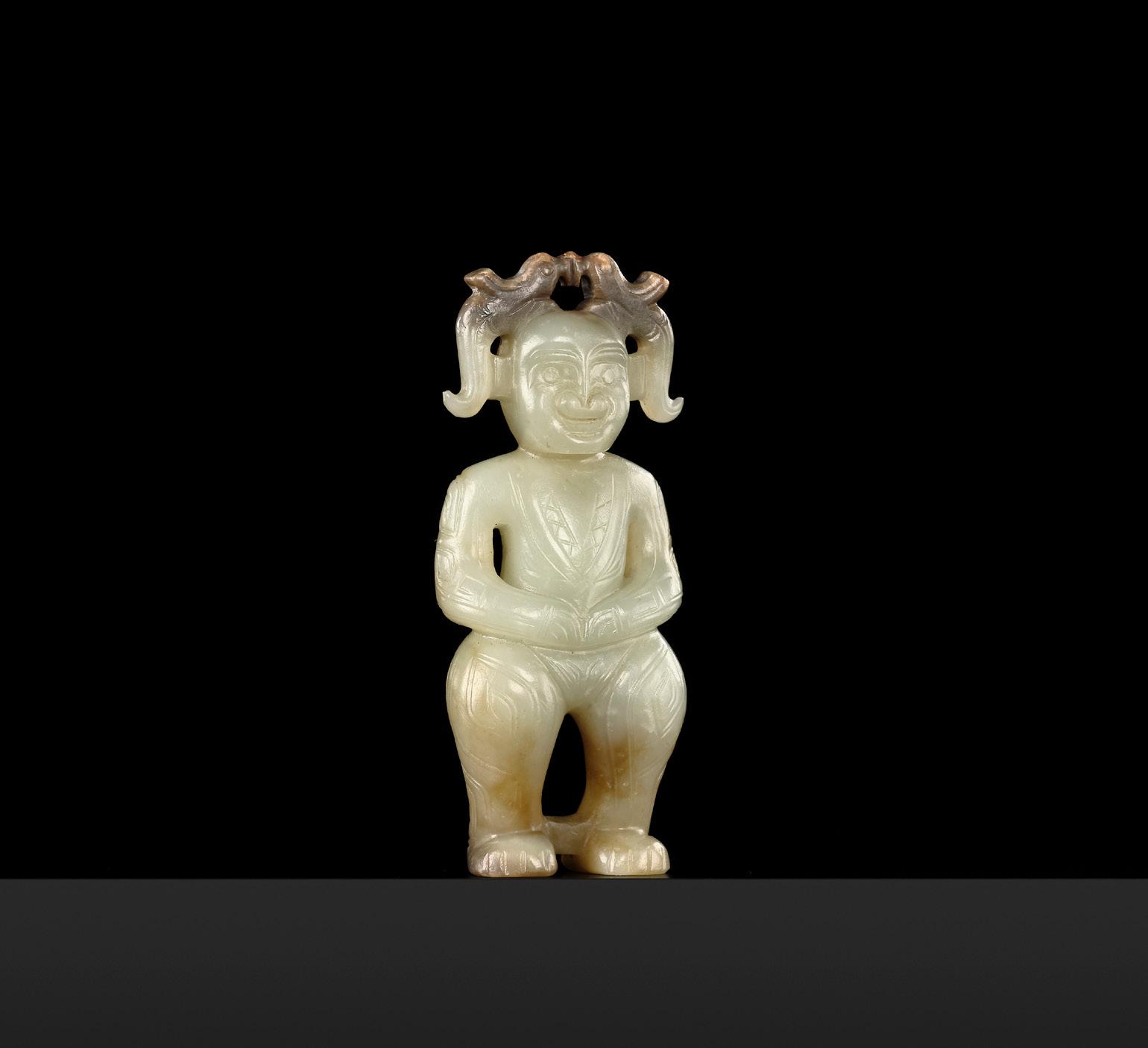
77 A PALE CELADON AND BROWN JADE STANDING FIGURE, WESTERN ZHOU DYNASTY
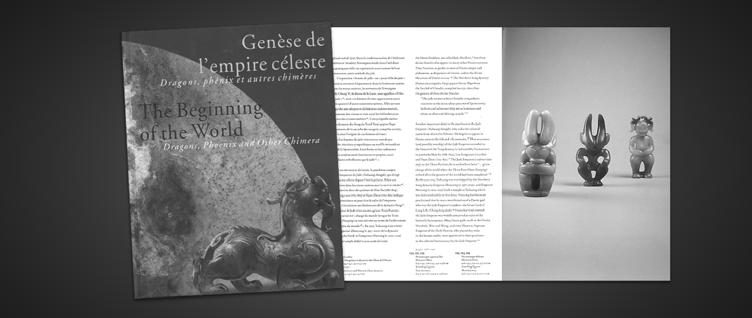
PUBLISHED
Jean-Paul Desroches (ed.) et al, The Beginning of the World. Dragons, Phoenix and Other Chimera, Fondation Baur, Geneva, 2020, p. 196-197, no. 119.
Exhibited:
1. Musée Départemental des Arts Asiatiques, The Beginning of the World – According to the Chinese. Dragons, Phoenix and Other Chimera, Nice, Summer 2021.
2. Fondation Baur, The Beginning of the World – According to the Chinese. Dragons, Phoenix and Other Chimera, Geneva, 11 November 2020-23 May 2021.
China, 1046-771 BC. Boldly carved in a standing posture with the hands joined before the belly, the figure displays a square face incised with a broad nose and circular eyes, the head surmounted by a pair of birds with trailing feathers. The body is detailed with archaic scrollwork throughout. The semi-translucent stone is of pale celadon tone with areas of brown and russet coloration.
Provenance: The Collection of Sam and Myrna Myers, Paris, France. Acquired between circa 1965-2012.
Condition: Very good condition with minor wear, nibbling, and natural fissures, some of which have developed into thin hairline cracks.
Weight: 84.9 g
Dimensions: Height 9.1 cm
LITERATURE COMPARISON
Compare a related pale celadon pendant of a standing figure, but dated Eastern Zhou dynasty to Warring States period, 4.2 cm tall, accession number S1987.482 (fig. 1). Compare a related pale celadon jade figure of a man with headdress, dated to the 10th century BC, 7 cm tall, in the British Museum, museum number 1945,1017.39.
AUCTION RESULT COMPARISON
Type: Related
Auction: Sotheby’s Hong Kong, 22 April 2021, lot 26
Price: HKD 327,600 or approx. EUR 39,000 converted and adjusted for inflation at the time of writing
Description: A jade anthropomorphic figure Shang – early Western Zhou dynasty
Expert remark: Compare the related subject and stylized features. Note the size (4.2 cm).
Estimate EUR 8,000
Starting price EUR 4,000
fig. 1
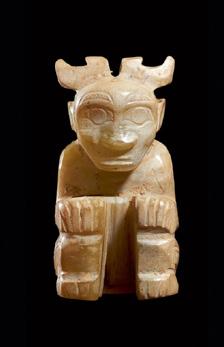
China, 3rd-2nd century BC. The pendant meticulously carved in the form of a dancing lady performing a ‘long sleeve dance’, her right hand raised, the left lowered to the waist, dressed in a long robe with elegantly curling hems, the detail neatly incised, and the oval face with almond-shaped eyes flanked by pierced hair tresses. A small aperture to the lower end. The semi-translucent stone is of a fine white color with icy white inclusions.
Provenance: The Collection of Sam and Myrna Myers, Paris, France.
Acquired between circa 1965-2012.
Condition: Good condition with expected old wear, two small losses to the robe and sash, minor surface alterations, some calcification, few soil encrustations, and little nibbling to the rims.
Weight: 7.9 g
Dimensions: Length 6.1 cm
Expert’s note: The figure was possibly once attached to another ornament, as these pendants were probably a part of an elaborate jade pectoral.
LITERATURE COMPARISON
Compare a closely related jade ornament of a female dancer, dated 475 BC-9 AD, 9 cm tall, Asian Art Museum, in the Smithsonian Institution, accession number S2012.9.2755.
AUCTION RESULT COMPARISON
Type: Related
Auction: Christie’s Hong Kong, 29 November 2017, lot 2755
Price: HKD 875,000 or approx. EUR 112,500 converted and adjusted for inflation at the time of writing
Description: A jade standing figure, late Warring States period to early Western Han dynasty Expert remark: Compare the similar subject, details to the hair and face, color of the jade and size (5.6 cm).
Estimate EUR 6,000
Starting price EUR 3,000
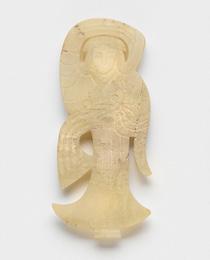
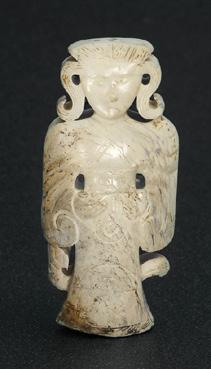
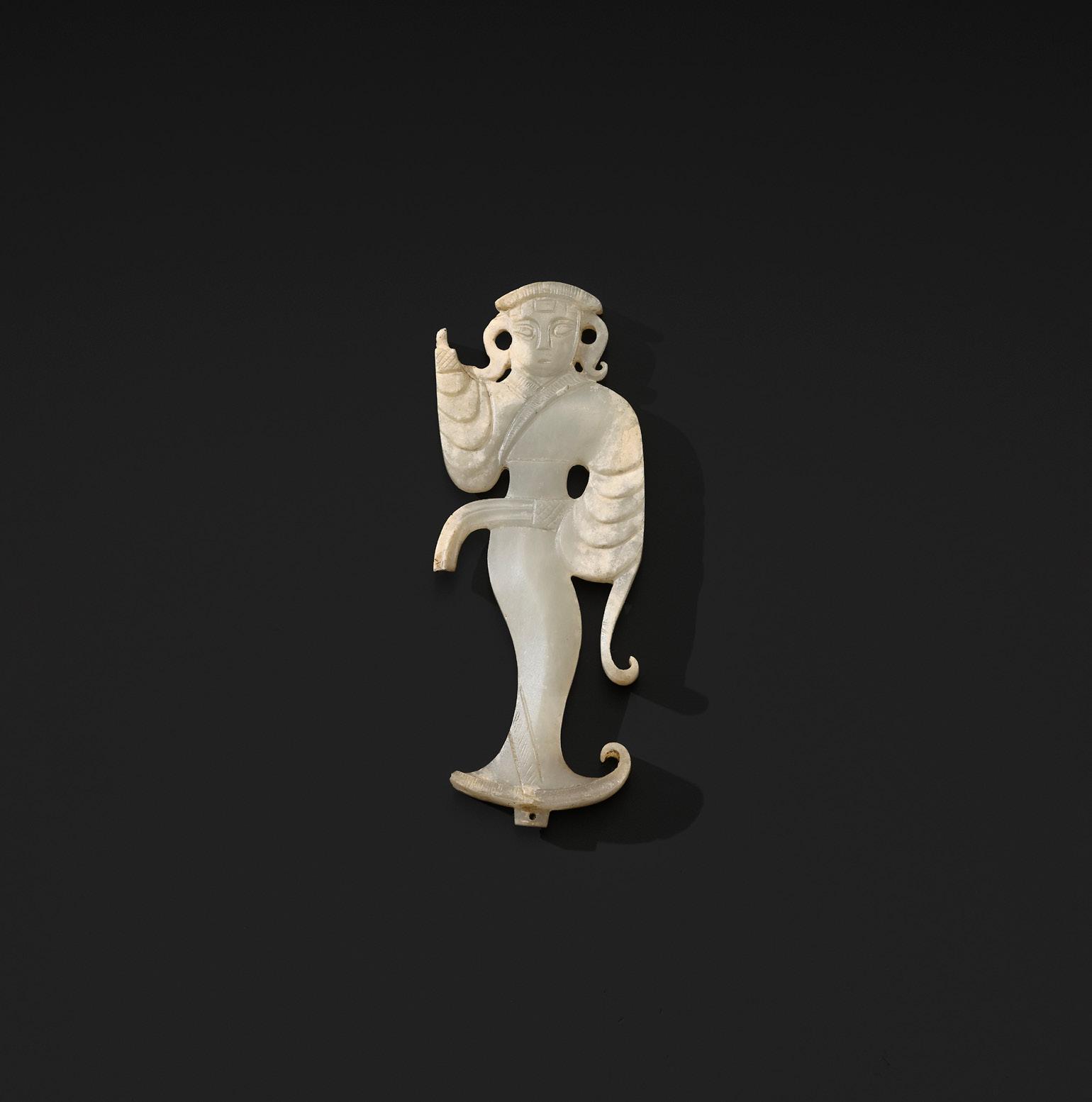
China, c. 475-221 BC. Of typical form, the beveled, double-edged blade with a central ridge, decorated with a finely carved taotie mask in high relief. The curved notch and rectangular shaft pierced with oval and teardrop-shaped apertures. The semitranslucent stone of a dark green tone with black clouds and inclusions as well as distinct russet veining.
Expert’s note:
The present axe head is exceptionally rare and noteworthy for following bronze ‘ge’ prototypes more closely than most other known examples in public or private collections. Its dark green and black jade recalls the greenish hue of the typical patina with malachite encrustations found on bronzes from the period.
Provenance: The Collection of Sam and Myrna Myers, Paris, France. Acquired between circa 1965-2012.
Condition: Very good condition with minor wear and natural agerelated imperfections, including small fissures, some of which have developed into hairline cracks. Light traces of weathering. Occasional minute nicks and shallow surface scratches. One minuscule chip to the tip of the blade and minor nibbling along the edges.
Weight: 437.5 g
Dimensions: Height 28.5 cm
Weaponry played a significant role in the material culture of the Eastern Zhou dynasty, reflecting general turmoil and warfare among competing states. The dagger-axe, or ge, a type of pole weapon mounted by its tang to a wooden shaft, served as the primary weapon of the Chinese Bronze Age. Originating in the Shang dynasty, it evolved during the Zhou dynasty into a form with a dagger blade and a spearhead at the top of the shaft. This combination allowed the wielder to employ both thrusting and swinging techniques, increasing the versatility of the weapon. Bronze ‘ge’ blades provided the model for the form and decoration of jade counterparts, as exemplified by the present piece.
Literature comparison:
Compare a related bronze dagger-axe (ge), late Zhou dynasty, 1046-256 BC, 14.6 cm long, in the Metropolitan Museum of Art, object number 21.144. Compare a related bronze dagger-axe (ge), Eastern Zhou to Western Han dynasty, 18.1 cm long, in the Smithsonian National Museum of Asian Art, accession number F1911.65.
COMPARISON
Type: Related
Auction: Bonhams Hong Kong, 5 April 2016, lot 28
Price: HKD 1,960,000 or approx. EUR 253,500 converted and adjusted for inflation at the time of writing
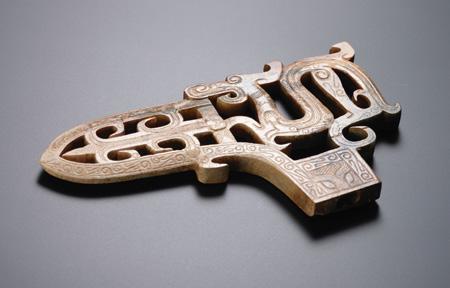
Description: An exceptionally rare brown jade ceremonial dagger (ge), Warring States period
Expert remark: Compare the related form and manner of carving. Note the smaller size (14.8 cm).
Estimate EUR 10,000
Starting price EUR 5,000

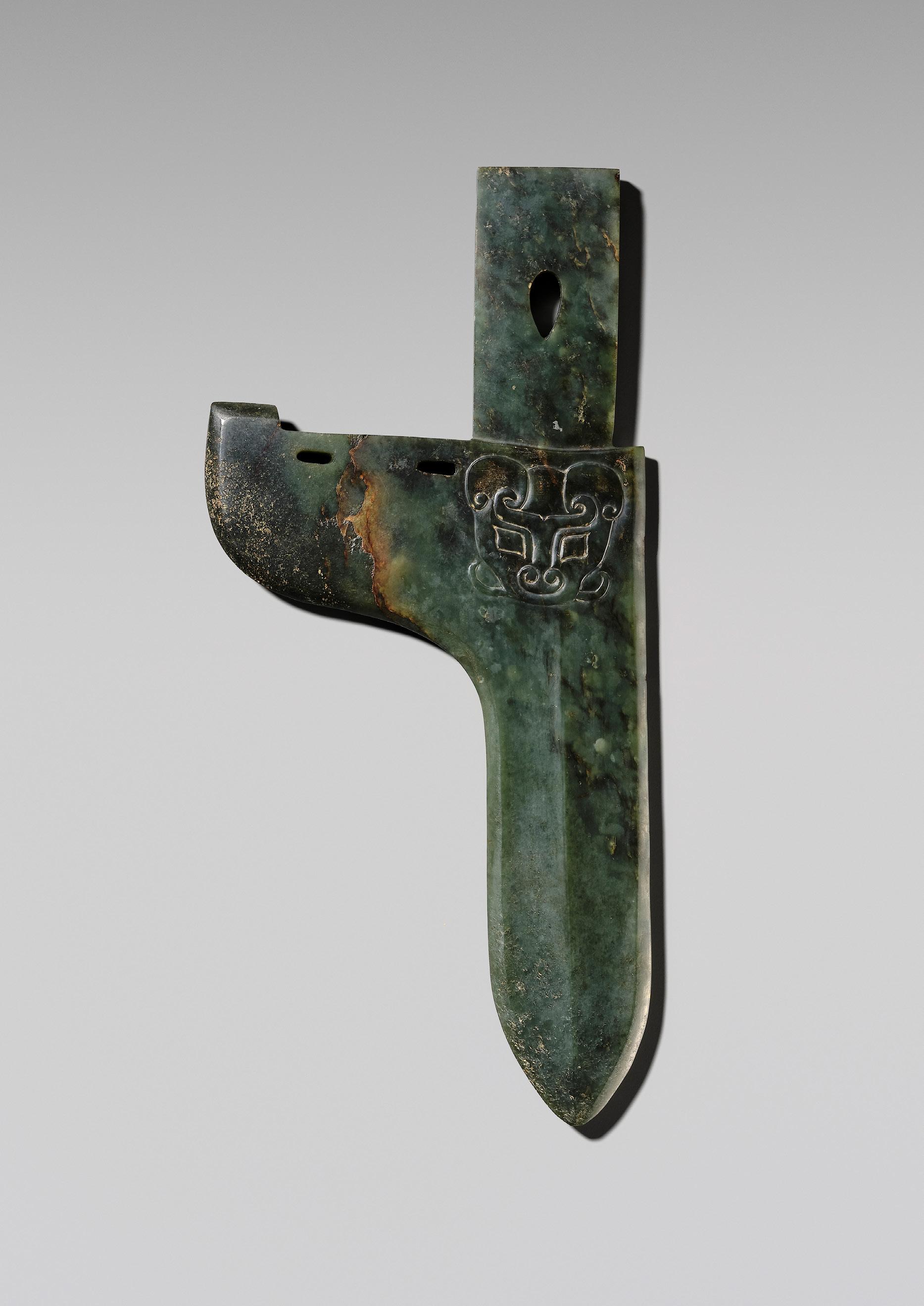
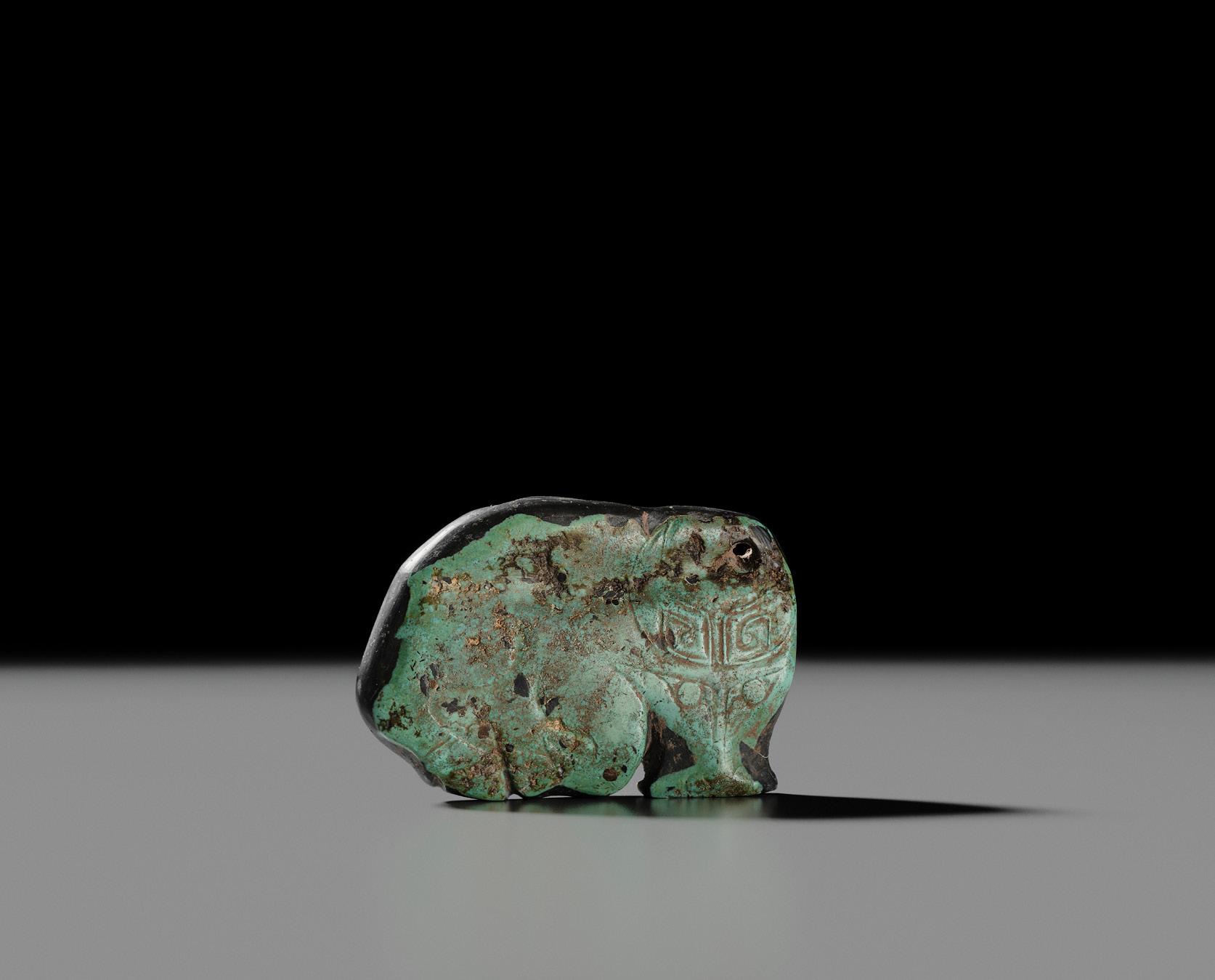
80 A VERY RARE TURQUOISE ‘WATER BUFFALO’ PENDANT, LATE SHANG TO EARLY WESTERN ZHOU DYNASTY
PUBLISHED
Expert’s note:
The head of the buffalo in the present example displays characteristics closely associated with Shang period carving, including highly stylized eyes and horns, while the body has been skillfully adapted to the irregular form and surface of the turquoise pebble. The use of turquoise is highly unusual, as jade constituted the preferred material for animal sculpture. During the late Shang period, turquoise was employed primarily as an inlay material in bronze and bone objects, although a small number of carvings executed entirely in turquoise are documented. The reverse of the pendant remains uncarved, indicating that the object was intended to be viewed from a single side. For a more detailed discussion of the development of the water buffalo motif in hardstone from the Shang period onward, see Jessica Rawson, Chinese Jade from the Neolithic to the Qing, 1995, p. 205-208.
China, 11th-10th century BC. The thick plaque boldly carved as a recumbent water buffalo, its legs folded beneath the body and the head sharply turned to the right, defined by a pair of tightly curled horns, circular eyes, and a pronounced muzzle. The upper right corner drilled from both sides for suspension. The reverse left plain. The opaque stone of a vivid green hue on the carved surface, enhanced by subtle yellowish accents.
Provenance: The Collection of Sam and Myrna Myers, Paris, France. According to the Myers ledger, this was acquired on 12 April 2001, and has been in the collection for 25 years.
Condition: Very good condition, commensurate with age, with surface wear and inherent natural imperfections. Distinct traces of weathering and erosion. Few minor nicks, shallow surface scratches, losses, and occasional small chips, mostly to the reverse.
Weight: 83.5 g
Dimensions: Length 6.9 cm
AUCTION RESULT COMPARISON
Type: Closely related
Auction: Sotheby’s London, 4 November 2021, lot 379
Estimate: GBP 25,000 or approx. EUR 37,000 converted and adjusted for inflation at the time of writing
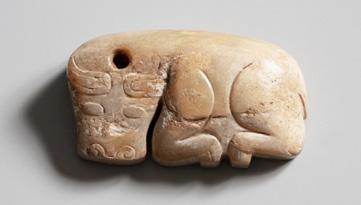
Description: A jade ‘water buffalo’ pendant, late Shang dynasty
Expert remark: Compare the closely related manner of carving and recumbent posture of the animal with the similarly rendered turned head and facial features. Note the slightly smaller size (5.7 cm) and the provenance, as this lot was formerly part of the Sam and Myrna Myers Collection, and is illustrated on the same page of The Language of Adornment as the present lot.
Estimate EUR 6,000
Starting price EUR 3,000
China, 475 BC-220 AD. Superbly carved in openwork, the sinuous body of the dragon meticulously incised with interconnected C-scrolls and elegantly carved tufts of flaming hair, the face in profile with strongly marked features, an upturned snout, large eyes, and whiskers. The translucent stone of a pale celadon tone with russet veins and patches, as well as cloudy inclusions.
Provenance: The Collection of Sam and Myrna Myers, Paris, France. Acquired between circa 1965-2012.
Condition: Good condition, commensurate with age. Ancient wear, natural fissures—some of which may have developed into hairline cracks, minuscule chips, small nicks, signs of weathering and erosion, and areas with corrosion. An old smoothened chip to the bifurcated tail.
Weight: 157 g
Dimensions: Height 21.5 cm
LITERATURE COMPARISON
Compare a closely related dragon jade ornament, Warring States period-Han dynasty, 3rd-2nd century BC, unearthed from Shizishan in Xuzhou, Jiangsu Province, and now in the collection of the Xuzhou Museum (fig. 1). Compare a closely related pair of jade pendants in the twisted shape of dragon, Western Han dynasty, 15 cm high, in the Imperial Chinese Artworks Center, Vancouver, accession number C22.
Estimate EUR 6,000
Starting price EUR 3,000
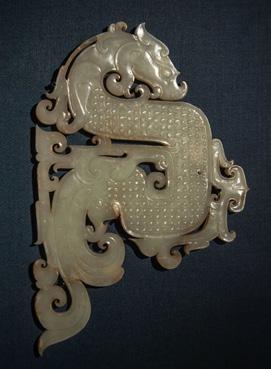
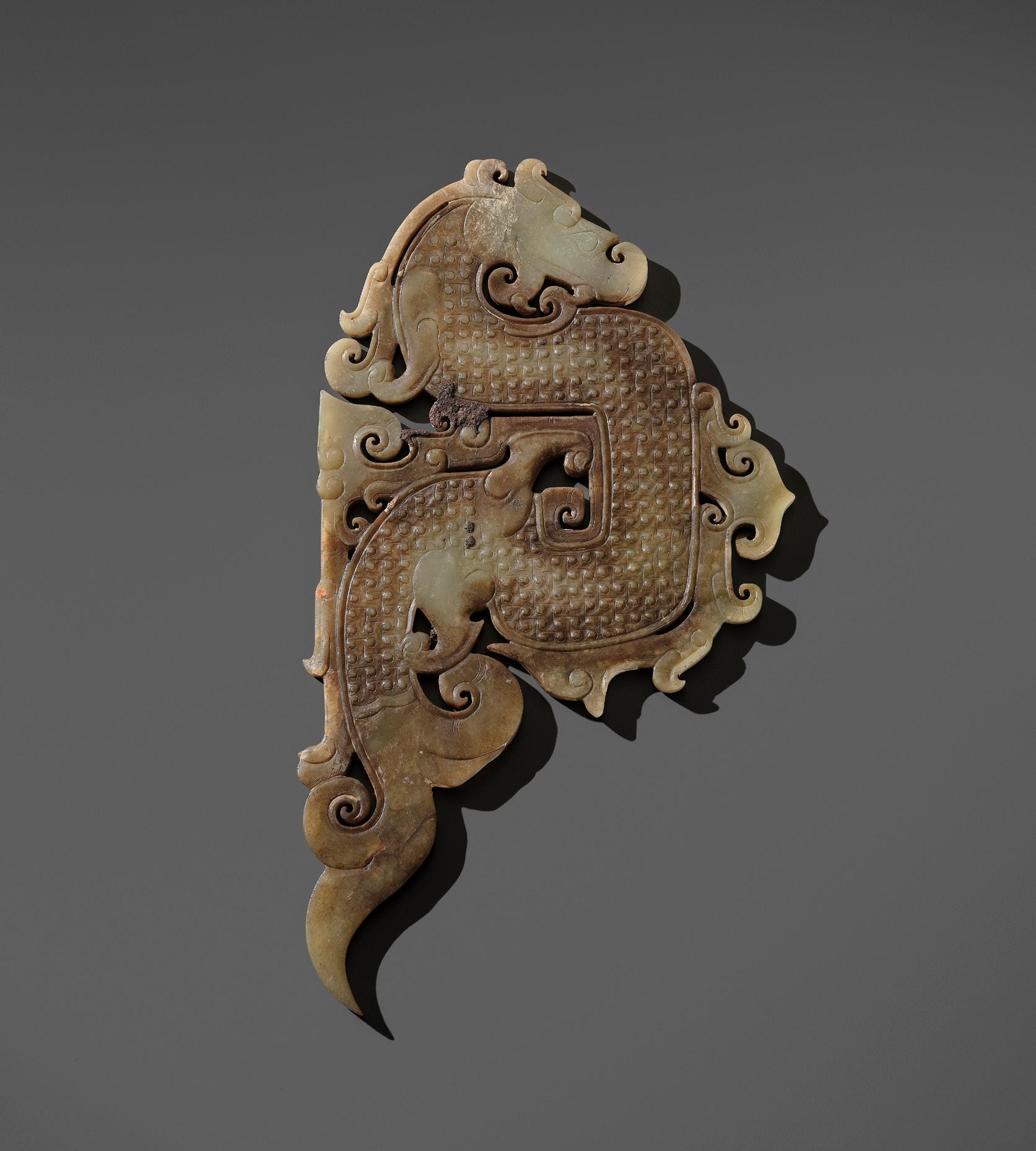
A PAIR OF WHITE, RUSSET, AND BROWN JADE ‘DRAGON AND PHOENIX’ PENDANTS, EASTERN ZHOU DYNASTY, WARRING STATES PERIOD
China, 475–221 BC. Each of slightly trapezoidal form with a curved edge, masterfully carved in openwork to depict a highly stylized dragon at the center, flanked by a pair of confronting phoenixes. Their abstracted, coiling bodies, with pointed tips, finely incised on both sides with rope-twist bands and scrolling designs. The translucent stone bearing an attractive interplay of white, russet, and dark brown tones, enhanced by cloudy inclusions and subtle dark shadings. (2)
Provenance: The Collection of Sam and Myrna Myers, Paris, France. Acquired between circa 1965-2012.
Condition: One pendant with restored breaks. The other in good condition. Both with ancient wear and inherent natural imperfections. Light traces of weathering and erosion. Few minute nicks and shallow surface scratches.
Weight: 143.2 g (total)
Dimensions: Length 10.9 cm (each)
The meticulous carving, with incised rope-twist patterns, doublelined hooks, and various types of scrollwork, along with the elaborate reticulated structure of this lot, is characteristic of jade craftsmanship from the Warring States period, exemplifying the technical mastery achieved during this time. The popularity of ornamental jade pendants reached its zenith in this period; although it experienced some decline during the Qin and early Han dynasties, it later enjoyed a remarkable resurgence in subsequent phases of the Han dynasty.
LITERATURE COMPARISON
Compare a closely related jade plaque with openwork interlaced dragons and birds, Warring States period, 475-221 BC, 7.5 cm long, in the Cleveland Museum of Art, accession number 1952.584 (fig. 1). Compare a related jade pendant with an openwork ‘dragon and bird’ pattern, early to mid-Warring States period, 475-276 BC, 10.5 cm long, in the National Palace Museum, Taipei, Taiwan, accession number 000472N000000000.
AUCTION RESULT COMPARISON
Type: Closely related
Auction: Christie’s Hong Kong, 30 May 2018, lot 3081
Price: HKD 240,000 or approx. EUR 30,000 converted and adjusted for inflation at the time of writing
Description: A jade openwork ‘dragon and phoenix’ plaque, Han dynasty, 206 BC220 AD
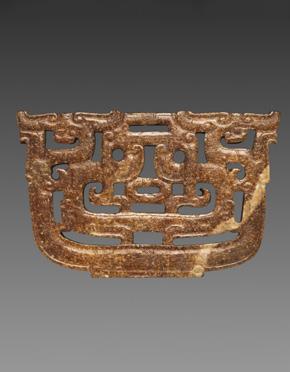
1
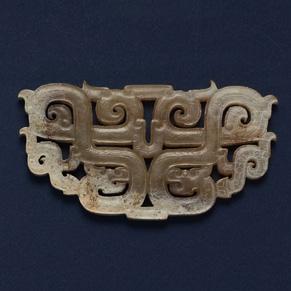
Expert remark: Compare the related form, manner of carving, and decorative motifs. Note the smaller size (6 cm).
Estimate EUR 8,000
Starting price EUR 4,000

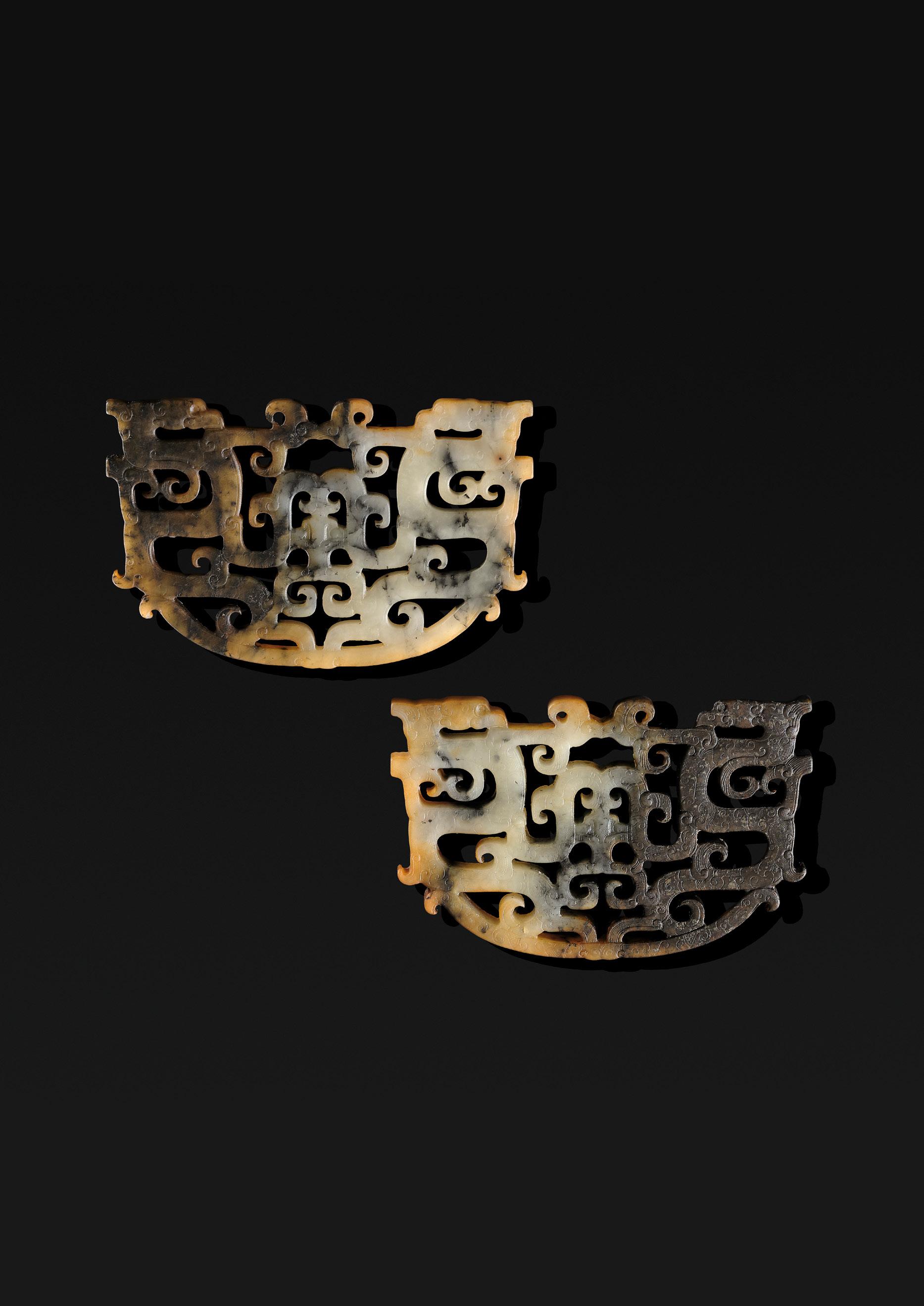
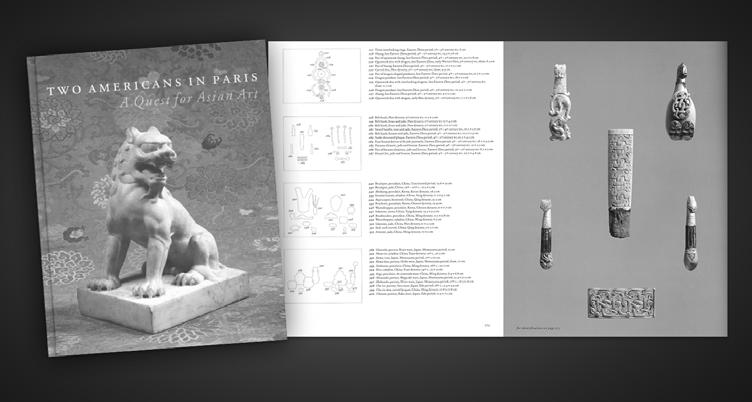
PUBLISHED
Jean-Paul Desroches (ed.) et al, Two Americans in Paris: A Quest for Asian Art, Paris, 2016, p. 74, no. 163.
Exhibited:
1. Pointe-à-Callière Museum, From the Lands of Asia. The Sam and Myrna Myers Collection, Montréal, 17 November 2016-19 March 2017.
2. Kimbell Art Museum, From the Lands of Asia. The Sam and Myrna Myers Collection, Fort Worth, Texas, 4 March-19 August 2018.
China, 4th-3rd century BC. Of rectangular form, finely carved in openwork with an array of serpents, their coiling bodies intricately intertwined and their stylized heads minutely incised. The opaque stone of a creamy white tone as a result of extensive alteration, with traces of the original color still visible beneath.
Provenance: The Collection of Sam and Myrna Myers, Paris, France. According to the Myers ledger acquired on 25 January 1994 and in the collection for 32 years.
Condition: Very good condition with surface wear and natural agerelated imperfections, including small fissures. Distinct traces of weathering and erosion. Few minute nicks, faint surface scratches, and occasional minuscule chips. The stone surface with some areas of soil encrustation, indicating a prolonged period of burial.
Weight: 55.5 g
Dimensions: Length 10.2 cm
The lords of the various states competed not only on the battlefield but also in the realm of the arts during the latter part of the Eastern Zhou period. Their rank and authority were expressed through the possession of luxurious objects, which surrounded them in sumptuous palaces and accompanied them into the afterlife as part of the grave goods placed within their monumental tombs.
The snake became a favored theme, particularly in the art of the southern State of Chu, among the wide range of motifs and styles represented in these sumptuous jade implements. Its elongated body lent itself to the creation of regular, interlaced patterns, often enhanced through openwork techniques, as magnificently exemplified by the present lot. Such designs became ubiquitous on belt hooks, sword fittings, and a wide variety of pendants. See Filippo Salviati, Han dynasty, in Jean-Paul Desroches (ed.) et al, Two Americans in Paris: A Quest for Asian Art, 2016, p. 66.
AUCTION RESULT COMPARISON
Type: Related
Auction: Sotheby’s Hong Kong, 25 November 2022, lot 868
Price: HKD 252,000 or approx. EUR 33,000 converted and adjusted for inflation at the time of writing
Description: A jade reticulated ‘dragon and phoenix’ plaque, Eastern Zhou dynasty, Warring States period
Expert remark: Compare the related form, manner of carving, and decorative style with confronting phoenixes. Note the similar size (11 cm).
Estimate EUR 10,000
Starting price EUR 5,000
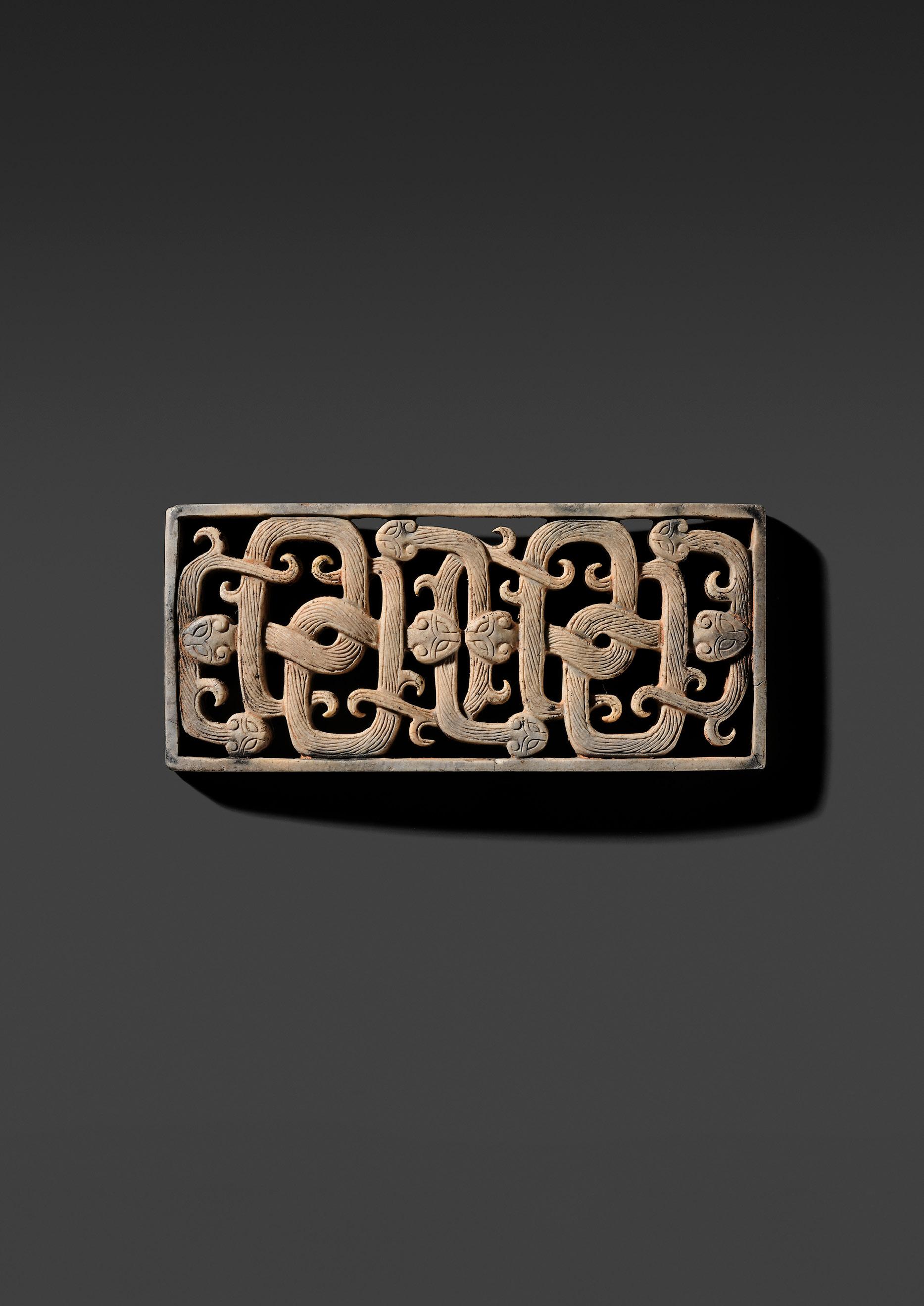
A PAIR OF EXCEEDINGLY RARE AND LARGE JADEAND TURQUOISE-INLAID BRONZE BELT HOOKS, LATE WARRING STATES PERIOD TO HAN DYNASTY
China, c. 4th-3rd century BC. Each belt hook finely cast, the gently curved, bronze shaft decorated with stylized phoenixes perched on rope-twist stems, inlaid with three circular jade medallions, each carved in high relief with additional mythical birds. Both ends of the bronze shaft modeled as taotie masks, their bulging eyes vividly inlaid with turquoise. Each hook likewise fashioned from jade, one carved as a ram head with elegantly curved horns, the other as an avian head with a prominent beak. The reverse fitted with circular buttons. The translucent stones of an even white tone, with cloudy inclusions and subtle russet mottling. (2)
Provenance: The Collection of Sam and Myrna Myers, Paris, France. Acquired between circa 1965-2012.
Condition: Very good condition, commensurate with age, with surface wear and expected signs of usage. Distinct traces of weathering and corrosion. Minor supplementation with period fragments cannot be ruled out. Occasional minor nicks, shallow surface scratches, as well as few minuscule chips and losses. The bronze surface with a rich, naturally grown patina with some areas of vibrant malachite encrustations.
Weight: 667.9 g (total)
Dimensions: Length 20.1 cm (each)
Skillfully incorporating two distinctively different materials and transforming them into a functional work of art, the present belt hook demonstrates the high level of craftsmanship displayed by artisans during the late Eastern Zhou to Han dynasty.
Literature comparison:
Compare a related jade inset gilt-bronze ‘dragon’ belt hook, late Warring States period to Western Han dynasty, 475 BC-9 AD, 5.4 cm long, in the Smithsonian National Museum of Asian Art, accession number F1953.82. Compare a related jade inset gilt-bronze ‘dragon’ belt hook, late Warring States period to Western Han dynasty, 4th-3rd century BC, 16.5 cm long, in the Metropolitan Museum of Art, object number 1974.268.1.
AUCTION RESULT COMPARISON
Type: Closely related
Auction: Christie’s Hong Kong, 3 December 2021, lot 2771
Price: HKD 750,000 or approx. EUR 88,000 converted and adjusted for inflation at the time of writing
Description: An extremely rare and important glass and jade inset gilt-bronze ‘dragon’ belt hook, late Warring States period, c. 300-221 BC
Expert remark: Compare the closely related form, with the curved shaft similarly extending to a ‘taotie’ mask and circular jade insets. Note the slightly larger size (22 cm).
AUCTION RESULT COMPARISON
Type: Closely related
Auction: Christie’s New York, 22 March 2024, lot 1146
Price: USD 25,200 or approx. EUR 22,500 converted and adjusted for inflation at the time of writing
Description: A jade inset gilt-bronze ‘dragon’ belt hook, late Warring States period to Western Han dynasty, late 3rd-2nd century BC
Expert remark: Compare the closely related form, with similarly inlaid, circular jade insets. Note the smaller size (15.6 cm).
Estimate EUR 6,000
Starting price EUR 3,000
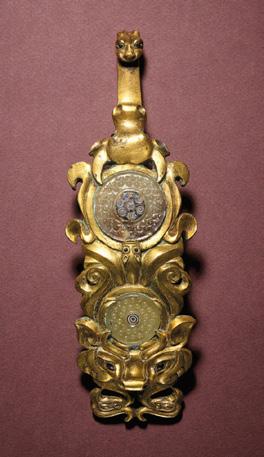

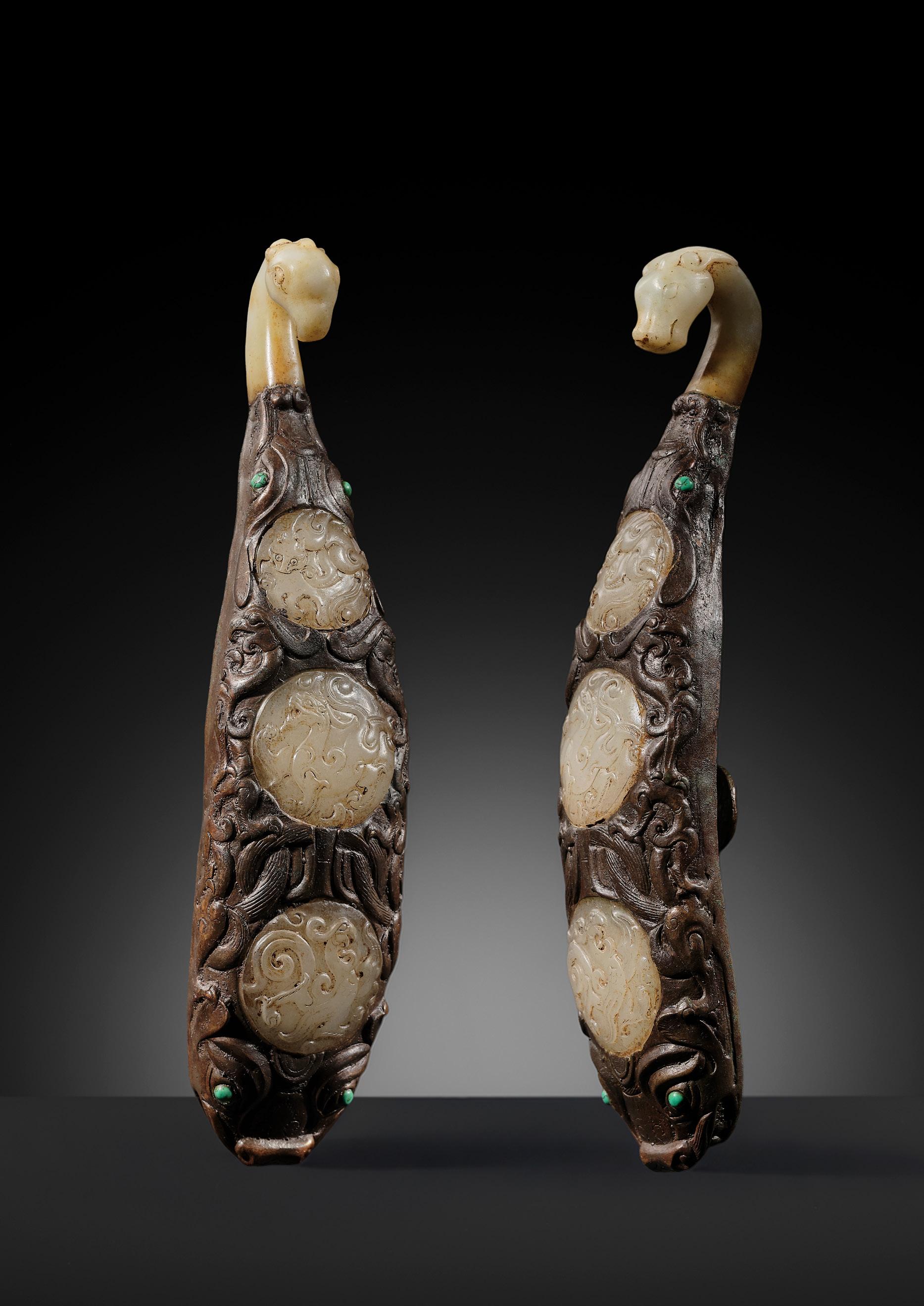
China, c. 475 BC-9 AD. Each powerfully carved in the form of a crouching beast, with an undulating back defined by crisp edges. The head of the beast depicted with bulging eyes and a straight snout with gaping jaws. The muscular body terminating in a bifurcated tail issuing an angular hooked scroll, minutely decorated on either side with raised C-shaped scrolls and incised geometric motifs. The translucent stone of pale celadon and russet tones with icy white inclusions and brown shadings. (2)
Provenance: The Collection of Sam and Myrna Myers, Paris, France. Acquired between circa 1965-2012.
Condition: Very good condition with minor wear and natural agerelated imperfections. Distinct traces of weathering and erosion. Scattered minute nicks and faint surface scratches. Minuscule nibbling along the edges.
Weight: 131.3 g (total)
Dimensions: Length 11.5 cm (each)
This finely carved pair of jade plaques belongs to a small and exceptional group of animal pendants originating in the Warring States period (475–221 BC), characterized by their dynamic silhouettes, precise detailing, and luminous polish. Traditionally referred to as ‘tiger plaques’, each of these pieces varies slightly in proportion, surface pattern, and relief carving, from T-hook and C-scroll motifs to abstract linear ornament, yet all reflect the technical and aesthetic sophistication achieved by late Eastern Zhou jade artisans.
LITERATURE COMPARISON
Compare a pair of closely related jade tiger plaques, Warring States period to Western Han dynasty, 3rd century BC, 19.1 cm long, in the Fogg Art Museum, Harvard University, object number 1943.50.469 (fig. 1). Compare a pair of closely related jade tiger plaques, Warring States period, 475-221 BC, 20.8 and 22.5 cm long, in the Cleveland Museum of Art, accession number 1991.78 (fig. 2). Compare a closely related jade tiger pendant, Warring States period, 475-221 BC, 15.1 cm long, in the Smithsonian National Museum of Asian Art, accession number F1932.43.
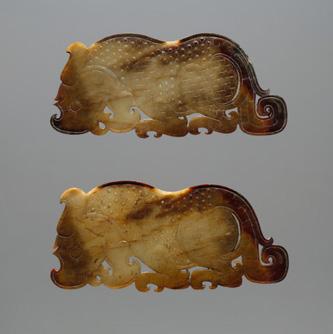
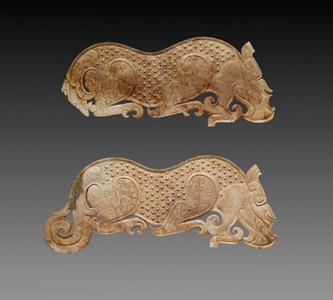
AUCTION RESULT COMPARISON
Type: Related
Auction: Zacke Vienna, 11 September 2025, lot 92
Price: EUR 130,000
Description: A fine and large green jade ‘rhinoceros’ plaque, Warring States period to Western Han dynasty Expert remark: Compare the related subject, manner of carving, and decorative style. Note the larger size (19.6 cm) and the provenance, as this lot was formerly part of the Sam and Myrna Myers Collection.
Estimate EUR 10,000
Starting price EUR 5,000
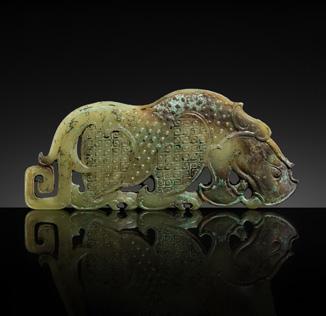

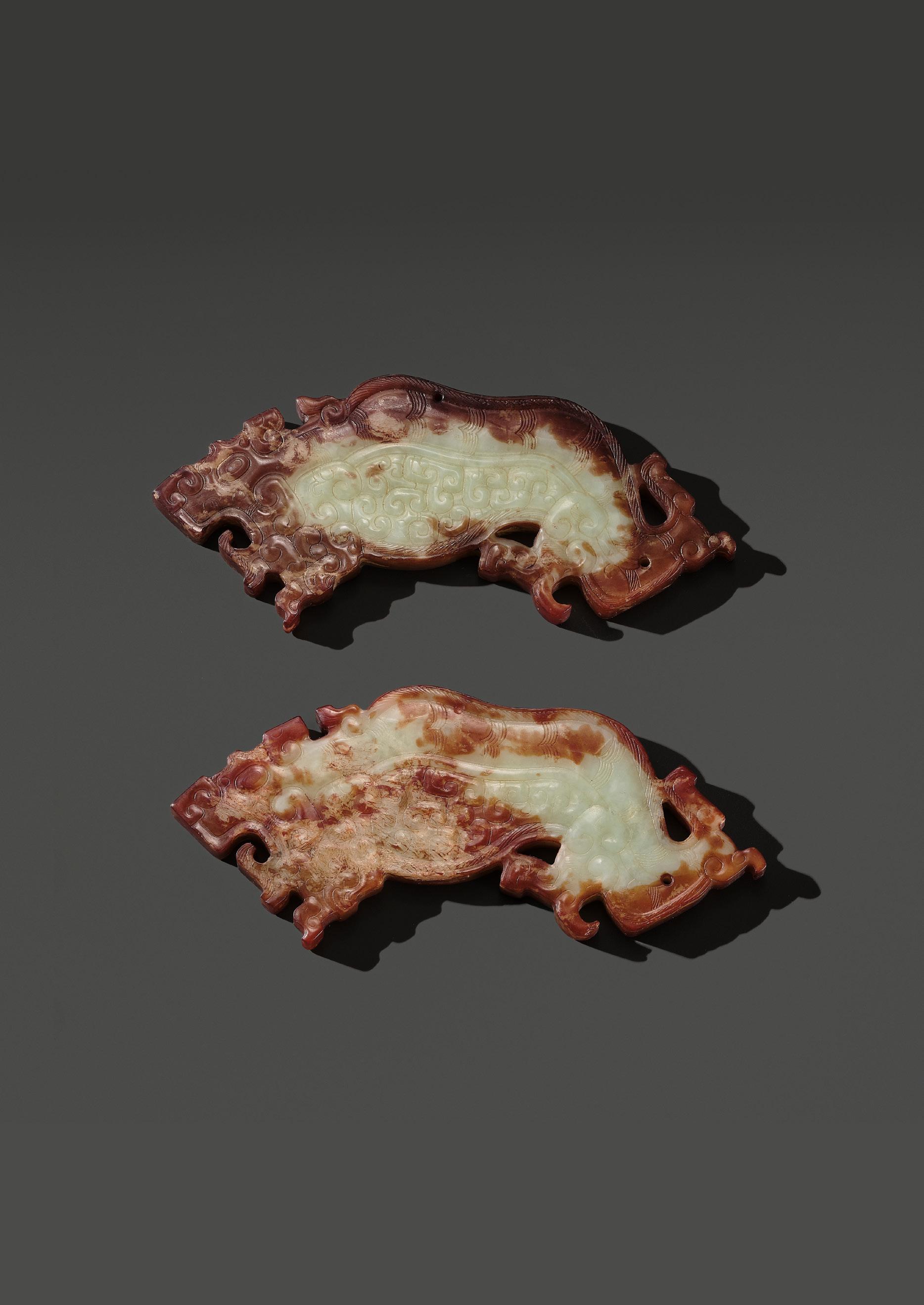
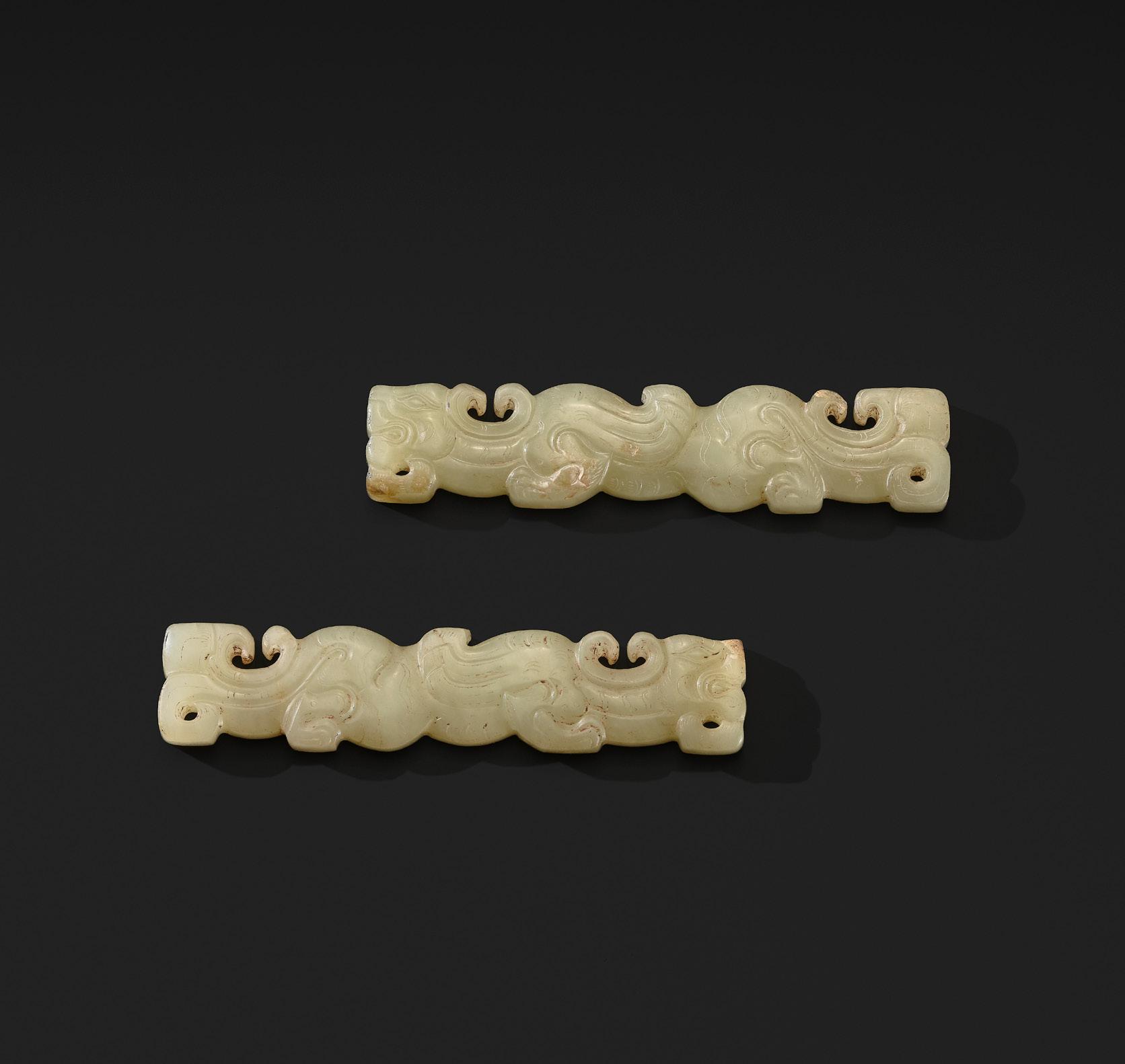
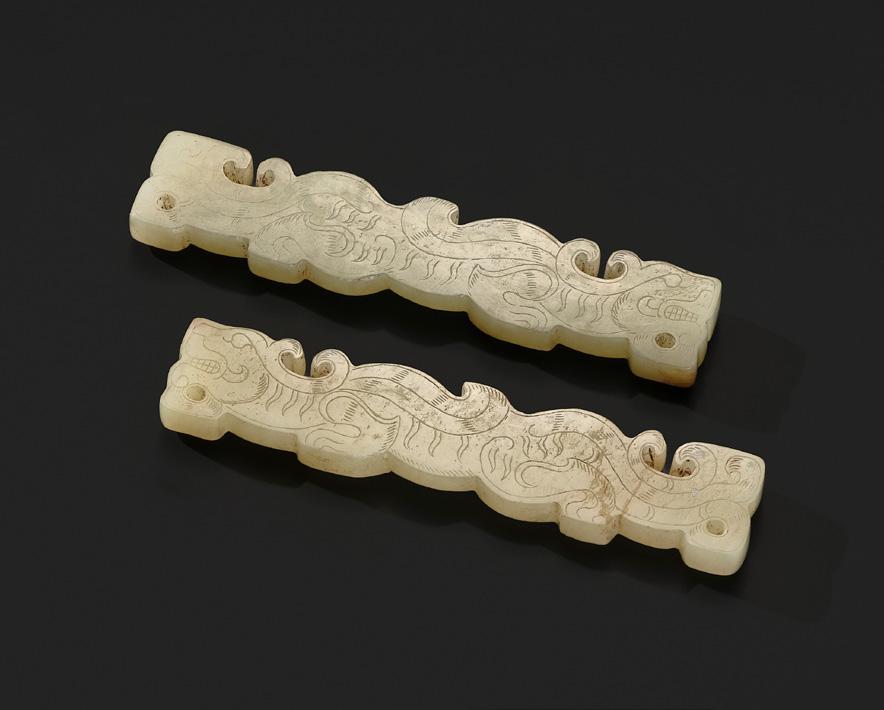
China, 475-221 BC. The flattened rectangular form, the pendants carved in form of sinuous tigers with dragon features, such as the furcated tail, wings, and horns, their bodies finely incised with stripes and fur, and pierced to both ends for suspension. The reverse of each plaque incised in fine lines to depict the same image on the flat surface. The semi-translucent stone is of a pale celadon color with few cloudy white inclusions. (2)
Provenance: The Collection of Sam and Myrna Myers, Paris, France. Acquired between circa 1965-2012.
Condition: Very good condition with expected old wear, some signs of weathering, traces of prolonged burial, few old chips which have smoothened over time, distinct remnants of ancient pigments, and minor surface alterations.
Weight: 37.6 g and 36.9 g
Dimensions: Length 9.9 cm (each)
Estimate EUR 4,000
Starting price EUR 2,000
China, circa 2nd-1st century AD or earlier. Finely carved as a sinuous crouching dragon with its right forelimb extended, the limbs curled tight against the limber form, the head raised and detailed with wide eyes, funnel ears, and mouth gently ajar revealing the teeth within, framed by a scrolling beard. The top of the head, raised hind, and furling tail each fitted with a rectangular aperture. The translucent stone of a pale celadon tone with russet patches and veins, as well as areas of calcification.
Provenance: The Collection of Sam and Myrna Myers, Paris, France.
Acquired between circa 1965-2012.
Condition: Very good condition with minor wear. Natural fissures and inclusions, minuscule nibbling, light rubbing, and drill marks to one side of the mouth. The three rectangular apertures show distinct traces of iron oxide and associated corrosion, indicating that iron components were once inserted there and have long since disintegrated.
Weight: 316.4 g
Dimensions: Length 17.5 cm
Expert’s Note: In early Chinese ritual and military equipment, jade fittings were often combined with iron elements, particularly from the late Warring States through the Han period. The jade served as the prestigious exterior
component, while the iron provided the structural or functional core. When the iron decayed over centuries, it typically left distinct residues: iron oxide staining, granular corrosion products, and roughened contact surfaces within the insertion channels. Such traces are a reliable indicator that iron shafts, pins, or mounts were once secured inside the openings, even though the metal itself has long since corroded away.
AUCTION RESULT COMPARISON
Type: Related
Auction: Beijing Hanhai Auction, Beijing, 18 December 2006, lot 1930
Price: CNY 1,760,000 or approx. EUR 333,000 converted and adjusted for inflation at the time of writing
Description: A jade ‘dragon and tiger’ ornament with four openings, Warring States period
Expert remark: Compare the closely related form. Note the size (20 cm) and thickness with perforated apertures.
Estimate EUR 4,000
Starting price EUR 2,000
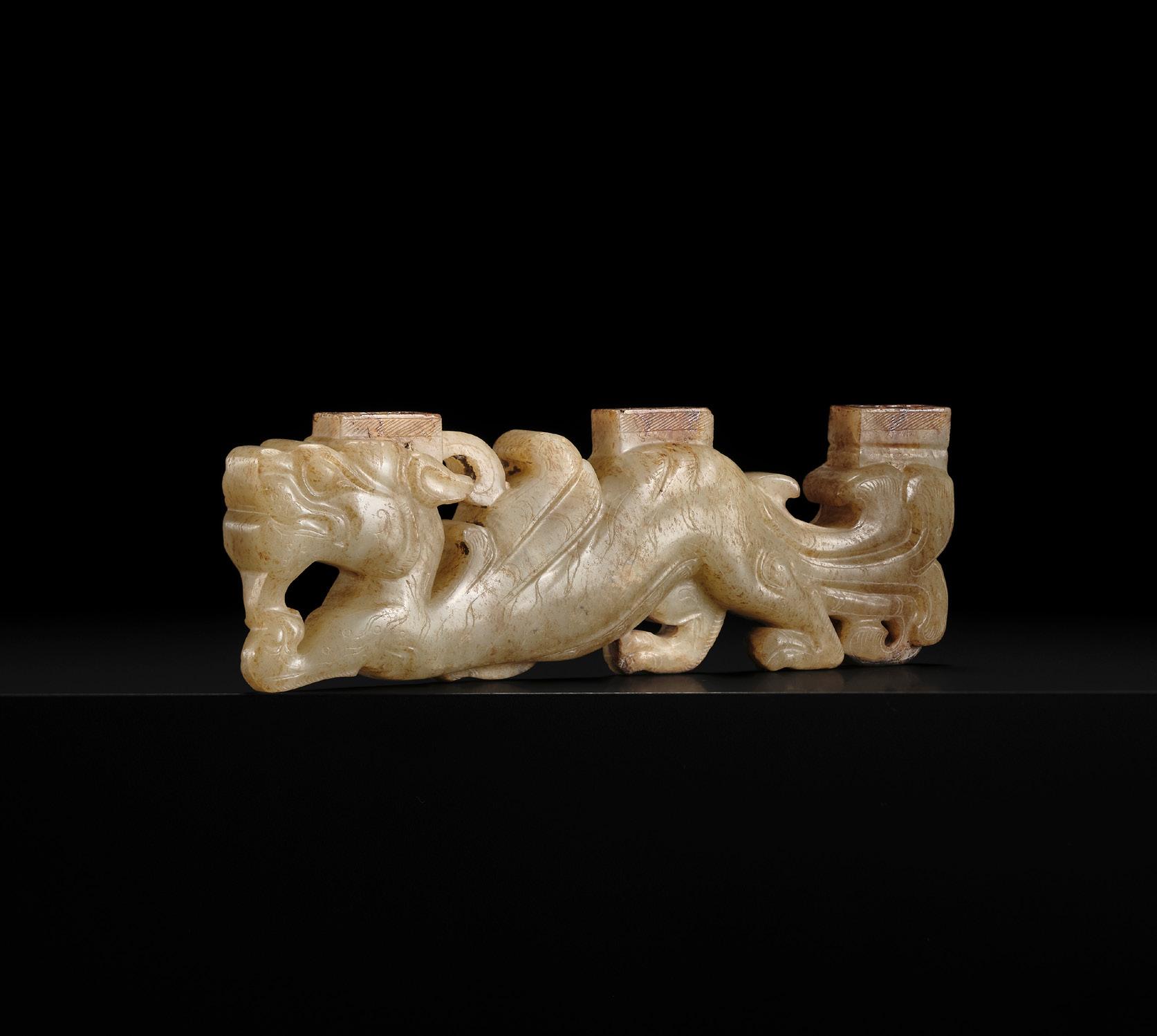
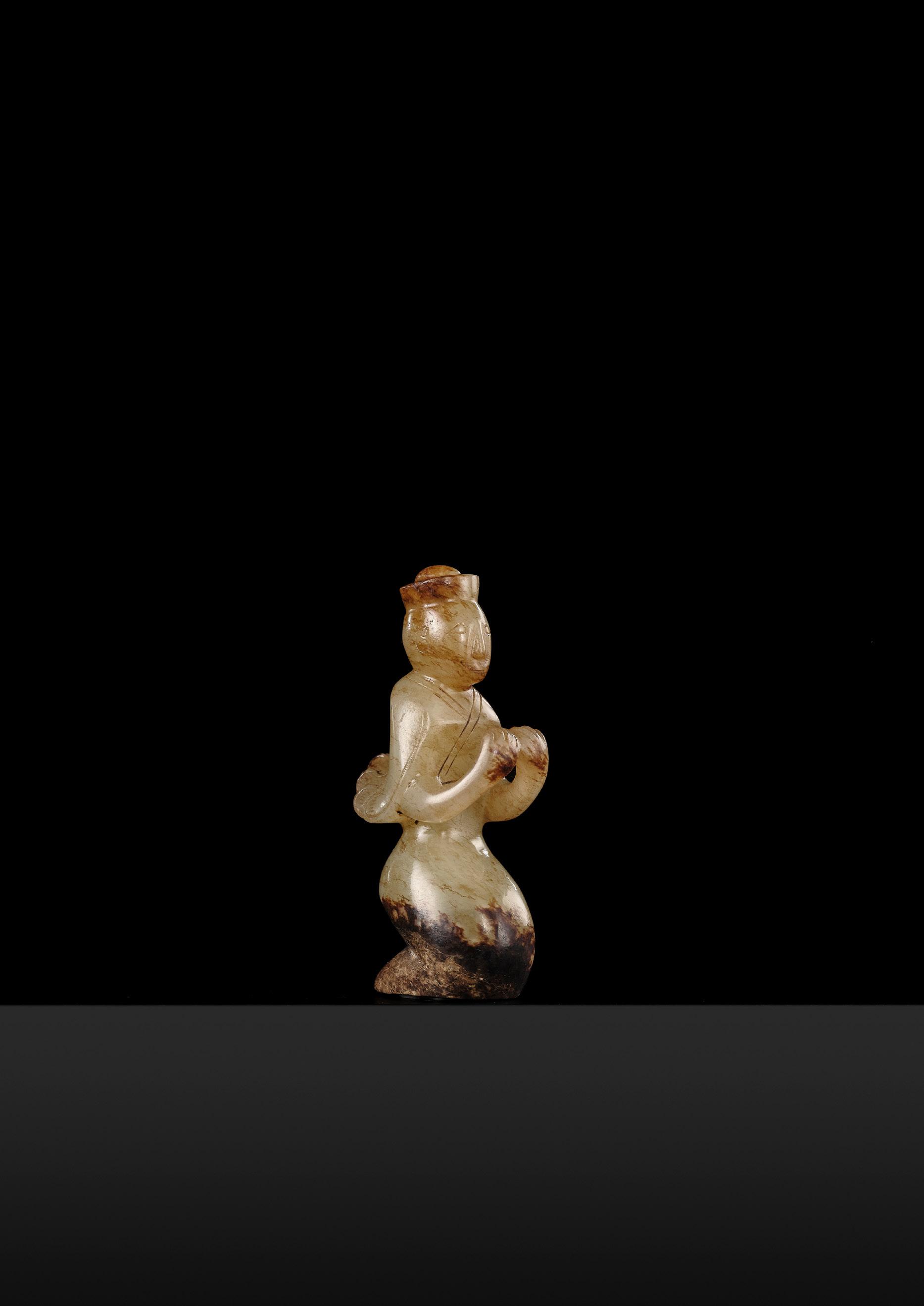

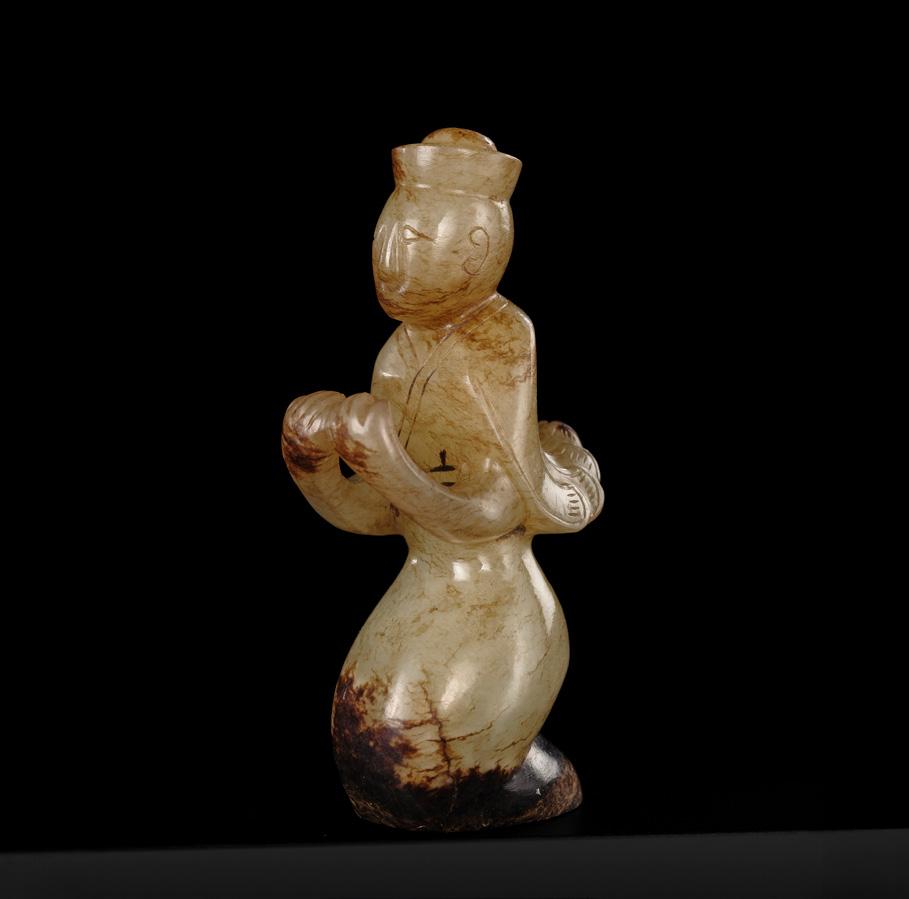
PUBLISHED
Jean-Paul Desroches (ed.) et al, The Beginning of the World. Dragons, Phoenix and Other Chimera, Fondation Baur, Geneva, 2020, p. 96 and 198, no. 54.
Exhibited:
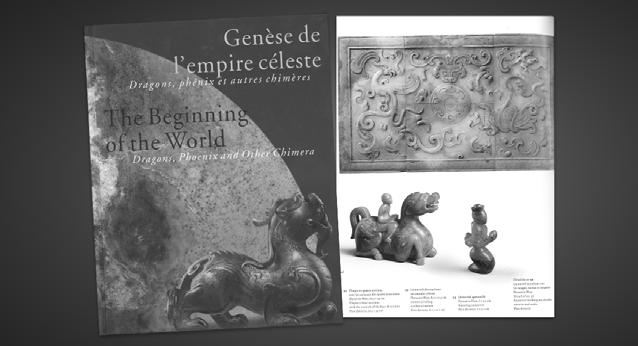
1. Fondation Baur, The Beginning of the World – According to the Chinese. Dragons, Phoenix and Other Chimera, Geneva, 11 November 2020-23 May 2021. 2. Musée Départemental des Arts Asiatiques, The Beginning of the World –According to the Chinese. Dragons, Phoenix and Other Chimera, Nice, Summer 2021.
China, 206 BC-220 AD. Finely carved in the round, the figure kneels with hands raised before the chest as if offering an object. The upper body is draped in a cowl that extends into upswept wings at the back, while the oval face, with almond-shaped eyes, is topped by a tall headdress. The semi-translucent stone is of a pale celadon color with areas and fine veining of opaque brown.
Provenance: The Collection of Sam and Myrna Myers, Paris, France. Acquired between circa 1965-2012.
Condition: Very good condition with minor wear, little nibbling, signs of prolonged burial, and soil encrustations. The stone with natural fissures.
Weight: 50.7 g
Dimensions: Height 7 cm
LITERATURE COMPARISON
Compare a related pale celadon jade figure with a similar expression albeit standing, dated Han dynasty, 6.7 cm tall, in the National Palace Museum, Taiwan, accession number 故玉005623N000000000. Compare a related pale celadon jade figure of a mythical beast with similar execution of the wings, dated Han dynasty, 6.8 cm tall, in the National Palace Museum, Taiwan, accession number 故玉 003523N000000000.
Estimate EUR 8,000
Starting price EUR 4,000
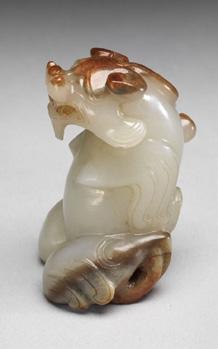
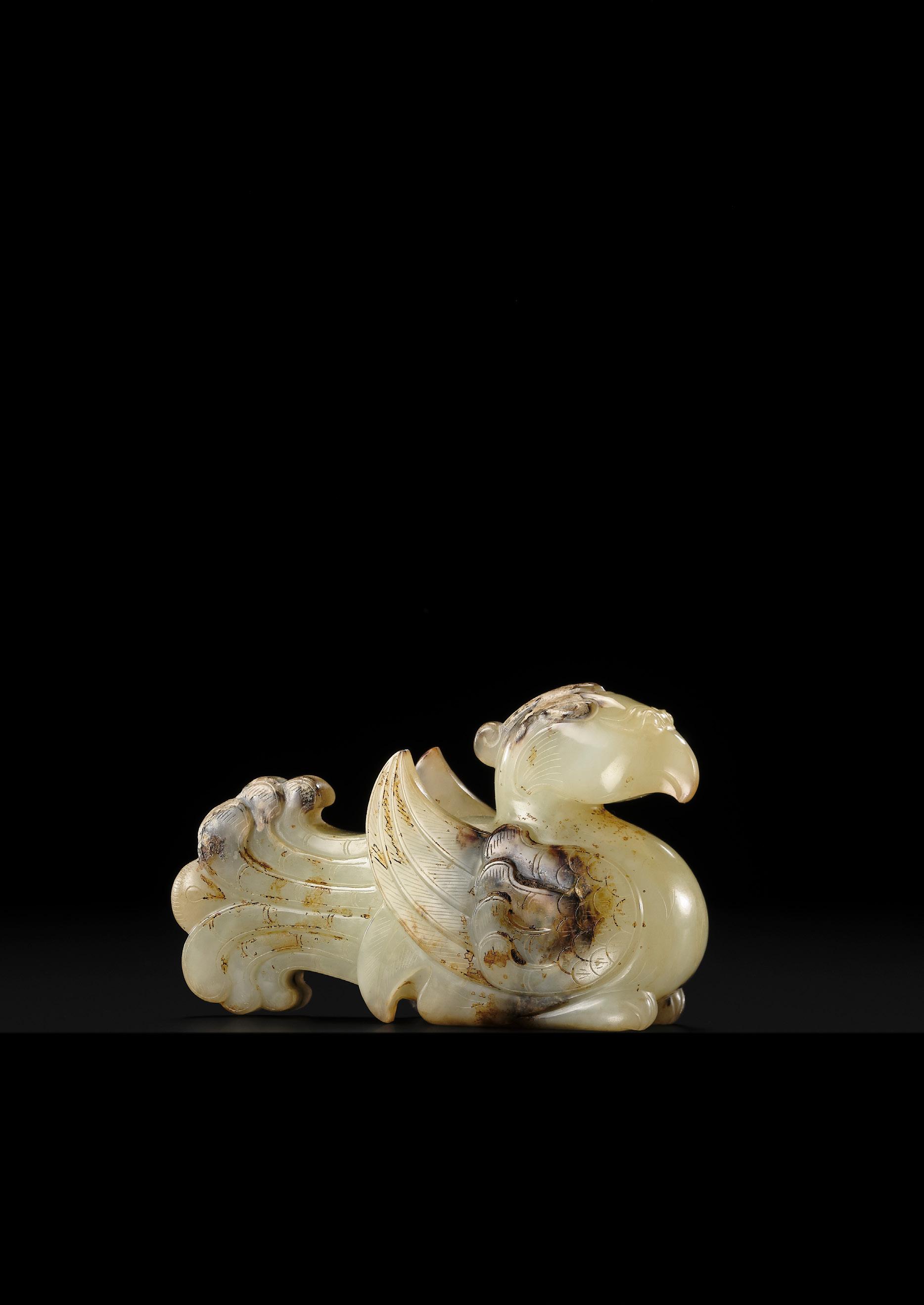
China, 206 BC-220 AD. The translucent stone of an attractive pale greenish-yellow tone with russet speckles and shadings, particularly prominent on the wings, tail, and crest on the head of the mythical bird. The phoenix seated squat with its wings resplendent and tail extended, the plumage meticulously incised to delineate the feathers of the wings, body, and tail.
Provenance: The Collection of Sam and Myrna Myers, Paris, France. Acquired between circa 1965-2012.
Condition: Excellent condition with ancient wear, natural fissures and inclusions, and distinct signs of prolonged burial, such as weathering, encrustation, erosion, and calcification.
Weight: 239 g
Dimensions: Length 10.2 cm
LITERATURE COMPARISON
Compare a related jade carving of a phoenix, Late Warring States Period to Early Western Han Dynasty, 5.4 cm wide, in the National Palace Museum, Taipei, accession number 故玉 009111N000000000.
AUCTION RESULT COMPARISON
Type: Related
Auction: Sotheby’s Hong Kong, 8 October 2013, lot
Price: HKD 600,000 or approx. EUR 87,500 converted and adjusted for inflation at the time of writing
Description: A white jade carving of a bird, Han dynasty Expert remark: Compare the related form and similarly incised plumage.
Estimate EUR 6,000
Starting price EUR 3,000
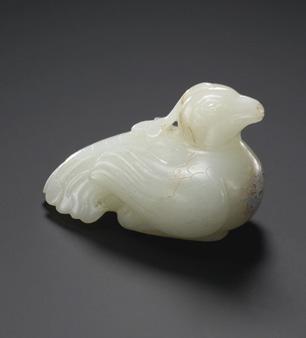
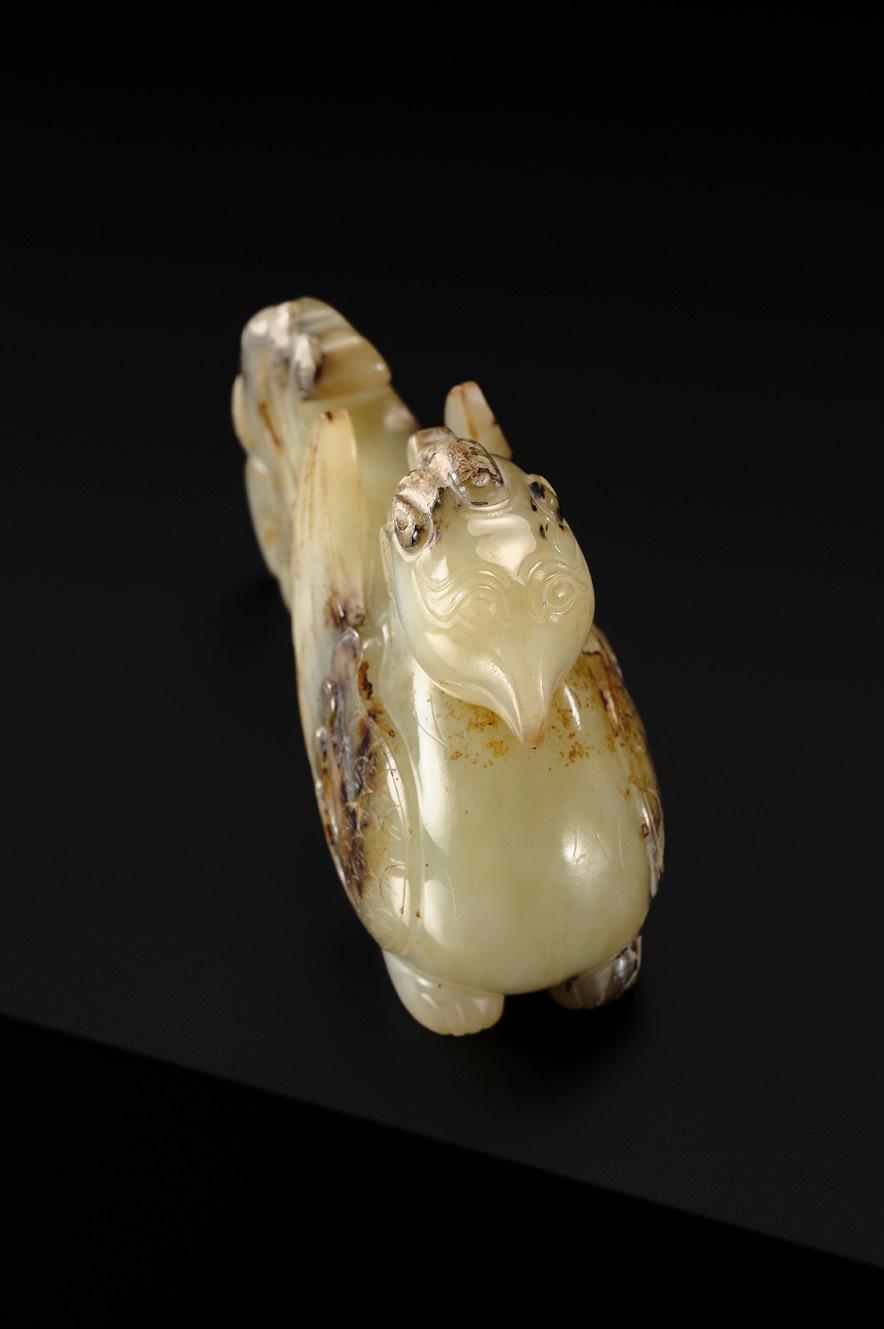
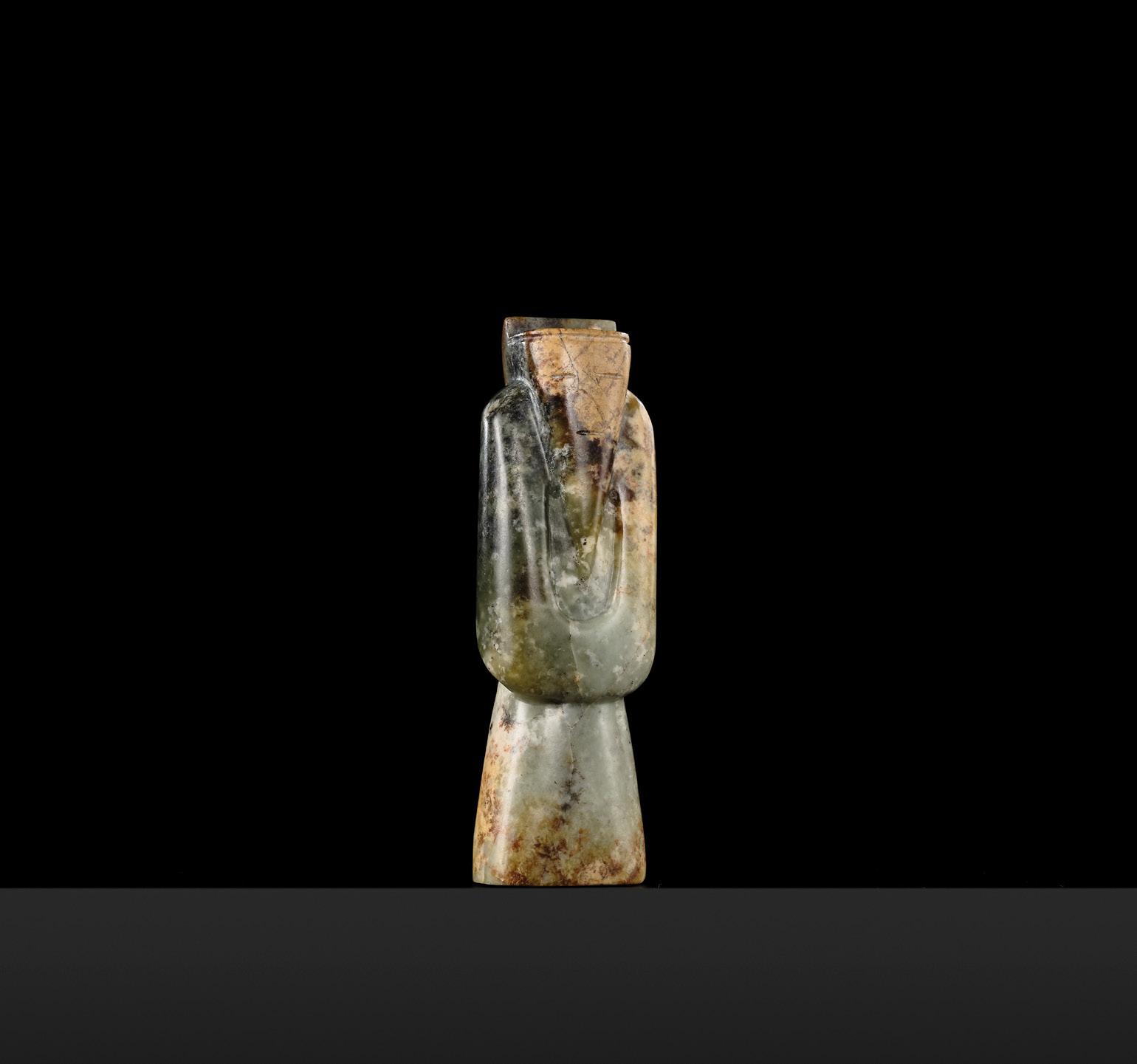
90 A MOTTLED GREEN AND BROWN JADE FIGURE OF A BEARDED SAGE, HAN DYNASTY
PUBLISHED
Jean-Paul Desroches (ed.) et al, The Beginning of the World. Dragons, Phoenix and Other Chimera, Fondation Baur, Geneva, 2020, p. 196 and 199, no. 123.
Exhibited:
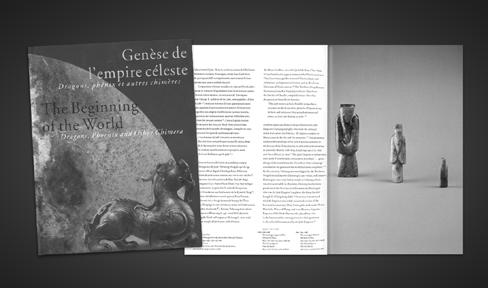
1. Fondation Baur, The Beginning of the World – According to the Chinese. Dragons, Phoenix and Other Chimera, Geneva, 11 November 2020-23 May 2021.
2. Musée Départemental des Arts Asiatiques, The Beginning of the World – According to the Chinese. Dragons, Phoenix and Other Chimera, Nice, Summer 2021.
China, 202 BC-220 AD. Finely carved to depict a bearded figure with an official's hat, standing in a hieratic and dignified manner, his hands concealed in the long sleeves of his robe. The face simply incised with slits to denote the eyes and small mouth. The opaque stone with varying hues of deep green with brown shading and russet inclusions. The figure pierced with an aperture to the top, passing through the bottom of each sleeve.
Provenance: The Collection of Sam and Myrna Myers, Paris, France. Acquired between circa 1965-2012.
Condition: Very good condition with expected old wear and a small smoothened chip to the top-right corner of the hat. Natural inclusions to the stone, some weathering.
Weight: 117.5 g
Dimensions: Height 9.7 cm
AUCTION COMPARISON
Type: Closely related
Auction: Sotheby’s New York, 18 March 2014, lot 163
Price: USD 13,750 or approx. EUR 16,500 converted and adjusted for inflation at the time of writing
Description: A jade figure, Western Han dynasty Expert remark: Compare the closely related carving, form, and attire.
Estimate EUR 2,000
Starting price EUR 1,000
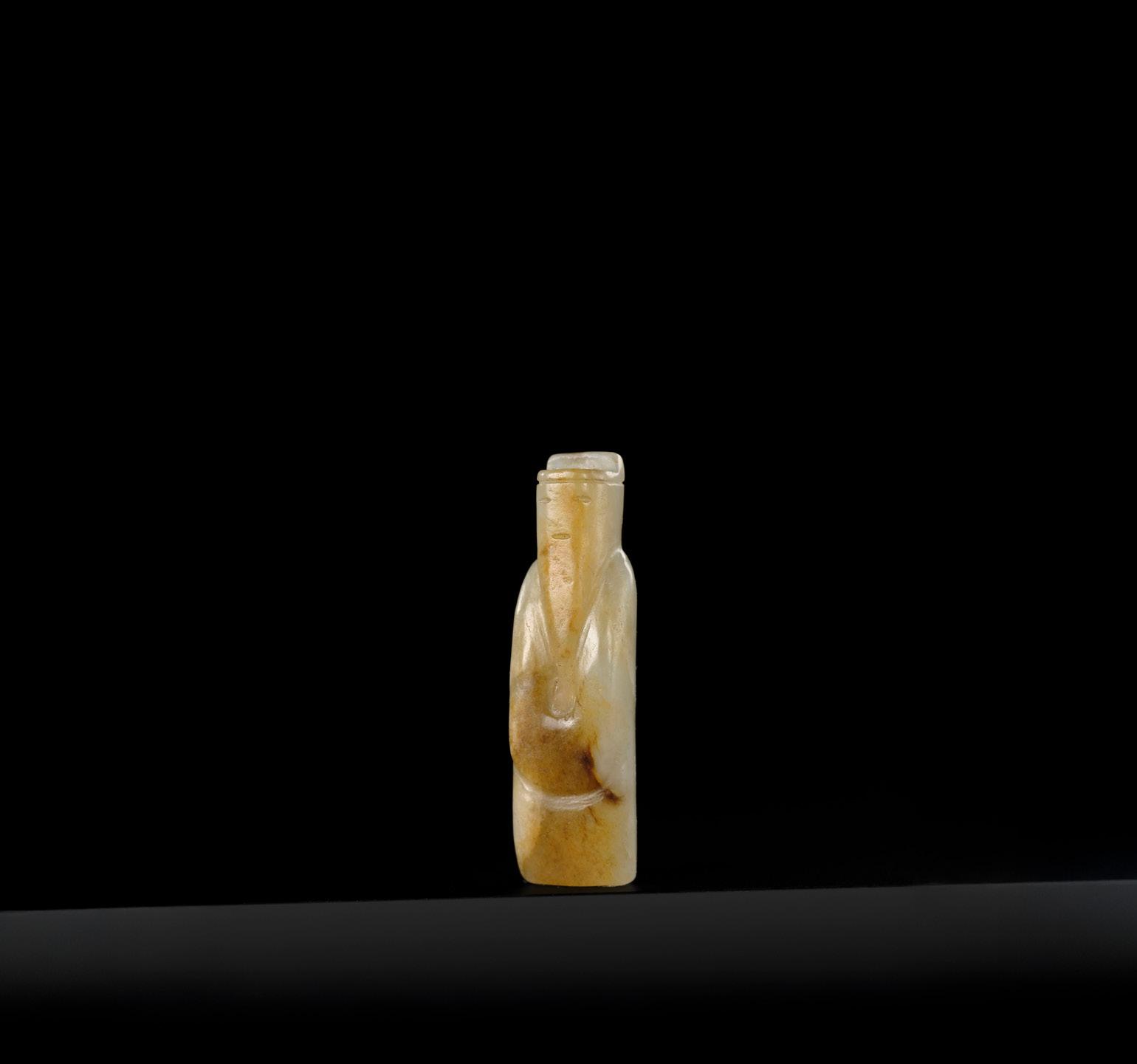
A SMALL PALE CELADON AND RUSSET JADE PENDANT OF A BEARDED MAN, WESTERN HAN DYNASTY
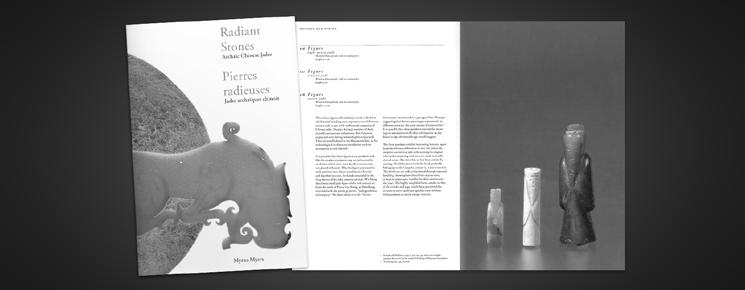
PUBLISHED
1. Myrna Myers (ed.) & Filippo Salviati (auth.), Radiant Stones. Archaic Chinese Jades, Paris, 2000, no. 126.
2. Jean-Paul Desroches (ed.) et al, The Beginning of the World. Dragons, Phoenix and Other Chimera, Fondation Baur, Geneva, 2020, p. 196 and 199, no. 125.
Exhibited:
1. Musée Départemental des Arts Asiatiques, The Beginning of the World – According to the Chinese. Dragons, Phoenix and Other Chimera, Nice, Summer 2021.
2. Fondation Baur, The Beginning of the World – According to the Chinese. Dragons, Phoenix and Other Chimera, Geneva, 11 November 2020-23 May 2021.
China, 2nd-1st century BC. Carved in the round as a standing man with an official's hat, dressed in long flared robes concealing the body. The eyes, mouth, and hat are deeply incised and the body is drilled vertically for suspension. The semi-translucent stone is of a pale celadon color with russet and few brown patches, icy white inclusions, and few dark gray speckles.
Provenance: The Collection of Sam and Myrna Myers, Paris, France. Acquired between circa 1965-2012.
Condition: Very good condition with minor wear, nibbling, and few tiny natural fissures.
Weight: 5.4 g
Dimensions: Height 3.7 cm
LITERATURE COMPARISON
Compare a related pale celadon jade figure, Han dynasty, 4.2 cm tall, in the Asian Art Museum, Smithsonian Institution, accession number S2012.9.2837.
Estimate EUR 1,000
Starting price EUR 500
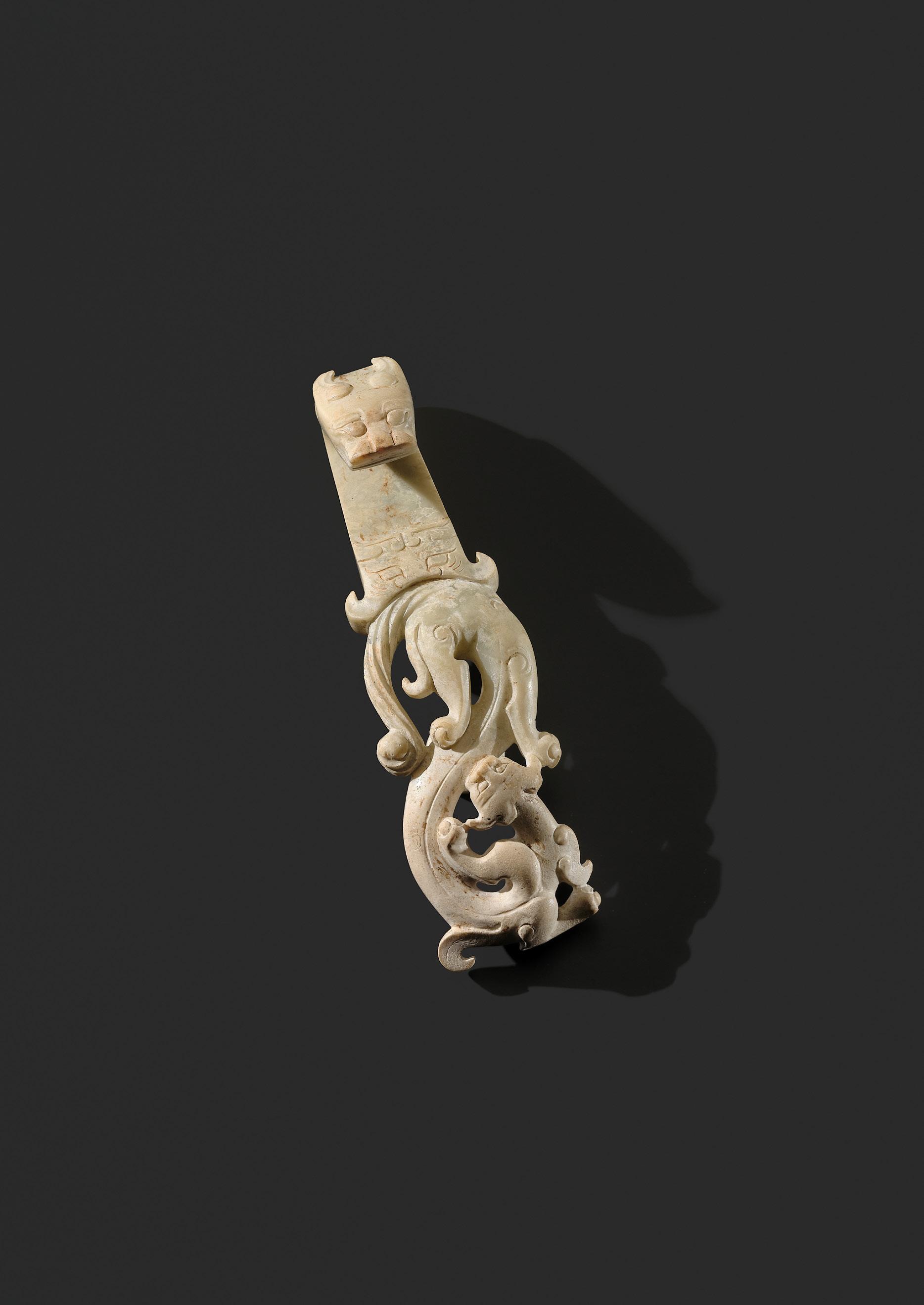
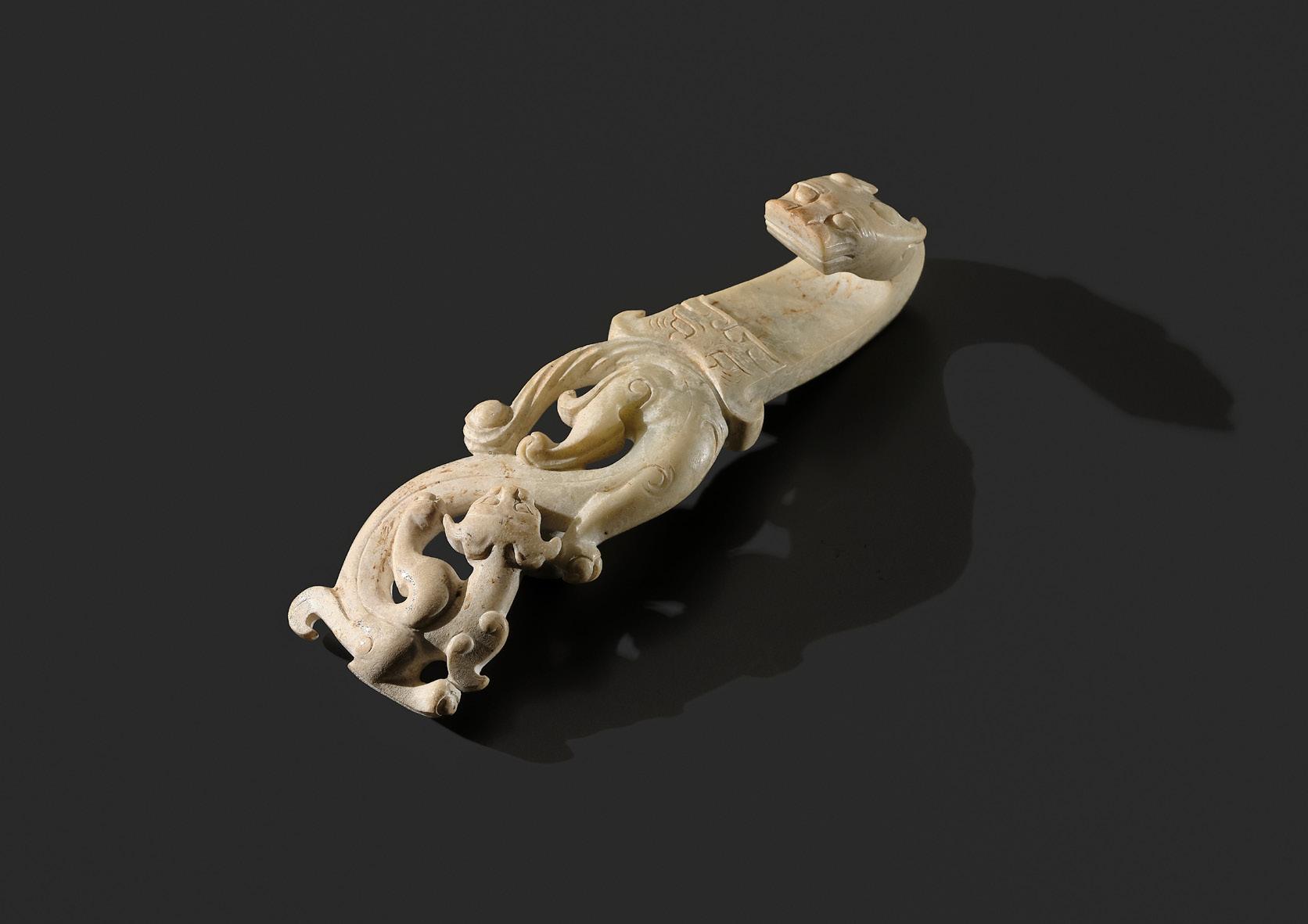
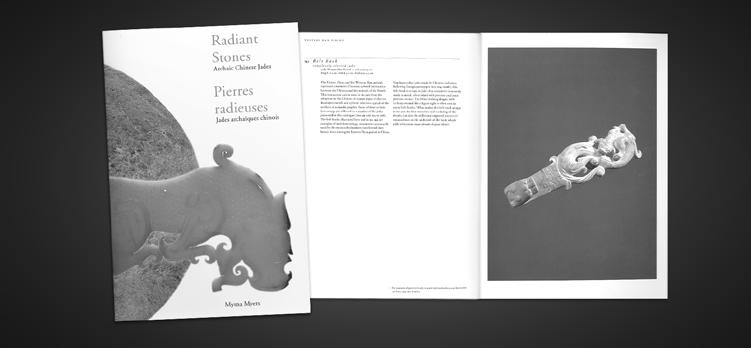
PUBLISHED
1. Myrna Myers (ed.) & Filippo Salviati (auth.), Radiant Stones. Archaic Chinese Jades, Paris, 2000, no. 143.
2. Jean-Paul Desroches (ed.) et al, Two Americans in Paris. A Quest for Asian Art, Paris, 2016, p. 74, 275, no. 158.
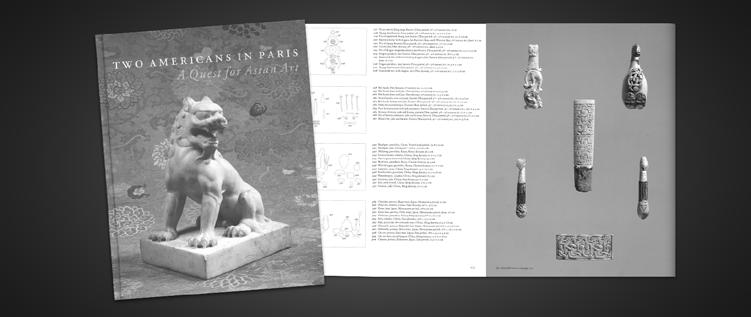
Exhibited:
1. Pointe-à-Callière Museum, From the Lands of Asia. The Sam and Myrna Myers Collection, Montréal, 17 November 2016-19 March 2017.
2. Kimbell Art Museum, From the Lands of Asia. The Sam and Myrna Myers Collection, Fort Worth, Texas, 4 March-19 August 2018.
China, 206 BC-9 AD. The curved openwork shaft carved with a sinuous dragon, terminating at an upturned dragon head. A circular stud to the back incised with C-scrolls.
Provenance: The Collection of Sam and Myrna Myers, Paris, France. Acquired between circa 1965-2012.
Condition: Very good condition, commensurate with age, with ancient wear, minor nibbling, natural age-related imperfections, and distinct traces of weathering and erosion due to burial conditions. Calcification and corresponding surface alterations.
Weight: 60.8 g
Dimensions: Height 11.7 cm
The Eastern Zhou and the Western Han periods represent a moment of intense cultural interaction between the Chinese and the nomads of the North. This interaction can be seen in the arts from the adoption by the Chinese of certain types of objects, decorative motifs and stylistic solutions typical of the artifacts of nomadic peoples. The belt hook illustrated here is one such example of such borrowings, ornaments customarily used by the mounted tribesmen transformed into luxury items during the Eastern Zhou period in China.
AUCTION RESULT COMPARISON
Type: Closely related
Auction: Christie’s Hong Kong, 3 December 2021, lot 2770
Price: HKD 3,125,000 or approx. EUR 375,000 converted and adjusted for inflation at the time of writing
Description: A very rare pierced ‘dragon and phoenix’ belt hook, late Warring States period to early Western Han dynasty, c. 300-141 BC
Expert remark: Note the size (11 cm).
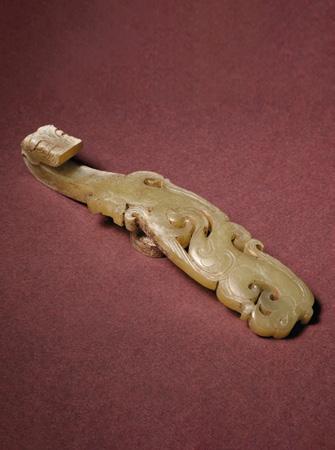
Estimate EUR 8,000
Starting price EUR 4,000
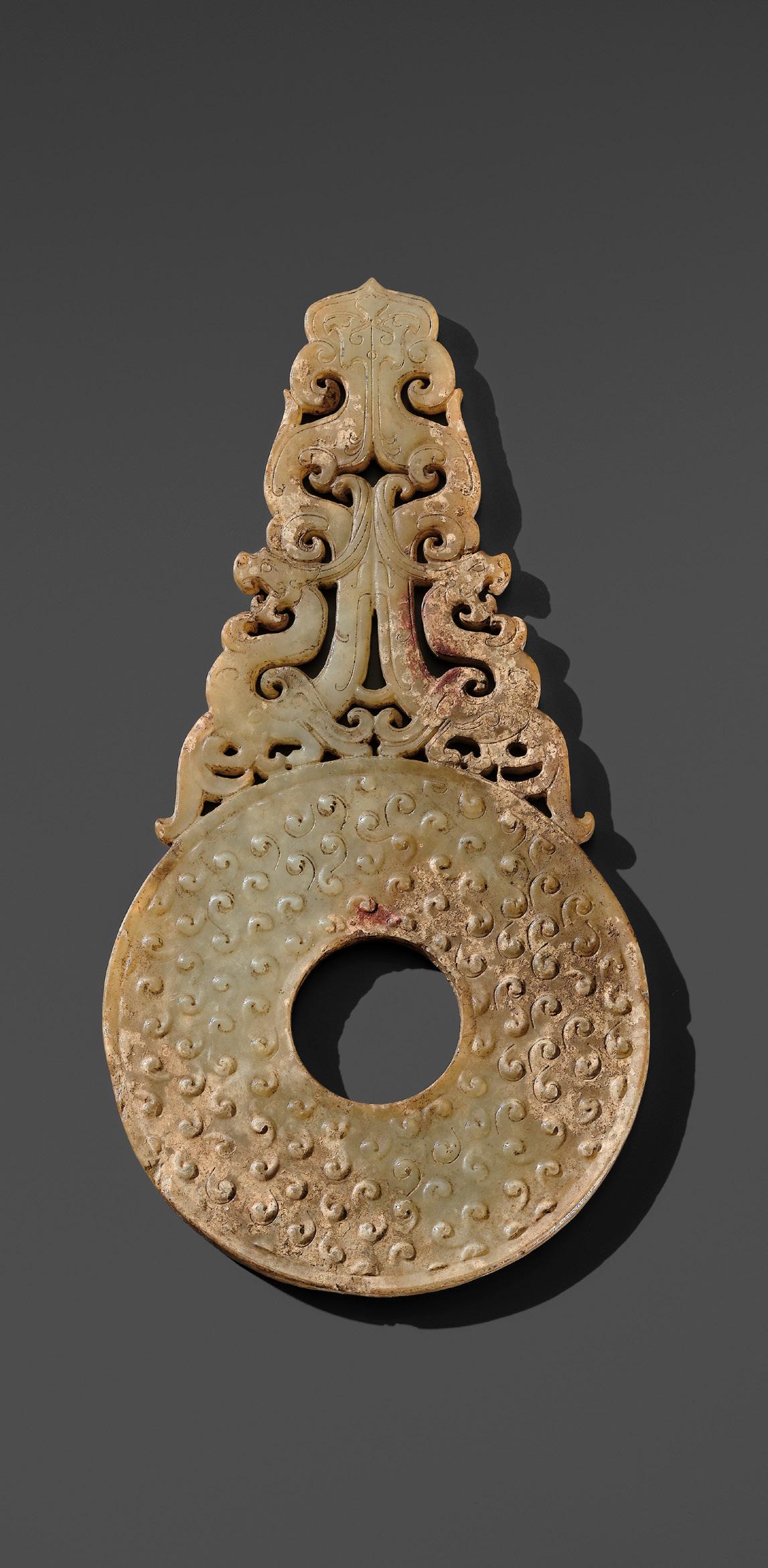
93 A PALE CELADON JADE DISC WITH DRAGONS, BI, WESTERN HAN DYNASTY
China, 206 BC-9 AD. The flattened disc carved with raised comma-spirals framed by slanted borders, and surmounted by a pair of back-facing, horned dragons, their sinuous bodies rising above in curls. The semi-translucent stone is of a pale celadon color with minor areas of calcification to the surface.
Provenance: The Collection of Sam and Myrna Myers, Paris, France. Acquired between circa 1965-2012.
Condition: Good condition with expected old wear, distinct sings of weathering and erosion, traces of prolonged burial, remnants of ancient pigments, small losses along the rims, nibbling, and few tiny chips.
Weight: 130 g
Dimensions: Length 18.6 cm
LITERATURE COMPARISON
Compare a related jade bi disc with dragons, dated Han dynasty, exhibited in the Nanjing Museum, Paved with jade, 2024.
Estimate EUR 6,000
Starting price EUR 3,000
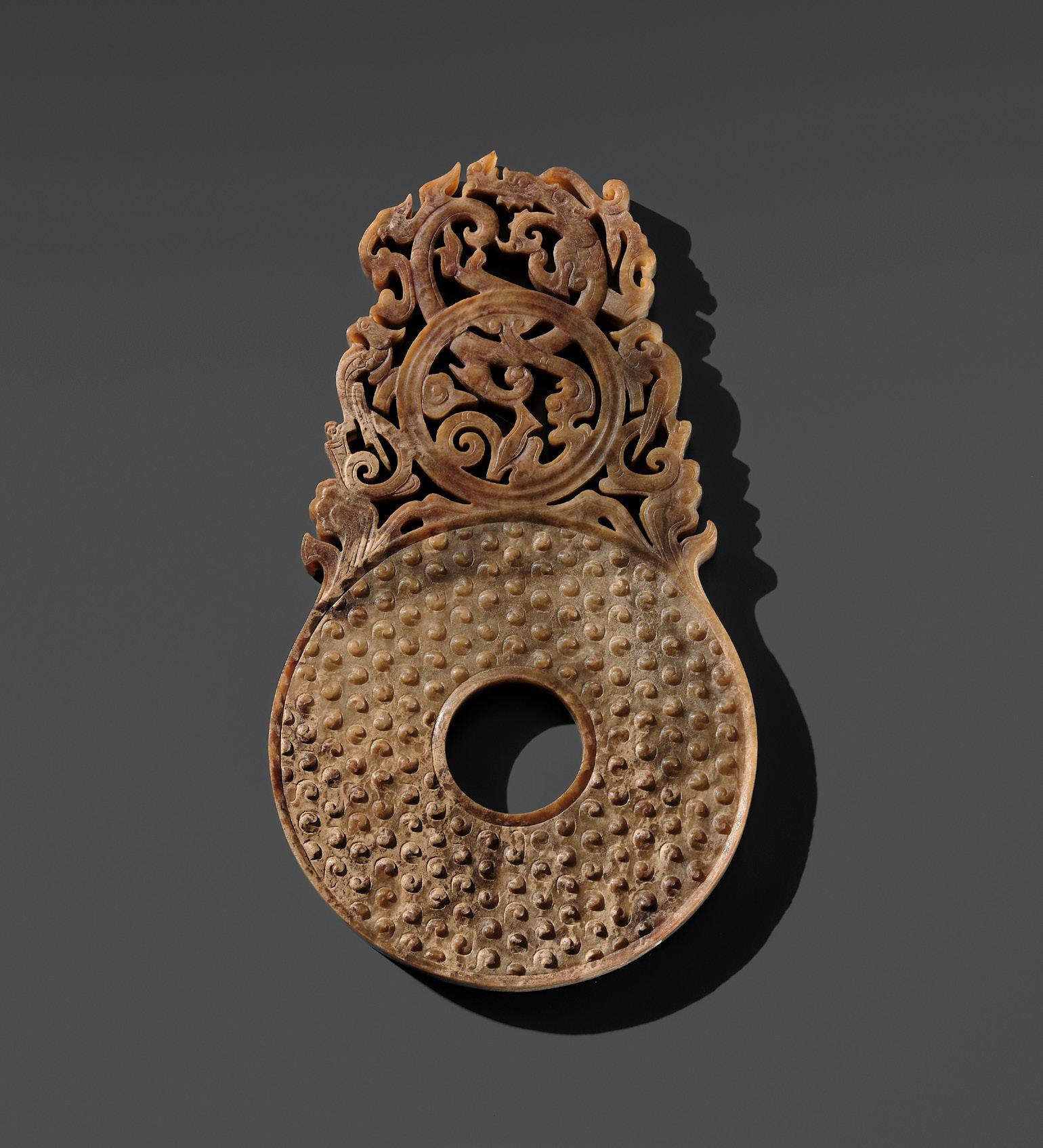
A BROWN AND CELADON JADE DISC WITH DRAGON AND PHOENIXES, BI, LATE WESTERN HAN DYNASTY
China, 73 BC-8 AD. The disc is boldly worked on both sides with a dense field of small raised scrolls, enclosed by slanted borders and surmounted by delicate openwork formed as a ridged ring flanked by phoenixes and a dragon, its body enveloped in fiery scrollwork and the mouth agape to reveal fangs. The semi-translucent stone is a blend of brown and celadon tones with a prominent dark brown vein.
Provenance: The Collection of Sam and Myrna Myers, Paris, France. Acquired between circa 1965-2012.
Condition: Very good condition with expected old wear, few tiny chips to exposed areas, little nibbling along the edges, signs of deep weathering, traces of prolonged burial, and some surface alterations.
Microscopic remnants of ancient pigment.
Weight: 137.4 g
Dimensions: Length 15 cm
LITERATURE COMPARISON
Compare a closely related jade disc with dragon and phoenixes, bi, dated late Western Han dynasty, 31 cm tall, in the Aurora Museum.
Estimate EUR 4,000
Starting price EUR 2,000
A WHITE AND RUSSET ‘PHOENIX AND DRAGON’ JADE ORNAMENT, HAN DYNASTY
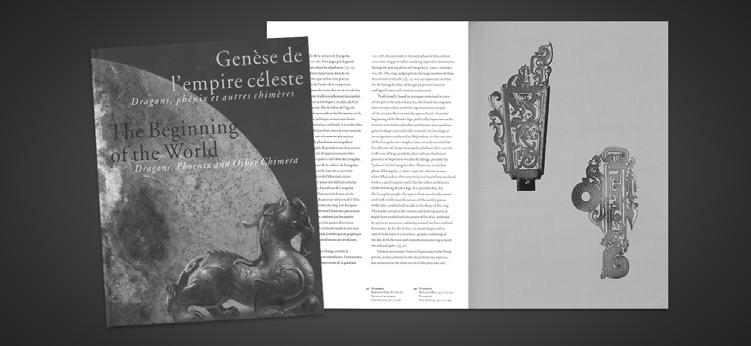
PUBLISHED
Jean-Paul Desroches (ed.) et al, The Beginning of the World. Dragons, Phoenix and Other Chimera, Fondation Baur, Geneva, 2020, p. 60-61, no. 32.
Exhibited:
1. Fondation Baur, The Beginning of the World – According to the Chinese. Dragons, Phoenix and Other Chimera, Geneva, 11 November 2020-23 May 2021.
2. Musée Départemental des Arts Asiatiques, The Beginning of the World – According to the Chinese. Dragons, Phoenix and Other Chimera, Nice, Summer 2021.
China, 206 BC-220 AD. Of flattened form, carved and pierced with delicate scrolls within a rectangular frame rising from a dragon with an S-shaped body detailed with raised comma-scrolls, flanked to one side by a bi-disc with similar raised scrolls below a proud phoenix, and with a decorative pendant to the opposite side. The semitranslucent stone is of white color with russet patches.
Provenance: The Collection of Sam and Myrna Myers, Paris, France. Acquired between circa 1965-2012.
Condition: Very good condition with expected old wear, few tiny chips and losses to exposed areas, little nibbling along the edges, distinct signs of deep weathering, and corresponding surface alteration.
Weight: 104.9 g
Dimensions: Length 14.7 cm
LITERATURE COMPARISON
Compare a closely related jade ornament with phoenix pattern, which was unearthed from the left side of the head covering of a jade burial suit in the tomb of the King of Nanyue, Guangzhou, dated Western Han dynasty, in the Nanyue King Museum.
Estimate EUR 8,000
Starting price EUR 4,000
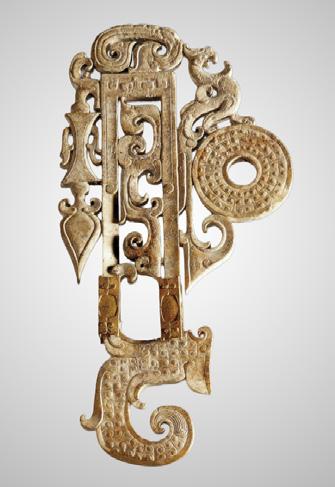

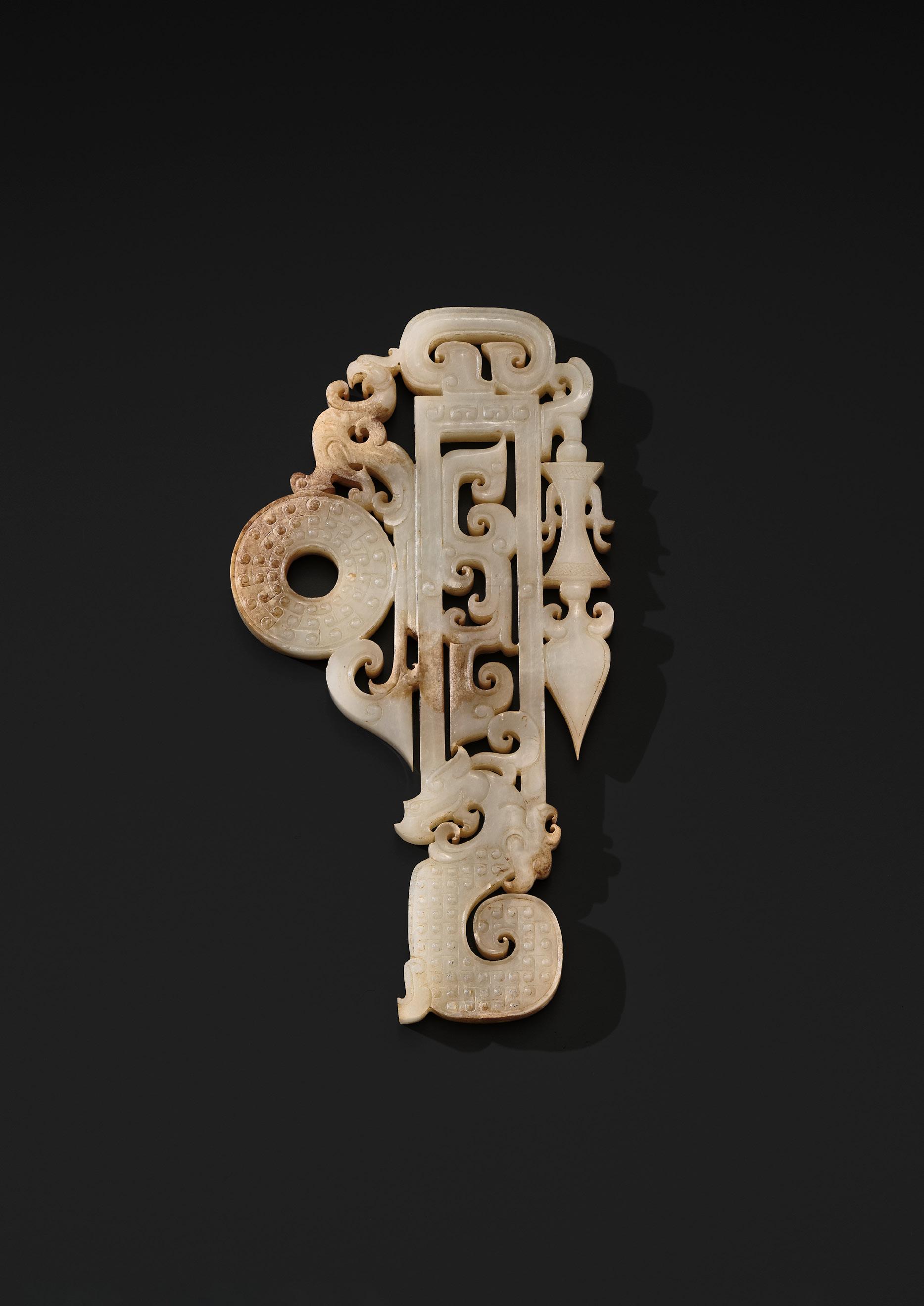
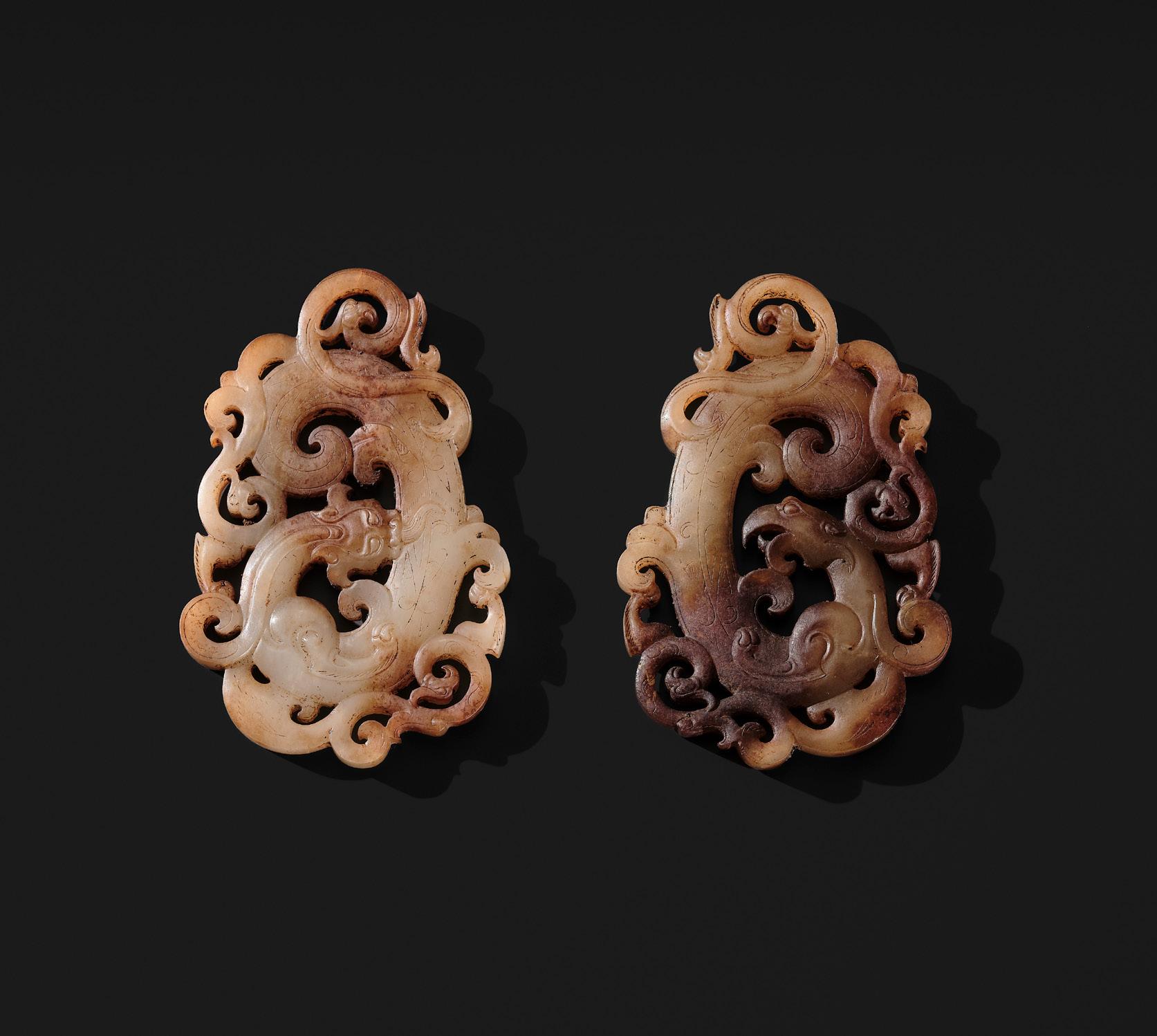
A PAIR OF WHITE AND RUSSET JADE ‘CHILONG AND PHOENIX’ PENDANTS, PEI, WESTERN HAN DYNASTY
China, 206 BC-9 AD. Of flattened form and carved in openwork, one pendant features a coiling dragon, its face detailed with a wide snout and a mouth with a goatee, the body intertwined with three smaller phoenixes and decorated with fine archaic patterns. The phoenix pendant is of similar form, its head turned backward, framed by a pair of phoenixes and a dragon above, and the body likewise incised with archaic motifs. The semi-translucent stones are white in tone with cloudy inclusions and areas of russet. (2)
Provenance: The Collection of Sam and Myrna Myers, Paris, France. Acquired between circa 1965-2012.
Condition: Very good condition with expected old wear, signs of weathering, traces of prolonged burial, few soil encrustations, little nibbling, few tiny nicks to the edges, and surface alterations. The stone with natural fissures, some of which have developed into thin hairline cracks.
Weight: 54.6 g and 53.6 g
Dimensions: Length 9.1 cm and 9.2 cm
Estimate EUR 4,000
Starting price EUR 2,000
LITERATURE COMPARISON
Compare a related jade ‘phoenix’ pendant, dated Western Han, 10.4 cm long, in the Xuzhou Museum, accession number 0070.
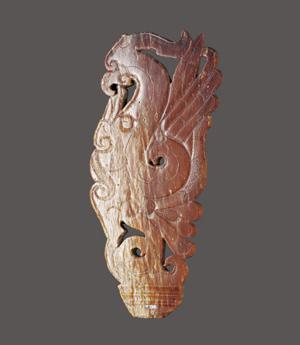
AUCTION RESULT COMPARISON
Type: Related
Auction: Christie’s New York, 25 March 2022, lot 706
Price: USD 100,800 or approx. EUR 98,000 converted and adjusted for inflation at the time of writing
Description: A pale greyish-white jade ‘dragon and phoenix’ pendant, Western Han dynasty (206 BC-AD 8)
Expert remark: Compare the similar subject, color of the jade, and flattened form. Note the size (6 cm) and that the lot comprises only one pendant.
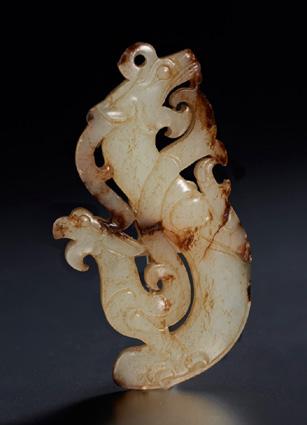
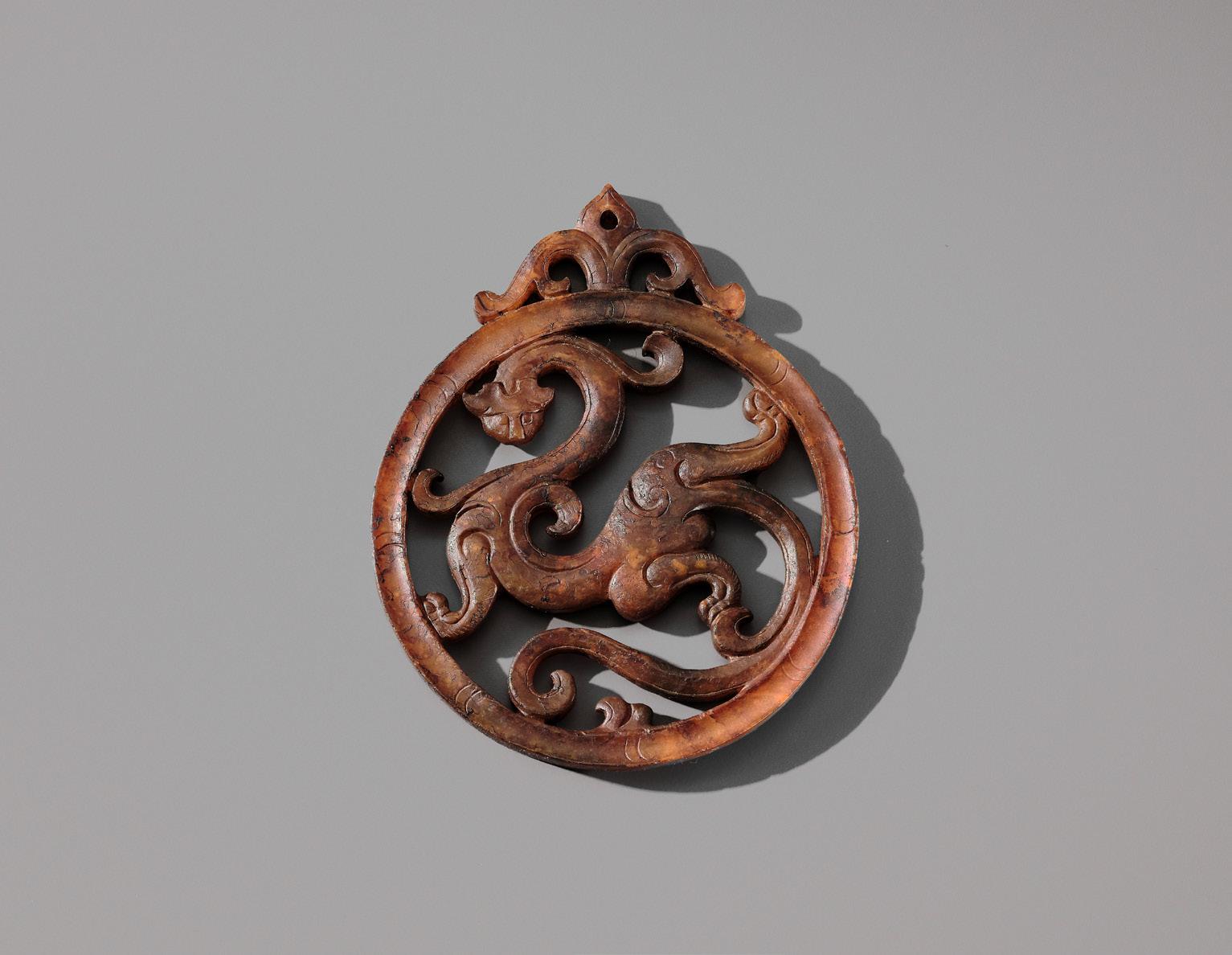
97
A JADE OPENWORK DISC ‘DRAGON’ PENDANT, EARLY HAN DYNASTY
Exhibited:
1. Pointe-à-Callière Museum, From the Lands of Asia. The Sam and Myrna Myers Collection, Montréal, 17 November 2016-19 March 2017.
2. Kimbell Art Museum, From the Lands of Asia. The Sam and Myrna Myers Collection, Fort Worth, Texas, 4 March-19 August 2018.
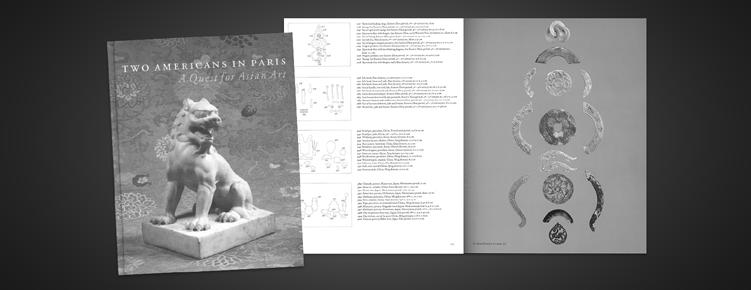
PUBLISHED
1. Jean-Paul Desroches (ed.) et al, Two Americans in Paris. A Quest for Asian Art, Paris, 2016, p. 117 and 275, no. 128.
2. Pointe-à-Callière Museum, Two Americans in Paris. A Quest for Asian Art, Montréal, 2016, exhibition album, p. 24, no. 11.
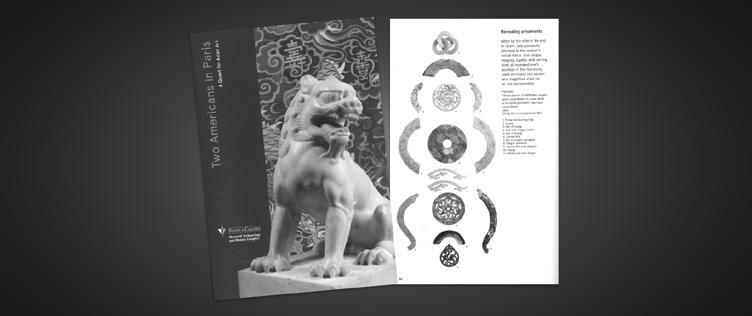
China, 206 BC-220 AD. The translucent stone superbly carved in openwork, the circular pendant enclosing a sinuously carved dragon, the beast with scrolling flames, neatly incised hairwork, and a small face with wide eyes above a broad snout, all below symmetrical foliage carved to the top of the pendant.
Provenance: The Collection of Sam and Myrna Myers, Paris, France. Acquired between circa 1965-2012.
Condition: Very good condition with wear, traces of weathering and signs of prolonged burial, and minuscule nibbling. Surface alteration, calcification, natural inclusions.
Weight: 22.4 g
Dimensions: Height 7.4 cm
AUCTION RESULT COMPARISON
Type: Related
Auction: Christie’s New York, 16 September 2010, lot 979
Price: USD 13,750 or approx. EUR 17,500 converted and adjusted for inflation at the time of writing
Description: A very rare opaque jade dragon pendant, Huan, Eastern Han dynasty Expert remark: Compare the related carving of the sinuous dragon. Note the size (6.8 cm).
Estimate EUR 3,000
Starting price EUR 1,500
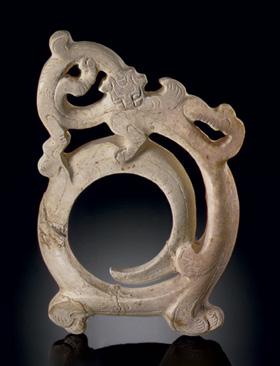
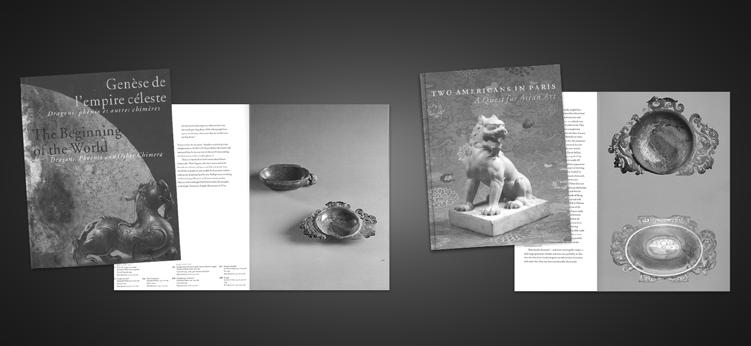
1. Jean-Paul Desroches (ed.) et al, The Beginning of the World. Dragons, Phoenix and Other Chimera, Fondation Baur, Geneva, 2020, p. 229230, no. 158.
2. Jean-Paul Desroches (ed.) et al, Two Americans in Paris. A Quest for Asian Art, Paris, 2016, p. 88-89, no. 186.
Exhibited:
1. Fondation Baur, The Beginning of the World – According to the Chinese. Dragons, Phoenix and Other Chimera, Geneva, 11 November 2020-23 May 2021.
2. Musée Départemental des Arts Asiatiques, The Beginning of the World – According to the Chinese. Dragons, Phoenix and Other Chimera, Nice, Summer 2021.
3. Pointe-à-Callière Museum, From the Lands of Asia. The Sam and Myrna Myers Collection, Montréal, 17 November 2016-19 March 2017.
4. Kimbell Art Museum, From the Lands of Asia. The Sam and Myrna Myers Collection, Fort Worth, Texas, 4 March-19 August 2018.
China, 206 BC-220 AD. The shallow bowl is supported on a low circular foot and incised around the well and exterior sides with a band of delicate vines. The mouth is encircled by a dragon, chilong, and phoenix rendered in bold openwork. The stone is a pale celadon tone with russet, beige, and dark brown shadings, veining, and areas of calcification.
Provenance: The Collection of Sam and Myrna Myers, Paris, France. Acquired between circa 1965-2012.
Condition: Very good condition with expected old wear, signs of weathering, surface alterations, few tiny chips to exposed areas, little nibbling, and traces of prolonged burial.
Weight: 92.4 g
Dimensions: Length 13.9 cm
Chinese culture flourished during the Han dynasty, marked by the development of calligraphy and painting and the introduction of many new scholar’s studio implements. Jade objects associated with the scholar’s desk from this period include inkstone drip cups and brush screens. With its shallow interior and wide mouth, the present piece was likely used as a brush washer within a scholar’s studio.
LITERATURE COMPARISON
Compare a related celadon and russet basin with dragons and chilong, xi, 16.8 cm long, in the Palace Museum, Beijing, accession number 故00084133.
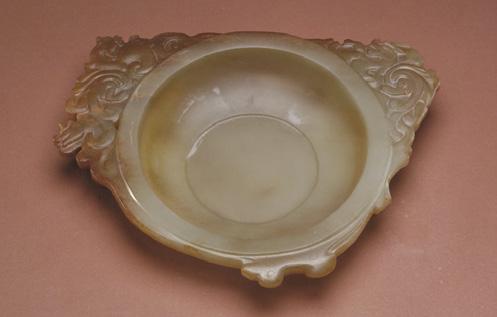
Estimate EUR 8,000
Starting price EUR 4,000
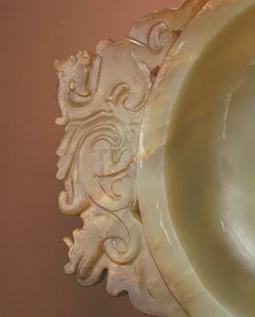

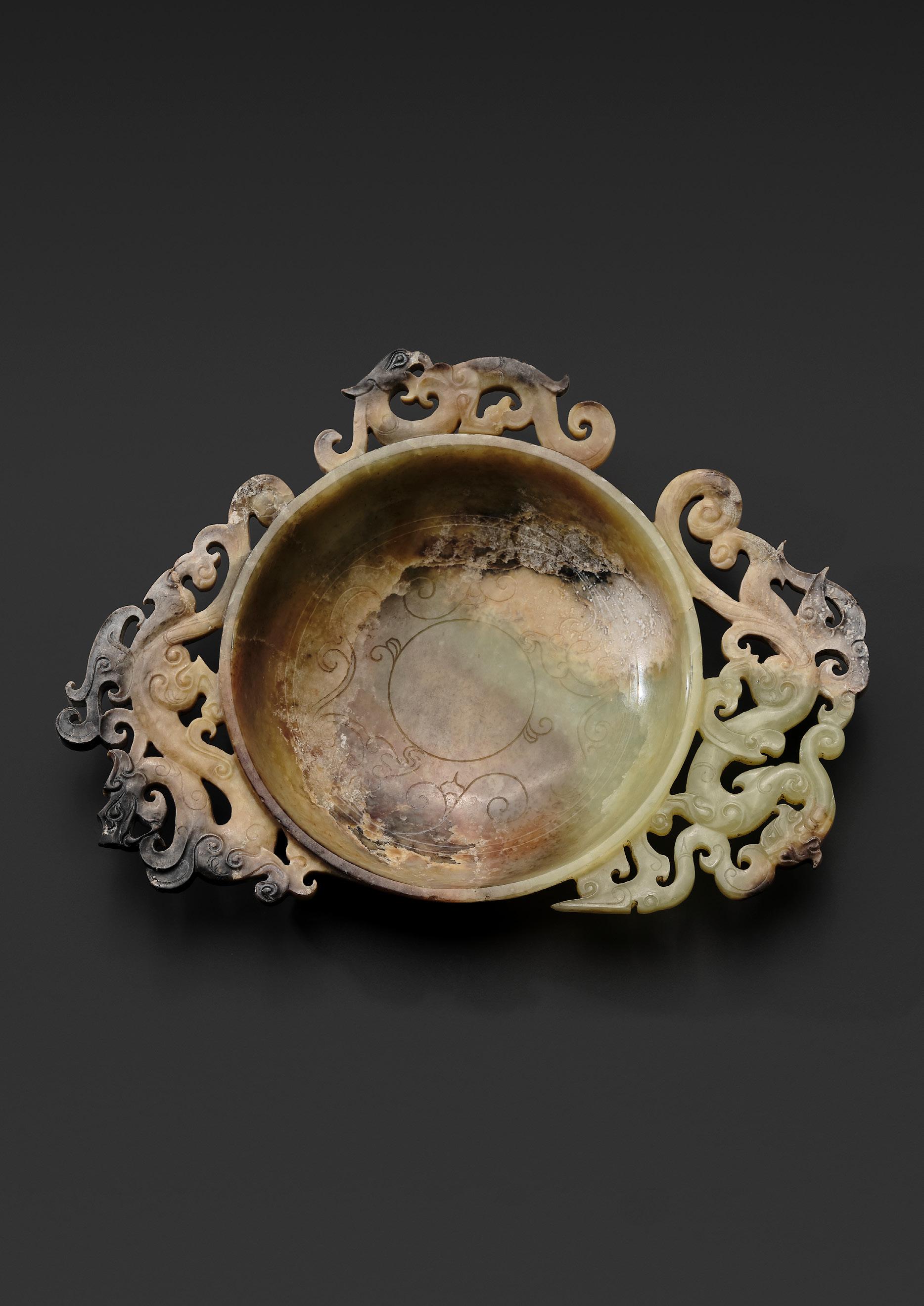
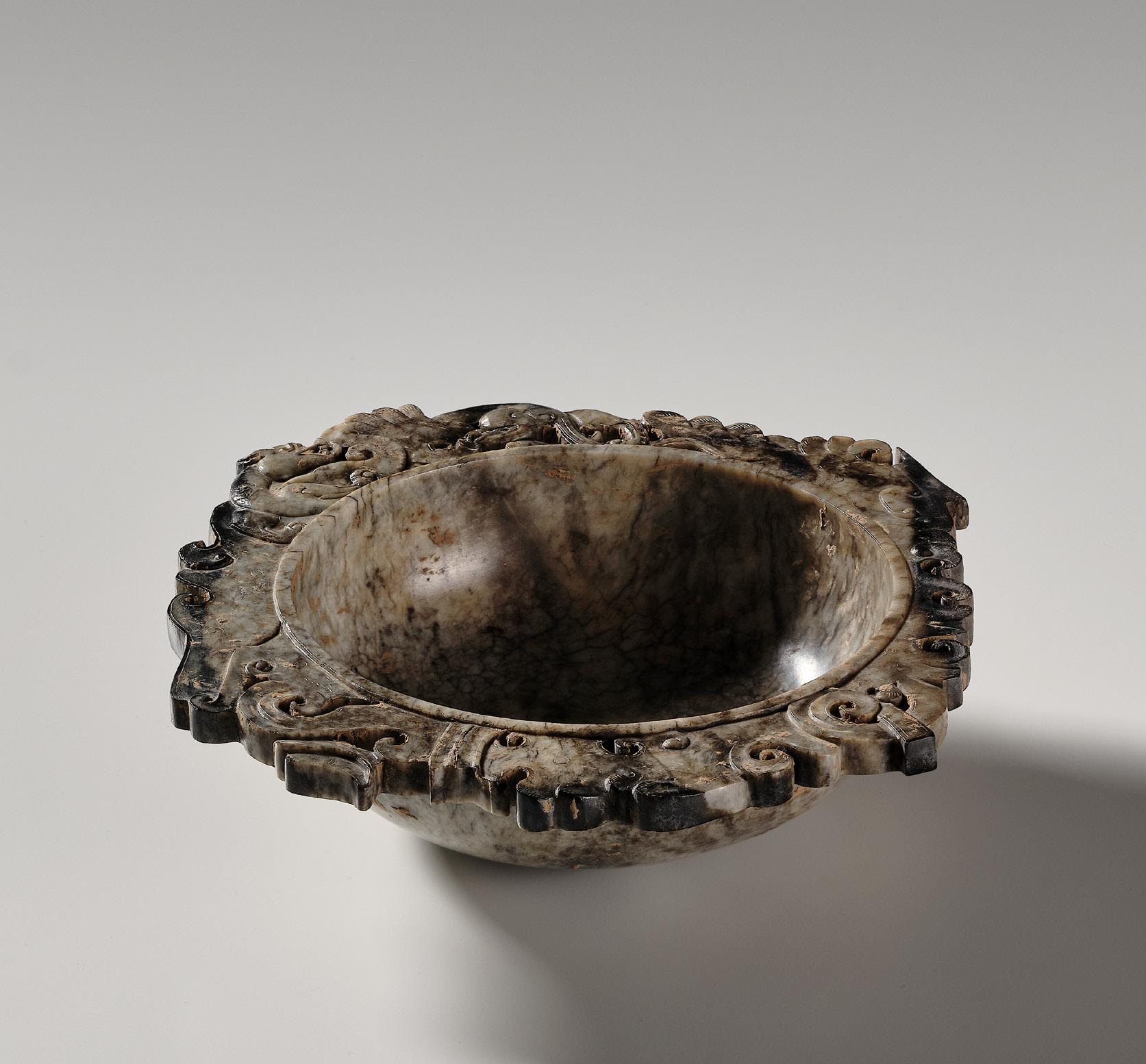
99
A GREY AND BROWN JADE OPENWORK BRUSH WASHER (XI), HAN DYNASTY
China, 206 BC-220 AD. Skillfully hollowed, the vessel with deep sides resting on a short, circular foot and rising to a projecting rim of subtly squared form with rounded corners, exquisitely carved in openwork, to depict a pair of confronting mythical beasts amid stylized scrollwork. The stone of varying hues of grey and celadon, accented with dark patches and natural veining. A very fine polish overall, with an elegant shine.
Provenance: The Collection of Sam and Myrna Myers, Paris, France. Acquired between circa 1965-2012.
Condition: Very good condition, commensurate with age, with ancient wear and inherent natural imperfections. Light traces of weathering and erosion. Traces of usage. Occasional minute nicks, losses, and faint surface scratches. The stone with small areas of soil encrustation.
Weight: 565.8 g
Dimensions: Length 17.7 cm
Chinese culture flourished during the Han dynasty, marked by the development of calligraphy and painting and the introduction of many new scholar’s studio implements. Jade objects associated with the scholar’s
desk from this period include inkstone drip cups and brush screens. With its shallow interior and wide mouth, the present piece was likely used as a brush washer within a scholar’s studio.
LITERATURE COMPARISON
Compare a closely related celadon and russet basin with dragons and chilong (xi), Han dynasty, 206 BC-220 AD, 16.8 cm long, in the Palace Museum, Beijing, accession number 故00084133. Compare a closely related celadon and brown jade brush washer (xi), Han dynasty, 206 BC-220 AD, 13.9 cm long, illustrated in Jean-Paul Desroches (ed.) et al, The Beginning of the World. Dragons, Phoenix and Other Chimera, 2020, p. 229-230, no. 158.
Estimate EUR 6,000
Starting price EUR 3,000
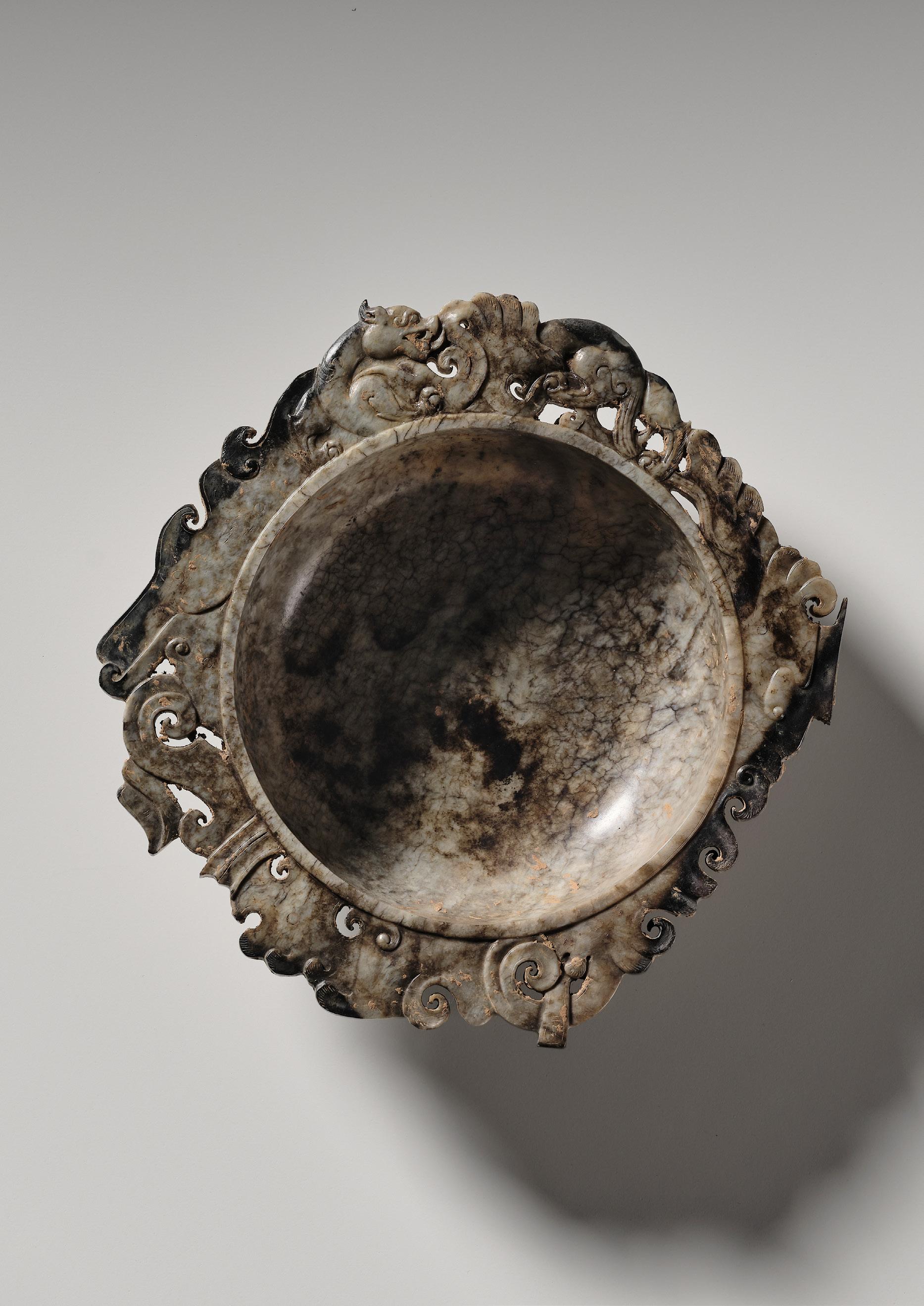
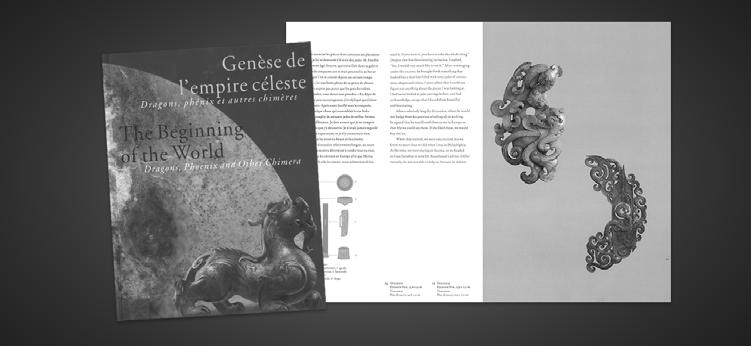
PUBLISHED
Jean-Paul Desroches (ed.) et al, The Beginning of the World. Dragons, Phoenix and Other Chimera, Fondation Baur, Geneva, 2020, p. 38-39, no. 15.
Exhibited:
1. Fondation Baur, The Beginning of the World – According to the Chinese. Dragons, Phoenix and Other Chimera, Geneva, 11 November 2020-23 May 2021.
2. Musée Départemental des Arts Asiatiques, The Beginning of the World – According to the Chinese. Dragons, Phoenix and Other Chimera, Nice, Summer 2021.
China, 206 BC-220 AD. Vividly carved in openwork with four phoenixes wrapped around a shield-form panel derived from a thumb ring (she), their bodies with scrolling limbs detailed with finely incised lines, and the central aperture highlighting the head of a fifth phoenix. The gray jade fully covered in a brown surface alteration suffused with dense beige speckles.
Provenance: The Collection of Sam and Myrna Myers, Paris, France. Acquired between circa 1965-2012.
Condition: Very good condition with expected old wear, signs of deep weathering, little nibbling along the rims, and with partially wellpreserved ancient pigments. Wide areas of surface alteration and calcification.
Weight: 70 g
Dimensions: Length 13.9 cm
Although purely ornamental, plaques of this type, derived from the form of the archer's thumb ring, continued to be known as jue (the Zhou dynasty term for the archer's ring) during the Han period; see J. Watt, Chinese Jades from Han to Ch'ing, New York, 1980, p. 180.
They were produced in a range of decorative styles, including the narrower, more elongated forms exemplified by the present piece. Stylistically, examples from Western Han tombs are generally plainer and more restrained, while those attributed to the Eastern Han period, such as the current lot, feature more elaborate lateral extensions composed of scrolling clouds or dragons.
LITERATURE COMPARISON
Compare a related shield-shaped jade pendant, dated Han dynasty, 10 cm long, in the British Museum, museum number 1945,1017.19 (fig. 1). Compare a related jade archer’s ring ornament, dated Han dynasty, 12.3 cm long, in the Palace Museum, Beijing, accession number 故00085296. Compare a related Jade she-shaped pei pendant with dragon pattern, dated Eastern Han dynasty, 10.1 cm long, in the National Palace Museum, Taiwan, accession number 購玉 000674N000000000.
AUCTION RESULT COMPARISON
Type: Related
Auction: Bonhams Hong Kong, 5 April 2016, lot 23
Price: HKD 1,480,000 or approx. EUR 195,000 converted and adjusted for inflation at the time of writing
Description: A rare jade 'chi' dragon openwork plaque, Eastern Han dynasty
Expert remark: Compare the similar flattened form, archer’s ring design framed by scrollwork, and surface alterations. Note the size (10.1 cm).
Estimate EUR 8,000
Starting price EUR 4,000
Switzerland
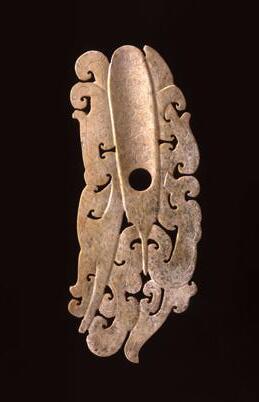
1
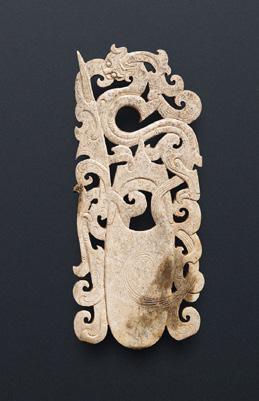
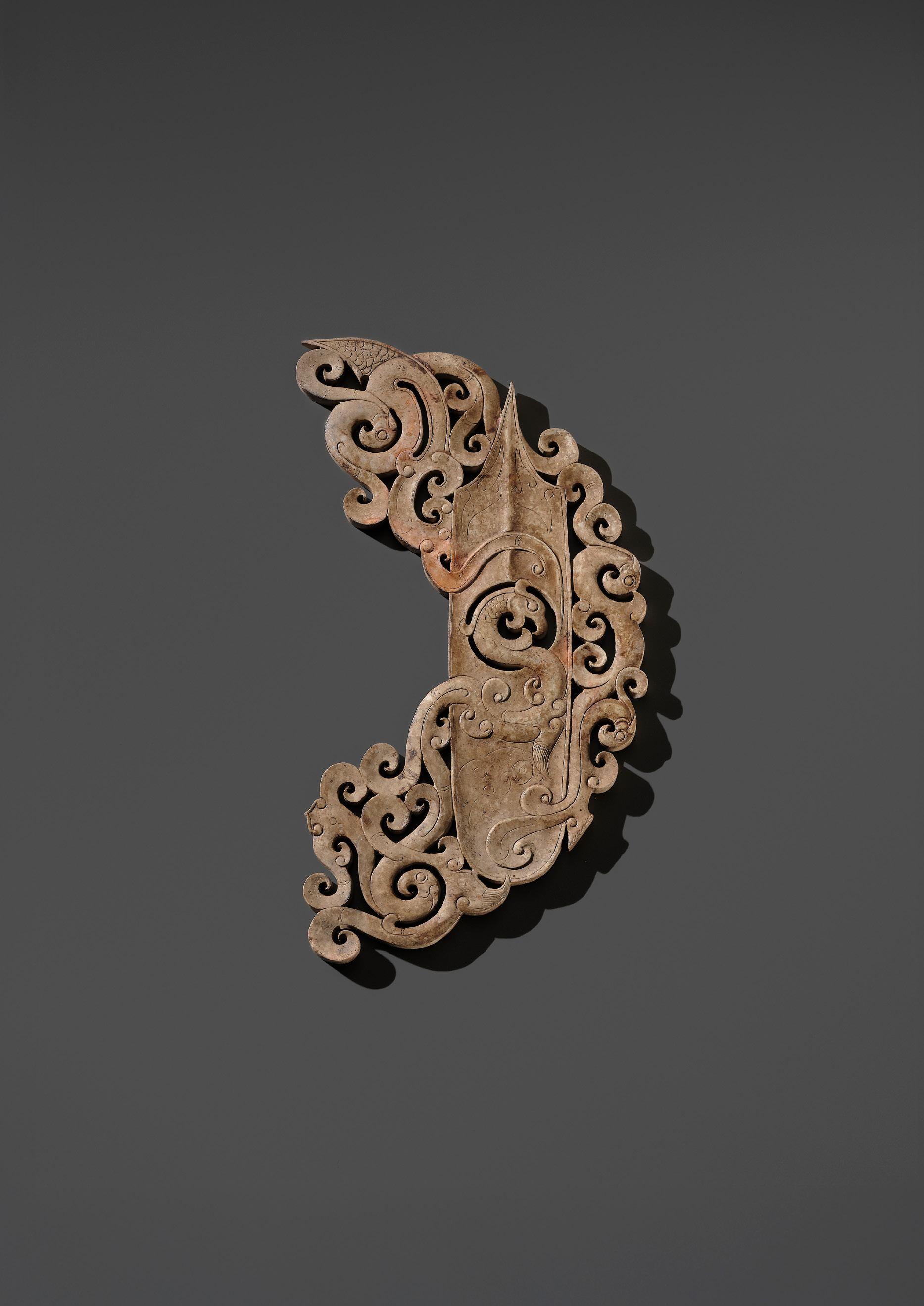
China, 206 BC-220 AD. The cylindrical vessel is supported on three bracket feet in the form of taotie masks. The sides are decorated in low relief with two registers enclosing bears, chilong, and dragons emerging from scrolling clouds, alternating with archaic motifs and raised C-scrolls. One side is set with a circular handle surmounted by a beast head, while the reverse bears a taotie-mask loop suspending a bronze ring.
Provenance: The Collection of Sam and Myrna Myers, Paris, France. Acquired between circa 1965-2012.
Condition: Good condition with expected old wear, commensurate with age, signs of weathering and erosion, some corrosion and verdigris to the bronze parts, traces of prolonged burial, soil encrustations, surface alterations, malachite and cuprite encrustations, remnants of ancient pigments, and little nibbling. The stone with natural fissures, some of which have developed into thin hairline cracks.
Weight: 451.4 g
Dimensions: Diameter 10.1 cm, Height 8.4 cm
The slightly domed cover is encircled by a band of beasts carved in high relief, including a phoenix, turtle, snake, and dragons, all surrounding an incised border that frames the central loop rising from a medallion of stylized petals. The cover is fitted with four bronze rings. The semitranslucent stone is of a creamy beige tone with lighter and darker shading, cloudy white and dark brown inclusions, and areas of calcification. (2)
Literature comparison:
Compare a related gilt bronze framed jade cup, dated 203-111 BC, 8.6 cm tall, in the Nanyue King Museum, accession number 5727.
AUCTION RESULT COMPARISON
Type: Closely related
Auction: China Guardian, Hong Kong, 29 May 2016, lot 659
Price: HKD 259,600 or approx. EUR 34,000 converted and adjusted for inflation at the time of writing
Description: A gilt-bronze-mounted jade wine vessel, Zhi, Han dynasty (202BC-AD220)
Expert remark: Compare the closely related form and bronze elements. Note the size (15 cm).
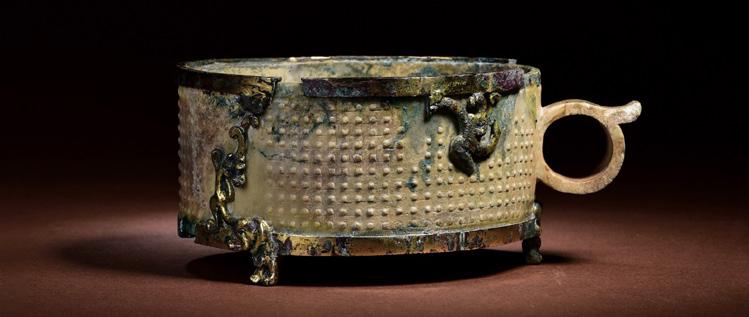
Estimate EUR 15,000
Starting price EUR 7,500
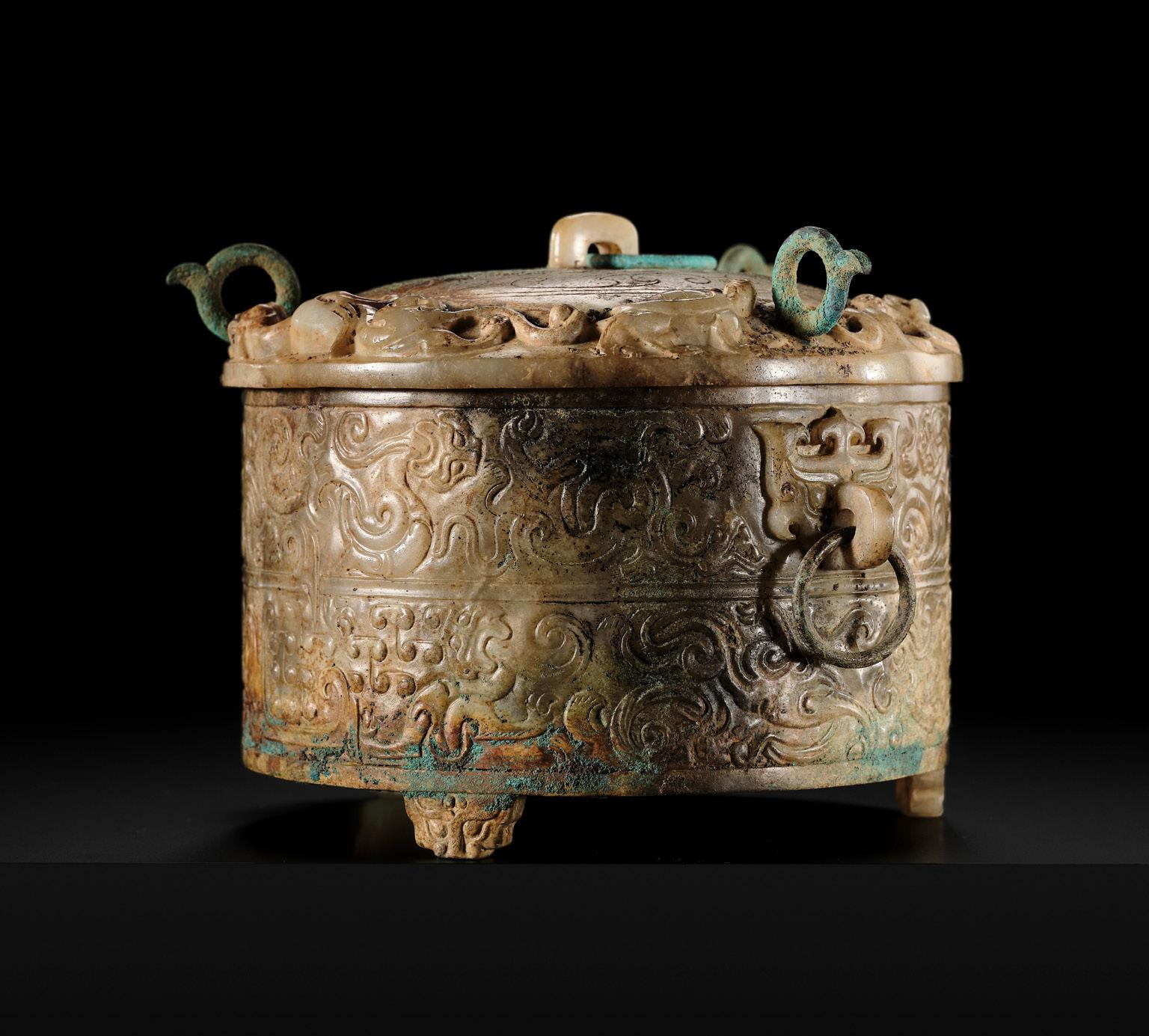
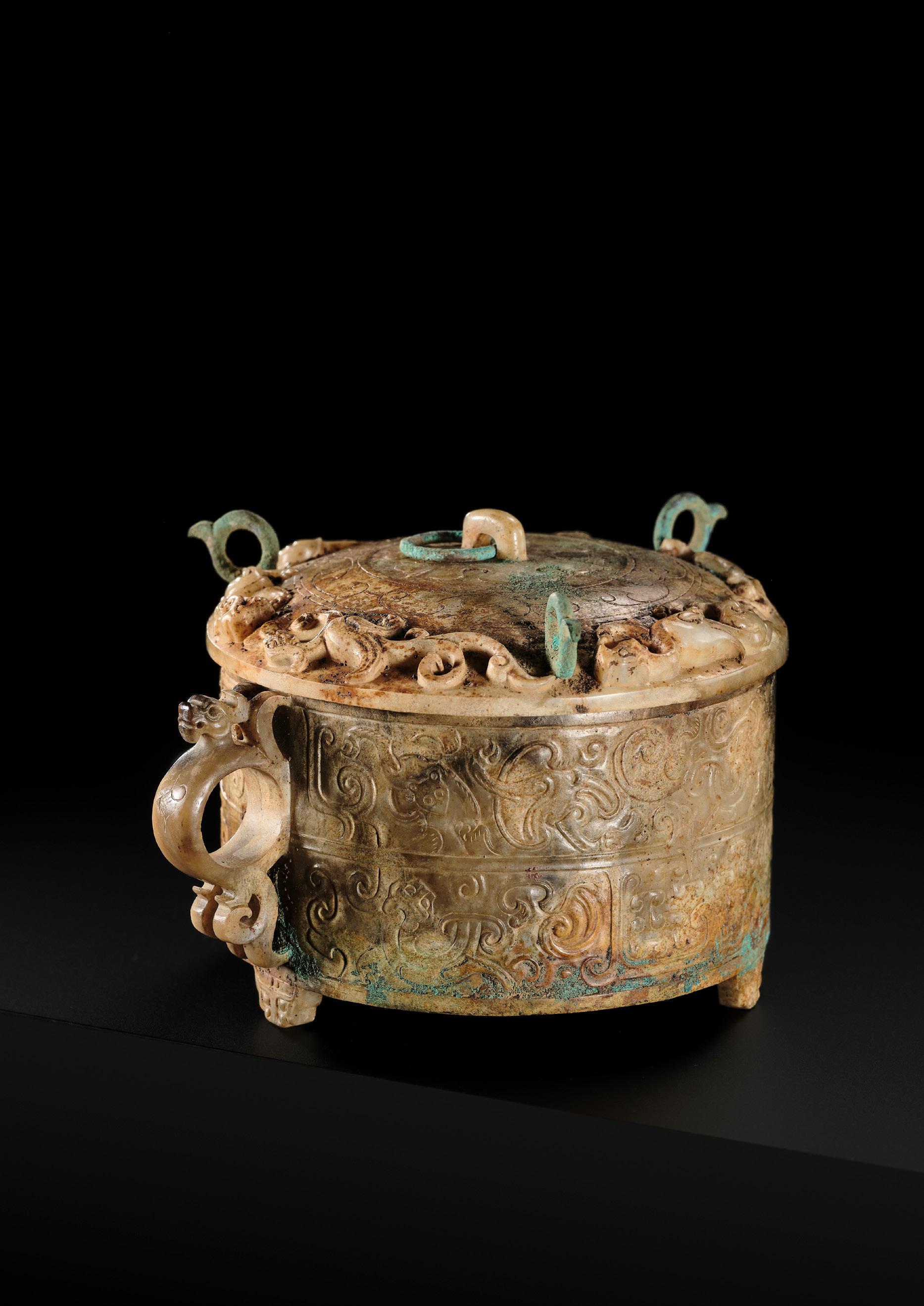
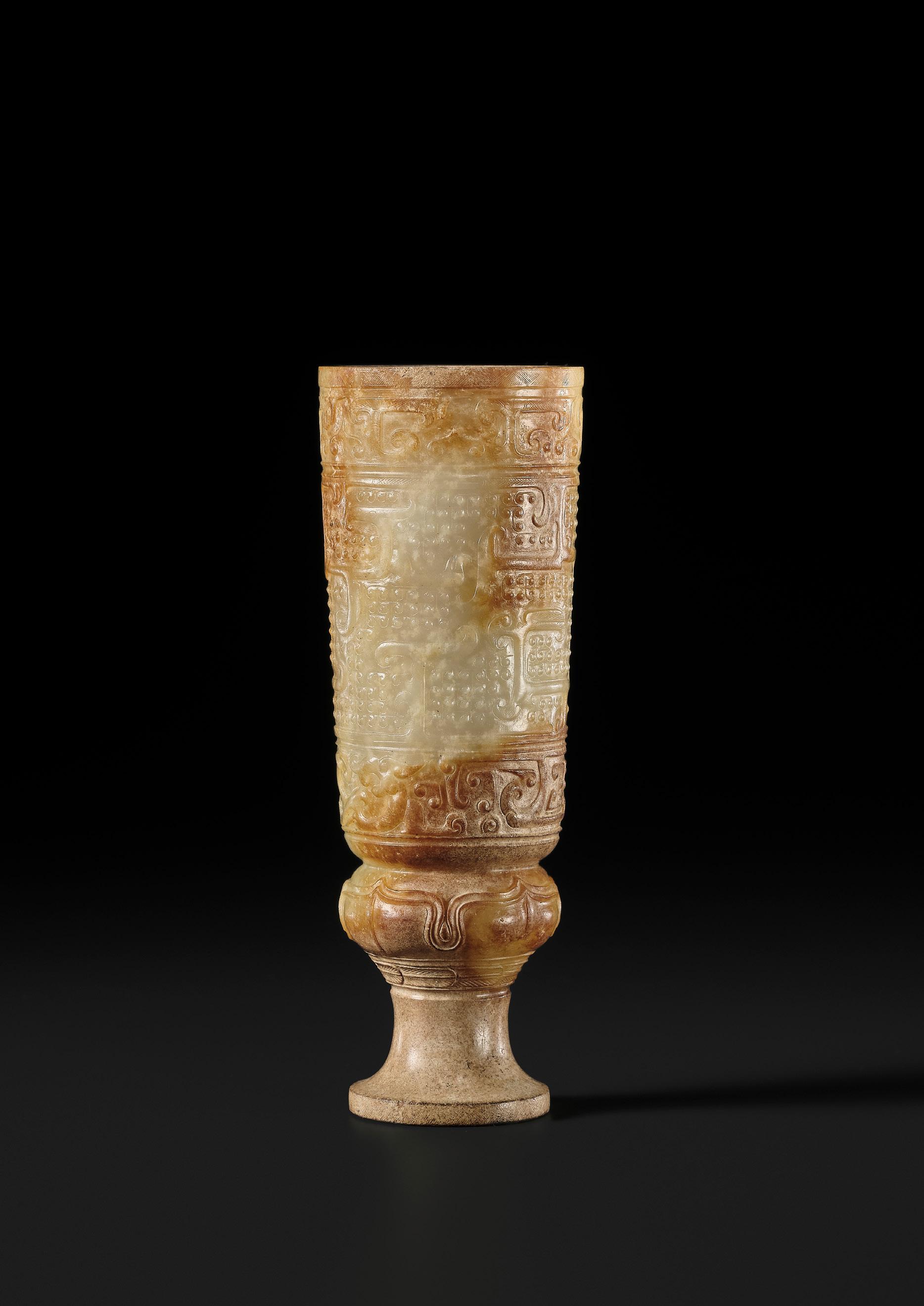
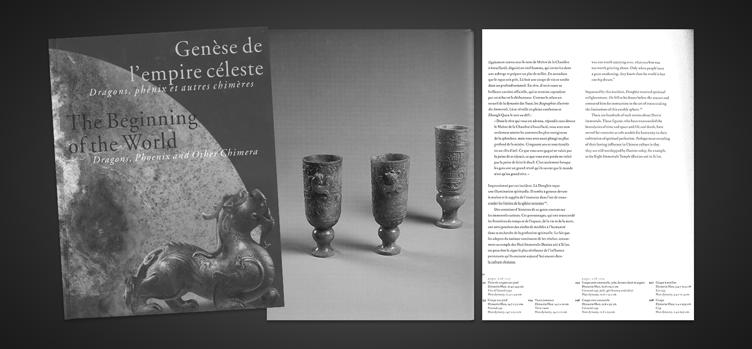
PUBLISHED
Jean-Paul Desroches (ed.) et al, The Beginning of the World. Dragons, Phoenix and Other Chimera, Fondation Baur, Geneva, 2020, p. 226 and 230, no. 153.
Exhibited:
1. Fondation Baur, The Beginning of the World – According to the Chinese. Dragons, Phoenix and Other Chimera, Geneva, 11 November 2020-23 May 2021.
2. Musée Départemental des Arts Asiatiques, The Beginning of the World – According to the Chinese. Dragons, Phoenix and Other Chimera, Nice, Summer 2021.
China, 206 BC-220 AD. The tubular cup is supported on a flaring foot and rises to a bulbous section carved in relief with a row of petals. The upper portion of the sides is decorated in low relief with stylized dragons and phoenixes amid bands of archaic comma scrolls and finely hatched borders. The semi-translucent stone is of a pale celadon tone with cloudy white inclusions, russet patches, and areas of calcification.
Provenance: The Collection of Sam and Myrna Myers, Paris, France.
Acquired between circa 1965-2012.
Condition: Very good condition with expected old wear, little nibbling, signs of weathering, and traces of prolonged burial. Microscopic encrustations. Natural fissures and inclusions, some of which may have developed into thin hairline cracks.
Weight: 338.8 g
Dimensions: Height 14.7 cm
Jade cups of this particular form are exceedingly rare. Vessels like the present example were not merely luxury items signifying wealth and status but also belonged to a category of wares closely associated with longevity and the pursuit of immortality.
The quest for immortality was a central preoccupation among the Han dynasty elite, fueled by the growing influence of Daoist sects by the mid-2nd century. Highly valued for its translucency, hardness, and symbolic durability, jade was believed to possess protective powers. Liquids held in jade vessels were thought to absorb these properties, transforming them into magical elixirs capable of granting immortality.
A very similar jade cup found in the tomb of the King of Nanyue was buried with a lobed jade stand attached to a bronze basin. Scholars suggest it is likely a dew-collecting object associated with immortality elixirs, see literature comparison.
LITERATURE COMPARISON
Compare a closely related pale celadon jade cup with bronze stand, found in the tomb of the King of Nanyue, dated to the Western Han, 23.6 cm tall, in the Nanyue King Museum, Guangzhou, accession number 6104. Compare a related jade cup, dated 221-206 BC, 14.5 cm tall, in the Xi‘an Museum.
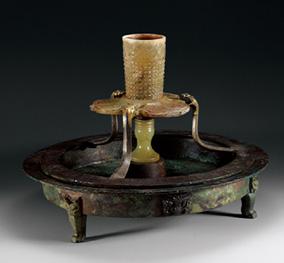
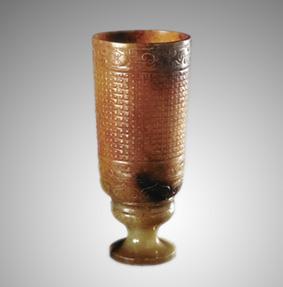
AUCTION RESULT COMPARISON
Type: Related
Auction: Bonhams London, 9 November 2017, lot 2
Price: GBP 31,250 or approx. EUR 45,000 converted and adjusted for inflation at the time of writing
Description: A very rare black and brown jade stem cup, Western Han dynasty Expert remark: Compare the related form and relief work. Note the size (10.1 cm).
AUCTION RESULT COMPARISON
Type: Related
Auction: Sotheby’s Hong Kong, 9 October 2020, lot 16
Price: HKD 21,955,000 or approx. EUR 2,638,000 converted and adjusted for inflation at the time of writing
Description: An extremely rare and important jade 'twin bird' stem cup, Western Han dynasty
Expert remark: Compare the related form, color of the jade, and relief work. Note the size (11.3 cm) and form of the foot.
Estimate EUR 10,000
Starting price EUR 5,000
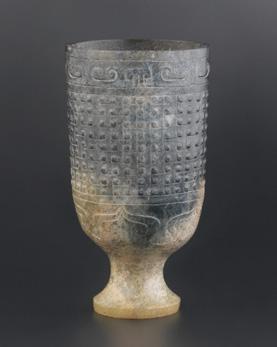
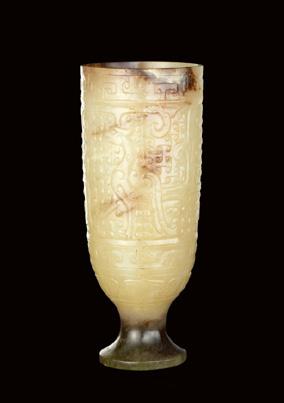
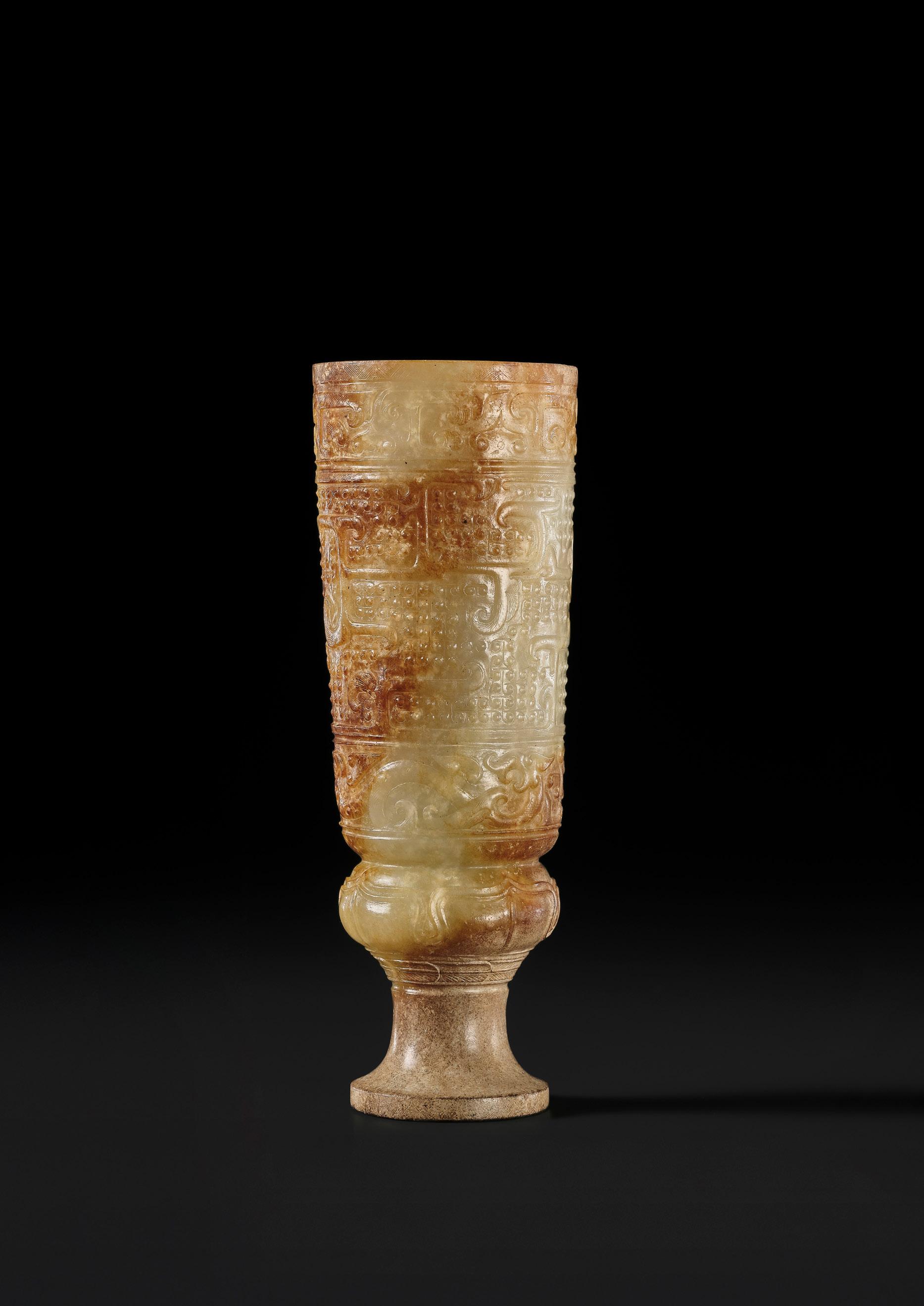
AN EXTREMELY RARE YELLOW AND RUSSET ‘DRAGON AND PHOENIX’
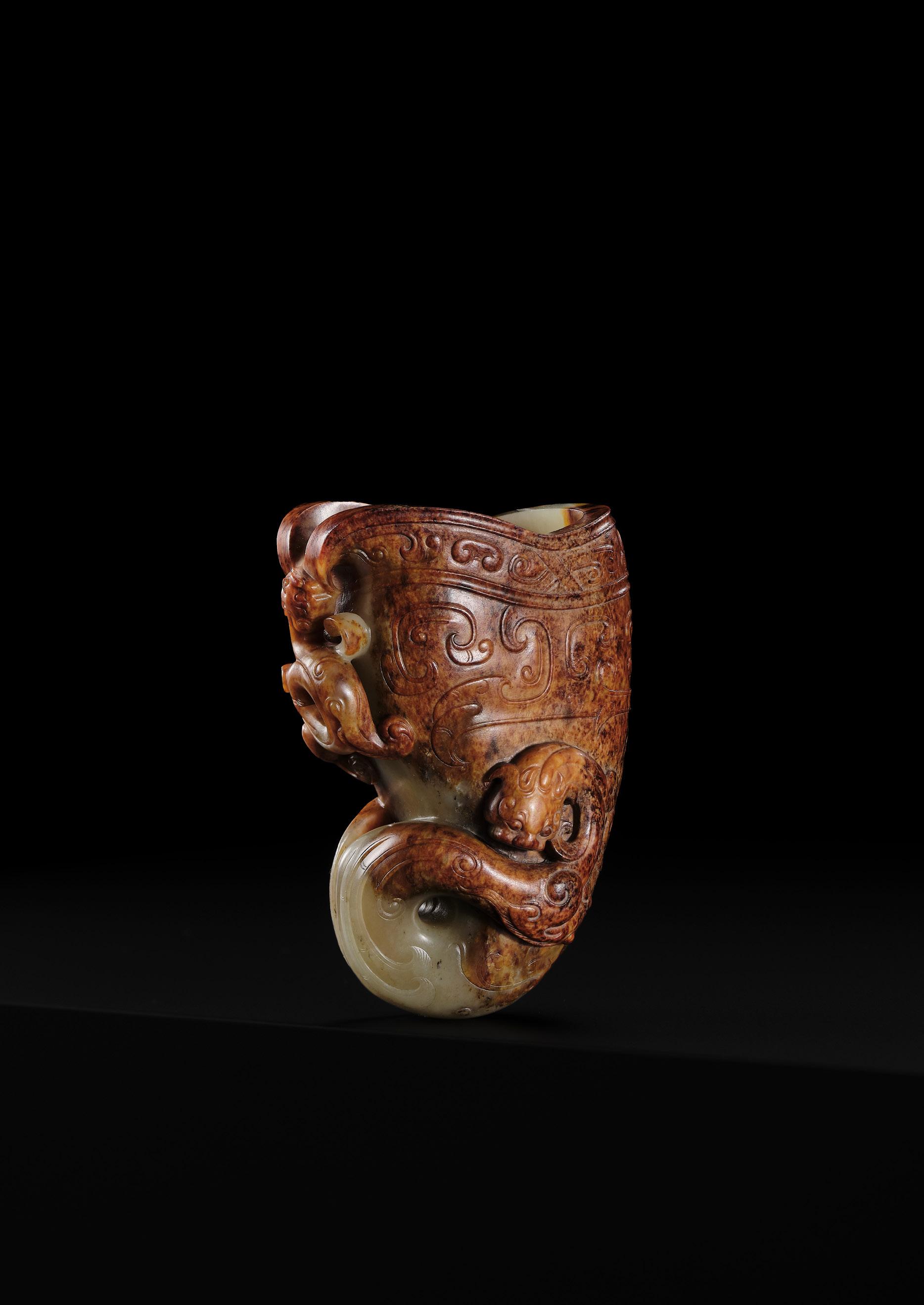
AN EXCEPTIONAL AND IMPORTANT CELADON AND RUSSET ‘CHILONG’ RHYTON
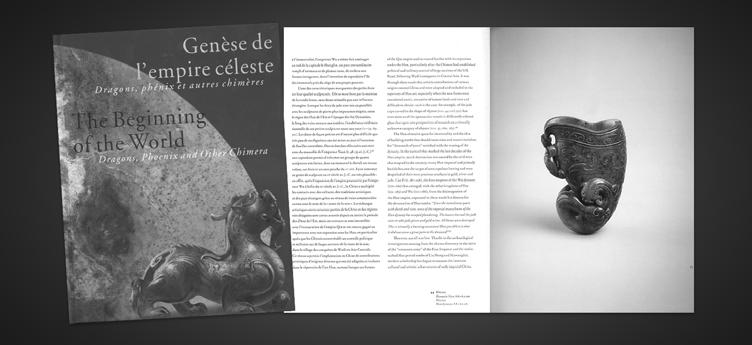
PUBLISHED
Exhibited:
1. Fondation Baur, The Beginning of the World – According to the Chinese. Dragons, Phoenix and Other Chimera, Geneva, 11 November 2020-23 May 2021.
2. Musée Départemental des Arts Asiatiques, The Beginning of the World – According to the Chinese. Dragons, Phoenix and Other Chimera, Nice, Summer 2021.
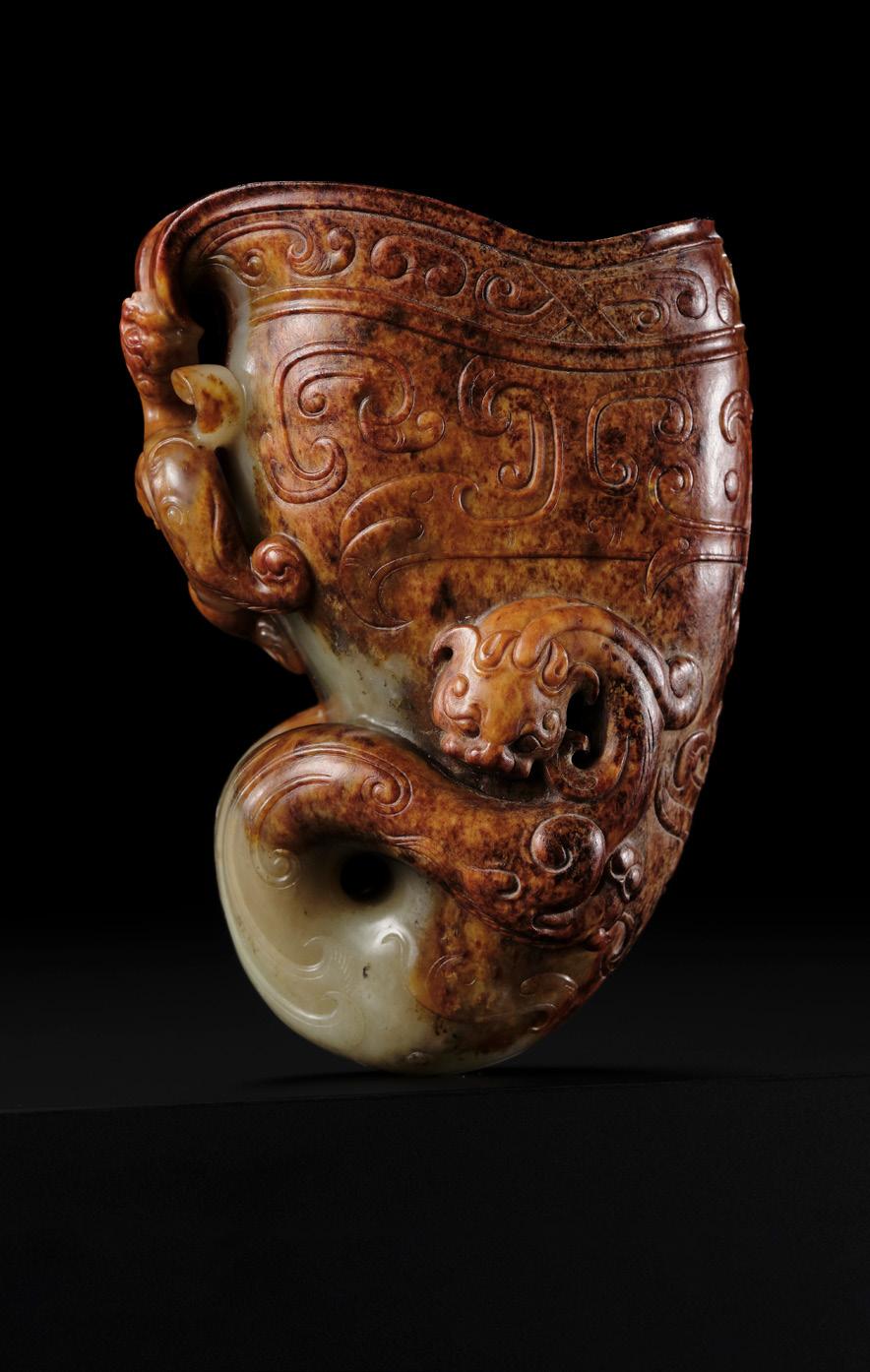
China, 206 BC-220 AD. The vessel rendered in the shape of a curling horn, the upper rim with a gentle curve, vividly carved in relief with two chilong clambering to the sides, one pulling the upper rim downwards with its mouth thereby forming the spout, and the other emerging from the rhyton’s curled end. The surface neatly detailed with archaic C-scrolls and a taotie mask to the narrow side. The semitranslucent stone is of a pale celadon color with a rich, leathery russet skin.
Provenance: The Collection of Sam and Myrna Myers, Paris, France. Acquired between circa 1965-2012.
Condition: Excellent condition with ancient wear, microscopic nibbling, traces of weathering and burial, as well as natural inclusions, veining, and fissures.
Weight: 183.5 g
Dimensions: Height 8.8 cm
The carving of jade vessels, like the present rhyton, was both a laborintensive and resource-demanding process. These intricate works not only required substantial amounts of material, but also generated considerable waste during the hollowing out of the vessel. Ancient vessels in particular, reflect both the high status and significant means of their owner.
LITERATURE
COMPARISON
Compare a related pale celadon jade rhyton cup, dated to the Han dynasty, 18.4 cm tall, in the Nanyue Tomb & Museum, Guangzhou, accession number 3768. Compare a closely related pale celadon jade rhyton cup with dragon and phoenix design, dated to the Western Han dynasty, 10.1 cm tall, in the National Palace Museum, Taipei, accession number 故玉002790N000000000.
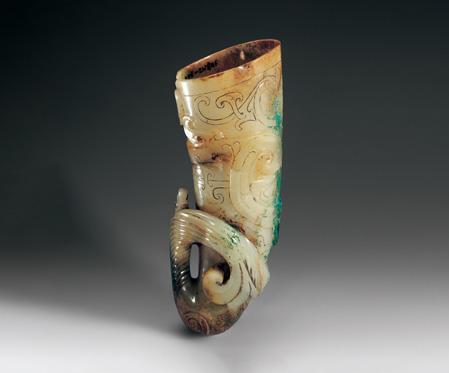
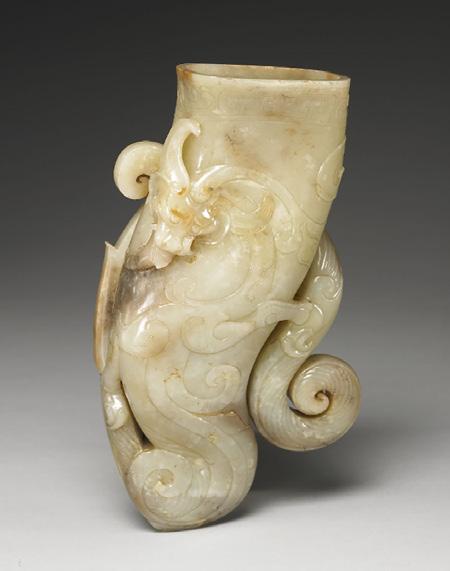
Estimate EUR 10,000
Starting price EUR 5,000
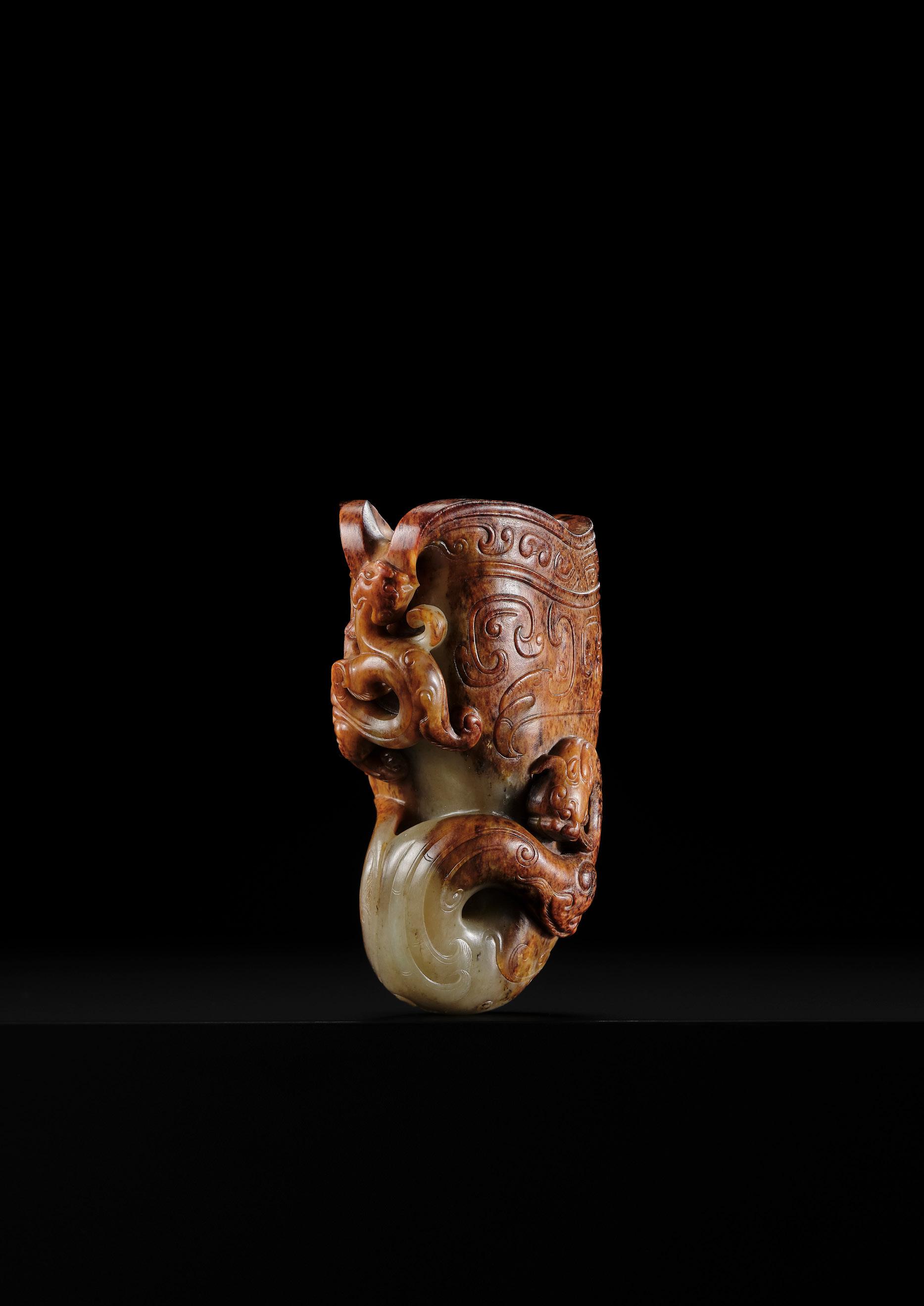
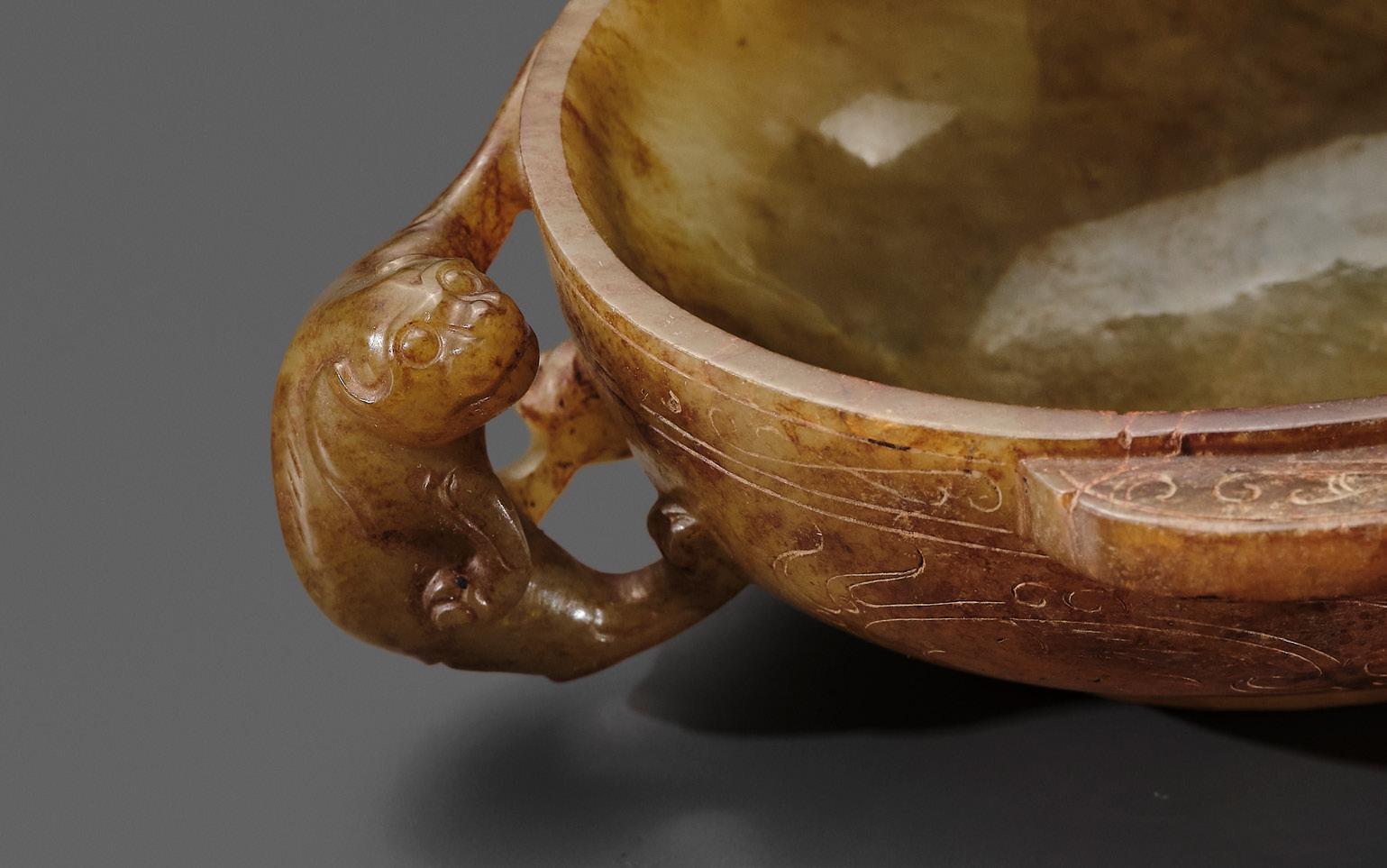
104
AN UNUSUAL CELADON AND RUSSET JADE EAR CUP WITH A BEAR-FORM HANDLE,
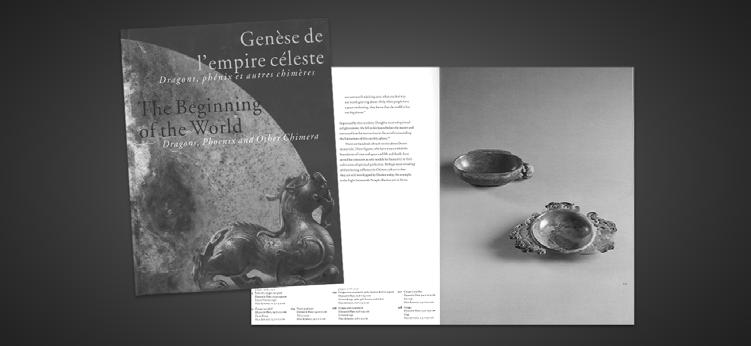
PUBLISHED
Jean-Paul Desroches (ed.) et al, The Beginning of the World. Dragons, Phoenix and Other Chimera, Fondation Baur, Geneva, 2020, p. 229-230, no. 157 (mirrored view).
Exhibited:
1. Fondation Baur, The Beginning of the World – According to the Chinese. Dragons, Phoenix and Other Chimera, Geneva, 11 November 2020-23 May 2021.
2. Musée Départemental des Arts Asiatiques, The Beginning of the World – According to the Chinese. Dragons, Phoenix and Other Chimera, Nice, Summer 2021.
China, 206 BC-220 AD. Of typical form with low, curving sides incised to the exterior with delicate scrollwork forming stylized phoenixes and other beasts, set with a pair of elongated ‘ear’ handles that are engraved with a formal scroll, and with a small, openwork bear clambering to one side. The semi-translucent stone is of a pale celadon color with russet and white patches and veins.
Provenance: The Collection of Sam and Myrna Myers, Paris, France. Acquired between circa 1965-2012.
Condition: Very good condition with expected old wear, little nibbling along the rims, signs of weathering. The stone with natural fissures, some of which have developed into thin hairline cracks.
Weight: 166.4 g
Dimensions: Length 12.4 cm
This ear-shaped cup belongs to a type that was widespread in the Han period. These vessels were inspired by the pottery and lacquered wooden bowls common between the 5th century BC and the 3rd century AD, see an example dated to the Warring States period in the Tokyo National Museum, accession number TJ-5664. The bear functioning as the handle is exceptionally unusual; to date, no comparable example has been documented.
This type of vessel was highly prized and costly. Contemporary writings advised that everyday utensils should not be used in funerary rites, which is why many burial goods were crafted as imitations of the objects once used by the deceased. Such pieces adorned the tombs of the aristocracy. This cup is an excellent example—not only for its refined workmanship, but also for its use of jade, a material reserved for the wealthiest families.
LITERATURE COMPARISON
Compare a related double-eared jade cup, dated Han dynasty, 9.9 cm long, in the National Palace Museum, Taiwan, accession number 故玉 005587N000000000.
AUCTION RESULT COMPARISON
Type: Closely related
Auction: Christie’s Hong Kong, 31 May 2017, lot 2740
Price: HKD 1,187,500 or approx. EUR 153,000 converted and adjusted for inflation at the time of writing
Description: A yellow jade earcup, Han dynasty or later
Expert remark: Compare the closely related form, incised decoration, color of the jade, and size (13.5 cm).
Estimate EUR 8,000
Starting price EUR 4,000
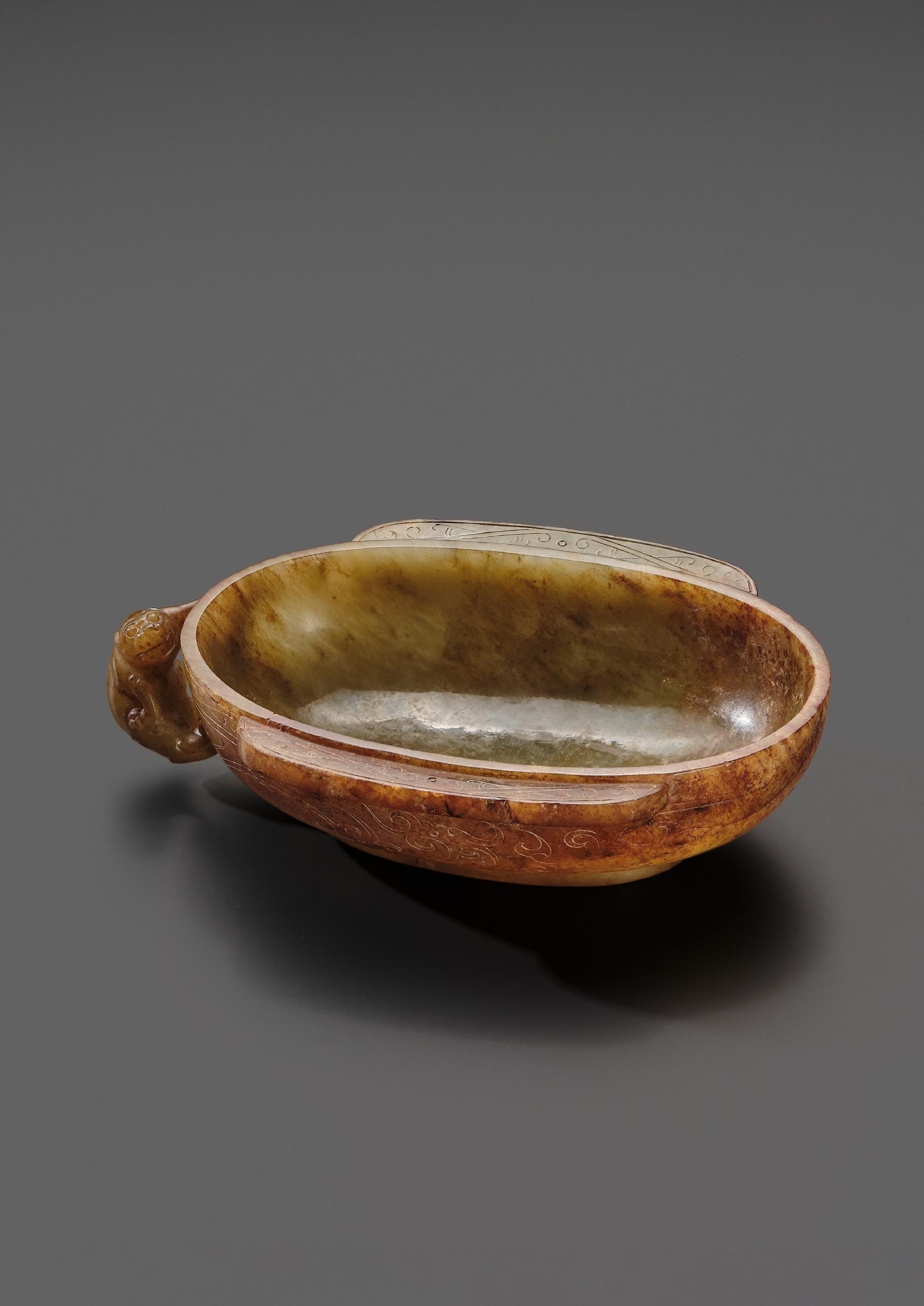
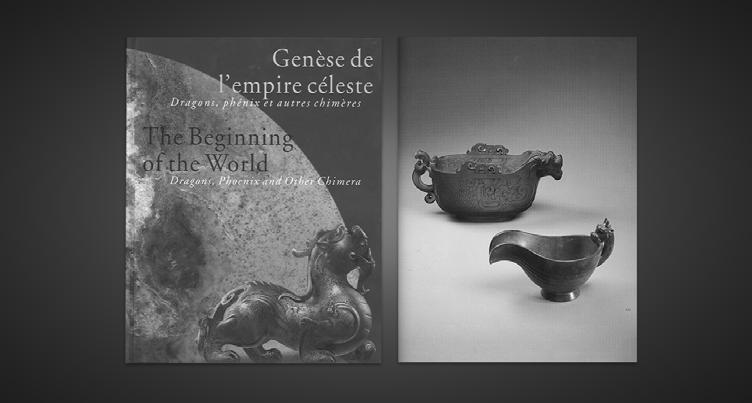
PUBLISHED
Jean-Paul Desroches (ed.) et al, The Beginning of the World. Dragons, Phoenix and Other Chimera, Fondation Baur, Geneva, 2020, p. 232-233, no. 161.
Exhibited:
1. Fondation Baur, The Beginning of the World – According to the Chinese. Dragons, Phoenix and Other Chimera, Geneva, 11 November 2020-23 May 2021.
2. Musée Départemental des Arts Asiatiques, The Beginning of the World – According to the Chinese. Dragons, Phoenix and Other Chimera, Nice, Summer 2021.
China, 202 BC-220 AD. Finely carved, the undulating form raised on a short flaring foot, applied to one side with a dragon-form handle, the exterior finely incised with three parallel grooved lines and encircled below the rim with a geometric band.
Provenance: The Collection of Sam and Myrna Myers, Paris, France. Acquired between circa 1965-2012.
Condition: Excellent condition with minor wear and natural imperfections.
Weight: 213.3 g
Dimensions: Length 12.5 cm
The yi was a water vessel often used in conjunction with a pan for the ritual washing of hands, which is confirmed by the two having been found together in tombs, usually with the yi in the pan. It was a late Western Zhou adaptation of the gong and the he, and continued into the Eastern Zhou period and onwards. Ancient examples made from jade are extremely rare.
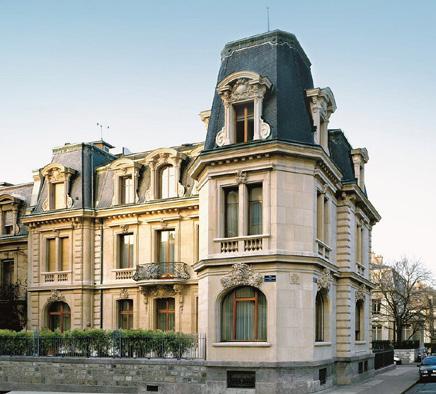
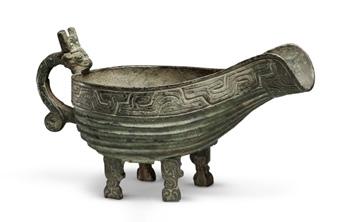
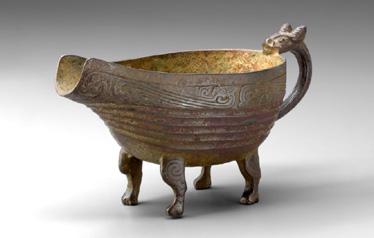
LITERATURE COMPARISON
fig. 3
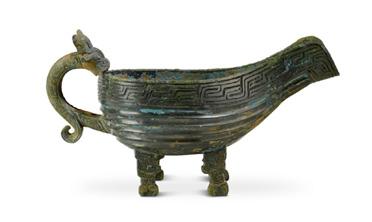
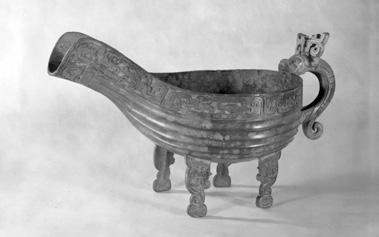
fig. 4
Compare a closely related inscribed bronze pouring vessel yi, Late Western Zhou dynasty, formerly in the Dr Wou Kiuan Collection, sold at Sotheby’s in 2022 (fig. 1). Note the similar overall form, the comparable dragon handle, and the related treatment of the surface decoration.
Compare an inscribed bronze yi, Zhou dynasty, from the collection of Sir Joseph Hotung, Sotheby’s Hong Kong, 2022, showing a related spout profile and a similarly arranged inscription (fig. 2).
For further reference, compare a related yi in the Indianapolis Museum of Art at Newfields, with a similar silhouette (fig. 3).
Compare also a bronze pouring vessel yi in the Harvard Art Museums, sharing the broad body, forward-thrusting spout, and closely related decorative program (fig. 4).
Estimate EUR 6,000
Starting price EUR 3,000
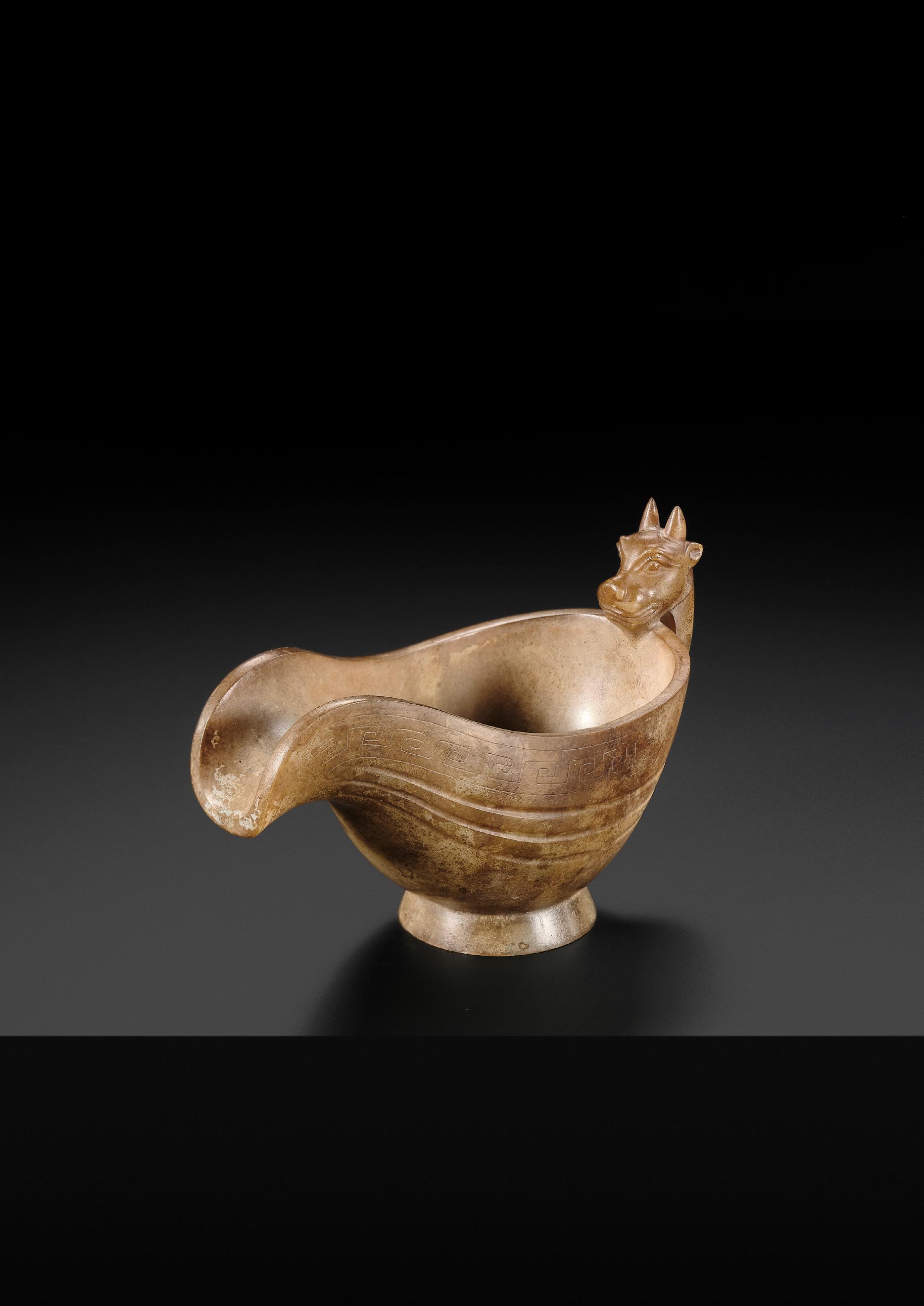
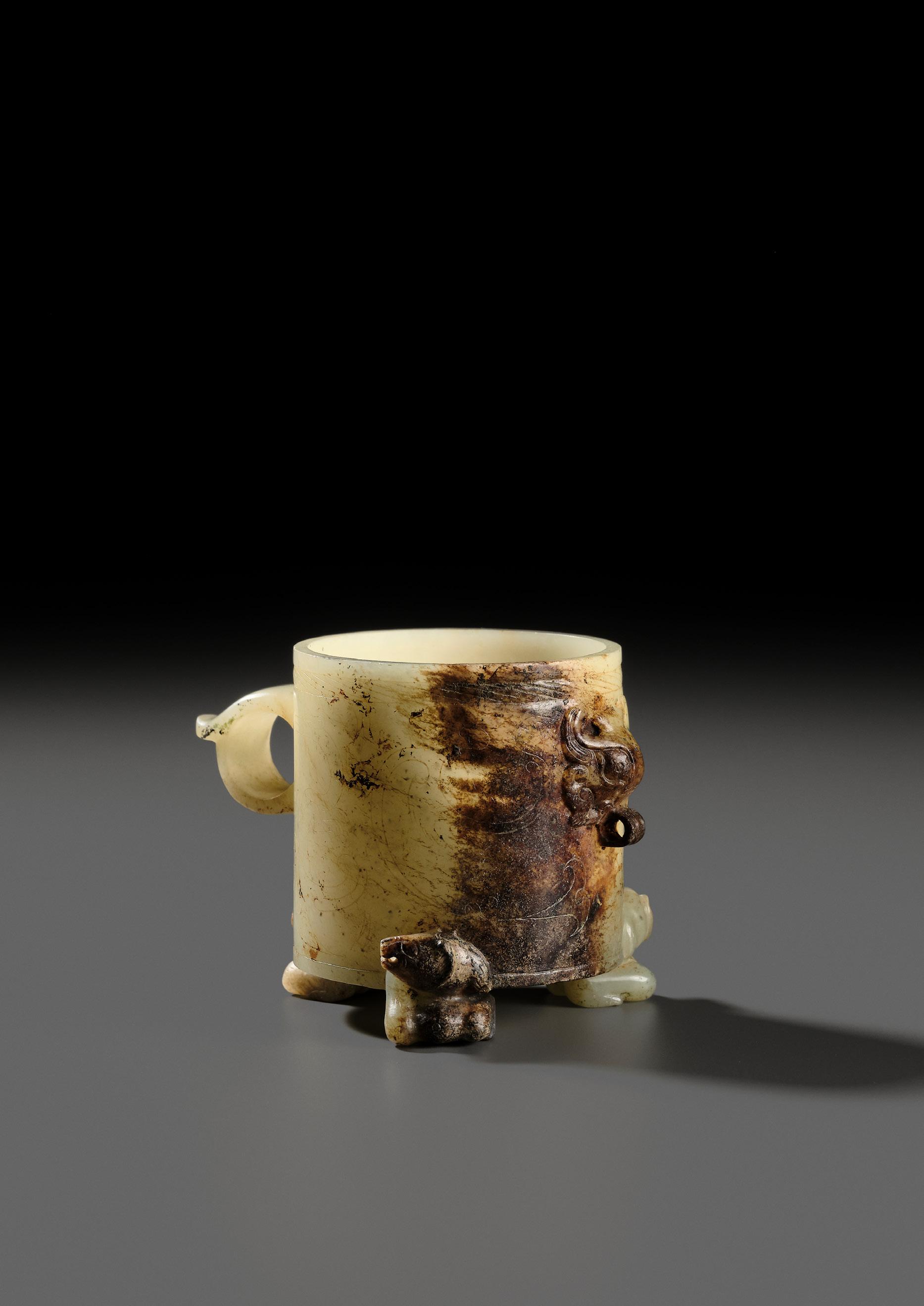
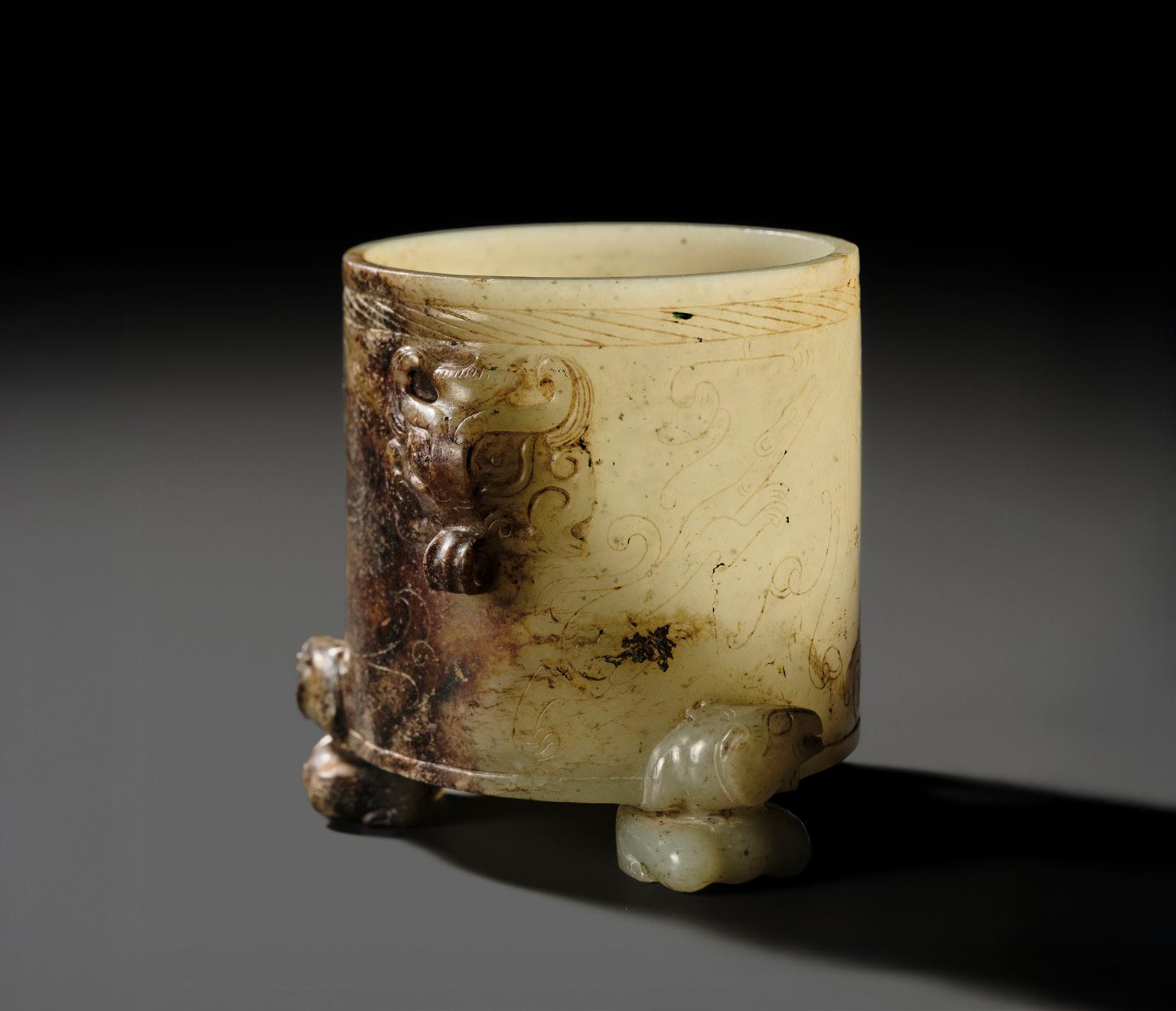
China, 206 BC-220 AD. Finely hollowed, of cylindrical form, supported on three small feet shaped as recumbent bears with their heads gently turned. The sides carved with a circular loop handle with a small, pointed notch, and a taotie mask carved in high relief, pierced with a small loop aperture. The exterior of the vessel finely incised with highly stylized coiling dragons, framed above by a continuous rope-twist band. The translucent stone of pale celadon tone, with prominent russet patches and icy-white inclusions.
Provenance: The Collection of Sam and Myrna Myers, Paris, France.
Acquired between circa 1965-2012.
Condition: Very good condition with surface wear and natural agerelated imperfections, such as small fissures and inclusions. Distinct traces of weathering and signs of usage. Few minuscule nicks and shallow surface scratches. Minor nibbling along the edges. The stone surface with small areas of soil encrustation.
Weight: 248.9 g
Dimensions: Height 7.7 cm, Diameter 6.7 cm
Jade cups were widely used during the Han dynasty, owing to the belief that the inherent virtues of jade, above all its exceptional durability and resistance to decay, qualities closely associated with long life, could be absorbed by the liquid and subsequently transmitted to the drinker. Such vessels were especially employed in the collection of morning dew, itself regarded as possessing longevity-conferring properties. Contact with jade was believed to enhance and prolong its beneficial effects.
The bear ranked among the most significant animals within Han cultural symbolism, representing power and physical strength. In Han visual culture, bears frequently appear as structural supports on the legs of vessels. The present example follows this convention, presenting the bear as a visual and symbolic expression of strength and the capacity to sustain substantial weight.
LITERATURE COMPARISON
Compare a closely related jade ‘dragon’ cup, Western Han dynasty, 206 BC-24 AD, in the Shanghai Museum.
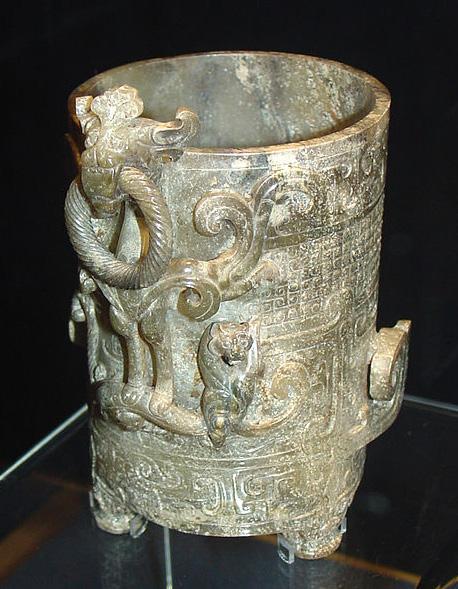
AUCTION RESULT
COMPARISON
Type: Closely related
Auction: Christie’s Hong Kong, 29 November 2024, lot 1070
Price: HKD 1,386,000 or approx. EUR 152,000 converted and adjusted for inflation at the time of writing
Description: A bronze-inset jade handled cup, early mid-Western Han dynasty, c. 206-87 BC
Expert remark: Compare the related manner of carving and shape of the vessel, similarly decorated with bears on the legs. Note the slightly larger size (8.6 cm).
Estimate EUR 8,000
Starting price EUR 4,000
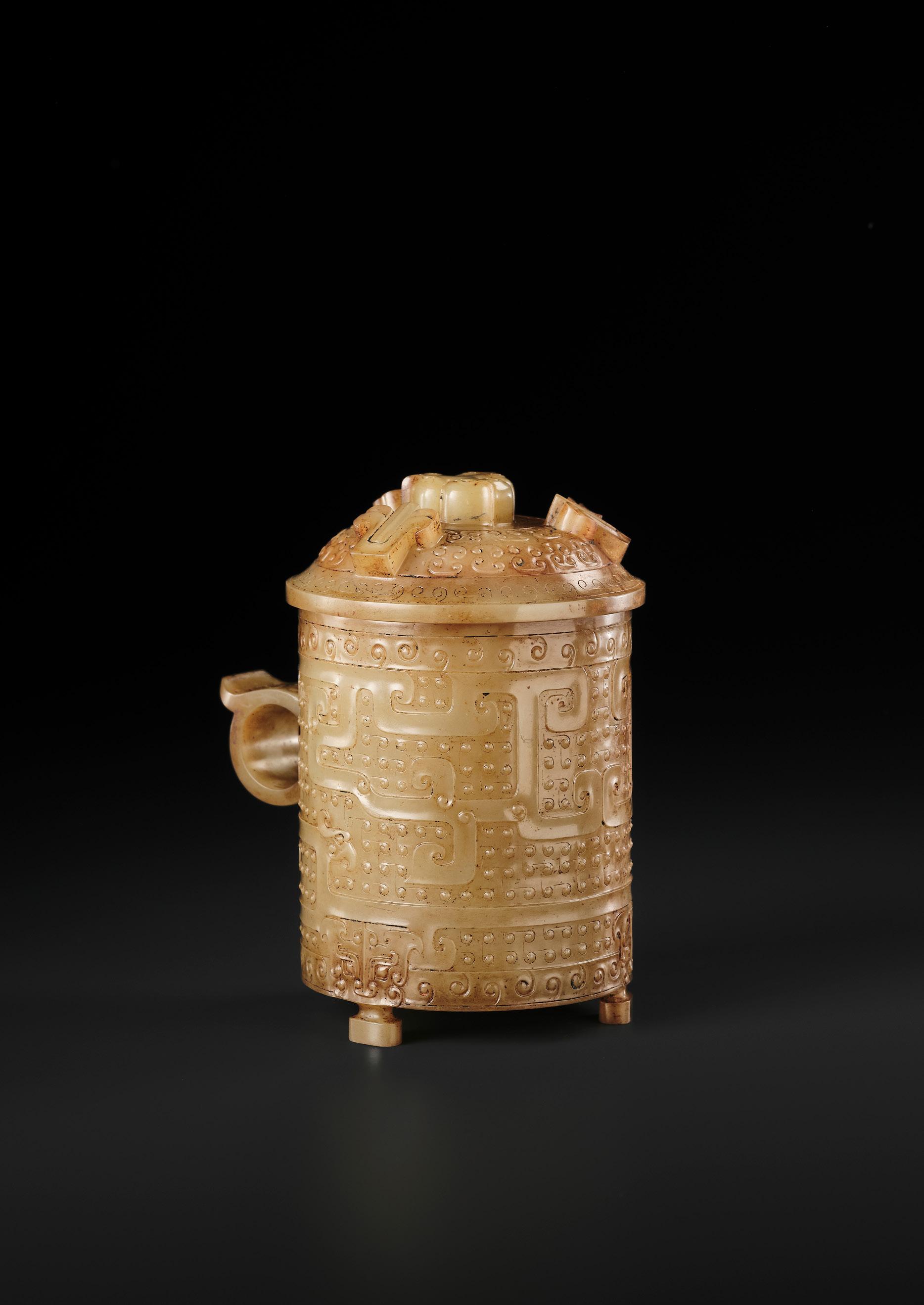
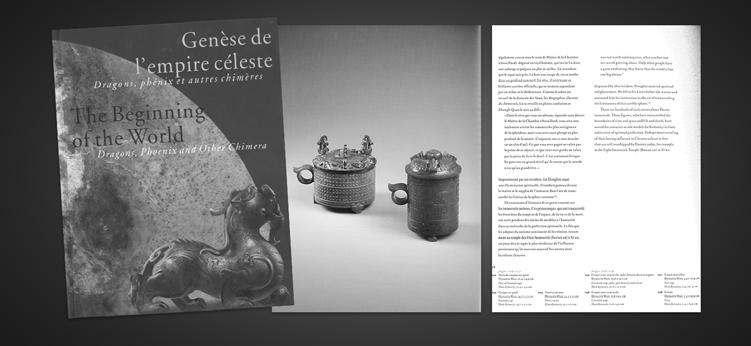
PUBLISHED
Jean-Paul Desroches (ed.) et al, The Beginning of the World. Dragons, Phoenix and Other Chimera, Fondation Baur, Geneva, 2020, p. 228 and 230, no. 156.
Exhibited:
1. Fondation Baur, The Beginning of the World – According to the Chinese. Dragons, Phoenix and Other Chimera, Geneva, 11 November 2020-23 May 2021.
2. Musée Départemental des Arts Asiatiques, The Beginning of the World – According to the Chinese. Dragons, Phoenix and Other Chimera, Nice, Summer 2021.
China, 206 BC-220 AD. Of tubular form, the vessel is raised on three oval feet issuing from taotie masks and set with a broad loop handle rising to a sharply upswept spur, the upper part of the handle finely detailed with a taotie mask. The exterior is crisply carved in low relief with a pair of stylized phoenixes, their scrolling bodies backed by raised C-scrolls, all framed above and below by bands of neatly rendered comma scrolls. The domed cover set with three raised petals framing a central triple-ruyi finial enclosed by bands of archaic scrolls. The semi-translucent stone is of a deep yellow-celadon color with light shadings of russet. (2)
Provenance: The Collection of Sam and Myrna Myers, Paris, France.
Acquired between circa 1965-2012.
Condition: Very good condition with old wear, minor nibbling, signs of weathering, traces of prolonged burial, minor encrustations, and surface scratches. The stone with natural fissures, some of which have developed into thin hairline cracks.
Weight: 340 g
Dimensions: Height 11.6 cm
LITERATURE COMPARISON
Compare a related gilt bronze framed jade cup, dated 203-111 BC, 8.6 cm tall, in the Nanyue King Museum, accession number 5727.
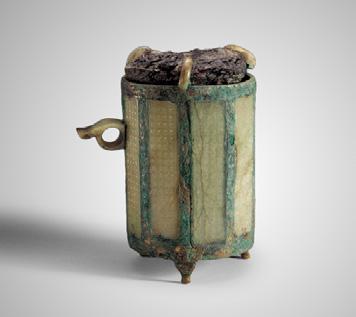
AUCTION RESULT COMPARISON
Type: Related
Auction: Christie’s Hong Kong, 29 November 2024, lot 1070
Price: HKD 1,386,000 or approx. EUR 157,000 converted and adjusted for inflation at the time of writing
Description: A bronze-inset jade handled cup, early-mid Western Han dynasty, circa 206-87 BC Expert remark: Compare the related form, handle, and color of the jade. Note the size (8.6 cm).
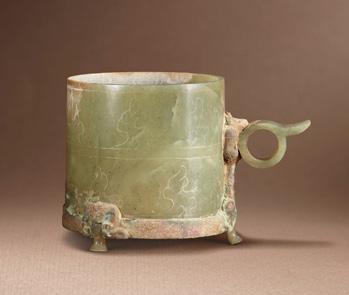
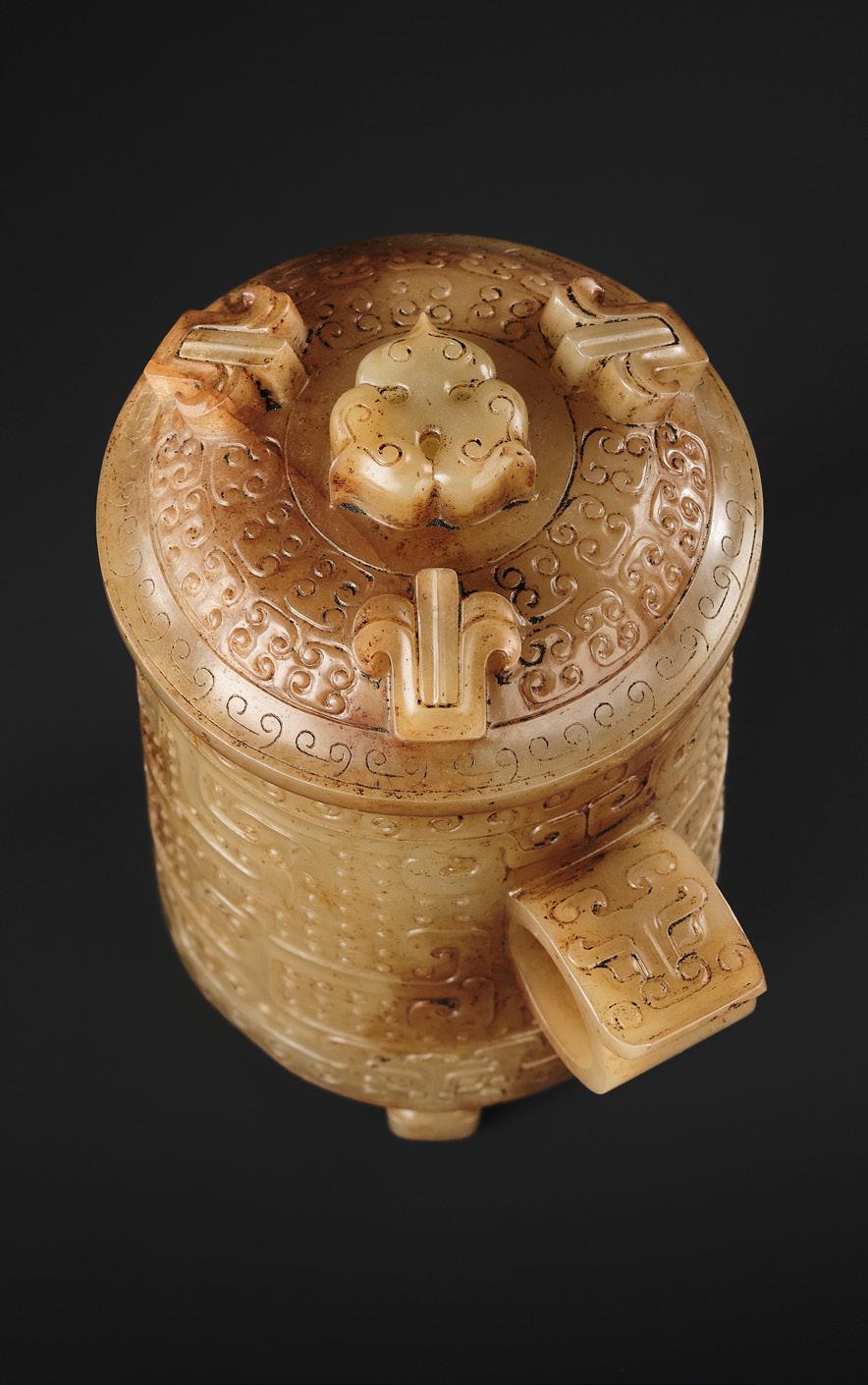
Estimate
108
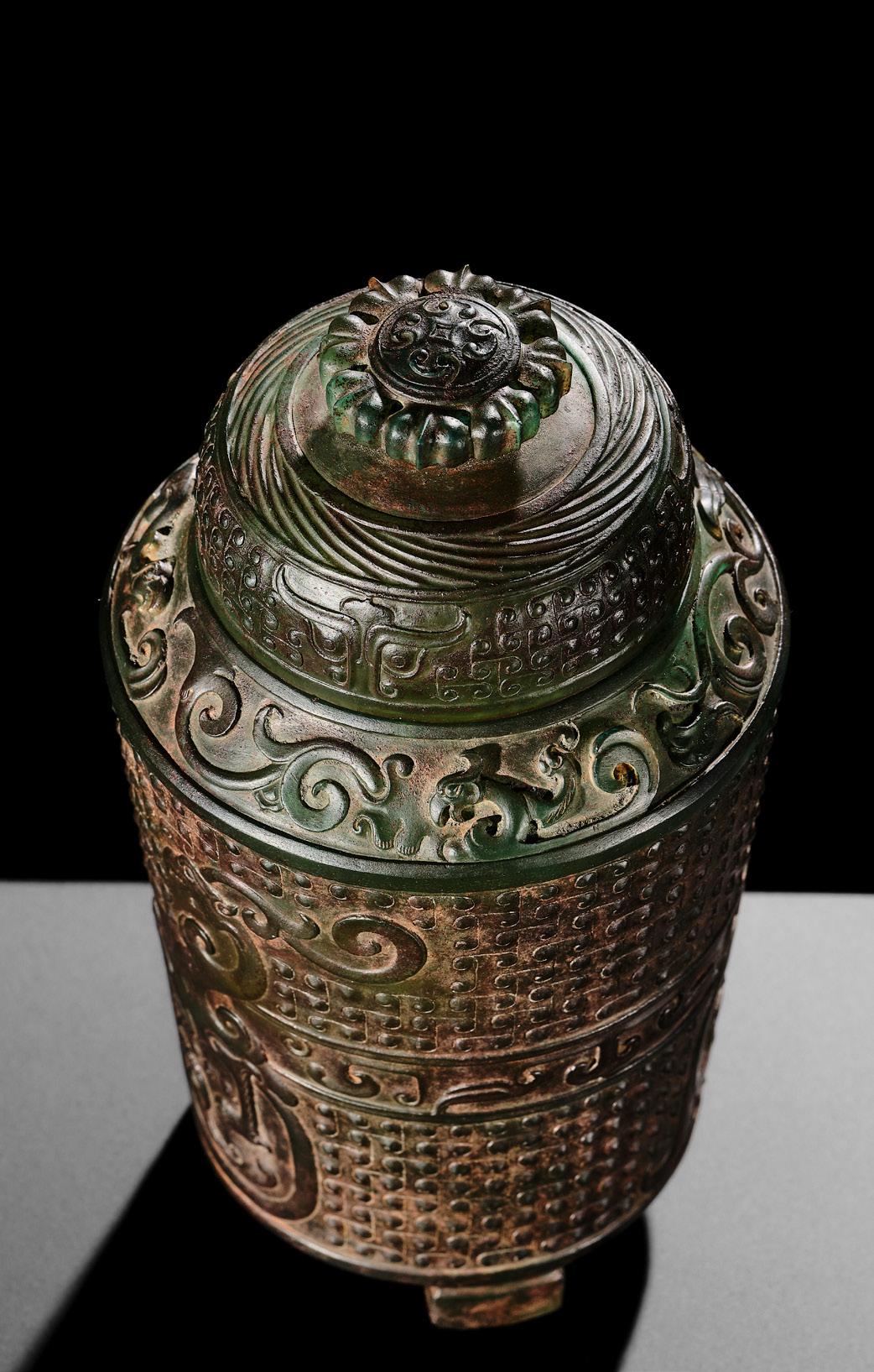
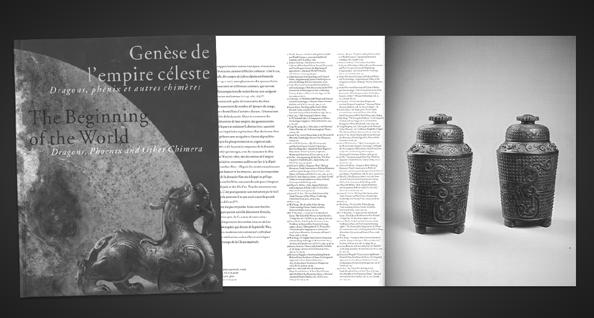
PUBLISHED
Jean-Paul Desroches (ed.) et al, The Beginning of the World. Dragons, Phoenix and Other Chimera, Fondation Baur, Geneva, 2020, p. 84-85, no. 45.
Exhibited:
1. Fondation Baur, The Beginning of the World – According to the Chinese. Dragons, Phoenix and Other Chimera, Geneva, 11 November 2020-23 May 2021.
2. Musée Départemental des Arts Asiatiques, The Beginning of the World – According to the Chinese. Dragons, Phoenix and Other Chimera, Nice, Summer 2021.

China, 202 BC-220 AD. Each of tapering form, raised on short tripod feet, the flaring sides decorated with a central band of archaistic motifs and a dense network of interconnected C-scrolls, the first vessel further adorned with sinuous dragons on either side, and the second similarly adorned with majestic phoenixes standing tall, their plumage detailed with large scrolls.
Both vessels fitted with domed lids similarly decorated with dense scrolls interspersed with taotie masks and surmounted by foliate knops. (4)
Provenance: The Collection of Sam and Myrna Myers, Paris, France. Acquired between circa 1965-2012. Condition: Very good condition commensurate with age. Ancient wear with distinct signs of weathering and material deterioration, as expected. Minor manufacturing irregularities. Small chips to the feet, minor nibbling, soil encrustations, and traces of prolonged burial.
Weight: 615 g and 662 g
Dimensions: Height 17.3 cm and 17.5 cm
Estimate EUR 10,000
Starting price EUR 5,000
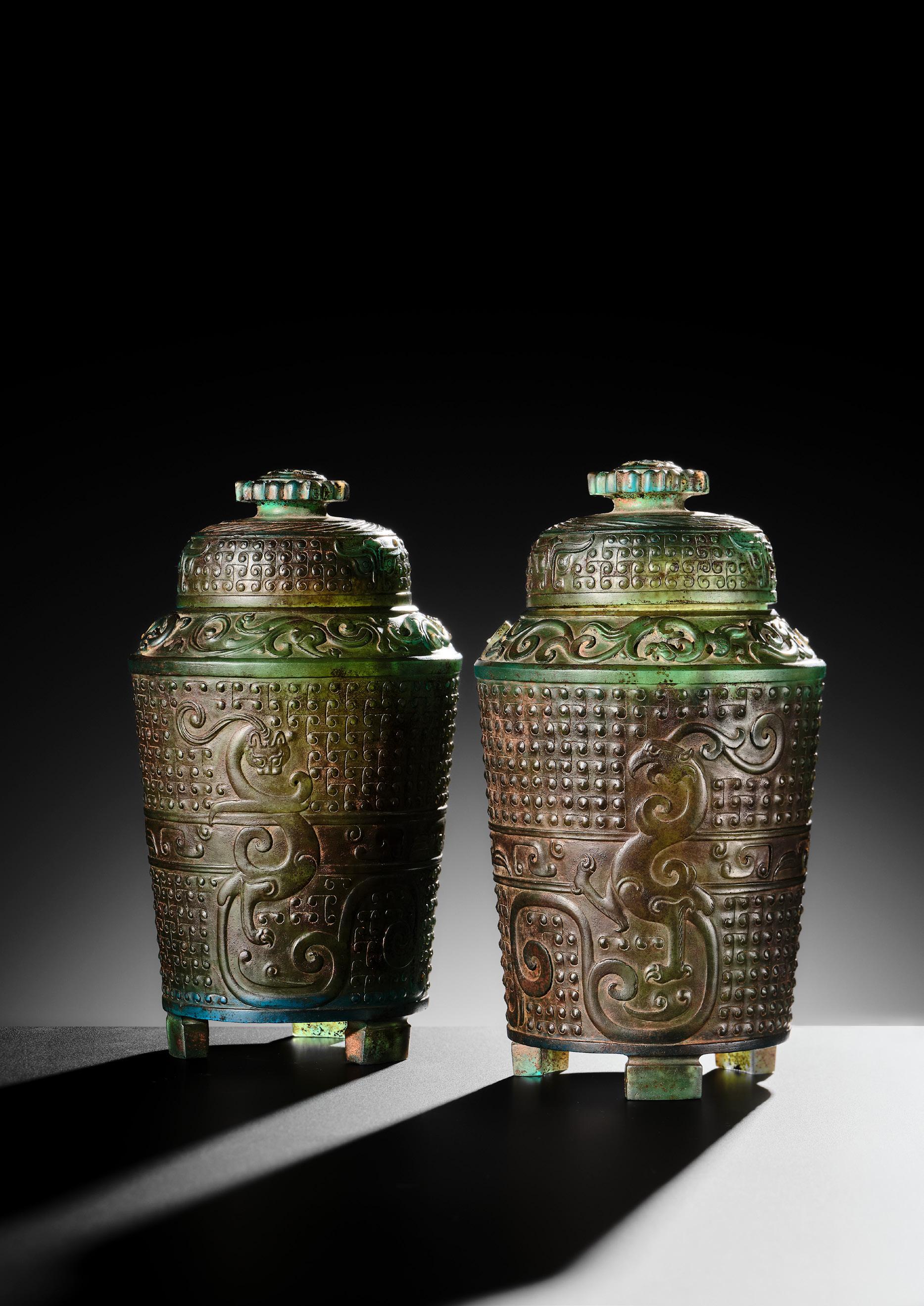
109
AN EXCEPTIONALLY RARE INSCRIBED JADE BI, EASTERN HAN DYNASTY
China, 25-220 AD. Boldly worked on both sides with an overall array of small raised circular studs within inner and outer raised borders, encircled by an intricately reticulated band enclosing two characters at the top and bottom, as well as writhing dragons and phoenix, a third character to the center, and the top with an extended openwork flange with a pair of dragons. Each beast meticulously incised with fine line work to denote the features and plumage. The translucent stone of a pale celadon tone with russet veins and patches, as well as cloudy inclusions.
Inscriptions: To the top, center, and bottom, 宜子孫 ‘Yi zi sun’ [‘May your descendants prosper’].
Provenance: The Collection of Sam and Myrna Myers, Paris, France. Acquired between circa 1965-2012.
Condition: Very good condition, commensurate with age. Wear, natural fissures—some of which may have developed into hairline cracks, small nicks, traces of weathering and erosion, and minor rubbing.
Weight: 463.2 g
Dimensions: Height 22.4 cm
The present disc shows an intricate combined design of bi and pendant. Similar discs are known with pierced auspicious messages incorporated as part of the design, thus it is likely that these discs functioned as talismans or played symbolic roles during special occasions.
LITERATURE COMPARISON
Compare a closely related bi disc of Chang Le, forever joyful, Eastern Han dynasty, 16.5 cm high, in the National Palace Museum, Taipei.
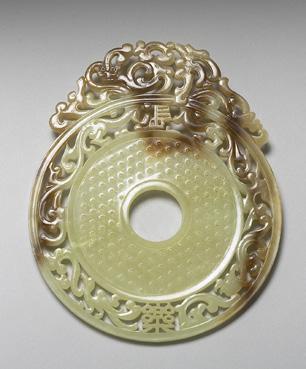
AUCTION RESULT COMPARISON
Type: Related
Auction: Sotheby’s Hong Kong, 22 April 2021, lot 9
Price: HKD 53,771,000 or approx. EUR 6,384,000 converted and adjusted for inflation at the time of writing
Description: An exceptionally large and extremely rare zitan-mounted imperial inscribed archaic jade bi, Eastern Han dynasty, the inscription and the stand dated to the gengyin year of the Qianlong period (corresponding to 1770)
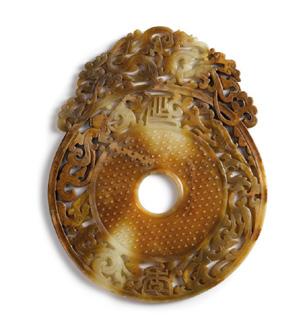
Expert remark: Compare the closely related form, similar modeling, openwork carving, and size (23.8 cm).
AUCTION RESULT COMPARISON
Type: Related
Auction: Christie’s Hong Kong, 28 November 2018, lot 2780
Price: HKD 2,125,000 or approx. EUR 267,000 converted and adjusted for inflation at the time of writing
Description: An exceptionally rare and large white jade ‘tiger’ disc, Bi, Eastern Han dynasty
Expert remark: Compare the closely related form, similar modeling, openwork carving, and size (25 cm).
Estimate EUR 6,000
Starting price EUR 3,000
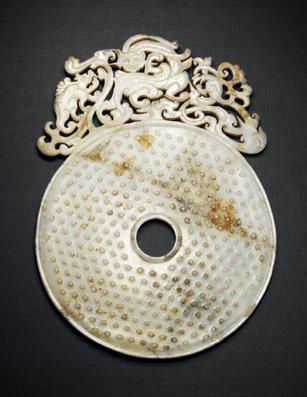
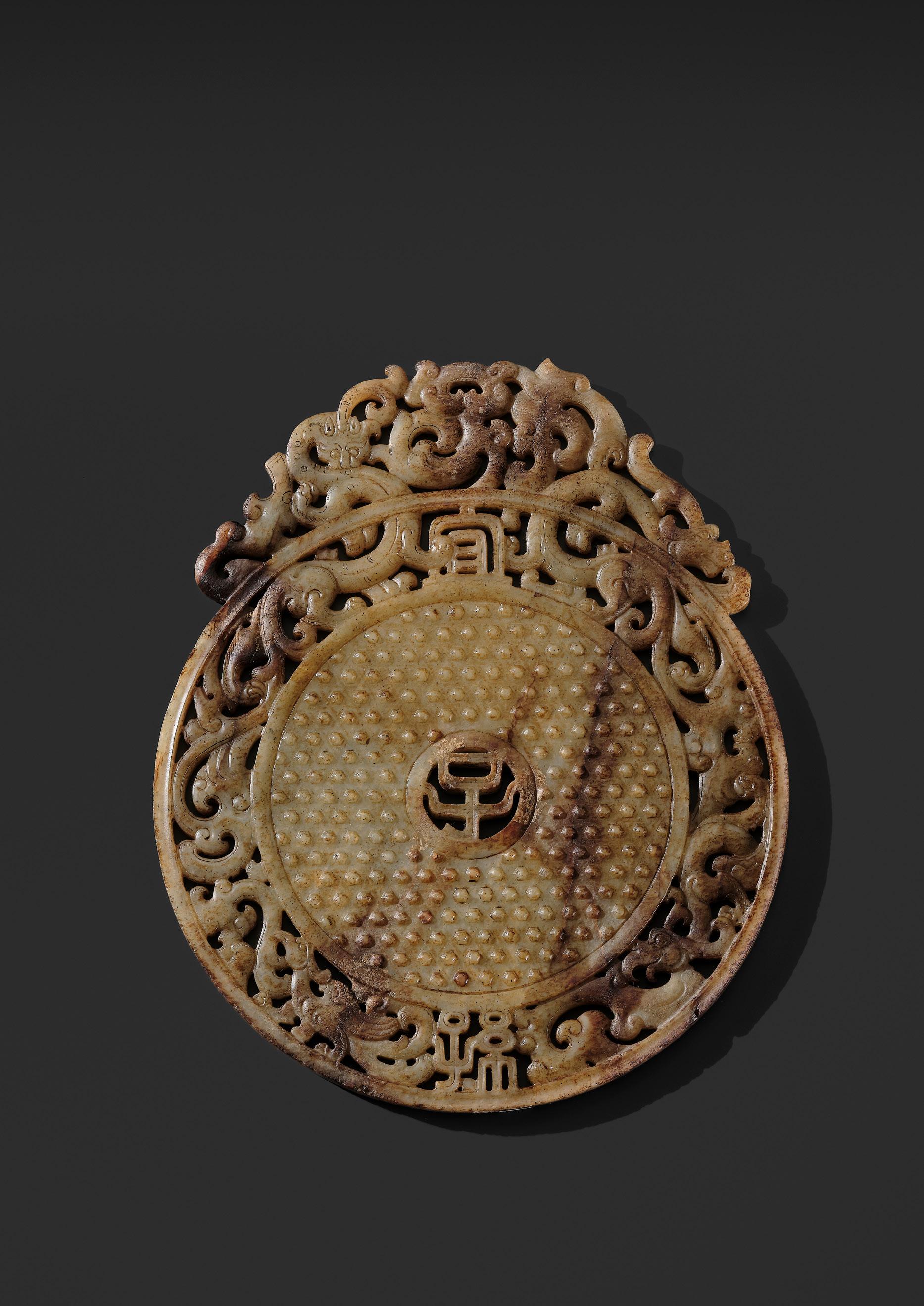
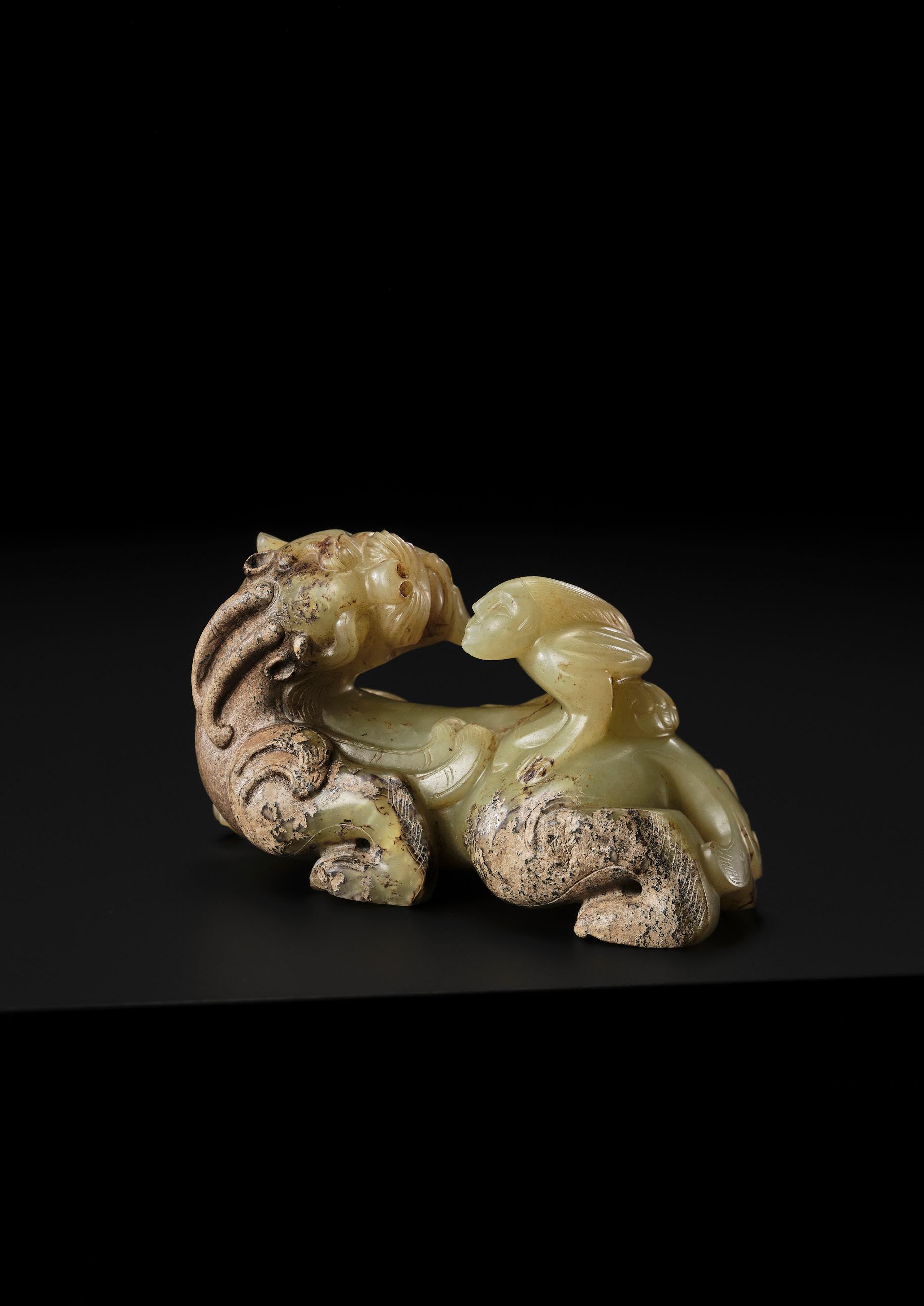
PUBLISHED
Jean-Paul Desroches
(ed.) et al, The Beginning of the World. Dragons, Phoenix and Other Chimera, Fondation Baur, Geneva, 2020, p. 189-190, no. 114.
Exhibited:
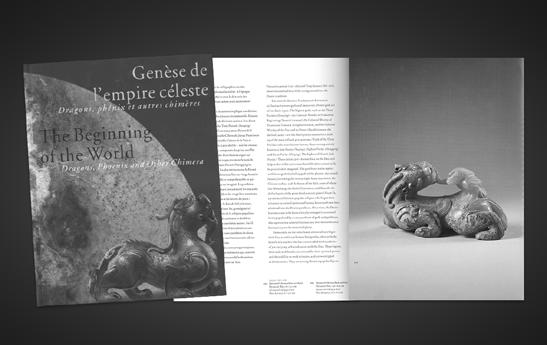
1. Fondation Baur, The Beginning of the World – According to the Chinese. Dragons, Phoenix and Other Chimera, Geneva, 11 November 2020-23 May 2021.
2. Musée Départemental des Arts Asiatiques, The Beginning of the World – According to the Chinese. Dragons, Phoenix and Other Chimera, Nice, Summer 2021.
China, 206 BC-220 AD. The male, horned beast in a recumbent position, with its head tilted backwards and mouth wide open, the muscular body framed by a pair of wings, terminating in a bifurcated tail, and surmounted by an immortal dressed in a feathery robe, his right hand gently tickling the beast’s chin. The semi-translucent stone is of a pale gray tone with brown veins, and creamy-brown surface alterations.
Provenance: The Collection of Sam and Myrna Myers, Paris, France. Acquired between circa 1965-2012.
Condition: Good condition with old wear, distinct signs of weathering, traces of prolonged burial, little nibbling, a small chip to the front left paw. The stone with natural fissures, some of which have developed into thin hairline cracks. Areas of deep calcification and inherent surface alteration.
Weight: 366.7 g
Dimensions: Length 11.5 cm
Pixiu are mythical hybrid creatures, considered powerful protectors, resembling strong, winged tigers or lions, auspicious for wealth, and said to have a voracious appetite exclusively for gold, silver, and jewels. Therefore, Pixiu have always been regarded as being capable of drawing cai qi (wealth) from all directions, and according to the Chinese zodiac, they are especially helpful for those who are going through a bad year. There are two types of Pixiu: The one with two horns is the female, called Bixie. The one with only one antler is the male, called Tianlu.
LITERATURE COMPARISON
Compare a pale celadon jade carving of a bixie and rider, dated to the Eastern Han dynasty, 13.9 cm long, from the Desmond Gure and Arthur M. Sackler Collections, in the National Museum of Asian Art, Smithsonian Institution, accession number S1987.26.
AUCTION RESULT COMPARISON
Type: Related
Auction: Christie’s Hong Kong, 29 November 2024, lot 1067
Price: HKD 11,870,000 or approx. EUR 1,344,000 converted and adjusted for inflation at the time of writing
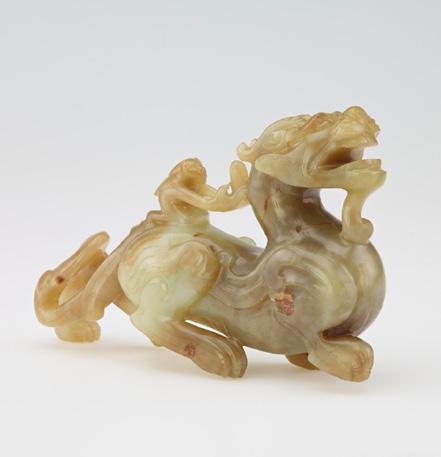
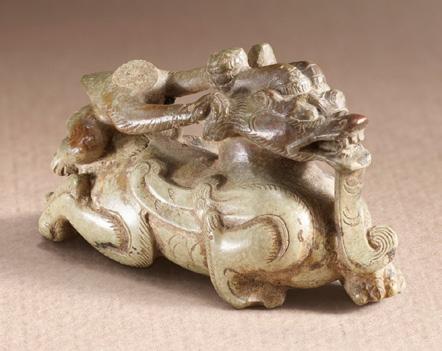
Description: A jade carving of a bixie and winged immortal, late Western Han - early Eastern Zhou dynasty, circa 86 BC - AD 88 Expert remark: Compare the related subject. Note the size (5.5 cm).
Estimate EUR 30,000
Starting price EUR 15,000
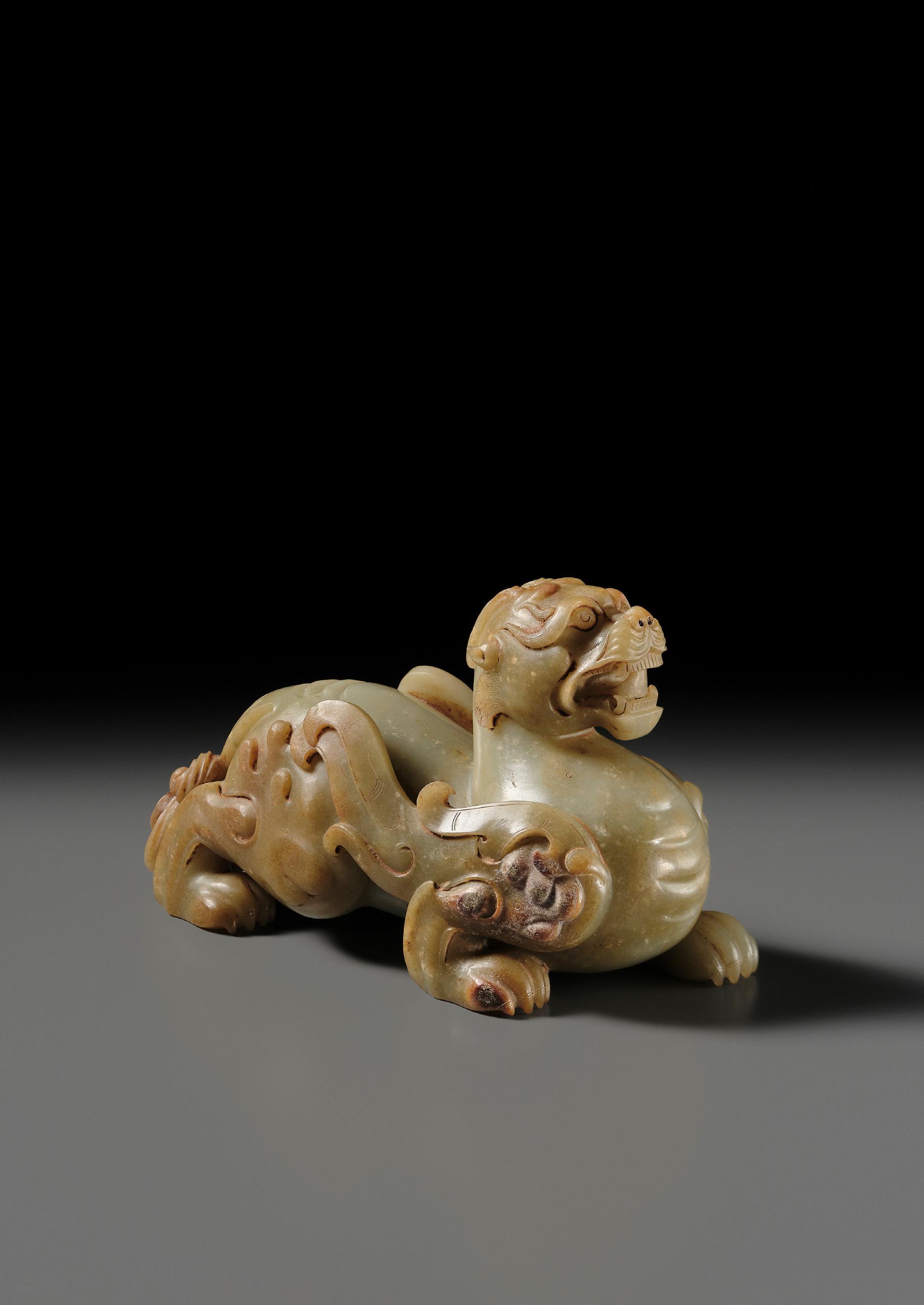
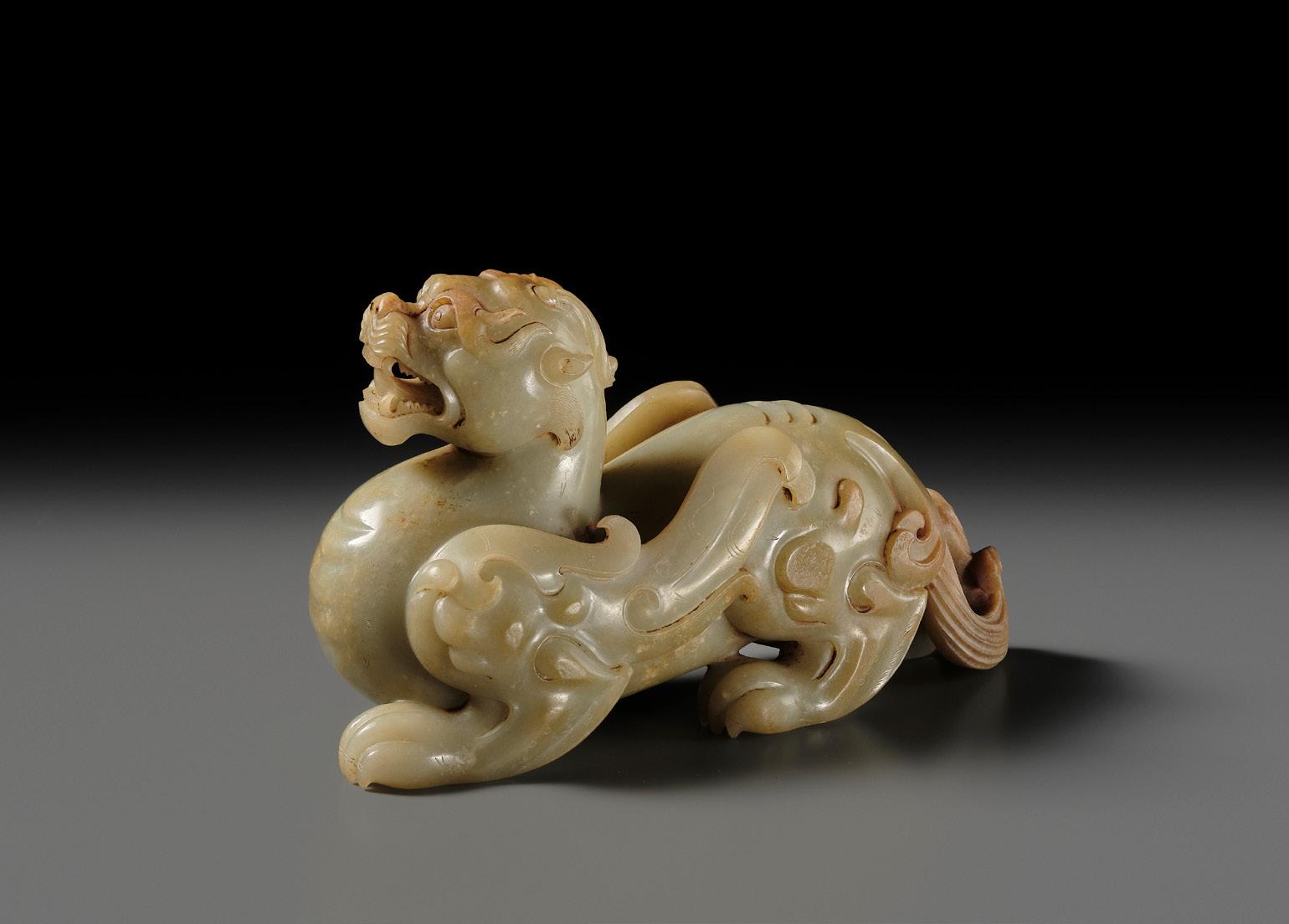
A SUPERB CELADON AND RUSSET JADE FIGURE OF A BIXIE, HAN DYNASTY
PUBLISHED
Jean-Paul Desroches
(ed.) et al, The Beginning of the World. Dragons, Phoenix and Other Chimera, Fondation Baur, Geneva, 2020, p. 72, no. 39.
Exhibited:
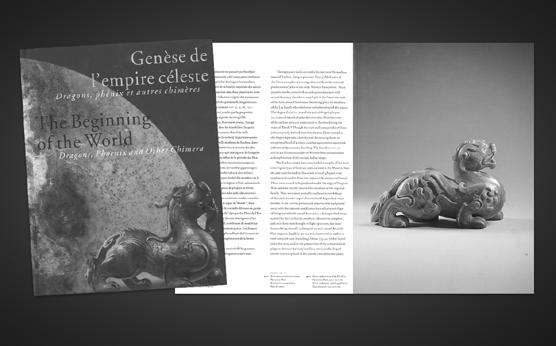
1. Fondation Baur, The Beginning of the World – According to the Chinese. Dragons, Phoenix and Other Chimera, Geneva, 11 November 2020-23 May 2021.
2. Musée Départemental des Arts Asiatiques, The Beginning of the World – According to the Chinese. Dragons, Phoenix and Other Chimera, Nice, Summer 2021.
China, 206 BC-220 AD. The powerful horned beast stands foursquare with its head raised, mouth slightly open to reveal sharp teeth and a curling tongue beneath bulging eyes framed by bushy eyebrows. Its muscular body is flanked by a pair of wings and terminates in a bifurcated tail. The semi-translucent stone is of a pale celadon color with light russet shading and an area of calcification on the right wing and foot.
Provenance: The Collection of Sam and Myrna Myers, Paris, France. Acquired between circa 1965-2012.
Condition: Very good condition with expected ancient wear, distinct signs of weathering, traces of prolonged burial, few soil encrustations, and minor nibbling. The stone with natural fissures.
Weight: 667.1 g
Dimensions: Length 14 cm
AUCTION RESULT COMPARISON
Type: Related
Auction: Sotheby’s Hong Kong, 9 October 2020, lot 40
Price: HKD 2,142,000 or approx. EUR 257,000 converted and adjusted for inflation at the time of writing
Description: A rare celadon jade figure of a bixie, eastern Han dynasty
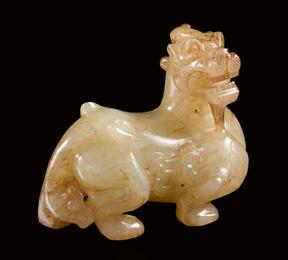
Expert remark: Compare the closely related subject, the related pose and manner of carving. Note the different color of the jade and much smaller size (4.8 cm).
AUCTION RESULT COMPARISON
Type: Related
Auction: Christie’s Hong Kong, 29 November 2024, lot 1066
Price: HKD 20,945,000 or approx. EUR 2,570.000 converted and adjusted for inflation at the time of writing
Description: A highly important and superbly carved turquoise bixie, Western Han dynasty, circa 206–8 BC, 10.2 cm long.
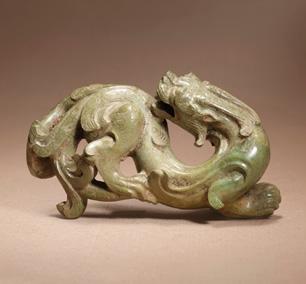
Expert remark: Compare the shared subject, the powerful recumbent pose, and the refined modeling of the musculature. Note, however, this example’s smaller size, and its rare turquoise material, which explains the significantly higher price level.
Estimate EUR 15,000
Starting price EUR 7,500
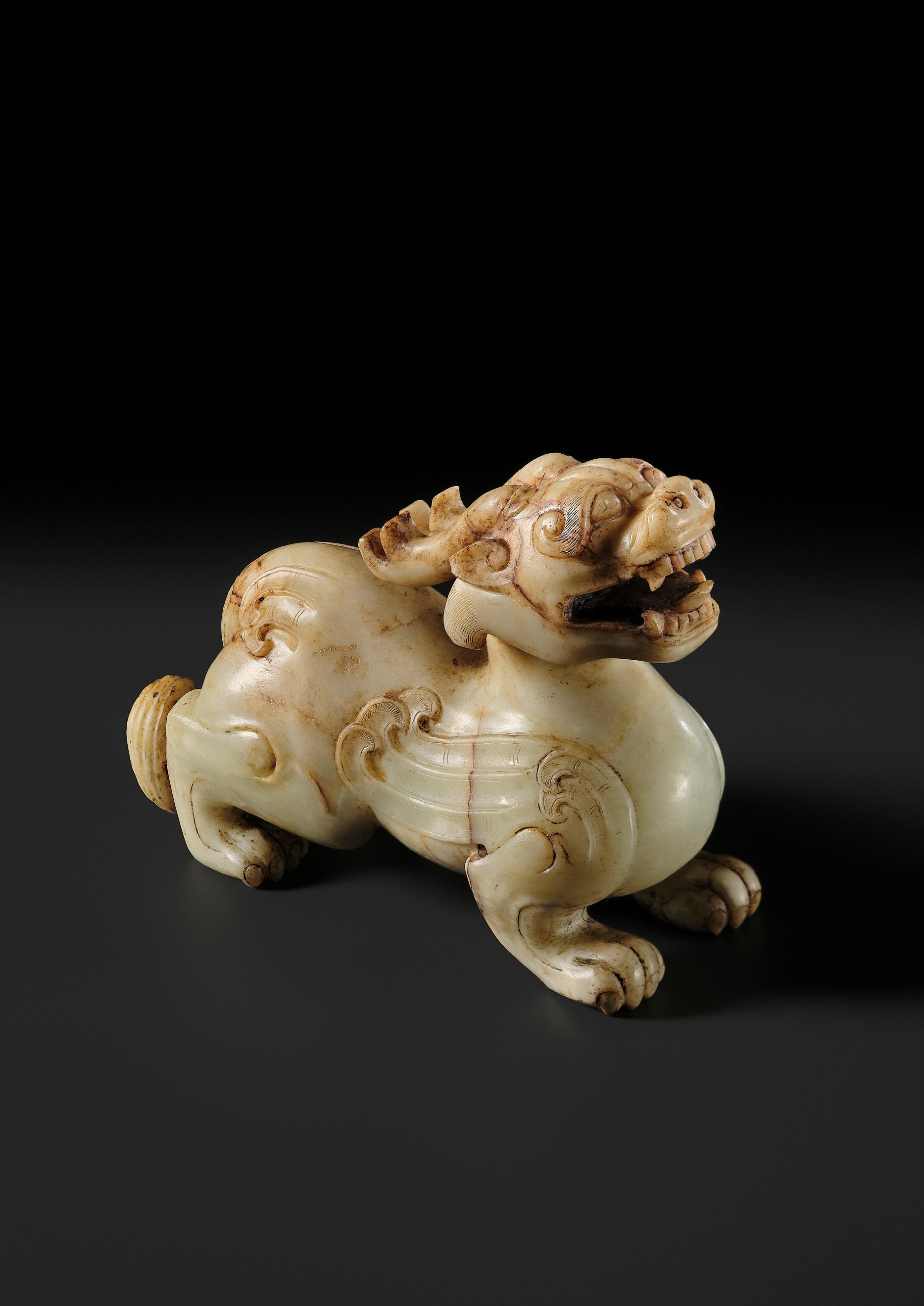
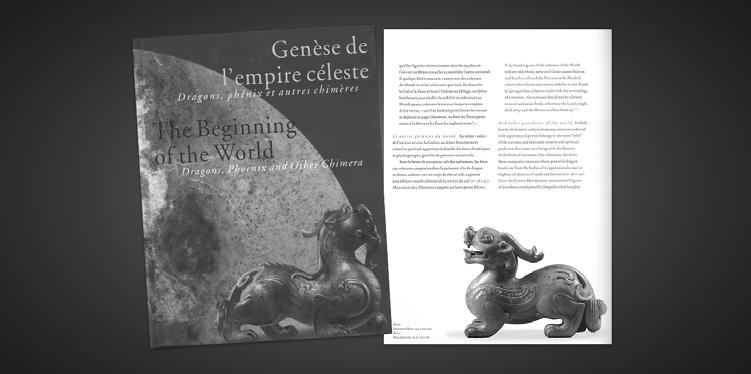
PUBLISHED
Jean-Paul Desroches (ed.) et al, The Beginning of the World. Dragons, Phoenix and Other Chimera, Fondation Baur, Geneva, 2020, p. 154, no. 89.
Exhibited:
1. Fondation Baur, The Beginning of the World – According to the Chinese. Dragons, Phoenix and Other Chimera, Geneva, 11 November 2020-23 May 2021.
2. Musée Départemental des Arts Asiatiques, The Beginning of the World – According to the Chinese. Dragons, Phoenix and Other Chimera, Nice, Summer 2021.
China, 206 BC-220 AD. The horned beast raising its head, standing foursquare, the face detailed with bulging eyes above a snarling mouth revealing a row of sharp teeth and protruding tongue, its muscular body framed by wings and terminating in a bifurcated tail. The semi-translucent stone is of a pale celadon color with russet veins and cloudy white shadings.
Provenance: The Collection of Sam and Myrna Myers, Paris, France. Acquired between circa 1965-2012.
Condition: Good condition with old wear, distinct signs of weathering, traces of prolonged burial, remnants of ancient pigments, old chips, and few soil encrustations. The stone with natural fissures, some of which have developed into thin hairline cracks.
Weight: 1.6 kg
Dimensions: Length 17.5 cm

Pixiu are mythical hybrid creatures, considered powerful protectors, resembling strong, winged tigers or lions, auspicious for wealth, and said to have a voracious appetite exclusively for gold, silver, and jewels. Therefore, Pixiu have always been regarded as being capable of drawing cai qi (wealth) from all directions, and according to the Chinese zodiac, they are especially helpful for those who are going through a bad year. There are two types of Pixiu: The one with two horns is the female, called Bixie. The one with only one antler is the male, called Tianlu.
Emperor Wu of the Han dynasty declared that the pixiu would be forever known as the ‘Treasure of the Emperor’, that only royal personage could possess a pixiu, and that it was strictly forbidden for all others to own one, including officials. This law was kept through to the very end of the Qing dynasty. Lifelike sculptures of these mythical beings made from durable materials, such as jade, were made to embody and pacify the elemental and supernatural forces of the living world.
AUCTION RESULT COMPARISON
Type: Related
Auction: Sotheby’s Hong Kong, 2 April 2018, lot 3416
Price: HKD 3,000,000 or approx. EUR 379,500 converted and adjusted for inflation at the time of writing
Description: A powerfully carved and rare celadon jade figure of a bixie, eastern Han dynasty
Expert remark: Compare the related pose and color of the jade. Note the size (9 cm).
Estimate EUR 15,000
Starting price EUR 7,500
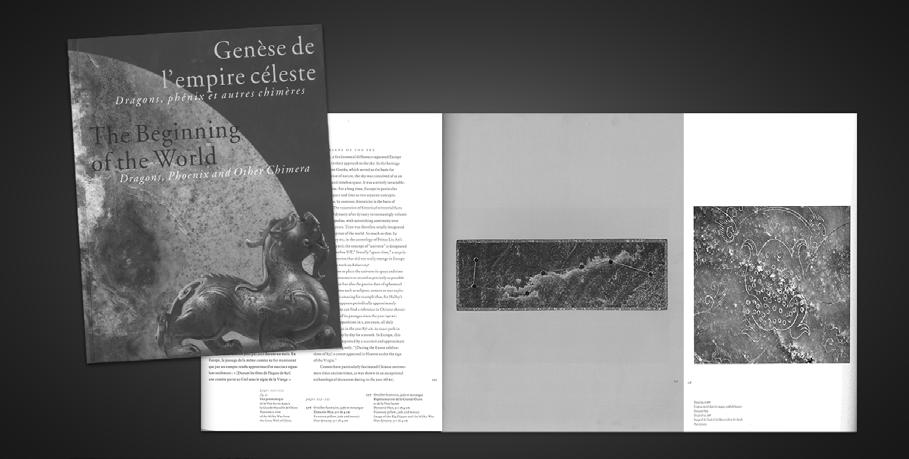
PUBLISHED
Jean-Paul Desroches (ed.) et al, The Beginning of the World. Dragons, Phoenix and Other Chimera, Fondation Baur, Geneva, 2020, p. 251, 255-256, no. 177.
Exhibited:
1. Fondation Baur, The Beginning of the World – According to the Chinese. Dragons, Phoenix and Other Chimera, Geneva, 11 November 2020-23 May 2021.
2. Musée Départemental des Arts Asiatiques, The Beginning of the World –According to the Chinese. Dragons, Phoenix and Other Chimera, Nice, Summer 2021.
China, 202 BC-220 AD. Of rectangular form, constructed using sixty-nine jade plates of various shapes (square, rectangular, triangular, diamond), the headrest centered by a large pale celadon rectangular plaque incised with the image of the Toad of the Moon within the clouds, the reverse with a large dark green plaque pierced with seven apertures to depict the Big Dipper.
Provenance: The Collection of Sam and Myrna Myers, Paris, France. Acquired between circa 1965-2012.
Condition: Very good condition with ancient wear, natural fissures, small losses, nibbling, and some rubbing to incised decoration. Weathering due to burial conditions, some corrosion, encrustations. Overall with an exceptionally beautiful patina, naturally grown over two millennia.
Weight: 2,454 g
Dimensions: Size 28.8 x 9 x 9.8 cm

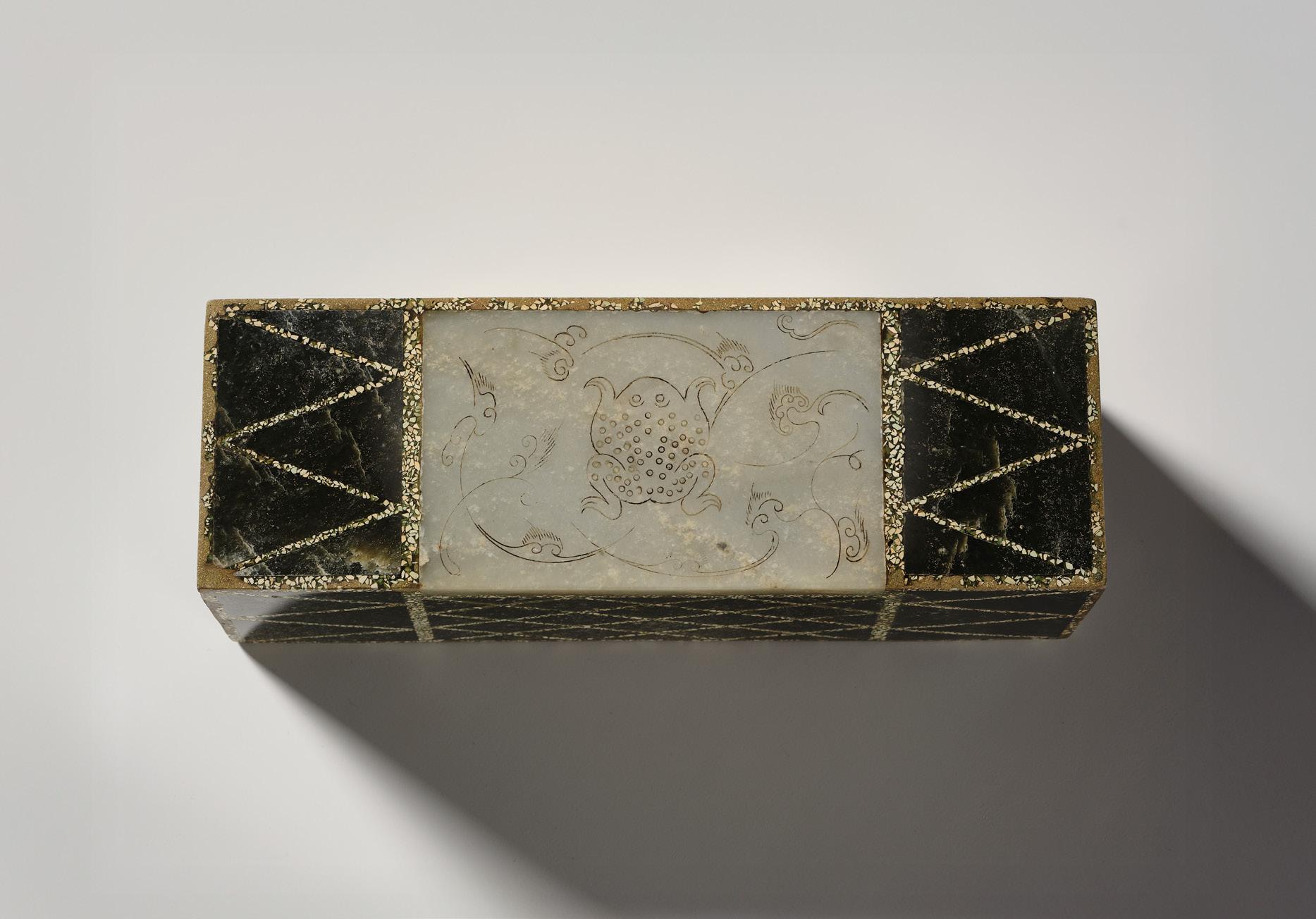
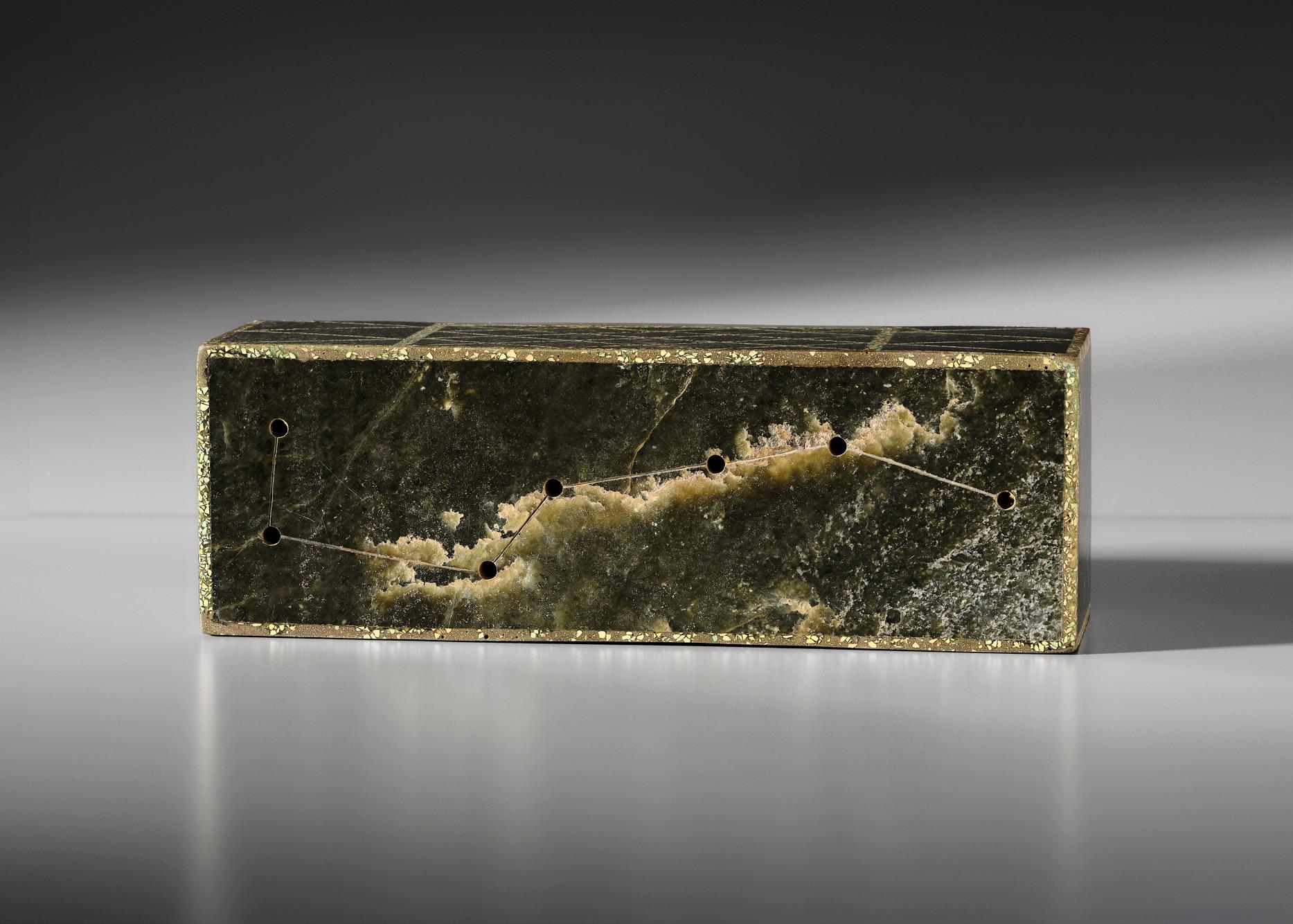
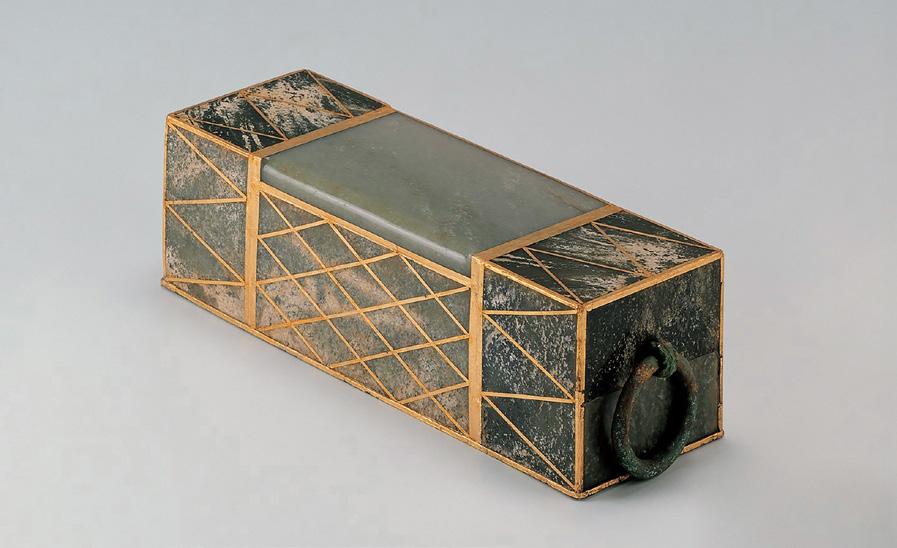
Compare a closely related jade pillow with gold foil, Western Han Dynasty, 28.7 cm long, excavated from the tomb of Liu He at Xuzhou Volcano, and now in the Xuzhou Museum, artifact number 07775.
The Toad of the Moon is a mythical creature from ancient Chinese folklore, often depicted as a three-legged toad that lives on the moon. It is associated with the moon goddess Chang'e, who is sometimes said to have been transformed into the toad after fleeing to the moon. The toad's presence is used in some myths to explain the changing phases of the moon and was once thought to be responsible for a lunar eclipse.
During the Han dynasty, the Big Dipper was a central celestial symbol in cosmology, calendrical theory, and religion, seen as a celestial compass and the throne of the Supreme Deity. It was crucial for navigation, calendrical functions, and religious practices, including early forms of Daoist ritual that integrated the constellation into beliefs about the cosmos and immortality. Han texts frequently discuss the Dipper's use in daily life and its significant role in divination and cosmic order.
Estimate EUR 50,000
Starting price EUR 24,000

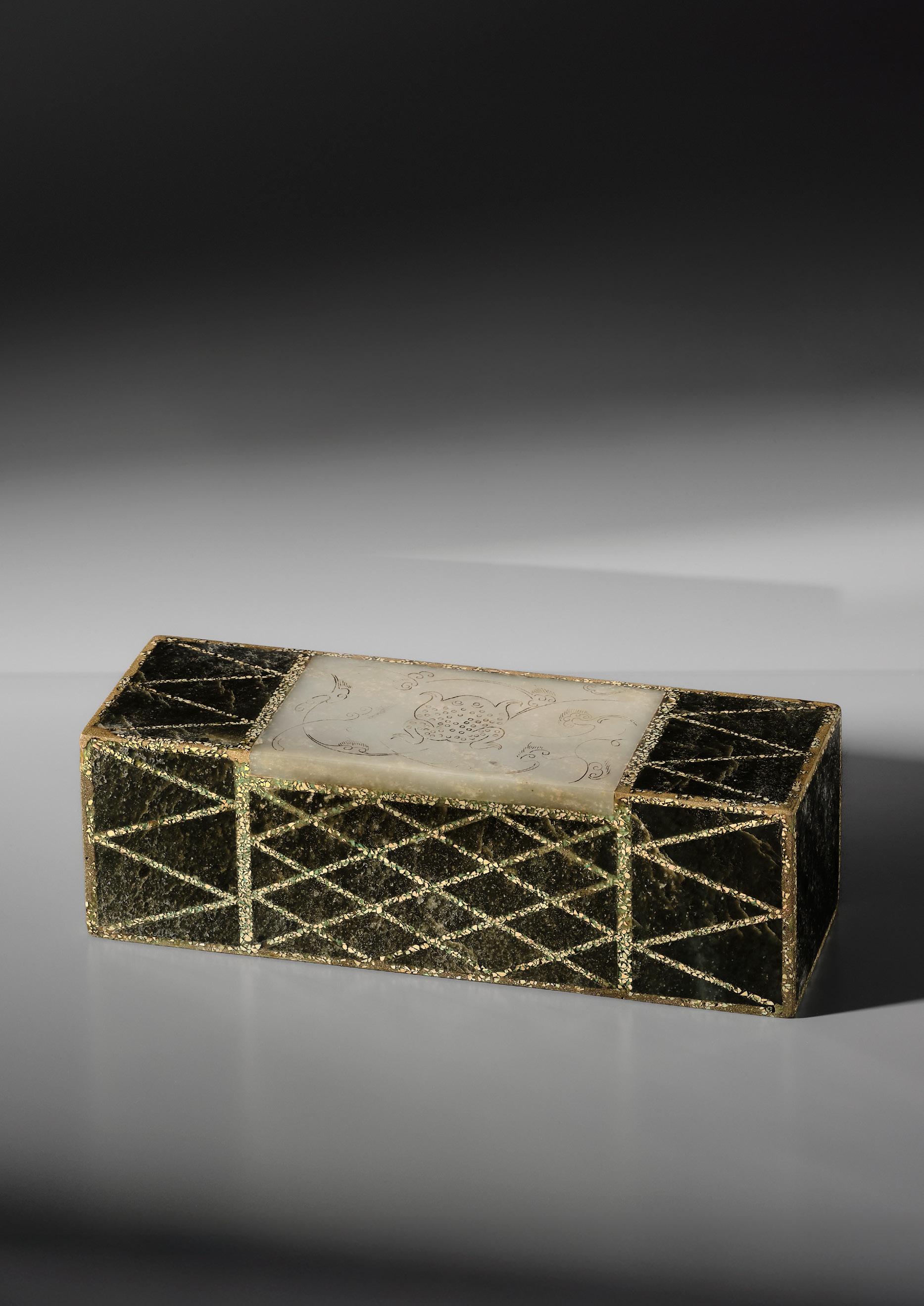
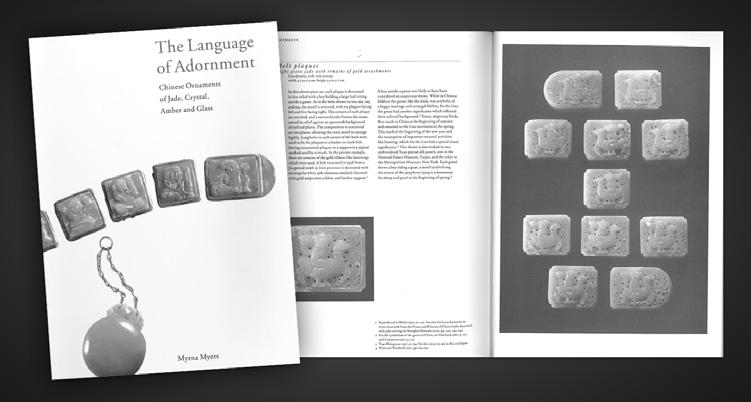
PUBLISHED
Myrna Myers (ed.) & Filippo Salviati (auth.), The Language of Adornment. Chinese Ornaments of Jade, Crystal, Amber and Glass, Paris, 2002, no. 114.
China, 10th-11th century. Each plaque is of rectangular form with notched corners, boldly carved and pierced to depict a boy holding a large leaf while seated astride a goose amid stylized plants. The figure faces left on six plaques and right on five. The reverse is pierced with a pair of apertures at each corner, some retaining traces of the original gold ribbon fastenings. The semi-translucent stone is of a fine white to pale celadon tone with few cloudy white inclusions and minor dark speckles. (11)
Provenance: The Collection of Sam and Myrna Myers, Paris, France. Acquired between circa 1965-2012.
Condition: Very good condition with expected old wear, little nibbling, few minuscule chips, minor remnants of soil, and signs of weathering. The stone with natural fissures, some of which have developed into thin hairline cracks.
Weight: 231.4 g (total)
Dimensions: Size rectangular plaques c. 4.3 x 3.5 cm (each), finial plaques c. 5.4 x 3.5 cm (each)
The present belt set represents a synthesis of two cultural traditions: the Nomadic and the Chinese. As a dress accessory, the belt reflects the nomadic heritage of the Liao, while the choice of jade is distinctly Chinese. Leather belts adorned with plaques became standard dress accessories among the nomadic and semi-nomadic peoples living north of the Chinese heartland as early as the 8th century BC, as evidenced by archaeological finds in Liaoning and Inner Mongolia. While serving a practical purpose, these decorated belts also functioned as symbols of social status.
AUCTION RESULT COMPARISON
Type: Related
Auction: Sotheby’s Hong Kong, 1 June 2023, lot 319
Estimate: HKD 600,000 or approx. EUR 69,000 converted at the time of writing
Description: A set of eleven white jade ‘musicians and dancers’ belt plaques, Tang dynasty
Expert remark: Compare the related forms and manner of carving with similar high relief. Note the subject and size (the largest 5.2 cm long). Dated to the Tang dynasty.
Estimate EUR 10,000
Starting price EUR 5,000
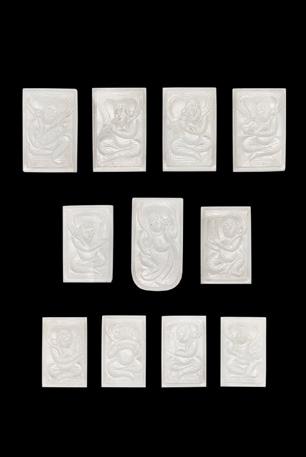

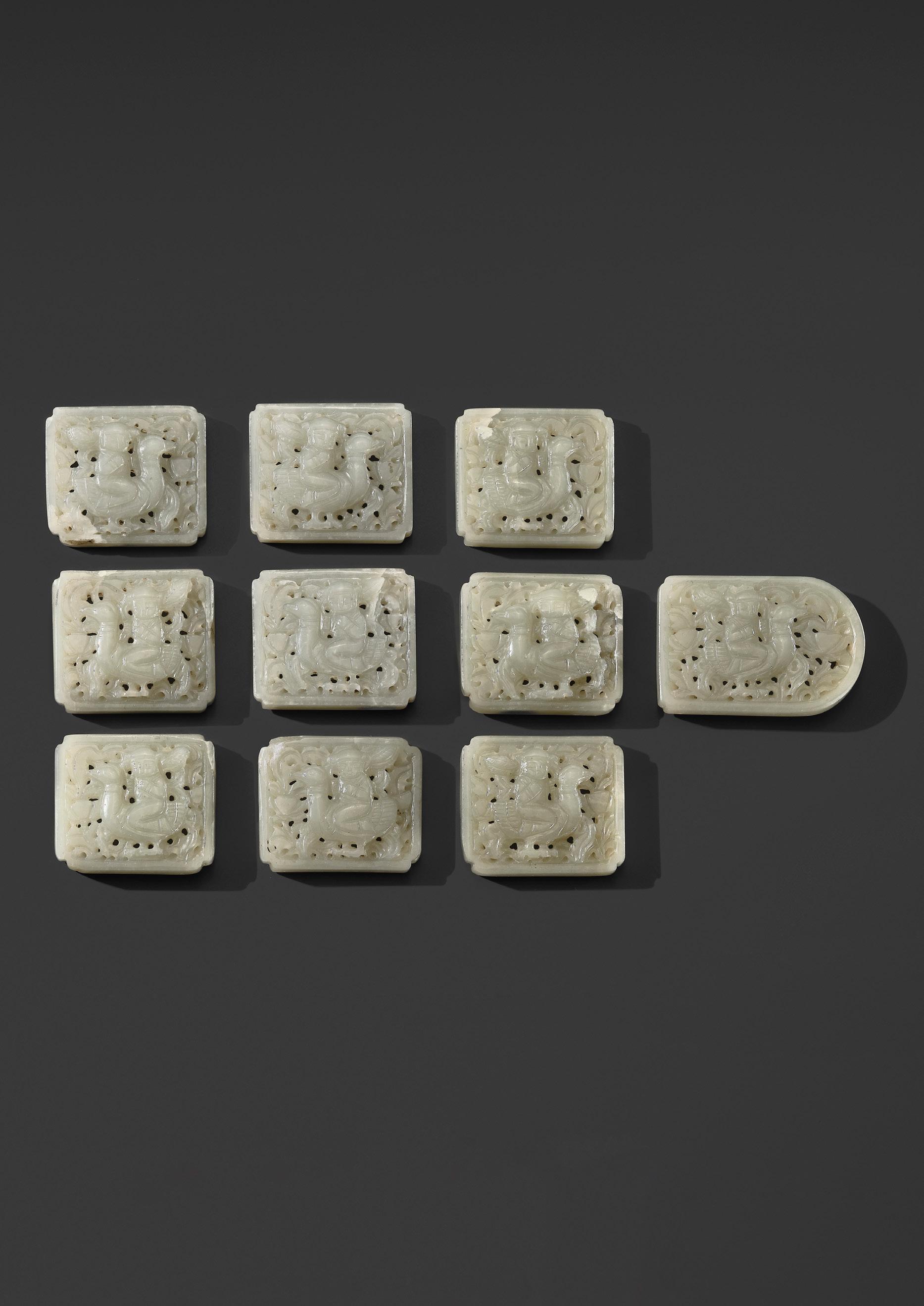
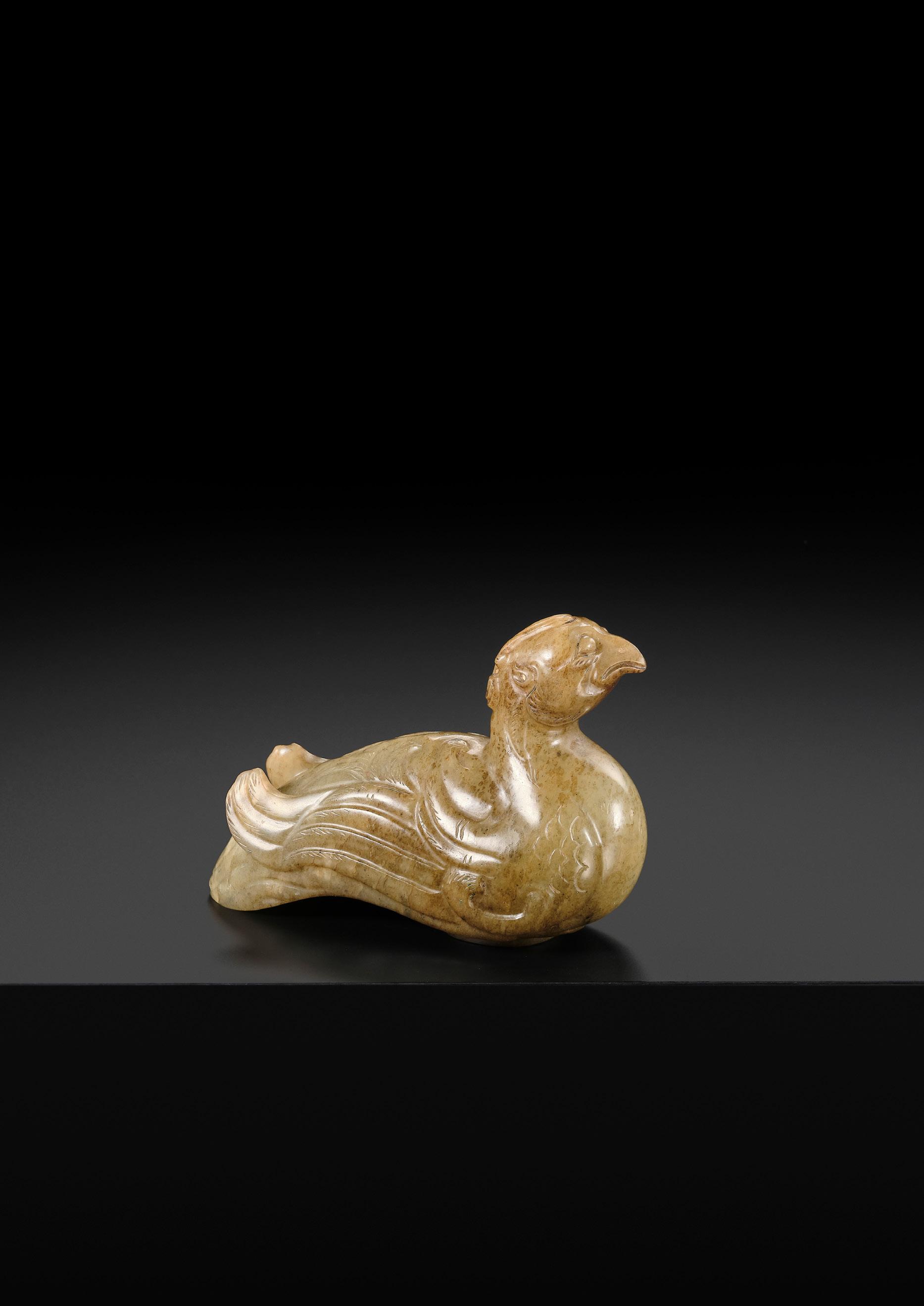
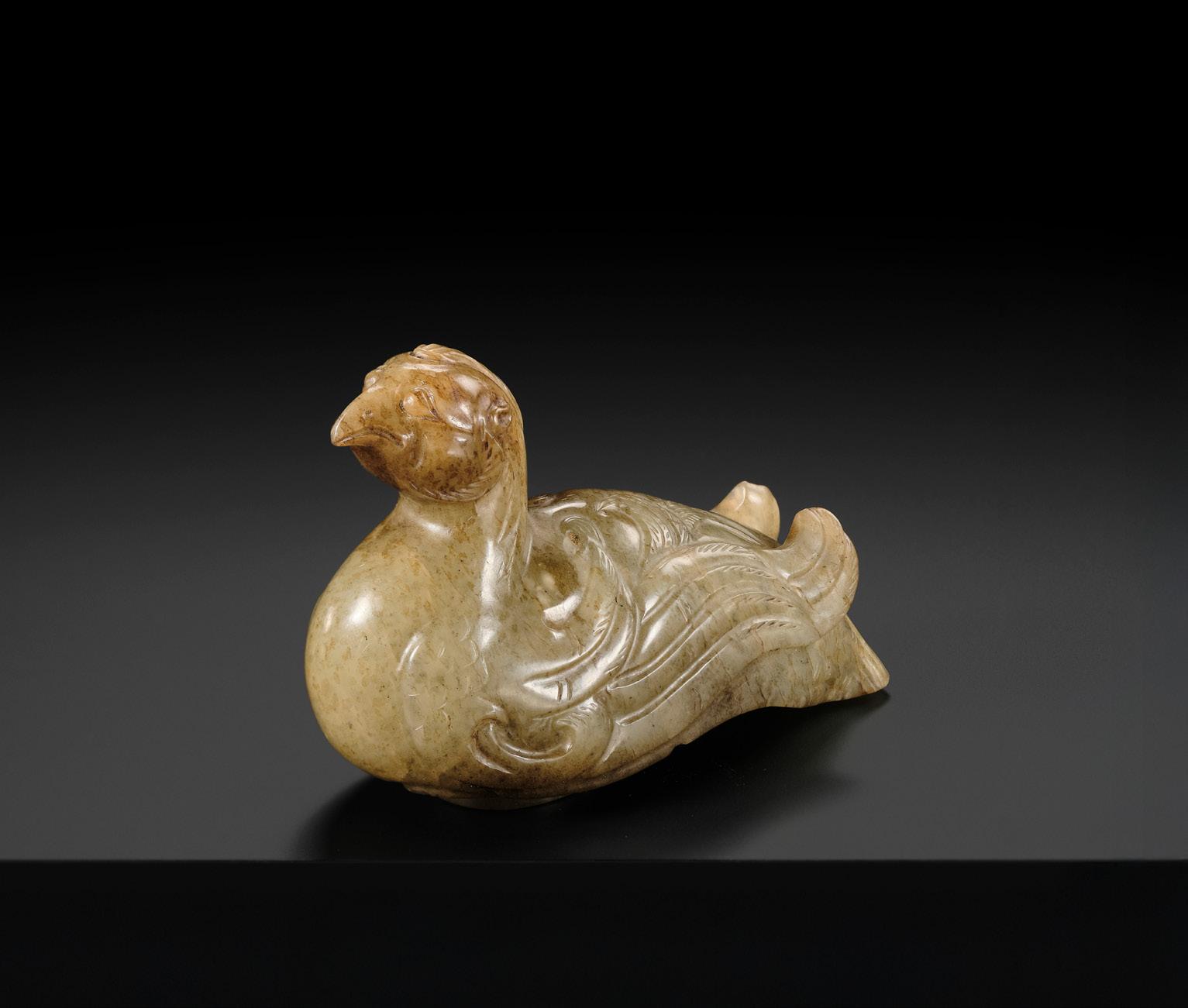
115
A PALE CELADON AND BROWN JADE STAFF FINIAL IN THE FORM OF A BIRD, SONG DYNASTY
China, 960-1279. Magnificently carved, the elongated body of the animal with neatly incised curls and finely modeled wings folded against its sides, extending to a tail gently tapering downward. The head held upright, marked by a pair of prominent bulging eyes, a small, curved beak, and masterfully carved strands of hair. The underside with a large, oval aperture with a raised rim, designed for attachment to a staff. The semi-translucent stone of a pale celadon tone, interspersed with icy white, pale yellow, and brownish inclusions and veining.
Provenance: The Collection of Sam and Myrna Myers, Paris, France. According to the Myers ledger acquired on 18 December 1977 in Amsterdam and in the collection for 49 years.
Condition: Very good condition with minor wear and natural agerelated imperfections. Light traces of weathering and signs of usage. Few minute nicks and shallow surface scratches.
Weight: 151.7 g
Dimensions: Length 8.4 cm
The present Song dynasty bird-shaped staff finial perpetuates a tradition established during the Han dynasty, wherein analogous carvings were conferred as marks of respect and prestige upon men who had attained notable achievements or reached the age of seventy, thereafter receiving heightened veneration. Fan Yeh, in History of the Later Han Dynasty, observes that birds, particularly doves, were selected as emblems on account of their capacity to digest all sustenance with ease, a metaphorical reflection of the expected adaptability and virtue of the recipient. Han dynasty prototypes were predominantly rendered in silvered bronze.
Literature comparison:
Compare a closely related russet jade carving of a swan, Song to Yuan dynasty, 12th-14th century, 7.9 cm long, in the Metropolitan Museum of Art, object number 2015.500.5.4.
AUCTION RESULT COMPARISON
Type: Closely related
Auction: Sotheby’s New York, 23 March 2022, lot 228
Price: USD 15,120 or approx.
EUR 10,500 converted and adjusted for inflation at the time of writing
Description: A pale celadon and brown jade bird-form staff finial, Song to Ming dynasty
Expert remark: Compare the related manner of carving and modeling of the figure, with similarly folded wings and tail directed downward. Note the similar size (8.2 cm).
AUCTION RESULT COMPARISON
Type: Closely related
Auction: Christie’s London, 6 November 2007, lot 41
Price: GBP 4,750 or approx.
EUR 11,500 converted and adjusted for inflation at the time of writing
Description: A celadon and russet jade bird finial, Song dynasty
Expert remark: Compare the related manner of carving, modeling of the figure, and color of the stone. Note the slightly larger size (10 cm).
Estimate EUR 5,000
Starting price EUR 2,400
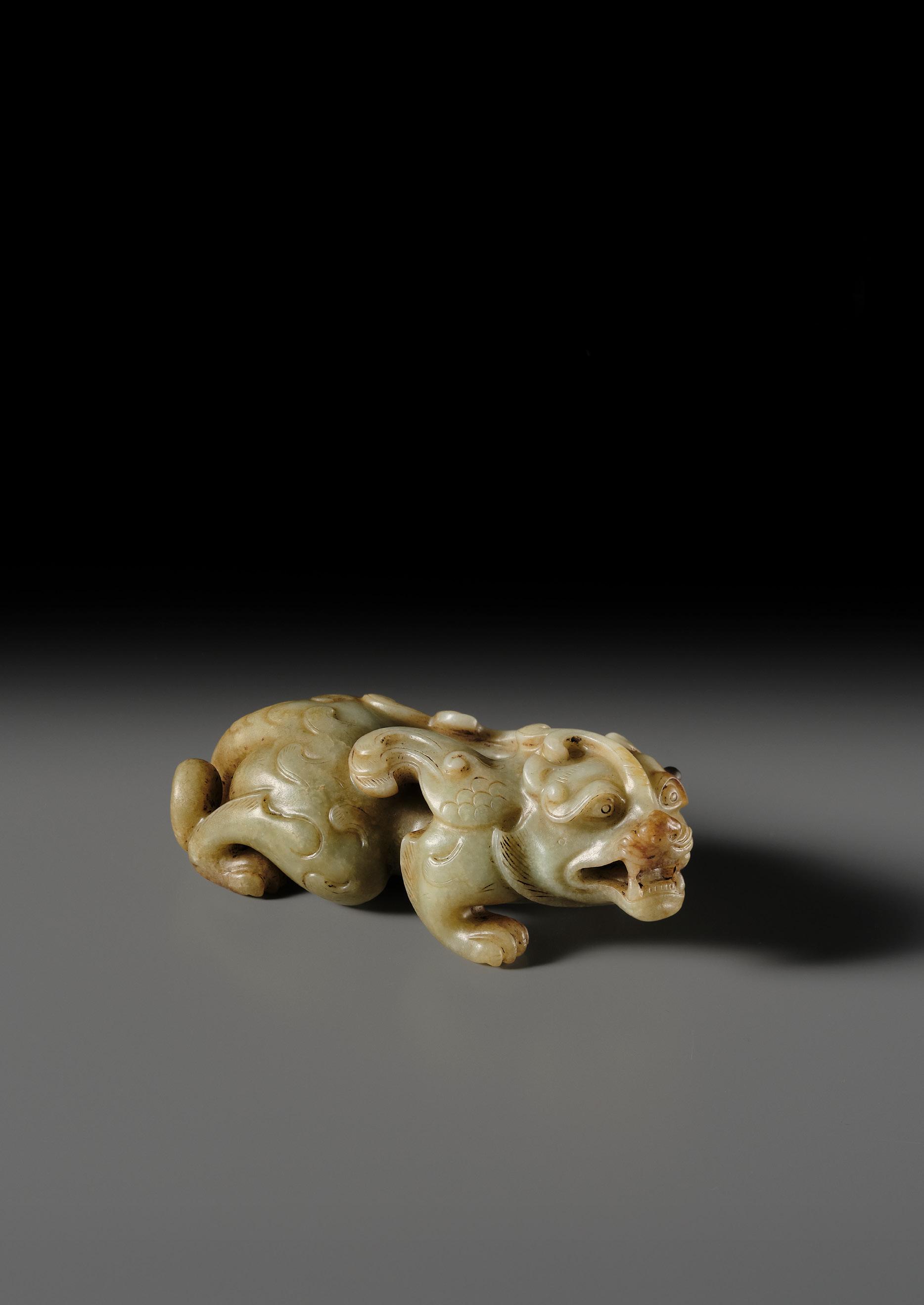

China, 1368-1644. Carved as a powerful winged beast in a crouching stance, the left front leg extended, the thick paws appearing to firmly grip the ground, the head with a single bifurcated horn and detailed in a wild expression with bulging eyes below thick curled brows, a broad nose, and the mouth open in a growl revealing sharp fangs. The body detailed with thick tufts of fur, wings with scrolling tips, and a coiled bifurcated tail. The partly opaque stone of a pale celadon tone with patches of russet and dark brown, as well as speckles of calcification.
Provenance: The Collection of Sam and Myrna Myers, Paris, France. Acquired between circa 1965-2012.
Condition: Excellent condition with ancient wear and natural imperfections. Some weathering and minuscule nibbling.
Weight: 182.4 g
Dimensions: Length 9.7 cm
Pixiu are mythical hybrid creatures, considered powerful protectors, resembling strong, winged tigers or lions, auspicious for wealth, and said to have a voracious appetite exclusively for gold, silver, and jewels. Therefore, Pixiu have always been regarded as being capable of drawing cai qi (wealth) from all directions, and according to the Chinese zodiac, they are especially helpful for those who are going through a bad year. There are two types of Pixiu: The one with two horns is the female, called Bixie. The one with only one antler is the male, called Tianlu.
Emperor Wu of the Han dynasty declared that the pixiu would be forever known as the ‘Treasure of the Emperor’, that only royal personage could possess a pixiu, and that it was strictly forbidden for all others to own one, including officials. This law was kept through to the very end of the Qing dynasty. Lifelike sculptures of these mythical beings made from durable materials, such as bronze and jade, were made to embody and pacify the elemental and supernatural forces of the living world.
Winged beasts in general (lion, tiger, deer, ram, eagle… etc.) are a popular and enduring subject in ancient Chinese works of art, and exist in many different forms (as a decorative pattern, flat carving or carving in the round).
The term bixie first appeared in Jijiupian by Shi You in the Western Han period: ‘Sheji, bixie are both names of mythical beasts… bixie means ‘warding off the wicked’. It is said that jade pendants in the form of these two beasts can help prevent adversity and provide protection.’
The iconography of the bixie is closely associated with that of the griffin, popular in the Western Asia and Eurasia steppes, and originated in Mesopotamia in 3000 B.C. Bixie occupies a curious position in Chinese art. It is based on the imagery of a lion, a foreign animal, but has the spirit of a fierce tiger. It is often depicted alongside other exotic animals as artistic backdrops for monumental architectures, especially in the Han dynasty, where palaces, temples, shrines and tombs were often decorated with large scale bronze or stone sculptures of Weng Zhong, qilin, tianlu, elephants, camels or horses. Bixie is an important component amongst the array that makes up this subject matter.
Although bixie have heads like a lion or a tiger, it is the tiger that most embodies its essence. In the Three Kingdoms period, Zhuge Liang in his military strategy coined the now well-known term ‘like a tiger added with wings’ to describe a general that excels at deploying his troops. The origin of this phrase can be found in his anthology Zhuge Zhongwuhou wenji, juan 4, edited by Zhang Shu (17811847): “Military command is the mandate to lead the three armies, and the authority of the chief commander. A general who has the command of the army and knows the essence of troop deployment to gain the upper hand, is like a fierce tiger that has been given wings and able to travel the four seas, to apply force when he sees fit.”
LITERATURE COMPARISON
Compare a related jade leonine mythical creature, bixie, date 206 BC-589 CE or later, 11.6 cm wide, in the Worcester Art Museum, object number 2007.119.2.
AUCTION RESULT COMPARISON
Type: Related Auction: Bonhams London, 8 November 2012, lot 8
Price: GBP 48,050 or approx. EUR 91,000 converted and adjusted for inflation at the time of writing
Description: A rare pale green jade ‘bixie’ water dropper and cover, 17th century Expert remark: Compare the related form and similar sinuous body. Note the larger size (13.4 cm) and that it is a water dropper.
AUCTION RESULT COMPARISON
Type: Related
Auction: Christie’s Hong Kong, 31 May 2017, lot 2743
Price: HKD 375,000 or approx. EUR 47,500 converted and adjusted for inflation at the time of writing
Description: A white jade bixie, Six Dynasties Expert remark: Note the size (6.5 cm) and the earlier dating.
Estimate EUR 5,000
Starting price EUR 2,400
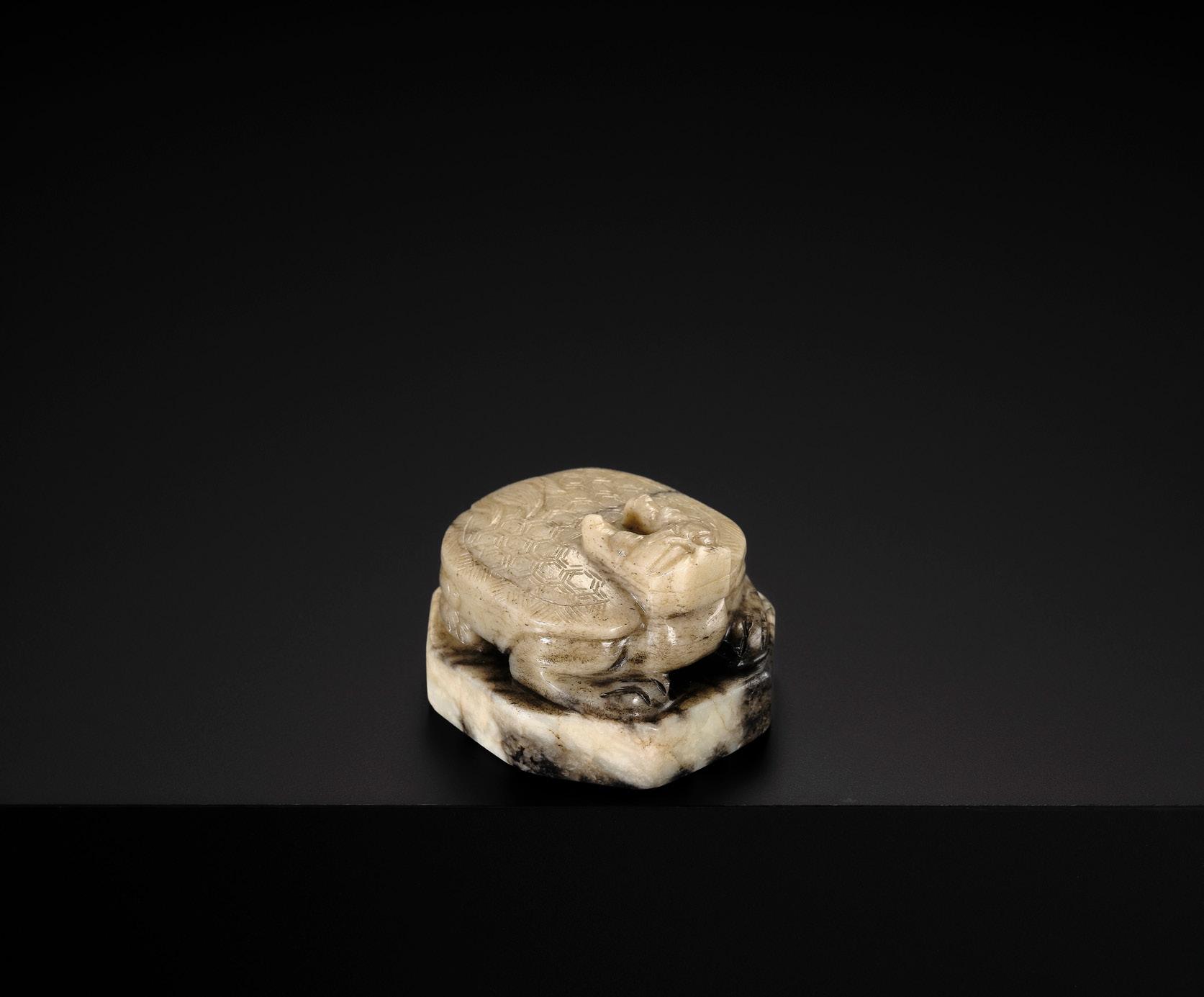
A RARE WHITE AND BLACK JADE SEAL WITH A DRAGON-TORTOISE (XUANWU), MING DYNASTY
China, 15th-16th century. Skillfully carved, the mythical creature crouching upon a substantial hexagonal stand. Its slightly domed carapace delicately incised with a lozenge pattern, framed by a crisscrossed border, and surmounted by a prominent, angular head. The face defined by a pair of elongated eyes, a straight mouthline, and two long horns. The opaque stone of an appealing white tone, accented with large black patches, predominantly on the underside, and subtle light brown inclusions.
Provenance: The Collection of Sam and Myrna Myers, Paris, France. According to the Myers ledger acquired on 18 July 1976 from Vallin Galleries and in the collection for 50 years. Vallin Galleries, established in 1940, were dealers of fine Asian art. Owned and operated by Peter L. Rosenberg for nearly thirty years until his sudden death in December 2013, the gallery was widely regarded as an outstanding source for the best of Asian art.
Condition: Very good condition with minor wear and inherent natural imperfections, such as inclusions and fissures, some of which have developed into small hairlines. Occasional minute nicks and shallow surface scratches. Minor nibbling along the edges.
Weight: 127.1 g
Dimensions: Length 4.9 cm
Jade seals in the Ming dynasty were far more than mere administrative implements, serving instead as concentrated emblems of authority, legitimacy, and imperial cosmology. Examples such as the present, depicting
a mythical creature formed from a tortoise shell surmounted by a dragon head, known in Chinese mythology as ‘xuanwu’, unite in a single object the resilience and longevity traditionally associated with the tortoise with the power of the dragon, a symbol of imperial authority and divine protection, thereby conveying the notion of a stable and enduring mandate sanctioned by celestial forces. Meticulously carved in jade, a material prized for its incorruptibility and sacredness, these seals simultaneously manifest the technical mastery of Ming craftsmen and a value system that intertwined permanence, sovereignty, and the cosmological linkage between the terrestrial and celestial realms.
AUCTION RESULT COMPARISON
Type: Closely related
Auction: Sotheby’s New York, 23 March 2022, lot 220
Price: USD 5,670 or approx. EUR 5,500 converted and adjusted for inflation at the time of writing
Description: A brown jade ‘xuanwu’ seal, late Ming dynasty
Expert remark: Compare the related subject and manner of carving. Note the similar size (4.8 cm).
Estimate EUR 2,000
Starting price EUR 1,000
China, 17th-18th century. Dexterously carved in the round, the majestic water buffalo depicted in a recumbent posture, with legs tucked beneath its body and head, with prominent horns, turned serenely to the right. A small boy stands beside the animal, caressing its face and gently prodding his companion with a stalk bearing ripe ears. The translucent stone of an appealing interplay of white and chestnut brown tones, enriched by cloudy inclusions and natural veining.
Provenance: The Collection of Sam and Myrna Myers, Paris, France.
Acquired between circa 1965-2012.
Condition: Excellent condition with only minor wear, inherent natural imperfections, and occasional minuscule nicks.
Weight: 385.7 g
Dimensions: Length 8.9 cm
The water buffalo was a ubiquitous and indispensable animal in agrarian society, which underpinned rice cultivation and the rural economy. It therefore functioned as a potent emblem of agriculture and springtime, embodying strength, endurance, diligence, prosperity, and tranquility. In Chinese painting and other visual arts, the buffalo frequently evoked an idealized, bucolic existence, a pastoral idyll that extended into the spiritual realm. Within Buddhist and Daoist contexts, the animal was associated with simplicity and retreat, recalling the Daoist sage Lao Tse, who is traditionally portrayed departing the mortal world astride a buffalo.
Buffaloes were often depicted at rest with the head turned ninety degrees from the Ming dynasty, as noted by James C. S. Lin, signifying a state of worldly peace. When portrayed with a child riding or standing beside it, the motif additionally connoted obedience and serenity, while alluding to agricultural labor. Even a small child is capable of riding such a powerful creature without apprehension, emphasizing both the docility and the symbolic role of the animal in human life. See James C. S. Lin, The Immortal Stone, 2009, p. 51.
Expert’s note:
The subtle golden-hued stone, combined with the refined modeling of this buffalo-and-boy group, attests to the sophisticated execution of this traditional auspicious scene drawn from the natural world, which gained prominence from the Song dynasty onward. The small boy gently prods his companion, a robust water buffalo, with a stalk of rice, whose ears, emblematic of a plentiful harvest, resonate phonetically with the Chinese character for ‘year’ (sui), thus symbolically conveying the wish for ‘a good harvest year after year’ (sui sui nian feng).
AUCTION RESULT COMPARISON
Type: Closely related
Auction: Sotheby’s New York, 22 September 2020, lot 257
Price: USD 252,000 or approx.
EUR 268,000 converted and adjusted for inflation at the time of writing
Description: A celadon and russet jade ‘boy and buffalo’ group, 17th century
Expert remark: Compare the closely related subject, manner of carving, and color of the stone. Note the larger size (14 cm).
AUCTION RESULT COMPARISON
Type: Closely related
Auction: Christie’s London, 10 May 2011, lot 128
Price: GBP 73,250 or approx.
EUR 146,500 converted and adjusted for inflation at the time of writing
Description: A celadon jade 'buffalo and boy' group, 18th century
Expert remark: Compare the closely related subject, manner of carving, and color of the stone. Note the larger size (10.8 cm).
Estimate EUR 4,000
Starting price EUR 2,000
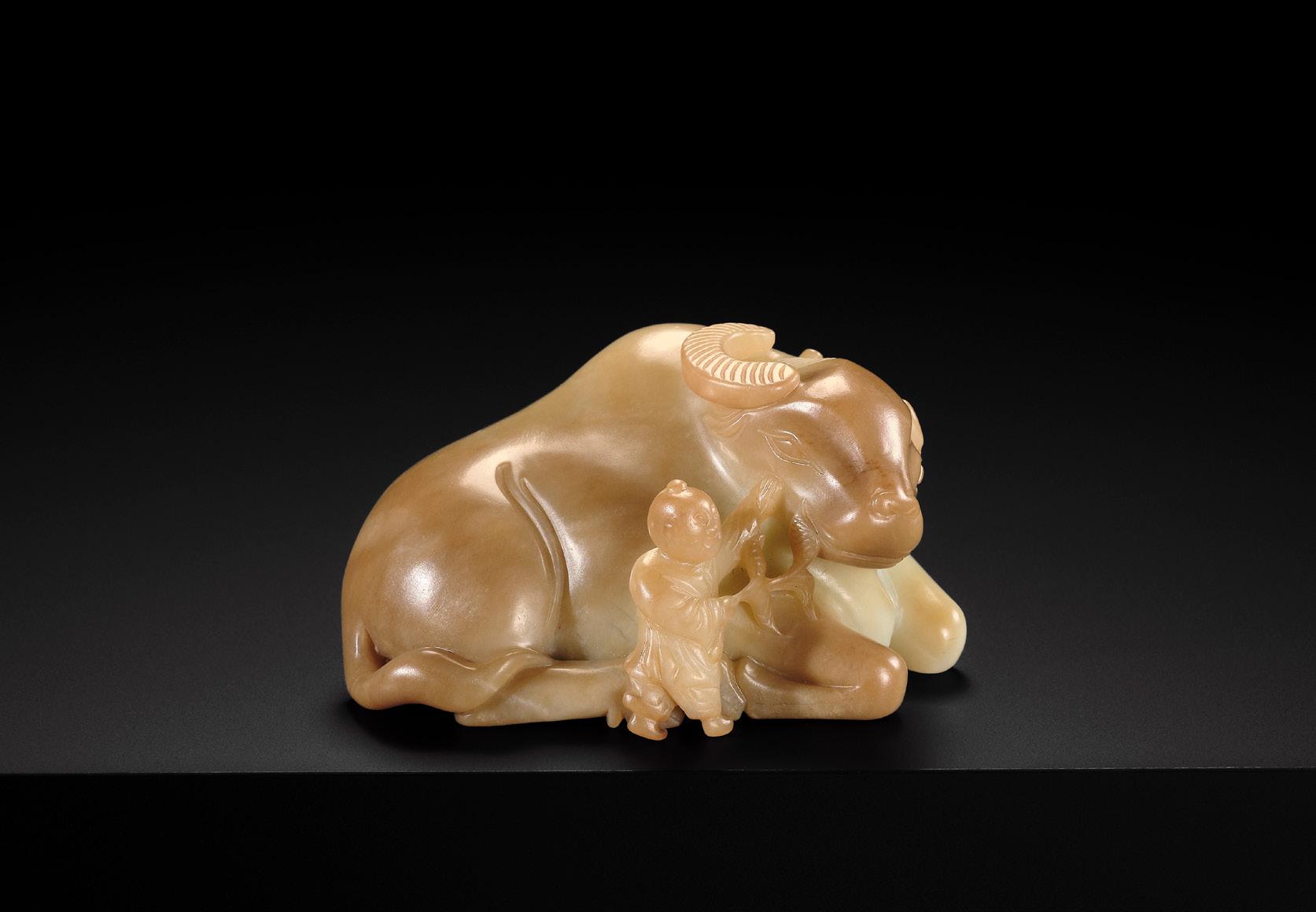
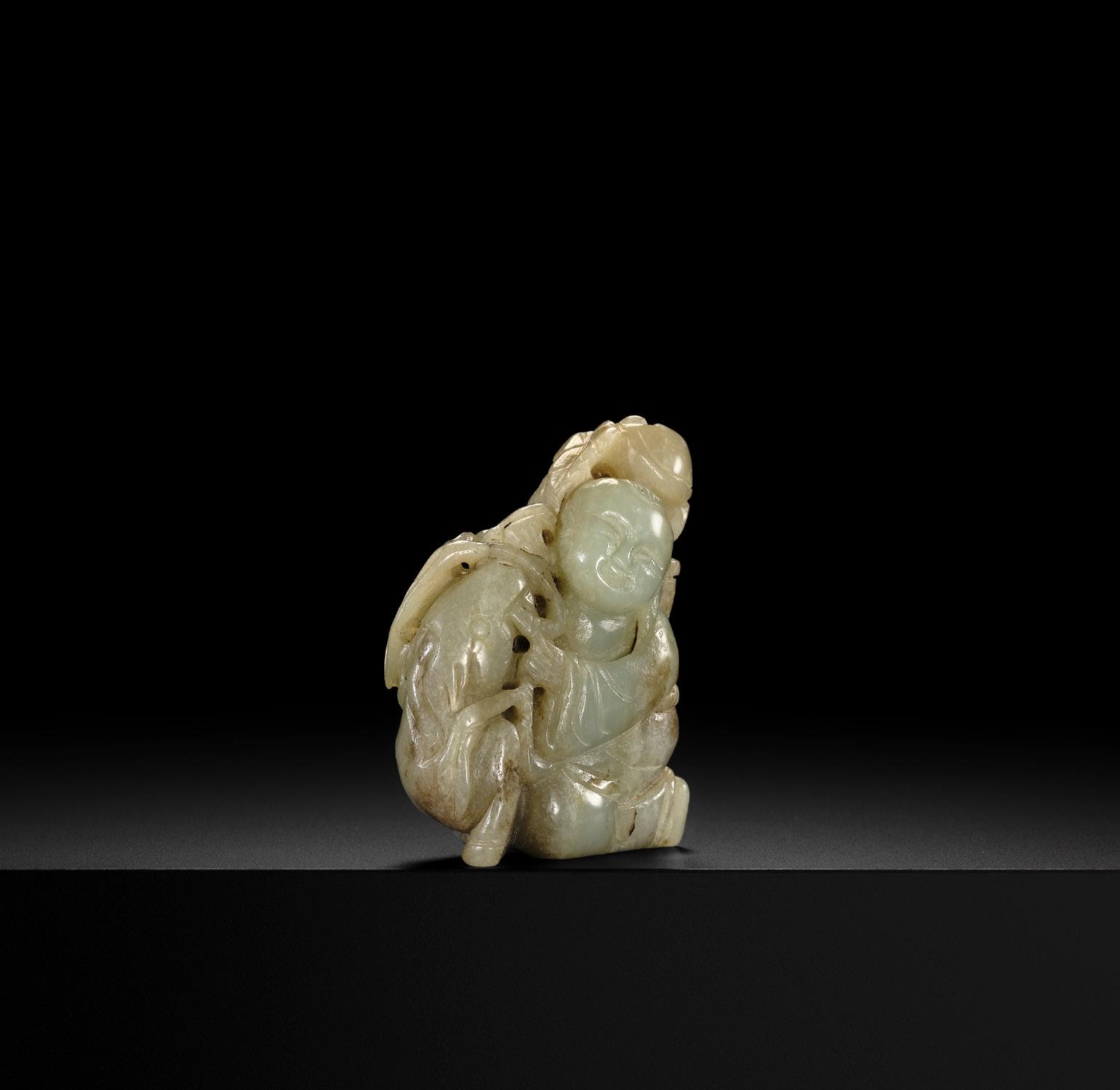
A PALE CELADON JADE FIGURE OF A BOY WITH A SHEEP, EARLY QING DYNASTY
China, 17th – 18th century. Finely carved as a kneeling boy beside a recumbent sheep, the youth clad in loose-fitting robes, carrying a basket over his shoulders from which curling lingzhi stems emerge. He grasps one stem with his hands, while the animal holds another in its mouth. The translucent stone predominantly of pale celadon hues, accented with cloudy inclusions and delicate brownish mottling and veining.
Provenance: The Collection of Sam and Myrna Myers, Paris, France. According to the Myers ledger acquired on 14 October 1977 in Amsterdam and in the collection for 49 years.
Condition: Very good condition with minor wear and inherent natural imperfections. Occasional minute nicks and faint surface scratches.
Weight: 118.4 g
Dimensions: Height 6.3 cm
Auspicious symbols and visual puns expressing good wishes are recurring themes in Chinese decorative art. A delightful example is this jade figure that depicts a small boy gently prodding his companion, a small recumbent sheep, while holding a lingzhi stem. The lingzhi has long been regarded as a spiritual herb or ‘mushroom of immortality’, and is therefore associated with good fortune, robust health, and longevity. Sheep, rams,
and goats, likewise, have carried auspicious connotations since ancient times. The Chinese word for ram is yang 羊, a character historically linked to good fortune, as it appears as a radical in several other characters with positive meanings, including xiang 祥, which denotes ‘auspicious’ or ‘favorable’. The elegant and attractive carving thus unveils a complex interplay of meaning, adding to its intellectual value interpreted by a scholar educated in the Confucian classics making this carving a highly suitable adornment for a scholar's desk.
AUCTION RESULT COMPARISON
Type: Related
Auction: Bonhams London, 15 May 2014, lot 171
Price: GBP 18,750 or approx. EUR 34,500 converted and adjusted for inflation at the time of writing
Description: A very fine pale green jade carving of a boy and three rams (sanyang), Qing dynasty, 18th century
Expert remark: Compare the related auspicious subject, manner of carving, and color of the stone. Note the slightly larger size (8.3 cm).
Estimate EUR 3,000
Starting price EUR 1,500
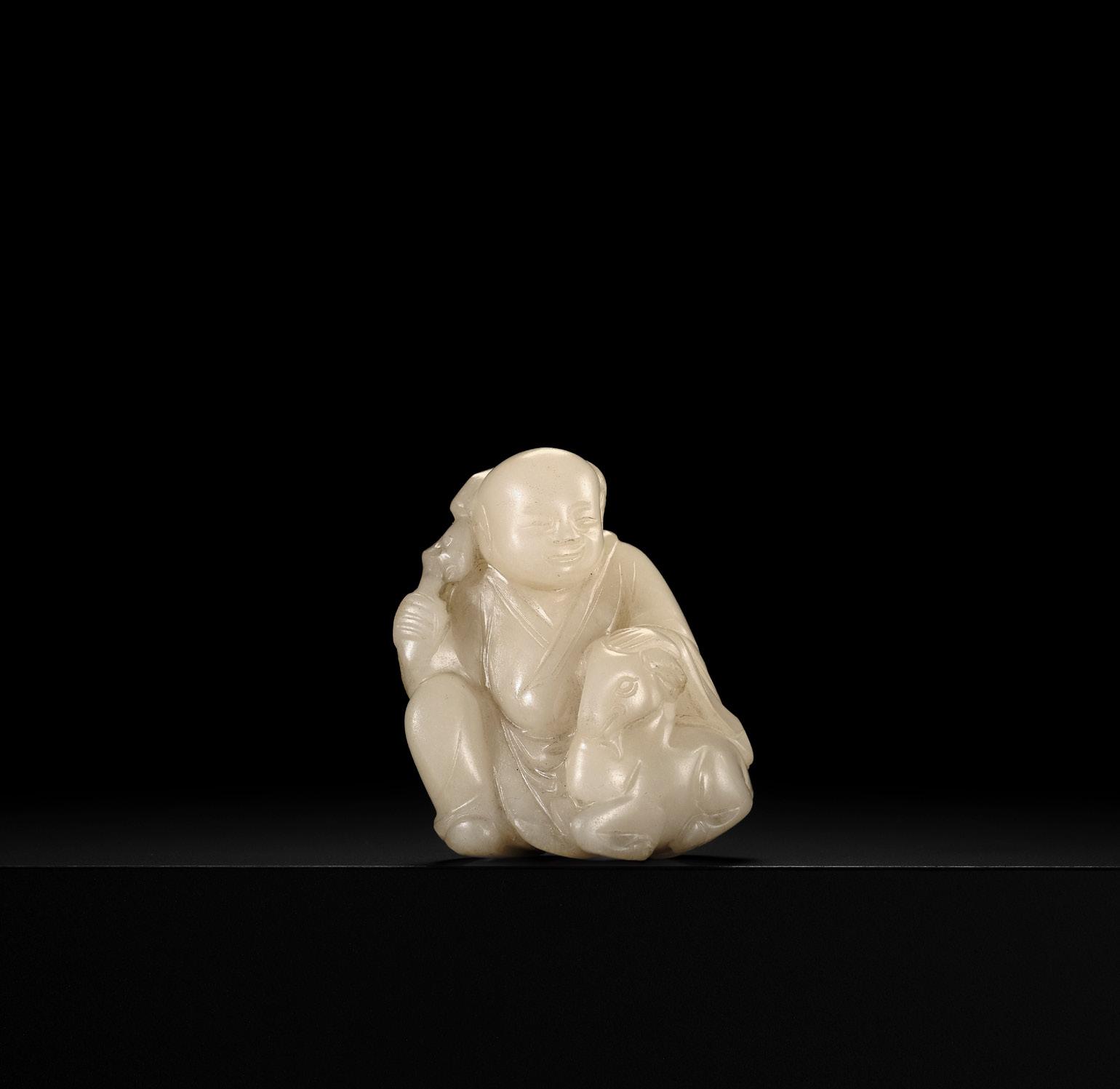
A ‘MUTTON FAT’ JADE FIGURE OF A BOY WITH A RAM, QING DYNASTY
China, 18th century. Superbly carved as a crouching boy with an amiable expression, dressed in loose-fitting robes and holding a lingzhi stem over his shoulder while gently stroking the head of a recumbent ram beside him. The translucent stone of a magnificent white tone, with cloudy inclusions and subtle russet mottling to the reverse and underside.
Provenance: The Collection of Sam and Myrna Myers, Paris, France.
Acquired between circa 1965-2012.
Condition: Excellent condition with only minor wear and natural agerelated imperfections.
Weight: 90.5 g
Dimensions: Height 5.8 cm
Auspicious symbols and visual puns expressing good wishes are recurring themes in Chinese decorative art. A delightful example is this white jade figure that depicts a small boy gently prodding his companion, a small recumbent ram, while holding a lingzhi stem. The lingzhi has long been regarded as a spiritual herb or ‘mushroom of immortality’, and is therefore associated with good fortune, robust health, and longevity. The ram, likewise, has carried auspicious connotations since ancient times. The Chinese word for ram is yang 羊, a character historically linked to good fortune, as
it appears as a radical in several other characters with positive meanings, including xiang 祥, which denotes ‘auspicious’ or ‘favorable’. The elegant and attractive carving thus unveils a complex interplay of meaning, adding to its intellectual value interpreted by a scholar educated in the Confucian classics making this carving a highly suitable adornment for a scholar's desk.
AUCTION RESULT COMPARISON
Type: Related
Auction: Sotheby’s Hong Kong, 2 June 2016, lot 906
Price: HKD 125,000 or approx.
EUR 16,000 converted and adjusted for inflation at the time of writing
Description: A white jade ‘boy and ram’ carving, Qing dynasty
Expert remark: Compare the related manner of carving and depicted subject, the boy with similar facial features and garments, holding an analogous lingzhi stem.
Estimate EUR 3,000
Starting price EUR 1,500
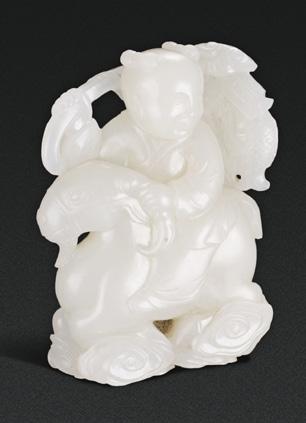
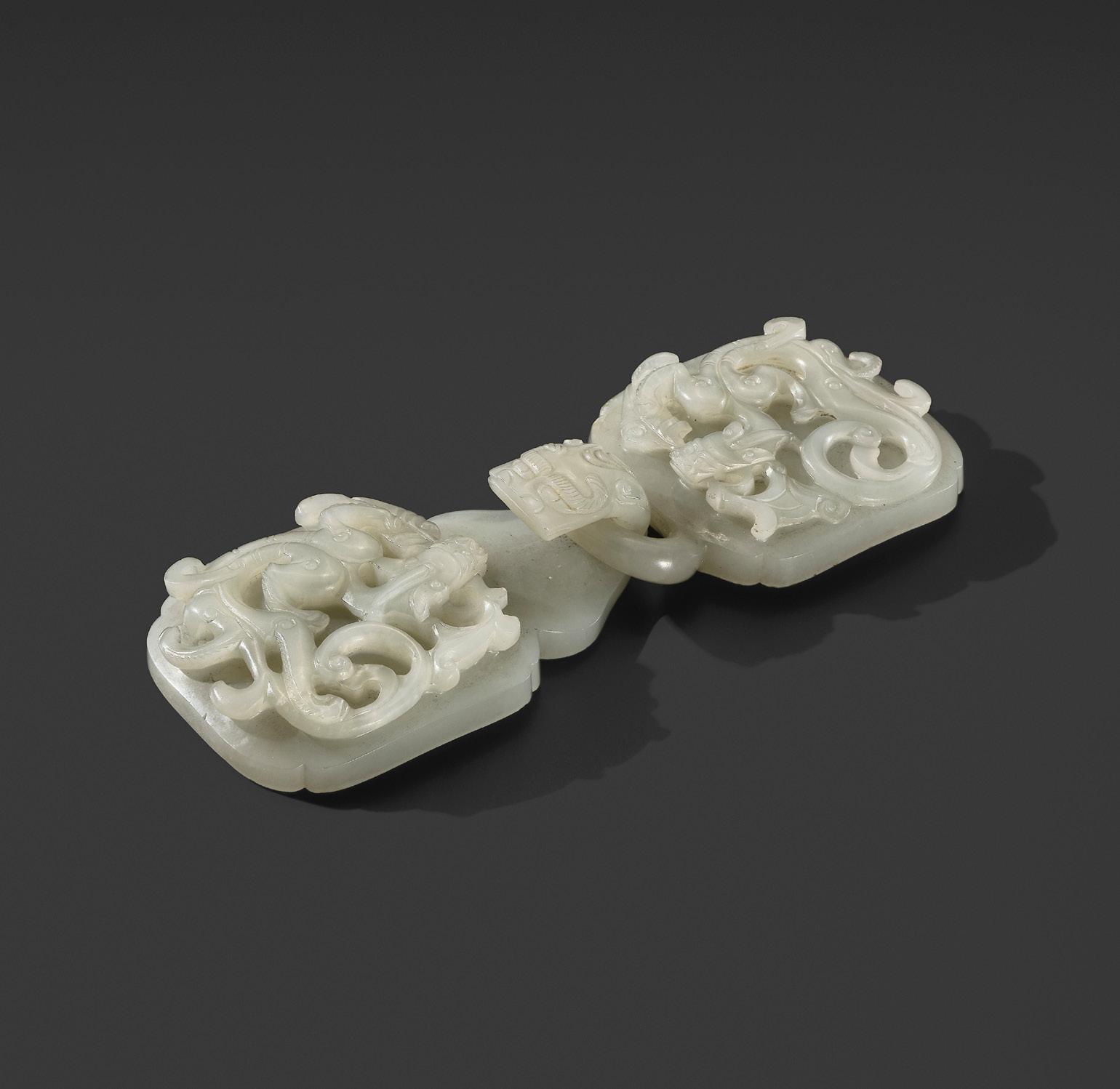
121
A WHITE JADE ‘DRAGON’ BELT HOOK AND BUCKLE, QING DYNASTY
China, 18th century. Each piece of square form with rounded corners and a slightly concave section, finely carved in high relief to depict a pair of stylized coiling dragons (chilong), the hook terminating in an abstracted dragon head that fits seamlessly into the oval loop of the buckle. The reverse set with circular buttons. The translucent stone of an attractive icy white tone with cloudy inclusions and occasional light brown speckles. (2)
Provenance: The Collection of Sam and Myrna Myers, Paris, France. Acquired between circa 1965-2012.
Condition: The hook fissured and subsequently restored. Otherwise, very good condition with minor wear and inherent natural imperfections. Few minute nicks and shallow surface scratches. Minimal nibbling along the edges.
Weight: 131.7 g
Dimensions: Length 12.9 cm (total)
Literature comparison:
Compare a closely related white jade ‘dragon’ belt hook and buckle, Qing dynasty, 19th century, 9.53 cm long, in the Nelson Atkins Museum of Art, object number 33-770/1 A, B.
AUCTION RESULT COMPARISON
Type: Closely related
Auction: Christie’s New York, 29 March 2024, lot 85
Price: USD 4,410 or approx. EUR 4,000 converted and adjusted for inflation at the time of writing
Description: A carved white jade ‘dragon’ two-part belt buckle, Qing dynasty, 18th century
Expert remark: Compare the related form, manner of carving, and decorative style. Note the slightly smaller size (10.8 cm).
AUCTION RESULT COMPARISON
Type: Closely related
Auction: Christie’s Hong Kong, 27 November 2013, lot 3614
Price: HKD 187,500 or approx. EUR 27,000 converted and adjusted for inflation at the time of writing
Description: A white jade belt hook and buckle, Qing dynasty, 18th century
Expert remark: Compare the related form, manner of carving, and decorative style. Note the slightly smaller size (9.3 cm).
Estimate EUR 3,000
Starting price EUR 1,500
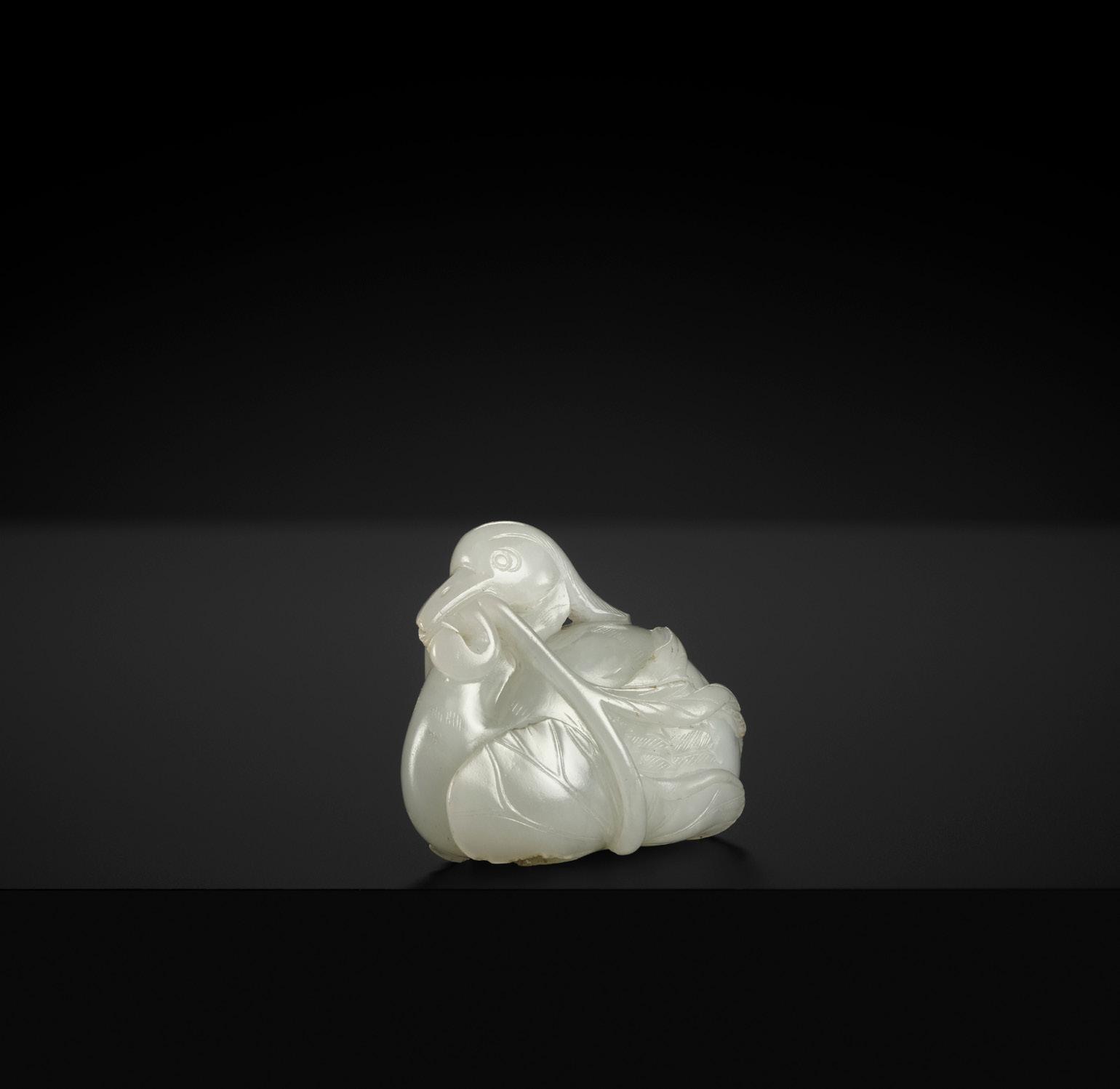
122
A FINE WHITE JADE ‘MANDARIN DUCK AND LOTUS’ CARVING, QING DYNASTY
China, 18th century. Minutely carved in the form of a reclining duck, its head oriented forward with the sinuous neck drawn closely against the body, the animal grasping the long stem of a lotus blossom in its beak, while a broad leaf unfurls beneath its body. The translucent stone of an appealing icy white tone, suffused with soft cloudy inclusions.
Provenance: The Collection of Sam and Myrna Myers, Paris, France.
Acquired between circa 1965-2012.
Condition: Very good condition with minor wear and inherent natural imperfections. Few minuscule chips and minor nibbling along the edges. Occasional minute chips and shallow surface scratches.
Weight: 85.3 g
Dimensions: Length 5.4 cm
Mandarin ducks, animals believed to mate for life, symbolize conjugal harmony and fidelity in Chinese culture. They are frequently depicted alongside blossoming lotus flowers as an emblem of harmony. Together, these motifs form the rebus ‘yuanyang xihe’, meaning ‘may you be paired for life’. The representation of the ducks grasping lotus stems in their beaks thus conveys the wish for a joyful and enduring marriage.
AUCTION RESULT COMPARISON
Type: Closely related
Auction: Sotheby’s New York, 22 March 2023, lot 653
Price: USD 6,985 or approx. EUR 6,500 converted and adjusted for inflation at the time of writing
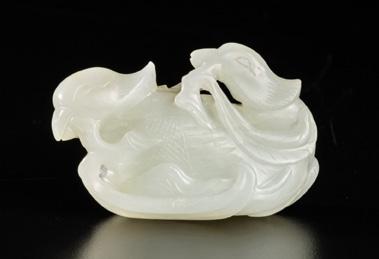
Description: A white jade ‘mandarin ducks and lotus’ group, Qing dynasty, Qianlong period
Expert remark: Compare the closely related subject, manner of carving, and color of the stone. Note the similar size (6.1 cm).
Estimate EUR 3,000
Starting price EUR 1,500
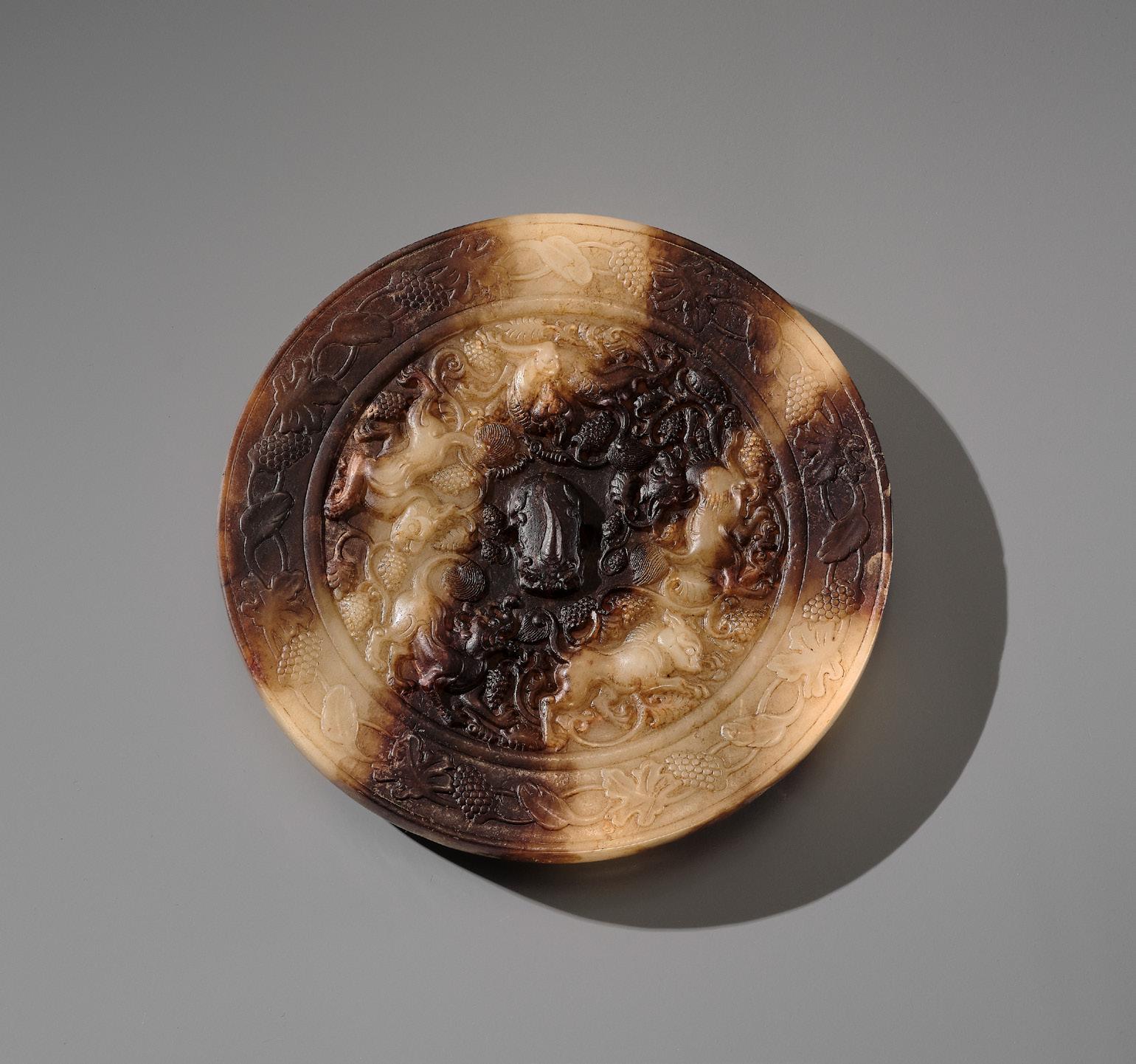
A VERY RARE YELLOW AND BROWN JADE ‘LION AND GRAPEVINE’ MIRROR, QING DYNASTY OR EARLIER
China. Finely carved, of circular form with a gently concave section, the backside centered by a crouching beast-form loop, encircled by a band of four mythical lions striding amid fruiting grapevines, further enclosed by a broader register of larger grapevines and leaves, all contained within raised borders. The frontside left undecorated. The stone bearing an attractive interplay of pale yellow and dark brown tones, enriched with russet veining and natural inclusions.
Provenance: The Collection of Sam and Myrna Myers, Paris, France. According to the Myers ledger, this was acquired on 4 April 1997, and has been in the collection for 29 years.
Condition: Very good condition with old surface wear and natural agerelated imperfections. Distinct traces of weathering and erosion. Few minor nicks, shallow surface scratches, mostly to the underside, and occasional minute chips.
Weight: 470.3 g
Dimensions: Diameter 13.7 cm
The present jade carving draws inspiration from the tradition of bronze mirrors, which began to be produced in China more than four millennia ago and functioned both as utilitarian objects and as funerary goods, attaining particular cultural and symbolic significance during the Tang dynasty (618-907). This example is ornamented with a motif of lions amidst
grapevines, a decorative program that reflects the intensified cultural and artistic exchanges between China and regions beyond its borders during the seventh and eighth centuries. Lion imagery was introduced into China in conjunction with the transmission of Buddhism and became a prominent motif on Tang-period bronze mirrors, frequently combined with grapevine designs derived from Central Asian models associated with the importation of grape wine.
LITERATURE COMPARISON
Compare a related bronze mirror with lion and grapevine, Tang dynasty, 618-907, 11.8 cm diameter, in the Smithsonian
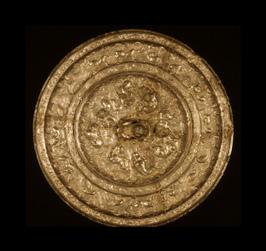
National Museum of Asian Art, accession number F1974.121. Compare a related high-tin bronze mirror with lions among grapevines, Tang dynasty, 7th-8th century, 23.5 cm diameter, in the Walters Art Museum, accession number 54.470.
Estimate EUR 4,000
Starting price EUR 2,000
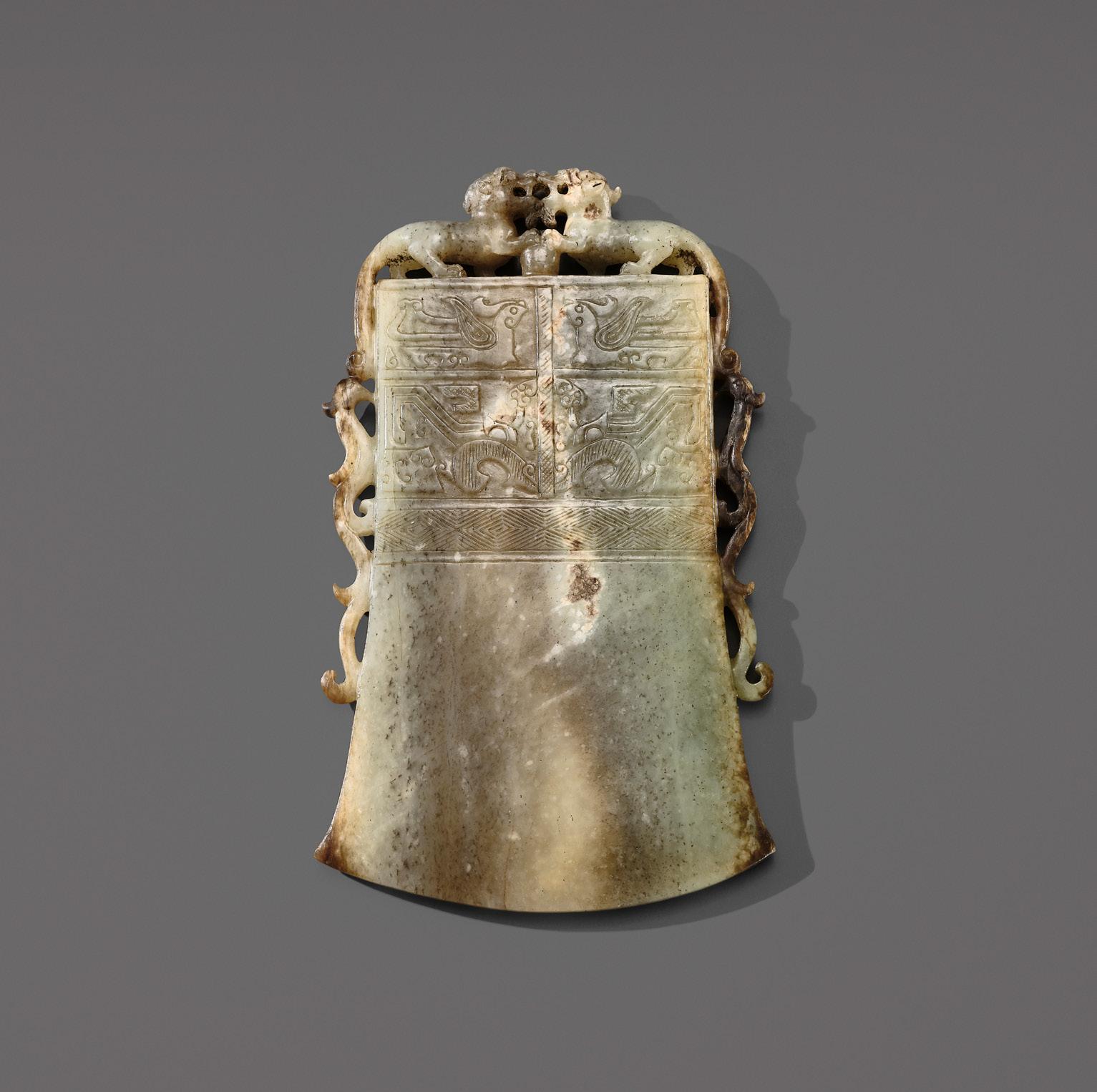
124
AN ARCHAISTIC CELADON AND BROWN JADE ‘AXE-HEAD’ ORNAMENT, QING DYNASTY
China, 18th century. Finely carved as a bell-shaped axe head, its surface neatly detailed on both sides with symmetrical registers of confronting mythical creatures and geometric motifs, framed by highly stylized dragons (chilong) coiling along the edges and surmounted by two additional hornless creatures, all skillfully executed in openwork. The translucent stone of a pale celadon tone with brown and white inclusions, as well as dark mottling.
Provenance: The Collection of Sam and Myrna Myers, Paris, France. According to the Myers ledger acquired on 28 October 1977 and in the collection for 49 years.
Condition: Very good condition with minor wear and natural agerelated imperfections. Light traces of weathering and erosion. Scattered minute nicks and faint surface scratches. Minuscule nibbling along the edges.
Weight: 224.1 g
Dimensions: Length 14.7 cm
Estimate EUR 4,000
Starting price EUR 2,000
LITERATURE COMPARISON
Compare a related jade ‘axe’ carving, Han dynasty, 206 BC-220 AD, 27 cm long, in the Metropolitan Museum of Art, object number 02.18.327. Compare a closely related jade axe-shaped ornament, Qing dynasty, 1736-1795, 16.7 cm long, in the Smithsonian National Museum of Asian Art, accession number F1919.40 (fig. 1).
AUCTION RESULT COMPARISON
Type: Related
Auction: Christie’s Hong Kong, 27 November 2013, lot 3545
Price: HKD 500,000 or approx. EUR 72,500 converted and adjusted for inflation at the time of writing
Description: A yellow jade carving of an axe, Qing dynasty
Expert remark: Compare the related form, manner of carving, and decorative style. Note the smaller size (5.8 cm).
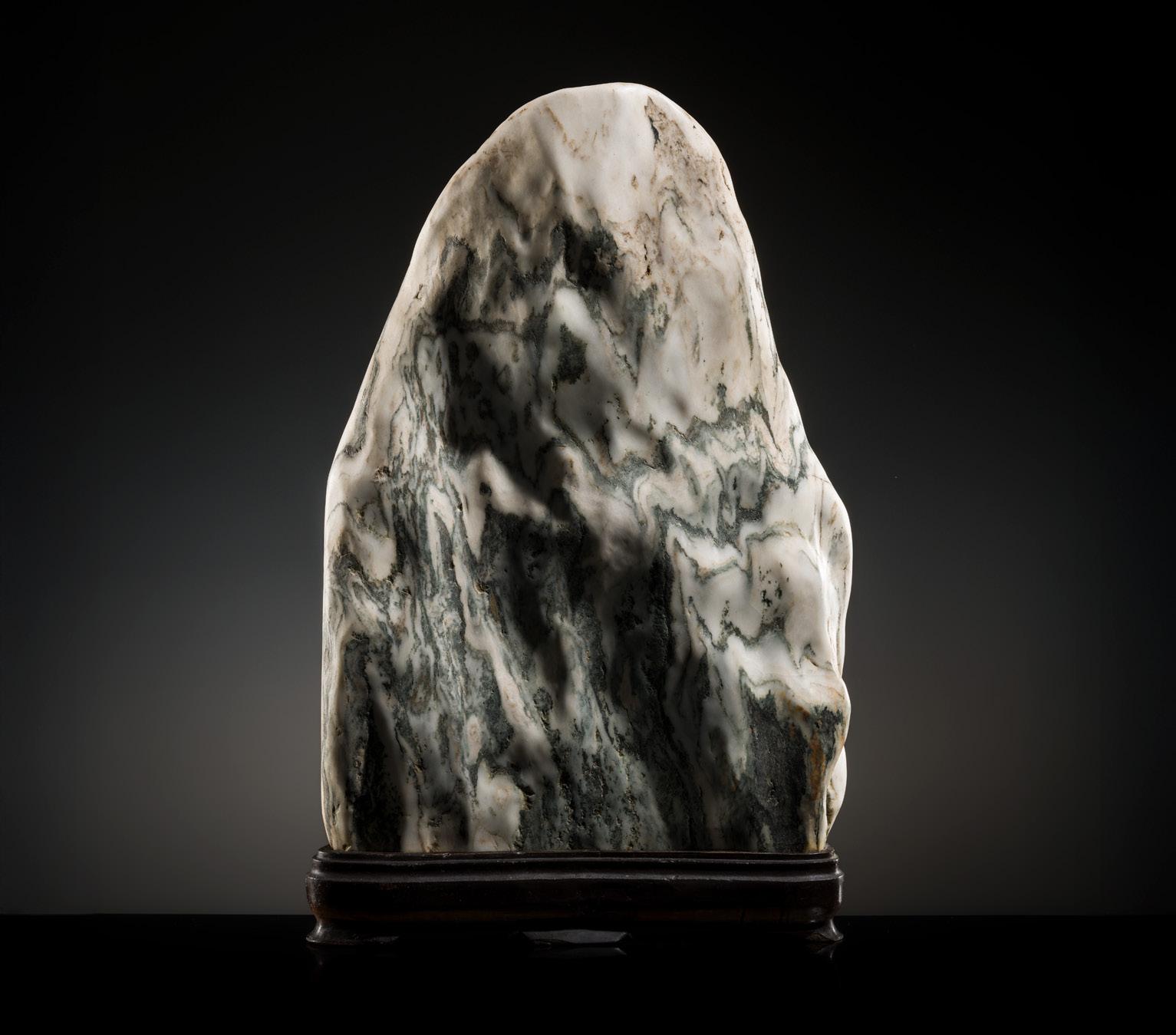
PUBLISHED
Jean-Paul Desroches (ed.) et al, Two Americans in Paris: A Quest for Asian Art, Paris, 2016, p. 159, no. 266.
Exhibited:
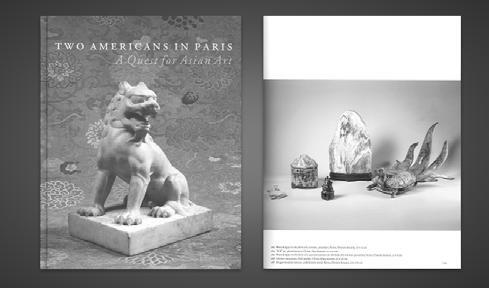
1. Pointe-à-Callière Museum, From the Lands of Asia. The Sam and Myrna Myers Collection, Montréal, 17 November 2016-19 March 2017.
2. Kimbell Art Museum, From the Lands of Asia. The Sam and Myrna Myers Collection, Fort Worth, Texas, 4 March-19 August 2018.
China, 1644-1912. Boldly carved in the manner of a rugged escarpment, the sides subtly undulating. The natural marble of creamywhite tones suffused with varying hues of brown and slate-grey natural inclusions, reminiscent of a mountain range, evoking thoughts of peaks in rising mist and clouds. Mounted on a fitted wood stand. (2)
Provenance: Christie’s London, 11 November 2003, lot 79 (sold for GBP 2,270 or approx. EUR 6,000 converted and adjusted for inflation at the time of writing). The Collection of Sam and Myrna Myers, Paris, France, acquired from the above.
Condition: Very good condition with surface wear and natural agerelated imperfections, including fissures, some of which have developed into hairline cracks. Distinct traces of weathering and erosion. Sparse minute nicks, faint surface scratches, and occasional minor chips.
The present lot at Christie’s London, 11 November 2003, lot 79, sold for GBP 2,270 or approx. EUR 6,000
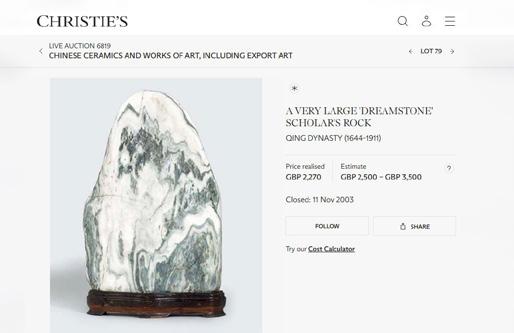
Weight: 32.1 kg (incl. stand)
Dimensions: Height 64.3 cm (incl. stand)
As far back as the Song Dynasty, naturally weathered rocks were collected and displayed for pleasure and by the 17th century individual rocks were important and respected enough to have portraits commissioned. Exceptional examples possess good shape, texture and color, and have resonance when struck. Given these qualities, a viewer can admire the strength of outline, perhaps seeing a mountain ridge or a rising cloud within the amorphous mass, and delight in following the twisting, undulating surface texture with their eyes. Transplanted from its original location where it was hewn by nature over thousands of years, a rock sitting on a scholar's desk can represent a whole world in miniature and allow the viewer's imagination to run.
Connoisseurs of scholar's rocks throughout the ages have boiled down their criteria for evaluating stones into twelve terms: thin, wrinkled, porous, permeable, clear, ugly, obtuse, clumsy, teal, powerful, beautiful, deep. Stones that have half of these features are considered rare and superior.
Estimate EUR 4,000
Starting price EUR 2,000
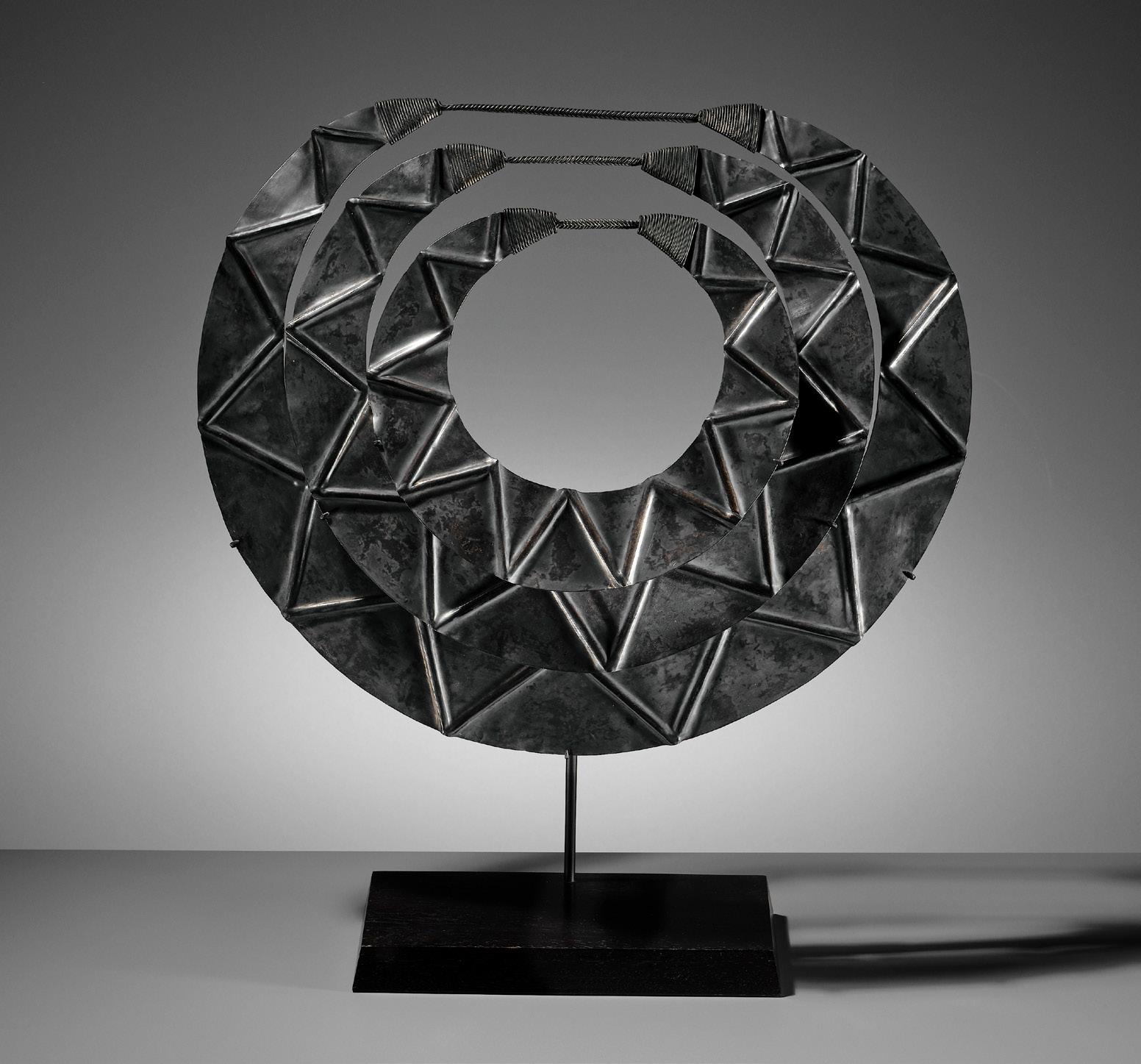
China, early 20th century. The necklace composed of three thin circular silver plates, each cast separately and boldly worked in repoussé with a large triangular decorative motif, finished at the upper edge, near the nape, with a silver-wrapped cord for adjustment and secure fastening.
Provenance: The Collection of Sam and Myrna Myers, Paris, France. Acquired between circa 1965-2012.
Condition: Very good condition with surface wear and inherent manufacturing irregularities. Expected tarnishing to silver. Light warping and occasional minor dents. Sparse minute nicks and shallow surface scratches.
Weight: 3,165 g (incl. stand)
Dimensions: Diameter 56.2 cm, Height 59.3 cm (incl. stand)
Mounted on an associated wood stand. (4)
Miao is a term employed in contemporary China to designate a category of ethnic groups residing in southern China and mainland Southeast Asia. The Miao constitute the largest ethnic minority in China without an autonomous region. Their communities are concentrated primarily in the mountainous regions of southern China, encompassing the provinces of Guizhou, Yunnan, Sichuan, Hubei, Hunan, Guangxi, Guangdong, and Hainan. Certain subgroups, most notably the Hmong, migrated from China into Southeast Asia, settling in Myanmar, northern Vietnam, Laos, and Thailand.
Silver ornaments have long held great significance among the Miao. Prior to marriage, a young woman was expected to possess a complete set of silver ornaments and clothing, with a silver necklace regarded as
essential. Weddings and major festivals provided occasions for women to display their finest attire and ornaments. Neck adornments rank among the most diverse categories of Miao silverwork and often exceed other types of ornamentation in variety. They continue to be worn in many regions by both women and men.
LITERATURE COMPARISON
Compare a closely related three-tiered silver neck ornament, Miao people, China, Guizhou province, 20th century, 46.7 cm long, in the Bowers Museum, Santa Ana, California, object number 2008.6.20a-c (fig. 1). Compare a closely related silver neck ornament, Miao people, 20th century, 25 cm long, in the National Museum of Prehistory, Taiwan, collection number 20042800059. Compare a related silver necklace composed of layered rounds, Miao people, China, Yunnan province, 20th century, 24 cm long, in the Art Gallery of New South Wales, accession number 25.2008. Compare a closely related three-tiered silver neck ornament, Miao people, 20th century, illustrated on the cover of René van der Star, The art of silver jewellery. From the minorities of China, the Golden Triangle, Mongolia and Tibet, 2006 (fig. 2).
Estimate EUR 3,000
Starting price EUR 1,500
1 fig. 2
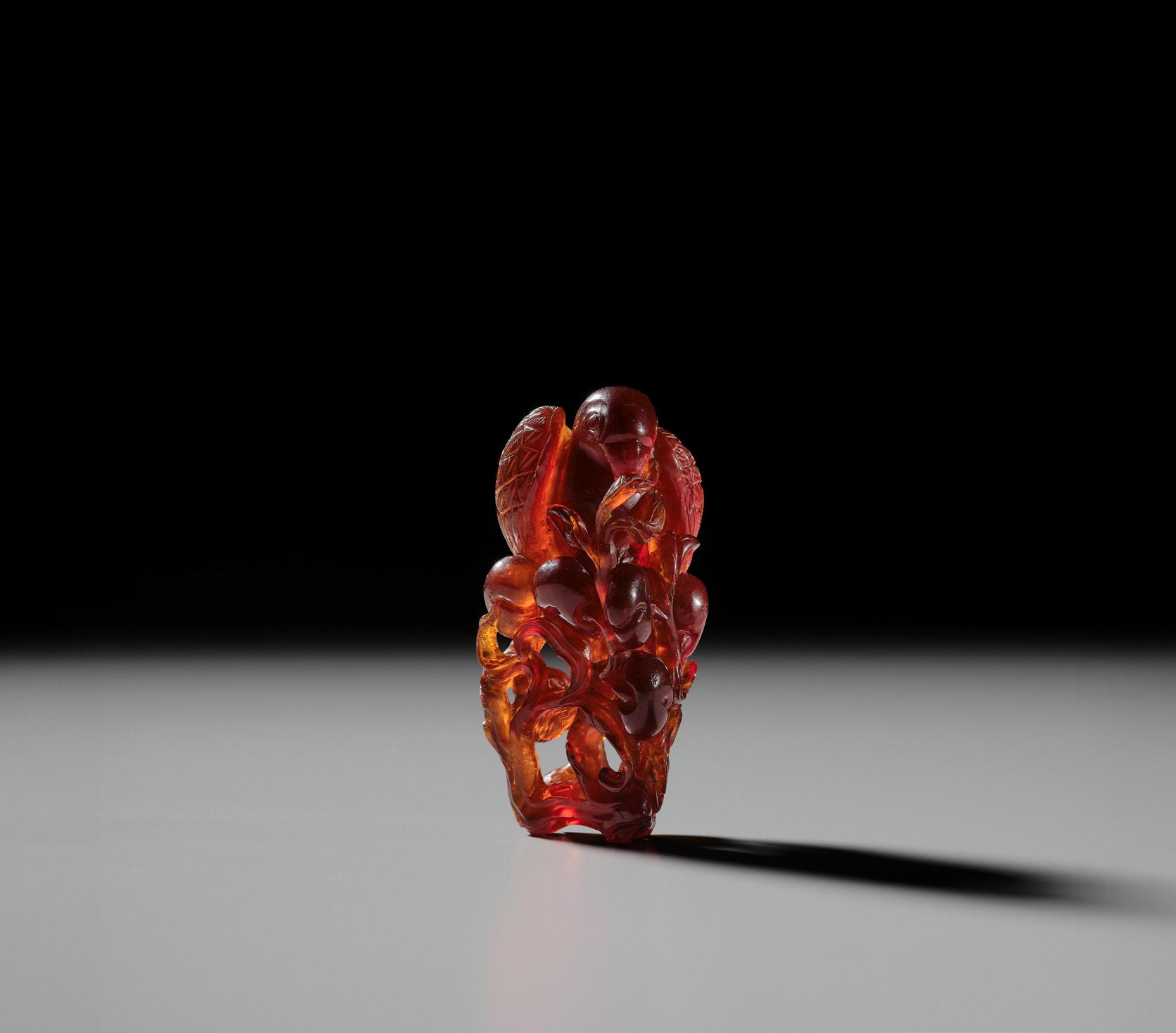
AUCTION RESULT COMPARISON
Type: Related
Auction: Bonhams San Francisco, 21 June 2011, lot 8219
Price: USD 18,300 or approx. EUR 22,500 converted and adjusted for inflation at the time of writing
Description: A carved amber pendant of peaches, 18th century
127
A FINE AMBER ‘EAGLE AND PEACHES’ PENDANT, 18TH-19TH CENTURY
China. The openwork pendant deeply undercut, featuring a bird of prey perched atop meandering branches bearing peaches and leaves, the fruits incised with small stars. The bird is finely carved, with detailed plumage and circular eyes. The transparent amber is of a magnificent golden-brown tone with only minor inclusions.
Provenance: The Collection of Sam and Myrna Myers, Paris, France.
Acquired between circa 1965-2012.
Condition: Very good condition with minor old wear, natural inclusions and craquelure, one small section of a leaf reattached, few tiny nicks, and light scratches.
Weight: 64.9 g
Dimensions: Height 10.7 cm
Expert remark: Compare the openwork details and subject. Note the size (6.4 cm).
AUCTION RESULT COMPARISON
Type: Related
Auction: Sotheby’s Hong Kong, 3 April 2012, lot 184
Price: HKD 75,000 or approx. EUR 11,500 converted and adjusted for inflation at the time of writing
Description: An amber 'peaches and monkeys' pendant, Qing dynasty, 18th century
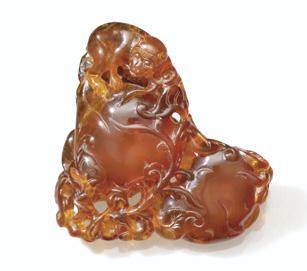
Expert remark: Compare the openwork details.
Estimate EUR 3,000
Starting price EUR 1,500
FINE MOTHER-OF-PEARL INLAID ‘QILIN’ SEAL CHEST AND STAND, GUANPIXIANG, QING
China, 18th-19th century. The rectangular hardwood chest with blind drawers on the front, fitted with brass mountings and inlaid with mother-of-pearl panels, each finely carved to depict flying cranes, blossoming lotus, and majestic phoenixes and dragons soaring among swirling clouds. The sides decorated with additional birds amid prunus blossoms. The reverse bears a large panel depicting a monkey suspended from branches, observing a pair of deer in a landscape. The top with a large mythical beast (qilin) amid fire scrolls and Buddhist emblems, framed by a key-fret border. The separately carved stand adorned with a pierced ‘ruyi’ apron and supported on cabriole legs.
Provenance: The Collection of Sam and Myrna Myers, Paris, France.
Acquired between circa 1965-2012.
Condition: Good condition with surface wear and inherent manufacturing irregularities. Distinct traces of usage. Age cracks and chips. Few minor losses to inlaid decoration, small replacements. The stand legs with evidence of reinforcement and repair. Scattered minor nicks and light surface scratches.
Weight: 1,736 g (total)
Dimensions: Height 23.1 cm (incl. stand), Length 25.4 cm, Width 18.9 cm
Estimate EUR 4,000
Starting price EUR 2,000
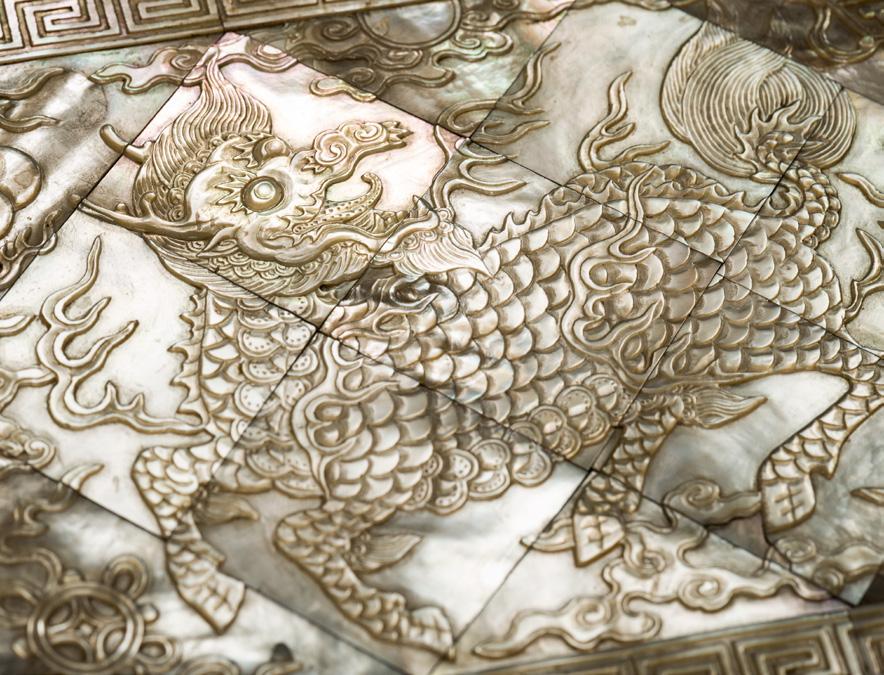
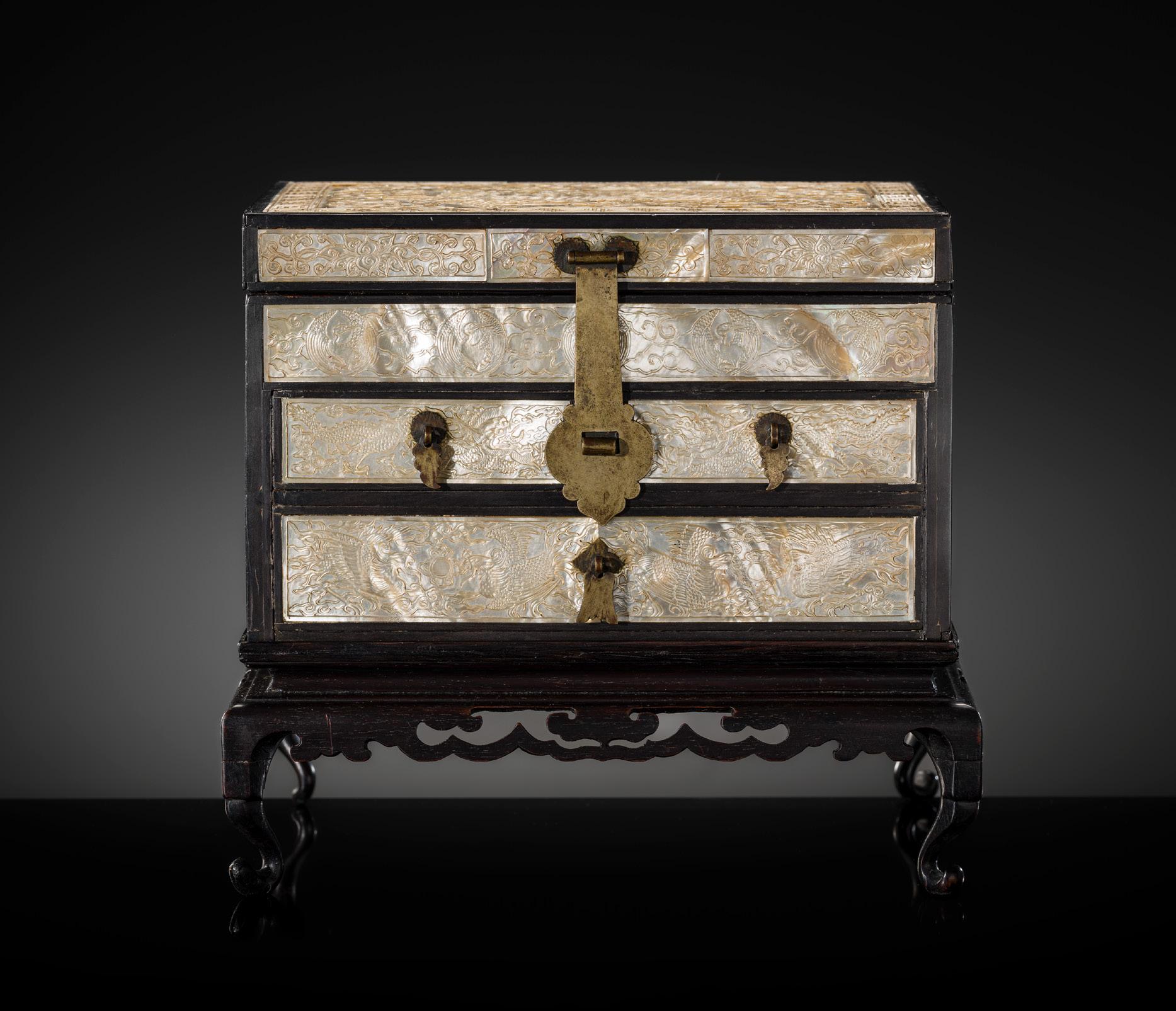
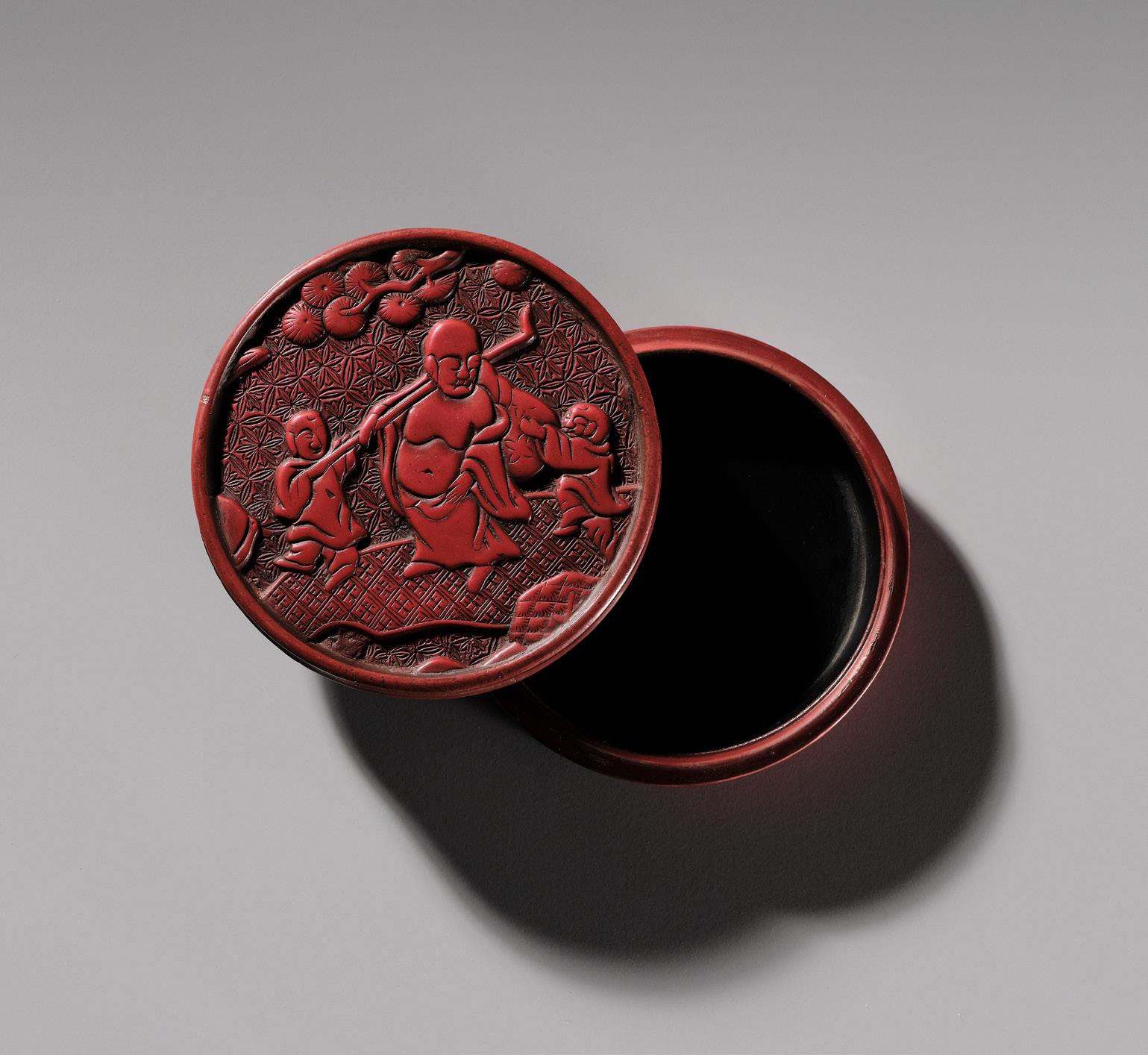
A CINNABAR-LACQUER ‘BUDAI AND BOYS’ BOX AND COVER, MING DYNASTY
China, 16th-17th century. Of circular form, finely carved in varying degrees of relief on the top to depict Budai, his torso bare and a draped cloth covering his lower body, carrying a long staff over his shoulder as he walks beneath the branches of a lush pine tree, accompanied by two boys who engage his attention, against a background of various geometrically patterned diapers. The sides and underside of the box left plain, the former lacquered in cinnabar, the latter in black, as is the interior.
Provenance: The Collection of Sam and Myrna Myers, Paris, France. Acquired between circa 1965-2012.
Condition: Very good condition with surface wear and inherent manufacturing irregularities. Minor traces of use. Occasional minute chips to lacquer with subtle associated touchups. Few small nicks and shallow surface scratches.
Weight: 62.3 g
Dimensions: Diameter 7.6 cm
Budai, the God of Happiness, also called 'the laughing Buddha', was popular in Chinese culture for his association with happiness, plenitude and wisdom of contentment. Based on the tenth-century Chinese monk, Qici, who was believed by his followers to be another buddha, was eventually worshiped as a deified figure in his own right. He is often depicted with a joyful expression and wide smile whilst wearing loosely fitted robes that reveal his large stomach.
AUCTION RESULT COMPARISON
Type: Related
Auction: Bonhams New York, 15 March 2021, lot 115
Price: USD 8,287 or approx. EUR 8,500 converted and adjusted for inflation at the time of writing
Description: A fine carved cinnabar lacquer circular box and flat cover, Ming dynasty, 16th century
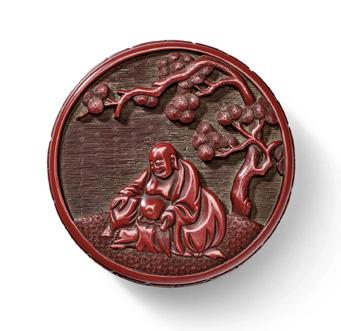
Expert remark: Compare the related form of the box, decorative subject, and manner of carving. Note the slightly smaller size (6.3 cm).
Estimate EUR 2,000
Starting price EUR 1,000
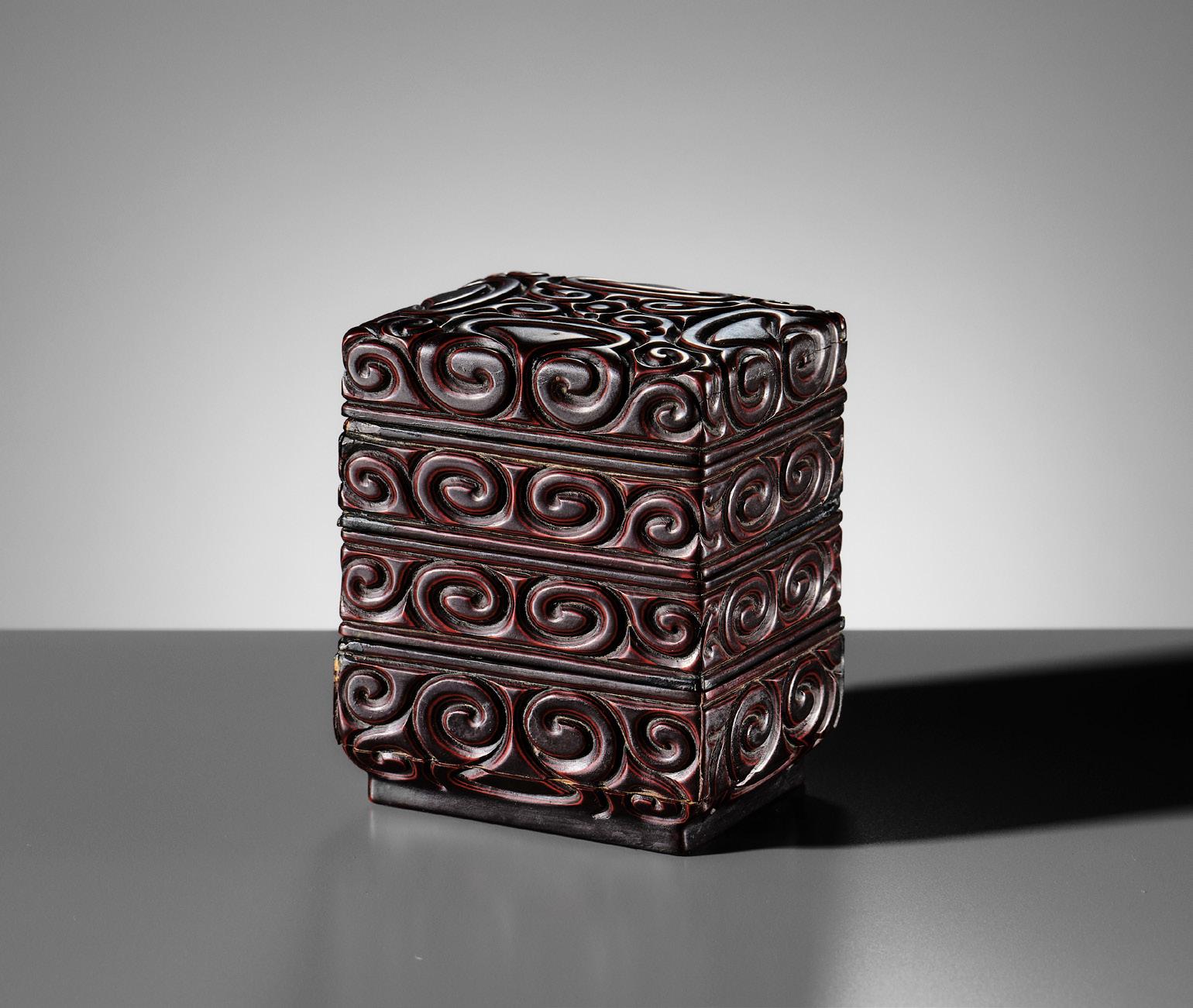
130
A RARE THREE-TIERED BLACK AND CINNABAR TIXI LACQUER BOX, MING
China, 16th-17th century. Of rectangular form, composed of three stackable sections, rising from a short straight foot with a recessed base and surmounted by a cover with gently rounded contours. The reddish-black lacquered exterior decorated with finely carved pommel scrolls arranged symmetrically on each side, each section framed above and below by a lipped rim. The underside and interior of the box left undecorated and lacquered black. (4)
Provenance: The Collection of Sam and Myrna Myers, Paris, France.
Acquired between circa 1965-2012.
Condition: Good condition with surface wear and manufacturing irregularities. Distinct traces of usage. Minute losses. Small fissures and age cracks with associated old repairs and some repainted areas. Occasional minor nicks and small chips here and there.
Weight: 69.9 g
Dimensions: Height 8.1 cm
Stacked lacquer boxes were employed in the storage and presentation of food and circulated within established systems of ritualized gift exchange. Upon receipt, the container itself was not retained but returned bearing a reciprocal offering. Objects of this type, particularly those composed of multiple tiers, would have been regarded as luxury commodities. The present stacked lacquer box is elaborately carved with a geometric arrangement of powerfully modeled pommel scrolls, their rounded profiles articulated by deeply recessed grooves in which the finely stratified layers of reddish-black lacquer are clearly visible. Rectangular vessels such as the present example are exceedingly rare in tixi (or guri) lacquer, although a limited number have been documented through archaeological excavations.
Although lacquer carved with pommel scroll decoration likely originated in the late Song dynasty, the style underwent a significant transformation during the Yuan period, probably in the early fourteenth century. This shift appears to reflect a broader contemporary preference for sculptural forms and high relief, as seen, for example, in Yuan dynasty porcelain decoration. Whereas earlier examples are characterized by sharply cut motifs with straight sides, boxes such as the present example display scrolls carved in high relief, polished to a rounded fullness and separated by deeply cut, narrow grooves. This method of carving creates the impression of tightly compressed, elastic forms and generates a sense of dynamic vitality characteristic of carved lacquer from this period. The sculptural force of the relief is so pronounced that it ultimately eclipses the functional identity of the object. The box assumes the visual presence of sculptural work rather than a utilitarian container.
AUCTION RESULT COMPARISON
Type: Related
Auction: Christie’s Hong Kong, 30 April 2001, lot 640
Price: HKD 199,750 or approx.
EUR 33,500 converted and adjusted for inflation at the time of writing
Description: An extremely rare carved tixi black lacquer seal box and cover, Yuan dynasty
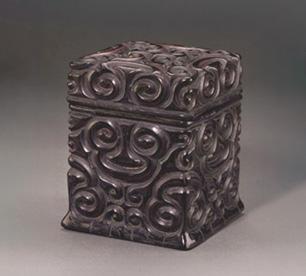
Expert remark: Compare the related form of the box, manner of carving, and decorative scrollwork. Note the slightly larger size (12.5 cm).
Estimate EUR 4,000
Starting price EUR 2,000
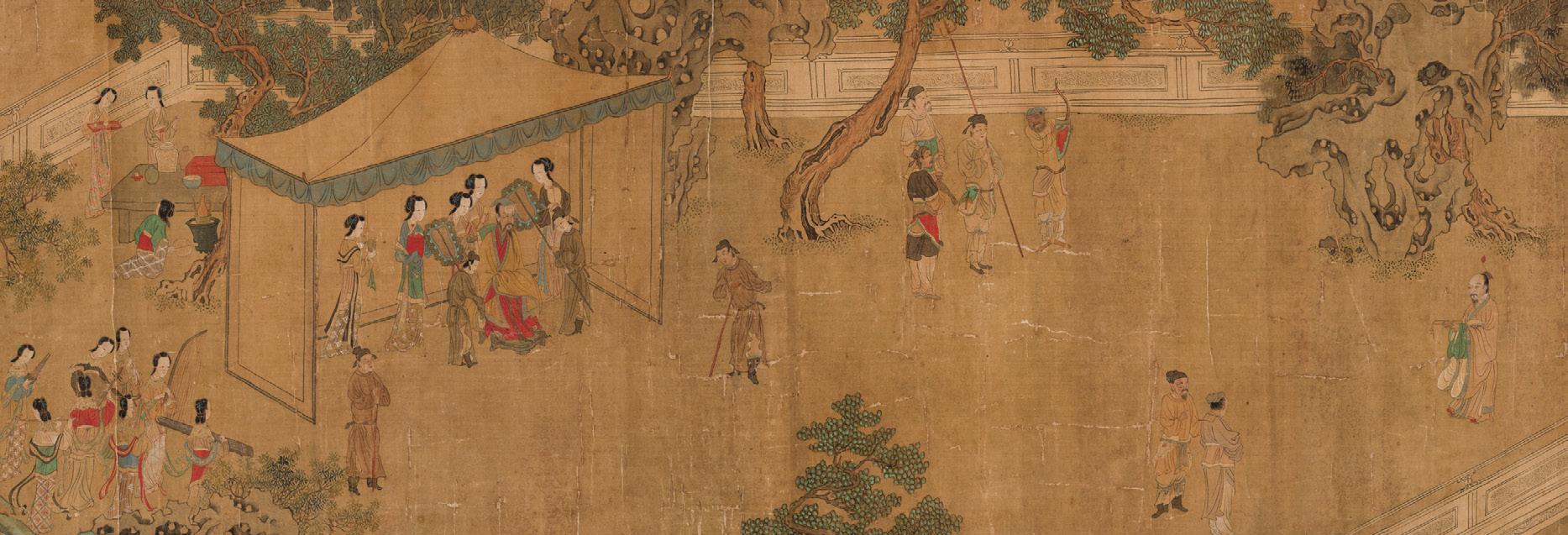
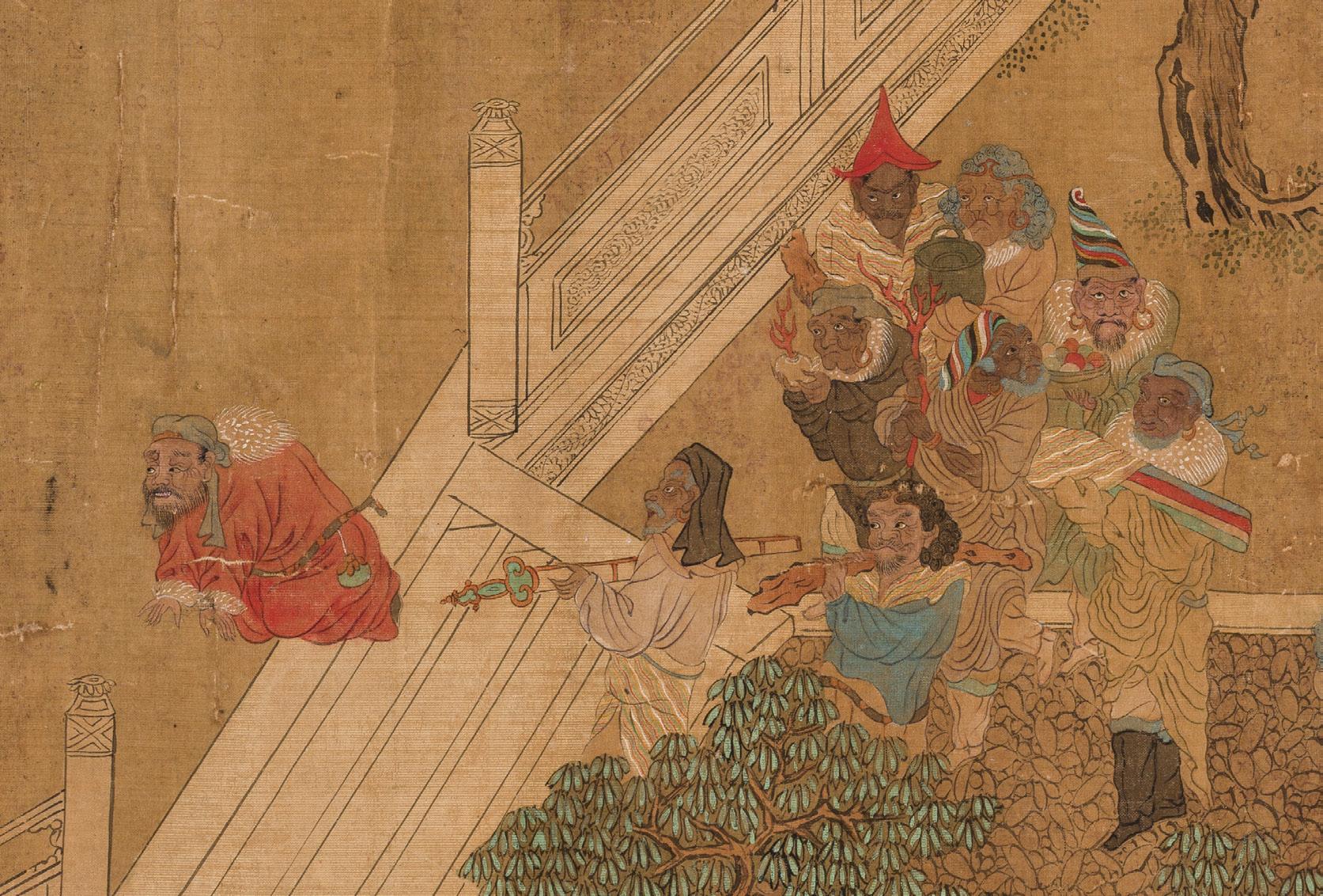
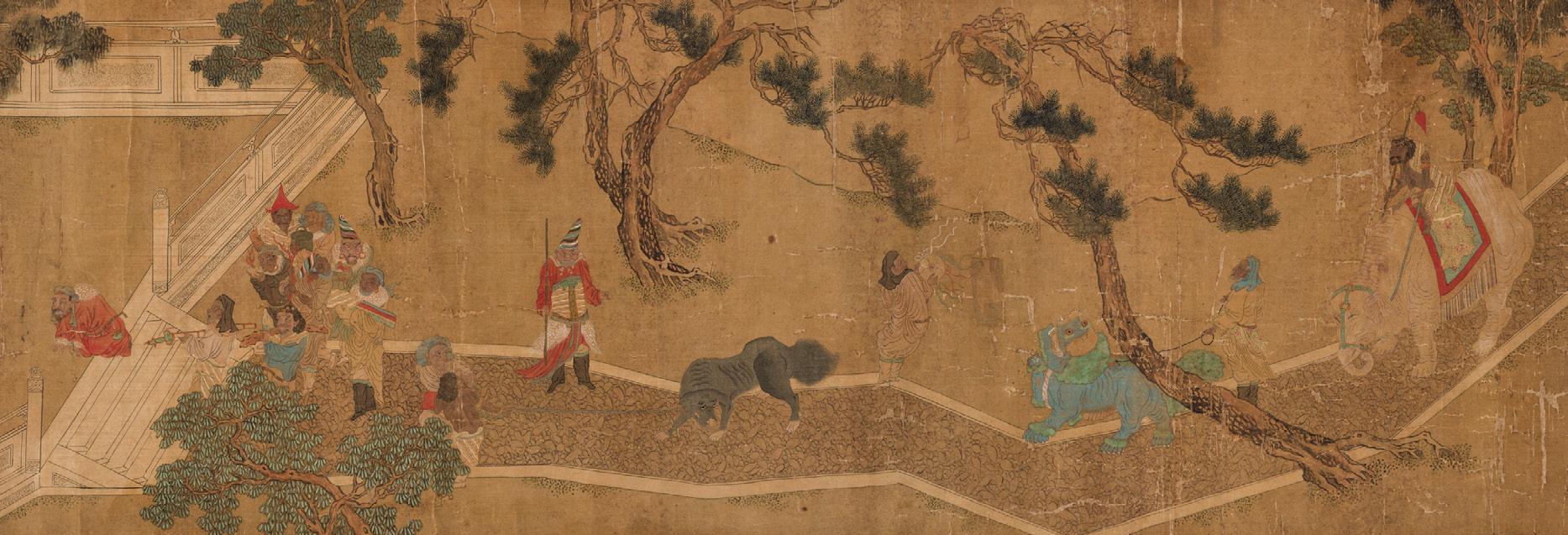
131 AFTER QIU YING (1494-1552): FOREIGN ENVOY WITH TRIBUTE BEARERS, MING DYNASTY
PUBLISHED
Jean-Paul Desroches (ed.) et al, Two Americans in Paris. A Quest for Asian Art, Paris, 2016, p. 212, no. 337. (Detail)
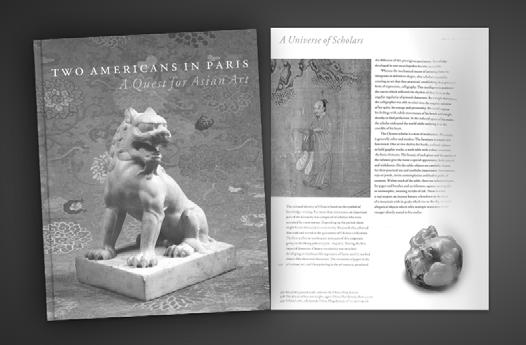
Exhibited:
1. Pointe-à-Callière Museum, From the Lands of Asia. The Sam and Myrna Myers Collection, Montréal, 17 November 2016-19 March 2017.
2. Kimbell Art Museum, From the Lands of Asia. The Sam and Myrna Myers Collection, Fort Worth, Texas, 4 March-19 August 2018.
China, early 17th century. Ink and colors on silk. Mounted as a hanging scroll on a silk brocade frame to the reverse with gold foil decorated paper to the sides and ivory handles. The scene depicts foreigners and beasts, including an elephant and lion, presenting tribute to a dignitary in a tent. Behind the tent, court women prepare tea and music, all set within a balustraded garden.
Provenance: The Collection of Sam and Myrna Myers, Paris, France. Acquired between circa 1965-2012.
Condition: Good condition with old wear. Light browning, foxing, rubbing to the pigments, some creasing, few stains and general soiling. Touchups possible.
Dimensions: Image size 30 x 173 cm, size incl. mounting 31.5 x 255.7 cm
Qiu Ying (c. 1494-1552), also known as Shifu, pseudonym Shizhou, was a famous professional painter based in Suzhou, known for his 'green and blue landscape' style. Although he was not of the scholar-gentry class, his talent allowed him to be invited by many important collectors to make copies and repairs. In this way, he had access to some of the great paintings of the time and learnt to mix the classical style of Song and Yuan painters. Eventually, by sheer talent, he was regarded as one of the Four Masters of the Wu School.
For a longer discussion about Qiu Ying and an example of his landscape style, see Z. Hongxing, Masterpieces of Chinese Painting 700-1900, London, 2013, pp. 260-261. He was highly regarded and popular within his own lifetime and his signature was used on many paintings sold by his studio. His daughter, Qiu Zhu, and son-in-law, You Qiu, followed him into a career in painting. Qiu Zhu's style is delicate and beautifully refined, while You Qiu also inherited his father-in-law's manner.
AUCTION RESULT COMPARISON
Type: Closely related
Auction: Bonhams London, 18 May 2023, lot 203
Mid-estimate: GBP 10,000 or approx. EUR 12,500 converted and adjusted for inflation at the time of writing
Description: After Qiu Ying, Foreigners Presenting Tribute, circa 18th century Expert remark: Compare the identical motif. Note the slightly larger size (194 cm).

Estimate EUR 6,000
Starting price EUR 3,000
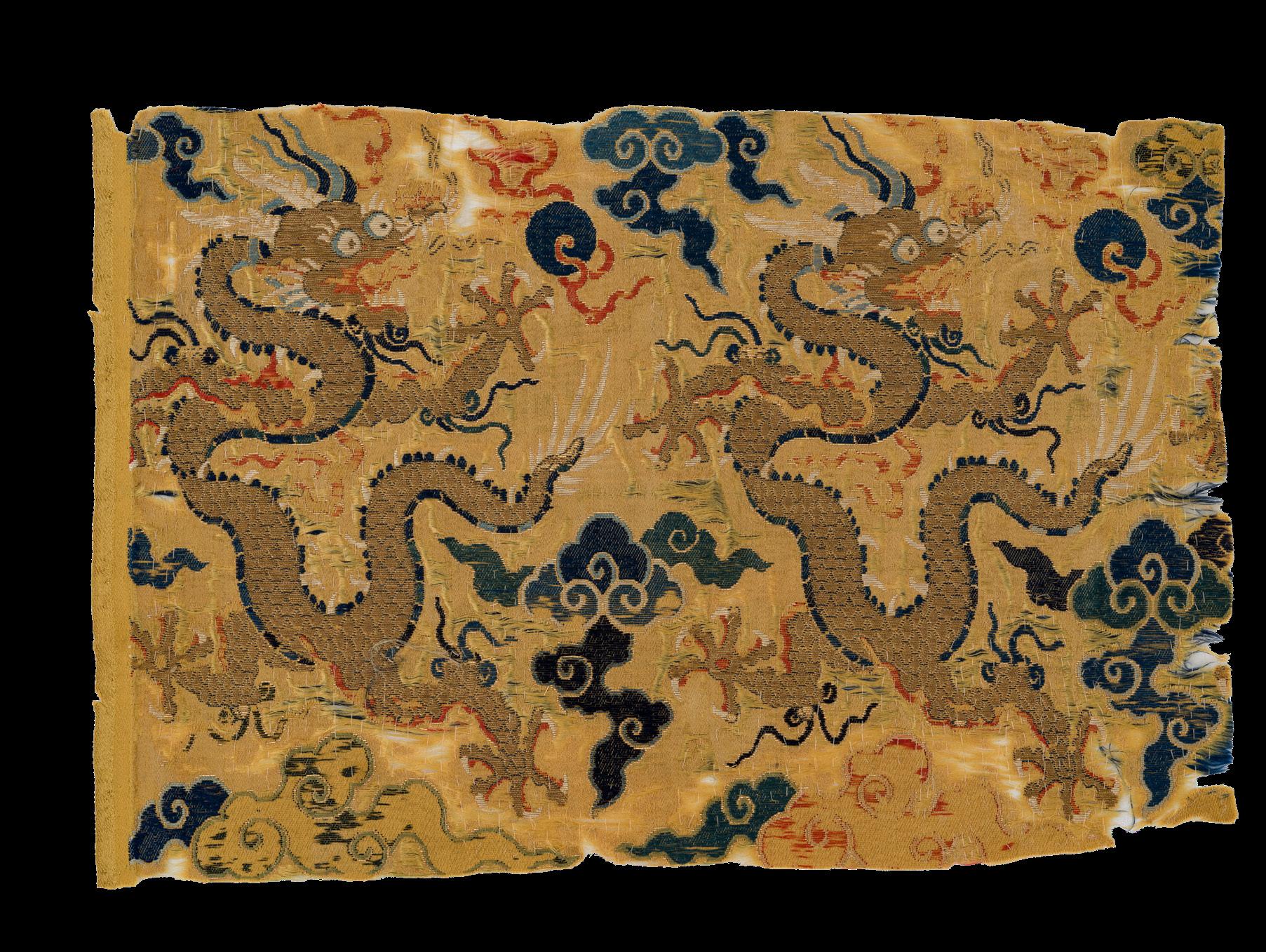
132
AN IMPERIAL ‘TWO DRAGONS’ SILK BROCADE FRAGMENT, MING DYNASTY
Expert’s note:
The present lot is likely a fragment from an imperial robe. Official records from the Ming period document that members of the imperial family commonly wore robes adorned with dragons, which were symbolic of imperial authority and power. The intricate design and vivid colors are indicative of late Ming court taste.
China, 1368-1644. Finely woven and embroidered with couched gold-thread and satin stitch in bright tones of red, blue, green, and yellow. Depicting two sinuous five-clawed dragons pursuing flaming pearls amid multicolored lingzhi-shaped clouds, all against a lustrous golden-yellow ground.
Provenance: The Collection of Sam and Myrna Myers, Paris, France.
Acquired between circa 1965-2012.
Condition: Very good condition with old wear. Small tears, particularly around the edges, losses, minimal tears and splits possible, and few loose threads. The colors rather well-preserved. Obvious condition issues to the frame.
Dimensions: Image size 24.4 x 35.1 cm, size incl. frame 31.5 x 41.5 cm
Set in a wooden frame and passepartout behind glass. (2)
Literature comparison:
Compare a related fragment and a medallion depicting a dragon and tama, dated to 16th and 17th century, in the Metropolitan Museum of Art, object numbers 1972.36 and 36.65.33.
AUCTION RESULT COMPARISON
Type: Closely related
Auction: Christie’s Paris, 23 June 2020, lot 70
Price: EUR 5,000 or approx. EUR 5,800 adjusted for inflation at the time of writing
Description: A yellow-ground silk lampas ‘dragon’ fragment, Ming dynasty
Expert remark: Compare the closely related subject and style, albeit lacking the gold-thread and embroidery of the present lot. Note the size (19 x 66 cm).
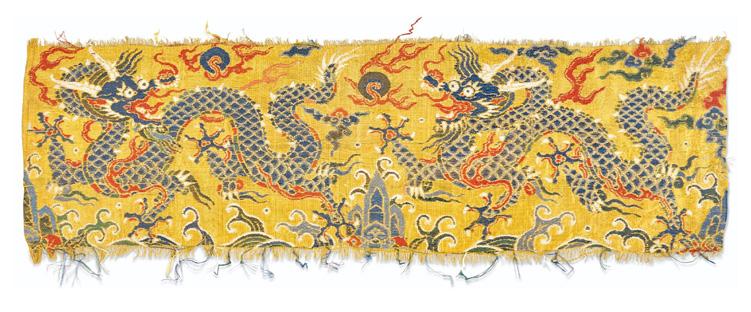
Estimate EUR 2,000
Starting price EUR 1,000
China, 1662-1722. The silk brocade is finely woven and embroidered in bright tones of gold, blue, beige, and brown. It depicts a qilin walking through a rocky landscape, with the composition framed by a band of key-fret motifs interspersed with the xi (double happiness) character.
Provenance: The Collection of Sam and Myrna Myers, Paris, France. Acquired between circa 1965-2012.
Condition: Good condition. Few loose threads, wear, minor tears possible. The colors well-preserved. Obvious condition issues to the frame.
Dimensions: Image size 31 x 24.3 cm, size incl. frame 41.7 x 31.4 cm
Set in a wooden frame and passepartout behind glass. (2)
AUCTION RESULT COMPARISON
Type: Related Auction: Christie’s New York, 19 September 2025, lot 844
Price: USD 8,890 or approx. EUR 7,500 converted and adjusted for inflation at the time of writing
Description: A rare embroidered goldground rank badge of a Qilin for a firstrank military official, Buzi, Kangxi period (1662-1722)
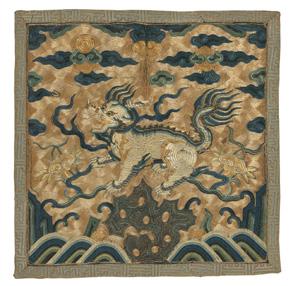
Expert remark: Compare the closely related subject, gold-ground, style. Note the size (34.3 cm).
Estimate EUR 2,000
Starting price EUR 1,000
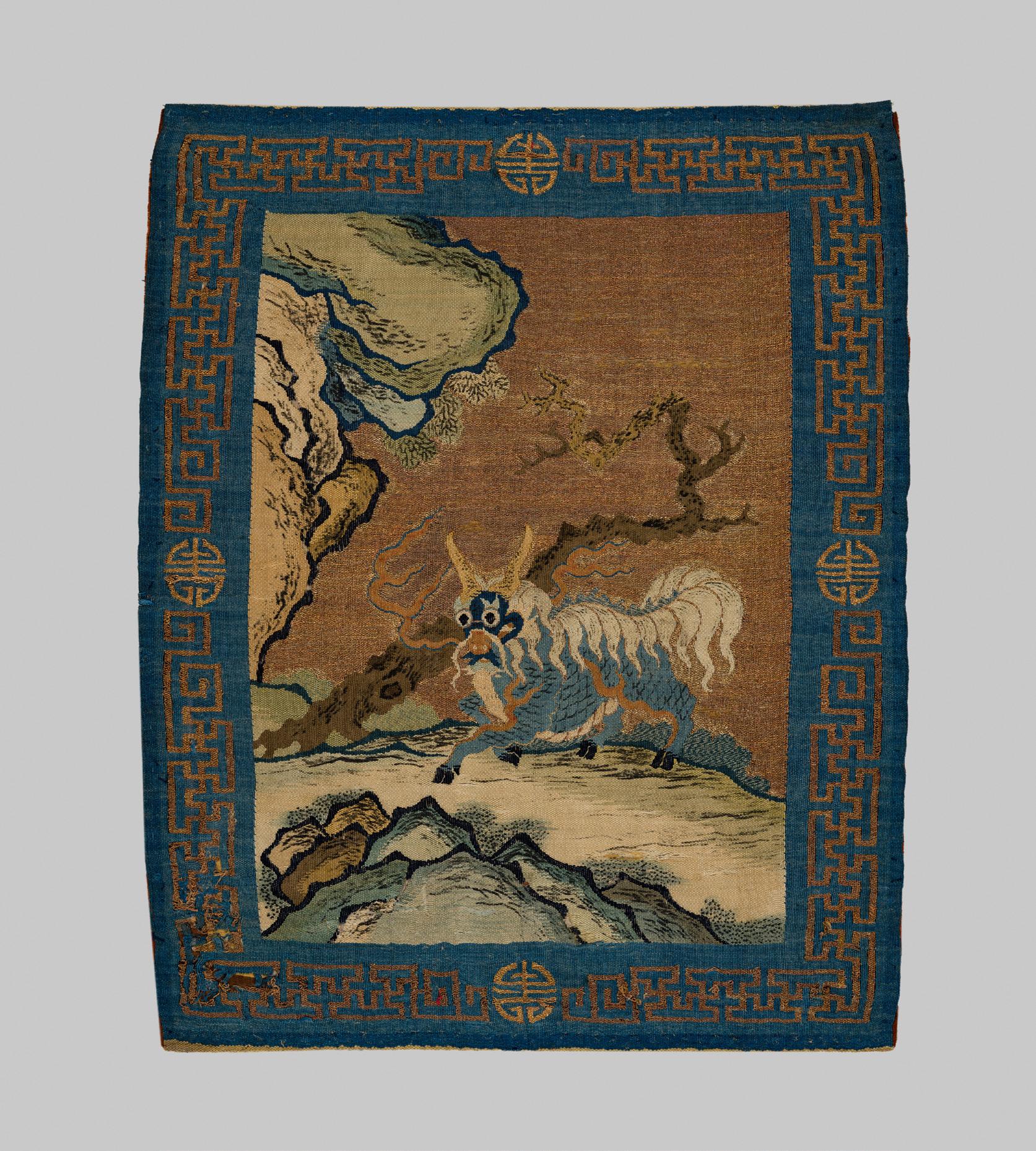
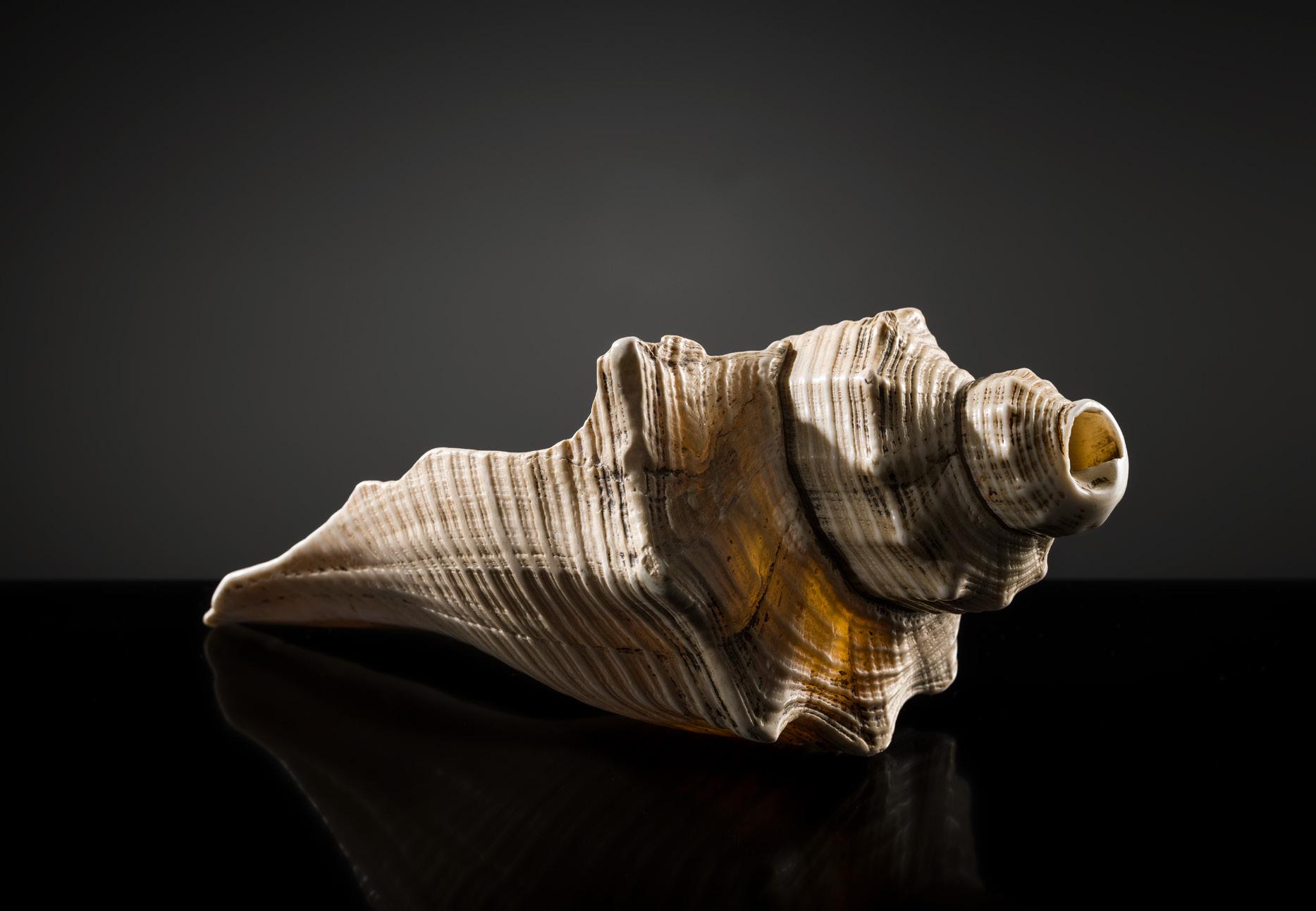
134
A LARGE RITUAL CONCH SHELL TRUMPET, TIBET, 18TH-19TH CENTURY OR EARLIER
PUBLISHED
Jean-Paul Desroches (ed.) et al, Two Americans in Paris: A Quest for Asian Art, Paris, 2016, p. 226, no. 361.
Exhibited:
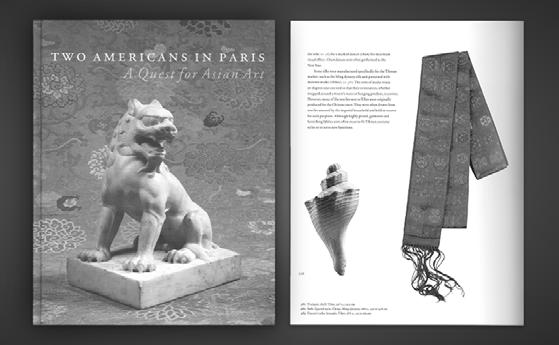
1. Pointe-à-Callière Museum, From the Lands of Asia. The Sam and Myrna Myers Collection, Montréal, 17 November 2016-19 March 2017.
2. Kimbell Art Museum, From the Lands of Asia. The Sam and Myrna Myers Collection, Fort Worth, Texas, 4 March-19 August 2018.
The naturally formed, creamy-white seashell accented with small brown and russet patches, the exterior encircled by numerous finely ridged striations, while the interior exhibits a uniformly smooth texture.
Provenance: The Collection of Sam and Myrna Myers, Paris, France. According to the Myers ledger acquired in London on 20 December 1975, and in the collection for over 50 years.
Condition: Very good condition with surface wear and natural agerelated imperfections, including small fissures. Distinct traces of usage. Occasional minor nicks, shallow surface scratches, and few minuscule chips and losses along the edges. The conch shell with a lustrous, naturally grown patina, as a result of extensive ritual handling and worship.
Weight: 806 g
Dimensions: Length 28.7 cm
The conch shell was considered a rare treasure in ancient times, with a long history of use in religious ceremonies. It was a common instrument in various ancient Indian religions and, most notably, in Buddhism. Legend has it that when the Buddha Shakyamuni first turned the Wheel of Law in the Deer Park, Sakra (the ruler of Heaven) offered him a right-turning white conch as reward. Since then, the conch has been widely used in the transmission of Buddhism as a symbol of auspiciousness and perfection. Images of conch shells can often be seen in Buddhist temples, on Dharma seats, and in the hands of Buddhas and Bodhisattvas, particularly in Tibetan Buddhism.
AUCTION RESULT
COMPARISON
Type: Closely related
Auction: Sotheby’s Hong Kong, 29 October 2024, lot 1511
Price: HKD 504,000 or approx. EUR 55,500 converted and adjusted for inflation at the time of writing
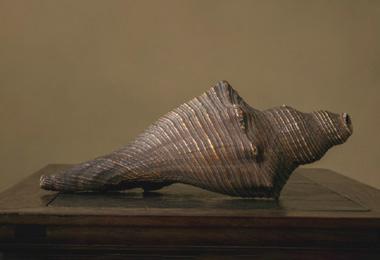
Description: An inscribed, large, ritual conch trumpet, signed Wu Kuan, Ming dynasty, Chengua period, dated 1478
Expert remark: Compare the related form and ritual use. Note the slightly larger size (32.5 cm).
Estimate EUR 3,000
Starting price EUR 1,500
Japan. Superbly cast of chevron-shaped form with scalloped borders flaring out at the bottom corners, neatly decorated on both sides with phoenixes and a central lotus blossom, all within a stippled border. At the top are two loops to allow suspension with a cord.
Provenance: The Collection of Sam and Myrna Myers, Paris, France. Acquired between circa 1965-2012.
Condition: Very good condition with minor wear, casting irregularities, tiny nicks and small dents. A fine, naturally grown, dark patina.
Weight: 1,790 g
Dimensions: Height 17 cm, Length 27 cm
The kei gong is a ritual instrument used in Buddhist practice, struck to signal transitions and punctuate chants and ceremonies. Gongs of this type remain in regular use in Buddhist temples today. The kei originated in ancient China as a musical instrument made of stone with resonant acoustic properties, carved in asymmetrical chevron shapes and suspended in graded sets to produce a full musical scale. How these early stone instruments became incorporated into Buddhist ritual remains uncertain. In Japanese Buddhism, however, kei gongs are typically cast in metal rather than stone and take on a perfectly symmetrical chevron form.
LITERATURE COMPARISON
Compare a closely related bronze ritual gong (kei) with similar decoration, dated to the 17th century, 23.2 cm (long), in the Cornell University, object number 2013.035.004 (fig. 1). Compare two related but earlier ritual gongs (kei), dated to the 12th and 12-14th century, in the Tokyo National Museum and Seattle Art Museum, collection reference number E-19890 and 72.2 (fig. 2).
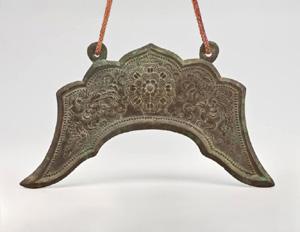
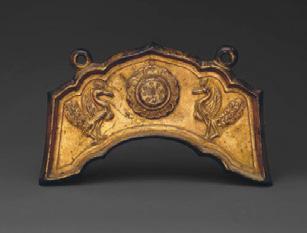
Estimate EUR 1,500
Starting price EUR 700
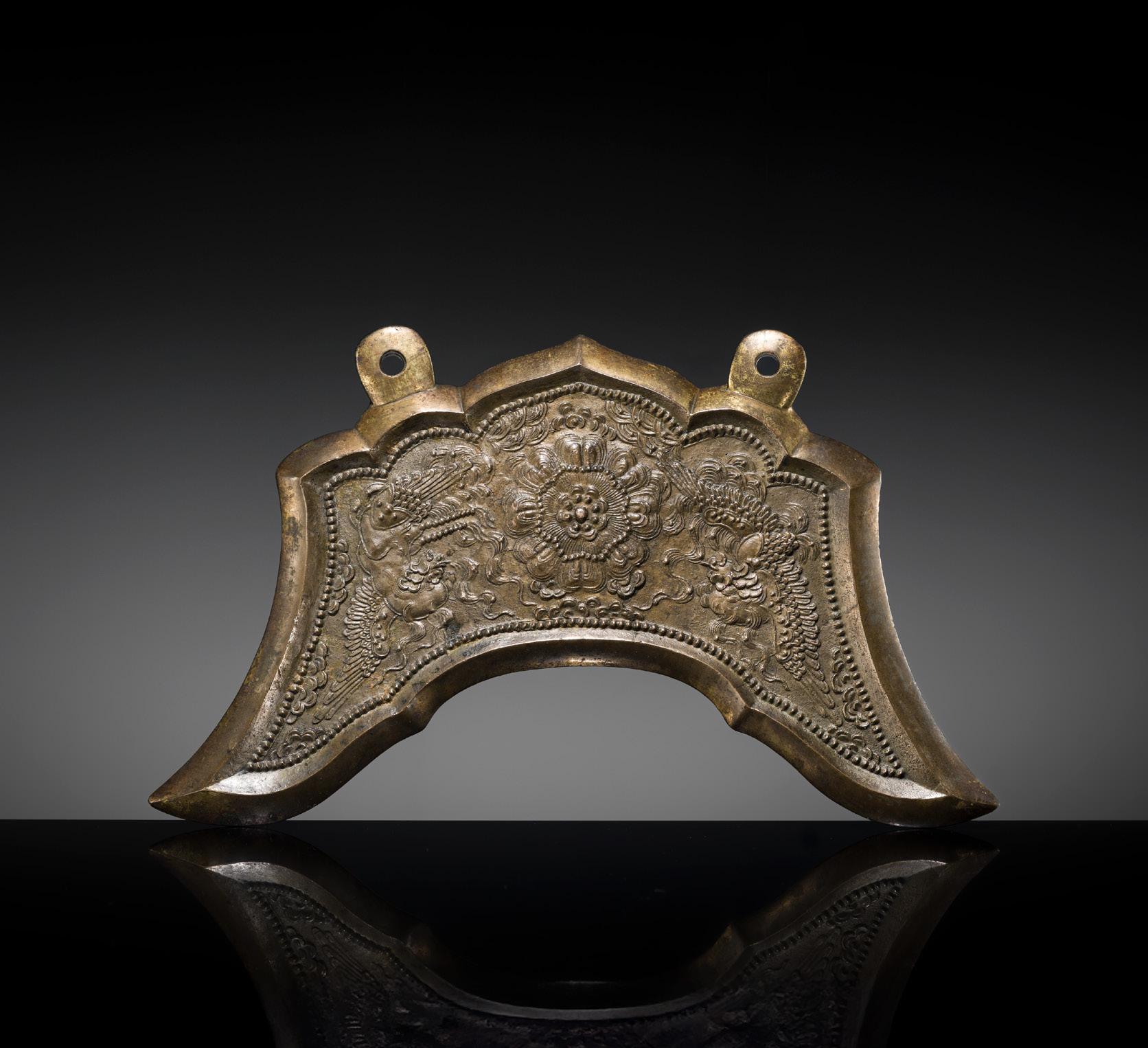
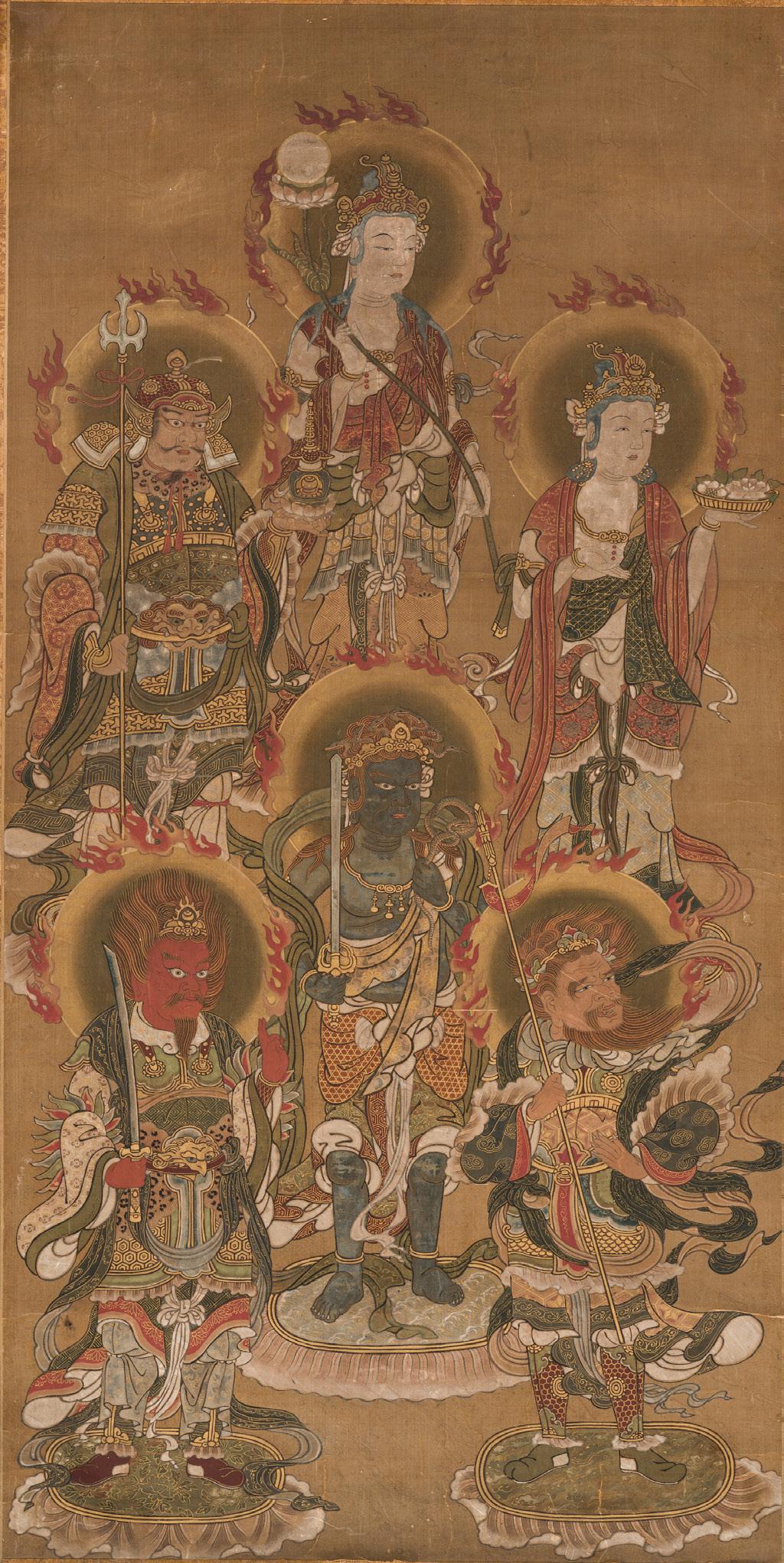
136
A BUDDHIST HANGING SCROLL PAINTING DEPICTING SIX DEITIES FROM THE JUNITEN PANTHEON, MUROMACHI PERIOD
Japan, 16th century. Ink, watercolors, and gold on silk, backed with paper. Finely painted with six deities from the Juniten (Twelve Deva Kings) pantheon. At the upper center is Gatten, the Moon Deity, identifiable by the staff topped with a full moon. At the upper left stands Bishamonten, guardian of the north, clad in armor and holding a pagoda, while Jiten, the Earth Deity, appears at the upper right holding a bowl filled with flowers. The central figure is Suiten, the Water Deity, distinguished by the presence of a snake. At the lower left is Rasetsuten, rendered with red skin and grasping a sword, completing the group at the lower right is Futen, the Wind Deity in dynamic motion.
Provenance: The Collection of Sam and Myrna Myers, Paris, France. Acquired between circa 1965-2012.
Condition: Very good condition with minor wear. Rubbing to the pigments, creasing, and folds.
Dimensions: Image size 81 x 40.6 cm, size incl. mounting 90.5 x 43 cm
LITERATURE COMPARISON
Compare a related depiction of the twelve deva kings and Buddha, dated to the 16th century, see the Minneapolis Institute of Art, accession number 2015.79.9 (fig. 1).
Compare five related hanging scrolls with the deities Rasetsuten, Futen, Bishamonten, Jiten and Gatten, dating to the 14th-15th century, in the Minneapolis Museum of Art, accession numbers 79.2.10, 79.2.4, 79.2.9, 79.2.1 and 79.2.12.
fig. 1
Estimate EUR 4,000
Starting price EUR 2,000
A BUDDHIST HANGING SCROLL PAINTING DEPICTING SIX DEITIES FROM THE JUNITEN PANTHEON, MUROMACHI PERIOD
Japan, 16th century. Ink, watercolors, and gold on silk, backed with paper. Finely painted with six deities from the Juniten (Twelve Deva Kings) pantheon. Nitten, the Sun Deity, is depicted at the upper center, identifiable by the staff topped with a solar disc. Bonten (Brahma), the creator deity and guardian of the zenith, appears at the upper left and is recognizable by his multiple heads, while Izanaten is shown at the upper right with green skin and a vessel. The central figure is Katen, the Fire Deity, marked by surrounding flames and four arms holding a vessel. Taishakuten is depicted at the lower left holding a vajra, and Enmaten appears at the lower right with his staff topped with a head.
Provenance: The Collection of Sam and Myrna Myers, Paris, France. Acquired between circa 1965-2012.
Condition: Good condition with old wear. Rubbing to the pigments, creasing, and folds. Obvious losses and tiny tears to the mounting. Small touchups possible.
Dimensions: Image size 81 x 40.5 cm, size incl. mounting 94 x 43 cm
LITERATURE COMPARISON
Compare four related hanging scrolls with the deities Katen, Nitten, Bonten and Izanaten, dating to the 14th-15th century, in the Minneapolis Museum of Art, accession numbers 79.2.3, 79.2.5, 79.2.11 and 79.2.8.
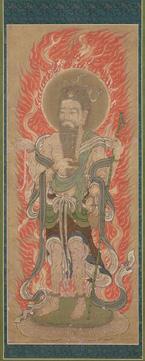
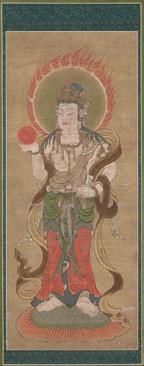
Estimate EUR 3,000
Starting price EUR 1,500
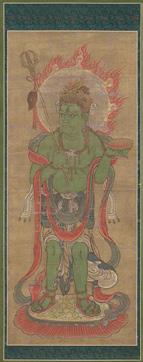
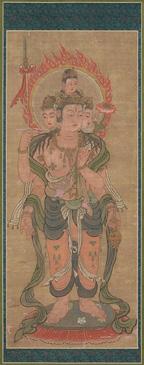
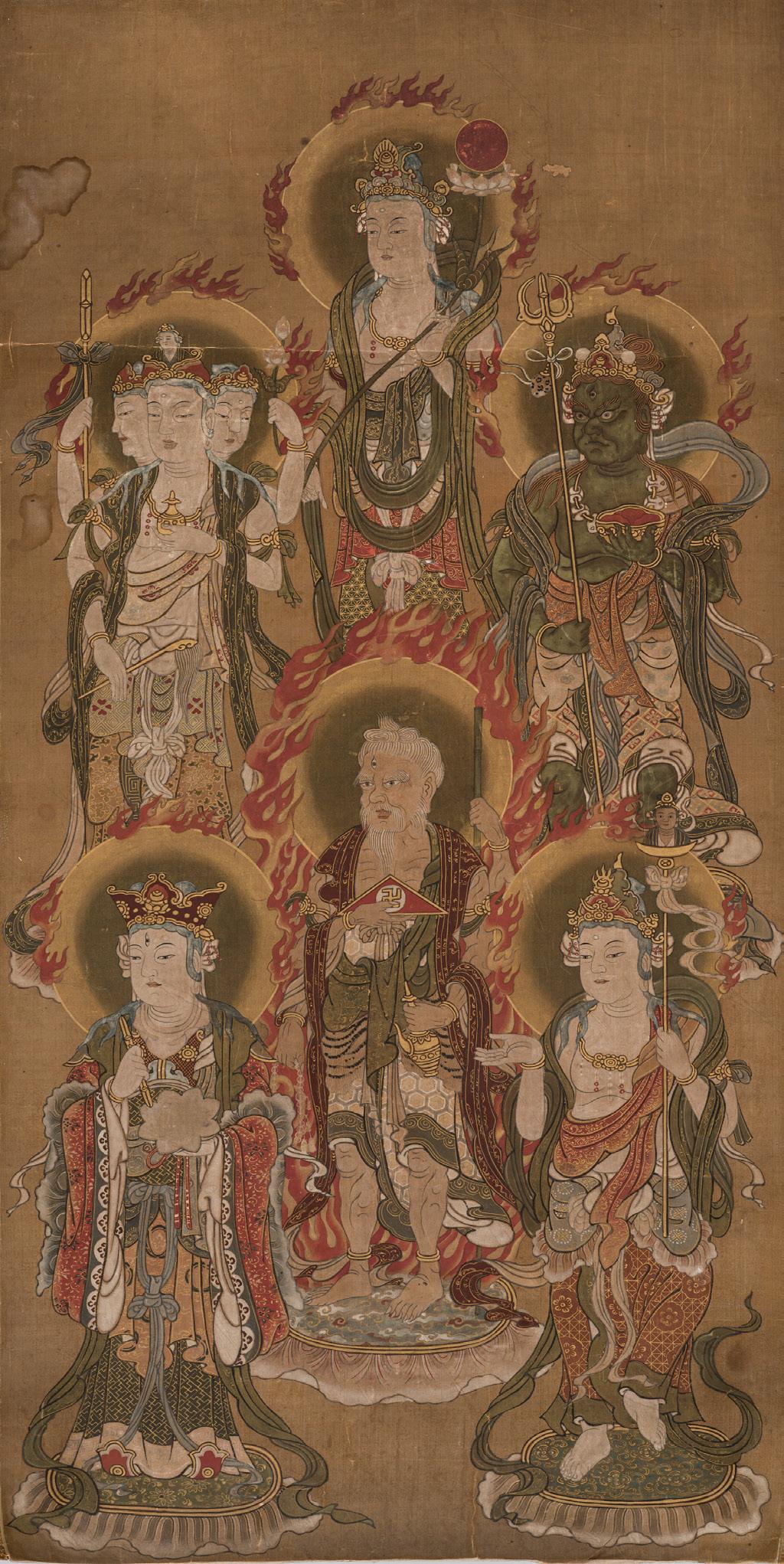
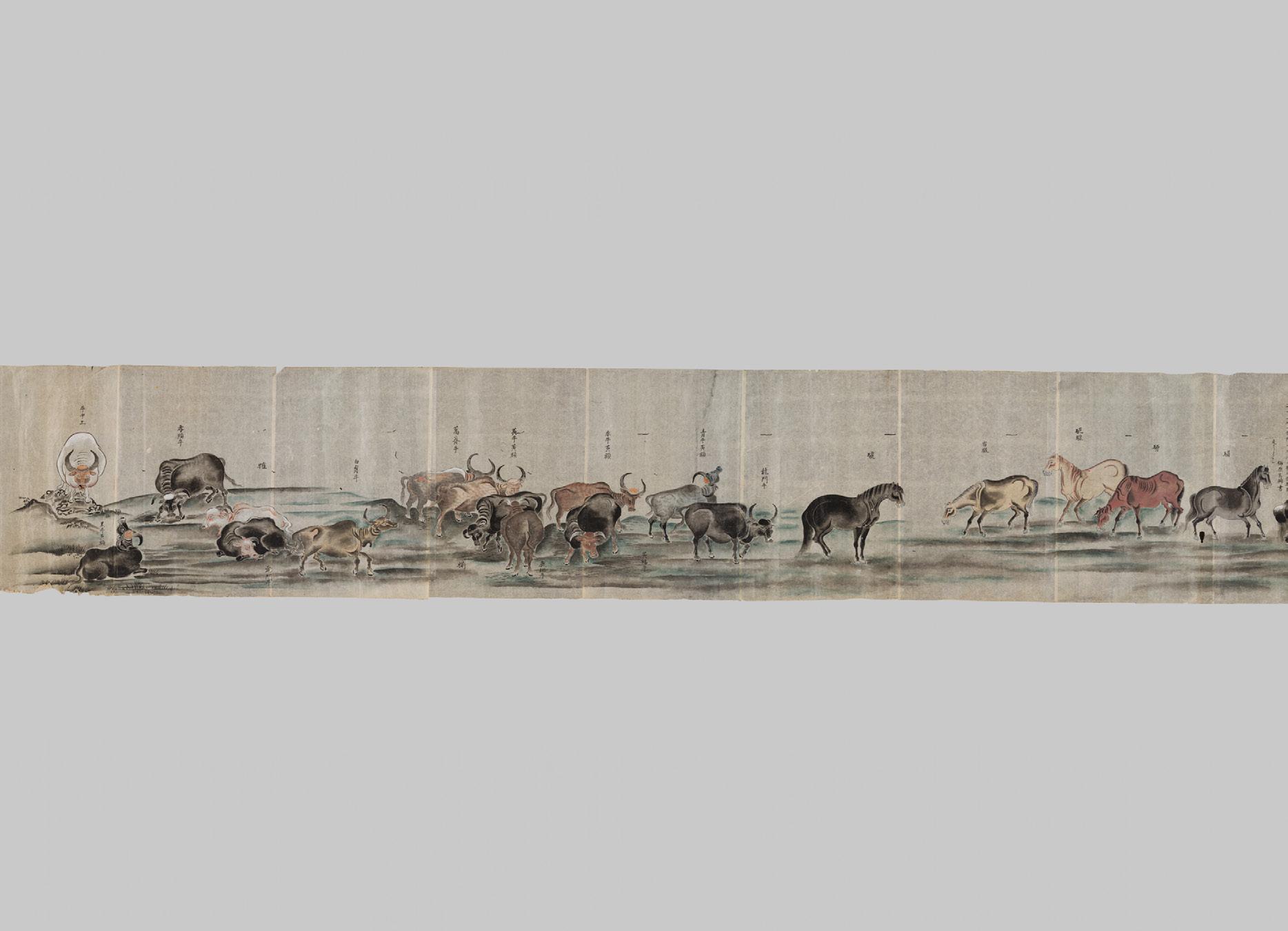
138
A VERY LARGE KANO SCHOOL DRAWING (FUNPON) OF ‘RIO BUSSHOKU ZU’, EDO PERIOD
Japan, 18th-19th century. Well painted in ink and colors on thin sheets of paper assembled into a horizontal scroll. Depicting fortyfour animals, including fourteen oxen on the left side standing on a rocky meadow, and thirty horses on the right side, symbolizing the motif of a hundred horses.
Inscription: The animals are inscribed with unique kanji characters written in Japanese old-kana system related to horses and cattle based on the 'Rio busshoku zu', such as uma, 宇麻 , [horse], shiro, 之 呂, [white], kuro tatekami no, 久呂多天加美能 , [black mane of a horse], kashira, 加之良, [head], ashi, 阿之, [legs], and kabuto, 加布登, [head].
Provenance: The Collection of Sam and Myrna Myers, Paris, France. Acquired between circa 1965-2012.
Condition: Good condition with old wear. Obvious tears, creasing and small losses to the edges. Presenting very well.
Dimensions: Image size 40 x 440 cm
Kano Naonobu (1607-1650) was a prominent Japanese painter of the Kano school during the early Edo period. He was the younger brother of the celebrated painter Kano Tan’yu and worked on numerous important commissions for the Tokugawa shogunate. Naonobu’s style is distinguished by his bold use of negative space and mastery of ink wash painting, drawing on suiboku-ga traditions while exhibiting a uniquely Japanese sensibility. He established the Kobikicho branch of the Kano school in Edo and produced works that balanced refinement with expressive brushwork. Naonobu continues to be recognized for his lyrical approach and contributions to 17th-century Japanese painting.
The present lot served as a preparatory drawing (funpon) by a Kano School painter. For finished paintings of horses by Kano Hironobu himself, see Christie’s, Japanese & Korean Art, New York, 11 September 2012, lot 3.
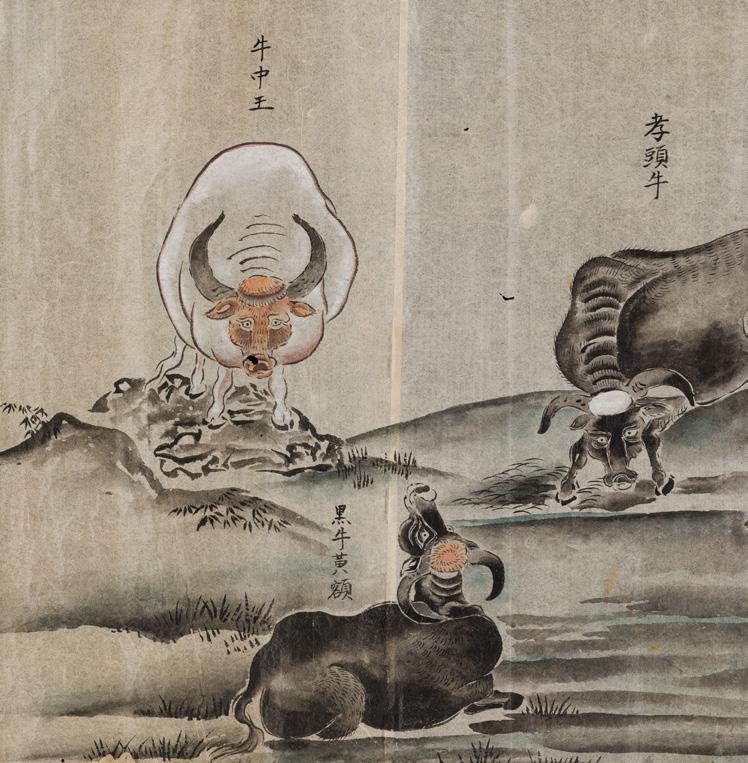
Rio busshoku (sometimes pronounced Riko busshoku) is based on a Chinese idiom (li huang wu se), derived from the story of the legendary ancient horse expert Jiufang Gao. The phrase means to focus on a horse’s, or more broadly a thing’s, essential qualities, such as spirit and talent, rather than superficial traits like color or gender. It emphasizes the importance of discerning true nature and intrinsic value over outward appearance and is often used in the context of talent selection to identify individuals of inner virtue and ability.
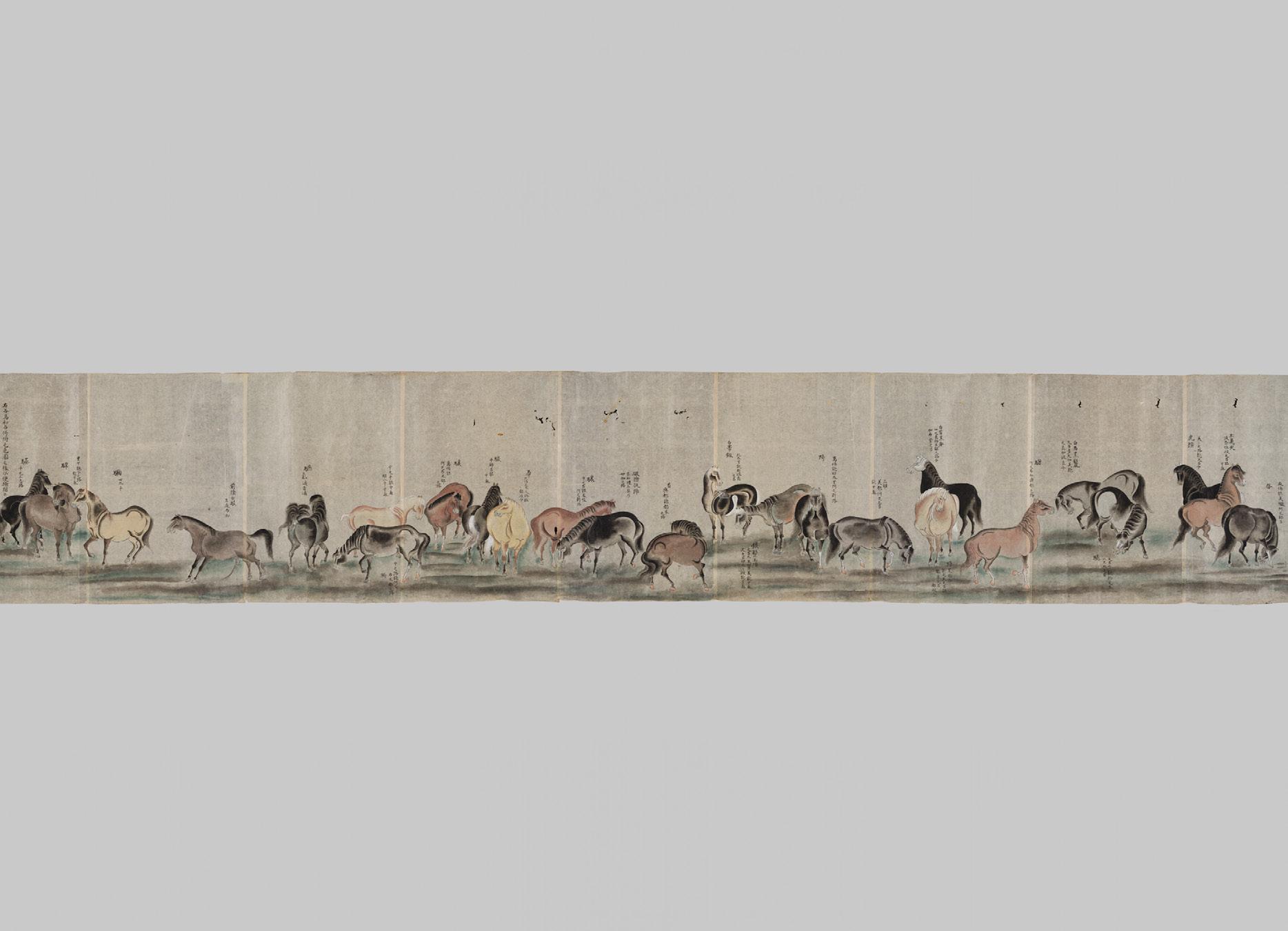
This theme was translated into painting by Kano School artists of the early Edo period, encouraged by the Tokugawa shogunate. One notable example is a scroll painting by Kano Naonobu (1607–1650), official artist to the Tokugawa shogun, titled The Fine Horses and Cattle: Rio busshoku zu, produced in Edo in Shoho 4 (1647). Although the whereabouts of the original are unknown, many copies survive. The painting records 112 horses and cattle from the shogunate stables, documenting their Japanese and Chinese classification names, physical attributes, and associated auspicious or inauspicious meanings. The title Rio busshoku zu was written by Hayashi Razan (1583–1657), while the illustrations were painted by Kano Naonobu.
Numerous copies are known, including Kano Tsunenobu’s transcription Bashi Kokan (Tokyo University of the Arts) and Sekine Untei’s Hyakuba oyobi Gyumomono Bente-zu maki (Tachibana Family Archives), among others. The scroll from the Kano Kokichi (1865–1942) collection discussed here is a copy painted by Miura Yoshinobu (active 1810–1840), dated 1817 (Bunka 14), based on an original by Kano Naonobu, with the original colophon written by Kurosawa Sadayuki in 1647.
LITERATURE COMPARISON
Compare a closely related drawing, dated to the early 19th century, 407.7 cm (long), in the Metropolitan Museum of Art, object number 07.246.25. Compare the Rio busshoku painting, after the official court artist Kano Naonobu, by Miura Yoshinobu, dated to 1817, in the Tohoku University Digital Archives, inventory number 05-000973.
Estimate EUR 3,000
Starting price EUR 1,500
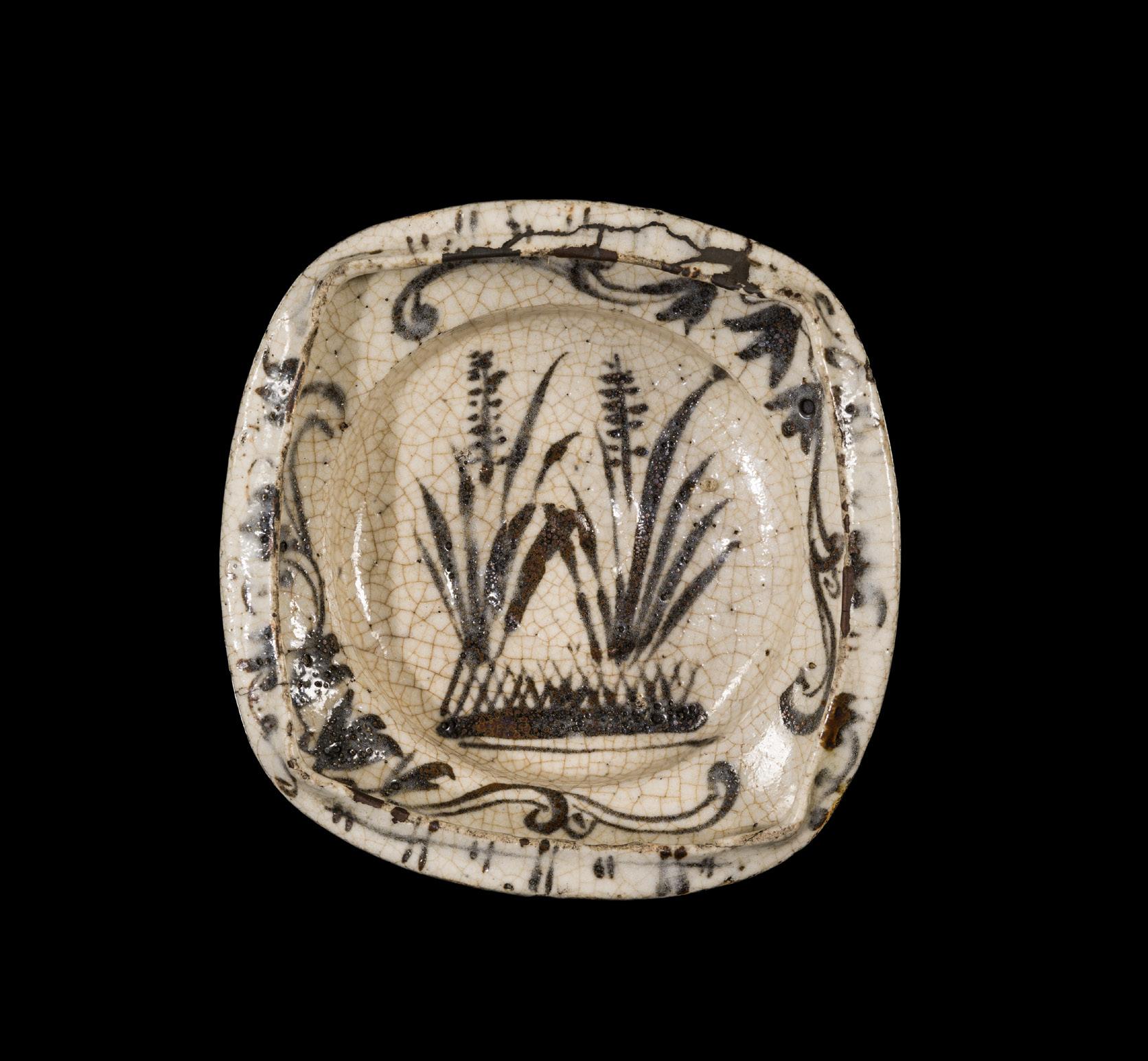
139
A MINO WARE SHINO GLAZED MUKOZUKE, LATE 16TH–EARLY 17TH CENTURY
Japan. The circular body raised on three looped feet, rising to an incurved, squared rim, covered overall in a thick creamy white glaze suffused with crackles, and painted in iron brown with reeds to the well, enclosed by bands of scrolling tendrils.
Provenance: The Collection of Sam and Myrna Myers, Paris, France. Acquired between circa 1965-2012. The base with two red lacquered inventory numbers ‘32’ and ‘827.88’, and two labels with collection numbers '26’ and ‘24’, and a label inscribed ‘Morse [X]’.
Condition: Good condition with minor wear, some repairs with old fills to the upper rim, firing irregularities including dark spots, warping, intentional glaze crazing, and spur marks to the base.
Weight: 431 g
Dimensions: Length 17.7 cm
The design was applied to the unfired white clay body using a pigment made from iron and manganese, which turned a deep brown after firing. The vessel was then covered with a thick, glossy feldspathic glaze and fired in a single-chamber kiln. Three small looped feet were added to the base, and the spur marks visible on the underside suggest the bowl was lifted to prevent the feet from sticking to another vessel or to the kiln furniture.
Grasses and landscape motifs are characteristic of painted Shino ware, often thought to have a distinctly Japanese aesthetic. However, recent
scholarship indicates that Mino potters may have been influenced by popular imported Chinese blue and white porcelain designs.
Literature comparison:
Compare a related Shino style mino ware dish with reeds, dated late 16th–early 17th century, 24.8 cm in diameter, in the Metropolitan Museum of Art, object number 1975.268.433. Compare a related Shino style mino ware bowl with heron in reeds, dated late 16th century, 16.5 cm in diameter, in the Metropolitan Museum of Art, object number 2002.447.23.
AUCTION RESULT COMPARISON
Type: Related
Auction: Christie’s New York, 19 March 2019, lot 304
Price: USD 13,750 or approx. EUR 15,000 converted and adjusted for inflation at the time of writing
Description: A stoneware footed bowl, mino ware, shino type, Momoyama-Edo period (early 17th century)
Expert remark: Compare the similar form, the color of the glaze, and brushwork. Note the size (26.4 cm).
Estimate EUR 2,000
Starting price EUR 1,000
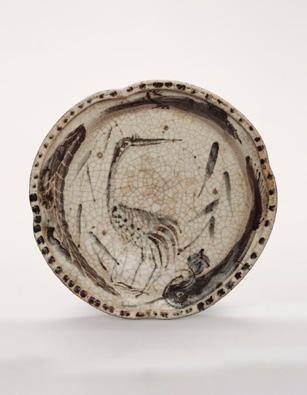
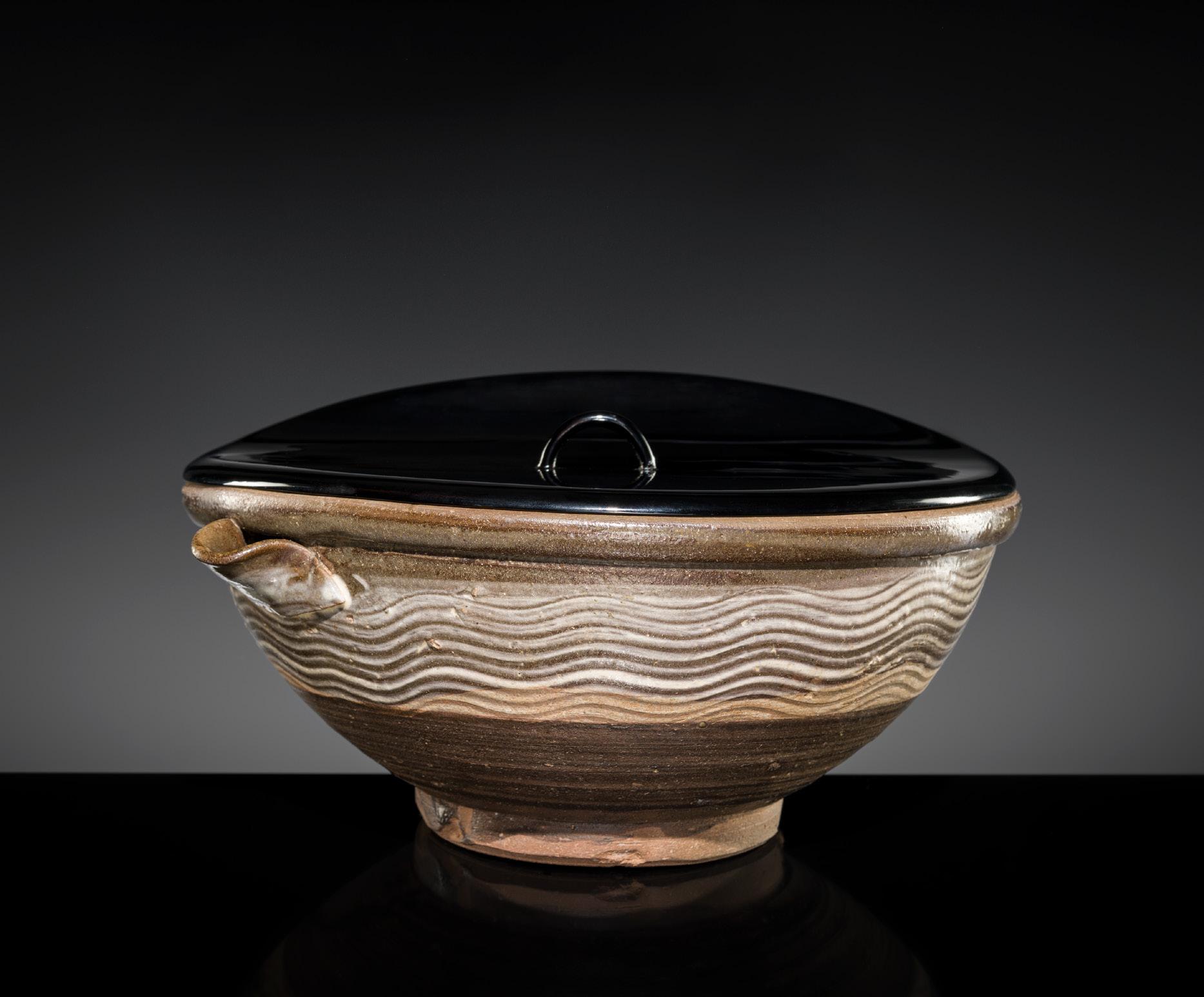
A TAKEO KARATSU WARE BOWL WITH BLACK LACQUERED COVER, EDO PERIOD
Japan, 16th-18th century. The deep bowl set with a short spout to one side, rising from a circular foot to a lipped rim, and the exterior walls painted with a combed, wavey pattern above the brown lower section, the foot unglazed revealing the brick-red ware. The cover possibly of a later date.
Provenance: Joseph Dautremer Collection. Momoyama Gallery, Paris, France. The Collection of Sam and Myrna Myers, Paris, France, according to the Myers ledger acquired from the above on 8 August 1977 and in the collection for 49 years. Joseph Dautremer (1860–1946) was a French diplomat, linguist, traveler, and scholar of East Asia. He graduated in Chinese and Japanese from the École des langues orientales vivantes in 1878 and began his diplomatic career as an interpreter in Bangkok, later serving in Tokyo and as French Consul in several posts including Hangzhou and Rangoon. An accomplished author, Dautremer published works on the geography, economy, and culture of China, Japan, and Burma, including Une colonie modèle, la Birmanie sous le régime britannique (1912). In 1907 he was appointed to teach Japanese at the École des langues orientales, a post he held until 1932.
Condition: Very good condition with minor wear, firing irregularities including warping, and small firing cracks.
Weight: 1.6 kg
Dimensions: Length 25.3 cm
LITERATURE COMPARISON
Compare a related Takeo Karatsu ware bowl, dated 1660-1700, 34.8 cm long, in the Asian Art Museum, Smithsonian Institution, accession number F1987.14. Compare a related Takeo Karatsu ware bowl, dated 17001760, 11.8 cm long, in the Asian Art Museum, Smithsonian Institution, accession number F1898.503.
Estimate EUR 2,000
Starting price EUR 1,000
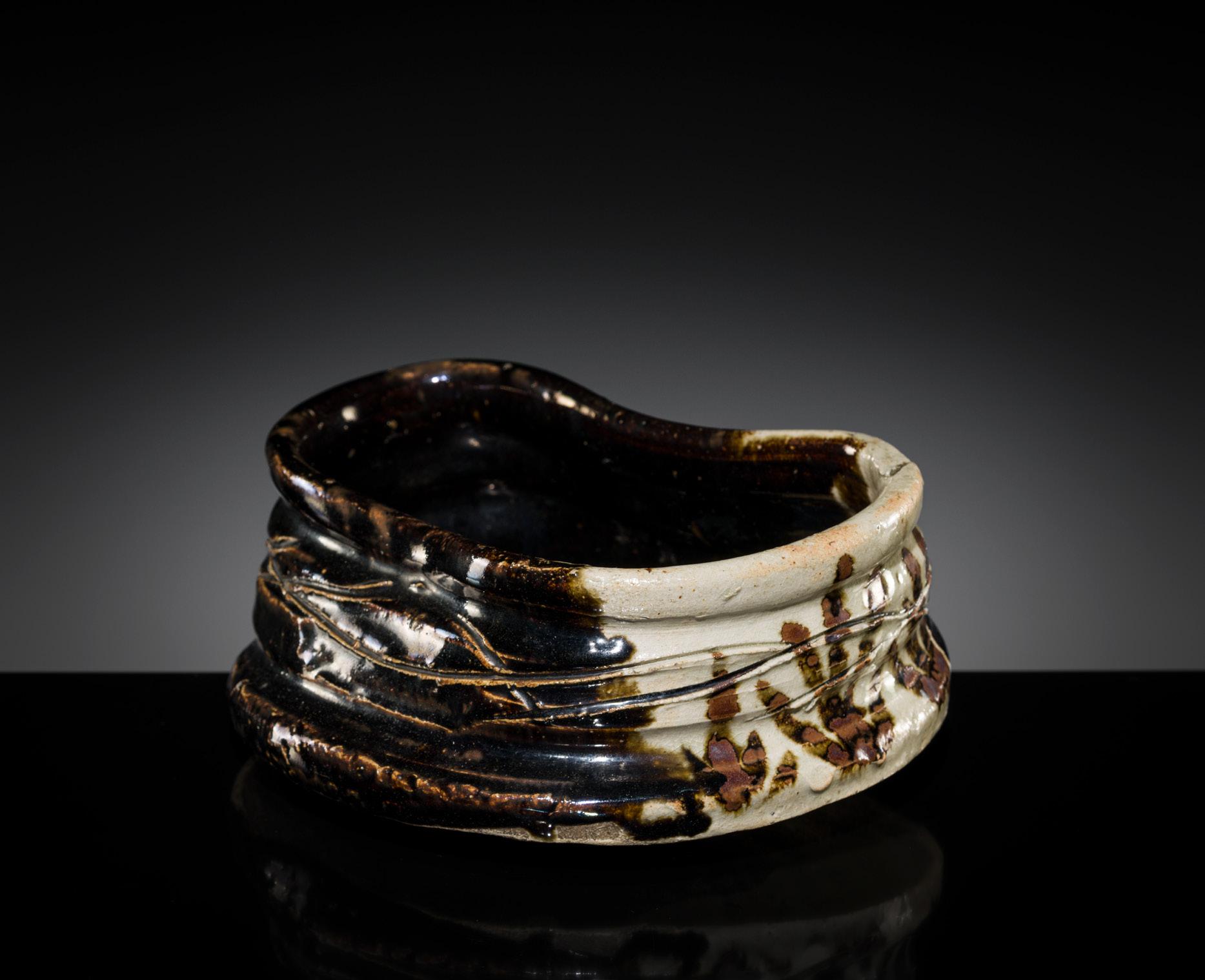
141
A FINE KURO-ORIBE KUTSUGATA CHAWAN (TEA BOWL), EDO PERIOD, 17TH CENTURY
Japan. Of kutsugata (clog-shaped) form, skillfully potted, supported on a short oval foot and rising to deep sides with an irregular-shaped waist gently flaring toward a broad mouth, overall decorated with a lustrous, thick black iron glaze. The exterior depicts a geometric pattern with bold incision, and the interior shows plum blossoms in underglaze iron over white slip. The low foot and underside remain unglazed.
Provenance: The Collection of Sam and Myrna Myers, Paris, France. Acquired between circa 1965-2012.
Condition: Very good condition with minor wear and firing irregularities, including fritting, crackling to the glaze, and a firing crack to the interior and underside.
Weight: 1,141 g
Dimensions: Height 9 cm, Length 19.7 cm
This tea bowl’s intentionally deformed shape recalls an ancient Japanese clog (kutsu), giving rise to the term kutsugata chawan. After shaping the bowl on the wheel, the potter deliberately distorted the form, creating an irregular, asymmetrical form that sits naturally and comfortably in the tea ceremony practitioner’s hands. Such deliberate imperfection reflects the aesthetics of wabi-sabi, valuing spontaneity, naturalness, and quiet restraint. Kutsugata chawan were especially admired in the Momoyama and early Edo periods for their sculptural presence and tactile intimacy. This bowl exemplifies how expressive form and painterly decoration combine to create an artful object for the tea ceremony.
LITERATURE COMPARISON
Compare a closely related kuro-oribe kutstugata chawan with plum blossoms, dated to the early 17th century, 14.3 cm (long), in the Metropolitan Museum of Art, object number 2002.447.28.
AUCTION RESULT COMPARISON
Type: Closely related
Auction: Sotheby’s London, 16 May 2007, lot 957
Price: GBP 6,960 or approx. EUR 16,000 converted and adjusted for inflation at the time of writing
Description: A kuro-oribe chawan, probably early Edo period
Expert remark: Compare the closely related modeling, glaze and coloration. Note the smaller size (13.2 cm).
Estimate EUR 1,500
Starting price EUR 700
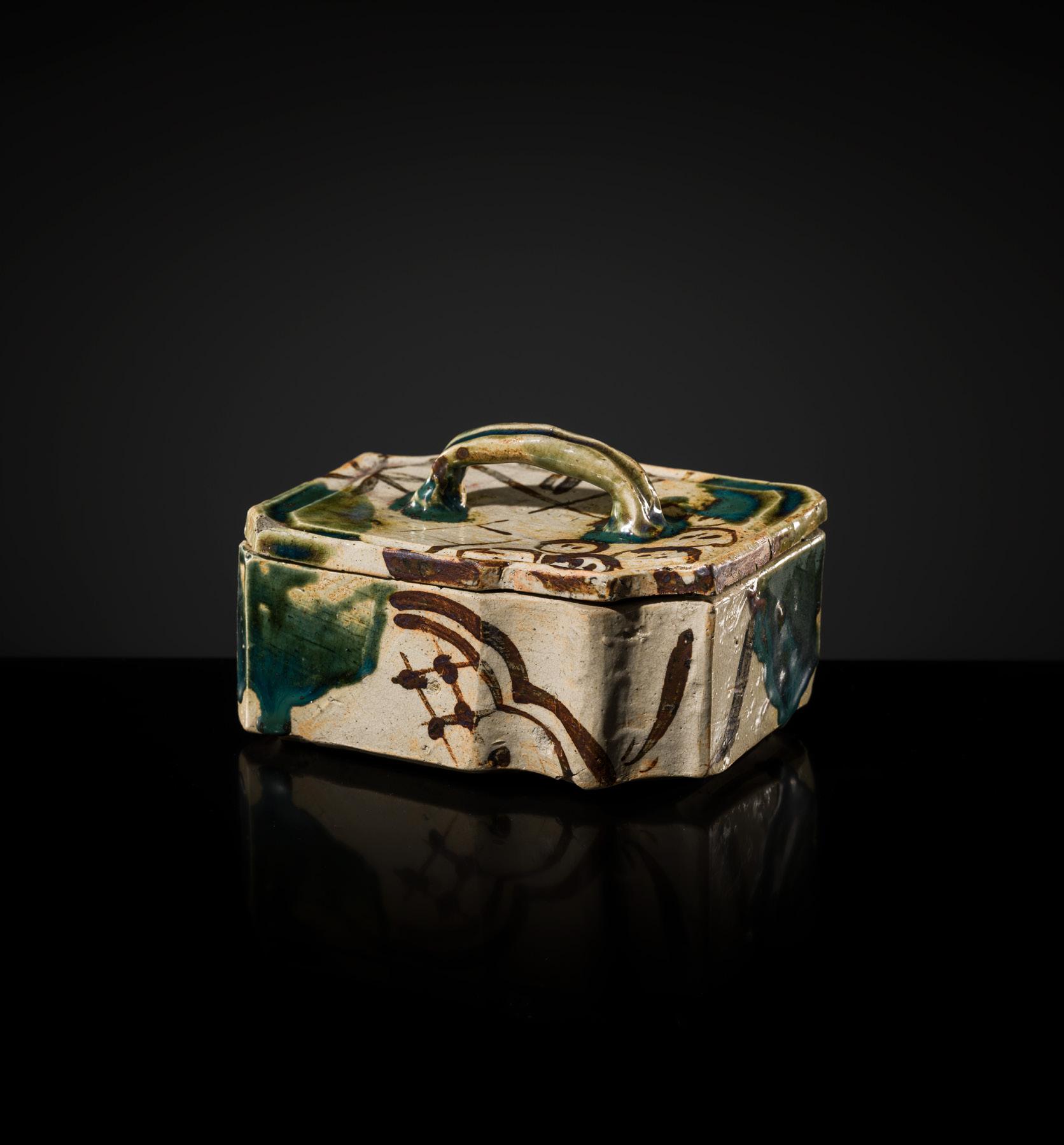
AN ORIBE BOX AND COVER, FUTAMONO
Japan, 18th-19th century. Of irregular shape, with straight sides, the cover of similar form fitted with a loop handle, and the pale body covered in partly crackled creamy-white glaze, decorated with dark green splashes and iron brown crosses with stylized blossoms. The base left unglazed to reveal the pale brown body.
Provenance: The Collection of Sam and Myrna Myers, Paris, France. Acquired between circa 1965-2012. The base with two labels, ‘4295’ and ‘1b’.
Condition: Good condition with minor wear, few small chips along the rims, firing irregularities including firing cracks to the base, glaze flaking, glaze recesses, and spur marks.
Weight: 833 g
Dimensions: Length 14.7 cm
Estimate EUR 1,500
Starting price EUR 700
LITERATURE COMPARISON
Compare a related oribe box and cover, dated to the mid19th century, 30.9 cm wide, in the Victoria and Albert Museum, accession number FE.9&A-1987.
Japan, early 19th century. Heavily potted, of irregular cylindrical form, the stoneware body is covered with a warm beige to pale buff glaze with a fine, even crackle across the surface and an ash- to greentoned splash. The flush-fitting, flat lid is black-lacquered and fitted with a loop handle.
Provenance: The Collection of Sam and Myrna Myers, Paris, France. Acquired between circa 1965-2012.
Condition: Very good condition with minor wear and intentional firing flaws, including pitting, pooling, crackling and few dark spots. Two small chips to the cover.
Weight: 1,303 g (total)
Dimensions: Height 22.5 cm (excl. cover), 24.4 cm (incl. cover)
Shigaraki, east of Kyoto, has been a kiln site for centuries, originally producing utilitarian wares such as storage jars and mortars. When the tea ceremony gained popularity in the sixteenth century, Shigaraki ceramicists were quick to adapt to the tea masters’ demand for rustic yet engaging vessels, such as this deceptively simple water jar. Whereas most potters take care to filter rocks out of their clay, those working in the Shigaraki region understand that the texture created by rocky inclusions of quartz and feldspar adds both tactile and visual interest to their wares. The artisans apply only minimal glaze, allowing the surface to retain its natural graininess.
AUCTION RESULT COMPARISON
Type: Related
Auction: Christie’s London, 13 November 2002, lot 268
Price: GBP 5,736 or approx. EUR 15,000 converted and adjusted for inflation at the time of writing.
Description: A Shigaraki Mizusashi [FreshWater Container] and a kakebanaike [Hanging Flower-arrangement vase], Edo period (early-mid 19th century)
Expert remark: Compare the related form, style and glaze. Note the size (18.2 cm).
Estimate EUR 3,000
Starting price EUR 1,500
144
MASHIMIZU ZOROKU II (1861-1936): AN IGA HANDLED HANAIRE (FLOWER VASE), MEIJI PERIOD
Japan, early 20th century. Heavily potted, of irregular cylindrical form with a ribbed shoulder, an irregular everted mouth, and two lug handles, covered overall with an orange to brown glaze, exposing areas of light green glaze and the unglazed ware beneath. The underside bears the artist’s seal, ZOROKU.
Provenance: The Collection of Sam and Myrna Myers, Paris, France. Acquired between circa 1965-2012.
Condition: Very good condition with minor wear and intentional firing flaws, including pitting and few dark spots.
Weight: 1,123 g
Dimensions: Height 20.5 cm
With original wood tomobako (storage box), inscribed Ko Iga utsushi kabin, Deichuan Zoroku zo with the seal Zoroku, 古伊賀写、花瓶、泥中庵蔵六造, [Made in a style/copy of old Iga ware, a flower vessel, by Deichuan Zoroku]. (2)
Mashimizu Zoroku II (1861-1936) was a Kyoto-based ceramic artist and the second-generation successor of the distinguished Mashimizu Zoroku lineage. Born as the eldest son of Mashimizu Zoroku I, he inherited the family kiln and expanded its artistic scope through extensive travels throughout Japan, as
well as study trips to China and Korea, where he closely examined celadon wares of the Goryeo period and ceramics of the Yi dynasty. Upon returning to Japan, he established a new kiln in Yamashina, Kyoto, in 1917, laying the foundation for what became known as the Shinshimizu style. His work is characterized by a refined understanding of celadon and classical glazes informed by continental models. Initially using his father’s centenary seal, he later adopted his own ‘Zoroku’ seal, marking his independent artistic identity.
LITERATURE COMPARISON
Compare a related bowl in Xiangrui (shonzui) style by the same artist, Mashimizu Zoroku, dated to the Meiji period, in the Kyoto National Museum, museum number GK117.
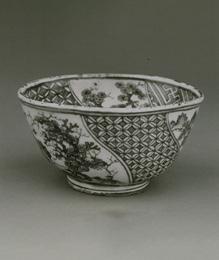
Estimate EUR 1,500 Starting price EUR 700
PUBLISHED
Jean-Paul Desroches (ed.) et al, Two Americans in Paris. A Quest for Asian Art, Paris, 2016, p. 232, no. 367.
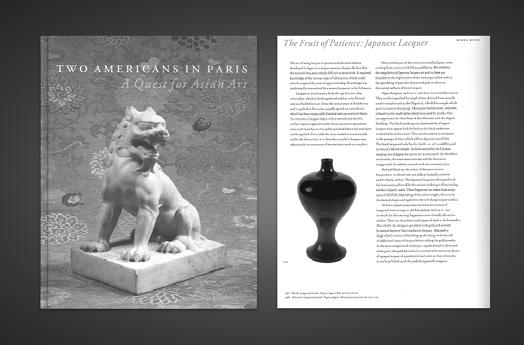
Exhibited:
1. Pointe-à-Callière Museum, From the Lands of Asia. The Sam and Myrna Myers Collection, Montréal, 17 November 2016-19 March 2017.
2. Kimbell Art Museum, From the Lands of Asia. The Sam and Myrna Myers Collection, Fort Worth, Texas, 4 March-19 August 2018.
Japan, circa 17th century or possibly a bit earlier. Of turned and assembled wood, with upright splayed base, tapered body, and rounded shoulders, the neck also tapered and rising to a rounded lip, covered overall in kuro-negoro (brown and black) lacquer.
Inscriptions: Inscribed to the base.
Provenance: The Collection of Sam and Myrna Myers, Paris, France. Acquired between circa 1965-2012.
Condition: Good condition with wear and manufacturing irregularities. Age cracks, flaking—particularly around the mouth, scratches, and old repairs with associated touchups.
Weight: 1,441.1 g
Dimensions: Height 30.5 cm
Among wooden, lacquered heishi (ritual sake flasks), there are two general forms: one with broad, gentle shoulders, and another where the outward and inward curves are sharply distinguished at the shoulder. This example, finished in black lacquer known as kuro-negoro, has a slender spout attached at the top. The base is relatively thick and small in proportion, while the lower body is elongated.
The present lacquered sake bottle could be used in rites of a Shinto temple. Its form resembles the Chinese meiping, but in Japan the curves are accentuated: the shoulders are broader, the waist more extreme and the foot more exaggerated. Its sobriety accords with tea ceremony taste.
LITERATURE COMPARISON
Compare a closely related black lacquer heishi, early Edo period, 30.5 cm high, in the Wakayama Prefectural Museum (fig. 1). Compare a closely related lacquered wood sake flask, hikimono type, dated 14th-15th century, 28.3 cm high, in the Sainsbury Centre, University of East Anglia, Norwich, accession number 1163.
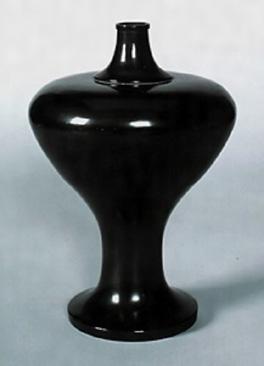
AUCTION RESULT COMPARISON
Type: Related
Auction: Christie’s London, 16 November 2000, lot 95
Price: GBP 16,450 or approx. EUR 44,500 converted and adjusted for inflation at the time of writing
Description: A rare negoro lacquer heishi (bottle), late Muromachi period, 16th century Expert remark: Note the size (32.4 cm).
Estimate EUR 6,000
Starting price EUR 3,000
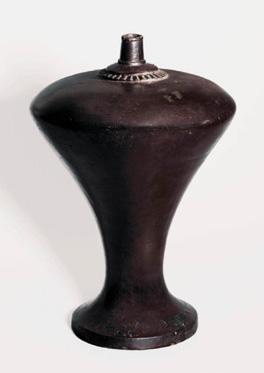
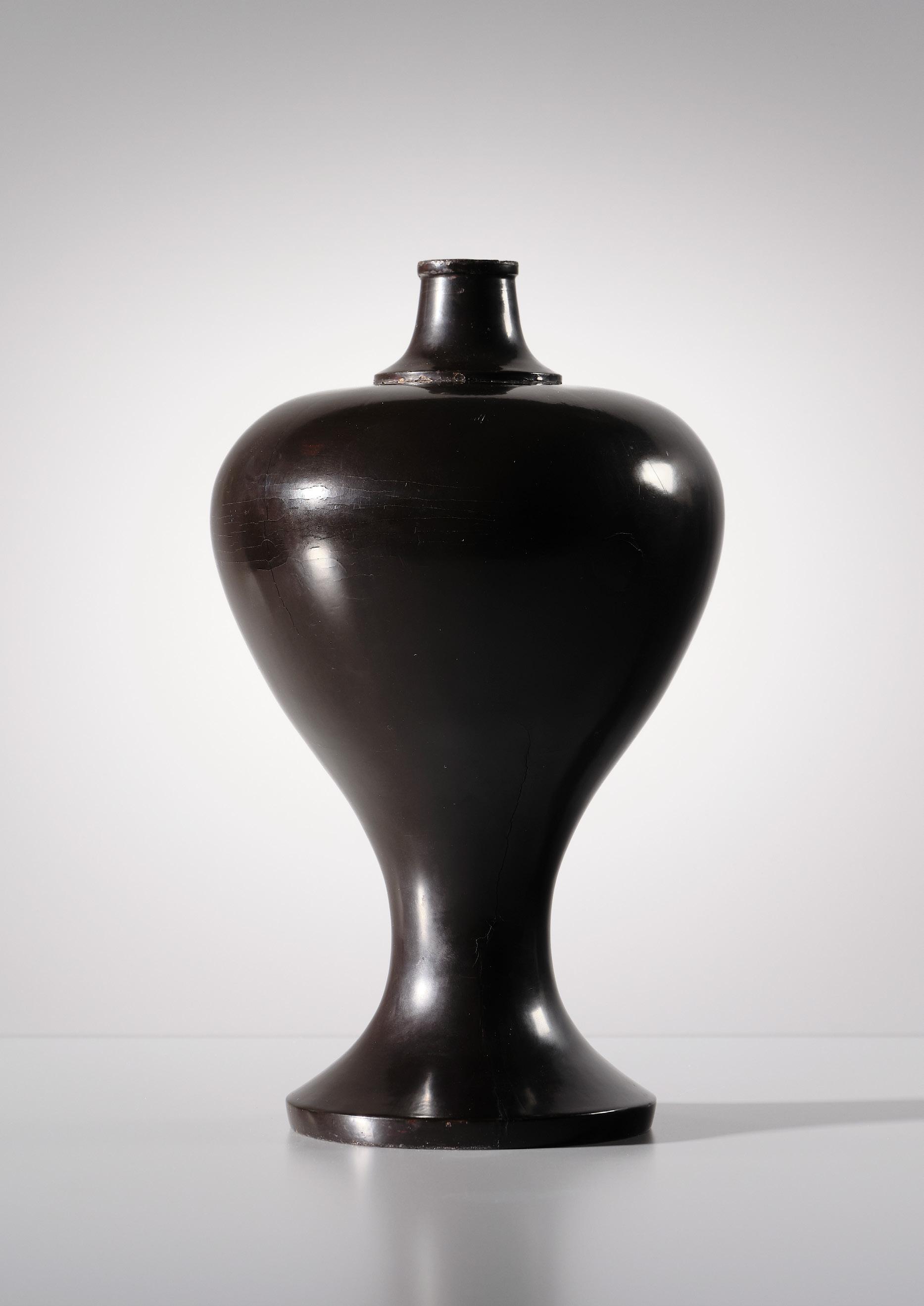
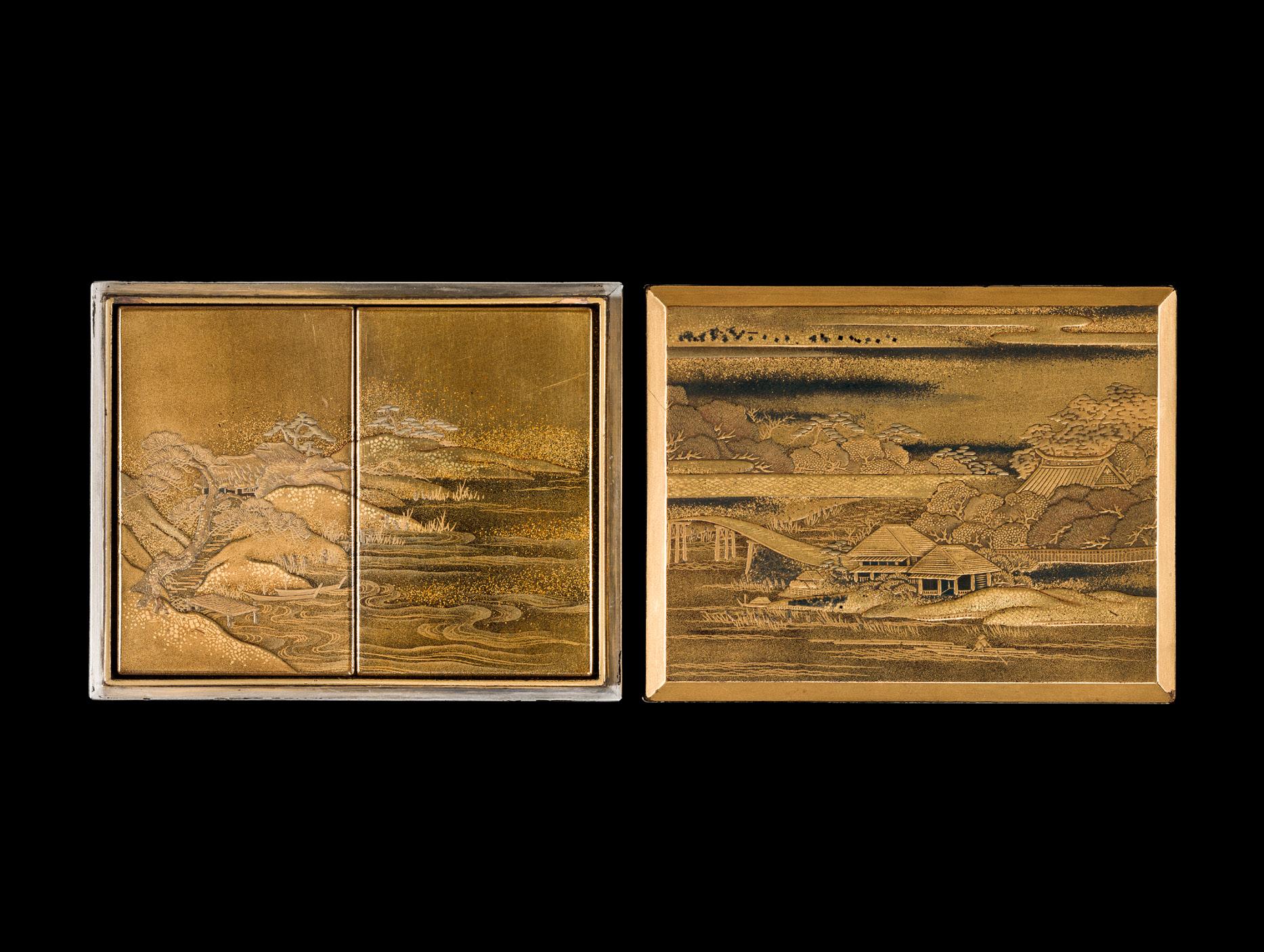
146
A RARE GOLD LACQUER BOX AND COVER CONTAINING TWO KOGO (INCENSE BOXES), FOR THE INCENSEMATCHING GAME, EDO PERIOD
Japan, 19th century. Of rectangular shape, finely decorated with delicate takamaki-e and hiramaki-e on a kinji ground, embellished with e-nashiji and dusted kinpun. The inrobuta (flush-fitting) lid is adorned with a delicate landscape scene depicting a lake with boats, huts, and pine trees, extending over all sides. The underside is finished in e-nashiji, while the interior is lined with rich nashiji and fitted with silver rims. (3)
The interior contains two kogo, each of upright rectangular form, superbly decorated in gold takamaki-e and hiramaki-e to depict a further riverscape with pines and boats.
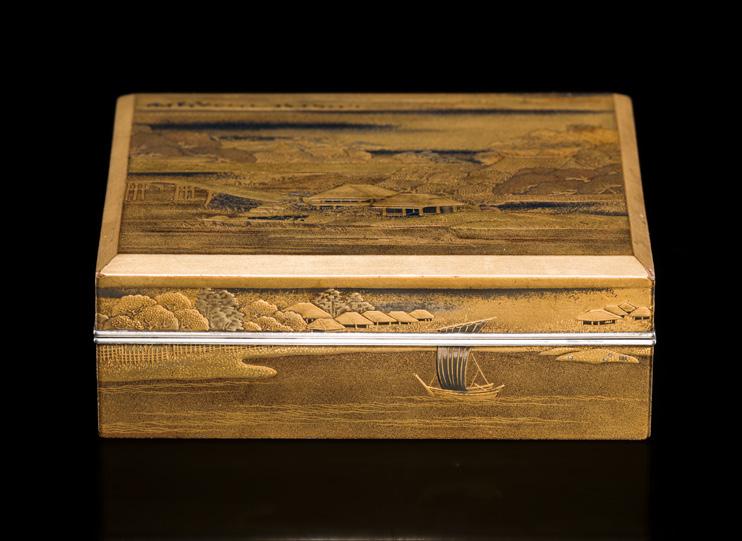
Provenance: The Collection of Sam and Myrna Myers, Paris, France. Acquired between circa 1965-2012.
Condition: Good condition with minor wear, tiny nicks to the corners and small chips to the interior rims, typical losses to kirigane flakes, a small hairline to the rim. Presenting very well.
Dimensions: Size 10.6 x 8.5 x 4 cm
The present set was used for the incense-matching game. Like the Way of Tea and flower arrangement, the enjoyment of incense had developed into a complex pastime by the Edo period and had a large following during the seventeenth century. The various games involved guessing a fragrance from among more than 2,000 varieties, matching fragrances, and blending incenses to suggest certain moods.
AUCTION RESULT COMPARISON
Type: Closely related
Auction: Zacke, Vienna, 16 June 2023, lot 13
Price: EUR 6,500
Description: A rare lacquer box and cover with interior tray and two smaller boxes, for the incense matching game
Expert remark: Compare the closely related form, decoration, motif and use. Note the slightly smaller size (3.6 x 8.3 x 5.9 cm).
Estimate EUR 1,500
Starting price EUR 700
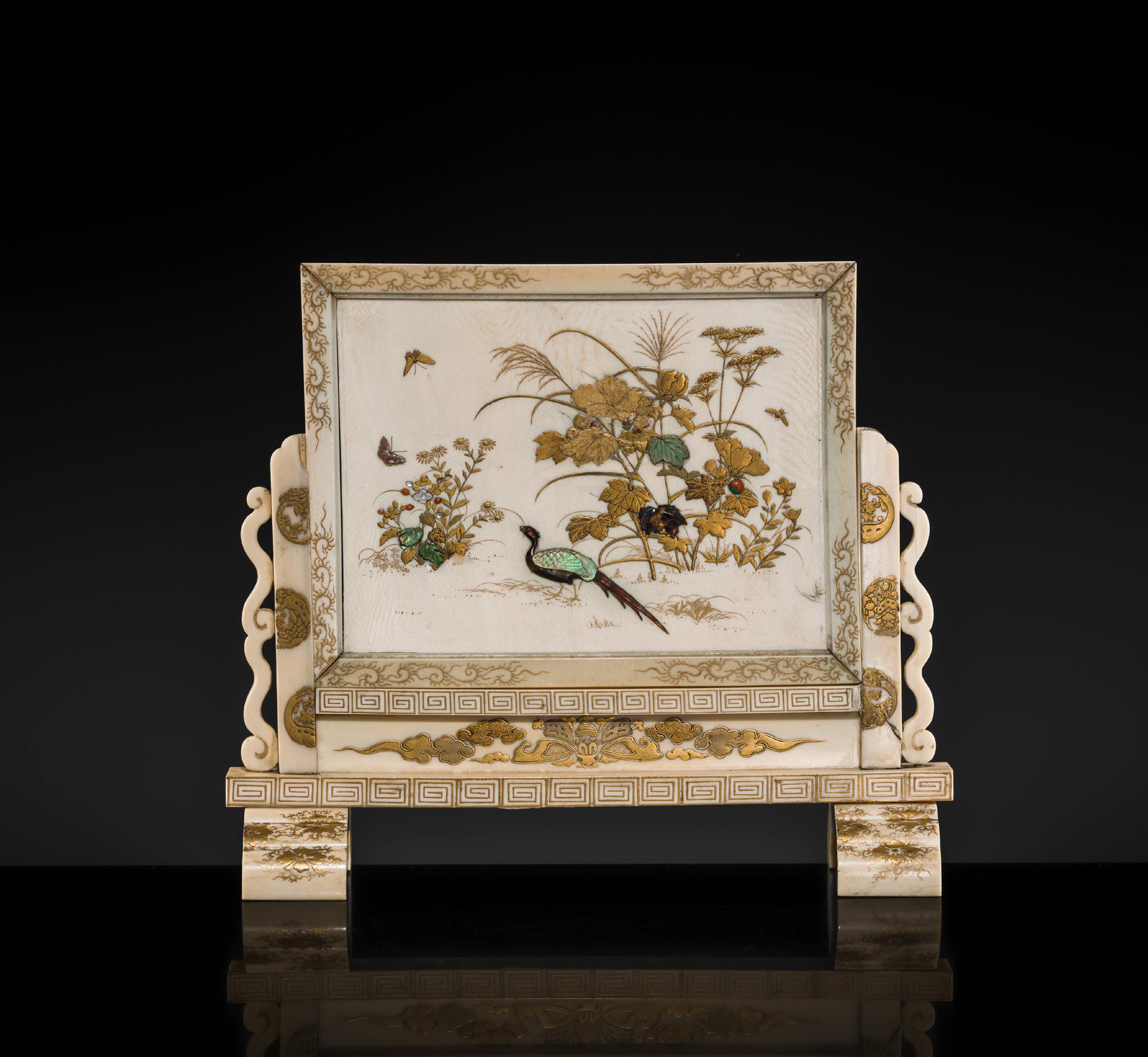
147 A FINE SHIBAYAMA-INLAID IVORY TABLE SCREEN (TSUITATE) WITH BIRDS AND LEAVES, MEIJI PERIOD
Japan, 1868-1912. Of typical form, the detachable rectangular panel set within a conventional frame, the latter decorated on either side with floral motifs amid swirling clouds and key-fret bands in gilt. The panel finely inlaid in gold, coral, turquoise, tortoiseshell, and motherof-pearl, depicting on one side a pheasant standing among ivy leaves and various flowers, with fluttering butterflies, and on the reverse a goose at the edge of a small stream amid blossoms and lotus leaves, both scenes framed by flaming scrollwork.
Provenance: The Collection of Sam and Myrna Myers, Paris, France.
Acquired between circa 1965-2012.
Condition: Good condition with surface wear and manufacturing irregularities. Some of the inlays are later replacements. Few minute fissures to inlaid decoration and small cracks with associated signs of restoration to some joints. Light rubbing to gilding. Scattered minor nicks and shallow surface scratches.
Weight: 272.1 g
Dimensions: Height 16.3 cm, Length 19.1 cm
AUCTION RESULT COMPARISON
Type: Closely related
Auction: Bonhams London, 10 November 2011, lot 230
Price: GBP 3,250 or approx. EUR 6,500 converted and adjusted for inflation at the time of writing
Description: An inlaid ivory table screen (tsuitate), Meiji period
Expert remark: Compare the closely related form, inlaid decoration and ornamental motifs. Note the slightly larger size (23.5 cm).
Estimate EUR 1,500
Starting price EUR 700
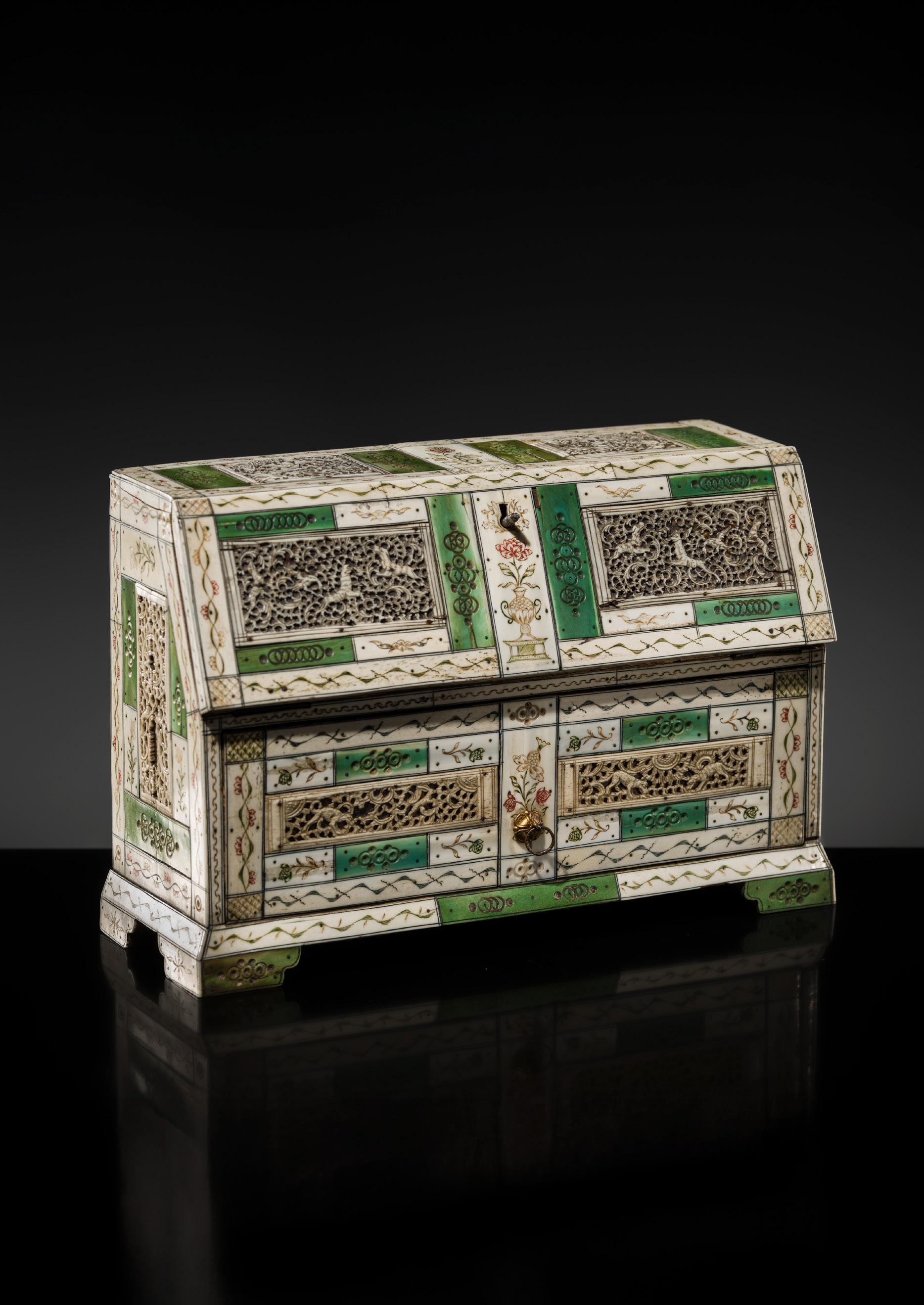

Of rectangular form, supported on four bracket feet, the exterior is applied with carved, engraved, painted, and green-stained walrus ivory panels depicting lions, birds, rabbits, dogs, flowers, an urn, and geometric patterns. The hinged cover is fitted with a metal key, and the drawer with a flower-form loop handle.
Provenance: The Collection of Sam and Myrna Myers, Paris, France. Acquired between circa 1965-2012.
Condition: Good condition with old wear and natural imperfections, including small hairlines. Few losses, chips, small repairs, some cracks, particularly to the left upper side, soiling and a loss to the key’s handle. Presenting very well.
Weight: 1,715 g
Dimensions: Height 20.1 cm, Length 29.3 cm
Carving from walrus and mammoth ivory has had a long tradition within popular Russian folk art since the Middle Ages originating in the northern regions. Archangelsk, located on the White Sea coast, was an important trading city in Russia's far north, in particulary known as a centre of walrus ivory trade. During the 18th century it produced a highly original and high quality range of carved ivory objects including caskets, toilet boxes and combs. Often the most sophisticated examples incorporated pierced panels of people and animals drawing on Western European design sources. These designs reached the region through carvers who customarily trained in Moscow and especially St. Petersburg for several years before returning to their native region. For similar examples see I. N. Ukhanova, Bone carving in Russia in the 18th and 19th centuries, 1981, pp. 107-110. For more complex examples, see A. Odom and L.P. Arend, A Taste for Splendor: Russian Imperial and European treasures from the Hillwood Museum, exhibition catalog, 1998, pp. 136-38.
AUCTION RESULT COMPARISON
Type: Closely related
Auction: Christie’s London, 24 November 2008, lot 23
Price: GBP 3,125 or approx. EUR 7,000 converted and adjusted for inflation at the time of writing
Description: A walrus ivory casket, Archangel, mid-19th century
Expert remark: Compare the closely related material, inlays, decoration and size (28.1 cm). Note the slightly different form.
Estimate EUR 4,000
Starting price EUR 2,000
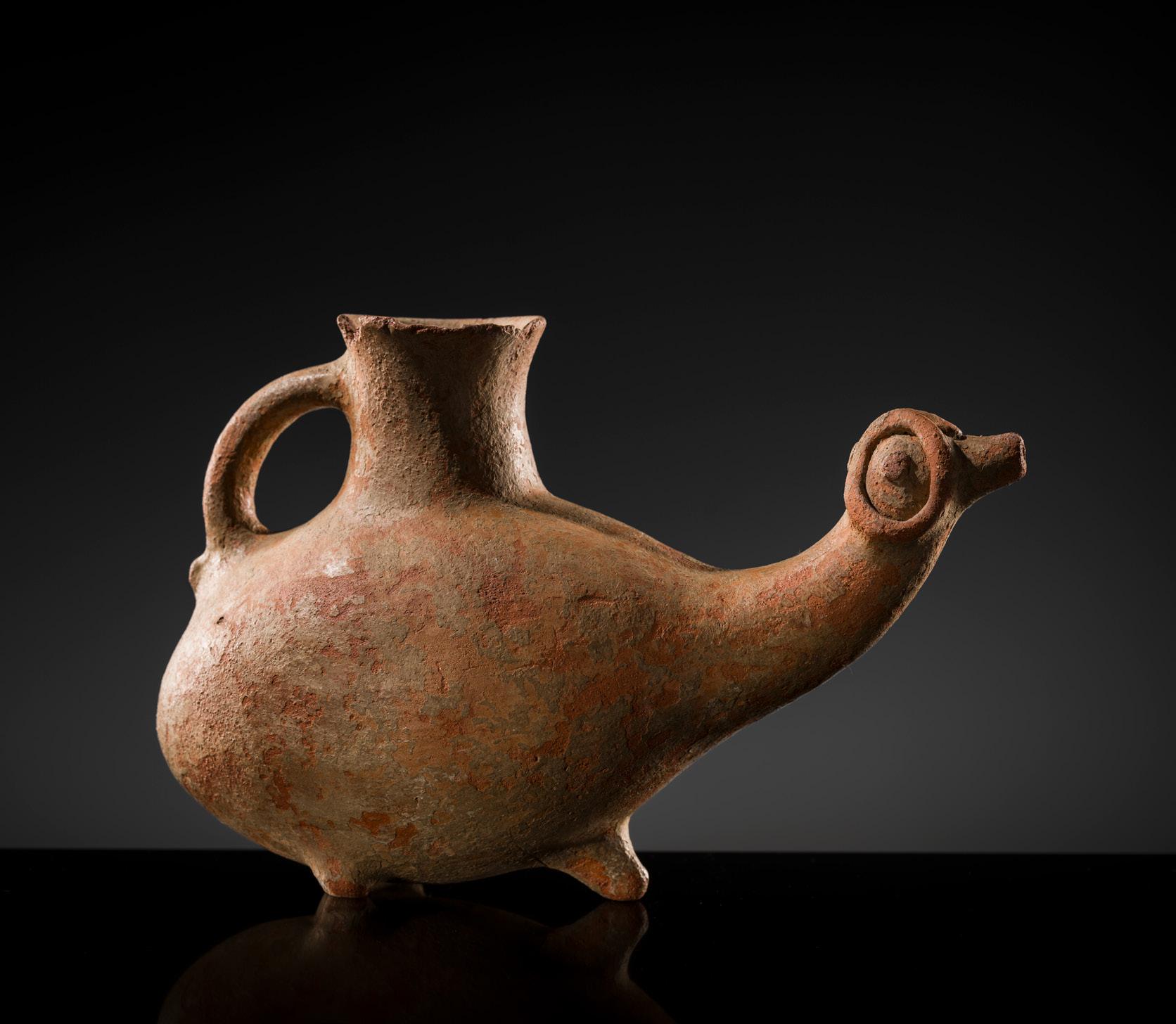
149 A POTTERY ‘RAM’ LIBATION VESSEL, PARTHIAN CULTURE, CIRCA 3RD-1ST CENTURY BC
Amlash (present-day Northwestern Iran). Of red-polished ware and skillfully modeled, the body, of ellipsoid shape, supported on three small conical feet and rising to a slightly waisted neck with an everted rim. A curved handle is attached to one side, while the opposite end extends into a long spout, shaped as a stylized ram head, with applied dots for eyes and curling horns.
Provenance: The Collection of Sam and Myrna Myers, Paris, France. According to the Myers ledger acquired in Tel Aviv on 22 March 1973 and in the collection for 53 years.
Condition: Good condition, commensurate with age, with ancient wear and inherent firing irregularities, including some fissures. Distinct traces of weathering and erosion. Expected signs of usage. Some visible chips to the upper rim. Few minute nicks and shallow surface scratches. The ceramic surface with some areas of soil encrustation, indicating a prolonged period of burial.
Weight: 1,111 g
Dimensions: Length 29.7 cm
Animal-shaped pottery vessels such as the present lot began to be produced during the Late Bronze Age (1700–1200 BC) in the region of northwestern Iran known as Amlash, and their characteristic forms were fully developed throughout the first millennium BC. The site comprised stone-and-clay tombs carved into a high rocky spur. Among the most distinctive examples are spouted vases representing zebus, humped cattle highly valued by pastoral communities in the area. These vessels were designed to hold liquids and appear to have served a ritual function in funerary practices.
LITERATURE COMPARISON
Compare a closely related ram-shaped ceramic vessel, Northwestern Iran, Parthian culture, c. 1st century BC to 2nd century AD, 22.5 cm long, in the Metropolitan Museum of Art, object number 65.5.3 (fig. 1). Compare a closely related ram-shaped ceramic jug, Iran, Amlash culture, c. 1200-800 BC, 35 cm long, in the Museum of Liverpool, accession number 1967.216. Compare a closely related animal-shaped ceramic vessel, Iran, Parthian culture, 1400-800 BC, 27.2 cm long, in the Smithsonian National Museum of Asian Art, accession number S1998.206.
AUCTION RESULT COMPARISON
Type: Closely related
Auction: Christie’s London, 1 October 2015, lot 36
Price: GBP 6,875 or approx. EUR 12,500 converted and adjusted for inflation at the time of writing
Description: A Parthian pottery goat rhyton, c. late 1st millennium BC
Expert remark: Compare the related form, material, and zoomorphic design. Note the smaller size (21 cm).
Estimate EUR 4,000
Starting price EUR 2,000
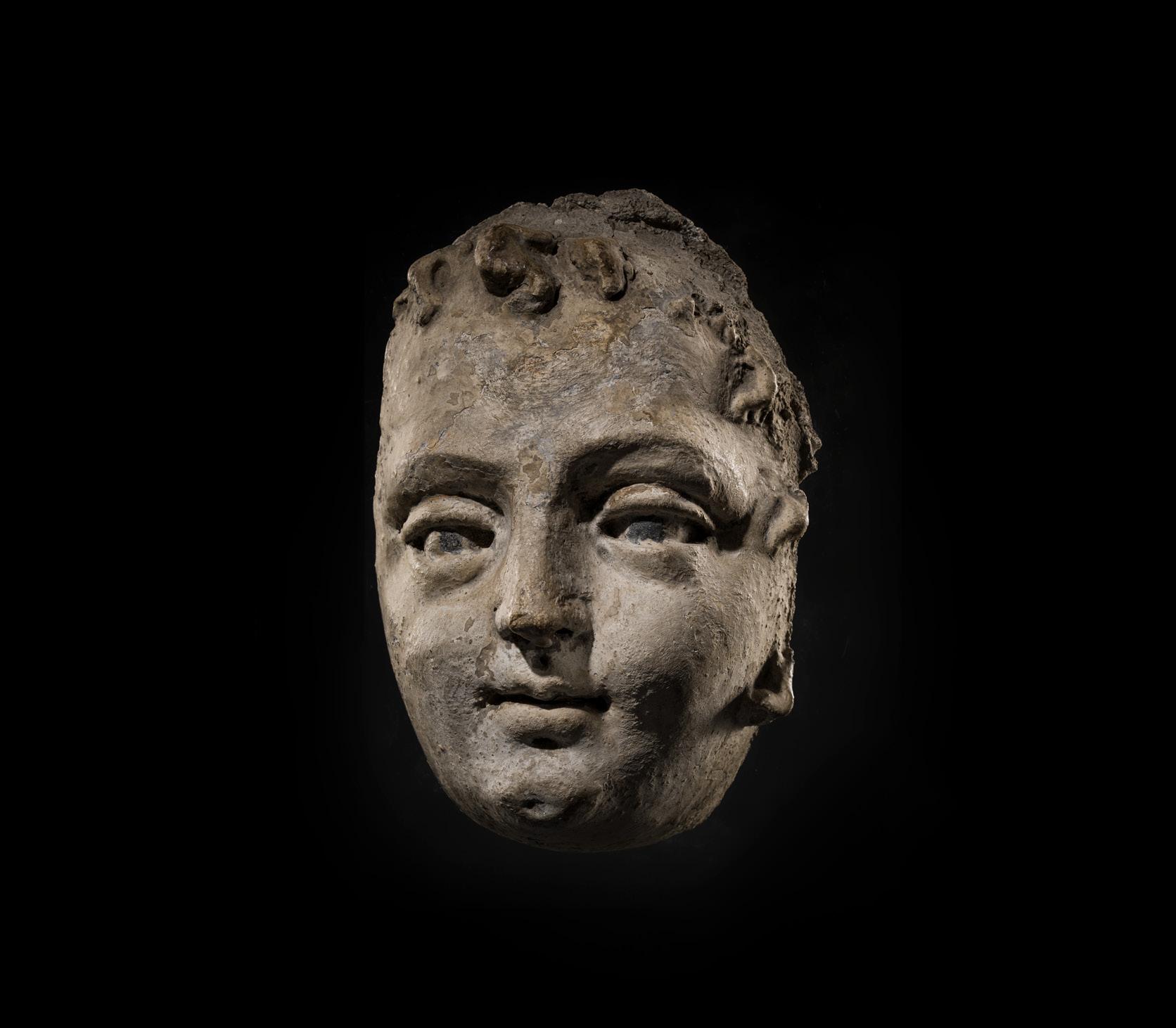
150
A STUCCO HEAD OF A YOUTH, GREATER GREECE, HELLENISTIC PERIOD, 3RD CENTURY BC
PUBLISHED
Jean-Paul Desroches (ed.) et al, Two Americans in Paris. A Quest for Asian Art, Paris, 2016, p. 14-15, no. 7.
Exhibited:
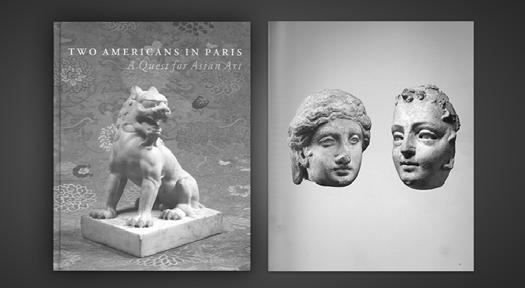
1. Pointe-à-Callière Museum, From the Lands of Asia. The Sam and Myrna Myers Collection, Montréal, 17 November 2016-19 March 2017.
2. Kimbell Art Museum, From the Lands of Asia. The Sam and Myrna Myers Collection, Fort Worth, Texas, 4 March-19 August 2018.
The face is gently rounded with carefully defined features, slightly almond-shaped eyes highlighted with black-colored pupils, a small nose, and a subtle smile. The hair is arranged in short, spiral curls across the forehead and framing the face.
Provenance: Drouot, Paris, 6 October 1986, according to the Myers ledger. The Collection of Sam and Myrna Myers, Paris, France. In the collection for 40 years.
Condition: Good condition with expected old wear, signs of weathering and erosion, obvious losses, flaking, small chips, few small age cracks.
Dimensions: Height 17 cm (excl. stand)
Mounted to an acrylic stand. (2)
Literature comparison:
Compare a related marble head of a horned youth, Hellenistic period, 3rd2nd century BC, in the Metropolitan Museum of Art, restituted.
AUCTION RESULT COMPARISON
Type: Closely related
Auction: Christie’s New York, 6 December 2007, lot 143
Price: USD 34,600 or approx. EUR 45,500 converted and adjusted for inflation at the time of writing
Description: A Cypriot limestone votive head of a youth, Hellenistic period, circa 3rd century B.C.
Expert remark: Compare the similar expression, size (17.8 cm), and carving style.
Estimate EUR 4,000
Starting price EUR 2,000
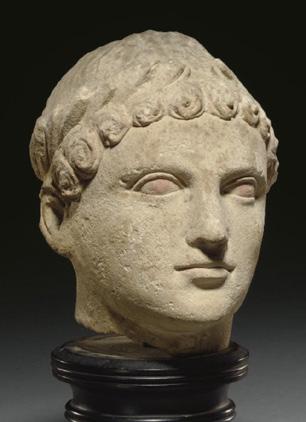
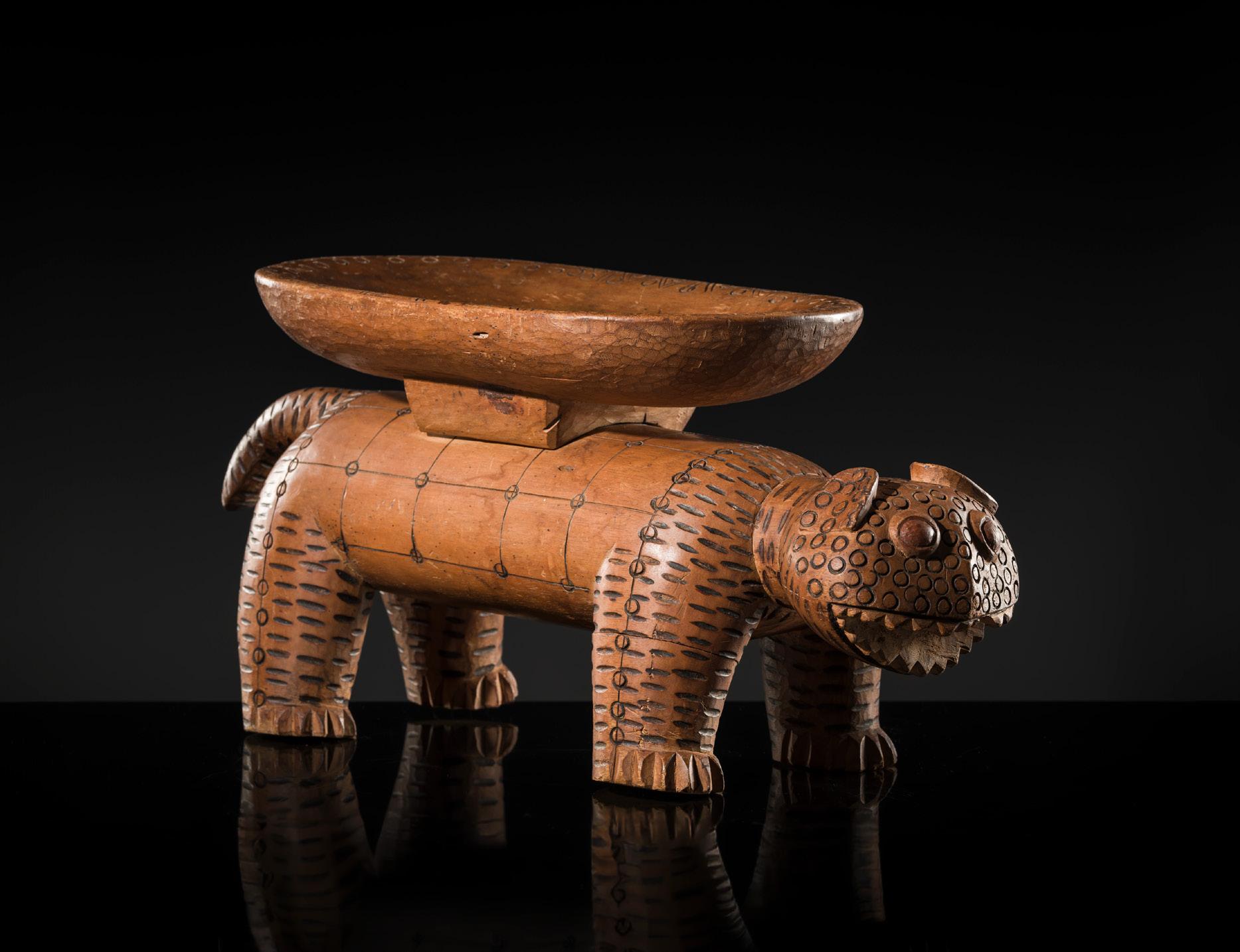
A RARE CARVED WOOD ‘LEOPARD’ PRESTIGE STOOL, BAULE PEOPLE
PUBLISHED
Jean-Paul Desroches (ed.) et al, Two Americans in Paris: A Quest for Asian Art, Paris, 2016, p. 161, no. 271.
Exhibited:
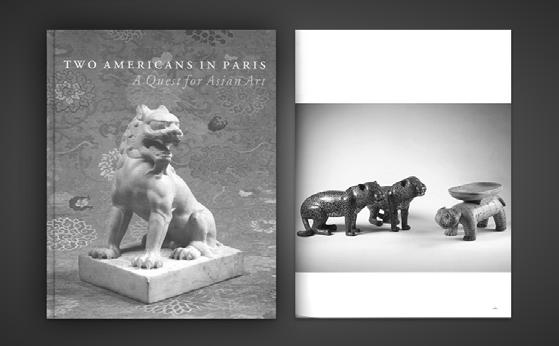
1. Pointe-à-Callière Museum, From the Lands of Asia. The Sam and Myrna Myers Collection, Montréal, 17 November 2016-19 March 2017.
2. Kimbell Art Museum, From the Lands of Asia. The Sam and Myrna Myers Collection, Fort Worth, Texas, 4 March-19 August 2018.
Ivory coast, 19th century. Boldly carved in the form of a stylized large feline standing foursquare, the cylindrical body, incised with a regular pattern of squares punctuated by circular motifs at their intersections, extending into a gently curved tail and a rounded head. The face of the animal further decorated with additional incised circles and its expression marked by a pair of prominent bulging eyes, a straight mouth line, and ears folding symmetrically to either side of the head. The mane neatly rendered through large, deeply incised punch marks. An oval seat raised atop the back of the leopard.
Provenance: The Collection of Sam and Myrna Myers, Paris, France. Acquired between circa 1965-2012.
Condition: Fair condition with surface wear and inherent natural imperfections. Distinct traces of weathering and expected signs of usage. The tail with evidence of breakage and subsequent restoration. The front right leg possibly replaced. Scattered minor nicks, shallow surface scratches, and few small chips. The wood surface with a fine, naturally grown patina.
Weight: 3.8 kg
Dimensions: Length 64.5 cm
Literature comparison:
Compare a related wood prestige stool with leopard base, Baule peoples, central Ivory coast, 19th-20th century, 85.1 cm long, in the Metropolitan Museum of Art, object number 1982.332.2. Compare a related wood stool in the form of a leopards, Baule peoples, Ivory coast, 20th century, 47 cm long, in the Indianapolis Museum of Art, Newfields collection, accession number 1989.478.
AUCTION RESULT COMPARISON
Type: Related
Auction: Christie’s New York, 10 May 2012, lot 11
Price: USD 7,500 or approx. EUR 9,000 converted and adjusted for inflation at the time of writing
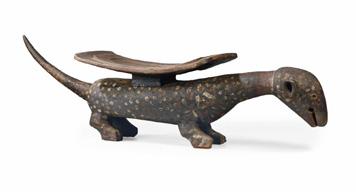
Description: A Baule zoomorphic seat, Ulimbi Bia, Ivory
Expert remark: Compare the related animal form with stylized limbs, manner of carving, and decorative style. Note the larger size (113 cm).
Estimate EUR 3,000
Starting price EUR 1,500
PUBLISHED
Jean-Paul Desroches
(ed.) et al, Two Americans in Paris: A Quest for Asian Art, Paris, 2016, p. 160, no. 269.
Exhibited:
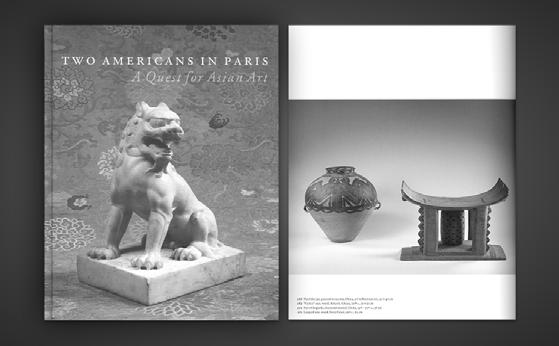
1. Pointe-à-Callière Museum, From the Lands of Asia. The Sam and Myrna Myers Collection, Montréal, 17 November 2016-19 March 2017.
2. Kimbell Art Museum, From the Lands of Asia. The Sam and Myrna Myers Collection, Fort Worth, Texas, 4 March-19 August 2018.
Ghana, late 19th to early 20th century. Of typical form, the curved rectangular seat supported on a cylindrical central column decorated with a series of alternating pierced rectangles. The outer rounded supports adorned along their profiles with a pierced latticework with a serrated outline.
Provenance: The Collection of Sam and Myrna Myers, Paris, France.
Acquired between circa 1965-2012.
Condition: Very good condition with surface wear and inherent natural imperfections, including some fissures and visible age cracks. Distinct traces of weathering and signs of usage. Scattered minute nicks, shallow surface scratches, and few minor chips. The wood surface with a fine, naturally grown patina.
Weight: 5.3 kg
Dimensions: Height 31.2 cm, Length 51.3 cm
Prevalent throughout sub-Saharan West Africa and particularly in Ghana, this traditional carved wooden stool (dwa) has historically been employed by the Akan, most notably the Ashanti people, as an emblem of chieftaincy and male authority within rites of passage, serving as a marker of royalty, customary practice, and sociopolitical hierarchy.
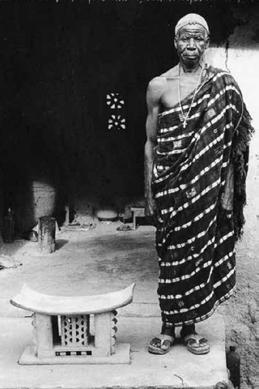
Queen mothers are also occasionally depicted publicly seated upon such stools. The ‘dwa’ has been further ascribed religious significance and crafted in a variety of sizes, forms, and motifs to communicate specific assertions of power and social status.
Literature comparison:
Compare a closely related domestic stool, Ghana, Ashanti people, 20th century, 46 cm long, in the Palmer Museum of Art, Pennsylvania State University, accession number 16-13. Compare a closely related carved wood stool, Ghana, Ashanti people, 19th century, 57.2 cm long, in the Brooklyn Museum, accession number 22.1695.
AUCTION RESULT COMPARISON
Type: Closely related
Auction: Christie’s New York, 3 April 2003, lot 49
Price: USD 2,868 or approx.
EUR 4,500 converted and adjusted for inflation at the time of writing
Description: An Ashanti stool, Ghana, 20th century
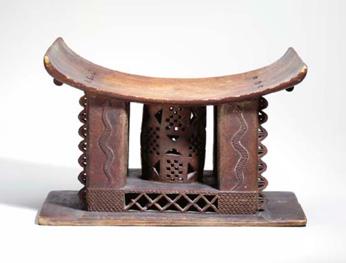
Expert remark: Compare the closely related form, manner of carving, and decorative style. Note the similar size (35 cm).
Estimate EUR 2,000
Starting price EUR 1,000
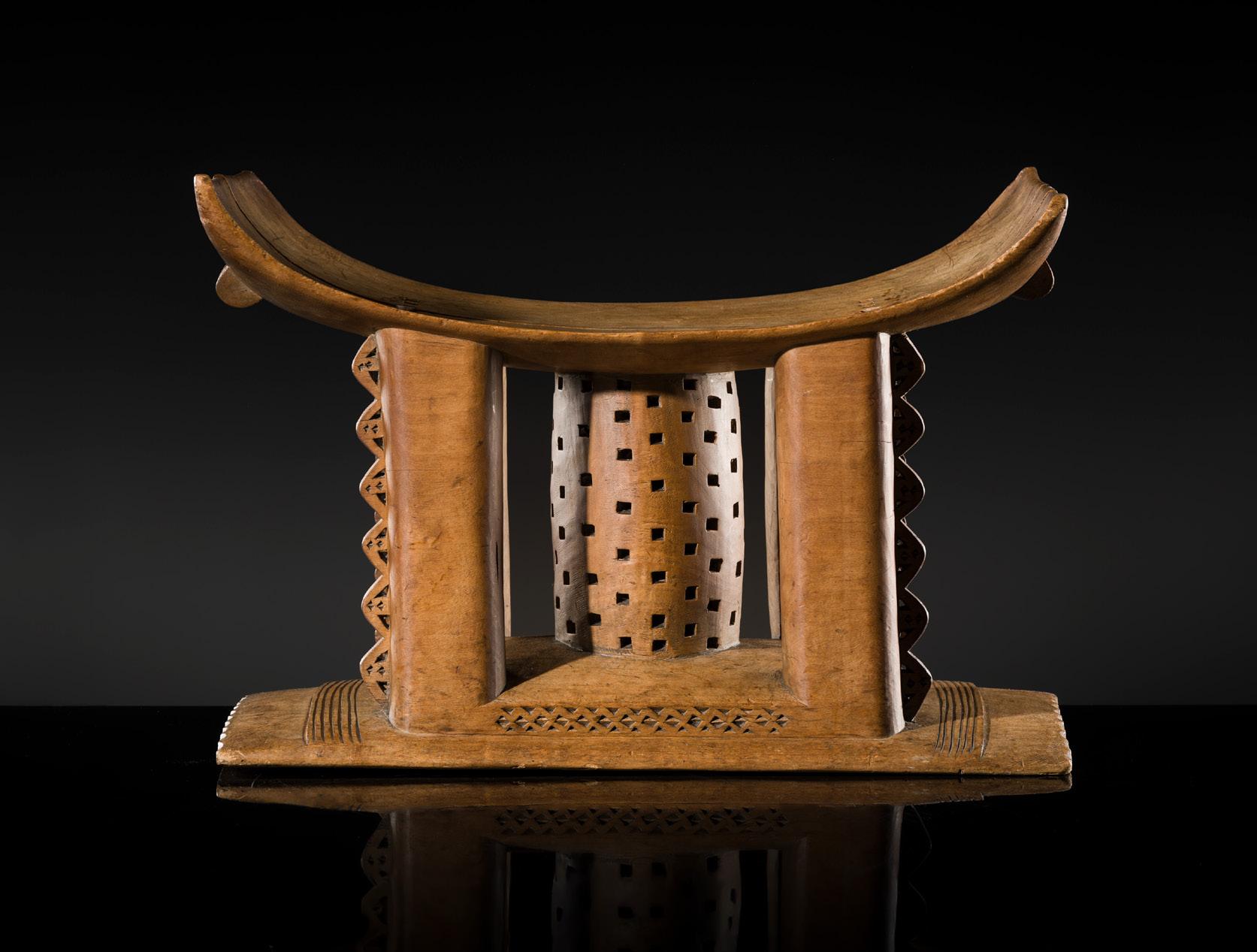
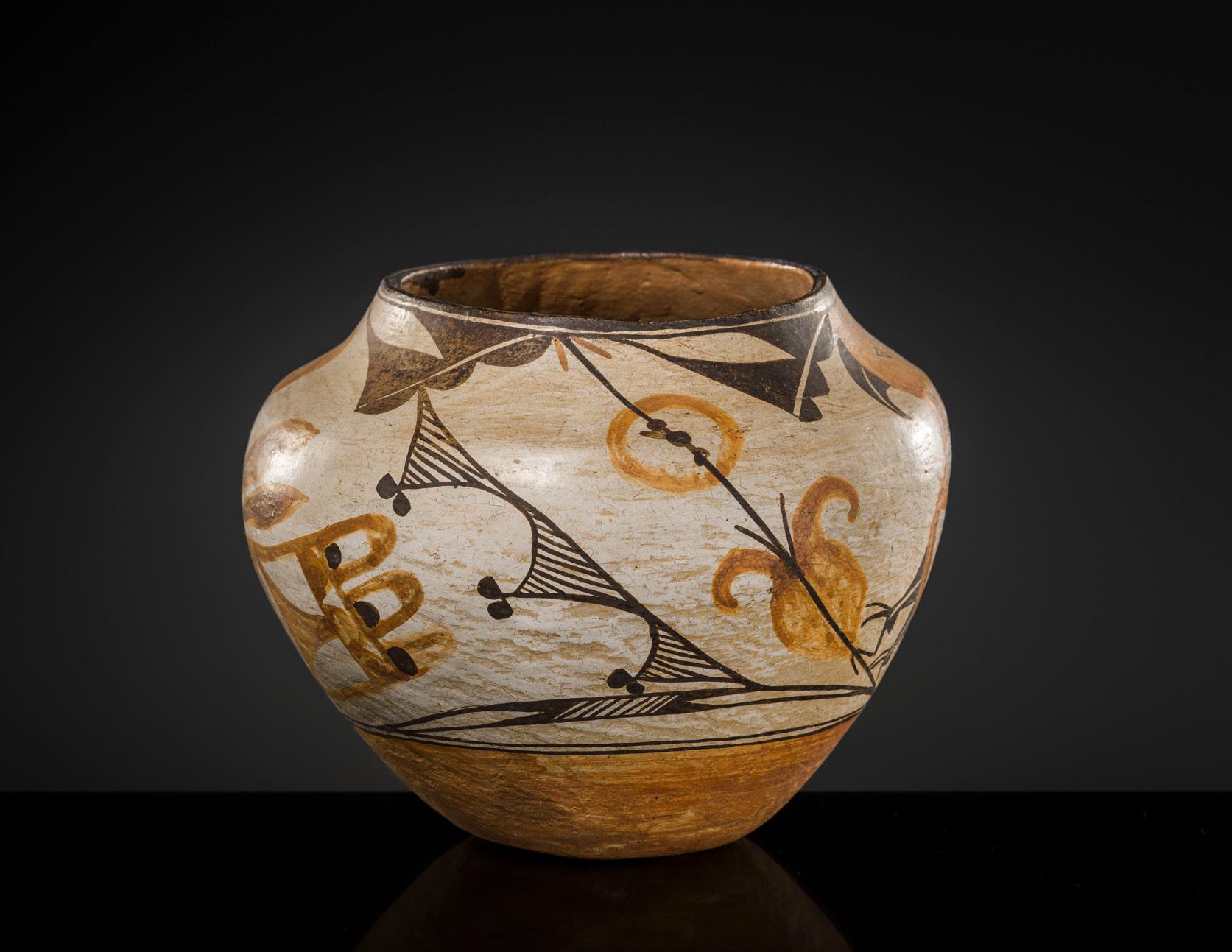
153 A POLYCHROME POTTERY ‘PARROT’ VASE (OLLA), ACOMA
Western New Mexico, United States, late 19th to early 20th century. Of classic form, the compressed globular body gently tapering toward the foot, with high-angled shoulders rising to a short, slightly waisted neck terminating in a broad mouth. The exterior vividly painted with an abstracted pair of parrots, their bodies articulated with geometric patterning, accompanied by stylized fruit-like forms rendered in orange and dark brown. The scene framed above and below by thin double-line bands set against an earthy ground, while the lower portion of the vessel covered overall in a bright orange slip. The interior left unglazed, revealing the natural buff-colored ceramic body beneath.
Provenance: The Collection of Sam and Myrna Myers, Paris, France. Acquired between circa 1965-2012.
Condition: Very good condition with surface wear and inherent firing irregularities. Distinct traces of weathering and signs of usage. Light rubbing and flaking to pigments. Few minute nicks and minor nibbling along the upper rim.
Weight: 885.6 g
Dimensions: Height 16.5 cm, Diameter 20.5 cm
Bird imagery on Acoma Pueblo pottery has been a prominent feature since prehistoric times. Early representations were predominantly abstract rather than naturalistic, attaining a notable apex in the Sikyatki polychrome tradition of the Hopi, dated approximately between 1375 and 1650. The representational parrot motif exemplified on Acoma vessels such as the present lot emerged in the mid-nineteenth century and has remained largely consistent, exhibiting minimal influence from non-indigenous sources. Within traditional Pueblo cosmology, birds and feathers are intimately associated with supplications for rain and agricultural fertility.
Literature comparison:
Compare a closely related polychrome ‘parrot’ pottery jar, Acoma Pueblo, late 19th century to early 20th century, from the private collection of Aby
Warburg, in the Museum am Rothenbaum. Kulturen und Künste der Welt (MARKK), inventory number B 6089. Compare a closely related Acoma polychrome ‘parrot’ pottery jar, Acoma pueblo, late 19th to early 20th century, 29.5 cm high, in the Spencer Museum of Art, University of Kansas, accession number 2020.0015.
AUCTION RESULT COMPARISON
Type: Closely related
Auction: Bonhams San Francisco, 4 December 2006, lot 4019
Price: USD 23,900 or approx. EUR 32,500 converted and adjusted for inflation at the time of writing
Description: An Acoma polychrome jar (olla)
Expert remark: Compare the closely related form, chromatic treatment, and decorative motifs. Note the larger size (27.9 cm).
AUCTION RESULT COMPARISON
Type: Closely related
Auction: Bonhams San Francisco, 3 June 2013, lot 5212
Price: USD 5,000 or approx. EUR 6,000 converted and adjusted for inflation at the time of writing
Description: An Acoma polychrome jar
Expert remark: Compare the closely related form, chromatic treatment, and decorative motifs. Note the larger size (23.5 cm).
Estimate EUR 4,000
Starting price EUR 2,000
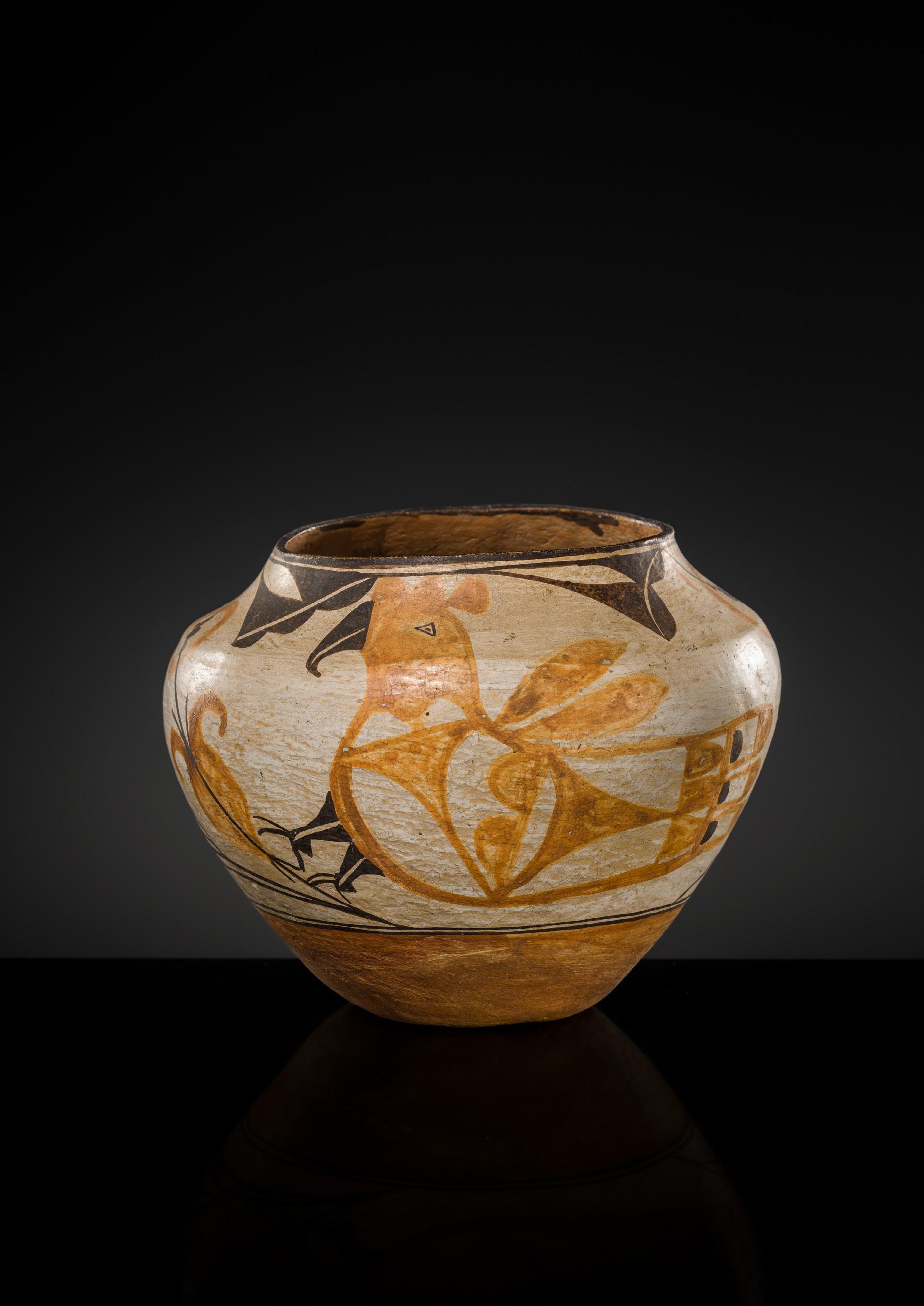
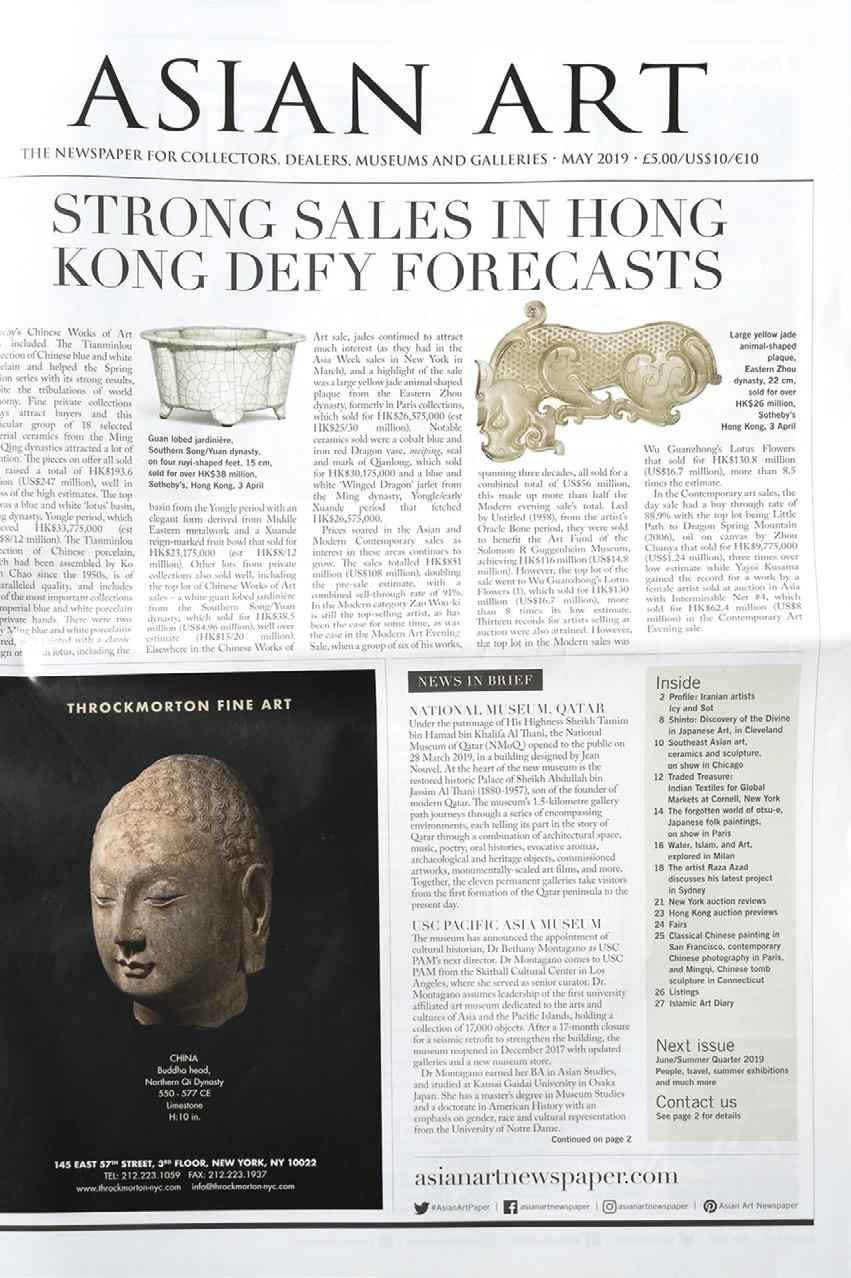
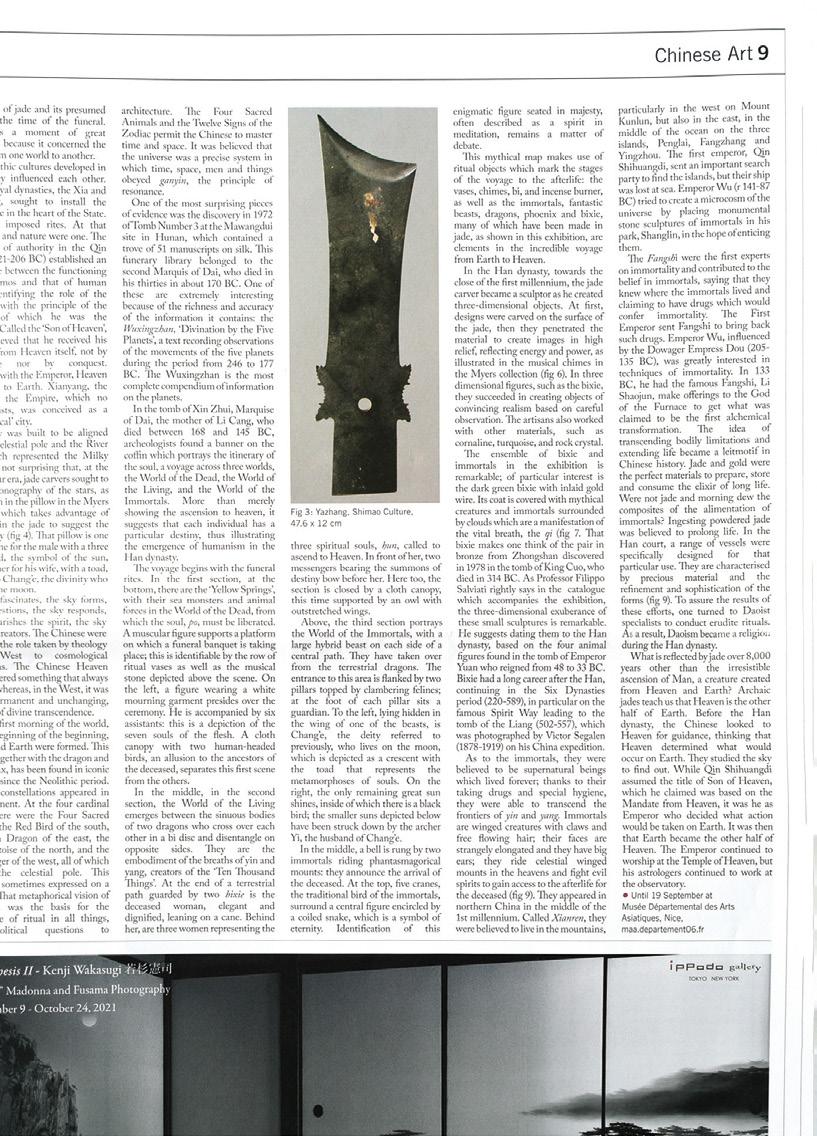
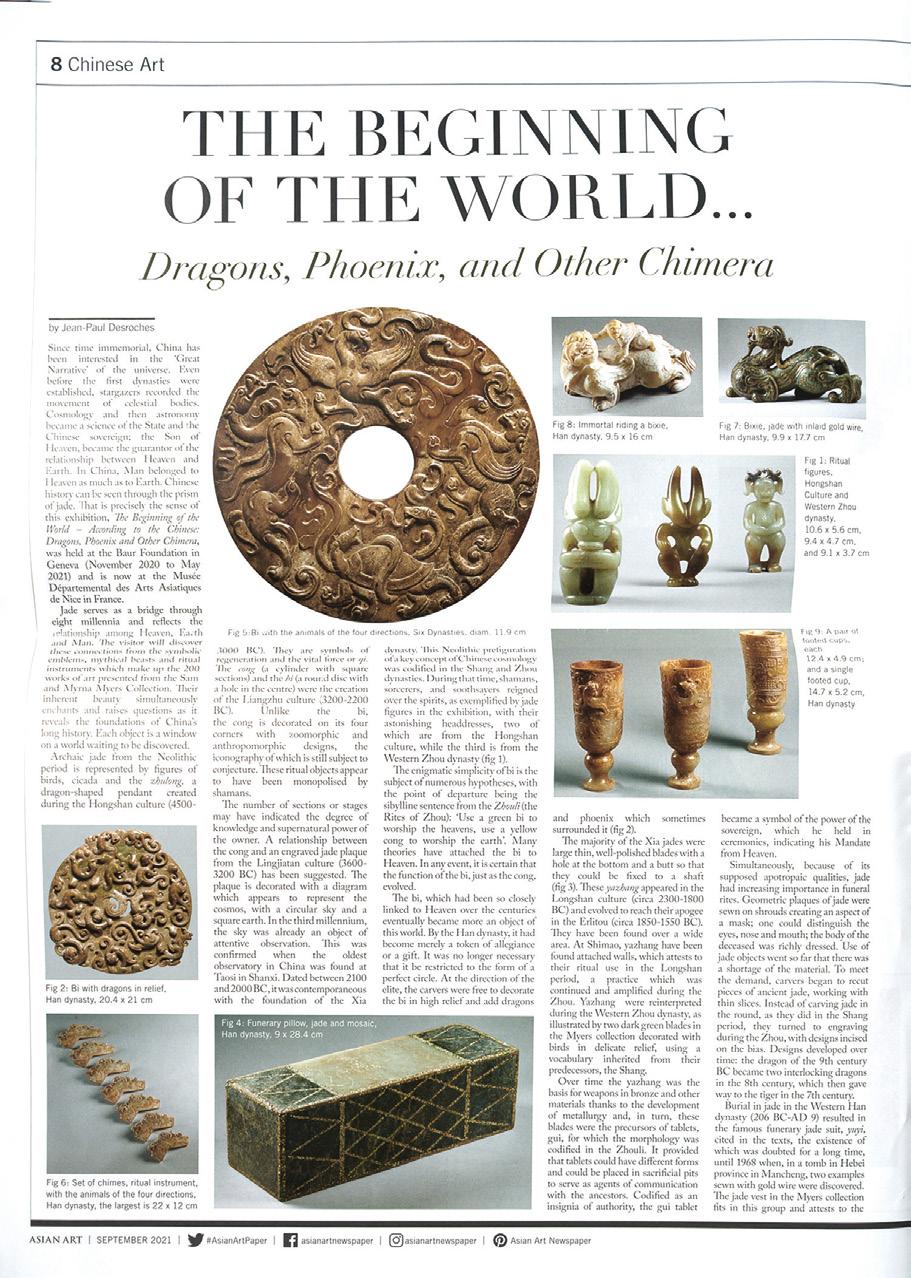
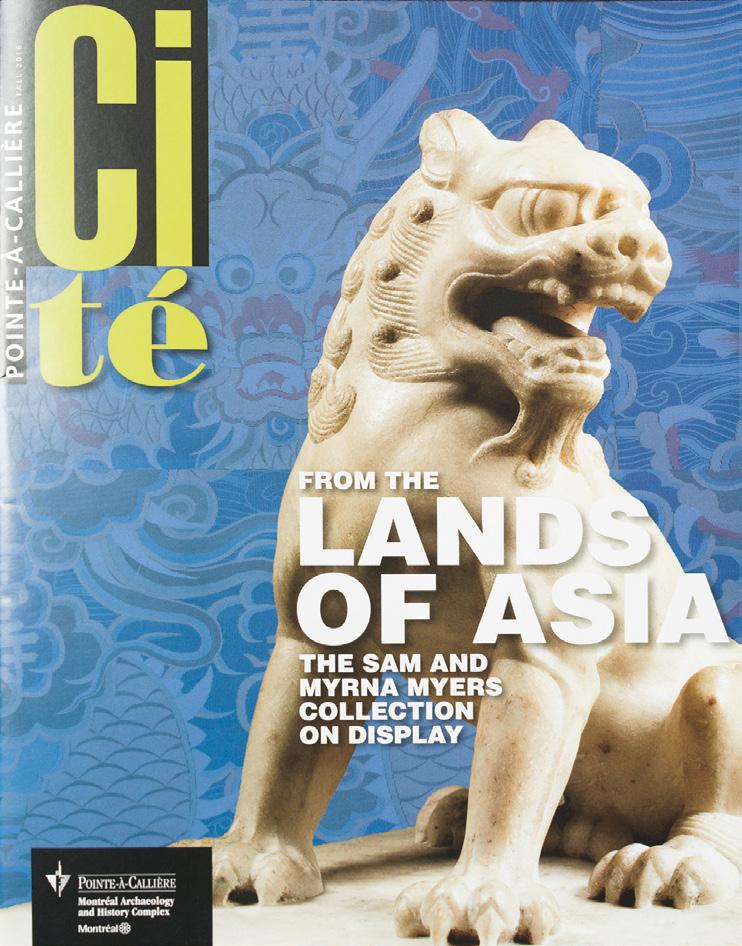
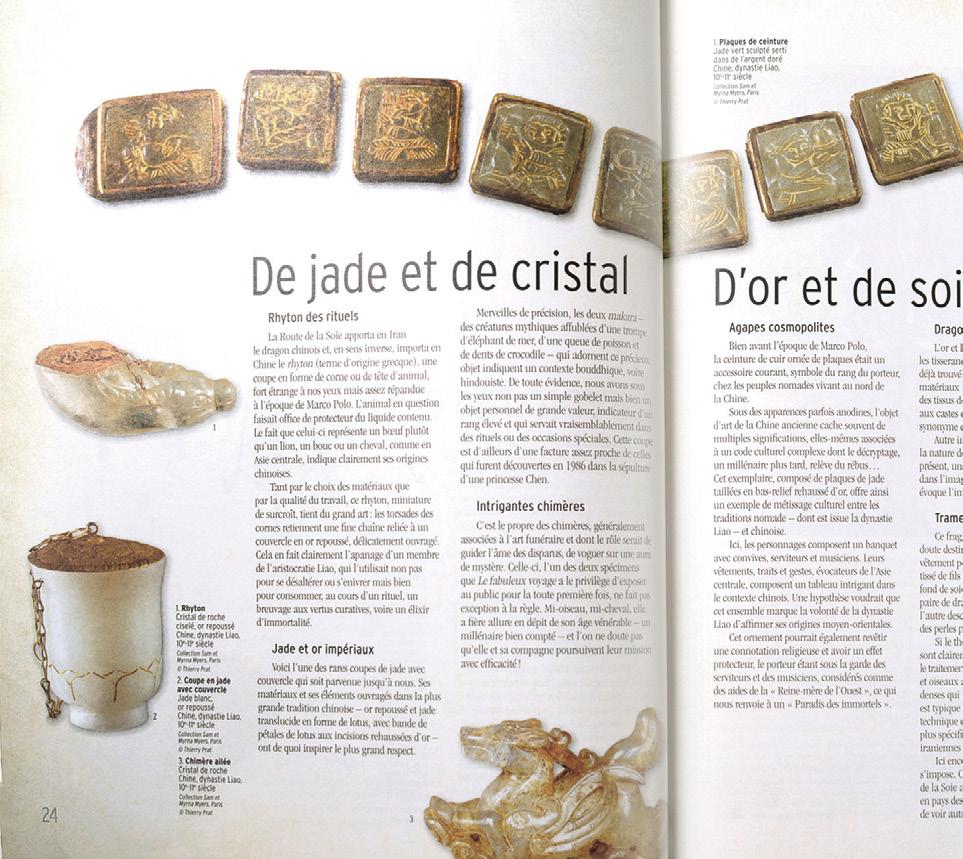

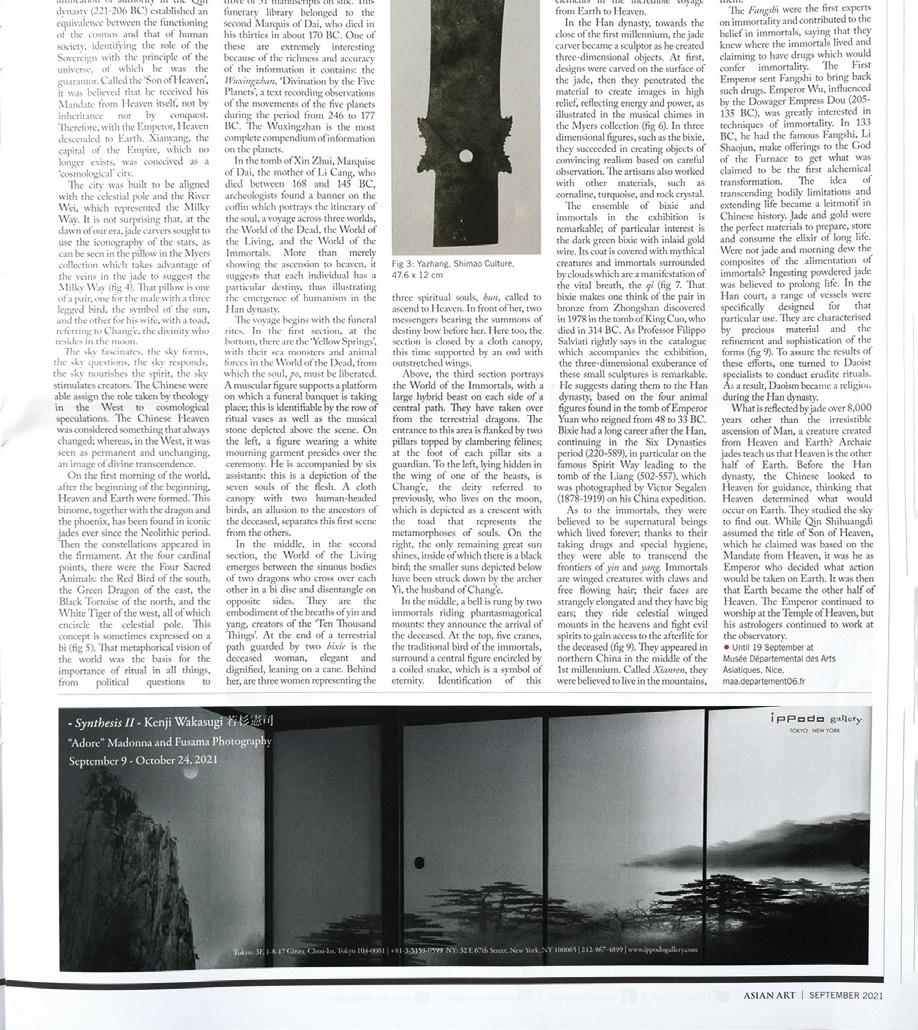

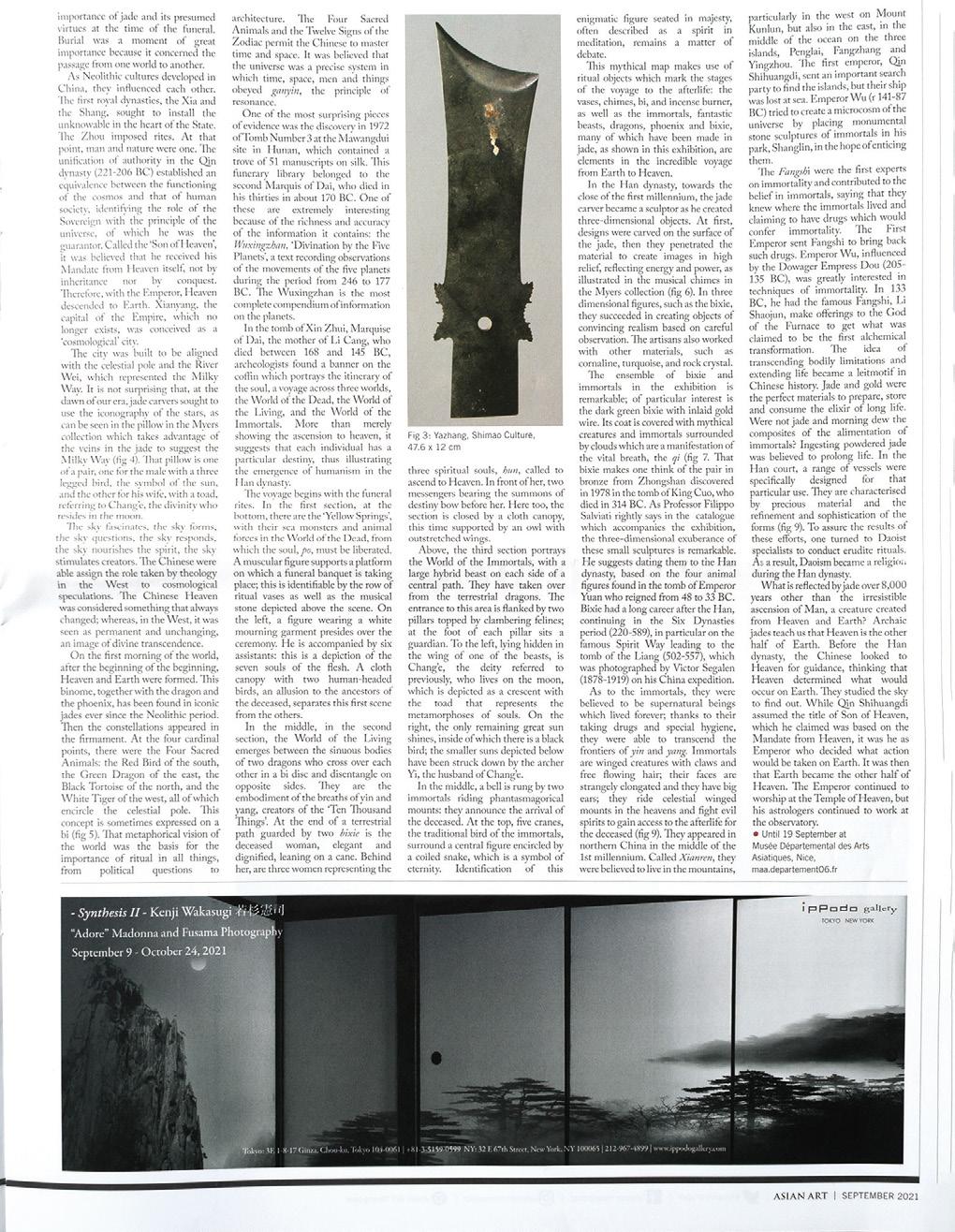
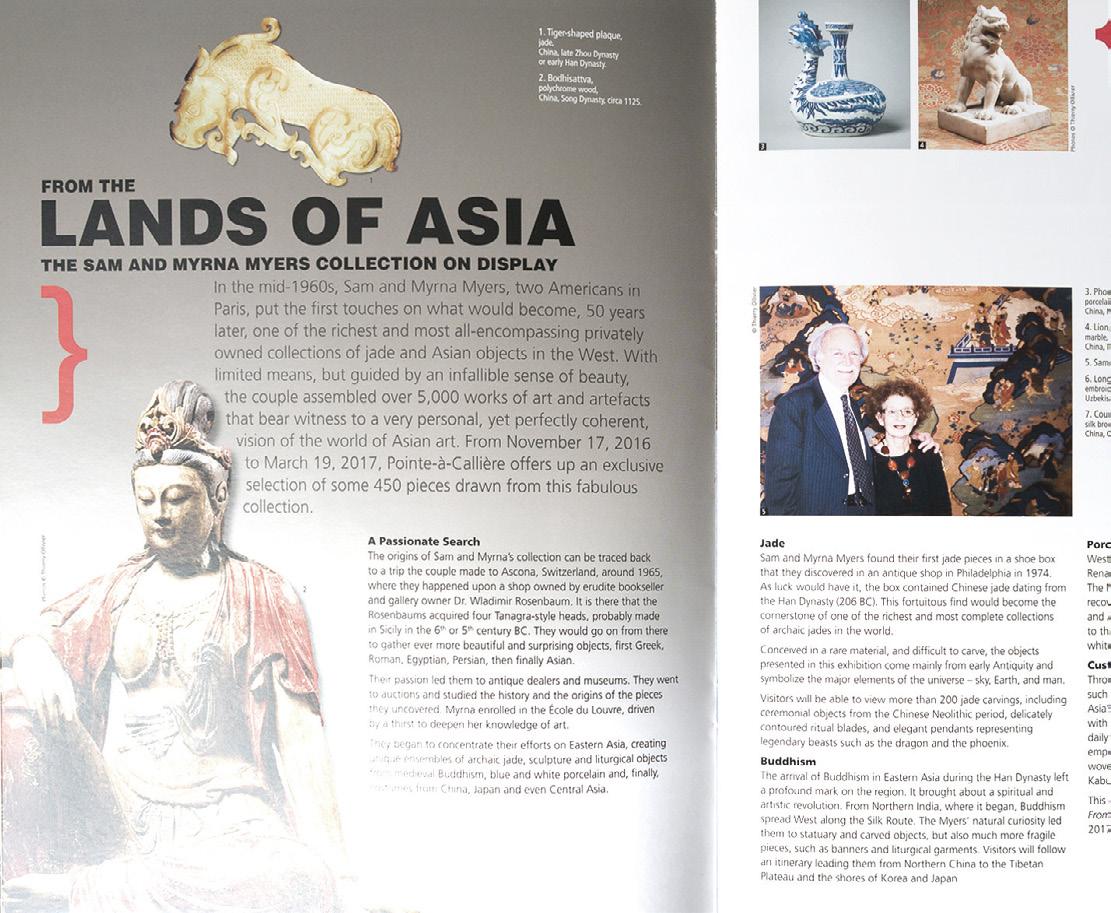
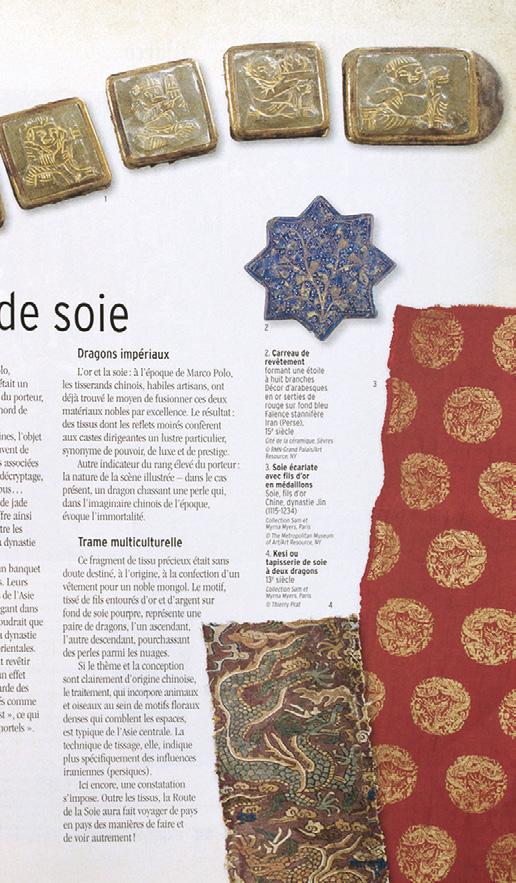
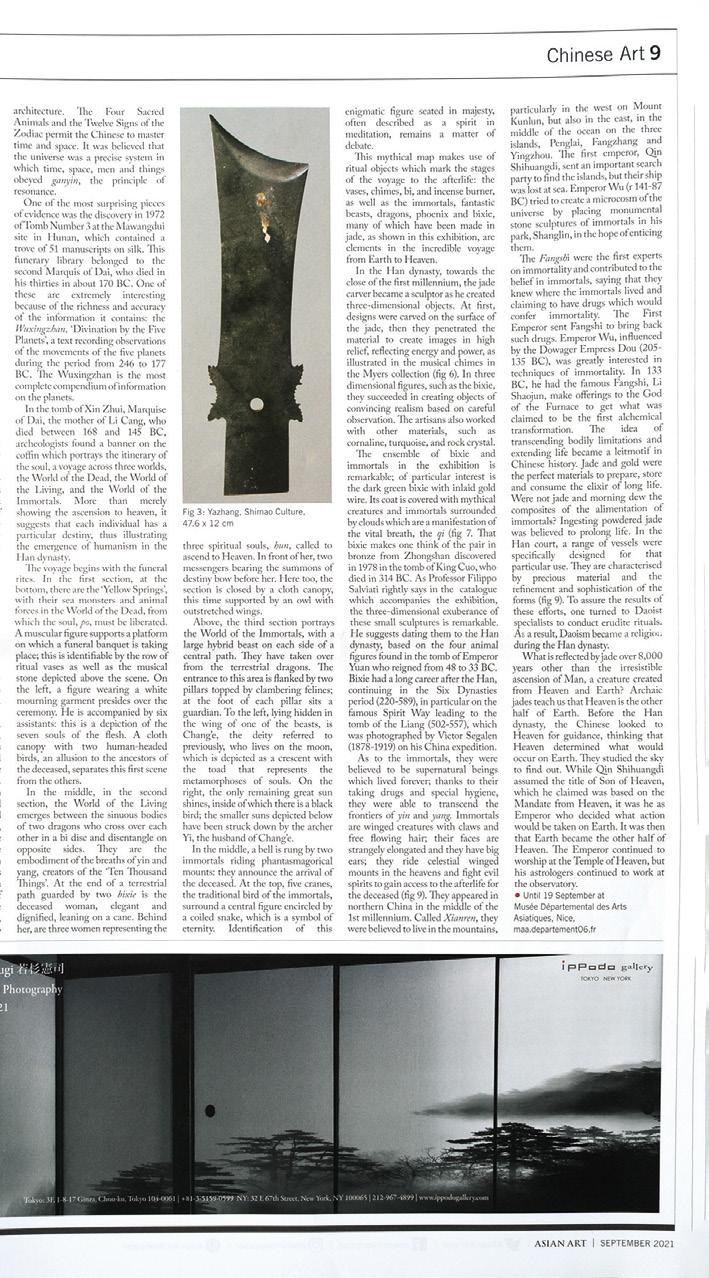
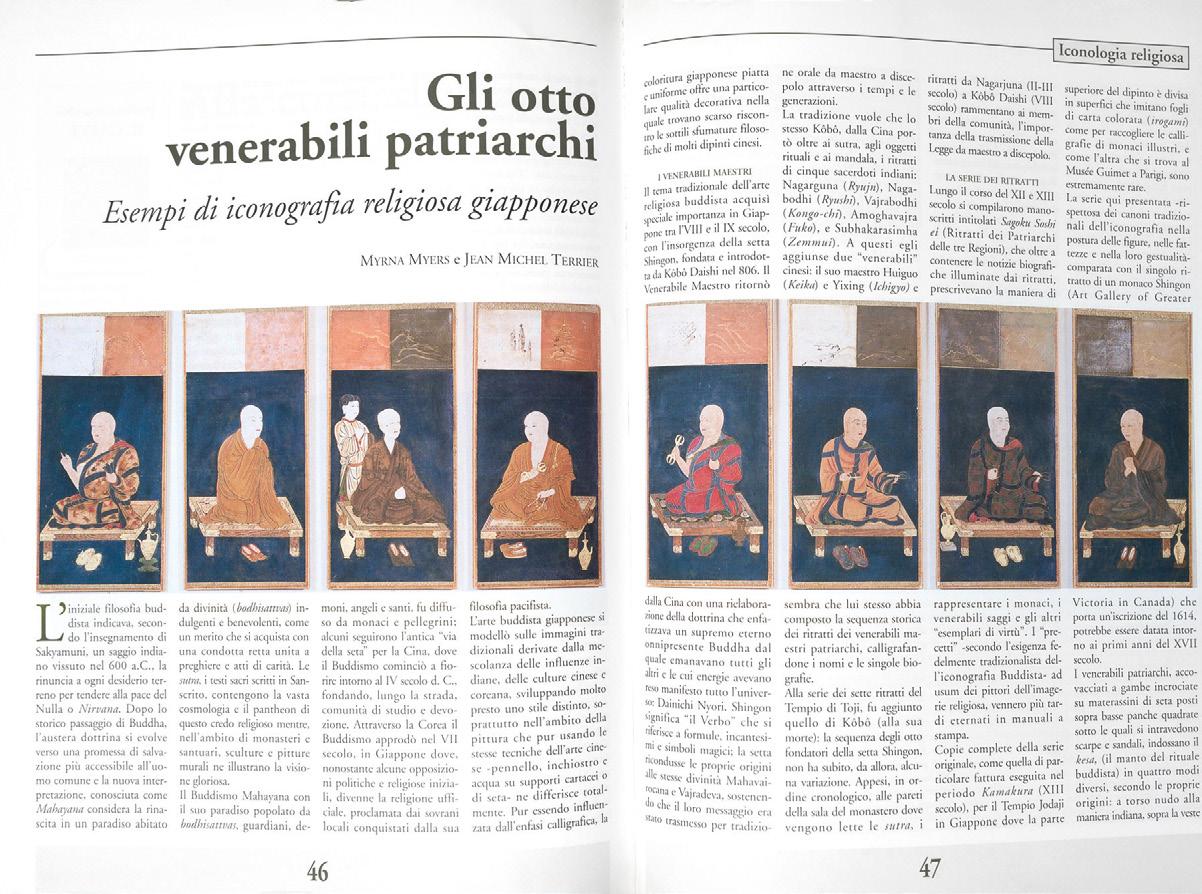
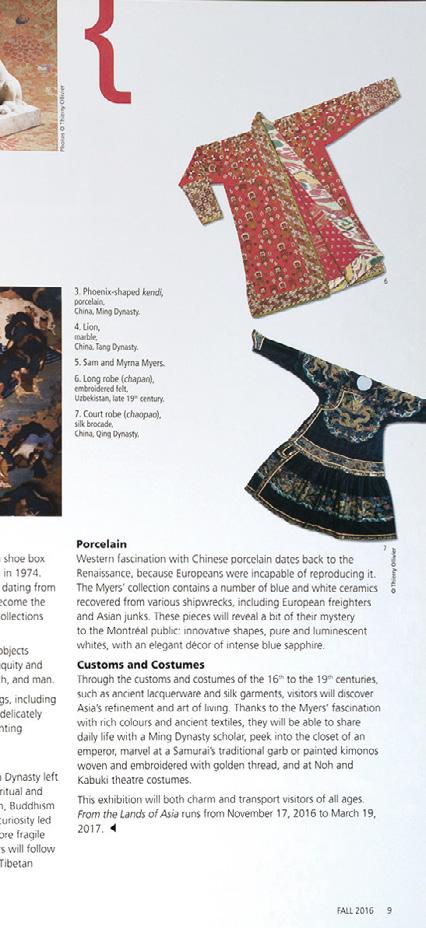
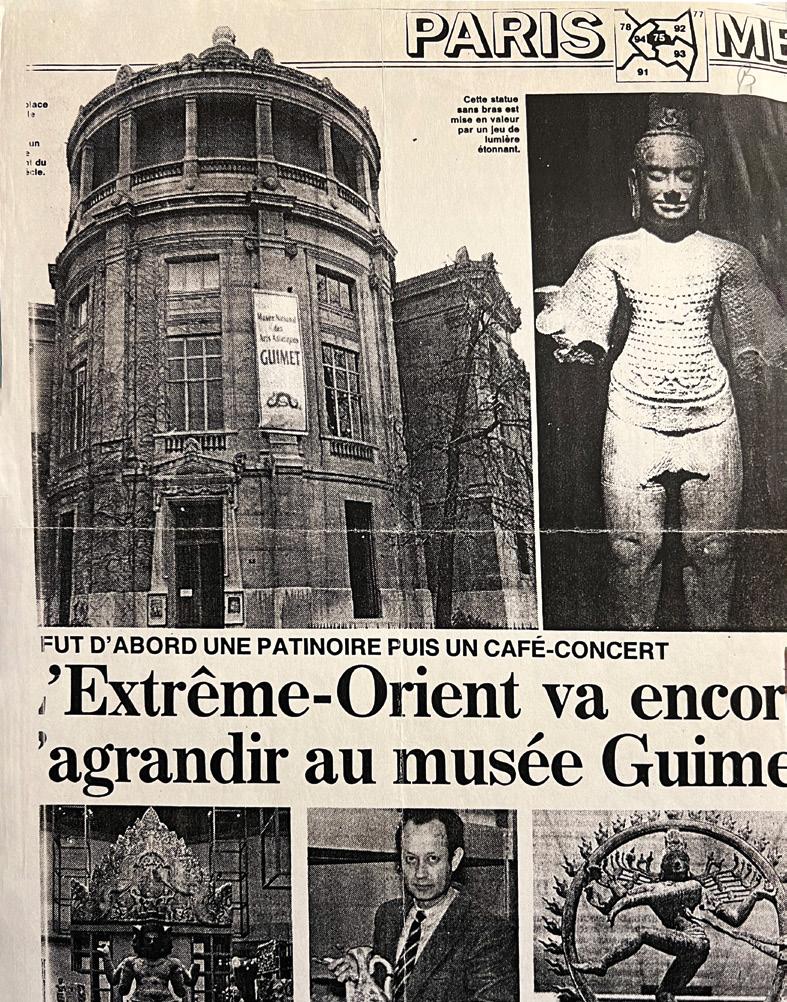
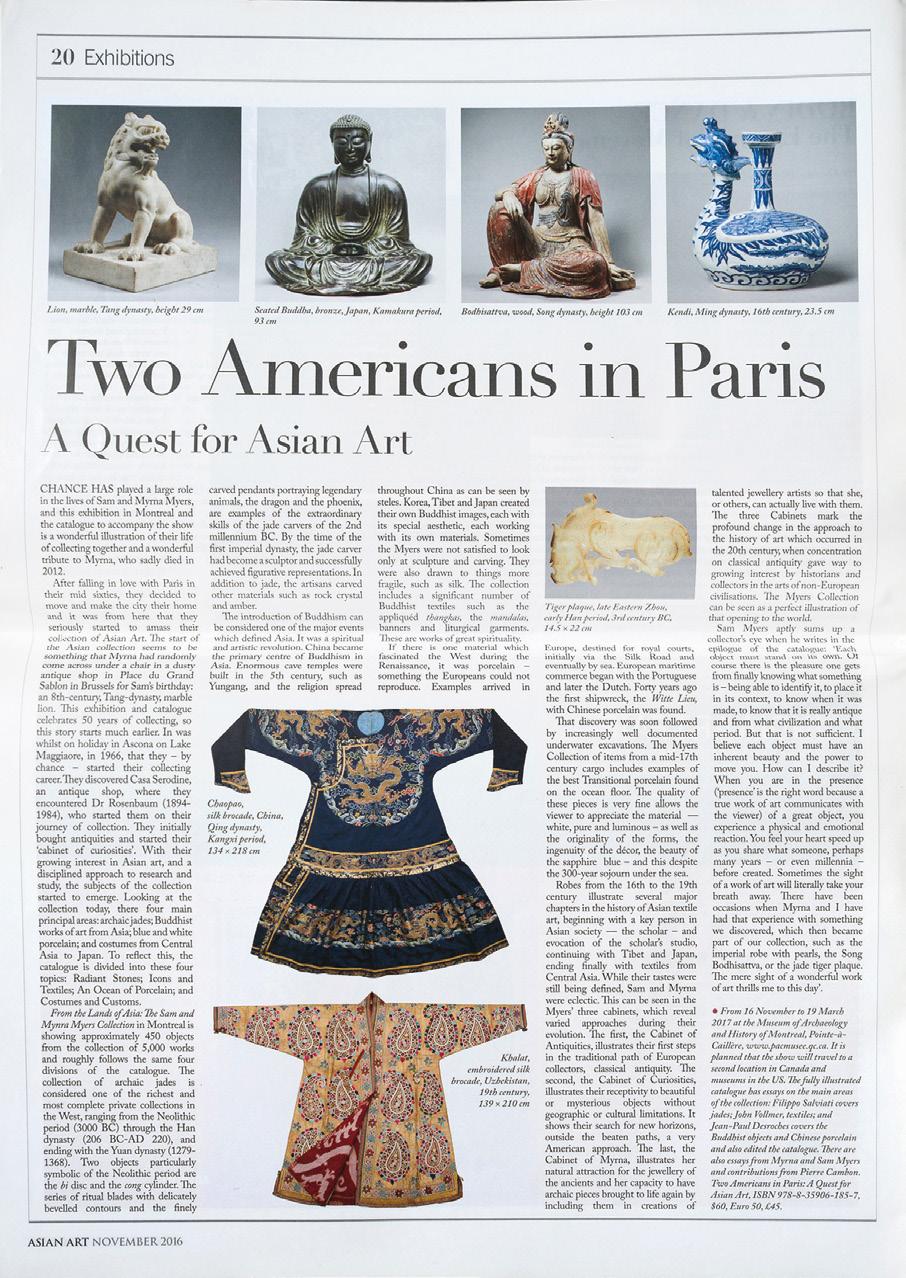
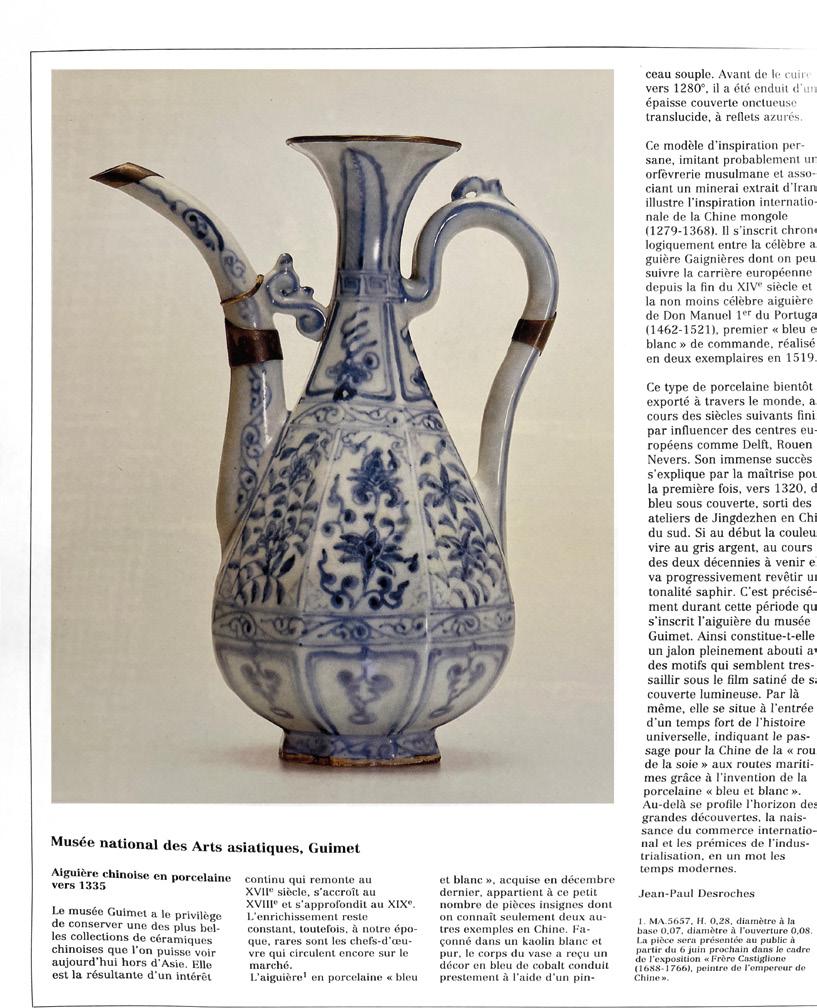
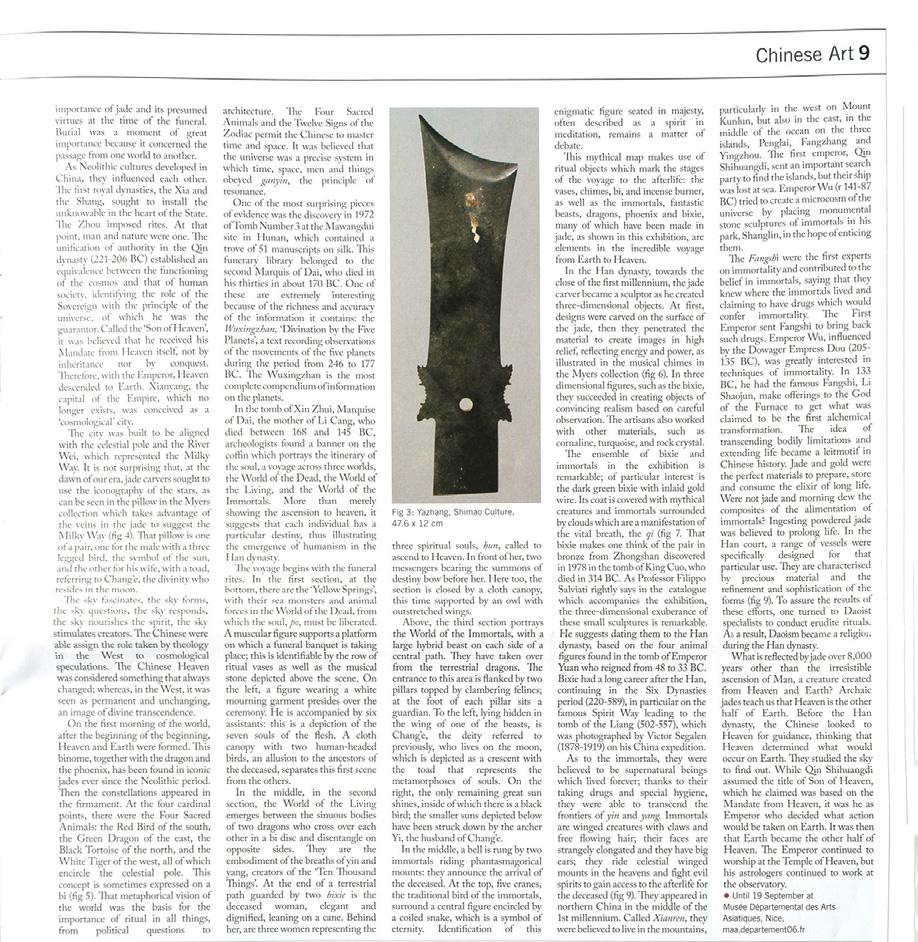
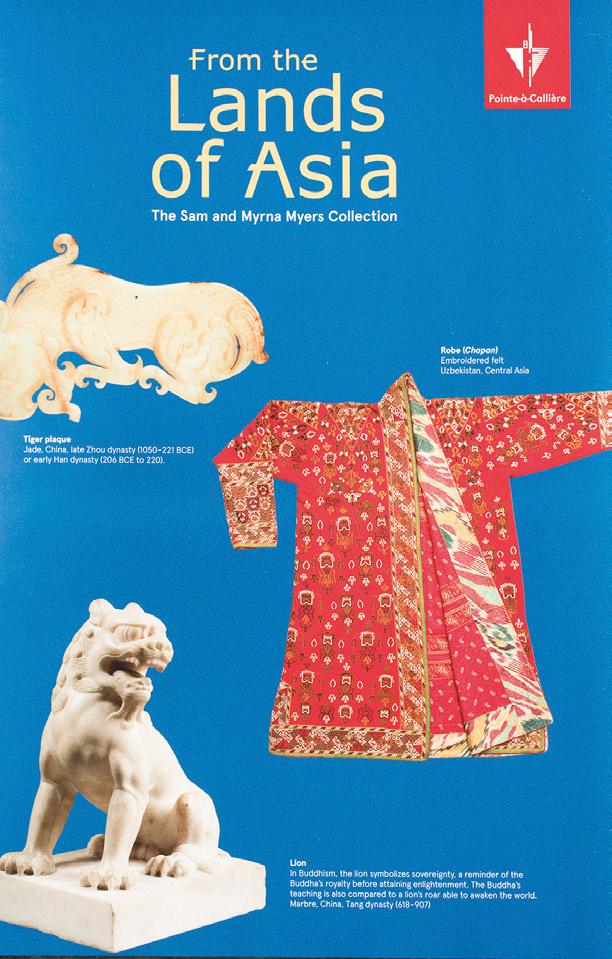
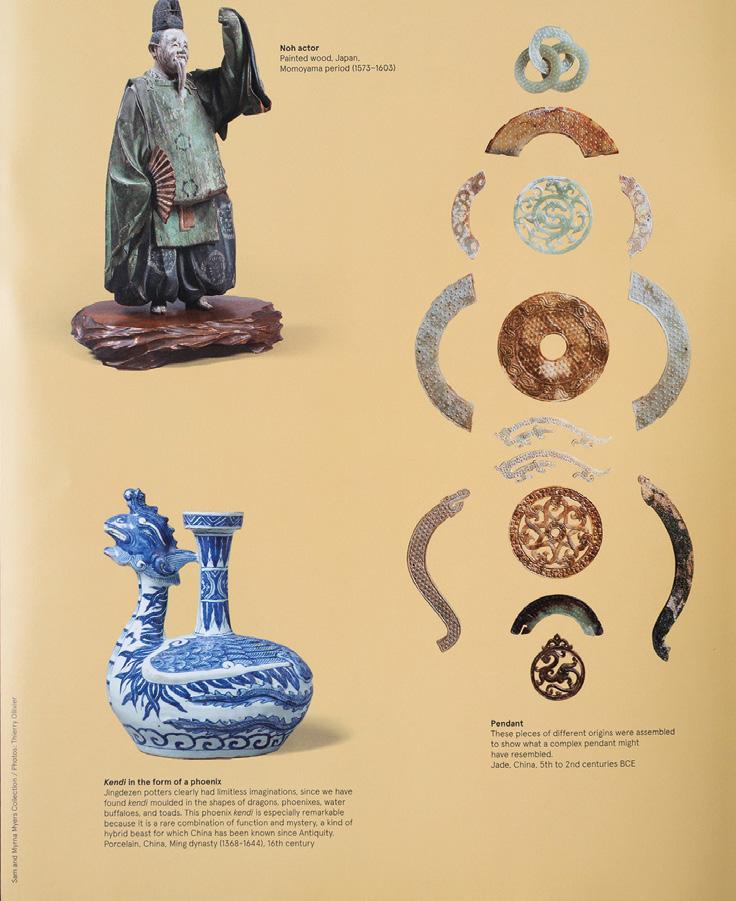
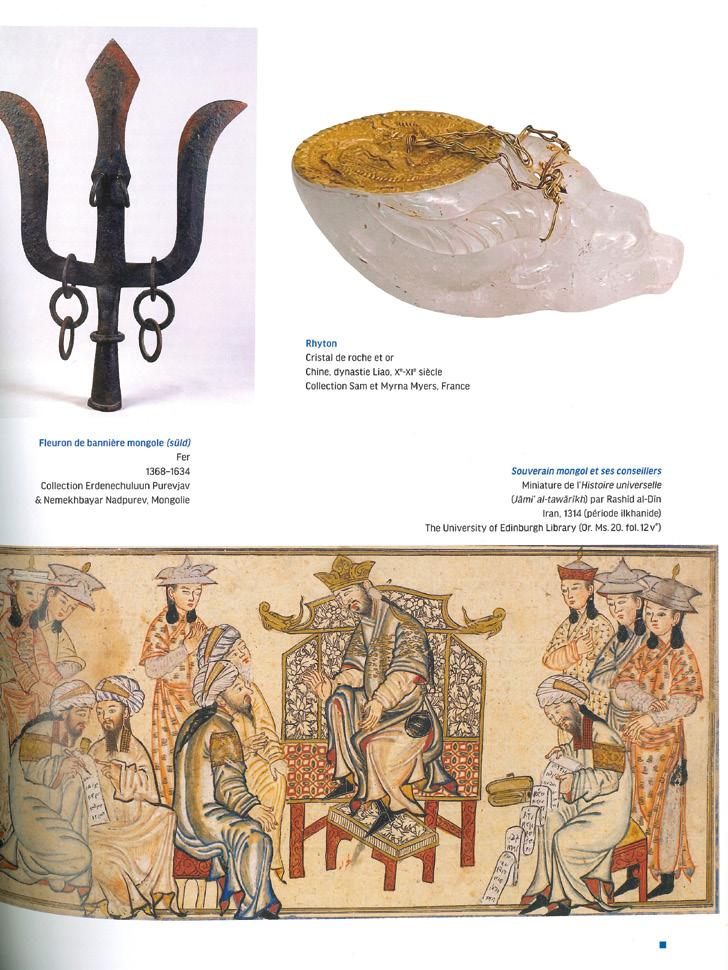
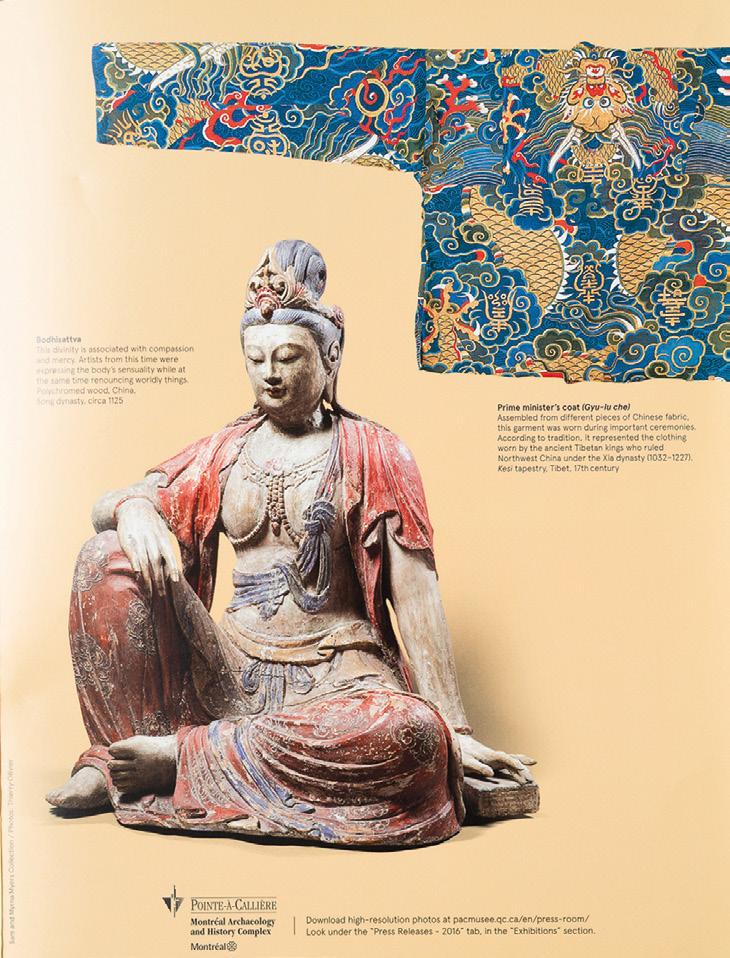
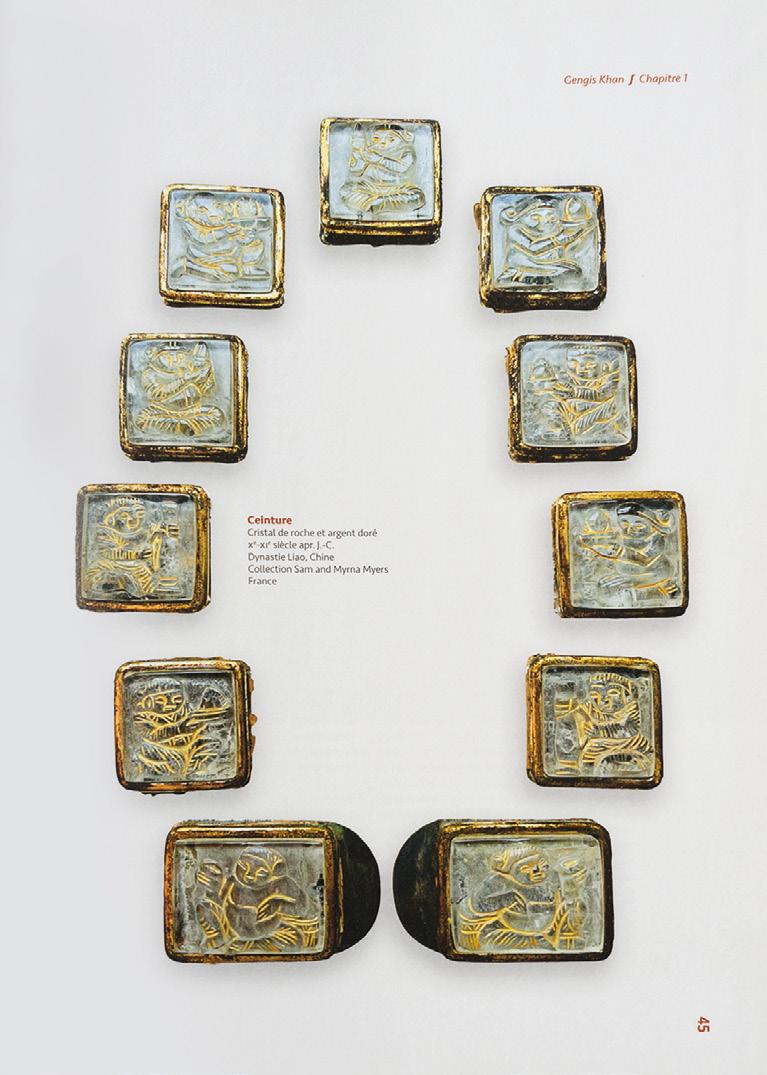

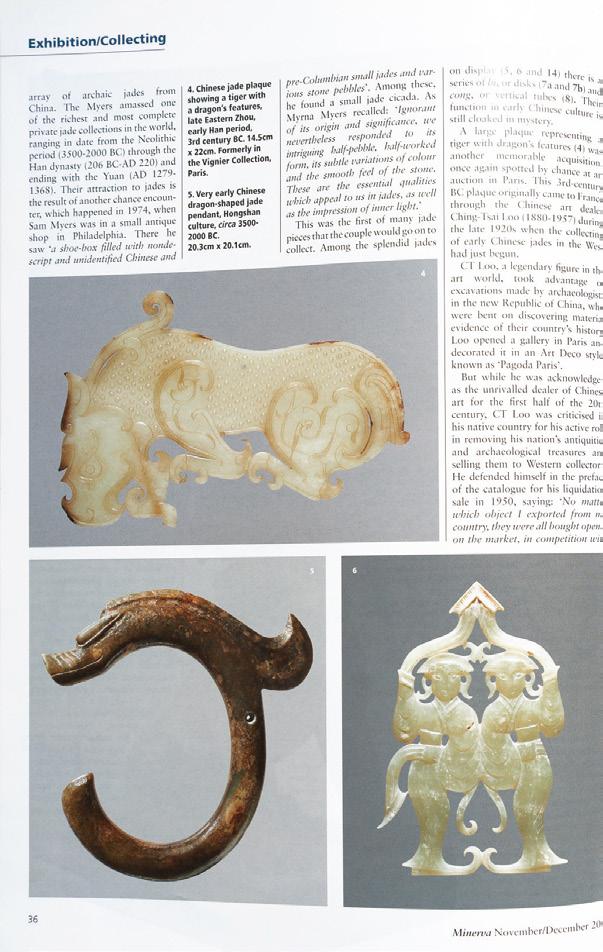

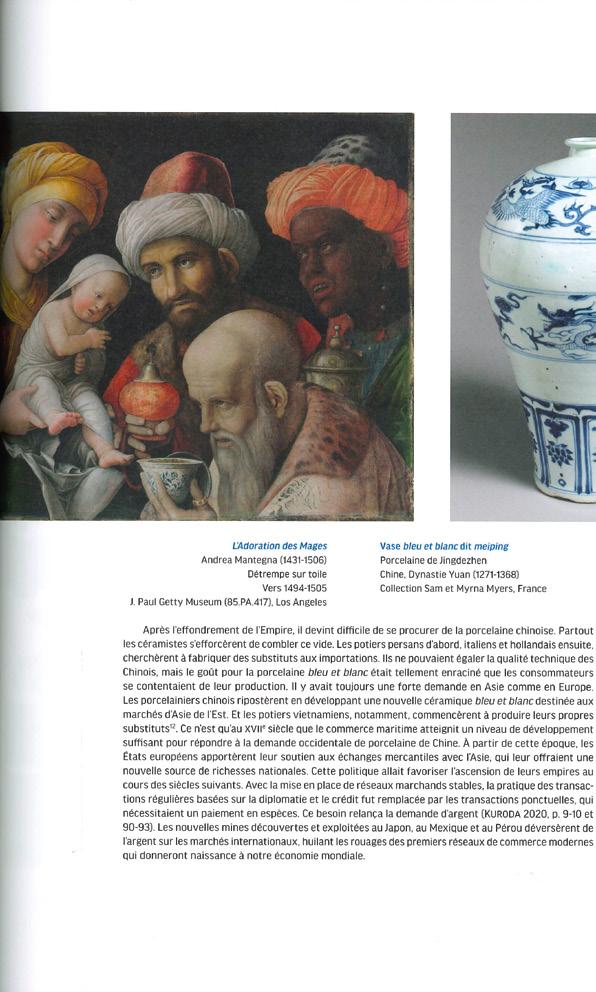
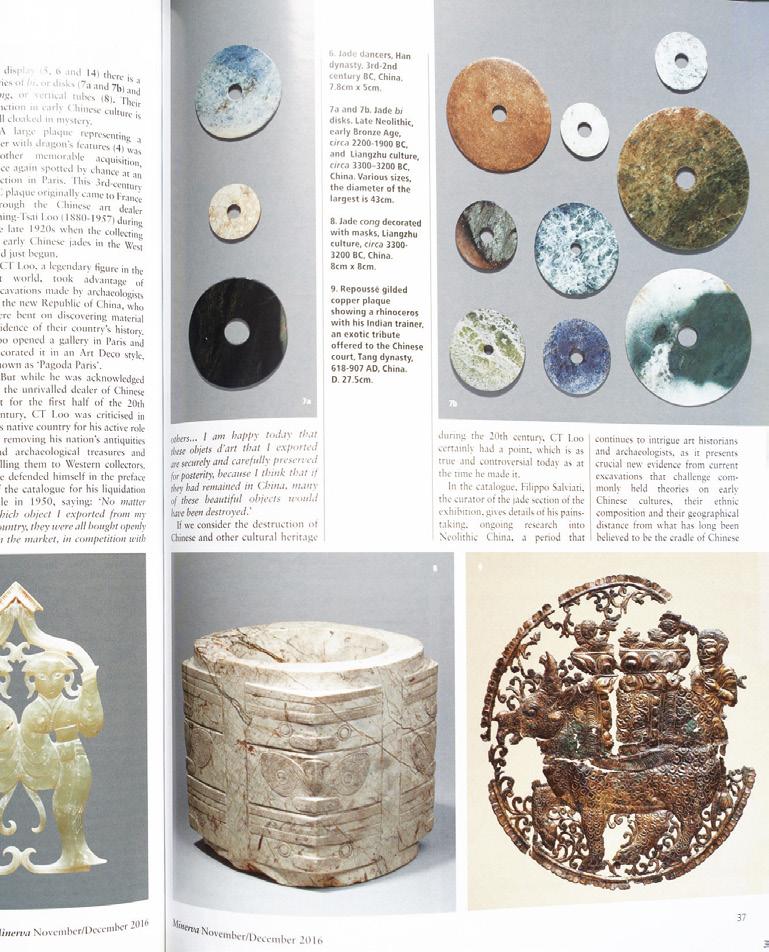
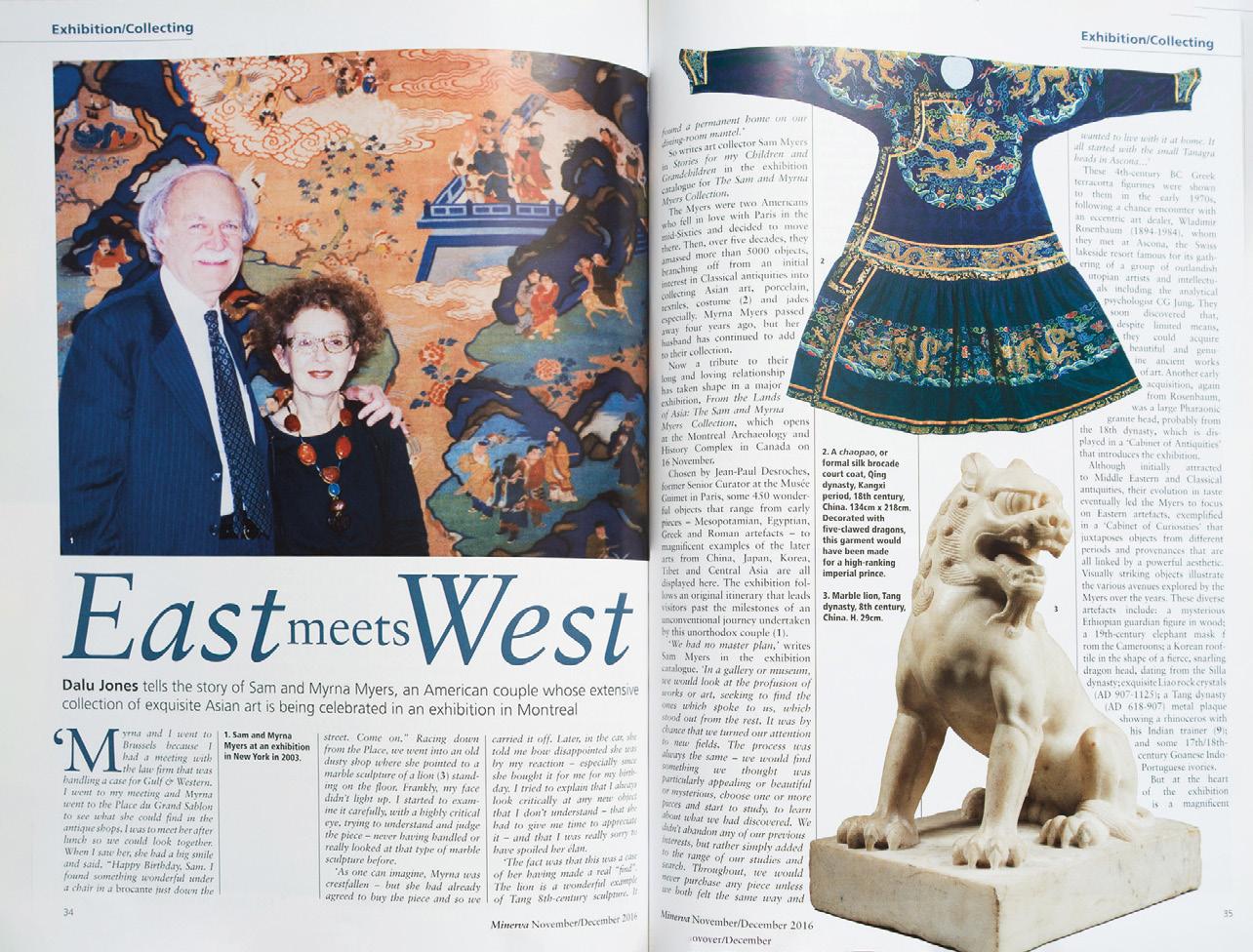
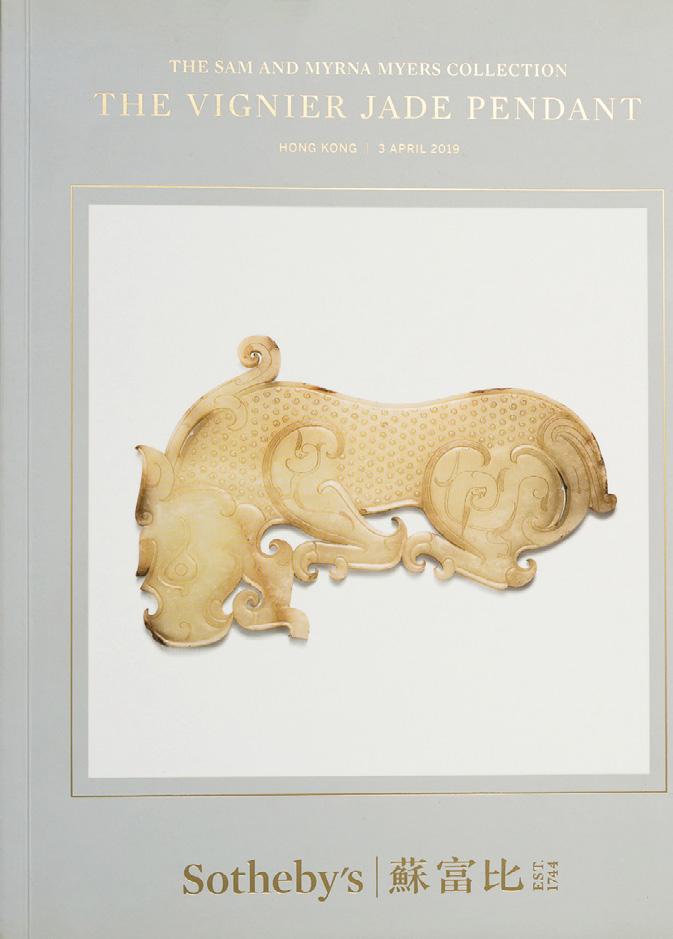
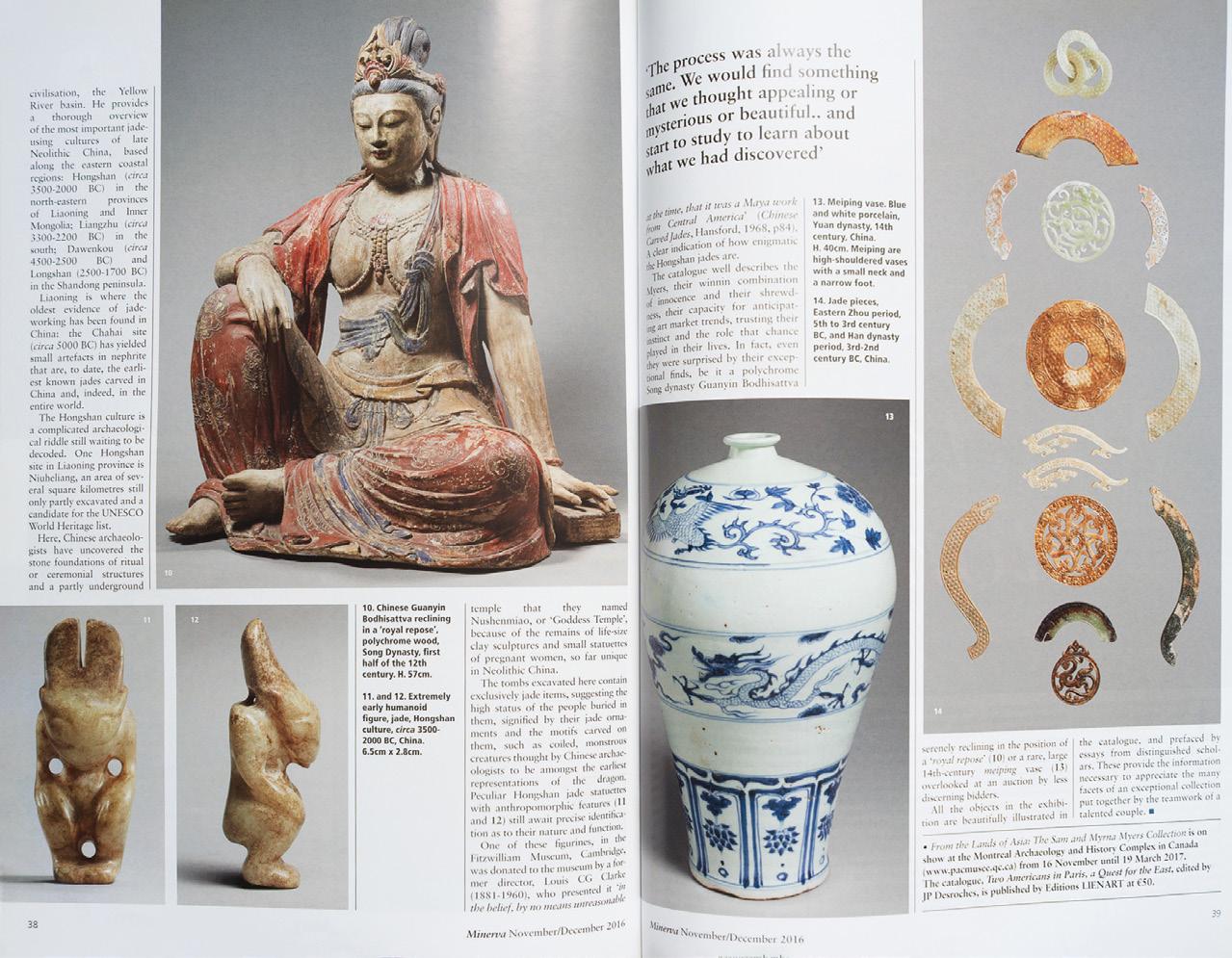
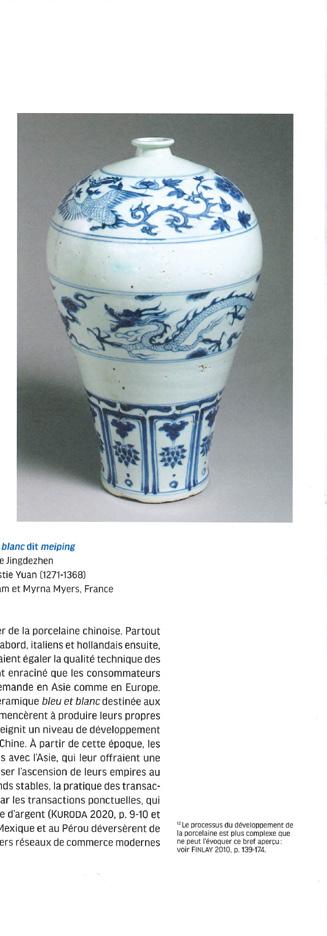
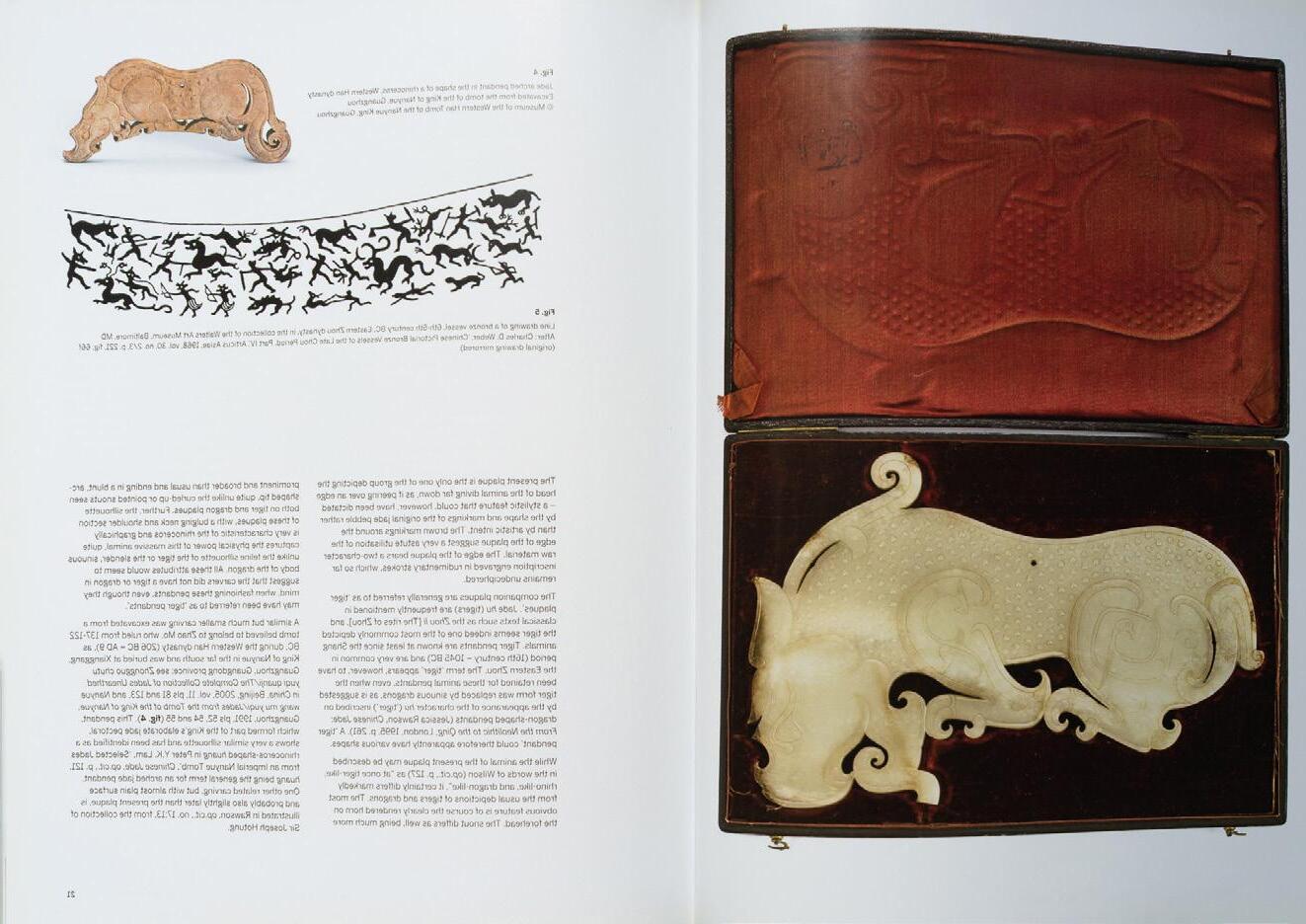
§ 1) The auction shall be carried out in accordance with the provisions of the rules of procedure of GALERIE ZACKE©, SZA VERSTEIGERUNGEN UND VERTRIEBS GMBH, Zelinkagasse 6, 1010 WIEN (hereinafter referred to as the company) as well as in accordance with sections 244246 of the GEWERBEORDNUNG [Industrial Code] of 1994. The auction shall be carried out on commission. The auctioneer shall be entitled to withdraw lots exceptionally, to conduct the auction deviating from the order of the catalog numbers and to offer lots jointly. In the event of any dispute concerning a double bid or if the auctioneer has missed a bid, the auctioneer shall be entitled to revoke acceptance of a bid and to continue auctioning the item. The figures stated in the catalog shall be the highest bid in Euro (€) expected by the respective expert. As a rule, the bid shall be increased by 10% of the last bid. (See table of the bidding increments).
§ 2) The acceptance of a bid shall be granted to the highest bidder unless a hidden reserve has been agreed upon with the consignor of the item in question. Such a hidden reserve (also called limit or just reserve) shall be the minimum price under which the item will not be sold during the auction. This reserve will be disclosed upon request and after the auction only and may exceed the estimate. The auctioneer will in this case bid on behalf of the seller against all other bidders until the reserve has been reached. If a reserve is not reached during the auction, the auctioneer will knock down the item to the highest bidder at the final bid, but the sale will be conditional of the acceptance of this final bid by the seller. In this case the highest bidder shall be bound to his/her last bid for a term of 8 days starting with the day of the knockdown. If the winning bidder does not receive a written cancellation notice within this term of 8 days, the knockdown becomes unconditional and the sale is final. Typically, only a minority of all items in an auction have a hidden reserve.
§ 3) Most items shall be subject to differential taxation. A uniform surcharge of 25% plus the value added tax applicable to the surcharge to the amount of 20% shall be added to the achieved highest bid (final and highest bid). Thus, the surcharge shall be 30% of the final and highest bid in total. Items with added VAT are marked † in the online catalog.
§ 4) In the event of sales abroad, the value added tax will be repaid if the item is sold to a country which is not a member country of the European Union (third country), the legal requirements are met, and the proof of exportation is provided. The value added tax shall not be shown separately on the invoice.
§ 5) The auction buyer must pay the purchase price immediately upon acceptance of the bid (final and highest bid plus 25% surcharge, plus the value added tax applicable to the surcharge to the amount of 20%, or the added VAT on top of the final price, when a lot is highlighted accordingly in the auction catalog). The company may grant an auction buyer a term of payment for the purchase price in whole or in part when this has been formally applied for in writing before the auction.
§ 6) In the event of a term of payment, or any payment delay, in whole or in part, the company shall be entitled to charge default interest (12% p.a.) as well as storage charges (2.4% pf the final and highest bid per month commenced) after 14 days upon acceptance of the bid. The item purchased at auction shall be handed over exclusively upon full payment of the purchase price including all costs and charges accrued since the acceptance of the bid.
§ 7) The buyer should take acquired items into possession, as far as possible, immediately or after the end of the auction. Items which have been fully paid for shall be handed over in our show rooms in GALERIE ZACKE, Zelinkagasse 6, 1010 VIENNA. If a deferred purchase price is not paid within the set period, the company shall be entitled to auction the item again in order to recoup its claim from the defaulting auction buyer. In this case, the defaulting auction buyer shall be liable to the company for the total loss of commission incurred by the company due to the re-auctioning as well as for any default interest and storage charges.
§ 8) The company shall be entitled to a lien on all items of the buyer irrespective of whether the buyer bought them within the scope of an auction or in free sale or the company secured ownership of these items otherwise. This lien shall serve to secure all current and future, qualified, limited and unmatured claims to which the company is entitled and which result from all legal transactions concluded with the buyer.
§ 9) The items received for auction will be exhibited and may be viewed prior to the auction. In doing so, the company shall give everyone the opportunity to check the nature and the condition of the exhibited items to the extent deemed possible within the scope of the exhibition. Every bidder shall be deemed to act on its own behalf unless it provides a written confirmation saying that it acts as a representative or agent of a well-known principal. The company may refuse bids; this shall particularly apply if a bidder who is unknown to the company or with whom the company has no business connections yet does not provide a security deposit before the auction. However, in principle there shall be no claim to accept a bid. If a bid has been refused, the previous bid shall remain effective.
§ 10) The company’s experts evaluate and describe the items received for auction and determine the starting prices unless otherwise stated in the catalog or expert opinion. The information concerning production technique or material, state of preservation, origin, design and age of an item is based on published or otherwise generally accessible (scientific) findings concluded by the company’s expert with the necessary care and accuracy. The company shall warrant to the buyer according to §34-38 of the AGB (Terms and Conditions) that properties are correct provided that any complaints referring to this are made within 45 days after the auction day. Subsequent complaints shall be excluded in principle. The company shall not be liable for any further information in the catalog and expert opinion as well. This shall also apply to illustrations in the catalog. The purpose of these illustrations is to guide the potential buyer during the preview. They shall not be authoritative for the condition or the characteristics of the pictured item. The published condition reports shall only mention defects and damage affecting the artistic or commercial value significantly. Complaints concerning the price shall be excluded upon acceptance of the bid. The company reserves the right to amend the catalog online prior to the auction. These amendments shall also be made public orally by the auctioneer during the auction. In this case, the company shall be liable for the amendment only. All items offered may be checked prior to the auction. These items are used. Any claims for damages exceeding the liability named above and resulting from other material defects or other defects of the item shall be excluded. When making the bid, the bidder confirms that he/ she has inspected the item prior to the auction and has made sure that the item corresponds to the description.
§ 11) If a customer is not able to participate in an auction personally, the company shall accept purchase orders. These orders may be placed in writing via mail, e-mail, fax, www.zacke.at or a third party bidding platform. In the case of a purchase order placed by phone or orally, the company shall reserve the right to make the performance dependent on a confirmation from the principal communicated in writing. Furthermore, the company shall not be liable for the performance of purchase orders. Equal purchase orders or live bids will be considered in the order of their receipt. Bids which below the estimate shall be exhausted completely. Bids which do not correspond to the increments determined by the company (see bidding increment table) will be rounded up to the next higher increment. The table of these increments can be sent upon request. The written bid (purchase order) must include the item, the catalog number and the offered top bid limit which is quoted as the amount of the acceptance of the bid without buyer’s commission and without taxes.
Ambiguities shall be carried by the bidder. A purchase order which has already been placed may only be cancelled if the written withdrawal is received by the company at least 72 hours prior to the beginning of the auction.
§ 12) The company may refuse a purchase order without explanation or make its execution dependent on payment of a security deposit. In the event of an unsuccessful order, such a deposit will be reimbursed by the company within 5 working days. Processing of purchase orders is free of charge.
§ 13) Every seller shall in principle be entitled to withdraw the items offered for auction until the start of the auction. Therefore, it is impossible to assume liability or to give warranty for the actual offering.
§ 14) Paid items must be collected within 30 days after payment. Items which have not been collected may be re-offered without further communication at the starting price from the recent auction reduced by 50%. Items which have not been collected within 30 days after the auction or for which the company does not receive any proper shipping instructions stating the type of shipping and the address of dispatch (independent of a possibly placed purchase order) shall be stored at the owner’s risk.
Furthermore, the company shall be entitled to store items which have been purchased at auction and paid but not collected at the buyer’s risk and expense, including the costs for an insurance, with a forwarding agency. It shall be understood that the provision concerning the re-auctioning of unpaid and paid but not collected items must also apply to items not exhibited or stored on the premises of the company. The ownership shall be transferred to the buyer at the time of handing over the issuing note.
§ 15) In the case of mixed lots with a starting price of less than EUR 350.00, the company shall not warrant for the completeness or correctness of the individual items within a mixed lot.
§ 16) A registration for a bid by telephone for one or several items shall automatically represent a bid at the starting price of these items. If the company cannot reach a bidder by telephone, it will bid the starting price on behalf of this bidder when the respective lot is up for auction.
§ 17) Payments made to the company by mistake (through the payer’s fault) (e. g. due to miscalculation of the exchange rate by the payer) or payments made to the company for the same invoice several times shall be compensated in form of a credit note for goods for an indefinite period of time. The repayment of such payments in cash shall be excluded.
§ 18) Certain auction lots may exist several times (multiples). In such a case, the auctioneer may accept a second, third or even more bids from the underbidder(s). In this case, the text in the catalog and not the illustration shall be exclusively binding with regard to the warranty.
§ 19) The company reserves the right to assign to the buyer all rights and obligations resulting from the contractual relationship between the company and the seller by way of a respective declaration, as well as to assign to the seller all rights and obligations resulting from the contractual relationship between the company and the buyer by way of a respective declaration, in each case in terms of a complete assignment of contract with the result that the contractual relationshipfollowing the submission of the aforementioned declarations by the company – shall exclusively be between the seller and the buyer, all of which is in accordance with the basic model of the commission agreement. Buyers and sellers shall already now give their explicit consent to this contract assignment.
§ 20) The place of performance of the contract brought about between the company on the one hand and the seller as well as the buyer on the other hand shall be the place of business of the company. The legal relationships and contracts existing between the company, the sellers and the buyers shall be subject to Austrian law. The company, the sellers and the buyers shall agree to settle all disputes resulting from, concerning and in connection with this contract before the territorially competent court of Vienna.
§ 21) The export of certain art objects from Austria shall require a permit from the Bundesdenkmalamt [Federal Monuments Office]. The company will orally provide information about art objects for which such export permit will probably not be granted at the beginning of the auction.
§ 22) Whenever making a bid, whether personally or via an agent, in writing, online, telephone, or in any other way, the bidder fully and unconditionally accepts the Terms of Auction, the ‘Important Information’ section in the auction catalog, the Terms and Conditions (AGB) of Galerie Zacke, §1-50, the Fee Tariff, and the Bidding Increments table, all as published on www.zacke.at on the day of the auction.