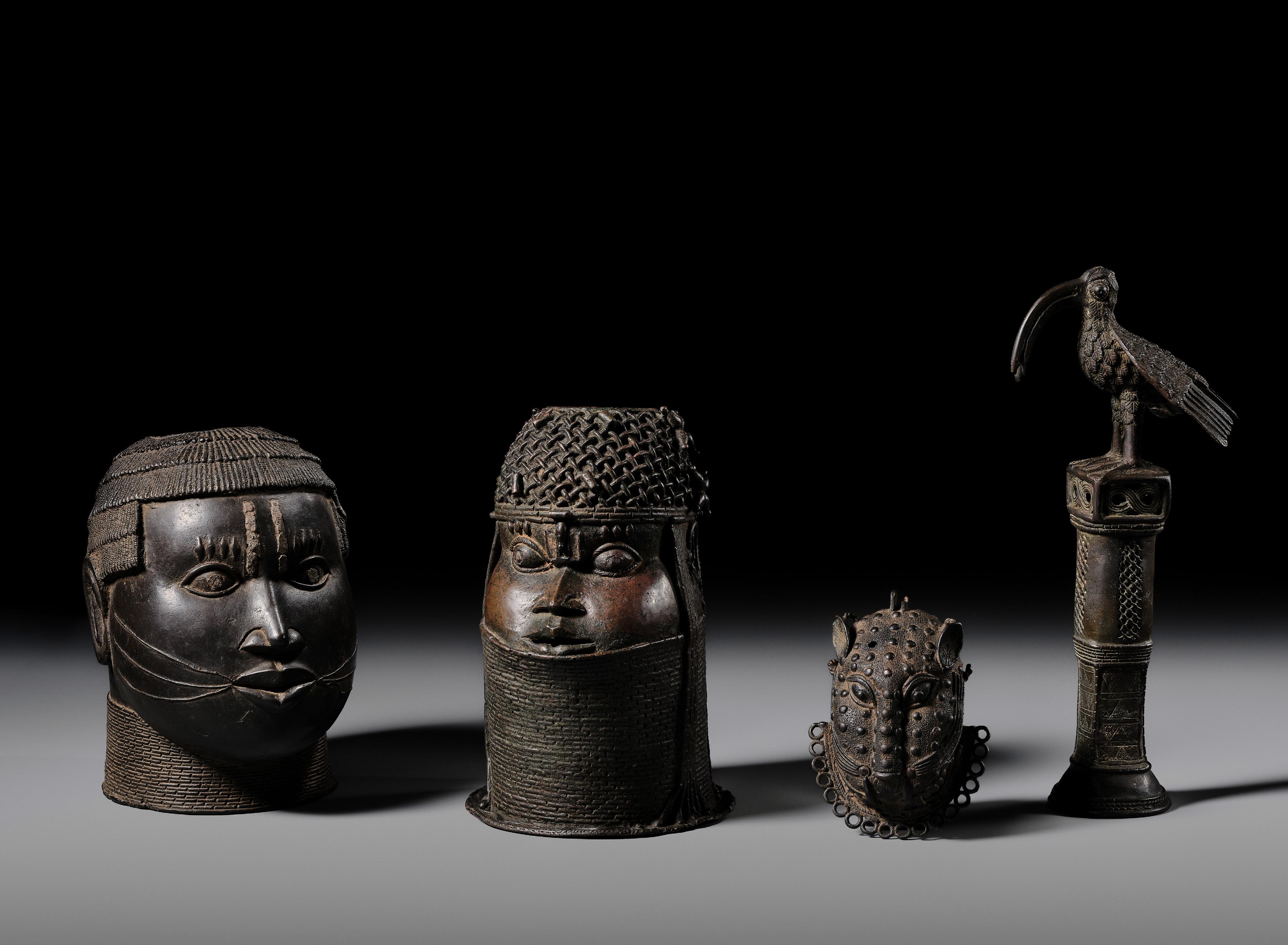
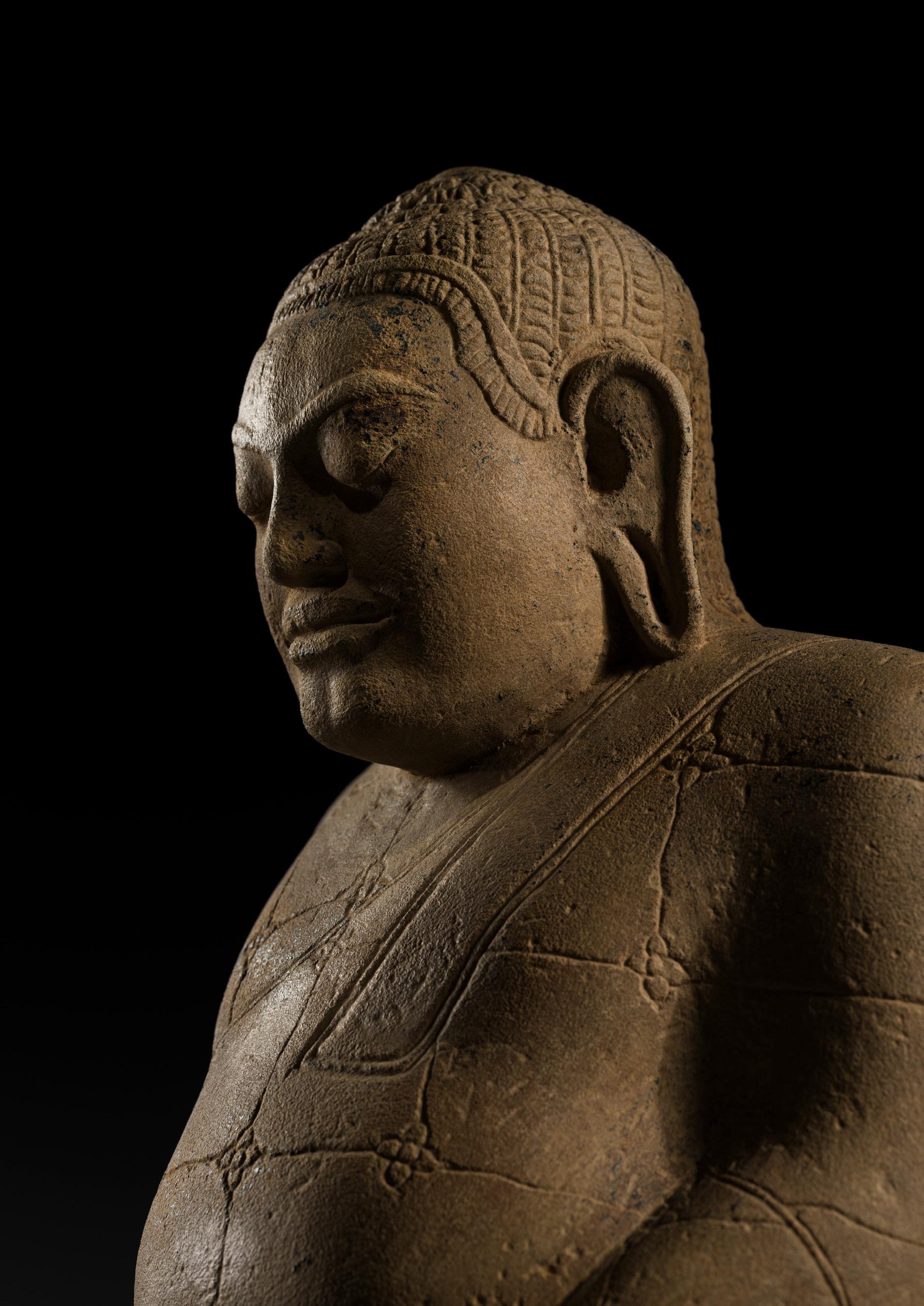
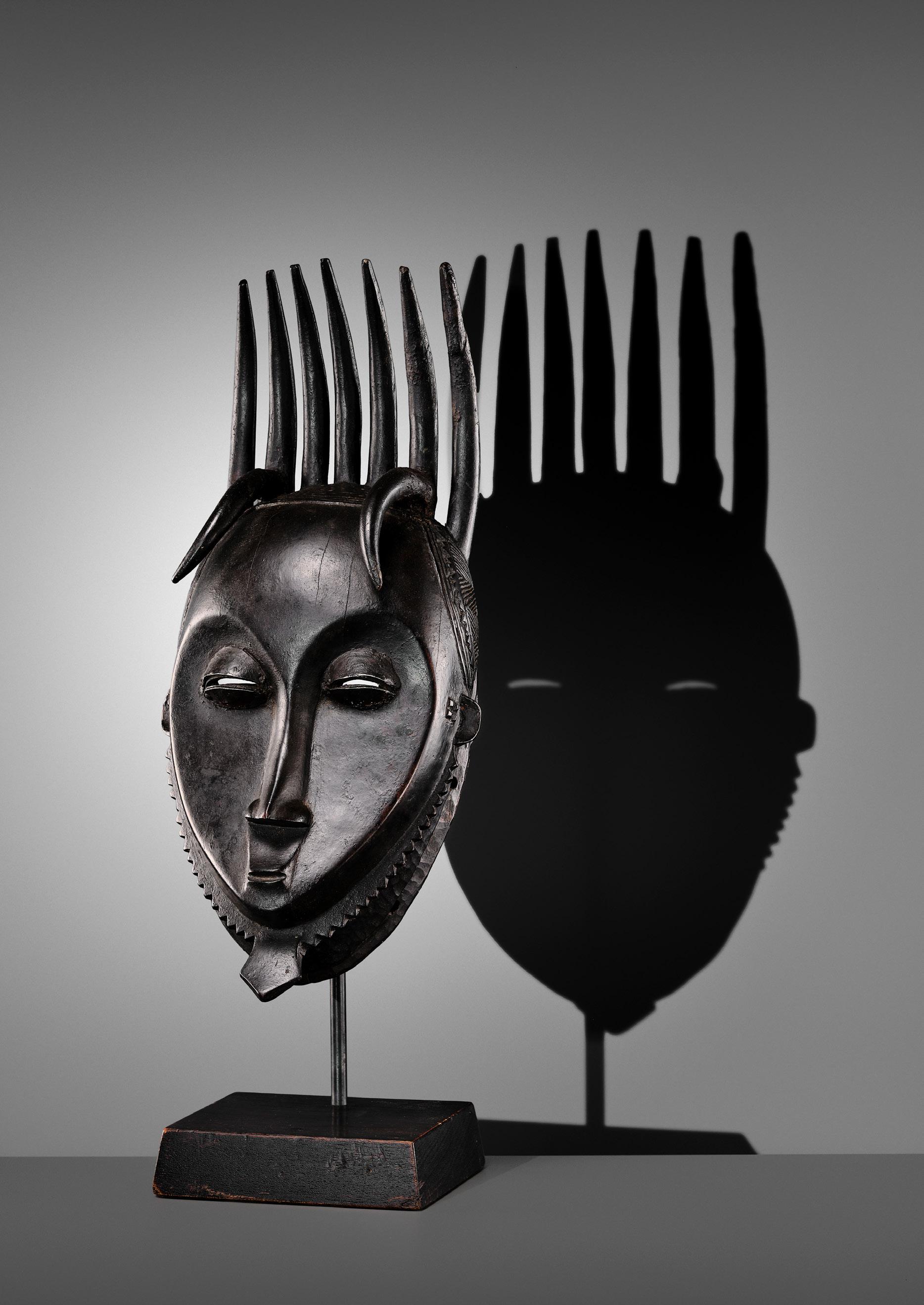
Three Collectors
Arts of Asia and Africa assembled by Gerhard Merzeder, Sven A. Behrendt & Philippe Icher
Auction 11 March 2026

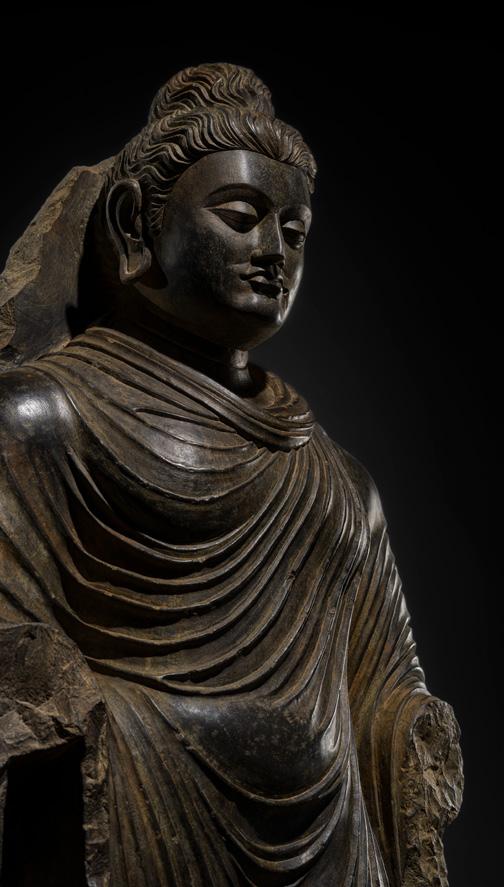
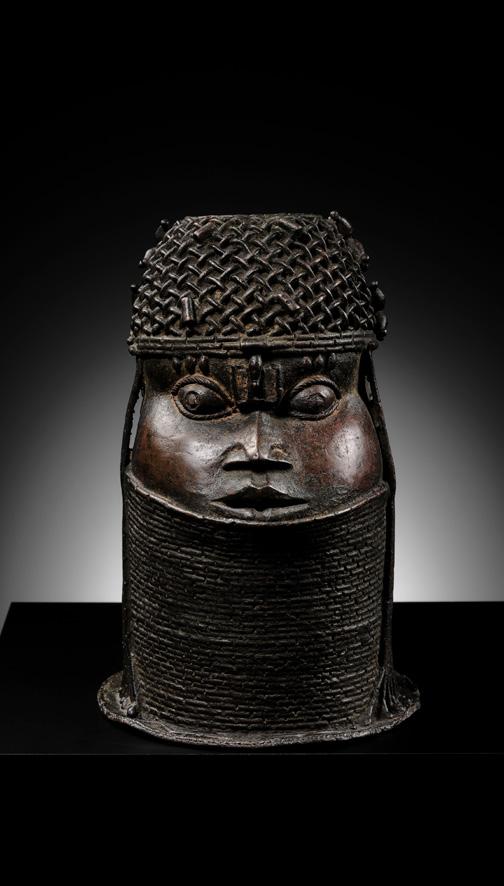

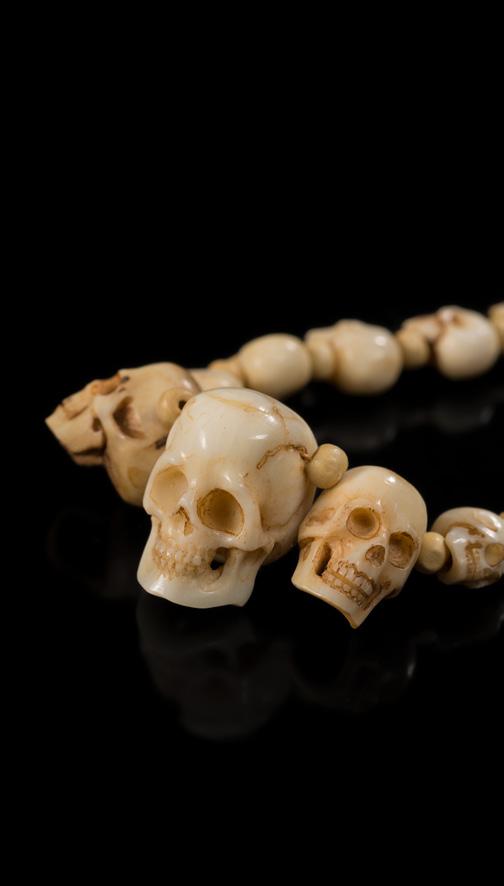
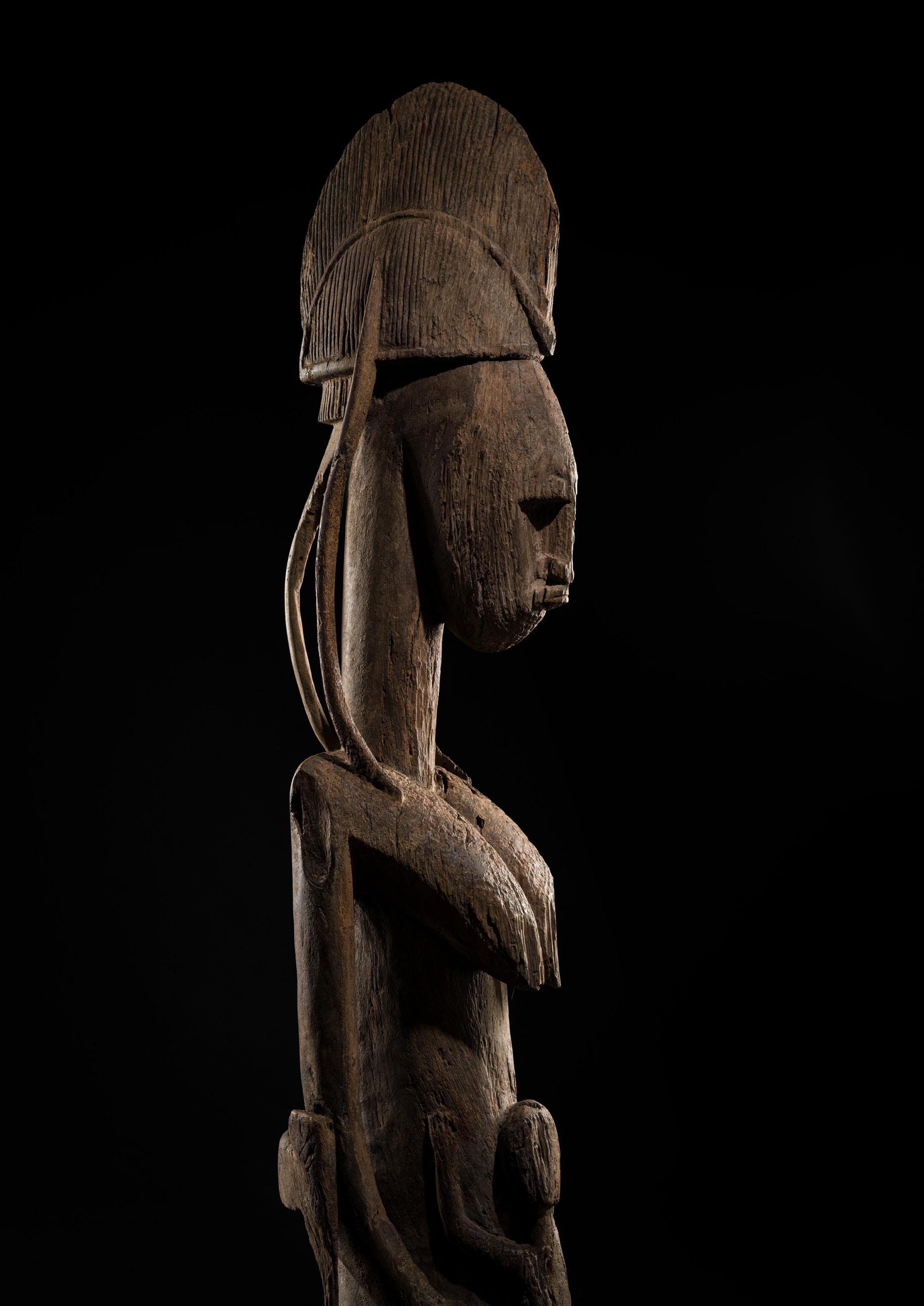
Arts of Asia and Africa assembled by Gerhard Merzeder, Sven A. Behrendt & Philippe Icher
Auction 11 March 2026
All lots in this auction are offered with No Reserve, allowing bids below the starting prices to be considered.
Please note that the starting prices have been set at exceptionally low levels to encourage participation. We encourage you to take advantage of this unique opportunity to acquire remarkable pieces at highly competitive prices.
2–10 March, Monday–Friday 10 am–6 pm as well as by appointment
Zelinkagasse 6, 1010 Vienna Austria
www.zacke.at GALERIE ZACKE
Tel +43 1 532 04 52 E-mail office@zacke.at

Publisher
Galerie Zacke founded 1968 © SZA Versteigerungen & Vertriebs GmbH
1010 Wien
Zelinkagasse 6, Austria, Europe
Tel (0043-1) 532 04 52
Email: office@zacke.at
Editors
Susanne Zacke
Marion Schor
Experts
Alexander Zacke
Max Zacke
Catalogers
Ananya Casius
Anne-Aymone Gabriel
Daniel Gonzalez-Gracia
Tatjana Borodin
Assistance and Translation
Anna-Maria Pollmann
Jue Zhang
Photography
Georg Bodenstein
David Lindengrün
Cesilio Cesar Garcia
Jonas Matyassy
Loreen Sasse
Design
Christina Zhang
Printing
Print Alliance
HAV Produktions GmbH
Website www.zacke.at
© GALERIE ZACKE
Reproduction forbidden
PLEASE RAISE MY BID BY ONE BIDDING INCREMENT (ca. 10%) IF NECESSARY PLEASE CALL ME WHEN A
IMPORTANT NOTICE:
Bids do not include buyer’s premium and VAT. Margin taxation applies. Items with added VAT are marked in the online catalog.
TELEPHONE BIDS:
SING0326 ON DATE 11 March 2026
If you like to bid by telephone, please state ‘TEL’ in the ‘BID IN EURO’ column instead of a Euro amount. Galerie Zacke will call you on the day of the auction, on the telephone number provided, 5 lots before the lot you are bidding on and the bidding will commence at the starting price, as stated in the catalog. If Galerie Zacke cannot reach you during the auction, Galerie Zacke will bid the starting price on your behalf.
TERMS OF PAYMENT, SHIPPING AND COLLECTION:
NAME AD D RESS CITY, COUNTRY
POSTCODE
PHONE NUMBER
CREDIT CARD PAYMENT PLEASE CHECK THE DESIRED CARD
COLLECTION BY CLIENT WITH PAYMENT ON THE PREMISES IN CASH, BY CERTIFIED CHEQUE OR CREDIT CARD
INVOICE PAYMENT
VIA BANK WIRE AFTER RECEIPT OF INVOICE
SHIPPING AFTER RECEIPT OF PAYMENT
EXPRESS PARCEL SERVICE
REQUIRED (ACCORDING TO TERMS AND CONDITIONS OF GALERIE ZACKE)
SHIPPING INSURANCE
REQUIRED (ACCORDING TO TERMS AND CONDITIONS OF GALERIE ZACKE)
GALERIE ZACKE
Zelinkagasse 6, 1010 Vienna, Austria
Email: office@zacke.at
Tel: +43-1-532 04 52
Fax: +43-1-532 04 52 20
& SIGNATURE
IMPORTANT NOTICE:
Whenever making a bid, whether personally or via an agent, in writing, online, telephone, or in any other way, the bidder fully and unconditionally accepts the Terms of Auction, the ‘Important Information’ section in the auction catalog, the Terms and Conditions (AGB) of Galerie Zacke, §1-48, the Fee Tariff, and the Bidding Increments table, all as published on www.zacke.at on the day of the auction. ABSENTEE BIDDING FORM
LIVE AUCTION
11 March 2026, 3 pm CET
Lots 127–319
ONLINE CATALOG
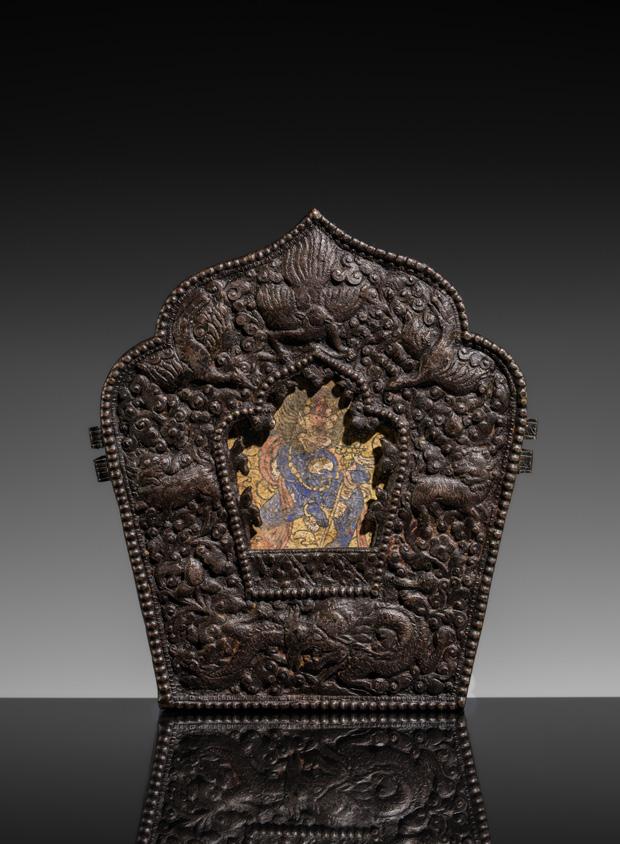
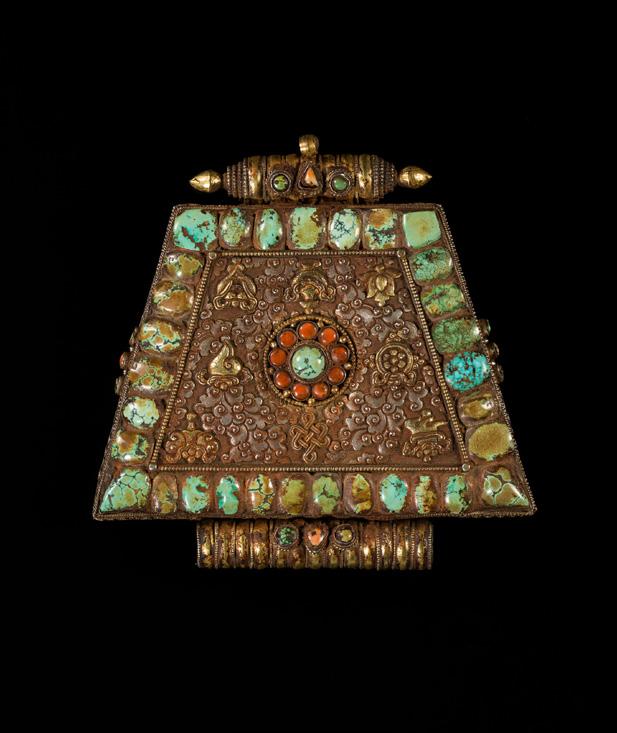
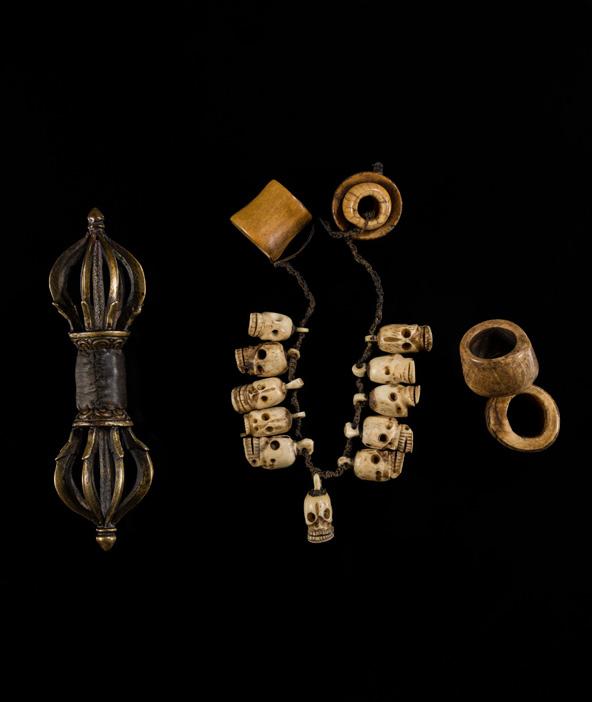
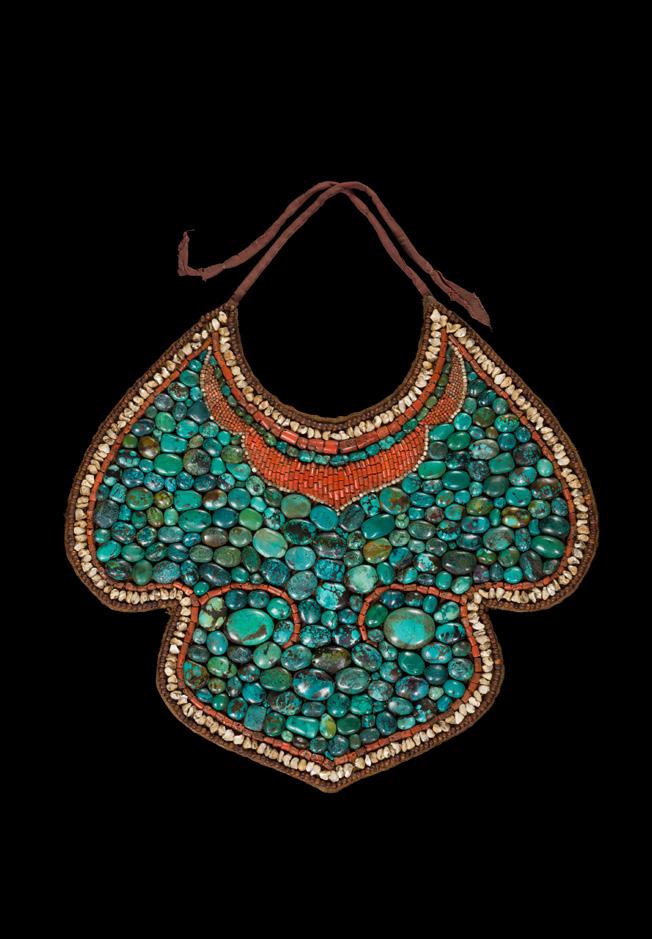
THE PHILIPPE ICHER COLLECTION of Himalayan Art – Part 2
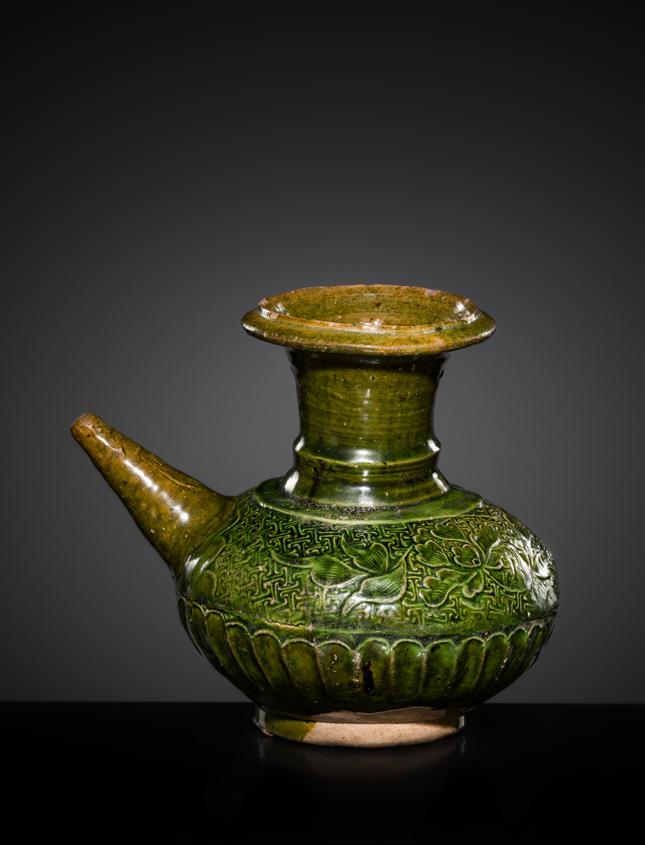
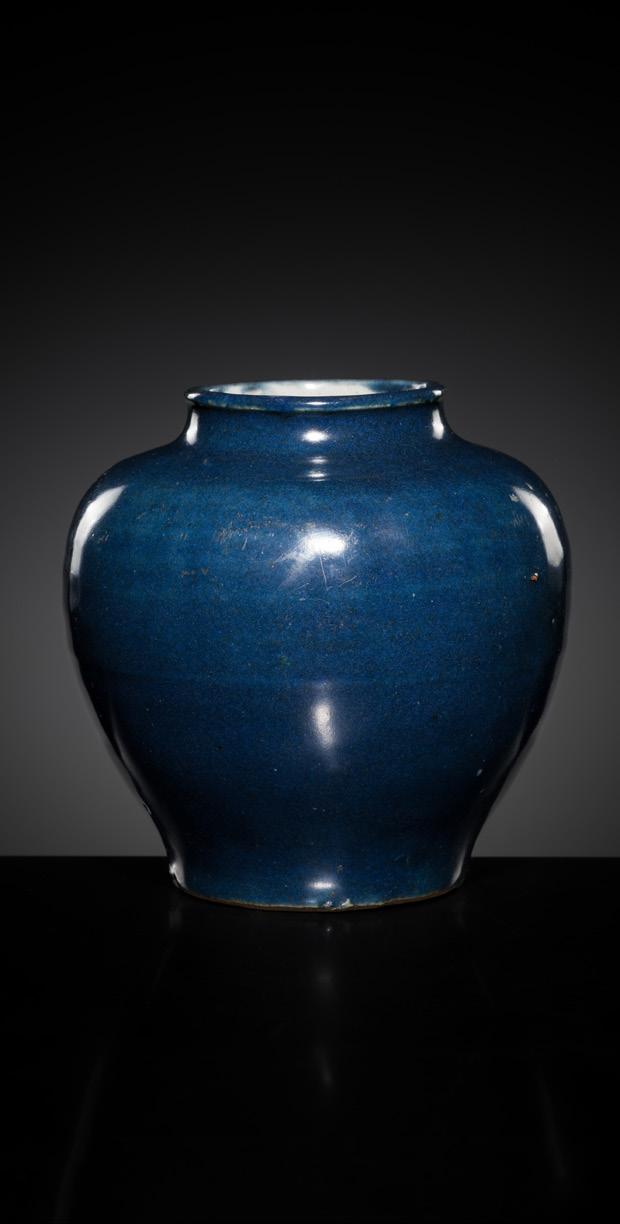
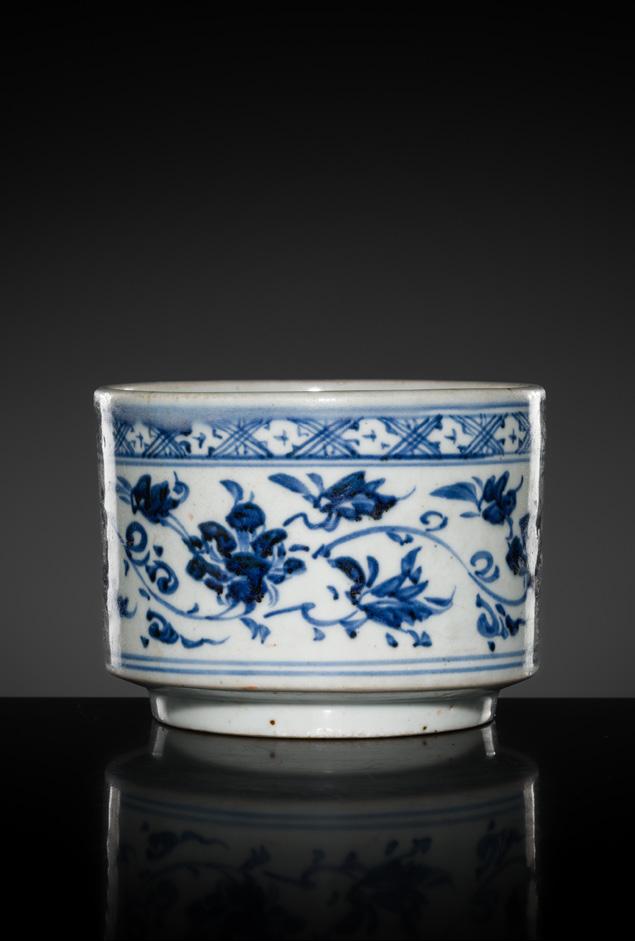
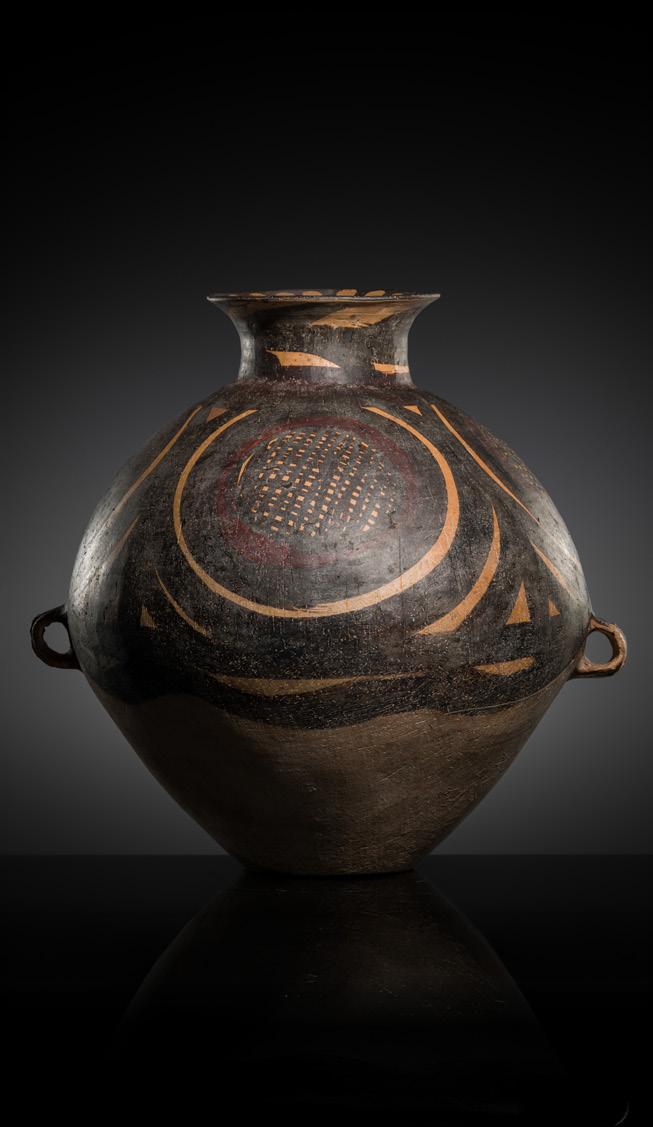
THE NATIONAL MUSEUM OF THE PHILIPPINES COLLECTION of Chinese Ceramics
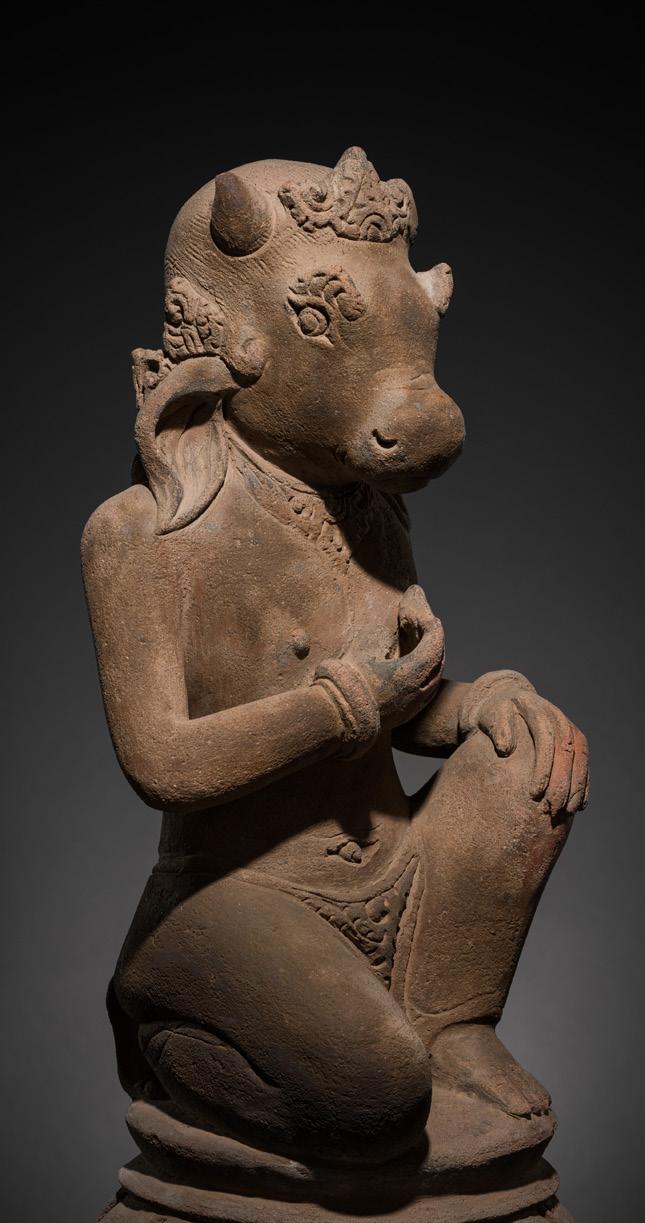
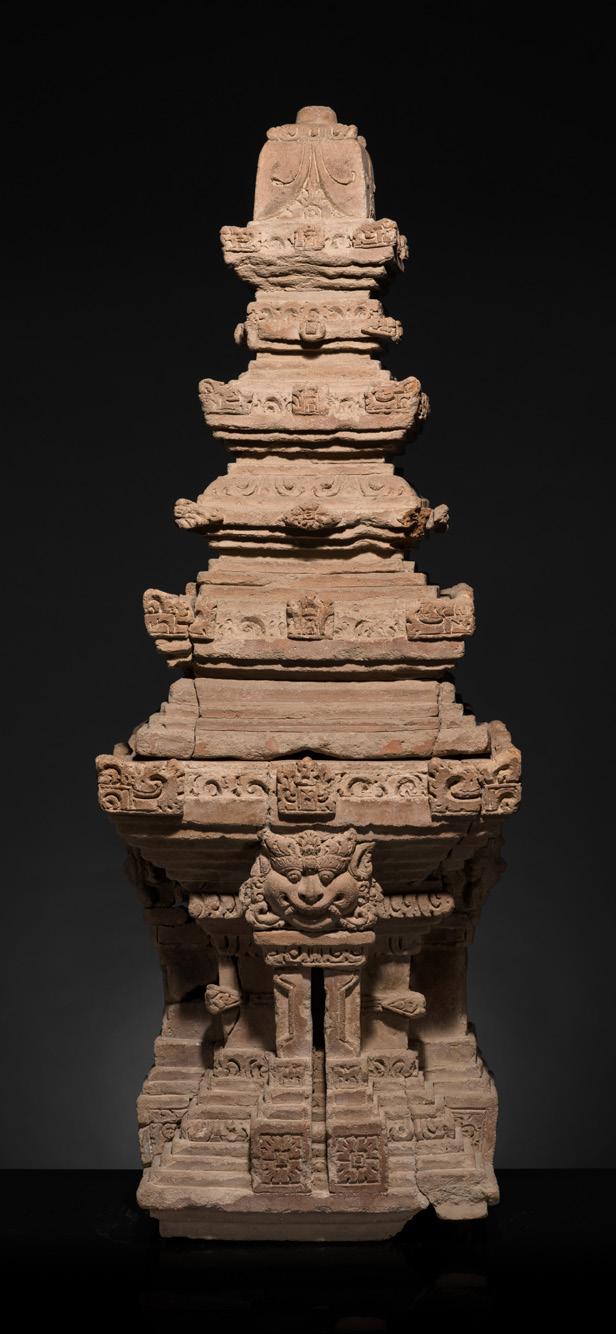
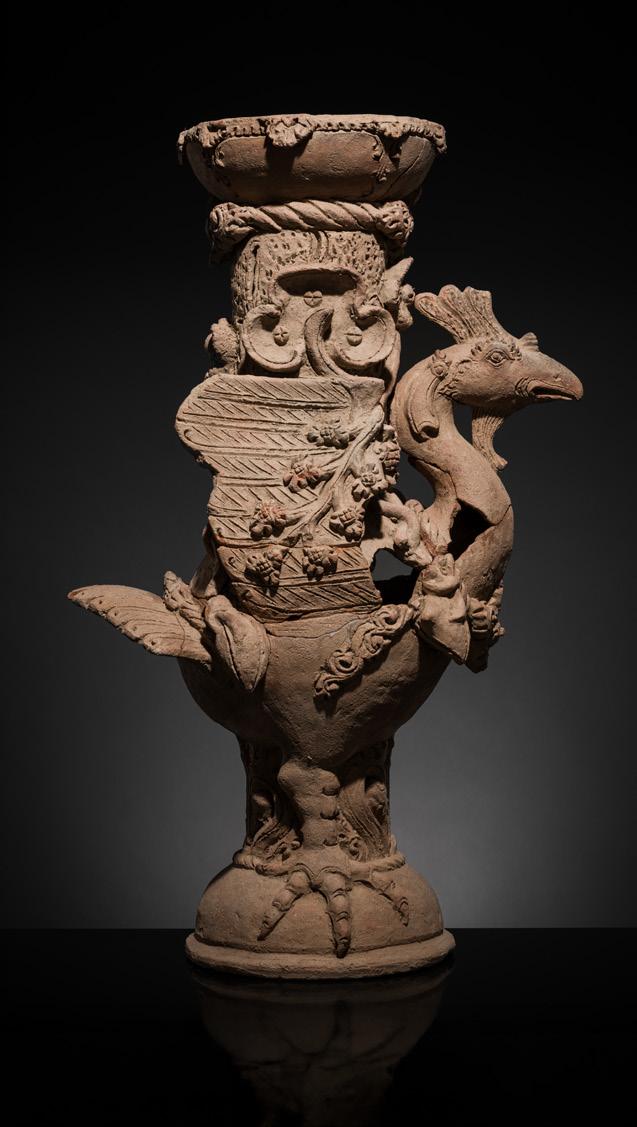
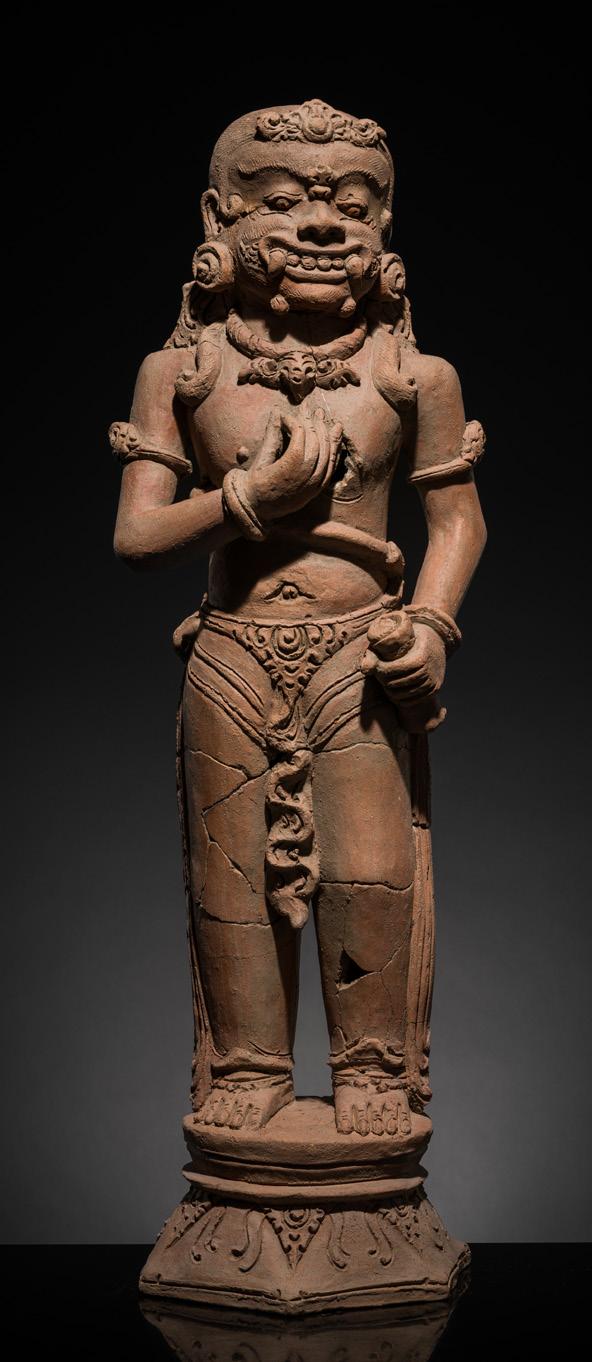
THE PAOLO BERTUZZI COLLECTION of Majapahit Terracotta Figures – Part 2
Arts of Asia and Africa assembled by Gerhard Merzeder, Sven A. Behrendt & Philippe Icher


Dear Customers,
This auction presents selections from three outstanding collections assembled by three unique collectors, each highly distinguished in their own way, while unified in their love of art and travel as well as their heartfelt curiosity, awe, and respect for the remote and diverse cultures they encountered. This foreword serves as a place to briefly tell each of their stories, which are deeply imbued into the objects they acquired.
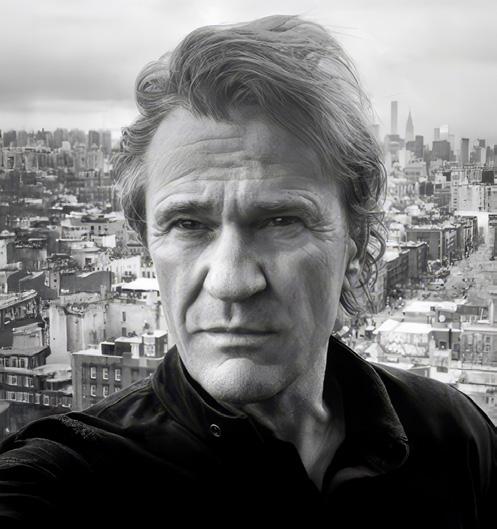
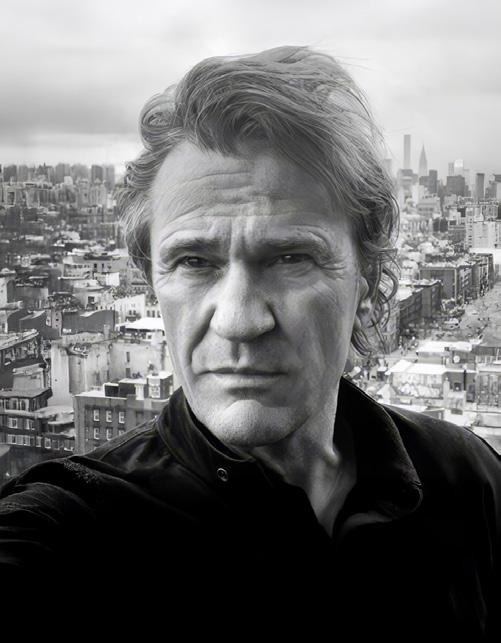
Restless curiosity defines Gerhard Merzeder’s life and work. Born in 1963 in Upper Austria, he developed early into an artist for whom the world itself became both subject and archive. From his first photographic experiments as a teenager to decades of travel across Africa, Asia, and the Americas, Merzeder has approached image-making as a form of cultural inquiry—less reportage than immersion—shaped by movement, observation, and an enduring fascination with how societies give visual form to belief, power, and identity.
A decisive turning point came in the mid-1980s, when Merzeder traveled to Nigeria and encountered African art not as an abstract category but as a living
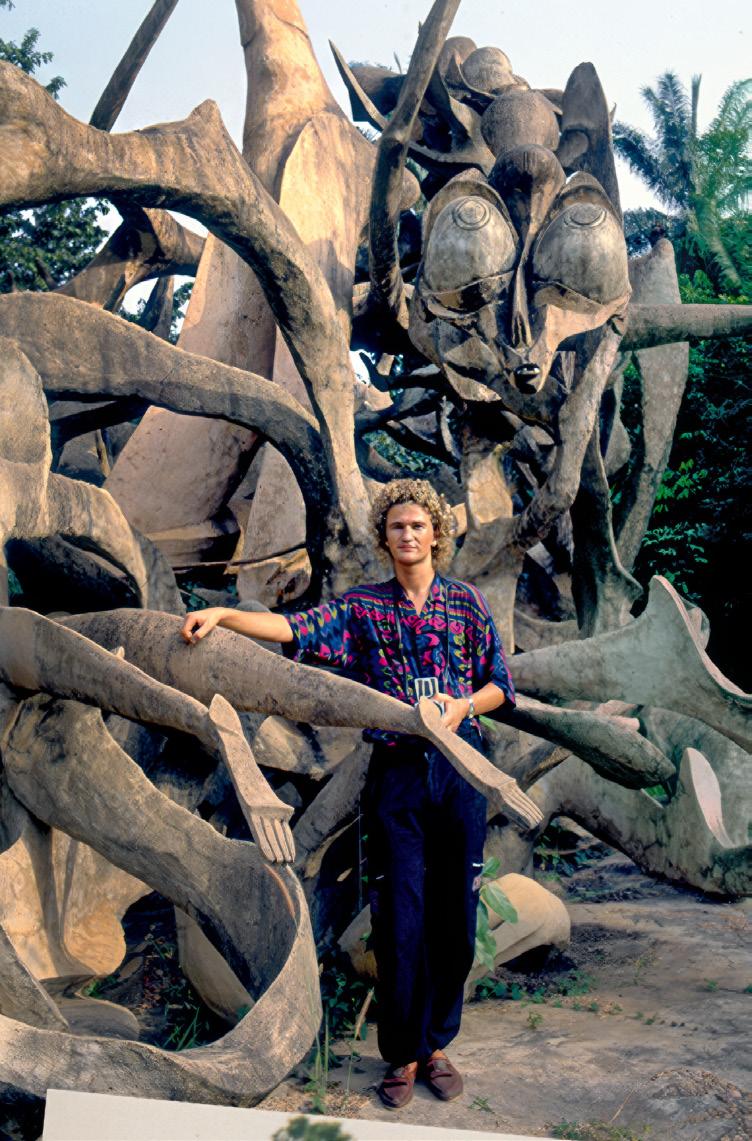
continuum of ritual and environment. There he met Susanne Wenger, the Austrian artist who had become a central figure of the New Sacred Art movement in Osogbo, and whose lifelong devotion to Yoruba spirituality and the sacred groves of the goddess Osun revealed art as a fusion of cosmology, landscape, and collective memory. Photographing these sites, Merzeder experienced art as presence rather than object—an insight reinforced by a formative moment alone among ancient Ife bronzes and terracotta heads in the Lagos museum during a power outage. That encounter ignited a lifelong commitment to collecting, initially focused on African works and later expanding across cultures and continents.
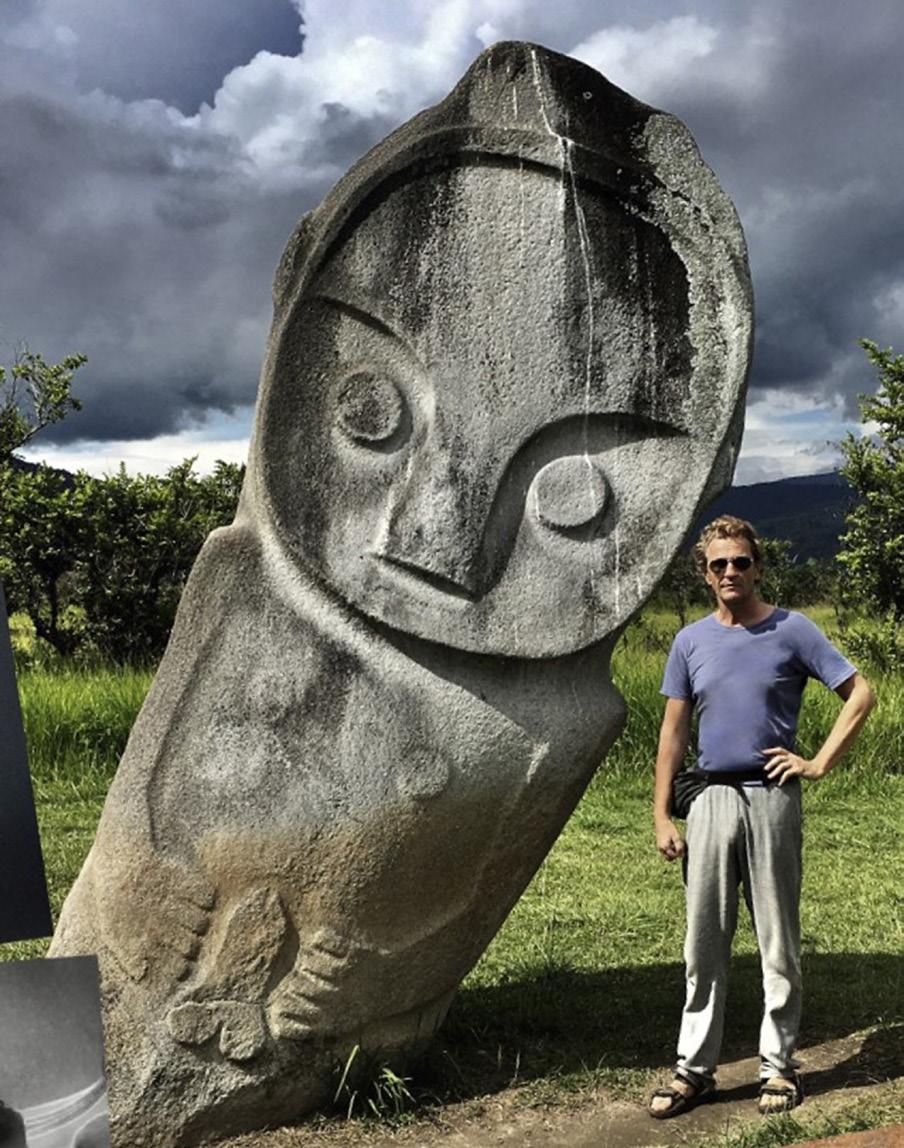
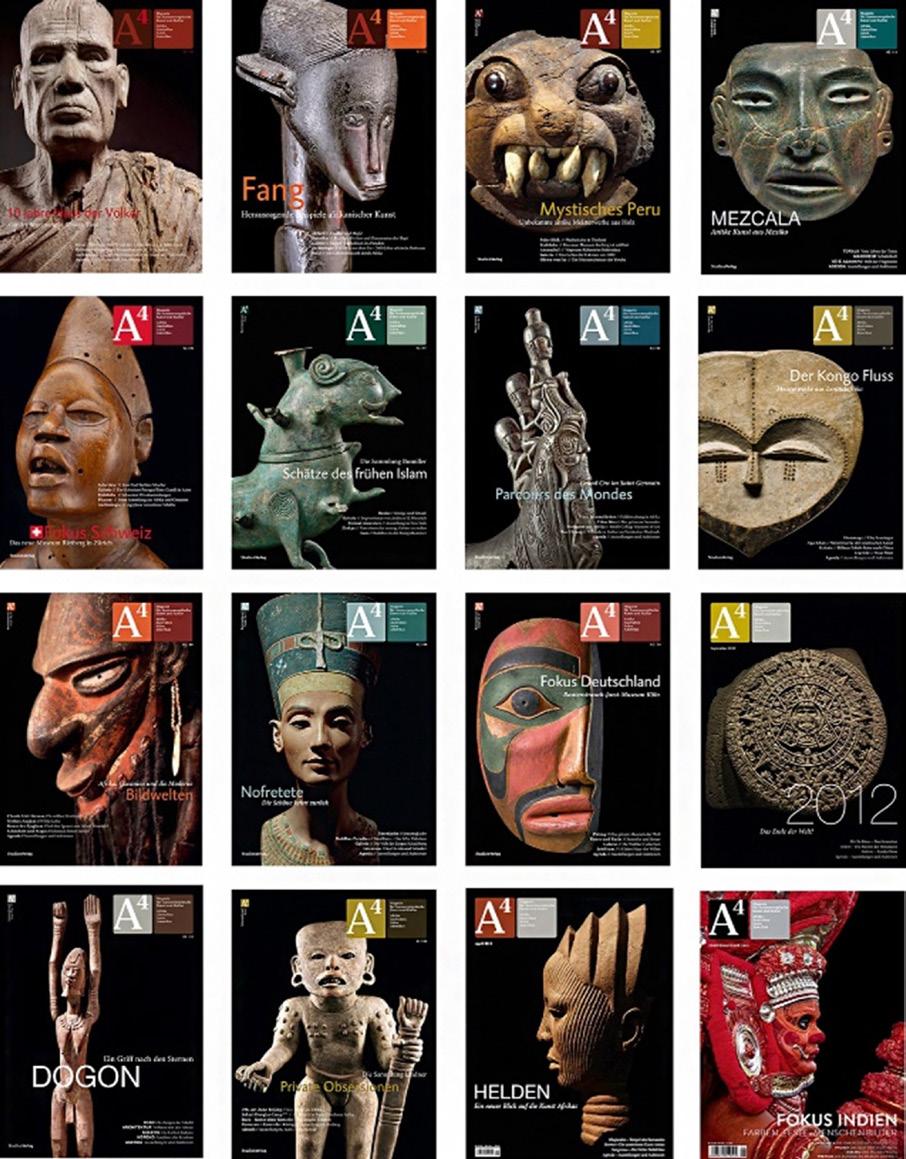
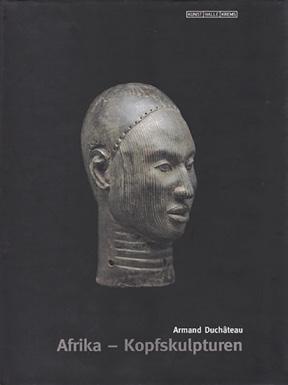
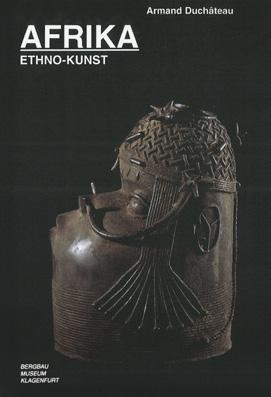
Collecting, for Merzeder, was never an act of accumulation but of preservation and dialogue. This philosophy found a natural counterpart in his collaboration with Gert Chesi, the Austrian photographer, ethnologist, author, and tireless advocate of non-Western art. Chesi, whose decades of travel and research formed the basis of the Museum der Völker (formerly Haus der Völker, Museum für Kunst und Ethnographie) in Schwaz—one of Europe’s most important institutions dedicated to world and tribal art, and where many of the objects in this sale were exhibited—shared Merzeder’s conviction that objects must be presented with cultural depth and dignity. Beginning in 2005, their collaboration became a focal point of Merzeder’s ethnographic work, most notably through the founding of A4 Magazin, the first German-language publication devoted entirely to tribal art from Africa, Asia, Australia, and the Americas, which often included pieces from Merzeder’s personal collection, including lots now offered in this auction.
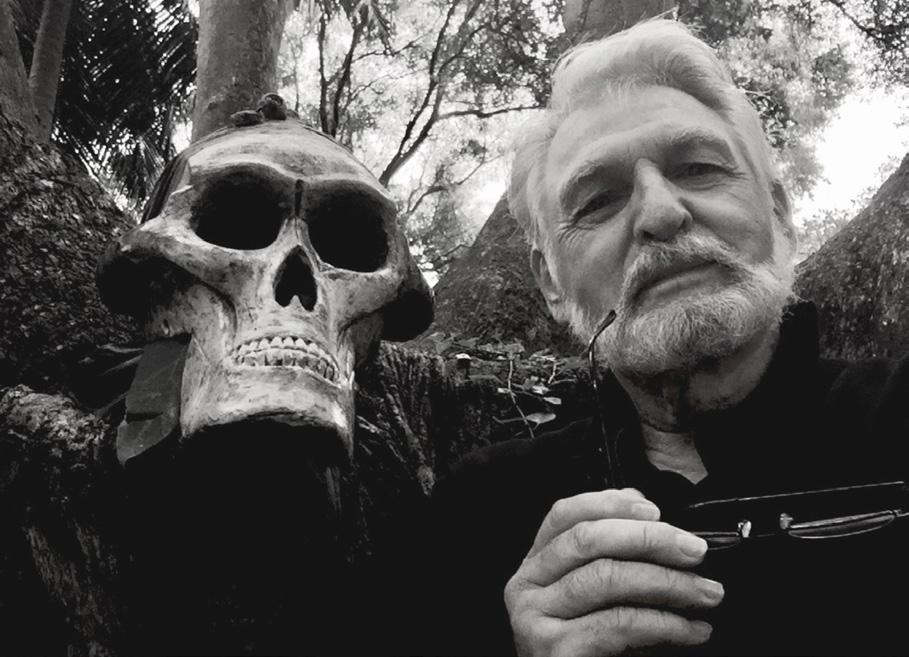
Through exhibitions, publications, and shared curatorial projects, Merzeder and Chesi positioned photography and collecting as complementary tools of cultural mediation. Today, living in Thailand, Merzeder continues to synthesize his roles as traveler, ethnographer, photographer, and collector—shaped by a lifetime spent crossing borders and guided by the conviction that art is inseparable from the cultures, journeys, and encounters that give it form.
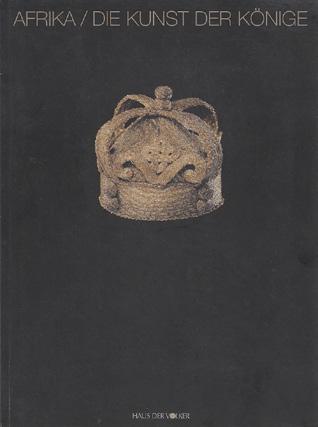
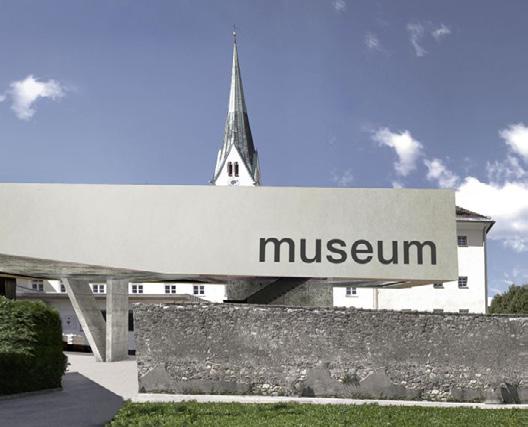
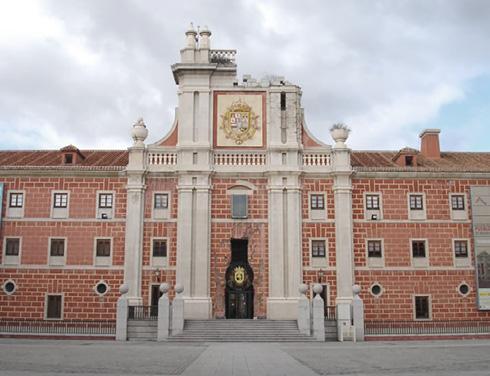
MUSEUM DER VÖLKER (FORMERLY HAUS DER VÖLKER, MUSEUM FÜR KUNST UND ETHNOGRAPHIE), SCHWAZ, AUSTRIA
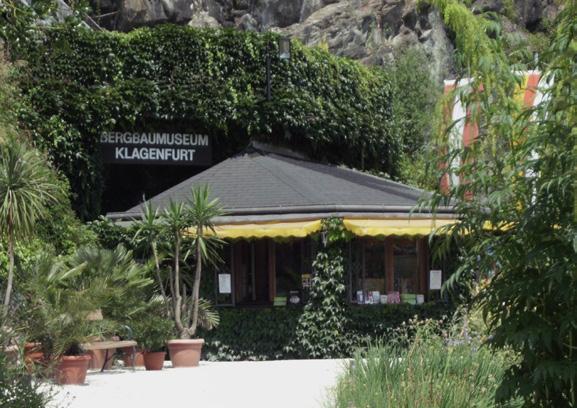
BERGBAU MUSEUM, KLAGENFURT, AUSTRIA
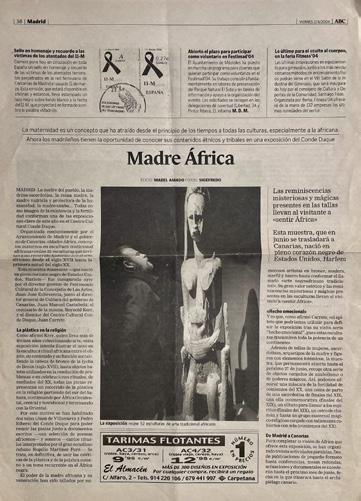
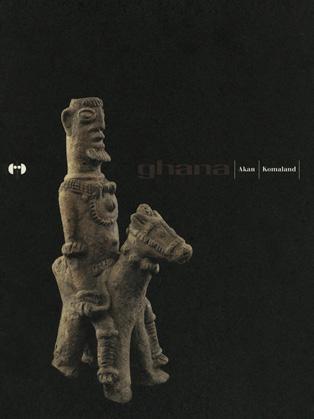
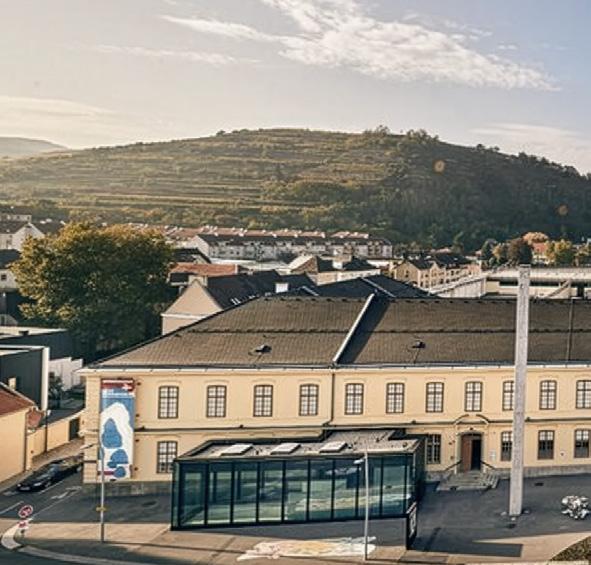
KUNSTHALLE KREMS, AUSTRIA
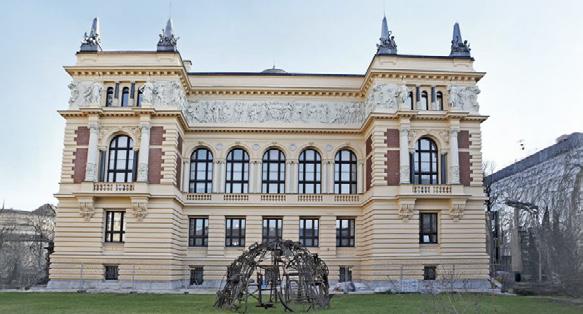
OBERÖSTERREICHISCHES LANDESMUSEUM, LINZ, AUSTRIA
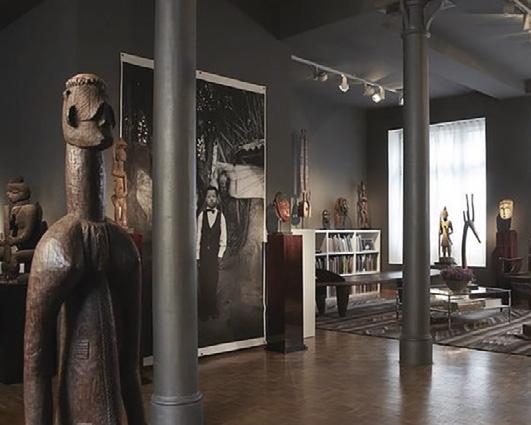
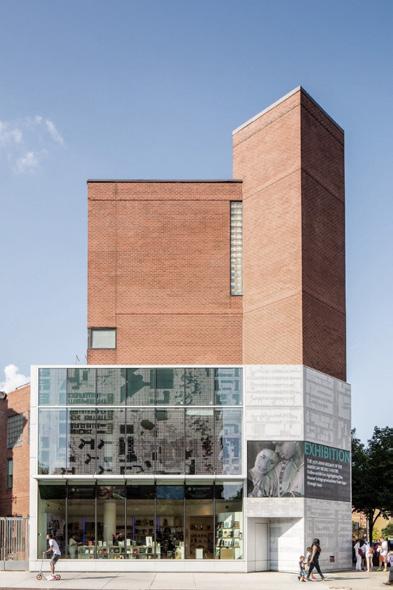
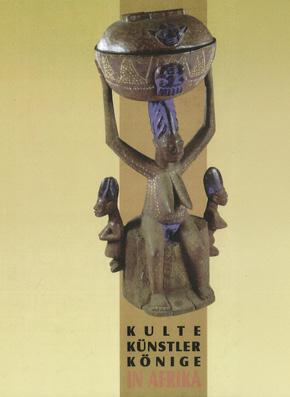
SCHOMBURG CENTER FOR RESEARCH IN BLACK CULTURE, THE NEW YORK PUBLIC LIBRARY, NEW YORK, UNITED STATES
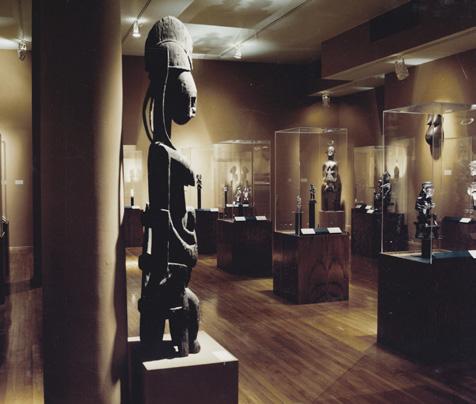
GALLERY, REYNOLD C. KERR, MIAMI, UNITED STATES
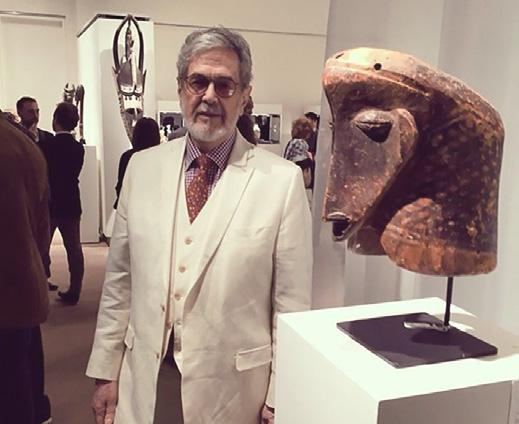
Sven A. Behrendt
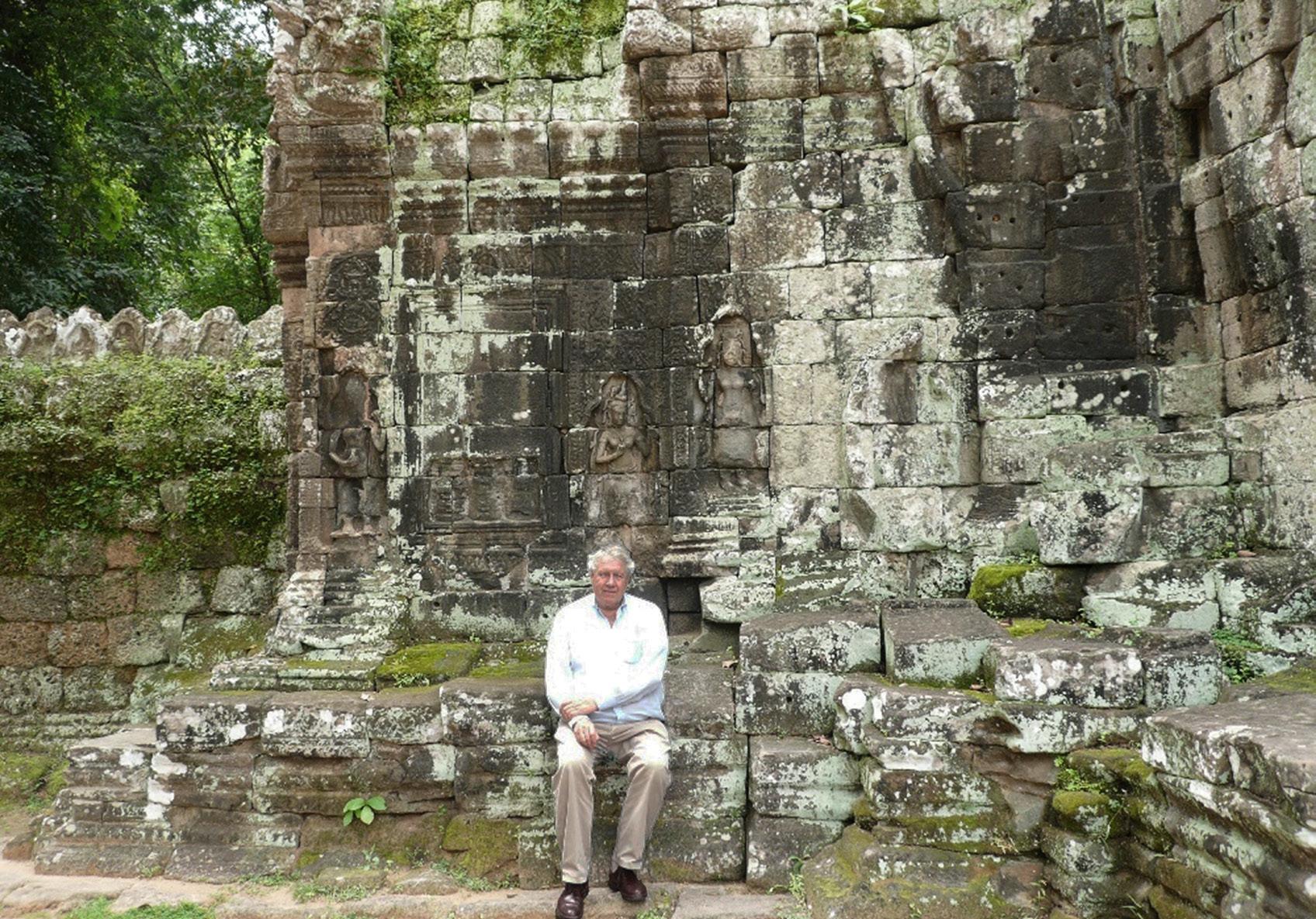
Sven A. Behrendt was a man whose life was defined by an unrelenting passion for discovery and a deep devotion to the art of collecting. Born in 1940, his early years were marked by extensive travel with his family, igniting his lifelong fascination with the world. His mother, born in Hong Kong to an English family, instilled in him a profound appreciation for history, culture, and Asian art—a love that would grow throughout his life. This early exposure to diverse cultures laid the foundation for his future travels, which spanned continents and shaped the remarkable collection he would spend decades building.
Behrendt’s intellectual rigor and insatiable drive to understand the world led him to focus particularly on the cultures of Asia. As a student, he embarked on journeys through Afghanistan, Pakistan, and India, regions that, at the time, were seldom visited by Western travelers.
Throughout his life, Behrendt accumulated a diverse and expansive collection that reflected his wideranging intellectual pursuits. His profession as a physicist and his keen observational skills allowed Behrendt to approach his travels and collecting with both an analytical mind and a creative spirit. His homes in London and Salzburg, filled with statues, paintings, books, and objects of art, became a testament to his love for the cultures he encountered and the beauty he discovered in every corner of the world. From serene Buddha heads to European Old Master paintings, his collection offered a visual journey through the history of art and civilization. These works were more than mere acquisitions; they were expressions of Behrendt’s deep engagement with the world and his desire to share the treasures of humanity’s cultural heritage.
Sven A. Behrendt’s legacy is one of intellectual exploration, cultural immersion, and a lifelong dedication to the pursuit of beauty. His collection, which now fi nds a place in the world of art auctions and galleries, serves as a tribute to his vision and his belief in the transformative power of art to connect people across time and space.
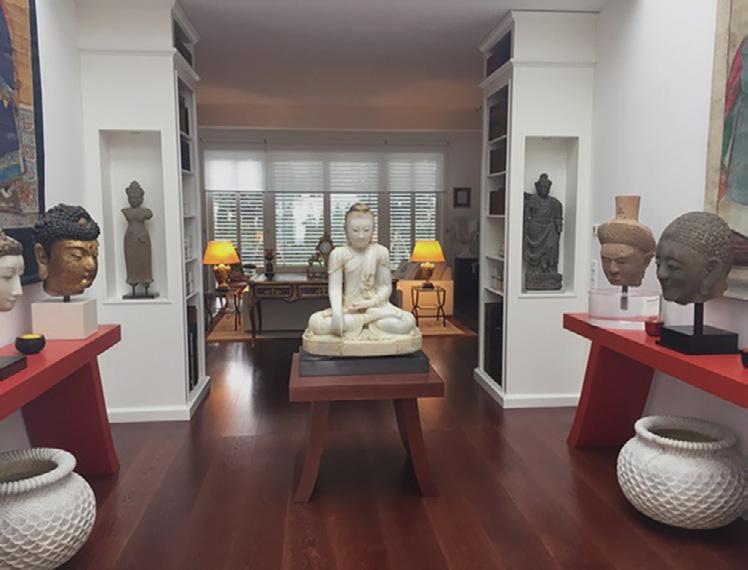

In his travels and his collecting, Behrendt was driven not by ego or the desire for possession, but by a genuine love of learning and understanding. His profound knowledge of art, music, literature, and science made him not only an extraordinary collector but also a remarkable conversationalist, whose insights were both rare and illuminating. Even in his later years, when his health began to decline, Behrendt’s mind remained sharp, and he continued to reflect on his lifelong journey through art, culture, and discovery.
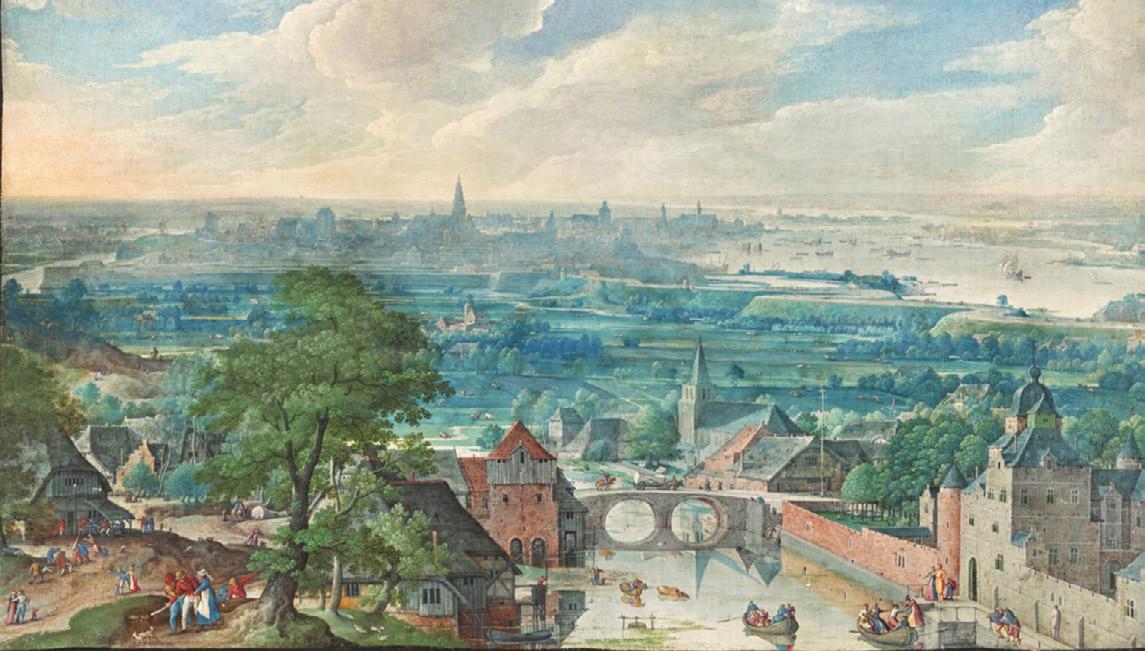
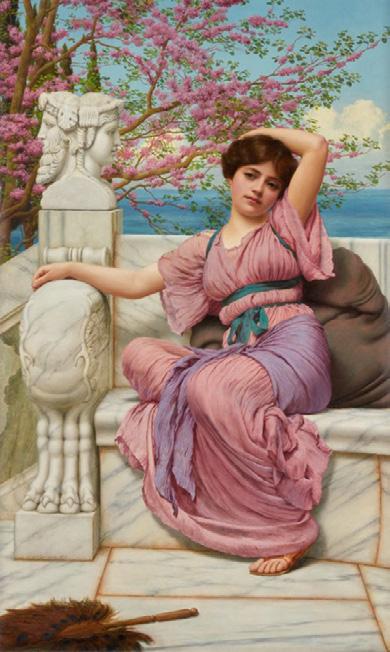
On 2 December 2025, his extraordinary collection was the focus of the Sotheby’s single-owner sale A Worldwide Grand Tour: The Sven A. Behrendt Collection. The auction was a success with notable highlights including a panoramic landscape by Hans Bol that fetched an impressive 1,064,800 GBP, and a painting by John William Godward, which sold for 355,600 GBP.
This sale not only celebrated Behrendt's exceptional connoisseurship but also introduced his remarkable collection to a new generation of art lovers and collectors, further cementing his legacy as a passionate and discerning patron of the arts.
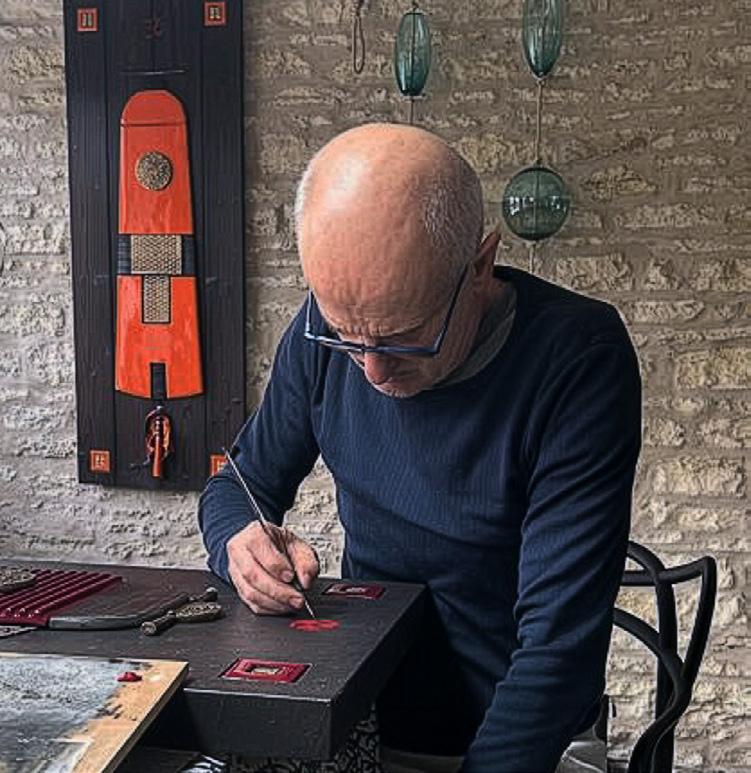

Philippe Icher is an artist and collector whose life and work have been shaped by an enduring bond with travel, material culture, and the spiritual traditions of the Himalayas. A ceramicist by training and a traveler by instinct, Icher has spent decades moving between artistic creation and exploration, allowing each pursuit to inform and enrich the other. His work reflects not only technical mastery but also a lived experience of cultures encountered far from conventional paths.

From an early stage, Icher was drawn to Asia, and more specifically to the regions stretching from Tibet to Ladakh, Nepal, and Zanskar. Traveling well beyond established routes, he immersed himself in daily life among Himalayan communities, captivated by the omnipresence of nature, the simplicity and generosity of the people, and a philosophy of life rooted in humility and spiritual awareness. These journeys became both a source of artistic inspiration and the foundation of a deeply personal collection, assembled over many years with patience, respect, and discernment.
As a collector, Icher sought objects not as curiosities, but as vessels of meaning. Buddhist prayer scrolls in Nepalese Sanskrit, Tibetan ornaments, ritual jewelry, engraved copper plates, Indian textile and batik stamps, and fragments of utilitarian beauty were gathered through lived encounters and shared moments. One of the most formative experiences of his life was attending the Kalachakra festival in Ladakh, led in part by the Dalai Lama, where the spiritual intensity of the event was matched by the visual richness of traditional adornments worn by men and women alike. These objects, imbued with symbolic weight and personal memory, would leave an indelible mark on his artistic language.
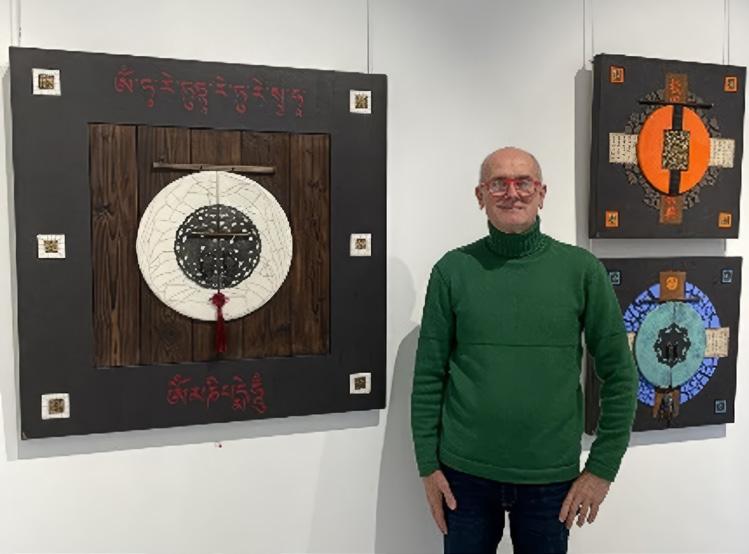
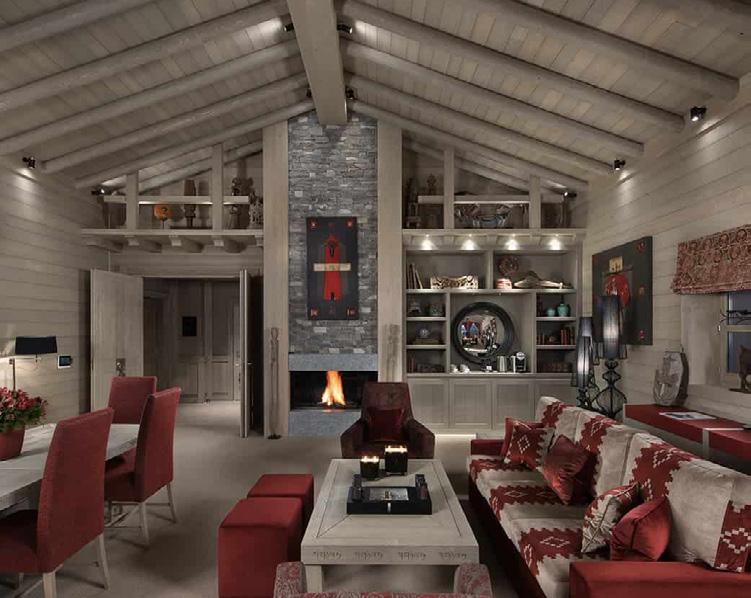
Icher’s dual identity as artist and collector reached a new level of recognition when he was selected to create the complete decorative universe for the K2 Djola Courchevel, one of the Leading Hotels of the World. There, his works resonate seamlessly with an environment inspired by Himalayan peaks, affirming the coherence between his artistic vision and his lifelong engagement with Himalayan cultures. Today, present in numerous European collections, Philippe Icher stands as a rare figure for whom collecting is not accumulation but stewardship—an act of preserving memory, symbolism, and beauty, and of passing them forward through art.
In the studio, Icher brings these collected elements into dialogue with his primary medium: ceramics. Clay forms the structural and emotional core of his wall works, around which bronze, pigments, wood, hemp, mother-of-pearl, leather, and found objects are carefully assembled. The resulting compositions evoke tribal adornments, sacred books, or fragments of ancient architecture—works that feel at once timeless and intimate. Each piece is conceived as an invitation to travel, echoing the spirit of the Silk Road and the age of great explorers, while remaining deeply anchored in the artist’s personal experience.
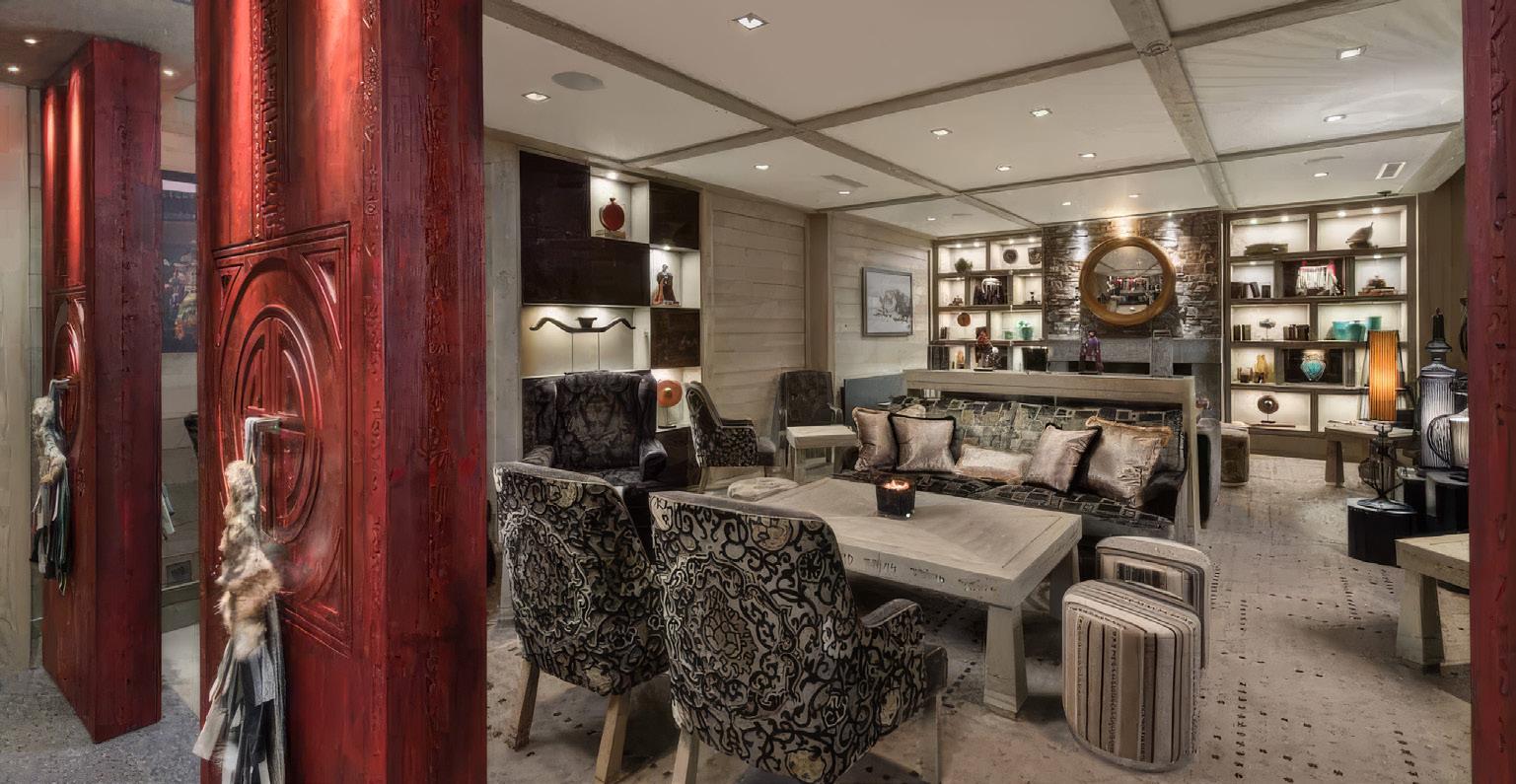
We have opened our 6,000-square-foot exhibition, showroom, and auction rooms at Zelinkagasse 6, 1010 Vienna!
Starting 2 March you’ll be able to explore the exceptional pieces featured in this auction at Zelinkagasse 6, 1010 Vienna.
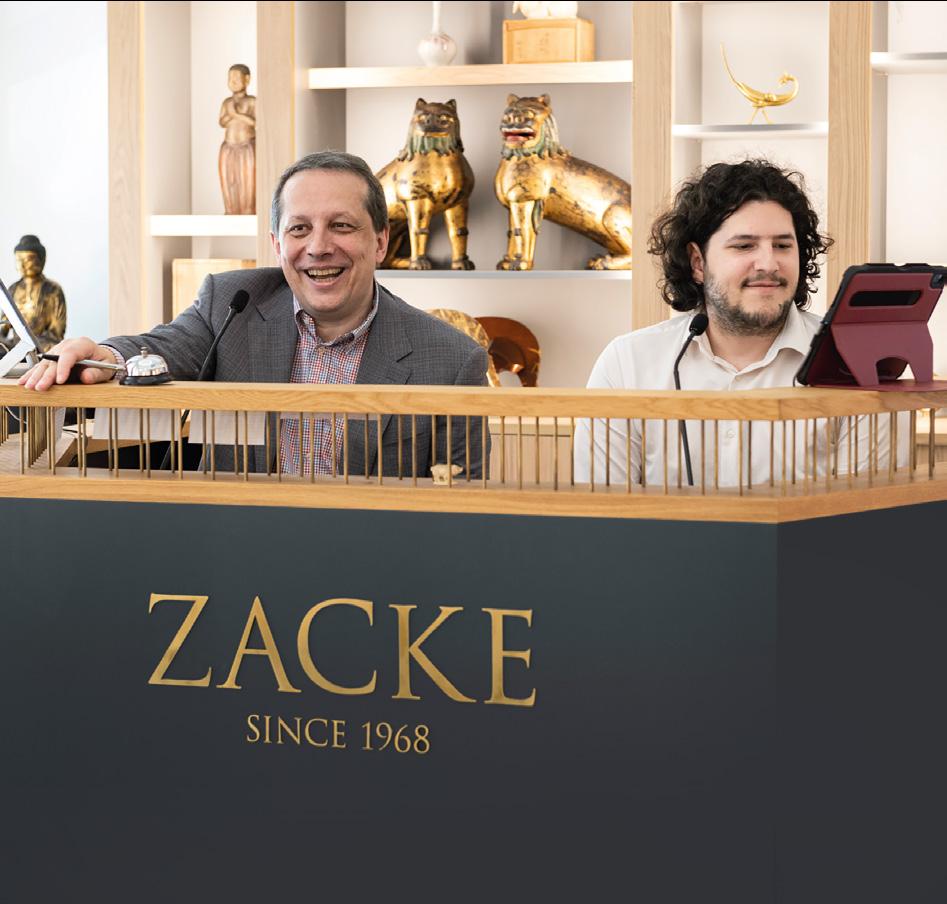
JOIN US LIVE
11 March 2026 at 11 am CET
Attend in person at our auction room at Zelinkagasse 6 or participate online via Zacke Live – and enjoy premium buyer’s terms with no additional online bidding fees
Register now: www.zacke.at
All lots in this auction are offered with No Reserve, allowing bids below the starting prices to be considered.
Please note that the starting prices have been set at exceptionally low levels to encourage participation. We encourage you to take advantage of this unique opportunity to acquire remarkable pieces at highly competitive prices.
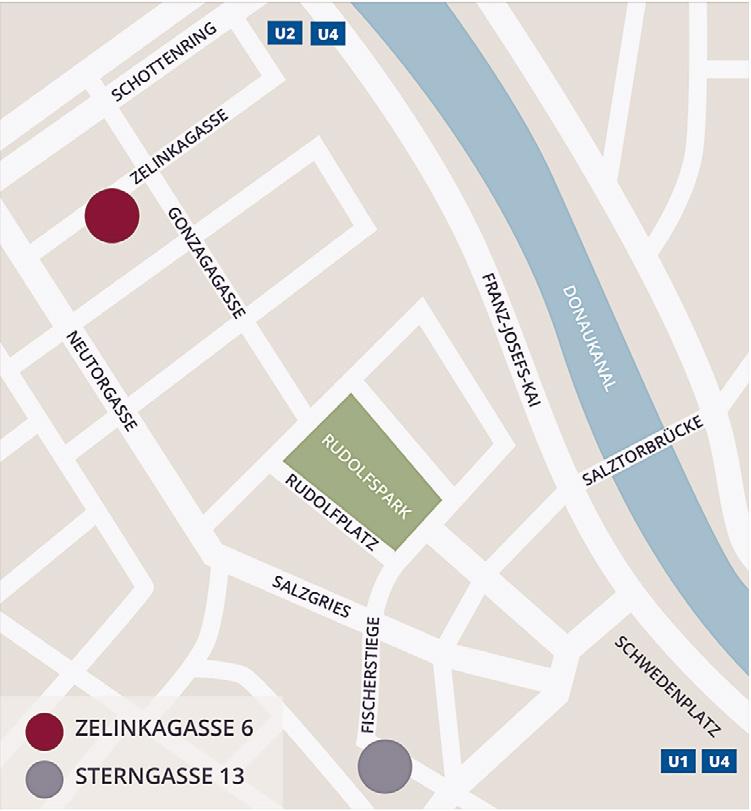
Our additional auction and preview space at Zelinkagasse 6 in Vienna’s 1st district is just a seven-minute walk from our 10,000-square-foot office, photography, video, and cataloging hub at Sterngasse 13.
Easily accessible by public transport or car (a parking garage is located nearby).
By Public Transport: SCHOTTENRING station (U2, U4, tram lines 1, 31, 71, D, and bus 3A)
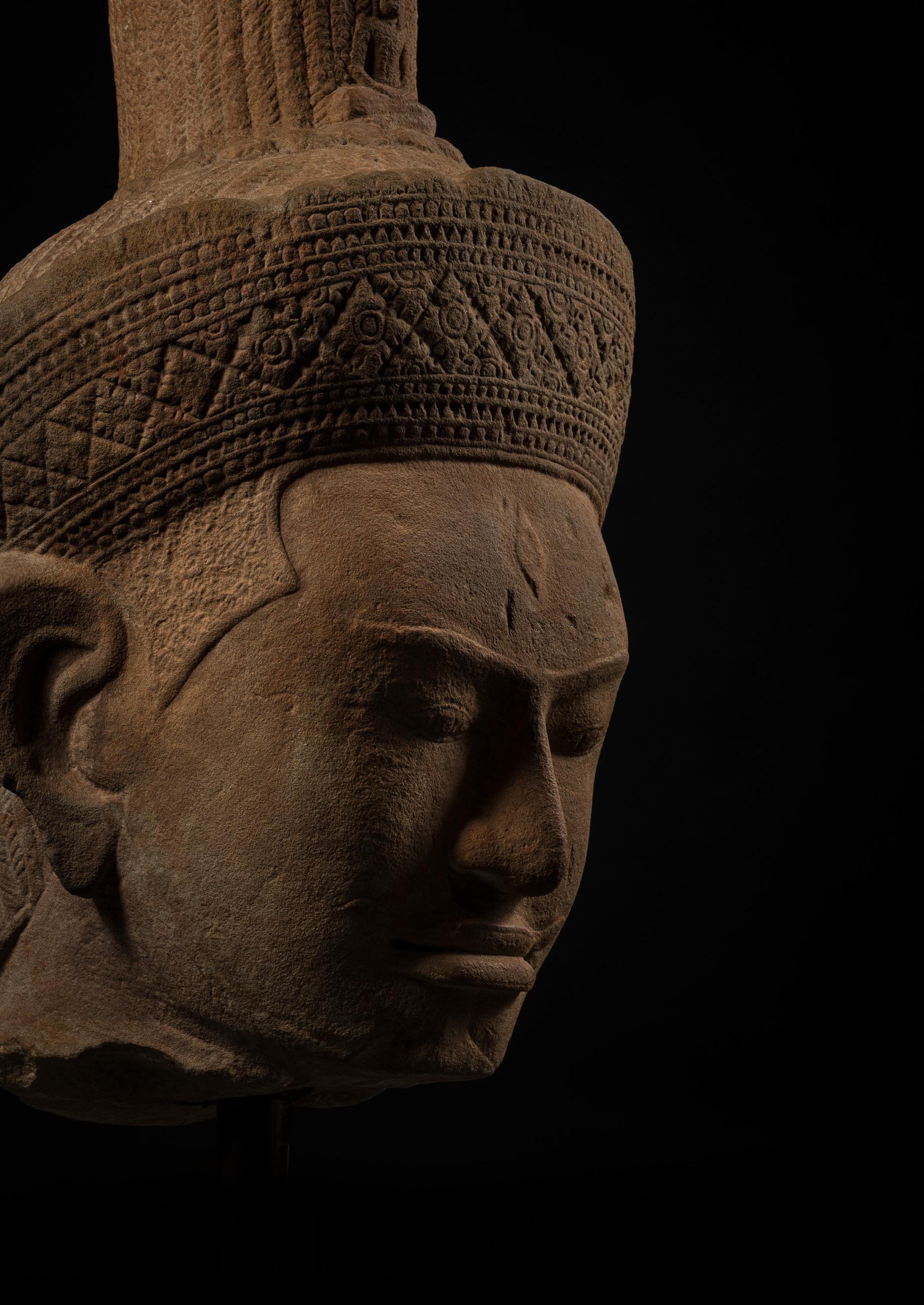
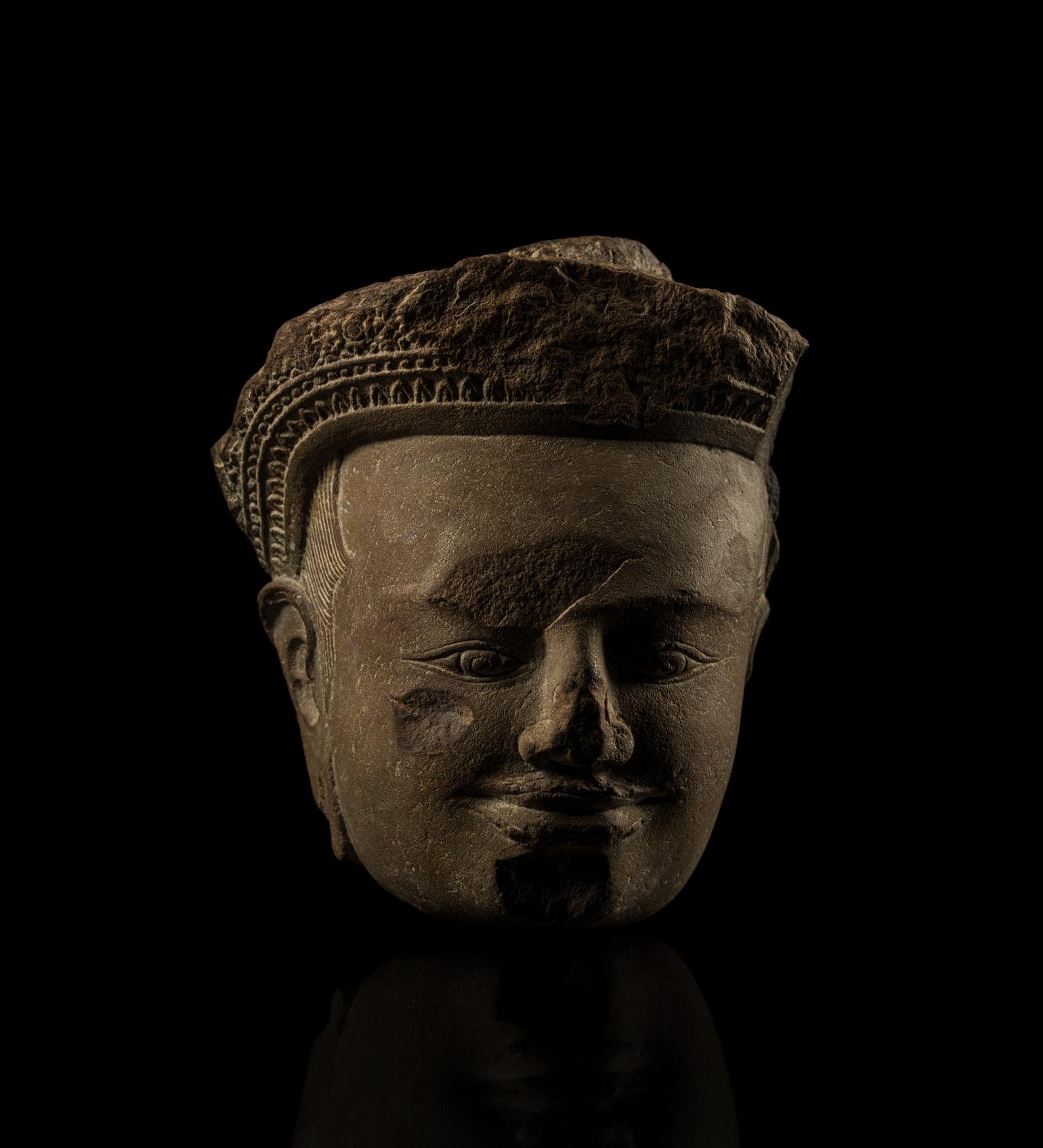
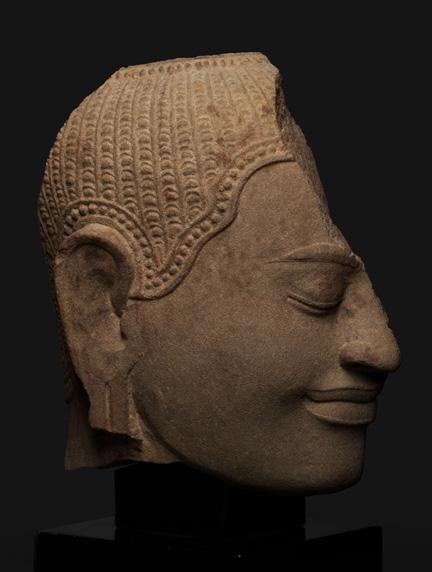
1 A SANDSTONE HEAD OF A DEITY, ANGKOR PERIOD, 11TH CENTURY
Khmer Empire. The finely carved face with a sincere expression, detailed with full lips, incised eyes, and softly arched eyebrows, the neatly incised hair is combed away from the face and secured by a foliate tiara.
Provenance: Collection of Sven A. Behrendt, Salzburg, Austria, assembled from the 1960s onwards, with acquisitions made during his extensive travels worldwide. Note that Behrendt’s important non-Asian collection was sold in a single-owner sale titled “A Worldwide Grand Tour: The Sven A. Behrendt Collection" at Sotheby’s London, 2 December 2025.
Condition: Overall fair condition with extensive wear, obvious losses, chips, scattered nicks, signs of weathering and erosion, and soiling.
Weight: 1,558.7 g
Dimensions: Height 15 cm
AUCTION RESULT COMPARISON
Type: Related
Auction: Christie’s New York, 20 September 2006, lot 203
Price: USD 28,800 or approx. EUR 39,500 converted and adjusted for inflation at the time of writing
Description: A sandstone head of a deity, Khmer, Angkor period, Khleang, 10th century
Expert remark: Compare the closely related modeling and similar foliate tiara. Note the larger size (26.6 cm) and different state of preservation.
Estimate EUR 1,000
Starting price EUR 500
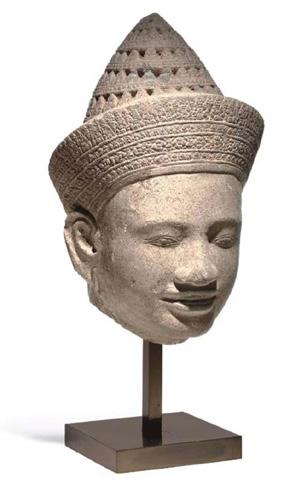
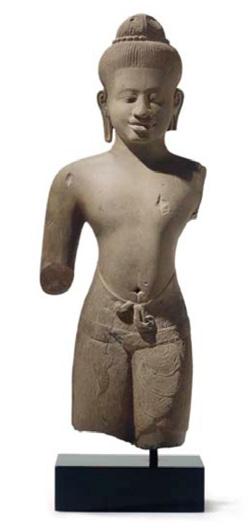
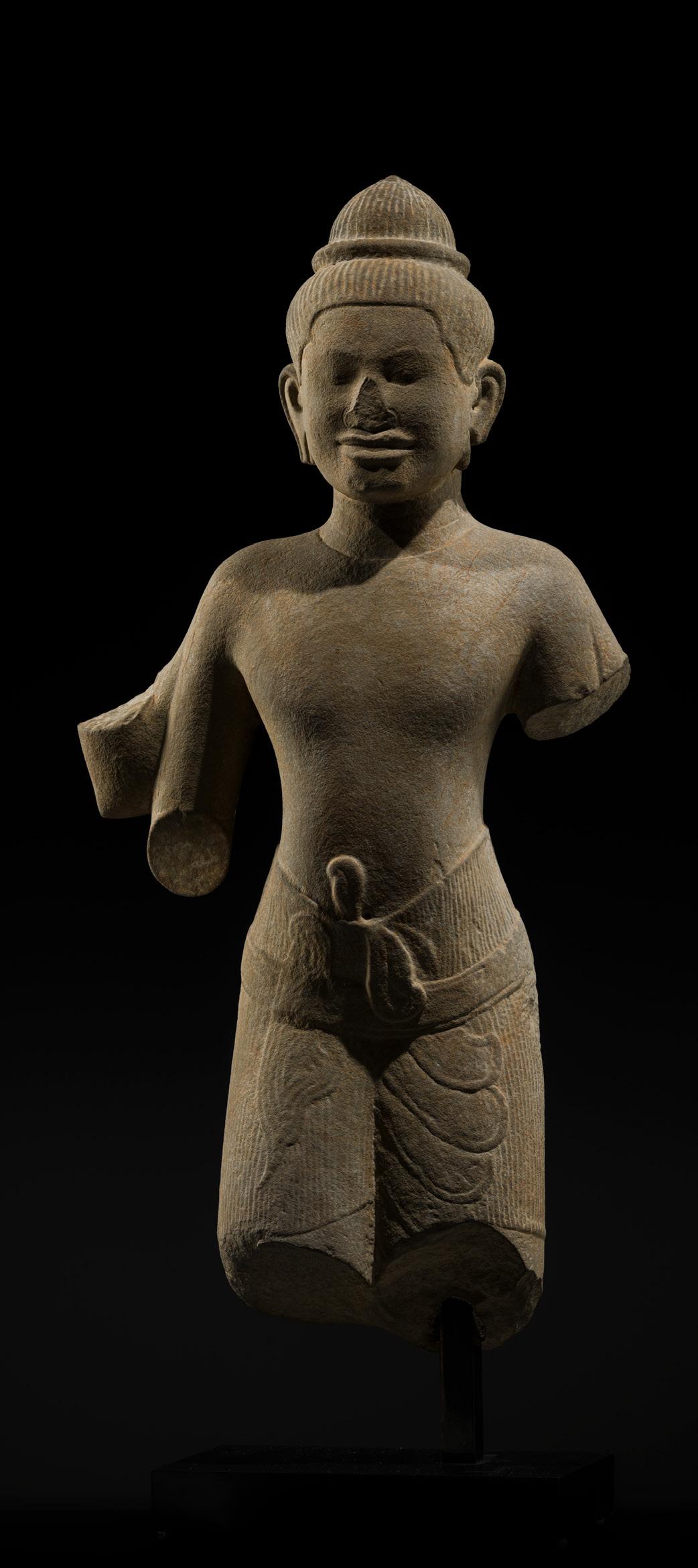
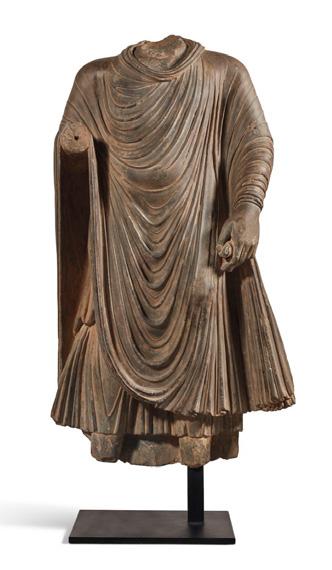
Khmer Empire, 11th century. Sensitively carved in the round, his face with a serene expression, wearing a short sampot tied at the waist with a butterfly knot at the back, secured with a low belt with one end shown in curved pleats on his left thigh, an overlapping stylized pocket fold tied at the waist, the face sensitively carved in a serene expression with full lips in a soft smile, heavy-lidded eyes, and the finely braided hair gathered in a domed topknot secured by a wide band.
Provenance: Collection of Sven A. Behrendt, Salzburg, Austria, assembled from the 1960s onwards, with acquisitions made during his extensive travels worldwide. Note that Behrendt’s important nonAsian collection was sold in a single-owner sale titled “A Worldwide Grand Tour: The Sven A. Behrendt Collection" at Sotheby’s London, 2 December 2025.
Condition: Fair condition, commensurate with age. Expected wear, obvious losses, small chips, scattered nicks and scratches, signs of weathering and erosion, and encrustations.
Weight: 21.8 kg
Dimensions: Height 60 cm (excl. stand), 74 cm (incl. stand)
The Baphuon style is arguably the highpoint in depiction of both male and female form in all Khmer art. One may even say that the materialized gods from this period are handsome and well built, and the goddesses sensual and graceful. This large torso presents all the characteristics of the Baphuon style. Departing from the earlier modeling focused on power and plumpness, the emergences of tendency to greater abstraction with slender and more attenuated representation of the human form. This is especially evident in the more naturalistic treatment of the torso tapering to narrow hips. The most notable departure was the new fashion of sampot that dominated the Baphuon sculptural style that drew upon the Banteay Srei but adopts the pleated fabric.
AUCTION RESULT
COMPARISON
Type: Closely related
Auction: Christie’s New York, 21 March 2007, lot 272
Price: USD 234,000 or approx. EUR 317,000 converted and adjusted for inflation at the time of writing
Description: A sandstone torso of Shiva, Khmer, Angkor period, Baphuon style, 11th century Expert remark: Compare the closely related modeling and manner of carving the sampot, hair, and expression. Note the similar size (62.5 cm).
Estimate EUR 4,000
Starting price EUR 2,000
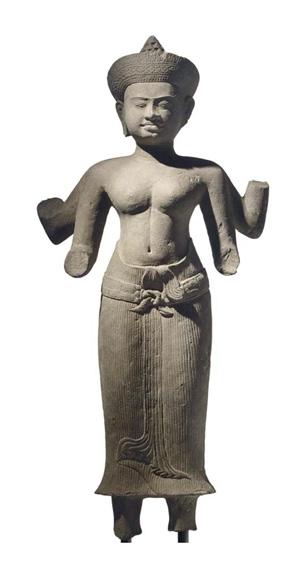
A SANDSTONE FIGURE OF A FEMALE DEITY, BAPHUON STYLE, ANGKOR PERIOD
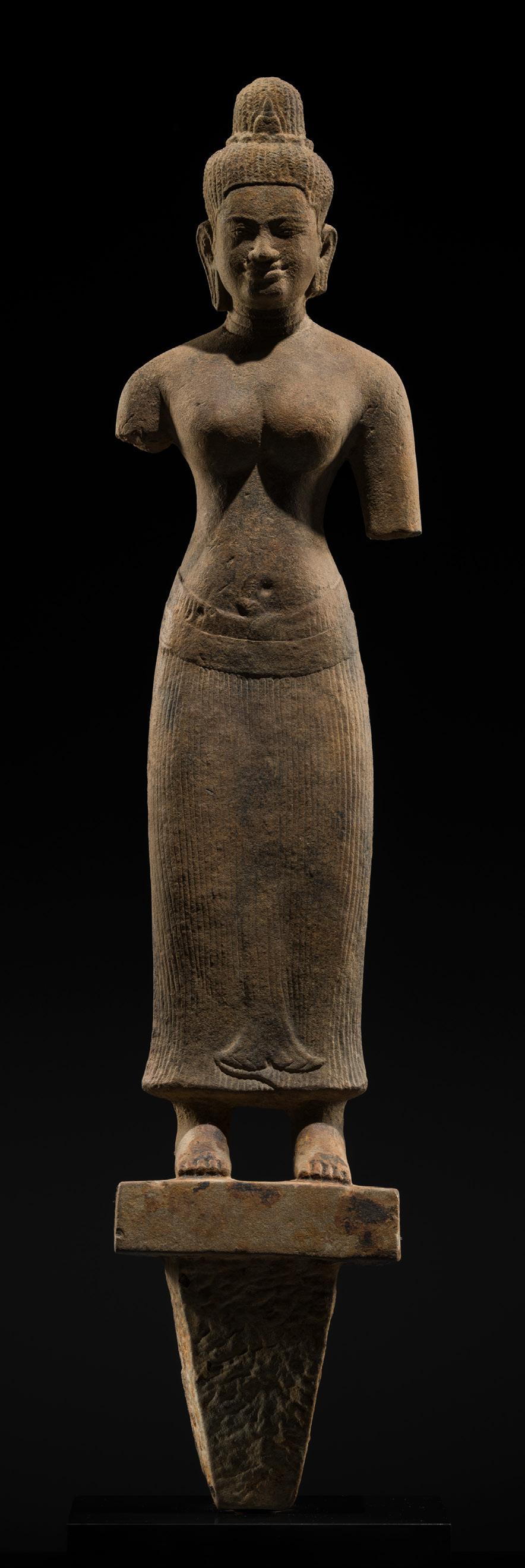
Khmer Empire, first half of the 11th century. Finely carved standing in samabhanga, dressed in a long vertically striated sampot secured by a plain belt around the hips and terminating in a fishtail-shaped flange falling to the front. The face with serene expression, detailed with almond-shaped eyes, bow-shaped lips forming a wide smile, and a dimpled chin, her hair neatly arranged in rows of braids drawn up into a high chignon secured by a beaded diadem and centered by a diminutive stupa.
Provenance: Collection of Sven A. Behrendt, Salzburg, Austria, assembled from the 1960s onwards, with acquisitions made during his extensive travels worldwide. Note that Behrendt’s important non-Asian collection was sold in a single-owner sale titled “A Worldwide Grand Tour: The Sven A. Behrendt Collection" at Sotheby’s London, 2 December 2025.
Condition: Very good condition, commensurate with age. Old wear, obvious losses, small chips, scattered nicks and scratches, signs of weathering and erosion, some soiling and stains, and expected encrustations.
Weight: 10.6 kg (incl. stand)
Dimensions: Height 59 cm (excl. socle), 76 cm (incl. socle), 79 cm (incl. stand)
With an associated stand. (2)
This piece exemplifies the style of Baphuon female figures with the frontal stance, the ovoid skirt wide at the hips and narrowing around the knees, the sarong in an elevated position at the back and curving down to below the navel and the elegant central pleat. According to Boisselier, the highly decorative style of Banteay Srei inspired the development of Baphuon period sculpture, a manner which became more embellished with decorative elements as it reached a zenith during the Angkor Wat period a century later, see Helen Ibbitson Jessup and Thierry Zephir, editors, Sculpture of Angkor and Ancient Cambodia - Millennium of Glory, Washington 1997, page 255.
AUCTION RESULT COMPARISON
Type: Closely related
Auction: Christie’s Paris, 14 December 2016, lot 13
Price: EUR 40,000 or approx. EUR 48,500 adjusted for inflation at the time of writing
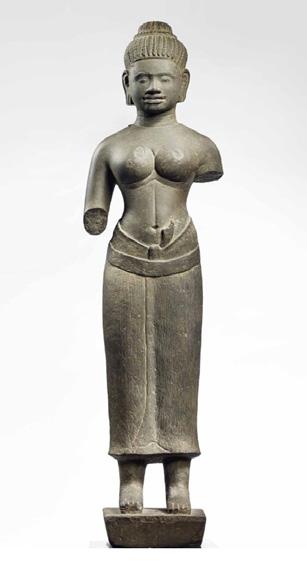
Description: A fine polished sandstone figure of Uma, Cambodia, Khmer, Baphuon period, 11th century
Expert remark: Compare the closely related modeling and manner of carving the sampot, hair, and expression. Note the similar size (66 cm).
Estimate EUR 6,000
Starting price EUR 3,000
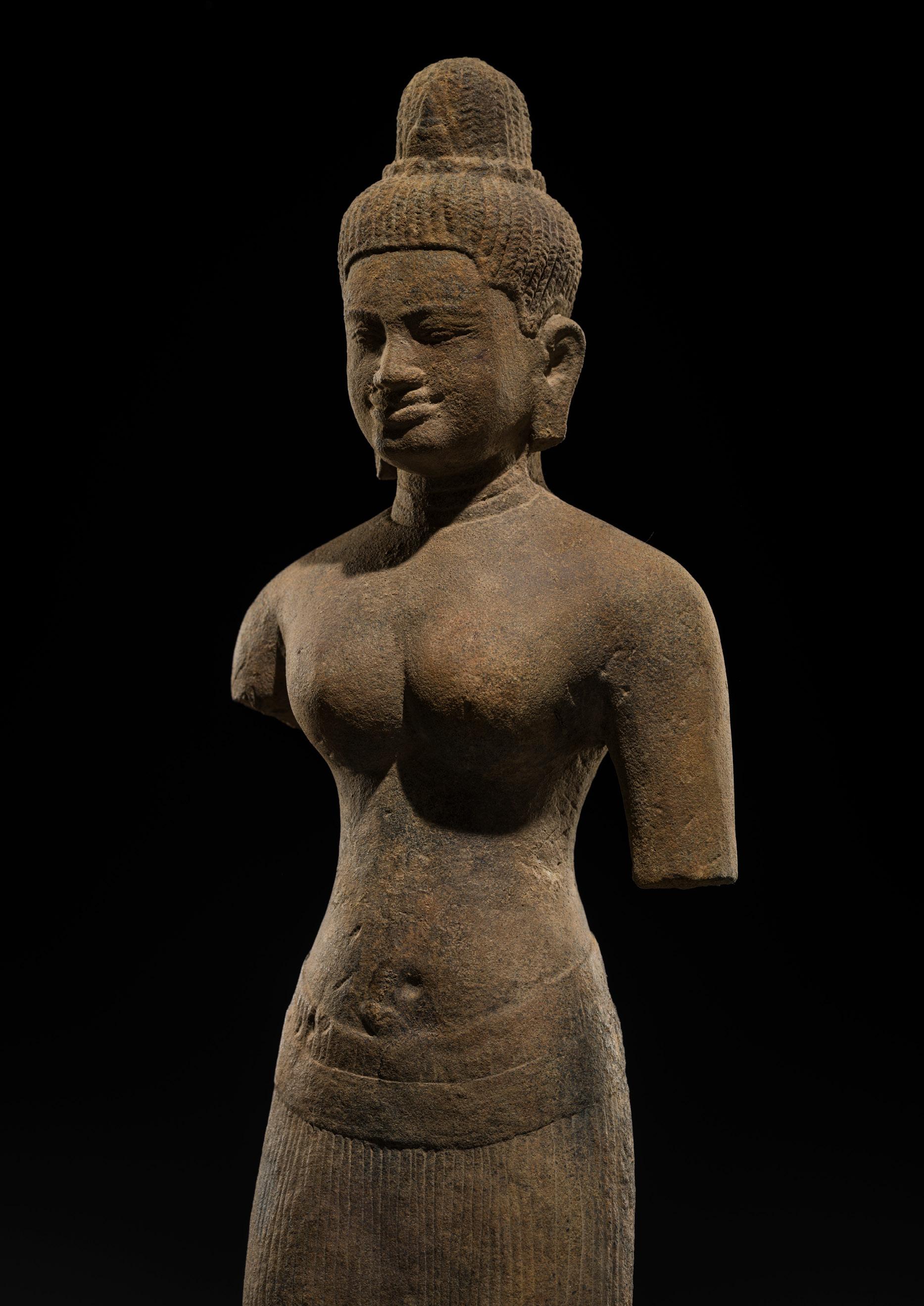
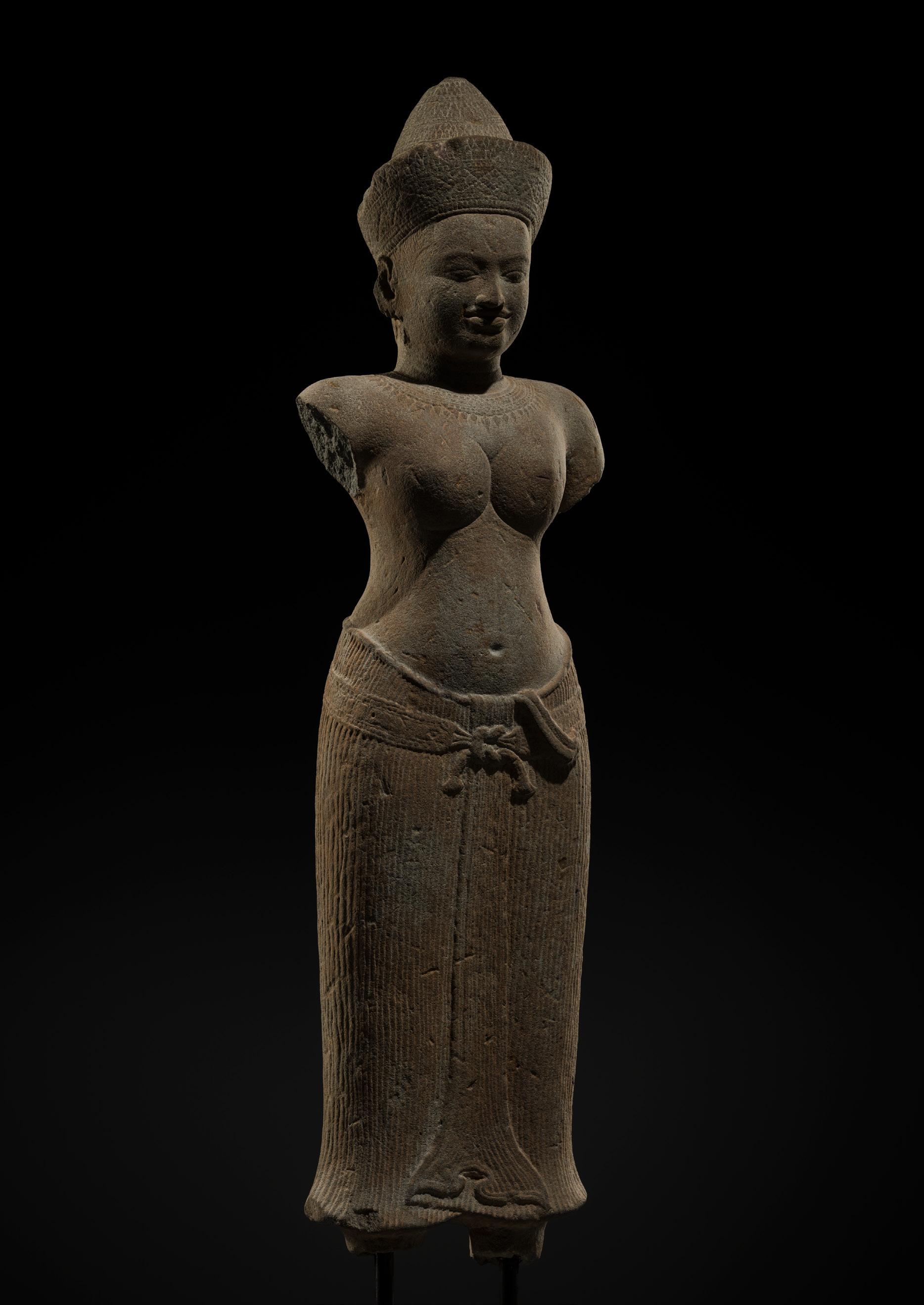
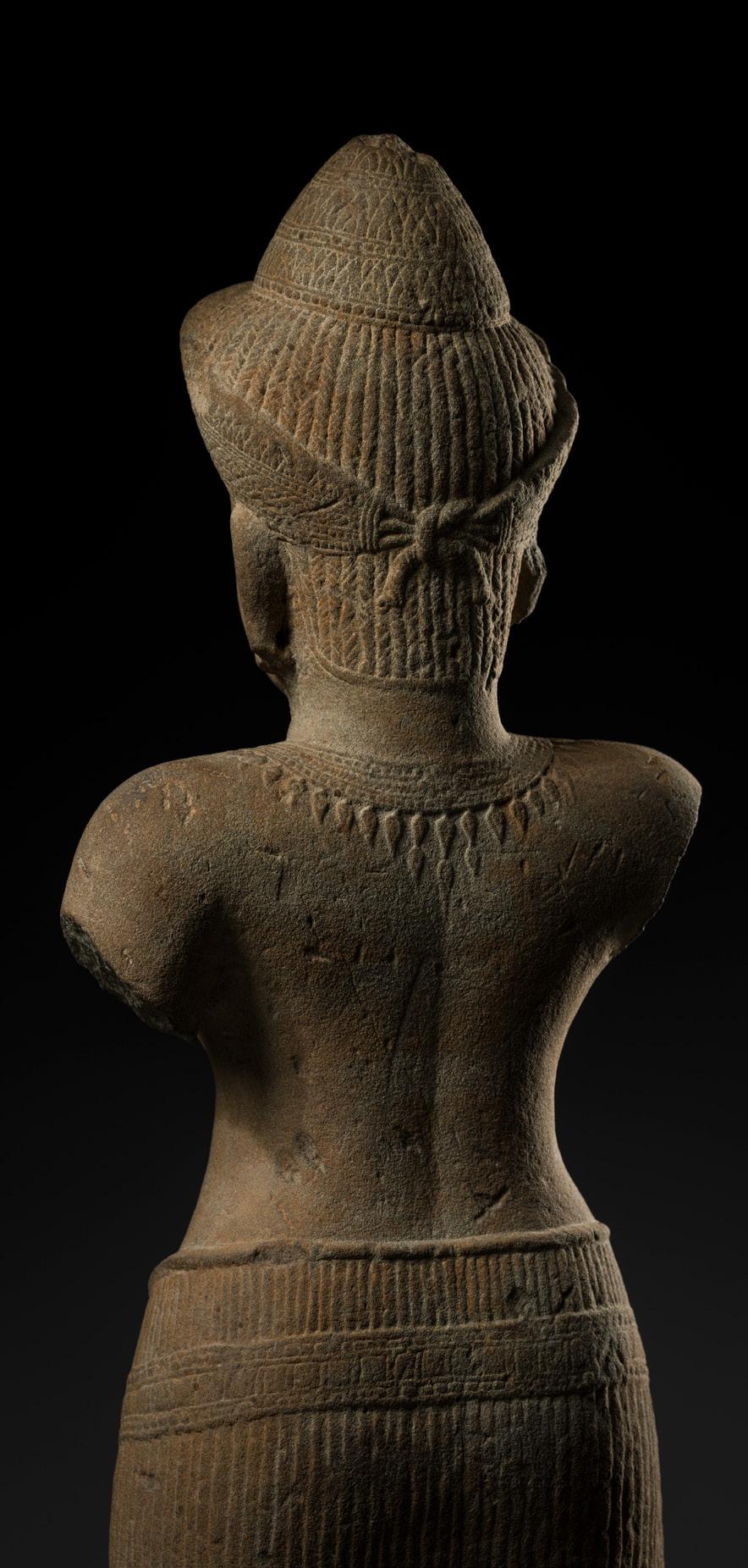
A MAGNIFICENT SANDSTONE FIGURE OF A GODDESS, BAPHUON STYLE, SECOND HALF OF THE 11TH CENTURY
Khmer Empire, Angkor period. Exquisitely carved standing in samabhanga, the voluptuous deity intricately adorned in foliate jewelry, dressed in a long, striated sampot tied at the front, the long central fold elegantly culminating in a fishtail hem, held together at the hips with a patterned belt fastened in a stylized knot. Her serene expression with finely incised almond-shaped eyes, full lips forming a calm smile, and a broad nose, her hair arranged into a high conical chignon behind the flaring foliate tiara.
Provenance: Collection of Sven A. Behrendt, Salzburg, Austria, assembled from the 1960s onwards, with acquisitions made during his extensive travels worldwide. Note that Behrendt’s important non-Asian collection was sold in a single-owner sale titled “A Worldwide Grand Tour: The Sven A. Behrendt Collection" at Sotheby’s London, 2 December 2025. A copy of an invoice, addressed to Mr Sven A Behrendt, dated 26 April 1999, and confirming the dating above, accompanies this lot. The invoice states a purchase price of USD 7,000 or approx.

EUR 14,000 (converted and adjusted for inflation at the time of writing).
Condition: Very good condition, commensurate with age. Expected wear, obvious losses, small chips, scattered nicks and scratches, signs of weathering and erosion, and encrustations, all as expected.
Weight: 24.6 kg
Dimensions: Height 76.5 cm (excl. stand), 86 cm (incl. stand)
This piece exemplifies the style of Baphuon female figures with the frontal stance, the ovoid skirt wide at the hips and narrowing around the knees, the sarong in an elevated position at the back and curving down to below the navel and the elegant central pleat. According to Boisselier the highly decorative style of Banteay Srei inspired the development of Baphuon period sculpture, a manner which became more embellished with decorative elements as it reached a zenith during the Angkor Wat period a century later, see Helen Ibbitson Jessup and Thierry Zephir, editors, Sculpture of Angkor and Ancient Cambodia - Millennium of Glory, Washington 1997, page 255.
Estimate EUR 6,000
Starting price EUR 3,000
AUCTION RESULT COMPARISON
Type: Closely related
Auction: Christie’s New York, 21 March 2007, lot 270
Price: USD 66,000 or approx.
EUR 89,500 converted and adjusted for inflation at the time of writing
Description: A sandstone figure of Uma, Khmer, Angkor period, Baphuon style, 11th century
Expert remark: Compare the closely related modeling and manner of carving the sampot, headdress, and expression. Note the similar size (72.1 cm).
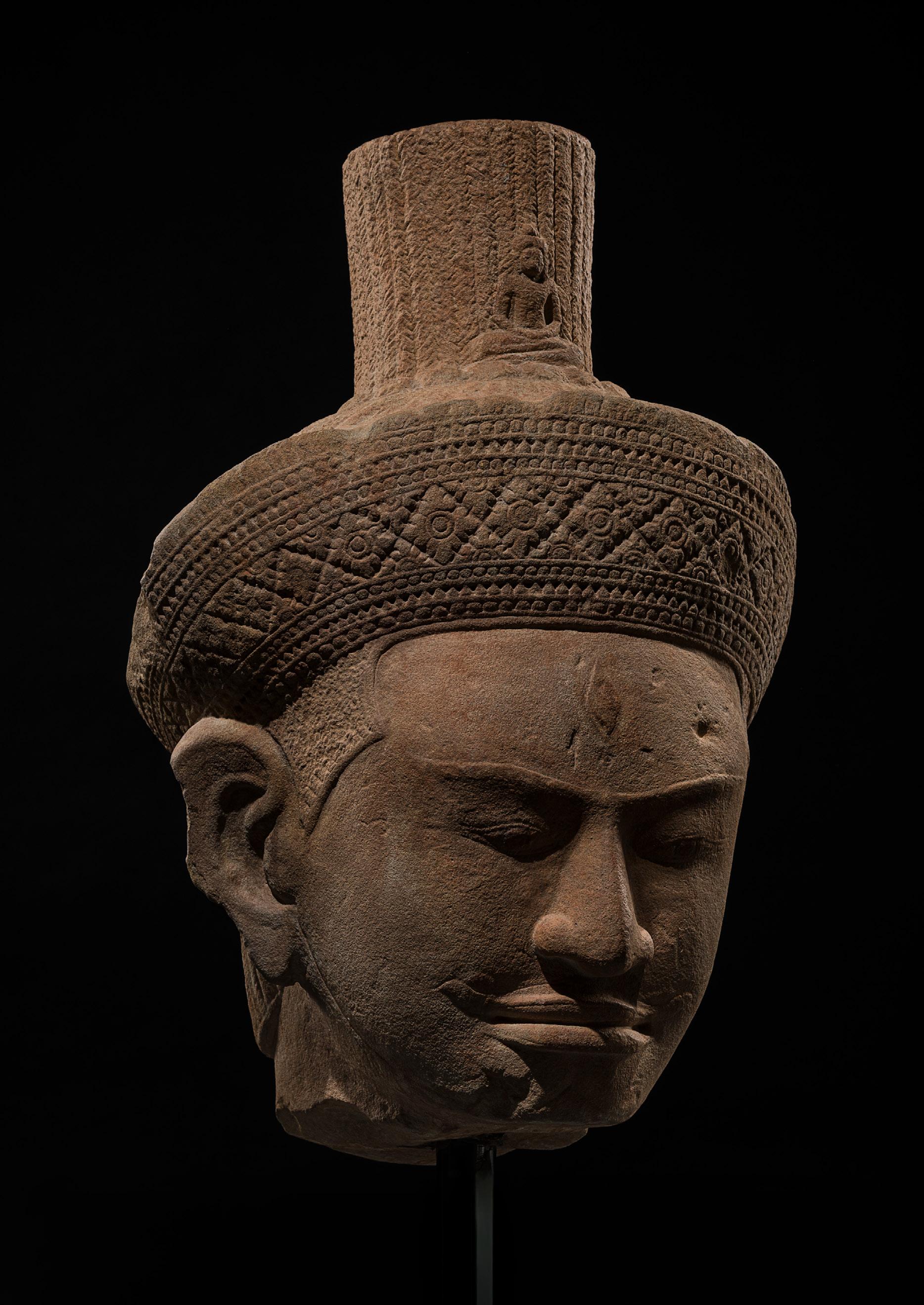
5 A LARGE AND POWERFUL SANDSTONE HEAD OF AVALOKITESHVARA, BAKHENG PERIOD, 10TH CENTURY
Khmer Empire. The round face delicately carved with full lips incised with an upward-curved moustache, almond-shaped eyes below protruding brows, centered by a vertical third eye, and flanked by elongated earlobes. The hair arranged into neatly braided rows, rising to a cylindrical topknot centered by Amitabha and topped by a lotus finial, and secured by a wide foliate crown tied at the verso.

Provenance: T.C. Art & Antique, Bangkok, Thailand. Collection of Sven A. Behrendt, Salzburg, Austria, assembled from the 1960s onwards, with acquisitions made during his extensive travels worldwide, acquired from the above in 1994. Note that Behrendt’s important non-Asian collection was sold in a singleowner sale titled “A Worldwide Grand Tour: The Sven A. Behrendt Collection" at Sotheby’s London, 2 December 2025. A copy of an invoice by T.C. Art & Antique, addressed to Mr. Sven Behrendt, dated 6 March 1994, confirming the dating above, accompanies this lot. Condition: Very good condition, commensurate with age. Expected wear, obvious losses and cracks, small chips, some nibbling, scattered nicks and scratches, signs of weathering and erosion, and encrustations.
Weight: 85.3 kg (incl. stand)
Dimensions: Height 54 cm (excl. stand), 78.5 cm (incl. stand)
With an associated stand. (2)
The rigorous stylized treatment of the features with the sharp ridged eyebrows and the well polished surface, imparts a degree of severity to the sculpture which is characteristic of the Bakheng style.
Literature comparison: Compare a related sandstone head of Shiva, Bakheng style, 36 cm high, in the National Museum of Cambodia, inventory number Ka.2707.
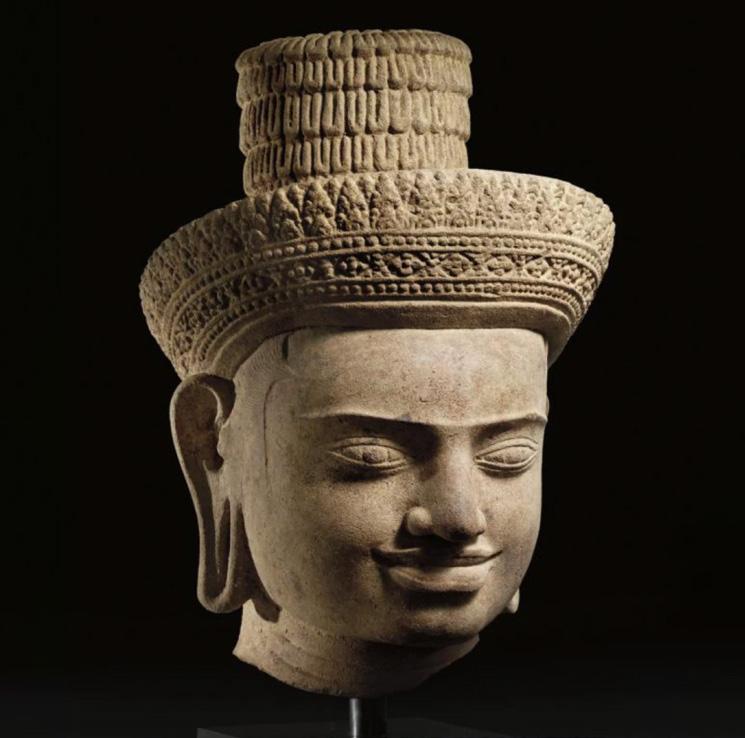
AUCTION RESULT COMPARISON
Type: Closely related
Auction: Sotheby’s New York, 29 March 2006, lot 197
Price: USD 108,000 or approx. EUR 151,000 converted and adjusted for inflation at the time of writing
Description: Head of a female deity sandstone Khmer, Bakheng style
Expert remark: Compare the closely related modeling, manner of carving, cylindrical chignon, and similar expression. Note the size (34.3 cm).
Estimate EUR 20,000
Starting price EUR 10,000
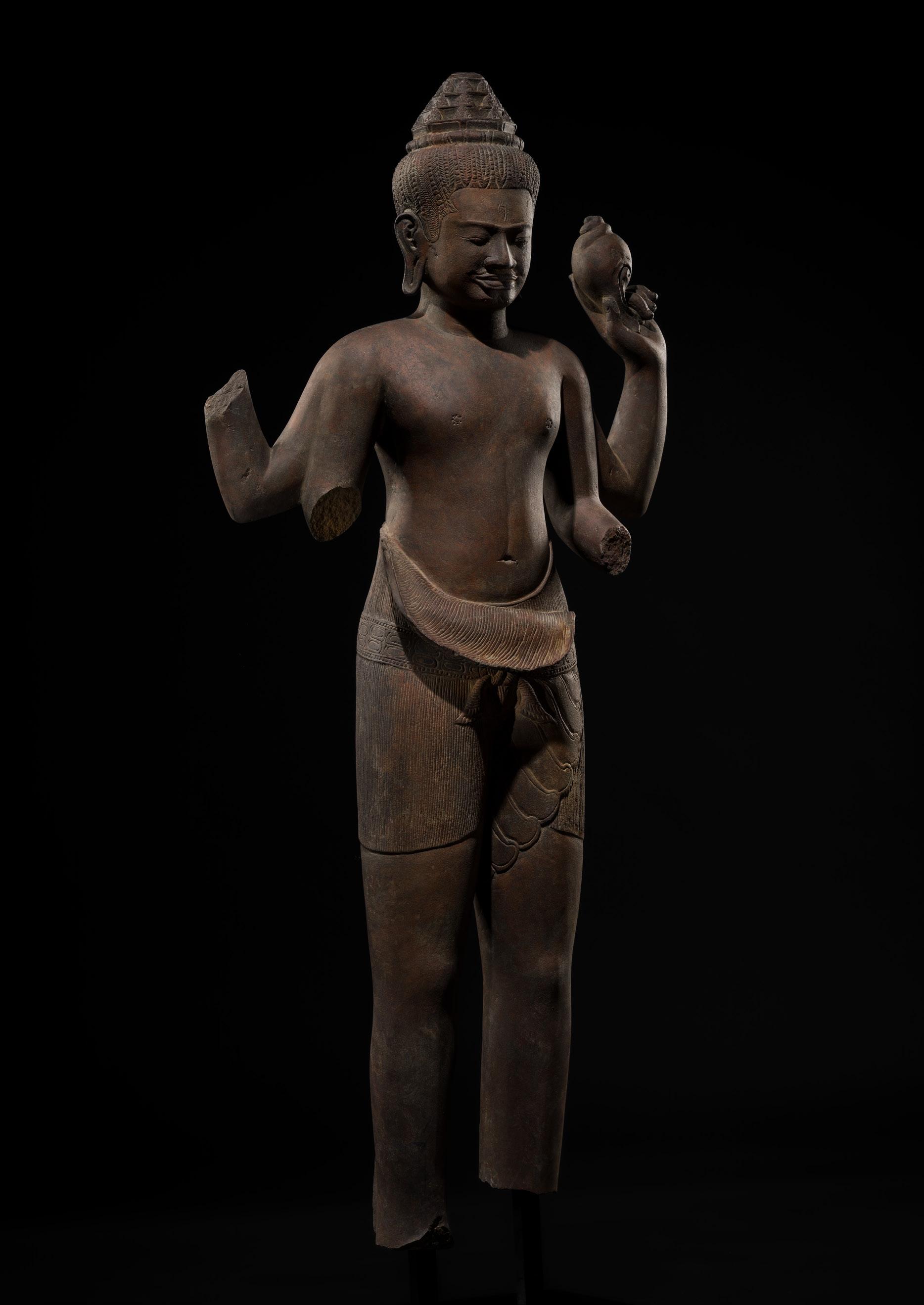
AN EXTREMELY RARE AND LARGE SANDSTONE STATUE OF SHIVA, BAPHUON STYLE, ANGKOR PERIOD
Khmer Empire, 10th-12th century. The Preserver of the Universe standing in samapada, holding a conch in his one remaining hand, wearing a short pleated sampot incised with parallel pleats, tied at the front below the navel with the folds splayed across the left thigh and secured with a butterfly sash at the back, the extra material folding over at the waist, all secured at the hips with a patterned belt fastened in a stylized knot. The face sensitively modeled with a serene expression, almond-shaped eyes centered by a third vertical eye, full lips, and a thin incised mustache, all flanked by ears with elongated lobes. The neatly braided hair piled into a tiered conical chignon.
Art Loss Register:
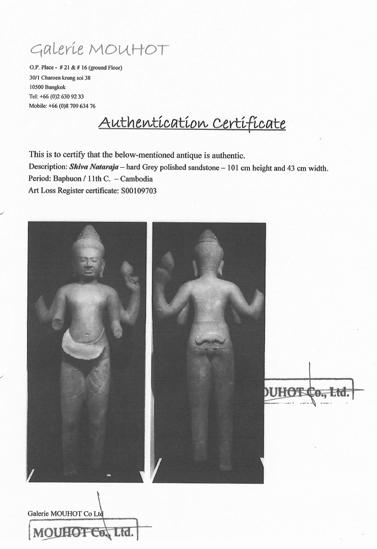
ALR Ref. S00109703. A copy of the certification document accompanies the lot.
Provenance: Asia Antique Gallery, Bangkok, Thailand. A private collection in Bangkok, Thailand, acquired from the above in 1968, and thence by direct descent to Wundrudee Mahanil. Gallery Mouhot, Bangkok, acquired from the above. Collection of Sven A. Behrendt, Salzburg, Austria, assembled from the 1960s onwards, with acquisitions made during his extensive travels worldwide. Note that Behrendt’s important non-Asian collection was sold in a single-owner sale titled “A Worldwide Grand Tour: The Sven A. Behrendt Collection" at Sotheby’s London, 2 December 2025. A copy of a signed and stamped authentication certificate from Galerie Mouhot, confirming the dating above, accompanies this lot. Galerie Mouhot is a gallery specializing in Khmer Art based in River City Bangkok, established by the Frenchman Eric Dieu and named after Henri Mouhot (1826-1861), the mid-19th century naturalist and explorer credited with reintroducing the world to the grandeur of Angkor and the Khmer civilization.
Condition: Very good condition, commensurate with age. Old wear, signs of weathering and erosion, obvious losses and natural cracks, nicks, scratches, and expected encrustations. The stone with a fine, naturally grown, smooth patina overall.
Weight: 46.4 kg (incl. stand)
Dimensions: Height 102 cm (excl. stand), 109.5 cm (incl. stand)
Mounted on an associated stand. (2)
AUCTION RESULT COMPARISON
Type: Closely related
Auction: Zacke, Vienna, 13 December 2023, lot 268
Price: EUR 104,000 or approx. EUR 112,000 adjusted for inflation at the time of writing
Description: An extremely rare and monumental sandstone statue of Vishnu, Angkor Period
Expert remark: Compare the closely related modeling, manner of carving, and similar sampot, facial expression, and robust physique. Note the larger size (207 cm).
AUCTION RESULT COMPARISON
Type: Closely related
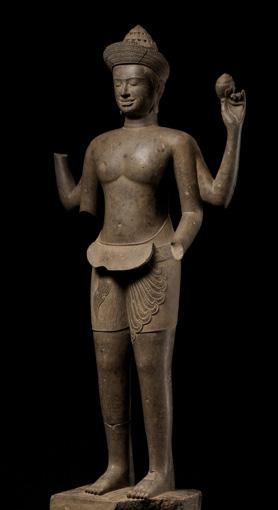
Auction: Sotheby’s New York, 22 September 2020, lot 344
Price: USD 150,000 or approx. EUR 160,000 converted and adjusted for inflation at the time of writing
Description: A gray sandstone figure of Shiva, Khmer, Baphuon style, circa 11th century
Expert remark: Compare the closely related subject, manner of carving, and related sampot, facial expression, and physique. Note the similar size (94.6 cm).
Estimate EUR 15,000
Starting price EUR 7,500
Weight: 45.3 kg
Dimensions: Height 49 cm
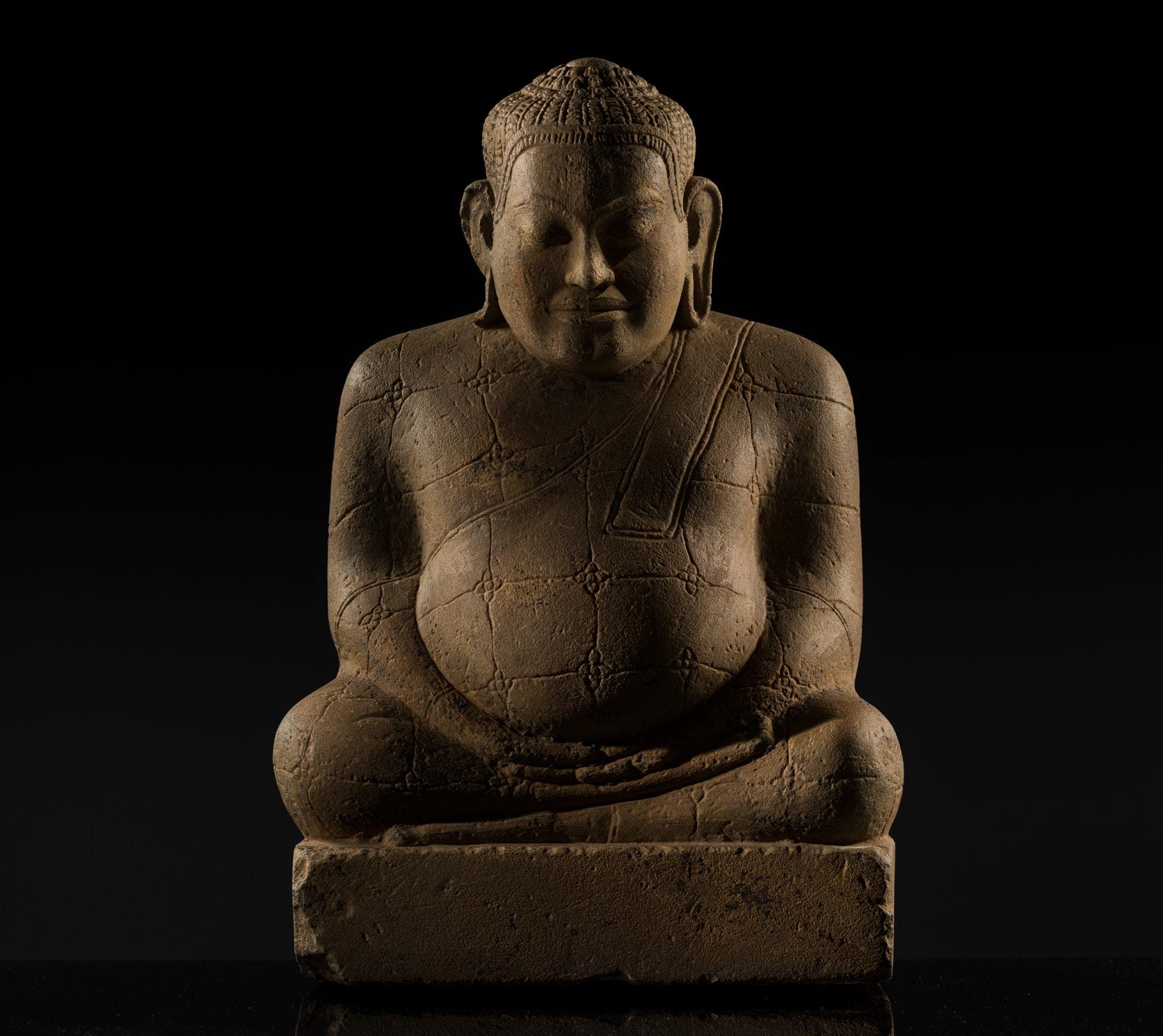
7 AN EXCEEDINGLY RARE SANDSTONE FIGURE OF THE BUDDHIST DISCIPLE PHRA SANKACHAI, BUDAI, BAYON STYLE, ANGKOR PERIOD, LATE 12TH-13TH CENTURY
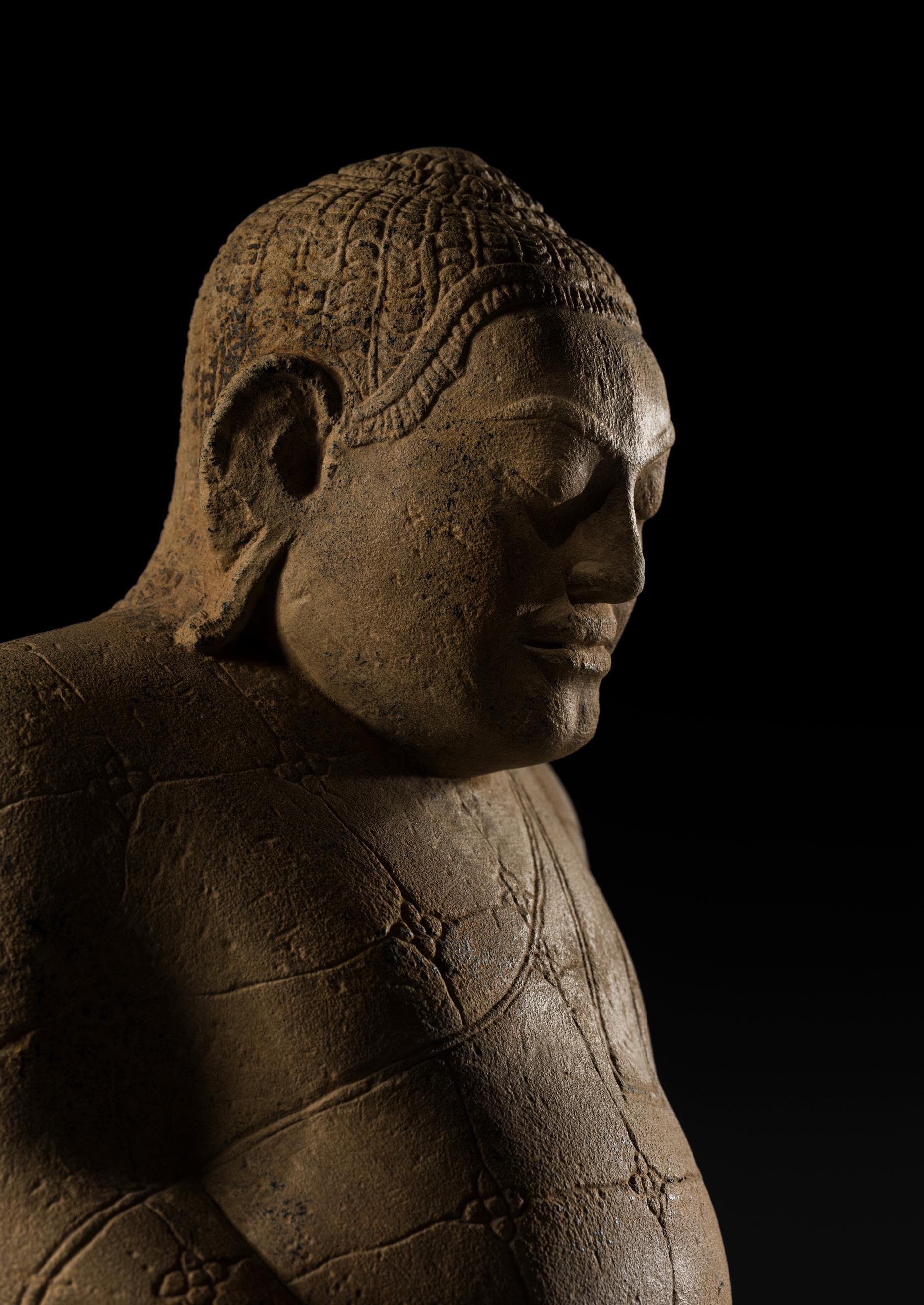
Khmer Empire. Finely carved to depict the pot-bellied wealth god seated atop a tall rectangular cushion with his hands resting in dhyana mudra below his rotund belly, wearing a foliate-incised robe that drapes across his shoulder and falls in a wide pleat to the front. The wide face with a serene expression marked by chubby cheeks, a dimpled chin, and heavy-lidded sinuous eyes gazing downwards, flanked by ears with pendulous earrings. The hair modeled in vertical braided bands with a pearl band that surrounds the forehead and tightly frames the ears, rising to a gently domed ushnisha.
Provenance: T.C. Art & Antique, Bangkok, Thailand. Collection of Sven A. Behrendt, Salzburg, Austria, assembled from the 1960s onwards, with acquisitions made during his extensive travels worldwide, acquired from the above in 2013. Note that Behrendt’s important non-Asian collection was sold in a single-owner sale titled “A Worldwide Grand Tour: The Sven A. Behrendt Collection" at Sotheby’s London, 2 December 2025. A copy of an invoice by T.C. Art & Antique, addressed to Mr. Sven Behrendt, dated 17 May 2013, confirming the dating above, accompanies this lot. The invoice states a purchase price of USD 57,000 or approx. EUR 75,000 (converted and adjusted for inflation at the time of writing).
Condition: Very good condition, commensurate with age. Expected wear, small losses, few chips, some nibbling, scattered nicks and scratches, signs of weathering and erosion, and encrustations.
This is a much favored depiction of a famed Buddhist disciple, rotund and shaven, renowned for his gifts in teaching the dharma. He was introduced into later Southeast Asian Buddhism from China, where he is known as Budai. He has various hagiographies, but is widely understood as an incarnation of Maitreya, the Future Buddha. Popularly, he is associated with contentment and prosperity.
AUCTION RESULT
COMPARISON
Type: Closely related
Auction: Bonhams Paris, 25 October 2022, lot 76
Price: EUR 378,375 or approx. EUR 409,000 adjusted for inflation at the time of writing
Description: Sandstone head of a deity, Cambodia, Bayon style, late 12th-early 13th century
Expert remark: Compare the closely related modeling of the head with a similarly incised hairstyle. Note the size (23 cm).
Estimate EUR 15,000
Starting price EUR 7,500
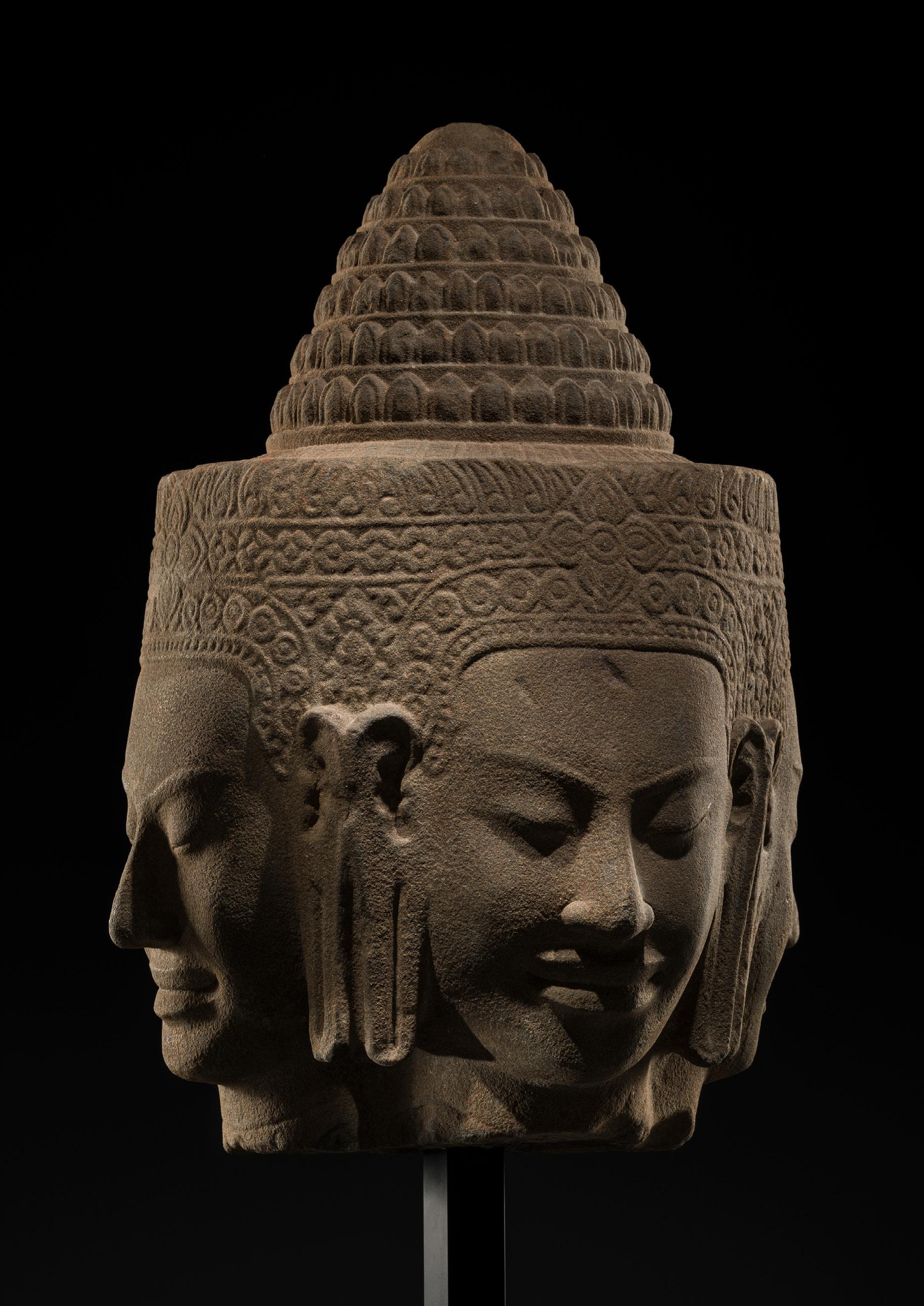
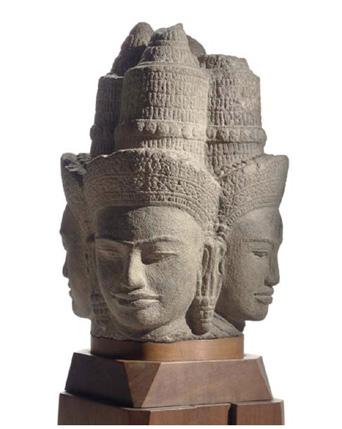
Khmer empire. Each of the four faces is depicted with full lips forming a gentle smile, downcast eyes beneath raised eyebrows, an elegant nose, and flanked by ears adorned with pierced, pendulous earlobes. The serene faces are framed by an elaborate headdress featuring rows of rings and blossoms, with a lotus flower centered above each face, and surmounted by a conical chignon covered in rows of petals.
Provenance: Private collection of Wanghumyai, Bangkok, 1972. Sommai Praram private collection, Bangkok, acquired from the above by her uncle, and thence by descent in the family. Galerie Mouhot, Bangkok, Thailand. Collection of Sven A. Behrendt, Salzburg, Austria, assembled from the 1960s onwards, with acquisitions made during his extensive travels worldwide. Note that Behrendt’s important non-Asian collection was sold in a single-owner sale titled “A Worldwide Grand Tour: The Sven A. Behrendt Collection" at Sotheby’s London, 2 December 2025.
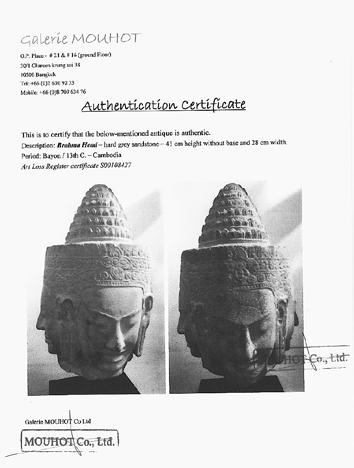
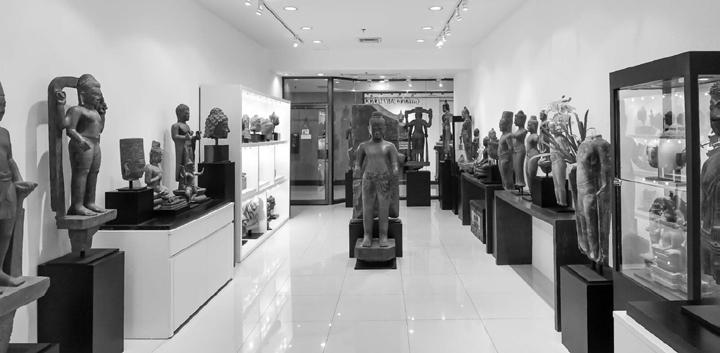
A copy of a signed and stamped authentication certificate from Galerie Mouhot, confirming the dating above, accompanies this lot. A copy of an Art Loss Register confirmation, dated 9 December 2015, reference number S00108427, confirming the Thai provenance, accompanies the lot. Galerie Mouhot is a gallery specializing in Khmer Art based in River City Bangkok, established by the Frenchman Eric Dieu and named after Henri Mouhot (1826-1861), the mid-19th century naturalist and explorer credited with reintroducing the world to the grandeur of Angkor and the Khmer civilization.
Condition: Good condition with expected old wear, signs of weathering and erosion, small nicks, few old chips, and obvious losses.
Weight: 42.5 kg
Dimensions: Height 42 cm (excl. stand), 54 cm (incl. stand)
This sandstone head represents Brahma, the Hindu god of creation. His four heads symbolize the Vedas, four of the oldest scriptures considered to be composed of sacred knowledge and refer to his cosmic role as creator.
Literature comparison:
Compare a Bayon style sandstone head with four faces, Siam Reap, dated 1175-1250, 35 cm tall, in the Rijksmuseum, object number AK-MAK-227.
AUCTION RESULT COMPARISON
Type: Related
Auction: Christie’s New York, 21 March 2007, lot 273
Price: USD 132,000 or approx. EUR 179,000 converted and adjusted for inflation at the time of writing
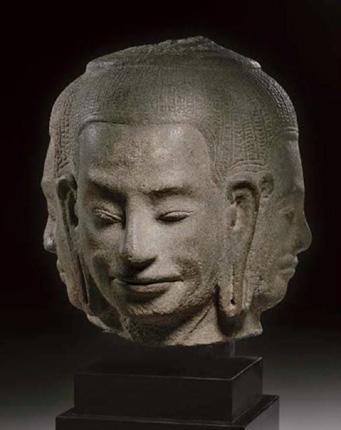
Description: A rare sandstone head of Brahma, Khmer, Angkor period, Bayon style, 13th century
Expert remark: Compare the similar subject, material, and expression. Note the size (33 cm).
AUCTION RESULT COMPARISON
Type: Related
Auction: Christie’s New York, 30 March 2006, lot 112
Price: USD 108,000 or approx. EUR 155,000 converted and adjusted for inflation at the time of writing
Description: An important mottled gray stone head of Brahma or Shiva, Khmer, Angkor period, Bayon style, early 13th century
Expert remark: Compare the similar subject, facial features, and expression. Note the size (26.6 cm).
Estimate EUR 15,000
Starting price EUR 7,500
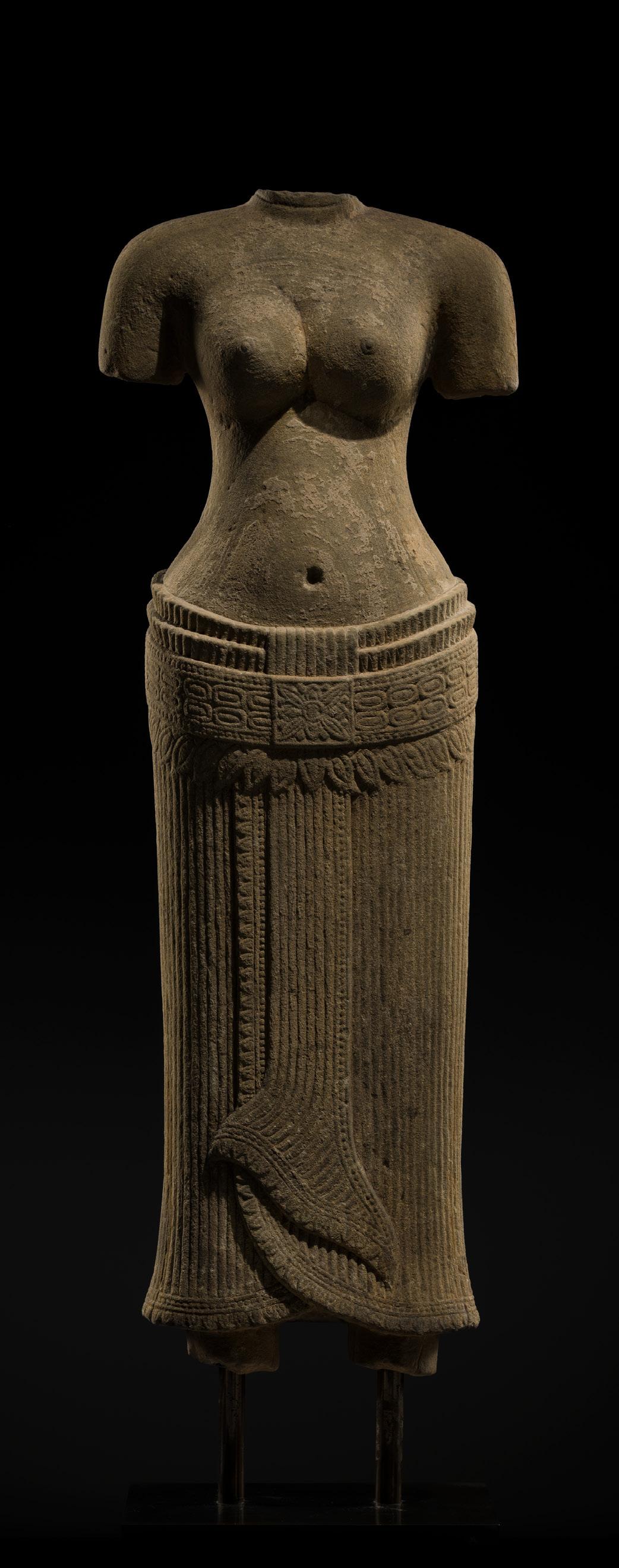
9 A SANDSTONE TORSO OF A FEMALE DEITY, BAYON STYLE, ANGKOR PERIOD, LATE 12TH13TH CENTURY
Khmer Empire. Superbly carved in a sinuous outline with prominent breasts and a beautifully rounded belly, wearing a tightly fitted sampot resting low on the hips, neatly incised with vertical pleats and held up with a floral-banded tasseled sash secured with a fishtail knot.
Provenance: Collection of Sven A. Behrendt, Salzburg, Austria, assembled from the 1960s onwards, with acquisitions made during his extensive travels worldwide. Note that Behrendt’s important nonAsian collection was sold in a single-owner sale titled “A Worldwide Grand Tour: The Sven A. Behrendt Collection" at Sotheby’s London, 2 December 2025. Condition: Very good condition, commensurate with age. Old wear, obvious losses, small chips, scattered nicks and scratches, signs of weathering and erosion, and encrustations, all as expected.
Weight: 26 kg (incl. stand)
Dimensions: 70 cm (excl. stand), 80 cm (incl. stand)
Mounted on an associated stand. (2)
AUCTION RESULT COMPARISON
Type: Related
Auction: Christie’s Amsterdam, 31 October 2000, lot 170
Price: NLG 117,020 or approx. EUR 97,000 converted and adjusted for inflation at the time of writing
Description: A Khmer, Bayon style, sandstone torso of a female deity, 13th century Expert remark: Compare the closely related modeling and similar sampot held together by a foliate sash suspending tassels.
Note the size (59 cm).
Estimate EUR 6,000
Starting price EUR 3,000
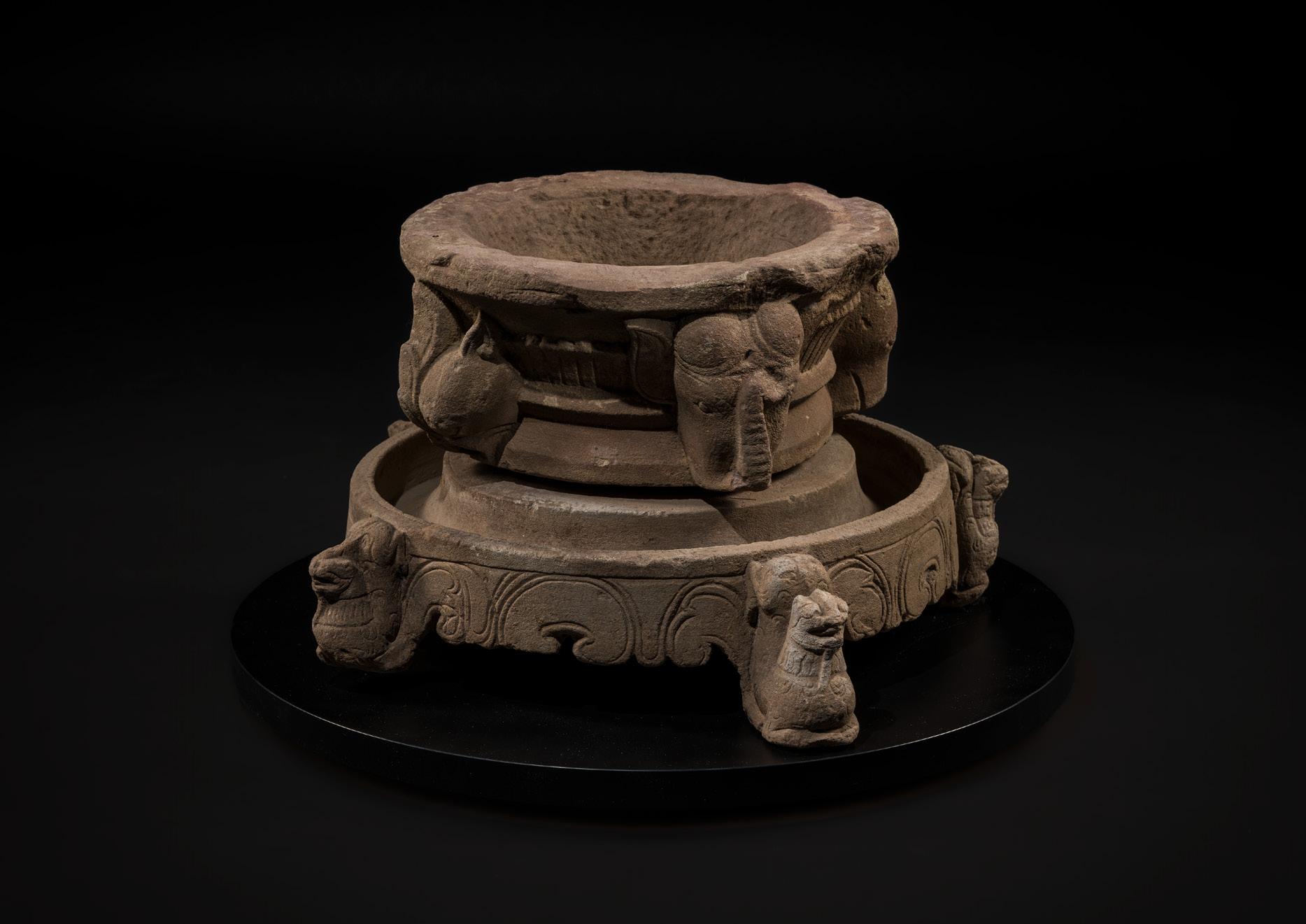
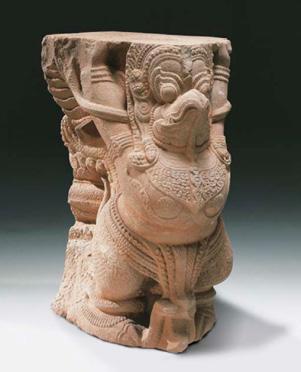
Vietnam, former kingdoms of Champa. Carved from two pieces, the upper part decorated to the exterior with four animal heads including an elephant, a horse, an ox, and a mythical beast, alternating with stiff petals. The interior pierced with four apertures. The base supported on five feet carved in form of lions, with bands of stylized petals enclosing the sides. (2)
Provenance: Galerie Mouhot, Bangkok, Thailand. Collection of Sven A. Behrendt, Salzburg, Austria, assembled from the 1960s onwards, with acquisitions made during his extensive travels worldwide.

Note that Behrendt’s important non-Asian collection was sold in a single-owner sale titled “A Worldwide Grand Tour: The Sven A. Behrendt Collection" at Sotheby’s London, 2 December 2025. A copy of a signed and stamped authentication certificate from Galerie Mouhot, confirming the dating above, accompanies this lot. A copy of a signed and stamped invoice from Galerie Mouhot, dated 4 April 2015, at a purchase price of USD 6,000 or approx. EUR 7,000 (converted and adjusted for inflation at the time of writing), accompanies this lot. Galerie Mouhot is a gallery specializing in Khmer Art based in River City Bangkok, established by the Frenchman Eric Dieu and named after Henri Mouhot (1826-1861), the mid-19th century naturalist and explorer credited with reintroducing the world to the grandeur of Angkor and the Khmer civilization.
Condition: Good condition, commensurate with age. Extensive wear, signs of weathering and erosion, small losses, few chips, nicks, scratches, and minor soil encrustations.
Weight: 28 kg
Dimensions: Length 46 cm
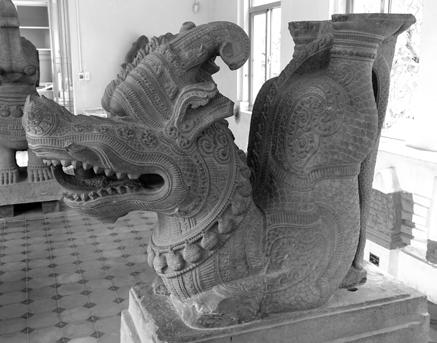
The lion feet of the present mortar have a distinct pose drawing a parallel to a dragon sculpture from the 13th century, Thap Mam site, in the Museum of Cham Sculpture, Vietnam (fig. 1). The finely incised floral motifs on the base exhibit further similarities to a section of sandstone base molding, dated to the 12th–13th centuries, held in the Museum of Vietnamese History, Ho Chi Minh City.
LITERATURE COMPARISON
Compare a related sandstone architectural support carved as Garuda, Cham, Thap Mam style, dated 12th century, 93 cm tall, at Christie’s Paris, 26 November 2002, lot 360.
Estimate EUR 3,000
Starting price EUR 1,500
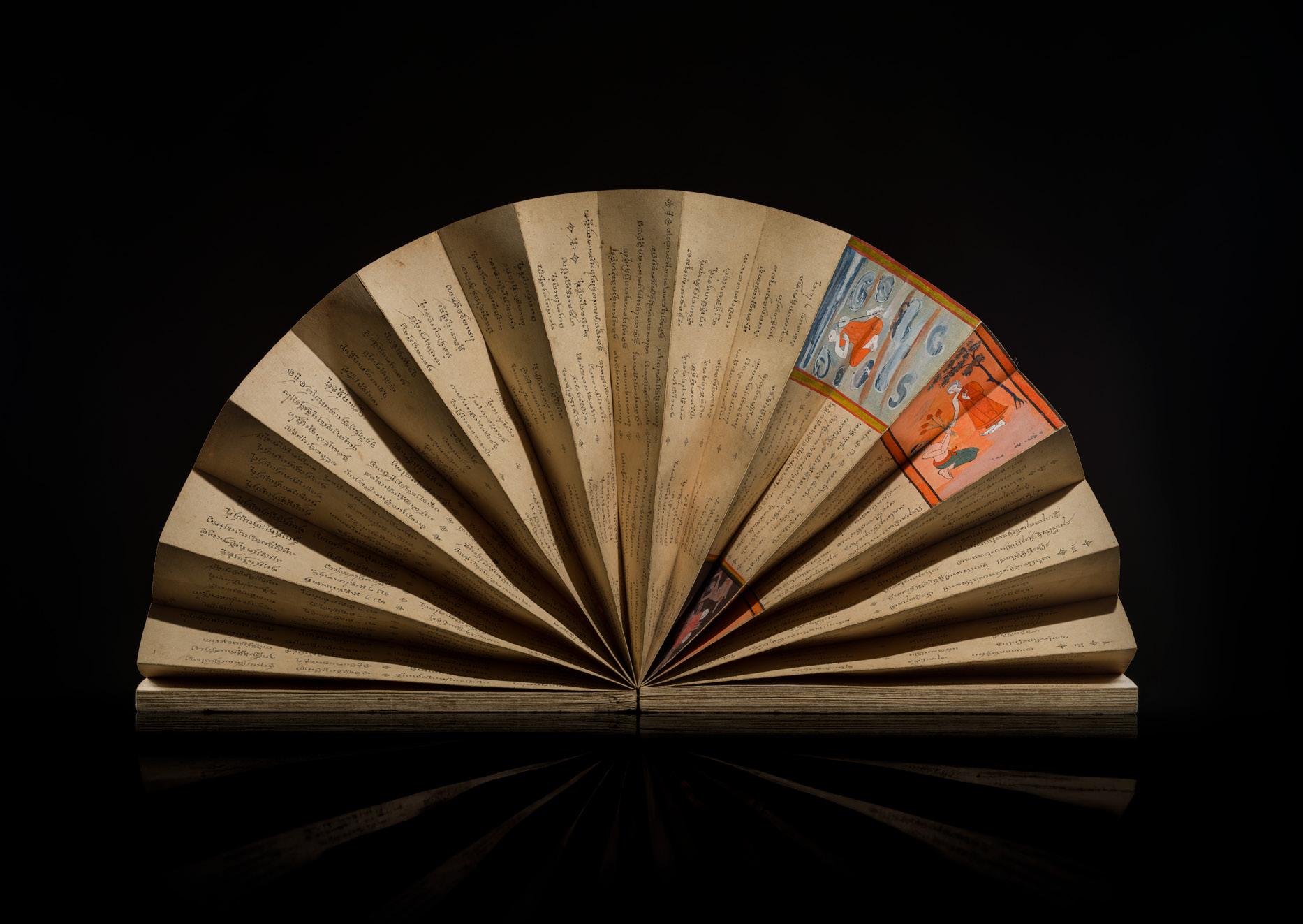
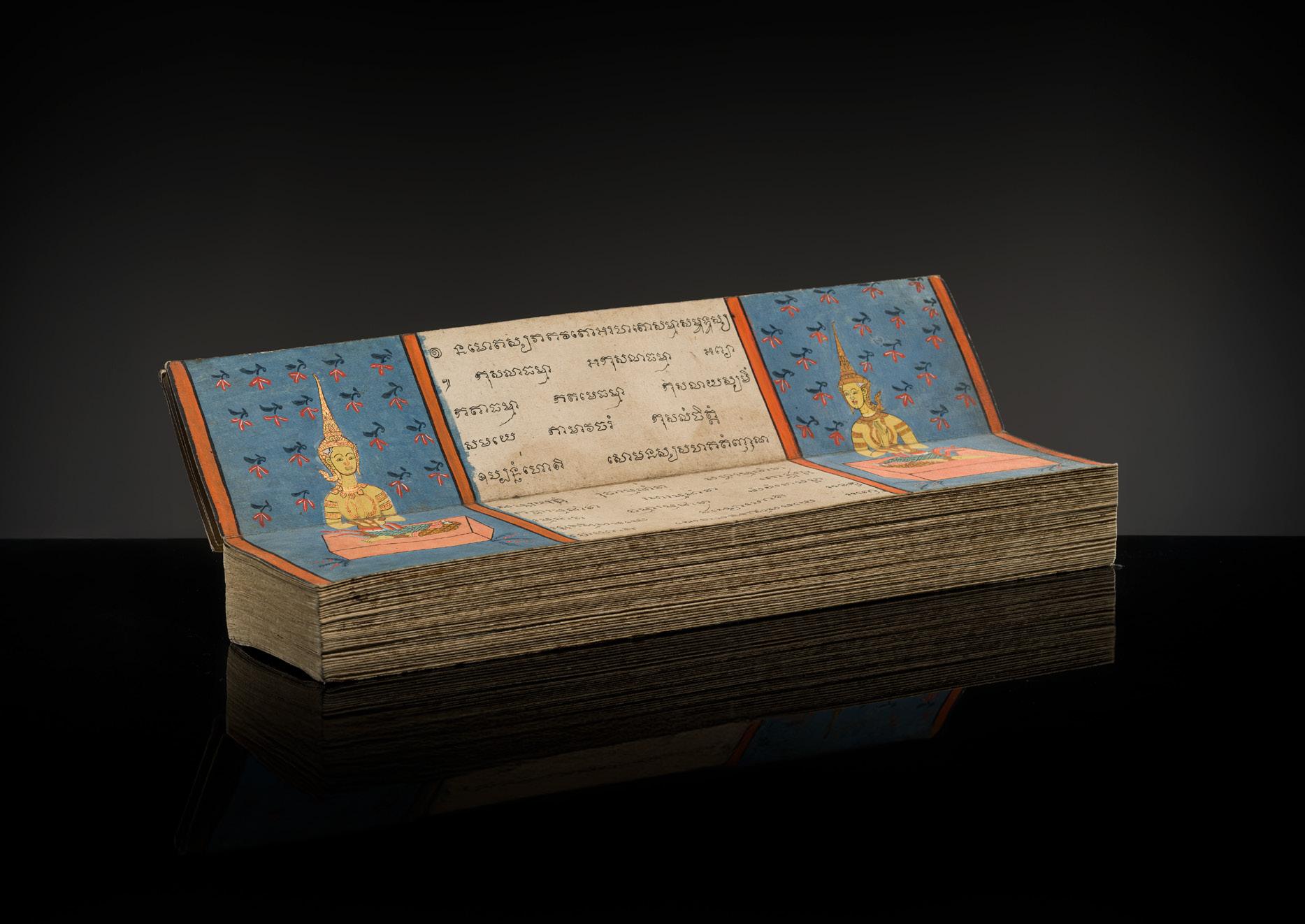
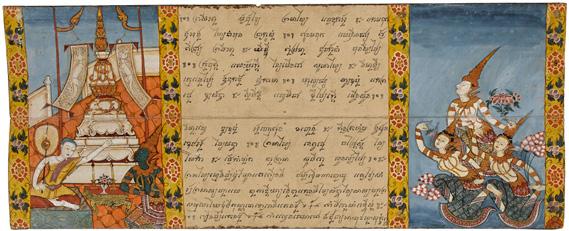
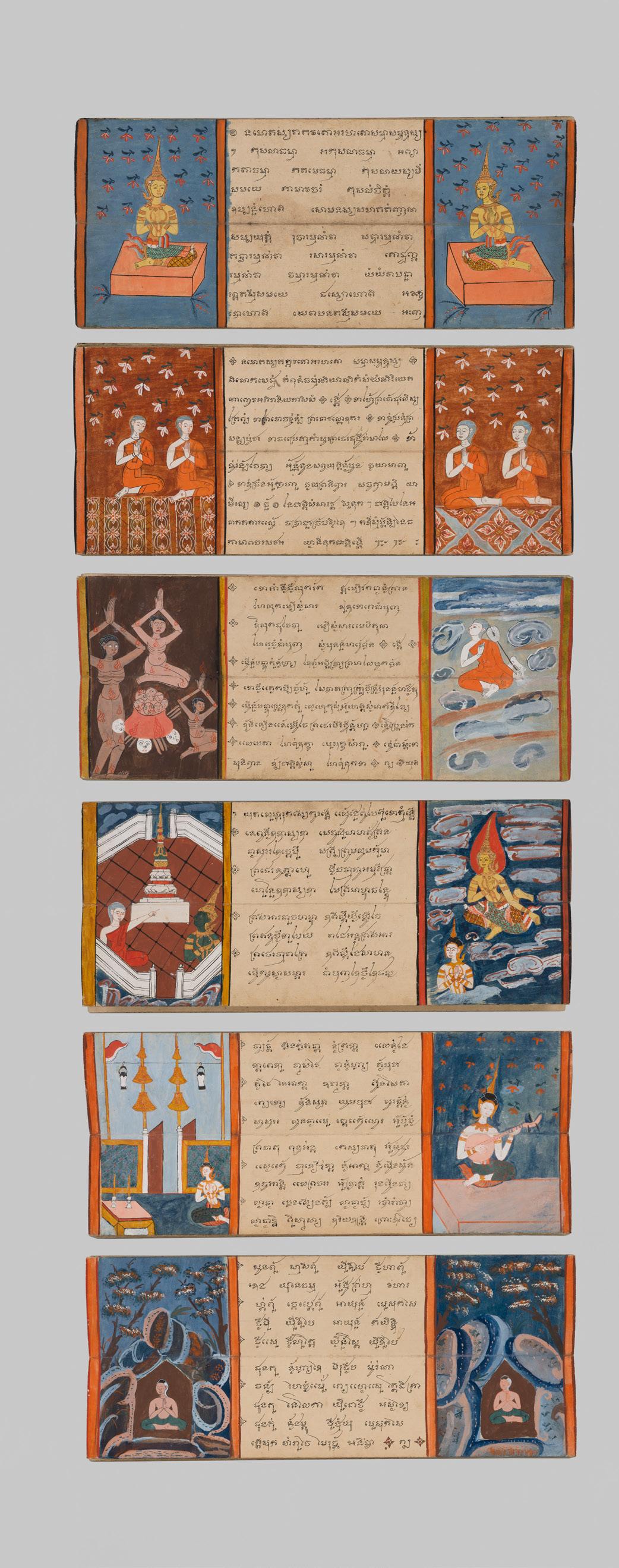
Ink, watercolors, and gouache on paper. The accordionstyle manuscript comprising 49 leaves inscribed with calligraphy on both sides and painted with figural scenes depicting Phra Malai.
Provenance: Collection of Sven A. Behrendt, Salzburg, Austria, assembled from the 1960s onwards, with acquisitions made during his extensive travels worldwide. Note that Behrendt’s important nonAsian collection was sold in a single-owner sale titled “A Worldwide Grand Tour: The Sven A. Behrendt Collection" at Sotheby’s London, 2 December 2025. Condition: Very good condition with some wear, minor creases, possible losses, and soiling.
Dimensions: Size 66.7 x 13.3 cm (each page)
The story of the Buddhist saint Phra Malai is thought to have been imported from Sri Lanka around the 13th century, about the same time that Singhalese texts were consulted in the creation of the Sukhothai style. It became one of the most popular subjects of 19th-century illuminated Thai manuscripts, which were frequently donated to monasteries as acts of merit.
Phra Malai, according to the various versions of the story, was a Buddhist monk who accumulated so much merit that he acquired great supernatural abilities. Using his powers, he traveled to the various Buddhist hells, where he meets the suffering denizens and is implored to have their living relatives make merit on their behalf. He later traveled to the heavenly realms of the devas, Trayastriṃsa and Tushita, where he met Indra and the future Buddha Maitreya, who instructed him further in merit-making.
Literature comparison:
Compare a related 'Phra Malai' illuminated manuscript, dated 1876, 66.9 x 14.4 x 7.5 cm, in the Art Gallery NSW, accession number 132.2005.a-ssss.
AUCTION RESULT COMPARISON
Type: Related
Auction: Bonhams San Francisco, 27 June 2017, lot 8025
Price: USD 8,750 or approx. EUR 9,900 converted and adjusted for inflation at the time of writing
Description: An illustrated manuscript, Thailand, 19th century
Expert remark: Compare the similar subject and size (68 cm).
Estimate EUR 1,000
Starting price EUR 500
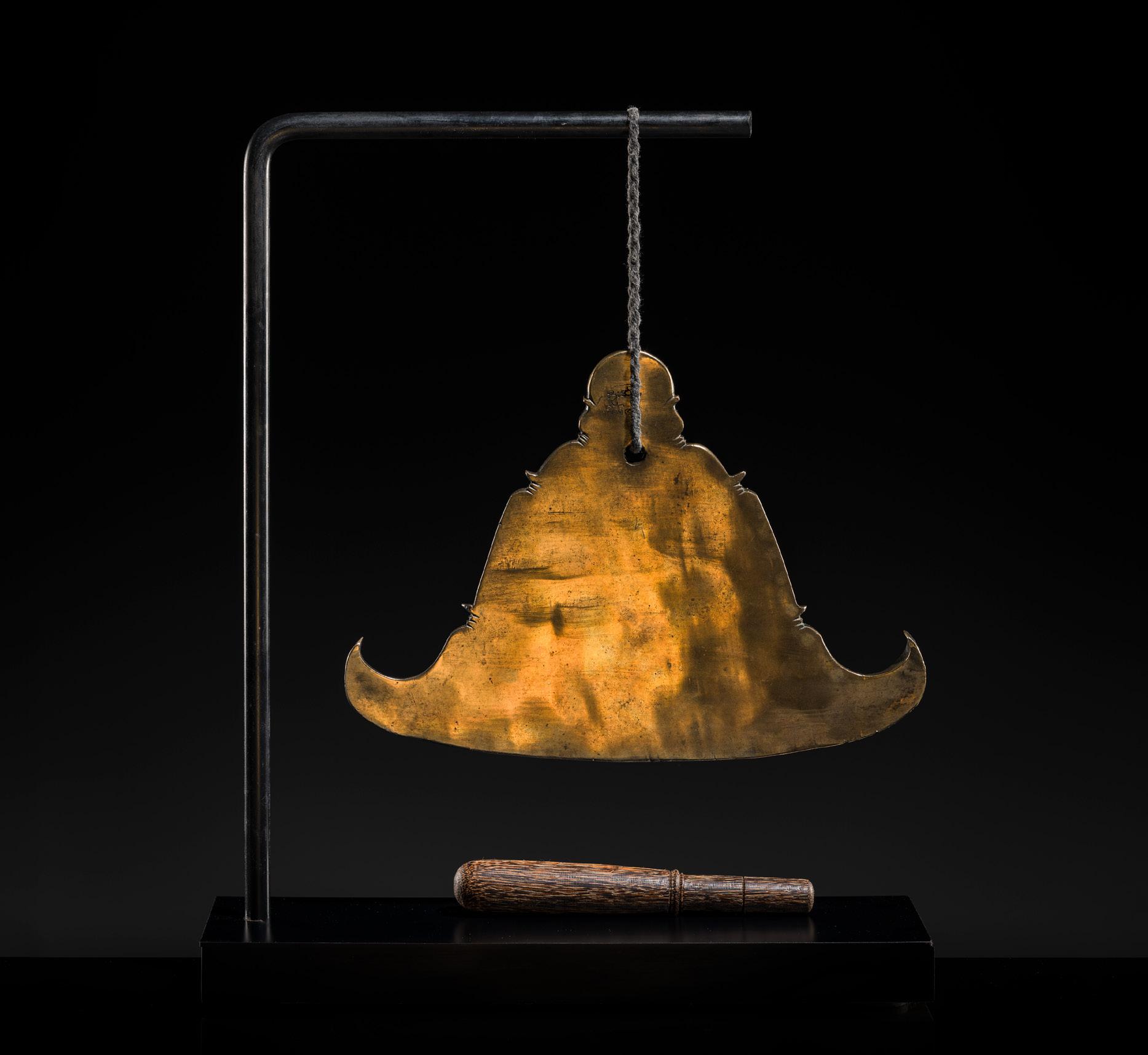
Resembling the silhouette of a robed Buddha sitting cross-legged in meditation, this musical instrument is vertically symmetrical with flaring and upturned corners, five protruding decorative tabs forming four tiers, and a rounded cap with a pierced aperture for suspension; together with an old wooden mallet for striking
Inscriptions: To the top, with a neatly incised inscription.
Provenance: Collection of Sven A. Behrendt, Salzburg, Austria, assembled from the 1960s onwards, with acquisitions made during his extensive travels worldwide. Note that Behrendt’s important non-Asian collection was sold in a single-owner sale titled “A Worldwide Grand Tour: The Sven A. Behrendt Collection" at Sotheby’s London, 2 December 2025.
Condition: Very good condition with minor wear, casting irregularities, nicks, shallow surface scratches, and typical traces of use.
Weight: 7,608 g (incl. stand and mallet), 5,059 g (excl. stand and incl. mallet)
Dimensions: Height 52.5 cm (incl. stand), 24.8 cm (the idiophone), 21.5 cm (the mallet)
With an associated stand. (3)
The Kyizi is a struck idiophone in the form of an approximately triangular plate made of brass or bronze. In Myanmar, it is sounded by Buddhist temple visitors and by monks. Its bright tone, produced with a wooden beater, accompanies religious ceremonies, marks times of day in monastic life, or signals the end of a prayer recited by an individual worshiper before an altar. Larger, clapperless bells suspended in Burmese monasteries serve similar ritual functions.
LITERATURE COMPARISON
Compare a closely related brass Kyeezee, Burma, dated to the 19th century, 24 cm wide, in the Hartenberger World Music Collection of Historical Instruments, accession number 2AS-IDST-42.
Estimate EUR 1,000
Starting price EUR 500
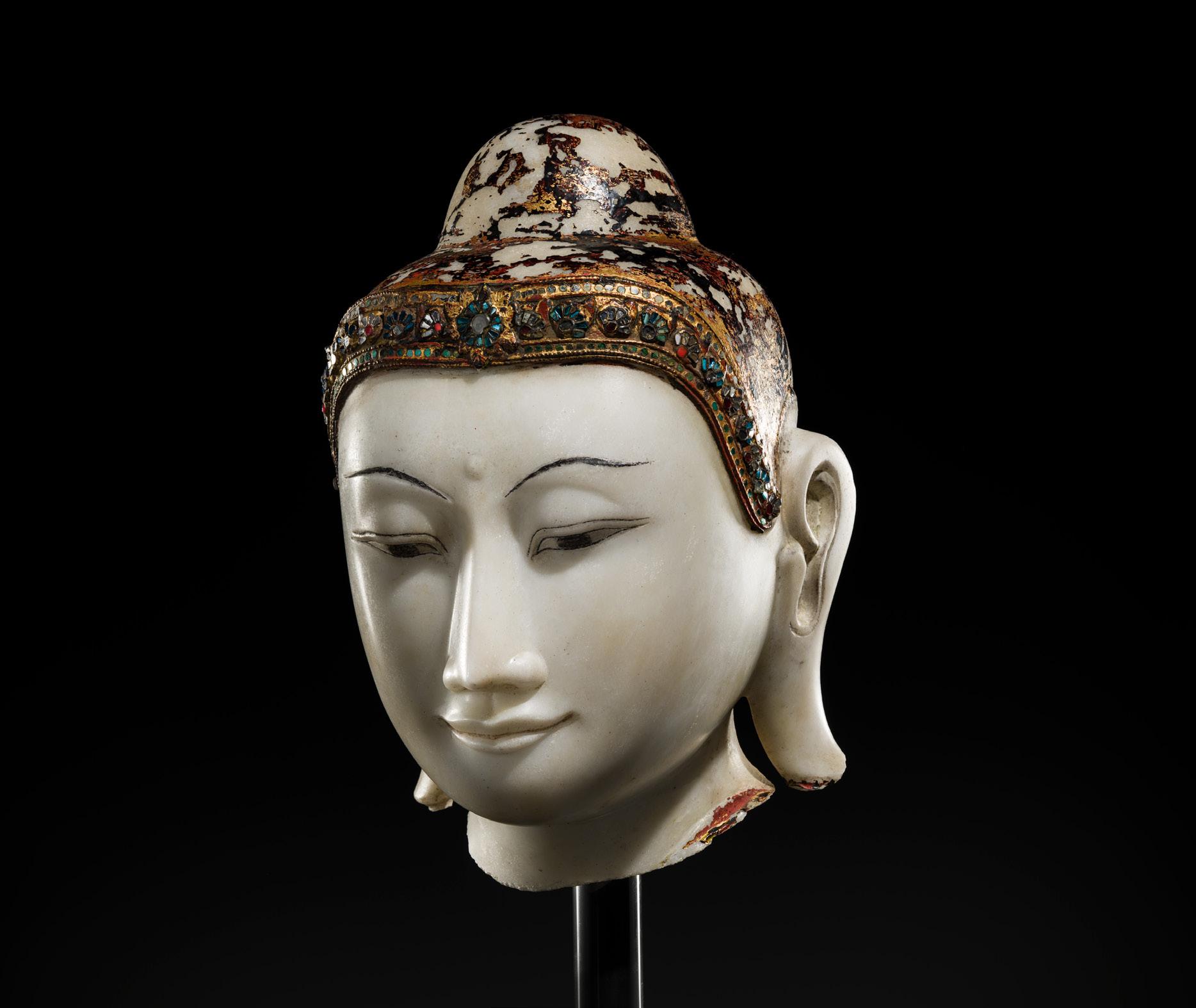
A GILT-LACQUERED AND GLASS INLAID WHITE ALABASTER HEAD OF BUDDHA, MANDALAY, 18TH-19TH CENTURY
Burma. Finely carved, the serene face finely painted and sensitively modeled with a meditative expression marked by downcast eyes with neatly incised heavy lids and elegantly arched brows, his slender lips forming a calm smile, flanked by elongated earlobes. The giltlacquered hair modeled into a high domed ushnisha and secured by a broad headband richly inlaid with floral designs in pink, blue, and white glass, framed by dotted bands in mirror glass.
Provenance: The Ashwood Gallery, Bangkok. Collection of Sven A. Behrendt, Salzburg, Austria, assembled from the 1960s onwards, with acquisitions made during his extensive travels worldwide. Note that Behrendt’s important non-Asian collection was sold in a single-owner sale titled “A Worldwide Grand Tour: The Sven A. Behrendt Collection" at Sotheby’s London, 2 December 2025. A copy of a certificate of authenticity from the Ashwood Gallery, Bangkok, dated 6 April 2012, confirming the dating above, accompanies this lot.
Condition: Overall good condition with wear, obvious losses, few nicks, light surface scratches, expected minor losses to inlays, flaking and minor losses to gilt, remnants of pigment.
Weight: 40.4 kg (incl. stand)
Dimensions: Height 43 cm (excl. stand), 66 cm (incl. stand)
Mounted on an associated stand. (2)
Expert’s note:
The headband is decorated in the thayo technique, a process whereby thin rolled strands of lacquer and ash putty are applied in patterns. This work has then been gilded along with the rest of the hair. It was then inlaid with small roundels of glass backed with red and green foil in flower motifs. The dry lacquer was procured from China while the glass inlay was sourced from Thailand. The style and technique are typical of the art of the Mandalay period in Myanmar.
Literature comparison:
Compare a related gilt lacquered and glass inlaid marble figure of Buddha, Burma, 18th century, 48 cm high, in the British Museum, registration number 1872,0701.9.
AUCTION RESULT COMPARISON
Type: Closely related
Auction: Zacke, Vienna, 10 September 2025, lot 20
Price: EUR 9,750
Description: A gilt-lacquered and glass inlaid white alabaster head of Buddha, Mandalay, 18th-19th century
Expert remark: Compare the closely related modeling, manner of carving, and gilding, with similar facial features and expression. Note the size (33 cm).
Estimate EUR 3,000
Starting price EUR 1,500
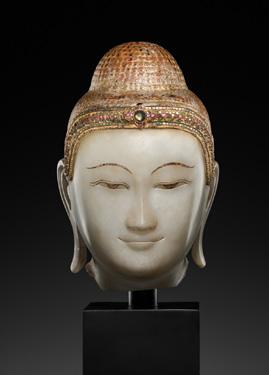
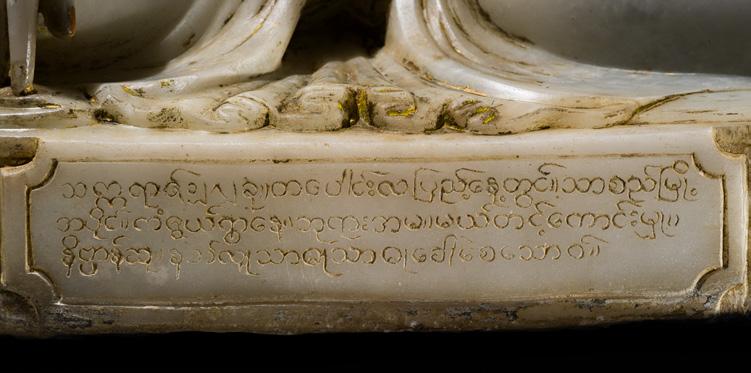
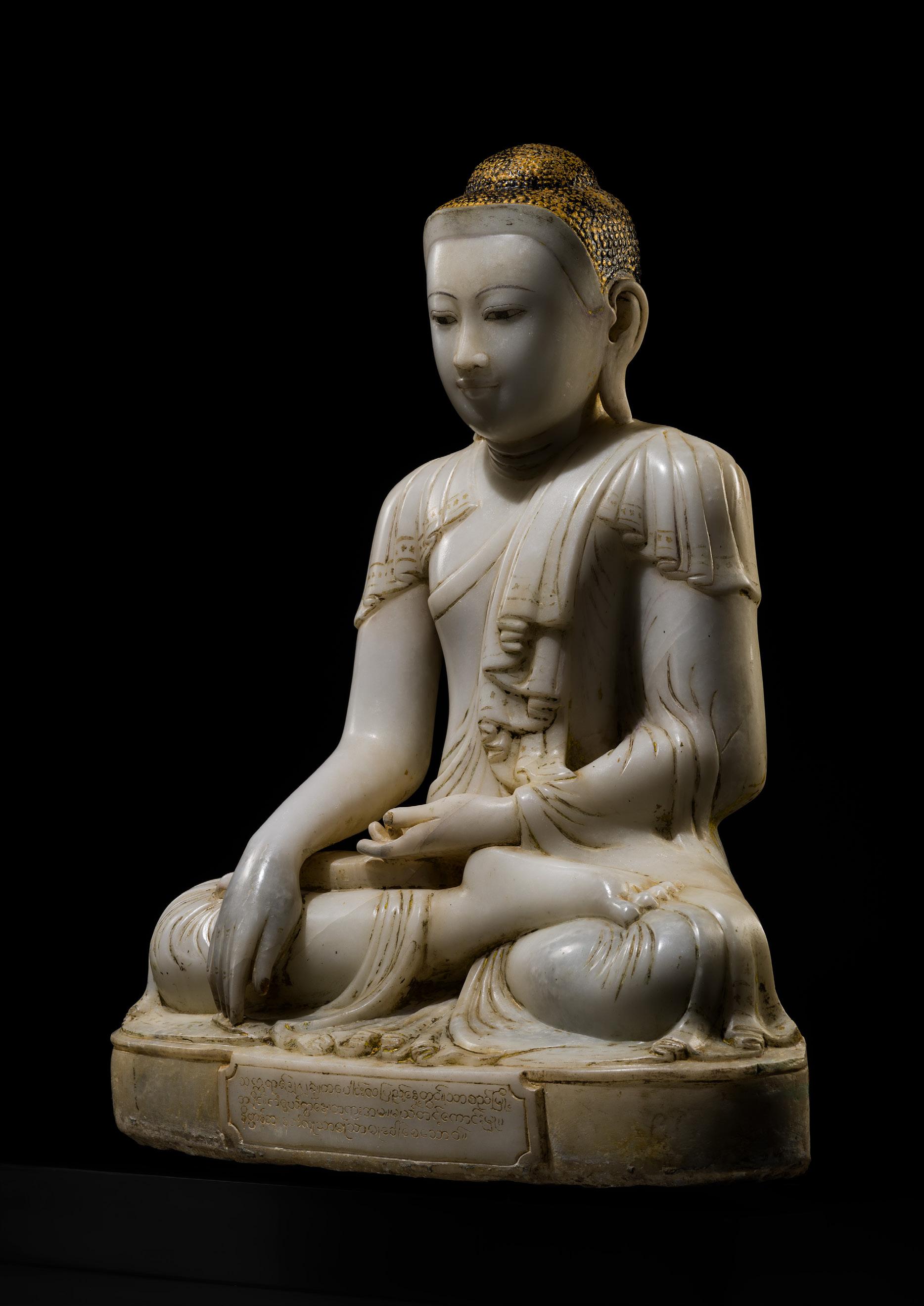
Burma. Finely carved, seated in dhyanasana atop a tall cushion, his right hand lowered in bhumisparsha mudra and the left held in dhyana mudra above the lap, wearing loose-fitting monastic robes gathering in frill-like folds at the top of the base and shoulder, a second scarf elegantly draped across both shoulders. The serene face sensitively modeled with a meditative expression marked by downcast eyes with heavy sinuous lids and elegantly arched brows, his full bow-shaped lips forming a calm smile, flanked by long pendulous earlobes, the gilt hair arranged in tight curls over the high domed ushnisha and secured by a wide plain band.
Inscriptions: To the base, neatly inscribed within a lobed cartouche.
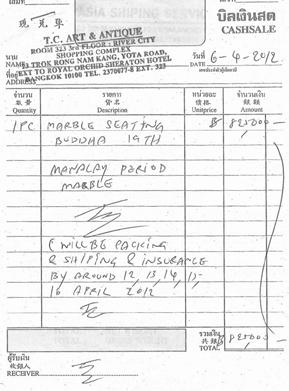
Provenance: T.C. Art & Antique, Bangkok, Thailand. Collection of Sven A. Behrendt, Salzburg, Austria, assembled from the 1960s onwards, with acquisitions made during his extensive travels worldwide, acquired from the above in 2012. Note that Behrendt’s important non-Asian collection was sold in a single-owner sale titled “A Worldwide Grand Tour: The Sven A. Behrendt Collection" at Sotheby’s London, 2 December 2025. A copy of an invoice by T.C. Art & Antique, dated 6 April 2012, confirming the dating above, and stating a purchase price of THB 825,000 or approx. EUR 32,000 (converted and adjusted for inflation at the time of writing) accompanies this lot.
Condition: Very good condition with minor wear. Small losses, few nicks, and expected flaking and losses to gilt and pigment.
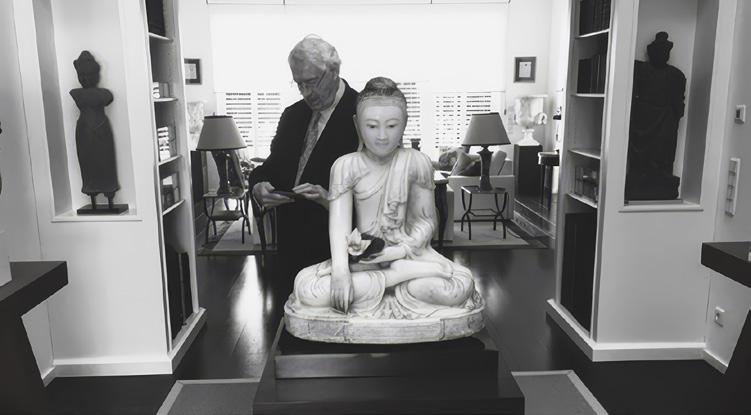
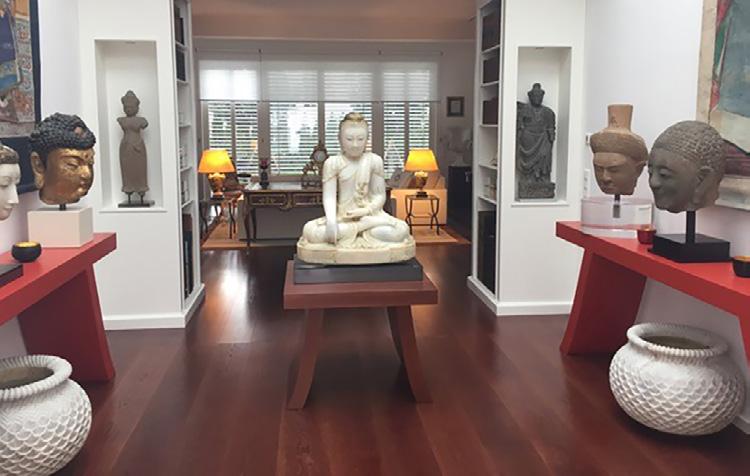
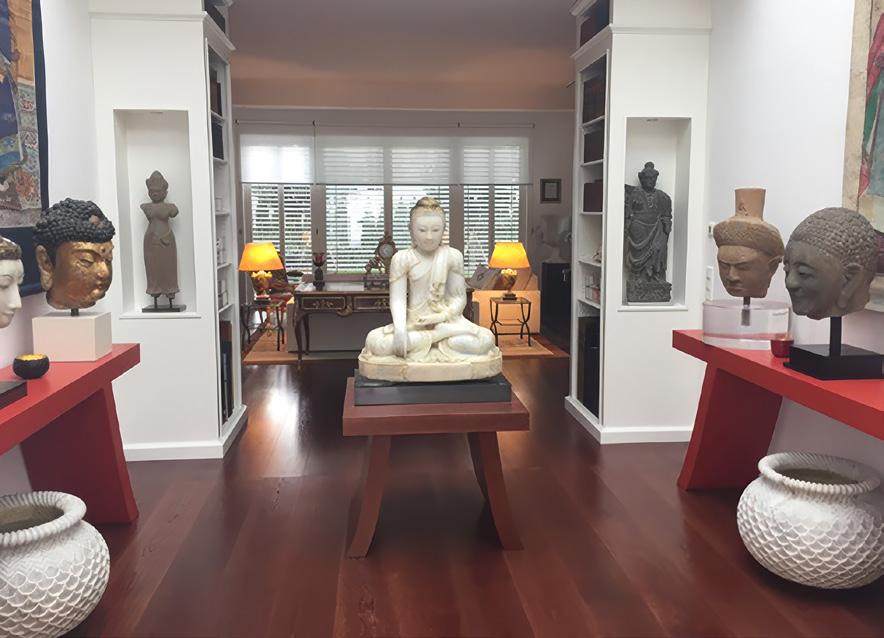
The present lot displayed at the Behrendt residence in Salzburg
Weight: 151.6 kg (incl. stand)
Dimensions: 84 cm (excl. stand), 95 cm (incl. stand)
Mounted on an associated stand. (2)
Estimate EUR 8,000
Starting price EUR 4,000

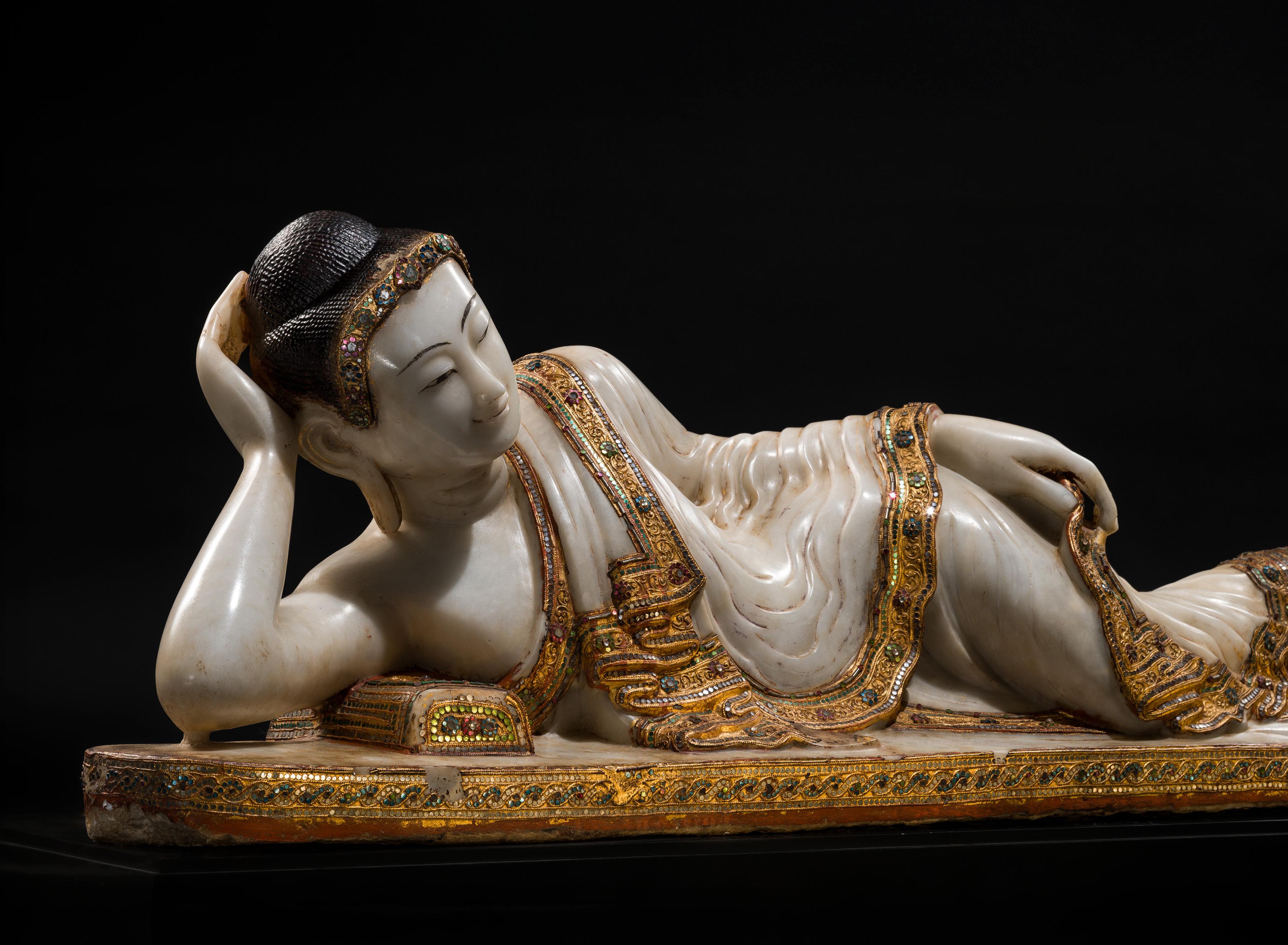
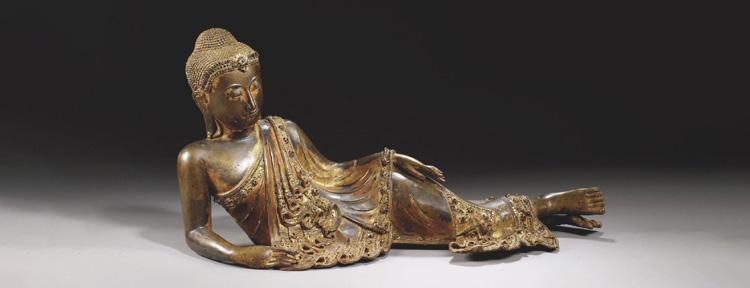
15 A LARGE GLASS INLAID AND GILDED ALABASTER FIGURE OF THE RECLINING BUDDHA, MANDALAY PERIOD, 19TH CENTURY
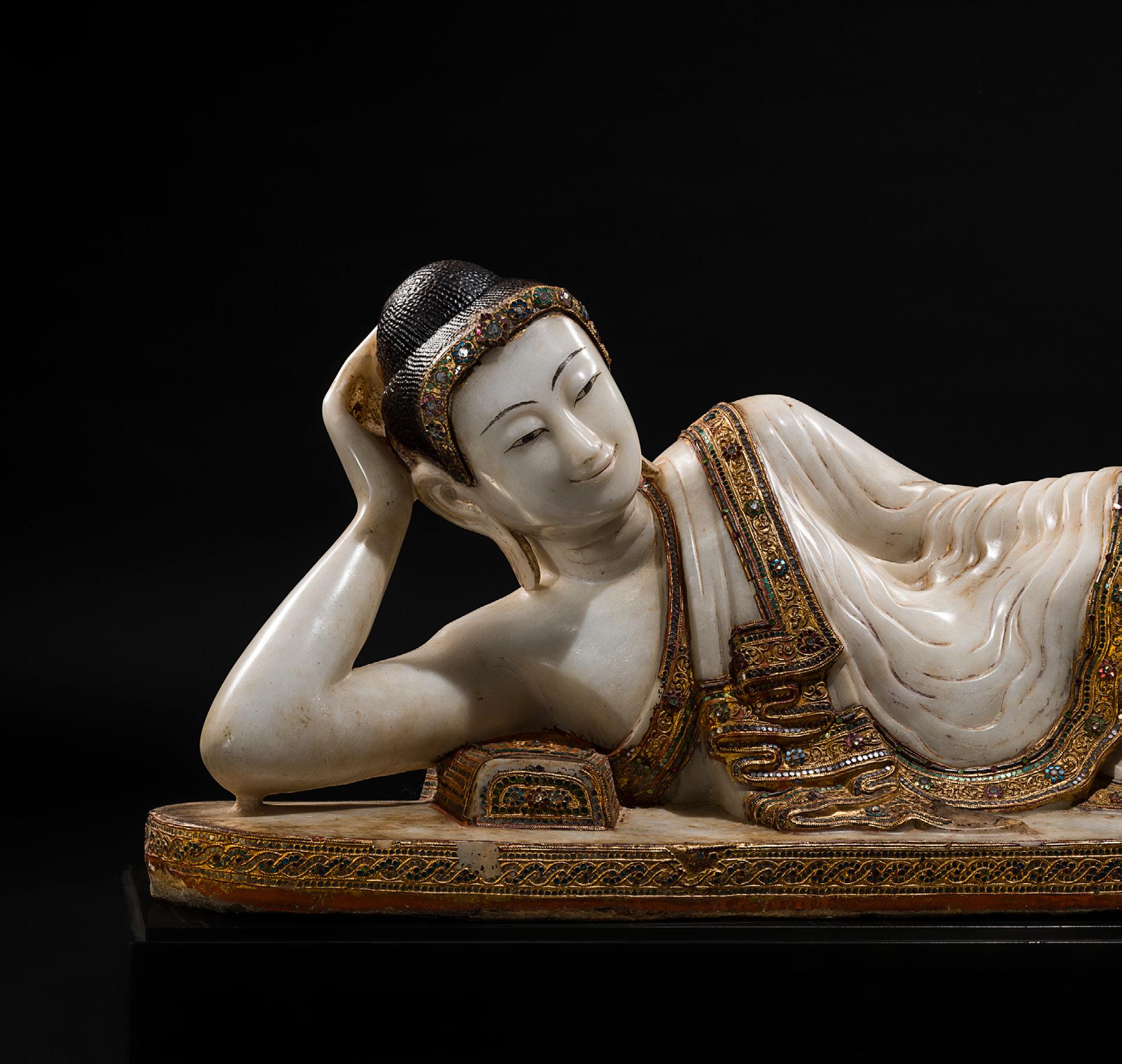
Burma. Carved from a single piece of white alabaster, this serene depiction of the Buddha is inlaid with pink, green, and blue glass, gilding, and highlighted with black accents. The figure shows the Buddha reclining on his right side, his head resting upon his hand, with the upper body supported by a cushion. The folds of his robe cascade elegantly, resembling waves around his form. His round face bears a gentle smile, with downcast eyes and flanked by pendulous earlobes. The hair is styled into a domed chignon, framed by a delicate floral diadem. The figure rests on an oval base, bordered with a band of inlaid gold and glass.
Provenance: T.C. Art & Antique, Bangkok, Thailand. A copy of the authentication certificate from T.C. Art & Antique, dated 15 October 2010, number 1202, and confirming the dating above, accompanies the lot. Collection of Sven A. Behrendt, Salzburg, Austria, assembled from the 1960s onwards, with acquisitions made during his extensive travels worldwide. Note that Behrendt’s important non-Asian collection was sold in a single-owner sale titled “A Worldwide Grand Tour: The Sven A. Behrendt Collection" at Sotheby’s London, 2 December 2025.
Condition: Good condition with minor wear, some flaking to the gilding, expected losses to the inlays, some of which were reattached, tiny nicks, one finger of the left hand with an old repair, few fills, and natural fissures. The stone with a fine naturally grown patina.
Dimensions: Length 145 cm
Reclining Buddha images from Burma are typically categorized into two types. The first, as seen here, depicts the Buddha reclining with his right hand supporting his head, and his eyes open. The second type, known as parinibbana, portrays the Buddha at the moment of passing, with eyes closed or barely open, and the head resting on a pillow.
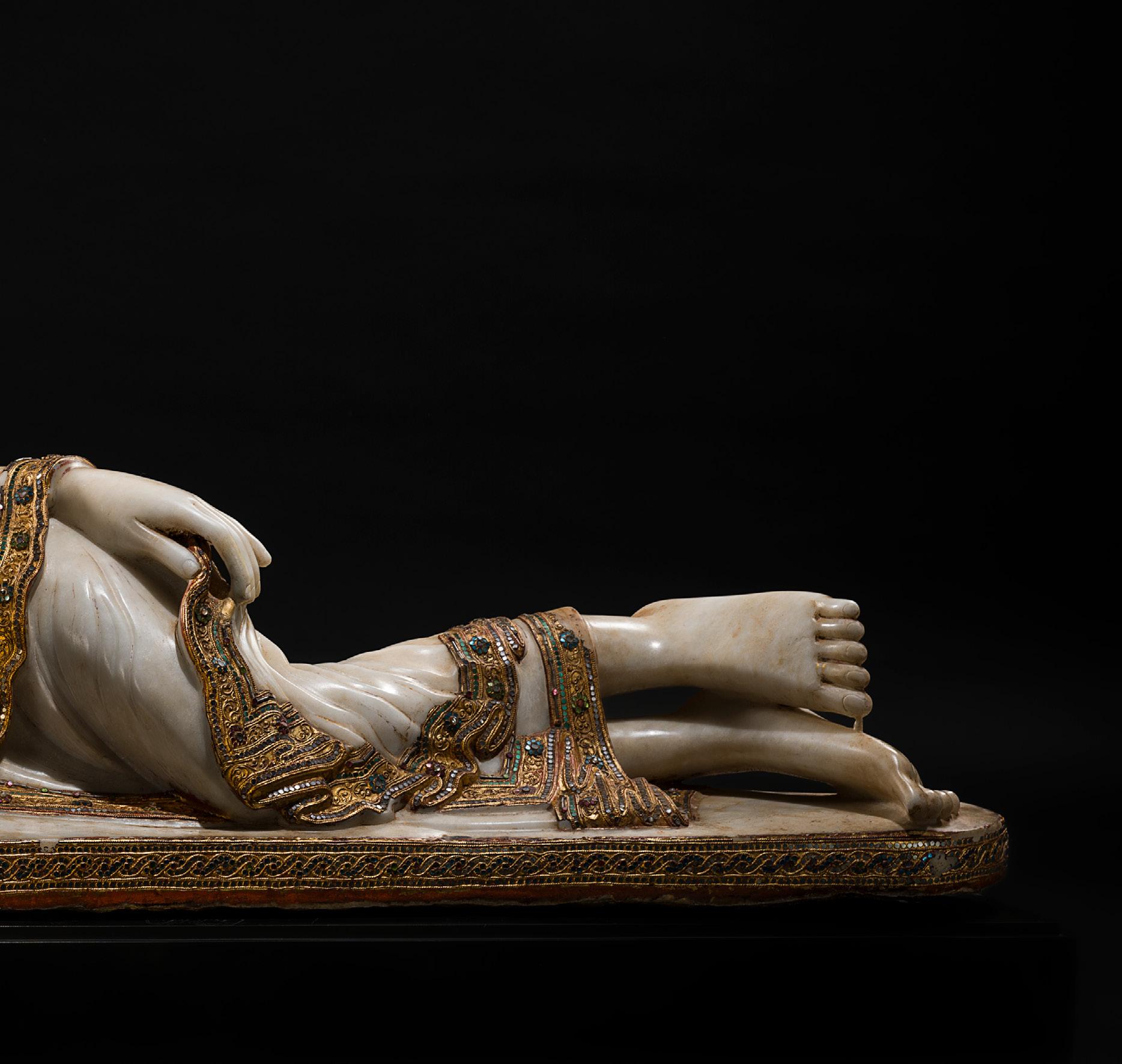
Buddha images carved from marble were predominantly produced in Mandalay, with two main marble quarries serving as sources: one in the Sagyin Hills to the north, and the other near Kyauk-hse, to the south of Mandalay. Marble has been used in religious sculpture in this region since at least the 17th century.
LITERATURE COMPARISON
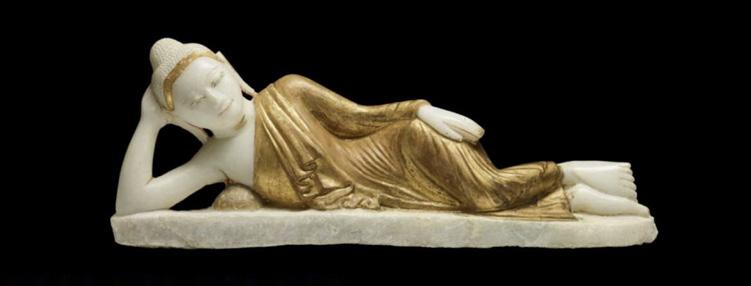
Compare a related gilded marble figure of the reclining Buddha, Burma, 1860s-1871, 71.1 cm long, in the British Museum, museum number 1913,1002.1.
AUCTION RESULT COMPARISON
Type: Related
Auction: Christie’s, Paris, 8 June 2010, lot 427
Price: EUR 23,125 or approximately EUR 35,000 adjusted for inflation at the time of writing
Description: A lacquered bronze figure of the reclining Buddha Shakyamuni, Mandalay style, late 18th to early 19th century
Expert remark: Compare the similar subject. Note the different material and smaller size (75 cm).
Estimate EUR 15,000
Starting price EUR 7,500

16
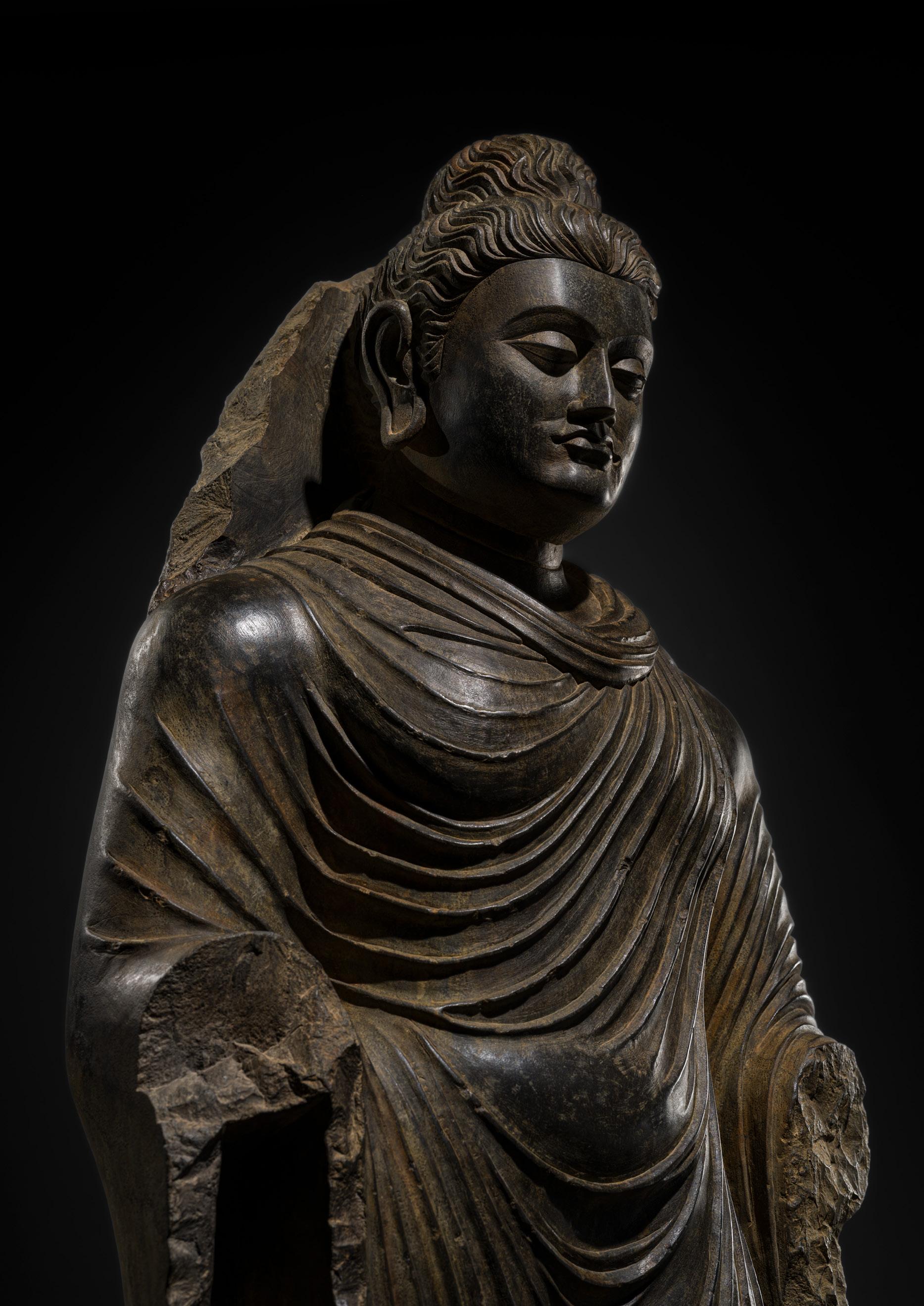
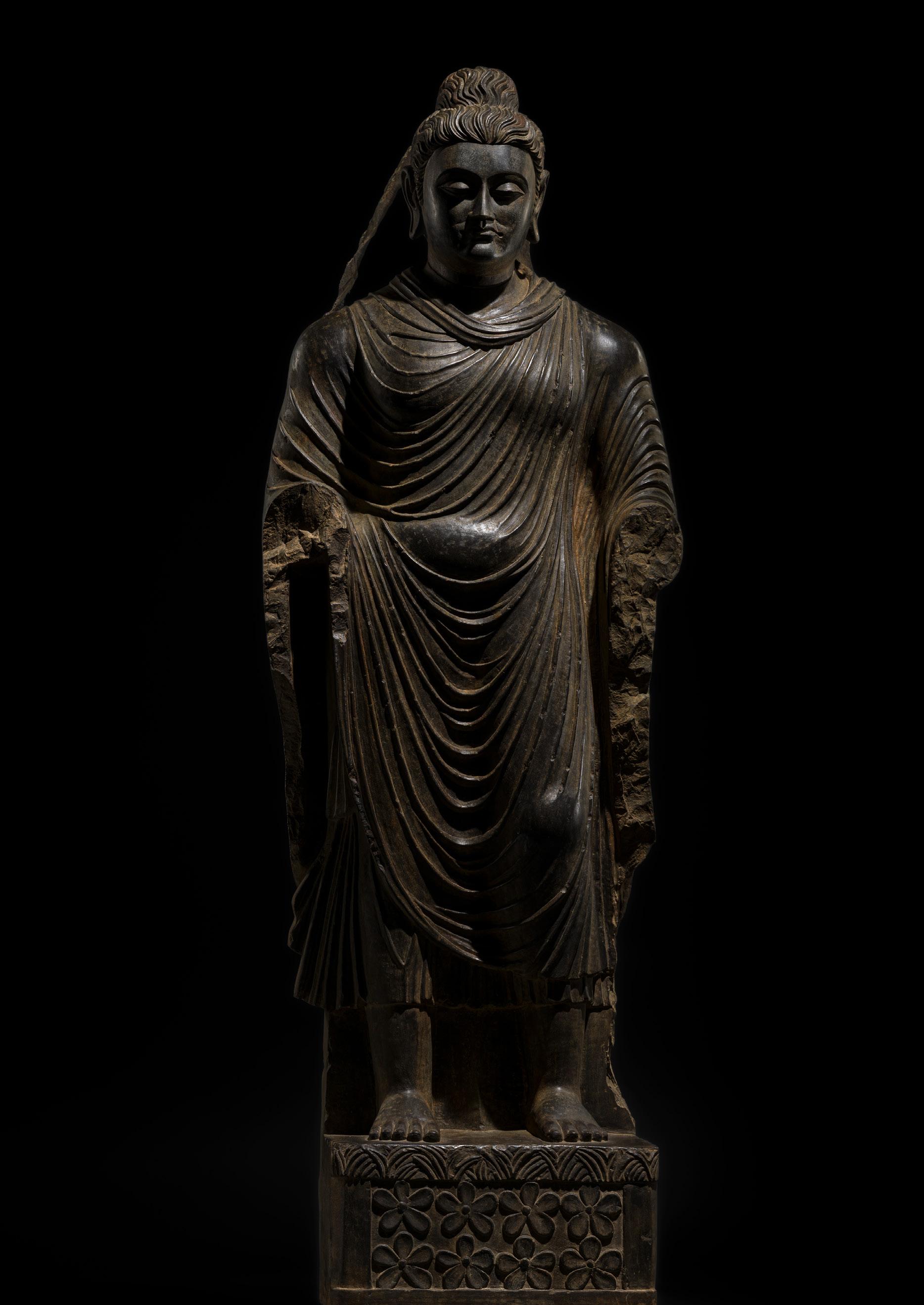
Superbly carved, standing in samabhanga on a rectangular plinth carved with two rows of foliate blossoms below a wavy band. He is dressed in voluminous robes draped across both shoulders, carved naturalistically with U-shaped folds that reveal the contours of his powerful body. The face sensitively modeled with a benevolent expression, crisply delineated features such as heavy-lidded almondshaped eyes, a rosebud mouth, and full cheeks, flanked by elongated earlobes, the hair arranged in wavy locks rising over the domed ushnisha.
Provenance: The collection of Chilphon Lee, Thailand. A private collection in Thailand, acquired from the above in 1969, and thence by direct descent to Supalak Nakdee. Gallery Mouhot, Bangkok, acquired from the above. A copy of a provenance statement with a notarized translation, written and signed by Supalak Nakdee, confirming the provenance and dating above, dated 20 June 2023, accompanies this lot. A copy of a Certificate of Authenticity by Gallery Mouhot, Bangkok, dated 28 June 2023, confirming the provenance and dating above, accompanies the lot.
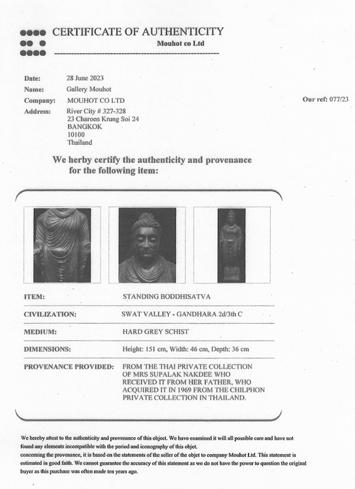
Collection of Sven A. Behrendt, Salzburg, Austria, assembled from the 1960s onwards, with acquisitions made during his extensive travels worldwide. Note that Behrendt’s important non-Asian collection was sold in a single-owner sale titled “A Worldwide Grand Tour: The Sven A. Behrendt Collection" at Sotheby’s London, 2 December 2025. A copy of a Certificate of Authenticity by Gallery Mouhot, Bangkok, dated 28 June 2023, confirming the provenance and dating above, accompanies the lot. Galerie Mouhot is a gallery specializing in Khmer Art based in River City Bangkok, established by the Frenchman Eric Dieu and named after Henri Mouhot (1826-1861), the mid-19th century naturalist and explorer credited with reintroducing the world to the grandeur of Angkor and the Khmer civilization.
Condition: Very good condition, commensurate with age. Old wear, obvious losses and natural cracks, scratches, small chips, signs of weathering and erosion, and encrustations.
Weight: 260 kg
Dimensions: 148.5 cm (excl. stand), 151 cm (incl. stand)
Mounted on an associated stand. (2)
This masterfully carved figure embodies an idealized and transcendent male form. The heavy sanghati delicately models the muscular shoulders, torso, soft belly and rounded thigh; the left knee bends in preparation to step forward. This subtle gesture, along with the undulating folds of the robe, allows one to imagine the fabric fluttering as the Buddha moves. Heavy eyelids frame the almond-shaped eyes, the forehead remains perfectly unlined, and there is no tension in the rosebud mouth. While activated with energy, movement and life, the Buddha is simultaneously in a state of otherworldly tranquility.
AUCTION RESULT COMPARISON
Type: Closely related
Auction: Christie’s New York, 13 September 2017, lot 603
Price: USD 792,500 or approx. EUR 894,000 converted and adjusted for inflation at the time of writing
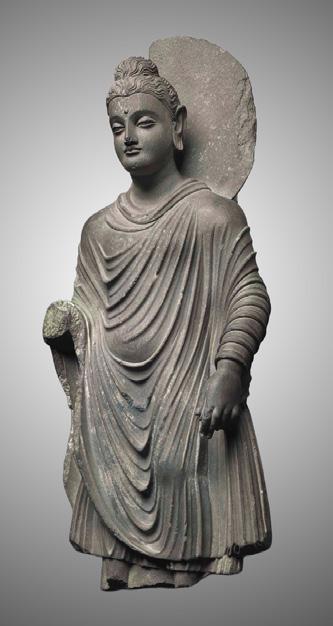
Description: An important gray schist figure of a standing Buddha, Gandhara, 2nd-3rd century
Expert remark: Compare the closely related modeling, expression, and undulating folds of the heavy robe. Note the smaller size (81.3 cm) and that the figure lacks a pedestal.
AUCTION RESULT COMPARISON
Type: Closely related
Auction: Christie’s Paris, 13 June 2018, lot 232
Price: EUR 247,500 or approx. EUR 291,000 adjusted for inflation at the time of writing
Description: A rare and important gray schist torso of Buddha Shakyamuni, Ancient region of Gandhara, 2nd-3rd century
Expert remark: Compare the closely related modeling of the torso with similar carved taut chest, gently undulating belly, and wearing a heavy robe modeled with its characteristic U-shaped folds. Note the size (129 cm).
Estimate EUR 80,000
Starting price EUR 40,000

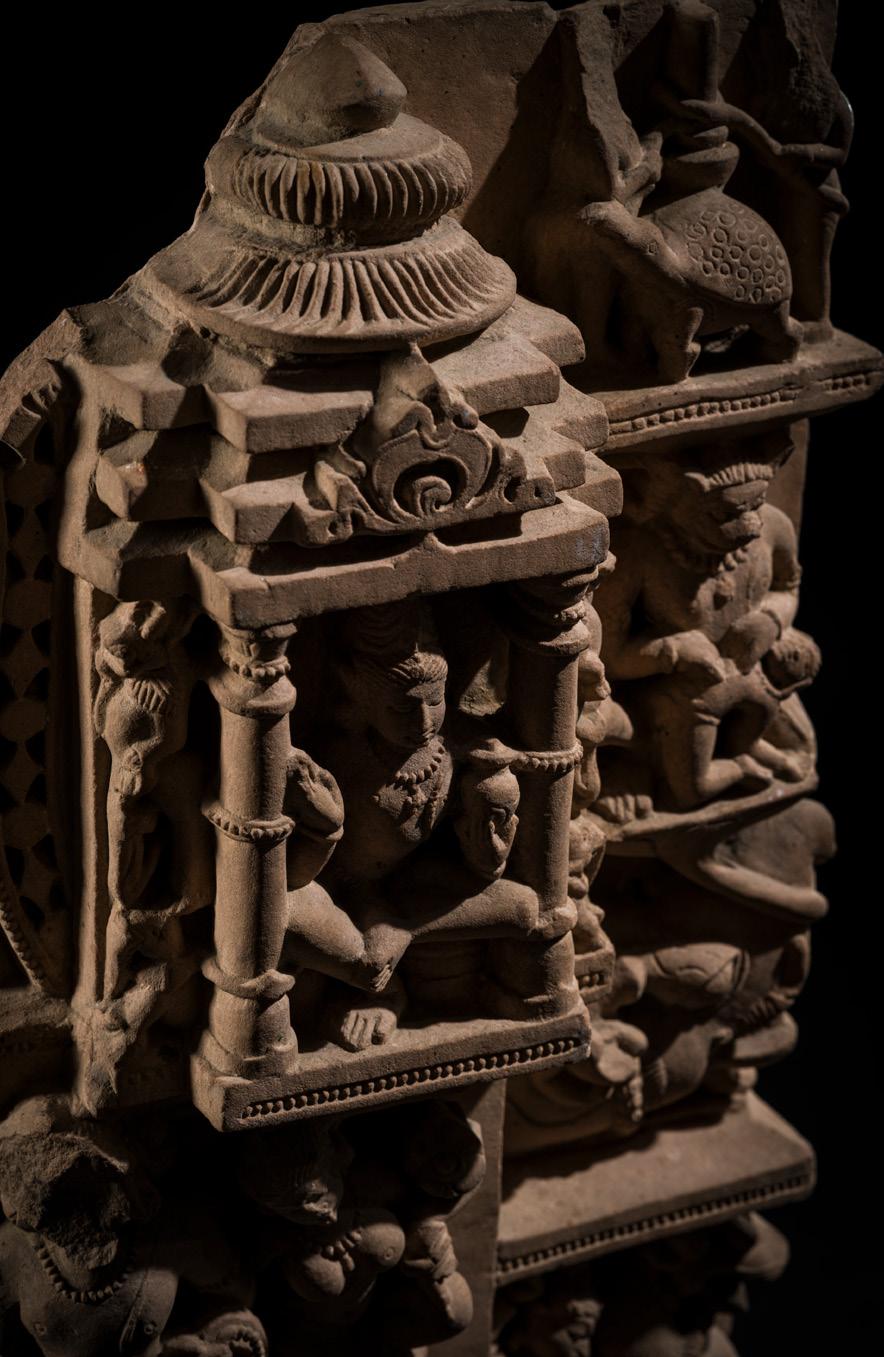
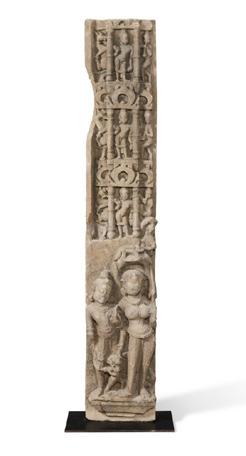
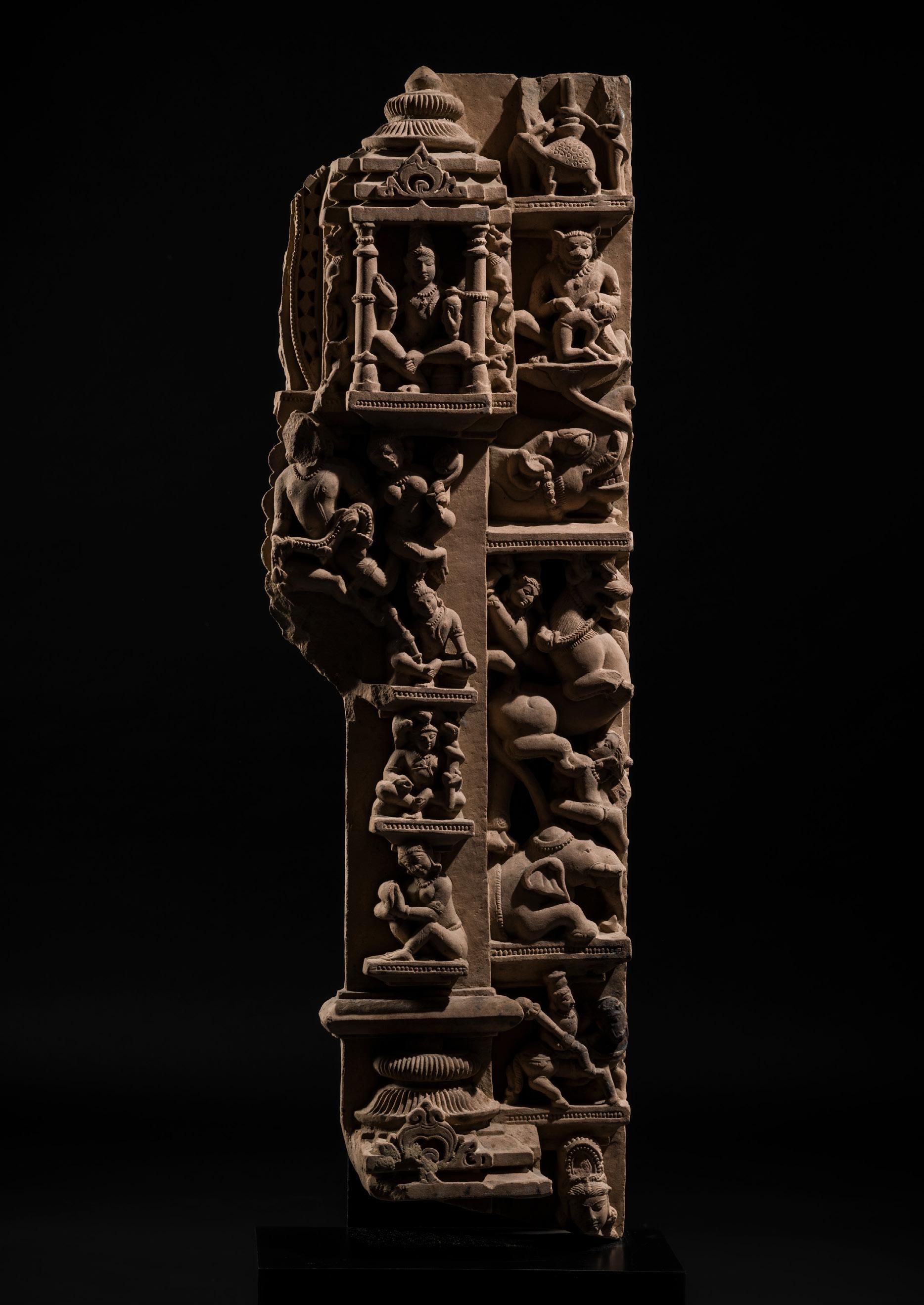
India. Carved in several registers around an ancillary shrine-like chamber at the top to depict attendants, deities, donors, warriors on horseback, celestial beings, makaras, elephants, and mythological figures, each carved atop a rectangular base with a beaded edge.
Provenance: Collection of Sven A. Behrendt, Salzburg, Austria, assembled from the 1960s onwards, with acquisitions made during his extensive travels worldwide. Note that Behrendt’s important non-Asian collection was sold in a single-owner sale titled “A Worldwide Grand Tour: The Sven A. Behrendt Collection" at Sotheby’s London, 2 December 2025.
Condition: Fine condition, commensurate with age. Wear, obvious losses, scattered nicks and scratches, signs of weathering and erosion, encrustations, and minor discoloration to one corner.
Weight: 38.4 kg (incl. stand)
Dimensions: Height 93.5 cm (excl. stand), 103.5 cm (incl. stand)
Mounted on an associated stand. (2)
LITERATURE COMPARISON
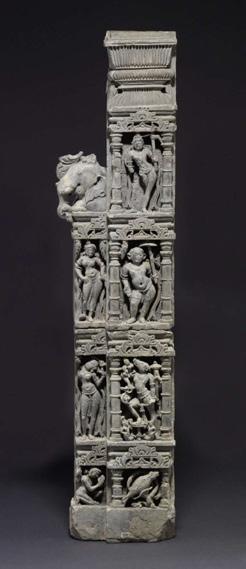
Compare a closely related sandstone doorjamb, dated 10th-11th century, 179.7 cm high, in the Dallas Museum of Art, object number 2008.8. Compare a closely related doorjamb, Chandella, dated to the 10th century, 146 cm high, in the National Museum, New Delhi, accession number 48.3/29. Compare a closely related doorjamb, Rajasthan, dated to the 10th century, 83.8 cm high, in the British Museum, registration number 1965,1017.2 (fig. 1).
AUCTION RESULT COMPARISON
Type: Closely related
Auction: Christie’s New York, 23 March 2022, lot 452
Price: USD 25,200 or approx. EUR 24,500 converted and adjusted for inflation at the time of writing
Description: A buff sandstone doorjamb with river goddess and attendant, Central India, Rajasthan or Madhya Pradesh, 10th-11th century
Expert remark: Compare the closely related modeling with similarly carved arches. Note the size (144.8 cm).
Estimate EUR 8,000
Starting price EUR 4,000
18
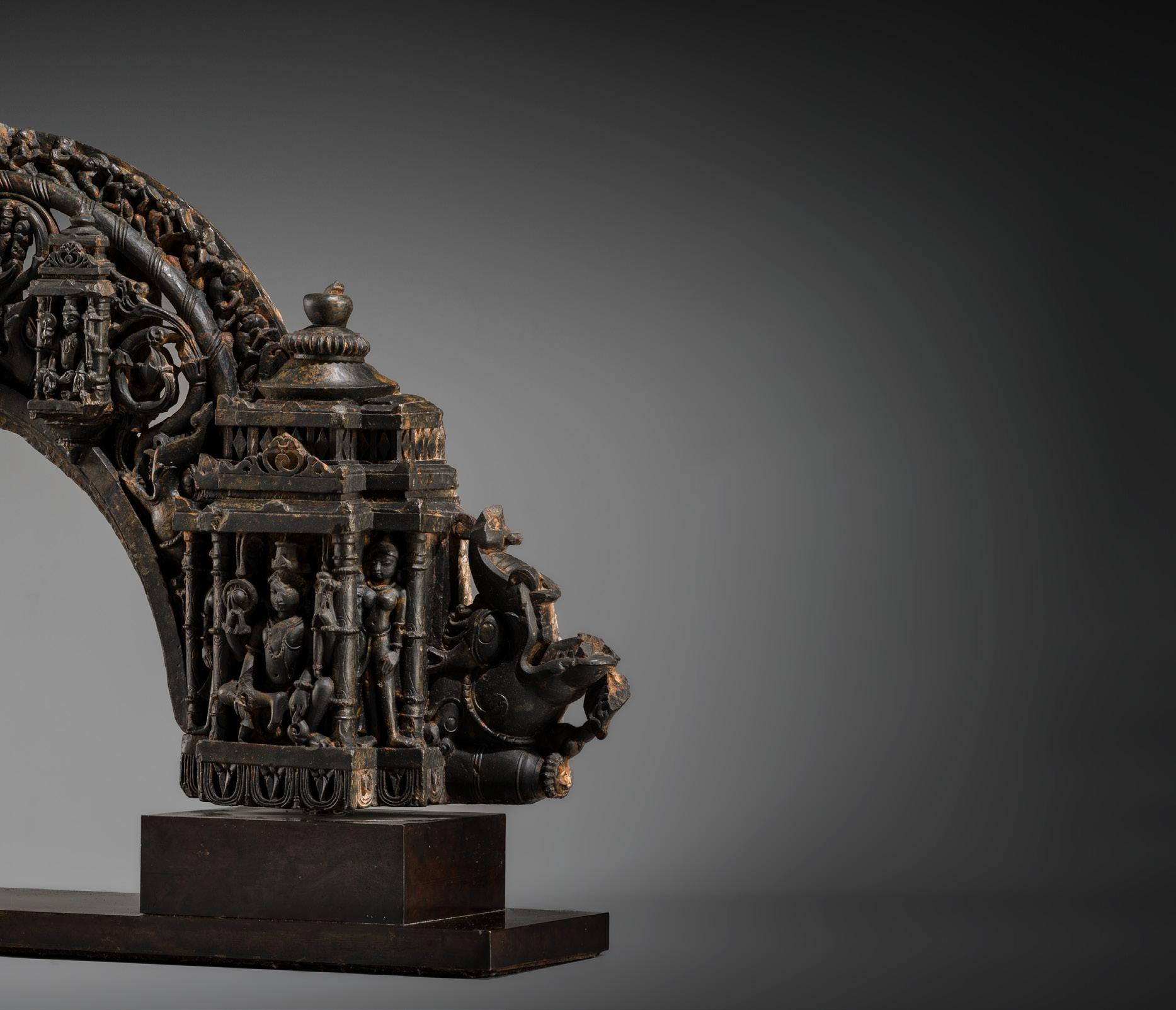
A BLACK STONE ARCH FROM THE PRABHATORANA OF A VISHNU STELE, GAHADAVALA DYNASTY, INDIA, 11TH-12TH CENTURY
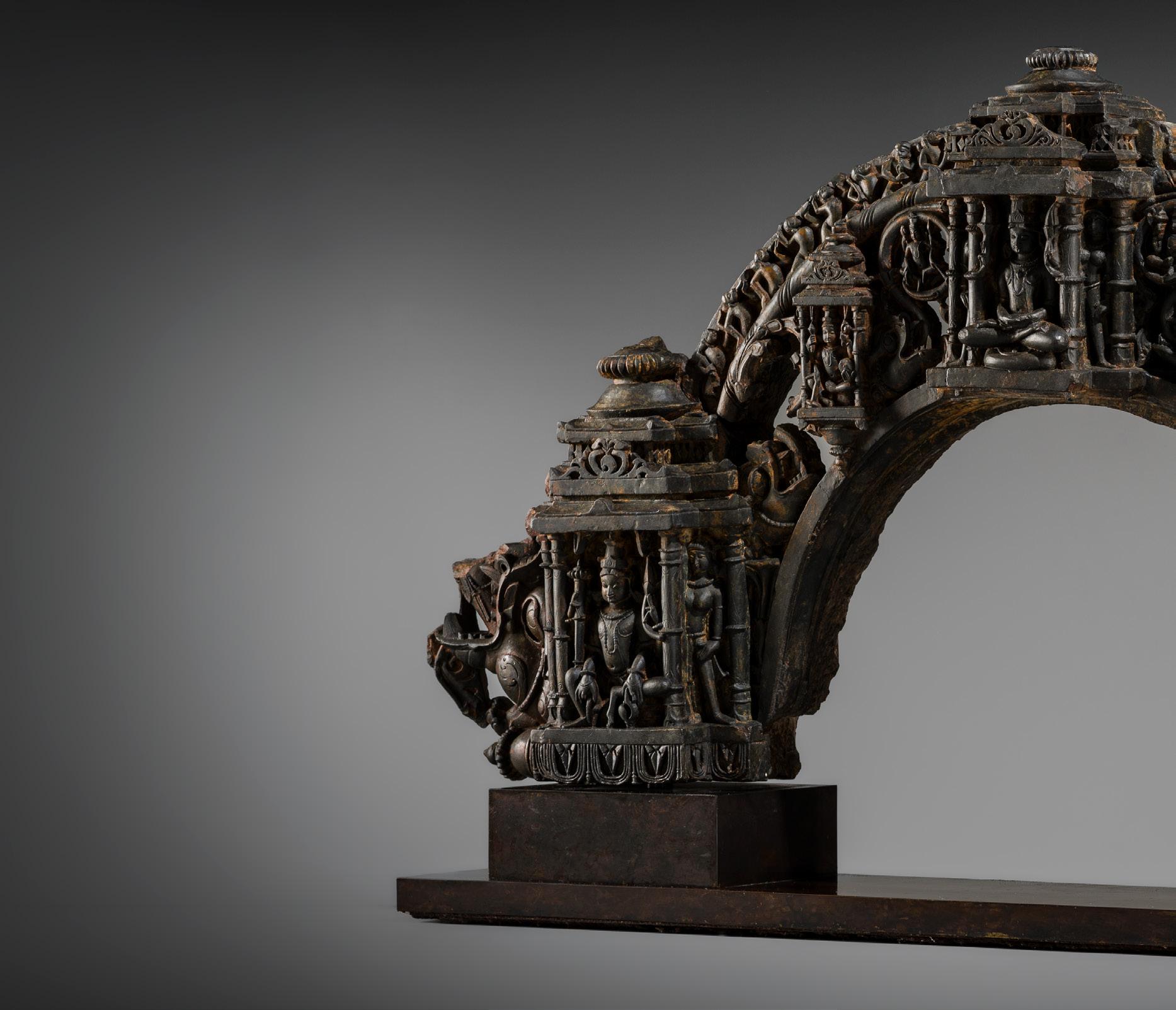
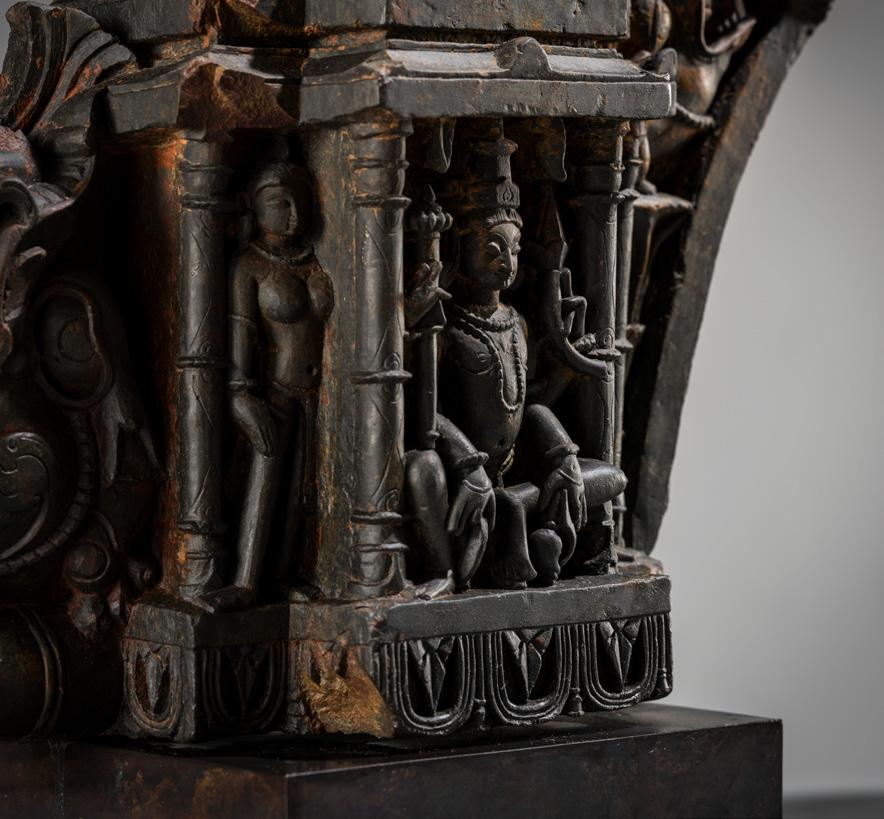
North India, 1072 to 1237 CE. Masterfully carved with five ancillary shrine-like chambers, punctuated by makaras spewing scrolling vines encircling further deities, each seated deity therein representing an emanation of Vishnu, depicted holding his four attributes and flanked by the female attendants Lakshmi and Bhudevi. The central shrine shows the deity with his hands placed in the lap and lotus stems rising on either side, framed to the upper border with a row of celestial musicians and flying garland bearers.
Provenance: Collection of Sven A. Behrendt, Salzburg, Austria, assembled from the 1960s onwards, with acquisitions made during his extensive travels worldwide. Note that Behrendt’s important non-Asian collection was sold in a single-owner sale titled “A Worldwide Grand Tour: The Sven A. Behrendt Collection" at Sotheby’s London, 2 December 2025.
Condition: Very good condition, commensurate with age. Extensive wear, signs of weathering and erosion, encrustations, old repairs, small losses, few chips, scattered nicks and scratches, and remnants of old varnish and lacquer.
Weight: 33.6 kg (incl. stand)
Dimensions: Length 87 cm (excl. stand), Height 50 cm (incl. stand)
LITERATURE COMPARISON
Mounted on an associated stand. (2)
This opulent carving once either curved above a sanctum image or acted as the upper part of an arch (torana) in front of the door to a sanctum. The power of the sculpture is in part derived from the superb vision and skill of the artisans, and in part from the dense black stone which, Susan Huntington explains, “enabled the carvers to achieve a high polish and exquisite detail, contrasting strongly to the earlier periods of South Asian art in which artists almost seem to transform less dense stone into flesh.” (S. Huntington, The Art of Ancient India, New York, 1985, p. 499).
The emanations of Vishnu are shown variously holding his four attributes: lotus, mace, wheel and conch. The lotus (padma) represents spiritual liberation; the mace (kaumodi) his divine power and demoniac tendencies; the wheel (chakra) his awakened soul; and the conch (shankha) the five elements that he creates and maintains.
The Gahadavala dynasty was a medieval Indian dynasty that ruled parts of northern India from roughly 1072 to 1237 CE, with its capitals primarily at Varanasi and Kannauj. Established by Chandradeva, the dynasty reached its peak under Govindachandra but declined after Jayachandra's defeat by Muhammad Ghori in 1194 CE, eventually being succeeded by the Delhi Sultanate. The Gahadavalas are known for their patronage of the arts and religion, and their territory included modern-day Uttar Pradesh and Bihar.
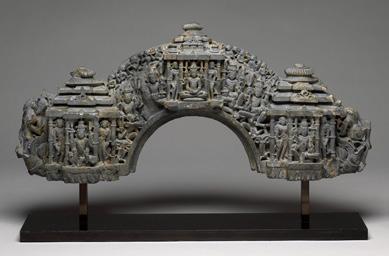
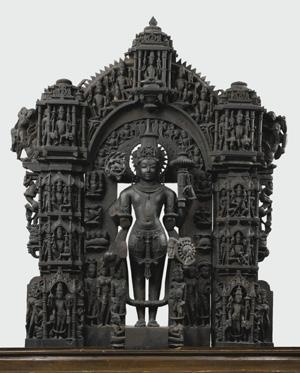
Compare a closely related black stone sculpture of Lord Vishnu and his manifestations, Gahadavala, dated by inscription to 1147 AD, in the National Museum, New Delhi, accession number L. 39. Compare a closely related gray limestone lintel with Vishnus and celestial musicians, Rajasthan, 12th century, 90.2 cm wide, in the Minneapolis Institute of Art, accession number 96.54.2 (fig. 1).
AUCTION RESULT COMPARISON
Type: Related
Auction: Sotheby’s New York, 20 March 2013, lot 268
Price: USD 581,000 or approx. EUR 695,000 converted and adjusted for inflation at the time of writing
Description: An exceptional and highly important black stone Vaishnavite stele Expert remark: Note the size (97.8 cm) and that this is an example of a complete shrine.
Estimate EUR 8,000
Starting price EUR 4,000
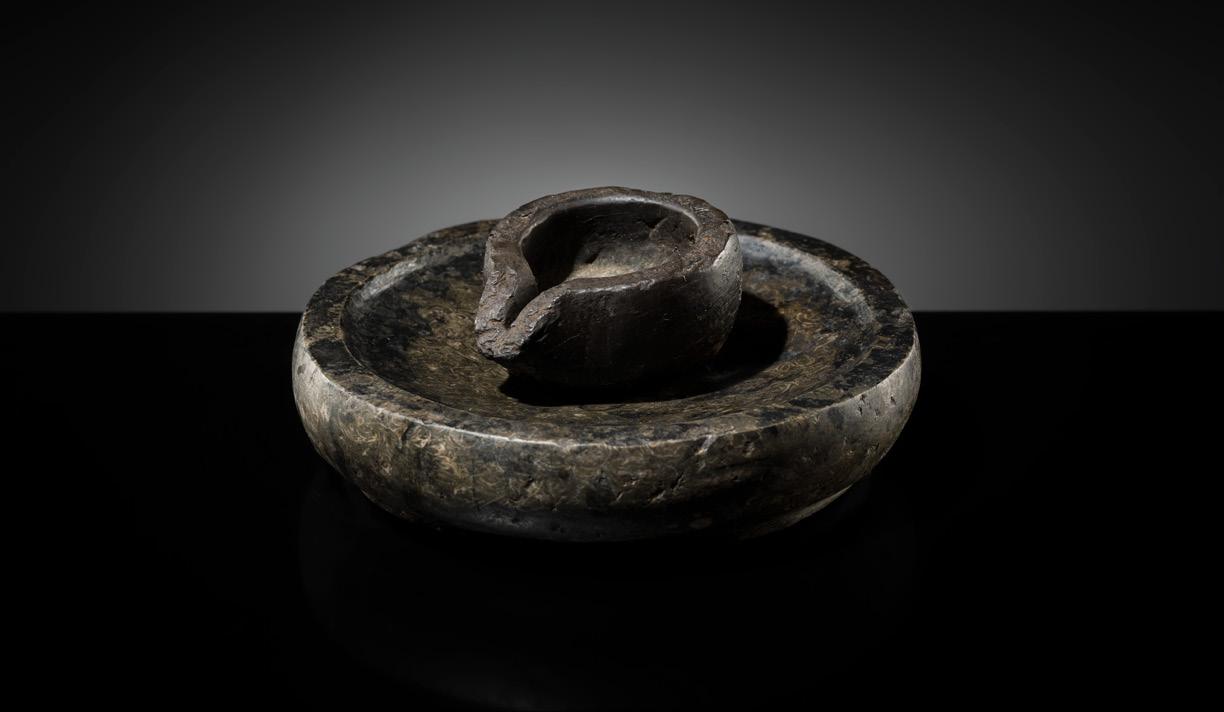
19 A HINDU STONE YONI WITH AN ASSOCIATED RITUAL WATER BASIN
India, 18th-19th century or possibly much earlier. The large and shallow stone bowl rises from a flat circular foot to a wide rim and is gently excavated at the center, accompanied by a deep stone yoni base with a tapering pranala for ritual libations. (2)
Weight: 2,691.7 g (the bowl), 336.7 g (the lamp)
Dimensions: Width 9.6 cm (the bowl), 10.2 cm (the lamp)
Estimate EUR 1,000
Starting price EUR 500
Provenance: Collection of Sven A. Behrendt, Salzburg, Austria, assembled from the 1960s onwards, with acquisitions made during his extensive travels worldwide. Note that Behrendt’s important nonAsian collection was sold in a single-owner sale titled “A Worldwide Grand Tour: The Sven A. Behrendt Collection" at Sotheby’s London, 2 December 2025
Condition: Good condition with wear and natural imperfections. Some nibbling, small chips, few losses, scattered nicks and scratches, signs of weathering, and traces of use.
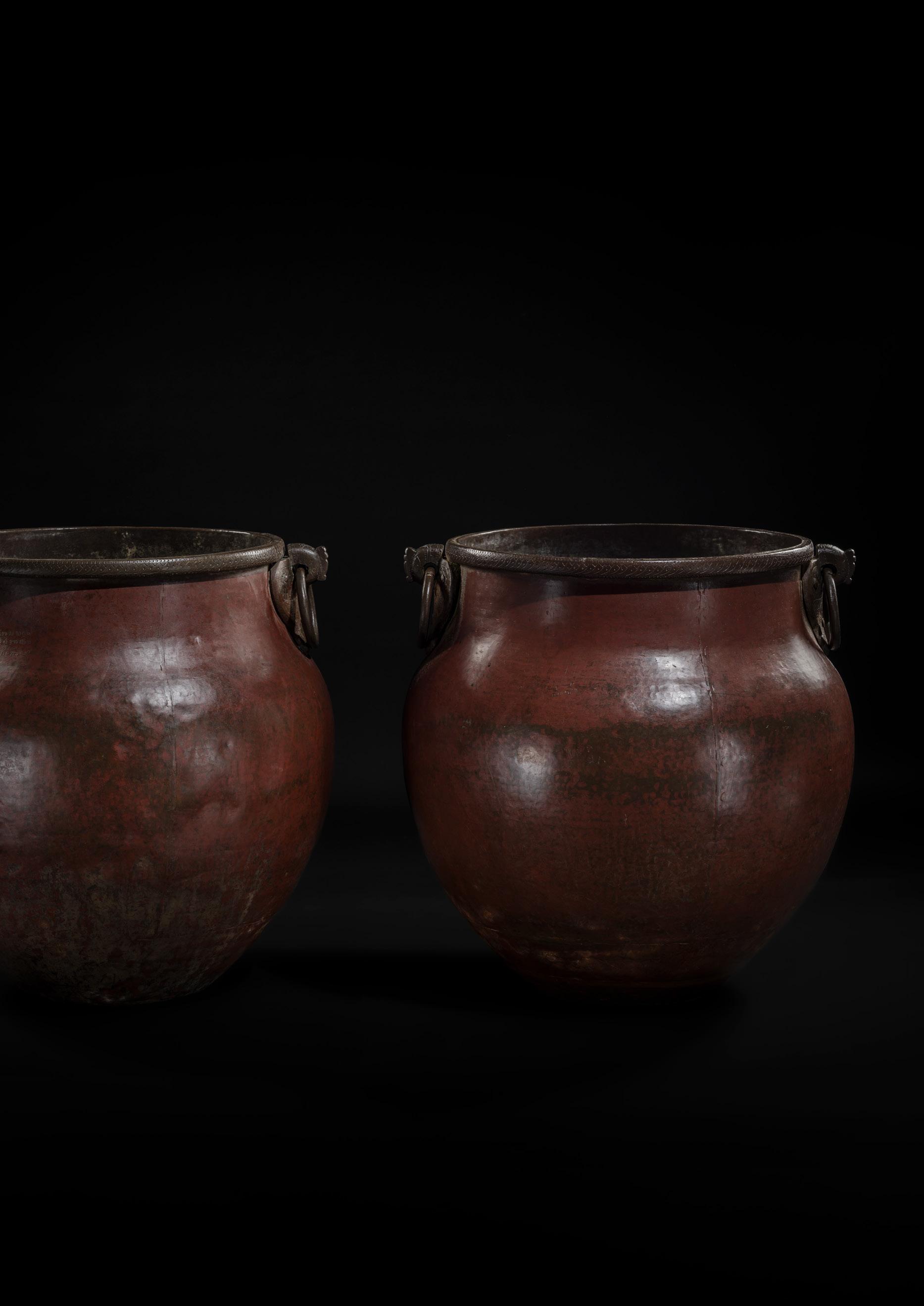
20 A PAIR OF ‘RED RAJA’ TWIN-HANDLED BRONZE POTS, 19TH CENTURY
India. Finely cast, the voluminous rounded sides rising from a flat pierced base to a waisted neck with a lipped rim incised with a band of guilloche, and applied to the sides with peacock-form handles suspending loose rings. (2)
Provenance: Collection of Sven A. Behrendt, Salzburg, Austria, assembled from the 1960s onwards, with acquisitions made during his extensive travels worldwide. Note that Behrendt’s important nonAsian collection was sold in a single-owner sale titled “A Worldwide Grand Tour: The Sven A. Behrendt Collection" at Sotheby’s London, 2 December 2025. Condition: Very good condition with wear and casting irregularities. Scattered nicks and scratches, some dings, encrustations, and signs of use. Both pots with an exceptionally beautiful, naturally grown patina overall.
Inscriptions: To the body, neatly incised.
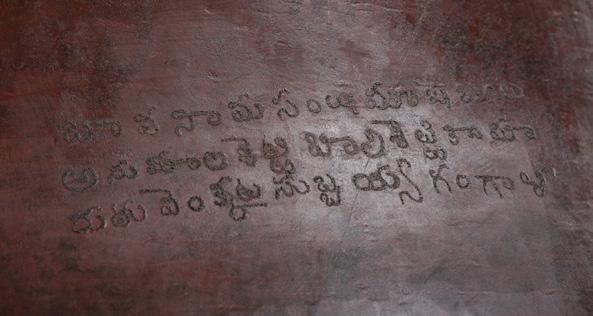
Weight: 23.2 kg and 22.8 kg
Dimensions: Height 64 cm (each)
AUCTION RESULT
COMPARISON
Type: Closely
Auction: Christie’s London, 9 December 2012, lot 1126
Price: GBP 2,000 or approx. EUR 3,800 converted and adjusted for inflation at the time of writing
Description: An Indian brass twin-handled pot, 19th century
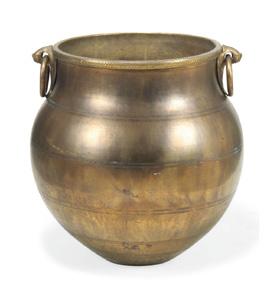
Expert remark: Compare the closely related form and similarly incised rim and handles. Note the size (57 cm), lack of patina, and that this result is only for a single pot while the present lot comprises a pair.
Estimate EUR 2,000
Starting price EUR 1,000

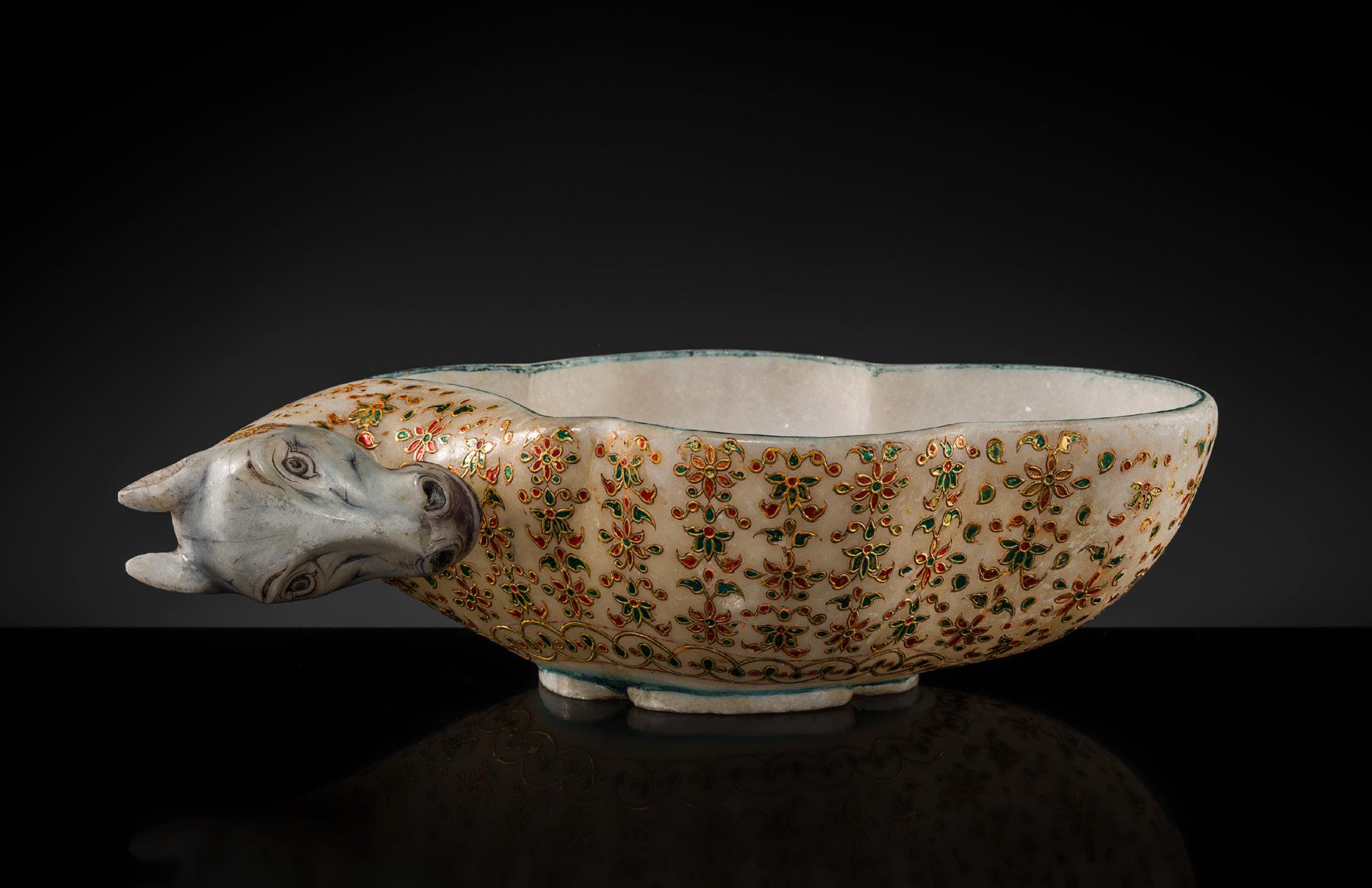
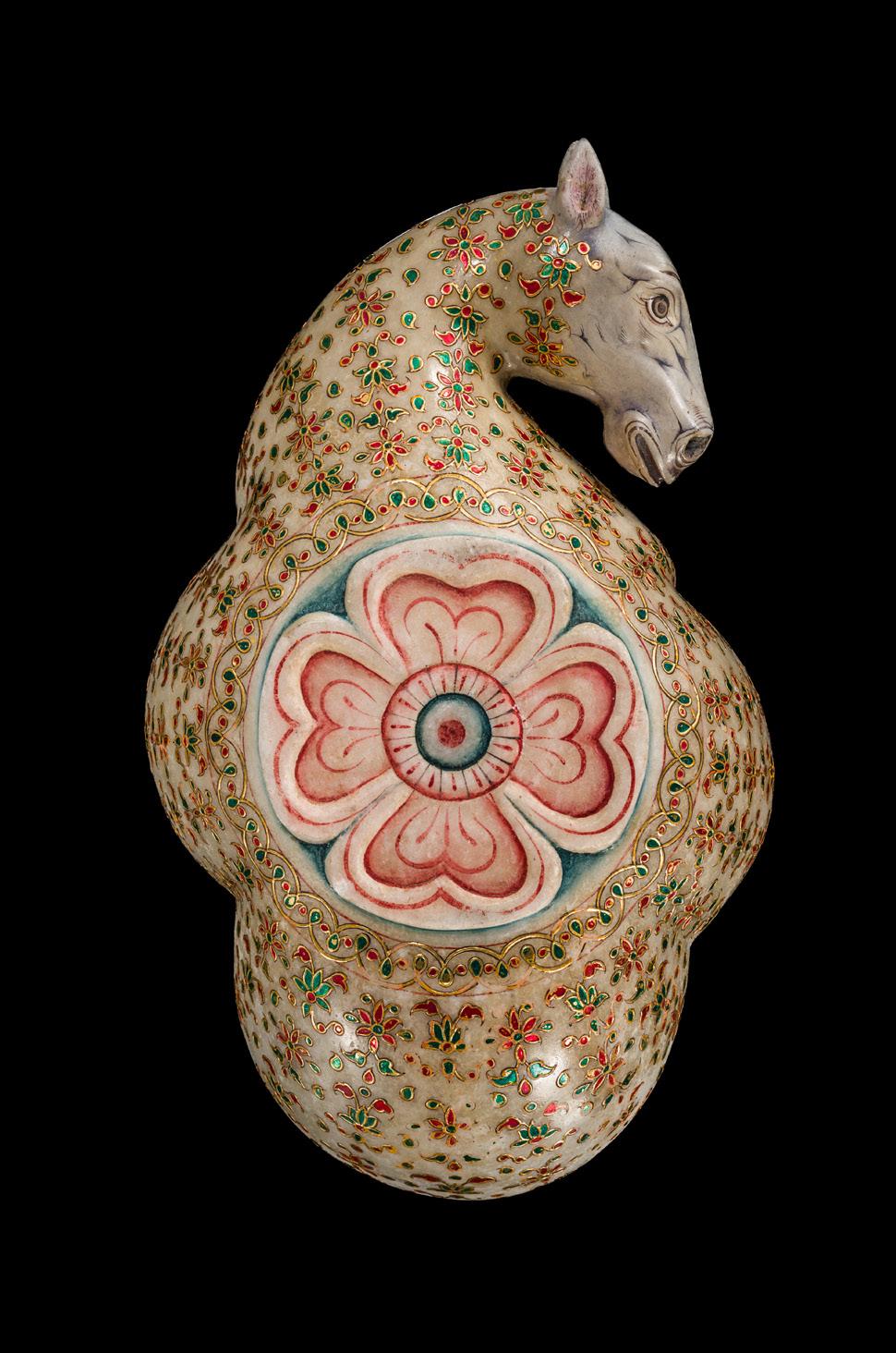
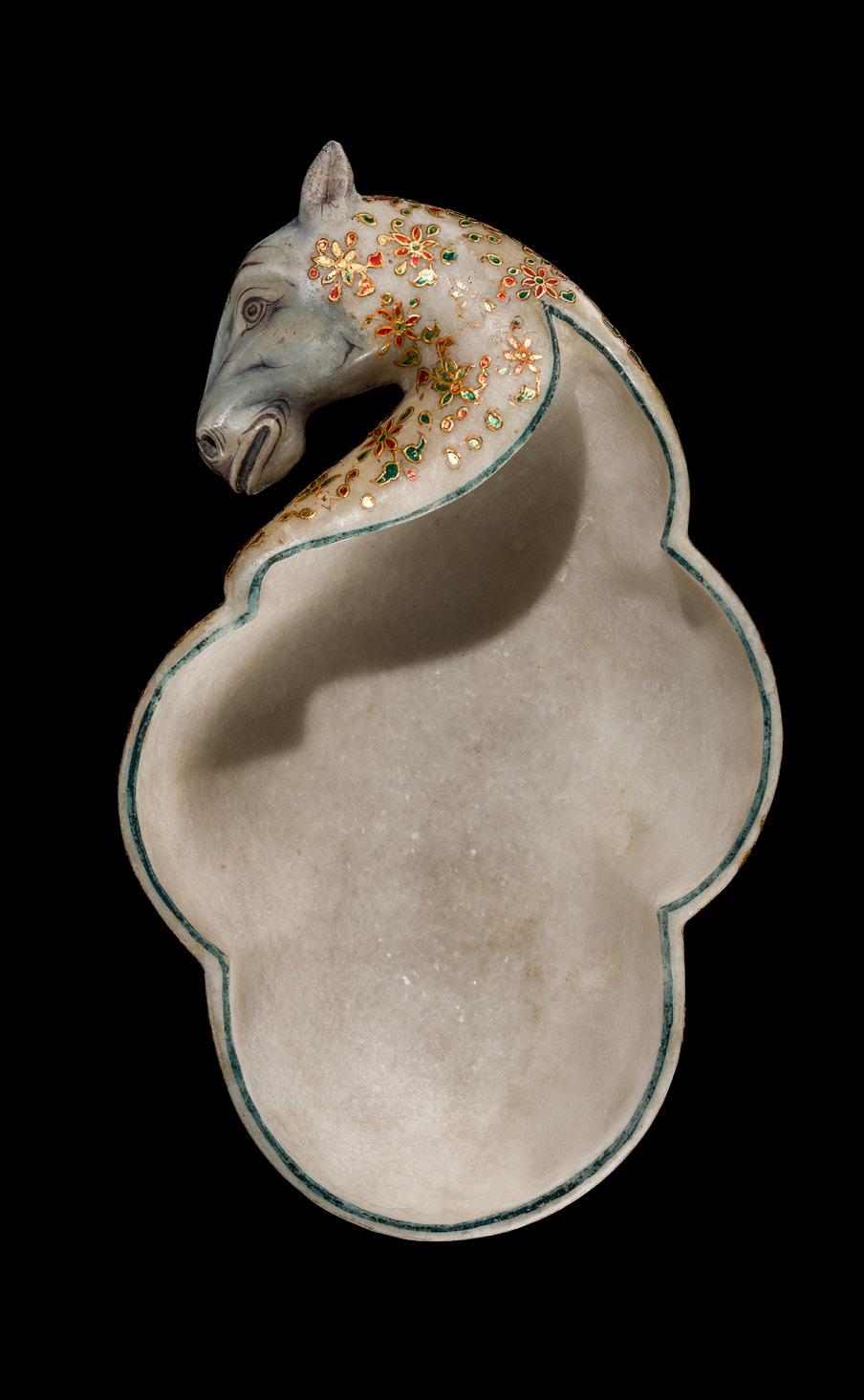
The polylobed bowl reminiscent of a shell, rising from a lotus-form foot, and set with a large horse head to one side. The exterior walls are decorated with raised gilt florals detailed in red and green, and framed by green-lined borders. The foot vividly painted with a lotus blossom, and the head detailed in black and blueish gray with eyes, ears, mouth and nose.
Provenance: Collection of Sven A. Behrendt, Salzburg, Austria, assembled from the 1960s onwards, with acquisitions made during his extensive travels worldwide. Note that Behrendt’s important non-Asian collection was sold in a single-owner sale titled “A Worldwide Grand Tour: The Sven A. Behrendt Collection" at Sotheby’s London, 2 December 2025.
Condition: Good condition with little wear, rubbing and flaking to the paint and gilt, the ears with small old repairs, and some nibbling here and there.
Weight: 5.8 kg
Dimensions: Length 46.5 cm
The form of this bowl is strongly influenced by Mughal palace arts, particularly the series of gemstone-inlaid bowls commissioned by Emperor Jahangir, known as Jahangiri bowls. Many of them feature horse heads stemming from a lobed ear-form bowl which is raised on a lotus foot. This tradition was later emulated by the western Indian Rajput vassals, giving rise to a distinctive school of Mughal Rajput gem art. These types of bowls have been reproduced in various materials, including jade, agate, and jasper.
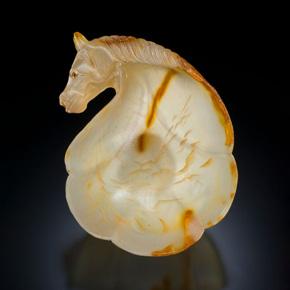
An Unique Agate Bowl, Mughal Period, Possibly 17th Century, sold at Bonhams, 11 December 2012, lot 1305
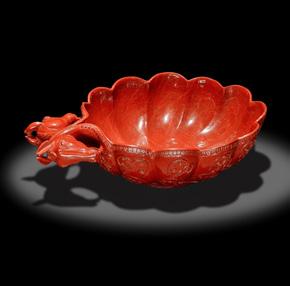
A Mughal-Style Indian Red Jasper Bowl, sold at Bonhams, 21 May 2019, lot 1009
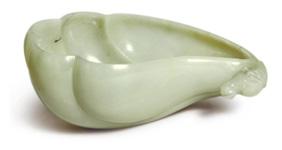
A Pale Celadon Jade Horse-headed Mughal-Style Cup, sold at Sotheby's, 29 September 2021, lot 974
Estimate EUR 2,000
Starting price EUR 1,000


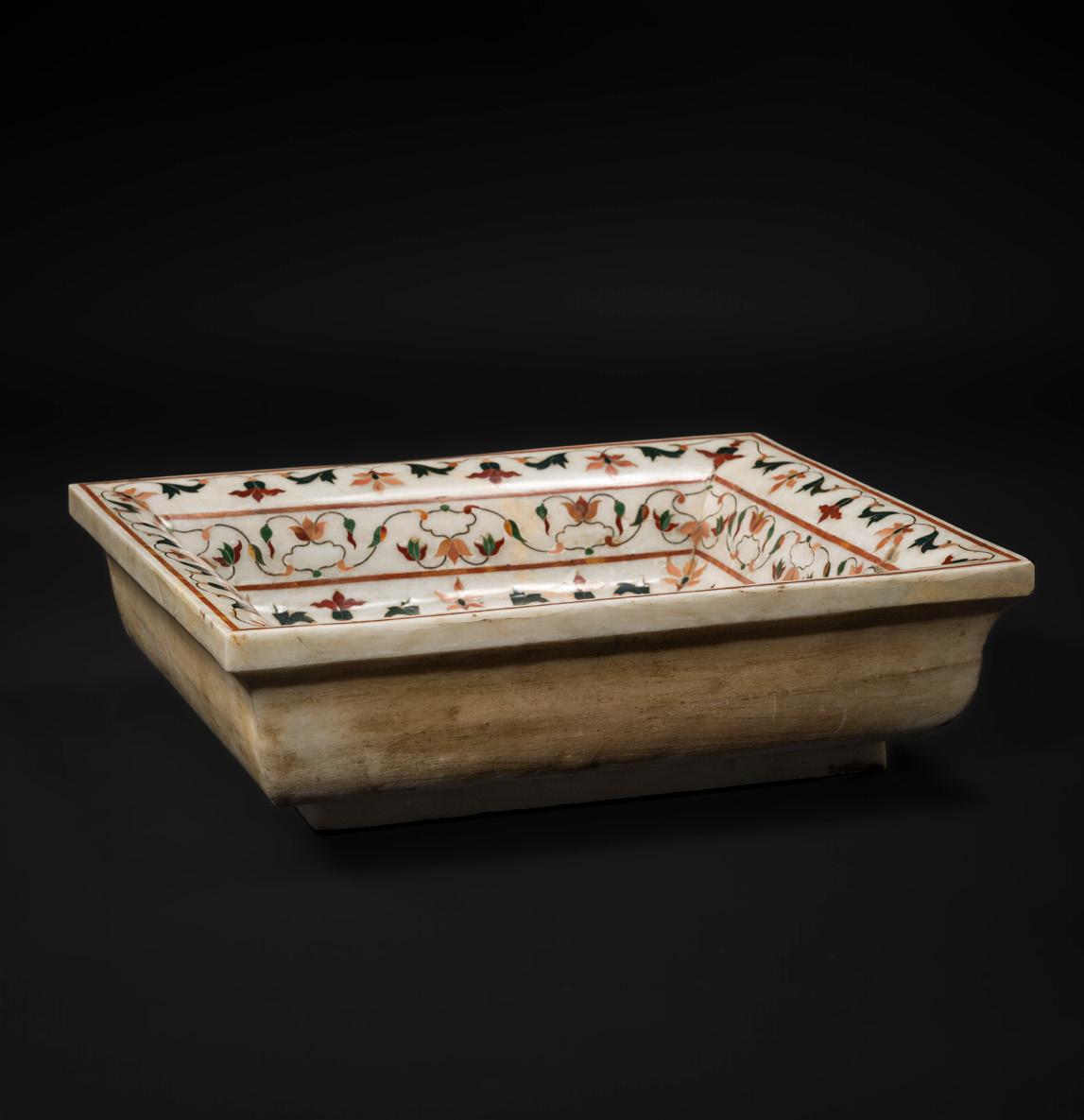
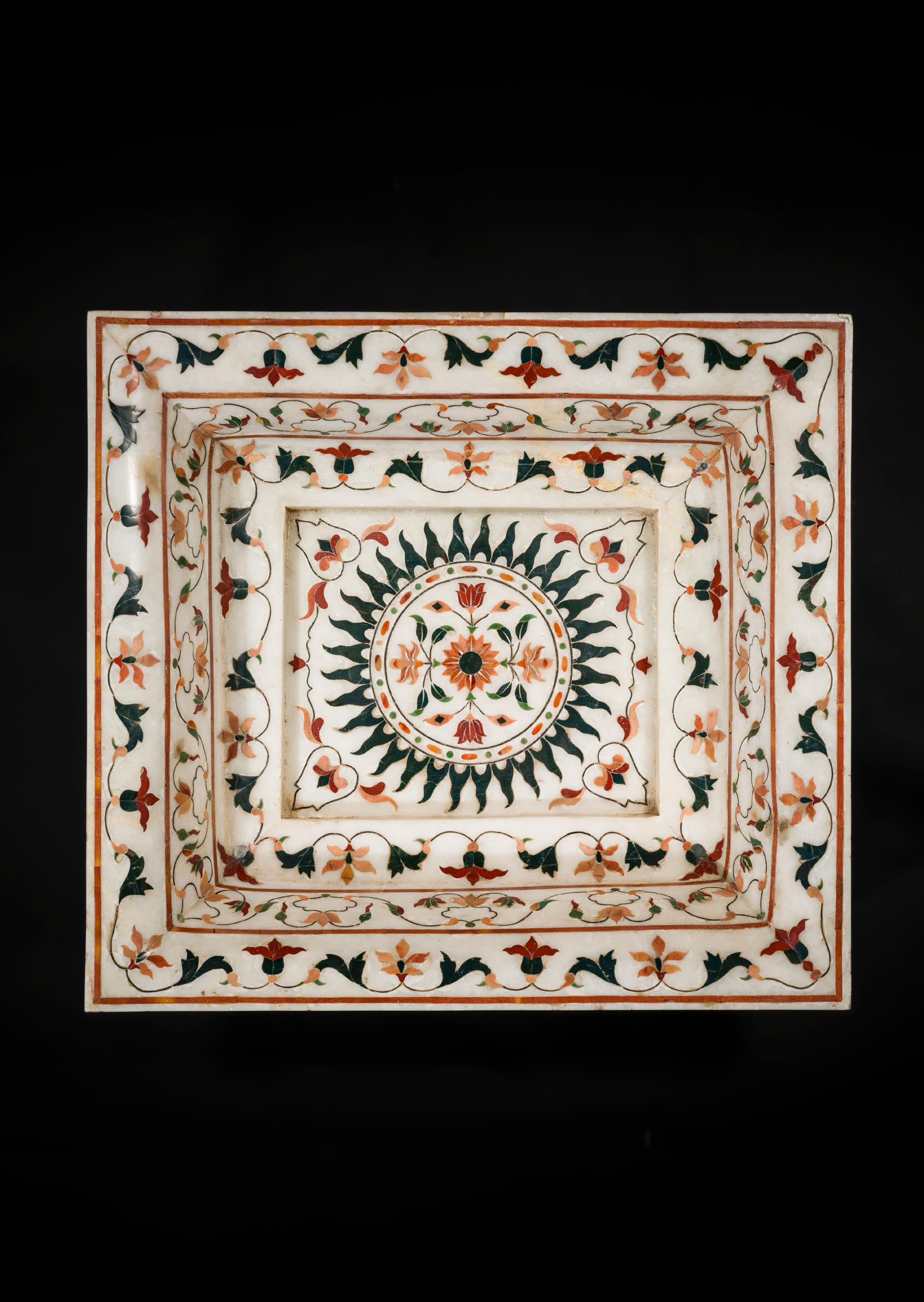
The square vessel with shallow, curving sides, neatly inlaid to the interior in green jade, agate, mother-of-pearl, and other semi-precious stones, to depict a central medallion enclosing florets, framed by flames, encircled by further floral bands and lines. The marble of a bright white color with cloudy white inclusions.
Provenance: Collection of Sven A. Behrendt, Salzburg, Austria, assembled from the 1960s onwards, with acquisitions made during his extensive travels worldwide. Note that Behrendt’s important non-Asian collection was sold in a single-owner sale titled “A Worldwide Grand Tour: The Sven A. Behrendt Collection" at Sotheby’s London, 2 December 2025.
Condition: Very good condition with minor wear, signs of weathering, some inlays lost, some reattached and repaired, old fills, small chips, few fissures, light scratches, and small nicks.
Weight: 75 kg
Dimensions: Size 58.5 x 53.2 x 17.2 cm
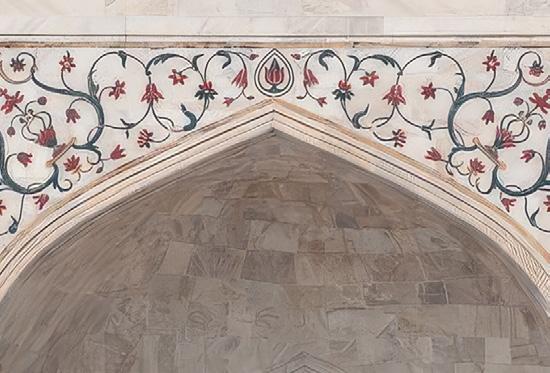
Pietra dura, meaning ‘hard stone’ in Italian and known in India as ‘pachchikari’ or ‘parchinkari’, is the technique of inlaying colored stones into marble or other hardstones. Although its precise origin is debated, the art flourished in both Italy and India in the late 16th century. Revived in Renaissance Florence under the Medici, the technique may have reached the Mughal court through Italian craftsmen recorded in India at that time. Indian artisans, however, quickly transformed and enriched the practice. The finest examples of parchinkari are associated with the patronage of emperors Akbar, Jahangir, and Shah Jahan, most famously seen in the Taj Mahal.
Estimate EUR 3,000
Starting price EUR 1,500

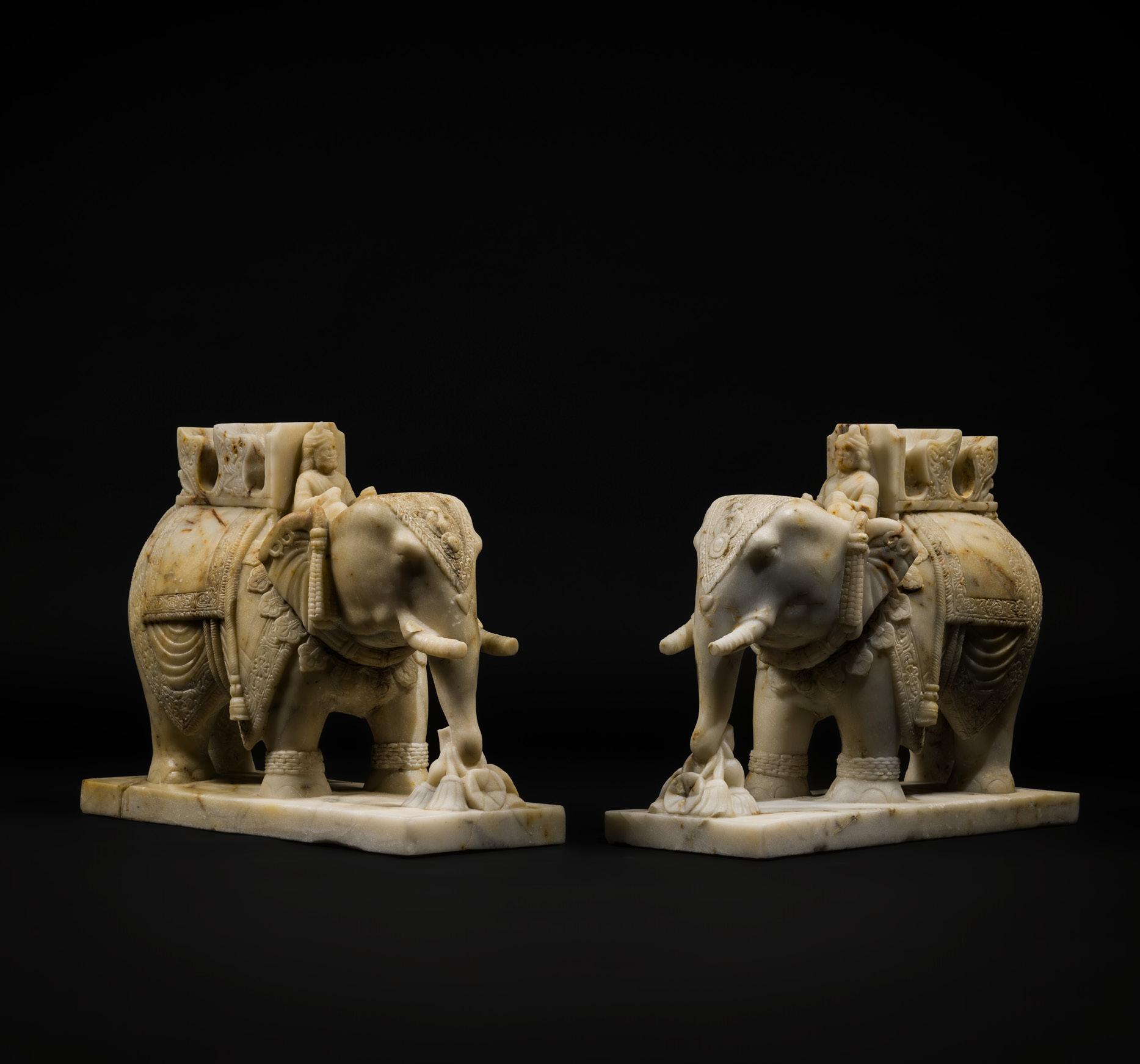
A PAIR OF FINELY CARVED WHITE MARBLE ELEPHANTS, RAJASTHAN
India, 19th to mid-20th century. Each mammal superbly carved standing foursquare on a tall rectangular pedestal, the trunk lowered and clasped around a bundle of flowers and tassels. The caparisoned animals are hung with textiles, variously adorned with foliate garlands, tassels, and ornaments, and with a howdah on their backs. The elephant’s mahout (driver) seated on its neck. (2)
Provenance: Collection of Sven A. Behrendt, Salzburg, Austria, assembled from the 1960s onwards, with acquisitions made during his extensive travels worldwide. Note that Behrendt’s important non-Asian collection was sold in a single-owner sale titled “A Worldwide Grand Tour: The Sven A. Behrendt Collection" at Sotheby’s London, 2 December 2025.
Condition: Good condition with old wear, some weathering, natural fissures, small losses, scattered chips, small nicks, old repairs, and traces of use.
Weight: 87.7 kg and 85.4 kg
Dimensions: Height 48 cm (each), Length 61 cm (each)
AUCTION RESULT COMPARISON
Type: Closely related
Auction: Christie’s New York, 24 October 2022, lot 1122
Price: USD 25,200 or approx. EUR 23,500 converted and adjusted for inflation at the time of writing
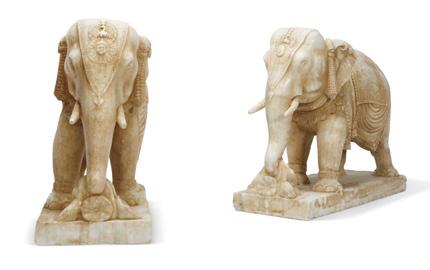
Description: A pair of finely carved white marble elephants, India, Rajasthan, 20th century
Expert remark: Compare the closely related modeling and similar caparisoned decorations. Note the size (63.5 cm) and the later dating.
Estimate EUR 3,000
Starting price EUR 1,500
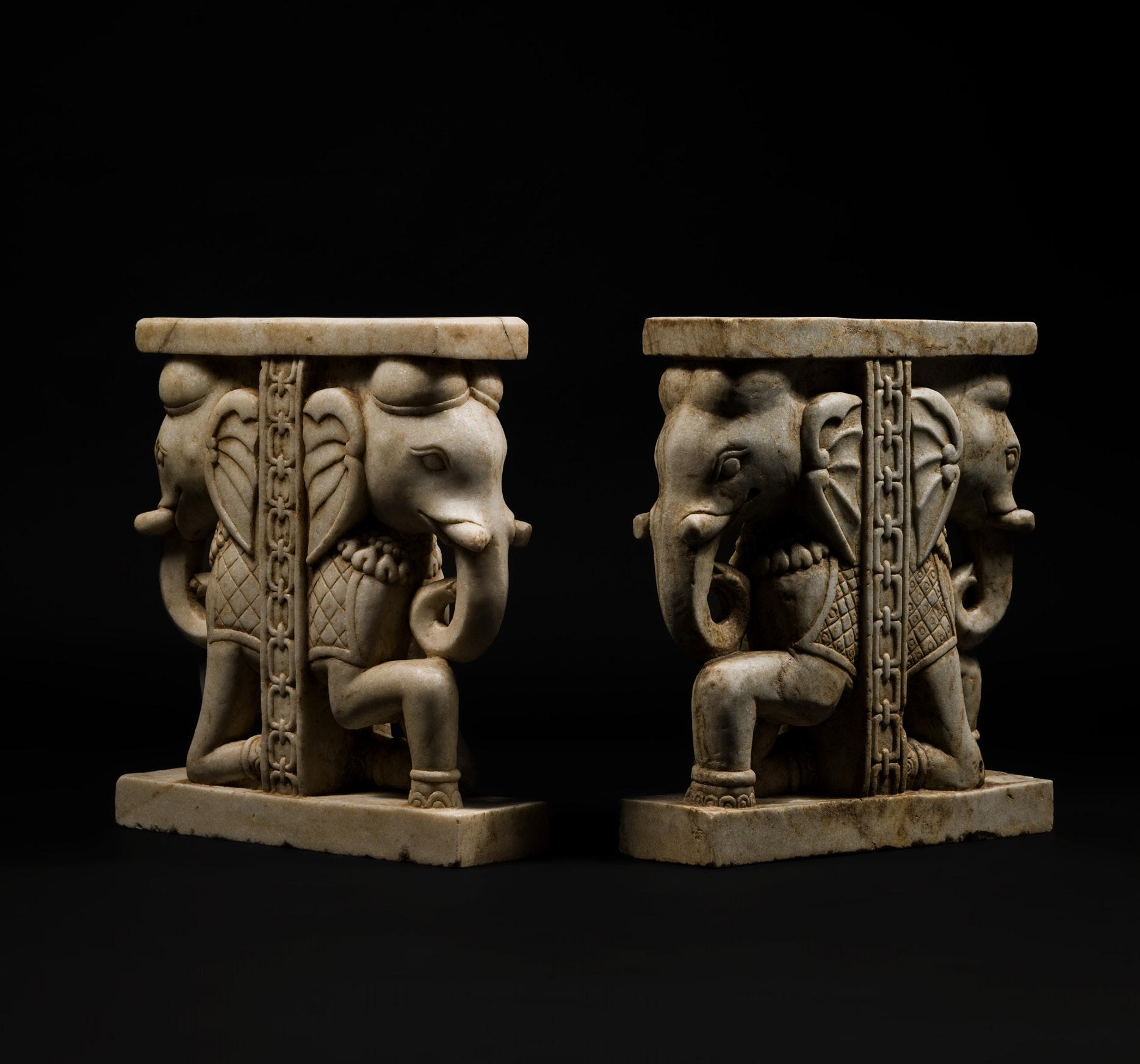
A PAIR OF FINELY CARVED WHITE MARBLE ‘ELEPHANT’ SUPPORTS, RAJASTHAN
India, 19th to mid-20th century. Each support finely carved as addorsed elephants kneeling atop a wide rectangular base and balancing a rectangular beam on their heads, hung with textiles and variously adorned with foliate garlands, the faces modeled with short tusks, curled trunks, and bulbous foreheads, flanked by large ears.
Provenance: Collection of Sven A. Behrendt, Salzburg, Austria, assembled from the 1960s onwards, with acquisitions made during his extensive travels worldwide. Note that Behrendt’s important non-Asian collection was sold in a single-owner sale titled “A Worldwide Grand Tour: The Sven A. Behrendt Collection" at Sotheby’s London, 2 December 2025.
Condition: Good condition with some old wear, weathering, natural fissures, small losses, scattered chips, small nicks, old repairs, and traces of use.
Weight: 56.7 kg and 57.4 kg
Dimensions: Height 51 cm (the elephants), Length 46 cm (the elephants), 70 x 140 cm (the glass top)
With an associated glass table top. (3)
AUCTION RESULT COMPARISON
Type: Related
Auction: Christie’s New York, 23 August 2017, lot 529
Price: USD 10,625 or approx. EUR 12,000 converted and adjusted for inflation at the time of writing
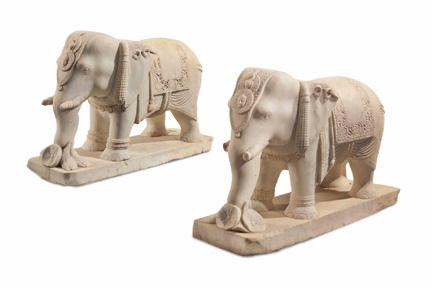
Description: A pair of Indian marble elephants, 20th century
Expert remark: Compare the closely related modeling and similar caparisoned decorations. Note the size (52 cm) and the later dating.
Estimate EUR 2,000
Starting price EUR 1,000
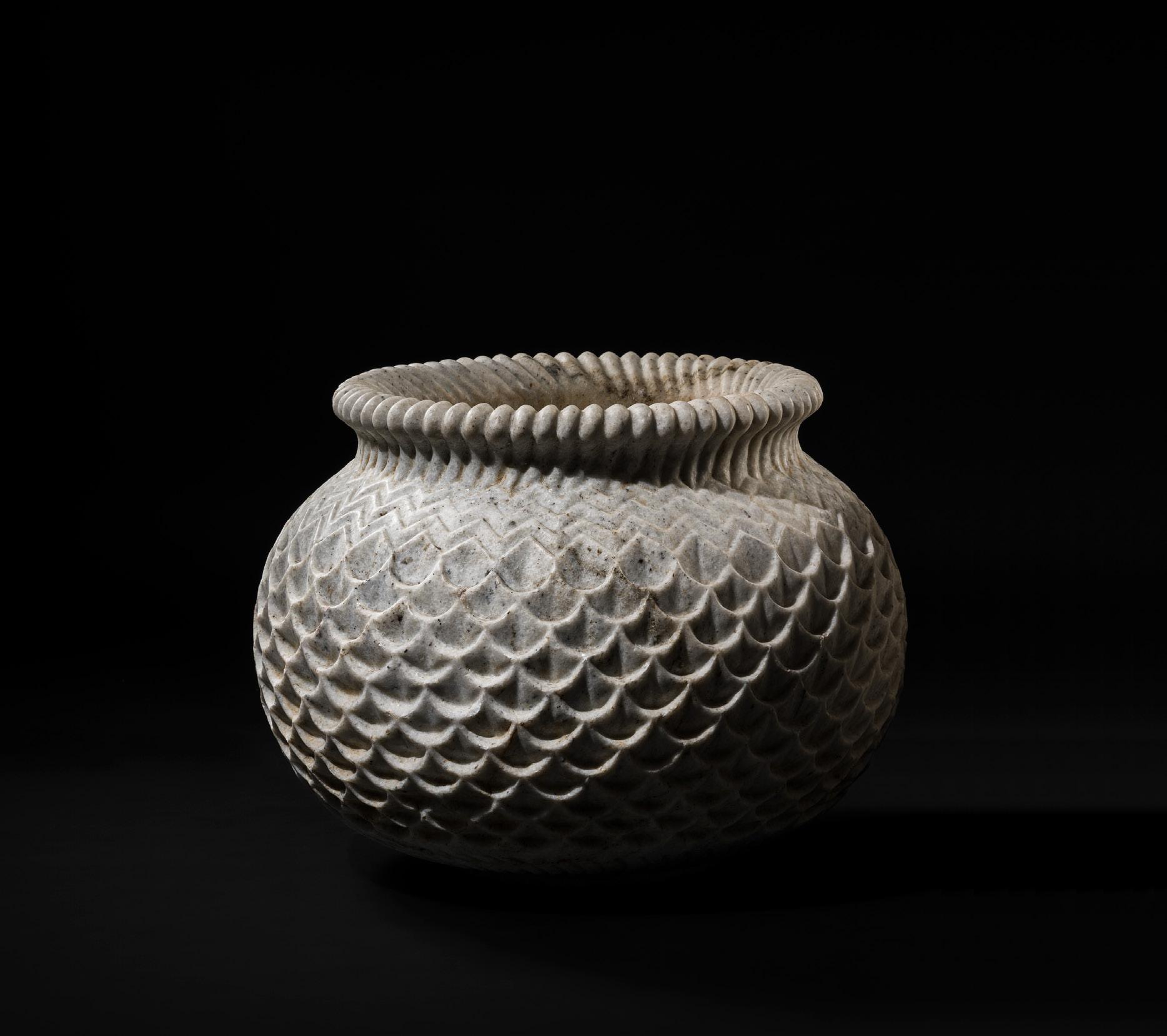
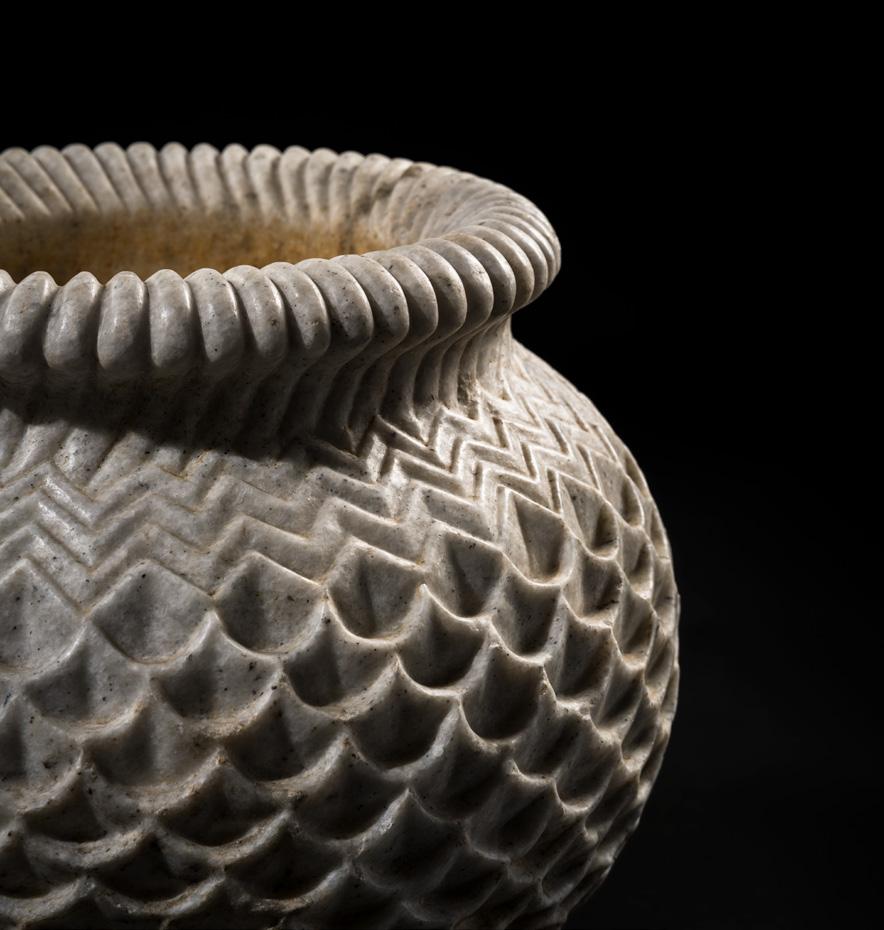
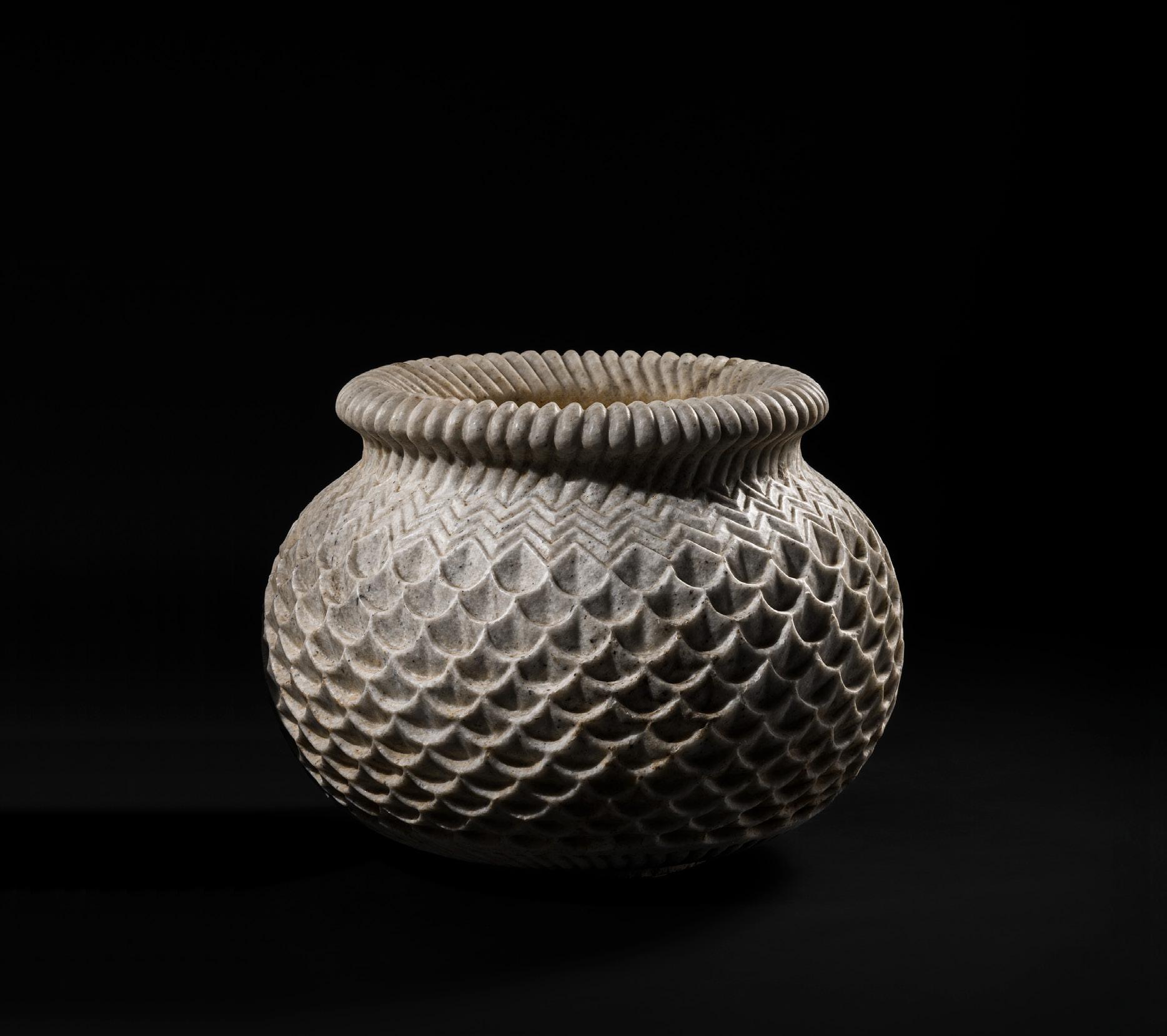
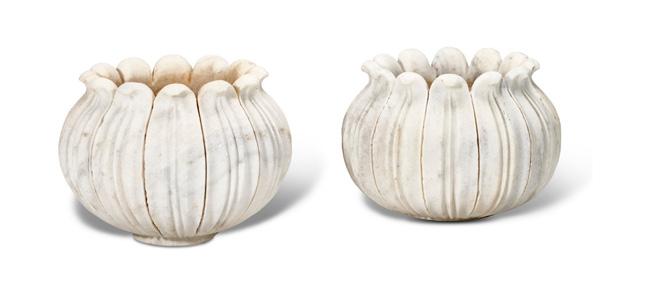
A PAIR OF LOTUS-FORM MARBLE JARDINIÈRES, SHEKHAWATI REGION
India, 20th century. Of globular form, the curved sides carved with layers of overlapping lotus leaf petals in the round, rising to a waisted neck with a wide rim and ribbed edge. (2)
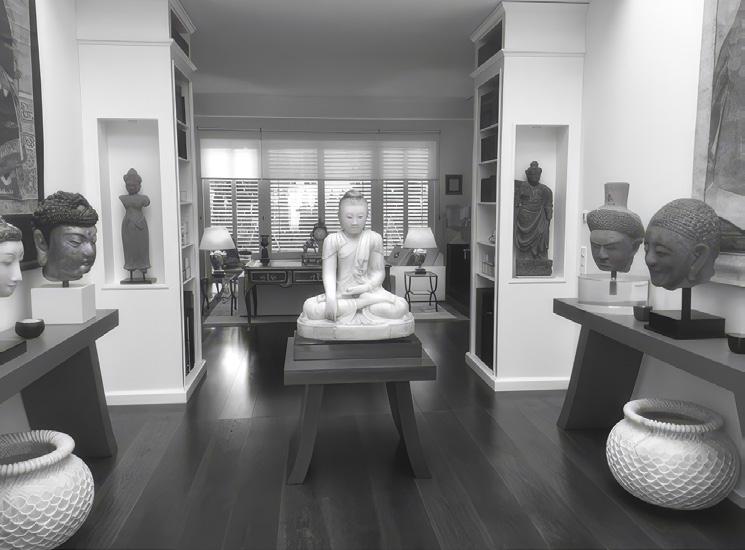
Provenance: Collection of Sven A. Behrendt, Salzburg, Austria, assembled from the 1960s onwards, with acquisitions made during his extensive travels worldwide. Note that Behrendt’s important non-Asian collection was sold in a single-owner sale titled “A Worldwide Grand Tour: The Sven A. Behrendt Collection" at Sotheby’s London, 2 December 2025.
Condition: Very good condition with wear, natural fissures, traces of use, small nicks, some soiling, and drilled apertures to the interior.
Weight: 92.8 kg and 101.3 kg
Dimensions: Height 47 cm (each)
AUCTION RESULT COMPARISON
Type: Closely related
Auction: Christie’s New York, 24 October 2022, lot 1110
Price: USD 30,240 or approx. EUR 28,500 converted and adjusted for inflation at the time of writing
Description: A pair of marble lotus-form jardinieres, India, Shekhawati region, 20th century
Expert remark: Compare the related form and similar material. Note the size (30.5 cm).
Estimate EUR 3,000
Starting price EUR 1,500
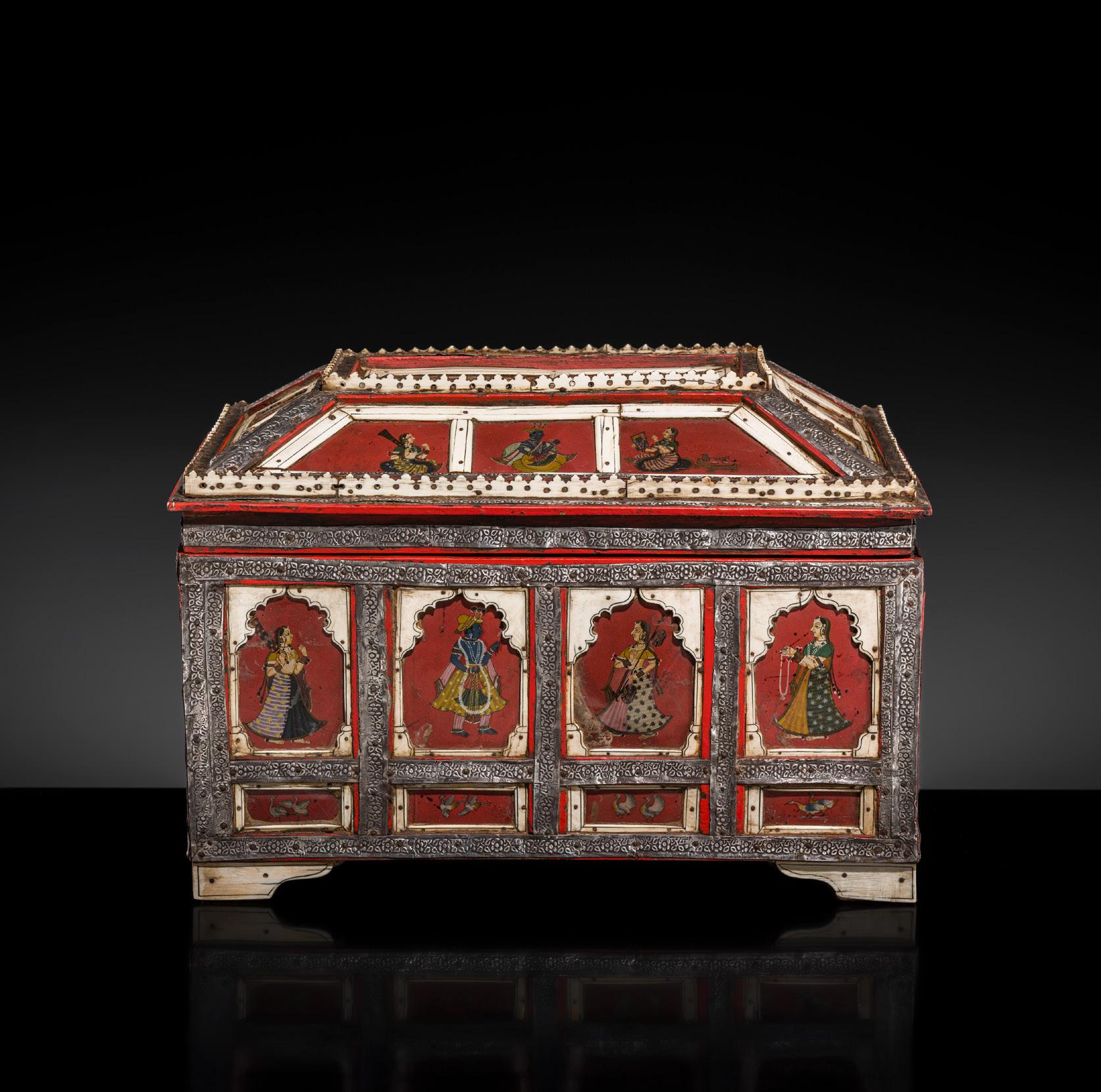
A PAINTED AND IVORY INLAID ‘KRISHNA AND SAKHI’ STORAGE BOX WITH SILVERED MOUNTS, INDIA, LATE 19TH-EARLY 20TH CENTURY
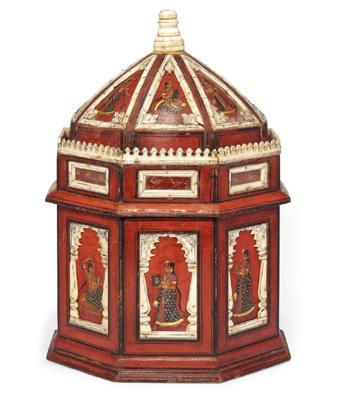
Of rectangular form with a domed, tiered lid, the casket is richly decorated with hand-painted figural panels set against a red ground, depicting Kirshna and his sakhi within arched niches. The scenes are framed by repoussé silvered metal mounts engraved with foliate motifs, continuing around the sides and lid. The sloping lid is similarly ornamented with painted panels bordered by carved ivory edging, while the body rests on four bracket feet. The box was likely intended for the storage of jewelry or other valuables.
Provenance: Collection of Sven A. Behrendt, Salzburg, Austria, assembled from the 1960s onwards, with acquisitions made during his extensive travels worldwide. Note that Behrendt’s important non-Asian collection was sold in a single-owner sale titled “A Worldwide Grand Tour: The Sven A. Behrendt Collection" at Sotheby’s London, 2 December 2025.
Condition: Good condition with some wear, traces of use, natural cracks, warping, little chips, flaking to the red lacquer, small tears to the metal, losses, and some of the mica leaf covered windows with cracks.
Weight: 7.6 kg
Dimensions: Size 39.2 x 28.2 x 27.6 cm
AUCTION RESULT COMPARISON
Type: Related
Auction: Christie’s London, 8 October 2013, lot 34
Price: GBP 1,875 or approx. EUR 3,500 converted and adjusted for inflation at the time of writing
Description: A wood model of a domed pavilion, India, late 19th/early 20th century Expert remark: Compare the similar materials and decoration. Note the size (44 cm) and form.
Estimate EUR 1,000
Starting price EUR 500
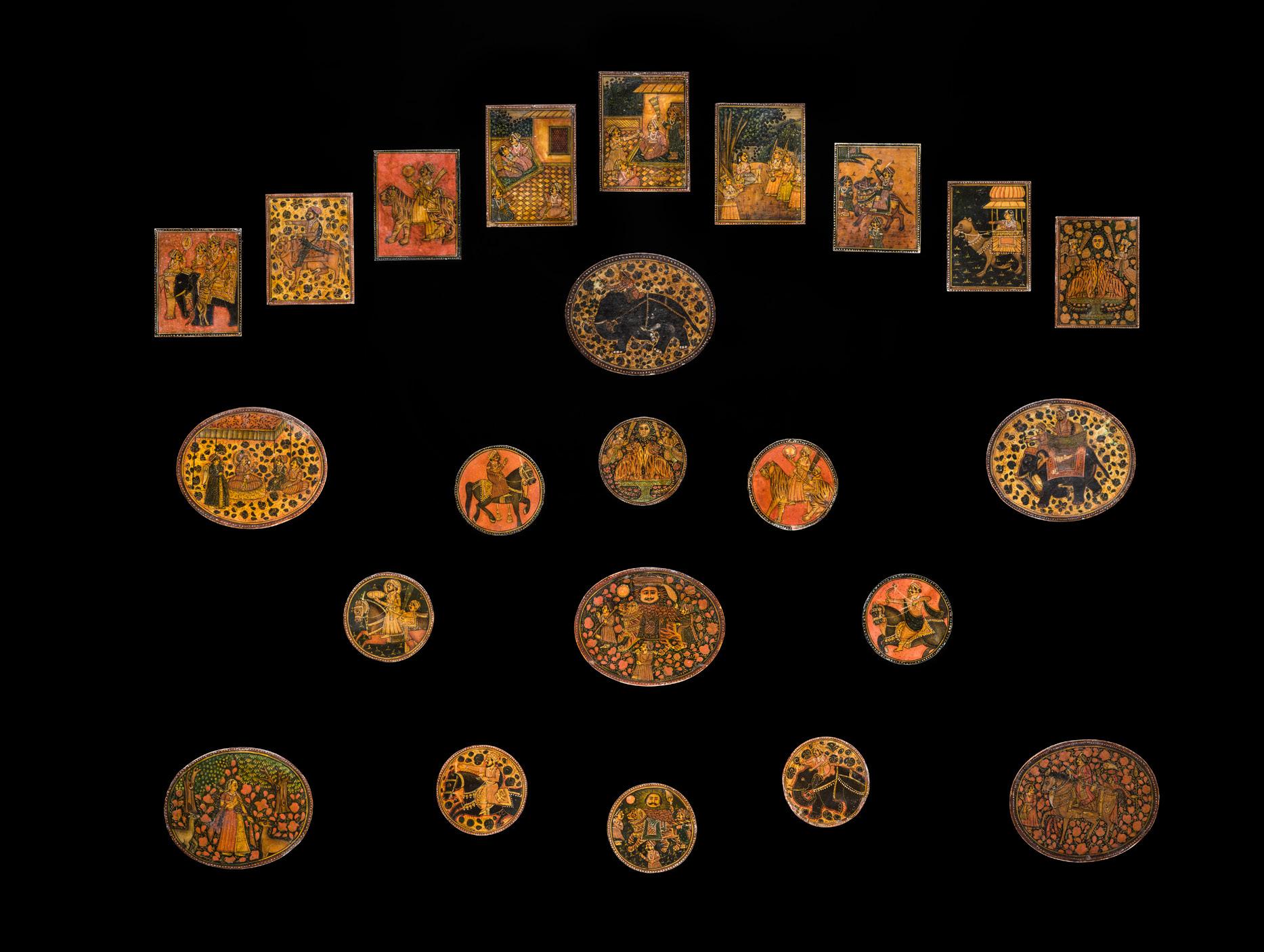
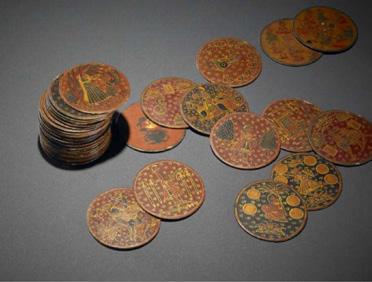
Comprising six large oval plaques, eight circular plaques, and nine rectangular plaques. Each is painted in gouache heightened with gold on an ivory ground. The scenes depict hunting episodes, royalty riding horses and elephants, ladies, palace settings, and auspicious animals such as tigers, oxen, and elephants. The reverse with floral decoration. (23)
Provenance: Collection of Sven A. Behrendt, Salzburg, Austria, assembled from the 1960s onwards, with acquisitions made during his extensive travels worldwide. Note that Behrendt’s important non-Asian collection was sold in a single-owner sale titled “A Worldwide Grand Tour: The Sven A. Behrendt Collection" at Sotheby’s London, 2 December 2025.
Condition: Good condition with minor wear, little flaking to the pigments, minor rubbing, light scratches, one plaque with a repaired crack, and few minor touchups to the gouache.
Weight: 125 g (total)
Dimensions: Lengths 4.6 - 7.6 cm
Each plaque in a sachet, and a padded box. (2)
Ganjifa is a traditional card game closely associated with Persia and India, played with circular or rectangular cards that were historically hand-painted by skilled artisans. It flourished at the Mughal court, where luxurious decks were produced from materials such as ivory inlaid with precious stones or tortoiseshell. As the game spread beyond the court to the wider public, more affordable sets were made from wood, palm leaf, stiffened cloth, or pasteboard. Ganjifa decks typically feature brightly colored backgrounds, with each suit distinguished by its own color, and exist in many regional variations, differing in design, number of suits, and card size.
LITERATURE COMPARISON
Compare a related set of Mughal Ganjifa playing cards, 19th century, diameter 5.2 cm, in the British Museum, museum number 1880,0.2241.1-41.
AUCTION RESULT COMPARISON
Type: Related
Auction: Christie’s London, 11 April 2014, lot 215
Price: GBP 7,500 or approx. EUR 13,500 converted and adjusted for inflation at the time of writing
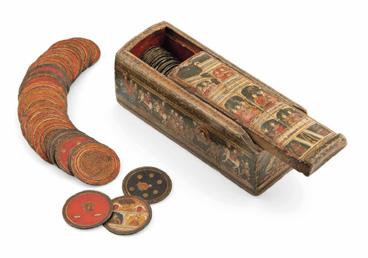
Description: A set of lacquered papier-mâché circular game cards (ganjifa) with its box, India, 19th century
Expert remark: Compare the similar form, color, and size (4 cm). Note the lot is a full set with box.
Estimate EUR 2,000
Starting price EUR 1,000
28 A VERY LARGE (220 X 102 CM) PAINTING OF A COSMIC MAN, LOKAPURUSHA, BIKANER, LATE 18TH CENTURY
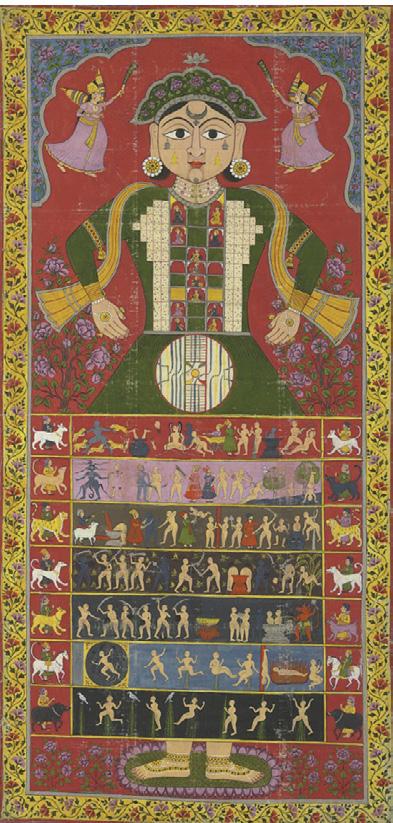
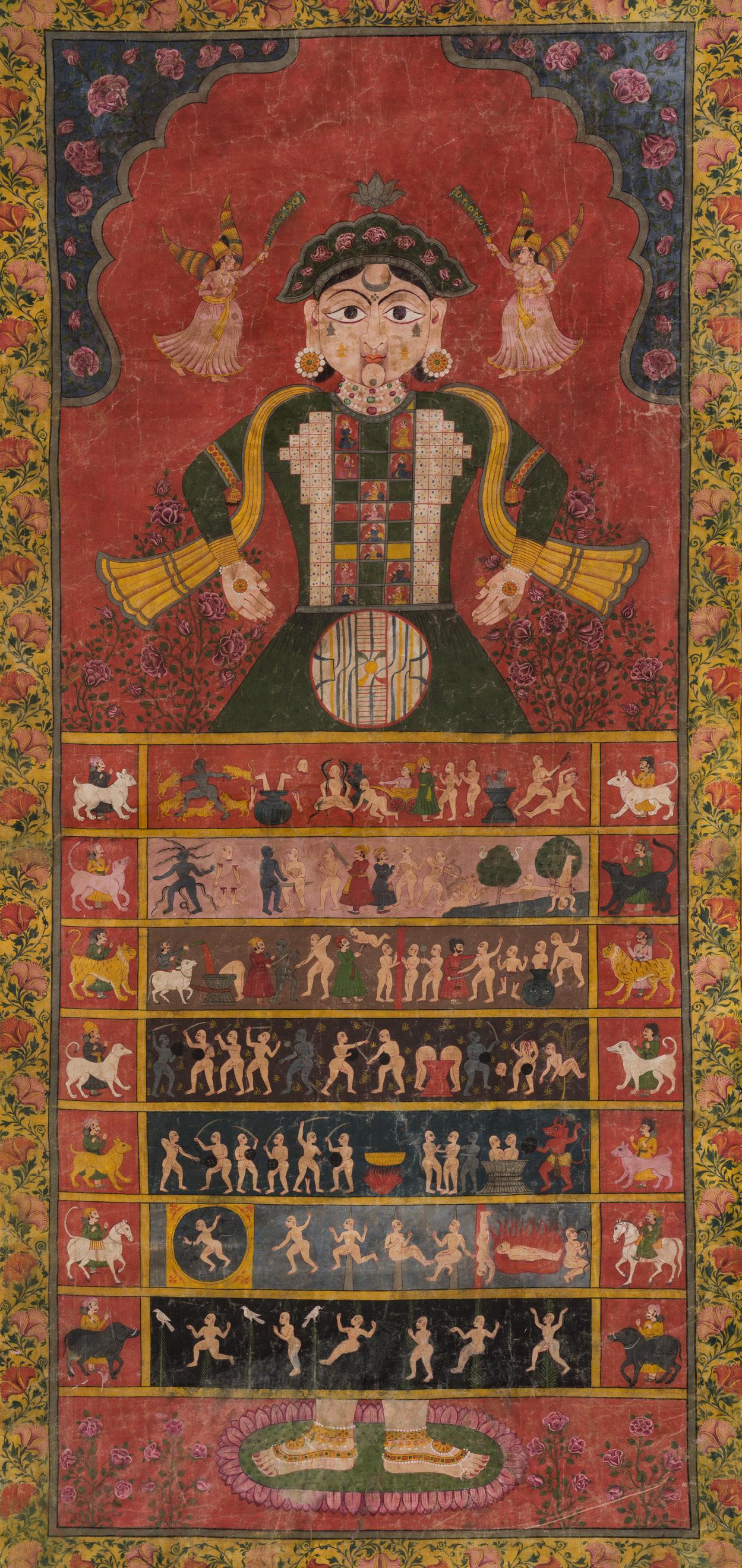
India, Rajasthan, circa 1775. Opaque pigments on textile. Set inside a frame behind glass. The cosmic man dressed in green and adorned with multiple pieces of jewelry, standing on a lotus, with eight rows of seated figures and assorted squares at his chest, the Jambudvipa at his waist, and seven rows of animals and figures at his legs, the face with four temples on the cheeks, a crescent moon at the forehead, and a winged peri bearing a fan at either side, flanked by pink flowers, all on a red background surrounded by a yellow border with a floral vine.
Provenance: Collection of Sven A. Behrendt, Salzburg, Austria, assembled from the 1960s onwards, with acquisitions made during his extensive travels worldwide. Note that Behrendt’s important non-Asian collection was sold in a single-owner sale titled “A Worldwide Grand Tour: The Sven A. Behrendt Collection" at Sotheby’s London, 2 December 2025.
Condition: Very good condition with expected wear, some flaking to pigment, minor fading to colors, few creases, possibly minuscule touchups, and minor soiling. The frame with traces of wear and use.
Dimensions: Image size 220 x 102 cm, Size incl. frame 255 x 139 cm
The cosmic man is a popular theme in late Jain painting although its origins are evident from the fourteenth century. This example is a striking and beautiful painting, characteristic of the north Rajasthan region centered around Bikaner state.
The cosmological scheme of the adhaidvipa – world of the mortals – is ‘superimposed on the human body in an attempt to homologize the microcosm with the microcosm (Pal, 1994, pp231). The human body symbolism is sub-divided into the adhaloka (lower world), madhyaloka (middle world), and urdhvaloka (upper world), each of which is represented differently. The depiction overall thus acts as cosmic representation - both a picture for the worship of the mandala of the world of the mortals and the enormous body form of Lord Mahavira –the twenty forth Jina, which also embodies the three worlds.
The evil lower world is represented by seven horizontal registers of various colors depicting various carnal acts. The middle world, with the point
of origin at Mount Meru and the concentric world of mortals, incorporating all humanity, flora and fauna, is placed over the navel of the cosmic man; the origin myths of man and universe being aligned very literally. The upper world of the gods, in its orderly formulation of courtly tiers, is located on the torso of the cosmic man. The iconography, stylization and chromatic palette of this painting draws from illustrations in contemporaneous manuscripts such as the Samgrahanisutra.
COMPARISON
Type: Closely related
Auction: Christie’s New York, 20 March 2009, lot 1344
Price: USD 47,500 or approx. EUR 62,500 converted and adjusted for inflation at the time of writing
Description: A painting of a lokapurusha, India, Rajasthan, Bikaner, c. 1775
Expert remark: Compare the near identical rendition and colors. Note the much smaller size (132.1 x 63.5 cm).
Estimate EUR 10,000
Starting price EUR 5,000
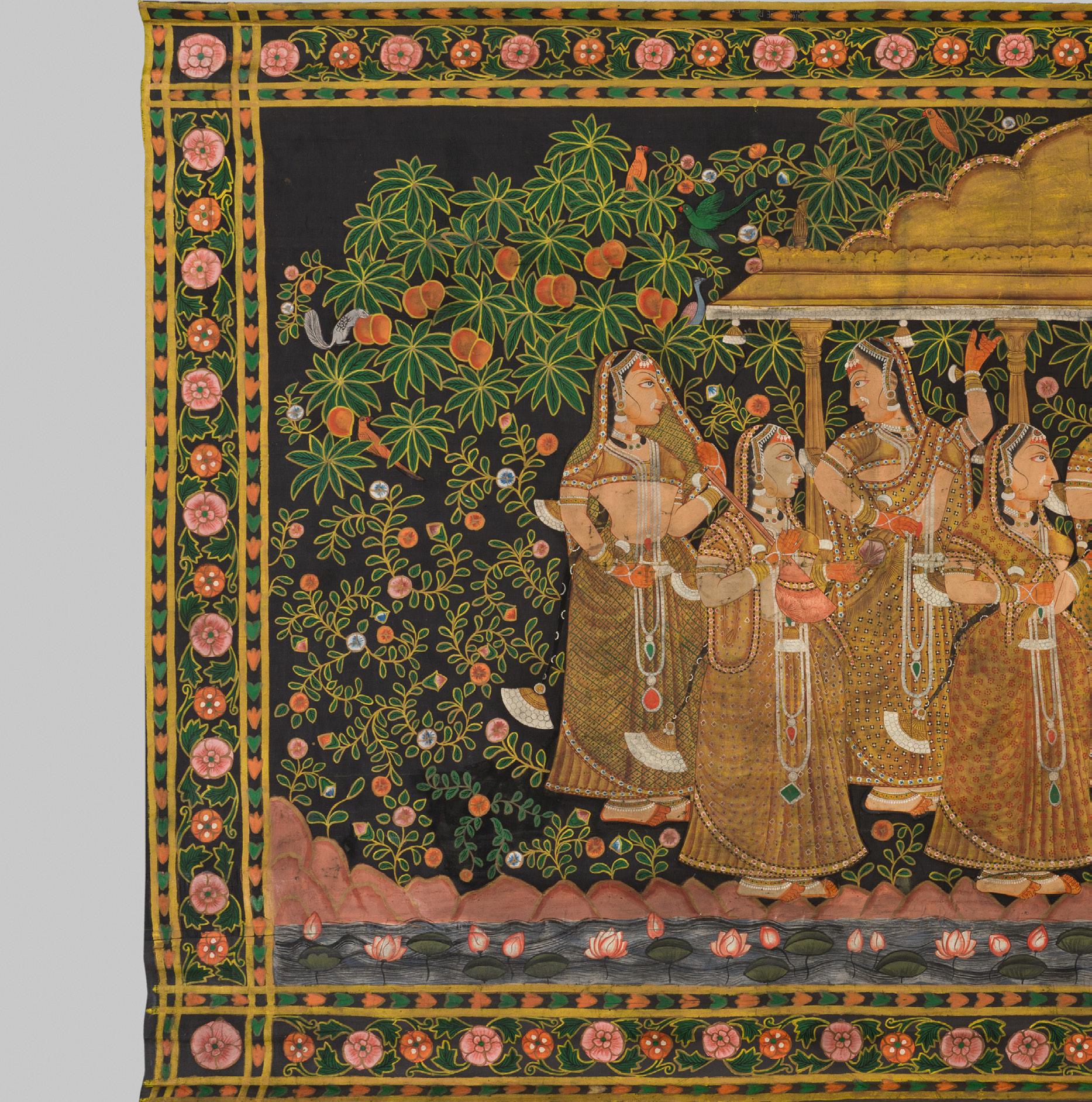
29 A MAGNIFICENT AND LARGE VRIKSHCHARI PICCHVAI DEPICTING GOPIS IN A GROOVE, DECCAN STYLE, GOLCONDA,
India, Hyderabad. Opaque pigments, gold, and silver on cloth. Mounted as a hanging scroll and fitted with D-loops for suspension. Finely painted in characteristic Golconda style against a dark blue ground to depict a group of nine gopis (milkmaids) in a mango grove by a lotus pond, taking shelter under an arched gazebo as they wait for Krishna, the object of their affection, to reveal himself. The resplendent tree bearing fruits and sheltering several birds and squirrels. The gopis dressed in intricately painted garments, adorned with jewelry, and carrying various musical instruments, morchals (fly whisks), and fans.
Provenance: Collection of Sven A. Behrendt, Salzburg, Austria, assembled from the 1960s onwards, with acquisitions made during his extensive travels worldwide. Note that Behrendt’s important non-Asian collection was sold in a single-owner sale titled “A Worldwide Grand Tour: The Sven A. Behrendt Collection" at Sotheby’s London, 2 December 2025.
Condition: Good condition with wear, flaking, rubbing to pigment, areas with small repairs and touchups, scattered creasing and a central fold with associated losses.
Dimensions: Size 123 x 220 cm
The figure of Krishna does not appear here, with the tree perhaps intended to represent him, as is sometimes the case in Deccani and other picchavais (See, for example, R. Barnes, S. Cohen, R. Crill, Trade, Temple and Court: Indian Textiles from the Tapi Collection, Bombay 2002, pp. 204-205, no. 83).
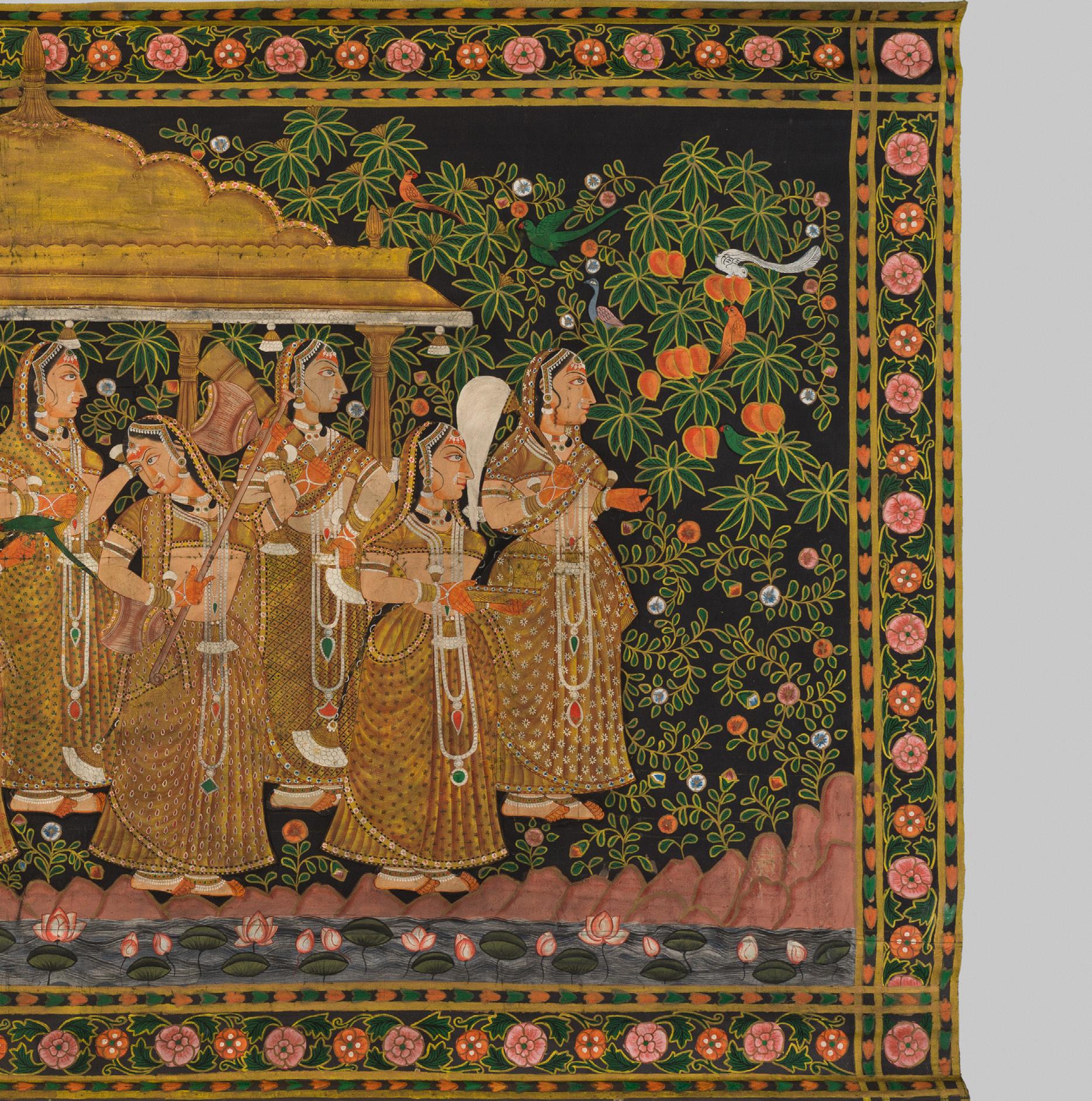
In a Vrikshchari (tree dwelling) Picchvai, gopis are presented amid lush green grooves, with an unseen Krishna, who is supposed to be hidden in the trees. Dyed with the emotion of a heavenly Prema (love), Vrikshachari Picchvai is a moving token of Krishna’s endless affection, which even when invisible can be felt through his beloveds who wait for the apple of their eyes to reveal him.
AUCTION RESULT COMPARISON
Type: Related
Auction: Sotheby’s Paris, 12 December 2024, lot 28
Price: EUR 31,200 or approx. EUR 31,500
Description: A Picchavai painting depicting Shrinathji, India, 20th century Expert remark: Note the size (175 x 275 cm).
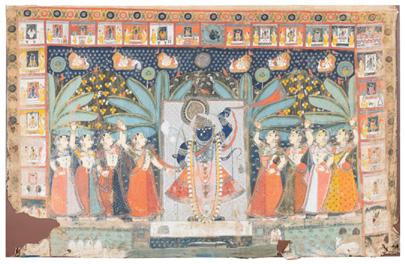
AUCTION RESULT COMPARISON
Type: Related
Auction: Christie’s New York, 21 September 2007, lot 313
Price: USD 79,000 or approx. EUR 104,000 converted and adjusted for inflation at the time of writing
Description: Picchvai of Shri Nathji and the Rasalila, India, Rajasthan, Kishangarh School, 18th-19th century
Expert remark: Note the size (191.8 x 184.8 cm).
Estimate EUR 4,000
Starting price EUR 2,000
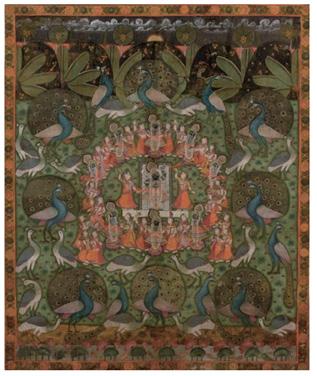
Opaque pigments on cotton fabric, block-printed, set within a frame behind glass. Of rectangular form, predominantly rendered in deep crimson against a natural ground, centered by a stylized boteh beneath an arched niche, all on a field of floral interlace. A vase rises above a small mound and is flanked by two golden lions. Chevron and floral borders complete the composition.
Provenance: Collection of Sven A. Behrendt, Salzburg, Austria, assembled from the 1960s onwards, with acquisitions made during his extensive travels worldwide. Note that Behrendt’s important non-Asian collection was sold in a single-owner sale titled “A Worldwide Grand Tour: The Sven A. Behrendt Collection" at Sotheby’s London, 2 December 2025.
Condition: Very good condition with expected wear, manufacturing irregularities, some fading to colors, little soiling, and losses. The frame with traces of wear and use.
Dimensions: Image size 187 x 131 cm, Size incl. frame 213 x 156 cm
The Persian term qalamkar (literally, “pen-work“) refers to printed or painted cotton fabrics. These are decorated with depictions from Persian heroic fables, floral and tendril patterns or cypresses growing out of vases, and animals. Depending on the motif, qalamkars are employed as fabric for clothing, wall hangings, or table cloths. They belong to the most typical products of the Qajar dynastic period.
LITERATURE COMPARISON
Compare a closely related block printed cotton hanging, Iran, dated 1800-1900, size 193 x 110 cm, in the Welt Museum, Vienna, inventory number 190744 (fig. 1). Compare a closely related printed textile after a Persian design, 18th century, size 195 x 117 cm, in the Harvard Art Museums, object number 1930.6.
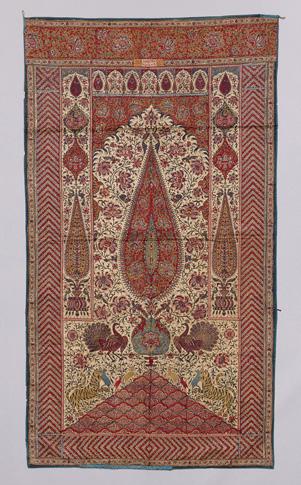
AUCTION RESULT COMPARISON
Type: Closely related
Auction: Bonhams London, 12 November 2025, lot 154
Price: GBP 4,096 or approx. EUR 4,700 converted at the time of writing
Description: A fine block-printed cotton (kalamkari) ‘tree of life’ panel, India, Andhra Pradesh, mid 19th century
Expert remark: Compare the closely related block-print technique and motif. Note the size (209 x 143 cm).
Estimate EUR 3,000
Starting price EUR 1,500
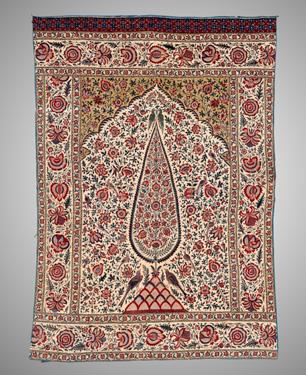

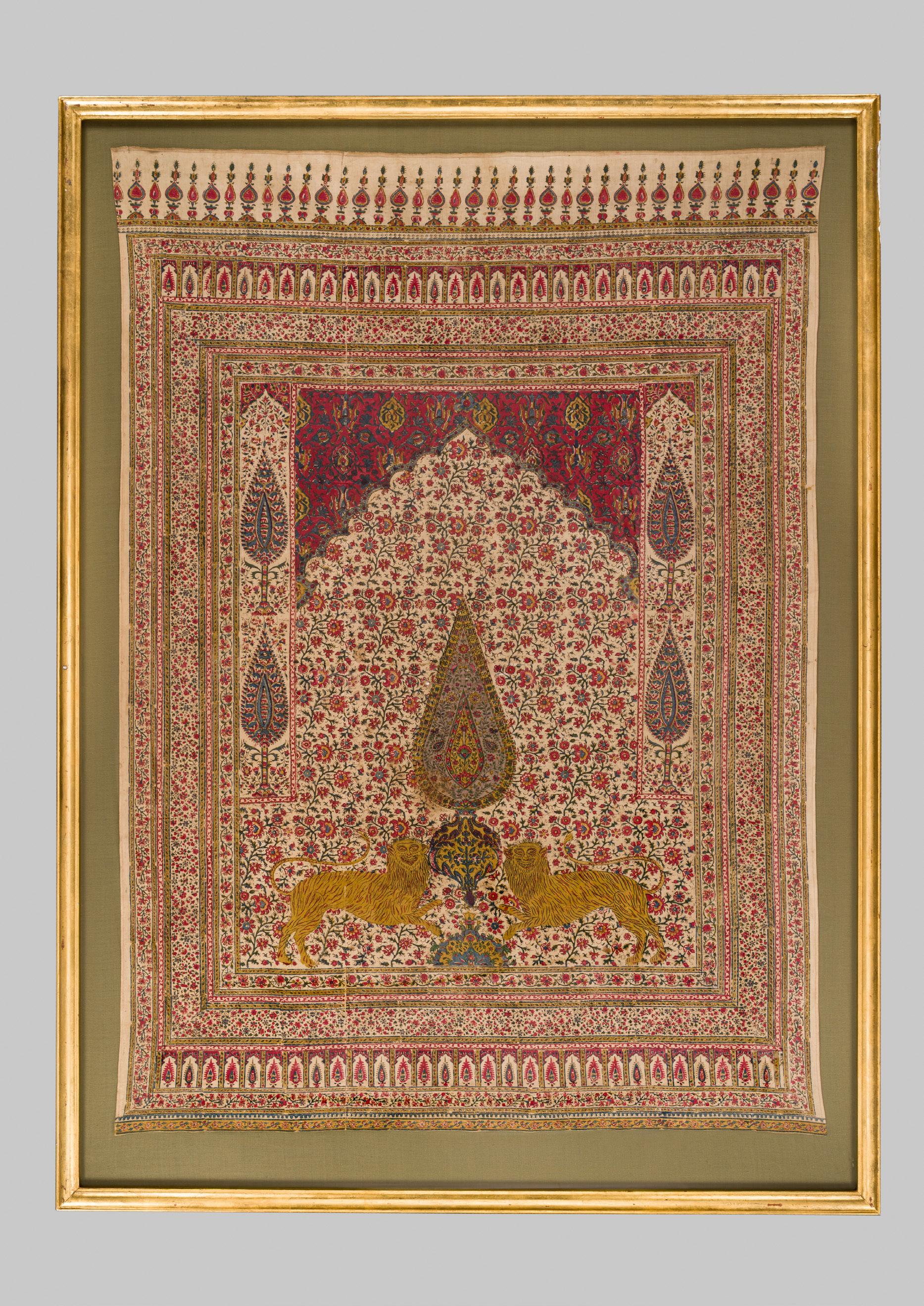
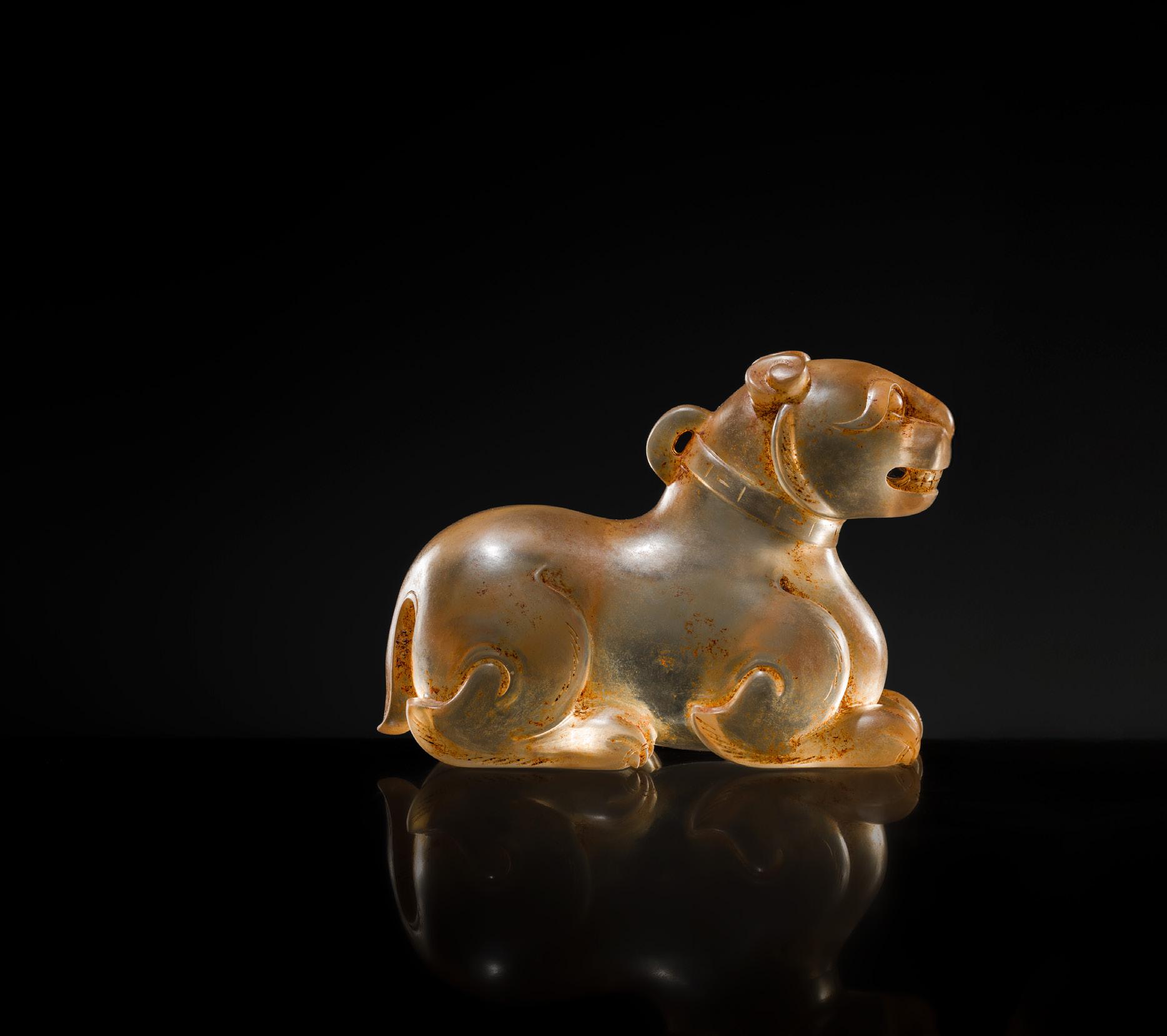
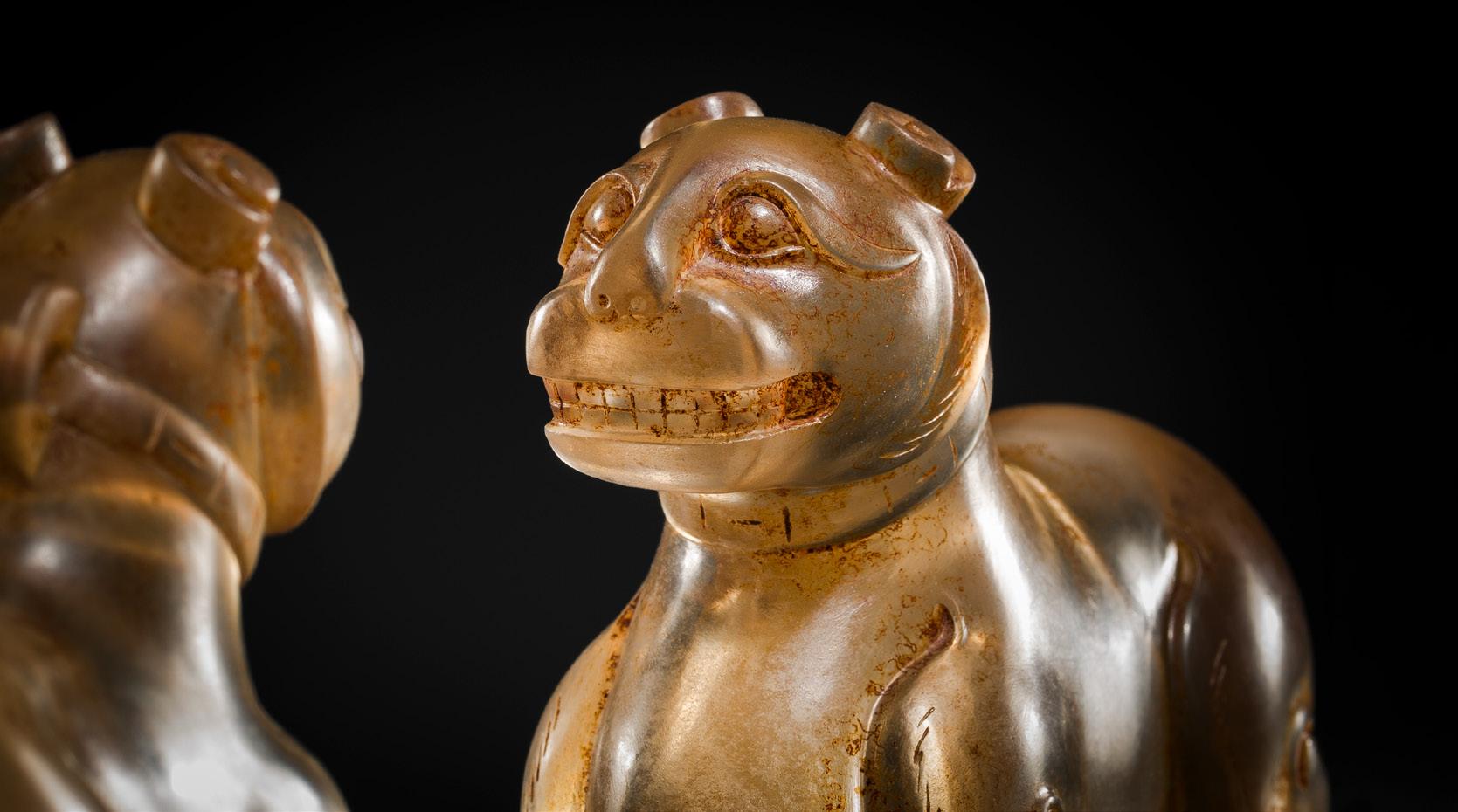
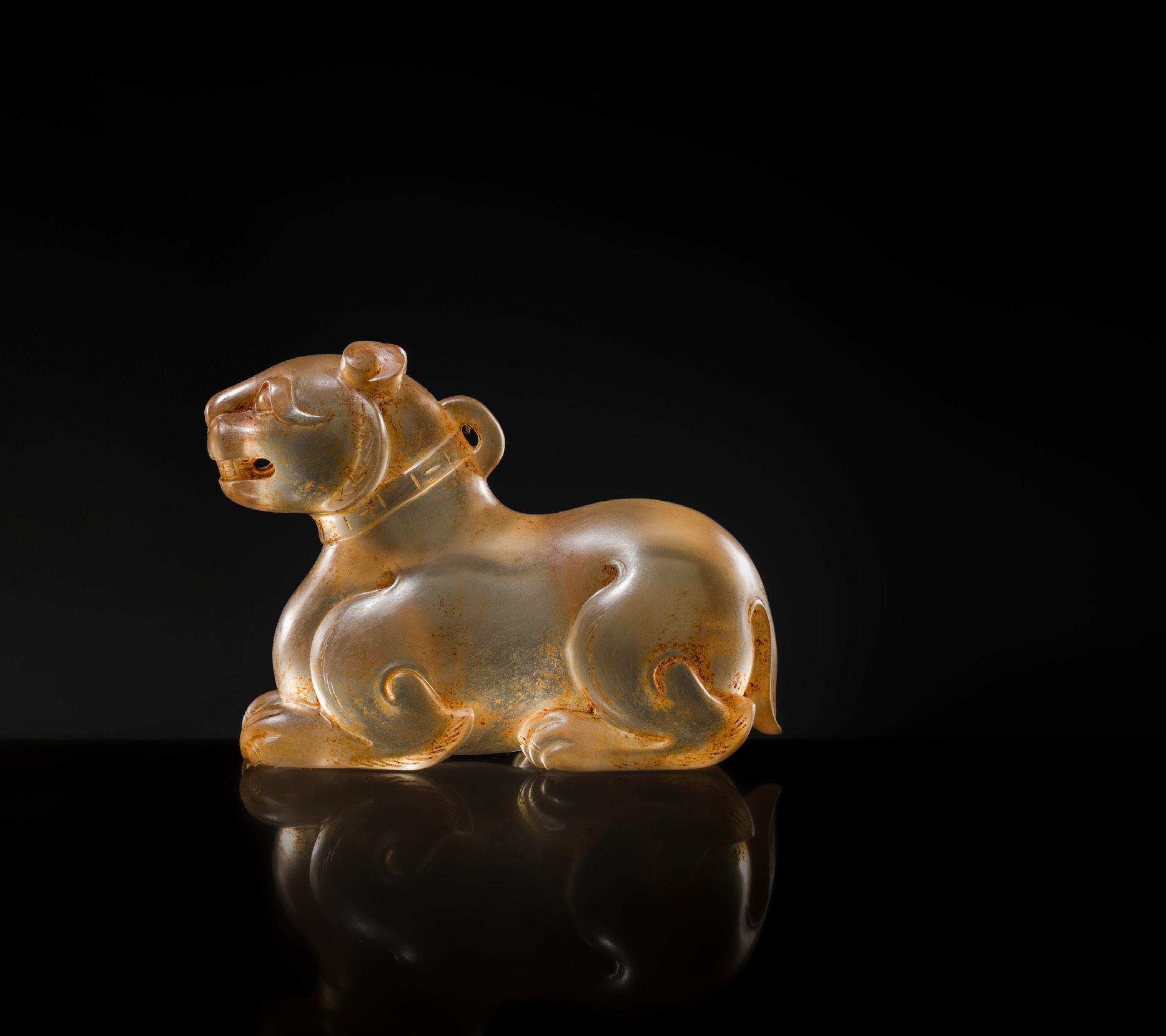
31 AN EXCEPTIONALLY WELL CARVED PAIR OF ROCK CRYSTAL FELINE FIGURES, HAN DYNASTY
China, 206 BC-220 AD. The recumbent beasts rest with their feet tucked beneath them, their heads raised and mouths open to reveal sharp teeth. Almond-shaped eyes are set beneath elegantly arched brows, and the heads are surmounted by scrolling ears. A collar encircles each neck, suspending a loop. The translucent stone is exceptionally clear, with only few scattered inclusions. (2)
Provenance: Collection of Sven A. Behrendt, Salzburg, Austria, assembled from the 1960s onwards, with acquisitions made during his extensive travels worldwide. Note that Behrendt’s important non-Asian collection was sold in a single-owner sale titled “A Worldwide Grand Tour: The Sven A. Behrendt Collection" at Sotheby’s London, 2 December 2025.
Condition: Excellent condition with minor surface wear. The soil encrustations show a deep iron-red color, most likely stemming from objects made from iron, buried in close vicinity. Ancient wear and traces of erosion. Minor nicks. Natural inclusions.
Weight: 523 g and 542 g
Dimensions: Length 11.2 cm and 11.5 cm
LITERATURE COMPARISON
Compare a related rock crystal figure of a bixie, dated Han dynasty, 11.3 cm long, illustrated in Jean-Paul Desroches (ed.) et al, The Beginning of the World. Dragons, Phoenix and Other Chimera, Fondation Baur, Geneva, 2020, p. 165 and 165, no. 96.
Estimate EUR 3,000
Starting price EUR 1,500
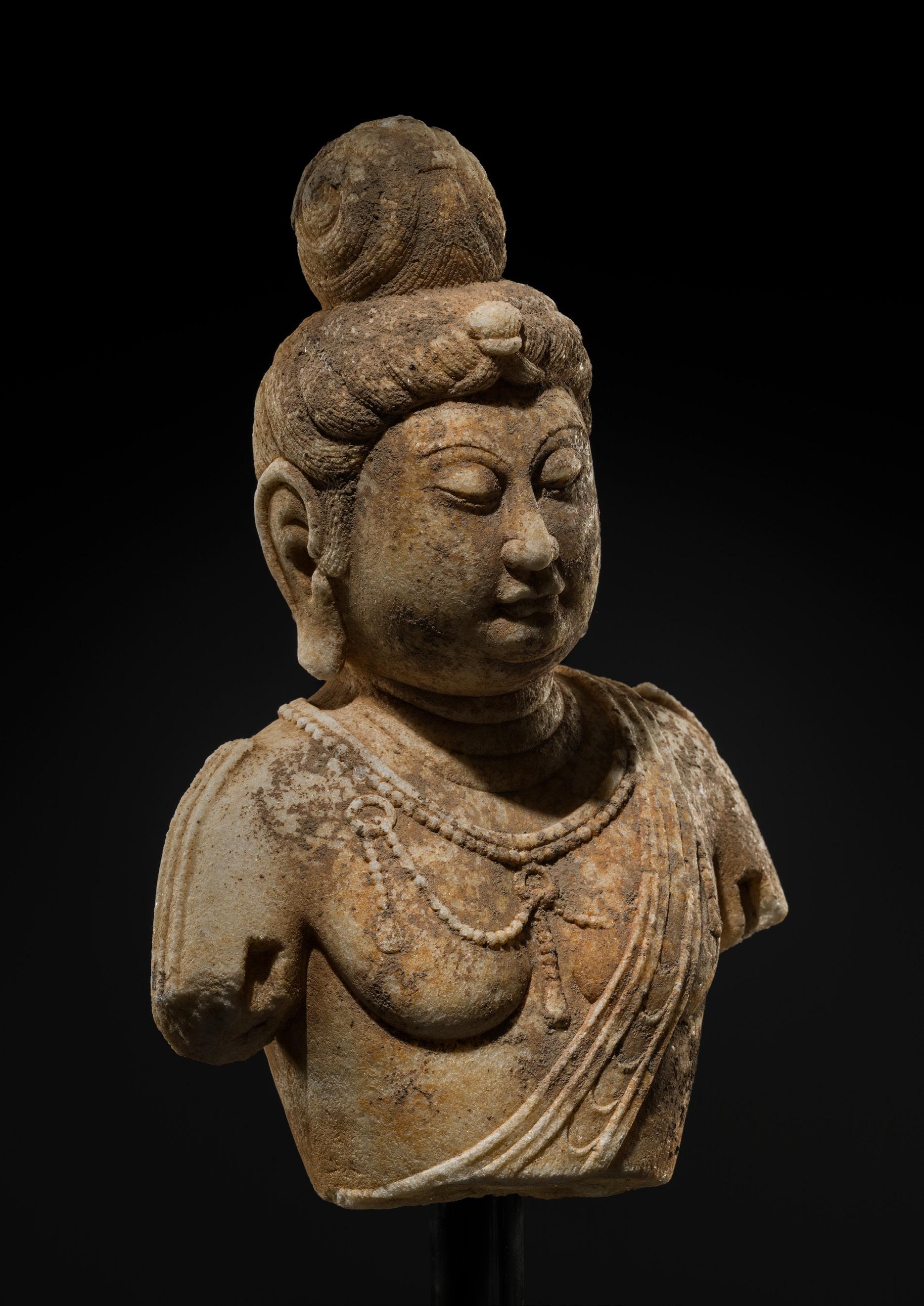
China, 618–907. This finely modeled bust depicts the bodhisattva of compassion with gently closed eyes and a serene expression. The rounded face is framed by elongated ears and a carefully arranged coiffure gathered into a high topknot. The figure is adorned with a beaded necklace and a delicately rendered sash draped diagonally across the torso, its folds softly articulated.
Provenance: Gallery Mouhot, Bangkok. Collection of Sven A. Behrendt, Salzburg, Austria, assembled from the 1960s onwards, with acquisitions made during his extensive travels worldwide, acquired from the above. Note that Behrendt’s important non-Asian collection was sold in a singleowner sale titled “A Worldwide Grand Tour: The Sven A. Behrendt Collection" at Sotheby’s London, 2 December 2025. A copy of a signed and stamped invoice from Galerie Mouhot, Bangkok, dated 24 February 2011, at a purchase price of CHF 11,000 or approx. EUR 12,500 (converted and adjusted for inflation at the time of writing), accompanies this lot. A copy of a Certificate of Authenticity by Gallery Mouhot, Bangkok, accompanies the lot. Galerie Mouhot is a gallery specializing in Khmer Art based in River City Bangkok, established by the Frenchman Eric Dieu and named after Henri Mouhot (1826-1861), the mid-19th century naturalist and explorer credited with reintroducing the world to the grandeur of Angkor and the Khmer civilization.

Condition: Good condition with expected old wear, signs of weathering and erosion, soil encrustations, obvious losses, few nicks, tiny chips, and scratches.
Weight: 19.6 kg (incl. stand)
Dimensions: Height 43 cm (excl. stand), 55.5 cm (incl. stand)
Mounted to a modern stand. (2)
Literature comparison:
Compare a related pigmented sandstone head of Bodhisattva, ca. early 8th century, 40 cm tall, in the Metropolitan Museum of Art, object number 42.25.12.
AUCTION RESULT COMPARISON
Type: Related
Auction: Sotheby’s New York, 19 March 2025, lot 170
Price: USD 31,750 or approx. EUR 27,500 converted and adjusted for inflation at the time of writing
Description: A marble head of a bodhisattva, Tang dynasty
Expert remark: Compare the similarly arranged coiffure and material. Note the size (24.1 cm).
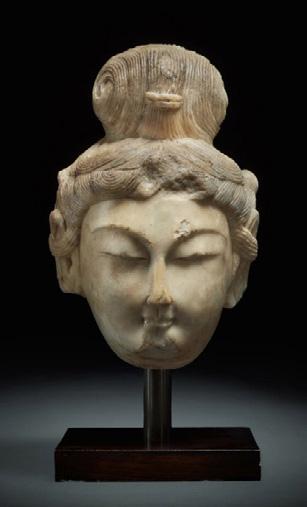
AUCTION RESULT COMPARISON
Type: Related
Auction: Christie’s Paris, 23 November 2004, lot 202
Price: EUR 44,650 or approx.
EUR 62,500 adjusted for inflation at the time of writing
Description: A white marble torso of bodhisattva, China, Tang dynasty (618906 AD)
Expert remark: Compare the similar treatment of the jewelry, form of the chest, and material. Note the size (56 cm).
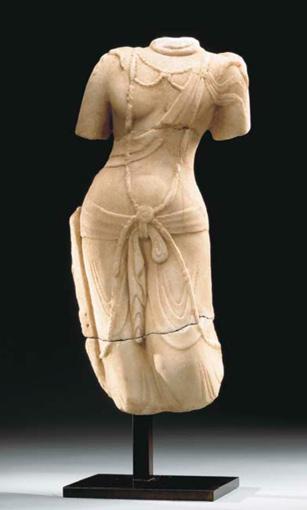
Estimate EUR 8,000
Starting price EUR 4,000
China, circa 16th – 17th century. The face finely carved with a serene expression, downcast eyes with black glass-inlaid pupils below gently arched brows, the mouth forming a subtle smile, and the hair arranged in rows of tight curls centered to the front by an ushnisha.
Provenance: Collection of Sven A. Behrendt, Salzburg, Austria, assembled from the 1960s onwards, with acquisitions made during his extensive travels worldwide. Note that Behrendt’s important non-Asian collection was sold in a single-owner sale titled “A Worldwide Grand Tour: The Sven A. Behrendt Collection" at Sotheby’s London, 2 December 2025. Condition: Good condition with expected old wear, signs of weathering and erosion, obvious losses, tiny nicks, small chips, soil encrustations, and repairs to the right ear.
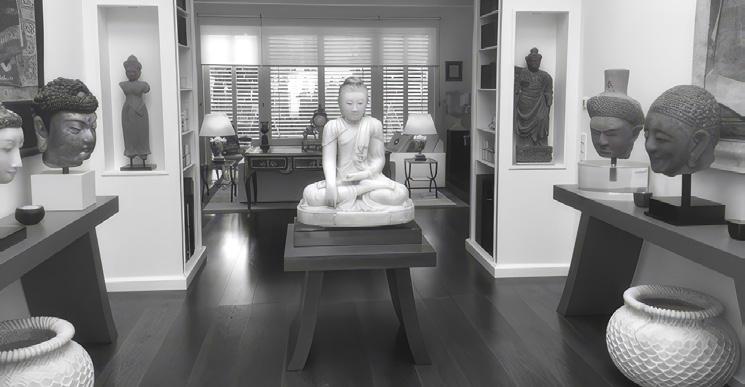
Weight: 64.4 kg (incl. stand)
Dimensions: Height 45 cm (excl. stand), 68 cm (incl. stand)
Mounted to a modern stand. (2)
AUCTION RESULT COMPARISON
Type: Related
Auction: Christie’s New York, 15 September 2011, lot 1361
Price: USD 17,500 or approx.
EUR 21,500 converted and adjusted for inflation at the time of writing
Description: A large grey stone head of buddha, ming dynasty (1368-1644)
Expert remark: Compare the similar expression and size (44.6 cm). Note the hair and urna.
Estimate EUR 8,000
Starting price EUR 4,000
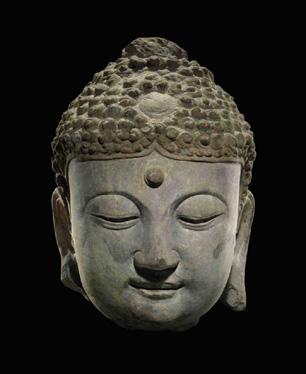

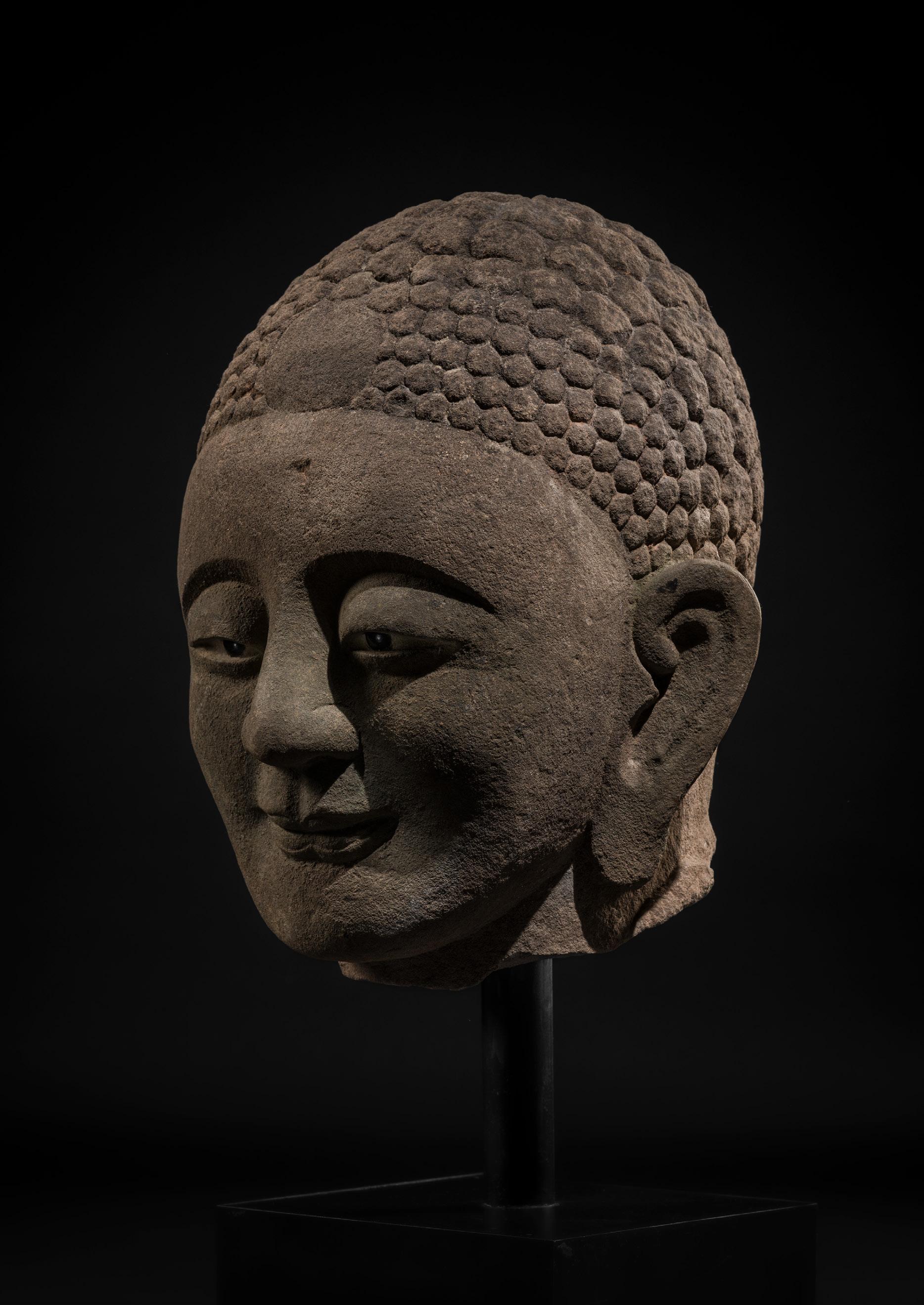
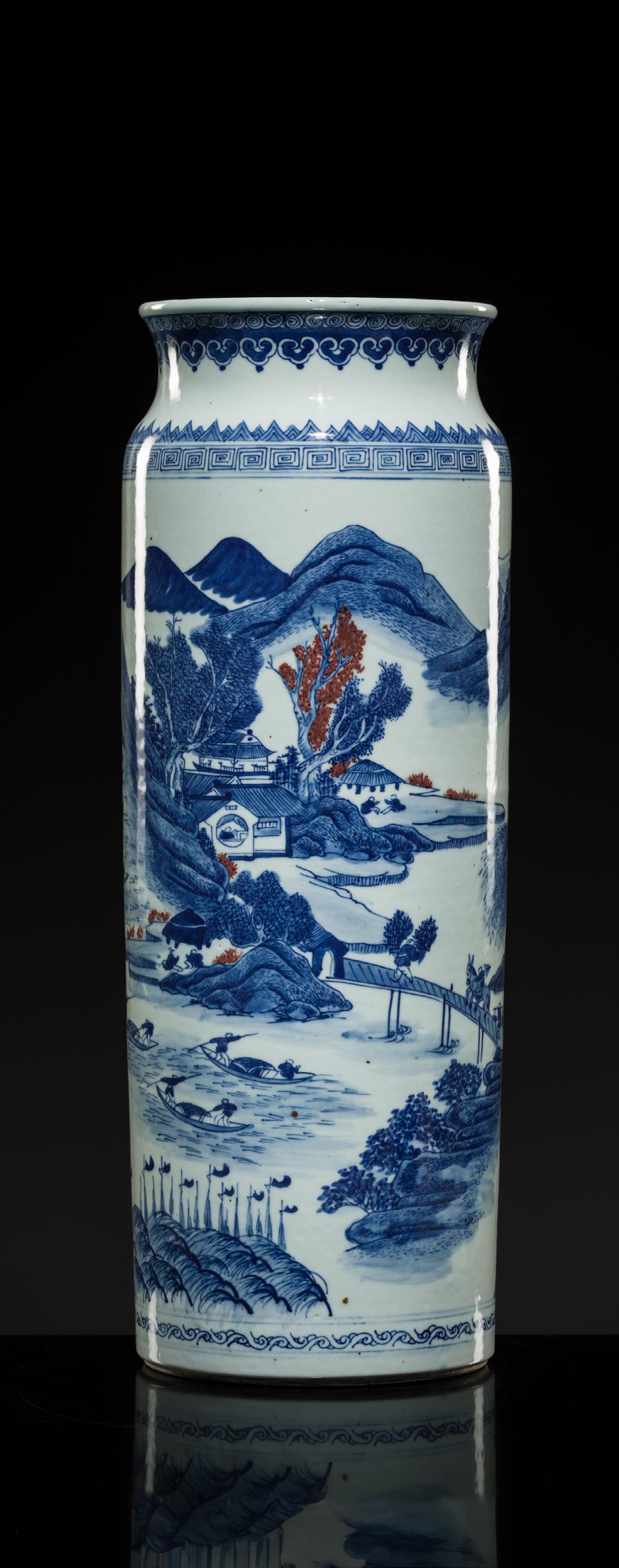
A RARE BLUE AND COPPER RED SLEEVE VASE, QING DYNASTY
China, 19th century. Of tall cylindrical form rising to the high shoulders below the waisted neck and flared rim, attractively painted in brilliant blue and copper red tones with a scene of fishers in a rocky landscape and with pavilions nestled between mountains. The neck decorated with a band of key-fret and triangles below and a border of ruyi and scrolls above. The foot is unglazed, revealing the white ware.
Provenance: Collection of Sven A. Behrendt, Salzburg, Austria, assembled from the 1960s onwards, with acquisitions made during his extensive travels worldwide. Note that Behrendt’s important nonAsian collection was sold in a single-owner sale titled “A Worldwide Grand Tour: The Sven A. Behrendt Collection" at Sotheby’s London, 2 December 2025.
Condition: Very good condition with minor wear, few firing irregularities including dark spots, and few minuscule firing cracks at the base.
Weight: 4.1 kg
Dimensions: Height 44.6 cm
AUCTION RESULT
COMPARISON
Type: Near identical
Auction: Marcopolo Asian Art, Milano, 20 June 2023, lot 51
Price: EUR 4,800 or approx. EUR 4,900 adjusted for inflation at the time of writing
Description: An underglaze blue and red 'sleeve' vase
Expert remark: Compare the near identical form, glaze, and subject. Note the size (45.2 cm).
Estimate EUR 1,000
Starting price EUR 500
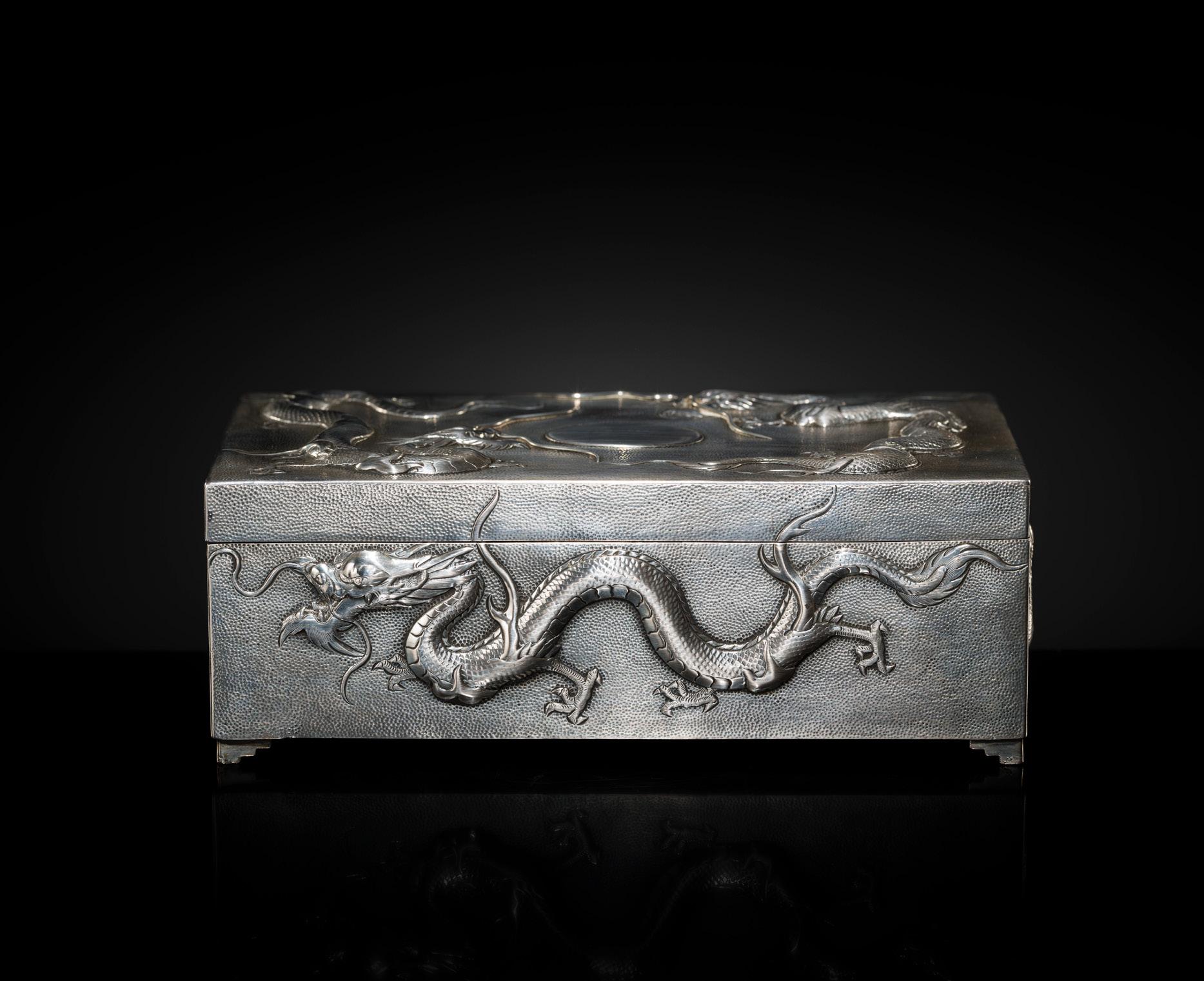
The rectangular box with a hinged flush-fitting cover, raised on four bracket feet, and chased to the exterior in relief with fourclawed sinuous dragons against a dimpled matted ground, the cover centered by an oval cartouche. The interior and base in wood.
Inscriptions: The base of the box impressed with the mark ‘SF’, ‘90’ and 莆利 (Puli).
Provenance: Collection of Sven A. Behrendt, Salzburg, Austria, assembled from the 1960s onwards, with acquisitions made during his extensive travels worldwide. Note that Behrendt’s important non-Asian collection was sold in a single-owner sale titled “A Worldwide Grand Tour: The Sven A. Behrendt Collection" at Sotheby’s London, 2 December 2025.
Condition: Good condition with wear and manufacturing irregularities. Small nicks, some rubbing, tiny dings, expected tarnishing, and signs of use. The wood interior and base with natural fissures and age cracks, small losses, and minor warping.
Weight: 428.5 g
Dimensions: Size18.3 x 9.8 x 6.5 cm
Estimate EUR 1,000
Starting price EUR 500
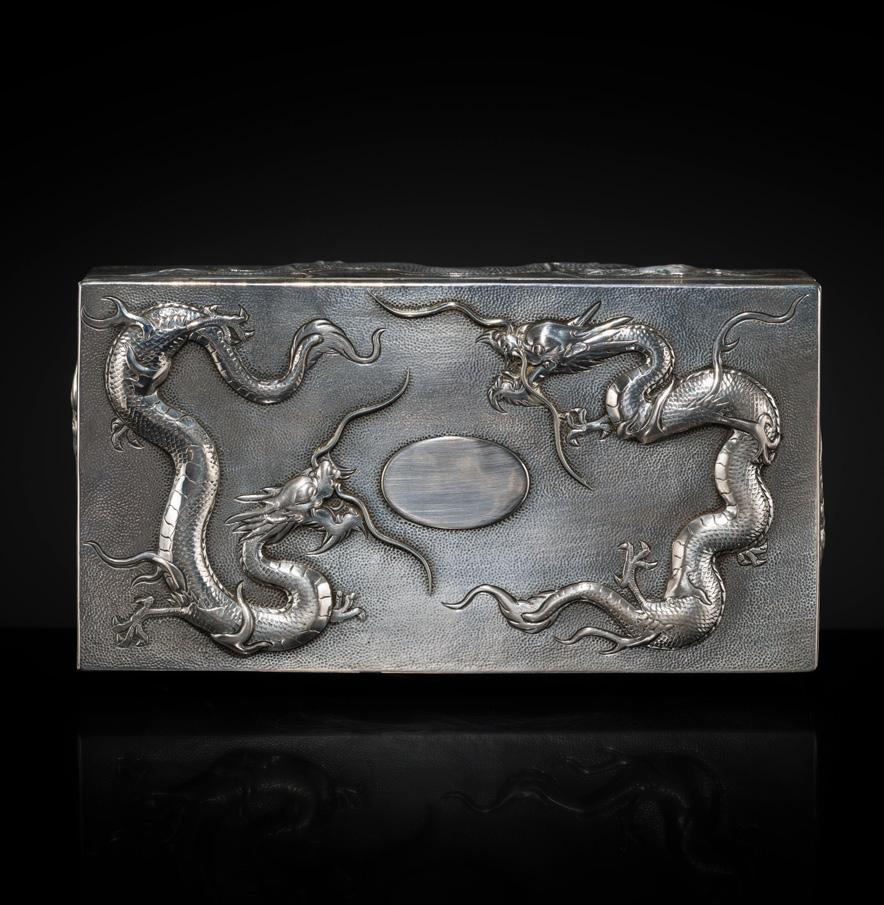
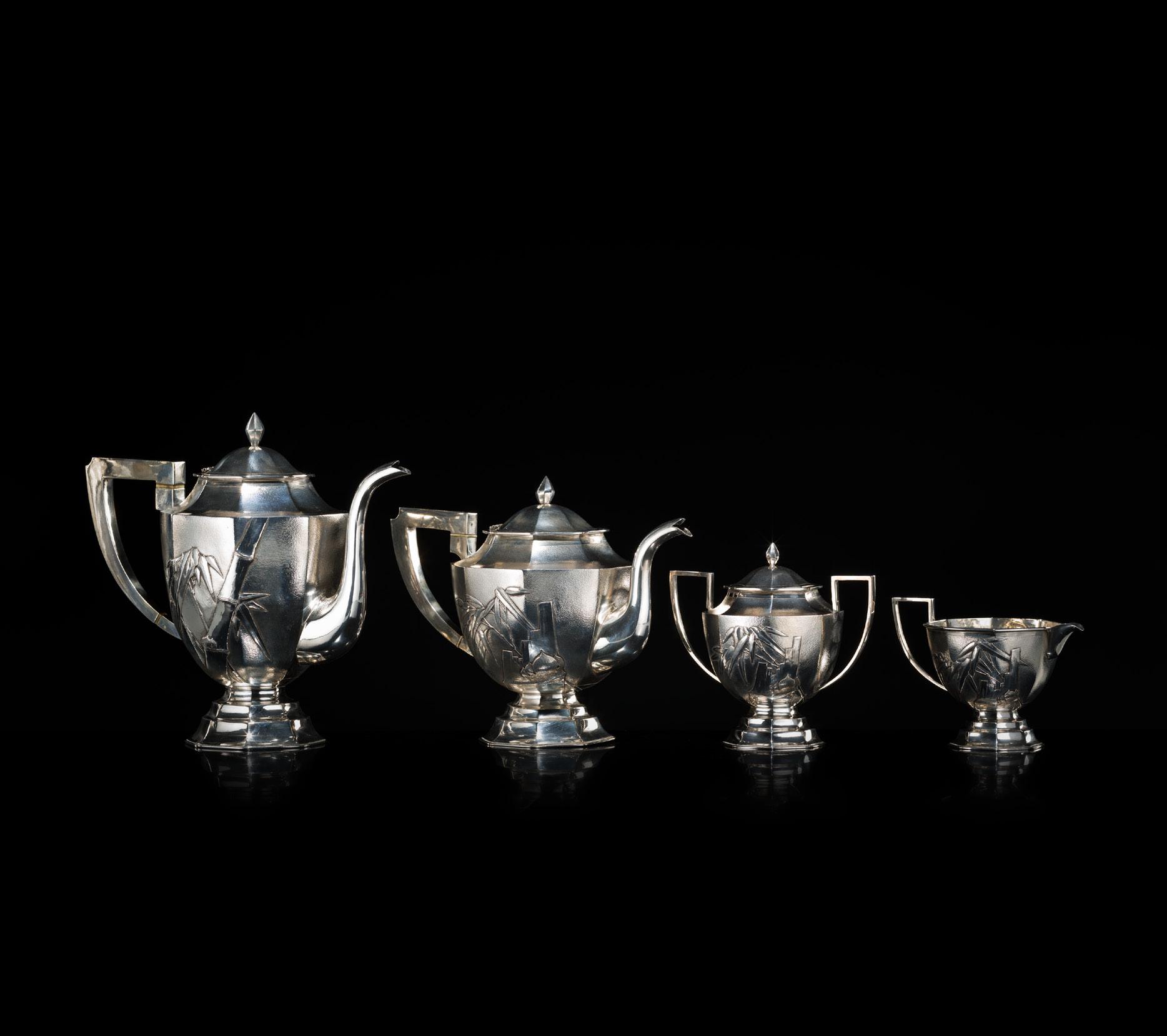
36 A FOUR-PIECE SILVER ‘BAMBOO’ TEA AND COFFEE SERVICE, MARK OF ZEE WO, SHANGHAI, CIRCA 1870-1925
Comprising a coffee and tea pot, a cream jug, and a sugar bowl. Each of tapering octagonal form with a dimpled matted ground, chased to the exterior in relief with a bamboo frond, two vessels further applied with a cartouche, three pots with domed covers, and all with angular scroll handles, raised on tiered, spread bases. The handles of the two teapots neatly inlaid with bone trims. (4)
Inscriptions: The base of each vessel impressed with the mark ‘Zee Wo’ and the mark 典 (Dian).
Provenance: Collection of Sven A. Behrendt, Salzburg, Austria, assembled from the 1960s onwards, with acquisitions made during his extensive travels worldwide. Note that Behrendt’s important non-Asian collection was sold in a single-owner sale titled “A Worldwide Grand Tour: The Sven A. Behrendt Collection" at Sotheby’s London, 2 December 2025.
Condition: Excellent condition with minor wear, little tarnishing, minuscule rubbing, nicks, and traces of use.
Weight: 134.3 g – 671.7 g
Dimensions: Height 9 cm – 22 cm
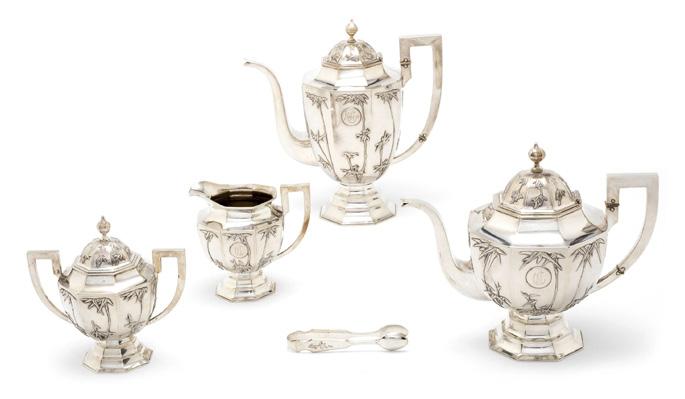
Type: Closely related
Auction: Bonhams London, 25 July 2012, lot 322
Price: GBP 3,000 or approx. EUR 5,800 converted and adjusted for inflation at the time of writing
Description: A Chinese export silver four-piece tea and coffee set, Zeewo, first quarter of 20th century Expert remark: Compare the closely related form and similar decoration.
Estimate EUR 2,000
Starting price EUR 1,000
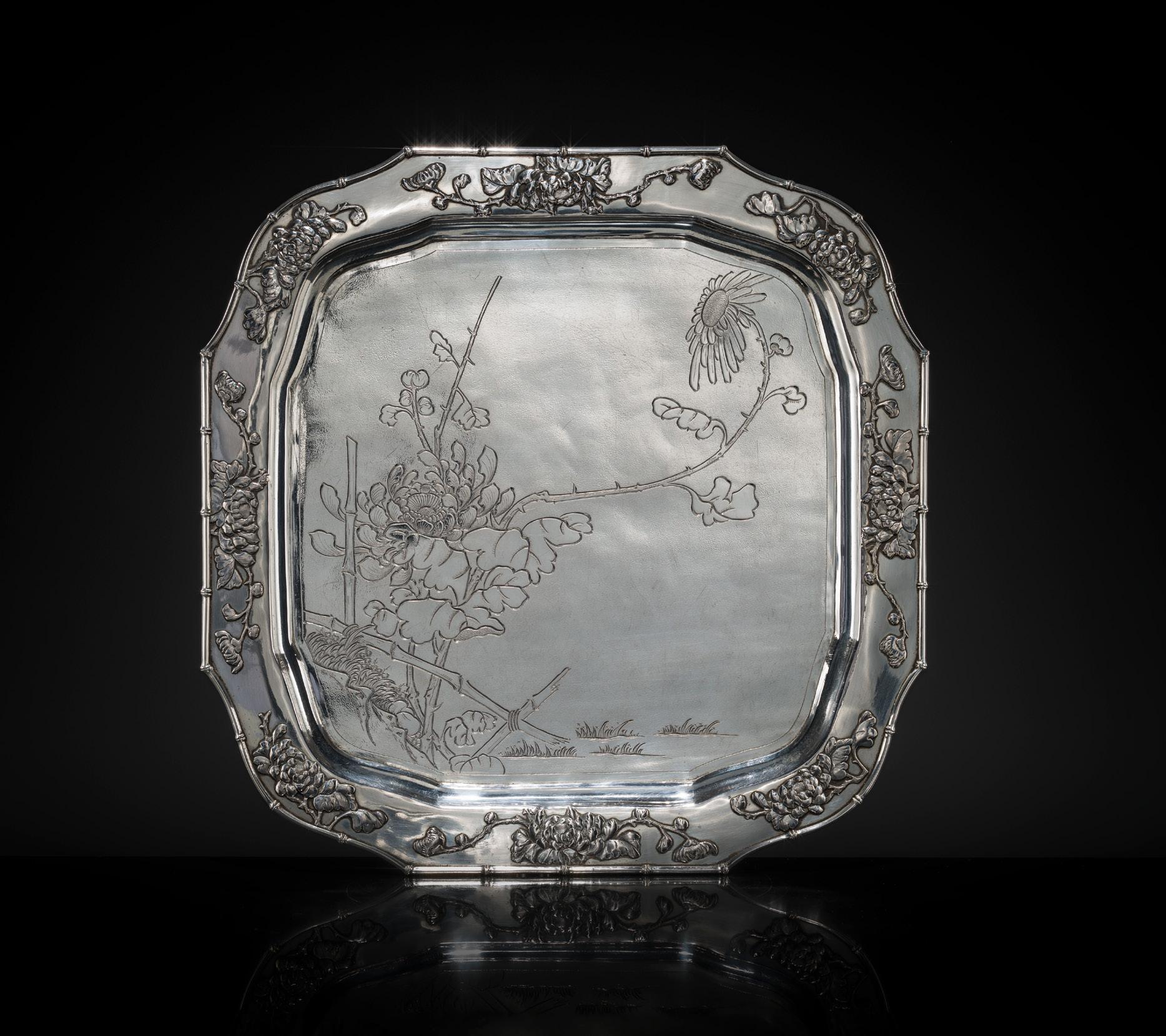
37
A CHINESE EXPORT SILVER ‘CHRYSANTHEMUM’ TRAY, MARK OF LUEN WO, SHANGHAI, CIRCA 1880-1925
Of oblong form and resting on four half-ball feet, the rim decorated in relief with sprigs of chrysanthemum flowers and foliage, bordered by a thick lip simulating bamboo, similarly engraved to the interior with a large chrysanthemum bush leaning against a bamboo stake.
Inscriptions: The base impressed with the mark ‘Luen Wo’ and the silversmith mark 麥芬 (Mai Fen).
Provenance: Collection of Sven A. Behrendt, Salzburg, Austria, assembled from the 1960s onwards, with acquisitions made during his extensive travels worldwide. Note that Behrendt’s important non-Asian collection was sold in a single-owner sale titled “A Worldwide Grand Tour: The Sven A. Behrendt Collection" at Sotheby’s London, 2 December 2025.
Condition: Excellent condition with minor wear, surface scratches, little tarnishing, minuscule rubbing, nicks, and traces of use.
Weight: 1,243 g
Dimensions: Size 35.7 x 35.7 cm
Luen Wo was an important retail silversmith based in Shanghai who traded in jewelry, diamonds, and embroideries. The manufacturer relied on a
large number of designers and artisans, such as Ning Zhao Ji. His items generally bear the mark with his full name or the initials LW and the mark of the artisan who realized the piece. The firm mainly produced items in the traditional Chinese style, featuring classical motifs such as bamboo leaves, prunus blossoms, chrysanthemums, dragons, and magpies. (Information courtesy of Dr Adrien von Ferscht; www.chinese-export-silver.com)
AUCTION RESULT COMPARISON
Type: Related
Auction: Christie’s New York, 18 October 2014, lot 41
Price: USD 8,125 or approx. EUR 9,600 converted and adjusted for inflation at the time of writing
Description: A Chinese export silver salver, Mark of Luen Wo, Shanghai, c. 1880-1925
Expert remark: Compare the related form and decorations. Note the size (33.8 cm).
Estimate EUR 1,000
Starting price EUR 500
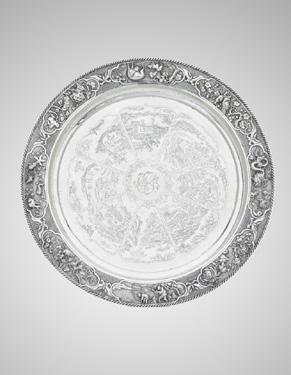
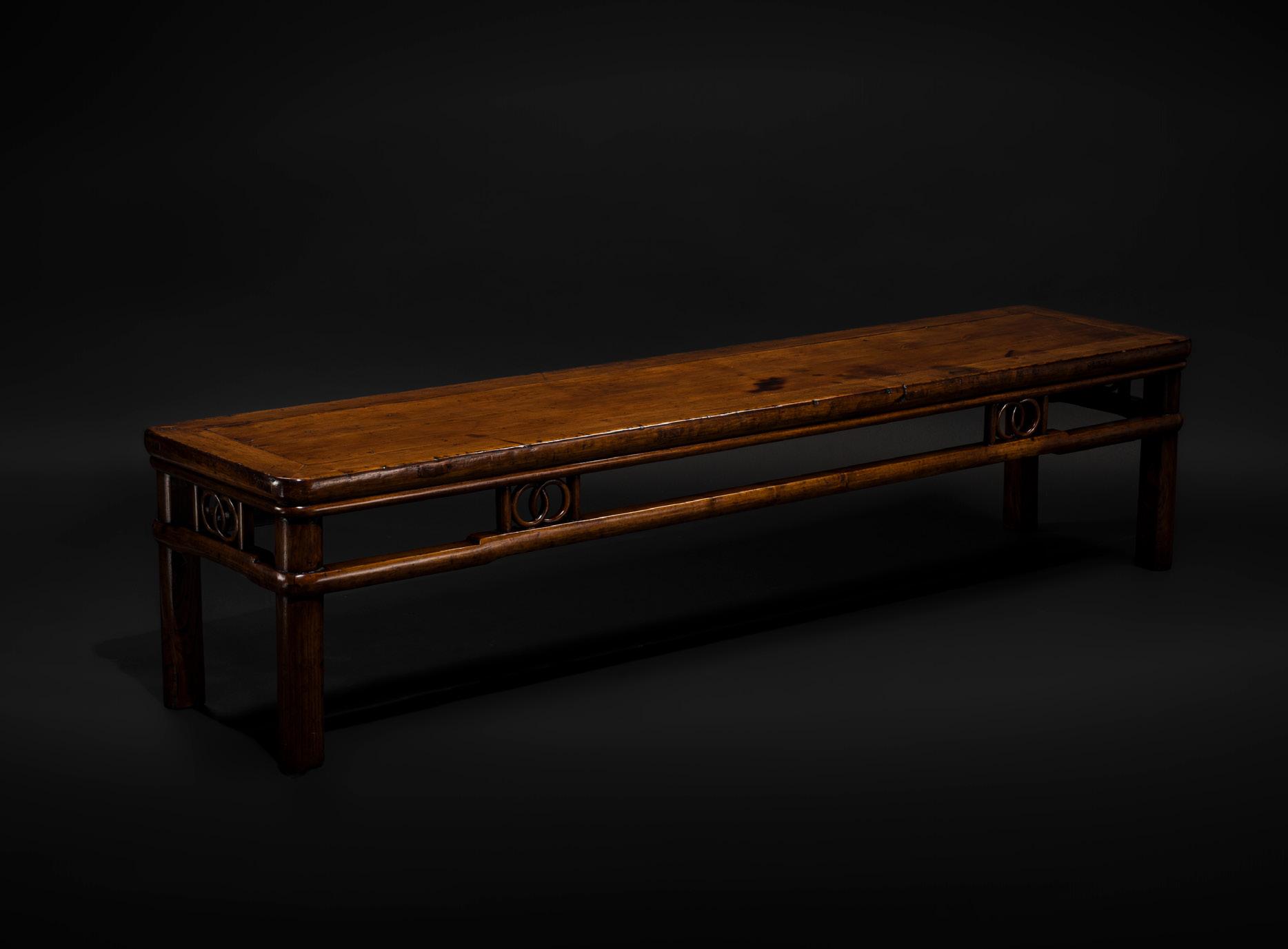
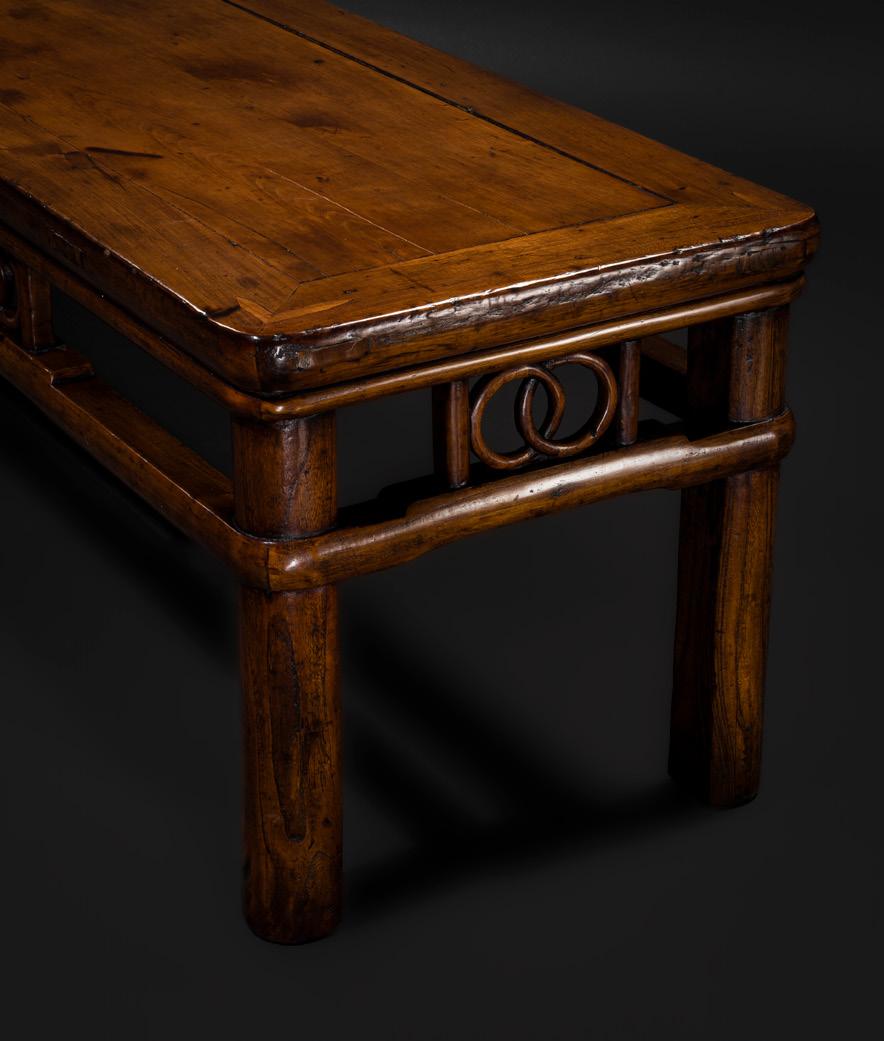
38 A WOOD LOW TABLE, KANGZHUO, QING DYNASTY
China, 19th century. Finely carved, of elongated rectangular form, the top with a central panel above a waist-apron detailed with overlapping rings, and raised on four straight feet.
Provenance: Collection of Sven A. Behrendt, Salzburg, Austria, assembled from the 1960s onwards, with acquisitions made during his extensive travels worldwide. Note that Behrendt’s important non-Asian collection was sold in a single-owner sale titled “A Worldwide Grand Tour: The Sven A. Behrendt Collection" at Sotheby’s London, 2 December 2025.
Condition: Good condition with expected old wear, traces of use, small nicks, light scratches, few splits, some age cracks, little warping, some repairs, touchups to the feet and apron.
Weight: 14 kg
Dimensions: Size 197.3 x 44.8 x 43.5 cm
AUCTION RESULT COMPARISON
Type: Related
Auction: Sotheby’s New York, 22 March 2023, lot 545
Price: USD 3,810 or approx. EUR 3,500 converted and adjusted for inflation at the time of writing
Description: A 'hongmu' rectangular low table (Kangzhuo), Late Qing dynasty
Expert remark: Compare the similar form. Note the size (163 x 43.2 x 61 cm).
Estimate EUR 1,000
Starting price EUR 500
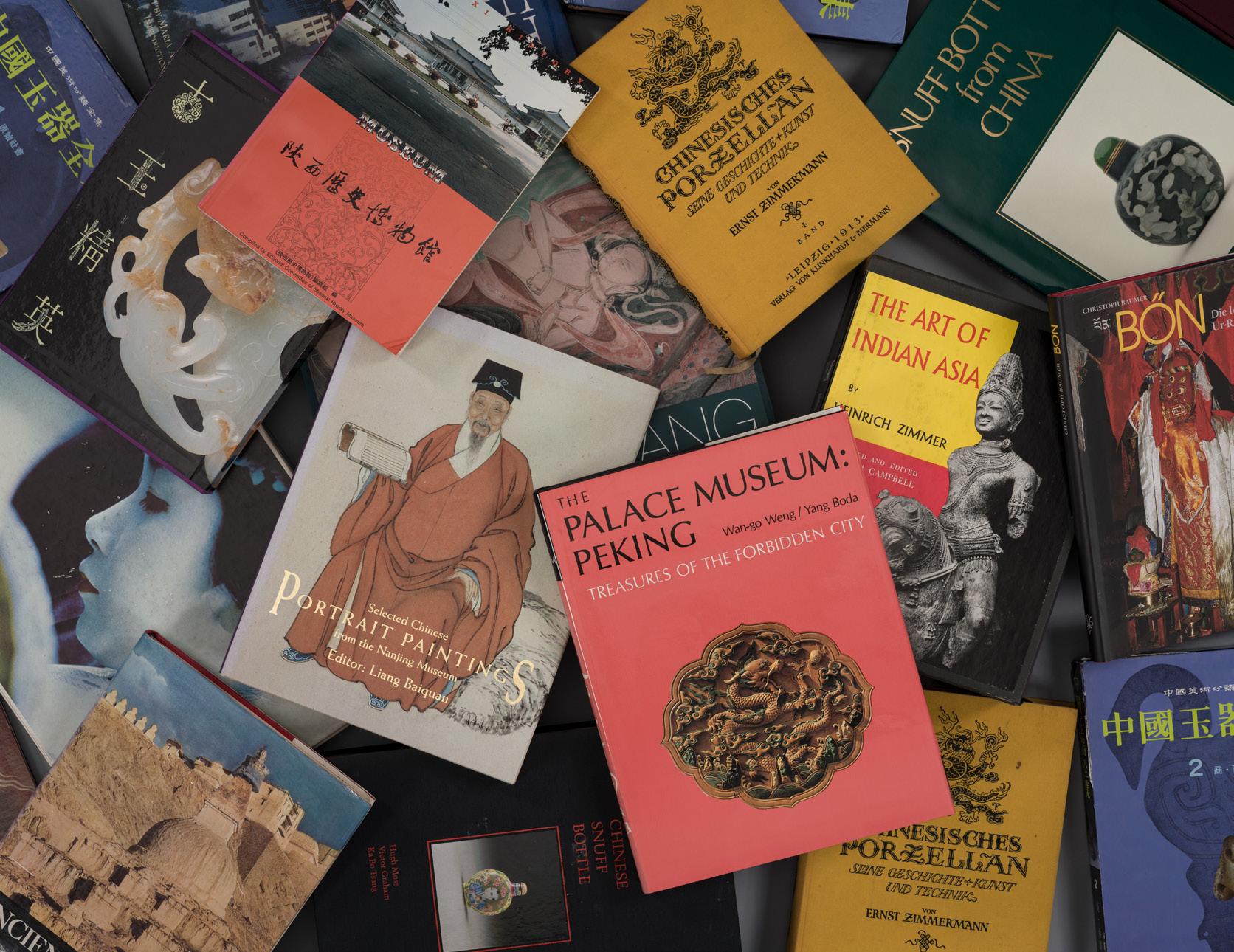
39
A GROUP OF 26 BOOKS ON CHINESE, JAPANESE, AND INDIAN ART
Comprising several books on Chinese jades, snuff bottles, terracotta objects, and other works of art, as well as Japanese and Indian antiques.
Provenance: Collection of Sven A. Behrendt, Salzburg, Austria, assembled from the 1960s onwards, with acquisitions made during his extensive travels worldwide. Note that Behrendt’s important non-Asian collection was sold in a single-owner sale titled “A Worldwide Grand Tour: The Sven A. Behrendt Collection" at Sotheby’s London, 2 December 2025.
Condition: Good condition with minor wear, little traces of use, and few books with tiny tears.
Weight: 64.5 kg
Dimensions: Length 28.5 – 44.8 cm
The lot comprises the following books:
- Yang Xin and Zhang Linsheng (eds.), Guobao huicui (Treasures of China), Commercial press Ltd., Hong Kong, first edition, December 1992, vol. 1 and 2
- Christoph Baumer, Bön. Die lebendige Ur-Religion Tibets, Akademische Druck- und Verlagsanstalt, Graz, 1999
- Guo Li and Guoxiang Gao (eds.), The treasure house of Dunhuang, Dunhuang Wenyi Chubanshe, 1 November 1993, vol. 1 and 2
- Roderick Whitfield, Dunhuang, NHK Publishing and Hirmer Verlag (German edition), second edition, 1996, vol.1 and 2 - Zhongmo Fu, Guyu jingying (The art of jade carving in ancient China), Zhonghua Shuju Youxian Gongsi, Hong Kong, second edition, 1995
- Miyeko Murase, Japanische Wandschirme, Meisterwerke der Malerei, Belser Verlag, Stuttgart and Zurich, 1990
- Aurel Stein, Ancient Khotan, Cosmo Publications, New Delhi, 1981, vol. 1
- The first emperors terracotta legion, China Travel and Tourism Press, Beijing, first edition, 1988
- Heinrich Zimmer, The Art of Indian Asia, Bollingen Foundation Inc., New York, 1968, vol. 1 and 2
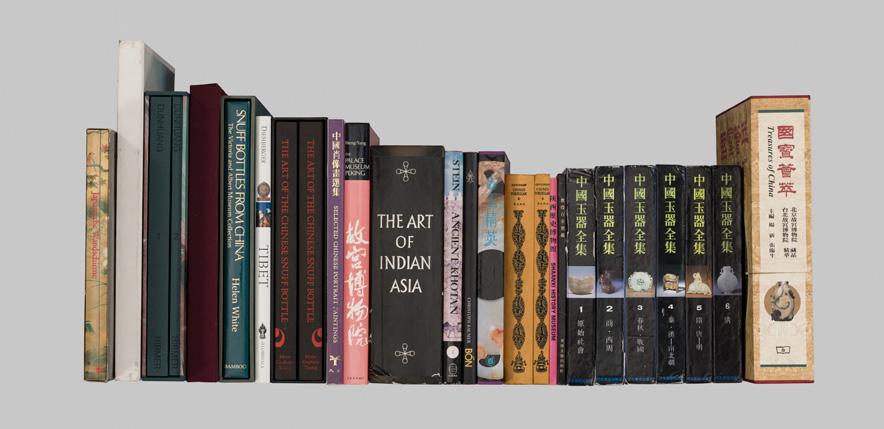
- Ernst Zimmermann, Chinesisches Porzellan. Seine Geschichte + Kunst und Technik, Verlag von Klinkhardt & Biermann, Leipzig, 1913, vol. 1 and 2
- Shengping Yin and Xixing Li (eds.), Shaanxi Lishi Bowuguan (Shaanxi History Museum), Shaanxi People’s Art Publishing House and Educational and Cultural Press Ltd., Hong Kong, 1994
- Helen White, Snuff bottles from China. The Victoria and Albert Museum Collection, Bamboo publishing Ltd., London, 1990
- Wan-go Weng and Boda Yang, The Palace Museum: Peking. Treasures of the Forbidden City, Harry N. Abrams Inc., New York, 1982
- Baiquan Liang (ed.), Selected Chinese portrait paintings from the Nanjing Museum, Cultural Relics Publishing House and Tai Yip Company, Hong Kong, 1993
- Yonghang Mou, Zhilian Chen, Erh Jia, Jiaoying Luo, Zhongguo yuqi quanji (Collection of Chinese jade treasures), Hebei Meishu Chubanshe, Shijiazhuang, 1993, vol. 1-6
- Erwin Fieger, Japan. Sunrise Islands, Accidentia Druck- und Verlags-GmbH, 1971
- Hugh Moss, Victor Graham, Ka Bo Tsang, The art of the Chinese snuff bottle, Weatherhill Inc., New York, 1993, vol. 1 and 2
- Maria Antonia Sironi Diemberger, Tibet. The roof of the world between past and present, Shambala Publications, Boston, 2000
Estimate EUR 500
Starting price EUR 250
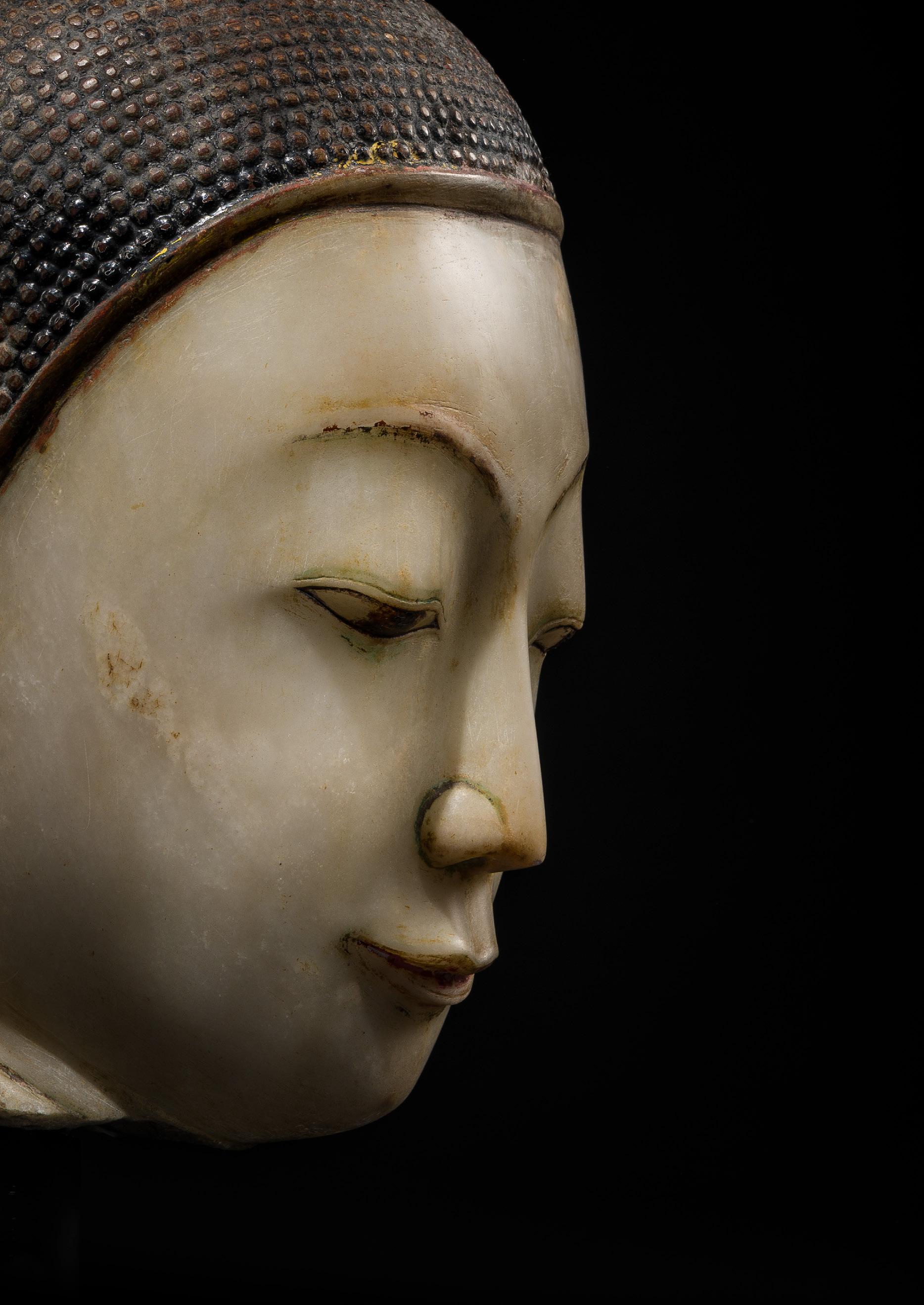
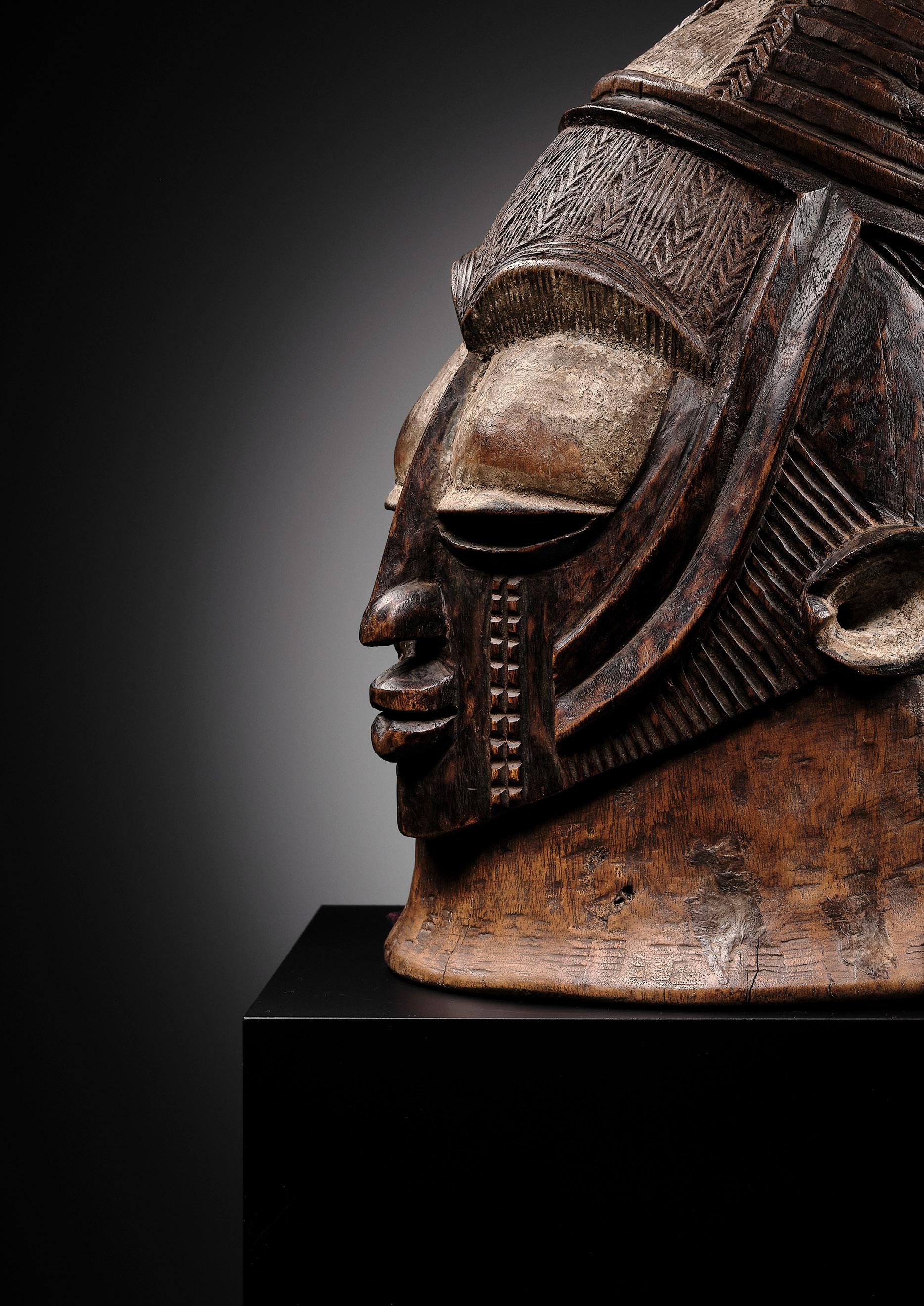
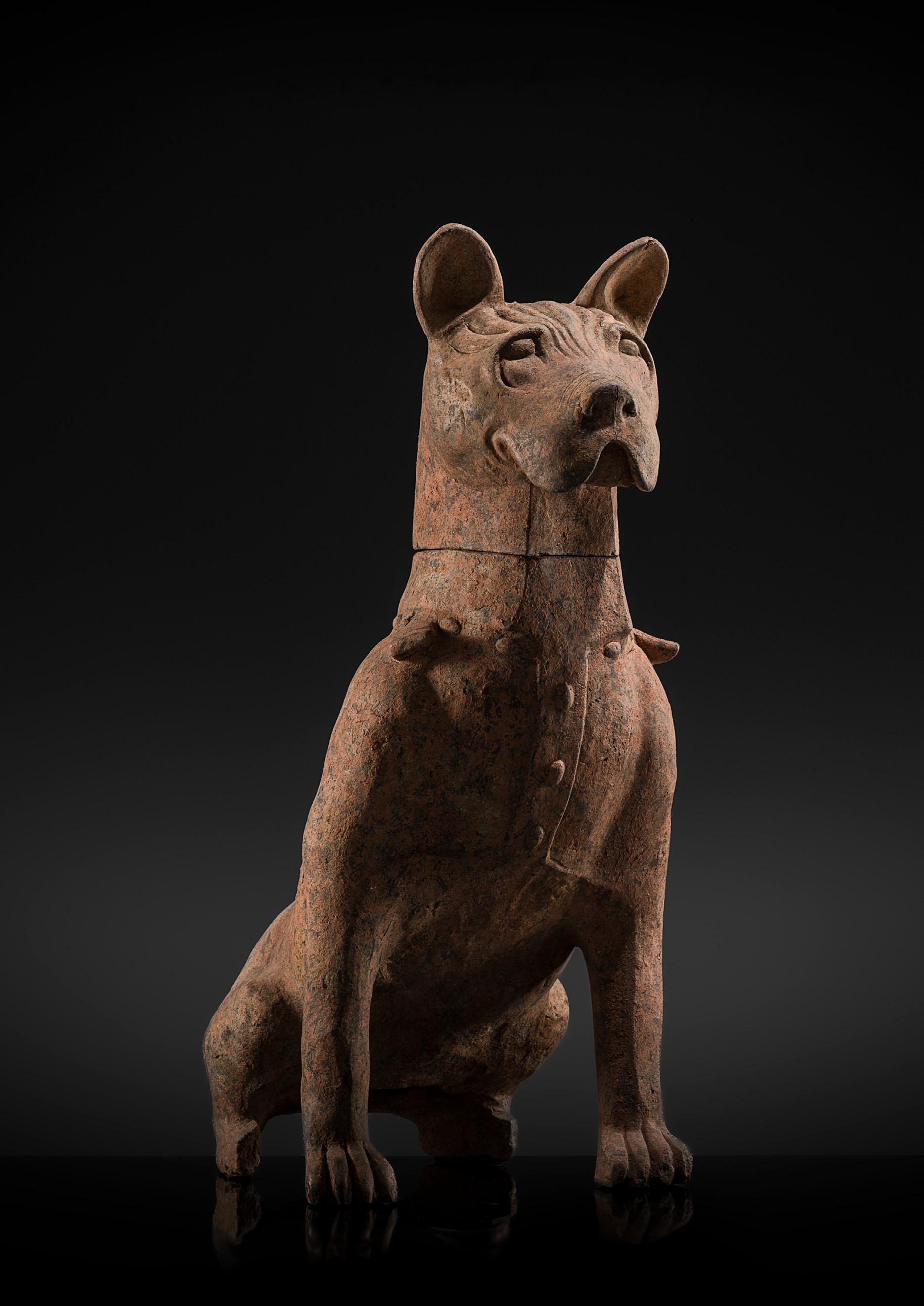
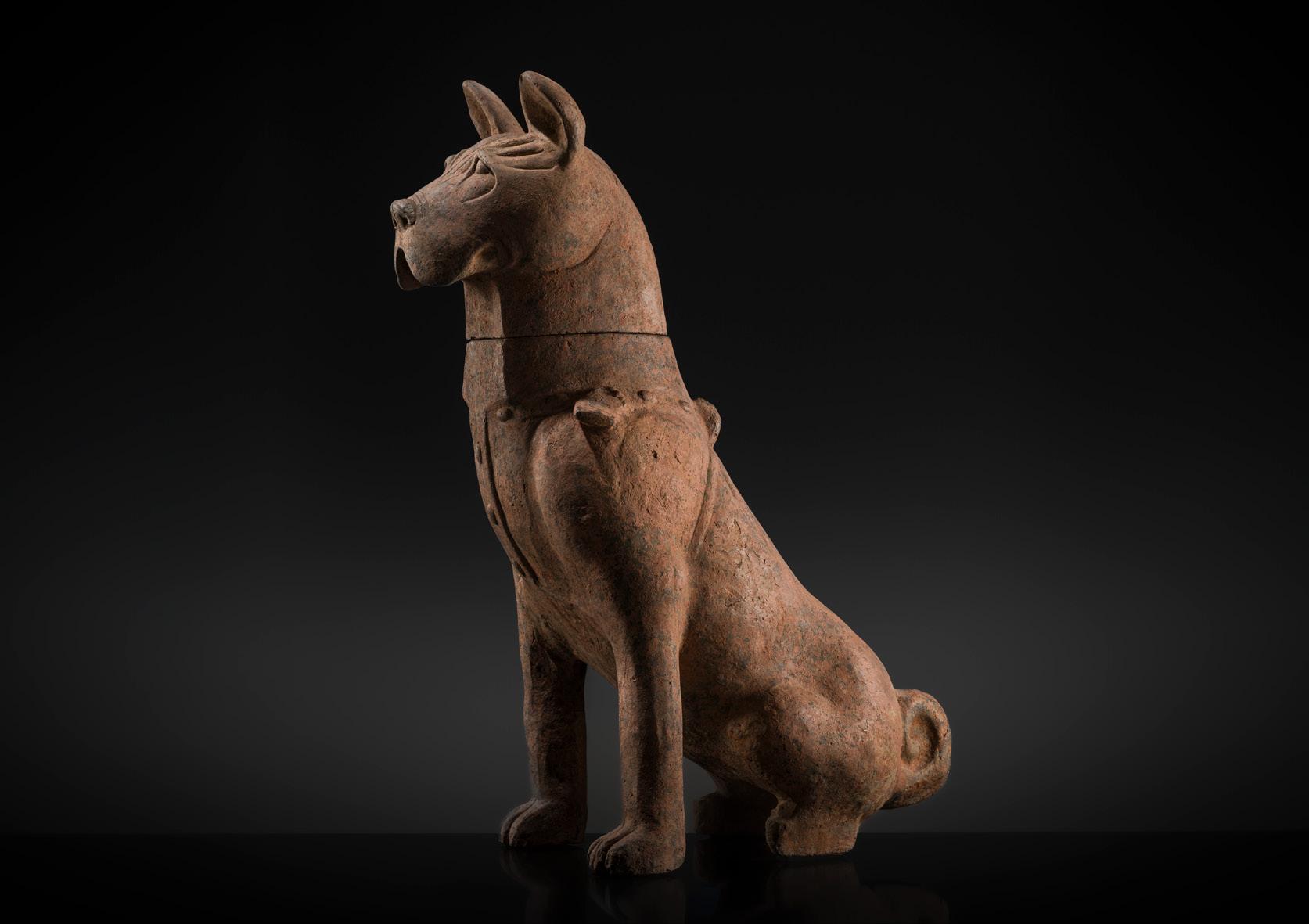
40 A LARGE POTTERY FIGURE OF A SEATED GUARD DOG, HAN DYNASTY
Exhibited:
Museum der Völker (formerly Haus der Völker, Museum für Kunst und Ethnographie), Schwaz, Tyrol, Austria, Ausstellung: Das Erbe Chinas, 10 January 2009 – 10 January 2010.
SCIENTIFIC ANALYSIS REPORT
A thermoluminescence analysis report issued by Oxford Authentication on 28 October 2011, based on sample number C111n35, sets the firing date of the samples taken between 1500 and 2400 years ago, consistent with the dating above. A copy of the report accompanies this lot.

China, 206 BC – 220 AD. The figure is hollow-molded in two sections as a seated guard dog wearing a leather collar and harness. The separately made head faces straight ahead and is modeled with a furrowed brow and forward-curved ears. (2)
Provenance: Dech Gallery, Bangkok, Thailand. A Swiss private collection, acquired from the above. Collection of Gerhard Merzeder (b. 1963), internationally published and acclaimed fashion and portrait photographer, Vienna, Austria, assembled since the 1980s. Dech Gallery is a third-generation dealership specializing in antiques from China, Japan, and Southeast Asia, catering to renowned dealers, collectors, and museums worldwide.
Condition: Very good condition, commensurate with age. Old wear, small losses to the feet, minor chips, encrustations, and remnants of red pigments to the face. Drilled holes from sample-taking to the front right leg and chin. Repairs and touchups as generally expected from Han dynasty excavations.
Weight: 17.6 kg
Dimensions: Height 69.3 cm
In the late Shang dynasty (16th–11th century BC), dogs were buried in royal tombs as sacrificial animals. Thousand years later, by the Han dynasty, actual dogs had long since been replaced by clay replicas. Placed at the entrance to underground tombs, they served to guard the deceased and the tomb furnishings. Many different breeds and regional preferences can be recognized among the Han-period tomb figurines. Like other dogs found in Sichuan, this one wears a snug harness. Everything about this creature speaks to its vitality and strength, from the alert stance, the erect ears, and outward gaze, to the neatly curled tail.
Literature comparison: Mastiffs such as the present lot have been found in tombs in Sichuan province. They are generally modeled in alert positions, either seated or standing upright. Compare a closely related example, dated 2nd3rd century, excavated from Tomb No. 3, Tianshan, Chengdu, Sichuan Province, in 1957, and presently in the Sichuan Museum. For further related examples see Akiyama Terukazu et al., Arts of China: Neolithic Cultures to the Tang Dynasty - Recent Discoveries, Tokyo, 1968, nos. 304-307; Kaogu xuebao 1958:1, pp. 87-104, pl. IX; and Kaogu 1988:3, p. 223, fig. 6:7; and Kaogu 1997:4, p. 69, pl. 5:3.
AUCTION RESULT COMPARISON
Type: Near identical
Auction: Christie’s New York, 14 September 2012, lot 1377
Price: USD 16,250 or approx. EUR 19,500 converted and adjusted for inflation at the time of writing
Description: A large grey pottery figure of a male guard dog, Han dynasty (206 BC-AD 220)
Expert remark: Compare the near identical pose, modeling, harness, size (71.2 cm), and technique with the figure being similarly hollow molded in two sections with the head and body made separately.
Estimate EUR 8,000
Starting price EUR 4,000
41 AN IMPORTANT LIMESTONE FIGURE OF BUDDHA, LATE SUI DYNASTY TO TANG DYNASTY
Exhibited:
Museum der Völker (formerly Haus der Völker, Museum für Kunst und Ethnographie), Schwaz, Tyrol, Austria, Ausstellung: Das Erbe Chinas, 10 January 2009 – 10 January 2010.
China, 6th-7th century. The figure is shown seated in padmasana, the right arm raised possibly in abhaya mudra and the left in varada mudra, wearing a long, loosely draped robe cascading over the throne that is raised on an oval base carved with a row of lotus petals. The round face with a gentle smile, downcast eyes below gently arched brows, flanked by elongated earlobes and the hair arranged in tight curls over the ushnisha.
Provenance: Private collection of Christian Roll, Hong Kong, August 1968. Private collection of Romy Schurhammer, acquired from the above. A copy of the signed provenance letter from Romy Schurhammer, on 22 January 2000, Bangkok, confirming the provenance and dating above, accompanies the lot. Collection of Gerhard Merzeder (b. 1963), internationally published and acclaimed fashion and portrait photographer, Vienna, Austria, assembled since the 1980s. Christian Roll was a German journalist, who lived in Hong Kong in the 1960s. He wrote about the struggle for freedom in Asian countries and published ‘Strasse des Glücks: Erlebnisse, Notizen und Berichte aus dem ungewöhnlichen Leben eines die Freiheit suchenden Journalisten‘ in 2001. Romy Schurhammer (1936-2019) worked as an aspiring journalist during her apprenticeship for Badische Neueste Nachrichten (BNN). She gained fame in 1956 at the age of 19 when she traveled alone through Africa to Cape Town in a Ford Taunus 15m, sending her travel reports back to her home newspaper. She documented her experiences in her 1958 book ‘Romy fährt nach Afrika’. In 1959, she took another journey in a VW bus to Laos, which she summarized in her book ‘Guten Tag Pazifik’. Romy later married the renowned photojournalist Hilmar Pabel, and together they published numerous reports in magazines like Stern, Bunte, and GEO. Condition: Good condition with extensive wear. Signs of weathering and erosion, encrustations, obvious losses, natural fissures, age cracks, scattered chips and nicks.
Weight: 76 kg
Dimensions: Height 78 cm (excl. stand), 80 cm (incl. stand)
With a modern stand. (2)

The 20 year old Romy Schurhammer returning from her Africa expedition
LITERATURE COMPARISON
Compare a related limestone figure of Buddha Amida, dated Sui dynasty, 51.4 cm tall, in the Cleveland Museum of Art, accession number 1964.152. Compare a related seated figure of Buddha Shakyamuni, dated 6th century, 65.6 cm tall, in the Museum für Ostasiatische Kunst, Cologne, accession number Bc 69,1 (fig. 1).
AUCTION RESULT COMPARISON
Type: Related
Auction: Christie’s New York, 17 March 2015, lot 7
Price: USD 845,000 or approx. EUR 998,000 converted and adjusted for inflation at the time of writing
Description: A large stone figure of buddha, China, Northern Qi-Sui dynasty (AD 550-618)
Expert remark: Compare the similar pose, the flat drapery, and size (77.5 cm).
Estimate EUR 15,000
Starting price EUR 7,500
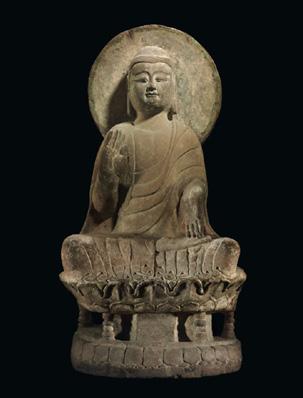
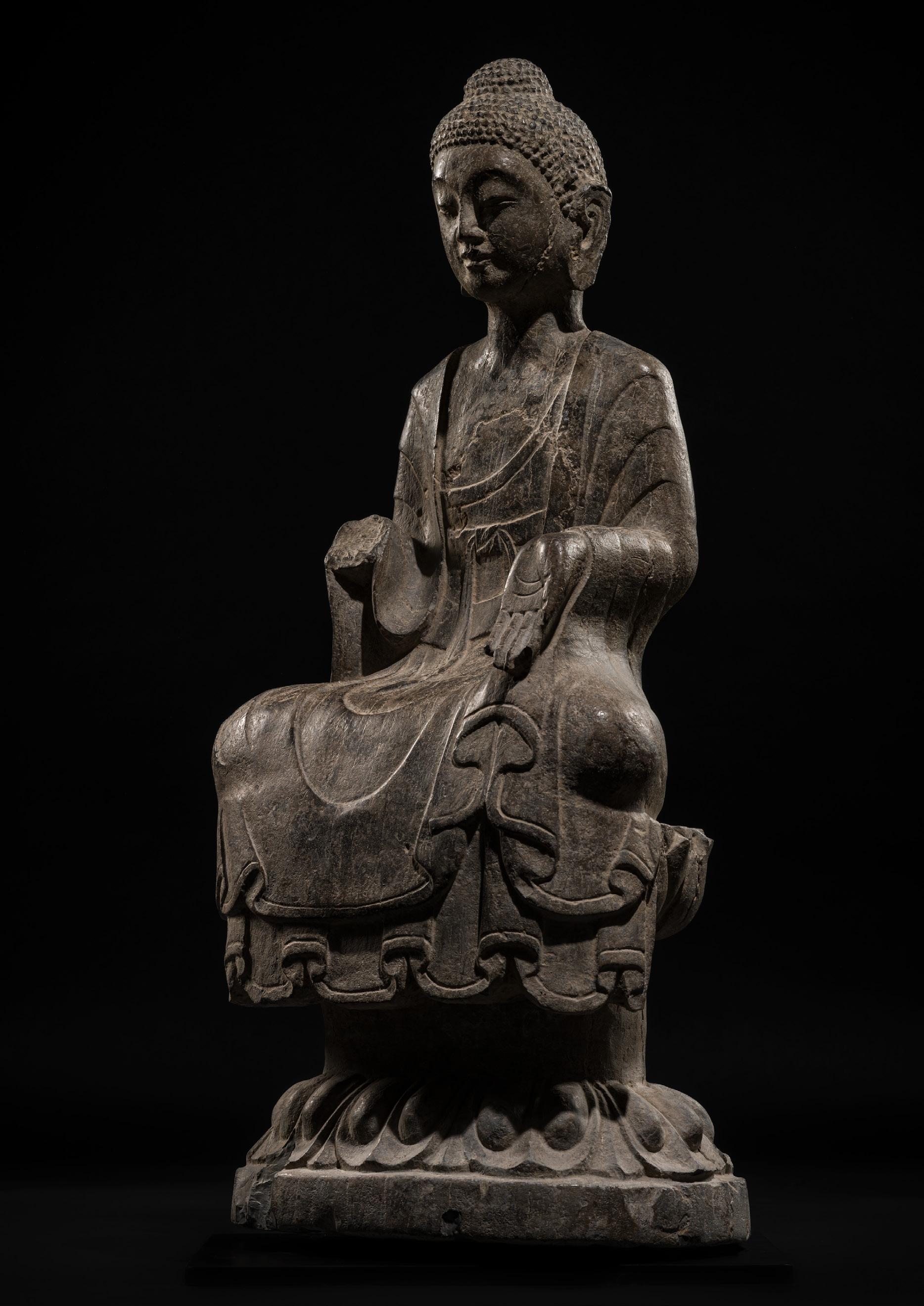
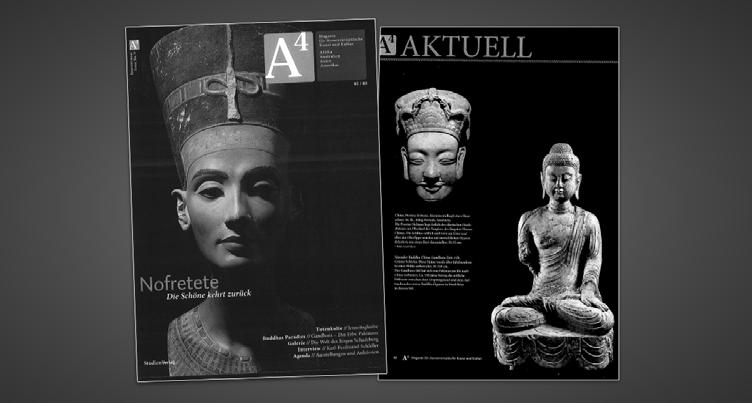
PUBLISHED
Museum der Völker (formerly Haus der Völker, Museum für Kunst und Ethnographie), Schwaz, Tyrol, Austria, A4, Magazin für Aussereuropäische Kunst und Kultur, Nofretete die Schöne kehrt zurück, Studien Verlag, issue no. 9, February 2009, p. 22.
Exhibited:
Museum der Völker (formerly Haus der Völker, Museum für Kunst und Ethnographie), Schwaz, Tyrol, Austria, Das Erbe Chinas, 10 January 2009 - 10 January 2010.
China, Sichuan province, Ming Dynasty, 16th century. The face exhibits a serene expression, with almond-shaped eyes and lips gently forming a subtle smile, framed by two slits above and one below, and a slit beside each ear. The head is crowned with an elaborate headdress, featuring a pair of dragons at the front, each grasping a flaming pearl at the center, with a row of petals and archaistic scrolls beneath.
Provenance: Private collection of Christian Roll, Hong Kong, August 1968. Private collection of Romy Schurhammer, acquired from the above. A copy of the signed provenance letter from Romy Schurhammer, on 8 February 2001, Bangkok, confirming the provenance and dating above, accompanies the lot. Collection of Gerhard Merzeder (b. 1963), internationally published and acclaimed fashion and portrait photographer, Vienna, Austria, assembled since the 1980s. Christian Roll was a German journalist, who lived in Hong Kong in the 1960s. He wrote about the struggle for freedom in Asian countries and published ‘Strasse des Glücks: Erlebnisse, Notizen und Berichte aus dem ungewöhnlichen Leben eines die Freiheit suchenden Journalisten‘ in 2001. Romy Schurhammer (1936-2019) worked as an aspiring journalist during her apprenticeship for Badische Neueste Nachrichten (BNN). She gained fame in 1956 at the age of 19 when she traveled alone through Africa to Cape Town in a Ford Taunus 15m, sending her travel reports back to her home newspaper. She documented her experiences in her 1958 book ‘Romy fährt nach Afrika’. In 1959, she took another journey in a VW bus to Laos, which she summarized in her book ‘Guten Tag Pazifik’. Romy later married the renowned photojournalist Hilmar Pabel, and together they published numerous reports in magazines like Stern, Bunte, and GEO.
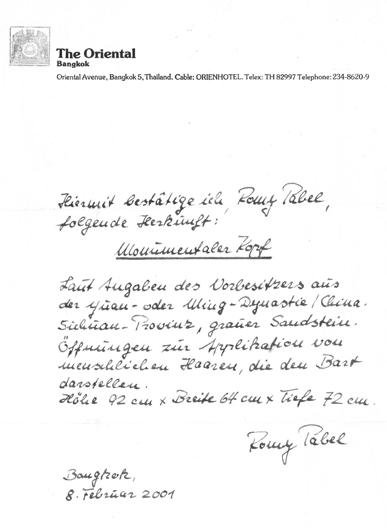
The 20 year old Romy Schurhammer returning from her Africa expedition
AUTHENTICATION
Koller Auktionen, Zurich, 30 October 2012, lot 215 (mid-estimate CHF 42,500 or approx. EUR 68,000 converted and adjusted for inflation at the time of writing).
Dimensions: Height 65 cm (excl. stand), 87 cm (incl. stand)
The size of this head fragment suggests that the entire sculpture was approximately seven meters tall. The slits above the mouth, on the chin, and beside the ears were used to apply real hair to create a realistic beard. This technique was also used in Chinese masks.
Literature comparison:
Compare a related stone head of an official with a similar expression, dated Yuan to Ming dynasty, 61 cm tall, at Christie’s New York, 20 September 2004, lot 138.
Type: Related
Auction: Sotheby’s New York, 17 March 2021, lot 252
Mid-Estimate: USD 25,000 or approx. EUR 28,000 converted and adjusted for inflation at the time of writing
Description: A large stone head of an official, Ming dynasty
Expert remark: Compare the similar modeling and manner of carving with similar facial features and cap. Note the smaller size (54 cm).
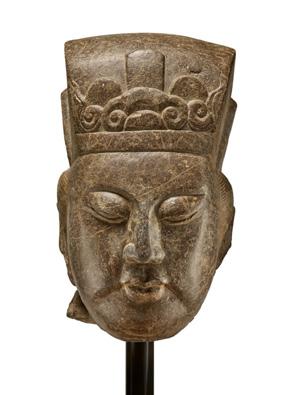
Condition: Very good condition with expected old wear, signs of weathering and erosion, few nicks, minor encrustations, small chips here and there, remnants of pigments, and light scratches.
Estimate EUR 15,000
Starting price EUR 7,500
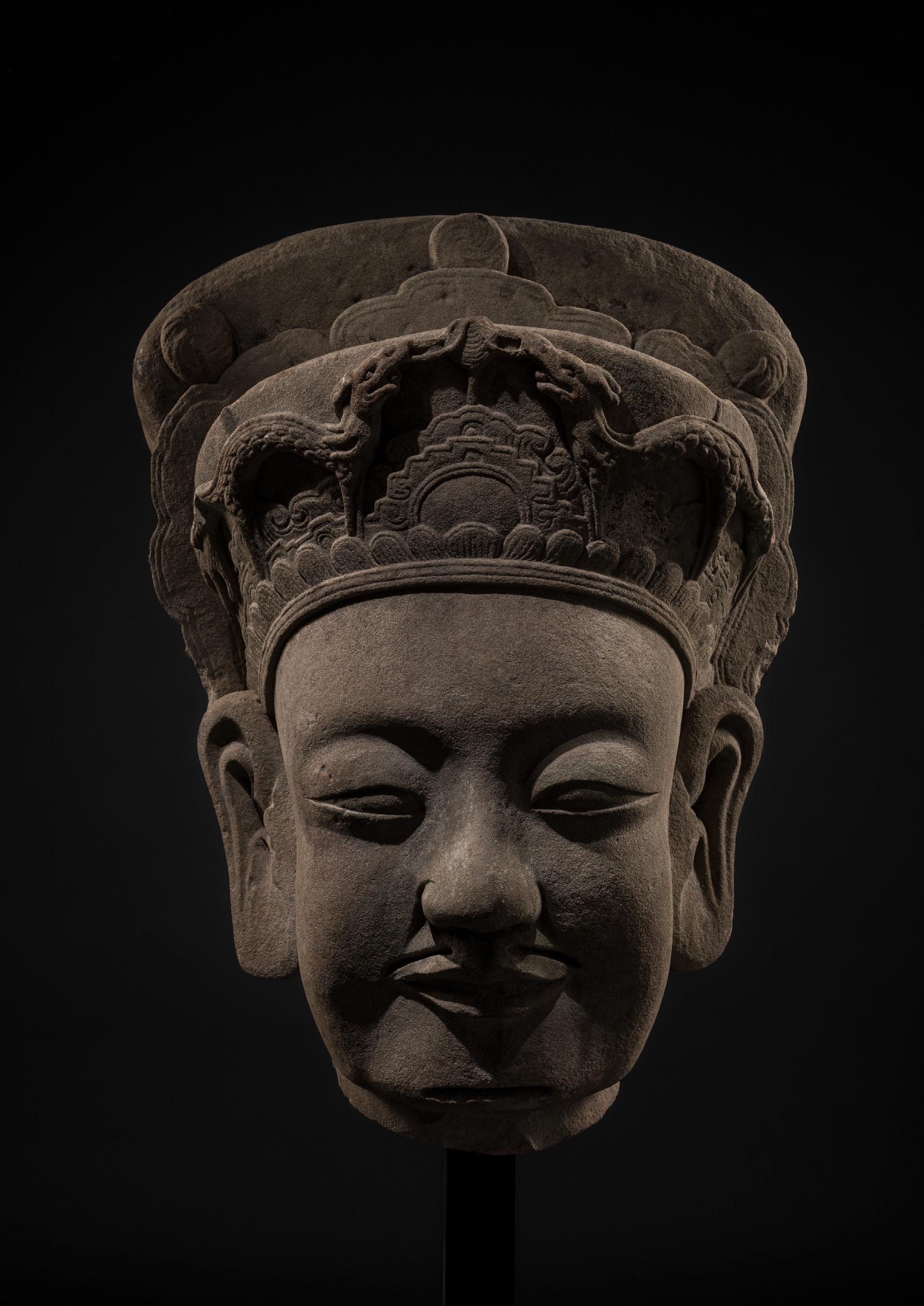
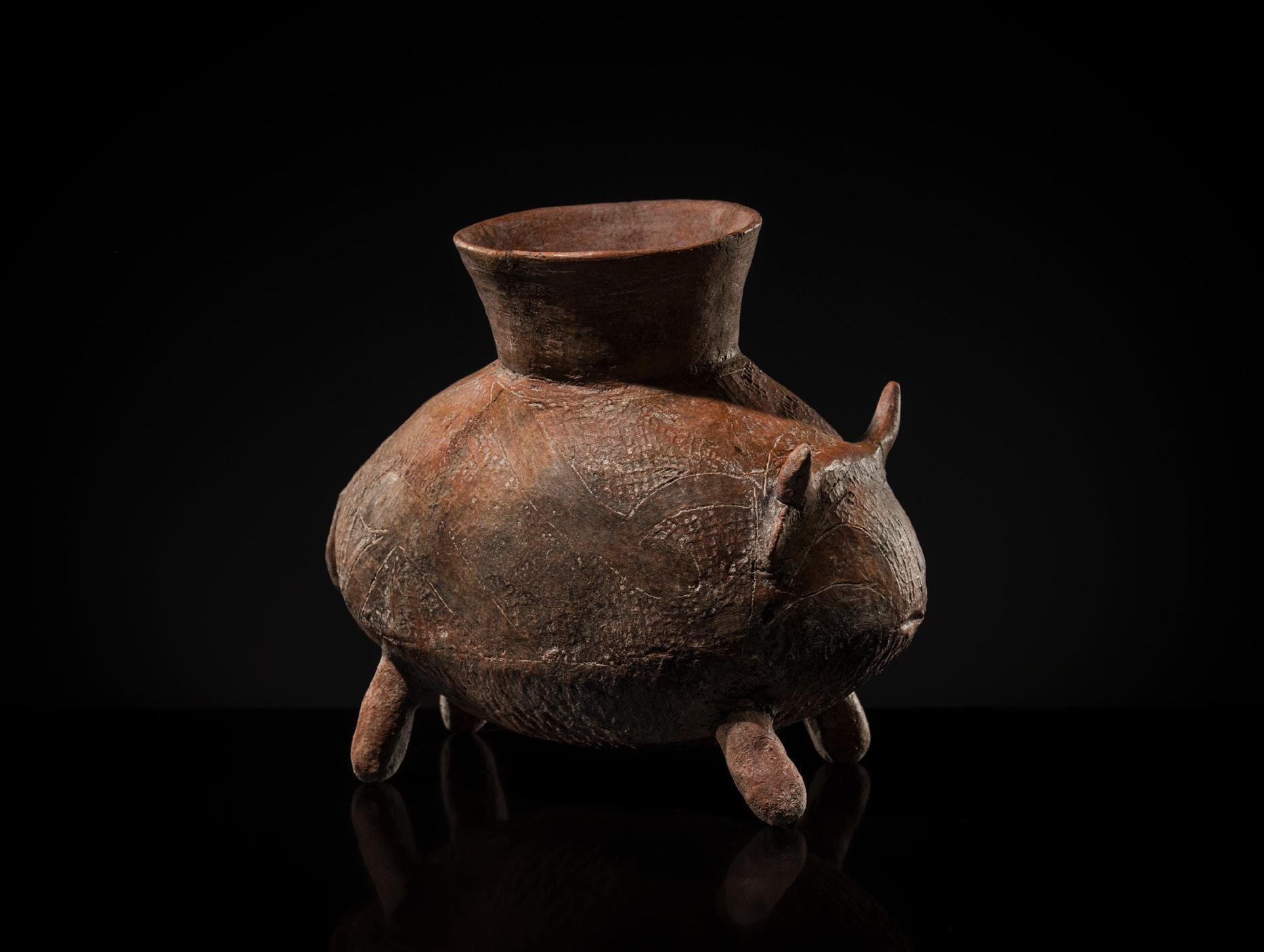
43 A RARE ‘BUFFALO’ TERRACOTTA VESSEL, BAN CHIANG CULTURE, THAILAND, 500 BC
SCIENTIFIC ANALYSIS REPORT
A thermoluminescence analysis report issued by Oxford Authentication on 6 January 2026, based on sample number N125s35, sets the firing date of two samples taken between 1800 and 2600 years ago, consistent with the dating above. A copy of the report accompanies this lot.

Exhibited:
Museum der Völker (formerly Haus der Völker, Museum für Kunst und Ethnographie), Schwaz, Tyrol, Austria, Totenkulte und Jenseitsglaube, 13 September 2009 – 3 January 2010.
Thailand, Lopburi province. The body of ovoid form rising from four sturdy feet to a flaring mouth, set to one side with two horns and ears, the reverse with a tucked-in tail, the mouth indicated by a slit, and incised to the exterior with swirling bands and impressed patterns.
Provenance: Bangkok art trade, 1990s. Collection of Gerhard Merzeder (b. 1963), internationally published and acclaimed fashion and portrait photographer, Vienna, Austria, assembled since the 1980s. Condition: Good condition with expected old wear, some extremities, parts of the mouth and body reattached, few repairs and touchups, tiny nicks, and minor soil encrustations. Overall presenting very well.
Weight: 1 kg
Dimensions: Height 18.9 cm
Ban Chiang denotes an archeological site located in Nong Han district, Udon Thani Province, Thailand. Discovered in 1957, the site attracted enormous publicity due to its distinctive red-painted pottery. During the first formal scientific excavation in 1967, archaeologists unearthed several skeletons, together with bronze grave gifts and unglazed earthenware pots which had been low-fired and painted red with unique, highly expressive and characteristic designs.
LITERATURE COMPARISON
Compare a related pottery vessel in form of a bull, Thailand, Museum Rietberg, inventory number TG 1395.
Estimate EUR 2,000
Starting price EUR 1,000
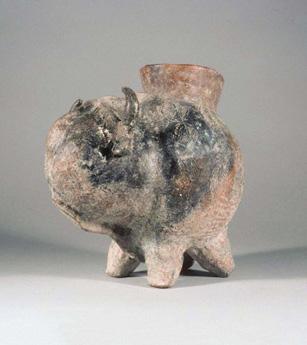
A LARGE PAINTED POTTERY ‘SPIRAL’ URN, BAN CHIANG, 3RD CENTURY BC
Published:
Museum der Völker (formerly Haus der Völker, Museum für Kunst und Ethnographie), Schwaz, Tyrol, Austria, A4, Magazin für Aussereuropäische Kunst und Kultur, Parcours des Mondes, Studien Verlag, issue no. 7, February 2008, p. 30.
Exhibited:
Museum der Völker (formerly Haus der Völker, Museum für Kunst und Ethnographie), Schwaz, Tyrol, Austria, 2008.
Thailand, Udon Thani Province. The ovoid vessel raised on a tall, splayed foot, rising to an everted rim, and painted in red pigments with lines forming evenly spaced spirals and swirls to the body, foot, and rim, and geometric designs to the upper rim. The interior of the rim is painted red.
Provenance: Bangkok art trade, 1980s. Professor Gert Chesi, acquired from the above for the Museum der Völker (formerly Haus der Völker, Museum für Kunst und Ethnographie), Schwaz, Tyrol, Austria, and subsequently de-accessed. Collection of Gerhard Merzeder (b. 1963), internationally published and acclaimed fashion and portrait photographer, Vienna, Austria, assembled since the 1980s. Gert Chesi (b. 1940) is an Austrian photographer, author, and art collector. In 1995, Chesi founded the Museum der Völker (formerly Haus der Völker, Museum für Kunst und Ethnographie), Schwaz, Tyrol, Austria, a museum of art and ethnography whose collection consists mainly of objects acquired during Chesi’s travels through Africa and Asia.
Condition: Good condition, commensurate with age. Old wear, traces of use, signs of weathering, soil encrustations, usual repairs and touchups to the upper rim, sides, and foot, light scratches.
Weight: 3.1 kg
Dimensions: Height 42.5 cm
Ban Chiang denotes an archeological site located in Nong Han district, Udon Thani Province, Thailand. Discovered in 1957, the site attracted enormous publicity due to its distinctive red painted pottery. During the first formal scientific excavation in 1967, archaeologists unearthed several skeletons, together with bronze grave gifts and unglazed earthenware pots which had been low-fired and painted red with unique, highly expressive and characteristic designs.
LITERATURE COMPARISON
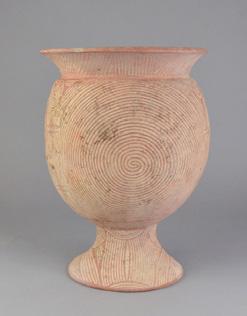
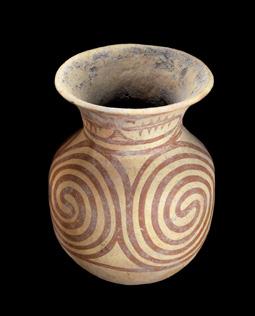
Compare a closely related clay pot, Thailand, Ban Chiang culture, late period, in the Penn Museum, object number 8429-1. Compare a related vase dated 5th century BC-5th century AD in the British Museum, registration number 1974,0617.1.
Estimate EUR 2,000
Starting price EUR 1,000
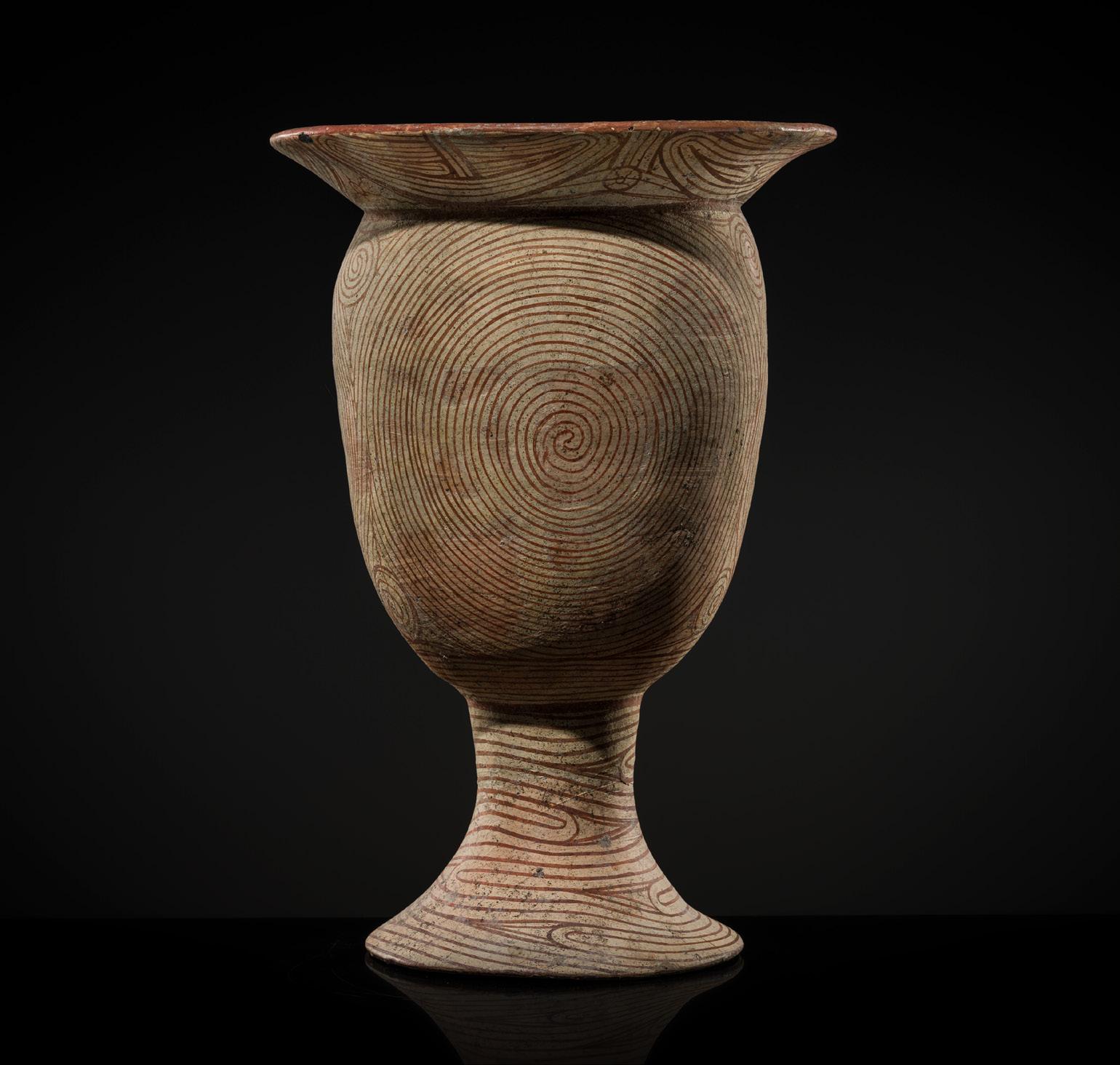
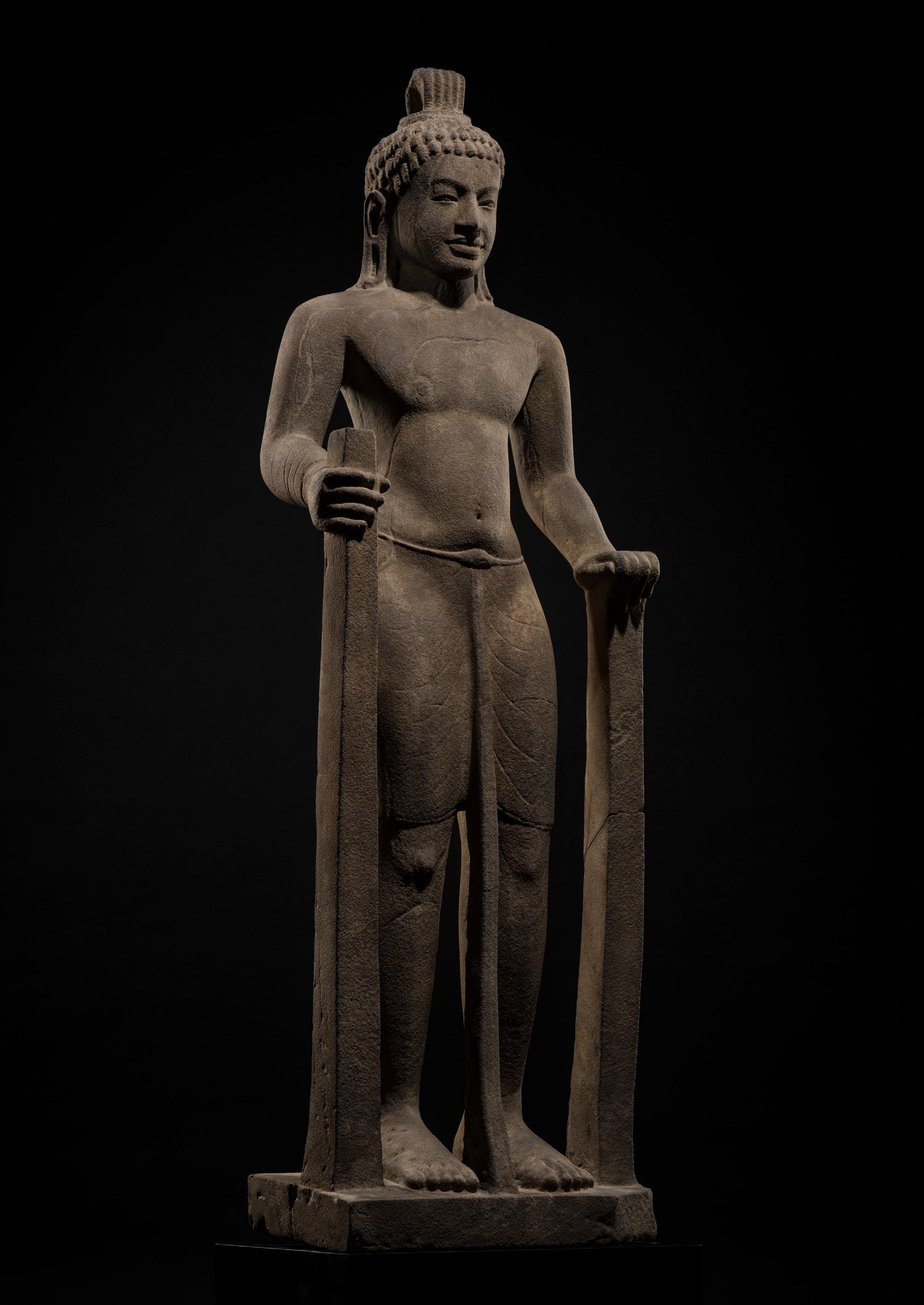
45
AN IMPORTANT AND LARGE (131 CM) SANDSTONE
FIGURE OF PARASHURAMA, PRE-ANGKOR PERIOD, PHNOM DA STYLE, 7TH CENTURY
Exhibited:
Museum der Völker (formerly Haus der Völker, Museum für Kunst und Ethnographie), Schwaz, Tyrol, Austria, Das Gedächtnis der Steine. Seltene Steinreliefs und Figuren aus Asien, 7 November 2015 – 1 May 2016.
The superbly modeled muscular ascetic standing on a square plinth resting on his staff, wearing a short sampot carved with parallel pleats with a central drape falling to the center, his face with a benign expression, almond-shaped eyes with heavy lids under gently arched brows, wide pursed lips, and an aquiline nose, flanked by long pendulous lobes, the thick curled hair pulled high above into a looped chignon secured by a band.
Provenance: A private collection in Switzerland, acquired in Bangkok before 1980. Collection of Gerhard Merzeder (b. 1963), internationally published and acclaimed fashion and portrait photographer, Vienna, Austria, assembled since the 1980s.
Condition: Very good condition, commensurate with age. Wear, obvious losses, small chips, old repairs, scattered nicks and scratches, signs of weathering and erosion, and encrustations.
Weight: 131 kg (incl. stand)
Dimensions: 131 cm (excl. stand), 164 cm (incl. stand)
Parashurama is the sixth avatar among the Dashavatara of the preserver god Vishnu in Hinduism. Hindu tradition holds him to be the of evil on Earth. He liberates the Mother Earth from felons, ill-behaved men, extremists, demons and those blind with pride. He is described as one of the Chiranjivi (Immortals), who will appear at the end of the Kali Yuga to be the guru of Vishnu's tenth and last incarnation, Kalki.
Nearly all discovered stone sculptures in the Phnom Da style appear to be associated with Vishnu and his incarnations, as exemplified by this piece. The Phnom Da style is notably cohesive and consistent, exhibiting less variation compared to other stylistic periods. This uniformity suggests a focused artistic vision, reflecting a deep reverence for Vishnu and his realm, as well as a clear dedication to maintaining a specific aesthetic throughout the period.
LITERATURE COMPARISON
Compare a closely related figure of Parashurama, Pre-Angkor period, in the Museum of Phnom Phen, and illustrated by Madeleine Giteau, L'expression de la sensibilité dans l'art khmer, Arts Asiatiques, Vol. 2, No. 3 (1955), p. 211, fig. 1. Compare a related pre-Angkor period figure, Sambor Prei Kuk style, dated to the 7th century, 142 cm high, in the National Museum of Cambodia, inventory number Ka.2576.
Estimate EUR 30,000
Starting price EUR 15,000
A MAGNIFICENT SANDSTONE STATUE OF NANDI, PRE-ANGKOR PERIOD, 8TH–9TH CENTURY
Exhibited:
Museum der Völker (formerly Haus der Völker, Museum für Kunst und Ethnographie), Schwaz, Tyrol, Austria, Das Gedächtnis der Steine. Seltene Steinreliefs und Figuren aus Asien, 7 November 2015 – 1 May 2016.
Cambodia. Superbly carved, the sacred animal depicted in a recumbent position atop a rectangular plinth. The young bull resting its weight on the right side, with the right hind leg folded beneath its massive body, and its tail extending gracefully to the right, its tip draped over the left hind leg. A prominent hump rises behind its neck, which is adorned with a large necklace composed of circular ornaments.
The head, exquisitely sculpted, is held upright with refined poise.
The almond-shaped eyes are open and alert, flanked by large funnelshaped ears, below the short horns, while the closed muzzle conveys a serene and composed expression—its gaze once directed toward the sanctuary entrance.
Provenance: Bangkok art trade, 1980s. Professor Gert Chesi, acquired from the above for the Museum der Völker (formerly Haus der Völker, Museum für Kunst und Ethnographie), Schwaz, Tyrol, Austria, and subsequently de-accessed. Collection of Gerhard Merzeder (b. 1963), internationally published and acclaimed fashion and portrait photographer, Vienna, Austria, assembled since the 1980s. Gert Chesi (b. 1940) is an Austrian photographer, author, and art collector. In 1995, Chesi founded the Museum der Völker (formerly Haus der Völker, Museum für Kunst und Ethnographie), Schwaz, Tyrol, Austria, a museum of art and ethnography whose collection consists mainly of objects acquired during Chesi’s travels through Africa and Asia.
Condition: Very good condition with expected wear, signs of weathering and erosion, minor encrustations, light nicks, surface scratches, natural fissures, and small chips. The left ear with an old repair.
Weight: 33.8 kg
Dimensions: Length 53.5 cm
Expert’s note:
This early Cambodian temple sculpture is far more than a representation of a sacred animal—it was conceived to evoke a profound spiritual presence, transcending the physical form itself. The Nandi, powerfully yet sensuously carved, radiates both strength and serenity. Its inspired expression and beautifully modeled body reveal an austerity of design balanced with harmonious, flowing volumes. Remarkable from every angle, the piece exemplifies the rare artistic achievements of the pre-Angkorian period, embodying both devotional purpose and the refined aesthetic of early Cambodian sculpture.
Shiva’s bull, Vrishabha, is his faithful mount and most devout worshiper— the embodiment of devotion. The young bull is popularly but incorrectly called Nandi, ‘the joyful’, but is better referred to simply as Vrishabha, the ‘white bull’. He is understood as an expression of Shiva’s supreme wisdom and thus is also worshiped as a theriomorphic form of Shiva himself; note the third eye depicted on the bull’s forehead, associated with the god’s power to reveal divine knowledge. Shiva’s bull assumed an independent cult status. Shrines to Shiva’s bull—known in Khmer as Preah Koh—are popular in modern-day Cambodia, testifying to the resilience of such cults.
In Cambodia, Nandi is also known as ‘the Fortunate One’ and was traditionally depicted as the vehicle of Shiva and his Shakti, Parvati. This sculpture of kneeling Nandi originally stood opposite a temple dedicated to the mighty Shiva. Depictions of Nandi can also be seen in a variety of other forms and locations, such as bas-reliefs on door lintels and in sculptures depicting Shiva with his Shakti. In several inscriptions, Shiva is described as an ancestral spirit riding a bull. Nandi as an individual statue is considered a sacred deity, representing Shiva himself and symbolizing the universal cycle of creation, maintenance, and destruction.
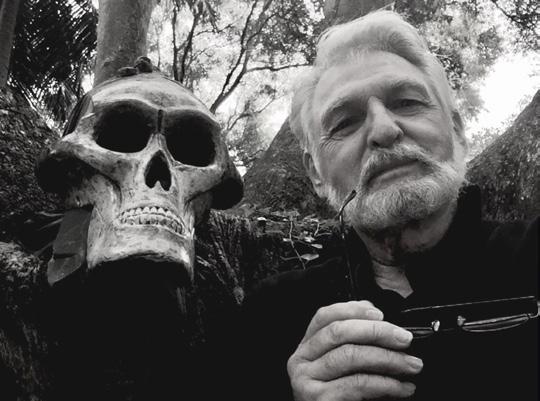
Cambodia's earliest religious sculptures were made before the unification of the Khmer empire by Jayavarman II in the ninth century, in the style known as Pre-Angkor. The figurative style is relatively naturalistic, with well-observed forms and deliberately gentle volumes harmoniously flowing into each other. The style reveals the influence of Indian statues of the Gupta period, though the treatment of the body is freer and less muscular. The shape of the necklace is also an early stylistic trait. Similar stylistic comparisons can be made with only a small number of individual Nandi images known from Cambodia.
LITERATURE COMPARISON
Compare a closely related preAngkor sandstone carving of Nandi from Southern Cambodia, dated 7th century, 53 cm long, in the National Museum of Cambodia, accession number KA.1584, and included in the seminal exhibition Lost Kingdoms: Hindu-Buddhist
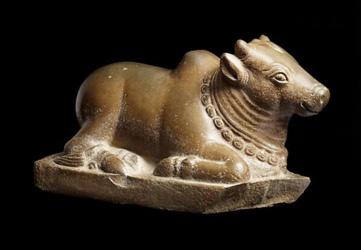
Sculpture of Early Southeast Asia, 5th to 8th Century, 15 April-27 July 2014, New York, cat. no. 102.
AUCTION RESULT COMPARISON
Type: Closely related
Auction: Christie’s Paris, 13 June 2018, lot 238
Price: EUR 35,000 or approx. EUR 41,000 adjusted for inflation at the time of writing
Description: A sandstone carving of Nandi, Cambodia, Khmer Empire, second half 10th century
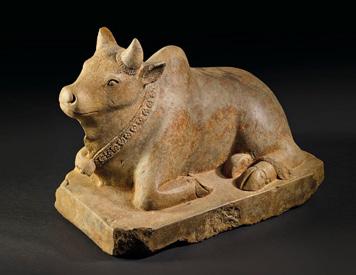
Expert remark: Compare the closely related modeling, stone, manner of carving, and subject, with similar pose, features, and base. Note the size (53 cm) and later dating.
Estimate EUR 10,000
Starting price EUR 5,000
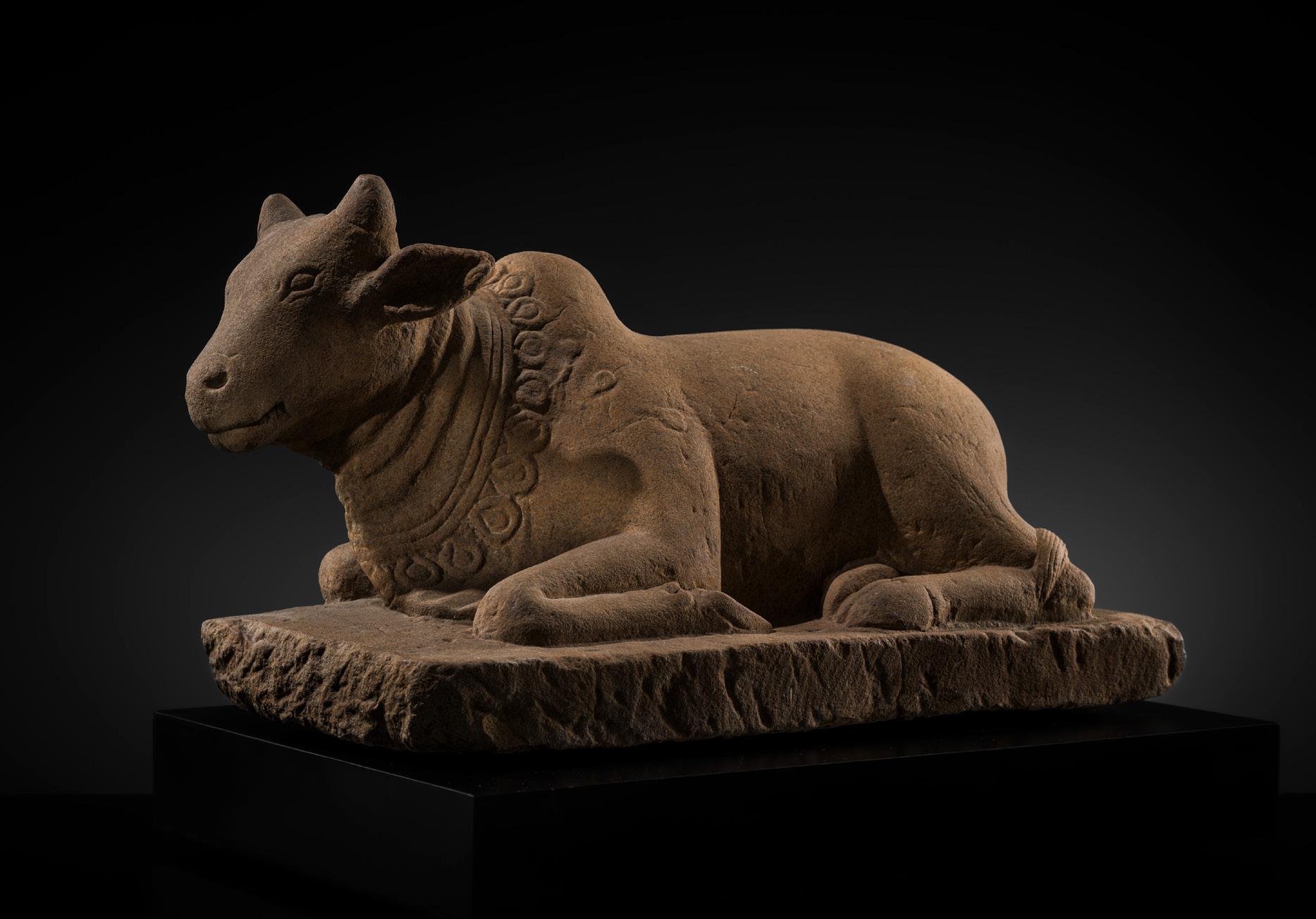
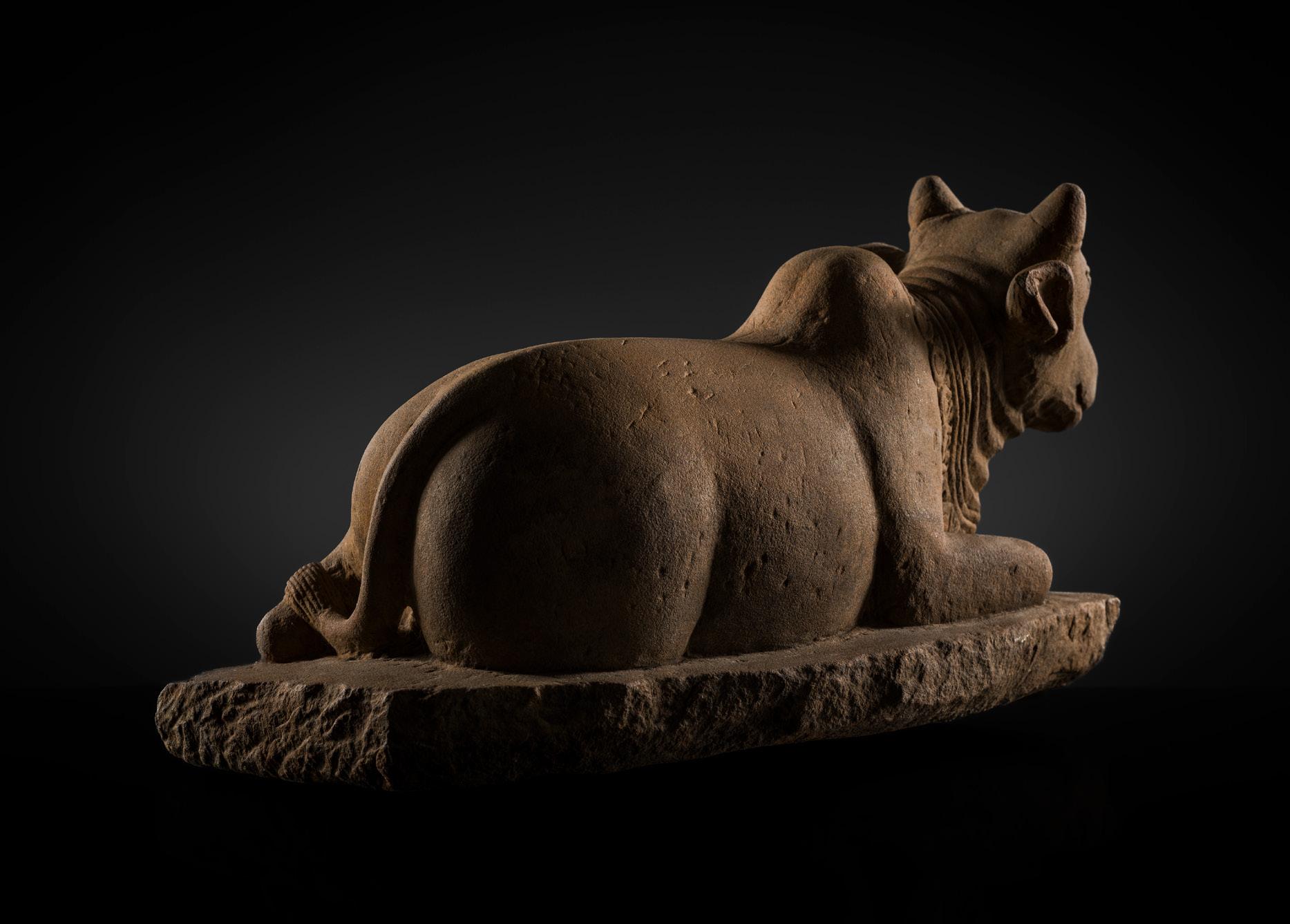
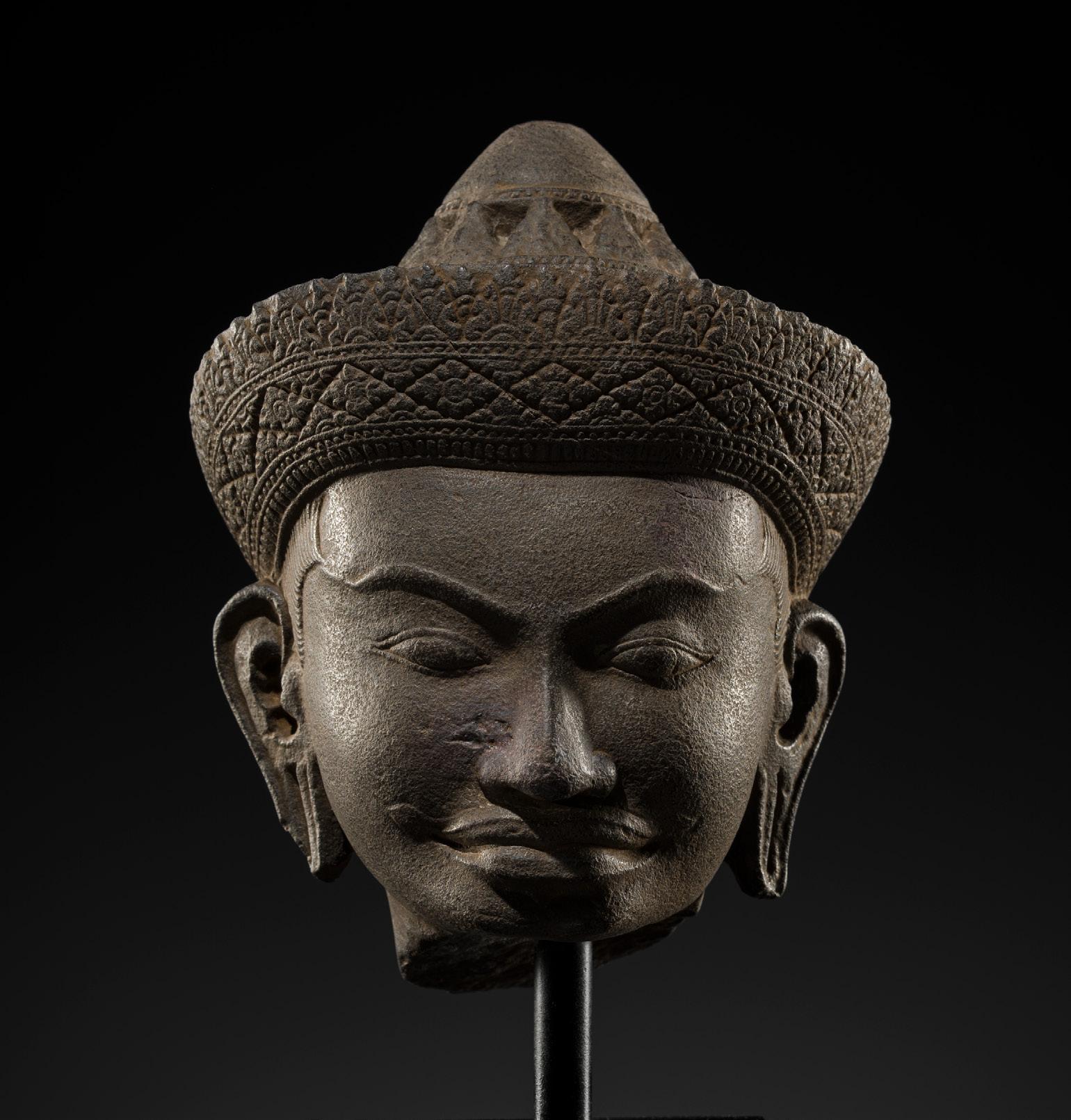
47 A FINE SANDSTONE HEAD OF A MALE DEITY, BAPHUON STYLE, ANGKOR PERIOD
Exhibited:
Museum der Völker (formerly Haus der Völker, Museum für Kunst und Ethnographie), Schwaz, Tyrol, Austria, Das Gedächtnis der Steine. Seltene Steinreliefs und Figuren aus Asien, 7 November 2015 – 1 May 2016.
Khmer Empire, 11th-12th century. Sensitively carved, the serene face with almond-shaped eyes under arched brows, incised round pupils, a wavy mustache, and full lips, flanked by long pendulous earlobes with vertical slits. The finely incised hair arranged in braided rows rising to a tiered conical chignon, secured by a tall foliate tiara tied neatly at the back.
Provenance: Collection of Gerhard Merzeder (b. 1963), internationally published and acclaimed fashion and portrait photographer, Vienna, Austria, assembled since the 1980s, acquired in the Bangkok art market.
Condition: Very good condition, commensurate with age. Old wear, obvious losses, natural fissures, some rubbing, small nicks, scattered nibbling, and signs of weathering and erosion.
Weight: 4,090 g (incl. stand)
Dimensions: Height 19 cm (excl. stand), 31.5 cm (incl. stand)
Mounted on an associated stand. (2)
AUCTION RESULT COMPARISON
Type: Closely related
Auction: Christie’s New York, 16 September 2008, lot 568
Price: USD 8,750 or approx. EUR 11,000 converted and adjusted for inflation at the time of writing
Description: A sandstone head of a deity, Khmer, Angkor period, Baphuon style, 11th century
Expert remark: Compare the closely related modeling and similar tiered chignon and foliate tiara. Note the similar size (16.5 cm).
Estimate EUR 3,000
Starting price EUR 1,500
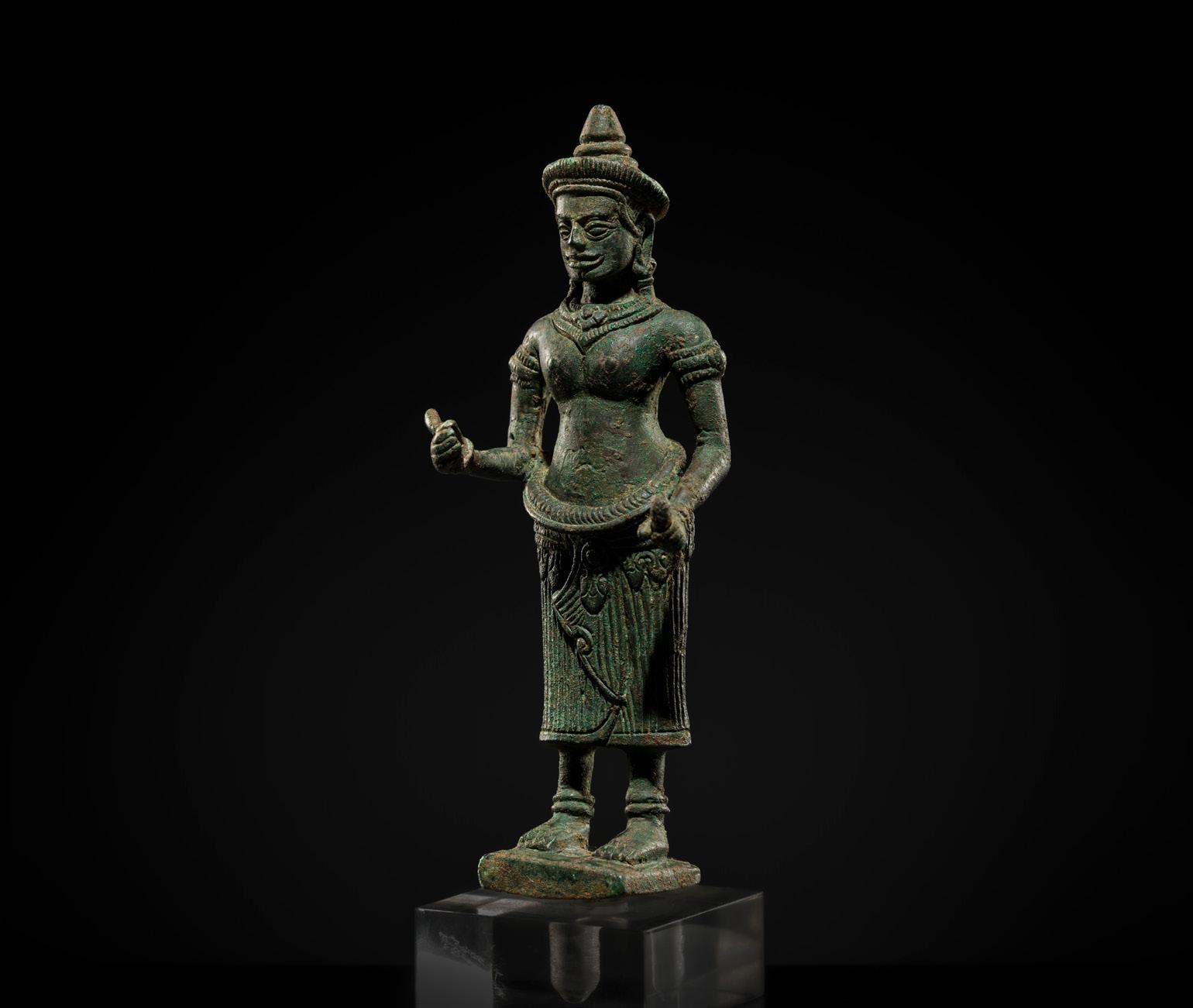
48
A BRONZE FIGURE OF A FEMALE DEITY, ANGKOR WAT STYLE, ANGKOR PERIOD, 12TH CENTURY
Khmer Empire. Finely cast, standing in samabhanga atop a rectangular base, the hands raised and bent at the elbows, clutching a lotus and tablet, dressed in a pleated sampot suspended from a charm-embellished belt and a central sash that tapers off in a fishtail shape, the body adorned with jewelry, her face with a serene expression, incised almond-shaped eyes, and smiling lips, flanked by elongated earlobes with pendeloque earrings. The hair piled up into a conical chignon, centered by a diminutive figure of Buddha, behind the flared tiara.
Provenance: A private collection in Bangkok. Jordi Collection, Zurich, acquired from the above c. 1990. With Michael Henss, Zurich, Switzerland. The collection of Martin Wachsmann and Andrea Görg, Küsnacht, Switzerland. Collection of Gerhard Merzeder (b. 1963), internationally published and acclaimed fashion and portrait photographer, Vienna, Austria, assembled since the 1980s. A copy of a receipt from Michael Henss, dated 7 June 2006, and stating a purchase price of CHF 2,500 or approx. EUR 4,500 (converted and adjusted for inflation), accompanies this lot. Michael Henss (b. 1941) is a Swiss art historian, scholar and writer focusing on Asian art, especially that of Tibet and East Asia. He has written books, contributed articles for Asian art journals, and given seminars. Henss currently lives in Zürich, Switzerland, where he also runs a bookstore specializing in Asian and Near Eastern art. In 2004–2005, Henss was co-curator of the exhibition "The Dalai Lamas" at the Ethnographic Museum of the University of Zurich.
Condition: Very good condition with expected wear and casting irregularities, scattered small nicks and light surface scratches, tiny dings, small losses, traces of weathering, encrustations. The bronze with a rich, naturally grown, dark patina with malachite encrustations.
Weight: 302.9 g (incl. stand)
Dimensions: Height 12.7 cm (excl. stand), 14.7 cm (incl. stand)
Mounted on an associated stand. (2)
AUCTION RESULT COMPARISON
Type: Closely related
Auction: Christie’s New York, 23 July 2020, lot 36
Price: USD 8,125 or approx. EUR 8,700 converted and adjusted for inflation at the time of writing
Description: A rare bronze figure of Uma, Khmer, Angkor period, Angkor Wat style, 12th century Expert remark: Compare the closely related modeling and manner of casting. Note the similar size (18.5 cm).
Estimate EUR 2,000
Starting price EUR 1,000
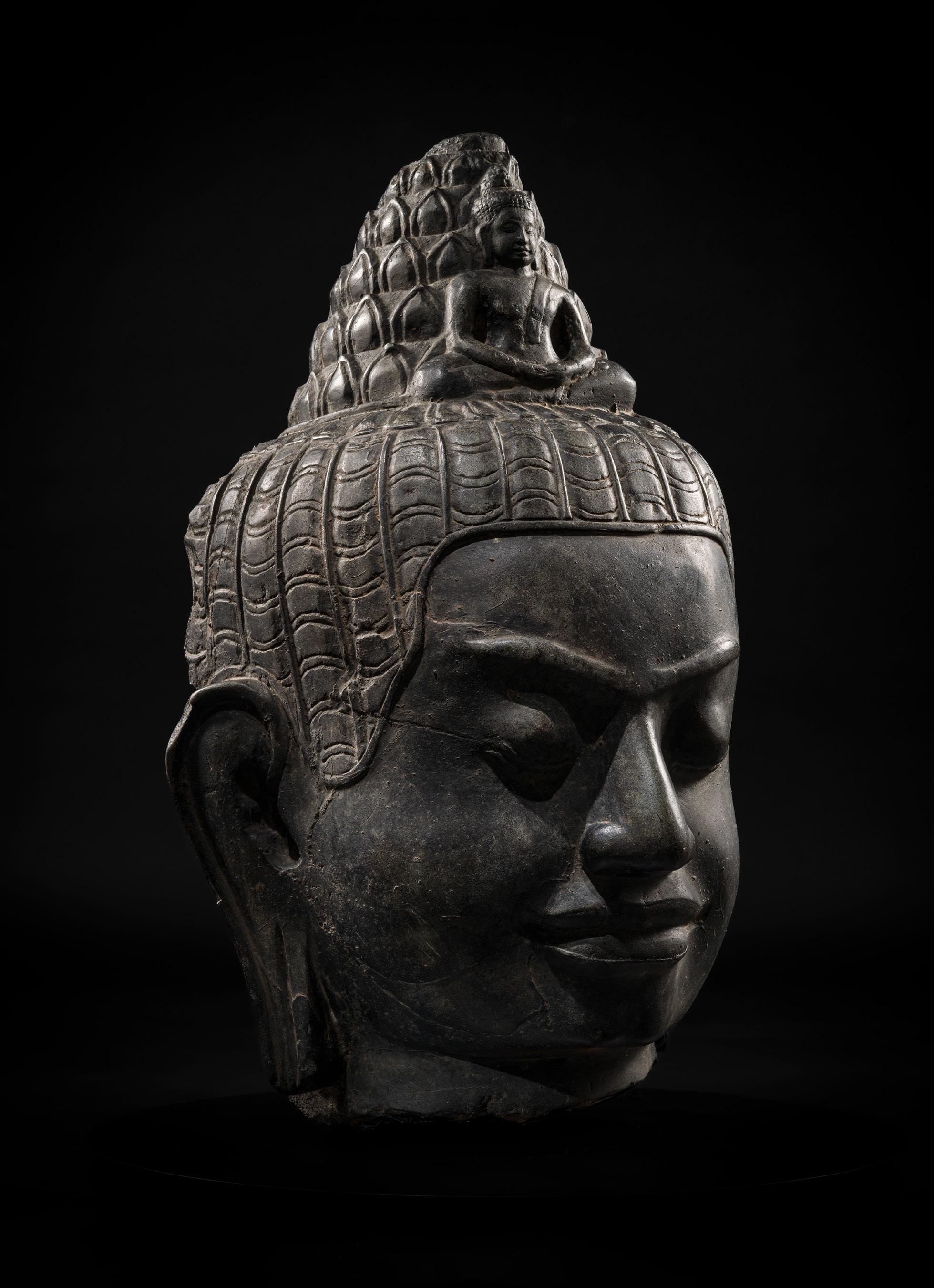

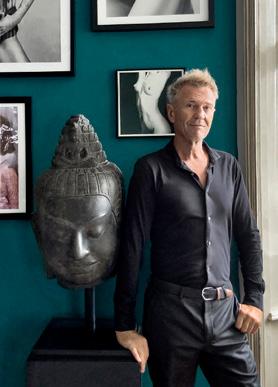
49
Exhibited:
Museum der Völker (formerly Haus der Völker, Museum für Kunst und Ethnographie), Schwaz, Tyrol, Austria, Das Gedächtnis der Steine. Seltene Steinreliefs und Figuren aus Asien, 7 November 2015 – 1 May 2016.
Khmer empire. The serene face sensitively modeled with carefully delineated downcast eyes below an elegant sinuous brow, the similarly incised bow-shaped lips forming a subtle smile, flanked by elongated earlobes, and the hair arranged in rows of curls rising to a tiered ushnisha decorated with petals and centered to the front by Amithaba.
Provenance: Bangkok art trade, before 1980s. Private collection of Romy Schurhammer, acquired from the above. Collection of Gerhard Merzeder (b. 1963), internationally published and acclaimed fashion and portrait photographer, Vienna, Austria, assembled since the 1980s.
Condition: Good condition with old wear, signs of weathering and erosion, cracks, old fills and repairs, obvious losses, shallow surface scratches and chips. Overall displaying exceptionally well.
Dimensions: Height 68 cm
Expert’s note:
This head was most likely once part of a temple relief as indicated by the flattened back which reveals the raw sandstone. The front of the head shows remnants of various layers of ritual painting in black lacquer.
The style is representative of the refined art of the Khmer in Thailand, specifically from Lopburi between the 11th and 14th centuries. The eyebrow arches, resembling a continuous metallic and sharp line are an inheritance from the Bakheng style a century earlier. Characteristic of the Lopburi style is the magnificent hair, accented all around with a border. It consists of a refined arrangement of braided strands, mixed with pearl pendants or lotus buds.
LITERATURE COMPARISON
Compare a related head of Bodhisattva Avalokiteshvara, Lopburi style, dated to the late 12th century, 43.2 cm tall, in the Metropolitan Museum of Art, object number 26.30 (fig. 1). Compare a related limestone head of Buddha, Lopburi style, dated 13th century, 32.5 cm tall, in the British Museum, museum number 1957,0726.2. Compare a related sandstone head of Buddha, Lopburi style, dated 13th century, 40 cm tall, in the British Museum, museum number 1951,1112.1.
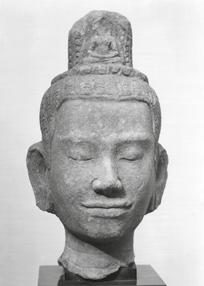
AUCTION RESULT COMPARISON
Type: Closely related
Auction: Christie’s New York, 25 September 2024, lot 554
Price: USD 56,700 or approx. EUR 50,000 converted and adjusted for inflation at the time of writing
Description: A grey sandstone bust of Buddha Shakyamuni, Thailand, Lopburi period, 13th century Expert remark: Compare the similar subject and expression.
Estimate EUR 15,000
Starting price EUR 7,500
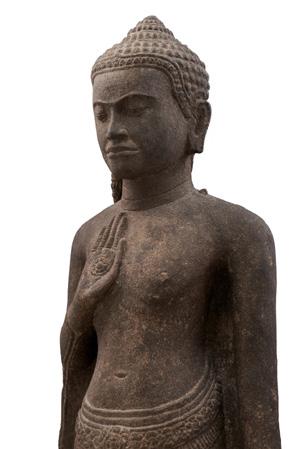
50 A LARGE SANDSTONE RELIEF OF AN APSARA, BAYON STYLE, ANGKOR PERIOD, LATE 12TH-13TH CENTURY
Exhibited:
1. Museum der Völker (formerly Haus der Völker, Museum für Kunst und Ethnographie), Schwaz, Tyrol, Austria, 2005-2010.
2. Museum der Völker (formerly Haus der Völker, Museum für Kunst und Ethnographie), Schwaz, Tyrol, Austria, Das Gedächtnis der Steine. Seltene Steinreliefs und Figuren aus Asien, 7 November 2015 – 1 May 2016.
Khmer Empire. The panel consists of three sections and is finely carved in low relief with an apsara standing tall with her hands clasped around the stems of long lotus stalks bearing buds. She is dressed in a long vertically striated sampot with a central fishtail pleat, secured by a charm-embellished belt. Her body is ornamented with fine jewelry, including a collar necklace, bracelets, armbands, earrings, and an ornate diadem. The serene face with narrow almond-shaped eyes with incised pupils, gently arched eyebrows, a broad nose, and full lips forming a gentle smile, all flanked by ears suspending pendulous earrings, all within an arched niche terminating in naga heads, with dense scrolling foliage to the spandrel.
Provenance: Collection of Gerhard Merzeder (b. 1963), internationally published and acclaimed fashion and portrait photographer, Vienna, Austria, assembled since the 1980s, acquired in Bangkok in the 1990s.
Condition: Very good condition, commensurate with age. Wear, obvious losses and cracks, small chips, old repairs with associated restorations, scattered nicks and scratches, signs of weathering and erosion, and encrustations.
Weight: 127 kg (incl. stand)
Dimensions: Height 119 cm (excl. stand), 129 cm (incl. stand)
Mounted on an associated stand. (2)
The present lot closely resembles the sandstone reliefs at a number of temples built by King Jayavarman VII during the late 12th and early 13th century. He was the first king devoted to Buddhism, and built the Bayon as a monument to Buddhism. Jayavarman VII is generally considered the most powerful of the Khmer monarchs by historians. His government built many projects including hospitals, roads, rest houses, and temples. With Buddhism as his motivation, King Jayavarman VII is credited with introducing a welfare state that served the physical and spiritual needs of the Khmer people.
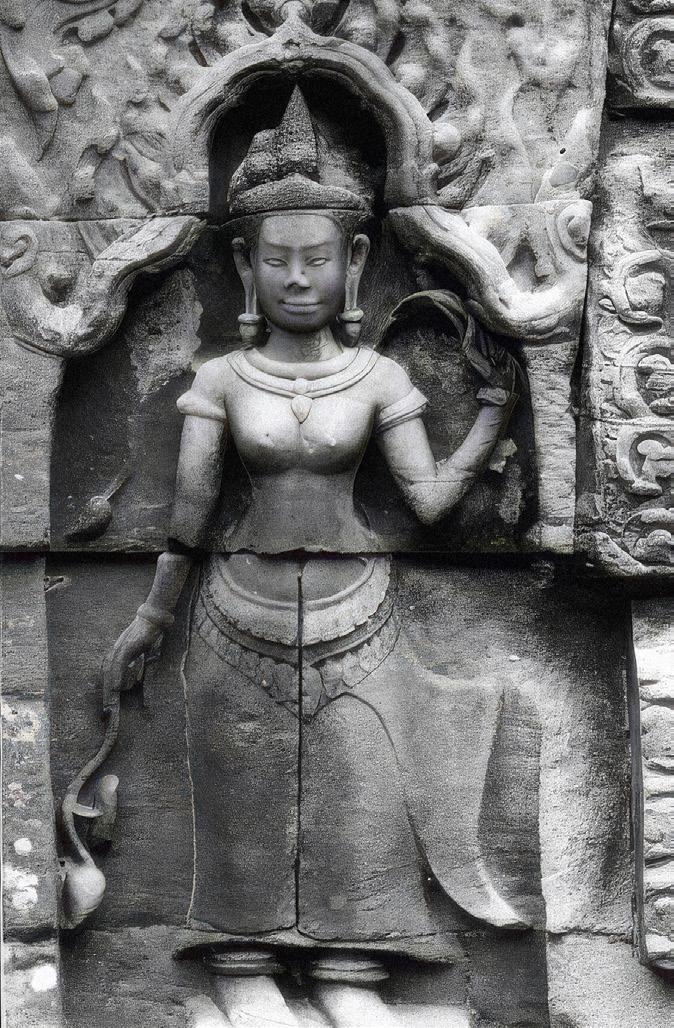
AUCTION RESULT COMPARISON
Type: Closely related
Auction: Christie’s Amsterdam, 31 October 2000, lot 179
Price: NLG 128,722 or approx. EUR 106,000 converted and adjusted for inflation at the time of writing
Description: A Khmer, Bayon style, sandstone stele of devata, 13th century
Expert remark: Compare the closely related modeling, sampot, scrolling vibes, and posture. Note the size (140 cm).
Estimate EUR 20,000
Starting price EUR 10,000
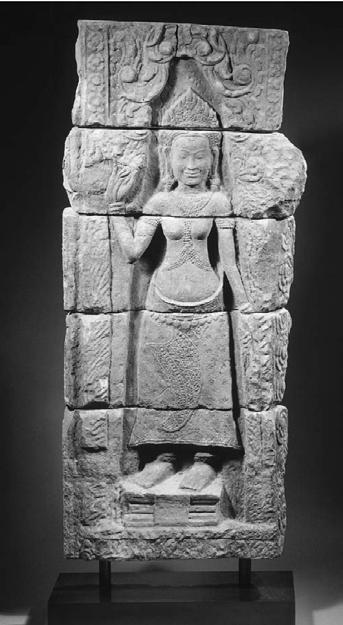
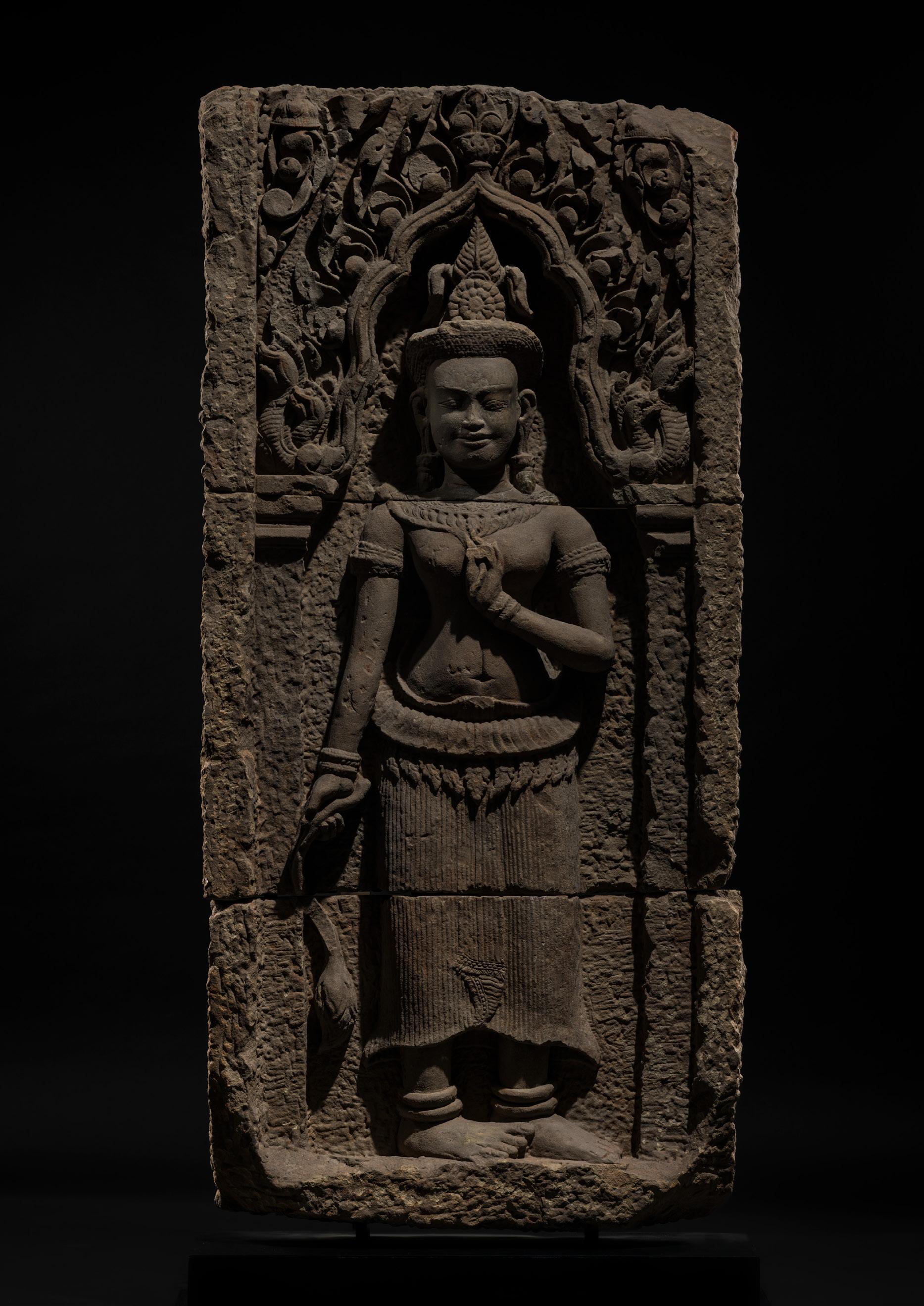
51 AN EXCEPTIONALLY WELL-PRESERVED SANDSTONE FIGURE OF BUDDHA MUCHALINDA, BAYON STYLE, LATE 12TH-EARLY 13TH CENTURY
Exhibited:
1. Museum der Völker (formerly Haus der Völker, Museum für Kunst und Ethnographie), Schwaz, Tyrol, Austria, 2005-2010.
2. Museum der Völker (formerly Haus der Völker, Museum für Kunst und Ethnographie), Schwaz, Tyrol, Austria, Das Gedächtnis der Steine. Seltene Steinreliefs und Figuren aus Asien, 7 November 2015 – 1 May 2016.
Khmer Empire. Powerfully sculpted, seated in dhyanasana on the scaled coils of Muchalinda, his hands lowered in dhyana mudra, dressed in a modest sampot secured at the waist with a knotted tie, the face with almond-shaped eyes in a benevolent expression, an aquiline nose, wide lips curled into a smile, framed by a neatly incised moustache and goatee, all flanked by elongated earlobes. The tight curly hair pulled into a conical chignon, backed by the seven-headed naga hood, their bodies decorated with sun wheels. The jewelry, scales, and head of the snake display delicate and remarkably wellpreserved incision work.
Provenance: Collection of Gerhard Merzeder (b. 1963), internationally published and acclaimed fashion and portrait photographer, Vienna, Austria, assembled since the 1980s, acquired in Bangkok in the 1980s.
Condition: Pristine condition, commensurate with age. Expected wear, small losses, few chips, some nibbling, scattered nicks and scratches, signs of weathering and erosion, and encrustations.
Weight: 65 kg (incl. stand)
Dimensions: Height 102 cm (excl. stand), 107 cm (incl. stand)
Mounted on an associated stand. (2)
Muchalinda is the name of a naga sheltering the Buddha from the elements after his enlightenment. When a storm raged and torrential rain fell for a whole week, the king of the nagas, Muchalinda, rose from the earth, coiling its body to form a seat and swelled its great hood to shelter Buddha. When the great storm had cleared, the serpent king assumed his human form, bowed before the Buddha, and returned to his palace. Seven-headed nagas are often depicted as guardian statues, carved as balustrades on causeways leading to main Cambodian temples, such as those found in Angkor Wat.
AUCTION RESULT COMPARISON
Type: Closely related
Auction: Christie’s Amsterdam, 18 October 2005, lot 148
Price: EUR 33,460 or approx. EUR 54,000 adjusted for inflation at the time of writing
Description: A Khmer, Bayon style, sandstone figure of Buddhamuchalinda, 13th century
Expert remark: Compare the closely related modeling, manner of carving, and subject. Note the smaller size (80 cm).
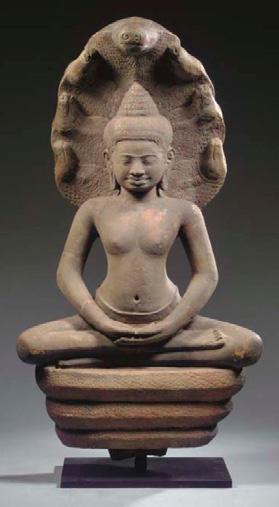
AUCTION RESULT COMPARISON
Type: Closely related
Auction: Christie’s Paris, 14 December 2016, lot 24
Price: EUR 242,500 or approx. EUR 293,000 adjusted for inflation at the time of writing
Description: An important sandstone figure of Buddhamuchalinda, Cambodia, Khmer, Bayon period, late 12th-early 13th century
Expert remark: Compare the closely related modeling, manner of carving, and subject. Note the larger size (147 cm).
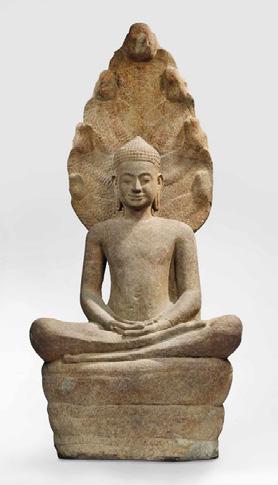
Estimate EUR 15,000
Starting price EUR 7,500
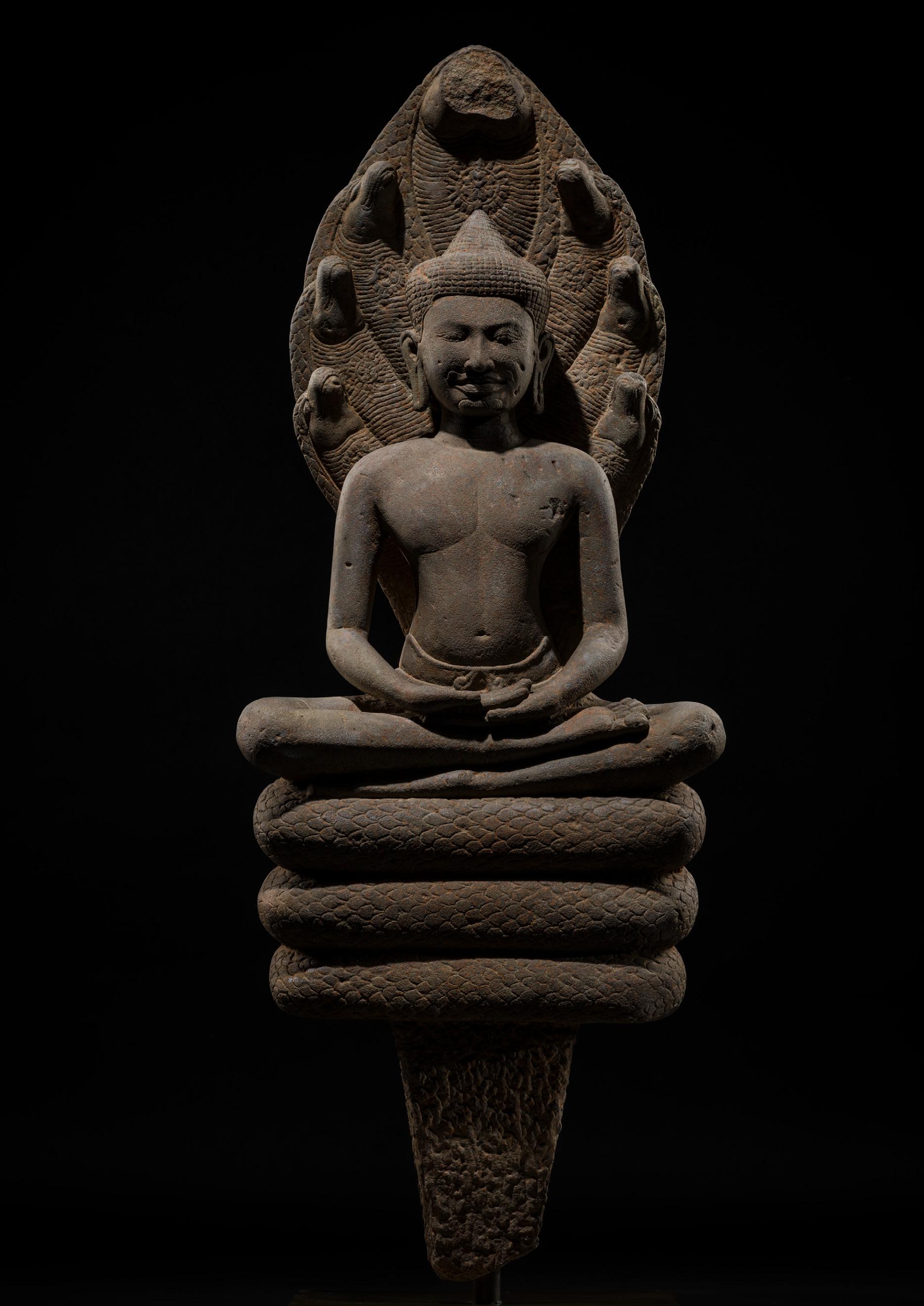
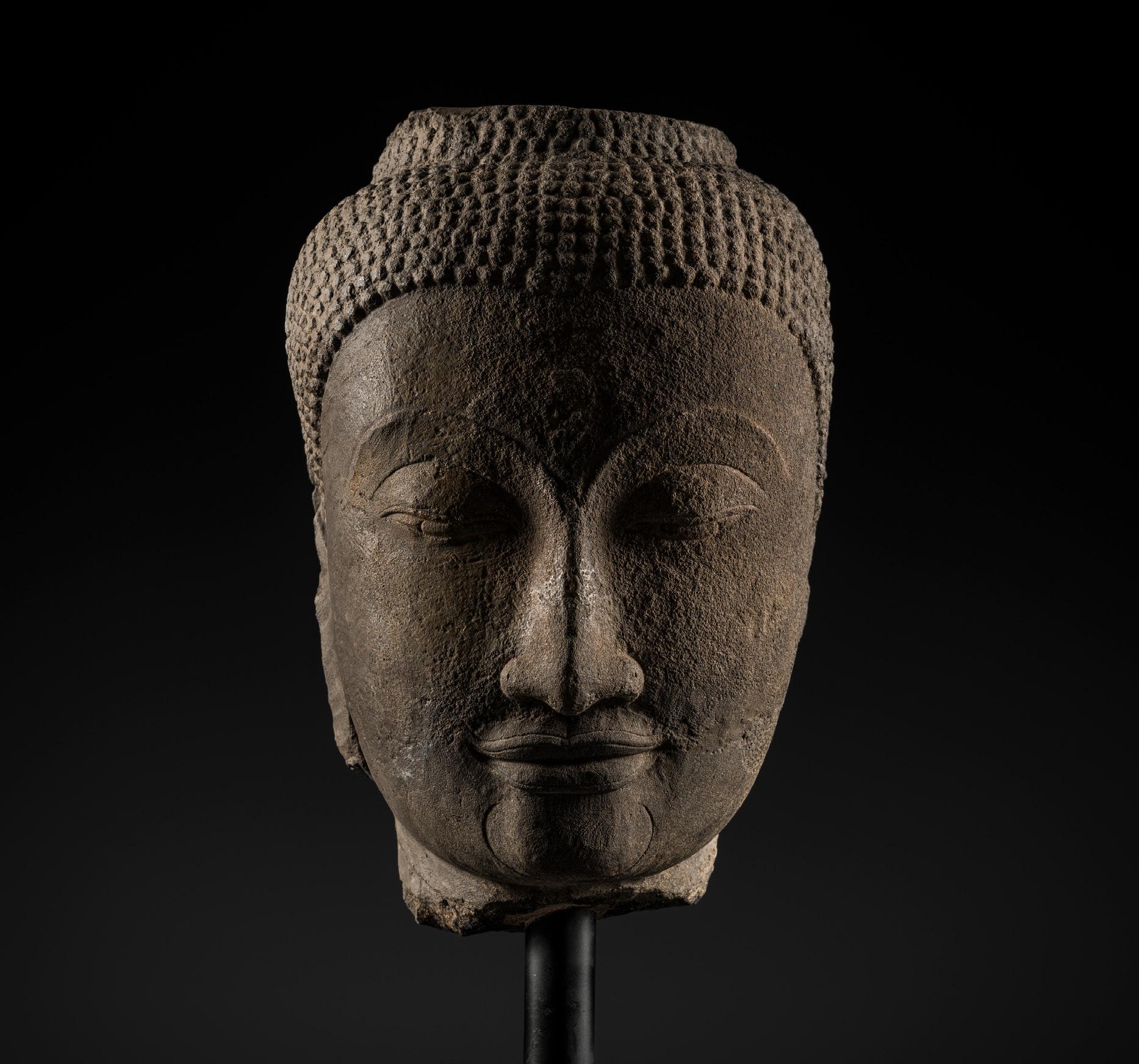
A SANDSTONE HEAD OF BUDDHA, EARLY AYUTTHAYA KINGDOM
Thailand, circa second half of 14th to 15th century. The exquisitely modeled face with a serene expression, deep heavy-lidded eyes, elegantly arched brows, and neatly incised lips beneath a subtly engraved mustache, all detailed with elegantly curved lines. The hair arranged in rows of tight curls over the high ushnisha.
Provenance: Bangkok art trade, 1980s. Collection of Gerhard Merzeder (b. 1963), internationally published and acclaimed fashion and portrait photographer, Vienna, Austria, assembled since the 1980s.
Condition: Very good condition with expected ancient wear, old fills and touchups, signs of weathering and erosion, soil encrustations, obvious losses, natural fissures and age cracks, remnants of black lacquer to the ushnisha, scattered nicks and scratches.
Weight: 24.9 kg (incl. stand)
Dimensions: Height 35.7 cm (excl. stand), 49.7 cm (incl. stand)
With a modern stand. (2)
The present Buddha head with its oval face and heart-shaped hairline, recalls the features of Sukhothai sculpture, whereas the small nubs of hair and nuanced grin are more characteristic of the Ayutthaya style.
AUCTION RESULT COMPARISON
Type: Closely related
Auction: Christie’s New York, 23 September 2004, lot 71
Price: USD 15,535 or approx. EUR 23,000 converted and adjusted for inflation at the time of writing
Description: A large sandstone head of Buddha, Thailand, 16th century Expert remark: Compare the similar modeling and manner of carving with similar eyes. Note the size (41.8 cm).
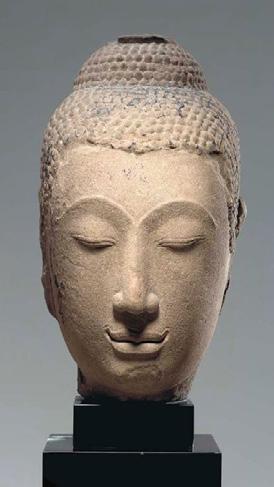
Estimate EUR 4,000
Starting price EUR 2,000
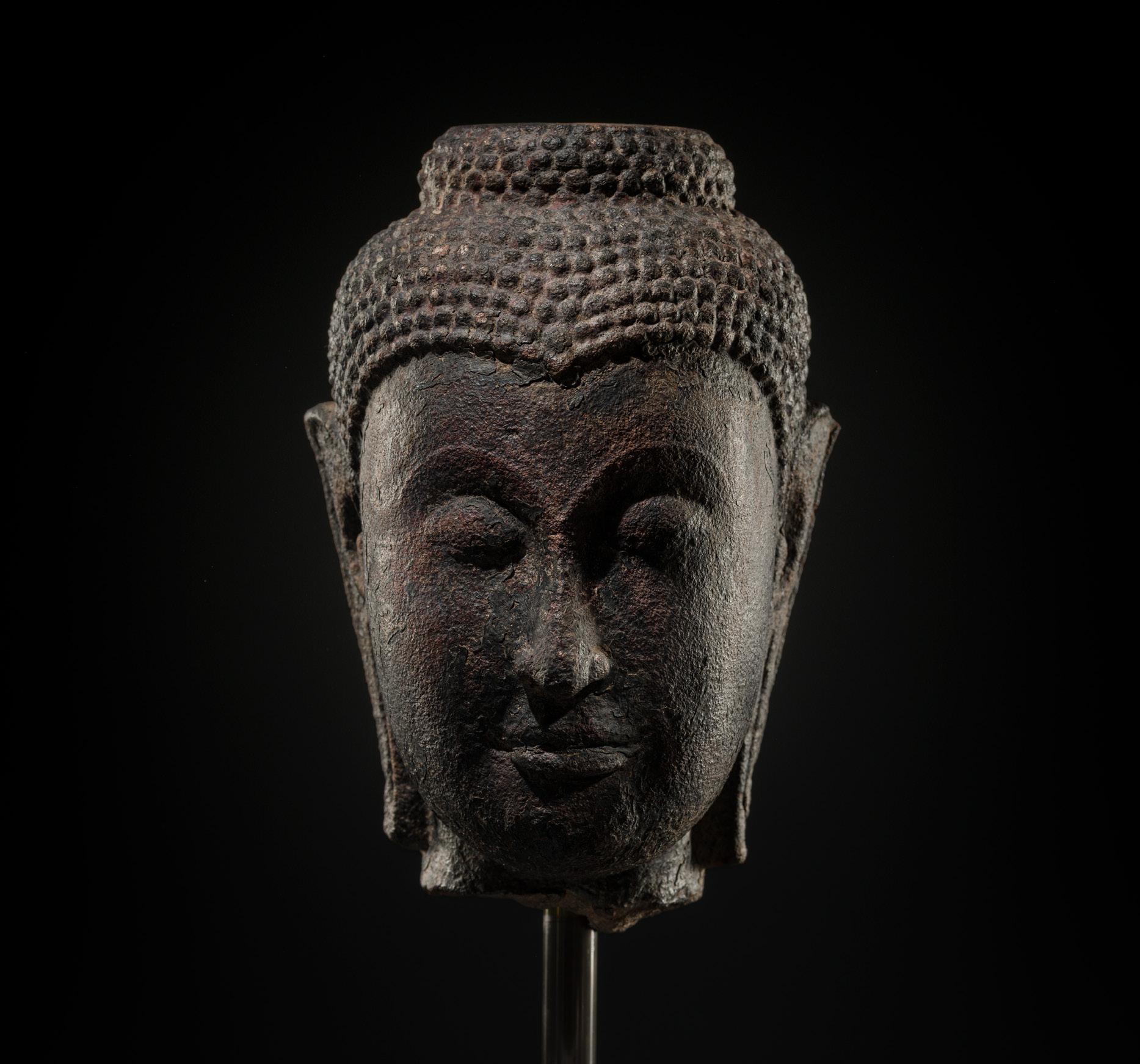
A LACQUERED SANDSTONE HEAD OF AVALOKITESHVARA, AYUTTHAYA, 16TH-17TH CENTURY
Exhibited:
Museum der Völker (formerly Haus der Völker, Museum für Kunst und Ethnographie), Schwaz, Tyrol, Austria, 2005-2010.
Thailand. Finely carved with a gentle expression, the heavy-lidded eyes framed by curved brows meeting at the center, straight nose, and lips forming a subtle smile, flanked by pierced earlobes, the hair arranged in neat rows of curls rising to the domed ushnisha with flat top.
Provenance: Bangkok art trade, 1990s. Museum der Völker (formerly Haus der Völker, Museum für Kunst und Ethnographie), Schwaz, Tyrol, Austria and subsequently de-accessed. Collection of Gerhard Merzeder (b. 1963), internationally published and acclaimed fashion and portrait photographer, Vienna, Austria, assembled since the 1980s.
Condition: Good condition with some wear. Signs of weathering and erosion, encrustations, obvious losses, chips, scattered nicks, fissures, small touchups and fills to the right ear, right corner of the mouth, and left cheek, and remnants of lacquer.
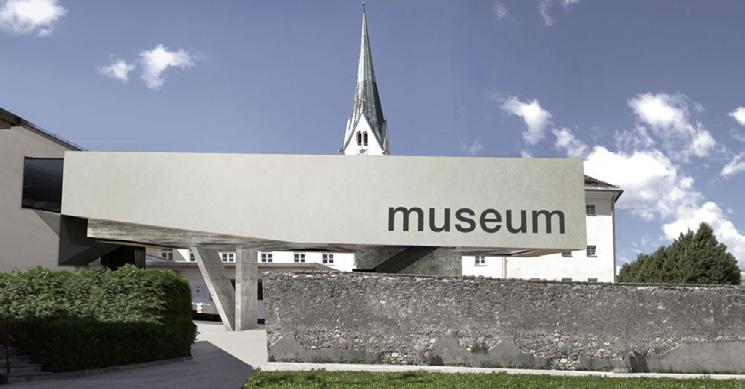
Museum der Völker (formerly Haus der Völker, Museum für Kunst und Ethnographie), Schwaz, Austria
Weight: 11.2 kg (incl. stand)
Dimensions: Height 26.5 cm (excl. stand), 38 cm (incl. stand)
With a modern stand. (2)
Estimate EUR 3,000
Starting price EUR 1,500
Exhibited:
Museum der Völker (formerly Haus der Völker, Museum für Kunst und Ethnographie), Schwaz, Tyrol, Austria, permanent exhibition, 20082012.
Thailand, circa 15th-16th century. The exquisitely modeled face bears a serene expression, with deep, heavy-lidded eyes, elegantly arched brows, and neatly incised lips beneath a subtly engraved mustache, all rendered with graceful, flowing lines. The hair is arranged in rows of tight curls over the domed ushnisha.
Provenance: Bangkok art trade, 1980s. Professor Gert Chesi, acquired from the above for the Museum der Völker (formerly Haus der Völker, Museum für Kunst und Ethnographie), Schwaz, Tyrol, Austria, and subsequently de-accessed. Collection of Gerhard Merzeder (b. 1963), internationally published and acclaimed fashion and portrait photographer, Vienna, Austria, assembled since the 1980s. Gert Chesi (b. 1940) is an Austrian photographer, author, and art collector. In 1995, Chesi founded the Museum der Völker (formerly Haus der Völker, Museum für Kunst und Ethnographie), Schwaz, Tyrol, Austria, a museum of art and ethnography whose collection consists mainly of objects acquired during Chesi’s travels through Africa and Asia.
Condition: Very good condition with expected old wear, signs of weathering and erosion, few soil encrustations, obvious losses, tiny chips, scattered nicks, and light scratches. The finial lost.
Weight: 54 kg
Dimensions: Height 48 cm (excl. stand), 64 cm (incl. stand)
With a modern stand. (2)
Between the later 14th and the 16th centuries, Thailand's Ayutthaya kingdom emerged as a dominant power in mainland Southeast Asia. Building on the artistic foundations laid by the Sukhothai, the Theravada Buddhist state sponsored the creation of Buddha images in a distinctive new style. These figures are characterized by curvilinear facial contours, with the hairline positioned lower, accentuating the sinuous brow line. The elongated ears, flared at both the upper and lower tips, and the eyes—three-quarters closed and extending evenly across the face—imbue the Buddha with a serene expression that is both introspective and subtly engaged with the world.
LITERATURE COMPARISON
Compare a related sandstone head of Buddha, 14th-15th century, in Hiram Woodward, The Sacred Sculpture of Thailand, 1997, p. 179, fig. 179. Compare a related stone head of Buddha, Ayutthaya Kingdom, 36.8 cm tall, in the Asian Art Museum of San Francisco, object number F2002.8.9 (fig. 1).
AUCTION RESULT COMPARISON
Type: Related
Auction: Christie’s New York, 22 March 2011, lot 251
Price: USD 56,250 or approx. EUR 70,000 converted and adjusted for inflation at the time of writing
Description: A large sandstone head of Buddha, Thailand, Ayutthaya, 14th15th century
Expert remark: Compare the similar modeling. manner of carving with similar features and expression, and size (47.5 cm).
Estimate EUR 6,000
Starting price EUR 3,000
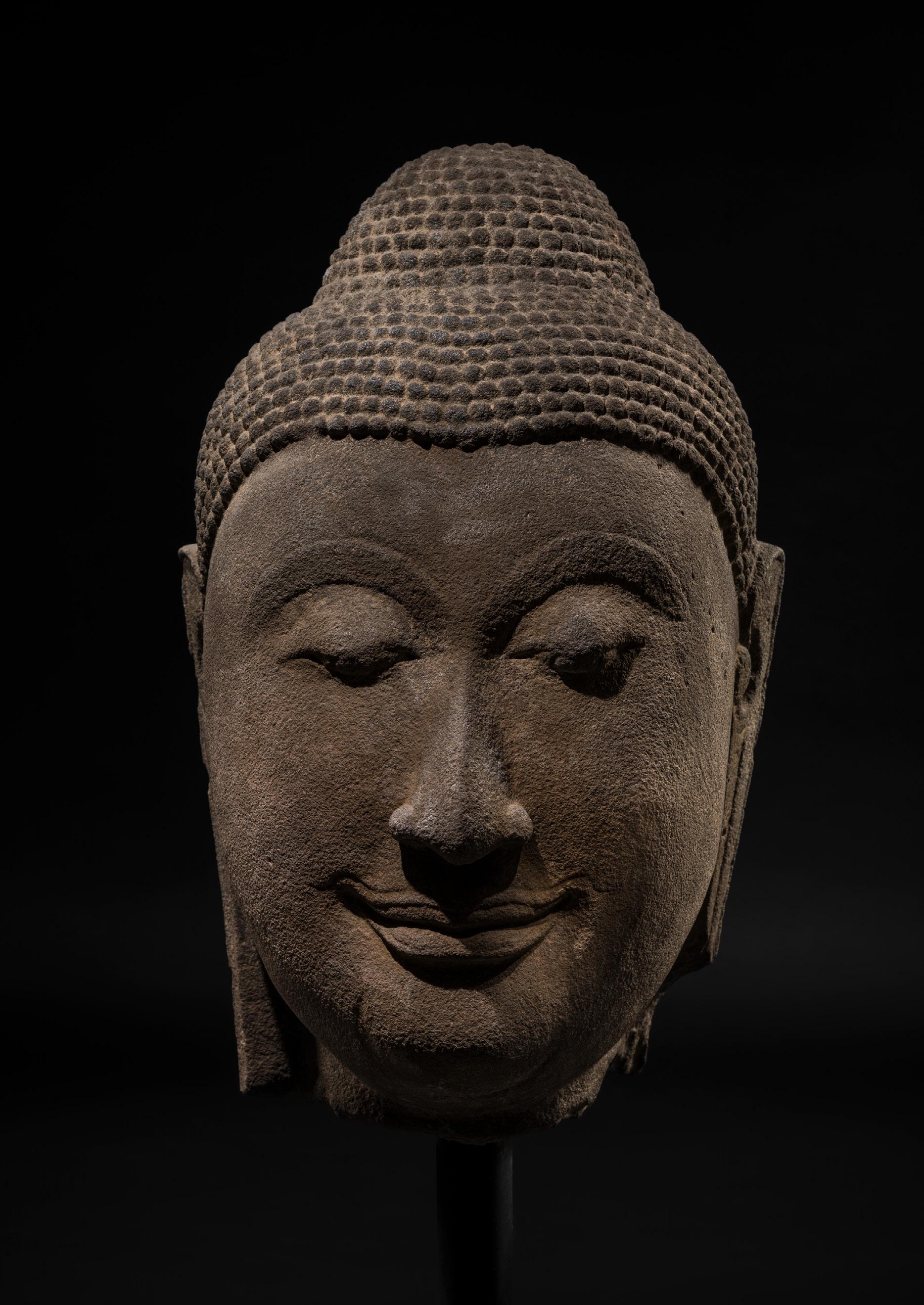
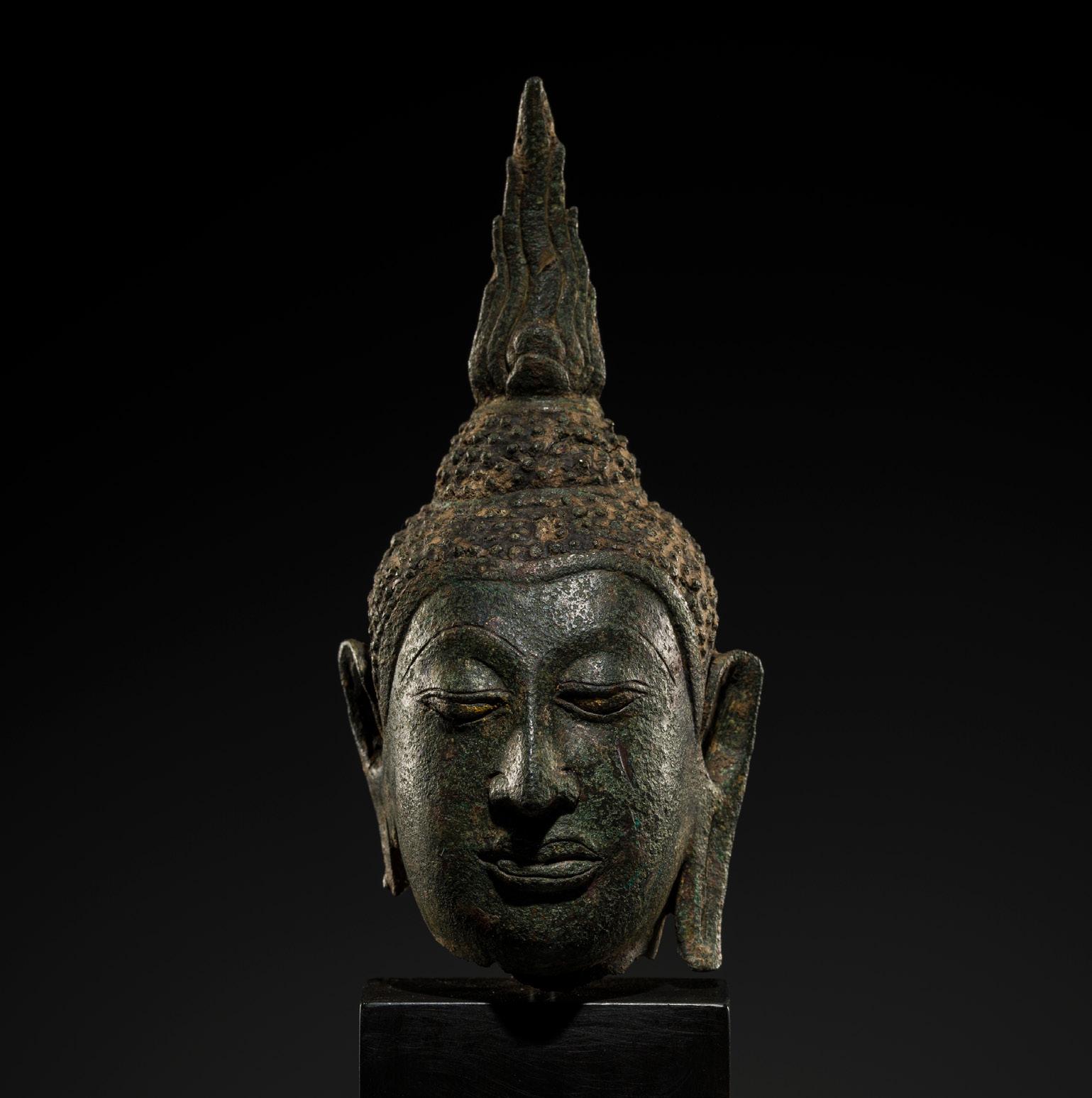
55 A SMALL BRONZE HEAD OF SHAKYAMUNI, SUKHOTHAI STYLE, AYUTTHAYA PERIOD
Thailand, circa 15th-16th century. Sensitively modeled and finely cast, the serene face with heavy-lidded downcast eyes, elegantly arched eyebrows, an aquiline nose, and slender bow-shaped lips forming a calm smile, flanked by long pendulous earlobes. The hair arranged in tight snail-shell curls over the domed ushnisha which is surmounted by a flame finial.
Provenance: German private collection. London art trade. Collection of Gerhard Merzeder (b. 1963), internationally published and acclaimed fashion and portrait photographer, Vienna, Austria, assembled since the 1980s.
Condition: Good condition commensurate with age, showing extensive wear and casting irregularities, obvious losses, small nicks, light scratches, few cracks, traces of weathering and erosion, remnants of gilt and lacquer, soil encrustations, and few fills to the back. The bronze with an exceptionally nice, naturally grown patina, showing distinct malachite encrustations.
Weight: 478 g (incl. stand)
Dimensions: Height 15.3 cm (excl. stand), 23.7 cm (incl. stand)
The spiritual transcendence of Buddha Shakyamuni has been well captured by the artist. In deep meditation with his eyes half-closed, the Buddha shows great serenity. The tip of the nose slightly pointed downwards and up-curling extended earlobes place this head firmly in the Sukhothai tradition.
During the 14th through 16th centuries, Thailand's Ayutthaya kingdom became one of the most powerful forces on mainland Southeast Asia. Continuing the artistic trajectory set forth under the Sukhothai, the Theravada polity sponsored the production of Buddha images fashioned in a new distinct style. The faces display a curvilinear contour with the hairline lower towards the sinuous browline accentuated by elongated ears flared at upper and lower tips. The eyes, extending evenly across the width of the face, are three-quarters closed to endow the figure with a sense of serenity that is at once inwardly directed and also engaged with the world.
Literature comparison:
Compare a closely related cast bronze head of Buddha, Thailand, Sukhothai style, dated 15th-16th century, 13.4 cm tall, in the British Museum, museum number 1952,1215.5.
Estimate EUR 1,000
Starting price EUR 500
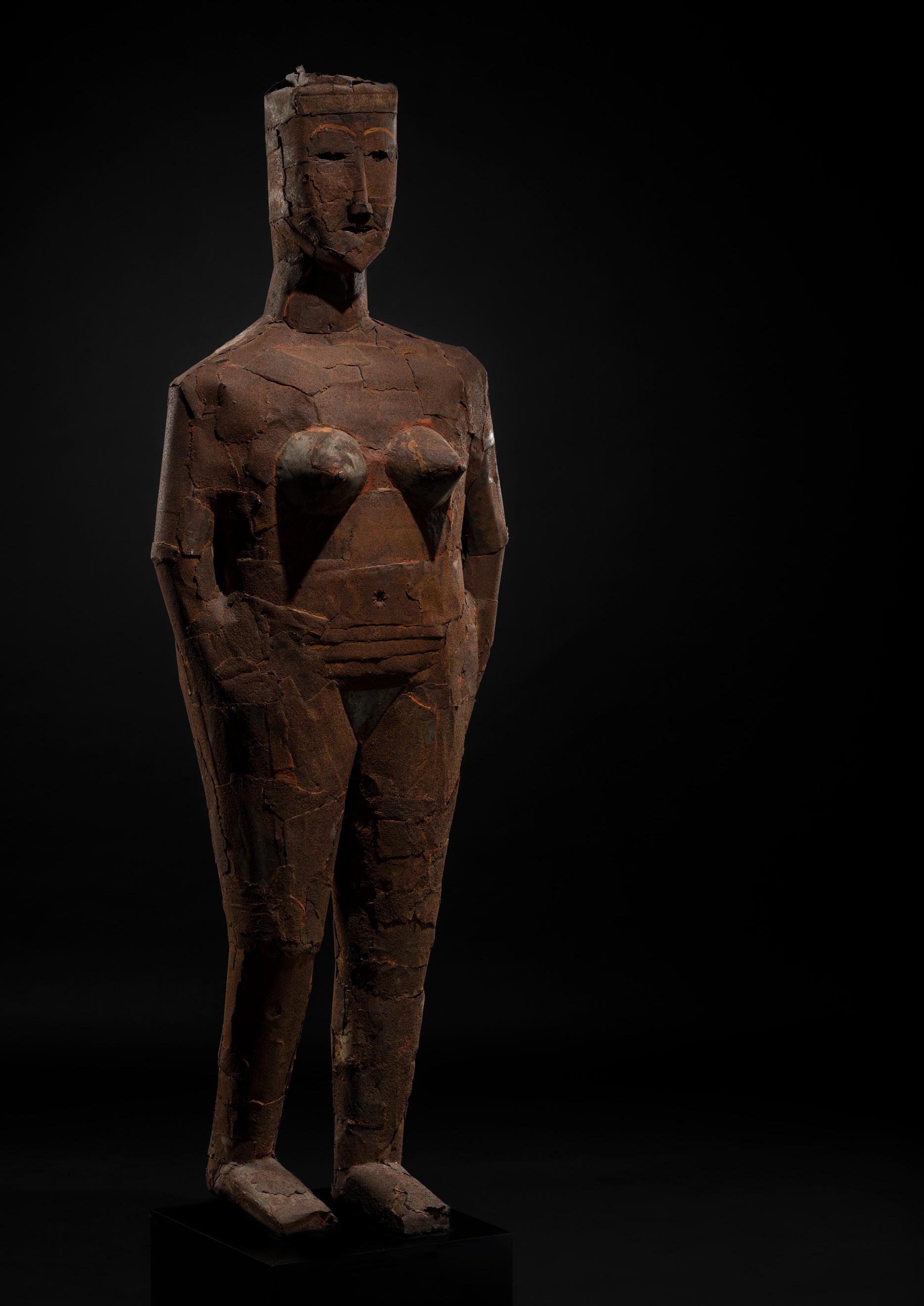
56
A MODERN IRON SCULPTURE OF A LADY, BY THANONG CHANTAVEE, 1998
Thailand. Finely worked of individual iron sheets joined together to form a tall standing lady with prominent, conical breasts, her hands converging to her hip, the face detailed with almond-shaped eyes below gently arched brows and open mouth.
Provenance: Lek Gallery, Bangkok, Thailand. Collection of Gerhard Merzeder (b. 1963), internationally published and acclaimed fashion and portrait photographer, Vienna, Austria, assembled since the 1980s.
Condition: Very good condition with minor wear, overall corrosion, few dents, and scattered small losses.
Weight: 38 kg (incl. stand)
Dimensions: Height 141 cm (excl. stand), 156.5 cm (incl. stand)
Fitted to a modern stand. (2)
Estimate EUR 1,000
Starting price EUR 500
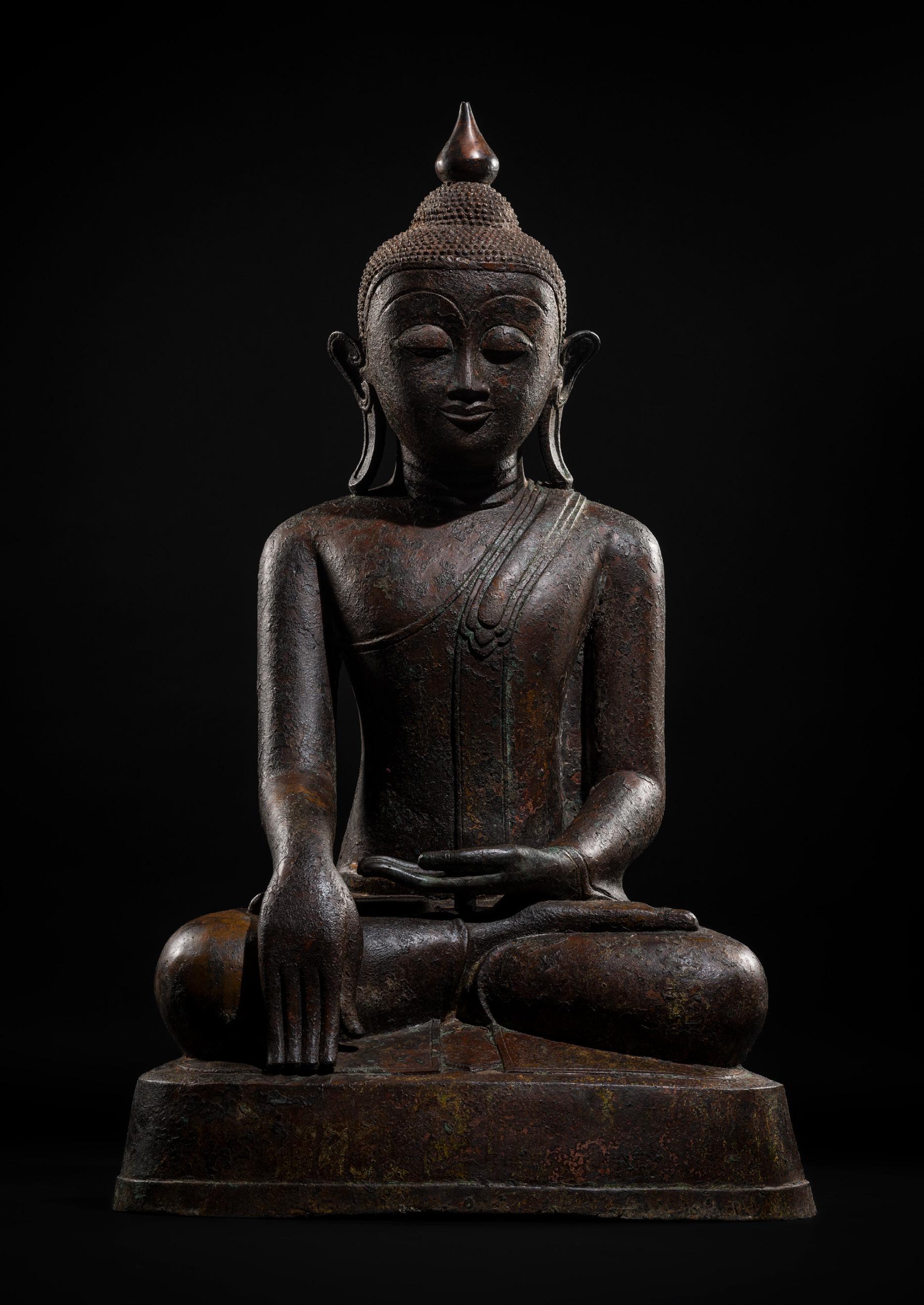
57
Exhibited:
Museum der Völker (formerly Haus der Völker, Museum für Kunst und Ethnographie), Schwaz, Tyrol, Austria, permanent exhibition, 2008-2012.
Scientific Analysis Report:
An old TL test, dating from 30 June 2008, sets the firing date of the samples taken between 400 (+-35%) years ago. A copy accompanies this lot.
Burma. Seated in vajrasana on a tapering plinth, his right hand in bhumisparsha mudra, the left resting on his lap, wearing a samghati, his face with a meditative expression, arched eyebrows above downcast eyes, the face flanked by elongated earlobes issuing from C-form ears, framed by a curled hair dress and ushnisha, and surmounted by a bud-shaped finial. The back fitted with a metal loop.
Provenance: Swiss private collection. Collection of Gerhard Merzeder (b. 1963), internationally published and acclaimed fashion and portrait photographer, Vienna, Austria, assembled since the 1980s.
Condition: Good condition with expected old wear. Signs of weathering and erosion, corrosion, remnants of lacquer, few malachite encrustations, tiny nicks, small dents, and minor losses. The bronze with a rich patina.
EXTERNAL EXPERT AUTHENTICATION
Koller Auktionen, Zurich, 31 October 2012, lot 571 (mid-estimate CHF 30,000 or approx. EUR 34,000 converted and adjusted for inflation at the time of writing).
Weight: 75 kg
Dimensions: Height 99 cm
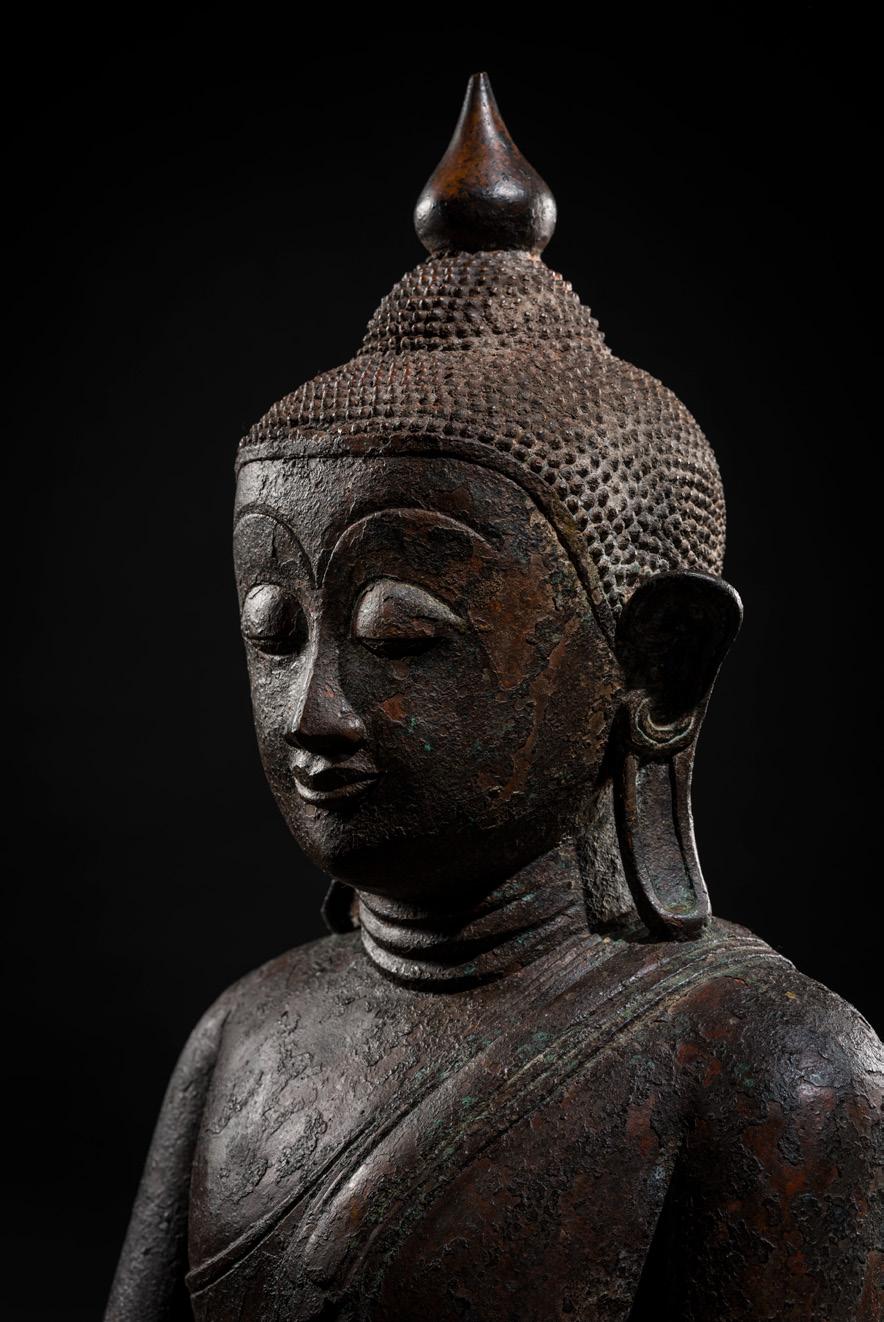
AUCTION RESULT COMPARISON
Type: Related
Auction: Christie’s Amsterdam, 31 October 2006, lot 546
Price: EUR 15,600 or approx. EUR 25,000 adjusted for inflation at the time of writing
Description: A Burmese bronze figure of Buddha Sakyamuni, 17th/18th century
Expert remark: Compare the similar modeling, expression, and pose. Note the much smaller size (68 cm).
AUCTION RESULT COMPARISON
Type: Related
Auction: Christie’s Amsterdam, 18 October 2005, lot 118
Price: EUR 11,950 or approx. EUR 21,000 adjusted for inflation at the time of writing
Description: A Burmese, Shan style, bronze figure of Buddha Sakyamuni, 17th century
Expert remark: Compare the similar modeling, expression, and size (92 cm).
Estimate EUR 8,000
Starting price EUR 4,000
Published:
Museum der Völker (formerly Haus der Völker, Museum für Kunst und Ethnographie), Schwaz, Tyrol, Austria, A4 -Magazin für Aussereuropäische Kunst und Kultur, Burma: Die umstrittene Kunst Asiens, 2012, p. 4.
Exhibited:
Museum der Völker (formerly Haus der Völker, Museum für Kunst und Ethnographie), Schwaz, Tyrol, Austria, 2012-2015.
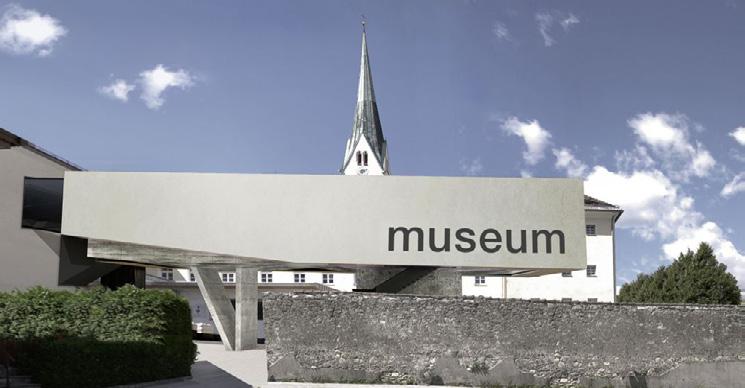
Finely carved, the serene face modeled with a meditative expression marked by downcast eyes with neatly incised heavy lids and elegantly arched brows, the pupils and brows painted in black pigment, his red slender bow-shaped lips forming a calm smile, flanked by elongated earlobes, the black hair left plain over the ushnisha surmounted by a tall gilt-lacquered bud-form finial.
Provenance: A private collection in Switzerland, acquired in Bangkok, Thailand before 1980. Collection of Gerhard Merzeder (b. 1963), internationally published and acclaimed fashion and portrait photographer, Vienna, Austria, assembled since the 1980s. Condition: Overall very good condition with expected wear, obvious losses, light scratches, few small chips, remnants of gilt and pigments, flaking and losses to lacquer. The stone with a fine, naturally grown, smooth patina.
EXTERNAL EXPERT AUTHENTICATION
Koller, Zurich, 30-31 October 2012, lot 570 (mid-estimate CHF 25,000 or approx. EUR 38,500 converted and adjusted for inflation at the time of writing).
Weight: 61.6 kg (incl. stand)
Dimensions: Height 57 cm (excl. stand), 84 cm (incl. stand)
Mounted on an associated stand. (2)
The founding of Shan States inside the present-day boundaries of Burma began during the Pagan Kingdom in the Shan Hills and accelerated after 1287 when the Kingdom fell to the Mongols. The Tai people, who came south with the Mongols, stayed, and quickly came to dominate much of the northeastern arc of Burma. The newly founded Shan States were multiethnic and included minorities such as the Chin, the Kachin, the Wa, the Ta'ang, the Lisu, the Lahu, the Pa O, and the Kayah. Although Burmanized Shans founded the Ava Kingdom that ruled central Burma, other Shan States, Mohnyin in particular, constantly raided Ava territories throughout the years. A Mohnyin-led Confederation of Shan States finally conquered Ava in 1527.
In 1555, King Bayinnaung dislodged Shan king Sithu Kyawhtin from Ava. By 1557 he went on to conquer all of what would become known as the Burmese Shan States under his rule, from the Assamese border in the northwest to those in Kachin and Shan Hills, including the two most powerful Shan States, Mohnyin and Mogaung. The Shan States were reduced to the status of governorships, but the Saophas (rulers) were permitted to retain their royal regalia and their feudal rights over their own subjects. Bayinnaung introduced Burmese customary law and prohibited all human and animal sacrifices. He also required the sons of Saophas to reside in the Burmese king's palace, essentially hostages, in order to ensure the good conduct of their fathers and to receive training in Burmese court life.
Within this layered political arrangement, the distinct Shan style of Buddhist art emerged: a localized sculptural idiom shaped by Tai traditions, courtly patronage, and cross-regional influences, including Mon, Burmese, and Lanna aesthetics. Though not coterminous with the Shan States themselves, Shan style sculpture flourished within their territories, often serving as expressions of religious devotion, regional identity, and elite legitimacy under shifting regimes of power.
Estimate EUR 4,000
Starting price EUR 2,000
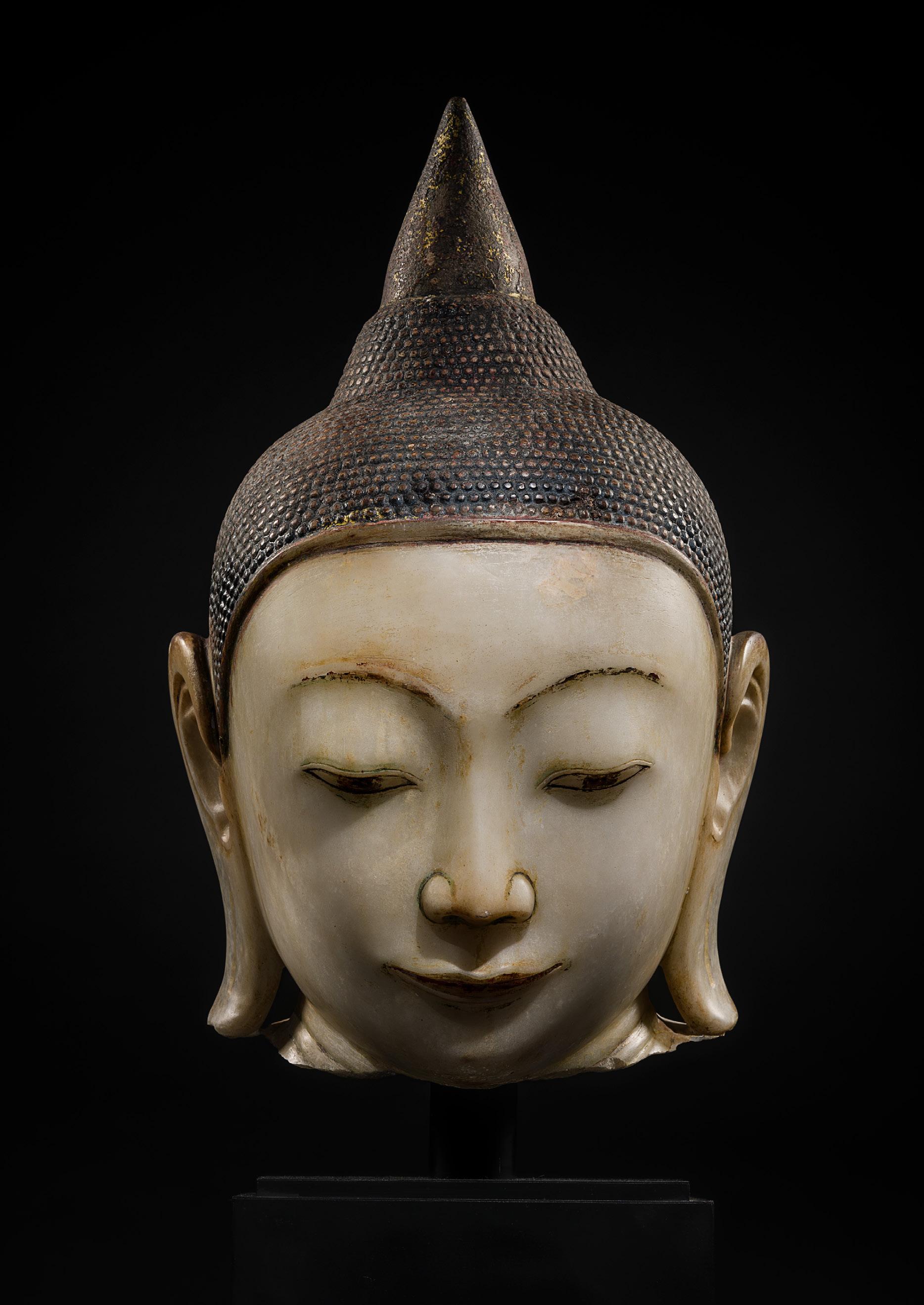
59
A LARGE TERRACOTTA FEMALE CUCHIMILCO FIGURE, CHANCAY CULTURE, CENTRAL COASTAL PERU, 12TH-14TH CENTURY
Exhibited:
Museum der Völker (formerly Haus der Völker, Museum für Kunst und Ethnographie), Schwaz, Tyrol, Austria, Totenkulte und Jenseitsglaube, 13 September 2009 – 3 January 2010.
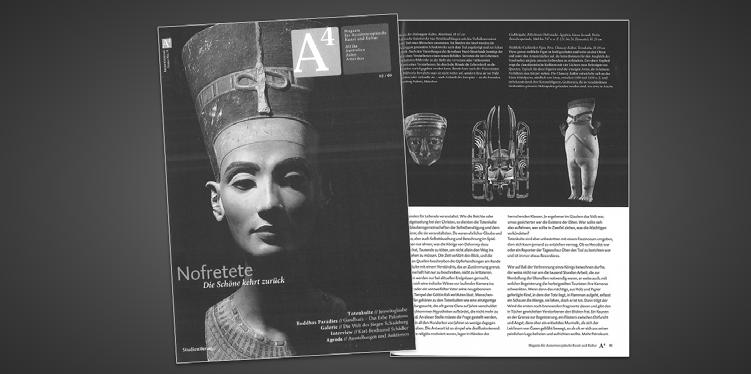
PUBLISHED
Museum der Völker (formerly Haus der Völker, Museum für Kunst und Ethnographie), Schwaz, Tyrol, Austria, A4 -Magazin für Aussereuropäische Kunst und Kultur, Nofretete. Die Schöne kehrt zurück, Studien Verlag, issue no. 9, February 2009, p. 85.
Scientific Analysis Report:
An old TL test, dating from 18 December 1989, sets the firing date to ca. 600 years ago, consistent with the dating above. A copy accompanies this lot.
The hollowed figure pierced through the ears and below the arms, the head surmounted by a wedge-form cap painted in black with a geometric border and pierced on top with four apertures to suspend tassels or feathers, the face detailed with close-set eyes, nose and mouth, and adorned with diagonal lines and geometric bands. The sturdy figure extending short hands accentuated in black typical for Chancay terracottas, protruding nipples and genitalia, and wellmodeled feet, all covered in a creme-colored slip.
Art Loss Register:
Certificate reference number S00266435 from 9 January 2026. A copy of this document accompanies this lot.
Provenance: A German private collection, before 1989. Galerie Cécile Kerner, Brussels. Gert Chesi, acquired from the above for the Museum der Völker (formerly Haus der Völker, Museum für Kunst und Ethnographie), Schwaz, Tyrol, Austria, and subsequently de-accessed. Collection of Gerhard Merzeder (b. 1963), internationally published and acclaimed fashion and portrait photographer, Vienna, Austria, assembled since the 1980s. Galerie Cécile Kerner was opened in 1973 and is a Brussels-based gallery specializing in tribal jewelry, African art, antiquities, Pre-Columbian and oriental art. Gert Chesi (b. 1940) is an Austrian photographer, author, and art collector. In 1995, Chesi founded the Museum der Völker (formerly Haus der Völker, Museum für Kunst und Ethnographie), Schwaz, Tyrol, Austria, a museum of art and ethnography whose collection consists mainly of objects acquired during Chesi’s travels through Africa and Asia.
Condition: Good condition with expected old wear, signs of weathering and erosion, traces of prolonged burial, with old repairs and touchups to the extremities and head, natural cracks, and two holes drilled for sample-taking to the back of the head and foot.
Weight: 4.3 kg (excl. stand), 5.5 kg (incl. stand)
Dimensions: Height 62 cm (excl. stand), 64.7 cm (incl. stand)
With a modern stand. (2)
Expert’s note:
Chancay slip painting on pottery appears to have been done quickly, as the black often drips outside of the borders of the design. On this ceramic, spots of black paint are visible on the back of the hat.
Between the fall of the Wari Empire and the rise of the Inca, regional cultures of the Central Andes developed their own artistic identities. Among them, the Chancay of coastal Peru (1000–1475 CE) produced a distinctive ceramic tradition known for its comparatively large vessels and figures.
This molded and painted female figure, often called a cuchimilco, is decorated in black over a white slip. Unlike other contemporary Andean ceramics, its surface is slightly rough, as it was not burnished before firing. Cuchimilcos feature short outstretched hands without arms, prominent genitalia and navels, and sturdy feet that allow them to stand, suggesting they were displayed before being placed in tombs. The radiating motifs around the eyes and beneath the chin likely reference body paint or tattoos, suggesting that body art was common at the time.
LITERATURE COMPARISON
Compare a closely related ceramic female figure, Chancay culture, dated 12th-14th century, 63.5 cm tall, in the Metropolitan Museum of Art, object number 1979.206.933 (fig. 1). Compare a closely related painted pottery Cuchimilco figure, Chancay culture, dated 1000-1470, 64.7 cm tall, in the National Museum of the American Indian, Smithsonian Institution, catalog number 24/9499.
AUCTION RESULT COMPARISON
Type: Related
Auction: Sotheby’s Paris, 22 March 2013, lot 84
Price: EUR 15,625 or approx. EUR 19,000 adjusted for inflation at the time of writing
Description: A Cuchimilco, feminine figure, Chancay culture, Peru, 1200-1400 AD
Expert remark: Compare the closely related form, pose, slip-colored details, and size (65 cm).
Estimate EUR 6,000
Starting price EUR 3,000
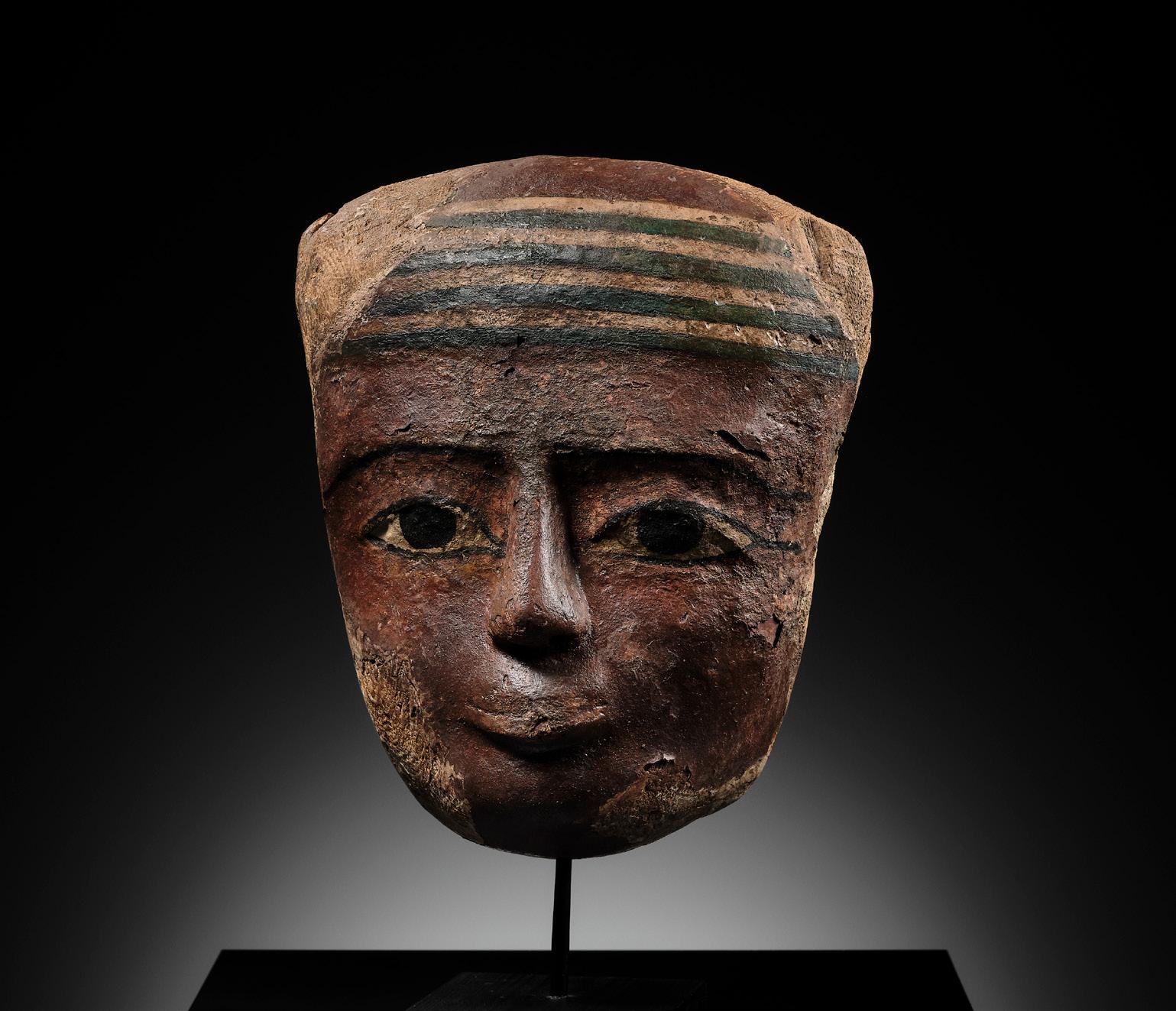
60
A PAINTED CARTONNAGE MUMMY MASK, THIRD INTERMEDIATE PERIOD
Exhibited:
Museum der Völker (formerly Haus der Völker, Museum für Kunst und Ethnographie), Schwaz, Tyrol, Austria, Totenkulte und Jenseitsglaube, 13 September 2009 – 3 January 2010.
Egypt, circa 1070–664 BC. The wide eyes with a thick outline and sharply pointed cosmetic lines extending out towards the temple, below slightly arched brows molded in relief, all above fine lips curved into a tight smile. The head covered by a striated wig set low on the forehead.
Provenance: A private collection in Italy, before 1980. Pierre Bergé & Associés, Paris, France, 17 January 2009, lot 159. Anubis Ancient Art, Brüssel, 2009. Collection of Gerhard Merzeder (b. 1963), internationally published and acclaimed fashion and portrait photographer, Vienna, Austria, assembled since the 1980s, acquired from the above. A copy of an invoice from Anubis Ancient Art, Belgium, dated 7 June 2009, addressed to Gerhard Merzeder, confirming the dating and provenance above, and stating a purchase price for EUR 2,800 or approx. EUR 4,200 (adjusted for inflation at the time of writing), accompanies this lot.
Condition: Good condition with expected wear, commensurate with age. Obvious losses, natural imperfections including splits and splinters, rubbing and flaking to pigment and gesso—some with associated touchups, small chips, expected weathering, encrustations, and soiling.
Weight: 1,020.8 g
Dimensions: Height 25.7 cm (excl. stand), 32.2 cm (incl. stand)
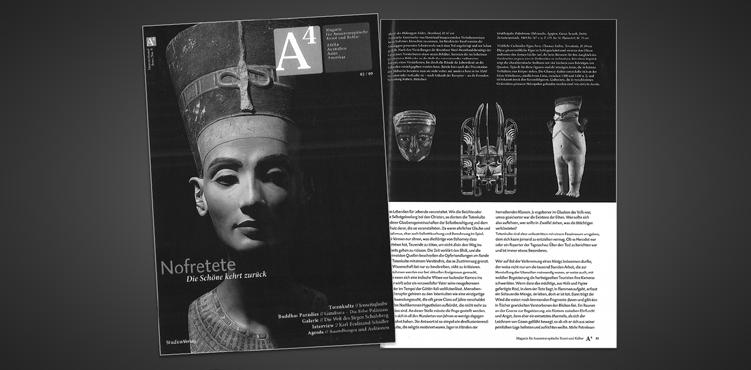
PUBLISHED
Museum der Völker (formerly Haus der Völker, Museum für Kunst und Ethnographie), Schwaz, Tyrol, Austria, A4 -Magazin für Aussereuropäische Kunst und Kultur, Afrika. Australien. Asien. Amerikas, 2009, p. 85.
AUCTION RESULT COMPARISON
Type: Closely related
Auction: Sotheby’s London, 21 September 2021, lot 69
Price: GBP 5,670 or approx. EUR 8,500 converted and adjusted for inflation at the time of writing
Description: Egypt, Third Intermediate Period, 22nd Dynasty, 945-735 B.C., Funerary Mask
Expert remark: Compare the closely related modeling and similar facial features. Note the size (19 cm).
Estimate EUR 1,000
Starting price EUR 500
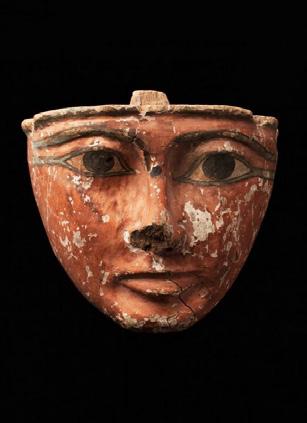
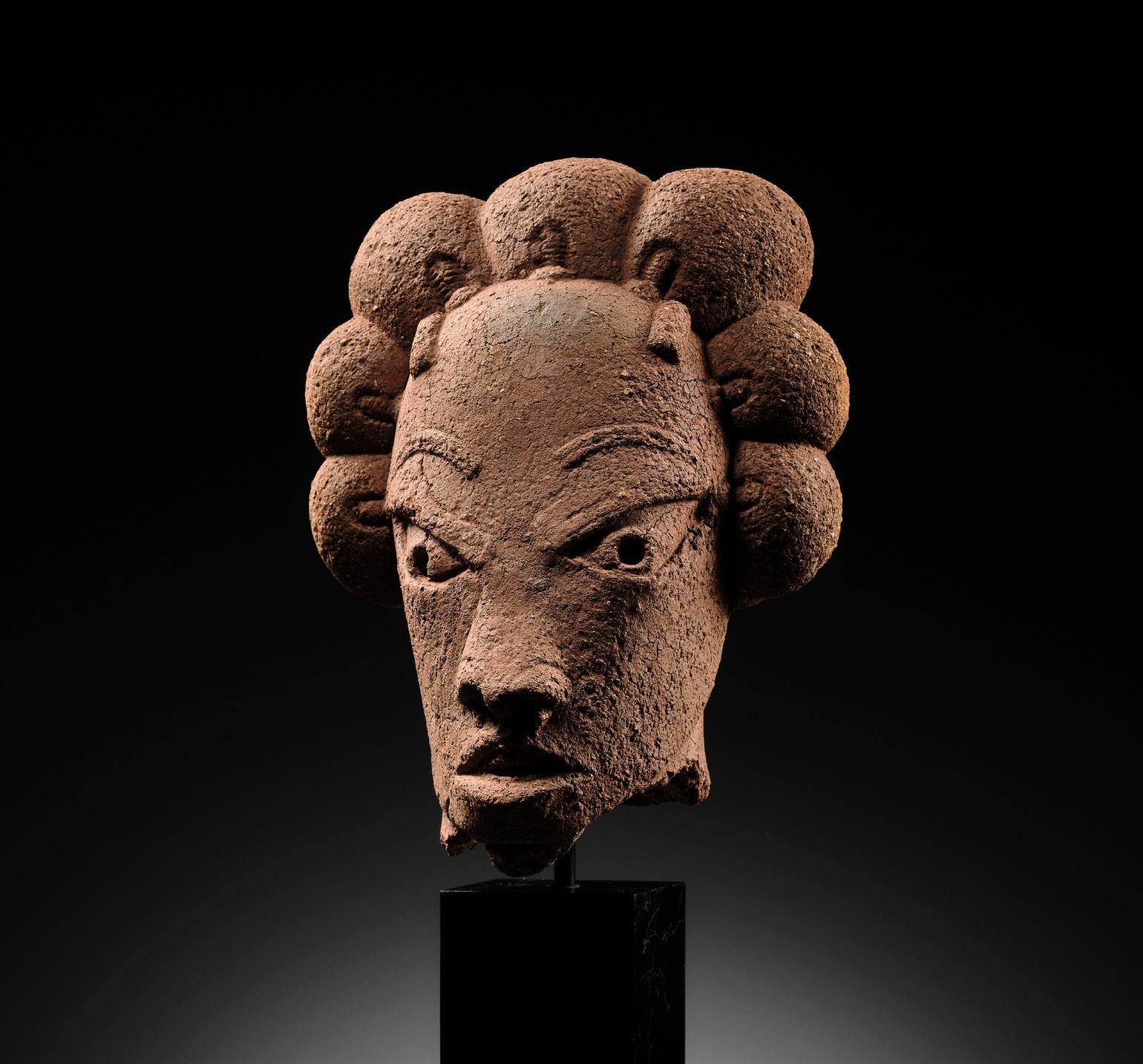
A CHARMING TERRACOTTA HEAD OF A WOMAN, NOK CULTURE, NIGERIA, 500 BC – 200 AD
Exhibited:
1. Kunsthalle Krems, Afrika-Kopfskulpturen, Krems an der Donau, 26 July 1998 – 18 October 1998.
2. Museum der Völker (formerly Haus der Völker, Museum für Kunst und Ethnographie), Schwaz, Tyrol, Austria, NOK-2500 Jahre Hochkultur in Afrika, 19 May - 30 August 2006
3. Bergbau Museum, Afrika Ethno-Kunst, Klagenfurt, 1997
Scientific Analysis Report:
An old TL test, dating from 14 January 1997, sets the firing date to ca. 2000 years ago, consistent with the dating above. A copy accompanies this lot.
The hollowed head with an oblong face, set with a pair of triangular eyes centered by deep-set pupils below bow-shaped eyebrows, open mouth revealing teeth and framed by pouting lips, her nose pierced with a nose ring, the face flanked by two slits forming the ears, and the tall forehead surmounted by an elaborate coiffure consisting of three rows of large hemispheres.
Provenance: Galerie Walu, Zurich, 1994. Collection of Gerhard Merzeder (b. 1963), internationally published and acclaimed fashion and portrait photographer, Vienna, Austria, assembled since the 1980s. Condition: Very good condition with expected old wear, signs of weathering and erosion, few natural cracks, obvious losses, possibly with small touchups to the hair, and two holes drilled for sample-taking to the back of the head and the neck.
PUBLISHED
1. Kristian Fenzl and Armand Duchâteau, Afrika-Kopfskulpturen, 1998, Kunsthalle Krems, Krems an der Donau, p. 71, Tafel 37.
2. Kristian Fenzl and Armand Duchâteau, Afrika Ethno-Kunst, 1997, Bergbau Museum Klagenfurt, p. 65, no. 51.
Weight: 3.3 kg (excl. stand)
Dimensions: Height 22 cm (excl. stand)
With a modern stand. (2)
LITERATURE COMPARISON
Compare a related terracotta head, Nok culture, 1000 BC – 300 AD, 24.8 cm tall, in the Minneapolis Institute of Art, accession number 2002.27.16.
Estimate EUR 3,000
Starting price EUR 1,500
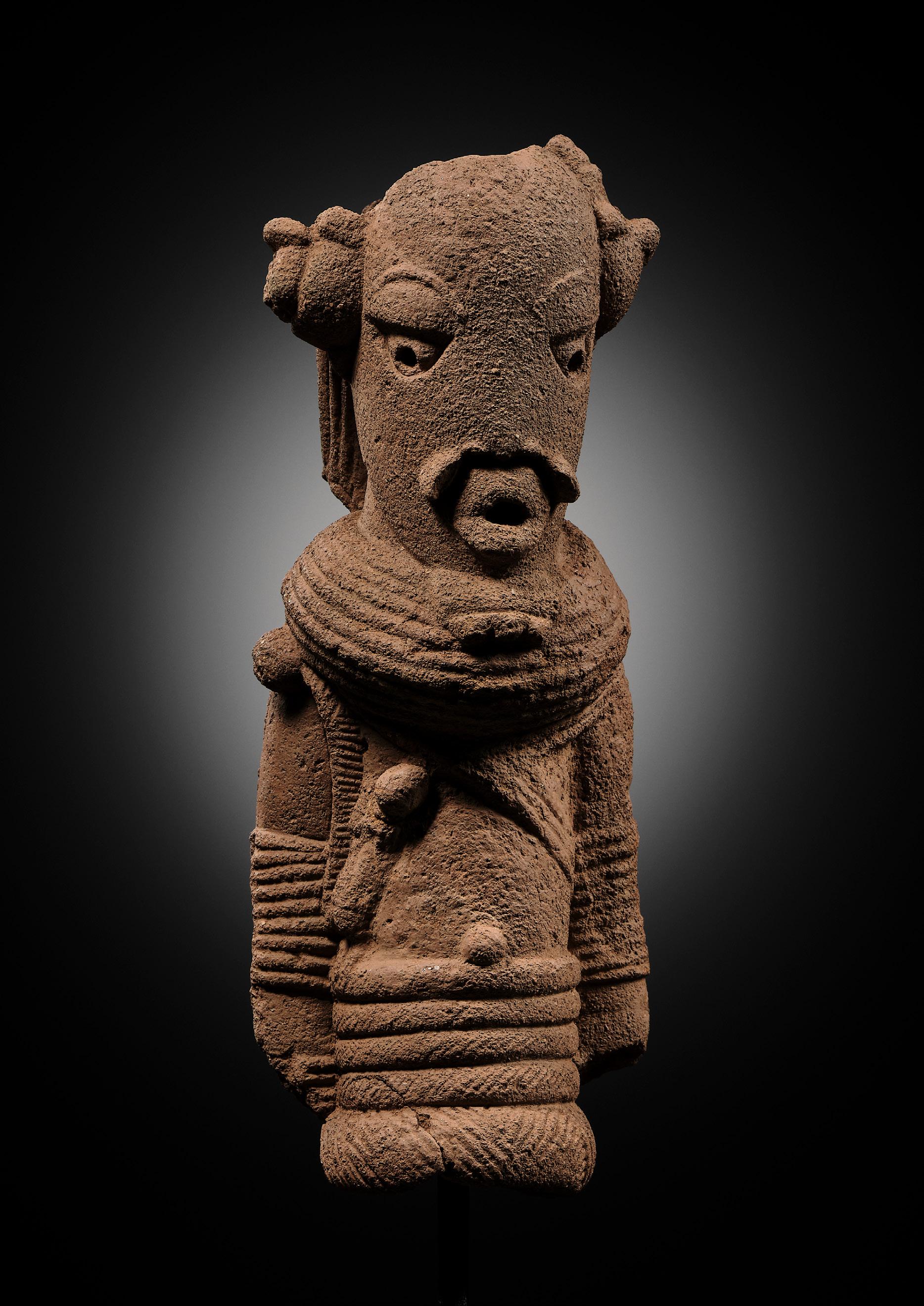
A RARE TERRACOTTA BUST AND HEAD OF A MALE DEITY, NOK CULTURE, NIGERIA, 500 BC – 200 AD
Exhibited:
1. Bergbau Museum, Afrika Ethno-Kunst, Klagenfurt, 1997
2. Museum der Völker (formerly Haus der Völker, Museum für Kunst und Ethnographie), Schwaz, Tyrol, Austria, NOK-2500 Jahre Hochkultur in Afrika, 19 May - 30 August 2006
Scientific Analysis Report:
An old TL test, dating from 24 October 1996, sets the firing date to ca. 2000 years ago, consistent with the dating above. A copy accompanies this lot.
Finely modeled to depict a tall slender figure adorned with twineform bindings at the arms, thick ropes that snake around the torso and waist, and the neck with a large circular collar. The face modeled with triangular eyes centered by pierced pupils, the mouth ajar flanked by a moustache, and a tall forehead framed by rows with tightly coiled curls.
Art Loss Register:
Certificate reference number S00266489 from 15 January 2026. A copy of this document accompanies this lot.
Provenance: Austrian private collection. Collection of Gerhard Merzeder (b. 1963), internationally published and acclaimed fashion and portrait photographer, Vienna, Austria, assembled since the 1980s. Condition: Very good condition with expected old wear, signs of weathering and erosion, few fine natural cracks, obvious losses, a lower section and a knob at the chest reattached, four small perforations to the back, and two holes drilled for sample-taking to the lower edge of to the head.
Weight: 7.8 kg
Dimensions: Height 45.5 cm
With a wood storage box. (2)
The Nok terracottas are among the earliest known large-scale figurative sculptures in Africa, only preceded by Egyptian sculptural art. Sculptures of this kind were first discovered in 1943 by Bernard Fagg near the northern Nigerian village of Nok, after which the culture that produced them was named.
Most Nok sculpture is hollow and coil-built like pottery. Finely worked to a resilient consistency from local clays and gravel, the millennia-long endurance of these ancient objects is a testament to the technical ability of their makers. This is not to say that Nok sculpture has survived unchanged by time. The slip of many Nok terracottas has eroded, leaving a grainy, pocked exterior that does not reflect their original smooth appearance.
Most of the Nok sculpture found consists of what appear to be portrait heads and bodies fragmented by damage and age. The recovered portions of the baked clay bodies that have survived show that they were sculpted in standing, sitting, and genuflecting postures.
Although every Nok sculpture is unique, certain stylistic traits are found throughout the corpus of known work. Triangular eyes and perforated pupils, noses, mouths, and ears combine to depict men and women with bold, abstracted features. Perhaps the most striking aspects of Nok sculptures are the elaborately detailed hairstyles and jewelry that adorn many of the figures. The variety, inventiveness, and beauty of their design is a beguiling record of cultivated devotion to body ornamentation.
LITERATURE COMPARISON
Compare a closely related male figure, Nok culture, dated ca. 195 BC -205 AD, 49.5 cm high, in the Kimbell Art Museum, accession number AP 1996.03.
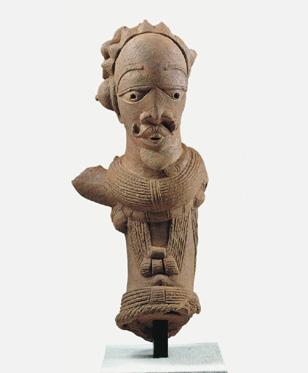
AUCTION RESULT COMPARISON
Type: Related
Auction: Zacke, Vienna, 16 October 2025, lot 269
Price: EUR 58,500 at the time of writing
Description: A Terracotta figure of a male deity, Nok culture, Nigeria, 500 BC200 AD
Expert remark: Compare the similar form, facial features, and material. Note the size (75 cm).
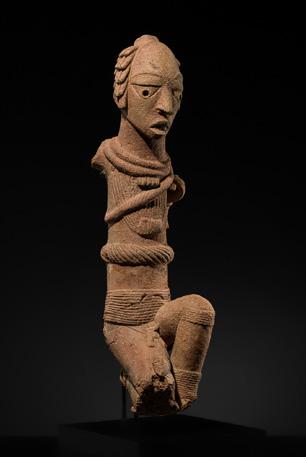
Estimate EUR 6,000
Starting price EUR 3,000
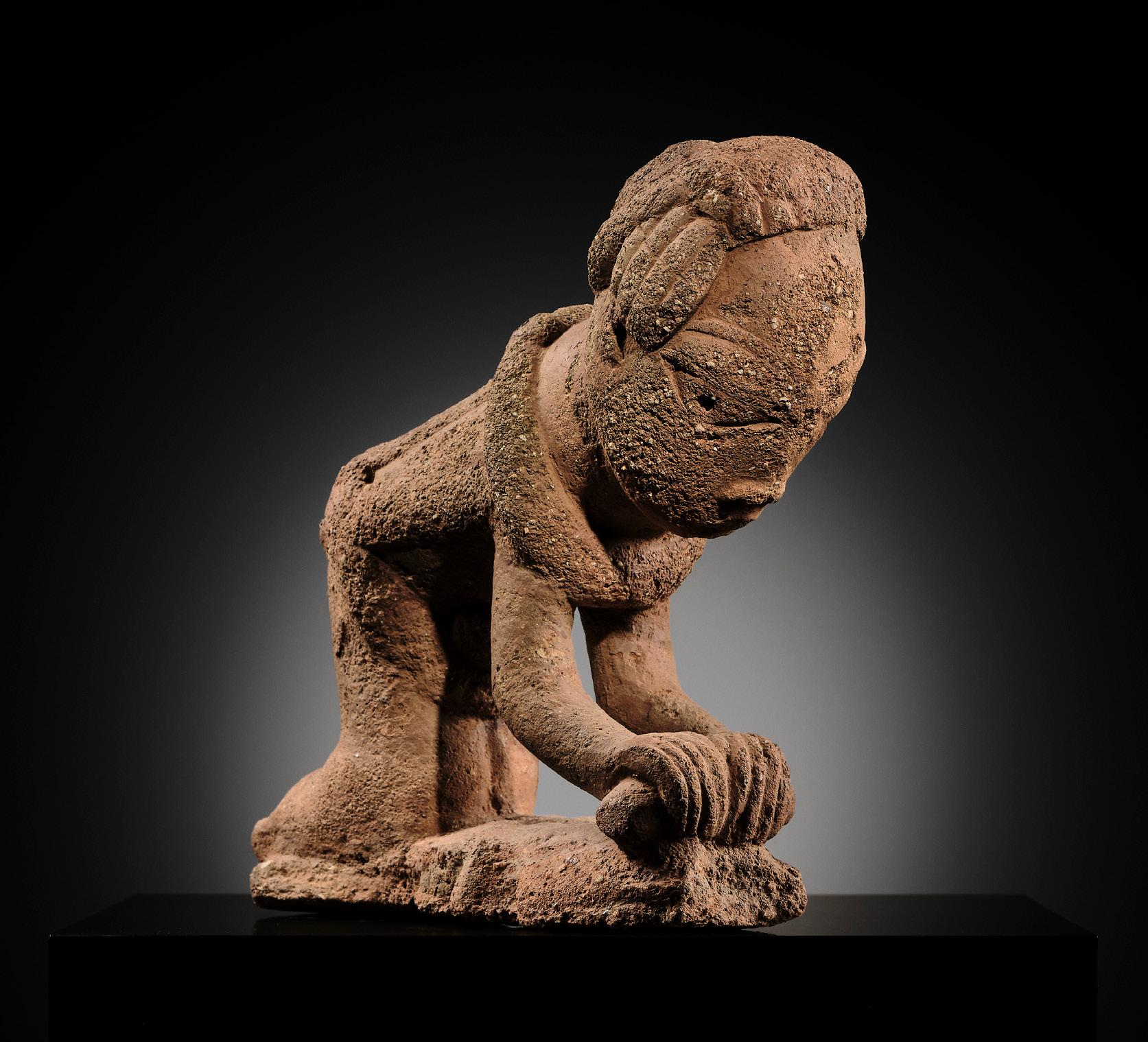
A RARE TERRACOTTA FIGURE OF A WOMAN GRINDING, NOK CULTURE, NIGERIA, 500 BC – 200 AD
Exhibition:
Museum der Völker (formerly Haus der Völker, Museum für Kunst und Ethnographie), Schwaz, Tyrol, Austria, NOK-2500 Jahre Hochkultur in Afrika, 19 May - 30 August 2006
Scientific Analysis Report:
An old TL test, dating from 14 December 2005, sets the firing date to ca. 2000 years ago, consistent with the dating above. A copy accompanies this lot.
The female figure shown kneeling with hands holding an oblong tool for grinding grains, her body adorned with large hoops around the neck and waist joined with two bands at the back, the elongated face with triangular eyes centered by pierced pupils, wide nose above pursed lips, and the hair carefully arranged in buns and strands, all supported on a flat base.
Provenance: Austrian private collection. Collection of Gerhard Merzeder (b. 1963), internationally published and acclaimed fashion and portrait photographer, Vienna, Austria, assembled since the 1980s. Condition: Very good condition with expected old wear, signs of weathering and erosion, few fine natural cracks, obvious losses, possibly with repairs to the arms, and two holes drilled for sample-taking to the buttocks and the head.
Weight: 2.5 kg
Dimensions: Height 23 cm, Length 20.5 cm
The Nok terracottas are among the earliest known large-scale figurative sculptures in Africa, only preceded by Egyptian sculptural art. Sculptures of this kind were first discovered in 1943 by Bernard Fagg near the northern Nigerian village of Nok, after which the culture that produced them was named.
Most Nok sculpture is hollow and coil-built like pottery. Finely worked to a resilient consistency from local clays and gravel, the millennia-long endurance of these ancient objects is a testament to the technical ability of their makers. This is not to say that Nok sculpture has survived unchanged by time. The slip of many Nok terracottas has eroded, leaving a grainy, pocked exterior that does not reflect their original smooth appearance. Most of the Nok sculpture found consists of what appear to be portrait heads and bodies fragmented by damage and age. The recovered portions of the baked clay bodies that have survived show that they were sculpted in standing, sitting, and genuflecting postures.
LITERATURE COMPARISON
Compare a related terracotta seated male figure, Nok culture, circa 600 AD, 53.3 cm tall, in the North Carolina Museum of Art, object number 97.10 (fig. 1). Compare a related terracotta head and torso of a female figure, Nok culture, dated 500 BC–200 AD, 57.1 cm tall, in the Museum of Fine Arts, Boston, object number 96.946.
Estimate EUR 2,000
Starting price EUR 1,000
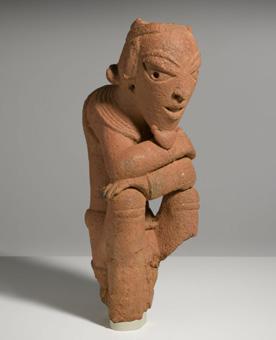
fig. 1
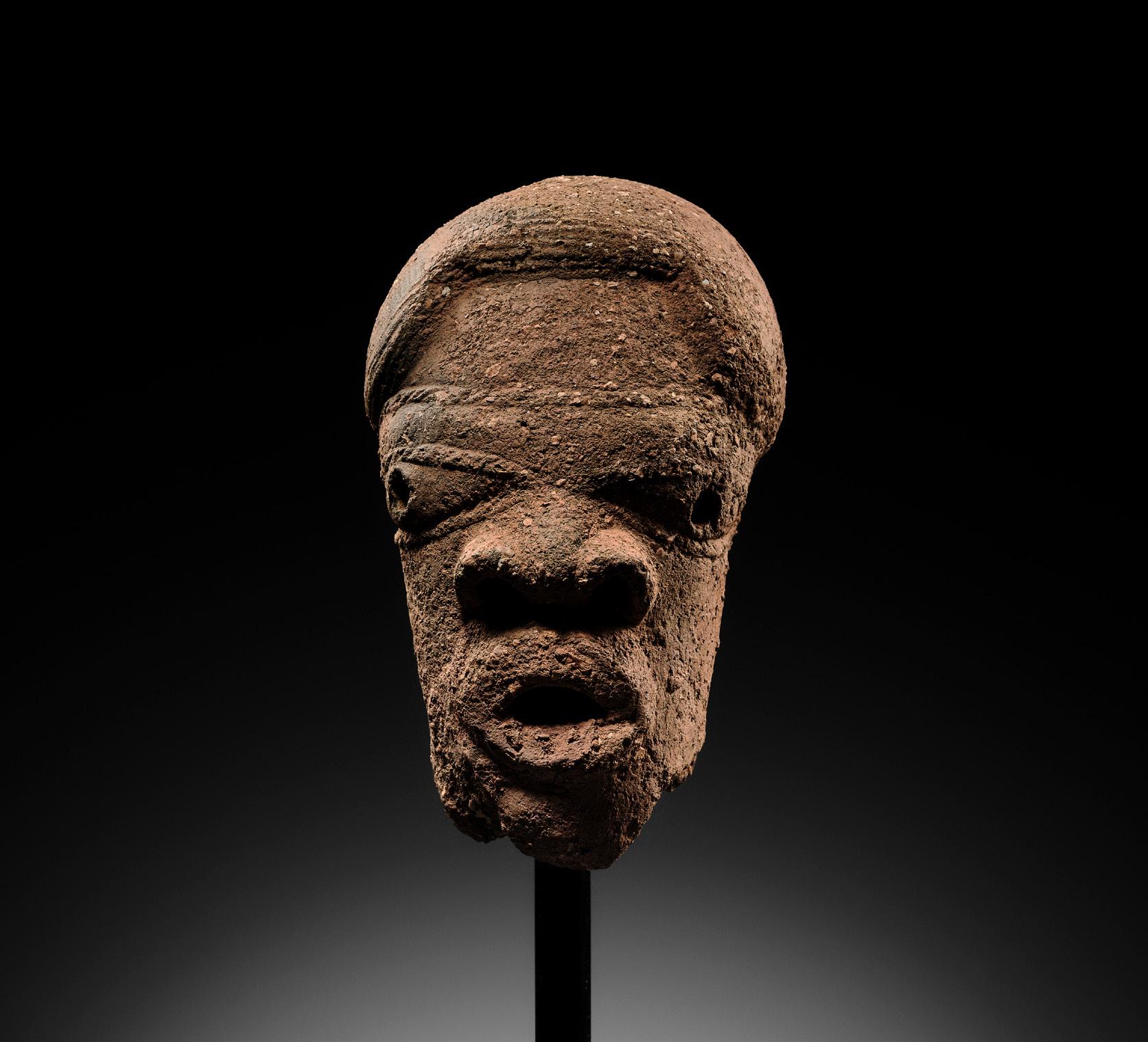
A TERRACOTTA HEAD OF A MAN, NOK CULTURE, NIGERIA, 500 BC – 200 AD
PUBLISHED
Kristian Fenzl and Armand Duchâteau, Afrika-Kopfskulpturen, 1998, Kunsthalle Krems, Krems an der Donau, p. 68, Tafel 34.
Exhibited:
Kunsthalle Krems, Afrika-Kopfskulpturen, Krems an der Donau, 26 July 1998 – 18 October 1998.
Nigeria. The hollowed head with an oblong face, set with a pair of triangular eyes centered by pierced pupils below a braided band that crosses the tall forehead, the mouth and nostrils perforated, with pursed lips, flanked by two slits forming the ears, and with a finely combed coiffure.
Provenance: Galerie Walu, Zurich, 1994. Collection of Gerhard Merzeder (b. 1963), internationally published and acclaimed fashion and portrait photographer, Vienna, Austria, assembled since the 1980s. The family-owned Galerie Walu has been specialized in cultures of sub-Saharan Africa since 1957, supported by decades of hands-on experience in the African art market.
Condition: Very good condition with expected old wear, signs of weathering and erosion, few natural cracks, obvious losses, minor touchups to the right cheek, and nicks.
Weight: 996 g
Dimensions: Height 17 cm
Although every Nok sculpture is unique, certain stylistic traits are found throughout the corpus of known work. Triangular eyes and perforated pupils, noses, mouths, and ears combine to depict men and women with bold, abstracted features. Perhaps the most striking aspects of Nok sculptures are the elaborately detailed hairstyles and jewelry that adorn many of the figures. The variety, inventiveness, and beauty of their design is a beguiling record of cultivated devotion to body ornamentation.
Literature comparison:
Compare a related Nok terracotta bust, dated 500 BC – 100 AD, 16.5 cm tall, in the Barakat Gallery, Los Angeles, reference number GDC.041 (LSO).
Estimate EUR 1,000
Starting price EUR 500
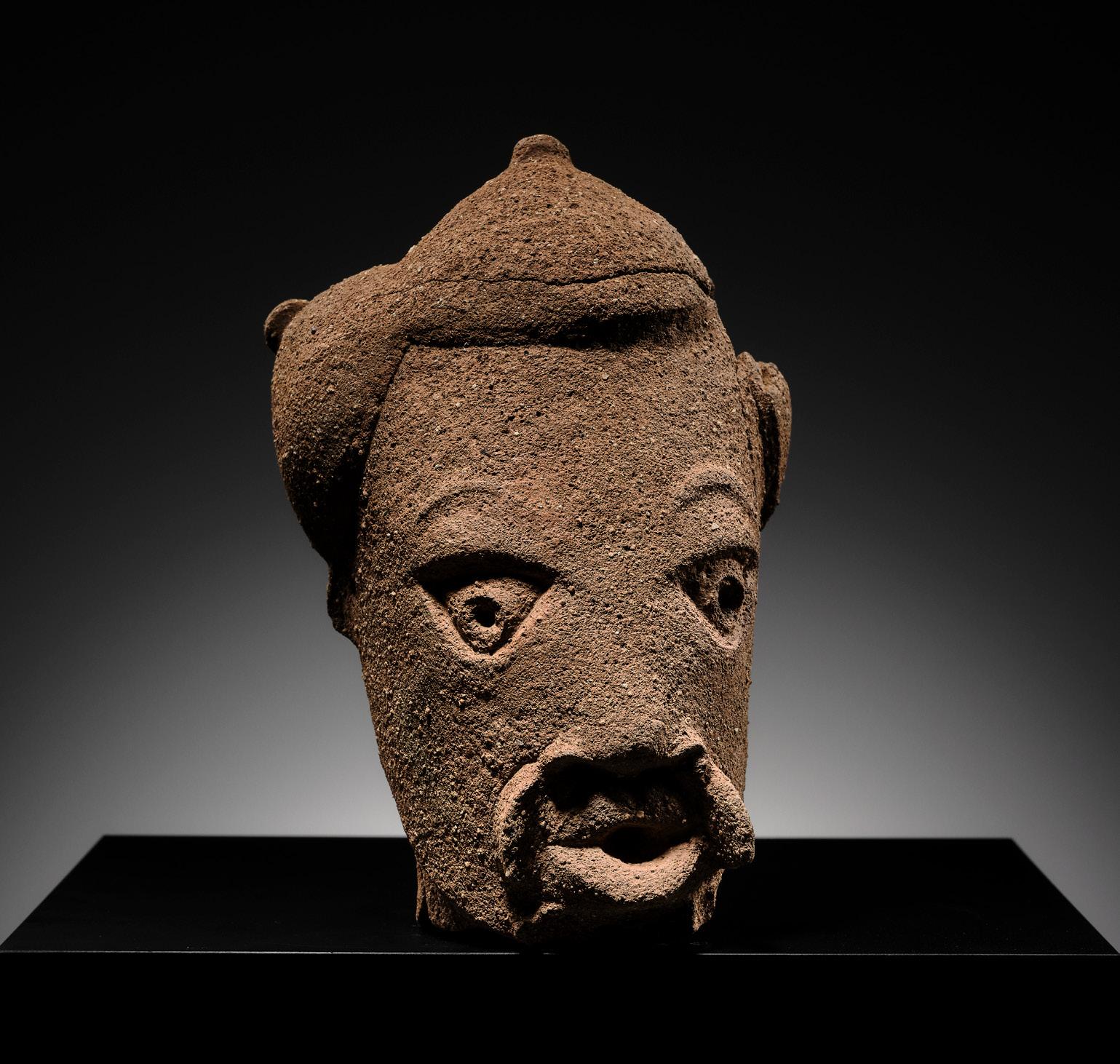
65
A TERRACOTTA HEAD OF A MAN, NOK CULTURE, NIGERIA, 500 BC – 200 AD
PUBLISHED
Kristian Fenzl and Armand Duchâteau, Afrika-Kopfskulpturen, 1998, Kunsthalle Krems, Krems an der Donau, p. 70, Tafel 36.
Exhibited:
Kunsthalle Krems, Afrika-Kopfskulpturen, Krems an der Donau, 26 July 1998 – 18 October 1998.
Nigeria. The hollowed head with an oblong face, set with a pair of triangular eyes centered by pierced pupils below gently curving eyebrows, the mouth perforated, with pursed lips framed by a moustache, and the tall forehead surmounted by an elaborate coiffure tied into small knobs.
Provenance: Galerie Walu, Zurich, 1994. Collection of Gerhard Merzeder (b. 1963), internationally published and acclaimed fashion and portrait photographer, Vienna, Austria, assembled since the 1980s. The family-owned Galerie Walu has been specialized in cultures of sub-Saharan Africa since 1957, supported by decades of hands-on experience in the African art market.
Condition: Good condition with expected old wear, signs of weathering and erosion, few natural cracks, obvious losses, repairs, small touchups, and a small hole.
Weight: 1.7 kg
Dimensions: Height 23.5 cm
LITERATURE COMPARISON
Compare a terracotta male head, Nok culture, dated 5th–mid-1st century BC, 27.3 cm tall, in the Saint Louis Art Museum, object number 52:1996.
Estimate EUR 1,000
Starting price EUR 500
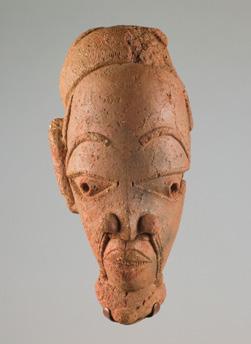
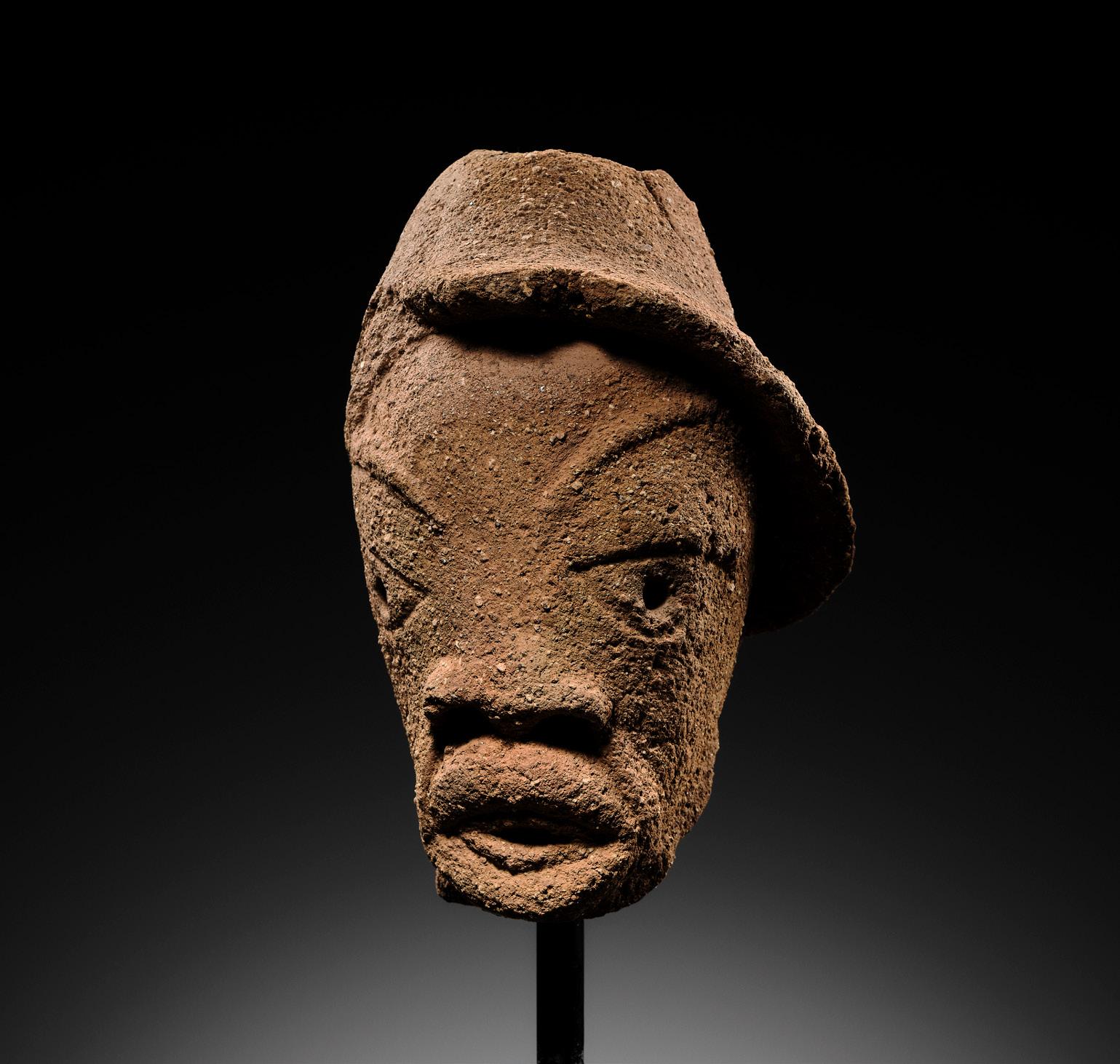
A TERRACOTTA HEAD OF A MAN WEARING A HAT, NOK CULTURE, NIGERIA, 500 BC – 200 AD
Exhibited: Kunsthalle Krems, Afrika-Kopfskulpturen, Krems an der Donau, 26 July 1998 – 18 October 1998.
Nigeria. The hollowed head with an oblong face, set with a pair of triangular eyes centered by pierced pupils below gently curving eyebrows, the mouth with pursed lips framed by a moustache, and the tall forehead surmounted by a hat with flaring rim.
Provenance: Galerie Walu, Zurich, 1994. Collection of Gerhard Merzeder (b. 1963), internationally published and acclaimed fashion and portrait photographer, Vienna, Austria, assembled since the 1980s. The family-owned Galerie Walu has been specialized in cultures of sub-Saharan Africa since 1957, supported by decades of hands-on experience in the African art market.
Condition: Very good condition with expected old wear, signs of weathering and erosion, few natural cracks, obvious losses, and scattered nicks.
Weight: 2.4 kg
Dimensions: Height 23 cm
Although every Nok sculpture is unique, certain stylistic traits are found throughout the corpus of known work. Triangular eyes and perforated pupils, noses, mouths, and ears combine to depict men and women with bold, abstracted features. Perhaps the most striking aspects of Nok sculptures are the elaborately detailed hairstyles and jewelry that adorn many of the figures. The variety, inventiveness, and beauty of their design is a beguiling record of cultivated devotion to body ornamentation.
PUBLISHED
Kristian Fenzl and Armand Duchâteau, AfrikaKopfskulpturen, 1998, Kunsthalle Krems, Krems an der Donau, p. 69, Tafel 35.
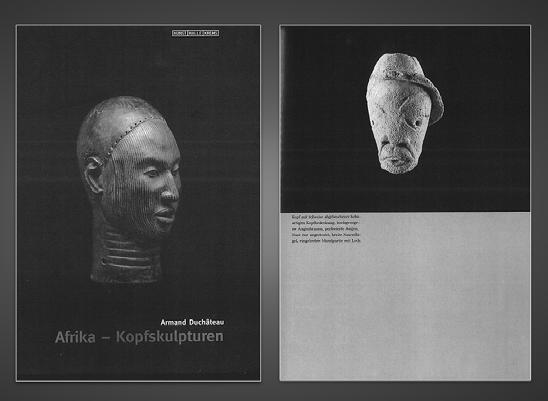
LITERATURE COMPARISON
Compare a related terracotta head with headwear, Nok culture, dated 20 – 620 AD, 38.2 cm tall, in the Cleveland Museum of Art, reference number 1995.21.
Estimate EUR 1,000
Starting price EUR 500
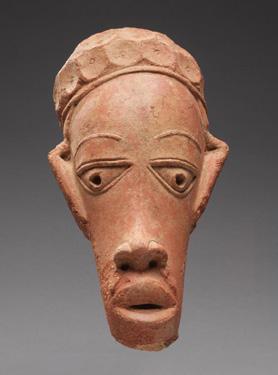
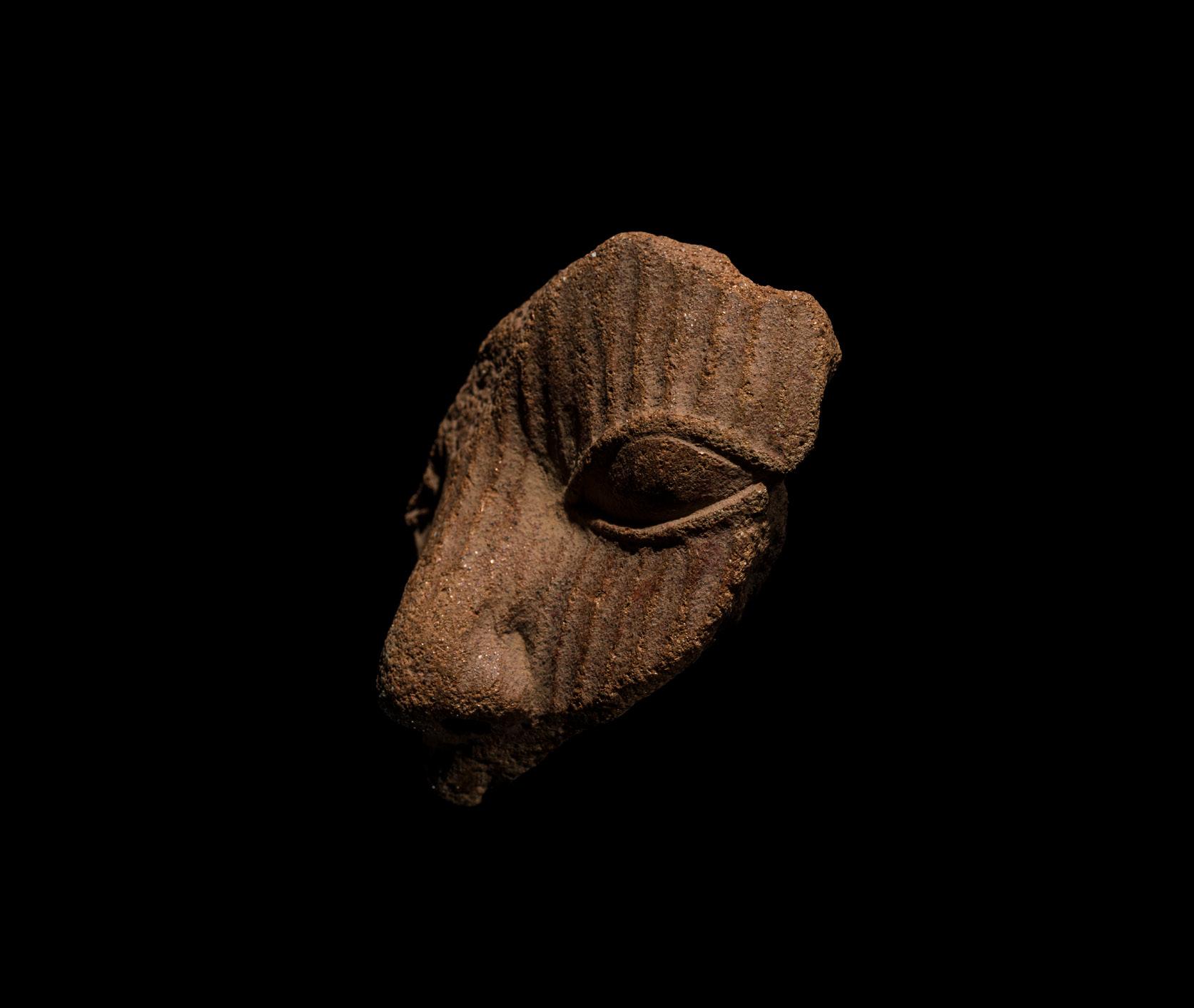
67
A RARE TERRACOTTA FRAGMENT OF A FACE, IFE CULTURE, NIGERIA, 1000-1500
Exhibited:
Bergbau Museum, Afrika Ethno-Kunst, Klagenfurt, 1997
Scientific Analysis Report:
An old TL test, dating from 10 February 1996, sets the firing date to ca. 600 years ago, consistent with the dating above. A copy accompanies this lot.
The fragment detailed with characteristic raised facial markings running vertically, representing scarifications, almond-shaped eyes, and elegant nose. The reverse with a small perforation.
Art Loss Register:
Certificate reference number S00266733 from 17 December 2025. A copy of this document accompanies this lot.
Provenance: Collection of Gerhard Merzeder (b. 1963), internationally published and acclaimed fashion and portrait photographer, Vienna, Austria, assembled since the 1980s.
Condition: Good condition with expected old wear, signs of weathering and erosion, obvious losses, soil encrustations, and one hole drilled for sample-taking to the edge.
Weight: 62.5 g
Dimensions: Length 6.5 cm
Expert’s note:
The facial markings on the present lot may represent scarifications connected to early elite dynasties or indigenous groups.
Ife, the historic political and spiritual center of the Yoruba peoples in western Nigeria, is renowned for its naturalistic artistic tradition, first mastered in terracotta and later in metal. While metalworking has long been practiced by Yoruba men, women historically produced clay sculpture, contributing significantly to this refined aesthetic.
The exceptional quality of Ifẹ art challenged early colonial assumptions about African artistic capabilities; in 1911, for example, German ethnographer Leo Frobenius mistakenly attributed these works to mythical Greek visitors from Atlantis. In reality, such masterful creations reflect the skill and sophistication of African artists themselves.
LITERATURE COMPARISON
Compare a related terracotta fragment of head, Ife culture, Nigeria, dated 1100-1500, in the Cleveland Museum of Art, object number 21.2018.
Estimate EUR 1,000
Starting price EUR 500
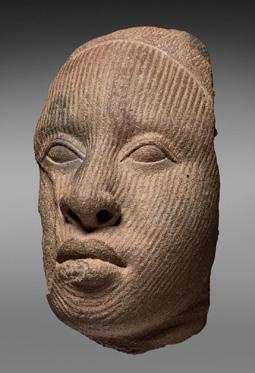
The container is made from dried and modeled cloth, neatly adorned with cowrie shells and large raised knobs. Its lid is topped by a goat figure dressed in strands of red, coral, blue, yellow, and white glass beads, with leather horns and tail. From its feet hangs an intricate beaded net that drapes over the cover and ends in tassels embellished with further cowrie shells.
Provenance: British private collection. Collection of Gerhard Merzeder (b. 1963), internationally published and acclaimed fashion and portrait photographer, Vienna, Austria, assembled since the 1980s. Condition: Good condition with expected old wear and some weathering, age cracks, small losses to the beads, little flaking to the horns, and traces of use.
Weight: 1.3 kg (excl. stand)
Dimensions: Height 25.1 cm (excl. stand)
With a modern stand. (2)
The Yoruba people of southwestern Nigeria and adjoining regions possess one of the most sophisticated and symbolically rich beadworking traditions in Africa. Historically, beadwork was closely associated with royalty and sacred office. In Ile-Ife and other Yoruba kingdoms, only rulers, priests, and select dignitaries had access to elaborately beaded regalia. Crowns, veils, footstools, flywhisks, and tunics were adorned with thousands of tiny glass beads, often imported through long-distance trade networks linking West Africa to Europe and the Middle East. The shimmering surfaces of these works signified divine authority: a king’s beaded crown, for example, was believed to shield onlookers from the overwhelming spiritual potency of the monarch while simultaneously affirming his legitimacy.
LITERATURE COMPARISON
Compare a related chief’s crown with a similar beadwork, Yoruba people, Nigeria, 30.5 cm tall, in the British Museum, museum number Af1954,23.262.
Estimate EUR 1,000
Starting price EUR 500
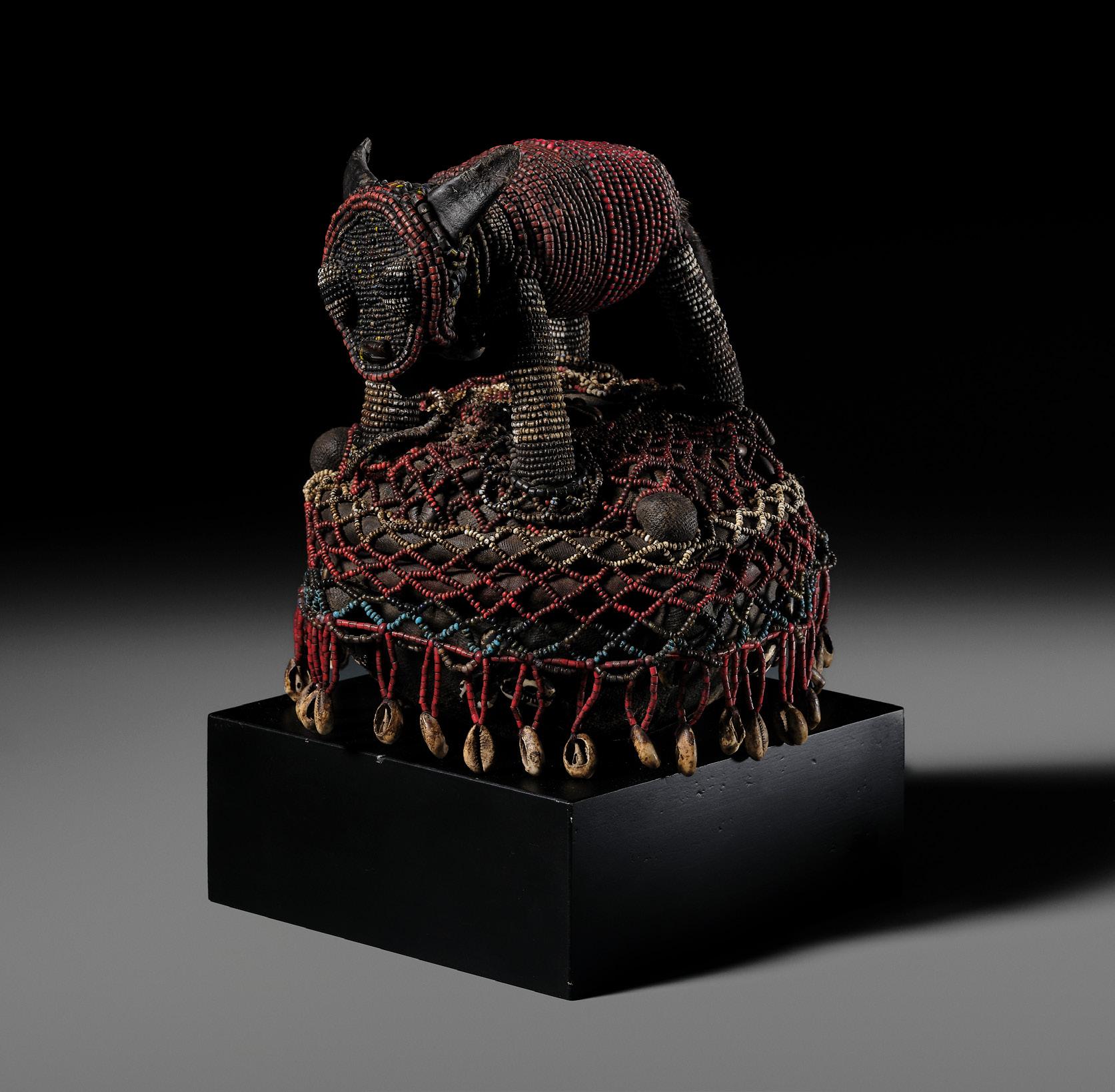
A LOST-WAX BRONZE ‘LEOPARD’ HIP ORNAMENT, EDO PEOPLES, 16TH-19TH CENTURY
PUBLISHED
1. Gert Chesi, Afrika. Die Kunst der Könige, 2004, Museum der Völker (formerly Haus der Völker, Museum für Kunst und Ethnographie), Schwaz, Tyrol, Austria, p. 21.
2. Organization of African Unity (OAU), The Africa Day Celebration, Fribourg, May 2004, brochure.
Exhibited:
Museum der Völker (formerly Haus der Völker, Museum für Kunst und Ethnographie), Schwaz, Tyrol, Austria, Afrika. Die Kunst der Könige, 3 January – 2 May 2004.
Nigeria, Court of Benin. Superbly cast as a heavy bronze hip ornament in the shape of a leopard's head with its characteristic spots rendered with tiny indents covering the whole head as well as larger smooth dots, with large eyes and nose, oval ears with incised leaf-like veins, upper and lower fangs, and representations of whiskers on the cheeks. The bottom half of the round face has a protruding decorative openwork frill in the form of a fluted collar with a row of small metal loops.
Provenance: A private collection in Austria. Collection of Gerhard Merzeder (b. 1963), internationally published and acclaimed fashion and portrait photographer, Vienna, Austria, assembled since the 1980s. Condition: Good condition with wear and casting irregularities. Small losses, minor warping, some rubbing, soil deposits, and signs of use. The back reinforced. The bronze with a naturally grown, dark patina.
EXTERNAL EXPERT AUTHENTICATION
Koller Auctions, Zürich, 21 June 2008, lot 208 (mid-estimate CHF 12,500 or approx. EUR 14,000 converted and adjusted for inflation at the time of writing)
Weight: 400 g
Dimensions: Height 15 cm
This leopard head hip ornament was made by the Edo people of the Court of Benin, Nigeria sometime between the 16th to 19th centuries. It is made of brass and iron and was created using the traditional lost-wax casting technique. Hip ornaments such as this one would have been worn as part of elaborate ceremonial costumes by the king and other participants of palace rituals. This piece was made to be worn on the left side of the waist to cover the closure of wrapped skirts. It would have been held in place by large loops on the top, bottom, or back of the ornament. The leopard was of special importance so it was only to be worn by the king and war chiefs.
LITERATURE COMPARISON
Compare a closely related bronze and iron hip ornament: leopard head, Edo peoples, Nigeria, Court of Benin, dated 16th-19th century, 18.6 cm high, in the Metropolitan Museum of Art, object number 1991.17.36.
AUCTION RESULT COMPARISON
Type: Related
Auction: Christie’s Paris, 12 June 2003, lot 43
Price: EUR 21,150 or approx. EUR 30,500 adjusted for inflation at the time of writing
Description: Benin brass belt mask, Nigeria
Expert remark: Compare the related modeling of the face, ears, whiskers, and ruff collar. Note the size (18.5 cm).
Estimate EUR 3,000
Starting price EUR 1,500
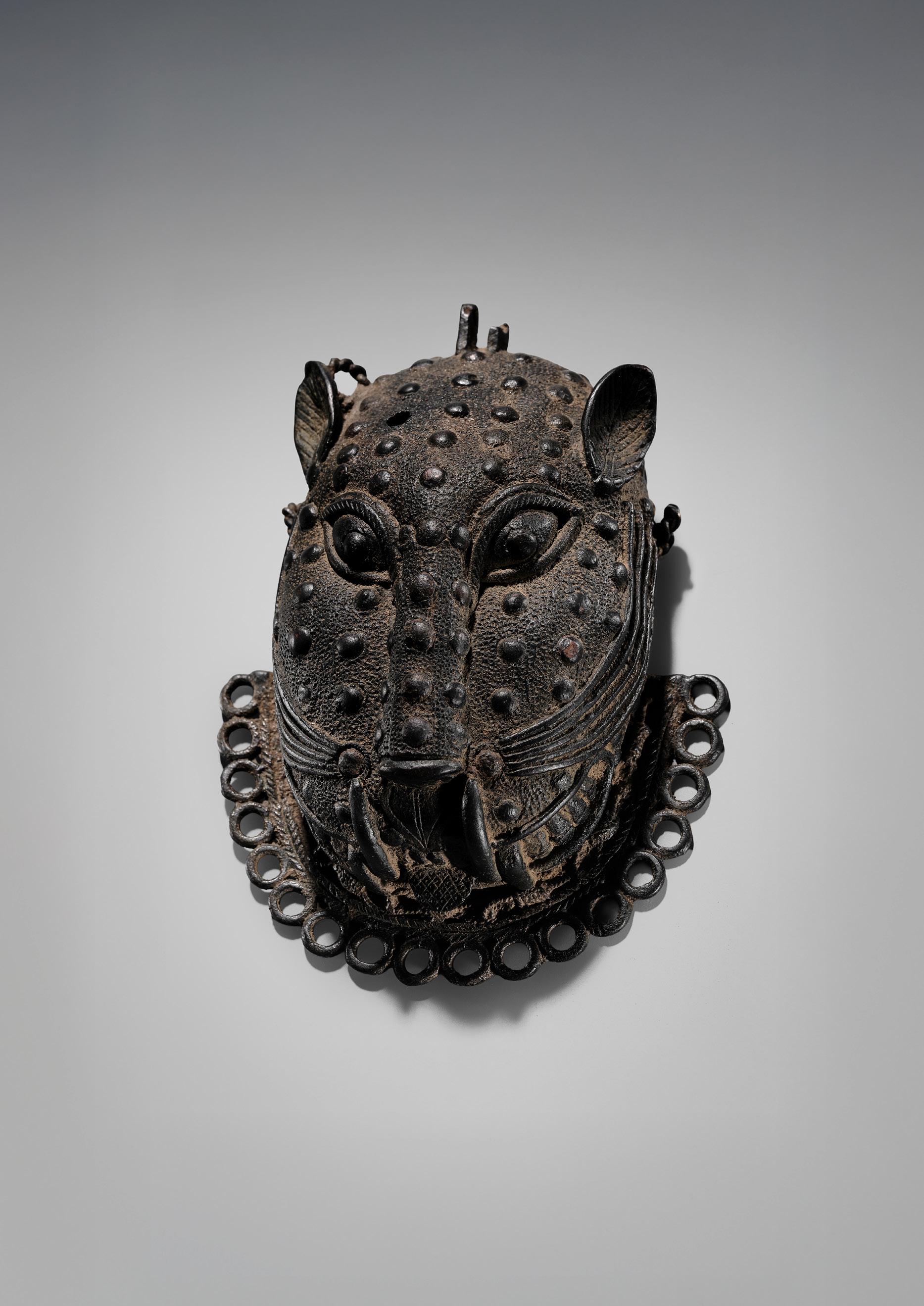
70
AN IRON-INLAID BRONZE TROPHY HEAD, EDO PEOPLES, 18TH-19TH CENTURY
Exhibited:
Museum der Völker (formerly Haus der Völker, Museum für Kunst und Ethnographie), Schwaz, Tyrol, Austria, Afrika. Die Kunst der Könige, 3 January – 2 May 2004.
SCIENTIFIC ANALYSIS REPORT
A metallurgical analysis report issued by Antiques Analytics – Institute of Scientific Authenticity Testing on 29 July 2003, report number AA 03-02857, sets the alloy date of the sample taken to the period from the 18th-19th century, consistent with the dating above. A copy of the report accompanies this lot.
ALLOY COMPOSITION RANGE
The alloy analytics report written and signed by Dr. R. Neunteufel, indicates an alloy composition of 74% copper, 20% zinc, 0.2% nickel, 4.7 % lead, 2.1% tin, <0.01% arsenic, 0.07% antimony, 0.01% aluminum, <0.01% cadmium, 0.6% iron, and 0.01% manganese.
Nigeria, Court of Benin. Finely cast, the commemorative head with naturalistic facial features, wide eyes with iron-inlaid pupils below four raised scarification marks, centered by two inset vertical marks above the slender nose, the cupid-bow lips pursed and gently ajar, with three etchings stretching from the corners of the mouth to the ears flanking the sides. The neck enveloped in a beaded necklace and the top of the head pierced with a large aperture to mount the tusk.
Provenance: An old private collection in Austria, before 1980. Collection of Gerhard Merzeder (b. 1963), internationally published and acclaimed fashion and portrait photographer, Vienna, Austria, assembled since the 1980s.
Condition: Very good condition with wear and casting irregularities. Few scratches, minor nicks, tiny holes, small losses, few dings, and expected surface alteration. The bronze with a naturally grown, dark patina.
Weight: 2,755 g
Dimensions: Height 24.3 cm
LITERATURE COMPARISON
Compare a closely related bronze commemorative head with iron inlays, Edo, dated late 15thearly 17th century, 21 cm high, in the British Museum, registration number Af1897,1217.3.
Compare a closely related bronze commemorative head, Edo, dated 15th-18th century, 19.5 cm high, in the Saint Louis Art Museum, object number 12:1936.
Estimate EUR 30,000
Starting price EUR 15,000

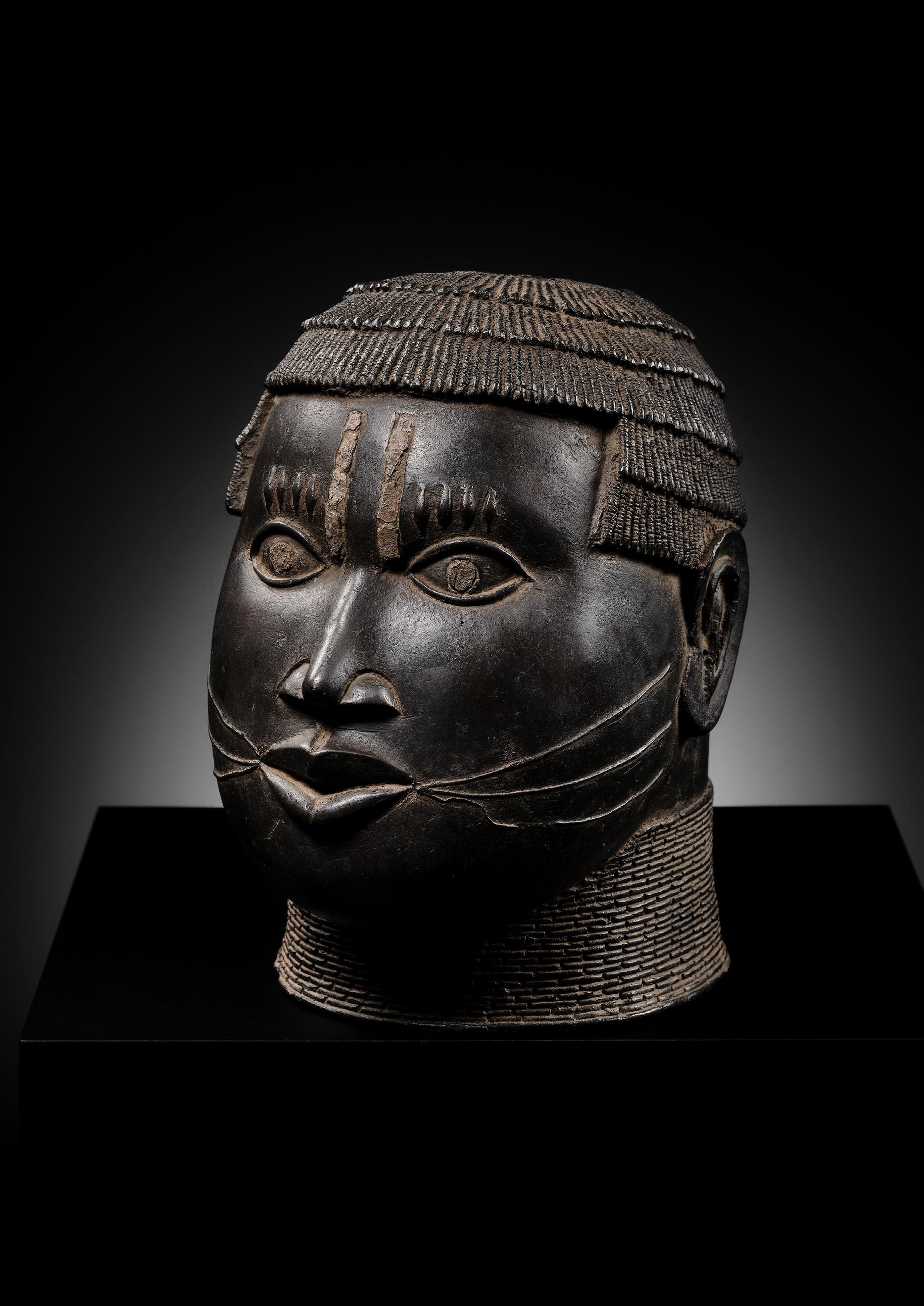
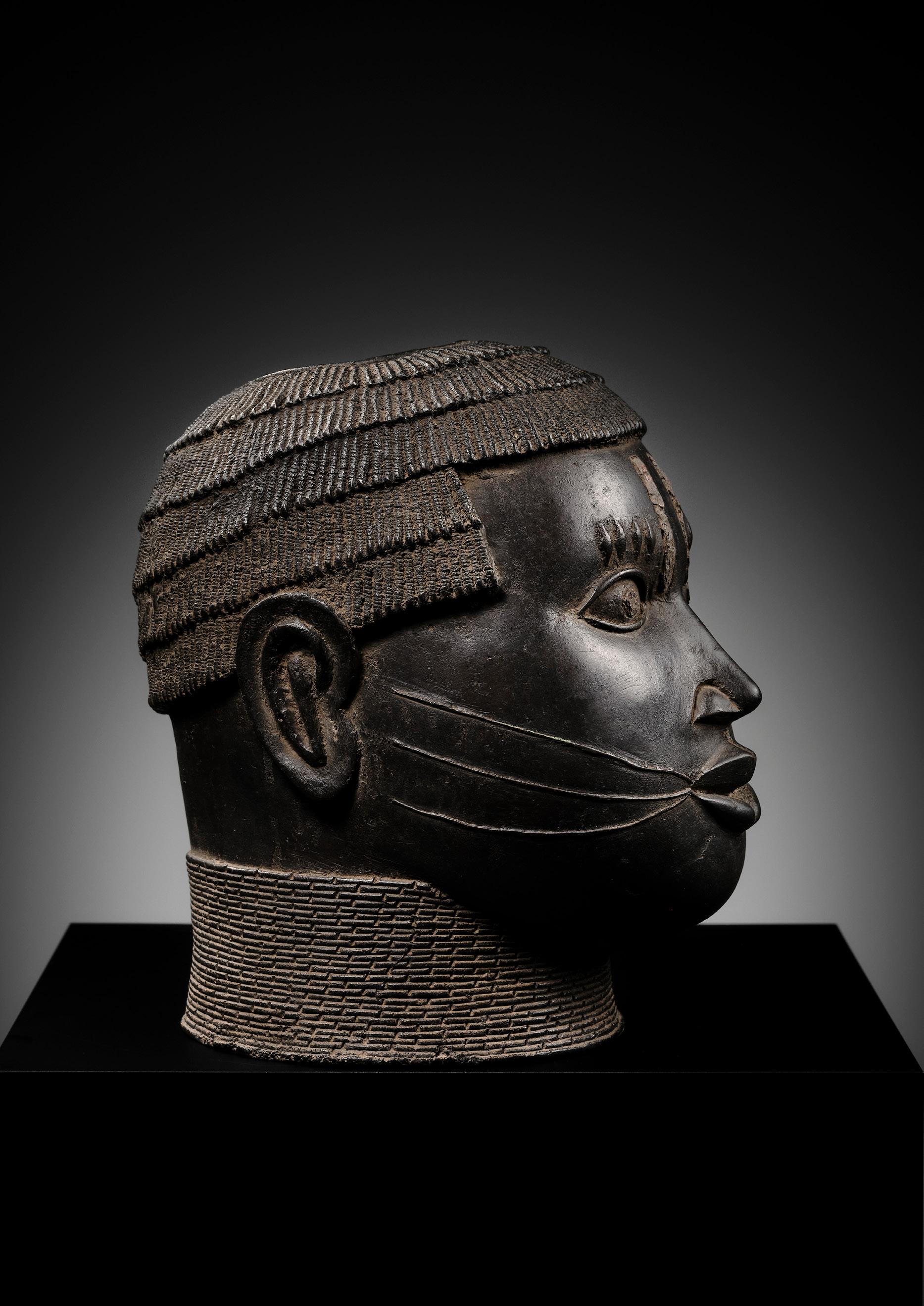
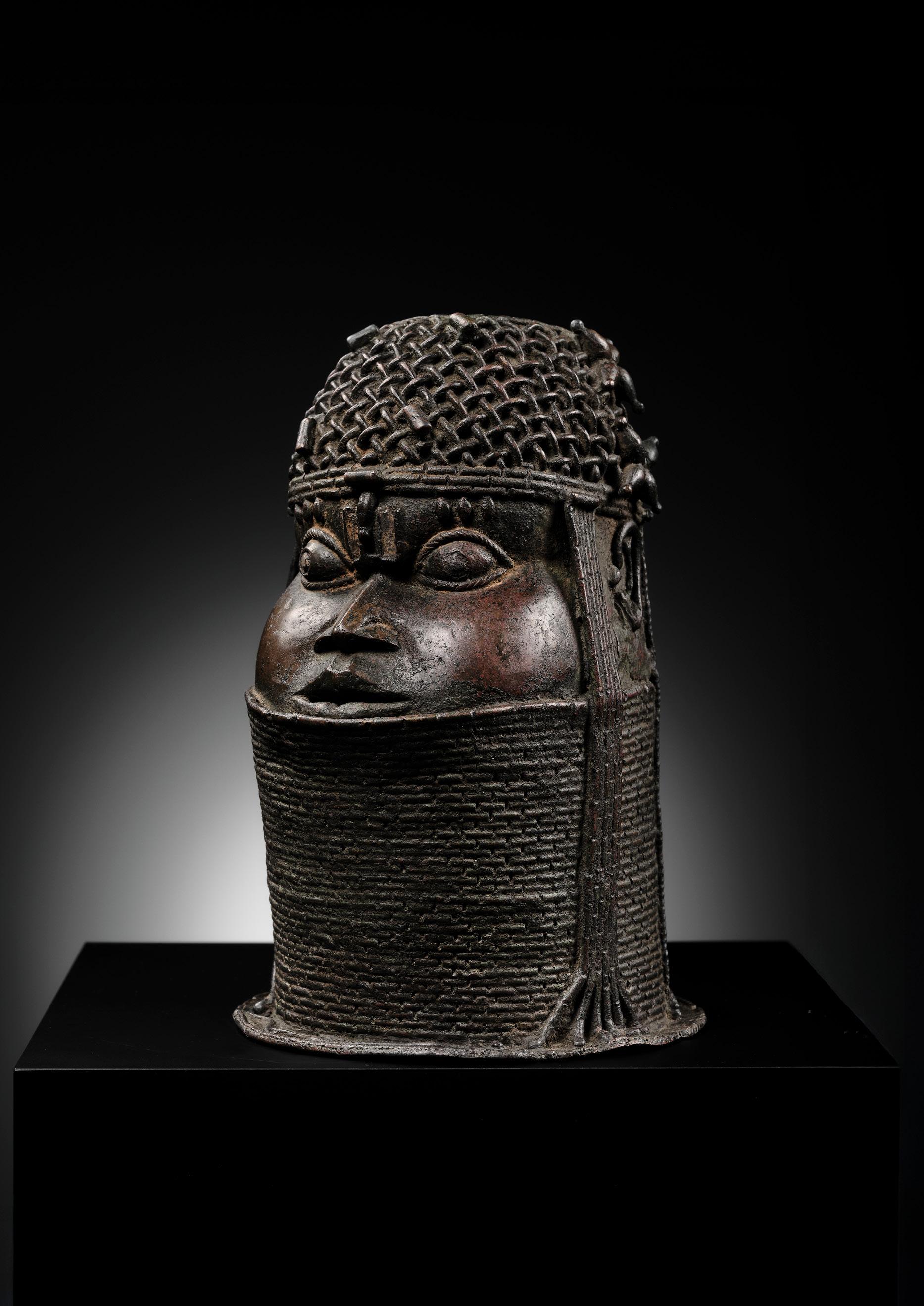
Exhibited:
1. Oberösterreichisches Landesmuseum, Kulte, Künstler, Könige in Afrika. Tradition und Moderne in Südnigeria, Linz, 23 October 1997 – 22 March 1998.
2. Kunsthalle Krems, Afrika-Kopfskulpturen, Krems an der Donau, 26 July 1998 – 18 October 1998.
3. Birmingham Museum of Art, Alabama, 9 December 1999-3 July 2003, on loan, inventory number 106.1999.
Nigeria, Altars of the Oba. The latticework beaded headdress with four attached clusters of four beads, four diagonal beads to the front and two more to the back, another two suspended at the center of the forehead, beaded tassels cast in relief before and behind the ears and joining the base, three keloids in relief above each hatched brow, incised pupils to the large eyes, a high cylinder of bead necklaces enveloping the neck and chin, all raised on a flanged base. The top of the head pierced with a large aperture for mounting the tusk.
This head of an Ọba wears layered necklaces of royal coral beads. Tubular beads adorn both the netted cap and slender braids alongside his temples. While representing an individual, his facial features and calm expression are idealized. The thickly cast head once supported a tusk. Immune to corrosion, brass symbolizes royal permanence. A personal religious object, this head most likely sat on an ancestral altar in the Ọba’s palace.
The leaders of the kingdom of Benin in present-day Nigeria trace their origins to a ruling dynasty that began in the fourteenth century. The title of "oba," or king, is passed on to the firstborn son of each successive king of Benin at the time of his death. The first obligation of each new king
PUBLISHED
1. Stefan Eisenhofer and Heidelinde Dimt, Kulte, Künstler, Könige in Afrika. Tradition und Moderne in Südnigeria, 1997, p. 138, fig. II/1.13.
2. Kristian Fenzl and Armand Duchâteau, Afrika-Kopfskulpturen, 1998, Kunsthalle Krems, Krems, p. 8889.
during this transfer of rule is to commemorate his father with a portrait cast in bronze and placed on an altar at the palace. The altar constitutes an important site of palace ritual and is understood to be a means of incorporating the ongoing influence of past kings in the affairs of their descendants. In honoring the royal ancestors, the cast-brass heads refer to the special role of the head in directing not only the body but also a person's success in life. Taken further, the welfare of the entire kingdom depends upon the king's head, which is itself the object of worship. The placement of brass heads on the ancestral altar is a vivid reminder of the oba's role in successfully guiding the kingdom throughout his reign.
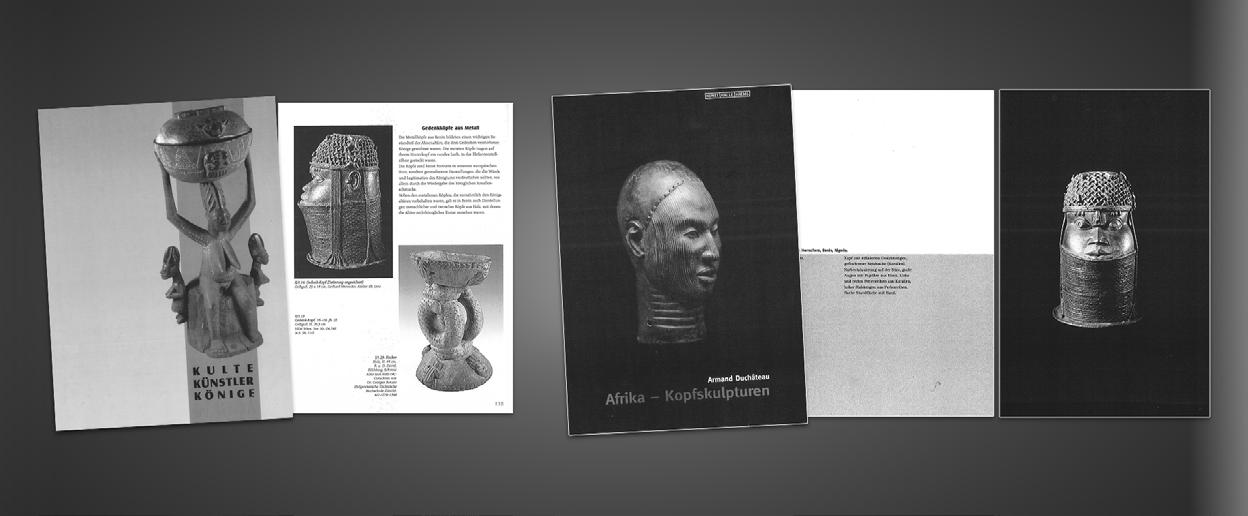
SCIENTIFIC ANALYSIS REPORT
A metal analysis, dating from 12 January 1997, dates the metal alloy to the 17th century, consistent with the dating above. A copy of the report accompanies this lot.
ALLOY COMPOSITION REPORT
A metal analysis was carried out by Aston Metallurgical Services Co., Inc., Chicago, dated 20 January 1999, using ASTM test methods. The reading indicates an alloy composition of 84.31% copper, 8.08% zinc, 0.95 % lead, 3.07% tin, 0.51% iron, 0.13% nickel, 0.53% aluminum, 0.07% manganese, and <0.05% silicon. A copy of the report accompanies this lot.
EXTERNAL EXPERT AUTHENTICATION
Frank Willet has authenticated this lot and dates it to the 18th century, identifying its iconographic and stylistic characteristics to the Middle period, Dark, Type IV, modeled in typical manner of heads dating from 1750 to 1816. A copy of Frank Willet’s expertise, dated 7 June 2001, accompanies this lot.
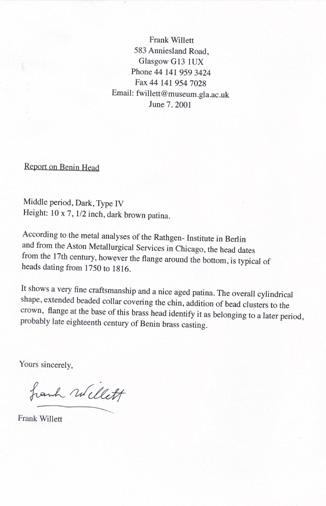
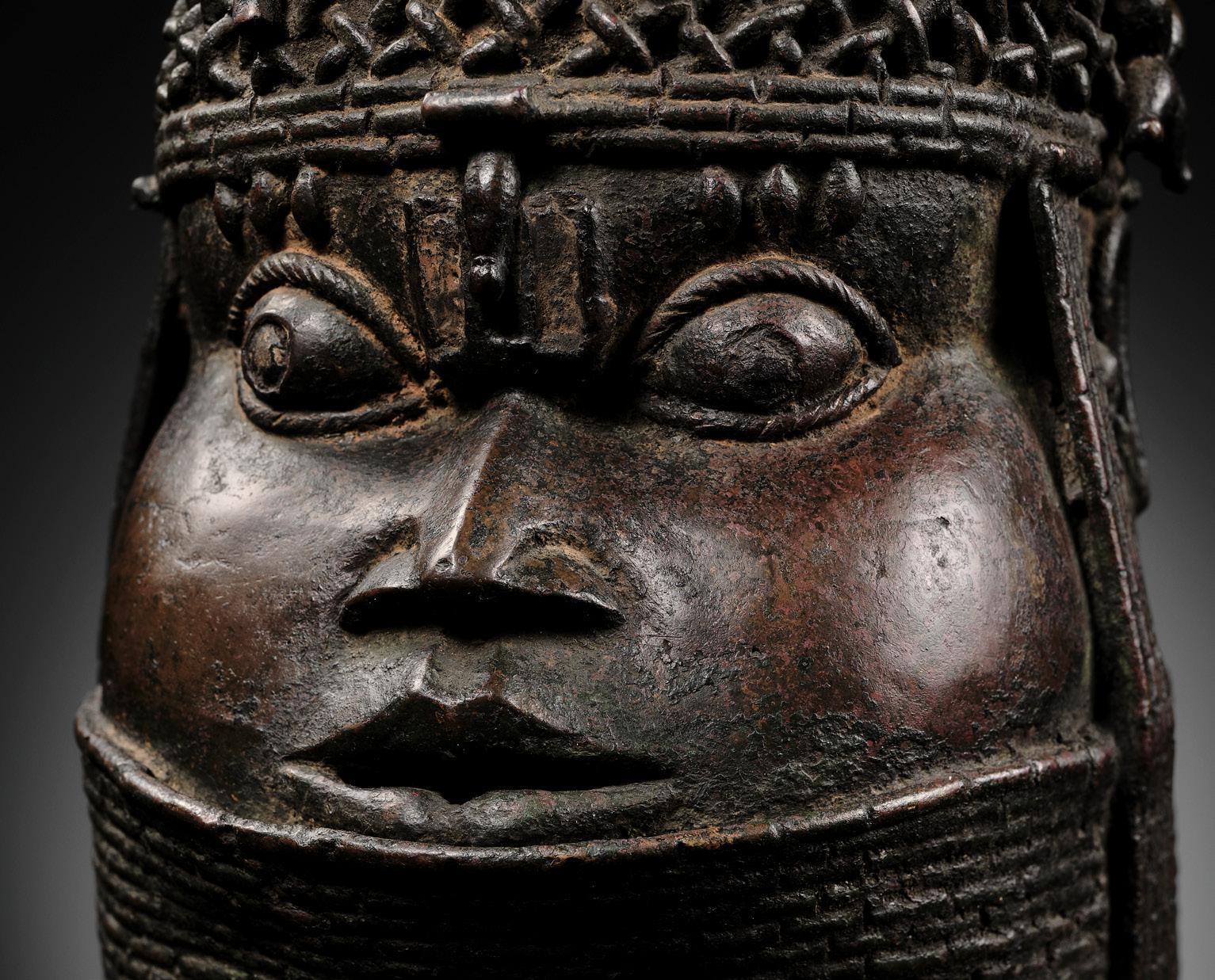
Provenance: The family collection of Ojoma of Owo, Oba Ayen, Ondo States, Nigeria, before 1983. Mr. Alli Garko, acquired from the above in Lome, Togo, on 7 March 1983.
The purchase price was 4,800 Nigerian Naira, equivalent to circa 7,000 USD at the time, which is equivalent to circa USD 22,000 today after US inflation.
The collection of James Taylor, Manchester, circa 1985-1996, by repute acquired from the above.
A private collection in Austria, by repute acquired from the above.
Collection of Gerhard Merzeder (b. 1963), internationally published and acclaimed fashion and portrait photographer, Vienna, Austria, assembled since the 1980s. A copy of a certificate of sale, written and signed by Ojoma of Owo, Oba Ayeni, and addressed to Mr. Alli Garko, certified by the community of Lome on 16 September 1983, accompanies this lot.

Note: Ojomo of Owo / Oba Ayen is best understood as a self-adopted honorific, combining the royal title of Owo (Ojomo) with Ayen, the name of a legendary early ancestor-king, to suggest lineage or status rather than an actual reigning office. It therefore rather reflects ancestral identification and social prestige, not a historically attested ruler of the 20th century.
The sale of the bronze took place in Lomé, Togo, approximately 220–250 km from Owo, Nigeria, where the seller resided. In the 1970s–80s, Lomé commonly served as a regional hub for the West African art trade, where transactions were formalized and export documentation completed.
Condition: Very good condition with wear and casting irregularities. Few scratches, minor nicks, small losses, few dings, and expected surface alteration. The bronze with a naturally grown, dark patina.
Weight: 3,322 g
Dimensions: Height 26 cm
Frank Willet (1925-2006) was a pioneering scholar of African art and archaeology and served as the first Director of the Hunterian Museum & Art Gallery from 1976 to 1990. Educated at University College, Oxford, he earned a diploma in Anthropology. After WW2, he became Keeper of the Department of Ethnology and General Archaeology at the Manchester Museum, where his growing expertise led him to undertake field trips to Nigeria. His deepening knowledge resulted in his appointment as Honorary Surveyor of Antiquities for the Nigerian Federal Government in 1956, followed by his role as Government Archaeologist and head of the Ife Museum in Southern Nigeria. In 1963, Willett returned to Oxford as a research fellow at Nuffield College, and three years later he joined Northwestern University as Professor of Art History, African Studies, and Interdisciplinary Studies. His seminal publications, Ife in the History of West African Sculpture and African Art: An Introduction (1971), became foundational texts in the field. He was awarded a CBE in 1985 and later served as Vice-Chair of the Scottish Museums Council. Even after retiring in 1990, Willett continued to shape the discipline as Curator of the Royal Society (1992–1997) and through ongoing publications, culminating in The Art of Ife: A Descriptive Catalogue and Database (2004), an award-winning study documenting all known Ife objects. His research was conducted in collaboration with the Smithsonian Institution, the British Museum, and other major institutions, and his mentorship helped train a new generation of Africanists.
LITERATURE
COMPARISON
Compare a closely related head of an oba, Nigeria, Court of Benin, dated to the 19th century, 33.7 cm high, in the Metropolitan Museum of Art, object number 1977.187.37.
Compare a closely related, earlier, ancestral commemorative head, uhunmwun-elao, dated c. mid-1500s or early 1600s, 29.9 cm high, in the Cleveland Museum of Art, accession number 1938.6.
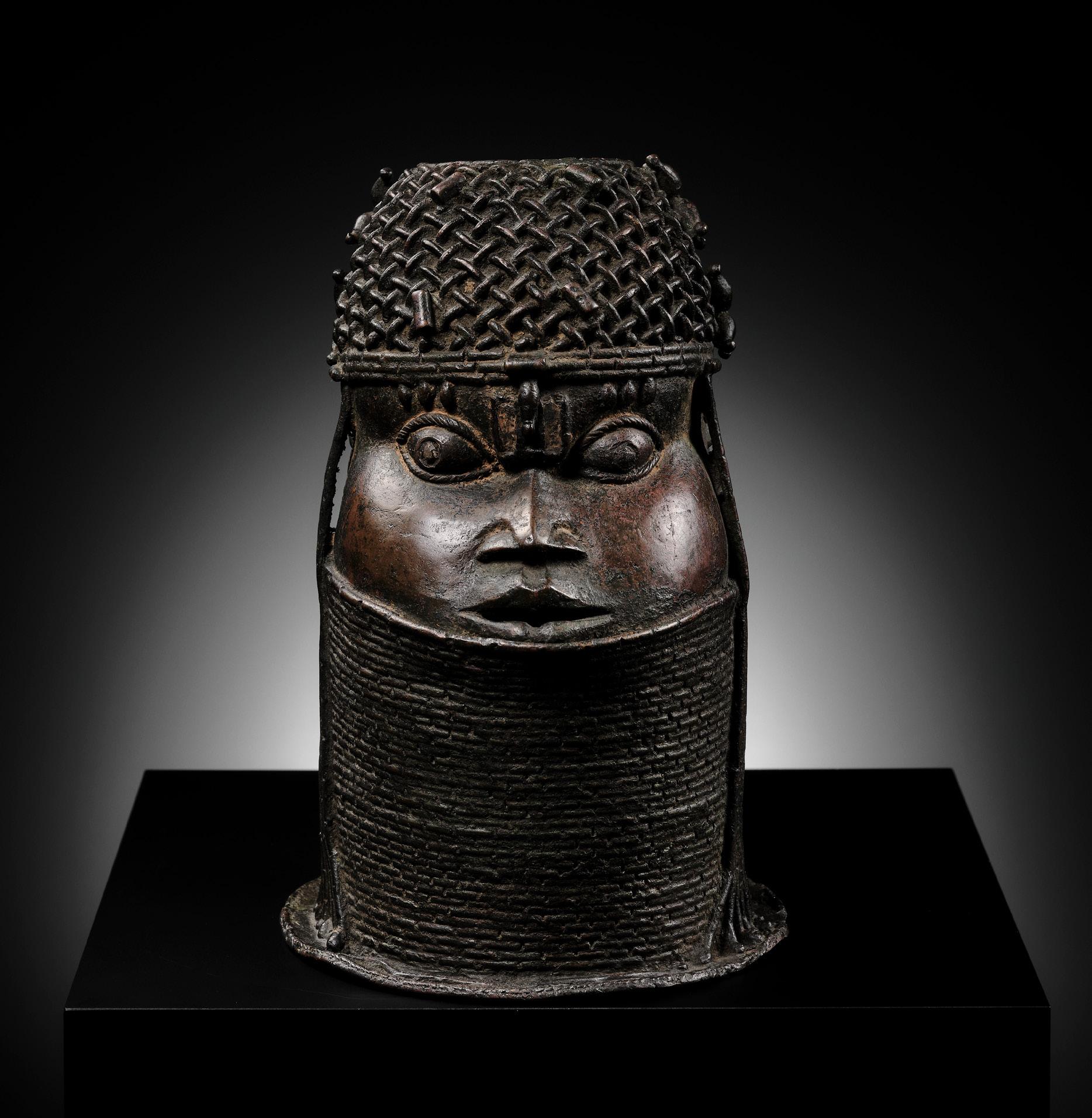
AUCTION RESULT COMPARISON
Type: Closely related
AUCTION RESULT COMPARISON
Type: Closely related
Auction: Sotheby’s Paris, 11 June 2008, lot 130
Price: EUR 528,750 or approx.
EUR 687,000 adjusted for inflation at the time of writing
Description: Exceptional commemorative head of a king, Edo, Kingdom of Benin, Nigeria, 18th century, Nigeria
Expert remark: Compare the closely related modeling, headdress, necklace, and facial features. Note the size (31.5 cm).
Auction: Sotheby’s Paris, 12 December 2017, lot 67
Price: EUR 1,869,000 or approx.
EUR 2,237,000 adjusted for inflation at the time of writing
Description: Head, Edo, Kingdom of Benin, Nigeria, 17th-18th century
Expert remark: Compare the closely related modeling, headdress, necklace, and facial features. Note the size (31.5 cm).
Estimate EUR 60,000
Starting price EUR 30,000
PUBLISHED
Gert Chesi, Afrika. Die Kunst der Könige, 2004, Museum der Völker (formerly Haus der Völker, Museum für Kunst und Ethnographie), Schwaz, Tyrol, Austria , p. 17.
Exhibited:
Museum der Völker (formerly Haus der Völker, Museum für Kunst und Ethnographie), Schwaz, Tyrol, Austria, Afrika. Die Kunst der Könige, 3 January – 2 May 2004.
Nigeria, Court of Benin. The bird perched atop a tall reticulated outpost rising from a flaring foot to a waisted mid-section, culminating in a broad cuboidal mouth, the long shaft pierced to the sides with hatched designs and openwork scrolls, the lower section of the column neatly incised, and the foot ring braided. The peculiar bird with a large, hooked beak, clutching a small fruit, its wide bulging eyes flanking the sides of the head, and plumage neatly depicting as overlapping feathers.
Provenance: A private collection in the UK, 1980s. Collection of Gerhard Merzeder (b. 1963), internationally published and acclaimed fashion and portrait photographer, Vienna, Austria, assembled since the 1980s.
Condition: Good condition with wear and casting irregularities. Scattered nicks, small dings, losses, minor warping, some rubbing, encrustations, and signs of use. The bronze with a dark, naturally grown patina.
Weight: 1,247.1 g
Dimensions: Height 33.5 cm
Hand-held clappers are among a vast and varied category of 'selfsounding' musical instruments, known collectively as idiophones, that produce sound without the addition of a stretched membrane or a vibrating string or reed. The most common form of clapper in the Benin corpus consists of a cylindrical shaft surmounted by the figure of a long-beaked bird with outstretched wings, such as this example. They are played by striking the bird figure on its beak with a metal rod.
The bird perched with outstretched wings on the finials of this idiophone sounded on the occasions of Ugie Oro court festivals is usually called the "bird of prophecy" (ahianmwen-oro) and sometimes the "messenger of god" (odibosa). Beginning with the reign of King Esigie in the sixteenth century, the sounding of clappers depicting the bird of prophecy at Ugie Oro court ceremonies was regarded as a sign that the kings of Benin were endowed with the power to alter history.
AUCTION RESULT COMPARISON
Type: Closely related
Auction: Sotheby’s New York, 14 November 2008, lot 42
Mid-estimate: USD 6,000 or approx. EUR 7,800 converted and adjusted for inflation at the time of writing
Description: A Benin brass idiophone, Nigeria
Expert remark: Compare the closely related modeling and similar plumage on the longbeaked bird.
Estimate EUR 3,000
Starting price EUR 1,500
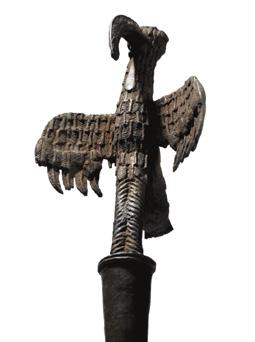
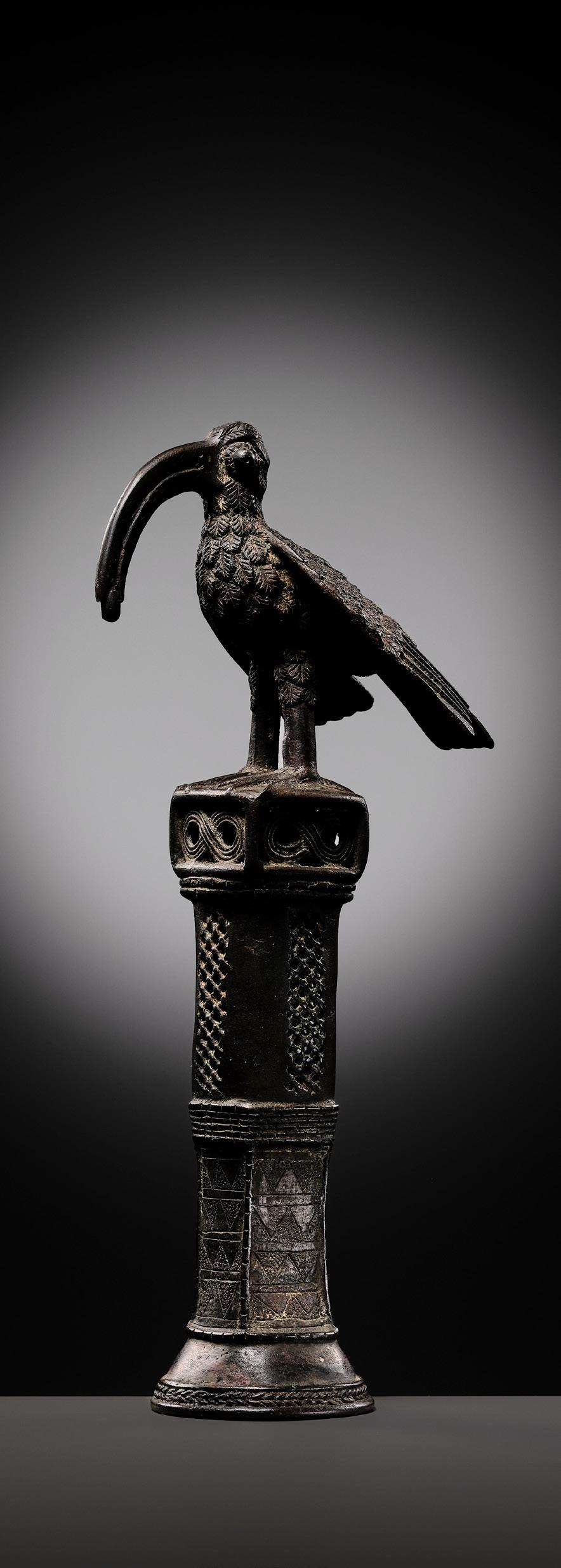
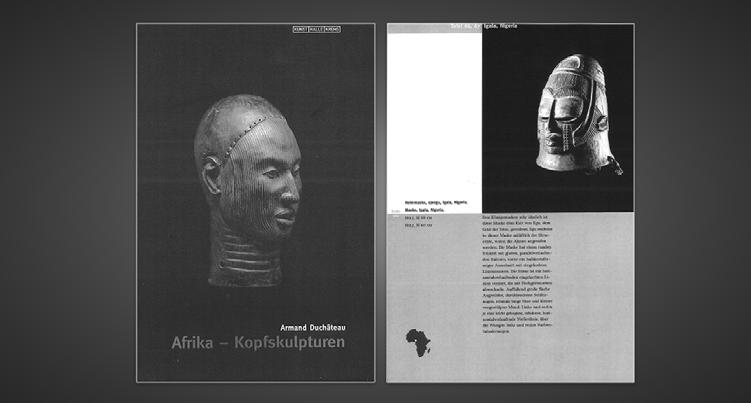
PUBLISHED
Kristian Fenzl and Armand Duchâteau, Afrika-Kopfskulpturen, 1998, Kunsthalle Krems, Krems an der Donau, p. 122, Tafel 66 and on the back cover
Exhibited:
Kunsthalle Krems, Afrika-Kopfskulpturen, Krems an der Donau, 26 July 1998 – 18 October 1998.
SCIENTIFIC ANALYSIS REPORT
A certificate from Istituto Internationale Ricerche Autenticità di Ogetti d’Arte, Milano, from 12 March 1997, certificate number 132, confirms the dating above. A copy of the report accompanies this lot.
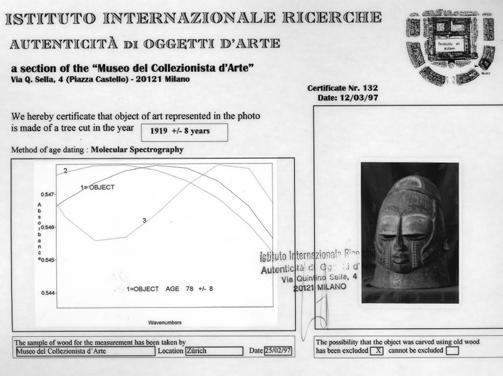
The helmet mask is carved with vertical bands alternating with herringbone motifs across the forehead. The eyes are nearly closed, their prominent lids coated in white kaolin, above an elongated nose and pursed lips, with C-shaped ears to either side. The coiffure is rendered in parallel ridges, featuring a semicircular recessed panel at the front filled with fine lines, highlighted in white, and lined with a braided band; a matching recess appears at the back. Additional bands descend from the temples toward the mouth, with a stylized beard to each side.
Art Loss Register: Certificate reference number S00266167 from 16 December 2025. A copy of this document accompanies this lot.
Provenance: Galerie Walu, Zurich, 1990. A Swiss private collection, acquired from the above. Collection of Gerhard Merzeder (b. 1963), internationally published and acclaimed fashion and portrait photographer, Vienna, Austria, assembled since the 1980s. The family-owned Galerie Walu has been specialized in cultures of sub-Saharan Africa since 1957, supported by decades of hands-on experience in the African art market.
Condition: Good condition with expected old wear, some signs of weathering, natural cracks, old fills, flaking of the pigments, few nicks, and little rubbing. Fine, naturally grown patina.
EXTERNAL EXPERT AUTHENTICATION
Koller Auktionen, Zurich, 5 December 2011, lot 290 (mid-estimate CHF 25,000 or approx. EUR 28,000 converted and adjusted for inflation at the time of writing).
Weight: 1.6 kg
Dimensions: Height 33 cm
Ojuegu masks evoke Egu, the spirit of the dead, linked to ancestors. It appears during the Yam Festival, a very important event that celebrates the yam harvest and is intended to attract the blessings of the gods and spirits to the fertile lands.
The oversized eyelids give it an inward, contemplative gaze and an unapproachable grace, reinforcing the overall impression of dignified serenity. Because of indications of a historical relationship between the Igala and the Yoruba, some authors see in these impressive, tranquil ancestor masks a formal affinity with the bronze heads of Ife.
LITERATURE COMPARISON
Compare a closely related odumado mask, Igala culture, dated 19th20th century, 31 cm tall, in the Minneapolis Institute of Art, accession number 2000.1 (fig. 1). Compare a closely related wood mask, Egu Ojuegu, Igala culture, dated late 19th to early 20th century, 36.5 cm tall, in the Musée du Quai Branly Jacques Chirac, inventory number 70.2023.62.4. Compare a closely related odumado mask, Igala culture, dated mid-20th century, 35.2 cm tall, in the African Art Museum, Smithsonian Institution, object number 97-18-1 (fig. 2). fig. 1 fig. 2
Estimate EUR 8,000
Starting price EUR 4,000
One or more slabs of African oak , widely known as iroko (Chlorophora excelsa; in Igbo as oji) formed wall and door insets at the entryway of the main compound. The large planks were extremely difficult to cut from the dense wood of the iroko tree and measured approximately 1-1.5 meters high and nearly a meter in width. Several individual panels could span the entry, with one acting as a door that swiveled on fixed pivots.
These ensembles differed from ordinary portals not only because of their size but also because of the rich designs carved in relief on their public side. Each panel was decorated differently, yet mgbo ezi are
unmistakable for their unity of geometric patterning. Diamonds, squares, rectangles, and triangles are juxtaposed on fields of rich textures created by narrow grooved hatchings and tiny, dentated studs. Symmetrical distribution in grids accentuates the ordered precision typifying mgbo ezi designs. The repetition of striations, curved and angular, lends to the ordered precision typifying mgbo ezi designs and to the surface an illusion of compressed energy, resulting in oscillating rhythms reminiscent of Op Art illusions. The diminutive serrations and elongated lines catch and reflect light with the full strength of the sun’s rays.
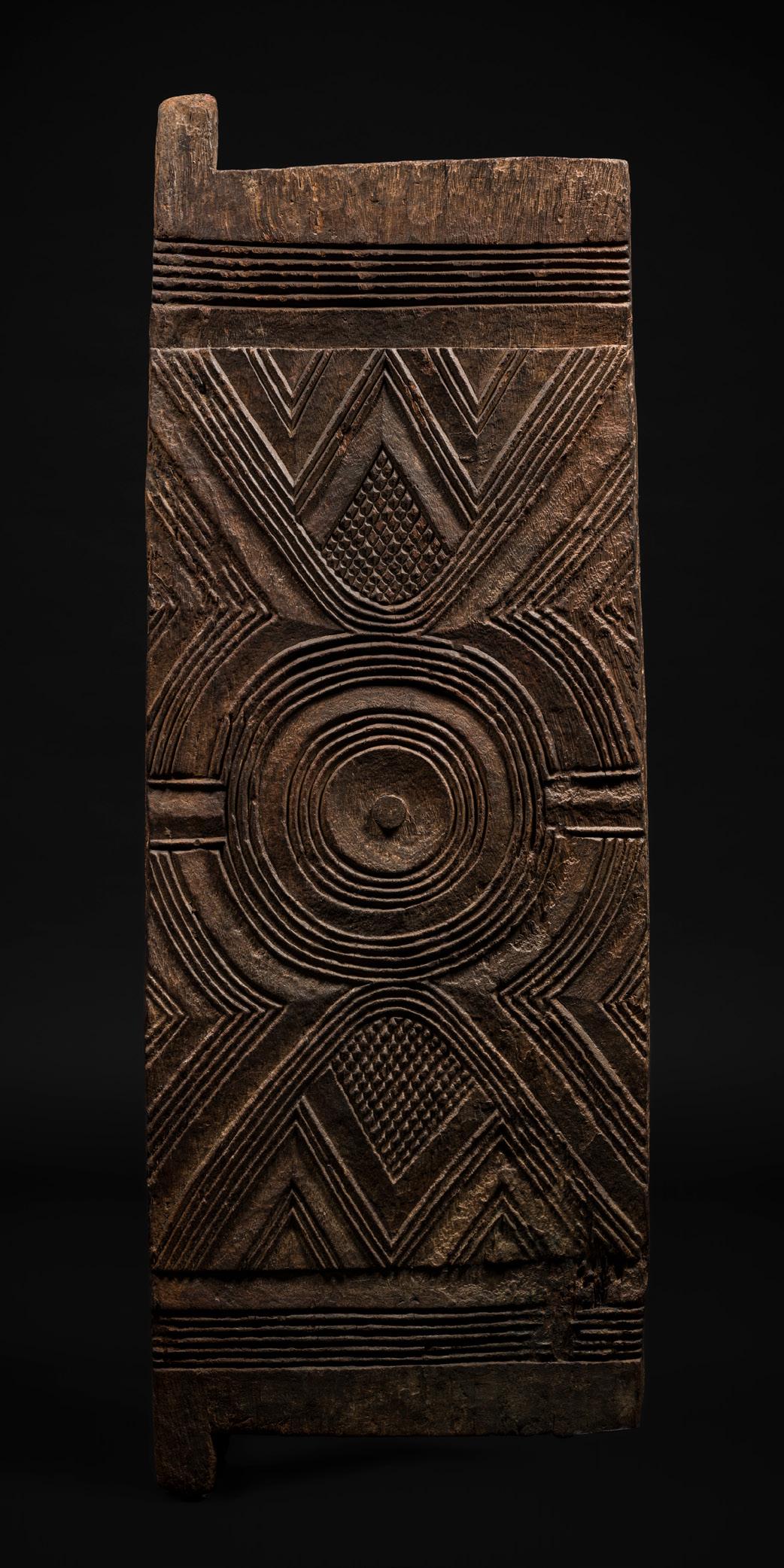
74
A CARVED AFRICAN OAK DOOR, MGBO EZI, IGBO PEOPLES, 18TH-19TH CENTURY
Nigeria. Finely carved, the wood panel with fixed pivots to the top and bottom, intricately incised on one side with geometric design centered by a large circle enclosed within a diamond and radiating triangles, on a narrow ground of rich grooved hatchings.
Provenance: A private collection in the UK. Collection of Gerhard Merzeder (b. 1963), internationally published and acclaimed fashion and portrait photographer, Vienna, Austria, assembled since the 1980s.
Condition: Good condition with expected wear, natural imperfections including age cracks, obvious losses, scratches, small chips, signs of wear and use, and scattered insect activity.
Weight: 17.1 kg
Dimensions: Size 149.5 x 53.5 cm
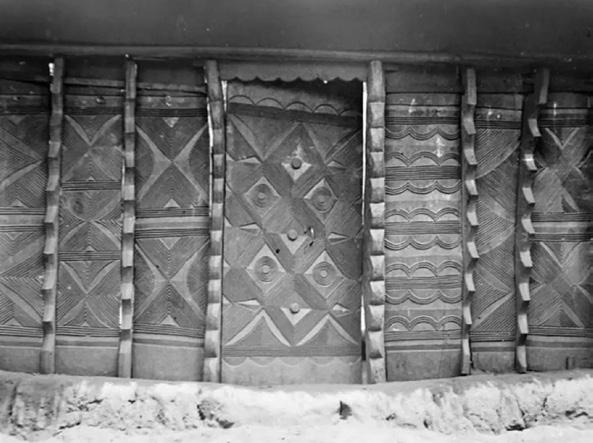
Igbo panels and doors, photographed circa 1910 by Northcote Whitridge Thomas (1868–1936). Collection MAA museum of archaeology and anthropology (P.119850.NWT)
Estimate EUR 1,000
Starting price EUR 500
These doors and panels once were the prerogative of highly ranked members of the prestigious northern Igbo men’s association, ozo. Men aspired to ozo and attained membership by fulfilling certain social, ritual, and financial obligations, gradually passing from lower to more exclusive upper of membership. Among other things ozo involved the acquisition and display of various kinds of paraphernalia: headgear, jewelry, ivory tusks, stools, staves; all of which became increasingly costly and elaborate as one ascended its ranks. Those who succeeded in reaching the pinnacles of ozo, usually in old age, were entitled to commission sculptors to carve mgbo ezi. While the precise rank could vary from community
to community, all entailed enormous expenditures for lavish feasts and the payment of the carvers, who derived their main source of revenue from such commissions. In addition to those at the main entrance to the compound, these panels could also be placed within the ozo member’s obu or as enclosing wall panels on one or more sides.
75
Nigeria. Finely carved, the wood panel with fixed pivots to the top and bottom, intricately incised on one side with geometric design centered by a large circle enclosed within a diamond and radiating triangles, on a narrow ground of rich grooved hatchings.
Provenance: A private collection in the UK. Collection of Gerhard Merzeder (b. 1963), internationally published and acclaimed fashion and portrait photographer, Vienna, Austria, assembled since the 1980s.
Condition: Good condition with expected wear, natural imperfections including age cracks, obvious losses, scratches, small chips, and signs of wear and use.
Weight: 27.6 kg
Dimensions: Size 185 x 72.5 cm
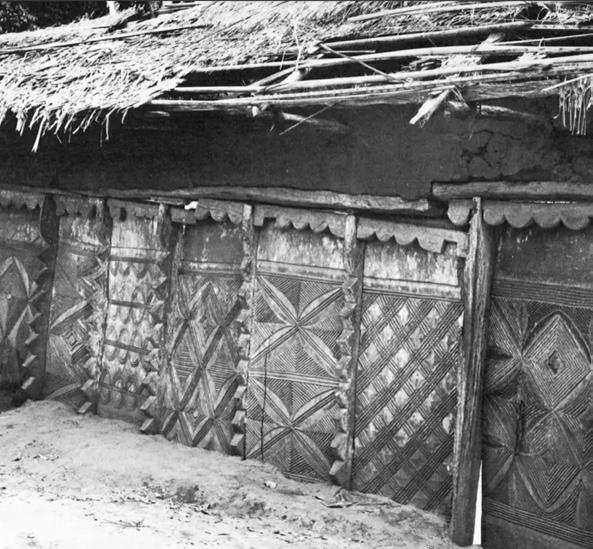
Traditional Igbo doors, from the entranceway to a compound in Enugu-Ukwu, along the Awka-Onitsha Road, mid 1960s. Published in: “Traditional Igbo Art: 1966”, text by Frank Starkweather, Ann Arbor, MI: Museum of Art, University of Michigan, 1968. The six panels on the left are stationary. The gate is on the right. These impressive panels are set in a mud wall which surrounds the yard of an important family.
Literature comparison:
Compare a closely related domestic compound door, Igbo peoples, Awka village, Nigeria, in the SFO Museum, San Francisco, accession number L2013.3301.014.
Estimate EUR 1,000
Starting price EUR 500
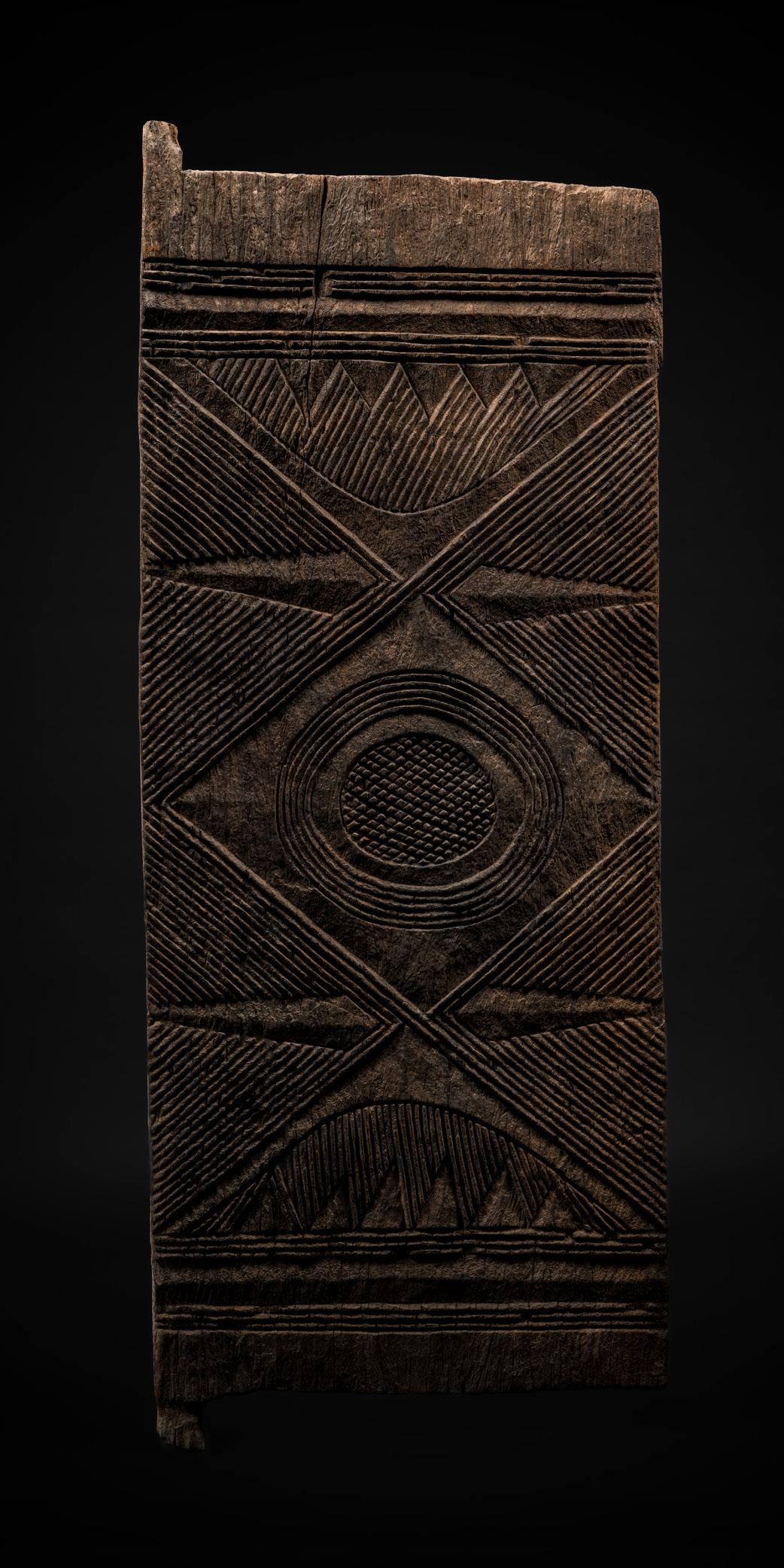
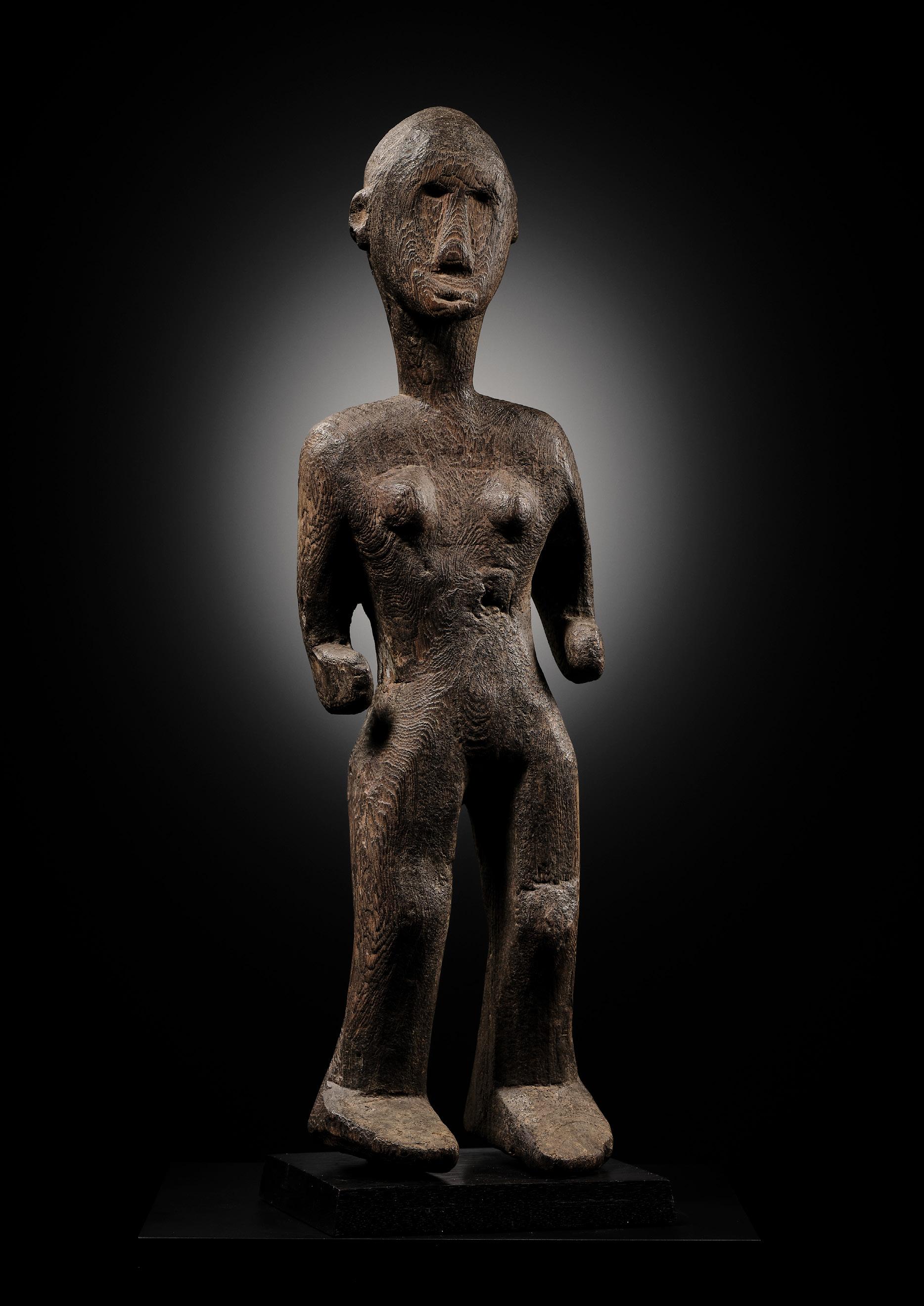
A MONTOL RITUAL WOOD FIGURE OF A LADY, NIGERIA, 18TH TO 19TH CENTURY
EXTERNAL EXPERT AUTHENTICATION
1. University Professor Dr. Armand Duchateau has authenticated this lot, identifying its iconographic and stylistic characteristics corresponding to artworks from Montol, Nigeria. A copy of Dr. Duchateau’s expertise accompanies this lot.
2. Koller Auktionen, Zurich, 6 December 2003, lot 49 (midestimate CHF 10,000 or approx. EUR 12,000 converted and adjusted for inflation at the time of writing).
Scientific Analysis Report:
Apparently a C14 radiocarbon certificate was issued by ETH (Eidgenössische Technische Hochschule), Zurich, Switzerland, dating the present to the 18th-19th century (1672-1782: probability 45.1%, 1795-1897: probability 37.6%) This certificate is mentioned in the Koller auction catalog, but was subsequently lost and is therefore not available.
The figure stands with slightly bent knees, conical breasts, and arms curved alongside the body, while the oval face is rendered with simplified, archaic features flanked by high-set ears.
Provenance: Swiss private collection, 1980s. Collection of Gerhard Merzeder (b. 1963), internationally published and acclaimed fashion and portrait photographer, Vienna, Austria, assembled since the 1980s.
Condition: Good condition with expected old wear, signs of weathering and erosion, natural cracks, old chips which have smoothened over time, and a hole drilled for sample-taking below the buttocks. Fine, naturally grown patina.
Weight: 2.1 kg (incl. stand)
Dimensions: Height 53 cm (excl. stand), 56.3 cm (incl. stand)
LITERATURE COMPARISON
Compare a related wood female figure, Montol culture, 45.8 cm tall, in the British Museum, museum number Af1965,05.3.
Estimate EUR 2,000
Starting price EUR 1,000
1. Kristian Fenzl and Armand Duchâteau, Afrika Ethno-Kunst, 1997, Bergbau Museum Klagenfurt, p. 58, no. 44.
2. Reynold C. Kerr, Mother Africa, 2002, Kerr Museum Productions, New York, p. 47 and 148.
Expert’s Note:
We date this sculpture conservatively to the 19th century or earlier. However, an AMS radiocarbon (C14) analysis carried out at ETH Zurich leaves open a distinct possibility of a substantially earlier date. The ETH test produced calibrated age ranges that include a 34.9% probability for the late 17th to 18th century (AD 1679–1769), alongside a later 19th-century window, and explicitly notes that due to the form of the calibration curve multiple true age ranges are possible. Importantly, an independent scholarly assessment by Prof. Dr. Hans Witte, recorded in an undated written opinion issued by Italiaander Galleries, attributes the sculpture to the 17th century, possibly even the 16th century, and describes it as very rare; Witte was formerly curator of the Afrika Museum in Berg en Dal and later professor at the University of Groningen, making his opinion one grounded in long curatorial and academic experience and direct familiarity with early, pre-colonial African sculpture. While any dating prior to secure context must remain very cautious, the combination of an ETH C14 result that allows earlier chronologies and a strong stylistic attribution by a noted scholar provides clear indications that this sculpture may well predate the 19th century and could plausibly belong to the 17th or even late 16th century corpus.
The narrow, elongated head with its braids and elegant headdress rising from a long, graceful neck, and flowing seamlessly into the beautifully elongated female body with prominent breasts. Her gently sweeping arms embrace the child while she sits on her chair supported by a backrest. The comparatively short legs make up roughly one-fifth of the sculpture’s total height.
Exhibited:
1. Bergbau Museum, Afrika Ethno-Kunst, Klagenfurt, Austria, 1997.
2. Kunsthalle Krems, Afrika-Kopfskulpturen, Krems an der Donau, Austria, 26 July 1998 – 18 October 1998.
3. The Schomburg Center, New York, USA, 2002.
4. Centro Cultural Conde Duque, Madre África, Madrid, Spain, 2004.
5. Museo del IES Canarias Cabrera Pinto, Tenerife, Spain, 2004.
6. Centro de Arte La Regenta, Las Palmas, Spain, 2004.
7. Museo del Hombre Dominicano, Santo Domingo, Dominican Republic, 2007.
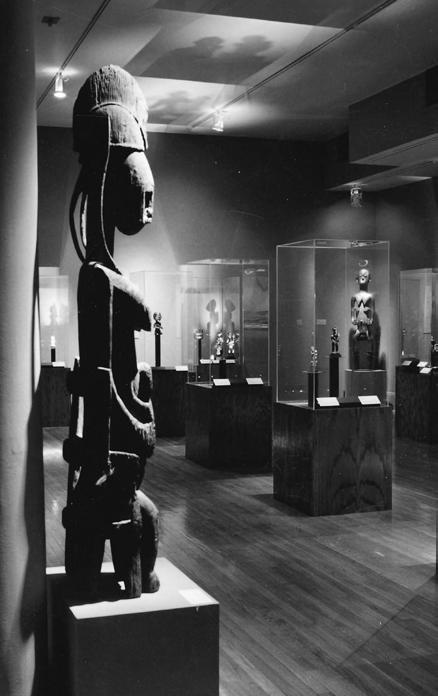
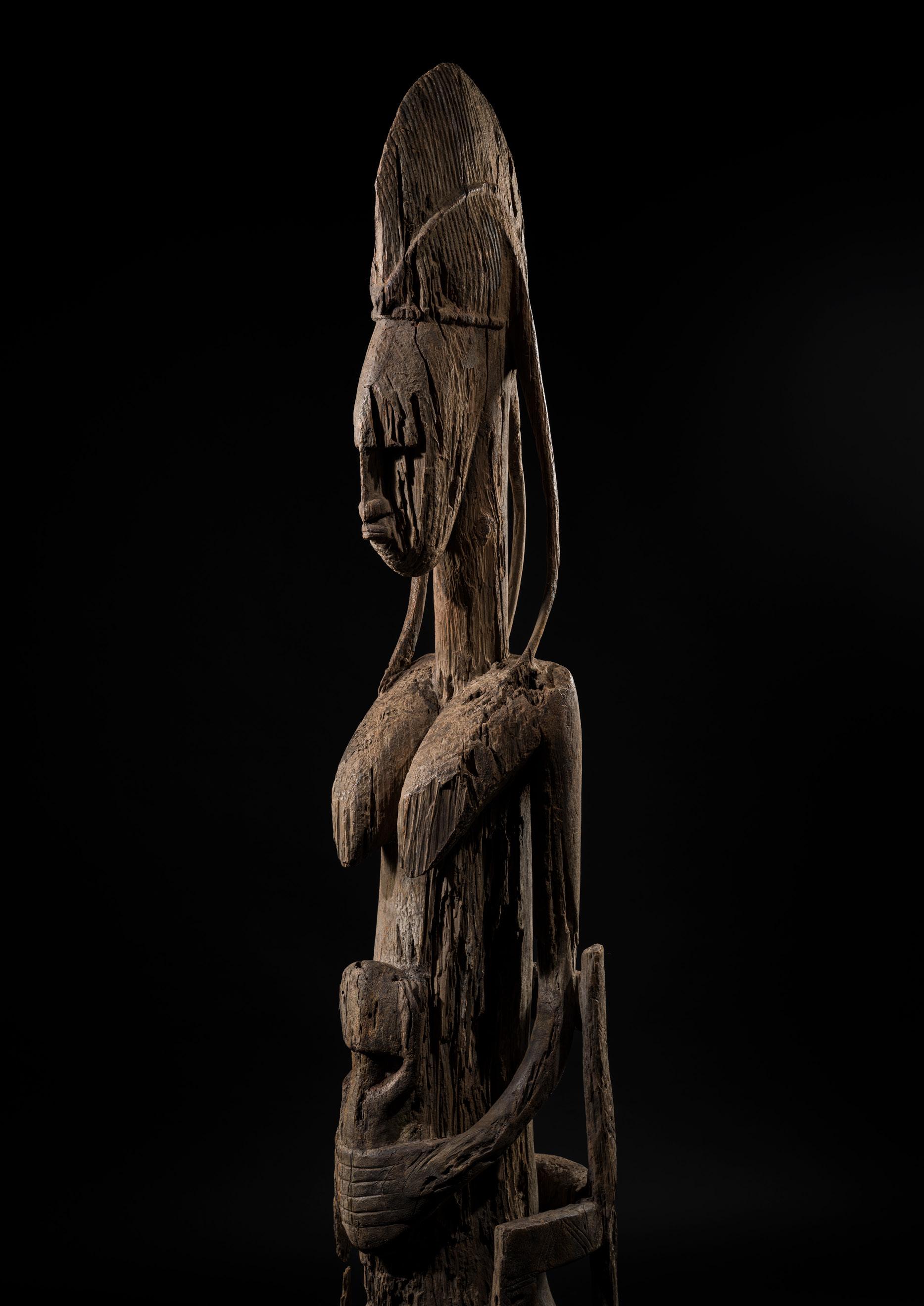
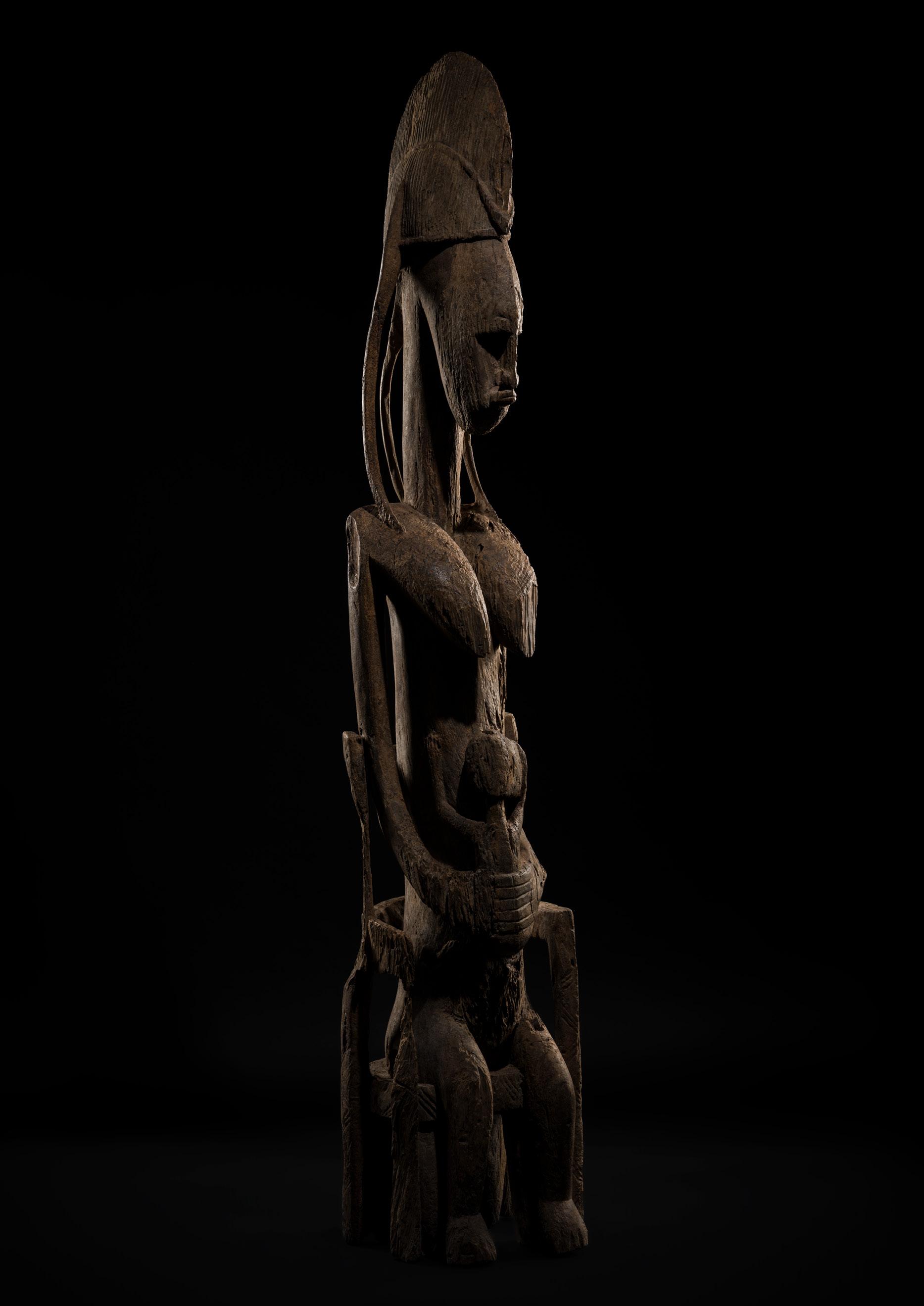
SCIENTIFIC ANALYSIS REPORTS
1. A radiocarbon dating certificate was issued by the ETH (Eidgenössische Technische Hochschule), Zurich, on 31 March 2009, dating the present lot from 1815-1927 (71.5 %), consistent with the dating above. A copy the document accompanies the lot.
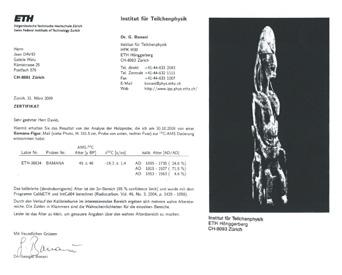
2. Another radiocarbon dating certificate was issued by the ETH (Eidgenössische Technische Hochschule), Zurich, on 23 August 2001, dating the sample taken to 1802-1939 (65.1 %), consistent with the dating above. A copy of the document accompanies the lot.
Art Loss Register:
Certificate reference number S00266208 from 15 December 2025. A copy of this document accompanies this lot.
Provenance:
1. Jan Porel collection, Göteborg, Sweden, since 1920.
2. A Dutch private collection, Amsterdam, Netherlands.
3. Italiaander Galleries, Amsterdam, Netherlands, November 1995.
4. Professor Mag. Kristian Fenzl, Institut für Ethnodesign, Linz, Austria, acquired from the above.
5. Collection of Gerhard Merzeder (b. 1963), internationally published and acclaimed fashion and portrait photographer, Vienna, Austria, assembled since the 1980s, acquired from the above on 12 November 2001, for a purchase price of ATS 880,000 or EUR 114,000 (converted and adjusted for inflation at the time of writing).
Provenance documents:
- A copy of the signed provenance certificate from Italiaander Galleries, Amsterdam, November 1995, confirming the Jan Porel provenance, accompanies the lot.
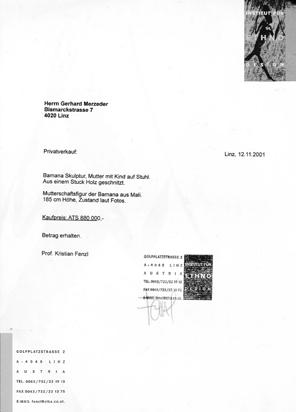
A copy of the signed and stamped invoice from Institut für Ethno Design, Linz, on 12 November 2001, stating a purchase price of ATS 880,000 or approx. EUR 114,000 (converted and adjusted for inflation at the time of writing), and confirming the Professor Kristian Fenzl provenance.
- A copy of the signed authentication certificate from Dr. Armand Duchâteau, confirming both the Professor Fenzl and Italiaander Galleries provenance, accompanies the lot.
- A copy of the signed and stamped invoice from Institut für Ethno Design, Professor Fenzl, Linz, on 12 November 2001, accompanies the lot.
Kristian Fenzl (born 1946) is an Austrian sculptor, painter, illustrator, designer, and university professor. He studied at the Universität für angewanted Kunst Wien (University of Applied Arts), where he trained in metal design under Franz Hagenauer, and in 1975 completed postgraduate studies at the University of Stellenbosch in South Africa. In 1984, he co-founded the Institut für Ethnodesign in Linz with ethnologist Fritz Trupp and social psychologist Norbert Minkendorfer, an interdisciplinary center from which numerous publications have emerged.
Condition: Good condition with extensive wear, signs of weathering and erosion, natural cracks, splits, some losses, chips, traces of insect activity, and few repairs to exposed areas.
EXTERNAL EXPERT AUTHENTICATION
Koller Auktionen, Zurich, 30 November 2009, Lot 138 (mid-estimate CHF 210,000 or approx. EUR 238,000 converted and adjusted for inflation at the time of writing).
Weight: 48.5 kg
Dimensions: Height 192 cm
In south-central Mali, the statues associated with the Jo initiation rites— the Jomooni—and their female counterparts from the Gwan tradition, the Gwandusu, were long kept hidden from uninitiated eyes within sanctuaries that remained undisturbed for generations. Their existence was so carefully guarded that, in 1953, ethnologist Viviana Pâques, despite extensive field research on the cult, remained entirely unaware of them. Only a few years later, the unexpected emergence of a small group—roughly a dozen figures—created a sensation at the exhibition of Bambara Sculpture from the Western Sudan at the Museum of Primitive Art in New York.
The Bamana (Bambara) are the largest population group in Mali and, alongside the Dogon, are considered the most important carvers. Secret societies are widespread among them, and the initiation of these societies features a great variety of masks. Only a few large sculptures are known, most often in the form of a mother and child. They were made by blacksmiths and are therefore called numumani (‘little person of the blacksmith’).
These effigies were used during rituals intended to promote fertility or to ensure a serene pregnancy for expectant mothers. Seated - or more rarely, standing - pregnant or bearing children, occasionally accompanied by male figures, they were venerated through anointments of shea butter followed by lavish ablutions.
LITERATURE COMPARISON
Compare a related wood figure of a mother and child, Bamana culture, Mali, dated 12791395, in the Los Angeles County Museum of Art, reference number M.2014.19.
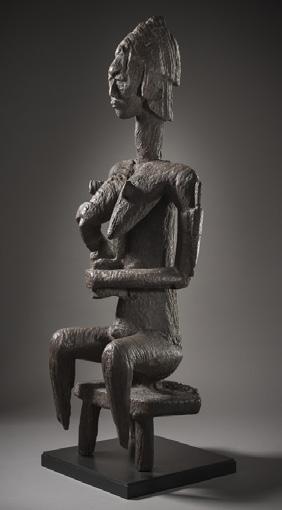
AUCTION RESULT COMPARISON
Type: Related
Auction: Christie’s Paris, 16 June 2025, lot 16
Price: EUR 252,000 at the time of writing
Description: A Bamana Figure, Mali
Expert remark: Compare the similar form and expression. Note the smaller size (133 cm).
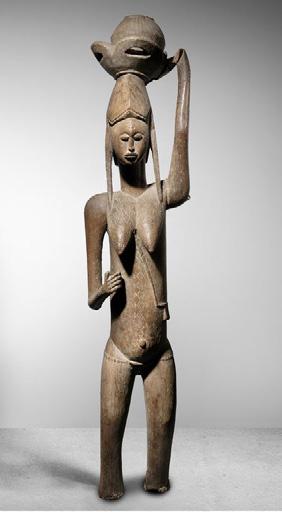
AUCTION RESULT COMPARISON
Type: Related
Auction: Christie’s Paris, 3 December 2020, lot 66
Price: EUR 225,000 or approx. EUR 260,000 adjusted for inflation at the time of writing
Description: A Bamana figure, Gwandusu, Mali
Expert remark: Compare the similar form and pose. Note the smaller size (92 cm).
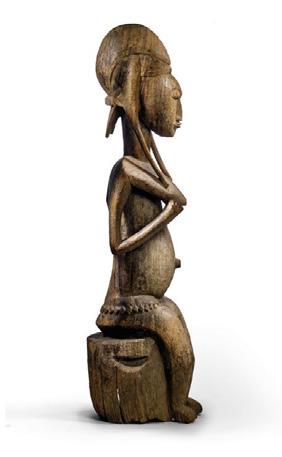
Estimate EUR 30,000
Starting price EUR 15,000
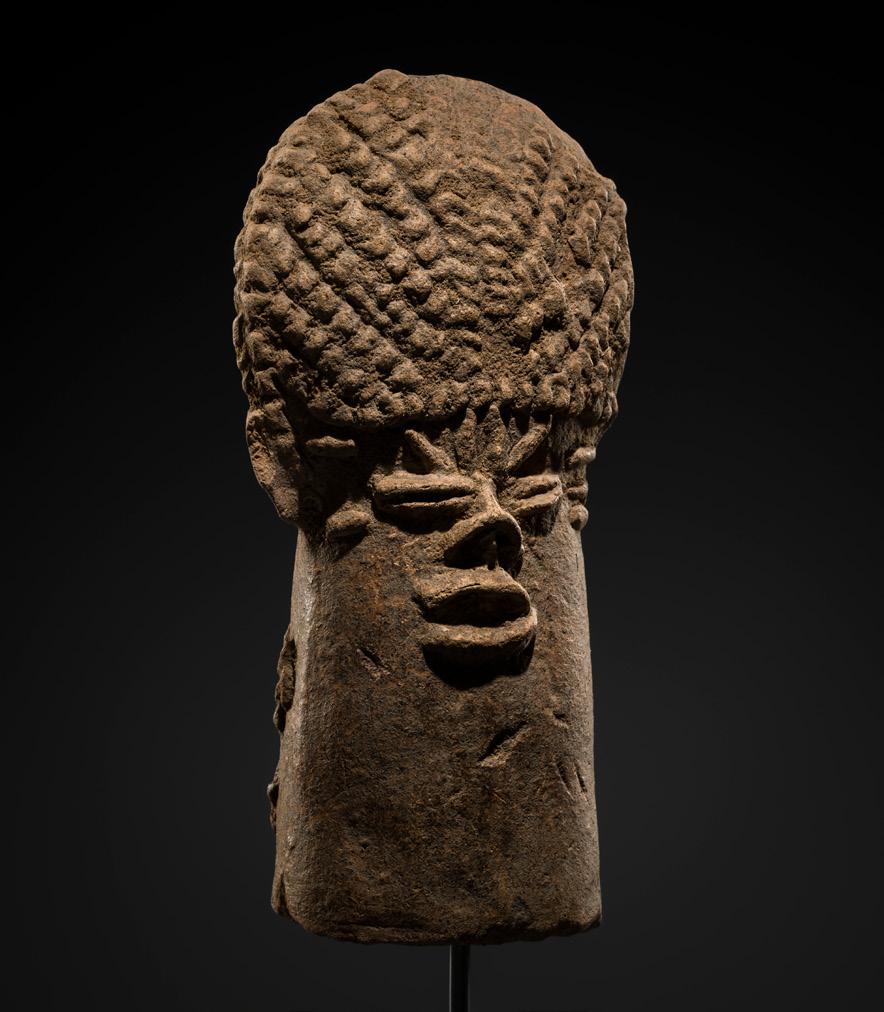
78
A TERRACOTTA MEMORIAL HEAD WITH TALL COIFFURE, BURA CULTURE, NIGER, 3RD-11TH CENTURY
Published: Kristian Fenzl and Armand Duchâteau, Afrika-Kopfskulpturen, 1998, Kunsthalle Krems, Krems an der Donau, p. 38-39, Tafel 12.
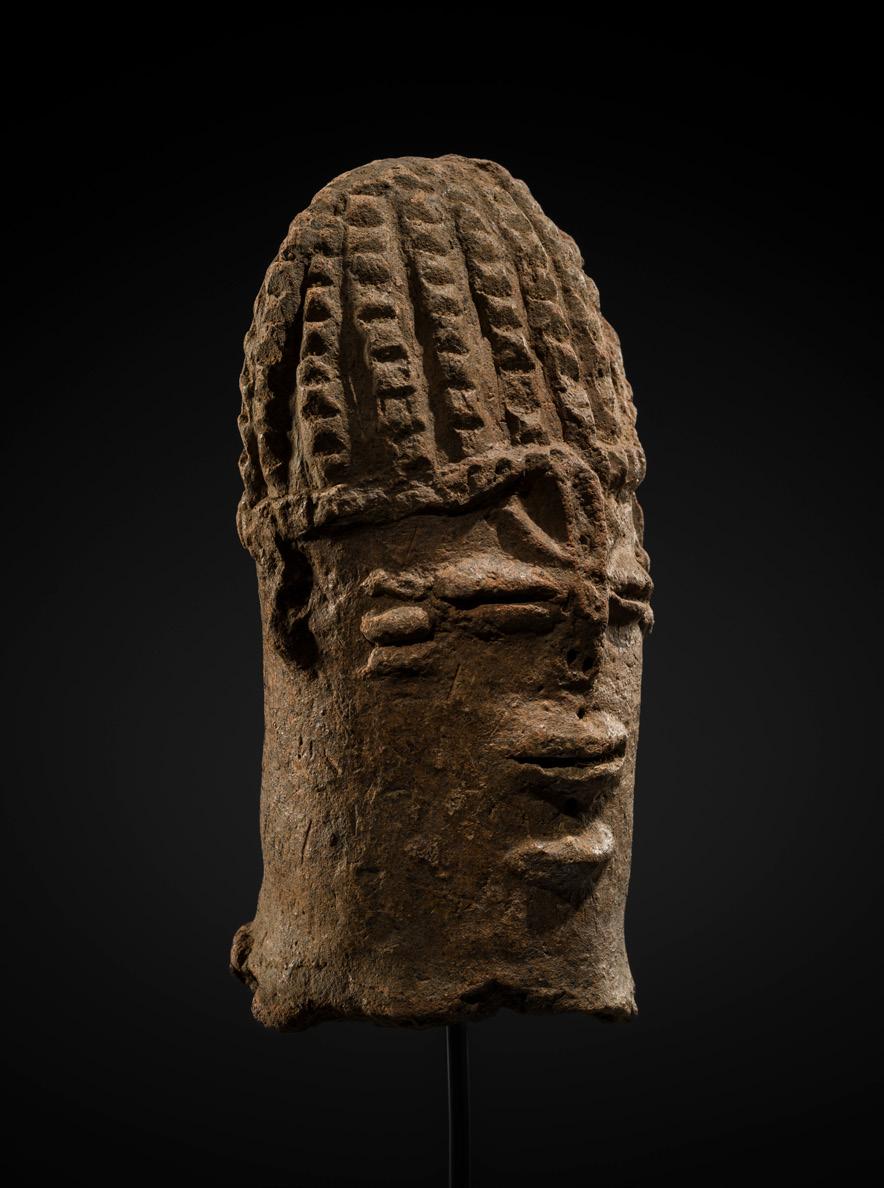
Exhibited: Kunsthalle Krems, Afrika-Kopfskulpturen, Krems an der Donau, 26 July 1998 – 18 October 1998.
The head emerges from a slightly flaring cylindrical neck and is topped by a prominent disc-shaped braided coiffure. The face, with its almost comical expression, features a triangular nose, slit-like eyes, and an open mouth. Raised ovoid appliqués accent the cheeks, possibly representing scarification marks. Two lozenge-shaped, raised and ridged braids adorn the back of the neck.
Provenance: Galerie Walu, Zurich, 1989. Collection of Gerhard Merzeder (b. 1963), internationally published and acclaimed fashion and portrait photographer, Vienna, Austria, assembled since the 1980s.
Condition: Very good condition with expected old wear, signs of weathering and erosion, natural cracks, small chips, and soil encrustations.
Weight: 700 g
Dimensions: Height 16.7 cm
AUCTION RESULT COMPARISON
Type: Related
Auction: Bonhams New York, 15 May 2014, lot 99
Price: USD 3,125 or approx. EUR 3,700 converted and adjusted for inflation at the time of writing
Description: A fine Bura memorial head, Niger/Burkina Faso
Expert remark: Compare the similar form with flattened head, ridged details, and stylized facial features. Note the size (21 cm).
Estimate EUR 800
Starting price EUR 400
79
A TERRACOTTA MEMORIAL HEAD, BURA CULTURE, NIGER, 3RD-11TH CENTURY
Exhibited: Kunsthalle Krems, Afrika-Kopfskulpturen, Krems an der Donau, 26 July 1998 – 18 October 1998.
The head rises from a cylindrical neck and is crowned by a tall coiffure composed of orderly rows of braids. The frowning face features slitshaped eyes set beneath raised wrinkles and arching eyebrows, a flat nose with pierced nostrils, and a slit-form mouth framed above and below by perforations. The projecting ears bear matching perforations, while three braided strands descend along the neck toward the shoulders.
Provenance: Galerie Walu, Zurich, 1989. Collection of Gerhard Merzeder (b. 1963), internationally published and acclaimed fashion and portrait photographer, Vienna, Austria, assembled since the 1980s.
Condition: Very good condition with expected old wear, signs of weathering and erosion, obvious losses, small chips, few scratches, and soil encrustations.
Weight: 753 g
Dimensions: Height 14.5 cm
LITERATURE COMPARISON
Compare a related ceramic head, Bura culture, in the Timothy S. Y. Lam Museum of Anthropology, North Carolina, catalog number 2019.07.A.33.a-b.
Estimate EUR 800
Starting price EUR 400
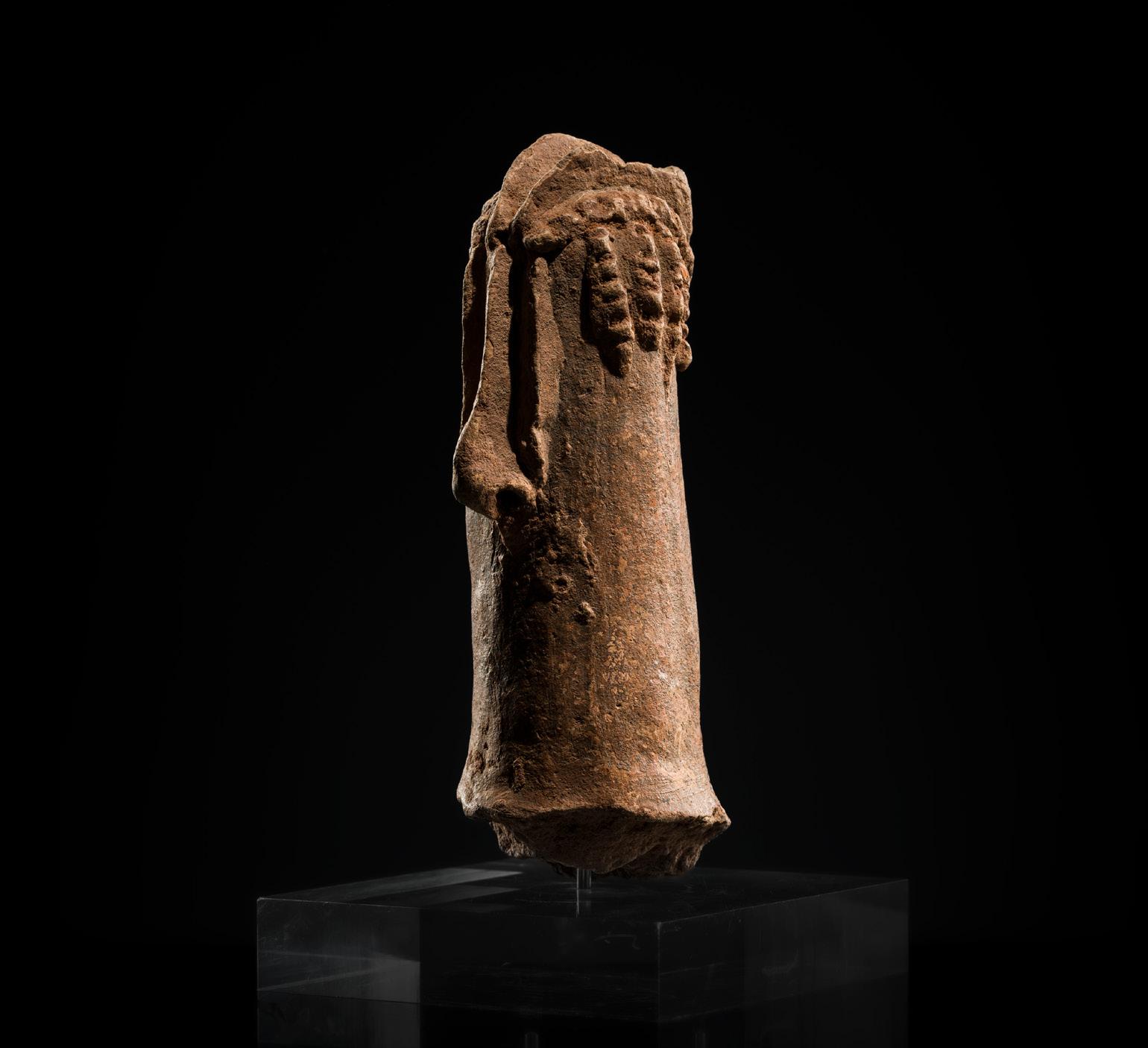
80
AN ABSTRACT TERRACOTTA MEMORIAL HEAD, BURA CULTURE, NIGER, 3RD-11TH CENTURY
Kristian Fenzl and Armand Duchâteau, AfrikaKopfskulpturen, 1998, Kunsthalle Krems, Krems an der Donau, p. 3839, Tafel 14.
Exhibited: Kunsthalle Krems, Afrika-Kopfskulpturen, Krems an der Donau, 26 July 1998 – 18 October 1998.
The oblong head detailed to the upper section with an elongated nose rising from a comb-form hair framed by curly strands of hair. The head with a central perforation to the underside.
Provenance: Galerie Walu, Zurich, 1989. Collection of Gerhard Merzeder (b. 1963), internationally published and acclaimed fashion and portrait photographer, Vienna, Austria, assembled since the 1980s. The family-owned Galerie Walu has been specialized in cultures of sub-Saharan Africa since 1957, supported by decades of hands-on experience in the African art market.
Condition: Very good condition with expected old wear, signs of weathering and erosion, obvious losses, small chips, and soil encrustations.
Weight: 446 g
Dimensions: Height 15.8 cm
The Bura culture flourished in what is now southwestern Niger and parts of Burkina Faso between the 3rd and 13th centuries AD. Bura works ranged from stylized human heads to zoomorphic figures and monumental funerary urns. Their discovery in the 1970s revealed a sophisticated society with complex spiritual beliefs, advanced ceramic techniques, and far-reaching cultural influence.
Bura terracottas are immediately recognizable for their austere geometry, expressive abstraction, and surface perforations, features that set them apart from the more naturalistic forms of neighboring artistic cultures. Many sculptures were found atop funerary mounds, often covering burial pits or associated with large ceramic urns that contained human remains. This context suggests that terracotta figures played a role in ancestral veneration or protective ritual practice, possibly serving as intermediaries between the living and the dead.
Literature comparison:
Compare a related ceramic head, Bura culture, 38.1 cm tall, in the Timothy S. Y. Lam Museum of Anthropology, North Carolina, catalog number 2019.07.A.08.a-b. Compare a related ceramic head, Bura culture, 25.4 cm tall, in the Timothy S. Y. Lam Museum of Anthropology, North Carolina, catalog number 2019.07.A.15.a-b.
Estimate EUR 800
Starting price EUR 400
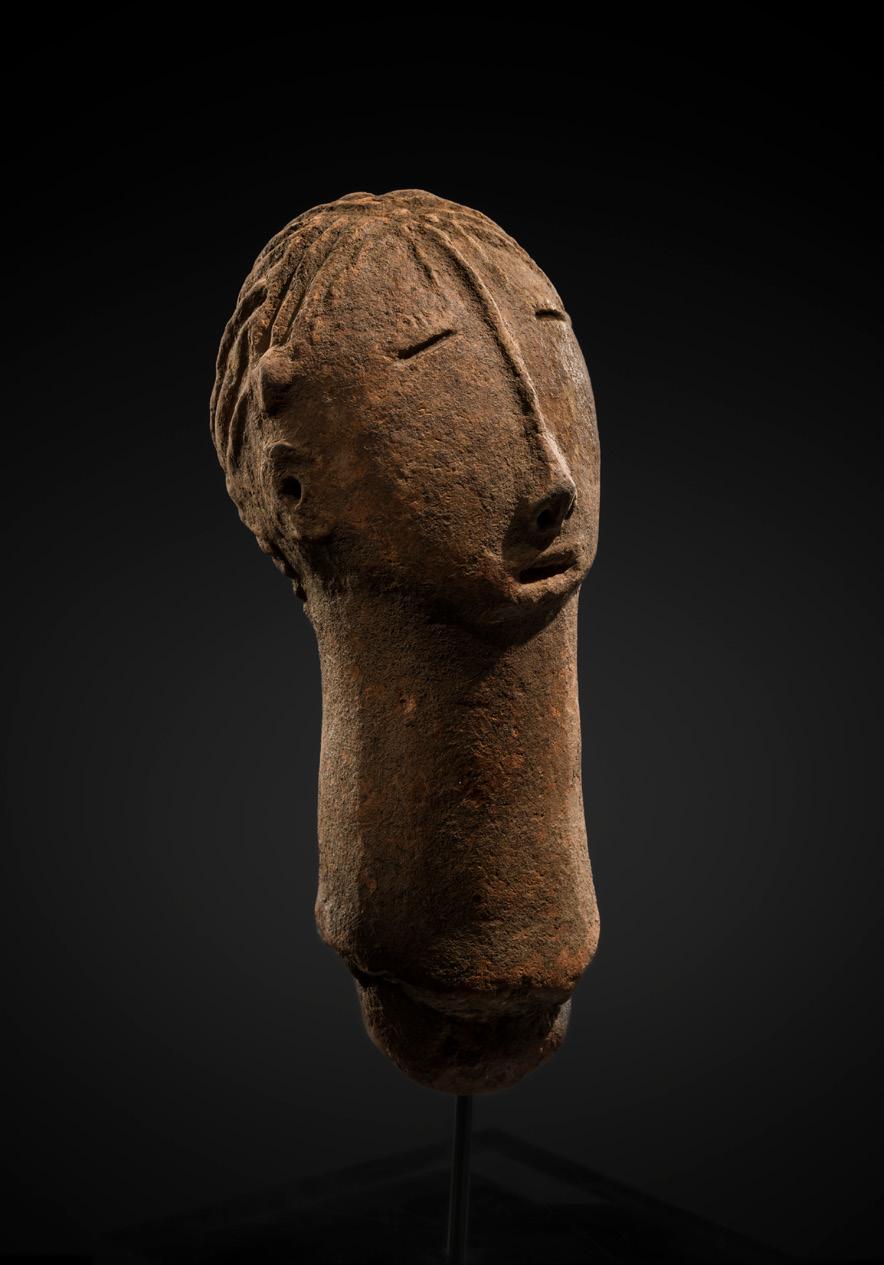
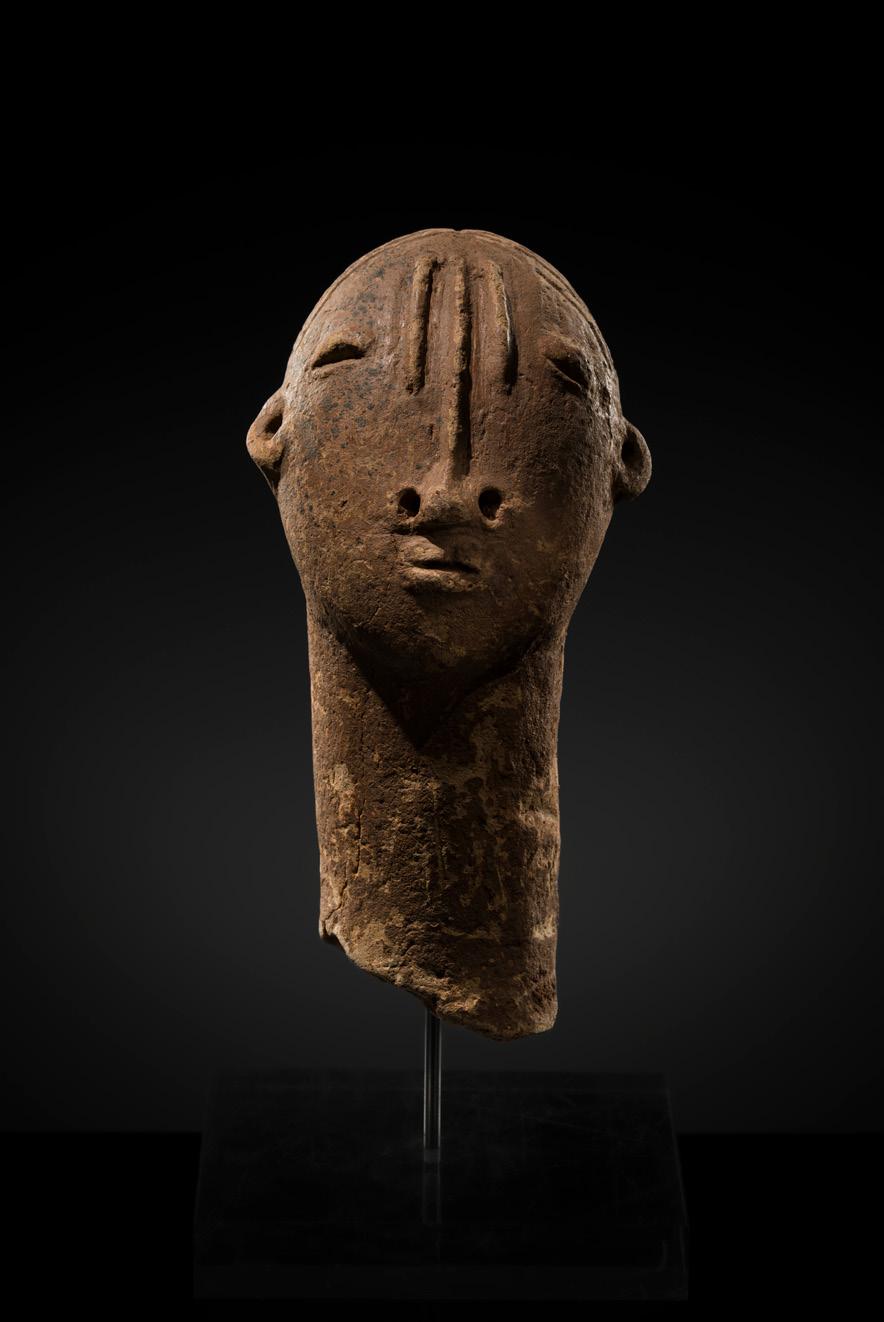
81
A TERRACOTTA MEMORIAL HEAD, BURA CULTURE, NIGER, 3RD-11TH CENTURY
Published: Kristian Fenzl and Armand Duchâteau, Afrika-Kopfskulpturen, 1998, Kunsthalle Krems, Krems an der Donau, p. 38, Tafel 13.
Exhibited: Kunsthalle Krems, Afrika-Kopfskulpturen, Krems an der Donau, 26 July 1998 – 18 October 1998.
The ovoid head rising from a tall neck, the face detailed with slit-form eyes below small bushy brows, a long nose and open mouth, flanked by pierced ears, and surmounted by neatly arranged braids.
Provenance: Galerie Walu, Zurich, 1989. Collection of Gerhard Merzeder (b. 1963), internationally published and acclaimed fashion and portrait photographer, Vienna, Austria, assembled since the 1980s.
The family-owned Galerie Walu has been specialized in cultures of sub-Saharan Africa since 1957, supported by decades of hands-on experience in the African art market.
Condition: Very good condition with expected old wear, signs of weathering and erosion, obvious losses, small chips, and soil encrustations.
Weight: 1 kg
Dimensions: Height 19.7 cm
Estimate EUR 800
Starting price EUR 400
82
A TERRACOTTA MEMORIAL HEAD, BURA CULTURE, NIGER, 3RD-11TH CENTURY
Published: Kristian Fenzl and Armand Duchâteau, Afrika-Kopfskulpturen, 1998, Kunsthalle Krems, Krems an der Donau, p. 40, Tafel 18.
Exhibited: Kunsthalle Krems, Afrika-Kopfskulpturen, Krems an der Donau, 26 July 1998 – 18 October 1998.
The ovoid head rising from a tall neck, the face detailed with slit-form eyes, a long nose with pierced nostrils flanked by raised lines, pursed lips, perforated ears, and surmounted by neatly arranged braids.
Provenance: Galerie Walu, Zurich, 1989. Collection of Gerhard Merzeder (b. 1963), internationally published and acclaimed fashion and portrait photographer, Vienna, Austria, assembled since the 1980s.
The family-owned Galerie Walu has been specialized in cultures of sub-Saharan Africa since 1957, supported by decades of hands-on experience in the African art market.
Condition: Very good condition with expected old wear, signs of weathering and erosion, natural cracks, obvious losses, small chips, and soil encrustations.
Weight: 1.1 kg
Dimensions: Height 19.4 cm
Estimate EUR 800
Starting price EUR 400
83
A TERRACOTTA PHALLIC MEMORIAL HEAD, BURA CULTURE, NIGER, 3RD-11TH CENTURY
Published:
Kristian Fenzl and Armand Duchâteau, Afrika-Kopfskulpturen, 1998, Kunsthalle Krems, Krems an der Donau, p. 40, Tafel 16.
Exhibited:
Kunsthalle Krems, Afrika-Kopfskulpturen, Krems an der Donau, 26 July 1998 – 18 October 1998.
The flattened ovoid head rising from a long cylindrical neck adorned with a beaded necklace, the face with a ridged nose, flaring nostrils, pursed mouth, slit-form eyes, and the hair arranged in four braids. The neck with a central perforation.
Provenance: Galerie Walu, Zurich, 1989. Collection of Gerhard Merzeder (b. 1963), internationally published and acclaimed fashion and portrait photographer, Vienna, Austria, assembled since the 1980s.
The family-owned Galerie Walu has been specialized in cultures of sub-Saharan Africa since 1957, supported by decades of hands-on experience in the African art market.
Condition: Very good condition with expected old wear, signs of weathering and erosion, natural cracks, obvious losses, small chips, an old fill to the back of the head, and soil encrustations.
Weight: 442 g
Dimensions: Height 16.8 cm
Estimate EUR 800
Starting price EUR 400
84
A TERRACOTTA MEMORIAL HEAD, BURA CULTURE, NIGER, 3RD-11TH CENTURY
Published:
Kristian Fenzl and Armand Duchâteau, Afrika-Kopfskulpturen, 1998, Kunsthalle Krems, Krems an der Donau, p. 40, Tafel 15.
Exhibited: Kunsthalle Krems, Afrika-Kopfskulpturen, Krems an der Donau, 26 July 1998 – 18 October 1998.
Scientific Analysis Report:
An old TL test, dating from 10 February 1996, sets the firing date to ca. 800 years ago, consistent with the dating above. A copy accompanies this lot.
The head of flattened ovoid form, rising from a long neck, the face detailed with closed eyes below bushy brows, a long nose, and pursed lips, flanked by two high-set ears, and with a pair of braids running down the back of the head.
Provenance: Galerie Walu, Zurich, 1989. Collection of Gerhard Merzeder (b. 1963), internationally published and acclaimed fashion and portrait photographer, Vienna, Austria, assembled since the 1980s.
Condition: Very good condition with expected old wear, signs of weathering and erosion, obvious losses, small chips, and soil encrustations.
Weight: 506 g
Dimensions: Height 13.8 cm
LITERATURE COMPARISON
Compare a related ceramic head, Bura culture, 20.3 cm tall, in the Timothy S. Y. Lam Museum of Anthropology, North Carolina, catalog number 2019.07.A.29.a-b.
Estimate EUR 800
Starting price EUR 400
85
A TERRACOTTA ANTHROPOMORPHIC FIGURE, BURA CULTURE, NIGER, 11TH- 15TH CENTURY
PUBLISHED
Exhibited:
1. Kunsthalle Krems, Afrika-Kopfskulpturen, Krems an der Donau, 26 July 1998 – 18 October 1998.
2. Atelier D8, 2000 Jahre Terracotta aus Schwarzafrika, Linz, 20 May 1997.
Modeled in an elongated, minimalist style characteristic of Bura terracottas, the figure stands upright on two legs, with arms held slightly outward. The head is small and rounded, featuring simple, incised facial details and raised braids that are arranged in a cross to the head. The body featuring small stipples, raised nipples, navel, and male genitalia.
Provenance: Galerie Walu, Zurich, 1989. Collection of Gerhard Merzeder (b. 1963), internationally published and acclaimed fashion and portrait photographer, Vienna, Austria, assembled since the 1980s. The familyowned Galerie Walu has been specialized in cultures of sub-Saharan Africa since 1957, supported by decades of hands-on experience in the African art market.
Condition: Good condition with expected old wear, signs of weathering and erosion, small losses, few tiny chips, the lower body and right foot reattached with remnants of adhesive, and soil encrustations.
Weight: 723 g
Dimensions: Height 31.8 cm
AUCTION RESULT COMPARISON
Type: Related
Auction: Lempertz, Brussels, 11 May 2022, lot 2
Price: EUR 3,750 or approx. EUR 4,200 adjusted for inflation at the time of writing
Description: A Bura terracotta figure
Expert remark: Compare the similar pose, form, and size (31.5 cm).
Estimate EUR 1,000
Starting price EUR 500
A PHALLIC TERRACOTTA URN, BURA CULTURE, NIGER OR BURKINA FASO, 3RD- 13TH CENTURY
Exhibited: Bergbau Museum, Afrika Ethno-Kunst, Klagenfurt, 1997
The hollowed vessel of phallic form, the exterior sides decorated with vertical and horizontal bands of bulges, and the domed head with circular bands of raised decoration centered by a knob.
Provenance: Galerie Walu, Zurich, 1997. Collection of Gerhard Merzeder (b. 1963), internationally published and acclaimed fashion and portrait photographer, Vienna, Austria, assembled since the 1980s. The familyowned Galerie Walu has been specialized in cultures of sub-Saharan Africa since 1957, supported by decades of hands-on experience in the African art market. Condition: Good condition with expected old wear, signs of weathering and erosion, natural cracks, obvious losses, few tiny chips, flaking, and soil encrustations.
Weight: 6.6 kg
Dimensions: Height 48.5 cm
The Bura culture flourished in what is now southwestern Niger and parts of Burkina Faso between the 3rd and 13th centuries AD. Bura works ranged from stylized human heads to zoomorphic figures and monumental funerary urns. Their discovery in the 1970s revealed a sophisticated society with complex spiritual beliefs, advanced ceramic techniques, and far-reaching cultural influence.
The Bura civilization is known to us primarily through its distinctive funerary traditions. Their terracotta vessels— tubular, oval, and semi-ovoid in form—served as urns for skeletal remains and were placed upside down in the earth, often clustered together in burial fields. Made from clay and richly decorated, these urns could contain not only human bones but also personal items such as iron arrowheads, bracelets, rings, clothing, food offerings, and quartzite beads. The surfaces of the vessels were adorned with unique incised and ridged designs produced through scarification techniques, patterns believed to reflect aspects of the deceased’s life. Many urns also feature anthropomorphic or symbolic elements—flat stylized heads, mounted horsemen, standing figures, and breast- or phalliclike protrusions.
LITERATURE COMPARISON
Compare a related terracotta urn, Bura culture, dated circa 500-1000 AD, 42 cm tall, in the Mulvane art Museum, object number 200055-56. Compare a related funerary vessel, Bura culture, possibly AsindaSikka Necropolis, Niger and Burkina Faso, dated 2001000 AD, 69.2 cm tall, in the Brimingham Museum of Art, reference number AFI.165.2012 (fig. 1). Compare a related figurative funerary vessel, Bura Asinda-Sikka Peoples, 87.6 cm tall, in the New Orleans Museum of Art, accession number 2006.96.4 (fig. 2).
Estimate EUR 1,000 Starting price EUR 500
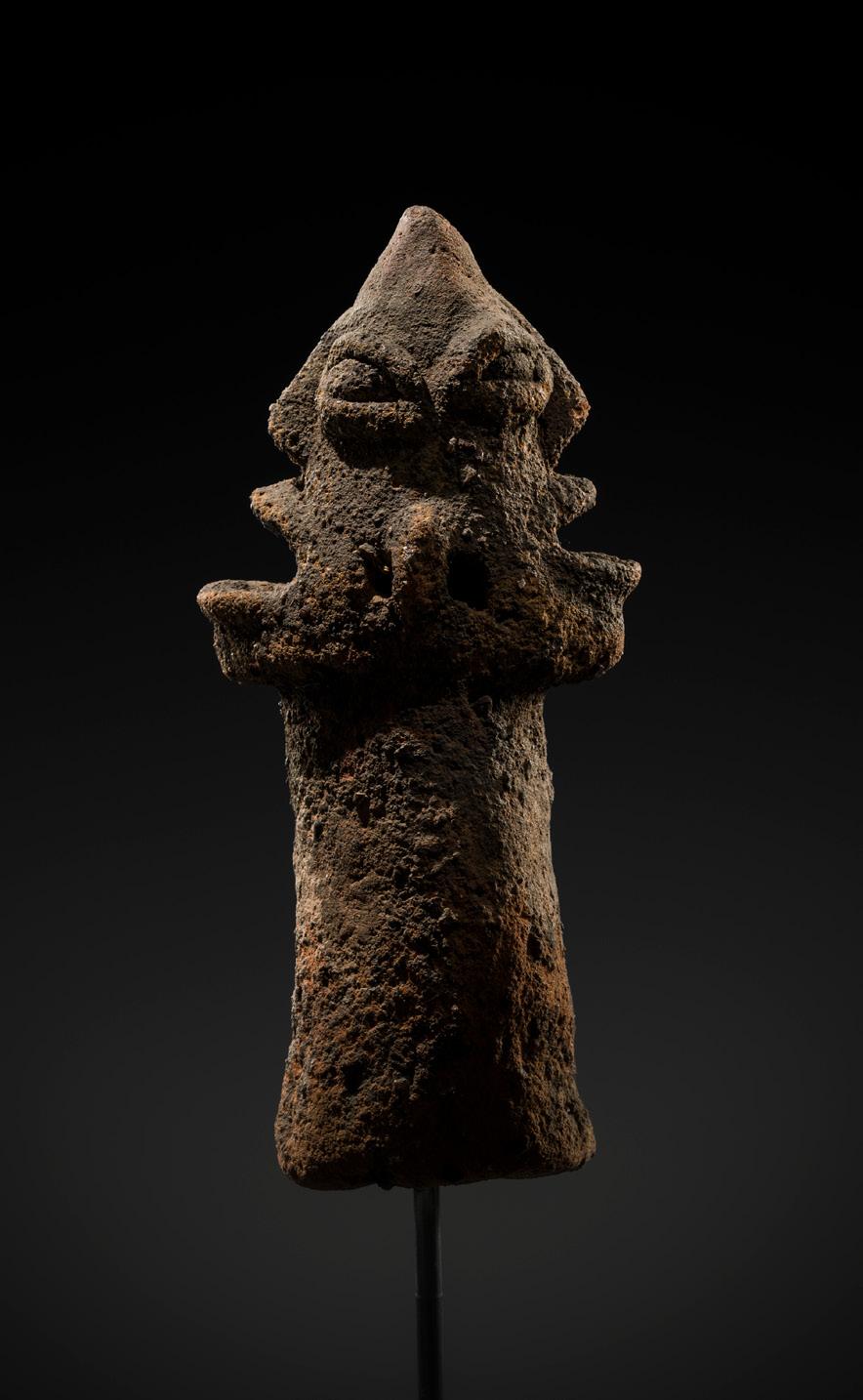
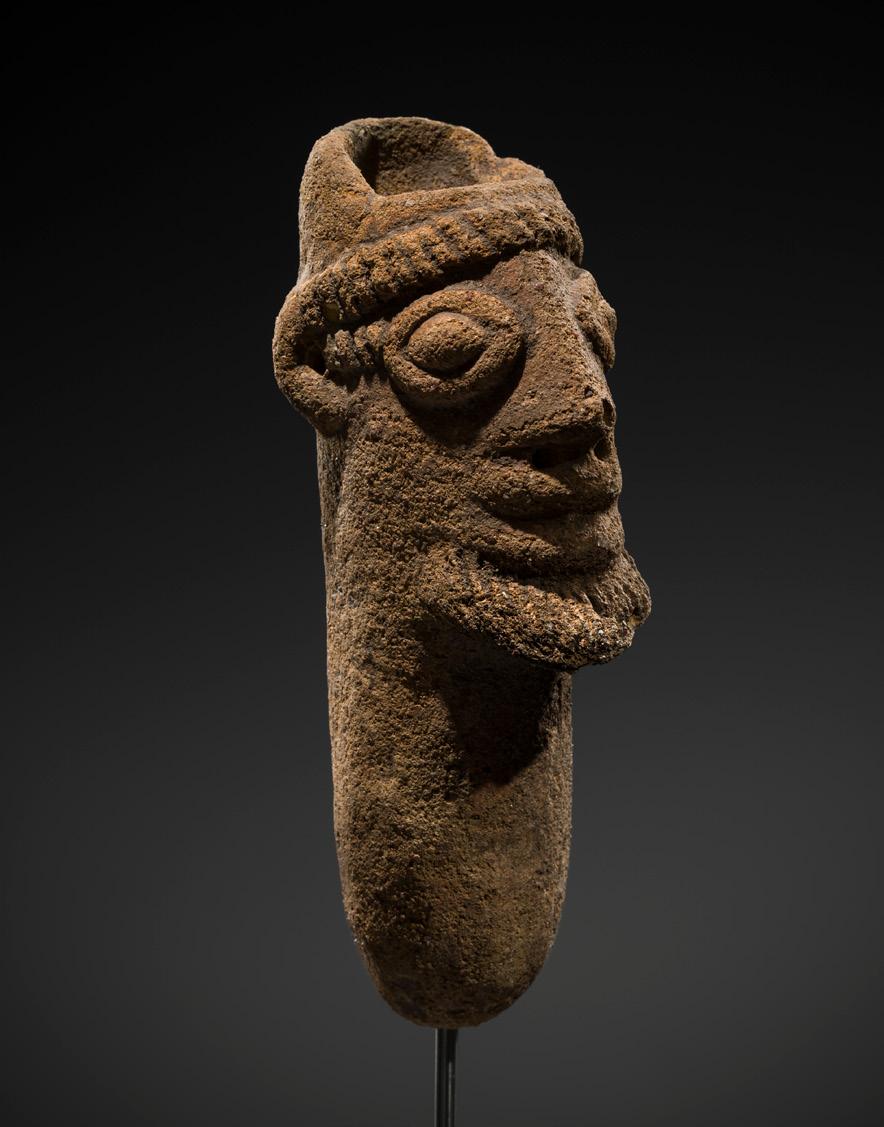
87
AN UNUSUAL TERRACOTTA ‘JANUS’ HEAD, NORTHERN GHANA, KOMALAND, 13TH-18TH CENTURY
Published:
Kristian Fenzl and Armand Duchâteau, Afrika-Kopfskulpturen, 1998, Kunsthalle Krems, Krems an der Donau, p. 65, Tafel 33.
Exhibited:
Kunsthalle Krems, Afrika-Kopfskulpturen, Krems an der Donau, 26 July 1998 – 18 October 1998.
Scientific Analysis Report:
An old TL test, dating from 10 September 1986, sets the firing date to ca. 700 years ago, consistent with the dating above. A copy accompanies this lot.
The cylindrical neck supports two Janus-form heads that rise to a conical forehead. Each face displays protruding eyes, a pronounced nose, and an open mouth set above a prominent chin, flanked by a pair of ears. The nose, mouth, ears, and neck are each pierced with small perforations.
Provenance: Galerie Walu, Zurich, 1989. Collection of Gerhard Merzeder (b. 1963), internationally published and acclaimed fashion and portrait photographer, Vienna, Austria, assembled since the 1980s.
Condition: Very good condition with expected old wear, signs of weathering and erosion, tiny losses, small nicks, soil encrustations, and a drilled hole for sample-taking to the underside.
Weight: 615.2 g
Dimensions: Height 18.5 cm
Literature comparison:
Compare a related terracotta human figure, Koma, Ghana, dated 13th19th century, 25.4 cm tall, in the Museum Fünf Kontinente, inventory number 89-311 912.
Estimate EUR 800
Starting price EUR 400
88
A TERRACOTTA HEAD-FORM BURIAL MARKER, NORTHERN GHANA, KOMALAND, 13TH-18TH CENTURY
Published:
Kristian Fenzl and Armand Duchâteau, Afrika-Kopfskulpturen, 1998, Kunsthalle Krems, Krems an der Donau, p. 64, Tafel 32.
Exhibited: Kunsthalle Krems, Afrika-Kopfskulpturen, Krems an der Donau, 26 July 1998 – 18 October 1998.
The head emerges from a long tubular neck, its face defined by oversized eyes, a nose with pierced nostrils, and a mouth bordered by a small goatee. Perforated ears flank the cheeks, while a twisted rope-lined hat crowns the figure.
Provenance: Galerie Walu, Zurich, 1989. Collection of Gerhard Merzeder (b. 1963), internationally published and acclaimed fashion and portrait photographer, Vienna, Austria, assembled since the 1980s. Condition: Very good condition with expected old wear, signs of weathering and erosion, tiny losses, few old chips, and soil encrustations.
Weight: 472.5 g
Dimensions: Height 16 cm
Estimate EUR 800
Starting price EUR 400
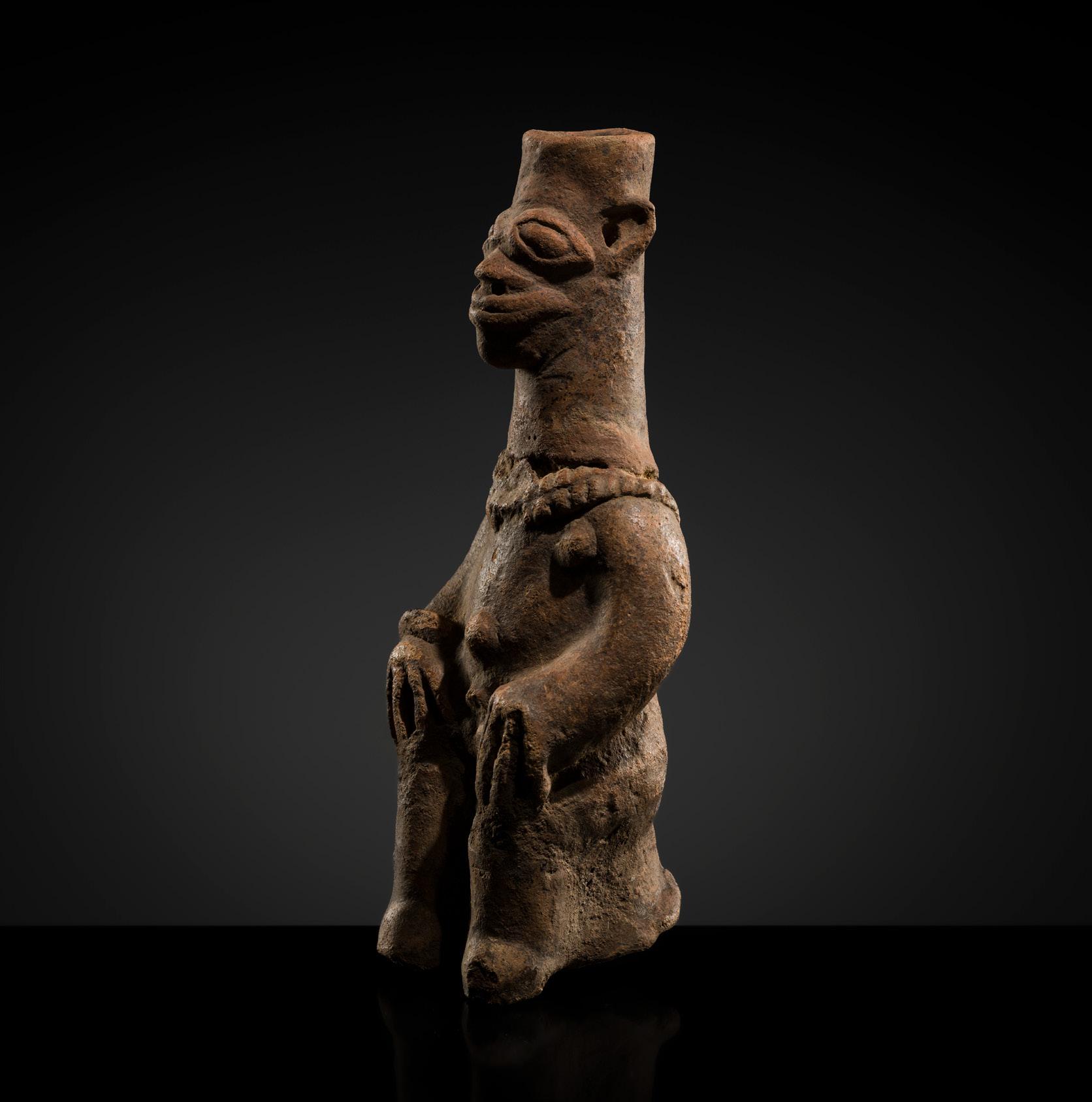
A TERRACOTTA SEATED FIGURE, NORTHERN GHANA, KOMALAND, 13TH-18TH CENTURY
Exhibited: Bergbau Museum, Afrika Ethno-Kunst, Klagenfurt, 1997
Seated on a throne with hands resting on his thighs, the figure displays prominent nipples and a defined navel. A necklace encircles the neck, while the tubular head features protruding eyes, a broad nose, and a wide mouth, all topped by a tall hat with a concave crown.
Provenance: Galerie Walu, Zurich, 1989. Collection of Gerhard Merzeder (b. 1963), internationally published and acclaimed fashion and portrait photographer, Vienna, Austria, assembled since the 1980s. The family-owned Galerie Walu has been specialized in cultures of sub-Saharan Africa since 1957, supported by decades of hands-on experience in the African art market.
Condition: Good condition with expected old wear, signs of weathering and erosion, small losses, few old chips, the feet and head reattached, and soil encrustations.
Weight: 1.2 kg
Dimensions: Height 23.5 cm
The Komaland people remain largely enigmatic, and since their artworks were first uncovered in 1985, only limited research has followed. Available dating suggests they flourished for roughly five centuries between the 13th and 18th centuries. They were highly skilled ceramicists, producing vessels, figurines, heads, talismans of both human and animal form, and other crafted objects. They were also accomplished metalworkers, creating a wide array of weapons and elaborately decorated helmets. The diversity of their craftsmanship, the presence of tumulus burials, and the scale of the sites all point to a sedentary, agricultural, and socially stratified society.
LITERATURE COMPARISON
Compare a related terracotta sculpture of a Seated Man, Komaland, dated 12th–16th century, 8.5 cm tall, in the Barakat Gallery, reference number PF.1295.
Estimate EUR 800
Starting price EUR 400
90
PUBLISHED
Kristian Fenzl and Armand Duchâteau, Afrika-Kopfskulpturen, 1998, Kunsthalle Krems, Krems, p. 62.
Exhibited:
Kunsthalle Krems, Afrika-Kopfskulpturen, Krems an der Donau, 26 July 1998 – 18 October 1998.
Ghana. Naturalistically modeled with a cheerful expression, the heavy-lidded eyes under thick arched brows, a small nose, and pursed lips set into a smile, flanked by ears to the sides, the hair applied individually in twisting tufts of curls to the rounded scalp. Two apertures to the back of the head and tiny holes to the corners of the mouth and inside the ears.
Provenance: Galerie Walu, Zürich, Switzerland, 1993. Collection of Gerhard Merzeder (b. 1963), internationally published and acclaimed fashion and portrait photographer, Vienna, Austria, assembled since the 1980s. The family-owned Galerie Walu has been specialized in cultures of sub-Saharan Africa since 1957, supported by decades of hands-on experience in the African art market.
Condition: Good condition with extensive wear and manufacturing irregularities. Obvious losses, small chips, some flaking, age cracks, old repairs, and signs of weathering.
Weight: 1,574.5 g (incl. stand)
Dimensions: Height 19 cm (excl. stand), 28.5 cm (incl. stand)
Mounted on an associated stand. (2)
This elegant terracotta head is a memorial portrait (nsodie) of an Akan ruler from present-day southern Ghana or southeastern Côte d'Ivoire. It is an idealized representation whose serene expression, well-balanced features, and striated neck suggest the positive qualities such rulers are expected to embody. Created posthumously, royal images like this one were placed with the portraits of previous rulers in sacred areas within the cemetery called asensie. Generally, each royal figure was accompanied by sculptures of courtiers and servants, perhaps to provide aid and comfort to the deceased in the afterlife. Together, they formed sculptural assemblages that honored and preserved the memory of these respected individuals and the chiefly lineages of which they were part. At certain times of the year, the asensie was the focus of prayers, libations, and other offerings that ensured the continuing support and protection of the ancestors.
Literature comparison:
Compare two closely related terracotta memorial heads, Akan people, dated 17th-19th century, the first in the Count B. de Grunne Collection, Brussels, the second in the Musée Dapper, Paris, number 2802, and exhibited and illustrated in the Metropolitan Museum of Art, Heroic Africans: Legendary Leaders, Iconic Sculptures, 20 September 2011 – 29 January 2012, p. 93 and 105, fig. 74 and 91.
AUCTION RESULT COMPARISON
Type: Closely related
Auction: Christie’s Paris, 27 June 2018, lot 25
Price: EUR 20,000 or approx. EUR 23,500 adjusted for inflation at the time of writing
Description: Commemorative head of an Akan ancestor, Twifo region, Hemang city, Nsodiean, Ghana
Expert remark: Compare the closely related modeling and similar spiral hair and facial features. Note the size (25 cm).
Estimate EUR 1,000
Starting price EUR 500
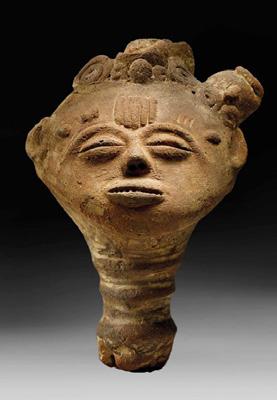
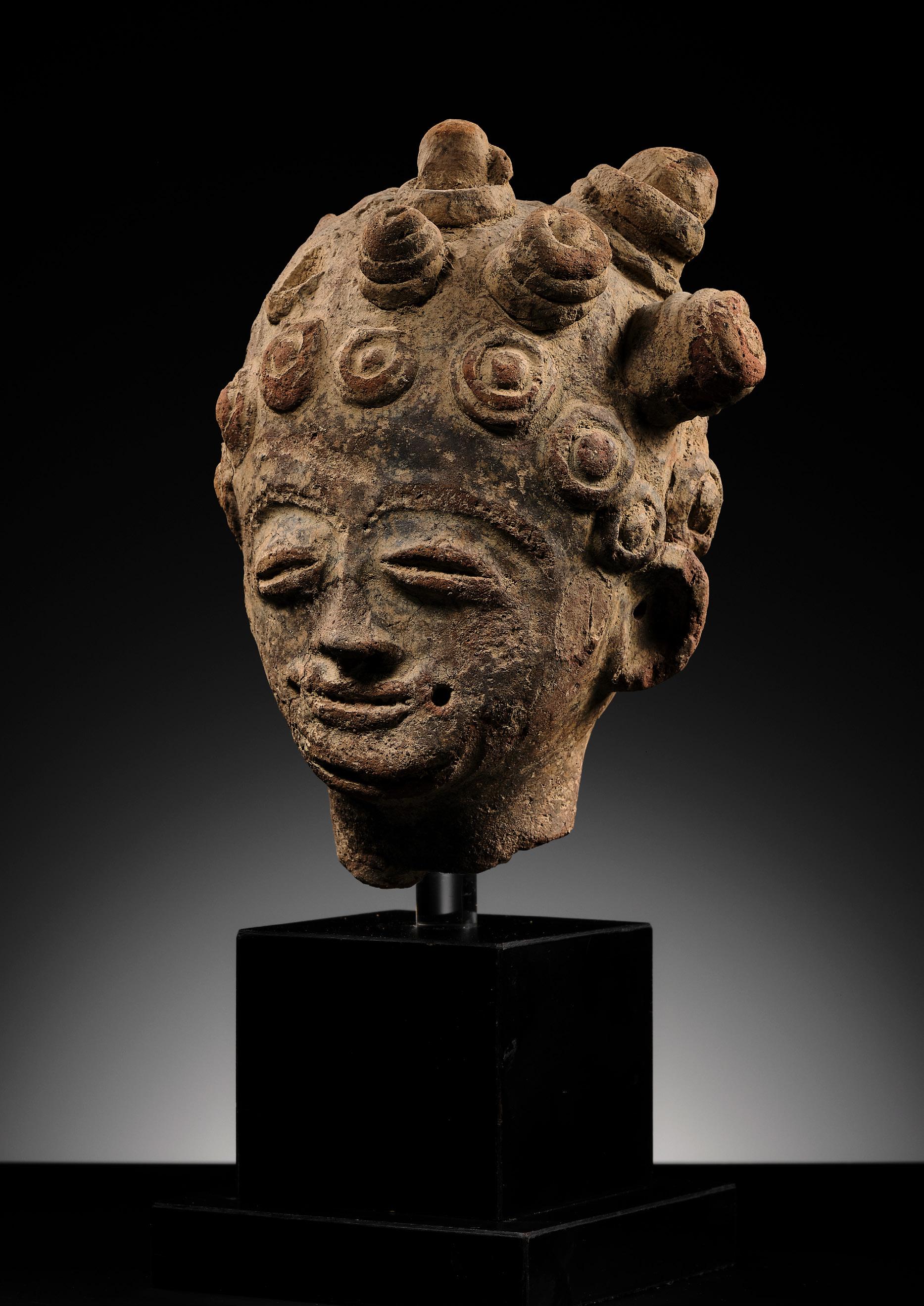
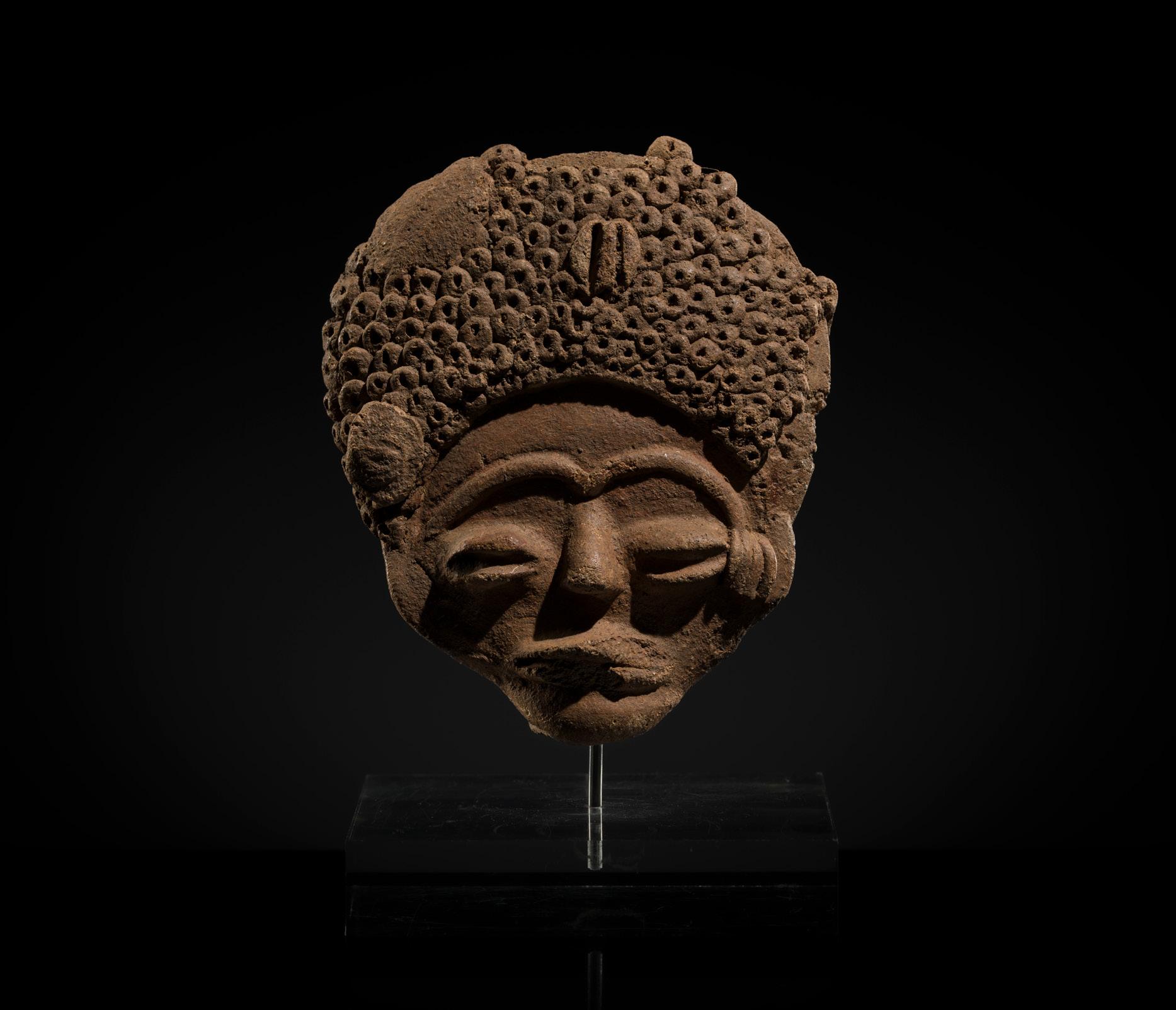
AN ASHANTI TERRACOTTA MEMORIAL HEAD, AKAN PEOPLE, 18TH CENTURY
Published:
1. Kristian Fenzl and Armand Duchâteau, Afrika Ethno-Kunst, 1997, Bergbau Museum Klagenfurt, p. 67, no. 53.
2. Kristian Fenzl and Armand Duchâteau, Afrika-Kopfskulpturen, 1998, Kunsthalle Krems, Krems, p. 63.
Exhibited:
1. Bergbau Museum, Afrika Ethno-Kunst, Klagenfurt, 1997.
2. Kunsthalle Krems, Afrika-Kopfskulpturen, Krems an der Donau, 26 July 1998 – 18 October 1998.
Ghana. The flattened head modeled with heavy-lidded protruding eyes under a dramatically arched unibrow, all above the small nose and pursed lips forming a gentle smile. The hair modeled in a tall coiffure with densely packed individual curls, a larger coiled curl to one side, below scattered ornaments to the top.
Provenance: Galerie Walu, Zürich, Switzerland, 1989. Collection of Gerhard Merzeder (b. 1963), internationally published and acclaimed fashion and portrait photographer, Vienna, Austria, assembled since the 1980s.
Condition: Good condition with wear and manufacturing irregularities. Obvious losses, small chips, weathering, and soil encrustations. Adhesive residue to the base, likely from a former mount.
Weight: 292.4 g
Dimensions: Height 13.4 cm
AUCTION RESULT COMPARISON
Type: Closely related
Auction: Sotheby’s Paris, 18 June 2019, lot 81
Price: EUR 8,125 or approx. EUR 9,500 adjusted for inflation at the time of writing
Description: Terracotta head, Ashanti, Ghana
Expert remark: Compare the closely related modeling of the face and facial features. Note the size (15 cm) and lack of stylized hair.
Estimate EUR 800
Starting price EUR 400
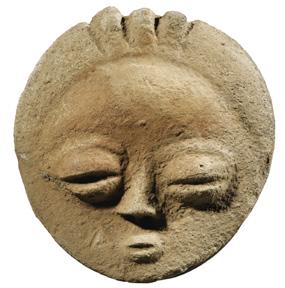
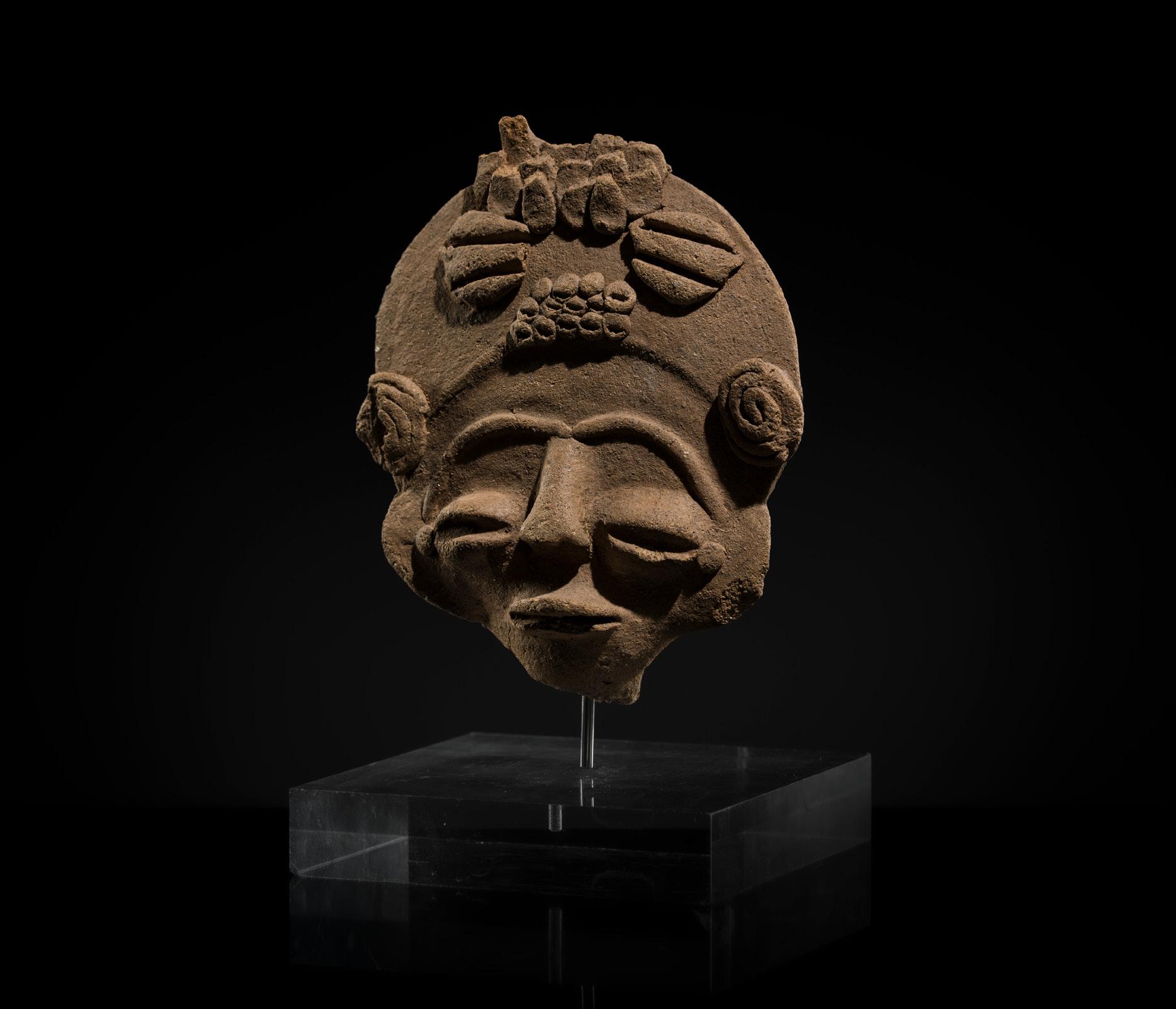
92 AN ASHANTI TERRACOTTA MEMORIAL HEAD, AKAN PEOPLE, 18TH CENTURY
Exhibited: Kunsthalle Krems, Afrika-Kopfskulpturen, Krems an der Donau, 26 July 1998 – 18 October 1998.
Ghana. The flattened head modeled with heavy-lidded protruding eyes under a dramatically arched unibrow, all above the small nose and pursed lips forming a gentle smile. The hair modeled in a tall coiffure with tightly coiled spirals decorating the sides, smaller curls to the middle, below ornaments to the top.
Provenance: Galerie Walu, Zürich, Switzerland, 1989. Collection of Gerhard Merzeder (b. 1963), internationally published and acclaimed fashion and portrait photographer, Vienna, Austria, assembled since the 1980s.
Condition: Good condition with wear and manufacturing irregularities. Obvious losses, small chips, weathering, and soil encrustations. Adhesive residue to the base, likely from a former mount.
Weight: 246.5 g
Dimensions: Height 13.8 cm
Estimate EUR 800
Starting price EUR 400
LITERATURE COMPARISON
Compare a closely related group of terracotta heads excavated by Dr Oliver Davie at Shinsan, Southern Ashanti, dated late 16th-17th century, illustrated by Worku Derara, On the Megalithic Sites of the Gurage Highlands: A Study of Enigmatic Nature of Engravings and Megalith Builders, Ethiopian Journal of the Social Sciences and Humanities 6 (1-2), p. 73, fig 5 (left).
PUBLISHED
1. Kristian Fenzl and Armand Duchâteau, Afrika-Kopfskulpturen, 1998, Kunsthalle Krems, Krems, p. 61.
2. Stefan Eisenhofer and Karin Guggeis, Afrikanische Kunst, 2002, Deutscher Kunstverlag, p. 59 (this publication is stated in the records of the present owner, but could not yet be verified).
3. Galerie Walu, Ghana, Akan, Komaland, 2003, p. 8.
Exhibited:
Kunsthalle Krems, Afrika-Kopfskulpturen, Krems an der Donau, 26 July 1998 – 18 October 1998.
Scientific Analysis Report:
An old TL test, dating from 11 August 1995, sets the firing date to ca. 120 years ago, consistent with the dating above. A copy accompanies this lot.
Ghana. Of flattened globular form, the bald head rising from a tall neck adorned with neck rings, heavy-lidded eyes under arched brows, a small nose, and pursed lips gently agape as if about to utter a word, flanked by small ears to the sides. The top and sides of the head applied with a raised spiral design.
Art Loss Register:
Certificate reference number S00266162 from 15 December 2025. A copy of this document accompanies this lot.
Provenance: Galerie Walu, Zürich, Switzerland. A private collection in Austria. Collection of Gerhard Merzeder (b. 1963), internationally published and acclaimed fashion and portrait photographer, Vienna, Austria, assembled since the 1980s. The family-owned Galerie Walu has been specialized in cultures of sub-Saharan Africa since 1957, supported by decades of hands-on experience in the African art market.
Condition: Good condition with extensive wear and manufacturing irregularities. Old repairs to the top of the head. Holes from sampletaking to the chin and back of the neck.
EXTERNAL EXPERT AUTHENTICATION
Koller Auctions, Zürich, 3 December 2012, lot 1636 (mid-estimate CHF 7,000 or approx. EUR 7,900 converted and adjusted for inflation at the time of writing).
Weight: 2,038.8 g
Dimensions: Height 27.5 cm
This funerary head (known as a Nkua in the Akan langauge) exemplifies two prominent forms of visual culture among the Akan-speaking peoples of Southern Ghana and Southeastern Côte d’Ivoire: objects made of clay, and those used in funerals. Clay artifacts are some of the most plentiful found in archaeological digs in the region. In funerary busts, unbaked clay and terracotta link the bust and the grave, both earthen constructs. Clay itself is sacred due to its association with Asaase Yaa, a female earth divinity.
Terracotta heads such as this use different stylistic conventions from wooden Akan figurative sculptures, as artists of each medium stress different parts of the human anatomy. The manufacture of funeral busts likely spread from the seventeenth century with the expansion of the Akwamu empire. Indeed, the spread of artistic practices that accompanied circuits of war and trade during this period make it difficult to identify the origin of any particular busts without knowing its particular history. These busts are often naturalistic likenesses of a particular deceased person, although others are more abstract. Similar objects depict minor deities or serve as pot lids, and distinguishing such objects from funerary busts can be difficult without knowing how each object was used in its original context. Today, many Ghanaians use cement sculptures as grave markers, a practice that hearkens both to European and North American cemetery practices, but which also stems from the use of terracotta busts.
Literature comparison:
Compare a closely related terracotta Akan funerary bust, Ghana, 18.6 cm high, in the Center for African and African American Research, Duke University. Compare a closely related commemorative head, Mma, Twifo-Hemang district, Ghana, late 18th-early 20th century, 26.7 cm high, in the Art Institute Chicago, reference number 1995.24. Compare a closely related portrait head, Akan culture, dated 20th century, 30.5 cm high, in the Ackland Art Museum, University of North Carolina, object number 2023.43.1.
AUCTION RESULT COMPARISON
Type: Closely related
Auction: Sotheby’s Paris, 2 December 2015, lot 52
Price: EUR 52,500 or approx. EUR 63,500 adjusted for inflation at the time of writing
Description: Tête commémorative, Akan, Ghana
Expert remark: Compare the closely related modeling and similar facial features and shape of the head. Note the size (35 cm).
Estimate EUR 4,000
Starting price EUR 2,000
The oval face lined by a serrated border, with pierced slits to the crescent eyes, the eyelids overlaid in painted metal, below arched brows transitioning to a long nose, pursed lips, and surmounted by seven curved projections and two downward-turned horns. The sides with seven apertures for suspension.
Art Loss Register:
Certificate reference number S00266170 from 16 December 2025. A copy of this document accompanies this lot.
Provenance: Merton Simpson, New York, before 1980. Reynold Kerr private collection, New York, 5 October 1998. Swiss private collection. Collection of Gerhard Merzeder (b. 1963), internationally published and acclaimed fashion and portrait photographer, Vienna, Austria, assembled since the 1980s. A copy of the invoice from Reynold C. Kerr, New York, on 5 October 1998, confirming the dating and provenances above, and stating a purchase price of USD 18,000 or approx. EUR 30,500 (converted and adjusted for inflation at the time of writing), accompanies the lot.
from Reynold C. Kerr, New York, on 5 October 1998
Merton Daniel Simpson (1928–2013) was an American abstract expressionist painter and a pioneering dealer and collector of African art. After acquiring his first African carving in 1949, he developed deep expertise and, in 1954, opened the Merton D. Simpson Gallery in Manhattan, one of the first African American–owned galleries to exhibit both modern and traditional African art. Over decades of travel in West Africa and Europe, Simpson assembled a museum-quality collection of masks, sculptures, and ritual objects, many of which entered major institutional collections such as the Fowler Museum.
Reynold C. Kerr is a long-time fine art professional known for his work as a curator, gallery director, and collector specializing in traditional and contemporary African art. He has spent more than five decades running galleries, amassing a notable collection of African art, and placing works in leading museum collections across the United States and Europe, including the Smithsonian’s National Museum of African Art and other major institutions. Kerr has served as Principal Curator and director of art organizations such as Kerr Gallery, which specializes in African, African-American, and Latin American art, and his expertise has helped shape the field of African art collecting and scholarship. Condition: Good condition with minor wear, traces of use, four of the horns reattached with minor touchups, natural cracks, losses, few nicks, and scratches.
EXTERNAL EXPERT AUTHENTICATION
Koller Auktionen, Zurich, 20 June 2009, lot 139 (mid-estimate CHF 25,000 or approx. EUR 28,500 converted and adjusted for inflation at the time of writing).
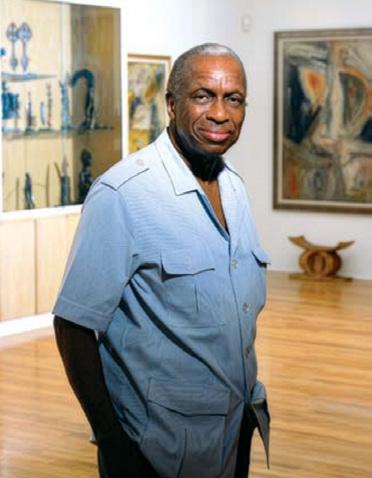
Weight: 729 g (excl. stand), 1 kg (incl. stand)
Dimensions: Height 36.2 cm (excl. stand), 45 cm (incl. stand)
With a modern stand. (2)
Ndoma (meaning ‘replica’) portrait masks are the last to appear in performances, at dusk. They are commissioned from a sculptor to pay tribute to a member of the village and honor their outstanding qualities. When performing, the wearer of the ndoma mask is usually accompanied by the person who they are celebrating (or a substitute of them). It celebrates their beauty, valor, wisdom or exemplary character, admired by the entire community.
LITERATURE COMPARISON
Compare a related wood mask, Guro culture, Côte d'Ivoire, dated 19th century, 36 cm tall, in the Museum Rietberg, inventory number RAF 508 (fig. 1). Compare a related mask, ndoma, Baule culture, Côte d'Ivoire, dated 1900-1999, 28 cm tall, in the Art Institute Chicago, reference number 2024.995.
AUCTION RESULT COMPARISON
Type: Related
Auction: Sotheby’s New York, 7 May 2016, lot 58
Mid-estimate: USD 30,000 or approx. EUR 34,500 converted and adjusted for inflation at the time of writing
Description: Baule Portrait Mask, Côte d'Ivoire
Expert remark: Compare the similar expression and color. Note the size (16 cm).
Estimate EUR 8,000
Starting price EUR 4,000
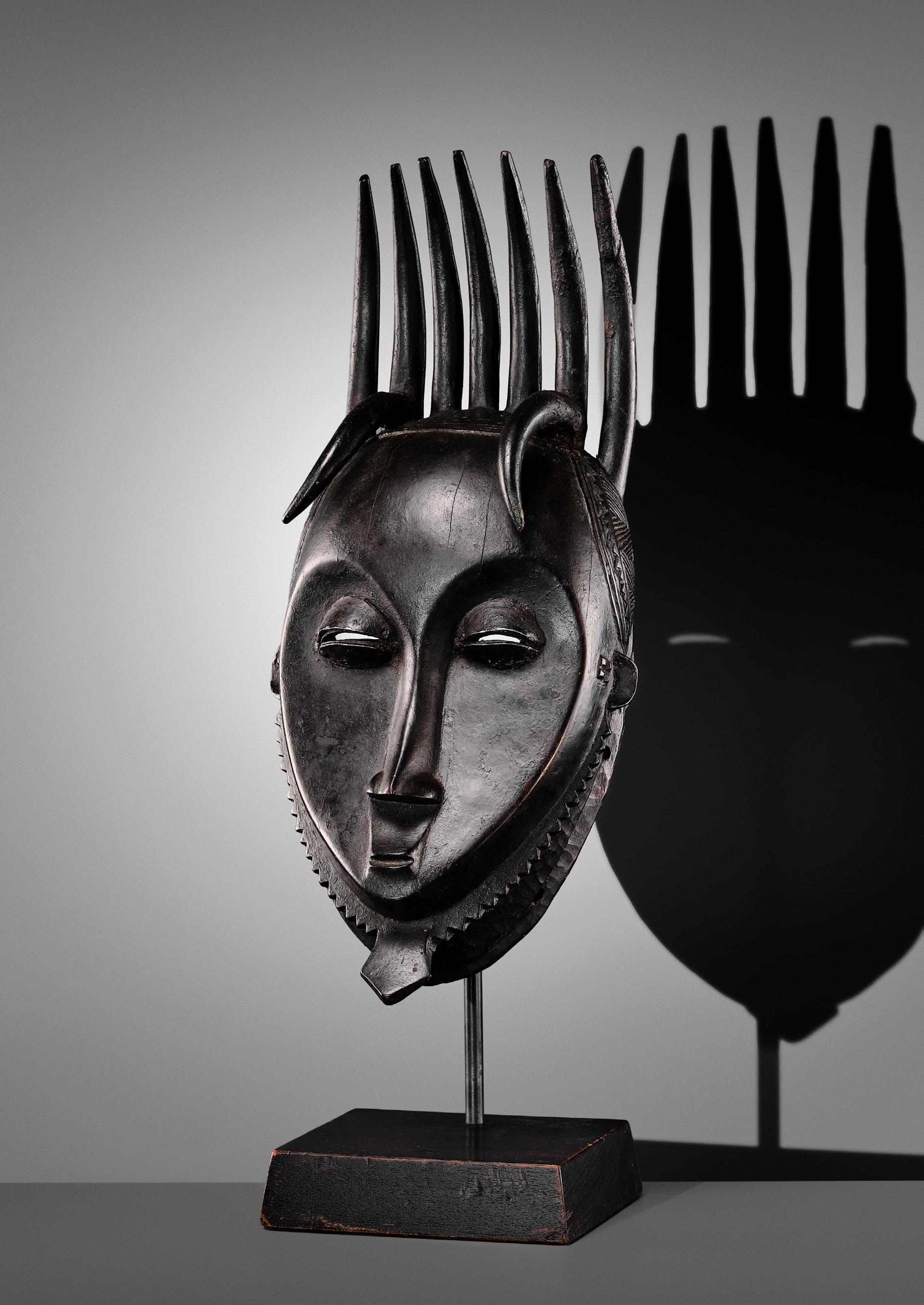
PUBLISHED
Karl-Ferdinand Schädler, Masken der Welt: Sammelstücke aus fünf Jahrtausenden, 1999, Wilhelm Heyne Verlag, Munich, p. 84, no. 63.
Exhibited:
Museum der Völker (formerly Haus der Völker, Museum für Kunst und Ethnographie), Schwaz, Tyrol, Austria, permanent exhibition, 20082012.
Appraisal:
A copy of an appraisal by Jean David, noted expert for art from Africa and Oceania, dating from 8 November 2007, inventory number ‘4’, with an estimated value of EUR 55,000 or approx. EUR 79,500 (adjusted for inflation at the time of writing), accompanies the lot.
The ovoid face enclosed by a serrated border, with a serene expression, downcast eyes below arched brows and eyelids colored in kaolin, the elongated nose stopping above pursed lips, and surmounted by a pair of upturned horns above four faceted and ridged horns. The sides pierced with six apertures for suspension.
Art Loss Register:
Certificate reference number S00266173 from 16 December 2025.
A copy of this document accompanies this lot.
Provenance: Kathrin and Andreas Lindner private collection, Munich, Germany. Galerie Brettschneider, Munich, 1998. The stand with an inventory number ‘KMA 008’. Collection of Gerhard Merzeder (b. 1963), internationally published and acclaimed fashion and portrait photographer, Vienna, Austria, assembled since the 1980s. Kathrin and Andreas Lindner are avid collectors of art originating from Africa, Oceania, and North America. Part of their collection was sold at Sotheby’s, Paris, on 8 June 2007, with a corresponding catalog titled ‘Collection Andreas et Kathrin Lindner: Arts D'Afrique, D'Oceanie Et D'Amerique du Nord June 8, 2007’.
Condition: Very good condition with old wear, traces of use, natural cracks, three of the horns reattached, small chips, losses and flaking of the pigments.
Weight: 1 kg
Dimensions: Height 46.5 cm
Yaure masks are renowned for their delicacy and refinement. The bestknown Yaure masks depict human faces combined with zoomorphic elements, known as gyè. With the help of these masks, the Yaure hoped to influence the supernatural forces (yu), which can harm humans but are also able to ensure their well-being. These masks are regarded as emblems of yu, extremely dangerous beings that must be handled with great caution and kept away from women.
Deaths that threaten social order are the primary reasons for their appearance. Through their dances, they restore the community’s social balance and accompany the deceased to the ancestral realm.
Literature comparison:
Compare a related Yaure mask with horns, Côte d’Ivoire, 34.5 cm tall, in the British Museum, museum number Af1954,+23.3480. Compare a related Yaure mask with horns, Côte d’Ivoire, 40 cm tall, in the African Art Museum, Smithsonian Institution, object number 73-7-165.
AUCTION RESULT COMPARISON
Type: Related
Auction: Christie’s Paris, 6 March 2024, lot 35
Price: EUR 151,200 or approx. EUR 153,000 adjusted for inflation at the time of writing
Description: Yaure mask, Côte d’Ivoire
Expert remark: Compare the similar form, pigmented eyelids, and color of the wood. Note the size (40 cm).
AUCTION RESULT COMPARISON
Type: Related
Auction: Sotheby’s Paris, 30 October 2018, lot 35
Price: EUR 42,500 or approx. EUR 50,000 adjusted for inflation at the time of writing
Description: Yauré mask, Côte d’Ivoire
Expert remark: Compare the similar form, pursed lips, expression, and size (49 cm).
Estimate EUR 10,000
Starting price EUR 5,000
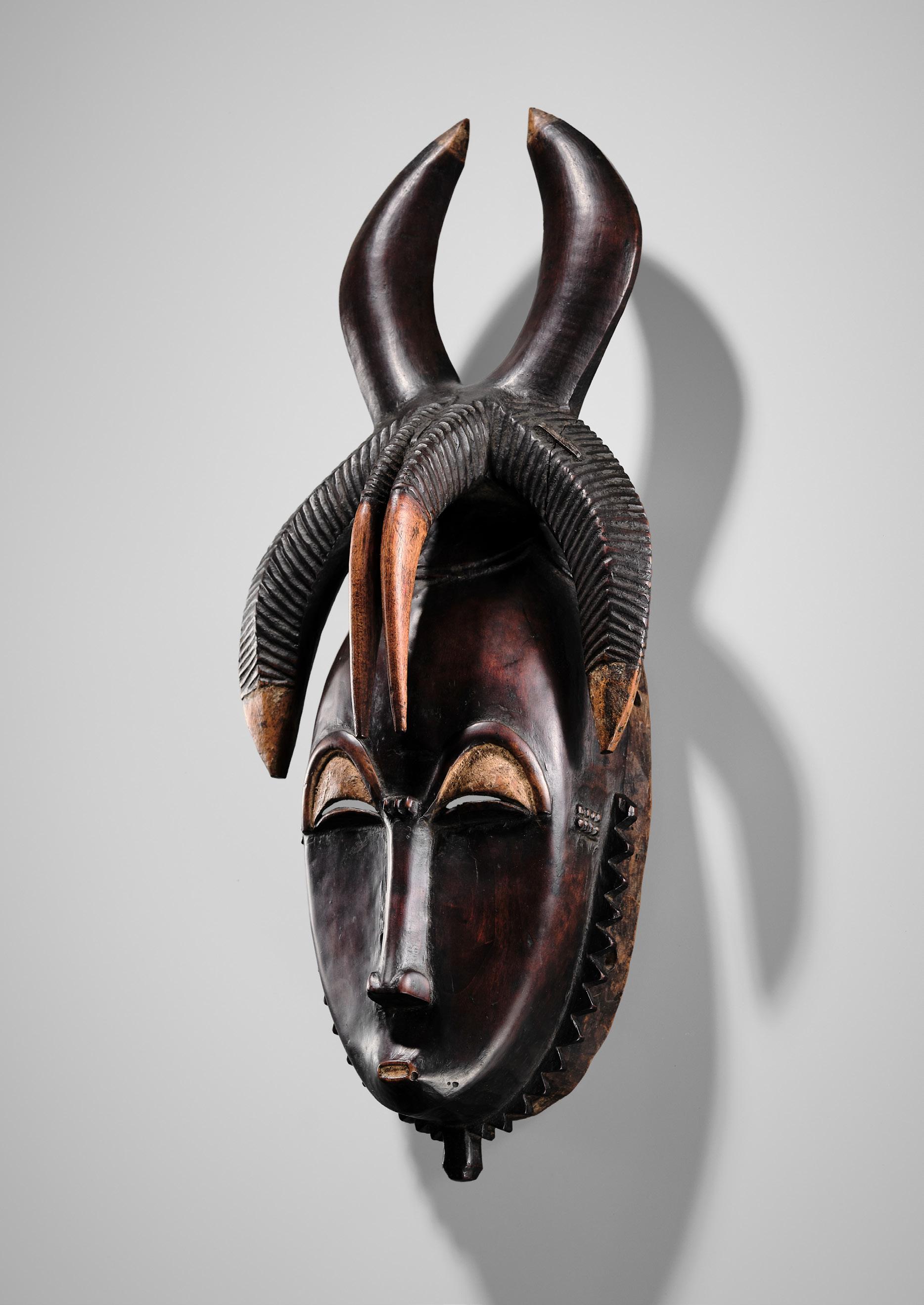
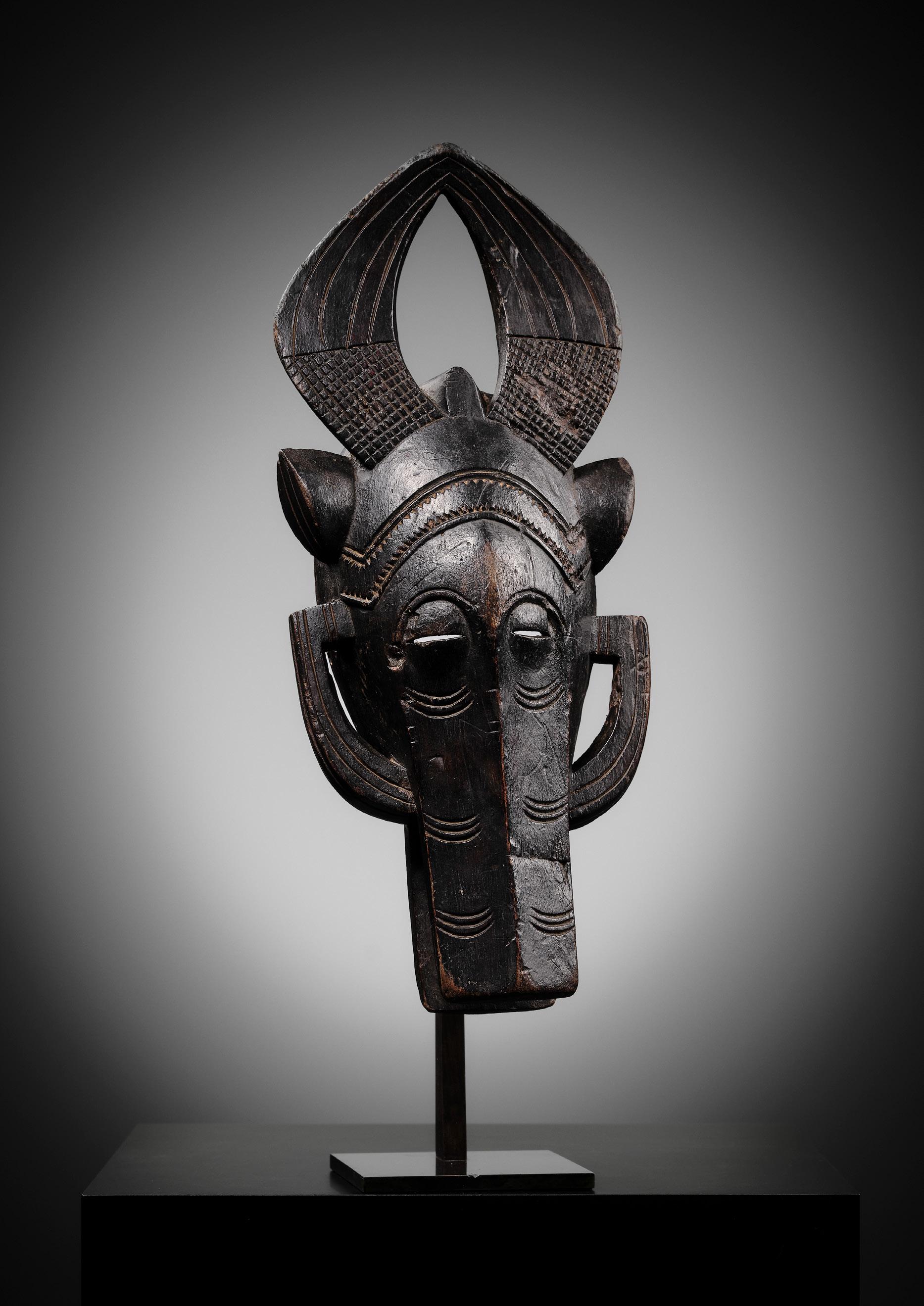
Exhibited:
Tribal & Textile Arts Show. Fine Art of Native Cultures, San Francisco, 8 February 2008 – 10 February 2008.
The elongated mask is finely carved with slit-form eyes framed by bow-shaped eyebrows, a long mouth, and surmounted by two joined horns incised with a hatched sections. The forehead is decorated with two arched lines, terminating in pricked ears.
Provenance:
Yves Créhalet, Paris, France. Ader Picard Tajan, Paris, 19 December 1990, lot 159. Galerie Alain Lecomte, Paris, France, by 2008. Collection of Gerhard Merzeder (b. 1963), internationally published and acclaimed fashion and portrait photographer, Vienna, Austria, assembled since the 1980s. The base with an old label inscribed ‘A. Lecomte Guénégaud’.
Ader Picard Tajan, Paris, 19 December 1990, lot 159
Yves Créhalet is a French author and collector of tribal art and African art. He is the author of works related to African art, including ‘Treize Charmes d’Afrique’, created in collaboration with expert Pierre Amrouche. Créhalet has cultivated a significant collection of tribal art that has appeared in Paris auctions and exhibitions.
Galerie Alain & Abla Lecomte is a Paris-based gallery specializing in African tribal art and participates regularly in major international events such as Parcours des Mondes in Paris, where it has exhibited thematic displays focused on West African masks.
Condition: Very good condition with minor wear, traces of use, nicks, light scratches, small losses and few old chips.
GVR Archive: object number ao-0073140-001
Weight: 263 g (excl. stand), 918 g (incl. stand)
Dimensions: Height 35.3 cm, 41.5 cm (incl. stand)
With a modern metal stand. (2)
LITERATURE COMPARISON
Compare a related helmet mask with a square jaw, by a Bamana or Senufo blacksmith, dated 19th-mid 20th century, 47.3 cm long, in the Metropolitan Museum of Art, object number 1982.393.9 (fig. 1). Compare a related helmet mask, Côte d'Ivoire, in the Natural History Museum, Smithsonian Institution, accession number 113132.
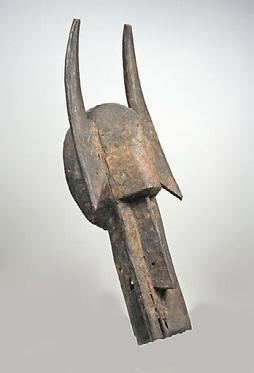
AUCTION RESULT COMPARISON
Type: Related
Auction: Sotheby’s New York, 15 May 2015, lot 162
Price: USD 10,000 or approx. EUR 14,500 converted and adjusted for inflation at the time of writing
Description: Senufo Mask, Ivory Coast Expert remark: Compare the stylized features and upturned horns. Note the size (17.5 cm).
Estimate EUR 6,000
Starting price EUR 3,000
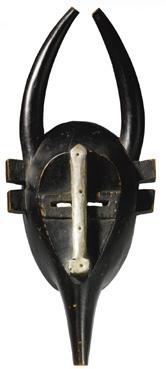
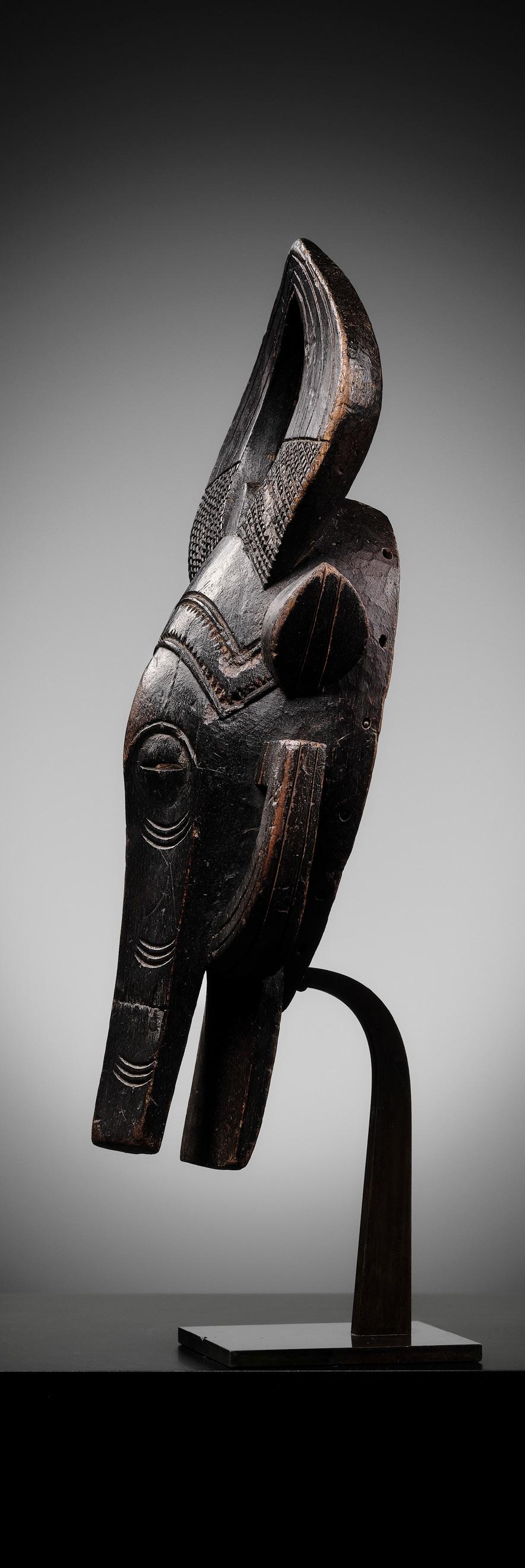
The ovoid face enclosed by a serrated border, with a serene expression, downcast eyes below arched and incised brows, complemented by scarification marks to either side, the elongated nose stopping above an open mouth revealing its tongue, with three short tusks below, and surmounted by two round ears flanking the finely combed hair. The sides pierced with a pair of apertures for suspension. The ears and tusks with remnants of kaolin.
Art Loss Register:
Certificate reference number S00266169 from 16 December 2025. A copy of this document accompanies this lot.
Provenance: A French private collection. Armand Pierre Fernandez private collection, New York, 1988. Reynold Kerr private collection, New York, 5 October 1998. A Swiss private collection. Collection of Gerhard Merzeder (b. 1963), internationally published and acclaimed fashion and portrait photographer, Vienna, Austria, assembled since the 1980s. A copy of the invoice from Reynold C. Kerr, New York, on 5 October 1998, confirming the dating and provenances above, and stating a purchase price of USD 15,000 or approx. EUR 25,500 (converted and adjusted for inflation at the time of writing), accompanies the lot.
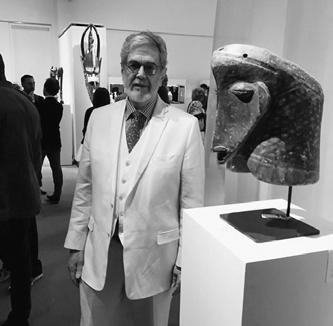
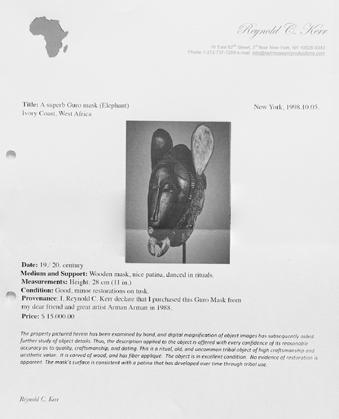
Invoice from Reynold C. Kerr, New York, 5 October 1998
Armand Pierre Fernandez, aka Arman Arman (1928-2005) displayed an early gift for painting and drawing. The son of an antiques dealer and an amateur cellist, he grew up surrounded by music, objects, and an acute sense of connoisseurship, all of which shaped his artistic sensibility. After training at the École Nationale des Arts Décoratifs in Nice, he moved to Paris to study art history at the École du Louvre. A passionate collector throughout his life, Arman amassed both everyday objects and works of art, with a particular devotion to traditional African art, in which he became a widely respected specialist. Reynold C. Kerr is a long-time fine art professional known for his work as a curator, gallery director, and collector specializing in traditional and contemporary African art. He has spent more than five decades running galleries, amassing a notable collection of African art, and placing works in leading museum collections across the United States and Europe, including the Smithsonian’s National Museum of African Art and other major institutions. Kerr has served as Principal Curator and director of art organizations such as Kerr Gallery, which specializes in African, African-American, and Latin American art, and his expertise has helped shape the field of African art collecting and scholarship.
Condition: Good condition with expected old wear, traces of use, few small chips, losses and natural cracks, little insect activity to one ear, minor touchups to the black pigments, and one section of the beard reattached.
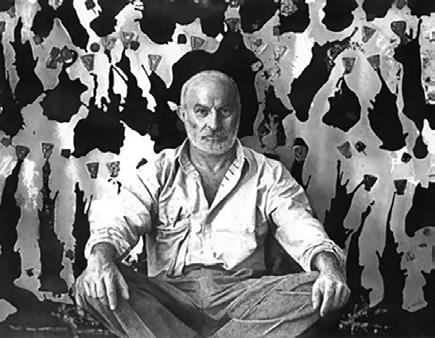
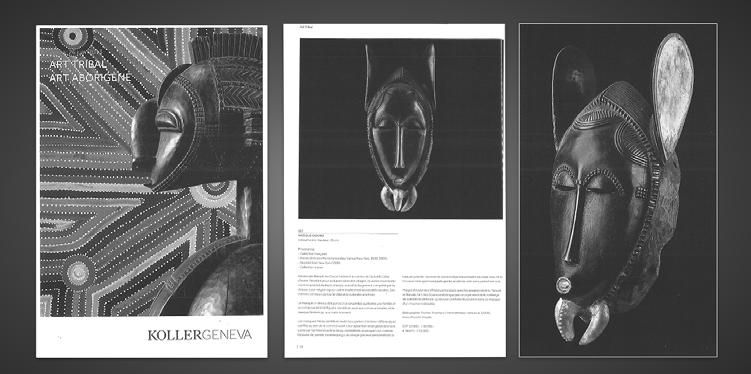
EXTERNAL EXPERT AUTHENTICATION
Koller Auktionen, Genf, 26 June 2013, lot 117 (mid-estimate CHF 25,000 or approx. EUR 28,500 converted and adjusted for inflation at the time of writing).
Weight: 555 g (excl. stand), 809 g (incl. stand)
Dimensions: Height 28.5 cm (excl. stand), 37.3 cm (incl. stand)
With a modern stand. (2)
The zigzag border encircling the face is a defining feature of Yaure masks, appearing in both Baule and Guro mask forms. Baule carvers skillfully merge human and animal elements: while the core of the mask is shaped as a human face, zoomorphic forms frequently emerge from the crown and chin. In this example, the elephant’s ears rise from the top of the head, while its trunk and tusks extend downward from the chin.
Among the Baule, the elephant is invoked in royal regalia to affirm an immutable ‘natural’ order of power. In masking, to the contrary, elephant imagery is a metaphor for change. In this context another aspect of power is evoked: the power to transform as well as the ability to respond to change.
Literature comparison:
Compare a closely related Baule mask, Côte d’Ivoire, dated early to mid20th century, 36 cm tall, in the African Art Museum, Smithsonian Institution, object number 96-6-3. Compare a related Yaure-style painted wood mask with similar ears, Côte d’Ivoire, dated early 1900s, 31.7 cm tall, in the Cleveland Museum of Art, reference number 1971.296. Compare a related Guro elephant mask, dated late 19th to early 20th century, Côte d’Ivoire, 50.8 cm tall, in the Art Institute Chicago, reference number 1971.883.
AUCTION RESULT COMPARISON
Type: Related
Auction: Christie’s Paris, 3 December 2025, lot 23
Price: EUR 40,640 at the time of writing
Description: Yaure mask, Côte d’Ivoire
Expert remark: Compare the similar facial features and expression. Note the size (23.5 cm).
AUCTION RESULT COMPARISON
Type: Related
Auction: Sotheby’s New York, 15 May 2009, lot 160
Price: USD 17,500 or approx. EUR 22,500 adjusted for inflation at the time of writing
Description: A fine Guro model mask, Côte d’Ivoire
Expert remark: Compare the similar form, expression with pursed lips, and color of the wood.
Estimate EUR 8,000
Starting price EUR 4,000
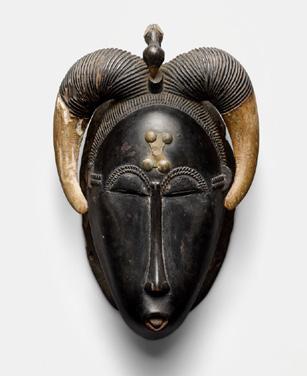
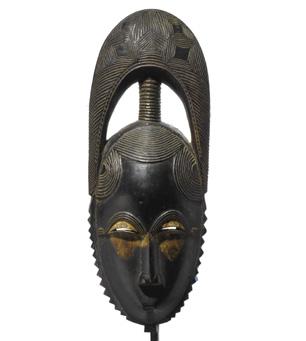
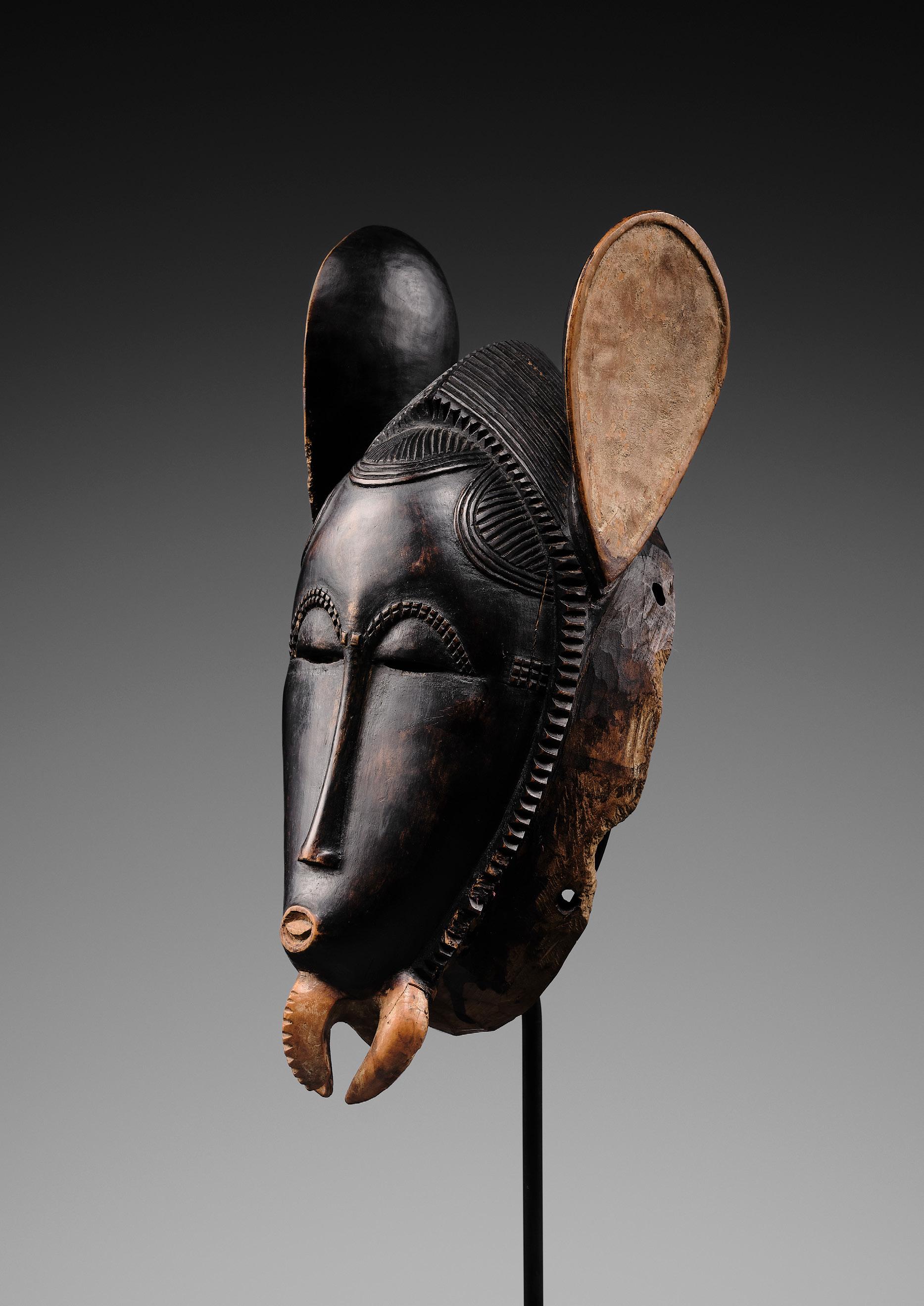
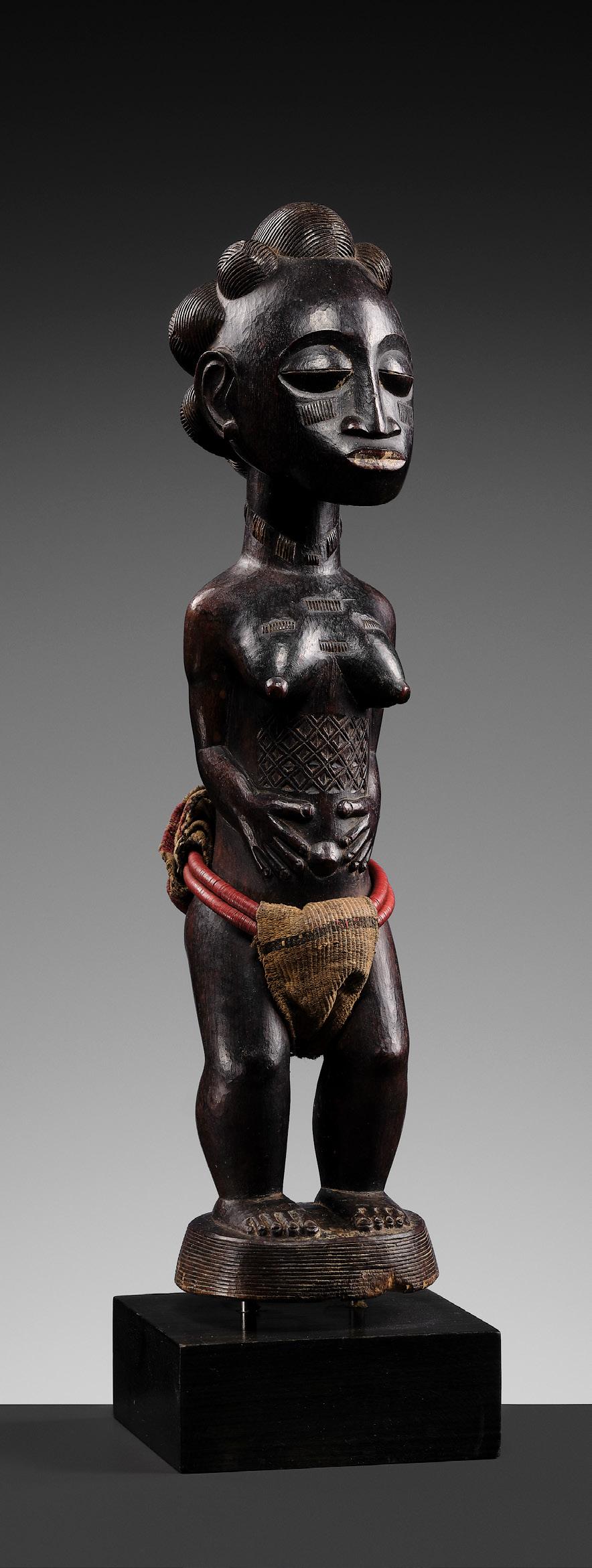
98 A WOOD ‘BLOLO BLA’ FIGURE, BAULE CULTURE, CÔTE D'IVOIRE, LATE 19TH TO MID-20TH CENTURY
Exhibited:
Africa 69, Arts de la Côte-d'Ivoire et de l'Afrique occidentale, Vevey, 1969.
The figure is carved standing atop a circular base, the hands folded across the abdomen, which is centered by a protruding navel. She displays prominent breasts and an outsized head with closed eyes set above wide lips, all surmounted by a neatly arranged coiffure. The face, neck, chest, and belly are marked with scarification patterns, and she is dressed in a finely woven loincloth suspended by two beaded strings.
Provenance: Centre des Sciences Humaines, Abidjan, Côte d’Ivoire. Jean-Louis Rinsoz (1932-1971), Vevey, Switzerland, and thence by descent. Collection of Gerhard Merzeder (b. 1963), internationally published and acclaimed fashion and portrait photographer, Vienna, Austria, assembled since the 1980s.

Jean-Louis Rinsoz
Jean-Louis Rinsoz (1932–1971), born in Vevey, studied economics at the University of Lausanne before entering the family firm, Rinsoz et Ormond SA, producers of tobacco, cigars, and cigarettes. In the mid1960s, while exploring new production regions, his travels brought him to Côte d’Ivoire—a transformative encounter that sparked his fascination with traditional Ivorian art. During this period, he met the ethnologist and art historian Bohumil Holas, then director of the Musée des Civilisations de Côte d’Ivoire in Abidjan, with whom he formed a close friendship. These experiences culminated in the 1969 exhibition, ‘The Art of Ivory Coast: Art Treasures from the Museum of Abidjan’ at the Musée des Beaux-Arts in Vevey, for which Jean-Louis Rinsoz served as committee chairman.
Condition: Very good condition with minor wear, few nicks, light scratches, natural cracks, few old chips, and remnants of pigments around the eyes and mouth.
Weight: 931 g (incl. stand)
Dimensions: Height 33.8 cm (excl. stand), 39 cm (incl. stand)
With a modern stand. (2)
Literature comparison:
Compare a related wood female figure, Baule culture, Côte d’Ivoire, dated mid-20th century, 43.1 cm tall, in the African Art Museum, Smithsonian Institution, object number 2000-26-1.
AUCTION RESULT COMPARISON
Type: Related
Auction: Sotheby’s New York, 30 June 2020, lot 7
Price: USD 23,750 or approx. EUR 25,500 converted and adjusted for inflation at the time of writing
Description: A Baule female figure, Côte d'Ivoire
Expert remark: Compare the similar pose, hair, and incised decoration. Note the size (47.6 cm).
Estimate EUR 2,000
Starting price EUR 1,000
A WOOD ‘BLOLO BLA’ FIGURE, BAULE CULTURE, CÔTE D'IVOIRE, LATE 19TH TO MID-20TH CENTURY
Exhibited:
Africa 69, Arts de la Côte-d'Ivoire et de l'Afrique occidentale, Vevey, 1969.
The figure is carved standing atop a square base, the hands folded across the abdomen, which is centered by a protruding navel. She displays prominent breasts and an outsized head with closed eyes set above upturned lips, all surmounted by a neatly arranged coiffure. The face, neck, chest, and back are marked with scarification patterns. She is dressed in a woven loincloth and beaded chains adorn her neck and waist.
Provenance: Centre des Sciences Humaines, Abidjan, Côte d’Ivoire.
Jean-Louis Rinsoz (1932-1971), Vevey, Switzerland, 1969, and thence by descent. Collection of Gerhard Merzeder (b. 1963), internationally published and acclaimed fashion and portrait photographer, Vienna, Austria, assembled since the 1980s.
Condition: Very good condition with minor wear, few natural cracks with minor touchups, small nicks, and light scratches.
Weight: 474 g
Dimensions: Height 34 cm
This finely carved female figure was likely commissioned by a Baule man as the representation of his blolo bla, or otherworld spouse, following the guidance of a diviner who determined that the difficulties he faced in life stemmed from the jealousy of this neglected spiritual partner. Such figures were kept for private consultation and veneration, serving as intermediaries through which harmony and balance could be restored. In creating her, the sculptor sought to embody both her identity and the aesthetic qualities that would please her.
Literature comparison:
Compare a related wood female figure, Baule culture, Côte d’Ivoire, dated early to mid-20th century, 44.2 cm tall, in the African Art Museum, Smithsonian Institution, object number 2005-6-14.
Type: Related
Auction: Sotheby’s Paris, 3 December 2025, lot 44
Price: EUR 19,050
Description: A Baule Figure, Côte d'Ivoire
Expert remark: Compare the similar pose, facial features, and headdress. Note the size (47 cm).
Estimate EUR 2,000
Starting price EUR 1,000
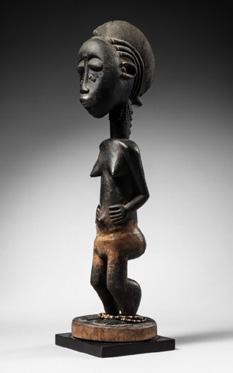
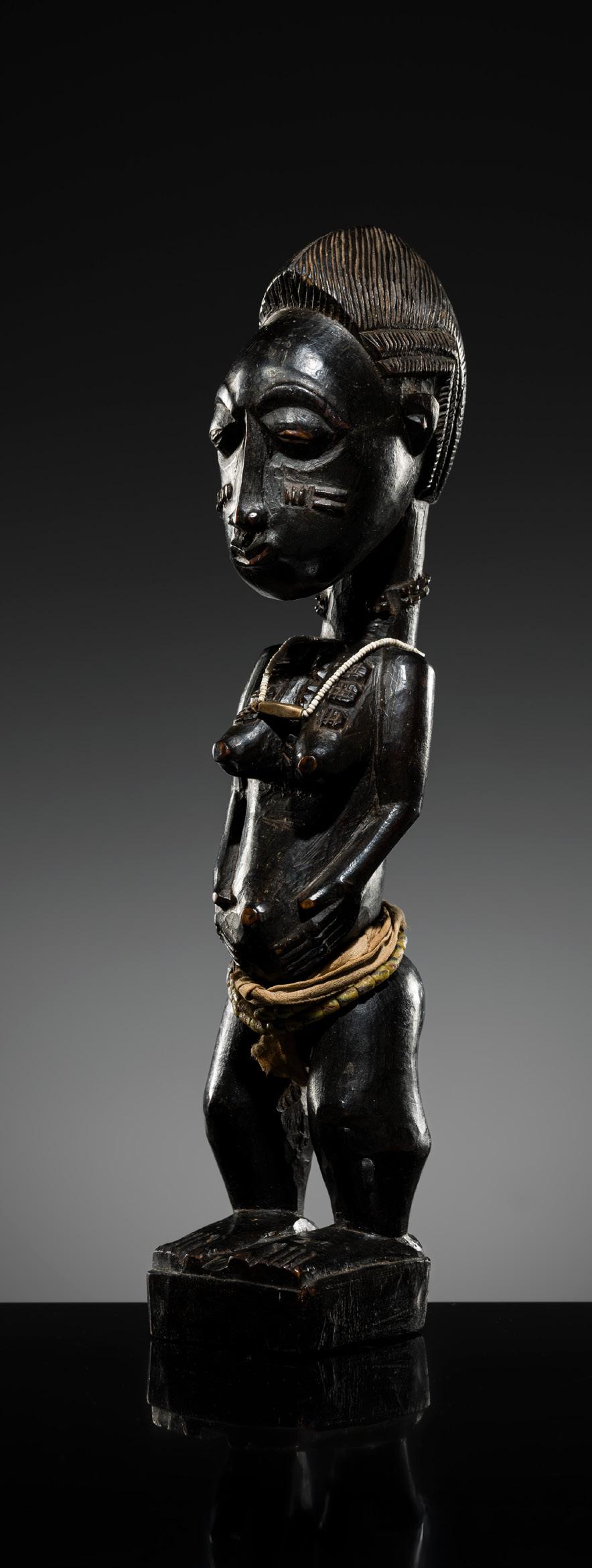
Carved and painted in bold geometric fields of white, red, and black pigment, the upper section, with its rounded rectangular form, is pierced by a central circular opening, while the lower section tapers into a shield-like shape adorned with a chevron motif. Additional perforations along the lower register indicate the eyes and mouth of the mask. The back with a square attachment for supporting the head.
Provenance: French private collection, circa 1980s. Collection of Gerhard Merzeder (b. 1963), internationally published and acclaimed fashion and portrait photographer, Vienna, Austria, assembled since the 1980s.
Condition: Good condition with expected old wear, signs of weathering and erosion, small nicks, some scratches, few chips, and little rubbing to the pigments.
Weight: 5.2 kg
Dimensions: Height 117 cm
During the lunar month dedicated to the Bedu dance moon, paired male and female performers appeared each night to purify, bless, and heal the community in anticipation of the new year. Through energetic dance and spirited, good-humored songs of mock abuse, the maskers guided the audience in rituals that helped ease social tensions and resolve conflicts.
Literature comparison:
Compare a related painted wood female Bedu mask, Nafana culture, Côte d'Ivoire, mid-20th century, 175 cm tall, in the Musée du Quai Branly Jacques Chirac, inventory number 73.1963.2.8.
AUCTION RESULT COMPARISON
Type: Related
Auction: Sotheby’s New York, 13 May 2011, lot 189
Price: USD 134,500 or approx. EUR 164,500 converted and adjusted for inflation at the time of writing
Description: Nafana plank mask, Ivory Coast Expert remark: Compare the similar form and color. Note the size (193 cm).
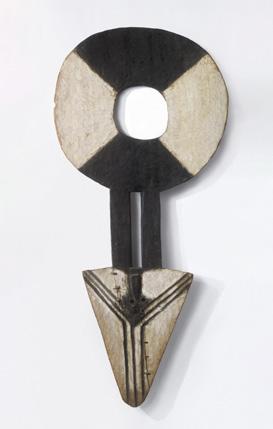
AUCTION RESULT COMPARISON
Type: Related
Auction: Christie’s Paris, 18 December 2024, lot 27
Price: EUR 32,760 or approx. EUR 33,000 adjusted for inflation at the time of writing
Description: Nafana Mask, Ivory Coast Expert remark: Compare the similar form and colors. Note the size (217 cm).
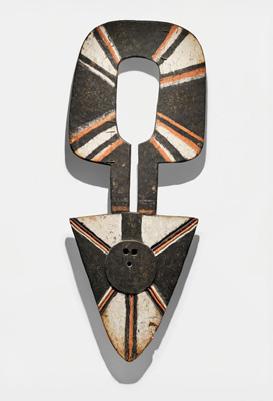
Estimate EUR 2,000
Starting price EUR 1,000
1.
Gabon. The heart-shaped face with details finely picked out in white kaolin overall, pierced slit eyes beneath thin arched darkened brows, a small slender nose, parted lips to the sensitive mouth, and the coiffure dressed in three tapered lobes and colored black.
Provenance: A private collection in Vienna, Austria, acquired before 1937. With Galerie Walu, Zürich, Switzerland, 2004. Collection of Gerhard Merzeder (b. 1963), internationally published and acclaimed fashion and portrait photographer, Vienna, Austria, assembled since the 1980s. The family-owned Galerie Walu has been specialized in cultures of sub-Saharan Africa since 1957, supported by decades of hands-on experience in the African art market.
Condition: Overall fair condition with extensive wear, small losses, signs of weathering and erosion, natural age cracks, splits and splinters, remnants of wax and varnish, expected flaking and rubbing to pigment, and scattered insect activity. Two apertures to the sides for mounting. The wood with a fine, naturally grown, dark patina.
EXTERNAL EXPERT AUTHENTICATION
Koller Auctions, Zürich, 23 June 2007, lot 343 (mid-estimate CHF 16,000 or approx. EUR 18,500 converted and adjusted for inflation at the time of writing).
Weight: 375.2 g
Dimensions: Height 28.5 cm
The Punu live in the southern region of Gabon and are known and renowned for their white Okuyi masks (or Mukudji masks). These white colored masks represent a ‘beautiful girl’, who comes from the afterlife on a benevolent visit to the living. The Okuyi masks are worn by men during the day, who stand on 2 meter high stilts.
Okuyi masks are worn to entertain on festive occasions. Only rarely do the masqueraders fulfill a ritual function of officiating at funerals, when they dance as embodiments of the spirits of female and male ancestors. In performances the dancers, wearing costumes of raffia or cotton fabric and animal pelts, move with amazing agility on stilts up to six and a half feet in height.
EXHIBITED Museum der Völker (formerly Haus der Völker, Museum für Kunst und Ethnographie), Schwaz, Tyrol, Austria, Afrika in Schwarz und Weiss, 16 January 2005 –8 May 2005.
AUCTION RESULT COMPARISON
Type: Related
Auction: Christie’s Paris, 11 March 2021, lot 62
Price: EUR 10,625 or approx. EUR 12,000 adjusted for inflation at the time of writing
Description: Mask Punu, Gabon
Expert remark: Compare the related modeling of the facial features and hair. Note the size (25 cm).
Estimate EUR 4,000
Starting price EUR 2,000
A CARVED WOOD BIERI CULT RELIQUARY FIGURE, FANG CULTURE, GABON, LATE 19TH TO MID-20TH CENTURY
PUBLISHED
Exhibited:
Galerie Walu, Gabon, Zurich, 30 September 2011 - 30 November 2011.
The figure carved with hands joined before the chest, and heartshaped face under a wide, protruding forehead with recessed eye sockets framing closely set eyes, a large nose and a wide mouth above a small chin. The body and face unadorned.
Provenance: A French private collection. An Austrian private collection. With Galerie Walu, Zürich, Switzerland, 2005. Collection of Gerhard Merzeder (b. 1963), internationally published and acclaimed fashion and portrait photographer, Vienna, Austria, assembled since the 1980s. Condition: Good condition with expected wear, obvious losses, small chips, natural cracks, nicks.
EXTERNAL EXPERT AUTHENTICATION
Koller Auktionen, Zurich, 23 June 2007, lot 339 (mid-estimate CHF 20,000 or approx. EUR 23,000 converted and adjusted for inflation at the time of writing).
Weight: 1.5 kg (incl. stand)
Dimensions: Height 41 cm (excl. stand), 50.5 cm (incl. stand)
With a modern stand. (2)
The Fang peoples sustain a sense of continuity with their past and communal unity in the present through the ancestral cult known as bieri Reliquary figures associated with this tradition embody the virtues most esteemed by the Fang—tranquility, vitality, and the harmonious balance of opposing forces. These carved heads or figures were set atop bark containers that held the relics of distinguished ancestors, serving both as guardians of the sacred contents and as protectors against the forbidden gaze of women and uninitiated boys.
Literature comparison:
Compare a related half figure, Nlo Byeri, Fang, Gabon, dated 1875–1925, 50.2 cm tall, in the Art Institute Chicago, reference number 1958.302.
AUCTION RESULT COMPARISON
Type: Related
Auction: Christie’s Paris, 6 March 2024, lot 99
Price: EUR 201,600 or approx. EUR 204,000 adjusted for inflation at the time of writing
Description: Fang reliquary figure, Gabon
Expert remark: Compare the similar proportions, form of the head, condition, and size (44 cm).
Estimate EUR 6,000
Starting price EUR 3,000
A CARVED WOOD MASK, RAMU RIVER DELTA REGION, 19TH CENTURY
Papua New Guinea. Of classic oval form with a gently domed forehead and flat facial plane, the cheeks indicated by bulbous sections to the high cheekbones; a delicately carved ridge running down the center from the top of the head and becoming the ridge to the extended nose, pierced through at the septum, eyes, mouth, and top and bottom of the mask. The wide forehead applied with large C-form brackets pierced with an aperture.
Provenance: Ramu River, acquired by missionaries before 1920, by repute. Leo Fleischmann, Sydney, Australia. A private collection in Switzerland. Collection of Gerhard Merzeder (b. 1963), internationally published and acclaimed fashion and portrait photographer, Vienna, Austria, assembled since the 1980s.
Condition: Good condition with wear, natural imperfections, small losses, few chips, scratches, signs of wear and use, and encrustations.
EXTERNAL EXPERT AUTHENTICATION
Koller Auctions, Zürich, 3 December 2012, lot 1556 (midestimate CHF 3,000 or approx. EUR 3,400 converted and adjusted for inflation at the time of writing).
Weight: 1,336 g
Dimensions: Height 34 cm (excl. stand), 44.5 cm (incl. stand)
AUCTION RESULT COMPARISON
Type: Related
Auction: Sotheby’s Paris, 5 December 2007, lot 135
Mid-estimate: EUR 10,000 or approx. EUR 13,500 adjusted for inflation at the time of writing
Description: Mask, mouths of the Ramu and Sepik rivers, Papua New Guinea
Expert remark: Compare the related modeling. Note the size (49 cm).
Estimate EUR 2,000
Starting price EUR 1,000
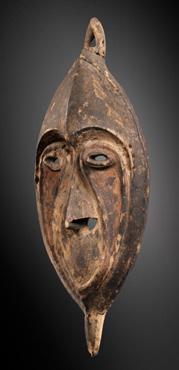
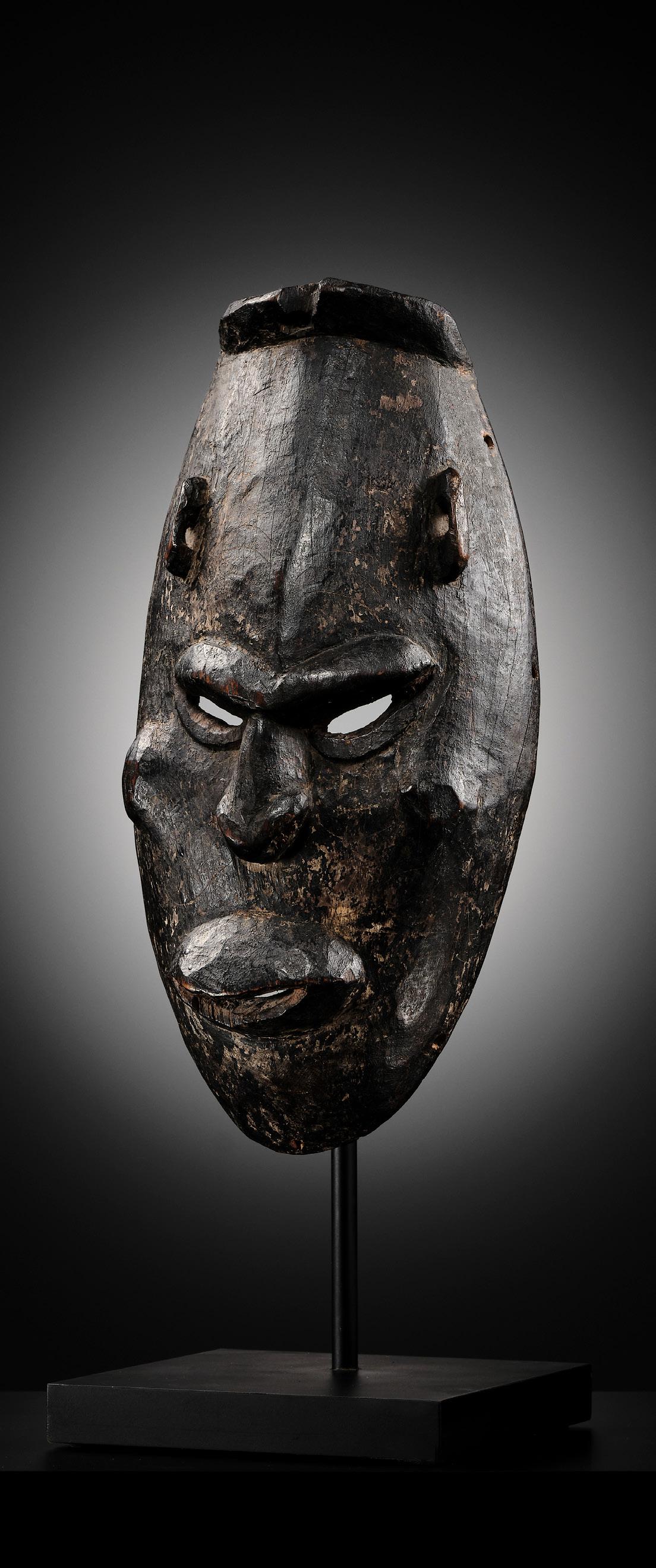
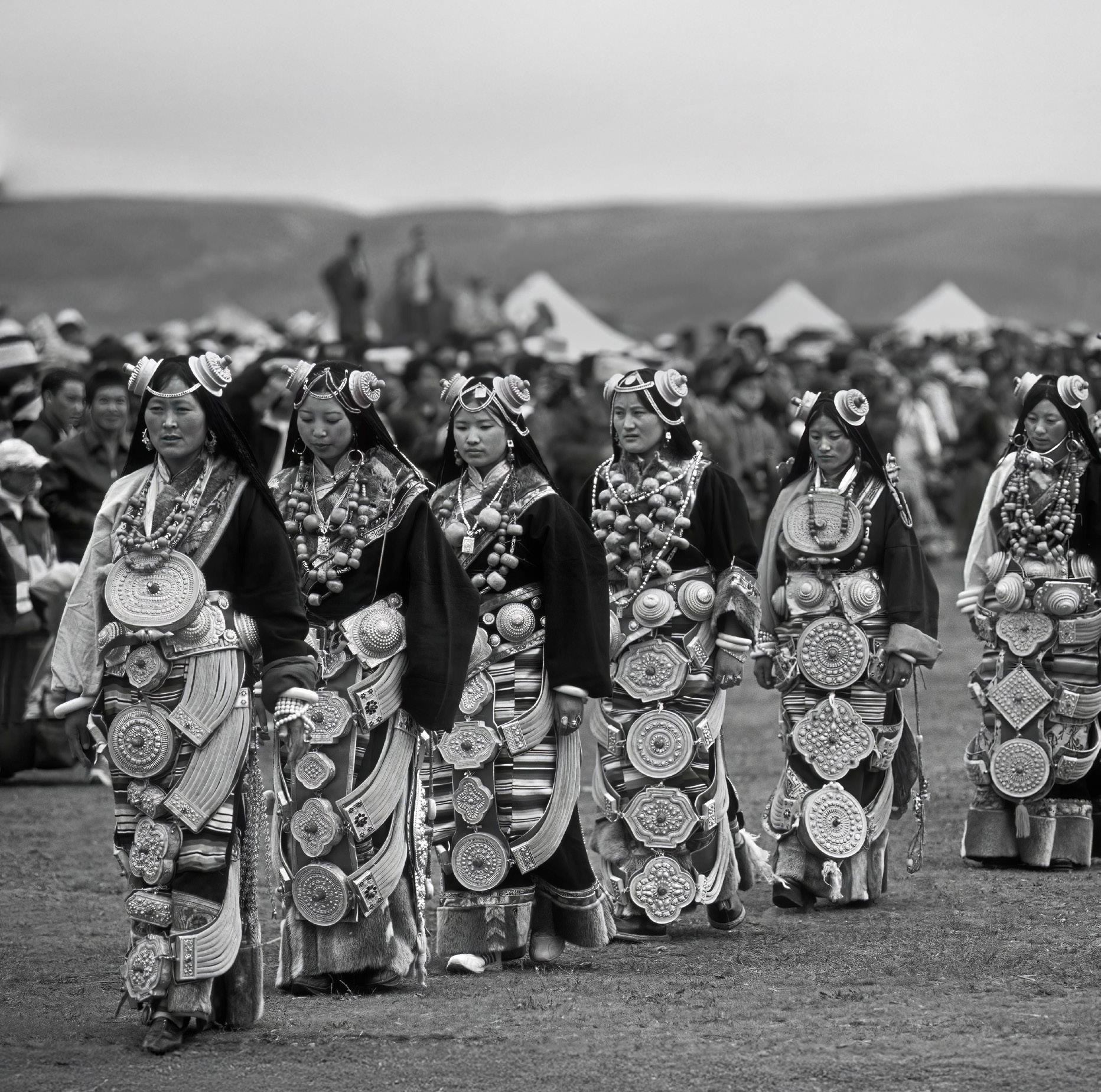
The Philippe Icher Collection Part 2
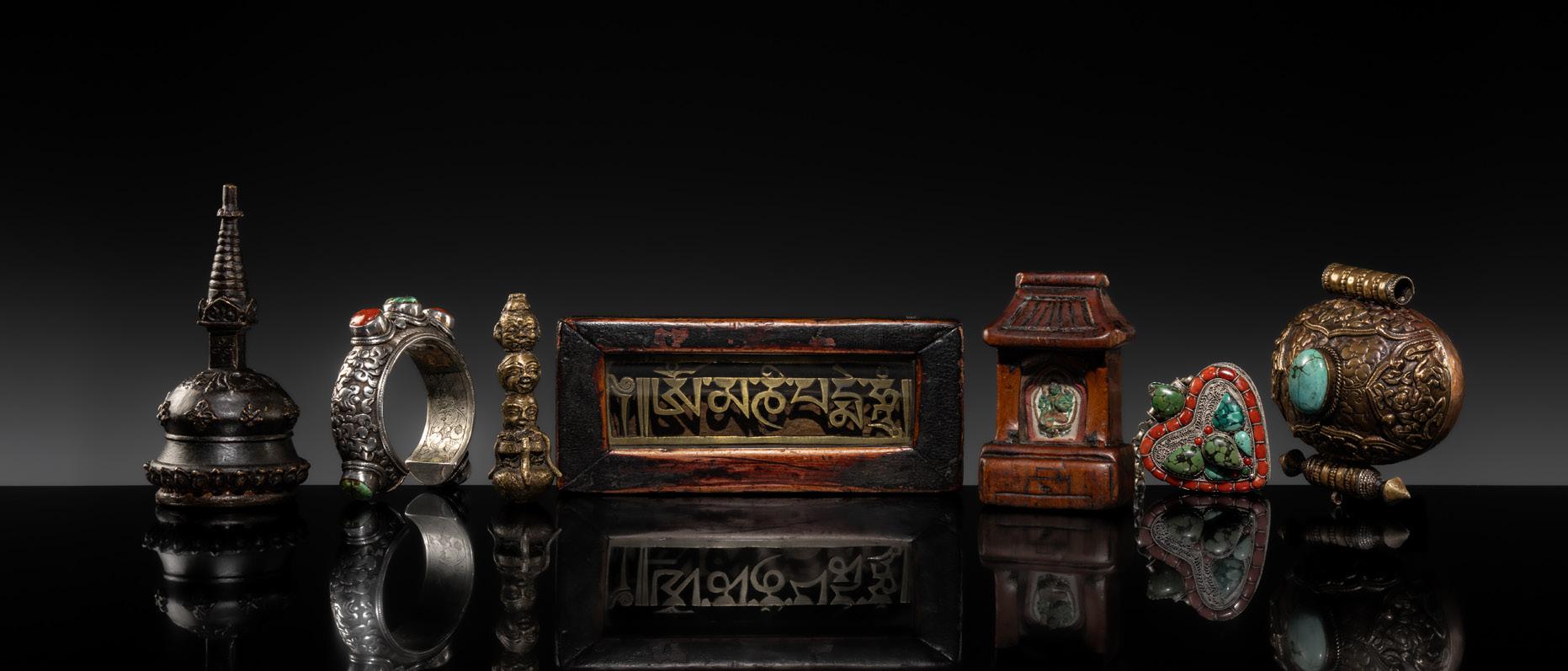
Starting at 3 pm
LOTS 127–183 ONLINE CATALOG
Three Single Owner Collections of Asian Art
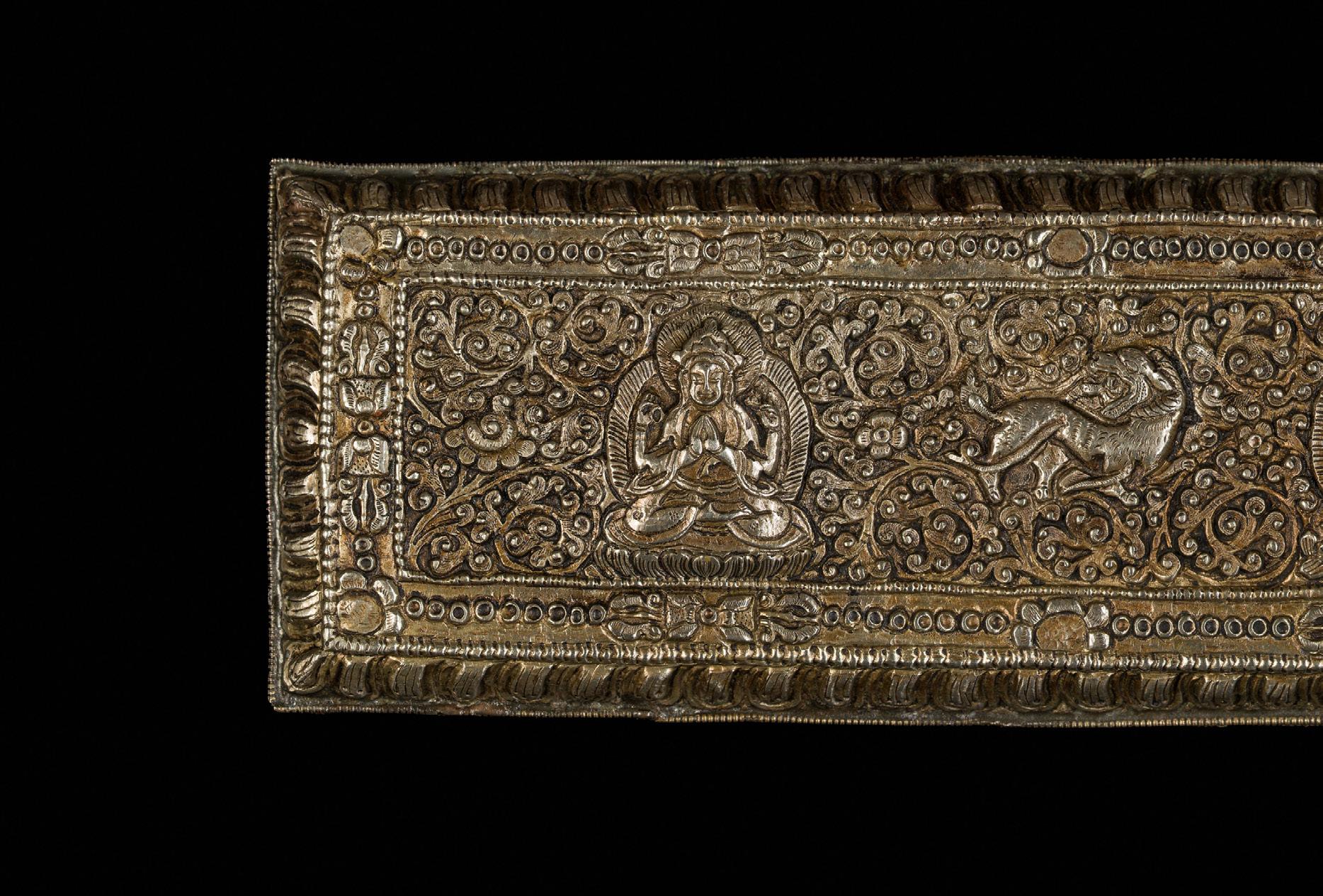
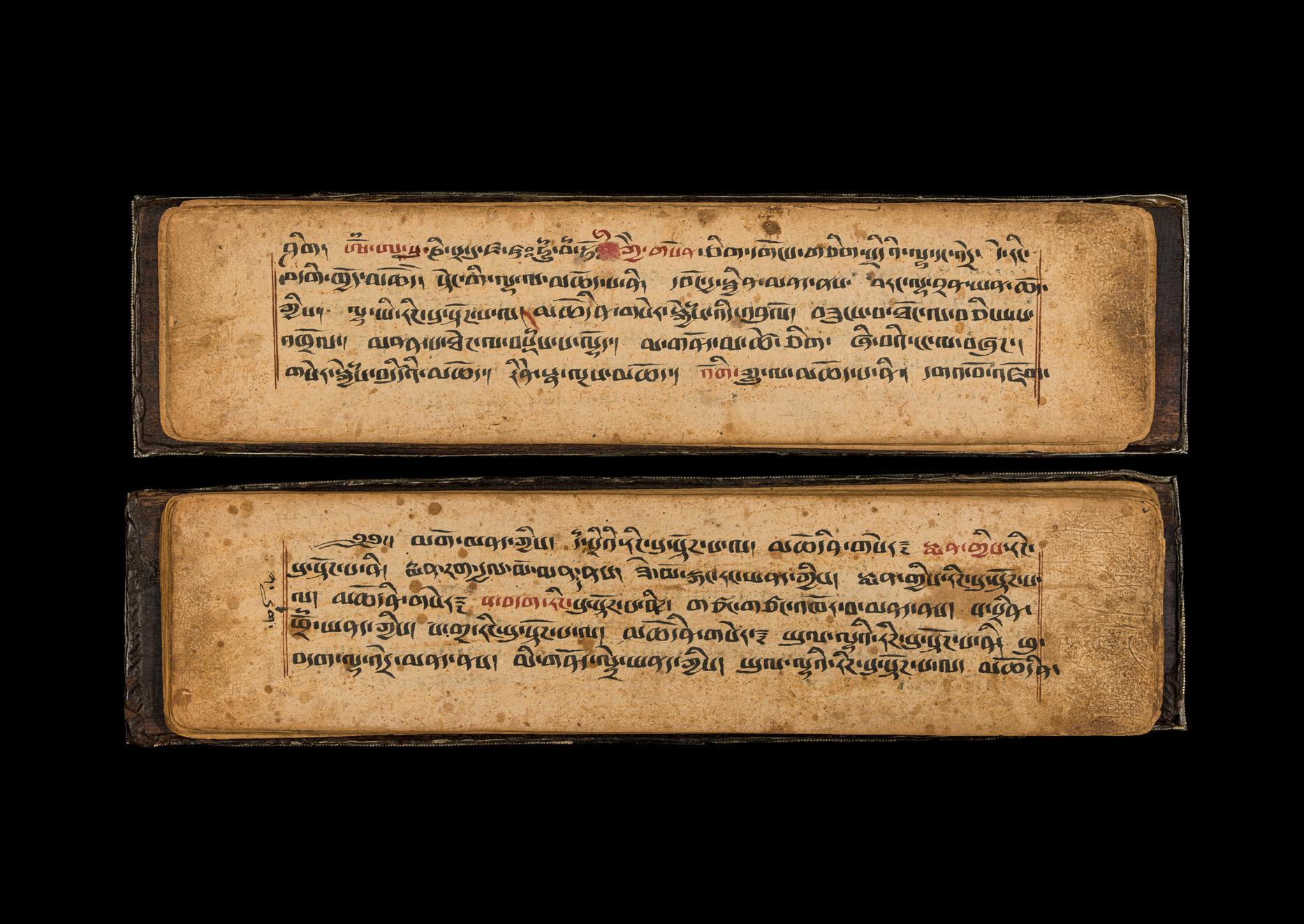
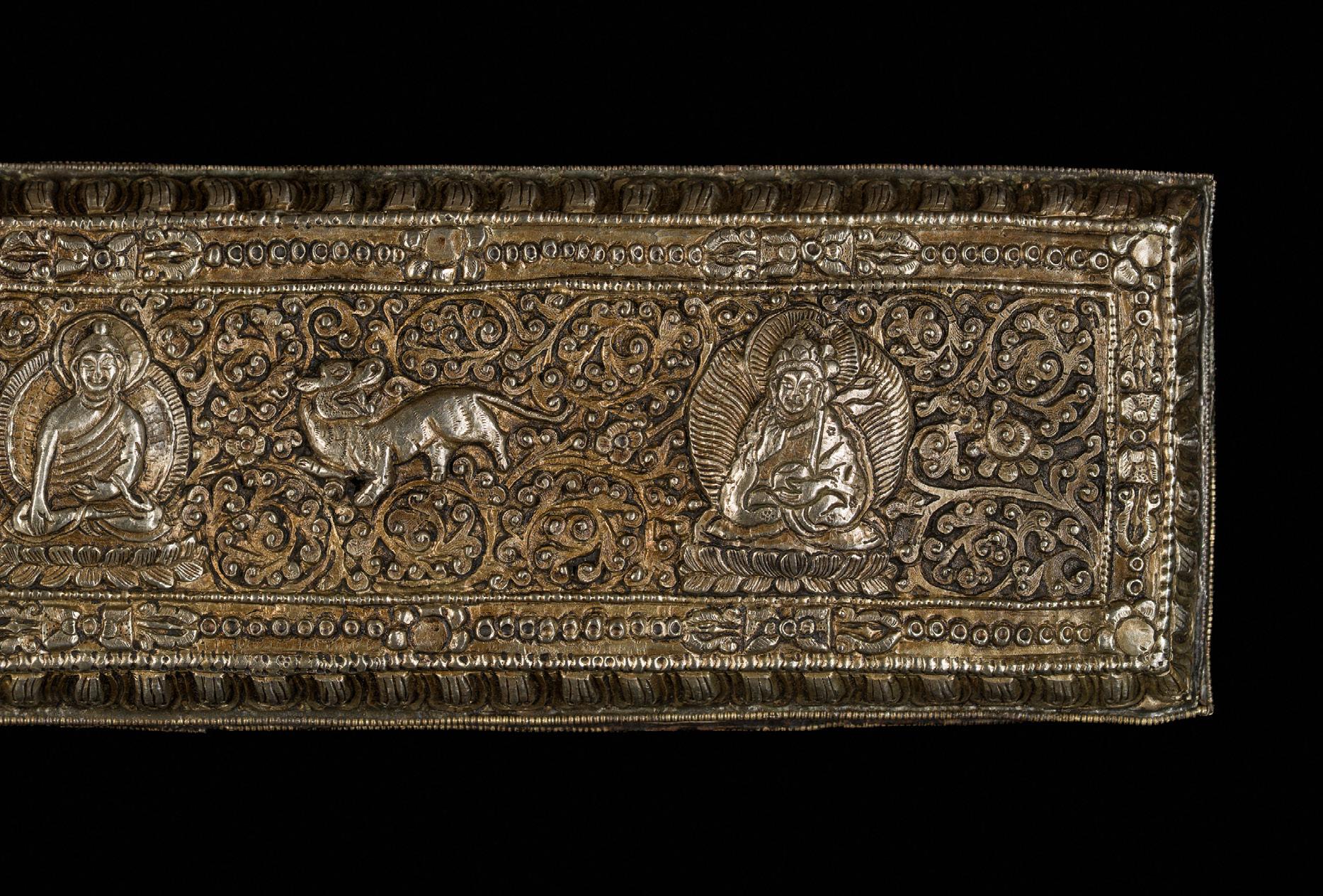
104
A RARE AND IMPORTANT WOOD AND SILVER REPOUSSÉ SUTRA COVER AND MANUSCRIPT, 18TH-19TH CENTURY
Tibet. Comprising a matching top and bottom cover made of wood, with the outward-facing sides entirely clad in repoussé silver as well as thirty-two sheets of paper. The front depicts three Buddhas, all seated in dhyanasana on a lotus base; between them are two lions, all set against scrolling foliage and encircled by beaded bands and a lotus band. The back shows a kalachakra ideogram on a lotus base, flanked by the Eight Buddhist Emblems, all set before further scrolling leaves.
Inscription: The thirty-three sheets of paper inscribed with Uchen Tibetan script.
Provenance: Collection of Philippe Icher (b. 1956), French ceramic artist and collector, whose works are held in numerous renowned collections throughout Europe. His collection, assembled over several decades during his travels across Asia, includes Himalayan, Tibetan, and Nepalese artifacts that have profoundly inspired his artistic practice.
Condition: Very good condition with minor wear and manufacturing flaws. Small nicks, minuscule dents, tarnish to silver and remnants of gilt. The sheets with foxing.
Weight: 1,473 g
Dimensions: Height 9.5 cm, Length 38.3 cm
The vast majority of Tibetan manuscript covers are made of wood, fashioned in a large horizontal format to protect Buddhist texts. Many were elaborately carved and gilded, while a smaller number were adorned with hammered copper repoussé designs. These examples are especially prized, with most surviving specimens dating to the 12th–14th centuries (see one sold at Bonhams New York, 19 March 2025, lot 310, USD 165,600), when texts from eastern India were actively copied and transmitted to Tibet, shaping a developing Buddhist doctrinal landscape. Both the format and subject matter of Tibetan manuscripts reflect this historical connection to eastern Indian traditions, while their highly ornate style demonstrates Newari influence in metalworking and manuscript painting.
It is possible that the covers are from the more Tibetan parts of Nepal, such as Mustang. Indeed, Matthiessen (1996, p. 136) illustrates some covers, partly clad in partly-gilded silver with repoussé work that is not unlike that shown on the covers here. Matthiessen says that the Mustang covers were commissioned in the 15th century and that originally there were 108 volumes which were kept in the Raja of Mustang’s private chapel in Lo Monthang but that over the centuries many disappeared. It is likely that replacements were commissioned over the centuries. Other examples of Himalayan and Mongolian wooden manuscript covers with part or full exterior silver cladding are illustrated in Pal (2001, p. 193), Tsultem (1987, ill. 58), and Topsfield (2013, 84). Heller (2000, p. 63) illustrates a book cover clad in gilded copper repoussed with the five Cosmic Buddhas and attributed to 11th-12th century Nepal, probably for a Tibetan patron, and Pal (1990, p. 115) illustrates a cover covered in gilded bronze featuring the five Cosmic Buddhas, inlaid with stones, and attributed to around 1600.
LITERATURE COMPARISON
Compare a related wood and parcel-gilt silver repoussé book cover, Tibet, dated 18th-19th century, 45.5 cm (long), sold at Michael Backman, London, no. 3653.
AUCTION RESULT
COMPARISON
Type: Related
Auction: Bonhams Sydney, 1 May 2007, lot 198
Price: AUD 9,600 or approx.
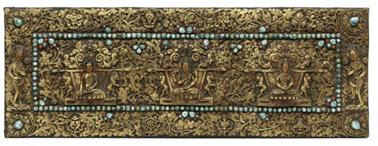
EUR 9,000 converted and adjusted for inflation at the time of writing
Description: A fine Tibetan gilt copper repoussé on wood book cover, 16th century
Expert remark: Compare the related form, motif, and unusual repoussé covers. Note the gilt, inlays and earlier date.
Estimate EUR 2,000
Starting price EUR 1,000
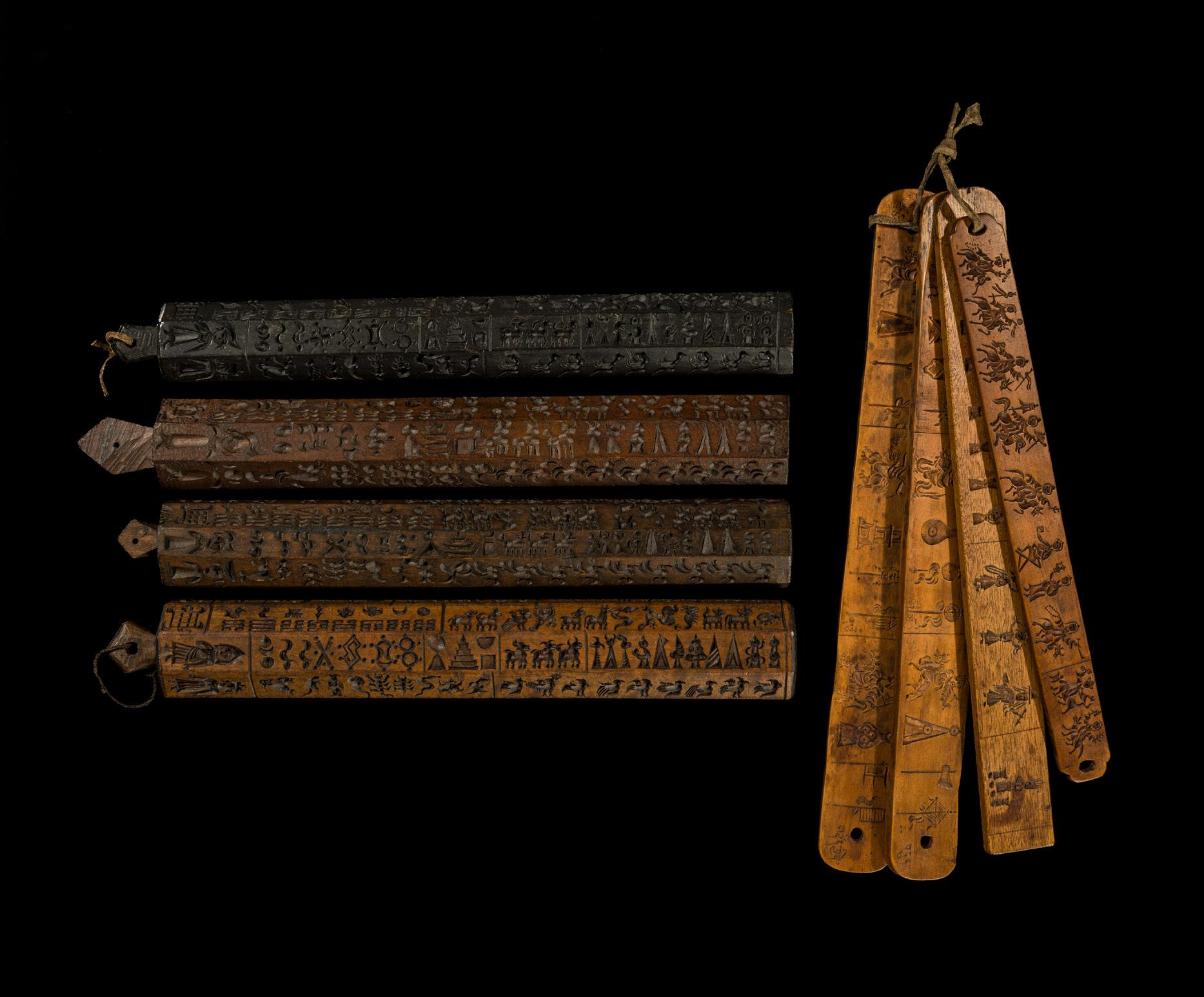
A GROUP OF FIVE LARGE WOOD TORMA MOLD STICKS, ZANPAR AND TORPAR, 18TH-19TH CENTURY
Tibet. Four zanpar of polygonal form, each stick is carved with hollow molds of various ritual motifs, including people, deities, spirits, torma offerings, animals, and symbols, which are pressed into the offerings made of dough or butter. The torpar, consisting of four slats fastened together with leather string, depicts more elaborate representations of auspicious symbols and deities. (5)
Provenance: Collection of Philippe Icher (b. 1956), French ceramic artist and collector, whose works are held in numerous renowned collections throughout Europe. His collection, assembled over several decades during his travels across Asia, includes Himalayan, Tibetan, and Nepalese artifacts that have profoundly inspired his artistic practice. Condition: Very good condition with minor wear and natural imperfections. Fire marks, nicks, scratches, and small old smoothened chips along the edges. Remnants of pigment.
Weight: 1,023 g (total)
Dimensions: Height 29 cm (the smallest) and 35.5 cm (the largest)
Zanpar are carved wooden lengths of wood with images of the different sets of offerings used to create barley dough (tsampa) replicas of real figures and objects for torma offerings in Buddhist and Bon rituals in the Himalayan and Tibetan regions. Typically, the figures include a man and a woman, often with the hands placed at the waist in a passive gesture. Other groups of figures include the Nine Animals that Fly in the Sky, Nine Animals that Walk on Land, and the Nine Animals that Live in Water along with many other
objects including the Eight Auspicious Symbols. There are naga creatures and strange hybrid animals all of which appear to be unique to Tibetan culture and possibly a borrowing from the early Bon ritual practices.
The dough molds can be single lengths of wood with two or more sides, with the important figures carved in groups, or they can be sets of slats, called torpar, fastened together with string or leather cord. A single side or both sides can be carved with figures and symbols. Some examples are also stained with color as the dough can be pre-colored prior to pressing or colored after pressed and readied for use.
AUCTION RESULT COMPARISON
Type: Closely related
Auction: Zacke, Vienna, 7 March 2025, lot 126
Price: EUR 8,450
Description: A group of four large wood torma mold sticks, Zanpar, 18th19th century
Expert remark: Compare the closely related forms, and depictions of the hollow molds. Note the slightly larger sizes (39-47 cm) and that it comprises four sticks.
Estimate EUR 3,000
Starting price EUR 1,500
A RARE SILK MUNDAMALA WITH 11 GILT COPPER ALLOY REPOUSSÉ HEADS
Tibet, mid-18th to mid-19th century. The silk garland is decorated with gold thread and applied with eleven large asura heads of which two are skulls, each detailed with a ferocious expression and wide, grinning mouth, some with eyes falling out and flanked by comically large, pierced ears. The gilt heads are further highlighted with red paint.
Provenance: Collection of Philippe Icher (b. 1956), French ceramic artist and collector, whose works are held in numerous renowned collections throughout Europe. His collection, assembled over several decades during his travels across Asia, includes Himalayan, Tibetan, and Nepalese artifacts that have profoundly inspired his artistic practice.
Condition: Good condition with minor wear and manufacturing flaws. Few nicks, minuscule dents, and light scratches. Remnants of ritual paint. A repair to one ear. The silk with minor losses and loose threads.
Weight: 795 g
Dimensions: Length 85 cm
A mundamala, also called kapalamala or rundamala, is a garland of the severed heads and skulls of demons found in both Hindu and Tibetan Buddhist iconography. In Hinduism, the mundamala is a characteristic of fearsome aspects of the Hindu Divine Mother and the god Shiva; while in Buddhism, it is worn by wrathful deities of Tibetan Buddhism.
LITERATURE COMPARISON
Compare a closely related mundamala in the Museum of Buddhist Art Nongprue, Thailand.
Estimate EUR 2,000
Starting price EUR 1,000
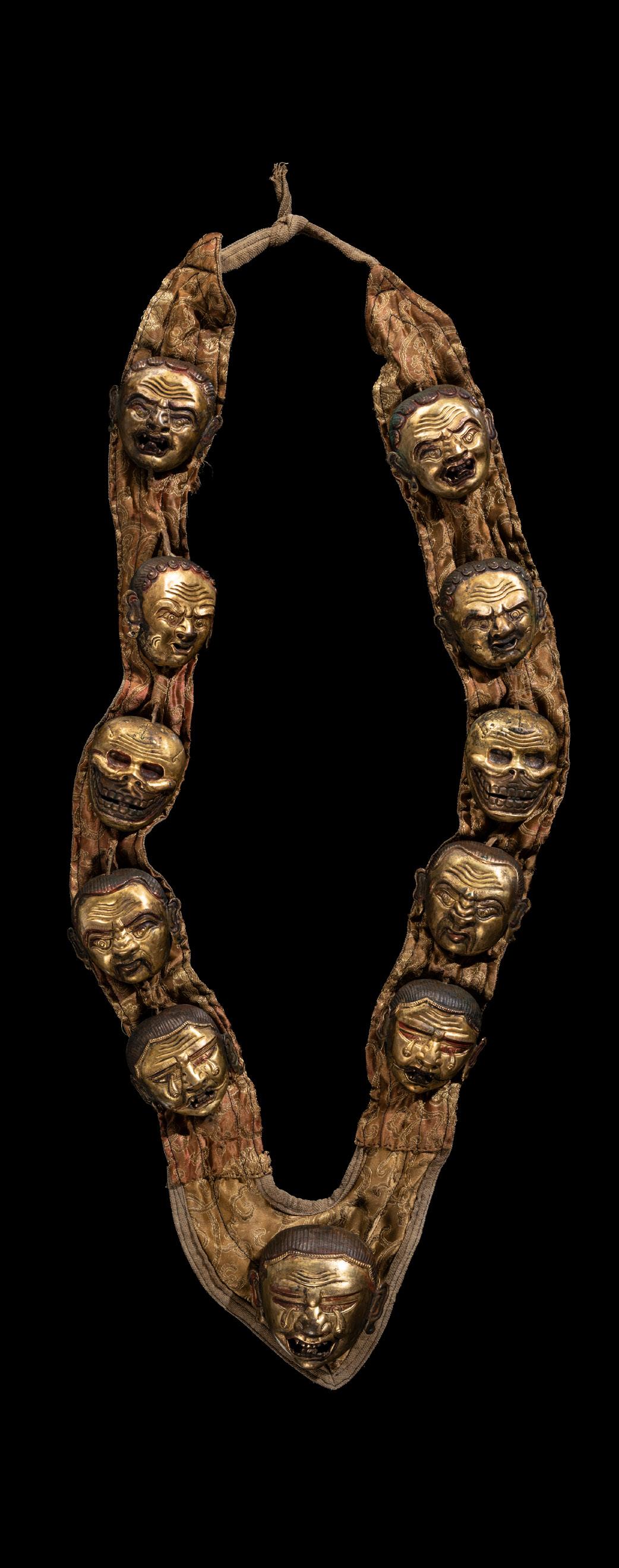
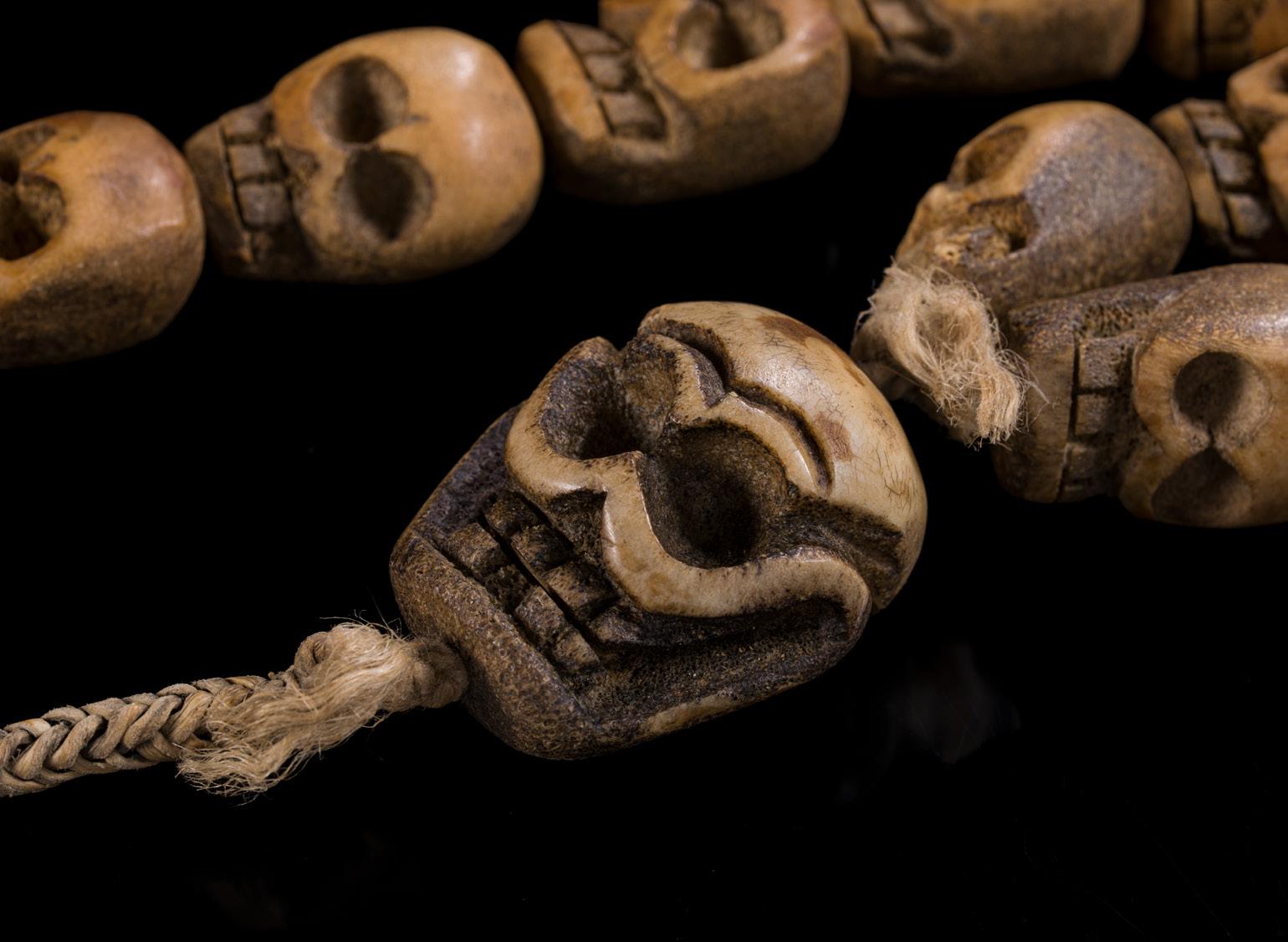
107
A HUGE AND HIGHLY IMPORTANT CARVED BONE MALA WITH SKULL BEADS, SIN-‘PHEN, 18TH-19TH CENTURY
Tibet. Stringed with a total of a hundred beads, all carved and pierced from bone in the form of grinning skulls, with both ends knotted together after passing through a single, larger skull bead. The beads with a fine, naturally grown, dark patina.
Provenance: Collection of Philippe Icher (b. 1956), French ceramic artist and collector, whose works are held in numerous renowned collections throughout Europe. His collection, assembled over several decades during his travels across Asia, includes Himalayan, Tibetan, and Nepalese artifacts that have profoundly inspired his artistic practice. Condition: Very good condition with minor wear and natural imperfections. Fine natural age cracks and expected deterioration, few old chips.
Weight: 1,609 g
Dimensions: Length 422 cm (total)
The present lot is an exceptionally large Buddhist rosary, which evolved from ancient Hindu-Indian mala prayer beads. In Tibet, such rosaries are known as sin-’phen and are used by both lay practitioners and monks. The main prayer beads were used to count repetitions of prayers.
Skulls and skeletons are commonly found in Tibetan Buddhist art, often serving as decorative elements on crowns, garlands, and rosaries, as seen in the present lot. Skeletons also appear as protectors, or dharmapalas, in Tibetan and Himalayan Vajrayana Buddhism, most notably in the form of the Citipati, a male and female pair of dancing skeletal deities representing both the eternal cycle of death and perfect awareness.
Comparable rosaries made of human bone exist and were used in destructive or wrathful rituals, such as an example preserved in the Guimet Museum (object number MA3459). Mahakala, one of the principal protectors of Buddhist teachings, is often depicted holding a rosary of large skull beads, a motif that appears across various ritual implements. Additional comparable rosaries are held in Western public and private collections,
while others are made from small bone discs cut from skullcaps; the Palace Museum in Taipei, for example, preserves an iron rosary formed of skull motifs.
LITERATURE COMPARISON
Compare a closely related but smaller carved human bone mala with a hundred skulls, Tibet, dated 19th century, 120 cm (long), in the Guimet Museum, object number MA 3459, illustrated in Nathalie Bazin (2002), Rituels tibetains. Visions secretes du Ve Dalai Lama, p. 170 (fig. 1). Compare a closely related but also smaller carved bone mala with skulls, Tibet, dated 18th-19th century, sold at Michael Backman, London, no. 7324.
AUCTION RESULT COMPARISON
Type: Related
Auction: Zacke, Vienna, 7 March 2025, lot 6
Price: EUR 19,500
Description: A carved bone mala with skull beads, Sin-‘phen, 18th-19th century
Expert remark: Compare the closely related carved bones skull heads and patina. Note the much smaller size (125 cm).
Estimate EUR 4,000
Starting price EUR 2,000
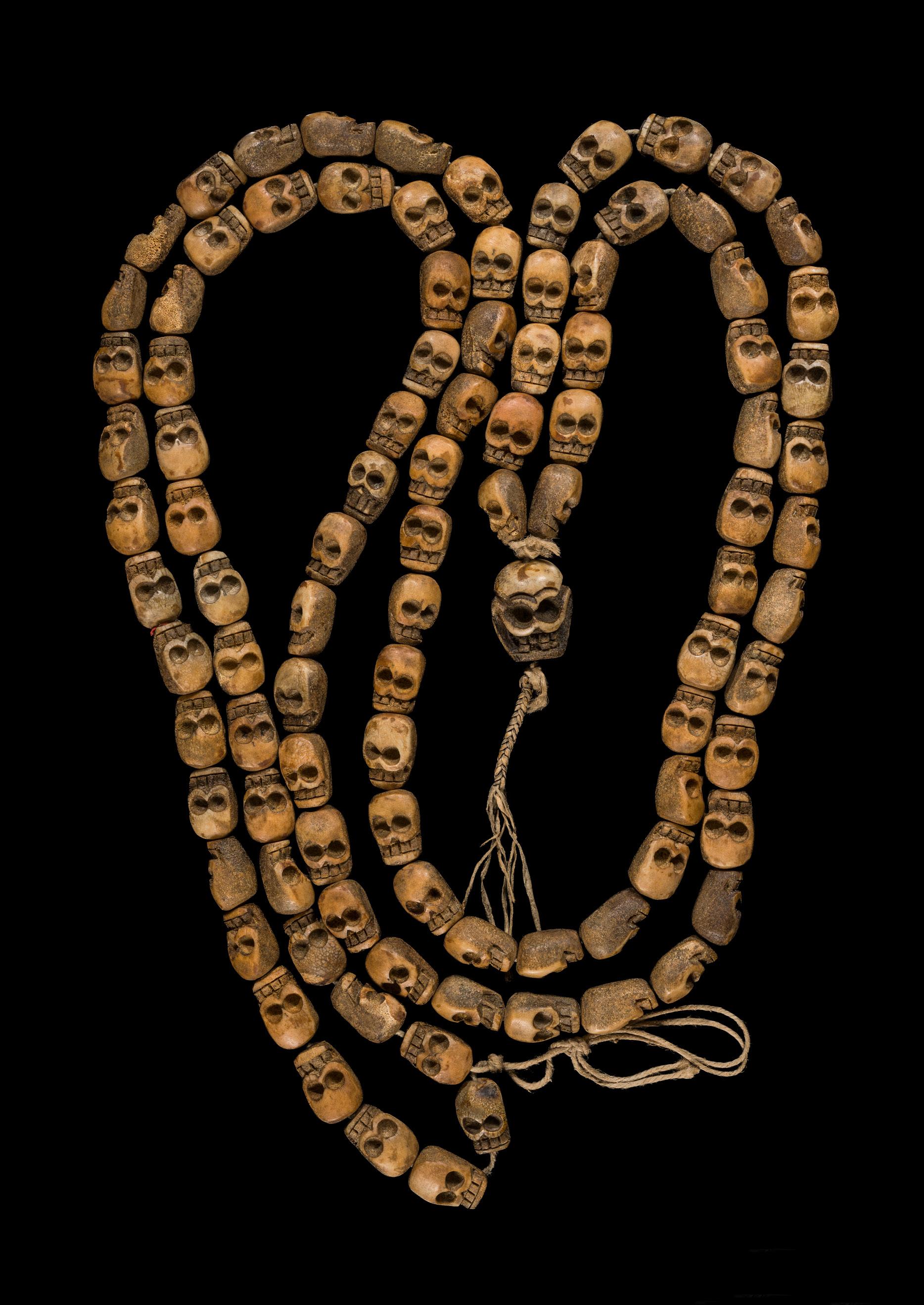
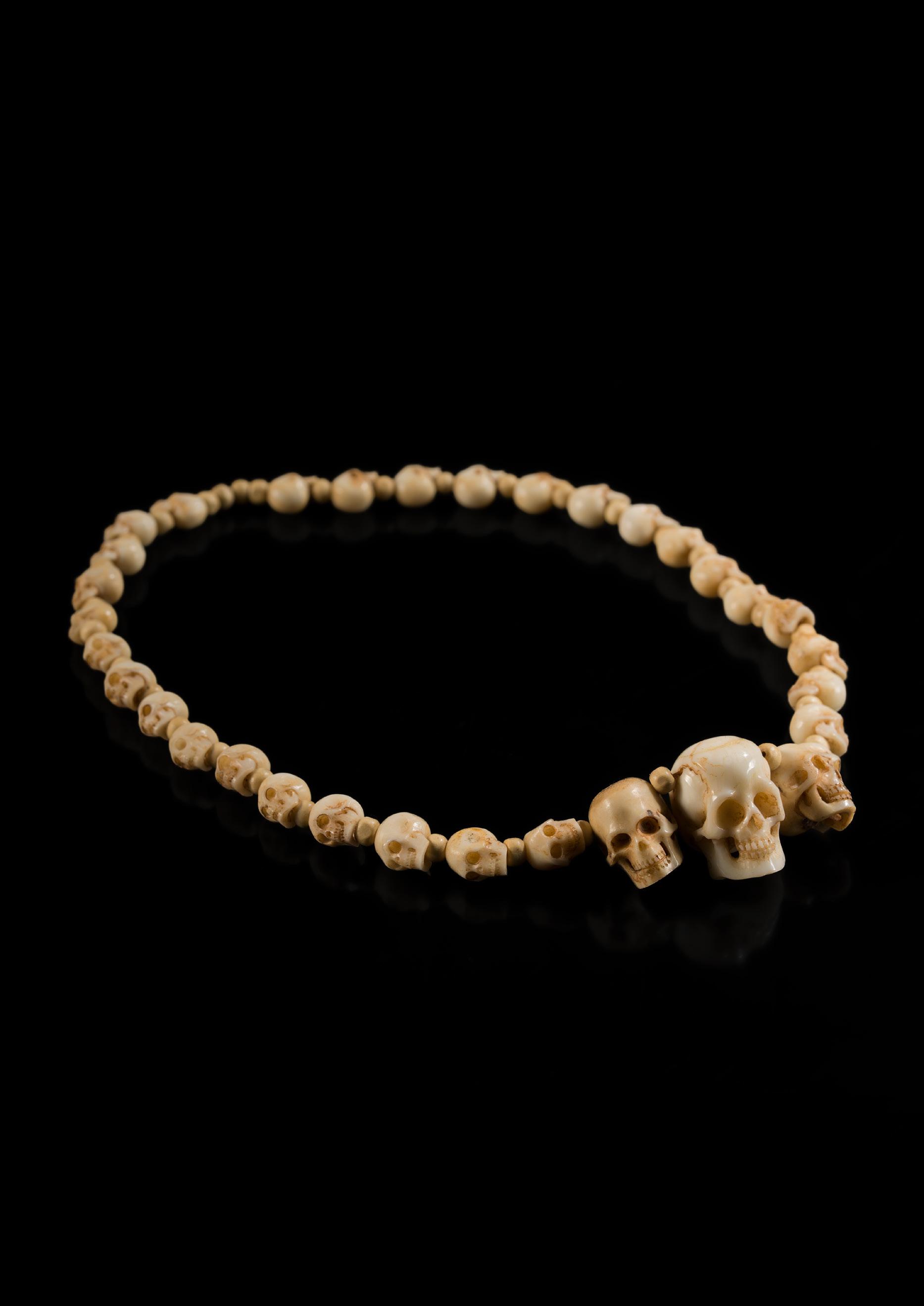

108
AN EXCEPTIONALLY WELL CARVED BONE AND MARINE IVORY MALA WITH SKULL BEADS, SIN-‘PHEN, 18TH-19TH CENTURY
Tibet. Strung with a total of thirty-three beads, of which two are carved and pierced from bone in the form of grinning skulls, as well as thirty-six round beads, all knotted together. The bone beads display a fine, naturally developed patina.
Provenance: Collection of Philippe Icher (b. 1956), French ceramic artist and collector, whose works are held in numerous renowned collections throughout Europe. His collection, assembled over several decades during his travels across Asia, includes Himalayan, Tibetan, and Nepalese artifacts that have profoundly inspired his artistic practice. Condition: Very good condition with minor wear and natural imperfections. Fine natural hairlines, minuscule nicks, and tiny deterioration.
Weight: 82 g Dimensions: Length 62 cm (total)
This Tibetan mala or rosary comprises dozens of tiny beads each carved into a small human skull from bone and marine ivory. It is among the finest of these that we have seen.
Most malas are used for counting and reciting mantras but the beads on this example are too fine for that purpose and yet the subject matter and material from which the necklace is made suggests a tantric ritual use. Images of wrathful deities are typically shown wearing garlands of skulls and so it is likely that this necklace was used for wrathful deity rituals, with the skulls representing the three mental ‘poisons’ – ignorance, hatred and desire.
LITERATURE COMPARISON
Compare a closely related carved bone mala with skulls, Tibet, dated 18th century, 62 cm (long), sold at Michael Backman, London, no. 8618.
Estimate EUR 2,000
Starting price EUR 1,000
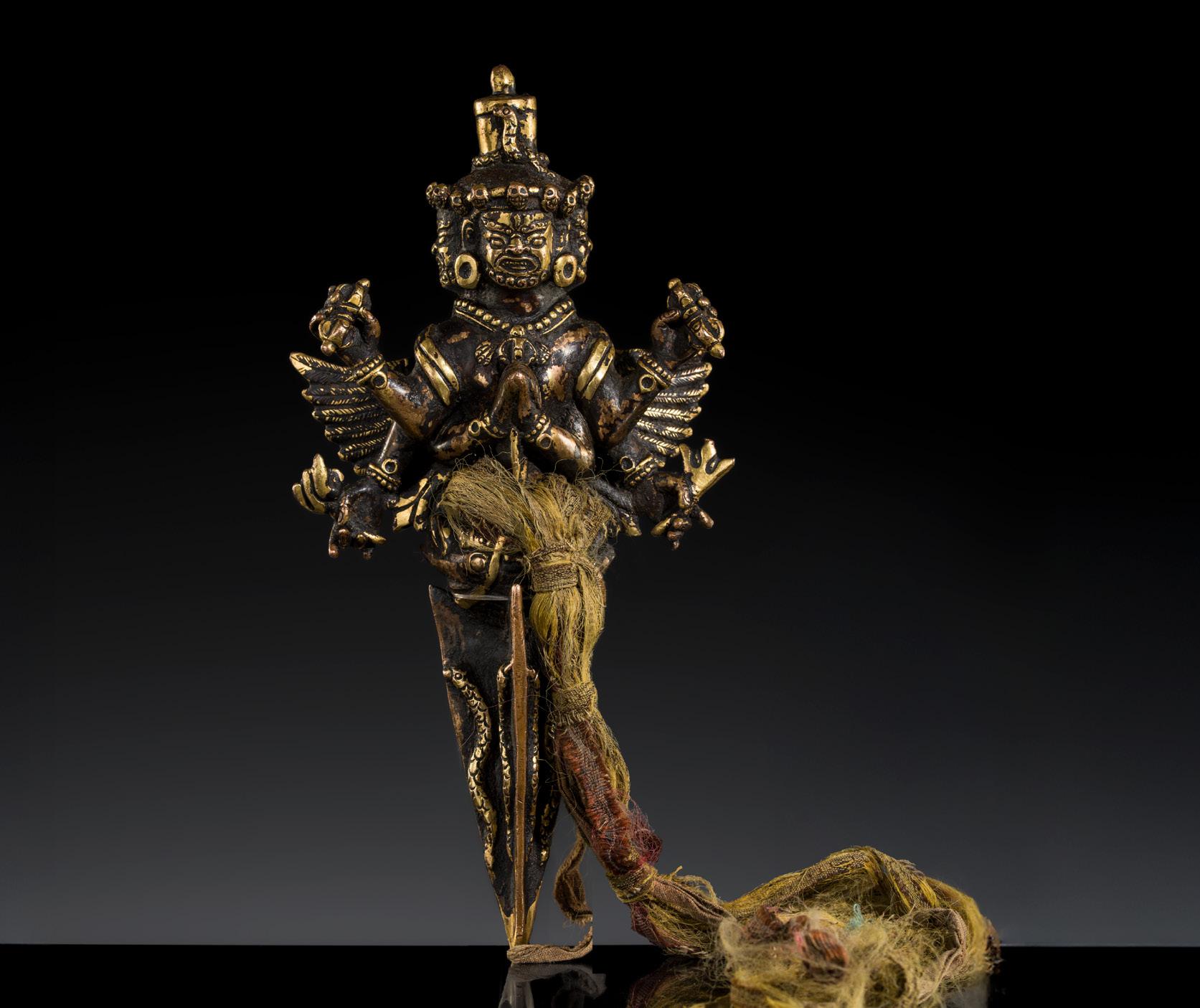
109
A RARE PARCEL-GILT COPPER VAJRAKILA PHURBA, 17TH CENTURY
Tibet. Powerfully cast, the pommel is adorned with three heads of wrathful protectors, shown with multiple arms, the principal hands held before the chest and the others holding attributes, flanked by outspread wings. The fierce expression is marked by bulging eyes, bared teeth, and a flaming beard. The figure is richly detailed with incised ornaments, jewelry, and wings. The deity’s body tapers into a three-edged blade issuing with serpents. Bands strung around the waist.
Provenance: Collection of Philippe Icher (b. 1956), French ceramic artist and collector, whose works are held in numerous renowned collections throughout Europe. His collection, assembled over several decades during his travels across Asia, includes Himalayan, Tibetan, and Nepalese artifacts that have profoundly inspired his artistic practice. Condition: Very good condition with minor wear and manufacturing flaws. Few nicks, minuscule dents, and light scratches. Fine, naturally grown patina. Traces of use and loose threads to the bands.
Weight: 1,140 g
Dimensions: Length 25 cm
Phurba is a ritual dagger designed to subdue evil demons. Used in rituals, the triple-sided blade of this three-faced dagger represents the deity Vajrakila. The vertical arrangement of the three heads is a feature more common on ritual clubs, or khatvanga, to symbolize both the attainment of clear light reality and the mastery over the three poisons: passion, aggression, and ignorance.
Vajrakila is a meditational deity of tantric Buddhism. Also known as Vajra Kumara (Vajra Youth) or Vajrakilaya, he is the activity aspect from the set of Eight Herukas of the Mahayoga Tantras of the Nyingma Tradition of
Tibetan Buddhism and a principal meditational deity for both the Nyingmapa and Sakyapa, later taken up by the Jonang and many of the various Kagyu Traditions.
LITERATURE COMPARISON
Compare a closely related Vajrakila Phurba in the Carolyn and Wesley Halpert Collection, dated to the 17th century, illustrated on Himalayan Art Resources, item numbers 90845.
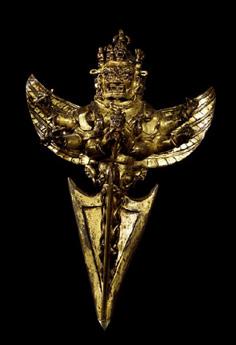
AUCTION RESULT COMPARISON
Type: Related
Auction: Bonhams Paris, 15 December 2022, lot 134
Price: EUR 8,925 or EUR 9,500 adjusted for inflation at the time of writing
Description: A brass purbha of Vajrakila, Tibet, 14th century
Expert remark: Compare the closely related material, carving manner, form, and motif. Note the size (28.5 cm) and earlier date.
Estimate EUR 2,000
Starting price EUR 1,000
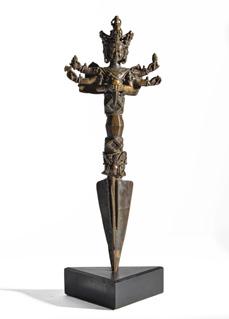
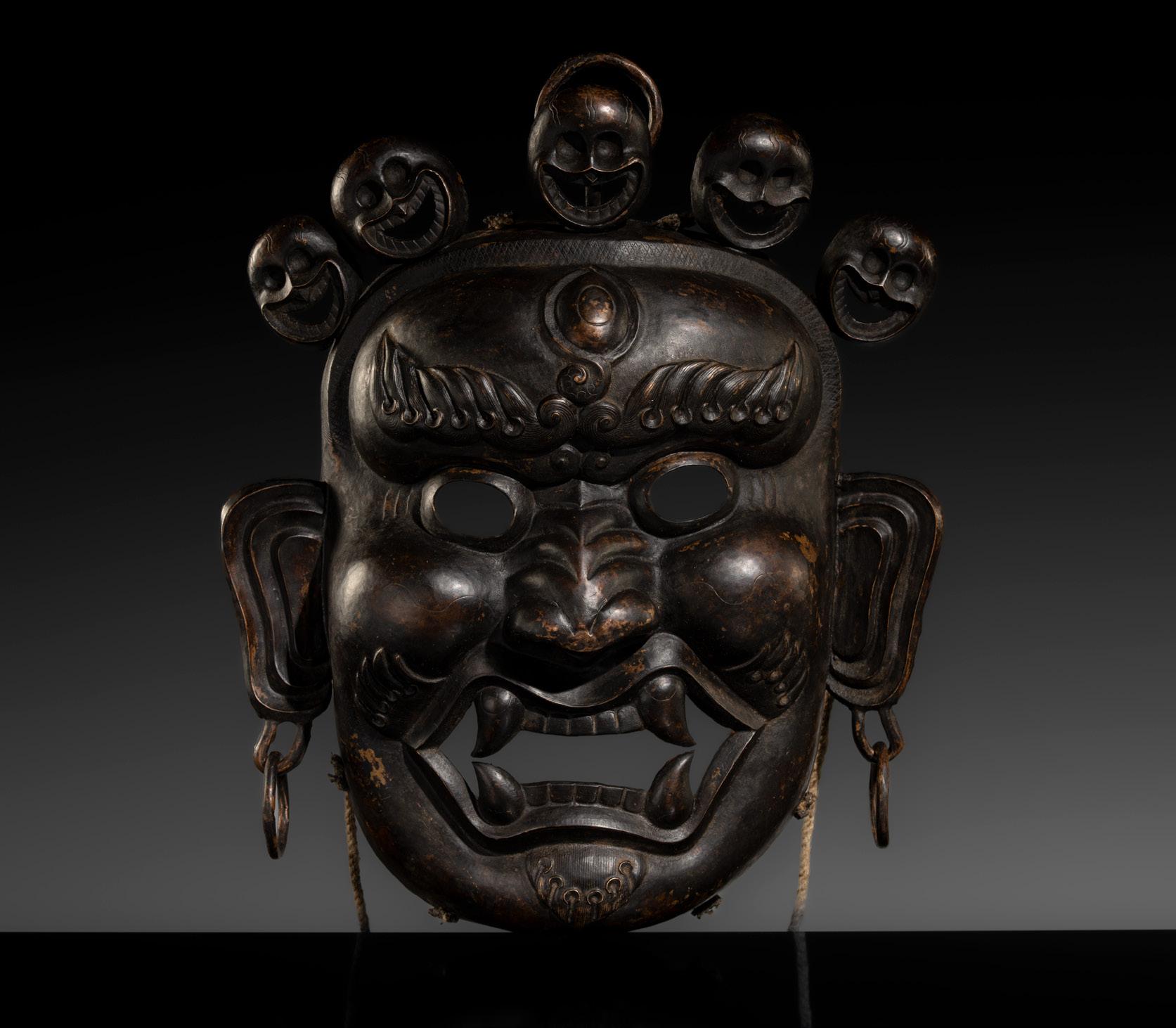
110
Tibet. Well modeled in openwork with a wrathful expression, marked by large, pierced bulging eyes beneath bushy brows and centered by a third eye; a wide nose above an open mouth revealing sharp teeth and fangs, framed by a flaming beard. The face is flanked by pierced ears suspending fabric rings and surmounted by five deviously smiling skulls. The verso is fitted with a circular padded tube sized to fit the face of the wearer.
Provenance: Collection of Philippe Icher (b. 1956), French ceramic artist and collector, whose works are held in numerous renowned collections throughout Europe. His collection, assembled over several decades during his travels across Asia, includes Himalayan, Tibetan, and Nepalese artifacts that have profoundly inspired his artistic practice.
Condition: Very good condition with minor wear and manufacturing flaws. Small nicks, minuscule dents, remnants of gilt, fissures, and light surface scratches.
Weight: 1,059 g
Dimensions: Height 35 cm
Mahakala's fearsome countenance is vividly expressed with his bared fangs, a snarling mouth, a menacing gaze, and flaming brows. He is adorned with a five-skull tiara, which is worn by all manifestations of Mahakala, symbolizing the transmutation of human nature's five negative afflictions into positive virtues. This crown is worn after blessing, visualizing, and lustrating, as a symbolic seal of the initiate's abandoning the notion of oneself as an ordinary, perfect being, and that adoption of the buddha-pride, the sense of oneself as a purified, enlightened Buddha, every atom itself becomes wisdom.
The present lot is a Tibetan ceremonial cham mask. The word cham refers to the sacred masked dances performed by monks during major festivals, where movement, costume, and music combine to enact mythic narratives and drive away malevolent forces. Typical masks used in these performances were made of lightweight papier-mâché or wood; large metal examples are exceptionally rare.
LITERATURE COMPARISON
Compare a related gilt bronze mask of Bhairava, Nepal, 17th-19th century, in the collection of the British Museum, museum number 1952,1101.9 (fig. 1). Compare a related mask of Bhairava, Tibet, 20th century, in the collection of the Norton Simon Museum, accession number P.2006.02.09.
AUCTION RESULT COMPARISON
Type: Closely related
Auction: Zacke, Vienna, 28 June 2024, lot 11
Price: EUR 1,820
Description: A copper repoussé ritual mask of Mahakala, 19th century
Expert remark: Compare the closely related material, form, motif, and facial expression. Note the slightly smaller size (30.5 cm).
Estimate EUR 1,000
Starting price EUR 500
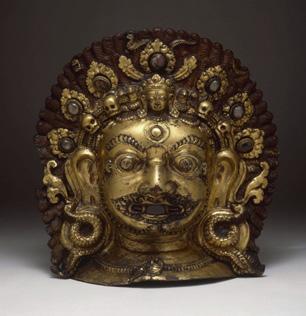
1
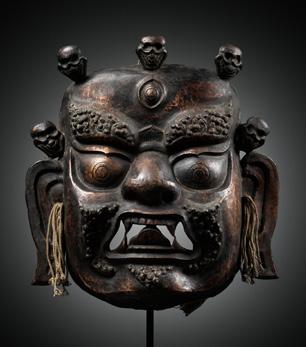
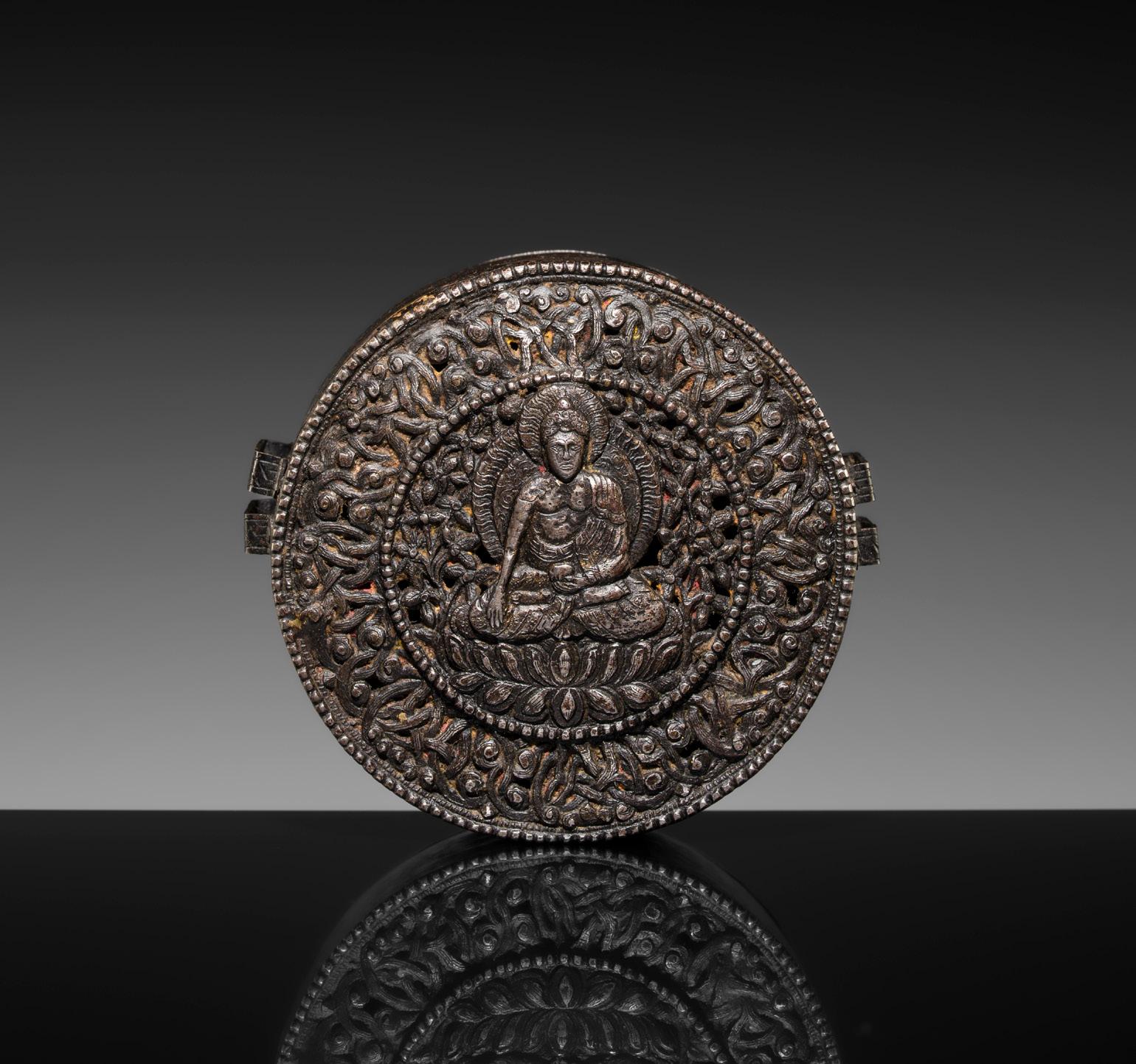
A VERY RARE AND EARLY IRON PORTABLE SHRINE, GAU, 15TH CENTURY
Tibet, probably Derge, Kham Province. Of rounded form, the cover is chased in high relief with a Buddha seated in dhyanasana on a double lotus throne, holding a medicine bowl in his hand, and encircled by a beaded band. The ground is decorated with leafy scrolls, and the borders are further encircled by a beaded band. The back is engraved with a double dorje.
Provenance: Collection of Philippe Icher (b. 1956), French ceramic artist and collector, whose works are held in numerous renowned collections throughout Europe. His collection, assembled over several decades during his travels across Asia, includes Himalayan, Tibetan, and Nepalese artifacts that have profoundly inspired his artistic practice. Condition: Very good condition with old wear and manufacturing flaws. Small nicks, minuscule dents, remnants of gilt, and warping. A dark, naturally grown patina.
Weight: 296 g
Dimensions: Diameter 12 cm
The earlier date of this gau is suggested by the material from which it is made, iron, as well as by stylistic features such as the Buddha’s long, narrow face, which is indicative of earlier depictions. The present lot is very rare; more commonly encountered are damascened iron boxes of broadly similar style, though these were intended for different functions rather than use as portable shrines. Gau are found only in Tibet and regions influenced by
Tibetan Buddhism, such as Bhutan; no other Buddhist regions produced comparable objects. They were worn during travel for protection and devotion but otherwise were kept on the domestic altar.
LITERATURE COMPARISON
Compare a closely related iron gau, Tibet, dated 15th century, 12 cm (diameter), sold at Michael Backman, London, no. 9058.
Estimate EUR 1,000
Starting price EUR 500
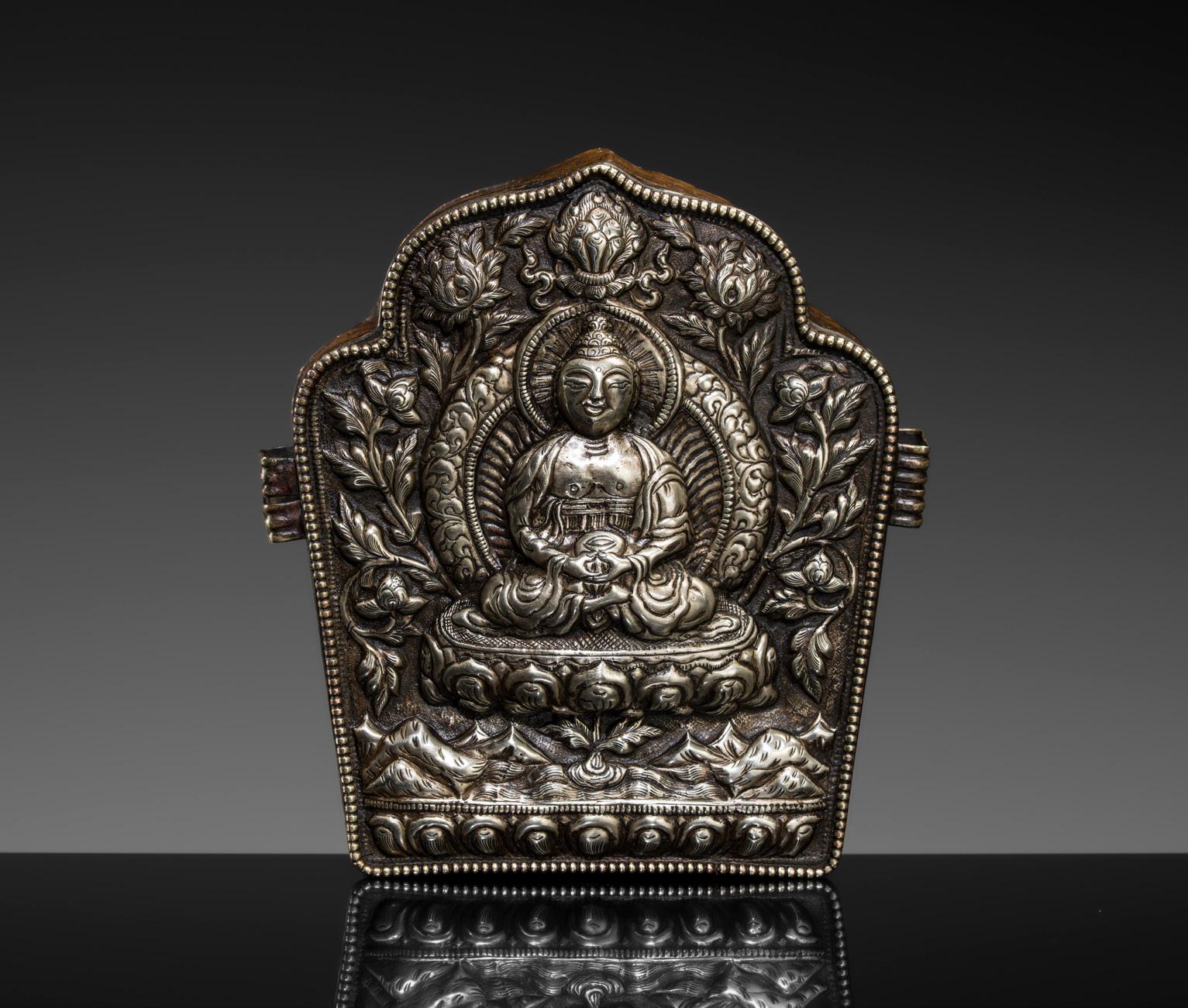
112
A SILVER AND COPPER REPOUSSÉ PORTABLE ‘NAMCHU WANGDEN’ SHRINE DEPICTING BUDDHA, GAU
Tibet, 19th century. Of lobed outline, the cover is finely chased and embossed in high repoussé, centered with a serene Buddha seated in dhyanasana on a lotus throne, holding a bowl at his lap. He is framed by an aureole encircled by a beaded and scroll band, surrounded by a dense field of scrolling foliage, lotus blossoms, and leafy stems. The throne grows from a lotus stem rising from a rocky ground, which rests on a further lotus base. A finely beaded border outlines the edges. The sides incised with leafy scrolls, fitted with loops for mounting.
The copper backplate is engraved with the Namchu Wangden monogram.
Provenance: Collection of Philippe Icher (b. 1956), French ceramic artist and collector, whose works are held in numerous renowned collections throughout Europe. His collection, assembled over several decades during his travels across Asia, includes Himalayan, Tibetan, and Nepalese artifacts that have profoundly inspired his artistic practice. Condition: Very good condition with minor wear and manufacturing flaws. Small nicks, minuscule dents, some warping, and light surface scratches. A dark, naturally grown patina.
Weight: 267 g
Dimensions: Size 15.4 x 14.4 x 4 cm
The Namchu Wangden, the 'Sign of the All Powerful Ten', a monogram composed of ten intertwined syllables in the archaic Lantsa script that together represent the elements of the universe according to the Kalachakra Tantra. This is regarded as a powerfully protective emblem.
LITERATURE COMPARISON
Compare a related gau with the Namchu Wangden, dated to the 19th century, 11 cm (long), in the Victoria and Albert Museum, accession number 06125(IS).
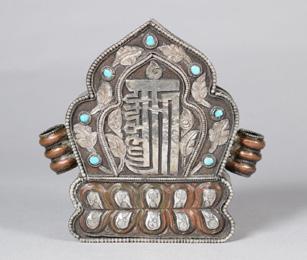
Estimate EUR 600
Starting price EUR 300
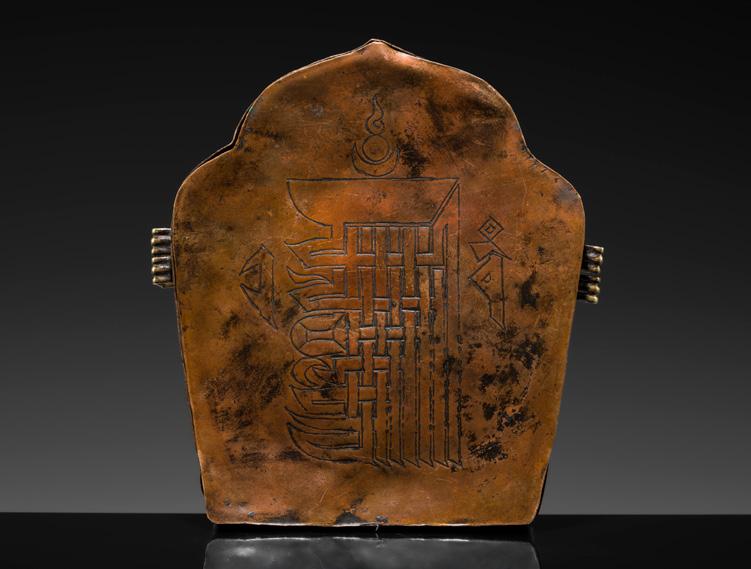
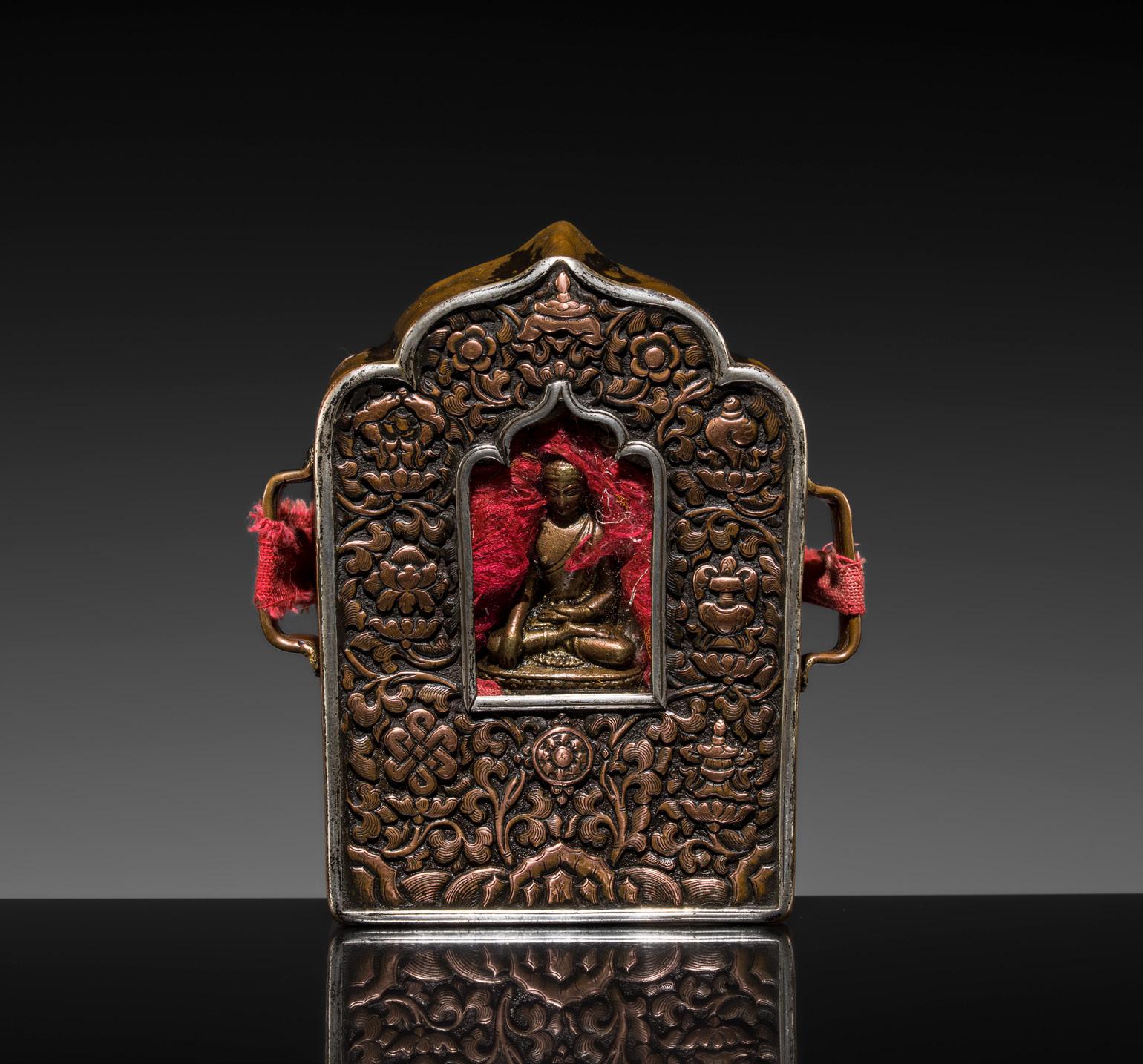
113
A HEAVY SILVER AND COPPER REPOUSSÉ
PORTABLE SHRINE WITH A BRONZE TSA-TSA, GAU
Tibet, 19th century. Of lobed, silvered outline with a similarly shaped central window, the cover is finely chased and embossed, depicting the Eight Buddhist Emblems borne on neatly incised scrolling vines. The sides are fitted with loops for mounting and a red band.
The glass window reveals a miniature figure (tsa-tsa) of the Buddha seated in dhyanasana on a double lotus base, his right hand in bhumisparsa mudra and his left resting on his lap, wearing a monk’s robe. The face has a meditative expression, with an aquiline nose, smiling lips, pierced elongated earlobes, and hair arranged in tight curls rising to a high ushnisha.
Provenance: Collection of Philippe Icher (b. 1956), French ceramic artist and collector, whose works are held in numerous renowned collections throughout Europe. His collection, assembled over several decades during his travels across Asia, includes Himalayan, Tibetan, and Nepalese artifacts that have profoundly inspired his artistic practice. Condition: Very good condition with minor wear and manufacturing flaws. Small nicks, minuscule dents, some warping, and light surface scratches. A dark, naturally grown patina.
Weight: 438 g
Dimensions: Size 12.5 x 12 x 5.5 cm
The present lot contains a tsa-tsa, a small devotional image commonly housed within a gau. Medium-sized gaus, such as this example, function as portable containers, large enough to hold cloth, string, medicine, miniature sculptures, small tsa-tsa, or other objects considered sacred and auspicious. Often, a viewing window is set into a hinged frame, which is itself decorated with the Eight Buddhist Emblems and other auspicious motifs.
LITERATURE COMPARISON
Compare a closely related brass portable shrine with a tsa-tsa, dated to the 19th20th century, 10.8 cm (high), in the Bowers Museum, object number 2021.8.52.
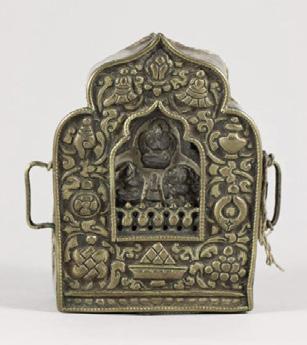
AUCTION RESULT COMPARISON
Type: Related
Auction: Christie’s San Francisco, 24 June 2015, lot 8077
Price: USD 6,000 or approx. EUR 7,000 converted and adjusted for inflation at the time of writing
Description: A miniature gilt repoussé traveling shrine, Ga'u
Expert remark: Compare the related form, decoration and tsa-tsa inside. Note the gilt and smaller size (7 cm).
Estimate EUR 800
Starting price EUR 400
A POLYCHROME FIRED CLAY TSA-TSA DEPICTING TSONGKAPA, 18TH-19TH CENTURY
Tibet. Brightly painted in polychrome pigments, the figure depicts Tsongkapa, the founder of the Gelug school of Tibetan Buddhism, seated in dhyanasana on a tiered base supported by four bodhisattvas emerging from water, with his hands held before his chest. Tsongkapa wears the distinctive pointed yellow hat and monastic robes, his face bearing a sincere expression, all backed by a nimbus and flanked by lotus stems.
Provenance: Collection of Philippe Icher (b. 1956), French ceramic artist and collector, whose works are held in numerous renowned collections throughout Europe. His collection, assembled over several decades during his travels across Asia, includes Himalayan, Tibetan, and Nepalese artifacts that have profoundly inspired his artistic practice. Condition: Very good condition with minor wear and manufacturing flaws. Few nicks, minuscule dents, and light scratches. The pigments are well-preserved.
With a wood presentation box. (2)
Weight: 1,055 g (excl. box), 2,699 g (incl. box)
Dimensions: Height 19.6 cm
Tsongkhapa (1357-1419) is widely regarded in Tibet as a second Buddha and the main teacher of the first Dalai Lama, Gendun Drub (1391-1474).
An eminent scholar, he reformed the old Kadampa sect, creating the new Gelugpa sect (Yellow Hat), and is the founder of the monasteries Ganden, Drepung, and Sera. He is revered as an emanation of the Buddhist god of wisdom, Manjushri.
A tsa-tsa is a type of votive tablet depicting a hollowed, reversed image of either a stupa, sacred symbol, or a one of the many deities from
Vajrayana Buddhism. Its Tibetan name, which translates to 'earth-imprint,' is associated with the Sanskrit word for 'holy image' or 'reproduction' (satchaya), as well as 'stamp' or 'mold impression' (canchaka), which is derived from the Prakrit word for modeling (sacchava or sacchaka). In traditional methods, tsa-tsa are formed with clay, where it is pressed using a wooden, stone, or metal mould and then left to dry. In modern practices, more durable materials such as resin, plaster, hydro-stone, or even pewter are used instead.
To Tibetans, creating tsa-tsas is a spiritual practice that accumulates merit and fosters well-being. It is one of Vajrayana Buddhism's five preliminary practices, aimed at eliminating obstacles, purifying negativity, and generating positive energy. Practitioners often aim to create 100,000 tsa-tsas in their lifetime. These sacred tablets are displayed in altars, stupas, prayer wheel niches, or holy sites and serve as protective amulets when placed in portable shrines (gau). Tsa-tsas symbolize the Buddha's blessings and may include sacred substances, such as ashes or hair of revered figures, to enhance their spiritual potency.
LITERATURE COMPARISON
Compare a closely related polychrome clay tsa-tsa, Tibet, dated to 18th-19th century, 7.3 cm (high), in the British Museum, registration number 1880.161 (fig. 1).
Compare a related pressed loam tsa-tsa of Amitayus, Tibet, 18th century, in the Rijksmuseum, object number AK-MAK-198 (fig. 2). Compare a related polychrome clay sculpture of Tsongkhapa, dated to the 17th-18th century, in the World Museum Vienna, inventory number 74648.
Estimate EUR 600
Starting price EUR 300
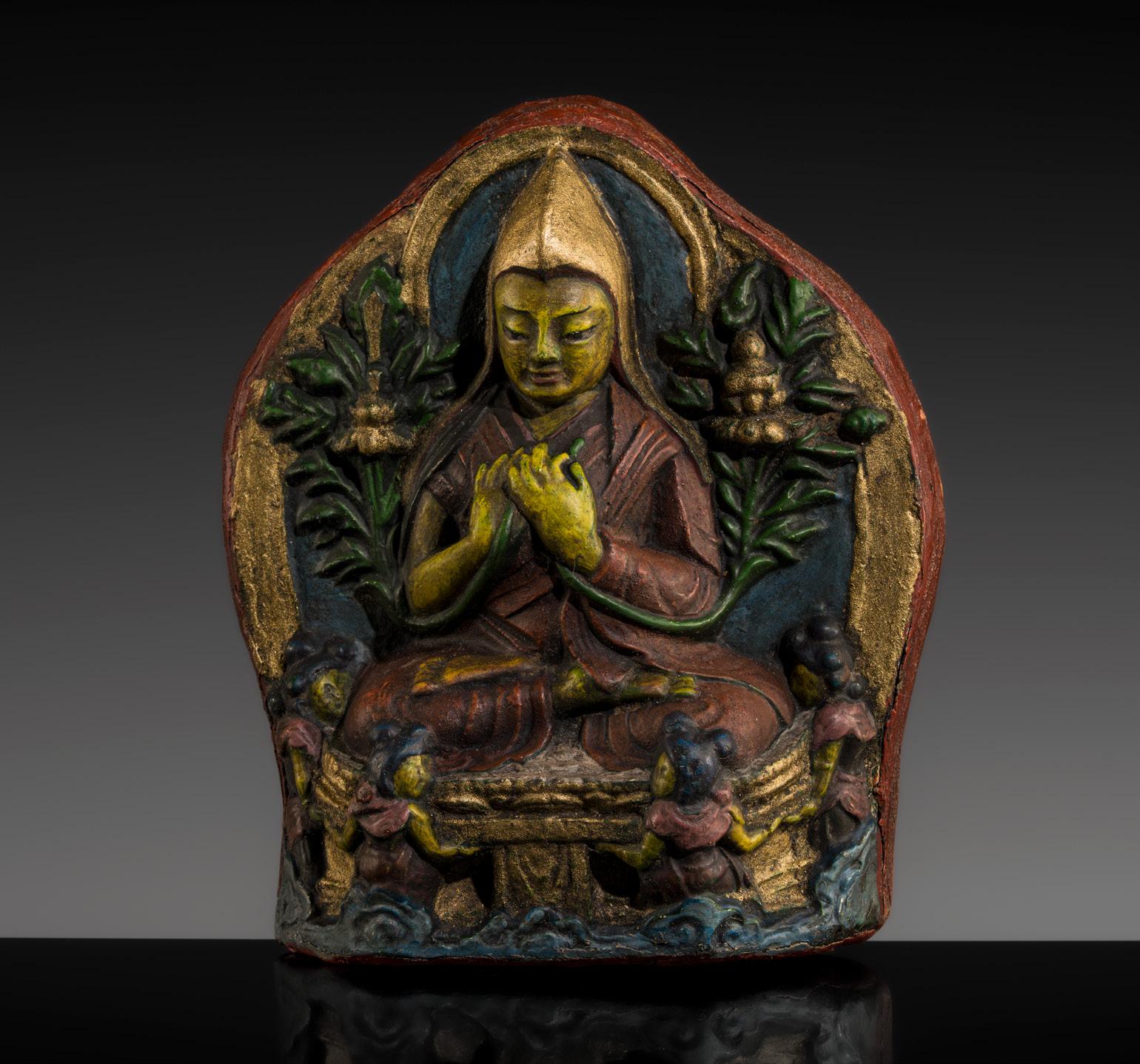
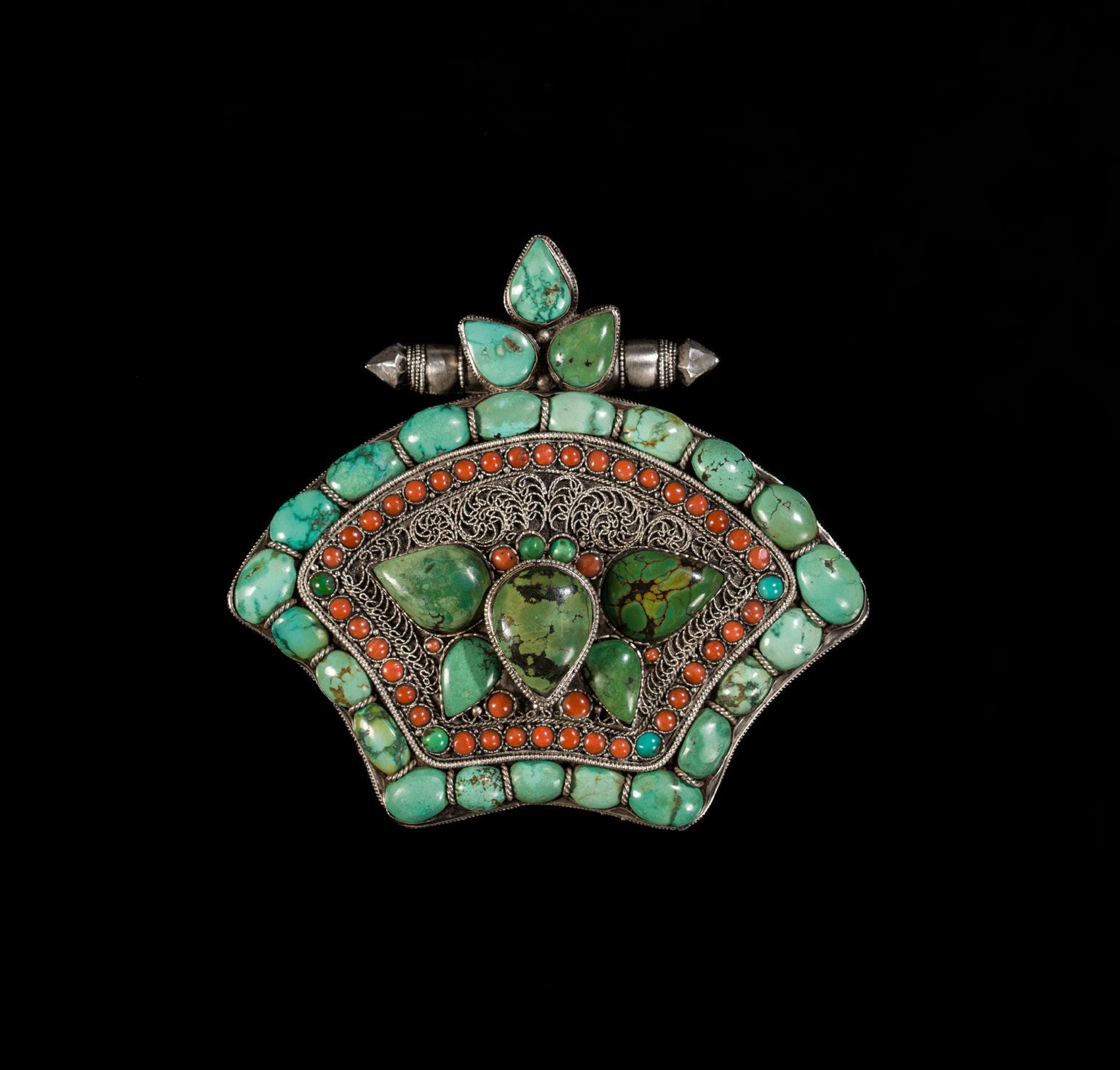
Tibet. Of rectangular form with an arched top and rounded corners, intricately inlaid with turquoise and coral stones. The central section is decorated with inlaid cabochons, with a larger centerpiece surrounded by smaller stones. The ornamentation is encircled by intricate silver filigree and coral beads. The top is further decorated with inlays, flanked on either side by a spire terminating in a pointed finial.
Provenance: Collection of Philippe Icher (b. 1956), French ceramic artist and collector, whose works are held in numerous renowned collections throughout Europe. His collection, assembled over several decades during his travels across Asia, includes Himalayan, Tibetan, and Nepalese artifacts that have profoundly inspired his artistic practice. Condition: Very good condition with minor wear and natural imperfections. Few fine cracks and natural inclusions to the stone, warping as well as light scratches.
Weight: 376 g
Dimensions: Height 11 cm, Length 11.5 cm
Gau are sacred receptacles serving many purposes in Tibetan daily life, including as a sign of social status and rank. They are most commonly constructed from metal repoussé and made according to three different sizes. The small and medium sized gaus are portable, while the largest
of gaus were often placed within a home or temple. All hold sacred and auspicious objects including tsa-tsa which can often be seen through a viewing window. Their purpose, as stated by Rhie and Thurman, “...served as a site where the wisdom emanation of that enlightened being could be invoked and communicated with.” (A Shrine for Tibet, New York, 2009, p. 255)
Charm containers are some of the most important personal adornments in Tibet. This container for small images, printed prayers and charms, molded tablets of protective deities, and other relics has traditionally been worn by both men and women to ward off evil. While women wear their gau on a short necklace around their necks, strung with turquoise, coral, or banded agates, a man’s gau is usually larger and often shaped like a shrine. A traveler straps the gau to the arm or wears it across the chest bandolier style.
LITERATURE COMPARISON
Compare a related silver and coral inlaid amulet box, dated to the 19th20th century, 16.5 cm (long), in the Bowers Museum, object number 2021.8.50a,b.
Estimate EUR 1,000
Starting price EUR 500
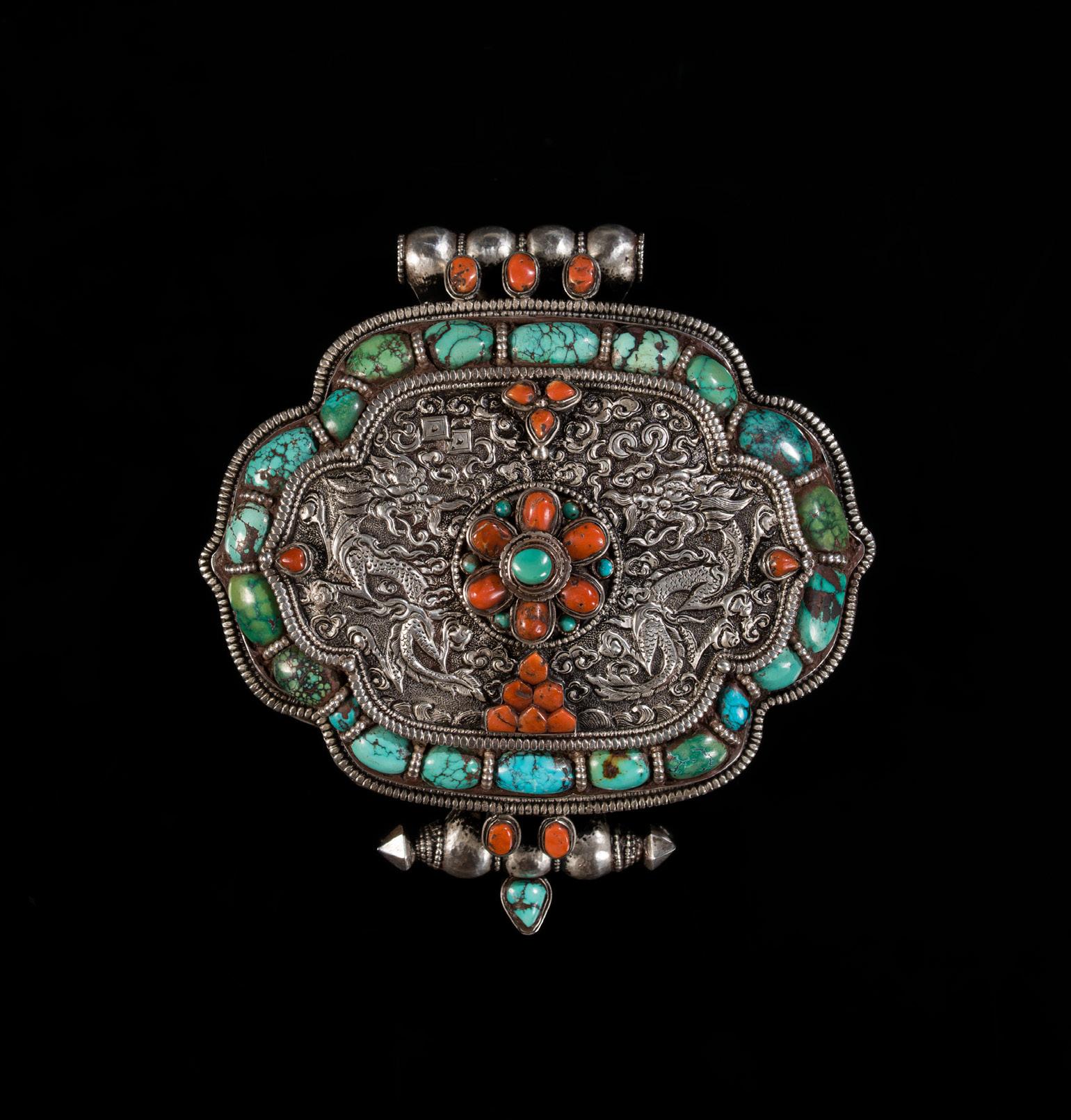
Tibet. Of oval, horizontally oriented form with softly scalloped sides, the silver is finely inlaid. The central turquoise cabochon is surrounded by a flower-like arrangement of coral stones, with intricately chased silver depicting two dragons amid scrolling motifs. The edges of the box are bordered with rows of turquoise, and the top is fitted with an inlaid cord hole, while the lower section is finished with a spire terminating in a pointed finial.
Provenance: Collection of Philippe Icher (b. 1956), French ceramic artist and collector, whose works are held in numerous renowned collections throughout Europe. His collection, assembled over several decades during his travels across Asia, includes Himalayan, Tibetan, and Nepalese artifacts that have profoundly inspired his artistic practice. Condition: Very good condition with minor wear and natural imperfections. Few fnatural inclusions to the stone, tarnish to the silver and light scratches.
Weight: 646 g
Dimensions: Length 14.2 cm, Height 15.3 cm
LITERATURE COMPARISON
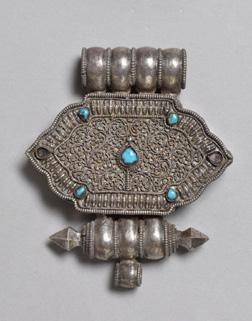
Compare a related amulet box necklace, in the State Museum of Ethnology, Munich, illustrated in Heinz E. R. Martin, Die Kunst Tibets, p. 136. Compare a related silver and turquoise inlaid amulet box, dated to the first half of the 19th century, 7.5 cm (long), in the Victoria and Albert Museum, accession number 03054(IS).
Estimate EUR 2,000
Starting price EUR 1,000
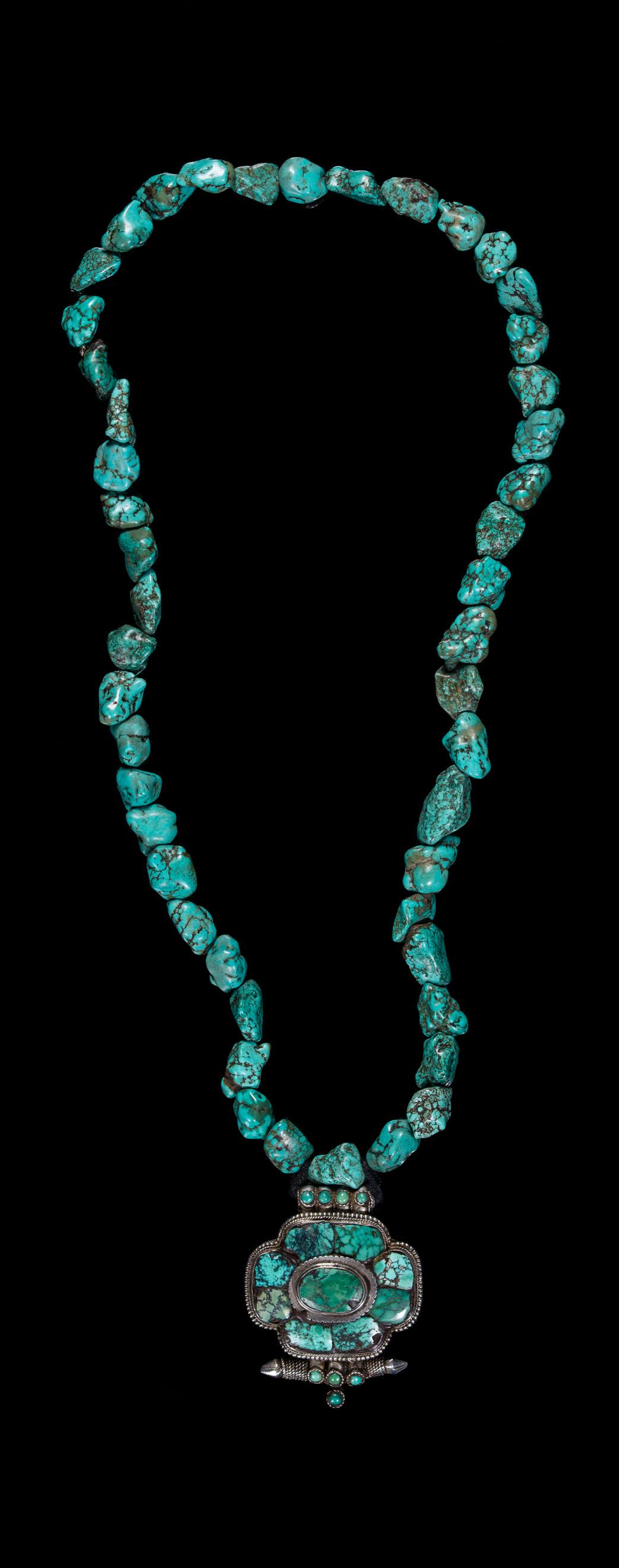
Tibet. Consisting of forty-eight turquoise beads, arranged symmetrically and suspending a fine silver amulet box pendant (gau), decorated with a central turquoise cabochon encircled by further stones. The sides of the box are made with fine silver filigree and beaded bands, topped with an inlaid cord hole and a spire terminating in a pointed finial below.
Provenance: Collection of Philippe Icher (b. 1956), French ceramic artist and collector, whose works are held in numerous renowned collections throughout Europe. His collection, assembled over several decades during his travels across Asia, includes Himalayan, Tibetan, and Nepalese artifacts that have profoundly inspired his artistic practice.
Condition: Very good condition with minor wear and natural imperfections. Few natural inclusions to the stones, tarnish to the silver, warping as well as light scratches.
Weight: 160 g
Dimensions: Height 35.7 cm
This type of amulet box or gau pendant suspending from the necklace is used to contain blessed or holy items, believed to protect the wearer from evil. The decorativeness of the box’s upper surface suggests that it was worn by a woman, as women tended to wear more ornamental amulet boxes than men.
LITERATURE COMPARISON
Compare a related silver and turquoise inlaid amulet box, dated to the first half of the 19th century, 5.3 (long), in the Victoria and Albert Museum, accession number 03051(IS).
Estimate EUR 1,000
Starting price EUR 500
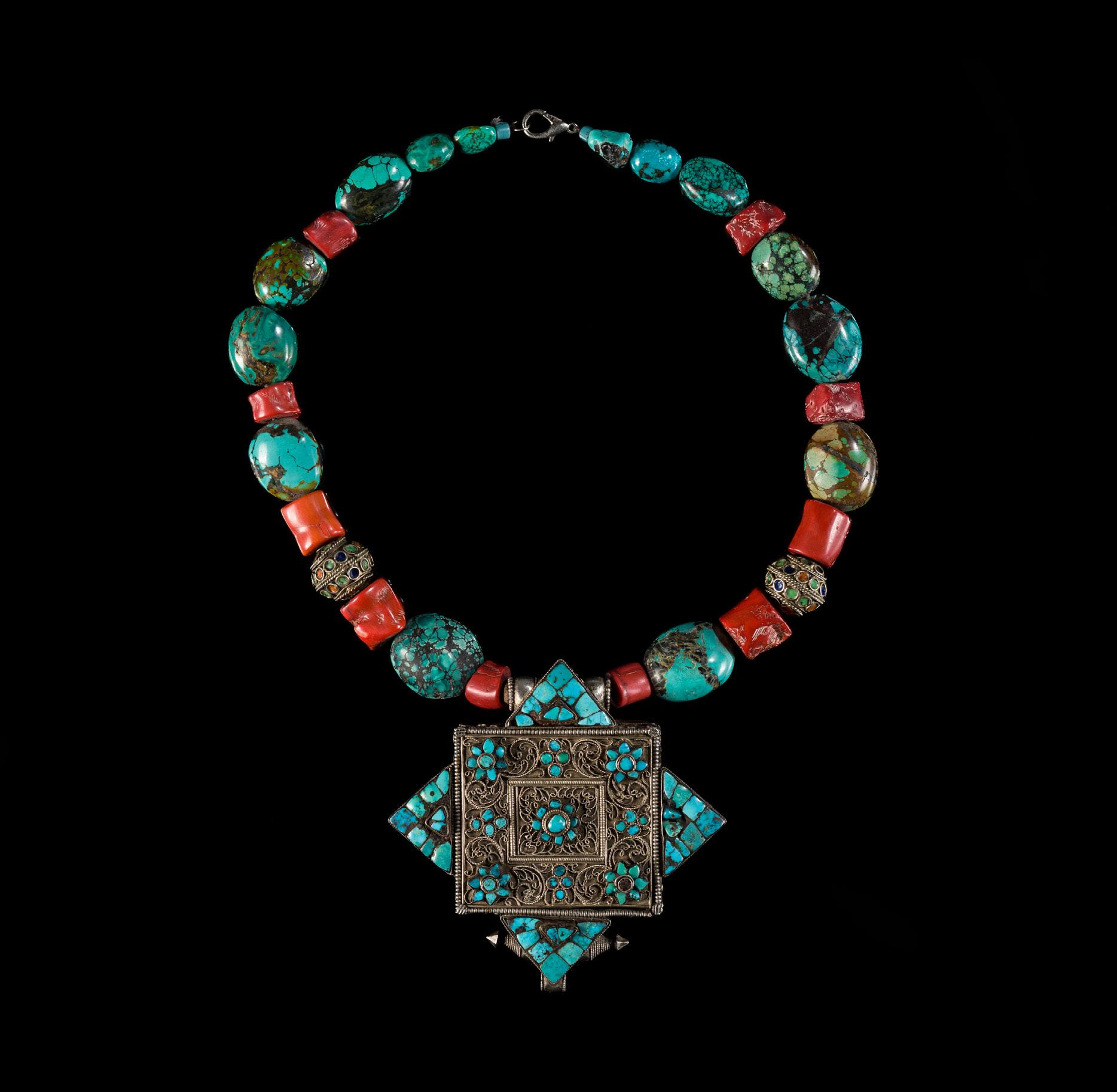
RARE TURQUOISE AND CORAL INLAID SILVER NECKLACE WITH AN AMULET BOX, GAU, 19TH CENTURY
Tibet. Consisting of a combination of ten coral beads, sixteen turquoise beads, and two silver-wire beads, arranged symmetrically and suspending a large amulet box pendant (gau), decorated with ornate bands and filigree, and inlaid with turquoise.
Provenance: Collection of Philippe Icher (b. 1956), French ceramic artist and collector, whose works are held in numerous renowned collections throughout Europe. His collection, assembled over several decades during his travels across Asia, includes Himalayan, Tibetan, and Nepalese artifacts that have profoundly inspired his artistic practice.
Condition: Very good condition with minor wear and natural imperfections. Few cracks, tiny losses to the inlays, tarnish to the silver, and light scratches.
Weight: 308 g
Dimensions: Length 11 cm, Height 37 cm
LITERATURE COMPARISON
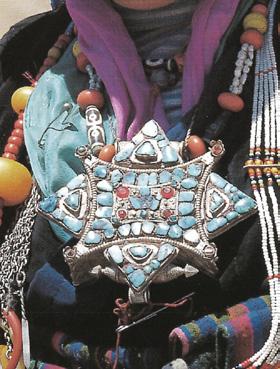
Compare a closely related necklace with a Gao pendant, illustrated in Hans Först (1997), Tibet. Mythos und Wirklichkeit, p. 56 (fig. 1); and another amulet box necklace, in the State Museum of Ethnology, Munich, illustrated in Heinz E. R. Martin, Die Kunst Tibets, p. 136 (fig. 2). Compare another amulet box necklace, dated to the 19th century, in the Metropolitan Museum of Art, object number 2008.190.227.
Estimate EUR 1,000
Starting price EUR 500
Tibet. Of trapezoidal form, the cover is finely decorated in high relief, centered with a gilt figure of Ekadashamukha Avalokiteshvara standing on a lotus pedestal within an almond-shaped aureole. The bodhisattva is shown frontally, with multiple arms holding ritual attributes and the characteristic tiered heads rising above the principal face. Surrounding the central figure, the ground is densely chased with scrolling cloud motifs and framed by a beaded border defining the edges of the box, fitted with a suspension element at the top and a spire terminating in pointed finials below.
Provenance: Collection of Philippe Icher (b. 1956), French ceramic artist and collector, whose works are held in numerous renowned collections throughout Europe. His collection, assembled over several decades during his travels across Asia, includes Himalayan, Tibetan, and Nepalese artifacts that have profoundly inspired his artistic practice.
Condition: Very good condition with minor wear, manufacturing flaws. Small nicks, minuscule dents, expected losses to the gilt, warping and light scratches. A dark, naturally grown patina.
Weight: 281 g
Dimensions: Size 12.5 x 10.5 x 4.5 cm
One prominent Buddhist story tells of Avalokiteshvara vowing never to rest until he had freed all sentient beings from samsara. Despite strenuous effort, he realizes that many unhappy beings were yet to be saved. After struggling to comprehend the needs of so many, his head split. Amitabha, seeing his plight, gives him multiple heads with which to hear the cries of the suffering. Upon hearing these cries and comprehending them,
Avalokiteshvara tries to reach out to all those who needed aid but found that his two arms were shattered into pieces. Once more, Amitabha comes to his aid and invests him with a thousand arms with which to aid the suffering multitudes.
The Gau comprises a class of objects from reliquary boxes to amulets. The Tibetans make a distinction between rten (amulets) and Gau (reliquary boxes), based on the kind of contents placed in each container. A rten usually contains a rolled paper of invocation while a Gau contains depictions of Buddhist deities in the form of a metal image or a stamped clay plaque provided by a lama.
AUCTION RESULT COMPARISON
Type: Related
Auction: Zacke, Vienna, 17 October 2024, lot 1
Price: EUR 2,860
Description: A parcel-gilt silver repoussé gau depicting Ekadashamukha Avalokiteshvara, Tibet, 17th-18th century
Expert remark: Compare the related repoussé work, parcel-gilding, and motif. Note the size (16.4 cm) and different material.
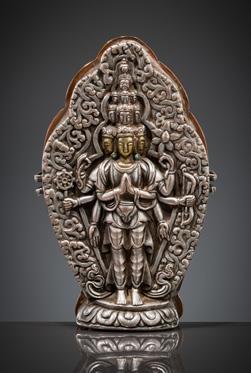
Estimate EUR 600
Starting price EUR 300
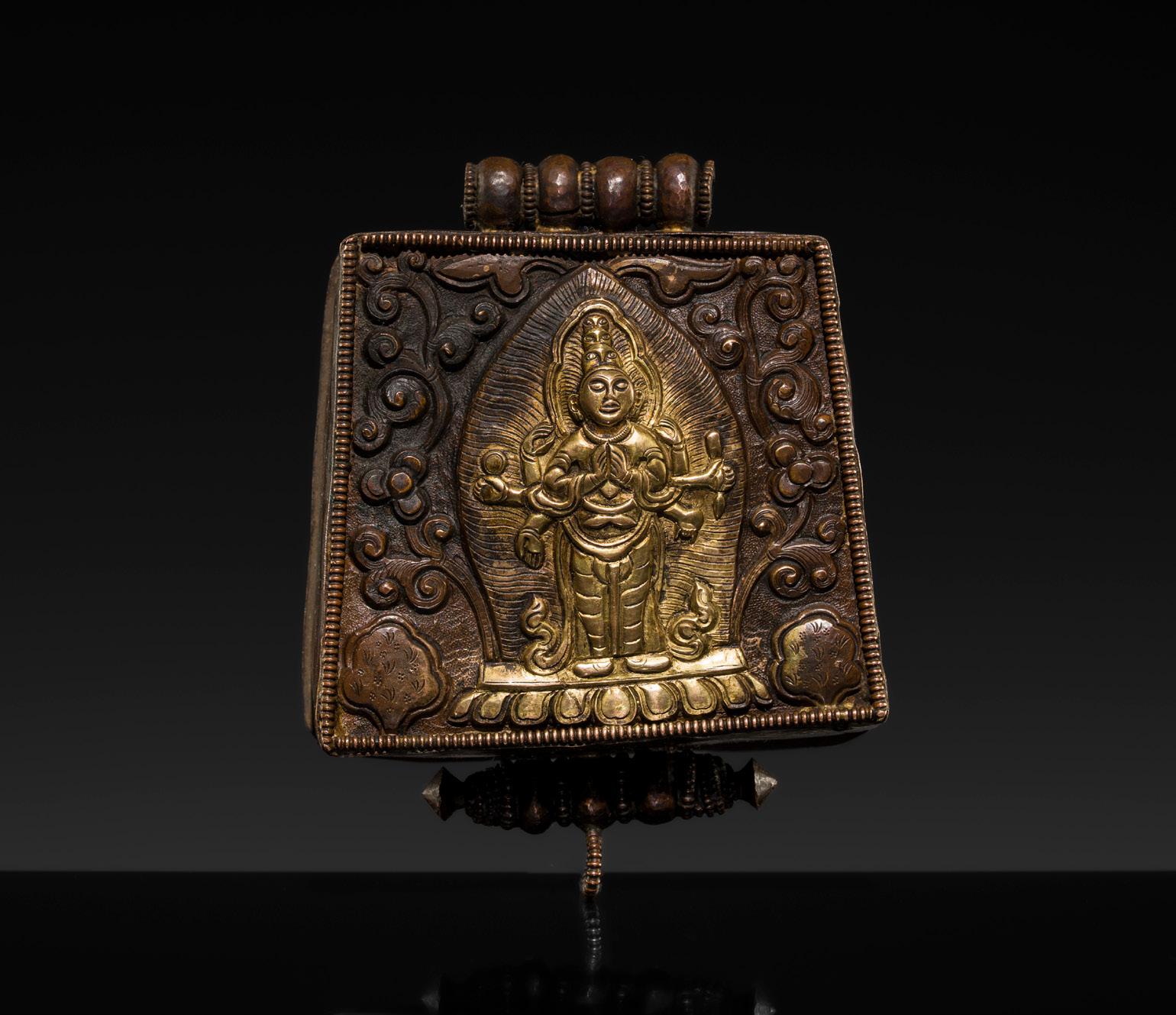
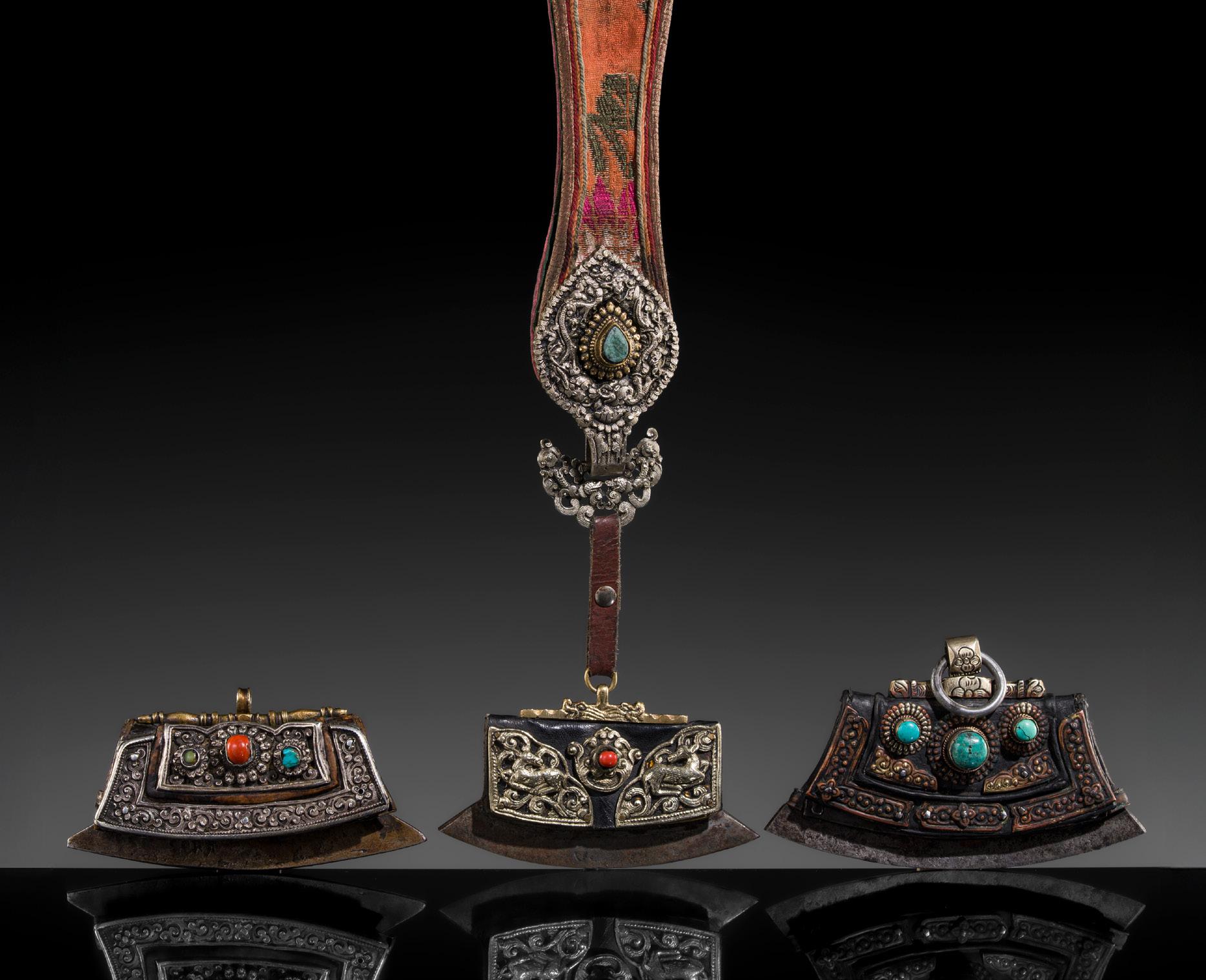
Tibet. Each of crescent form, comprising a curved steel striker blade fitted with an ornate parcel-gilt silver and metal-mounted pouch above. The pouches are richly decorated with repoussé and chased silver panels, set with turquoise and coral cabochons, and framed by beaded and scrollwork borders. One remains attached to a leather and textile suspension strap, centered by a large circular silver mount with turquoise inlay.
Provenance: Collection of Philippe Icher (b. 1956), French ceramic artist and collector, whose works are held in numerous renowned collections throughout Europe. His collection, assembled over several decades during his travels across Asia, includes Himalayan, Tibetan, and Nepalese artifacts that have profoundly inspired his artistic practice.
Condition: Very good condition with minor wear and natural imperfections. Few natural inclusions to the stones, tarnish to the silver, light scratches and soiling to the leather.
Weight: 567 g (total)
Dimensions: Height 7 cm (smallest) and 34.2 cm (largest)
The chuckmuck is a belt-suspended tinder pouch, typically fashioned from leather and embellished with metal mounts, to which a long, slender striking plate is affixed. Examples are attested across North Asia and from China to Japan from at least the seventeenth century. Chuckmucks constitute a welldefined typological group within flint-and-steel fire-making implements and continue to be worn as personal ornaments among Tibetan (mechag) and Mongolian (kete) communities. This distinctive form of a once ubiquitous
utilitarian object was observed in Victorian British India, and the AngloIndian term ‘chuckmuck’, ultimately derived from the Turkic word ‘chakmak’, simplified and assimilated as colloquial terminology across much of Central Asia.
Humans have throughout history used different techniques and tools to create life-sustaining fires. One of the oldest and most widespread methods is by using tinder, flint, and steel. Sharp-edged flints are struck against a fire striker, which causes hot, oxidizing metal particles to split off and ignite tinder. Tinder is a fine material with the ability to combust quickly and often consists of amadou made from fungus, plant fibers, or artificial materials like paper strips and petroleum.
A variety of different boxes, bags, and pouches were used to store the kits and to keep the tinder dry. While some were made for domestic use to light hearths, fireplaces, and candles in the home, others, like this mechang pouch from Tibet, were designed as pocket versions to start fires on the go.
LITERATURE COMPARISON
Compare a related turquoise inlaid silver pouch, dated to the 19th century, 22.9 (high), in the Metropolitan Museum of Art, object number 2006.534 (fig. 1).
1
Compare two closely related coral and turquoise inlaid silver flint and tinder pouches, dated to the 19th century, 12.7 cm and 20.9 cm (high), in the Asian Art Museum San Francisco, object numbers 1995.33 and B87M15.4.
Estimate EUR 1,000
Starting price EUR 500
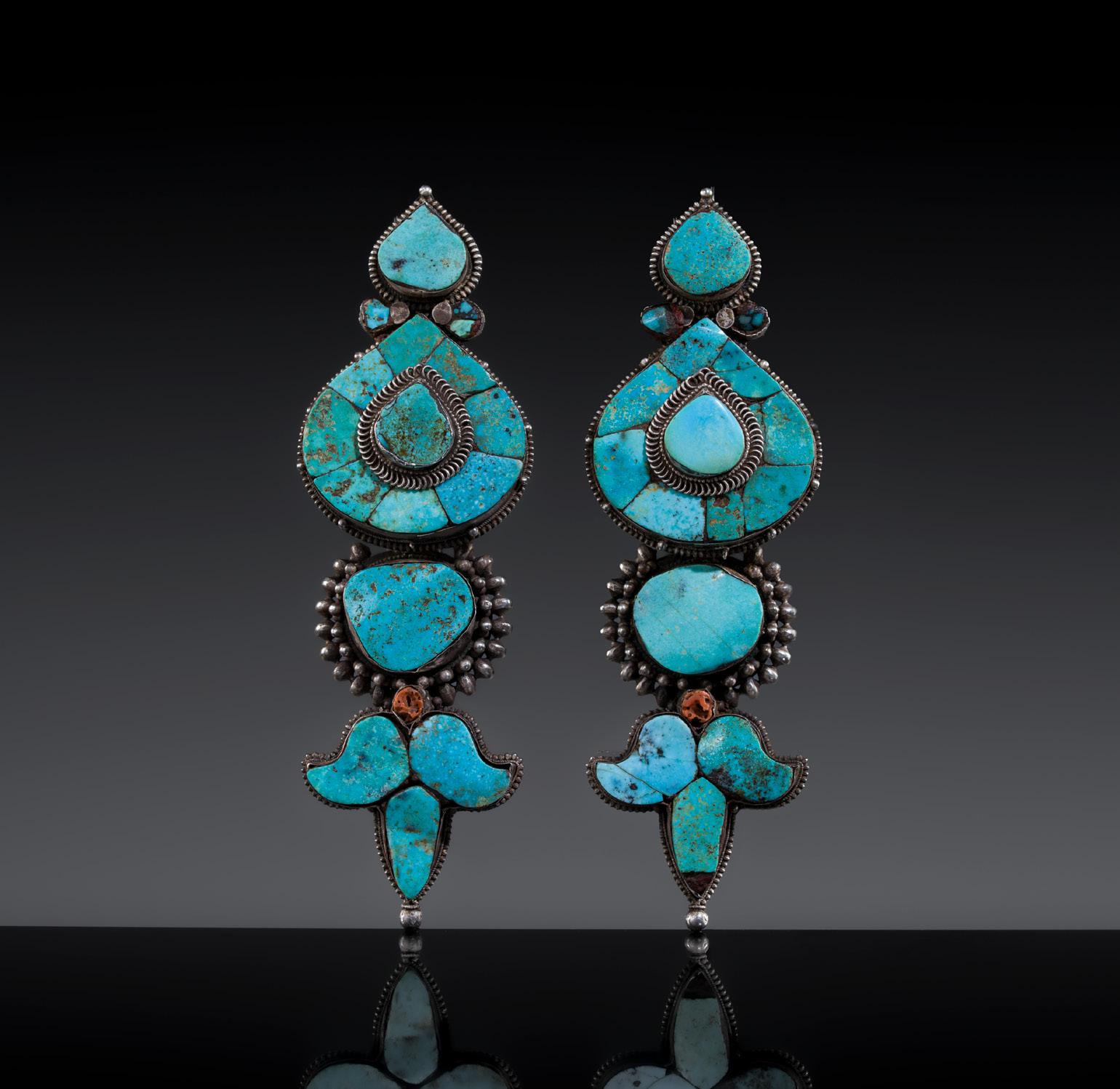
121
A PAIR OF FINE TURQUOISE INLAID SILVER WOMAN'S TEMPLE PENDANTS, AKOR, 19TH CENTURY
Tibet. Crafted from several teardrop-shaped and circular sections to form a stylized floral design, the silver mounts are inlaid with turquoise cabochons of various sizes and a coral in the lower section. (2)
Provenance: Collection of Philippe Icher (b. 1956), French ceramic artist and collector, whose works are held in numerous renowned collections throughout Europe. His collection, assembled over several decades during his travels across Asia, includes Himalayan, Tibetan, and Nepalese artifacts that have profoundly inspired his artistic practice.
Condition: Good condition with minor wear and natural imperfections. Few cracks, small losses to the inlays, tarnish to the silver, warping and light scratches.
Weight: 179 g (total)
Dimensions: Height 14.4 cm (each)
Pendants such as these were too bulky to be worn from the ears and so were worn near the ears as if they were earrings. Typically they were suspended from the wearer’s headdress. The present pair is typical of the Lhasa style that was worn by aristocratic wives.
Estimate EUR 1,000
Starting price EUR 500
LITERATURE COMPARISON
Compare a closely related pair of akor, dated to circa 1900, 9 cm (high), illustrated on Himalayan Art Resources, item number 2411 (fig. 1). Compare a related pair of akor, dated to the 19th century, in the World Museum, Liverpool, accession numbers 53.87.185 and 53.87.186. Compare another related pair of akor, dated to the 17th-19th century, 9.5 cm (high), in the Metropolitan Museum of Art, object number 15.95.90. fig. 1
AUCTION RESULT COMPARISON
Type: Related
Auction: Sotheby’s London, 30 October7 November 2025, lot 829
Price: GBP 15,240 or approx. EUR 17,500 converted at the time of writing
Description: A pair of turquoise and gold ear ornaments (Akor), Tibet, 19th century
Expert remark: Compare the closely related form and stone. Note the different material and the larger size (26.7 cm).
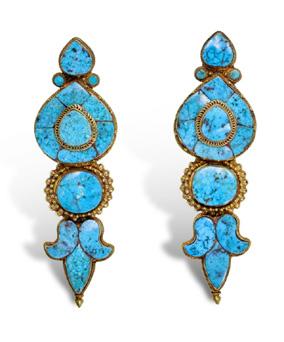
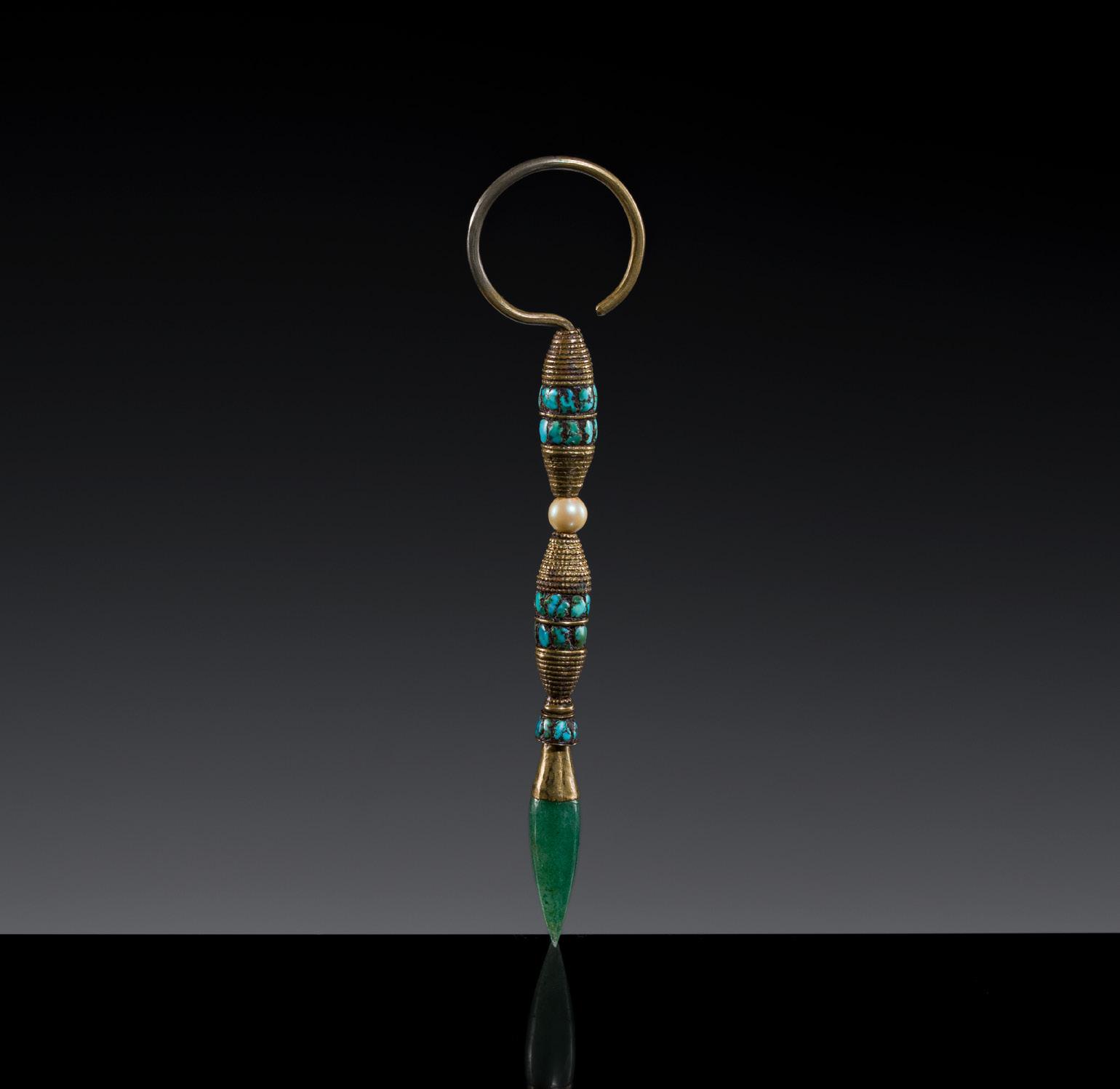
A BRASS, PEARL AND TURQUOISE OFFICIAL'S EARRING, SOCHI, 19TH CENTURY
Tibet. The elongated earring with a C-shaped hoop, inlaid with turquoise between granulated gold beads, with a baroque pearl at the midsection, terminating with a large pointed green hardstone. The actual hook is made of brass.
Provenance: Collection of Philippe Icher (b. 1956), French ceramic artist and collector, whose works are held in numerous renowned collections throughout Europe. His collection, assembled over several decades during his travels across Asia, includes Himalayan, Tibetan, and Nepalese artifacts that have profoundly inspired his artistic practice.
Condition: Good condition with minor wear and natural imperfections. Few cracks, small losses to the inlays, and light scratches.
Weight: 22 g
Dimensions: Height 15.1 cm
With the original wooden box. (2)
Such earrings, known as sochi, were worn singly in the left ear by Tibetan government ministers and officials as a symbol of rank. The design of the earrings tends to combine the sacred and the secular in a subtle way, seen in the present lot with lotus petal designs.
Literature comparison: Compare a closely related sochi, dated to the 19th-20th century, 14.3 cm (long), in the Bowers Museum, object number 2021.8.62a-c.
AUCTION RESULT COMPARISON
Type: Closely related
Auction: Bonhams New York, 14 September 2015, lot 56
Price: USD 5,625 or approx. EUR 7,100 converted and adjusted for inflation at the time of writing
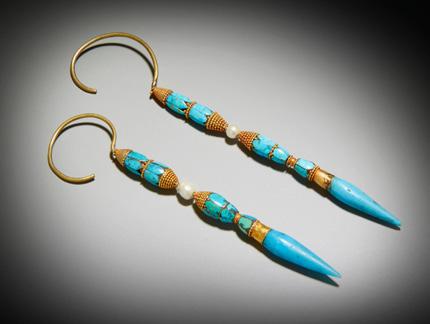
Description: Two official's pendant earrings, Tibet, 19th/20th century
Expert remark: Compare the closely related design and inlays. Note the size (19.3 and 15.5 cm) and that the lot comprises a pair.
Estimate EUR 1,000
Starting price EUR 500
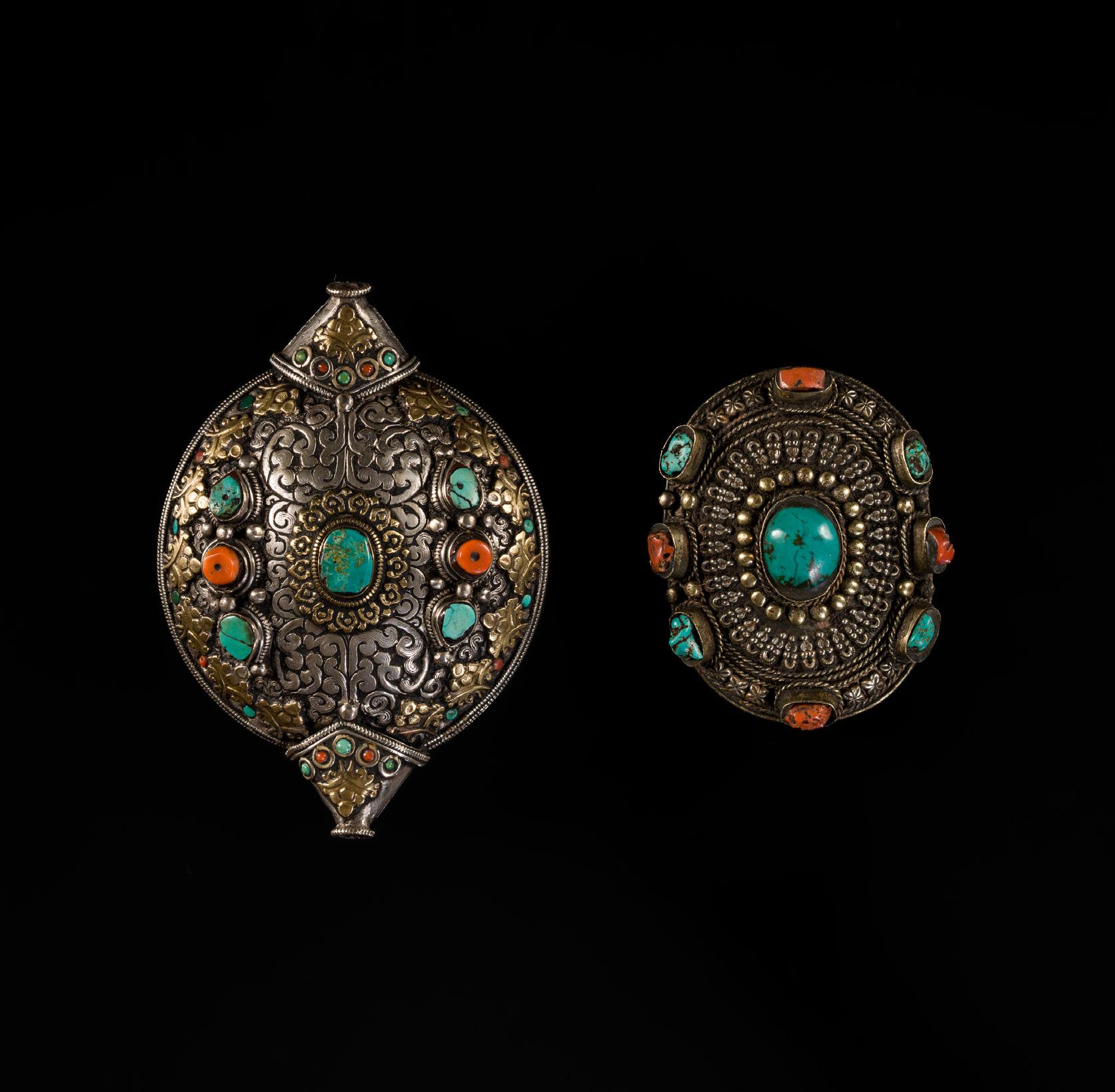
A GROUP OF TWO INLAID PARCEL-GILT SILVER HAIR ORNAMENTS, 19TH CENTURY
Tibet. Each of oval form, the larger with pointed edges at the top and bottom for attaching a strap. The silver is embossed with scrolls and parcel-gilt flowerheads, as well as finely inlaid with turquoise and coral cabochons. The smaller ornament is decorated with a central turquoise surrounded by delicate silverwork, encircled by smaller turquoise and coral stones. (2)
Provenance: Collection of Philippe Icher (b. 1956), French ceramic artist and collector, whose works are held in numerous renowned collections throughout Europe. His collection, assembled over several decades during his travels across Asia, includes Himalayan, Tibetan, and Nepalese artifacts that have profoundly inspired his artistic practice. Condition: Very good condition with minor wear and natural imperfections. Few cracks, tiny losses to the inlays, warping, light scratches and malachite encrustations.
Weight: 356 g (total)
Dimensions: Length 9.1 cm and 13.7 cm
LITERATURE COMPARISON
These hair ornaments were traditionally worn by Tibetan women, either on their backhead or forehead, fastened with a string or leather band. The turquoise used in these pieces was considered a holy stone. Pious donors also often provided elaborate jewelry to adorn important devotional sculptures. Compare closely related turquoise and coral inlaid hair ornaments, illustrated in Willi Senft (1983), Tibets Götter Leben, pp. 48-49.
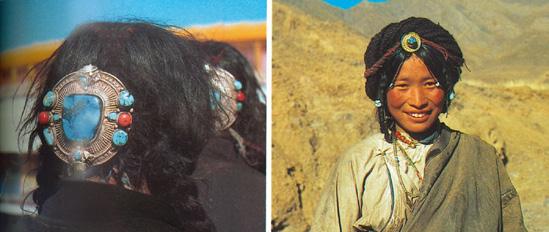
Estimate EUR 1,000
Starting price EUR 500
Tibet, Khampa. The slender steel blade issuing from a bone handle with metal fittings and pierced with small studs and a suspension ring. The accompanying curved scabbard is mounted in silver and richly decorated with repoussé and chased scrollwork, centered with coral and turquoise cabochons set in raised bezels. (2)
Provenance: Collection of Philippe Icher (b. 1956), French ceramic artist and collector, whose works are held in numerous renowned collections throughout Europe. His collection, assembled over several decades during his travels across Asia, includes Himalayan, Tibetan, and Nepalese artifacts that have profoundly inspired his artistic practice.
Condition: Very good condition with minor wear and manufacturing flaws. Small nicks, minuscule dents, tarnish to silver and light surface scratches. The bone with fine hairlines.
Weight: 113 g
Dimensions: Height 18.1 cm (total)
This fine knife and its sheath would have been worn by a nomad in eastern Tibet , where such knives were an essential part of daily life. Beyond their practical use for herding, food preparation, and personal protection, nomad’s knives also served as markers of identity and status, often worn suspended from the belt.
LITERATURE COMPARISON
Compare two closely related coral inlaid silver-mounted Nomad’s knife and scabbard, Tibet, dated 19th century, 24.5 and 19 cm (long), sold at Michael Backman, London, no. 9017 and 8866.
Estimate EUR 800
Starting price EUR 400
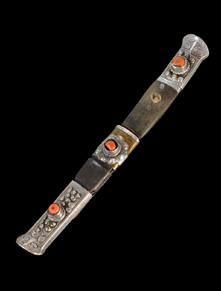
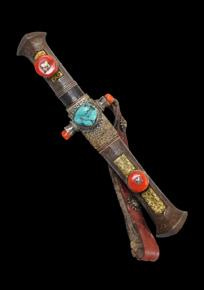
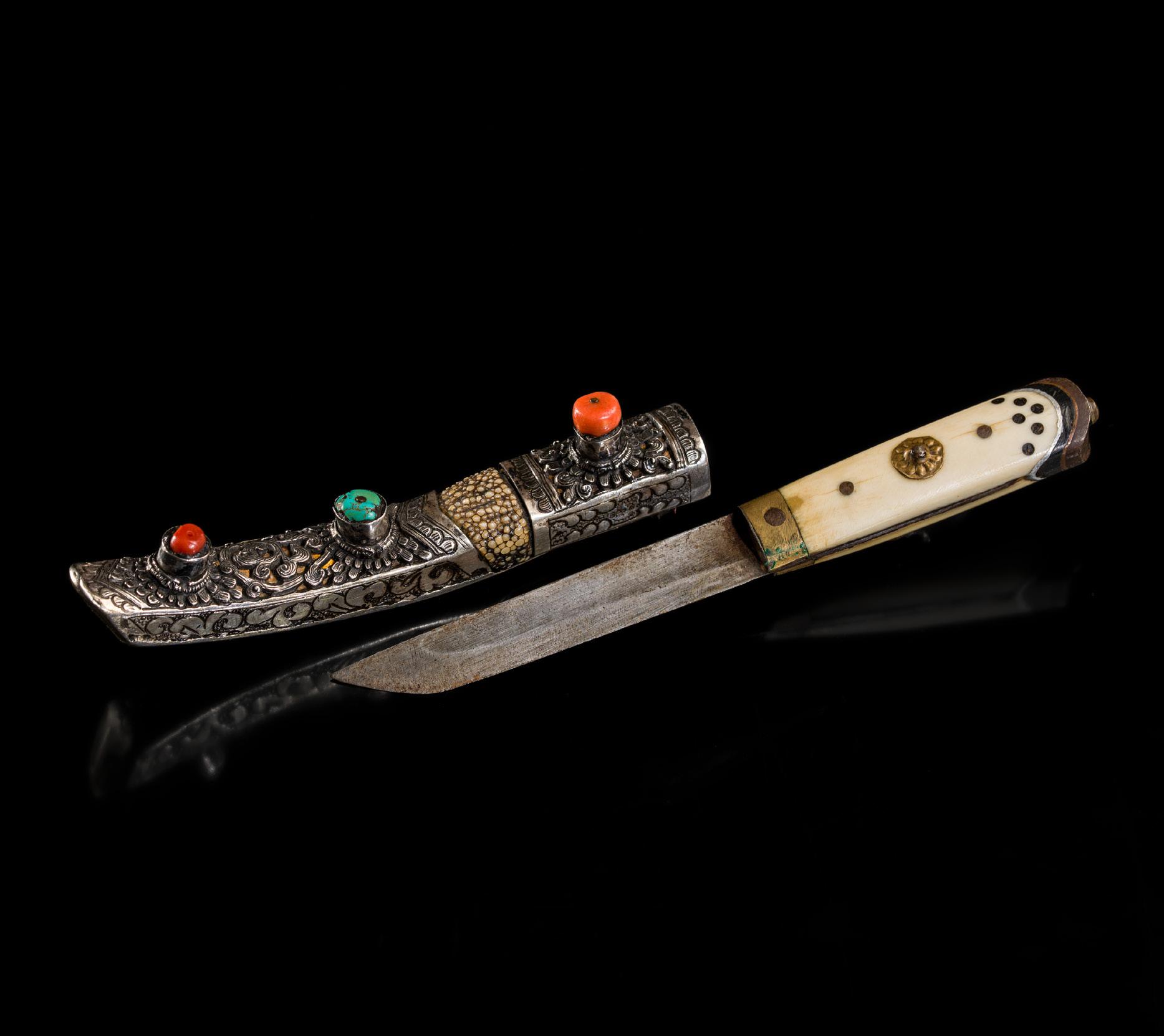
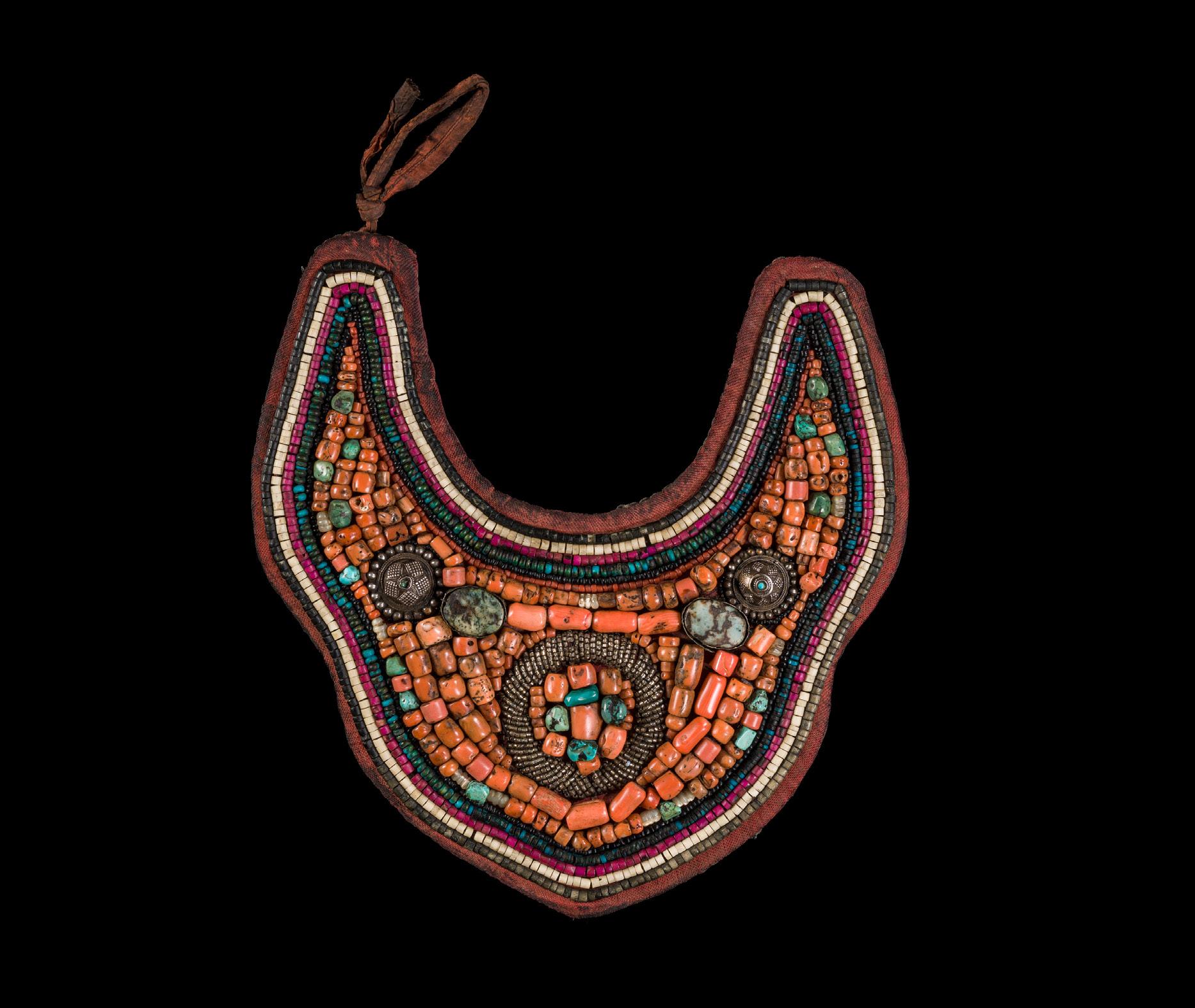
125
A FINE TURQUOISE, CORAL AND BONE INLAID PECTORAL, SKEYPUK, 19TH CENTURY
North India, Ladakh. The crescent-shaped pectoral made of a red, padded and textile-covered base, stitched with symmetrically arranged, alternating bands of stained bone, coral, turquoise and embossed silver beads.
Provenance: Collection of Philippe Icher (b. 1956), French ceramic artist and collector, whose works are held in numerous renowned collections throughout Europe. His collection, assembled over several decades during his travels across Asia, includes Himalayan, Tibetan, and Nepalese artifacts that have profoundly inspired his artistic practice. Condition: Very good condition with minor wear and natural imperfections. Few natural inclusions and abrasion to the stones, warping to the silver, and soiling to the textile.
Weight: 445 g
Dimensions: Length 27 cm, Height 28.5 cm
Ladakh, known as the "Land of High Passes," is a stunning region in northern India with breathtaking landscapes and rich cultural heritage. The people of Ladakh, resilient and warm, maintain deep-rooted traditions influenced by Tibetan Buddhism and Islam.
This jewelry is known as Skeypuk — Skey meaning "neck”, and it is traditionally worn around the neck by the people of the southwestern Ladakh region, particularly in the Sham Valley.
LITERATURE COMPARISON
Compare a related Nepalese coral and turquoise inlaid silver necklace, dated to the 18th-19th century, 40.6 cm (high), in the Asian Art Museum San Francisco, object number B60M22+.
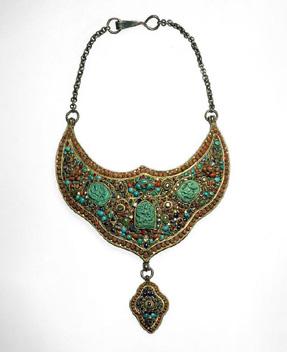
AUCTION RESULT COMPARISON
Type: Related
Auction: Bonhams London, 29 July 2020, lot 616
Price: GBP 3,187 or approx. EUR 5,100 converted and adjusted for inflation at the time of writing
Description: A ritual headdress and breast plate, Tibet, Ladakh, 19th century
Expert remark: Compare the related style, inlays, materials and size (33 cm). Note the lot further comprises a headdress.
Estimate EUR 1,000
Starting price EUR 500
A FINE COWRIE SHELL AND BRASS DODCHA (BELT ORNAMENT), EARLY
North India, Ladakh. Consisting of four strands, each with thirtyfour to thirty-seven cowrie shells strung vertically and terminating in brass bells. The strands are tied to three horizontal brass fittings, which are connected to a round brass medallion finely ring-punched and incised with geometric motifs.
Provenance: Collection of Philippe Icher (b. 1956), French ceramic artist and collector, whose works are held in numerous renowned collections throughout Europe. His collection, assembled over several decades during his travels across Asia, includes Himalayan, Tibetan, and Nepalese artifacts that have profoundly inspired his artistic practice.
Condition: Very good condition with minor wear and manufacturing flaws. Few nicks, minuscule dents, light scratches, and loose threads. The shells with natural imperfections and soiling.
Weight: 249 g
Dimensions: Length 48 cm
Ladakh, known as the "Land of High Passes," is a stunning region in northern India with breathtaking landscapes and rich cultural heritage. The people of Ladakh, resilient and warm, maintain deep-rooted traditions influenced by Tibetan Buddhism and Islam.
Traditionally worn around the waist and suspended from a silk belt by Ladakhi women, the dodcha functioned as both personal adornment and a marker of identity and status. The combination of cowrie shells, long associated with fertility, prosperity, and protection, and brass reflects the material culture and symbolic language of Ladakhi dress and ornament.
LITERATURE COMPARISON
Compare a closely related dodcha, 43.6 cm (length), in the British Museum, registration number As1981,17.51 (fig. 1). Compare another closely related dodcha, 68.5 cm (length), in the British Museum, registration number As1981,17.50.
Estimate EUR 600
Starting price EUR 300
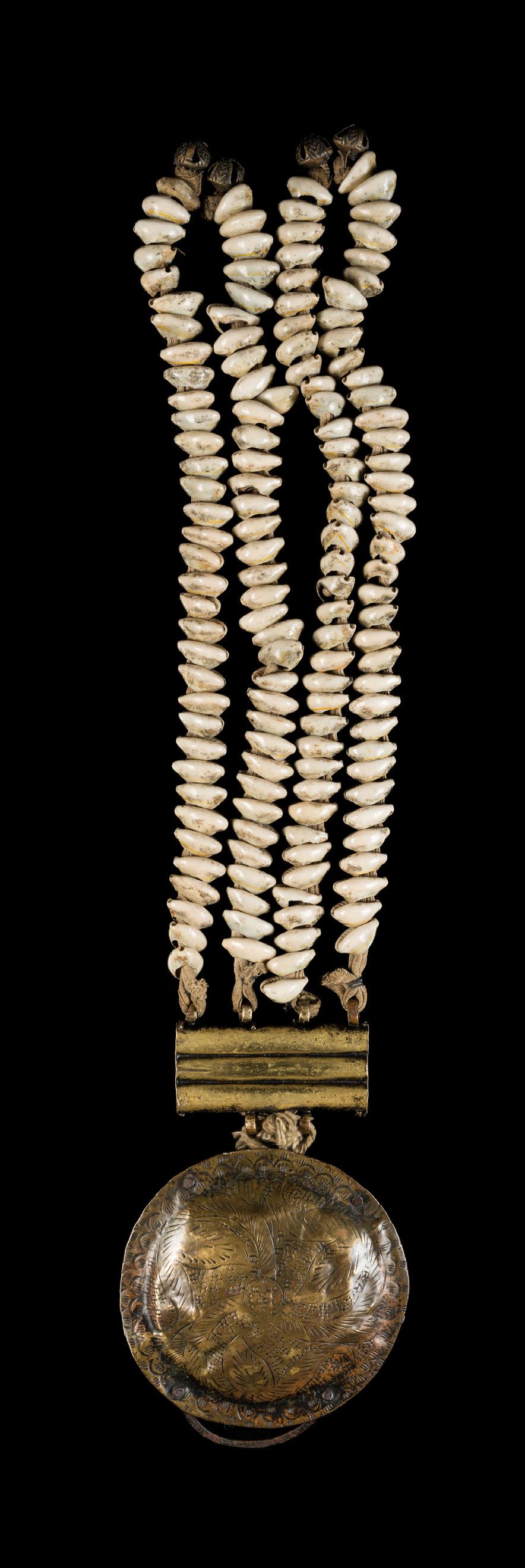
§ 1) The auction shall be carried out in accordance with the provisions of the rules of procedure of GALERIE ZACKE©, SZA VERSTEIGERUNGEN UND VERTRIEBS GMBH, Zelinkagasse 6, 1010 WIEN (hereinafter referred to as the company) as well as in accordance with sections 244246 of the GEWERBEORDNUNG [Industrial Code] of 1994. The auction shall be carried out on commission. The auctioneer shall be entitled to withdraw lots exceptionally, to conduct the auction deviating from the order of the catalog numbers and to offer lots jointly. In the event of any dispute concerning a double bid or if the auctioneer has missed a bid, the auctioneer shall be entitled to revoke acceptance of a bid and to continue auctioning the item. The figures stated in the catalog shall be the highest bid in Euro (€) expected by the respective expert. As a rule, the bid shall be increased by 10% of the last bid. (See table of the bidding increments).
§ 2) The acceptance of a bid shall be granted to the highest bidder unless a hidden reserve has been agreed upon with the consignor of the item in question. Such a hidden reserve (also called limit or just reserve) shall be the minimum price under which the item will not be sold during the auction. This reserve will be disclosed upon request and after the auction only and may exceed the estimate. The auctioneer will in this case bid on behalf of the seller against all other bidders until the reserve has been reached. If a reserve is not reached during the auction, the auctioneer will knock down the item to the highest bidder at the final bid, but the sale will be conditional of the acceptance of this final bid by the seller. In this case the highest bidder shall be bound to his/her last bid for a term of 8 days starting with the day of the knockdown. If the winning bidder does not receive a written cancellation notice within this term of 8 days, the knockdown becomes unconditional and the sale is final. Typically, only a minority of all items in an auction have a hidden reserve.
§ 3) Most items shall be subject to differential taxation. A uniform surcharge of 25% plus the value added tax applicable to the surcharge to the amount of 20% shall be added to the achieved highest bid (final and highest bid). Thus, the surcharge shall be 30% of the final and highest bid in total. Items with added VAT are marked † in the online catalog.
§ 4) In the event of sales abroad, the value added tax will be repaid if the item is sold to a country which is not a member country of the European Union (third country), the legal requirements are met, and the proof of exportation is provided. The value added tax shall not be shown separately on the invoice.
§ 5) The auction buyer must pay the purchase price immediately upon acceptance of the bid (final and highest bid plus 25% surcharge, plus the value added tax applicable to the surcharge to the amount of 20%, or the added VAT on top of the final price, when a lot is highlighted accordingly in the auction catalog). The company may grant an auction buyer a term of payment for the purchase price in whole or in part when this has been formally applied for in writing before the auction.
§ 6) In the event of a term of payment, or any payment delay, in whole or in part, the company shall be entitled to charge default interest (12% p.a.) as well as storage charges (2.4% pf the final and highest bid per month commenced) after 14 days upon acceptance of the bid. The item purchased at auction shall be handed over exclusively upon full payment of the purchase price including all costs and charges accrued since the acceptance of the bid.
§ 7) The buyer should take acquired items into possession, as far as possible, immediately or after the end of the auction. Items which have been fully paid for shall be handed over in our show rooms in GALERIE ZACKE, Zelinkagasse 6, 1010 VIENNA. If a deferred purchase price is not paid within the set period, the company shall be entitled to auction the item again in order to recoup its claim from the defaulting auction buyer. In this case, the defaulting auction buyer shall be liable to the company for the total loss of commission incurred by the company due to the re-auctioning as well as for any default interest and storage charges.
§ 8) The company shall be entitled to a lien on all items of the buyer irrespective of whether the buyer bought them within the scope of an auction or in free sale or the company secured ownership of these items otherwise. This lien shall serve to secure all current and future, qualified, limited and unmatured claims to which the company is entitled and which result from all legal transactions concluded with the buyer.
§ 9) The items received for auction will be exhibited and may be viewed prior to the auction. In doing so, the company shall give everyone the opportunity to check the nature and the condition of the exhibited items to the extent deemed possible within the scope of the exhibition. Every bidder shall be deemed to act on its own behalf unless it provides a written confirmation saying that it acts as a representative or agent of a well-known principal. The company may refuse bids; this shall particularly apply if a bidder who is unknown to the company or with whom the company has no business connections yet does not provide a security deposit before the auction. However, in principle there shall be no claim to accept a bid. If a bid has been refused, the previous bid shall remain effective.
§ 10) The company’s experts evaluate and describe the items received for auction and determine the starting prices unless otherwise stated in the catalog or expert opinion. The information concerning production technique or material, state of preservation, origin, design and age of an item is based on published or otherwise generally accessible (scientific) findings concluded by the company’s expert with the necessary care and accuracy. The company shall warrant to the buyer according to §34-38 of the AGB (Terms and Conditions) that properties are correct provided that any complaints referring to this are made within 45 days after the auction day. Subsequent complaints shall be excluded in principle. The company shall not be liable for any further information in the catalog and expert opinion as well. This shall also apply to illustrations in the catalog. The purpose of these illustrations is to guide the potential buyer during the preview. They shall not be authoritative for the condition or the characteristics of the pictured item. The published condition reports shall only mention defects and damage affecting the artistic or commercial value significantly. Complaints concerning the price shall be excluded upon acceptance of the bid. The company reserves the right to amend the catalog online prior to the auction. These amendments shall also be made public orally by the auctioneer during the auction. In this case, the company shall be liable for the amendment only. All items offered may be checked prior to the auction. These items are used. Any claims for damages exceeding the liability named above and resulting from other material defects or other defects of the item shall be excluded. When making the bid, the bidder confirms that he/ she has inspected the item prior to the auction and has made sure that the item corresponds to the description.
§ 11) If a customer is not able to participate in an auction personally, the company shall accept purchase orders. These orders may be placed in writing via mail, e-mail, fax, www.zacke.at or a third party bidding platform. In the case of a purchase order placed by phone or orally, the company shall reserve the right to make the performance dependent on a confirmation from the principal communicated in writing. Furthermore, the company shall not be liable for the performance of purchase orders. Equal purchase orders or live bids will be considered in the order of their receipt. Bids which below the estimate shall be exhausted completely. Bids which do not correspond to the increments determined by the company (see bidding increment table) will be rounded up to the next higher increment. The table of these increments can be sent upon request. The written bid (purchase order) must include the item, the catalog number and the offered top bid limit which is quoted as the amount of the acceptance of the bid without buyer’s commission and without taxes.
Ambiguities shall be carried by the bidder. A purchase order which has already been placed may only be cancelled if the written withdrawal is received by the company at least 72 hours prior to the beginning of the auction.
§ 12) The company may refuse a purchase order without explanation or make its execution dependent on payment of a security deposit. In the event of an unsuccessful order, such a deposit will be reimbursed by the company within 5 working days. Processing of purchase orders is free of charge.
§ 13) Every seller shall in principle be entitled to withdraw the items offered for auction until the start of the auction. Therefore, it is impossible to assume liability or to give warranty for the actual offering.
§ 14) Paid items must be collected within 30 days after payment. Items which have not been collected may be re-offered without further communication at the starting price from the recent auction reduced by 50%. Items which have not been collected within 30 days after the auction or for which the company does not receive any proper shipping instructions stating the type of shipping and the address of dispatch (independent of a possibly placed purchase order) shall be stored at the owner’s risk.
Furthermore, the company shall be entitled to store items which have been purchased at auction and paid but not collected at the buyer’s risk and expense, including the costs for an insurance, with a forwarding agency. It shall be understood that the provision concerning the re-auctioning of unpaid and paid but not collected items must also apply to items not exhibited or stored on the premises of the company. The ownership shall be transferred to the buyer at the time of handing over the issuing note.
§ 15) In the case of mixed lots with a starting price of less than EUR 350.00, the company shall not warrant for the completeness or correctness of the individual items within a mixed lot.
§ 16) A registration for a bid by telephone for one or several items shall automatically represent a bid at the starting price of these items. If the company cannot reach a bidder by telephone, it will bid the starting price on behalf of this bidder when the respective lot is up for auction.
§ 17) Payments made to the company by mistake (through the payer’s fault) (e. g. due to miscalculation of the exchange rate by the payer) or payments made to the company for the same invoice several times shall be compensated in form of a credit note for goods for an indefinite period of time. The repayment of such payments in cash shall be excluded.
§ 18) Certain auction lots may exist several times (multiples). In such a case, the auctioneer may accept a second, third or even more bids from the underbidder(s). In this case, the text in the catalog and not the illustration shall be exclusively binding with regard to the warranty.
§ 19) The company reserves the right to assign to the buyer all rights and obligations resulting from the contractual relationship between the company and the seller by way of a respective declaration, as well as to assign to the seller all rights and obligations resulting from the contractual relationship between the company and the buyer by way of a respective declaration, in each case in terms of a complete assignment of contract with the result that the contractual relationshipfollowing the submission of the aforementioned declarations by the company – shall exclusively be between the seller and the buyer, all of which is in accordance with the basic model of the commission agreement. Buyers and sellers shall already now give their explicit consent to this contract assignment.
§ 20) The place of performance of the contract brought about between the company on the one hand and the seller as well as the buyer on the other hand shall be the place of business of the company. The legal relationships and contracts existing between the company, the sellers and the buyers shall be subject to Austrian law. The company, the sellers and the buyers shall agree to settle all disputes resulting from, concerning and in connection with this contract before the territorially competent court of Vienna.
§ 21) The export of certain art objects from Austria shall require a permit from the Bundesdenkmalamt [Federal Monuments Office]. The company will orally provide information about art objects for which such export permit will probably not be granted at the beginning of the auction.
§ 22) Whenever making a bid, whether personally or via an agent, in writing, online, telephone, or in any other way, the bidder fully and unconditionally accepts the Terms of Auction, the ‘Important Information’ section in the auction catalog, the Terms and Conditions (AGB) of Galerie Zacke, §1-50, the Fee Tariff, and the Bidding Increments table, all as published on www.zacke.at on the day of the auction.