Fine Japanese Art
Friday, 12 June 2026
Friday, 12 June 2026
CATALOG JPN0626
Friday, 12 June 2026, 1 pm CET
Attend in person at our new auction room at Zelinkagasse 6 or participate online via Zacke Live – and enjoy premium buyer’s terms with no additional online bidding fees
Register now: www.zacke.at
EXHIBITION
5 June – 11 June Monday – Friday 10 am – 6 pm as well as by appointment
GALERIE ZACKE
Zelinkagasse 6 1010 VIENNA AUSTRIA
Tel +43 1 532 04 52 E-mail office@zacke.at
www.zacke.at
According to the general terms and conditions of business of Galerie Zacke Vienna, Founded 1968, SZA Versteigerungen & Vertriebs GmbH, 1010 Wien, online at www.zacke.at
ABSENTEE BIDDING
Absentee bids are carried out under the regulations of the terms of business of Galerie Zacke, SZA Versteigerungen & Vertriebs GmbH, which requires written submission of your purchase limit. Orders without purchase limits cannot be processed. Only the submitted lot number of the auction lot is binding for the processing of the absentee bid. The place of jurisdiction is Vienna, Austrian Law and Austrian jurisdiction are exclusively applicable for all legal questions arising from the business relationship. Absentee bids for this auction will be accepted until the day of auction by 10:00 a.m. We regret that absentee bids received after the time stated above will not be processed until after the auction.
PLEASE SEND ABSENTEE BIDS FOR THIS AUCTION TO:
Fax: +43 1 532 04 52 20 or Email: office@zacke.at or Mail: Galerie Zacke, Zelinkagasse 6, 1010 Wien, Austria, Europe
WE ACCEPT THE FOLLOWING METHODS OF PAYMENTS:
• Cash
• Certified or personal check
• Bank transfer (please inquire to receive our bank account information)
• Credit card (Visa, MasterCard, Amex) up to EUR 5.000 - higher amounts require prior approval and are subject to service fees
TELEPHONE BIDDING
It is generally possible to bid by telephone during the auction. Please fill out the absentee bidding form enclosed in this catalog and include your telephone number at which you can be reached during the auction. In the “bid in euro” column please write “TEL” and then send us the completed absentee bidding form. Galerie Zacke will call you on the day of the auction, on the telephone number provided, 5 lots before the lot you are bidding on and the bidding will commence at the starting price, as stated in the catalog. If Galerie Zacke cannot reach you during the auction, Galerie Zacke will bid the starting price on your behalf.
ESTIMATES AND STARTING PRICES
The auction will begin with the starting price and written bids will be accepted only with a minimum amount equivalent to the starting price.
For domestic shipping Galerie Zacke (hereinafter called “the company”) charges in average Eur 15,- to Eur 50,- per item, depending on size and weight. These fees cover the costs of packing and shipping. Fees for bulky or fragile items, or international shipping will be quoted upon request.
The purchased goods are transported at the risk of the customer following handover of the packaged item to the post office or another carrier which the customer agrees to through his/her submission of the purchase order. According to the specific wish of the customer, the auctioned goods may be insured for the value of the purchase price (highest bid and all surcharges). This insurance fee is 3% of the purchase price. For any lots with a purchase prices exceeding EUR 350,- the transport insurance will be automatically arranged by the company if it does not expressively receive the purchaser’s written denial of this service and signed waiver of claims. Payments due to the company under the insurance contract will be charged to the customer. The company is also entitled to assign claims under the insurance contract to the customer providing the terms of the insurance contract do not prevent this.
In any case, the company is only required to make payment to the customer specifically if payment has effectively been received from the insurance company.
Auction lots will be exhibited for viewing prior to the auction, thus offering all interested customers the opportunity to examine the quality and condition of the works exhibited. The catalog illustrations are intended to assist customers during such preview.
In illustrations, printed colors do not correspond exactly to the originals. The printed catalog images are not representative for the condition of the illustrated pieces. Hidden flaws and damages are indicated in the condition report. The illustrations in our online catalogs can be strongly magnified, so that most damages and restorations are well recognizable.
Some items in this catalog may for example consist of ivory, rhinoceros-horn, tortoise shell, or some types of tropical wood, and are subject to the Convention on International Trade in Endangered Species of Wild Fauna and Flora [CITES]. Such items are marked with the symbol Ɏ on www.zacke.at and may only be exported outside the European Union after an export permit in accordance with CITES has been granted by the Austrian authorities. We would like to inform you that such licenses are typically not granted.
been
At its auctions, Galerie Zacke sells consigned lots on behalf of third-party consignors. For this reason, any complaints related to purchased lots must be in accordance with §32-48 of the general terms and conditions of business of Galerie Zacke, which can be found on www.zacke.at
THE ART LOSS REGISTER
All items starting above EUR 2,000 have been checked by the Art Loss register.
Publisher Galerie Zacke founded 1968 © SZA Versteigerungen & Vertriebs GmbH 1010 Wien Zelinkagasse 6 Austria, Europe
Tel (0043-1) 532 04 52 Email: office@zacke.at
Editors
Lukas Zacke
Marion Schor
Experts
Lukas Zacke
Alexander Zacke
Max Zacke
Catalogers
Ananya Casius
Anne-Aymone Gabriel
Tatjana Borodin
Daniel Gonzalez-Gracia



Assistance Mieko Gray
Hiroshi Matsumura
Anna-Maria Pollmann
Photography
Georg Bodenstein
David Lindengrün
Cesilio Cesar Garcia
Jonas Matyassy
Loreen Sasse
Design Hermann Kienesberger
Printing Print Alliance HAV Produktions GmbH
Website www.zacke.at
© GALERIE ZACKE
Reproduction forbidden
produziert gemäß Richtlinie Uz24 des Österreichischen Umweltzeichens, Print Alliance HAV Produktions GmbH, UW-Nr. 715
PLEASE RAISE MY BID BY ONE BIDDING INCREMENT (ca. 10%) IF NECESSARY
IMPORTANT NOTICE:
Bids do not include buyer’s premium and VAT. Margin taxation applies. Items with added VAT are marked in the online catalog.
TELEPHONE BIDS:
BIDDING FORM
FOR THE AUCTION Fine Japanese Art JPN0626 ON DATE 12 June 2026
PLEASE CALL ME WHEN A HIGHER BID THAN MINE HAS BEEN RECEIVED
If you like to bid by telephone, please state ‘TEL’ in the ‘BID IN EURO’ column instead of a Euro amount. Galerie Zacke will call you on the day of the auction, on the telephone number provided, 5 lots before the lot you are bidding on and the bidding will commence at the starting price, as stated in the catalog. If Galerie Zacke cannot reach you during the auction, Galerie Zacke will bid the starting price on your behalf. MY PHONE NUMBER
TERMS OF PAYMENT, SHIPPING AND COLLECTION:
NAME
ADRESS
CITY, COUNTRY
POSTCODE
PHONE NUMBER
CREDIT CARD PAYMENT
PLEASE CHECK THE DESIRED CARD
COLLECTION BY CLIENT WITH PAYMENT ON THE PREMISES IN CASH, BY CERTIFIED CHEQUE OR CREDIT CARD
INVOICE PAYMENT
VIA BANK WIRE AFTER RECEIPT OF INVOICE SHIPPING AFTER RECEIPT OF PAYMENT
EXPRESS PARCEL SERVICE
REQUIRED (ACCORDING TO TERMS AND CONDITIONS OF GALERIE ZACKE)
SHIPPING INSURANCE
REQUIRED (ACCORDING TO TERMS AND CONDITIONS OF GALERIE ZACKE)
GALERIE ZACKE
Zelinkagasse 6, 1010 Vienna, Austria
Email: office@zacke.at
Tel: +43-1-532 04 52
Fax: +43-1-532 04 52 20
With the signature on this form, the client instructs the auctioneer to bid on his behalf. The Euro amount up to which the auctioneer shall bid on behalf of the client is either stated in this form or will be communicated to the auctioneer via telephone during the auction. All absentee bidding shall be governed by the terms and conditions [AGB] of Galerie Zacke. The client agrees with his signature that he has read, understood and fully accepted the AGB of Galerie Zacke. Galerie Zacke, founded 1968, is a registered brand of SZA Versteigerungen & Vertriebs GmbH, Vienna, Austria.
NAME
ADDRESS
CARD NUMBER
EXPIRY DATE
IMPORTANT NOTICE:
Whenever making a bid, whether personally or via an agent, in writing, online, telephone, or in any other way, the bidder fully and unconditionally accepts the Terms of Auction, the ‘Important Information’ section in the auction catalog, the Terms and Conditions (AGB) of Galerie Zacke, §1-48, the Fee Tariff, and the Bidding Increments table, all as published on www.zacke.at on the day of the auction.
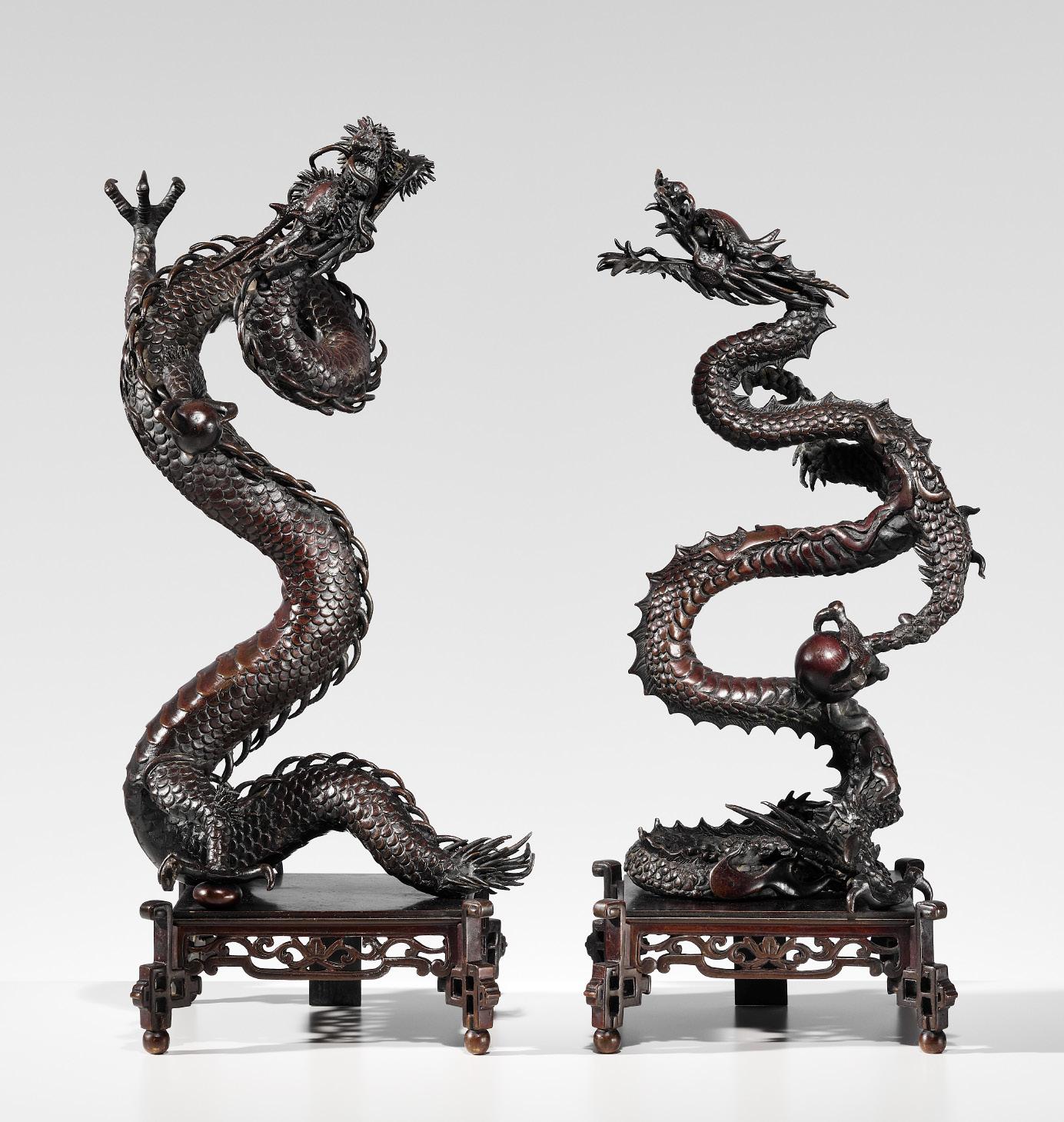
A LARGE AND IMPRESSIVE PAIR OF BRONZE ‘DRAGON’ OKIMONO
Japan, 19th century, late Edo (1615-1868) to Meiji period (1868-1912)
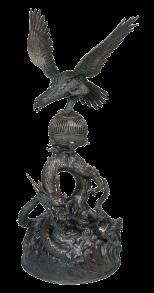
Each powerfully cast as a dragon clutching a tama (sacred jewel), one dramatically emerging from an alms bowl, both raised upon finely detailed Chinese-style low tables. The compositions are exceptionally dynamic, with the dragons’ sinuous bodies spiraling upward in vigorous, twisting motion, conveying a striking sense of energy and ascent. The surfaces are meticulously worked, the scales crisply defined, and the expressive heads are particularly compelling, each with prominent horns, flowing whiskers, and open jaws revealing sharp teeth and protruding tongues, imbuing the figures with a vivid sense of movement and presence.
HEIGHT 53 cm and 58 cm
WEIGHT 8.4 kg and 8.9 kg
Condition: Very good condition and presenting well. Minor expected wear and casting irregularities. One head is re-attached.
Compare a closely related single bronze of a coiling dragon, dated to the late 19th century, of smaller size, 31.7 cm high, at Bonhams, Fine Japanese and Korean Art, 12 September 2012, New York, lot 3371 (sold for USD 4,750 or approx. EUR 6,000 converted and adjusted for inflation at the time of writing).
Estimate EUR 6,000
Starting price EUR 3,000
2
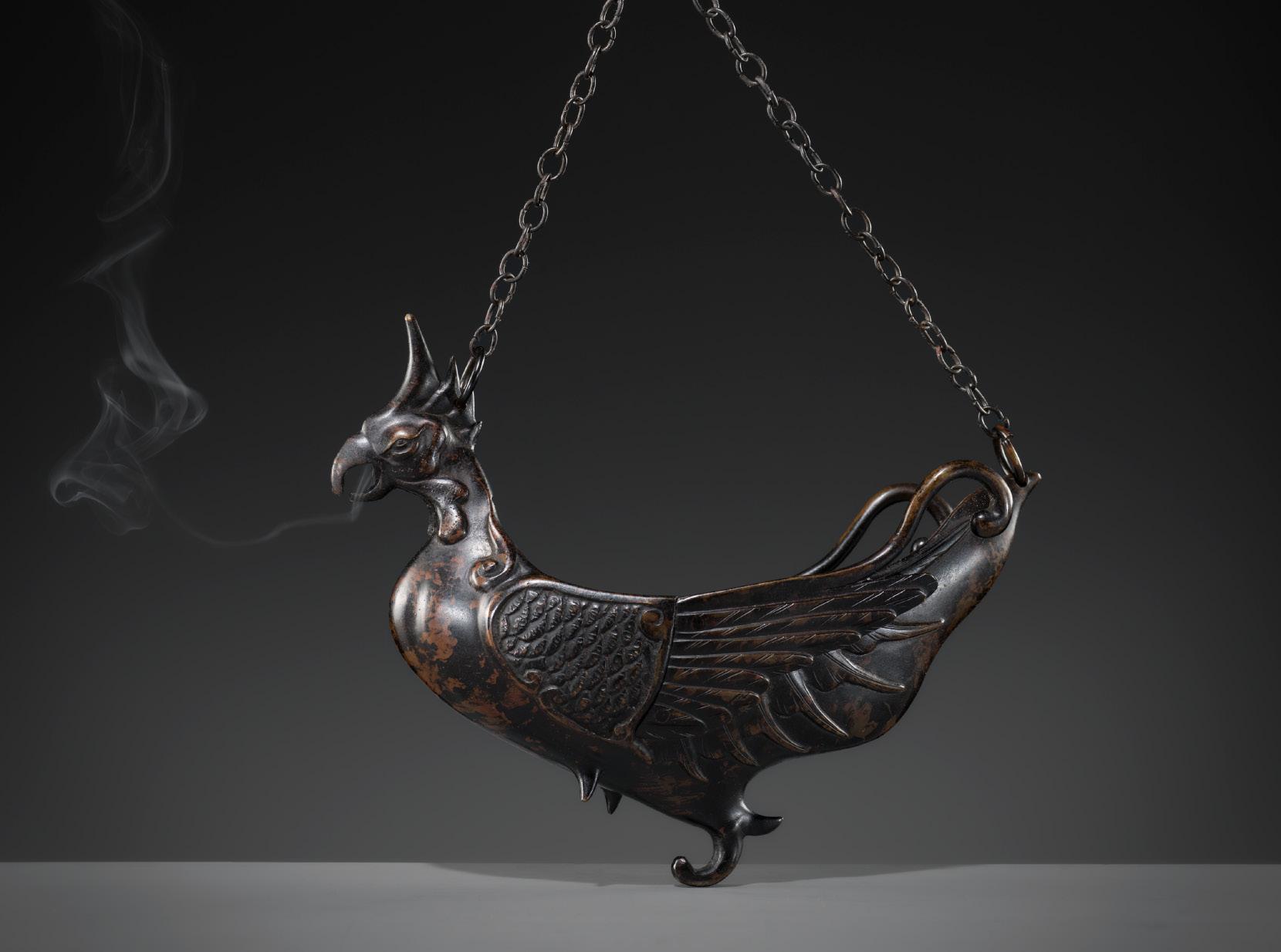
A RARE BRONZE ‘CHINESE PHOENIX’ HANGING INCENSE BURNER
Japan, 18th-19th century, Edo period (1615-1868)
Published: Resonance of Wa - The Japanese Spirit. Casal Collection, 2025, p. 115.
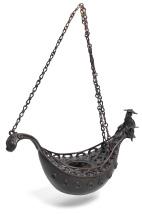
Finely cast in the form of a ho-o bird (phoenix), the hollow body ingeniously conceived as a censer. The wings are elegantly folded against the body, the plumage meticulously articulated, and the head proudly raised with an open beak and sharply defined crest. Both the head and tail are pierced to accommodate a suspension chain, allowing the vessel to be worn or hung, in a manner traditionally associated with portable incense burners.
LENGTH 19.8 cm, HEIGHT (when suspended) 105.5 cm
WEIGHT 697 g
Provenance: Ex-Collection of Ugo Alfons Casal. Osaka City Museum of Fine Arts, bequeathed from the above and subsequently deaccessioned in 2021.
Condition: Very good condition with surface wear and casting-inherent irregularities.
Expected traces of handling and use.
Occasional minute nicks. The bronze surface with a dark, naturally grown, warm patina.

This koro is exceptionally rare due to its unusual and highly imaginative form. While functioning as a hanging incense burner or perfumer, its conception may reflect a broader exchange of ideas across Asia. The suspended format recalls portable vessels such as Central Asian and Persian kashkul, ascetic bowls worn on chains, which are known to have circulated along Silk Road trade routes and may have influenced artistic forms in China and Japan.
In the present example, however, such a format is fully reinterpreted within a Japanese aesthetic framework, taking the form of a ho-o bird, a powerful auspicious symbol associated with renewal, virtue, and imperial authority. The fusion of function and symbolism results in an object of both sculptural elegance and cultural resonance.
AUCTION COMPARISON
Compare a related bronze ‘Zhang Qian and boat’ hanging incense vessel, Ming dynasty, 14th-15th century, 25.5 cm long, at Bonhams, Michael Goedhuis, London, 17 May 2023, lot 368 (sold for GBP 12,750 or approx. EUR 16,000 converted and adjusted for inflation at the time of writing).
Estimate EUR 3,000 Starting price EUR 1,500
With the restoration of Emperor Meiji and the opening of Japan to international trade, the country began to participate actively in world’s fairs and international exhibitions across Europe and beyond, promoting the excellence of its artistic and industrial production. Following the success of the Great Exhibition of 1851 in London, such events were held at regular intervals in major cities worldwide and played a crucial role politically and culturally, fostering trade, strengthening international relations, and showcasing technical innovation and artistic achievement.
Among the most celebrated categories of export art were large-scale bronze works, particularly monumental koro (incense burners), conceived as complex, multi-part compositions intended to impress both technically and visually. Leading metalworkers such as Suzuki Chokichi and Suzuki Masayoshi are well documented as having produced such works for exhibition at international expositions.
Although comparatively little is recorded about Hayashi Harusada, the existence of monumental and technically ambitious works bearing his signature strongly indicates that he operated within this same sphere of high-level metal production. In particular, the monumental koro preserved in the Nasser D. Khalili Collections (acc. no. MX 66, fig. 1), measuring
over four metres in height, provides compelling evidence of a workshop capable of producing objects on a scale consistent with international exhibition display.
Works of this magnitude - characterized by their exceptional size, complex casting, and elaborate decorative programs - are unlikely to have been intended for domestic use and instead align closely with the exhibition pieces produced by the foremost artists of the period. The present koro, remarkable for both their scale and refinement, should therefore be understood within this broader context of Meiji-period exhibition art.
Such monumental bronze censers attracted considerable attention from Western collectors and dealers, among them Siegfried Bing, who played a key role in introducing Japanese art to Europe. In 1881, Bing sold an important Japanese koro (fig. 2) to the Victoria and Albert Museum for the substantial sum of £1,586, an acquisition of such significance that it required special authorization from the British Treasury.
3
HAYASHI HARUSADA: A MONUMENTAL (177 CM) PARCEL-GILT BRONZE ‘AUSPICIOUS ANIMALS’ EXHIBITION KORO (INCENSE BURNER)
By Hayashi Harusada, signed Dai Nihon Imono-shi, Hayashi Harusada zo kore Japan, Meiji period (1868-1912)
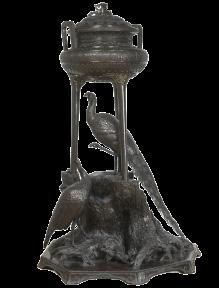
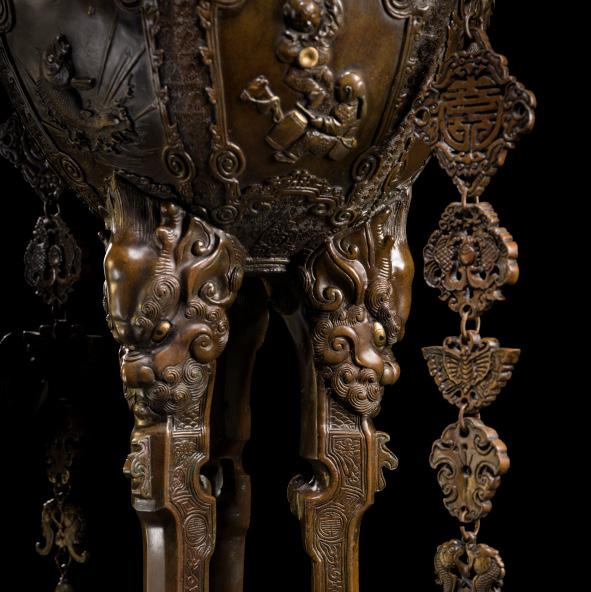
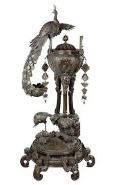
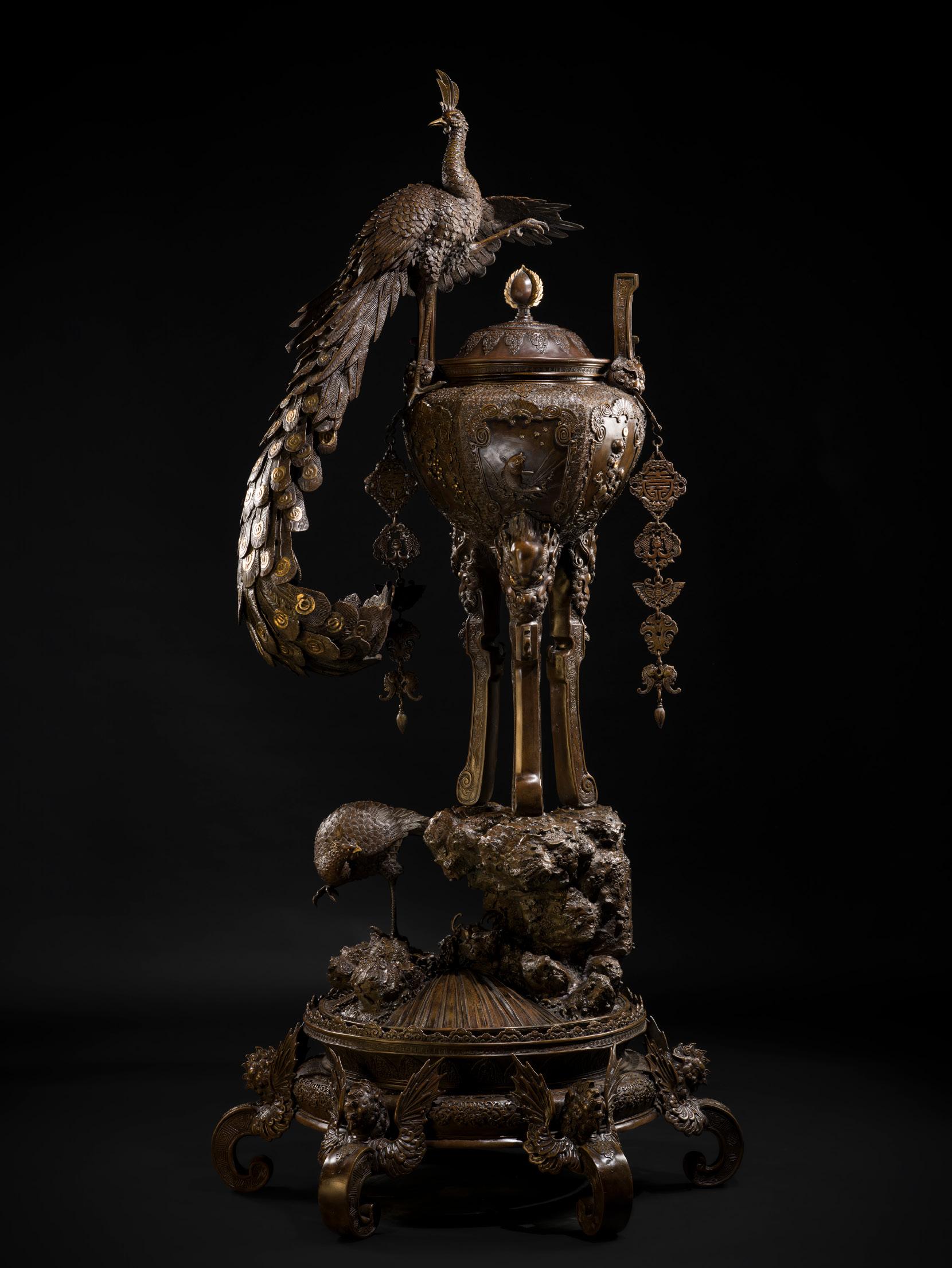
Superbly executed and composed of multiple separately cast elements, embellished with rich gilt. The koro features a large globular body supported on three elongated legs issuing from the jaws of fierce dragon heads and terminating on a rugged rocky outcrop, upon which stands a finely rendered pheasant. The entire composition is further raised on a circular base formed of multiple curling legs in the form of winged mythical beasts.
The present lot at Bonhams, Japanese and other Asian Works of Art, London, 23 May 2006, lot 27, sold for GBP 20,400 or approx. EUR 41,000

From either side of the body suspend chains composed of foliateshaped openwork medallions, decorated with auspicious Chinese characters and animal motifs. The vessel is surmounted by a domed cover crowned with a finial in the form of a flaming jewel, above which rises an imposing peacock, its elegantly sweeping tail cascading to one side of the composition.
The exterior of the body is richly ornamented in high relief with shaped panels depicting various auspicious animals, highlighted with gilt details and interspersed with key-fret patterns, wave motifs, and floral designs. The rocky outcrop bears an incised signature within a square reserve reading Dai Nihon Imono-shi HAYASHI HARUSADA zo kore [made by Hayashi Harusada, metal artist, Great Japan].
HEIGHT 177 cm (total)
WEIGHT 120 kg (total)
Provenance: Bonhams, Japanese and other Asian Works of Art, London, 23 May 2006, lot 27, (sold for GBP 20,400 or approx. EUR 41,000 converted and adjusted for inflation at the time of writing). A private collection in Italy, acquired from the above. Note the size was incorrectly stated at Bonhams as 115 cm high, instead of the correct 177 cm.
Condition: Excellent condition with only minor surface wear, expected casting-inherent irregularities, and minimal traces of use. Presenting superbly.
Estimate EUR 30,000
Starting price EUR 15,000
4
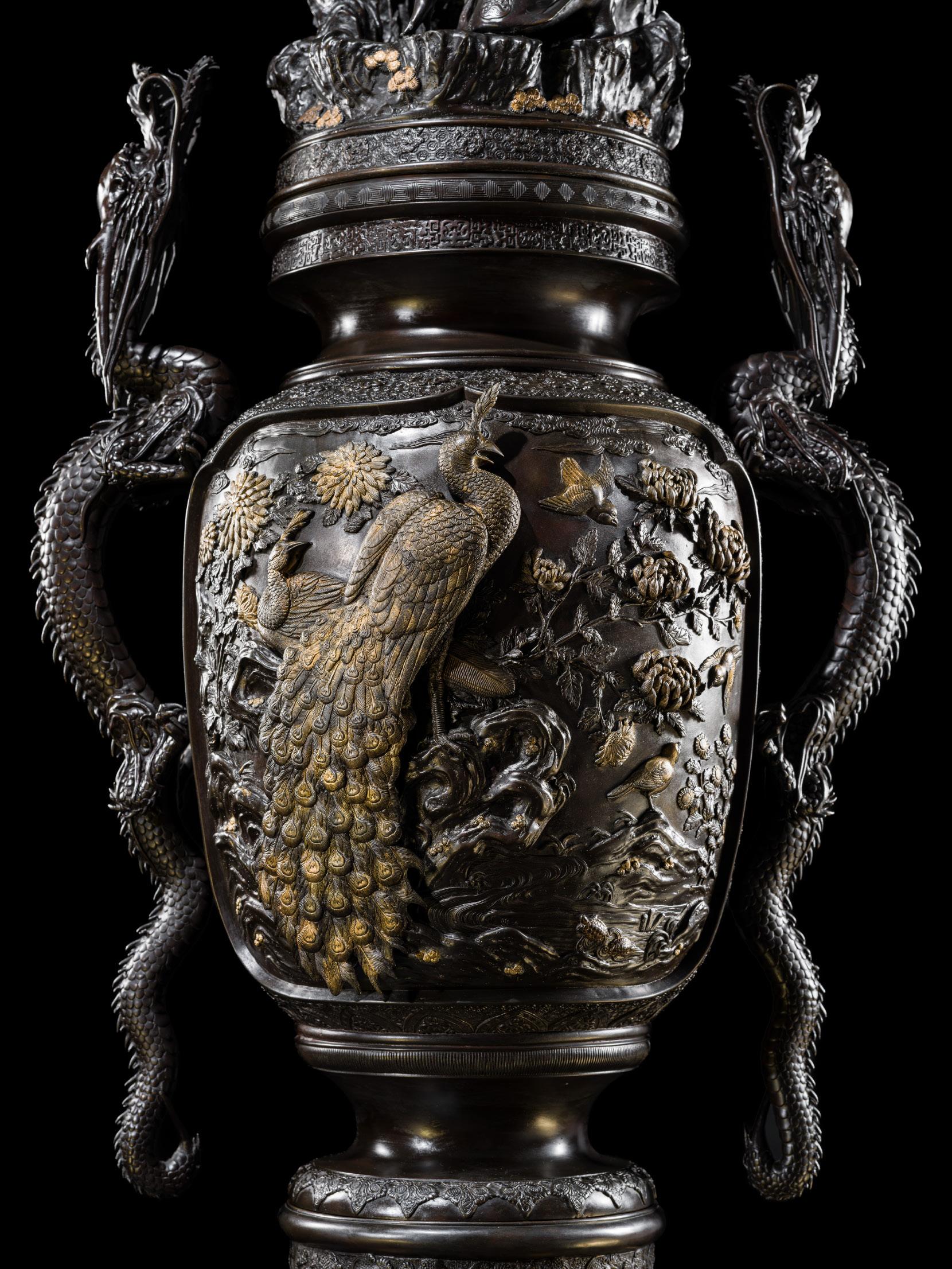
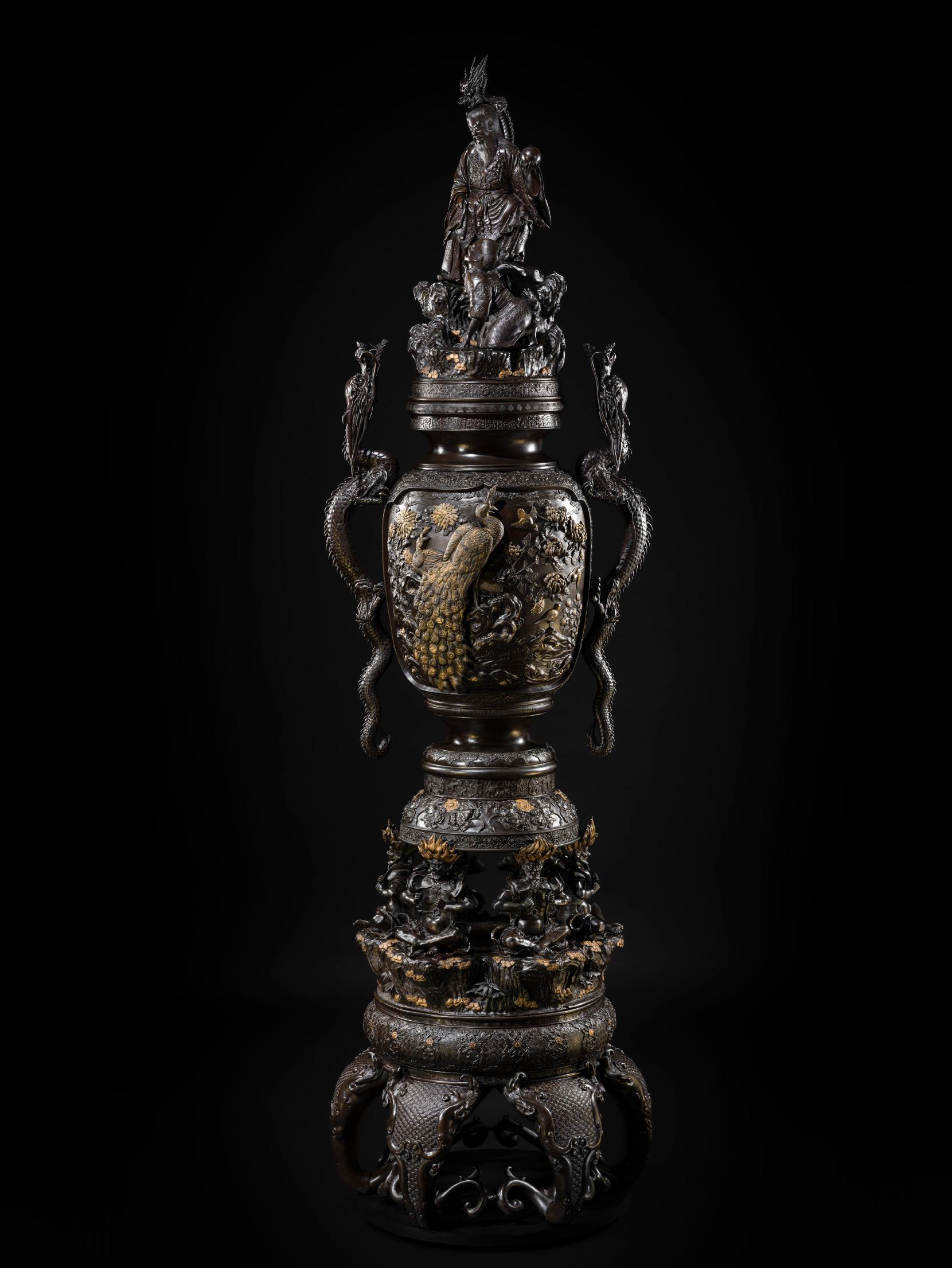
HAYASHI HARUSADA: A MONUMENTAL (234 CM) PARCEL-GILT BRONZE ‘RYUJIN AND DRAGONS’ EXHIBITION KORO (INCENSE BURNER)
By Hayashi Harusada, sealed Hayashi Harusada seizo Japan, Meiji period (1868-1912)
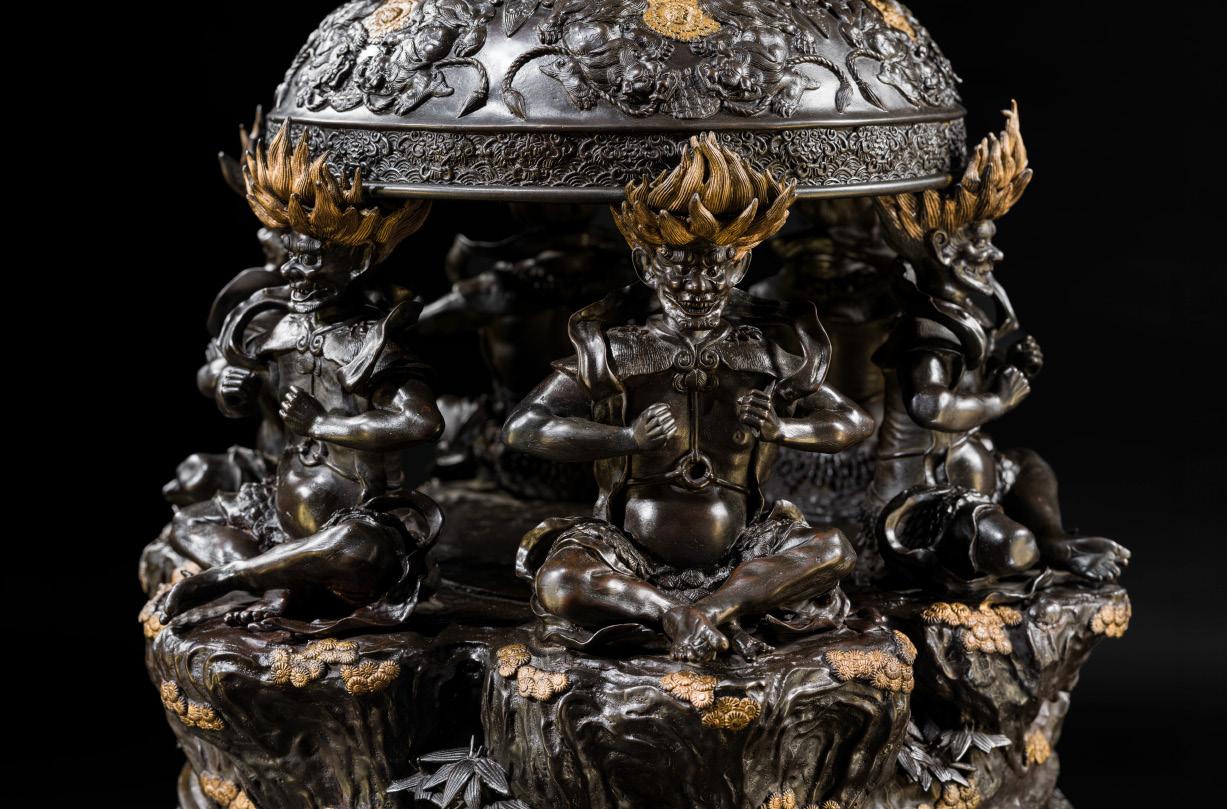
Superbly executed and of monumental scale, the koro is composed of multiple separately cast elements and richly embellished with parcel gilding. The central baluster-form body is supported on a spreading, tiered foot, itself resting on a dramatic group of male guardian figures with flowing, flame-like hair, seated cross-legged atop rugged rock formations. The entire structure is elevated on a large circular pedestal with elegantly curved supports, finely ornamented with crashing waves and water dragons with baku-like snouts.
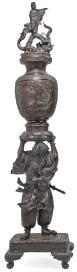
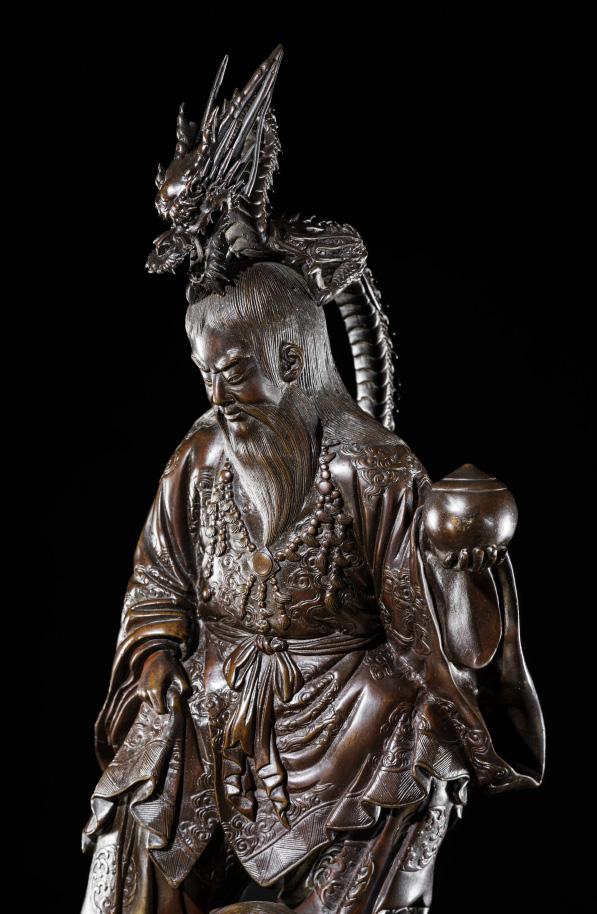
The sides of the vessel are fitted with imposing handles in the form of ferocious dragons, their sinuous, scaly bodies rendered with remarkable precision and vitality. The cover is surmounted by an elaborate figural group depicting the Dragon King of the Sea, Ryujin, standing beside his subject, accompanied by a superbly cast dragon rising above them, while Ryujin presents the sacred jewel controlling the tides.
The exterior of the body is richly decorated with opposing panels in varying degrees of relief. One side depicts majestic peacocks amid blossoming chrysanthemums with sparrows in flight, the details heightened with extensive gilding. The other presents a lively and charming scene of boys at play, feeding cranes and engaging with puppies, observed by a Chinese dignitary beneath luxuriant giltdecorated pine and cherry trees. The underside is sealed HAYASHI HARUSADA seizo [made by Hayashi Harusada].
Provenance: From an Italian private collection, the same collection as the second monumental incense burner in the sale, lot 3.
Condition: Excellent condition with only minor surface wear, expected casting-inherent irregularities, and minimal traces of usage.
HEIGHT 234 cm (total)
WEIGHT 160 kg (total)
Estimate EUR 40,000
Starting price EUR 20,000
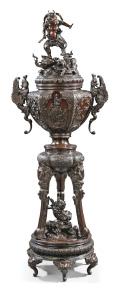
Compare a closely related patinatedbronze exhibition koro (incense burner), by Suzuki Masayoshi, Meiji period, late 19th century, 297.3 cm high, at Bonhams, Asian Decorative Arts, San Francisco, 18 December 2013, lot 6057 (sold for USD 37,500 or approx. EUR 45,500 converted and adjusted for inflation at the time of writing). Compare a closely related patinated-bronze exhibition koro (incense burner), Meiji period, late 19th century, 159 cm high, at Christie’s, The Collector, London, 12 November 2020, lot 255 (sold for GBP 31,250 or approx. EUR 46,500 converted and adjusted for inflation at the time of writing).
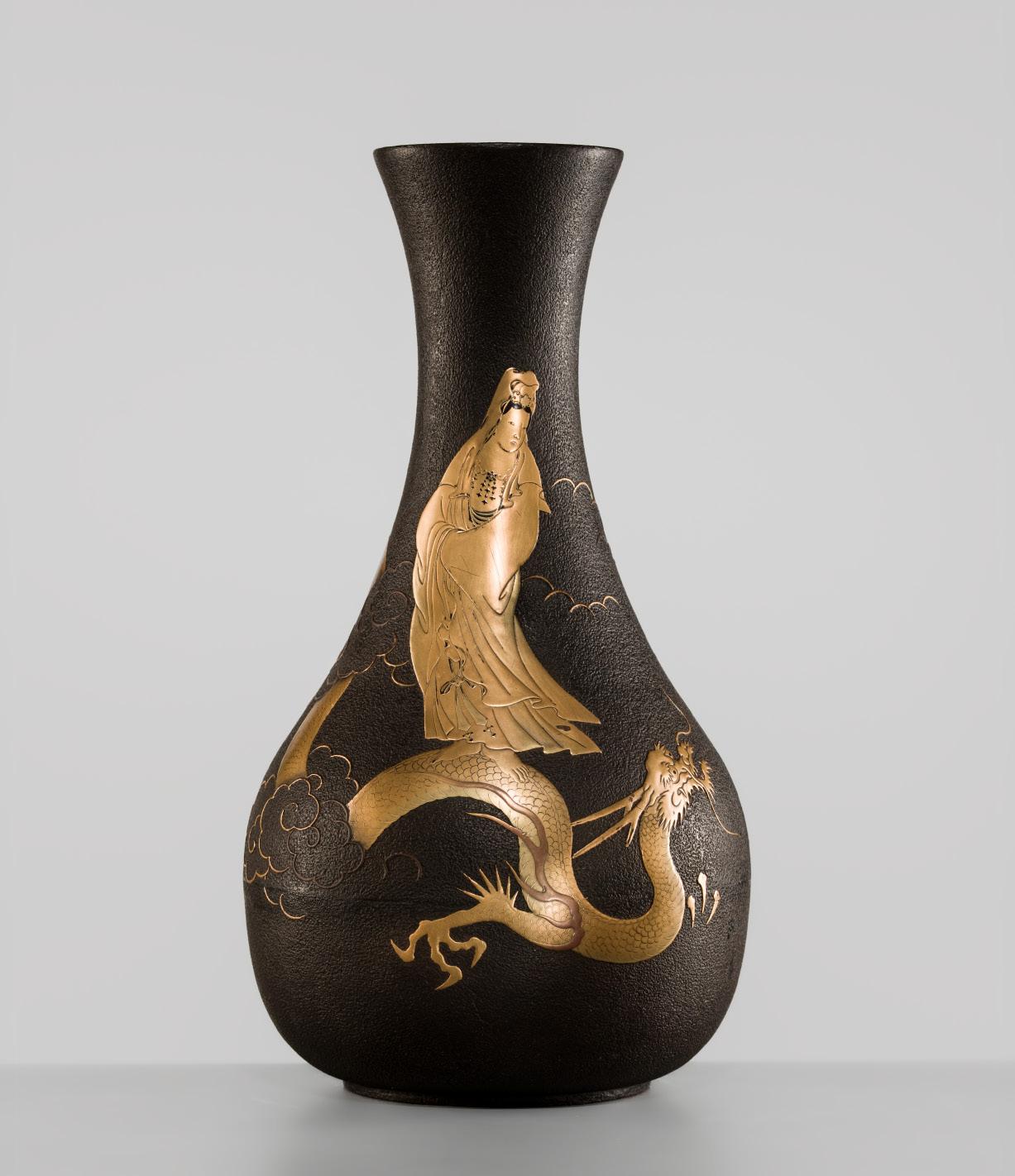
A RARE AND LARGE GOLD-LACQUERED IRON ‘KANNON AND DRAGON’ VASE
Japan, Meiji period (1868-1912)
Heavily cast with a pear-shaped body rising from a ring foot to a tall, flaring neck, the ishime-textured surface finely decorated in gold takamaki-e and hiramaki-e, depicting Kannon, the Goddess of Mercy, standing atop a writhing dragon. Kannon is portrayed with elegantly flowing robes, while the dragon’s long body is partially obscured by swirling clouds rendered in partially lacquered metal, adding depth and dimension to the scene.
HEIGHT 39.5 cm
WEIGHT 4 kg
Condition: Very good condition with only very minor wear including tiny losses and light rubbing to lacquer.
Kannon, the Bodhisattva of Compassion, is sometimes depicted riding a dragon symbolizing her ability to traverse the realms and respond swiftly to the suffering of sentient beings. The dragon, a powerful and auspicious creature associated with water, transformation, and the forces of nature, serves as both mount and emblem of spiritual authority. Together, they embody the harmony between compassion and strength, as Kannon tames and directs elemental power for the benefit of all.
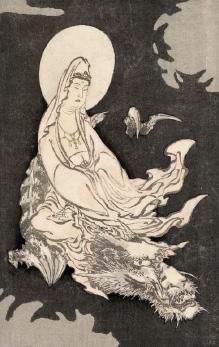
A woodblock print depicting a Buddhist Goddess Kannon on a dragon, by Katsushika Hokusai, dated to 1814, at the Honolulu Museum of Art, object number 23704
Estimate EUR 2,500
Starting price EUR 1,200
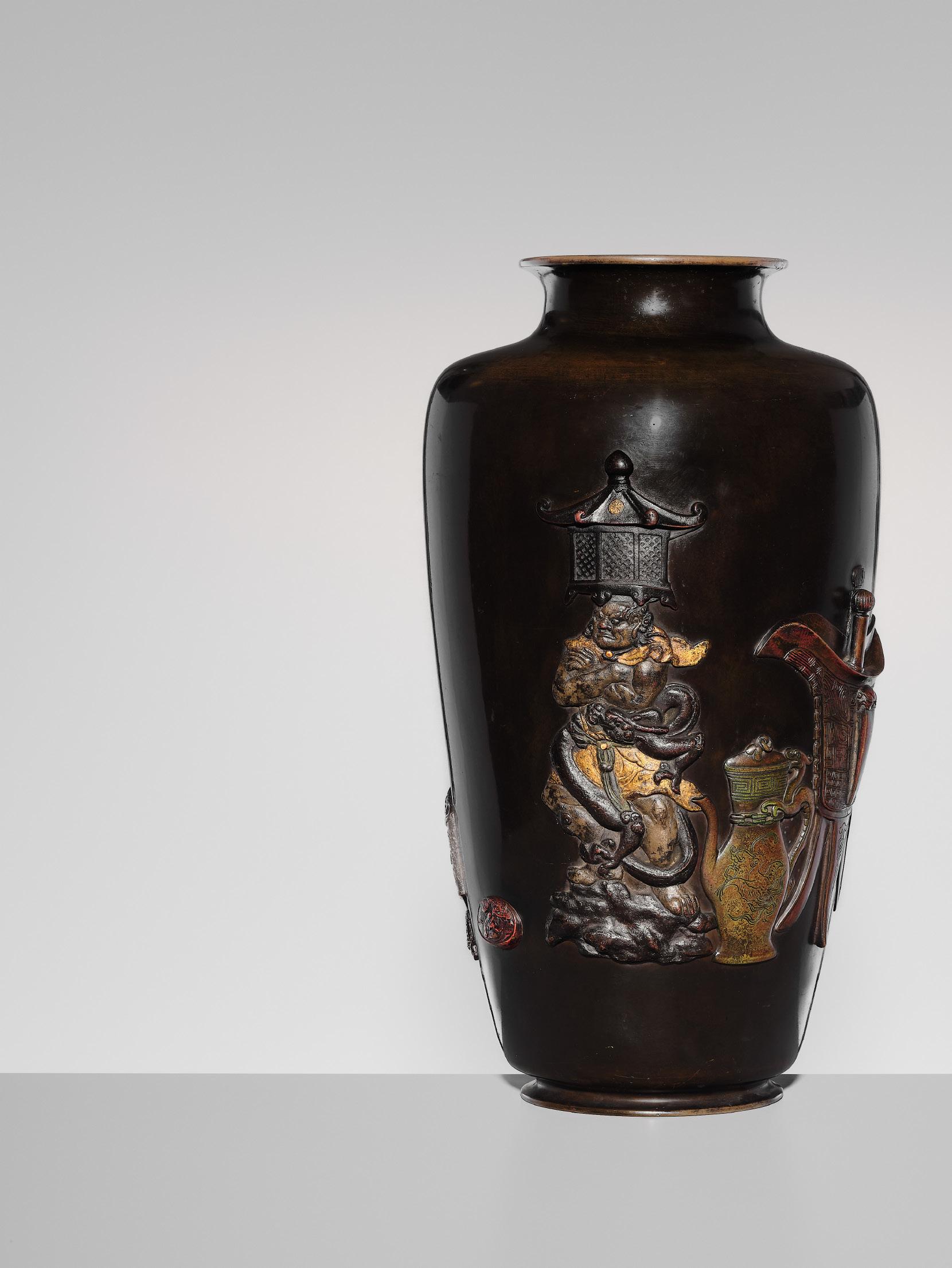
HOTAKUSAI: A LARGE PATINATED BRONZE ‘CHINESE SCHOLAR’S ITEMS’ VASE
By Hotakusai, signed Hotakusai zo Japan, Meiji period (1868-1912)
Heavily cast, the large baluster body rises from a short, spreading foot to a waisted neck with a flared mouth. The exterior is beautifully decorated in takazogan, with the surface enriched by a variety of patinas in rich reddish and orange tones, accented with gilt details. The design depicts an array of Chinese scholar’s objects, including archaic bronze vessels, censers, reishi sceptres, scrolls, and calligraphy brushes, along with a Japanese bronze shaped as Ryutoki (an oni-like jaki) with a lantern on his head. The underside of the vase is signed in sosho (running script) HOTAKUSAI zo [made by Hotakusai].
HEIGHT 54 cm
WEIGHT 14.7 kg
Condition: Good condition with surface wear and casting-inherent irregularities. Light rubbing and minor flaking to the original patina, along with scattered minor nicks, shallow surface scratches, and minute nibbling along the rim. The bronze surface has developed a dark, naturally grown, warm patina.
These types of large bronzes, executed during the Meiji era by various artists, typically depict an array of ancient Chinese vessels alongside a distinct Japanese bronze, reflecting the evolution of these wares. The combination of Chinese scholar’s items with uniquely Japanese elements, such as the Ryutoki figure, highlights the cultural exchange and influence between the two traditions.
AUCTION COMPARISON
Compare a closely related large bronze vase with classical Chinese bronzes, Meiji period, 56 cm high, at Bonhams, Fine Japanese Works of Art, 19 March 2013, New York, lot 2375 (sold for USD 5,000 or approx. EUR 6,000 converted and adjusted for inflation at the time of writing).
Estimate EUR 5,000
Starting price EUR 2,400
AKASOFU GYOKKO: AN IMPRESSIVE AND LARGE PARCEL-GILT BRONZE FIGURE OF AN ONI AND SOUND BOWL
By Akasofu
Gyokko, signed Gyokko Japan, Meiji period (1868-1912)
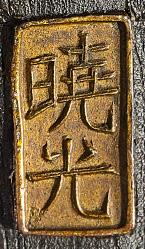
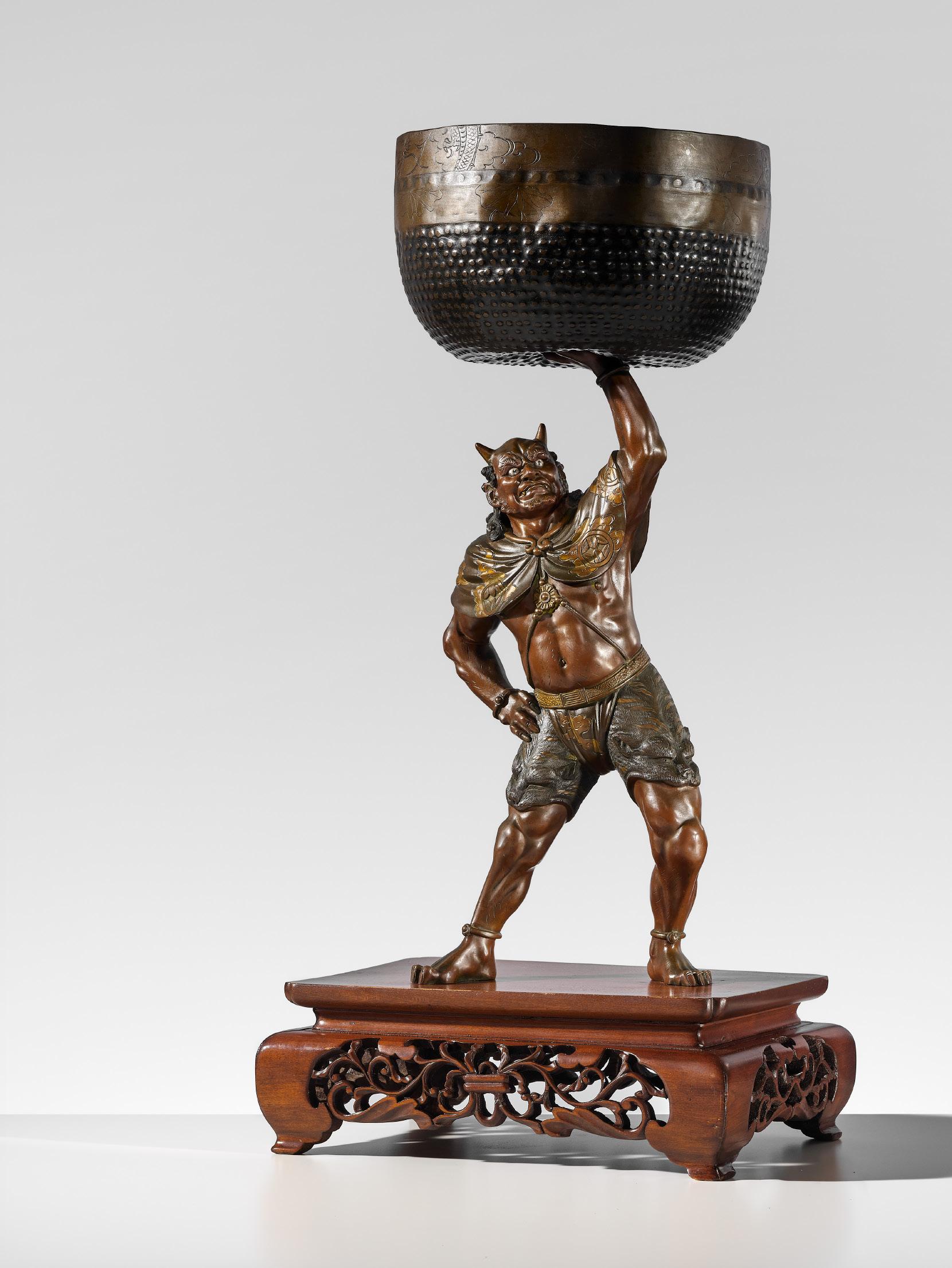
The powerful demon stands atop a wood stand, intricately carved in openwork. One hand rests confidently on the hip, while the other is raised to hold a mounted bowl decorated with incised dragons and lotus leaves. The oni’s face, with large bulging eyes and prominent horns, is framed by long, curly tresses. Its muscular body is draped with a tiger-skin loincloth and scarves over the shoulders, adorned with ornate bracelets and anklets. The eyes are inlaid in silver with shakudo pupils. Signed to one leg within a gilt cartouche GYOKKO.
HEIGHT 60 cm
WEIGHT 7.3 kg
Provenance: Ex-Collection of Sally K. Herbert, Florissant, United States. A copy of a valuation from Metropolitan Home, New York, dated 15 April 1991, stating a mid-valuation price of USD 4,000 (or approx. EUR 8,500 converted and adjusted for inflation at the time of writing), accompanies this lot.
Condition: Excellent condition with minor wear and typical casting irregularities. Few dents to the sound bowl.
Akasofu Gyokko (dates unknown) lived in Tokyo, his factory producing cast metalwork for export. His given name was Sotojiro and he is recorded as a member of the Tokyo Chukinkai (Tokyo Cast Metalworkers’ Association) in the second half of the Meiji era.
AUCTION COMPARISON
Compare a closely related figure of an oni holding aloft a sound bowl, described as “Miyao style”, 48.2 cm tall, at Bonhams, Fine Japanese Art, 5 November 2009, London, lot 269 (sold for GBP 7,200 or EUR 13,000 converted and adjusted for inflation at the time of writing).
Estimate EUR 4,000
Starting price EUR 2,000
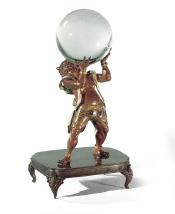
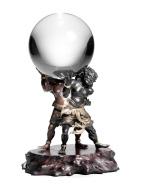
AN IMPRESSIVE AND RARE PARCEL-GILT BRONZE OF THREE ONI HOLDING A CRYSTAL BALL
Japan, Meiji period (1868-1912)
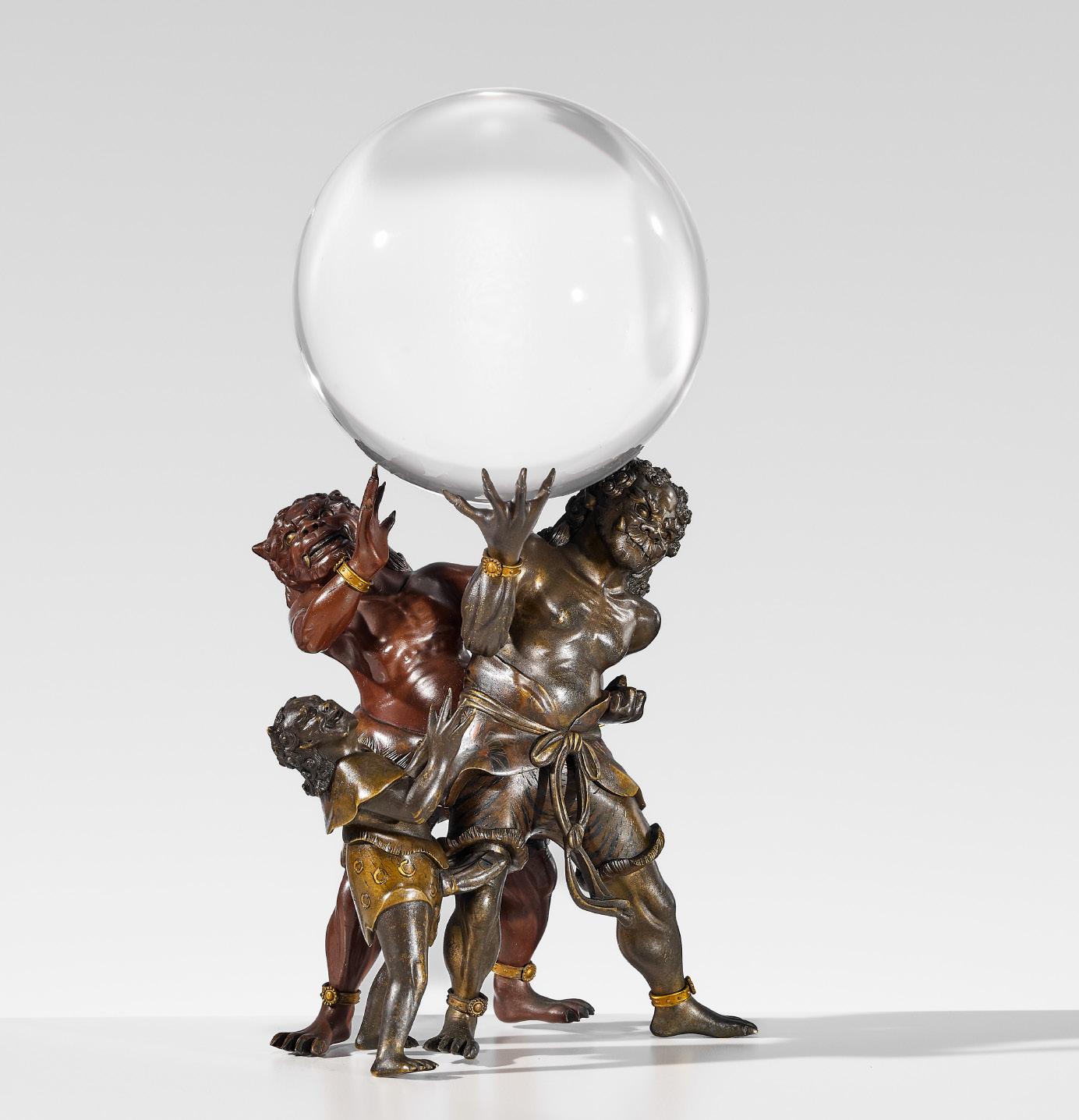
This impressive bronze sculpture depicts three oni (mythical demons) in parcel-gilt bronze, together holding a large crystal ball.
The two larger oni are adorned with gilt bracelets on their arms and legs, while the smaller oni features gilt detailing on its loincloth. The inclusion of three oni, instead of the typical one or two, makes this piece particularly rare.
HEIGHT 13 cm (excl. crystal ball), 21.3 cm (incl. crystal ball)
WEIGHT 769 g (excl. crystal ball), 1,822 g (incl. crystal ball)
Condition: Excellent condition with minor wear and few typical casting irregularities.
LITERATURE COMPARISON
Compare a closely related bronze okimono of a single oni holding a crystal ball by Sano Takachika, illustrated in The Nasser D. Khalili Collection of Japanese Art - Treasures of Imperial Japan, Metalwork Part II, 1995, no. 123.
AUCTION COMPARISON
Compare a closely related bronze okimono of two oni holding a crystal ball, attributed to Sano Takachika, 21.7 cm high, at Zacke, Fine Japanese Art, 2 December 2022, Vienna, lot 56 (sold for EUR 6,500).
Estimate EUR 6,000
Starting price EUR 3,000
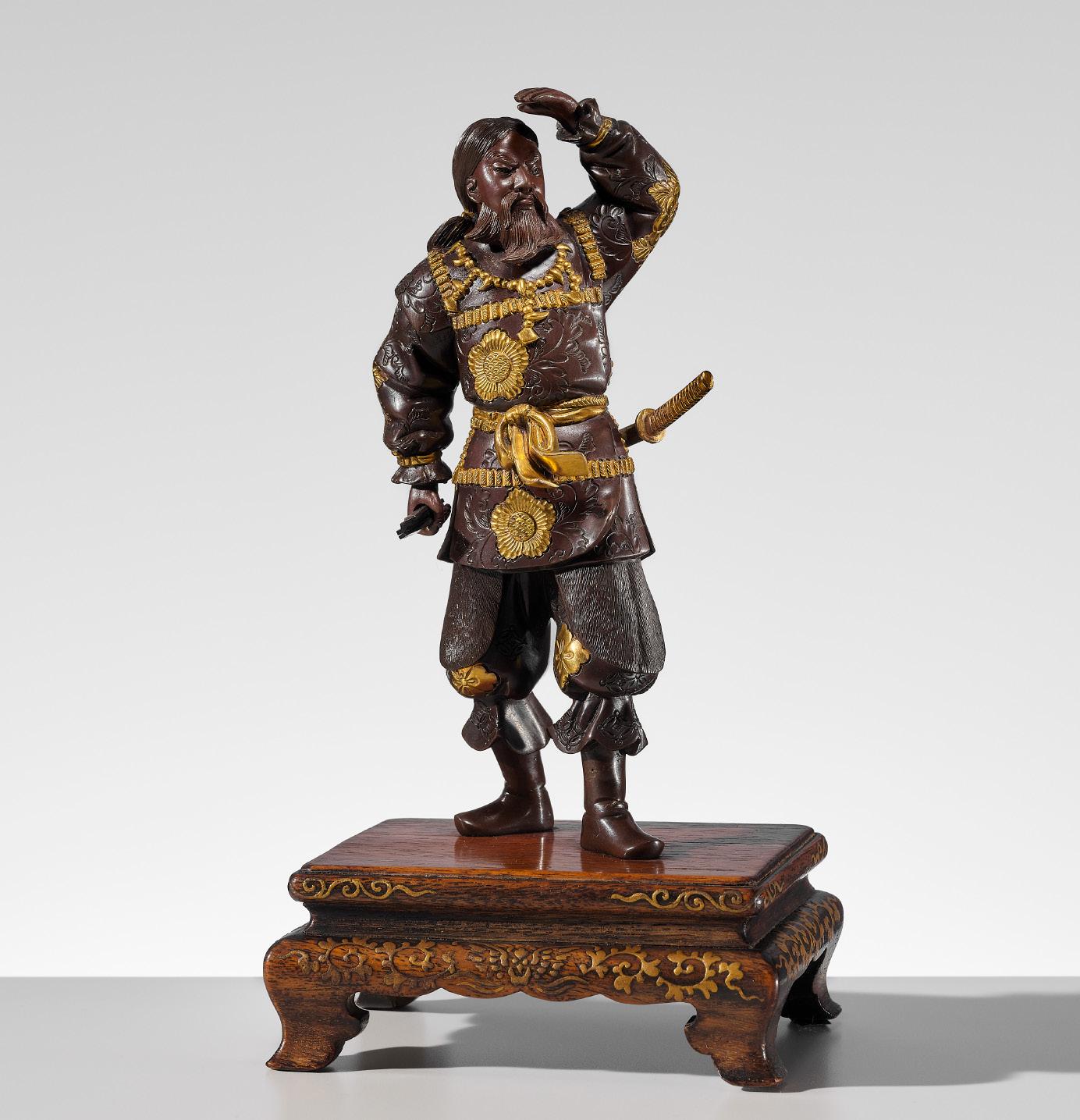
Provenance: From the private collection of Lucille Coleman, New York, United States, thence by descent.
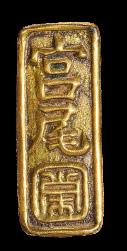
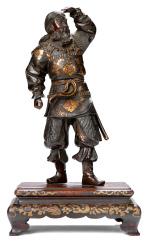
By the Miyao company of Yokohama, signed Miyao sei Japan, Meiji period (1868-1912)
Finely cast, the figure standing firmly atop a wood pedestal, crafted as a traditional low table and adorned with intricate, gold-lacquered karakusa motifs, with his left hand raised to shield his eyes from the sun and gaze into the distance, while his right hand clasps a bundle of sticks. The warrior is richly clad in martial attire, lavishly decorated with gold floral motifs and accretions, further incised with delicate foliate designs. His face, with a resolute expression, framed by a luxuriant, windblown beard and hair meticulously arranged in two braids that fall over his shoulders. Signed to the back within a gilt rectangular reserve MIYAO sei [made by Miyao].
HEIGHT 20.3 cm
WIDTH of stand 10.8 cm
WEIGHT 672 g
Condition: Very good condition with minor wear and casting-inherent irregularities. The wood stand with expected natural age cracks.

Compare a closely related patinated parcel-gilt bronze figure of a samurai warrior looking into the distance, signed Miyao, 20 cm high, at Bonhams, Asian Art, European Ceramics, and Glass, Edinburgh, 7 December 2006, lot 1137 (sold for GBP 2,820 or approx. EUR 5,600 converted and adjusted for inflation at the time of writing).
Estimate EUR 5,000
Starting price EUR 2,400
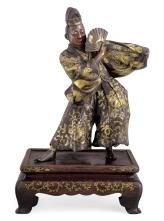
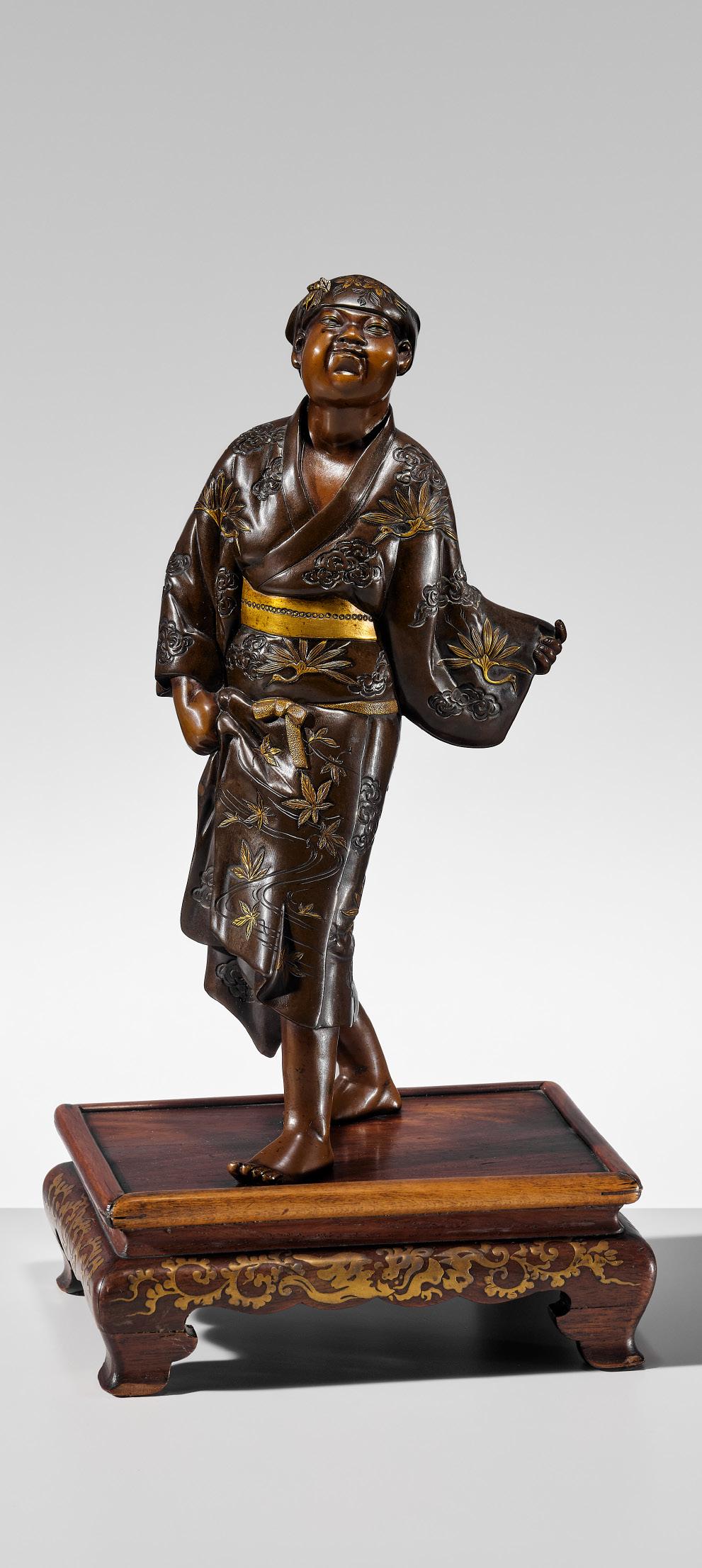
By the Miyao company of Yokohama, signed Miyao zo Japan, Meiji period (1868-1912)
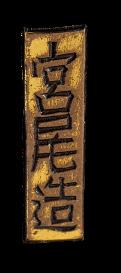
Skillfully rendered, the young dancer is depicted in a dynamic pose, standing atop a rectangular wooden base adorned with gold lacquer scroll motifs. The figure stands in a poised stance, one foot placed in front of the other, leaning back and gazing upward. One hand holds the flowing kimono, while the other is slightly bent. The attire is intricately incised with cloud and river motifs, and parcel-gilt with cranes and maple leaves. Signed in a rectangular reserve MIYAO zo [made by Miyao].
HEIGHT 30 cm
WIDTH of stand 16 cm
WEIGHT 2.3 kg
Provenance: Ex-Collection of Gustav von Bauditz and his wife, gifted to them at their wedding by her father, Consul Meyer, acquired in Paris in 1903. Condition: Very good condition with minor wear and casting-inherent irregularities. The wood stand with expected natural age cracks and repairs to the feet.
Founded by Miyao Eisuke, the Miyao Company of Yokohama specialized in the manufacture of bronze sculptures, embellished with gold and silver as well as patinated copper alloys, that represent generic samurai warriors as well as more precisely identifiable characters from Japanese myth and legend. In addition, the company also made a smaller number of pieces in other formats such as incense-burners, vases, and chargers.
Compare a related parcel-gilt bronze figure of a dancer with fan and a similar stand by the same workshop, signed Miyao, 33 cm high, at Christie’s, Japanese and Korean Art, 18 March 2014, New York, lot 510 (sold for USD 15,000 or approx. EUR 18,000 converted and adjusted for inflation at the time of writing).
Estimate EUR 6,000
Starting price EUR 3,000
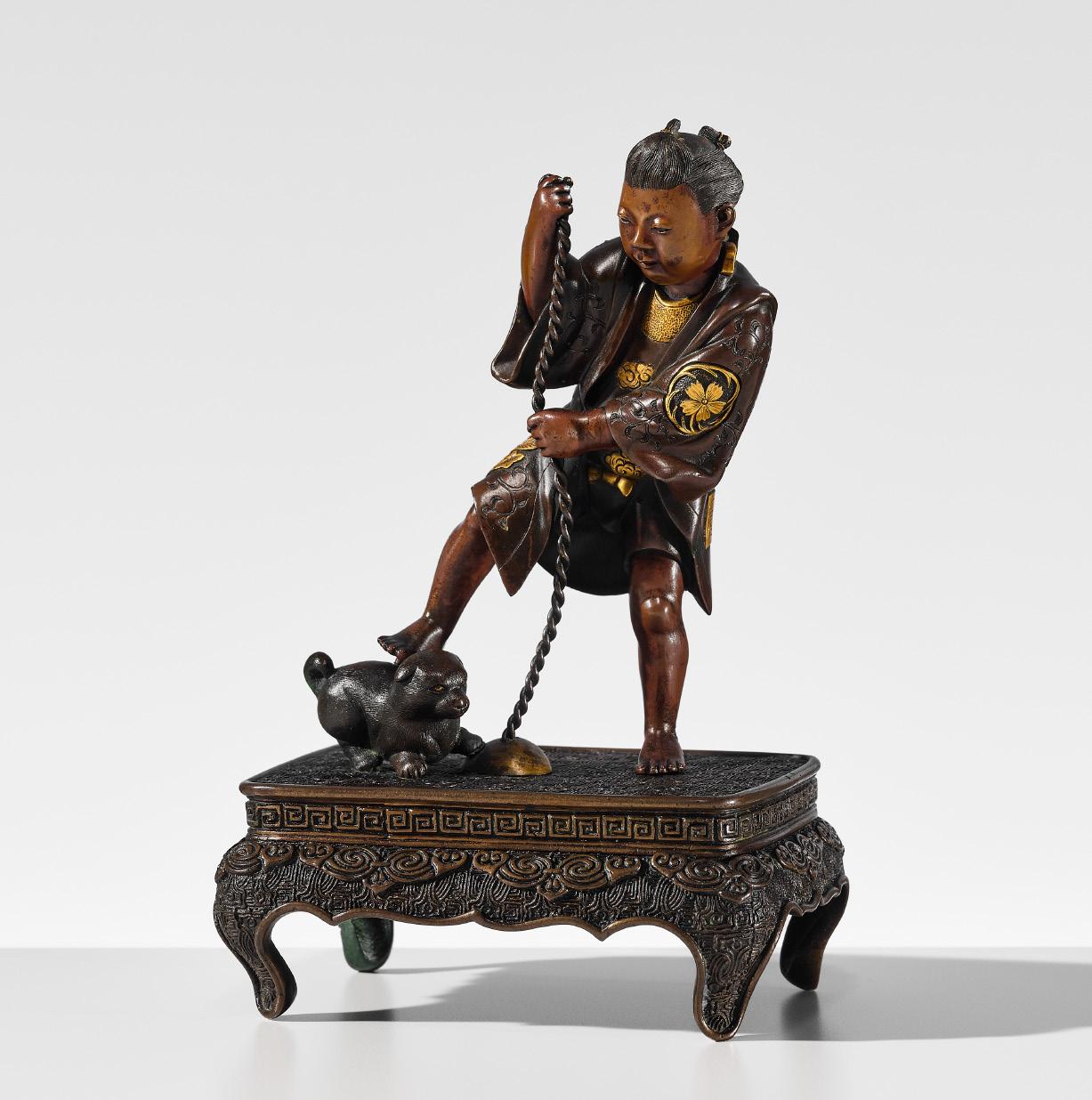
A FINE PARCEL-GILT BRONZE OKIMONO OF A BOY WITH A DOG
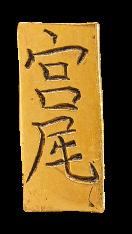
By the Miyao company of Yokohama, signed Miyao Japan, Meiji period (1868-1912)
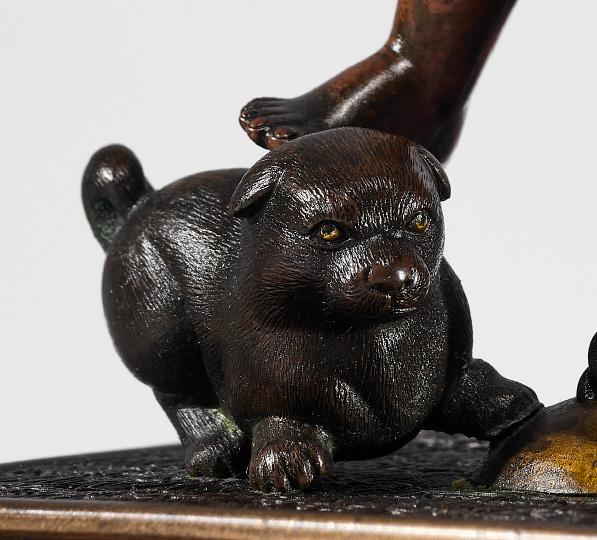
Finely modeled, the young boy stands in a dynamic pose on his left leg atop a separately cast pedestal shaped as a traditional low table, adorned with intricate, densely worked relief designs. He slightly raises his right leg to rest upon a small puppy, while grasping a long braided rope, one end of which is tied to a clam shell. The boy is attired in meticulously incised robes, decorated with gilt family crests and karakusa motifs. Signed on the lower part of his robes within a gilt cartouche MIYAO.
HEIGHT 17.1 cm
WIDTH of stand 11.3 cm
WEIGHT 845 g
Condition: Very good condition with minor surface wear and inherent casting irregularities. One of the screws securing the figure to the pedestal is lost.
AUCTION COMPARISON
Compare a related parcel-gilt bronze depicting Momotaro with a dog, signed Miyao, 23.5 cm high, at Christie’s, Asian Art, London, 28 October 2004, lot 69 (sold for GBP 3,107 or approx. EUR 6,500 converted and adjusted for inflation at the time of writing).
Estimate EUR 3,000
Starting price EUR 1,500
12
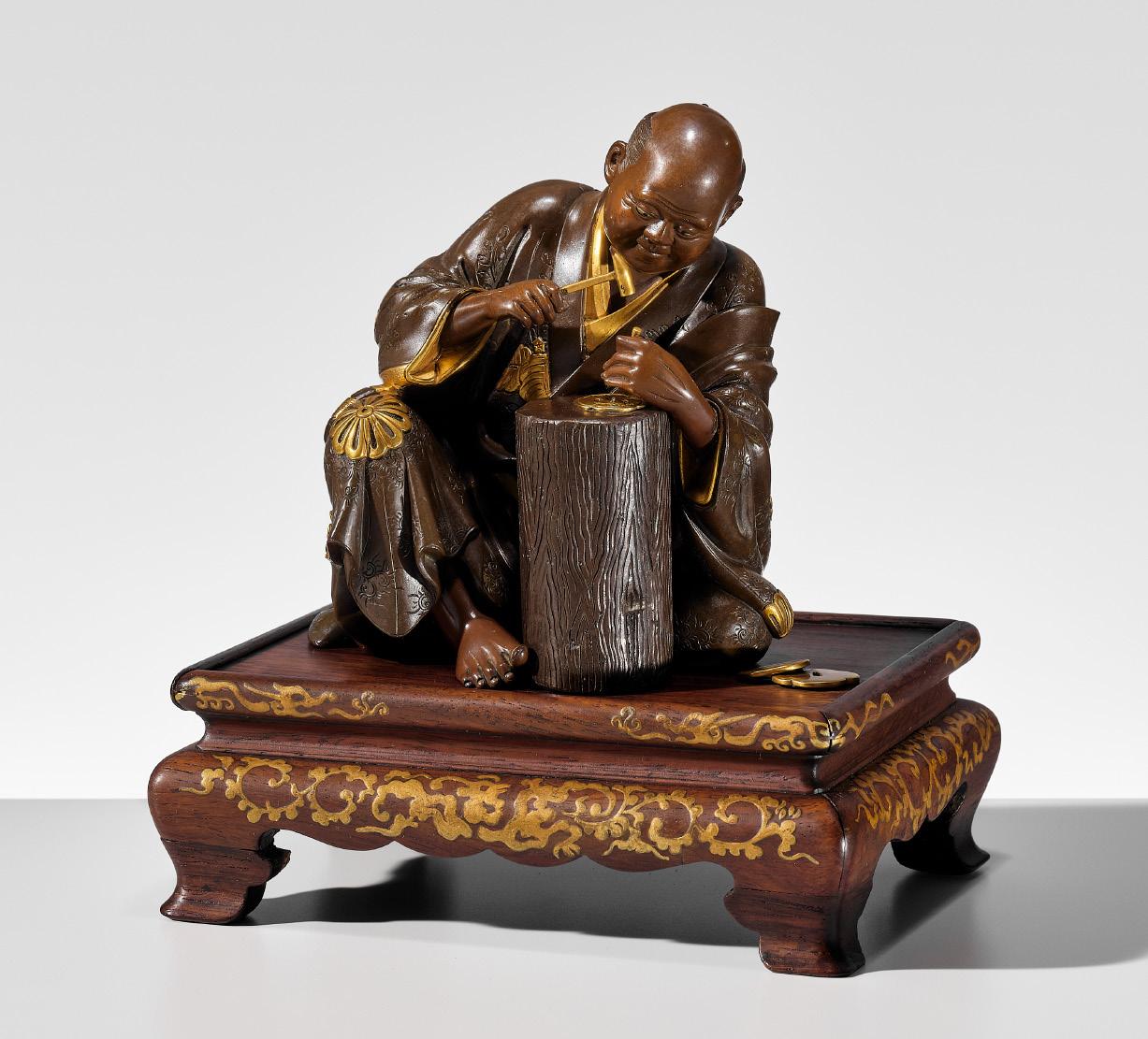
By the Miyao company of Yokohama, signed Miyao ko Japan, Meiji period (1868-1912)
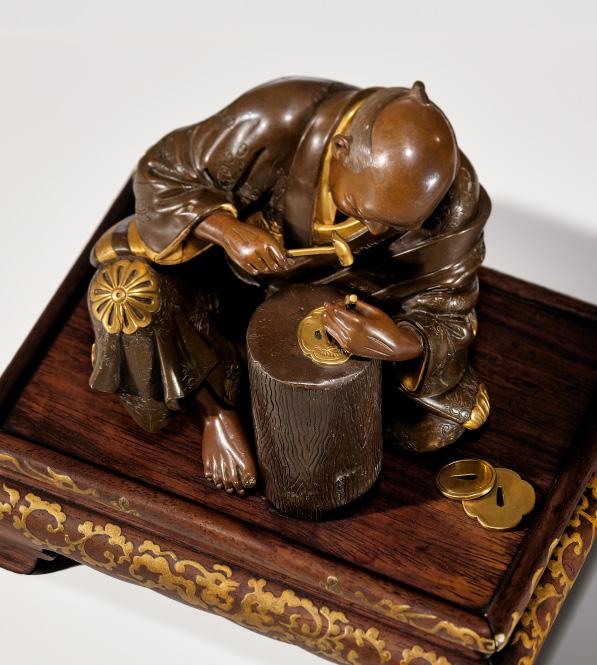
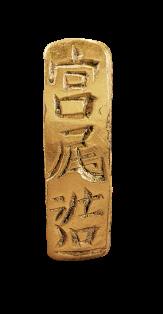
Finely cast, the elderly master is depicted seated beside a tree stump atop a separately crafted wooden pedestal, shaped as a traditional low table adorned with intricately worked gold-lacquered karakusa. The craftsman is shown carefully decorating a mokkogatta tsuba using a small hammer and chisel, while two additional tsuba await further embellishment at his feet. The master’s robes are decorated with gilt paulownia and chrysanthemum family crests, with intricately incised scrolling tendrils adding to the fine detail of his attire. Signed on the reverse within a gilt cartouche MIYAO ko.
HEIGHT 17.7 cm
WIDTH of stand 16 cm
WEIGHT 2 kg
Condition: Very good condition with minor surface wear and inherent casting irregularities. The wood stand with natural age cracks, expected flaking to lacquer, and few minute losses. Losses to the screws securing the figure to the pedestal.
AUCTION COMPARISON
Compare a related bronze okimono of a tsuba maker, though lacking the parcel-gilt details and refinement of the present piece, signed Miyao, 19 cm high, at Christie’s, Japanese Art and Design Including Lacquer and Works of Art, London, 12 November 2003, lot 216 (sold for GBP 3,704 or approx. EUR 7,800 converted and adjusted for inflation at the time of writing).
Estimate EUR 8,000
Starting price EUR 4,000
13
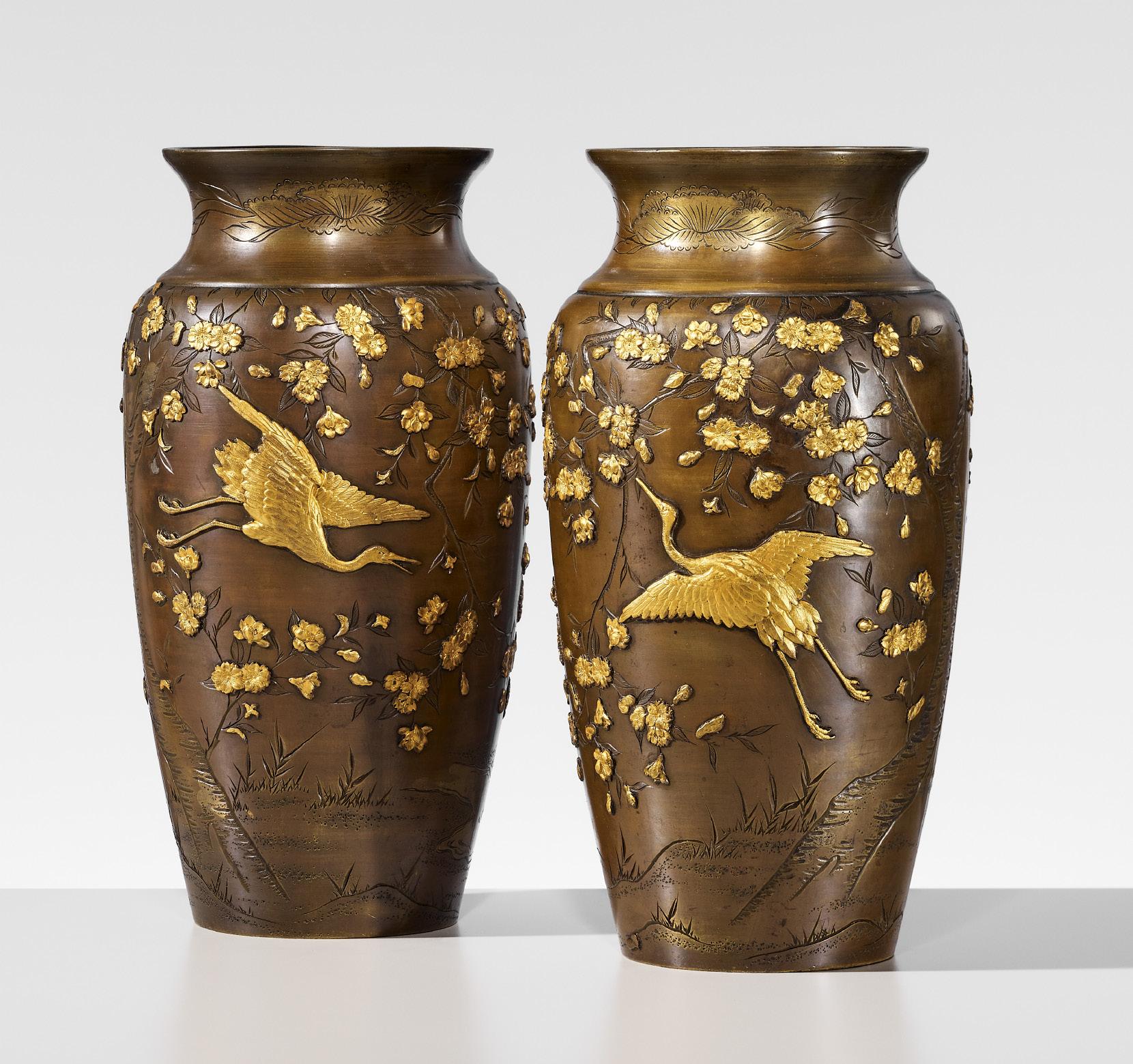
A FINE PAIR OF GOLD-INLAID BRONZE ‘CRANES AMONG CHERRY BLOSSOMS’ VASES
Japan, Meiji period (1868-1912)
Each vase is of ovoid form with short, everted necks, finely cast with exceptional detail. The bodies are decorated in gold takazogan, featuring a continuous design of cranes in flight among blossoming cherry trees. The delicate cherry blossoms and leaves are finely worked in kebori and katakiribori techniques, with the plumage of the cranes meticulously incised and their feet carefully textured. The necks are adorned with a band of leafy lotus blossoms.
HEIGHT 30.5 cm (each)
WEIGHT 2.1 kg and 2.4 kg
Condition: Very good condition with minor wear and casting irregularities including tiny nicks along the rim and rubbing to gilt.
AUCTION COMPARISON
Compare a related inlaid bronze vase with birds among a cherry tree, 28 cm high, at Christie’s, Art of Japan, 5 December 2019, London, lot 93 (sold for GBP 4,375 or approx. EUR 6,500 converted and adjusted for inflation at the time of writing).
Estimate EUR 3,000
Starting price EUR 1,500
14
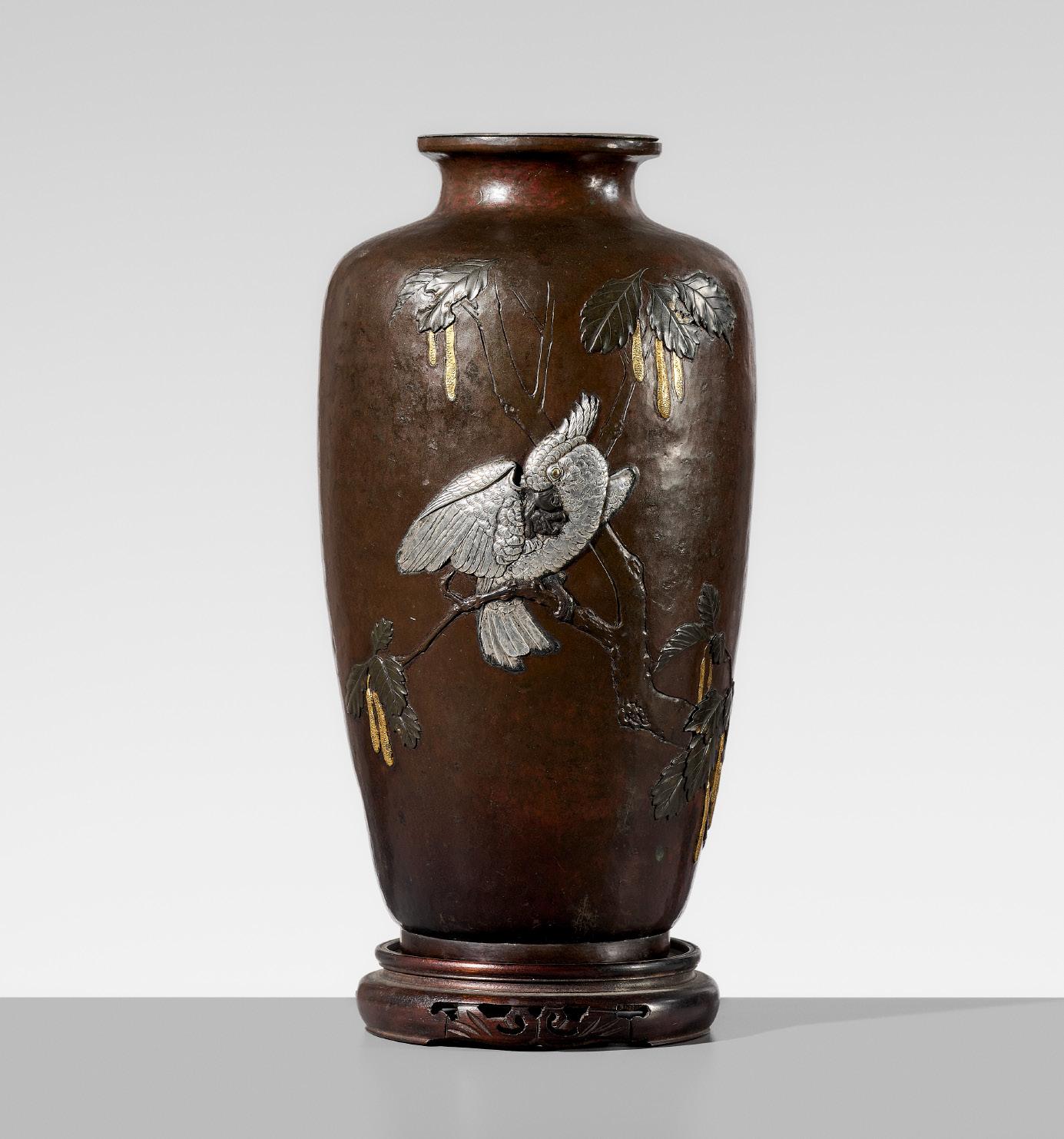
ROKKO: A SUPERB SILVER-INLAID BRONZE ‘COCKATOO’ VASE
By Rokko, sealed Rokko Japan, Meiji period (1868-1912)
Of ovoid shape, gently tapering toward the short foot and surmounted by a waisted neck with an everted rim, the body finely decorated with gold, silver, and shibuichi takazogan and incision work. A cockatoo is perched on a hannoki (alder) tree branch, gently scratching its body. The body of the bird is crafted in silver, with the legs and beak in shibuichi. The lively eye of the cockatoo is highlighted with a gilt ring. The surface is finely hammered, and a silver and copper insert is included for holding flowers. The base is sealed with the artist’s mark ROKKO.
HEIGHT (without base) 27.5 cm
WEIGHT 1.4 kg
Condition: Excellent condition with minor surface wear, casting irregularites, and few light scratches to the base.
With a wood base for presentation.
AUCTION COMPARISON
Compare a closely related vase of near-identical design, 21.6 cm high, at Cottone Auctions, 25 September 2015, New York, lot 217 (sold for USD 7,360 or approx. EUR 8,700 converted and adjusted for inflation at the time of writing).
Estimate EUR 4,000
Starting price EUR 2,000
15
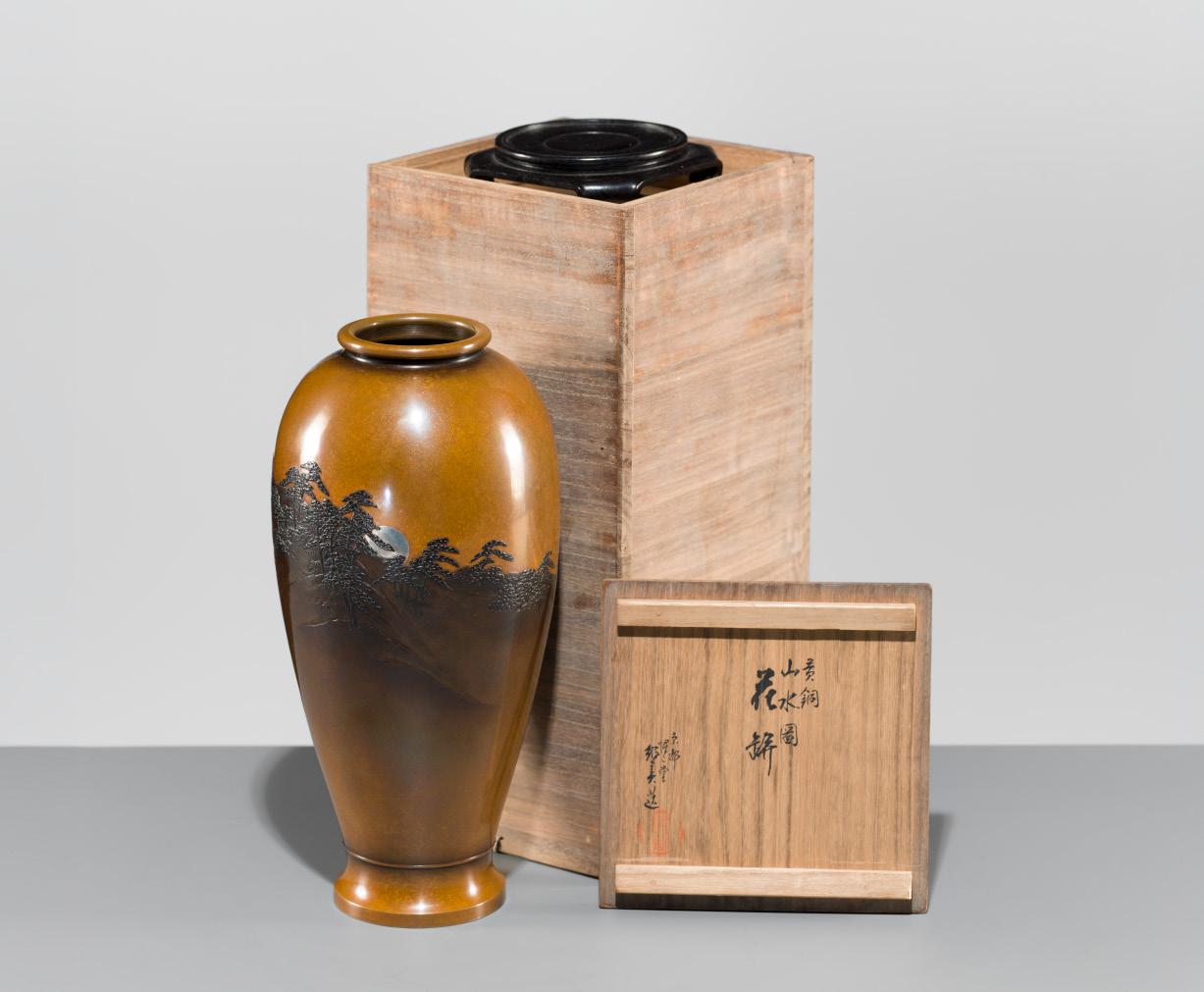
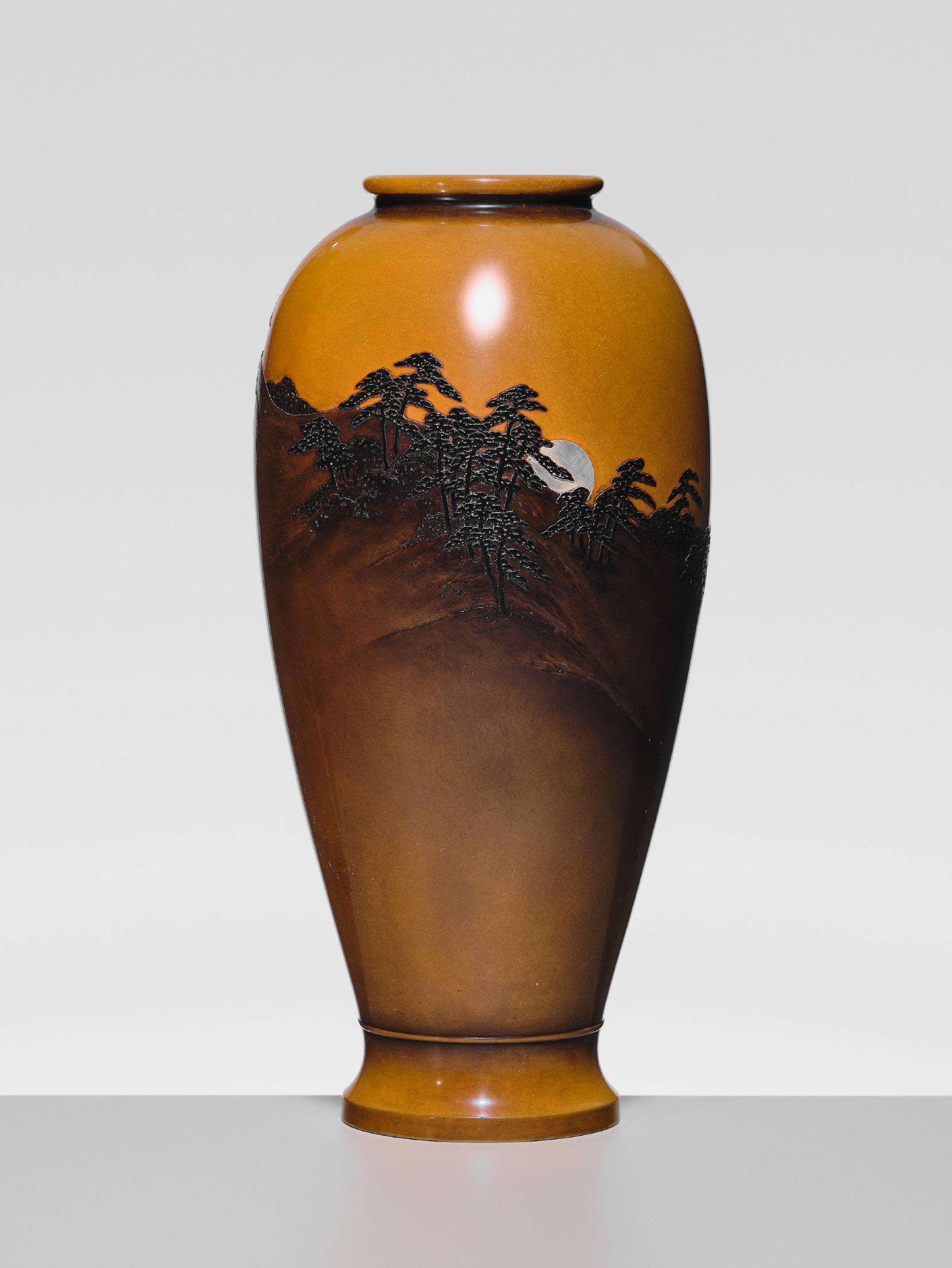
JOMI EISUKE II: A SUPERB INLAID BRONZE ‘FULL MOON RISING ABOVE A PINE GROVE’ VASE
By Jomi
Eisuke II (1839-1899), sealed Jomi Japan, late 19th century, Meiji period (1868-1912)
Of tall baluster form, finely cast, the body is intricately decorated in takazogan with a continuous design of pines on the slope of a hill, their dark forms rendered in shakudo inlays. The full moon, inlaid in silver, rises from behind the trees, casting a soft, ethereal shadow over the pine grove, enhancing the drama of the scene. The hills below the pines are rendered with a mist-like texture, their surface expertly wrought to suggest the fading light of the setting sun. The deep-red bronze of the vase beautifully mirrors the warm, muted tones of the evening, evoking a serene and contemplative atmosphere. This piece is a masterpiece of both material mastery and observational artistry, capturing the delicate interplay of light and shadow in nature. The base bears the seal mark JOMI.
HEIGHT (without stand) 26.5 cm
WEIGHT (without stand) 1.7 kg
Provenance: From a Japanese private collection. The vase is accompanied by an original leaflet describing the artist, including reference to Imperial patronage and recognition of their work. Condition: Excellent condition with only very minor typical wear. With a fine wood presentation stand.
With a wood tomobako enclosing a space for the wood stand and with a hakogaki inscription: 黄銅山水図花瓶、京都、惺々堂、紹 美造。with the seal 惺々堂 [bronze flower vase with a landscape design, made in Kyoto by Seiseido (Jomi)]
Jomi Eisuke II (1839-1899), also known as Jomi Einosuke, was a prominent figure in the world of Japanese metalwork. He studied under Kanaya Gorosaburo and exhibited extensively at national and international expositions, including the second, third, and fourth Domestic Industrial Expositions (1881, 1890, and 1895). His works garnered numerous accolades at world’s fairs, such as in Philadelphia (1876), Paris (1878, 1889, 1900), Chicago (1893), St. Louis (1904), and the Japan-British Exhibition in London (1910). His innovative techniques and distinctive artistic vision solidified his place as one of the foremost metalworkers of his time.
AUCTION COMPARISON
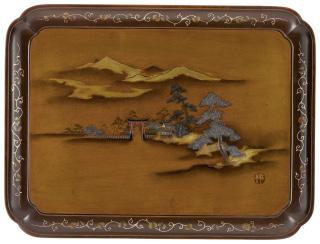
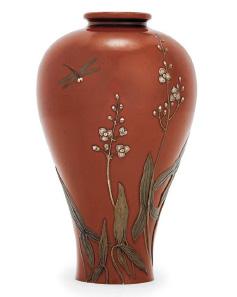
Compare a closely related bronze tray with a similar design of pines, by Jomi Eisuke II, 23.5 cm wide, at Bonhams, Fine Japanese Works of Art, 19 March 2024, New York, lot 3177 (sold for USD 5,000 or approx. EUR 4,500 converted and adjusted for inflation at the time of writing). Compare a related vase, by Jomi Eisuke II, also sealed Jomi to the base, 16 cm high, at Christie’s, Masterful Exuberance, Artistic Craftsmanship of Imperial Japan: The Property of a Lady, London, 18 May 2012, London, lot 11 (sold for GBP 6,875 or approx. EUR 11,600 converted and adjusted for inflation at the time of writing).
Estimate EUR 8,000
Starting price EUR 4,000
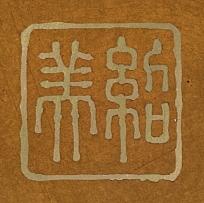
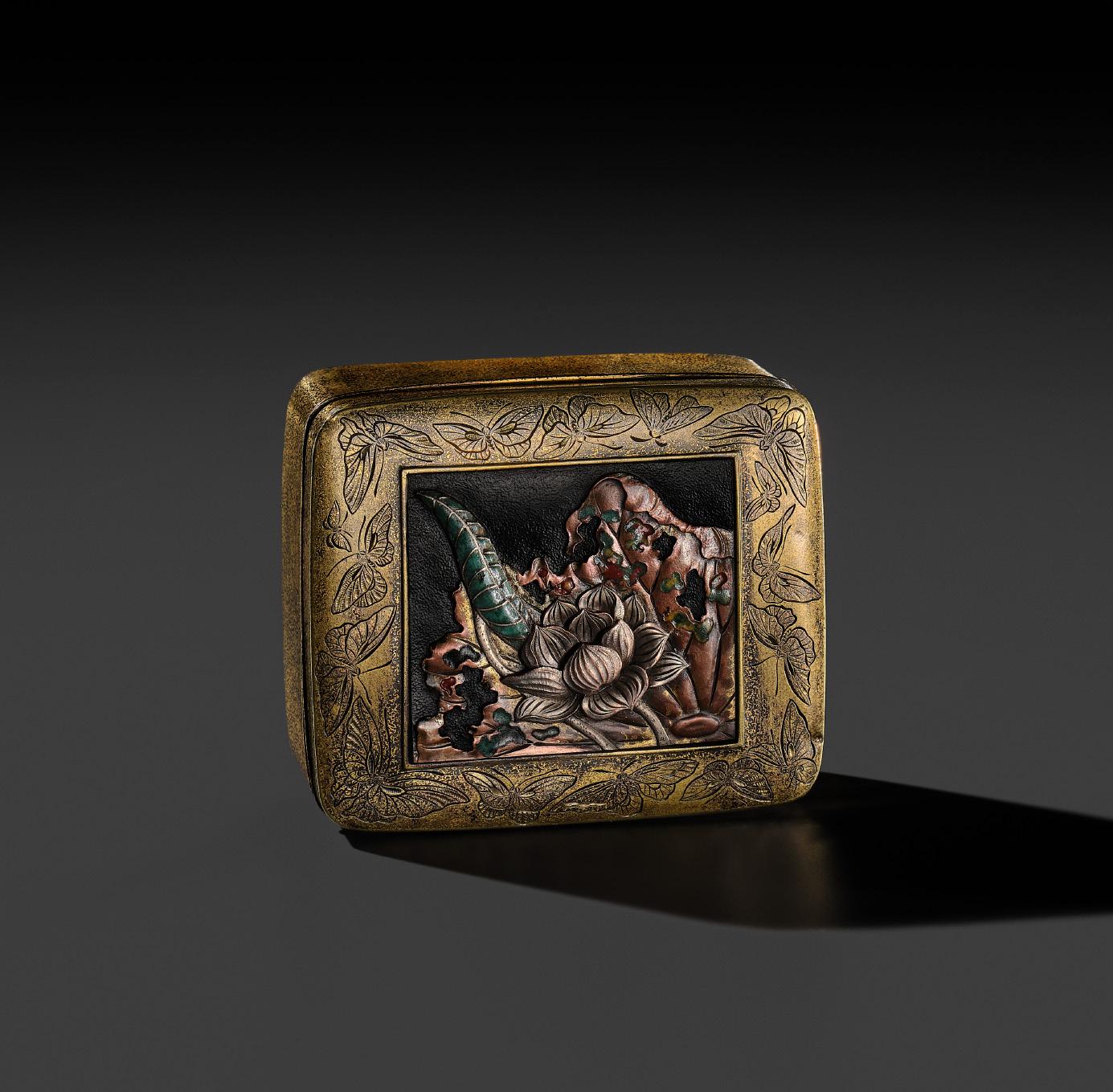
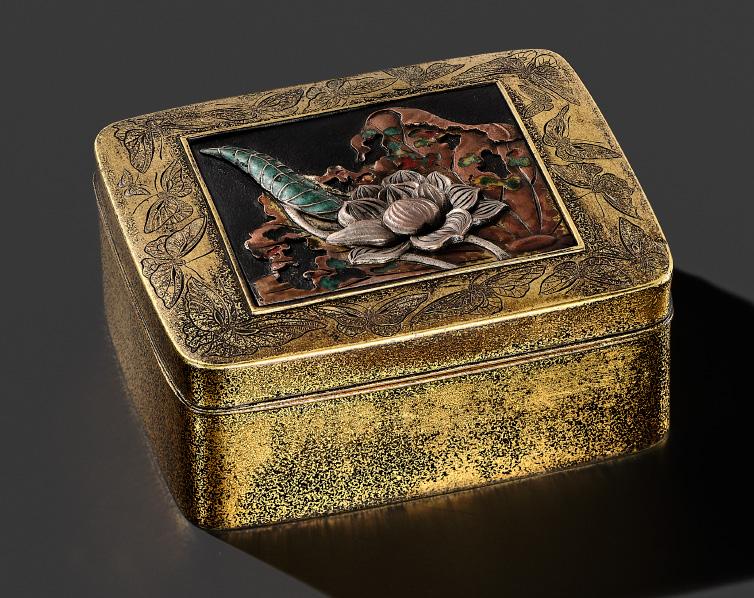
SHINBO: A FINE MIXED METAL AND ENAMEL INLAID GILT BRONZE ‘LOTUS’ BOX AND COVER
By Shinbo, sealed Shinbo Japan, Meiji
period (1868-1912)
Of rectangular form, the inrobuta (flush-fitting) lid elaborately decorated in iro-e takazogan within a square panel depicting a silver lotus blossom in relief, the leaves and details highlighted in finely applied, vibrant enamels. The central panel is framed by a band incised in kebori and katakiribori with butterflies, while the sides are elegantly sprinkled with gilt. Sealed to the underside within a square cartouche SHINBO.
SIZE 3.4 x 7 x 8.3 cm
WEIGHT 236 g
Provenance: From the Alan Bostock collection of Japanese metalwork and cloisonné, assembled over the last 40 years.
Condition: Very good condition with minor expected wear.
Estimate EUR 4,000
Starting price EUR 2,000
17
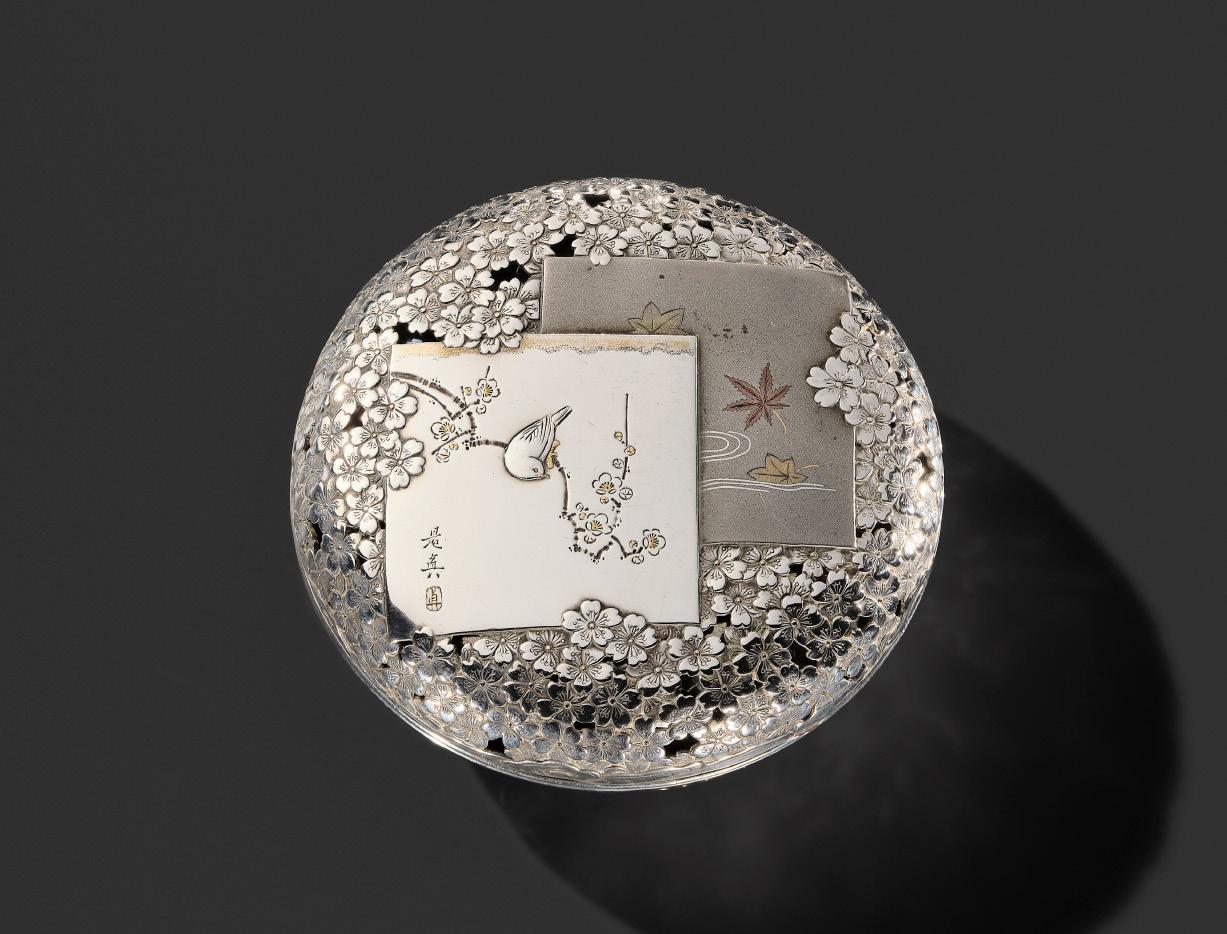
MASAYUKI: A FINE SILVER ‘POEM PAPERS BY ZESHIN’ KOGO (INCENSE BOX)
By Masayuki after a design by Shibata Zeshin, sealed Masayuki koku Japan, Meiji period (1868-1912)
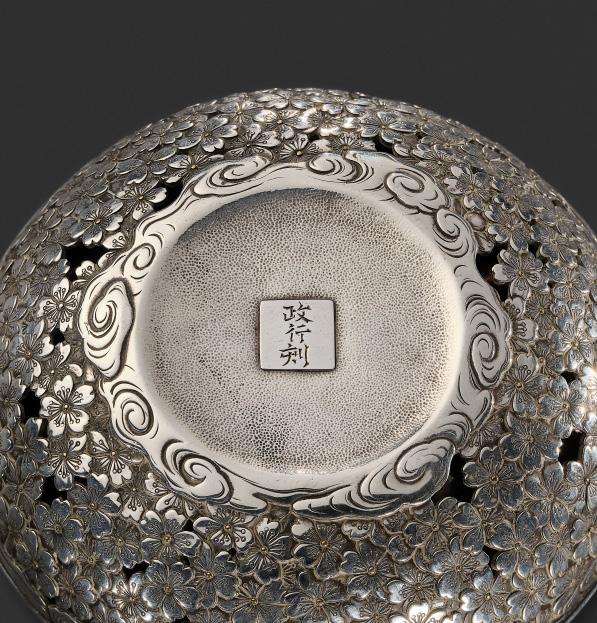
Of circular form and fitted with an internal tray, the silver body finely chiseled in openwork. The inrobuta (flush-fitting) lid is decorated with two shikishi (poem papers): one delicately incised with a small bird perched on a plum branch and bearing the signature and seal of Zeshin; the other depicting maple leaves in shibuichi and gold drifting into the Tatsuta river. The composition is framed by scattered cherry blossoms, details inlaid in gold, while the rims are encircled by a continuous scroll band. The underside is neatly punched and bears the signature within a square cartouche MASAYUKI koku [carved by Masayuki].
DIAMETER 7.8 cm
WEIGHT 130 g
Provenance: UK private collection, offered at Lyon & Turnbull, Fine Asian Works of Art, 16 May 2025, London, lot 389 (mid-estimated at GBP 6,000 or approx. EUR 7,000 converted and adjusted for inflation at the time of writing).
Condition: Very good condition with minor wear and light traces of use including tiny dent and light surface scratches.
AUCTION COMPARISON
Compare a closely related silver kogo (incense box) with poem papers by the same artist, also signed Masayuki koku, 9.5 cm in diameter, at Bonhams, Fine Japanese and Korean Art, 17 March 2021, New York, lot 609 (sold for USD 10,837 or approx. EUR 11,500 converted and adjusted for inflation at the time of writing).
Estimate EUR 5,000
Starting price EUR 2,400
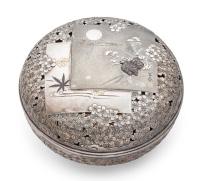
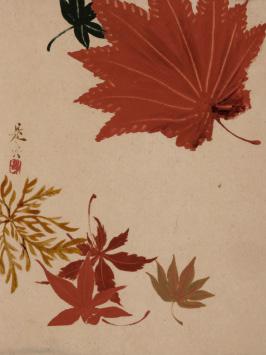
The signature Zeshin with seal Shin, appearing on one of the shikishi depicted on the cover, indicates that the design derives from a work by the celebrated lacquerer and painter Shibata Zeshin (1807–1891), whose compositions were widely admired and frequently adapted across media.
Maple leaves by Shibata Zeshin (1807-1891), British Museum, object number 36.100.134
18
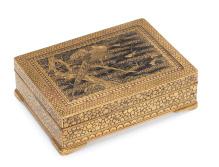
KOMAI: A SUPERB GOLD-DAMASCENED IRON ‘PEACOCK AND PEAHEN’ BOX AND COVER
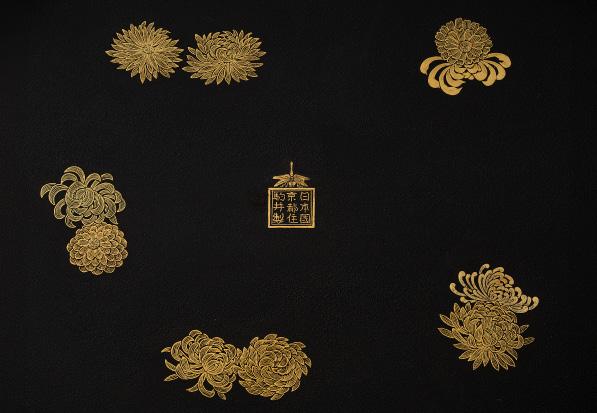
By the Komai Company, signed Nihon koku Kyoto ju Komai sei Japan, Kyoto, Meiji period (1868-1912)
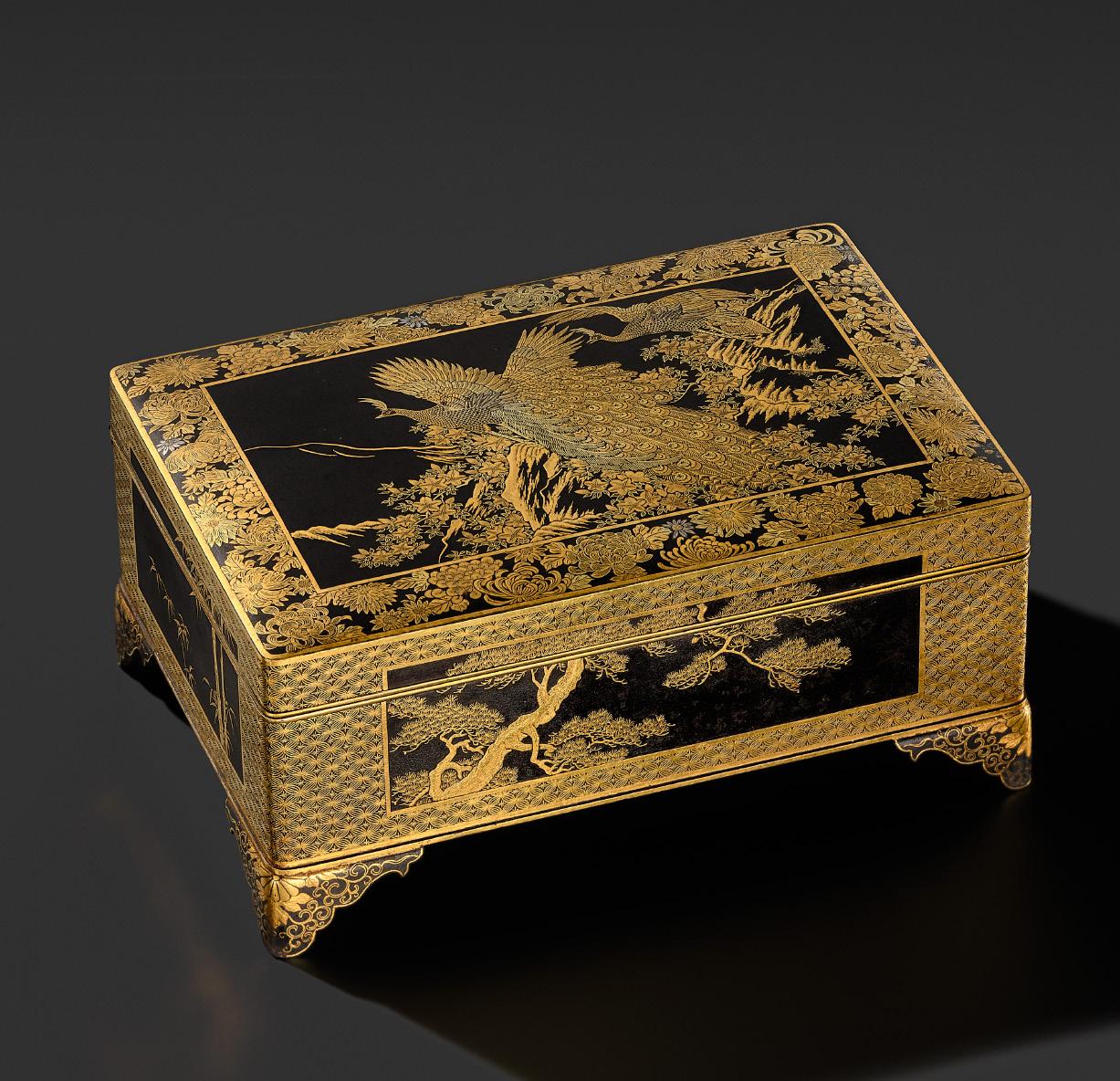
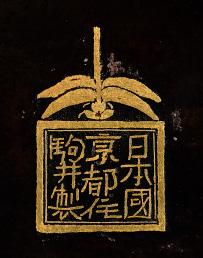
The rectangular box with a hinged cover supported on four bracket feet, the cover finely inlaid in brilliant nunome-zogan with a peacock and a peahen perched atop a blossoming paulownia (kiri) tree, surrounded by a band of chrysanthemums (kiku). The sides depict pine trees and bamboo in rectangular reserves framed by a hanabishi pattern, while the feet are adorned with chrysanthemums, leaves, and scrolls. The base bears the signature Nihon koku Kyoto ju Komai sei [by the Komai company in Kyoto, Japan] within a square reserve, along with the signature Komai dragonfly mark.
SIZE 7 x 10.4 x 15.2 cm
WEIGHT 857 g
Condition: Excellent condition with only minor wear.
Founded in 1841, the Komai workshop gained significant renown after Komai Otojiro I took over in 1865. Specializing in intricate inlaid work of gold and silver into iron, Komai became highly regarded during the Meiji period. By 1915, Komai Otojiro II, the son of Komai Otojiro I, described the company as the “pioneer of damascene work,” highlighting their signature black ground achieved through kiln firing and burnishing.
AUCTION COMPARISON
Compare a closely related golddamascened iron box depicting a pheasant, by the Komai Company, 3.8 x 12.5 x 9.5 cm, at Bonhams, Fine Japanese Art, 14 May 2015, London, lot 453 (sold for GBP 3,125 or approx. EUR 5,000 converted and adjusted for inflation at the time of writing).
Estimate EUR 5,000
Starting price EUR 2,400
19
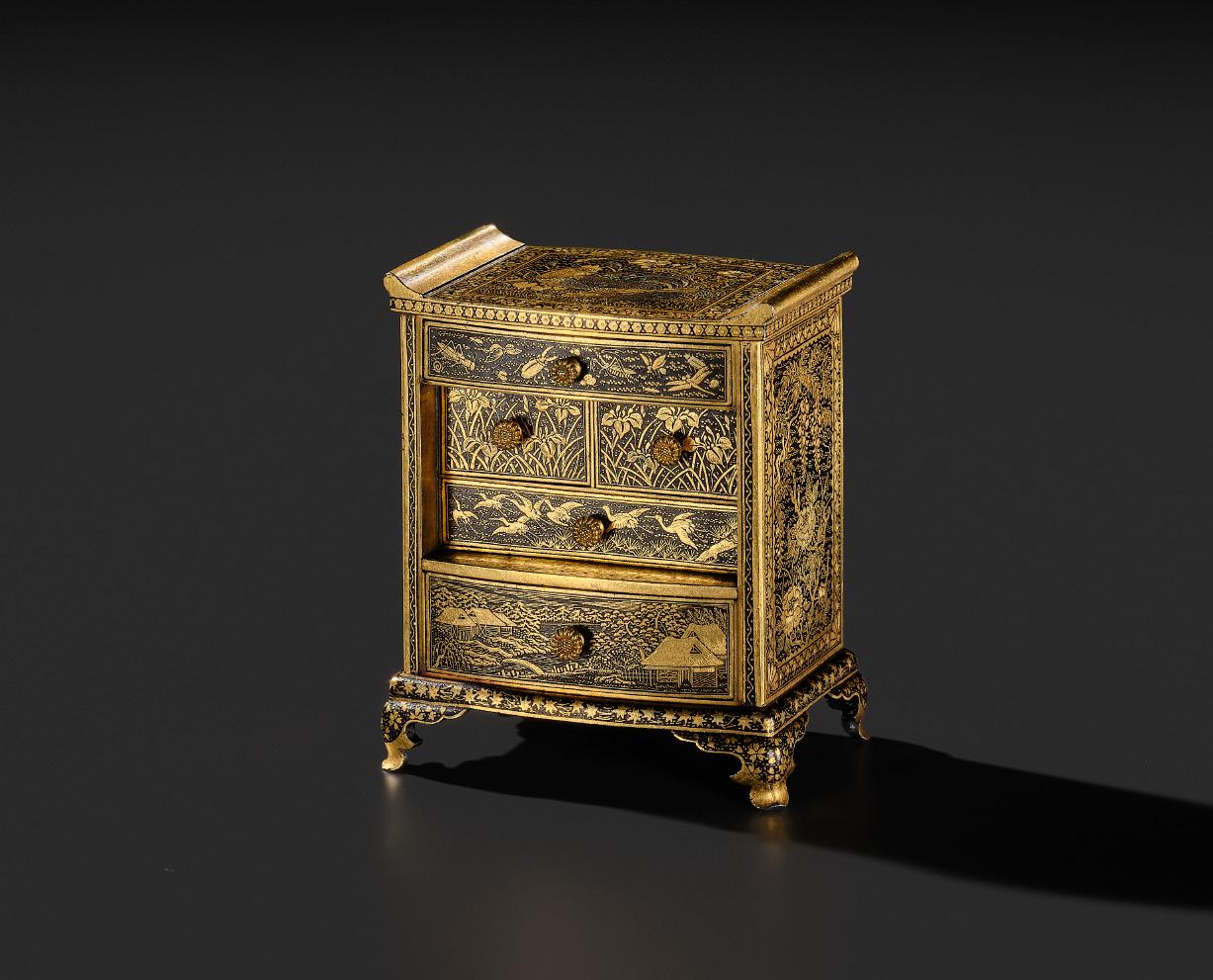
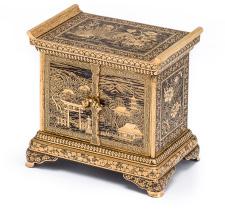
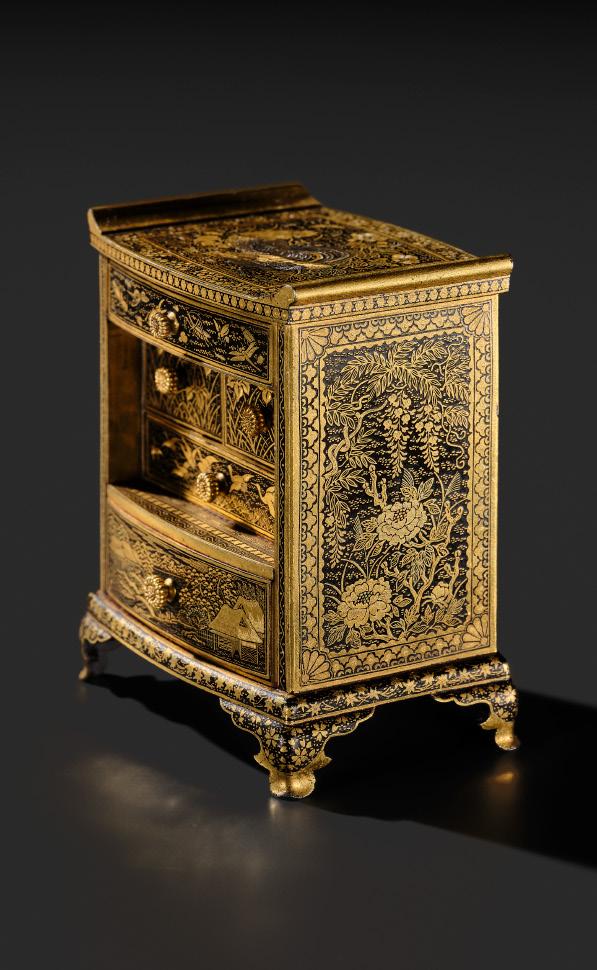
By the Komai Company, signed Nihon koku Kyoto ju Komai sei Japan, Kyoto, Meiji period (1868-1912)
Rectangular in shape and supported on four bracket feet, the table cabinet is finely inlaid in gilt nunome-zogan and hirazogan, with five drawers adorned with a variety of motifs, including insects, irises, cranes, and a riverscape featuring huts. The top features a cockerel and hen among poppy flowers and foliage, surrounded by a cherry blossom band. The sides of the cabinet display floral and bird panels, while the back showcases a landscape scene with huts, a pagoda, and a waterfall. The base is signed Nihon koku Kyoto ju Komai sei [by the Komai company in Kyoto, Japan] within a square reserve, along with the signature Komai dragonfly mark.
The top left is inscribed Kanazawa Koen (金澤公園), referring to the “Park in Kanazawa,” indicating that the design is inspired by this renowned location.
SIZE 6.3 x 7.5 x 4.2 cm
WEIGHT 343 g
Condition: Excellent condition with only minor wear.
AUCTION COMPARISON
Compare a closely related kodansu by the Komai Company, 8.3 cm high, at Bonhams, Fine Japanese Works of Art, 16 September 2014, New York, lot 2278 (sold for USD 9,375 or approx. EUR 15,000 converted and adjusted for inflation at the time of writing).
Estimate EUR 6,000
Starting price EUR 3,000
20
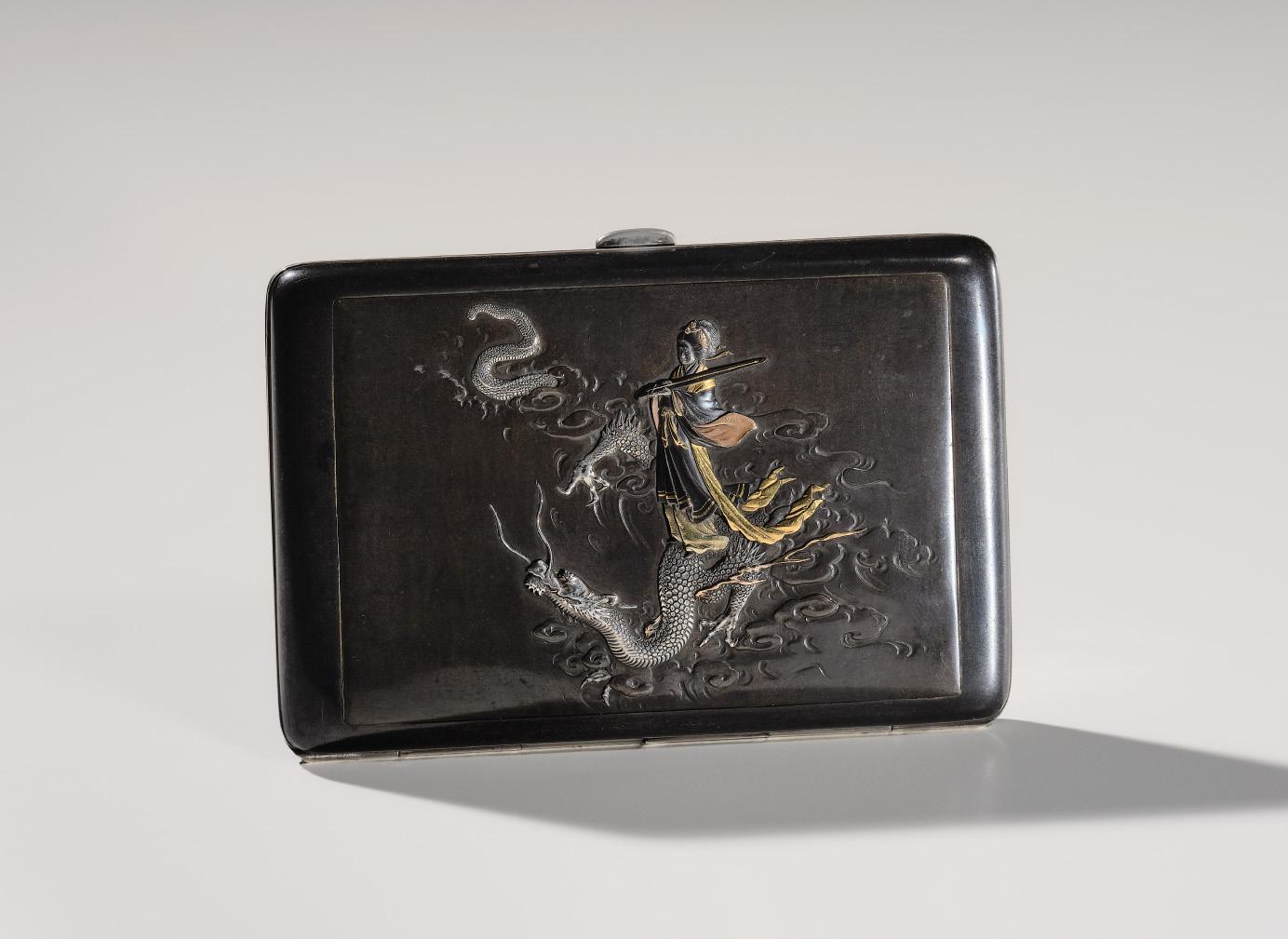
KORYU FOR THE KOMAI COMPANY: A FINE GOLD-INLAID SHIBUICHI ‘BENTEN’ CIGARETTE CASE
By Koryu for the Komai Company, signed Koryu koku no with seal Ko and sealed Nihon koku Kyoto ju Komai sei Japan, Meiji period (1868-1912)
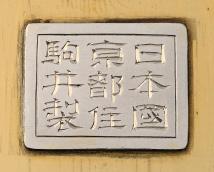
Of rectangular form, inlaid with gold, silver, and shakudo takazogan, finely decorated to depict Benten, the goddess of music and the arts, shown in dramatically flowing robes and holding an ichigenkin (one-string zither) as she rides upon the back of a dragon. The dragon, intricately detailed with sinuous coils and finely rendered scales, is executed in flowing, dynamic lines. Signed to the back KORYU koku kore [this is carved by Koryu] with a square gold seal Ko, and to the gilt interior with a raised square silver seal mark Nihon koku Kyoto ju KOMAI sei [made by Komai, Kyoto, Japan].
SIZE 1.2 x 6.7 x 10 cm
WEIGHT 159 g
Condition: Very good condition with old wear and few minor surface scratches.
AUCTION COMPARISON
Compare a related bronze box and cover, also by Koryu for the Komai company, 9.4 x 12.1 x 4.2 cm, at Bonhams, Fine Japanese and Korean Art, 12 September 2012, New York, lot 3352 (sold for USD 3,000 or approx. EUR 3,700 converted and adjusted for inflation at the time of writing).
Estimate EUR 3,000 Starting price EUR 1,500
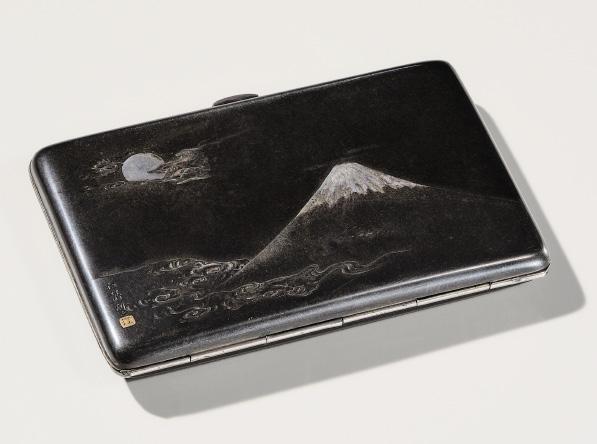
Benzaiten, often called Benten in Japan, is the syncretic Buddhist goddess of everything that flows, words, music, eloquence, wealth, and water, originating from the Hindu goddess Saraswati. She is traditionally depicted holding a biwa, a Japanese lute, symbolizing her association with music, artistic inspiration, and cultured refinement. In Japanese religious practice, Benten is frequently honored at shrines near water, such as rivers, springs, and coastal temples, reflecting her role as a protector of life’s currents and fortunes. As one of the Seven Lucky Gods (Shichifukujin), she embodies good fortune, prosperity, and the arts, making her a beloved and auspicious figure in both folk and Buddhist traditions.
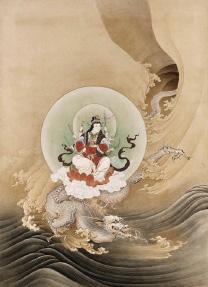
Benten and Dragon, by Hashimoto Gaho, c. 1886
21
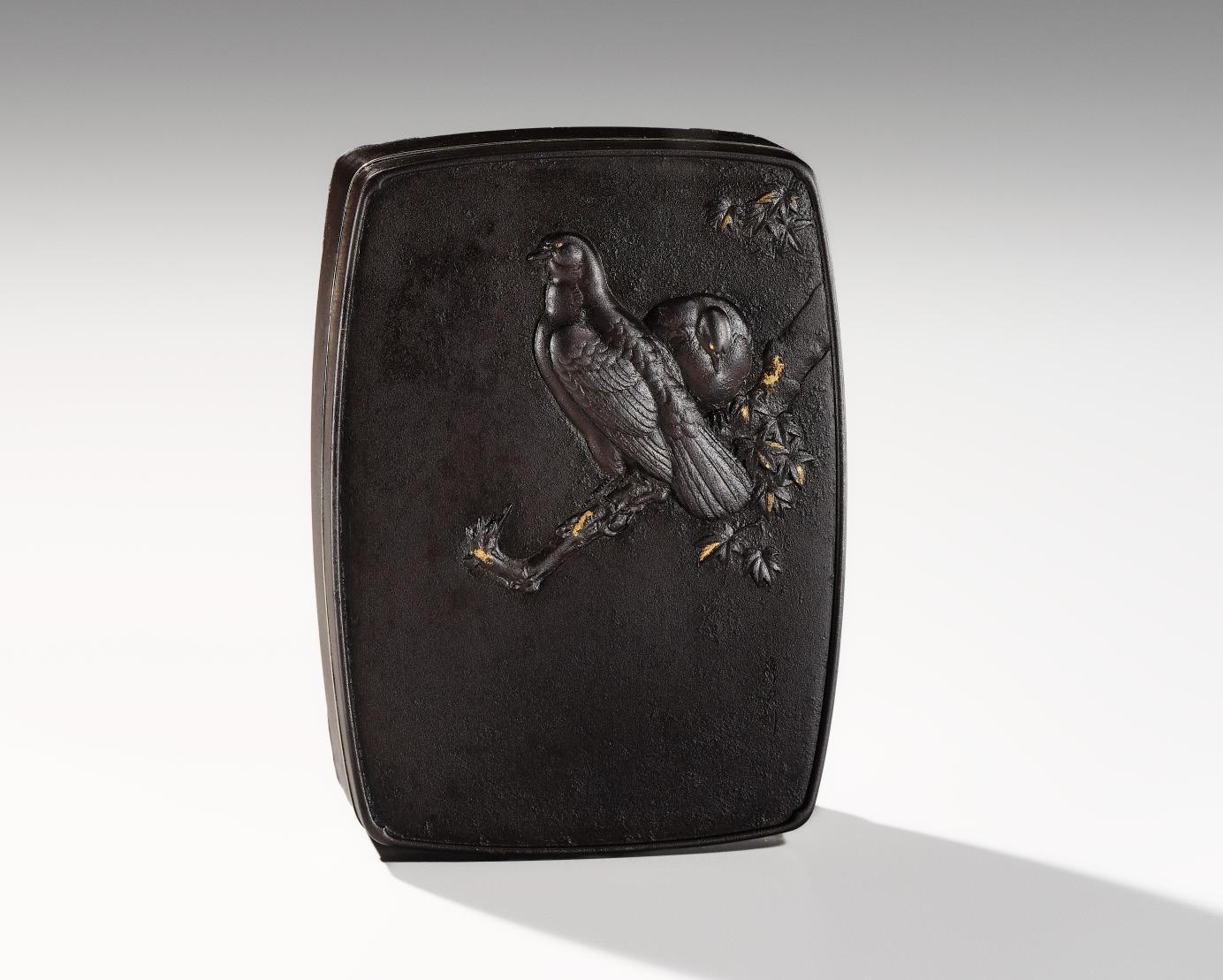
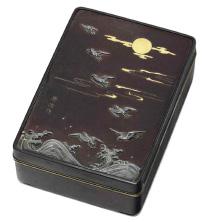
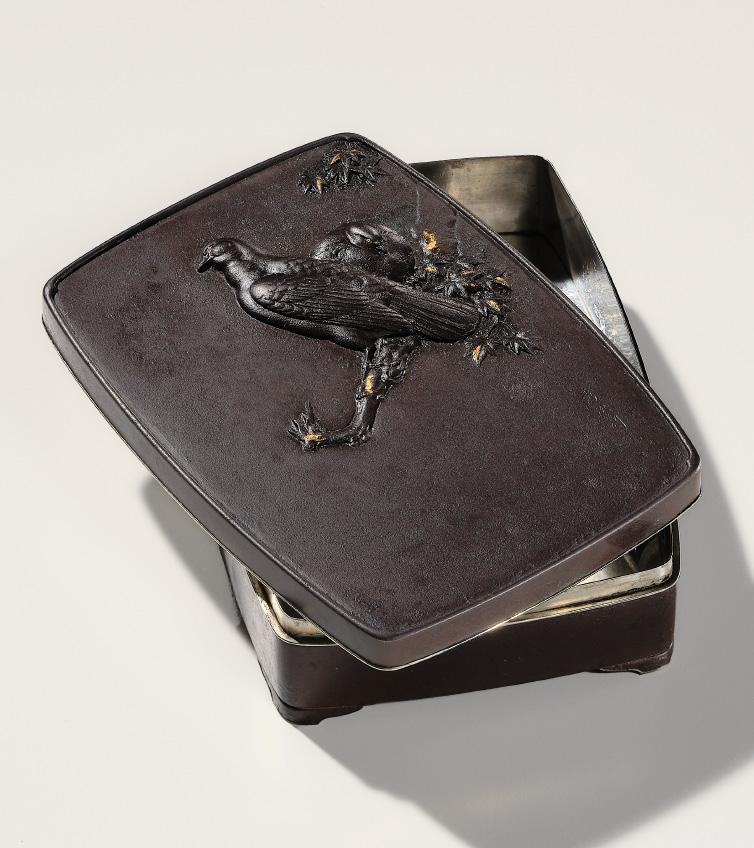
HIDETSUGU: A SUPERB IRON ‘DOVES AND MAPLE’ BOX AND COVER
By Hidetsugu, signed Hidetsugu koku Japan, Meiji period (1868-1912)
Of rectangular form with rounded corners, supported on four feet, finely cast in high relief to depict two doves perched atop a maple branch, the details superbly highlighted in gold. The plumage is finely incised, and the eyes are inlaid in gold, bringing the scene to life. The rims and interior is silver, the interior lid engraved with very fine katakiribori with maple leaves. Signed to the lower left HIDETSUGU koku [engraved by Hidetsugu].
SIZE 3.3 x 9.2 x 12.7 cm
WEIGHT 352 g
Condition: Very good condition with minor wear. Few surface scratches to the interior.
AUCTION COMPARISON
Compare a related inlaid iron box depicting plovers above waves, signed Katsuharu saku, 12 x 8.5 x 3.8 cm, at Christie’s, Japanese and Korean Art, 23 March 2011, New York, lot 729 (sold for USD 2,750 or approx. EUR 3,400 converted and adjusted for inflation at the time of writing).
Estimate EUR 4,000 Starting price EUR 2,000
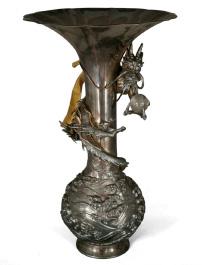
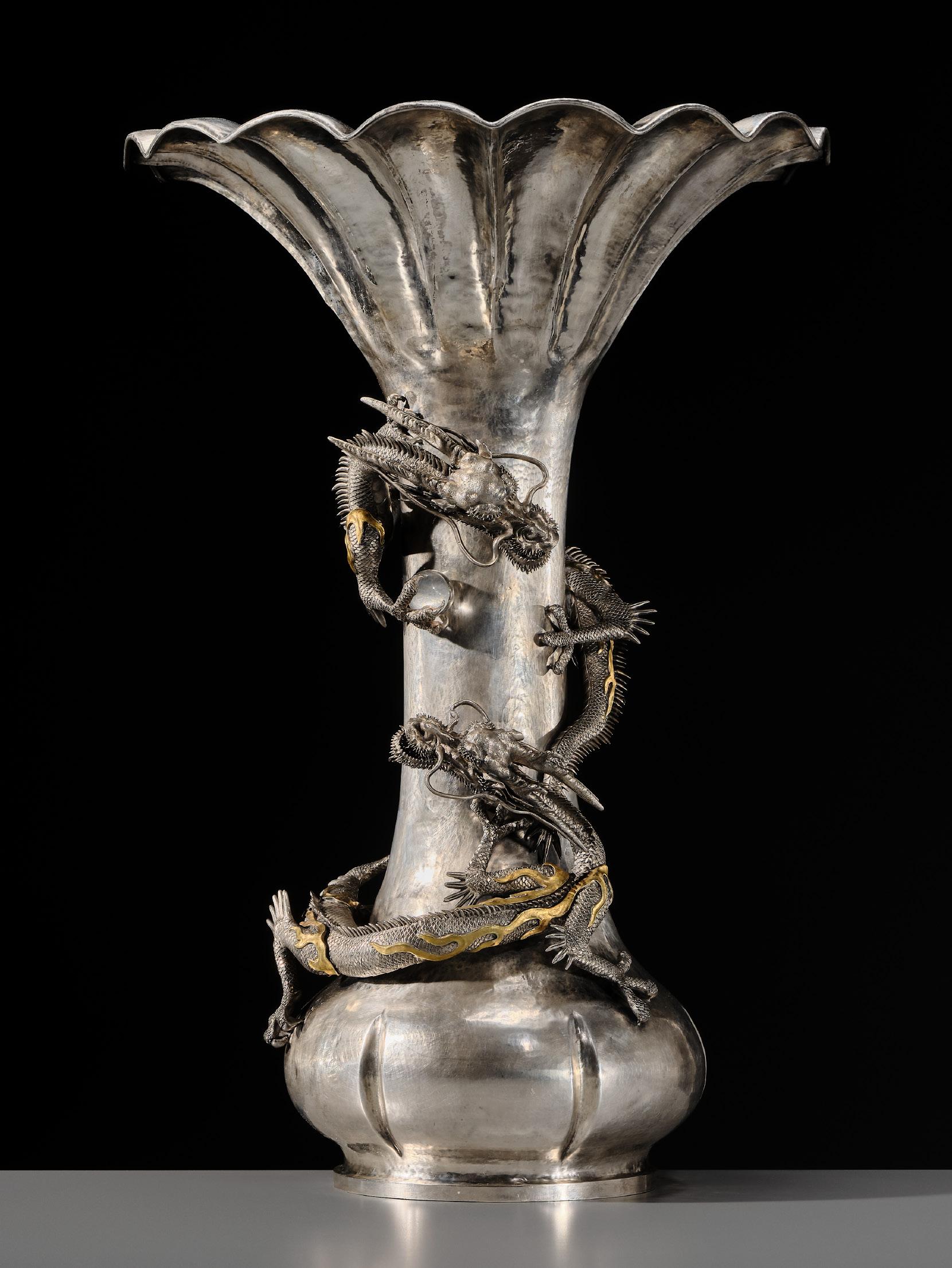
By Watanabe, signed Watanabe sei Japan, c. 1900, Meiji period (1868-1912)
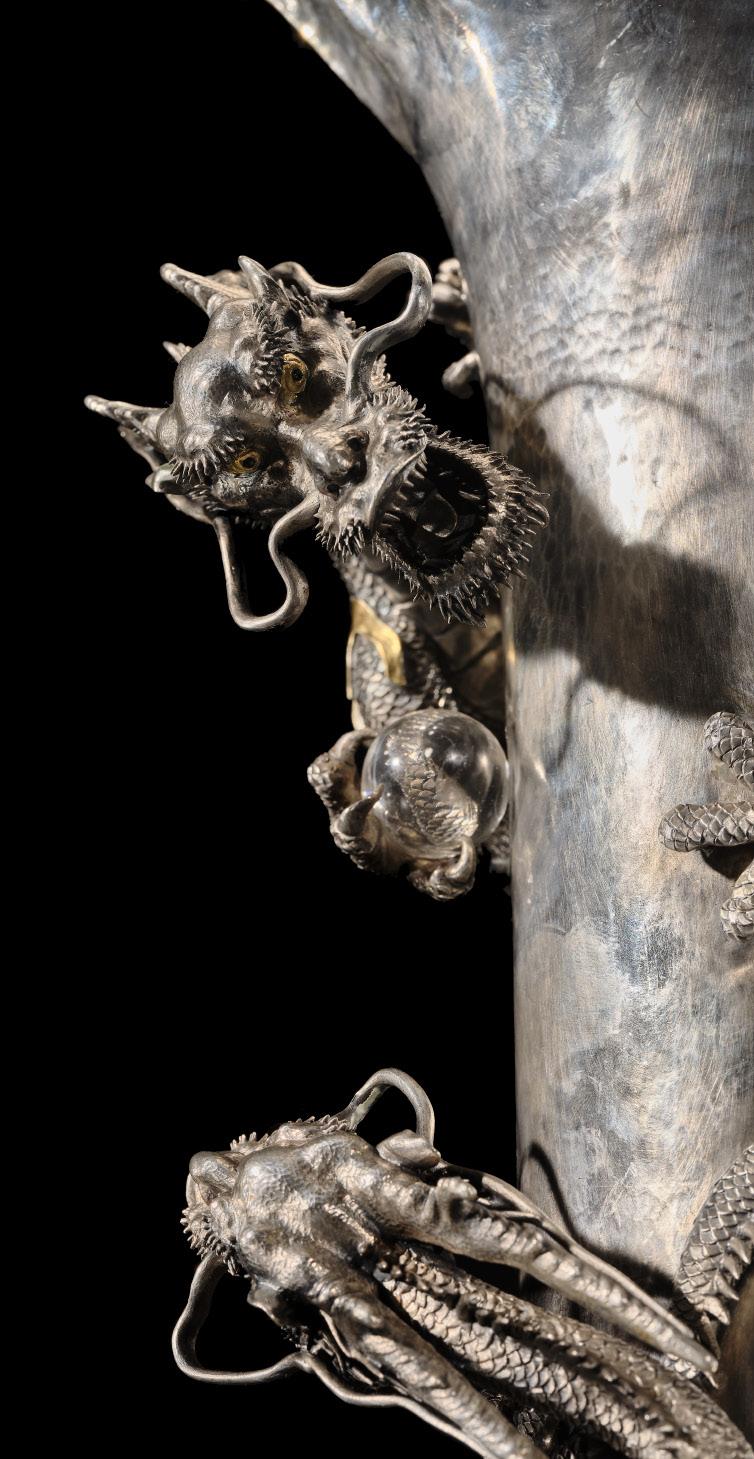
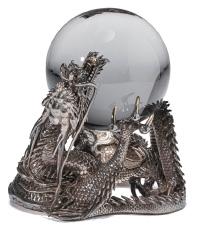
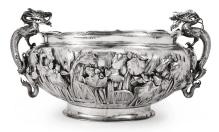
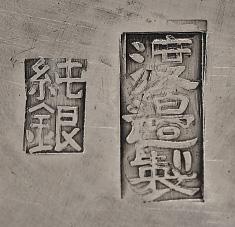
Imposingly cast, this vase is of trumpet form with a sixteen-lobed flared rim. The body is finely worked in uchidashi and applied with masterfully rendered dragons, their scales meticulously incised, with golden flames emanating from their bodies. The dragons’ faces are fierce, with whiskers, sharp fangs, horns, and furrowed brows. The upper dragon holds a rock crystal tama in its hand. The vase is signed underneath WATANABE sei [made by Watanabe] and stamped on the base jungin [pure silver].
HEIGHT 53 cm
WEIGHT 2.7 kg
Condition: Excellent condition with minor expected wear and few minuscule scratches.
This exceptional vase is a prime example of Meiji silverwork from the Yokohama export silver tradition. During the late 19th and early 20th centuries, silver artisans in Yokohama, including Watanabe, produced finely crafted domestic and export silver objects such as bowls, vases, and presentation pieces, often stamped with high-purity marks like jungin. These works were designed to meet the demands of both the expanding global market and elite Japanese patrons, blending traditional Japanese motifs with Western forms and the technical virtuosity favored by Western tastes.
The present vase stands out among typical export silver pieces, likely created for a special commission or to be displayed at one of the World’s Fairs.
MUSEUM COMPARISON
Compare a closely related silver vase with a dragon, dated late 19th century, 39 cm high, from Komura Jutaro, gifted to the Imperial Palace, in the National Palace Museum, Taipei, accession number 00137834.
AUCTION COMPARISON
Compare a related rock crystal sphere on a similarly rendered silver dragon, by Gyokuryuken Sanmi, dated late 19th century, at Christie’s, Japanese and Korean Art, 16 March 2021, New York, lot 37 (sold for USD 62,500 or approx. EUR 66,000 converted and adjusted for inflation at the time of writing). For another work by the same maker, showcasing the more commonly seen, typical output of Watanabe, signed Watanabe zo, dated c. 1900, 47.6 cm long, at Sotheby’s, Collections: Silver, Vertu, Ceramics, and Russian Works of Art, 19 October 2016, New York, lot 640 (sold for USD 13,750 or approx. EUR 16,000 converted and adjusted for inflation at the time of writing).
Estimate EUR 25,000
Starting price EUR 12,000
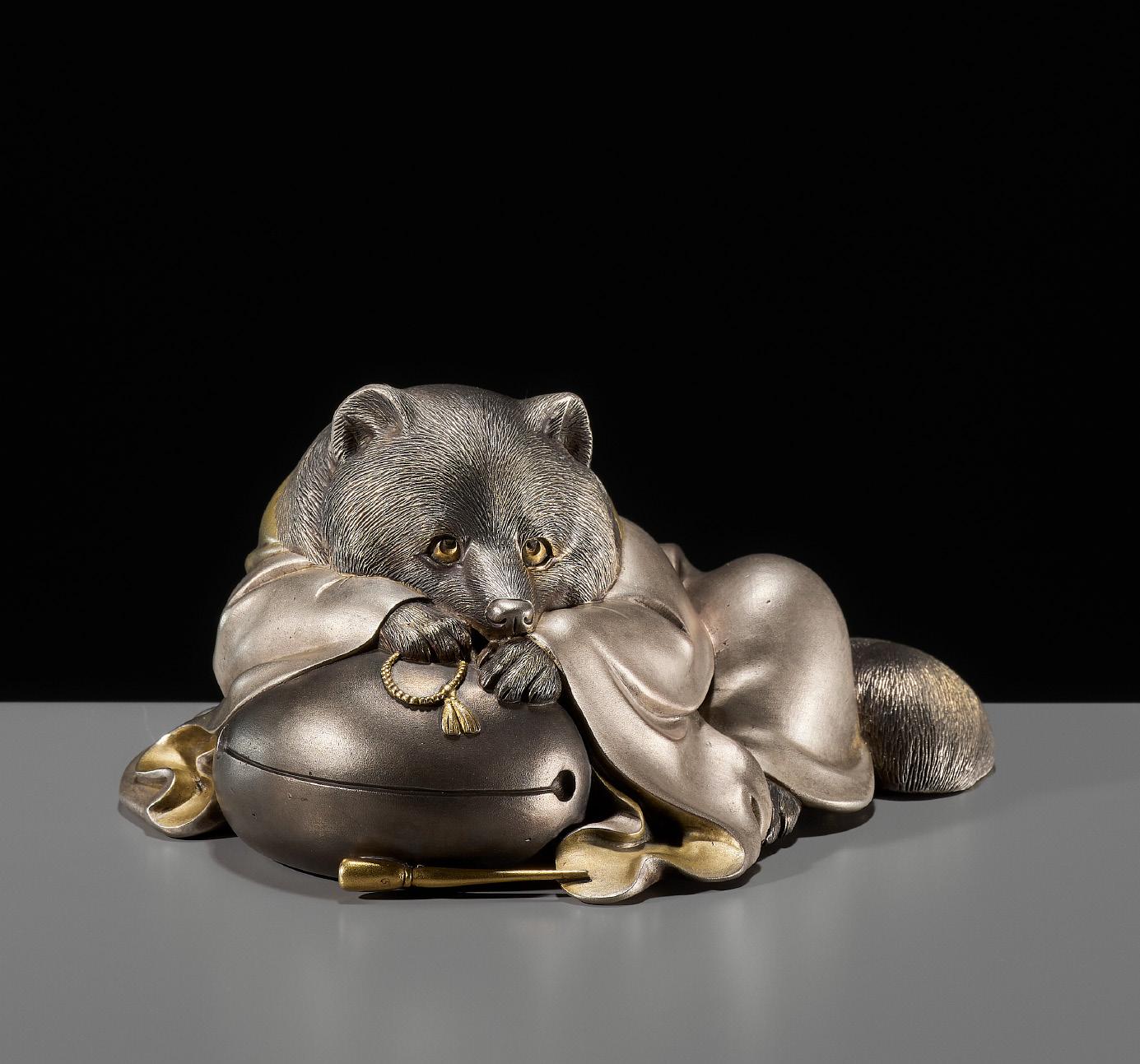
AKASOFU GYOKKO: A FINE SILVERED BRONZE OKIMONO OF TANUKI SHUKAKU
By Akasofu Gyoko, signed Dai Nihon Gyokko saku Japan, Meiji period (1868-1912)
Cast as a recumbent racoon dog disguised as a Buddhist priest (tanuki shukaku), wrapped in a cloak with its long tail curled at its side, the mischievous creature leaning on a mokugyo, with prayer beads clutched in its paw, signed on the underside within a recessed cartouche Dai Nihon GYOKKO saku [made by Gyokko, Great Japan]. The bronze is attractively patinated in gold, silver and shibuichi tones.
LENGTH 19.4 cm
WEIGHT 1.7 kg
Condition: Excellent condition with minor wear.
With a wood tomobako (storage box).
Akasofu Gyokko, given name Sotojiro, lived in Tokyo, his factory producing cast metalwork for export. He is recorded as a member of the Tokyo Chukinkai (Tokyo Cast Metalworkers’ Association) in the second half of the Meiji period.
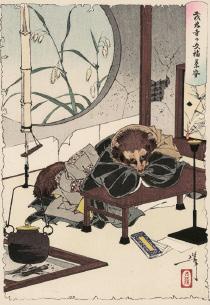
Shukaku is a legendary tanuki said to have assumed the guise of a Buddhist priest, residing for many years at Morinji Temple in present-day Gunma Prefecture. He is most closely associated with the tale of the bunbuku chagama, a miraculous tea kettle attributed to him, which he is said to have presented to the temple as an offering.
Shukaku, by Tsukioka Yoshitoshi, 1889-1892
AUCTION COMPARISON
Compare a related bronze okimono of a raccoon dog by Masayuki, dated early 20th century, 17.8 cm wide, at Bonhams, Fine Japanese Works of Art, 19 March 2014, New York, lot 3171 (sold for USD 21,250 or approx. EUR 25,000 converted and adjusted for inflation at the time of writing).
Estimate EUR 4,000
Starting price EUR 2,000
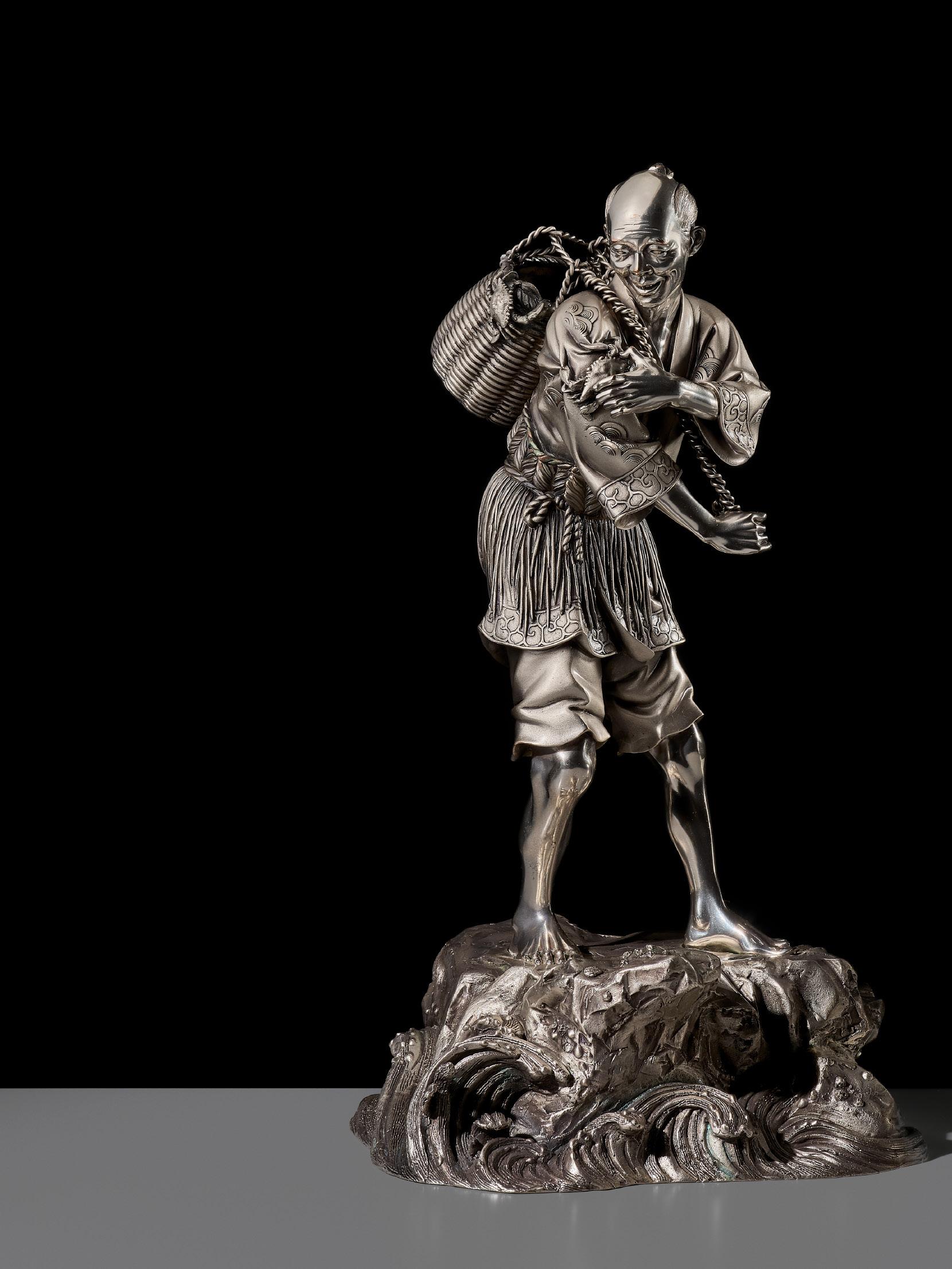
SHOHO FOR THE MARUKI COMPANY: A LARGE YOGIN OKIMONO OF A CRAB FISHERMAN
By Shoho for the Maruki company, signed Shoho (Seiho) kore o tsukuru and Maruki shachu sei Japan, Meiji period (1868-1912)
Standing barefoot fixed to a rock with crashing waves to the front, dressed in a short robe with a sea grass skirt, carrying a large wicker basket over his shoulder, turned to the right with his left hand reaching across his chest to grab the crab clinging onto his sleeve with its pincers, while another crab escapes from the basket. Signed to the rock between the feet SHOHO (Seiho) kore o tsukuru [this was made by Shoho (Seiho)], and to the hem of the robe MARUKI shachu sei [manufactured at the Maruki company], and with a hallmark Yogin (German silver/ nickel silver).
HEIGHT 40.4 cm
WEIGHT 6.4 kg
Condition: Excellent condition with minor wear and little rubbing.
The Maruki Company was active during the Meiji Period (1868-1912) in Japan, they stand out for the quality and weight of their okimono and are known for producing fine figural bronzes.
AUCTION COMPARISON
Compare a closely related bronze okimono of a fisherman, by Ryusai for the Maruki company, 37.5 cm high, at Bonhams, Fine Japanese Art, 12 May 2016, London, lot 538 (sold for GBP 2,125 or approx. EUR 4,500 converted and adjusted for inflation at the time of writing).
Estimate EUR 5,000
Starting price EUR 2,400
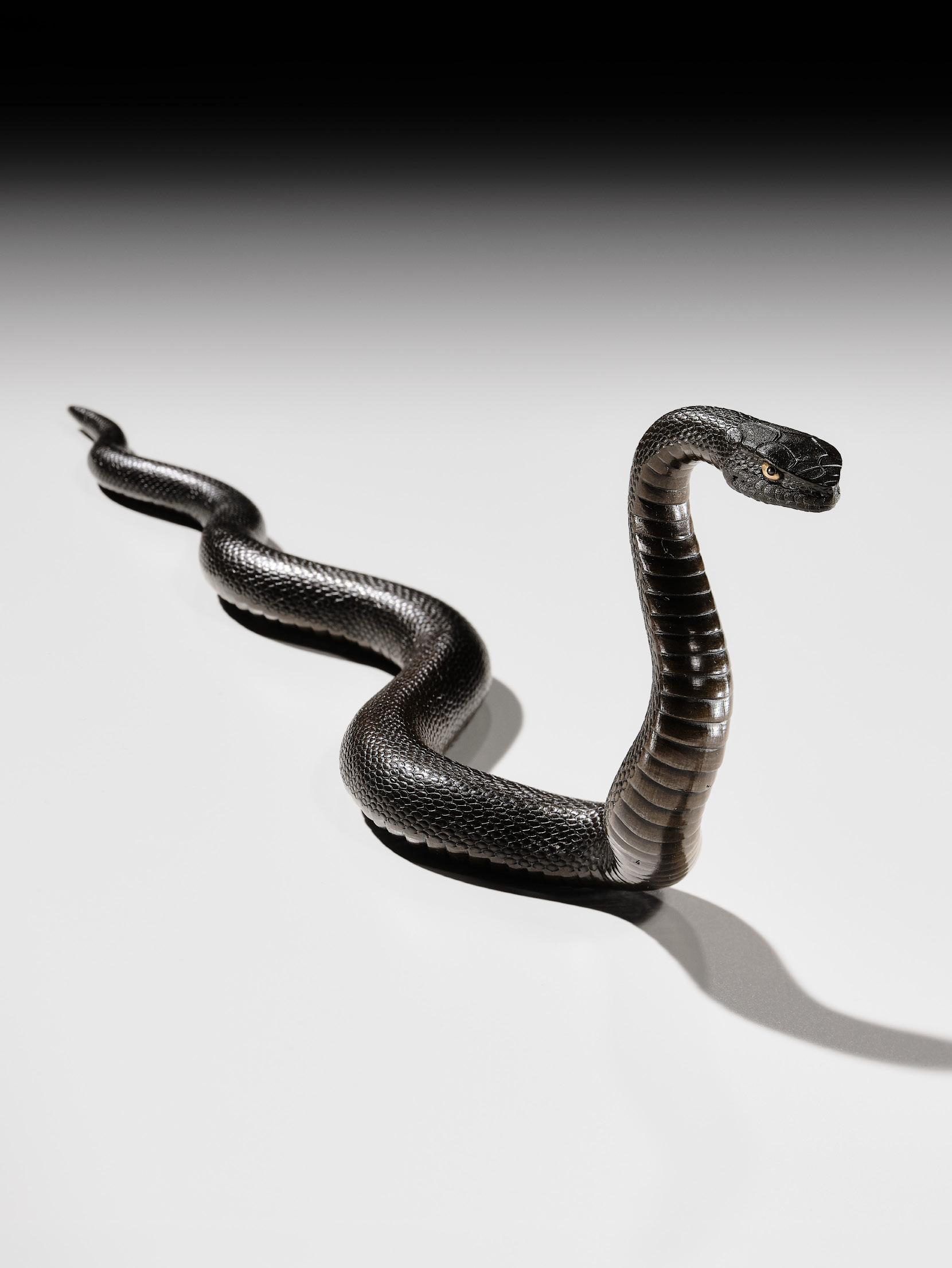

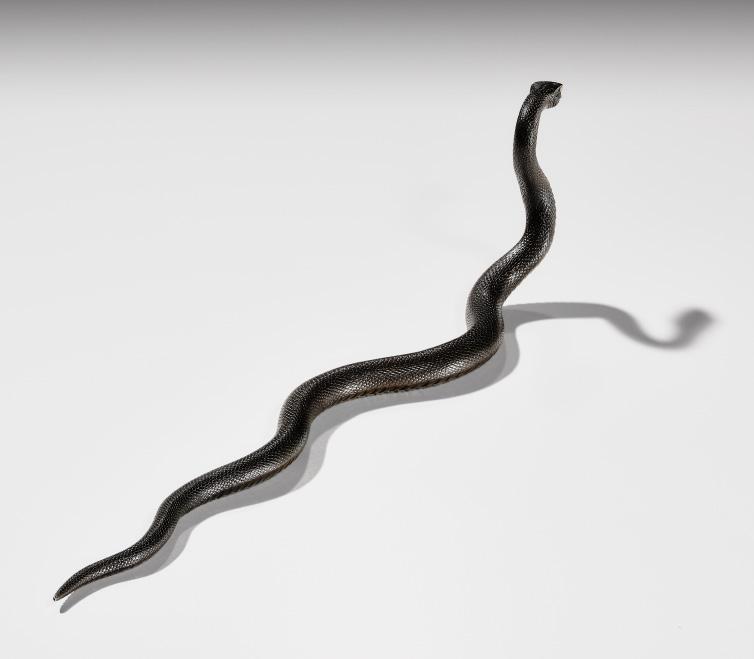
AN EXCEPTIONAL AND RARE BRONZE OKIMONO OF A SNAKE
Japan, Meiji period (1868-1912)
Naturalistically cast in a sinuous, elongated form, the snake is shown with its body undulating across the ground while the forepart rises upright in an alert and poised stance. The eyes are gilt with shakudo pupils intensifying its gaze. The scales are meticulously rendered in tight, regular patterning, in contrast, the underside is articulated with broader, segmented plates.
LENGTH 38.3 cm
WEIGHT 517 g
Condition: Excellent condition.
This bronze okimono evokes the celebrated iron snake sculptures created by masters in the jizai okimono tradition, such as Takase Kozan and artists from the Myochin school. Known for their naturalistic and articulated animal figures, these artists - originally armorers - created highly detailed works in iron, often with movable parts. The present example, however, translates this tradition into a smaller, fixed bronze form, emphasizing sculptural elegance over mechanical movement, while still capturing the sinuous nature of the snake.
In Japanese symbolism, the snake represents successful harvests, fertility, and regeneration. The snake’s role in controlling pests such as mice is well-known, and its molting process suggests themes of renewal and immortality. Snakes are often depicted at shrines and entrances during the New Year, where sacred ropes (shimenawa) symbolize purity and sanctity. These ropes’ entwined form is derived from the mating serpents, and Ugajin, a guardian deity of fertility, is frequently depicted with a snake body and human head, symbolizing good fortune.
AUCTION COMPARISON
Compare a related larger iron jizai okimono of a snake, by Takase Kozan, dated c. 1900, 90.1 cm long, at Bonhams, Fine Japanese and Korean Art, 17 September 2025, New York, lot 589 (sold for USD 57,600 or approx. EUR 50,000 converted and adjusted for inflation at the time of writing).
Estimate EUR 10,000
Starting price EUR 5,000
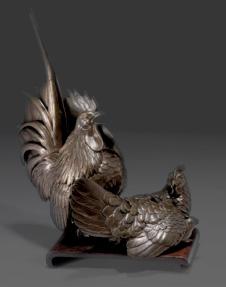
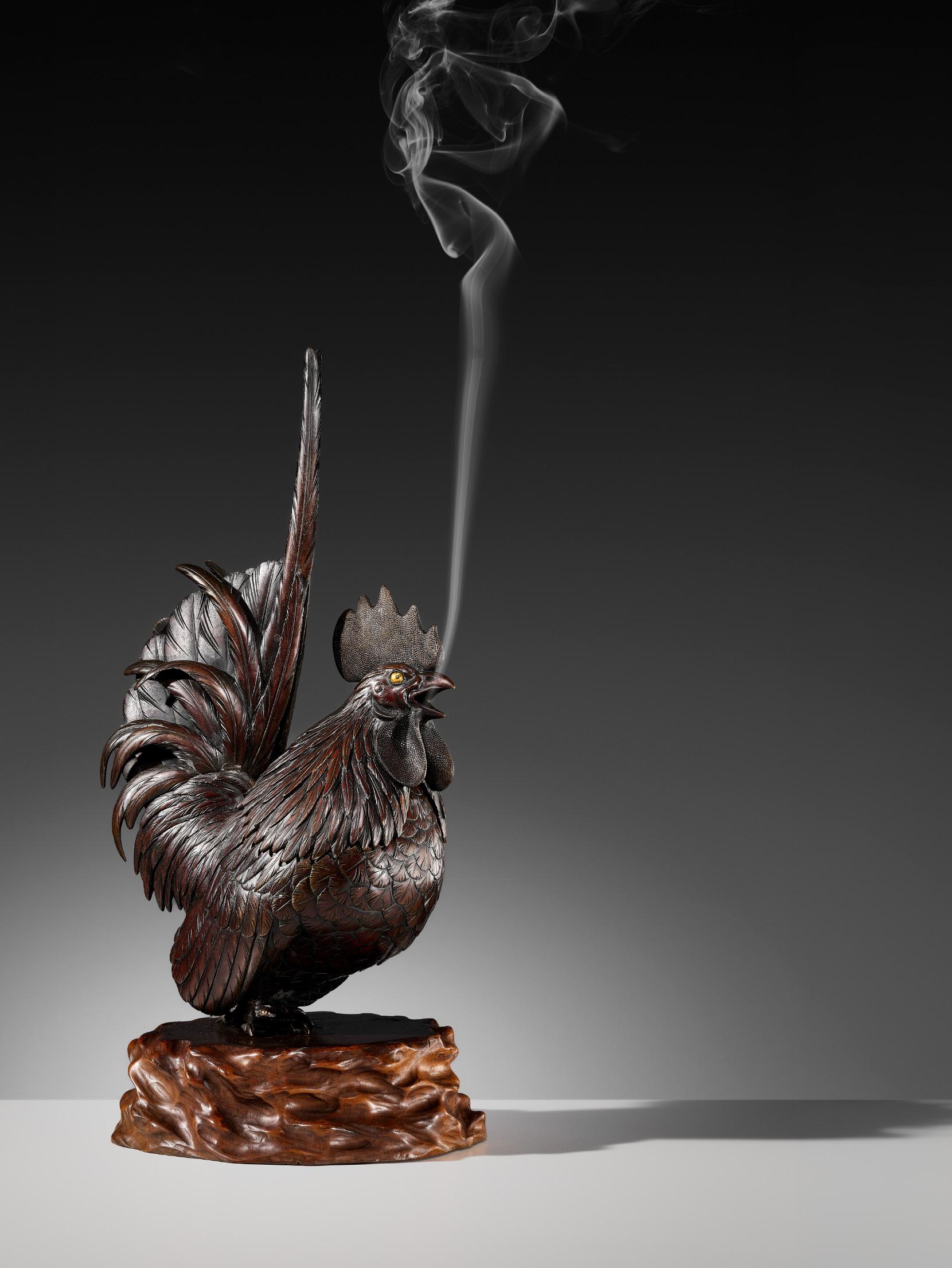
A FINE BRONZE ‘COCKEREL’ KORO (INCENSE BURNER)
Japan, late 19th century, Meiji period (1868-1912)
Naturalistically cast in two parts, this exquisite onagadori (long-tailed cockerel) is masterfully modeled with intricate feather details. The plumage is finely chiseled, with textured comb and wattle, and the sharp open beak adds to the bird’s lifelike presence. The long, graceful tail is sculpted with elegance, while gilt eyes further enhance its realism. The body is hollowed to function as a vessel for incense burning, with the head serving as the cover. The koro is mounted on a separately carved wood base, secured with two metal pegs.
HEIGHT 33 cm (excl. base), 38.2 cm (incl. base)
WEIGHT 3 kg (excl. base), 3.7 kg (incl. base)
Condition: Excellent condition with only very minor wear. The wood base with scratches and natural age cracks.
AUCTION COMPARISON
Compare a closely related bronze koro of a cockerel and hen, by Masatsune, 32.5 cm high, at Christie’s, Asian Art, 28 June 2007, London, lot 68 (sold for GBP 1,680 or approx. EUR 3,200 converted and adjusted for inflation at the time of writing).
Estimate EUR 3,000
Starting price EUR 1,500
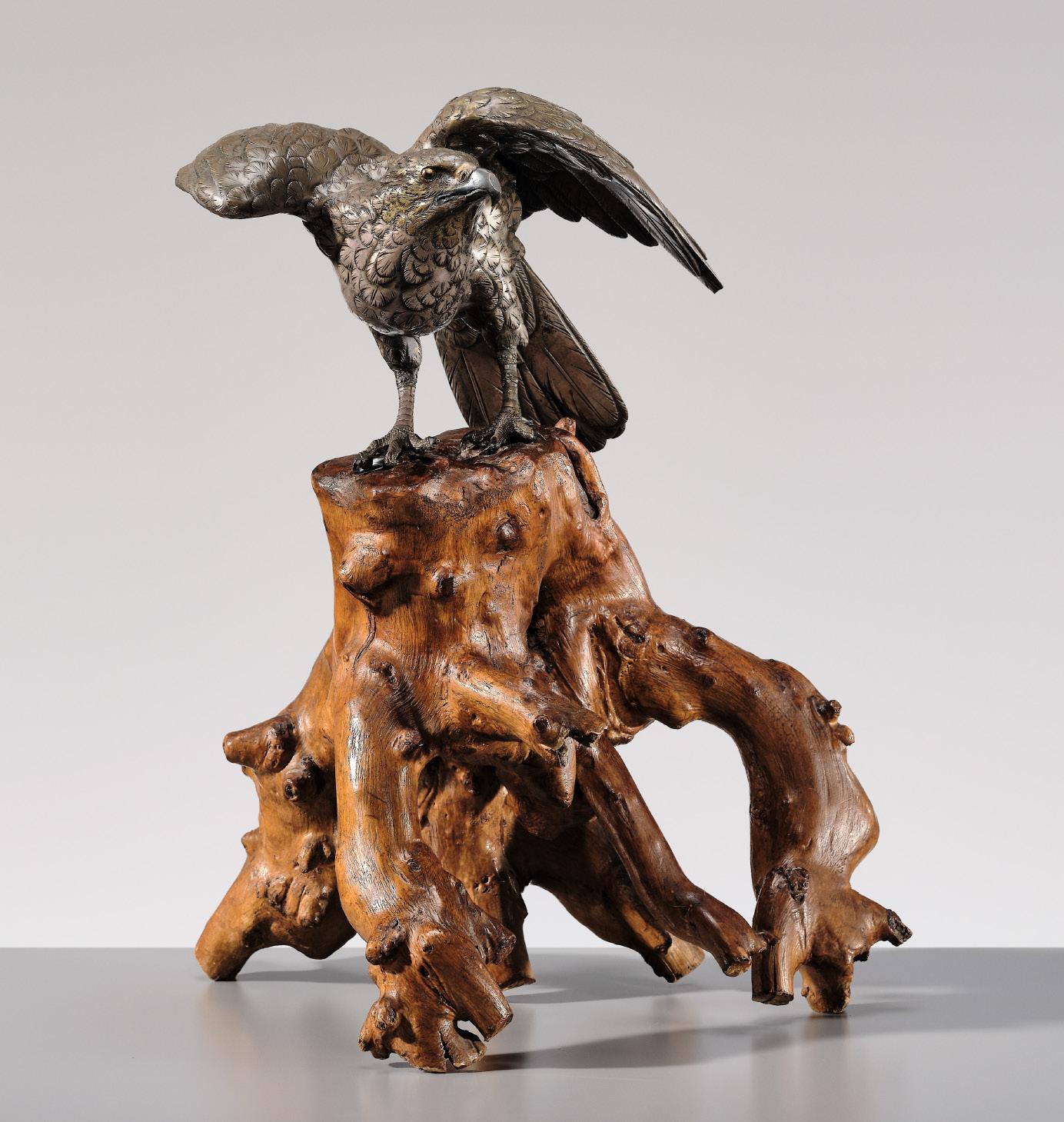
GENRYUSAI SEIYA: A FINE BRONZE AND ROOTWOOD OKIMONO OF A KESTREL ON A TREE STUMP
Japan, Meiji period (1868-1912)
Superbly cast, this raptor is perched on a separately carved wood base in the shape of a tall tree stump. The bird is detailed with intricately incised plumage, its wings spread as the kestrel prepares to take flight. The eyes, inlaid in shakudo with gilt rings, are striking, while the elegantly curved beak adds to the bird’s lifelike presence. The underside is signed within a square reserve SEIYA chu [cast by Genryusai Seiya].
HEIGHT (total) 39 cm
WEIGHT (total) 5 kg
Condition: Good condition with old wear. The legs are re-enforced, now firmly mounted to the base. Two losses to the edges of the wings.
Genryusai Seiya was a master craftsman known for leading a workshop that specialized in high-quality export wares. His production included human genre figures, vases, and exotic animal bronzes, likely influenced by the opening of the Tokyo Zoological Gardens in 1882. This piece is a brilliant example of Seiya’s expertise in creating naturalistic bronze models of animals.
AUCTION COMPARISON
Compare a closely related bronze okimono of a kestrel, by Masatsune, 24.2 cm high, at Bonhams, Fine Japanese and Korean Art, 12 September 2012, New York, lot 3369 (sold for USD 6,000 or approx. EUR 7,000 converted and adjusted for inflation at the time of writing).
Estimate EUR 5,000
Starting price EUR 2,400
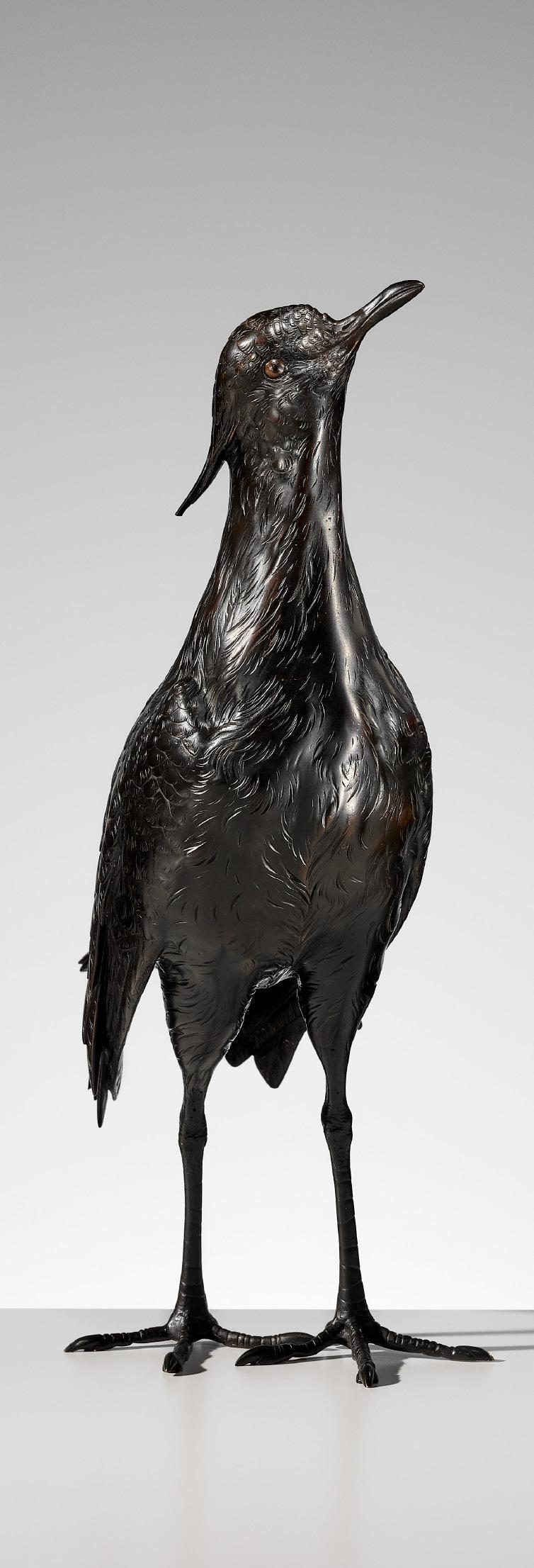
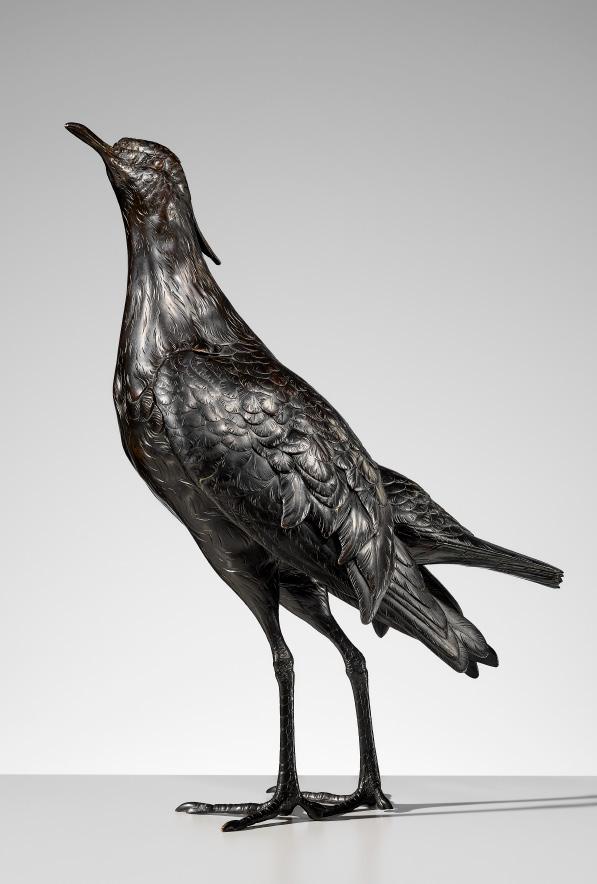
MASAAKI: A RARE AND FINE BRONZE OF A BLACK-CROWNED NIGHT HERON
By Isshosai Masaaki, signed Masaaki Japan, Meiji
period (1868-1912)
Expertly cast, the bird stands on both feet, its neck straightened as it gazes upward. The head is detailed with a pronounced nape, a long, slender beak, and shakudo and copper-inlaid eyes. The body is finely incised to represent the delicate plumage, while the slender, textured legs are shown with widely spread claws. Signed underneath MASAAKI.
HEIGHT 37.2 cm
WEIGHT 2.4 kg
Condition: One leg with an old repair. Otherwise excellent condition with minor wear and light rubbing to the patina of the claws.
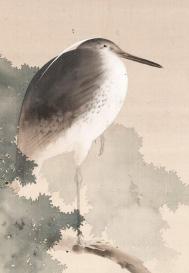
Black-crowned night heron by Watanabe Seitei, Meiji/Taisho period
While Meiji-era bronze artists often depicted popular birds like cranes, falcons, and eagles, this depiction of a black-crowned night heron is exceptionally rare. Fittingly, the bird’s mysterious nature, often associated with solitude and the unknown, lends an air of intrigue and depth to this striking piece.
Estimate EUR 4,000
Starting price EUR 2,000
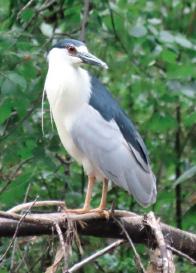
The black-crowned night heron in its natural habitat
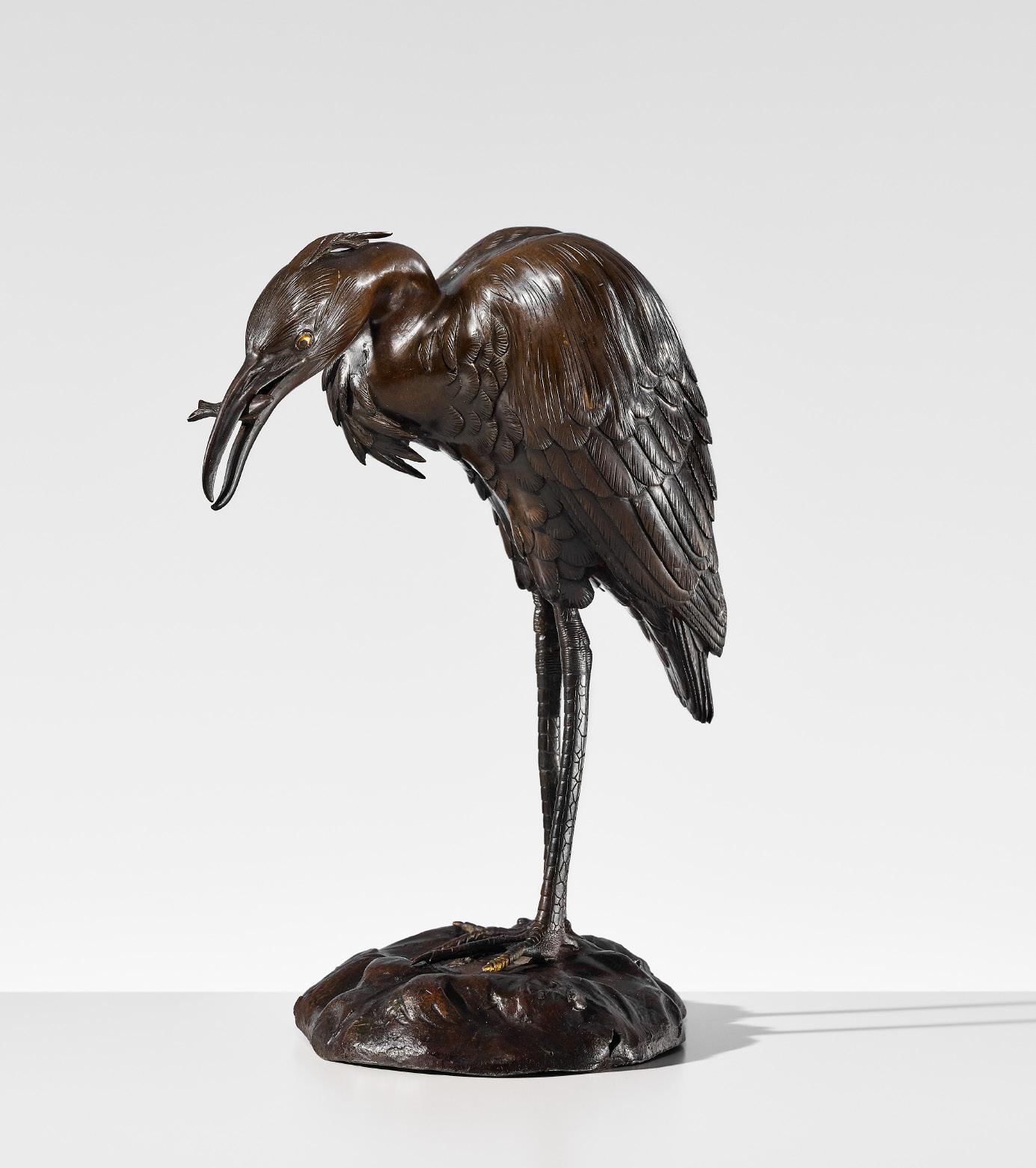
A FINE BRONZE OKIMONO OF A FISHING EGRET
Japan, Meiji period (1868-1912)
Finely cast, the egret stands on both feet atop an oval base formed as a naturalistically rendered rocky riverbank. Its long neck is gently arched, with the beak lowered as it holds a small fish in its mouth. The body is meticulously detailed with finely incised plumage, while the slender, textured legs are shown with widely spread claws. The eyes are gilt, with shakudo pupils adding depth to the expression.
HEIGHT 23.8 cm
WEIGHT 1.9 kg
Condition: Good condition. The legs have been re-enforced and there are a few old repairs to the claws. Some general minor wear and casting irregularities.
AUCTION COMPARISON
Compare a closely related bronze okimono of an egret with a snail, by Gyokusei, 30.5 cm high, at Bonhams, Fine Japanese Art, 11 May 2010, London, lot 455 (sold for GBP 7,800 or approx. EUR 14,000 converted and adjusted for inflation at the time of writing).
Estimate EUR 3,000
Starting price EUR 1,500
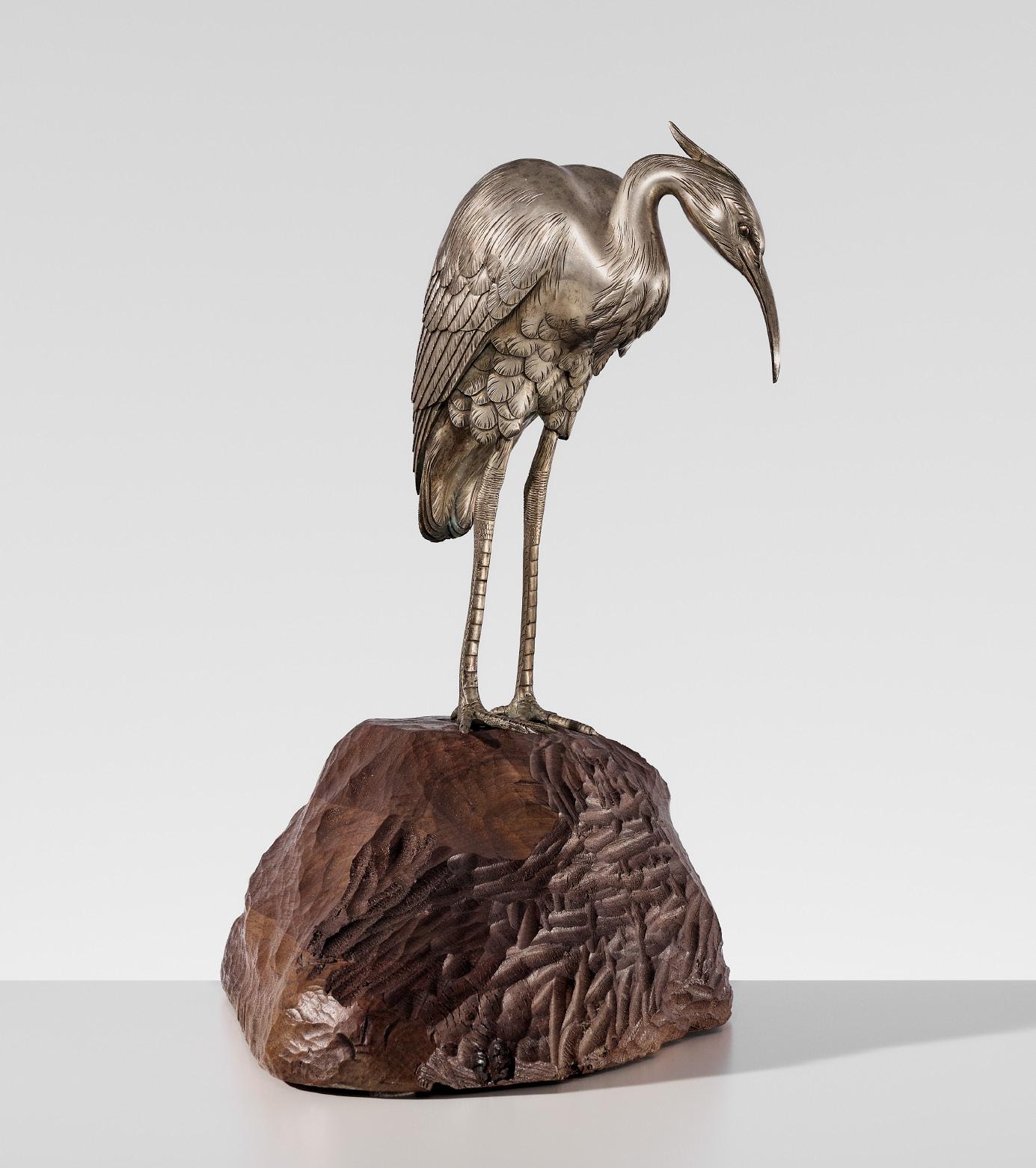
A FINE SILVERED BRONZE OKIMONO OF AN EGRET
Japan, Meiji period (1868-1912)
Finely cast and silvered, the egret stands on both feet atop a large carved wood base. The bird is elegantly poised with its long neck gently arched and beak lowered. The body is meticulously detailed with incised plumage, and the slender, textured legs are shown with widely spread claws. The eyes are inlaid with shakudo pupils.
HEIGHT 28.2 cm (excl. base), 37.9 cm (incl. base)
WEIGHT 1.6 kg (excl. base), 4.2 kg (incl. base)
Condition: Good condition. The legs have been re-enforced and one claw is lost. Some general minor wear and casting irregularities. Natural flaws and chipping to the wood base.
AUCTION COMPARISON
Compare a related silvered bronze okimono of an egret on a wood base, by the Maruki company, of smaller size, 16.2 cm high, at Zacke, Fine Japanese Art, 6 December 2024, Vienna, lot 57 (sold for EUR 3,432).
Estimate EUR 4,000
Starting price EUR 2,000
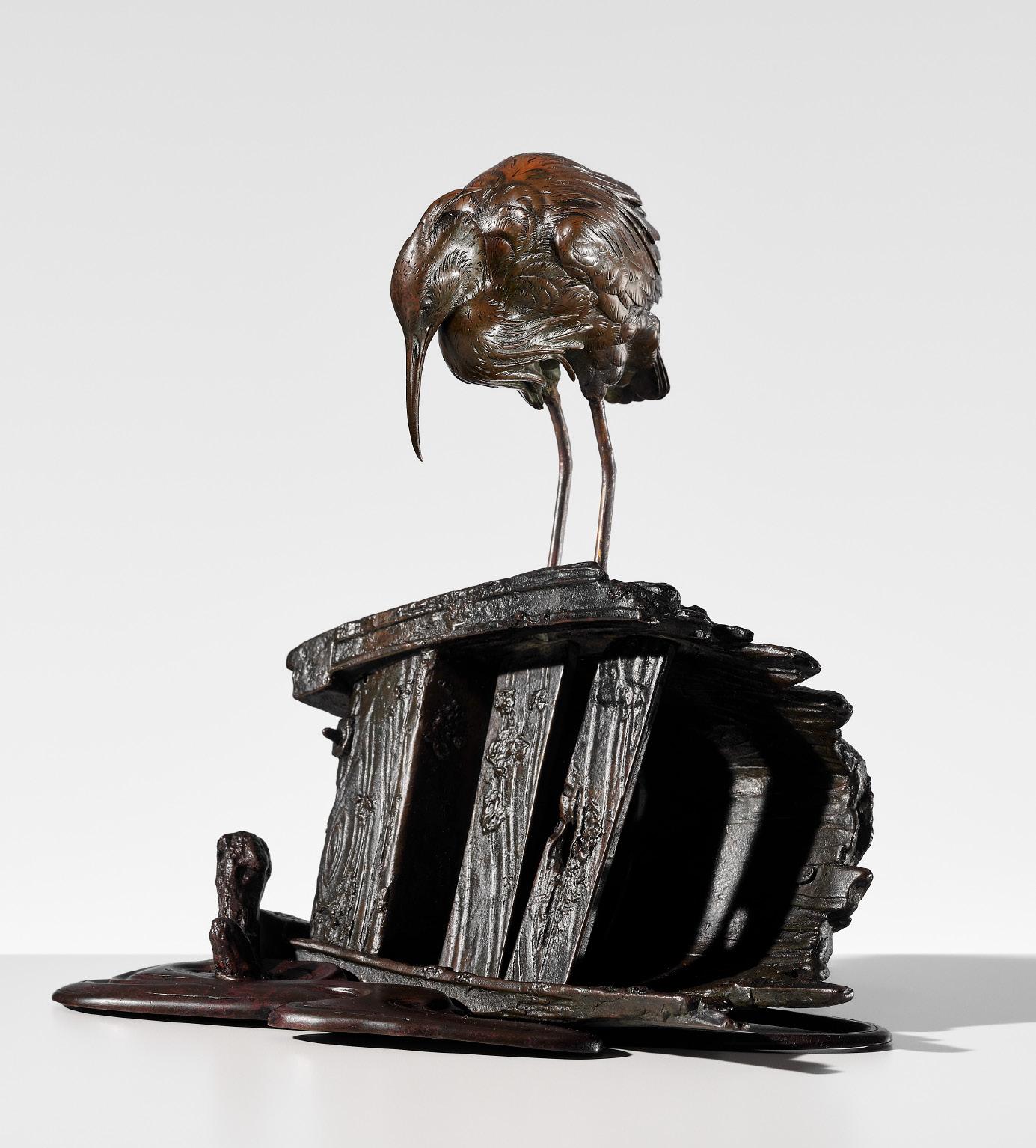
GYOKUSEI: A FINE BRONZE
‘EGRET ON A SHIPWRECKED BOAT’ OKIMONO
By Gyokusei, signed Gyokusei Japan, Meiji period (1868-1912)
Finely cast, the egret stands on both feet atop a shipwrecked boat, its head turned with keen interest toward the rippled water. The bird’s neck is gently arched, and its beak is lowered as it gazes down, likely in search of a fish. The body is delicately rendered with finely incised plumage, and the slender legs are carefully detailed. Signed on the back of the boat within an oval signature tablet GYOKUSEI.
HEIGHT 24.5 cm
WEIGHT 2.5 kg
Condition: The legs are replaced. Otherwise excellent condition with only very minor wear and typical casting irregularities.
AUCTION COMPARISON
Compare a related silver and bronze egret on a boat koro, by Issei, 26.2 cm long, at Bonhams, Fine Japanese Art, 11 May 2010, London, lot 463 (sold for GBP 3,120 or approx. EUR 5,600 converted and adjusted for inflation at the time of writing).
Estimate EUR 3,000
Starting price EUR 1,500
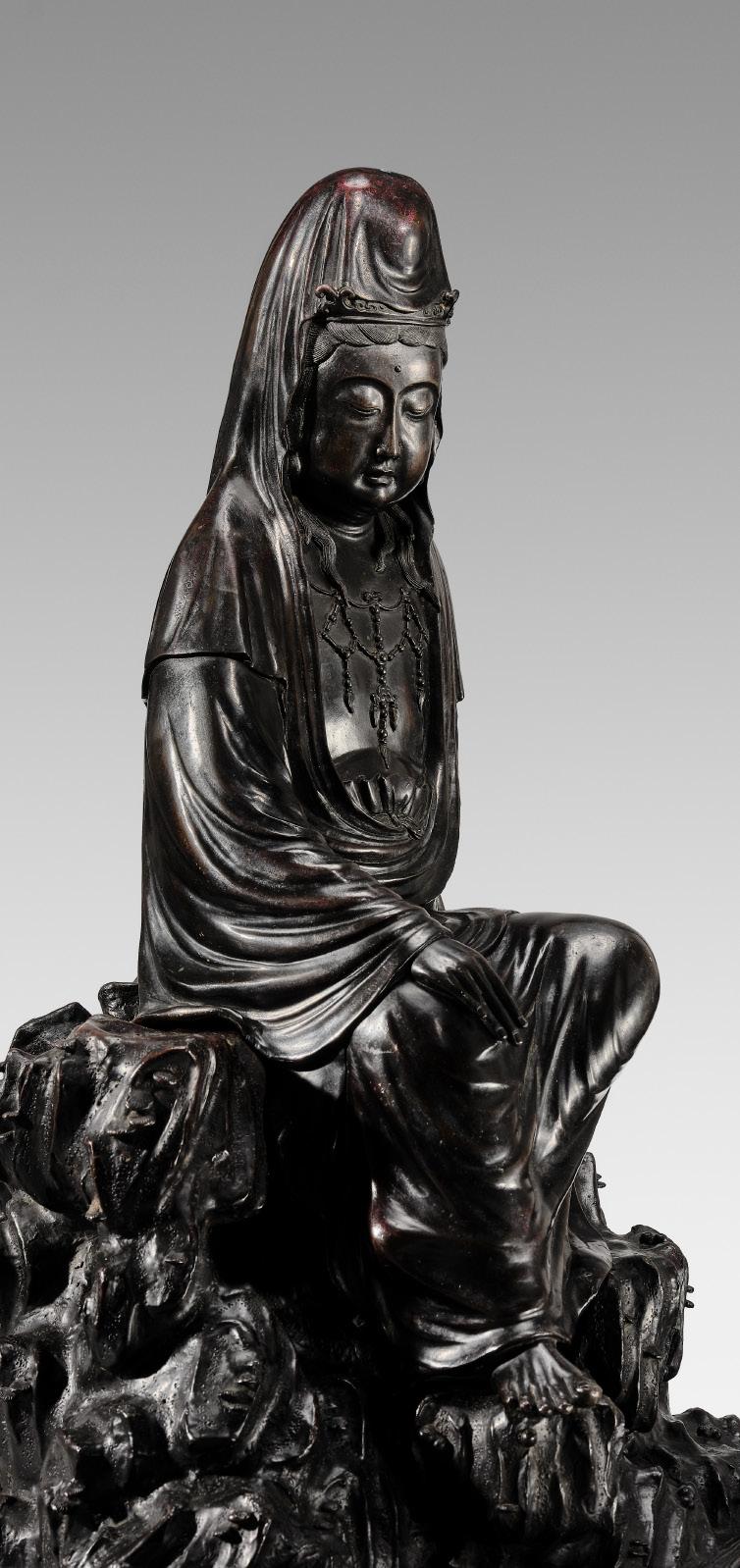
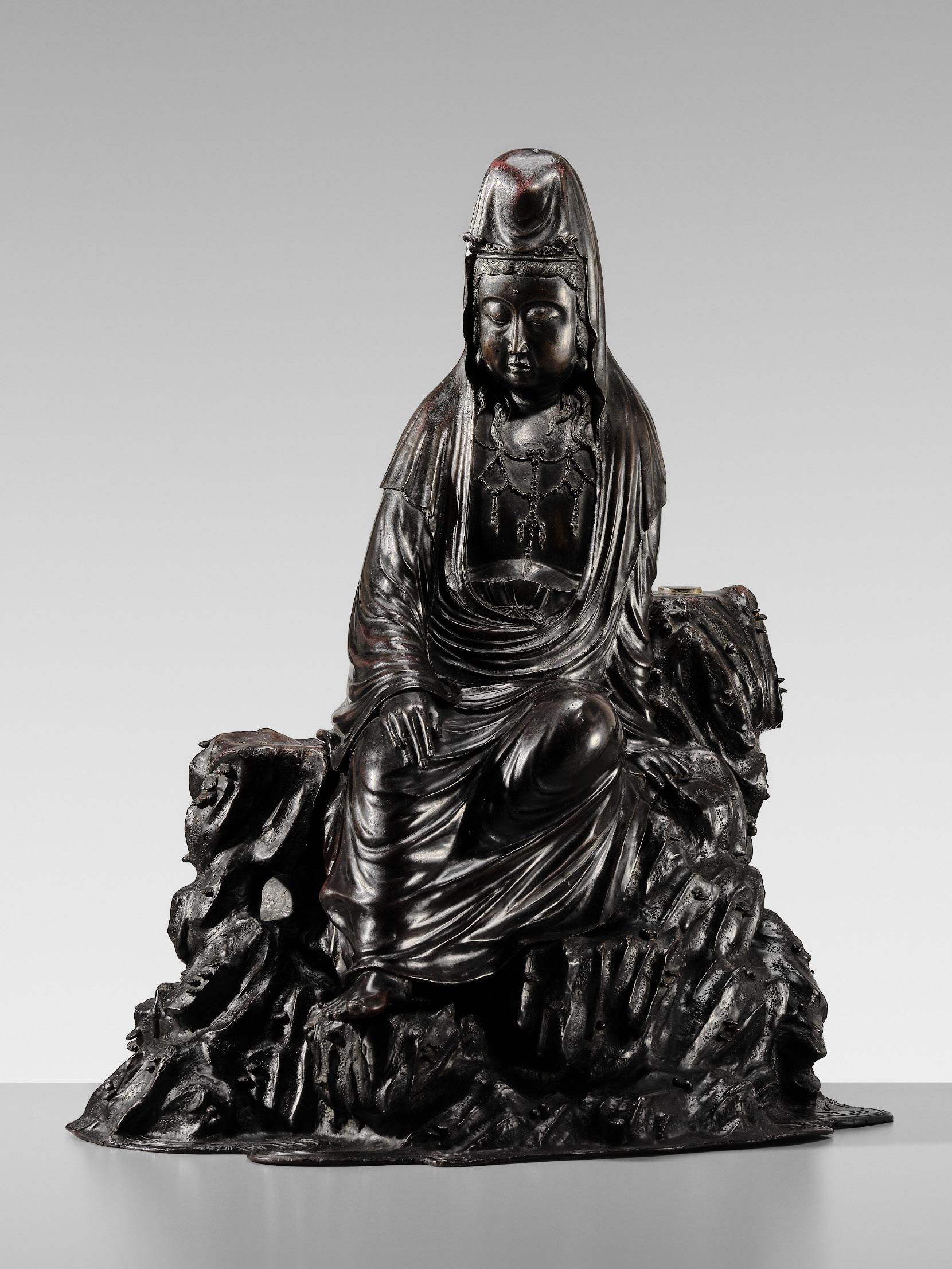
KANO SEIUN I: A MASSIVE (58 CM)
BRONZE SCULPTURE OF KANNON BOSATSU
By Kano Seiun I (b. 1871), signed Seiun saku kore Japan, early 20th century, Meiji (1868-1912) to Taisho period (1912-1926)
Magnificently cast, this bronze sculpture depicts Kannon Bosatsu seated in regal ease upon a separately cast rocky outcrop, reclining on the left hand, which rests upon the rugged ledge, while the right hand is placed gently upon the lap. The figure is clad in loosefitting robes that cascade in beautifully rendered folds across the torso, opening over the chest to reveal an elaborate necklace. The meditative expression is serene, with heavy-lidded, downcast eyes centered by a small urna, a slender nose, and full lips. The neatly arranged hair, with several locks falling over the shoulders, is secured by a delicate foliate tiara and a high hooded cape. The rocky formation is signed SEIUN saku kore [this is made by Seiun].
HEIGHT 58 cm
WEIGHT 18.5 kg
Condition: Good condition with surface wear and expected casting-inherent irregularities, including minor cracks and pinholes. Small losses to the fingers of the left hand. Scattered minute nicks and light surface scratches. The bronze surface exhibiting a dark, naturally grown, fine patina with reddish undertones.
Kano Seiun I, born Kano Ginzaburo in 1871, was a prominent Japanese bronze artist of the early 20th century, later adopting the art name Hoshosai. He studied under the eminent metalworker Oshima Joun (1858–1940), from whom he acquired a refined technical discipline rooted in traditional craftsmanship. Kano exhibited at the government-sponsored Bunten exhibitions, gaining recognition within official artistic circles, and also participated in the Exposition Universelle of 1900 in Paris. His exact date of death remains unknown, though records indicate that he was still active as late as 1937.
Kannon Bosatsu, known in Sanskrit as Avalokiteshvara (The Lord Who Regards All), is one of the principal bodhisattvas of Amida Nyorai (Buddha Amitabha). As the embodiment of compassion, Kannon is revered for listening to the suffering of sentient beings and guiding them toward salvation. Kannon remains one of the most widely venerated deities in Japan and throughout Asia, both historically and in modern times. This sculpture’s portrayal of Kannon, serene and compassionate, reflects the deity’s powerful role in Buddhist belief as a compassionate savior.
AUCTION COMPARISON
Compare a closely related bronze figure of seated Kannon Bosatsu, Meiji to Taisho period, early 20th century, 44.4 cm high, at Bonhams, Property from the Collection of Drs. Edmund and Julie Lewis. Part 1, New York, 11 September 2019, lot 581 (sold for USD 7,575 or approx. EUR 8,300 converted and adjusted for inflation at the time of writing).
Estimate EUR 6,000
Starting price EUR 3,000
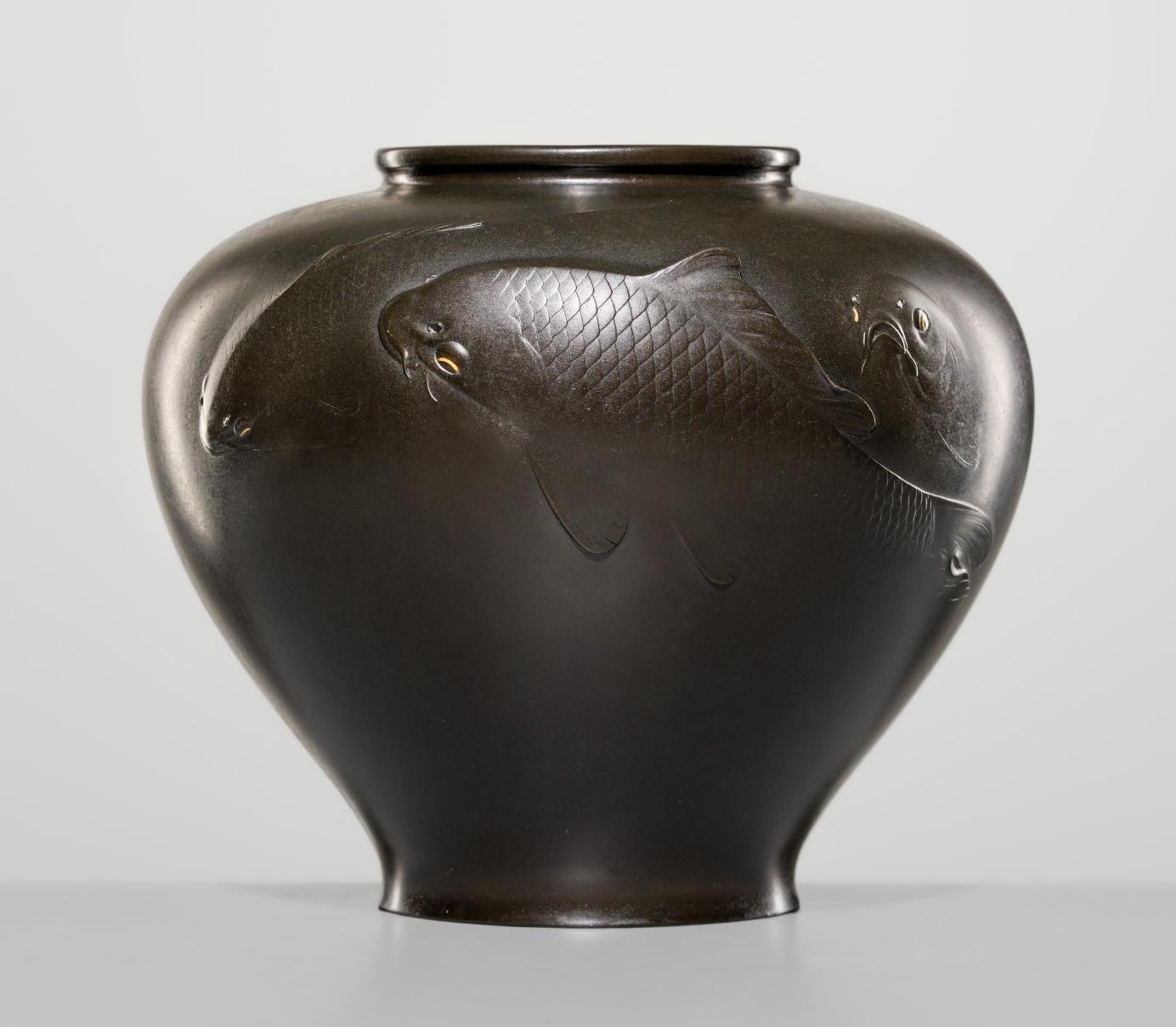
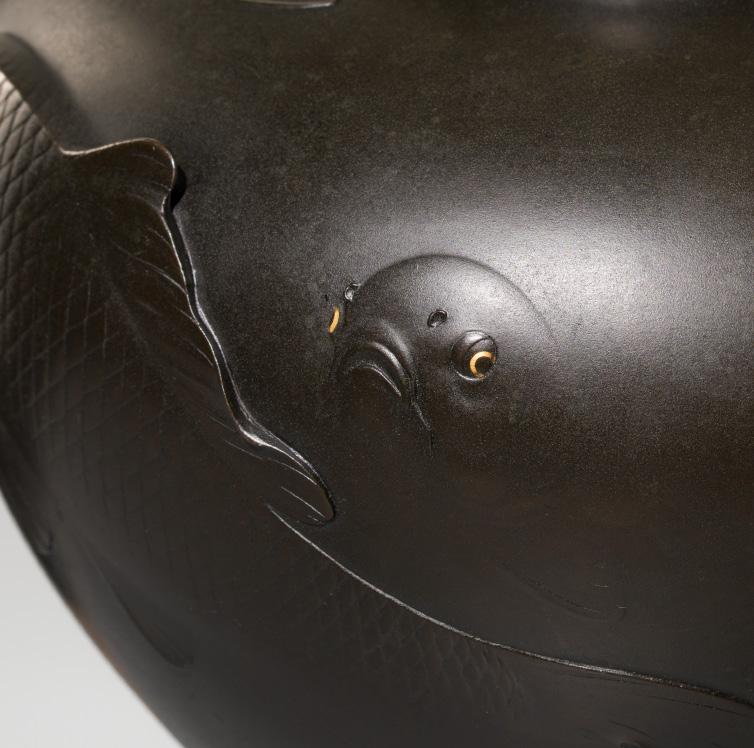
TAKAAKI: A LARGE BRONZE ‘CARPS’ VASE
By Takaaki, signed Takaaki Japan, early 20th century, Meiji (1868-1912) to Taisho period (1912-1926)
Heavily cast, the globular body supported on a short flared foot, finely decorated to the shoulder in relief with five carps swimming near the rippled surface, their eyes inlaid with gold-ringed shakudo pupils. The base signed TAKAAKI.
HEIGHT 19 cm
WEIGHT 3.1 kg
Condition: Very good condition with minor wear and typical manufacturing irregularities, few scattered nicks and scratches as are to be expected.
AUCTION COMPARISON
Compare a closely related bronze jar with carps by Ichioka Shiun, dated early 20th century, 25.4 cm high, at Zacke, Fine Japanese Art, 6 December 2024, Vienna, lot 46 (sold for EUR 5,200).
Estimate EUR 4,000
Starting price EUR 2,000
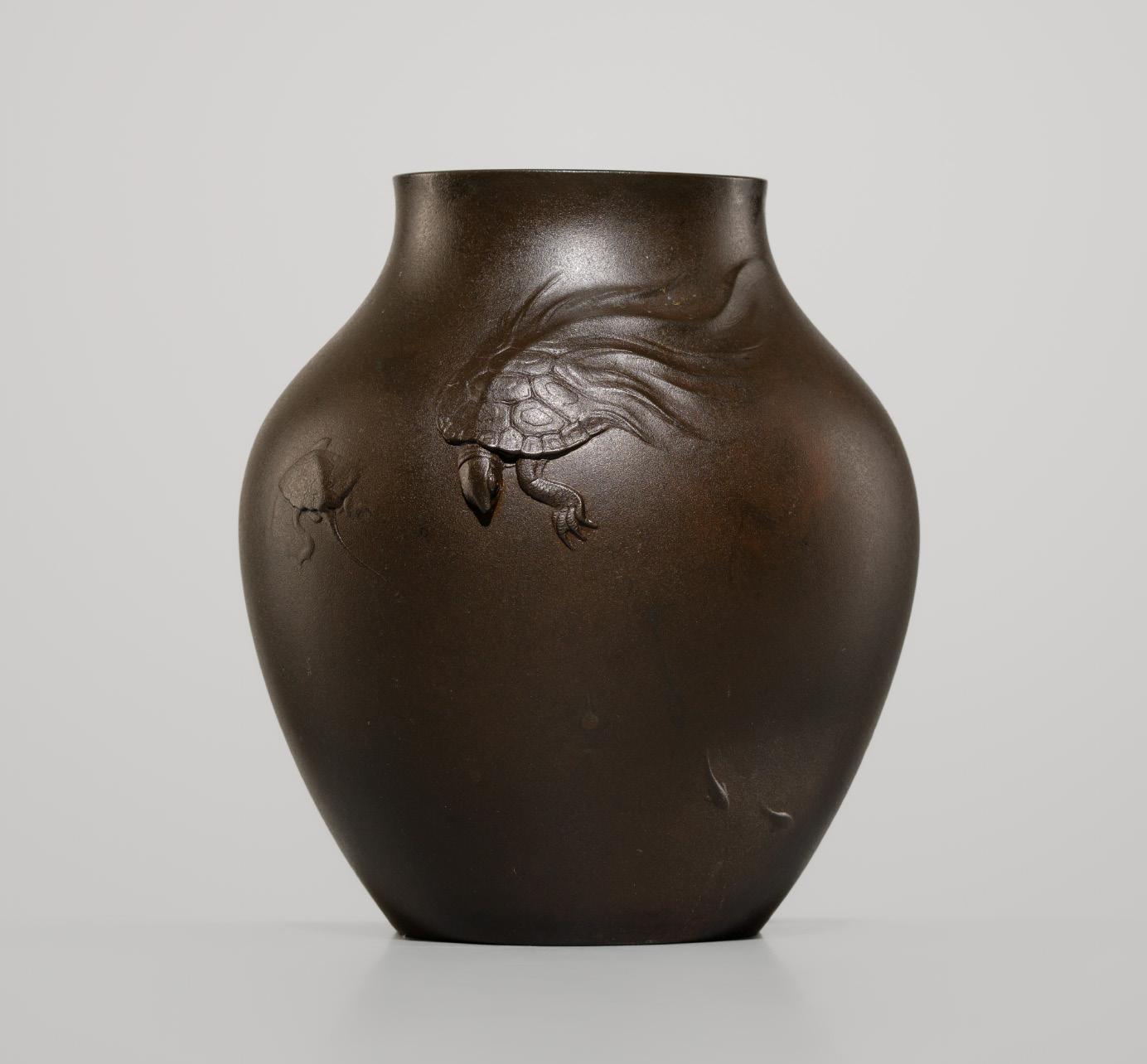
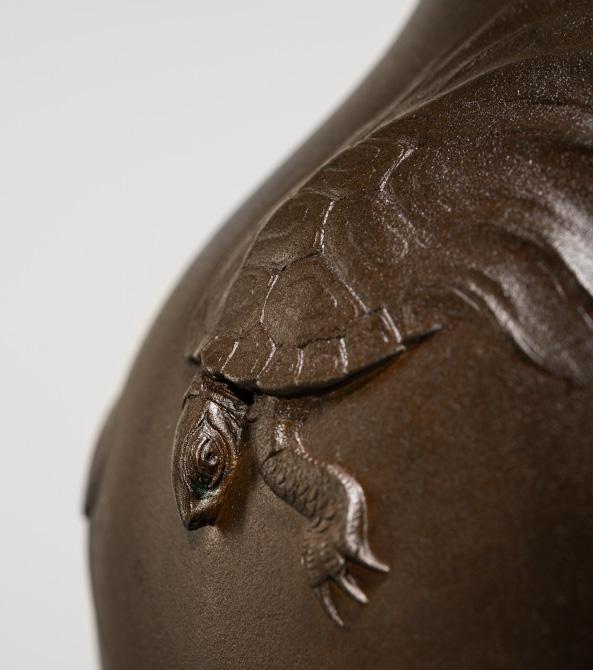
By Kato Tatsuo, signed Tatsuo saku Japan, early 20th century, Meiji (1868-1912) to Taisho period (1912-1926)
The ovoid body supported on a short foot ring and rising to a waisted neck with a gently everted mouth, the body finely cast with a pair of minogame (long-tailed turtles) swimming above fishes, naturalistically rendered with a finely incised carapace and its long bushy tale sweeping to the back, all against the reddish dark patinated surface. Signed to the base TATSUO saku [made by Tatsuo].
HEIGHT 17.8 cm
WEIGHT 1.4 kg
Condition: Very good condition with minor wear and manufacturing irregularities, scattered nicks and scratches, naturally grown dark patina.
Kato Tatsuo was a pupil of Oshima Joun (1858-1940) and is perhaps best known for his bronze okimono depicting tortoises.
Estimate EUR 3,000
Starting price EUR 1,500
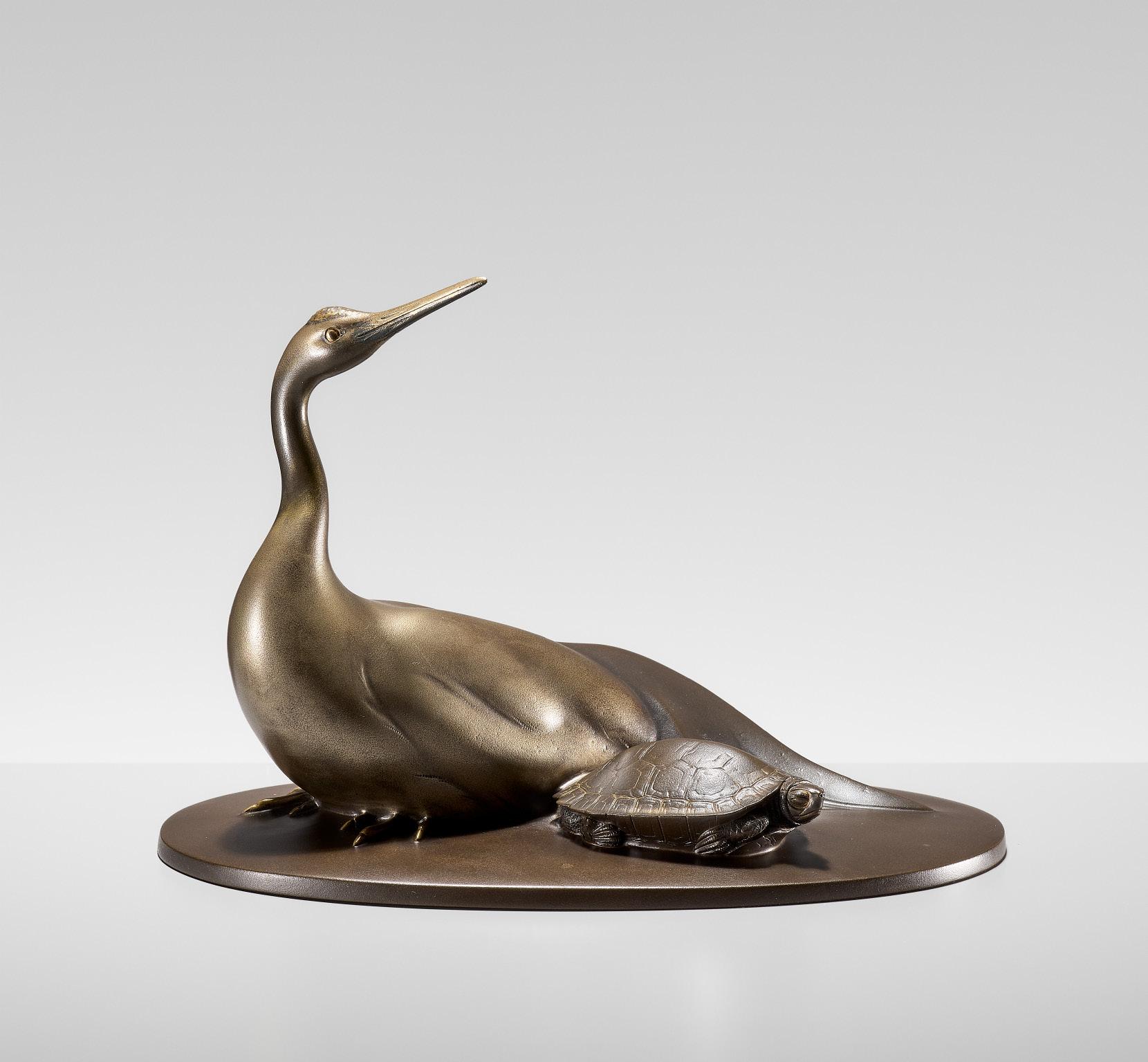
KATO TATSUO: A FINE PATINATED BRONZE OKIMONO OF A TURTLE AND CRANE
By
Kato Tatsuo, signed Tatsuo Japan, early 20th century, Taisho period (1912-1926)
Finely cast as a recumbent crane accompanied by a turtle resting atop an oval base. The crane modeled raising its elegant neck and head with long beak while the turtle has tucked its limbs and part of the head in its carapace. Signed in an oval reserve TATSUO to the top of the base.
LENGTH 24.7 cm
WEIGHT 1.1 kg
Condition: Excellent condition.
Kato Tatsuo was a pupil of Oshima Joun (1858-1940) and is perhaps best known for his bronze okimono depicting tortoises.
AUCTION COMPARISON
Compare a related bronze okimono by Tatsuo, dated Taisho period, 34.5 cm long, at Bonhams, Fine Japanese Art, 10 November 2011, London, lot 386 (sold for 5,250 GBP or approx. EUR 9,100 converted and adjusted for inflation at the time of writing).
Estimate EUR 2,500
Starting price EUR 1,200
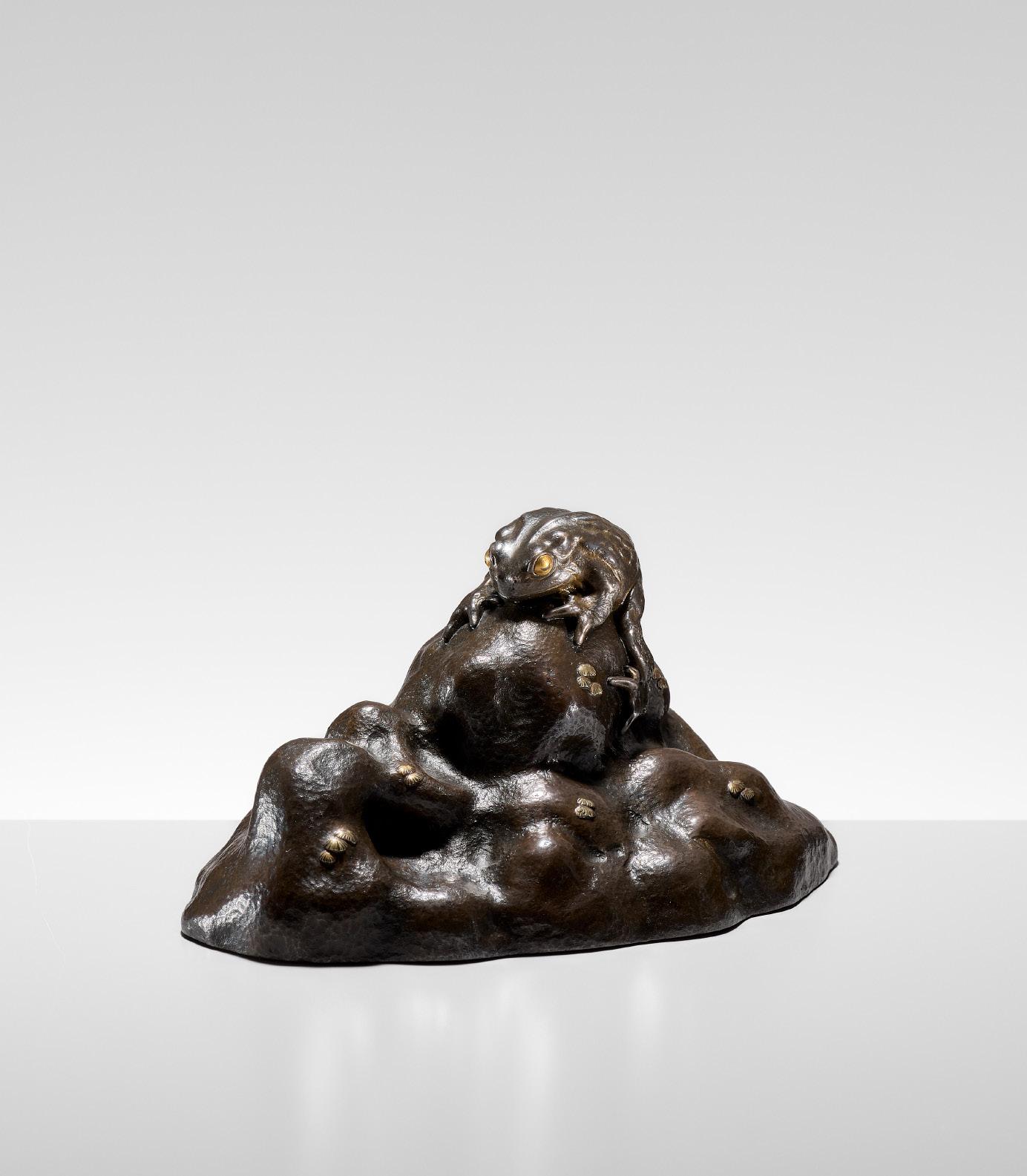
SEKIGUCHI ICHIYA: A BRONZE OKIMONO OF A TOAD ON ROCKS
By Sekiguchi Ichiya (1850-1933), signed Ichiya Japan, early 20th century, Meiji (1868-1912) to Taisho period (1912-1926)
Naturalistically cast as a toad perched on a rock, the bulging eyes detailed in gold takazogan and with silver takazogan moss growing on the ishimeji surface of the rocks. Signed in an oval reserve ICHIYA.
LENGTH 14.6 cm
WEIGHT 520 g
Condition: Very good condition with minor wear and casting irregularities.
Sekiguchi Ichiya (1850-1933) is listed in Haynes Index of Japanese Sword Fittings and Associated Artists under this name, p. 364-365 (H 01743.0). He was born in Edo, worked in Tokyo, and his father was a samurai retainer of the Matsudaira family. Ichiya was adopted by Sugioka Ikken (1832-1904), became a student of Goto Ichijo (1791-1876), and collaborated with Ichijo on some pieces. His last student and adopted son was the fourth Kashima Ikkoku (1898-1979).
Estimate EUR 3,000 Starting price EUR 1,500
38
KATORI HOTSUMA: A PAIR OF POWERFUL BRONZE SHISHI
By Katori Hotsuma (1874-1954), signed Katori saku Japan, c. 1935-1940, Showa period (1926-1989)
Each seated on its haunches atop a lobed base, the ferocious beasts with a muscular body detailed by a curly mane and bushy tail, their heads slightly turned to the side with a fierce expression conveyed by bulging eyes and open mouth revealing sharp fangs. One figure with gilding, the other in copper bronze with lighter shades of gilt. The bases signed KATORI saku [made by Katori].
37
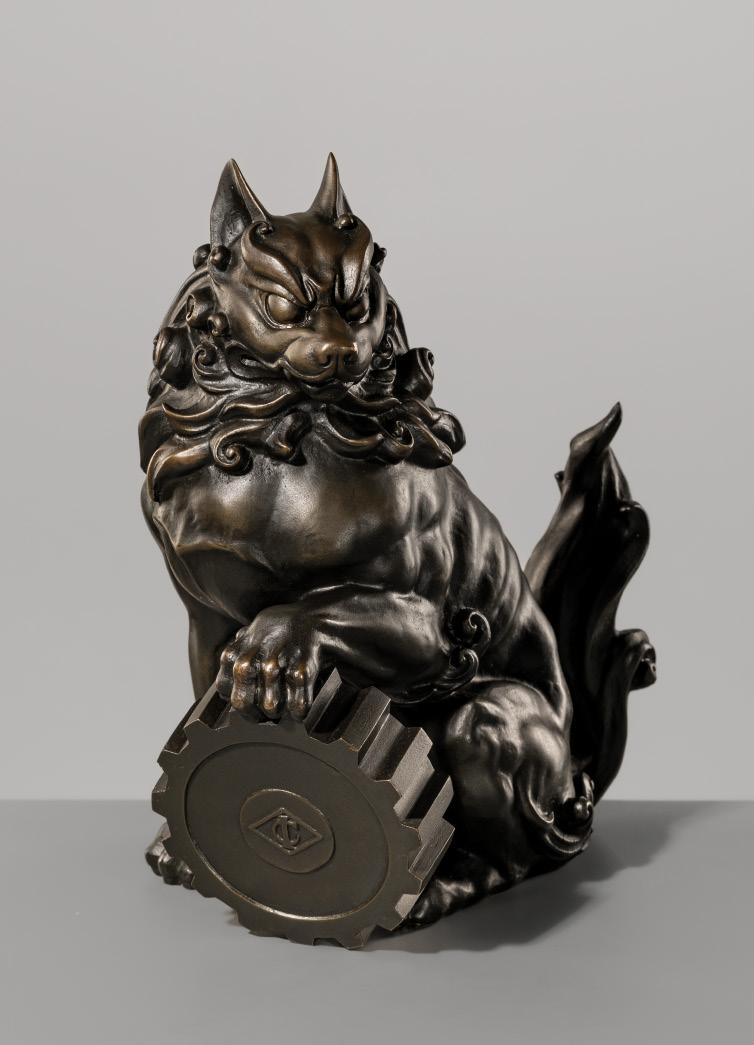
TSUDA SHINOBU: A LARGE BRONZE FIGURE OF A SHISHI BALANCING A GEAR
By Tsuda Shinobu (1875-1946), signed Daiju saku Japan, c. late 1930s, Showa period (1926-1989)
Finely cast seated on its haunches, the shishi (Chinese mythical lion) with one paw resting atop a gear centered by a foreign insignia, its chest thrust forward, the head modeled with a tight-lipped fierce expression, wide bulging eyes, alert ears, all framed by a scrolling mane, the muscular body with articulated ribs, thick tufts of curling fur, and a long scrolling tail. The underside signed DAIJU saku [made by Daiju].
HEIGHT 24.2 cm
WEIGHT 3.4 kg
Condition: Excellent condition.
AUCTION COMPARISON
Compare a closely related bronze figure of a reclining shishi by the same artist, c. late 1930s, 18 cm high, at Bonhams, Fine Japanese and Korean Art including Japanese Screens from The Metropolitan Museum of Art and The Simone and Alan Hartman Collection of Japanese Art Part II, 21 March 2024, New York, lot 1057 (sold for USD 3,584 or approx. EUR 3,200 converted and adjusted for inflation at the time of writing).
Estimate EUR 4,000
Starting price EUR 2,000
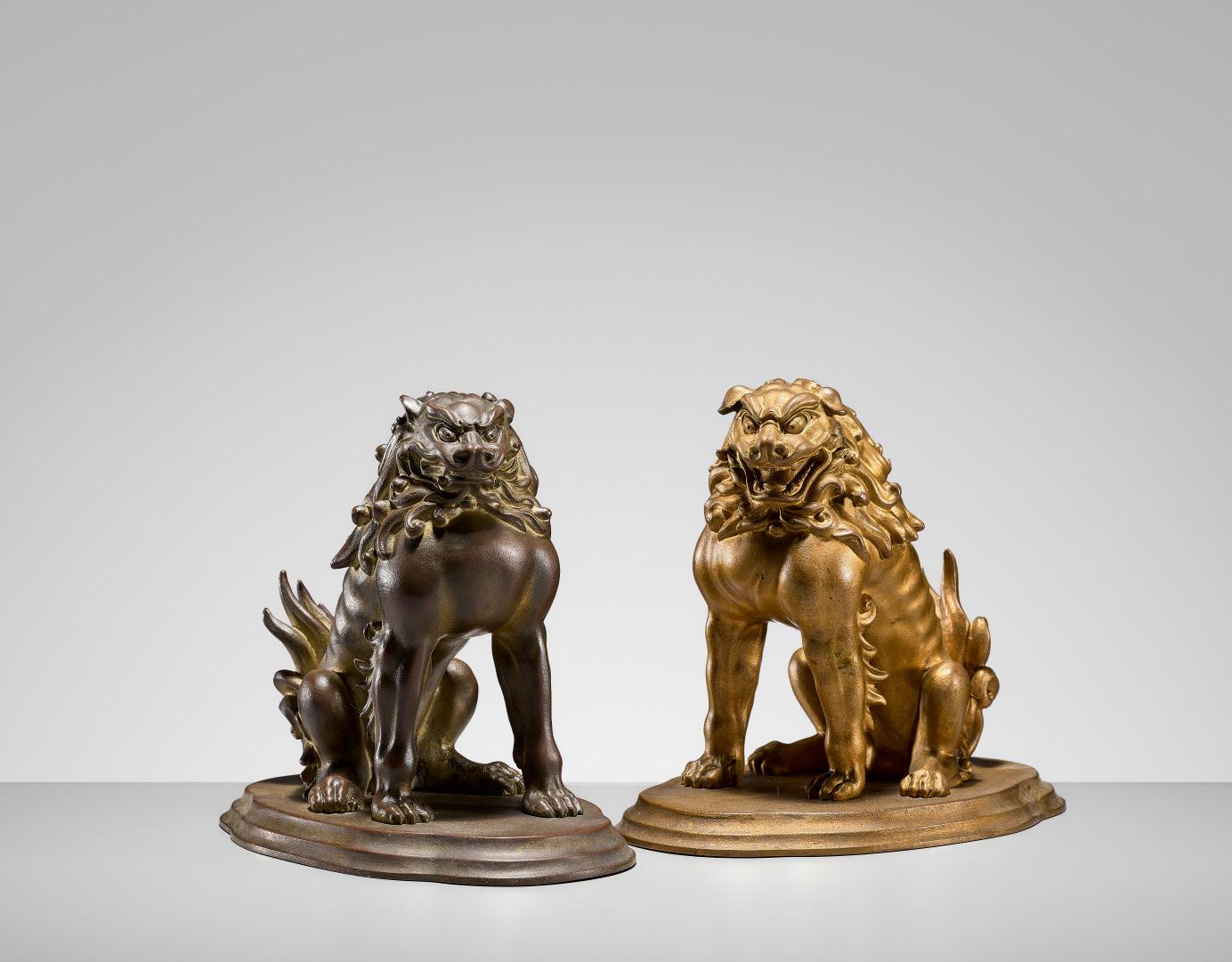
HEIGHT 16.5 cm and 16.3 cm
LENGTH 18.3 cm (each)
WEIGHT 1.6 kg and 1.5 kg
Condition: Excellent condition with minor wear and one screw lost to the base.
Estimate EUR 3,000
Starting price EUR 1,500
39
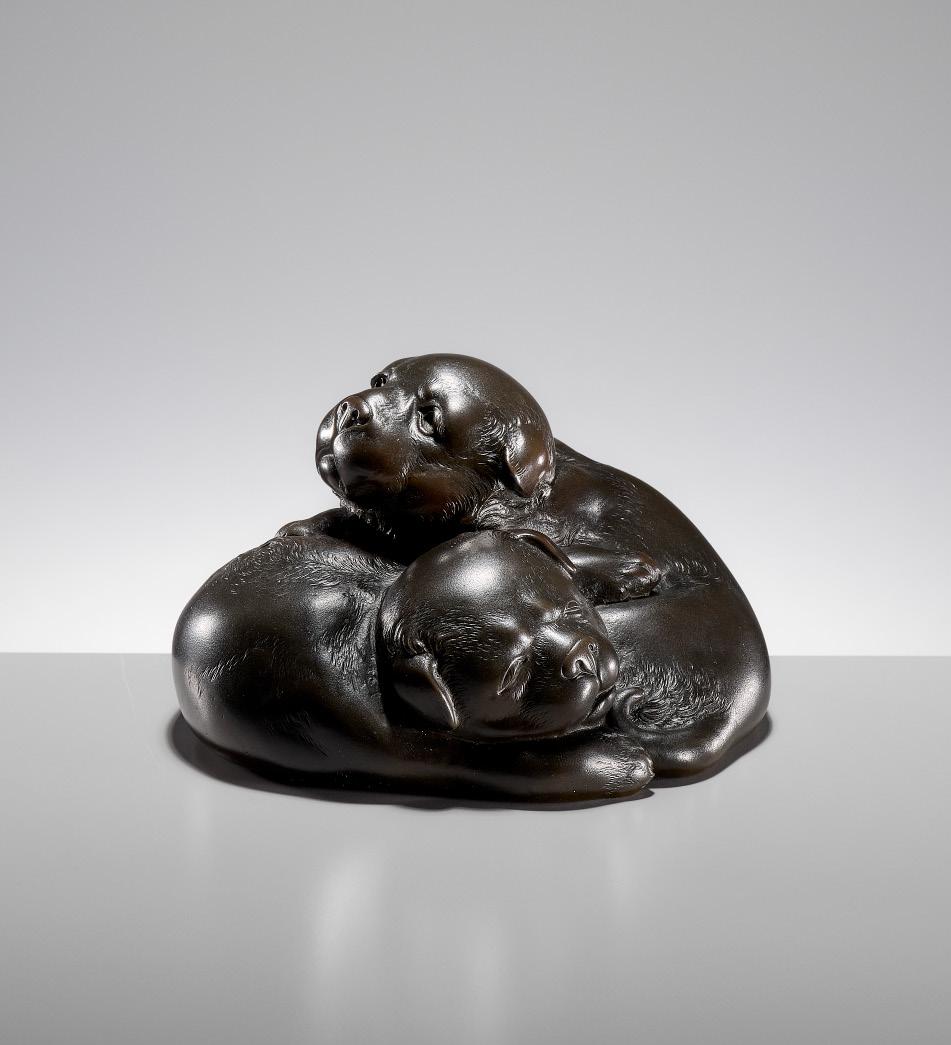
YAMAMOTO JUNMIN: A FINE BRONZE OKIMONO OF TWO SLEEPY PUPPIES
By Yamamoto Junmin (1888-1962), signed Junmin in Japan, c. 1930s, Showa period (1926-1989)
Finely cast as two curled up puppies, one fast asleep, while the other rests with its head raised, exhibiting a calm expression detailed with droopy ears. The texture of the fur is meticulously engraved. Signed underneath within a rectangular reserve JUNMIN in [seal of Junmin].
LENGTH 15.7 cm
WEIGHT 1.1 kg
Condition: Very good condition with minor surface wear and casting irregularities.
Estimate EUR 2,000
Starting price EUR 1,000
40
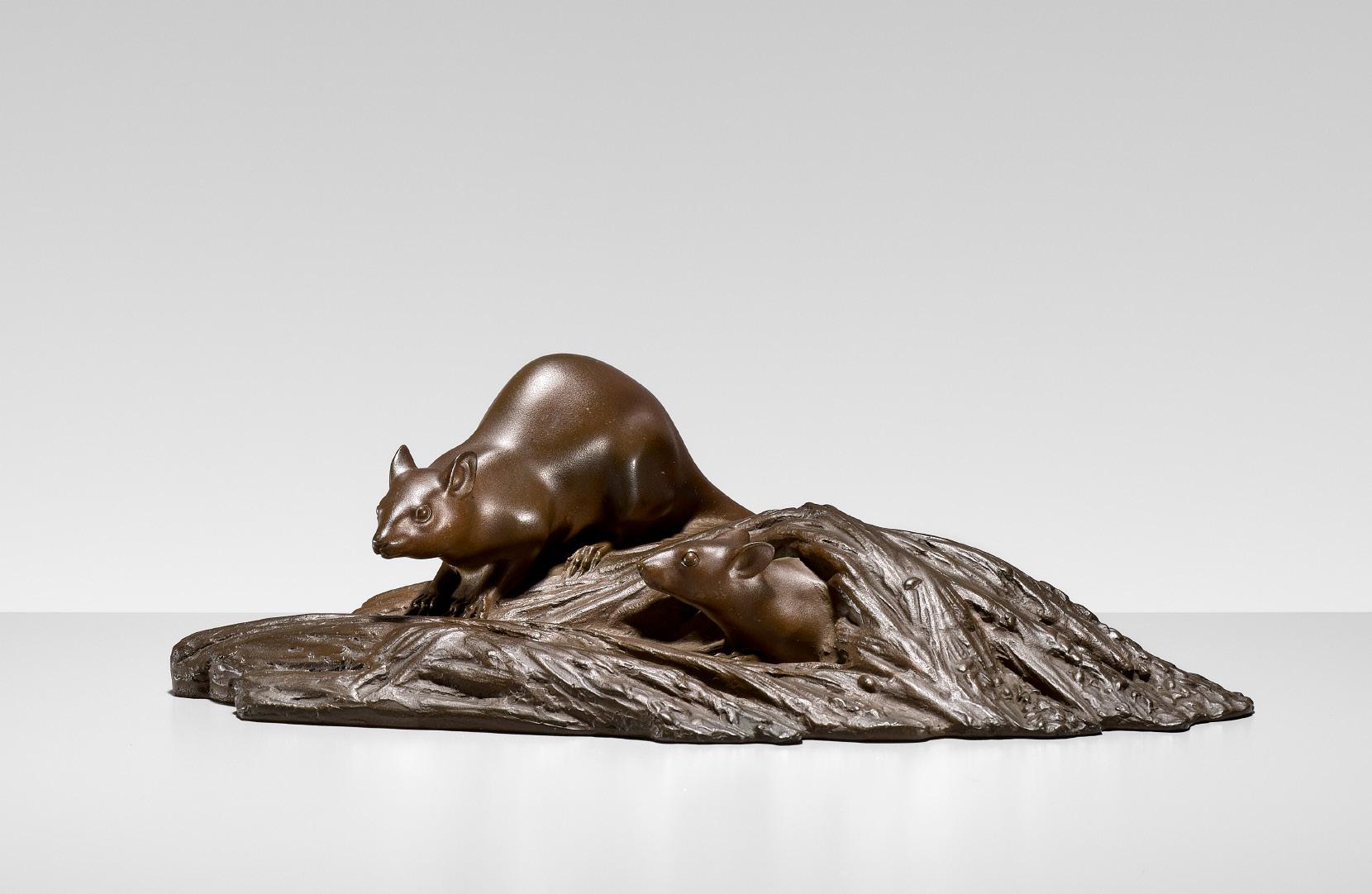
TSUDA SHINOBU: A BRONZE OKIMONO OF TWO MICE ON BARLEY
By Tsuda Shinobu (1875-1946), signed Daiju saku Japan, c. 1935-1940, Showa period (1926-1989)
Finely cast in bronze of a rich chocolate-brown color, this piece depicts two rats nestled among cut stalks of barley. One rat emerges from beneath the barley, while the other rests atop, their faces delicately detailed with circular eyes and pointed noses and one detailed with a long, sinuous tail. Signed to the side of the base DAIJU saku [made by Daiju].
LENGTH 29.2 cm
WEIGHT 1.6 kg
Condition: Excellent condition with minor wear.
Estimate EUR 1,500
Starting price EUR 800
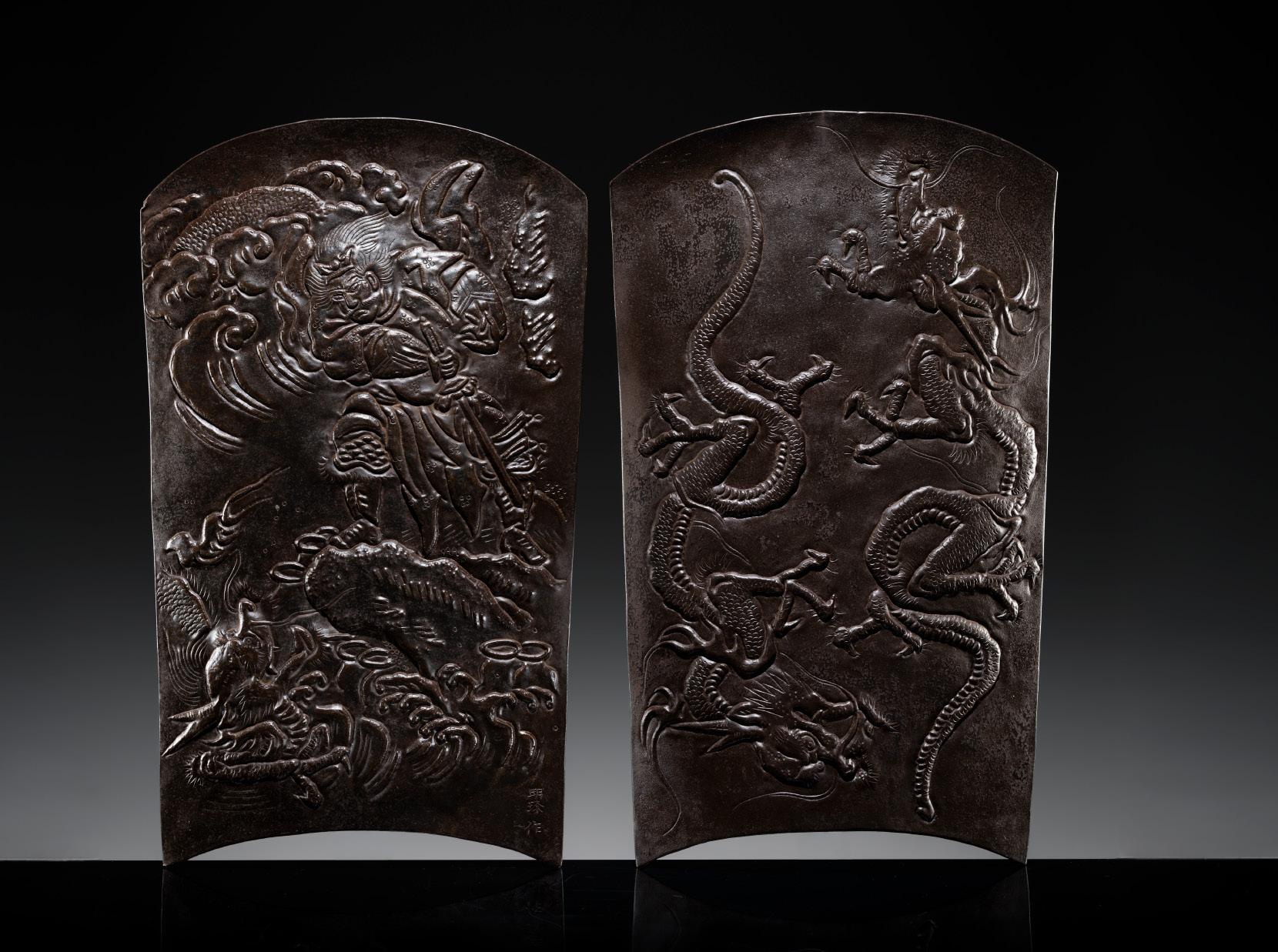
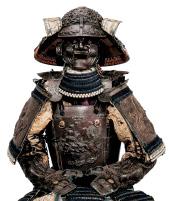
MYOCHIN: A LARGE AND IMPRESSIVE PAIR OF IRON UCHIDASHI CEREMONIAL ’SUSANOO-NO-MIKOTE AND DRAGONS’ ARMOR PLATES
By a member of the Myochin family, signed Myochin saku Japan, 18th-19th century, Edo period (1615-1868)
Of arched form, each plate is finely worked in repoussé (uchidashi) technique, the first depicting Susanoo-no-Mikoto, the impetuous brother of the sun goddess, staring into the waves where a dragon lurks. Susanoo is shown with scrolling locks of hair, pulled away from his face and secured by a comb. The second plate features a pair of confronting dragons, their sinuous bodies curling with detailed incised scales. Their fierce expressions, complete with scrolling whiskers and open mouths revealing sharp fangs, enhance the dynamic energy of the piece. Both plates are pierced with two apertures on the back for attachment or mounting. Signed on the Susanoo plate MYOCHIN saku [made by Myochin].
HEIGHT (each) 53 cm
WEIGHT 1.3 kg and 1.6 kg
Condition: Excellent condition with minor typical wear, minor warping, minuscule dents, the back with remnants of old gilding.
Given the large size of these plates, they likely served as part of ceremonial armor, possibly intended as do (chestplates) or sode (shoulder guards). Alternatively, their striking visual appeal and exceptional size suggest they may have been conceived as decorative wall hangings, meant to showcase the Myochin family’s craftsmanship and the dramatic mythological scenes they brought to life in metal.
MUSEUM COMPARISON
Compare a closely related breastplate (do), by Myochin Muneie, similarly decorated in uchidashi with a dragon, 36.8 cm high, in the Walters Art Museum, accession no. 51.595
AUCTION COMPARISON
Compare a related Myochin school armor similarly decorated in uchidashi, dated 18th-19th century, at Christie’s, Arts of the Samurai and Japanese Art & Design, 7 June 2000, London, lot 38 (sold for GBP 42,300 or approx. EUR 93,500 converted and adjusted for inflation at the time of writing).
Estimate EUR 6,000
Starting price EUR 3,000
42
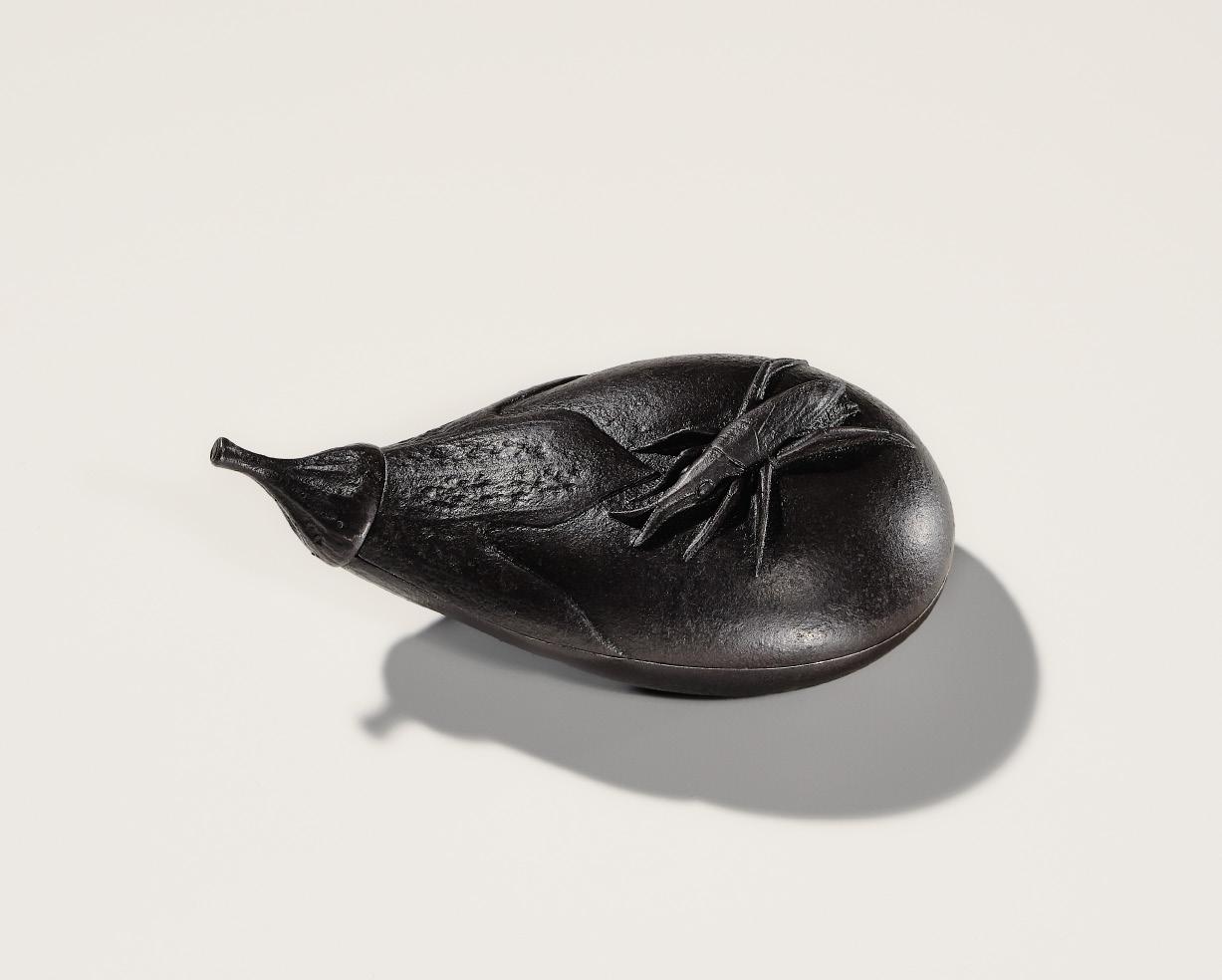
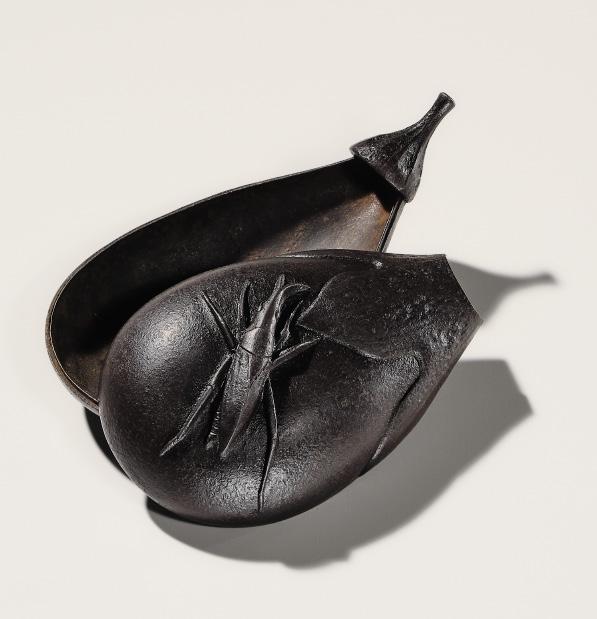
MYOCHIN MUNETSUGU: A RARE IRON ‘EGGPLANT AND KAMAKIRI-MUSHI’ KOGO (INCENSE BOX)
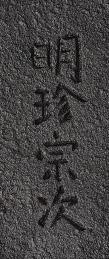
By Myochin Munetsugu, signed Myochin Munetsugu Japan, Owari Province, 19th century, late Edo period (1615-1868)
Naturalistically cast in the form of a ripe eggplant, the surface of the leaves and stem finely textured, the inrobuta (flush-fitting) lid superbly worked in uchidashi to depict a kamakiri-mushi (longhorn beetle). Signed underneath MYOCHIN MUNETSUGU.
LENGTH 12.5 cm
WEIGHT 161.8 g
Condition: Excellent condition with minor wear and some corrosion to the interior.
Myochin Munetsugu is probably the artist recorded in Wakayama Takeshi, Kinko jiten (Dictionary of Metalworkers), Tokyo, Token Shunju Shinbunsha, 1999, p.955, as being a maker of iron plate tsuba, active during the late Edo period in Owari Province (present day Aichi Prefecture).
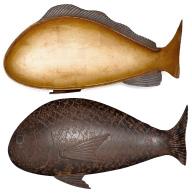
The Myochin family was the most successful of the numerous dynasties of professional armorers that originated in late-medieval Japan. In the Edo period (16151868) the family opened branches not just in the major cities but also in the chief towns of many provincial fiefs where they turned out vast quantities of cuirasses, helmets, face masks, and other components that were needed for samurai armor. Myochin craftsmen were highly accomplished in using tiny rivets to join multiple iron plates, creating protection that was both relatively light and highly flexible; over time, they repurposed their skills to make ingenious and astonishingly lifelike articulated models of snakes, fishes, crustaceans, and insects. They also made other objects for everyday or ceremonial use, like the present kogo, which is to be considered exceedingly rare.
Compare a closely related iron box and cover of seabream form, by Myochin Muneyoshi, dated late Edo period, 22.3 cm long, at Bonhams, Fine Japanese Art, 13 May 2008, London, lot 546 (sold for GBP 3,840 or approx. EUR 7,200 converted and adjusted for inflation at the time of writing).
Estimate EUR 5,000 Starting price EUR 2,400
43
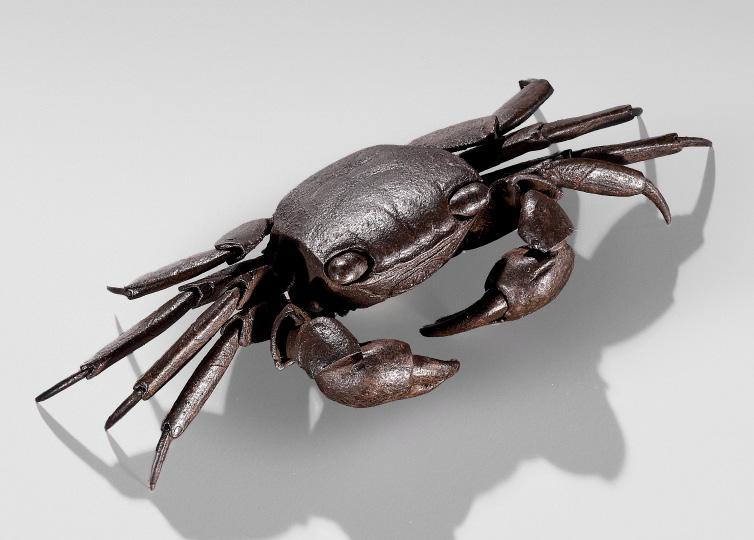
AN EXQUISITE SMALL IRON JIZAI
OKIMONO OF A SMALL CRAB
Japan, 18th-19th century, Edo period (1615-1868)
44
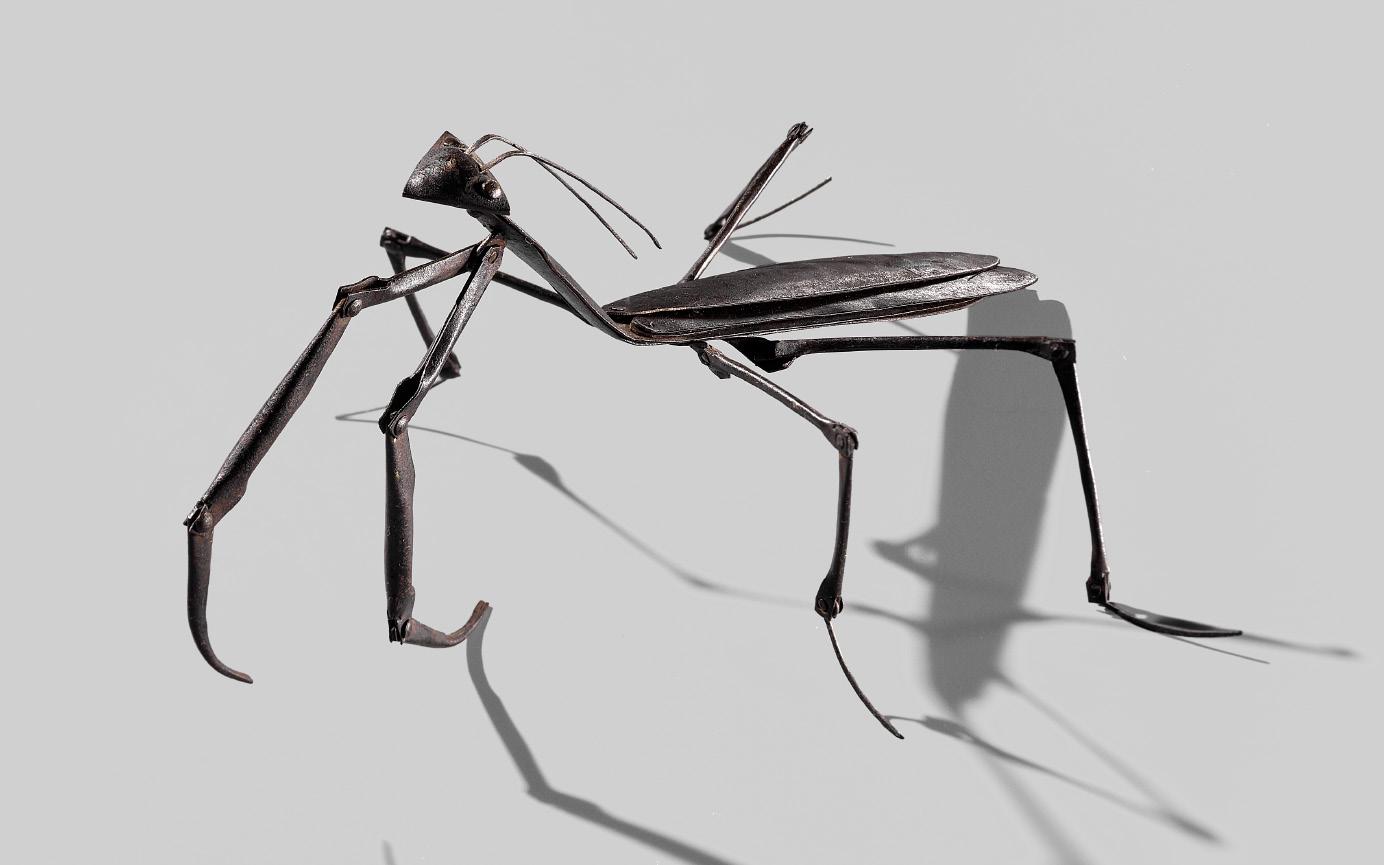
MYOCHIN: A JIZAI OKIMONO OF A PRAYING MANTIS
By a member of the Myochin family, signed Myochin Japan, 18th-19th century, Edo period (1615-1868)
Finely and realistically rendered, constructed from numerous russet-iron plates, each carefully hammered and assembled, to form four hinged wings and a solid dorsal backplate, along with four movable legs affixed to the lower body and two grasping forelegs attached to the upper section. The head and antennae are fully articulated, allowing for detailed movement. The abdomen signed MYOCHIN.
Naturalistically modeled, the fully articulated crustacean presenting eight segmented legs, two prominent frontal pincers, and a pair of protruding, movable eyes. The carapace finely incised to depict its nodular texture, exhibiting a dark, naturally developed, warm patina.
LENGTH 8.8 cm (with fully extended legs)
WEIGHT 31.3 g
Provenance: The Mark and Elizabeth Harding Collection, Kimberley, South Africa.
Condition: Excellent condition with only minor surface wear, light casting-inherent irregularities, and minimal traces of corrosion between the legs.
AUCTION COMPARISON
Compare a closely related iron articulated model of a crab, Edo period, 18th-19th century, 4.1 cm long, at Christie’s, An Inquiring Mind: American Collecting of Japanese and Korean Art, New York, 25 April 2017, lot 66 (sold for USD 22,500 or approx. EUR 26,000 converted and adjusted for inflation at the time of writing).
Estimate EUR 4,000
Starting price EUR 2,000
LENGTH 24.3 cm (with fully extended limbs)
WEIGHT 42.4 g
Provenance: Collection of Dr. Richard Brown, thence by descent. Condition: Very good condition with only minor wear, some light warping and bending to segments, minor areas of corrosion.
Estimate EUR 4,000
Starting price EUR 2,000
45
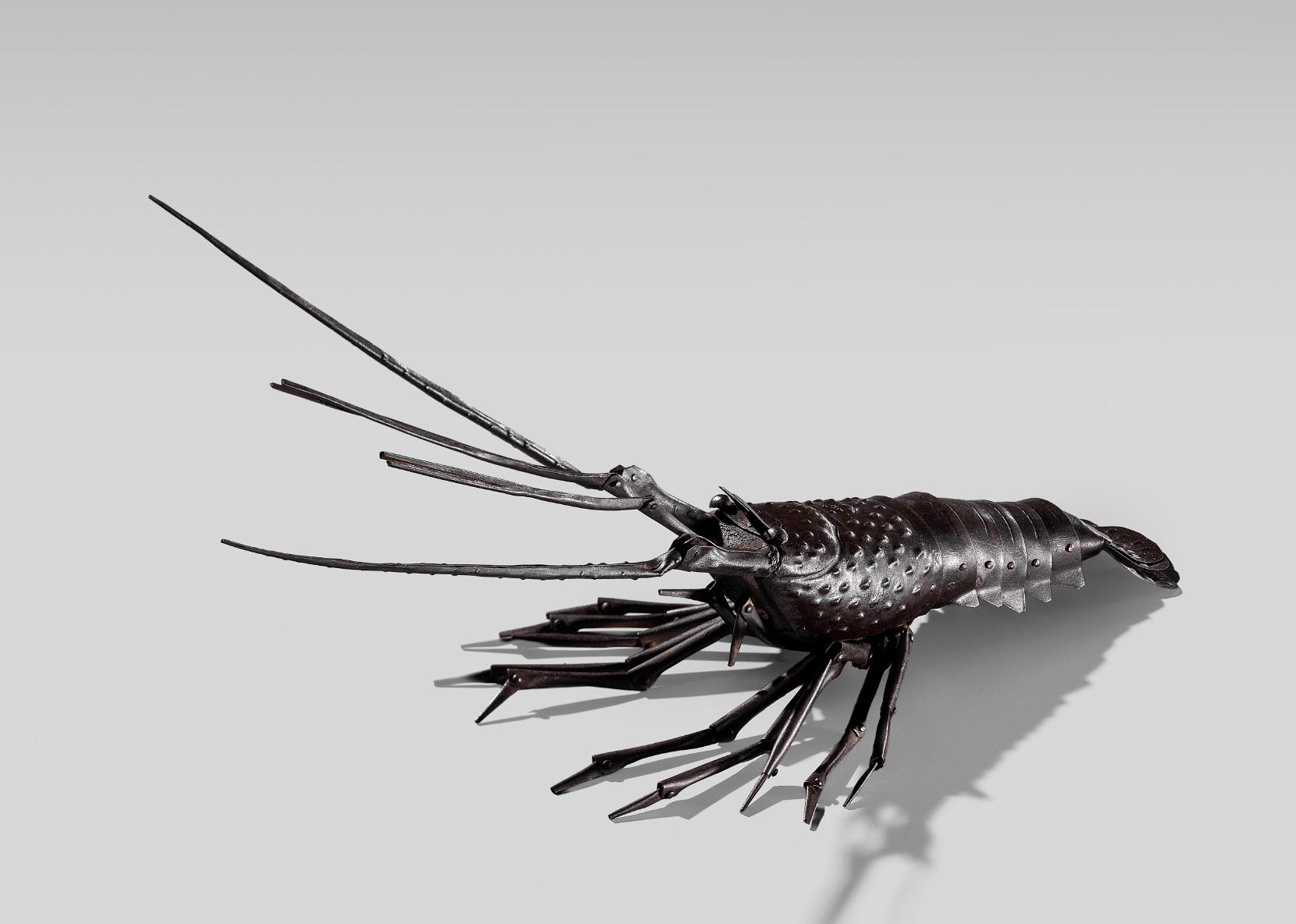
MYOCHIN: AN IRON JIZAI OKIMONO OF AN ISE-EBI (SPINY LOBSTER)
By a member of the Myochin family, signed Myochin Japan, 18th-19th century, Edo period (1615-1868)
Naturalistically modeled, formed from individually cast and hammered sections designed to emulate the shell of a lobster, and assembled with articulated joints allowing full mobility of the body, antennae, and limbs. Finely chiseled and incised detailing is applied to the thorax and tail of the crustacean. Signed on the underside MYOCHIN.
LENGTH 33.8 cm (with extended feelers)
WEIGHT 116.2 g
Condition: Excellent condition with only minor surface wear, light casting-inherent irregularities, and faint traces of corrosion.
With an inscribed wood storage box (tomobako).
The basic principle of Japanese armor lies in its flexibility, achieved through the assembly of numerous small, lacquered metal plates laced together in rows, allowing a high degree of freedom of movement. It is this very quality of articulation that gave rise to the term ‘jizai’ to describe articulated okimono. The subjects favored by jizai okimono craftsmen are primarily dragons, snakes, crustaceans, birds, and insects, creatures whose segmented bodies, scales, or feathers provide both protection and mobility, mirroring the articulated construction of Japanese armor itself.
Meticulously crafted from hammered iron plates, these articulated figures were highly prized as decorative objects and served as sources of fascination, entertainment, and discussion.
The Myochin family was the most prominent of the numerous dynasties of professional armorers that originated in late medieval Japan. During the Edo period (1615–1868), they established branches not only in major urban centers but also in the principal towns of various provincial domains, producing large quantities of cuirasses, helmets, facial masks, and other components required for samurai armor. Myochin craftsmen were highly skilled in the use of minute rivets to join multiple iron plates, creating armor that was both lightweight and remarkably flexible. Over time, they adapted these techniques to produce intricate and strikingly lifelike articulated models of snakes, fish, crustaceans, and insects.
Compare a closely related jizai okimono of a lobster, signed Myochin Muneyuki, Edo period, 19th century, 17.6 cm long, at Christie’s, Japanese and Korean Art, New York, 22 September 2005, lot 244 (sold for USD 11,400 or approx. EUR 17,000 converted and adjusted for inflation at the time of writing).
Estimate EUR 5,000 Starting price EUR 2,400
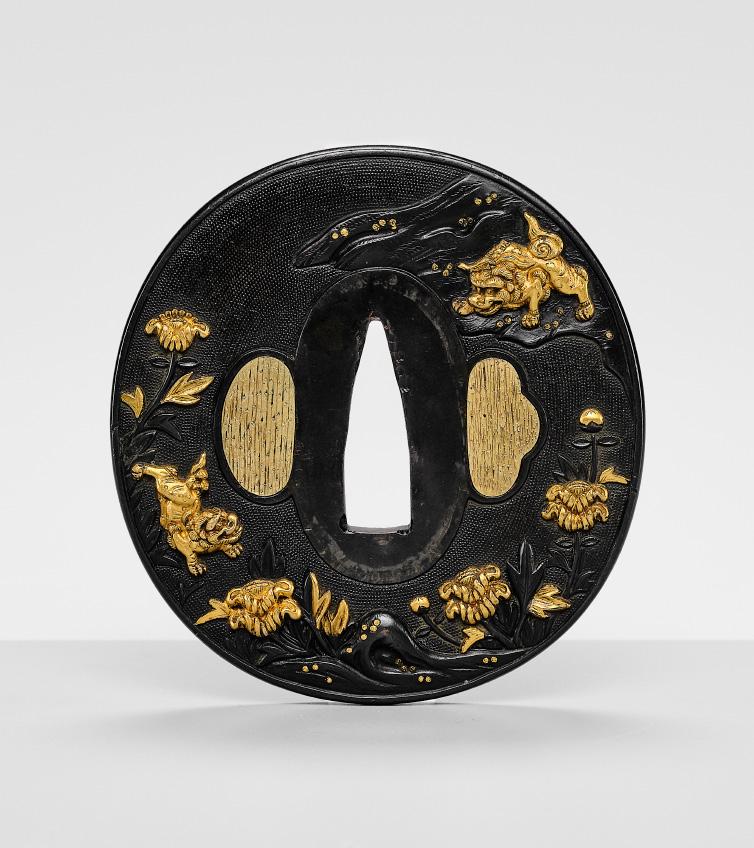
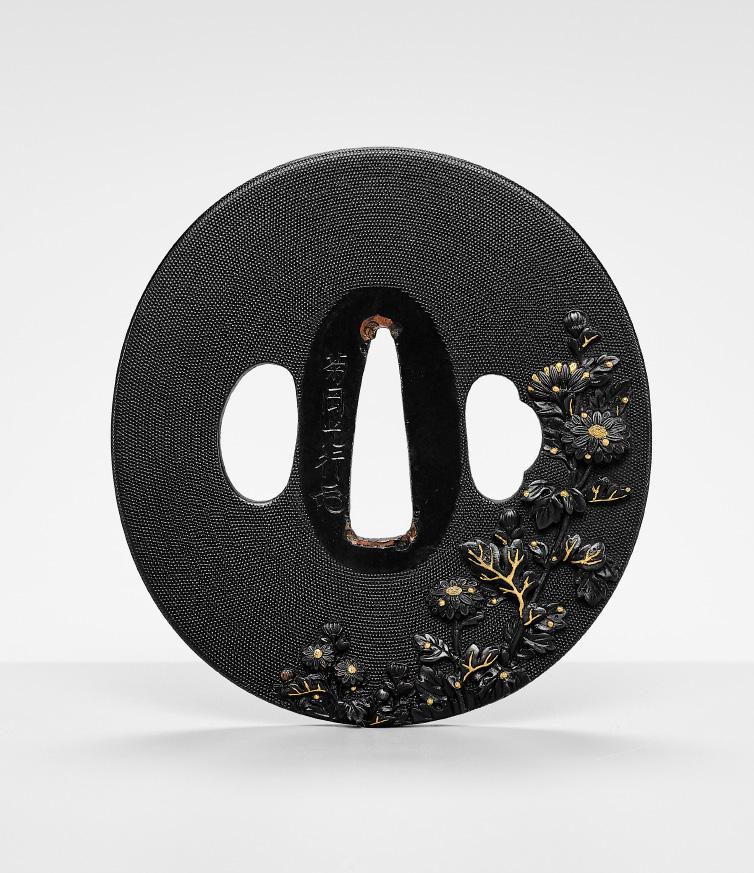
46
A GOTO SCHOOL SHAKUDO NANAKO ‘BOTAN SHISHI’ TSUBA, WITH TOKUBETSU HOZON NBHTK CERTIFICATE
Japan, 18th century, Edo period (1615-1868)
The tsuba is accompanied by an NBTHK Tokubetsu Hozon [Especially Worthy of Preservation] certificate, no. 228371, dated 28 February Heisei 20 [2008], attributing the blade to the Goto school, with a photo of the tsuba and the seal of the NBTHK.
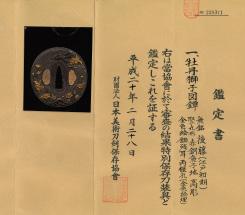
Of tatemarugata form, the kozuka and kogai hitsu ana plugged in gold, the shakudo nanako ground superbly inlaid in gold takazogan to depict three shishi playing amid peonies.
HEIGHT 7.1 cm, LENGTH 6.7 cm, 2.7 cm (the nakago), WIDTH 0.4 cm (the mimi), 0.5 cm (the seppa-dai) WEIGHT 153.9 g
Condition: Very good condition with minor wear and few nicks to the seppa-dai.
With a wood storage box inscribed ‘peonies and lions, unsigned (early Edo period)’ with a stamp ‘tokuho (Tokubetsu hozon certified)’.
Estimate EUR 3,000
Starting price EUR 1,500
47
KIKUOKA MITSUYUKI: A FINE SHAKUDO NANAKO ‘CHRYSANTHEMUMS’ TSUBA
By Kikuoka Mitsuyuki (1750-1800) signed Kikuoka Mitsuyuki with kakihan Japan, 18th century, Edo period (1615-1868)
Of nagamarugata form, with one kogai and kozuka hitsu ana, the nakago ana with copper sekigane, the shakudo nanako ground superbly inlaid in gold and shakudo takazogan to depict sprays of chrysanthemums to each side. Signed to one side KIKUOKA MITSUYUKI with kakihan.
HEIGHT 7.3 cm, LENGTH 6.9 cm, 2.7 cm (the nakago), WIDTH 0.3 cm (the mimi), 0.4 cm (the seppa-dai)
WEIGHT 136.7 g
Provenance: Christie’s, London, 9 November 2005, lot 13. From the private collection of Alan and Simone Hartman, New York, acquired from the above.
Condition: Excellent condition with only very minor wear.
Kikuoka Mitsuyuki (1750-1800) is listed in the Haynes Index of Japanese Sword Fittings and Associated Artists on p. 1125 (H 05606.0). He was a student of Yanagawa Naomitsu and is considered the founder of the Kikuoka school.
Estimate EUR 2,500
Starting price EUR 1,200
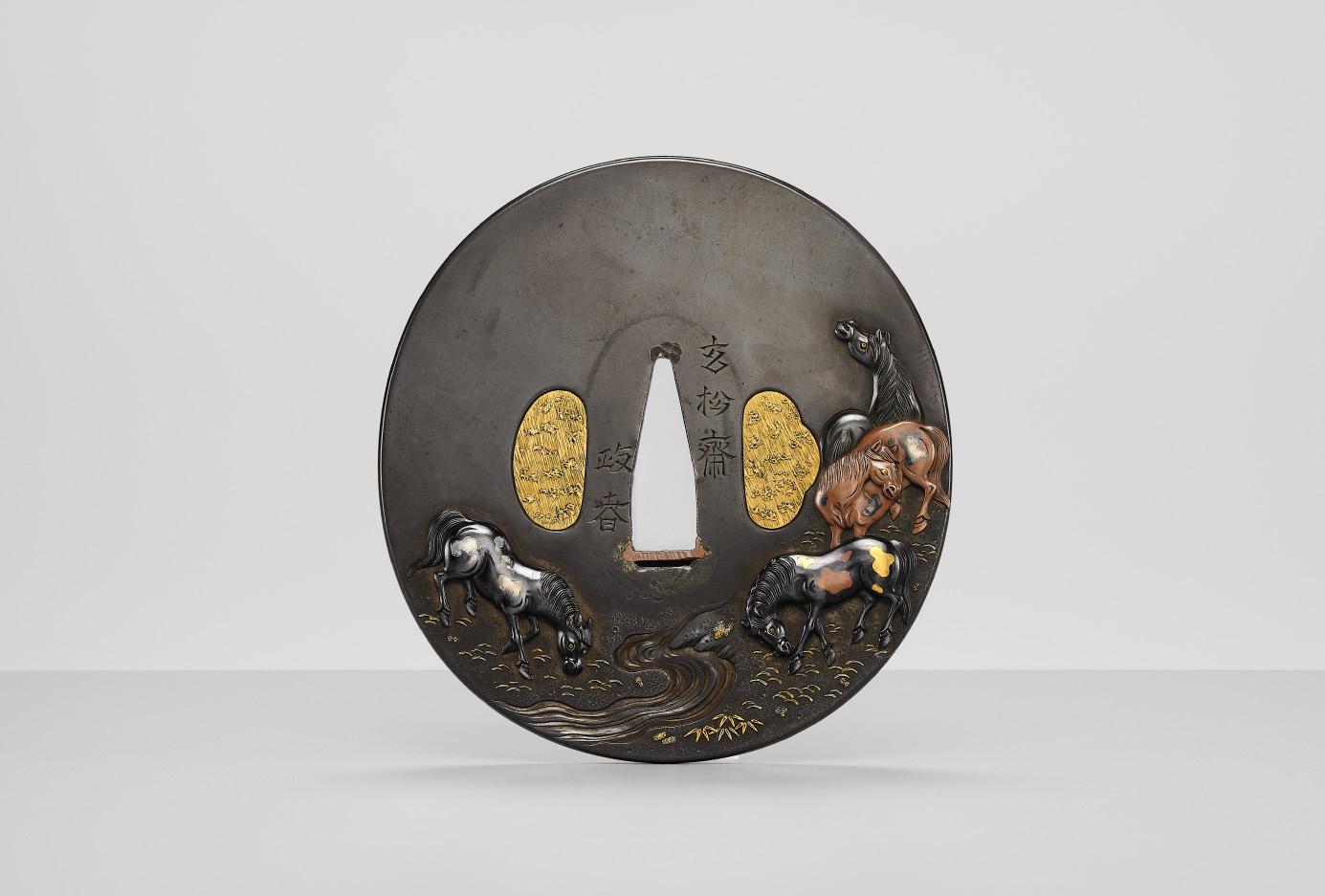
48
GENSHOSAI MASAHARU: A FINE SHIBUICHI ‘FIVE HORSES’ TSUBA
School of Genshosai Masaharu (active c. 1720s), signed Genshosai Masaharu Japan, 18th century, Edo period (1615-1868)
Of nagamarugata form, with gold-plugged kozuka and kogai hitsu ana, the nakago ana with copper sekigane, the shibuichi migakiji (polished) ground inlaid in superb iro-e takazogan with five frolicking horses beside a stream carved in shishiaibori and katakiribori. Signed to one side GENSHOSAI MASAHARU.
HEIGHT 8.1 cm, LENGTH 7.7 cm, 2.6 cm (the nakago), WIDTH 0.4 cm (the mimi), 0.4 cm (the seppa-dai) WEIGHT 180 g
Provenance: Christie’s, New York, 23 October 2009, lot 19. From the private collection of Alan and Simone Hartman, New York, acquired from the above.
Condition: Excellent condition with only very minor wear.

Alan & Simone Hartman
Genshosai Masaharu (active c. 1720s) is listed in the Haynes Index of Japanese Sword Fittings and Associated Artists on p. 851852 (H 03917.0). He was the first student of Shuji Yoshimori in Mito and a student of Ishiguro Masatsune.
Estimate EUR 4,000 Starting price EUR 2,000
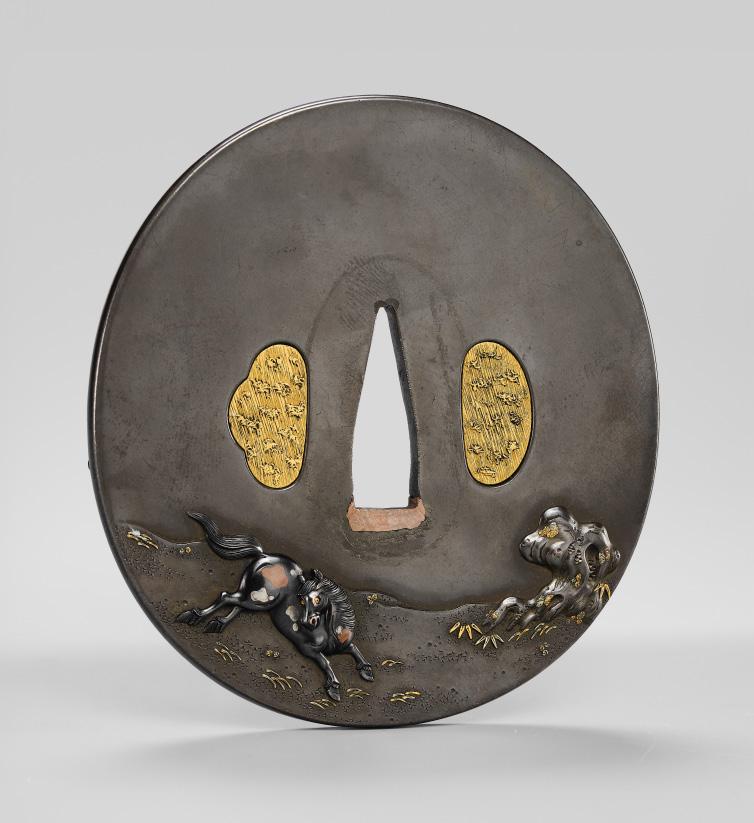
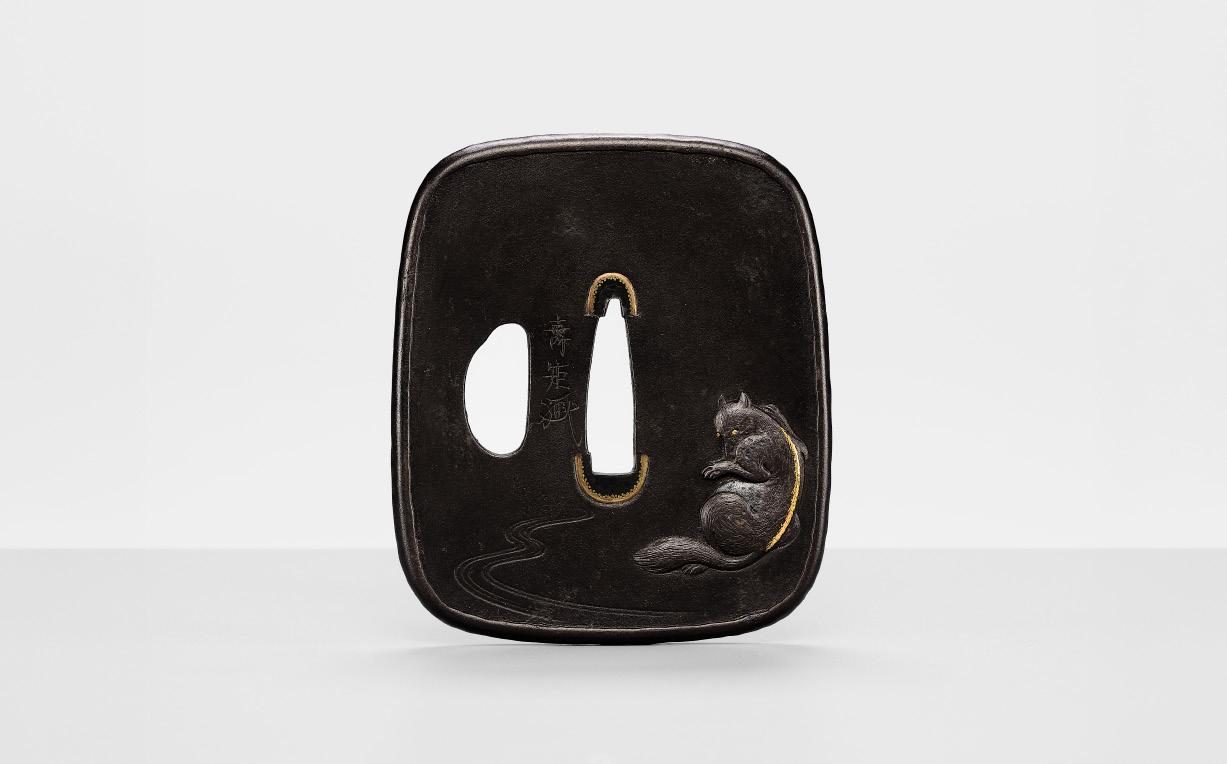
By Miyashita Toshinori (1830-1897), signed Miyashita Toshinori and kakihan Japan, 19th century, Edo (1615-1868) to Meiji period (1868-1912)
Of kakumarugata form, with a kozuka hitsu ana, finely inlaid in gold, silver, and shakudo hirazogan and takazogan, some details worked in katakiribori, depicting a sly fox looking over his shoulders beside a stream. The reverse featuring grasses with dew drops. Signed to one side Toshinori with kakihan.
HEIGHT 6.5 cm, LENGTH 5.5 cm, 2.2 cm (the nakago), WIDTH 0.5 cm (the mimi), 0.4 cm (the seppa-dai) WEIGHT 100 g
Condition: Very good condition with minor wear and areas of corrosion.
With a padded storage box lacquered in black and gold with an Imperial kiku emblem.
MUSEUM COMPARISON
Compare a related tsuba with the design of a magic fox by moonlight, by Iwamoto Konkan, dated 1780, in the Victoria & Albert Museum, Image ID 2006BB4706.
Estimate EUR 3,000
Starting price EUR 1,500
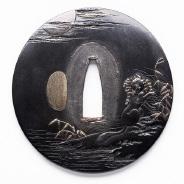
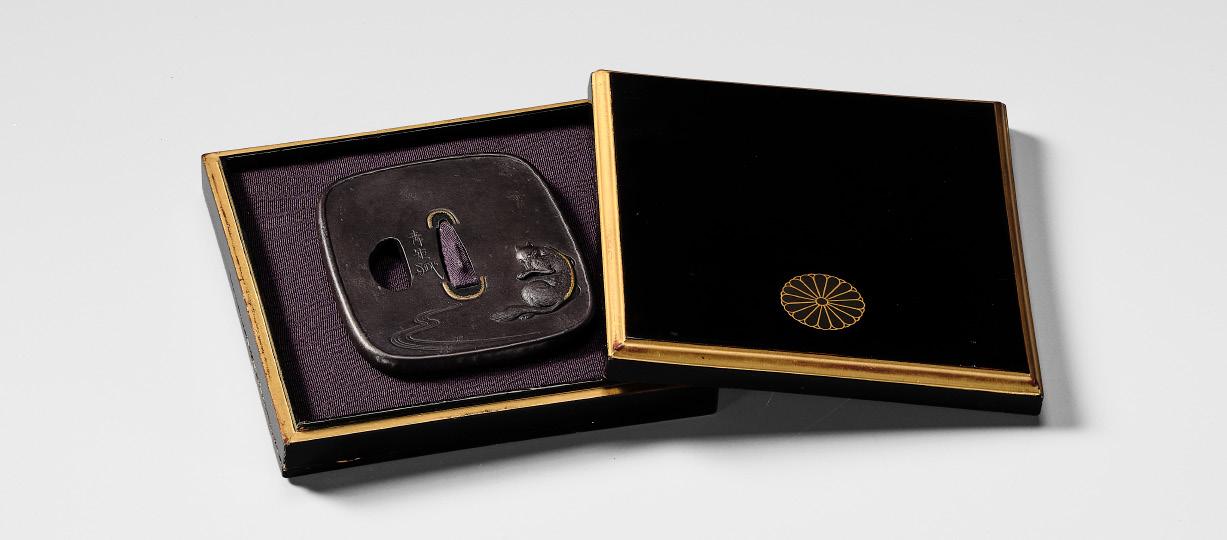
50
Lineage of Koma Kansai, signed Koma Kansai
Japan, 19th century, Edo period (1615-1868)
Of mokko-gata form, with a kogai hitsu-ana, the surface on both sides bearing a luminous gyobu-nashiji ground. The decoration is finely executed in iro-e takamaki-e and hiramaki-e, further enriched with inlaid mother-of-pearl. One side depicts a karasu tengu perched upon a gnarled pine tree, its wings partially unfurled, clad in flowing robes and wearing a tokin cap, set amidst wind-swept branches. The reverse is more sparsely composed, illuminated by a crescent moon inlaid in mother-of-pearl, and showing more of the thick, gnarled pine trunk. The edges are finished in gold fundame. Signed in gold takamaki-e KOMA KANSAI.
HEIGHT 7.5 cm, LENGTH 7.1 cm, 2.7 cm (the nakago), WIDTH 1 cm (the mimi), 0,5 cm (the seppa-dai)
WEIGHT 38.6 g
Condition: Good condition with typical wear and minor losses to the gyobu nashiji. The sides with some crackling and losses to lacquer.
With an associated red- and- black lacquered wood storage box (tomobako).
The Koma school ranks among the most celebrated lineages of Japanese lacquer artists.
Estimate EUR 3,000 Starting price EUR 1,500
51
A FINE SHIBUICHI SUKASHI ‘GEESE AND FOLIAGE’ TSUBA
Japan, 19th century, Edo period (1615-1868)
Of aorigata form, the guard is pierced with both kozuka and kogai hitsu ana and features a subtly raised mimi. One side is intricately decorated with a kage sukashi depiction of a goose in flight, set beneath finely rendered cherry blossoms in silver and gold, alongside a willow carved in katakiribori, all above softly defined, mist-laden clouds with gold hirazogan borders. The reverse is similarly decorated, incorporating the same kage sukashi goose visible from the opposing side, accompanied by maple leaves drifting into a flowing stream, an allusion to the Tatsuta River.
HEIGHT 6.2 cm, LENGTH 5.4 cm, 2.9 cm (the nakago), WIDTH 0.5 cm (the mimi), 0.4 cm (the seppa-dai)
WEIGHT 101 g
Provenance: Christie’s, London, 9 November 2005, lot 24. From the private collection of Alan and Simone Hartman, New York, acquired from the above.
Condition: Very good condition with minor wear.
Estimate EUR 2,000 Starting price EUR 1,000
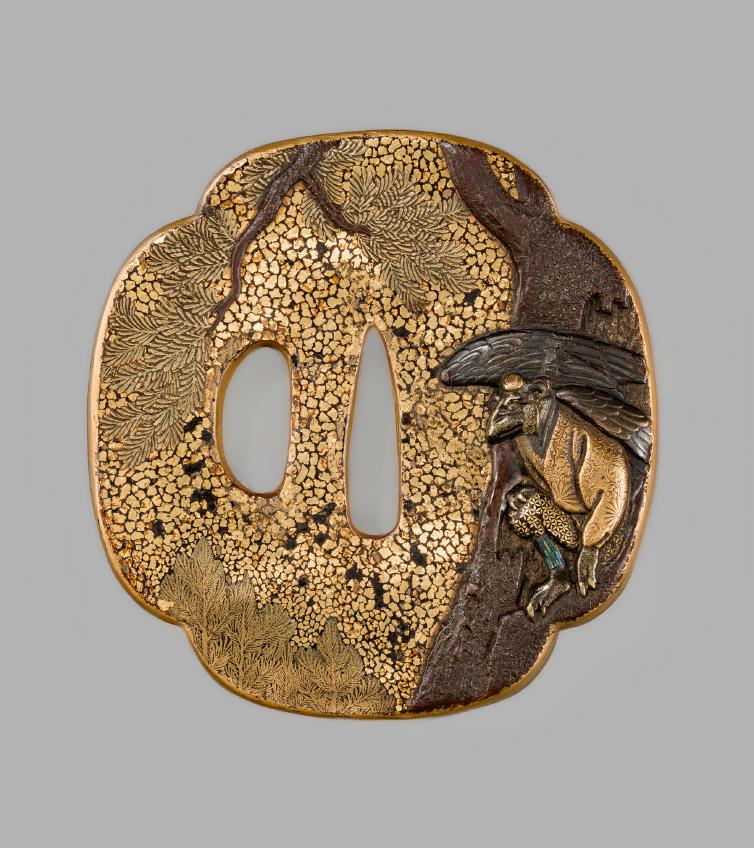
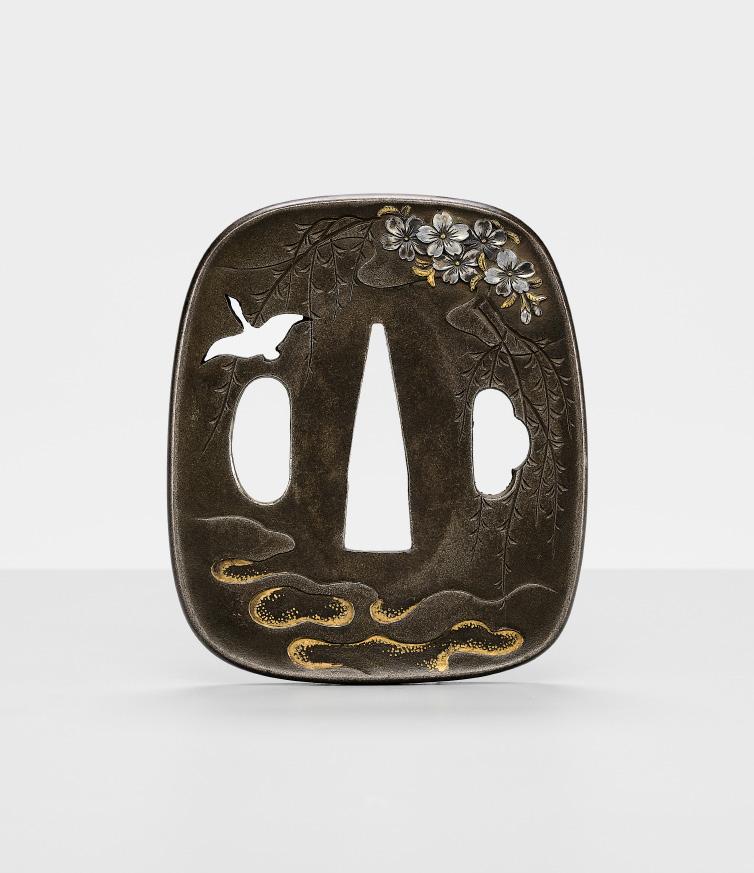
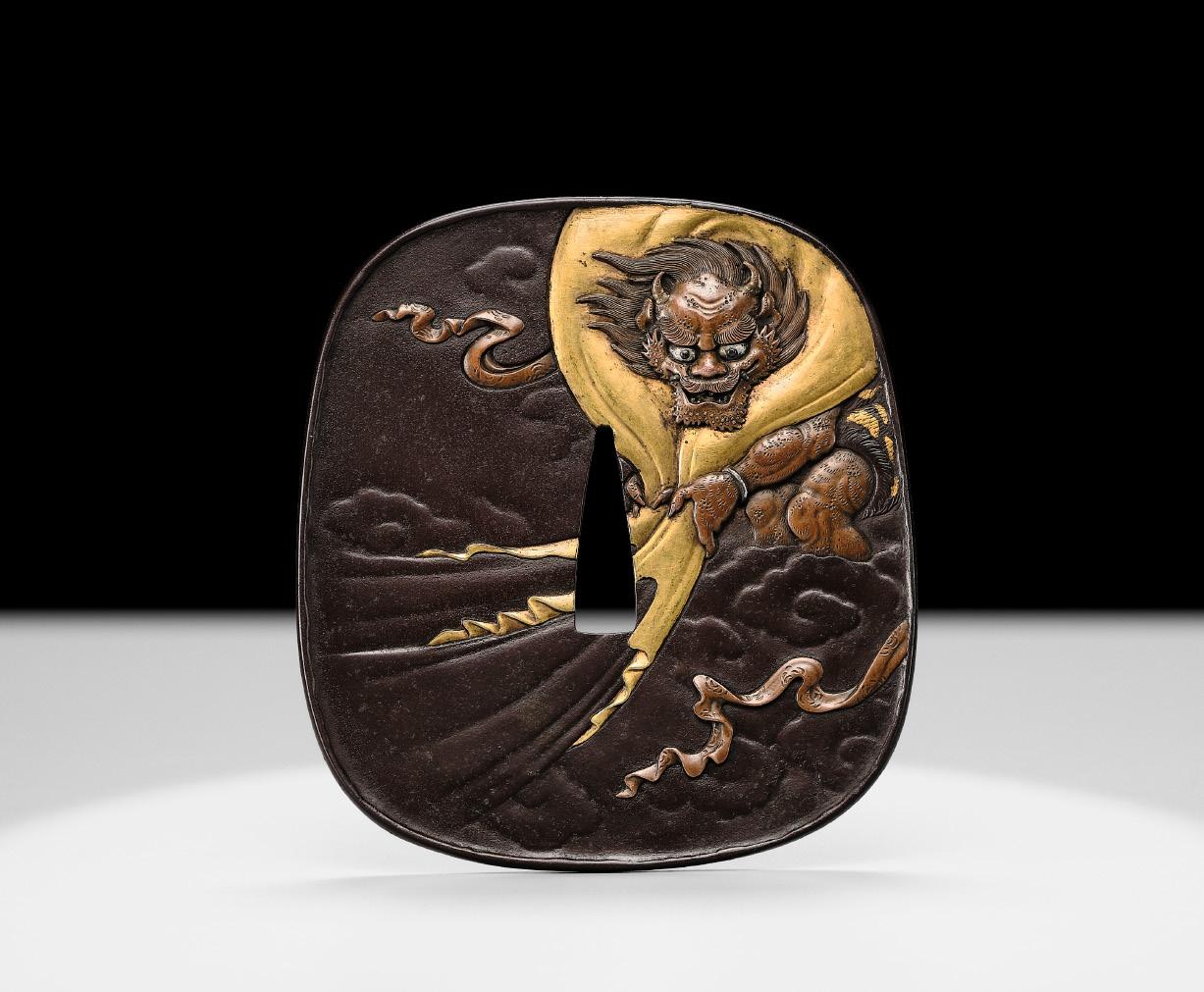
TAKUGYOKUSAI SADAMITSU: A SUPERB IRON ‘FUJIN AND GEISHA’ TSUBA
Signed Takugyokusai Sadamitsu with kakihan Japan, Meiji period (1868-1912)
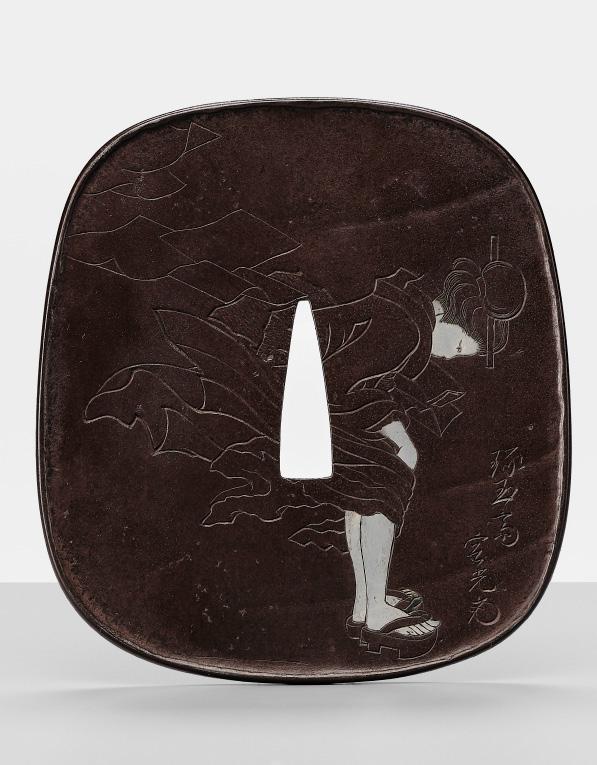
Of kakumarugata form with a slightly raised mimi, the iron plate finely worked in gold, silver, and iro-e takazogan and hirazogan, further enriched with delicate kebori and katakiribori. The obverse depicts the Wind God Fujin as a horned, demon-like figure, mischievously opening his windbag to unleash powerful gusts. The reverse shows a geisha caught in the force of the wind, clutching her kimono between her knees and arms in an effort to shield herself, creating a lively and humorous narrative in contrast to the deity’s action. Signed to one side TAKUGYOKUSAI SADAMITSU and kakihan.
HEIGHT 8.7 cm, LENGTH 7.9 cm, 2.7 cm (the nakago), WIDTH 0.4 cm (the mimi), 0.2 cm (the seppa-dai)
WEIGHT 134 g
Provenance: From an old Swiss private collection. Condition: Excellent condition with minor expected wear.
Fujin, also known as Futen, is the Japanese god of wind and one of the earliest Shinto deities. He is typically depicted as a fearsome, demon-like figure carrying a large sack of winds. In the present composition, however, he is rendered with a playful, almost caricatural quality, employing his powers in a mischievous manner.
AUCTION COMPARISON
Compare a closely related iron tsuba depicting the same subject, by Hagiya Katsuhira, 8.3 x 7.3 cm, at Zacke, Fine Japanese Art, 16 June 2023, Vienna, lot 223 (sold for EUR 4,420).
Estimate EUR 5,000
Starting price EUR 2,400
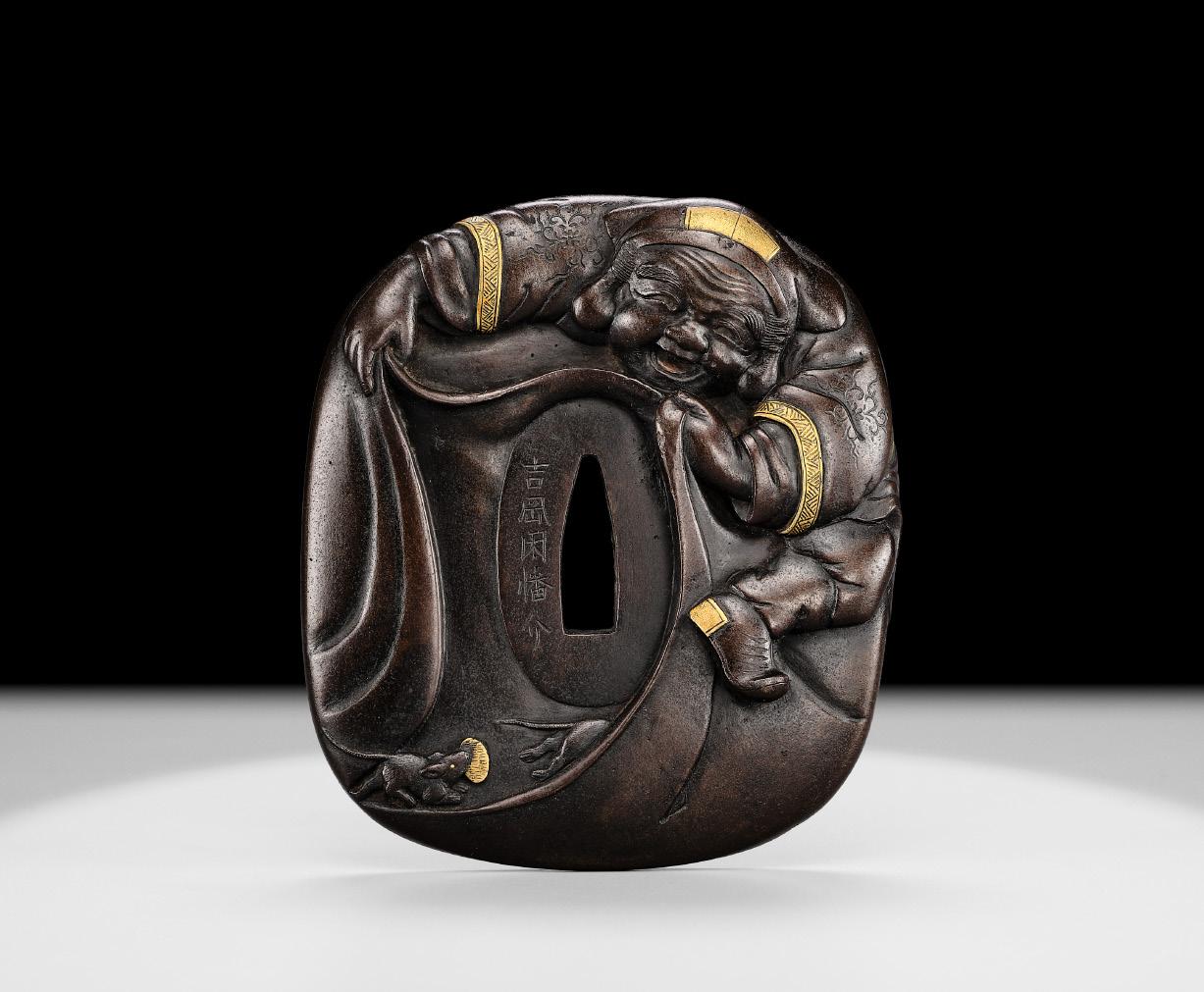
YOSHIOKA INABANOSUKE: A SUPERB IRON ‘DAIKOKU AND COIN-GATHERING RATS’ TSUBA
Inscribed Yoshioka Inabanosuke Japan, c. 1850, Edo period (1615-1868)
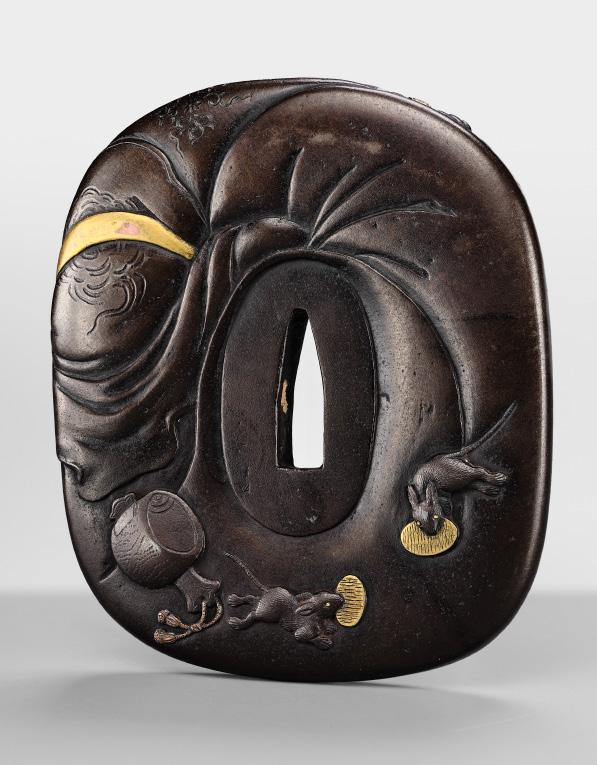
Of kawarigata form, the thick and weighty iron plate is boldly carved in marubori to depict Daikoku opening his treasure bag for two rats, which dutifully fill it with gathered coins. The composition is enriched with gold takazogan and finely executed kebori details. The reverse shows two further rats carrying gold coins beside Daikoku’s wish-granting mallet. His robe is ornamented with karakusa scrolls and swirling cloud motifs. Inscribed Yoshioka Ibanosuke.
HEIGHT 8.7 cm, LENGTH 7.7 cm, 2.3 cm (the nakago), WIDTH 1.6 cm (the thickest section of the mimi), 0.6 cm (the seppa-dai)
WEIGHT 376.6 g
Provenance: From an old Swiss private collection. The nakago ana with remnants of an old label.
Condition: Very good condition with minor wear.
Daikoku, or Daikokuten, derives from the Buddhist deity Mahakala and is widely revered in Japan as a bringer of wealth, prosperity, and good fortune. He is one of the Seven Gods of Good Fortune and is commonly depicted with his treasure bag and mallet, accompanied by rats, which symbolize abundance. In Edo-period representations such as the present example, he appears as a benevolent and approachable figure, reflecting his popular role as a guardian of prosperity and commerce.
AUCTION COMPARISON
Compare a closely related iron tsuba of Daikoku, dated 1853, 7.6 cm, at Christie’s, Samurai Swords and Armour: A Refined Art, 4 December 2014, New York, lot 24 (sold for USD 4,375 or approx. EUR 5,300 converted and adjusted for inflation at the time of writing).
Estimate EUR 4,000
Starting price EUR 2,000
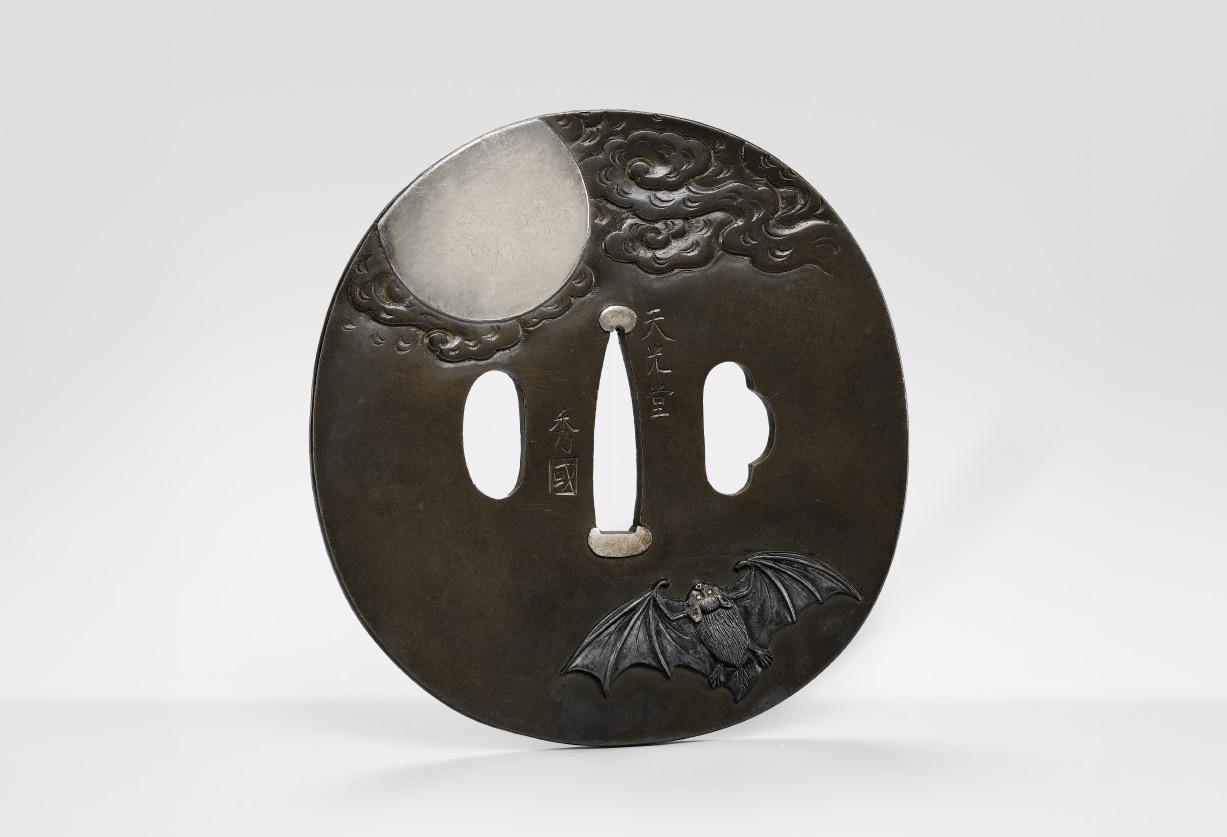
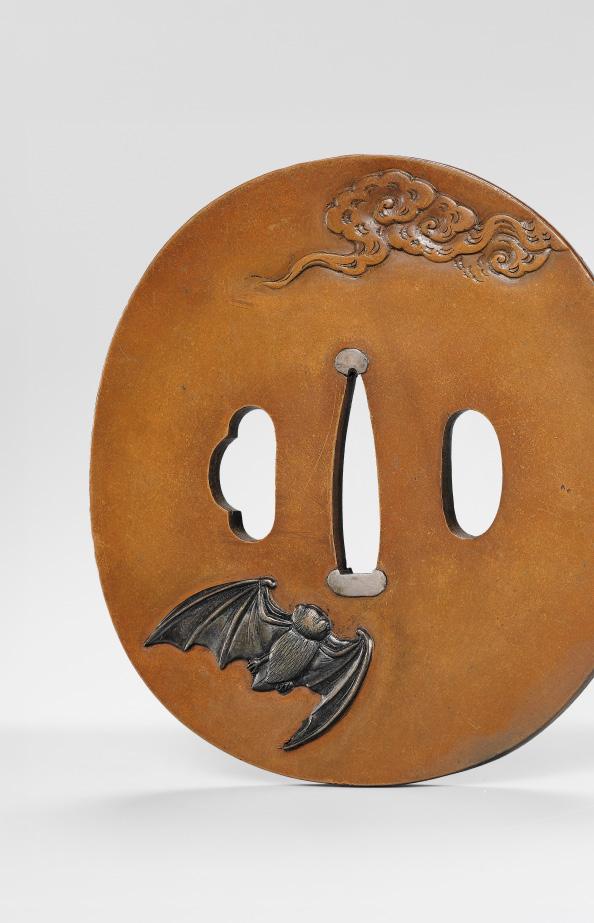
TENKODO HIDEKUNI: A FINE AND RARE SUAKA AND SHIBUICHI ‘BATS AT DUSK AND DAWN’ TSUBA
By Tenkodo Hidekuni (1825-1891), signed Tenkodo Hidekuni Japan, second half of 19th century, Edo (1615-1868) to Meiji period (1868-1912)
Of nagamarugata form, with a kogai and kozuka hitsu ana and the nakago fitted with silver sekigane. One side is worked in shibuichi, richly inlaid in silver, shakudo, and gold takazogan, and finely detailed in katakiribori to depict a bat beneath a full moon.
The reverse is executed on a suaka migakiji ground, further inlaid in shakudo with a bat flying below scrolling clouds. The contrasting metals and treatments evoke the same motif at dusk and at dawn, a subtle and poetic interplay of time and atmosphere. Signed TENKODO HIDEKUNI.
HEIGHT 8 cm, LENGTH 7.7 cm, 2.6 cm (the nakago), WIDTH 0.3 cm (the mimi), 0.3 cm (the seppa-dai)
WEIGHT 120.6 g
Condition: Very good condition with minor wear and light surface scratches.
With a wood tomobako (storage box).
Tenkodo Hidekuni (1825-1891) is recorded in the Haynes Index of Japanese Sword Fittings and Associated Artists, p. 242 (H 01054.0). Active in Kyoto, he was the student and adopted son of Kawarabayashi Hideoki. He was granted the art name Tenkodo by Emperor Komei and was also renowned as a painter, a quality reflected in the pictorial sensibility of the present work.
Estimate EUR 3,000
Starting price EUR 1,500
55
TOSHITSUGU: A SUPERB SUAKA TSUBA WITH A SNAKE AND LOOFAH GOURD, WITH NBTHK TOKUBETSU KICHO (ESPECIALLY PRECIOUS) CERTIFICATE
By Toshitsugu, signed Toshitsugu Japan, mid to late 19th century
Published & Exhibited: Samouraïs. Guerriers et esthètes, Bibliothèque Nationale et Universitaire, Strasbourg, 11 March13 July 2022, p. 162, no. 175.
With a tokubetsu kicho (especially precious) certificate of the NBTHK, dated 1 October 1977.
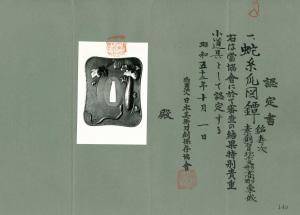
Of tateitomakigata form, the refined copper plate of ishimeji ground, decorated in gold and iro-e takazogan to depict a snake beneath a long gourd hanging from vines, flanked by two sparrows. The reverse with two edamame pods on a leafy vine and signed TOSHITSUGU.
HEIGHT 9.2 cm, LENGTH 7.6 cm
WEIGHT 219.8 g
Provenance: Ex-collection Patrick Liebermann. Condition: Very good condition with minor wear.
AUCTION COMPARISON
Compare a related iron tsuba with an egret and bird, signed Toshitsugu, 19th century, 9.9 cm tall, at Bonhams, 18 May 2023, London, lot 287 (sold for GBP 3,570 or approx. EUR 4,500 converted and adjusted for inflation at the time of writing).
Estimate EUR 4,000 Starting price EUR 2,000
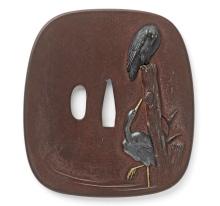
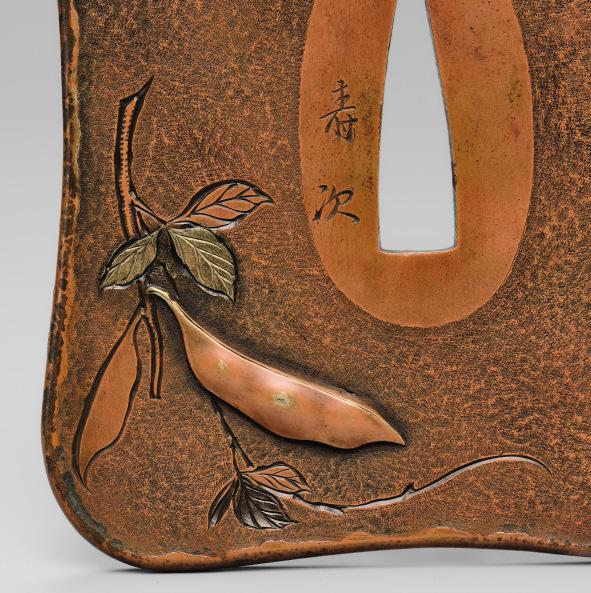
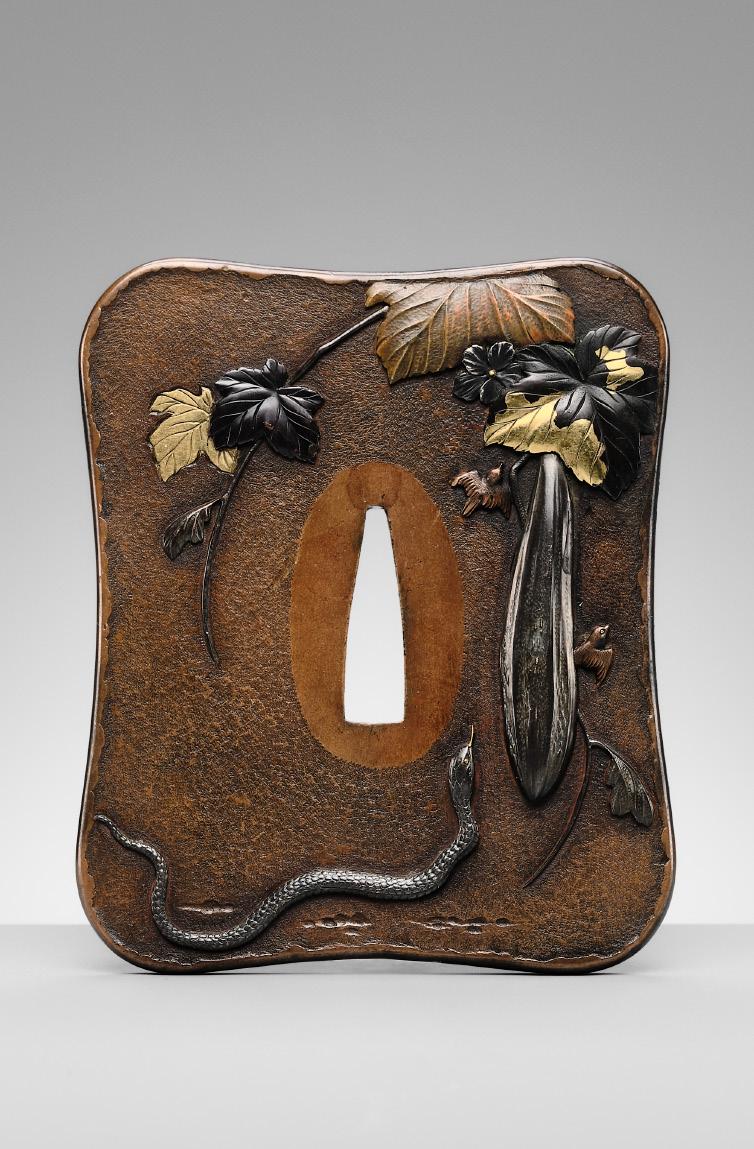
This design featuring a loofah gourd became popular in the latter half of the 19th century and was taken up by metalworkers, many of whom had previously specialized in sword fittings. Following the 1876 Sword Abolishment Edict, which restricted the public wearing of swords, demand for such fittings sharply declined. In response, many artisans turned their attention to decorative arts, using organic forms like gourds and vines to showcase their exceptional technical skill. The sinuous lines and layered surfaces provided opportunities for intricate detailing, including inlays of gold for leaves and tendrils. These works were often created with an eye toward international audiences, especially after Japan’s opening to the West. A sublime example by the celebrated metalworker Shoami Katsuyoshi (1832-1908), also previously a maker of sword fittings, was sold at Bonhams, Fine Japanese Art, 16 May 2019, London, lot 190, for GBP 125,062 (fig. 1)
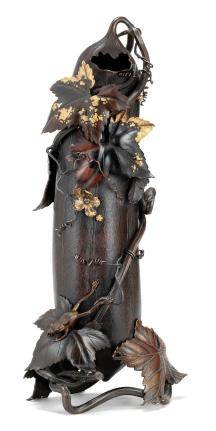
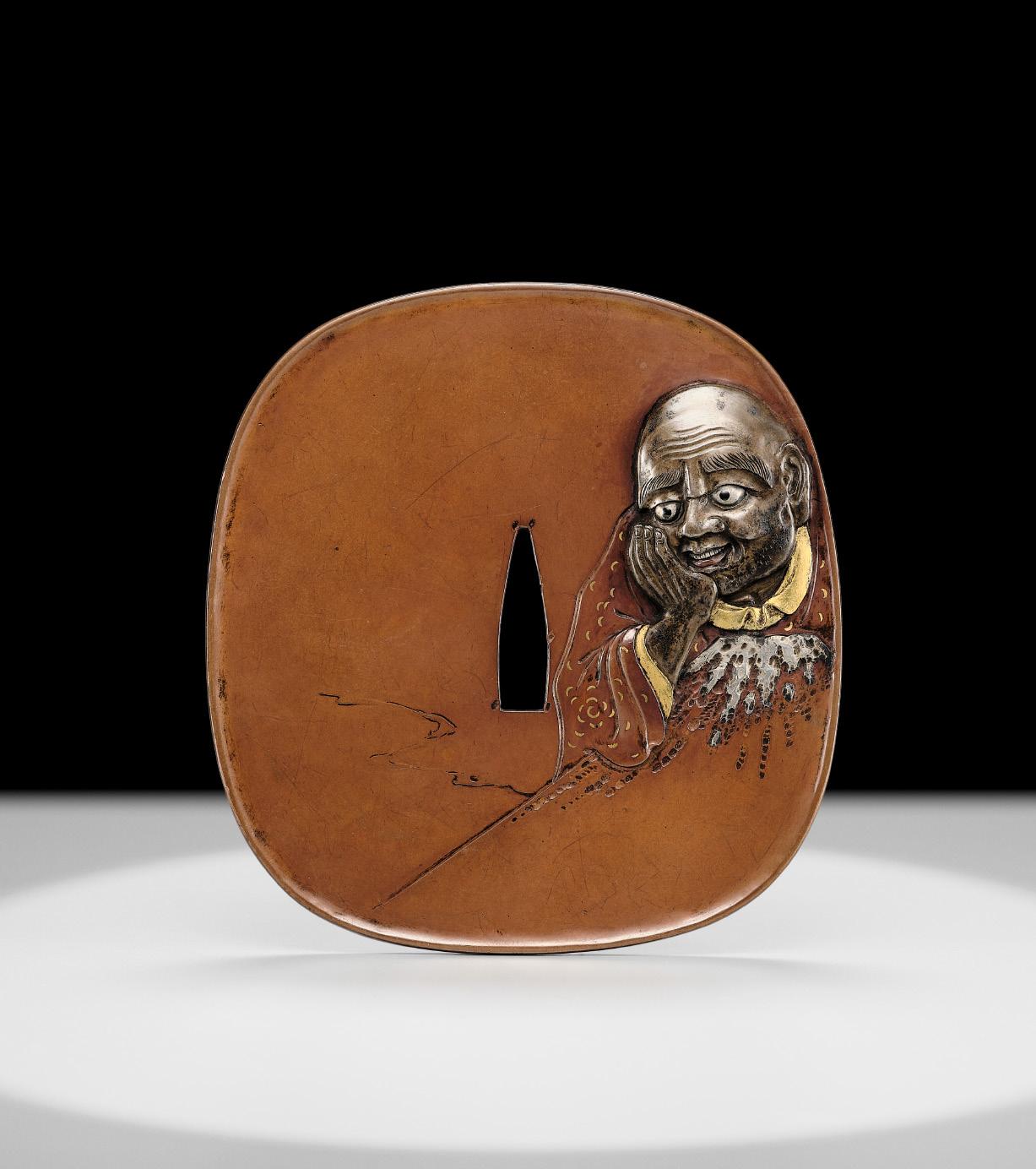
56
MASAYOSHI: A FINE SUAKA ‘DAIDARABOTCHI’ TSUBA
Inscribed Masayoshi Japan, Meiji period (1868-1912)
Of kakumarugata form, with a slightly raised mimi, the suaka migakiji (polished) ground detailed in fine gold and iro-e takazogan and hirazogan, depicting the giant Diadarabotchi leaning over a snow-capped Mount Fuji and gazing towards two crows below the full moon to the reverse. Inscribed to one side Masayoshi (Iwama Masayoshi).
HEIGHT 10.2 cm, LENGTH 9.7 cm, 2.8 cm (the nakago), WIDTH 0.4 cm (the mimi), 0.3 cm (the seppa-dai)
WEIGHT 230 g
Provenance: From the private collection of Alan and Simone Hartman, New York.
Condition: Excellent condition with only very minor wear.

Daidarabotchi is a gigantic yokai in Japanese mythology, sometimes said to pose as a mountain range when sleeping. The size of Daidarabotchi was so great that his footprints were said to have created innumerable lakes and ponds. In one legend, Daidarabotchi weighed Mount Fuji and Mount Tsukuba to see which was heavier, but he accidentally split Tsukuba’s peak after he was finished with it.
AUCTION COMPARISON
Compare a related shibuichi tsuba with Daidarabotchi and Wasobei, dated Kaei era, 8 x 7.6 cm, at Zacke, Fine Japanese Art, 6 December 2024, Vienna, lot 98 (sold for EUR 4,160).
Estimate EUR 3,000
Starting price EUR 1,500
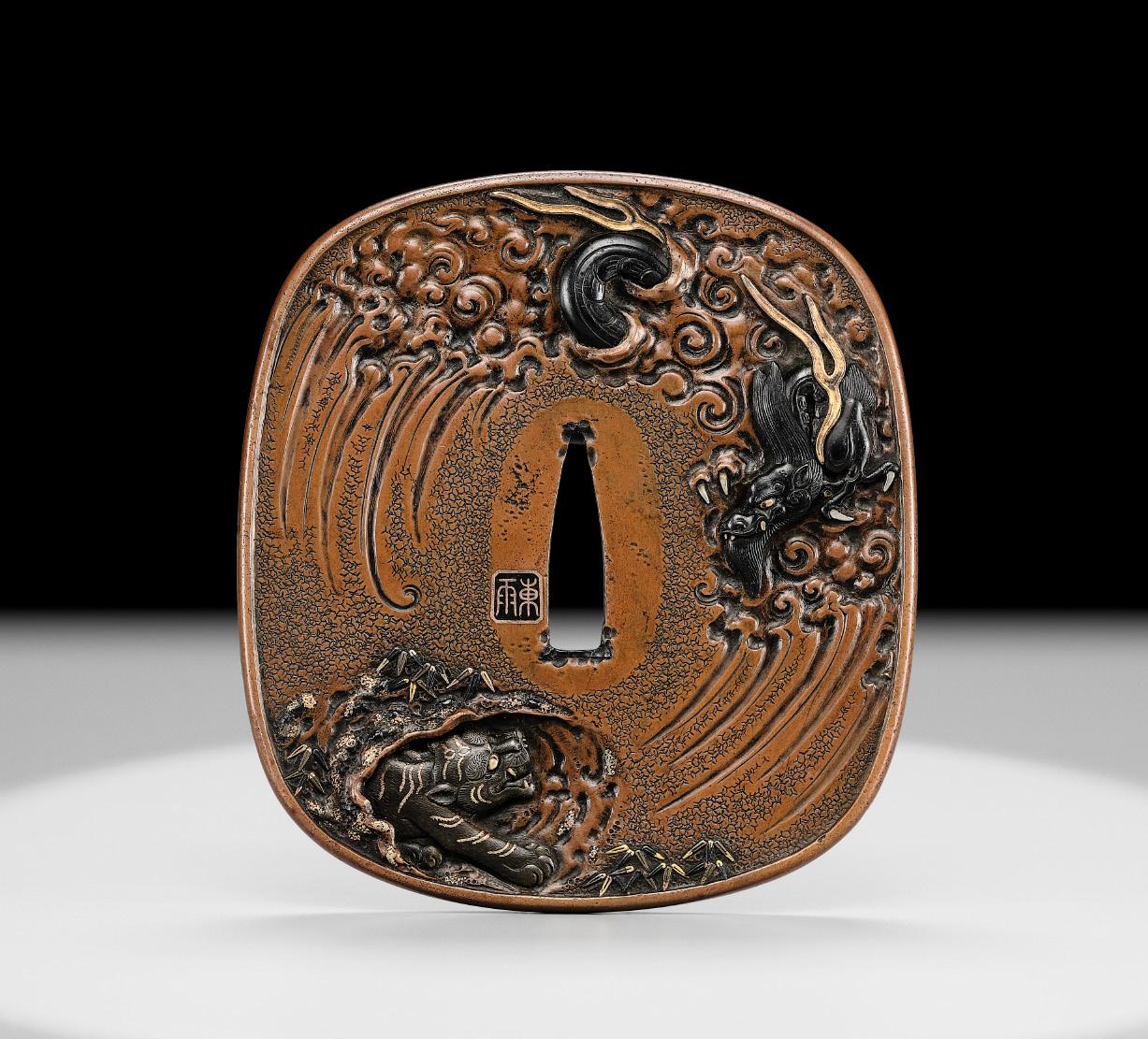
57
YASUCHIKA V: A LARGE AND SUPERB SUAKA ‘DRAGON’ TSUBA
By Tsuchiya Yasuchika V (1787-1852), signed Tou Japan, c.1850
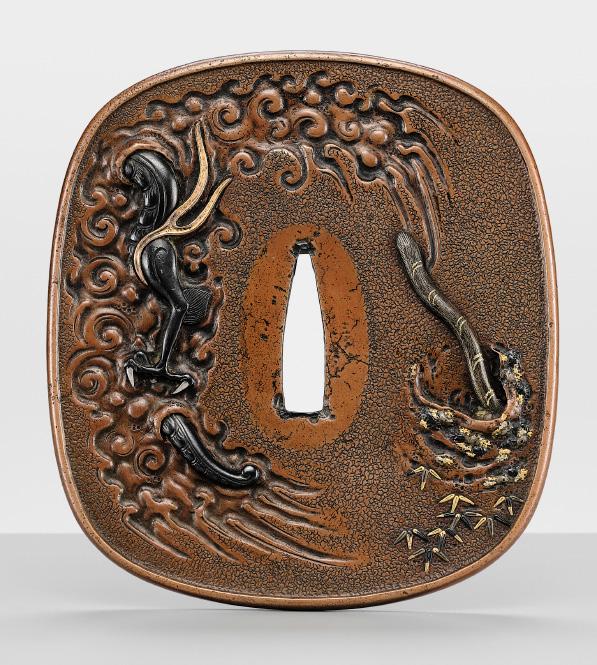
Of kakumarugata form with a slightly raised mimi, the ground finely punched and worked in relief, richly inlaid in iro-e takazogan with a dynamic composition depicting a tiger emerging from a cave and confronting a dragon enveloped in swirling clouds. The powerful bodies of the two creatures extend across both sides of the guard, enhancing the sense of movement and spatial depth. One side bears a seal mark inlaid in suaka and shakudo hirazogan reading TOU.
HEIGHT 10.1 cm, LENGTH 9.3 cm, 3 cm (the nakago), WIDTH 0.5 cm (the mimi), 0.4 cm (the seppa-dai) WEIGHT 260.3 g
Condition: Excellent condition with only very minor wear.
Tsuchiya Yasuchika V (1787-1852) is recorded in the Haynes Index of Japanese Sword Fittings and Associated Artists, p. 2187 (H 11108.0). He was a student of the fourth-generation Yasuchika and continued the refined and painterly traditions of the Tsuchiya school.
The tiger and dragon form a classical East Asian motif representing opposing yet complementary forces. While rooted in Chinese cosmology, where they symbolize yin and yang, the theme was widely embraced in Japan and reinterpreted within a distinctly Japanese artistic context. In such depictions, the tiger is often associated with the earth and the vital force of wind, while the dragon governs the heavens and water, appearing amidst clouds. Their dramatic confrontation conveys a balance of strength and energy, a subject particularly favored in Edo-period metalwork for its dynamic and auspicious connotations.
Estimate EUR 5,000 Starting price EUR 2,400
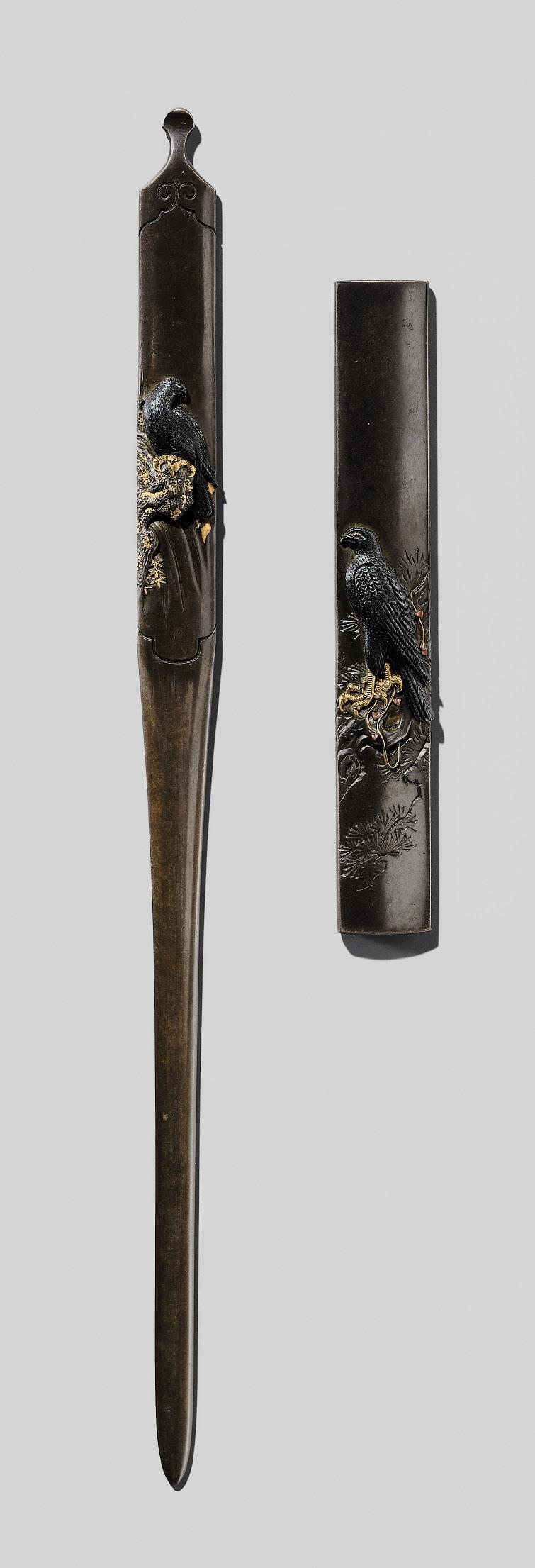
GYOKURINSAI TSUNEZANE: A FINE SHIBUICHI ‘BIRDS OF PREY’ FUTAKOROMONO SET (KOGAI AND KOZUKA)
By Gyokurinsai Tsunezane, signed Gyokurinsai Tsunezane with kakihan
Japan, late 18th to early 19th century, Edo period (1615-1868)
Comprising a kogai and kozuka worked in superb gold, suaka, and shakudo takazogan and hirazogan on a shibuichi migakiji ground, the kogai depicting a hawk perched on a rock above a waterfall, and the kozuka featuring a hawk on a gnarled pine with pine needles carved in katakiribori. Each signed Aki Hanshin GYOKURINSAI
TSUNEZANE with kakihan, and the kozuka further signed baba Nobuzumi konomi ni yori kore horu with kakihan [to the order of Baba Nobuzumi].
LENGTH 20.9 cm (the kogai), 9.9 cm (the kozuka)
WEIGHT 78.4 g (total)
Provenance: Christie’s, London, 9 June 2004, lot 85 (sold for GBP 1,792 or approx. EUR 4,500 converted and adjusted for inflation at the time of writing). From the private collection of Alan and Simone Hartman, New York. Alan Hartman (1930-2023) was an influential American art dealer, who took over his parents’ antique business in Manhattan and established the legendary Rare Art Gallery on Madison Avenue, with further locations in Dallas and Palm Beach.
Condition: Very good condition with minor wear.

Alan & Simone Hartman
With a padded wood tomobako (storage box) inscribed ‘Nisho Mokin Gyokurinsai Tsunezane [two raptors, Gyokurinsai Tsunezane]’ and ‘K16’.
Estimate EUR 4,000
Starting price EUR 2,000
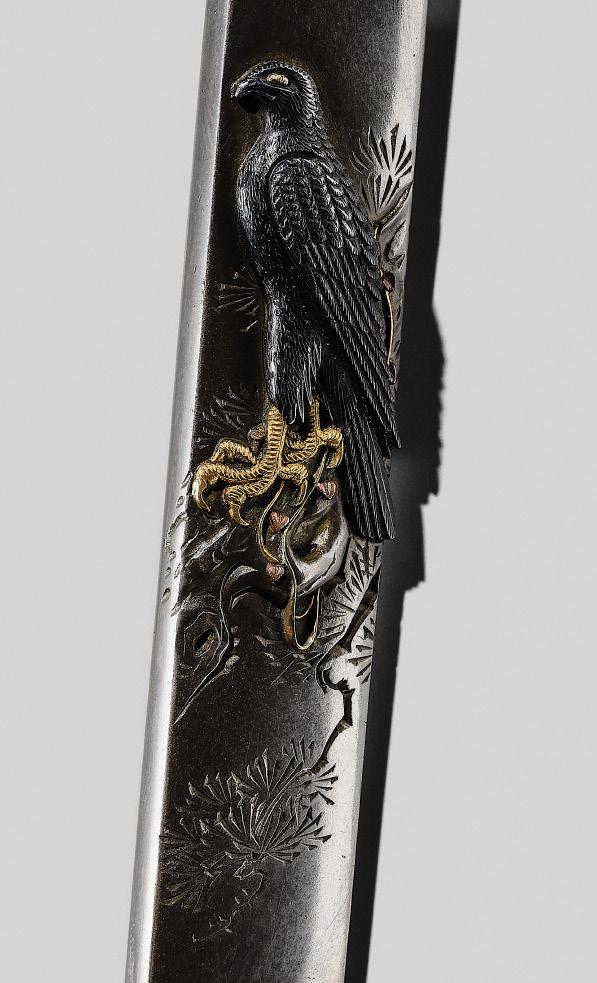
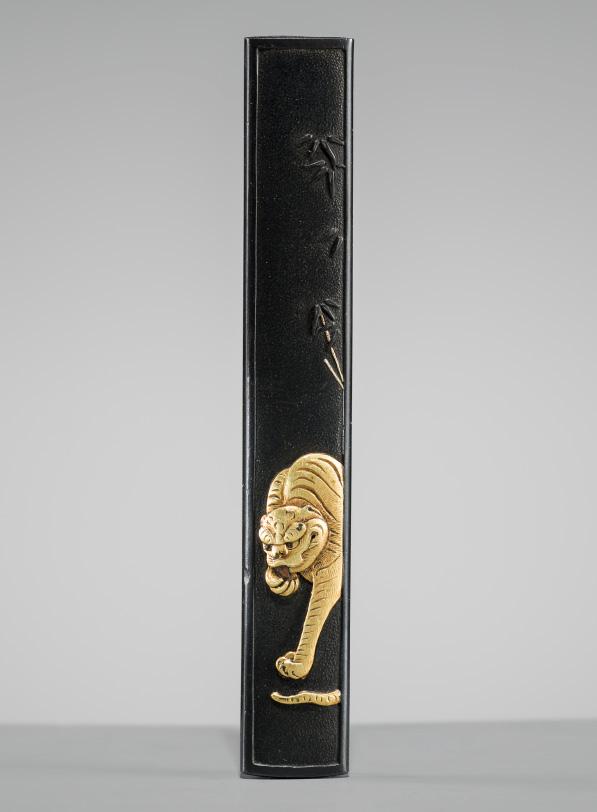
59 A FINE SHAKUDO ‘TIGER AND BAMBOO’ KOZUKA HANDLE, WITH NBTHK TOKUBETSU HOZON (ESPECIALLY PRECIOUS) CERTIFICATE
By Naotsugu, signed Naotsugu with kakihan Japan, 19th century, Edo period (1615-1868)
60
GOTO MITSUTOSHI: A RARE PAIR OF 18K GOLD, SILVER AND SHAKUDO ‘WRITING BRUSHES’ MENUKI (HILT CLASPS)
By Goto Mitsutoshi, signed Goto Mitsutoshi with kakihan Japan, 18th century, Edo period (1615-1868)
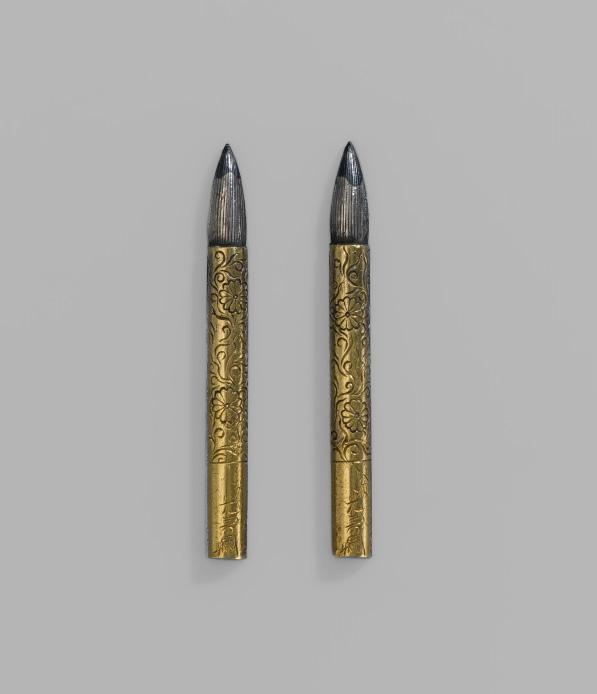
With a NBTHK Tokubetsu Hozon [Especially Worthy of Preservation] certificate, no. 4020961, dated 22 December Reiwa 4 [2022], with a photo of the kozuka and the seal of the NBTHK.
The kozuka of shakudo with ishimeji ground, decorated in gold, suaka, and shakudo takazogan and takabori to depict a tiger licking its paw beside bamboo stalks. The reverse incised with the signature NAOTSUGU and kakihan.
LENGTH 9.8 cm
WEIGHT 28.4 g
Condition: Very good condition with minor wear, little rubbing, and a tiny nick to the narrow side beside the tiger’s face.
With a tomobako (storage box), inscribed ‘Ko 472, Naotsugu kozuka’ with a stamp.
Estimate EUR 1,500
Starting price EUR 800

The present lot at Bonhams New York, 16 October 2012, lot 1121, sold for USD 3,500 or approx. EUR 4,300
Formed as a pair of writing brushes, finely incised to the handle with meandering vines issuing blossoms, the brush hairs detailed in silver with shakudo ‘inked’ tips, signed to the lower section of the handle GOTO MITSUTOSHI with kakihan.
LENGTH 4 cm (each)
WEIGHT 6.5 g and 6.6 g
Provenance: Bonhams New York, 16 October 2012, lot 1121, sold for USD 3,500 or approx. EUR 4,300 (converted and adjusted for inflation at the time of writing).
Condition: Good condition with minor wear and few small nicks to the reverse.
Gold testing indicates a minimum purity of 18K.
There are two Goto Mitsutoshi listed in Robert E. Haynes, The Index of Japanese Sword Fittings and Associated Artists, p.1106 (H 05483.0-H 05484.0).
Estimate EUR 4,000 Starting price EUR 2,000
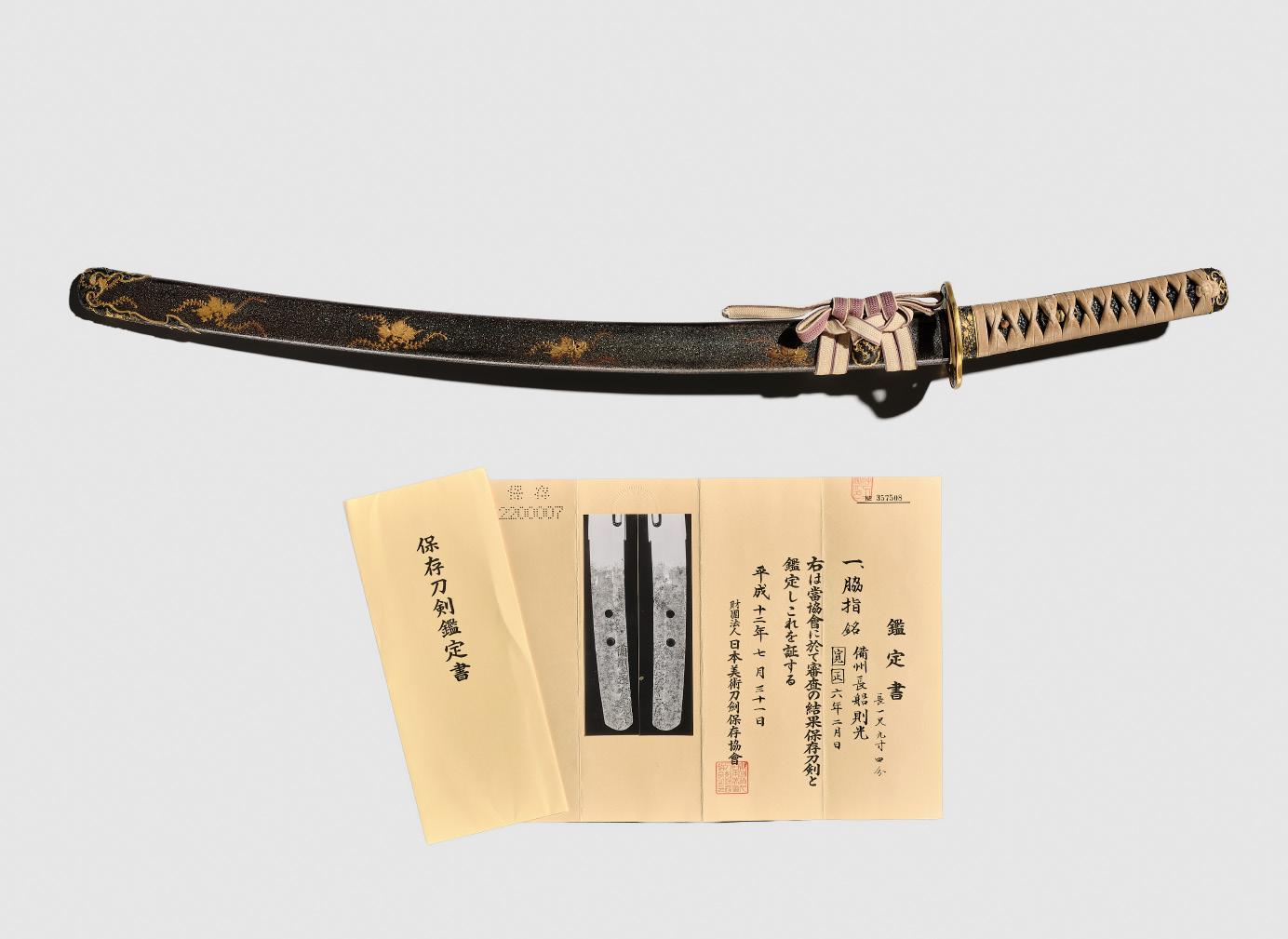
61
A WAKIZASHI IN FINE KOSHIRAE, ATTRIBUTED TO KANSHO NORIMITSU IV, WITH NBTHK HOZON CERTIFICATE
Attributed to Kansho Norimitsu IV, signed Bishu Osafune Norimitsu Japan, dated 1465, Muromachi period (1333-1573)
The wakizashi with a NBTHK Hozon Token (worthy of preservation) certificate, no. 357508, dated 31 July Heisei 12 [2019], with two images of the tang, and the seal of the NBTHK.
The blade:
Sugata (shape): shinogi-zukuri, iori mune, torii-zori, chu-kissaki, bohi (blood grooves)
Hamon (temper line): sugu with nie-deki
Hada (forging grain pattern): itame and mokume, clear utsuri in the jigane
Boshi (tip): omaru
Nakago (tang): ubu (not shortened), haagari-kuri-jiri, the yasurime is katte sagari, two mekugi ana Mei/Uramei (signature): Bishu Osafune Norimitsu (mei), Kansho rokunen nigatsu hi [a day in the second month of the sixth year of the Kansho era, corresponding to 1465] (uramei)
The mounting:
Habaki (blade collar): double-layered gold and silver with horizontal and vertical file marks and dew drops
Tsuba (sword guard): of mokkogata form, two large kogai hitsu ana, the shakudo ground with gold takazogan paulownia emblems issuing vines
Fuchi-kabuto (handle fittings): each of shakudo with gold takazogan paulownia sprays, signed Jutokusai Sukenao
Tsuka (handle): black-lacquered samegawa (rayskin), leather tsukaito, two silver and gold takazogan vajra form menuki
Saya (sheath): black lacquer with aoigai flakes and gold takamaki-e paulownia sprays, shakudo and gold takazogan sayajiri with further paulownia
NAGASA 58.8 cm (blade length), SORI 1.8 cm (curvature) LENGTH 73 cm (blade and tang), 84.4 cm (koshirae), 81.1 cm (shirasaya)
Condition: Very good condition with minor wear and few kitae ware. The koshirae saya with some rubbing to the lacquer and the tsuka with light wear to the tsuka-ito.
With a violet fabric cover suspending a small wood plaque inscribed, ‘Bishu Osafune Norimitsu, Kansho rokunen nigatsu hi’ and a brocade fabric cover inscribed ‘Wada Matsuyuki’.
This wakizashi has a clear utsuri in the jigane and a bright, clear suguha hamon with a rounded boshi, indicating excellent craftsmanship.
This blade is of the katate-uchi type, characterized by a pronounced curvature and a length approaching that of a katana, while remaining intended for one-handed use. Developed as a form of wakizashi suited to close-quarters combat, this type gained popularity during the Muromachi period. Typical examples are distinguished by a relatively short nakago and a blade length of approximately 60 cm.
The Norimitsu lineage began with a student of Kamakuraperiod Nagamitsu and continued for six generations into the late Muromachi period. This present wakizashi can be attributed to the fourth-generation Kansho Norimitsu, known for his bright, clear suguha and excellent jigane with utsuri.
The artist of the fuchi, Jutokusai Sukenao (c. 1845) is listed in Robert E. Haynes, The Index of Japanese Sword Fittings and Associated Artists, p. 1791 (H 08997.0). He was the son of Shikichi.
Estimate EUR 20,000 Starting price EUR 10,000
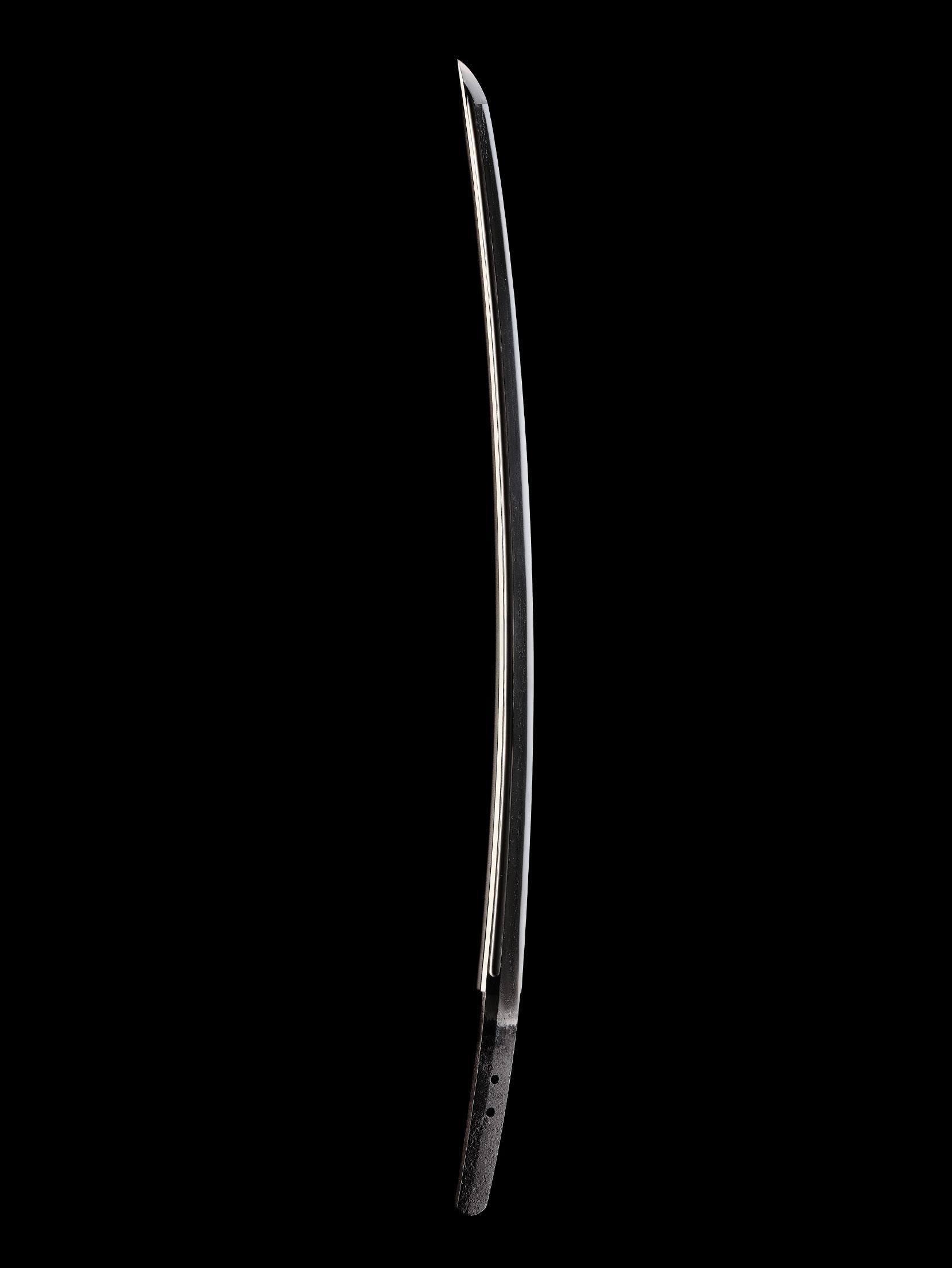
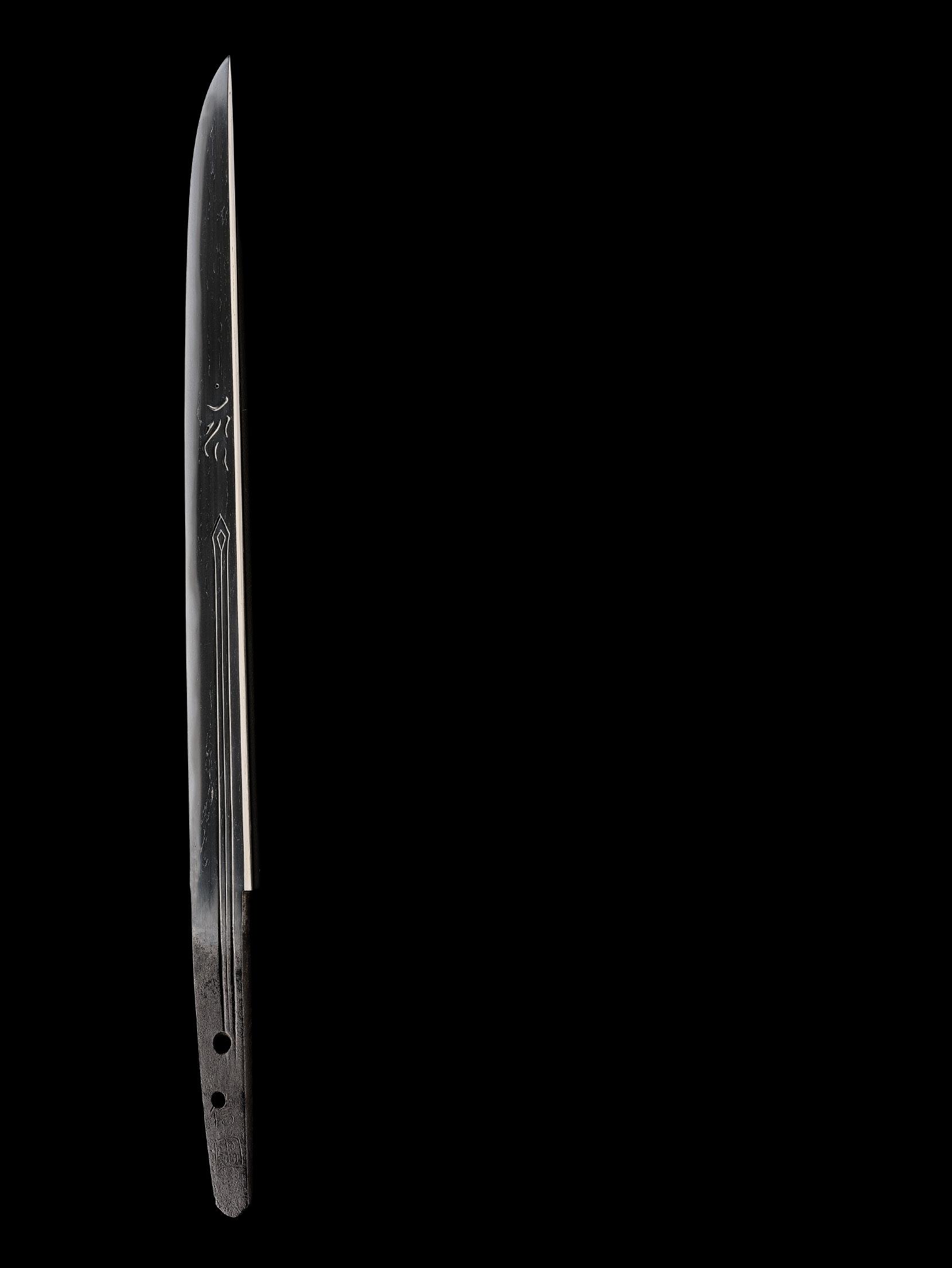
NOBUKUNI: A TANTO IN SHIRASAYA, WITH NBTHK KICHO TOKEN CERTIFICATE
By Nobukini, signed Nobukuni Japan, 14th century, Muromachi period (1333-1573)
The tanto with a NBTHK Kicho Token (precious) certificate, no. 130203, dated 11 November Showa 42 [1967], with an imprint of the tang, and the seal of the NBTHK.
The blade: Sugata (shape): hirazukuri, iori mune, one side with horimono of a sword and kanji, the other with a bo-hi (blood groove) Hamon (temper line): sugu and little notare with sunagshi Hada (forging grain pattern): masame Boshi (tip): omaru Nakago (tang): futsu, kuri-jiri, the yasurime is katte-sagari, two mekugi ana Mei/Uramei (signature): Nobukuni (mei)
The mounting: Habaki (blade collar): double layered gold and silver with diagonal file marks and dew drops
NAGASA 25.8 cm (blade length) LENGTH 35.7 cm (blade and tang), 40.3 cm (shirasaya)
Condition: Good condition with minor wear, some kitae ware, and possibly a tiny fukure (blister) beside the habaki.
Estimate EUR 4,000
Starting price EUR 2,000
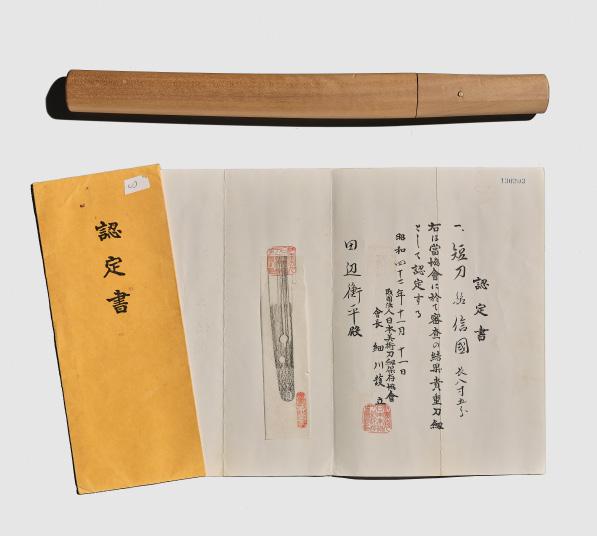
63
A RARE KIMONO TANTO (KAIKEN) IN WOOD SAYA
Japan, late Edo period (1615-1868)
The blade: Sugata (shape): kanmuri-otoshizukuri, iori mune, minor sori, one side with bo-hi (blood groove) Hamon (temper line): gunome with nioi-deki
Hada (forging grain pattern): muji Nakago (tang): funagata, haagarijiri, one mekugi ana Mei/Uramei (signature): mumei (unsigned)
The mounting: Habaki (blade collar): sentoku Saya (sheath): dark wood with bone fittings
NAGASA 13.7 cm (blade length) LENGTH 20 cm (blade and tang), 24.4 cm (saya)
Condition: Very good condition with minor wear, tiny nibbles to the cutting edge where the habaki is. The saya with few small nicks and light scratches.
The kaiken, or kimono tanto, is a small dagger historically carried by both men and women of the samurai class in Japan. Initially designed for self-defense in close quarters where longer swords like the katana and wakizashi were unwieldy, it was often carried discreetly, tucked in a kimono sleeve or pocket.
Estimate EUR 2,000
Starting price EUR 1,000
64
MINAMOTO MASAO: A TANTO IN SHIRASAYA WITH SAYAGAKI
Attributed to Minamoto Masao (active 1844-1864), unsigned Japan, Musashi Province, 19th century, Edo period (1615-1868)
The blade: Sugata (shape): hirazukuri, iori mune, each wide with a bo-hi (blood groove) Hamon (temper line): gunome and sanbuntsugi with nioi-deki Hada (forging grain pattern): masame Boshi (tip): omaru
Nakago (tang): funagata, haagariiriyamagata-jiri, the yasurime is katte-sagari, one mekugi ana Mei/Uramei (signature): mumei (unsigned)
The mounting: Habaki (blade collar): sentoku Saya (sheath): shirasaya with bone fittings and inscriptions
NAGASA 18.2 cm (blade length)
LENGTH 24.6 cm (blade and tang), 31.3 cm (shirasaya)
Condition: Good condition with minor wear and possibly with yaki ware at the kissaki.
The shirasaya inscribed with a sayagaki by Sato Kanzan (19071987), an expert on Japanese swords and an authoritative member of the NBTHK, 源正雄、 刃長六寸有之。昭和乙卯年初冬 吉日、寒山誌 Minamoto Masao, hacho rokusun kore ari. Showa kanoto-u toshi shoto kichijitsu, Kanzan shirusu [By Minamoto Masao, the length of the blade is 6-sun (18.18 cm), this is recorded by (Sato) Kanzan, on an auspicious date in the early winter of the Showa 50 (1975)], and with a label inscribed, ‘Minamoto Masao, Kanzan NBTHK’.
Minamoto Masao was the pupil of Minamoto Kiyomaru (1813-1854), the greatest of all shinshinto smiths, whose standing was such that he became known as ‘The Yotsuya Masamune’ during his period of working in Edo. Masao continued this tradition and produced swords in the Soshu style.
Estimate EUR 2,000 Starting price EUR 1,000
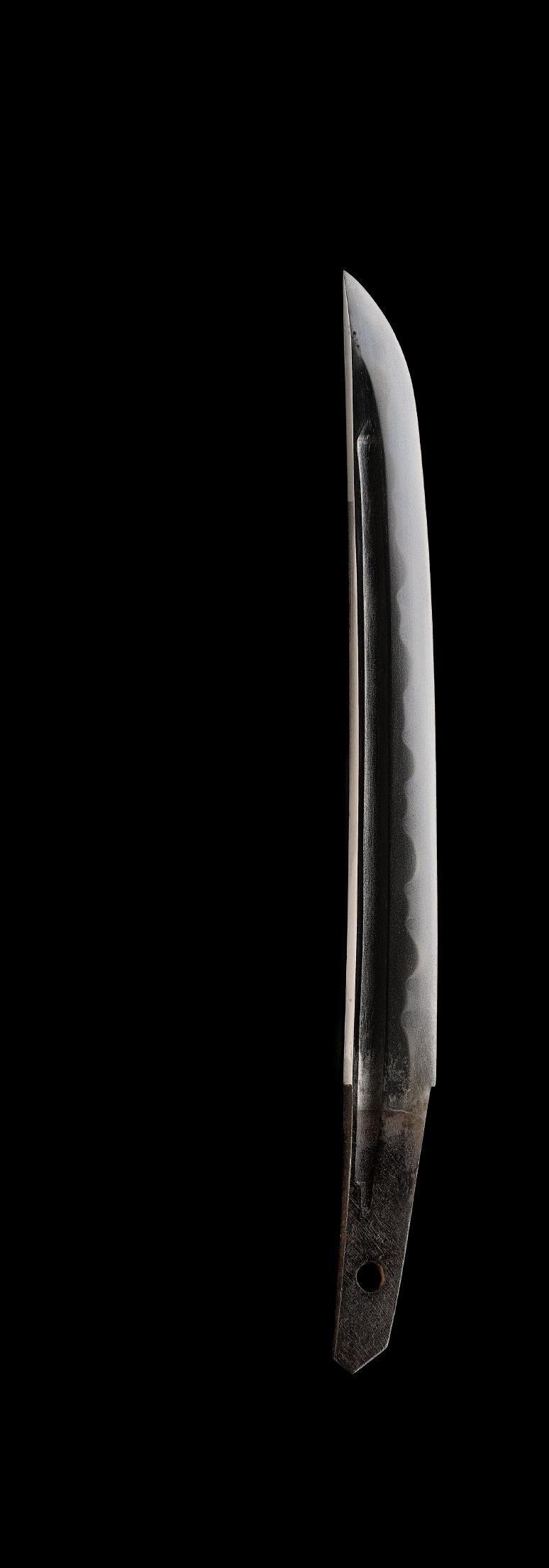
MINAMOTO HISAMICHI: A WAKIZASHI IN KOSHIRAE, WITH NBTHK TOKUBETSU (ESPECIALLY PRECIOUS) CERTIFICATE
By Minamoto Hisamichi, signed Omi no Kami Minamoto Hisamichi Japan, dated 1687, Edo period (1615-1868)
The wakizashi with a NBTHK Tokubetsu Kicho Token (especially precious) certificate, no. 1018495, dated 25 August Reiwa 4 [2022], with an image of the tang, and the seal of the NBTHK.
The blade: Sugata (shape): shinogi-zukuri, iori mune, torii-zori, chu-kissaki
Hamon (temper line): gunome with nie-deki
Hada (forging grain pattern): itame and mokume
Boshi (tip): omaru
Nakago (tang): ubu (not shortened), haagari-jiri, the yasurime is katte sagari, one mekugi ana Mei/Uramei (signature): Omi no Kami Minamoto Hisamichi (mei) below a kiku blossom, Jokyo yon-nen hachigatsu kichijitsu [An auspicious day in the eighth month of the Jokyo 4th year (1687)] (uramei)
The mounting: Habaki (blade collar): double-layered shakudo and suaka Tsuba (sword guard): of tatemarugata, one kogai and kozuka hitsu ana, the iron ground with gold takazogan, takabori and shishiaibori, featuring two shishi in an idyllic landscape Fuchi-kashira (handle fittings): shakudo Nanaki with iroe takazogan, featuring hares, signed Tomoyoshi with kao Tsuka (handle): samegawa (rayskin), dark green tsuka-ito, two gold and copper ‘shishi’ menuki
Saya (sheath): black lacquer with fine aogai flakes, featuring sinuous dragons and a gold takazogan magic pearl, and iron sayajiri with small mokko mon from the Oda clan Kozuka (utility knife): shakudo nanako with gold, silver, and shakudo takazogan shishi and peonies
NAGASA 54.8 cm (blade length), SORI 1.4 cm (curvature)
LENGTH 71 cm (blade and tang), 78 cm (koshirae), 79.9 cm (shirasaya)
Condition: Very good condition with minor wear. The saya with few tiny nicks.
Estimate EUR 8,000
Starting price EUR 4,000
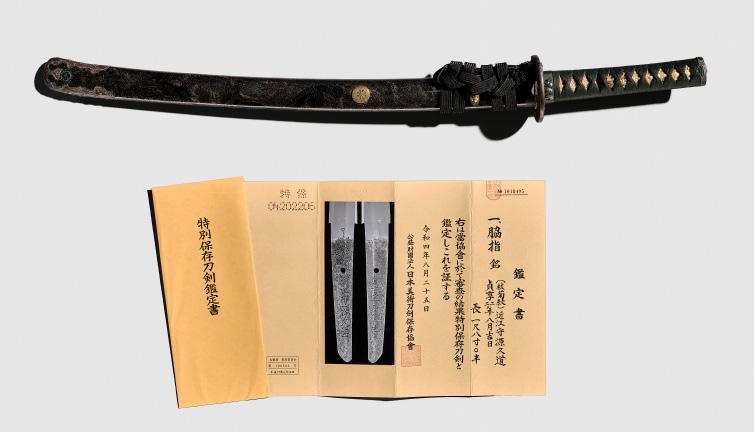
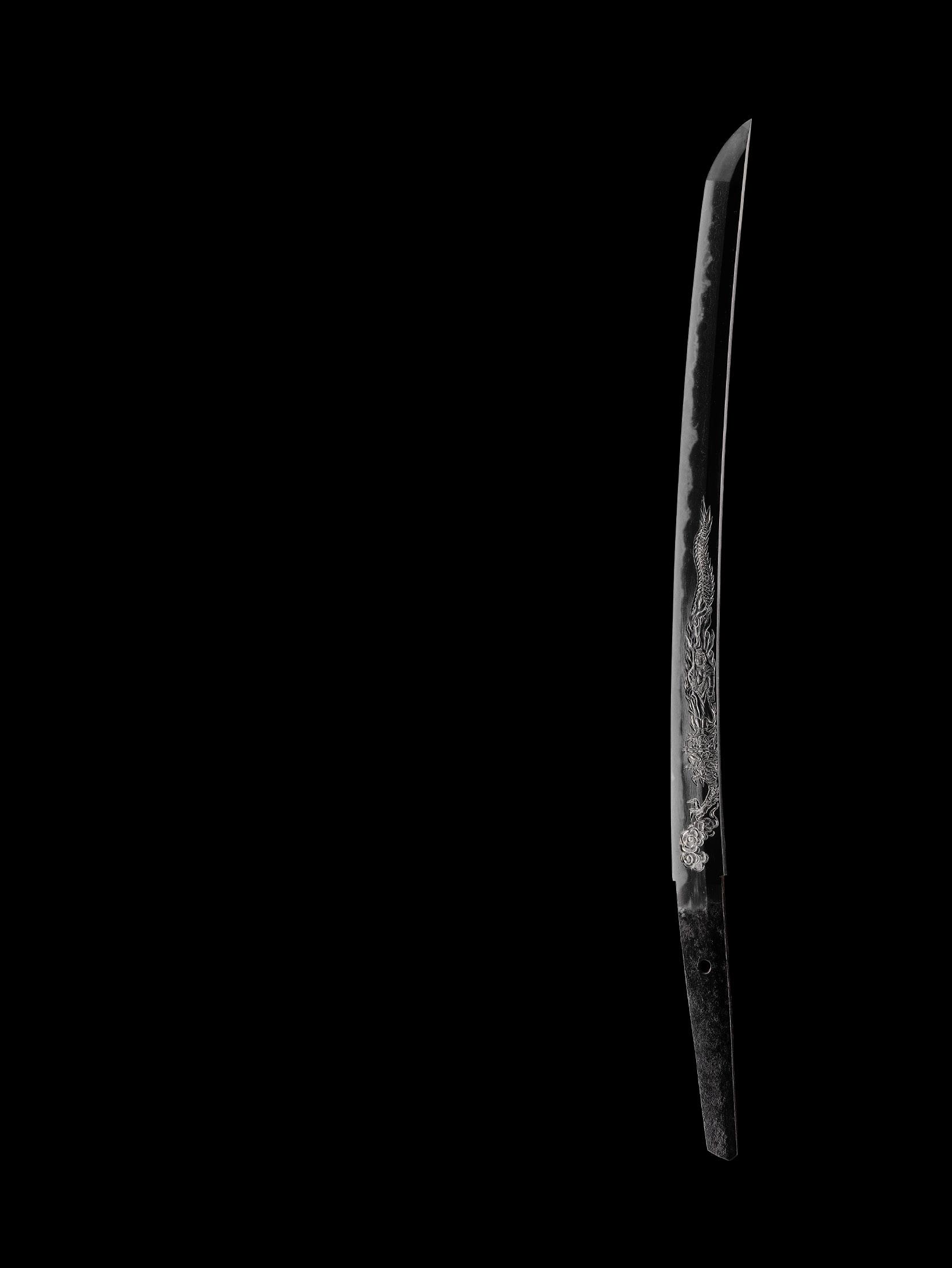
By Fujiwara Takada, unsigned Japan, 17th century, Edo period (1615-1868)
The wakizashi with a NBTHK Kicho Token (precious) certificate, no. 346533, dated 9 July Showa 52 [1977], with an imprint of the tang, and the seal of the NBTHK.
The blade:
Sugata (shape): shinogi zukuri, iori mune, torii-zori, chu-kissaki, horimono of Fudo Myoo and dragon
Hamon (temper line): notare and choji with nie-deki
Hada (forging grain pattern): itame
Boshi (tip): komaru
Nakago (tang): ubu (not shortened), iriyamagata-jiri, the yasurime is katte sagari, one mekugi ana Mei/Uramei (signature): mumei (unsigned)
The mounting: Habaki (blade collar): silver
Tsuba (sword guard): of tatemaruga form, one kogai hitsu ana, copper sekigane, iron ground with iroe takazogan, takabori, katakiribori, and kebori, depicting a woman cutting wood beside a stream and cottage, signed Gaiundo Naoyuki with seal mark
Fuchi-kashira (handle fittings): the iron ground with iroe takazogan featuring a lady washing her clothes and a Chinese sage with hyotan, signed Ryuryuken Tomohide saku
Tsuka (handle): samegawa (raysking), lacquered tsuka-ito, two sentoku mekugi
Saya (sheath): black lacquer
NAGASA 41.9 cm (blade length), SORI 0.9 cm (curvature)
LENGTH 57.6 cm (blade and tang), 66.3 cm (koshirae), 63.9 cm (shirasaya)
Condition: Very good condition with minor wear, a tiny hakobore (cutting mark) at the kissaki and kitae ware. Few tiny losses to the samegawa.
During the Sengoku period (late 15th to late 16th century), the Takada school was renowned for producing swords for feudal lords throughout Kyushu Island. The reputation of Takada blades rivaled that of the famed Mino and Bizen schools, two of the most prestigious sword forging regions in Japan. This exceptional craftsmanship and forging technique were passed down through generations, continuing into the Edo period, where it influenced subsequent swordsmiths.
The artist of the tsuba, Hamano Naoyuki (born 1754), also known as Gaiundo Naoyuki, is listed in Robert E. Haynes, The Index of Japanese Sword Fittings and Associated Artists on p.1360 (H 06907.0). He was a prolific artist who at the young age of 20 became a student of Hamano Noriyuki and later of Iwama Masayoshi.
Estimate EUR 8,000
Starting price EUR 4,000
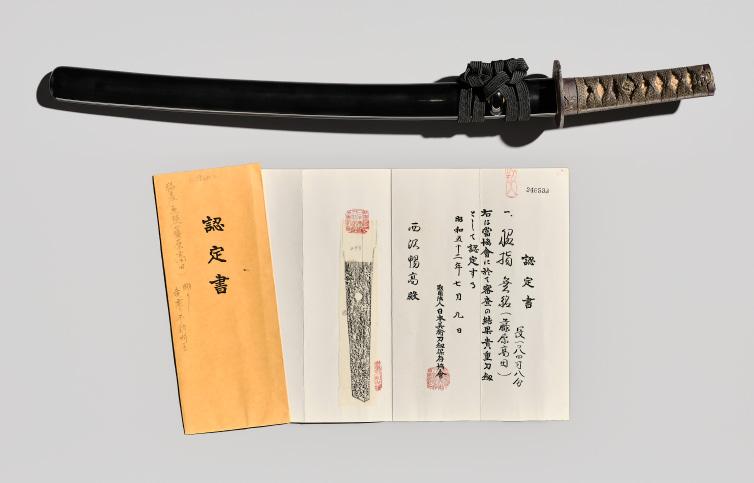
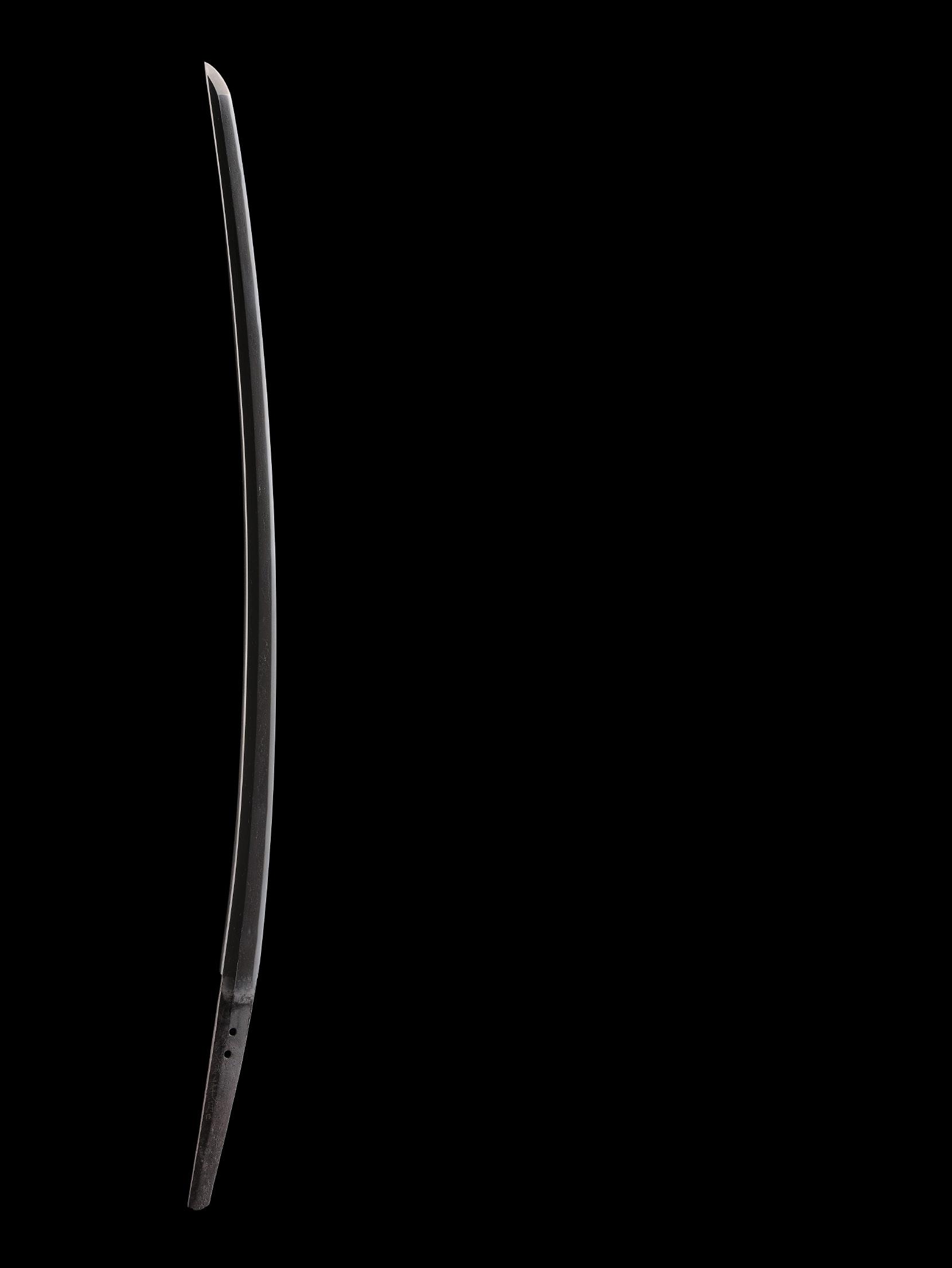
MASAMORI: A FINE KATANA IN KOSHIRAE, WITH NBTHK TOKUBETSU (ESPECIALLY PRECIOUS) CERTIFICATE
By Masamori, signed Takada ju Masamori saku Japan, Kyushu, dated 1556, Muromachi period (1333-1573)
The katana with a NBTHK Tokubetsu Hozon Token (especially worthy of preservation) certificate, no. 1011263, dated 23 May Reiwa first year [2019], with two images of the tang, and the seal of the NBTHK. Further accompanied by a registration certificate (torokusho), registration no. 30746.
The blade: Sugata (shape): shinogi zukuri, iori mune, torii-zori, ko-kissaki Hamon (temper line): sugu with sunagashi Hada (forging grain pattern): itame Boshi (tip): yakizume Nakago (tang): ubu (not shortened), haagari-jiri, the yasurime is katte sagari, two mekugi ana Mei/Uramei (signature): Takada ju Masamori saku [Masamori, resident of Takada] (mei), Koji ninen hachigatsu hi [a day in the eighth month of the ninth year in the Koji era, corresponding to 1556] (uramei)
The mounting: Habaki (blade collar): copper Tsuba (sword guard): of marugata form, with shakudo plugged kogai and kozuka hitsu ana, iron with takabori dragon and gold nunomezogan, signed Jakushi Fuchi-kashira (handle fittings): iron with takabori dragon amid clouds and gold takazogan eyes, the fuchi signed ‘Goshu Hikone ju, Soheishi Soten sei [made by Soheishi Soten, resident in Hikone, Omi Province]
Tsuka (handle): with an original Koto era tsuka-ito, samegawa (rayskin), shakudo, two large shibuichi and gold takazogan menuki with samurai riding a horse and dragon Saya (sheath): mottled red and black lacquer with silver hirazogan barafuji ni igeta mon from the Katakura clan and shibuichi sayajiri, dark horn kurigata
NAGASA 78.3 cm (blade length), SORI 2.8 cm (curvature) LENGTH 98.3 cm (blade and tang), 117 cm (koshirae), 108.5 cm (shirasaya)
Condition: Very good condition with minor wear, few fukure, some kitae ware, and few cut marks to the mune and shinogi. The koshirae saya with minor surface wear, few fine cracks around the kurigata, and the kurigata with few small chips. The tsuka with an original tsuka-ito with insect activity and minor associated losses.
The artist of the fuchi was Soten I or II, who is listed in Robert E. Haynes, The Index of Japanese Sword Fittings and Associated Artists, p. 1780 (H 08942.0 and H 08943.0).
The tsuba was made by Jakushi, there are several Jakushi listed in Robert E. Haynes, The Index of Japanese Sword Fittings and Associated Artists, p. 423-424 (H 02012.0 – H 02016.0)
Estimate EUR 6,000
Starting price EUR 3,000
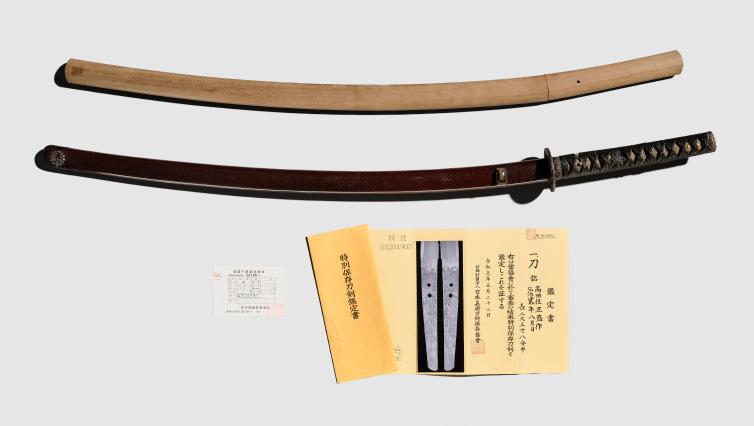
Attributed to Koyama Munetsugu, signed Bizen no Suke Munetsugu saku
Japan, dated 1852, Edo period (1615-1868)
The blade:
Sugata (shape): shinogi zukuri, iori mune, torii-zori curvature, ko-kissaki, bo-hi (blood groove)
Hamon (temper line): notare with nie-deki Hada (forging grain pattern): muji Boshi (tip): komaru
Nakago (tang): ubu (not shortened), haagari-jiri, the yasurime is katte sagari, two mekugi ana Mei/Uramei (signature): Bizen no Suke Munetsugu saku [made by Munetsugu, resident of Bizen Suke] (mei), Kaei gonen ni atsu hi [a day in the second month of the fifth year of the Kaei era, corresponding to 1852] (uramei)
The mounting:
Habaki (blade collar): silver, diagonal file marks with dew drops Tsuba (sword guard): Shoami school, of marugata form, one kozuka hitsu ana, yo-sukashi, silver and gold nunomezogan, kebori floral sprays, in the form of a butterfly attracted to a kiku Fuchi-kabuto gane (handle fittings): iron with gold nunomezogan featuring floral vines
Tsuka (handle): with samegawa (rayskin), black tinted leather tsuka-ito, and shibuichi menuki in the form of three Hosokawa clan mon Saya (sheath): lacquered ray skin
NAGASA 67.3 cm (blade length), SORI 2.5 cm (curvature)
LENGTH 87.2 cm (blade and tang), 96.7 cm (koshirae), 94.8 cm (shirasaya)
The Shirasaya with a label inscribed, ‘Bizen no suke Munetsugu, accompanied by a koshirae, registration number 25735, Kumamoto’
Condition: Very good condition with minor wear and little kuchikomi. The koshirae saya with some touchups to the lacquer, the leather tsuka-ito with some wear, minor corrosion to the iron fittings, some slightly loosened. The shirasaya open at both seams.
AUCTION COMPARISON
Compare a closely related katana signed Bizen no Suke Fujiwara Munetsugu, dated 1866, nagasa 74.5 cm, at Sotheby’s, Important Japanese Swords and Armour from the Paul L. Davidson Collection, 25 March 2025, New York, lot 738 (sold for USD 22,860 or approx. EUR 20,500 converted and adjusted for inflation at the time of writing).
Estimate EUR 4,000
Starting price EUR 2,000
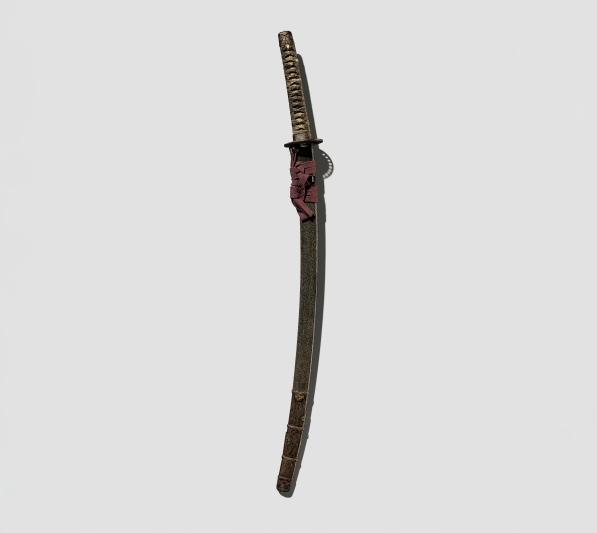
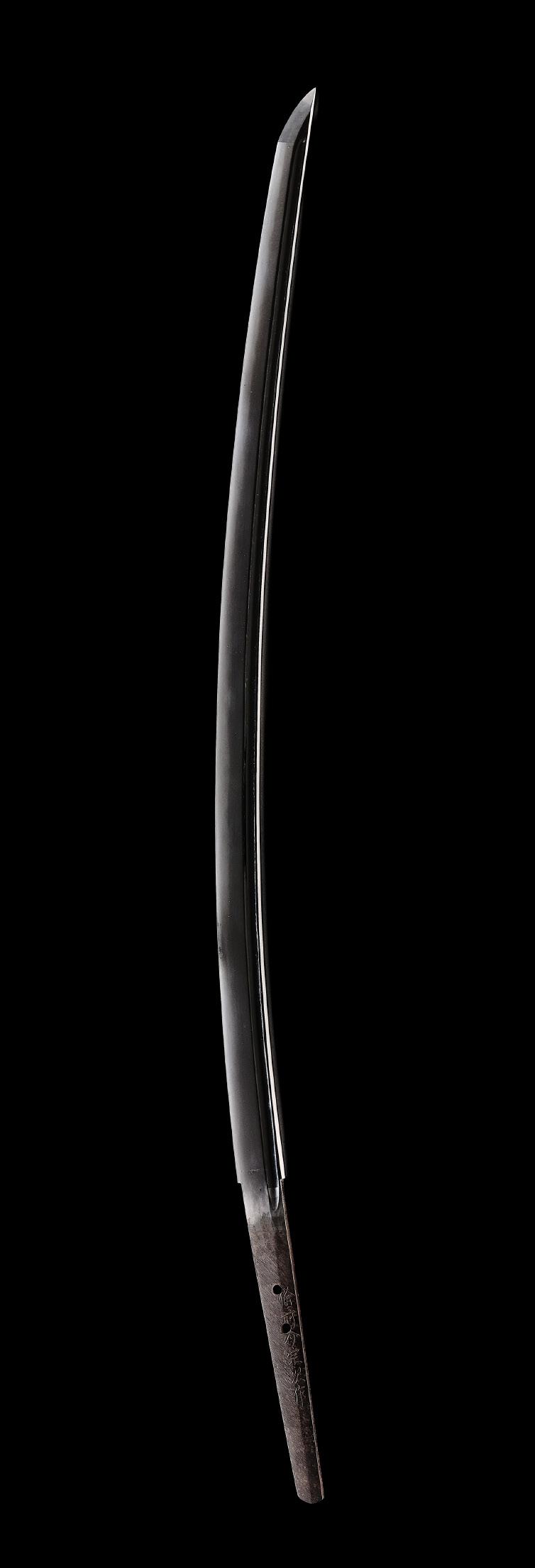
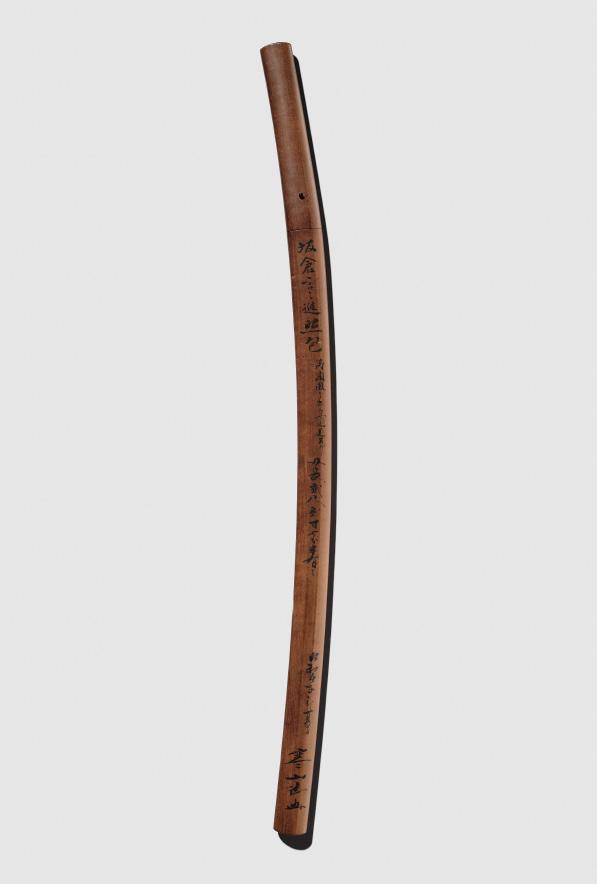
69
TERUKANE: A KATANA IN SHIRASAYA WITH SAYAGAKI
By Terukane (active c. 1673-1688), signed Sakakura Gon no Shin Terukane
Japan, Settsu Province, 17th century, Edo period (1615-1868)
The blade: Sugata (shape): shinogi-zukuri, iori muni, torii-zori, chu-kissaki
Hamon (temper line): toranba with nie-deki
Hada (forging grain pattern): itame
Boshi (tip): omaru
Nakago (tang): ubu (not shortened), iriyamagata-jiri, the yasurime is katte sagari, one mekugi ana Mei/Uramei (signature): Sakakura Gon no Shin Terukane (mei)
Habaki (blade collar): copper-shakudo with diagonal file marks and dew drops
NAGASA 68.9 cm (blade length), SORI 1.4 cm (curvature)
LENGTH 90.1 cm (blade and tang), 98.3 cm (shirasaya)
Condition: Very good condition with minor wear and little kitae ware.
The shirasaya inscribed with a sayagaki by Sato Kanzan (19071987), an expert on Japanese swords and an authoritative member of the NBTHK, 坂倉言之進照包、涛瀾風之出来也見事、刃長貮尺貮寸 七分半有之、昭和壬子年夏日、寒山誌 (kakihan) Sakakura Gonnoshin Terukane, Toran fu no deki migoto nari, hacho nishaku nisun nanabu-han ari kore, Showa mizunoe-ne toshi kajitsu, Kanzan shirusu, with kakihan [Made by Sakakura Gonnoshin Terukane, the hamon is splendid manner of Toran patterns, the length of the blade is 2-shaku 2-sun and 7-and-a half-bu (ca. 69cm), On a day in summer, in the Showa 47 (1972), (Sato) Kanzan recorded this].
Terukane was a pupil of Echigo no kami Kanesada, and signed also Echigo no kami Kanesada until around 1680. From then on he used the family surname ‘Sakakura’ and ‘Gon no Shin’. This blade is a typical Osaka shinto of the period, with the flamboyant toramba hamon favoured by Sukehiro and his son Sukenao.
Estimate EUR 8,000
Starting price EUR 4,000
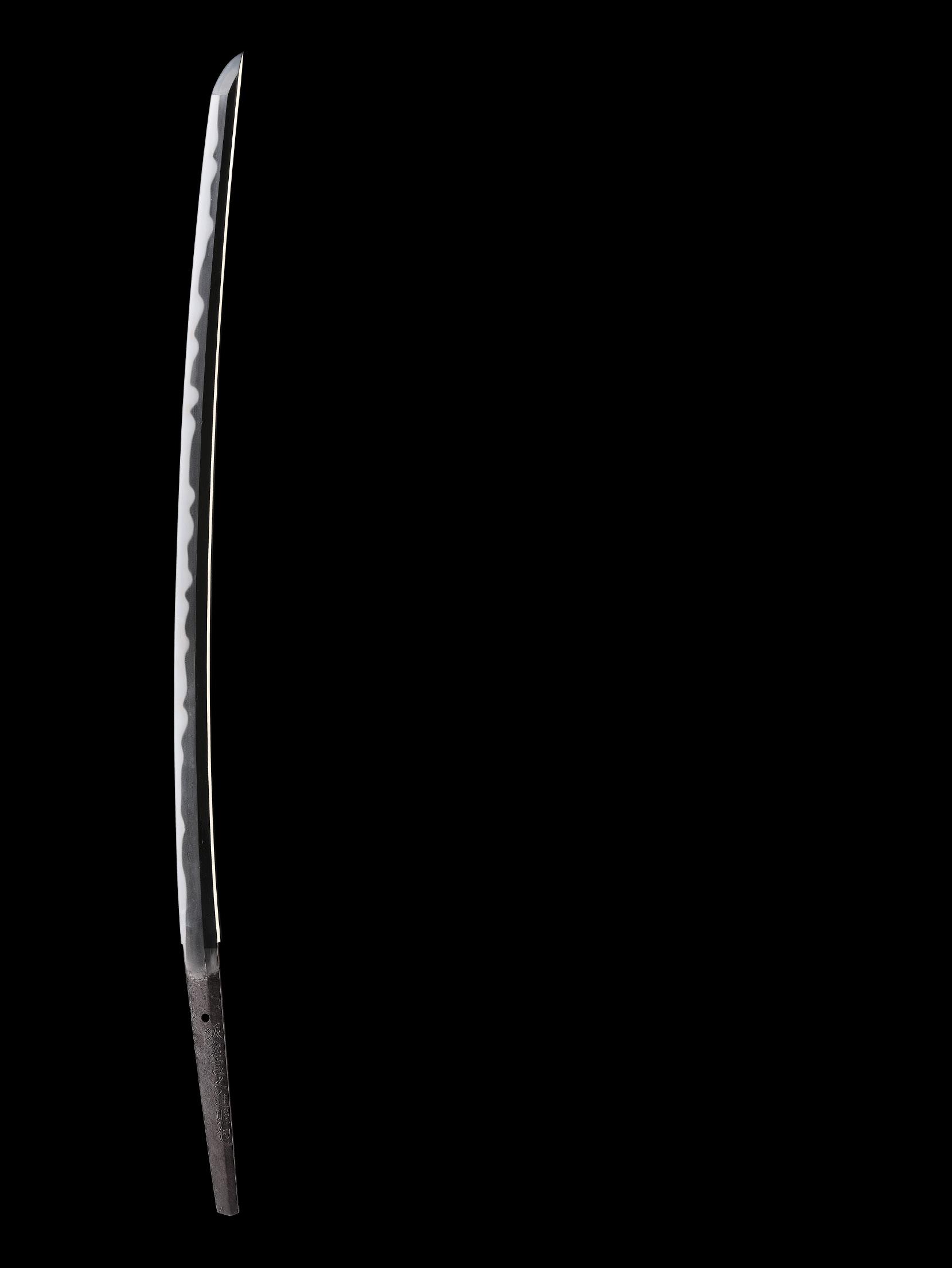
SUISHINSHI
By Suishinshi Masahide, signed Suishinshi Masahide
Japan, late 18th to early 19th century, Edo period (1615-1868)
The blade:
Sugata (shape): shinogi-zukuri, iori mune, torii-zori, chu-kissaki
Hamon (temper line): wide gunome with nioi-deki
Hada (forging grain pattern): masame Boshi (tip): komaru
Nakago (tang): ubi (not shortened), iriyamagata-jiri, the yasurime is katte sagari, one meguki ana
Mei/Uramei (signature): Suishinshi Masahide with kao (mei)
Habaki (blade collar): sentoku
NAGASA 67.8 cm (blade length), SORI 1.3 cm (curvature)
LENGTH 84.6 cm (blade and tang), 96.1 cm (shirasaya)
Condition: Very good condition with minor wear.
Suishinshi Masahide (died in 1826) was the founder of the shinshinto tradition. He was in instrumental in the revival of ancient styles, publishing his research in works such as the Token jitsuyo ron [Practical Sword Dissertation].
AUCTION COMPARISON
Compare a closely related wakizashi, signed Suishinshi Masahide, dated 1785, at Sotheby’s, Important Japanese Swords and Armour from the Paul L. Davidson Collection, 13-25 March 2025, New York, lot 734 (sold for USD 24,130 or approx. EUR 21,100 converted and adjusted for inflation at the time of writing).
Estimate EUR 5,000
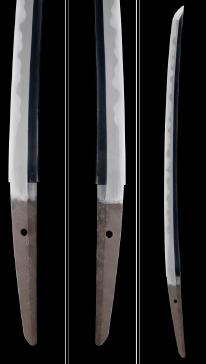
Starting price EUR 2,400
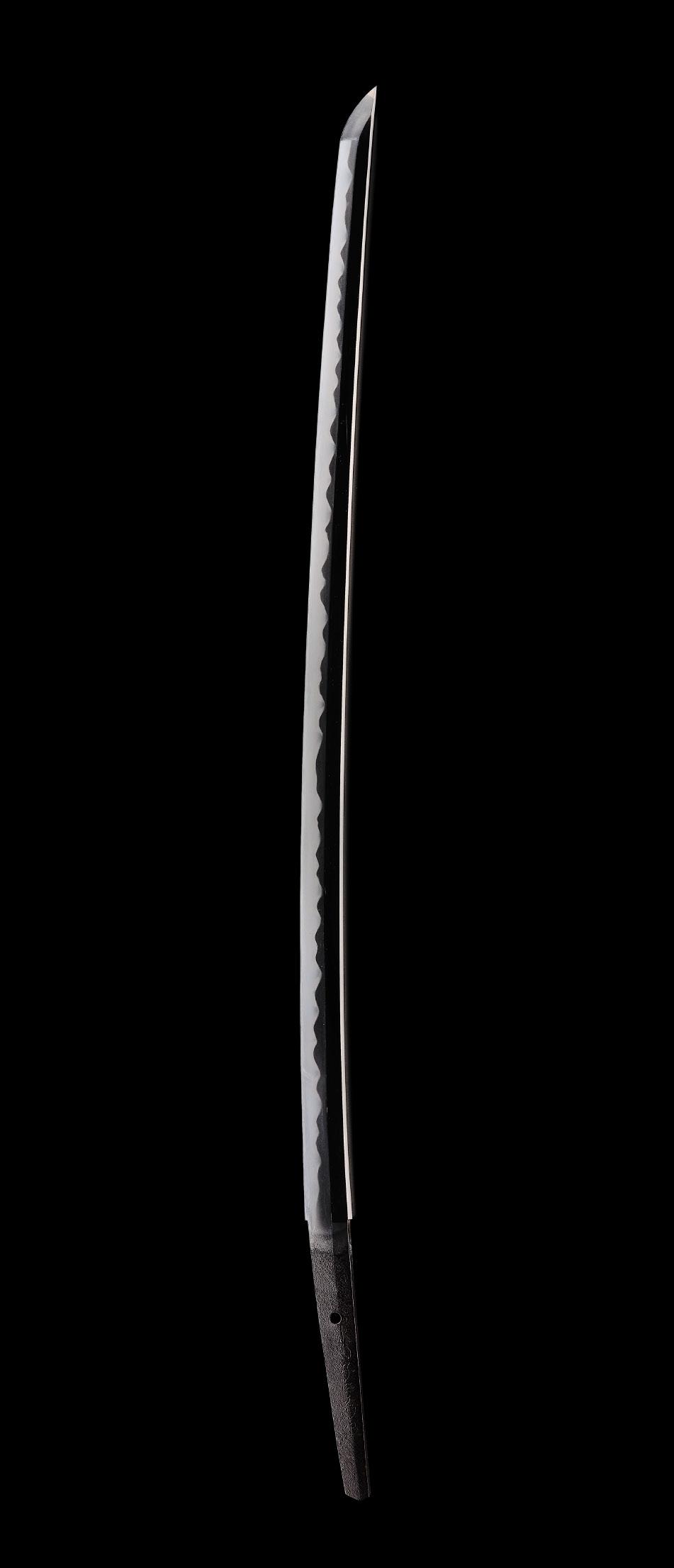
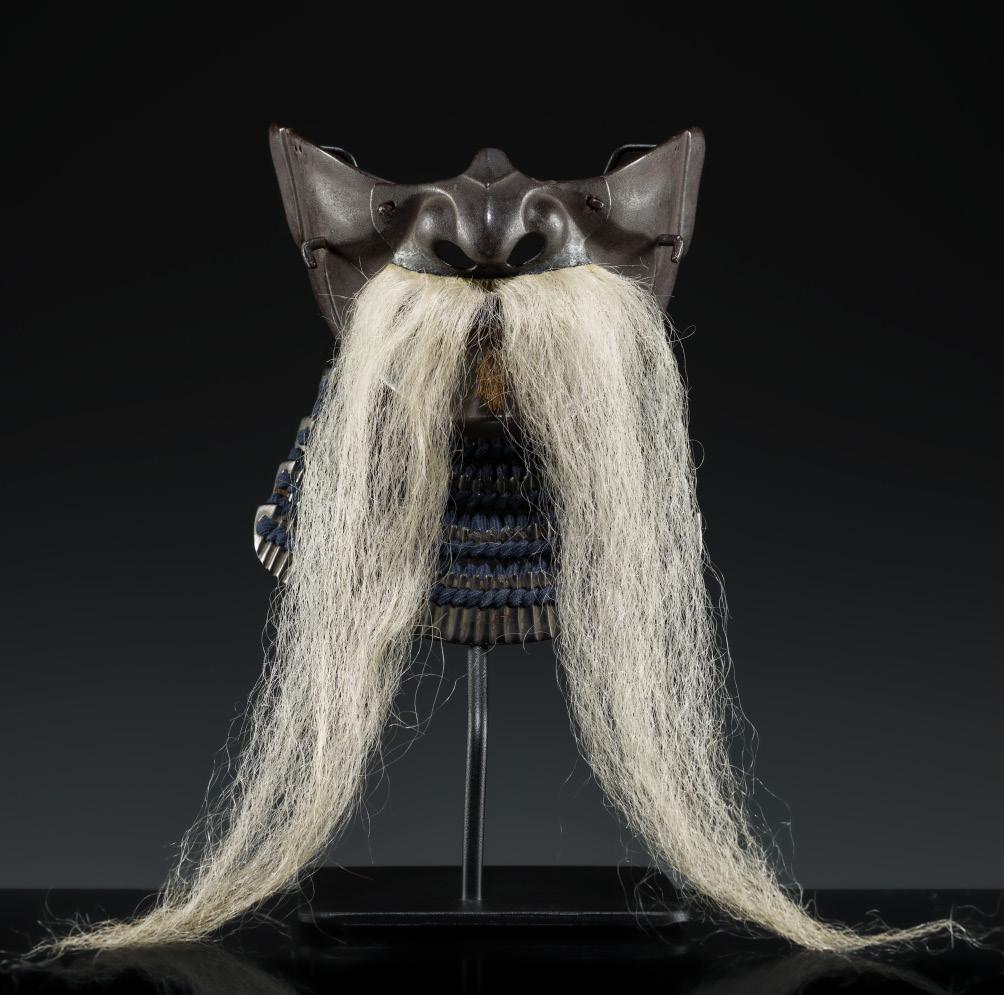
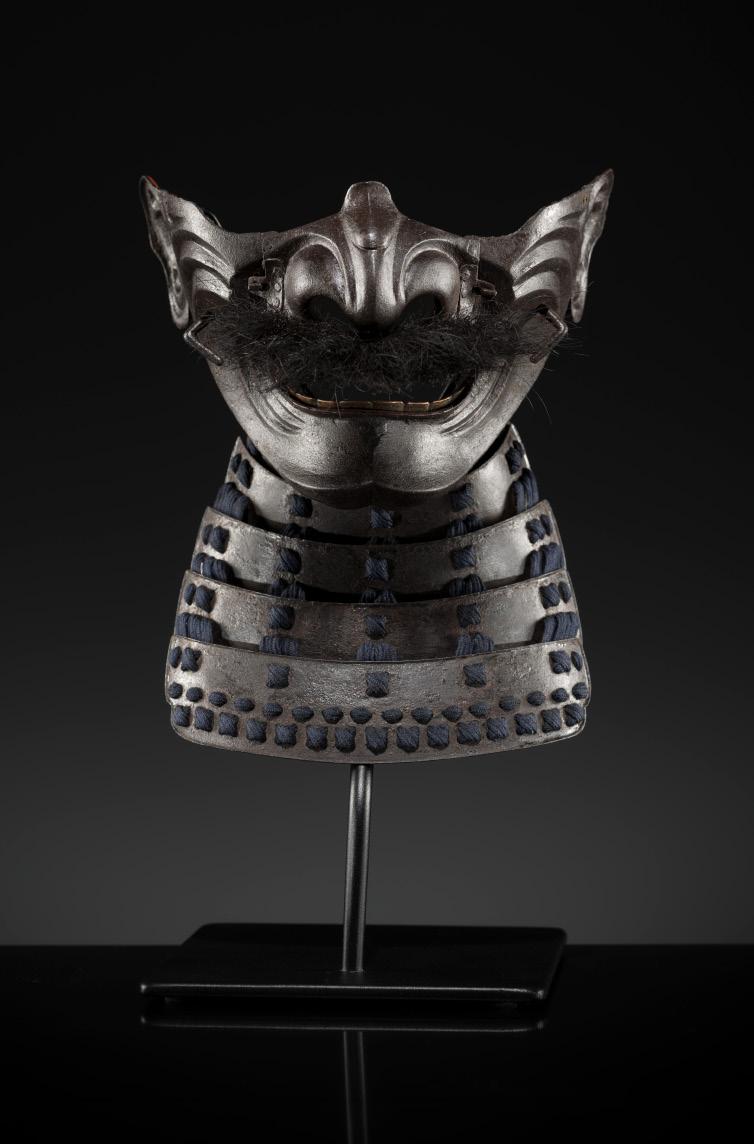
Japan, 18th-19th century, Edo period (1615-1868)
Finely cast and forged in one section with a removable nose plate secured by turning pins, cast with flared nostrils and an open mouth revealing teeth, the lips painted red, below a scrolling horsehair mustache, the chin with ase-nagashi, and the cheeks with bent anchoring posts, all fitted with a four-lame yodarekake with blue lacing.
HEIGHT 21 cm (excl. stand), 31.4 cm (incl. stand)
WEIGHT 435 g (excl. stand), 1,709 g (incl. stand)
Condition: Very good condition with minor wear and a small chip to the lacquer along the edge, the verso with a touchup to the lacquer.
With an associated presentation stand.
Estimate EUR 3,000
Starting price EUR 1,500
Japan, 18th century, Edo period (1615-1868)
An enpo-type menpo in the me no shita bo style, finely forged in one piece with a removable nose plate secured by turning pins, the face modeled with flared nostrils and an open mouth revealing teeth, the lips painted red beneath a stiff animal-hair moustache. The surface is articulated with pronounced wrinkles (shiwa) and a dimpled chin with ase-nagashi, and is fitted with cheek posts for helmet cords and a four-lame yodarekake laced in dark blue. The interior is lacquered vermilion, while the exterior is finished in sabimono style to imitate aged rust (sabiji), reflecting the sabi aesthetic associated with the wabicha tea tradition.
HEIGHT 23 cm (excl. stand), 31.4 cm (incl. stand) WEIGHT 511 g (excl. stand), 1,681 g (incl. stand)
Condition: Good condition with old wear. An old protective varnish has been applied to the surface. The lacquer to the back with age cracks, losses, and flaking, some with associated touchups.
With an associated presentation stand.
AUCTION COMPARISON
Compare a closely related lacquered-iron half mask (menpo), Edo period, dated to the 18th century, at Christie’s, Japanese and Korean Art, 23 March 2004, New York, lot 308 (sold for USD 3,346 or approx. EUR 5,000 converted and adjusted for inflation at the time of writing).
Estimate EUR 3,000
Starting price EUR 1,500
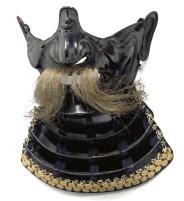
Japan, late 18th century, Edo period (1615-1868)
The lacquered cheek guard modeled with simulated wrinkles, pierced to the chin with an ase-nagashi, flanked by cord pegs on rhombus grommets, all fitted with a four-lame yodarekake with blue lacing, the interior lacquered red.
HEIGHT 19 cm (excl. stand), 33.5 cm (incl. stand)
WEIGHT 342 g (excl. stand), 1,609 g (incl. stand)
Condition: Very good condition with minor wear and a tiny loss to the lacquer in the back near the right ear.
With an associated presentation stand.
AUCTION COMPARISON
Compare a closely related iron hanbo, Edo period, dated to the late 18th century, at Bonhams, Fine Japanese Works of Art, 24 March 2011, New York, lot 3188 (sold for USD 2,318 or approx. EUR 2,900 converted and adjusted for inflation at the time of writing).
Estimate EUR 1,500
Starting price EUR 800
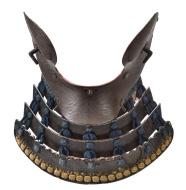
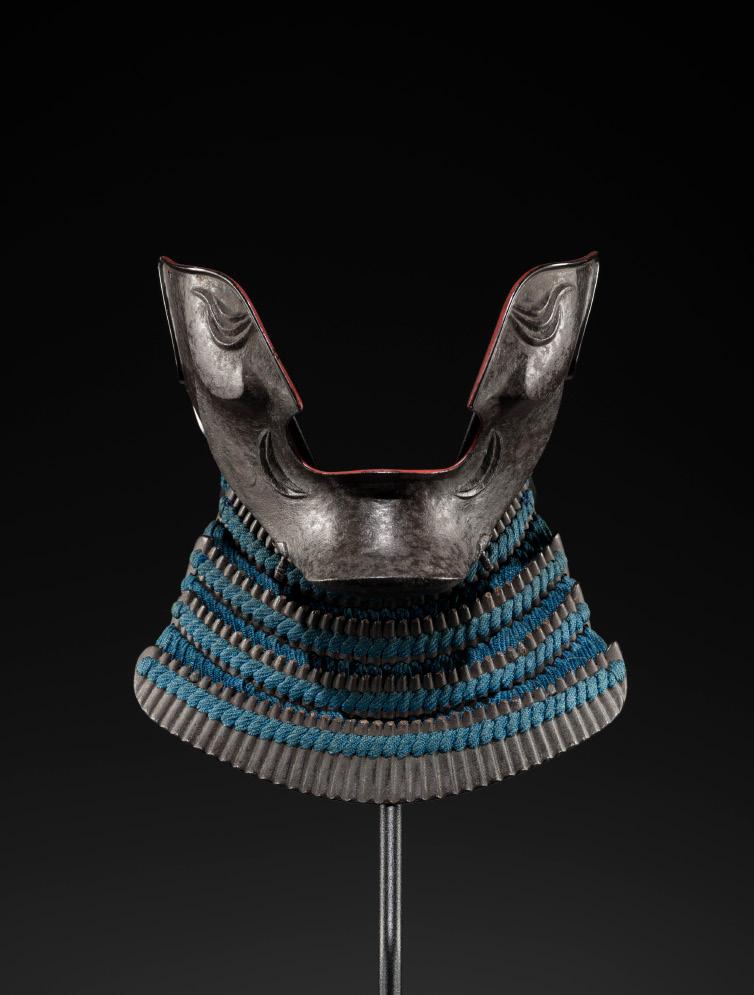
74
AN IRON KARASU-TENGU MENPO (FACE MASK)
Japan, 18th century, Edo period (1615-1868)
Finely cast and forged in five sections with a detachable nose plate secured by turning pins, designed with deeply embossed wrinkles at the cheeks, the chin with ase-nagashi, and the cheeks with bent anchoring posts, all fitted with a four-lame yodarekake with black lacing.
HEIGHT 24.7 cm
WEIGHT 428 g
Condition: Very good condition with expected signs of corrosion and one tiny crack near the right ear.
AUCTION COMPARISON
Compare a related tengu menpo, dated to the 18th century, at Bonhams, Arts of the Samurai, 27 October 2014, New York, lot 1060 (sold for USD 35,000 or approx. EUR 42,000 converted and adjusted for inflation at the time of writing).
Estimate EUR 4,000
Starting price EUR 2,000
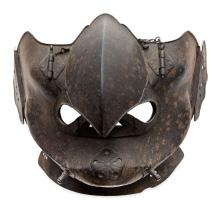
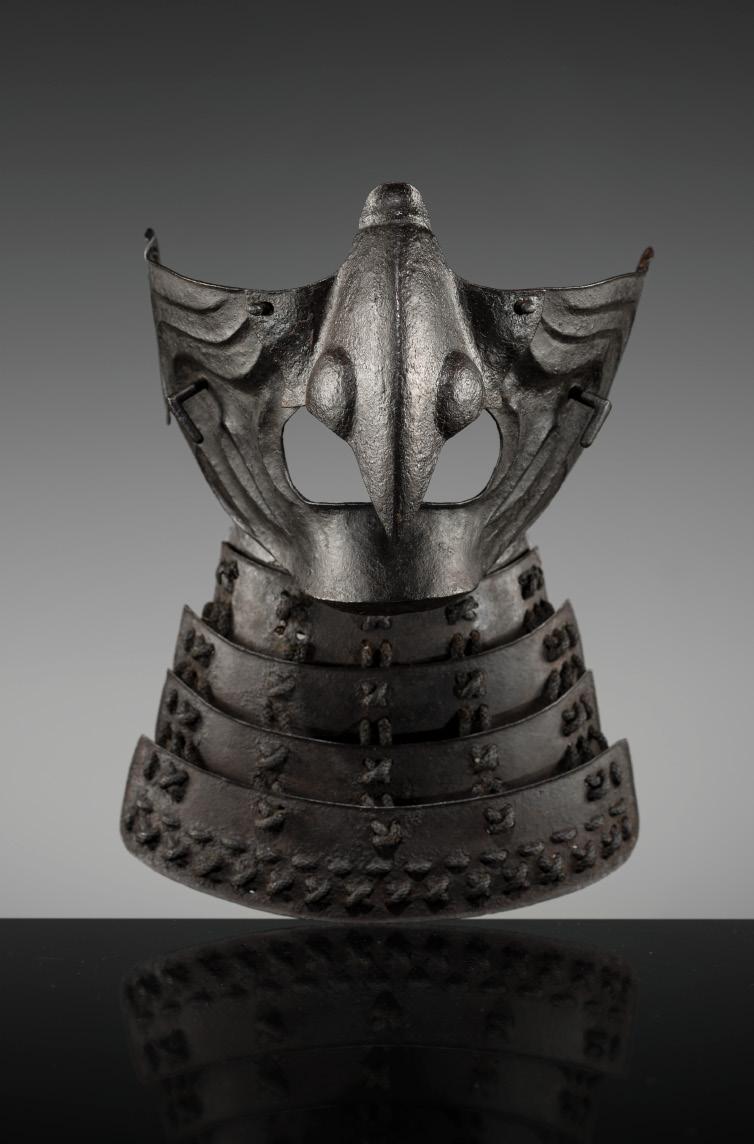
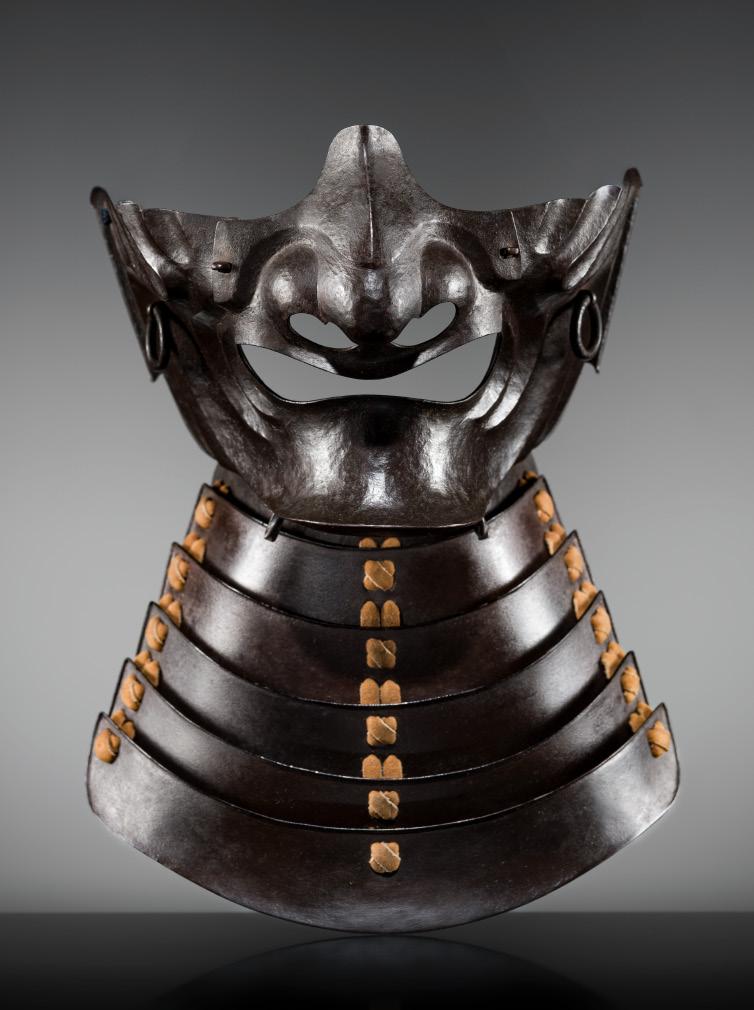
76
A RED-LACQUERED IRON RESSEI MENPO
Japan, 18th century, Edo period (1615-1868)
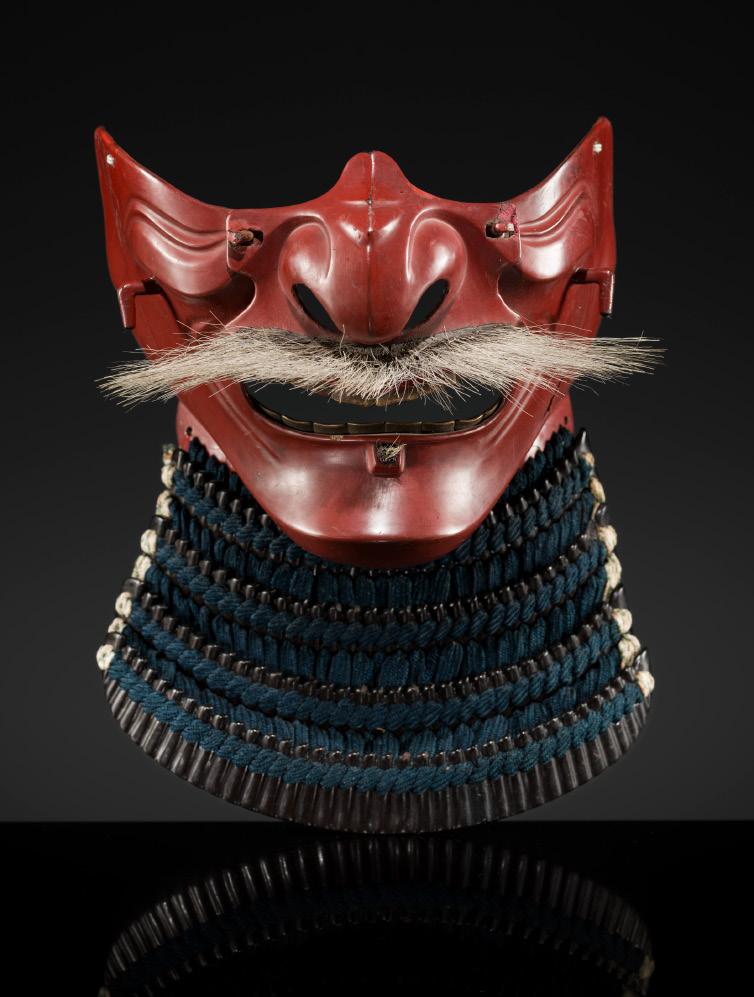
75
MUNEHARU: A FINE
MYOCHIN SCHOOL LACQUERED IRON MENPO
By Myochin Muneharu, signed Doshu Myochin Muneharu saku
Japan, Tosa Province (Kochi), c. 1850, late Edo period
Finely cast and forged in five sections with a removable nose plate secured by turning pins, cast with flared nostrils and an open mouth in a wide smile, designed with deeply embossed wrinkles, the chin with ase-nagashi, and the cheeks with loop cord attachments, all fitted with a five-lame yodarekake with orange lacing. Signed to the underside Doshu Myochin Muneharu saku [Made by Myochin Muneharu, Tosa Province].
HEIGHT 25.5 cm
WEIGHT 458 g
Condition: Excellent condition with minor wear.
The artist is recorded in the Haynes Index of Japanese Sword Fittings and Associated Artists (p. 1201, H06049.0). Myochin Muneharu is noted for producing a celebrated suit of armor presented as a diplomatic gift from a Tokugawa shogun to Queen Victoria
Estimate EUR 5,000
Starting price EUR 2,400
Finely cast and forged in one section with a removable nose plate secured by turning pins, cast with flared nostrils and an open mouth revealing gilt-lacquered teeth, below the applied horsehair mustache and above a goatee, designed with deeply embossed wrinkles, the chin with ase-nagashi, and the cheeks with bent anchoring posts, all fitted with a five-lame yodarekake with predominantly blue lacing.
HEIGHT 24 cm
WEIGHT 501 g
Provenance: With Giuseppe Piva: Japanese Art, Milan. A private collection in Switzerland, acquired from the above in 2020. A copy of a signed and sealed certificate of authenticity from Giuseppe Piva, dated January 2020, confirming the dating above, accompanies the lot.
Condition: Good condition with minor wear. The lacquer with small age cracks, tiny chips to the edges and some flaking, some with associated touchups.
AUCTION COMPARISON
Compare a closely related menpo, dated to the 18th century, at Sotheby’s, The Samurai: Japanese Arms and Armour, 10 May 2022, London, lot 20 (sold for GBP 3,528 or approx. EUR 4,800 converted and adjusted for inflation at the time of writing).
Estimate EUR 4,000
Starting price EUR 2,000
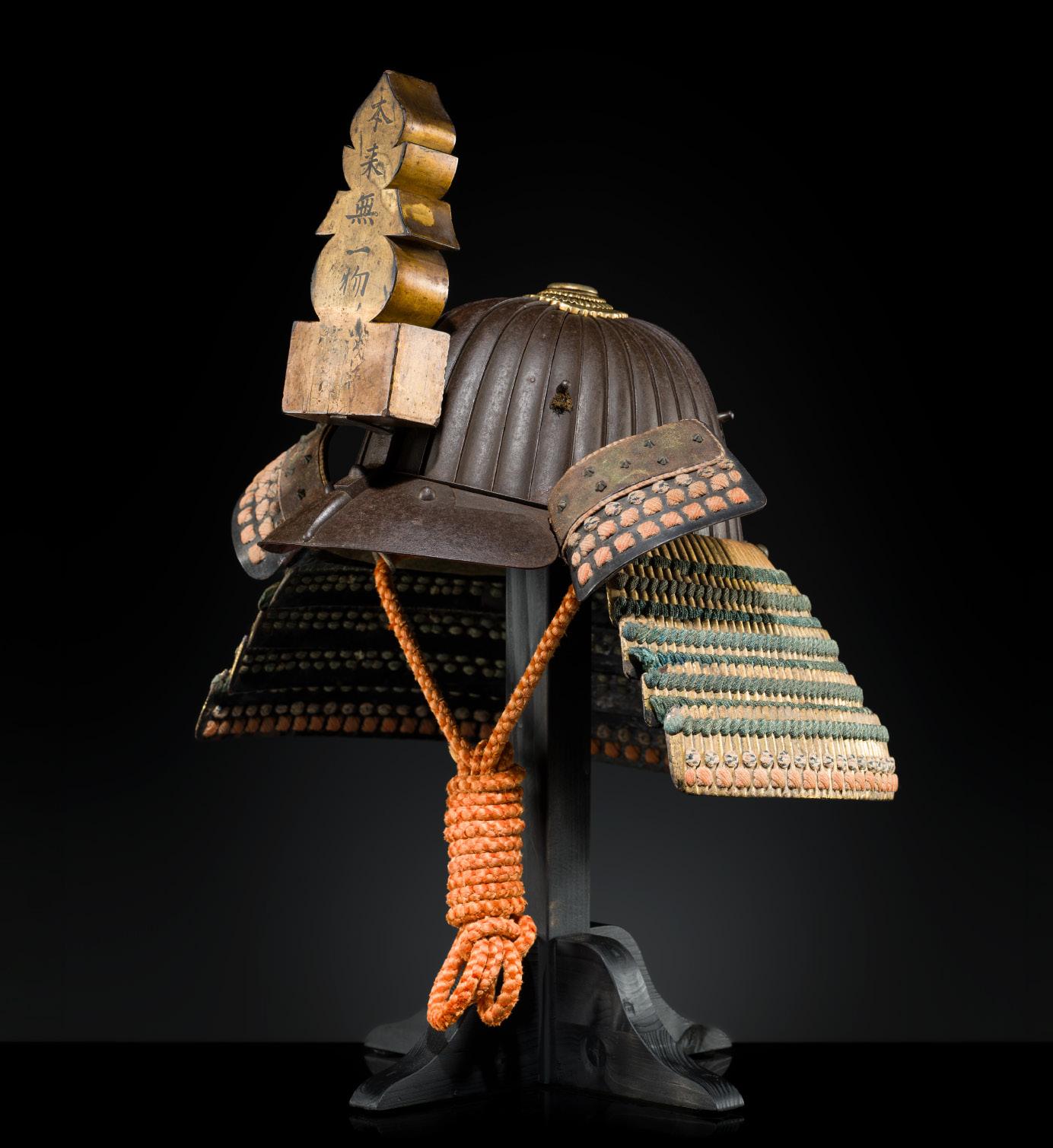
A SUJIBACHI KABUTO WITH GORINTO MAEDATE
Japan, 17th-18th century, Edo period (1615-1868)
The thirty-two-plate iron bowl with raised ridges topped by a fivestage gilt-copper tehen kanamono, chased with foliate vines to the lowest tier, the upturned fukigaeshi with printed leather and applied with foliate studs and fitted with an additional lame, the unadorned mabizashi fitted with an inscribed Gorinto maedate, all above the gold-lacquer five-lame shikoro with predominantly green lacing.
Inscriptions: The maedate inscribed with the Zen dictum ‘Honrai Muichimotsu’ 本来無一物 [Originally, there is nothing].
HEIGHT 29 cm and WIDTH 37 cm (excl. stand)
WEIGHT 2,721 g (excl. stand), 3,256 g (incl. stand)
Condition: Very good condition with wear and small losses to the leather. Rubbing to gilt and little flaking to lacquer to the underside. The maedate with expected wear and rubbing to gilt and old smoothened chips along the edges.
Gorinto (five-ringed tower) is a type of Buddhist pagoda believed to have been first adopted by the Shingon and Tendai sects during the mid Heian period. It is used for memorial or funerary purposes and is therefore common in Buddhist temples and cemeteries. In all its variations, the gorinto includes five rings, each having one of the five shapes symbolic of the Five Elements: the earth ring (cube), the water ring (sphere), the fire ring (pyramid), the air ring (crescent), and the ether ring, (or energy, or void). The last two rings (air and ether) are visually and conceptually united into a single subgroup and often depicted in Japan as a lotus flower.
Estimate EUR 5,000
Starting price EUR 2,400
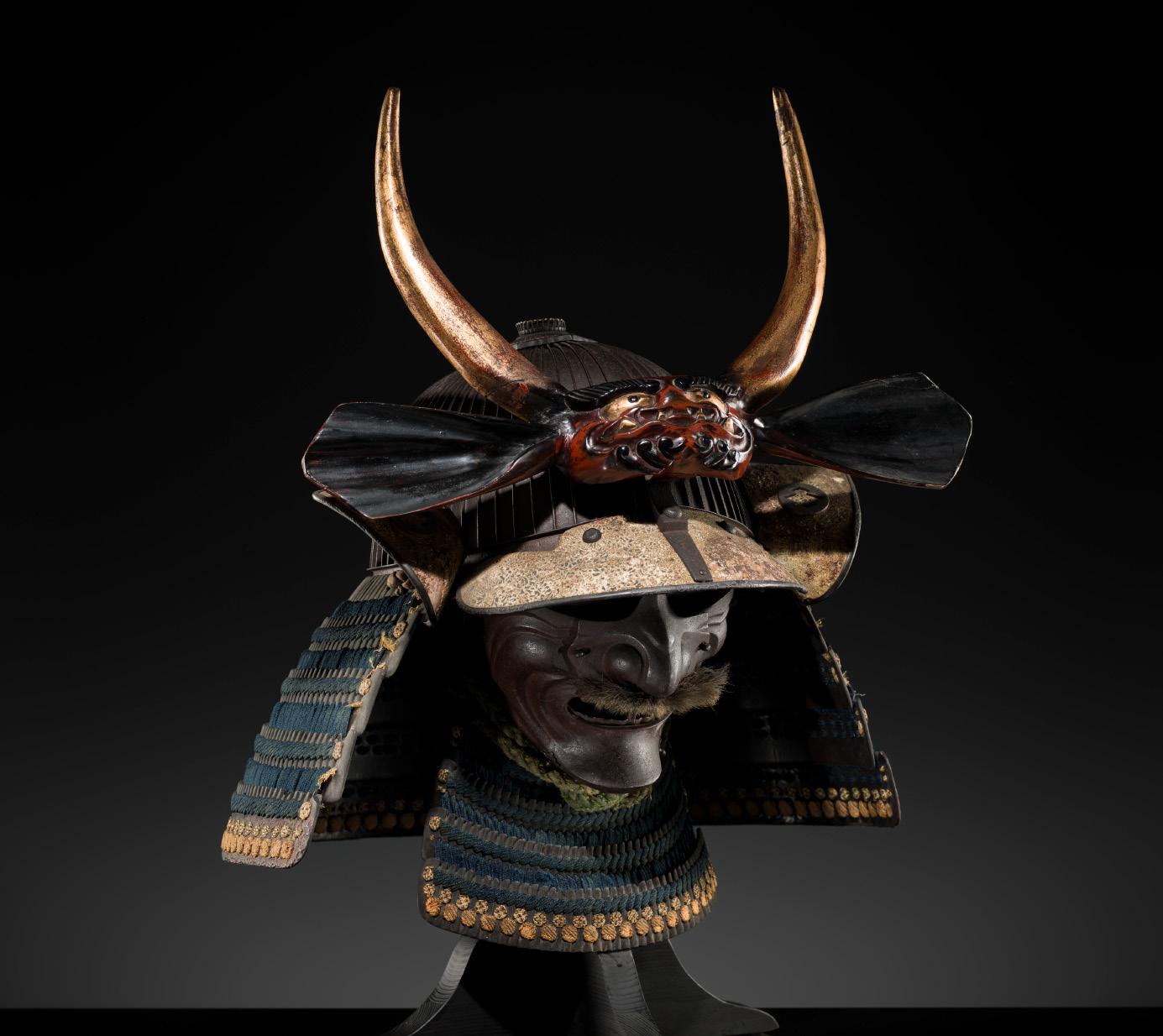
78
FUJIWARA IEHISA: A HARUTA SCHOOL SUJIBACHI KABUTO WITH ONI MAEDATE AND MATSUKAWA-BISHI MON, AND IRON MENPO
The kabuto by Fujiwara Iehisa, signed Fujiwara Iehisa Japan, 17th century, early Edo period (1615-1868)
The sixty-two-plate koseizan shaped sujibachi kabuto in russet iron topped by a four-stage bronze tehen kanamono, the lowest tier in openwork and decorated with chrysanthemums on scrolling vines, fitted with a kiku-form agemaki-no-kan to the back, the mabizashi and fukigaeshi each with printed leather, the mabizashi adorned with kiku medallions and fitted with a maedate in the form of a fierce two-horned demon with the mouth in a tight grimace, the fangs peeking through, the face painted red, the gilt eyes with black-lacquered pupils, issuing a pair of elegantly curved gilt bovine horns, flanked by the upturned fukigaeshi applied with the matsukawa-bishi mon, all above the five-lame shikoro with predominantly blue lacing and fitted kiku studs to the top. The kabuto signed to the interior FUJIWARA IEHISA.
With an iron menpo, finely cast and forged in four sections with a removable nose plate secured by turning pins, cast with flared nostrils and an open mouth revealing teeth, the lips painted red, below a stiff horsehair moustache, designed with deeply embossed wrinkles, the chin with ase-nagashi, flanked by cord pegs on rhombus grommets, all fitted with a four-lame yodarekake with blue lacing.
HEIGHT 44 cm (the helmet incl. shikoro and maedate) and 24.5 cm (the menpo incl. yodarekake)
WEIGHT 3 kg (the helmet incl. shikoro and maedate) and 492 g (the menpo incl. yodarekake)
Condition: Very good condition with minor wear and expected losses to the leather. The maedate with expected rubbing to lacquer and gilt, as well as repairs to the horns and ears.
With a wood stand.
AUCTION COMPARISON
Compare a closely related sujibachi kabuto by the same armorer, Edo period, dated to the 17th century, at Bonhams, Fine Japanese Art, 11 November 2010, London, lot 58 (sold for GBP 6,840 or approx. EUR 12,500 converted and adjusted for inflation at the time of writing).
Estimate EUR 8,000
Starting price EUR 4,000
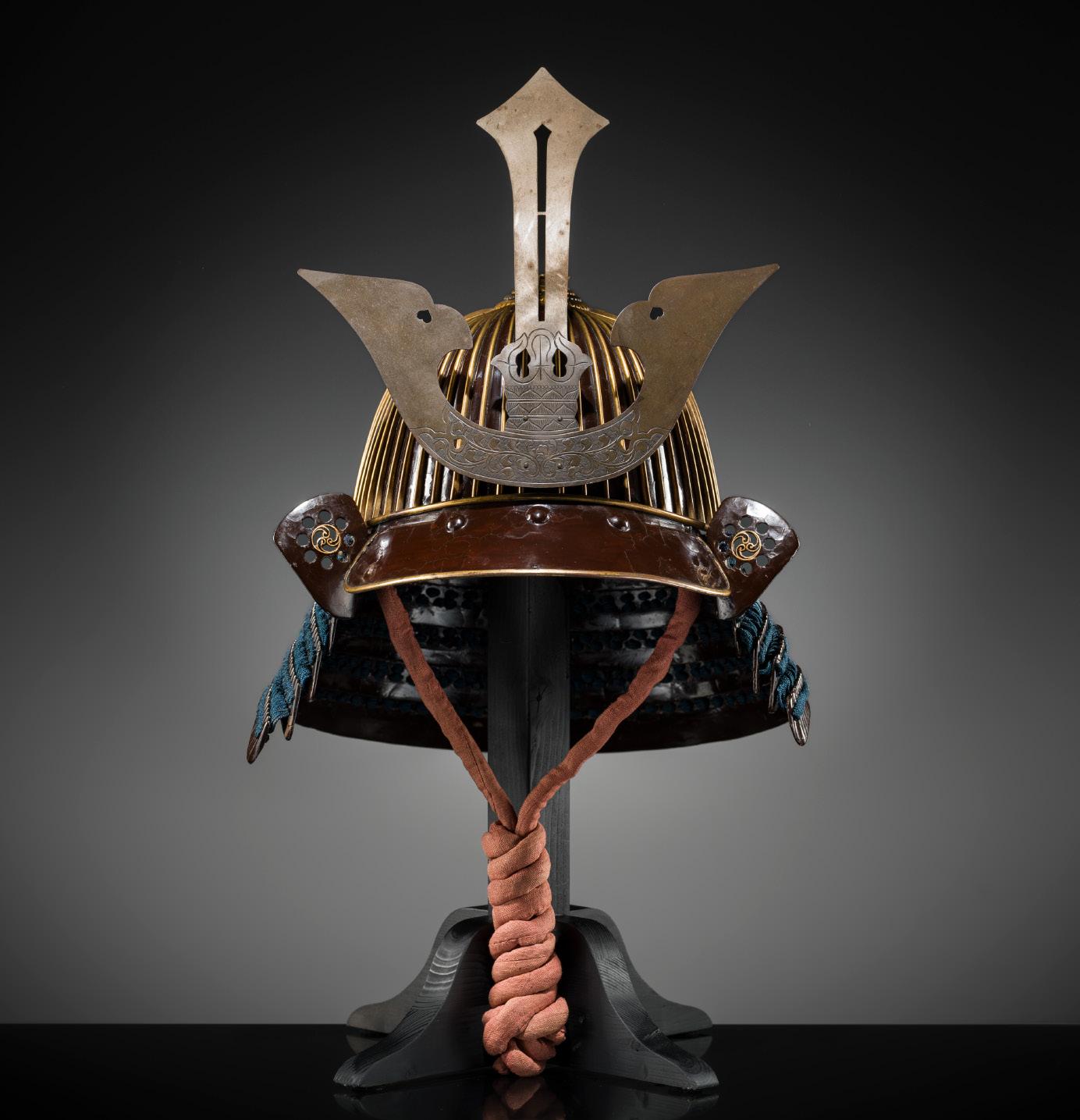
Japan, 18th century, Edo period (1615-1868)
The brown-lacquered fifty-two-plate iron bowl with raised ridges adorned with gilded copper applications (so-fukurin), topped by a five-stage gilt-copper chrysanthemum-form tehen kanamono, fitted with an agemaki-no-kan to the back, the mabisashi decorated with copper fukurin and below the copper kuwagata dai incised with scrolling foliage and pierced with an inome design at the top, framing the ken (sword) issuing from a vajra head, all flanked by gently upturned and pierced fukigaeshi centered by mitsu-domoe mon in lacquered gilt, all above the lacquer four-lame jikoro.
HEIGHT 37 cm
WEIGHT 2.5 kg
Condition: Very good condition with minor wear and expected age cracks and flaking.
This type of ridged helmet, called a suji-kabuto, was worn by upper-class samurai beginning in the Muromachi period (1392–1573). Bulbous at the back and dipping downward around the central opening at the top of the bowl, its overall shape is known as akoda-nari due to its resemblance to the akoda, a squash-like fruit. The ridges are covered with brass, a relatively uncommon embellishment.
MUSEUM COMPARISON
Compare a closely related suji-kabuto, dated to the 18th century, 43.2 cm high, in the Metropolitan Museum of Art, object number 2018.833.12a–f.
Estimate EUR 8,000
Starting price EUR 4,000
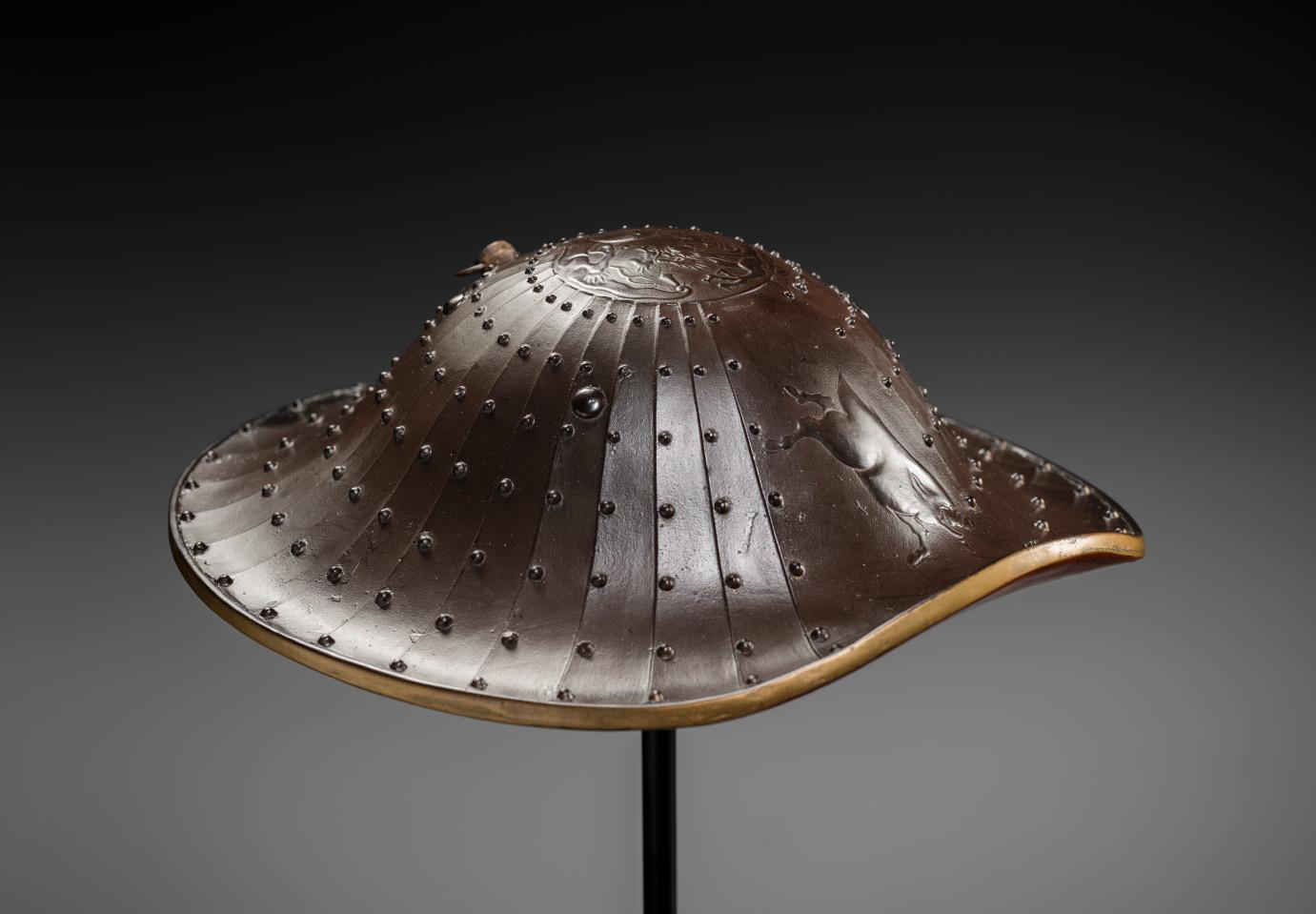
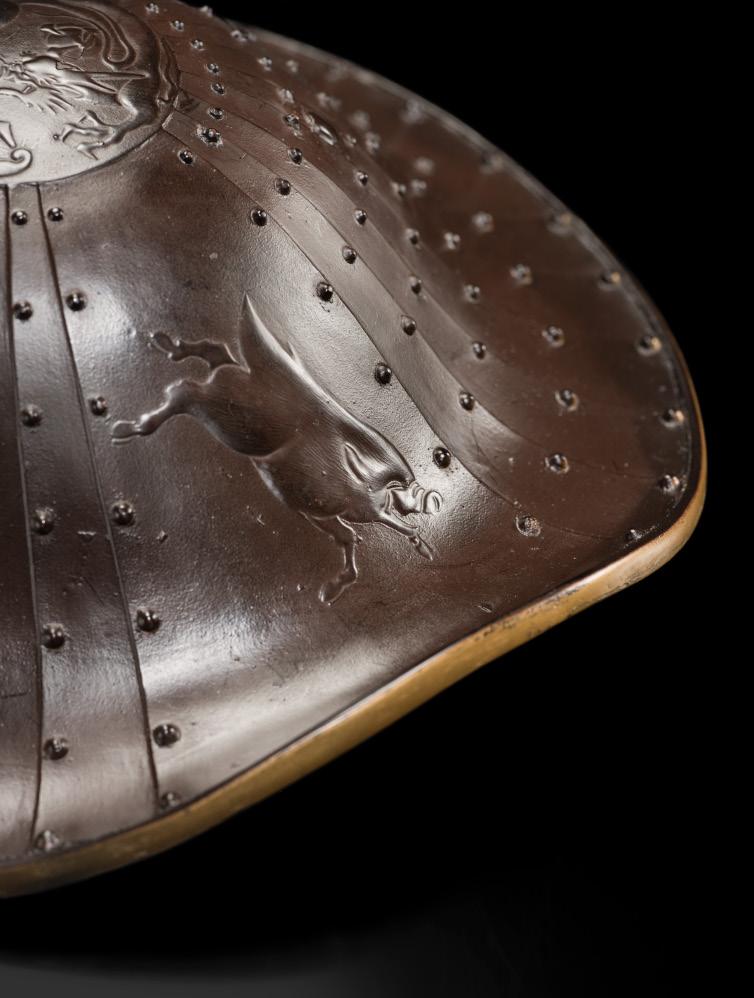
80
Japan, 19th century, Edo period (1615-1868)
The sabiji-nuri lacquered bajo-gasa jingasa, of characteristic form with a flat top and everted rim, finely decorated to simulate iron construction. The exterior is molded to resemble thirty overlapping iron plates, each defined by rows of applied false rivets diminishing in size toward the apex, creating a convincing illusion of metal armor.
At the center, a large circular reserve encloses a dynamic depiction of a charging boar, rendered in takamaki-e, its powerful form animated with bold modeling and subtle tonal variation. The top is further ornamented with a tightly coiled dragon clutching a flaming pearl, adding an additional layer of symbolic protection and auspicious meaning. The rim is finished in gilt, while the underside is lacquered in a rich vermilion red.
DIAMETER 35.3 cm
Provenance: With Malcolm Fairley Ltd., London, UK. A private collection in Southern Germany, acquired from the above.
Condition: Very good condition with minor wear, few minor age cracks, small losses to lacquer, the underside with few tiny nicks and fine cracks.
MUSEUM COMPARISON
Compare a closely related jingasa simulating metal plates with rivets, Edo period, dated to the 19th century, 41 cm wide, in the British Museum, registration number OA+.975.
Estimate EUR 5,000
Starting price EUR 2,400
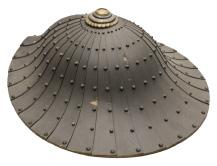
81
A FINE INLAID AND LACQUERED WOOD JINGASA (WAR HAT) WITH SHISHI AND MITSUBA AOI MON
Japan, 19th century, Edo period (1615-1868)
Published: Resonance of Wa - The Japanese Spirit. Casal Collection, 2025, p. 156.
Of almost flat ichimonji form, finely lacquered in a deep roiro ground and richly inlaid with iridescent raden (shell). The decoration depicts a lively pair of frolicking shishi chasing a brocade ball, its trailing ribbons animatedly entwined between their limbs. Below appears the Mitsuba Aoi mon, the triple hollyhock crest associated with the Tokugawa clan.
DIAMETER 42 cm
Provenance: Ex-Collection of Ugo Alfons Casal. Osaka City Museum of Fine Arts, bequeathed from the above and subsequently deaccessioned in 2021.
Condition: Very good condition with wear, few minor age cracks, small losses to lacquer, the underside with few tiny nicks and fine cracks.
Estimate EUR 2,000
Starting price EUR 1,000
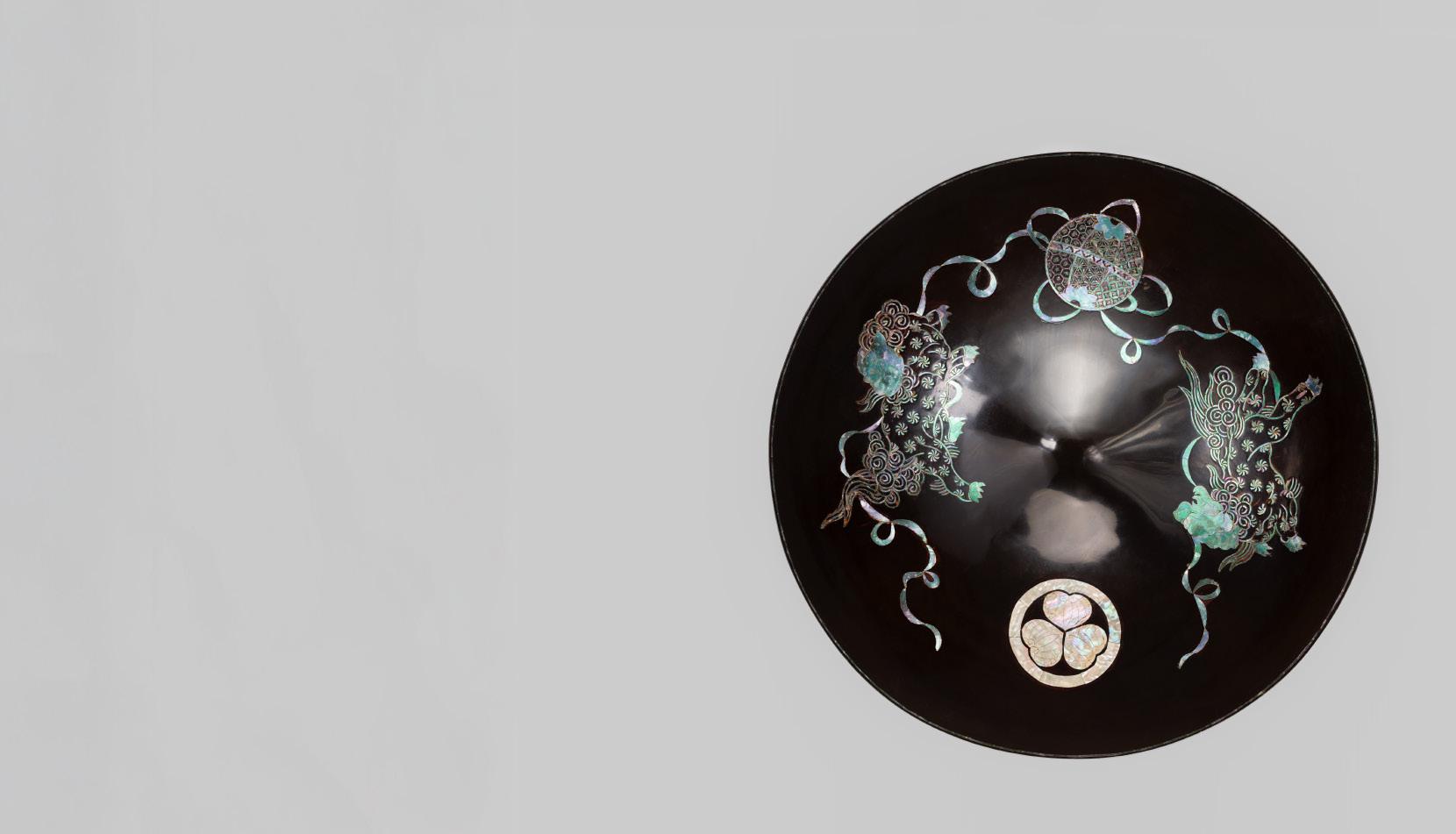
82
AN INLAID AND LACQUERED WOOD EBIRA (ARROW CASE) WITH MITSUDOMOE MON
Japan, 19th century, Edo period (1615-1868)
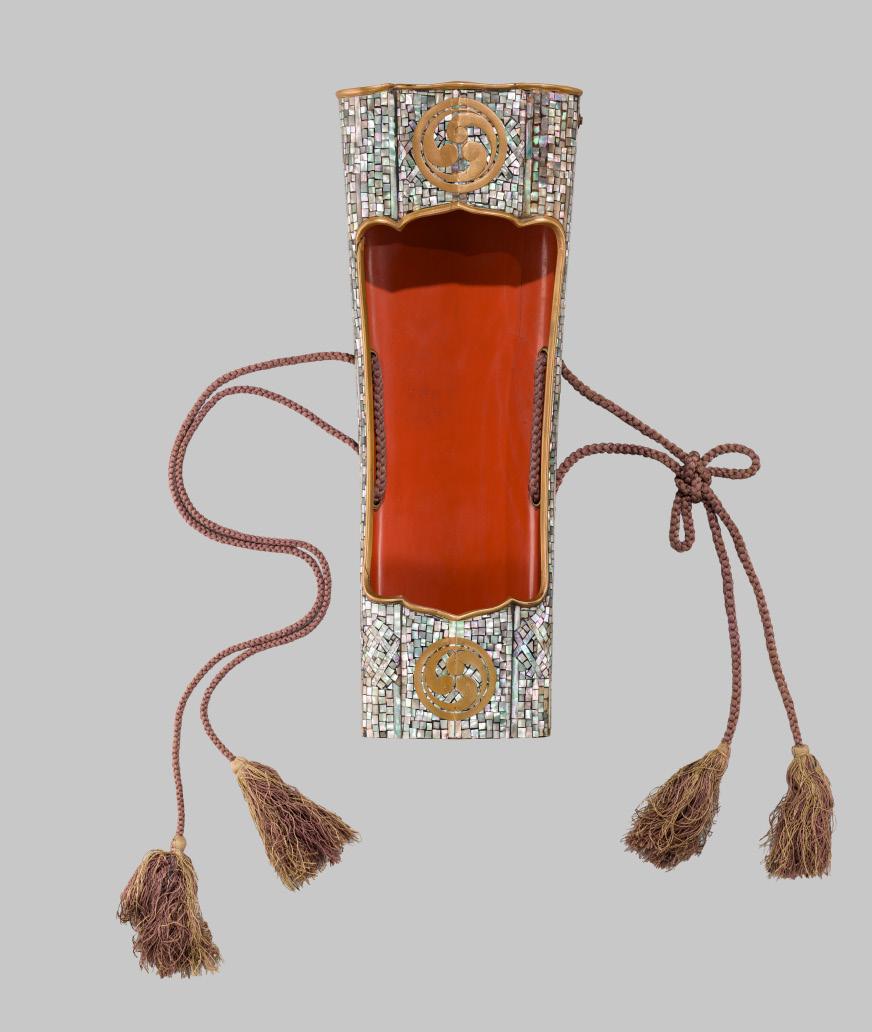
PUBLISHED
Resonance of Wa - The Japanese Spirit. Casal Collection, 2025, p. 172.
Of characteristic flaring form, the lobed opening at the front framed by thick gilt rims and densely inlaid with iridescent raden (shell), creating a richly shimmering surface. The exterior is further decorated in gold takamaki-e with mitsudomoe crests at the upper and lower sections beneath the rim.
The sides are pierced and fitted with four three-stage gilt-copper kiku fittings, with a fifth at the top, from which a padded pouch is suspended within the interior. The interior is finished in a contrasting vermilion lacquer.
HEIGHT 37.6 cm
Provenance: Ex-Collection of Ugo Alfons Casal. Osaka City Museum of Fine Arts, bequeathed from the above and subsequently deaccessioned in 2021.
Condition: Very good condition with minor wear, tiny age cracks to the rims, small losses to lacquer, and expected flaking to inlays. A small plug to the underside lost.
With a wood tomobako (storage box).
Estimate EUR 2,000
Starting price EUR 1,000
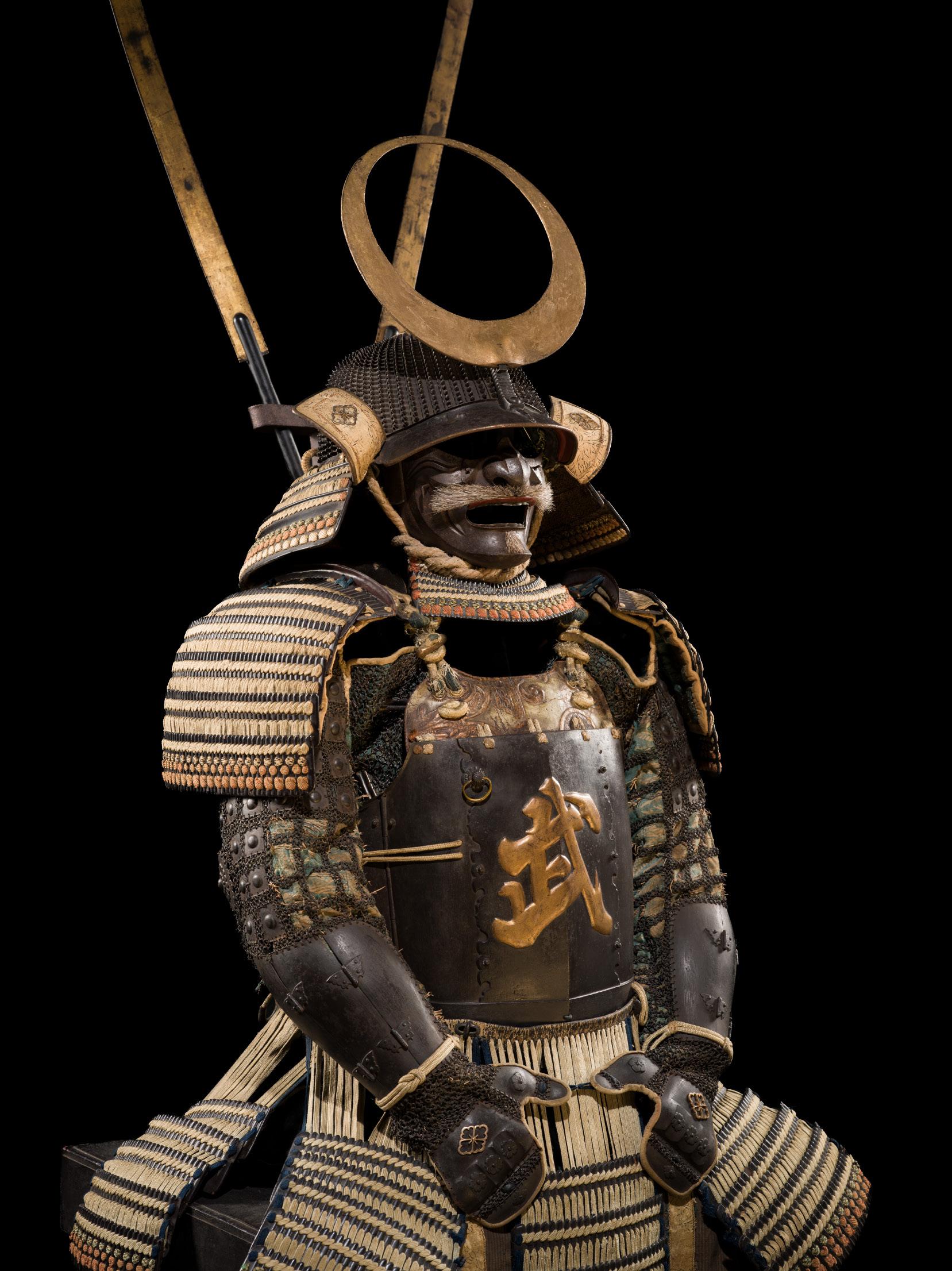
MYOCHIN: AN IMPRESSIVE ICHIGUCHI-MYOCHIN SCHOOL
DAIMYO YOROI (ARMOR)
The kabuto by Myochin Yoshiie, signed Myochin Yoshiie Japan, 17th-18th century, Edo period (1615-1868)
The lacquered iron components predominantly laced in beige, mounted on a fine blue and gold brocade, and fitted with intricate gilt-metal kanamono with kiku (chrysanthemum) design, the imperial symbol of Japan, as well as the Hanabishi mon, associated with the Takeda clan.
The armor comprises:
Kabuto (Helmet): A russet-iron sixty-two plate koboshi kabuto with a six-tiered chrysanthemum-form tehen kanamono, the mabisashi with gilded copper rims (sofukurin) neatly decorated with foliate scrolls, and fitted with a stylized gilt-wood nichirin (sun) maedate, flanked by upturned fukigaeshi applied with printed leather and centered by gilt-metal Hanabishi mon, associated with the Takeda clan, all above the five-lame jikoro. The brim of the helmet with four sakura (cherry-blossom) embosses. The underside of the kabuto signed MYOCHIN YOSHIIE.
Menpo (Mask): An iron menpo with a removable nose plate secured by turning pins, cast with flared nostrils and an open mouth revealing gold-lacquered teeth, below a horse-hair mustache and above a goatee, designed with deeply embossed wrinkles, the chin with ase-nagashi, and the cheeks with bent anchoring posts, all fitted with a four-lame yodarekake.
Do (Chest Plate): A gomai-do (five piece) style cuirass, decorated to the center with the character 武 in gilt takamaki-e, with seven sections of five-lame iron kusazuri, the front and the back with one large agemaki-no-kan, and the latter further fitted with ukezutsu (sashimono pole holder). The sashimono in the form of a pole terminating in two horn-like ends.
Sode (Shoulder Guard): A pair of five-lame sode.
Haidate (Thigh Guard): A pair of iron and kusari (chain mail) haidate.
Kote (Armored Sleeves) and Tekko (Gauntlets): A pair of iron and kusari (chain mail) kote and tekko, the latter adorned with sakura blossoms and gilt Hanabishi mon.
Suneate (Shin Guards): A pair of iron suneate with Hanabishi crests to the joints.
Kegutsu (Shoes): A pair of fur shoes.
Condition: Very good condition with old wear, soiling, and corrosion. The lacquer with age cracks, small losses, and flaking. The maedate with expected wear and rubbing to gilding.
With an armor stand and wood storage box (yoroibako) with the character 前 mae [to advance] in gold paint on one side, the other with Maruni chigai takanoha mon.
Estimate EUR 40,000
Starting price EUR 20,000
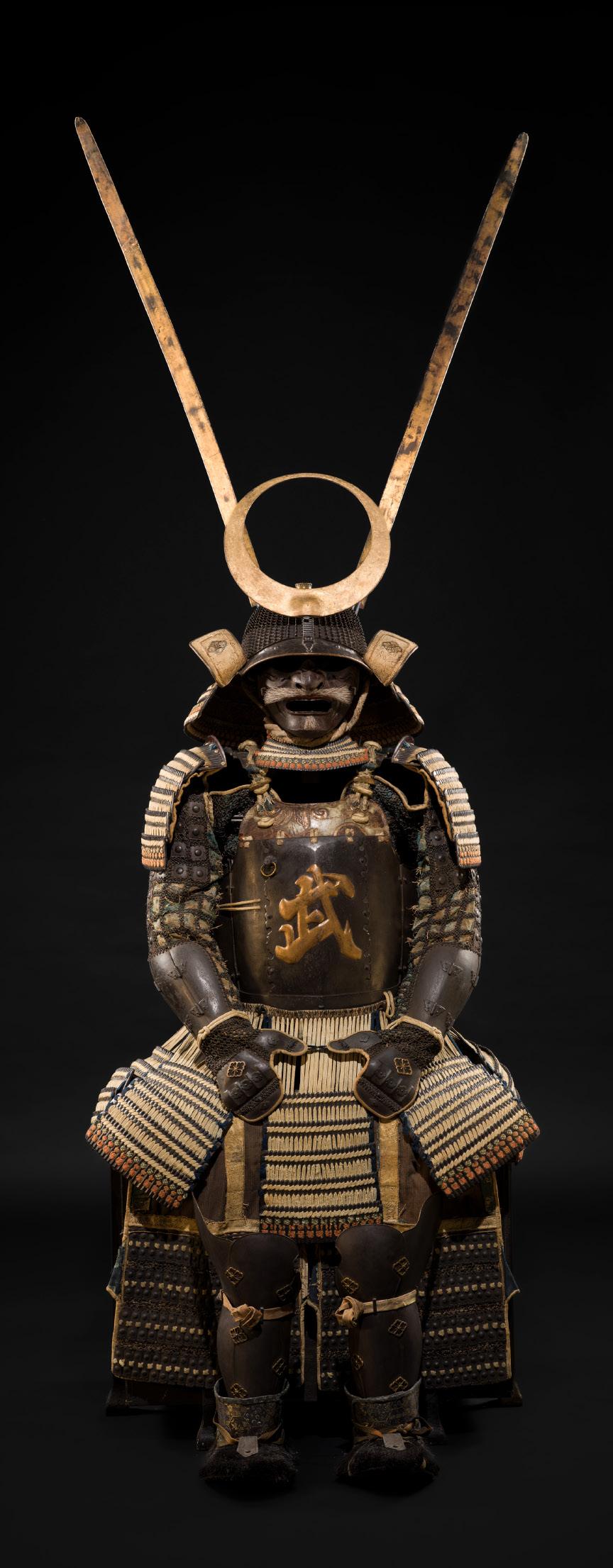
84
SAOTOME IETSUGU: AN OKEGAWA NIMAI-DO (TWO-PIECE CUIRASS ARMOR) AND IRON SUJIBACHI KABUTO, WITH NKBKHK TOKUBETSU KICHO (ESPECIALLY IMPORTANT) SHIRYO CERTIFICATE
The kabuto by Saotome Ietsugu, signed Saotome Ietsugu Japan, Hitachi province, 17th century, Edo period (1615-1868)
The brown-lacquered-iron components predominantly laced in blue, mounted on a fine blue and gold silk brocade, and fitted with kanamono with kiku (chrysanthemum) design, as well as the Maruni chigai takanoha (hawk feather) mon, associated with the Kubo and Hidaka clans.
The armor comprises:
Kabuto (Helmet): A brown-lacquered sixty-two-plate iron bowl with raised ridges, topped by a seven-stage mixed-metal tehen kanamono, the lowest tier in the form of a stylized blossom with petals in the form of hollyhock leaves with neatly incised veins, fitted with an age’maki (decorative tassel) to the back, the mabisashi decorated with copper fukurin and below the brass maedate in the form of a pair of billing birds, the plumage neatly incised, all flanked by gently upturned fukigaeshi with copper rims with incised foliate scrolls and centered by the Maruni chigai takanoha (hawk feather) mon, associated with the Kubo and Hidaka clans, all above the lacquer four-lame jikoro. The interior of the kabuto lacquered in gilt and signed 早乙女家次 SAOTOME IETSUGU.
Menpo (Mask): A lacquered iron menpo with a removable nose plate secured by turning pins, cast with flared nostrils and an open mouth revealing gilt-lacquered teeth, the lips lacquered red, below a horse-hair mustache and above a goatee, designed with deeply embossed wrinkles, the chin with ase-nagashi, and the cheeks with bent anchoring posts, all fitted with a five-lame yodarekake.
Do (Chest Plate): A lacquered-iron nimai do with six sections of five-lame kusazuri, the lowest lame with pierced inome design to the edges, the front and the back with metal chrysanthemum-form age’maki (decorative tassel), and the latter further fitted with ukezutsu (sashimono pole holder), all below reticulated metal plaques bearing chrysanthemum bosses against scrolling vines to the upper edge of the do. The do additionally applied with a silk brocade pouch to one side.
Sode (Shoulder Guard): A pair of six-lame sode laced with blue and orange cords and applied with chrysanthemum-form age’maki, all below reticulated plaques bearing chrysanthemum bosses against scrolling vines to the top.
Haidate (Thigh Guard): A pair of haidate on rich silk brocade.
Kote (Armored Sleeves) and Tekko (Gauntlets): A pair of iron and kusari (chain mail) kote and tekko.
Suneate (Shin Guards): A pair of iron and kusari (chain mail) suneate.
With a Tokubetsu Kicho Shiryo (Especially Important Object) certificate from the Association for the Research and Preservation of Japanese Helmets and Armor (Nihon Katchu Bugu Kenkyu Hozon Kai – NKBKHK), no. 1937, dated 5 December 2021, confirming the dating above.
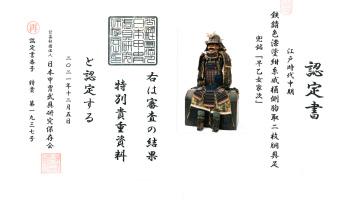
Condition: Very good condition with wear and soiling. The lacquer with flaking and expected age cracks, and the maedate with surface corrosion.
With an armor stand and a pair of black-lacquered wood storage boxes (yoroibako) decorated in gold hiramaki-e with Maruni chigai takanoha crests.
The takanoha crest, depicting the feathers of hawks, symbolizes heightened awareness and martial prowess. It illustrates the vigilance and the swift decisiveness required of samurai. This crest was popular among warrior families, emphasizing the skills and the spiritual readiness expected of them. The feathers, arranged meticulously, reflect a life led with strategic precision and sharp intellect.
AUCTION COMPARISON
Compare a related suji-bachi kabuto by Saotome Ietsugu, dated to the 17th century, at Sotheby’s, The Samurai: Japanese Arms and Armour, 10 May 2022, London, lot 8 (sold for GBP 47,880 or approx. EUR 64,000 converted and adjusted for inflation at the time of writing).
Estimate EUR 20,000
Starting price EUR 10,000
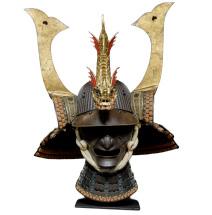
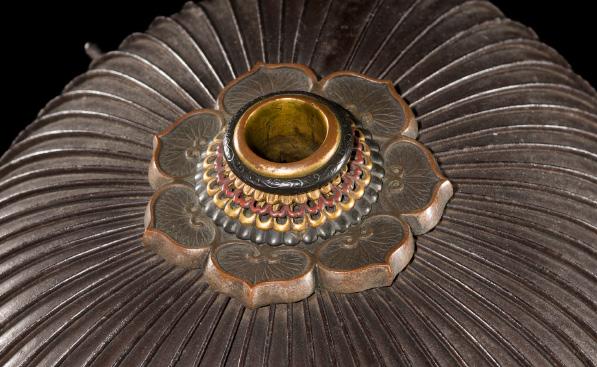
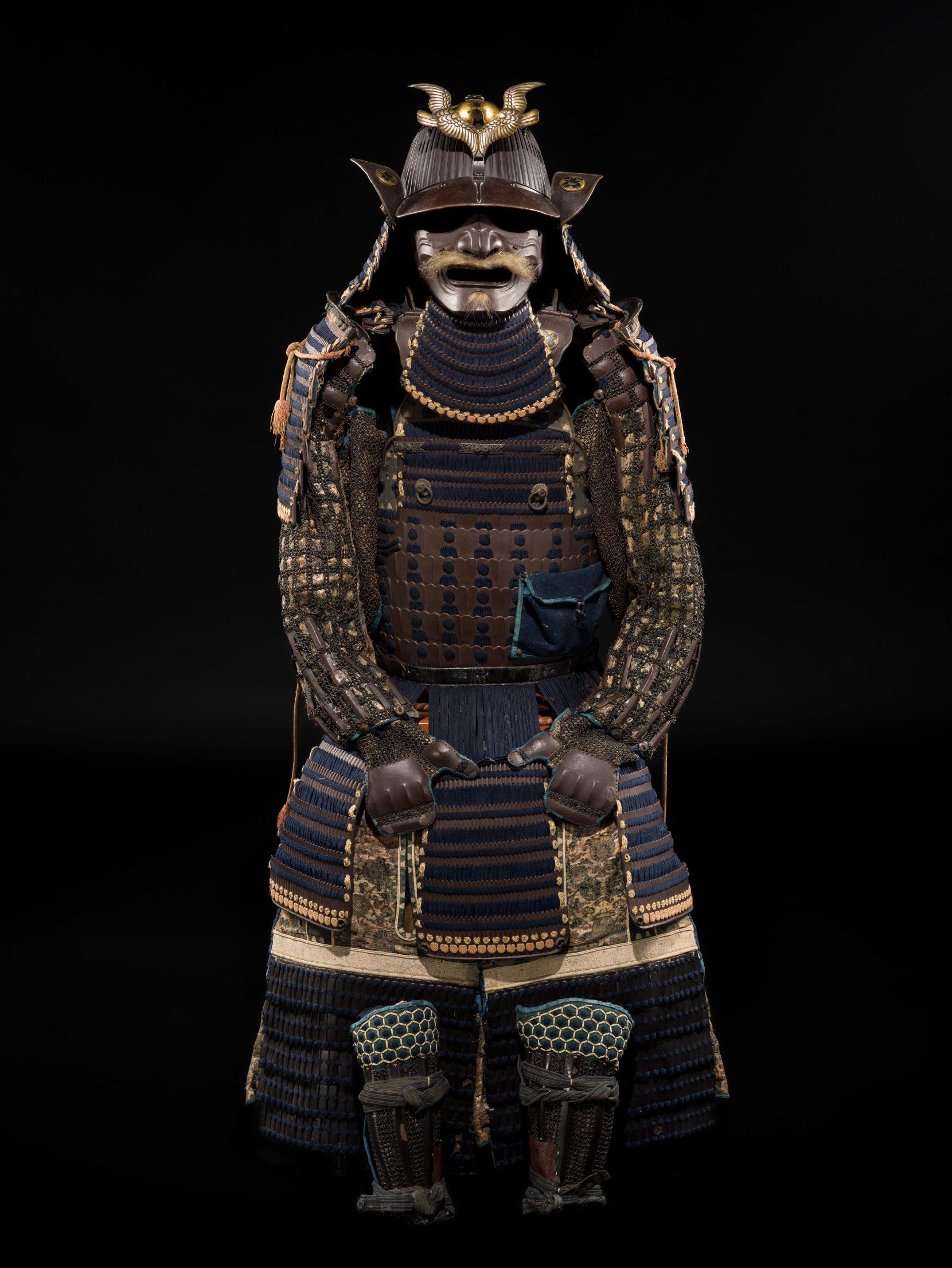
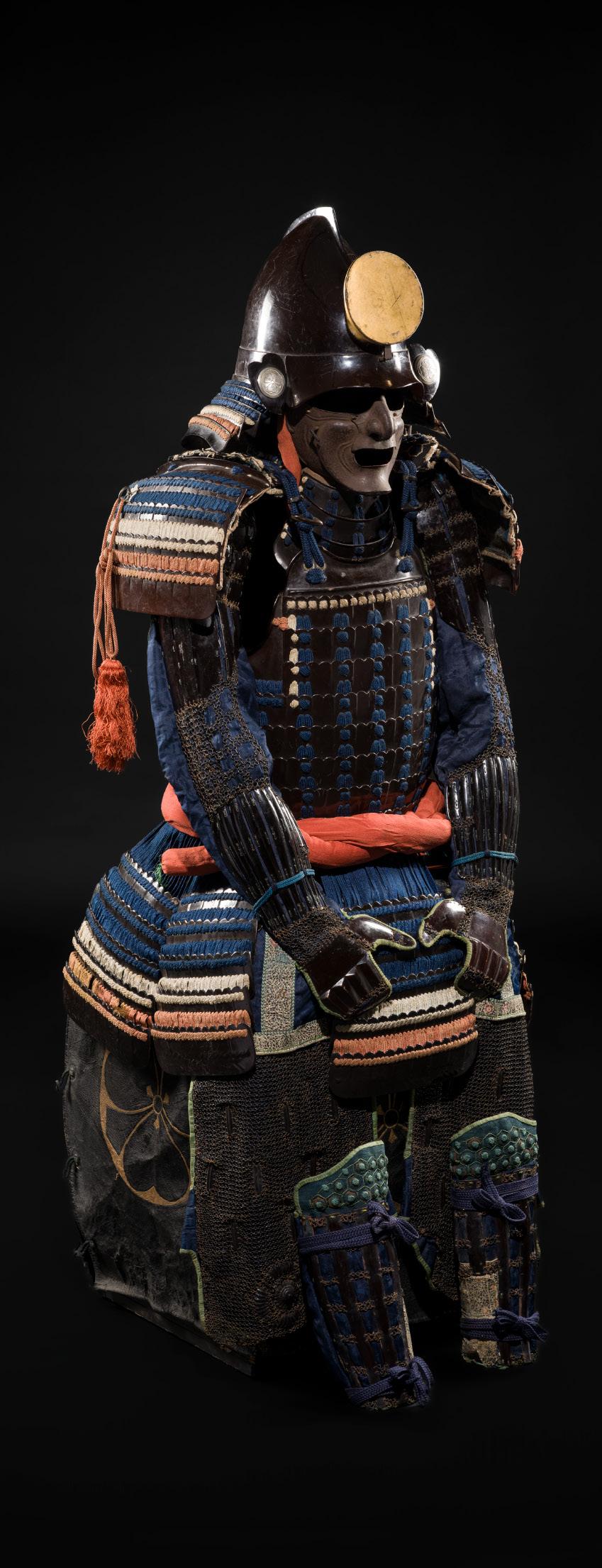
85
AN OKEGAWA NIMAI-DO GUSOKU (TWO-PIECE CUIRASS ARMOR) AND AN IRON MOMONARI KABUTO
Japan, 17th-18th century, Edo period (1615-1868)
The lacquered-iron components predominantly laced in blue, mounted on fine blue silk brocade, and fitted with kanamono with cherry blossom (sakura) design, as well as the Maruni-Ken Katabami mon, associated with the Katabami clan.
The armor comprises: Kabuto (Helmet): A lacquered helmet shaped like a peach with a prominent central ridge, the tosei mabisashi (concave peak) applied with a gilt-wood maedate in the form of a large sun emblem, flanked by gently upturned stylized fukigaeshi applied with silver Maruni-Ken Katabami (wood-sorrel) mon, associated with the Katabami clan, all above the five-lame jikoro.
Menpo (Mask): An iron menpo with a removable nose plate secured by turning pins, cast with flared nostrils and an open mouth, designed with deeply embossed wrinkles, the chin with ase-nagashi, and the cheeks with bent anchoring posts, all fitted with a four-lame yodarekake.
Do (Chest Plate): A lacquered-iron nimai do with six sections of five-lame kusazuri and the back further fitted with uke-zutsu (sashimono pole holder).
Sode (Shoulder Guard): A pair of four-lame sode laced with blue, orange, and white cords and applied with sakura-form age’maki (decorative tassel).
Haidate (Thigh Guard): A pair of iron and kusari (chain mail) haidate applied with stylized foliate blossoms to the lower edge.
Kote (Armored Sleeves) and Tekko (Gauntlets): A pair of iron and kusari (chain mail) kote and tekko.
Suneate (Shin Guards): A pair of iron and kusari (chain mail) suneate.
Condition: Good condition with wear, soiling, and corrosion. The lacquer with age cracks, small losses, and flaking. The fukegashi with repairs and associated touchups. The kabuto with several surface scratches. The maedate with chips and rubbing to gilt.
With an armor stand and wood storage box (yoroibako) with a fitted leather cover decorated with a gilt Maruni-Ken Katabami mon.
AUCTION COMPARISON
Compare a closely related yokohagi nimai-do gusoku, dated to the 17th century, at Sotheby’s, The Samurai: Japanese Arms and Armour, 10 May 2022, London, lot 55 (sold for GBP 32,760 or approx. EUR 44,000 converted and adjusted for inflation at the time of writing).
Estimate EUR 8,000
Starting price EUR 4,000
AN OKEGAWA NIMAI-DO GUSOKU (TWO-PIECE CUIRASS ARMOR) AND A KOBOSHI KABUTO
Japan, 17th-18th century, Edo period (1615-1868)
The predominantly gilt-lacquered components laced in turquoise, mounted on fine blue and gold silk brocade, and fitted with kanamono with foliate design, as well as the mitsudomoe mon.
The armor comprises: Kabuto (Helmet): A lacquered sixty-twoplate iron bowl with raised ridges, finished with pointed rivets decreasing in size towards the top and mounted with a fourstage mixed-metal chrysanthemum-form tehen kanamono, fitted with an agemaki-nokan to the back, the mabisashi with a pair of confronting shishi in gilt hiramaki-e, and surmounted by a lacquered-iron maedate in the form of a circular ‘sun’ medallion framed by curling horns, all flanked by gently upturned fukigaeshi with copper rims and centered by the mitsudomoe mon, above the lacquer five-lame jikoro.
Menpo (Mask): A lacquered iron menpo with a removable nose plate secured by turning pins, cast with flared nostrils and an open mouth revealing red-lacquered lips, below a horse-hair mustache, designed with deeply embossed wrinkles, the chin with asenagashi, and the cheeks with bent anchoring posts, all fitted with a five-lame yodarekake.
Do (Chest Plate): A lacquered-iron nimai do with seven sections of five-lame kusazuri, the front and the back with foliate-form metal age’maki (decorative tassel), and the back further fitted with uke-zutsu (sashimono pole holder).
Sode (Shoulder Guard): A pair of five-lame gilt-lacquered iron sode.
Haidate (Thigh Guard): A pair of haidate.
Kote (Armored Sleeves) and Tekko (Gauntlets): A pair of gilt-lacquered iron and kusari (chain mail) kote and tekko.
Suneate (Shin Guards): A pair of giltlacquered iron and kusari (chain mail) suneate.
Condition: Good condition with old wear, soiling, and corrosion. The lacquer with flaking, age cracks, and few losses. The kabuto and maedate with chips and flaking to lacquer. The fabric and lacing with expected tears and breaks.
With an armor stand and a wood storage box (yoroibako) with metal fittings.
Estimate EUR 10,000
Starting price EUR 5,000
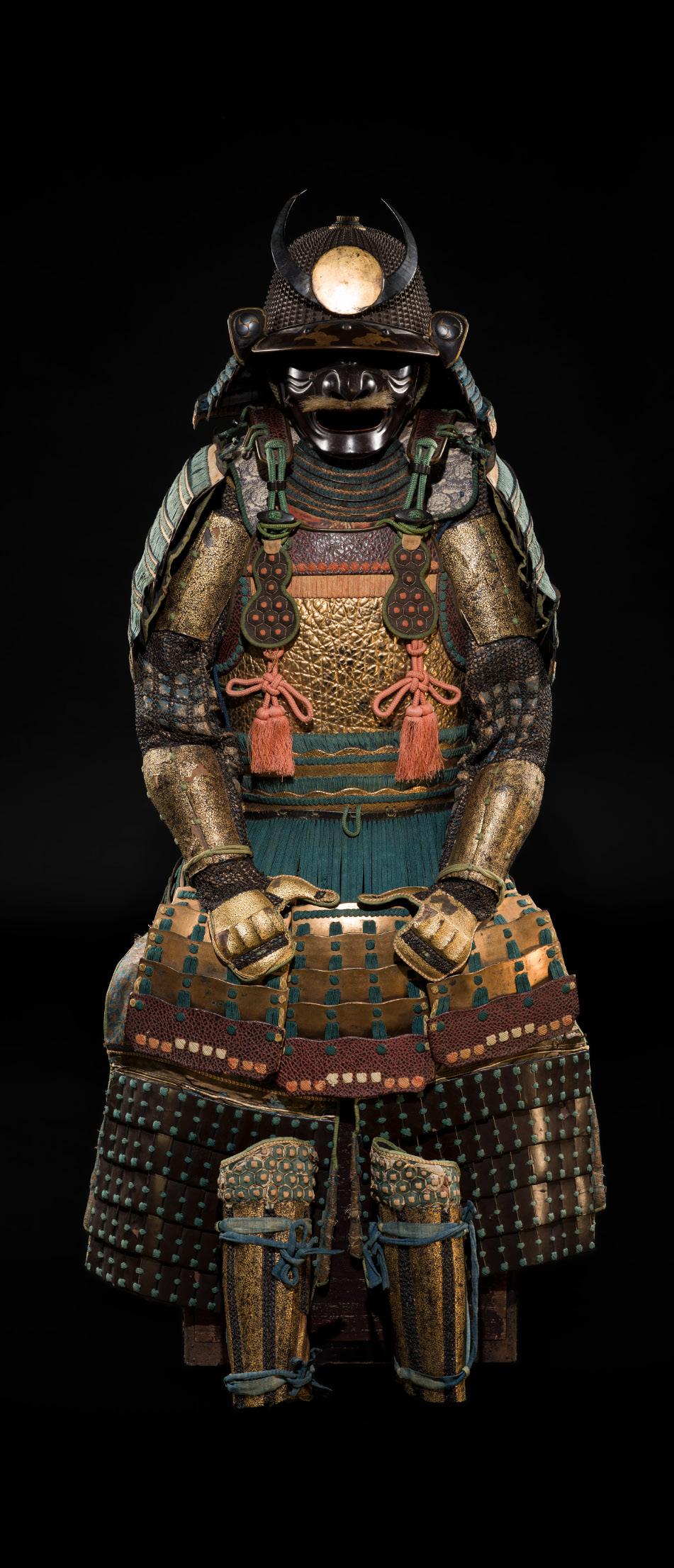
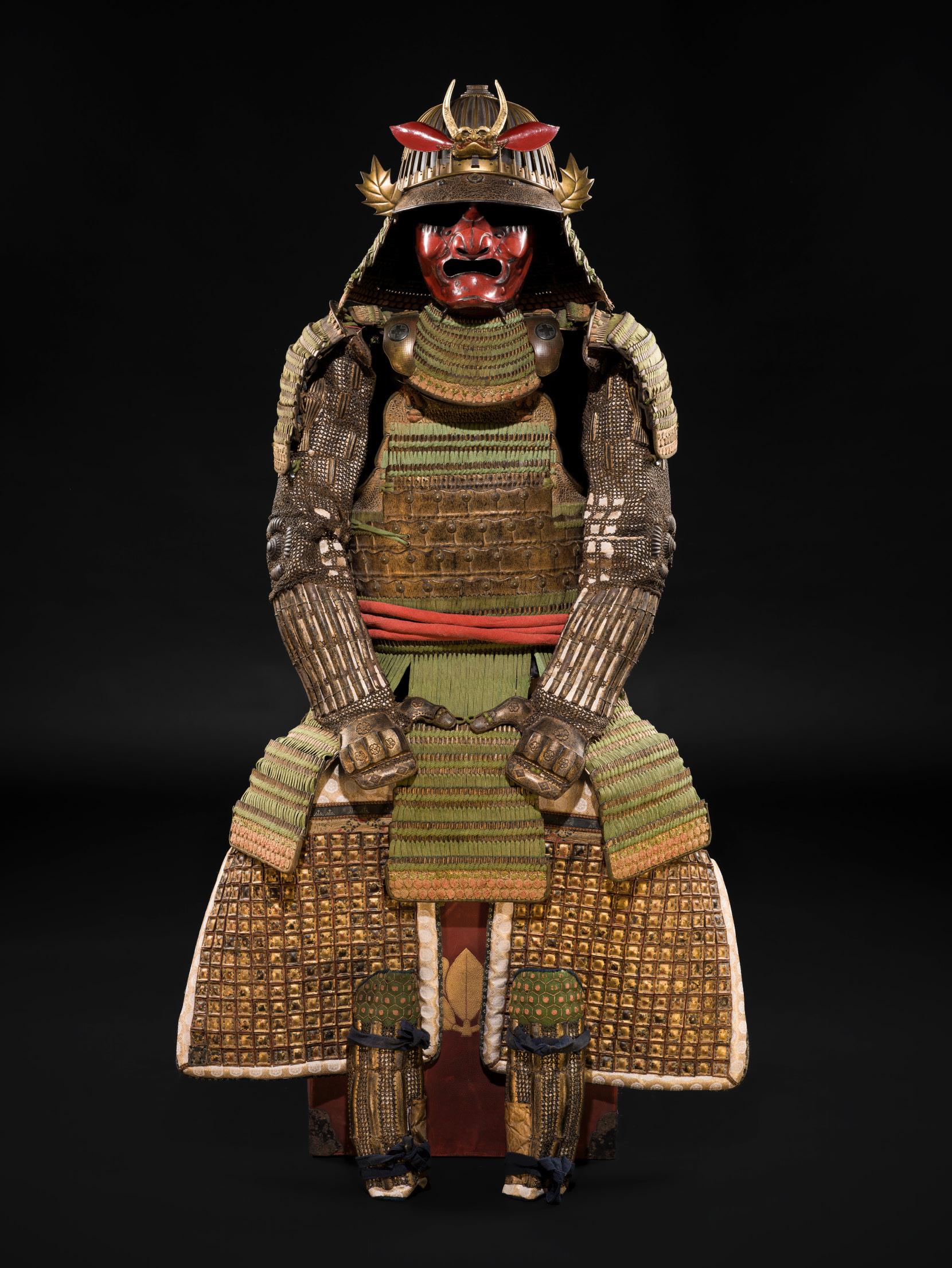
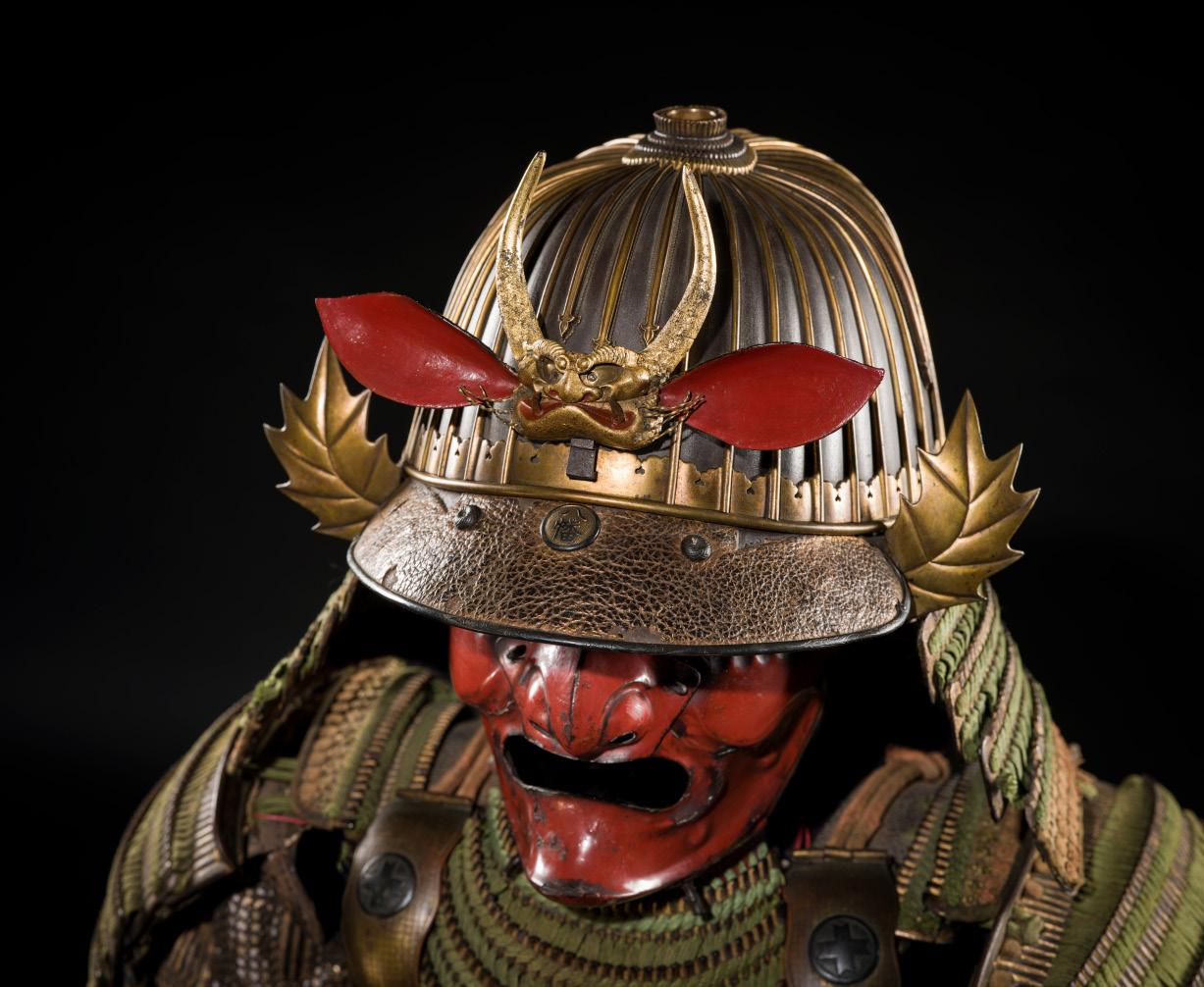
87 AN OKEGAWA NIMAI-DO GUSOKU (TWO-PIECE CUIRASS ARMOR) AND SO-FUKURIN SUJIBACHI KABUTO
Japan, 17th-18th century, Edo period (1615-1868)
The predominantly gilt-lacquered components laced in green and orange, mounted on fine beige and gold silk brocade, and fitted with kanamono with kiku (chrysanthemum), hanabishi, sakura (cherry-blossom), and katabami (wood sorrel) design, as well as the Kiritake Kurusu (split bamboo cross) mon.
The armor comprises:
Kabuto (helmet): A brown-lacquered thirty-two-plate iron bowl with raised ridges, topped by a five-stage mixed-metal tehen kanamono issuing shinodare to the front, back, and sides, applied with gilt-copper so-fukurin (ornamental border) and igaki (small metal plates to the base) pierced with inome (boar’s eye), the mabisashi applied with gilded leather and centered by an emboss inscribed 八幡, flanked by kiku medallions, the brim further fitted with a gilt-lacquered maedate in the form of an oni with tall curling horns, fine metal whiskers, and large funnel-shaped ears lacquered red to the interior, flanked by stylized leaf-form fukigaeshi in gilt-metal, all above the five-lame jikoro.
Menpo (Mask): A red-lacquered iron menpo with a sharp nose, removable nose plate secured by turning pins, cast with flared nostrils and an open mouth, designed with deeply embossed wrinkles, the chin with ase-nagashi, and cord pegs on rhombus grommets, all fitted with a four-lame yodarekake.
Do (Chest Plate): A gilt-lacquered iron do studded with kiku embosses, with seven sections of five-lame kusazuri, the back fitted with uke-zutsu (sashimono pole holder). The iron watagami (shoulder straps) with a checkered design and applied with the Kiritake Kurusu [split bamboo cross] mon in shakudo against a ringpunched ground.
Sode (Shoulder Guard): A pair of six-lame sode.
Haidate (Thigh Guard): A pair of gilt-lacquered haidate.
Kote (Armored Sleeves) and Tekko (Gauntlets): A pair of giltlacquered iron and kusari (chain mail) kote and tekko, the tekko further applied with kanamono with hanabishi, sakura (cherryblossom), and katabami (wood sorrel) design.
Suneate (Shin Guards): A pair of gilt-lacquered iron and kusari (chain mail) suneate.
Condition: Very good condition with expected wear, soiling, and corrosion. The lacquer with age cracks, small losses, and flaking. The kabuto with small losses to the lacquered leather on the mabisashi. The maedate with repairs and associated touchups.
The red wood storage box (yoroibako) with the character 前 mae [to advance] in gold hiramaki-e to one side, and the other three sides with Agari Fuji (rising wisteria) mon, associated with the Fujiwara clan.
The family crest Agari Fuji (rising wisteria), or Nobori Fuji, is one of the wisteria crests designed with the wisteria, a climbing plant native to Japan and classified in the genus Wisteria of the legume family, as its motif. Its sturdy vines are said to have been used as a material for various crafts. However, what is even more distinctive is its ornate, vertically hanging, pale purple inflorescence, which is said to reach up to 80 cm in height. It has been known as a plant highly valued for ornamental purposes from ancient times to the present day. The wisteria crest is so widespread in modern times that it is even listed among the five (or ten) major crests. Among them, the “hanging wisteria” crest, which succinctly captures the characteristic drooping flower clusters, is considered the most representative type.
Estimate EUR 50,000
Starting price EUR 24,000
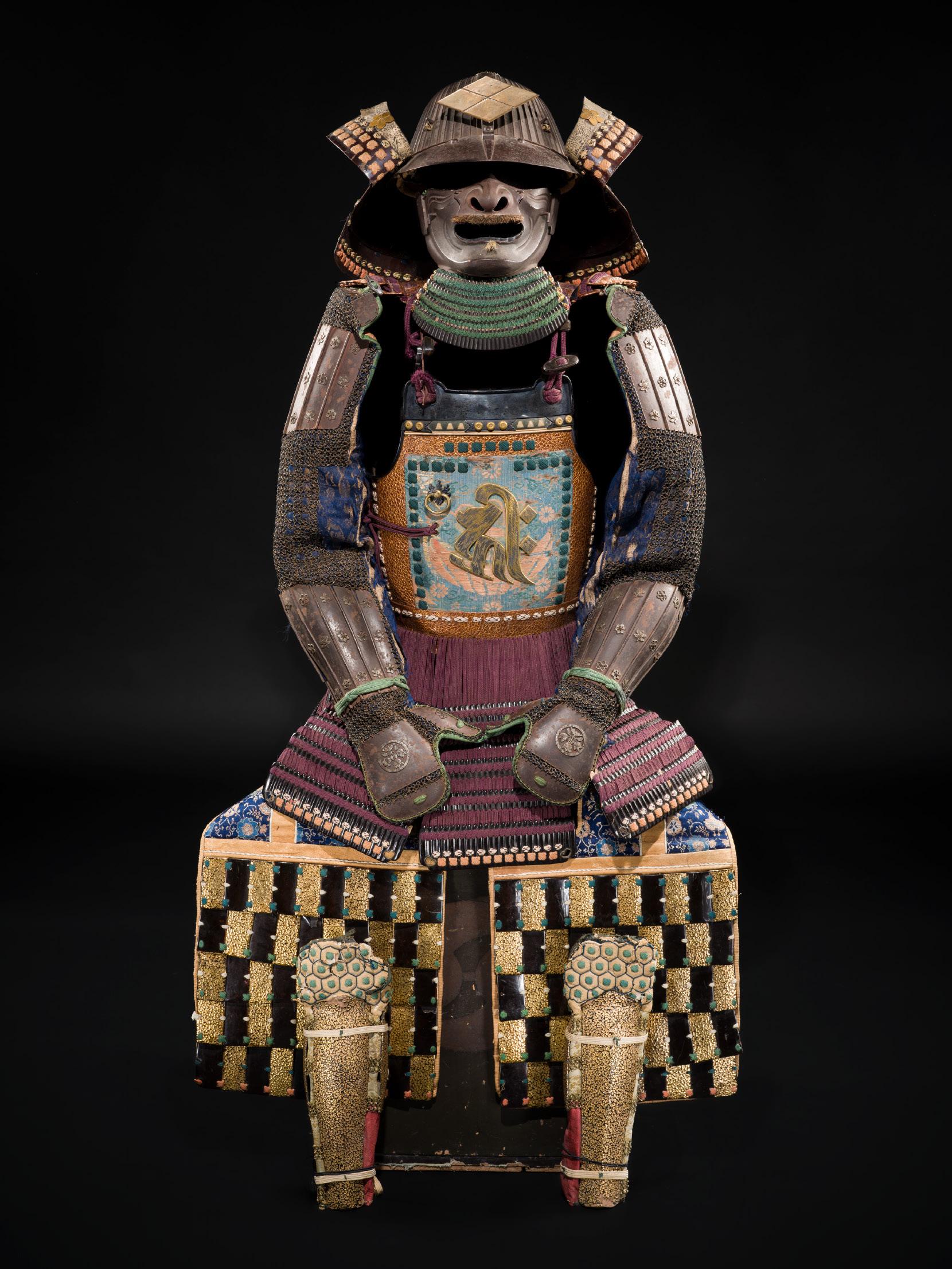
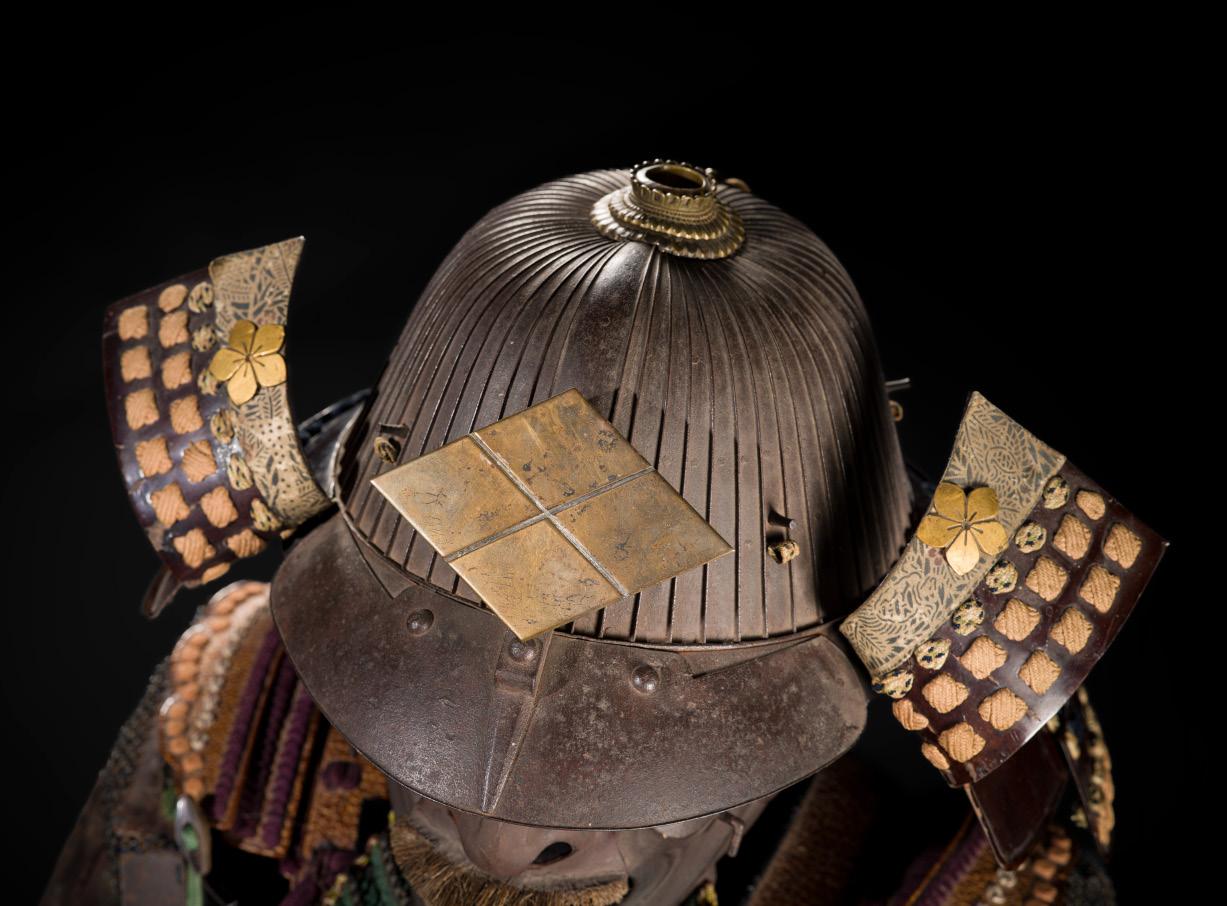
88
NIMAI-DO GUSOKU (TWO-PIECE CUIRASS ARMOR) AND SUJIBACHI KABUTO
Japan, 17th-18th century, Edo period (1615-1868)
The brown lacquered-iron components predominantly laced in purple and green, and fitted with kanamono of various floral designs including kiku (chrysanthemum), sakura (cherry-blossom), and tachibana (citrus plant), as well as the Takedabishi mon, associated with the Takeda clan.
The armor comprises: Kabuto (helmet): A sixty-two-plate iron bowl with raised ridges, topped by a six-stage gilt-metal tehen kanamono, fitted with an agemaki-no-kan to the back, the mabisashi of typical form and surmounted by a metal maedate in the form of the Takedabishi mon, associated with the Takeda clan, flanked by gently upturned fukigaeshi laced with an additional lame and applied with printed leather and centered by gilt-metal sakura blossoms, all above the three-lame lacquered-iron jikoro.
Menpo (Mask): A lacquered iron menpo with a removable nose plate secured by turning pins, cast with flaring nostrils and an open mouth revealing a full set of lacquered teeth, partially obscured by a stiff moustache and above a goatee, designed with deeply embossed wrinkles, the chin with ase-nagashi, and the cheeks with bent anchoring posts, all fitted with a green-laced four-lame iron yodarekake.
Do (Chest Plate): A nimai do with six sections of five-lame kusazuri, the chest applied in gilt-metal with the Bon character for Amitabha Buddha, the symbol for mercy and compassion, and a chrysanthemum-form agemaki no kan, below shakudo plaques bearing kiku-embosses, the back similarly adorned with a third, larger age’maki (decorative tassel) fitted on a gilt-metal plaque adorned with a pair of mallets with three flaming pearls to the faces.
Haidate (Thigh Guard): A green-laced pair of gilt and roirolacquered haidate.
Kote (Armored Sleeves) and Tekko (Gauntlets): A pair of iron and kusari (chain mail) kote and tekko applied with kanamono of various floral designs including kiku (chrysanthemum), sakura (cherryblossom), and tachibana (citrus plant).
Suneate (Shin Guards): A pair of gilt-lacquered iron suneate.
Condition: Good condition with expected wear, soiling, and corrosion to the iron. The lacquer with age cracks, small losses, and flaking.
With an armor stand and wood storage box (yoroibako).
Kaga style armor represents one of the most refined regional expressions of Japanese armorial craftsmanship, flourishing under the patronage of the Maeda clan in Kaga Province during the Edo period, and is distinguished in particular by its fine purple lacing, a feature associated with both aesthetic sophistication and high status. Renowned for its exceptional lacquerwork and meticulous construction, this style also frequently incorporates decorative metalwork applied directly to the cuirass, where intricate overlays or inlays, often complemented by gilt fittings, enhance both visual richness and structural strength. The harmonious integration of lacquer, textile lacing, and refined metal elements reflects the advanced technical skill of Kaga artisans, and in examples such as the present lot, the combination of purple lacing with applied metal decoration underscores the elegance, prestige, and cultivated taste that define this distinguished armor tradition.
AUCTION COMPARISON
Compare a closely related purple-laced Kaga style suit of armor, dated 17th-18th century, at Zacke, Fine Japanese Art, 5 December 2025, Vienna, lot 112 (sold for EUR 33,800).
Estimate EUR 15,000
Starting price EUR 7,500
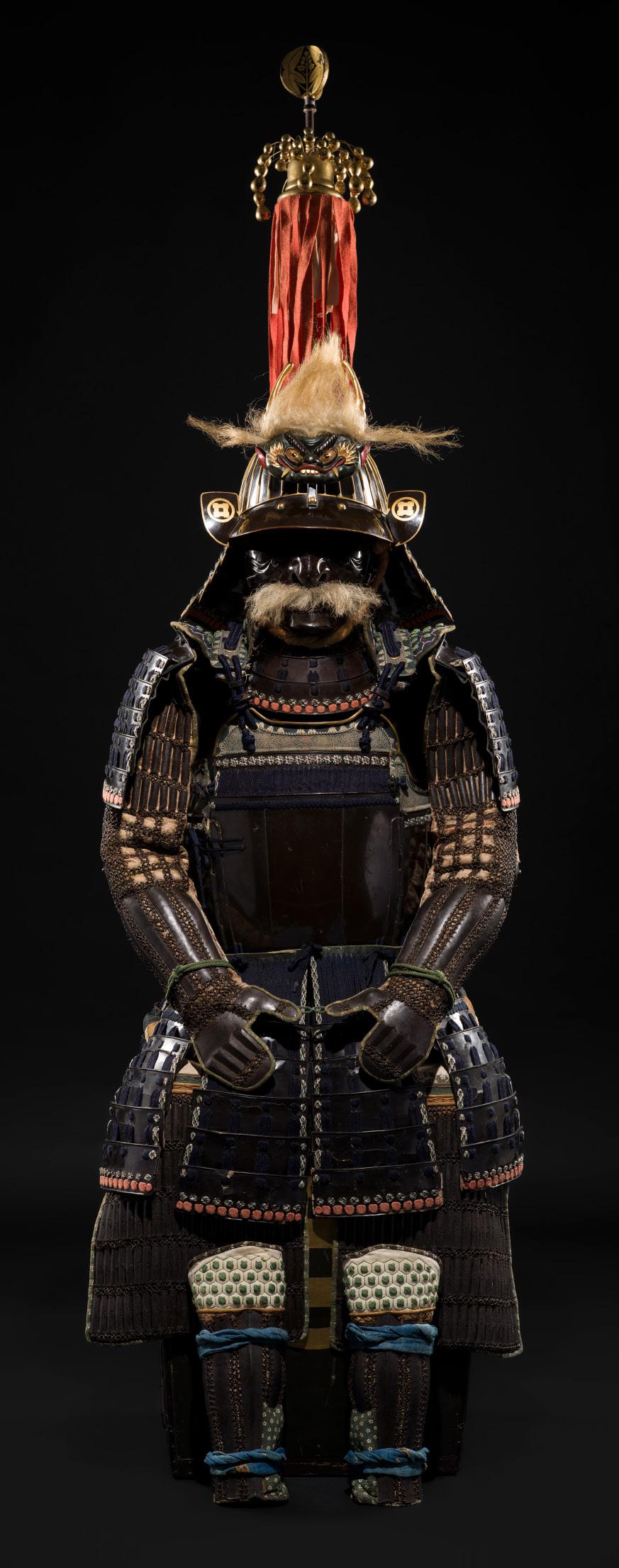
A FINE GOMAI-DO GUSOKU (FIVE-PIECE CUIRASS ARMOR) AND AN IRON SUJIBACHI KABUTO
Japan, 17th-18th century, Edo period (1615-1868)
The lacquered iron components predominantly laced in blue, mounted on a fine blue and gold silk brocade.
The armor comprises: Kabuto (Helmet): A roiro-lacquered thirty-twoplate iron bowl with raised ridges adorned with gilded copper applications (so-fukurin), topped by a five-stage gilt-copper chrysanthemum-form tehen kanamono, the lowest tier with pierced inome (boar’s eyes) and finely incised with foliate scrolls, fitted with an age’maki (decorative tassel) to the back, the widebrimmed mabisashi centered by a polychrome and gilt-wood maedate in the form of an oni with a fierce expression and flaming hair, the sharp fangs in buffalo horn, flanked by roiro-lacquered fukigaeshi centered by Hira Izutu mon, all above the five-lame jikoro.
Menpo (Mask): A roiro-lacquered iron menpo with a removable nose plate secured by turning pins, cast with flared nostrils and an open mouth, below a coarse horse-hair mustache, designed with deeply embossed wrinkles, the chin with ase-nagashi, and the cheeks with bent anchoring posts, all fitted with a three-lame yodarekake.
Do (Chest Plate): A lacquered-iron gomai do with eight sections of five-lame kusazuri, the back fitted with an uke-zutsu (sashimono pole holder). The sashimono in the form of an ornate golden staff.
Sode (Shoulder Guard): A pair of five-lame sode laced with blue and orange cords.
Haidate (Thigh Guard): A pair of iron and kusari (chain mail) haidate.
Kote (Armored Sleeves) and Tekko (Gauntlets): A pair of iron and kusari (chain mail) kote and tekko.
Suneate (Shin Guards): A pair of iron and kusari (chain mail) suneate.
Condition: Very good condition with expected wear, soiling, and corrosion. The lacquer with age cracks, small losses, and flaking.
With an armor stand and wood storage box (yoroibako) decorated in gold hiramaki-e with the character 前 mae [to advance] to one side and the Hira Izutu mon to the other three.
AUCTION COMPARISON
Compare a related gomai-do gusoku with sakura kamon and iron sujibachi kabuto, dated to the 17th-18th century, at Zacke, Fine Japanese Art, 5 December 2025, Vienna, lot 115 (sold for EUR 9,100).
Estimate EUR 10,000 Starting price EUR 5,000
AN OKEGAWA NIMAI-DO GUSOKU (TWO-PIECE CUIRASS ARMOR)
Japan, 18th-19th century, Edo period (1615-1868)
The predominantly lacquered components laced in blue, mounted on silk brocade, and fitted with kanamono with kiku (chrysanthemum), sakura (cherry-blossom), and Yuki-wa ni mitsumatsu [Three pines with hexagonal snowflake flower] design, as well as the maru ni kuginuki mon.
The armor comprises:
Kabuto (helmet): A brown-lacquered eighteen-plate iron bowl with raised ridges, topped by a four-stage gilt-metal tehen kanamono issuing shinodare to the front, the mabisashi of typical form, below the large circular gilt-wood maedate with an inscription, flanked by gently upturned fukigaeshi, all above the five-lame jikoro with kiku studs to the top.
Menpo (Mask): A lacquered iron menpo with a removable nose plate secured by turning pins, cast with flared nostrils and an open mouth with red-lacquered lips, revealing a full set of giltlacquered teeth, designed with deeply embossed wrinkles, the chin with ase-nagashi, and the cheeks with bent anchoring posts, all fitted with a five-lame iron yodarekake with gilt rims.
Do (Chest Plate): A lacquered nimai do studded with flat gilt x-form studs, with seven sections of four-lame kusazuri, the lowest trimmed with horse hair, the back fitted with uke-zutsu (sashimono pole holder). The iron watagami (shoulder straps) with maru ni kuginuki mon.
Sode (Shoulder Guard): A pair of lacquered fivelame sode.
Haidate (Thigh Guard): A pair of iron and kusari (chain mail) haidate on blue and gold brocade.
Kote (Armored Sleeves) and Tekko (Gauntlets): A pair of iron and kusari (chain mail) kote and tekko which are fitted with kanamono with sakura (cherry-blossom) and Yuki-wa ni mitsumatsu [Three pines with hexagonal snowflake flower] design.
Provenance: Ex-collection Frank Bell, Cologne, Germany. The private collection of Dr Werner Zintl, Worms, Germany, acquired for EUR 9,100 in 2000 at Christie’s London (according to collection card).
Condition: Good condition with wear, soiling, and corrosion. The lacquer with age cracks, small losses, and flaking. The maedate with repairs and age cracks to the verso.
With a wood storage box (yoroibako), armor stand, and surcoat (jinboari) with the kuginuki mon within an ougi (folding fan) to the back.
Estimate EUR 8,000 Starting price EUR 4,000
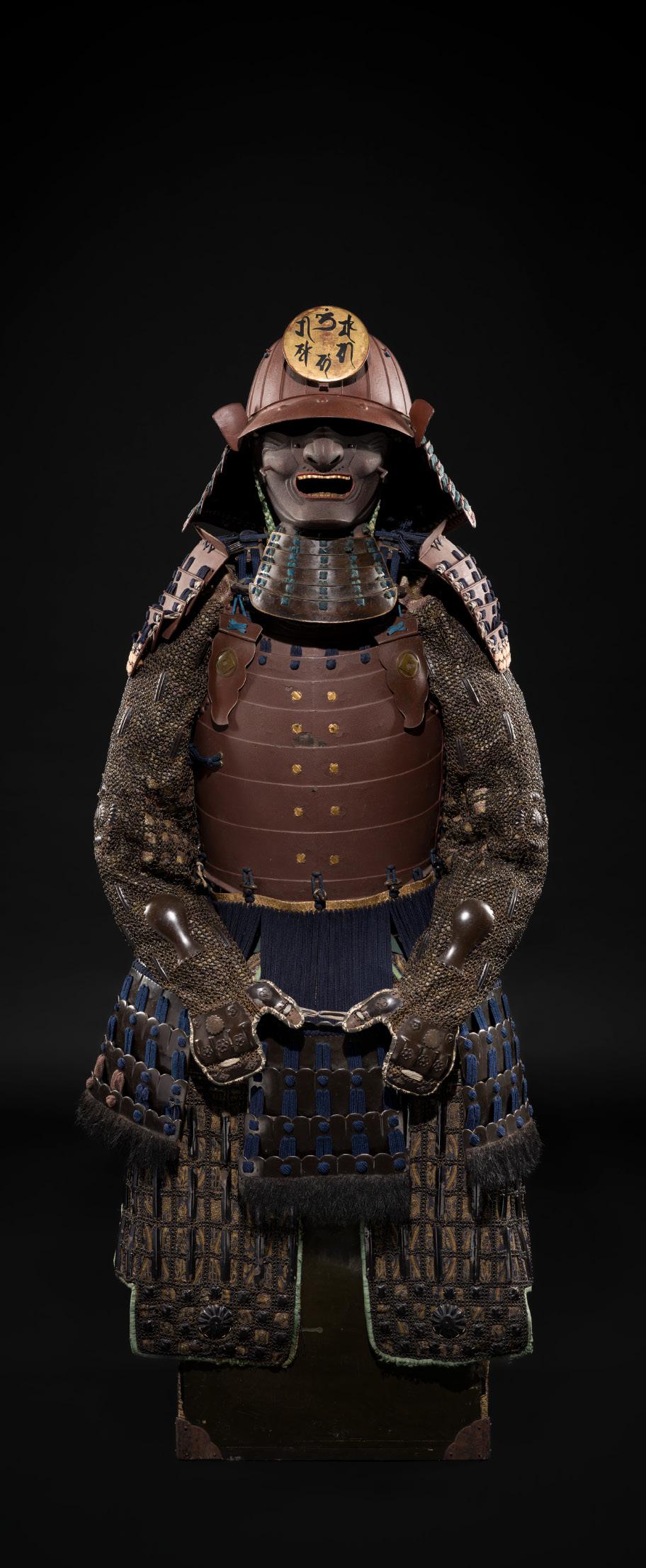
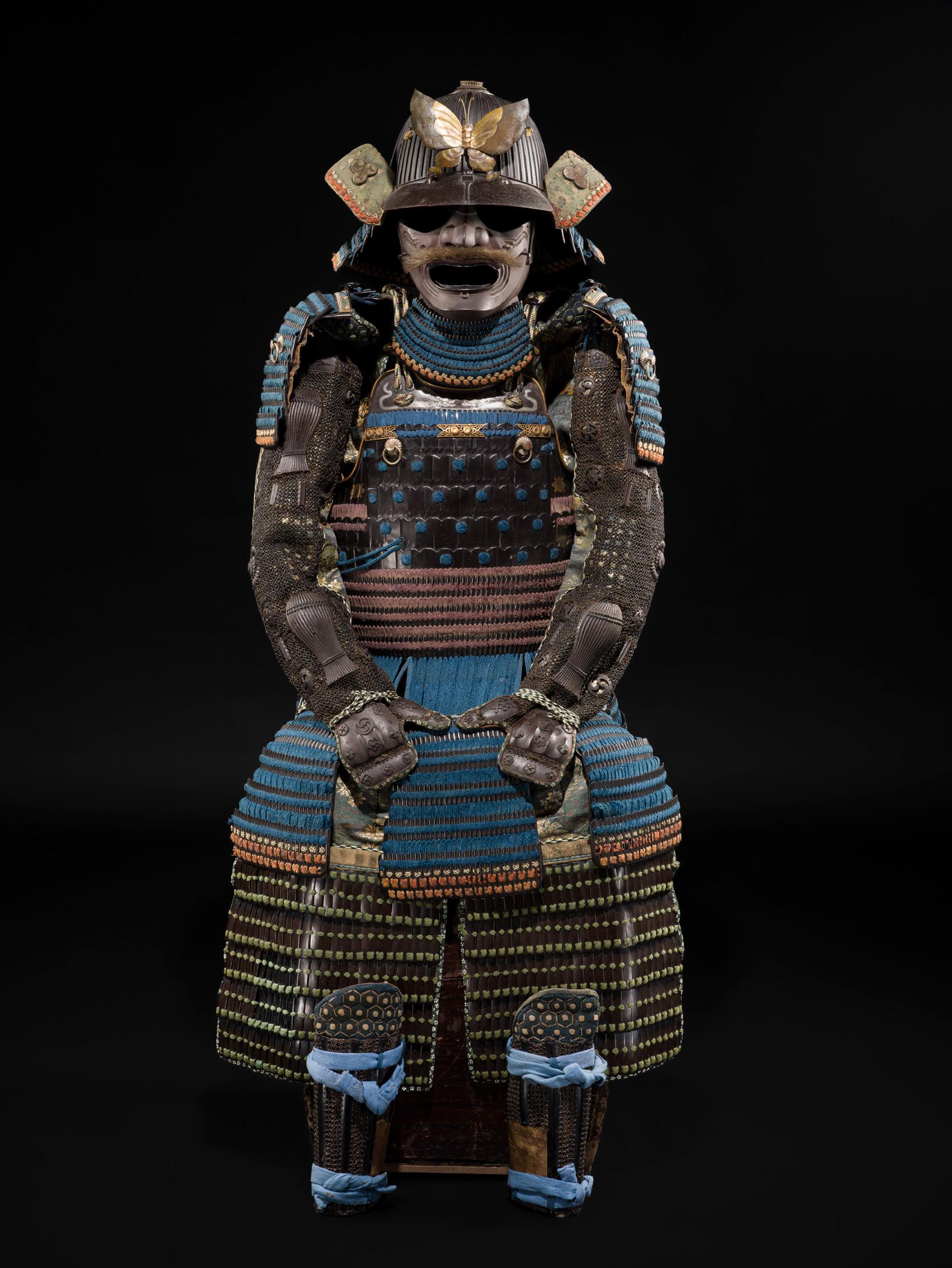
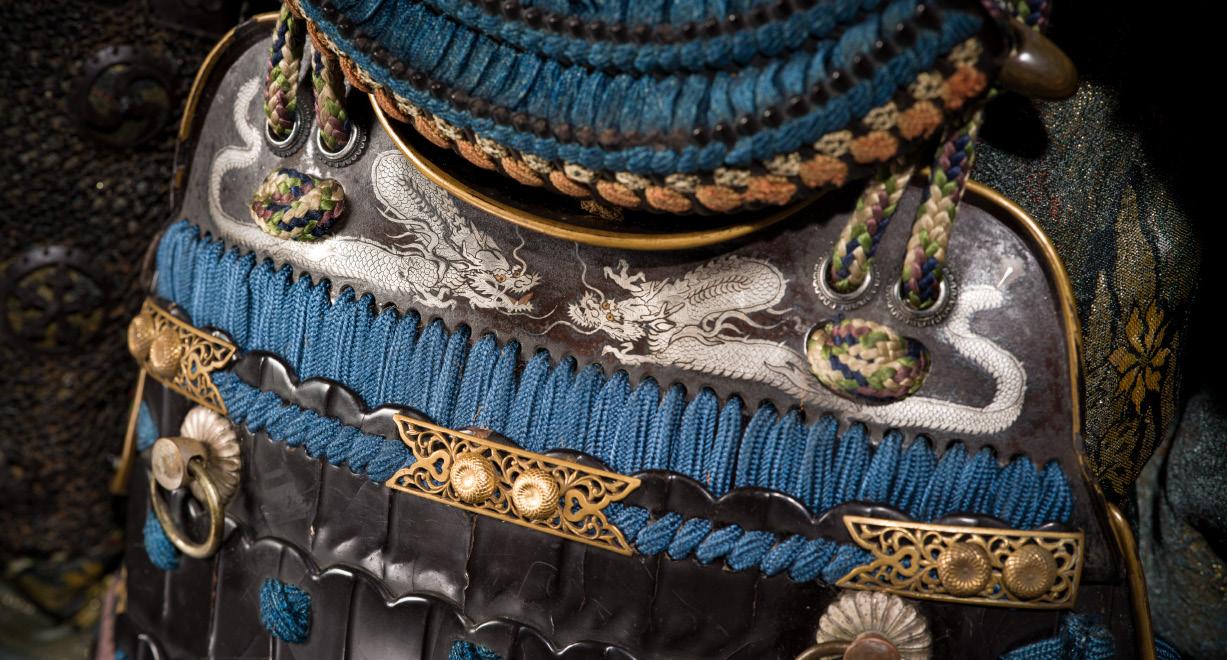
91 SAOTOME: AN IMPRESSIVE OKEGAWA NIMAI-DO GUSOKU (TWO-PIECE CUIRASS ARMOR) AND SUJIBACHI KABUTO, WITH NKBKHK KOSHU TOKUBETSU KICHO (ESPECIALLY IMPORTANT) SHIRYO CERTIFICATE
The kabuto by Saotome Ietada, signed Joshu ju Saotome Ietada Japan, 18th century, Edo period (1615-1868)
The brown lacquered-iron components predominantly laced in blue, and fitted with kanamono with kiku (chrysanthemum), sakura (cherry-blossom), hanabishi, wood sorrel, and foliate design, as well as the Mitsumori Hidari Mitsudomoe mon.
The armor comprises: Kabuto (helmet): A sixty-two-plate iron bowl with raised ridges, topped by a five-stage mixed-metal tehen kanamono, the lowest tier incised with foliate vines against a ring-punched ground, fitted with an agemaki-no-kan to the back, the mabisashi of typical form and surmounted by a metal maedate in the form of a butterfly, flanked by gently upturned fukigaeshi applied with printed leather and centered by the Mitsumori Hidari Mitsudomoe mon, above the orange lacing, and all above the five-lame jikoro. The kabuto signed Joshu ju SAOTOME IETADA [Saotome Ietada, Hitachi Province].
Menpo (Mask): A lacquered iron menpo with a removable nose plate secured by turning pins, cast with pierced nostrils and an open mouth with red-lacquered lips, revealing a full set of shakudolacquered teeth, partially obscured by a stiff moustache, designed with deeply embossed wrinkles, the chin with ase-nagashi, and the cheeks with bent anchoring posts, all fitted with a four-lame iron yodarekake.
Do (Chest Plate): A purple and blue laced nimai do with seven sections of five-lame kusazuri, the chest with a pair of gilt-metal chrysanthemum-form age’maki (decorative tassel), below sinuous gilt and silver hirazogan dragons and reticulated plaques bearing kiku-embosses, the back similarly adorned with a third, larger age’maki and fitted with uke-zutsu (sashimono pole holder). The rims of the do in gilt-copper so-fukurin (ornamental border).
Sode (Shoulder Guard): A pair of six-lame sode with silvered kikuform age’maki.
With a Koshu Tokubetsu Kicho Shiryo (Type-A Especially Important Object) certificate from the Association for the Research and Preservation of Japanese Helmets and Armor (Nihon Katchu Bugu Kenkyu Hozon Kai – NKBKHK), no. 2029, dated 14 May 2023.
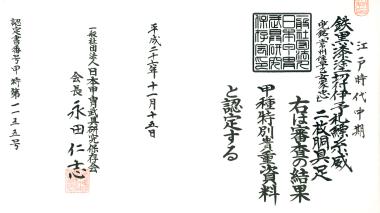
Haidate (Thigh Guard): A green-laced pair of lacquer haidate.
Kote (Armored Sleeves) and Tekko (Gauntlets): A pair of iron and kusari (chain mail) kote and tekko applied with several foliate kanamono in the form of kiku, sakura, hanabishi, wood sorrel, and foliate blossoms, as well as stylized mitsudomoe mon.
Suneate (Shin Guards): A pair of iron and kusari (chain mail) suneate.
Provenance: From a private collection in the Netherlands, acquired in Japan in 2016.
Condition: Very good condition with expected wear, soiling, and corrosion to the iron. The lacquer with age cracks, small losses, and flaking.
With an armor storage box.
AUCTION COMPARISON
Compare a related okegawa shichimai-do gusoku, the helmet by Saotome Ietada, dated to the 18th century, at Sotheby’s, The Samurai: Japanese Arms and Armour, 16 May 2024, London, lot 16 (sold for GBP 114,300 or approx. EUR 140,000 converted and adjusted for inflation at the time of writing).
Estimate EUR 60,000
Starting price EUR 30,000
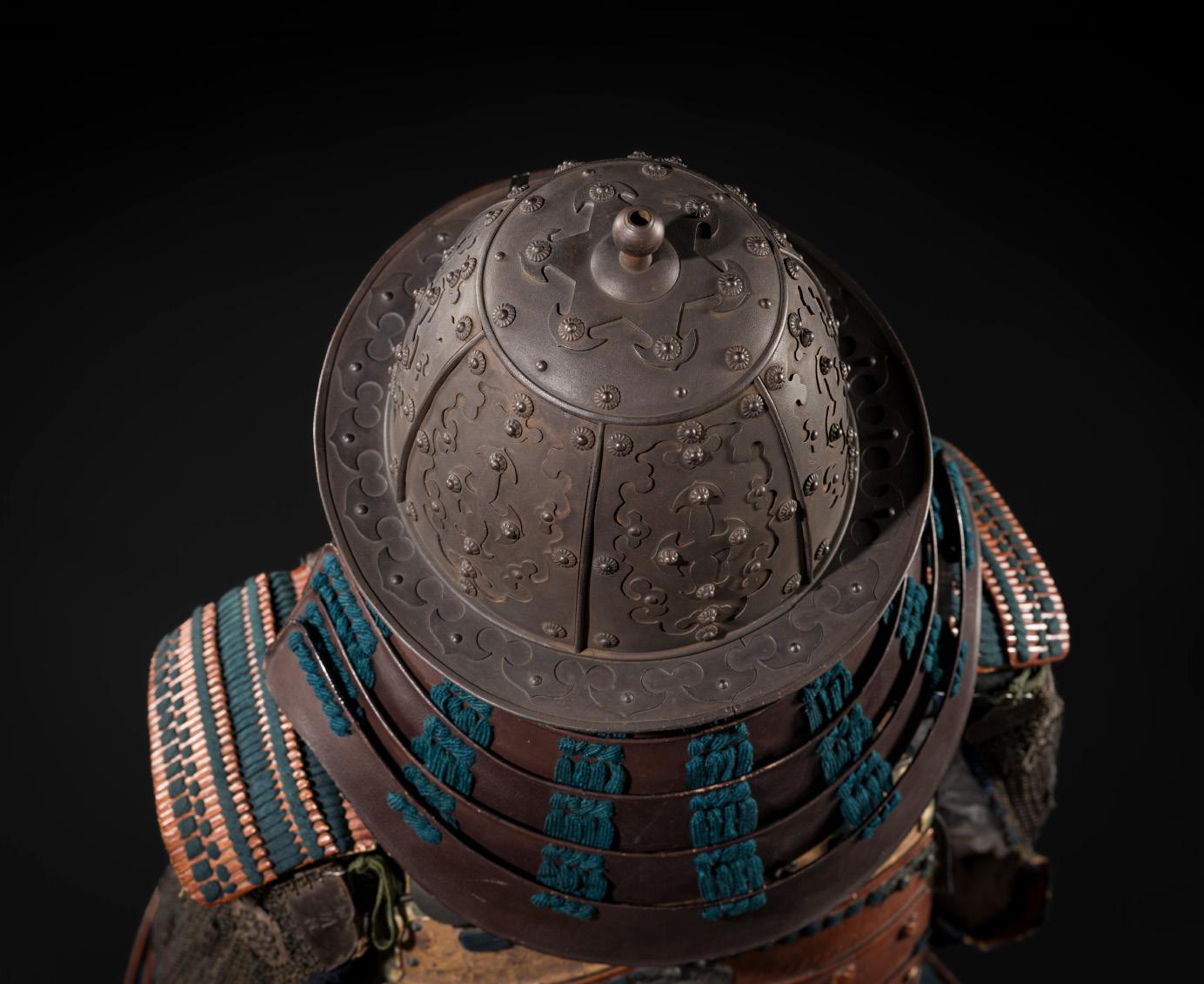
MYOCHIN MUNEMASA: AN OKEGAWA
NIMAI-DO (TWO-PIECE CUIRASS ARMOR) AND AN IRON NAMBAN KABUTO
The kote by Myochin Munemasa, signed Kashu ju, Munemasa saku Japan, Kaga, late Edo period (1615-1868)
The lacquered components predominantly laced in blue, mounted on fine blue silk, and fitted with kanamono with chrysanthemum (kiku), swirling blades, and five and four petal inome (boar’s eye) design.
The armor comprises: Kabuto (Helmet): A hachi composed of six vertical plates with raised edges overlaid with pierced iron plates secured with kikubosses, at the top a six-petal geometric flower terminating in a knop-form finial, the brow plate cusped over the eyes with applied eyebrows and hinged cheek flaps, all above the five-lame jikoro.
Hanbo (Cheek guard): A lacquered cheek guard pierced to the chin with an ase-nagashi, flanked by cord pegs, all fitted with a four-lame yodarekake with blue lacing.
Do (Chest Plate): A nimai do with an iron base and orangelacquered lame, adorned to the center with a large metal alloy mitsudomoe mon, seven sections of five-lame kusazuri, the lowest painted with scrolling dragons and pierced with inome (boar’s eyes), the front and the back with one large agemaki-no-kan, and fitted with reticulated shakudo plates bearing chrysanthemum bosses against scrolling vines. The iron watagami (shoulder straps) with coiled dragons in silver, enclosed within a plain circular medallion. The edges of the do with foliate-incised shakudo fukurin.
Haidate (Thigh Guard): A pair of silver-lacquered haidate adorned with large circular emblems in rust-brown.
Kote (Armored Sleeves) and Tekko (Gauntlets): A pair of iron and kusari (chain mail) kote and tekko which are fitted with kanamono with chrysanthemum (kiku), swirling blades, and five and four petal inome (boar’s eye) design. The top of the arms of the kote inscribed 加州住 Kashu ju and 宗将作 MUNEMASA saku [Made by Munemasa, resident of Kaga Province].
Suneate (Shin Guards): A pair of iron and kusari (chain mail) suneate.
Condition: Good condition with wear, soiling, and corrosion to iron. The lacquer with flaking, age cracks, and few losses. Expected losses to silver inlays. The fabric with small losses and tears.
With an armor stand and wood storage box (yoroibako) with metal fittings.
AUCTION COMPARISON
Compare a closely related Namban kabuto, dated to the 17th century, at Bonhams, Fine Japanese Art, 6 November 2012, London, lot 298 (sold for GBP 31,250 or approx. EUR 52,500 converted and adjusted for inflation at the time of writing).
Estimate EUR 15,000
Starting price EUR 7,500
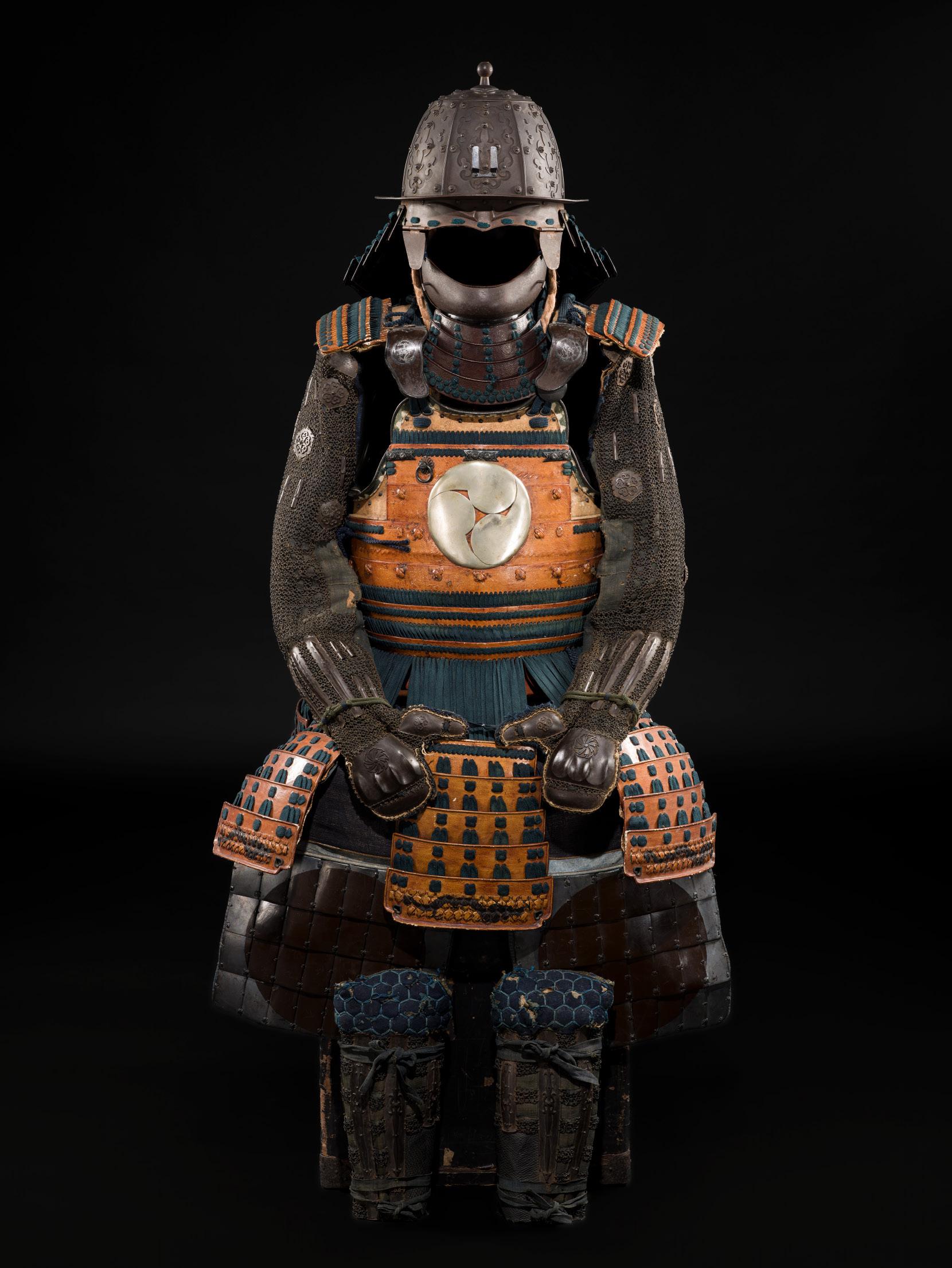
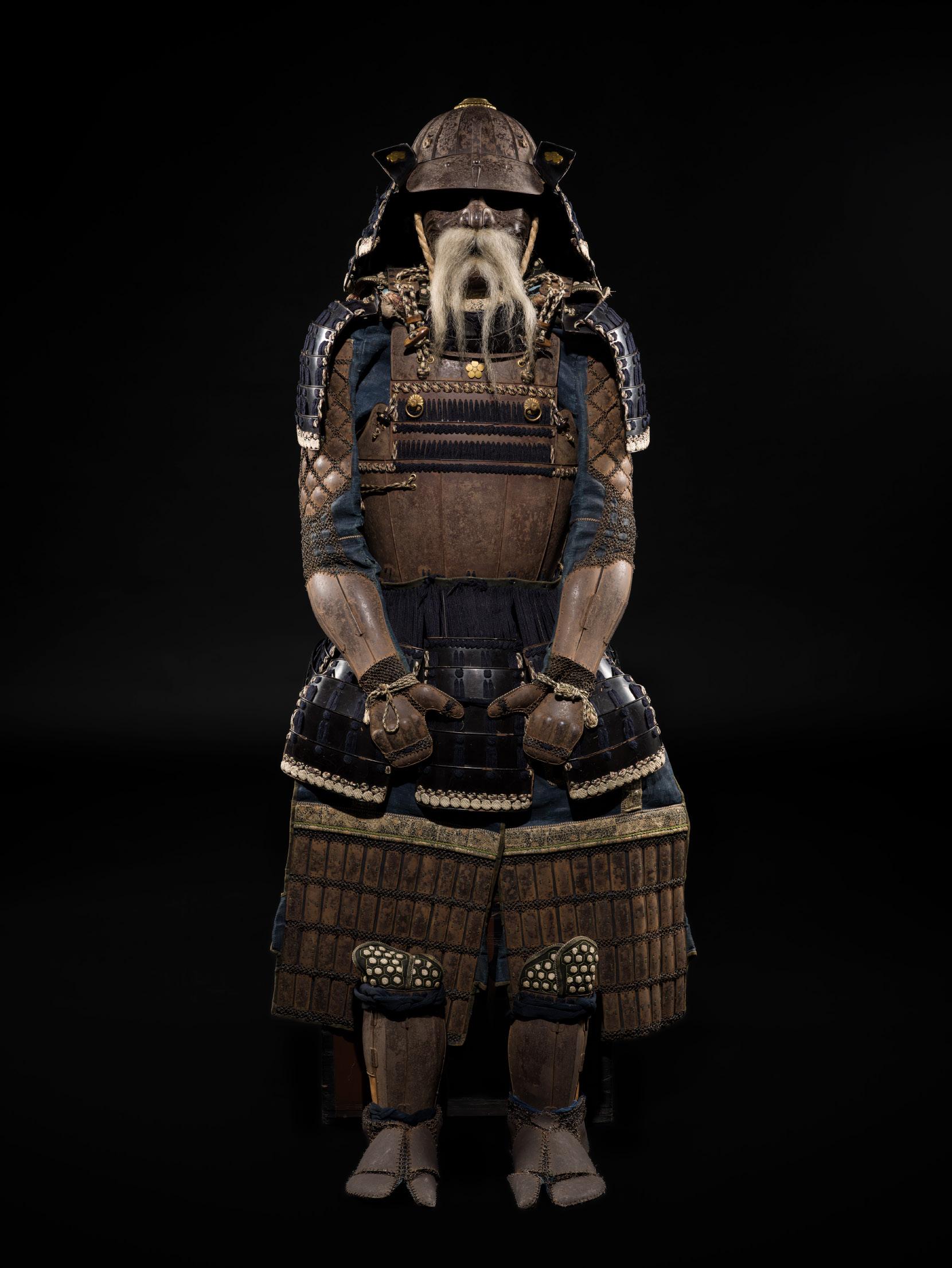
MYOCHIN: AN OKEGAWA NIMAI-DO GUSOKU (TWO-PIECE CUIRASS ARMOR) AND SUJIBACHI KABUTO, WITH NKBKHK TOKUBETSU KICHO (ESPECIALLY IMPORTANT) SHIRYO CERTIFICATE
The do by Myochin Munetaka, signed Wada Masao no motome ni yori, Myochin Munetaka saku kore Japan, 19th century, late Edo period (1615-1868)
With a Tokubetsu Kicho Shiryo (Especially Important Object) certificate from the Association for the Research and Preservation of Japanese Helmets and Armor (Nihon Katchu Bugu Kenkyu Hozon Kai – NKBKHK), no. 2029, dated 14 May 2023, confirming the dating above.
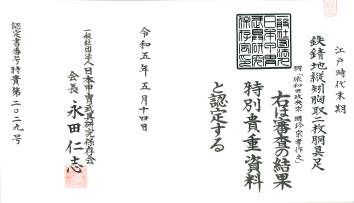
The iron components laced in blue, mounted on blue silk, and fitted with kanamono with kiku (chrysanthemum) design, as well as umebachi (plum blossom) mon, associated with the Sugawara clan.
The armor comprises: Kabuto (helmet): A sixteen-plate iron bowl with raised ridges, topped by a five-stage gilt-metal tehen kanamono, fitted with an agemaki-no-kan to the back, the mabisashi of typical form, flaked by gently upturned roiro-lacquered fukigaeshi adorned with the umebachi (plum blossom) mon, associated with the Sugawara clan, all above the four-lame jikoro.
Menpo (Mask): An iron menpo with a removable nose plate secured by turning pins, cast with flared nostrils and an open mouth, obscured by the trailing horse-tail moustache and goatee, designed with deeply embossed wrinkles, the chin with ase-nagashi, and cord pegs on rhombus grommets, all fitted with a three-lame yodarekake.
Do (Chest Plate): A nimai do with seven sections of five-lame kusazuri, the chest with a pair of gilt-metal chrysanthemum-form age’maki (decorative tassel), below a umebachi mon to the center, the back fitted with uke-zutsu (sashimono pole holder). The do signed Wada Masao no motome ni yori, MYOCHIN MUNETAKA saku kore [This is made by Myochin Munetaka at the request of Wada Masao].
Sode (Shoulder Guard): A pair of six-lame sode.
Haidate (Thigh Guard): A pair of iron and kusari (chain mail) haidate.
Kote (Armored Sleeves) and Tekko (Gauntlets): A pair of iron and kusari (chain mail) kote and tekko with elongated butterfly hinges.
Suneate (Shin Guards) and Kegutsu (Shoes): A pair of iron and kusari (chain mail) suneate attached to kegutsu.
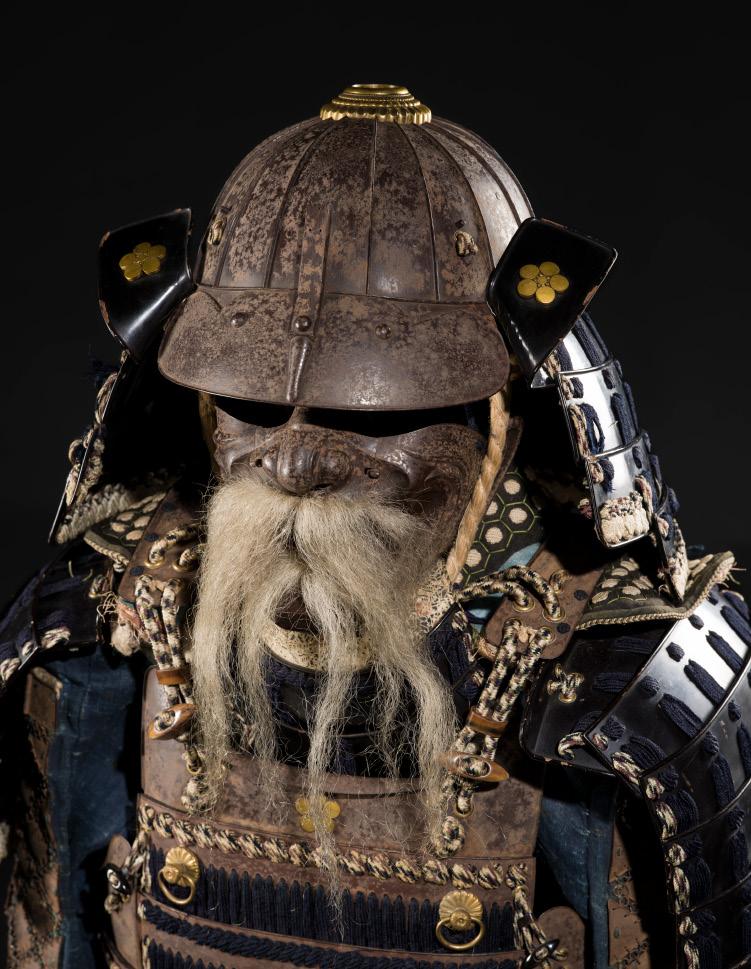
Condition: Very good condition with expected wear, soiling, and corrosion to the iron. The lacquer with age cracks, small losses, and flaking. The fabric with small tears and associated losses.
With a wood storage box and armor stand, the wood storage box (yoroibako) inscribed to the one side with the character 前 mae [to advance].
AUCTION COMPARISON
Compare a closely related tatehagi okegawa do tosei gusoku armor by the same maker, dated 1852, at Bonhams, Fine Japanese Art, 17 May 2012, lot 31 (sold for GBP 21,250 or approx. EUR 41,000 converted and adjusted for inflation at the time of writing).
Estimate EUR 40,000 Starting price EUR 20,000
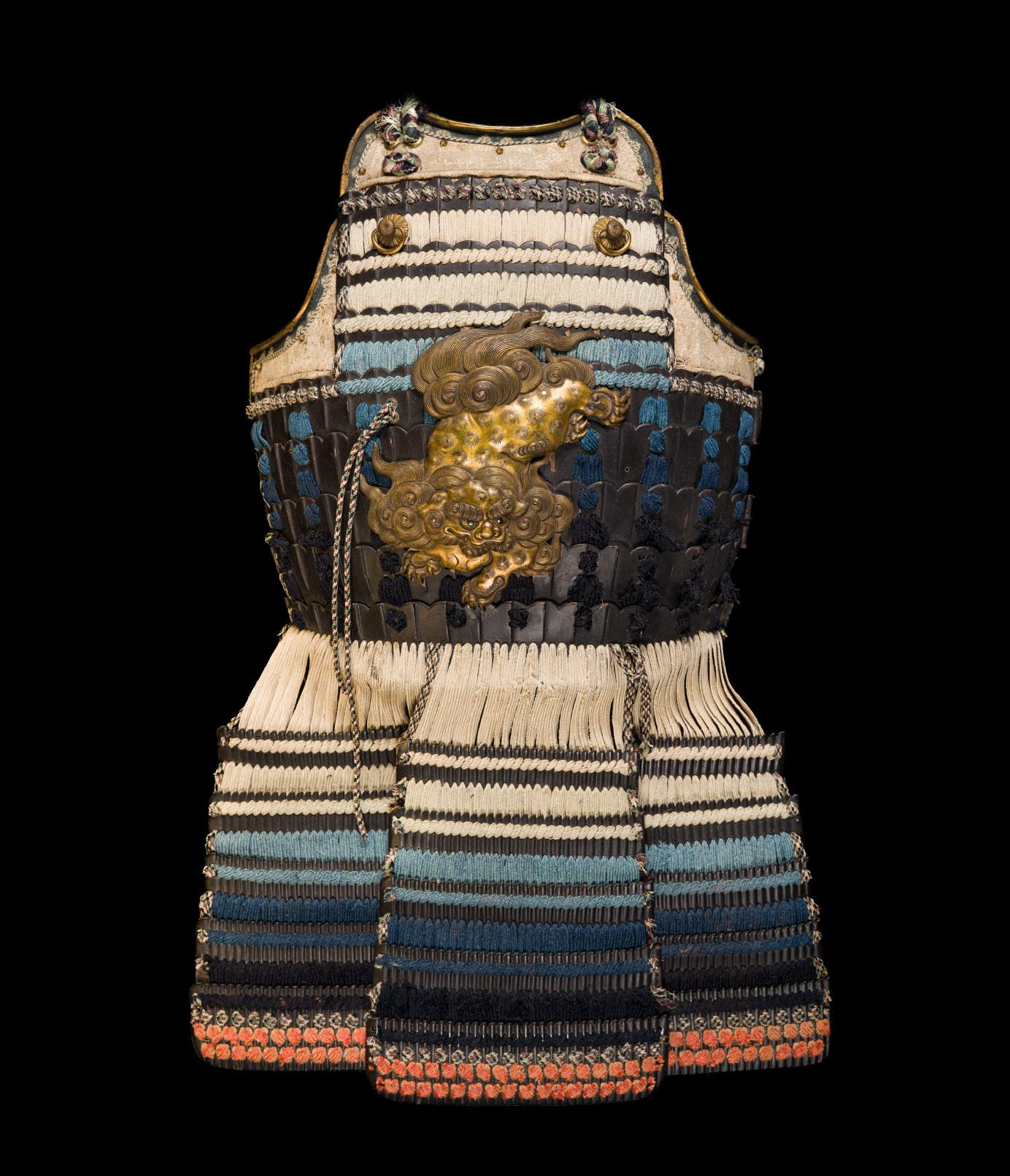
A FINE LACQUERED IRON AND LEATHER DO (CUIRASS) WITH A FINE GILT BRONZE SHISHI APPLIQUÉ
Japan, 18th-19th century, Edo period (1615-1868)
Constructed of black-lacquered iron plates, predominantly laced in blue and white odoshi, and fitted with kiku (chrysanthemum) form kanamono. The front plate is partially covered with leather at the upper section and sides, and fitted with a pair of kiku-shaped agemaki fittings. The edges are bordered with gilded copper fukurin (so-fukurin), finely decorated with foliate scrollwork.
The center of the cuirass is mounted with a striking gilt bronze appliqué of a prancing shishi (lion-dog), rendered in high relief. The creature is characterized by thick, neatly incised curls, shakudoinlaid eyes, and a body ornamented with stylized spiral motifs. Below are three sections of five-lame kusazuri.
HEIGHT 67.5 cm
Condition: Good condition with wear, soiling, and the lacquer with expected cracks and flaking. Some fraying to fabric, soiling, and tiny losses.
Estimate EUR 5,000
Starting price EUR 2,400
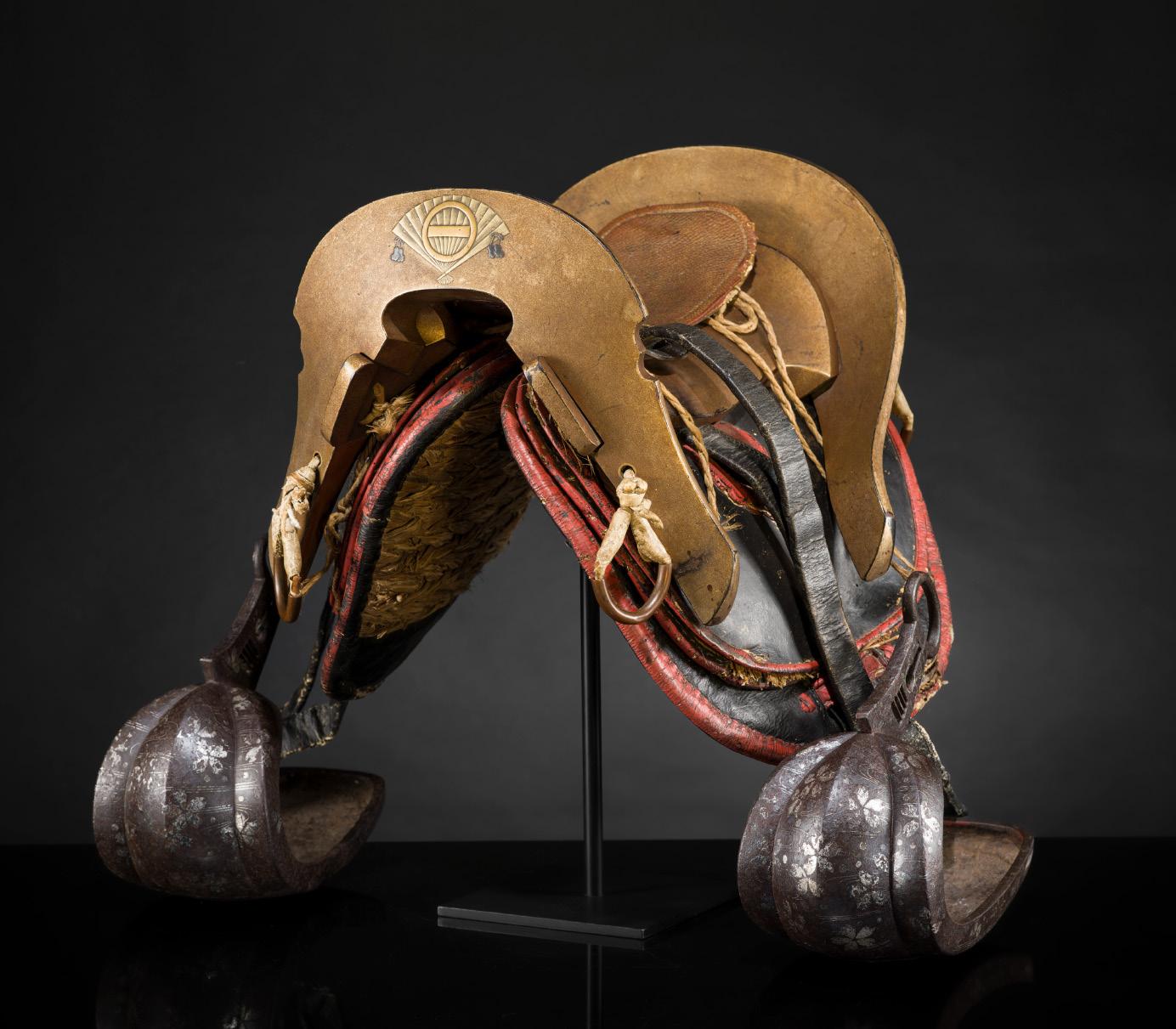
95
Japan, 17th-18th century (the saddle dated 1680), Edo period (1615-1868)
The saddle, of gunjin-gura (campaign saddle) type, fitted with two lacquered igi (wood side boards), maewa (pommel) and shizuwa (cantle), the pommel with the umi (‘sea’) and iso (‘shore’) registers almost evenly proportioned. The sides are carved with lowshouldered tegata (hand-shaped) indentations, all bearing a dense nashiji ground. The pommel is decorated with an open folding fan enclosing a family crest in two shades of gold takamaki-e. A pair of copper-alloy fittings is attached to both pommel and cantle with twine and leather cords. With a saddle pad and stirrup leathers.
Accompanied by a pair of russet-iron abumi of typical form, the exteriors intricately inlaid in silver to depict cherry blossoms and waves. The buckles at the top are similarly decorated, with movable tangs.
Inscriptions: Engraved to the first igi Enpo hachi nen (1680), the second igi signed with a kakihan (artist’s cursive monogram).
LENGTH 36.5 cm (the abumi), LENGTH 40.3 cm (the kura)
Condition: The abumi in good condition with old wear. Few nicks and obvious losses to the inlays. The kura with extensive wear, expected age cracks, and losses to lacquer.
Kura (saddles) and abumi (stirrups) formed essential components of Japanese equestrian equipment from as early as the 5th century, evolving into highly specialized and often richly decorated elements of samurai accoutrement during the Edo period. The gunjin-gura was designed for mounted warfare, providing stability and balance, while the distinctive open-sided abumi, with their elongated footrests and upturned fronts, ensured secure footing for the rider in combat. Beyond their practical function, both saddle and stirrups became important vehicles for artistic expression, often embellished with lacquer, metalwork, and inlay reflecting the status and taste of their owner. The present ensemble, combining finely lacquered wood with silver-inlaid iron, exemplifies this union of function, craftsmanship, and aesthetic refinement characteristic of samurai horse gear.
AUCTION COMPARISON
Compare a related kura and abumi set, dated 18th-19th century, at Bonhams, Fine Japanese Art, 15 October 2025, Paris, lot 106 (sold for EUR 7,040).
Estimate EUR 6,000
Starting price EUR 3,000
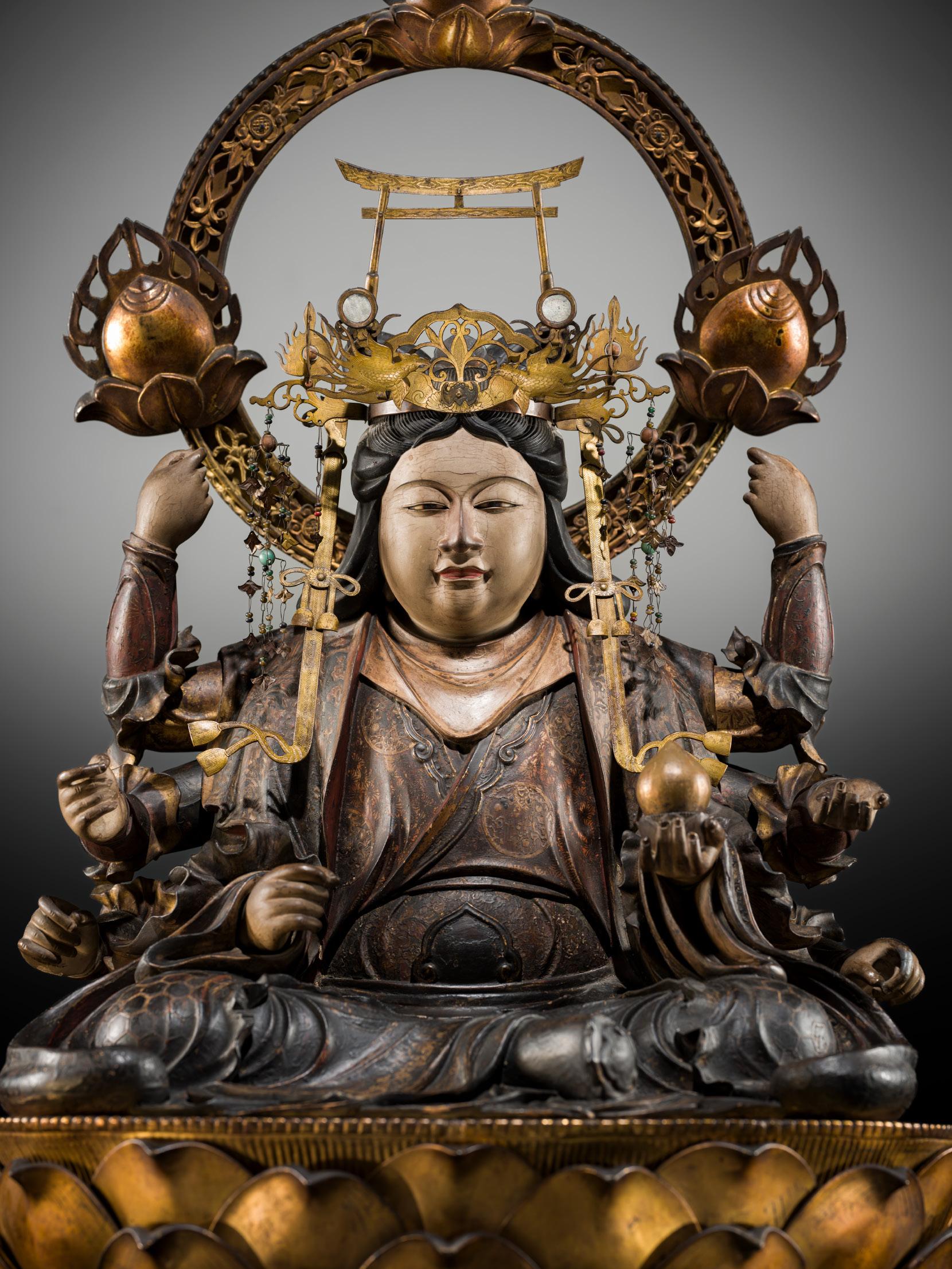
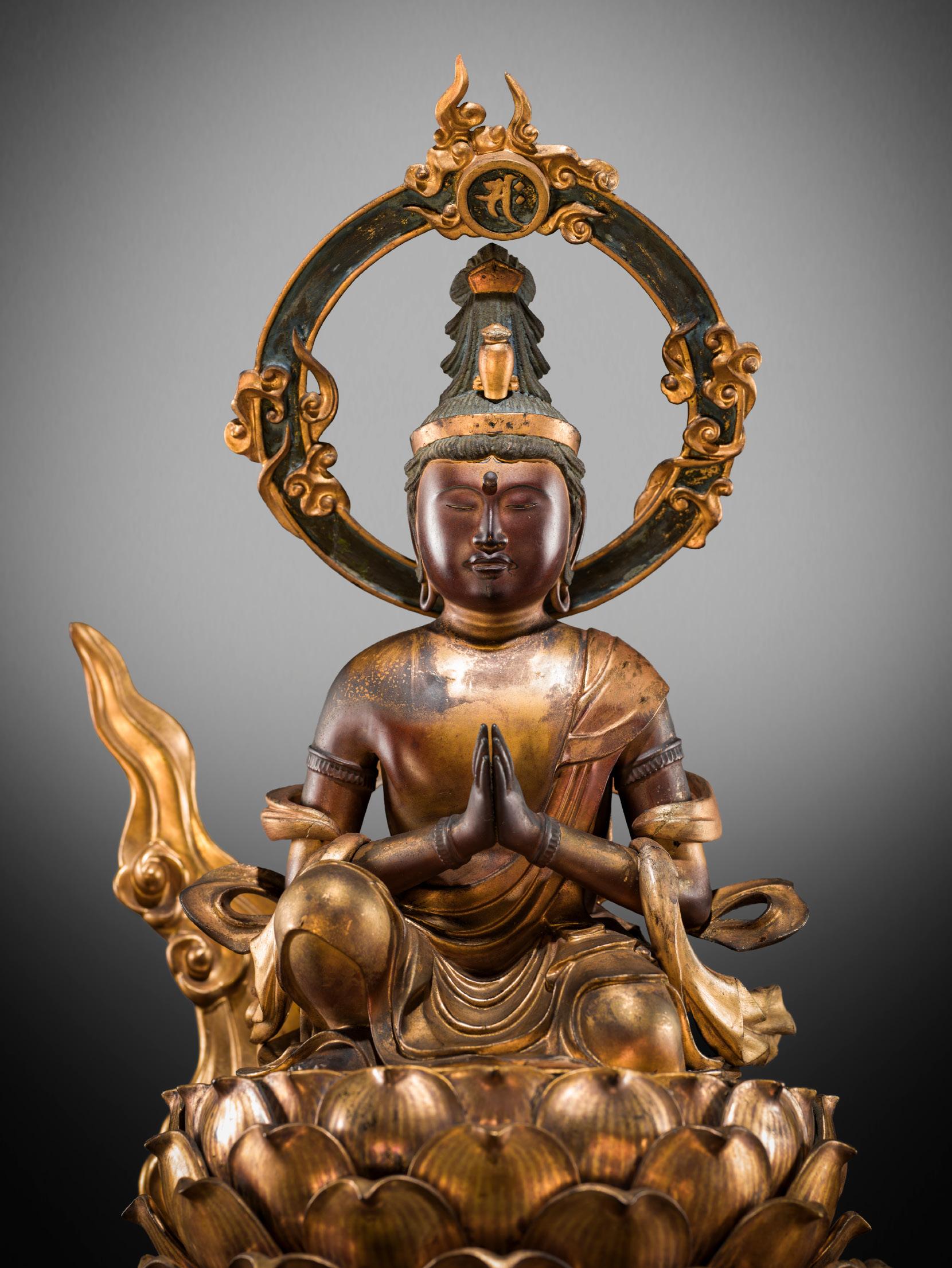
96
AN IMPRESSIVE BUDDHIST SCROLL PAINTING DEPICTING THE SHAKA TRIAD WITH THE SIXTEEN RAKAN, KAMAKURA PERIOD
Japan, 13th-14th century, Kamakura period (1185-1333)
Ink, gouache, and gold paint on silk. Mounted on silk brocade as a hanging scroll with foliate chased jikusaki (roller ends) and mounts. Depicting the Historical Buddha seated at the center upon a high throne in kekka fuza (dhyanasana), with his right hand raised in semui-in (abhaya mudra), while the left rests upon his lap. Shaka Nyorai attired in loose-fitting robes that leave part of the chest exposed, as he bears a serene expression and is encircled by a double kohai (nimbus). Shakyamuni is flanked by attendant bodhisattvas: to his left, Monju Bosatsu, mounted on an elephant, and to his right, Fugen Bosatsu, riding a lion, symbolizing, respectively, wisdom and practice within the Buddhist tradition. Surrounding the central triad appears a group of sixteen rakan, enlightened disciples of the Buddha, arranged with eight on each side, attentively receiving his teaching. They are accompanied by youthful attendants, while a tiger moves among them and a dragon soars above the scene.
SIZE of the painting 100.5 x 57.3 cm, SIZE incl. mounting 173.8 x 77.3 cm
Provenance: From a private collection in Switzerland. Condition: Very good condition, commensurate with age. Little soiling, scattered stains, and flaking to pigment. Small tears along horizontal fold lines and creases. The frame with signs of wear, creasing and occasional soiling.
The present work exemplifies the significant impact of Chinese Buddhist painting of the Song dynasty (960–1279) on medieval Japanese Buddhist visual culture. The anonymous artist who executed it appears to have closely followed a model imported from China, reflecting both stylistic and compositional conventions of the Chinese prototype.
Compare a related hanging scroll painting depicting Shakyamuni, the Historical Buddha, with two Attendant Bodhisattvas and the Ten Great Disciples, Kamakura period,14th century, 106.7 x 56.2 cm (image), 196.9 x 81.3 cm (overall), in the Metropolitan Museum of Art, object number 2009.156. Compare a related hanging scroll painting depicting the Medicina Master Buddha and the Twelve Divine Generals, Kamakura period,13th century, 151.2 x 84.1 cm (image), 261 x 113.3 cm (overall), in the Cleveland Museum of Art, accession number 1938.422.
Estimate EUR 20,000
Starting price EUR 10,000
A LARGE AND RARE BUDDHIST MANDARA OF THE BUDDHAS EMBODYING THE CAPACITIES OF THE VICTORIOUS USHNISHA (SONSHO MANDARA), MUROMACHI PERIOD
Japan, 16th century, late Muromachi period (1333-1573)
Ink, watercolors, and gold paint on fabric, mounted as a hanging scroll with ivory jikusaki (roller ends).
This remarkable cosmic diagram, used in meditation, depicts nine primary deities arranged within a luminous white disk, resembling a full moon suspended against a dark, cosmic backdrop. The central figure is Dainichi Nyorai (Mahāvairocana), the embodiment of universal truth. He is portrayed seated upon a lotus platform, supported by seven lion-dogs, each holding a vajra in their mouth, symbolizing the indestructible nature of the Buddhist law. Dainichi, shown slightly larger than the surrounding deities to emphasize his supreme status, makes a hand gesture signifying wisdom and wears a crown adorned with the five wisdom Buddhas.
Encircling Dainichi are the Eight Deities of the Buddha’s Crown (Ushnisha Buddhas). At the lower left, Fudo Myoo appears within a white triangle, a symbol of wisdom. In his right hand, he holds a sword to cut through delusions, while his left hand wields a lasso to reign in those who obstruct the path to enlightenment. At the lower right, Gozanze Myoo, with three faces and eight arms, tramples two figures, symbolizing the destruction of evil. Above, celestial beings (Shudaeten) gracefully soar on clouds in the upper section of the mandara.
From a private collection in Amsterdam, Netherlands. Very good condition with minor wear, little creasing, and minuscule flaking to gilt pigment. The frame with signs of wear
Important notice: Please note that we will need to remove the ivory roller ends before shipping / handing over the item. The roller ends are not part of this offer.
The Sonsho Mandara, also known as the Mandara of the Supreme Ushnisha Buddhas, is the central image in the Sonsho Ritual, used to pray for the alleviation of disaster and the increase of wealth. The composition aligns closely with esoteric ritual protocols, emphasizing its importance in Buddhist practice.
MUSEUM COMPARISON
Compare a related earlier version of the Sonsho Mandara, dated Kamakura period, size inc. mounting 163.8 cm x 53.7 cm, image size 78.7 cm x 39.1 cm, in the Asian Art Museum of San Francisco, object number 2014.45.
AUCTION COMPARISON
Compare a related mandara of Godai Kokuzo Bosatsu, dated Momoyama to early Edo period, 16th-17th century, size inc. mounting 172 x 101 cm, image size 101 x 84 cm, at Zacke, Fine Chinese Art, Buddhism & Hinduism, 6 March 2021, Vienna, lot 697 (sold for EUR 20,224).
Estimate EUR 8,000
Starting price EUR 4,000
Japan, 16th century, late Muromachi period (1333-1573)
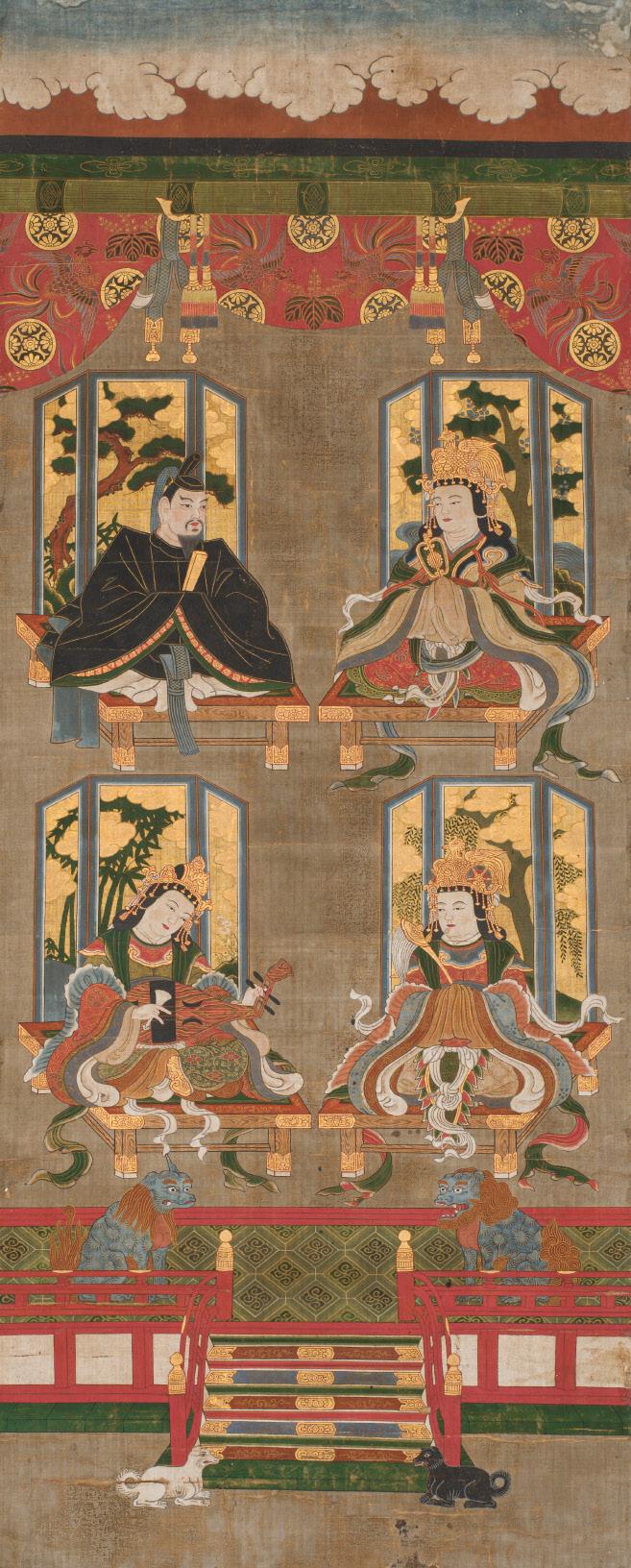
Ink, watercolors, gouache, and gold paint on silk. Mounted as a hanging scroll on a silk brocade frame with gilt metal jikusaki (roller ends) and fittings incised with foliate vines against a ring-punched ground. Finely painted to depict the four primary deities, or myojin, of Niutsuhime Shrine, a sacred site at the base of Mount Koya. The deities are seated on platforms before trifold screens within a shrine building whose entrance is guarded by a pair of lions. The site’s original deities, Niu and her male counterpart, the hunter deity Kariba, are shown at the top. Below them are two female deities, Kehi to the right and Itsukushima to the left. At the bottom of the picture are two dogs, one black and one white.
Inscriptions: To the back, 四所明神、為志聖霊追福也。左學頭宣王 […]義恭傅寄附 Shishin Myojin, Seirei no kokorozashi Tsuifuku no tame nari, Sagakuto Sen-o […] gikyo den kifu [To the Four Local Deities (Shisho Myojin), this is offered for the posthumous merit of the honored spirit. Left Gakuto (Head of the Academy), Sen-o, […] and transmitted with votive dedication].
Condition: Good condition with old wear, small tears with associated losses, scattered soiling, losses to pigment - mostly limited to the dark gray ground, and expected flaking to gilt. The top and lower edge of the image with patches of water damage. The frame with wear, loose threads, small tears and losses, and expected soiling and stains. Few sections to the back of the frame reinforced with tape and patches. All withstanding, the subjects are preserved superbly.
Image SIZE 129 x 51 cm, SIZE incl. mounting 192 x 73 cm
The two kami, or deities, at the top of this painting are Kariba Myojin and Niu Myojin. They inhabit Mount Koya and are described as son and mother. They are shown here as courtiers, with Kariba in Japanese-style court robes and Niu in robes modeled after court garments of the Tang dynasty. The two kami seated beneath are Kehi Myojin, portrayed as a lady holding a whisk, and the youthful Miyajima Myojin, with his hair drawn up in loops, playing a lute (biwa). Hojo Masako (1157–1225), the wife of the first Kamakura shogun (leader) Minamoto Yoritomo (1147-1199), invited them to Mount Koya.
The Left Gakuto (Sahakuto) is one of the highest scholarly ranks for monks in the Koyasan Shingon tradition, a position standing at the pinnacle of the monastic academic hierarchy. In major Buddhist ceremonies—especially the Misaishoko—the Left Gakuto, together with the Right Gakuto, plays a central role in judging doctrinal debates and delivering the Goryoge (formal doctrinal explanations).
The temple complex on Mount Koya, south of Kyoto and Nara, has served as the headquarters of the Shingon sect since it was established in the ninth century by Kukai (Kobo Daishi, 774-835), who is credited with introducing Esoteric Buddhist teachings from China. The black and white dog to the bottom, along with their master, Kariba, are said to have originally guided Kukai to this remote location.
MUSEUM COMPARISON
Compare a closely related painting of the four deities of Mount Koya, dated 16th century, 102 x 49.5 cm image size, in the Metropolitan Museum of Art, object number 2015.300.15. Compare a closely related painting of the mandara of the four deities of Mount Koya, dated 1500s, 97.5 x 39.3 cm image size, in the Cleveland Museum of Art, accession number 1999.262.
Estimate EUR 3,000
Starting price EUR 1,500
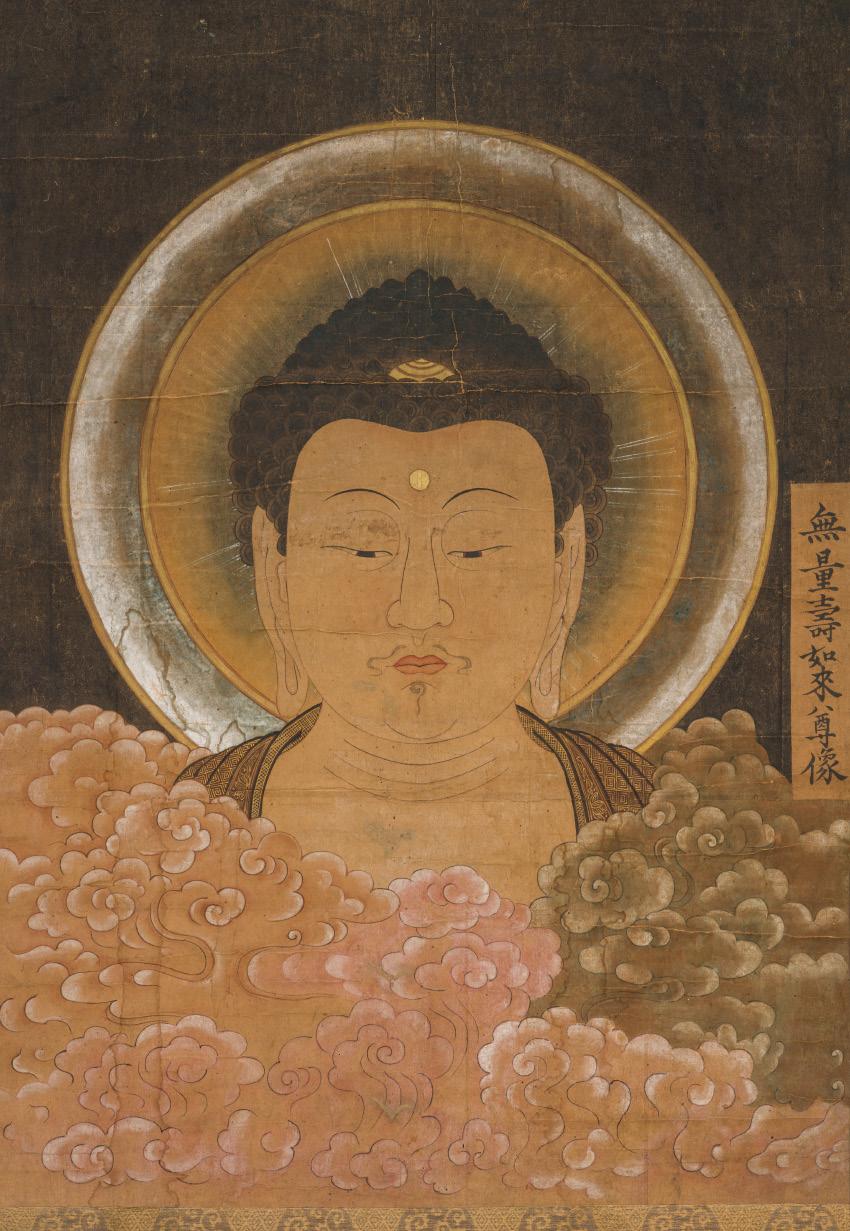
99
A BUDDHIST PAINTING DEPICTING AMIDA NYORAI AMID CLOUDS, EARLY EDO PERIOD
Japan, 17th-18th century, early Edo period (1615-1868)
Ink, watercolors, gouache, and gold paint on paper. Mounted on silk brocade and set within a frame, behind glass. Depicting a colossal, golden bust of Amida Nyorai emerging from swirling clouds. His serene countenance is characterized by heavy-lidded, downcast eyes beneath gently arched eyebrows, centered with a prominent urna, a broad nose, and full lips framed by a thin mustache and goatee, all flanked by long, pendulous earlobes. The head surmounted by a domed ushnisha covered with tight, blue-painted curls, from which a ratna emerges at the front, and encircled by a large, radiant halo.
Inscriptions: To the right edge, inscribed 無量寿如来尊像 Muryojunyorai sonzo [Statue of Amida Buddha].
Provenance: Collection of Dr. Helmut Ploog, Munich, Germany, thence by descent. Condition: Good condition, commensurate with age. Expected browning to paper, little soiling, scattered stains, flaking to pigment, creasing, folds, and small losses. The mounting with signs of wear, tiny losses, and creasing. The frame in excellent condition with minor wear.

Dr. Helmut Ploog (1940-2024)
This painting reflects the iconography known as “Amida Coming Over the Mountains.” It is one of several iconographies depicting the Buddha Amida hastening to the side of those on the verge of passing on, often depicted as descending from beyond a range of mountains (see Literature comparison below) or through a thicket of clouds. Instances of this motif can be traced to as early as the Kamakura period (1185-1333).
MUSEUM COMPARISON
Compare a closely related earlier Buddhist painting depicting Amida Nyorai coming over the Mountain, Muromachi period, 15th-16th century, 98.2 x 61.9 cm, in the Nara National Museum, collection reference number 1523-0. Compare a closely related Buddhist painting depicting Amida Nyorai, Edo period, 18th century, in the Penn Museum, object number 29-198-4.
Estimate EUR 4,000
Starting price EUR 2,000

LOTS 100 & 101
TWO IMPORTANT GOLD AND INDIGO-DYED MAKIMONO (HAND SCROLLS) DEPICTING CHAPTERS OF THE HOKKE-KYO (LOTUS SUTRA), COMMISSIONED IN MEMORY OF THE SHOGUN TOKUGAWA IEYASU, C. 1636
These scrolls can be securely placed within a small, identifiable, and highly important dispersed set of Tokugawa-period commemorative Lotus Sutra handscrolls, produced as part of memorial observances for Tokugawa Ieyasu.
The official wives (seishitsu) of the Tokugawa shoguns were frequently drawn from the Japanese Imperial Household or from aristocratic families with direct imperial connections, forming politically significant alliances that reinforced the legitimacy and continuity of Tokugawa rule. Within this framework, it became established practice for the consort of the ruling shogun to commission and dedicate lavish Lotus Sutra sets to the great mausoleum-temples at Nikko, including Rinno-ji, in commemoration of the death of Tokugawa Ieyasu (1542–1616).
Such commissions formed part of formalized Buddhist memorial observances and were executed by courtaffiliated workshops - often involving painters trained in the Tosa school tradition. The present scroll - with its exceptional use of gold, refined decorative program, and richly worked mounts - fits squarely within this context of elite, ritualized production, functioning both as a devotional object and as an expression of dynastic authority.
A closely related example - Chapter 8 of the Lotus Sutra, dated to circa 1636 - is preserved in the British Library (see Museum comparison). Scholarly research has established that several such scrolls, now dispersed across institutional and private collections, originated from the same original commission; notably, the British Library scroll shares the same distinctive mounting features as the present lot.
The extraordinary richness of materials and executionproducing an overall effect comparable to that of a precious jewel - confirms that such a work could only have been commissioned within the highest circles of patronage for presentation to a major sacred site of national importance.
For a detailed discussion of a closely related scroll from this group, see Yu Ying Brown, “Lost and Found: The Revelation of the Lotus Sutra,” The British Library OIOC Newsletter, no. 52 (1995), where it is noted that at least eight other examples from the same set have been identified in public and private collections.
Compare a closely related copy of the Lotus Sutra, chapter 8, dated c. 1636, very likely from the same set of scrolls as the present lots, in the British Library, number Oriental MS 13926. Compare closely related later copies of the Lotus Sutra, chapter 12 and 14, dated c. 1667, size 28 × 454.5 cm (each), in the Metropolitan Museum of Art, object number 2015.300.5a, b.
Compare a closely related Lotus Sutra handscroll, depicting chapter 23, 420 x 27.6 cm, at Vickers & Hoad Auctioneers, Directors Selection, Session 1, 11 November 2013, Sydney, lot 1 (sold for AUD 74,000, or approx. EUR 63,500 converted and adjusted for inflation at the time of writing). Note the similar style of painting as well as the identical gilt Tokugawa mounts.
100 AN IMPORTANT GOLD AND INDIGO-DYED MAKIMONO (HAND SCROLL) DEPICTING CHAPTER 12 OF THE HOKKE-KYO (LOTUS SUTRA), COMMISSIONED IN MEMORY OF THE SHOGUN TOKUGAWA IEYASU, C. 1636
Japan, c. 1636, early Edo period (1615-1868)
The illuminated frontispiece executed in ink and gold, the sacred text written in gold on finely prepared indigo-dyed paper, arranged in vertical columns separated by triple gold rules. The scroll is mounted as a handscroll on richly woven brocade silk, with ichimatsu (checkered) borders and a moegi-green silk cover bearing the woven title.
The mountings are of exceptional quality and significance: a woven silk cord terminating in a half-moon lotus clasp (renge), gilt-metal openwork fittings with foliate scrollwork, and finely worked gilt jikusaki (roller ends) enclosing rock crystal - a material historically associated with purity and elite, often courtly or religious, commissions. The mounts are further distinguished by the presence of the Mitsuba Aoi mon, the heraldic emblem of the Tokugawa clan, firmly situating the scroll within the highest echelon of shogunal patronage.
The painting illustrates Chapter 12 (Devadatta) of the Lotus Sutra. The frontispiece depicts the celebrated scene of the Dragon King’s daughter emerging from her ocean palace to present a precious jewel to the Buddha, symbolizing immediate enlightenment.
The composition is rendered with exceptional refinement, extending even to the reverse, where auspicious clouds and other imperial symbols are masterfully depicted. The front margins are lavishly adorned with gold, silver, and polychrome stenciling, while the background is animated by intricate geometric and textile-inspired patterns reminiscent of Korean sutra decoration. The precision of the linework and the sophistication of the ornamentation strongly indicate the hand of a master painter trained in the Tosa school tradition, long associated with the Imperial Painting Bureau.
Provenance: Commissioned by a member of the Tokugawa Shogunate and presented to the Toshogu Shrine in Nikko, commemorating the death anniversary of Shogun Tokugawa Ieyasu (1542-1616). Old Italian private collection. A private collection in Italy, acquired from the above.
Condition: The painted image is preserved in an exceptionally fine, near-pristine condition, with only minimal signs of age. The gold remains remarkably vibrant and well preserved. Minor, expected wear and few creases as are to be expected. Please refer to additional images provided for a detailed view of the condition.
Chapter 12 of the Lotus Sutra articulates one of its most radical teachings: the universal potential for Buddhahood. It affirms that even Devadatta - traditionally regarded as an adversary of the Buddha - will ultimately attain enlightenment, and that the Dragon King’s daughter achieves Buddhahood instantly, challenging earlier doctrinal limitations concerning women and spiritual attainment.
Estimate EUR 15,000
Starting price EUR 7,500
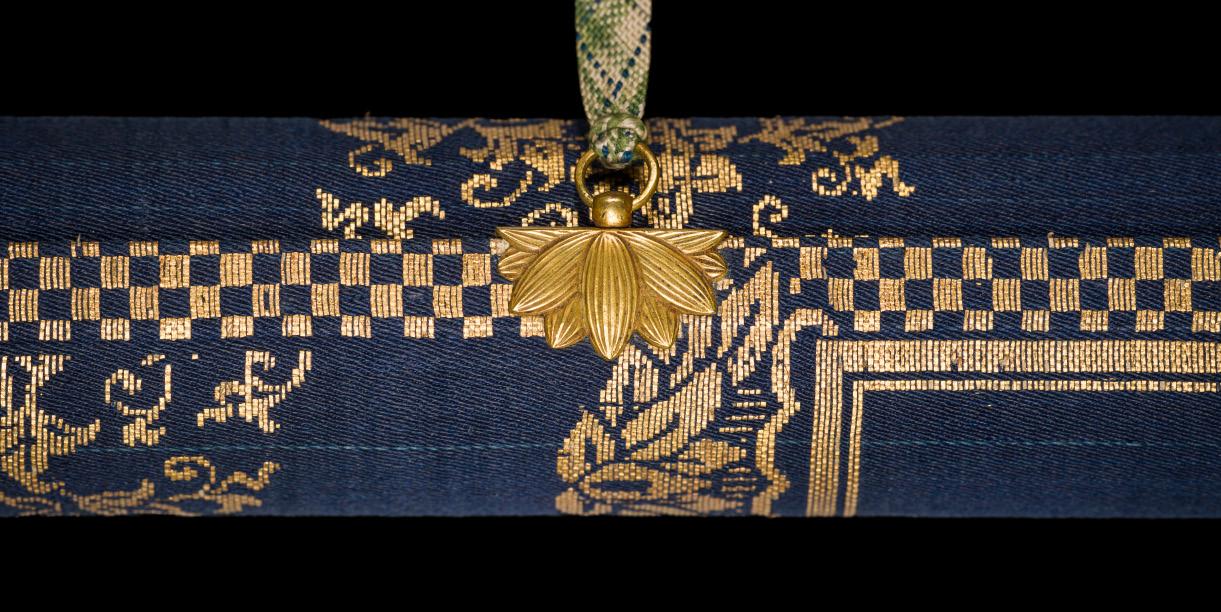
101 AN IMPORTANT GOLD AND INDIGO-DYED MAKIMONO (HAND SCROLL) DEPICTING
CHAPTER 28 OF THE HOKKE-KYO (LOTUS SUTRA), COMMISSIONED IN MEMORY OF THE SHOGUN TOKUGAWA IEYASU, C. 1636
Japan, c. 1636, early Edo period (1615-1868)
The illuminated frontpiece executed in ink and gold, the sacred text written in gold on finely prepared indigo-dyed paper, arranged in vertical columns separated by triple gold rules. The scroll is mounted as a handscroll on richly woven brocade silk, with ichimatsu (checkered) borders and a ruri (azure blue) silk cover bearing the title.
The mountings are of exceptional quality and significance: a woven silk cord terminating in a half-moon lotus clasp (renge), gilt-metal openwork fittings with foliate scrollwork, and finely worked gilt jikusaki (roller ends) enclosing rock crystal - a material historically associated with purity and elite, often courtly or religious commissions. The mounts are further distinguished by the presence of the Mitsuba Aoi mon, the heraldic emblem of the Tokugawa clan, firmly situating the scroll within the highest echelon of shogunal patronage.
The painting illustrates Chapter 28 (Fugen Bosatsu Kanbo-bon) of the Lotus Sutra. The frontispiece depicts the arrival of the Bodhisattva Samantabhadra (Universal Worthy) from the eastern realm, where he vows to protect those who uphold and propagate the sutra in the Latter Age of the Law.
The composition is rendered with exceptional refinement, extending even to the reverse, where auspicious clouds and other imperial symbols are masterfully depicted. The front margins are lavishly adorned with gold, silver, and polychrome stenciling, while the background is animated by intricate geometric and textile-inspired patterns reminiscent of Korean sutra decoration. The precision of the linework and the sophistication of the ornamentation strongly indicate the hand of a master painter trained in the Tosa school tradition, long associated with the Imperial Painting Bureau.
SIZE (total) 27.5 x 283 cm
x 29.3 cm,
Provenance: Commissioned by a member of the Tokugawa Shogunate and presented to the Toshogu Shrine in Nikko, commemorating the death anniversary of Shogun Tokugawa Ieyasu (1542-1616). Old Italian private collection. A private collection in Italy, acquired from the above.
Condition: The painted image is preserved in an exceptionally fine, near-pristine condition, with only minimal signs of age. The gold remains remarkably vibrant and well preserved. Minor, expected wear and few creases as are to be expected. Please refer to additional images provided for a detailed view of the condition.
The twenty-eighth and final chapter of the Lotus Sutra emphasizes the protection and perpetuation of the teaching in the age following the Buddha’s passing. The Bodhisattva Universal Worthy vows to safeguard all who uphold the sutra, while Shakyamuni outlines the conditions necessary for its preservation and the spiritual benefits derived from devotion to it. The chapter concludes with the assembly rejoicing and paying homage, underscoring the universal promise of salvation central to the text.
Estimate EUR 15,000
Starting price EUR 7,500
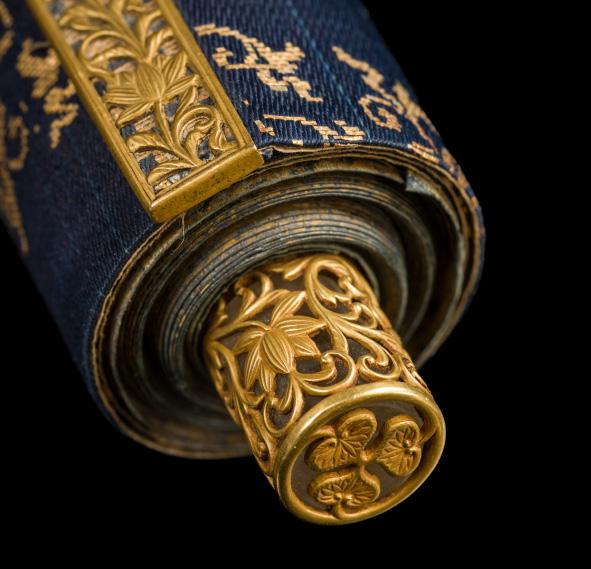
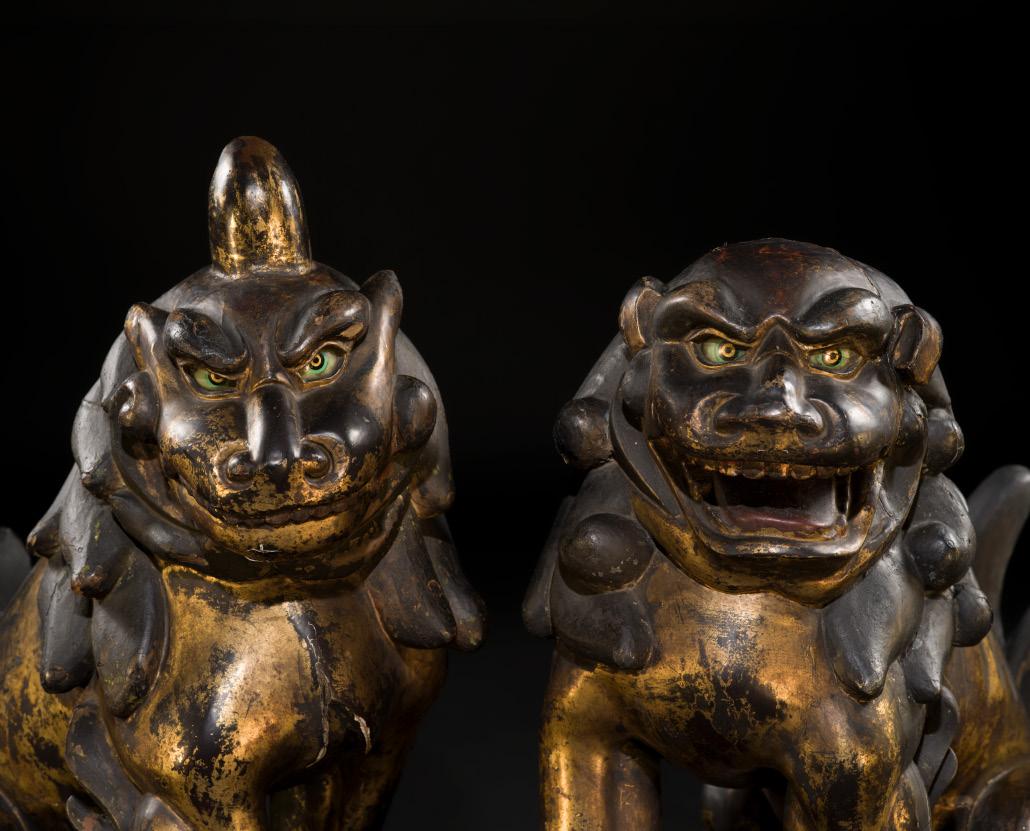
102
AN IMPRESSIVE PAIR OF LARGE POLYCHROME AND GILT-LACQUERED WOOD KOMAINU (KOREAN GUARDIAN DOGS), KAMAKURA TO NANBOKUCHO PERIOD
Japan, 13th-14th century, Kamakura period (1192-1333) to Nanbokucho period (1336-1392)
Both expressively carved, each with curled mane and tail, one with a short horn on the top of its head, the mouths carved to articulate the mantra syllables um and ah respectively, their heads with fierce expressions and wild eyes painted in lacquer behind the inlaid crystal. Each presented on a later multi-tiered base with goldlacquered Imperial Tokugawa crests.
HEIGHT 52 cm and 47 cm (excl. bases), and 73 cm (each incl. base)
Provenance: From a private estate in Bel Air, Los Angeles, United States.
Condition: Good condition with expected wear, light warping with associated small gaps between segments, some possibly reinforced, flaking and minor losses to lacquer, few small chips to extremities. Presenting beautifully.
Komainu, literally “Korean dogs”, are lion-like guardian statues commonly placed in pairs at shrine and temple entrances to ward off evil. Believed to have arrived in Japan from China via Korea, their name derives from Koma, the Japanese word for the ancient Korean kingdom of Koguryo.
AUCTION COMPARISON
Compare a closely related pair of lacquered wood komainu, dated Nanbokucho-Muromachi period, 14th-15th century, at Christie’s,15 April 2016, New York, lot 16 (sold for USD 13,750 or approx. EUR 16,500 converted and adjusted for inflation at the time of writing).
Estimate EUR 15,000
Starting price EUR 7,500
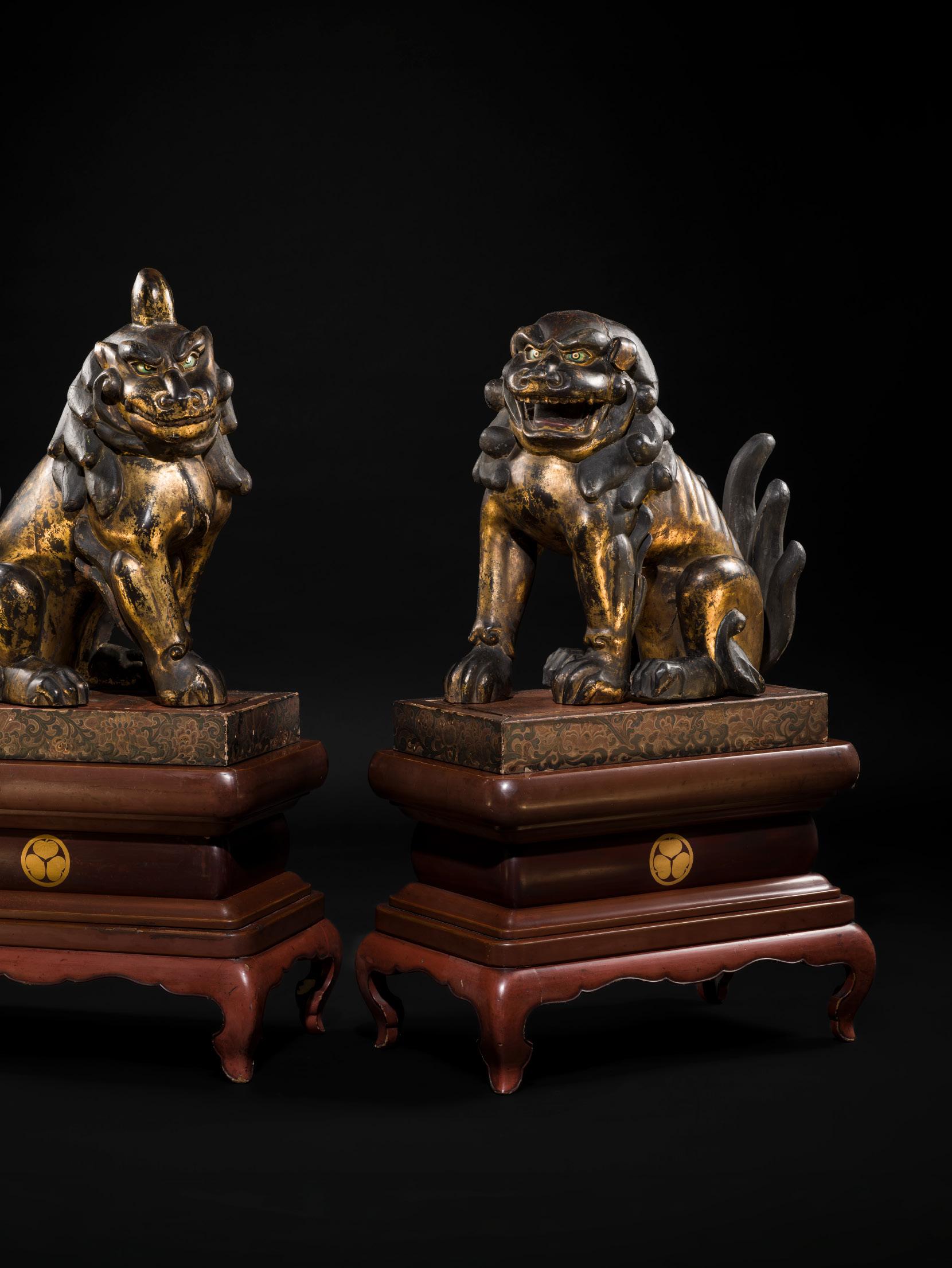
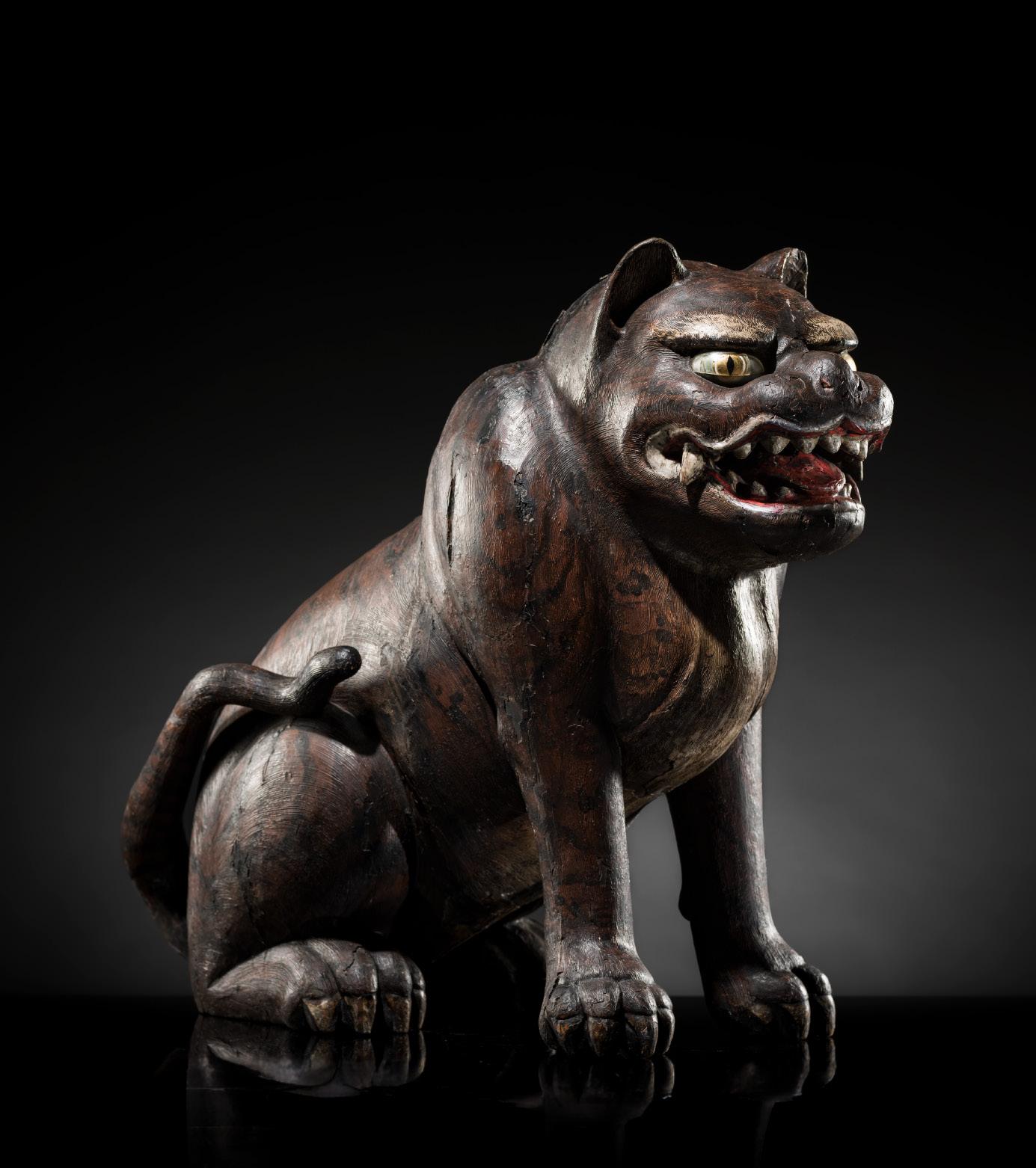
A MASSIVE (72 CM) PAINTED AND GESSOED CARVED WOOD FIGURE OF A TIGER, EDO PERIOD
Japan, Edo period (1615-1868)
Constructed in the warihagi zukuri technique, finely carved in two sections, the ferocious beast with slender, muscular body standing on its hindlegs, the mouth agape revealing tongue and teeth, the eyes painted and inlaid with glass, the fur intricately modeled and skillfully painted.
LENGTH 72 cm, HEIGHT 61 cm
Provenance: From a deceased estate in Sarasota, Florida, United States.
Condition: Good condition with expected wear, flaking and losses to gesso, few small chips to extremities. Presenting beautifully.
AUCTION COMPARISON
Compare a related pair of earlier koma-inu, 13th-14th century, 45 cm high (each), at Zacke, Fine Japanese Art, 13 June 2025, Vienna, lot 152 (sold for EUR 19,500).
Estimate EUR 8,000
Starting price EUR 4,000
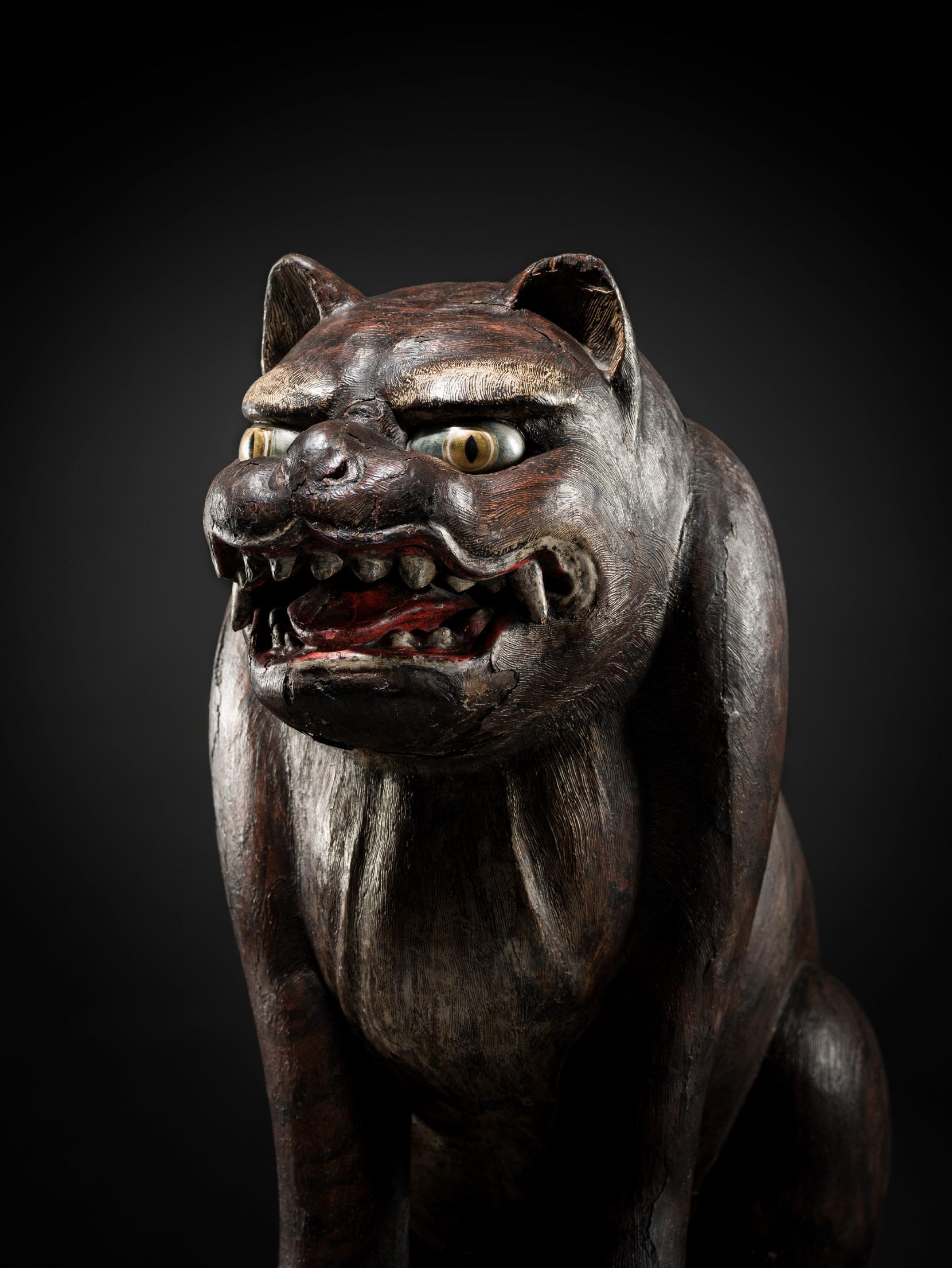
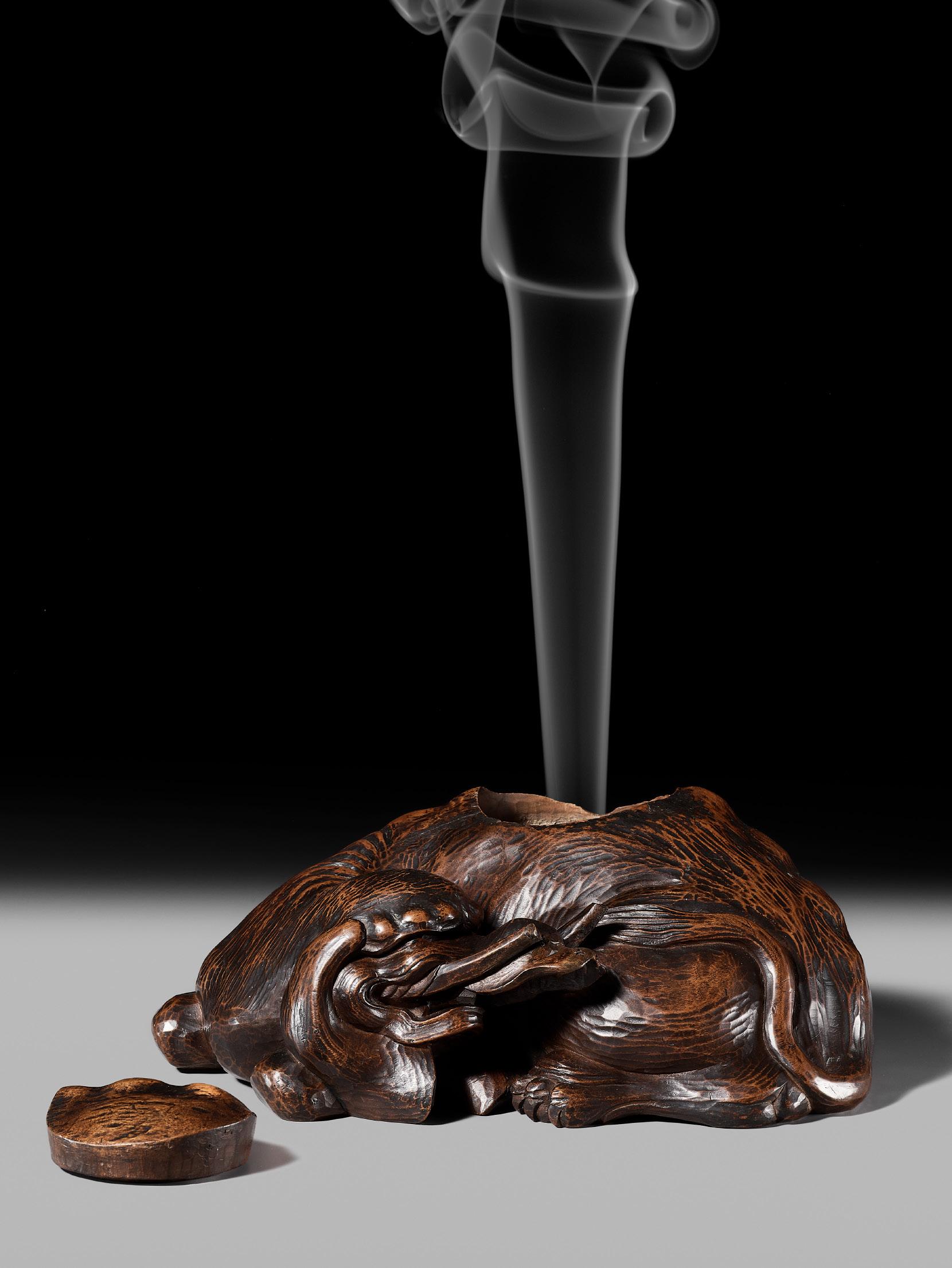
104
A FINE AND RARE CARVED WOOD ‘BAKU’ TEMPLE KORO (INCENSE BURNER), 18TH CENTURY, A TREASURED ITEM FROM THE TAIGAN-JI TEMPLE
Japan, 18th century, Edo period (1615-1868)
This incense burner depicts a baku, a mythological creature deeply revered in Japanese folklore as a supernatural being believed to consume nightmares and bad dreams. The wrinkled skin, tusks, and benevolent, almost smiling expression draw parallels with the imaginary elephants (sozo-no-zo) carved at Nikko Tosho-gu Shrine. These elephants were considered spiritual familiars of Fugen Bosatsu, the bodhisattva of wisdom and compassion, and were often featured in temple sculpture and architectural ornamentation. In this context, the baku serves as a symbol of protection, offering both spiritual guidance and a ward against evil influences.
An architectural support in the form of a baku’s head at a temple in Nagahama, Shiga
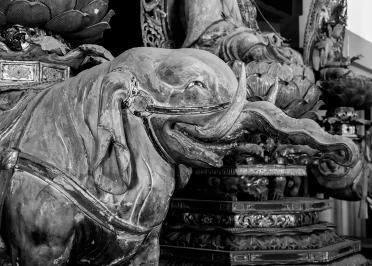
Carved from a single piece of wood to depict a baku reclining with its head turned back to form a compact composition. The movement producing folds throughout the neck, the mouth slightly opened smiling benevolently, with large wrinkly ears, and short trunk. The interior partly hollowed, fitted with a bronze incense container, and with a wood cover.
Inscriptions: To the underside: Taiganji takara, junana-dai […] [A treasure belonging to Taigan-ji Temple, the 17th generation head of the temple […].
LENGTH 28.6 cm
Provenance: Honeychurch Antiques Ltd., Hong Kong, 1987. Private collection of Eva and Aubrey Sweet, Melbourne, Australia, acquired from the above. The cover with a label from the Sweet collection, number ‘1351’. A copy of the invoice from Honeychurch Antiques Ltd, Hong Kong, dated 11 June 1987, and stating the purchase price of HKD 10,500 or approx. EUR 4,100 (converted and adjusted for inflation at the time of writing), accompanies the lot.

Certificate of Authenticity: A copy of the certificate of authenticity, signed by Glenn R. Vessa from Honeychurch Antiques Ltd., number 1106/87, on 11 June 1987, Hong Kong, confirming the provenance and dating above, accompanies the lot.
Eva and Aubrey Sweet devoted over six decades to the formation of a distinguished private collection of Asian art, with particular strength in Chinese jade, Japanese lacquer, and netsuke. Their collecting began in the 1950s and was refined through sustained travel, scholarship, and long associations with leading dealers, curators, and artists internationally.
Condition: Very good condition with old wear including a few tiny nicks here and there, one tusk slightly chipped, natural age cracks, a small chip and light nibbling to the rim, and an old filled area to the underside. Presenting beautifully.
Compare a closely related polychromed wood censer of a baku, dated late 18th - early 19th century, 40 cm long, at Sotheby’s, Worlds within Worlds. Works from the Collection of Peter Petrou, 21 September 2021, London, lot 61 (sold for GBP 6,300 or approx. EUR 9,100 converted and adjusted for inflation at the time of writing).
Estimate EUR 6,000
Starting price EUR 3,000
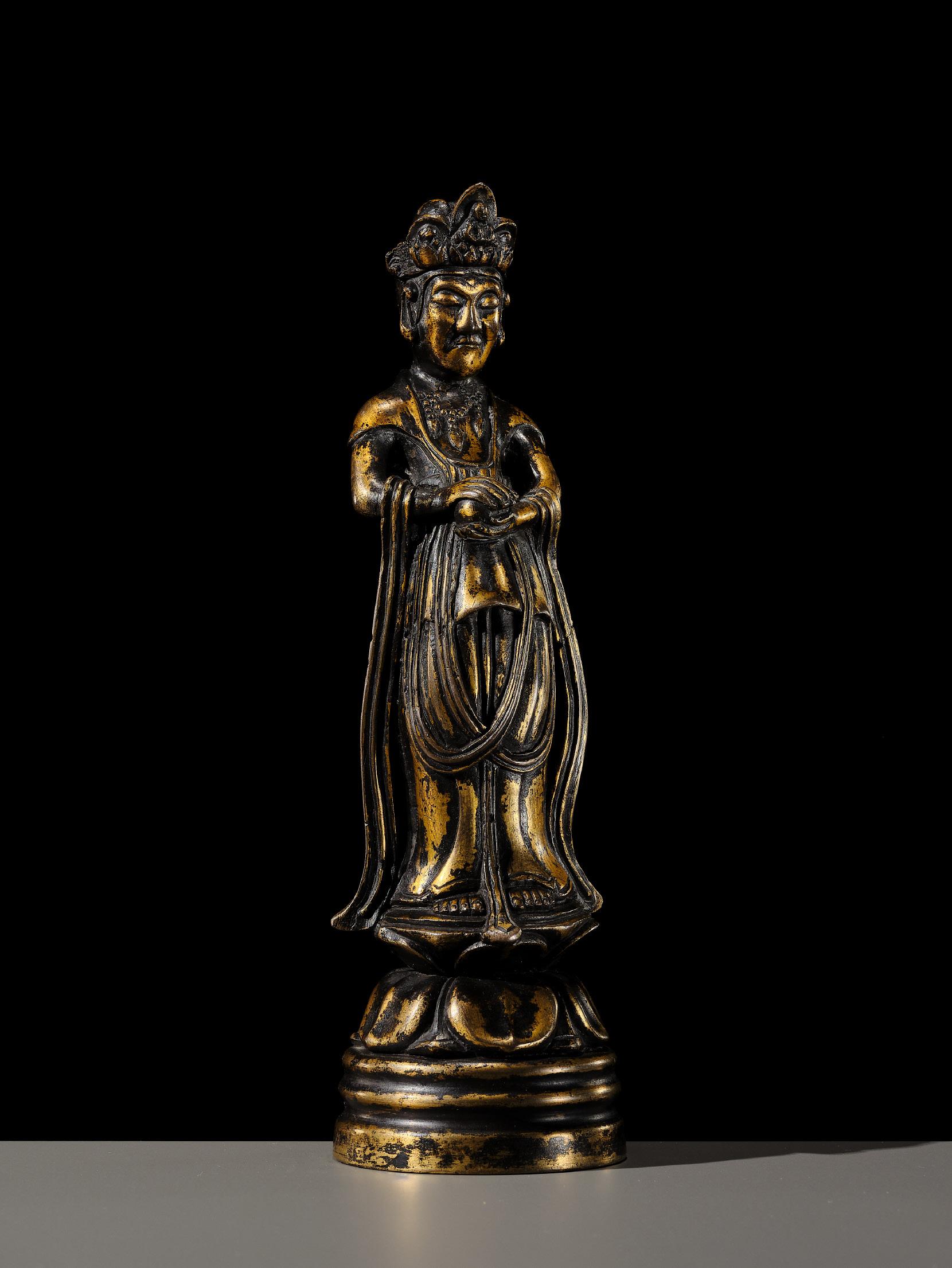
AN IMPORTANT GILT-BRONZE
FIGURE OF KANNON BOSATSU, ASUKA-NARA PERIOD
Japan, 7th-8th century, Asuka (592-710) to Nara period (710-794)
Finely cast standing in a gracefully bent pose with forward stance and arched back, atop a doublelotus base raised on a circular plinth, dressed in long flowing robes and billowing scarves, the chest adorned with a beaded and jeweled necklace, the serene face with heavy-lidded eyes, elegantly arched brows, circular urna, and slender bow-shaped lips forming a subtle smile, the hair arranged in a high chignon behind the foliate crown centered by a diminutive image of the Amitabha Buddha, the back of the head cast with a small rectangular loop.
HEIGHT 22 cm
WEIGHT 1,549 g
Provenance: From an old German private collection. Condition: Very good condition with expected wear, casting irregularities, rubbing and minor losses to gilding, light warping, few small nicks. Distinct remnants of ancient lacquer/varnish coatings, as expected.
LITERATURE COMPARISON
Compare two related Asuka period bronze bodhisattvas in the Horyuji Temple, Nara, one 25.4 cm high and the other 56.7 cm, both dated 7th century.
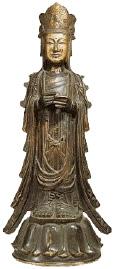
MUSEUM COMPARISON
Compare three closely related Asuka period giltbronze figures of Kannon in the Tokyo National Museum, one dated 7th century 26.4 cm high, another dated 7th century, reference number E-14848, and the third dated 7th-8th century, 28.5 cm high, reference number N-171.
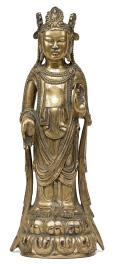
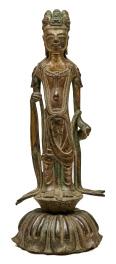
Estimate EUR 30,000
Starting price EUR 15,000
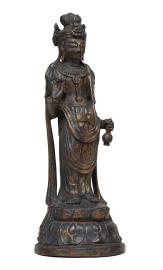
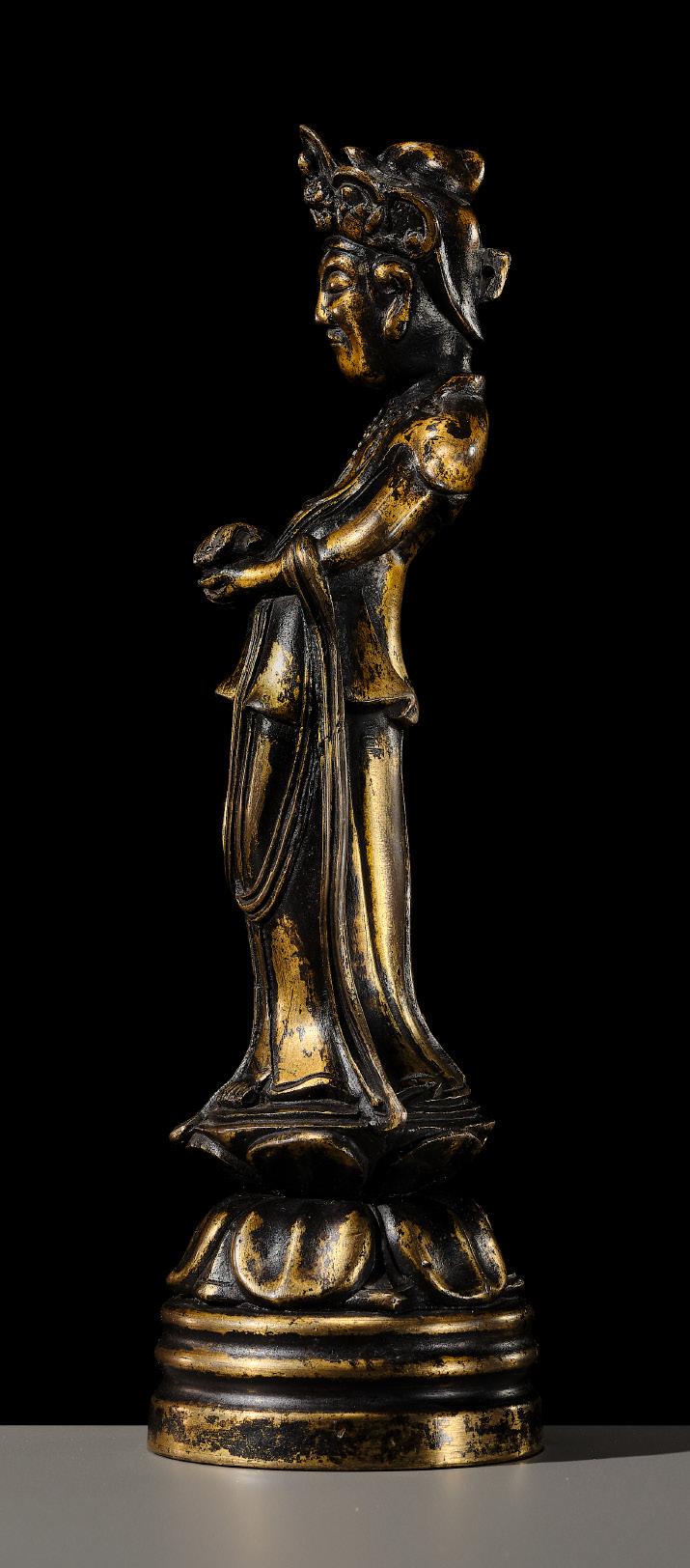
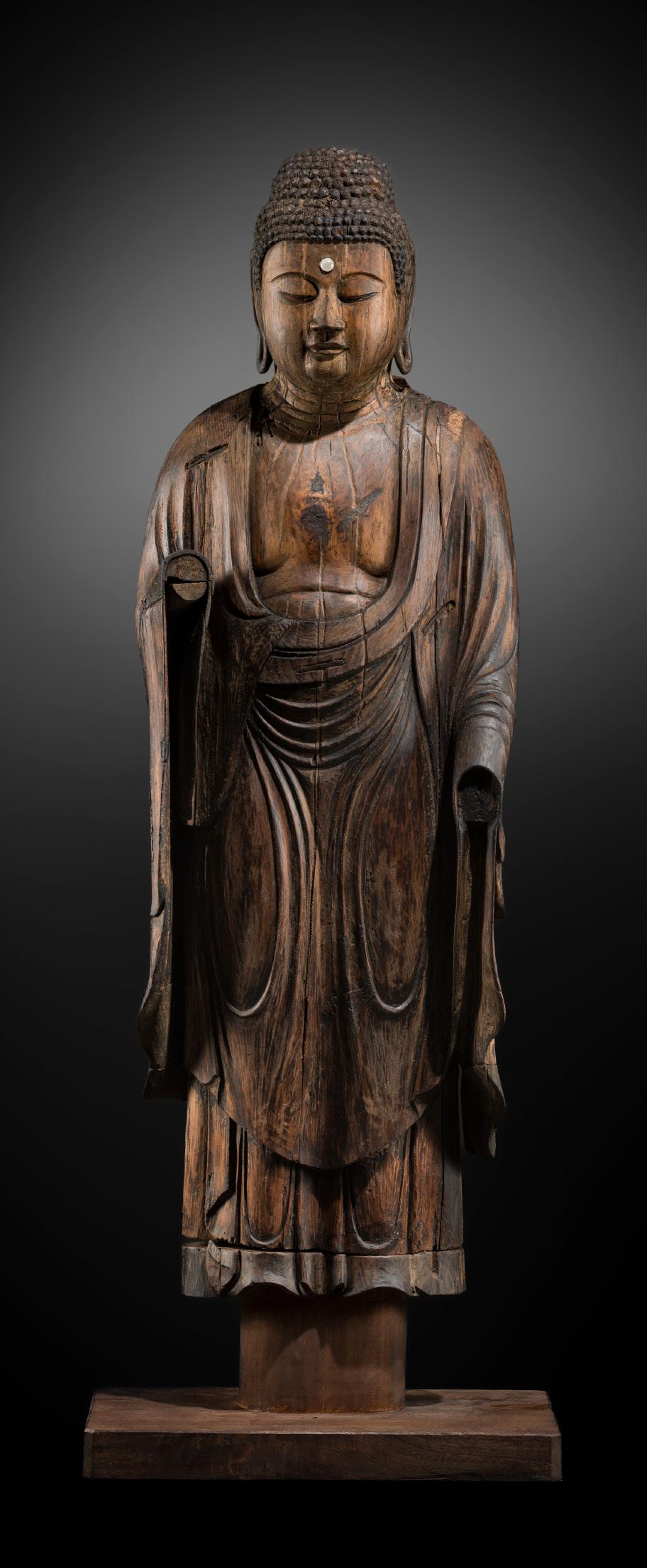
A LARGE (108 CM) AND IMPRESSIVE WOOD FIGURE OF A STANDING AMIDA NYORAI, LATE HEIAN TO EARLY KAMAKURA PERIOD
Japan, 12th-13th century, late Heian (794-1185) to early Kamakura period (1185-1333)
Of yosegi-zukuri construction, the Buddha is depicted standing, with one arm raised, dressed in loose robes that open at the chest and drape gracefully in soft pleats along the legs. The face, serene and downcast, features a subtle smile, gently arched eyebrows, and a glass-inlaid byakugo (urna) at the center, beneath rows of neatly arranged, tight curls.
HEIGHT 108 cm (total), 95 cm (the figure)
Provenance: From a Dutch private collection. Condition: Good condition with extensive wear, minor signs of weathering and erosion, some age cracks, few old fills, some insect activity to the back and shoulder, few tiny chips, the hands lost, some remnants of black lacquer, the nose and sections of the robe reattached, and fitted with brackets for reinforcement. The glass inlay is of a later date.
With an associated wood stand.
AUCTION COMPARISON
Compare a closely related wood sculpture of Amithaba, dated late Heian to early Kamakura period, 12th-13th century, 102.9 cm tall, at Christie’s, Japanese and Korean Art, New York, 18 March 2025, lot 124 (sold for USD 88,200 or approx. EUR 77,000 converted and adjusted for inflation at the time of writing).
Compare a closely related standing wood figure of Amida Nyorai, dated Heian period, 9th-10th century, 69.7 cm tall, at Bonhams, Property from the Collection of Drs. Edmund and Julie Lewis, Part I, 11 September 2019, New York, lot 519 (sold for USD 31,325 or approx. EUR 34,000 converted and adjusted for inflation at the time of writing).
Estimate EUR 15,000
Starting price EUR 7,500
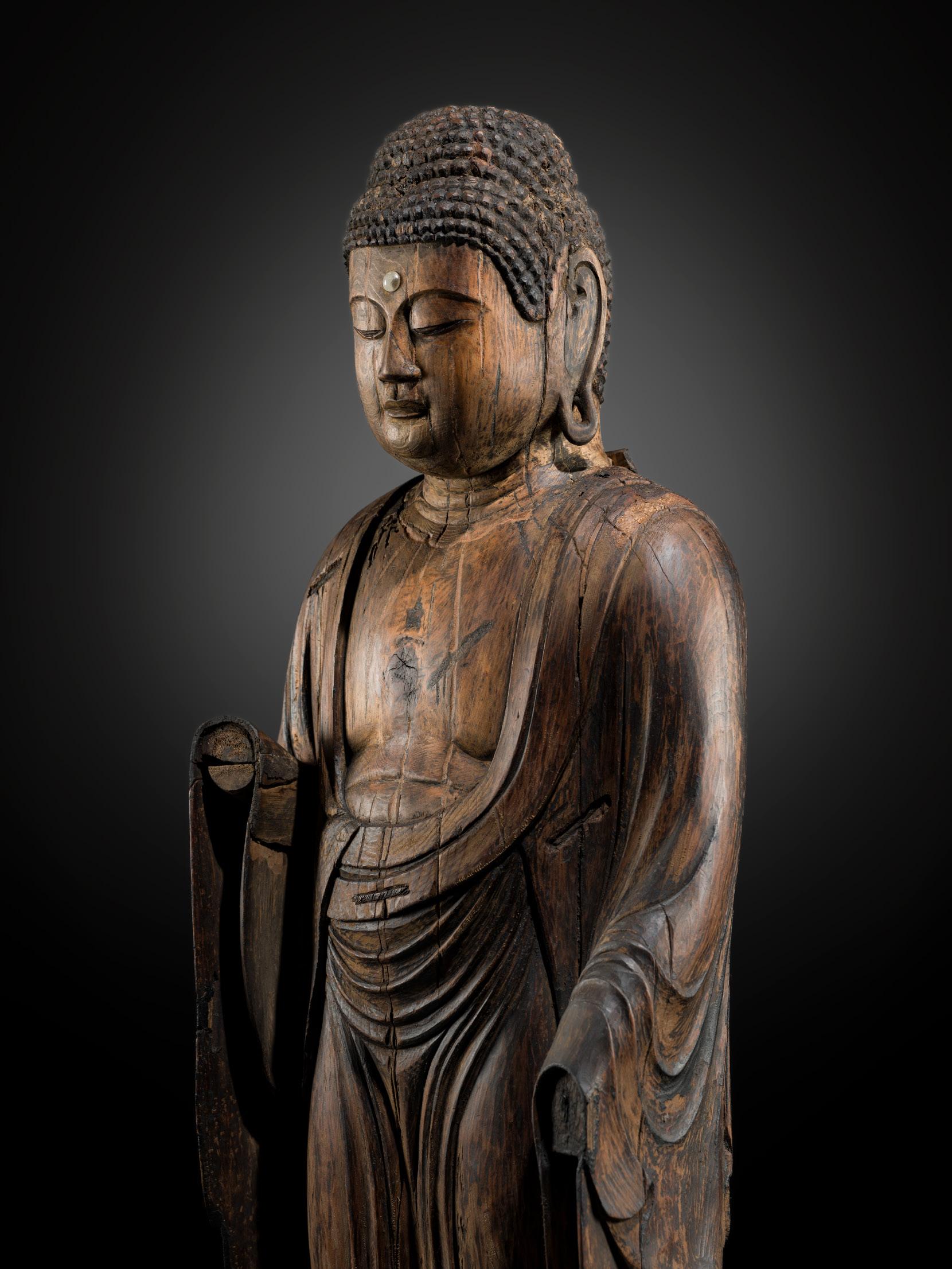
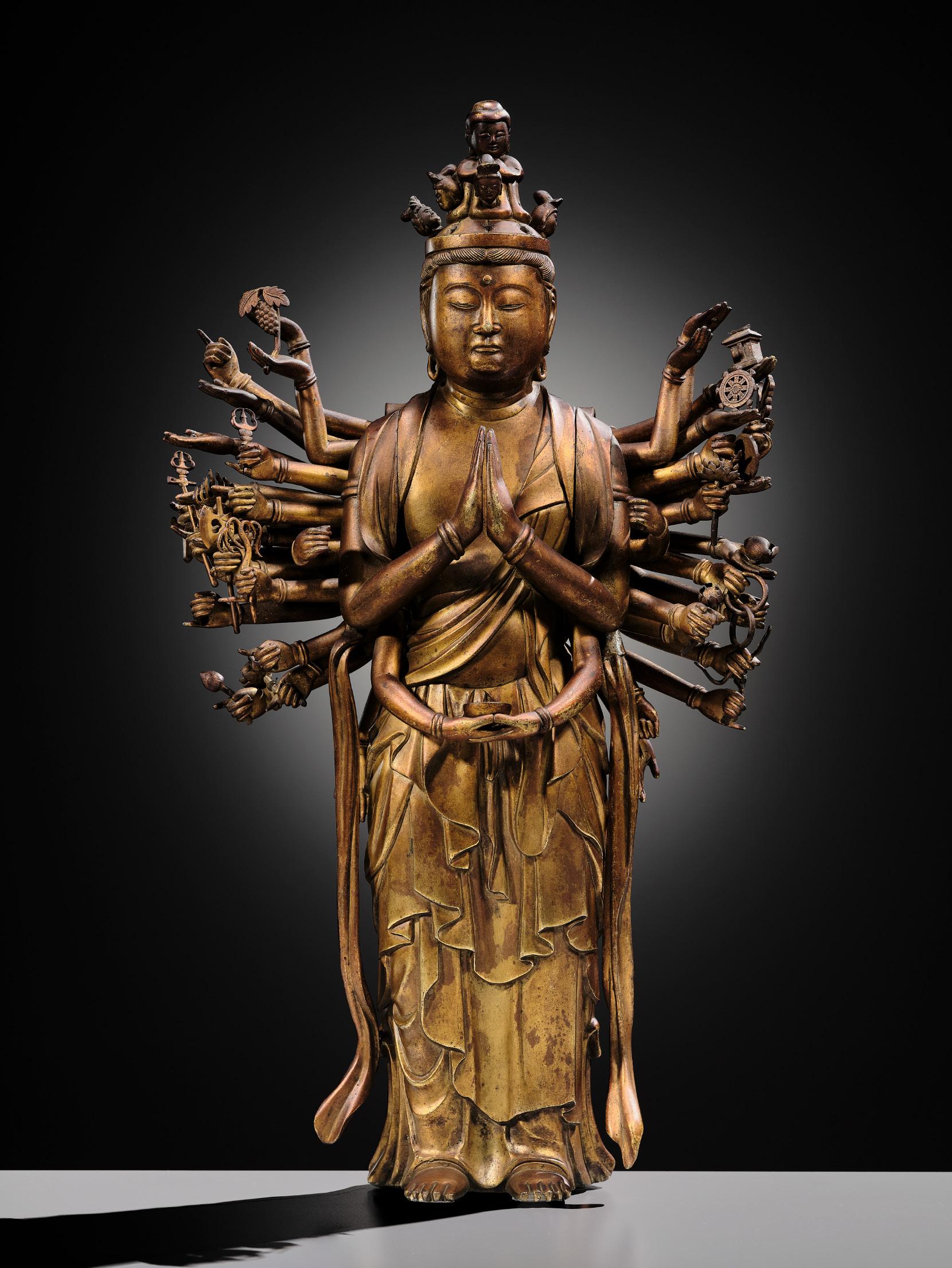
107
A HIGHLY IMPORTANT AND EXCEEDINGLY RARE GILT-BRONZE FIGURE OF SENJU KANNON, THE THOUSAND-ARMED AND ELEVEN-HEADED AVALOKITESHVARA, C. 1300-1450
Japan, c. 1300-1450, late Kamakura (1185-1333) to early Muromachi period (1333-1573)
Senju Kannon (Sanskrit: Sahasrabhuja Avalokiteshvara), or Thousand-Armed Kannon, is one of the most revered deities in Japanese Buddhism, embodying compassion and mercy. Known for her numerous arms, each holding a different tool to aid in the protection and salvation of sentient beings, Senju Kannon is celebrated for her boundless empathy and ability to respond to the suffering of all. In Kyoto, Senju Kannon holds a particularly esteemed place. Worshiped at several of the city’s key temples, she is seen as a guardian deity who offers both spiritual and physical protection. A gilt-wood figure in the collection of Zenkai-ji Temple (fig. 1) is recognized as an Important Cultural Property and was included in the exhibition Shinto Deities and Pairs of Guardian Lions and Lion-Dogs, Kyoto National Museum, 16 December 2025-22 March 2026. See further examples at Kiyomizu-dera (fig. 2) and Sanjusangendo (fig. 3)
Heavily cast standing in samabhanga, the main hands held in anjali mudra above a further pair of hands lowered in jo-in at the hips supporting an alms bowl, with thirty-seven arms radiating around the body holding numerous attributes including ritual implements and lotus flowers, dressed in loose-fitting robes opening at the chest and cascading in richly carved folds, the round face with serene expression marked by downcast eyes, elegantly arched brows centered by a circular byakugo (urna), and slender bow-shaped lips forming a subtle smile, the hair arranged in a tall chignon encircled and surmounted by smaller heads.
HEIGHT 38.5 cm
WEIGHT 6.3 kg
Provenance: From an old private collection in eastern France. Condition: Very good condition with expected age-related wear, minor casting irregularities, and losses consistent with the complex construction. The figure retains 20 arms on the left side (from the viewer’s perspective) and 17 on the right, indicating the loss of approximately three arms. Of the originally numerous attributes (c. 20 are still present), roughly one third are now missing. The multi-headed arrangement shows further losses, with several heads absent as noted above, and an additional central slot above the forehead now empty, likely once fitted with a separate emblem (possibly a willow or related attribute). The separately cast arms are secured by cast tenons, mechanically fixed and flattened on the reverse; minor losses, cracks, and wear to these joints are visible, with at least one later replacement in the form of a screw. The internal copper-alloy armature plates are intact; some later screws may have been introduced to secure them following earlier losses of original fixings. The two side-hanging bands are separately cast and slightly loose. The figure is lacking its original base; clear solder residues beneath indicate former attachment, using a lead-based alloy. The surface shows rubbing and partial losses to the mercury gilding, most notably at exposed areas such as the nose. A later lacquer or varnish coating, probably Edo period, exhibits darkening, crackling, and wear. Additional minor surface scratches and abrasions are present throughout. Overall this is exceptionally well preserved and displays remarkably well.
The figure is cast in multiple sections, with the arms individually cast and attached to the body – an approach characteristic of sophisticated late Kamakura to early Muromachi bronze workshop practice. Combined with the sharp and refined rendering of the attributes, this complex construction strongly supports an early date for this exceptional sculpture. Please refer to the expert’s note by Alexander Zacke.
Estimate EUR 30,000
Starting price EUR 15,000
EXPERT’S NOTE
by Alexander Zacke
The present figure of Jūichimen Senju Kannon (Eleven-headed, Thousand-armed Avalokiteśvara) is of exceptional technical and iconographic interest. Its significance lies not only in the richness of its imagery, but above all in the highly sophisticated yet entirely manual construction system, which provides a strong basis for historical placement.
Metallurgy
The alloy is a copper-based composition with a notably elevated proportion of lead and tin, resulting in a dense, greyish metal rather than the warmer, brass-like tone typical of high-zinc alloys seen in early Ming imperial bronzes (Yongle/Xuande). This composition is entirely consistent with Japanese casting traditions, where lead was deliberately introduced to improve fluidity in fine extremities and to facilitate post-casting mechanical workability.
The latter point is critical. The presence of conically cast tenons, subsequently deformed by hammering, requires a metal that remains sufficiently malleable after casting. The observed alloy composition aligns precisely with this requirement, indicating a conscious integration of metallurgical choice and construction method.
The surface preserves mercury gilding, now partially covered by a later lacquer coating. The gilding itself appears integral to the original manufacture, while the lacquer should be understood as a secondary protective intervention, likely applied during a later phase of the object’s life, perhaps during the Edo period.
Construction and Technical Logic
The figure is constructed according to a highly complex, nonmodular system that differs fundamentally from both later decorative bronzes and earlier large-scale castings.
At the core of the structure are two oval bronze plates, manually cut from sheet copper alloy and inserted into the upper body of the figure. These two plates serve as load-bearing armatures, to which the multitude of arms is affixed on both sides.
Each arm is:
- individually modeled and cast, without repetition, - provided with a conical, irregular tenon cast as part of the arm, and
- inserted into corresponding perforations in the plate.
On the reverse, these tenons are mechanically deformed (upset/ peened) by hammering, creating an irreversible fixation. No evidence of soldering or threaded systems is present in the original construction. This method corresponds to a form of cold mechanical riveting, rather than a detachable or repair-oriented assembly.
The same principle appears to govern the attachment of the plates itself to the inner torso. While at least one later screw is visible in this area, this must be understood as subsequent addition, partially enforcing an earlier system solely based on mechanical fastening.
Importantly, this construction is not designed for disassembly. Once assembled, the structure is effectively permanent. This stands in stark contrast to later workshop practices, where modularity and repairability became increasingly relevant.
Structural Purpose and Historical Context
The complexity of the system reflects a deliberate attempt to resolve the inherent challenge of rendering a Senju Kannon in metal: the need to support a large number of projecting elements while maintaining structural integrity.
Rather than casting the figure in a limited number of large sections, the workshop opted for:
- maximum iconographic precision (each arm and attribute individually conceived),
- distributed mechanical load via the internal plate, and
- risk reduction during casting, avoiding the failure potential of a single, highly complex pour.
This approach is not indicative of technological limitation, but of intentional workshop logic, quite clearly prioritizing completeness and stability over cost efficiency.
From a broader perspective, while the iconographic type originates in China and was transmitted to Japan as early as the Nara period, there is no evidence of a direct transfer of Ming imperial casting techniques. Instead, Japanese metalworkers maintained distinct alloy traditions and construction methods. The present figure reflects this continuity, albeit at a particularly refined level.
Iconography and Numerical Structure
The sculpture preserves an extraordinary degree of iconographic richness:
- 41 arms currently extant, including the four principal arms,
- distributed asymmetrically as 20 on the left and 17 on the right, indicating losses,
- suggesting an original total of approximately 44 arms.
Each arm is unique in form and gesture, holding a wide range of attributes (approximately twenty identifiable types), including lotus, vajra, axe, and other central and important ritual implements. This absence of repetition is highly unusual and underscores the exceptional ambition of the work.
There are 20 attributes in total: Shrine, Dharmachakra, clouds, disk, conch, lotus pod, lotus blossom, lotus bud, rings, bow, millet (?), grapes, vajra, staff, axe, dagger (?), willow leaf, Three Jewels, lotus pod (again), and alms bowl.
The head arrangement follows the canonical Jūichimen type:
- originally 11 heads, of which
- several smaller ones are now missing, with empty insertion points clearly visible.
The multiplicity of individually cast and inserted elements—arms, attributes, and subsidiary heads—results in a level of complexity rarely encountered in early metal sculpture of this type
Technical Observations
The conical tenons are irregular in shape, not standardized, and show clear evidence of manual finishing. Around the insertion points, one observes:
- localized shrinkage stresses, and
- microscopic fissures radiating from the perforations,
both consistent with the combination of casting and subsequent mechanical deformation. These features further support the authenticity of the construction method and argue against later fabrication.
Dating
The convergence of the following factors is decisive:
- high-lead/tin alloy tailored for mechanical deformation,
- entirely manual, non-standardized construction,
- irreversible fastening system without replacement logic,
- extreme iconographic complexity with fully individualized components,
- absence of any serial production characteristics whatsoever.
Taken together, these elements place the figure convincingly within a late medieval Japanese workshop context.
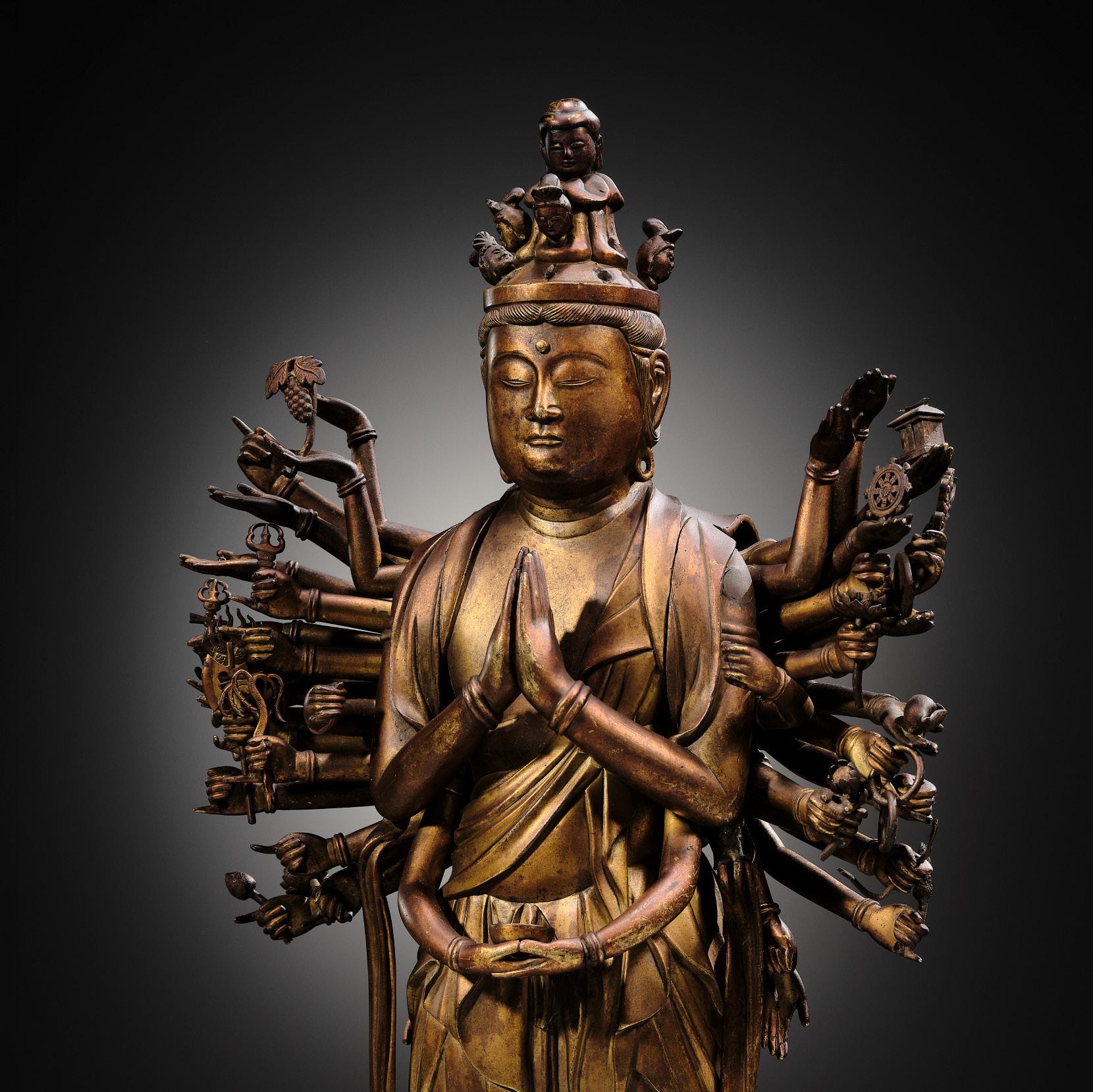
A dating to the late Kamakura to early Muromachi period (14th to mid-15th century) is therefore the most plausible. Later periods, particularly Edo and Meiji, can be excluded on technical grounds, while an earlier dating would require a more archaic and less systematized construction.
Conclusion
This figure represents a high-investment devotional bronze, conceived and executed with exceptional technical and iconographic ambition. Its construction reveals a workshop operating at a sophisticated level, yet still fully embedded in premodern craft logic.
The combination of metallurgical choice, structural ingenuity, and iconographic completeness places it among the more remarkable surviving examples of Japanese Buddhist metalwork of the late medieval period.
The spiritual radiance and introverted calm of the sculpture manifest in a presence of rare intensity. The expression is clear, almost austere, yet never authoritarian – iconic and quintessentially Buddhist. It reflects not only a precious craft, but also a precious state of mind.
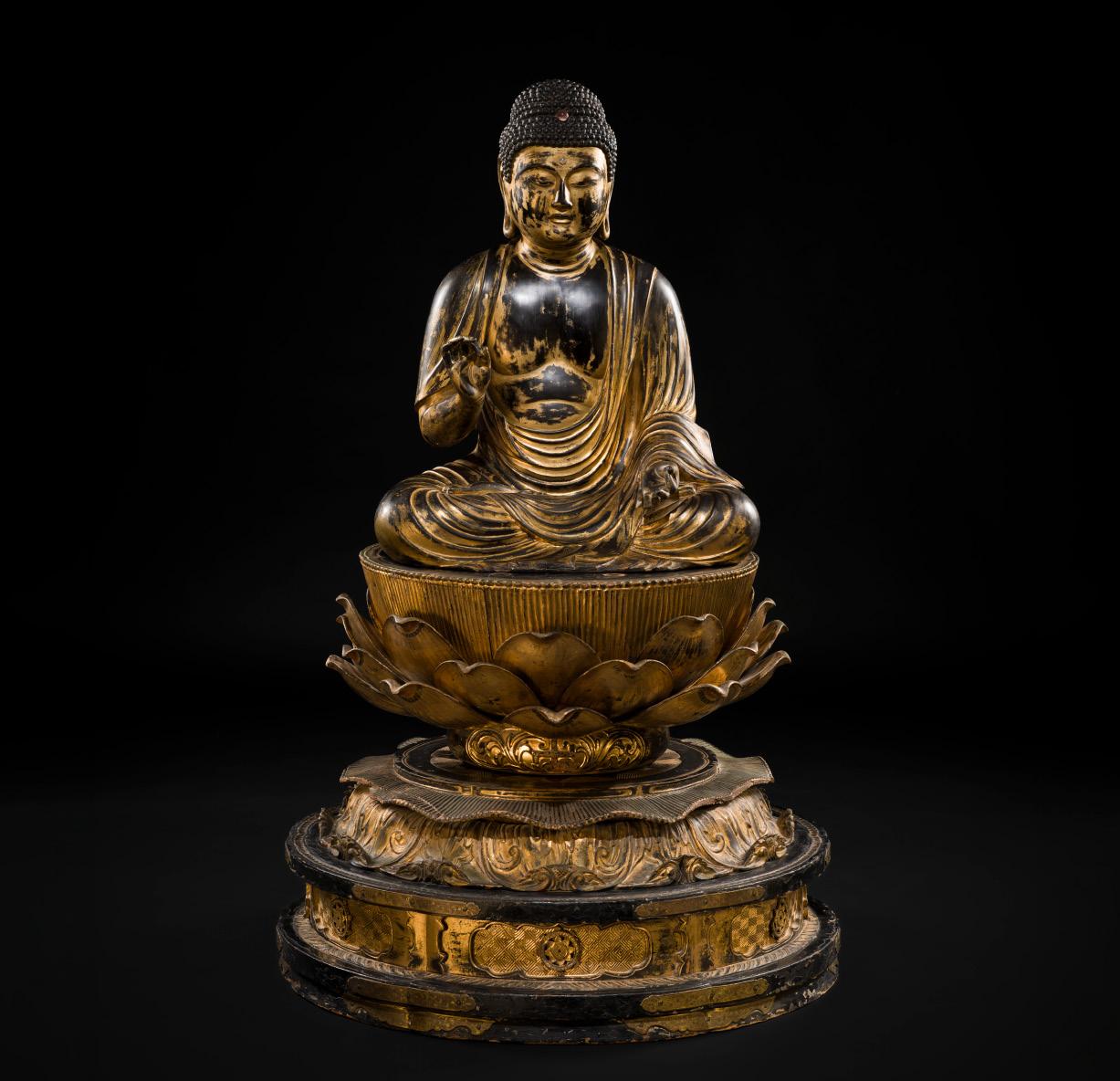
108
A LARGE (100 CM) AND IMPRESSIVE GILT-LACQUERED WOOD FIGURE OF AMIDA NYORAI, MUROMACHI PERIOD
Japan, 14th-16th century, Muromachi period (1333-1573)
Of yosegi (joined) construction and finely carved seated in dhyanasana with his hands held in raigo-in, wearing a loose-fitting monastic robe draped over both shoulders, opening at the chest, and cascading in meticulously carved parallel folds, the serene face sensitively modeled with downcast eyes inlaid with inside-painted crystal, elegantly arched brows centered by a crystal-inlaid byakugo (urna), and full bow-shaped lips forming a subtle smile, flanked by pierced pendulous lobes, the hair arranged in tight curls over the ushnisha with a crystal-inlaid nikkeishu (jewel of wisdom).
Amida sits atop a circular lotus throne with meticulously beaded edge, encircled by large overlapping lotus petals raised on a furled leaf and scrolling petals, supported ona lobed waisted plinth carved with foliate reserves enclosing dharmachakra emblems, and with neatly incised gilt-metal fittings.
HEIGHT 53 cm (the figure), 100 cm (total)
Provenance: From an old French private collection. Condition: Very good, complete condition with expected wear, light warping with associated small gaps between segments, little flaking, some rubbing and losses to lacquer, few minor chips to edges, one petal repaired, minor touchups to lacquer. Presenting beautifully.
Amida was central to the Jodo (Pure Land) sect of Buddhism propounded in 1175 by the monk Honen, with the intent of making Buddhism more readily available to all people. Salvation could be attained by the simple repetition of the name of Amida or the Nenbutsu, of which there were a number of different methods of chanting. Many statues of the Buddha of the Western Paradise were made in response to the widespread popularity of Pure Land Buddhism from the twelfth century. This image is seated with legs crossed in the lotus position with the hands in the gesture (mudra) of ‘welcoming to paradise’ (raigo-in), signaling Amida’s descent from heaven to greet the soul of the faithful devotee at death.
Compare a closely related wood figure of Amida Nyorai, 51.1 cm high, dated to the Muromachi period, 15th century, at Christie’s, 22 September 2020, New York, lot 20 (sold for USD 75,000 or approx. EUR 81,500 converted and adjusted for inflation at the time of writing). Compare a closely related gilt-lacquered wood figure of Amida Nyorai, 53.5 cm high, dated Kamakura-Muromachi period, 12th14th century, at Sotheby’s, 14 June 2024, Paris, lot 138 (sold for EUR 72,000).
Estimate EUR 20,000
Starting price EUR 10,000
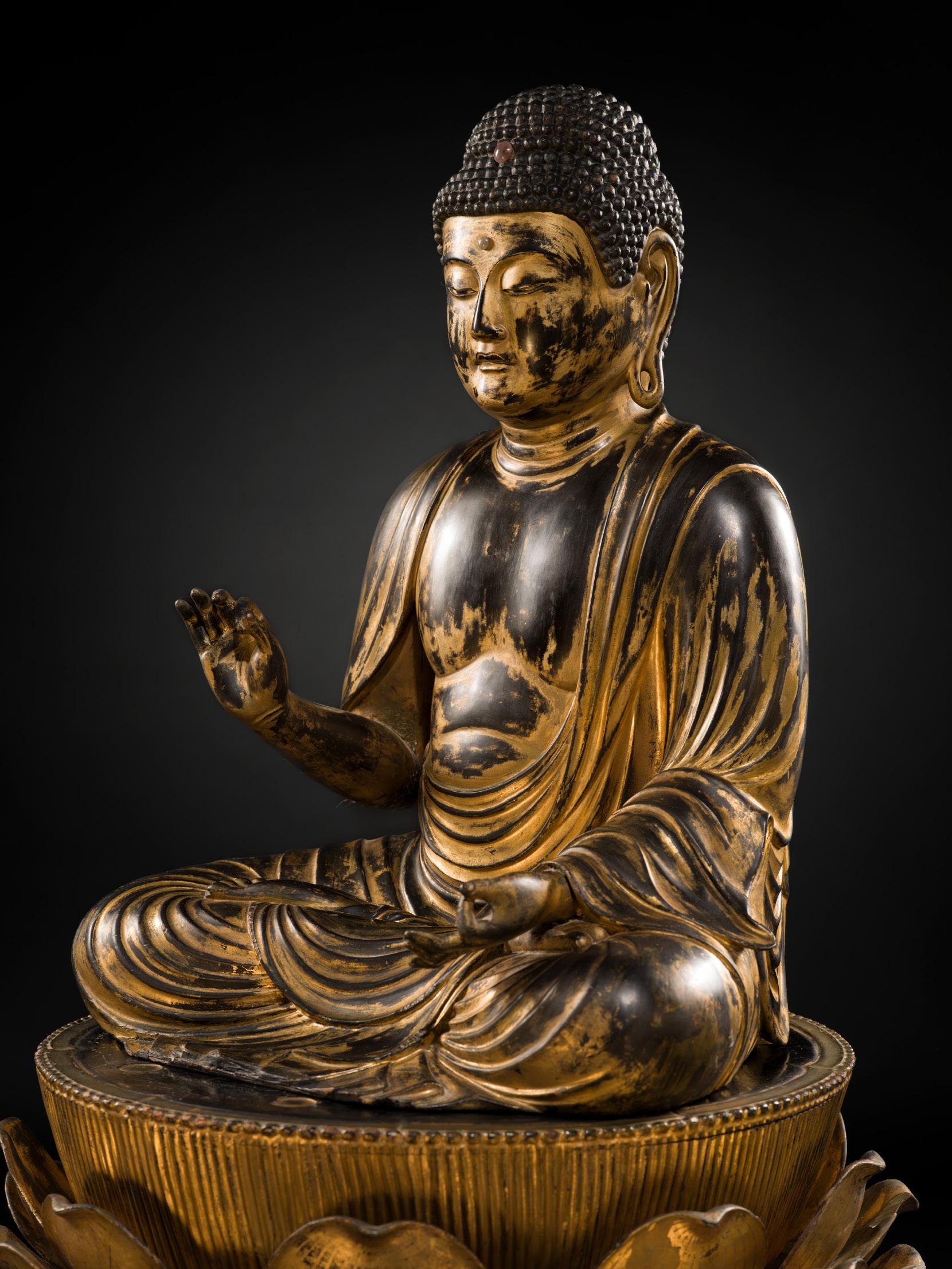
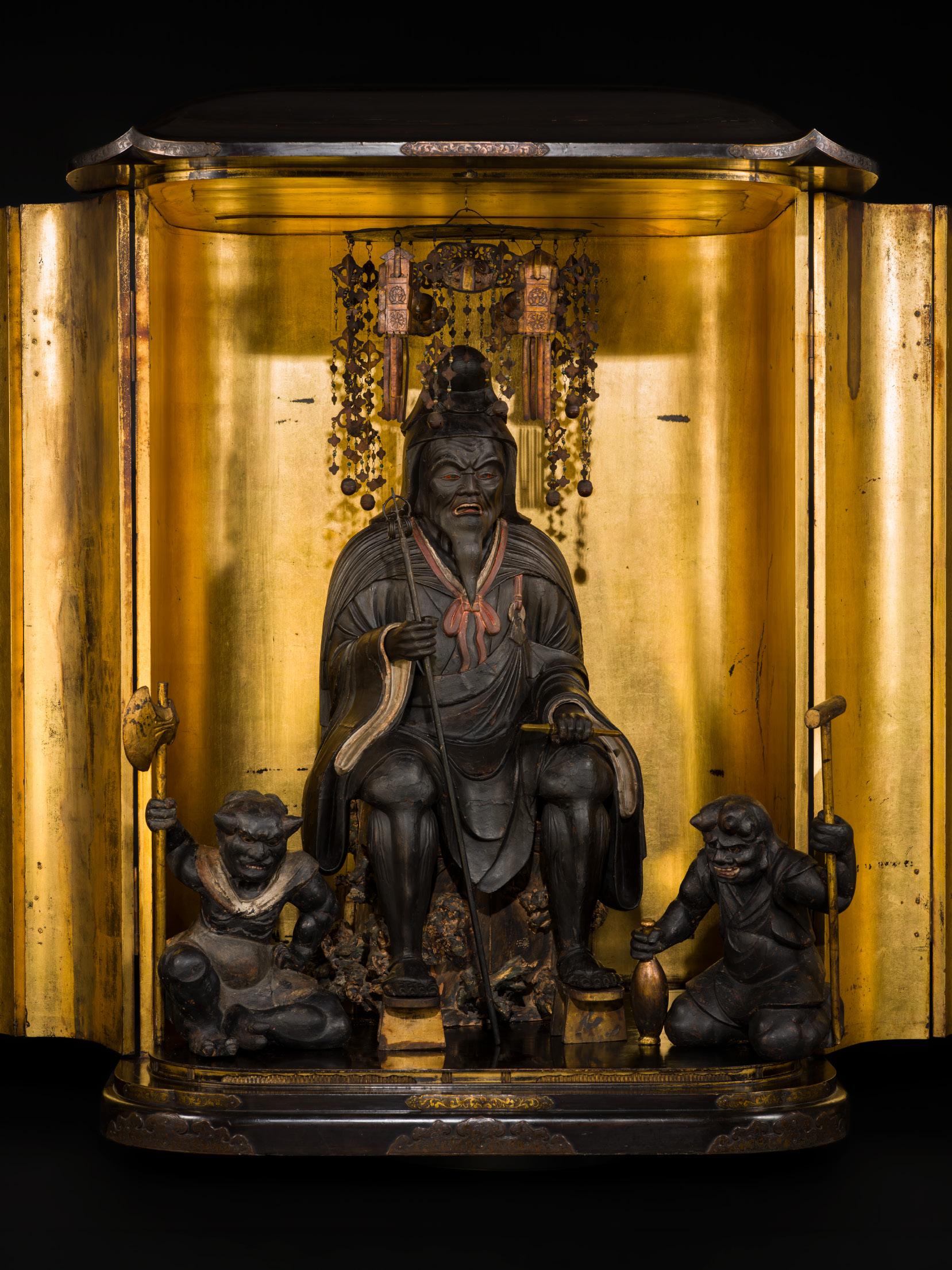
109
A MASSIVE (125 CM) LACQUERED WOOD ZUSHI (PORTABLE SHRINE) WITH EN NO GYOJA AND ATTENDANTS, NANBOKUCHO TO MUROMACHI PERIOD
Japan, the figures 14th-15th century, Nanbokucho (1333-1392) to early Muromachi period (1333-1573), the zushi Edo period (1615-1868)
The massive shrine enclosing En no Gyoja, holding a monk’s staff in the right hand and a ritual knife in the left. He is supported on a rugged rocky base and dressed in pleated robes beneath a cloak of leaves, wearing geta. The figure is surmounted by an elaborate metal headdress suspending tassels with glass beads. His face, with mouth slightly ajar, conveys a hypnotic intensity, with red-painted eyes set behind crystal inlays and a long flowing beard. Flanked by his two oni attendants, Zenki and Goki, both kneeling at his sides— one holding an axe, the other a long mallet. The two attendants also have painted eyes set behind crystal.
The tall shrine (zushi) with double-hinged doors, finished in black lacquer with gilt decoration and fitted with chased copper mounts.
HEIGHT 125 cm (total), 80 cm (the tallest figure)
Provenance: From a private collection in the Netherlands. Condition: Overall good condition and presenting well. With minor wear, some flaking to the lacquer, a few areas of touchup, tiny chips to exposed areas, and insect activity to the rockwork base. The figures may have been re-lacquered. The shrine with light wear, minor warping, small nicks, and tiny chips.
The sculptures are characteristic of the Nanbokucho to early Muromachi period, distinguished by their vivid naturalism and refined carving. The expressive facial modeling, with sharply defined features and intense gazes, is complemented by striking anatomical detail, notably the veins carved in relief along the legs, emphasizing the ascetic’s physical presence.
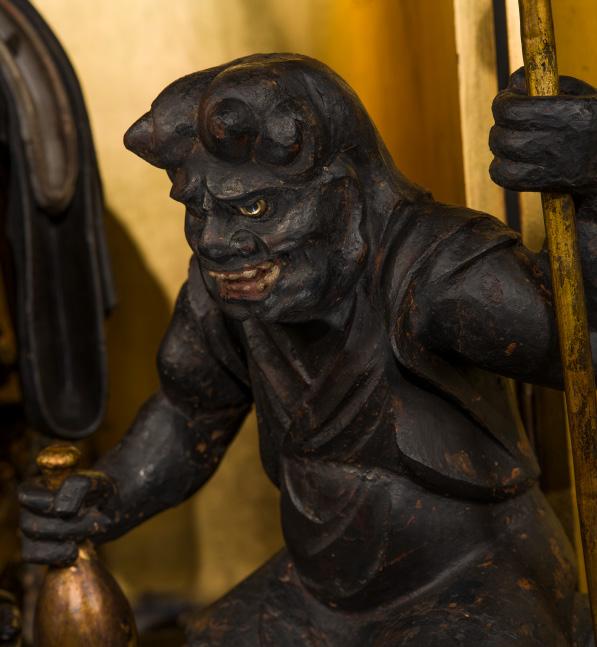
En no Gyoja, regarded as the legendary founder of Shugendo, came to embody the archetypal mountain ascetic, revered for his austerities and spiritual powers. Although traditionally placed in the 7th–8th century, his cult gained particular prominence in the 13th and 14th centuries, when he was increasingly established as the patriarch of Shugendo and represented as a focus of devotion.
MUSEUM COMPARISON
Compare a related triad of En no Gyoka with attendants, dated 1200s, 74.9 cm tall, in the Cleveland Museum of Art, accession number 1975.65. Compare a related polychromed wood sculpture of En no Gyoja, dated c. 1300-1375, 139.6 cm tall, in the Kimbell Art Museum, accession number AP 1984.13.
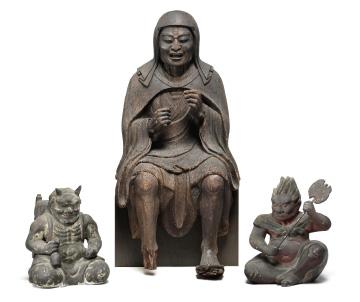
Estimate EUR 15,000
Starting price EUR 7,500
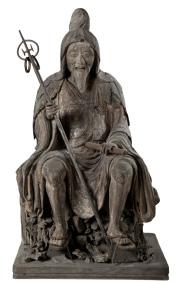
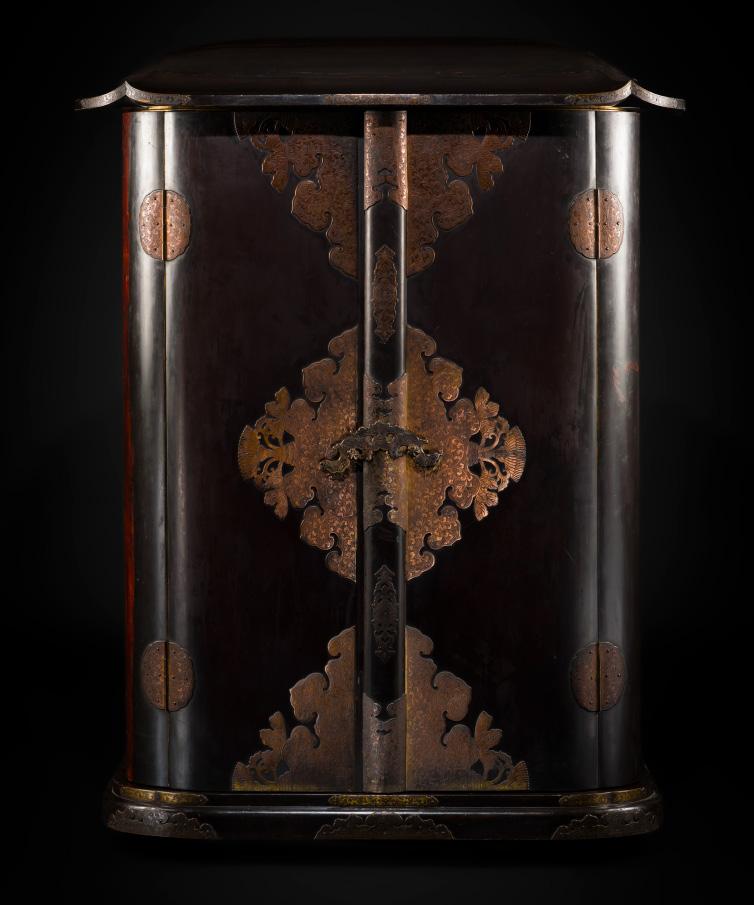
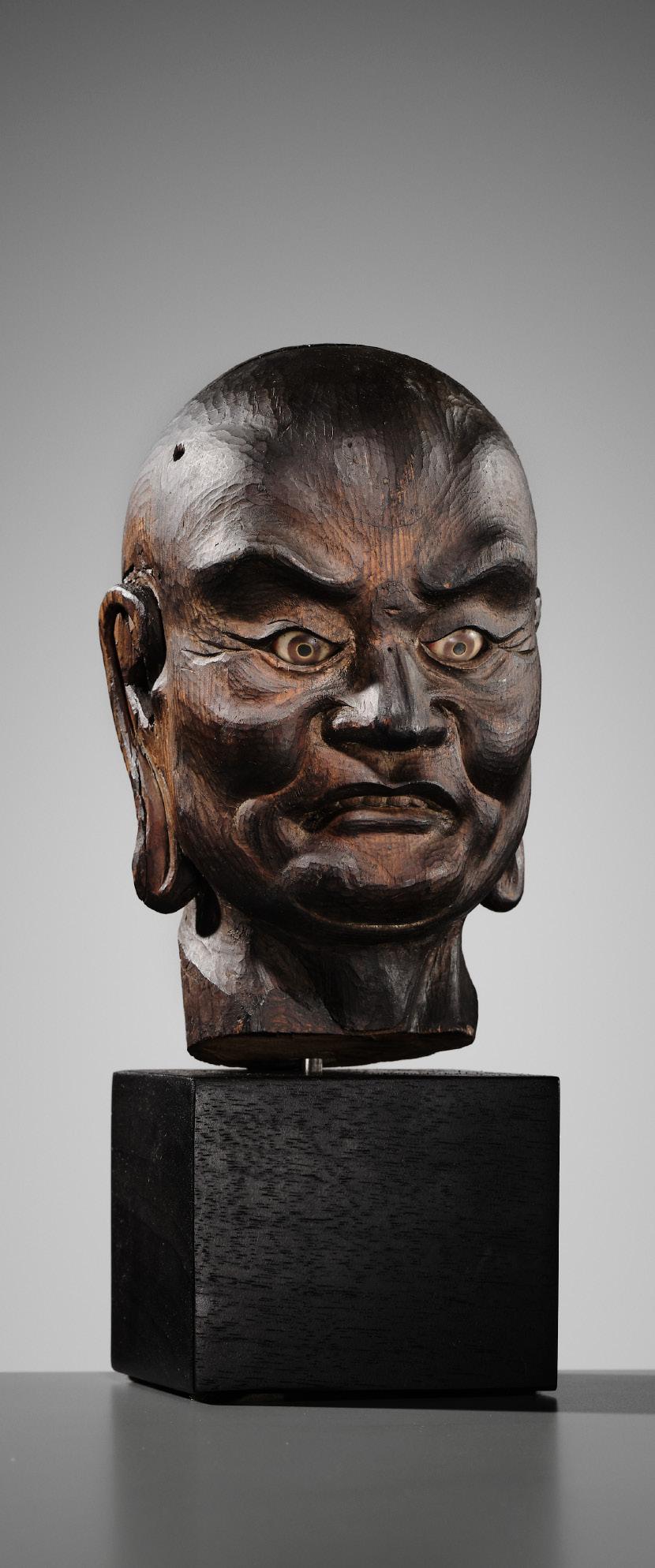
Japan, 14th century, Kamakura period (1185-1333)
From a yosegi-zukuri constructed figure, naturalistically carved as the head of a rakan with elongated earlobes. The face is rendered with striking intensity, its animated expression defined by pronounced musculature and deeply set features, the piercing eyes inlaid in rock crystal with gold-circled pupils beneath expressive brows.
HEIGHT 16.5 cm (excl. stand), 23.5 cm (incl. stand)
Provenance: American private collection, 2009. From an English private collection, acquired from the above.
Condition: Good condition with old wear, some insect activity to the back, tiny losses, few small apertures for mounting.
Mounted to a modern wood presentation stand.
This compelling head once formed part of a larger figure of a rakan (arhat), one of the enlightened disciples of the Buddha who attained liberation and were venerated as exemplars of spiritual discipline. In contrast to the more idealized representations of Buddhas and bodhisattvas, rakans were often depicted with individualized and expressive physiognomies, reflecting their human origins and inner realization. The present example captures this aesthetic with remarkable vitality, the intense gaze and animated features conveying both spiritual power and psychological depth. The use of inlaid crystal eyes would have enhanced the lifelike presence of the sculpture, especially within the dim interiors of temple halls.
Created during the Kamakura period (1185-1333), the work exemplifies the era’s embrace of heightened naturalism and emotional immediacy, influenced in part by contemporary Chinese Song dynasty sculpture. Comparable heads of rakans and attendant figures from this period, characterized by similarly vivid expressions and technical refinement, are preserved in major museum collections. For a related wood head of a Lokapala, fig. 1, (Shi tenno), dated Song dynasty (960-1279), see Bonhams, Fine Chinese Art, 7 November 2019, London, lot 51 (39 cm tall, sold for GBP 68,821 or approx. EUR 104,000 converted and adjusted for inflation at the time of writing).
MUSEUM COMPARISON
Compare a related head of a guardian, dated 13th century, 56 cm tall, in the Brooklyn Museum, accession number 86.21.
Estimate EUR 3,000
Starting price EUR 1,500
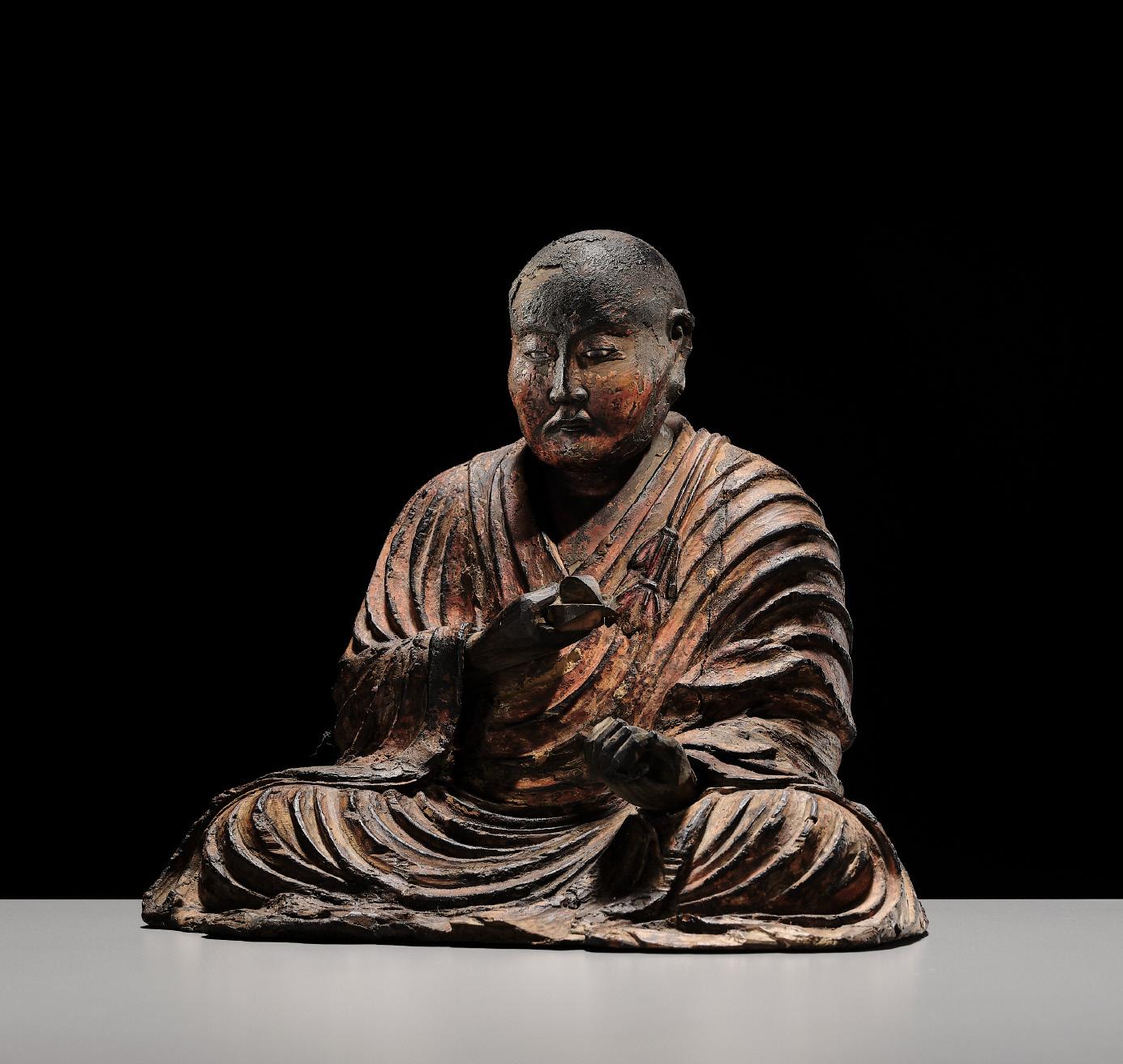
A FINE AND RARE LACQUERED WOOD FIGURE OF KUKAI, MUROMACHI PERIOD
Japan, 14th-16th century, Muromachi period (1333-1573)
Kukai (774-835), posthumously known as Kobo Daishi, was one of the most influential figures in Japanese Buddhism. A monk, calligrapher, and poet, he is best known as the founder of the esoteric Shingon school. He traveled to China, where he studied Tangmi (Chinese Vajrayana Buddhism) under the eminent monk Huiguo. Upon returning to Japan, Kukai established Shingon as the Japanese transmission of esoteric Buddhism, gaining imperial patronage and founding important temple centers. He later chose Mount Koya as his spiritual base, where he spent his final years and where his legacy continues to be venerated.
Kobo Daishi (Kukai), 13th14th century, Kamakura period
The yosegi-zukuri figure is carved seated in a meditative pose, the left hand resting on the knee holding a rosary, and the right hand drawn to the chest clasping a vajra. The head is slightly downcast, with crystal-inlaid eyes and a serene expression, the body draped in robes falling in concentric folds. The surface is attractively lacquered in red and brown tones.
LENGTH 17.6 cm, HEIGHT 15.7 cm
Provenance: From a distinguished London private collection. Condition: Very good condition with expected old wear, some joints with splits, old fills, few chips to edges flaking of the lacquer, and insect activity.
AUCTION COMPARISON
Compare a related larger lacquered wood figure of a seated Buddhist monk, dated 16th-17th century, 47 cm tall, at Bonhams, Fine Japanese and Korean art, 15 March 2017, New York, lot 6151 (sold for USD 10,000 or approx. EUR 11,500 converted and adjusted for inflation at the time of writing).
Estimate EUR 5,000
Starting price EUR 2,400
AN IMPRESSIVE LACQUERED WOOD FIGURE OF FUDO MYO-O (ACALA), NANBOKUCHO PERIOD
Japan, Nanbokucho period (1336-1392)
Carved and assembled from cypress wood in the jointed-wood technique (yosegi) and modeled as Fudo Myo-o seated in dhyanasana with the soft figure of a youth and a fierce facial expression, with menacing eyes inlaid in crystal (gyokugan) with painted pupils, thick furrowed brows, and the fangs biting the lower lip, the hair swept to one side in a braid down the left shoulder, a gilt-metal kurikara (Buddhist sword) held in the right hand and a rope in the left, the robes draped around his waist and over the left shoulder.
HEIGHT 24.4 cm
Condition: Good condition with expected old wear, minor age cracks, light warping with associated fine gaps, minuscule losses, and slightly loose elements, flaking and losses to lacquer, the sword handle reattached.
With a wood storage box (tomobako) with label to the cover inscribed in Japanese, ‘Fudo Myo-o’.
In Esoteric (Shingon) Buddhism, Fudo Myo-o (the Immovable One) is the most powerful of the Five Myo-o (Bright Kings), fierce forms of the Five Wisdom Buddhas, each embodying their power against evil. From at least the 9th century, these Five Myo-o were revered collectively in Japan, with Fudo often depicted as the central figure. He also served as the primary icon in the Goma-do hall of Shingon temples.
Fudo Myo-o is worshiped as a wrathful manifestation of Dainichi, the Buddha at the heart of the Buddhist cosmos. A tenacious protector of Buddhist teachings, Fudo is armed with a lasso and sword to subdue negative forces. In keeping with scriptural descriptions, this example portrays a full-bodied, menacing figure biting his lower lip, with his hair bound and falling over his left shoulder.
MUSEUM COMPARISON
Compare a closely related larger wood figure of Fudo Myo-o, dated Kamakura period, 13th century, 41.6 cm high, in the Art Institute of Chicago, reference number 1958.321. AUCTION COMPARISON
Compare a closely related polychrome wood figure of Fudo Myo-o, dated KamakuraNanbokucho period, 14th century, 28.8 cm high, together with a base and flame nimbus described as “possibly original to the sculpture”, at Bonhams, Fine Japanese Works of Art, 16 March 2016, New York, lot 3024 (sold for USD 75,000 or approx. EUR 89,000 converted and adjusted for inflation at the time of writing).
Estimate EUR 15,000
Starting price EUR 7,500
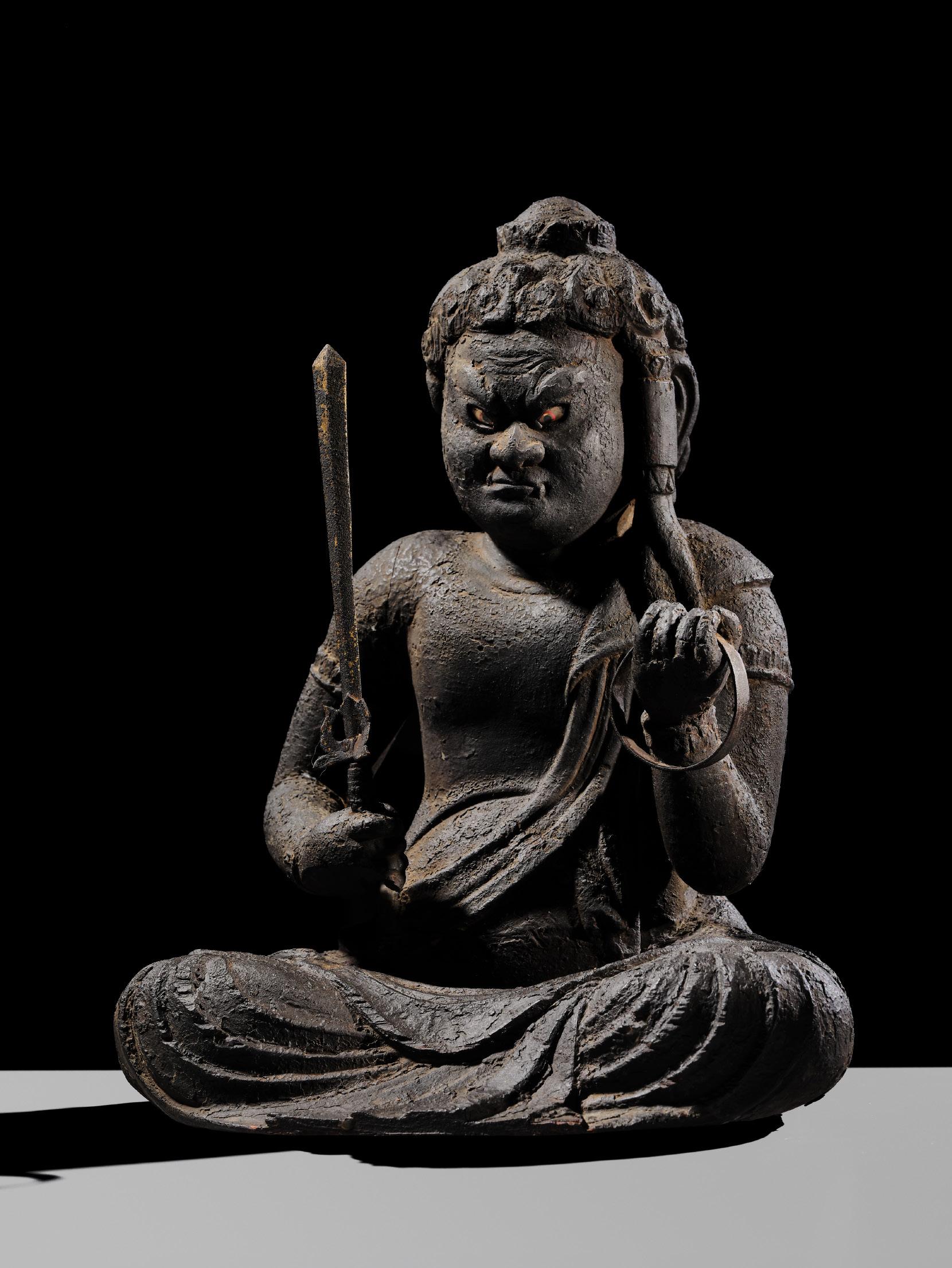
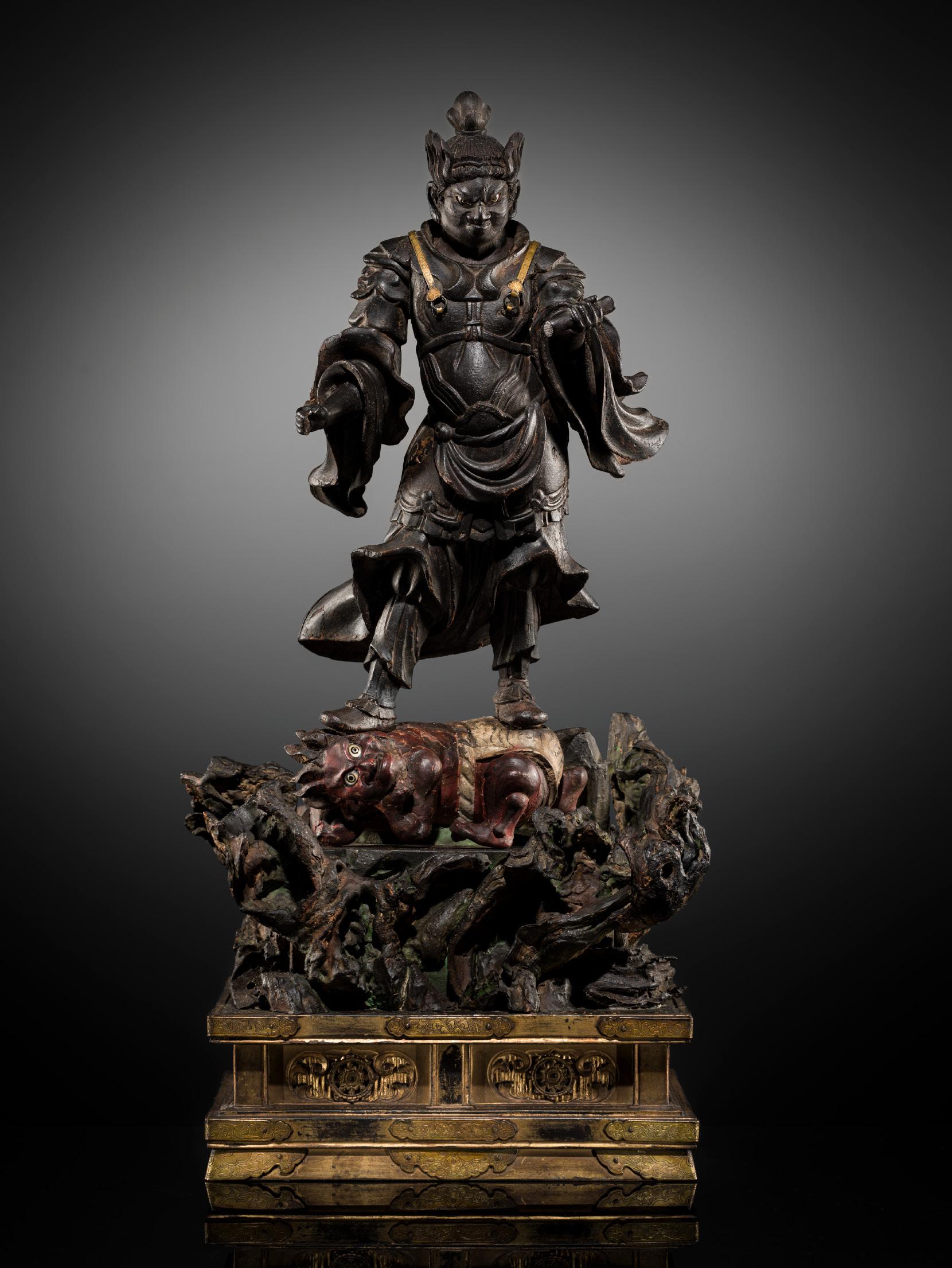
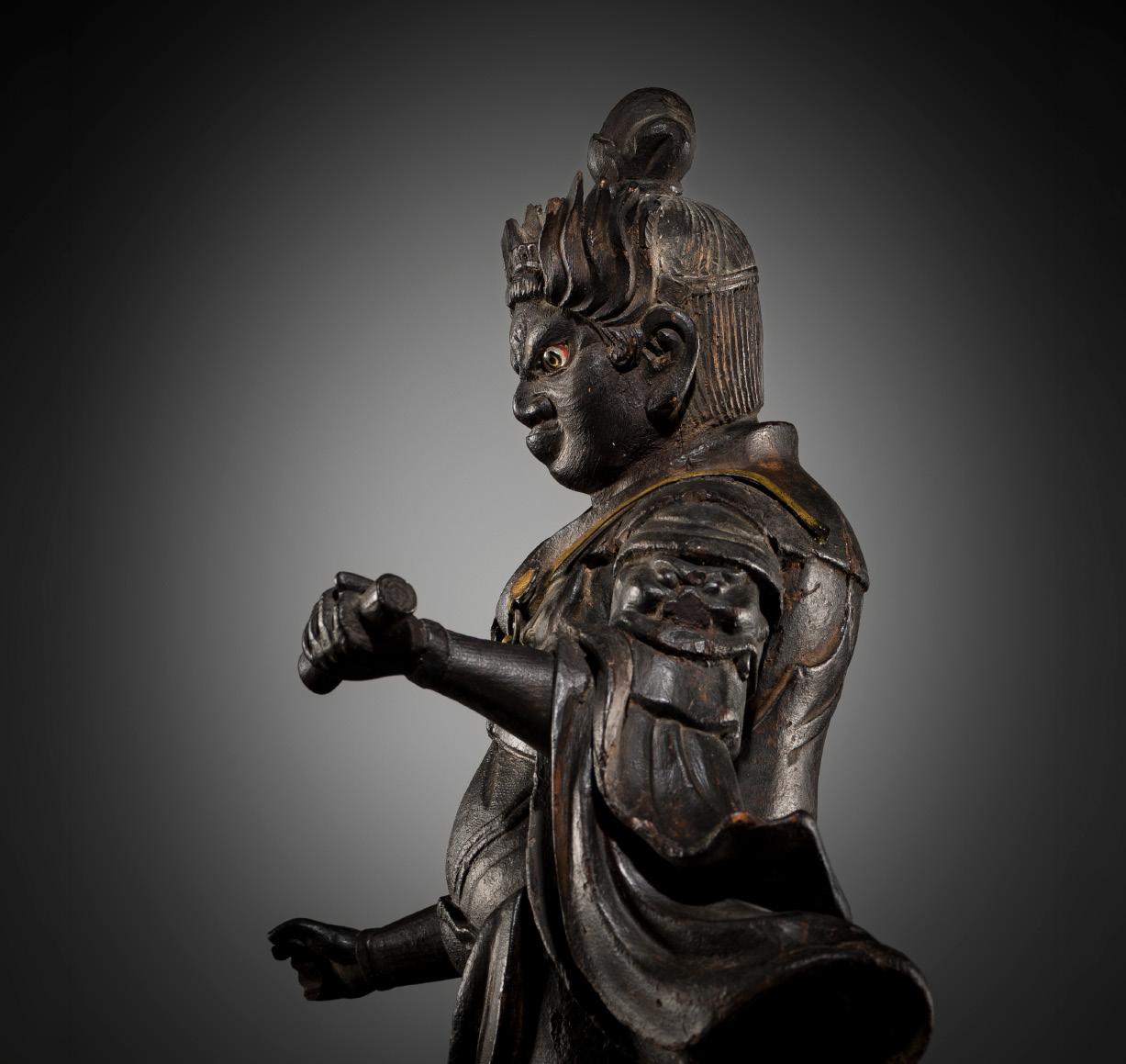
113
A LARGE POLYCHROME WOOD FIGURE OF KOMOKUTEN (VIRUPAKSHA), THE GUARDIAN KING OF THE WEST, MUROMACHI PERIOD
Japan, 14th-16th century, Muromachi period (1333-1573)
Of yosegi (joined) construction, finely carved and richly painted to depict Komokuten standing in dynamic pose atop a prostrate demon on a wave-form base raised on a waisted square plinth with foliate panels enclosing dharmachakras and foliage-incised gilt-metal fittings. The Guardian King is clad in armor secured with a belt at the waist and a pair of gilt-metal shoulder straps, and holds a sutra scroll in his left hand. His face with a menacing expression marked by intensely staring eyes inlaid in crystal with painted pupils, the hair pulled up into a high chignon.
HEIGHT 67.8 cm
Provenance: From an old private collection in Ticino, Switzerland. Condition: Overall good condition with expected wear, minor age cracks, little flaking and small losses to lacquer, some elements reinforced, few minor repairs to the base and one leg.
Komokuten (Virupaksha) is one of the Shitenno or Four Guardian Kings, mighty protectors of the Buddhist law. The Shitenno’ origins are in Hindu traditions and were adopted into the Buddhist pantheon as subjugators of Buddha’s enemies. With their transmission into East Asian Buddhist teachings, their appearance took on a martial quality and their iconography included armor, weapons, and fearsome expressions.
In temple halls where sculptural arrangements were set up to emulate Sumeru, the Buddhist cosmic mountain, the Shitenno were placed at the four corners surrounding and protecting the central Buddhist sculptures in the configuration. Komokuten guards the west. In Japan, the status of the Shitenno was further elevated to include protection of the nation.
Compare a closely related lacquered wood figure of Zochoten, dated to the Nanbokucho period, 14th century, the figure 83 cm high, the base 25.4 cm high, at Christie’s, Japanese & Korean Art, 24 March 2010, New York, lot 594 (sold for 47,500 USD or approx. EUR 62,000 converted and adjusted for inflation at the time of writing).
Estimate EUR 8,000
Starting price EUR 4,000
Japan, 14th-15th century, Muromachi period (1333-1573)
This remarkable wooden figure of Aizen Myo-o is carved with polychrome pigments, predominantly in rich reds, and gilded in select areas. The deity is depicted with six arms, the lower arms holding a five-pronged vajra (diamond, symbolizing the cutting through of illusions) and a ritual bell (calling one to awareness). The other hands grasp a bow and arrow as well as an unopened lotus flower, symbolizing the power of subjugation. The headdress is ornate, crafted from metal and adorned with several glass beads, while a snarling shishi (lion-dog) sits atop, painted in blue and green pigments. Aizen is seated in lotus position on a lotus pedestal, which sits upon a multi-stepped base, wrapped with a ribbon.
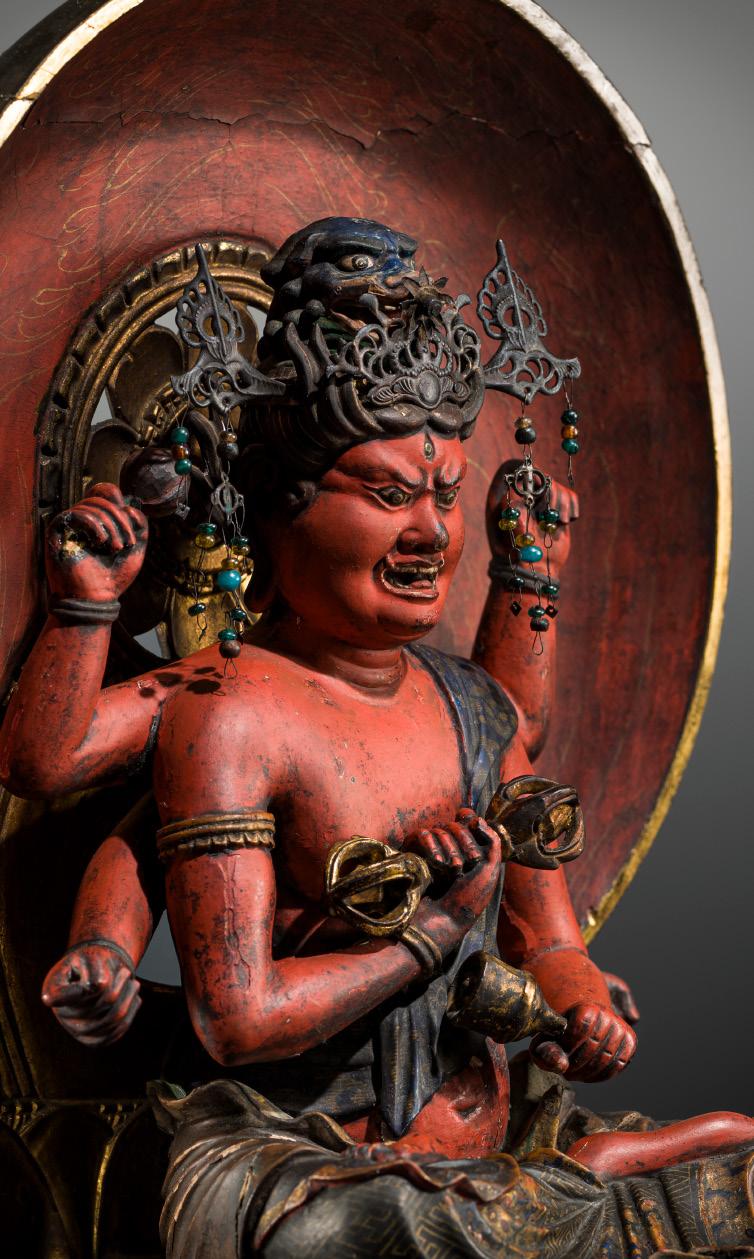
The folds of his garments are expressive and decorated with a finely rendered brocade pattern. Surrounding the deity is a large mandorla, intricately painted with a pattern that further emphasizes the divine nature of the figure. Aizen’s facial expression is fierce, with his mouth open, baring his teeth, while his hair is depicted as wild and flaming, symbolizing his embodiment of rage, lust, and passion.
HEIGHT 24.5 cm (the figure) and 48 cm (total)
Provenance: From an Austrian private collection. Zacke, Fine Chinese Art, Japanese and Buddhist Art, 8 December 2018, Vienna, lot 223 (sold for EUR 24,016). A noted private collection, acquired from the above.
Condition: Excellent overall condition with expected wear, presenting exceptionally well. The base and mandorla show only a few minor repairs. Remarkably, the red paint remains almost entirely original, which is quite rare for figures of this type, with only a few minor touchups throughout.
Aizen Myo-o (Sanskrit: Ragaraja), translatable as ‘Lust-tainted Wisdom King’, is a wrathful embodiment of Buddha, whose purpose is to teach through fear by warning against the depravity of earthly desires. Introduced to Japan in the 9th century, the Esoteric Wisdom Kings were originally Hindu deities, later adopted into the Buddhist pantheon, each emphasizing the expulsion of a particular form of degeneracy.
While Aizen Myo-o’s startling appearance was meant to directly warn the viewer against passion and lust, artistic renditions of the deity in Japan were typically hidden objects, used for consultation and intercession by only a few select monks, giving lay people little or no access to Aizen’s image. However, as his imagery became more popularly available over time, there was a change of focus – during the Edo period when, ironically, Aizen became venerated as the patron of prostitutes and brothel owners – subverting his profound Shingon meaning for satirical purposes.
MUSEUM COMPARISON
Compare a closely related wood figure of Aizen Myo-o, dated 14th-15th century, 73 cm tall, in The British Museum, museum number 1885,1227.27.
AUCTION
COMPARISON
Compare a closely related gilt and polychromed wood figure of Aizen Myo-o, dated to the 15th century, 69.3 cm tall, at Bonhams, Fine Japanese and Korean Art, 15 March 2017, New York, lot 6158 (sold for USD 20,000 or approx. EUR 23,000 converted and adjusted for inflation at the time of writing).
Compare a closely related gilt and polychromed wood figure of Aizen Myo-o, dated 14th-15th century, at Zacke, Fine Japanese Art, 6 December 2024, Vienna, lot 157 (sold for EUR 23,400).
Estimate EUR 25,000
Starting price EUR 12,000
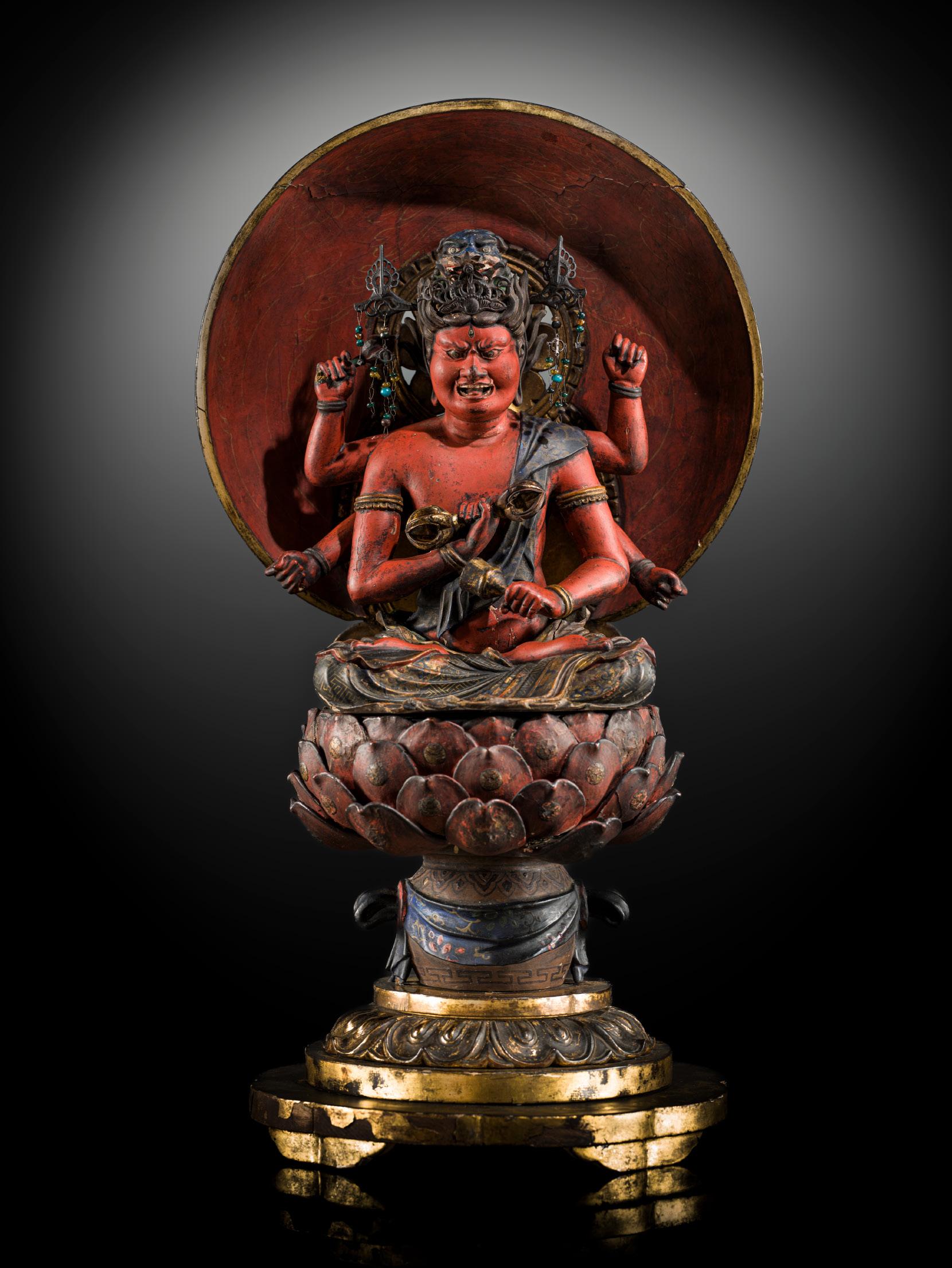
A GILT AND POLYCHROME WOOD FIGURE OF KONGOYASHA MYO-O (VAJRAYAKSHA), MUROMACHI PERIOD
Japan, 16th century, Muromachi period (1333-1573)
Finely carved, the six-armed deity holding a vajra and bell of giltlacquered wood in his main hands and a sword, staff, and bow in his secondary hands, dressed in a billowing scarf and loose-fitting robes, his chest and head adorned with intricately pierced gilt-metal jewelry, the crown with triratna and dharmachakra, suspending numerous small beads.
His three faces each with menacing expression, boldly modeled and neatly painted, below the flaming hair, backed by a gilt-lacquered circular halo applied with metal flames. The guardian king stands atop a rockwork base supported on a gilt-lacquered lobed square plinth carved to the waist with shaped reserves enclosing rinzu diaper.
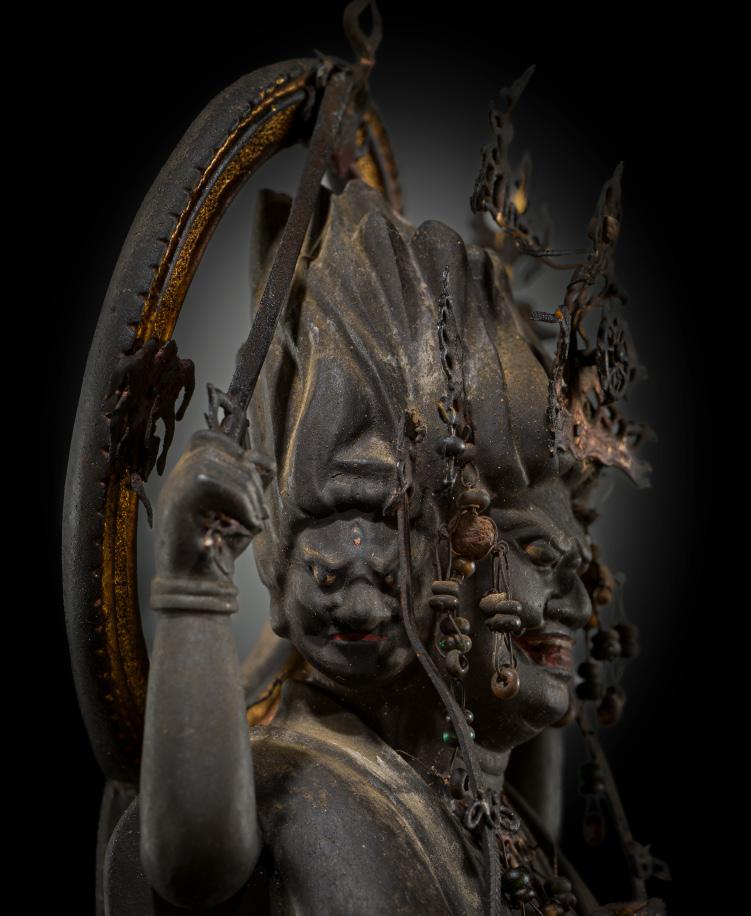
HEIGHT 31 cm
With an associated Japanese wood stand.
Provenance: From an old Japanese collection. Condition: Very good condition with expected wear, minor flaking to lacquer mostly to base, few losses to attributes and the metal appliqués especially well preserved.
Kongoyasha Myo-o (Sanskrit: Vajrayana) is one of the Five Great Guardian Kings in Esoteric Buddhism. His ferocious aspect is a manifestation of the wrath of the Five Wisdom Buddhas against evil. Kongoyasha Myo-o is presented with three faces, five eyes, and six arms, with each hand holding one of his attributes: a wheel, an arrow, a bow, a sword, a tri-pronged vajra, and a vajra bell. Introduced from China by Kobo Daishi (774-836), a founder of Shingon Esoteric Buddhism, the Five Great Guardian Kings became an important ritual icon, called upon as protectors of the nation during the Ninnokyo ceremony (Sutra of the Benevolent Kings), which was performed on special occasions.
LITERATURE COMPARISON
Compare a related, earlier, larger wood figure of Kongoyasha Myo-o, dated to the Heian period, in the Toji Temple in Kyoto.
AUCTION COMPARISON
Compare a related polychrome wood figure of a standing Fudo Myo-o, dated to the Muromachi period, 16th century, 35 cm high, at Christie’s, 22 September 2004, New York, lot 229 (sold for USD 7,767 or approx. EUR 11,500 converted and adjusted for inflation at the time of writing).
Estimate EUR 10,000
Starting price EUR 5,000
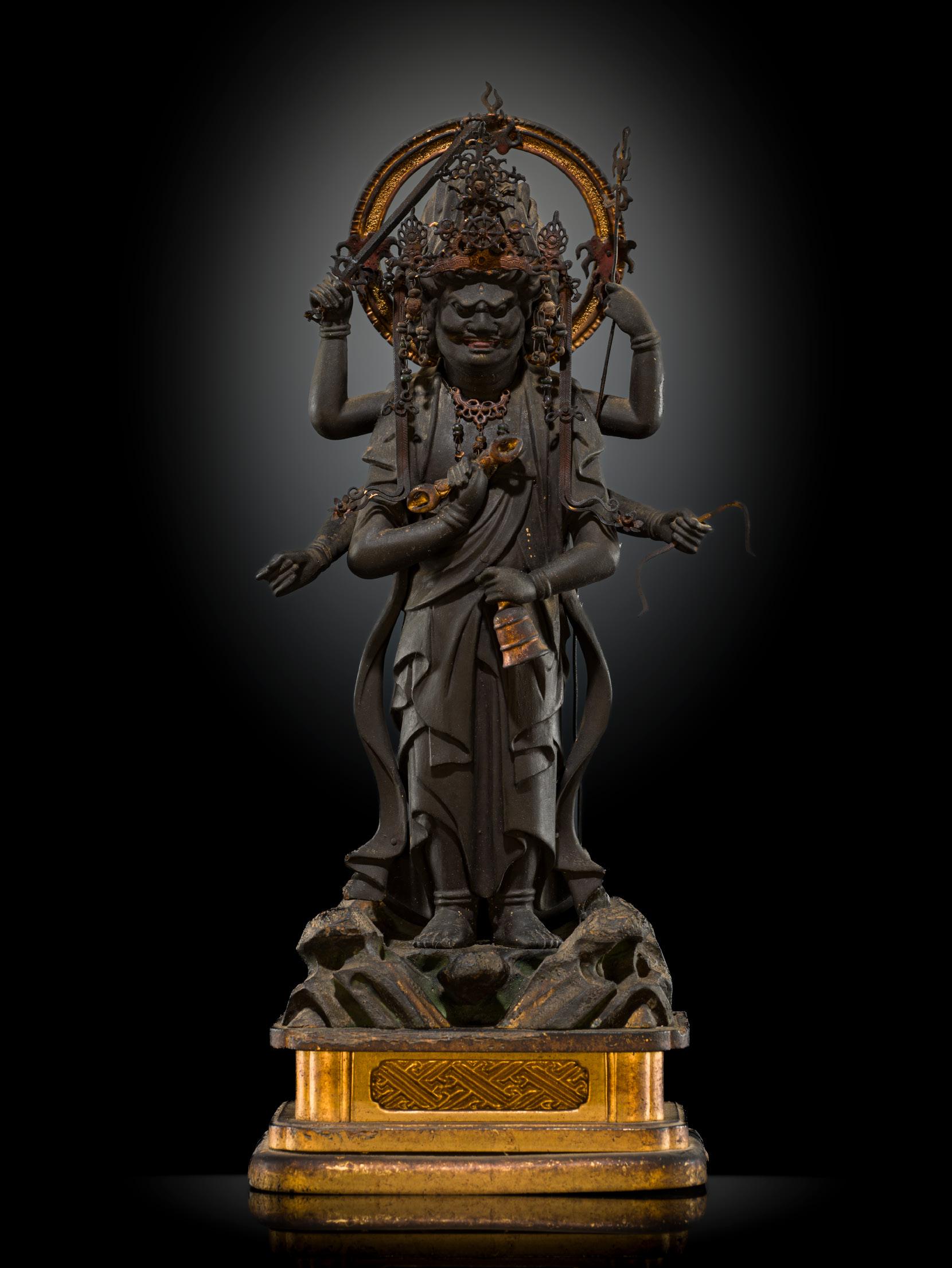
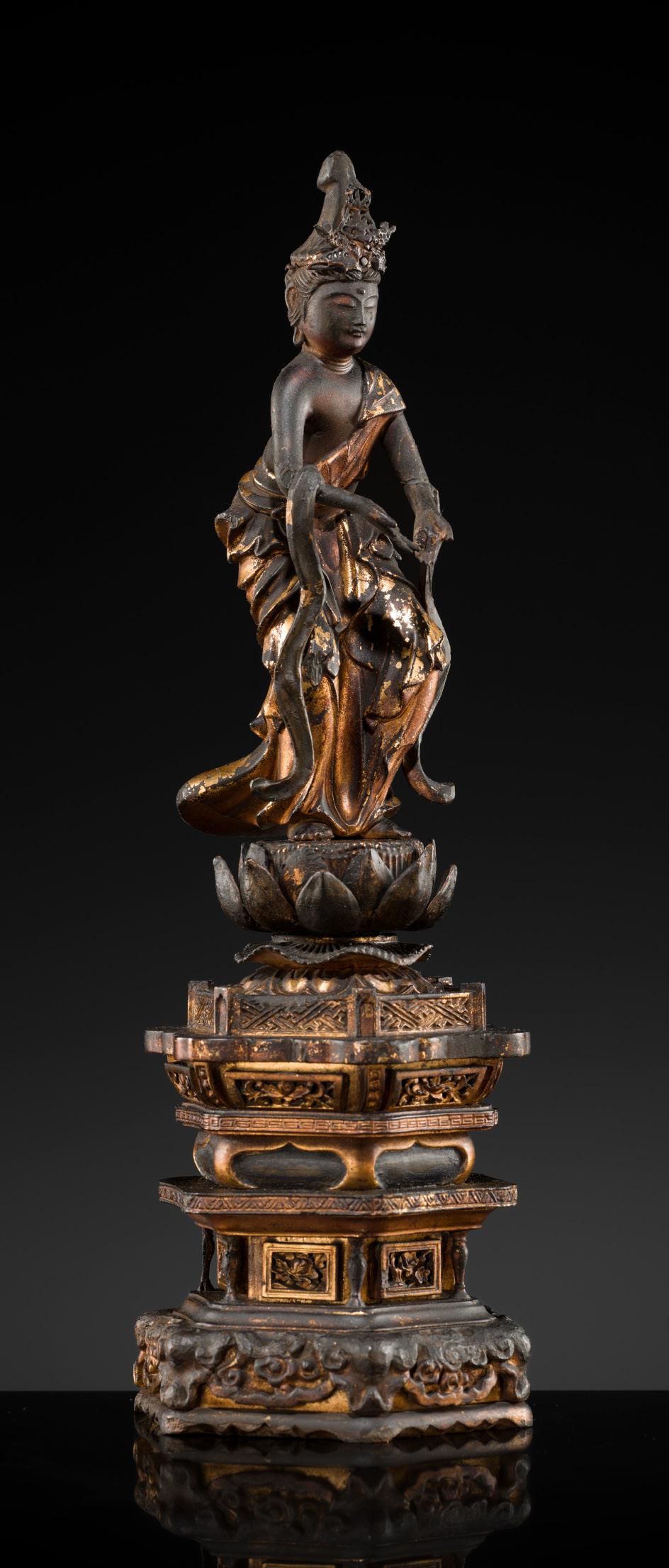
Japan, 16th century, Muromachi period (1333-1573)
Finely carved standing in a graceful pose with the knees slightly bent and the body leaning forward, the arms extended with upturned hands, dressed in a loose-fitting robe cascading in richly carved folds, the serene face with heavy-lidded eyes, elegantly arched brows, and bow-shaped lips, the hair arranged in a high chignon behind the pierced metal tiara.
The bodhisattva stands on a circular lotus pedestal with leaf-form waist, waisted on an elaborate tiered hexagonal plinth with brocade-patterned balustrade, openworked floral panels, key-fret and zig-zag bands, and thick scrolling clouds.
HEIGHT 34.8 cm
Provenance: Yamanaka & Co., Ltd., Kyoto, by 1980. Copies of a certificate and invoice from Yamanaka, signed by manager T. Shiomi, dated 8 and 10 October 1980 respectively, each confirming the dating above, the latter stating a price for the present lot of JPY 460,000 or approx. EUR 3,700 (converted and adjusted for inflation at the time of writing), accompany this lot.

Condition: Overall good condition, consistent with age. Wear, flaking and losses to lacquer gilding, few minute losses, old repairs and touchups, remnants of varnish.
AUCTION COMPARISON
Compare a related larger wood figure of Seishi Bosatsu, dated to the Muromachi period, 77 cm high, at Lempertz, 6 December 2019, Cologne, lot 1 (sold for EUR 11,160 or approx. EUR 13,500 adjusted for inflation at the time of writing).
Estimate EUR 3,000
Starting price EUR 1,500
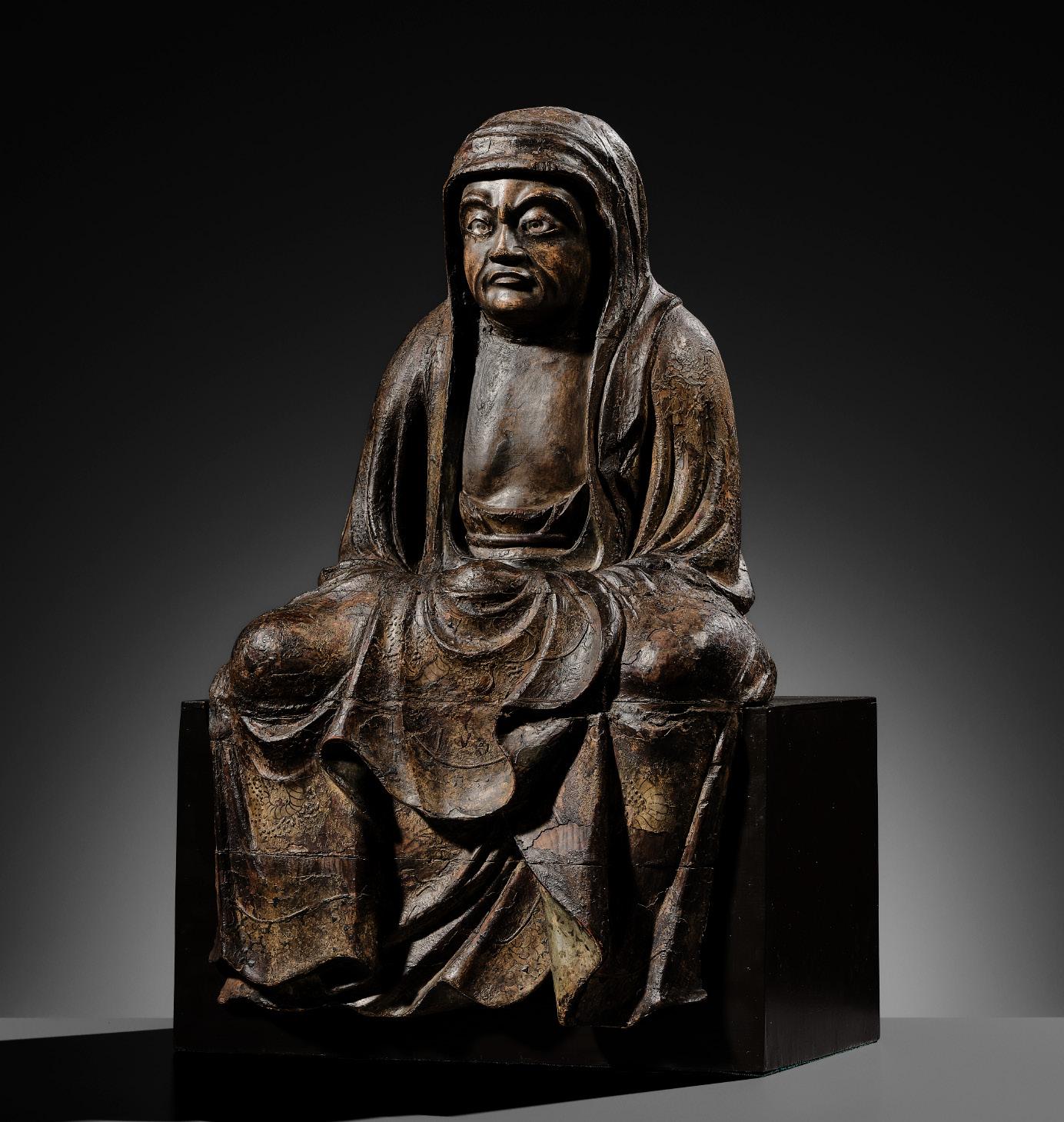
A LACQUERED WOOD FIGURE OF DARUMA, 16TH CENTURY
Japan, 16th century, late Muromachi (1333-1573) to Momoyama period (1573-1615)
Of yosegi (joined) construction, well carved to depict Daruma (Bodhidharma) seated in dhyanasana, the Zen patriarch enveloped in a monastic robe opening at the chest and cascading in richly carved folds, finely decorated in gold lacquer with dragons, his square face finely modeled with intensely gazing, realistically worked eyes inlaid with inside-painted crystal (gyokugan).
HEIGHT 48 cm
Provenance: Algemeene Ethnografica- en Kunsthandel Aalderink, Amsterdam, by 1978. A distinguished private collection in London, United Kingdom, acquired from the above. A copy of the invoice from Aalderink, dated 18 April 1978, confirming the dating above,
and stating a purchase price for the present lot of NLG 11,000 or approx. EUR 16,000 (converted and adjusted for inflation at the time of writing), accompanies this lot.
Condition: Good condition with expected old wear, minor age cracks, light warping with associated fine gaps, minuscule losses, and slightly loose elements, some reinforced, flaking and losses to lacquer.
AUCTION COMPARISON
Compare a closely related wood figure of Bodhidharma, dated to the 15th-16th century, 36 cm high, at Christie’s, Japanese and Korean Art, 17 September 2009, New York, lot 1054 (sold for USD 10,000 or approx. EUR 13,000 converted and adjusted for inflation at the time of writing).
Estimate EUR 6,000
Starting price EUR 3,000
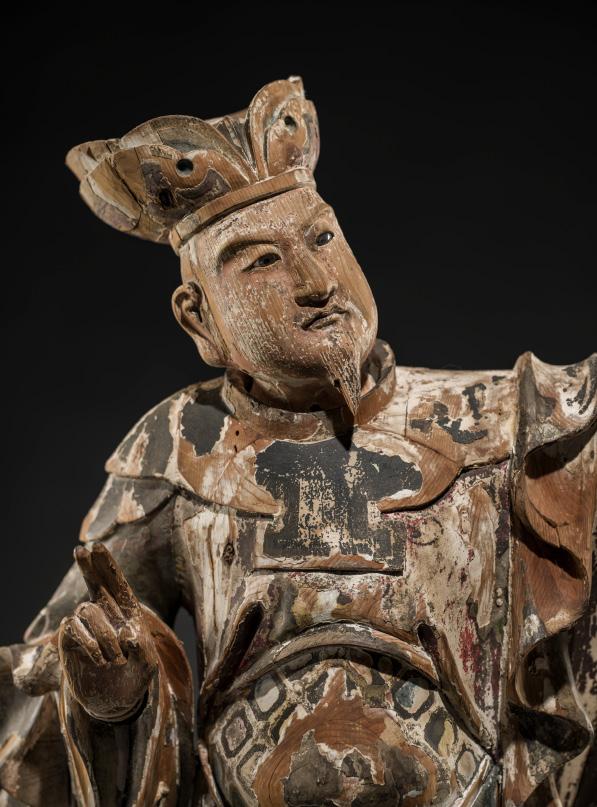
118 A PAIR OF LARGE (74 CM) EXCEPTIONAL POLYCHROME WOOD FIGURES OF CELESTIAL ATTENDANTS, NANBOKUCHO TO MUROMACHI PERIOD
Japan, 14th-16th century, Nanbokucho (1336-1392) to Muromachi period (1336-1573)
Each finely carved in wood and elaborately decorated in polychrome, the figures depict a pair of celestial figures standing in mirror image. Both are dressed in voluminous, layered robes of distinctly Chinese courtly type, with wide sleeves cascading in rhythmic folds and gathered across the body in bold, angular drapery. The structured treatment of the garments imparts an almost armor-like presence, suggesting rank and authority. One hand is raised in a gesture of address or command, enhancing the sense of animation and interaction. Their bearded faces are sensitively modeled, one with more gaunt features, the expressions individualized, and both with crystal-inlaid eyes. Their heads are surmounted by tall, mitre-like crowns, reinforcing their elevated and formal character.
HEIGHT 74 cm and 74.5 cm
Condition: Very good condition with expected wear, minor age cracks, flaking and losses to pigments, few minor losses, scattered chips.
These striking figures reflect the enduring dialog between Japanese medieval sculpture and continental models The voluminous robes, with their broad sleeves and layered construction, are derived from Chinese court dress, long associated with status and authority and widely adopted in East Asian Buddhist imagery to denote celestial or attendant figures.
During the Nanbokucho and Muromachi periods, Japan maintained active cultural exchange with Yuan and Ming China, particularly through Zen temple networks that facilitated
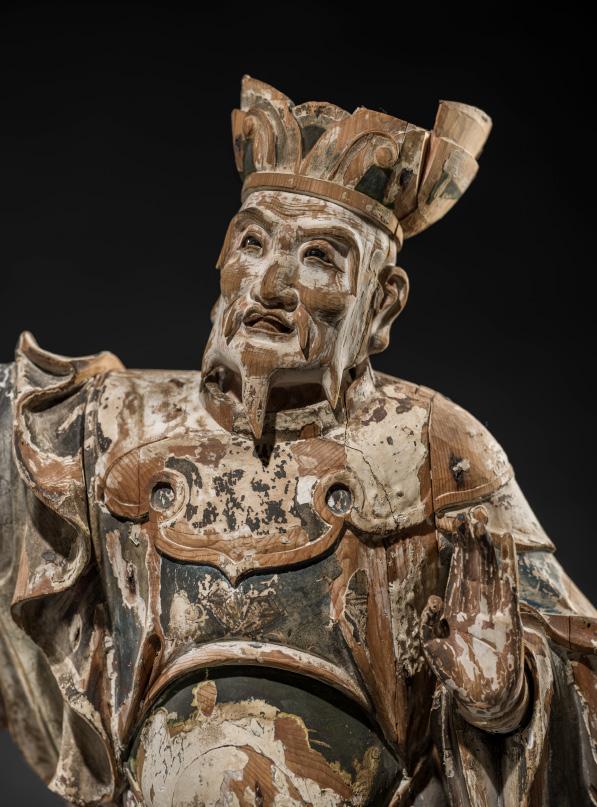
the transmission of paintings, objects, and visual ideas. Within this context, continental figural types were adapted and reinterpreted by Japanese sculptors. The present figures exemplify this process: while their costume preserves the formal language of Chinese court attire, their carving is markedly more animated, with exaggerated movement in the sleeves and a heightened sense of gesture, as well as typical crystal-inlaid eyes.
MUSEUM
COMPARISON
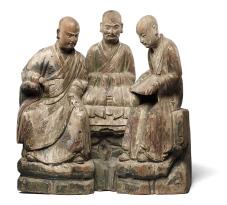
Compare a related wood polychrome wood figure of the Utteno (King of Khotan), Important Cultural Property, dated 1273, the figure dressed in similar robes and with a similar crown, in the Tokyo National Museum, collection reference no. C-1854-2. Compare a related polychrome wood group of three seated luohans, illustrating the connection between Japan and China discussed in the lot essay above, dated Ming dynasty (13681644), 56.5 cm high, in The Metropolitan Museum of Art, New York, object number 1995.417.
AUCTION COMPARISON
Compare a related polychrome wood figure of Anila, dated Nanbokucho-Muromachi period, 14th-15th century, 51.1 cm high, at Christie’s, 22 April 2015, New York, lot 11 (sold for USD 35,000 or approx. EUR 42,000 converted and adjusted for inflation at the time of writing).
Estimate EUR 15,000
Starting price EUR 7,500
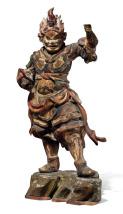
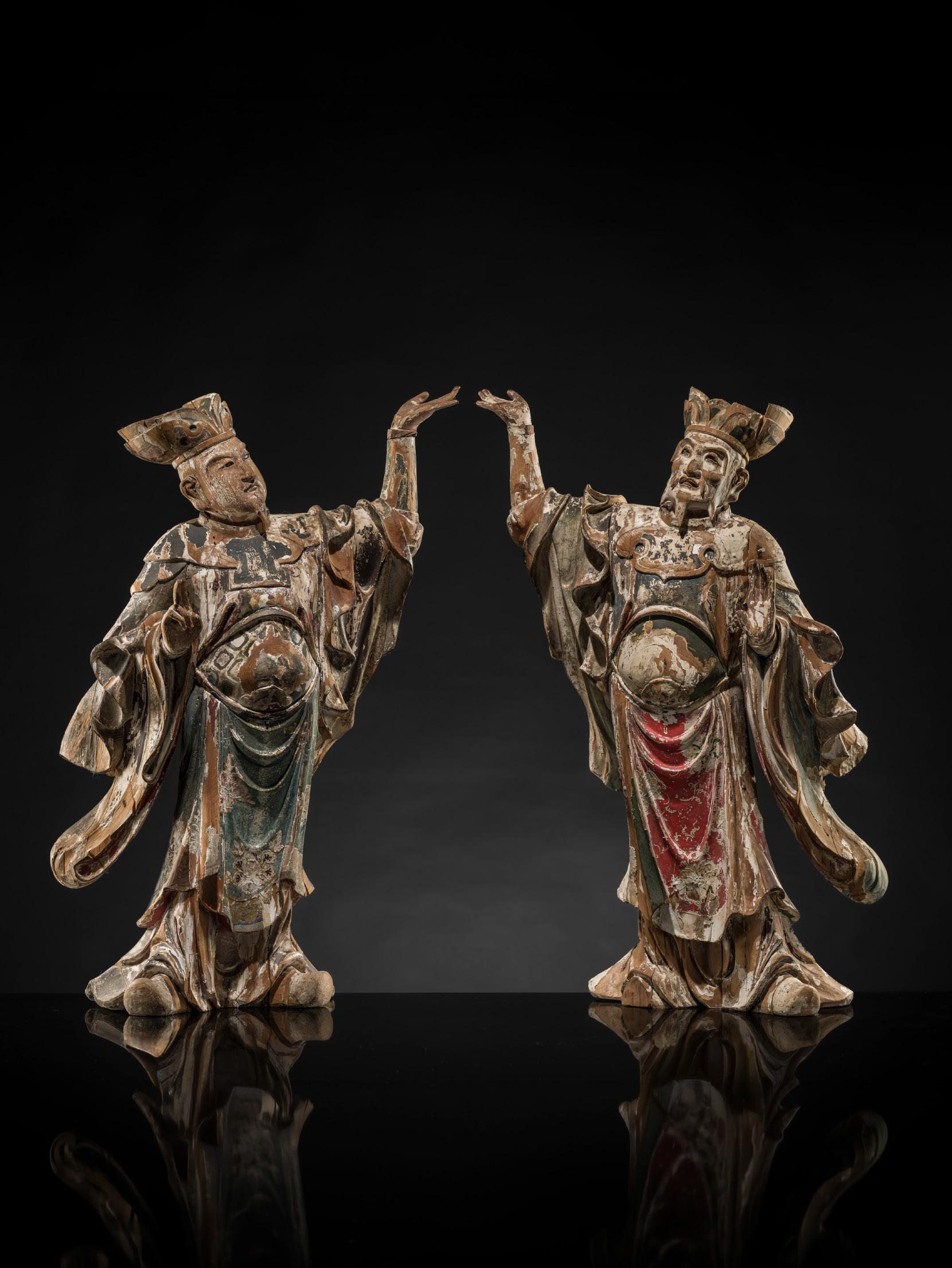
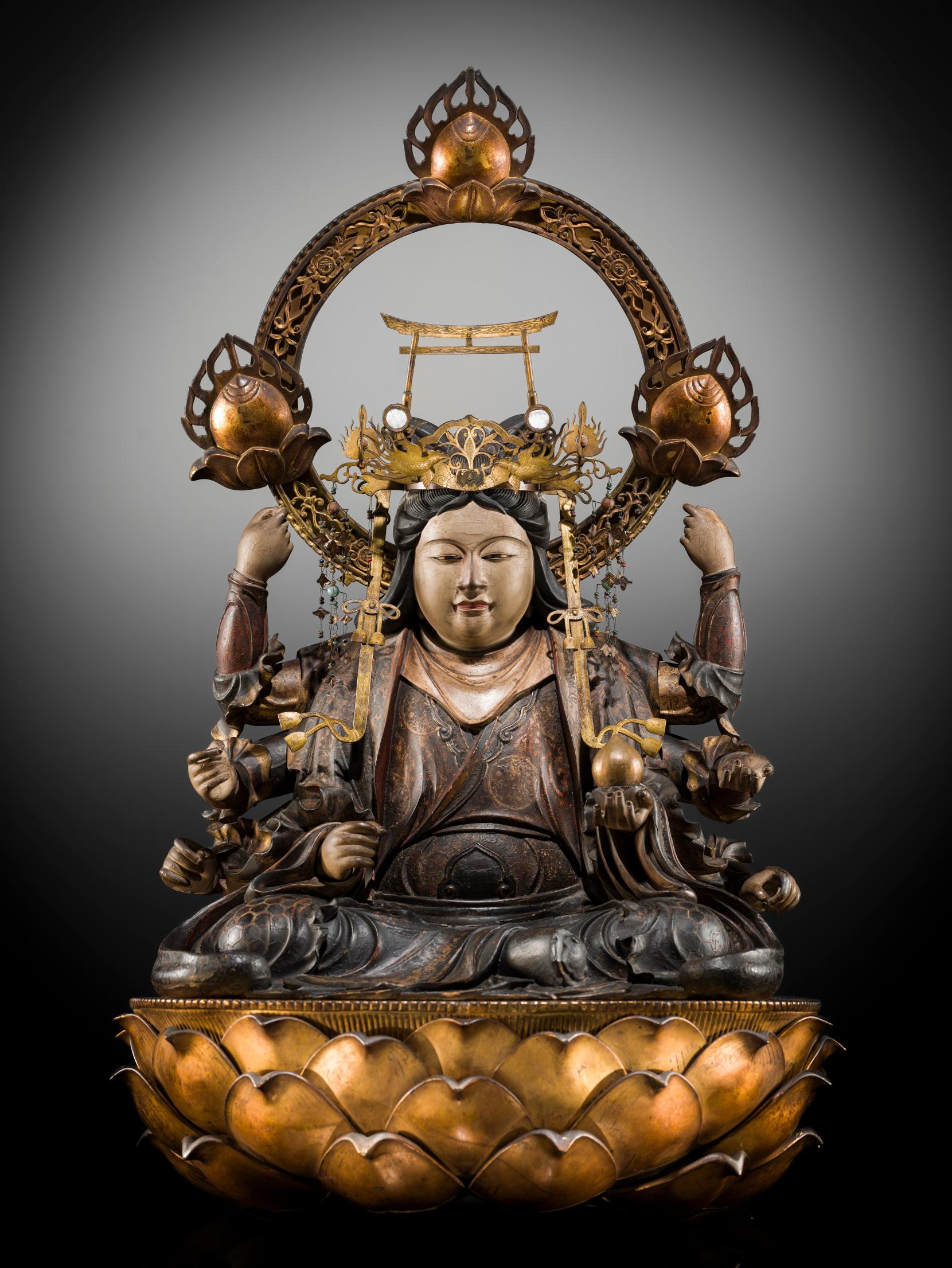
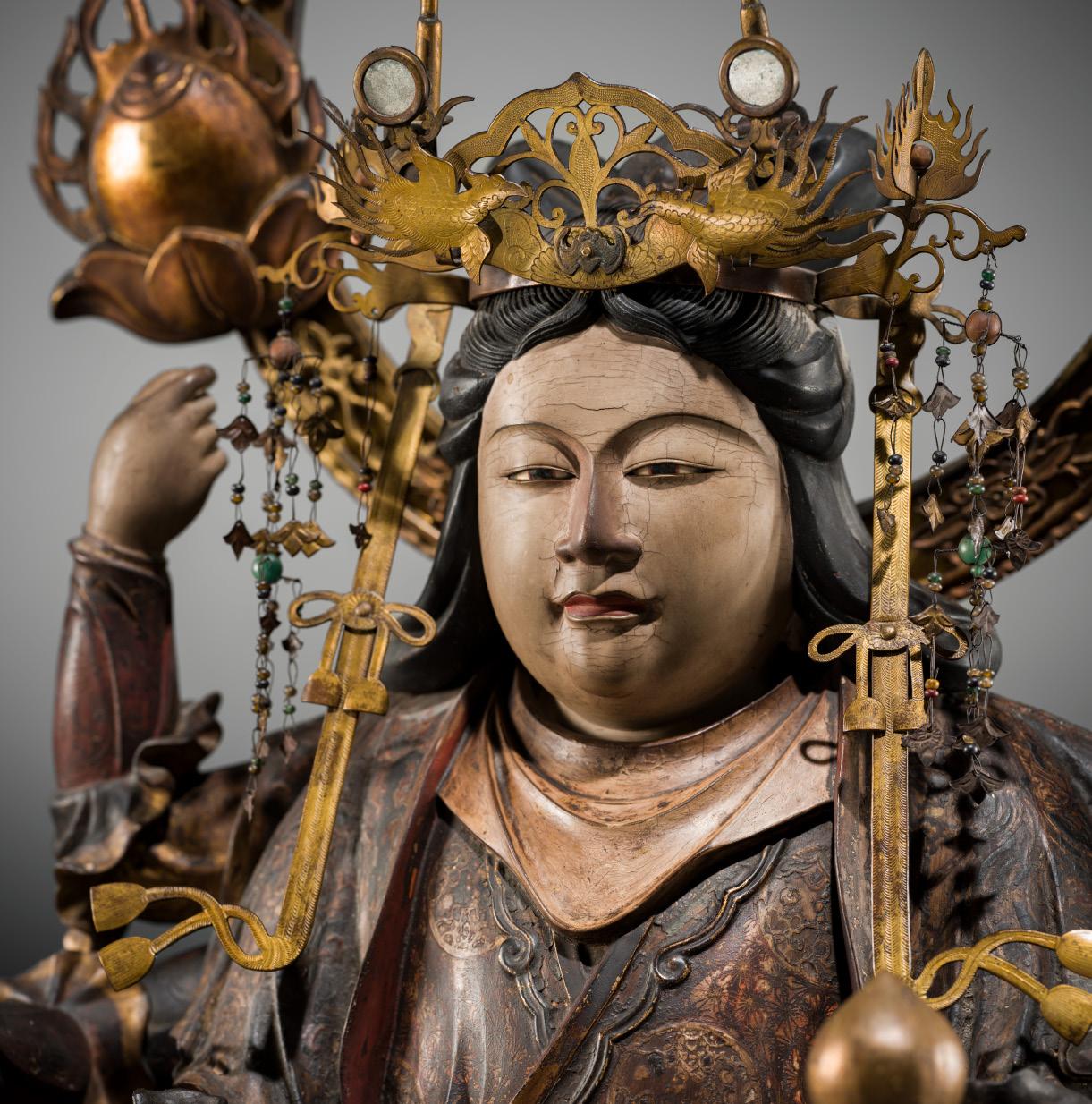
119
A LARGE (90 CM) AND IMPRESSIVE GILT AND POLYCHROME WOOD FIGURE OF UGA BENZAITEN, 16TH CENTURY
Japan, 16th century, Muromachi period (1333-1573)
Finely carved and richly decorated with polychrome pigments, gesso, and gilt-lacquer, the eight-armed deity seated cross-legged on a wide oval lotus throne seated cross-legged and holding a wish-fulfilling jewel (hoju) in one hand, wearing layered patterned robes, the serene face with glass-inlaid eyes and red bow-shaped lips, the hair pulled up into a double topknot behind the elaborate openworked gilt-bronze crown with mirror glass inlays, phoenixes, and a torii gate, backed by a large circular halo with three jewels.
HEIGHT 46 cm (the figure), 90 cm (total)
Provenance: From an old private collection in Belgium, acquired around thirty years ago.
Condition: Very good condition with expected wear, minor age cracks, flaking and minor losses to pigments, little rubbing to lacquer, losses to attributes and snake head, the gilt-bronze appliqués exceptionally well preserved.
Benzaiten, originally derived from the Hindu goddess Sarasvati, was introduced to Japan via China in the 7th–8th century. By the late 11th or early 12th century, she became integrated into Japan’s indigenous belief system and merged with Ugajin, a serpent deity
associated with water, agriculture, and good fortune. While Ugajin alone is typically depicted as a human-headed snake, the syncretic form of Uga Benzaiten appears in esoteric Buddhist art as an eightarmed goddess, often distinguished by the inclusion of a torii gate in her headdress, as seen in the present example.
LITERATURE COMPARISON
Compare a closely related statue of Benzaiten, shown to the public only once every 60 years, in the main worship hall of Hongonji on Chikubu Island, Lake Biwa, donated by the second lord of the Azai clan, Azai Hisamasa, and his mother in 1556.
AUCTION COMPARISON
Compare a related figure of Jizo Bosatsu, 134.6 cm tall (including the base), dated 17th century, at Christie’s, Japanese and Korean Art, 17 March 2009, New York, lot 18 (sold for USD 28,750 or approx. EUR 38,000 converted and adjusted for inflation at the time of writing).
Estimate EUR 20,000
Starting price EUR 10,000
A LARGE (69 CM) AND IMPRESSIVE GILT-LACQUER FIGURE OF SEISHI BOSATSU, EARLY EDO PERIOD
Japan, 17th-18th century, early Edo period (1615-1868)
Of yosegi-zukuri construction, intricately carved in a seated position with the right knee raised, and the hands folded before the chest in a diminutive gesture. The face is round, with downcast eyes beneath gently arched brows, centered by a crystal-inlaid byakugo (urna), a slender nose, and full lips. The ears are adorned with pierced pendulous earlobes. The hair is combed into a tall chignon, with a golden water jar representing wisdom at its center, all encircled by a circular mandorla.
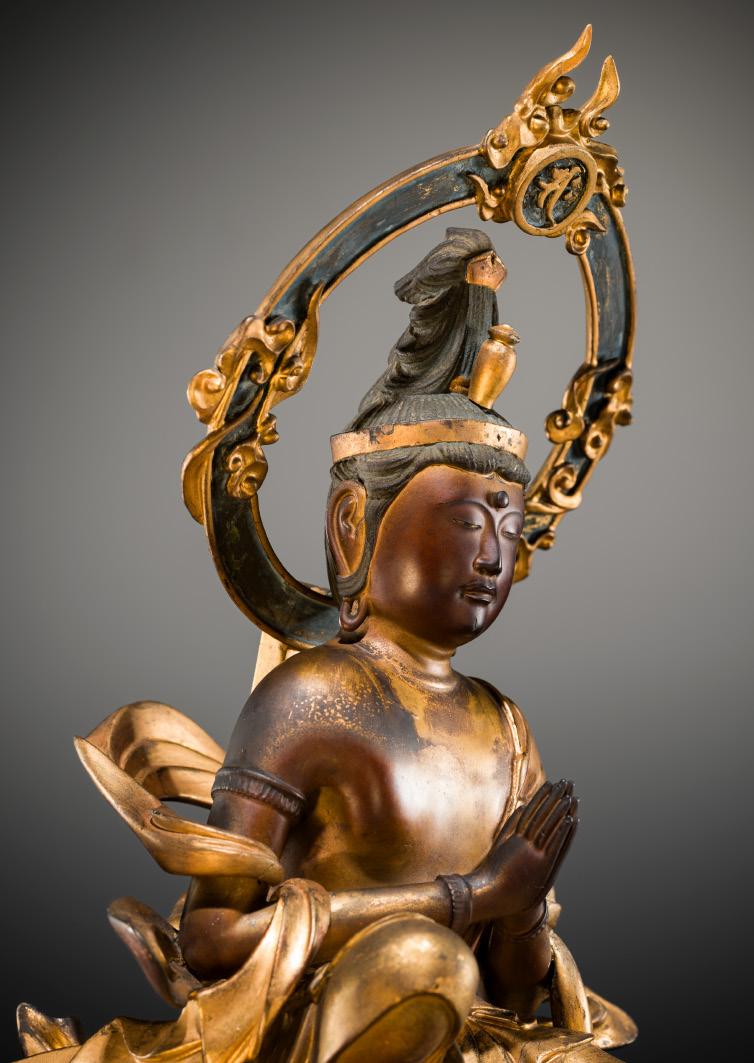
This elegant depiction of Seishi Bosatsu, the attendant bodhisattva of Amida, is designed to assist in guiding the faithful to the Western Paradise. Traditionally, Seishi Bosatsu would be positioned to the left of Amida in a balanced triad, with Kannon on the right. In this arrangement, Seishi and Kannon both support Amida in welcoming souls and guiding them to salvation.
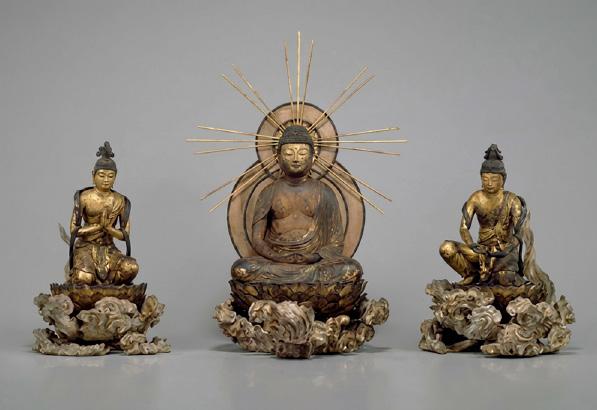
For a view of the entire Amida triad construction, including a closely related figure positioned on the left, see the Amida Raigo triad from the 12th century, dated to the Kamakura period, the Seishi figure measuring 43.9 cm, in the Kyoto National Museum
Seishi Bosatsu sits atop a separately carved lotus pedestal, which rests on openwork clouds emanating from a tiered hexagonal stand. The base is embellished with floral panels and lobed cartouches, enclosing dragons and other mythical creatures, adding to the figure’s magnificence.
HEIGHT 32 cm (figure), HEIGHT 69 cm (total)
Provenance: From a Dutch private collection Condition: Very good condition with minor wear, the sashes around the elbows reattached, the tip of the clouds on the halo with repairs, little flaking and small areas of the lacquer and gilt with touchups, and few fine age cracks. Presenting exceptionally well.
AUCTION COMPARISON
Compare a related figure of Seishi Bosatsu, dated 15th-16th century, Muromachi period, 88 cm tall, at Galerie Zacke, 28 October 2020, Vienna, lot 149 (sold for EUR 10,112).
Estimate EUR 15,000
Starting price EUR 7,500
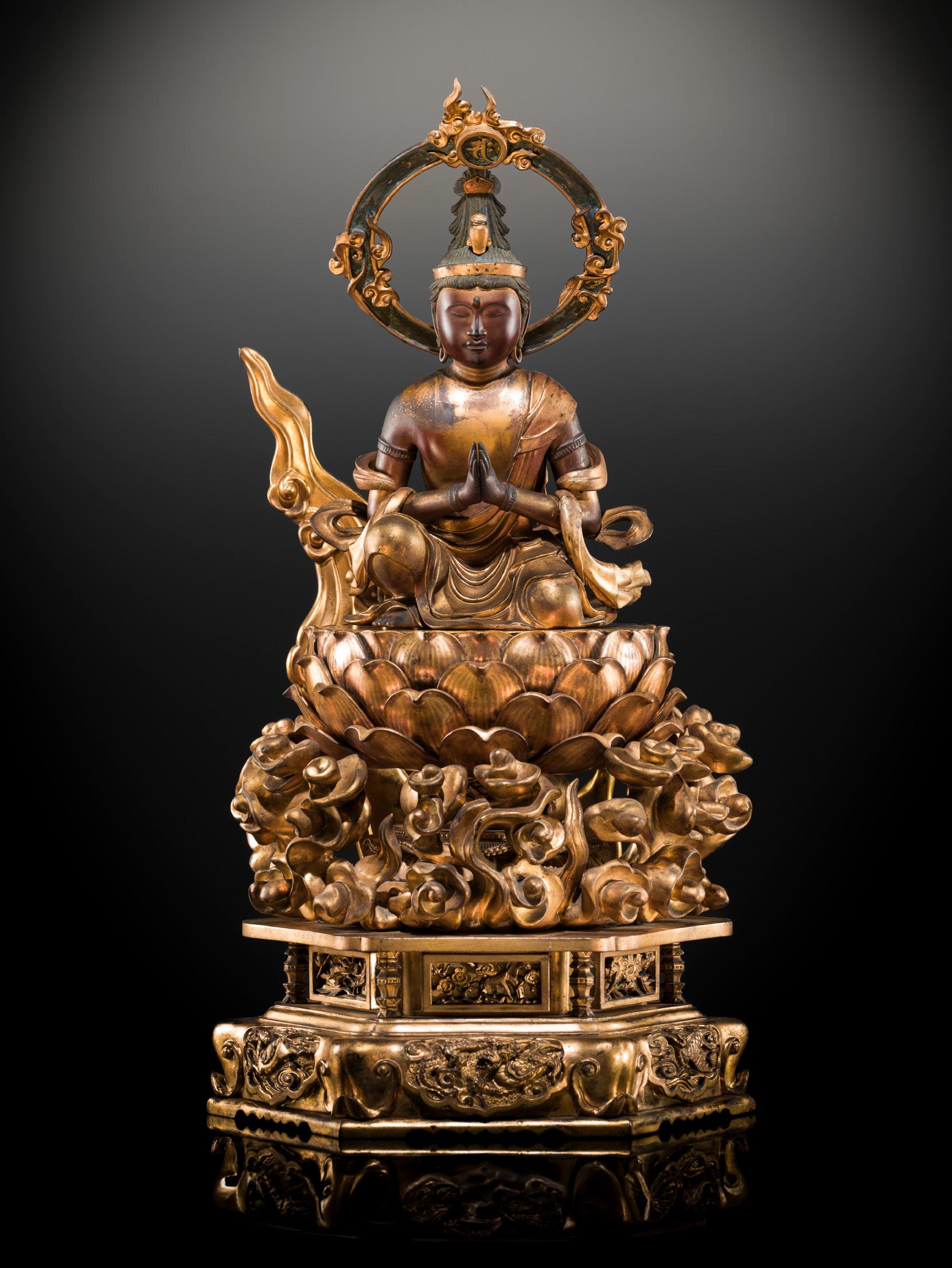
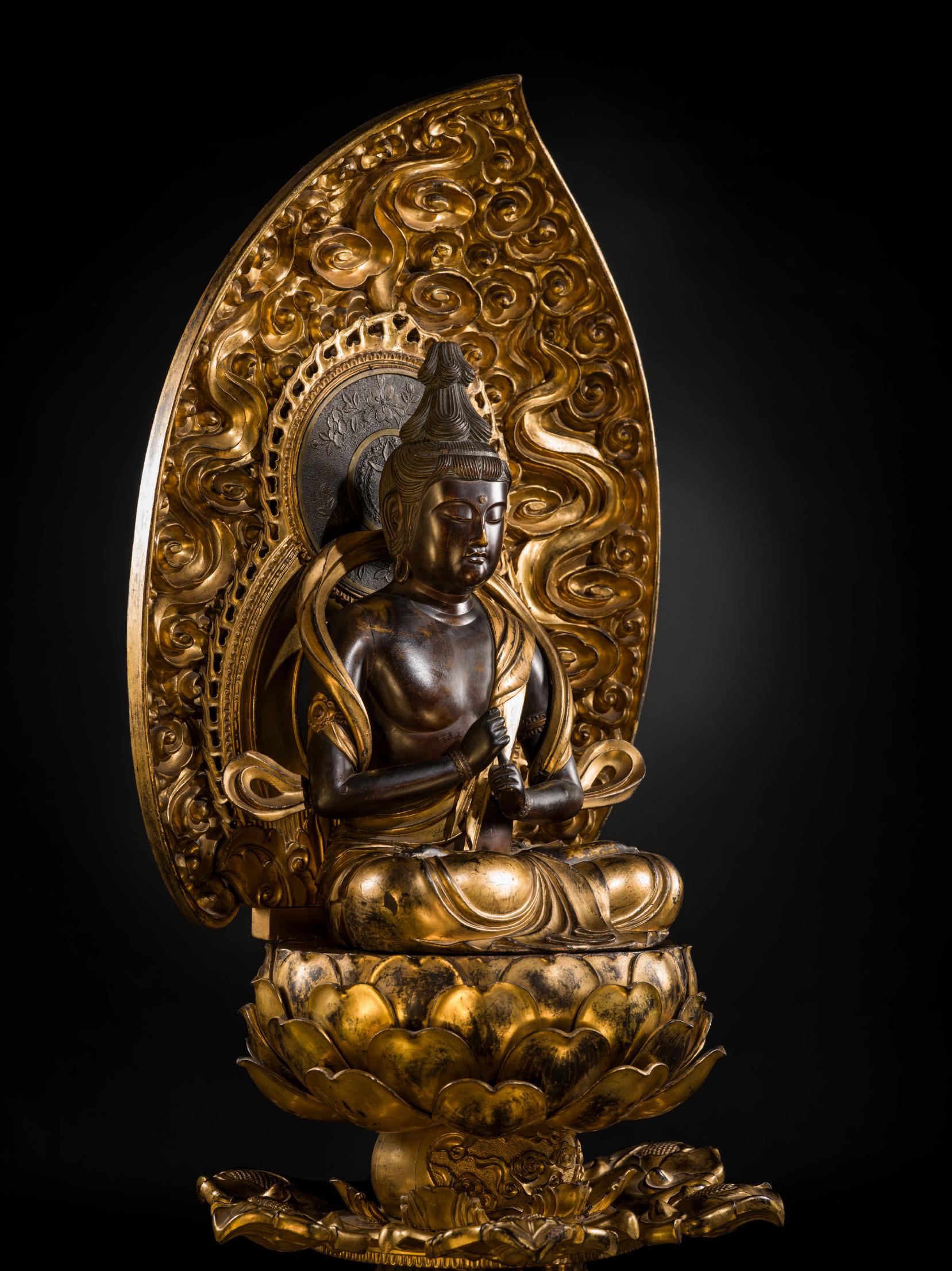
Japan, 17th-18th century, early Edo period (1615-1868)
Of yosegi (joined) construction and finely carved seated in dhyanasana with his hands held in chiken-in (dharmachakra mudra), dressed in a billowing scarf, a sash draped over his left shoulder, and a loose-fitting dhoti with richly carved folds, his serene face with downcast eyes with painted pupils, elegantly arched brows centered by a crystal-inlaid byakugo (urna), and bow-shaped lips forming a subtle smile, flanked by pierced pendulous lobes, the neatly incised hair pulled up into a high chignon.
The Buddha sits atop a circular lotus throne composed of large overlapping petals, a compressed bulb carved with swirling clouds, and a furled lotus leaf supported by a lion on a lotus base, raised on an equally elaborate balustraded hexagonal plinth with openworked panels and rich cloud decoration, and is backed by an intricately carved cloud-form kogai with inset metal circular halo decorated with floral sprays, encircled by beading and flames above a shaped open panel.
HEIGHT 44 cm (the figure), 124 cm (total)
Provenance: From an old Belgian private collection. Condition: Good condition and presenting beautifully, with expected wear, the kohai with minor chips and touchups to lacquer on the back, light warping with associated small gaps, some segments possibly reinforced, flaking and small losses to lacquer, a loss to a section of the scarf, minor chips to edges of the robe and base, with minor repairs to the petals.
Dainichi Nyorai (in Sanskrit, Vairocana or Maha Vairocana) constitutes the central figure within Japanese esoteric Buddhist traditions (Vajrayana). Originally associated with an ancient solar cult, as Dainichi literally signifies ‘Great Sun’, he was venerated from the Heian period by esoteric practitioners as the Central Buddha of the Universe or Cosmic Buddha. Within this context, Dainichi often replaced the Historical Buddha as the primary focus of devotion and appearing as omnipresent and all-encompassing, holding supreme status among all Buddhas, seen as his emanations.
AUCTION COMPARISON
Compare a closely related gilt-lacquered wood figure of Dainichi Nyorai, 95.9 cm high including the base, dated Edo period, 17th-18th century, at Christie’s, 17 March 2009, New York, lot 19 (sold for USD 26,250 or approx. EUR 34,500 converted and adjusted for inflation at the time of writing).
Estimate EUR 30,000
Starting price EUR 15,000
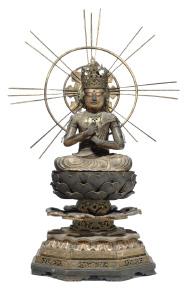
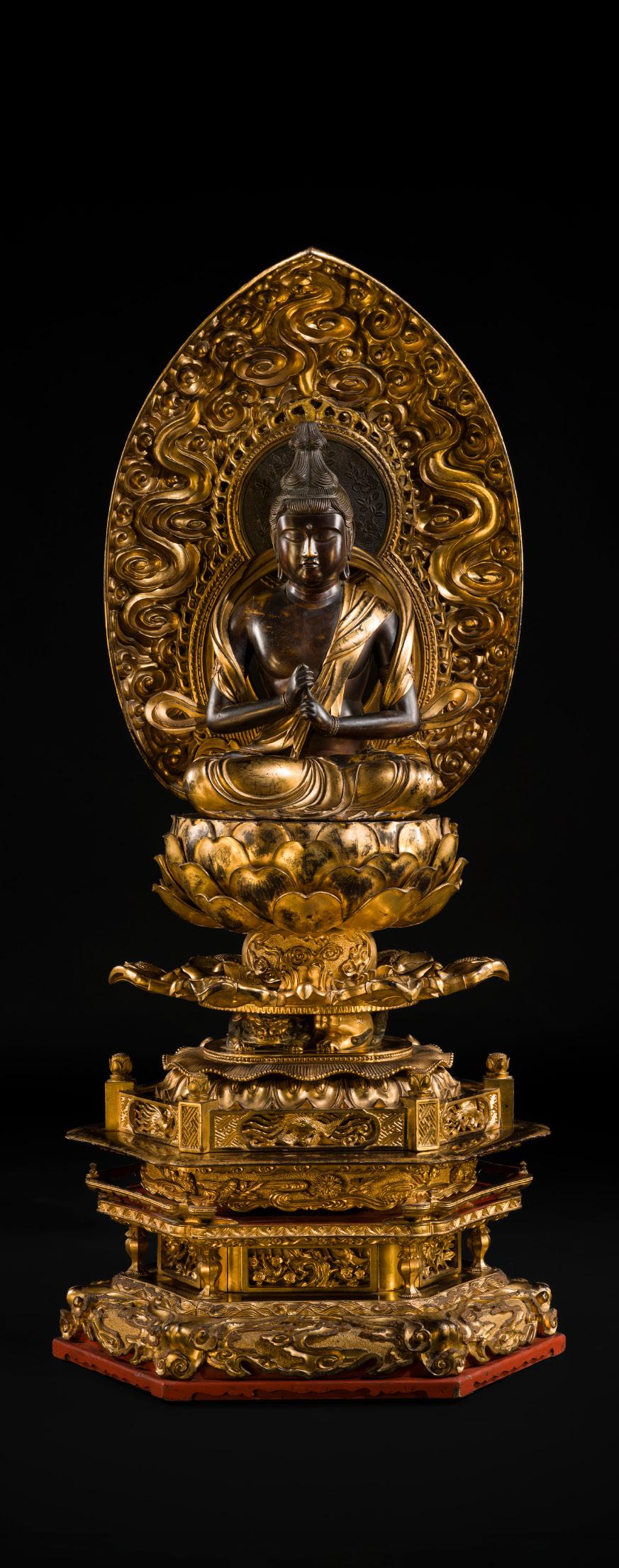
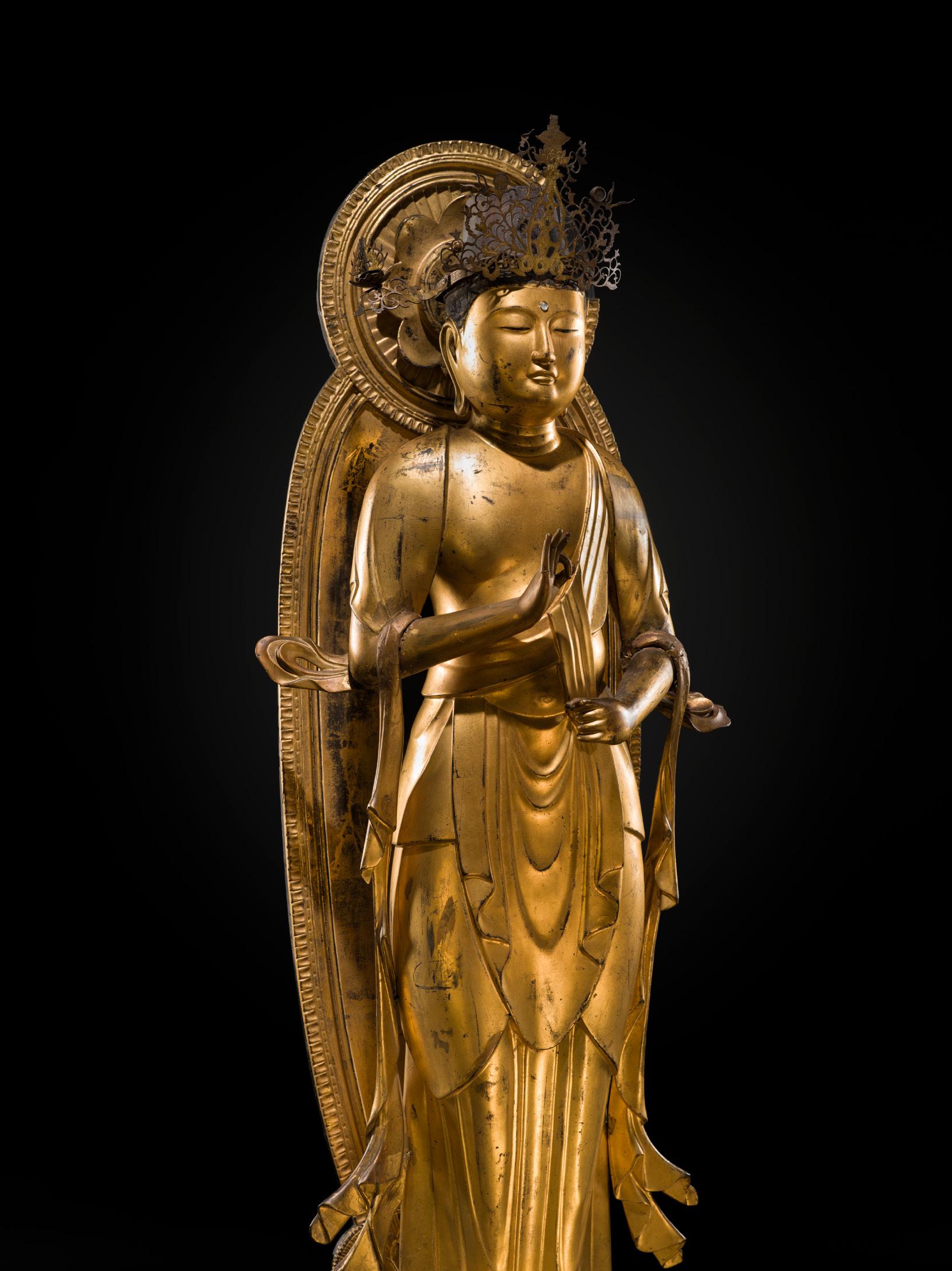
A VERY LARGE (136 CM) AND IMPRESSIVE GILT-LACQUERED WOOD FIGURE OF SHO-KANNON, EARLY EDO PERIOD
Japan, 17th-18th century, early Edo period (1615-1868)
Superbly carved standing in samabhanga with the right hand held in seppo-in (vitarka mudra), wearing loose-fitting robes cascading in finely carved folds and a billowing scarf draped over the arms, the face with a serene expression, the hair pulled up into a high chignon behind the openworked gilt-metal foliate crown.
The deity stands atop a lotus dais raised on an elaborate tiered octagonal base with a furled lotus leaf, petal band, openworked panels with floral scroll decoration, and neatly incised gilt-metal fittings.
HEIGHT 93.5 cm (the figure), 136 cm (total)
Provenance: From a deceased estate in Los Angeles, California, United States. Condition: Very good condition with expected wear, minor losses, old repairs to scarf and few petals and leaves of the base, little flaking, rubbing, and minor losses to gilding. Presenting magnificently.
AUCTION COMPARISON
Compare a closely related lacquered wood figure of Kannon, dated early Edo period, late 16th-early 17th century, 118 cm high, at Christie’s, 7 December 2007, Paris, lot 60 (sold for EUR 24,250 or approx. EUR 32,000 adjusted for inflation at the time of writing).
Estimate EUR 20,000 Starting price EUR 10,000
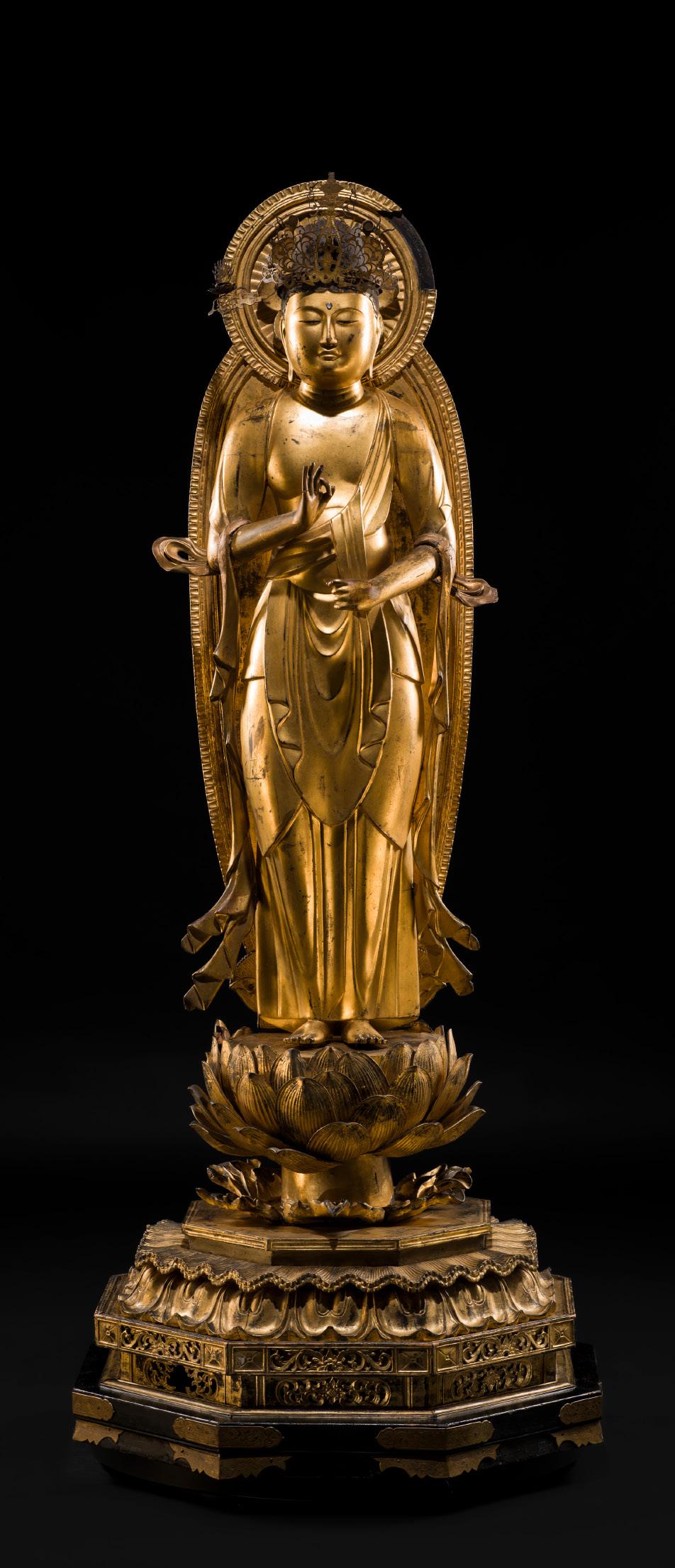
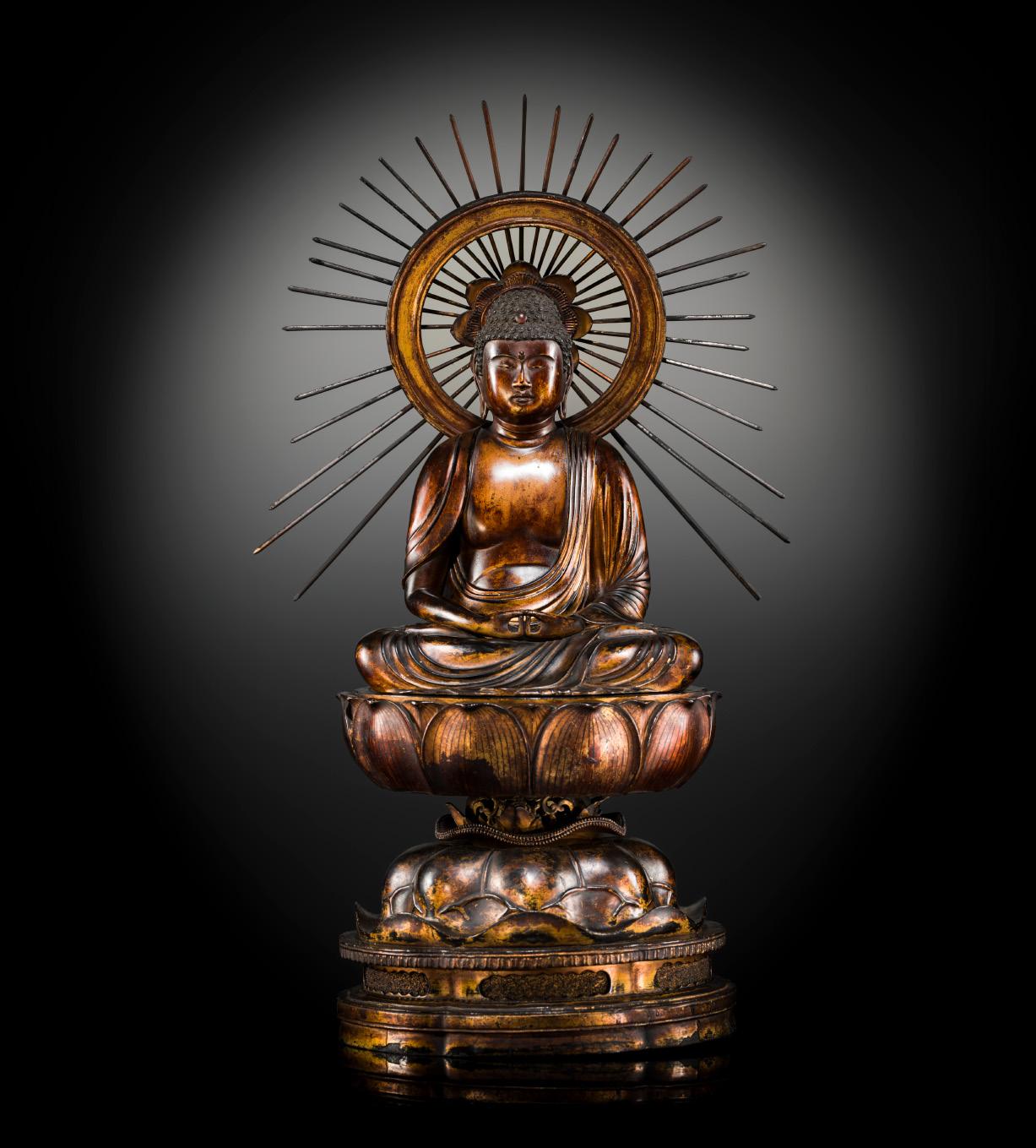
A LARGE (72 CM) AND IMPRESSIVE GILT-LACQUER WOOD FIGURE OF AMIDA NYORAI ON A LOTUS THRONE, 18TH CENTURY
Japan, 18th century, Edo period (1615-1868)
This finely crafted, large figure is constructed using the yosegizukuri technique. Amida Nyorai is seated in dhyanasana, with hands folded in the mida no join above the lap—an iconic variation of the dhyana mudra typically associated with Japanese representations of Amida. The figure is supported by an elaborate lotus base, elevated above a curled lotus leaf, and stands on a tiered platform adorned with decorative cartouches and a globular mid-section.
Amida is draped in a loose robe, which falls in graceful folds around the body and opens at the chest. The serene face features a calm expression, with downcast eyes inlaid with crystal. Gently arched brows are centered by a glass byakugo (urna), while the hair is arranged in tight curls and surmounted by a domed ushnisha, which features an additional red glass-inlaid eye. The aureole, carved separately, is adorned with a central lotus blossom and radiating beams of light symbolizing light emanating from Amida’s head.
HEIGHT 29.5 cm (figure) and 72 cm (total)
Provenance: From a Dutch private collection. Condition: Very good condition with minor wear, few small age cracks, minor flaking and rubbing to the lacquer and gilt, one of the radiating beams is lost, some of the structural elements reattached with remnants of adhesive, the beams of the mandorla with few repairs, and few tiny nicks here and there. Presenting beautifully.
AUCTION COMPARISON
Compare a closely related giltlacquered wood figure of Amida Nyorai, dated 18th century, 77 cm high overall, at Christie’s, Art d’Asie, 14 December 2016, Paris, lot 87 (sold for USD 68,500 or approx. EUR 80,500 converted and adjusted for inflation at the time of writing).
Estimate EUR 15,000
Starting price EUR 7,500
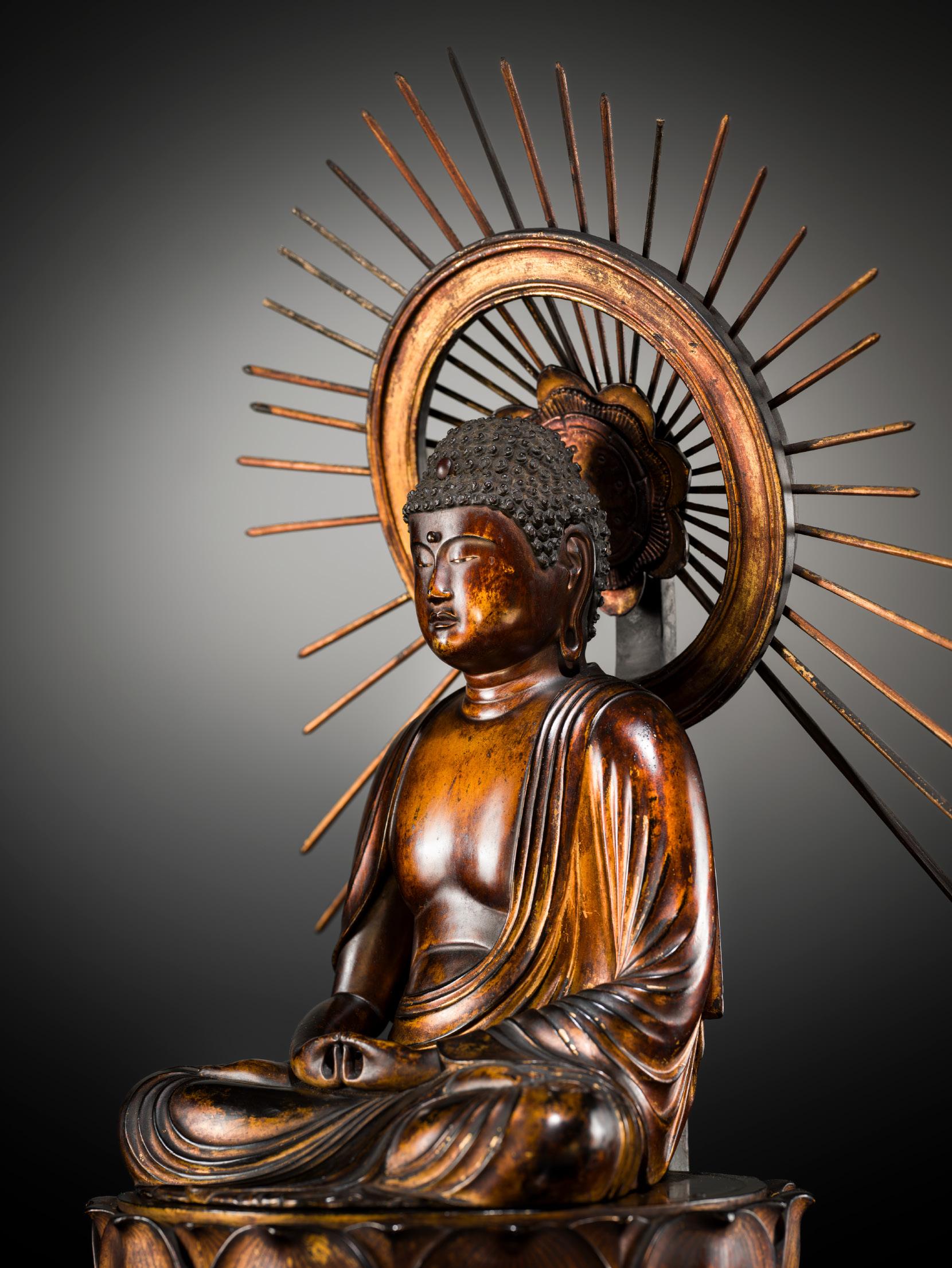
Japan, 18th century, Edo period (1615-1868)
Of yosegi (joined) construction, finely carved standing in samabhanga atop a lotus dais with the hands held in raigo-in, wearing a loose-fitting robe cascading in voluminous folds covered in gilt lacquer and opening at the chest. The serene face sensitively modeled with downcast eyes inlaid in crystal painted with black pupils ringed in red, bow-shaped lips framed by a painted mustache, flanked by pierced pendulous lobes, the forehead inlaid with a crystal byakugo (urna), the hair arranged in small, snail-shaped spiral curls (rahotsu) over the ushnisha centered by a crystal-inlaid jewel.
HEIGHT 36.3 cm (the figure), 41.5 cm (incl. lotus dais), and 46 cm (incl. stand)
Provenance: Sydney L. Moss Ltd., London, by 1978. A distinguished private collection in London, United Kingdom, acquired from the above. A copy of the invoice from Sydney L. Moss, dated 14 November 1978 and confirming the dating above, accompanies this lot.
Condition: Good condition with expected wear, obvious losses, few minor age cracks, typical rubbing, flaking, and minor losses to gilt and lacquer.
Mounted on an associated wood stand of rectangular form.
Amida is the principal Buddha in Pure Land Buddhism, also called the Buddha of Infinite Light. In Vajrayana tradition, he is known for his magnetizing discernment, pure perception and deep awareness of the emptiness of all phenomena. According to scriptures, he possesses infinite merit resulting from good deeds over countless past lives as a bodhisattva.
AUCTION COMPARISON
Compare a related larger figure of Amida lacking most of the gilding of the present lot, dated Edo period, 17th/18th century, 97.8 cm high, at Christie’s, Japanese Art and Design, 16 November 2000, London, lot 191 (sold for GBP 35,200 or approx. EUR 71,000 converted and adjusted for inflation at the time of writing).
Estimate EUR 8,000
Starting price EUR 4,000
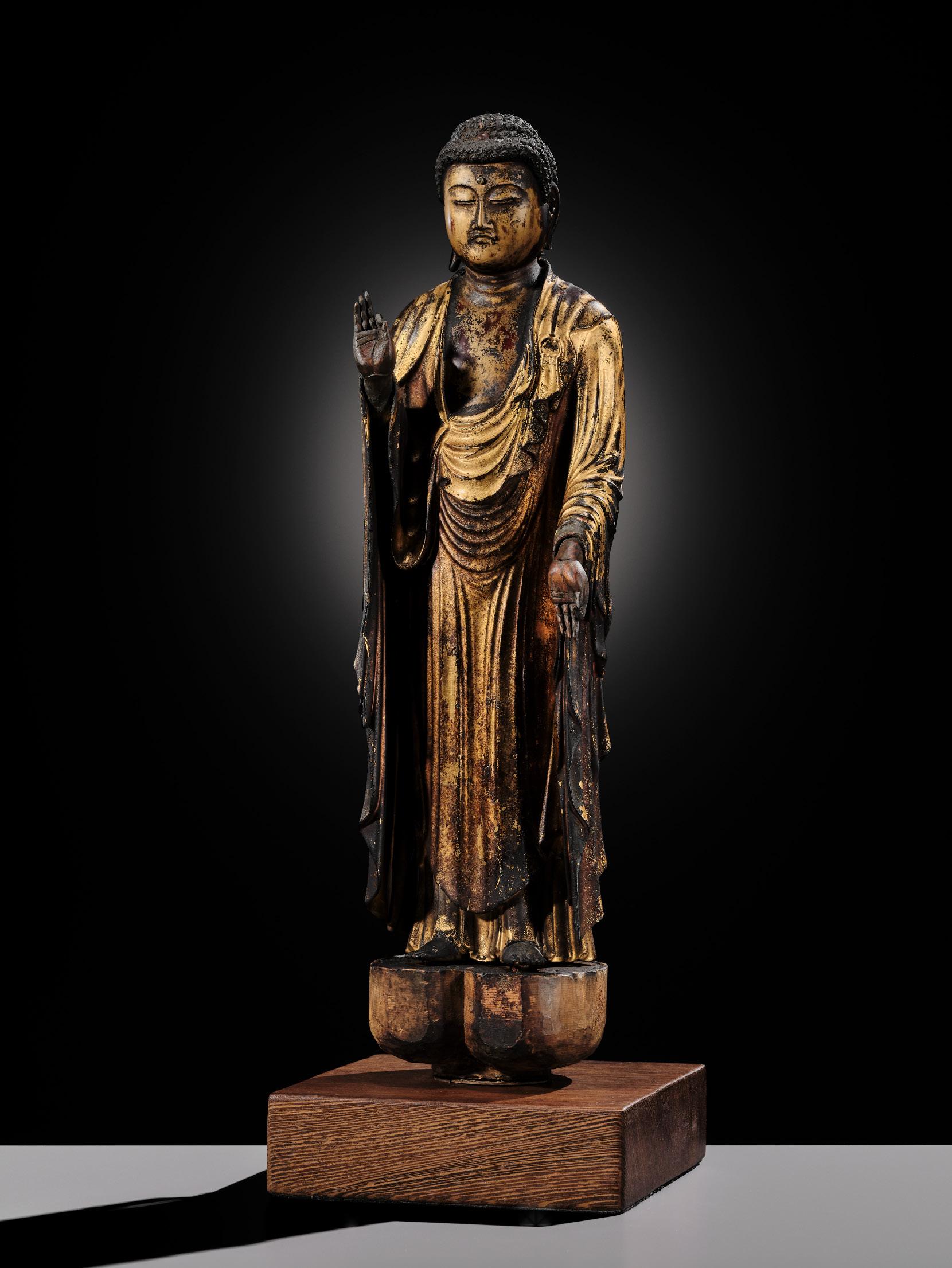
Japan, 18th century, Edo period (1615-1868)
Of yosegi (joined) construction, superbly carved to depict Amida standing in samabhanga with his hands held in raigo-in, wearing a loose-fitting robe opening at the chest and cascading in voluminous folds, the serene face sensitively modeled with downcast eyes inlaid with inside-painted crystal, elegantly arched brows centered by a crystal-inlaid byakugo (urna), and slender bow-shaped lips forming a subtle smile framed by a neatly painted mustache, flanked by pierced pendulous lobes, the hair arranged in tight curls over the ushnisha with a crystal-inlaid nikkeishu (jewel of wisdom).
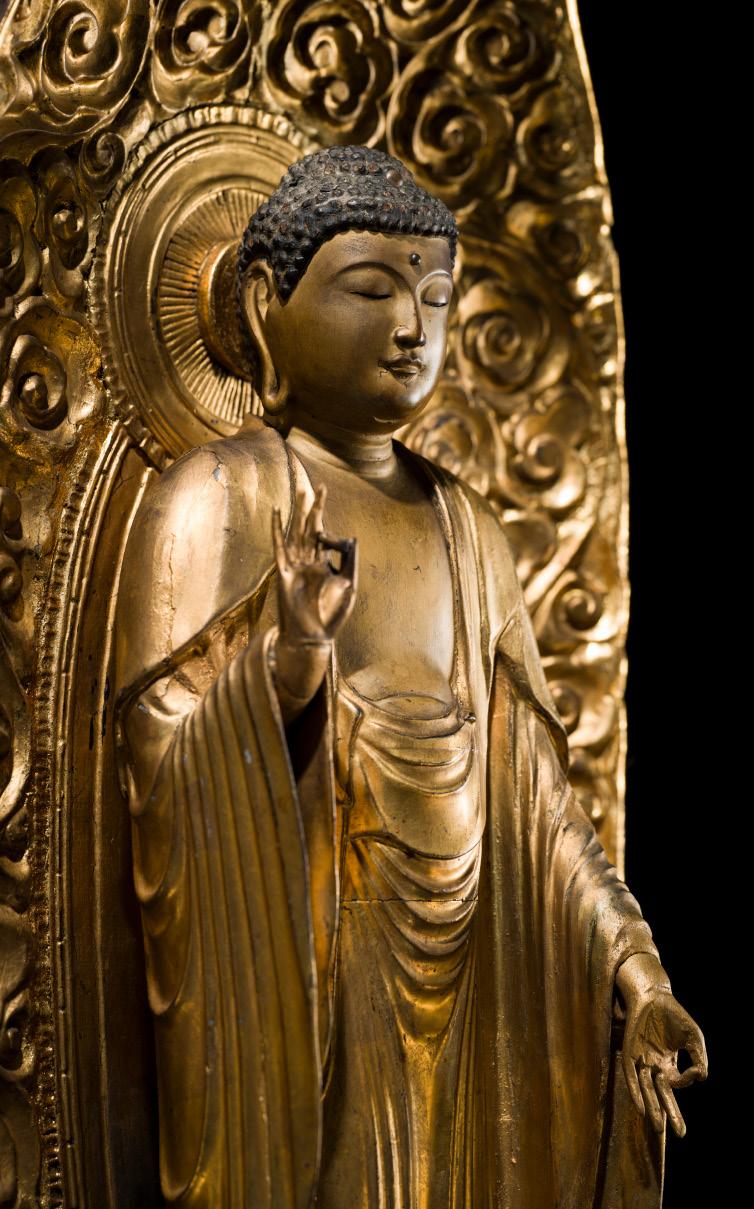
Amida stands atop two lotus pods encircled by overlapping petals raised on a compressed cloud-decorated base over a band of foliage, all supported on an elaborate tiered octagonal base with two balustrades and decorated with lotus leaves and petals, foliate designs, and brocade and geometric motifs. The deity is backed by a richly carved cloud-form kogai (aureole) with lotiform halo.
Provenance: Perret et fils et Vibert, Paris, France (label to back of base). Hans Heinrich Josef Meyer (1858-1929), Leipzig, Germany, acquired from the above and thence by family descent. The back of the kogai with remnants of an old label. Perret et fils et Vibert was a renowned Parisian design house founded by Alfred Perret in 1879. In 1885, Alfred Perret’s son, Alfred Perret Jr., and Ernest Vibert joined the firm, which became known for its Asianinspired bamboo and rattan furniture, and from 1887 additionally Chinese and Japanese works of art. The firm’s prestigious clientele included the Prince of Wales, the Duchess of Montpensier, the Vanderbilt family, Queen Amélie of Portugal, and Marshal Yamagata of Japan. Hans Heinrich Josef Meyer (1858-1929) was a German geographer and explorer, best known for being the first to reach the summit of Mount Kilimanjaro. The son of publisher Herrmann Julius Meyer (1826-1909), Hans’s early travels, including a journey to East Asia in 1882, were financed by his father. In 1885, Meyer joined his father’s publishing firm, while continuing to embark on extensive expeditions worldwide, ultimately achieving his historic ascent of Kilimanjaro. Condition: Good condition and presenting beautifully. Expected age cracks and losses, some with old repairs and touchups, most notably to the kohai and to one arm and sleeve, the hands are likely re-lacquered. Minor chips to the base and minor old repairs to the lotus petals.
HEIGHT 39.7 cm (the figure), 77 cm (total)
AUCTION
Compare a closely related gilt wood figure of Amida, dated 18th-19th century, of almost identical size (78 cm high), at Zacke, Fine Japanese Art, 16 June 2023, Vienna, lot 61 (sold for EUR 11,700).
Estimate EUR 10,000
Starting price EUR 5,000
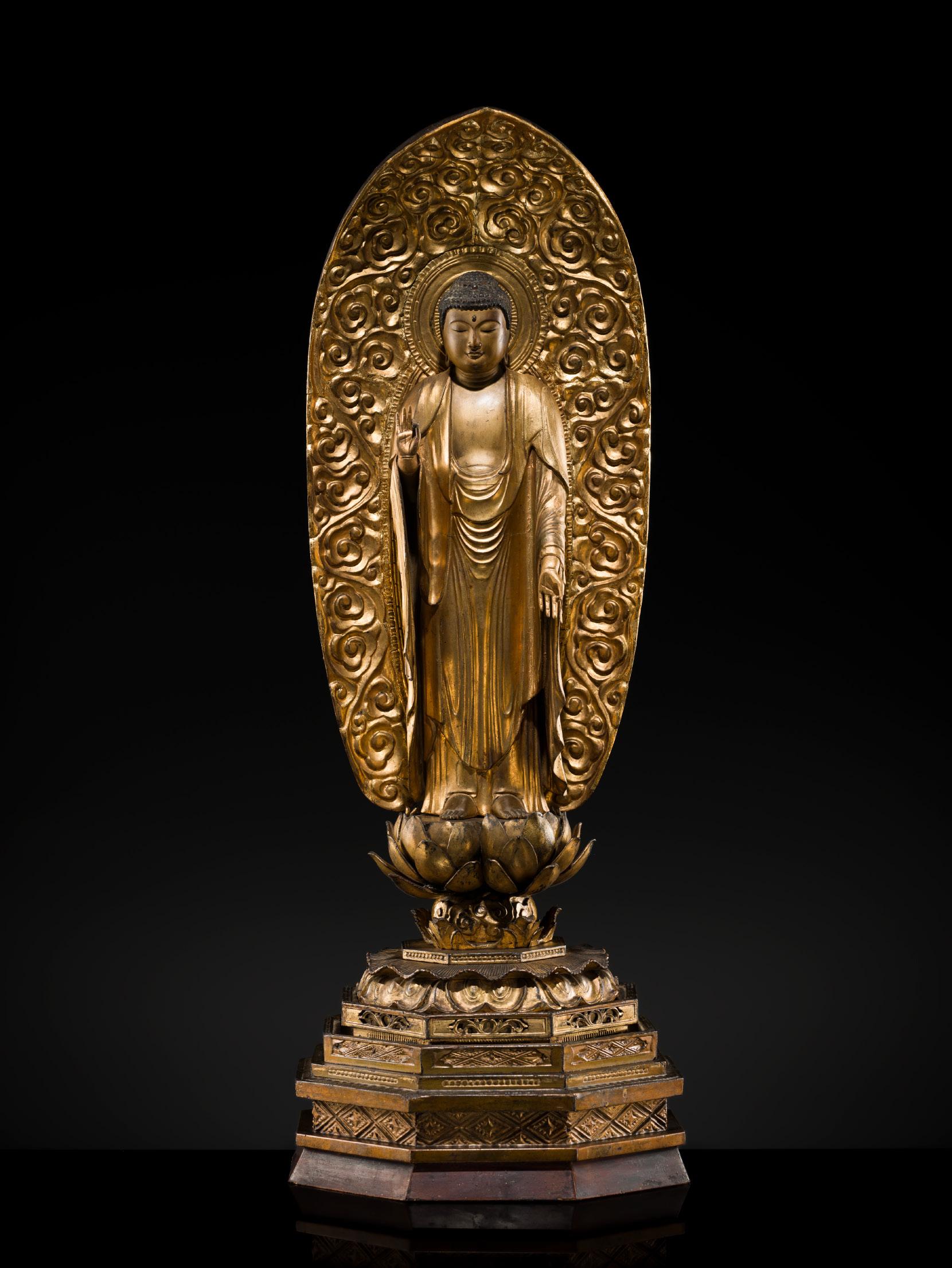
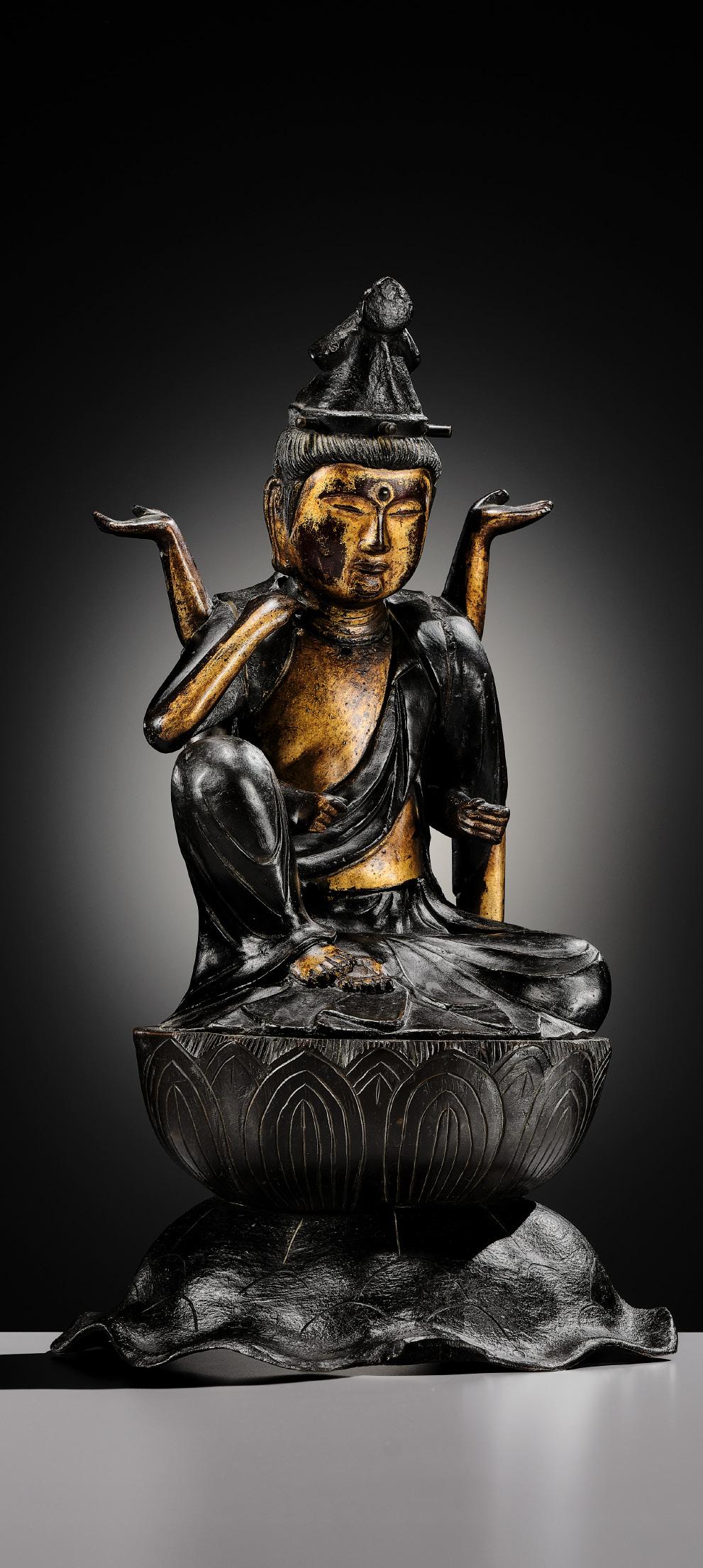
126 A FINE PARCEL-GILT BRONZE FIGURE OF NYOIRIN KANNON, 16TH CENTURY
Japan, 16th century, Muromachi period (1333-1573)
Well cast seated in rajalilasana (royal ease) atop a throne of incised overlapping petals raised on a large upturned lotus leaf with furled edges, his principal left hand placed on the ground and the right touching his cheek, the robes loosely draped over the shoulders falling in folds across the lap, the hair gathered up in a high topknot.
The base inscribed 二十七番 Niju-nanaban [Number 27].
HEIGHT 41.2 cm
WEIGHT 7 kg
Condition: Overall good condition with expected wear, casting irregularities, scattered minor losses, one to the back with associated small fissure, the arm joints reinforced, an old repair at the neck, rubbing and losses to gilding.
The distinctive seated pose identify this figure as Nyoirin Kannon, a wishfulfilling form of the Kannon whom Buddhists believe listens to the voices of the world. Further distinguishing features are the deitiy’s six arms, and characteristic pensive attitude.
AUCTION
COMPARISON
Compare a related bronze sculpture of Dainichi Nyorai with similar casting technique and treatment of the garment folds, face, and hair, lacking the base and gilding of the present lot, dated probably Muromachi period, 30.5 cm high, at Christie’s, 18 September 2013, New York, lot 652 (sold for USD 11,875 or approx. EUR 14,000 converted and adjusted for inflation at the time of writing).
Estimate EUR 5,000
Starting price EUR 2,400
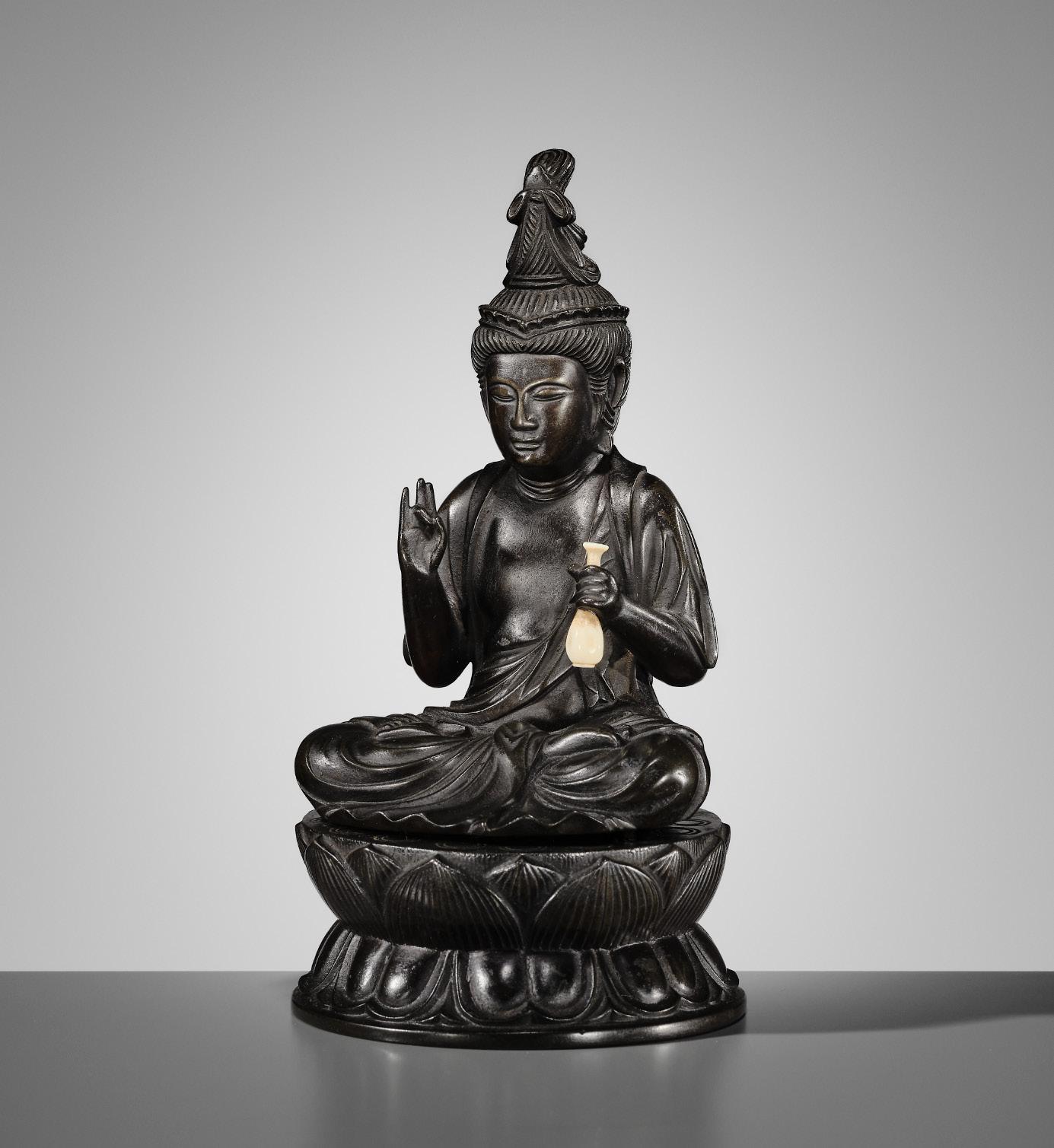
WATANABE OMI: A VERY FINE BRONZE
FIGURE OF KANNON, 17TH CENTURY
By Watanabe Omi (1646-1704), signed Doi Hokkyo saku Japan, late 17th century, Edo period (1615-1868)
Cast in two parts, the figure depicts Kannon seated in dhyanasana (meditative posture) on a lotus dais, with one hand raised in prithvi mudra (earth-touching gesture) and the other holding a water flask (kundika) carved from stained antler. The loose robe falls elegantly over the feet, and the serene expression of the face is complemented by a subtle smile. The head is downcast, framed by a tall chignon and flanked by pendulous earlobes, adding to the figure’s meditative and tranquil aura.
Inscriptions: Signed underneath the figure and to the top of the base Doi Hokkyo saku [made by Doi Hokkyo].
HEIGHT 17 cm
WEIGHT 1.1 kg
Provenance: From an American private collection in New York. Condition: Excellent condition. Minor expected surface wear and typical casting irregularities.
Watanabe Omi (1646-1704) was the son of the renowned Japanese metal caster Omi Daijo Minamoto Shoji. His bronze casting works, though rarely seen, are highly regarded for their quality and craftsmanship. Watanabe Omi is also known for signing some of his works “Doi Hokkyo”, a title traditionally granted to accomplished artists in the Buddhist art world.
Estimate EUR 4,000 Starting price EUR 2,000
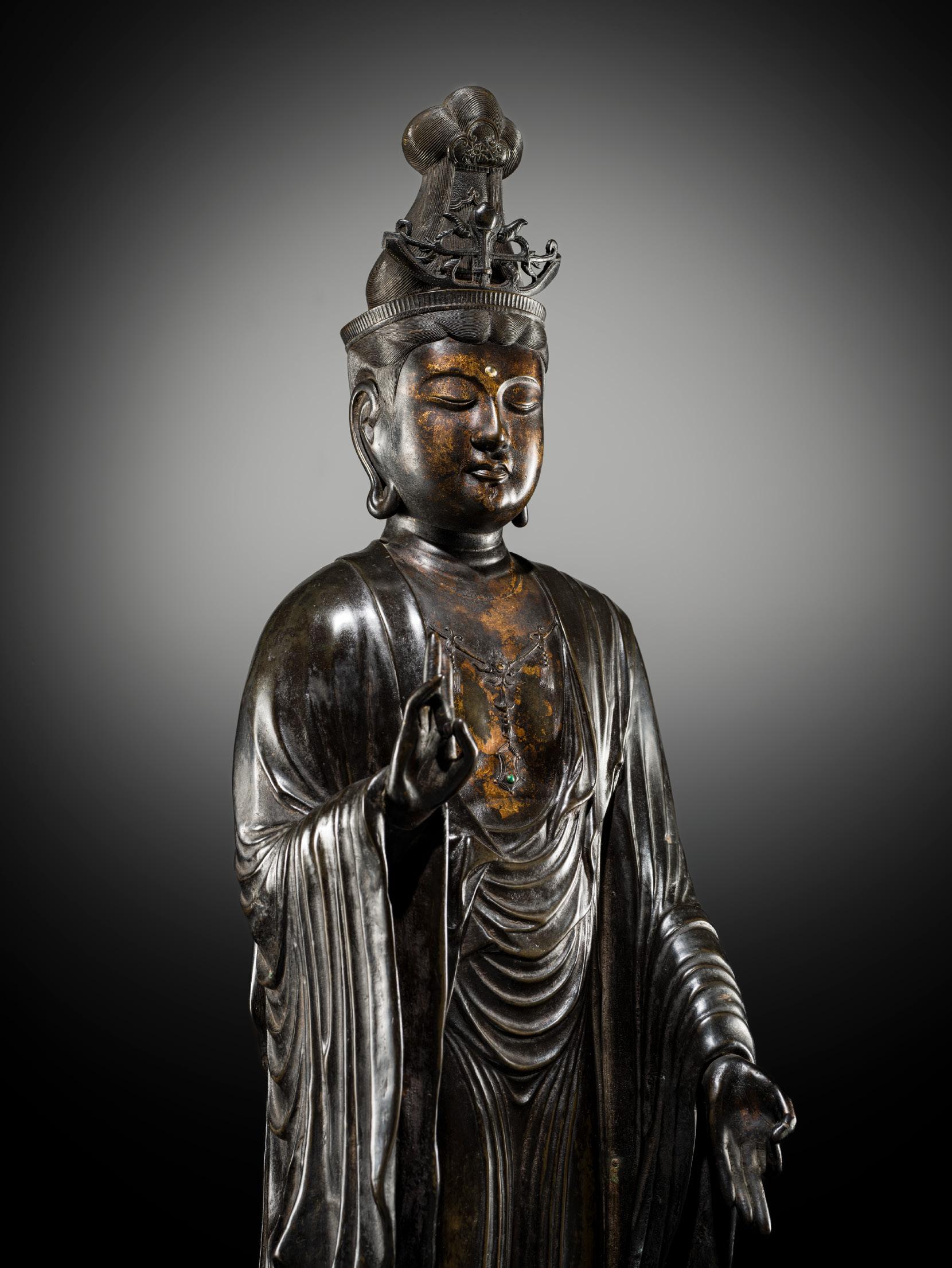

THE LARGE AND IMPRESSIVE ‘KASTEEL DE HAAR’ GILT-LACQUERED BRONZE FIGURE OF KANNON BOSATSU, LATE EDO TO MEIJI PERIOD
Japan, 19th century, late Edo (1615-1868) to Meiji period (1868-1912)
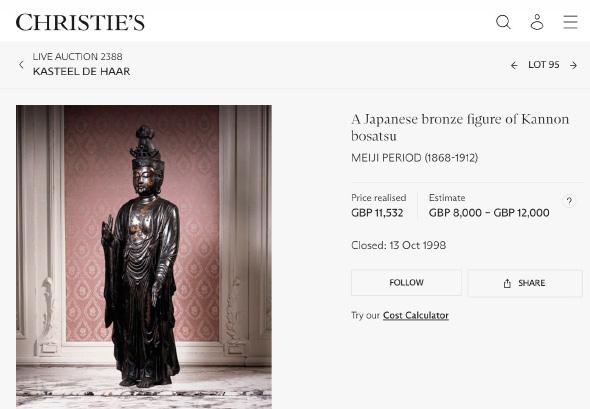
The present lot at Christie’s, 13 October 1998, lot 95, sold for GBP 11,532 or approx. EUR 26,000
The tall standing deity standing barefoot, clad in long pleated garment with long sleeves, the right hand in kichijo-in, the left in an-i-seppo-in, the serene face with downcast eyes, delicately incised with facial hairs, long pierced earlobes, urna inlaid with glass, the hair pulled up in a high top knot, set against a crescent-shaped tiara, the chest adorned with a bejewelled necklace with malachite inlay.
HEIGHT 94.3 cm
WEIGHT 32.4 kg
The back with a threeline votive inscription, Kozuke no kuni, Nitta, Kanayama jo sanroku, Mannen san Sogen-ji, Minamoto Yoshisada kufu su [Donated by Minamoto Yoshisada, the Sogen-ji Temple of the Mannen mountain, located at the foot of Kanayama Castle, Nitta, Kozuke Province].
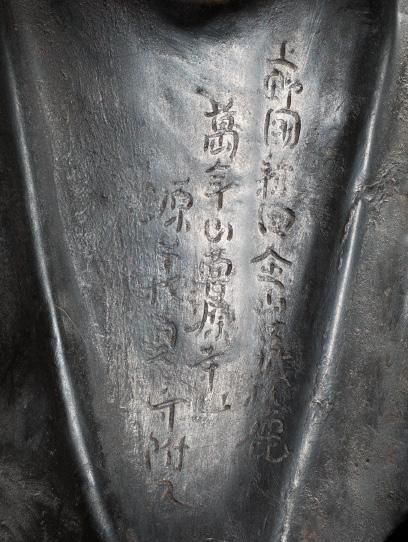
The votive inscription refers to Minamoto Yoshisada (also known as Nitta Yoshisada, 1301-1338), a prominent samurai lord and head of the Nitta clan. In 1333, Yoshisada played a crucial role in the fall of the Kamakura Shogunate by leading a decisive military campaign that led to its overthrow. The Sogen-ji Temple, a historically significant site, was established in 1188 by the Nitta clan in Ota, Gunma. This temple stands as a testament to the Nitta family’s influence and legacy during the Kamakura period.
Provenance: Van Zuylen van Nyevelt Family Collection, Kasteel de Haar, Haarzuilens, Utrecht, Netherlands. Christie’s, Kasteel de Haar, 13 October 1998, lot 95 (sold for GBP 11,532 or approx. EUR 26,000 converted and adjusted for inflation at the time of writing). The back inscribed with an old lacquered inventory number, ‘135’. Kasteel de Haar, near Utrecht, was inherited by Baron Etienne van Zuylen van Nyevelt in the late 19th century. Originally belonging to the de Haar family, the castle passed to the van Zuylen family in 1440 when the last male de Haar heir died childless. In 1887, he married the French author Baroness Hélène de Rothschild, who played a key role in its twenty-year restoration.

Étienne van Zuylen van Nyevelt (1860-1934)
Baroness Hélène van Zuylen van Nijevelt van de Haar, née de Rothschild (1863-1947)
The castle fell into disrepair and ruin until the baroness used her family resources to finance its full reconstruction in neo-Gothic style. The castle was transformed into a lavish residence, with interiors furnished with pieces from the Rothschild collection, including Chinese porcelain, Japanese ceramics, old master paintings, and Flemish tapestries. The contents of Kasteel de Haar were sold at Christie’s in 1998 in a highly successful sale that attracted considerable attention at the time.
Condition: Very good condition with expected wear and casting irregularities, remnants of pigment and dark varnish, minimal warping, few minute losses.
MUSEUM COMPARISON
Compare a closely related bronze figure of a bodhisattva, dated 19th century, 94 cm high, in the Yale University Art Gallery, accession number 1949.237.
Estimate EUR 30,000
Starting price EUR 15,000
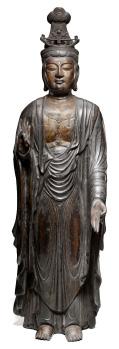
A LACQUER ZUSHI (PORTABLE SHRINE)
CONTAINING AN EARLY WOOD FIGURE OF AMIDA NYORAI, HEIAN PERIOD
Japan, the figure 11th-12th century, Heian period (794-1185), the shrine Edo period (1615-1868)
Finely carved, Amida stands in samabhanga with the hands held in raigo-in (vitarka mudra), loosely draped in monastic robes opening at the chest and cascading in neatly carved folds, the serene face with downcast eyes, the head surmounted by a high ushnisha.
The deity stands atop an elaborate gold-lacquered lotus base, backed by circular halo, within a black and gold-lacquered shrine of typical form.
HEIGHT 27.5 cm (the zushi), 16 cm (the figure)
Condition: Very good condition, minor flaking, few small losses to edges, the kogai with a minor repair.
AUCTION COMPARISON
Compare a closely related larger wood figure of Amida, dated to the Heian period, 33 cm high, at Nagel, 11 June 2024, Stuttgart, lot 1150 (sold for EUR 11,500).
Estimate EUR 5,000
Starting price EUR 2,400
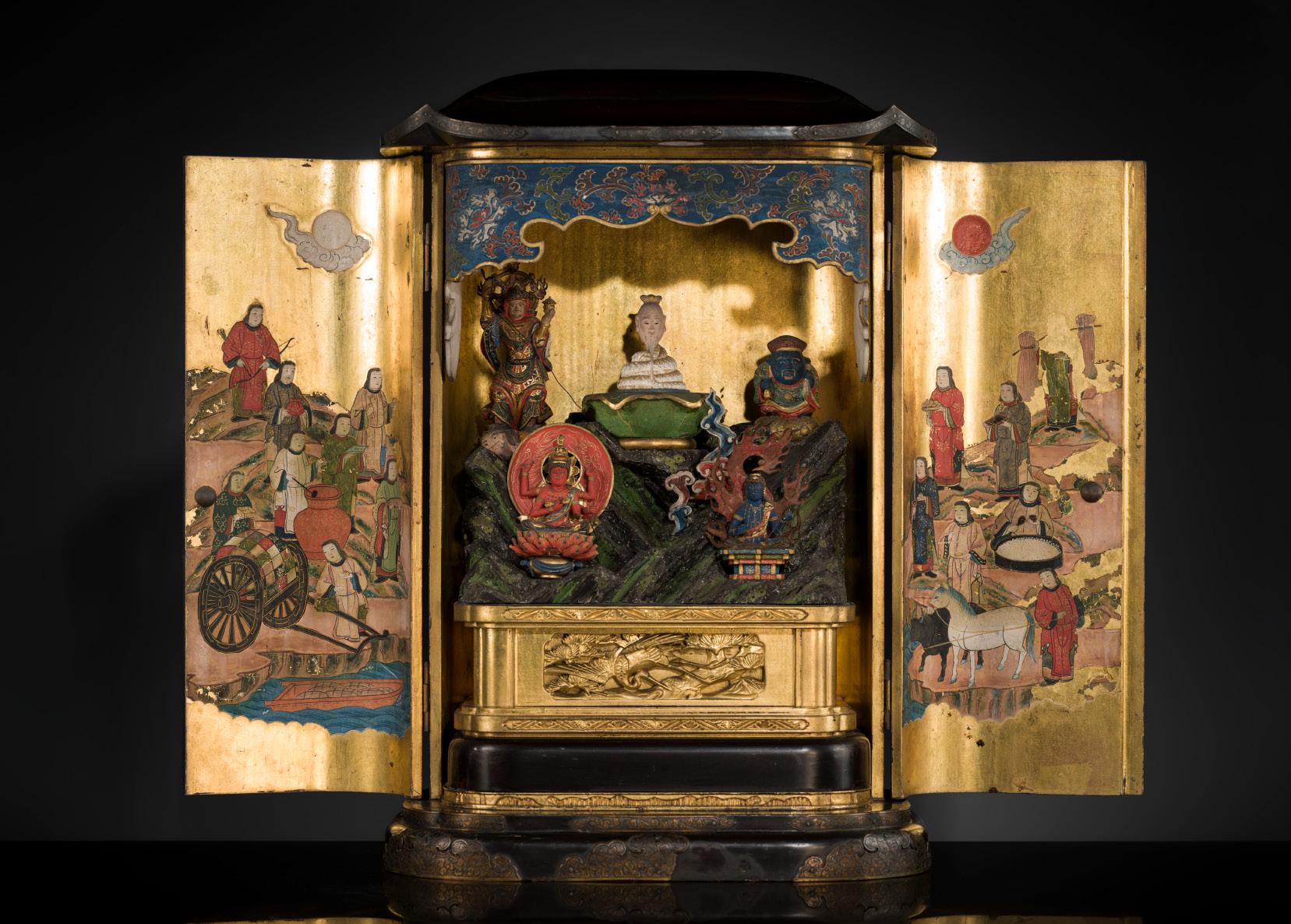
130 A RARE AND IMPRESSIVE LACQUER ZUSHI (PORTABLE SHRINE) WITH FIVE DEITIES, 18TH CENTURY
Japan, 18th century, Edo period (1615-1868)
The shrine opens to reveal a dynamic rocky landscape populated by five deities rendered in polychrome and gilt. At the center stands Ugajin, the serpentine fertility deity, elevated on a tall lotus leaf.
To the upper right appears Daikokuten, depicted with unusual blue skin, while to the upper left is Bishamonten, shown standing triumphantly upon a prostrate figure.
In the lower register, Fudo Myo-o is seated on a tiered throne, enveloped in a flaming aureole, symbolizing immovable wisdom and spiritual power. Opposite him sits the six-armed Aizen Myo-o, poised on a lotus dais and framed by a circular flaming mandorla. The interior doors are finely painted in vibrant pigments and gilt, depicting celestial attendants descending from the heavens bearing offerings. The upper sections feature the sun and moon, reinforcing the cosmic dimension of the scene. The exterior is finished in dark brown lacquer and adorned with floral metal fittings.
HEIGHT 45.7 cm
This zushi brings together deities linked to prosperity, protection, and spiritual discipline in a clear and intentional way.
Provenance: United States private collection. The base with an old label no. ‘103’, and with a detailed description of the lot, further stating that the shrine was originally kept in an old temple in Nara.
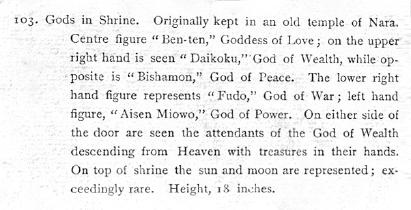
Condition: Very good condition with minor wear, some losses and few touchups to the paintings to the interior of the doors, few small losses to the carved figures, little flaking to the pigments, and touchups to the rocks. The exterior of the shrine with few nicks, few fine age cracks, some flaking to the lacquer, minor losses to the metal mounts, and the base with usual traces of use. Overall presenting beautifully.
Compare a related Kei school zushi with three deities, by Koun, dated 1746, 55.8 cm tall, at Bonhams, Fine Japanese and Korean Art, 17 March 2021, New York, lot 560 (sold for USD 6,375 or approx. EUR 6,800 converted and adjusted for inflation at the time of writing).
Estimate EUR 4,000 Starting price EUR 2,000
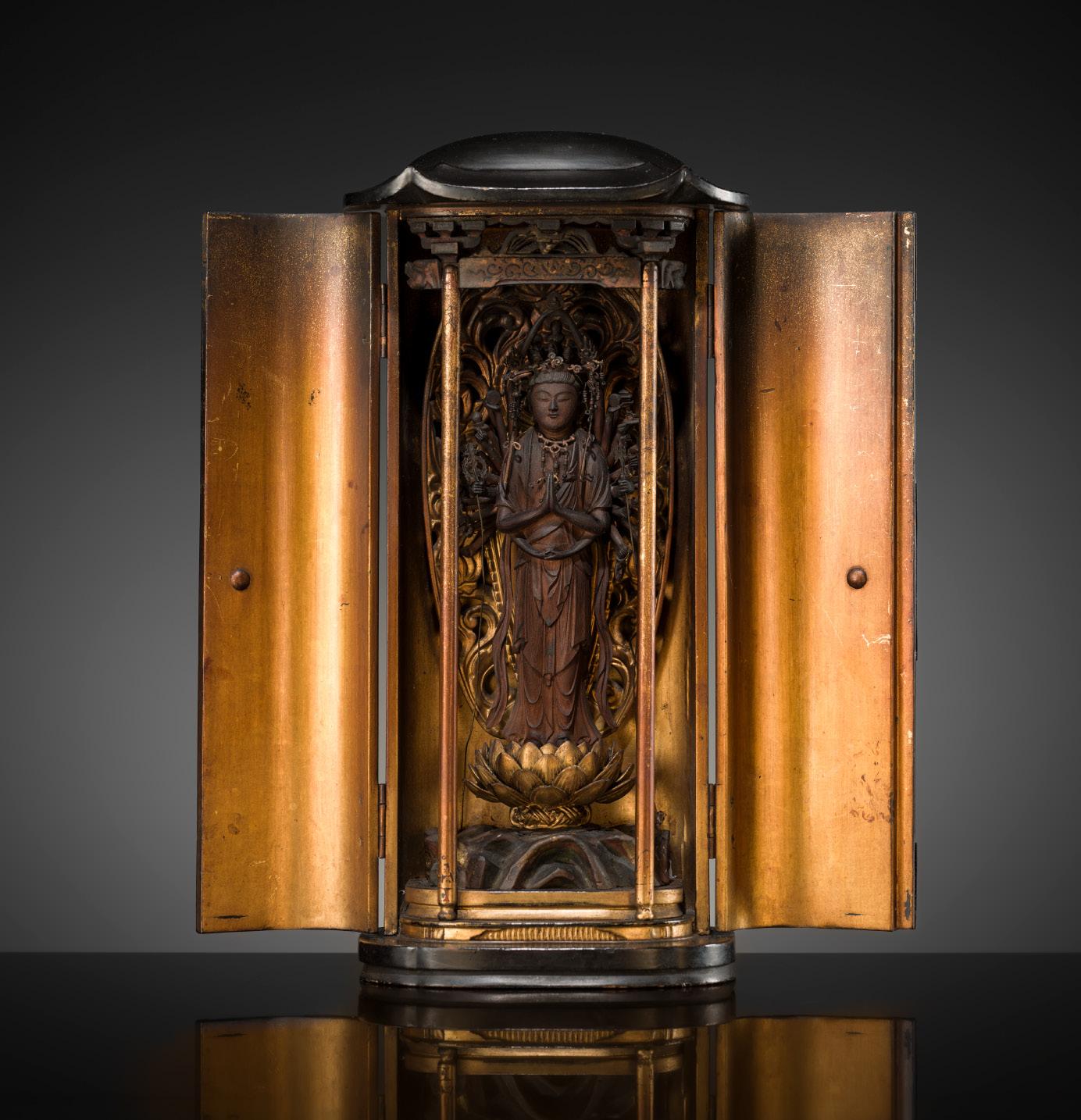
A GILT-LACQUERED WOOD ZUSHI (PORTABLE BUDDHIST SHRINE) CONTAINING A VERY FINE FIGURE OF JUICHIMEN KANNON (THE 11-HEADED KANNON), 18TH CENTURY
Japan, 18th century, Edo period (1615-1868)
The figure is finely carved in wood and depicts the eleven-headed Kannon standing beneath a canopy supported by two columns, atop a lotus dais fitted to a separately carved plinth in the form of crashing waves. She has four principal arms, with two hands clasped together above two hands holding a vessel, and numerous smaller arms holding an immense variety of attributes in gilt-metal. Her long flowing robe falls in heavy U-shape folds down her ankles. The kohai (aureole) behind her with swirling clouds and a central openworked floral design.
The shrine of slender form, the exterior finished in a lustrous roiro ground with gilt-metal fittings with floral designs including shaped hinges, while the interior is richly lacquered in gold.
HEIGHT 17.1 cm (the figure), HEIGHT 33 cm (total)
Condition: Good condition with wear, natural age cracks, nicks, flaking to lacquer, rubbing to gilding, and small losses. Touchups to lacquer and small repairs to the joints. Expected losses and warping to gilt-metal attributes.
AUCTION COMPARISON
Compare a closely related zushi with Juichimen Kannon, dated to the 18th century, 54 cm high, at Zacke, Fine Japanese Art, 13 June 2025, Vienna, lot 166 (sold for EUR 9,100).
Estimate EUR 4,000
Starting price EUR 2,000
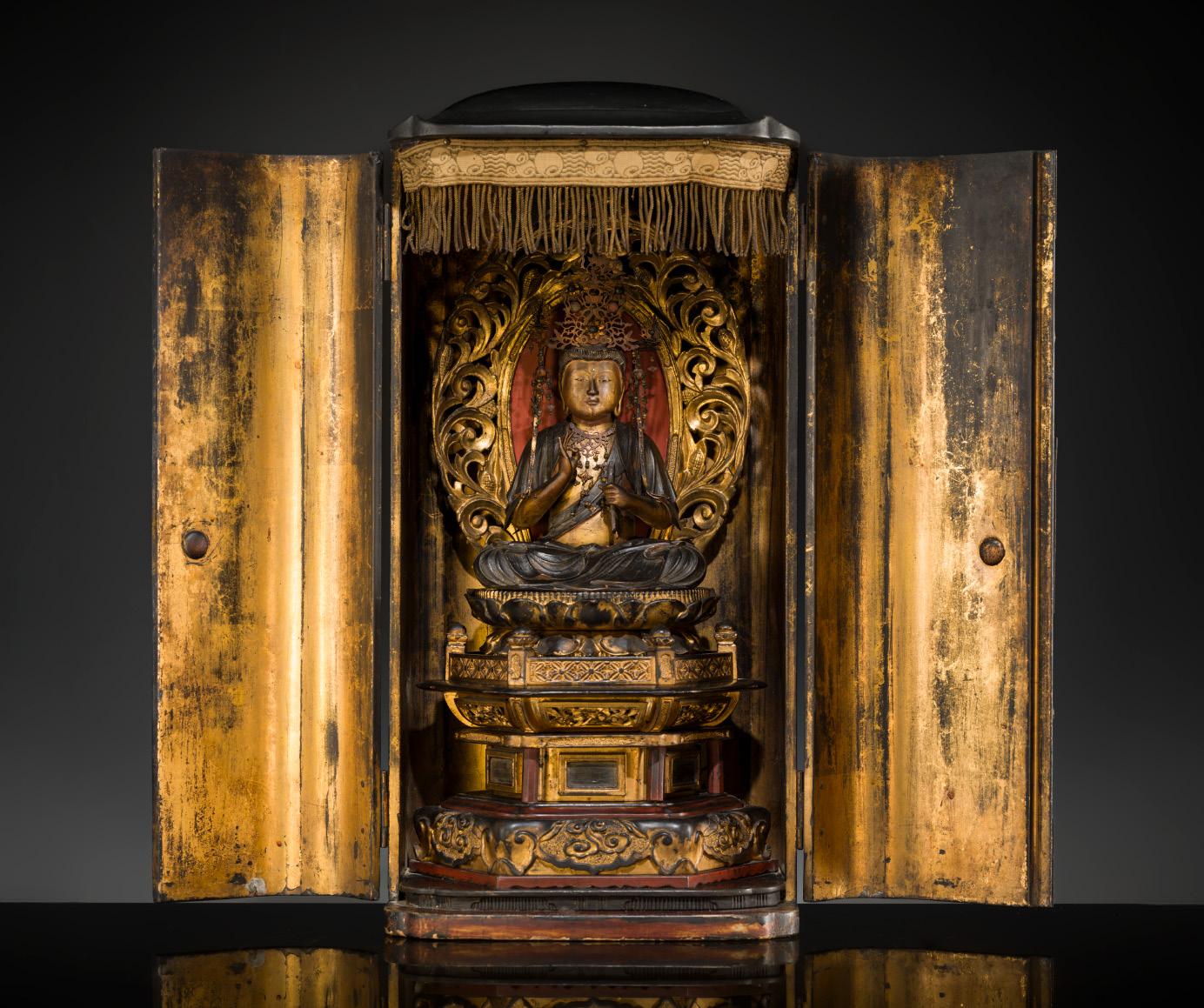
132 A LACQUERED WOOD ZUSHI (PORTABLE SHRINE) WITH SEATED KANNON, WITH A BUILT-IN ‘ILLUMINATING LIGHT’, 18TH CENTURY
Japan, 18th century, Edo period (1615-1868)
Finely carved, the figure of Kannon is shown seated in dhyanasana upon a lotus dais, itself raised on a tiered hexagonal pedestal with lobed panels and an ornate balustrade. The right hand is held in semui-in (abhaya mudra), while the left grasps a lotus stem. The figure is backed by an openwork kohai (halo).
The face is rendered with a serene expression and gently downcast eyes, inlaid in glass and centered by a glass byakugo (urna). The hair is arranged in a tall chignon beneath an elaborate metal crown richly inlaid with glass elements. The shrine is executed in black lacquer with finely chased floral metal fittings, the interior lavishly finished in gilt.
HEIGHT 23 cm (the figure), HEIGHT 54.5 cm (total)
Condition: Good condition with expected age-related wear. The mandorla with a few small chips and fine age cracks; the figure with minor losses, light flaking, and occasional retouching to the lacquer and gilt. The shrine shows light surface wear, areas of revarnishing, and minor age cracks, with remnants of a collector’s label to the reverse. The interior roof has been fitted with a lamp beneath a protective film and drilled to accommodate the electrical cable.
Estimate EUR 4,000 Starting price EUR 2,000
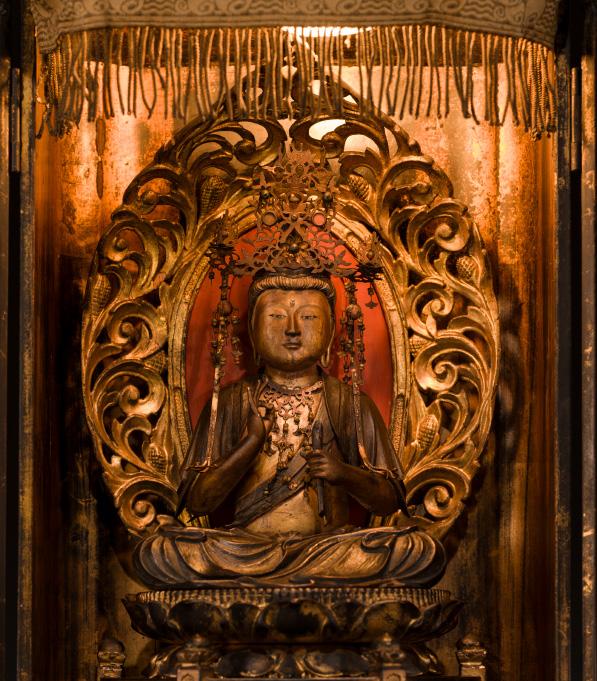
The shrine has been later adapted with a functioning electric light installed within the roof, designed to illuminate the deity from above; the fitting terminates in a cord and plug extending from the reverse.
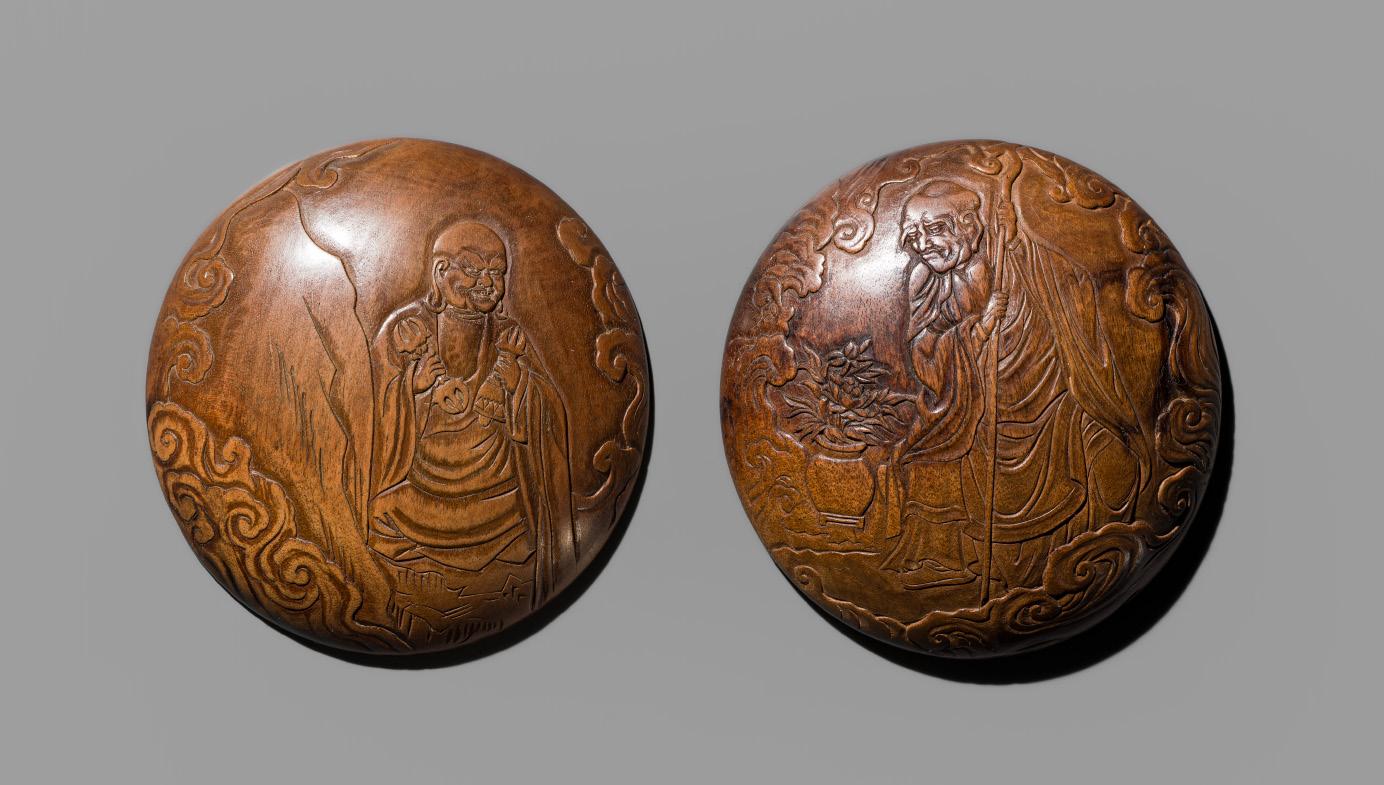
Japan, 18th-19th century, Edo period (1615-1868)
Of domed circular form, the two hinged halves are intricately carved in delicate relief to the interior. One side depicts the raigo scene of Amida Buddha descending on billowing clouds, accompanied by the bodhisattvas Kannon and Seishi. The figures are surrounded by blossoms, their flowing sashes animated by the wind. The opposing half is carved with a pair of celestial beings (tennin), one bearing a lotus stem and the other a miniature pagoda, all enveloped within stylized reishi-shaped clouds.
The exterior of each side is ornamented with finely carved representations of rakan (arhats): one shown standing with a staff beside an elaborate floral arrangement, the other seated by a rock, holding a kongo (vajra) and ghanta bell. The rims are finished in gold fundame lacquer.
DIAMETER 6.8 cm
Condition: Good condition with minor wear, few tiny losses and a fine crack to the relief carving of the Amida Raigo, little nibbling to the rims, and minor rubbing to the gilt.
MUSEUM COMPARISON
Compare a related pocket shrine of Aizen Myo-o, dated 18th-19th century, 5.7 cm in diameter, in the British Museum, museum number 1945,1017.390.
AUCTION COMPARISON
Compare a related circular nichiren pocket shrine, kogobutsu, dated Meiji period, 9 cm in diameter, at Koller Auktionen, Asiatica: Japan, Indien, Südostasien, 17 June 2025, Zurich, lot 368 (sold for CHF 3,000 or approx. EUR 3,200 converted and adjusted for inflation at the time of writing).
Estimate EUR 3,000
Starting price EUR 1,500
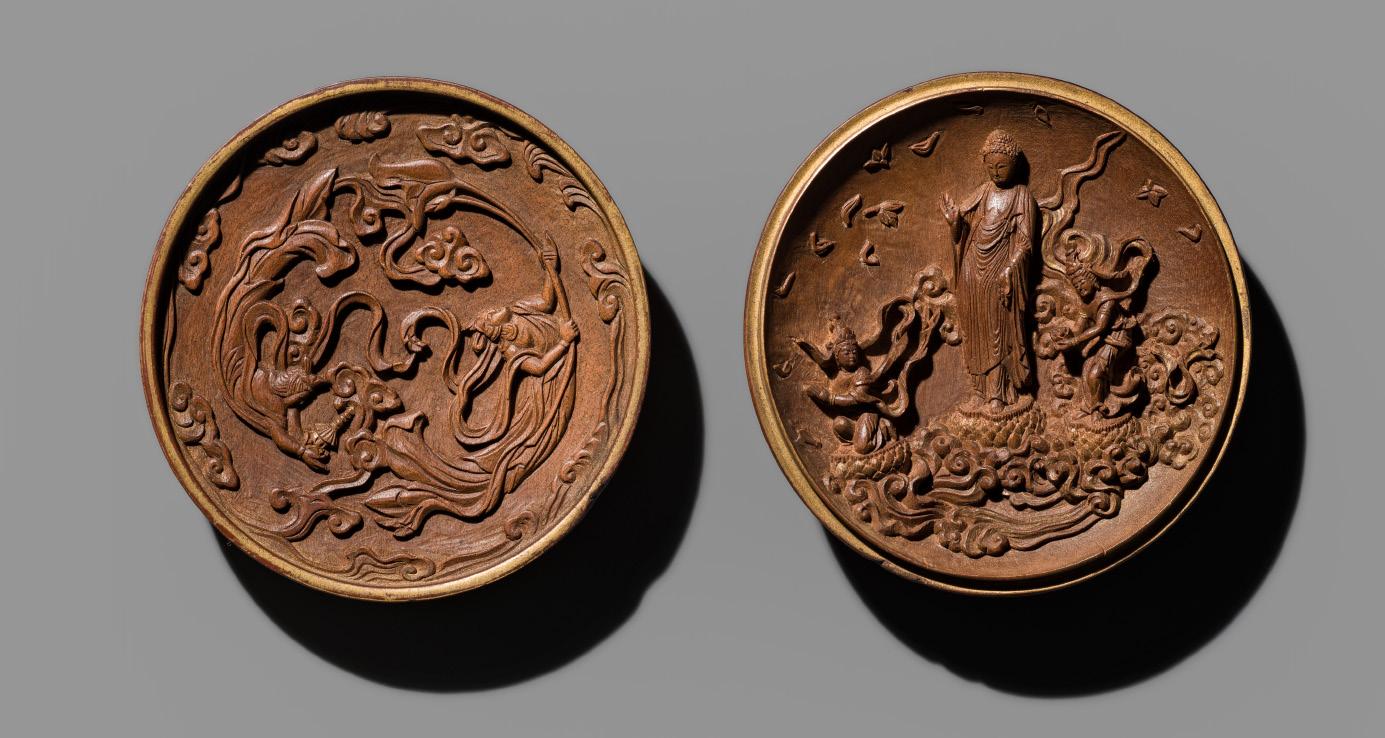
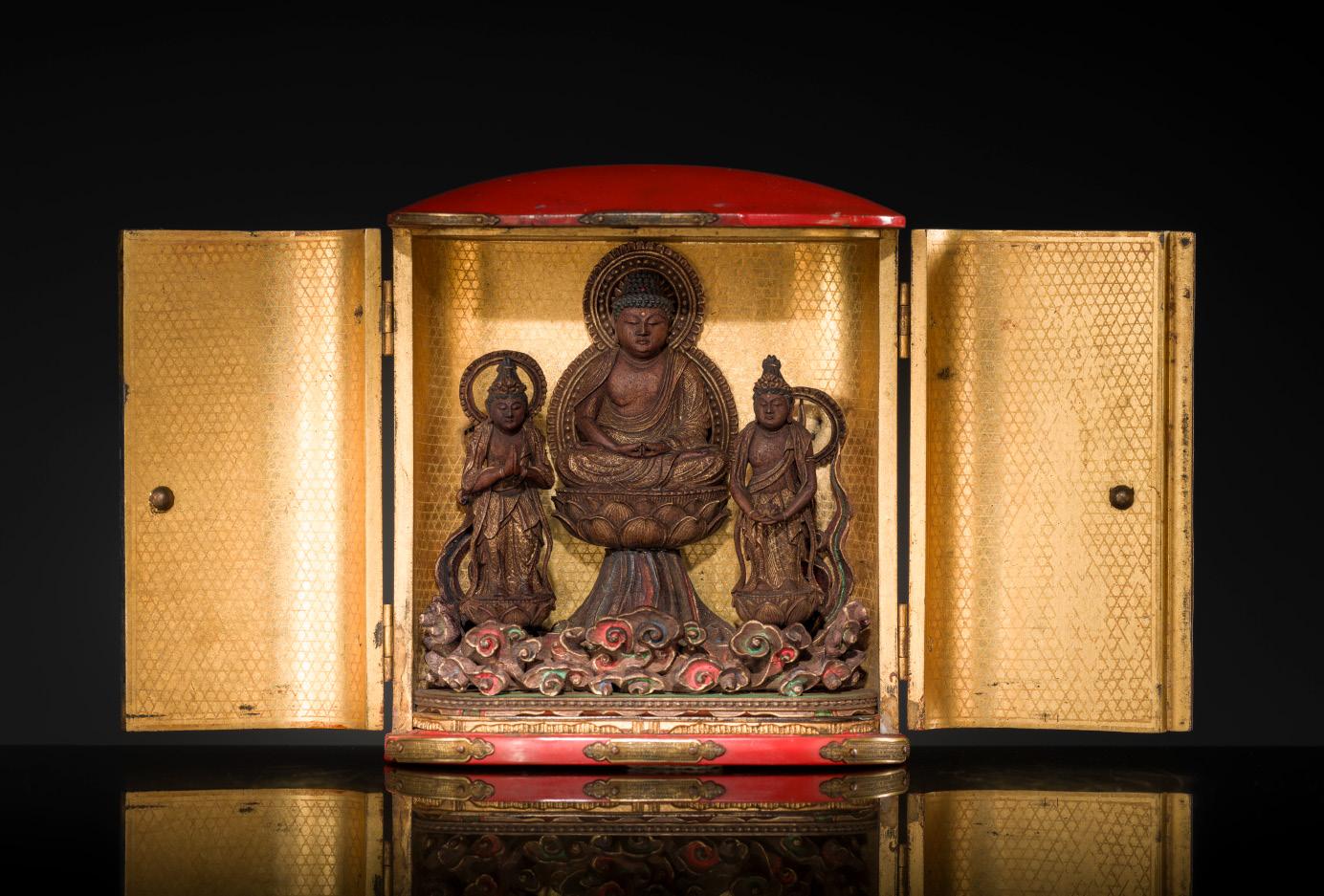
134
A MINIATURE GILT-LACQUERED WOOD ZUSHI (PORTABLE BUDDHIST SHRINE) WITH A FINE AMIDA TRIAD, EDO PERIOD
Japan, 18th-19th century, Edo period (1615-1868)
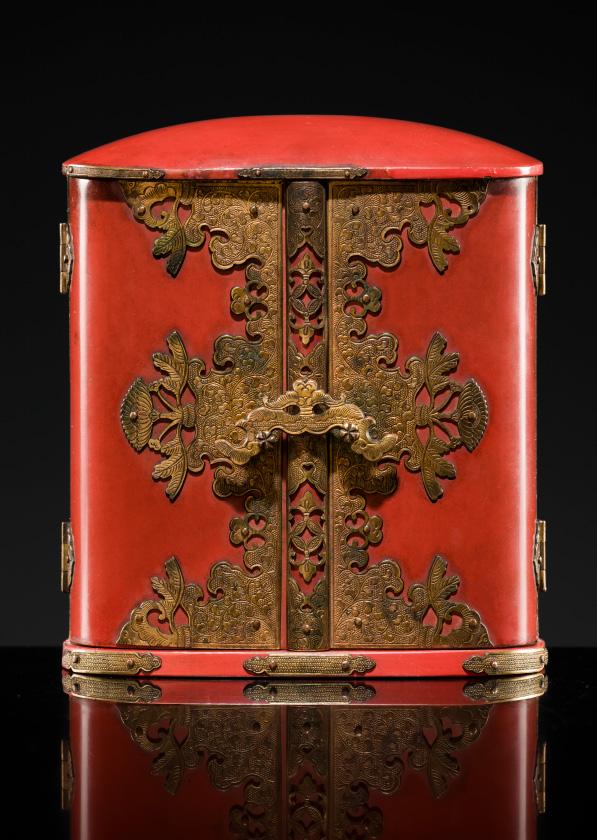
The figure is finely carved and depicts the seated Buddha in kekka fuza (dhyanasana) on a lotus dais, itself resting on an elaborate swirling wave rising above turbulent waters. His hands lowered in mida jo-in (dhyana mudra) and body clad in a loosely draped monastic robe with a geometric diapered ground, opening at the chest and cascading in voluminous folds. The rounded face conveying a meditative expression, distinguished by downcast eyes beneath gently arched brows, backed by a foliate aureole. The figure is attended by Seishi Bosatsu (holding hands in prayer) and Kannon Bosatsu (holding a lotus), welcoming devotees to the Pure Land.
The shrine of typical form, the exterior finished in a lustrous, red-lacquered ground with gilt-metal fittings with floral designs including shaped hinges, while the interior is applied with a gilt sheet with a diapered ground, heightening the sacred presence of the image within.
HEIGHT 10.8 cm
Provenance: From the private collection of Heinrich Georg Johann and Eva Harms, assembled in Shanghai between 1935 and 1942. Condition: Very good condition with minor wear, small nicks, flaking to lacquer with associated touchups, rubbing to gilding, and small losses. The halo of Kannon Bosatsu repaired.
MUSEUM COMPARISON
Compare a related miniature zushi depicting Amida’s paradise, dated to the Edo period, 24.8 cm high, in the collection of the Cornell University, object number 53.002.014.
Estimate EUR 3,000
Starting price EUR 1,500

135
YAMAMOTO MOSUKE: A HIGHLY IMPORTANT COMPLETE SET OF 33 ‘THE SAIGOKU KANNON PILGRIMAGE‘ GOLD LACQUER ZUSHI (PORTABLE BUDDHIST SHRINES), DATED 1854
By Yamamoto Mosuke (also known as Kokei, active c. 1840-1878), signed Yamamoto Mosuke Kokei Japan, dated 1854, Edo period (1615-1868)
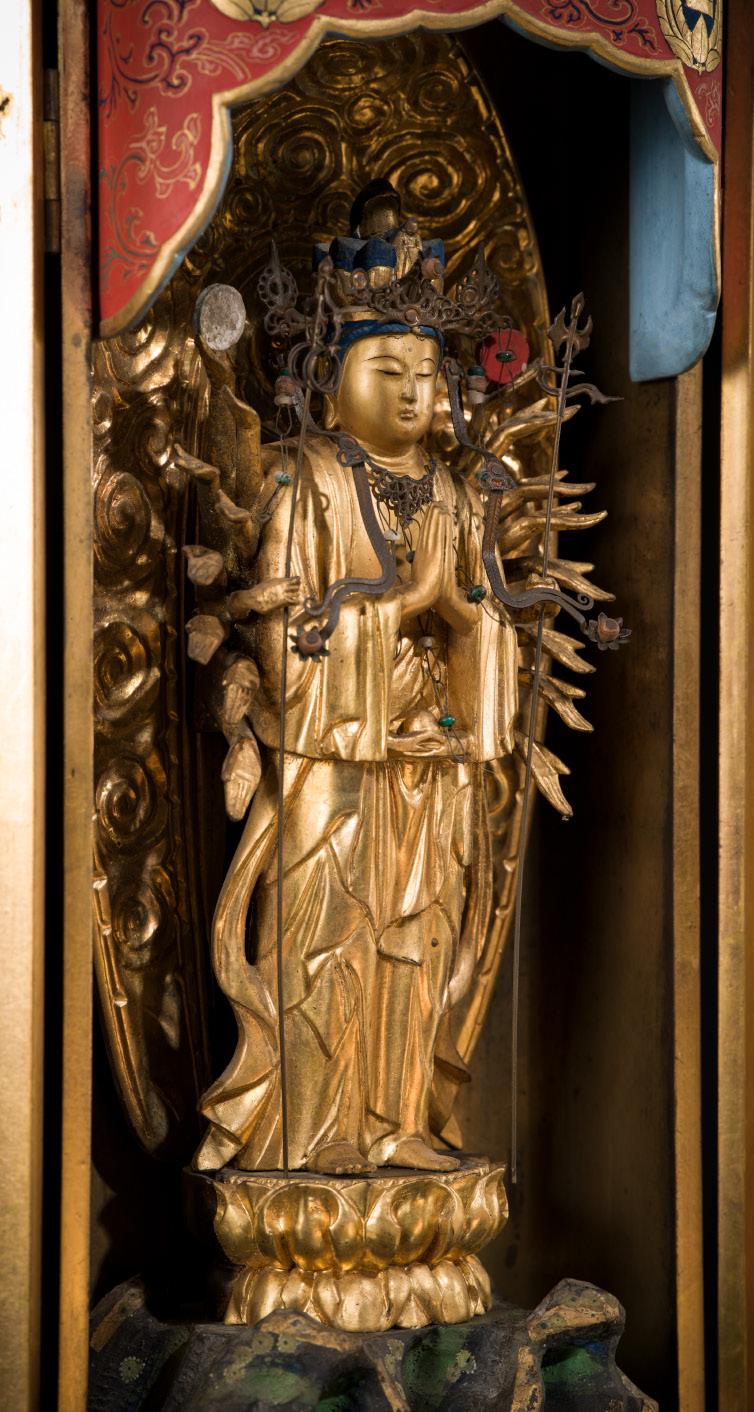
Comprising 33 shrines, each depicting one of the 33 manifestations of Kannon Bosatsu, including:
- Seven Nyoirin Kannon (Cintamanicakra Kannon)
- Seven Juichimen Kannon (Eleven-faced Kannon)
- Twelve Senju Kannon (Thousand-armed Kannon)
- Three Sho Kannon (Sacred Kannon)
- Bato Kannon (Horse-headed Kannon)
- Juntei Kannon (Cundi Kannon)
- Miroku Bosatsu (Maitreya Bodhisattva)
- Fukukenja Hachimoku Kannon (Eight-eyes Amoghapasa Kannon)
The shrines are arranged according to the temples found along the Saigoku Kannon Pilgrimage and are inscribed with goeika (pilgrim hymns) on the right doors. The left doors feature a date and the name of the donor Ishida Tomozaemon Gentai, while the base of each shrine displays the temple or hall name, location, and the number from the series. The top sections each feature two family crests formed as a mixture of “agari-fuji” (ascending wisteria) and “sangi” (traditional counting rods), a sacred combination.
Important notice: Please refer to the online listing for a complete translation of all inscriptions found on the 33 shrines.
Inscriptions: Each shrine inscribed to the left door, 嘉永七甲寅 年五月 Kaei shichi koin nen go gatsu [fifth month of the seventh year of the Kaei era (1854)] and signed ⽯⽥友左衛⾨, ⽞泰謹造之 Ishida Tomozaemon, Gentai kinzo no [respectfully commissioned by Ishida Tomozaemon Gentai]. The first and last shrine inscribed to the back, 京都御幸町松原上、大佛師職、山本茂祐弘慶Kyoto Gokomachi Matsubara-agaru, Daibutsu shi shoku, Yamamoto Mosuke Kokei [Matsubara-agaru, Goko-machi, Kyoto, Great Buddha Master Yamamoto Mosuke Kokei].
HEIGHT c. 38 cm – 44.5 cm (smallest to largest without stands)
Provenance: From a Dutch private collection.
Condition: Very good condition with expected wear, few tiny losses here and there, small chips, rubbing to the gilt, nicks, scratches, little warping, few fine age cracks, minor flaking, some of the metal elements lost or loosened, small touchups here and there, minor repairs, and few doors jammed. Overall presenting exceptionally well and in a remarkably well-preserved state.
With twelve stands for the smaller shrines and three papers with stamps and inscriptions collected from temples along the Saigoku Kannon Pilgrimage.
The shrines contain the complete set of Kannon images from the Saigoku 33 Kannon Pilgrimage, following closely the order and illustrations recorded in the Volume 5 of Butsuzo Zui (Compendium of Buddhist Statues), which was reprinted during the Meiji period. These images are likely reproductions of the honzon icons (main deity statues) that were issued at each pilgrimage temple, often referred to as gosatsu (images of the deity).
The Saigoku Kannon Pilgrimage is a sacred journey through 33 Buddhist temples throughout the Kansai region of Japan dedicated to Kannon (Avalokiteshvara). Pilgrims record their progress with a prayer book which the temple staff mark with stamps or calligraphy indicating the temple number, the temple name, and the specific name of the Kannon image. Traditionally, pilgrims recite a unique goeika (pilgrim’s hymn) at each temple, which are often themed around the temple, location, season, or spiritual significance. These goeika are inscribed to the right door of each shrine.
Estimate EUR 40,000
Starting price EUR 20,000
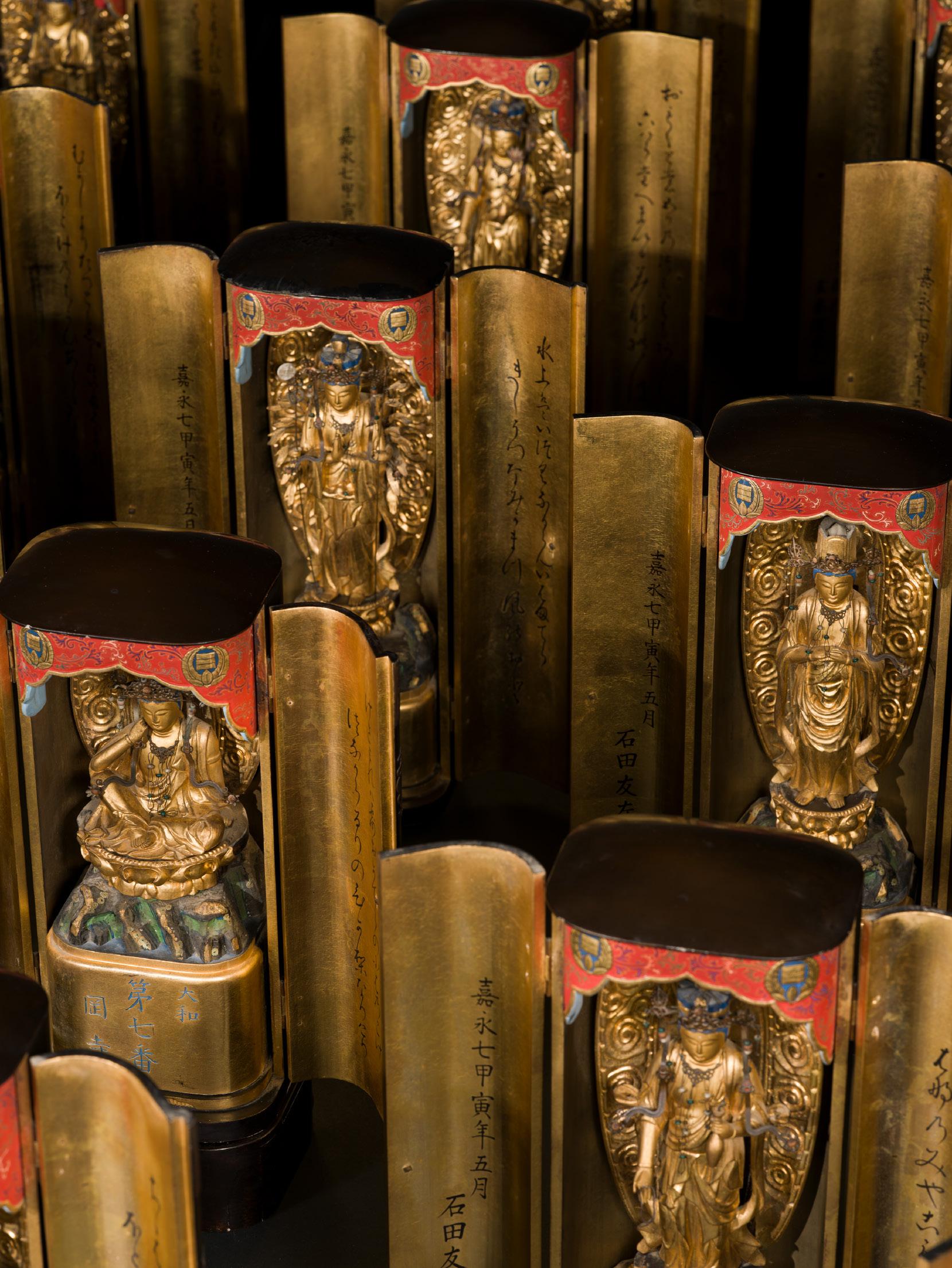
Yamamoto Mosuke (active c. 1840-1878), also known as Kokei, was a Kyoto-based carver who produced significant works, including a large statue of Amida Buddha (2.8 m tall) for Chion’in Temple, Kyoto, now housed at Unshinji Temple in Nagoya. One of his largest projects was producing a group of 517 Buddhist statues, including the five hundred Rakan statues for the Soto Zen Buddhist temple in Daishoji, Ishikawa Prefecture.
Yamamoto Mosuke also contributed to several high-profile restoration projects, such as the Dainichi Nyorai statue at Kiyomizu Temple and the Great Amida Buddha statue in the Phoenix Hall at Byodo-in, Uji. One of his most well-known projects was the recreation of 23 Buddhist statues modeled after the Katsuma Mandara in Toji Temple, Kyoto, which were exhibited
at the 1878 Paris Great Expo. At the same time, a replica of the mandara was created by Yamamoto for Émile Guimet, a French industrialist and founder of the Guimet Museum, who saw the mandara during his visit to Kyoto. The replica of the Toji mandara is now housed in the Musée Guimet.
A mis-en-scéne exhibit of the duplicates of Toji mandara in Musée Guimet, Paris, between 1890-1910 and a detail of one of the figures. The artist is the same as the carver of the present 33 shrines and the set was personally commissioned by Émile Guimet, founder of the Guimet Museum.
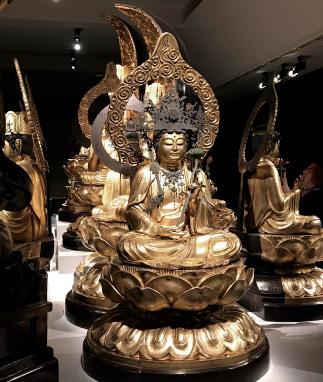
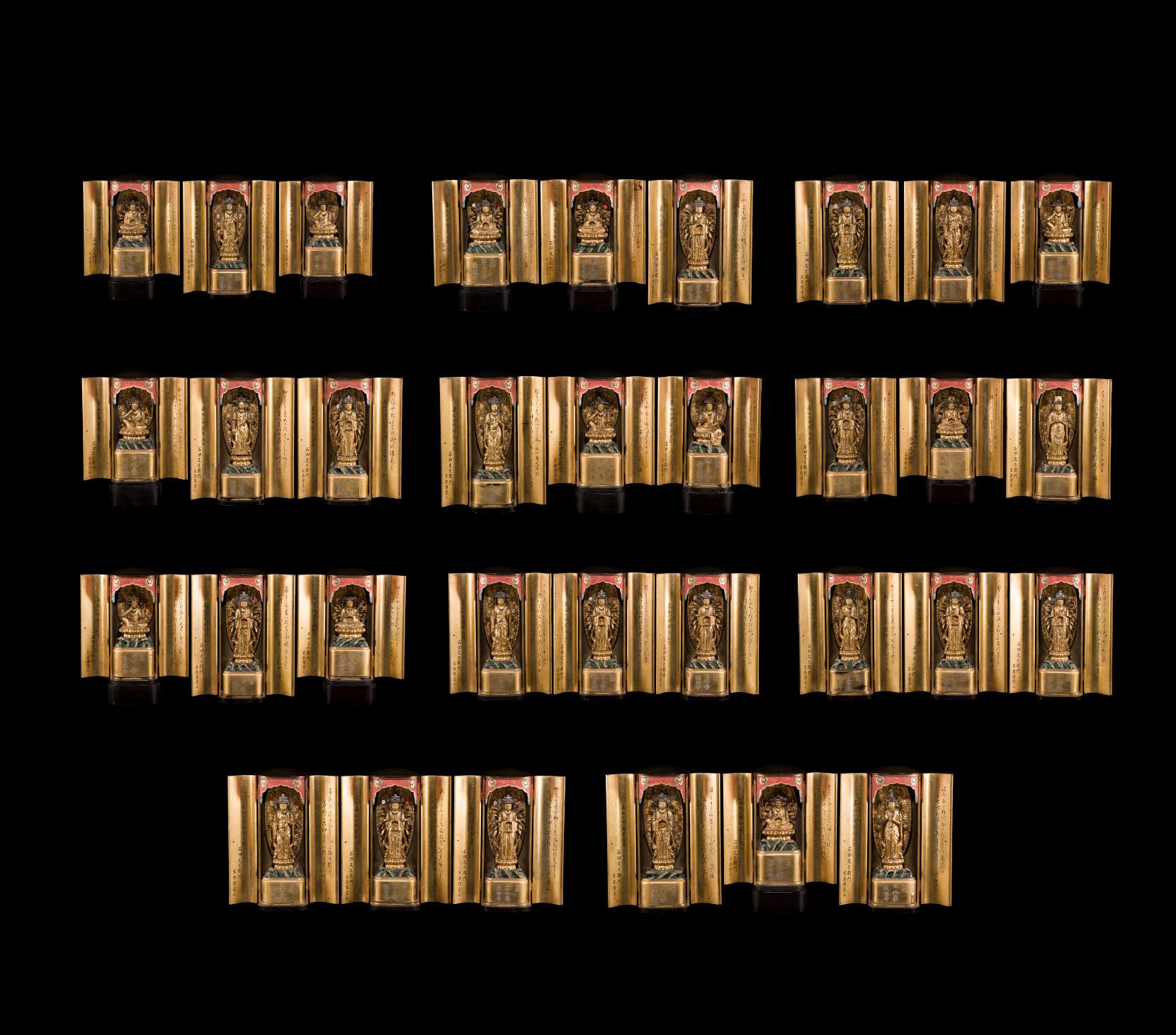
List of the 33 Kannon images, according to their number in the Saigoku Reijo Fudasho Honzon (Saigoku Kannon Pilgrimage).
1. 如意輪観世音 — Nyoirin Kannon — Cintamanicakra Kannon
2. 十一面観世音 — Juichimen Kannon — Eleven-Faced Kannon
3. 千手観世音 — Senju Kannon — Thousand-Armed Kannon
4. 弥勒菩薩 — Miroku Bosatsu — Maitreya Bodhisattva
5. 千手観世音 — Senju Kannon — Thousand-Armed Kannon
6. 如意輪観世音 — Nyoirin Kannon — Cintamanicakra Kannon
7. 如意輪観世音 — Nyoirin Kannon — Cintamanicakra Kannon
8. 十一面観世音 — Juichimen Kannon — Eleven-Faced Kannon
9. 不空羂索八目観世音 — Fukukenja hachimoku Kannon — EightEyes Amoghapasa Kannon
10. 千手観世音 — Senju Kannon — Thousand-Armed Kannon
11. 準提観世音 — Juntei Kannon — Cundi Kannon
12. 千手観世音 — Senju Kannon — Thousand-Armed Kannon
13. 二臂如意輪観世音 — Nihi Nyoirin Kannon — Two-Armed Cintamanicakra Kannon
14. 如意輪観世音 — Nyoirin Kannon — Cintamanicakra Kannon
15. 十一面観世音 — Juichimen Kannon — Eleven-Faced Kannon
16. 楊柳千手観世音 — Yoryu Senju Kannon — Thousand-Armed Willow Kannon
17. 十一面観世音 — Juichimen Kannon — Eleven-Faced Kannon
18. 如意輪観世音 — Nyoirin Kannon — Cintamanicakra Kannon
19. 千手観世音 — Senju Kannon — Thousand-Armed Kannon
20. 千手観世音 — Senju Kannon — Thousand-Armed Kannon
21. 聖観世音 — Sho Kannon — Sacred Kannon
22. 千手観世音 — Senju Kannon — Thousand-Armed Kannon
23. 千手観世音 — Senju Kannon — Thousand-Armed Kannon
24. 十一面観世音 — Juichimen Kannon — Eleven-Faced Kannon
25. 十一面観世音 — Juichimen Kannon — Eleven-Faced Kannon
26. 千手観世音 — Senju Kannon — Thousand-Armed Kannon
27. 如意輪観世音 — Nyoirin Kannon — Cintamanicakra Kannon
28. 聖観世音 — Sho Kannon — Sacred Kannon
29. 馬頭観世音 — Bato Kannon — Horse-Headed Kannon
30. 千手観世音— Senju Kannon — Thousand-Armed Kannon
31. 聖観世音 — Sho Kannon — Sacred Kannon
32. 千手観世音 — Senju Kannon — Thousand-Armed Kannon
33. 十一面観世音 — Juichimen Kannon — Eleven-Faced Kannon
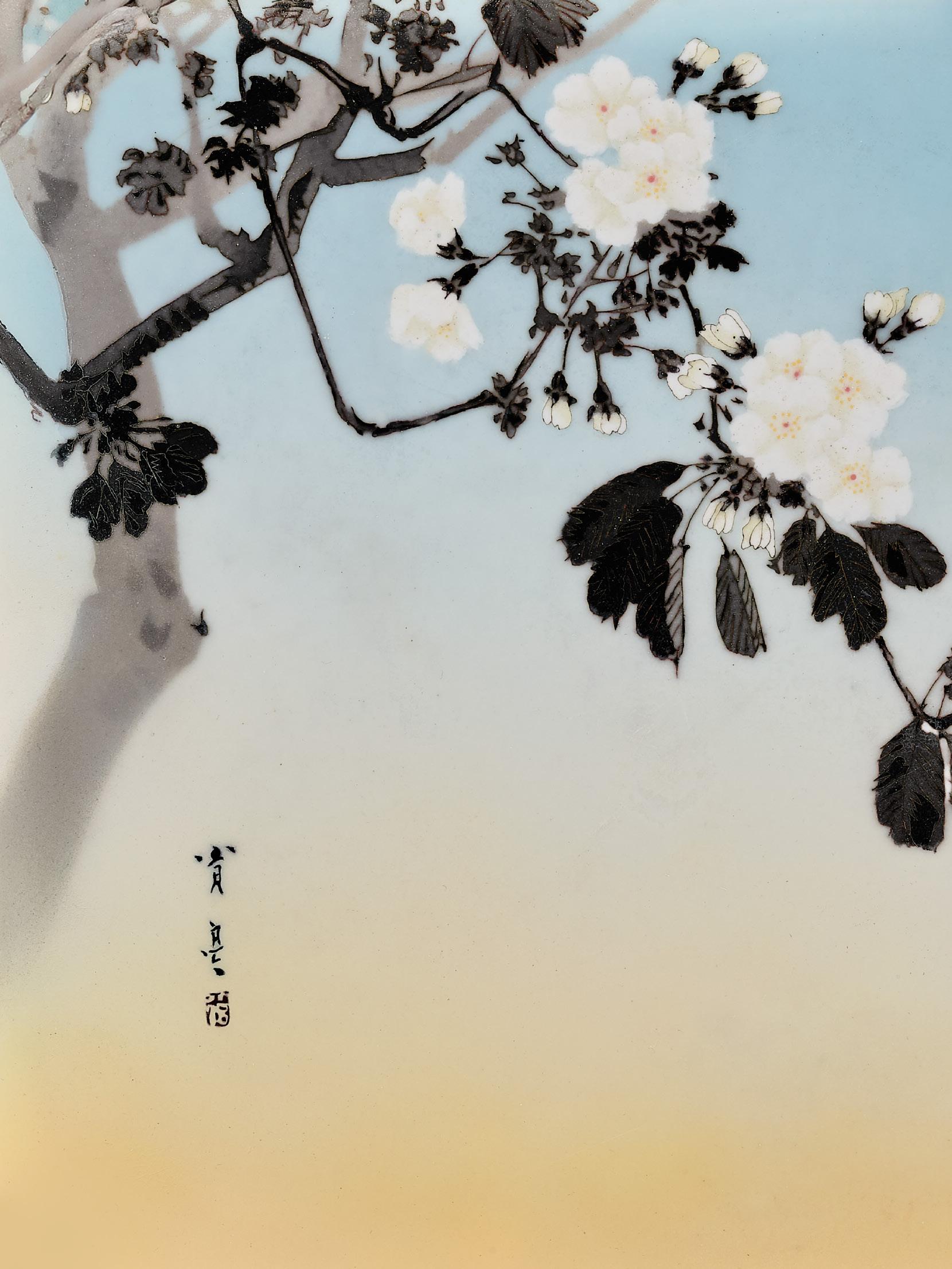
136
KUMENO TEITARO: A SUPERB PAIR OF EXCEPTIONALLY LARGE (65 CM) GINBARI
CLOISONÉ ENAMEL ‘BLOOMING WISTERIA’ VASES
By Kumeno Teitaro (1861-1939), sealed Kume Japan, Meiji period (1868-1912)
The present lot at Christie’s, Yves Saint Laurent and Pierre Bergé Collection, Paris, 25 February 2009, lot 673, sold for EUR 63,400 or approx. EUR 91,000
The elongated baluster body is supported on a splayed foot, with high-angled shoulders rising to a short, waisted neck and everted rim, each fitted with copper mounts. The exterior is lavishly decorated with trailing branches of flowering wisteria (fuji) in bluish and purplish tones, set against a graduated green-and-blue speckled ground - a signature use of translucent enamels over reflective silver foil. The underside bears the seal KUME, enclosed within a cherry blossom cartouche.
HEIGHT (each) 65 cm
WEIGHT (total) 3.8 kg

was a leading figure associated with the Translucent School of Japanese cloisonné enamel (ginbari-jippo), specialising in the combined use of translucent and opaque enamels in a single composition. In 1882 he established his own studio in Nagoya and, in response to intense competition, developed a distinctive mastery of the ginbari technique. By layering clear enamel over finely worked silver foil, he created a luminous inner glow that gave his vessels a remarkable sense of depth and vitality — a dramatic contrast to the more restrained floral idioms of his contemporaries such as Hayashi Kodenji and Ando Jubei. Kumeno’s achievements were recognized internationally: he received the Grand Prix at the Paris Exposition of 1889, the Grand Prix at the St. Louis Exposition of 1904, and the highest award at the Liège Exposition of 1905, as well as numerous other honors including first prize at the Japanese National Exposition in Osaka, 1903.
Laurent and
Provenance: Private collection of Yves Saint Laurent, Paris, France, thence by descent. Christie’s, Yves Saint Laurent and Pierre Bergé Collection, Paris, 25 February 2009, lot 673 (sold for EUR 63,400 or approx. EUR 91,000 adjusted for inflation at the time of writing). Yves Saint Laurent (1936-2008) was one of the most influential fashion designers of the twentieth century, whose work fundamentally reshaped modern womenswear by radically redefining notions of refinement and style. He introduced elements of menswear tailoring, formal abstraction, and a new vocabulary of liberated sophistication that continues to define contemporary fashion. Pierre Bergé (19302017), his lifelong partner in both personal and professional life, was a key figure in the establishment and management of the Yves Saint Laurent fashion house, as well as an important patron and advocate for the arts. Together, they formed a cultural partnership that extended well beyond fashion into the realm of collecting, over decades assembling a distinguished private collection of paintings, furniture, and decorative arts selected with a highly personal and discerning eye rather than according to conventional academic canons. Following the death of Saint Laurent in 2008, a significant portion of this collection was offered at auction by Christie’s in February 2009 at the Grand Palais in Paris, in a landmark sale that attracted international attention and achieved exceptional results, marking the public dispersal of one of the most refined private collections of its time.
Condition: Overall good condition with minor wear and manufacturing/inherent irregularities. Several, mostly nondistracting, losses and cracks. Occasional minute nicks and shallow surface scratches to the metal mounts. The metal mountings of one of the vases slightly loose. Considering the size and type, presenting exceptionally well. Please refer to the additional images for a detailed view of the condition.
Within his oeuvre, this pair of vases belongs to the largest known cloisonné models by Kumeno Teitaro. The exceptional size of 65 cm for each vase makes this pair a rare and important example of his work. Such a monumental scale was likely conceived for an exhibition or imperial commission, reflecting Kumeno’s ambition and technical mastery. The sheer scale of these vases, alongside their striking ginbari enamel work, elevates them among the most remarkable Meiji period cloisonné works in terms of both craftsmanship and visual impact.
AUCTION COMPARISON
Compare a related ginbari cloisonné enamel vase, by Kumeno Teitaro, Meiji period, the lot consisting of only one vase of much smaller size, 18 cm high, at Sotheby’s, Masters of Enamel: The Collection of John and Muriel Okladek, including further Japanese Works of Art from the Meiji Period, Genève, 3 November 2021, lot 70 (sold for GBP 6,930 or approx. EUR 10,000 converted and adjusted for inflation at the time of writing).
Estimate EUR 20,000 Starting price EUR 10,000
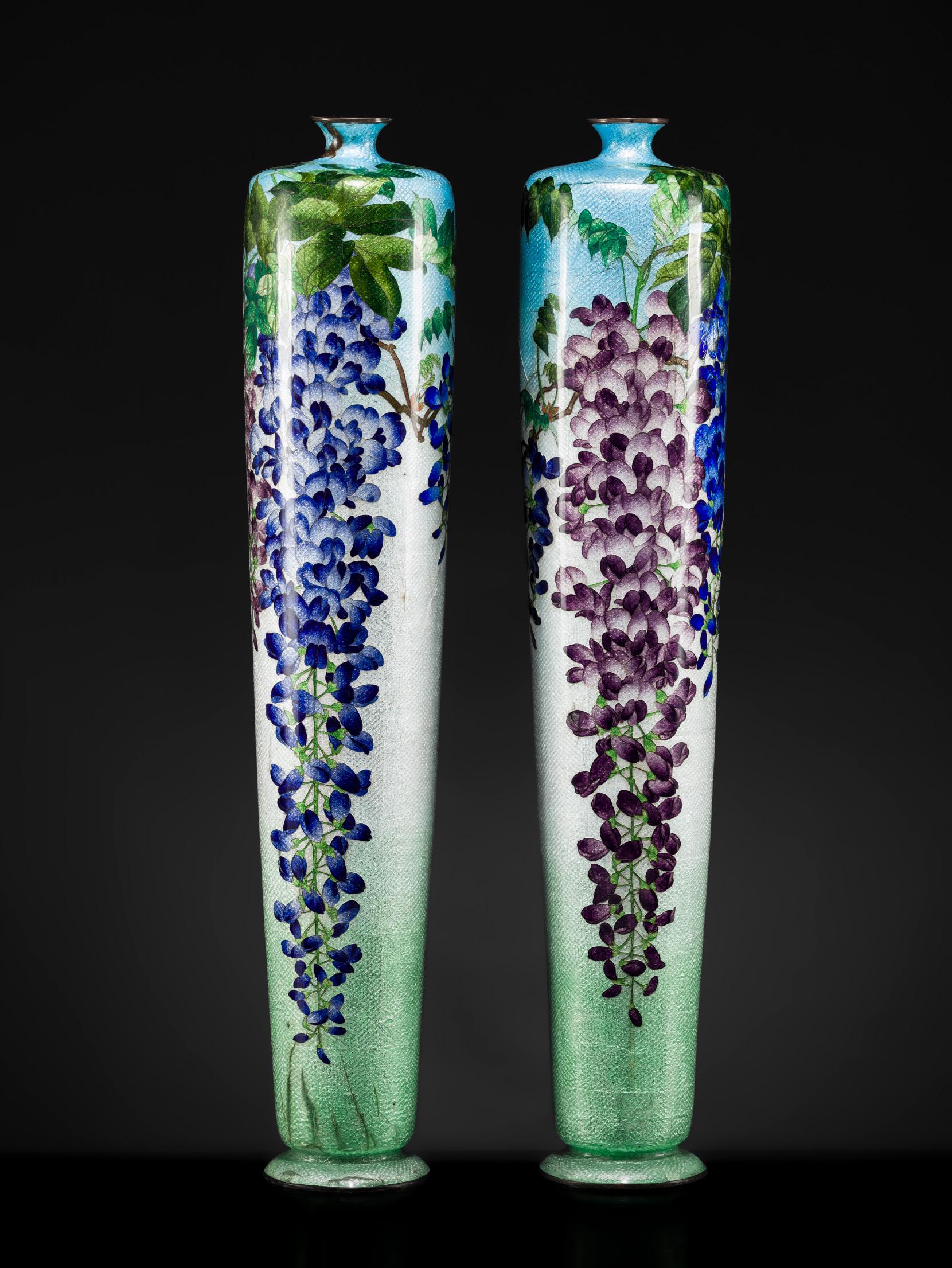
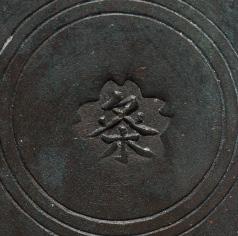
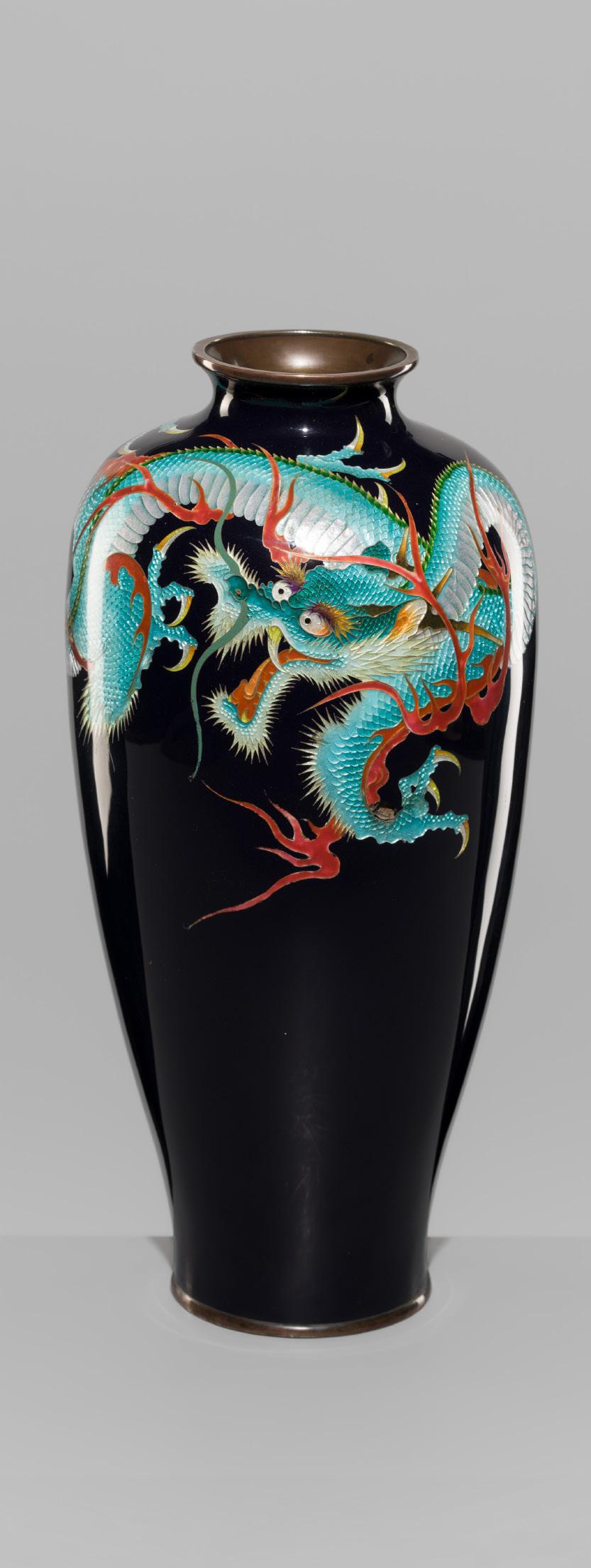
137
A LARGE AND IMPRESSIVE CLOISONNÉ ENAMEL GINBARI ‘DRAGON’ VASE, ATTRIBUTED TO THE WORKSHOP OF KUMENO TEITARO
Japan, Meiji period (1868-1912)
The large vase is of baluster form, rising from a circular foot to broad shoulders that support a waisted neck with a copper-mounted rim. The body is decorated with various colored and translucent enamels, depicting a coiling dragon, its body rendered in chased silver foil enamels (ginbari), all set against a rich midnight-blue ground.
HEIGHT 36.8 cm
WEIGHT 1.5 kg
Provenance: The private collection of Michael Barrett, New York, USA. Michael Barrett was the co-founder of the celebrated New York China Club, where musical icons such as David Bowie, Elton John, Sting, Stevie Wonder, and Prince performed. In addition to his role as an impresario, Barrett was also an antiques dealer with a particular passion for Japanese cloisonné, assembling a fine collection over the years.
28 November 1985
Condition: Overall good condition, typical for cloisonné wares of this size. A loss to the enamel near one claw, a tiny repair to the tail, minute losses to whiskers, and a scratch (10.5 cm long) to the body. Some typical manufacturing-inherent flaws and pitting. A large hole is drilled through the center of the metal base, likely for previous mounting as a lamp. Presenting beautifully.
Kumeno Teitaro (1861-1939) gained widespread recognition for his exquisite ginbari enamels. In 1882, he established his own studio and showcased his works at numerous national and international exhibitions. Notably, he participated in exhibitions such as Nuremberg in 1885, Paris in 1889 (earning a silver medal), and Chicago in 1893. His exceptional craftsmanship quality was acknowledged with a ‘grand prize’ at St. Louis in 1904 and a gold medal at Liège in 1905.
AUCTION COMPARISON
Compare a related pair of cloisonné vases, attributed to Kumeno Teitaro, dated to the late 19th century, 45 cm high, at Christie’s, The Japanese Aesthetic, 7 November 2012, London, lot 377 (sold for GBP 17,500 or approx. EUR 29,500 converted and adjusted for inflation at the time of writing).
Estimate EUR 5,000
Starting price EUR 2,400
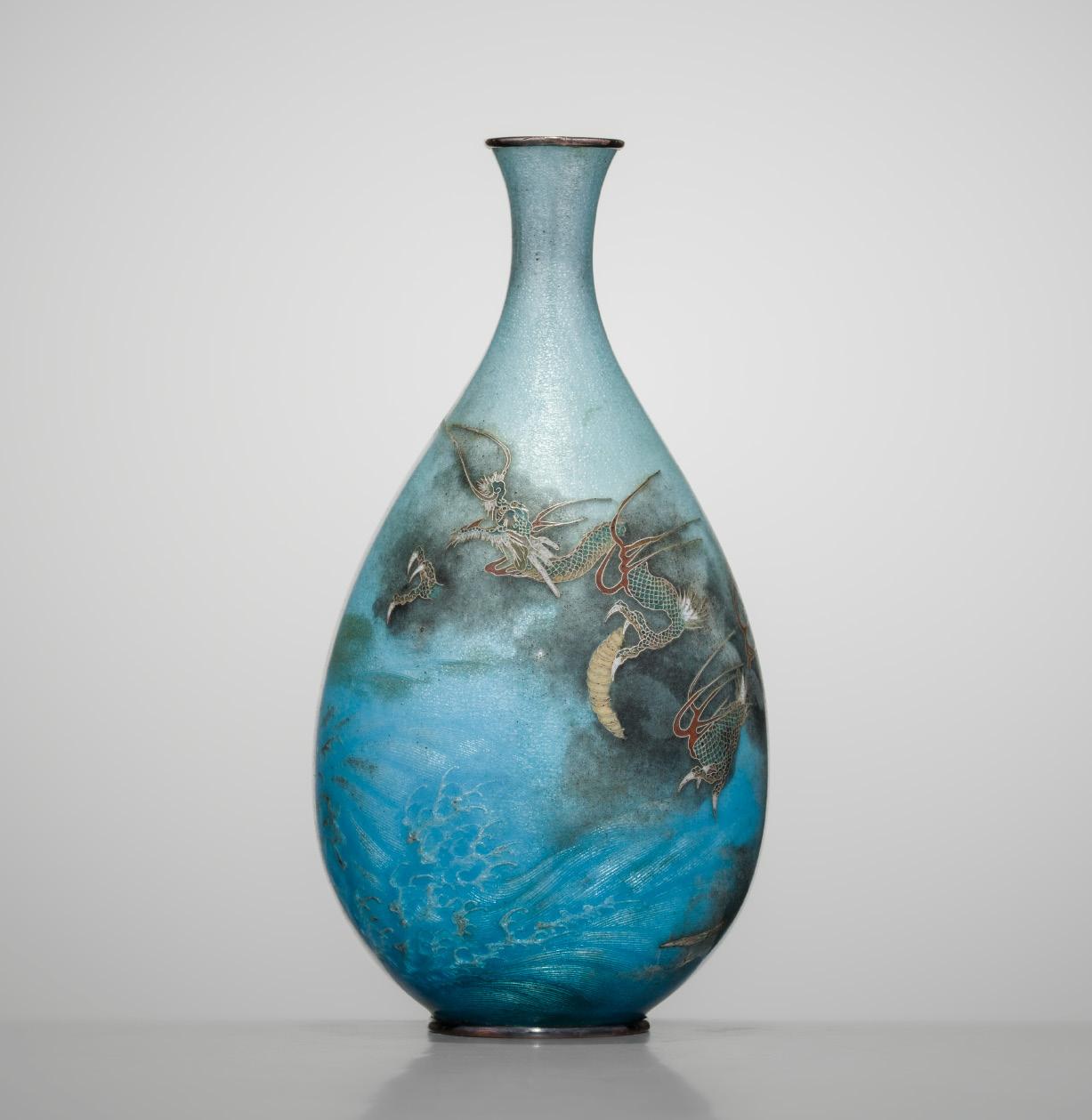
138
KUMENO TEITARO: A FINE GINBARI
CLOISONNÉ ‘DRAGON AND WAVES’ VASE
By the Kumeno Teitaro Workshop, sealed Kume and signed Kumeno zo Japan, Meiji period (1868-1912)
Of ovoid form, raised on a short circular silver foot and rising to a gently waisted neck with a flaring mouth, surmounted by a flat silver rim. The body is masterfully decorated in a combination of translucent enamels and ginbari (silver foil) enamels, depicting a dragon emerging from billowing smoke, rising above crashing waves on a hammered silver foil ground. The exquisite use of tomei-shippo (transparent cloisonné) allows the dragon to emerge vibrantly against the subtle waves and clouds. The base is sealed kume, while the side bears a second signature KUMENO zo [made by Kumeno] within an oblong reserve.
HEIGHT 15.8 cm
WEIGHT 213 g
Provenance: From the Alan Bostock collection of Japanese metalwork and cloisonné, assembled over the last 40 years. Condition: Excellent condition with no damages or restorations (checked under UV light). Minor wear and typical manufacturinginherent irregularities such as minuscule pitting. The base with a scratch to the silver mount.
Kumeno Teitaro (1861-1939) gained widespread recognition for his exquisite ginbari enamels. In 1882, he established his own studio and showcased his works at numerous national and international exhibitions. Notably, he participated in exhibitions such as Nuremberg in 1885, Paris in 1889 (earning a silver medal), and Chicago in 1893. His exceptional craftsmanship quality was acknowledged with a ‘grand prize’ at St. Louis in 1904 and a gold medal at Liège in 1905.
AUCTION COMPARISON
Compare a closely related cloisonné enamel vase with a dragon, by the same workshop, sealed Kume, 23 cm high, at Sotheby’s, Masters of Enamel: The Collection of John and Muriel Okladek | Including Further Japanese Works of Art from the Meiji Period, 1868-1912, 3 November 2021, London, lot 71 (mid-estimated at GBP 7,000 or approx. EUR 10,000 converted and adjusted for inflation at the time of writing).
Estimate EUR 3,000 Starting price EUR 1,500
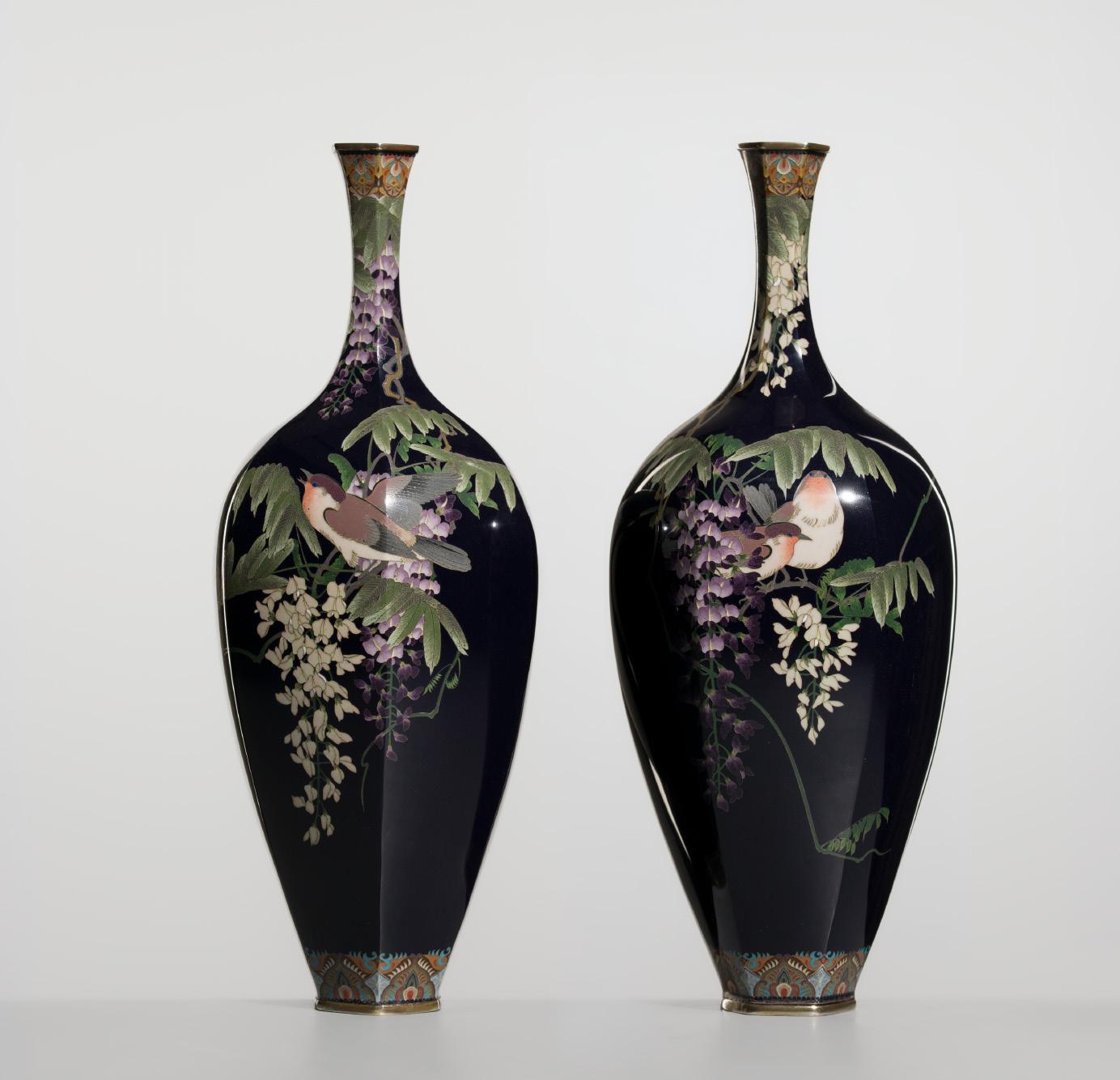
139
A FINE PAIR OF MIDNIGHT-BLUE CLOISONNÉ
ENAMEL ‘SPARROWS AMID WISTERIA’ FACETED BALUSTER VASES, STYLE OF HAYASHI KODENJI
Japan, c. 1880, Meiji period (1868-1912)
The large hexagonal-faceted bodies gently tapering toward flat bases and rising to slender, slightly waisted necks with flared rims, each end fitted with brass mounts. Each vase bearing a deep midnight-blue ground, finely decorated in vibrant enamels with gilt wire, to depict a pair of sparrows (suzume) perched on leafy branches of blossoming wisteria (fuji). The foot and rim intricately decorated with colorful diapered patterns of stylized floral motifs.
HEIGHT 24.7 cm (each)
WEIGHT 331.3 g and 356.8 g
Provenance: Kobe Asiatische Kunst und Antiquitäten, Zurich, Switzerland, 1986. An old private collection in Bern, Switzerland, acquired from the above. A copy of the original signed and stamped invoice, dated 1986, addressed to Mr. K., stating a purchase price of CHF 8,800 (or approx. EUR 15,000 converted and adjusted for inflation at the time of writing), accompanies this lot.
Condition: Excellent condition with no damages or restorations (checked under UV light). Minor wear, light scratches, typical manufacturing-inherent irregularities.
AUCTION COMPARISON
Compare a related pair of vases, workshop of Hayashi Kodenji, with a similar design and borders, 12.5 cm high (each), at Bonhams, Fine Japanese Art, 16 May 2024, London, lot 143 (sold for GBP 7,680 or approx. EUR 9,300 converted and adjusted for inflation at the time of writing).
Estimate EUR 2,500
Starting price EUR 1,200
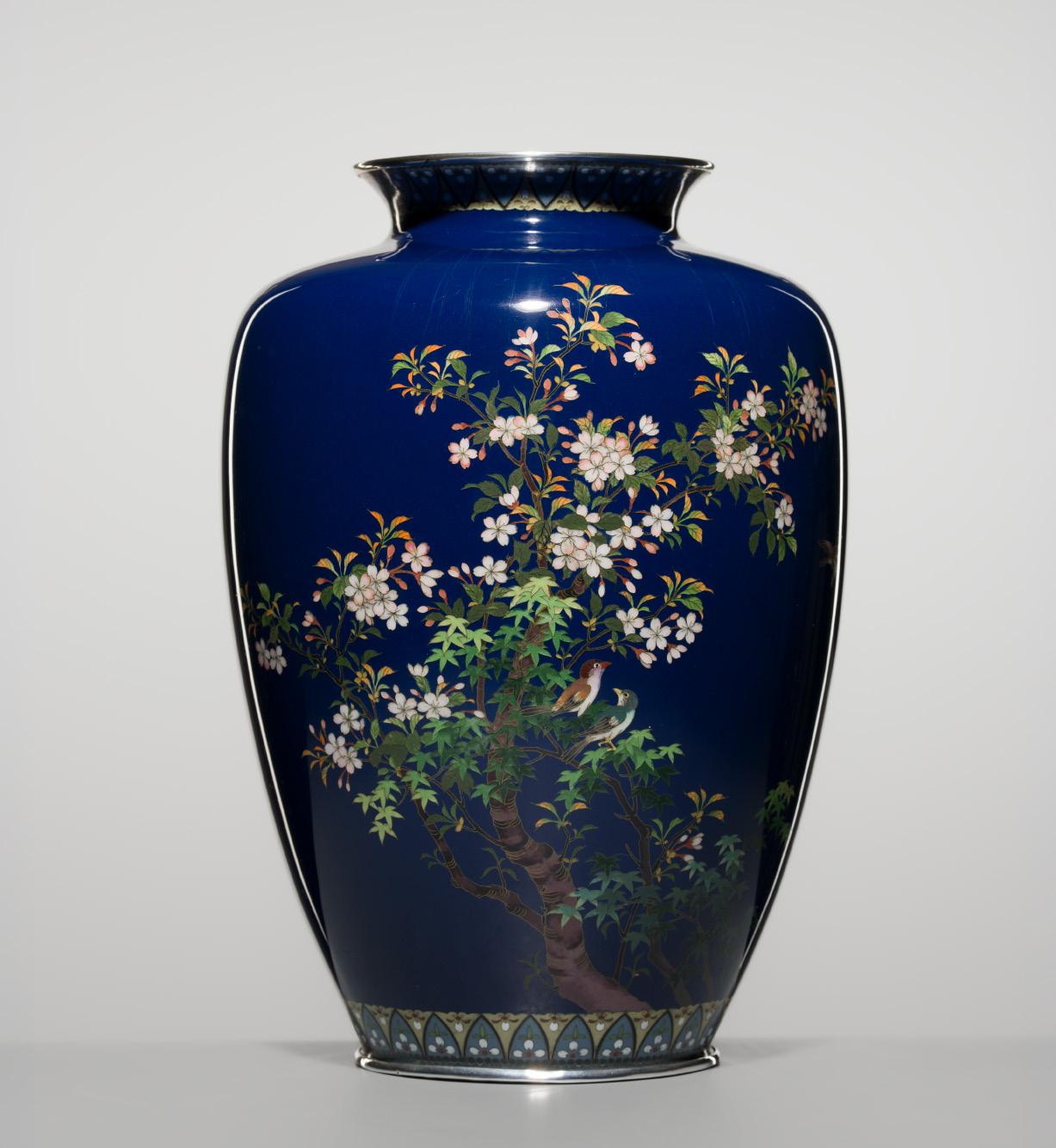
140
FINE AND LARGE CLOISONNÉ-ENAMEL
‘BIRDS AND SAKURA’ VASE, ATTRIBUTED TO THE WORKSHOP OF HAYASHI KODENJI
Japan, Meiji period (1868-1912)
Of baluster form, the exterior finely worked with silver wire of varying gauge to depict three birds perched on the flowering branches of a cherry tree, with a fourth bird in flight. These figures are set against a striking midnight-blue ground, while the neck and foot are adorned with a band of lappets enclosing repeated foliate motifs.
HEIGHT 24.4 cm
WEIGHT 907 g
Condition: Good condition with minor typical wear, few scratches, tiny nicks around the neck, and some wear and dents to the silver mounts.
Hayashi Kodenji (1831-1915) was a pivotal figure in the history of cloisonné enameling and instrumental in the formation and leadership of the Shippo-cho enamelers guild, and it is probable that he worked for the Nagoya-based Shippo Kaisha.
As well as being an innovative enameler he was also an astute businessman. Stories are told that in his early days he walked from Nagoya to Yokohama to sell his wares at a time when there was a long-standing prohibition on selling copper (which included the body of the cloisonné objects). He worked with his son, Kodenji II, for over 40 years and it is often hard to differentiate the work of the two makers. He exhibited and won prizes at many international exhibitions: Nuremberg 1885 (silver), Paris 1889 (silver) and St Louis 1904 (gold). In 1912, Glendining of London auctioned over 300 ‘Japanese cloisonné enamels from the Glasgow Exhibition offered for sale by Mr. K Hayashi of Nagoya’.
AUCTION COMPARISON
Compare a closely related cloisonné enamel vase, dated to the early 20th century, 31 cm high, at Bonhams, Samurai · Snow · Spectacle: Japanese Art across Seven Centuries, 7 November 2024, London, lot 234 (sold for GBP 2,560 or approx. EUR 3,200 converted and adjusted for inflation at the time of writing).
Estimate EUR 3,000
Starting price EUR 1,500
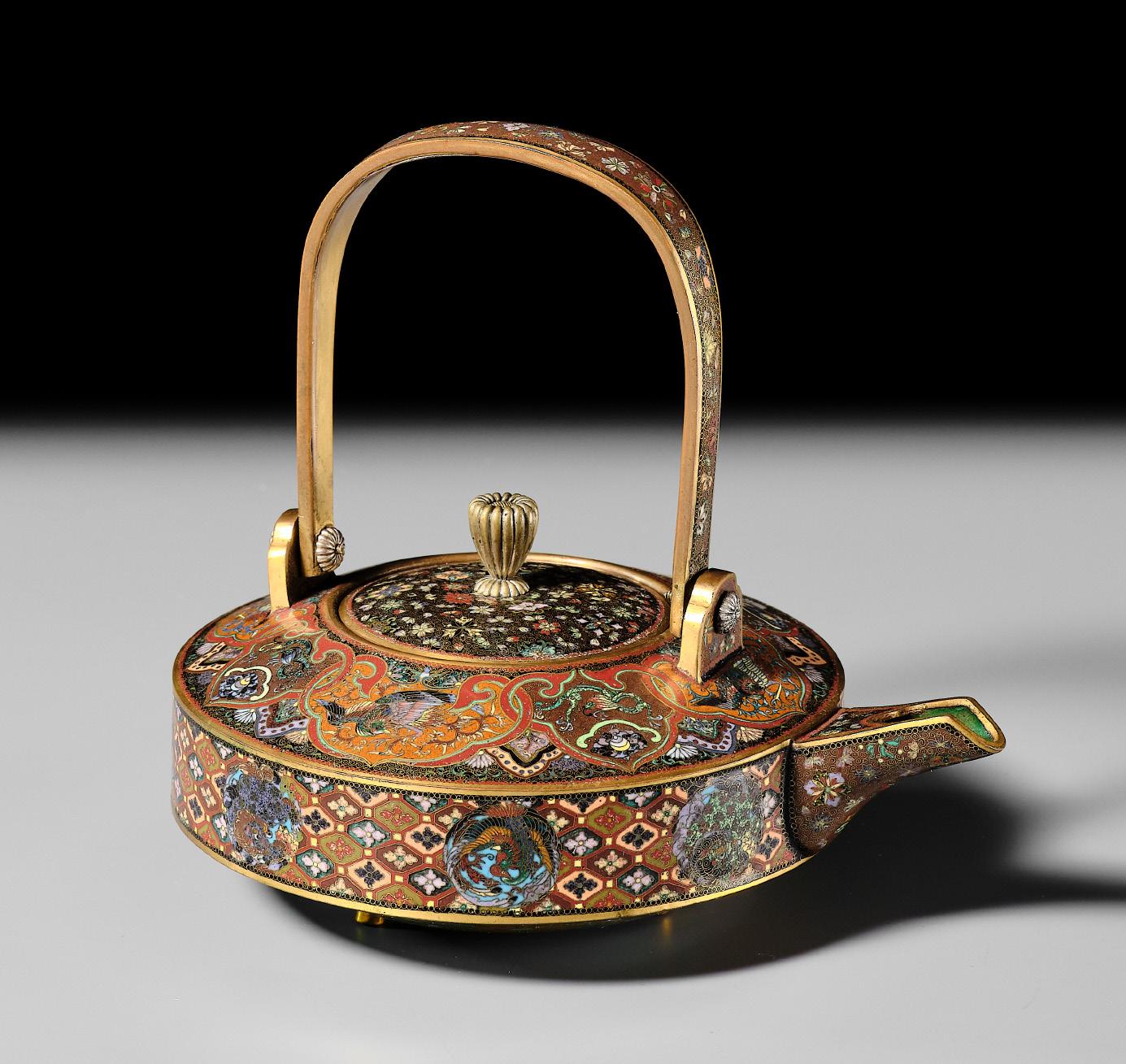
NAMIKAWA YASUYUKI: A SUPERB CLOISONNÉ ENAMEL TEAPOT AND COVER
Attributed to Namikawa Yasuyuki (1845-1927), unsigned Japan, late 19th century, Meiji period (1868-1912)
The superbly crafted teapot features a flattened cylindrical body with sharply sloping hips that taper toward a flat base, supported on three small cylindrical feet. Rising to high-angled shoulders, it leads to a broad, circular mouth, fitted with a slightly domed cover topped by a kiku-shaped finial. The teapot is equipped with a straight, gently upright spout and an overhanging handle, mounted with silver chrysanthemum-shaped hinges.
The exterior is meticulously decorated with vibrant enamels outlined in shimmering gilt wire, showcasing a profusion of ornamental motifs. The sides display shaped panels with mythical birds amidst a hanabishi (flower-lozenge) pattern, while the underside features chrysanthemums above meandering waters. The shoulders are adorned with reishi fungus, interspersed with additional avian creatures and floral designs. The cover and handle are similarly richly decorated with floral motifs.
HEIGHT 14.1 cm, LENGTH 15.9 cm
WEIGHT 447.3 g
Provenance: Galerie Zacke, Fine Japanese Arts, Vienna, 2 June 2018, lot 17 (sold for EUR 5,056). A private collection in Vienna, Austria, acquired from the above.
Condition: Excellent condition with minor typical wear and manufacturing-inherent irregularities such as minor pitting. One silver kiku fitting to the interior of the handle is lost and there is some minor wear and light scratches to the mounts.
Namikawa Yasuyuki (1845-1927) is widely regarded as one of Japan’s foremost cloisonné artists.
AUCTION COMPARISON
Compare a closely related cloisonné enamel ewer, attributed to Namikawa Yasuyuki, Meiji period, late 19th century, 17.7 cm long, at Bonhams, Fine Japanese and Korean Art, New York, 21 March 2018, lot 2226 (sold for USD 6,875 or approx. EUR 7,700 converted and adjusted for inflation at the time of writing).
Estimate EUR 5,000
Starting price EUR 2,400
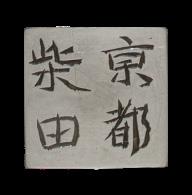
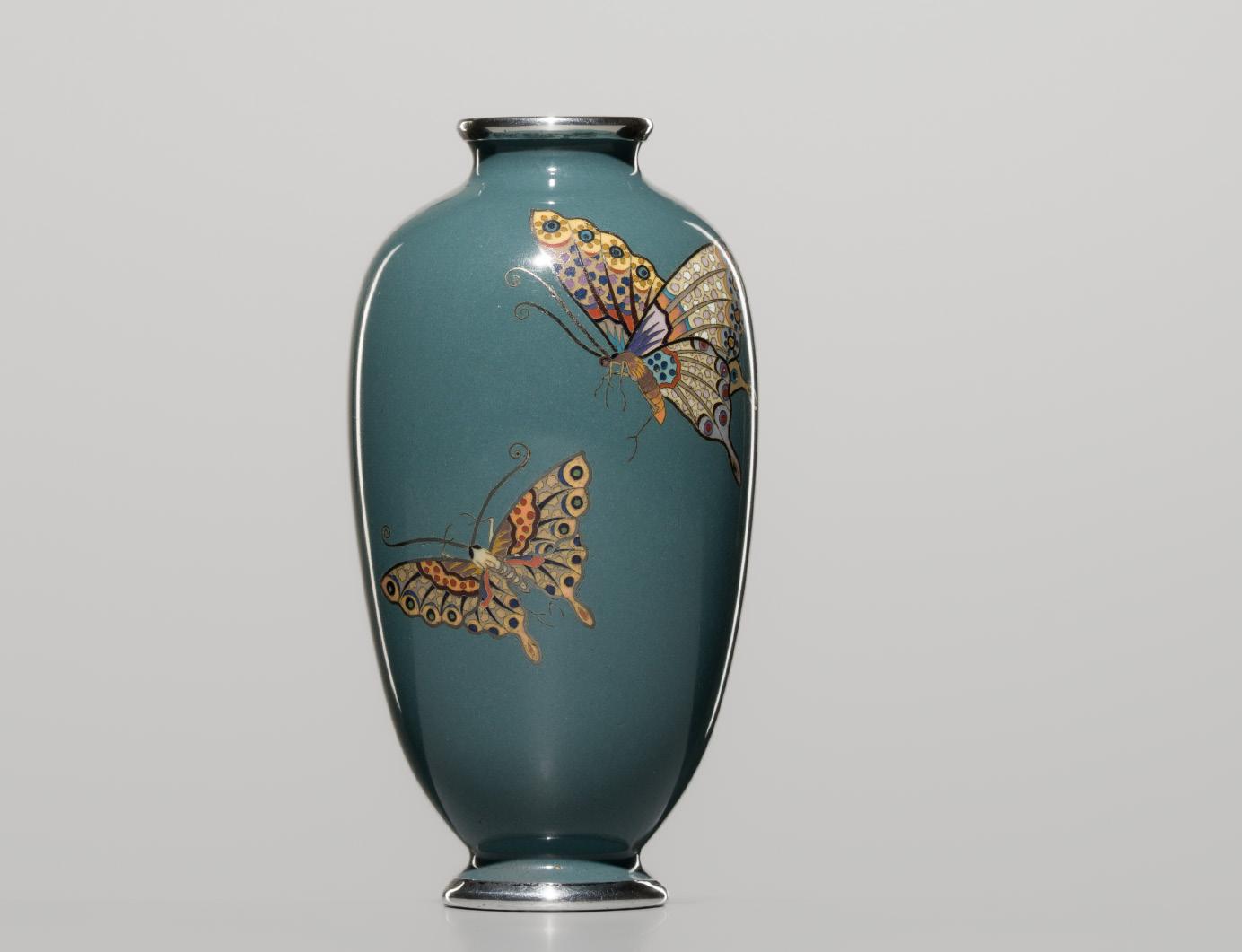
142 SHIBATA: A VERY FINE CLOISONNÉ ENAMEL ‘BUTTERFLIES’ VASE
By the Shibata workshop of Kyoto, signed Kyoto Shibata Japan, Meiji period (1868-1912)
Of baluster form, supported on a spreading foot and rising to a short, waisted neck with a flared mouth, each end fitted with silver mounts. The exterior is exquisitely decorated with vibrant enamels set within silver wire against a deep teal blue ground, depicting two large butterflies with their colorful wings majestically extended across the surface. The underside is signed within a raised silver tablet KYOTO SHIBATA.
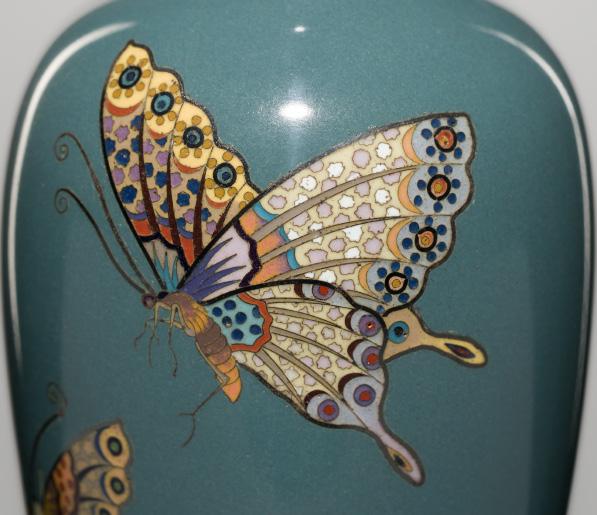
HEIGHT 12.1 cm
WEIGHT 129 g
Condition: A small nick to the ground to the left of the lower butterfly. Otherwise excellent condition with only very minor wear and typical pitting.
This vase is likely the work of Sozaburo Shibata, the only documented enameler by that name active in Kyoto. His works are typically recognized by silver tablets inscribed with “Kyoto Shibata.” While little is known about this enigmatic artist, some scholars suggest Shibata may have worked under the renowned Namikawa Yasuyuki, with the style of the signature reserve providing support for this theory.
AUCTION COMPARISON
Compare a closely related cloisonné enamel baluster vase, decorated with five fluttering butterflies, by Hayashi Kodenji, 15.5 cm high, at Bonhams, Fine Japanese Art, London, 16 May 2013, lot 547 (sold for GBP 11,875 or approx. EUR 19,500 converted and adjusted for inflation at the time of writing). Compare a related cloisonné enamel vase by the same maker, decorated with butterflies hovering over a flowering shrub of hydrangea and wisteria, signed Kyoto Shibata, 13.3 cm high, at Bonhams, Tradition Travel Transition, London, 4 November 2021, lot 162 (sold for GBP 6,375 or approx. EUR 9,300 converted and adjusted for inflation at the time of writing).
Estimate EUR 4,000
Starting price EUR 2,000
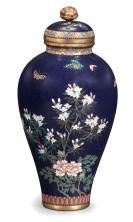
BY NAMIKAWA YASUYUKI
Namikawa Yasuyuki (1845-1927) is widely regarded as one of the foremost Japanese cloisonné artists of all time. Born Namikawa Takaoka, he began his artistic career around 1868, later working for the Kyoto Cloisonné Company from 1871 to 1874 before founding his own independent workshop. He is especially noted for his technical and material innovations, including the creation of the first transparent black glaze, developed in collaboration with the German scientist Gottfried Wagener, which proved foundational for subsequent advances in transparent enamels, and refined the use of fine wirework to an exceptional degree, achieving an unprecedented level of precision and control. Over time, his decorative approach evolved from primarily ornamental compositions toward increasingly pictorial and naturalistic designs.
Namikawa achieved significant international recognition at major world expositions, receiving awards at the Philadelphia Centennial Exposition of 1876 and at the Expositions Universelles in Paris held in 1878 and 1889. He was likewise honored at a series of National Industrial Expositions in Japan, established from 1877 onward, ultimately accumulating a total of 31 prizes in both domestic and international venues. In 1896, together with the unrelated Namikawa Sosuke (1847-1910), Yasuyuki was appointed Imperial Household Artist, the only two cloisonné makers to receive this prestigious designation.
NAMIKAWA YASUYUKI: A MAGNIFICENT BLACK-GROUND CLOISONNÉ ENAMEL ‘WRITHING DRAGONS’ SPHERICAL JAR AND COVER
By Namikawa Yasuyuki (1845-1927), signed Kyoto Namikawa Japan, Meiji period (1868-1912)
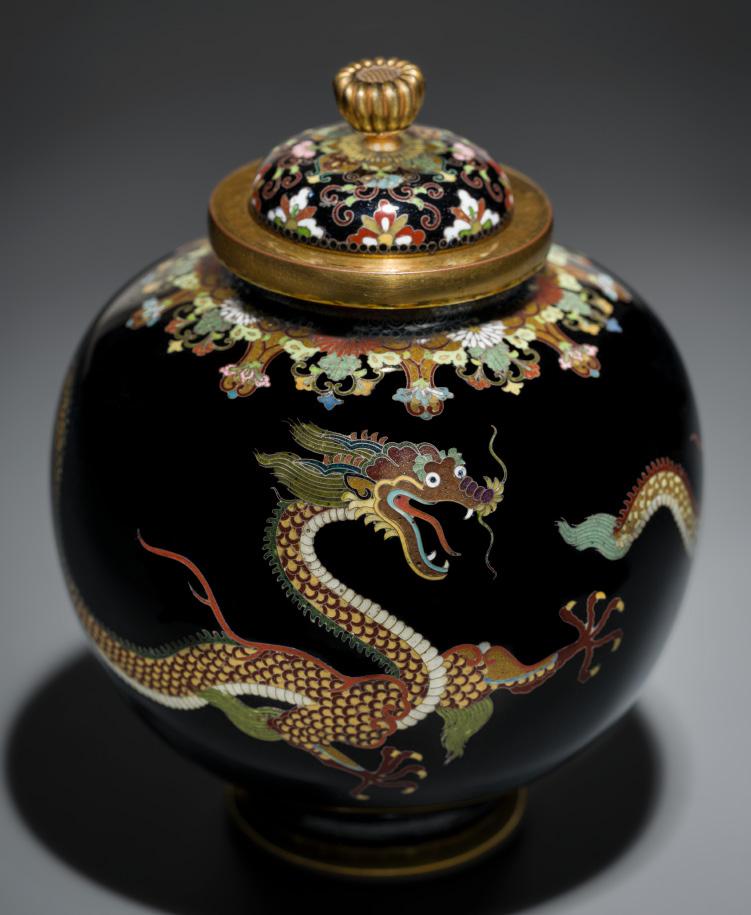
Magnificently crafted, the globular body resting on a gently splayed foot and rising to a short, waisted neck with a broad mouth, fitted with a domed cover surmounted by a kiku-shaped gilt finial that matches the gilt mounts at each end of the vessel. The exterior exquisitely decorated with vibrant polychrome enamels outlined with silver wire, to depict a pair of five-clawed dragons whose sinuous, scaly bodies soar above a brilliant jet-black ground, framed with an encircling band of foliate motifs around the neck that extends onto the cover. The underside signed within a square silver plaque mounted on the base, Kyoto NAMIKAWA.
HEIGHT 9.2 cm
WEIGHT 175 g
Provenance: Bonhams, Fine Japanese Art, 6 November 2014, London, lot 361 (sold for GBP 8,750 or approx. EUR 14,300 converted and adjusted for inflation at the time of writing). A Japanese private collection, acquired from the above. Condition: Excellent condition without any damage or restoration (checked under UV light). Only very minor manufacturing-inherent irregularities including minor pitting and some light surface scratches to the ground. The mounts with some expected general wear.
AUCTION COMPARISON
Compare a closely related cloisonné enamel jar and cover, decorated with five-clawed dragons soaring above a midnight-blue ground, by the workshop of Namikawa Yasuyuki, 8.6 cm high, at Christie’s, Japanese and Korean Art, 18 April 2018, New York, lot 76 (sold for USD 41,250 or approx. EUR 46,000 converted and adjusted for inflation at the time of writing). Compare a closely related cloisonné enamel jar and cover, by Namikawa Yasuyuki, also decorated with dragons, 7 cm high, at Bonhams, Fine Japanese and Korean Works of Art, 22 March 2023, New York, lot 928 (sold for USD 25,500 or approx. EUR 23,600 converted and adjusted for inflation at the time of writing).
Estimate EUR 15,000
Starting price EUR 7,500
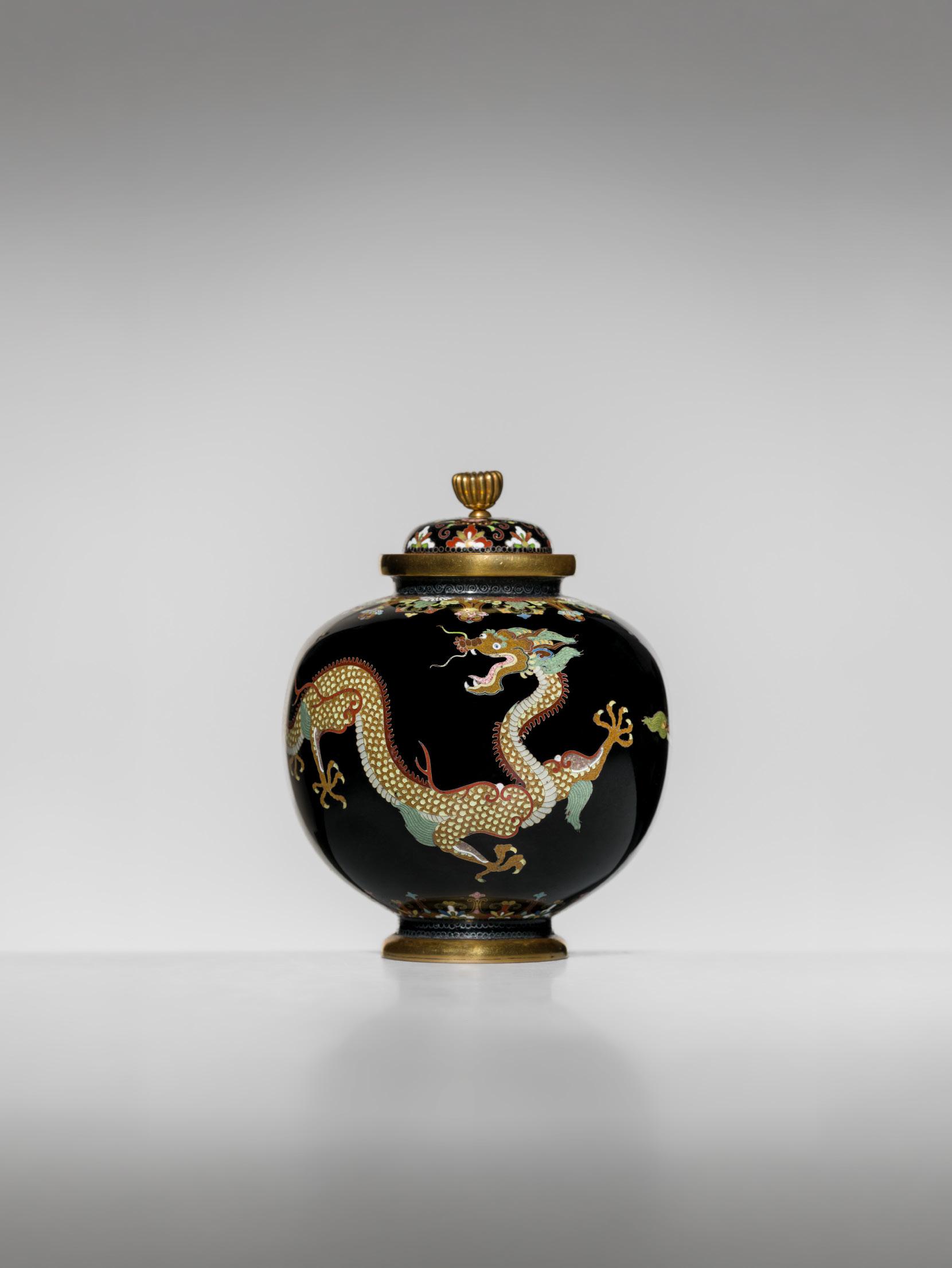
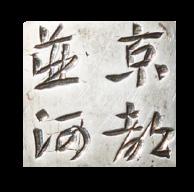
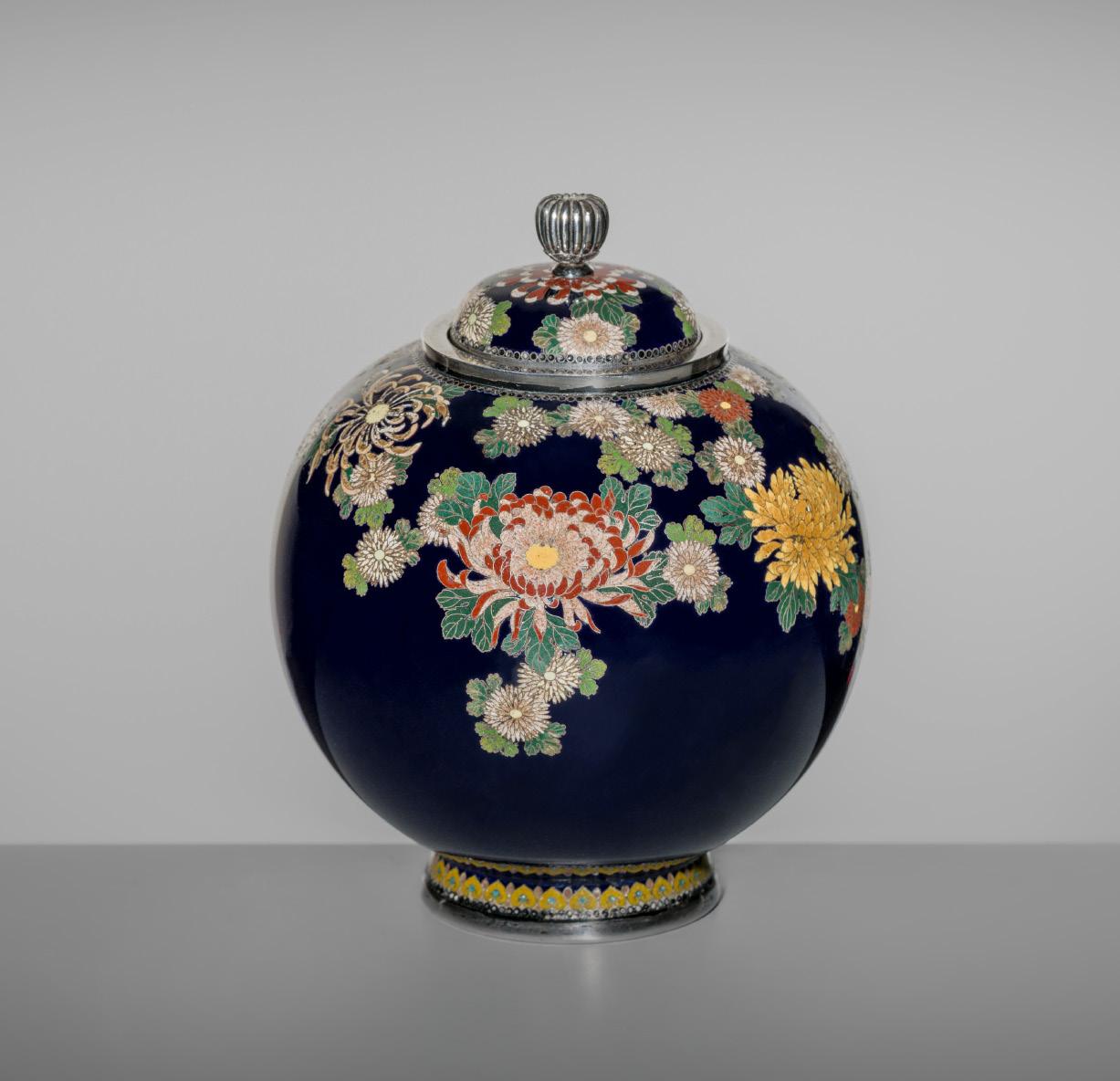
144
NAMIKAWA YASUYUKI: A SUPERB MIDNIGHT-BLUE GROUND CLOISONNÉ ENAMEL ‘BLOSSOMING CHRYSANTHEMUMS’ SPHERICAL JAR AND COVER
By Namikawa Yasuyuki (1845-1927), signed Kyoto Namikawa Japan, Meiji period (1868-1912)
Finely crafted, the spherical body resting on a gently tapered foot and rising to a short, straight neck with a broad mouth, fitted with a domed cover surmounted by a kiku-shaped silver finial that matches the silver mounts at each end of the vessel. The exterior finely decorated with vibrant polychrome enamels outlined with silver wire, to depict an array of blossoming chrysanthemums with leafy stems against a midnight-blue ground. The underside signed within a square silver plaque mounted on the base, Kyoto NAMIKAWA.
HEIGHT 10.2 cm, WIDTH 7.7 cm
WEIGHT 220 g
Provenance: Christie’s, The Japanese Aesthetic, London, 15 May 2013, lot 126 (sold for GBP 17,500 or approx. EUR 29,000 converted and adjusted for inflation at the time of writing). A Japanese private collection, acquired from the above. Condition: The jar in excellent condition without any damage or restoration (checked under UV light). Only very minor manufacturing-inherent irregularities including minor pitting and tiny holes. The mounts with some expected general wear. The lid with two small losses, one with an associated crack.
MUSEUM COMPARISON
Compare a closely related cloisonné lidded jar, also decorated with chrysanthemum blossoms, by Namikawa Yasuyuki, 14.6 cm high, in the Los Angeles County Museum of Art (LACMA), accession number M.2017.202a-b.
AUCTION COMPARISON
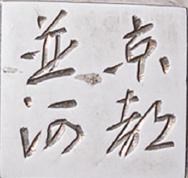
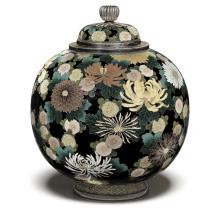
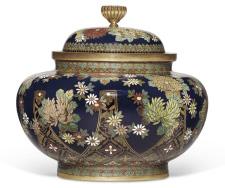
Compare a closely related cloisonné enamel jar and cover, decorated with chrysanthemum blossoms, by the workshop of Namikawa Yasuyuki, 8 cm high, at Christie’s, Japanese and Korean Art, New York, 19 March 2019, lot 329 (sold for USD 25,000 or approx. EUR 27,500 converted and adjusted for inflation at the time of writing).
Estimate EUR 15,000
Starting price EUR 7,500
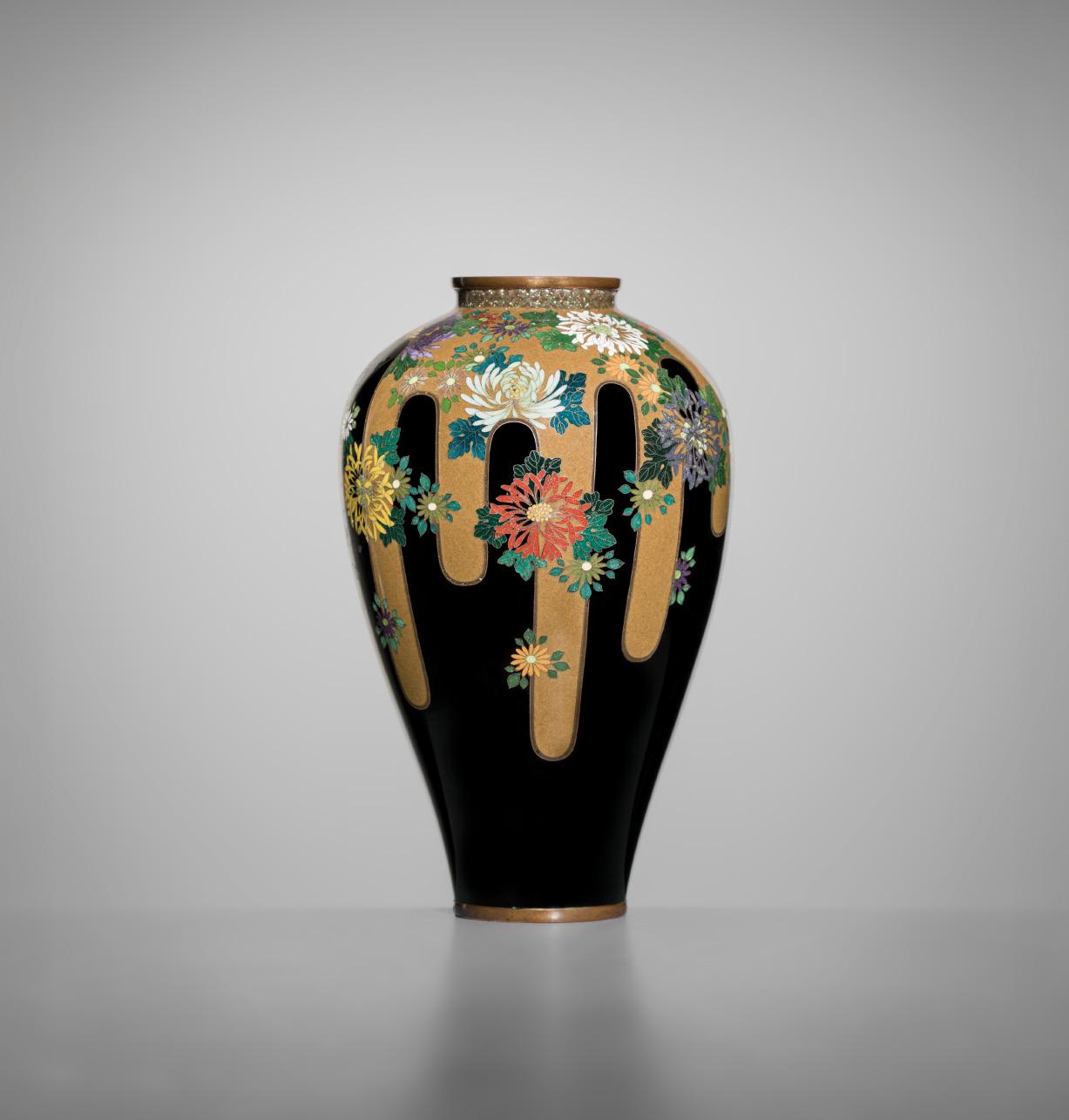
145
NAMIKAWA YASUYUKI: A SUPERB BLACK-GROUND CLOISONNÉ ENAMEL ‘BLOSSOMING CHRYSANTHEMUMS’ VASE
By Namikawa Yasuyuki (1845-1927), signed Kyoto Namikawa Japan, Meiji period (1868-1912)
Finely crafted, the baluster body gently tapering toward a narrow foot and rising to high, rounded shoulders surmounted by a short, straight neck with a circular mouth, both ends fitted with gilt-metal mounts. The exterior is richly decorated in vibrant polychrome enamels outlined with silver wire, depicting an array of blossoming chrysanthemums with leafy stems upon an ocher-toned ground designed to suggest an overflowing glaze issuing from the mouth of the vessel. The edges of the cascading glaze are defined by double silver wires and a thin line of darker brown enamel, set against a deep jet-black ground. The underside is signed within a square silver tablet mounted to the base, Kyoto NAMIKAWA.
HEIGHT 9.4 cm
WEIGHT 100 g
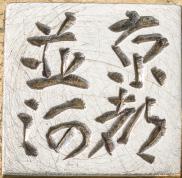
Provenance: Christie’s, Japanese and Korean Art, New York, 22 September 2005, lot 257 (sold for USD 22,800 or approx. EUR 32,000 converted and adjusted for inflation at the time of writing). Christie’s, An Inquiring Mind: American Collecting of Japanese and Korean Art, New York, 25 April 2017, lot 75 (sold for USD 30,000 or approx. EUR 34,500 converted and adjusted for inflation at the time of writing). A Japanese private collection, acquired from the above.
Condition: Excellent condition without any damage or restoration (checked under UV light). Only very minor manufacturing-inherent irregularities including minor pitting and few tiny holes. The mounts with some expected general wear.
AUCTION COMPARISON
Compare a closely related cloisonné enamel vase, decorated with chrysanthemum blossoms over drips of green glaze, by the workshop of Namikawa Yasuyuki, Meiji period, late 19th century, 10.2 cm high, at Bonhams, Fine Japanese Works of Art, New York, 19 March 2013, lot 2406 (sold for USD 32,500 or approx. EUR 39,000 converted and adjusted for inflation at the time of writing).
Estimate EUR 15,000
Starting price EUR 7,500
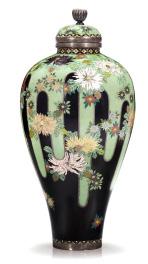
NAMIKAWA SOSUKE: A FINE CLOISONNÉ ENAMEL ‘BLOSSOMING CHERRY’ TRAY AFTER A DESIGN OF WATANABE
By Namikawa Sosuke (1847-1910), after a design by Watanabe Seitei (1851-1918), signed Seitei with seal Seitei Japan, Meiji period (1868-1912)
Square in form with rounded corners, superbly decorated in vivid enamels and silver wire, to depict a blossoming cherry branch in the first light of morning, the tree trunk and fully opened flowers delicately rendered in the musen (wireless) technique, seamlessly merging with the soft, luminous tones of the ground, signed to the lower left SEITEI with seal Seitei, the back is unmarked but the tray was certainly executed by Namikawa Sosuke after a design by Watanabe Seitei. The underside of the tray decorated with pale yellow stylized auspicious birds interspersed among blossoming flower heads and additional foliage against a dark ground.
LENGTH 29.3 cm
WEIGHT 1.6 kg
Condition: Excellent condition with only minor surface wear and manufacturing-inherent irregularities such as a few dark spots.
With an associated padded silk storage box.
Namikawa Sosuke (1847-1910), born in Tsurumaki, Shimosa Province (present-day Chiba Prefecture), was an eminent Japanese cloisonné artist, who was especially renowned for pioneering a pictorial style of cloisonné enameling known as ‘musen’, or wireless cloisonné, developed around 1879, in which the traditional metal cloisons are absent or rendered virtually invisible. This innovation allowed him to blend colors and tonal gradations with remarkable subtlety, creating effects reminiscent of brush painting, although he occasionally employed fine wire to enhance compositional structure. While Sosuke frequently drew upon designs by prominent painters such as Watanabe Shotei (1851–1918), he was an accomplished artist in his own right, best known for the thirty-two cloisonné plaques created for the reception room of the Geihinkan (formerly the Akasaka Detached Palace), a monumental commission that he completed shortly before his death after a decade of work.
Watanabe Seitei (1851-1918), also known as Watanabe Shotei, was a celebrated Nihonga painter, who was among the earliest Japanese artists to travel to Europe. He attended the International Exhibition in Paris in 1878, where his work was awarded a medal of distinction. Shotei developed a distinctive style that combined Western naturalism with the refined palette and fluid washes associated with the Kikuchi Yosai school, thereby introducing an innovative approach to kachoga (bird-and-flower painting). Following his return to Japan, he produced designs for ceramics and cloisonné, collaborating with the cloisonné master Namikawa Sosuke (1847-1910), whose works were met with considerable acclaim in international contexts.
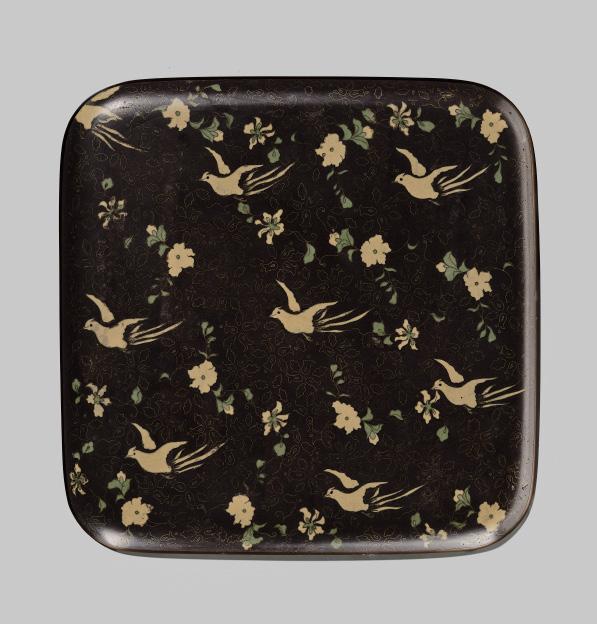
The association between Namikawa Sosuke and Watanabe Shotei, who was responsible for many of the designs used in cloisonné works by Sosuke, is discussed in Oliver Impey [et al.], The Nasser D. Khalili Collection of Japanese Art. Treasures of Imperial Japan: Enamel, 1995, p. 50-59. For related examples, see no. 86 and 87 in the same volume.
AUCTION COMPARISON
Compare a closely related cloisonné enamel tray with a similar design of cherry blossoms, by Namikawa Sosuke after a design by Watanabe Seitei, 29.3 x 29.4 cm, at Bonhams, Fine Japanese Art, 13 September 2017, New York, lot 1020 (sold for USD 31,250 or approx. EUR 36,000 converted and adjusted for inflation at the time of writing). Compare a closely related damaged cloisonné enamel tray depicting a similar design of moonlit cherry blossoms, by Namikawa Sosuke after a design by Watanabe Seitei, 28.5 x 28.5 cm, at Revere Auctions, 9 June 2021, Minnesota, lot 21 (sold for USD 11,250 or approx. EUR 11,700 converted and adjusted for inflation at the time of writing).
Estimate EUR 15,000
Starting price EUR 7,500
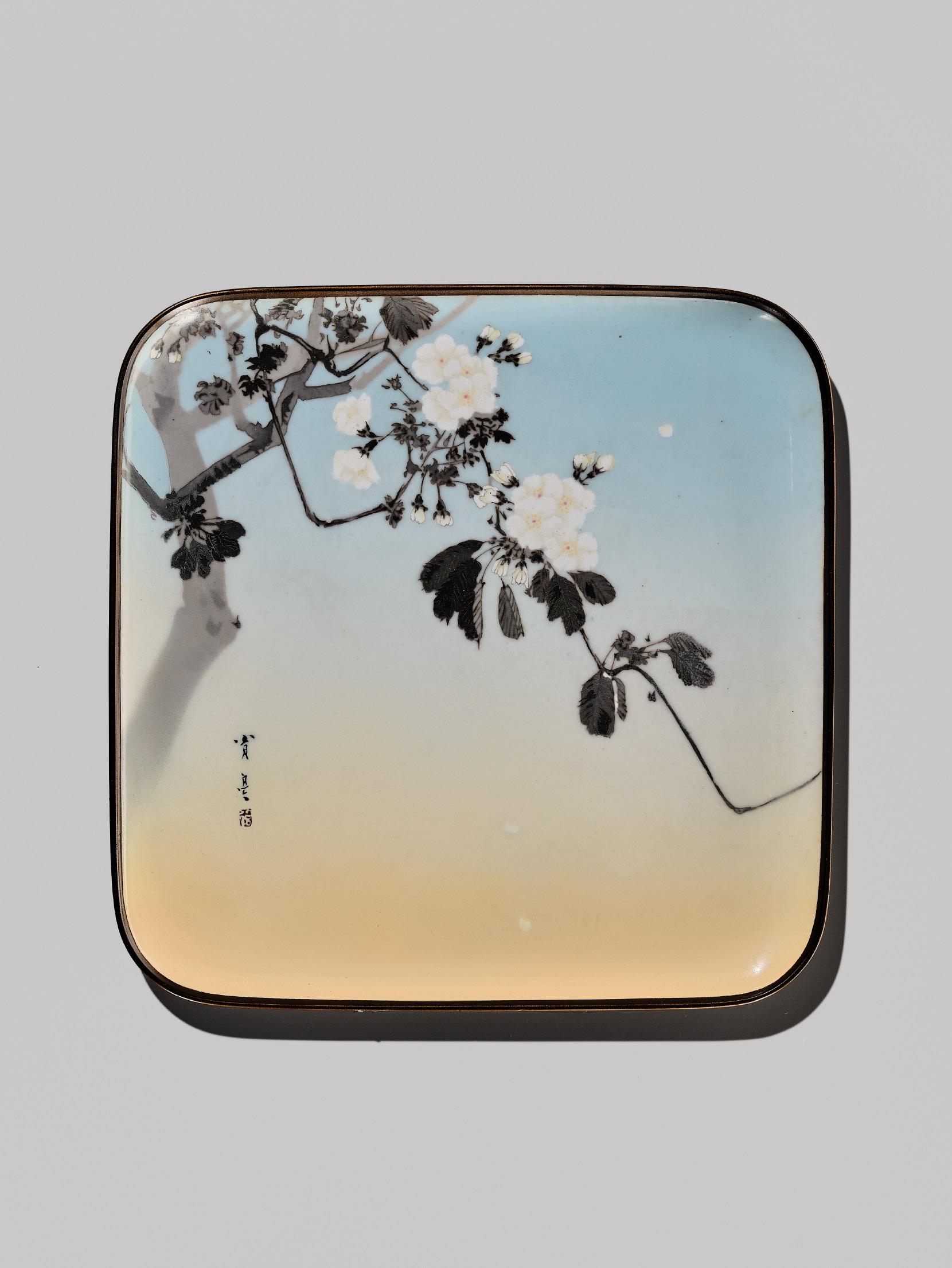
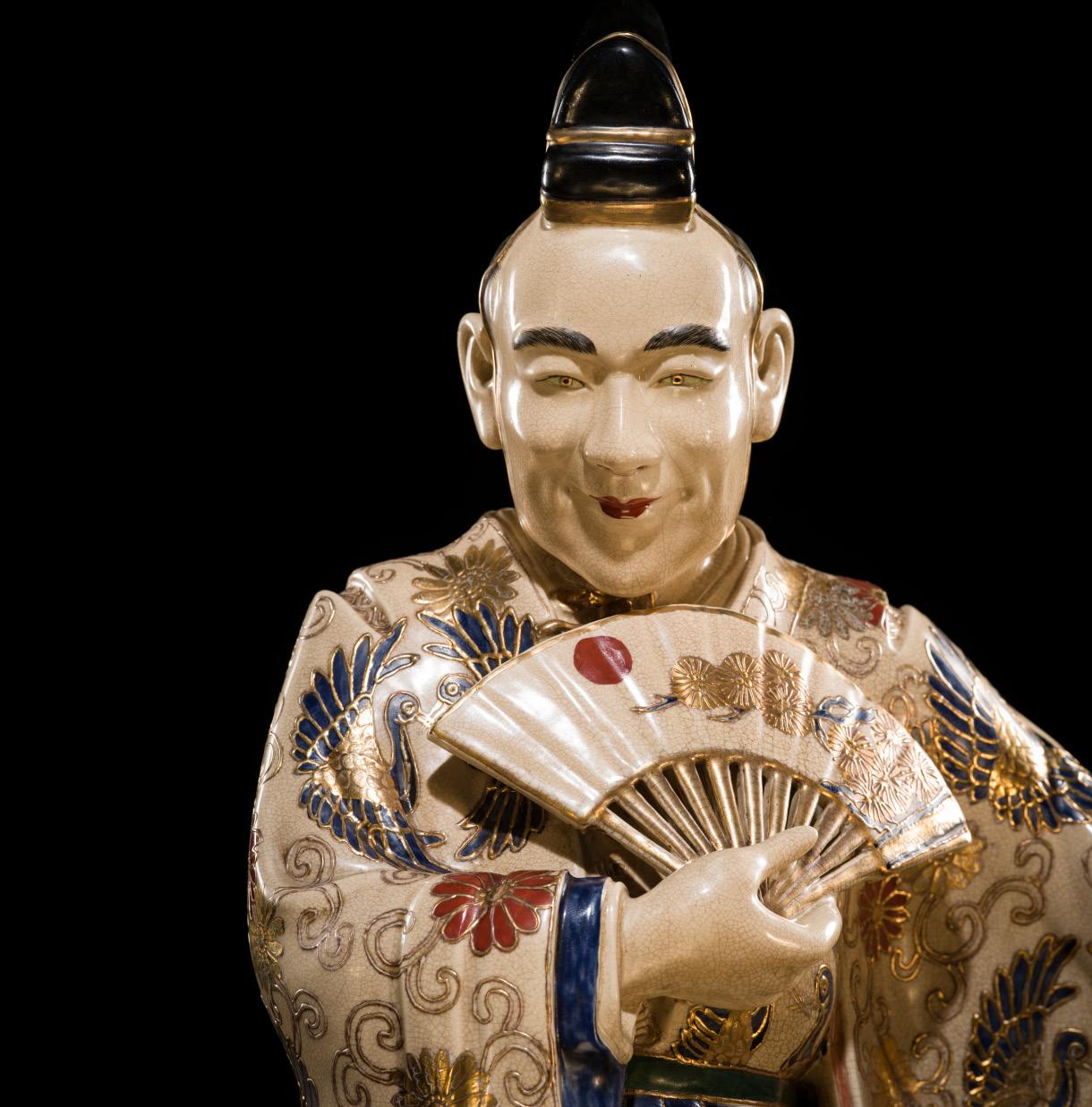
AN EXCEPTIONALLY LARGE (93 CM)
SATSUMA CERAMIC FIGURE OF A NOH THEATRE ACTOR
Japan, Meiji period (1868-1912)
Finely modeled, the figure stands with legs set apart in a dynamic stance, his left arm slightly extended and held away from the body, while his right hand holds a folding fan against his chest. He is dressed in loose-fitting robes with wide sleeves cascading from the arms, secured at the waist with a sash, and richly decorated in vibrant overglaze enamels and extensive gilt detailing, depicting flying cranes interspersed among chrysanthemums with leafy stems, the design continuing onto the surface of the fan.
His face is rendered with an amiable expression, distinguished by narrow, slanted gold-ringed eyes beneath thick black eyebrows, a prominent nose, and full red lips. His hair is neatly arranged beneath distinctive headgear, completing the refined theatrical presence of the figure.
HEIGHT 93.3 cm
Condition: The tip of the right foot has been re-attached. Otherwise, very good condition with surface wear and firinginherent irregularities. Light rubbing to gilding and small typical losses to overglaze enamels.
AUCTION COMPARISON
Compare a closely related smaller Satsuma ceramic figure of Kannon Bosatsu, Meiji period, 62.2 cm high, at Bonhams, Fine Japanese Art, London, 12 May 2011, lot 124 (sold for GBP 4,800 or approx. EUR 8,300 converted and adjusted for inflation at the time of writing).
Estimate EUR 10,000
Starting price EUR 5,000
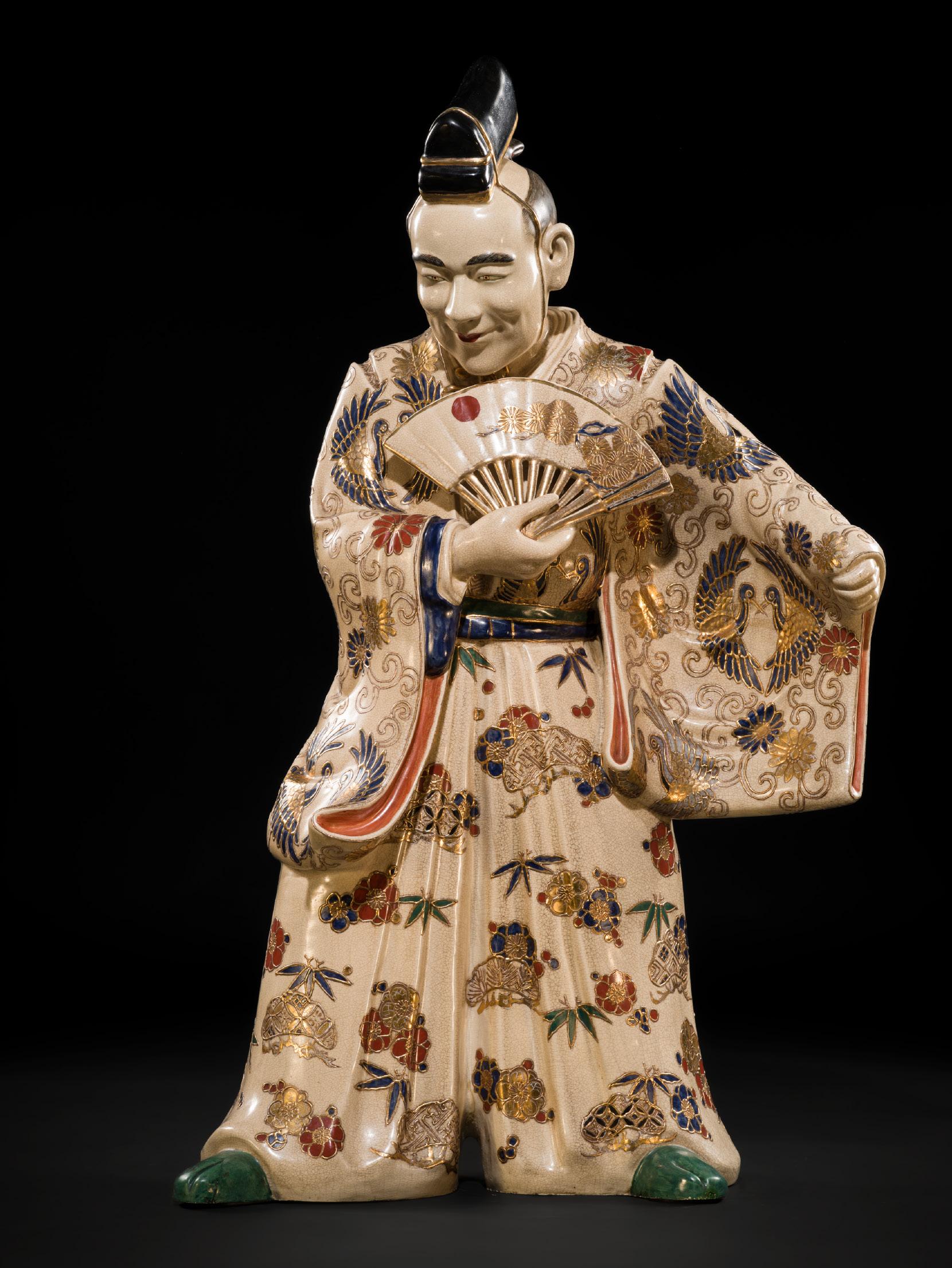
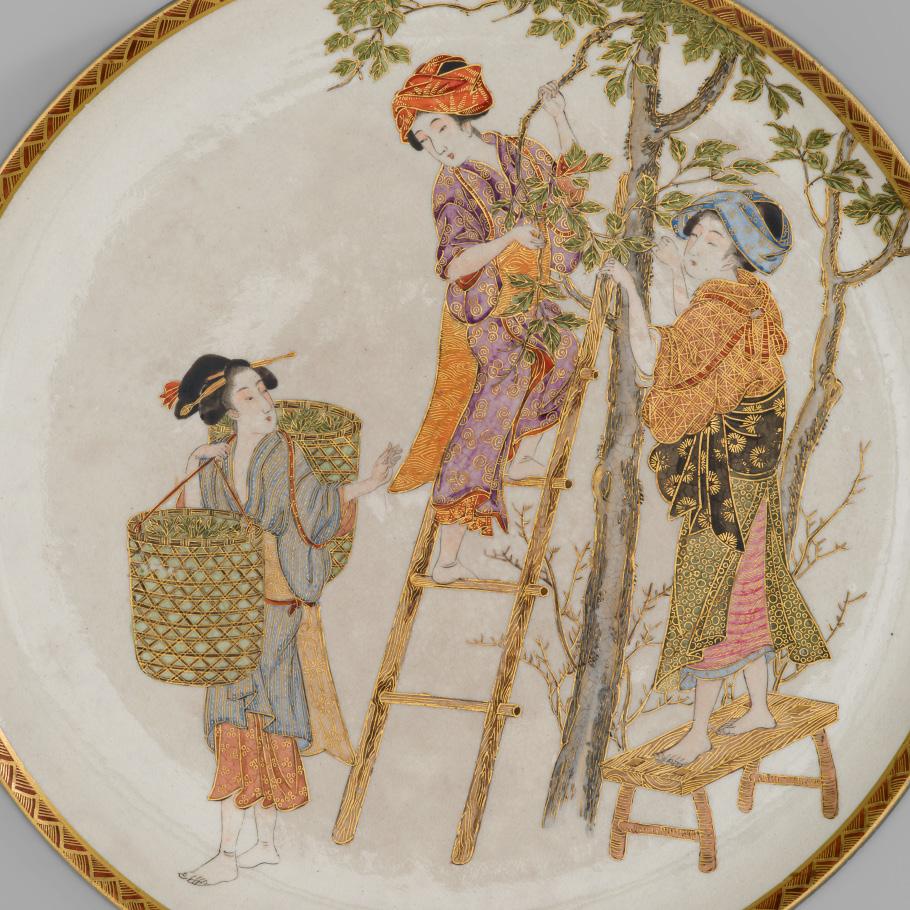
148 AN IMPRESSIVE SET OF EIGHT SATSUMA CERAMIC DISHES, AFTER KITAGAWA UTAMARO’S ‘JOFU KAISEKI TEWAZA KUSA’ (WOMEN’S WORK IN SILK CULTURE)
By the Koshida workshop, signed Koshida Japan, Meiji period (1868-1912)
Each finely potted with shallow, gently rounded sides supported on a short, subtly tapered foot. The interiors are richly decorated in vivid enamels with extensive gilding, each dish illustrating a stage in the traditional silk-production process, depicted through elegantly attired women engaged in various tasks. The figures are rendered with fine detail, wearing elaborately patterned garments that reflect the refined aesthetic of late Edo-period ukiyo-e.
The present set comprises eight scenes from the twelve compositions of Kitagawa Utamaro’s celebrated series Jofu kaiseki tewaza kusa (also known as Fujin tewaza gusa or “Women’s Work in Silk Culture”), illustrating the successive stages of silk production. The selected scenes include the first six and the final two, arranged in their intended narrative sequence:
1. A woman brushes silkworm eggs into a hatching tray, initiating the cycle of sericulture.
2. Women gather mulberry leaves, the essential nourishment for the larvae.
3. Leaves are prepared and distributed to the growing silkworms.
4. The silkworms are tended following a feeding stage, signaling the approach of transformation.
5. The “Great Awakening,” when the worms rapidly increase in size and appetite.
6. Mature silkworms spin cocoons, later collected after several days.
11. & 12. A continuous composition depicting silk reeling and weaving, with a loom spanning both scenes, uniting the processes of thread production and textile manufacture.
DIAMETER 18.5 cm
Condition: Very good condition with minor surface wear and firingrelated irregularities. Minimal traces of handling and use, including a small chip to the underside of the dish depicting the third scene and a restored chip to the rim of the dish depicting the eleventh scene, neither detracting from the quality of the decoration.
Koshida was a prolific producer of high-quality Satsuma ware, active from circa 1880 to 1927, and is noted for employing some of the most accomplished painters of the period to execute the intricate decoration of its pieces.
Estimate EUR 6,000
Starting price EUR 3,000
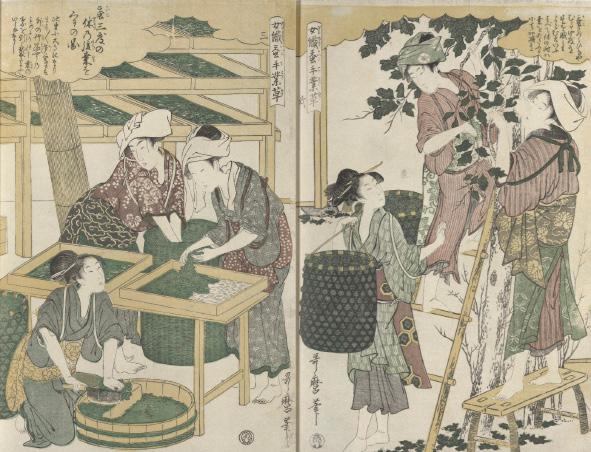
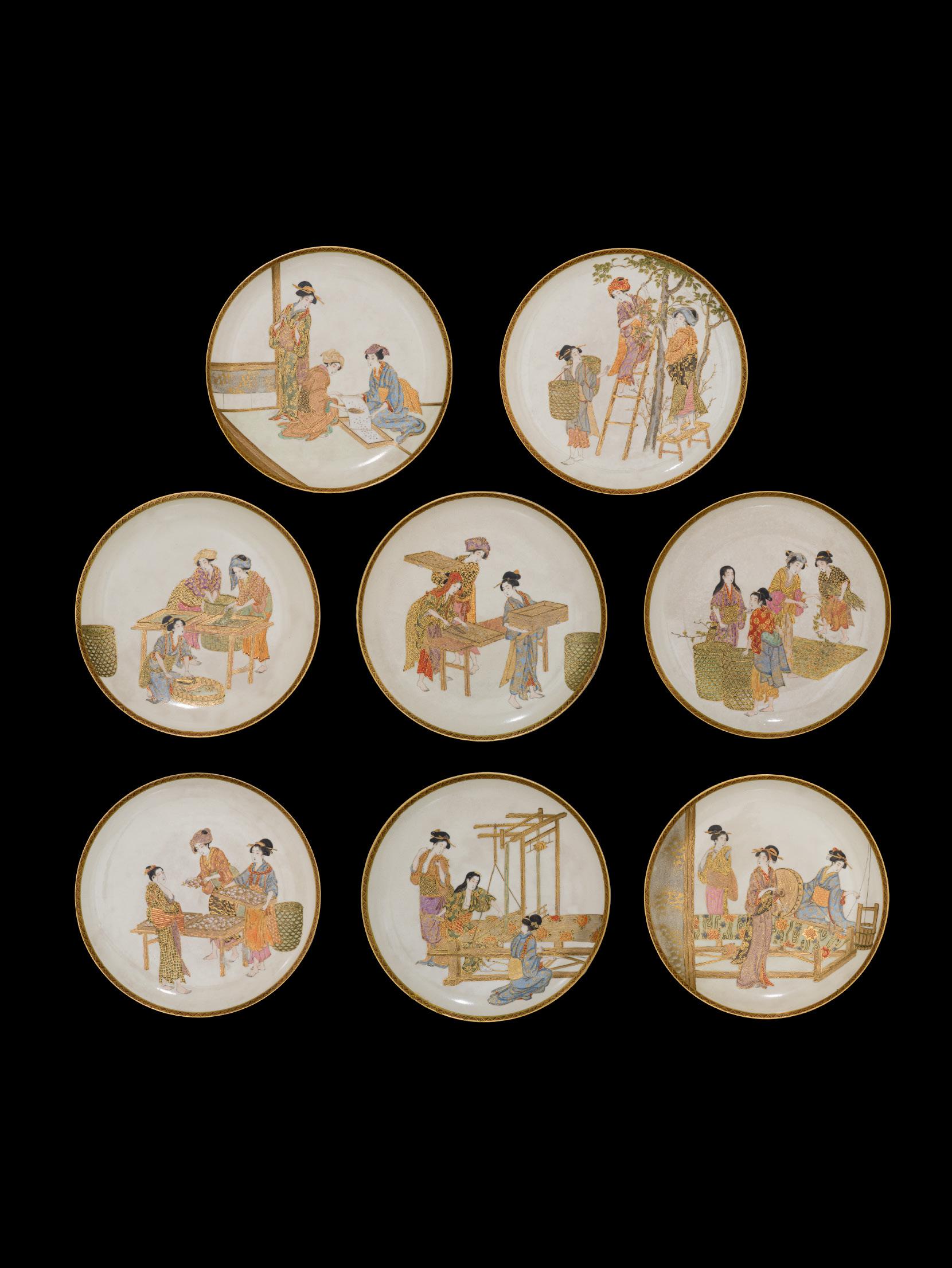
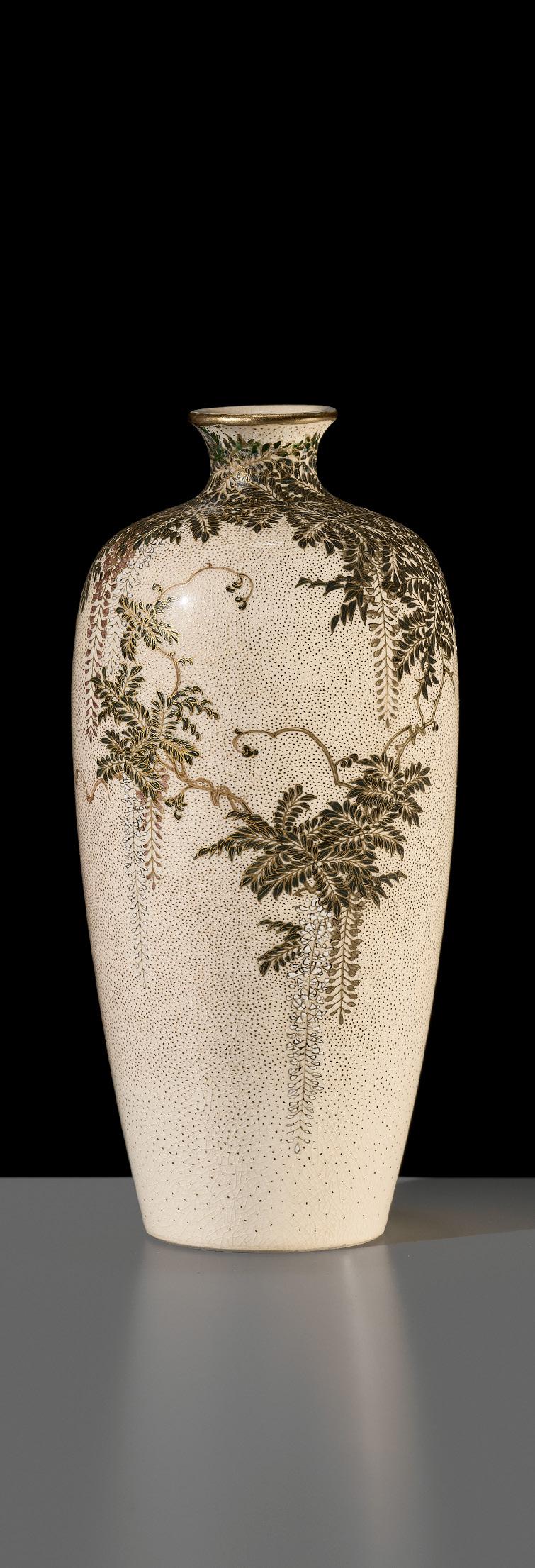
By Ito Tozan I (1846-1920) and Yabu Meizan (1853–1934), signed Yabu Meizan and Tozan Japan, Meiji period (1868-1912)
Carefully potted, the elegant baluster-shaped body gently tapers toward the base and rises to a short, waisted neck, finished with a flared rim and narrow circular mouth. The exterior is finely decorated in gilt and vivid enamels, depicting luxuriant trailing wisteria (fuji) vines rendered with remarkable delicacy and fluidity. The surface is enriched with a dense ground of minute gilt dots of varying concentration, all beneath a finely crackled transparent glaze that lends depth and subtle luminosity to the composition. The underside is signed in gilt within a square reserve YABU MEIZAN, alongside an impressed seal mark reading TOZAN, indicating the involvement of both artists.
HEIGHT 16.8 cm
Condition: Subtle signs of restoration (visible under UV light) and repainting around the mouth. Otherwise, excellent condition with minor surface wear and firing-inherent irregularities, and some expected light rubbing to gilding.
Ito Tozan I (1846-1920), born Jutaro in Kyoto’s Awata district, initially trained as a painter within the Maruyama–Shijo school, later turning to ceramics under masters such as Kameya Kyokutei and Takahashi Dohachi III. He established his own kiln in 1867 and became a leading figure in Kyoto ceramics, contributing to the refinement of Awata ware. His achievements were widely recognized, including awards at international expositions in Amsterdam, Paris, and Chicago, as well as honors from the Imperial Household, notably the Medal with Green Ribbon (1899), the honorary title To-o in 1912, and election to the Imperial Art Academy in 1917.
Yabu Meizan (1853-1934) was among the most celebrated Satsuma decorators of the Meiji period, renowned for his exceptionally fine brushwork and intricate compositions.
Documented collaborations between the two artists are extremely rare, if not entirely unrecorded in standard literature and auction archives. The presence of both signatures on the present vase is therefore highly unusual and suggests a special commission or workshop-level collaboration, combining Tozan’s ceramic body with Meizan’s decorative expertise. As such, this piece represents a remarkable and possibly unique intersection of two leading artistic traditions within Meiji ceramics.
Compare a closely related Satsuma ware bottle vase, decorated with trailing wisteria vines, by Yabu Meizan, Meiji period, late 19th century, 14.7 cm high, at Bonhams, Japanese Works of Art, New York, 19 March 2009, lot 495 (sold for USD 3,355 or approx. EUR 4,400 converted and adjusted for inflation at the time of writing).
Compare a closely related satsuma ceramic vase with trailing wisteria vines, by Yabu Meizan, 19.8 cm high, at Bonhams, Asian Decorative Art, 9 September 2008, San Francisco, lot 2538 (sold for USD 5,400 or approx. EUR 7,000 converted and adjusted for inflation at the time of writing).
Estimate EUR 4,000
Starting price EUR 2,000
150
By
Yabu Meizan (1853-1934), signed Yabu Meizan Japan, Meiji period (1868-1912)
Finely potted, the elegant pear-shaped body rises from a short, spreading foot to a slender neck with a slightly flared mouth. The exterior is delicately decorated in gilt and bright enamels, depicting luxuriant maple branches in the midst of their seasonal transformation. The leaves are rendered with remarkable subtlety, transitioning from fresh greens and soft yellows to vibrant shades of crimson and deep red, capturing the fleeting beauty of autumn. The surface is covered overall with a finely crackled transparent glaze. The recessed base signed in gold script within a square reserve YABU MEIZAN.
HEIGHT 23.3 cm
Provenance: Christie’s, Japanese Ceramics and Works of Art, London, 5 June 2003, lot 305 (sold for GBP 2,937 or approx. EUR 6,200 converted and adjusted for inflation at the time of writing). From an English private collection of Satsuma ceramics, Wiltshire, United Kingdom, acquired from the above. Condition: Excellent condition with no visible damages or signs of restoration (checked under UV light).
AUCTION COMPARISON
Compare a closely related Satsuma ware vase, decorated with autumn maple leaves, by Yabu Meizan, Meiji period, late 19th century, 24.6 cm high, at Bonhams, Fine Japanese Art, London, 6 November 2014, lot 324 (sold for GBP 3,125 or approx. EUR 5,100 converted and adjusted for inflation at the time of writing). Compare a closely related Satsuma ware vase, decorated with autumn maple leaves, by Yabu Meizan, Meiji period, late 19th century, 18.6 cm high, at Christie’s, Art of Japan, London, 3 May 2017, lot 75 (sold for GBP 3,000 or approx. EUR 4,700 converted and adjusted for inflation at the time of writing).
Estimate EUR 5,000
Starting price EUR 2,400
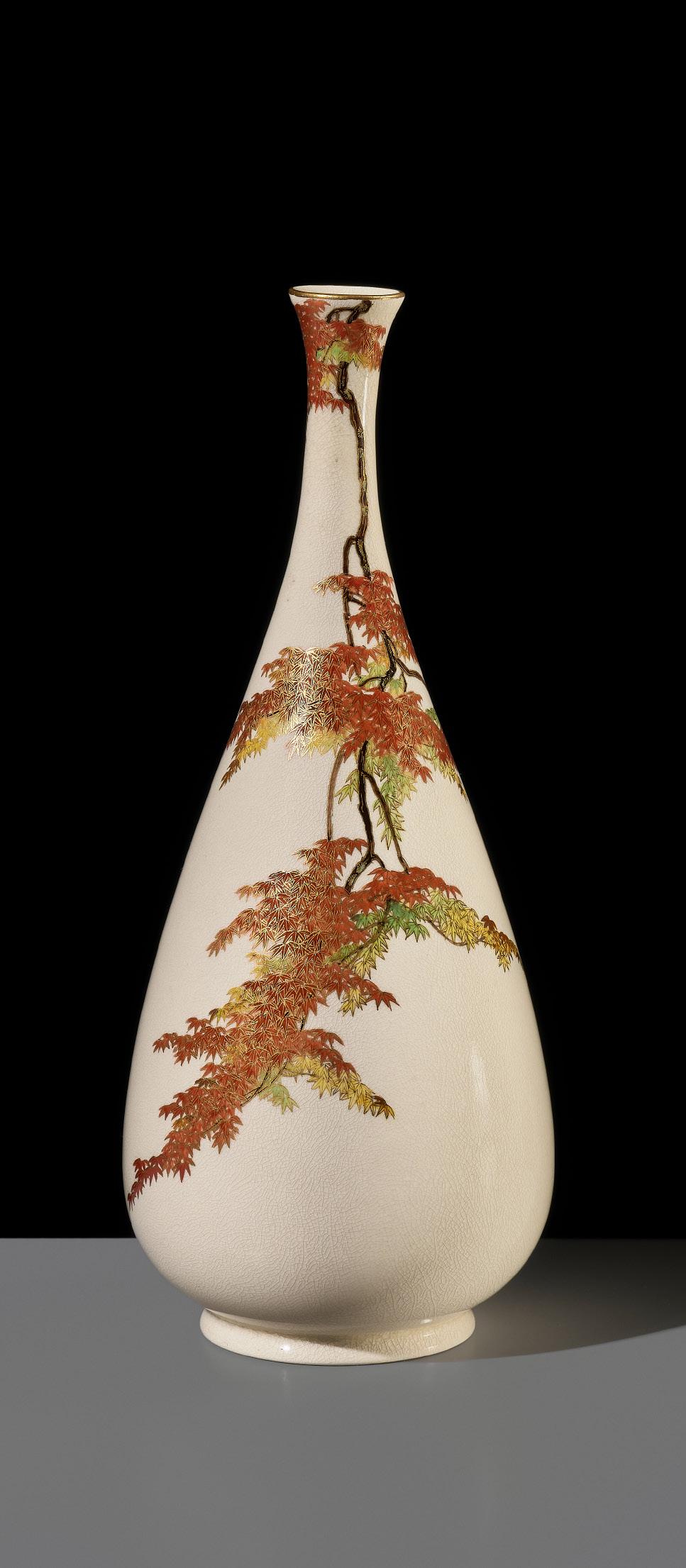
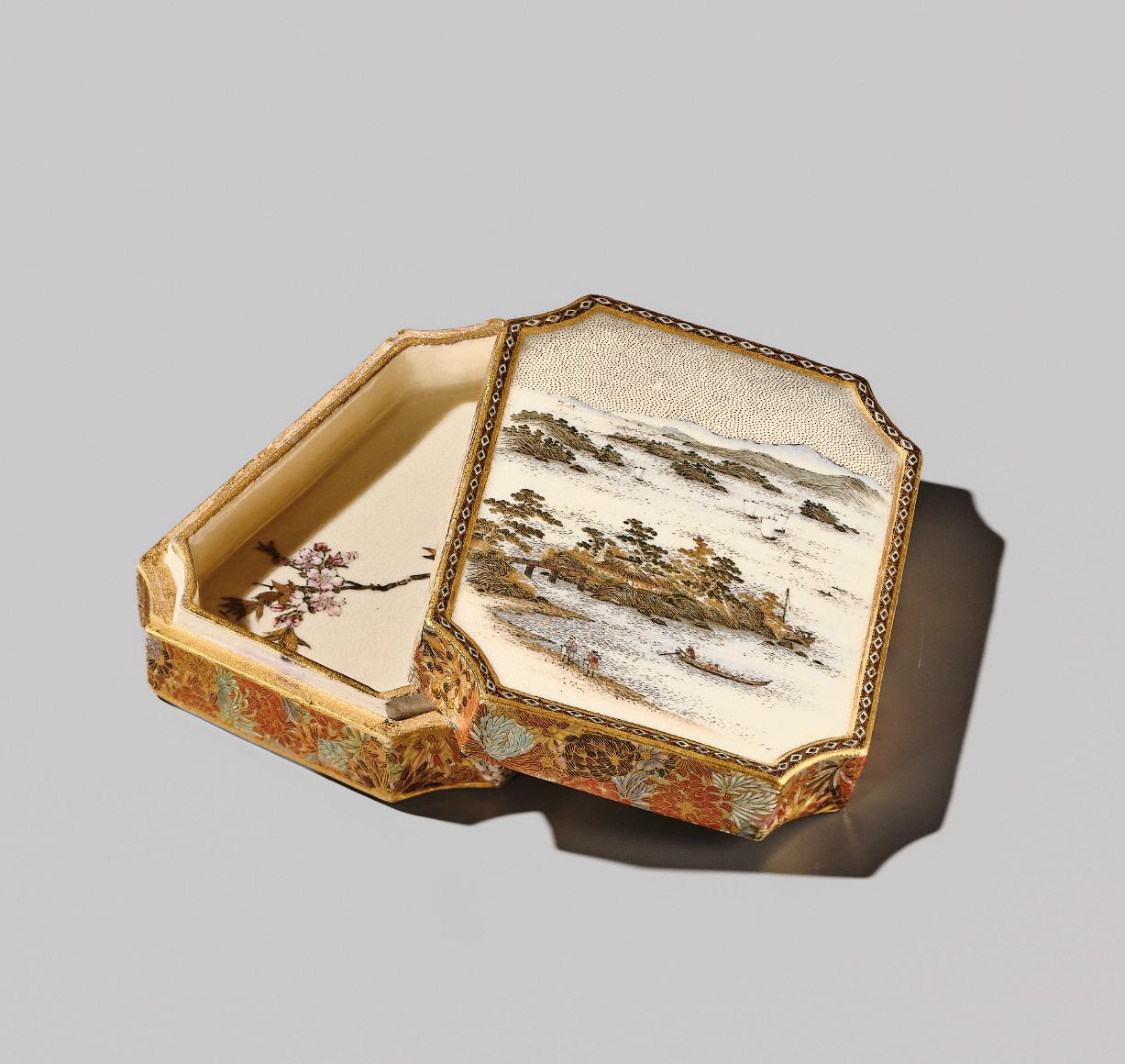
151
YABU MEIZAN: A MAGNIFICENT AND RARE SATSUMA INCENSE BOX (KOGO)
By Yabu Meizan (1853-1934), signed Yabu Meizan Japan, late 19th century, Meiji period (1868-1912)
Of rectangular form with inward-curving corners, superbly decorated in polychrome pigments and embellished with rich gilt. The interior depicting a sparrow perched on a blossoming cherry branch, while the exterior presents a poetic coastal landscape scene with distant mountains, each set against a finely crackled, creamy-white glazed ground. Both panels framed in gilt with a lozenge band and flanked on the sides of the box and cover by a dense millefleur motif. Sealed to the base in gold with a fourcharacter YABU MEIZAN mark enclosed within a square cartouche.
SIZE 2.3 x 6 x 8 cm
Condition: Excellent condition with no damages or restorations (checked under UV light). Typical minor rubbing to gilt.
LITERATURE COMPARISON
Compare a closely related satsuma earthenware incense box (kogo) and cover, by Yabu Meizan, Meiji period, 1890-1905, 7.7 cm long, illustrated in Oliver Impey and Malcolm Fairley, The Nasser D. Khalili Collection of Japanese Art. Treasures of Imperial Japan. Ceramics Part II, 1995, no. 38.
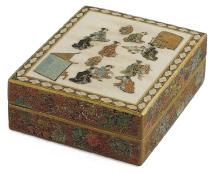
AUCTION COMPARISON
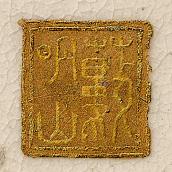
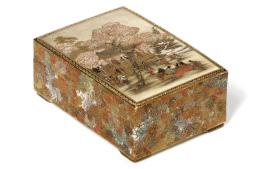
Compare a closely related Satsuma earthenware incense box (kogo) and cover, by Yabu Meizan, Meiji period, 12.7 cm long, at Christie’s, Fine Japanese Art, 16 May 2013, London, lot 500 (sold for GBP 18,750 or approx. EUR 35,500 converted and adjusted for inflation at the time of writing).
Estimate EUR 6,000
Starting price EUR 3,000
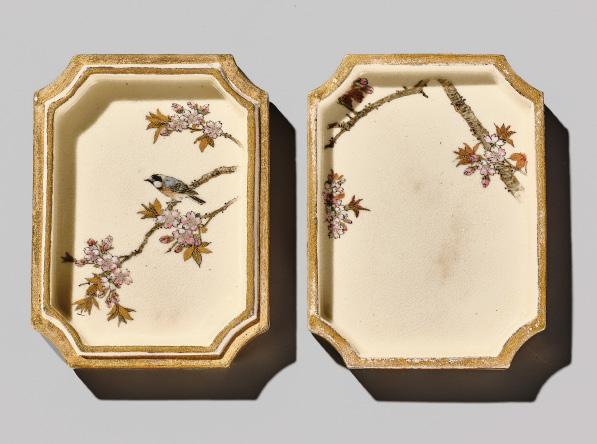
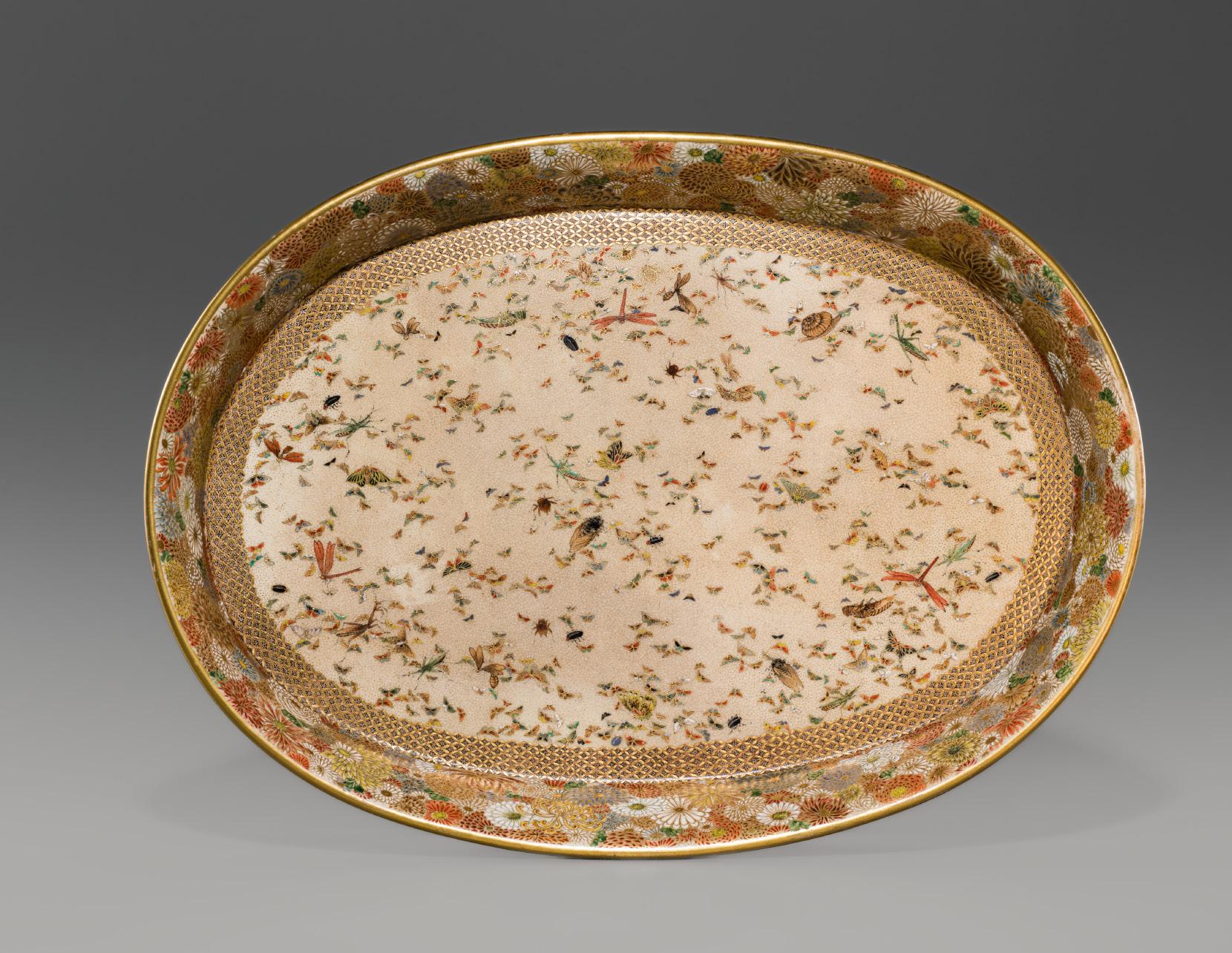
152
A LARGE AND FINE YABU MEIZAN STUDIO SATSUMA CERAMIC ‘INSECTS’ TRAY
Japan, Meiji period (1868-1912)
Of elegant oval form, with a flat base and tall, slightly tapering sides rising to an everted rim. The interior is richly decorated in vivid polychrome enamels and extensive gilding, depicting a lively swarm of insects, including grasshoppers, beetles, fireflies, and praying mantises, together with a small snail and fluttering butterflies, all rendered with remarkable naturalistic detail.
The central composition is framed by a band of shippo-tsunagi pattern at the border, while the cavetto is densely filled with a millefleur ground of chrysanthemums, peonies, and hydrangeas, creating a richly layered decorative field. The exterior is ornamented with a band of stylized flowerheads interspersed with paulownia-shaped imperial crests, together with a four-character mark in gold script, now worn and largely illegible; however, the invoice from Barry Davies records the signature as Tozan seisei. It is therefore plausible that the present dish was made by Ito Tozan for the Yabu Meizan workshop (see lot 149 in the present sale for another example of this collaboration). The base is left unglazed, revealing the buff-colored ceramic body beneath.
LENGTH 31.5 cm
Provenance: Barry Davies Oriental Art, London, United Kingdom, 1999. From an English private collection of Satsuma ceramics, Wiltshire, United Kingdom, acquired from the above. A copy of the signed original invoice, dated 10 June 1999, stating a purchase price of GBP 3,800 (or approx. EUR 8,500 converted and adjusted for inflation at the time of writing), accompanies this lot. Barry Davies Oriental Art was a London-based gallery specializing in Asian art. Condition: Excellent condition with no visible damages or signs of restoration (checked under UV light). Typical wear and minuscule rubbing to gilding.
AUCTION COMPARISON
Compare a related Satsuma ware circular dish, decorated with dignitaries encircled by fluttering butterflies and flower arrangements, by Yabu Meizan, Meiji period, late 19th century, 21.7 cm diameter, at Christie’s, Japanese Ceramics and Works of Art, London, 28 June 2001, lot 193 (sold for GBP 3,525 or approx. EUR 7,600 converted and adjusted for inflation at the time of writing).
Estimate EUR 5,000 Starting price EUR 2,400
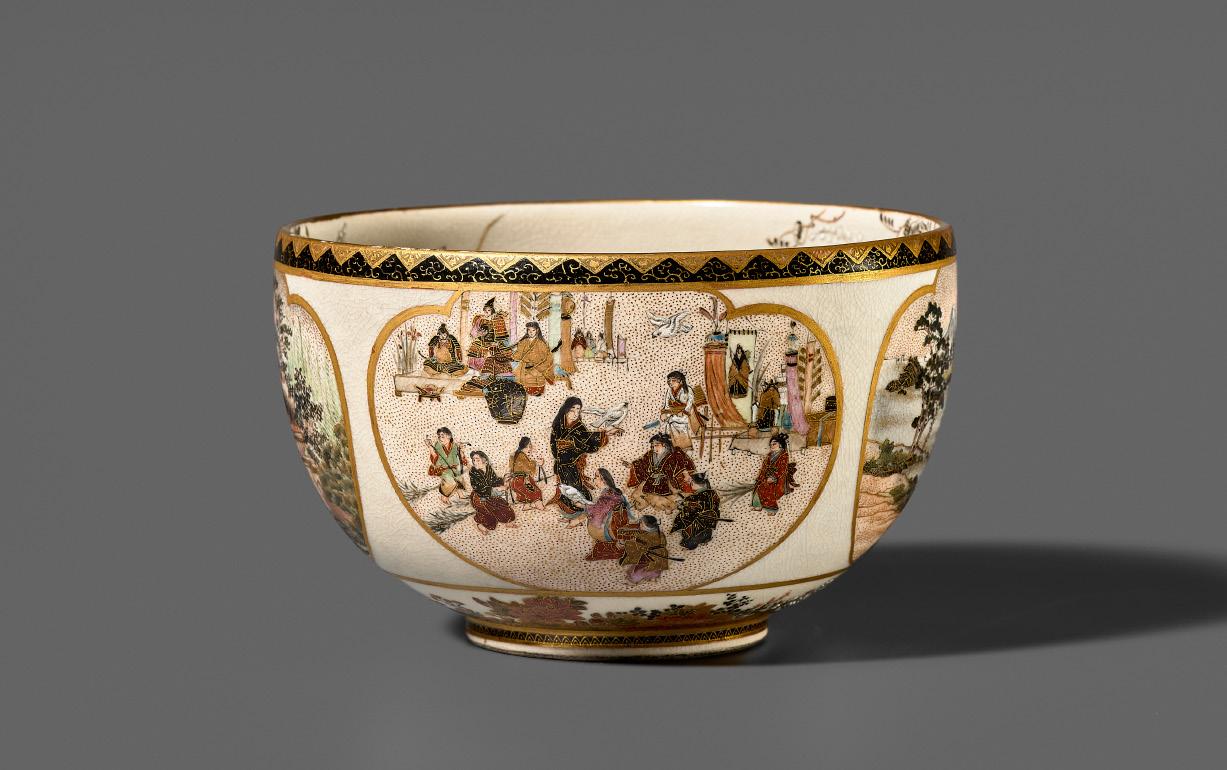
Japan, Meiji period (1868-1912)
Finely potted with deep, rounded sides rising from a short, straight foot to a subtly incurving rim. The exterior is delicately decorated in vivid polychrome enamels with extensive gilding, arranged in four lobed panels alternating between coastal landscape scenes and lively depictions of the Hinamatsuri (Girls’ Festival) and Tango no sekku (Boys’ Festival), each rendered with fine detail and a refined palette. The panels are framed above and below by distinct floral and geometric borders, creating a harmonious and well-balanced composition.
The interior is meticulously decorated with a pair of leaping carp swimming beneath trailing wisteria (fuji) vines. The underside retains traces of a square gilt signature, which considering the style may have read Meizan or Kozan.
HEIGHT 7.7 cm (excl. stand), 10.3 cm (incl. stand), DIAMETER 12.7 cm
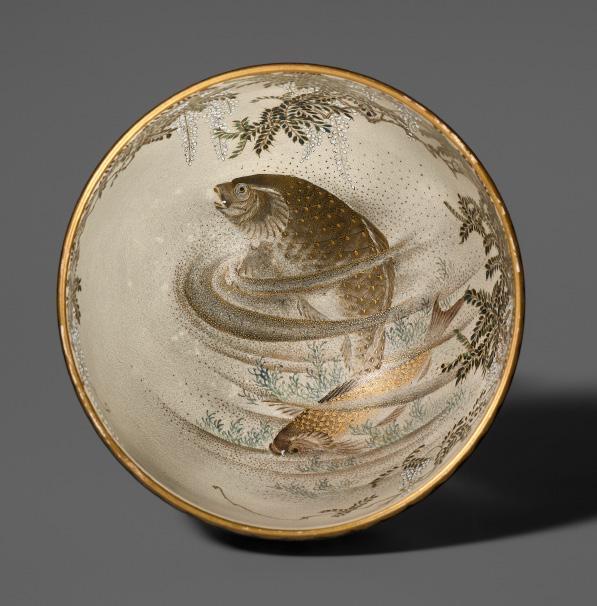
Provenance: From an English private collection of Satsuma ceramics, Wiltshire, United Kingdom.
Condition: Excellent condition with no visible damages or signs of restoration (checked under UV light). Typical wear and minuscule rubbing to gilding.
With a fitted wood presentation stand.
AUCTION COMPARISON
Compare a closely related Satsuma ware bowl, decorated with several panels enclosing various figural scenes, by Kozan, Meiji period, 11 cm diameter, at Bonhams, Fine Japanese Art, London, 16 May 2013, lot 497 (sold for GBP 5,250 or approx. EUR 8,600 converted and adjusted for inflation at the time of writing).
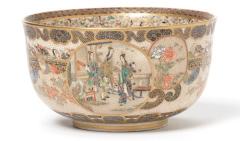
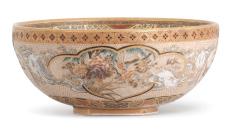
Compare a closely related Satsuma ware bowl, decorated with several panels enclosing different bird-andflower scenes, by Meizan, 12.5 cm diameter, at Bonhams, Fine Japanese Art, London, 11 May 2017, lot 212 (sold for GBP 4,000 or approx. EUR 6,200 converted and adjusted for inflation at the time of writing).
Estimate EUR 4,000
Starting price EUR 2,000
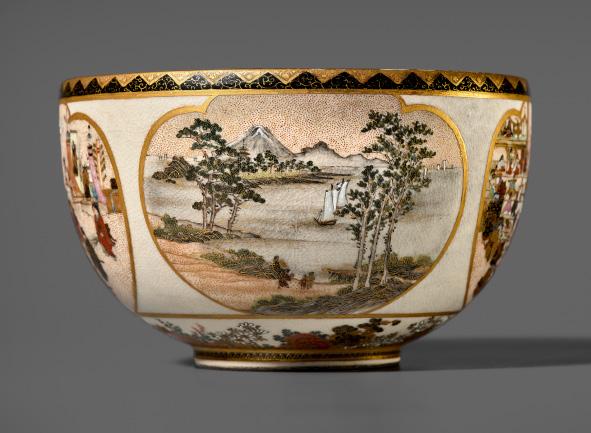
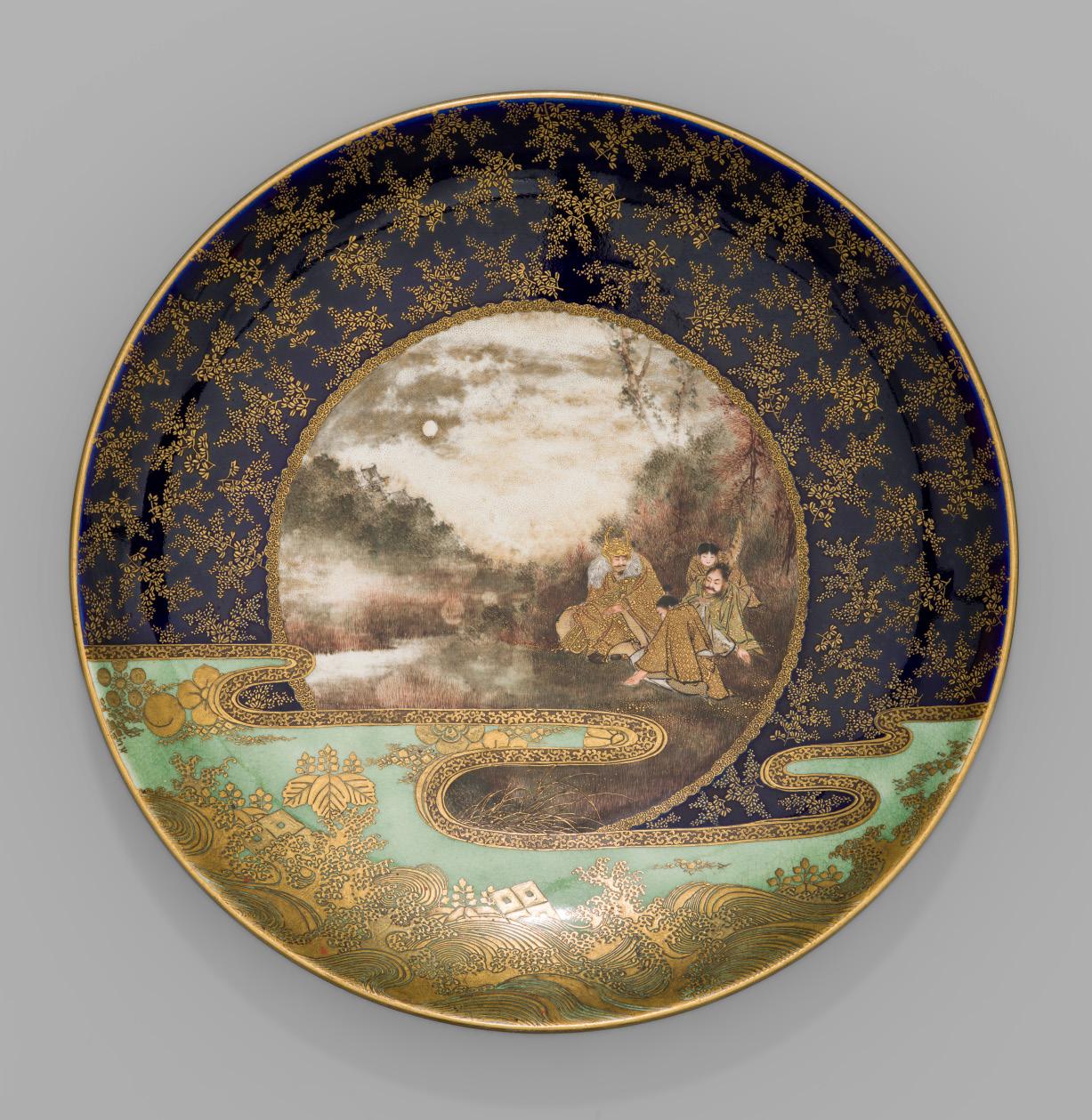
154
KINKOZAN: A FINE SATSUMA CERAMIC ‘SAMURAI AND ATTENDANTS IN THE MIST’ DISH
By the Kinkozan company, signed and sealed Kinkozan zo Japan, Meiji period (1868-1912)
Of circular form, with shallow, gently rounded sides supported on a short, straight foot. The interior is exquisitely decorated in polychrome enamels with extensive gilt accents, centered by a circular medallion depicting a samurai accompanied by three attendants, resting amidst undergrowth beside the waters of a marsh. The tranquil scene unfolds beneath a mist-laden sky, from which a full moon softly emerges, lending the composition a poetic, atmospheric quality. The central reserve is framed around the cavetto by an encircling band of gilt flowering sprigs set against a deep gozu-blue ground, intersected by a river-shaped panel rendered in turquoise-blue enamel with finely detailed gilt spuming waves. Emerging from these are a variety of famous family crests including the Imperial Tokugawa mon.
The exterior is similarly adorned with delicate gilt foliate sprays on a gozu-blue ground. The base, covered with a clear glaze revealing the cream-toned ceramic body beneath, is decorated with a winged dragon enclosing the gilt signature KINKOZAN zo [made by Kinkozan] next to the impressed seal KINKOZAN zo.
DIAMETER 22.1 cm
Condition: Excellent condition with no visible damages or signs of restoration (checked under UV light). Typical wear and minuscule rubbing to gilding.
The Kinkozan company was among the most successful producers of so-called Kyo-Satsuma (Kyoto Satsuma) wares. Like their counterparts in Osaka, Yokohama, and Tokyo, Kinkozan’s production reflects Kyoto’s response to strong Western demand for finely painted Japanese ceramics during the Meiji period. Following the international exposure of Japanese art at the Paris Exposition of 1867, the rise of Japonisme in Europe led to a significant increase in exports, with Kinkozan wares admired for their delicate brushwork, refined compositions, and harmonious use of color and gold.
Compare a related satsuma ceramic dish, decorated with figures walking towards the Yomei gate of the Tosho-gu shrine, by Kinkozan, 23 cm in diameter, at Bonhams, Asian Art, London, 11 November 2014, lot 203 (sold for GBP 3,500 or approx. EUR 5,700 converted and adjusted for inflation at the time of writing).
Estimate EUR 4,000 Starting price EUR 2,000
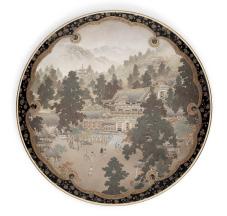
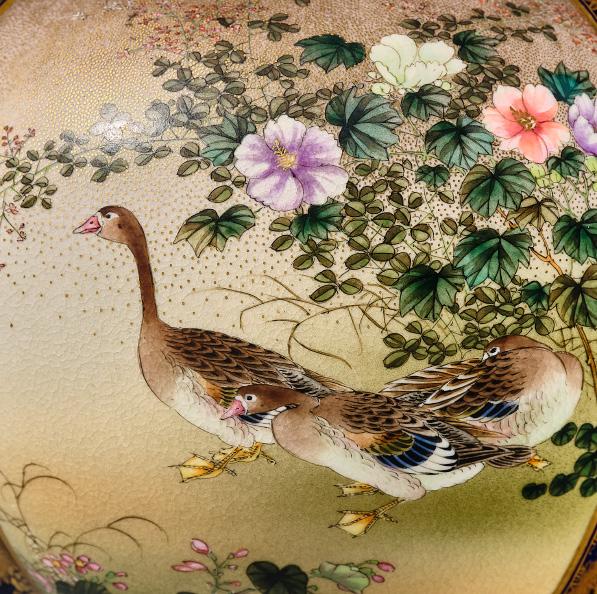
155
KINKOZAN: A SUPERB AND LARGE SATSUMA CERAMIC KORO (INCENSE BURNER)
By the Kinkozan company, signed Kinkozan zo Japan, Meiji period (1868-1912)
Finely potted, the four-lobed, bulbous body is raised on four oval feet and rises to high, rounded shoulders and a broad circular mouth. The exterior is richly decorated in vibrant overglaze enamels with extensive gilding, arranged in four lobed panels enclosing finely rendered naturalistic scenes. These include a rooster and hen among dense bamboo stalks, sparrows perched on trailing wisteria, a group of three geese amid blossoming camellias, and further sparrows fluttering among peonies in full bloom, each composition executed with delicate brushwork and lively detail.
The panels are set against a dense field of stylized gilt flowerheads on a deep gozu-blue ground, creating a striking contrast that enhances the brilliance of the decoration. This richly ornamented scheme continues onto the slightly domed cover, which is finely pierced and surmounted by a sculptural leafy chrysanthemum branch finial. The underside is signed in gilt within a square reserve KINKOZAN zo [made by Kinkozan].
HEIGHT 18.3 cm (incl. cover), DIAMETER 16.8 cm
Condition: Excellent condition with no visible damages or signs of restoration (checked under UV light). Only very minor surface wear.
The Kinkozan company was among the most successful producers of so-called Kyo-Satsuma (Kyoto Satsuma) wares. Like their counterparts in Osaka, Yokohama, and Tokyo, Kinkozan’s production reflects Kyoto’s response to strong Western demand for finely painted Japanese ceramics during the Meiji period. Following the international exposure of Japanese art at the Paris Exposition of 1867, the rise of Japonisme in Europe led to a significant increase in exports, with Kinkozan wares admired for their delicate brushwork, refined compositions, and harmonious use of color and gold.
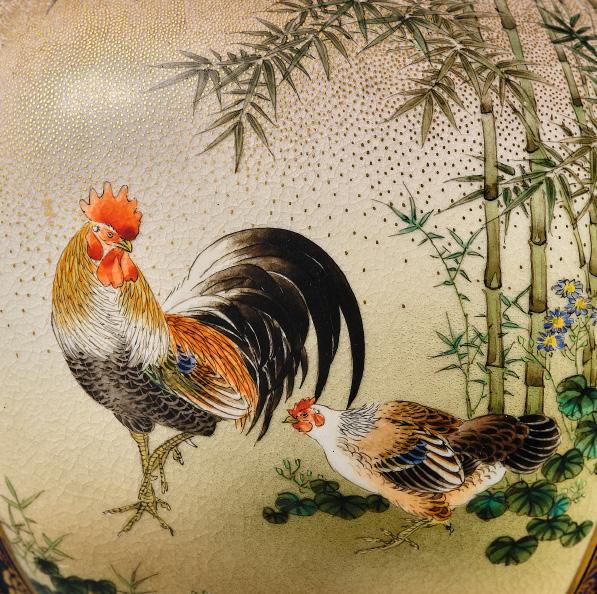
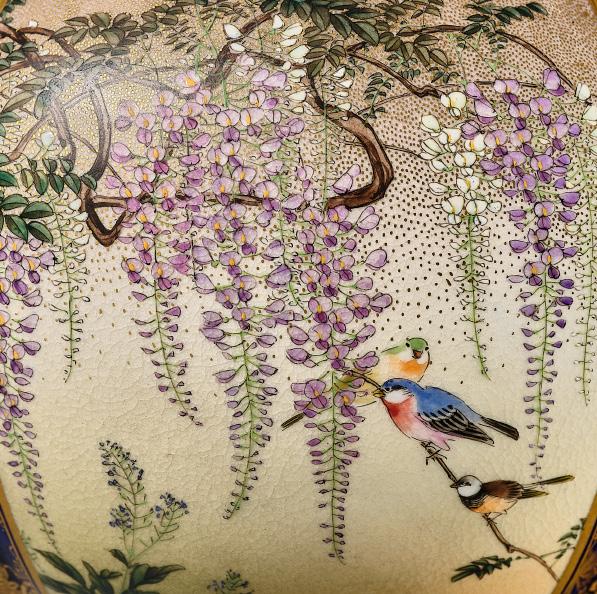
Compare a closely related fourlobed squat Satsuma incense burner (koro) and cover, decorated with various bird-and-flower scenes, by Kinkozan, Meiji period, 15.2 cm high, at Bonhams, Fine Japanese Art, London, 11 May 2017, lot 223 (sold for GBP 6,250 or approx. EUR 9,800 converted and adjusted for inflation at the time of writing).
Estimate EUR 8,000
Starting price EUR 4,000
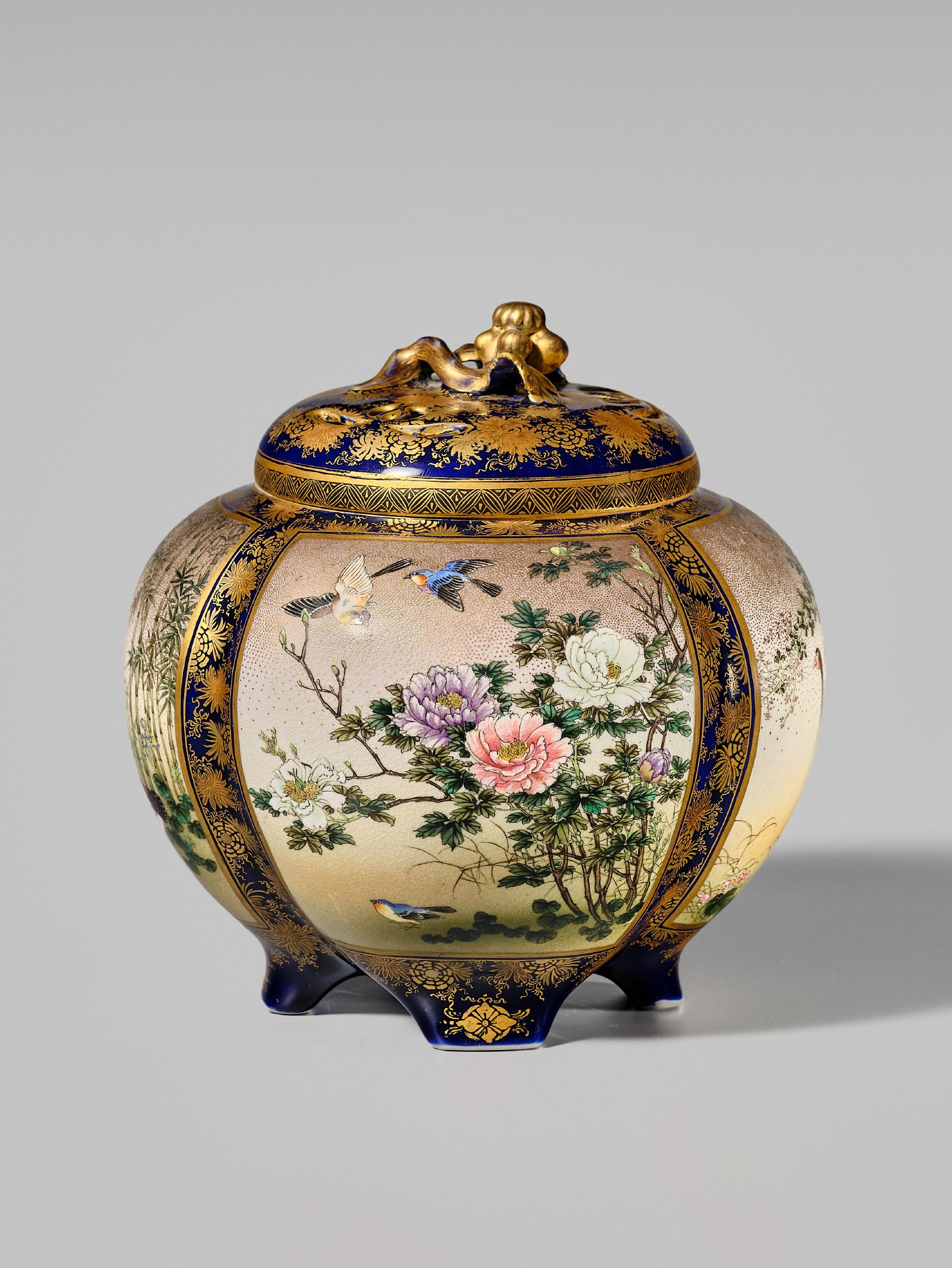
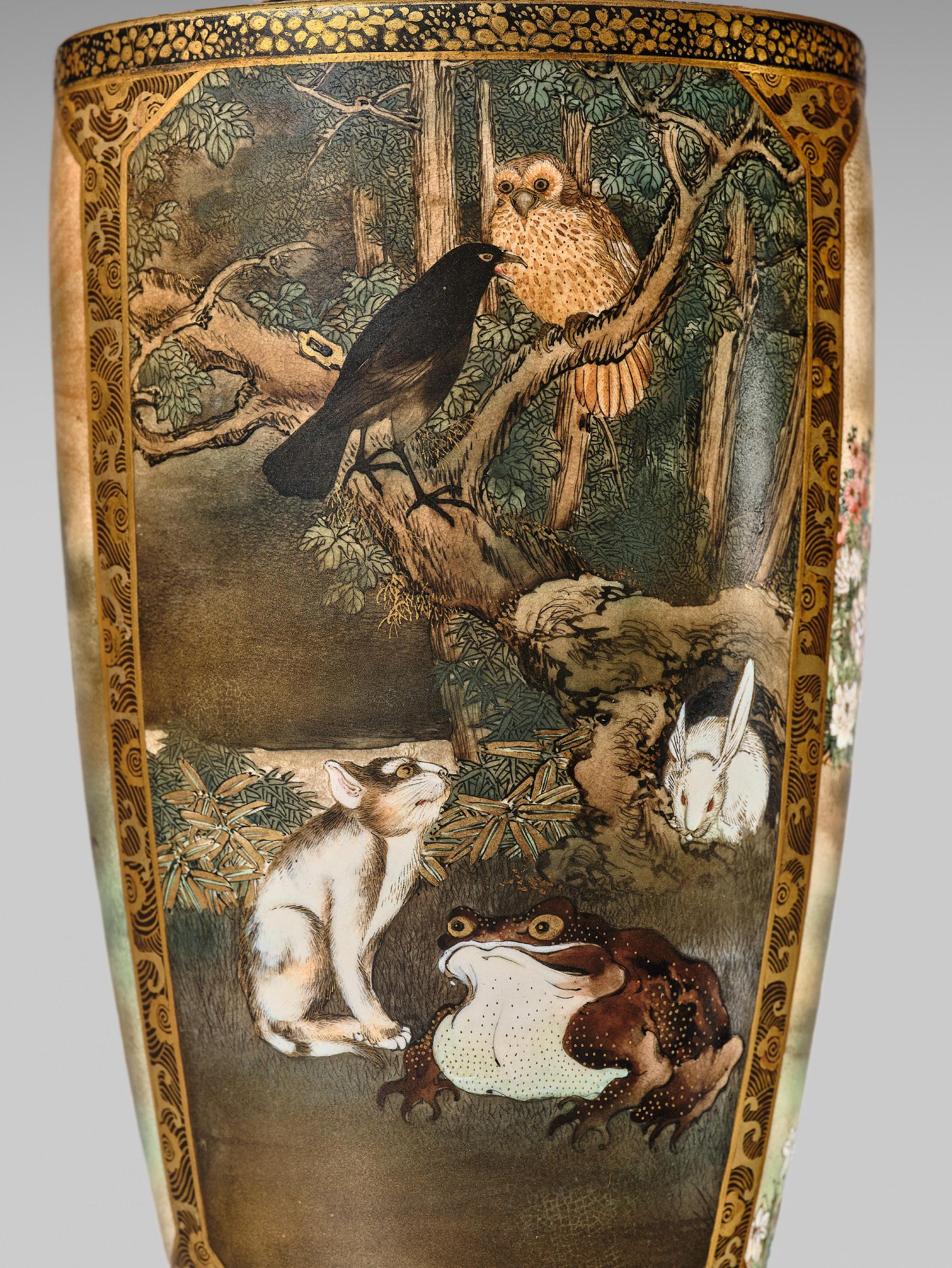
NANPO:
By Koyama Nanpo, signed Koyama Nanpo Japan, Meiji period
(1868-1912)
Finely potted, the elegant balustershaped body gently tapers toward the foot and rises to high-angled shoulders, surmounted by a short, waisted neck with a thick-lipped rim. The exterior is richly decorated in vibrant enamels and extensive gilding, arranged in three shaped cartouches depicting a variety of finely observed animal subjects executed in the Maruyama-shijo painting style.
One panel shows a rooster with a pheasant and a dog beneath a radiant sun; another features a peacock and hen accompanied by a pheasant and a phoenix; while a third depicts a more intimate woodland scene with an owl and crow perched on a branch, accompanied below by a rabbit, a toad, and a cat, rendered in subdued tones suggesting twilight within a dense forest setting. Each composition is executed with remarkable delicacy and narrative richness.
The cartouches are framed by elaborate gilt borders of floral and wave-like motifs, while the shoulders are densely decorated with a refined millefleur ground. The underside is signed within a square reserve KOYAMA NANPO and bears the Shimazu family seal.
HEIGHT 23.2 cm, DIAMETER 12.1 cm
Condition: Excellent condition with no visible damages or signs of restoration (checked under UV light). Only very minor surface wear.
The name Koyama Nanpo appears on a small number of Satsuma wares of the Meiji period, typically associated with finely painted pieces of high decorative quality. However, unlike well-documented artists such as Yabu Meizan or Okamoto Ryozan, reliable biographical information on Koyama Nanpo as a ceramic decorator remains extremely limited, and the name may refer either to a workshop artist, a studio name, or a painter working within a larger Satsuma production context.
Estimate EUR 10,000 Starting price EUR 5,000
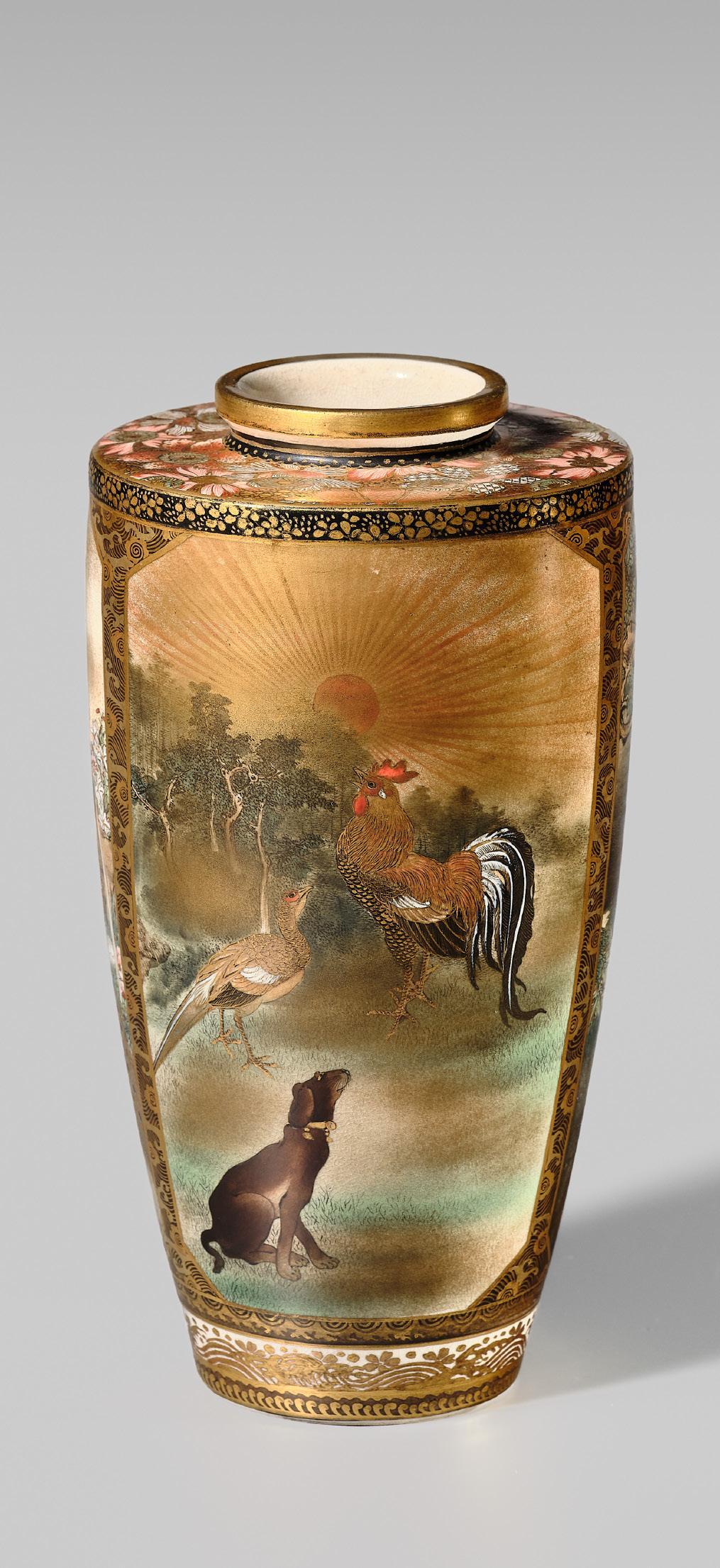
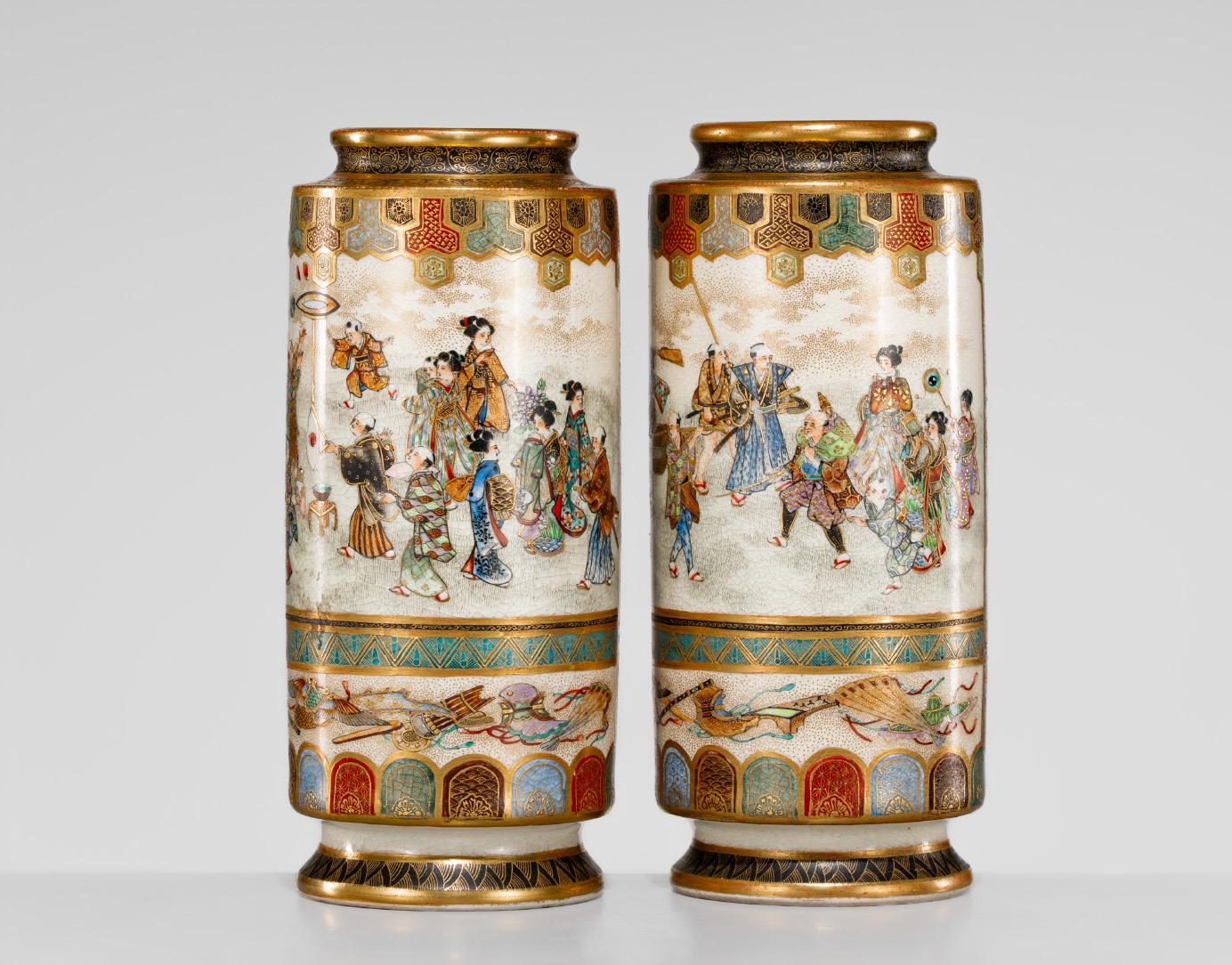
157
OKAMOTO RYOZAN FOR THE YASUDA COMPANY: A FINE PAIR OF SATSUMA CERAMIC VASES
By Okamoto Ryozan (c. 1820-1910), signed Ryozan with the mark of the Yasuda Company Japan, Meiji period (1868-1912)
Each of elegant cylindrical form, rising from a flaring foot to a short waisted neck with a thickened, everted rim, the surfaces richly decorated in polychrome enamels and extensive gilding. The principal reserve on each vase depicts a lively procession of figures - adults and children engaged in music-making and playful pursuits, executed with fine, detailed brushwork.
These scenes are complemented by lobed cartouches: one vase with egrets beside irises (shobu) along a shoreline, the other with a mantis perched on a hibiscus branch. The lower register is densely ornamented with musical instruments and precious objects, all enclosed within alternating brocade patterns and geometric bands.
The bases each with a gilt signature Dai Nippon, Kyoto, RYOZAN [made by Ryozan, Kyoto, Great Japan] and with the Yasuda company mark.
HEIGHT 15 cm and 14.8 cm
Provenance: Sotheby’s, Japanese Works of Art, Prints & Paintings, 9 November 2006, London, lot 1232, sold for GBP 4,080 or approx. EUR 8,100 (converted and adjusted for inflation at the time of writing). From an English private collection of Satsuma ceramics, Wiltshire, United Kingdom, acquired from the above. Condition: Excellent condition with no visible damage or signs of restoration (checked under UV light). Typical, minor rubbing and losses to gilding, mostly along the edges and corners.
Okamoto Ryozan (c. 1820-1910), born Nakamura Tatsunosuke, is widely regarded as one of the foremost Satsuma artists of the golden age of Meiji export ceramics. He trained under the distinguished 10th-generation potter Nishimura Zengoro, who bore the artistic name Ryozan. Following his master’s death in 1851, Tatsunosuke adopted the name Okamoto Ryozan in tribute. He later became Head Artist at the Yasuda Company in Kyoto, where he established himself as a leading figure in Satsuma production. His work is characterized by a refined painterly quality, intricate detail, and a harmonious use of color, making it highly sought after.
The Yasuda Company, founded in 1896 by Yasuda Genshichi and Yasuda Kizaburo, was one of the most respected Kyoto workshops of the late Meiji period. Renowned for its high standards and careful selection of collaborators, the firm worked with leading artists such as Ryozan, Sozan, Kizan, Hozan, and Seikozan, producing finely decorated export wares that exemplify the height of Meiji craftsmanship.
AUCTION COMPARISON
Compare a related larger pair of tall cylindrical satsuma vases, by Okamoto Ryozan for the Yasuda company, 29.7 cm tall, at Bonhams, Fine Japanese Art, 8 November 2018, London, lot 163 (sold for GBP 6,875 or approx. EUR 10,500 converted and adjusted for inflation at the time of writing).
Estimate EUR 4,000
Starting price EUR 2,000
OKAMOTO
By Okamoto Ryozan (c. 1820-1910), signed Ryozan with the mark of the Yasuda Company Japan, Meiji period (1868-1912)
Finely potted and of elegant square section, the body rising from a gently spreading foot to sharply angled shoulders and a short, waisted neck with an everted mouth and slightly flared, thickened rim. The exterior is exquisitely decorated in vivid polychrome enamels with extensive gilding. Two large rectangular panels on alternating sides present contrasting scenes: one depicting a lively procession of families crossing a wooden bridge toward a thatched temple set within a tranquil landscape, the other showing two sparrows perched among blossoming cherry branches beside a winding stream, rendered with delicate naturalism. These principal reserves are framed by elaborate gilt borders and set against a rich gozu-blue ground, the adjoining sides further enlivened with gilded scrolling foliage and smaller cartouches containing additional figural and floral motifs.
The shoulders are embellished with hollyhock crests (Mitsuba Aoi mon), Imperial symbols of Japan, interspersed with flowering sprays, while the neck is encircled by further ornamental floral bands. The underside is signed in gold RYOZAN, with the mark of the Yasuda Company, and bears the seal of the Shimazu family.
HEIGHT 31.3 cm
Condition: Excellent condition with no visible damages or signs of restoration (checked under UV light). Typical, minor rubbing and losses to gilding, mostly along the edges and corners.
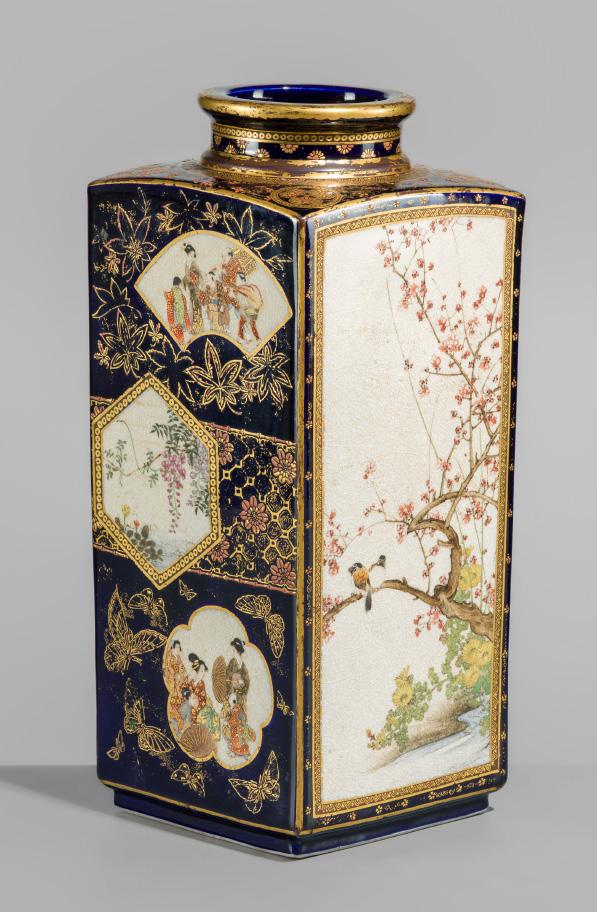
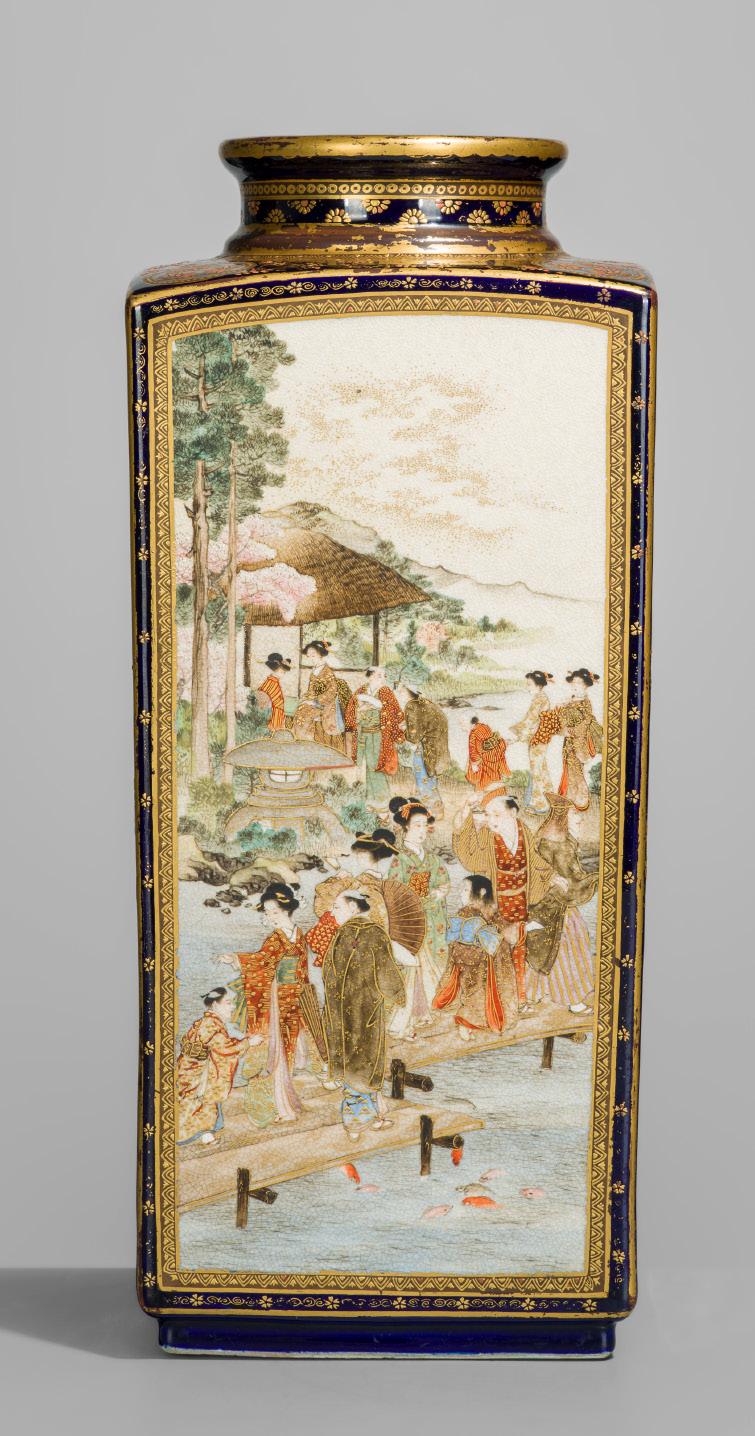
AUCTION COMPARISON
Compare a related smaller Satsuma ceramic square-sided vase, by Okamoto Ryozan for the Yasuda Company, 18.1 cm high, at Bonhams, Fine Japanese and Korean Art, New York, 15 March 2017, lot 6261 (sold for USD 6,250 or approx. EUR 7,200 converted and adjusted for inflation at the time of writing). Compare a related Satsuma ware ovoid vase, by Okamoto Ryozan for the Yasuda Company, 24 cm high, at Bonhams, Fine Japanese Art, London, 9 November 2017, lot 269 (sold for GBP 3,125 or approx. EUR 4,900 converted and adjusted for inflation at the time of writing).
Estimate EUR 3,000
Starting price EUR 1,500
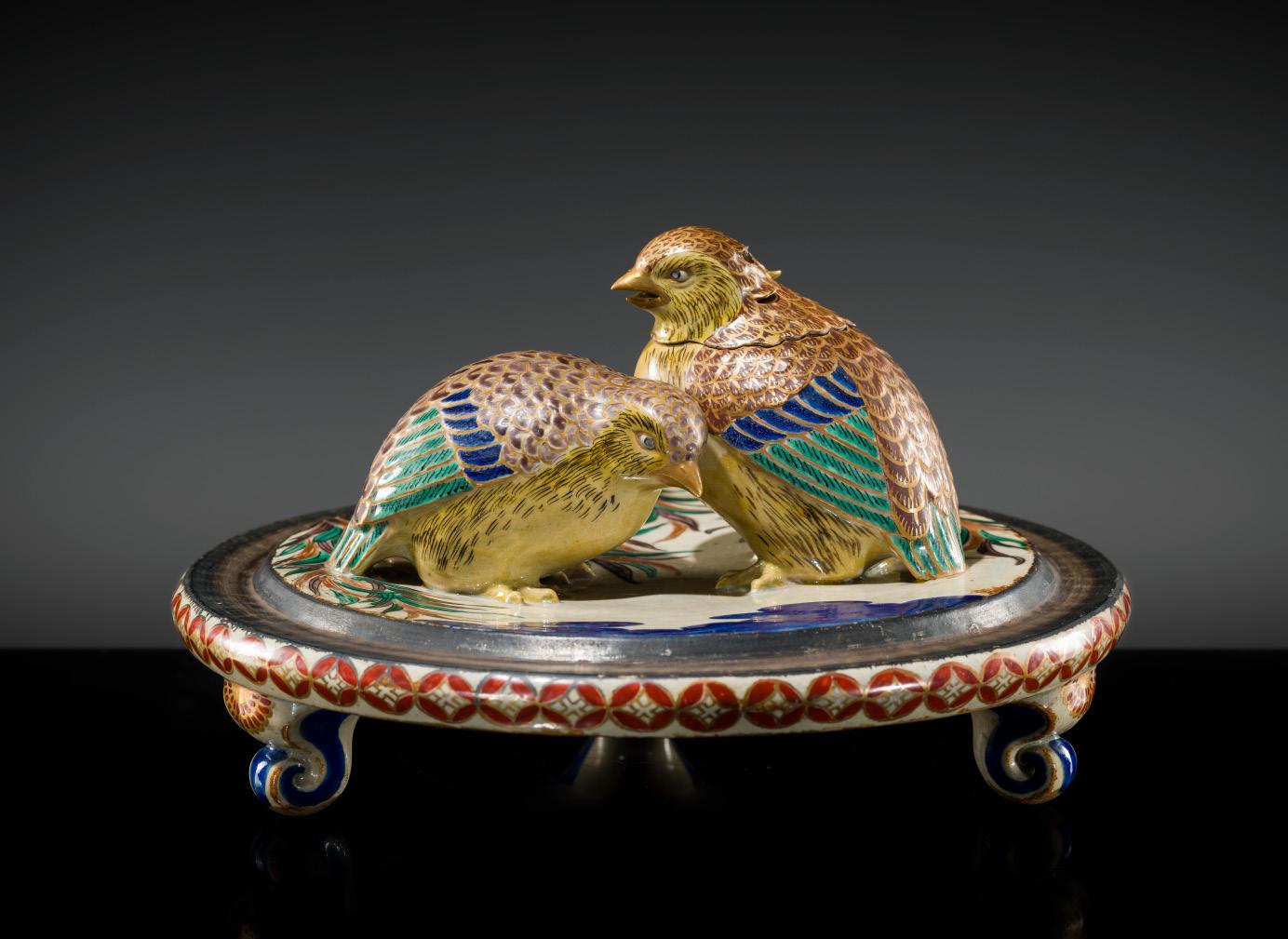
AN EXCEPTIONAL AND RARE CERAMIC ‘QUAIL CAGE’ KORO (INCENSE BURNER)
Japan, 19th century, late Edo period (1615-1868)
Finely carved and molded as a pair of quails, the present incense burner is raised on a tripod base decorated with painted grasses and clouds. The group is surmounted by a tall woven cage entwined with millet. One of the quails features a detachable head, forming the incense compartment, and is pierced with three apertures to allow the smoke to escape. The surface is richly embellished with vibrant enamels and gilt, imparting a refined and polychrome finish.
HEIGHT 28.5 cm, DIAMETER 27 cm
Condition: Very good condition with minor wear and few typical firing irregularities. The removable bird head with a chip to one opening, and old gold-lacquered ‘kintsugi’ repairs to another opening and to the beak.
Quails are associated with courage, reflecting their role in rural China where quail fighting, akin to cockfighting, was a popular pastime. At the same time, the quail (‘an’), a homophone for ‘peace’, conveys auspicious connotations of harmony and tranquility, and by extension symbolizes peaceful coexistence among generations.
MUSEUM COMPARISON
Compare a related Kutani ware figure of a hawk on a rock, dated third quarter of the 19th century, 25.1 cm tall, in the Victoria & Albert Museum, accession number 1122-1875.
Estimate EUR 6,000
Starting price EUR 3,000
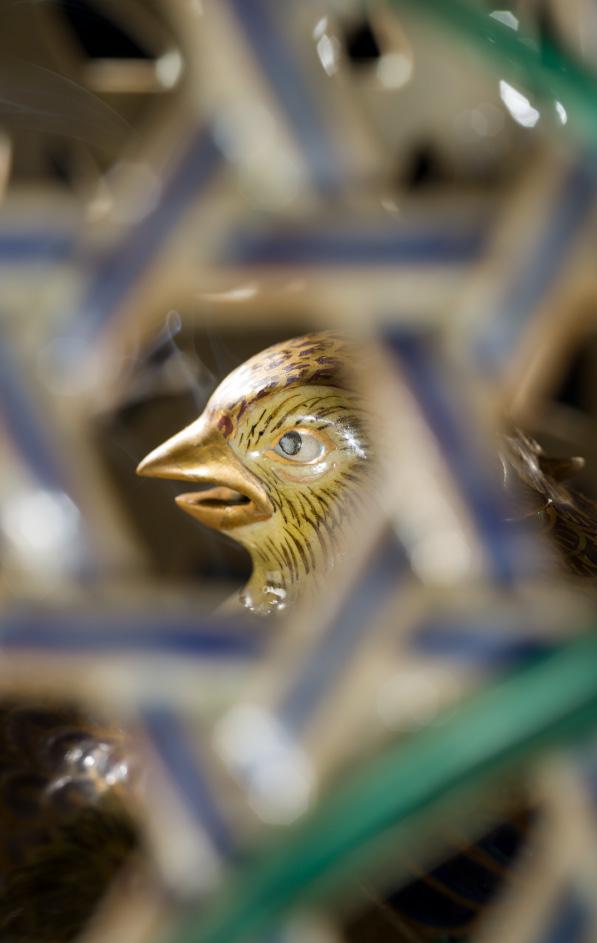
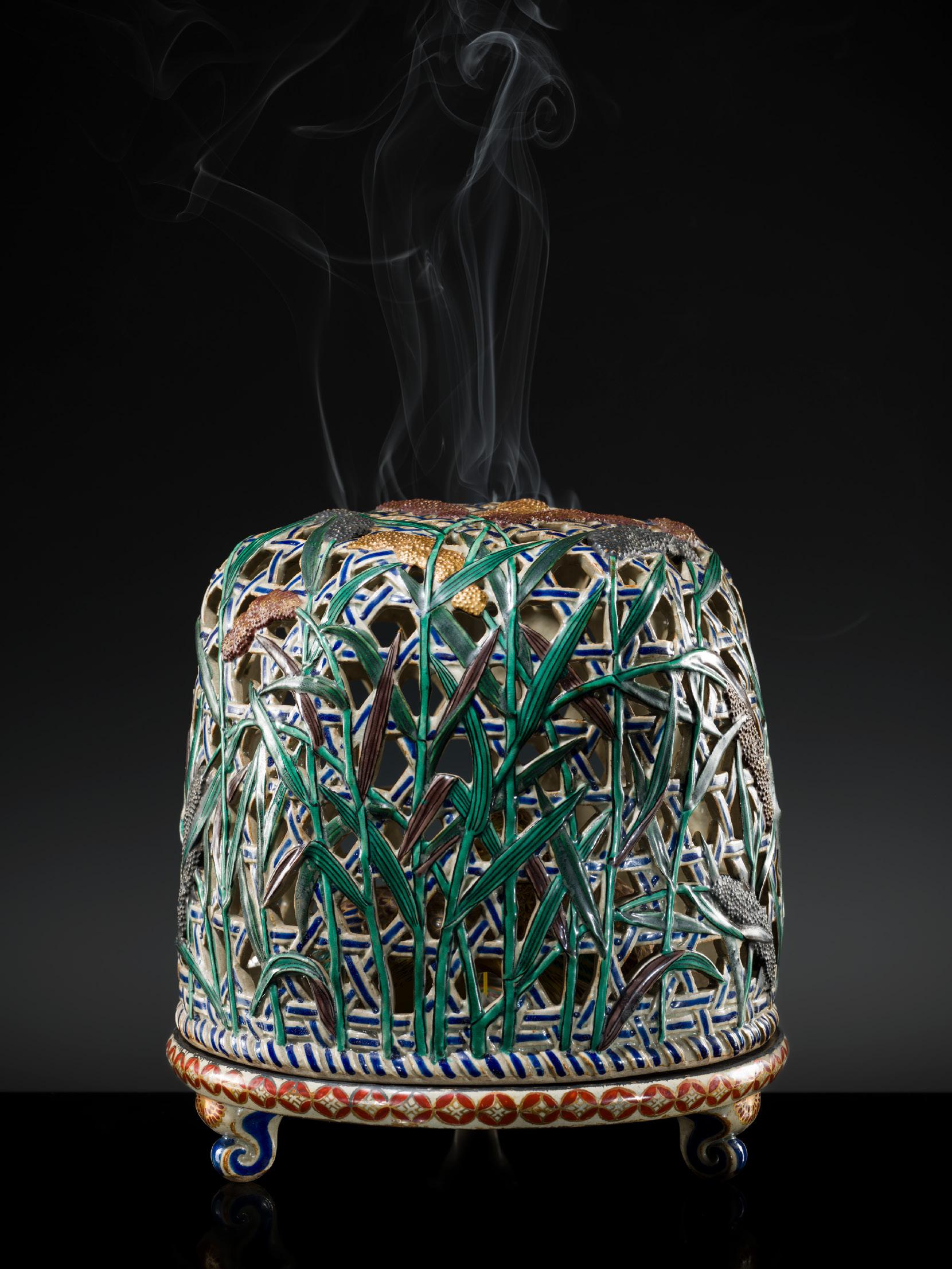
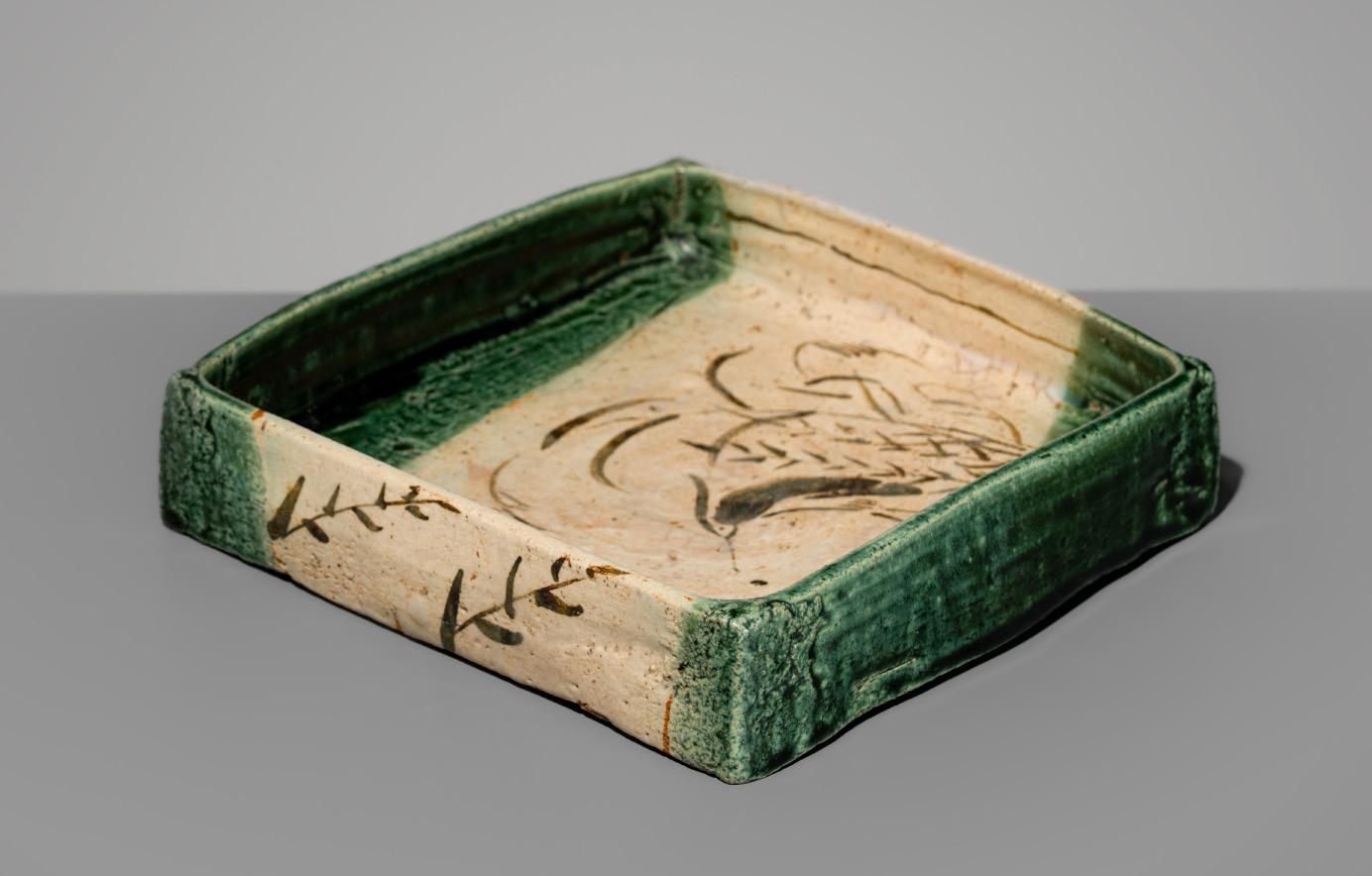
A VIVID AO-ORIBE CERAMIC ‘HERON AMID REEDS’ SQUARE MUKOZUKE (FOOD SERVING DISH)
Japan, late Edo period (1615-1868)
Boldly modeled, this rectangular dish features a flat base and straight sides. The surface is decorated with a deep green glaze, characteristic of Ao-Oribe, framing a scene of a stylized heron standing in calm waters amidst windblown reeds. The heron, executed in the zen ink painting style, is rendered in iron-brown brushstrokes against a cream-glazed ground, evoking the dynamic simplicity of traditional ink art. The underside reveals the kiln support points through several rounded unglazed spots, exposing the buff-colored ceramic body beneath.
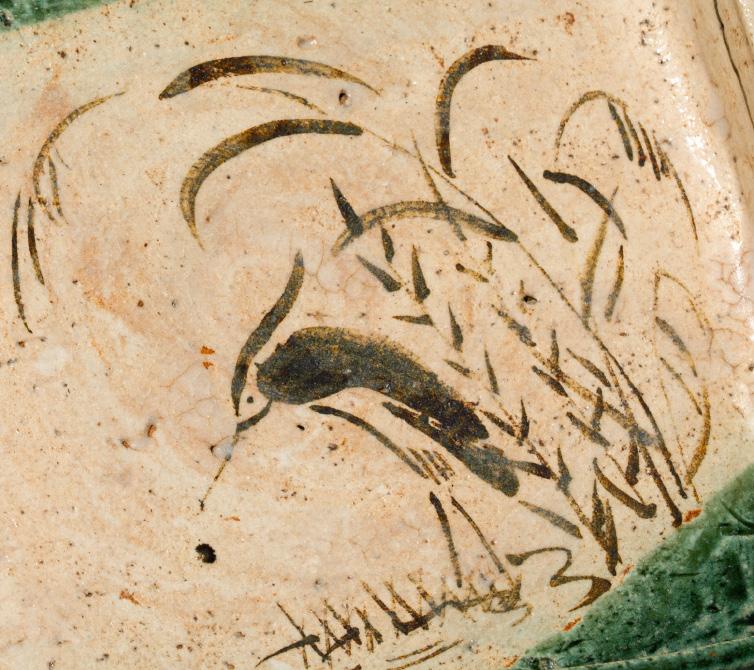
LENGTH 17.9 cm
Condition: Excellent condition with minor surface wear and typical firing-inherent irregularities.
Mino high-fired ceramics were produced in the Mino and Seto regions (present-day Gifu Prefecture) during the late 16th century. Among the four principal Mino styles, Oribe ware became the most celebrated, named after the tea master and warlord Furuta Oribe (1591-1615). Oribe ware is known for its bold colors and asymmetrical designs, representing a dynamic expression of Japanese tea ceramics. Emerging during the Momoyama period (1573-1615), a time of political and social upheaval, Oribe ware marked a departure from the refined restraint of earlier traditions and embraced a new visual vitality that echoed the energy of the era.
Ao-Oribe (literally “green Oribe”) refers to pieces partially covered with green copper glaze, with the remaining surfaces decorated in iron-glaze motifs. The green glaze, created by combining copper salts with feldspathic glaze and wood ash, was applied using dipping, trailing, or ladling techniques, rather than brushing. Authentic Oribe ware was fired in irregularly oxidizing atmospheres, which were achievable only in the imperfectly constructed kilns of ancient times. The resultant variegated green glaze became one of the most visually distinctive features of Oribe ceramics.
Typically used in the tea ceremony, a square dish like this would hold fish, with the decoration gradually revealed as the meal progressed.
MUSEUM COMPARISON
Compare a closely related Oribe ware square mukozuke (serving dish) with bird design, Edo to Meiji period, 19th century, 21 cm long, in the Asian Art Museum, San Francisco, accession number B67P8.
Estimate EUR 2,500
Starting price EUR 1,200
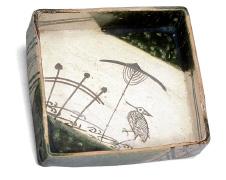
161 A SUPERB KARATSU WARE CHAWAN (TEA BOWL) NAMED ‘WABI NO SATO’
Japan, 17th century, late Momoyama (1573-1615) to early Edo period (1615-1868)
Finely modeled, with deep, gently rounded sides resting on a short, subtly tapered foot. The interior coated in a pale ochre, finely crackled glaze that extends over the rim and upper exterior, leaving the remainder of the outer surface unglazed to reveal the buffcolored ceramic body, accented with small ash spots formed during firing, an ishihaze (natural embedded stone), particularly prized in early Karatsu ware, and a small gold kintsugi repair near the rim.
HEIGHT 7.8 cm, DIAMETER 11.1 cm
Condition: Excellent condition with only minor firing-inherent irregularities. The rim with a beautiful kintsugi repair.
With two tiered wood storage boxes (tomobako): the inner box inscribed and signed by Issai Soshu, ninth Omotesenke tea master; the outer box inscribed and signed by Ichio Soshu, twelfth Omotesenke tea master, who conferred the name ‘Wabi no Sato’ [Village of Wabi] on this chawan, a distinction rarely encountered on early Karatsu tea bowls.
AUCTION COMPARISON
Compare a closely related Ko-Karatsu ware chawan (tea bowl), Momoyama to early Edo period, 17th century, 12.1 cm diameter, at Christie’s, Asobi: Ingenious Creativity, Japanese Works of Art from Antiquity to Contemporary, London, 15 October 2014, lot 27 (sold for GBP 5,625 or approx. EUR 9,000 converted and adjusted for inflation at the time of writing).
Estimate EUR 2,000
Starting price EUR 1,000
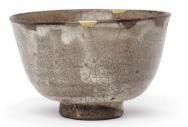
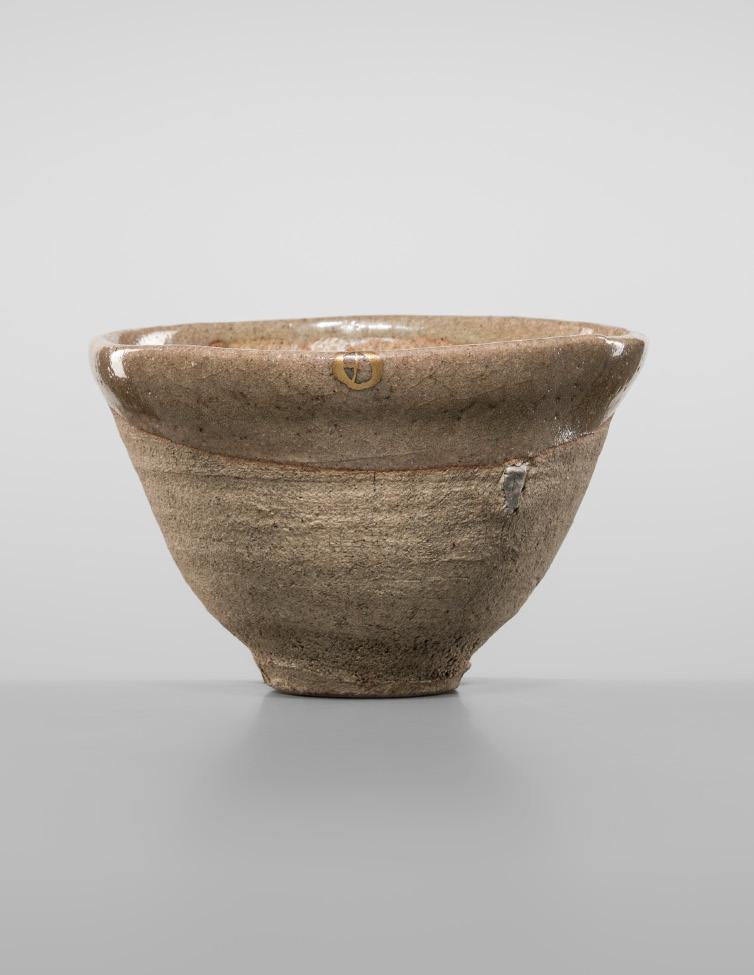
162
RAKU RYONYU (KICHIZAEMON IX): A BLACK-GLAZED RAKU WARE CHAWAN (TEA BOWL)
By Raku Ryonyu, Kichizaemon IX (1756-1834), sealed by the artist Japan, late 18th to early 19th century, late Edo period (1615-1868)
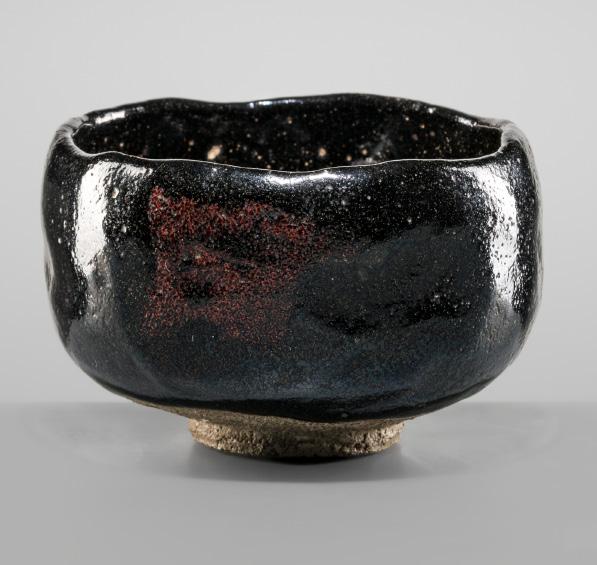
Exquisitely modeled, with slightly concave sides resting on a short, straight foot with a recessed base, and rising to a gently undulating rim. The surface entirely coated in a lustrous, thick black glaze with subtle reddish highlights, deliberately stopping well above the foot to reveal the natural buff-colored ceramic beneath. The rough texture of the exposed ceramic contrasting strikingly with the smooth, vitreous surface of the glaze. The lower section of the bowl, adjacent to the foot, bearing the seal RAKU.
HEIGHT 7.5 cm, DIAMETER 11.9 cm
Condition: Excellent condition.
With the original silk carrying bag (shifuku) and wood storage box (tomobako), signed and sealed by the artist, and bearing an inscription of authenticity by Raku Jikinyu, Kichizaemon XV.
AUCTION COMPARISON
Compare a closely related black-glazed Raku ware chawan (tea bowl), by Raku Ryonyu (Kichizaemon IX), Edo period, 19th century, 12 cm diameter, at Bonhams, Fine Japanese and Korean Art, including the Alan and Simone Hartman Collection of Japanese Art, London, 20 March 2025, lot 753 (sold for USD 4,864 or approx. EUR 4,200 converted and adjusted for inflation at the time of writing).
Estimate EUR 2,000
Starting price EUR 1,000
MAKUZU KOZAN I (LOTS 163-167)
Makuzu Kozan I (1842-1916), also known as Miyagawa Kozan, was a potter who moved his ceramics studio from his hometown of Kyoto to the port city of Yokohama in 1870. His early works copying styles and forms derived from earlier Japanese and Chinese ceramics soon found favor with Western buyers and his business quickly expanded. Kozan’s work was also much admired within Japan and achieved special notoriety after the Meiji Emperor touched one of his vases at the First National Industrial Exhibition in 1877.
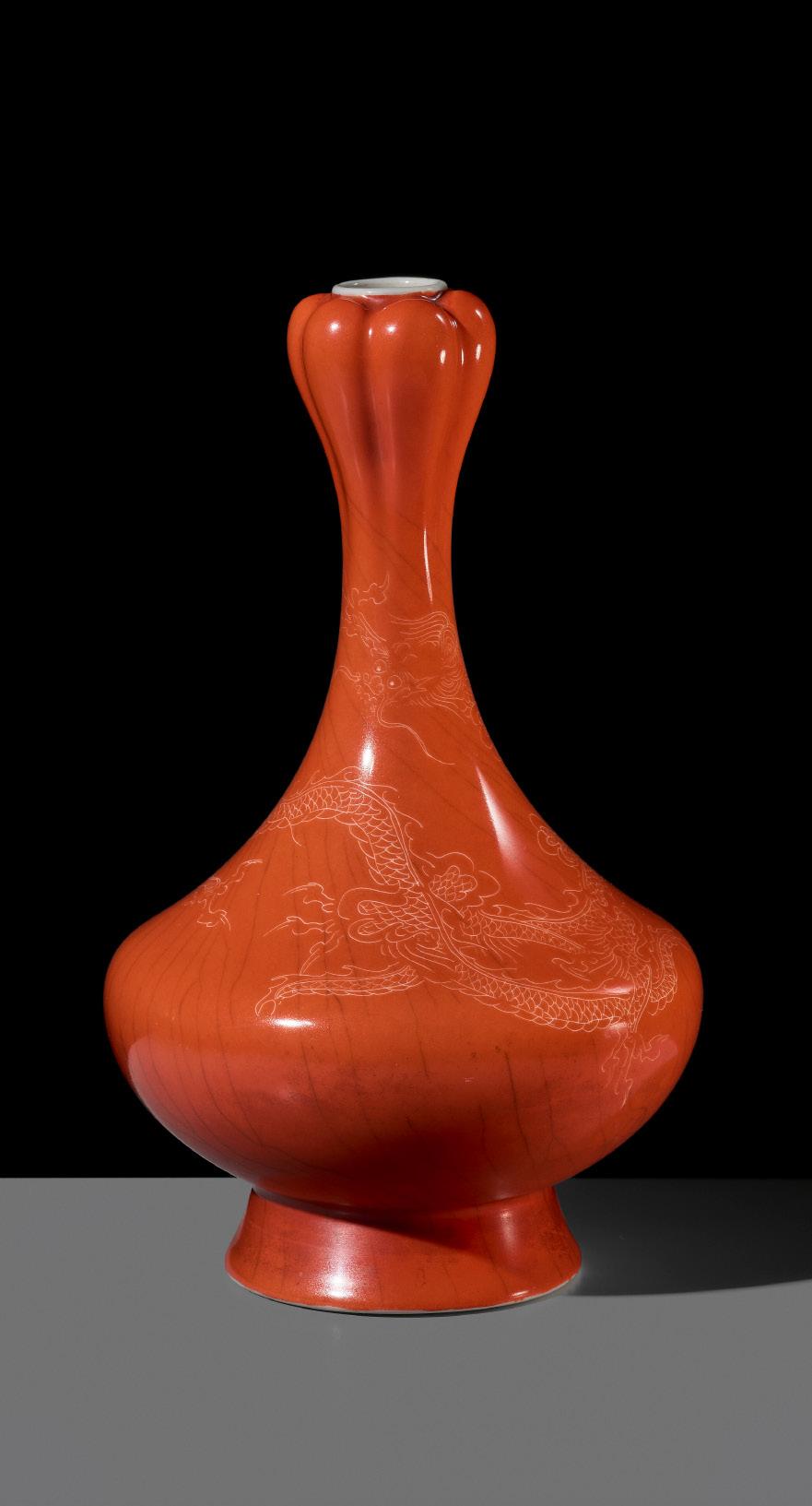
Makuzu Kozan I (1842-1916)
MAKUZU KOZAN I: AN IRON-RED GLAZED STUDIO PORCELAIN GARLIC-HEAD VASE WITH DRAGONS
By Makuzu Kozan I (1842-1916), signed Makuzu yo Kozan sei
Japan, late 19th to early 20th century, Meiji period (1868-1912)
The vase raised on a splayed foot rising to a long waisted neck with a bulbous garlic mouth, covered in lustrous iron-red suffused with crackles and incised in delicate lines with two sinuous dragons. The base with a six-character mark in underglaze blue reading MAKUZU yo KOZAN SEI [Makuzu kiln, made by Kozan].
HEIGHT 24.7 cm
Provenance: From the trust of Dorothy ‘Suzi’ Osher. Condition: Excellent condition.
AUCTION COMPARISON
Compare a near identical iron-red ‘dragon’ garlicmouth bottle vase by Makuzu Kozan (1869-1912), dated Meiji period, 25.5 cm tall, at Roseberys, Chinese, Japanese & South Eastern Asian ArtDay Two, 8 November 2023, London, lot 1089 (sold for GBP 3,936 or approx. EUR 4,900 converted and adjusted for inflation at the time of writing).
Estimate EUR 4,000
Starting price EUR 2,000
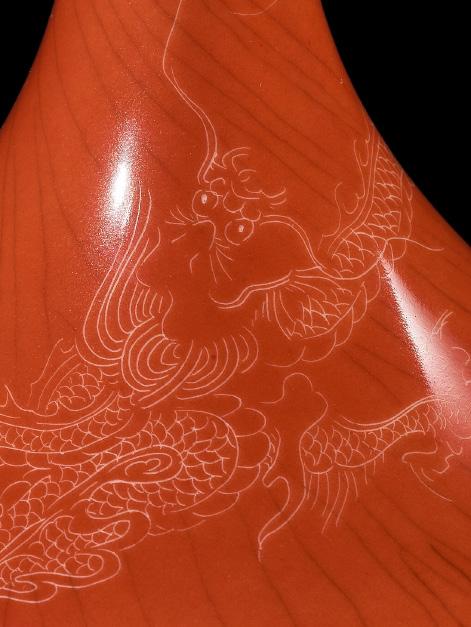
164
MAKUZU KOZAN I: A FINE STUDIO PORCELAIN BOWL
By Makuzu Kozan I (1842-1916), signed Makuzu Kozan sei Japan, late 19th to early 20th century, Meiji period (1868-1912)
The bowl with incurved sides and lipped upper rim, painted to the exterior in a rich gosu blue, featuring four pairs of cream-glazed fish centered by the symbols ‘fuku’ and ‘ju’ as well as scattered Buddhist emblems and auspicious symbols highlighted in vivid enamels, gilt, and ironred. The well is decorated with a sinuous fourclawed dragon within a roundel framed by three sprays of peony on a crackled cream ground. The base signed MAKUZU KOZAN sei [made by Makuzu Kozan] in a rectangular reserve.
DIAMETER 25.3 cm
Provenance: From the estate of Henry V. and Carol K. Nickel; acquired from Normar Galleries, Sarasota, circa 16 October 1988. This lot is accompanied by a copy of a signed appraisal from Normar Galleries, dated 16 October 1988, stating a value of USD 5,000 (or approx. EUR 12,000, converted and adjusted for inflation at the time of writing). Condition: Excellent condition, very minor wear and rubbing to enamels.
Estimate EUR 3,000
Starting price EUR 1,500
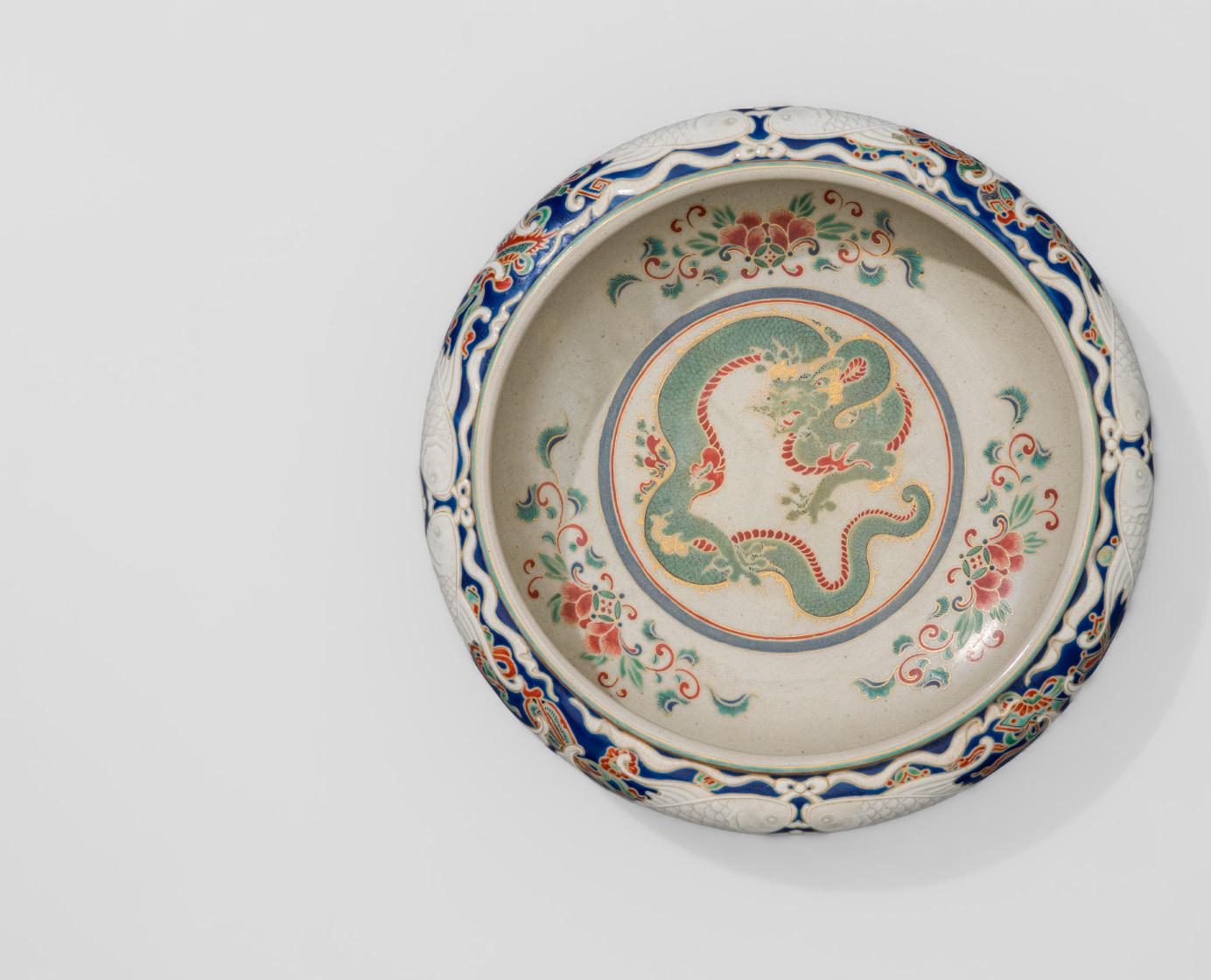
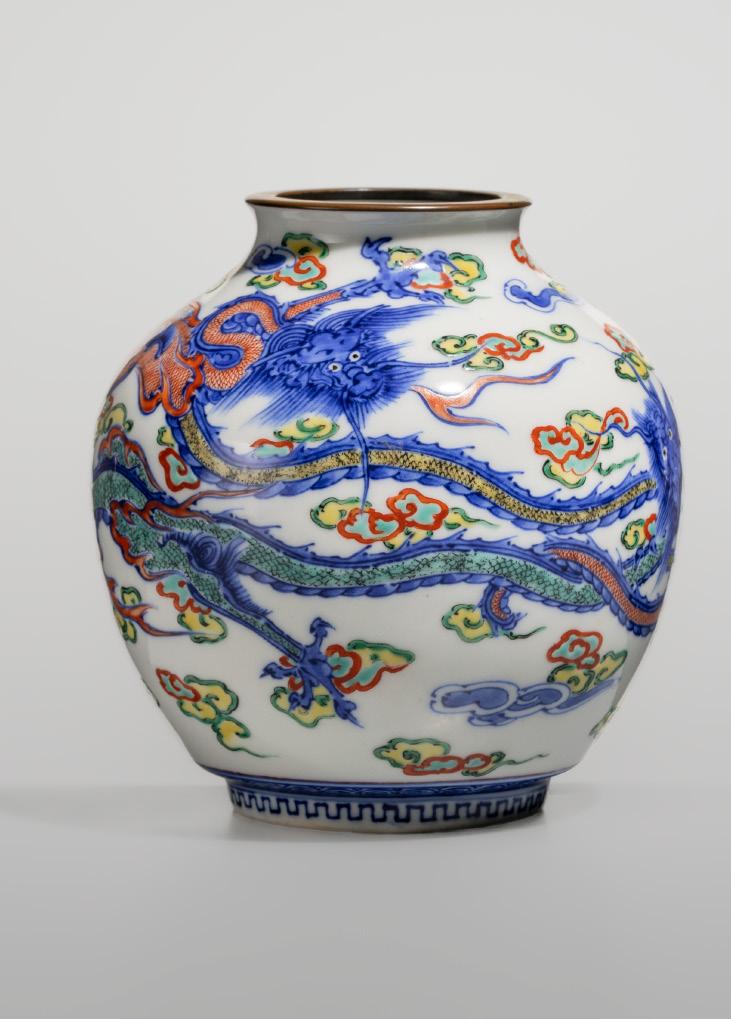
165
MAKUZU KOZAN I: A STUDIO PORCELAIN ‘WUCAI DRAGONS’ VASE
By Makuzu Kozan I (1842-1916), signed Kozan sei Japan, late 19th to early 20th century, Meiji period (1868-1912)
The globular body rising from slightly tapering foot to a waisted neck set with a copper lined rim, painted in underglaze blue, green, yellow, and turquoise enamels and iron red, with black details, featuring three intertwined four-clawed dragons emanating fire amid scrolling clouds. The foot framed by a band of scrolls and geometric border. Signed in a doublesquare cartouche KOZAN sei [made by Kozan].
HEIGHT 13.1 cm
Provenance: From the estate of Henry V. and Carol K. Nickel; acquired from Normar Galleries, Sarasota, circa 12 May 1991. This lot is accompanied by a copy of a signed appraisal from Normar Galleries, dated 12 May 1991, stating a value of USD 2,750 (or approx. EUR 5,700, converted and adjusted for inflation at the time of writing).
Condition: Excellent condition, very minor wear and rubbing to enamels.
Estimate EUR 3,000
Starting price EUR 1,500
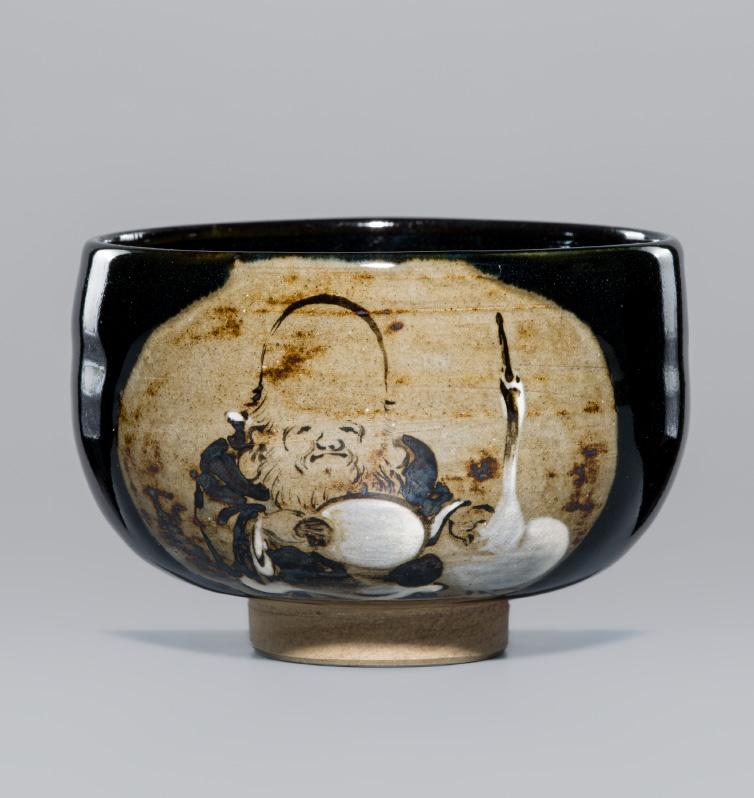
167
MAKUZU KOZAN I: A BLACK GLAZED STUDIO PORCELAIN ‘SNOWY PLUM’
By Makuzu
Kozan I (1842-1916), signed Kozan and Makuzu Japan, c. 1916
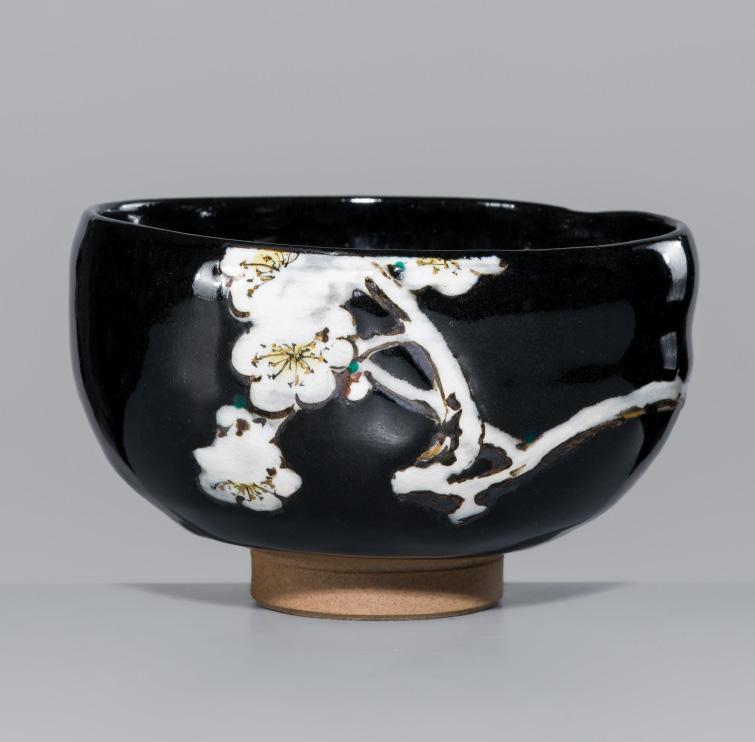
166
MAKUZU KOZAN I: A BLACK GLAZED STUDIO PORCELAIN ‘JUROJIN AND CRANE’ CHAWAN (TEA BOWL)
By Makuzu
Kozan I (1842-1916), signed Kozan and Makuzu Japan, c. 1916
The bowl with deep sides supported on a tall circular foot, covered in a lustrous black glaze with a reserve to the front featuring Jurojin holding a large fan accompanied by a white crane. Signed to the side KOZAN and impressed to the base MAKUZU.
LENGTH 12 cm
Provenance: Lesley Kehoe, Melbourne, Australia, 2003. Private collection of Eva and Aubrey Sweet, Melbourne, Australia, acquired from the above.
Condition: Excellent condition with minor wear.
AUCTION COMPARISON
Compare a related chawan bearing a similar design, dated 1917, at Bonhams, Fine Asian Works of Art, 18 December 2007, San Francisco, lot 4015 (part lot, sold for USD 3,600 or approx. EUR 5,000 converted and adjusted for inflation at the time of writing).
Estimate EUR 3,000
Starting price EUR 1,500
The bowl of irregular form with an indentation to support the thumb while holding, covered in a lustrous black glaze stopping well above the foot, a blossoming branch of plums painted in white and covered in snow wraps around the exterior. Signed to the side KOZAN and impressed to the base MAKUZU.
LENGTH 12.5 cm
Provenance: From a private collection in Japan. Lesley Kehoe Galleries, Melbourne, 1996. Private collection of Eva and Aubrey Sweet, Melbourne, Australia, acquired from the above. A copy of the invoice from Lesley Kehoe Galleries, Melbourne, Australia, dated 15 August 1996, addressed to Dr & Mrs A Sweet, and stating the purchase price of AUD 16,000 or approx. EUR 21,000 (converted and adjusted for inflation at the time of writing), accompanies the lot. Condition: Excellent condition.
With a shikibako and shifuku (fabric bag). The shikibako inscribed by Kozan II to the cover: 茶碗chawan [tea bowl] and to the interior of the cover, 乾山意、黒釉白梅絵、故香山最近造作、應栗園居士之嘱、大
正六年四月、真葛香山Kenzan i, Kokuyu hakubai e, saikin zosaku su, Ritsuen Koji kore o tanomi ojite, Taisho rokunen shigatsu, Makoto Kozan [After the design of (Ogata) Kenzan, with a motif of white plum blossoms in black glaze. This piece was made recently by the late Makuzu Kozan I (1842–1916), commissioned by the priest (Adachi) Ritsuen. It was inscribed and attested in the fourth month of Taisho 6 (1917) by Makuzu Kozan (Kozan II)] with two seal marks
真葛香山Makuzu Kozan and 帝室技芸員Teishitsu Gigeiin [Imperial Household artist] and the side of the box with an English label reading, Kozan tea bowl.
Estimate EUR 3,000 Starting price EUR 1,500
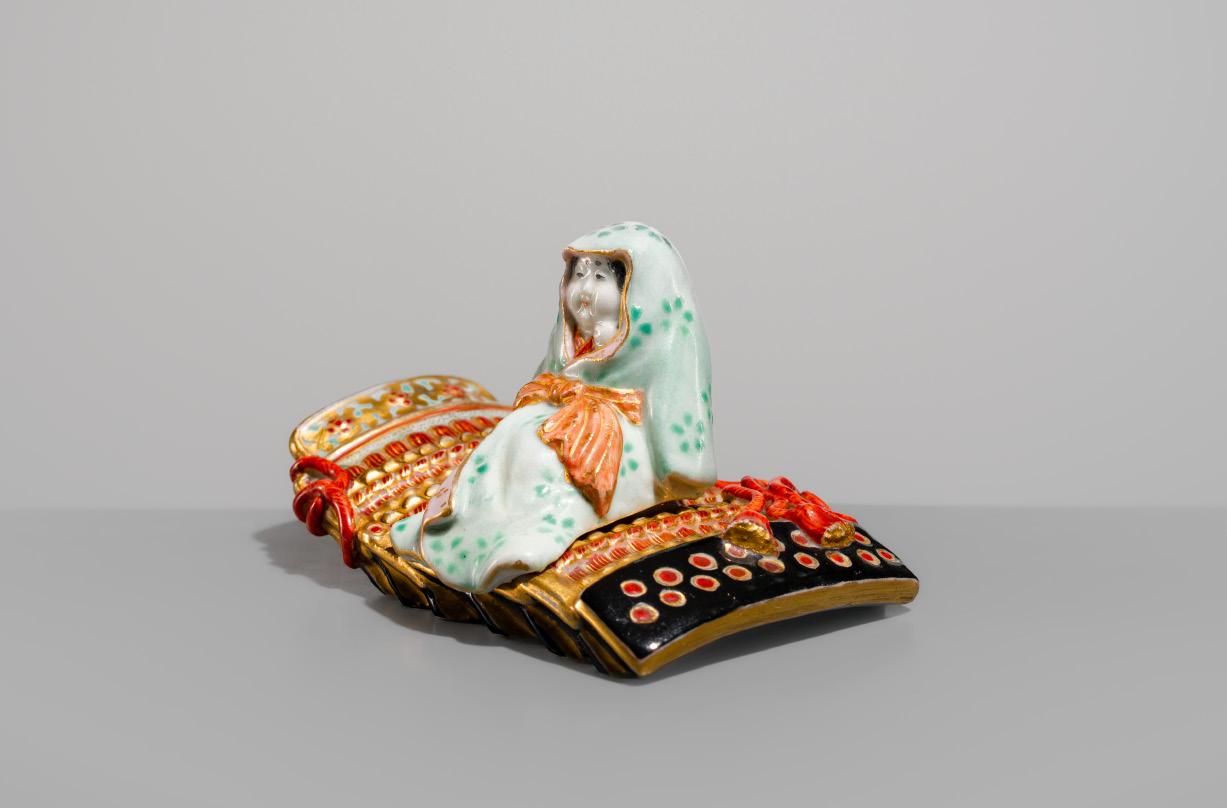
168
MAKUZU KOZAN II: A FINE RELIEF-MOLDED STUDIO PORCELAIN KOGO (INCENSE CONTAINER)
By Makuzu Kozan II (1859-1940), signed Makuzu Japan, dated 1941
Finely molded and painted in vibrant glazes to depict the longing wife of Minamoto no Yoshiie wrapped in an outsized kimono that is tied around the waist and seated above a sode (armor piece for the shoulder), the tassels finely rendered in relief and openwork, and centered by a small container. Signed underneath MAKUZU in an oval reserve.
LENGTH 6.5 cm
Condition: Excellent condition with only very minor wear.
The present kogo likely depicts the wife of Minamoto no Yoshiie, a celebrated warrior of the Heian period, renowned for his leadership in the Earlier and Later Three Years’ Wars in northern Japan. Minamoto no Yoshiie, also known as Hachimantaro, was revered not only for his military prowess but also for his chivalric conduct. He is often honored as a model of loyalty and valor, core values of the samurai tradition.
In this portrayal, the wife’s longing expression, symbolized by the elaborate sode (shoulder armor), adds emotional depth to the piece, evoking themes of waiting for the return of a warrior - a sentiment deeply embedded in the samurai ethos.
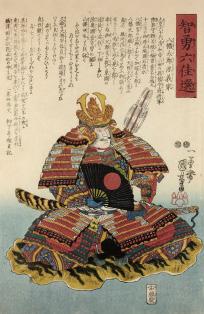
Hachimantaro Minamoto no Yoshiie in armor, woodblock print by Utagawa Kuniyoshi, ca. 1850
With a wood tomobako enclosing a hakogaki inscribed ‘Gokusaishiki, Hachiman ko, hachijusan o Kozan saku, Makuzu Kozan shirusu, 極彩色、八幡公、八十三翁香山作、真葛香山識 [Lord Hachimantaro Minamoto no Yoshiie (represented in his suit of armor), in polychrome enamel colors, made by Kozan at the age of 83, this is inscribed by Makuzu Kozan, with the seal Kozan].
Makuzu Kozan II (1859-1940), born Miyagawa Hannosuke, was the adopted son and successor of Makuzu Kozan I. Known for his exceptional skill in porcelain, he played an active role in the Makuzu workshop from an early stage. After the death of his father, he assumed the name Makuzu Kozan II in 1917 and continued the legacy of high-quality porcelain, contributing significantly to the success and international recognition of studio ceramics.
Estimate EUR 3,000
Starting price EUR 1,500
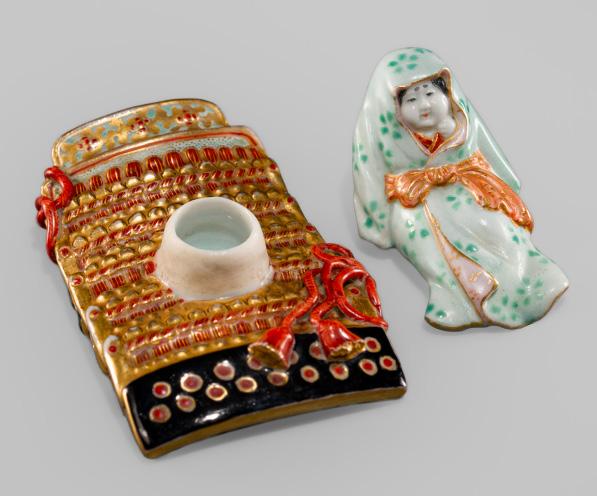
Tokuda Yasokichi III (LOTS 169-172)
Tokuda Yasokichi III (1933-2009) was designated a Bearer of Important Intangible Cultural Assets (or Living National Treasure) in 1997 for his mastery of the innovative Saiyu glaze technique, based on traditional Kutani colored glaze enamels as handed down from his grandfather and father, Tokuda Yasokichi I (1873-1956) and Tokuda Yasokichi II (1907-1997). Before he succeeded his father in 1988 as Tokuda Yasokichi III, the artist was known as Tokuda Masahiko.
Tokuda Yasokichi III (1933-2009)
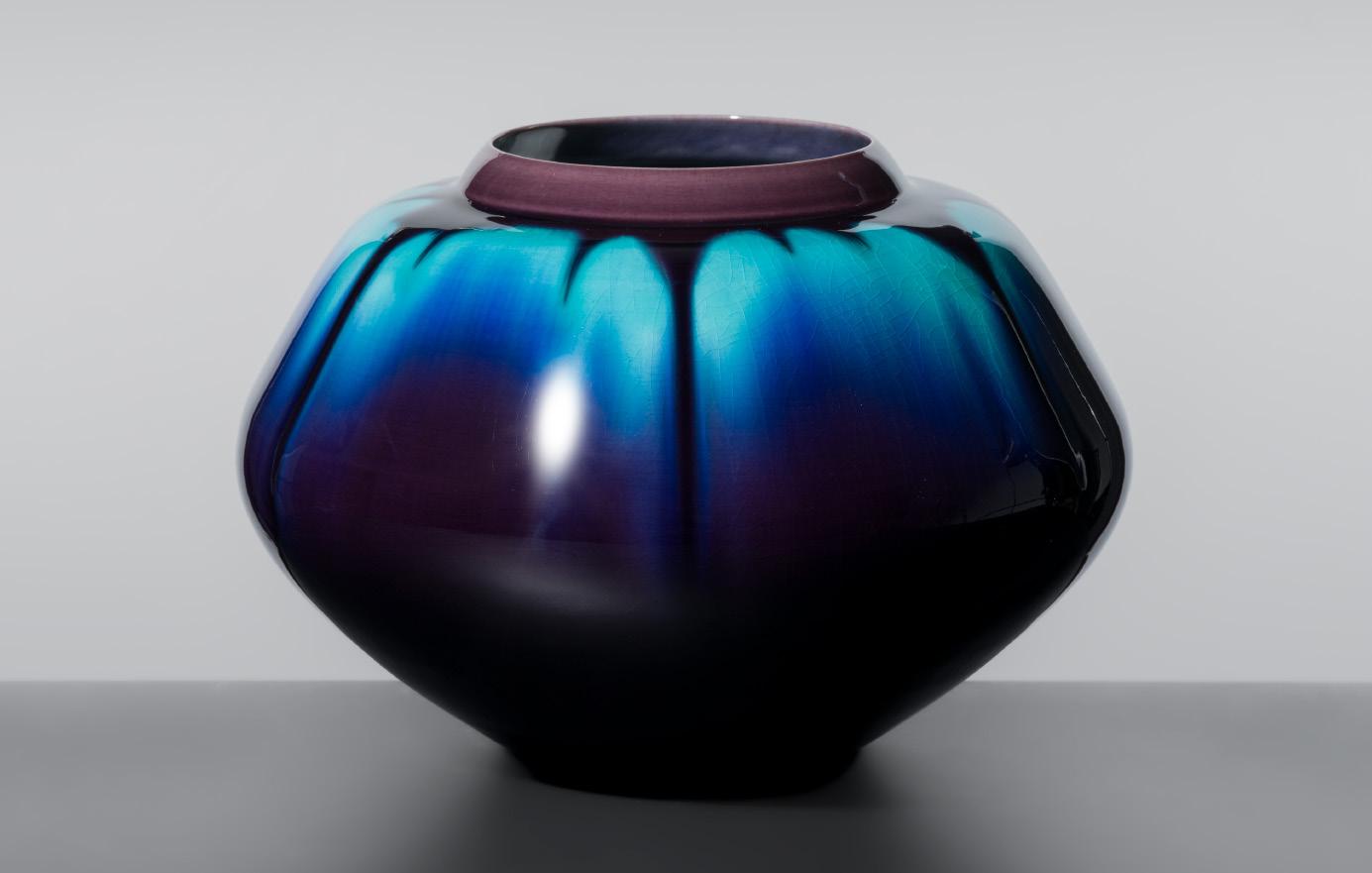
169
TOKUDA YASOKICHI III: A FINE KUTANI GLAZED PORCELAIN KABIN (FLOWER VASE)
By Tokuda Yasokichi III (1933-2009), signed Kutani Masahiko Japan, Showa (1926-1989)-Heisei era (1989-2019)
Of squat form, supported on a flat foot with a recessed base, the tapering sides converging to the center, and surmounted by a slanting neck with a thinly lipped rim, the exterior covered in a rich lustrous blue-green streaked glaze transforming to deep purple toward the lower body, the recessed base left unglazed and signed KUTANI MASAHIKO atop an impressed foliate design.
HEIGHT 17.3 cm
Condition: Excellent condition.
With a signed and inscribed wood tomobako (storage box) and a Japanese leaflet with the biography of the artist.
LITERATURE COMPARISON
Compare a closely related large flower vase, kabin, by the same artist, 26 cm high, in the British Museum, registration number 1993,0130.2.
AUCTION COMPARISON
Compare a related Kutani glazed vase, by the same artist, 29.5 cm high, at Zacke, Fine Japanese Art, 27 May 2022, Vienna, lot 75 (sold for EUR 5,688).
Estimate EUR 5,000
Starting price EUR 2,400
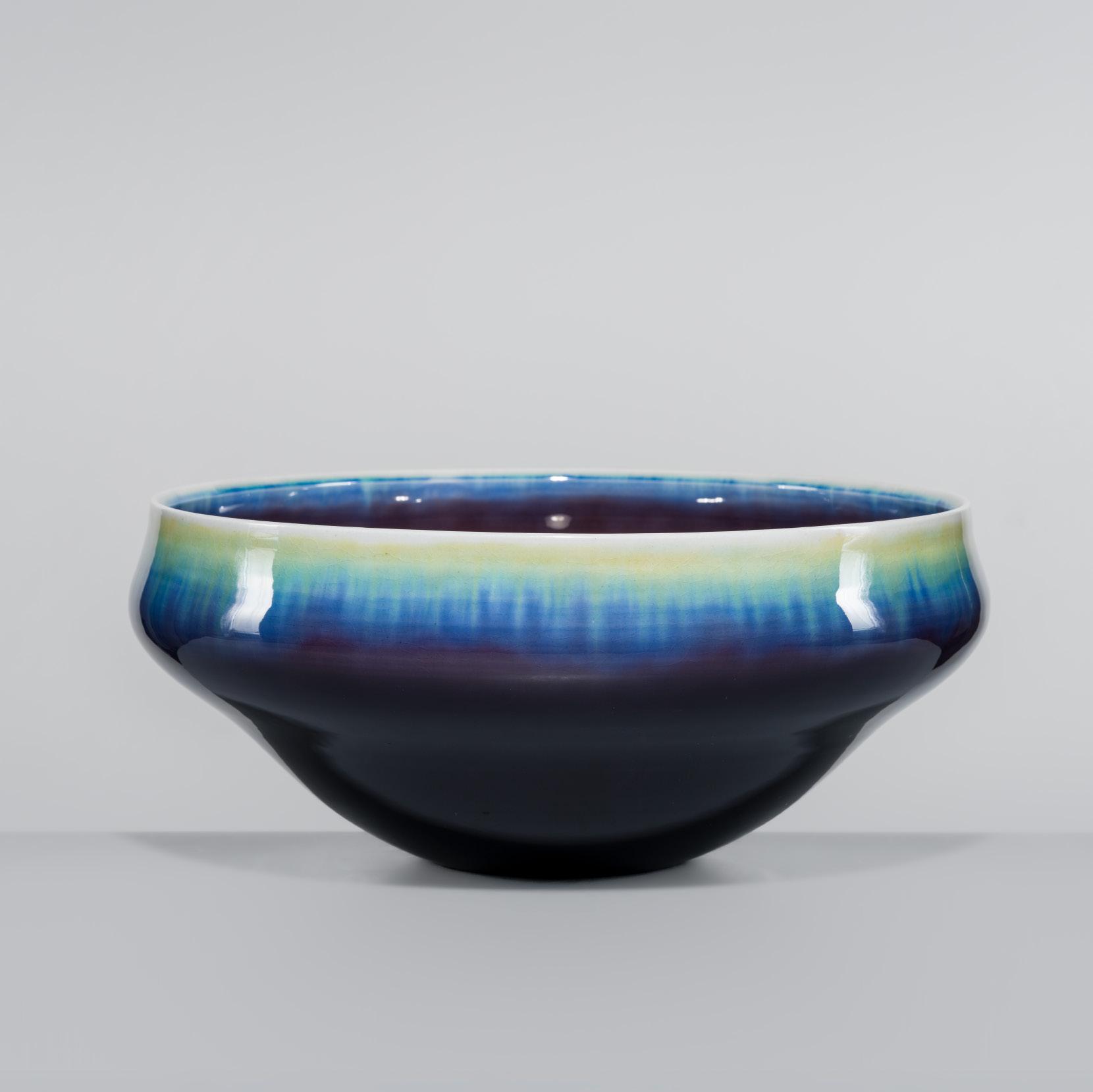
By Tokuda Yasokichi III (1933-2009), signed Kutani Masahiko Japan, Showa (1926-1989)-Heisei era (1989-2019)
The large basin supported on a flat foot with a recessed base, rising to flaring sides surmounted by broad shoulders and a gently everted mouth, covered overall in a rich, lustrous, finely crackled, blue-green streaked glaze, save for the unglazed foot and base signed KUTANI MASAHIKO atop an impressed foliate design.
LENGTH 35 cm
Condition: Excellent condition.
With a signed and inscribed wood tomobako (storage box) and a Japanese leaflet with the biography of the artist.
Estimate EUR 5,000
Starting price EUR 2,400
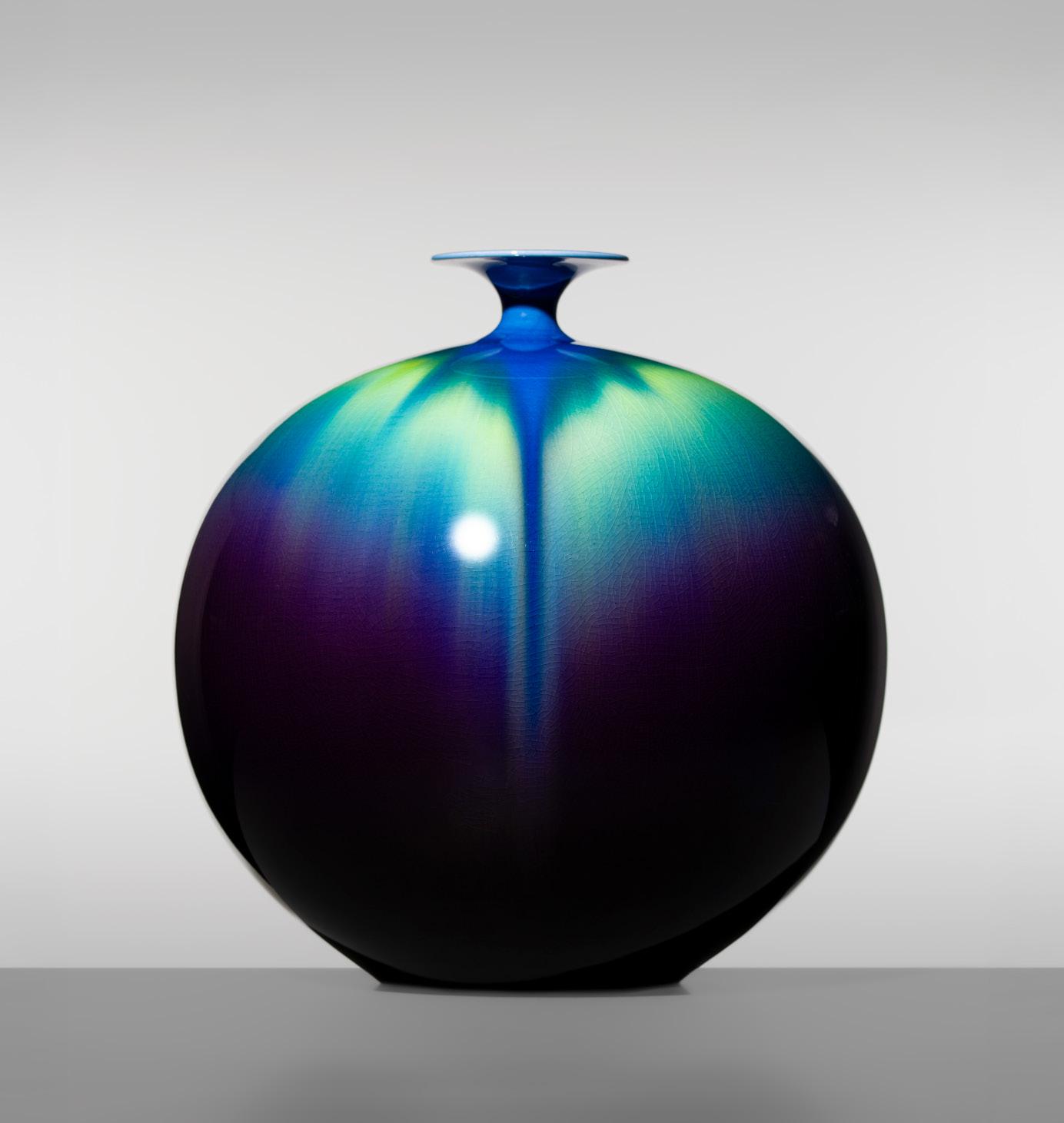
TOKUDA YASOKICHI III: A FINE KUTANI GLAZED PORCELAIN VASE
By Tokuda Yasokichi III (1933-2009), signed Kutani Masahiko Japan, Showa (1926-1989)-Heisei era (1989-2019)
The globular body supported on a short broad foot ring and rising to a slender waisted neck flaring dramatically to a wide mouth, covered overall in a rich, lustrous, finely crackled, blue-green streaked glaze, save for the white foot and base signed KUTANI MASAHIKO atop an impressed foliate design.
HEIGHT 21.7 cm
Condition: Excellent condition.
With a signed and inscribed wood tomobako (storage box) and a Japanese leaflet with the biography of the artist.
LITERATURE COMPARISON
Compare a closely related Kutani glazed vase, by the same artist, dated approx. 1998, 22.5 cm high, in the Asian Art Museum, San Francisco, object number 2019.98.
AUCTION COMPARISON
Compare a related Kutani glazed vase, by the same artist, 27 cm high, at Zacke, Fine Japanese Art, 16 June 2023, Vienna, lot 166 (sold for EUR 7,150).
Estimate EUR 4,000
Starting price EUR 2,000
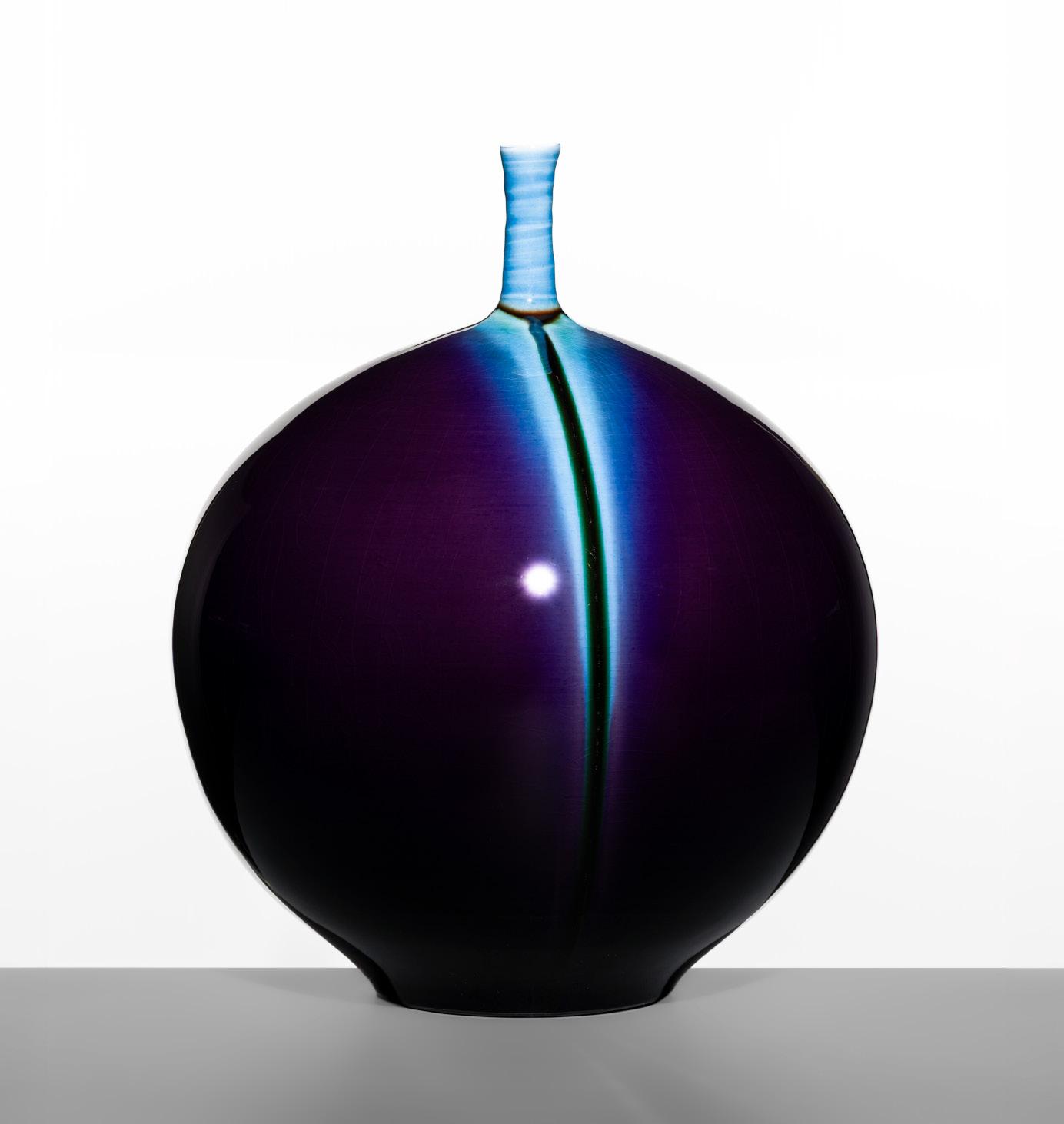
TOKUDA YASOKICHI III: A KUTANI GLAZED PORCELAIN ‘CAT’S EYE’ VASE
By Tokuda Yasokichi III (1933-2009), signed Kutani Masahiko Japan, Showa (1926-1989)-Heisei era (1989-2019)
The globular body supported on a short broad foot and rising to a slender ribbed stem-form neck, covered in a rich, lustrous midnight blue-streaked glaze with a beautiful slender cat’s eye design in lighter hues of blue and green. The recessed base signed KUTANI MASAHIKO.
HEIGHT 27.9 cm
Condition: Excellent condition.
With a signed and inscribed wood tomobako (storage box).
LITERATURE COMPARISON
Compare a closely related Kutani glazed vase, also with a ‘cat’s eye’ design, by the same artist, dated 2001,16.5 cm high, at the Metropolitan Museum of Art, New York, accession number 2001.734.
AUCTION COMPARISON
Compare a related Kutani glazed vase, also with a ‘cat’s eye’ design, by the same artist, 27.6 cm high, at Zacke, Fine Japanese Art, 13 June 2025, Vienna, lot 212 (sold for EUR 5,200).
Estimate EUR 6,000
Starting price EUR 3,000
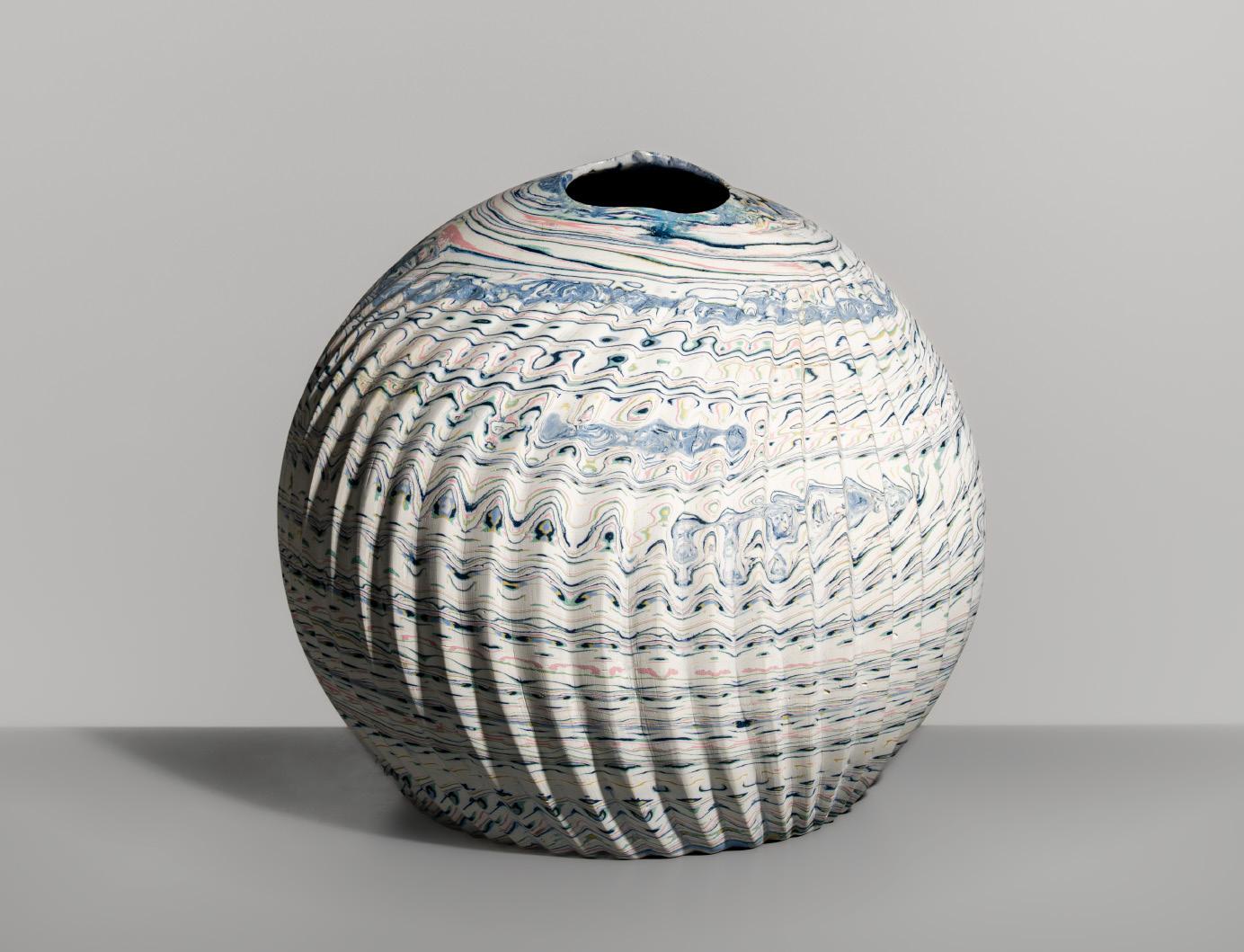
By Kajitani Ban (b. 1941), signed by the artist Japan, late 20th century
Skillfully potted with rhythmic folds in the round, simulating the surface of a large conch, the spherical body gently curving toward the flat base and rising to a small, irregularly circular mouth. The unglazed surface, with predominantly white ground, decorated using neriage, whereby multiple clays in varying tones of blue, complemented by accents of pink and yellow, are thrown and carefully manipulated on the wheel to generate irregular, flowing striations with a marbled effect. The underside bearing the artist’s signature.
HEIGHT 24.3 cm, WIDTH 24.5 cm
Condition: Excellent condition with only minor firing-inherent irregularities.
With the original wood storage box (tomobako), signed and sealed by the artist.
The practice of Kajitani is defined by a sustained engagement with the historic marbling technique known as ‘neriage’. This process appears in China at least as early as the Tang dynasty and can be situated within a broader lineage of marbled ceramic traditions, with possible precedents in Roman pottery. In Japan, neriage generally designates wheel-thrown marbled ware, while the related term ‘nerikomi’ refers to hand-built methods, often executed with press molds. Both techniques rely on lamination, cutting, and recombination of clays of different colors, producing stratified patterns that evoke geological formations, cloud bands, wood grain, or woven structures.
Kajitani Ban (b. 1941) apprenticed in Japan after completing studies in Fine Arts in Tokyo. He later moved to the United States to continue his education in ceramics at Utah State University, where he studied under the guidance of the renowned American sculptor and ceramic artist Larry Elsner. After graduating, Kajitani joined the ceramics department at the Columbus College of Art and Design in Columbus, Ohio, where he taught until 1991, when he returned to Japan.
Kajitani develops ceramic works through the formulation of custom clay bodies. Across vessels, tiles, and sculptural forms, he integrates red and grey sand with metallic oxides into distinct clay mixtures. This materially driven approach enables a controlled chromatic range and emphasizes the articulation of pattern as an intrinsic component of the ceramic structure.
MUSEUM COMPARISON
Compare a related multicolored neriage stoneware vase, by Kajitani Ban, Showa period, 1980, 28.3 cm high, in the Minneapolis Institute of Art, accession number 2015.79.344.
Estimate EUR 3,000
Starting price EUR 1,500
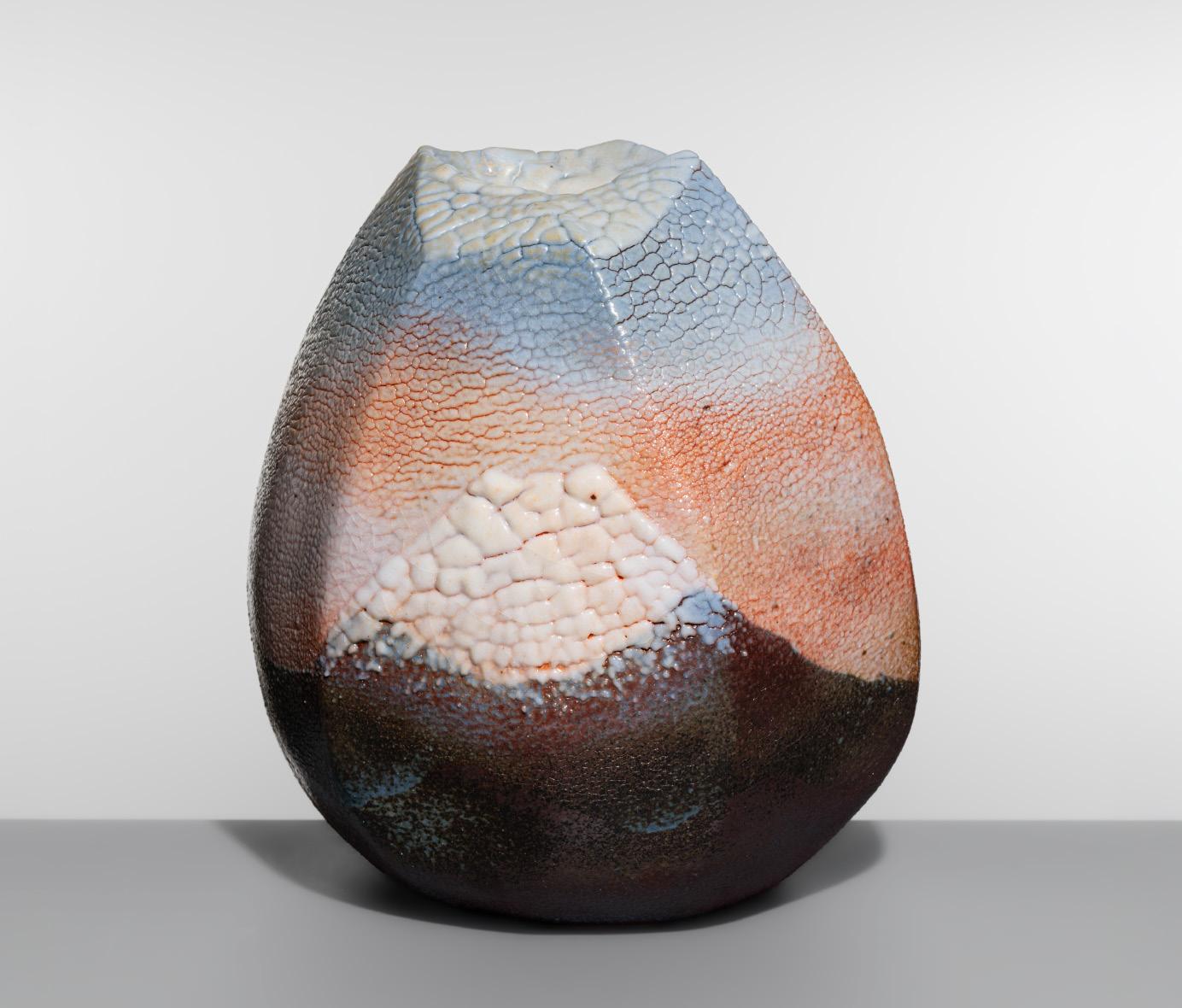
174
SHOTARO: A MANYO-SHINO GLAZED ‘MOUNT
By Hayashi Shotaro (b. 1947), signed with the artist’s mark Japan, late 20th-early 21st century
Hayashi Shotaro (b. 1947) is a leading figure in contemporary Mino ceramics, celebrated for revitalizing the ancestral Shino and Oribe traditions and pioneering the rare Manyo glaze. After graduating high school, he initially pursued regular employment, but in 1967 returned to his native Toki City to assist his brother, the ceramist Hayashi Kotaro. Together, they became central figures in the revival of traditionally inspired ceramics from the Mino region of central Japan, long renowned as a center of ceramic production.
Hayashi Shotaro (b. 1947)
Following his studies under Kotaro, Shotaro established his own studio and kiln in 1974, driven by a profound and early creative impulse. His emerging talent was swiftly recognized with the highest award at the Gifu Prefectural Art Exhibition in 1968. Subsequently, he has received numerous prestigious accolades at both regional and national exhibitions, including the Mino Ceramics Award, the Shoroku Award, and the Kobei Award, consolidating his position as a central figure in contemporary Japanese ceramics.
Finely shaped, the faceted ovoid body gently curving toward the base and rising to a polyhedral neck with an oval mouth. The surface entirely coated in a warm orange-red hue, which permeates the blistered layer of Manyo-Shino glaze that fully envelops the piece. Characteristic bubbles and fissures articulate a scene of snow-capped Mount Fuji emerging in the first light of morning, an effect masterfully achieved through subtle variations in the color and density of the glaze, which stops just above the foot to reveal the ceramic body beneath. The underside signed with the artist’s mark.
HEIGHT 29.4 cm
Condition: Excellent condition.
With a signed and inscribed wood tomobako (storage box). The lid inscribed 万葉志野富士絵扁壺 Manyo Shino Fujie Henko [Manyostyle Shino Flattened Vase with a Mt. Fuji Design] and signed Shotaro with seal.
MUSEUM COMPARISON
Compare a related Manyo-glazed ‘myriad of leaves’ stoneware vase, by the artist, Heisei period, 2006, 28.6 cm high, in the Asian Art Museum, San Francisco, object number 2018.73.
Estimate EUR 4,000
Starting price EUR 2,000
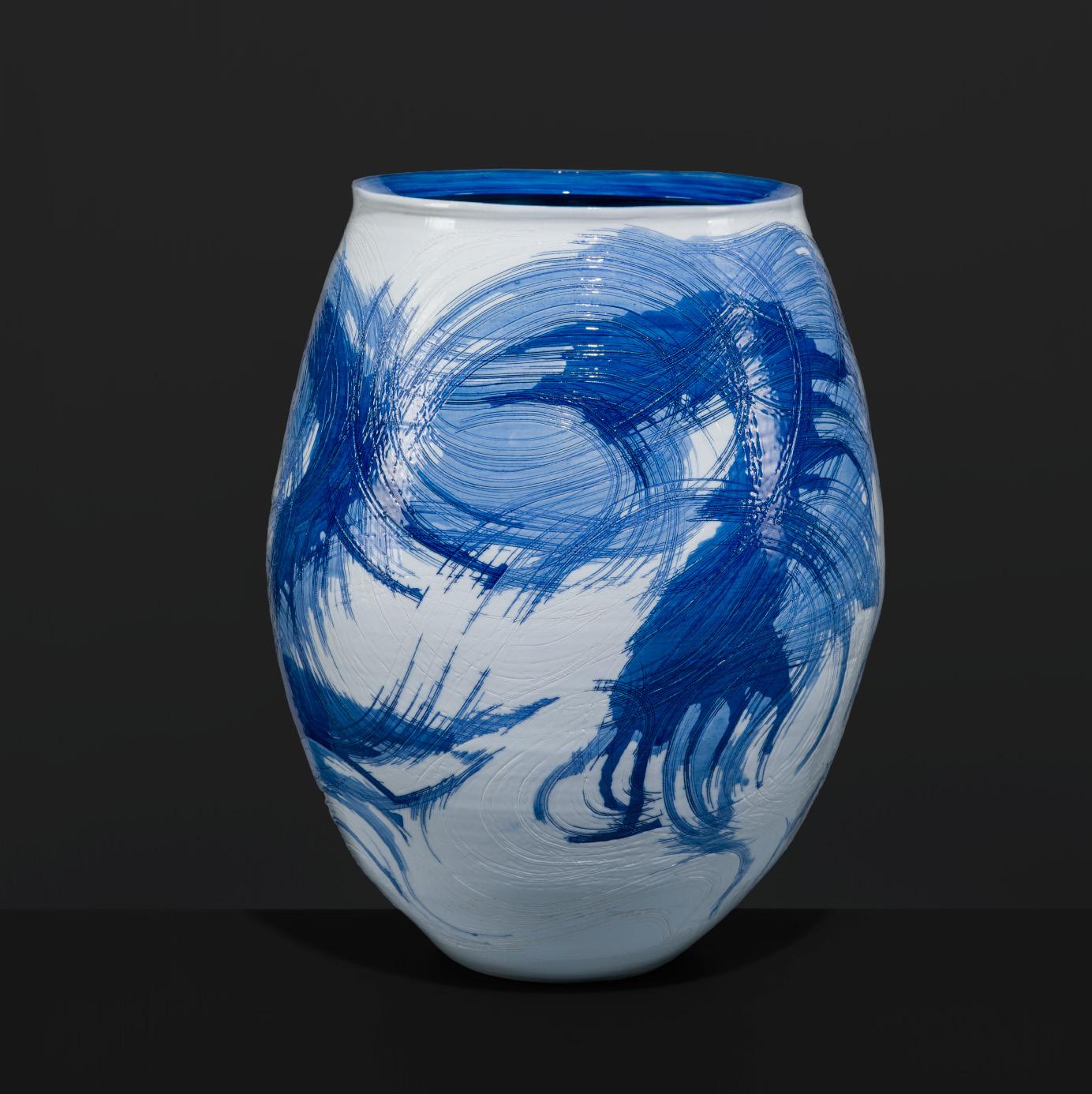
175
MASATO KUSABA: A LARGE BLUE-GLAZED ARITA WARE PORCELAIN VASE
By Masato Kusaba (b. 1926), signed Hizen Arita, Kusaba Masato saku
Japan, late 20th century, Heisei period (1989-2019)
Exquisitely potted, the globular body gently curving toward a narrow foot and rising to a short, slightly flared neck with a broad, circular mouth. The exterior finely painted with bold brushstrokes in various shades of blue, layered with similarly incised gestures that articulate the surface of the vessel, covered by a transparent slip that reveals the underlying clear, white-colored porcelain body, while the interior is entirely glazed in cobalt blue and decorated with concentric horizontal striations. The underside signed Hizen Arita, KUSABA MASATO saku [made by Kusaba Masato, Arita, Hizen].
HEIGHT 38.3 cm
Condition: Excellent condition.
With the original wooden tomobako (storage box) inscribed: 染付 花瓶、有田在住、日展陶芸作家、草場正人作 — Sometsuke kabin, Arita zaiju, Nitten togei sakka, Kusaba Masato saku [Blue-and-white porcelain vase; resident of Arita; Nitten ceramic artist; made by Kusaba Masato], bearing the seal ‘Kusaba Masato’ (草場正人).
Masato Kusaba, born in 1926 in Arita City, Saga Prefecture, is a distinguished Japanese ceramic artist. Following his discharge from military service in 1945, Kusaba dedicated himself to ceramics, training under renowned masters such as Chuemon Okugawa, Wasaburo Mizumachi, and Tarouemon Nakazato. Their influence profoundly shaped his aesthetic and technical approach. Kusaba is widely recognized for his work in Arita porcelain, one of Japan’s most historically significant ceramic traditions. He has received numerous accolades, including the prestigious Governor Award at the Arita Ceramics Fair and repeated recognition at the Saga Prefectural Exhibition. Kusaba has been selected twenty times for the Japanese Fine Arts Exhibition (Nitten), exhibited extensively, and received the Minister of Education Award at the Western Japan Ceramic Art Exhibition.
Estimate EUR 3,000
Starting price EUR 1,500
MAEDA MASANORI: GLOWING RADIANCE (A NITTEN EXHIBITION ITEM)
By Maeda Masanori (1928-1992), signed Masa Japan, dated 1978
Heavily potted, the organically modeled vase with thick pleats and crevices, superbly covered with an orange-rust streaked iron glaze, pooling thickly in the grooves. The unglazed underside signed MASA.
HEIGHT 50 cm
Condition: Excellent condition.
With a signed and inscribed wood tomobako (storage box) and a Japanese leaflet with the biography of the artist. The top of the lid inscribed, 鉄釉花瓶。正範作 Tetsuyu Kabin, Masanori saku [Flower vessel with iron glaze, made by Masanori], with seal 正範 Masanori; the underside, 赫映、昭和五拾三年、 日展出品作 Kakuei (Kaguya), Showa gojusannen, Nitten shuppin saku [Entitled ‘Glowing radiance’, made in Showa 53 (1978), this is an exhibit item at the Nitten Exhibition].
Maeda Masanori (1928-1992) was a ceramic artist from Kyoto. After graduating from Kyoto Second Commercial School, he joined the Kyoto Ceramic Artists Club and studied under the sixth Kiyomizu Rokubei. He first exhibited at the Nitten in 1955 with Seiryokuyu Kaki under the art name Goun, later adopting the name Masanori. Maeda exhibited widely and received numerous awards, including two tokusen prizes at the Nitten. A founding member and later councilor of the Japan New Crafts Artists Federation, he developed a distinctive style combining primitive inspiration with increasingly geometric and asymmetrical ceramic forms.
Estimate EUR 3,000
Starting price EUR 1,500
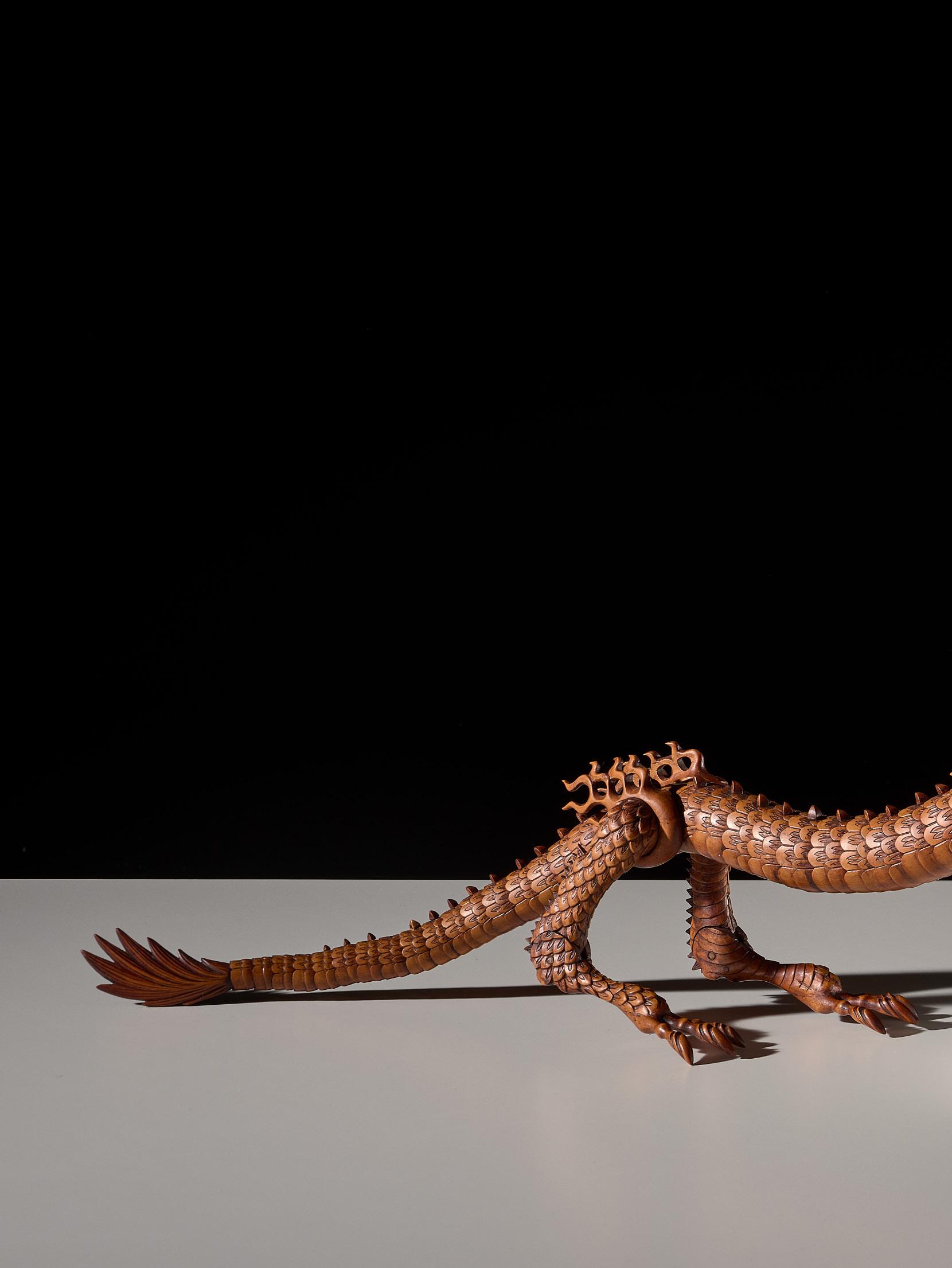
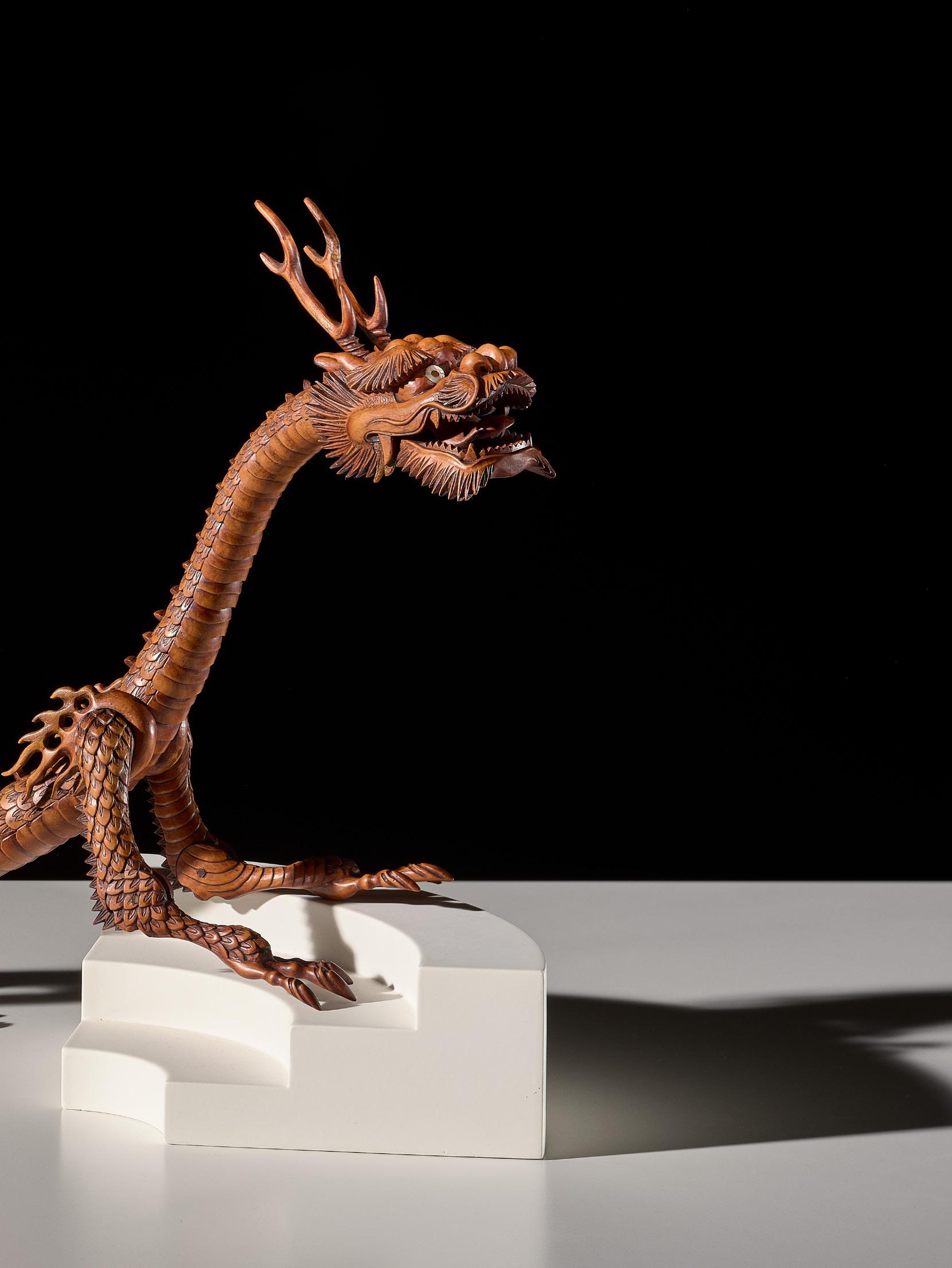
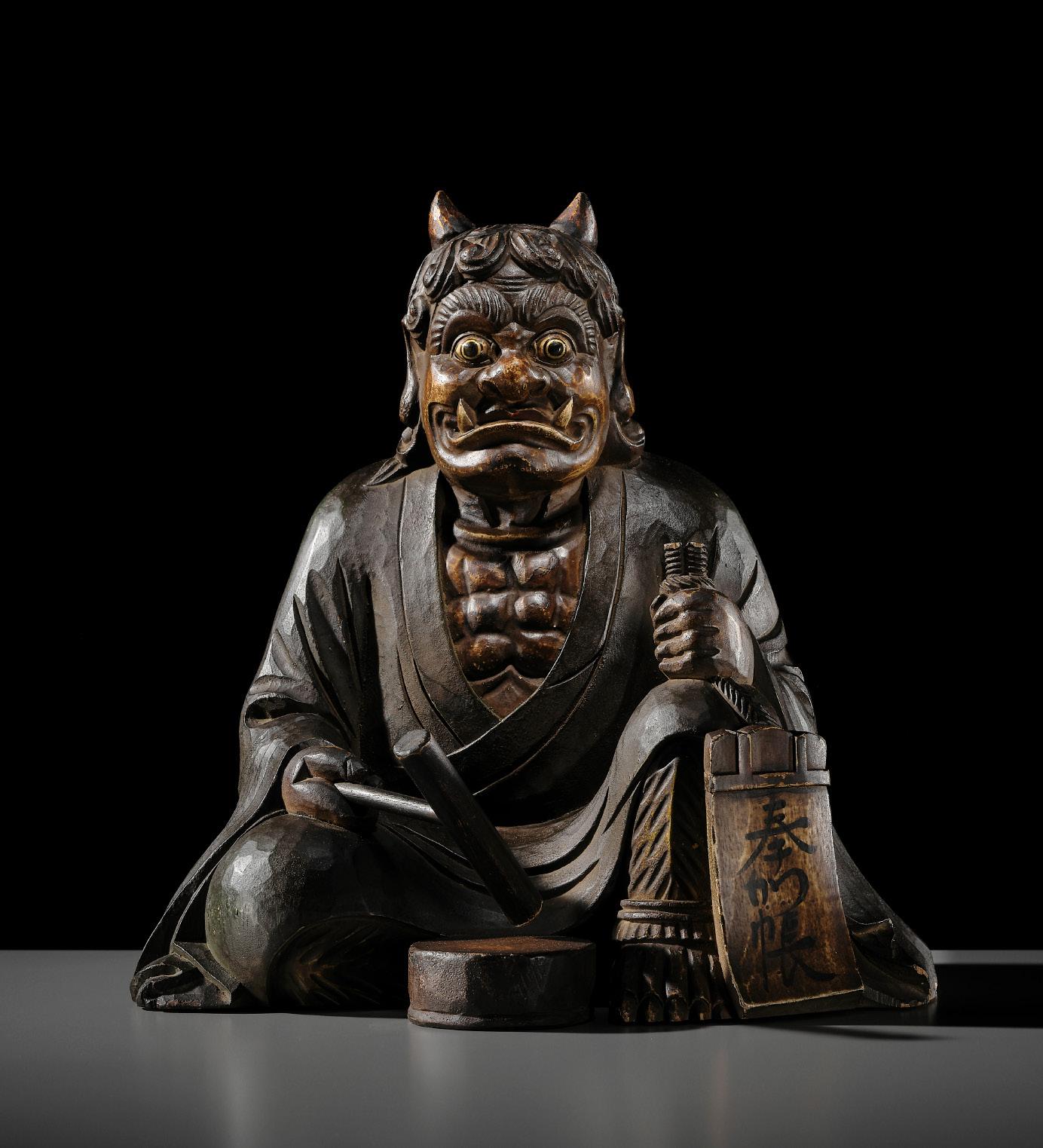
A LARGE POLYCHROME WOOD FIGURE OF ONI NO NEMBUTSU
Japan, 19th century
Boldly carved, partly using the ittobori (single-cut) technique, this striking sculpture depicts a repentant seated demon, holding a donation register and a bell with a mallet. The demon is dressed in robes resembling those of a Buddhist pilgrim, with the chest left partially open to reveal a clearly defined rib cage. Its eyes, painted in black and gold, accentuate its expressive gaze.
HEIGHT 32.5 cm
Condition: Excellent condition with minor expected wear and tiny nicks along the edges.
The converted demon in the guise of an itinerant pilgrim, collecting donations for the upkeep of a temple, has long been endowed by the Japanese populace with talismanic powers, especially in stopping children from crying. It is a frequent subject of Otsu-e prints and paintings, which became popular in the early 17th century, often used to convey a moral lesson on hypocrisy in religious devotion.
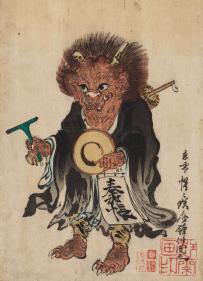
A woodblock print by Kawanabe Kyosai, 1865, in the Art Gallery of New South Wales, accession number 132.2000
Estimate EUR 4,000
Starting price EUR 2,000
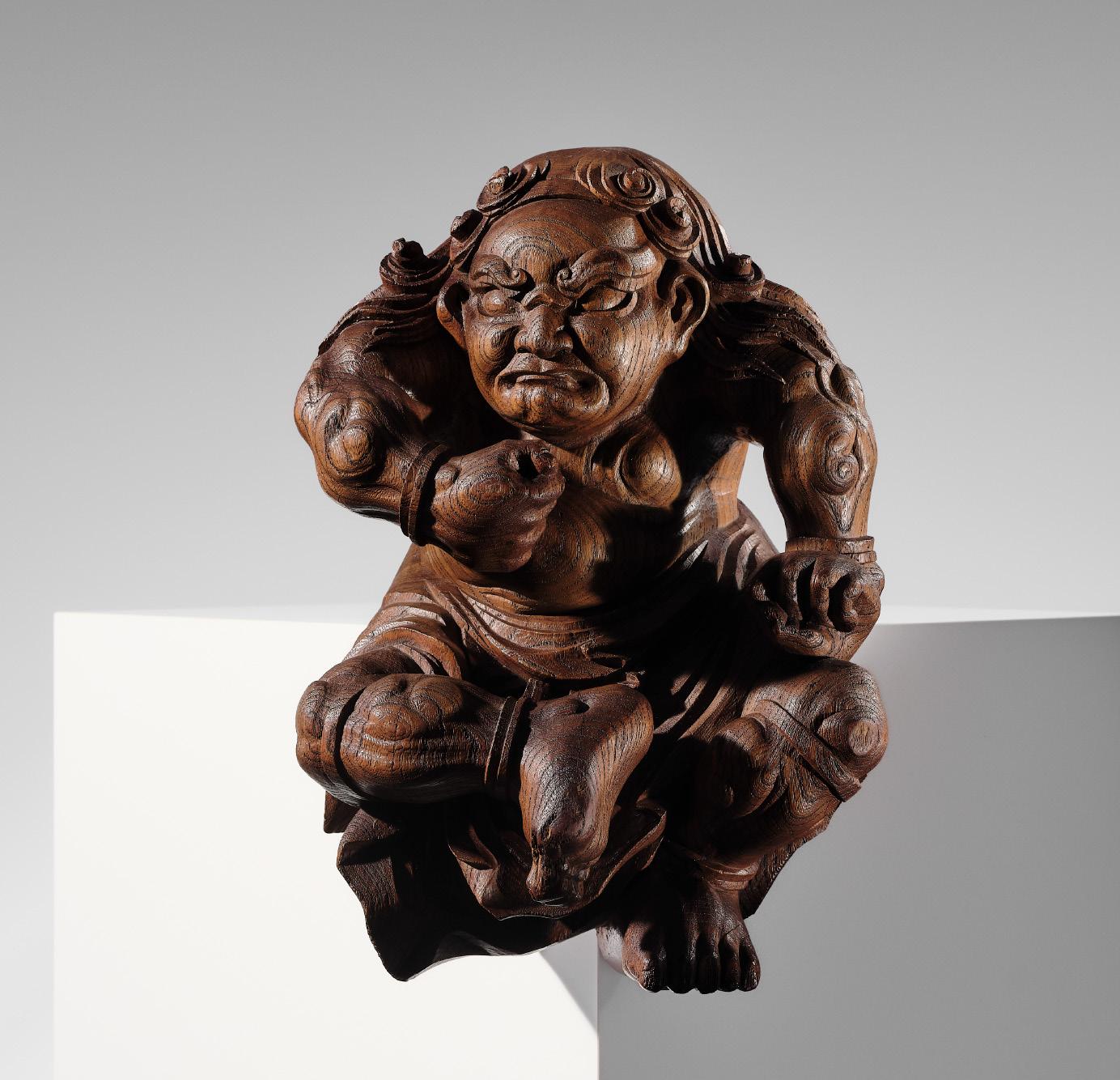
178 A LARGE AND POWERFUL WOOD FIGURE OF A WARRIOR
Japan, 18th-19th century, Edo period (1615-1868)
Finely carved from attractively grained wood to depict a fierce warrior in a crouching pose, his powerful body compact and seated with both legs bent, his powerful arms showing bulging muscles and with clenched fists, the face rendered with a fierce expression, furrowed brows, and tightly pursed lips, framed by swirling locks of hair carved in high relief. The reverse is carved with an angled section designed to allow the okimono to be placed securely at the corner of a ledger or display stand.
HEIGHT 29 cm (excl. stand), 39 cm (incl. stand)
Provenance: From the collection of Eva & Aubrey Sweet, Melbourne, Australia. With a collection label ‘The Sweet Collection 350’. Eva and Aubrey Sweet devoted over six decades to the formation of a distinguished private collection of Asian art, with particular strength in Chinese jade, Japanese lacquer, and netsuke. Their collecting began in the 1950s and was refined through sustained travel, scholarship, and long associations with leading dealers, curators, and artists internationally.
This sculpture may be an unusually fierce and bold representation of Kintaro, the mythic child hero known for his extraordinary strength and courage. Kintaro, often depicted with wild hair and a muscular build, was raised in the mountains by the supernatural being Yamauba. His legendary feats of strength and bravery have made him a popular subject in Japanese art.
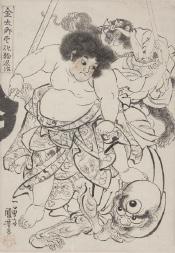
Kintaro, hanshita-e drawing by Utagawa Kuniyoshi
Condition: Very good condition. Few expected natural age cracks and some minor chips to the toes.
With a modern presentation stand.
Estimate EUR 5,000 Starting price EUR 2,400
179
Japan, late 19th century, Meiji period (1868-1912)
Finely carved in the round, the figure depicts a bearded Chinese elder seated in a composed and dignified posture upon a large chair of naturalistic, root-form design, carved separately. One leg is drawn up onto the seat while the torso remains upright. He is dressed in voluminous robes falling in deeply carved, flowing folds across the body. In his left hand, he holds a long sword resting diagonally across his lap, while in his right he raises a foliate-shaped Tang-dynasty mirror with two small hanging tassels. The face is characterized by high, furrowed brows, deeply set eyes, and a calm, introspective expression. A long, finely detailed beard extends over the chest, intricately carved and adorned with small bead-like elements. The hair falls neatly to the shoulders.
HEIGHT 36.3 cm
Provenance: The private collection of Mark Walberg, Pennsylvania, USA. Mark Walberg is a distinguished dealer and collector of Asian art, whose career spans more than half a century. He began collecting at the age of thirteen and, over the ensuing fifty-five years, established an international reputation through his work with major auction houses, as well as through consulting and appraisal services for some of the most respected figures in the field.
Condition: Excellent condition with only minor wear.
Estimate EUR 8,000 Starting price EUR 4,000
The present okimono displayed next to lot 273 in the mansion of Mark Walberg in Sunbury, Pennsylvania, once the residence of the first senator of the state, William Maclay

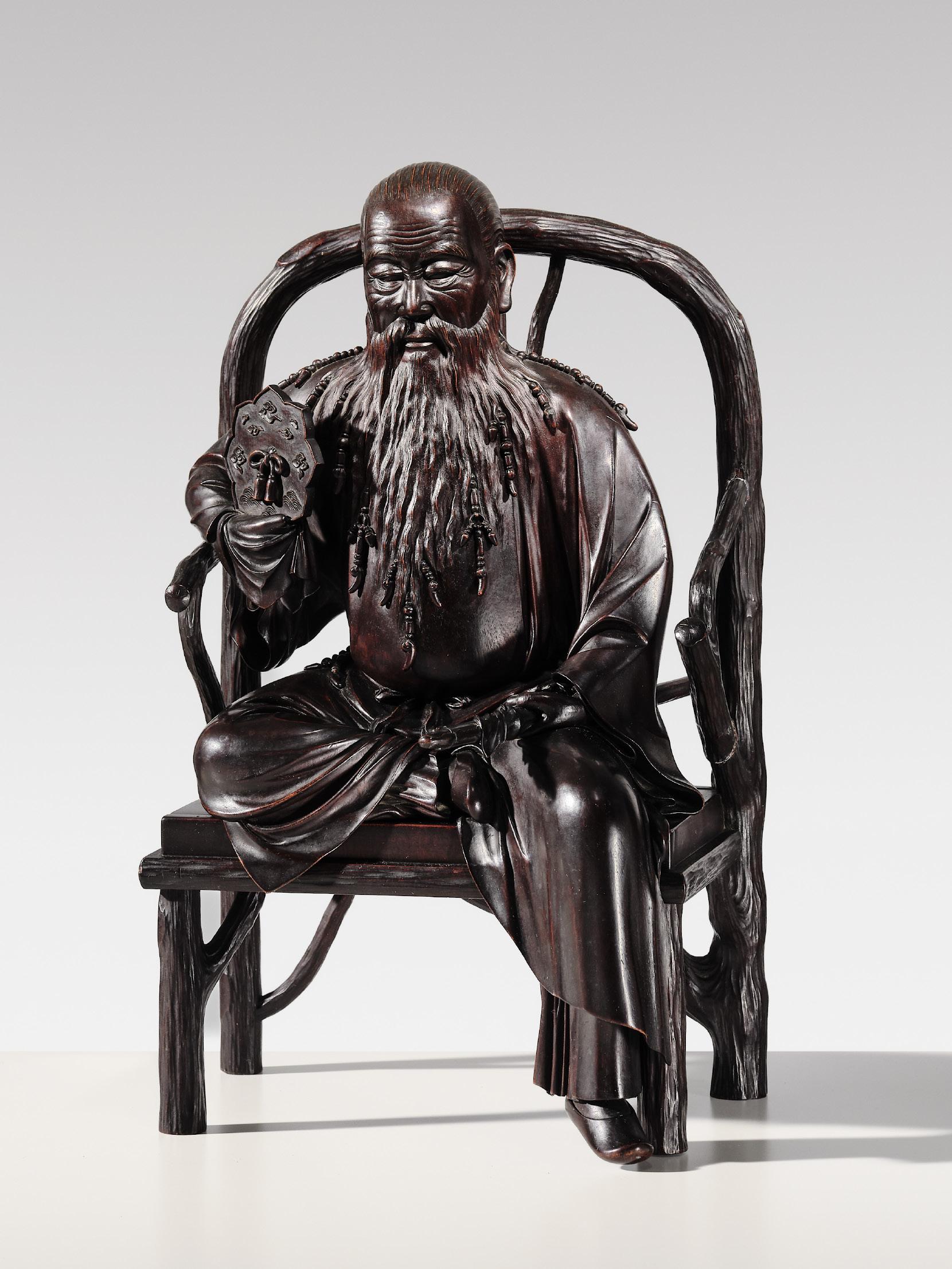
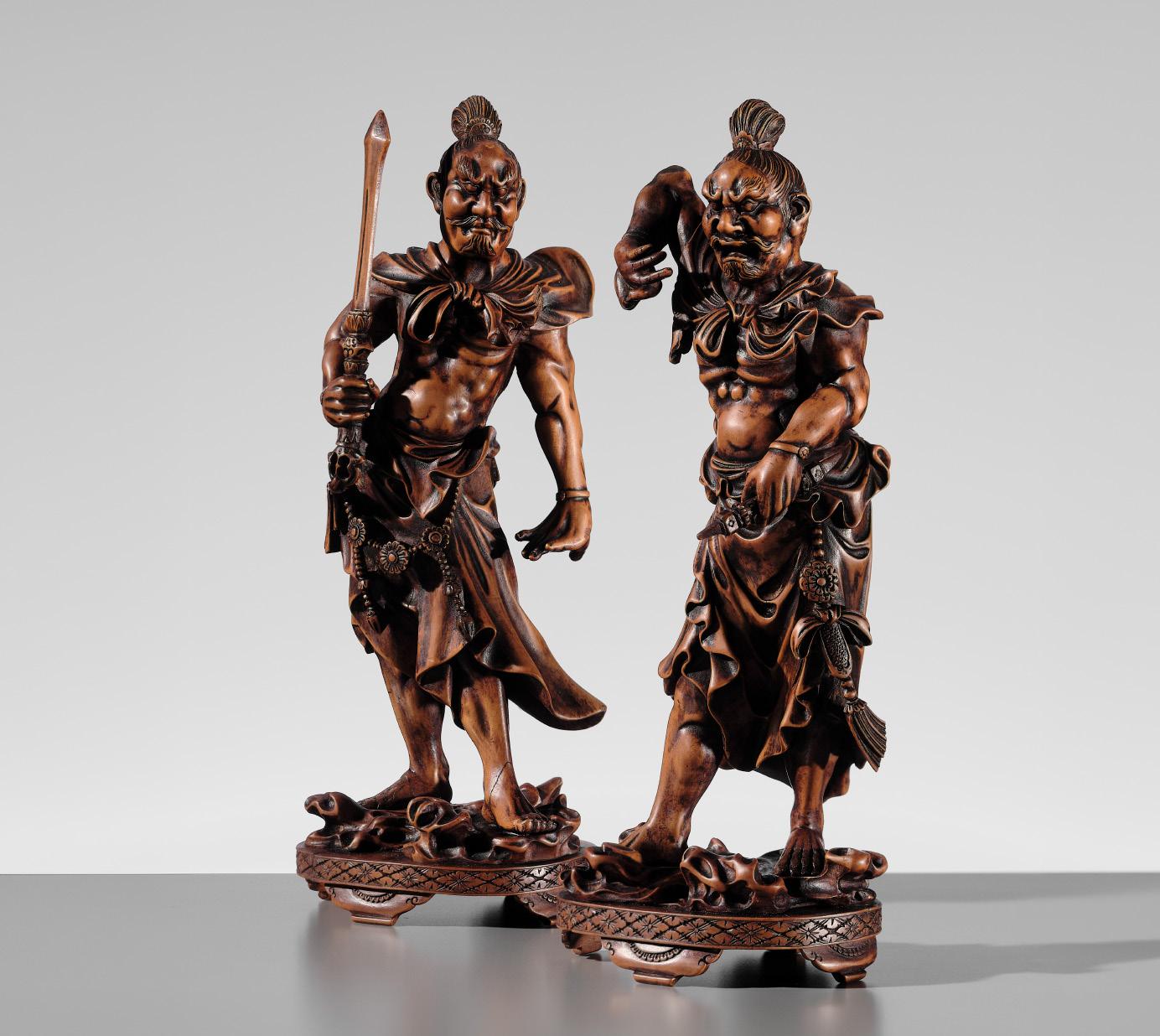
180
School of Rokko, unsigned Japan, Meiji period (1868-1912)
Each powerfully modeled and standing in a dynamic pose atop a rock, placed on an oval base raised on four feet. Their sides are finely incised with a hanabishi (flowering vine) band. The faces exhibit a wrathful expression: one figure has its mouth open, raising its hand while holding a vajra in the other, while the second figure holds a ken sword aloft. Both wear flowing robes adorned with beaded jewelry. Their hair is styled into a high chignon and secured by a jewel-form headdress. The carving is superb, with exceptional detail across the entire figure, including boldly formed muscular bulges throughout the bodies. The wood is richly stained, all characteristics that align with the carvings of Rokko and his followers.
HEIGHT (each) 23 cm
Condition: Overall good condition and presenting beautifully. Old splits to the base and repairs and restorations to two of the bracket feet. One figure with restorations to the end of the kongo and to two fingers.
Though unsigned, this pair is attributable to the school of Rokko, a highly skilled carver active during the Meiji period. Rokko was renowned for his exceptional carving of both netsuke and okimono, with a distinctive style known for its dynamic, expressive figures, particularly those depicting powerful mythological beings such as Nio guardians or oni.
The Nio or Kongorikishi are wrathful, muscular guardians of the Buddha, typically positioned at the entrance of Buddhist temples in East Asia. These figures, resembling fierce wrestler-like statues, are dharmapala manifestations of the bodhisattva Vajrapani, the oldest and most powerful deity in the Mahayana Buddhist pantheon. According to Japanese tradition, they traveled with Gautama Buddha to protect him.
AUCTION COMPARISON
Compare a closely related pair of wood okimono depicting nio guardians, 17.6 and 18.2 cm high, by Rokko, Meiji period, at Woolley & Wallis, Japanese Works of Art, 13 November 2025, Salisbury, lot 796 (sold for GBP 15,240 or approx. EUR 17,800 converted and adjusted for inflation at the time of writing).
Estimate EUR 5,000
Starting price EUR 2,400
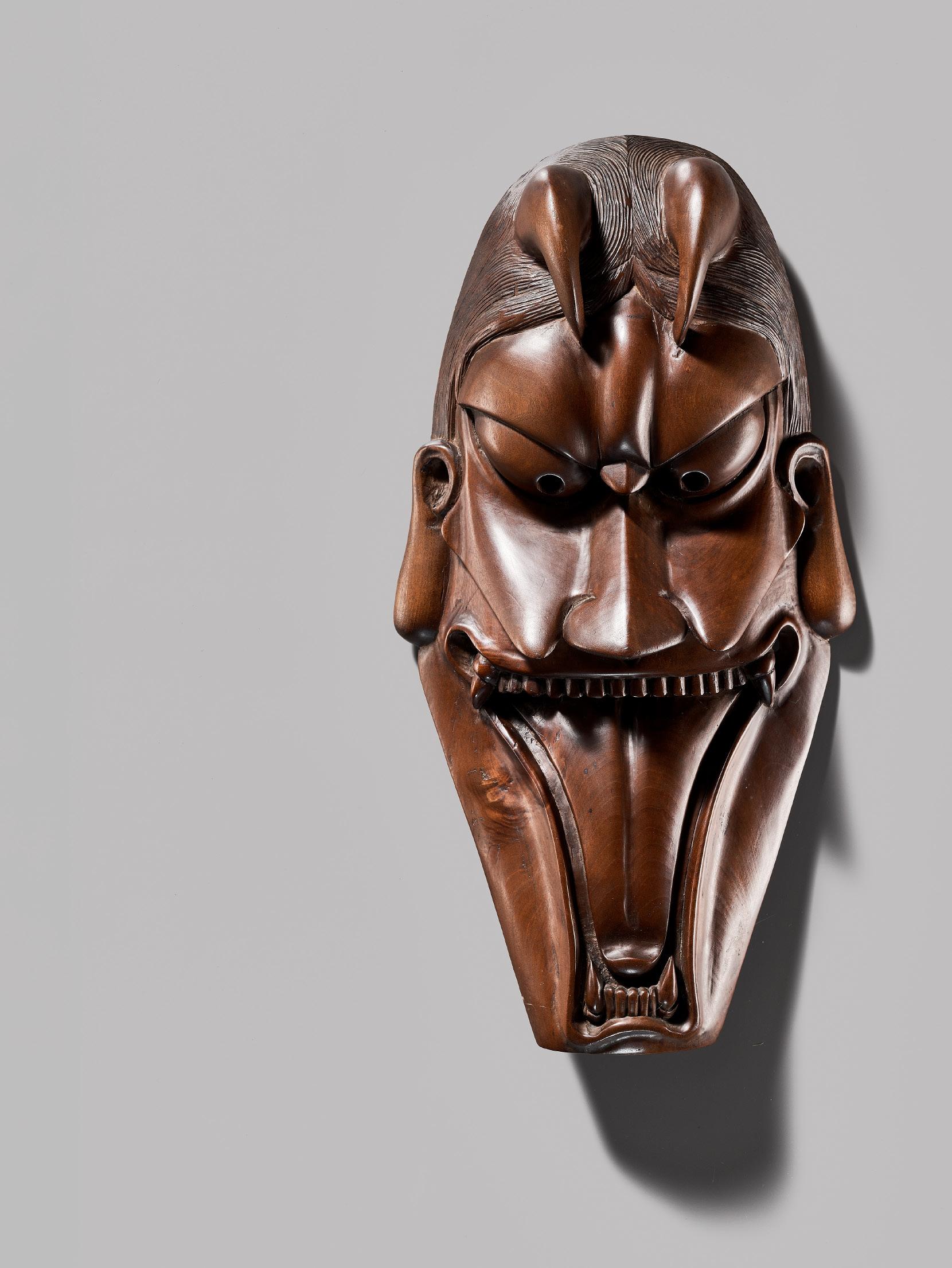
181
Japan, 19th century, late Edo period (1615-1868)
Expressively carved to depict the vengeful demon, Hannya, with her mouth wide open, baring her sharply detailed teeth, fangs, and tongue. The grotesque face is marked by hollowed pupils on bulging eyes, backed by gold leaf, giving them a piercing, intense gaze. The mask is framed by pendulous earlobes and a broad, prominent nose, with protruding cheeks and an elongated, squared chin. The top of the head is surmounted by curved horns and hair that is neatly parted at the center. The reverse of the mask features a central bar pierced with two apertures for suspension, signed with a two-character signature within a square reserve beneath.
HEIGHT 49 cm
Condition: Excellent condition with minor wear and typical traces of use.
Typically, Hannya masks are used in Noh performances, particularly in plays that involve jealousy and revenge, where a woman, overcome by these emotions, transforms into a demon. The features of the mask — sharp teeth, fangs, hollowed eyes, and curved horns — are meant to evoke an eerie sense of power and danger.
A large ceremonial Hannya mask like this would likely have been used for ritual or ceremonial purposes, perhaps in festivals or performances tied to the Buddhist or Shinto traditions, where it would serve to symbolize the wrath of vengeful spirits. Given its size and level of detail, this particular mask may have been intended for prominent public display or ceremonial use in larger processions or performances. The mask’s significance would have been not just for theatrical performance but also to evoke spiritual protection or to ward off evil forces associated with the Hannya demon. Masks of this scale and craftsmanship were often produced for special occasions or grand performances, particularly during ceremonial festivals or in ritualistic settings.
Estimate EUR 4,000
Starting price EUR 2,000
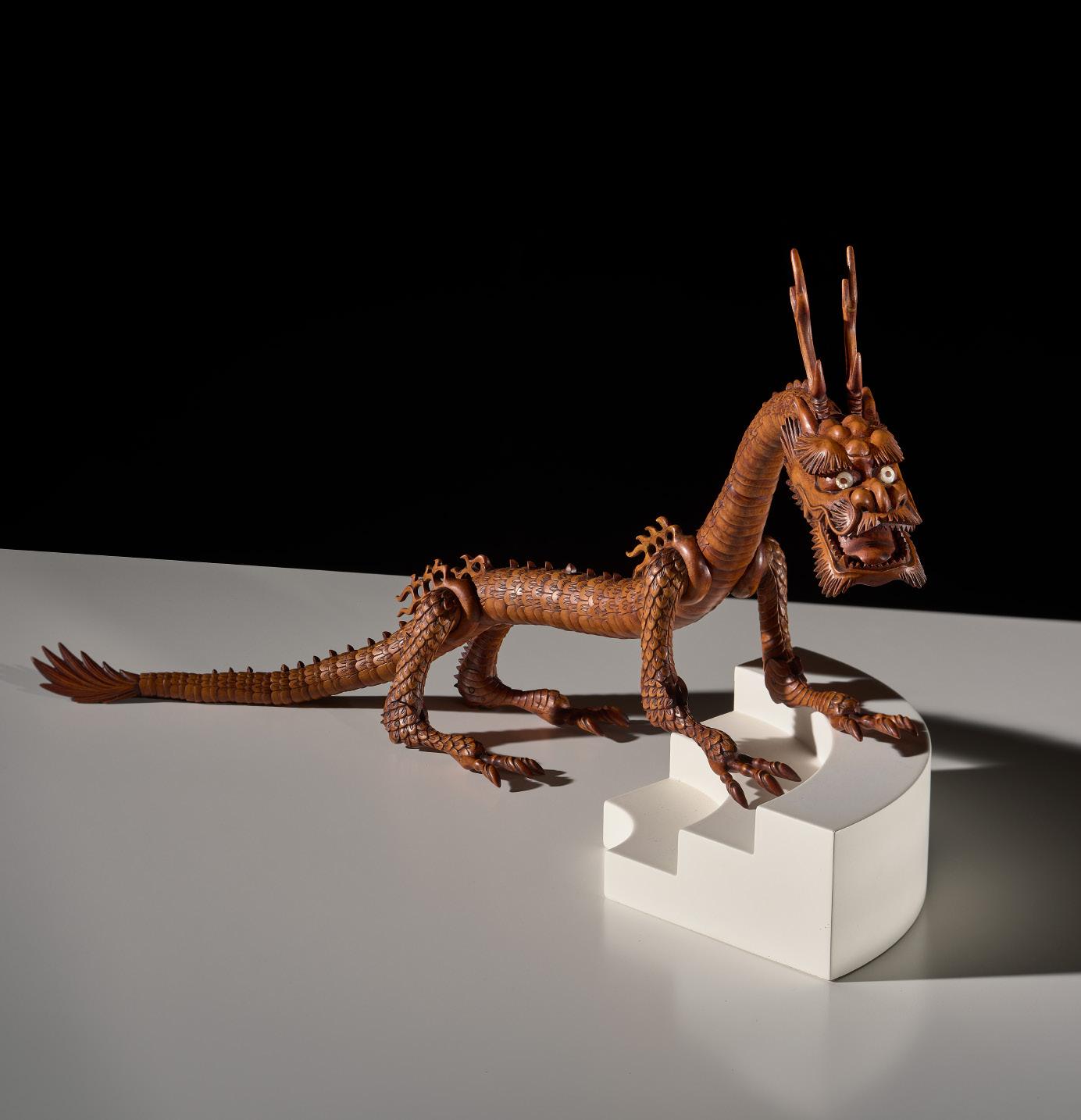
MASAYUKI: A LARGE AND IMPRESSIVE BOXWOOD JIZAI OKIMONO OF A DRAGON
By Masayuki, signed Ishii zo, Masayuki to Japan, Meiji period (1868-1912)
Superbly carved, the scaly body composed of smoothly articulated segments connected by internal hinges, allowing the model to be fully poseable, which extends into a bushy tail, and is supported by movable three-clawed limbs with joints accentuated by flowing flames. The large head of the mythical creature rendered with a fierce expression, characterized by prominent bulging eyes, carefully inlaid with mother-of-pearl, beneath bushy brows and a pronounced muzzle with a gaping mouth and a movable lower jaw that reveals sharp fangs and an articulated tongue, all surmounted by a pair of prominent bifurcated horns. Signed to the lower jaw Ishii zo, MASAYUKI to [made by Ishii, carved by Masayuki]. The name Ishii may refer either to the family name of the carver or to a workshop attribution.
LENGTH 76.8 cm
Condition: With slight signs of restoration on the left rear leg and scattered repainted areas, only visible under UV light examination. Otherwise, excellent condition with only minor surface wear and inherent natural imperfections.
AUCTION COMPARISON
Compare a closely related smaller boxwood articulated model of a dragon, 45.5 cm long, at Bonhams, Fine Japanese Art, London, 5 November 2009, lot 95 (sold for GBP 8,400 or approx. EUR 15,500 converted and adjusted for inflation at the time of writing).
Estimate EUR 15,000
Starting price EUR 7,500
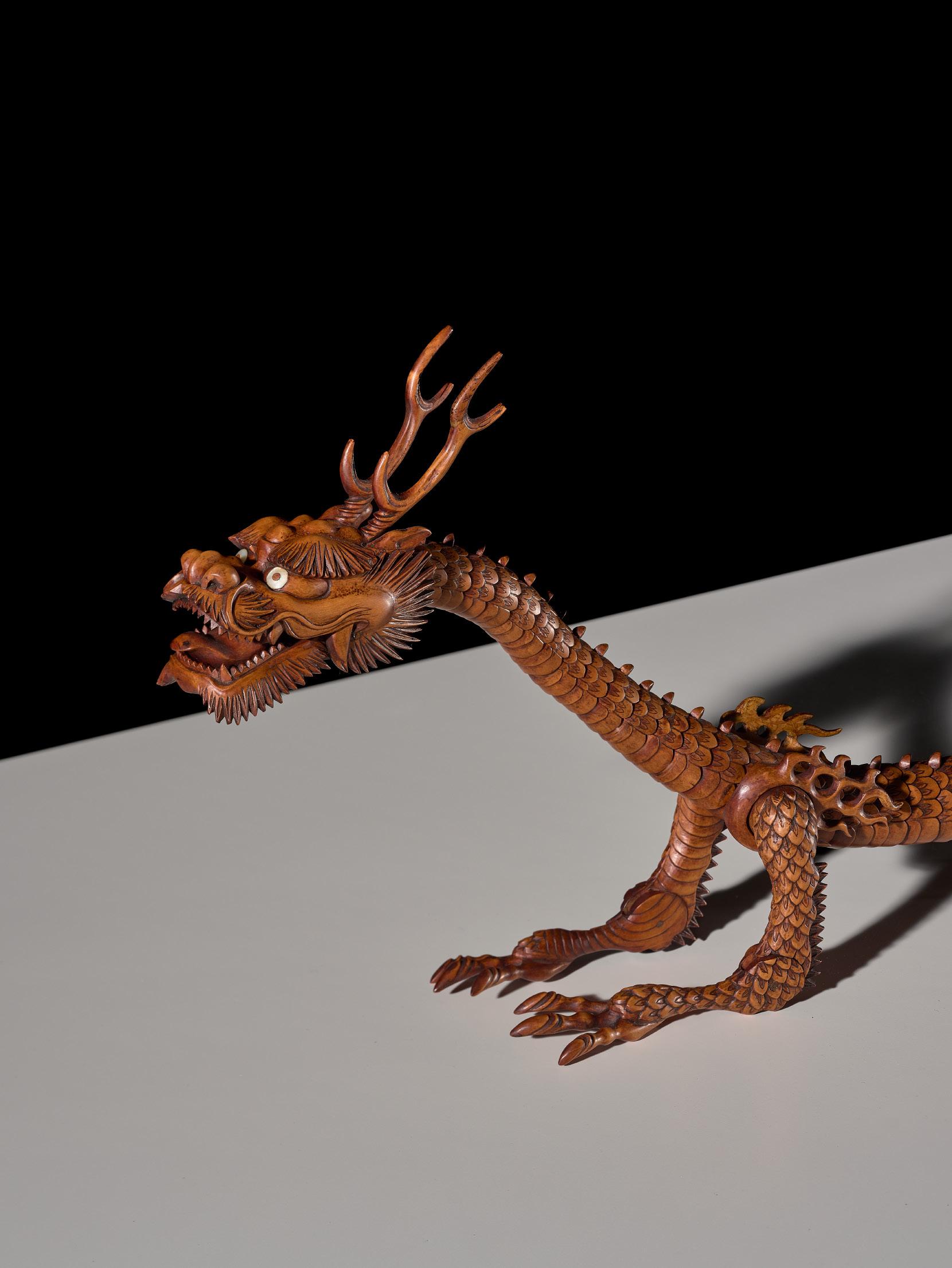
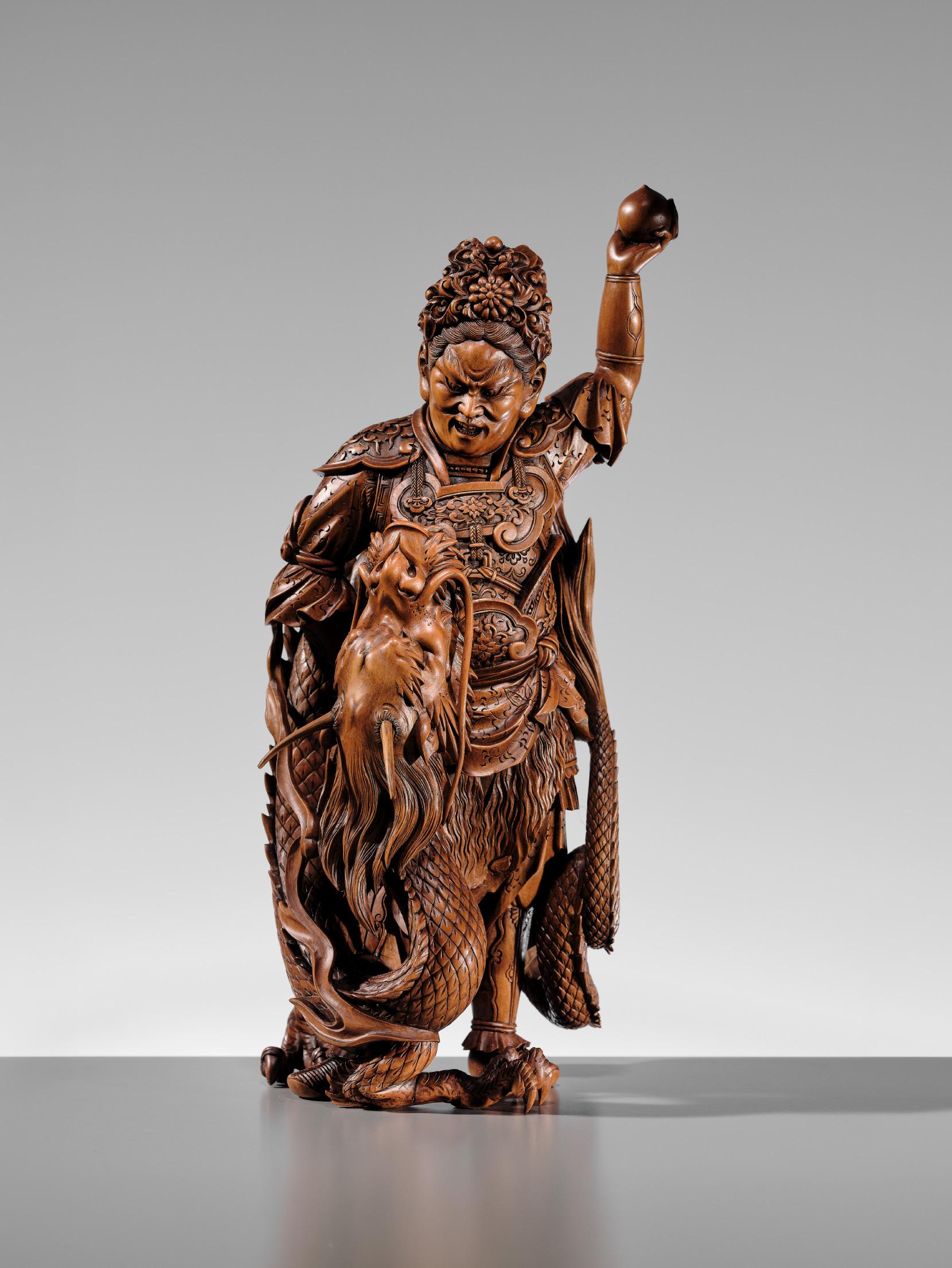
By Rokkado, signed Rokkado shujin to Japan, late 19th century, Meiji period (1868-1912)
Masterfully carved, this dynamic okimono depicts Ryujin, the powerful Dragon King of the seas, in a commanding pose. The figure captures Ryujin in mid-action, with a dragon spiraling dramatically around his body, its form coiling upward toward the magical tama (sacred jewel), which Ryujin holds above his head, symbolizing his control over the powerful creature. The tama is said to control the tides, representing Ryujin’s dominion over the oceans and natural forces. The dragon’s scales are intricately incised, with a fierce expression, sharp fangs, a long, curling beard, and piercing eyes that intensify its fierce nature. Ryujin’s flowing hair and beard are finely detailed, and his crown features a central blossom surrounded by scrolling foliage and pearls, adding to the majesty of the figure. His armor, exquisitely carved with floral crests, is richly detailed, and a tiger pelt drapes beneath. Signed underneath one foot ROKKADO shujin to [carved by master Rokkado].
HEIGHT 27 cm
Condition: Very good condition and presenting beautifully. One dragon claw is restored and one foot of the dragon and Ryujin are re-attached. The horns of the dragon are possibly later replacements.
Ryujin is a central figure in Japanese mythology, often associated with controlling the seas and weather through his magical tama pearl. The tama pearl symbolizes Ryujin’s power over the tides and his command of the ocean’s vast and mysterious forces. In art, Ryujin is frequently depicted as a fearsome and regal creature, embodying both strength and spirituality, with deep ties to Buddhist cosmology.
This exceptional okimono reflects the influence of the Rokko school of carving, to which Rokkado is stylistically linked. The shared use of the kanji “Ro” (六) suggests a connection to the Rokko school, known for its meticulous craftsmanship and expressive detail in woodwork. This dramatic rendering of Ryujin exemplifies the high level of artistic skill and precision associated with this tradition.
Estimate EUR 20,000
Starting price EUR 10,000
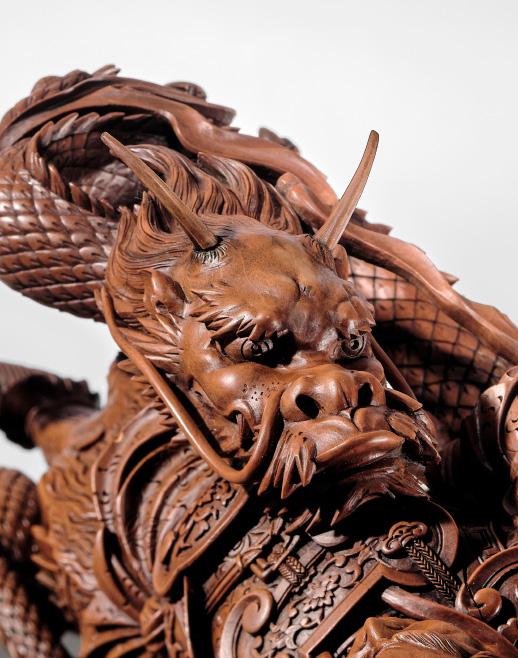
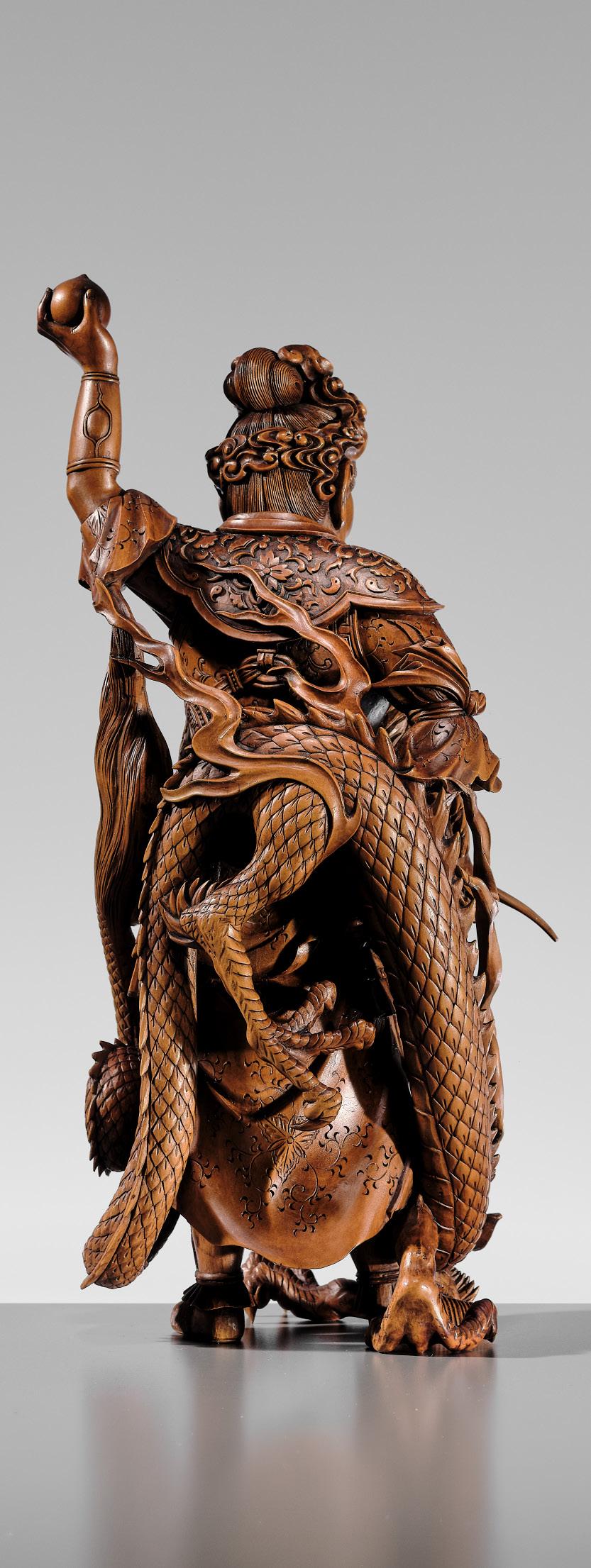
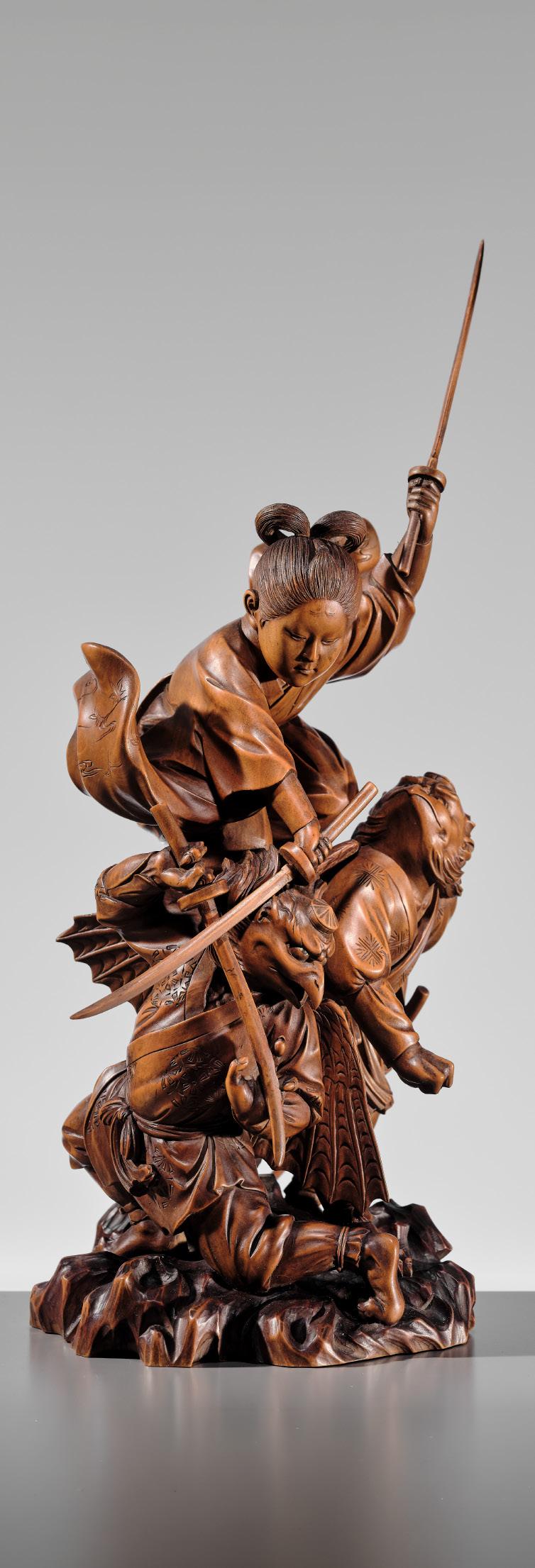
HIKATA SESSHU: AN EXEPTIONAL AND LARGE CARVED WOOD ‘MINAMOTO NO YOSHITSUNE TRAINING WITH THE TENGU’ OKIMONO
By Hikata Sessu, signed Sesshu to Japan, c. 1900, Meiji period (1868-1912)
Superbly carved, this remarkable sculpture captures Minamoto no Yoshitsune in a moment of intense action, depicted mid-leap above two tengu. Yoshitsune is shown with one sword raised high above his head, while the other is poised above the head of one tengu, as if preparing to deliver the final blow. His finely incised robes are adorned with intricate folds and patterns, including maple leaves falling in a river. His face is calm and focused, with intense eyes, a set mouth, and meticulously carved hair that adds depth to his expression. The tengu beneath him are equally well-sculpted, with beak-like noses and finely carved wings. Their kimonos feature subtle decoration, and their hair appears to flow in the wind, topped with a tokin cap. Signed to the base SESSHU to [carved by Sesshu].
HEIGHT 28 cm
Condition: Excellent condition and presenting beautifully. A few of the separately carved swords have been re-attached. A few minor expected age cracks.
Hikita Sesshu (active Meiji period) was a skilled woodcarver recognized for his dramatic and expressive woodwork. His carving of Taketori-okina (An Old Man from The Tale of the Bamboo Cutter) earned him second prize at the 7th Shin Kobijutsu Ten in 1901. Sesshu also exhibited internationally, including a 1900 presentation at the Paris Exposition, showcasing his talent on the global stage.
This scene is drawn from the famous legend of Yoshitsune’s training with Sojobo, the king of the tengu, on Mount Kurama
In the myth, the young Ushiwakamaru (Yoshitsune’s childhood name) is taught martial arts, swordsmanship, and supernatural agility by Sojobo, gaining skills that would define his later victories. This iconic moment represents not just a battle, but the mystical transfer of martial knowledge, symbolizing Yoshitsune’s rise to legendary status. The depiction of Yoshitsune’s training has captivated artists for centuries, blending folklore and the supernatural with Yoshitsune’s historical heroism.
MUSEUM COMPARISON
For another work by this exceptional artist, see a wood okimono depicting Yoshida Shoin, dated 1902, in the Kyoto University Museum, record ID RB00014115.
Estimate EUR 20,000
Starting price EUR 10,000
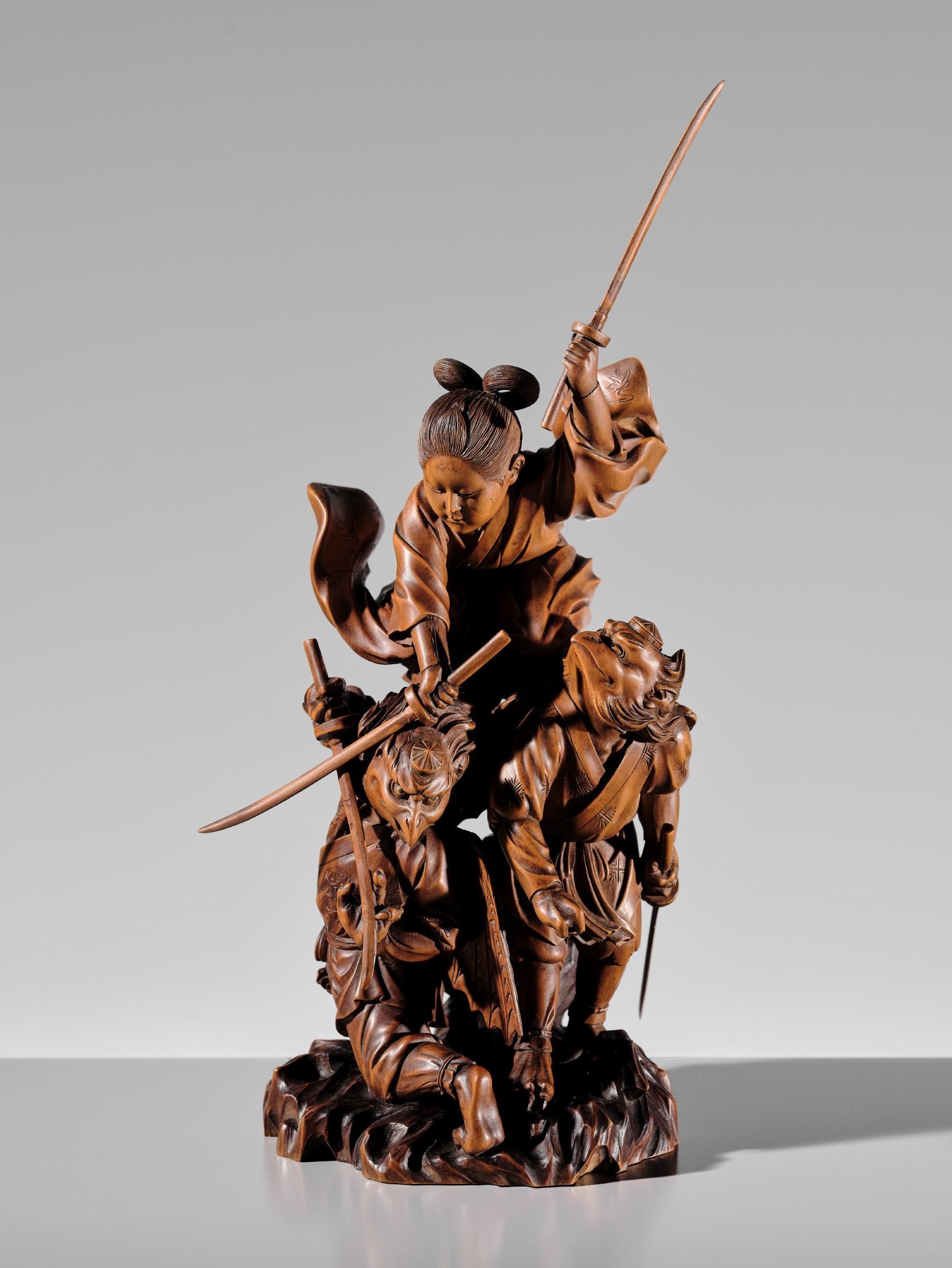
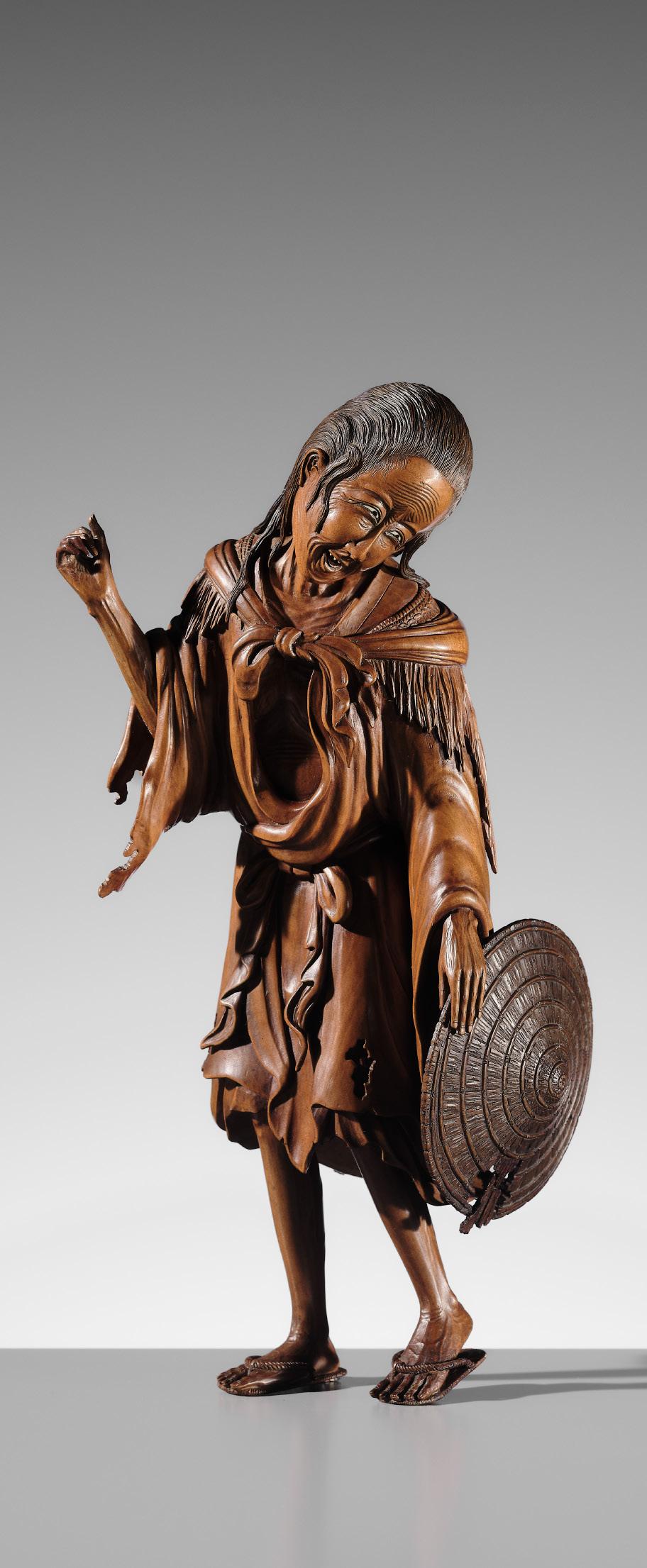
Japan, late 19th-early 20th century, Meiji period (1868-1912)
Finely carved to depict Ono no Komachi, shown as an aged woman standing in a dynamic, slightly stooped pose, her head tilted as if caught in a moment of motion. She holds a wide-brimmed, tattered hat in one hand, while the other is raised, as if swept by the wind. Her hair is finely incised, flowing loosely over her shoulders, while her emaciated features are delicately carved, with bone-inlaid eyes and teeth. She is dressed in flowing robes, intricately detailed with deeply carved, cascading folds, and brilliantly carved to simulate wear and tears.
The carving is imbued with a sense of brilliant movement, as one leg is slightly raised, and the foot appears to be falling out of the sandal, creating an effect of lifelike dynamism. The portrayal of Komachi, often seen as a symbol of the fleeting nature of beauty, conveys both fragility and strength in her old age, with the artist masterfully capturing the grace and poignancy of her character.
HEIGHT 29 cm
Condition: Good condition and presenting beautifully. An implement held in the right hand possibly lost. A tiny chip to the edge of one hair strand and an old repair to the hat. One sandal is restored.
Ono no Komachi, a waka poet from the Heian period, was one of the Rokkasen (the six best waka poets of the early Heian period) and is renowned for both her extraordinary beauty and her tragic and complex relationships with her lovers. In legends, she is often portrayed as a withering, old woman, symbolizing the impermanence of beauty and the inevitable passage of time. This okimono captures her later years, emphasizing the themes of aging and mortality through the emaciated features and stooped pose. The delicate carving and the symbolic representation of her in this form reflect both the fragility of beauty and the timeless power of her poetic legacy.
Compare a related wood incense burner, similarly carved, by Meishinsai, Meiji period, depicting Sotoba Komachi, 55.3 cm wide, at Bonhams, Fine Japanese Works of Art, 17 September 2013, New York, lot 3090 (sold for USD 7,500 or approx. EUR 9,000 converted and adjusted for inflation at the time of writing).
Estimate EUR 4,000
Starting price EUR 2,000
By Okazaki Eisaburo (Kaho), signed Kaho Japan, Osaka, late 19th to early 20th century, Meiji period (1868-1912)
Finely carved to depict a female demon standing as she strides forward, her expressive face rendered with playful ferocity, showing protruding fangs and a mischievous grin. She carries her singlehorned baby securely on her back, the child peeking over her shoulder with one claw raised to its face, its mouth wide open as it screams, and the other hand holding a rattle. The demonic figure is dressed in flowing robes, richly decorated with neatly incised floral roundels and patterns, the folds deeply carved. Her hair is neatly tied, with finely incised strands. Signed underneath KAHO.
HEIGHT 10.3 cm
Condition: Very good condition with minor wear and a minor old repair to the edge of the robe.
Okazaki Eisaburo (artist name Kaho) was an accomplished carver active in Osaka and the broader Kansai region. A pupil of the renowned Kihodo Masaka (Ueda Reikichi, no. 427), Kaho’s work reflects a similar humor and craftsmanship found in Masaka’s carvings, with a distinctive style that incorporates finely executed staining and detailed incising. The present piece captures the spirit of playful mischievousness often found in the work of both Kaho and his mentor, showcasing their ability to bring humor and dynamism into small-scale figurative carvings.
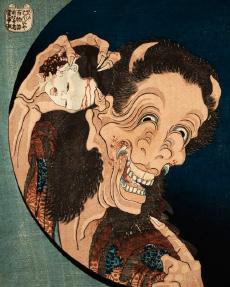
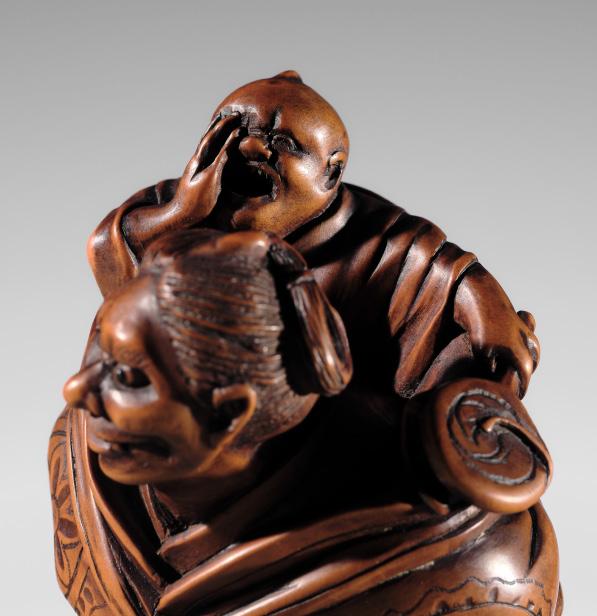
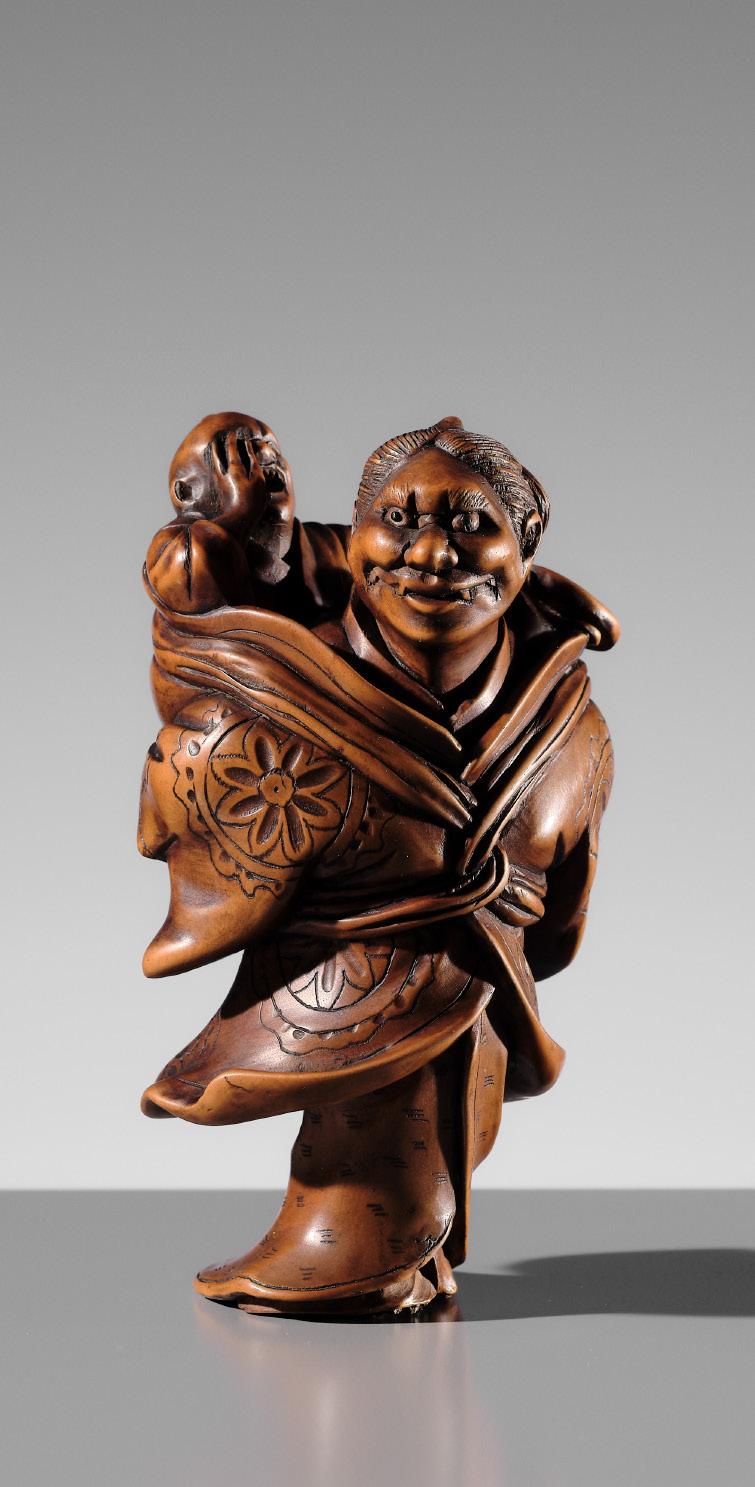
AUCTION COMPARISON
Compare a related wood okimono of a rakan, by Masaka, 4.8 cm wide, at Christie’s, Japanese Art and Design, 14 November 2001, London, lot 182 (sold for GBP 3,760 or approx. EUR 7,900 converted and adjusted for inflation at the time of writing). Compare a related ivory okimono depicting three oni, by Masaka, 5.7 cm high, at Bonhams, Fine Japanese Works of Art, 19 March 2013, New York, lot 2257 (sold for USD 13,750 or approx. EUR 16,500 converted and adjusted for inflation at the time of writing).
Estimate EUR 4,000
Starting price EUR 2,000
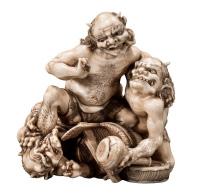
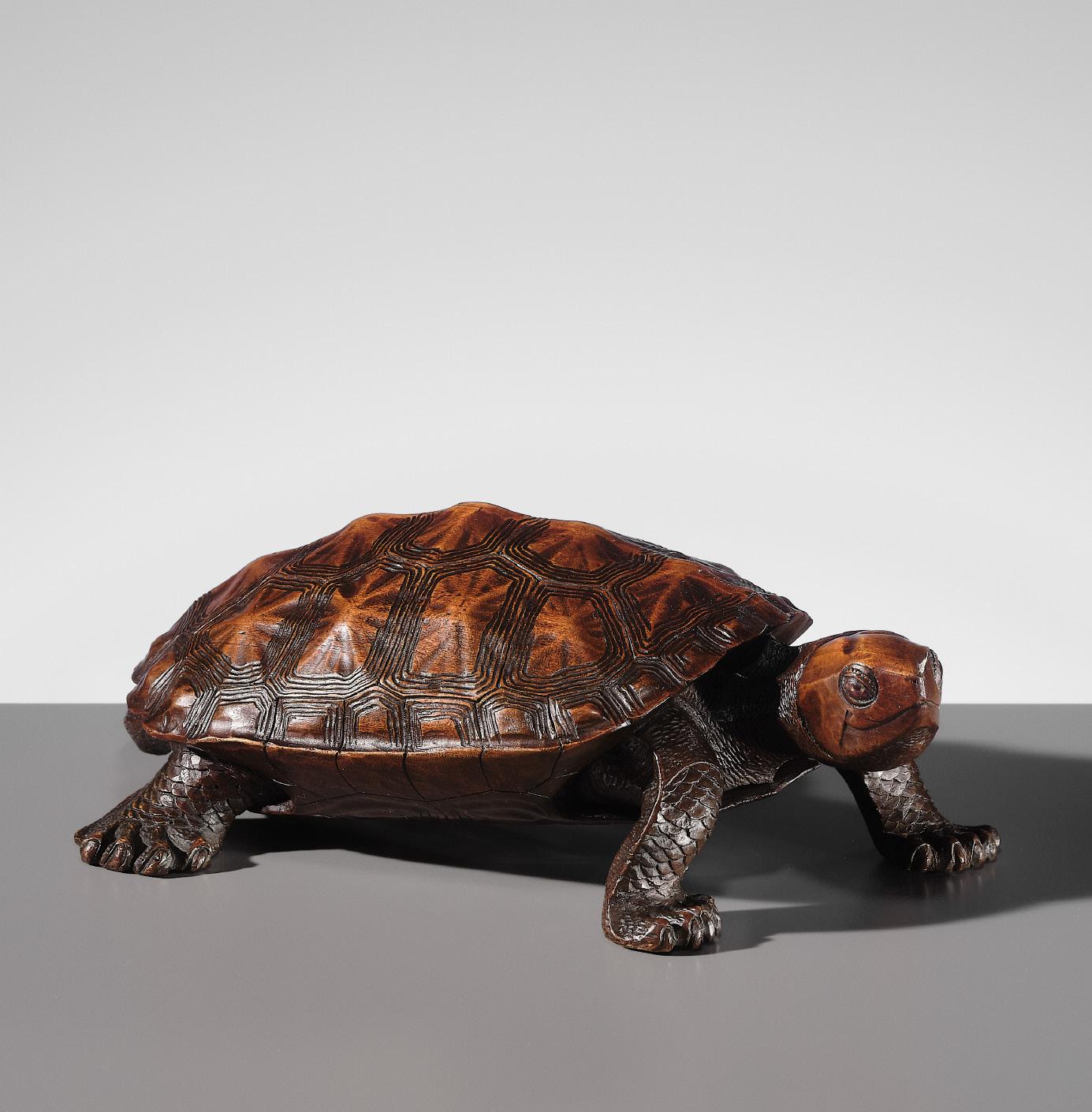
By Hakin, signed Hakin horu Japan, second half of the 19th century
Finely carved, this wood okimono depicts a tortoise in a naturalistic crawling pose, its head extended forward with an alert expression and finely detailed eyes, which are inlaid and painted. The domed shell is meticulously rendered with geometric scutes, enhanced by rich staining that brings out the intricate texture. The limbs and neck are carved with lifelike detail, showcasing scaled skin and articulated claws, while the tail curves gently beneath the shell. The underside is carefully finished, with incised detailing on the plastron, and signed within a rectangular mother-of-pearl plaque HAKIN horu [carved by Hakin].
LENGTH 23 cm
Condition: Excellent condition with minor expected wear, particularly to the contact points of the feet. A very fine crack to the tail.
Tortoises in okimono are often found in compositions featuring multiple animals, such as groups of young with a mother or tortoises climbing atop each other. Single, independently rendered examples are particularly rare The present work stands out for its focus on a solitary tortoise, providing a refined and naturalistic study of the creature. In Japanese culture, the tortoise is a powerful symbol of longevity, wisdom, and good fortune, often associated with enduring strength and auspicious wishes for a long life.
AUCTION COMPARISON
Compare a related wood okimono of a group of tortoises, similarly finely carved, by Doraku, dated to the late 19th century, at Zacke, Fine Japanese Art, 2 December 2022, Vienna, lot 171 (sold for EUR 20,800).
Estimate EUR 5,000
Starting price EUR 2,400
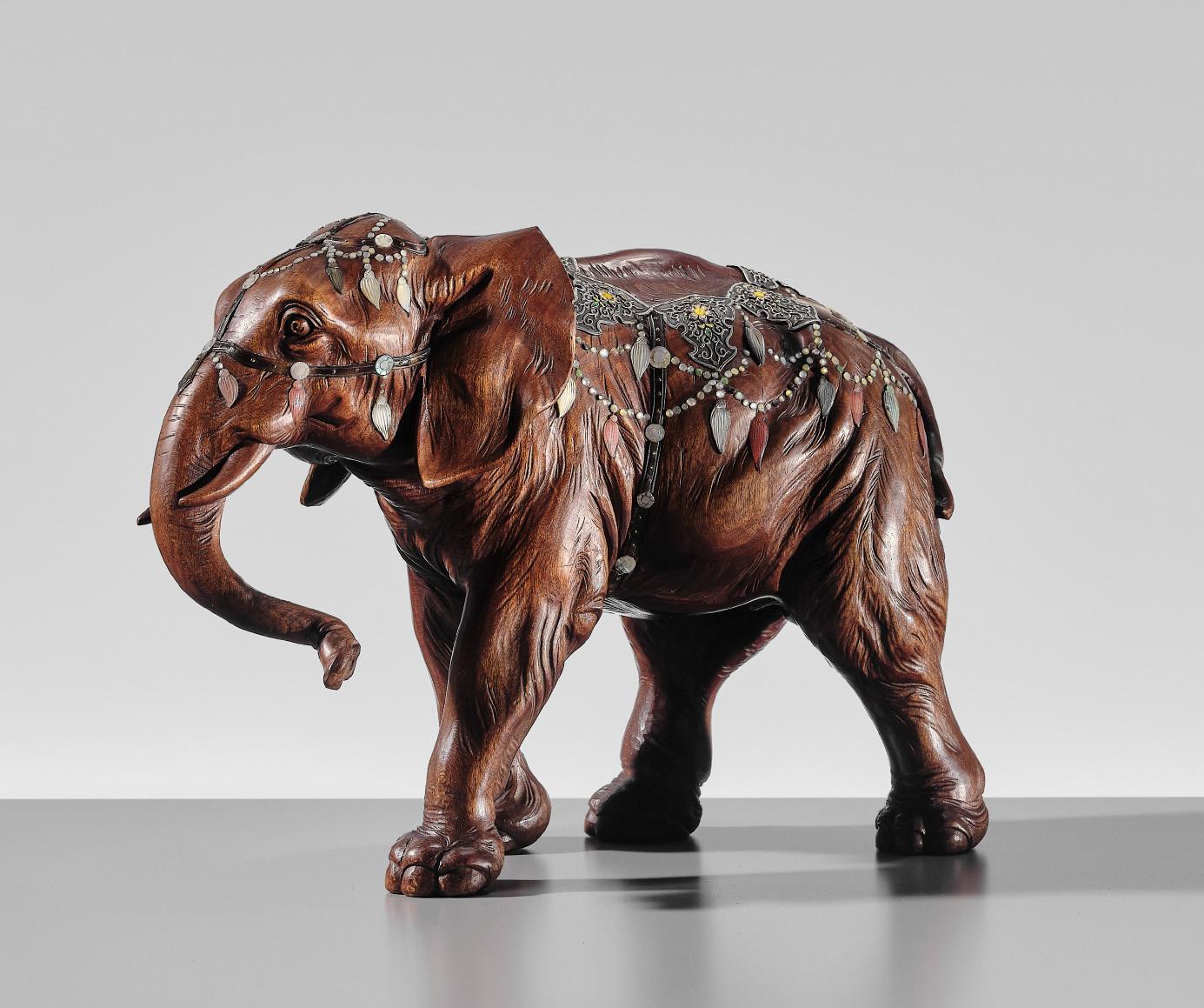
188
MITSUTAKE: A VERY FINE SHIBAYAMA-STYLE INLAID WOOD ‘CAPARISONED ELEPHANT’ OKIMONO
By Goto Mitsutake, signed Mitsutake koku Japan, early 20th century, Meiji (1868-1912) to Taisho period (1912-1926)
Naturalistically carved, depicting an elephant in mid-stride, its trunk and tail dynamically slung to one side. The majestic creature is adorned with mother-of-pearl tassels, pearls, silver filigree, and cloisonné enamel, together forming a remarkably elaborate caparison, adding to its regal presence. Signed underneath one foot MITSUTAKE koku [carved by Mitsutake].
HEIGHT 18.5 cm, LENGTH 25.5 cm
Condition: Good condition and presenting beautifully.,The tail and trunk with old repairs. The inlays are remarkably intact but a few may have been re-attached or replaced over time.
Goto Mitsutake (Goto Kogaku) was a renowned Japanese sculptor active during the Meiji and Taisho periods. He was the son of Goto Sadayuki (1850–1903), famous for his horse sculptures, and studied under Takamura Koun (1852–1934), inheriting the character 光. After graduating from the Tokyo University of Fine Art, he developed a unique style, creating wooden carvings and cast bronze (copper alloy) figurines, often focusing on animals such as horses and elephants.
Estimate EUR 6,000 Starting price EUR 3,000
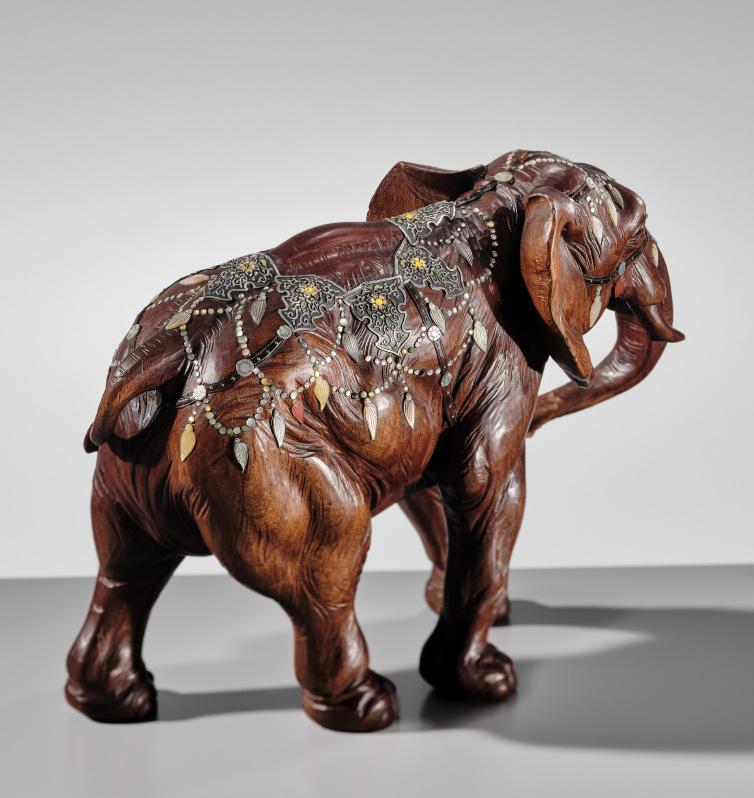
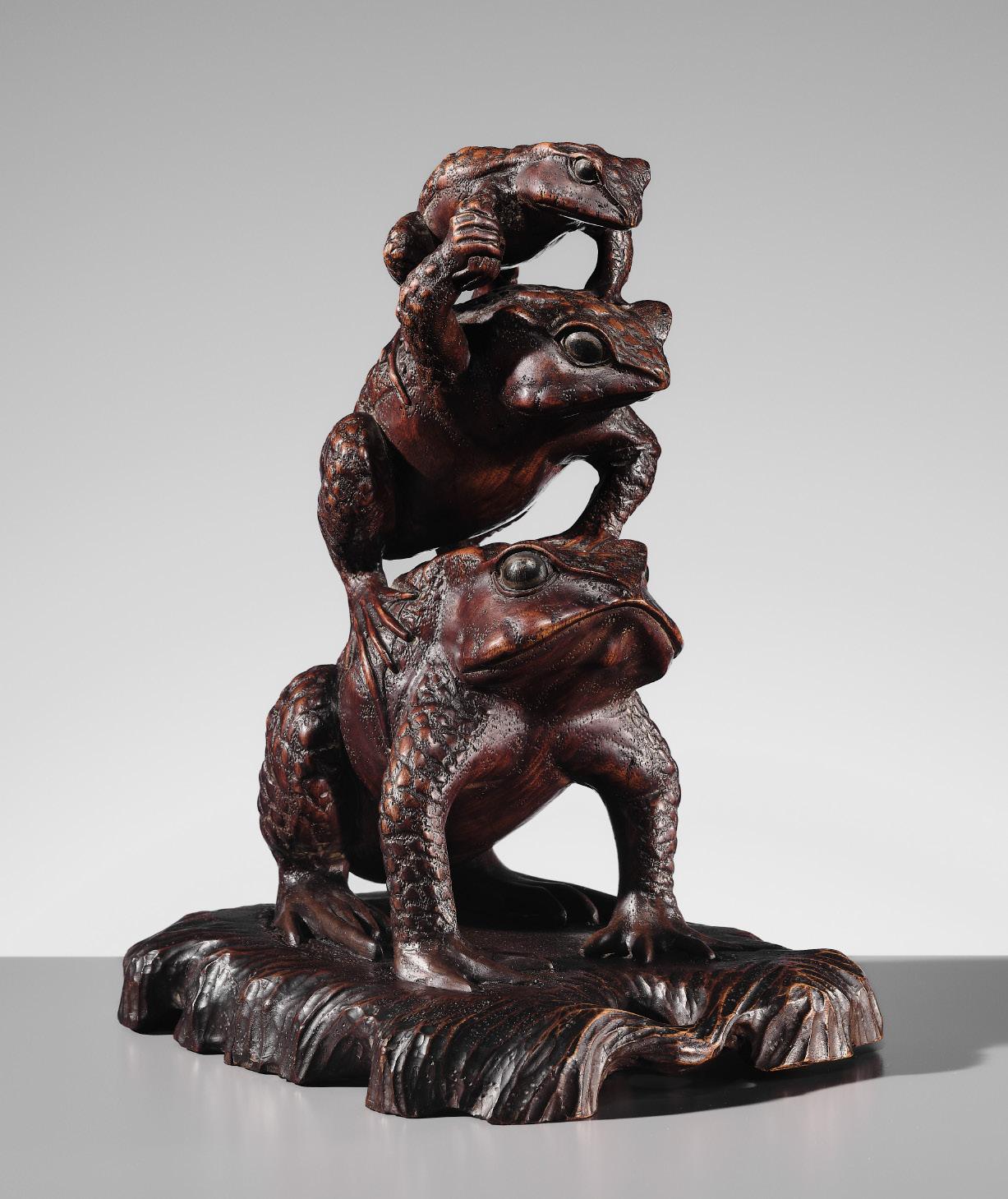
A LARGE AND UNUSUAL WOOD OKIMONO OF THREE TOADS
Japan, Meiji period (1868-1912)
Charmingly carved to depict three toads stacked one atop the other in a playful vertical composition. The largest toad crouches at the base, its bulging eyes and textured skin naturalistically rendered, supporting a second toad climbing across its back, while a smaller toad perches at the top. The eyes are finely painted, and each figure is executed with notable attention to detail and a strong sense of humor.
HEIGHT 27.5 cm
Condition: Good condition with minor wear and few natural age cracks, the largest to the base which has been stabilized with two wooden plugs. Old repairs to several toes of the lowest toad.
The playful composition of the present carving may well draw inspiration from the celebrated Choju jinbutsu giga (Scrolls of Frolicking Animals), a 12th to 13th century masterpiece depicting animals such as frogs, rabbits, and monkeys engaged in lively, human-like activities. Renowned for their humor, dynamic movement, and expressive characterization, these scrolls frequently show animals wrestling, playing, and celebrating in animated scenes. Similarly, the stacked toads in this okimono convey a sense of vitality and interaction, echoing the whimsical spirit of these early narrative paintings. Detail of Choju-giga scroll
Estimate EUR 5,000 Starting price EUR 2,400
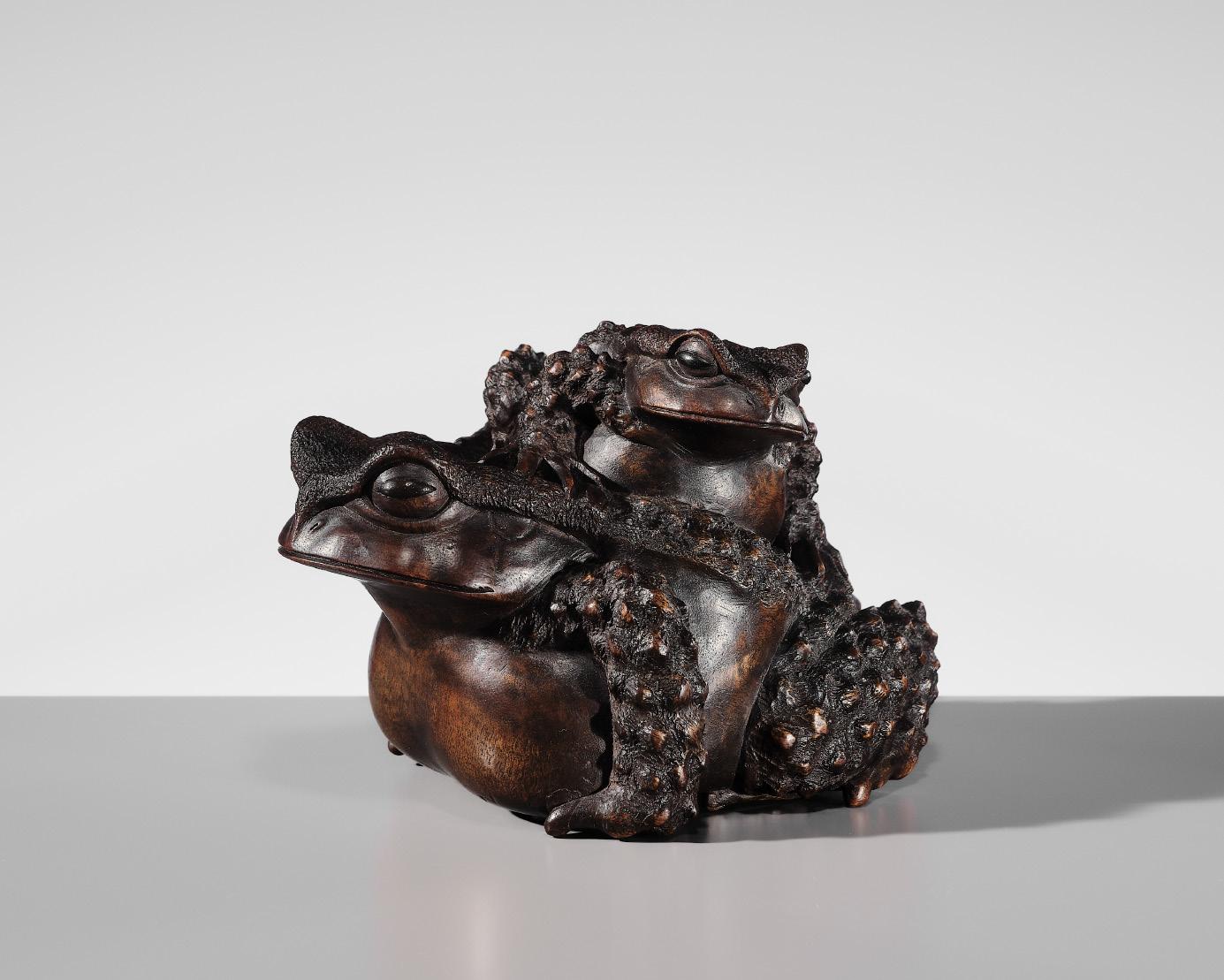
190
By a member of the Masanao family, signed Masanao and kakihan Japan, Yamada, Ise Province, second half of the 19th century, late Edo (1615-1868) to Meiji period (1868-1912)
Naturalistically carved as an adult toad with its young clambering across its back, forming a lively and well-balanced composition. The raised, warty skin is masterfully rendered, transitioning seamlessly to the smooth, polished underbelly, which reveals the attractive grain of the wood. The eyes are inlaid in lustrous dark horn and the underside shows the boldly incised signature MASANAO and kakihan.
HEIGHT 10.5 cm, LENGTH 15.2 cm
Condition: Good condition with minor expected wear including a few tiny nicks here and there. Old repairs to the edge of two toes.
AUCTION COMPARISON
Compare a closely related wood okimono of a toad with two young, signed Masanao, 10.2 cm long, at Christie’s, Japanese and Korean Art, 16 March 2021, New York, lot 67 (sold for USD 7,500 or approx. EUR 7,000 converted and adjusted for inflation at the time of writing).
Estimate EUR 6,000 Starting price EUR 3,000
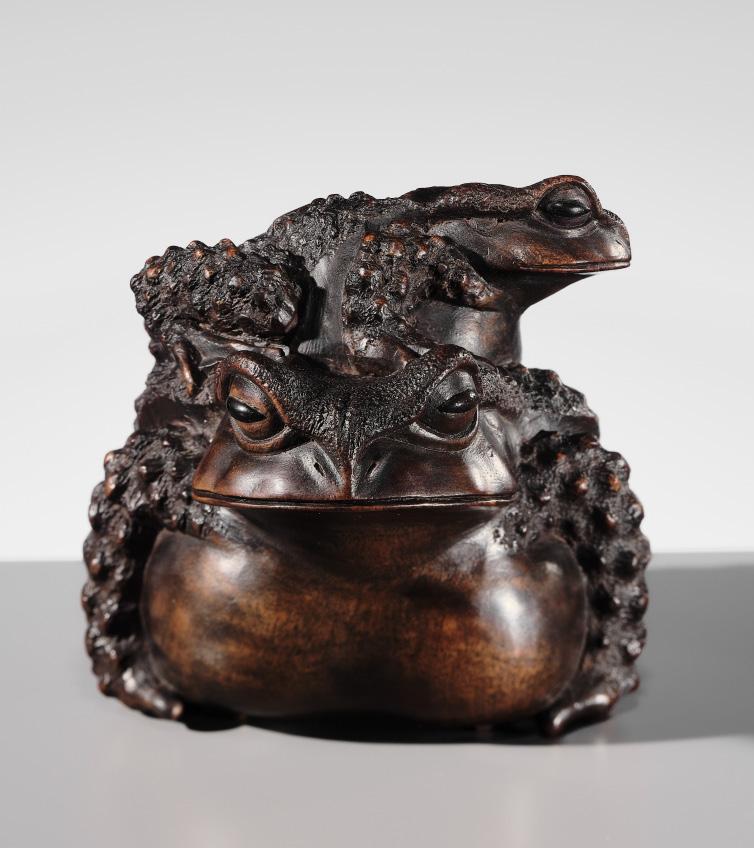
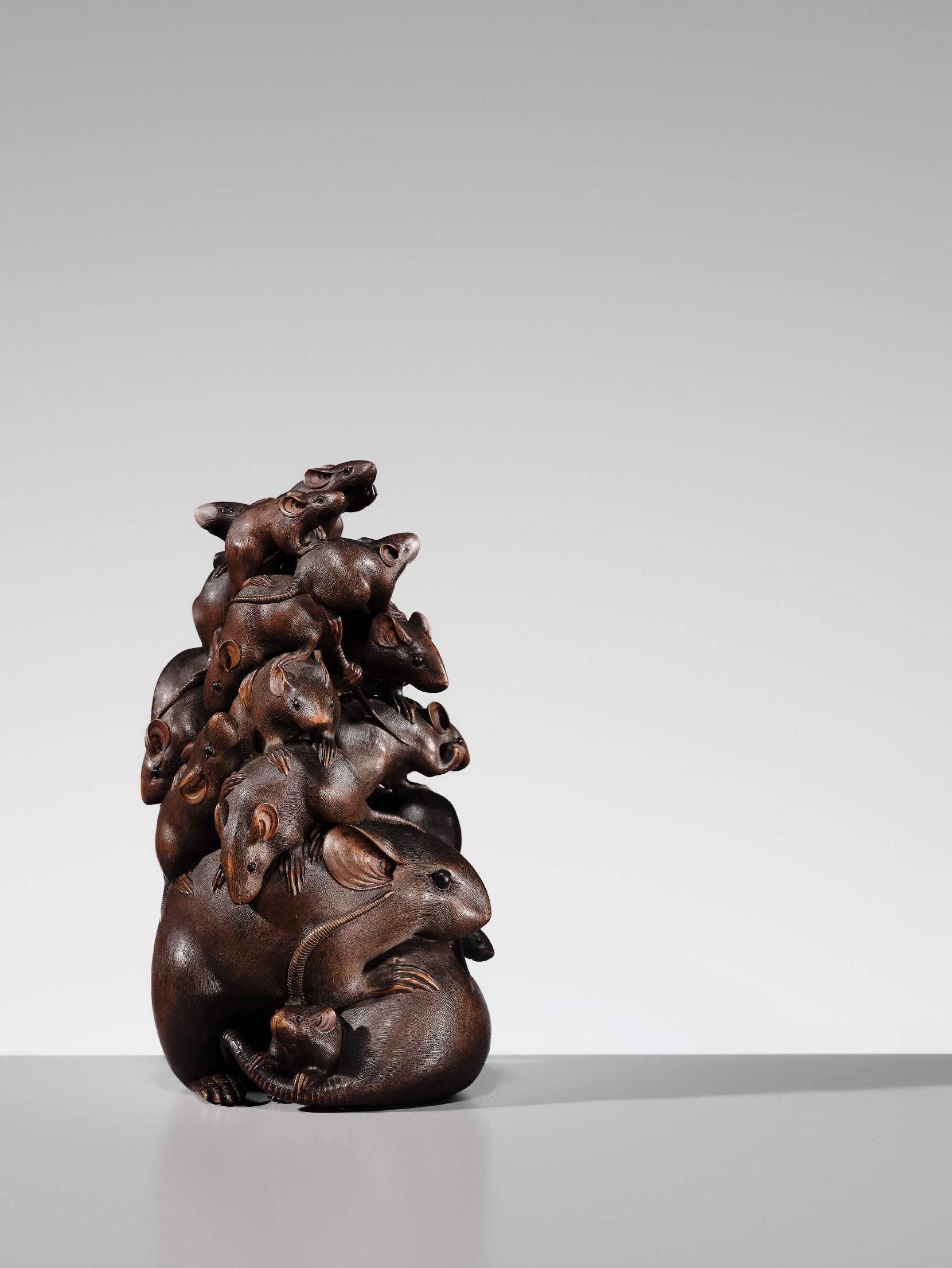
191
HOICHI: A SUPERB WOOD OKIMONO OF A PYRAMID OF TWENTY-ONE RATS
By Sengetsudo Hoichi, signed Sengetsudo Hoichi to Japan, second half of the 19th century
Carved with remarkable density and intricacy, this piece depicts a pyramid of twenty-one rats, each clambering atop the other. Their fur is finely incised, and their long tails are intricately carved, curling around the composition. All eyes are inlaid in dark horn, adding life to each animal. Signed underneath within a shaped signature plaque SENGETSUDO HOICHI to [carved by Sengetsudo Hoichi].
HEIGHT 16.9 cm
Provenance: Bonhams, Patient Detail, Perfect Design, 3 November 2022, London, lot 122 (sold for GBP 5,355 or approx. EUR 7,000 converted and adjusted for inflation at the time of writing). A noted collection, acquired from the above. Condition: Excellent condition with minor expected wear and natural age cracks, the most notable crack to the largest rat’s tail. Some inlaid eyes are possibly replaced.
MUSEUM COMPARISON
Compare a closely related okimono depicting a similar subject, by Kihodo Masaka, dated to the late 19th century, 11.7 cm high, in the Asian Art Museum of San Francisco, object number B70M5.
Estimate EUR 10,000
Starting price EUR 5,000
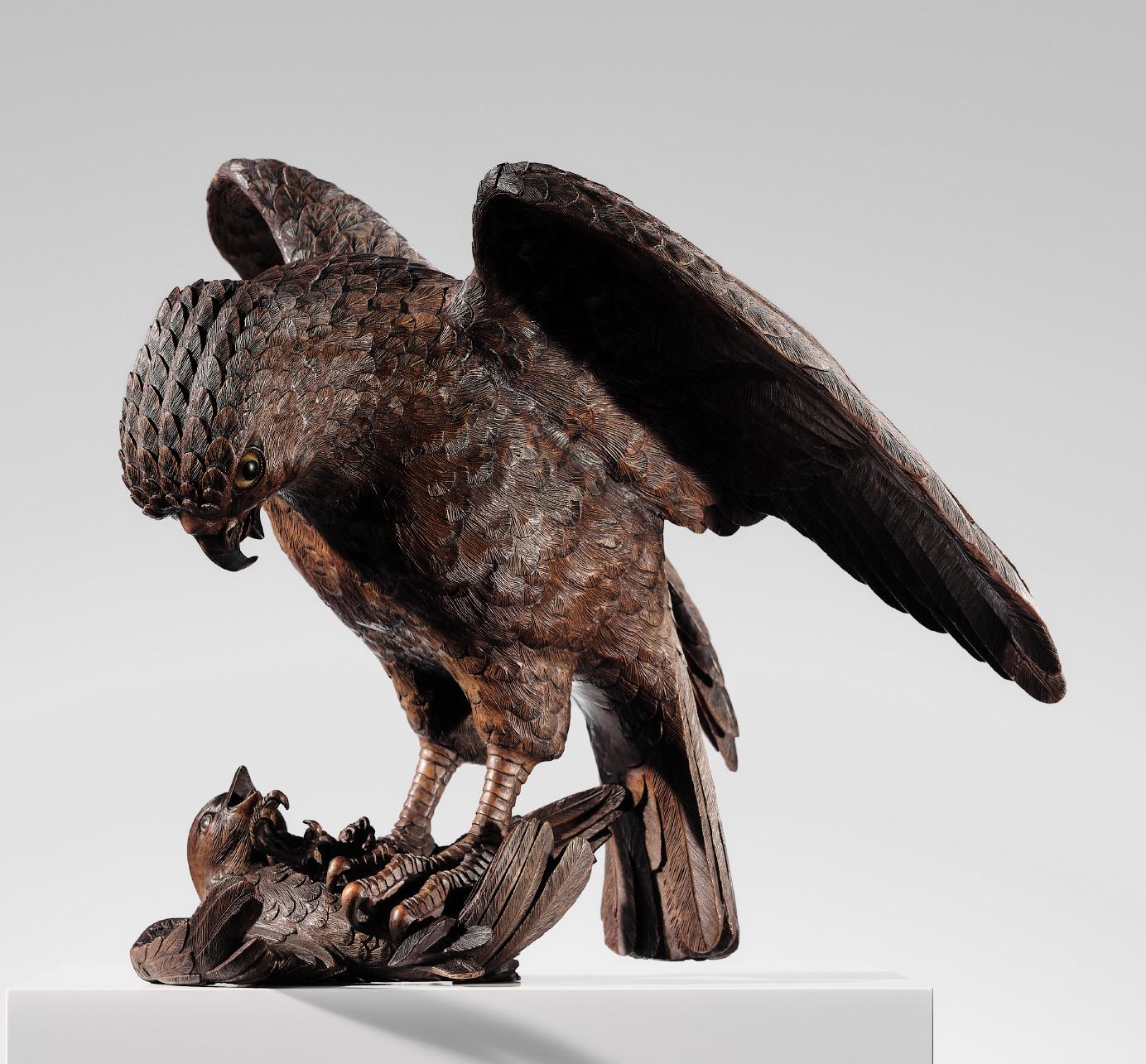
192
By Shizan, signed Shizan Japan, Meiji period (1868-1912)
Expertly carved, this dramatic okimono depicts a hawk in midattack, its seperately carved wings powerfully outstretched as it pins a sparrow beneath its talons. The hawk’s head is lowered with intense focus, its sharply hooked beak and piercing doubleinlaid eyes accentuating its predatory nature. Each feather is meticulously rendered, from the dense plumage of the body to the finely articulated flight feathers of the wings and tail. The sparrow, twisted beneath the hawk’s grip, is carved with equal sensitivity. The eyes of both are fine inlays of pale and dark buffalo horn. Signed underneath within a rectangular translucent horn-inlaid plaque SHIZAN.
HEIGHT 28.4 cm
Condition: Very good condition, presenting beautifully. There is a repair to the edge of one feather on the hawk and one on the sparrow. A few minor age cracks, some with associated fills.
Estimate EUR 6,000
Starting price EUR 3,000
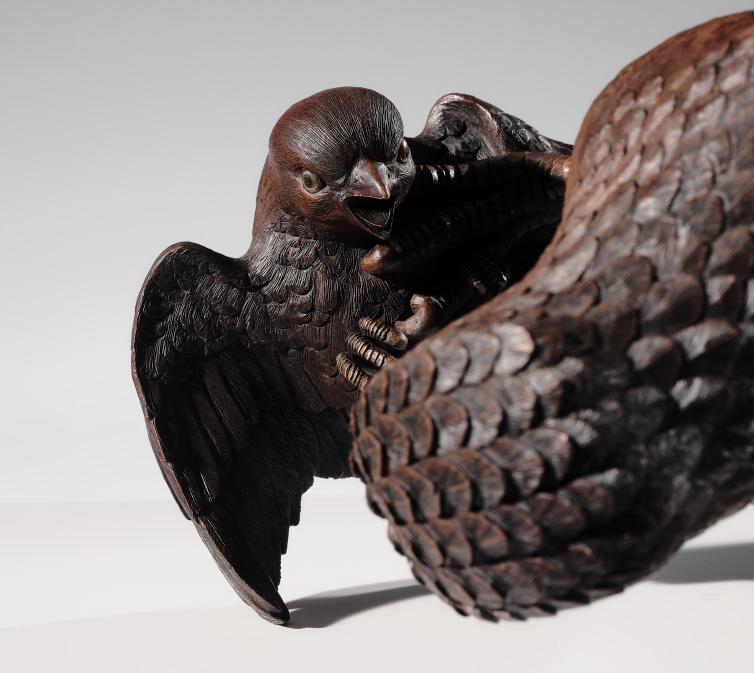
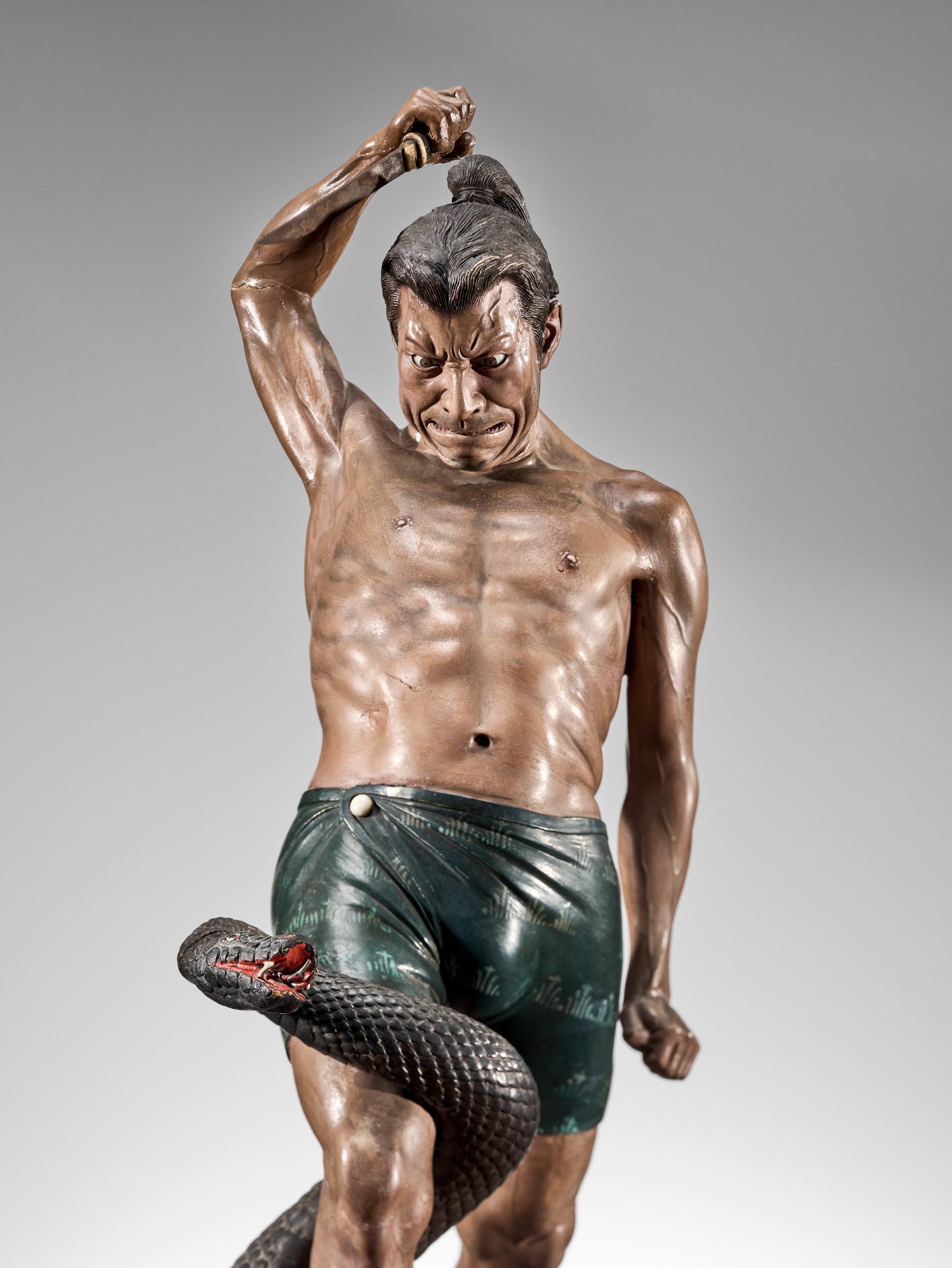
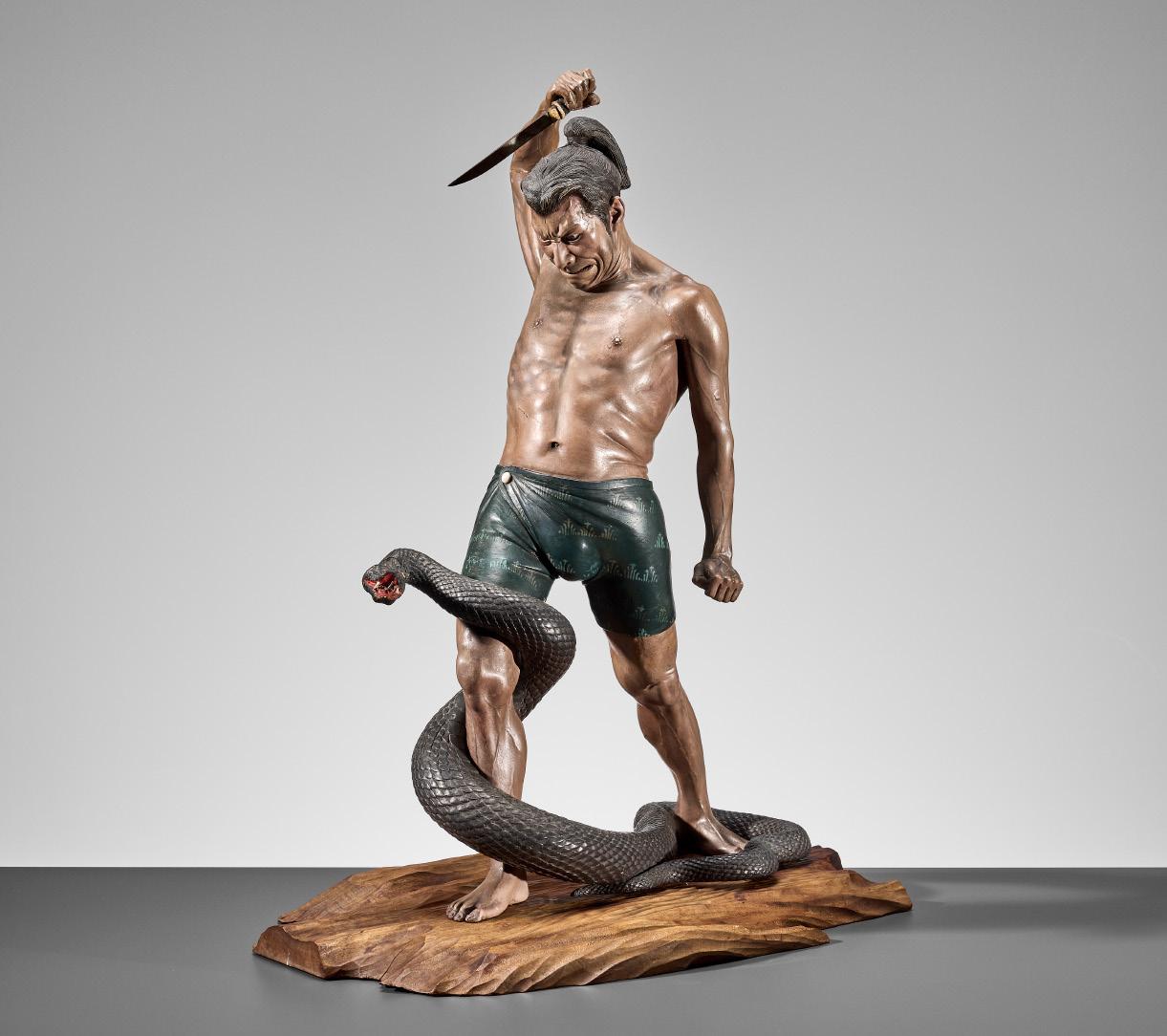
193
YAMAMOTO: A MASTERFUL IKI-NINGYO (LIVING DOLL) OF A MAN FIGHTING A SNAKE
By Yamamoto, signed Yamamoto saku Japan, late 19th century, Meiji period (1868-1912)
Naturalistically modeled, this striking composition captures a dramatic moment: a man fiercely battling a snake, his powerful physique tensed in mid-action. The figure’s muscular form is rendered with remarkable realism, his body positioned as he raises a sword to strike, leaning back while the snake coils around his leg. The skin tone is rich and layered with subtle pigments over gesso, with veins delicately detailed along the arms and legs. The face is full of life, with glass-inlaid eyes gleaming with intensity, the mouth slightly open as if in a battle cry, and individually carved teeth. Every minute detail, including creases at the joints and the texture of the snake’s scales, is meticulously crafted. Signed on the left foot YAMAMOTO saku [made by Yamamoto].
HEIGHT 51.6 cm
Condition: Good condition. Old repairs to the snake’s head and right arm, as well as few scattered flakes and losses. Presenting beautifully.
With a wood presentation stand.
Iki-ningyo are lifelike dolls that gained popularity in misemono (public exhibitions) during Japan’s Edo period. Produced from the late Edo through the Meiji period, they were crafted with such realism that they appeared almost human. These figures typically depicted characters from legend and history, deities and Buddhas, renowned courtesans, or foreign and exotic subjects.
A closely related iki-ningyo, formerly in the Gustave Revilliod Collection, was exhibited at the Ariana Museum in Genève, Switzerland AUCTION COMPARISON
Compare a closely related iki-ningyo of a man fighting a snake, 52 cm high, at Wright, The Amusing Style Selections from the Collection of Pavel Zoubok and Paul A. Baglio Jr., 24 July 2019, Chicago, lot 141 (sold for USD 10,000 or approx. EUR 11,000 converted and adjusted for inflation at the time of writing).
Compare a related iki-ningyo of rikishi (sumo wrestlers) by the same artist, signed Yamamoto to with kakihan, 57 cm high, at Zacke, Fine Japanese Art, 5 December 2025, Vienna, lot 257 (sold for EUR 15,600).
Estimate EUR 10,000 Starting price EUR 5,000
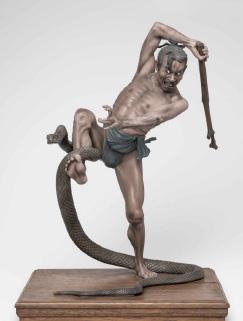
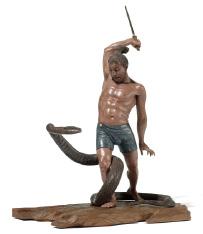
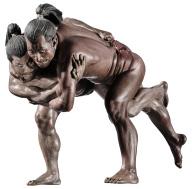
194
RATTAN FRUIT BASKET
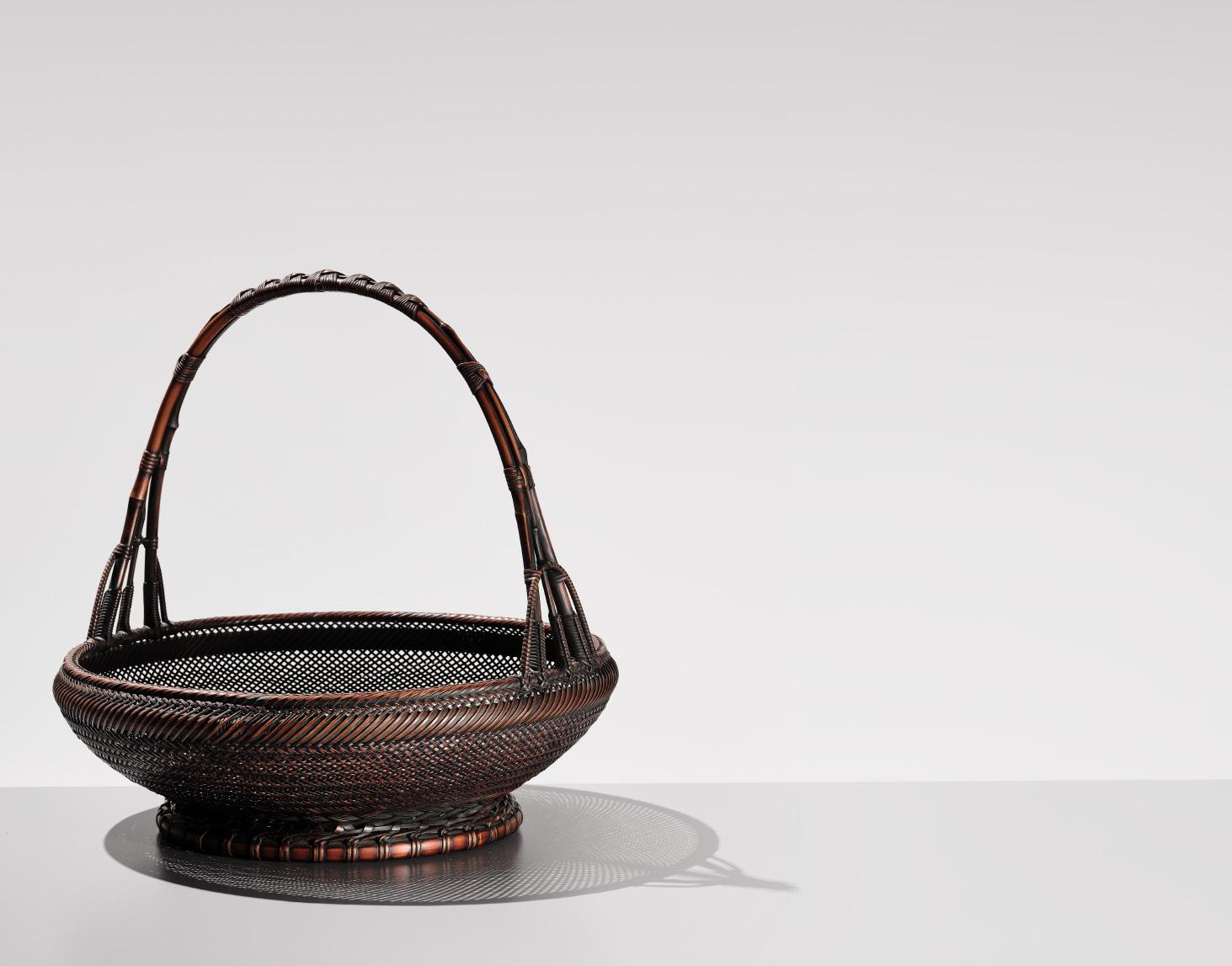
195
TANABE CHIKUUNSAI II: A BAMBOO AND RATTAN HANAKAGO (FLOWER BASKET)
By Tanabe
Chikuunsai II (1910-2000), signed Chikuunsai tsukuru Japan, second half of the 20th century
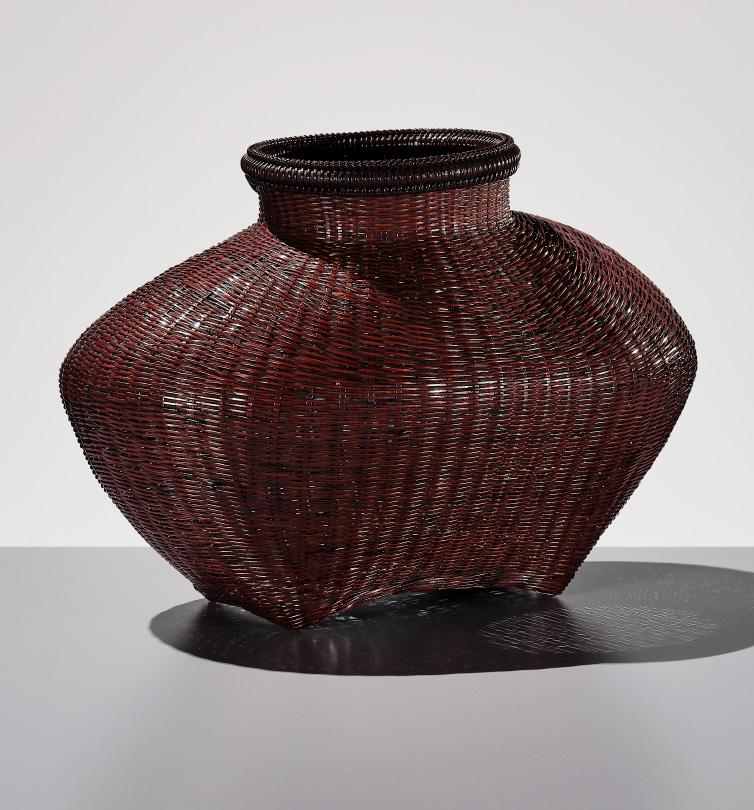
By Maeda Chikubosai I (1872-1950), signed Chikubosai kore saku Japan, c. 1930, Showa era (1926-1989)
Of elegant circular form, rising from a slightly flaring ring foot to gently rounded sides. The body is finely woven from split susudake (smoked bamboo) in a regular crisscross pattern, creating a warm, richly textured surface. The rim and foot are reinforced with thickly wrapped braided bindings, providing both structural strength and visual emphasis.
The basket is surmounted by a tall, gracefully arched handle composed of three tightly bound bamboo strips, meticulously secured with fine rattan bindings and subtly accented with decorative knot details. The joints are reinforced with arched binding strips, demonstrating a high level of technical refinement. Signed underneath CHIKUBOSAI kore saku [this is made by Chikubosai].
LENGTH 38 cm, HEIGHT 38.3 cm
Condition: Excellent condition.
With a wood tomobako (storage box).
AUCTION COMPARISON
Compare a closely related bamboo and rattan fruit basket by the same artist, dated 1929, 39.5 cm long, at Bonhams, Fine Japanese Art, 7 November 2019, London, lot 111 (sold for GBP 10,062 or approx. EUR 15,000 converted and adjusted for inflation at the time of writing).
Estimate EUR 3,000
Starting price EUR 1,500
Of compact and well-balanced form, the basket rises from four small feet to rounded sides with pronounced shoulders, tapering to a straight neck and an everted, thickly woven rim. It is tightly constructed from madake bamboo and rattan, producing a smooth, refined surface, while the underside reveals a contrasting square plaiting. One side is fitted with a single metal loop for suspension, allowing the basket to function as a hanging vessel. Signed underneath CHIKUUNSAI tsukuru [made by Chikuunsai]. With a lacquered bamboo otoshi (water holder).
SIZE 14.5 x 20 cm
Provenance: From a private collection in the UK, acquired by repute from Marvelous Art, Noda, Kagawa Prefecture, Japan. Condition: Excellent condition with only minor wear.
With a wood tomobako (storage box) inscribed Tsubogata kake-oki hanakago [Jar-shaped basket for hanging or placing on the floor].
AUCTION COMPARISON
Compare a related hanakago by the same artist, dated to the early 20th century, 22.9 cm high, at Christie’s, Japanese and Korean Art, 22 September 2020, New York, lot 25 (sold for USD 4,000 or approx. EUR 4,000 converted and adjusted for inflation at the time of writing).
Estimate EUR 2,500
Starting price EUR 1,200
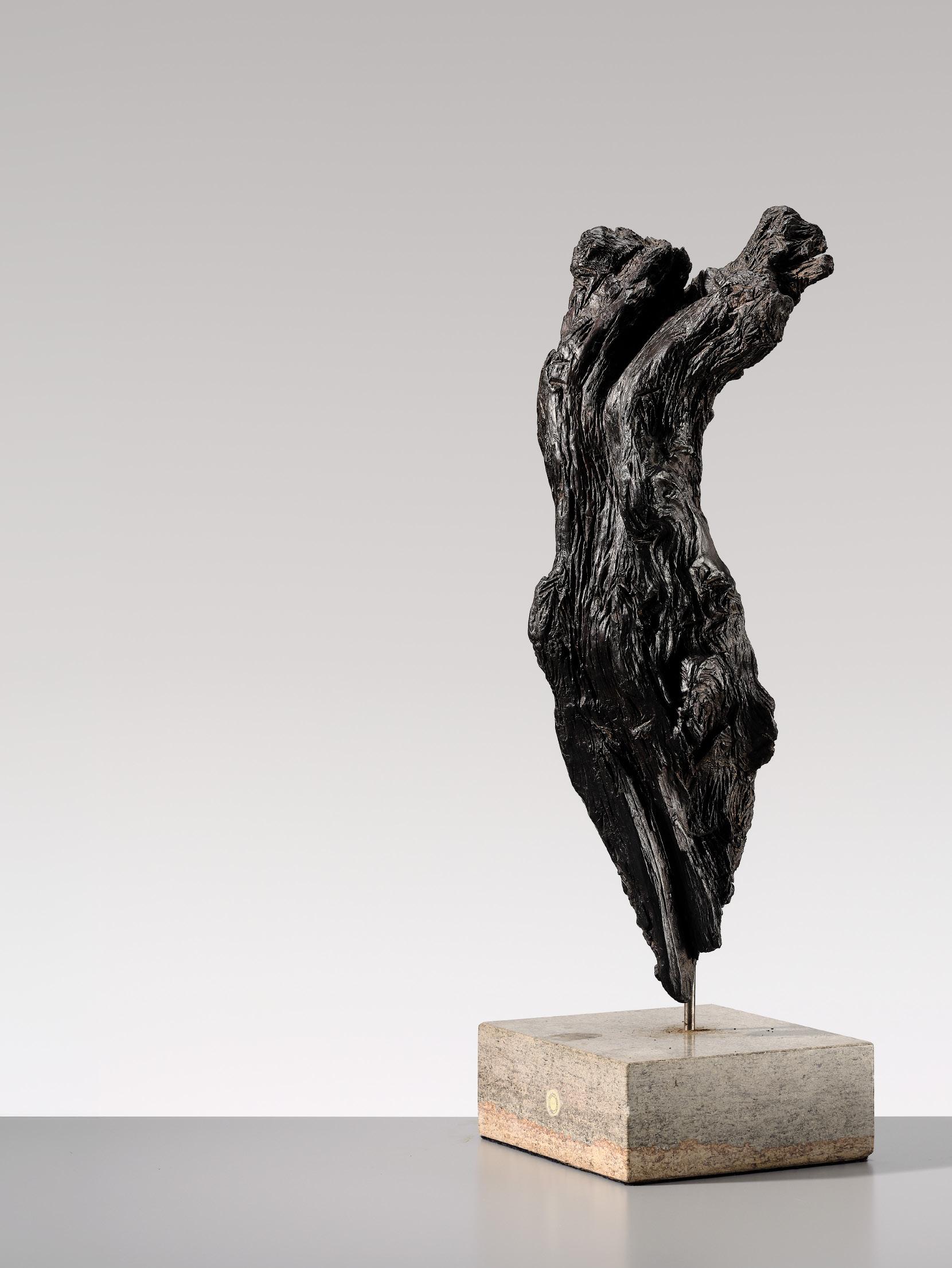
Japan, late Edo period (1615-1868)
Formed from a naturally shaped piece of dark rootwood and left essentially uncarved, this exceptional object embodies the aesthetic principles of literati contemplation, presenting an abstract, organic form shaped primarily by nature. The dynamic structure rises in an asymmetrical, tapering silhouette, with bifurcating upper sections suggestive of craggy peaks or wind-worn formations.
The surface displays a rich variety of textures, with deeply weathered ridges, hollows, and flowing grain, creating a powerful sense of movement. The undulating contours invite prolonged viewing and interpretation, revealing shifting associations: from mountainous landscapes to more figurative impressions, such as the graceful curvature of a reclining figure or the fleeting suggestion of an animal in motion. This interplay between natural form and imaginative perception lies at the heart of its aesthetic appeal.
HEIGHT 64 cm
Provenance: Sydney L. Moss Ltd., London. From a private collection in the United Kingdom, acquired from the above in 1983 or earlier. With a price label by Sydney L. Moss Ltd, stating a price GBP 1,500 (or approx. EUR 6,000 converted and adjusted for inflation at the time of writing).
Condition: Excellent condition with minor wear and natural imperfections including age cracks.
Mounted on a modern marble stand.
Scholar’s objects, known in Chinese as gongshi, are naturally formed stones that have been admired for centuries as objects of aesthetic contemplation and intellectual inspiration. First appreciated in China as early as the Tang dynasty and firmly established by the Song dynasty, these objects were prized by literati and scholars, who displayed them in studios and gardens as miniature landscapes or embodiments of natural forces. Stones were valued for qualities such as irregular form, surface texture, and their capacity to evoke mountains or cosmic landscapes, providing focal points for meditation, poetry, and philosophical reflection.
While this tradition is overwhelmingly associated with stone, there exists a far rarer parallel practice of selecting naturally formed rootwood that evokes similar qualities. In such cases, the role of the artisan is deliberately restrained, limited to selection, stabilization, and presentation rather than active carving. The present piece belongs to this highly unusual category, where nature itself acts as the primary creator.
In Japan, the related practice of suiseki similarly values naturally formed objects for their suggestive beauty, though it is almost exclusively limited to stone. Rootwood examples of this kind are exceedingly rare and remain outside the formal canon, making the present object particularly remarkable.
This piece stands at the intersection of natural specimen and cultivated art object, reflecting literati ideals of spontaneity, abstraction, and the poetic interpretation of nature. Its power lies in the preservation of its natural form, inviting continuous reinterpretation and contemplation.
Estimate EUR 4,000
Starting price EUR 2,000
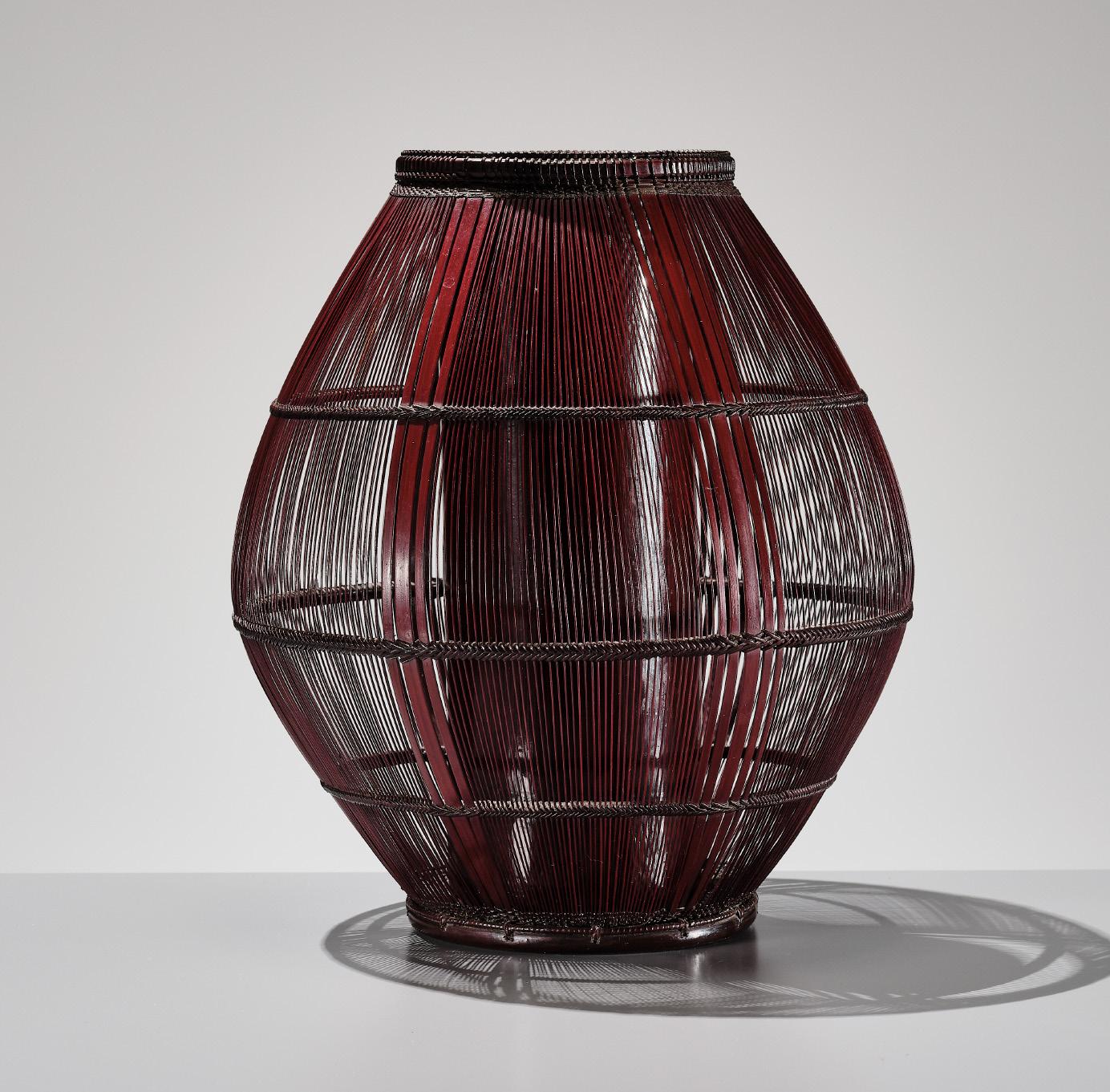
197
MAEDA CHIKUBOSAI II: A LACQUER BAMBOO AND RATTAN HANAKAGO (FLOWER BASKET)
By
Maeda Chikubosai II (1917-2003), signed Chikubosai kore o tsukuru Japan, c. 1990s
Elegantly woven in a rounded, ovoid form, rising from a neatly bound foot to a short, slightly constricted neck. The body is constructed with finely spaced vertical ribs, interwoven with circular plaiting, twining, and wrapping techniques, and reinforced by horizontal bands, creating a refined, openwork structure of great lightness and balance. The basket is finished with a deep reddishbrown lacquer, enhancing both the surface richness and structural clarity. Signed underneath CHIKUBOSAI kore o tsukuru [Chikubosai made this]. With a black lacquered bamboo otoshi (water holder).
HEIGHT 27.2 cm
Provenance: Joan B Mirviss Ltd., New York, 1993. From a private collection in London, United Kingdom, acquired from the above. A copy of the invoice from Joan B Mirviss Ltd, dated 17 November 1993, stating a purchase price of USD 1,750 (or approx. EUR 3,500 converted and adjusted for inflation at the time of writing) and confirming the above, accompanies the lot. Condition: Excellent condition. The otoshi with a crack.
With a wood tomobako storage box inscribed ‘Tateami tsubogata hanabako Chikubosai kore o tsukuru’ [Jar-shaped flower basket in vertical plaiting, made by Chikubosai].
AUCTION COMPARISON
Compare a closely related bamboo flower basket by the same artist, dated to c. 1960-1990, 33.5 cm high, at Bonhams, Tradition Travel Transition, 4 November 2021, London, lot 62 (sold for GBP 2,805 or approx. EUR 4,000 converted and adjusted for inflation at the time of writing).
Estimate EUR 3,000
Starting price EUR 1,500
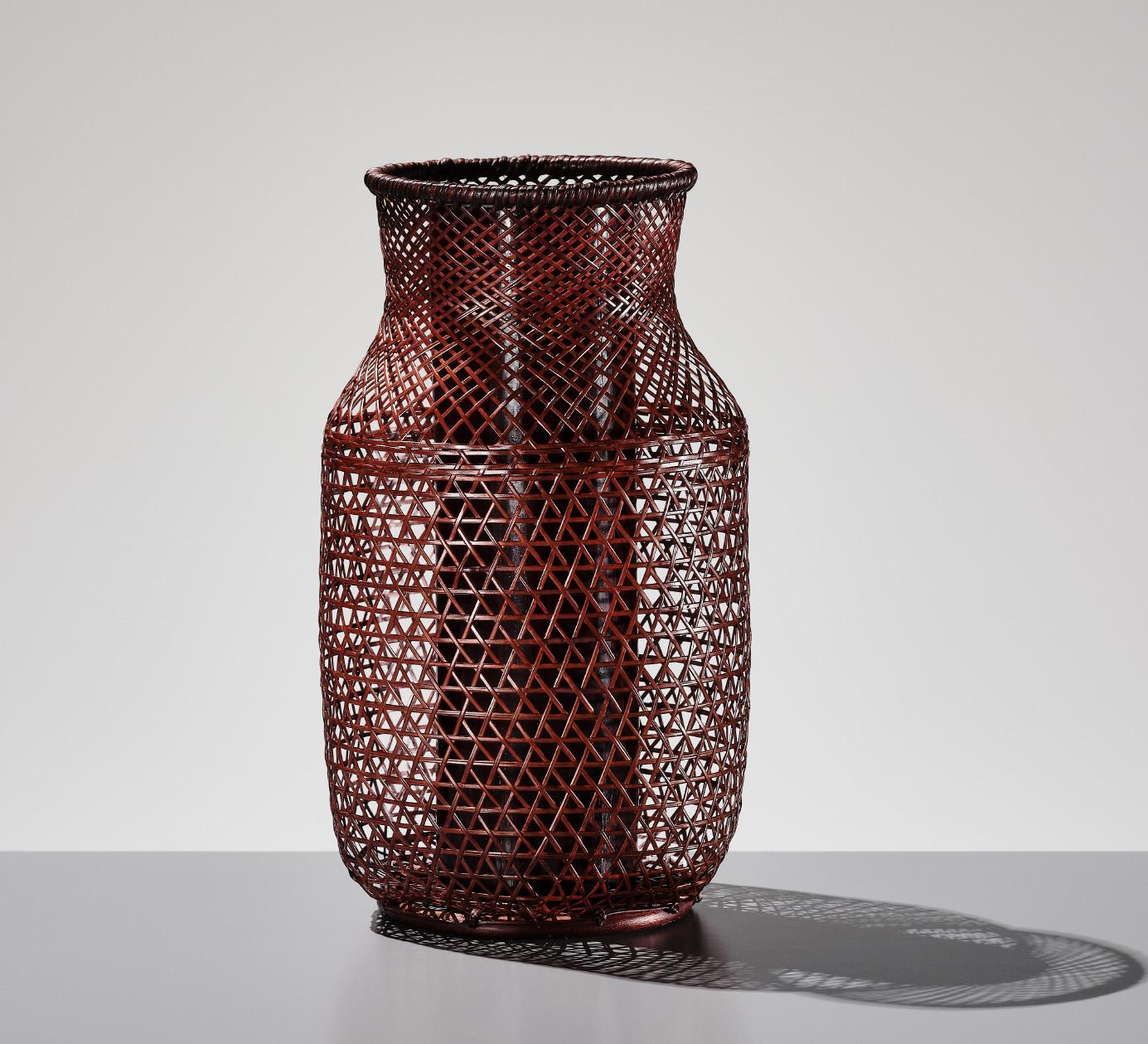
198
MAEDA CHIKUBOSAI II: A BAMBOO AND RATTAN HANAKAGO (FLOWER BASKET)
By Maeda Chikubosai II (1917-2003), signed Chikubosai Japan, c. 1990s
Of elegant cylindrical form, rising from a neatly defined ring foot to gently rounded sides and a slightly waisted neck, flaring outward to an everted rim reinforced with tightly braided rattan. The body is finely woven with alternating diagonal bamboo strips forming a precise diamond-shaped lattice pattern, demonstrating a high level of technical control and rhythmic clarity. The bamboo and rattan are lacquered in a warm reddish-brown tone, imparting depth and cohesion to the intricate surface design. The base is constructed with three radial supports, one signed CHIKUBOSAI. With a lacquered cylindrical bamboo otoshi (water holder).
HEIGHT 22.8 cm
Condition: Excellent condition.
With a wood tomobako (storage box) inscribed Kotsubo hanakago (Flower basket in the form of a small jar), and signed and sealed Chikubosai kake-oki hanakago [Jar-shaped basket for hanging or placing on the floor]. The tomogire (wrapping cloth) also sealed Chikubosai.
Maeda Chikubosai II (1917-2003) was born in Sakai City, Osaka, and trained under his father, Maeda Chikubosai I, as well as Yamamoto Chikuryosai I (Shoen). He became an independent artist in 1941 and succeeded to the Chikubosai name in 1950. Renowned for his mastery of both traditional techniques and refined modern forms, he was designated a Living National Treasure (Important Intangible Cultural Property holder) in 1995.
His work is characterized by a careful balance between structural precision and subtle elegance, often emphasizing clarity of form, refined proportions, and the expressive potential of bamboo as a sculptural medium. The present basket exemplifies these qualities through its harmonious proportions, restrained openwork, and richly lacquered surface, demonstrating the artist’s mature style.
AUCTION COMPARISON
Compare a closely related bamboo hanakago by the same artist, dated 20th century, 24.9 cm high, at Zacke, Fine Japanese Art, 16 June 2023, Vienna, lot 169 (sold for EUR 3,640).
Estimate EUR 3,000
Starting price EUR 1,500
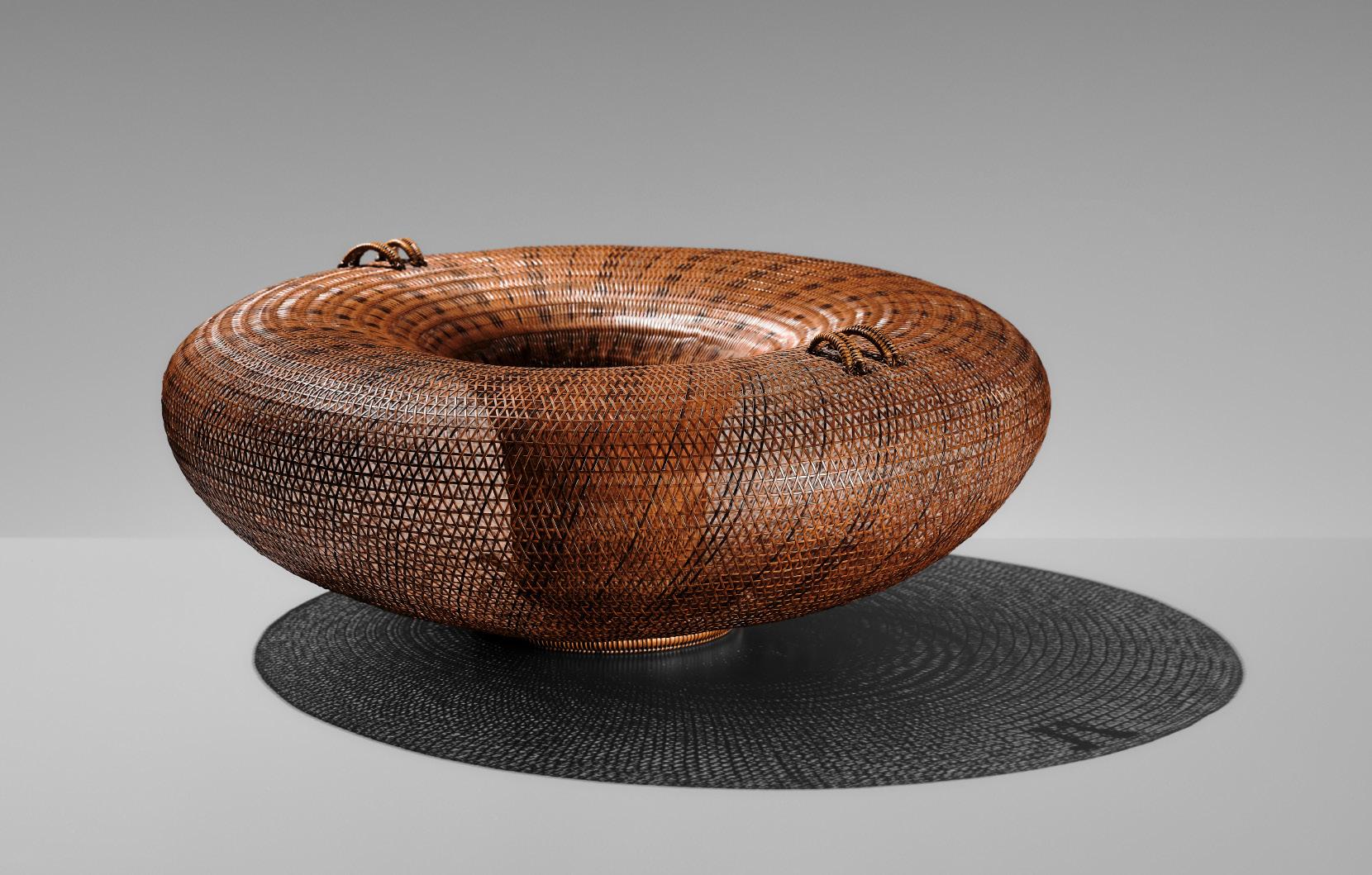
199
TANIOKA SHIGEO: A BAMBOO ‘BUDDHA MIND’ HANAKAGO (FLOWER BASKET)
By Tanioka Shigeo, signed Shigeo tsukuru Japan, c. 2000, Heisei period (1989-2019)
Of striking circular form, rising from a short ring foot to rounded sides that invert toward a hollowed center, creating a dynamic, sculptural presence. The madake (timber bamboo) is finely stained and intricately worked in two contrasting tones of hexagonal plaiting, forming a sophisticated spiral pattern that animates the surface with a sense of movement and depth. The upper rim is fitted on opposing sides with two pairs of neatly tied knotted handles, enhancing both function and visual rhythm. Signed underneath SHIGEO tsukuru [made by Shigeo].
HEIGHT 15 cm, DIAMETER 41.3 cm
Provenance: TAI Modern, Santa Fe. From a private collection in Connecticut, United States, acquired from the above. TAI Gallery was founded by Robert T. Coffland, a leading expert in Japanese bamboo arts in the West, who began sourcing works from contemporary masters in Japan. In 2014, the gallery was purchased by Margo Thoma, merged with her own gallery Eight Modern, and rebranded as TAI Modern.
Condition: Excellent condition.
With a wood tomobako (storage box) inscribed and signed Myoshin hanakago Tanioka Shigeo tsukuru [Buddha Mind flower basket, made by Tanioka Shigeo] and sealed Tanioka Shigeo.
Tanioka Shigeo (b. 1949) initially pursued a career in advertising after graduating from design school, but turned to bamboo art after encountering a photograph of a basket by Shono Shounsai, which proved decisive in shaping his artistic direction. He subsequently
trained under Tanabe Chikuunsai II, one of the foremost figures in modern bamboo art, and became an independent artist in 1984. Since then, he has regularly exhibited at the Japanese Traditional Art Crafts Exhibitions (Nitten).
The present basket reflects the enduring influence of the Osaka bamboo tradition, particularly in its openwork construction, structural clarity, and emphasis on rhythmic pattern. The dynamic spiral plaiting recalls earlier explorations of form by his teacher and predecessors, while asserting Tanioka’s own sculptural approach to bamboo, in which utility and abstraction are seamlessly combined.
MUSEUM COMPARISON
Compare a closely related bamboo flower basket by the same artist, dated 2000, 44 cm long, in the Minneapolis Institute of Art, accession number 2013.29.161a, b.
AUCTION COMPARISON
Compare a closely related bamboo flower basket by the same artist, dated 2002, 51 cm long, also previously acquired at Tai Modern in Santa Fe, at Christie’s, The Collection of Victoria, Lady de Rothschild, 9 December 2021, London, lot 167 (sold for GBP 16,250 or approx. EUR 23,500 converted and adjusted for inflation at the time of writing).
Estimate EUR 6,000
Starting price EUR 3,000
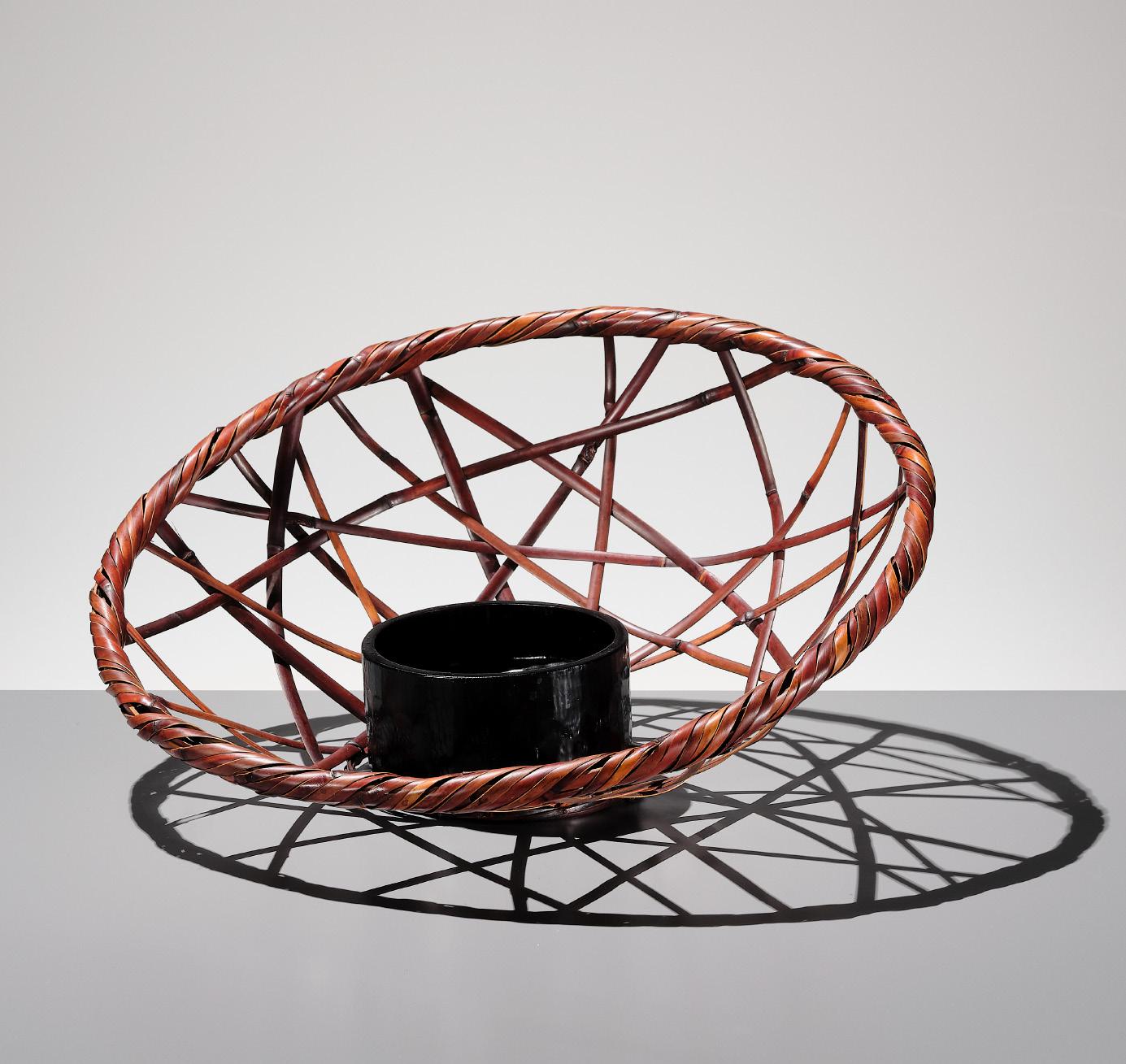
200 A BAMBOO AND RATTAN HANAKAGO (FLOWER BASKET), ATTRIBUTED TO IIZUKA ROKANSAI
Attributed to Iizuka Rokansai (1890-1958), unsigned Japan, first half of the 20th century, Taisho (1912-1926) to Showa period (1926-1989)
Of low, circular form with wide, gently flaring sides, the rim reinforced with a thick, braided binding. The openwork body is composed of irregularly arranged, intersecting bamboo strips, forming an abstract lattice of great visual spontaneity. The surface is enhanced by a dark stain, emphasizing the dynamic interplay between structure and negative space. With a short black lacquered bamboo otoshi (water holder).
LENGTH 42.5 cm
Condition: Excellent condition.
Iizuka Rokansai (1890-1958) is widely regarded as one of the most important pioneers of modern Japanese bamboo art. Born in Tochigi Prefecture as the seventh son of the basket maker Iizuka Hosai I, he was trained in the family workshop from an early age and later worked under his elder brother, Iizuka Hosai II. In his mid-
twenties, Rokansai established himself as an independent artist, seeking to elevate bamboo basketry beyond craft into the realm of fine art.
His work is distinguished by an extraordinary range of expression, from highly refined, classical forms to boldly experimental and rustic compositions. Drawing inspiration from calligraphy, Chinese characters, and Japanese poetry, Rokansai developed a distinctive aesthetic that emphasizes rhythm, asymmetry, and the expressive potential of line. The present basket, with its irregular openwork lattice and sculptural clarity, reflects this more abstract and innovative aspect of his oeuvre, supporting the attribution.
AUCTION COMPARISON
Compare a related bamboo flower basket, by Iizuka Rokansai, dated to the Showa period (1926-1989), 31.8 cm high, at Bonhams, Fine Japanese Art, 6 November 2014, London, lot 269 (sold for GBP 5,000 or approx. EUR 8,000 converted and adjusted for inflation at the time of writing).
Estimate EUR 3,000
Starting price EUR 1,500
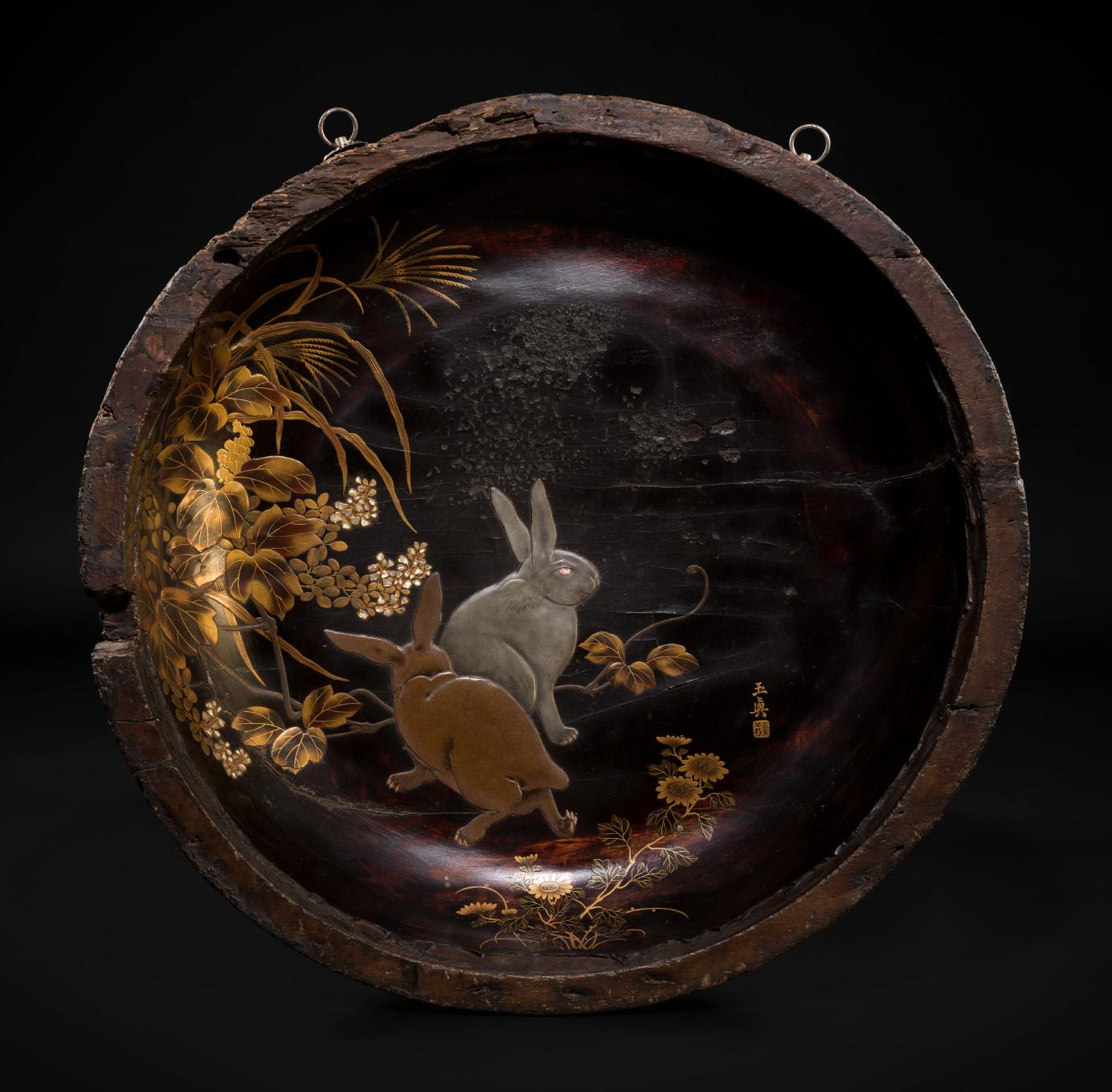
201
GYOKUSHIN: A VERY LARGE (89 CM) LACQUERED WOOD ‘HARES AMONG AUTUMN GRASSES’ MOON-SHAPED BASIN
By Gyokushin, signed Gyokushin with seal Masayoshi Japan, 19th century, late Edo (1615-1868) to Meiji period (1868-1912)
Exceptionally large and well carved in wood, the basin of circular, moon-like form with deep rounded sides rising from a short, straight foot, the surface displaying an attractive natural grain. The interior is finished in a lustrous dark brown lacquer ground and finely decorated in gold and silver takamaki-e and hiramaki-e, further enriched with inlays of mother-of-pearl.
The design depicts a pair of naturalistically rendered hares running amidst dense autumn grasses, including ferns, trailing tsuta (ivy), and chrysanthemums - motifs traditionally associated with the autumn season. The circular form of the basin subtly evokes the full moon, an allusion reinforced by the classical theme of hares beneath the autumn moon, creating a poetic and visually harmonious composition. Signed in gold GYOKUSHIN with seal Masayoshi.
The artist is very likely connected to the circle of Shibata Zeshin, inheriting the character shin (眞) in his name, suggesting a lineage or artistic affiliation.
HEIGHT 19.4 cm, DIAMETER 89 cm
Condition: The lacquered image is overall well-preserved with minor typical losses and few old cracks, some with minor associated touchups. The bowl with expected surface wear and natural imperfections, losses, chips, large splits and age cracks. Traces of weathering and erosion, with evidence of insect activity.
Estimate EUR 4,000
Starting price EUR 2,000
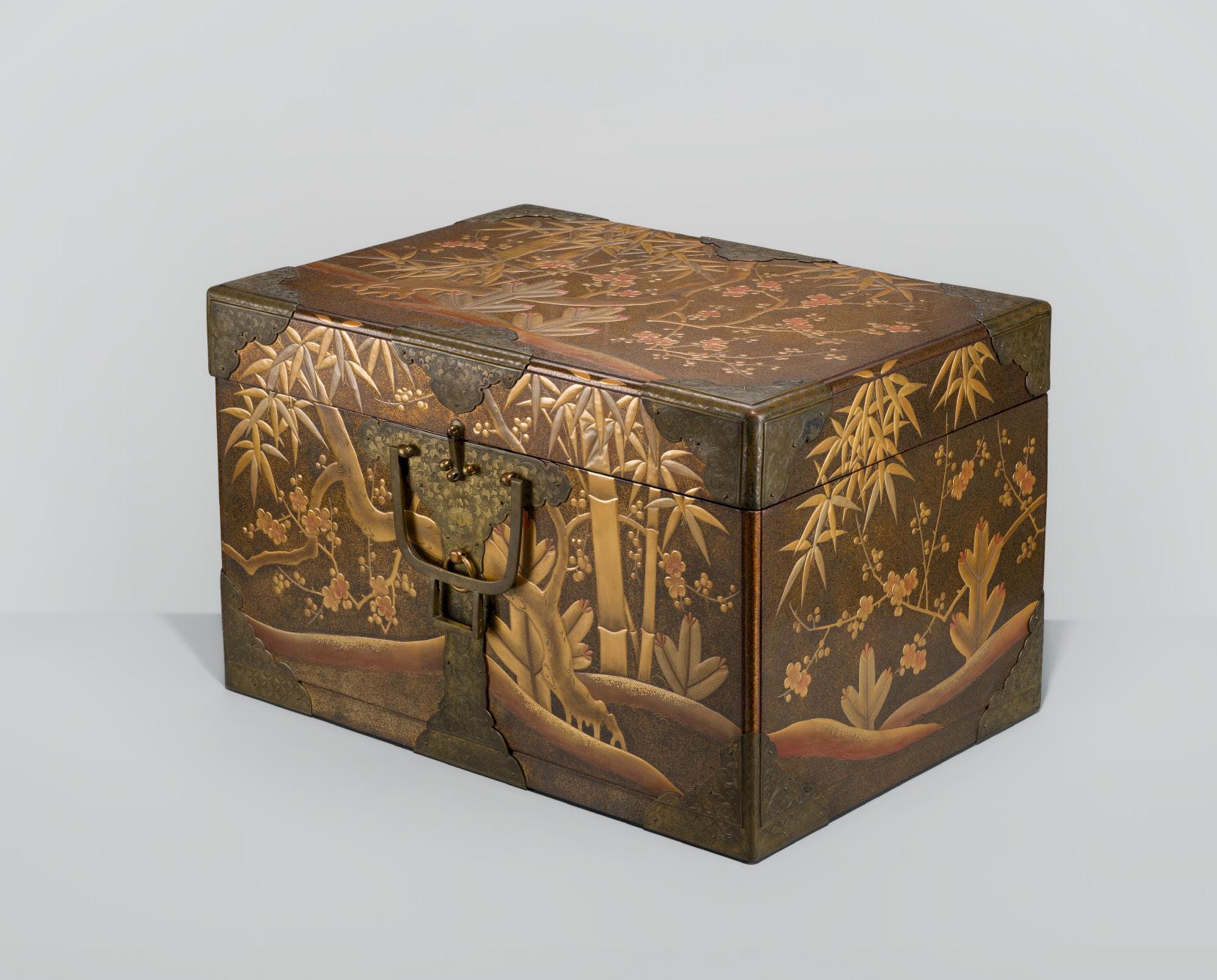
202
A RARE AND LARGE GOLD-LACQUER
‘THREE FRIENDS OF WINTER’ HASAMIBAKO (TRAVELING CHEST)
Japan, late 18th to early 19th century, Edo period (1615-1868)
Finely crafted, of generous proportions and a rectangular form, with recessed edges and corners fitted with brass mounts engraved with stylized ivy leaves entwined among scrolling tendrils. Each side exhibiting a radiant nashiji ground, meticulously decorated in gold takamaki-e and hiramaki-e, punctuated with subtle red accents, to depict a harmonious composition of lush bamboo (take) stalks, a gnarled plum (ume) tree in full blossom, and young pine saplings (wakamatsu). The longitudinal sides further fitted with brass mounts, incorporating closure pins and a pair of carrying handles. The interior is lined with red silk adorned with auspicious motifs, and containing a removable tray.
SIZE 37.8 x 61.1 x 42.3 cm
Condition: Very good condition with minor expected wear and light traces of handling and use. Light rubbing and small losses to lacquer around the edges and corners. A few cracks to the underside. Some interior corners with old cracks. The interior silk lining with a few loose threads.
The ‘Three Friends of Winter’ motif is frequently used across all mediums in Chinese and Japanese art. Comprised of pine, bamboo and prunus, this motif is emblematic of the Confucian virtues of fortitude and resilience. As the pine and bamboo are evergreen plants and the prunus, a plant that has lived for a long time, the three together are also an auspicious symbol of longevity.
AUCTION COMPARISON
Compare a related lacquer hasamibako (traveling chest) at Christie’s, Japanese Art and Design, 13 July 2006, London, lot 359 (sold for GBP 8,400 or approx. EUR 16,800 converted and adjusted for inflation at the time of writing).
Estimate EUR 6,000
Starting price EUR 3,000
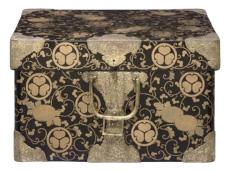
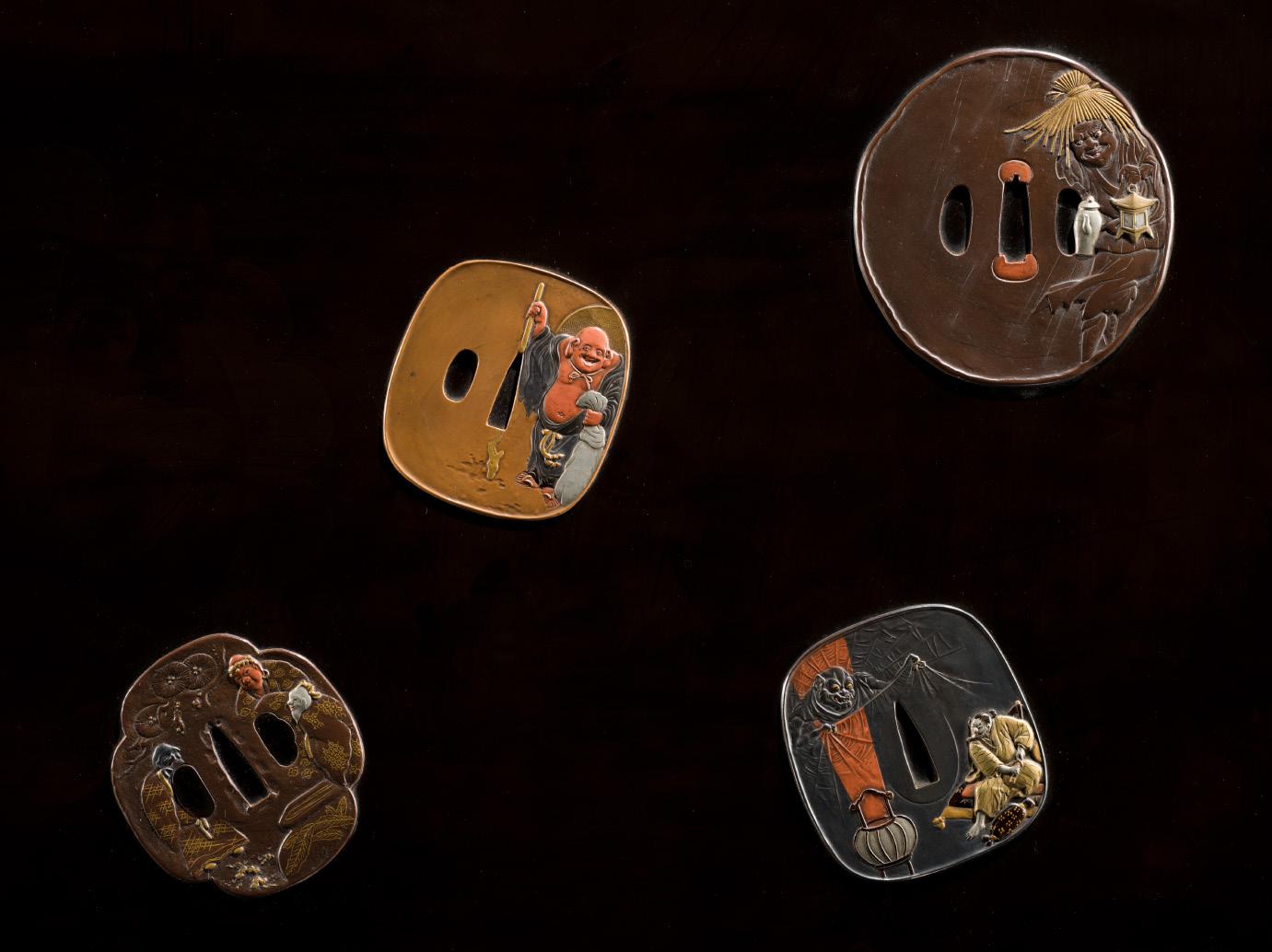
203 AN EXTRAORDINARY AND LARGE LACQUER ‘SWORD FITTINGS’ TRAVELING CHEST, STYLE OF SHIBATA ZESHIN
Japan, late 19th century, Meiji period (1868-1912)
Published: Resonance of Wa - The Japanese Spirit. Casal Collection, 2025, p. 236.
Exquisitely crafted and of generous proportions, the chest is of rectangular form with recessed edges finished in gold fundame, mounted with gilt-brass fittings finely engraved with foliate motifs. Each side is executed on a rich roiro ground and superbly decorated with an elaborate arrangement of simulated sword fittings, including tsuba (sword guards) and kozuka (knife handles), rendered in polychrome lacquer with remarkable technical virtuosity to emulate metalwork.
The individual designs depict a wide array of classical and popular subjects, including Urashima Taro, Bodhidharma, Raiko and the Earth Spider, The Three Sake Tasters, Hotei, and The Oil Thief, among others.
SIZE 38.6 x 62.2 x 42.5 cm
Provenance: Ex-Collection of Ugo Alfons Casal. Osaka City Museum of Fine Arts, bequeathed from the above and subsequently deaccessioned in 2021.
Condition: The lower section with significant losses and crackling to the gold and black lacquer ground, requiring restoration, this however does not affect the image. A few small nicks and shallow surface scratches throughout. The paper lining of the interior visibly torn.
The practice of decorating lacquer vessels with highly convincing imitations of sword fittings is generally attributed to Shibata Zeshin (1807-1891), one of the most innovative lacquer artists of the Meiji period. According to Sawaguchi Goichi’s seminal study Nihon shikko no kenkyu (1933), such designs were often created using negative plaster molds, into which successive layers of lacquer were built up in reverse. Once released, these elements were applied to the surface of the object, resulting in astonishingly lifelike representations of metalwork. This technique also explains the recurrence of identical motifs across multiple works, both signed and unsigned.
LITERATURE COMPARISON
Compare a closely related lacquer cabinet for inro, by Shibata Zeshin, Meiji period, probably c. 1888, 30.4 cm long, illustrated in Meiji no Takara: Treasures of Imperial Japan - The Nasser D. Khalili Collection, The Kibo Foundation, 1995, Shibata Zeshin, no. 72.
AUCTION COMPARISON
Compare a closely related polychrome lacquer cabinet, decorated with sword fittings in the style of Shibata Zeshin, Meiji period, late 19th to early 20th century, 62 cm long, at Bonhams, Fine Japanese Art, London, 16 May 2024, lot 87 (sold for GBP 17,920 or approx. EUR 21,500 converted and adjusted for inflation at the time of writing).
Estimate EUR 15,000
Starting price EUR 7,500
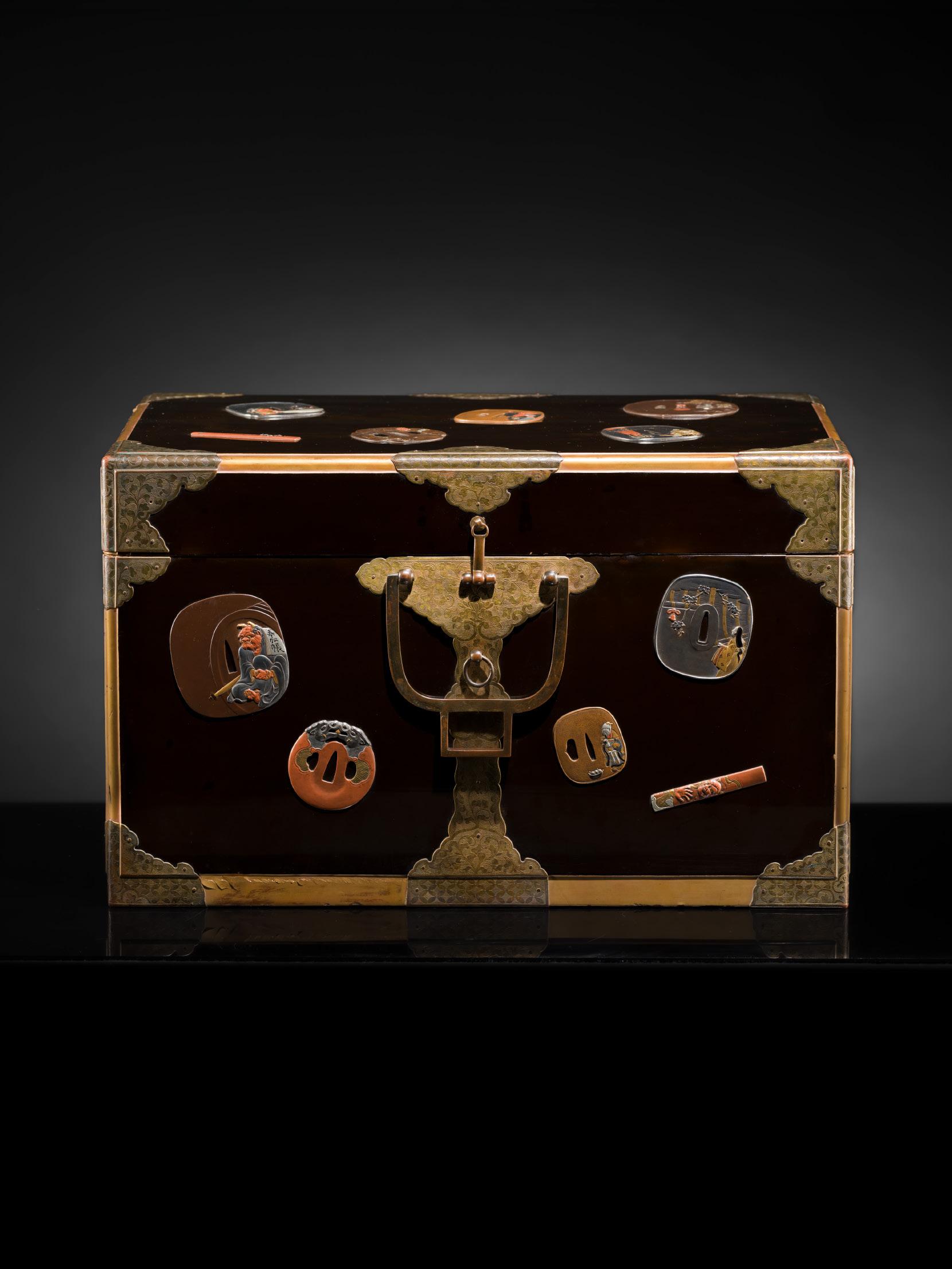
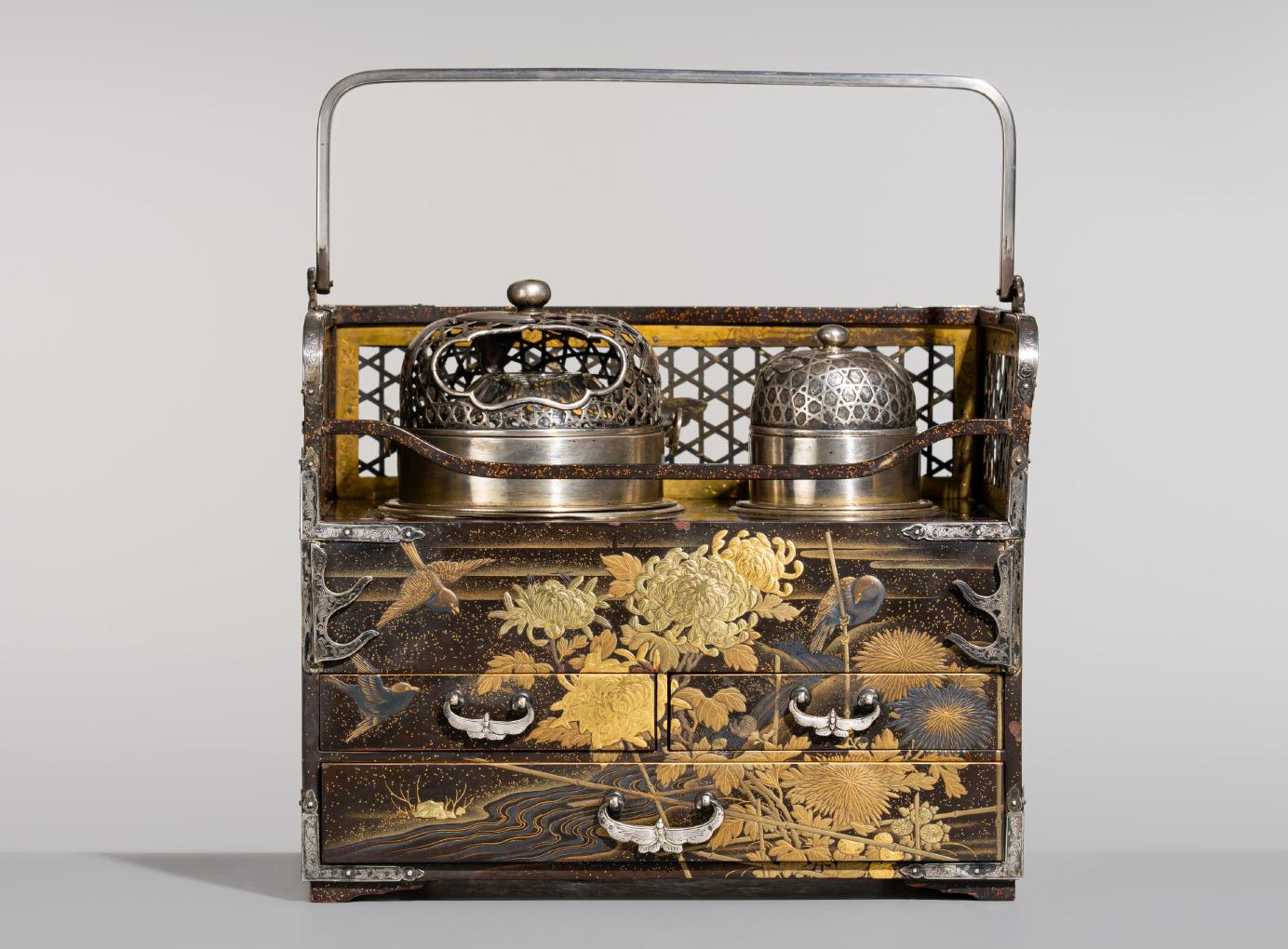
204
A FINE SILVER-FITTED LACQUER ‘SEASONAL BLOSSOMS AND BIRDS’ TABAKO-BON (SMOKING SET)
Japan, 19th century, late Edo (1615-1868) to Meiji period (1868-1912)
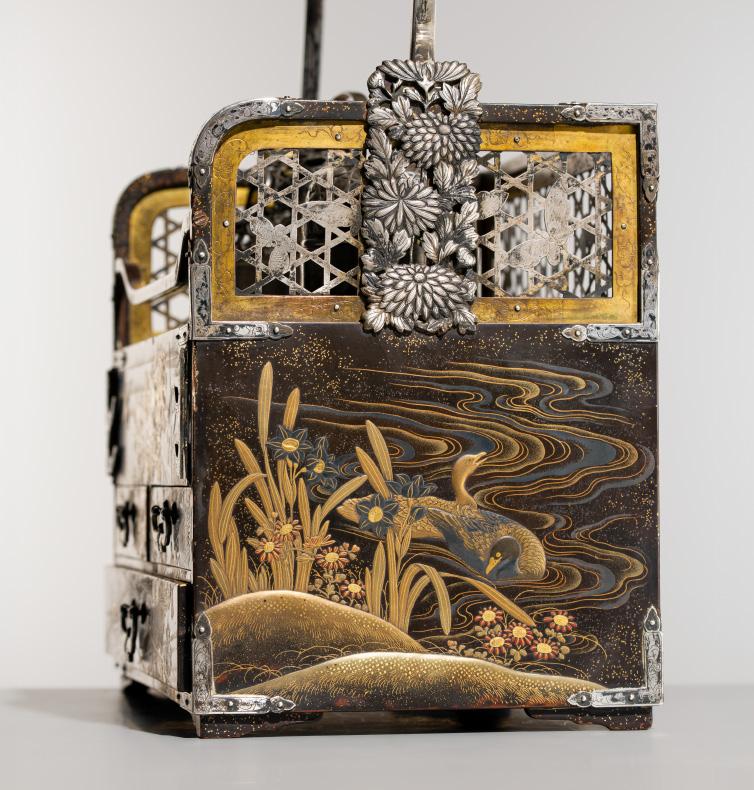
Of typical rectangular form, the box fitted with a prominent silver handle and three drawers, each applied with a small hinged silver pull cast in the form of a butterfly. The open top is shaped with two gently sloping recesses designed to support a pair of kiseru (tobacco pipes) and is further fitted with a removable silver brazier and ash container. Their domed covers are finely decorated with interlaced wickerwork and fluttering butterflies, echoed by additional silver mounts of butterflies and luxuriant peonies along the sides.
The exterior is richly decorated in gold and silver takamaki-e, lavishly embellished with gold foil and kirigane flakes, depicting a profusion of seasonal blossoms including chrysanthemums, peonies, cherry blossoms, and bellflowers, amid a lively array of birds such as mandarin ducks, sparrows, red-crowned cranes, and peacocks. The drawer interiors are finished in gold sprinkles over a dark-brown lacquer ground, framed by fundame rims.
SIZE 19.8 x 23.5 x 14.3 cm
Condition: Very good condition with expected wear. Remarkably well-preserved for this type. Minor typical warping and minuscule losses to the gold foil inlays. Some general wear to edges and to the lacquered ground. Surface scratches to the underside and some light wear and tarnishing to the silver mounts.
AUCTION COMPARISON
Compare a closely related lacquer tabako-bon (smoking set), decorated with cherry blossoms inlaid in gold foil, Edo period, 19th century, at Bonhams, The Arno Ziesnitz Collection, New York, 21 March 2018, lot 1002 (sold for USD 3,125 or approx. EUR 3,500 converted and adjusted for inflation at the time of writing).
Estimate EUR 3,000
Starting price EUR 1,500
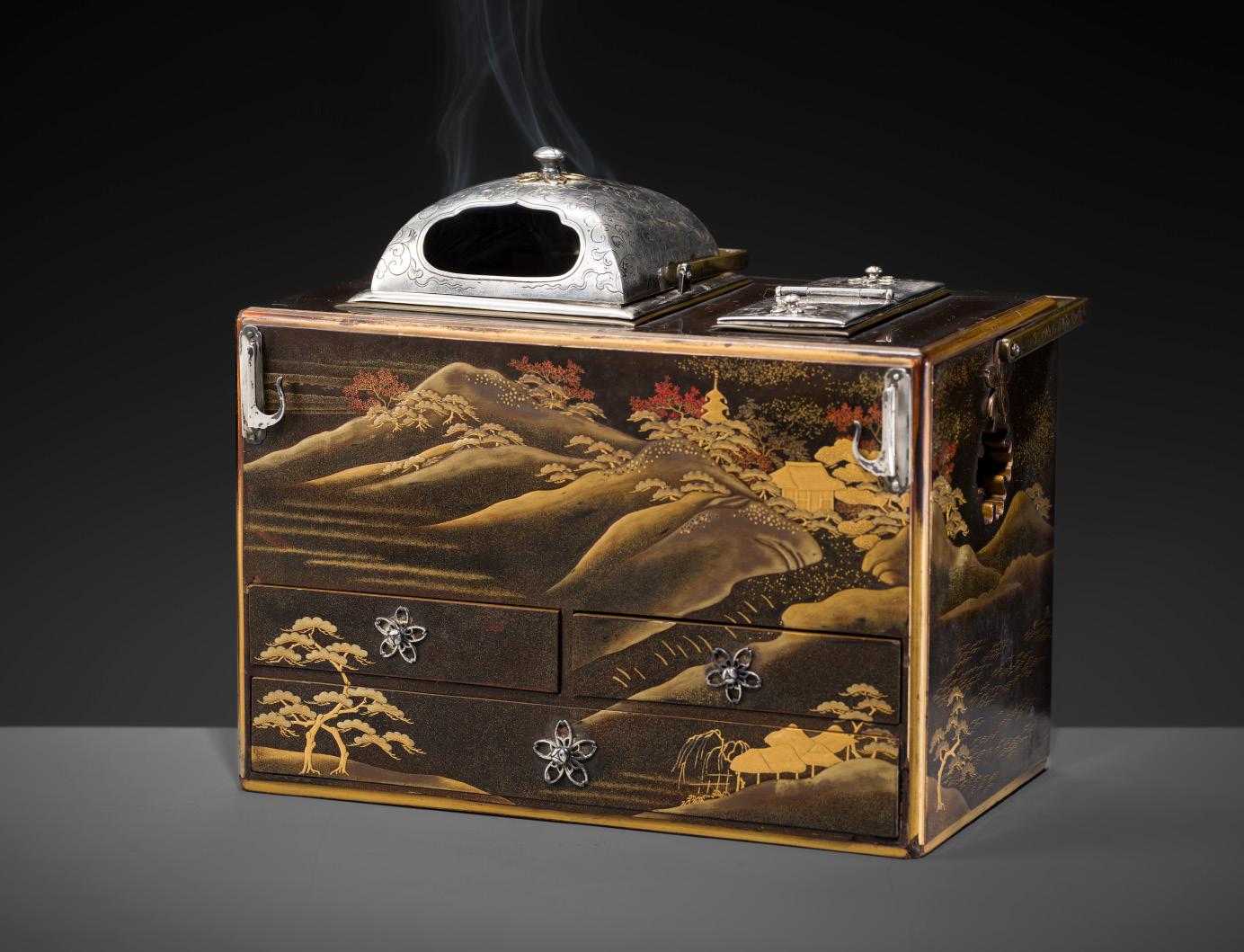
205
Japan, 19th century, late Edo (1615-1868) to Meiji period (1868-1912)
The portable box of rectangular form is fitted with a prominent overhanging brass handle, three drawers, each mounted with a small knop in the form of a cherry blossom, and two folding hooks designed to support a large kiseru (tobacco pipe). The exterior is finely decorated in gold, silver, and red takamaki-e and togidashi maki-e, further enriched with gold e-nashiji and kirigane flakes, depicting a picturesque view of Mount Fuji rising through drifting clouds above a tranquil lake. The landscape is flanked by gently rolling hills dotted with lush pine trees and small thatched huts, rendered with subtle depth and delicate openwork details. The top is fitted with a miniature silver brazier and a square ash container, their surfaces finely incised with scrolling tendrils and similarly adorned with cherry blossom-form knops. The edges of the box are finished in gold fundame, while the interiors of the drawers are lacquered in luminous nashiji with fundame rims.
HEIGHT 21.5 cm (incl. handle), LENGTH 21.8 cm
Provenance: A private collection in Paris, France. Thereafter in a private collection in London, United Kingdom, acquired from the above.
Condition: Good condition with surface wear and expected traces of handling and use. Mild tarnishing to the silver mounts. A small chip to one of the lower corners with associated cracks. Light rubbing and minor losses to the lacquer, primarily along the edges and corners. The lower drawer is obstructed and does not open.
Estimate EUR 2,000 Starting price EUR 1,000
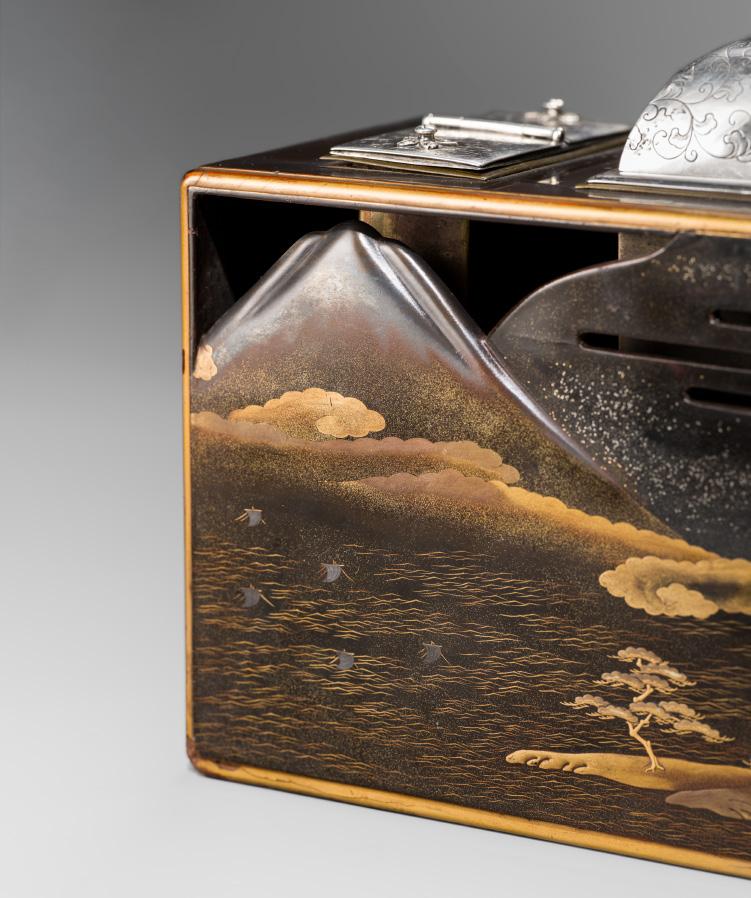
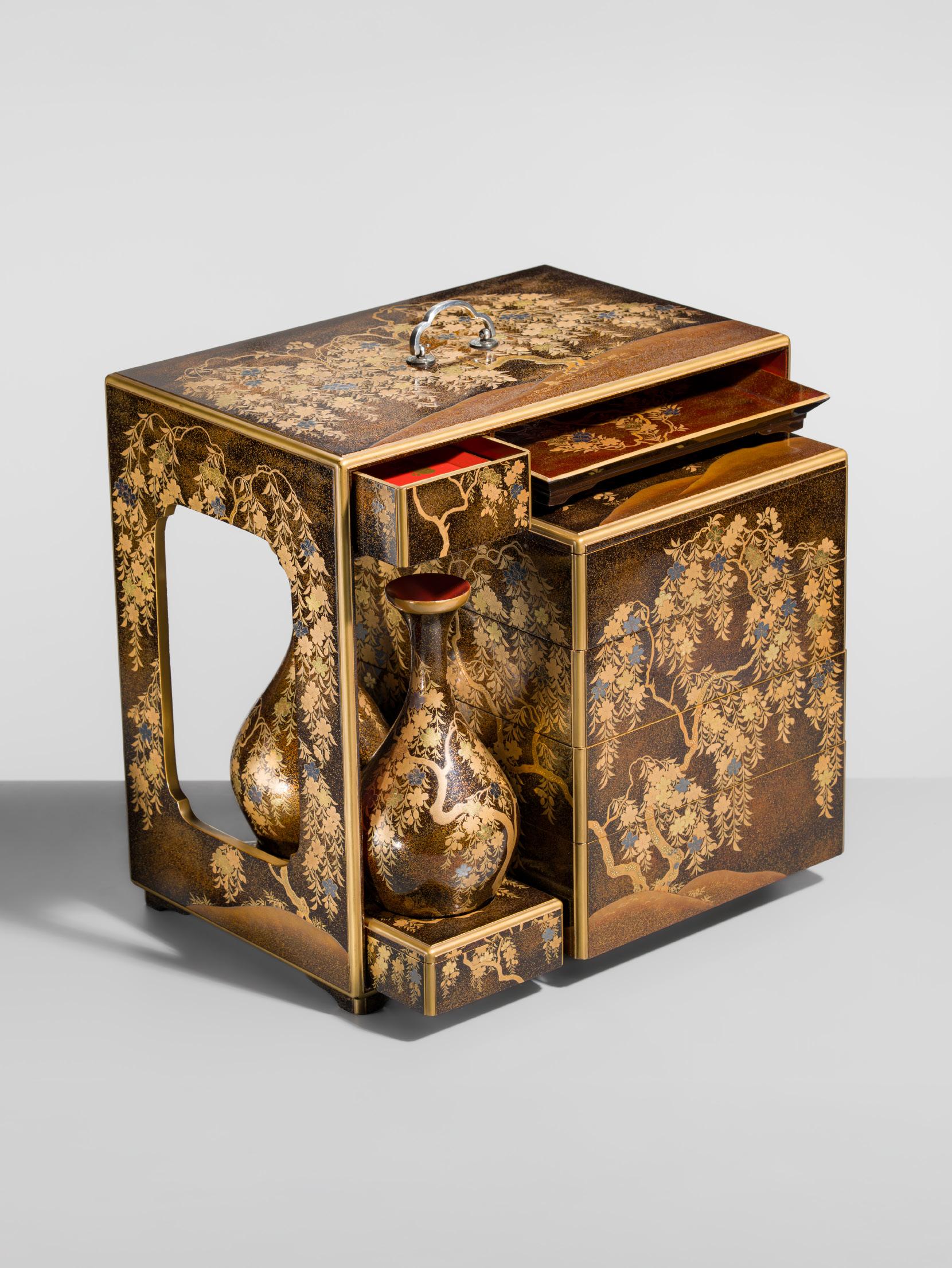
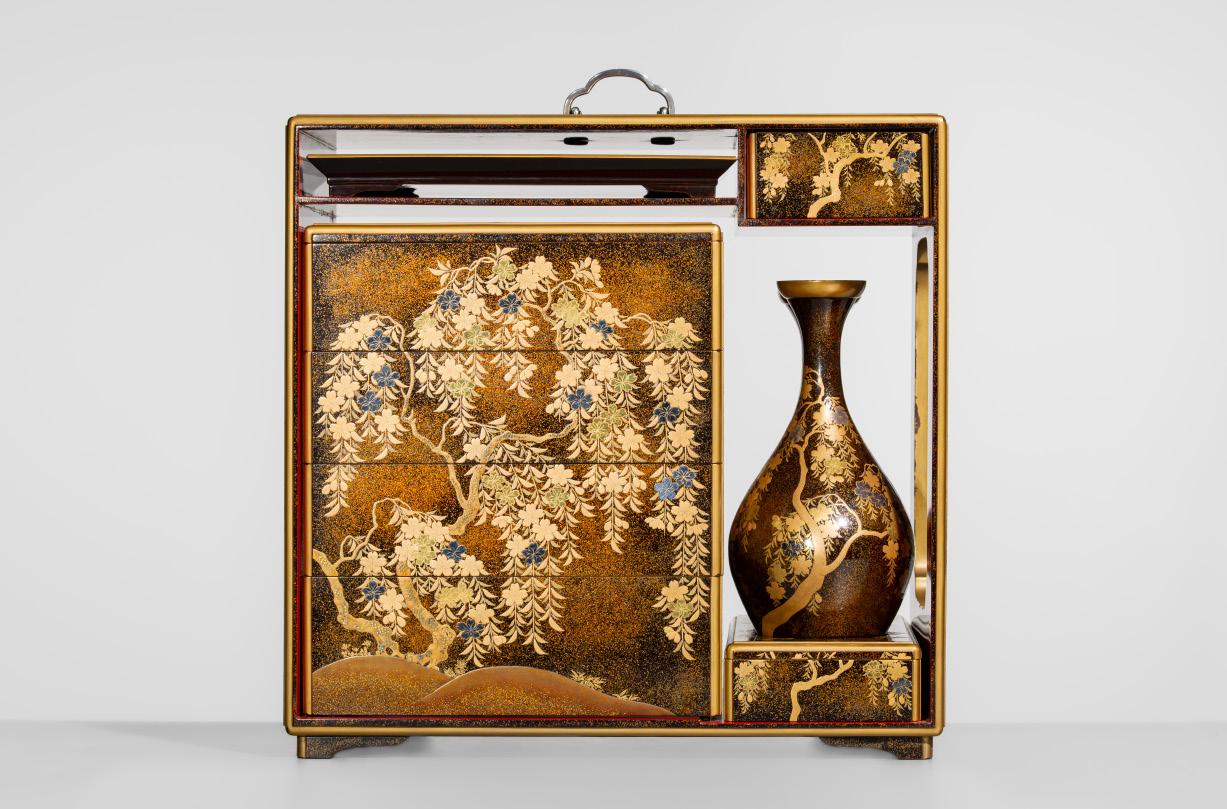
206 A MAGNIFICENT GOLD-LACQUER ‘CHERRY BLOSSOMS’ HANAMI SAGE-JUBAKO (PORTABLE PICNIC SET FOR CHERRY BLOSSOM VIEWING)
Japan, late 19th century, late Edo period (1615-1868) to early Meiji period (1868-1912)
Exquisitely crafted in lacquered wood, composed of a rectangular frame enclosing a principal square body formed by four stackable units, accompanied by two lacquered-metal tokkuri flasks, each with a pear-shaped body, slender waisted neck, and distinctive flared mouth, fitted onto an elongated lower compartment containing various accoutrements for the picnic. The upper section of the structure houses two shelves, one supporting a large square tray and the other an elongated container with a set of five similarly shaped trays. The top of the portable basket fitted with a silver lobed carrying handle.
The exterior of the basket exhibiting overall a finely polished dark brown lacquer ground, beautifully sprinkled with gold and silver powders of varying thickness, exquisitely decorated in gold and silver takamaki-e and hiramaki-e, accented with gold kirigane flakes, to depict the lush branches of various Sakura trees in full bloom, mirroring the function of this sublime set. The interior of the basket, as well as each container and small tray, is finished in a striking vermilion-red lacquer, with the latter further adorned with gold hiramaki-e paulownia and millet crests and with gold fundame rims.
SIZE 40.7 x 37.8 x 24.3 cm
Condition: Excellent condition with only minor surface wear and light traces of handling and use with occasional minuscule losses to lacquer along the corners, as is to be expected from this type.
With a wood storage box.
Hanami, or ‘flower viewing’, designates the longstanding Japanese custom of appreciating the transient beauty of blossoms. In this context, the term most commonly refers to cherry blossoms (sakura), and more rarely to plum blossoms (ume). From late March to early May, cherry trees come into bloom across much of Japan. The annual cherry blossom front forecast, issued by the Japan Meteorological Agency, is closely followed, as the blossoms typically remain at their peak for only one to two weeks.
Sets such as the present lot would have facilitated the transport of food, utensils, and other requisites for outdoor gatherings among members of the late Edo-period elite. They supported the organization of carefully staged occasions in which participants could partake in seasonal leisure while observing newly opened cherry blossoms, a moment that signals the early renewal of the natural world after winter.
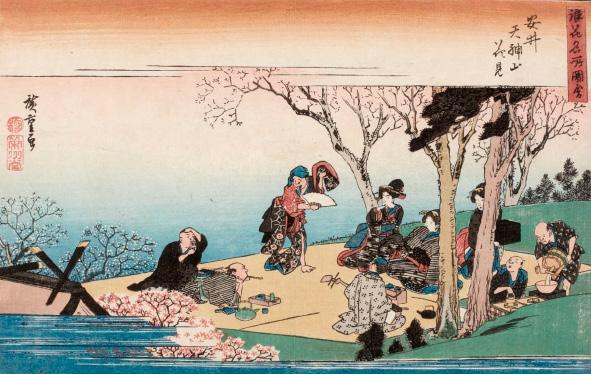
Utagawa Hiroshige (1797-1858) Cherry-blossom Viewing on the Hill of the Tenjin Shrine in Yasui, a hanami sage-jubako visible in the middle
Compare a closely related lacquer sage-jubako (portable picnic set), Meiji period, 19th century, 36.7 cm high, at Christie’s, Japanese and Korean Works of Art, 22 September 2004, lot 256 (sold for USD 11,950 or approx. EUR 18,000 converted and adjusted for inflation at the time of writing).
Estimate EUR 8,000 Starting price EUR 4,000
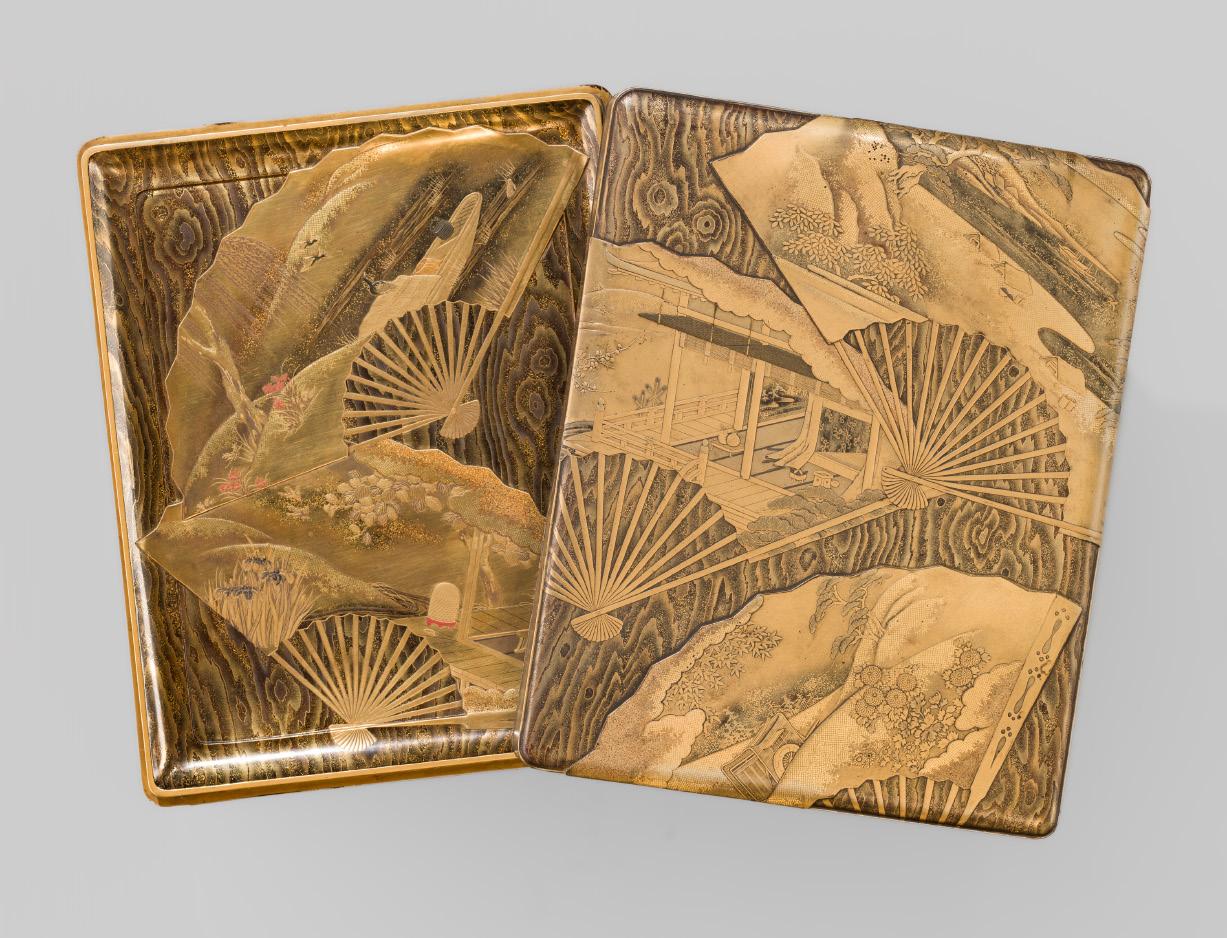
207
A FINE AND LARGE LACQUER ‘OVERLAPPING FANS’ TEBAKO (ACCESSORY BOX) WITH INTERIOR TRAY
Japan, 19th century
Of rectangular shape, exquisitely decorated in gold, silver, and red takamaki-e and hiramaki-e on a mokume (wood grain) ground. The inrobuta (flush-fitting) lid and sides of the box depict seven fans embellished with fine kinpun and kirigane flakes, one featuring thatched huts by a lake, another with an oi next to a pine and chrysanthemums (kiku), one with a luxurious veranda, and others depicting lush gardens and peony flowers. The tray with four bracket feet presents two additional fans, showing a willow and a bird perched on a fishing boat, and another veranda, its underside finished in nashiji. The interior is finished in nashiji with gold fundame rims.
SIZE 15.5 x 25.5 x 20.5 cm
Provenance: The private collection of the Tomkinson family, United Kingdom. A copy of the invoice from Michael E. Bound, dated June 2011, stating a purchase price of GBP 2,800 (or approx. EUR 5,000 converted and adjusted for inflation at the time of writing) and confirming the above, accompanies the lot.
Condition: Excellent condition with minor wear to the edges and typical losses to the kirigane flakes.
This present lot captures scenes from the the Genji Monogatari (The Tale of Genji), Murasaki Shikibu’s celebrated 11th-century courtly romance. It captures the refined aesthetics of Heian court life, where aristocrats valued seasonal beauty and poetic sensitivity as measures of character and status.
AUCTION COMPARISON
Compare a related lacquer tebako with overlapping fans, by Jokasai, dated late 19th century, 16 x 28.8 x 23 cm, at Sotheby’s, Fine Japanese Art, 5 November 2019, London, lot 59 (sold for GBP 43,750 or approx. EUR 66,000 converted and adjusted for inflation at the time of writing).
Estimate EUR 8,000
Starting price EUR 4,000
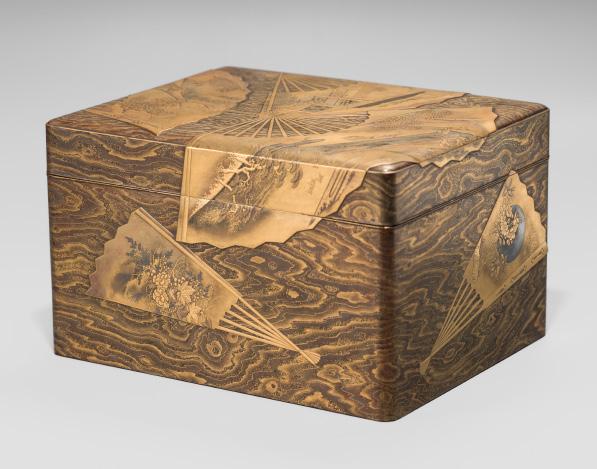
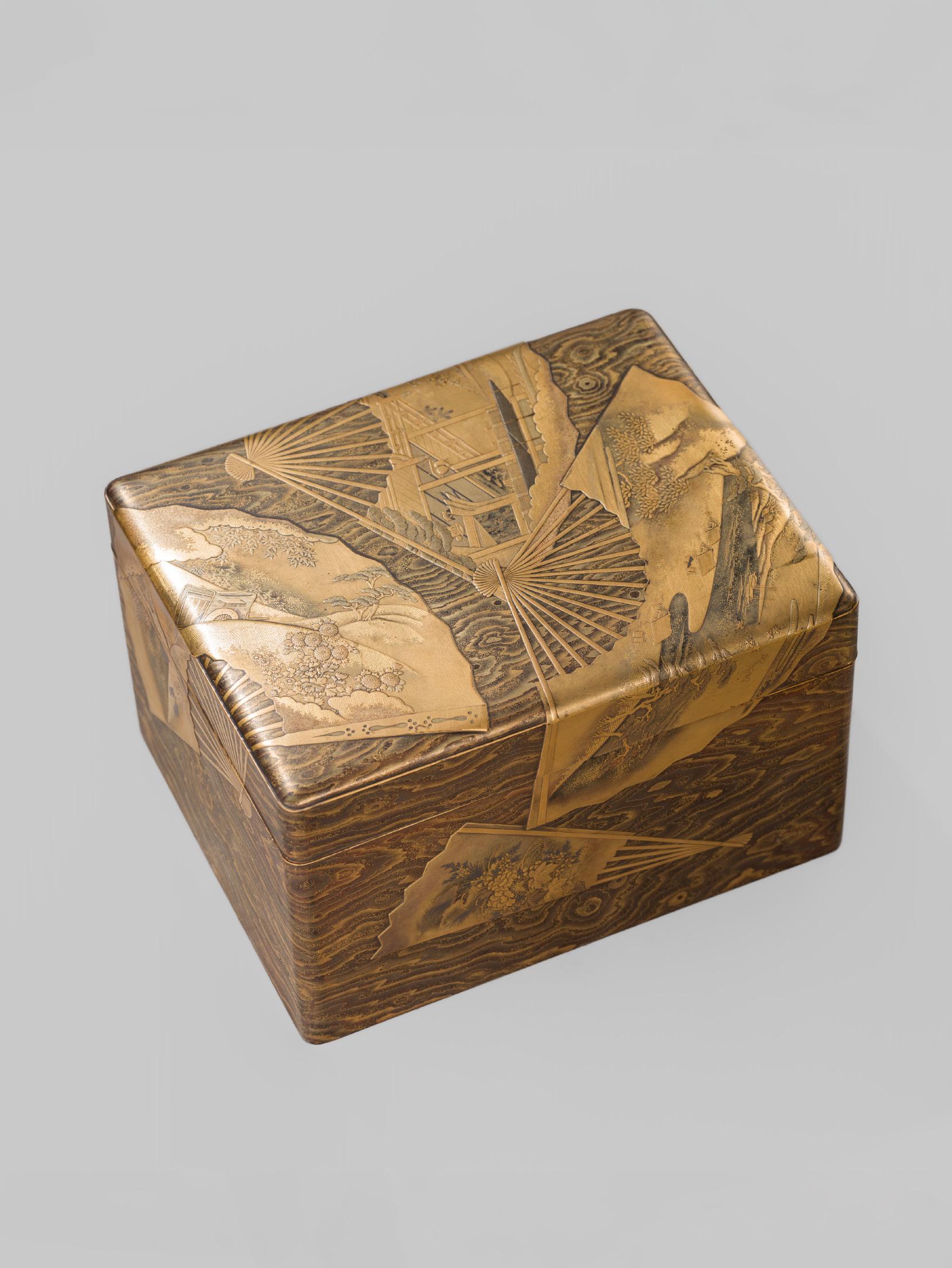
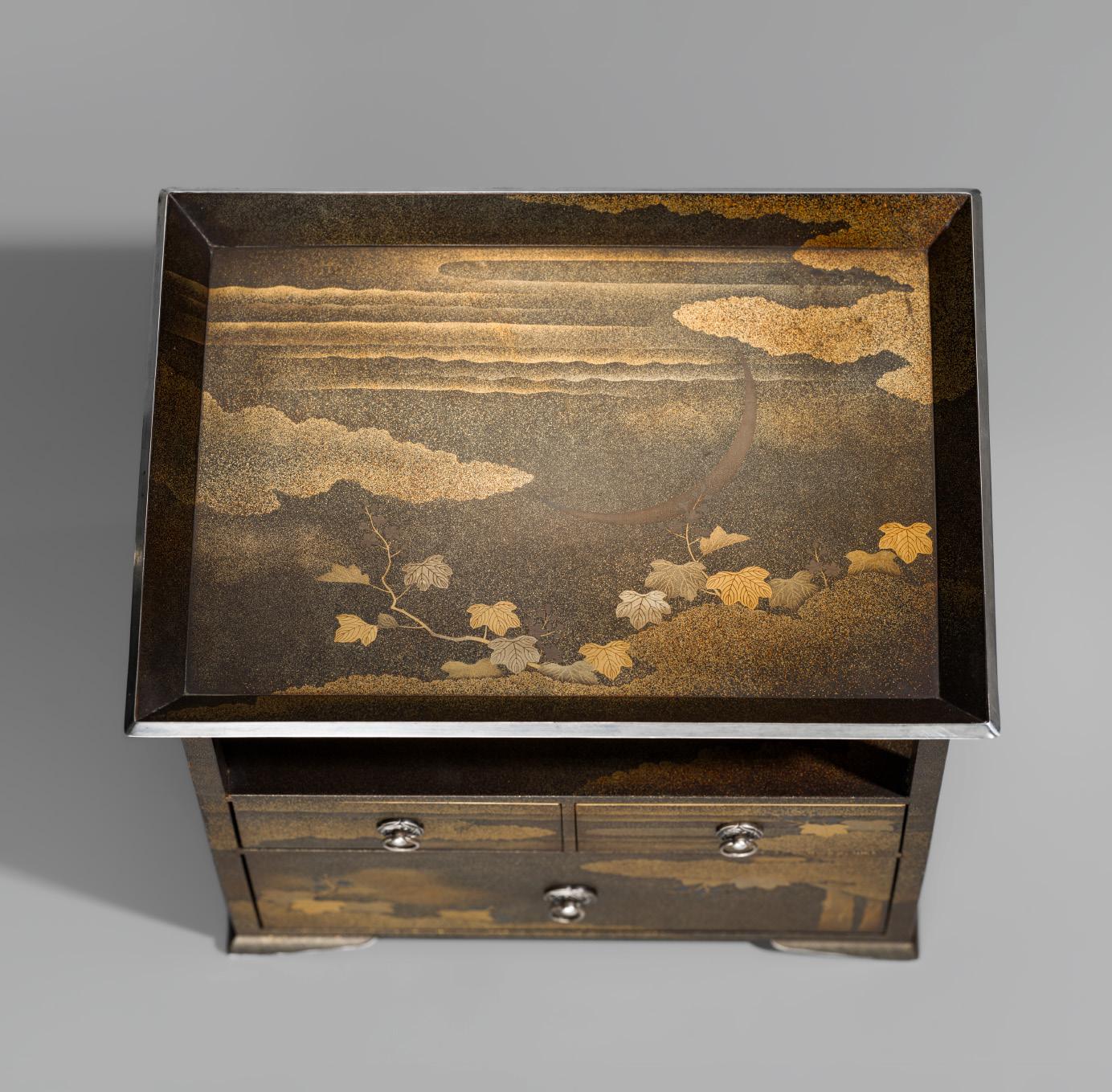
208
KANSHOSAI TOYO: A SUPERB TOGIDASHI LACQUER PORTABLE HANAGAMIDAI (COSMETIC CABINET)
By Kanshosai Toyo (Iizuka Toyo I), signed Kanshosai with kakihan Japan, late 18th century, Edo period (1615-1868)
Finely crafted, the cabinet, supported on short lobed feet, each fitted with silver mountings, comprises a large lower drawer surmounted by two smaller side drawers, all set with silver loop handles in the form of arrowroot (kuzu) crests, with an open tray-form shelf above them, its sides gently inclined upwards with chamfered edges and mounted with a silver rim. The hanagamidai is exquisitely decorated in gold and silver togidashi maki-e and e-nashiji, with an all-over design of leafy ivy branches emerging through nocturnal mist under the crescent moon, which casts its light across the composition on the upper tray. The interiors of the drawers beautifully finished in luminous e-nashiji with gold fundame rims. Signed to the back KANSHOSAI and with the artist’s distinct kakihan.
SIZE 24.8 x 27.2 x 20.6 cm
Condition: Excellent condition with minor expected wear.
Iizuka (Kanshosai) Toyo was a distinguished lacquerer and inro decorator active in Edo during the second half of the eighteenth century. He attracted a considerable number of followers and employed a notably wide range of techniques. For further reference on the artist, see Edward A. Wrangham and Joe Earl (eds.), The Index of Inro Artists, 1995, p. 312.
Compare a closely related goldlacquer portable hanagamidai (cosmetic cabinet) decorated with plovers (chidori) flying over pine-clad rocks, by a member of the Kanshosai Toyo school, Edo period, early to mid19th century, 25 cm long, at Bonhams, Snow, Sex, and Spectacle, London, 13 May 2021, lot 74 (sold for GBP 3,570 or approx. EUR 5,200 converted and adjusted for inflation at the time of writing).
Estimate EUR 5,000 Starting price EUR 2,400
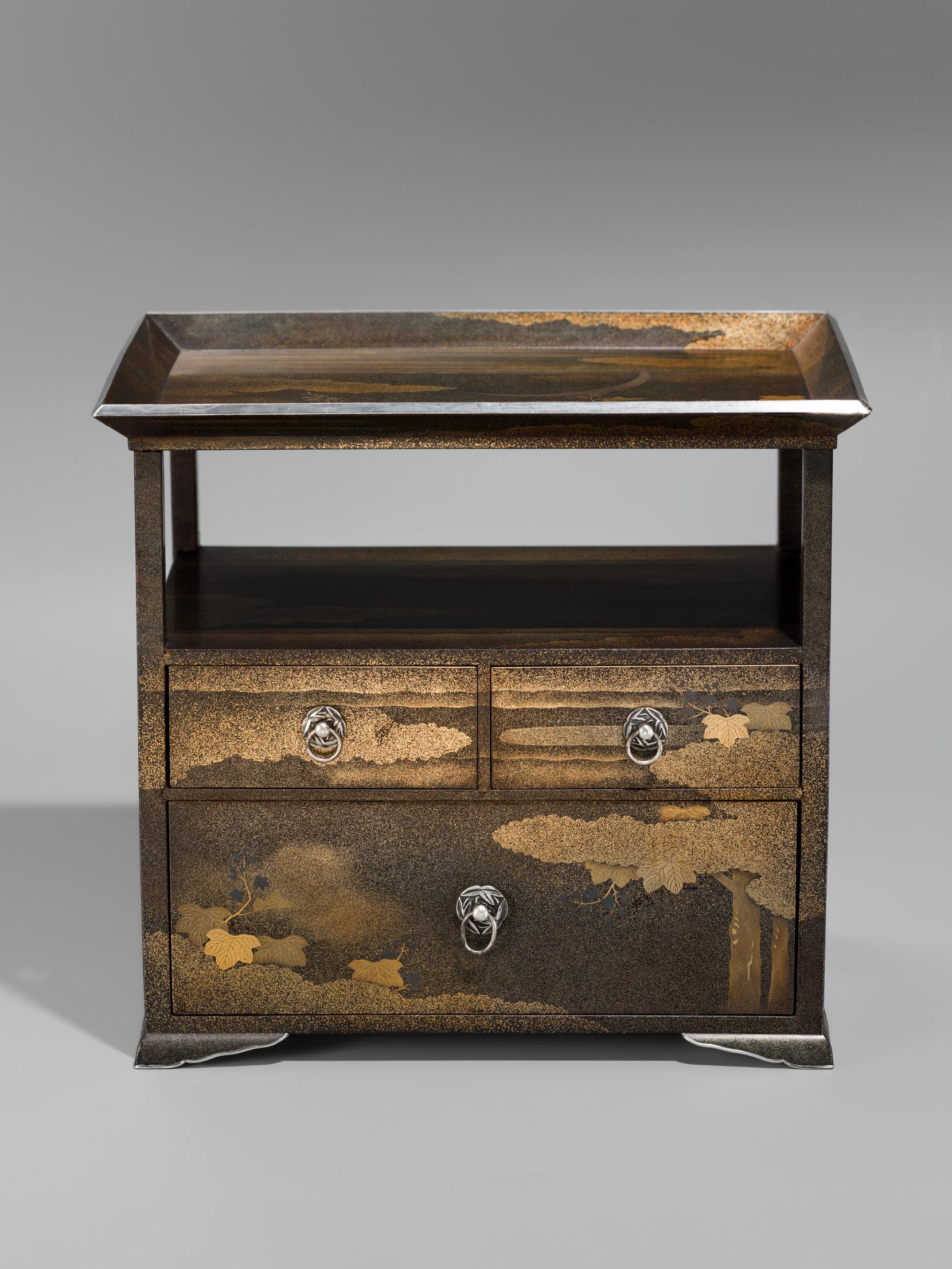
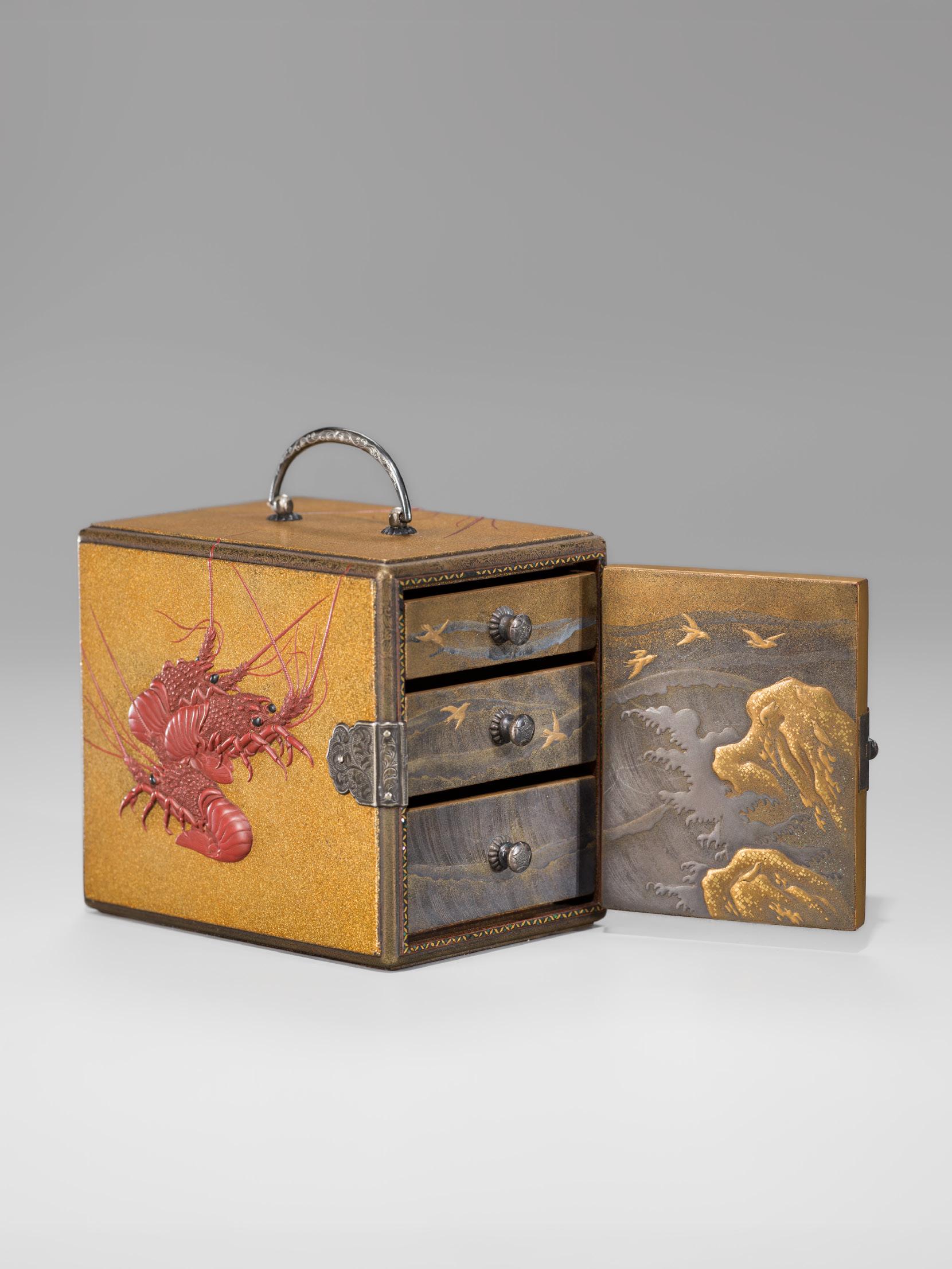
Japan, late 19th century, Meiji period (1868-1912)
Rectangular in form with recessed edges, the cabinet features a superb nashiji ground on each side, masterfully decorated with tsuishu (carved red lacquer) to depict a group of naturalistically rendered spiny lobsters (ise-ebi), their bodies meticulously detailed and long antennae gracefully extending along the various sides of the cabinet. The side-opening door to the front is fitted with silver hinges and framed with inlaid gold foil and mother-of-pearl, revealing three small incense drawers hidden within. Both the drawers and the reverse of the door are exquisitely decorated in gold and silver takamaki-e and hiramaki-e on a luminous nashiji ground, accented with gold kirigane. The continuous scene depicts a flock of sparrows soaring above a rocky landscape with crashing waves, shrouded in twilight mist. The cabinet retains its functional locking mechanism, with a silver knob that can be pushed aside to lock and unlock.
SIZE 8 x 9.1 x 6.5 cm
Provenance: Ex-collection Paul Corbin. Paul Corbin (1862-1948) was a French businessman, engineer, and inventor known for his expertise in precision mechanics and horology. Through his successful career in clock-making, Corbin amassed an extensive collection of Japanese art, reflecting the tastes of the late 19thcentury French bourgeoisie.
Condition: Very good condition with minor surface wear and faint traces of handling and use. Expected tarnishing to the silver fittings. Light rubbing to lacquer along the edges and minuscule losses to the gold foil appliqué.
The spiny lobster (ise-ebi) holds significant symbolic meaning in Japanese art, especially during the Edo and Meiji periods. Its curved form, reminiscent of a human posture in advanced age, along with its association with longevity, made it a symbol of good fortune and prosperity. It frequently appears in New Year’s celebrations, family crests, and applied art, representing both longevity and good fortune. See Merrily Barid, Symbols of Japan, 2001, p. 147.
AUCTION COMPARISON
Compare a closely related lacquer cabinet (kodansu) bearing a similar design of ise-ebi, Meiji period, 9.8 cm long, at Bonhams, Japanese and Korean Art, New York, 18 March 2014, lot 496 (sold for USD 12,500 or approx. EUR 15,000 converted and adjusted for inflation at the time of writing). Compare a closely related small lacquer box (tebako) bearing a similar design of ise-ebi, Meiji period, 15.3 cm long, at Christie’s, Lacquer, jade, Bronze, Ink: The Irving Collection Day Sale, 21 March 2019, New York, lot 1149 (sold for USD 23,750 or approx. EUR 26,000 converted and adjusted for inflation at the time of writing).
Estimate EUR 15,000
Starting price EUR 7,500
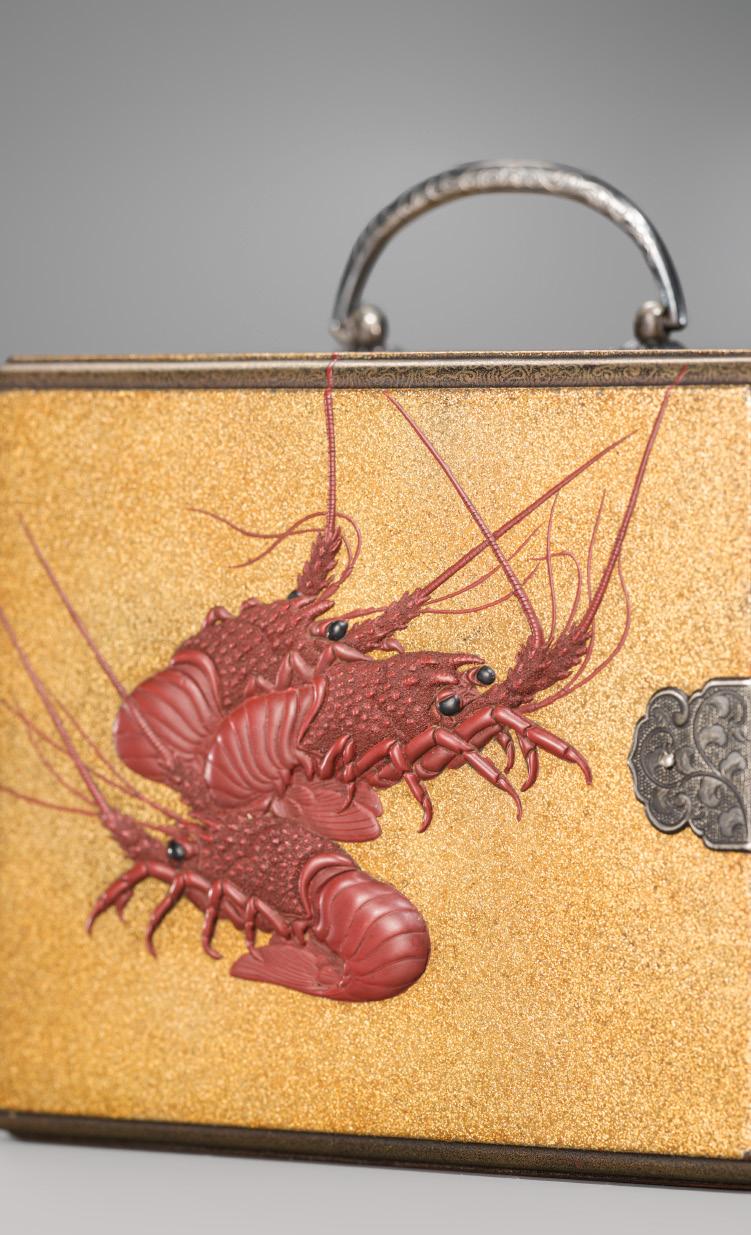
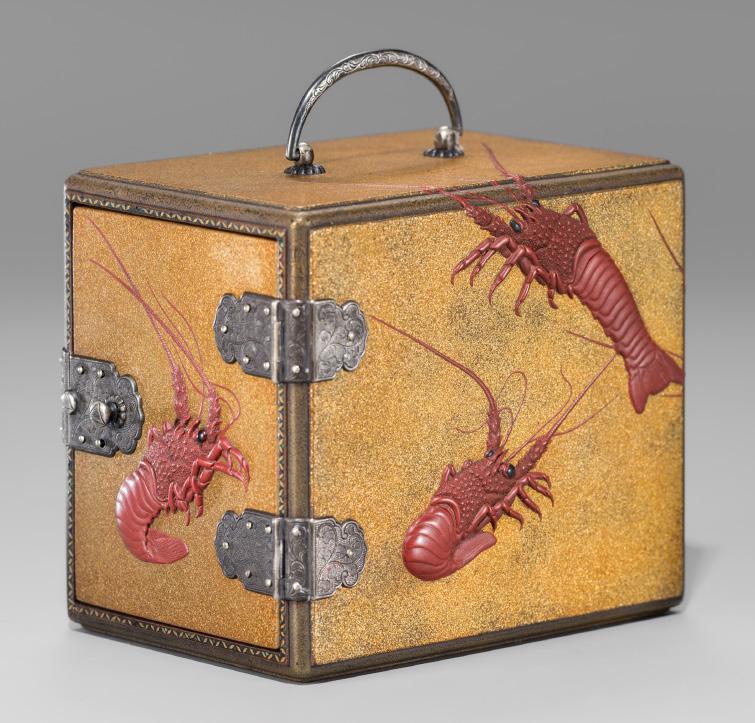
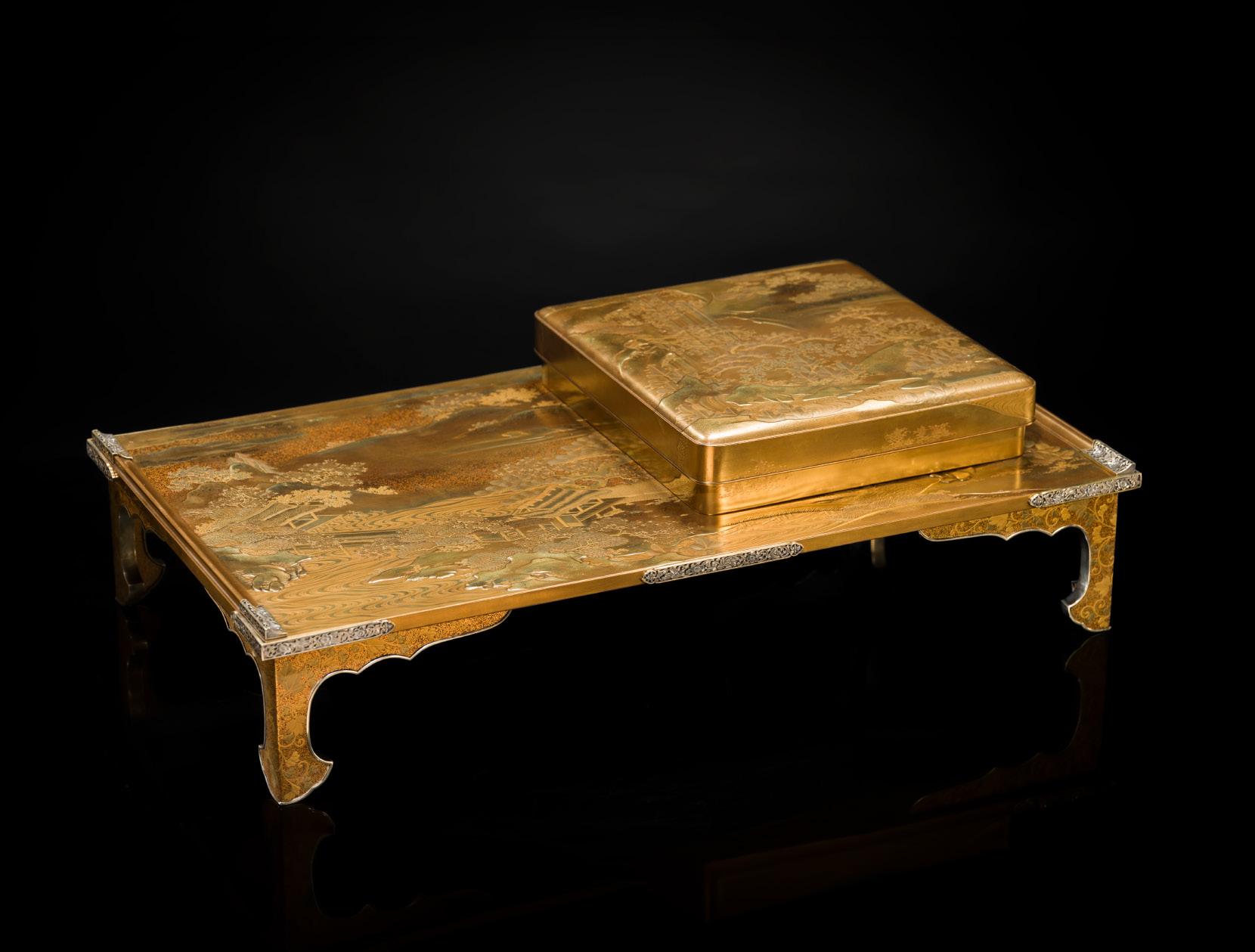
210
A MAGNIFICENT MATCHING GOLD LACQUER SET OF A SUZURIBAKO (WRITING BOX) AND A BUNDAI (WRITING DESK)
Japan, c. 1900, Meiji period (1868-1912)
Each piece in this exceptional set is exquisitely crafted with meticulous attention to detail, depicting scenes from and around Mount Yoshino with brilliant cherry blossoms in full bloom. The suzuribako, square in shape, is fitted with an overhanging cover. The exterior features a luminous kinji ground, intricately decorated with gold takamaki-e and hiramaki-e techniques, and accented with gold kirigane flakes of varying sizes, as well as gold foil inlays. The design depicts a majestic waterfall forming a stream that meanders through rocky landscapes, flanked by lush pine and cherry trees, set against a distant mountainous backdrop. The design continues on the underside of the cover, where water flows among fully blossoming chrysanthemums, adding depth to the scene. The interior of the box is finished with a radiant nashiji ground and gold fundame rims, further enhanced by gold takamaki-e depicting blooming chrysanthemums. Inside, the box contains a removable baseboard (ita), a rectangular inkstone (suzuri), and a gold-inlaid silver water dropper (mizuire) in the shape of a cluster of cherry and pines.
Cherry Blossoms on Mount Yoshino
The accompanying bundai, rectangular in form, is supported on four elegantly lobed corner legs and is adorned with silver mountings, including at the corners and midpoints of the tabletop. Further embellishments include openwork gold-inlaid silver mounts, featuring a similar design to the water dropper, cherry and pine. The tabletop features a shimmering kinji ground, with areas highlighted in brilliant gyobu-nashiji, and is intricately decorated in gold takamaki-e, hiramaki-e, and togidashi maki-e techniques. The decoration, accented with gold kirigane flakes, depicts a continuation of the waterfall scene through rolling landscapes, with distant mountains rising through morning mist beside blossoming cherry trees. The underside of the table is finished in vibrant nashiji, while the legs are adorned with gold and silver takamaki-e, depicting lush pine branches against a luminous gyobu-nashiji ground.
SIZE of the suzuribako 5.4 x 27.7 x 25.3 cm, SIZE of the bundai 11.3 x 60.5 x 34.7 cm
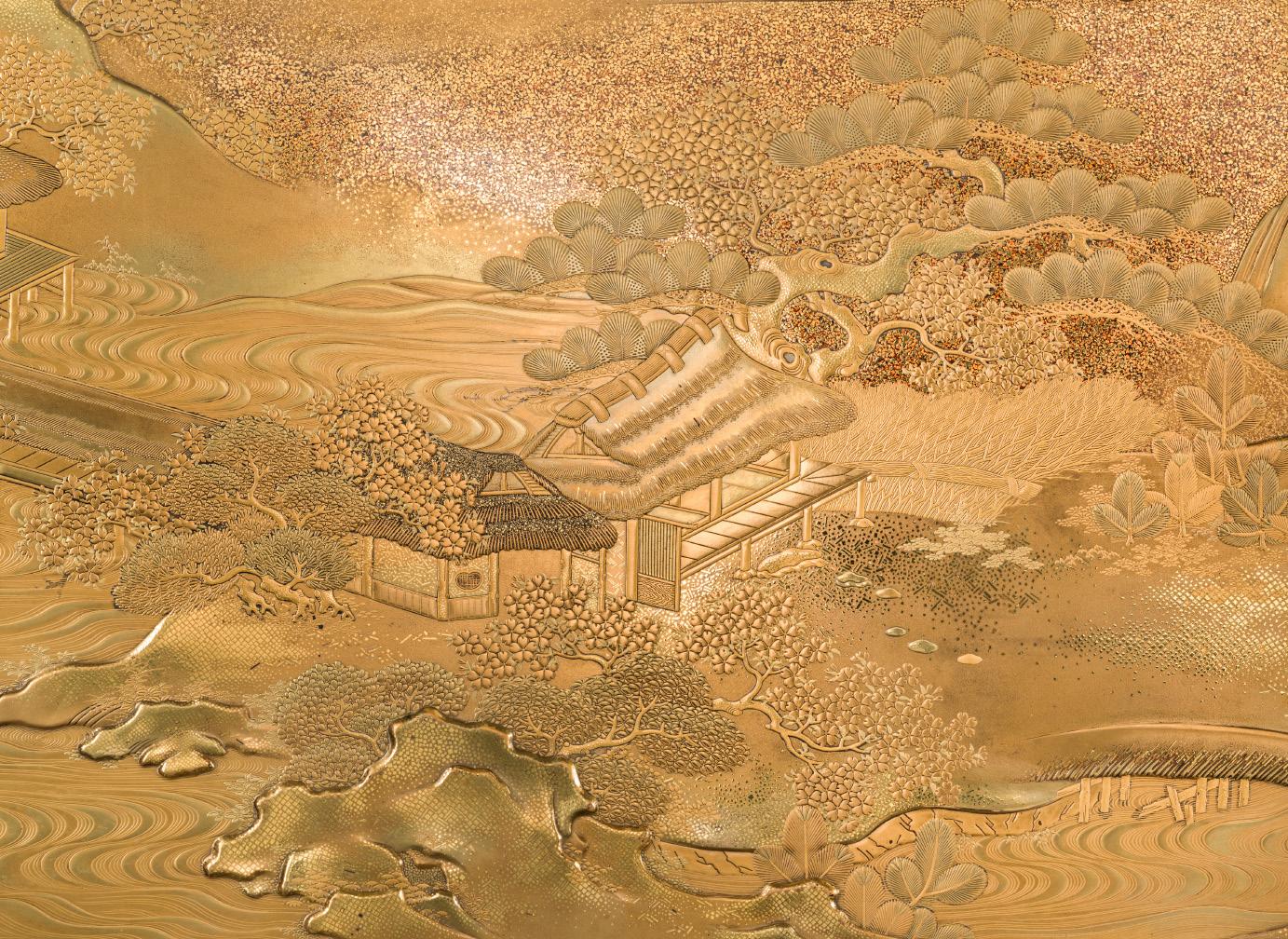
Condition: The suzuribako in excellent condition with only minor surface wear, including occasional minute losses to kirigane flakes, as well as some very light warping to the gold foil inlays, all as is to be expected from this type of lacquerware. The Bundai also in excellent condition with only very minor wear to the underside. Both are in a remarkable state of preservation and presenting exceptionally well.
Each with a wood storage box (tomobako), the storage box of the bundai inscribed Bundai Yoshino Yama [Writing table, design of Mount Yoshino].
The exceptional craftsmanship of this matching set, along with its remarkable state of preservation, places it alongside examples found in imperial collections and in the Nasser D. Khalili Collection of Japanese Art. It is likely that this set was conceived as a distinguished gift for a prominent member of the imperial court during the reign of Emperor Meiji. Another possibility is that it was intended for display at one of the major international expositions through which Japan showcased its exquisite artistry after the opening of its borders in the mid-nineteenth century. Notable potential artists include Toshu (see auction comparison) or Harui Komin (b. 1869), who was known for rarely signing his works.
LITERATURE COMPARISON
Compare a closely related matching lacquer set of a suzuribako (writing box) and a bundai (writing table) also decorated with scenes of the Yoshino district, Meiji period, dated c. 1900, 27.7 cm long (suzuribako) and 65.1 cm long (bundai), illustrated in Meiji no Takara: Treasures of Imperial Japan - The Nasser D. Khalili Collection, The Kibo Foundation, 1995, Lacquerware Part II, no. 121.
AUCTION COMPARISON
Compare a closely related matching lacquer set of a suzuribako (writing box) and a bundai (writing table) decorated with fishing boats on a pine-clad beach, attributed to Toshu, Meiji period, late 19th century, 26 cm long (suzuribako) and 64.1 cm long (bundai), at Christie’s, Japanese Art and Design and The Francois Storno Collection of Netsuke, London, 16 May 2007, lot 18, sold for GBP 33,600 or approx. EUR 65,000 converted and adjusted for inflation at the time of writing).
Estimate EUR 30,000
Starting price EUR 15,000
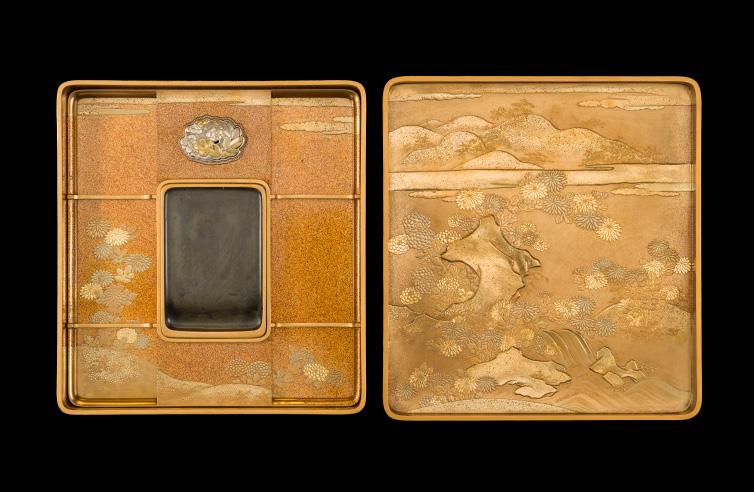
A MAGNIFICENT MATCHING GOLD LACQUER SET OF A SUZURIBAKO (WRITING BOX) AND A BUNDAI (WRITING DESK)
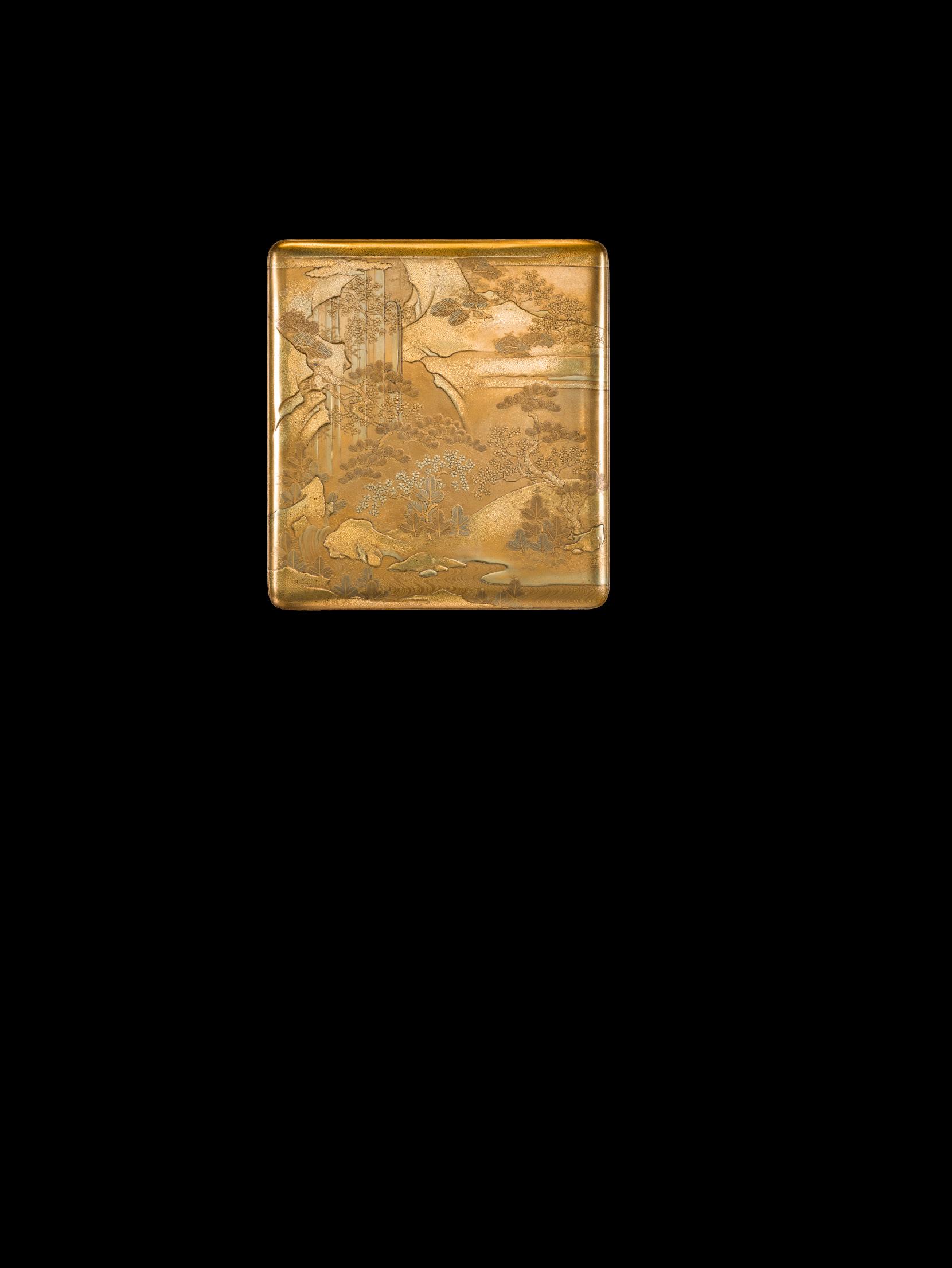
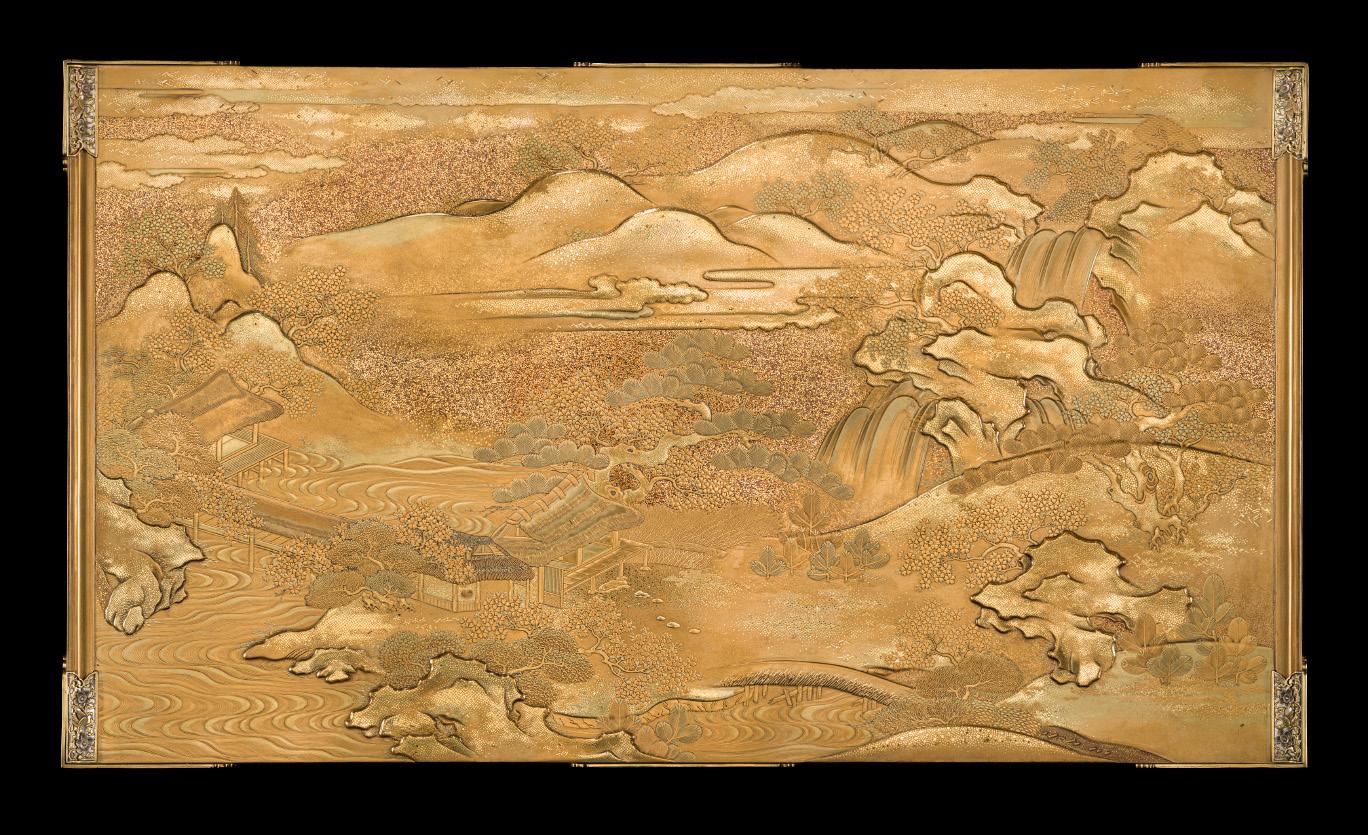
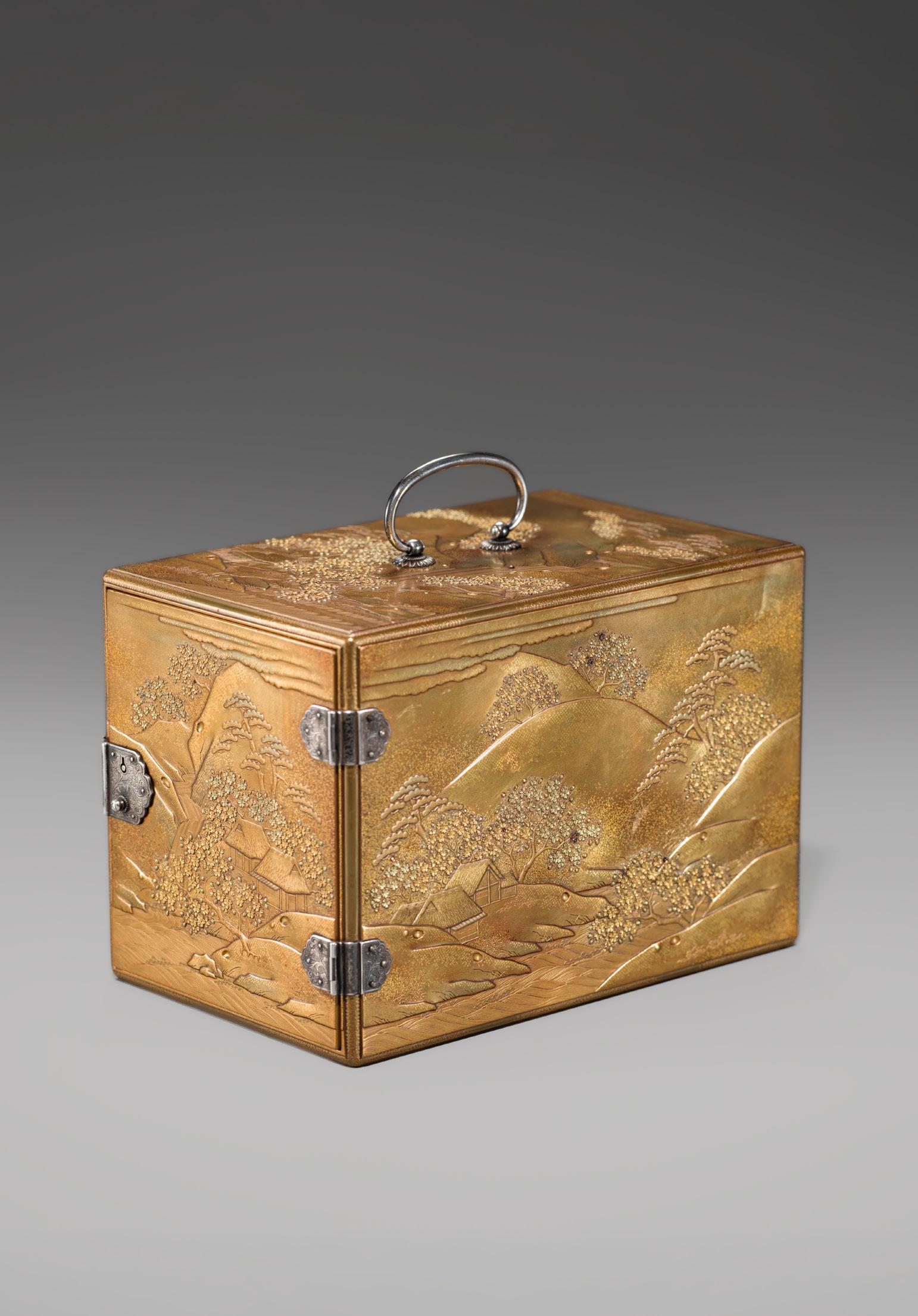
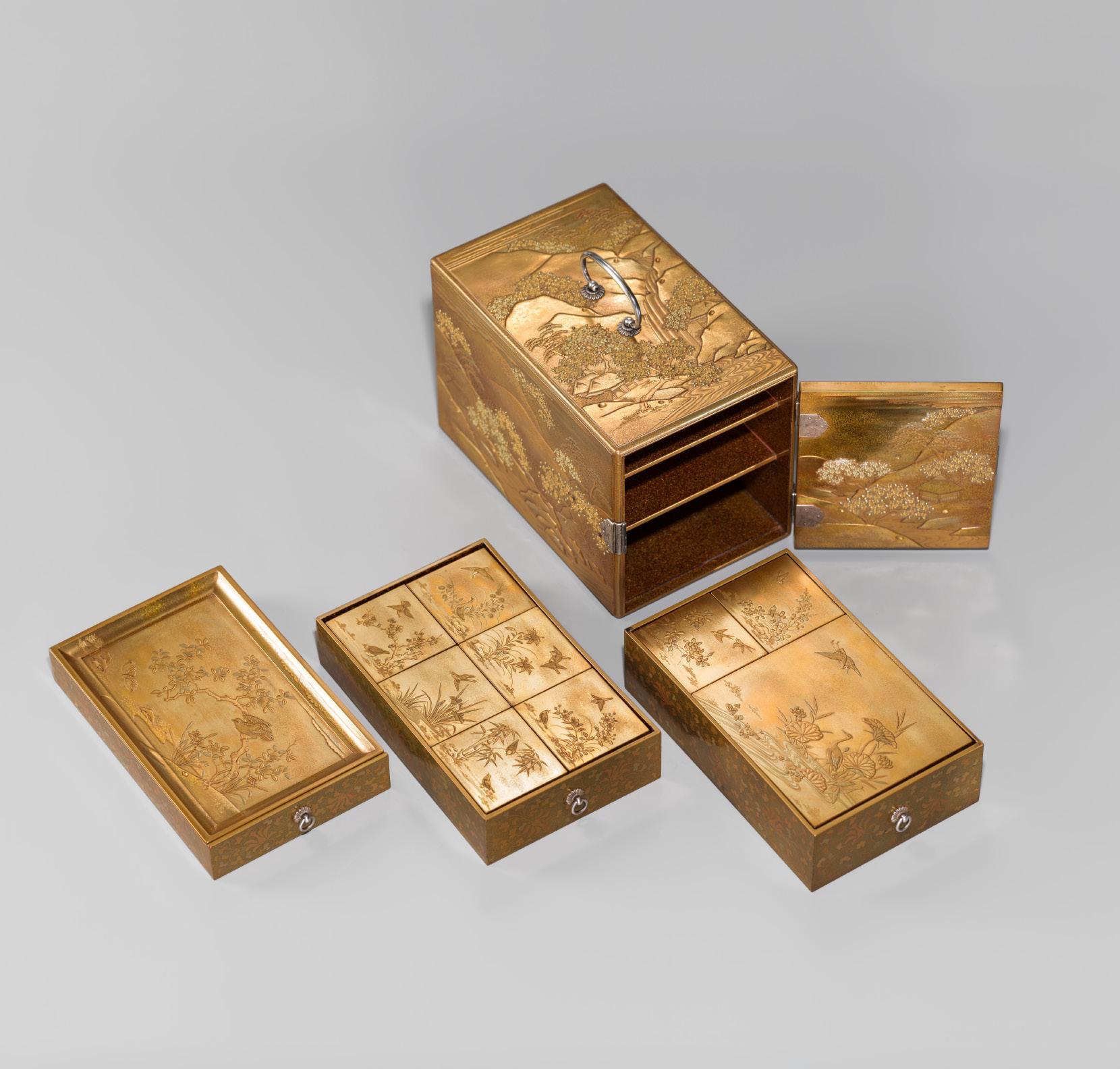
Attributed to Harui Komin (b. 1869), unsigned Japan, early 20th century, Meiji period (1868-1912) to Taisho period (1912-1926)
Rectangular in form with recessed edges, bearing a luminous kinji ground, intricately decorated in gold takamaki-e and hiramaki-e, and enriched with gold inlay and kirigane flakes, to depict a continuous landscape welcoming spring, where cherry trees in full bloom stand beside a cascading waterfall that flows into a river meandering through a rocky terrain dotted with small thatchedroof dwellings.
The side door, fitted with silver hinges, conceals three small drawers, each fitted with a loop handle mounted on a chrysanthemum-shaped base and exquisitely decorated on the exterior in gold togidashi maki-e with scrolling tendrils and foliage. The interiors of the drawers finished in gold-sprinkled e-nashiji with gold fundame rims.
The upper drawer holds a small tray, while the two lower drawers contain a set of square incense boxes, finely decorated in gold takamaki-e, hiramaki-e, and e-nashiji, depicting scenes of birds, including cranes, sparrows, and quails, among flowering plants. Their interiors similarly finished in nashiji with gold fundame rims.
SIZE 11.8 x 17.1 x 10.7 cm
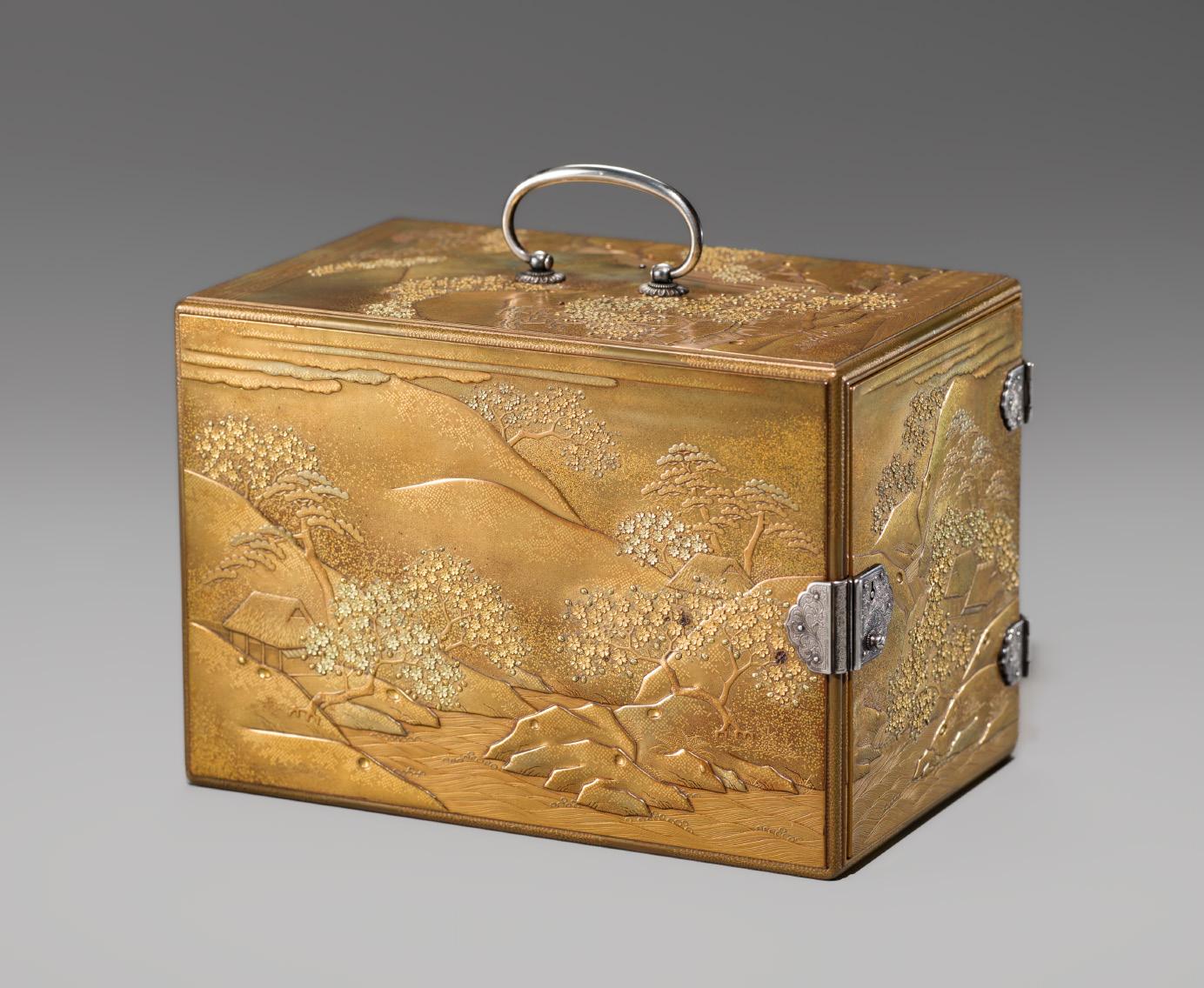
Provenance: Private collection of Gerald Mere, United Kingdom, thence by descent. Rutherston & Bandini, London, United Kingdom, 2014. Private collection of Eva and Aubrey Sweet, Melbourne, Australia, acquired from the above. A copy of the original invoice, dated 29 October 2014, addressed to Mrs. Eva Sweet, and stating a purchase price of GBP 13,000 (or approx. EUR 21,000 converted and adjusted for inflation at the time of writing), accompanies this lot.

Condition: Occasional small losses to gold inlays and kirigane flakes. Otherwise, excellent condition with only minor surface wear and faint traces of handling and use. Presenting magnificently.
With an associated wood storage box (tomobako).
Harui Komin (Osaka, b. 1869) was a distinguished lacquer artist whose work exemplifies the highest level of refinement within late nineteenth- and early twentieth-century Japanese lacquer. He trained under Nakagawa Gyokushu, acquiring a rigorous technical foundation, and later moved to Kyoto at the invitation of the prominent dealer Ikeda Seisuke. Following the closure of Ikeda’s business and declining health, Komin settled in Suma, Hyogo Prefecture, where he continued his artistic practice.
Relatively little is known about Komin, partly due to his practice of leaving many works unsigned after reaching artistic maturity, a habit that has contributed to the rarity and mystique of his oeuvre. His authorship of a spectacular lacquer cabinet presented by Emperor Hirohito to the Prince of Wales in 1921 - now in the Khalili Collection (see literature comparison) - was only confirmed through the discovery of a letter preserved at the Victoria and Albert
Museum. In it, Baron Sumitomo praised Komin as “one of the few living masters whose name will be handed down to unborn ages,” ranking him among the greatest lacquer artists of his time.
LITERATURE COMPARISON
Compare a related gold lacquer cabinet, by Harui Komin, unsigned, presented as a gift by Emperor Hirohito to the Prince of Wales in 1921, 110 cm high, illustrated in Meiji no Takara: Treasures of Imperial Japan - The Nasser D. Khalili Collection, The Kibo Foundation, 1995, Lacquerware Part II, no. 231 and illustrated on the cover.
AUCTION COMPARISON
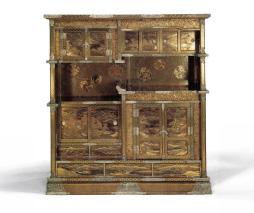
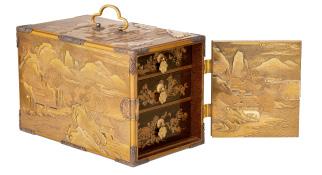
Compare a closely related gold lacquer kodansu (incense cabinet) decorated with pagodas and temple structures within verdant landscapes, Meiji period, signed Harui Komin, 18.7 cm long, at Auktionshaus Zofingen, Frühlingsauktion, Zofingen, 4 June 2025, lot 121 (sold for CHF 73,800 or approx. EUR 80,800 converted and adjusted for inflation at the time of writing).
Estimate EUR 30,000 Starting price EUR 15,000
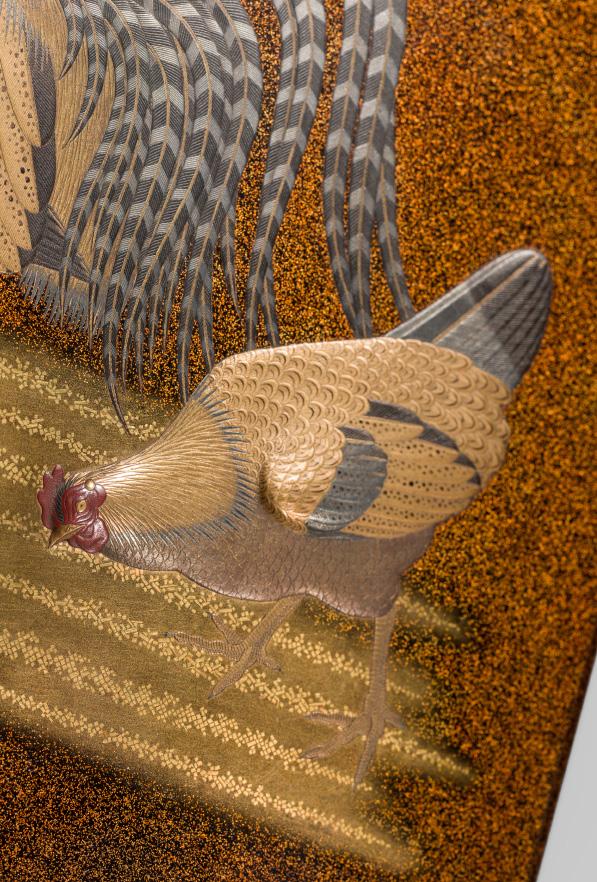
212
KOMA KANSAI II: AN IMPRESSIVE LARGE LACQUER ‘ROOSTER AND HEN’ BUNKO (DOCUMENT BOX)
By Koma Kansai II (1767–1835), signed Kansai Japan, c. 1830, Edo period (1615-1868)
This large bunko features gently rounded edges and is exquisitely decorated with gold, silver, and red takamaki-e and hiramaki-e on a dense e-nashiji ground. The flush-fitting lid (inrobuta) depicts a rooster and hen, with their vivid feathers delicately rendered. The interior of the lid features a tranquil scene of autumn grasses including nadeshiko and bush clover, finely executed in gold and silver on a nashiji ground, and is signed KANSAI to the lower left. The interior is finished in nashiji with gold fundame rims.
SIZE 15 x 40 x 31 cm
Condition: Excellent condition with minor wear, tiny cracks to the corners and underside and rubbing to lacquer.
With a wood tomobako (storage box).
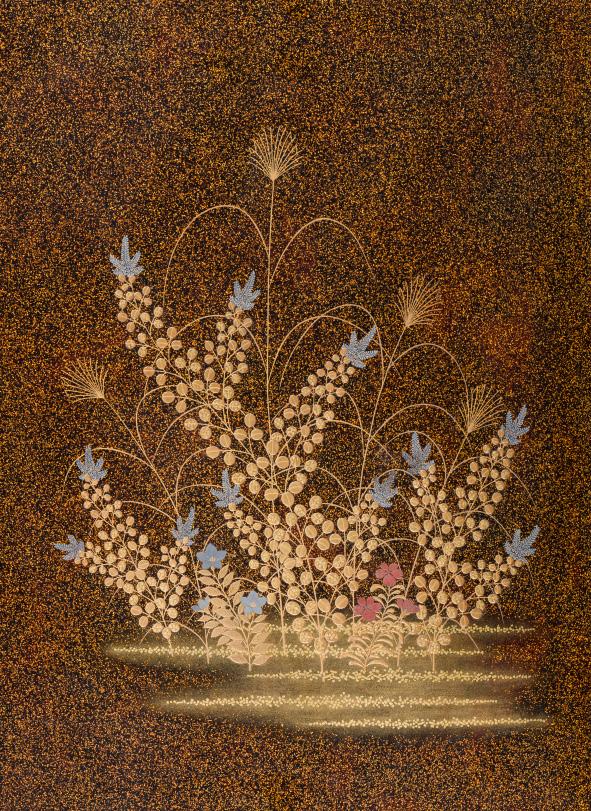
Koma Kansai II (1767-1835) is renowned as one of the most distinguished masters of the Koma family, many of whom were official lacquerers to the shogunate. Kansai II was celebrated for his versatility across various lacquer techniques and media, often collaborating with leading metalworkers to produce works of exceptional refinement. He also served as the master of the famous lacquer artist Shibata Zeshin.
AUCTION COMPARISON
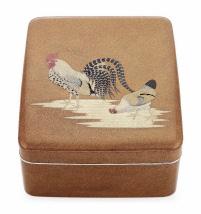
Compare a closely related bunko depicting a rooster and hen by the same artist, also signed Kansai, 43.7 x 36.1 cm, at Christie’s, Asobi: Ingenious, Creativity, Japanese Works of Art from Antiquity to Contemporary, 15 October 2014, London, lot 78 (sold as a complete set of six (bunko, suzuribako, bundai, tebako, shikishibako and fubako) for GBP 86,500 or approx. EUR 140,000 converted and adjusted for inflation at the time of writing).
Estimate EUR 10,000
Starting price EUR 5,000
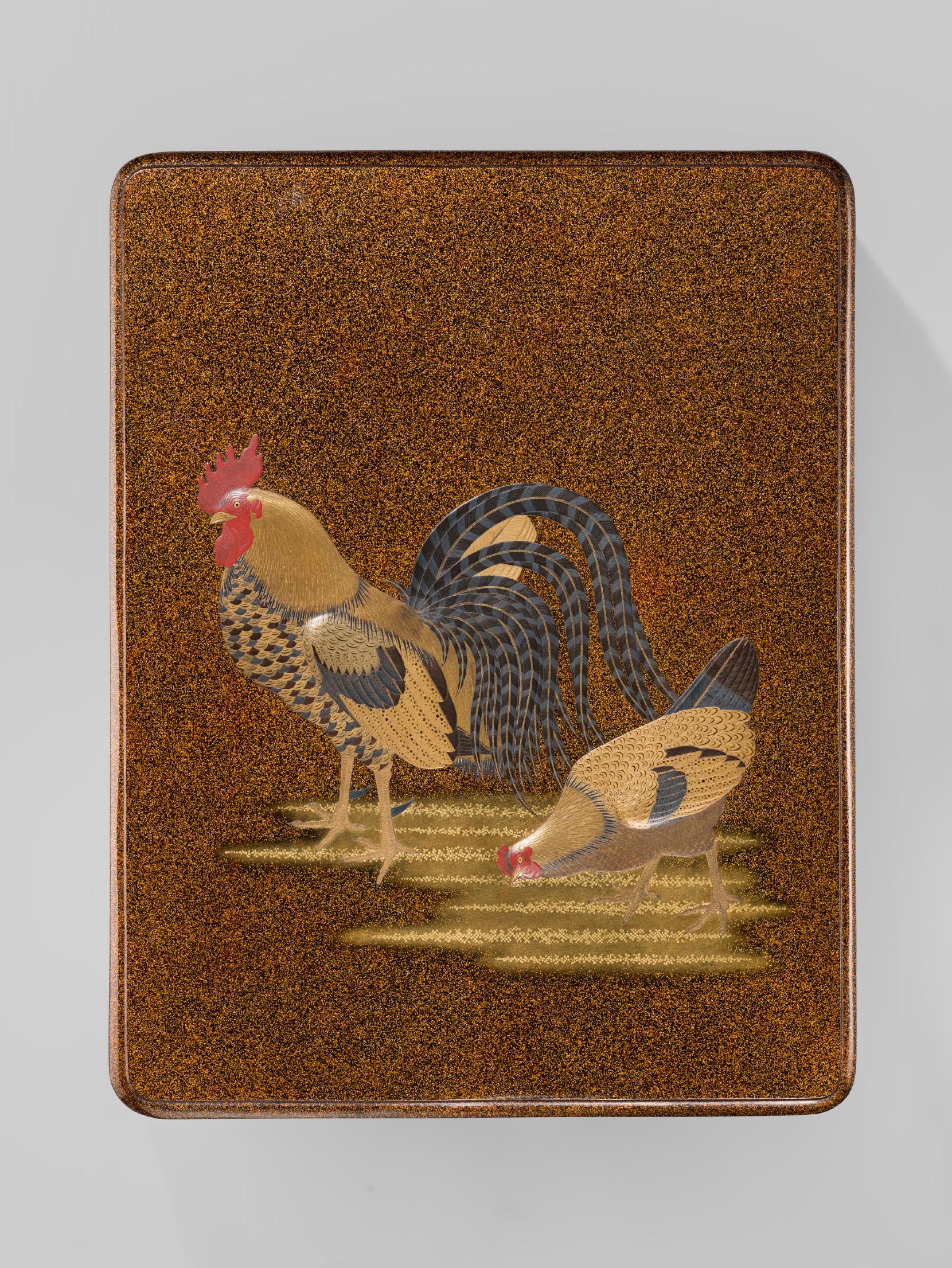
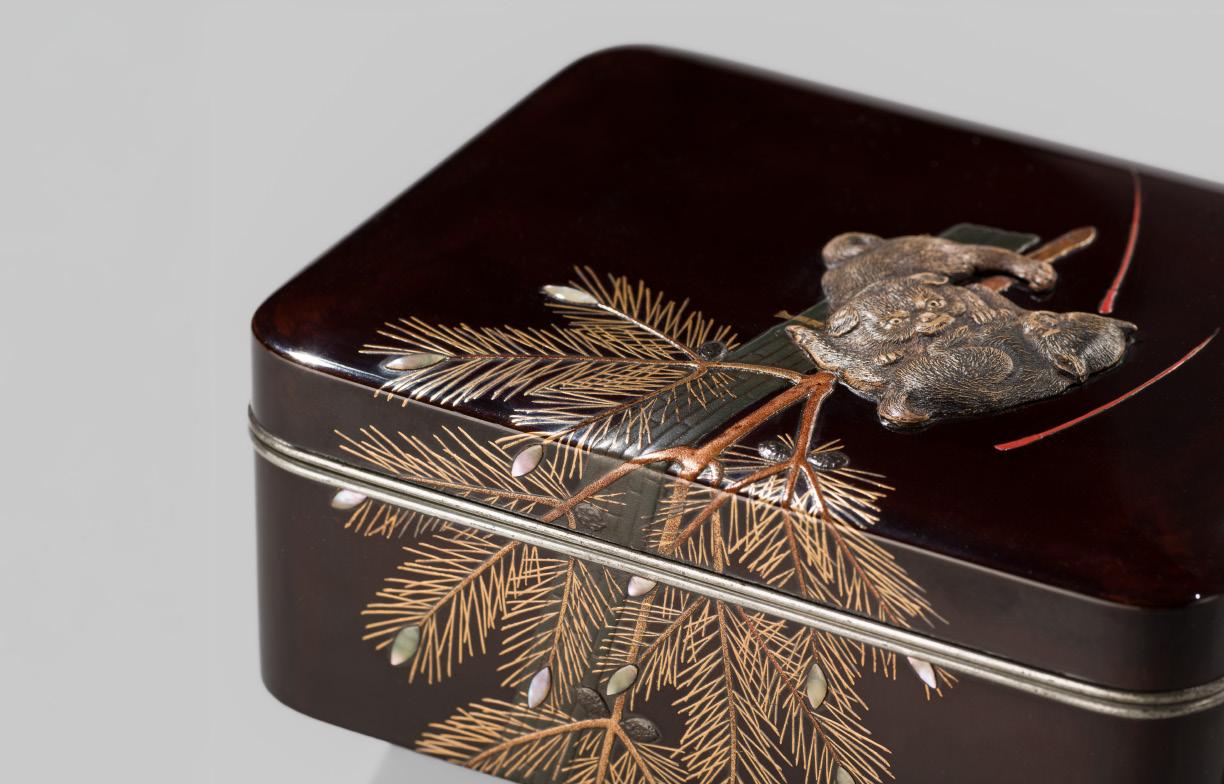
MOCHIZUKI HANZAN: A MASTERFUL CERAMIC-INLAID LACQUER ‘PLAYING PUPPIES’ TEBAKO (ACCESSORY BOX)
By Mochizuki Hanzan (Haritsu II,1743-1790), sealed Hanzan Japan, late 18th century, Edo period (1615-1868)
Of rectangular form with rounded edges, finely decorated in gold and red takamaki-e and hiramaki-e, enriched with various inlays on a lustrous roiro ground. The inrobuta (flush-fitting) lid depicts two ceramic-inlaid puppies playfully engaged beside a pruned pine branch and bundled bamboo, the composition extending seamlessly across the sides of the box. The pine is further embellished with finely inlaid aogai (mother-of-pearl) highlights indicating new growth, while additional details, including pine needles and cones, are rendered in delicate relief.
The interior is equally refined: the underside of the lid decorated with a peach, a spray of fern, and a leafy sprig combining gold lacquer, red lacquer, pewter, and aogai inlays, all set against a delicately sprinkled ground. The rims are mounted in pewter. Signed to the interior with the typical red-lacquered seal cartouche HANZAN.
SIZE 6.5 x 15.3 x 11.5 cm
Provenance: Ex-collection Elinor “Elly” Nordskog (1919-2013). Sydolney L. Moss Ltd, London, 2017. From the collection of Eva & Aubrey Sweet, Melbourne, Australia, acquired from the above. A copy of the invoice from Sydney L. Moss Ltd., dated 15 June 2017, stating a purchase price of USD 13,500 (or approx. EUR 15,500 converted and adjusted for inflation at the time of writing) and confirming the above, accompanies the lot.

Eva and Aubrey Sweet devoted over six decades to the formation of a distinguished private collection of Asian art, with particular strength in Chinese jade, Japanese lacquer, and netsuke. Their collecting began in the 1950s and was refined through sustained travel, scholarship, and long associations with leading dealers, curators, and artists internationally.
Condition: Excellent condition with only very minor wear.
With a wood tomobako (storage box) inscribed Hanzan tsukuri tebako [tebako made by Hanzan].
Mochizuki Hanzan, traditionally dated 1743-1790, styled himself Haritsu II and worked in close emulation of Ogawa Haritsu (Ritsuo). Although neither a direct pupil nor descendant, his works demonstrate a sophisticated adaptation of the Haritsu idiom, combining lacquer with ceramic and other inlays. Some works are sealed “Kan,” contributing to the longstanding challenge of distinguishing his oeuvre from that of Haritsu himself.
Compare a related ceramicinlaid suzuribako with peaches by the same artist, note the similar design as on the interior of the present tebako, at Zacke, Fine Japanese Art, 3 December 2021, Vienna, lot 165 (sold for EUR 50,560).
Estimate EUR 15,000 Starting price EUR 7,500
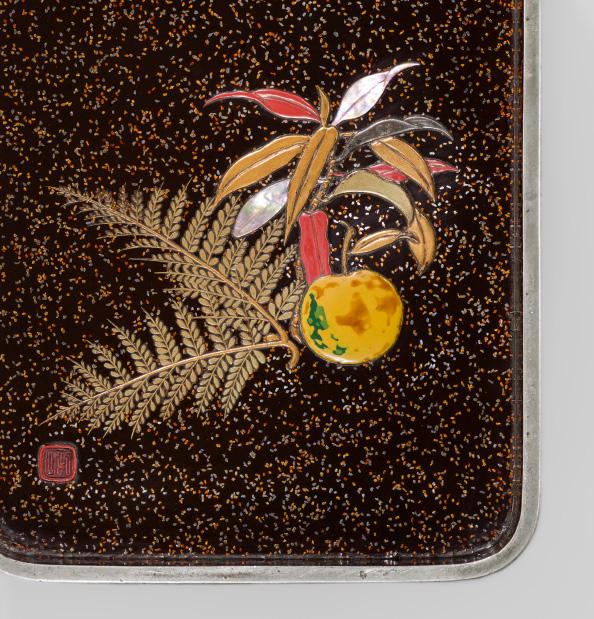
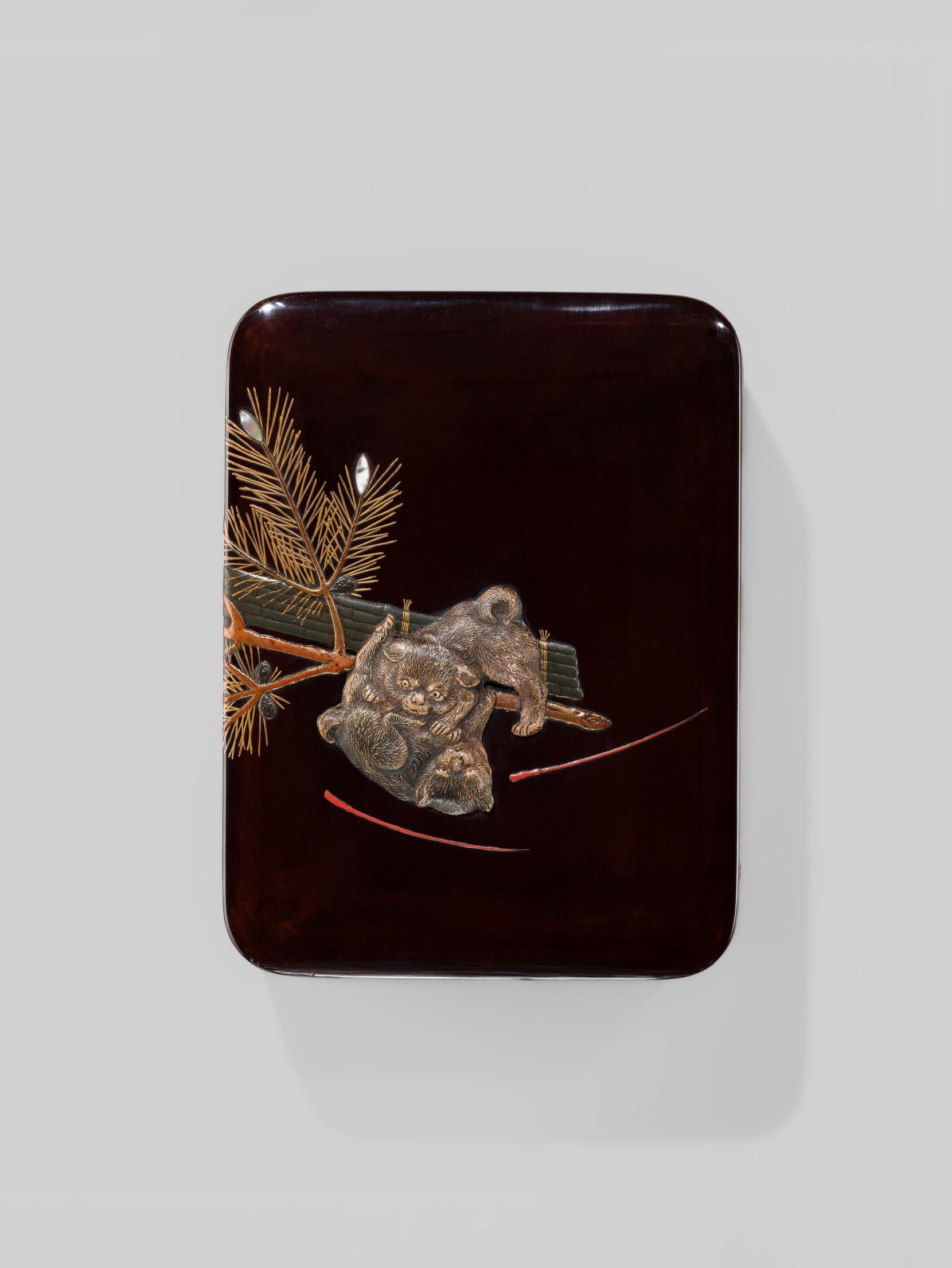
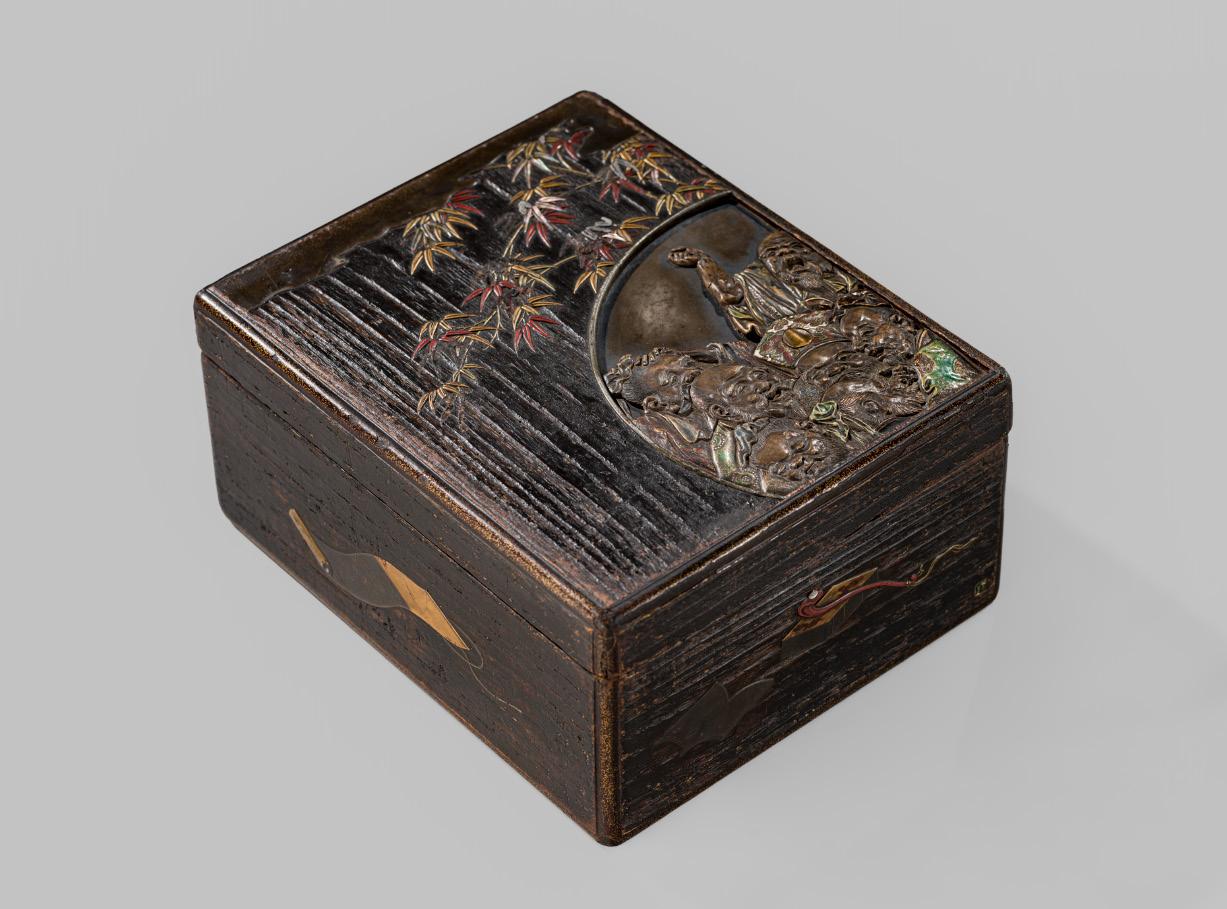
214
OGAWA HARITSU: A SUPERB INLAID LACQUER ‘SEVEN SAGES OF THE BAMBOO GROVE’ BUNKO (DOCUMENT BOX)
By Ogawa Haritsu (1664-1747) or a close follower, sealed Kan Japan, 18th century, Edo period (1615-1868)
Of rectangular form with gently rounded sides, finely carved from richly grained wood and decorated in gold takamaki-e and hiramaki-e, further enriched with a harmonious array of inlays in diverse materials. The inrobuta (flush-fitting) lid is composed with a circular panel in the lower right corner depicting the Seven Sages of the Bamboo Grove in a moment of relaxed conviviality, some visibly inebriated, one yawning and another drifting into sleep.
Above, bamboo branches and drifting clouds are rendered in a striking combination of red lacquer, aogai, and ceramic inlays, creating a layered and highly tactile surface. The sides are adorned with further inlaid scholar’s objects, including a handscroll, a nyoi sceptre, a fan, and reishi fungi, all executed with exceptional refinement and variety of materials. The piece is sealed to the side with a green ceramic seal KAN. The interior is finished in fine nashiji with fundame rims.
SIZE 13 x 26.4 x 22.2 cm
Condition: Good condition with old wear. Repair to the lid’s interior sides and corners as well as to one hand, and few scattered losses to inlays.
The Seven Sages of the Bamboo Grove represent a celebrated group of third-century Chinese scholars and recluses who withdrew from official life during a period of political upheaval. Embracing Daoist ideals of spontaneity, personal freedom, and harmony with nature, they gathered in bamboo groves to compose poetry, drink wine, and engage in philosophical discourse. Their rejection of rigid courtly conventions and their pursuit of artistic and intellectual expression made them enduring symbols of cultivated eccentricity. The theme was widely embraced in Japan, where it resonated with literati and samurai culture alike, evoking ideals of retreat, refinement, and artistic independence.
Ogawa Haritsu, also known as Ritsuo, was renowned for his innovative use of mixed materials, incorporating ceramics, shell, lacquer, wood, and other elements into highly original compositions. His refined aesthetic and experimental approach appealed strongly to literati circles of the 18th century, and he served as both artist and artistic advisor to the daimyo Tsugaru Nobuhisa. His distinctive style proved highly influential, inspiring numerous followers and continuing to be emulated well into later periods.
LITERATURE COMPARISON
Compare a closely related suzuribako showing a nearidentical design to the cover, unsigned, dated 19th century, in the Khalili collection, illustrated in Meiji no Takara: Treasures of Imperial Japan - The Nasser D. Khalili Collection, The Kibo Foundation, 1995, Lacquer part I, no. 49.
AUCTION COMPARISON
Compare a related inlaid wood ryoshibako, also bearing a green seal Kan, similarly decorated with foliage, dated 18th century, 16.8 x 32.4 x 41.3 cm, at Christie’s, Japanese & Korean Art, 11 September 2012, New York, lot 82 (sold for USD 116,500 or approx. EUR 140,000 converted and adjusted for inflation at the time of writing).
Estimate EUR 6,000
Starting price EUR 3,000
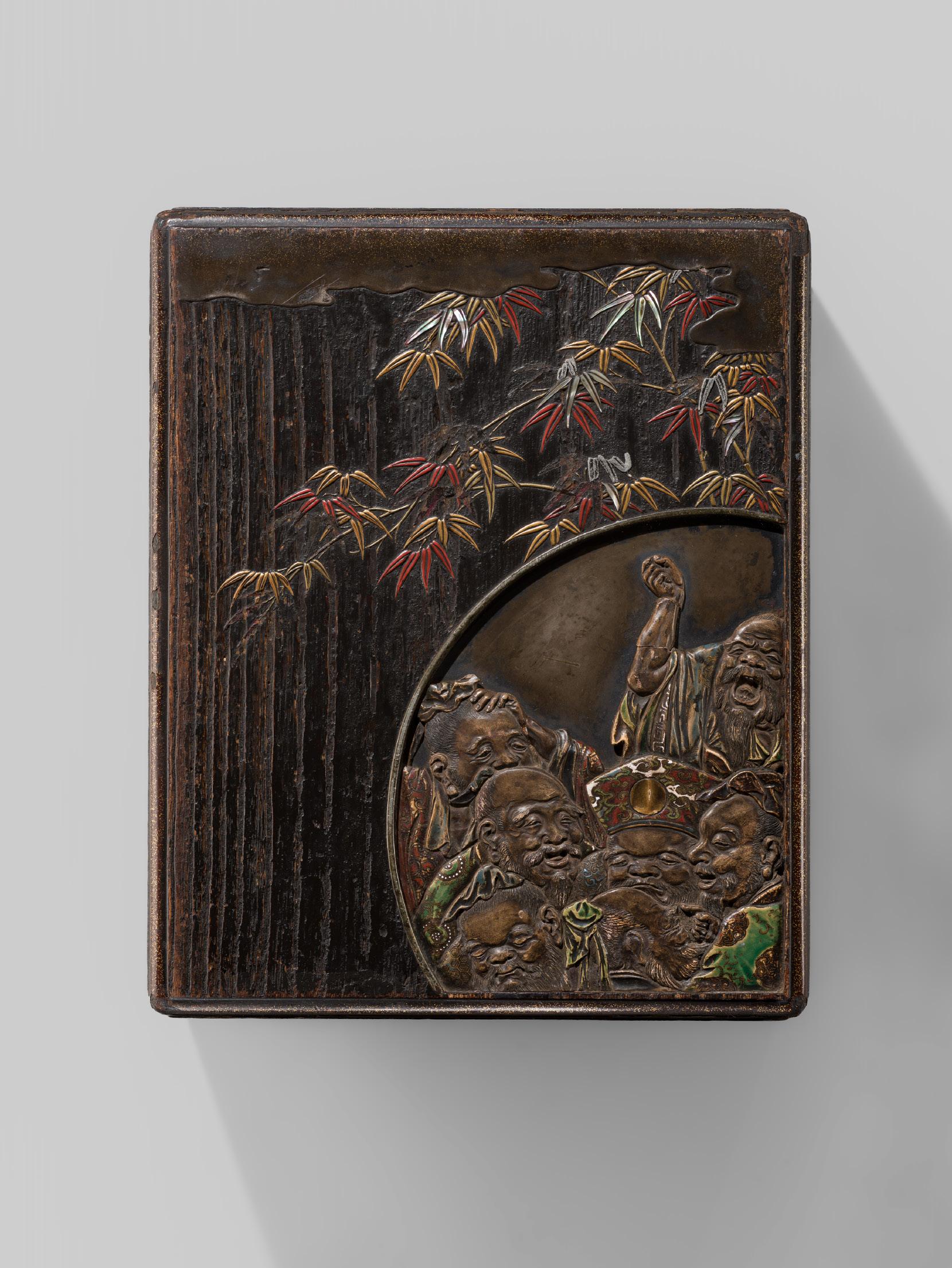
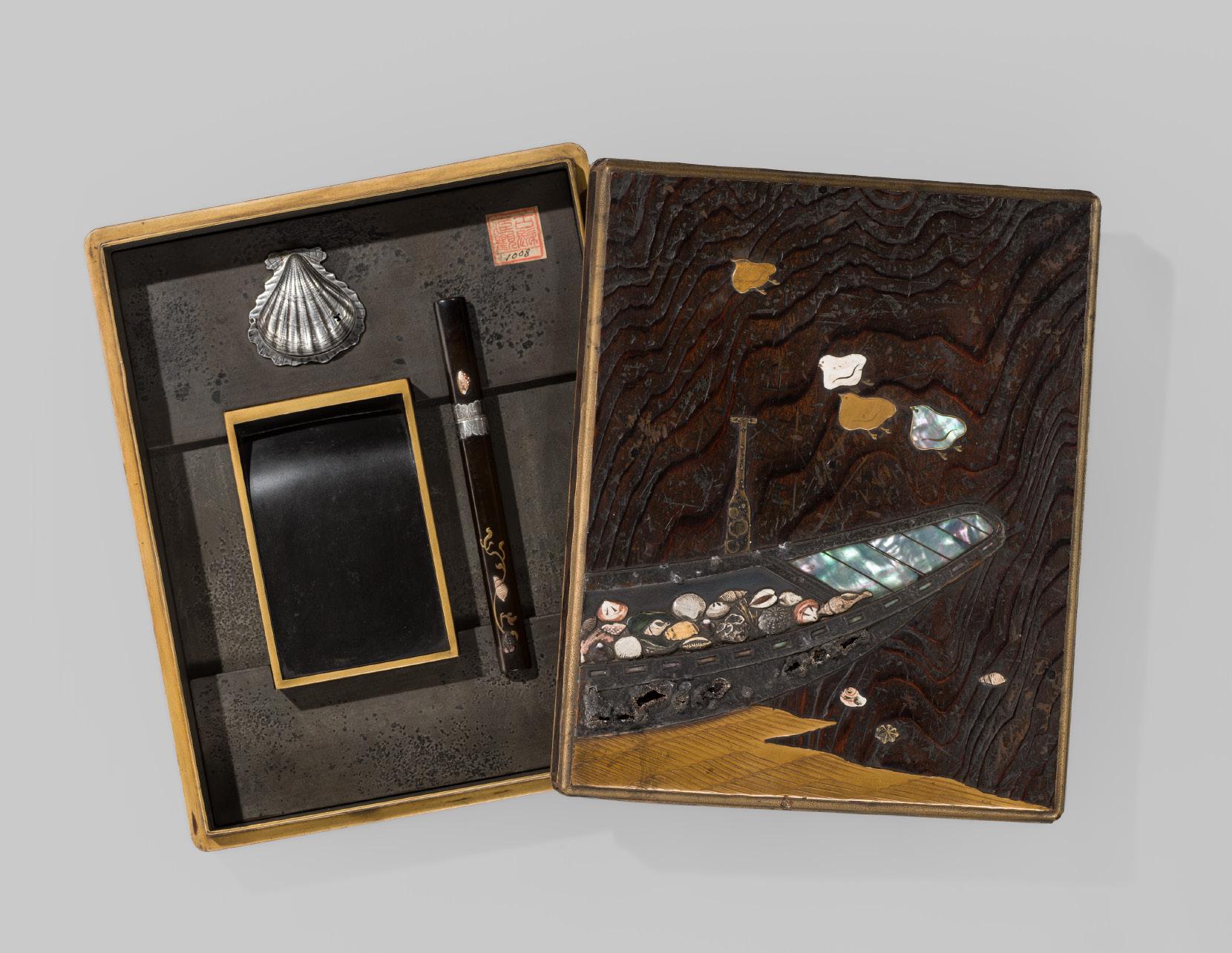
215
A SUPERB CERAMIC-INLAID LACQUERED WOOD RITSUO-STYLE ‘SHELL-LADEN BOAT AND PLOVERS’ SUZURIBAKO (WRITING BOX)
Japan, 18th century, Edo period (1615-1868)
Published: Resonance of Wa - The Japanese Spirit. Casal Collection, 2025, p. 158.
Of rectangular form with rounded edges and finished in gold lacquer, the wood displays a beautiful grain and is decorated in gold takamaki-e with a harmonious blend of materials. The inrobuta (flush-fitting) lid depicts a mitsuda-inlaid yanebune fishing boat, laden with shells and clams, inlaid in variously glazed ceramics. The boat’s bow features large strips of aogai (abalone shell), with several shells having fallen out, while plovers soar above, inlaid in lacquer, ceramic, and aogai. Behind the boat, a bronze oar is placed, textured to simulate age and wear.
The interior is finished in textured matte silver lacquer with gold fundame rims, housing the original implements: a lacquered and ceramic-inlaid knife (kamakiri) depicting further shells, with silver fittings, a fine silver clam-shaped water dropper (suiteki), and an inkstone (suzuri).
SIZE 4.8 x 22.5 x 18.1 cm
Provenance: Ex-Collection of Ugo Alfons Casal. Osaka City Museum of Fine Arts, bequeathed from the above and subsequently deaccessioned in 2021. Condition: Good condition with minor expected wear and natural flaws to the wood ground. Losses to the mitsuda inlay of the boat as well as some associated repairs and touchups. A few small losses to the gold lacquer beneath the boat. Some minor crackling to the interior edges. Old losses and wear to the tomobako.
Compare a closely related suzuribako with a similar, yet less elaborate décor, at Zacke, Fine Japanese Art, 14 June 2024, Vienna, lot 29 (sold for EUR 5,850).
Estimate EUR 4,000
Starting price EUR 2,000
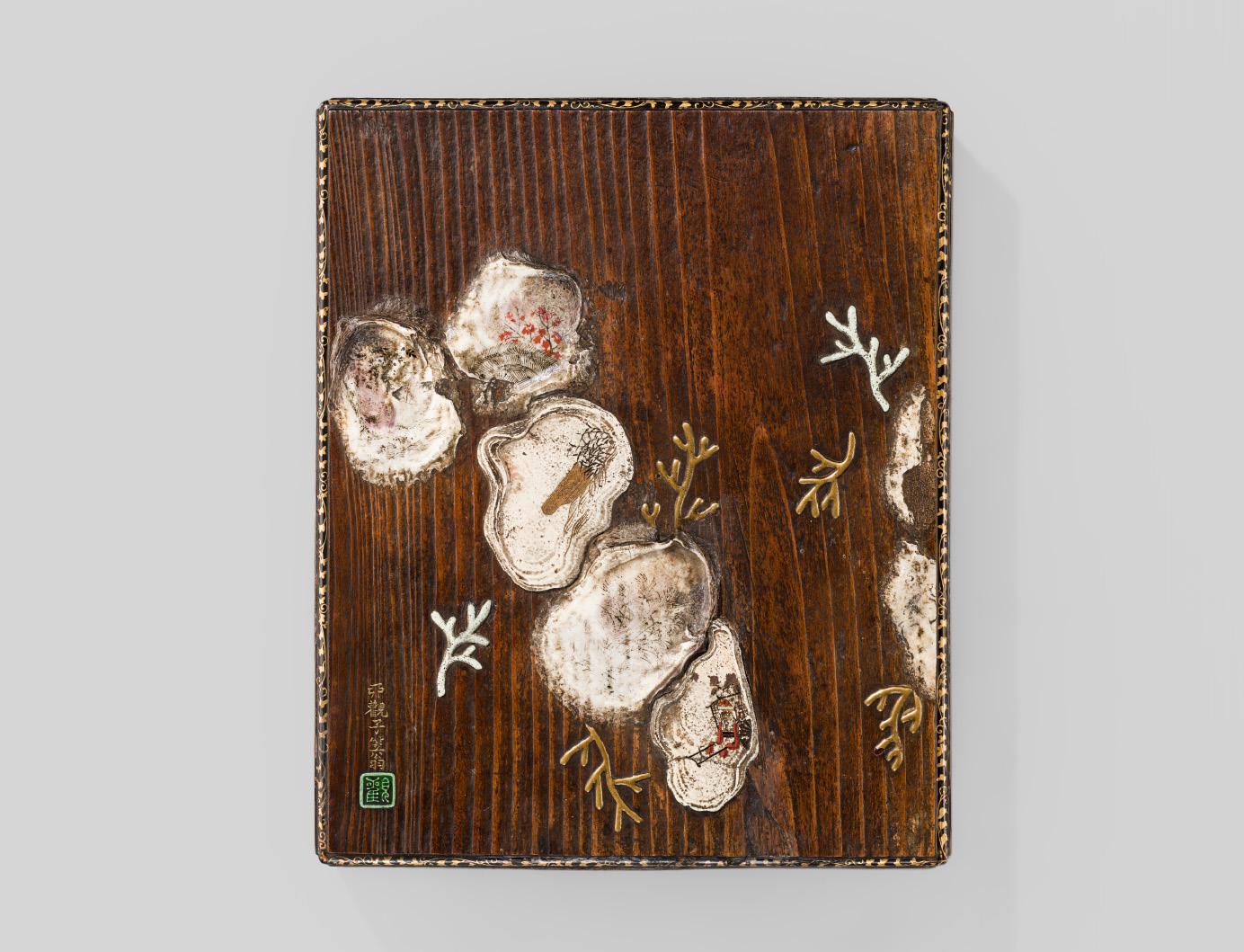
216
OGAWA HARITSU: A FINE INLAID WOOD ‘KAI-AWASE SHELLS’ SUZURIBAKO (WRITING BOX)
By Ogawa Haritsu (1664-1747) or a close follower, signed Ukanshi Ritsuo with seal Kan Japan, 18th century, Edo period (1615-1868)
Of rectangular shape with rounded edges finished with gold hiramaki-e karakusa on a roiro ground, the wood of attractive grain and color further decorated in gold lacquer and embellished with brilliant glazed ceramic inlays. The kabusebuta (overhanging) lid showcases large coral branches intertwined with shells painted with various designs from the kai-awase shell matching game. Sealed in green ceramic to the lower left UKANSHI RITSUO with seal KAN.
The interior cover is richly adorned in gold lacquer and features inlaid ceramics of seashells, including the husk of a sea urchin, highlighted with gold-lacquered seaweed against a vivid red lacquer ground. The box is finished with gold fundame rims, and the removable baseboard (ita) houses the original implements: a silver shell-shaped water dropper (suiteki) signed Yasuhira and an inkstone (suzuri).
SIZE 5.4 x 26.5 x 22.2 cm
Provenance: From the property of a Lady, London, United Kingdom. Christie’s, Aesthetic Intuition: Collecting Japanese Art, in Post-War London, 11 November 2015, London, lot 144 (sold for GBP 4,375 or approx. EUR 7,000 converted and adjusted for inflation at the time of writing). Old collection ‘no. 86’ to the interior. Condition: Excellent visual condition. The interior with repairs to the sides of the cover. A few cracks and losses to lacquer to the interior. Expected natural flaws to the wood ground.
With a padded silk storage box.
Kai-awase is a traditional Japanese game that originated in the Heian period (794-1185), in which pairs of clam shells were turned face down and players sought the correct matching halves by memory and touch. The interiors of the shells were often painted with related designs, rewarding both recognition and familiarity with literary or seasonal subjects.
AUCTION COMPARISON
Compare a related Ritsuo-style inlaid wood document box with clams, also sealed Kan, at Bonhams, Fine Japanese and Korean Art, 17 March 2021, New York, lot 594 (sold for USD 27,812 or approx. EUR 29,000 converted and adjusted for inflation at the time of writing).
Estimate EUR 4,000
Starting price EUR 2,000
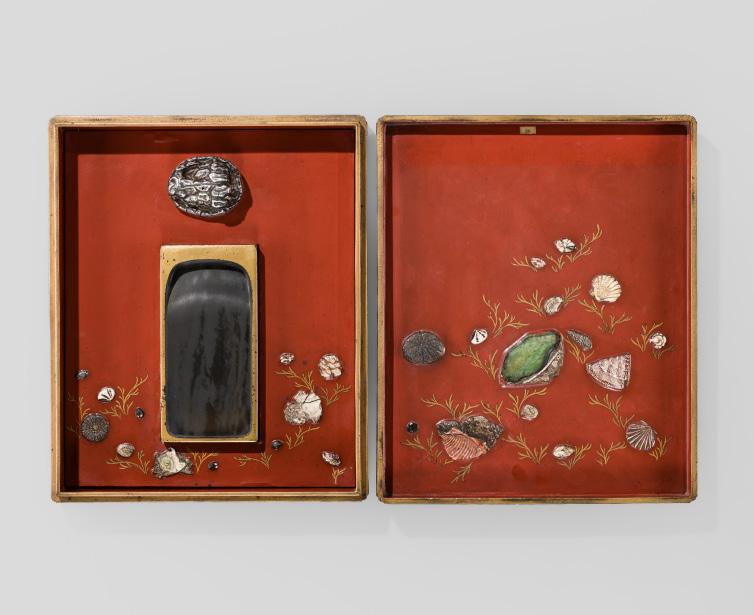
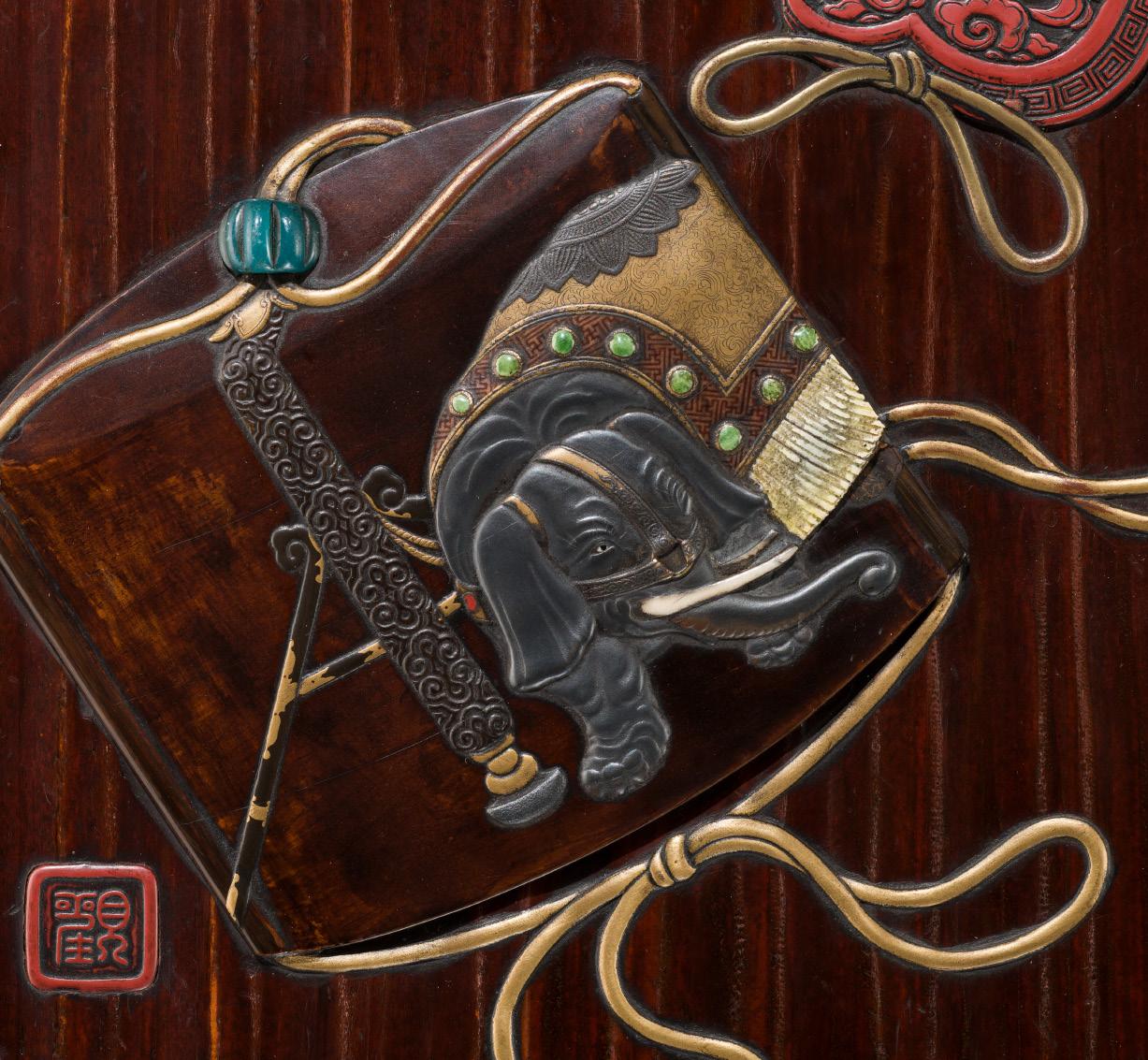
217
By Mochizuki
Hanzan (Haritsu II,1743-1790), sealed Kan Japan, late 18th century, Edo period (1615-1868)
Of upright rectangular form with gently rounded edges, the exterior is finished in a rich reddish-brown lacquer with a finely ribbed texture. The cover is intricately inlaid with a harmonious combination of materials including ceramic, jadeite, soapstone, and glass, depicting two elegant sagemono ensembles. The composition features two inro rendered in relief: one of three cases decorated with a caparisoned elephant tethered to a pole, executed in the typical Ritsuo manner; the other formed as a gunbai fan, executed in tsuishu lacquer with scrolling clouds and a central soapstone medallion carved with a rain dragon. Both ojime are of glass, and the netsuke attached to the tsushi inro is carved as a closed scroll with aogai highlights.
The interior is finished in lightly sprinkled roiro and fitted with compartments for writing implements. Signed to the lower left of the cover with a red seal KAN – this type of red seal is associated with Mochizuki Hanzan.
SIZE 3.5 x 26 x 18.5 cm
Provenance: The private collection of the Tomkinson family. Michael Tomkinson (1841-1921) was a British businessman and noted collector from Kidderminster, Worcestershire, who began collecting Japanese art in 1878.
Condition: Very good condition with minor expected wear and few tiny nicks here and there. Minor soiling to the scroll netsuke and several surface scratches to the underside. The implements are lost. Presenting beautifully.
Mochizuki Hanzan, traditionally dated 1743-1790, styled himself Haritsu II and worked in close emulation of Ogawa Haritsu (Ritsuo). Although neither a direct pupil nor descendant, his works demonstrate a sophisticated adaptation of the Haritsu idiom, combining lacquer with ceramic and other inlays. Some works are sealed “Kan,” contributing to the longstanding challenge of distinguishing his oeuvre from that of Haritsu himself.
AUCTION COMPARISON
Compare a closely related inlaid wood bunko by Ritsuo, bearing a similar design, 28.4 x 21.4 x 9.4 cm, at Van Ham, Asiatische Kunst, 9 June 2016, Cologne, lot 2263 (sold for EUR 10,320 or approx. EUR 13,500 adjusted for inflation at the time of writing). Also compare a related four-case inro of an elephant, signed Ritsuo and sealed Kan, the present inro motif clearly derived from this archetype, at Bonhams, The Edward Wrangham Collection of Japanese Art, 9 November 2010, London, lot 209 (sold for GBP 22,800 or approx. EUR 41,000 converted and adjusted for inflation at the time of writing).
Estimate EUR 8,000
Starting price EUR 4,000
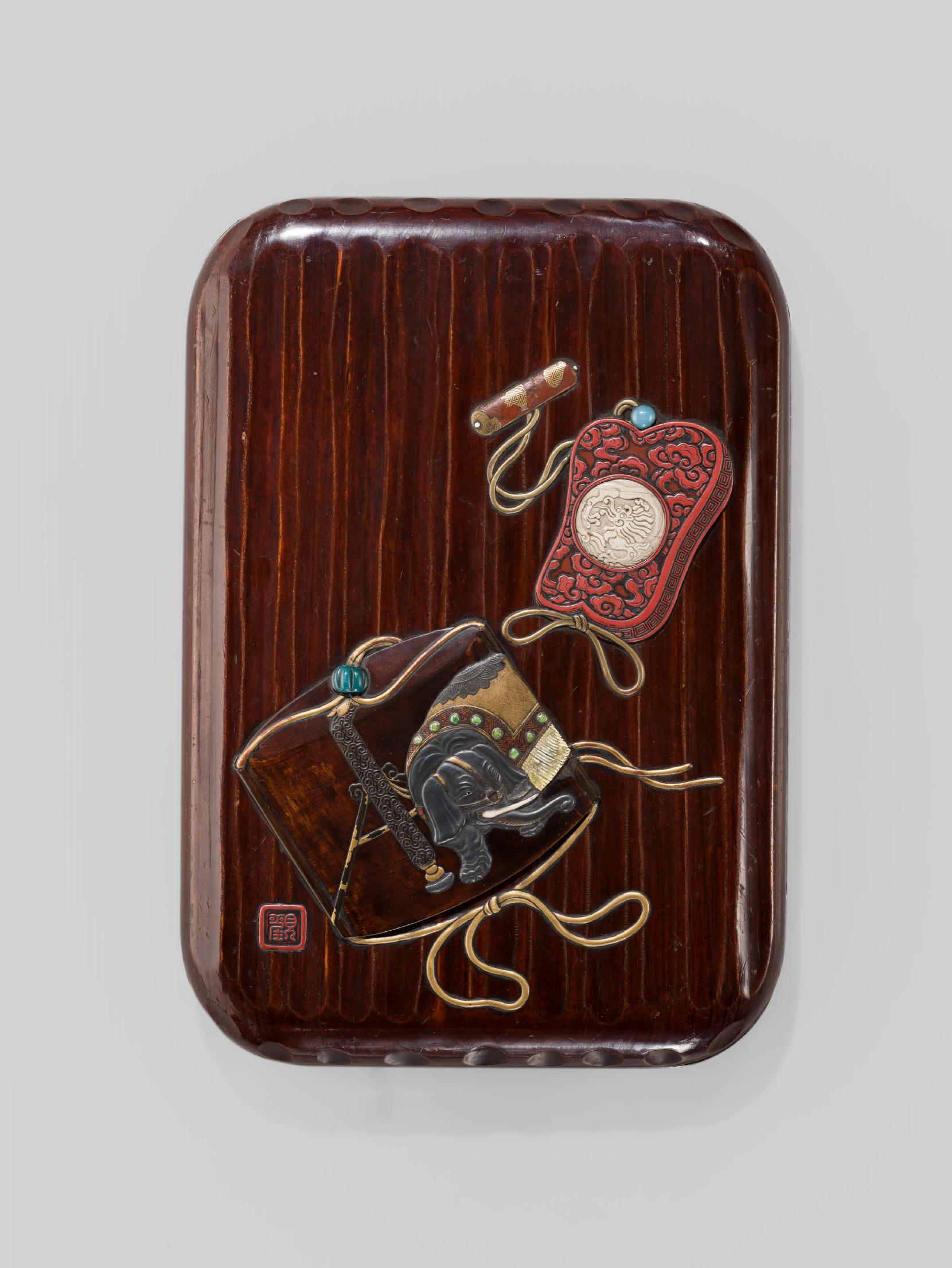
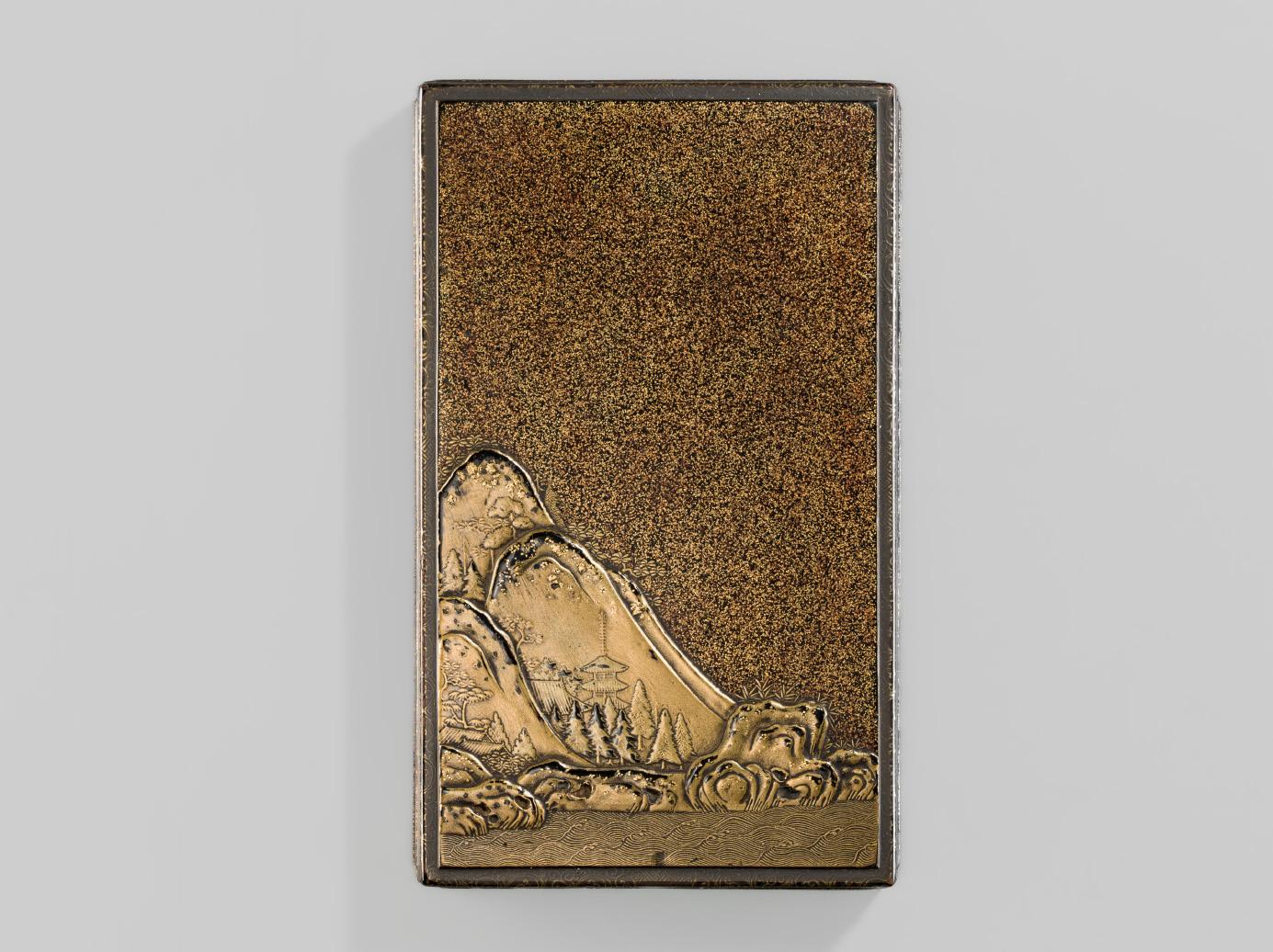
218 A SMALL AND EARLY LACQUER ‘PAGODA IN A ROCKY LANDSCAPE’ SUZURIBAKO (WRITING BOX)
Japan, 17th century, late Momoyama (1573-1615) to early Edo period (1615-1868)
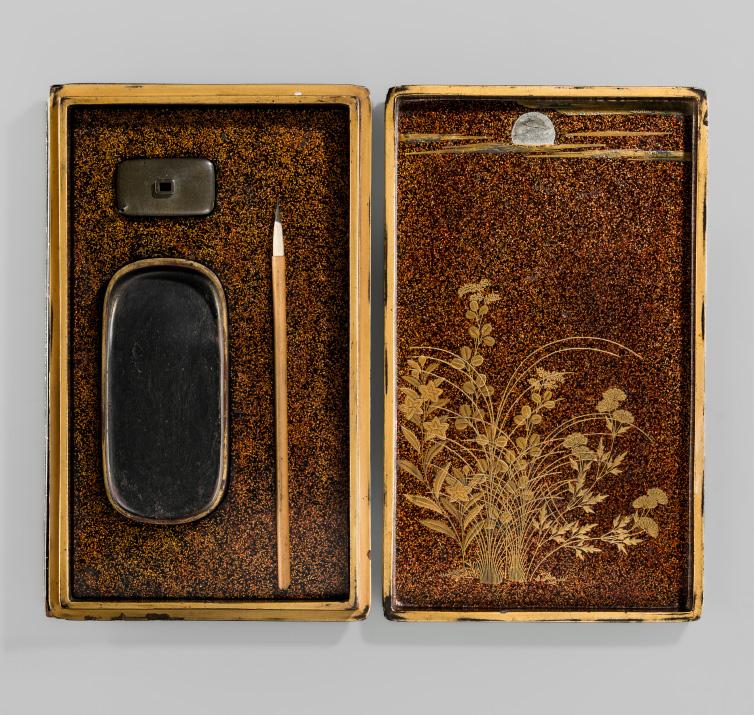
Of upright rectangular form with gently rounded sides, finely decorated in gold takamaki-e and hiramaki-e on a nashiji ground. The inrobuta (flush-fitting) lid depicts waves crashing against rugged rocks beneath a temple landscape, with a pagoda nestled among cedar trees. The edges are encircled by a delicate band of scrolling foliage.
The interior of the lid is further adorned with autumn grasses rendered in gold takamaki-e beneath a pewter-inlaid full moon. The interior is finished in nashiji with gold fundame rims, the removable baseboard (ita) retaining its original implements: a simple metal water dropper (suiteki) and inkstone (suzuri), as well as a later brush (fude).
SIZE 3.1 x 19.4 x 11.2 cm
Provenance: Bonhams, Fine Japanese Works of Art, 22 March 2011, New York, lot 3119. A US private collection, acquired from the above.
Condition: Good condition with old wear including few tiny losses to lacquer and some crackling and dents to the interior cover. Minor expected wear and rubbing along the edges. Scratches and wear to the underside.
Compare a closely related larger lacquer suzuribako depicting a rocky landscape, dated 17th century, 22.5 cm long, at Christie’s, Japanese Art and Design, 12 May 2010, London, lot 275 (sold for GBP 3,125 or approx. EUR 5,500 converted and adjusted for inflation at the time of writing).
Estimate EUR 3,000
Starting price EUR 1,500
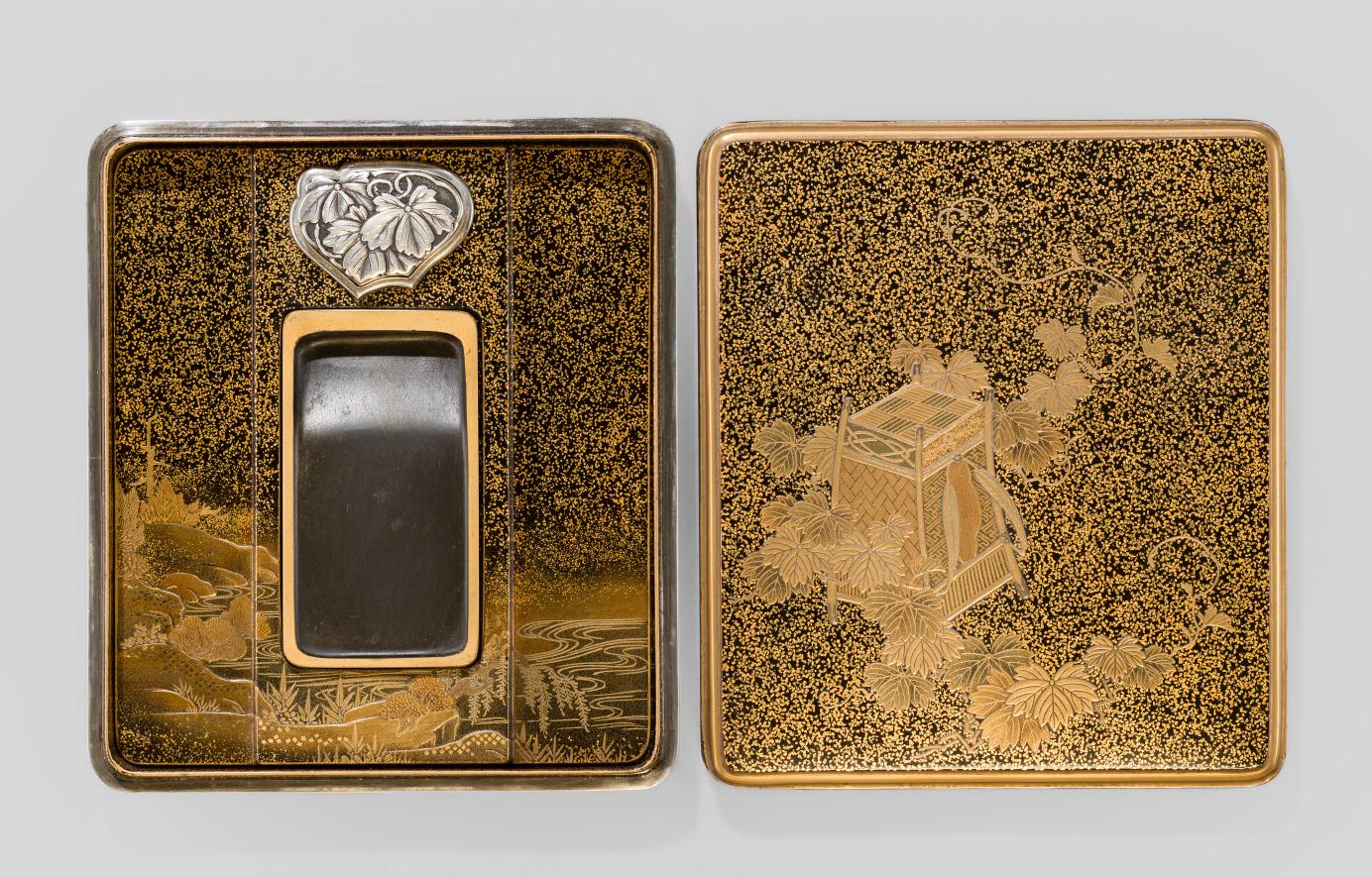
219
Japan, 17th-18th century, Edo period (1615-1868)
Of square form with rounded corners, finely decorated in gold takamaki-e and hiramaki-e on a nashiji ground. The inrobuta (flushfitting) lid depicts an oi (traveller’s backpack) entwined with tsuta vines, alluding to an episode from the Tale of Ise.
The interior of the lid is decorated with a tranquil riverscape with pine trees and rocks, embellished with kirigane flakes against a nashiji ground. The interior fitted with a removable baseboard (ita) and housing the original implements: a silver tsuta leaf-shaped water dropper (suiteki) and an inkstone (suzuri). The rims are mounted in silver.
SIZE 2.5 x 12 x 11 cm
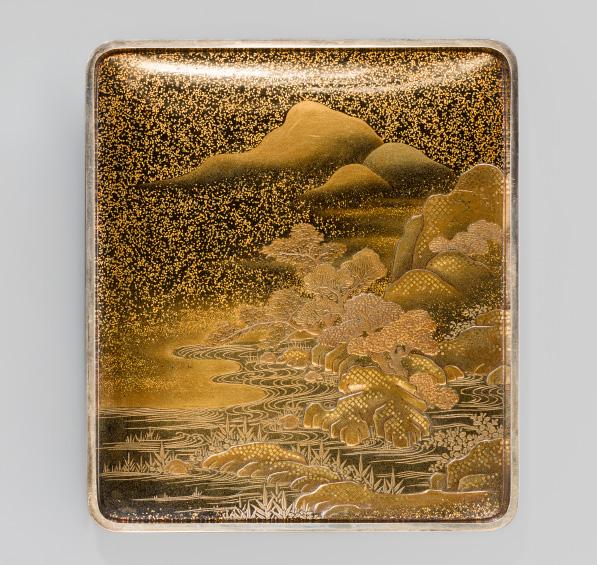
Provenance: Ex-Collection of Irving Gould. With Rosemary Bandini, London, 1999. From the collection of Eva & Aubrey Sweet, Melbourne, Australia, acquired from the above. A copy of the invoice from Rosemary Bandini, dated 8 August 1999, stating a purchase price of USD 10,000 (or approx. EUR 17,000 converted and adjusted for inflation at the time of writing), accompanies the lot.
Condition: Excellent condition with only very minor wear.
With a wood tomobako (storage box).
The present suzuribako illustrates a poetic motif derived from the Tale of Ise (Ise Monogatari), in which an oi set among trailing vines evokes the image of a solitary traveler moving through an overgrown landscape, imbued with quiet melancholy. Compiled during the Heian period and traditionally associated with Ariwara no Narihira, the Tale of Ise is a seminal work of Japanese literature, combining lyrical poetry with narrative episodes centered on themes of love, travel, and longing. Its imagery, in which landscape and emotion are closely intertwined, became a rich source of inspiration for the decorative arts.
MUSEUM COMPARISON
Compare a related suzuribako depicting an oi among maple leaves, dated 17th century, 5.5 x 22.9 x 24.8 cm, the Smithsonian National Museum of Asian Art, accession no. F2005.2a-m.
AUCTION COMPARISON
Compare a related small suzuribako, dated early 17th century, 13.6 x 12.6 cm, at Christie’s, Japanese Art and Design, 13 November 2002, London, lot 68 (sold for GBP 5,975 or approx. EUR 13,000 converted and adjusted for inflation at the time of writing).
Estimate EUR 6,000 Starting price EUR 3,000
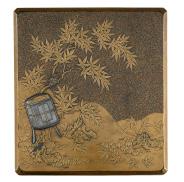
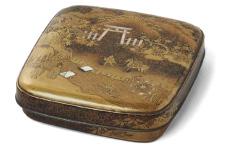
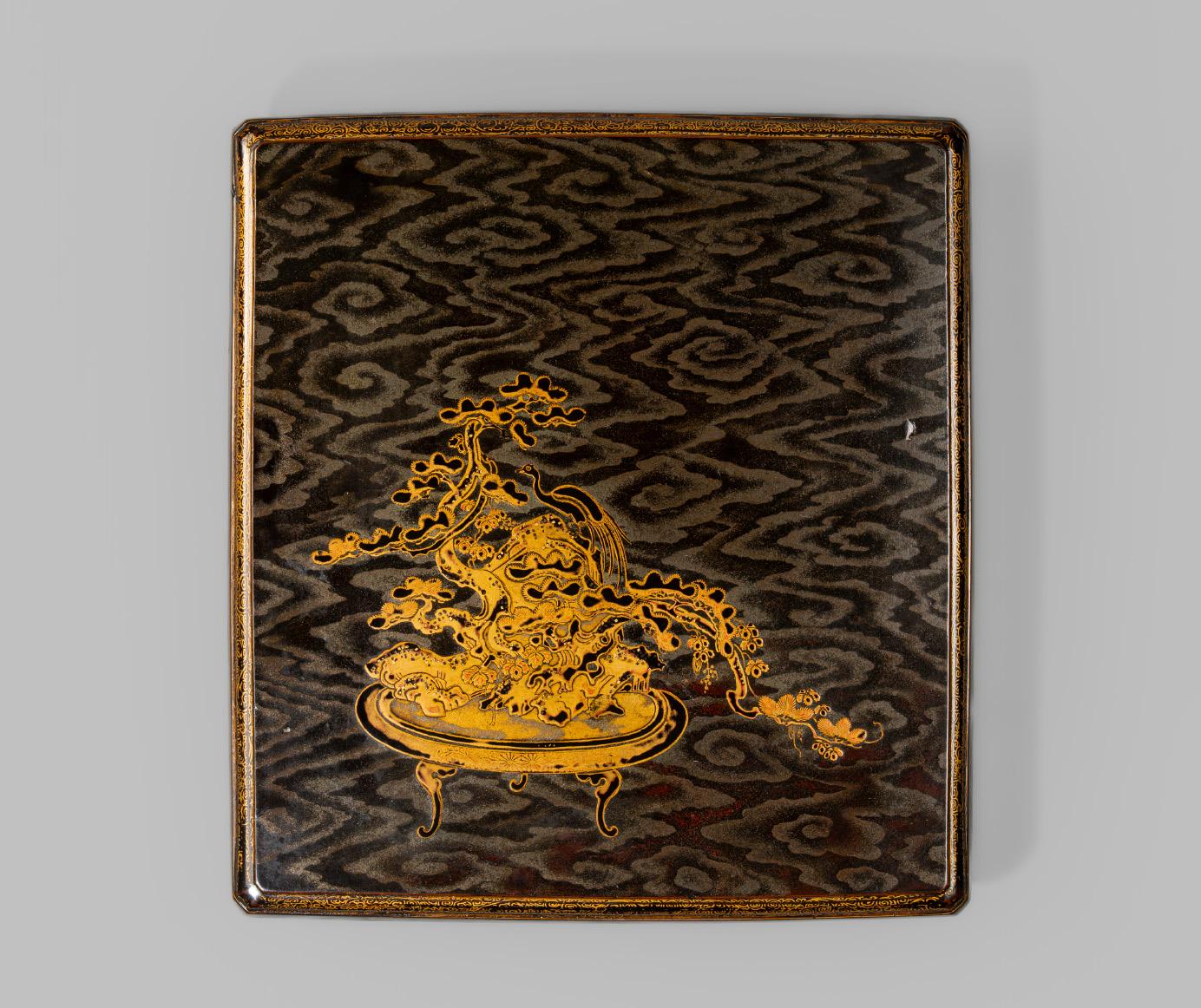
220 A RARE AND EARLY LACQUER ‘BONSAI AND SPIDERWEB’ SUZURIBAKO (WRITING BOX)
Japan, late 16th-early 17th century, Momoyama (1573-1615) to early Edo period (1615-1868)
Of almost square form with canted edges, the surface bearing a silver cloud ground finely decorated in gold takamaki-e and hiramaki-e. The kabusebuta (overhanging) lid depicts a bonsai tree, delicately embellished with kirigane flakes, set upon an oval stand with three curved feet and chrysanthemum (kiku) decoration.
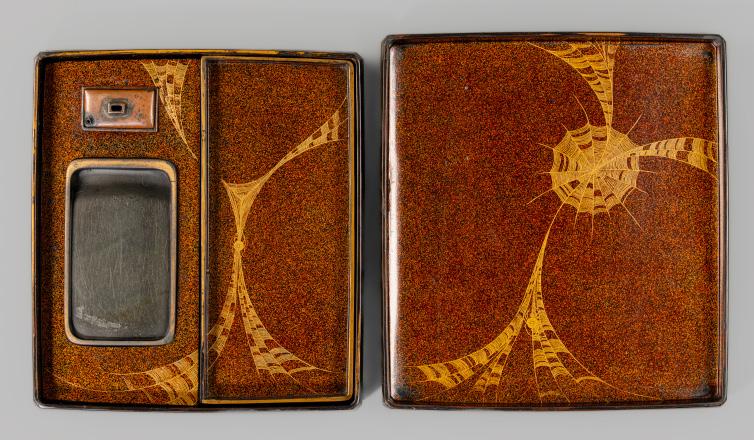
Behind the tree, a small pheasant perches atop a rock, adding a subtle auspicious element. The edges of the lid are encircled by a finely executed scrolling foliage band.
The interior of the lid and box are finished in nashiji and decorated in gold hiramaki-e with two finely rendered spider webs inhabited by two spiders. The interior is fitted with a removable tray decorated with autumn grasses and a removable baseboard (ita), housing the original implements: a simple copper water dropper (suiteki), and an inkstone (suzuri).
SIZE 4 x 22.5 x 21.7 cm
Condition: Good conditon with old wear including a few tiny dents and nicks to the cover, and one large crack to the interior cover. Scratches and wear to the underside.
AUCTION COMPARISON
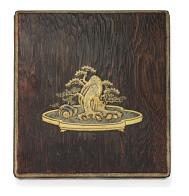
Compare a related lacquer suzuribako depicting a bonsai tree, attributed to the Igarashi school, dated 17thearly 18th century, 20.1 cm long, at Christie’s, Aesthetic Intuition: Collecting Japanese Art in Post-War London, 11 November 2015, lot 134 (sold GBP 9,375 or approx. EUR 15,000 converted and adjusted for inflation at the time of writing).
Estimate EUR 2,500
Starting price EUR 1,200
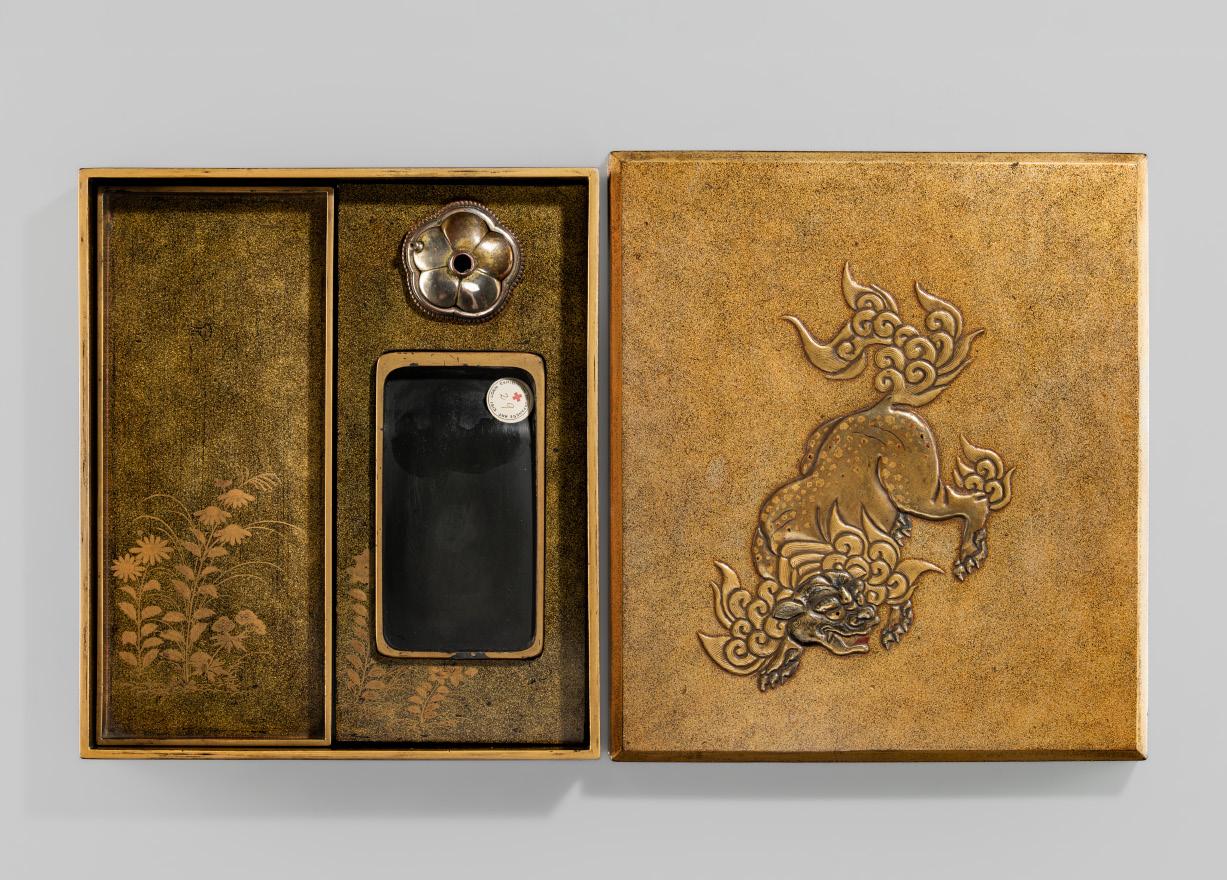
Japan, 17th century, early Edo period (1615-1868)
Published: Henri L. Joly and Kumasaku Tomita (1915), Japanese Art and Handicrafts, in aid of the British Red Cross, no. 29 (not illustrated).
Exhibited: British Red Cross, Japanese Works of Art and Handicraft, London, 14 October-13 November 1915.
Of rectangular form with canted edges, finely decorated in gold, silver, and red takamaki-e and hiramaki-e on a dense nashiji ground. The kabusebuta (overhanging) lid is boldly composed with a prancing shishi, its speckled coat, curling mane, and animated tail rendered with lively precision and subtle textural variation.
The interior of the lid reveals a contrasting and elegant scene of two red-crowned cranes, finely lacquered and set against a nashiji ground with fundame rims. The interior is fitted with a removable tray decorated with autumn grasses and a removable baseboard (ita), housing the original implements: a silvered metal plum-shaped water dropper (suiteki) and an inkstone (suzuri).
The present box was exhibited at the 1915 British Red Cross exhibition, Japanese Works of Art and Handicraft, an important event organized to raise funds for wartime relief efforts. The exhibition brought together a remarkable selection of Japanese works, including lacquer, ceramics, textiles, and prints, offering British audiences a rare opportunity to engage with the refinement and technical excellence of Japanese craftsmanship. Such events played a significant role in fostering the appreciation of Japanese art in Europe during the early 20th century.
SIZE 4.5 x 23.4 x 20.7 cm
Provenance: Ex-Collection of Richard Phené Spiers. Bonhams, Fine Japanese Art, 6 November 2014, London, lot 284. From a French private collection, acquired from the above. With an exhibition label to the interior. Condition: Very good condition with only very minor wear and light traces of use including some very light soiling and tiny nicks to the cover.
AUCTION COMPARISON
Compare a related gold lacquer suzuribako depicting cranes, dated 17th-18th century, 4 x 21.6 x 23.5 cm, at Zacke, Fine Japanese Art, 5 December 2025, Vienna, lot 265 (sold for EUR 3,120).
Estimate EUR 5,000
Starting price EUR 2,400

222
FINE LACQUER ‘CRANES AND MINOGAME’ SUZURIBAKO (WRITING BOX)
Japan, 18th-19th century, Edo period (1615-1868)
Of almost square form with canted edges, bearing a dense nashiji ground finely decorated in gold and silver takamaki-e and hiramaki-e, and framed by fundame edges. The kabusebuta (overhanging) lid depicts three cranes and three minogame in a rocky waterscape, accompanied by a pine tree and other rich blossoms, the floral compositions extending onto the sides, all subtly enriched with kirigane flakes.
The interior of the lid is decorated with chrysanthemum (kiku) blossoms among rocks, set against a nashiji ground. The interior is finished in nashiji with gold fundame rims and retains its original implements, including two trays and a gilt-metal kiku-shaped water dropper (suiteki). The brushes and inscribed ink stick are of a later date.
SIZE 5.1 x 24.1 x 22.1 cm
Condition: Excellent condition with only very minor wear. With a wood tomobako (storage box).
Cranes and minogame (turtles with a moss-like tail) are powerful symbols in Japanese culture, closely associated with longevity, good fortune, and resilience. The crane, often regarded as a messenger of the gods, is traditionally linked to eternal life and is believed to live for a thousand years. Similarly, the minogame embodies immortality, its extended lifespan symbolizing endurance, stability, and wisdom.
MUSEUM COMPARISON
Compare a closely related lacquer suzuribako with cranes and pines, dated 18th century, 4.8 x 22.2 x 24.1 cm, in the Metropolitan Museum of Art, object number 14.40.831a–f.
Estimate EUR 4,000
Starting price EUR 2,000
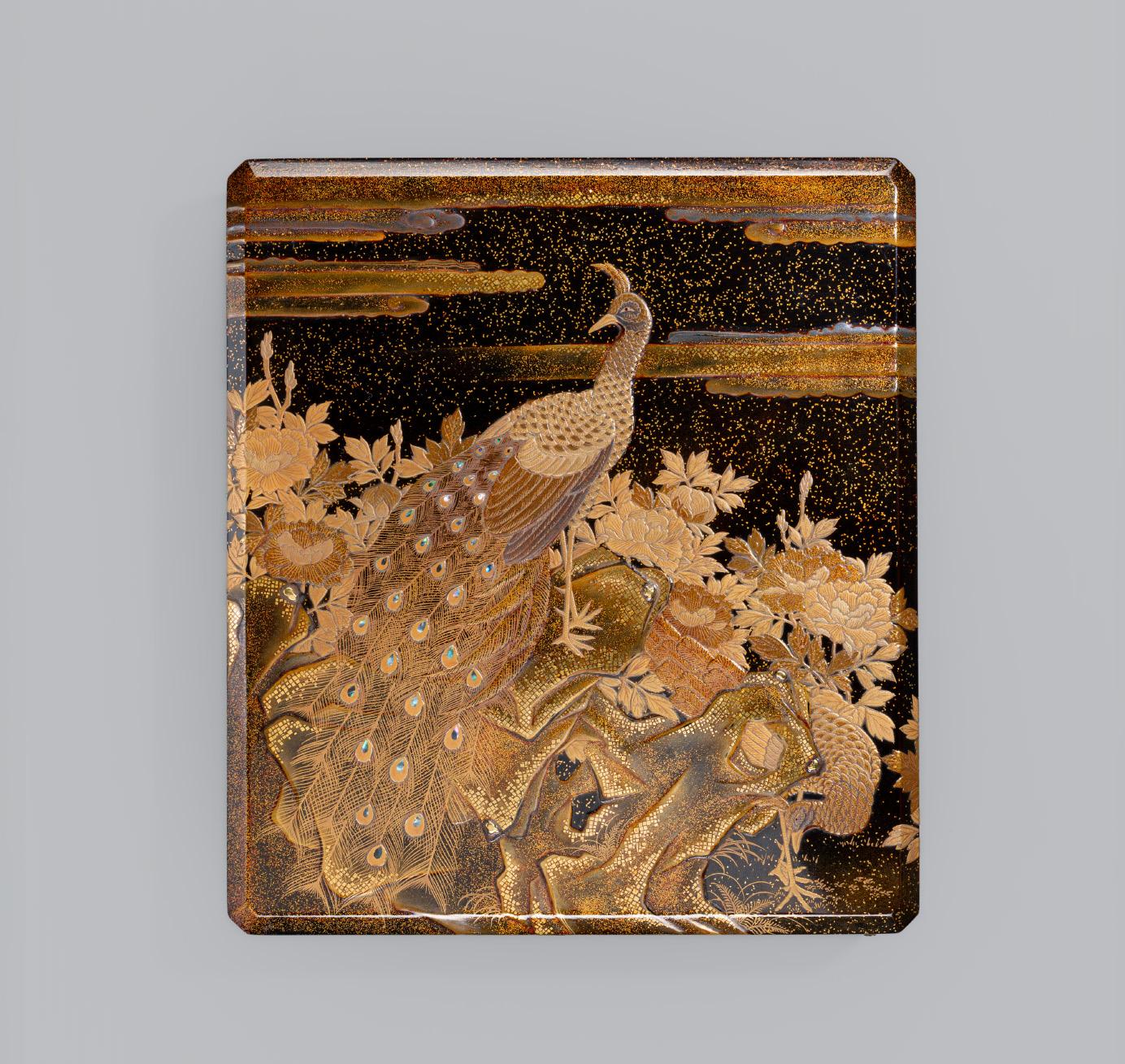
Japan, 18th-19th century, Edo period (1615-1868)
Of rectangular form with canted edges, bearing a lustrous roiro ground with gold sprinkles and e-nashiji, finely decorated in gold and silver takamaki-e and hiramaki-e. The inrobuta (flush-fitting) lid depicts a peacock standing atop rocks, its magnificent plumage richly inlaid with aogai (mother-of-pearl) and further embellished with kirigane flakes. In the corner, a peahen appears amidst lush peonies, completing the elegant composition.
The interior of the lid reveals a finely rendered rocky landscape with willow and pine trees, as well as small huts beside a lake, set against a roiro ground subtly enhanced with gold sprinkles and nashiji. The interior continues the scene and is fitted with a removable ita (baseboard), housing the original implements, including an elaborate silver chrysanthemum-shaped water dropper (suiteki), two brushes, an inkstick holder, a gilt inkstick, and a rectangular inkstone (suzuri). The rims are finished in gold fundame and are mounted in silver.
SIZE 5.5 x 26.5 x 23.5 cm
Condition: Excellent condition with only minor wear and only very minor and typical losses to the aogai and kirigane inlays.
With the original wood tomobako (storage box).
Estimate EUR 5,000 Starting price EUR 2,400
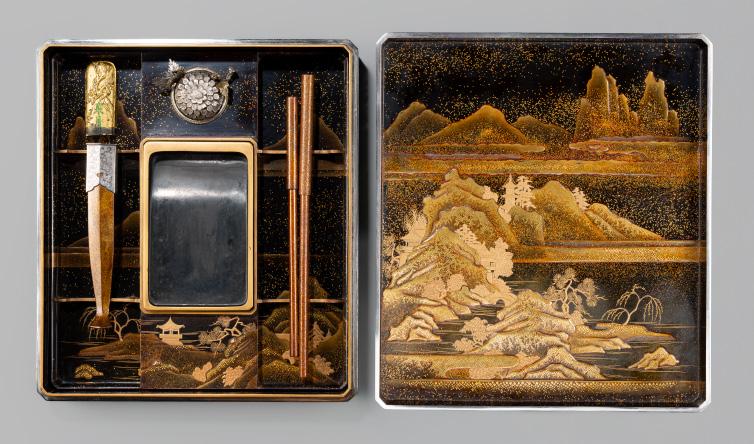
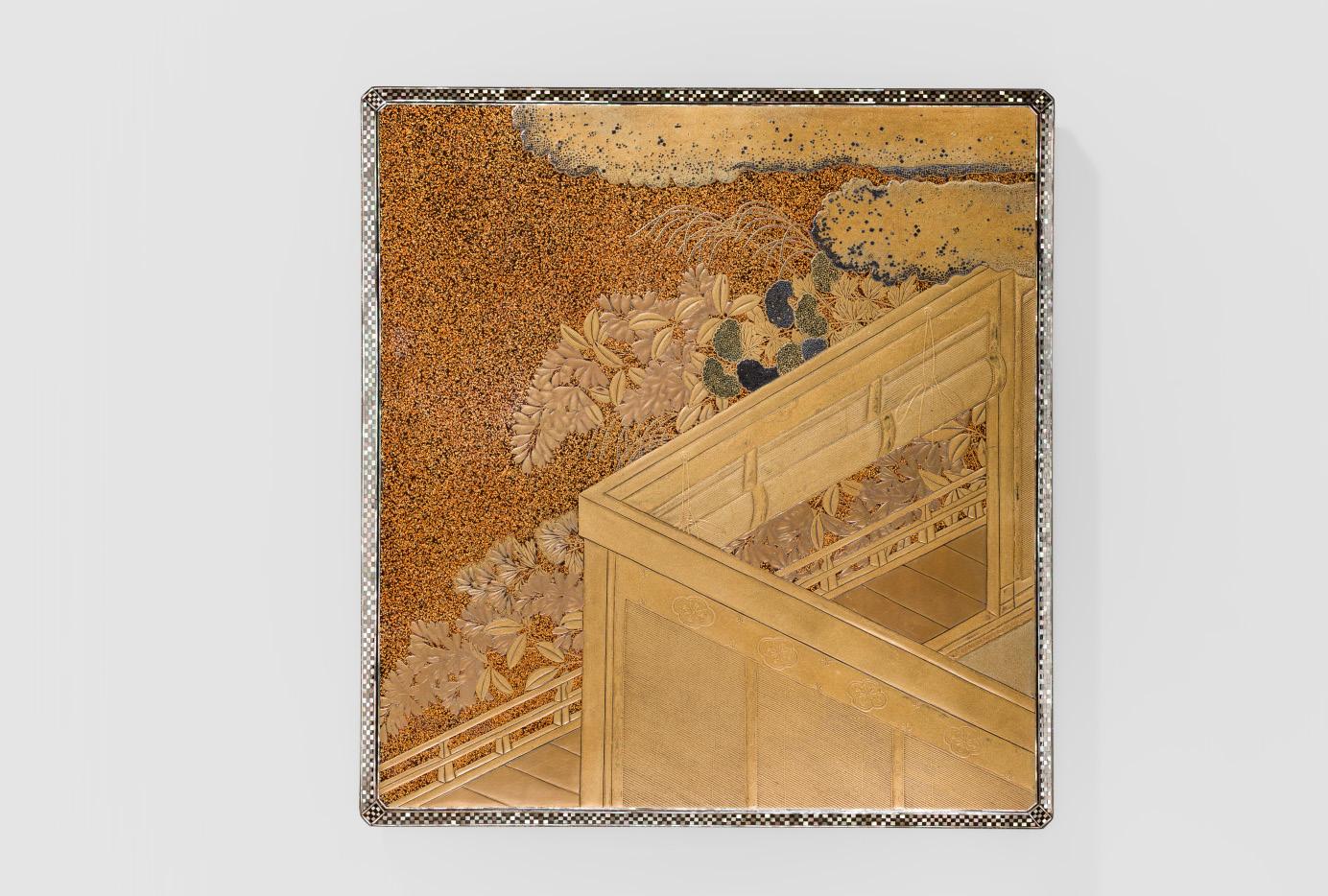
A FINE INLAID LACQUER ‘TALE OF ISE’ SUZURIBAKO (WRITING BOX)
Japan, 17th-18th century, Edo period (1615-1868)
Of rectangular form, finely decorated in gold and silver takamaki-e and hiramaki-e on a dense nashiji ground, the edges encircled by a very fine mother-of-pearl ban inlaid in the Somada-style. The kabusebuta (overhanging) lid depicts a veranda with bamboo blinds and bush clover, delicately embellished with kirigane flakes.
The interior of the lid is exquisitely decorated in gold and black takamaki-e with a courtly scene from the Tales of Ise (Ise monogatari), showing three elegantly attired figures crossing the eight-plank bridge (yatsuhashi), set among irises inlaid in aogai (mother-of-pearl), all against a luminous nashiji ground. The interior retains its original implements, including a further decorated tray with the yatsuhashi and butterflies, a silver water dropper (suiteki), and an inkstone (suzuri).
SIZE 4.5 x 22.5 x 21 cm
Provenance: Simon Pilling, London, 2015. From the collection of Eva & Aubrey Sweet, Melbourne, Australia, acquired from the above. A copy of the invoice from Simon Pilling, dated 4 November 2015, stating a purchase price of GBP 6,000 (or approx. EUR 9,700 converted and adjusted for inflation at the time of writing) and confirming the above, accompanies the lot.
Condition: Very good condition with minor typical losses to the aogai inlays along the edges.
With a wood tomobako (storage box).
The interior design of the present suzuribako derives from the celebrated “Eight Bridges” (Yatsuhashi) episode from Chapter 9 of the Tales of Ise (Ise monogatari), a theme famously depicted by Ogata Korin and widely admired in Japanese art. The episode recounts the journey of the poet Ariwara no Narihira (825–880), who, traveling through Mikawa Province, came upon a landscape where a river divided into eight channels, each spanned by its own bridge. Moved by the sight of irises (kakitsubata) in bloom, he composed a wistful poem expressing longing for his distant wife.
Estimate EUR 6,000
Starting price EUR 3,000
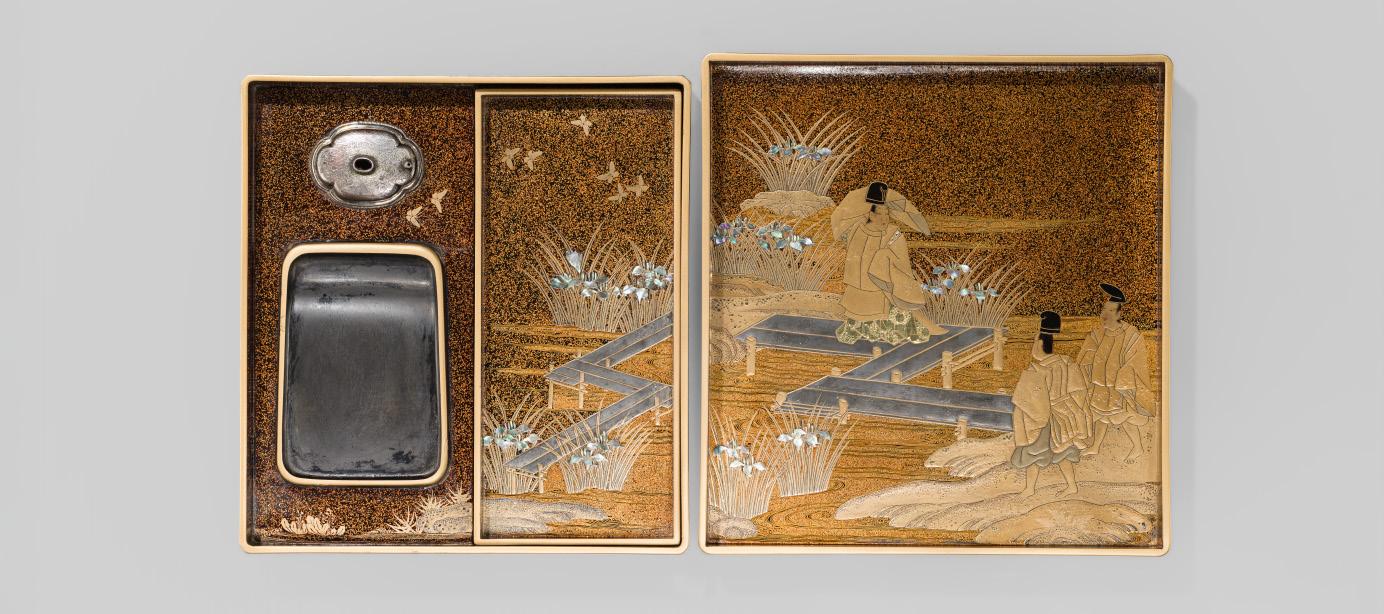
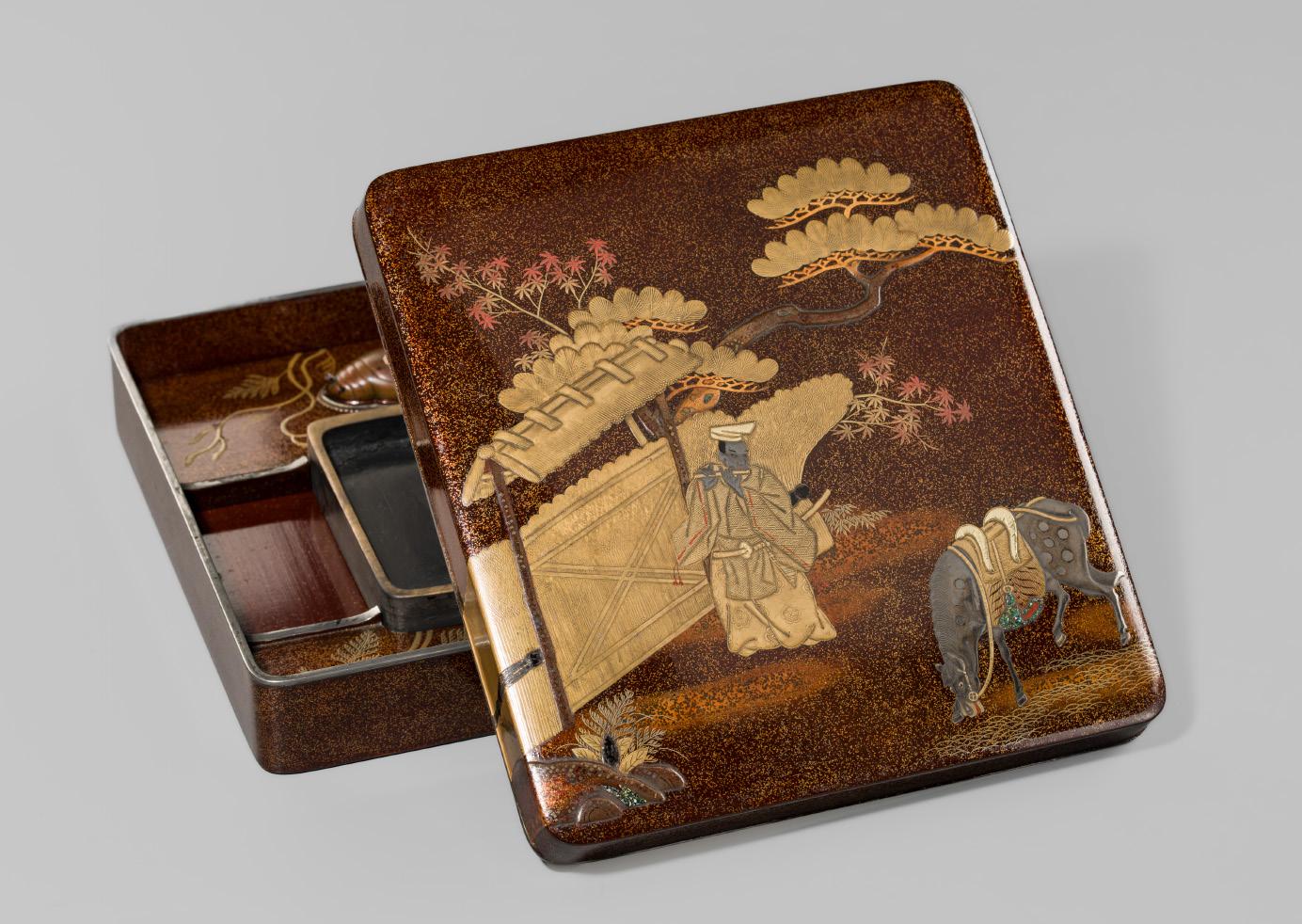
225 A FINE INLAID LACQUER ‘MINAMOTO NO NAKAKUNI PLAYING THE FLUTE’ SUZURIBAKO (WRITING BOX)
Japan, 18th-19th century, Edo period (1615-1868)
Of rectangular form with rounded edges, finely decorated in iro-e takamaki-e and hiramaki-e on a darkened nashiji ground. The kabusebuta (overhanging) lid depicts Minamoto no Nakakuni playing the flute outside a gate, his horse grazing nearby, the abumi (stirrups) inlaid with aogai (mother-of-pearl).
The interior of the lid is charmingly decorated with a scene of two anthropomorphic monkeys in conversation, one wearing a sambaso headdress and the other holding a gohei wand, a peach between the two monkeys. The interior is further adorned with aquatic ferns against a nashiji ground, with silver-mounted rims, and fitted with two removable trays, a conch-shaped copper water dropper (suiteki), and an inkstone (suzuri).
SIZE 4.3 x 24 x 22 cm
Provenance: Cunningham Art Projects, St. Northcote, 2022.
From the collection of Eva & Aubrey Sweet, Melbourne, Australia, acquired from the above. A copy of the invoice from Cunningham Art Projects, dated 2 August 2022, stating a purchase price of AUD 8,000 (or approx. EUR 5,500 converted and adjusted for inflation at the time of writing) and confirming the above, accompanies the lot.
Condition: Excellent condition with only minor wear and light rubbing to the lacquer.
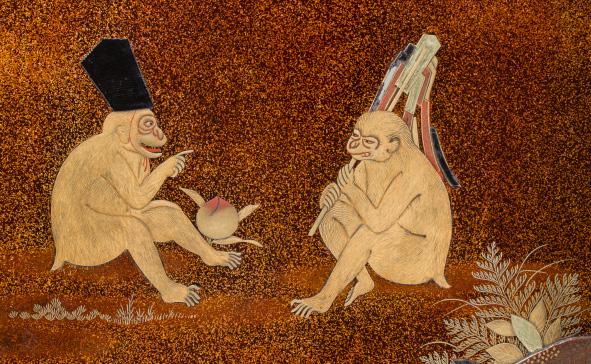
The decoration is inspired by an episode from the Heike monogatari (The Tale of the Heike). Lady Kogo, renowned for her beauty, became a favored consort of Emperor Takakura (r. 1168–1180), but was forced into exile in Sagano as a result of court intrigue. The Emperor, longing for her, dispatched the courtier Minamoto no Nakakuni to find her. Upon locating her retreat, Nakakuni arrived by night and, hearing her playing the koto, announced his presence by responding on the flute. This poetic moment of longing and reunion, set under the moonlight, became a popular subject in Japanese art and is sensitively evoked in the present composition.
With a wood tomobako (storage box).
AUCTION COMPARISON
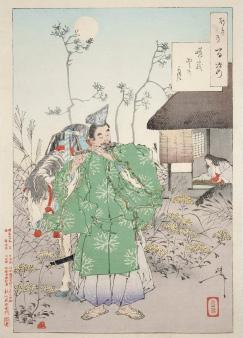
Woodblock print depicting Minamoto no Nakakuni playing a flute, by Tsukioka Yoshitoshi, 1891, in the British museum, registration no. 1906,1220,0.1470
Compare a related lacquer suzuribako depicting Nakakuni playing the flute, dated 19th century, 3.8 x 22.5 x 20.9 cm, at Bonhams, Fine Japanese and Korean Art including property from the Collection of Drs, 22 July 2020, New York, lot 960 (sold for USD 2,805 or approx. EUR 3,000 converted and adjusted for inflation at the time of writing).
Estimate EUR 4,000
Starting price EUR 2,000
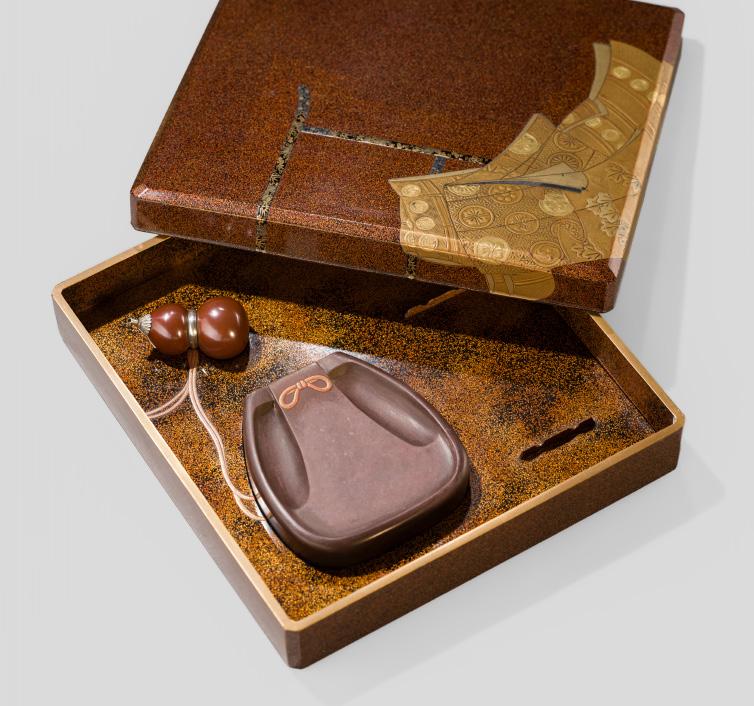
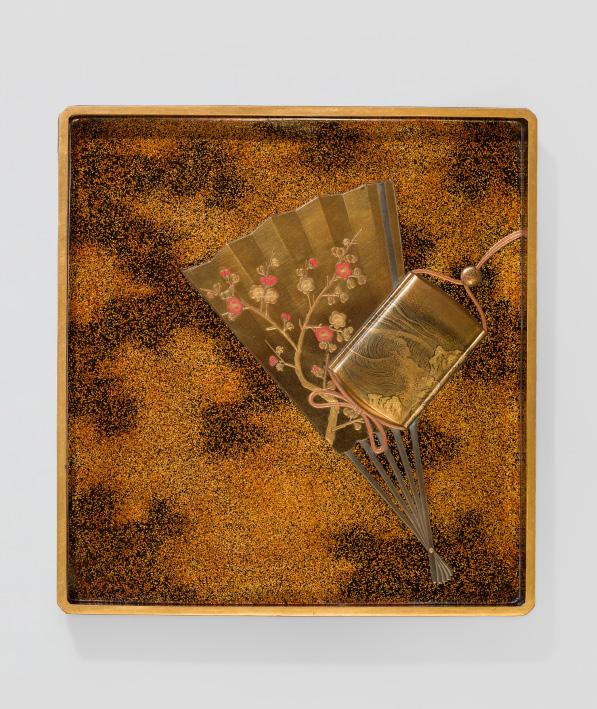
A SUPERB LACQUER ‘TAGASODE AND SAGEMONO’ SUZURIBAKO (WRITING BOX)
Japan, mid-19th century, Edo period (1615-1868)
The rectangular cover is exquisitely decorated in gold, silver, and black takamaki-e and hiramaki-e techniques against a dense nashiji ground, depicting a luxurious kimono draped over an elegant iko (kimono stand). The robe is richly adorned with various mon (family crests), some inlaid in gold foil, and scattered maple leaves, flowing over stylized waves that evoke the Tatsuta river. The stand itself is intricately rendered with pine, plum, and bamboo motifs, and the silver lacquer is enhanced with chrysanthemums and scrolling karakusa, beautifully replicating the silver fittings traditionally found on such kimono stands.
The interior continues the refined decorative scheme, displaying an arrangement of a four-case inro and a fan, both set against a mura nashiji ground. The inro is decorated in togidashi-e with waves, embellished with kirigane flakes, while the fan depicts a cherry tree in bloom. Attached to the inro is a gold-lacquered cord that extends along the rim and leads to an additional sagemono set, consisting of a kinchaku-shaped inkstone (suzuri) and a yatate netsuke, crafted in the form of a gourd, serving as the water dropper (suiteki). Two raised brackets function as holders for additional implements, such as a brush or paper cutter. The rims are finished in gold fundame.
SIZE 4.5 x 23 x 22 cm
Provenance: Rosemary Bandini, 2016, London. From the collection of Eva & Aubrey Sweet, Melbourne, Australia, acquired from the above.
A copy of the receipt from Rosemary Bandini, dated to 28 April 2016, stating a purchase price of GBP 9,000 (or approx. EUR 14,500 converted and adjusted for inflation at the time of writing), accompanies the lot.
Condition: Excellent condition with only very minimal wear including light rubbing to lacquer and minor typical traces of use. One of the bracket holders is re-attached to the interior.
With a wood tomobako (storage box)
The kimono in these works not only displayed personal taste but also conveyed social position. The suzuribako, with its arrangement of a kimono and sagemono set, mirrors the private world of Edo women, where the presentation of clothing and accessories spoke to their wealth and status.
The motif of a kimono draped over a rack or stand is a significant symbol in Edo period art, representing femininity, social status, and refinement. Known as Tagasode (Whose Sleeves?), this imagery began in the early seventeenth century and evolved over time. Early screens depicted kosode (early kimono) draped against simple gold backgrounds, but by the mid-seventeenth century, artists began introducing domestic elements like shelves and shoji screens, creating more immersive scenes. In these works, sumptuous kimonos casually draped on maki-e (lacquer decorated with gold and/or silver powder) lacquer racks intimately evoke their unknown wearer and prompt the question, “Whose sleeves?” This phrase, taken from a classical poem in the Kokin wakashû (the tenth-century poetry anthology Collected Japanese Poems of Ancient and Modern Times), emphasizes how possessions can express personality and presence more powerfully than a conventional likeness. The suzuribako (writing box) reflects this evolution, with a kimono stand adorned with family crests and seasonal motifs, reinforcing the kimono as a symbol of wealth and social standing.
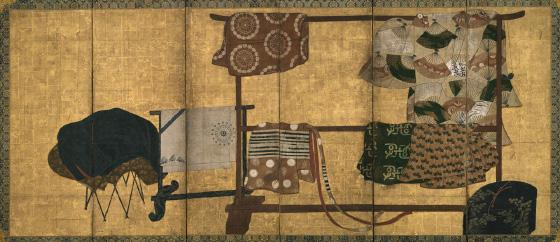
The intricate detailing on the stand and lacquer work underscores the object’s connection to sophistication. These works reflect the refined, private spaces of women in the Edo period, where the kimono’s design served as a marker of cultural and social identity.
MUSEUM COMPARISON
Compare a related suzuribako with a kimono rack, dated second half of the 19th century, in the Metropolitan Museum of Art, New York, object number 1982.244.4a–e.
Estimate EUR 10,000
Starting price EUR 5,000
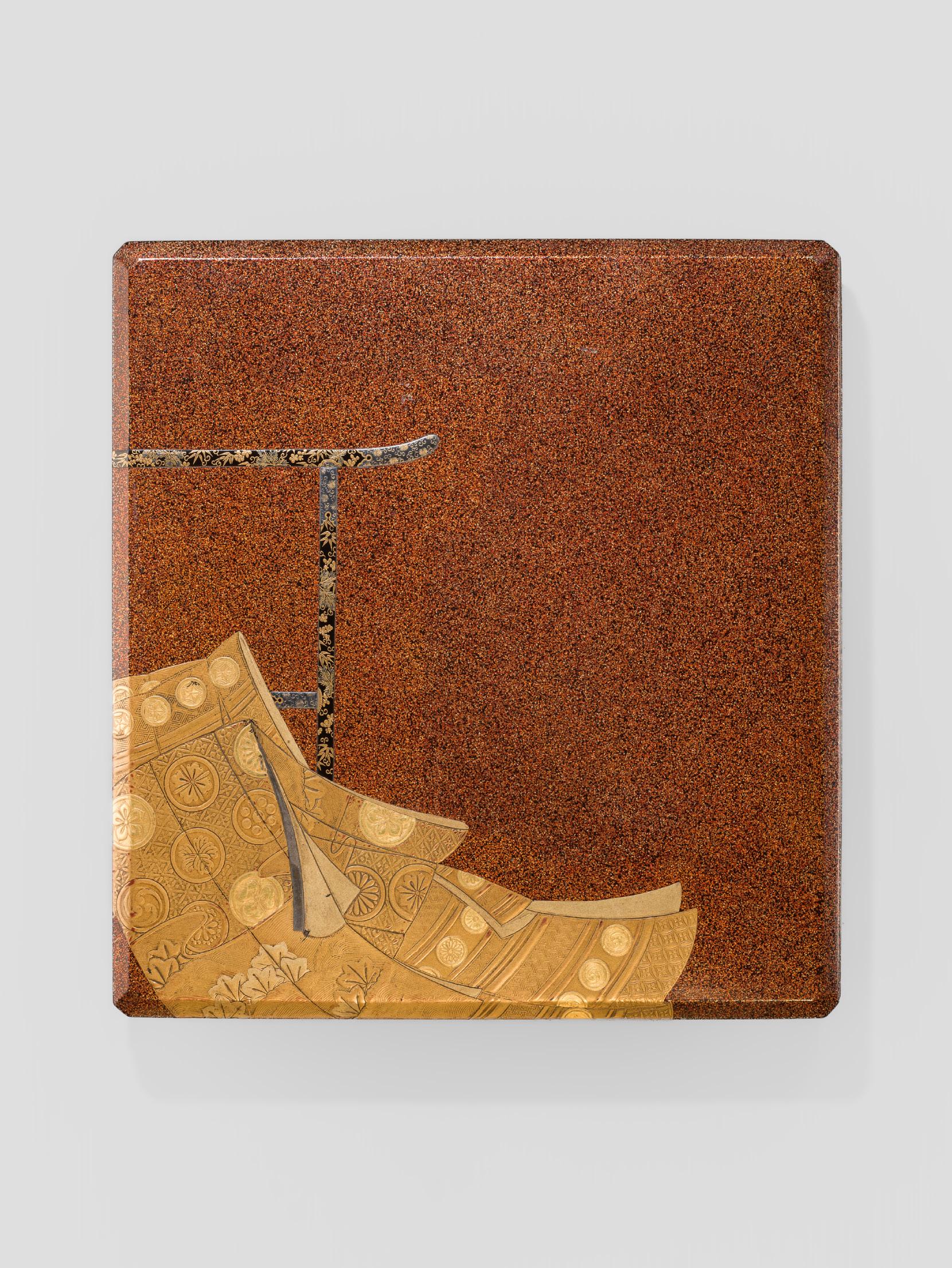
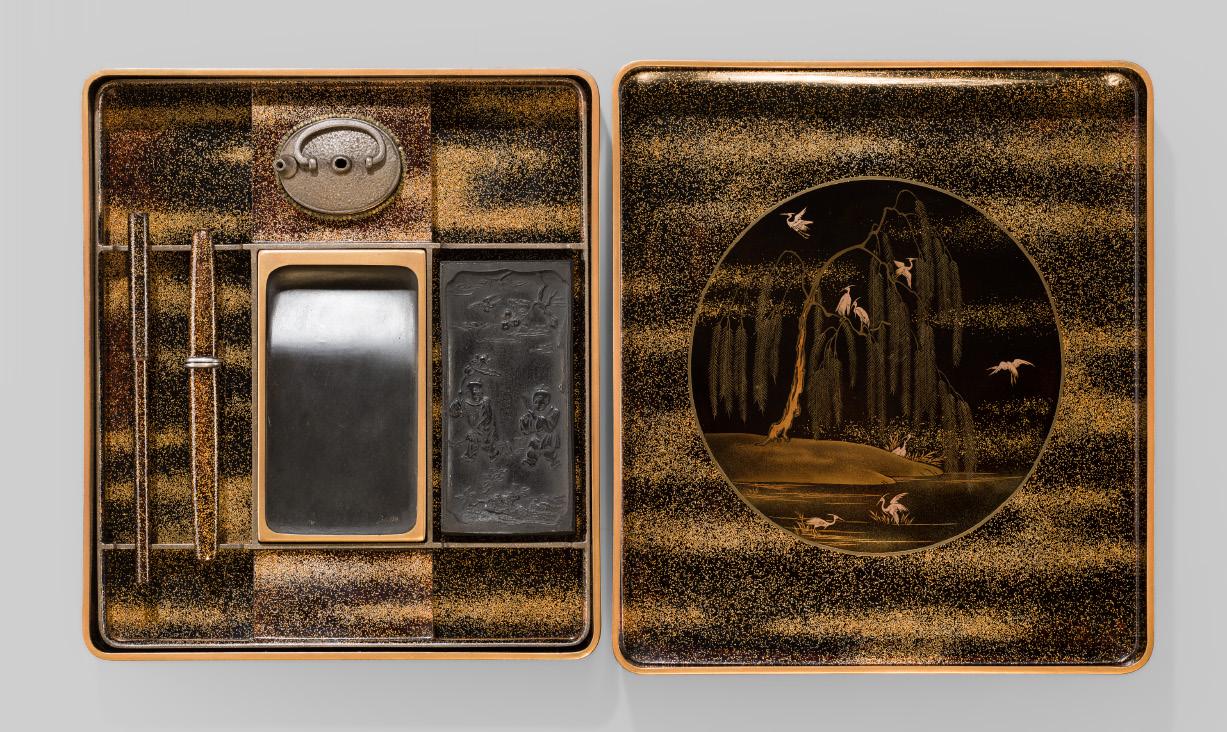
A SUPERB TOGIDASHI LACQUER ‘FIREFLIES FROM THE TALE OF GENJI’ SUZURIBAKO (WRITING BOX)
Japan, mid-19th century, Edo period (1615-1868)
Rectangular in shape, this exquisite suzuribako is decorated in iro-e togidashi-e, takamaki-e, and hiramaki-e techniques on a lustrous roiro ground. The kabusebuta (overhanging) lid depicts, over two-thirds of its surface, a loose bag of fireflies (hotaru), with the remaining third showing autumn grasses in moonlight, the blossoms inlaid in aogai (mother-of-pearl) and a border lacquered in negoro style. The moonlit furoshiki and the fireflies it fails to contain are lacquered in togidashi, while the autumn grasses and flowers are lacquered in hiramaki-e and takamaki-e, with small inlays of shell, on a section of the box lacquered to simulate wood grain. The interior of the lid features a moon-shaped panel in togidashi-e, depicting herons on a willow tree by a lakeside, encircled by e-nashiji ground.
The interior is finished in muranashiji, with gold fundame rims, and fitted with a removable grid housing the original implements: a paper cutter (kogatana), a knife (kamakiri), an iron water dropper (suiteki) signed Kamehisa, and two inkstones (suzuri), one signed Unboku with seal Asahi zo [made by Asahi]. The signed gold-flecked metal water dropper is modeled in the form of a waterpot.
SIZE 4 x 25 x 22 cm
Provenance: Ex-collection Elinor “Elly” Nordskog (1919-2013). Sydney L. Moss Ltd, London, 2013. From the collection of Eva & Aubrey Sweet, Melbourne, Australia, acquired from the above. A copy of the invoice from Sydney L. Moss Ltd., dated 7 June 2013, stating a purchase price of USD 19,950 (or approx. EUR 23,000 converted and adjusted for inflation at the time of writing), accompanies the lot.
Condition: Excellent condition with minor wear and light rubbing to the red lacquer.

Eva and Aubrey Sweet
With a wood tomobako (storage box) inscribed: 蛍蒔繪、御硯 筥 Hotaru makie, on suzuribako [writing box, with the design of fireflies].
PUBLISHED
Atchley, Virginia G. (1991) Pacific Asia Museum, Pasadena, Japanese Lacquer from Southern Californian Collections, illustrated on the front cover.
Fireflies (hotaru) hold rich poetic and symbolic meaning in both Chinese and Japanese culture, often associated with fleeting beauty, love, memory, and the souls of the departed. In Japanese folklore, they are linked to tragic romance and the spirits of warriors, their brief glow evoking the transience of life. The motif also recalls summer pastimes, when people gathered to catch fireflies, appreciating their delicate light in quiet reflection. In classical literature, as in the Tale of Genji, fireflies symbolize longing and revelation.
This image specifically references Chapter 25, “Hotaru,” from the Tale of Genji, where Prince Genji releases a swarm of fireflies into Lady Tamakazura’s chamber, their sudden illumination revealing her beauty and allowing her suitor a fleeting glimpse. This moment encapsulates themes of desire, ephemerality, and the interplay of light and concealment, resonating throughout the narrative. The scene became a beloved subject in Japanese art for its elegance and emotional depth.
There are many stories involving fireflies in Japanese folklore, but this particular image also evokes the story of the Chinese scholar Shaen (Ch’e Yuan) from the fourth century, who, while a poor student, studied by the light of a lantern made from a bag of fireflies. The furoshiki and fireflies in this box may also simply reference the popular summer pastime of gathering fireflies, an activity enjoyed by all levels of society.
MUSEUM COMPARISON
Compare a closely related lacquer suzuribako depicting fireflies, dated 19th century, in the Walters Art Museum, accession number 67.77.
Estimate EUR 15,000
Starting price EUR 7,500
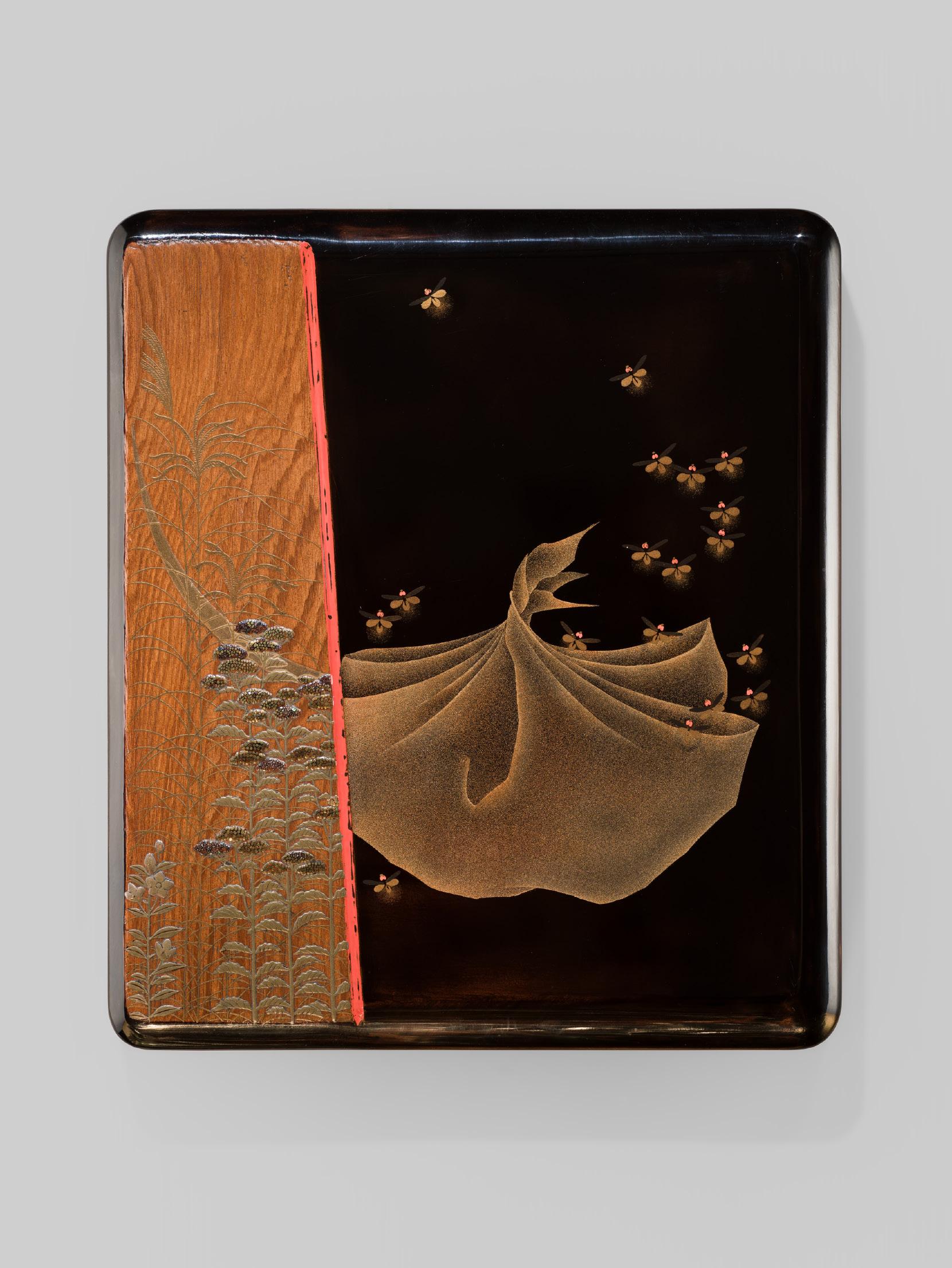
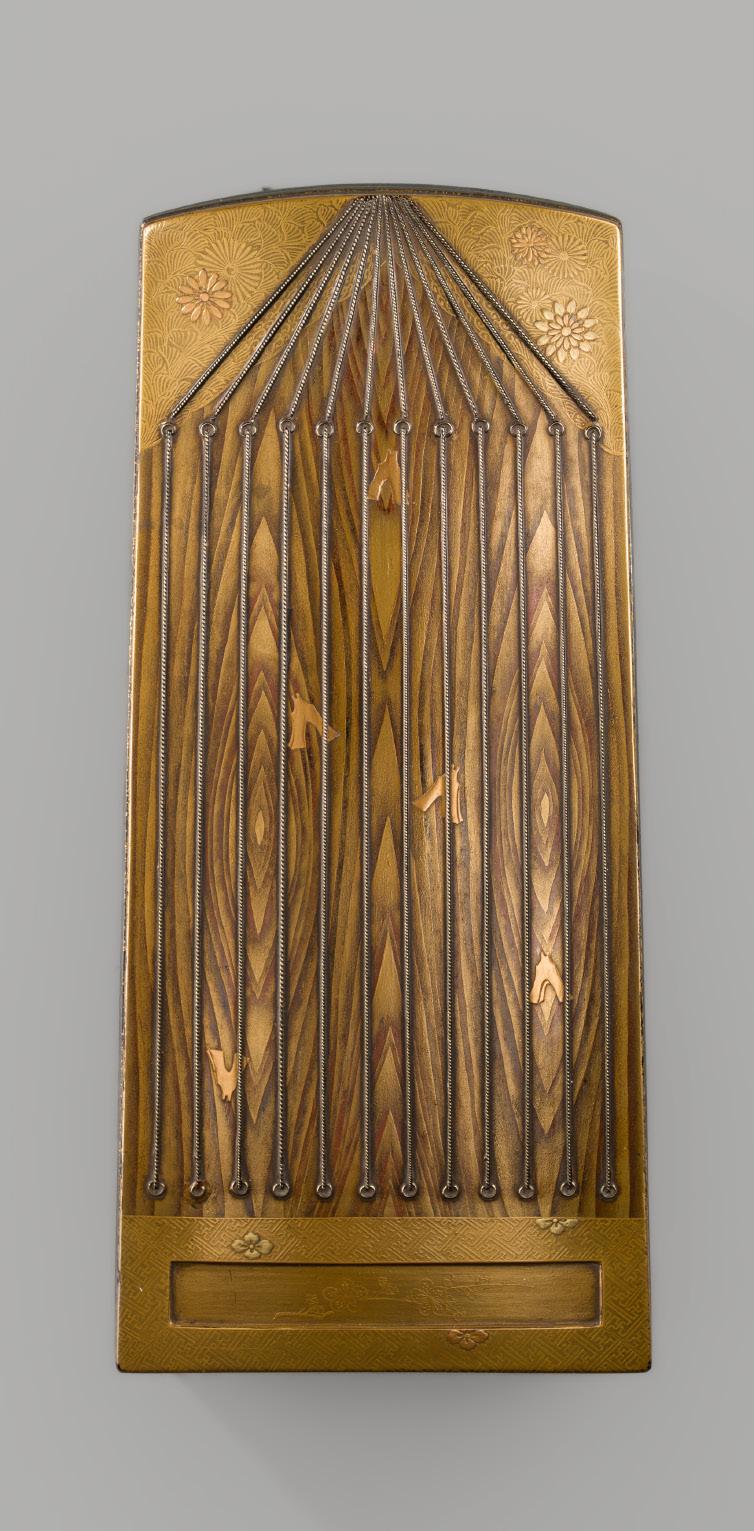
A FINE SILVER-INLAID GOLD LACQUER ‘KOTO’ SUZURIBAKO (WRITING BOX) WITH INTEGRATED RYOSHIBAKO (DOCUMENT BOX)
Japan, 19th century, Edo period (1615-1868)
Exhibited: Burlington Fine Arts Club, Catalogue of Specimens of Japanese Lacquer and Metal Work, 1894.
Formed as a twelve-string koto, the cover of the box is exquisitely adorned with twisted silver strings against a mokume ground, rendered in gold takamaki-e and togidashi-e. The design is enriched with floral and geometric sayagata patterns, interspersed with scattered flowerheads. The sides of the box are decorated with additional gold sayagata motifs on a luminous nashiji ground, with raised rims fitted with pewter.
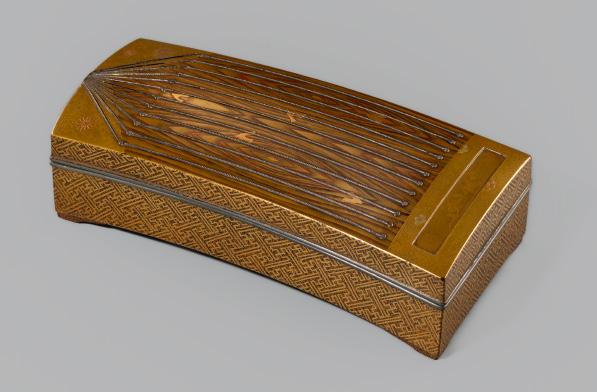
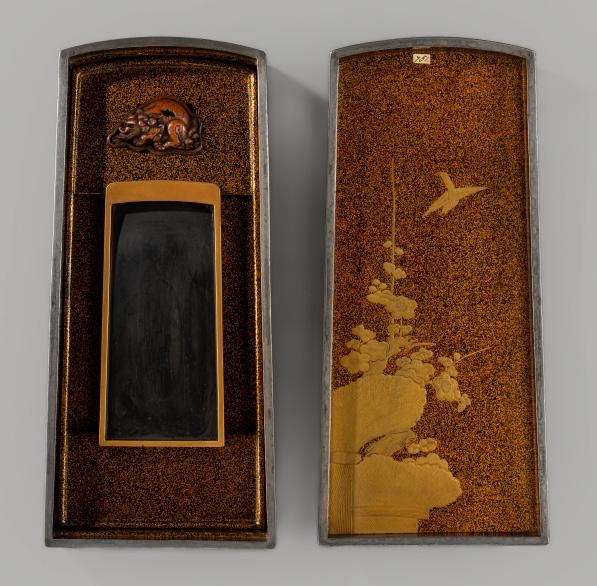
The underside of the cover features a brilliant nashiji ground with gold takamaki-e, depicting cherry blossoms among bundles of straw with a bird in flight. The interior is similarly finished in nashiji with gold fundame rims. The removable tray houses the implements, which include a rectangular inkstone (suzuri), a copper water dropper (suiteki) in the form of a recumbent shishi, and a set of calligraphy tools—brushes (fude), a paper cutter (kamakiri), and a punch (meuchi). Below the tray is the space designated for documents and papers.
LENGTH 23.6 cm
Provenance: Private collection of Gerald Mere, United Kingdom, thence by descent. Rutherson & Bandini, London, United Kingdom, 2011. Private collection of Eva and Aubrey Sweet, Melbourne, Australia, acquired from the above. A copy of the original invoice, dated 24 October 2011, addressed to Mr. Aubrey Sweet, and stating a purchase price of GBP 7,000 (or approx. EUR 12,000 converted and adjusted for inflation at the time of writing), accompanies this lot.
Condition: Excellent condition with only minor wear.
Compare a closely related gold lacquer suzuribako (writing box) in the shape of a koto, dated 19th century, 20.7 cm long, at Bonhams, Fine Japanese and Korean Works of Art, New York, 18 March 2015, lot 3078 (sold for USD 8,125 or approx. EUR 9,700 converted and adjusted for inflation at the time of writing).
Estimate EUR 6,000
Starting price EUR 3,000
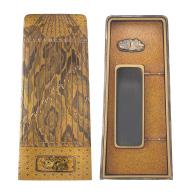
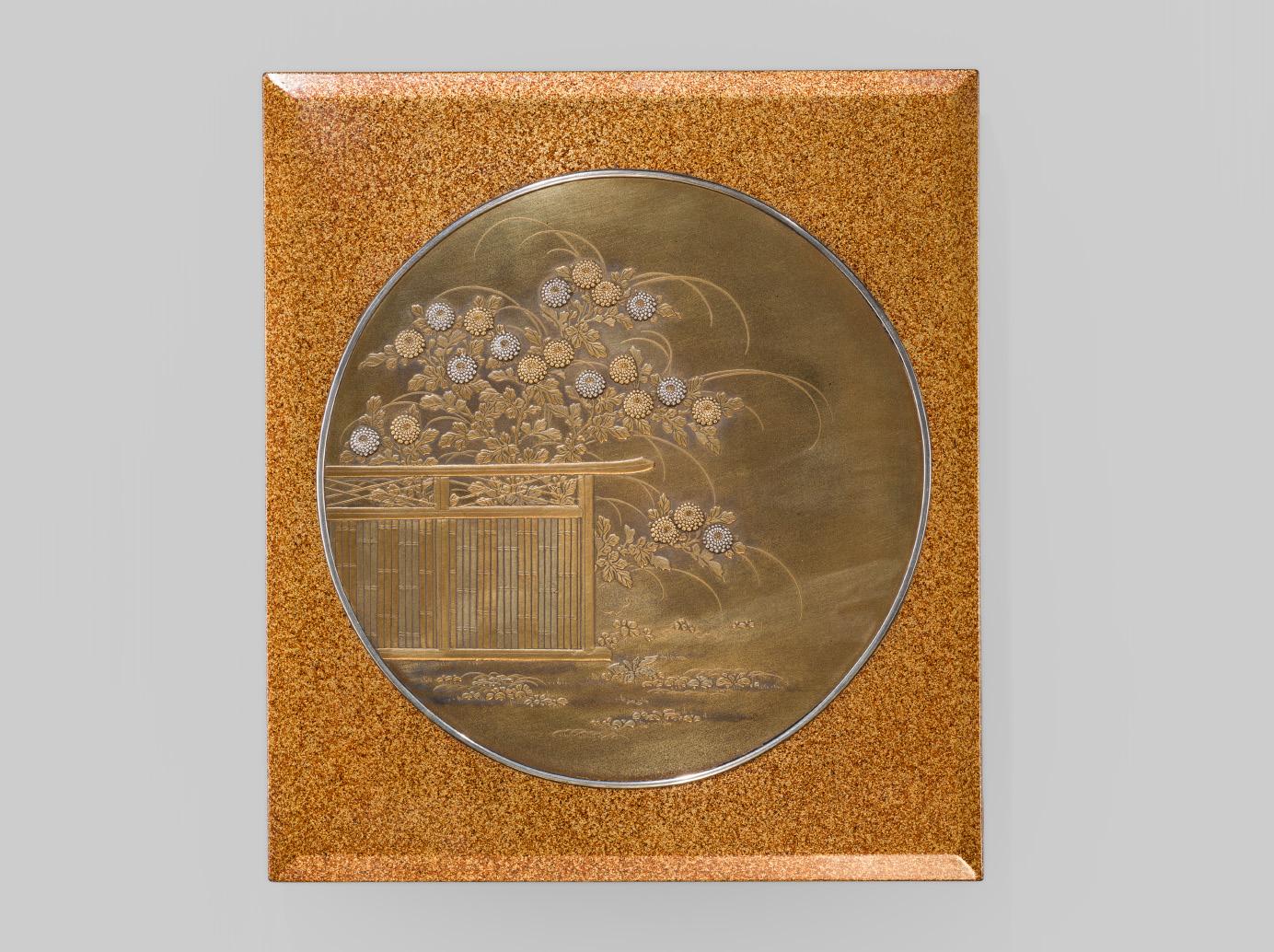
229
A SMALL GOLD AND SILVER INLAID LACQUER ‘CHRYSANTHEMUMS’ SUZURIBAKO (WRITING BOX)
Japan, Meiji period (1868-1912)
Of rectangular form, the inrobuta (flush-fitting) lid features a nashiji ground and is finely decorated with a silver-lined, moon-shaped reserve. The reserve is adorned with gold and silver takamaki-e, showcasing gold- and silver-inlaid chrysanthemums (kiku) behind a fence. The interior of the lid further displays gold and silver takamaki-e and hiramaki-e, illustrating a temple within a rocky riverscape, embellished with kirigane flakes. The interior is finished in nashiji and houses a removable grid containing a butterflyshaped silver water dropper (suiteki), a paper cutter (kamakiri), and an inkstone (suzuri).
SIZE 3 x 19 x 17 cm
Provenance: Heian Art, Kyoto, Japan, 2004. From the collection of Eva & Aubrey Sweet, Melbourne, Australia, acquired from the above. A copy of the invoice from Heian Art, Kyoto, dated 10 October 2004, stating a purchase price of JPY 900,000 (or approx. EUR 6,000 converted and adjusted for inflation at the time of writing) and confirming the above, accompanies the lot. Condition: Excellent condition with only minor wear.
With the original wood tomobako (storage box).
The chrysanthemum holds a significant place in both Chinese and Japanese literati traditions, often linked to the garden and retreat, as exemplified by Tao Yuanming’s poem Returning Home. In The Tale of Genji, butterflies often symbolize ephemeral beauty and fleeting moments, which resonates with the delicate butterfly-shaped water dropper in this box, connecting the themes of transience in nature and the refined, meditative world of the literati.
AUCTION COMPARISON
Compare a related lacquer suzuribako depicting chrysanthemums, dated Edo period, 5.1 x 24.1 x 22.5 cm, at Christie’s, Japanese and Korean Art, 17 September 2024, New York, lot 121 (sold for USD 15,120 or approx. EUR 13,500 converted and adjusted for inflation at the time of writing).
Estimate EUR 6,000
Starting price EUR 3,000
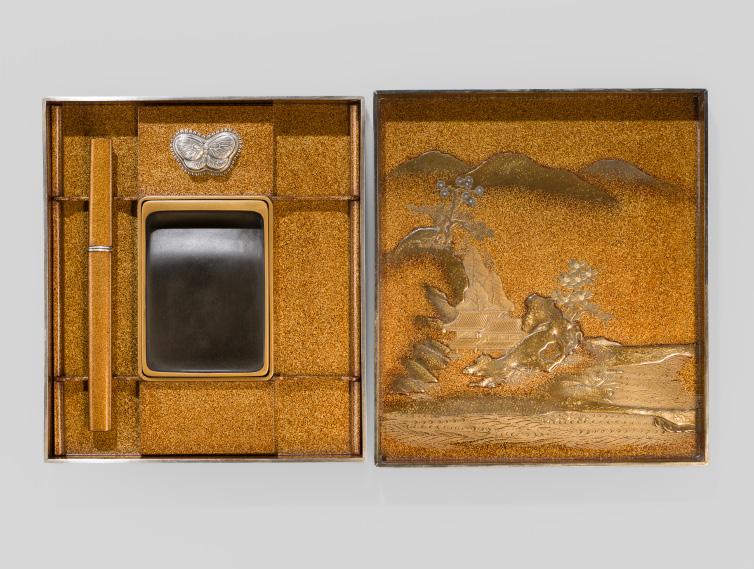
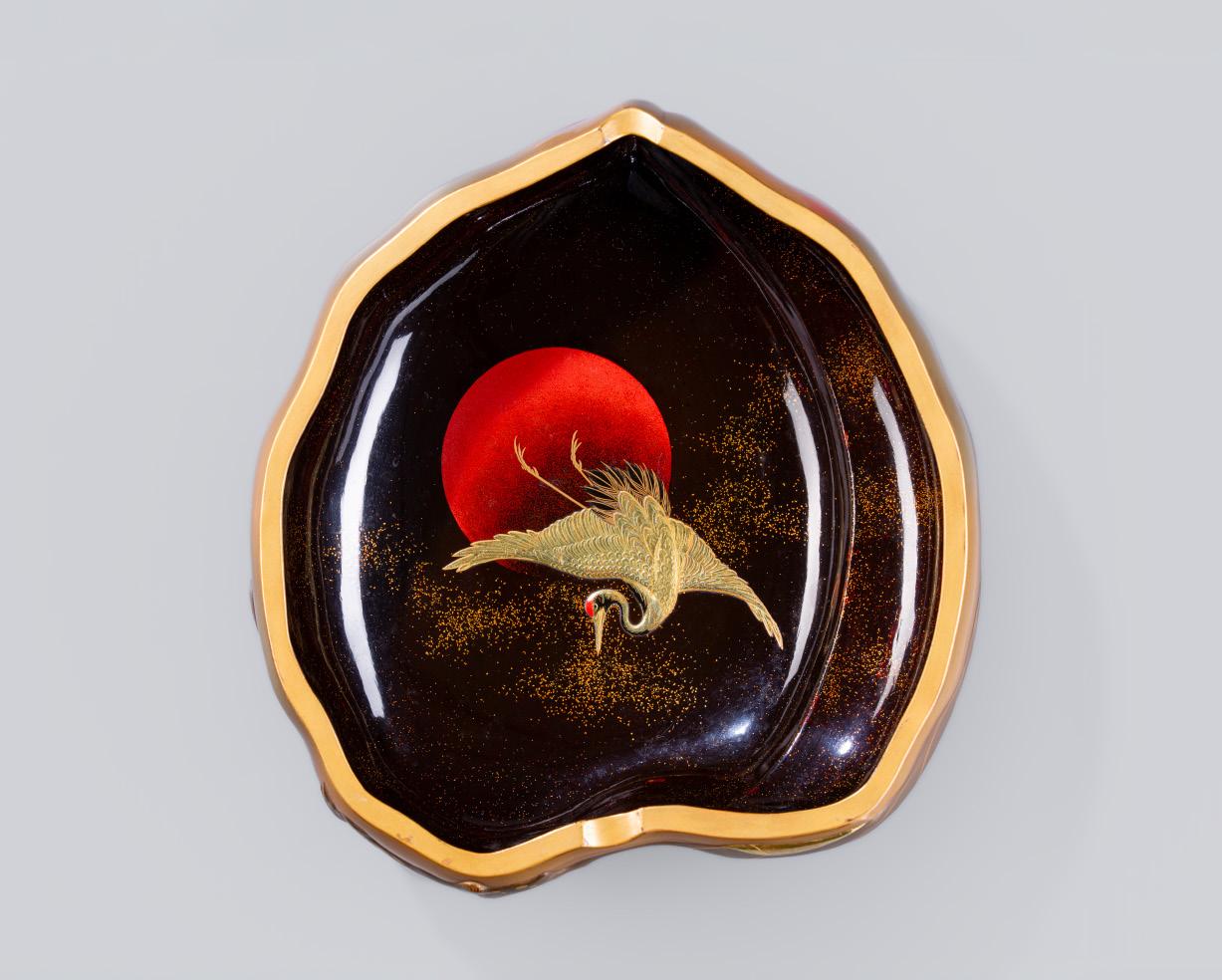
230
A SUPERB AND UNUSUAL PEACH-SHAPED LACQUER ‘DEER, BATS AND CRANE’ SUZURIBAKO (WRITING BOX)
Japan, Meiji period (1868-1912)
Of fan-shaped form with a domed, peach-shaped cover, the surface bearing a rich gold ground finely decorated in gold, silver, red, and black takamaki-e and hiramaki-e, further enriched with brilliantly preserved gold foil inlays. The lid depicts an auspicious scene of a stag and hind grazing, the former raising its head toward bats in flight above, all framed by delicately rendered peach leaves. The fan-shaped base is rendered in fine gold lacquer simulating metal inlay along the staff, while the sides are adorned with an elegant hanabishi pattern.
The cover rises from a lobed box, the sides finished in lustrous roiro and encircled by a hanabishi pattern and keyfret band, surmounted by a reishi band in gold fundame. The interior of the lid, executed in roiro with nashiji, depicts a crane set against a vivid rising sun. The interior retains its original implements: a silver batshaped water dropper (suiteki), a moon-shaped inkstone (suzuri), and an inscribed inkstick.
SIZE 24 x 29.1 cm
Condition: Excellent condition with only very minor typical wear. Some very light warping to the gold foil inlays and a tiny nondistracting chip to one edge near the inkstone.
The imagery is drawn from a rich repertoire of auspicious motifs. Bats symbolize happiness and good fortune, while deer are associated with longevity and prosperity. The peach, a classical emblem of immortality, reinforces these themes, as does the reishi band, the fungus long regarded as a symbol of health and eternal life. The crane within the interior further amplifies this message, embodying longevity and renewal. Together, these elements form a coherent and refined expression of well-being and good fortune.
AUCTION COMPARISON
Compare a related suzuribako depicting a stag and two bats, dated to the 19th century, 21.6 x 16.6 x 3 cm, at Zacke, Fine Japanese Art, 3 December 2021, Vienna, lot 164 (sold for EUR 8,848).
Estimate EUR 10,000
Starting price EUR 5,000
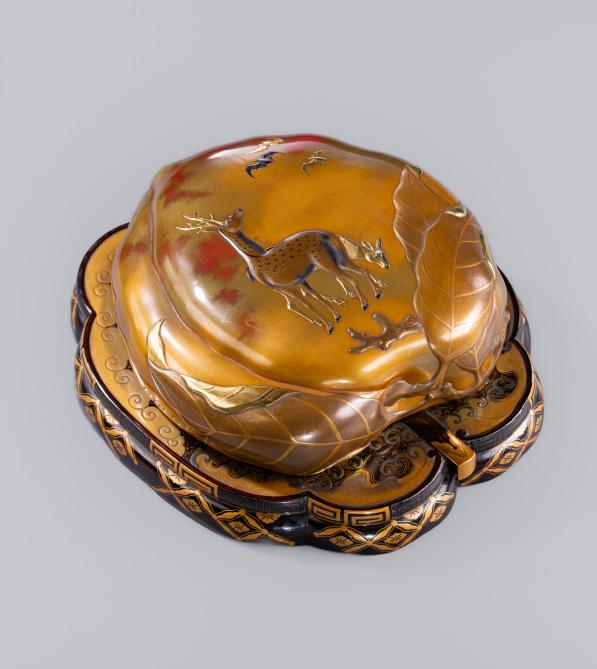
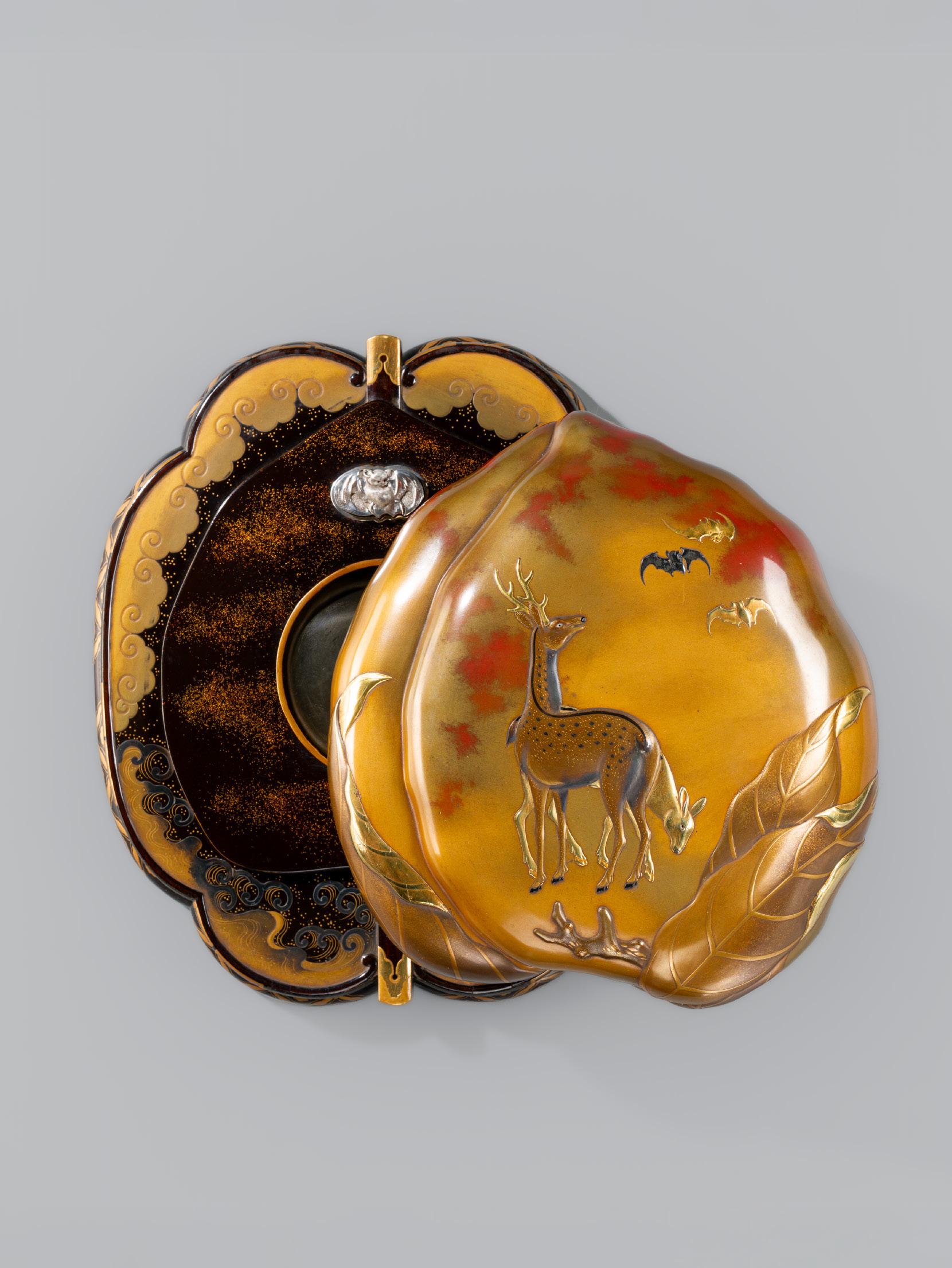
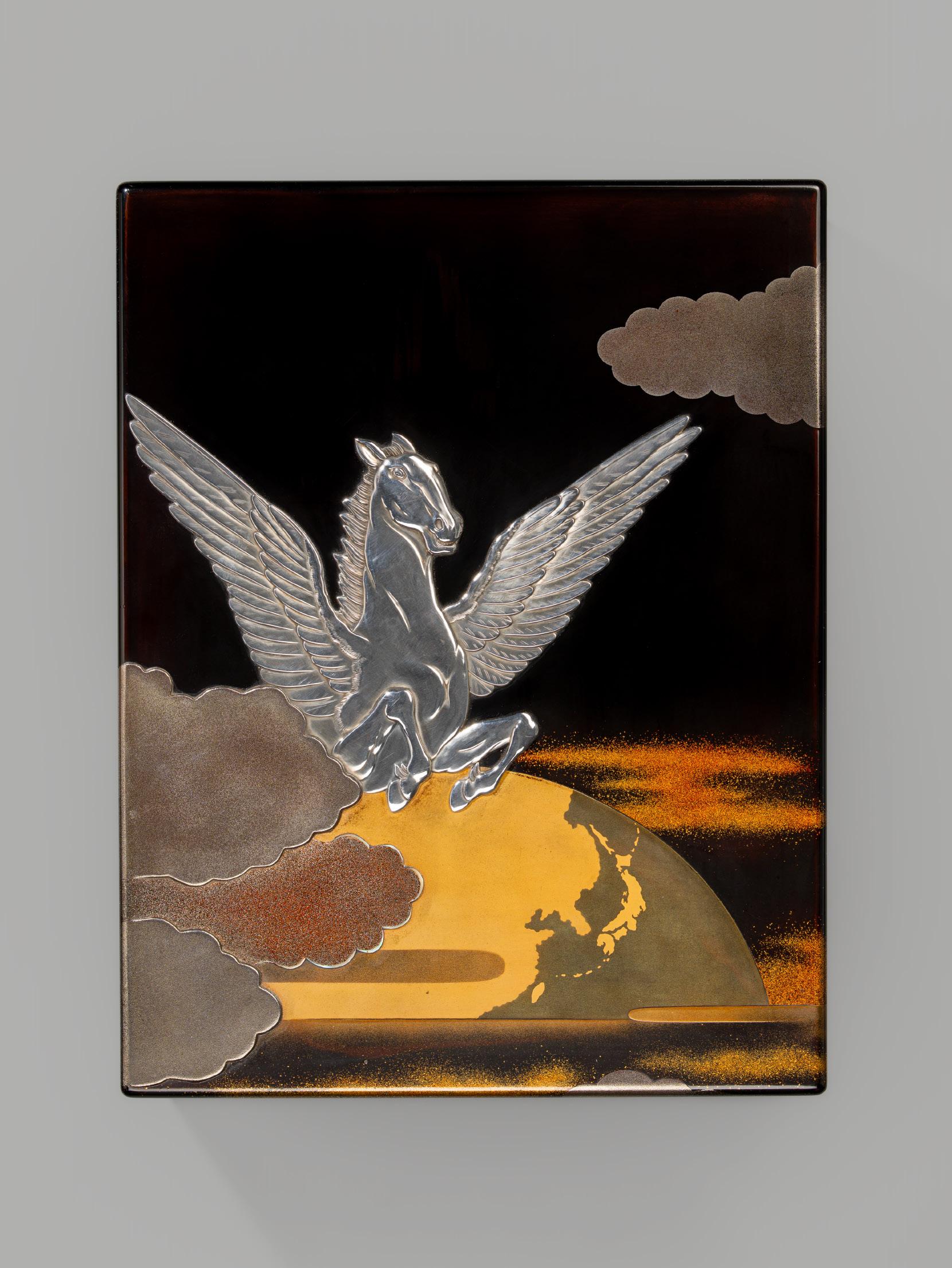
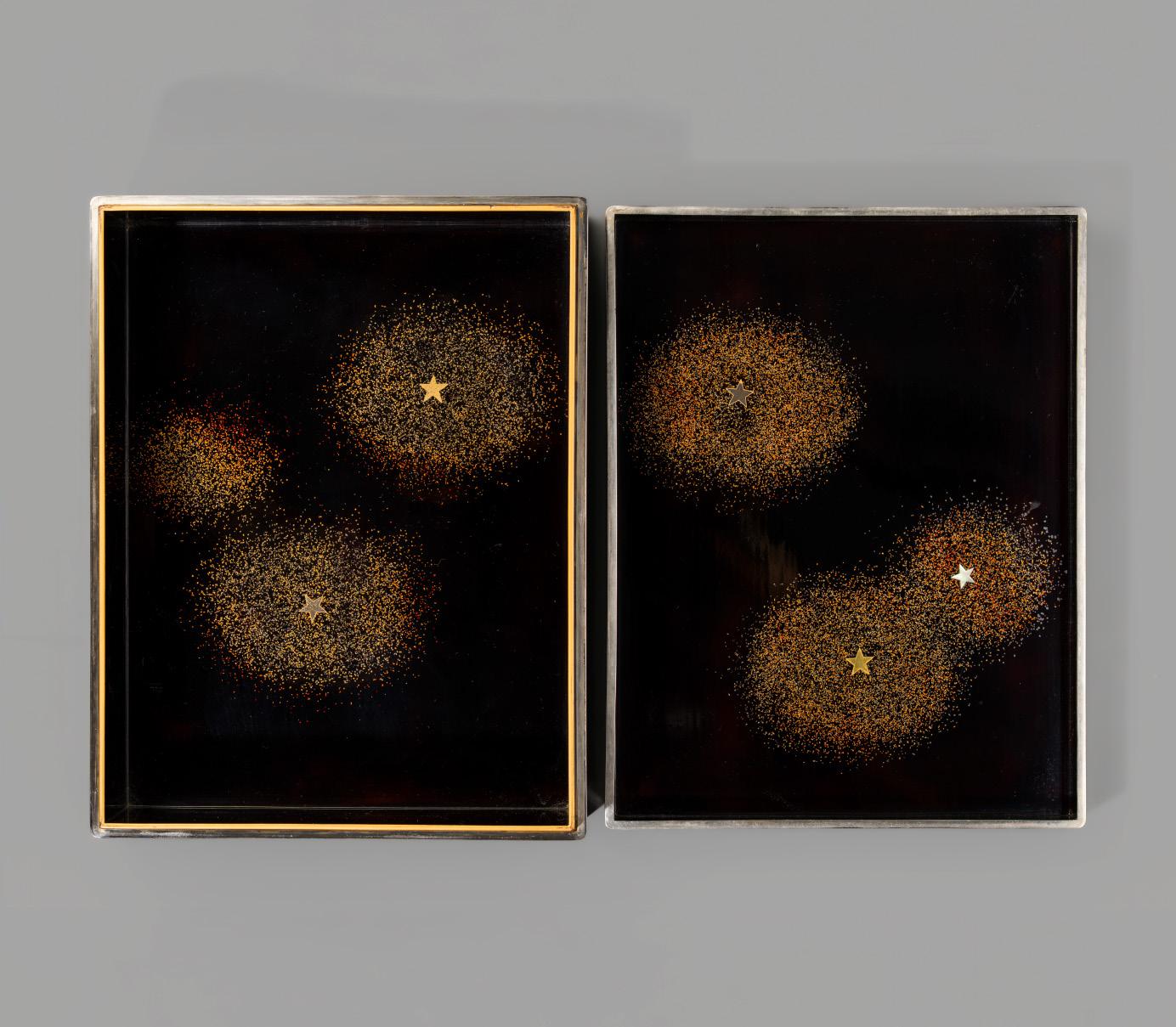
231
AN UNUSUAL SILVER-INLAID LACQUER ‘PEGASUS’ BUNKO (DOCUMENT BOX)
Attributed to Hayashi Bunsu, Gyozan, Shosai and Mikizo, unsigned Japan, c. 1937, Showa period (1926-1989)
Of rectangular form with an inrobuta (flush-fitting) lid, the exterior bearing a lustrous roiro-nuri ground and decorated in high-relief rōgin-nuri and two shades of matte gold lacquer, with highlights of mura-nashiji and inlaid shell. The bold design centers on a silver-inlaid Pegasus shown with wings fully spread in flight through parting clouds, with the earth faintly visible below, the composition further enriched with aogai (mother-of-pearl) details.
The interior is of roiro and elaborately decorated with the Milky Way, rendered in inlaid mother-of-pearl and applied gold foil, set among clusters of silver and gold hirame, and finished with silver rims.
SIZE 11.4 x 33 x 25.7 cm
Condition: Very good condition with only minor wear.
Although unsigned, the present work can be confidently attributed to a group of Kyoto-based lacquer artists - Hayashi Bunshu, Gyozan, Shosai, and Mikizo - known from the signed tomobako of an almost identical example dated 1937, exhibited in Deco Japan: Shaping Art and Culture (2012). That piece, titled Tenba sora o yuku onbunko (“Stationery Box with Heavenly Horse Striding
the Firmament”), reflects the artistic climate of late 1930s Japan, its dynamic imagery resonating with contemporary imperial ambition, the winged steed traversing a vast celestial expanse suggestive of the envisioned Greater East Asia Co-Prosperity Sphere (Dai Toa Kyoeiken).
The principal artist, Hayashi Bunshu, trained in lacquer in Kanazawa before relocating to Kyoto, where he exhibited at the Showa Bijutsu Kogeiten (Showa Art Exhibition). The present box, with its ambitious composition, refined surface treatment, and complex use of inlay and lacquer techniques, exemplifies the collaborative and highly accomplished lacquer production of this group.
AUCTION COMPARISON
Compare a near-identical silver inlaid lacquer bunko with the same motif, also attributed to Hayashi Bunshu, Gyozan, Shosai and Mikizo, dated to c. 1937, 11.4 x 33 x 25.7 cm, at Bonhams, Fine Japanese and Korean Art, including the Alan and Simone Hartman Collection of Japanese Art, 20 March 2025, New York, lot 672 (sold for USD 15,360 or approx. EUR 13,500 converted and adjusted for inflation at the time of writing).
Estimate EUR 10,000
Starting price EUR 5,000
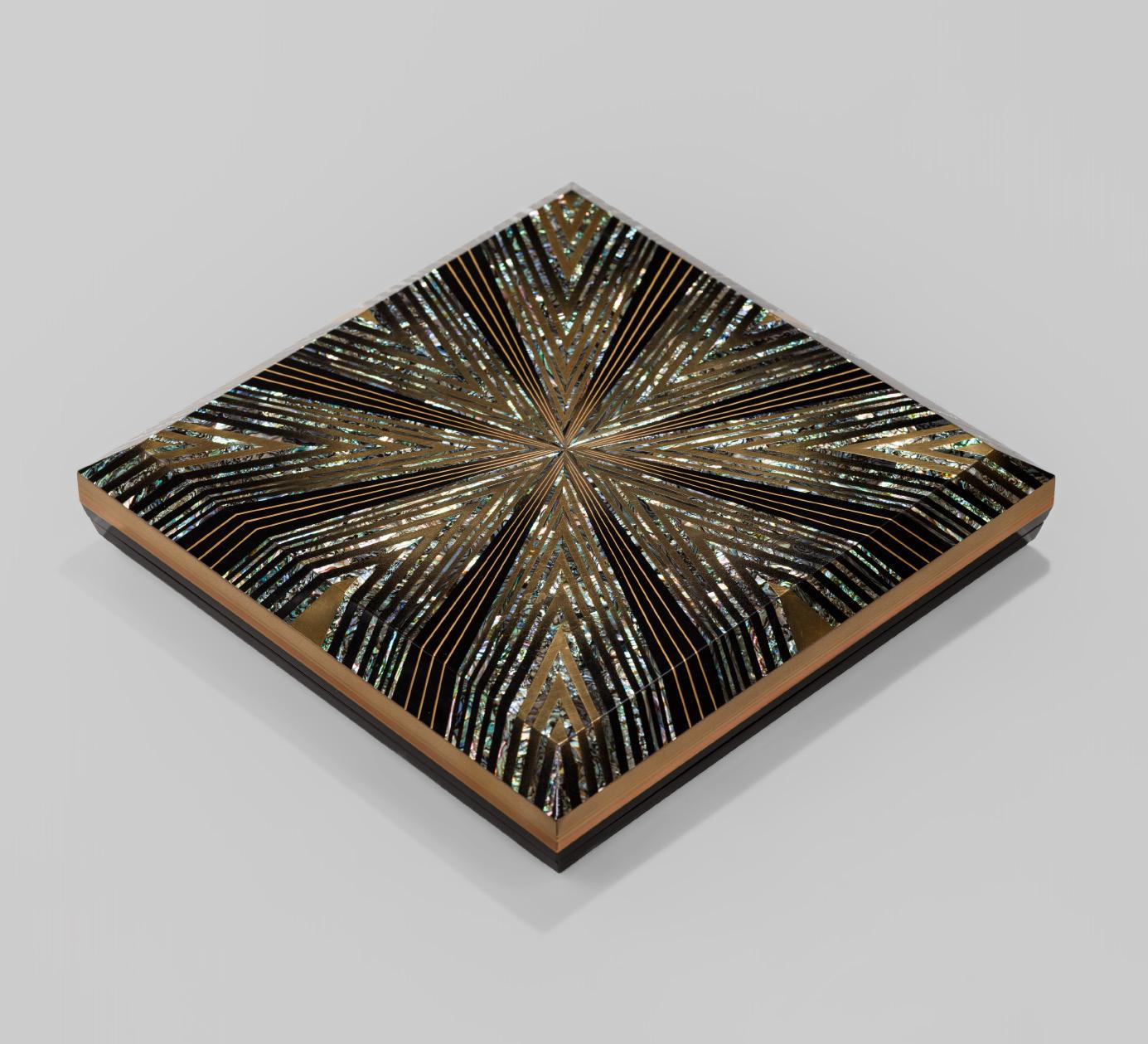
HATTORI SHUNSHO: RADIANT COLORS
By Hattori Toshio
(Shunsho) (1943-2018), signed Shun Japan, dated 1984
Square in form, with a flush-fitting cover and chamfered upper edge, the box features a lustrous roiro ground exquisitely decorated with gold takamaki-e and inlaid with radiant mother-ofpearl, forming a central, radiating geometric design. The edges of the lid are embellished with a luminous kinji ground, encircled by delicate lines in gold takamaki-e and red togidashi maki-e, while the interior is superbly finished in polished roiro lacquer. The underside is signed in red lacquer SHUN.
HEIGHT 5.3 cm, LENGTH 30.1 cm
Provenance: Private collection of Eva and Aubrey Sweet, Melbourne, Australia, thence by descent. Eva and Aubrey Sweet devoted over six decades to the formation of a distinguished private collection of Asian art, with particular strength in Chinese jade, Japanese lacquer, and netsuke. Their collecting began in the 1950s and was refined through sustained travel, scholarship, and long associations with leading dealers, curators, and artists internationally. Condition: Excellent condition.

Eva and Aubrey Sweet
With the original wood storage box (tomobako), inscribed on the top of the cover Yogai Kazaribako, Kosai 燿貝飾箱、光彩 [ornamental display box decorated with iridescent shells, entitled Radiant Colors]. The underside of the cover is signed and sealed Shun.
Hattori Toshio (Shunsho) (1943-2018) was a highly esteemed Japanese lacquer artist, known for his refined craftsmanship and innovative approach to traditional techniques. He was first selected for the prestigious Nitten Exhibition in 1963 (Showa 38), and his work was exhibited there and at other major venues more than twenty times, earning numerous awards and distinctions throughout his career. In 1995, Hattori presented a lacquer reading table to Pope John Paul II, a symbol of the international recognition of his artistry. In 2004, he was commissioned by the Government of Japan to create the shelves for the guest room of the Kyoto State Guest House. Hattori was an active member of the Kyoto Crafts Artists Association, the Kyoto Lacquer Artists Association, and the Sokokai, contributing greatly to the preservation and advancement of Kyoto’s lacquer art tradition.
Estimate EUR 6,000
Starting price EUR 3,000
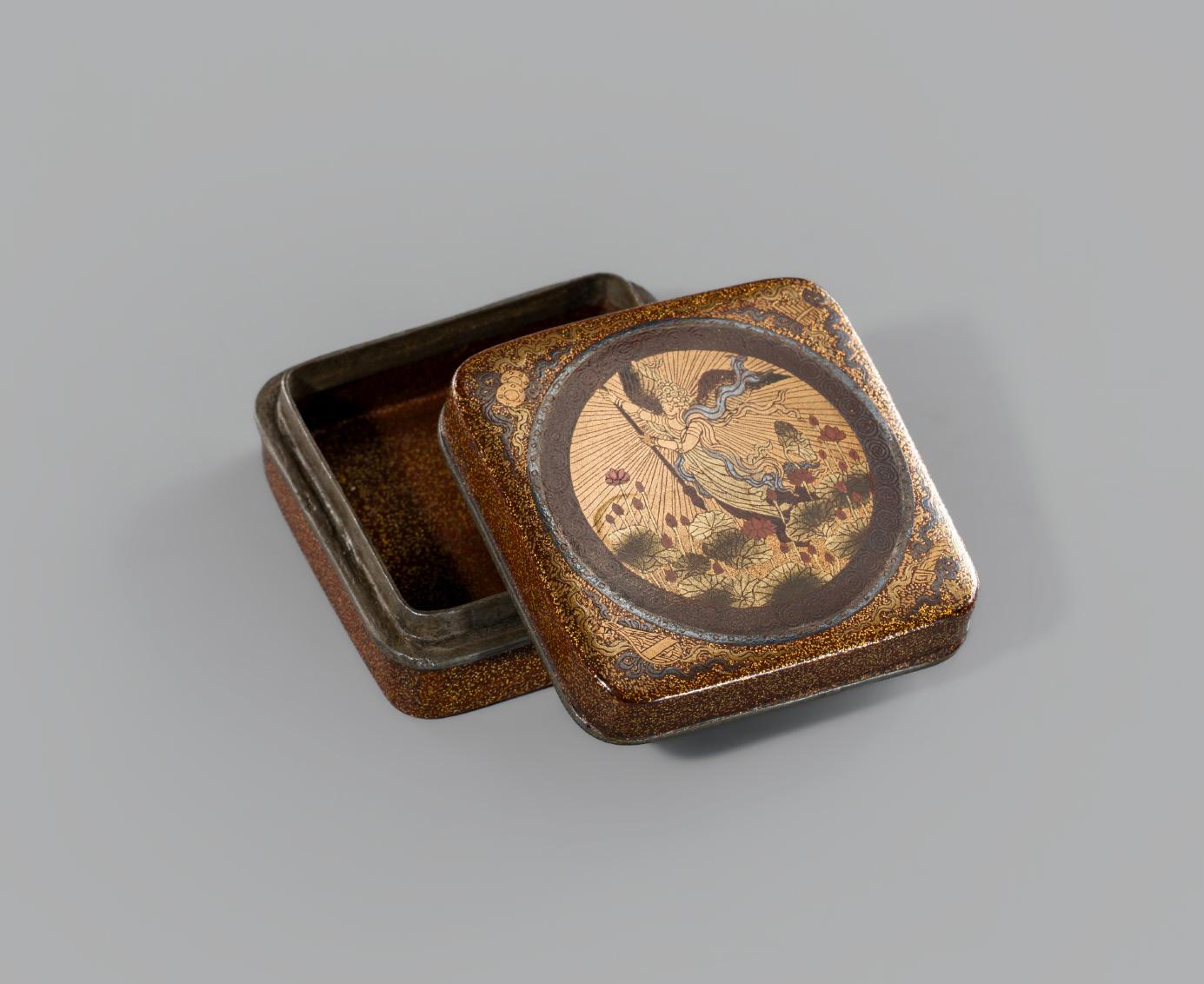
Japan, 17th century, late Momoyama (1573-1615) to early Edo period (1615-1868)
Of square form with rounded edges, bearing a finely sprinkled gold ground and superbly decorated in gold, silver, red, and black togidashi-e on an additional central kinji ground. The inrobuta (flush-fitting) lid features a central mirror-shaped reserve with a tennyo (heavenly maiden) among lotus flowers, emerging from a misty wisp, flying and holding a scepter. Various celestial instruments are shown surrounding the central panel including a biwa, koto and drums. The underside and interior are finished in nashiji. Mounted with pewter rims, as is typical for early lacquer kogo.
SIZE 2.5 x 5.5 x 5.5 cm
Provenance: Ex-Collection of Drs. Edmund and Julie Lewis, Chicago, Illinois. Drs. Edmund Jean and Julia Breyer Lewis are renowned experts in nephrology who met professionally and later married in 1997, and have since continued to collect Japanese art together, actively seeking the best they could find from the finest dealers in the field. Known for their keen scholarship and high aesthetic standards, for the past three decades Ed and Julie have focused on collecting lacquer art, painting, and Buddhist sculpture from Japan. As they traveled widely their desire to collect Buddhist art grew, and they have expanded their collection to include important Pan-religious sculpture from Greater Asia. Condition: Excellent condition with only minor typical wear to edges.
Tennin (apsara in Sanskrit) are celestial beings in Japanese Buddhist and Shinto traditions, rarely depicted in lacquer art. These graceful, ethereal figures symbolize divine beauty, purity, and spiritual elevation. Often portrayed as unnaturally beautiful women wearing elaborate, colorful kimono, they are draped in flowing feathered scarves known as hagoromo, which signify their supernatural nature. Tennin are frequently shown with lotus blossoms, symbolizing enlightenment, or playing musical instruments like the biwa or flute, embodying their role as messengers of the divine. Their rarity in lacquer art makes their appearance in this work especially significant.
Compare a related early lacquer kogo, dated 17th century, at Christie’s, Crafted Landscapes: The Ankarcrona Collection of Japanese Lacquer and Asian Works of Art, 1 October 2020, New York, lot 18 (sold for USD 5,250 or approx. EUR 5,500 converted and adjusted for inflation at the time of writing).
Estimate EUR 3,000
Starting price EUR 1,500
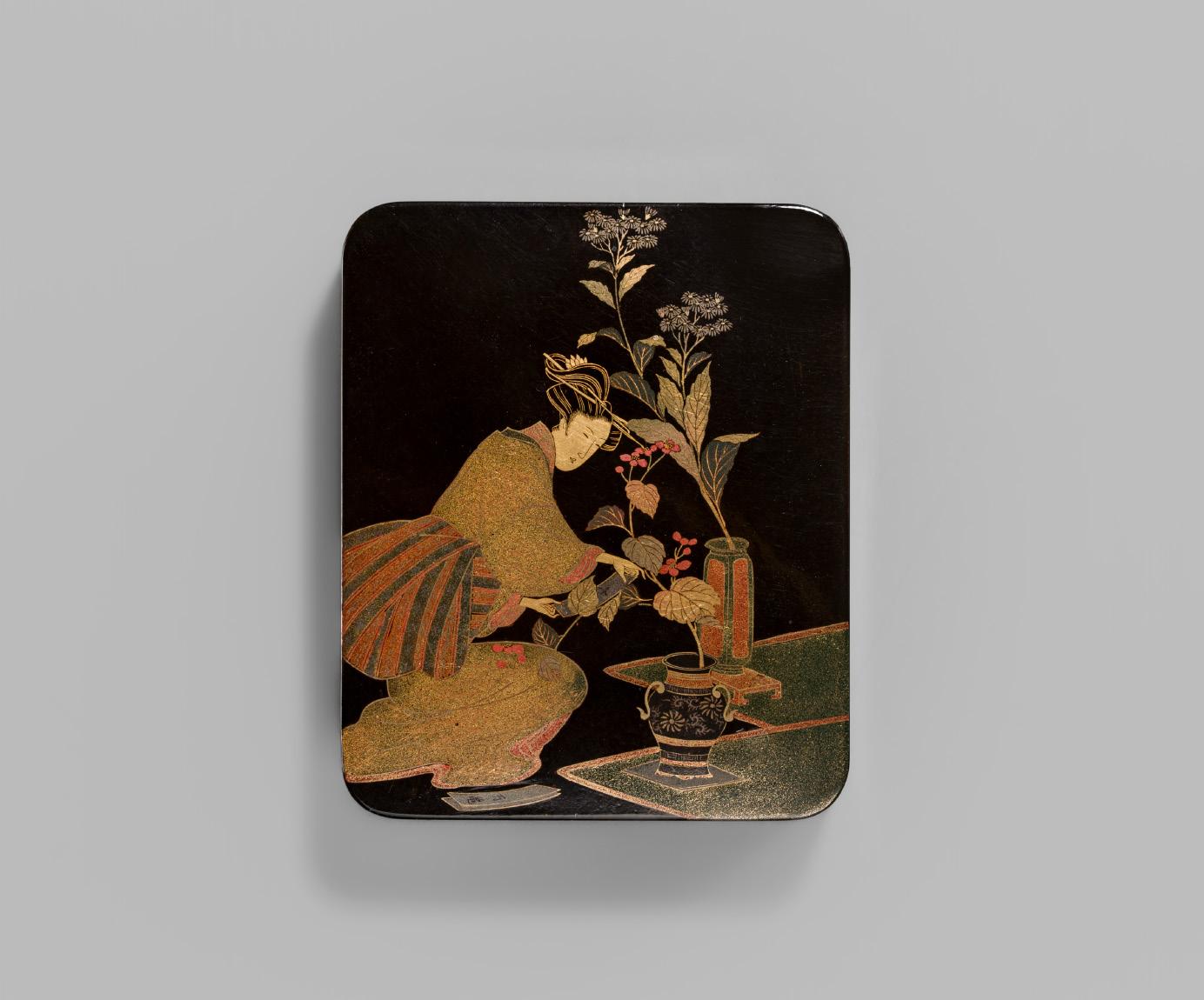
234
A SUPERB TOGIDASHI LACQUER ‘BEAUTY ARRANGING FLOWERS’ KOGO (INCENSE BOX)
Japan, 19th century
Of rectangular form with rounded corners, exquisitely decorated in iro-e togidashi-e on a lustrous roiro ground. The inrobuta (flush-fitting) lid features a bijin (beauty) dressed in an elegant robe, gracefully arranging flowers. The sides of the box are adorned with delicate flower sprays. The underside and interior are finished in roiro lacquer, with scattered gold flakes adding a subtle shimmer.
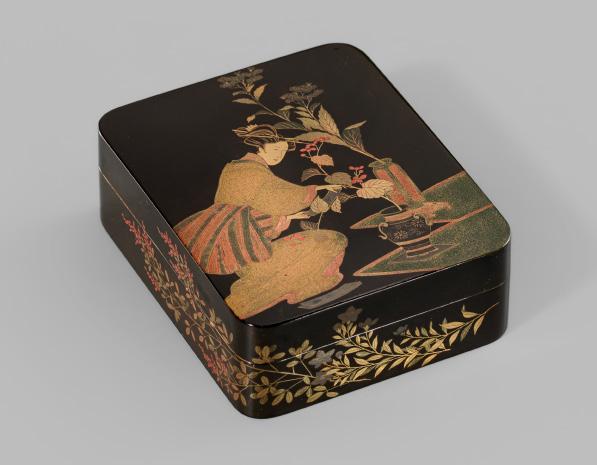
SIZE 3.2 x 7.4 x 9 cm
Provenance: Malcolm Fairley Ltd., London, 2003. From the collection of Eva & Aubrey Sweet, Melbourne, Australia, acquired from the above. A copy of the invoice from Malcolm Fairley Ltd, dated 6 November 2003, stating a purchase price of GBP 2,200 (or approx. EUR 4,000 converted and adjusted for inflation at the time of writing), accompanies the lot.
Condition: Excellent condition with only minor wear and very few light surface scratches.
COMPARISON
Compare a related togidashi lacquer suzuribako, by Shiomi Masanari, dated to the 18th century, 3.2 x 16.5 x 14.9 cm, at Bonhams, Fine Japanese and Korean Art, 12 September 2018, New York, lot 1163 (sold for USD 5,250 or approx. EUR 6,000 converted and adjusted for inflation at the time of writing). Compare a related togidashi lacquer four-case inro with two bijin, by Shojusai, dated to the 19th century, at Bonhams, Snow, Sex and Spectacle, 13 May 2021, London, lot 42 (sold for GBP 4,462 or approx. EUR 6,500 converted and adjusted for inflation at the time of writing).
Estimate EUR 3,000
Starting price EUR 1,500
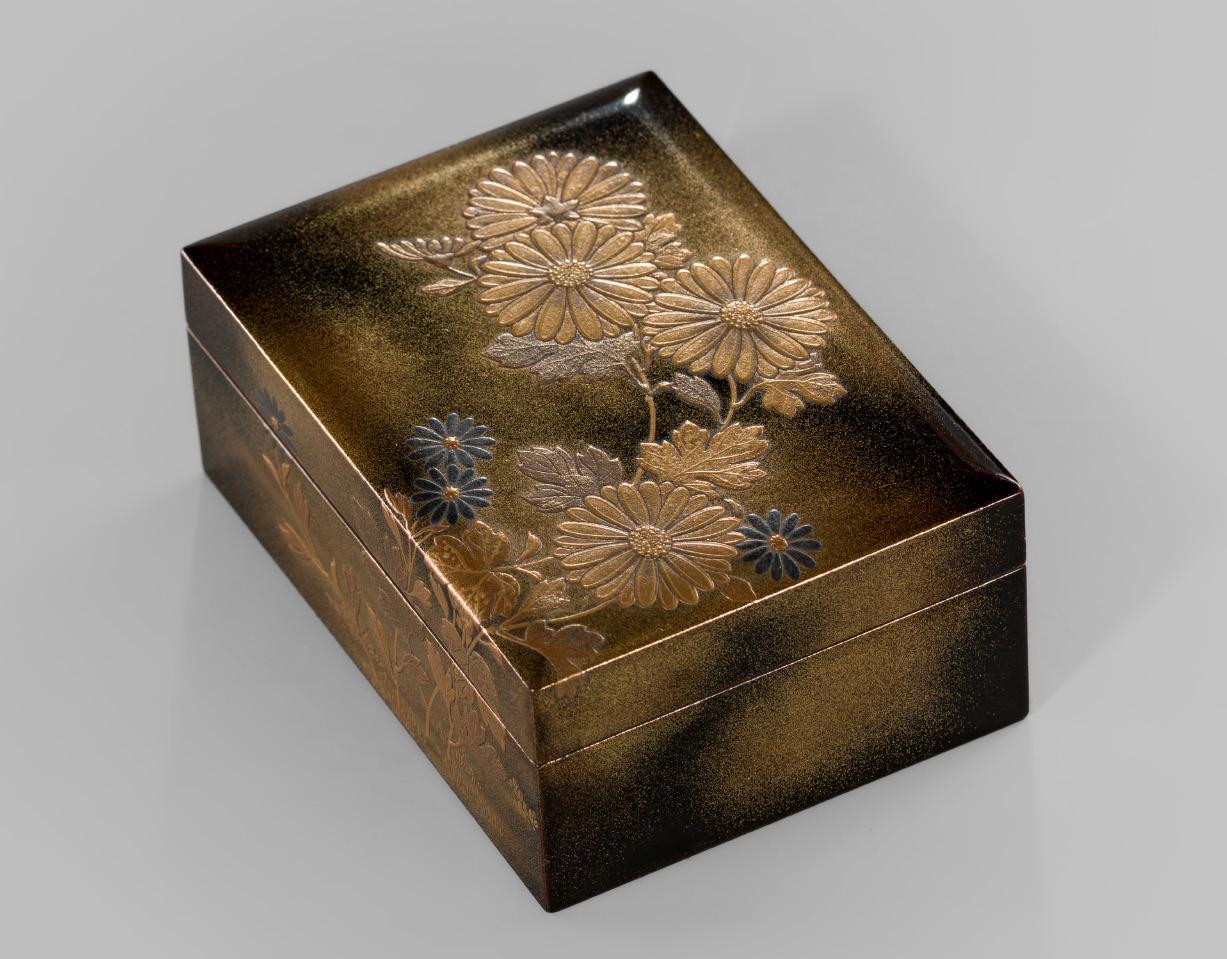
235 A FINE LACQUER BOX AND COVER WITH INTERIOR TRAY AND TWO KOGO, FOR THE INCENSE MATCHING GAME
Japan, 19th century
Of rectangular form, the exterior bearing a richly gold-sprinkled roiro ground, finely decorated in gold and silver hiramaki-e and takamaki-e with mura-nashiji and kirigane to depict chrysanthemums (kiku), the design elegantly continuing from the inrobuta (flush-fitting) lid onto the sides of the box. The interior, as well as the rims and underside, is finished in silver lacquer. The box contains a fitted tray decorated with a gold river stream strewn with petals on a silver ground, and two small kogo, their covers with circular panels enclosing peony and kuzu (arrowroot) blossoms respectively.
SIZE 5.8 x 8 x 3.4 cm
Provenance: From the collection of Eva & Aubrey Sweet, Melbourne, Australia. Eva and Aubrey Sweet devoted over six decades to the formation of a distinguished private collection of Asian art, with particular strength in Chinese jade, Japanese lacquer, and netsuke. Their collecting began in the 1950s and was refined through sustained travel, scholarship, and long associations with leading dealers, curators, and artists internationally.

Condition: Excellent condition with only minor wear and typical losses to kirigane flakes.
The present set was used for the incense-matching game
Like the Way of Tea and flower arrangement, the enjoyment of incense had developed into a complex pastime by the Edo period and had a large following during the seventeenth century. The various games involved guessing a fragrance from among more than 2,000 varieties, matching fragrances, and blending incenses to suggest certain moods.
AUCTION COMPARISON
Compare a closely related lacquer box with interior tray and two smaller boxes, for the incense matching game, 3.6 x 8.3 x 5.9 cm, at Zacke, Fine Japanese Art, 16 June 2023, Vienna, lot 13 (sold for EUR 6,500).
Estimate EUR 5,000
Starting price EUR 2,400
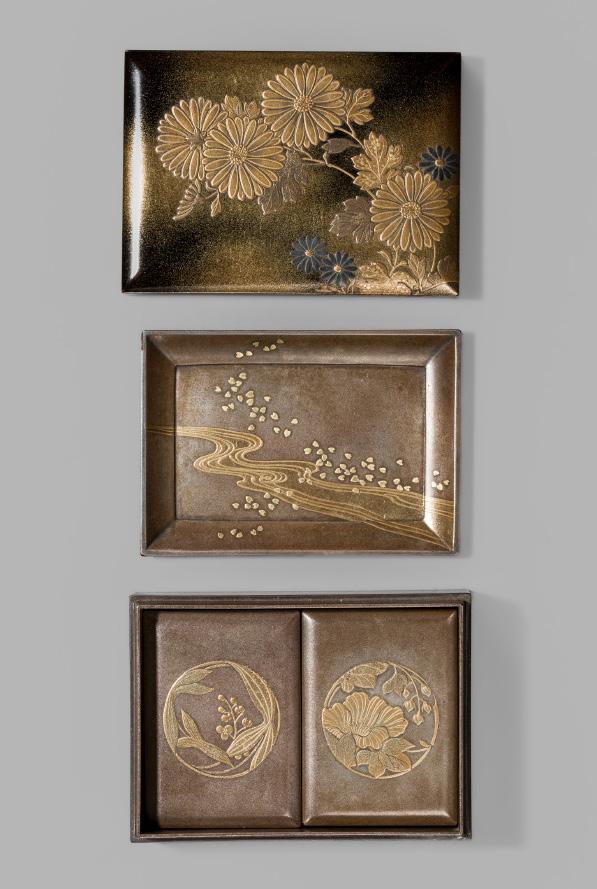
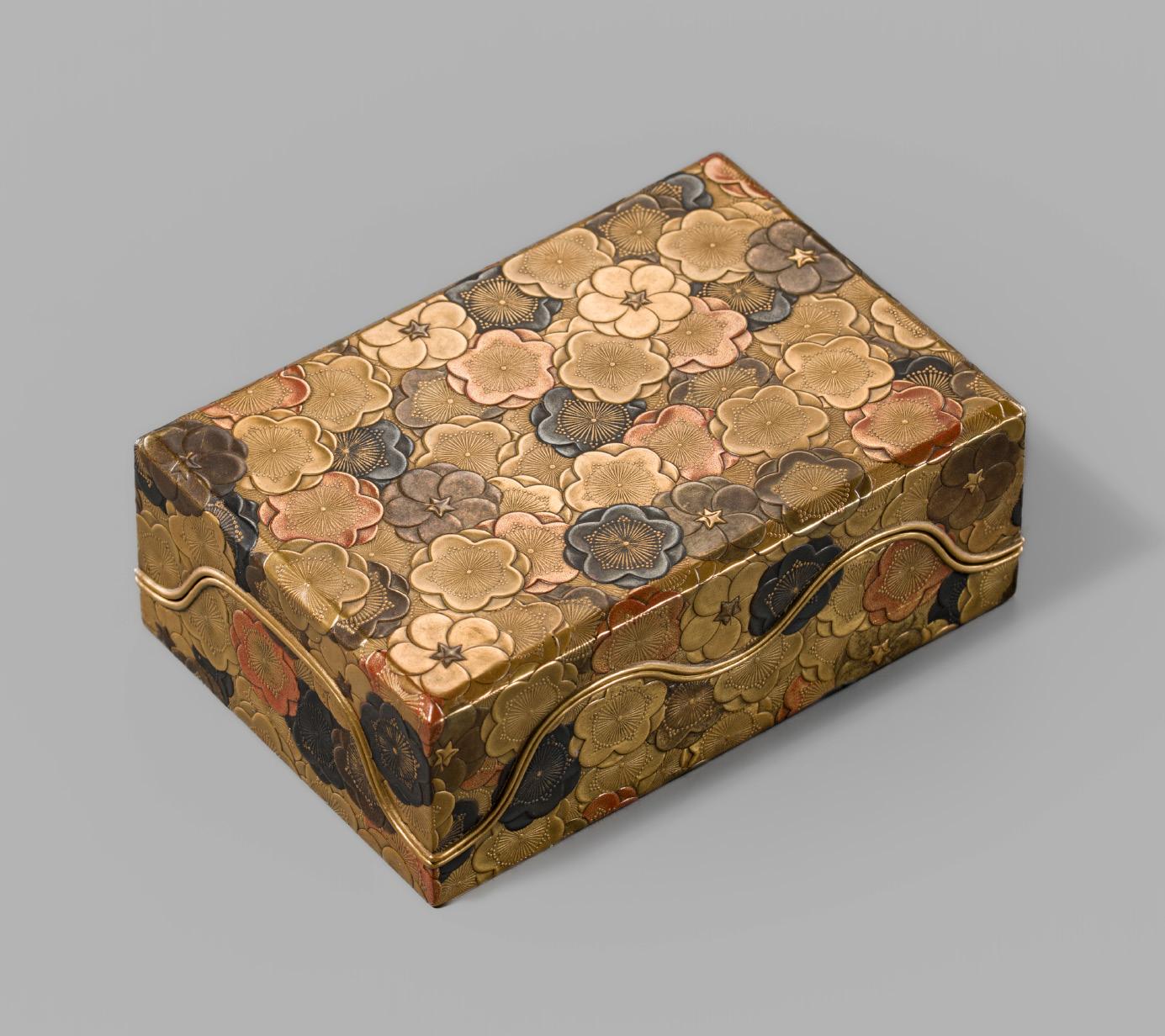
236
A FINE GOLD LACQUER ‘CHERRY AND CHRYSANTHEMUMS’ KOBAKO (SMALL BOX) WITH THREE KOGO, FOR THE INCENSE MATCHING GAME
Japan, 19th century
Of rectangular form, surmounted by a flush-fitting cover with an undulating edge and raised rim, lavishly decorated in gold, silver, and red takamaki-e to depict a dense profusion of overlapping cherry blossoms enveloping the entire exterior. The box contains three matching kogo (incense boxes), also of rectangular form, their exteriors similarly adorned with layered chrysanthemum blossoms, some finely inlaid with mother-of-pearl. The interiors are carefully finished in luminous nashiji with gold fundame rims.
HEIGHT 3.9 cm, LENGTH 11 cm
Condition: Excellent condition with only minor wear and faint traces of handling and use.
AUCTION COMPARISON
Compare a closely related goldlacquer kobako (small box) and cover, containing two kogo and a tray, similarly decorated with overlapping chrysanthemum blossoms, 10.4 cm long, at Bonhams, Fine Japanese Art, London, 6 November 2012, lot 405 (sold for GBP 2,250 or approx. EUR 3,800 converted and adjusted for inflation at the time of writing).
Estimate EUR 5,000
Starting price EUR 2,400
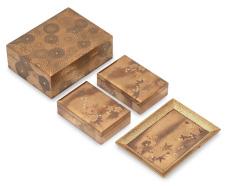
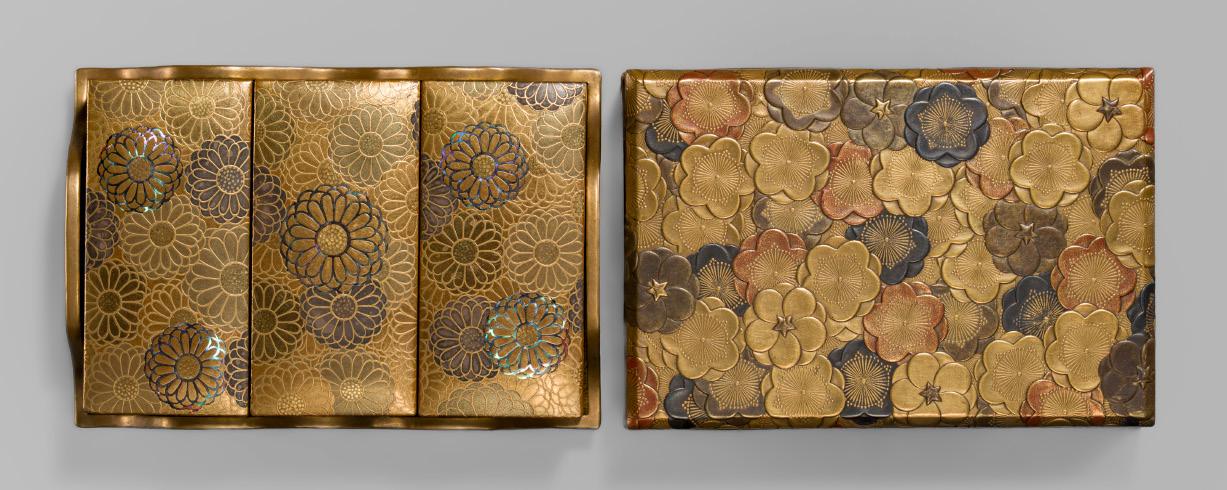
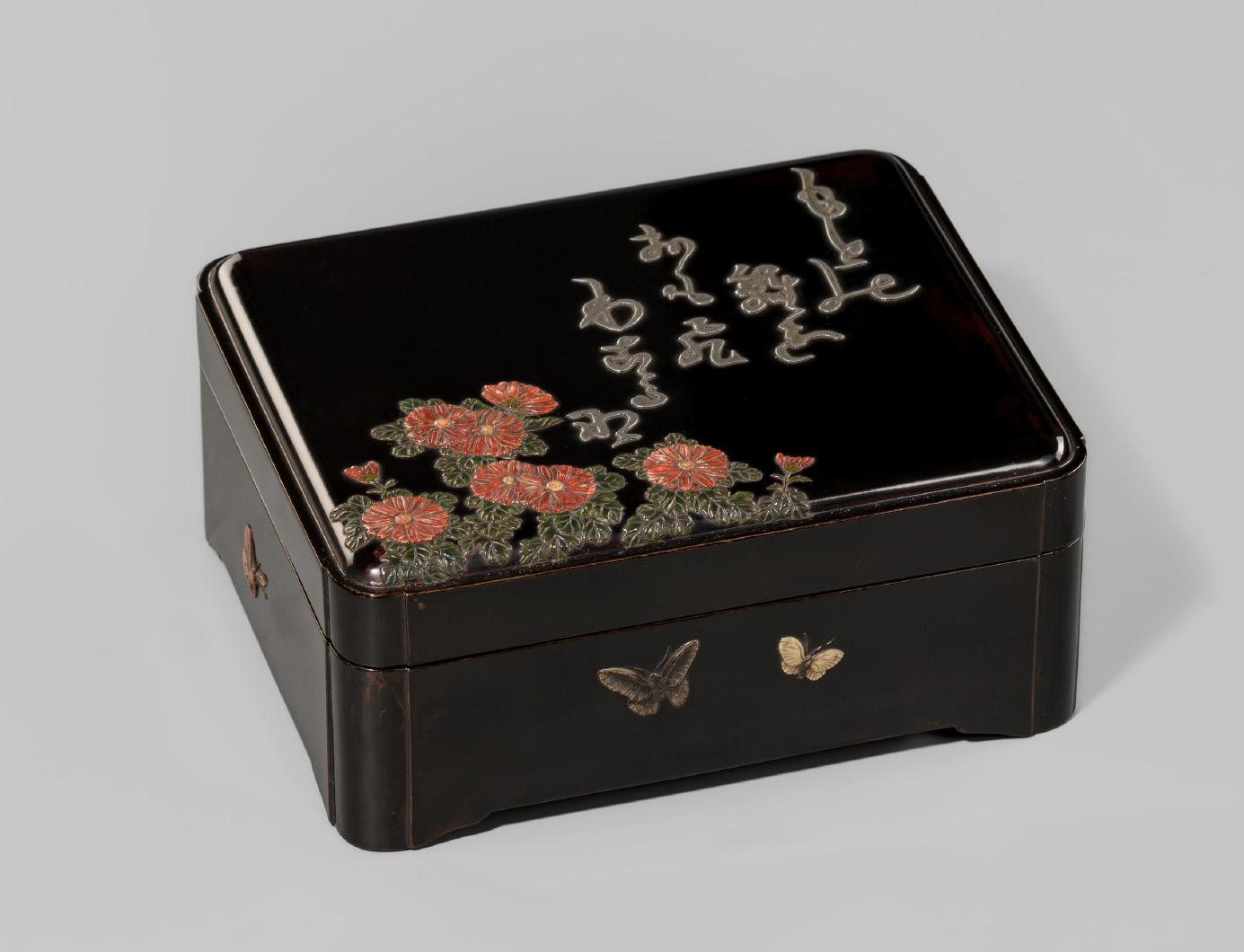
CHRYSANTHEMUMS
Japan, first half of the 20th century, Taisho (1912-1926) to Showa period (1926-1989)
Rectangular in form with rounded corners, raised on four lobed short feet, and featuring a flush-fitting cover, this exquisite box bears a lustrous roiro ground, finely decorated with iro-e takamaki-e and inlaid with various shades of soapstone. The design depicts a cluster of chrysanthemums in full bloom amidst leafy stems, accompanied by a calligraphic waka poem in hiragana, inlaid in pewter. The sides of the box are further embellished with delicate butterflies fluttering amidst the blossoms, while the underside of the cover is beautifully decorated in gold and iro-e takamaki-e, presenting a kimono stand and a wicker blind with suspended tassels, all set against a finely polished roiro lacquer ground.
The poem reads: Moto no magaki wo, omohi wasuruna (もとの籬を、思ひ忘るな) [Even if the chrysanthemums should fade within the Ninefold Palace, do not forget the humble hedge where they once grew.]
HEIGHT 6.4 cm, LENGTH 15.4 cm
Provenance: Private collection of Eva and Aubrey Sweet, Melbourne, Australia, thence by descent.
Condition: Excellent condition with only minor wear and faint traces of handling and use.
With an associated wood storage box (tomobako).
The pewter-inlaid inscription on the cover of this box reproduces a fragment from a famous waka poem found in the Kokin Wakashu, one of Japan’s earliest and most important Imperial anthologies of verse. Compiled in 905 during the Heian period, a time known for its courtly refinement, the anthology was created under the patronage of Emperor Uda (887–897) and later promulgated by Emperor Daigo (897–930). This particular poem is associated with a well-known anecdote in which a court poet, the Minister of the Left of the Hanazono house, attached this verse to a chrysanthemum presented to the Emperor. The poem exemplifies the cultivated sensibility of the Heian court, blending humility, elegance, and wit. It suggests that even when such humble blossoms enter an Imperial setting, their modest origins, and the individual who nurtured them, should not be forgotten.
Estimate EUR 2,000
Starting price EUR 1,000
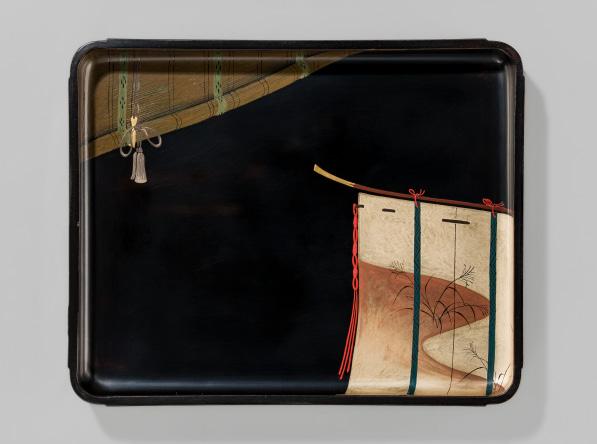
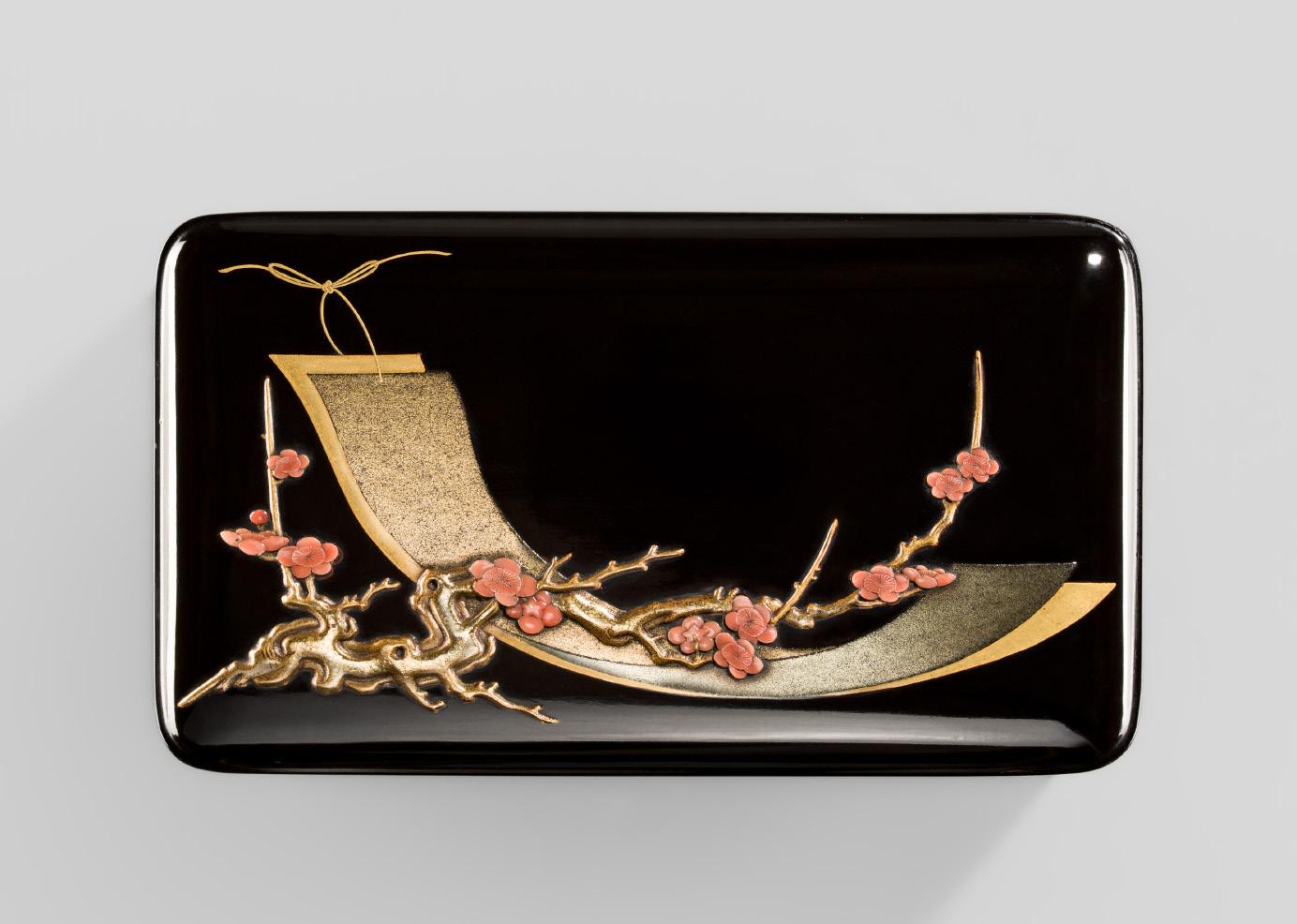
238
A RARE AND FINE CORAL-INLAID LACQUER ‘BLOSSOMING PLUM AND TANZAKU’ CHABAKO (TEA CEREMONY UTENSILS BOX)
Japan, 19th century
Rectangular in form with rounded corners, the box features a slightly domed, flush-fitting cover with a raised rim. The exterior is exquisitely decorated in gold and silver takamaki-e and hiramaki-e to depict a gnarled plum branch, its early blossoms inlaid with coral, heralding the arrival of spring. Gold kirigane flakes accentuate the design, while a pair of hanging poem slips (tanzaku) further enrich the composition. The sides of the box are adorned with delicate leafy aubergines (nasubi).
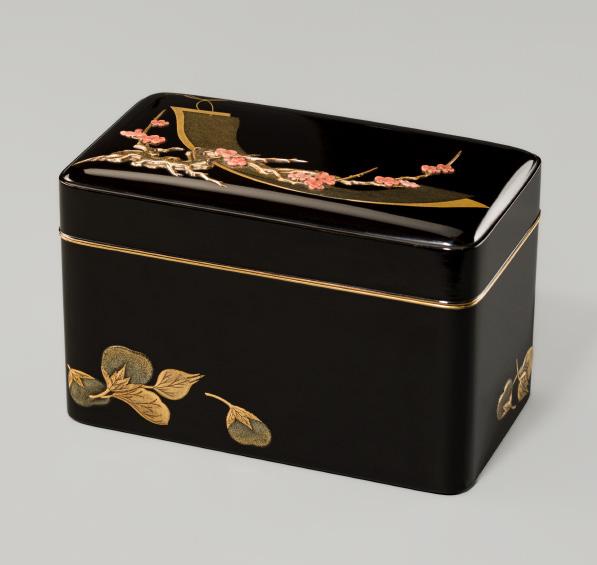
The interior riser is decorated with stylized scrolling tendrils and foliate wheels, and the interior of the cover is embellished with multiple five-seven paulownia crests (go-shichi no kiri), symbols of the official authority of the shogunate. These are set against a radiant nashiji ground, with gold fundame rims adding a refined finish.
HEIGHT 9.7 cm, LENGTH 15.6 cm
Provenance: Ex-collection Mike and Hiroko Dean, London, United Kingdom, thence by descent. Christie’s, 8 December 2016, London, lot 63. With Rutherston & Bandini, London, United Kingdom, 2017. Private collection of Eva and Aubrey Sweet, Melbourne, Australia, acquired from the above. A copy of the original invoice, dated 18 January 2017, addressed to Mrs. Eva Sweet, and stating a purchase price of GBP 2,650 (or approx. EUR 4,100 converted and adjusted for inflation at the time of writing), accompanies this lot.
Eva and Aubrey Sweet devoted over six decades to the formation of a distinguished private collection of Asian art, with particular strength in Chinese jade, Japanese lacquer, and netsuke. Their collecting began in the 1950s and was refined through sustained travel, scholarship, and long associations with leading dealers, curators, and artists internationally.
Condition: Excellent condition with only minor wear. Some flaking to the interior and some scratches to the underside.
Compare a related gold lacquer tebako with similar coral inlays to the plum tree, 12.8 x 20.3 x 24.2 cm, at Bonhams, The Alan and Simone Hartman Collection: The Inaugural Sale, 14 December 2023, New York, lot 113 (sold for USD 12,800 or approx. EUR 12,000 converted and adjusted for inflation at the time of writing).
Estimate EUR 3,000
Starting price EUR 1,500
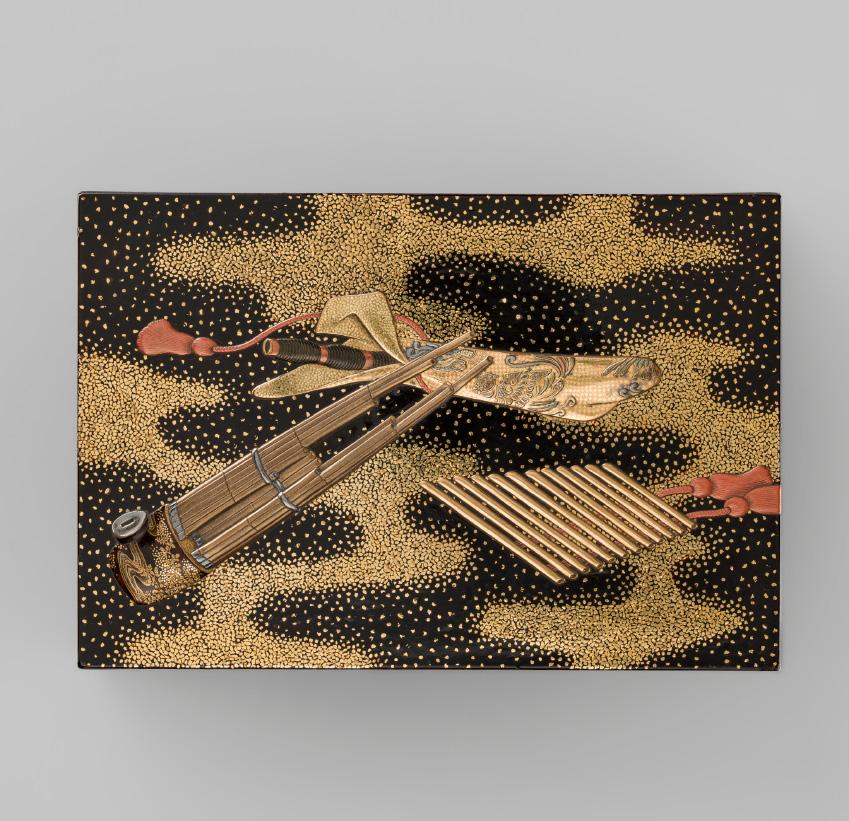
By Ichigyokusai, signed Ichigyokusai Japan, 19th century
Of rectangular form, finely decorated with iro-e takamaki-e and hiramaki-e on a lustrous roiro ground, accentuated with sparsely scattered gold flakes and gyobu nashiji. The inrobuta (flush-fitting) lid depicts an array of gagaku instruments, including a sho (mouth organ), a flute wrapped in a beautifully decorated brocade, and delicate wind chimes. The interior of the lid features an exquisite scrolling design in takamaki-e set against a nashiji ground. The box is finished with silver rims. Signed to the lower left interior ICHIGYOKUSAI.
SIZE 5 x 9 x 13.1 cm
Provenance: Malcolm Fairley Ltd., London, 2003. From the collection of Eva & Aubrey Sweet, Melbourne, Australia, acquired from the above. A copy of the invoice from Malcolm Fairley Ltd, dated 6 November 2003, stating a purchase price of GBP 2,200 (or approx. EUR 4,000 converted and adjusted for inflation at the time of writing) and confirming the above, accompanies the lot.
Condition: Excellent condition.
With a wood tomobako (storage box).
Estimate EUR 2,500
Starting price EUR 1,200
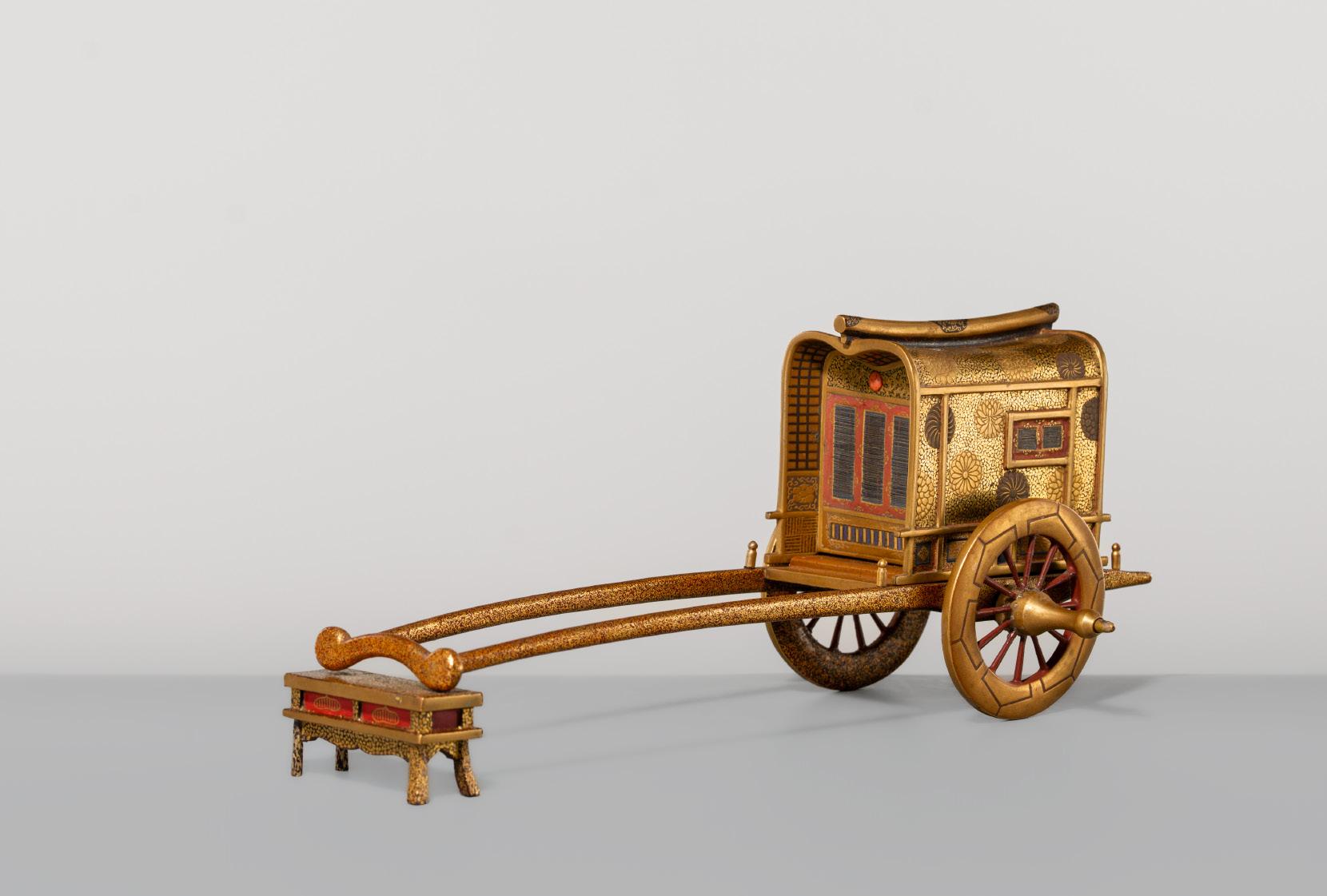
240 A RARE LACQUER KORO (INCENSE BURNER) IN THE FORM OF AN OX-DRAWN IMPERIAL COURT CARRIAGE (GOSHOGURUMA), WITH STAND
Japan, 19th century, late Edo (1615-1868) to Meiji period (1868-1912)
Finely crafted, the courtly carriage fitted with a removable top, decorated with gold takamaki-e and hiramaki-e, to depict an array of imperial kiku crests on a radiant gyobu-nashiji ground, its sides bearing shuttered panels, detailed with gold foil appliqué and inlaid with mother-of-pearl and coral, which open to reveal an inner chamber containing a metal receptacle for incense. The two wheels of the carriage finished in gold fundame, decorated with geometric designs, and mounted on two long axles, accompanied by a large harness for drawing the vehicle, embellished with vibrant nashiji. The stand similarly decorated in gyobu-nashiji with red lacquer accents, designed to support the harness of the carriage in elevated display.
LENGTH 27.7 cm
Condition: Good condition with surface wear and expected traces of handling and use. Minor losses to inlays. Repairs (visible under UV light examination) to the wheels and spokes and to two feet of the stand. The stand further with losses to gyobu nashiji from contact with the carriage.
MUSEUM COMPARISON
Compare a related lacquer model of a goshoguruma (ox-drawn court carriage), late Edo to Meiji period, Pola Cultural Institute Digital Museum, Hakone, Japan, object no. DM813.
Estimate EUR 2,500
Starting price EUR 1,200
Japan, 19th century, Edo period (1615-1868)
Of square shape, bearing a fine gold kinji lacquer ground with densely sprinked kinpun as well as e-nashiji, finely decorated with gold and red takamaki-e and hiramaki-e. The inrobuta (flush-fitting) lid depicts a landscape scene referring to an episode of the Tale of Genji, showing a veranda near a lake with a pine and cherry tree, the hills and clouds embellished with kirigane flakes. The underside and interior of nashiji with silver rims.
SIZE 2 x 8.7 x 8 cm
Provenance: Sprink & Son Ltd, London. From the collection of Eva & Aubrey Sweet, Melbourne, Australia, acquired from the above. With a collection label ‘no. 84’, to the box.
Condition: Excellent condition with only very minor wear.
Estimate EUR 2,500
Starting price EUR 1,200
Japan, c. 1880, Meiji period (1868-1912)
PUBLISHED
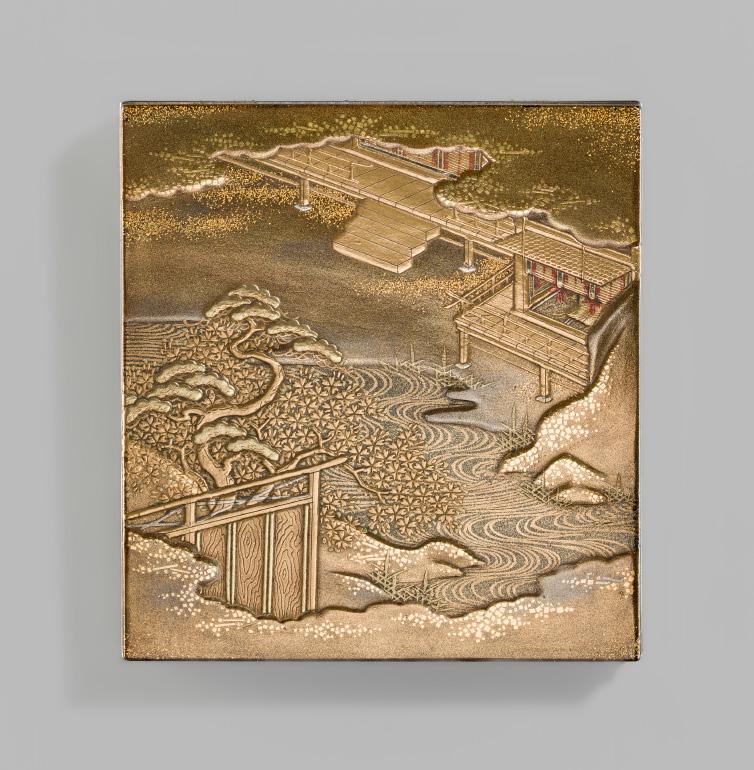
Of square form, bearing a highly polished gold kinji ground with a net pattern, finely decorated with gold and silver takamaki-e and hiramaki-e. The kabusebuta (overhanging) lid depicts five neatly cut and tied narcissus plants, their leaves curling gracefully. The interior is finished in roiro with a plum blossom design in brilliant red and gold togidashi, the rims applied in silver.
SIZE 2.5 x 7.5 x 7.5 cm
Provenance: Ex-collection Melvin and Betty Jahss, New York. Max Rutherston, London, 2015. From the collection of Eva & Aubrey Sweet, Melbourne, Australia, acquired from the above. A copy of the valuation from Max Rutherston, dated 5 May 2015, stating a purchase price of GBP 3,200 (or approx. EUR 5,000 converted and adjusted for inflation at the time of writing) and confirming the above, accompanies the lot.
Condition: Very good condition with minor wear including a few tiny nicks to the cover.
Estimate EUR 3,000
Starting price EUR 1,500
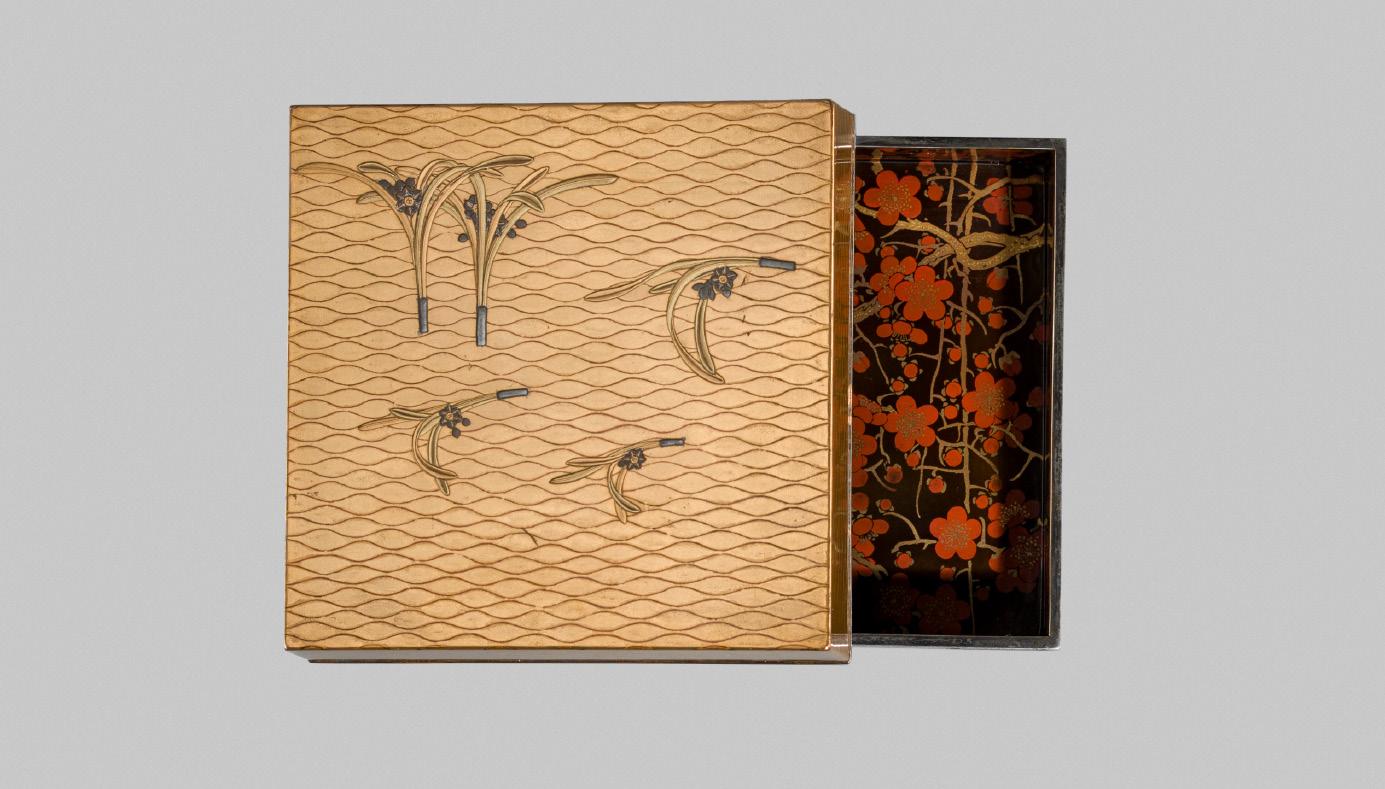
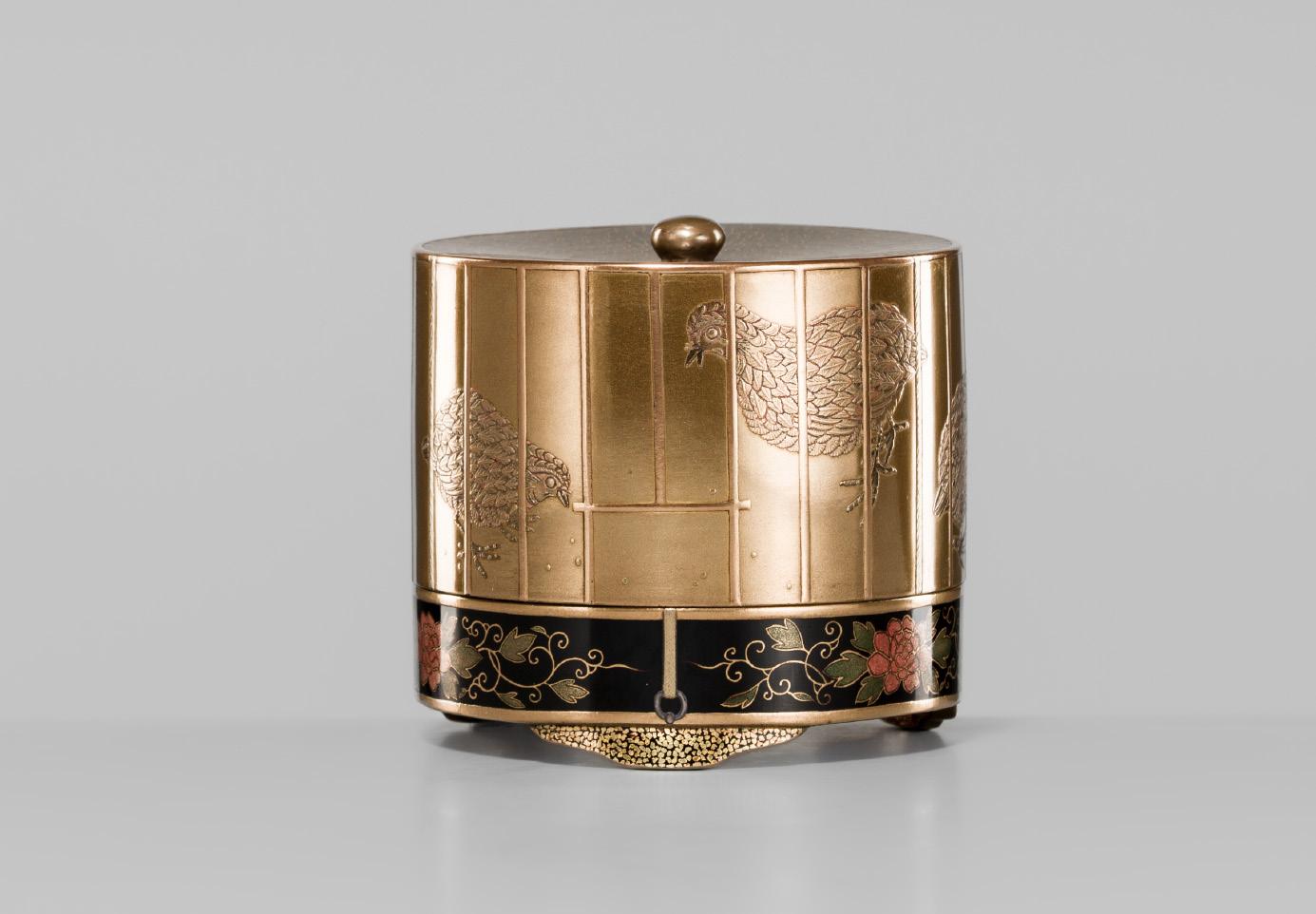
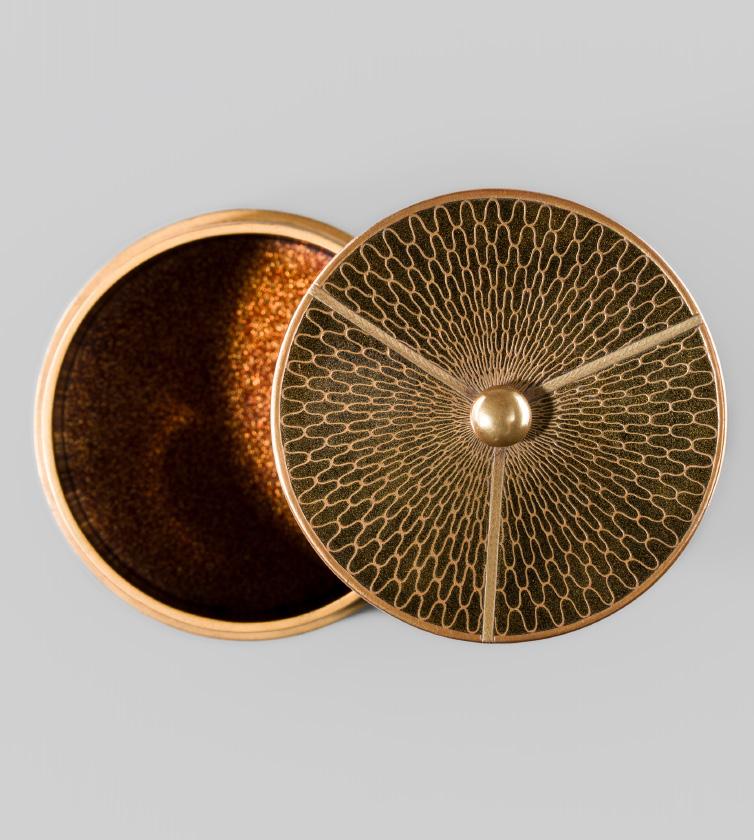
Shaped as a cylindrical birdcage and raised on three lobed feet, the exterior bearing a luminous kinji ground, exquisitely decorated in gold takamaki-e, to depict a group of quails within the cage, their plumage rendered with remarkable finesse. The lower section of the cage adorned with various leafy peony sprays, masterfully executed in gold and iro-e hiramaki-e, emulating the appearance of cloisonné, while the feet are decorated with gyobu-nashiji. The top of the cover finely embellished with a gold netting pattern worked in, centered by a knop, the interior finished with nashiji and gold fundame rims.
HEIGHT 6.2 cm, DIAMETER 6.8 cm
Provenance: With Rosemary Bandini, United Kingdom, 2009. Private collection of Eva and Aubrey Sweet, Melbourne, Australia, acquired from the above, thence by descent. A copy of the original invoice, dated 10 November 2009, addressed to Mrs. Eva Sweet, and stating a purchase price of GBP 2,000 (or approx. EUR 3,700 converted and adjusted for inflation at the time of writing), accompanies this lot. Condition: Excellent condition with only very minor expected wear.
With an associated wood tomobako (storage box).
AUCTION COMPARISON
Compare a closely related gold lacquer kogo (incense box) and cover in the form of a quail cage, 8 cm high, at Bonhams, Fine Japanese Art, London, 17 May 2012, lot 118 (sold for GBP 4,000 or approx. EUR 6,700 converted and adjusted for inflation at the time of writing).
Estimate EUR 4,000
Starting price EUR 2,000
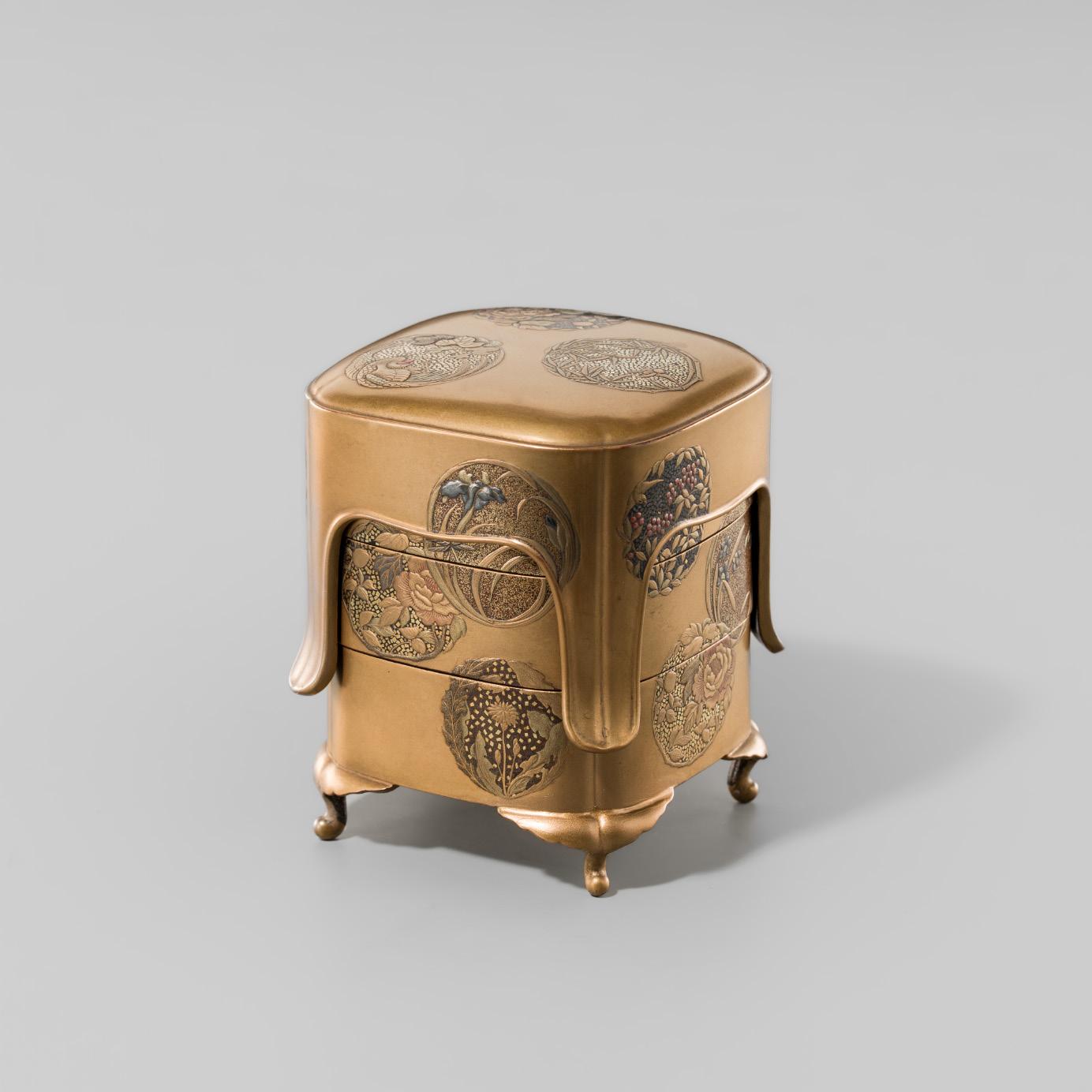
244
A FINE GOLD-LACQUER JU-KOGO
(SMALL TIERED INCENSE BOX AND COVER), WITH INTERIOR TRAY
Japan, late 19th century, Meiji period (1868-1912)
Consisting of a three-tiered stacking box rising from four bracket feet, a cover, and a tray, of upright rectangular form with lobed rounded edges, superbly decorated in iro-e takamaki-e and hiramaki-e on a kinji ground. The top cover and sides of the box feature a delicate composition of floral medallions, including peonies, irises, vines with a pheasant, bamboo with a bird, camellias, plum, dandelion, Chinese bellflower, and chrysanthemum, all set against gyobu-nashiji, kinpun, or nashiji grounds. The interior is finished in roiro with nashiji and gold fundame rims.
SIZE 6.5 x 8.5 cm
Condition: Very good condition with minor expected wear, typical losses to the kirigane flakes and a repair to one foot (only visible under UV light).
AUCTION
COMPARISON
Compare a closely related tiered kobako with floral medallions, 10.4 cm high, at Christie’s, Japanese Art and Design, 8 November 2006, London, lot 85 (sold for GBP 4,560 or approx. EUR 9,000 converted and adjusted for inflation at the time of writing). Compare a closely related lacquer three-tiered stacking set of lobed boxes with a similar overlapping cover, 10 x 14.2 x 12 cm, at Bonhams, Snow, Sex and Spectacle, 13 May 2021, London, lot 76 (sold for GBP 6,120 or approx. EUR 9,000 converted and adjusted for inflation at the time of writing).
Estimate EUR 2,500
Starting price EUR 1,200
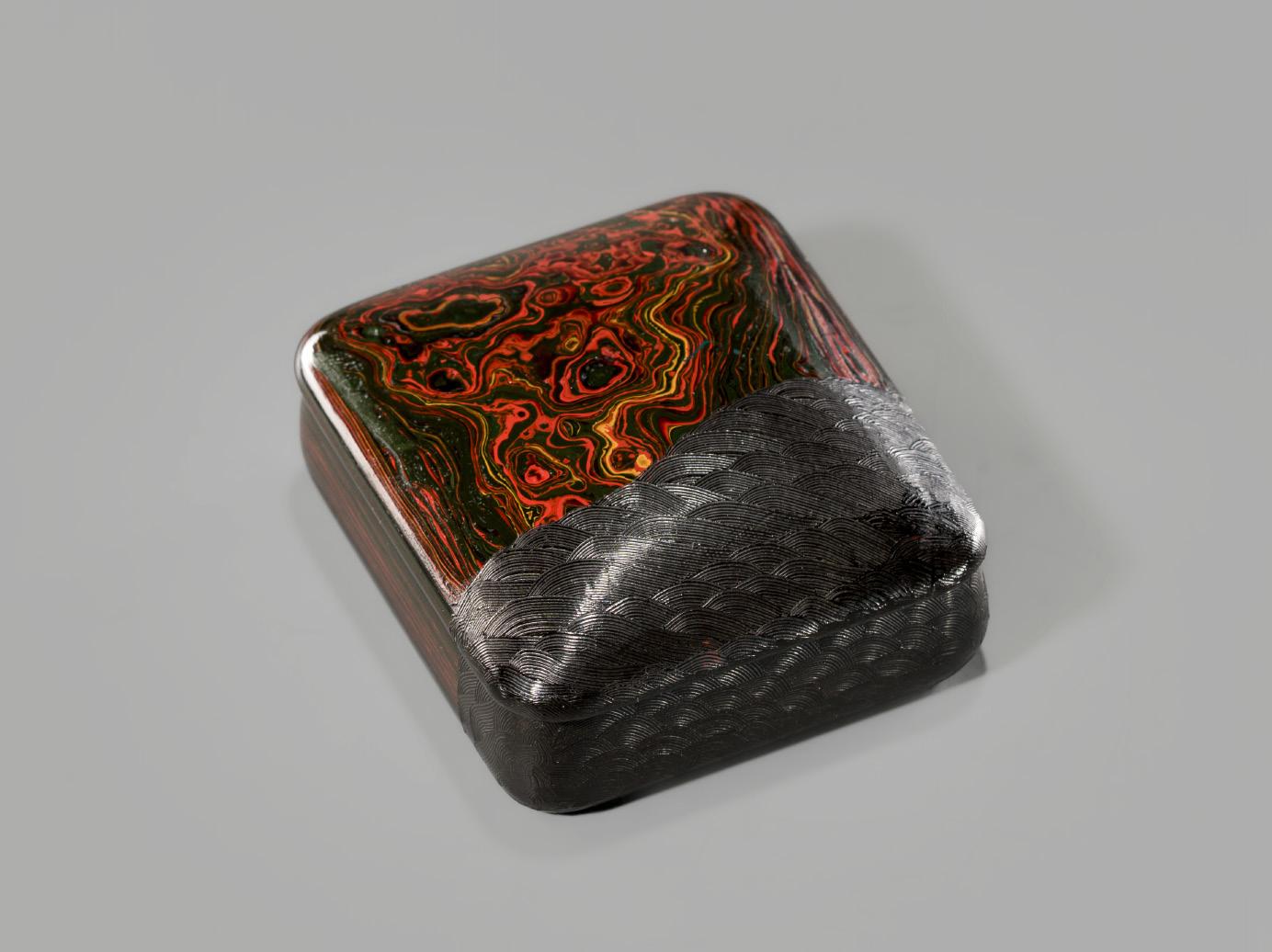
245
IKEDA TAISHIN: A SUPERB SEIGEIHA-NURI LACQUER KOBAKO (SMALL BOX)
By Ikeda Taishin (1825-1903), signed Taishin Japan, late 19th century, Meiji period (1868-1912)
Rectangular in form with gently rounded corners and slightly tapering sides, fitted with a softly domed, slightly overhanging cover. The exterior is finely decorated in polychrome marbled lacquer beneath a black combed wave pattern (seigaiha-nuri) to the lower section, creating a striking interplay of color and demonstrating a high degree of technical control. The interior and underside continues the marbled lacquer design and is signed to the interior of the cover in gold takamaki-e TAISHIN.
HEIGHT 2.8 cm, LENGTH 6.5 cm
Condition: Excellent condition.
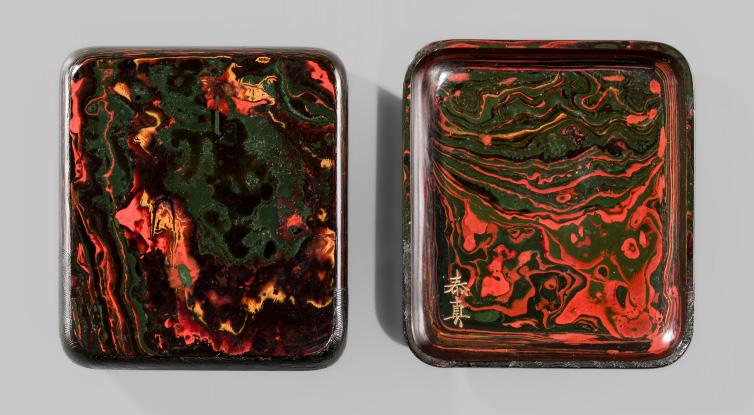
Ikeda Taishin (1825-1903) was the leading pupil of Shibata Zeshin and one of the most accomplished lacquer artists of the Meiji period. Born in Edo, he entered Zeshin’s workshop in 1835 at the age of eleven and remained under his tutelage for several decades before establishing himself independently around 1870. In 1896, together with Kawanobe Itcho (Genjiro, 1830–1910), he was appointed Artist to the Imperial Household (Teishitsu gigeiin). Among his pupils was Umezawa Ryushin, later associated with the Imperial Fine Arts Academy.
The present kobako is decorated with the ‘seigaiha’ technique, literally ‘blue ocean waves’ in Japanese, which was revived by the eminent lacquerer Shibata Zeshin (1807-1891) after falling out of use for over two centuries. Seigaiha is achieved by drawing a comb through a thin layer of wet lacquer mixed with cereal starch or white lead to improve its viscosity. The process has to be perfectly executed in a short time before the lacquer dries and mistakes cannot be corrected.
AUCTION
COMPARISON
For a related example of the seigaiha-nuri technique by Taishin’s master Shibata Zeshin on a seido-nuri tray, see Christie’s, Japanese Art & Design, 16 November 2000, London, lot 92 (sold for GBP 15,275 or approx. EUR 33,500 converted and adjusted for inflation at the time of writing).
Estimate EUR 6,000
Starting price EUR 3,000
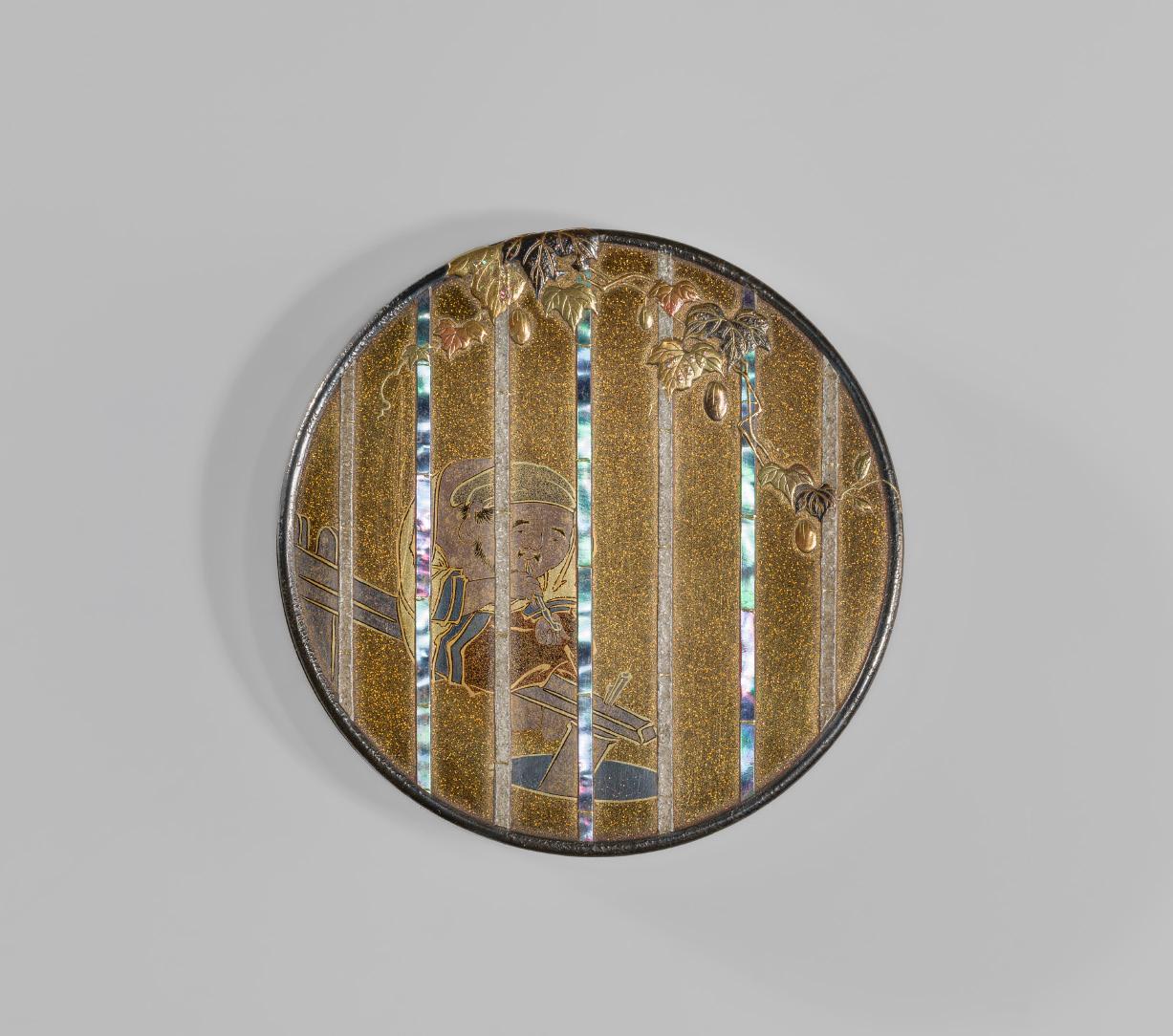
246
SHIBATA ZESHIN (1807-1891): A MASTERFUL INLAID LACQUER KOGO (INCENSE BOX)
DEPICTING DAIKOKU TAKING A SMOKING BREAK
By Shibata Zeshin (1807-1891), signed Zeshin Japan, c. 1880s
Of circular form, masterfully decorated in delicate gold and silver takamaki-e, hiramaki-e, and sublime togidashi-e on a delicately sprinkled ground. The inrobuta (flush-fitting) lid is adorned with a charming scene set behind a pewter and aogai (mother-of-pearl) inlaid fence, depicting Daikoku seated on a rice pestle beneath trailing ivy vines issuing fruits, leisurely smoking a pipe. The sides and underside are finished in matte silver, while the interior is in nashiji with gold fundame rims. Signed ZESHIN on the underside.
DIAMETER 7.5 cm
Provenance: From the Collection of Dr. med. Josef Markwalder, Baden, Switzerland, and thence by descent. With a handwritten label ‘’Daikoku’ der Gott des Reichtums als alter Mann Pfeife rauchend. Signatur: ‘Zeshin’’. Condition: Excellent condition.
Shibata Zeshin (1807-1891) was a Japanese painter, lacquer artist, and printmaker of the late Edo period to early Meiji era. Nominated as one of the first Teishitsu Gigeiin (Imperial Court Artist) in Meiji 23 (1890), Shibata Zeshin excelled in several art forms, including painting, lacquer-making, print design, and calligraphy. He had an outstanding studio with talented students specializing in lacquer, paintings and prints. He has been called ‘Japan’s greatest lacquerer.’ His work, unlike the oils being used by so many of his contemporaries, never needed re-touching and never faded. He was a master of emulating oil or ink painting with lacquer and
combined groundbreaking techniques with traditional subjects. His studio was situated on the bank of a river, providing him with ample opportunity to observe nature, and the creatures that inhabit the natural world. Like many painters of the 19th century, he was eclectic in his sources and would have been exposed to traditional styles. However, Zeshin’s skill level was such that he could fluidly mix techniques, ideas, and stylistic options, thus painting part of a composition in one manner and including elements of another to add variety and dynamics unheard of at the time.
MUSEUM COMPARISON
Compare a closely related inro with a near-identical design, by Shibata Zeshin, in the Victoria & Albert Museum, London, accession no. W.298:1, 2-1922.
AUCTION COMPARISON
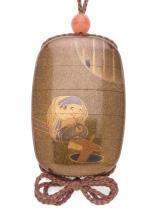
Compare a related gold lacquer inro showing Daikoku and ebisu, the verso with an oni and similarly inlaid fence, by Shibata Zeshin, dated to ca. 1886, at Bonhams, Patient Detail, Perfect Design, 3 November 2022, London, lot 63 (sold for GBP 38,100 or approx. EUR 50,000 converted and adjusted for inflation at the time of writing).
Estimate EUR 10,000 Starting price EUR 5,000
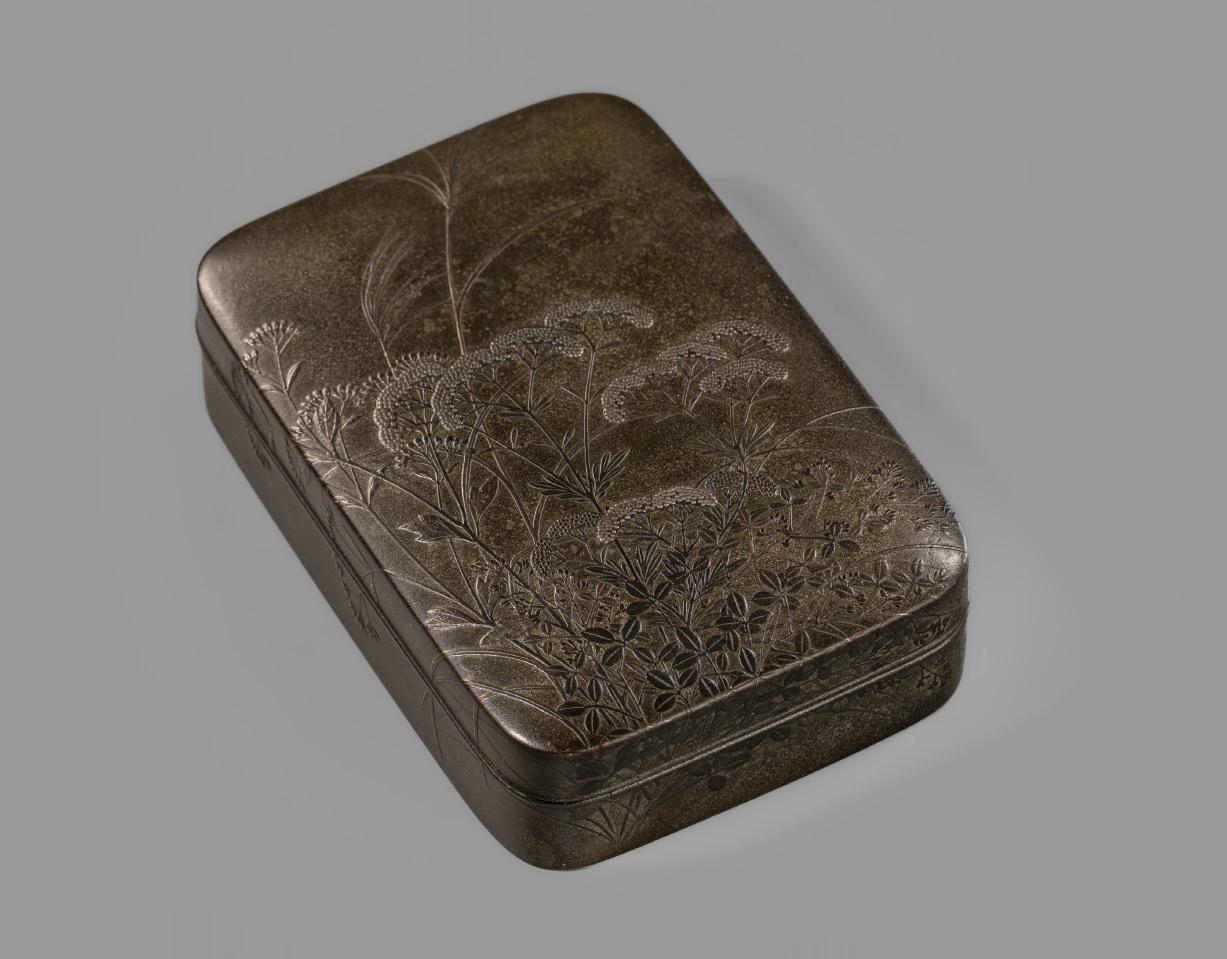
247 A MAGNIFICENT SHIBUICHI-NURI LACQUER ‘AUTUMN GRASSES’ KOBAKO (SMALL BOX)
Japan, 19th century, late Edo (1615-1868) to Meiji period (1868-1912)
Of upright rectangular form with rounded sides, bearing a masterful shibuichi-nuri ground imitating metal alloy, finished in a finely textured ishime. The decoration is rendered in a closely related tone of lacquer, creating a subtle and refined effect. The inrobuta (flush-fitting) lid depicts a delicate composition of autumn grasses, including bush clover and pampas grasses, gracefully extending over the sides of the box. The interior of the lid, similarly lacquered, features further autumn grasses silhouetted against a brilliant togidashi full moon.
SIZE 2.5 x 9.8 x 6.7 cm
Provenance: Collection of Drs. Edmund and Julie Lewis, Chicago, Illinois. An old label of the Red Cross Exhibition (1915) to the interior. Drs. Edmund Jean and Julia Breyer Lewis are renowned experts in nephrology who met professionally and later married in 1997, and have since continued to collect Japanese art together, actively seeking the best they could find from the finest dealers in the field. Condition: Excellent condition.

Drs. Edmund and Julie Lewis
The present lot depicts a scene closely comparable to a tea caddy (natsume) by Koma Kansai II in the same sale (lot 248), and is likely either by the same artist or by his pupil Shibata Zeshin, whose work similarly explores tonal subtlety and innovative surface effects in lacquer.
MUSEUM COMPARISON
Compare a related panel with a closely related design of autumn grasses in moonlight, by Shibata Zeshin, dated second half of the 19th century, in the Metropolitan Museum of Art, object number 1975.268.137.
Estimate EUR 6,000
Starting price EUR 3,000
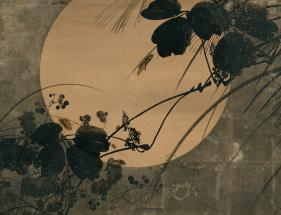
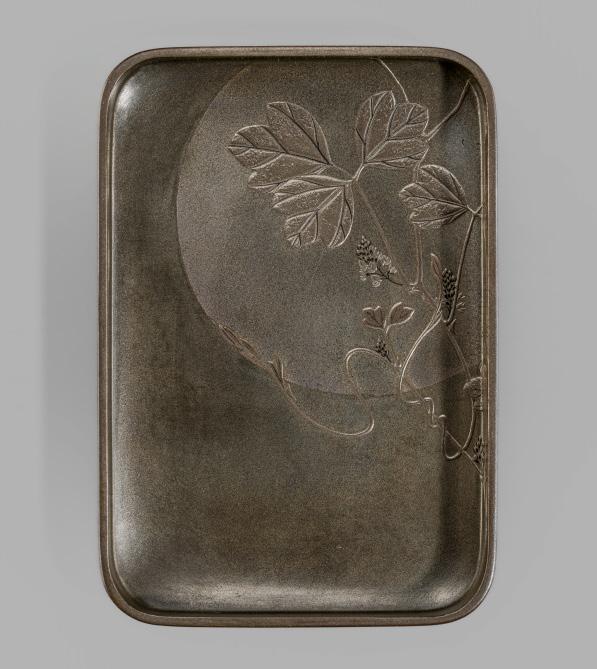
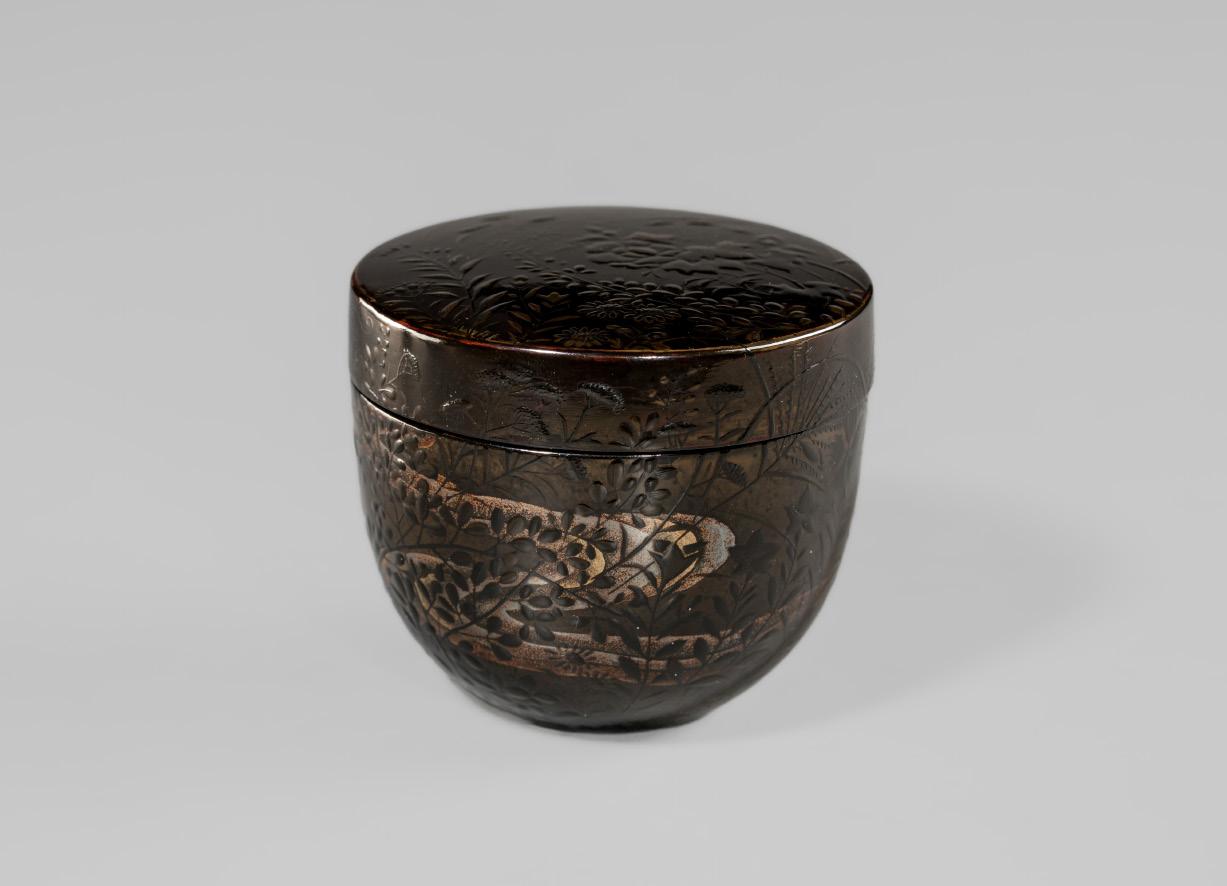
248
KOMA KANSAI: A MAGNIFICENT YAMIMAKI-E LACQUER ‘AUTUMN GRASSES IN MOONLIGHT’ NATSUME (TEA CADDY)
By Koma Kansai II (1767-1835), signed Kansai 寛哉 Japan, 19th century, Edo period (1615-1868)
Of typical form with an inrobuta (flush-fitting) cover, masterfully lacquered in yamimaki-e (black-on-black lacquer) to depict autumn grasses (aki no nanakusa) on the exterior, including bush clover (hagi), arrowroot (kuzu), fringed pink (nadeshiko), and bellflower (kikyo), all set above a subtly sprinkled silver togidashi-e river.
The interior is almost entirely worked in further yamimaki-e, continuing the design, while the interior of the cover reveals a magnificent silver togidashi-e moon, set against additional autumn grasses and lightly sprinkled with gold.
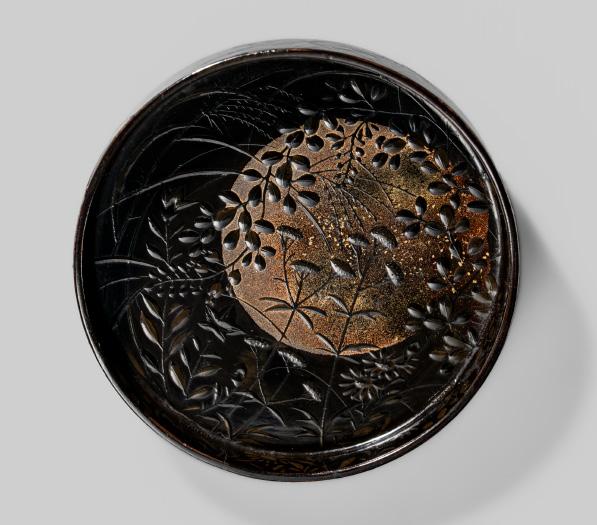
The interior of the cover reveals a magnificent silver togidashi-e moon set against autumn grasses
HEIGHT 5.6 cm, DIAMETER 6.2 cm
Provenance: Scholten Japanese Art, New York, 2001. From the collection of Eva & Aubrey Sweet, Melbourne, Australia, acquired from the above. A copy of the invoice from Scholten Japanese Art, dated 4 December 2001, stating a purchase price of USD 12,000 (or approx. EUR 19,000 converted and adjusted for inflation at the time of writing) and confirming the above, accompanies the lot. Condition: Excellent condition.
With the original inscribed wood tomobako (storage box).
Koma Kansai II (1767-1835) is renowned as one of the most distinguished masters of the Koma family, many of whom were official lacquerers to the shogunate. Kansai II was celebrated for his versatility across various lacquer techniques and media, often collaborating with leading metalworkers to produce works of exceptional refinement. He also served as the master of the famous lacquer artist Shibata Zeshin.
AUCTION COMPARISON
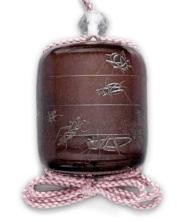
Compare a closely related three-case lacquer inro depicting insects on fern, signed Koma Kansai, with similarly rendered yamimaki-e, at Lempertz, Netsuke, Inro and Sagemono from a Rheinish Collection, 7 December 2018, Cologne, lot 550 (sold for EUR 13,125 or approx. EUR 16,500 adjusted for inflation at the time of writing). Also compare a related rectangular lacquer tray bearing a similar design of a full moon and autumn grasses by Shibata Zeshin, 49 cm long, at Christie’s, Lacquer, Jade, Bronze, Ink: The Irving Collection Evening Sale, 20 March 2019, New York, lot 811 (sold for USD 275,000 or approx. EUR 300,000 converted and adjusted for inflation at the time of writing).
Estimate EUR 10,000
Starting price EUR 5,000
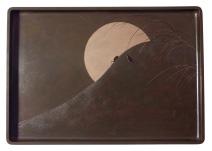
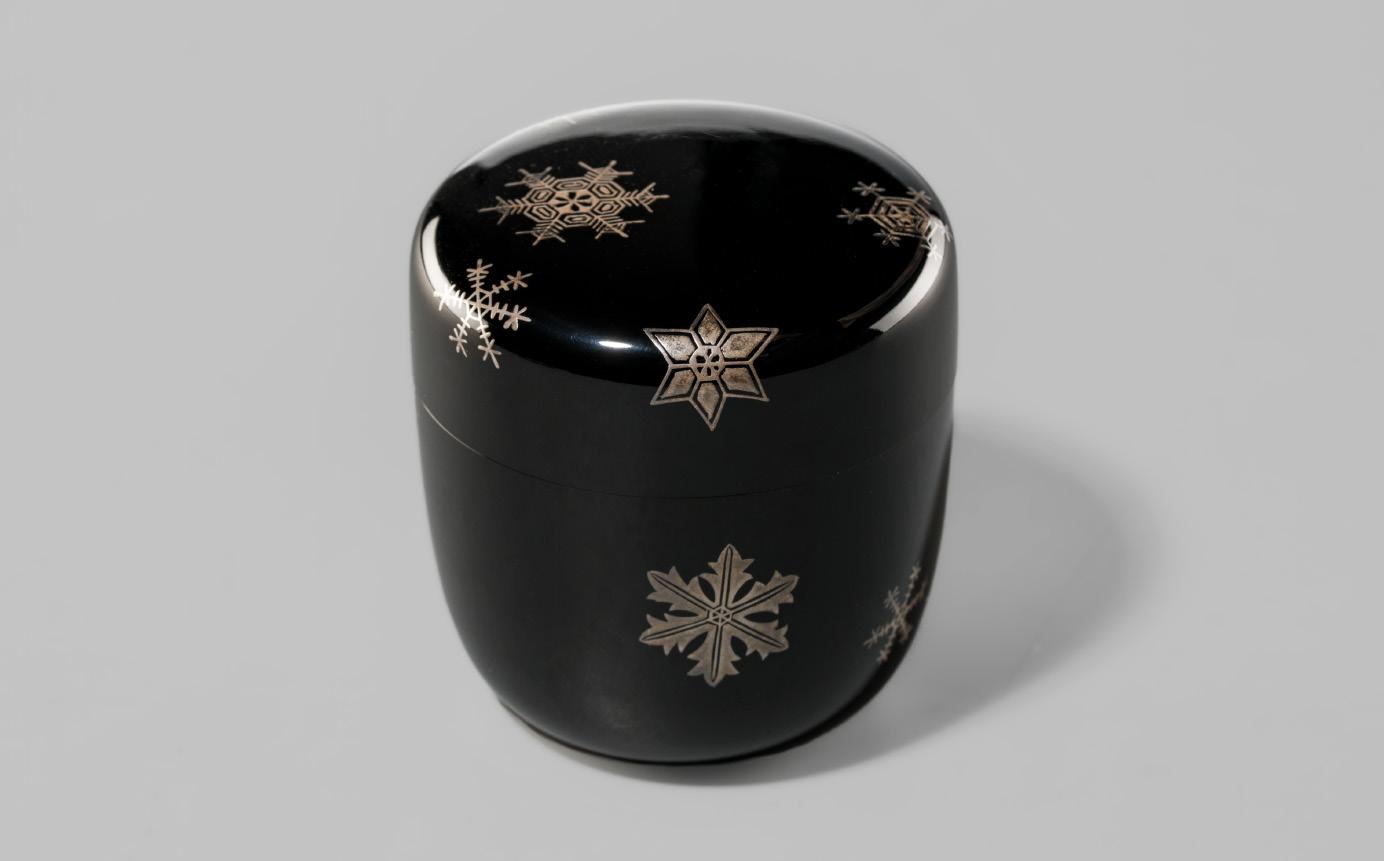
By Harui Komin (b. 1869), signed and sealed Komin Japan, early 20th century, Meiji (1868-1912) to Taisho period (1912-1926)
Of typical form with a flush-fitting cover, the exterior bearing a lustrous roiro ground and superbly decorated in silver takamaki-e with an elegant array of snowflakes rendered in varied forms and patterns. The interior is similarly finished in finely polished roiro, richly embellished in gold togidashi maki-e: an encircling band of cherry blossoms set against a gyobu-nashiji ground, and, to the underside of the cover, a crescent moon emerging from nocturnal mist, completing the poetic triad of setsugekka (snow, moon, and flowers). The base signed in gold script and sealed KOMIN.
HEIGHT 6.5 cm, DIAMETER 6.3 cm
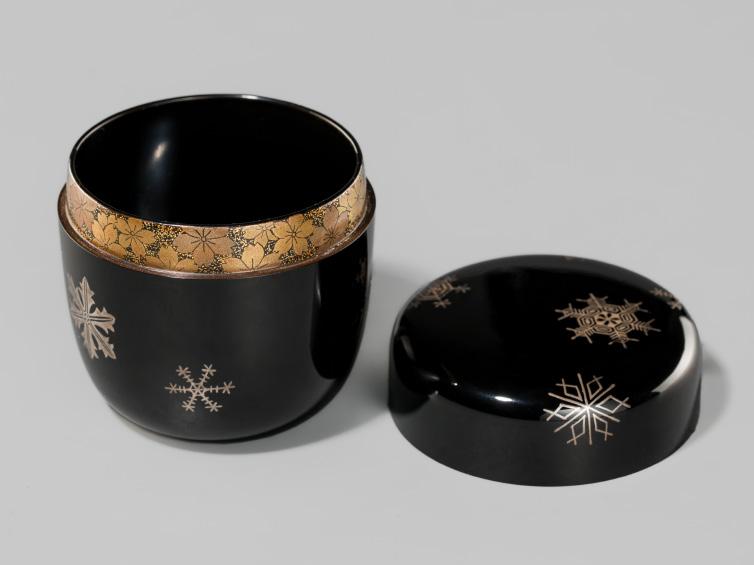
Provenance: Lesley Kehoe Galleries, Melbourne, Australia, 2005. Private collection of Eva and Aubrey Sweet, Melbourne, Australia, acquired from the above, thence by descent. A copy of the original invoice, dated 14 November 2005, addressed to Mr. Aubrey Sweet, and stating a purchase price of AUD 20,000 (or approx. EUR 21,500 converted and adjusted for inflation at the time of writing), accompanies this lot.
Condition: Excellent condition.

With the original silk carrying bag (shifuku) and wood storage box (tomobako).
The lid of the box inscribed by the artist Setsu getsu ka (Setsugekka), Chu-natsume 雪月花、中棗 [Snow, Moon, Flower; medium-sized tea caddy]. An old label affixed to one side of the box further inscribed Setsu getsu ka (Setsugekka), Chu-natsume, Harui Komin saku 雪月花、中棗、春井恒眠作 [Snow, Moon, Flower; medium-sized tea caddy, made by Harui Komin].
Harui Komin (Osaka, b. 1869) was a distinguished lacquer artist whose work exemplifies the highest level of refinement within late nineteenth- and early twentieth-century Japanese lacquer. He trained under Nakagawa Gyokushu, acquiring a rigorous technical foundation, and later moved to Kyoto at the invitation of the prominent dealer Ikeda Seisuke. Following the closure of Ikeda’s business and declining health, Komin settled in Suma, Hyogo Prefecture, where he continued his artistic practice.
Relatively little is known about Komin, partly due to his practice of leaving many works unsigned after reaching artistic maturity, a habit that has contributed to the rarity and mystique of his oeuvre. His authorship of a spectacular lacquer cabinet presented by Emperor Hirohito to the Prince of Wales in 1921— now in the Khalili Collection—was only confirmed through the discovery of a letter preserved at the Victoria and Albert Museum. In it, Baron Sumitomo praised Komin as “one of the few living masters whose name will be handed down to unborn ages,” ranking him among the greatest lacquer artists of his time.
Estimate EUR 5,000
Starting price EUR 2,400
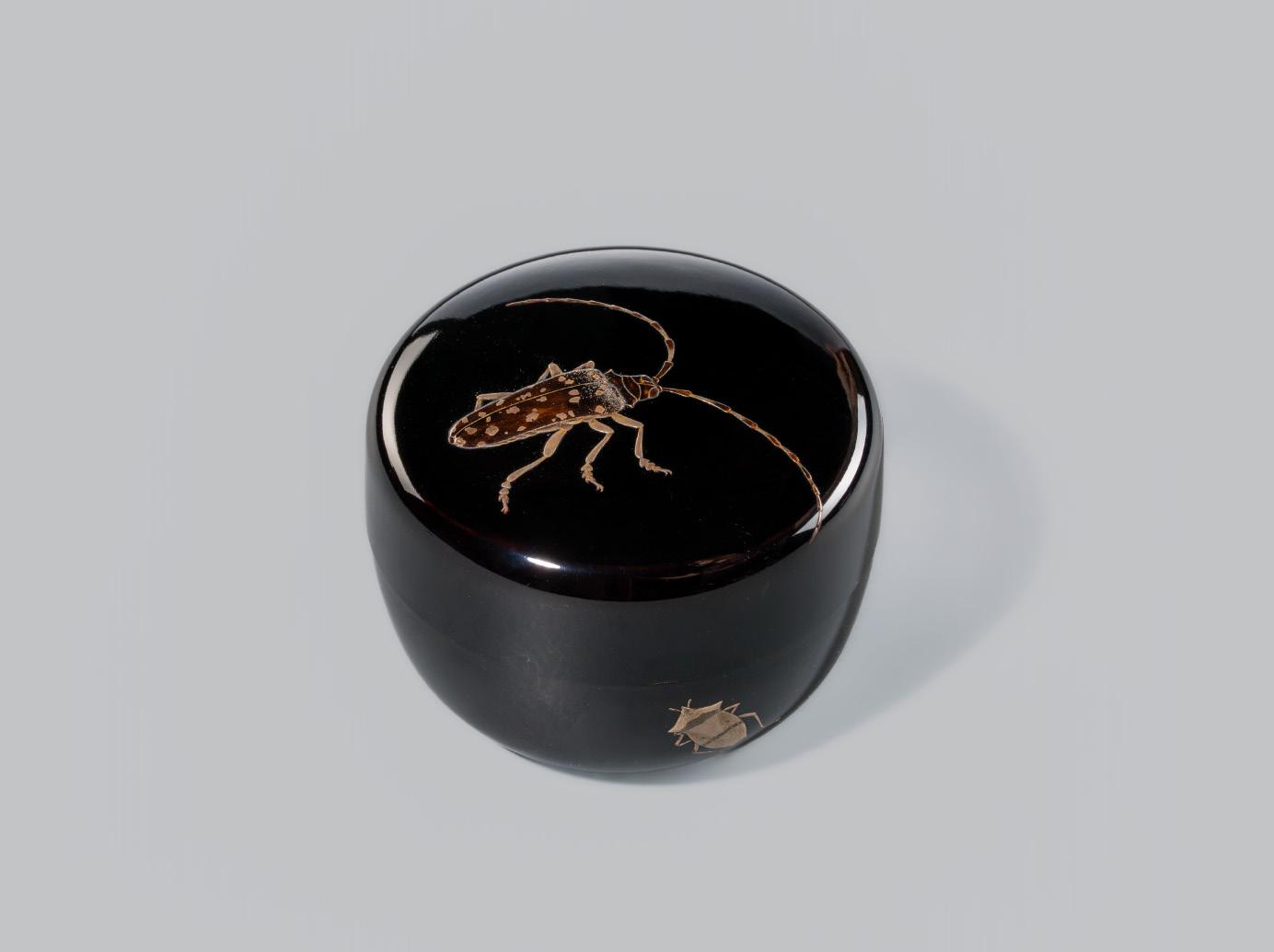
250 HARUI KOMIN: A SUPERB LACQUER ‘INSECTS’ NATSUME (TEA CADDY)
By Harui Komin (b. 1869), signed and sealed Komin Japan, early 20th century, Meiji (1868-1912) to Taisho period (1912-1926)
Of typical form with a flush-fitting cover, the exterior bearing a lustrous roiro ground and exquisitely decorated in gold, silver, and iro-e takamaki-e and hiramaki-e to depict a variety of insects.
A large beetle is prominently positioned atop the cover, its body meticulously rendered in dark-brown lacquer imitating tortoiseshell, with finely inlaid mother-of-pearl details, while a delicately executed dragonfly and leafhopper animate the sides of the box. The interior is carefully finished in radiant kinji with gold fundame rims. The underside of the natsume is similarly decorated in nashiji and signed and sealed KOMIN.
HEIGHT 5.5 cm, DIAMETER 7.1 cm
Provenance: Lesley Kehoe Galleries, Melbourne, Australia, 1998. Private collection of Eva and Aubrey Sweet, Melbourne, Australia, acquired from the above, thence by descent. A copy of the original invoice, dated 27 March 1998, addressed to Mr. Aubrey Sweet, and stating a purchase price of AUD 25,000 (or approx. EUR 32,500 converted and adjusted for inflation at the time of writing), accompanies this lot.
Condition: Excellent condition.
With the original wood storage box (tomobako).
The side of the box inscribed by the artist Mushi makie, Natsume, Komin 虫蒔繪、棗、恒眠 [tea caddy with insect design, made by Komin], signed and sealed Komin (恒眠). The underside of the cover bears an additional inscription Mushi makie, hira-natsume, Konnichi 虫蒔繪、平棗、今日 [flat tea caddy with insect design, appraised by Tea Master Konnichi], with kakihan.
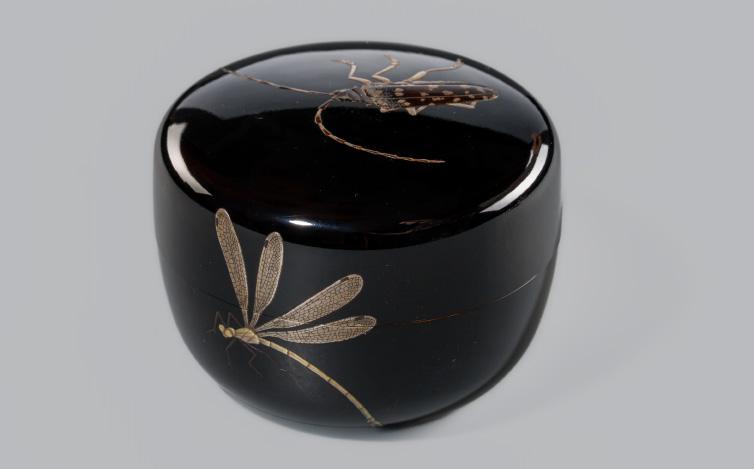
The tomobako is contained within a secondary lacquered wooden box bearing a label with an appraisal by Tea Master Konnichi, better known as Sen Soshitsu XV. As the fifteenth Grand Master (iemoto) of the Urasenke school, he played a pivotal role in promoting the philosophy of “Peacefulness through a Bowl of Tea” worldwide.
Only a limited number of works by Komin are known today His oeuvre is characterized by a classical and highly controlled aesthetic, typically employing gold, silver, and black lacquer, often enriched with inlays of shell, coral, and metal, as well as extensive use of kirigane. His production was largely focused on refined larger-scale objects such as writing boxes and document cases, making the present signed natsume an especially rare and intimate example of his work.
Estimate EUR 5,000 Starting price EUR 2,400
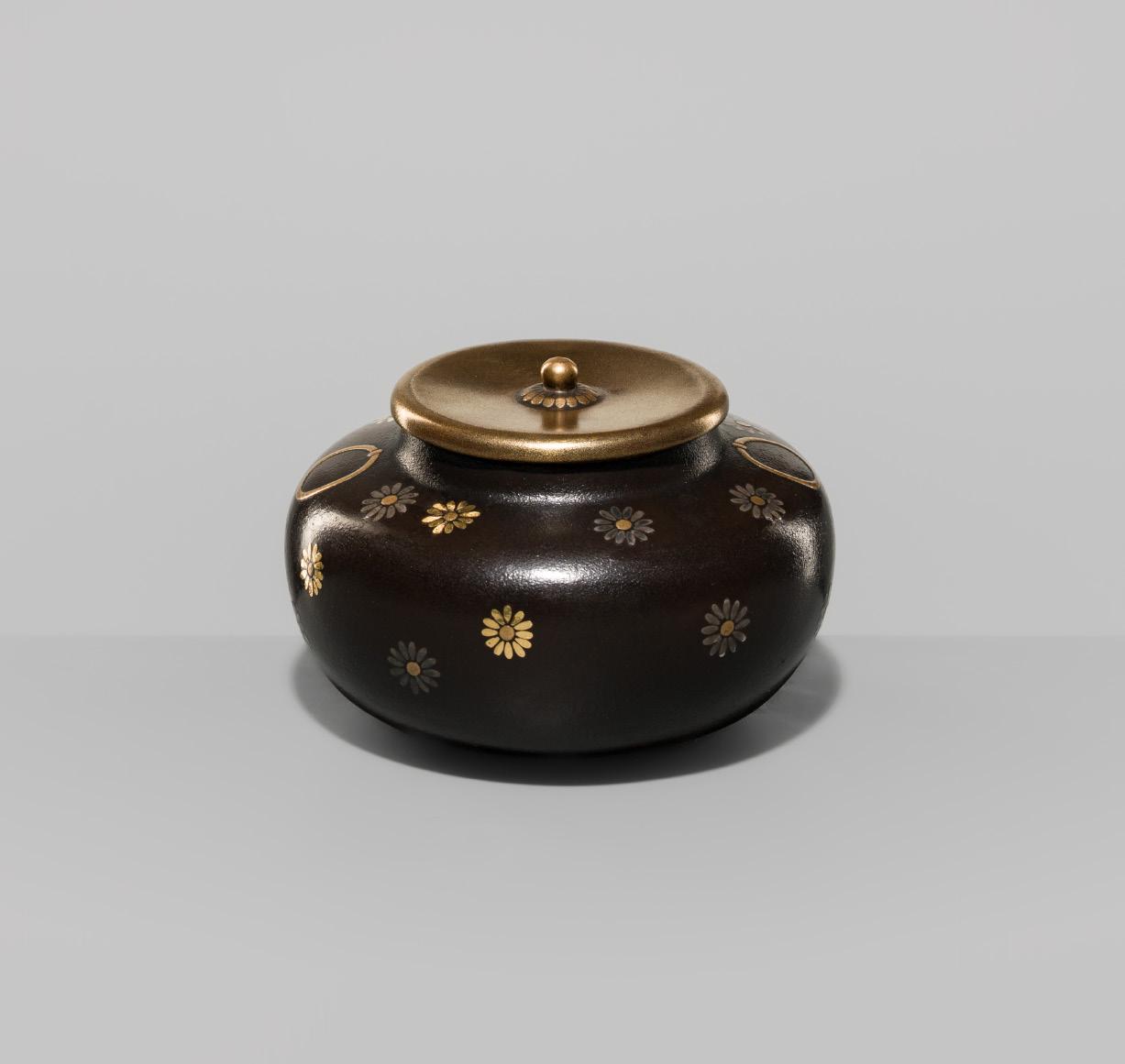
251
A FINE LACQUER ‘CHRYSANTHEMUMS’ NATSUME (TEA CADDY)
Japan, 19th century, late Edo (1615-1868) to Meiji period (1868-1912)
Of pot form, bearing a rich brown ground, finely decorated with gold and silver hiramaki-e to depict chrysanthemum blossoms (kiku) spread across its surface, as well as detailed with simulated handles. The lid is lacquered in kinji ground and the knop is formed as a chrysanthemum (kiku). The interior is finished in nashiji with gold fundame rims.
HEIGHT 4.6 cm, LENGTH 7 cm
Provenance: Lesley Kehoe Gallery, Melbourne, 1995. From the collection of Eva & Aubrey Sweet, Melbourne, Australia, acquired from the above. A copy of the valuation from Lesley Kehoe Gallery, dated 22 February 1995, stating a valuation price of USD 3,500 (or approx. EUR 6,500 converted and adjusted for inflation at the time of writing) and confirming the above, accompanies the lot. Eva and Aubrey Sweet devoted over six decades to the formation of a distinguished private collection of Asian art, with particular strength in Chinese jade, Japanese lacquer, and netsuke. Their collecting began in the 1950s and was refined through sustained travel, scholarship, and long associations with leading dealers, curators, and artists internationally. Aubrey, a Melbourne physician who also studied acupuncture in Beijing, and Eva developed a discerning connoisseurship that balanced intuitive appreciation with systematic study, supported by an extensive reference library and active participation in scholarly circles.
Condition: Very good condition with minor wear.
Estimate EUR 2,000
Starting price EUR 1,000

252
A FINE LACQUERED WOOD ‘LADYBUG AND IVY’ NATSUME (TEA CADDY)
Japan, 19th century, late Edo (1615-1868) to Meiji period (1868-1912)
Of typical form with a flush-fitting cover, finely crafted in wood with an attractive grain, and decorated with gold and silver takamaki-e depicting a large ivy leaf perforated by decay, upon which a small ladybird climbs, its carapace exquisitely inlaid with lacquered coral and mother-of-pearl details. The interior case finished with a superb gold-sprinkled silver lacquer ground and gold fundame rims.
The underside of the cover inscribed in gold takamaki-e with a poem, reading:
In a quiet autumn night, I am lost in meditation, and the moon seems like a mirror, reflecting an old world that I have never seen.
HEIGHT 5.3 cm, DIAMETER 6.3 cm
Provenance: Kanegae Oriental Antiques, Kyoto, Japan, 1991. Private collection of Eva and Aubrey Sweet, Melbourne, Australia, acquired from the above. Accompanied by a copy of a typewritten letter from Heihachiro Kanegae, Manager of Kanegae Oriental Antiques, dated 2 October 1991 and addressed to Mr. Aubrey Sweet, expressing gratitude for patronage at the Netsuke Convention in San Francisco and including a translation of the poem on the present natsume.
Condition: Excellent condition.
Estimate EUR 2,000
Starting price EUR 1,000
253
By Goto Jotaro (b. 1942), unsigned Japan, late 20th century, Showa period (1926-1989)
Of typical fubuki form with chamfered upper and lower edges and a flush-fitting cover, bearing a lustrous roiro ground and exquisitely decorated in gold and cream-white takamaki-e and hiramaki-e. The design depicts a dense profusion of chrysanthemum blossoms, some enriched with radiant nashiji, covering the lid and cascading gently down the sides. The flowers drift across a field of windblown autumn reeds rendered in luminous gold kinji, creating a seamless and continuous composition. The interior and base are finished in silver lacquer, with rims in gold fundame.
HEIGHT 7.3 cm, DIAMETER 7.4 cm
Condition: Excellent condition.
With the original wood storage box (tomobako), inscribed by the artist: Akino makie, fubuki natsume, Jotaro 秋野蒔絵、雪吹棗、穣太 郎 [maki-e lacquer tea caddy, with the autumnal field design, in the fubuki (snowstorm) shape, made by Jotaro] with seal Jotaro 穣太郎
The present natsume exemplifies the fubuki (“snowstorm”) form, characterized by chamfered edges and a continuous decorative scheme that dissolves the distinction between lid and body.
Estimate EUR 2,000
Starting price EUR 1,000
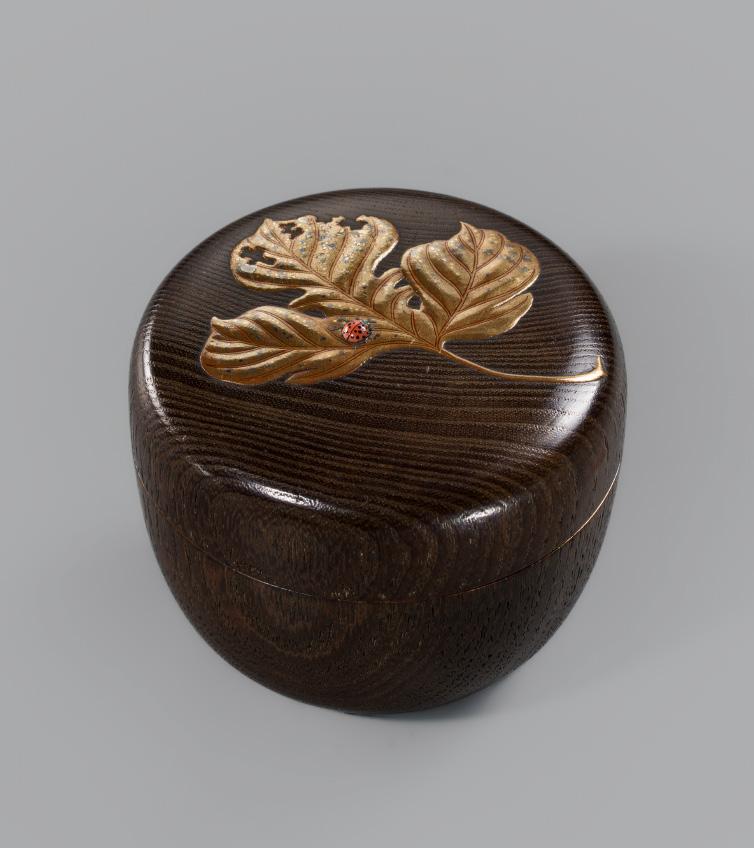
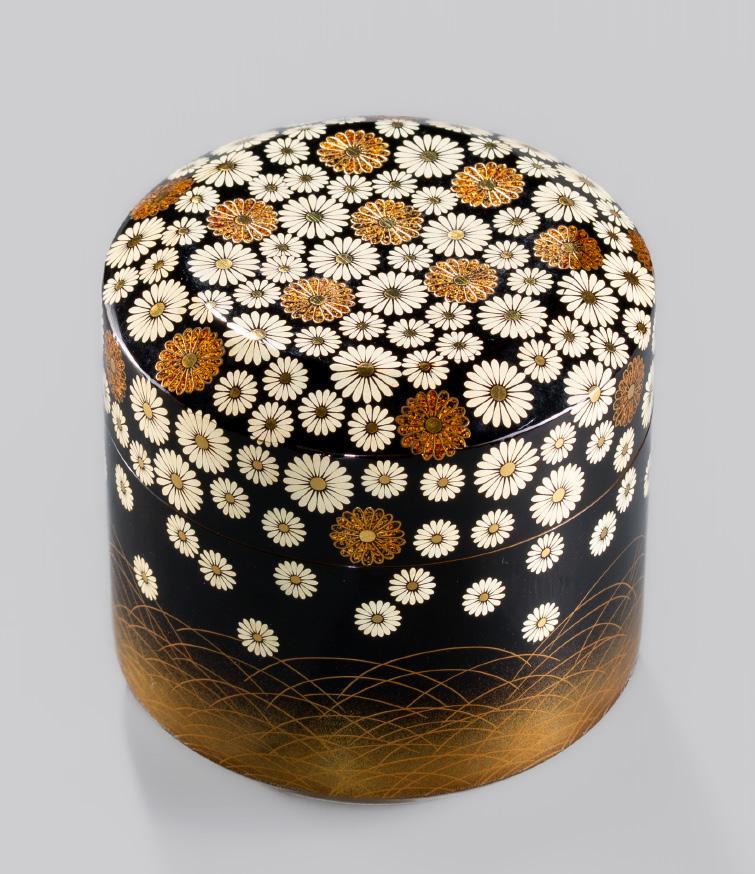
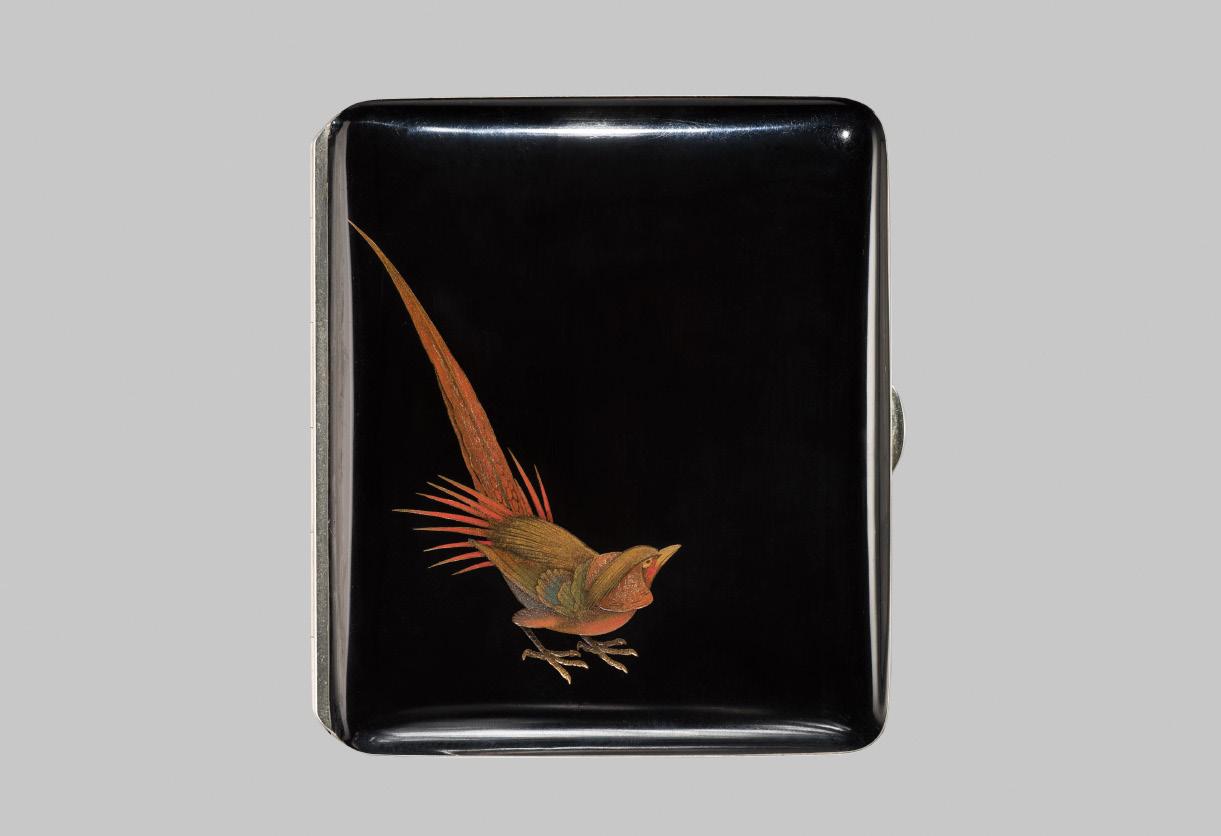
254
SHISEN YAMAMIZU FOR THE NAMIKI COMPANY: A MAGNIFICENT LACQUERED SILVER ‘PHEASANT’ CIGARETTE CASE
By Shisen Yamamizu, signed Namiki kan, Shisen with kakihan Japan, early 20th century, Taisho (1912-1926) to Showa era (1926-1989)
Of slim square form with gently rounded corners, bearing a lustrous roiro ground, superbly decorated in gold and iro-e takamaki-e to depict a pheasant poised on its legs, ready to take flight, with its majestic tail held upright. The reverse bearing the signature NAMIKI KAN, SHISEN [made by Shisen under the supervision of the Namiki Company], accompanied by a red kakihan. The interior finished in gilt.
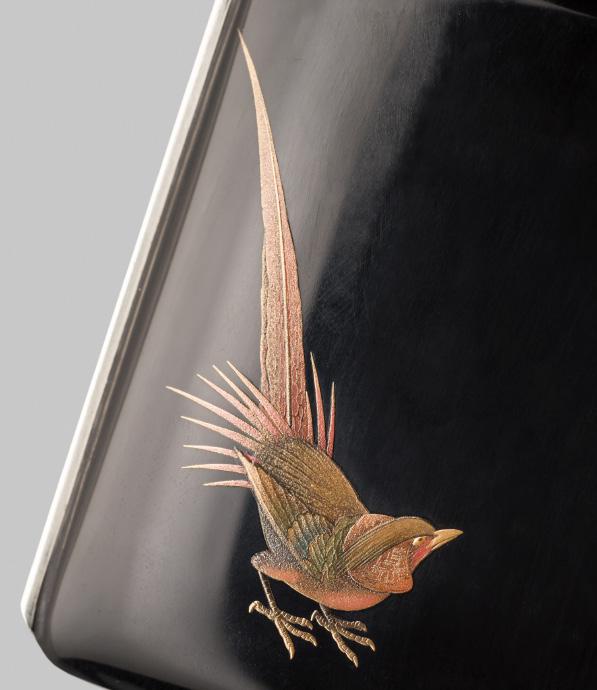
LENGTH 8.4 cm
Provenance: From the Alan Bostock collection of Japanese metalwork, cloisonné, and lacquer, assembled over the last 40 years.
Condition: Excellent condition with only very minor wear.
With an associated padded storage box.
The Namiki workshop, established in 1925 by Ryosuke Namiki, founder of the Namiki Manufacturing Company (now Pilot Corporation), is renowned for its exceptional maki-e lacquer artistry applied to fountain pens. Collaborating with esteemed lacquer artists such as Shisui Rokkaku and Gonroku Matsuda, Namiki integrated traditional Japanese craftsmanship with writing instruments, creating pieces celebrated for their intricate designs and superior quality. In 1930, a significant partnership with Alfred Dunhill Ltd. led to the international distribution of these exquisite pens under the Dunhill-Namiki brand, enhancing their global prestige. Today, Namiki continues to produce high-end, handcrafted fountain pens that embody the fusion of art and functionality.
Shisen Yamamizu was a distinguished Japanese lacquer artist active in the early twentieth century, renowned for his mastery of the traditional maki-e technique. He played a pivotal role in training artisans who later worked for the esteemed Namiki company, including Mansui Yamanaga, serving as both mentor and subcontractor from 1930. Through his work, Yamamizu contributed significantly to the development and international dissemination of Japanese luxury lacquerware, encompassing writing instruments, stationery, and other decorative objects.
AUCTION COMPARISON
Compare a closely related lacquered silver cigarette case depicting a koi carp, by Ippa for the Namiki company, Showa period, 20th century, 8 cm long, at Zacke, Fine Japanese Art, Vienna, 13 June 2025, lot 286 (sold for EUR 5,850).
Estimate EUR 5,000
Starting price EUR 2,400
255
FOR THE NAMIKI COMPANY:
By Kasui, signed Namiki kan, Kasui with kakihan Japan, dated 1928
Octagonal in form with raised rims, finely decorated in gold, silver, and iro-e takamaki-e, to depict three small quails among windblown ferns, blossoming carnations, and other flowering vegetation. One face of the ring fitted with a circular appliqué bearing the letter ‘A’ and signed in gold script NAMIKI KAN, KASUI [made by Kasui under the supervision of the Namiki Company], accompanied by a red kakihan.
The interior of the ring stamped with British silver hallmarks, including the lion passant guardant of Britannia, certifying the silver standard; the tiger head, indicating the Assay Office that verified the piece; the small Gothic letter ‘n’, denoting the year of assay as 1928; and, the initials ‘CD’, corresponding to the silversmith Charles Dumenil.
HEIGHT 3.6 cm, LENGTH 4.6 cm
Condition: Very good condition with surface wear and faint traces of handling and use. Few minute nicks and shallow surface scratches to the silver mountings, with light tarnishing.
Estimate EUR 2,500
Starting price EUR 1,200
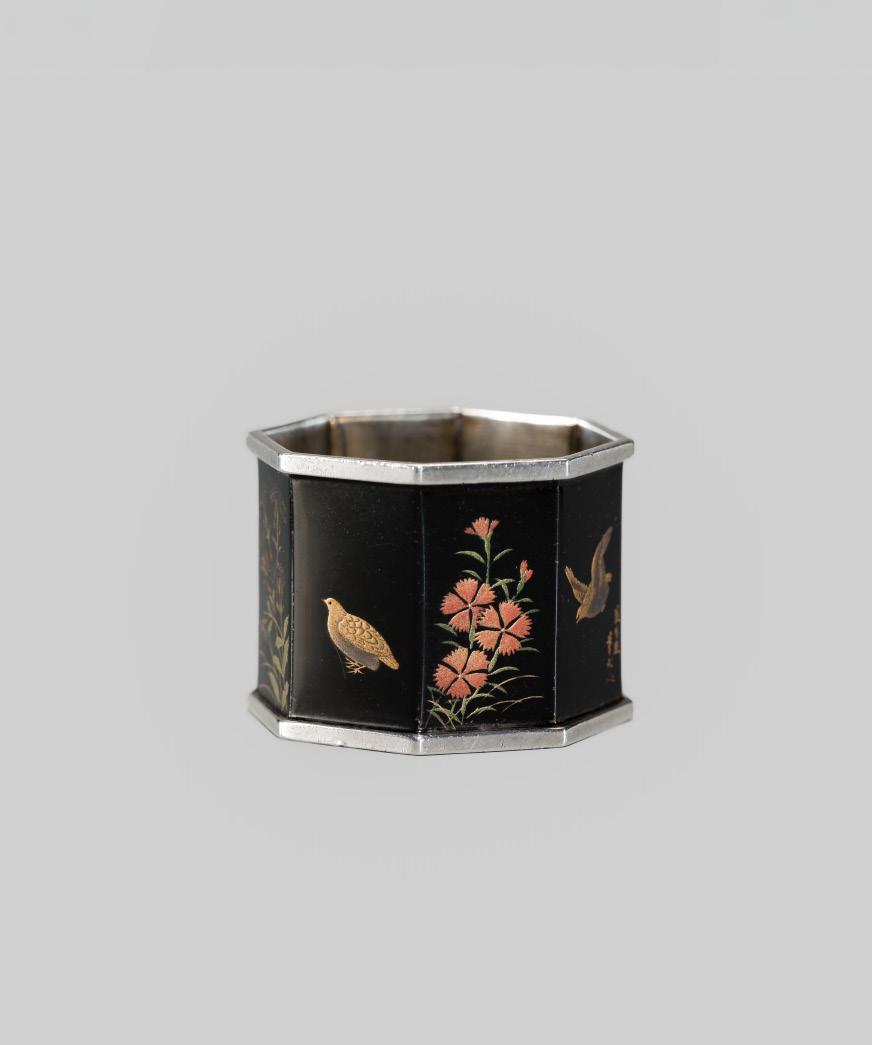
256
YAMAGUCHI HIROMI: A FINE SILVER LACQUER ‘FEMALE NUDES’ SAKE CUP
By Yamaguchi Hiromi (b. 1970), signed by the artist Japan, late 20th to early 21st century, Heisei period (1989-2019)
Finely crafted, of circular form, with gently rounded sides supported on a short, straight foot, rising to a subtly incurved rim. The surface of the cup entirely covered in lustrous black lacquer, while the interior is overlaid with shimmering silver lacquer, skillfully scratched to reveal the underlying black, forming a composition of nude women intertwined in various poses. The recessed base with the artist’s signature in red lacquer.
HEIGHT 3.5 cm, DIAMETER 8.5 cm
Provenance: Lesley Kehoe Galleries, Melbourne, Australia, 2011. Private collection of Eva and Aubrey Sweet, Melbourne, Australia, acquired from the above. A copy of the original memorandum of valuation, dated 5 September 2011, addressed to Mrs. Eva Sweet, accompanies this lot.
Condition: Excellent condition.
Estimate EUR 2,500 Starting price EUR 1,200
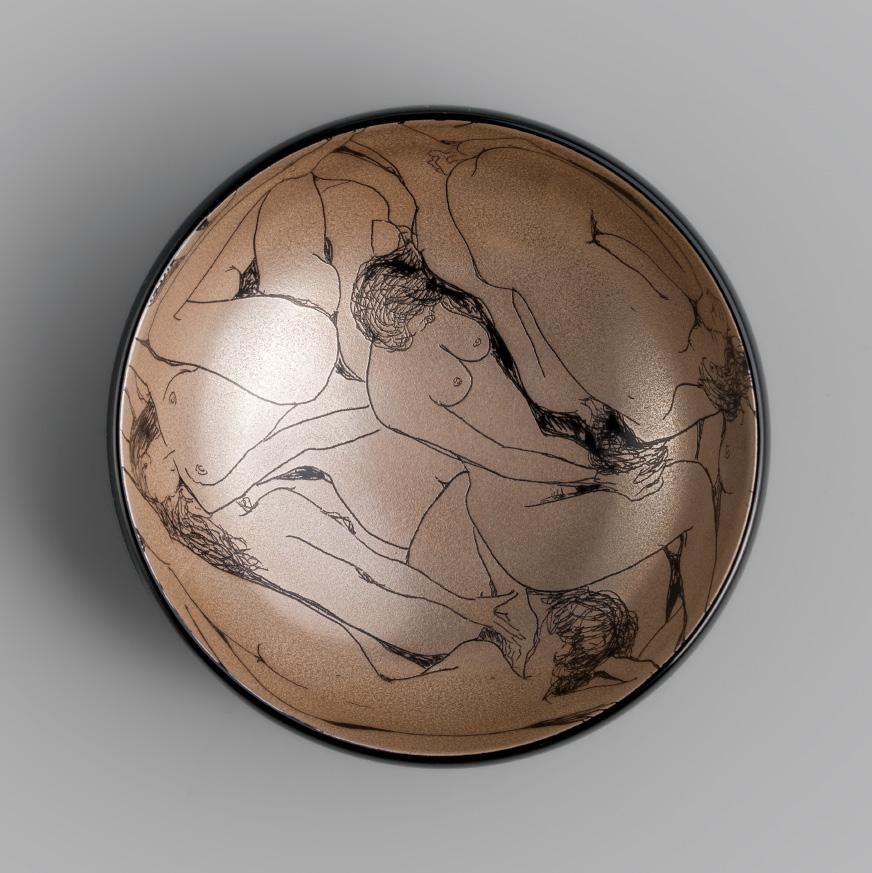
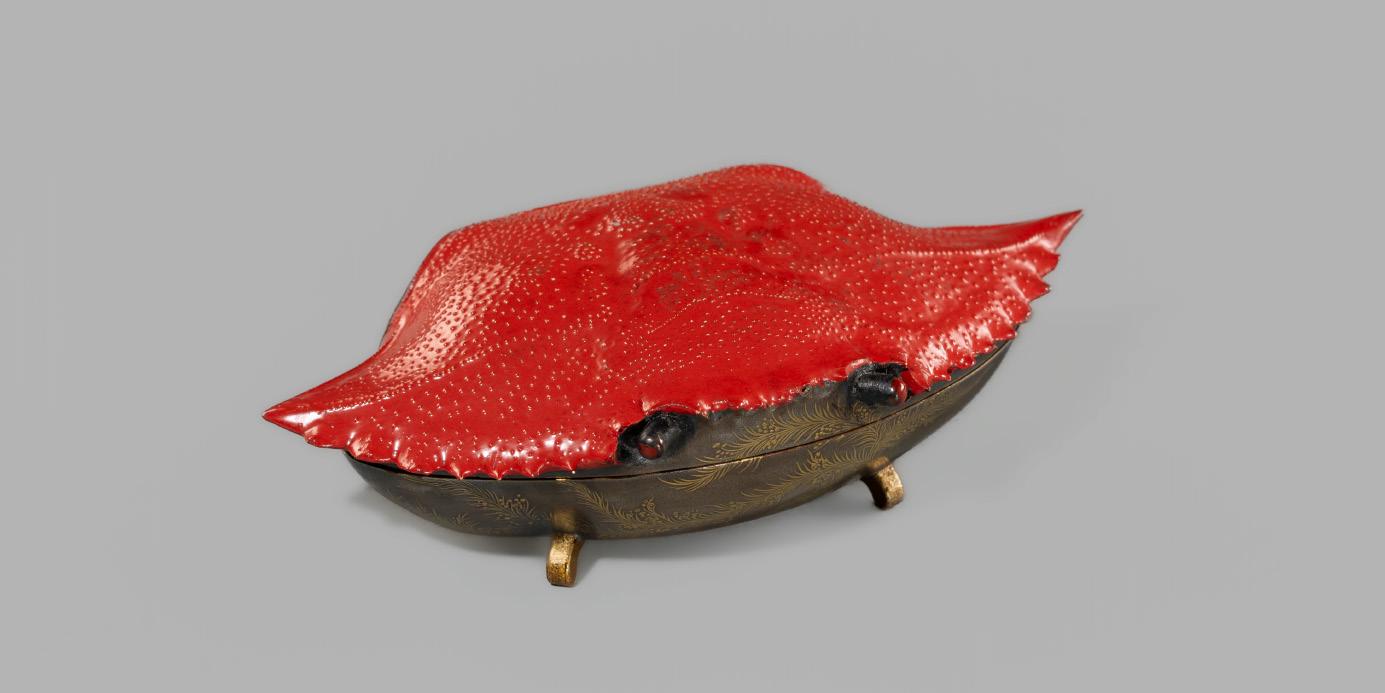
257 AN UNUSUAL RED LACQUER
‘SAMURAI CRAB’ KOGO (INCENSE BOX)
Japan, first half of the 20th century, Taisho (1912-1926) to Showa era (1926-1989)
In the shape of a heikegani (samurai crab) rising on four feet, the sides finely decorated in gold and silver takamaki-e and hiramaki-e on a silver ground, as well as with textured red tsuishu lacquer on top. The inrobuta (flush-fitting) lid is neatly textured to resemble the shell of the crab and shows its typical face, while the sides depict finely painted ferns. The underside is finished in kinji, and the interior and rims are adorned with gold fundame.
258
TSUISHU YOZEI XX: A FINE TSUISHU LACQUER ‘MOON HARE POUNDING MOCHI’ KOGO (INCENSE BOX)
By Tsuishu Yozei XX (1880-1952), signed Yozei zo Japan, early 20th century, Taisho period (1912-1926)
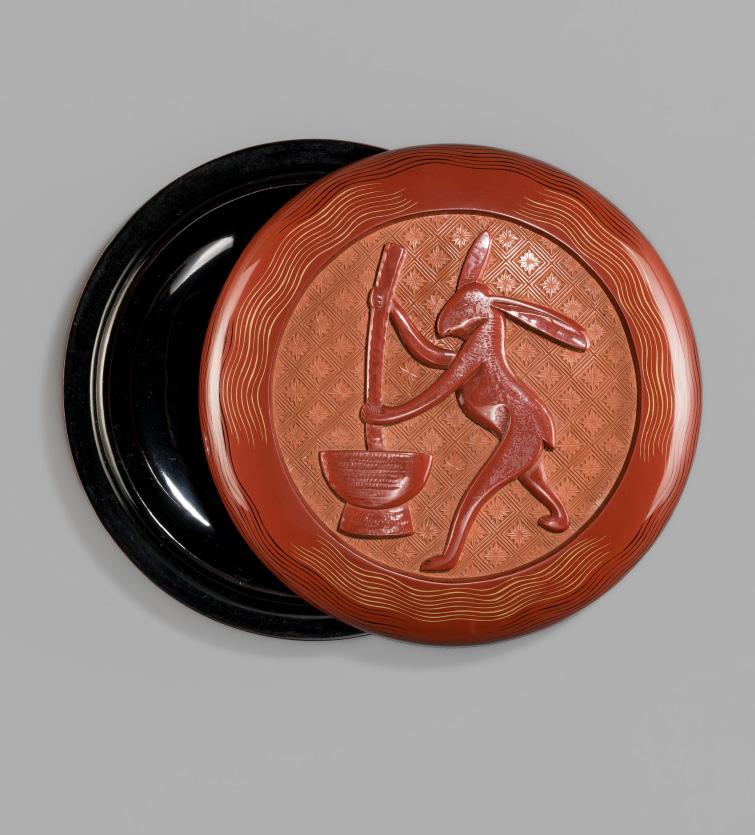
HEIGHT 3.3 cm, LENGTH 11 cm
Condition: Excellent condition.
With a silk brocade storage box and the original wood tomobako (storage box) inscribed Kani Kogo 蟹香盒 [an incense container in the shape of a crab] and sealed to the interior of the lid Toda Sakae
戸田栄
The heikegani, or samurai crab, is a species of marine crab native to the waters around Japan, renowned for the striking pattern on its shell that resembles a stylized human face.
Estimate EUR 2,000
Starting price EUR 1,000
Of circular form, finely carved in high relief (takabori) in red lacquer (tsuishu) with a moon hare standing with legs spread, energetically pounding rice cakes (mochi). The fur is delicately textured and the eyes neatly incised, set against a dense asanoha (hemp-leaf) ground. The scene is framed by a band of stylized waves, while the reverse is decorated with a continuous band of leafy foliage. The underside is signed YOZEI zo [made by Yozei]. The interior is finished in lustrous roiro lacquer.
DIAMETER 7.3 cm
Condition: Excellent condition.
Painting of a rabbit pounding the elixir of life, by Mori Ippo, dated to 1867, in the New Orleans Museum of Art, object number 92.20
With the original wood tomobako (storage box) inscribed: Tamausagi Yozei zo with seal, 玉兔、楊成造, [jade rabbit, made by Yozei].
MUSEUM COMPARISON
Compare a related tsuishu lacquer kogo with a grasshopper by the same artist, dated to 1922, in the National Crafts Museum, Kanazawa Ishikawa, collection ID no. Lc0393.
Estimate EUR 2,000
Starting price EUR 1,000
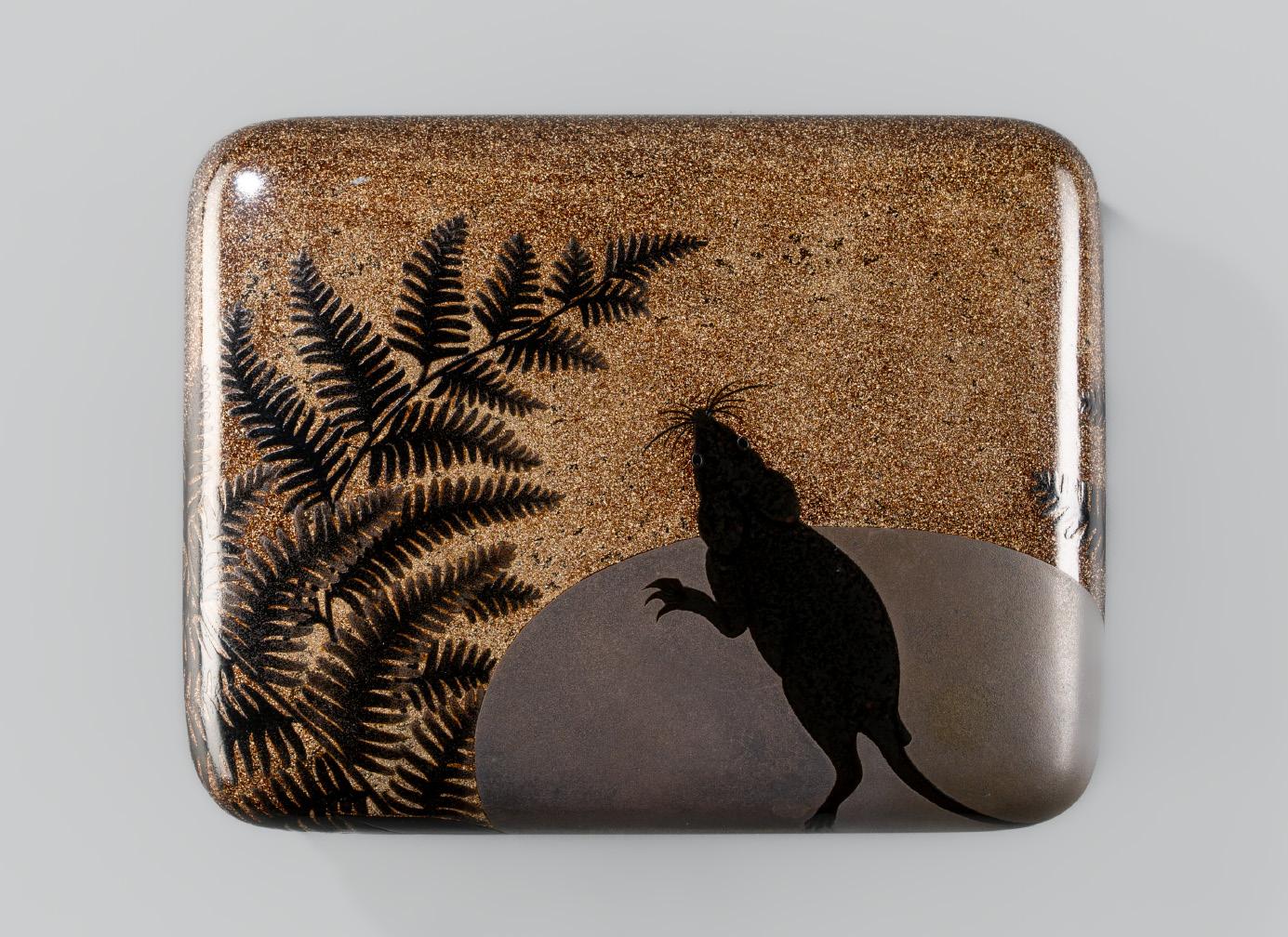
259
UONO JISEI: A SUPERB LACQUER ‘RAT AND KAGAMI MOCHI’ KOBAKO (SMALL BOX), WITH PRESENTATION TRAY
By Uono Jisei (1883-after 1944), signed Jisei Japan, first half of the 20th century, Taisho (1912-1926) to Showa era (1926-1989)
Exquisitely crafted, rectangular in form with gently concave sides, fitted with an overhanging cover. The exterior bearing a lustrous roiro ground densely sprinkled with gold powder, masterfully decorated in gold and silver takamaki-e, to depict a rat (nezumi) leaping over a kagami-mochi next to windblown ferns. The interior finished with a striking red-lacquered ground and signed JISEI.
SIZE of the box 5 x 14.3 x 11.5 cm
SIZE of the presentation tray 20.3 x 17.3 cm
Provenance: Van Hier Tot Tokio, Amsterdam, Netherlands, 2016. Private collection of Elise Wessels-van Houdt, Amsterdam, acquired from the above, thence by descent. Elise Wessels-van Houdt (1943-2023) was a distinguished Dutch museum director, patron, and collector, renowned for her expertise in Japanese art. Condition: Excellent condition, minor surface scratches and wear to the underside.
With the original wood storage box (tomobako), signed and sealed by the artist, and with a fine en-suite lacquered presentation tray.
Uono Jisei, born in 1898 in Ishikawa Prefecture, was a distinguished Japanese lacquer artist who studied under Yamamoto Rihei V and Akatsuka Jitoku. After several formative journeys and residencies, he returned to his native Ishikawa during World War II, having established himself as a member of the Kyoto Lacquer Association. Archival records, including those in Nittenshi, document participation in major exhibitions such as Teiten (1927-1934), Hoshukuten (1940), Shinbunten (1941-1942), and
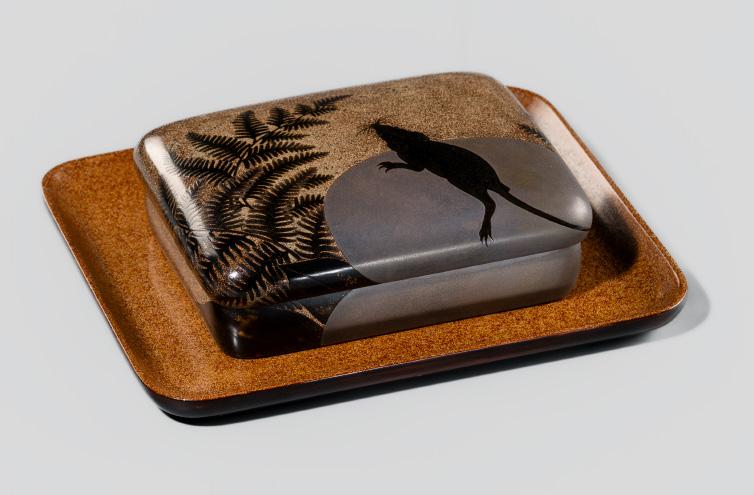
the Special Wartime Exhibition (1944). As observed by Jan Dees, Uono maintained sustained engagement with maritime and lunar motifs, which recur throughout his career and are also evident in the present work. The 1944 exhibition represents the last recorded activity in his artistic trajectory. See Jan Dees, Breaking Out of Tradition: Japanese Lacquer 1890-1950, Museum für Lackkunst, Münster, 2020.
Estimate EUR 3,000 Starting price EUR 1,500
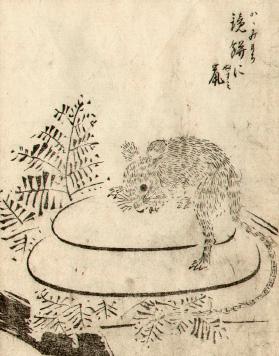
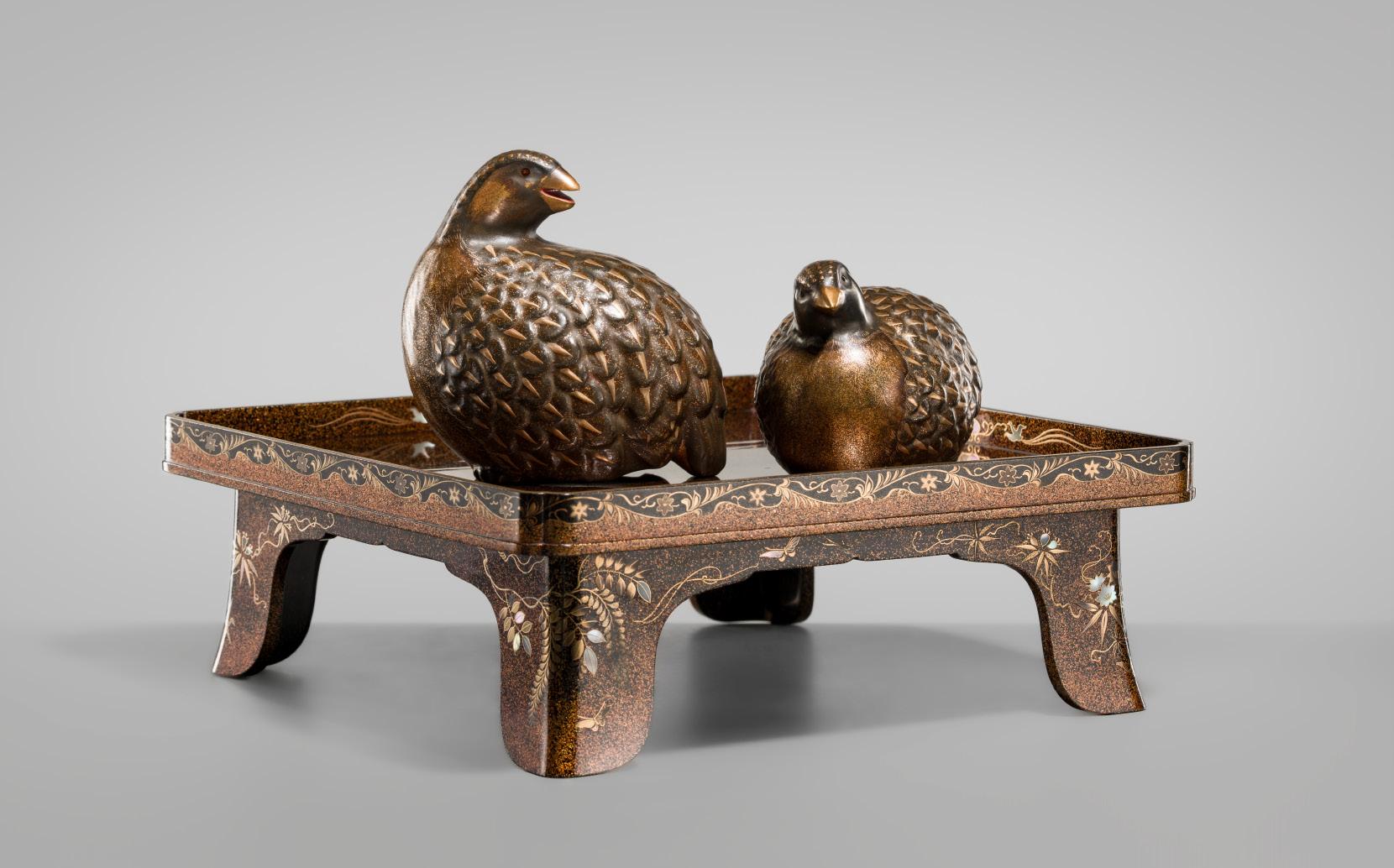
260
ROKKAKU SHISUI: A MAGNIFICENT ‘RADEN’ LACQUER BANQUET TRAY WITH A PAIR OF LACQUER ‘QUAIL’ OKIMONO
By
Rokkaku Shisui (1867-1950), signed Shisui Japan, dated Taisho 8 (1919)
Published & Exhibited (the tray): Hiroshima Prefectural Art Museum (ed.), Kokuho wo tsukutta otoko: Rokkaku Shisui ten [The Exhibition: Rokkaku Shisui who created National Treasure objects], 18 November 2008-12 January 2009, p. 192, no. 61.
The tray, square with rounded corners, supported on four elegantly shaped legs connected by lobed stretchers. The main surface of the tray bearing a radiant nashiji ground, with the exterior sides decorated in gold togidashi maki-e, depicting flowerheads interspersed with scrolling foliage, while the interior sides are embellished in gold takamaki-e and inlaid with mother-of-pearl using the raden technique, illustrating pairs of ho-o flanking a tama pearl. The legs of the tray are exquisitely adorned with gold and silver takamaki-e, similarly inlaid with mother-of-pearl, to represent wisteria blossoms and other flowers, alongside bamboo leaves and additional foliage, accompanied by fluttering butterflies and birds. The underside of the tray finished in lustrous roiro lacquer and signed SHISUI.
The two okimono, naturalistically modeled as small quails, with their plumage finely carved and delicately sprinkled with gold of varied spacing and intensity over a smoothly polished dark-brown ground, accented with gold flakes. One quail has its head turned backward, looking over its shoulder, with a slightly open gilded beak, the interior of which is finely detailed in red lacquer. The undersides of both figures finished in vibrant nashiji.
HEIGHT 10.2 cm, LENGTH 29.7 cm (tray), LENGTH 11.3 cm and 12.5 cm (okimono)
Rokkaku Shisui (1867.1950), born in Hiroshima Prefecture, was a preeminent authority on Japanese lacquerware. After graduating in 1893 from the Tokyo Fine Arts School, he traveled extensively across Japan with the influential art historian Okakura Kakuzo, systematically surveying and documenting significant examples of early art. He later accompanied Okakura to the United States, where he was affiliated with the Museum of Fine Arts in Boston and the Metropolitan Museum of Art in New York, and in 1907 he pursued further study in major European museums. In subsequent years he participated in excavations of Lelang Rakuro material in Korea, objects associated with the Han dynasty (206 BC-AD 220) and its colonial presence on the peninsula. In recognition of the rigor and enduring significance of his research on lacquerware, he was elected to the Japanese National Art Academy.
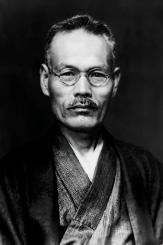
Shisui
Condition: Excellent condition with only minor expected wear.
With two associated padded silk storage boxes.
MUSEUM COMPARISON
For another work by the artist, see a lacquer scroll tray, dated 1943, in the National Crafts Museum in Kanazawa, collection ID number Lc0391.
Estimate EUR 6,000
Starting price EUR 3,000
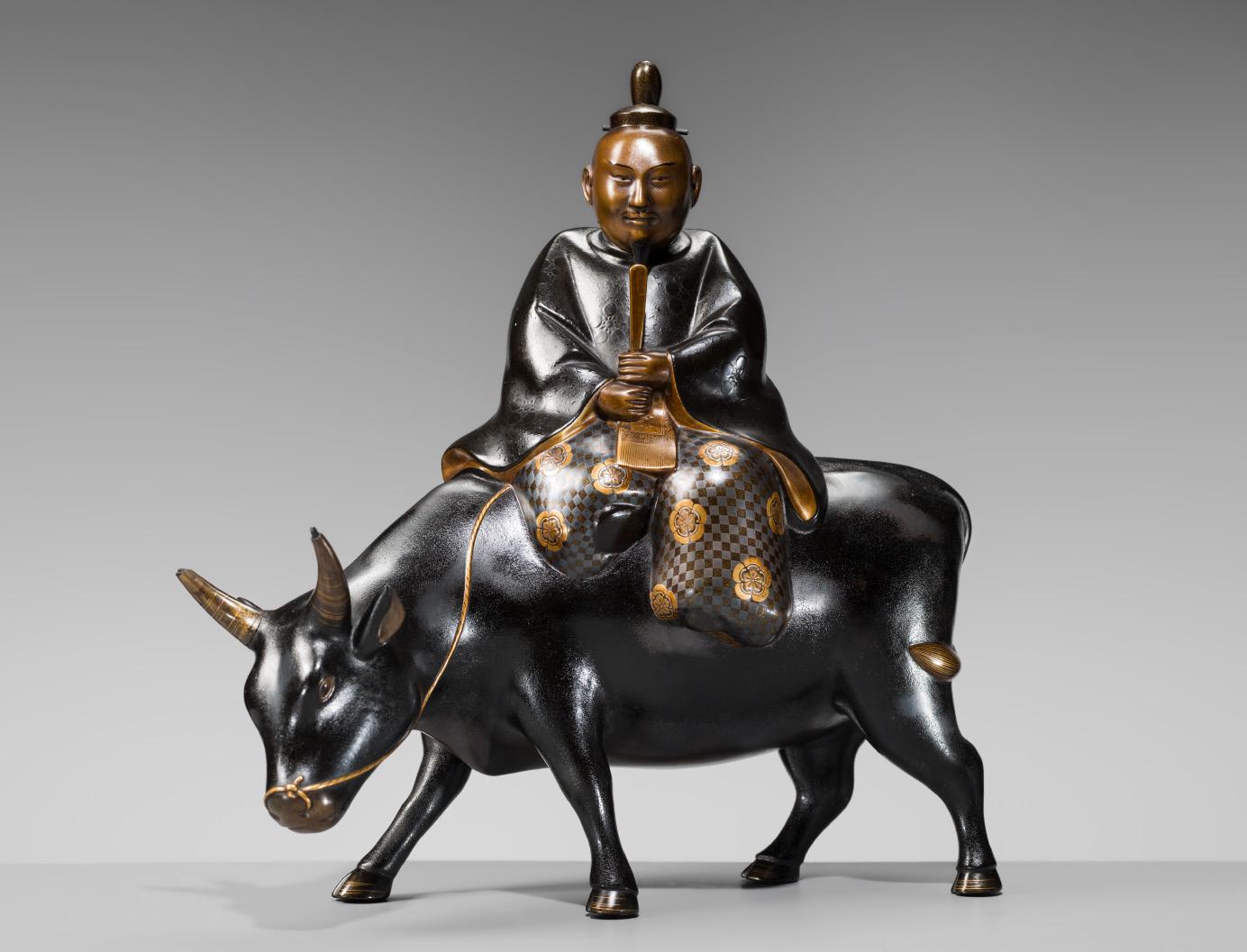
PUBLISHED
Resonance of Wa - The Japanese Spirit. Casal Collection, 2025, p. 177.
Japan, 19th century, Meiji period (1868-1912)
Exquisitely crafted, the illustrious poet Sugawara no Michizane is depicted astride a large ox, standing firmly with its head slightly bowed. The ox’s muzzle is bound by a golden rein, which contrasts strikingly with the animal’s dark coat. Lord Sugawara is dressed in voluminous robes, with his pants featuring a refined checkered pattern overlaid with golden crests, emblematic of the Oda clan. His hands rest in front of his abdomen, holding a shaku, which emerges from beneath his expansive cloak, richly adorned with subtle black takamaki-e. The serene expression of the scholar is distinguished by a deep, assertive gaze, a gentle smile, and a long-pointed beard, all crowned by his distinctive headgear, adding to his noble presence.
HEIGHT 31.3 cm
Sugawara no Michizane is often depicted with an ox, reflecting a shrine legend in which, after his death in exile at Dazaifu, the ox pulling his cart refused to move, signaling the site where he wished to be buried. This event became central to his cult, and the ox emerged as a symbol of his gentle character and the peaceful transfer of his remains, now commonly represented in Tenjin iconography.
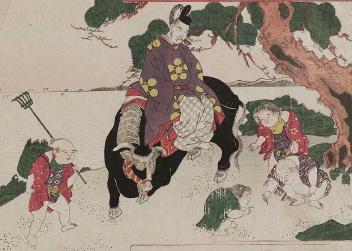
Sugawara Michizane Riding an Ox and Children Gathering Pine Needles, by Kikukawa Eizan, mid-19th century
Provenance: Ex-Collection of Ugo Alfons Casal. Osaka City Museum of Fine Arts, bequeathed from the above and subsequently deaccessioned in 2021.
Condition: The right horn of the ox has been re-attached. Otherwise excellent condition with minor expected wear.
Sugawara no Michizane (845-903) was a preeminent scholar, poet, and statesman of the Heian period in Japan. He achieved distinction in waka and kanshi poetry and contributed significantly to courtly intellectual and cultural life. After his political downfall and exile, popular reverence elevated him to the Shinto deity Tenman-Tenjin, protector of learning. Alongside Taira no Masakado and Emperor Sutoku, he ranks among the ‘Three Great Onryo of Japan’, spirits believed to wield power after death.
Estimate EUR 5,000 Starting price EUR 2,400
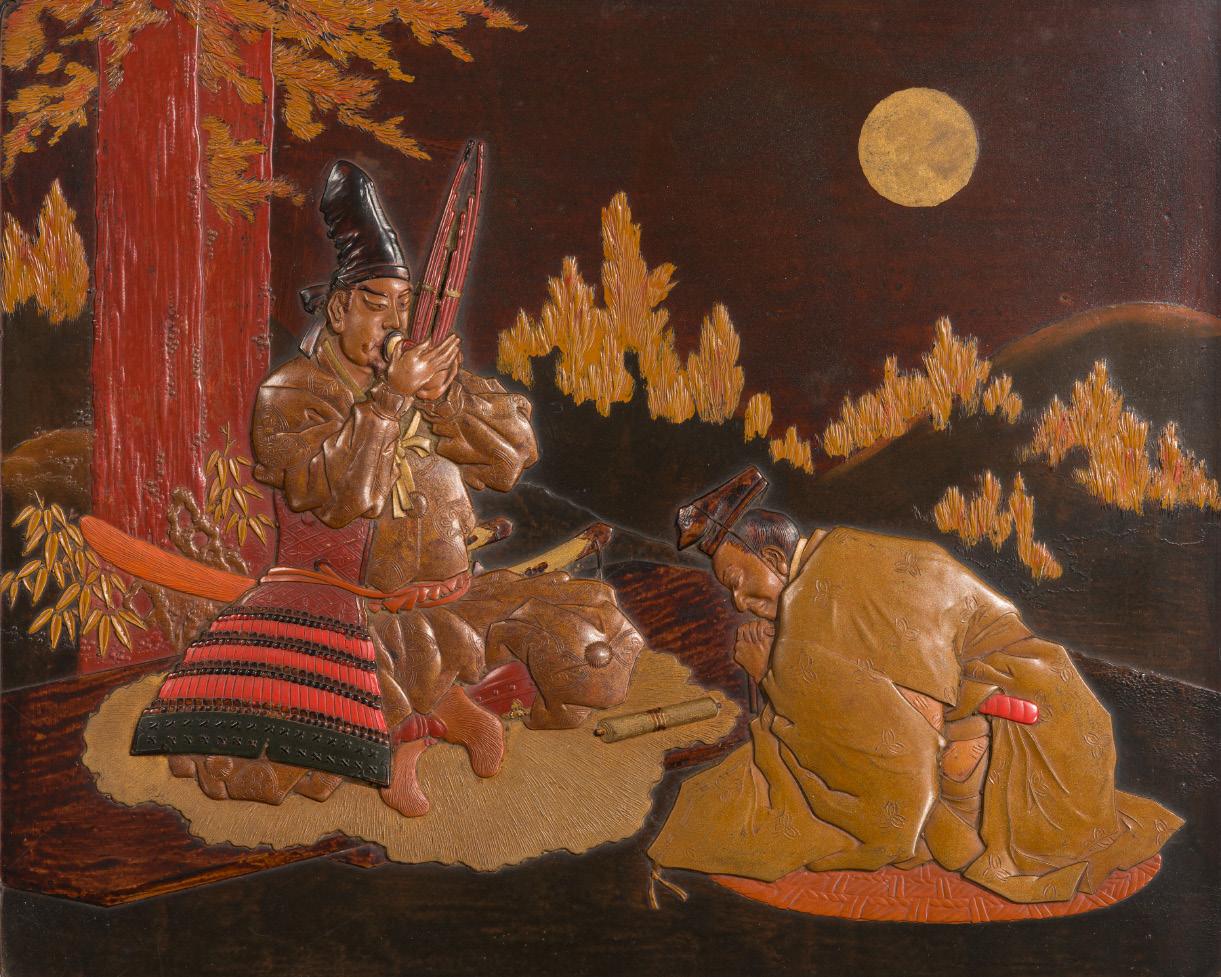
262
A SUPERB LACQUERED WOOD PANEL OF KUNSUNOKI MASASHIGE
Japan, Meiji period (1868-1912)
Published: Resonance of Wa - The Japanese Spirit. Casal Collection, 2025, p. 134.
Of rectangular form set in a wood frame, bearing a brown lacquer ground, finely applied with carved boxwood and decorated in red, gold, and black takamaki-e and hiramaki-e to depict Kusunoki Masashige seated under a tree, playing the sho. He is shown in full armor, seated upon a mat, while before him kneels his son in reverence. The scene is set within a serene landscape under a full moon, with rolling hills and autumnal foliage.
SIZE 25.7 x 29.5 cm
Provenance: Ex-Collection of Ugo Alfons
Casal. Osaka City Museum of Fine Arts, bequeathed from the above and subsequently deaccessioned in 2021. With a collection label ‘382’ to the interior.
Condition: The image in excellent condition with only very minor wear. The frame with nicks, scratches and tiny losses.
With the original wood tomobako (storage box).

Kusunoki Masashige (1294-1336) is one of Japan’s most revered samurai, celebrated for his unwavering loyalty to Emperor GoDaigo during the turbulent Nanbokucho period. Renowned for his strategic brilliance and devotion, Masashige ultimately sacrificed his life at the Battle of Minatogawa, becoming an enduring symbol of fidelity and selflessness in Japanese history. His story has been widely commemorated in literature and the arts, often depicted in moments of quiet resolve or final preparation. This scene depicts Masashige with his son, Masatsura, who kneels before him receiving a written scroll on military strategy, a moment recorded in the Taiheiki (Chronicle of the Great Peace).
AUCTION COMPARISON
Compare a related large gold lacquer tsuitate depicting the same scene, dated late 19th century, at Christie’s, Aesthetic Intuition: Collecting Japanese Art in PostWar London, 11 November 2015, London, lot 162 (sold for GBP 86,500 or approx. EUR 140,000 converted and adjusted for inflation at the time of writing).
Estimate EUR 3,000
Starting price EUR 1,500
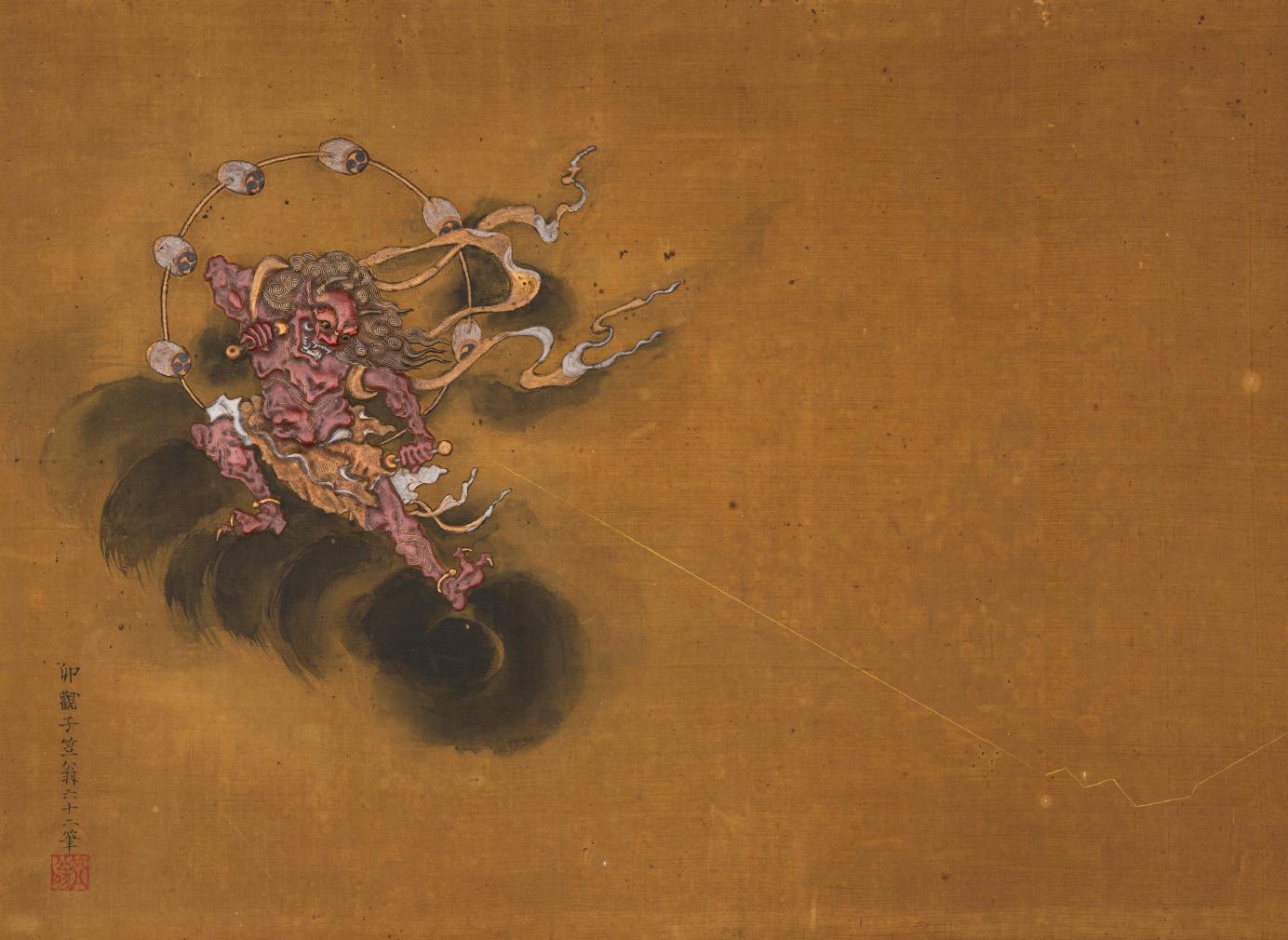
263
OGAWA HARITSU: A VERY RARE LACQUER PAINTING DEPICTING THE THUNDER GOD RAIJIN
By Ogawa Haritsu (Ritsuo, 1663-1747), signed Ukanshi Ritsuo rokujuni hitsu with seal Ritsuo Japan, dated 1724
Published: Resonance of Wa - The Japanese Spirit. Casal Collection, 2025, p. 291.
Executed in ink and takamaki-e (raised gold lacquer), this dynamic lacquer painting depicts Raijin, the thunder god, in a powerful stance atop a dark cloud, with den-den daiko drums framing his body. He holds two thunderbolt drumsticks, one releasing a bolt of lightning, executed in fine gold lacquer, which travels across the composition. His fierce expression and fluid movement are framed by a luxuriant, curling mane and flowing ribbons that envelop his body. The scene is strikingly energetic, with the use of ink for subtle details and the takamaki-e technique lending the god’s form a sculptural, three-dimensional quality. Signed in the lower left corner Ukanshi RITSUO rokujuni hitsu [painted by Ukanshi Ritsuo at the age of 62] and sealed Ritsuo.
SIZE of the image 33.1 x 49.1 cm, SIZE incl. frame 45.8 x 76.7 cm
Provenance: Ex-Collection of Ugo Alfons Casal. Osaka City Museum of Fine Arts, bequeathed from the above and subsequently deaccessioned in 2021.
Condition: The lacquer in excellent condition with minor expected wear. Minor spots and soiling. The mounting with typical wear, traces of use, minor losses, and some tears with associated repairs. The wood frame with typical wear.
Ogawa Haritsu, known outside Japan as Ritsuo, was among the first lacquer artists in Japan to establish an independent reputation outside the hereditary craft dynasties of Kyoto, Edo, and Kanazawa.
The imagery of Raijin, the deity of thunder and lightning, reflects his typical iconography — depicted fiercely, standing on a cloud and striking his drums, with the swirling dynamic lines evoking the violent power of storms. Haritsu likely drew inspiration from the works of Tawaraya Sotatsu, a contemporary painter renowned for his dramatic depictions of Raijin and Fujin. Sotatsu’s influence can be seen in the boldness and energy of this lacquer painting, which recalls the Raijin and Fujin screens from the Rinpa school, where Sotatsu frequently depicted these storm gods in a similarly dynamic manner.
Detail of Raijin on a screen by Tawaraya Sotatsu, a National Treasure of Japan, likely serving as the inspiration for the present panel
LITERATURE COMPARISON
Compare a related screen painting of Bugaku Dancers, by Ogawa Haritsu, though executed as an ink painting and not in lacquer like the present lot, the design based on a painting by Tawaraya Sotatsu, at Bonhams, Fine Japanese Works of Art, 25 March 2010, New York, lot 2160.
Estimate EUR 5,000 Starting price EUR 2,400
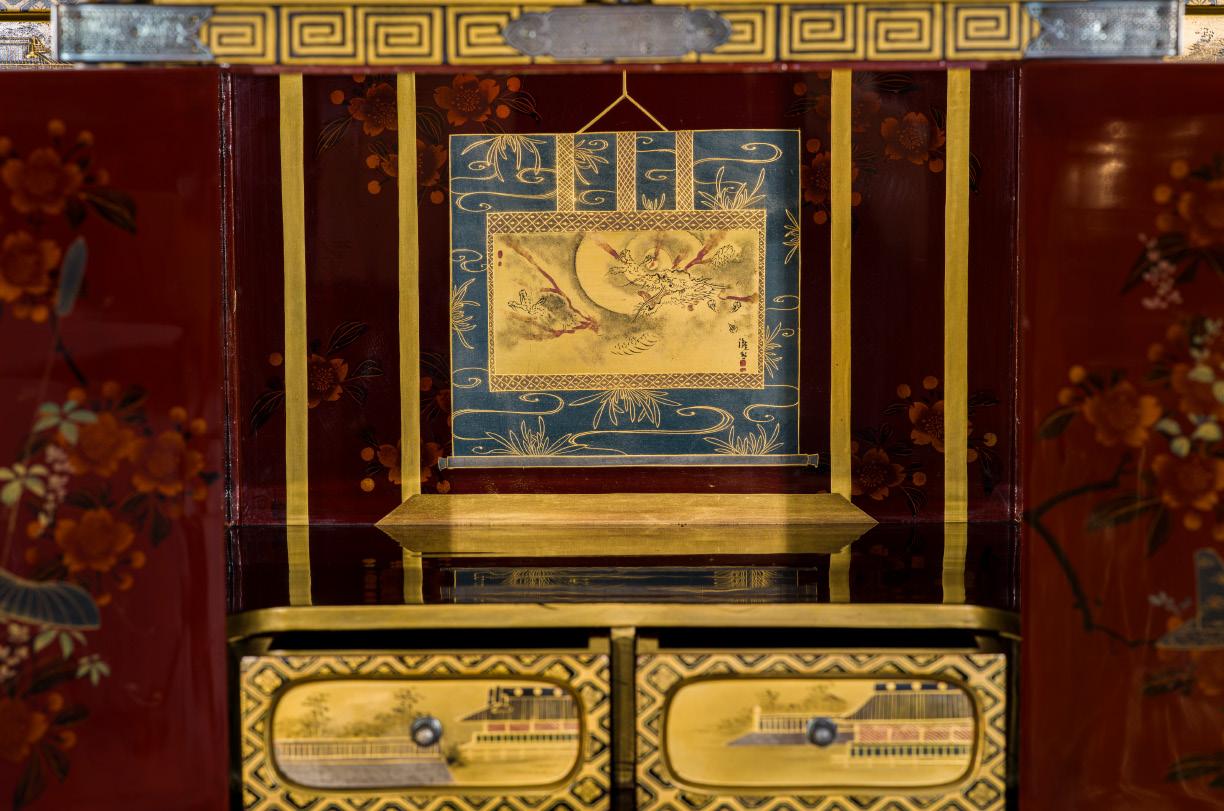
Japan, late 19th century, Meiji period (1868-1912)
Exquisitely crafted in the European academic taste of the nineteenth century, the desk is constructed in multiple stackable sections and raised on two pedestal supports. Each pedestal is fitted with doors opening to reveal three drawers at the front and a cupboard compartment to the rear. The cylindrical roll top encloses a complex interior arrangement comprising two hinged doors, sliding panels, and a drawer containing a writing slope lined in purple velvet.
The superstructure, conceived in the form of a traditional Japanese shrine, is fitted with additional drawers and a central compartment opening to reveal two small cases beneath an open chamber above.
The surfaces are lavishly decorated in gold, silver, and iro-e takamaki-e and hiramaki-e, further enriched with mother-of-pearl inlays. The decoration depicts celebrated shrine views, including the Nikko Tosho-gu, set amid fluttering birds and embellished with imperial paulownia and hollyhock crests. Blossoming cherry trees adorn the side panels, all framed by key-fret borders and further geometric ornament. The central shrine section is finely embellished with a painted ‘scroll painting’ depicting a writhing dragon, signed at the lower right Ryu (…) [dragon].
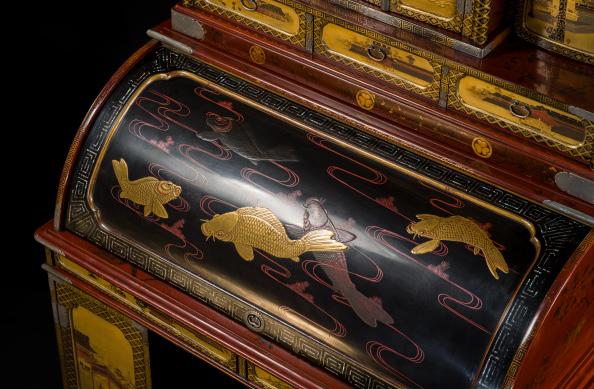
Provenance: David D. Dikinson Fine Antique Furniture, United Kingdom, 1995. The private collection of the Tomkinson Family, United Kingdom, acquired from the above. A copy of the original signed invoice, dated 14 February 1995, and stating a purchase price of GBP 14,500 (or approx. EUR 35,000 converted and adjusted for inflation at the time of writing), accompanies this lot. Condition: Excellent condition. Remarkably well-preserved. Faint traces of use and light rubbing to lacquer along the edges and exposed corners.
This desk exemplifies the type of object highly prized by Western Japonophiles in the late nineteenth century. The upper section evokes the architectural form of a Shinto shrine, while the cylindrical bureau element reflects Western demand for adaptable and multifunctional furniture suited to both commercial and domestic interiors. The elaborate decorative program presents a sophisticated synthesis of Japanese motifs tailored to Western taste, with compartment panels depicting pavilions, temples, and vernacular architecture in a manner reminiscent of a picturesque, almost postcard-like vision of Japan.
MUSEUM COMPARISON
Compare a closely related lacquer cylinder desk, Meiji period, late 19th century, 171 x 105.7 x 69.5 cm, in the Musée des Beaux-Arts Montréal, inventory number 1971.DF.1.
AUCTION COMPARISON
Compare a closely related inlaid goldlacquer cylinder desk, Meiji period, late 19th century, 178 x 143 x 75 cm, at Sotheby’s, 19th Century Furniture, New York, 26 March 2003, lot 167 (sold for USD 42,000 or approx. EUR 65,000 converted and adjusted for inflation at the time of writing).
Estimate EUR 20,000
Starting price EUR 10,000
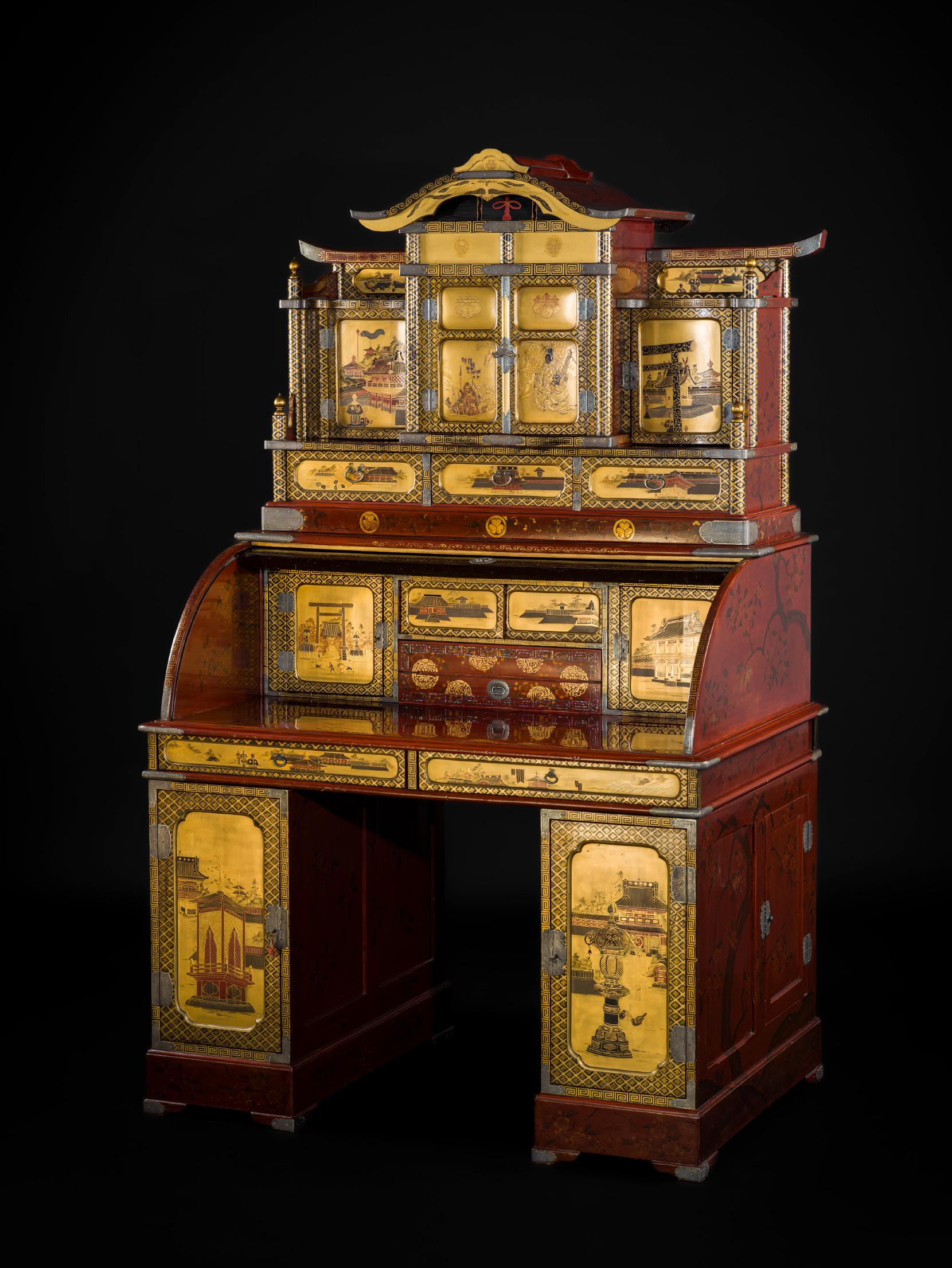
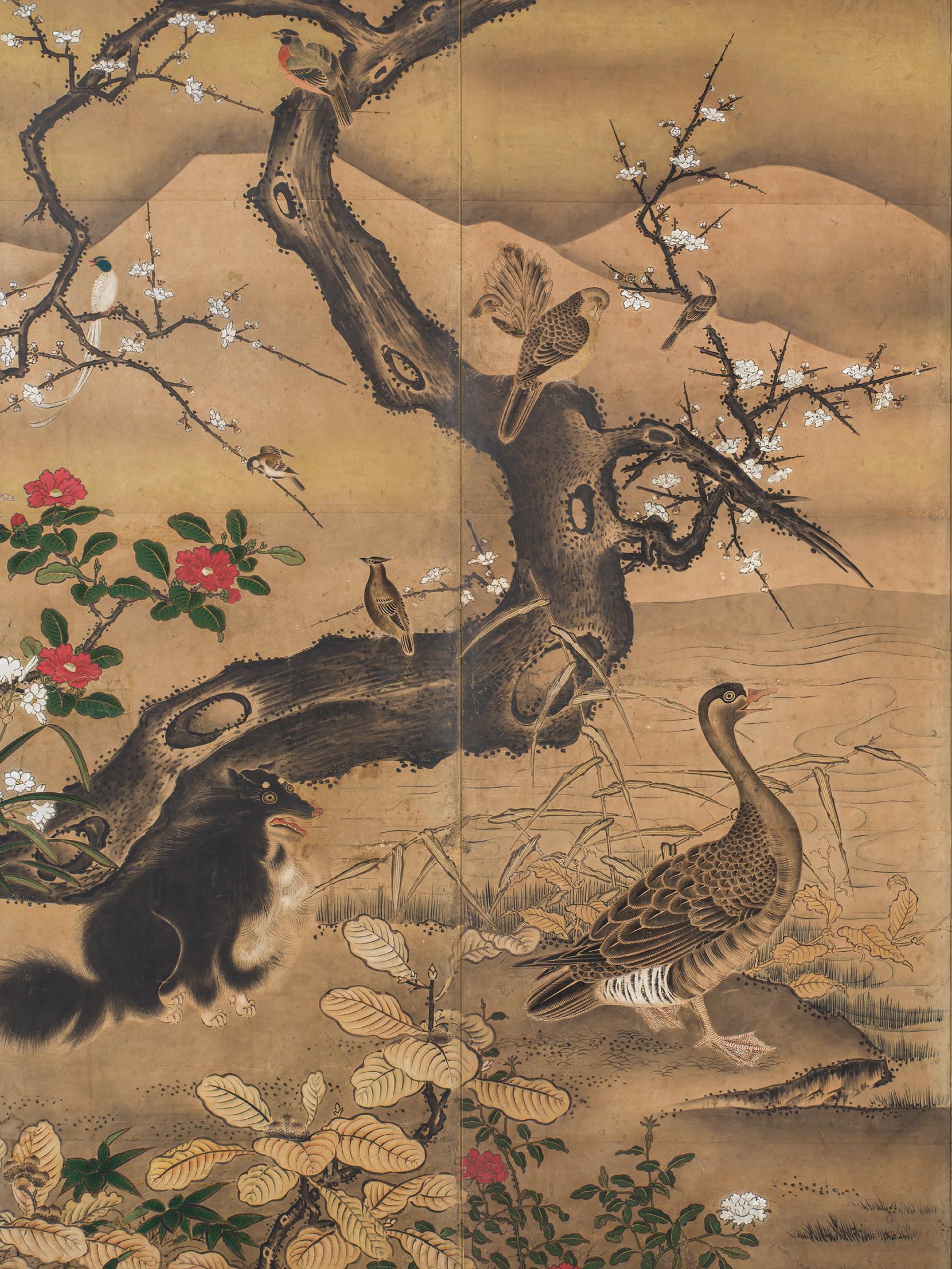
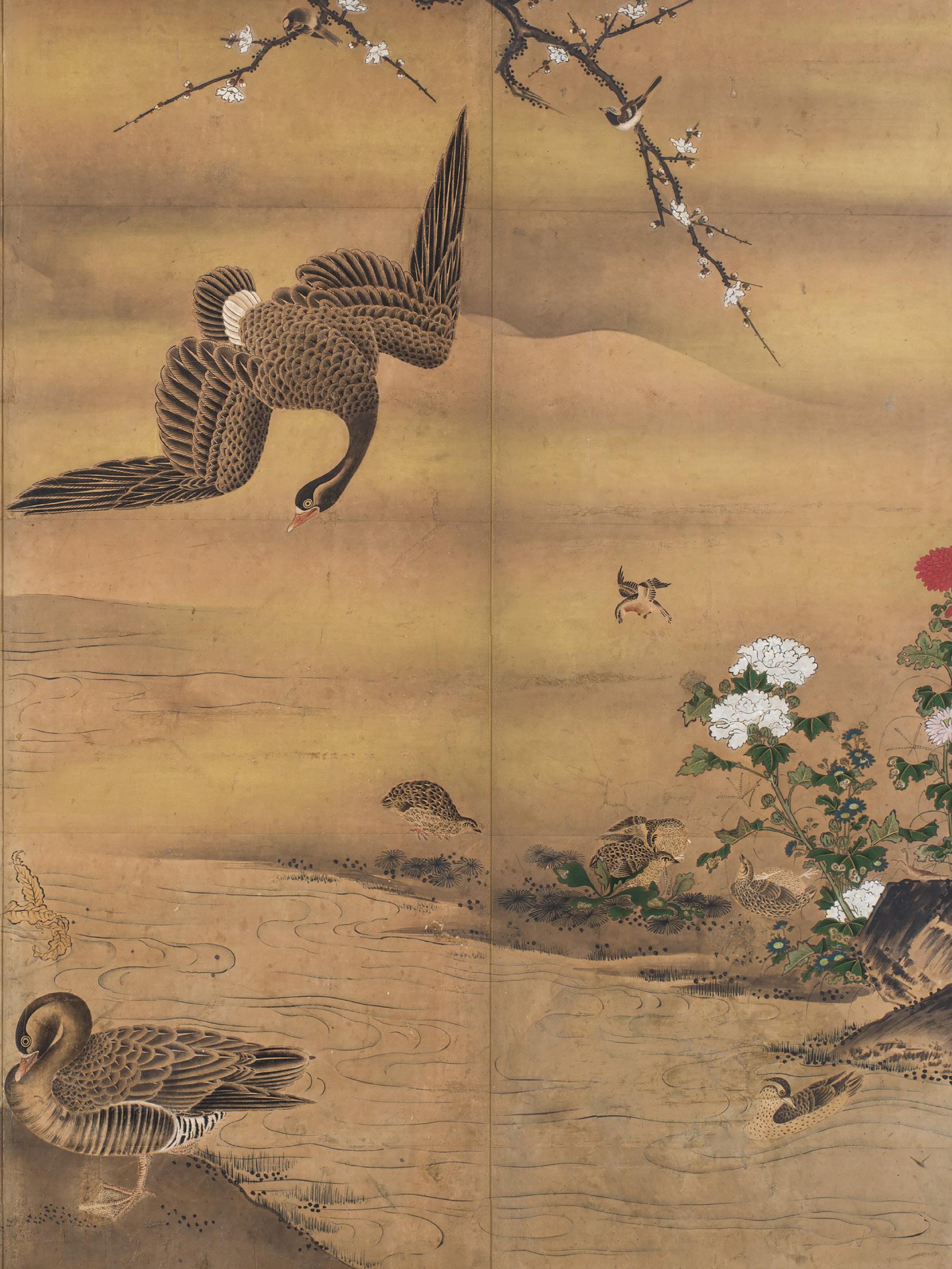
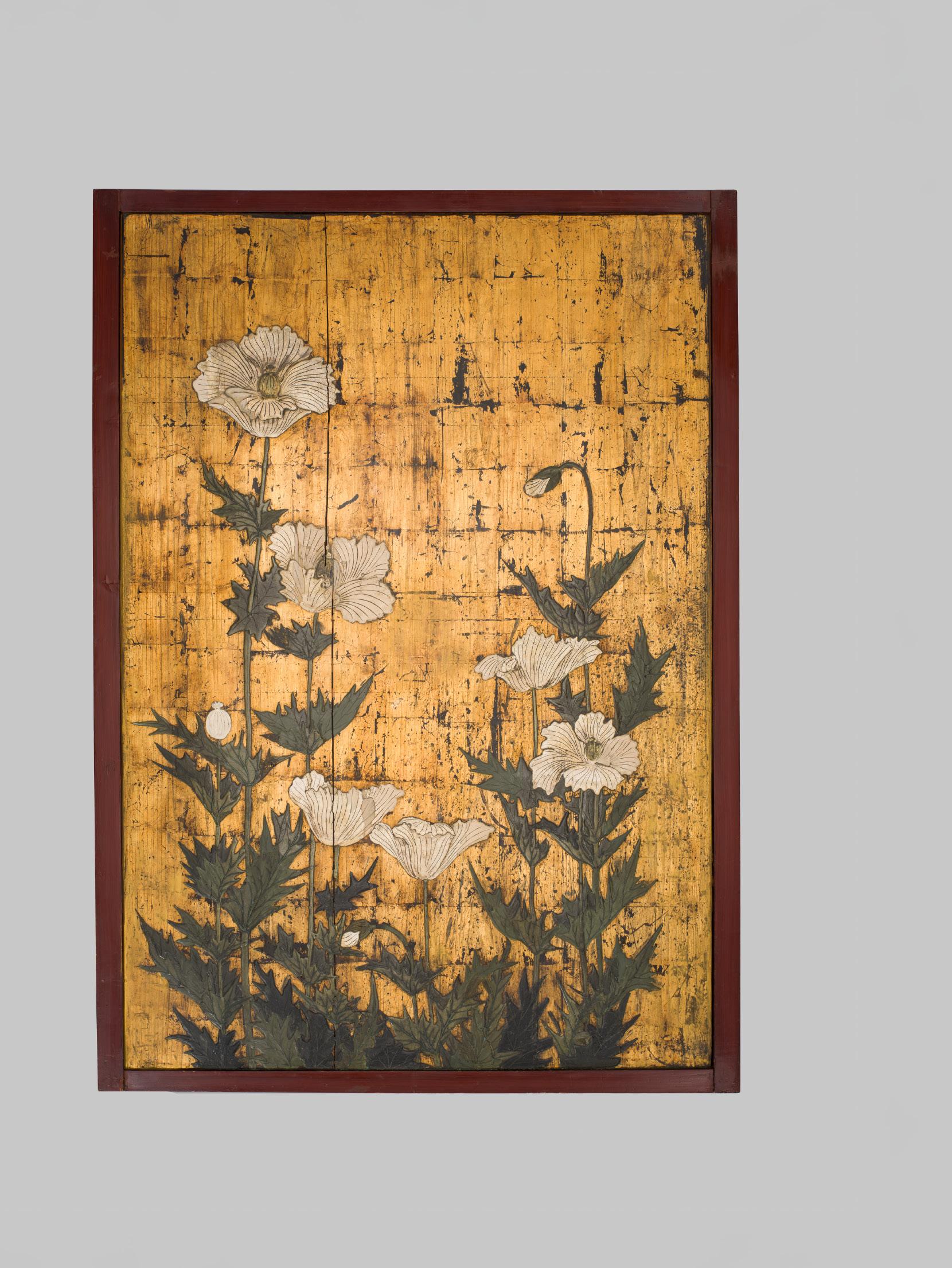

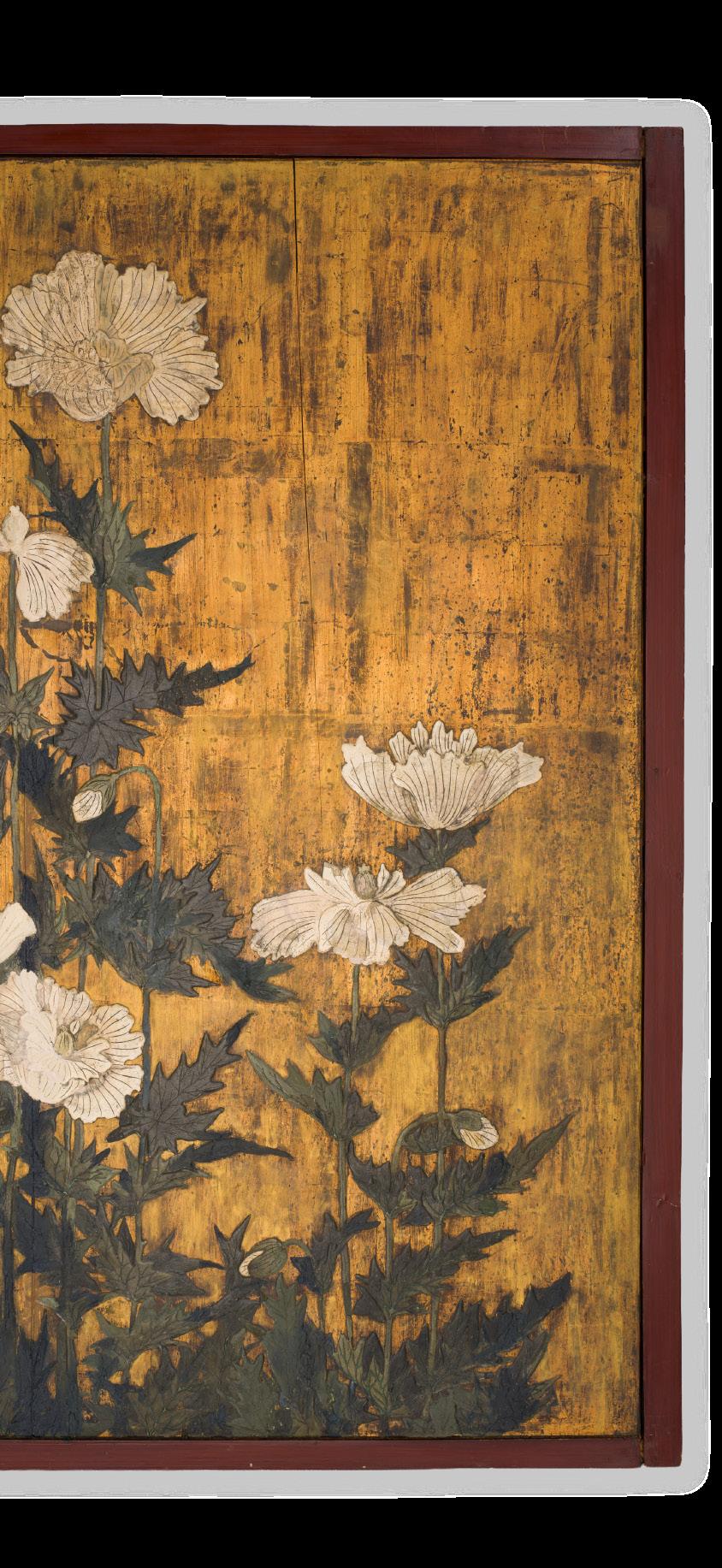

265
A PAIR OF LARGE RINPA SCHOOL ‘POPPIES’ FUSUMA (SLIDING DOOR) PANELS, EX-COLLECTION WILLIAM GLADSTONE, FORMER BRITISH PRIME MINISTER
Japan, 17th-18th century, Edo period (1615-1868)
Ink, gouache, gofun (calcified crushed shell), and gold leaf on wood panels. Mounted within reddish-brown lacquered frames. The panels are decorated with white poppies on a luminous gold ground, rendered with characteristic Rinpa elegance and bold simplicity.
SIZE (each) 171.8 x 122.5 cm
Provenance: Formerly in the collection of William Gladstone (18091898), Prime Minister of the United Kingdom, displayed at 10 Downing Street and later at his residence in Wales. Thence to Lord Justice Sir Harry Trelawney Eve (1856–1940), and by descent in his family. With Angel Antiques, London, 1963, copies of the invoice and a signed statement, dated 7 and 25 May 1963 respectively, confirming the above provenance accompany the lot. Subsequently in the collection of Harry J. Haon II (1901-1989), and by descent. Sold at Freeman’s, Asian Arts, Philadelphia, 18 April 2023, lot 286. Thereafter in the private collection of Edwin “Ed” Hardy, San Francisco, California, acquired from the above.
Condition: The fusuma panels likely re-mounted for presentation a long time ago. Overall good condition with old wear, expected age cracks with associated losses, minor warping, rubbing to gilt, flaking and losses to the gofun, and touchups and restorations to some of the petals and foliage. The frame with signs of wear, loose joints, and rubbing to lacquer. Presenting very well.
AUCTION COMPARISON
Compare a closely related Rinpa school two-panel byobu depicting chrysanthemums, dated 17th-18th century, 183 x 170 cm, at Bonhams, Property from the Estate of Liza Hyde, 19 March 2009, New York, lot 171 (sold for USD 23,180 or approx. EUR 30,500 converted and adjusted for inflation at the time of writing). Also compare a closely related pair of fusuma panels with a similar design of poppies, dated 17th century, 152 x 61 cm (each), at Bonhams, Fine Japanese and Korean Art, 15 March 2017, New York, lot 6144 (sold for USD 25,000 or approx. EUR 29,000 converted and adjusted for inflation at the time of writing).
Estimate EUR 8,000
Starting price EUR 4,000
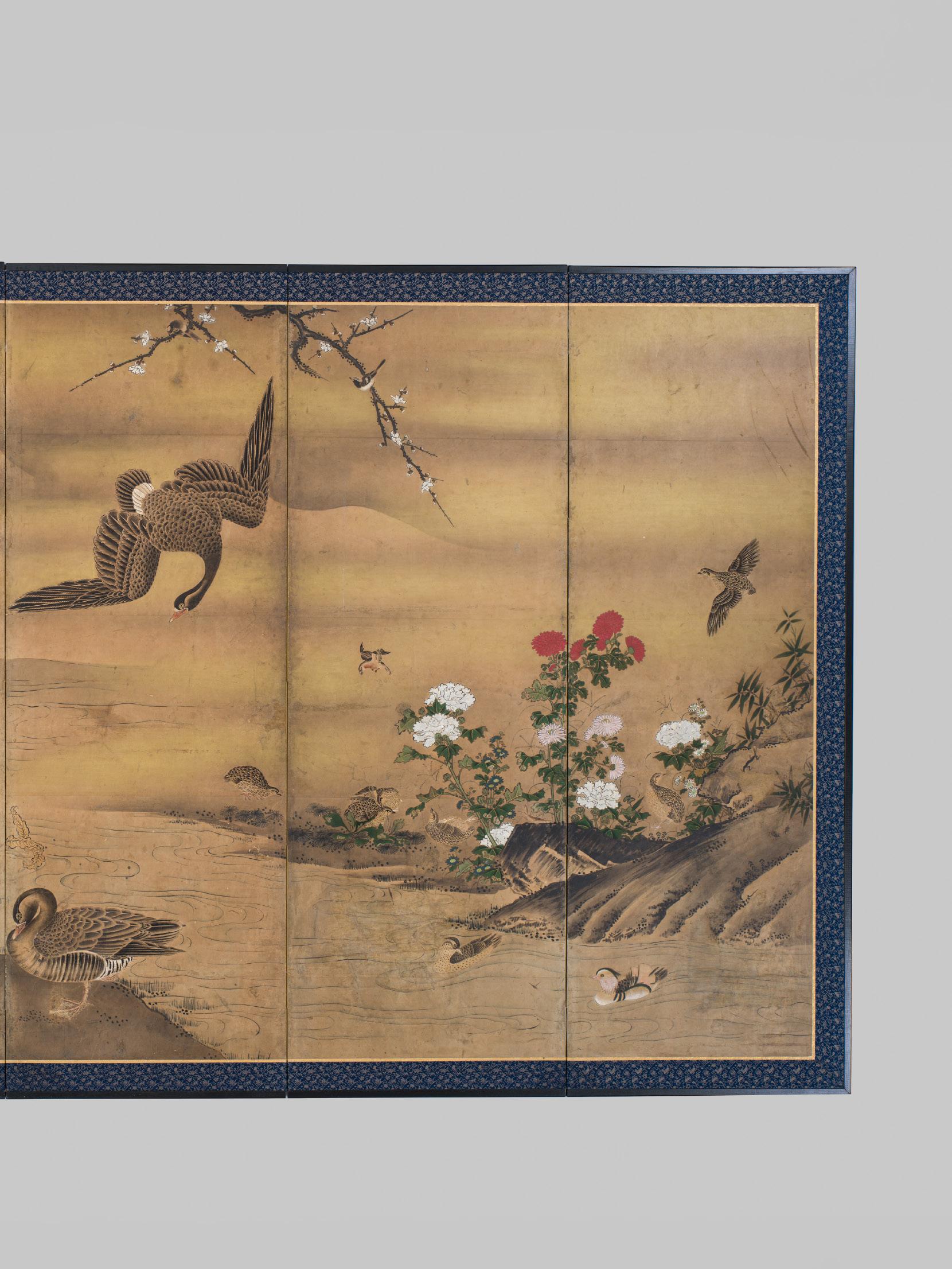
Sealed Geiai and Tonshu Japan, first half of the 16th century, Muromachi period (1333-1573)
Ink, watercolors, and gouache on paper. Mounted on silk brocade on six black-lacquered wood panels. The composition presents a tranquil stream set within a richly detailed landscape. To the left, a blossoming prunus tree rises beside camellias issuing from rockwork, while a gnarled plum branch extends into the foreground. The riverbank is animated with chrysanthemums, bamboo, and a profusion of seasonal flora. The scene is enlivened by a wide array of birds: geese in flight and at rest, a pair of pheasants near the rocks, sparrows in lively interaction, doves and smaller birds perched among the branches, and quails engaged in a dust bath. In the water below, a pair of mandarin ducks glide gracefully. Near the quails to the right of the screen, a small detail presents itself - a praying mantis, almost hidden within the foliage yet painted with remarkable vitality.
A particularly striking and unusual feature is the presence of a jako neko (musk cat), seated incongruously among the birds, its openmouthed expression lending the scene a subtle sense of curiosity and dissonance rarely encountered in paintings of this type.
Inscriptions: To the lower left corner, two seal marks Tonshu 頓首 [respectfully yours] and Geiai 芸愛
SIZE 363 x 197.3 cm
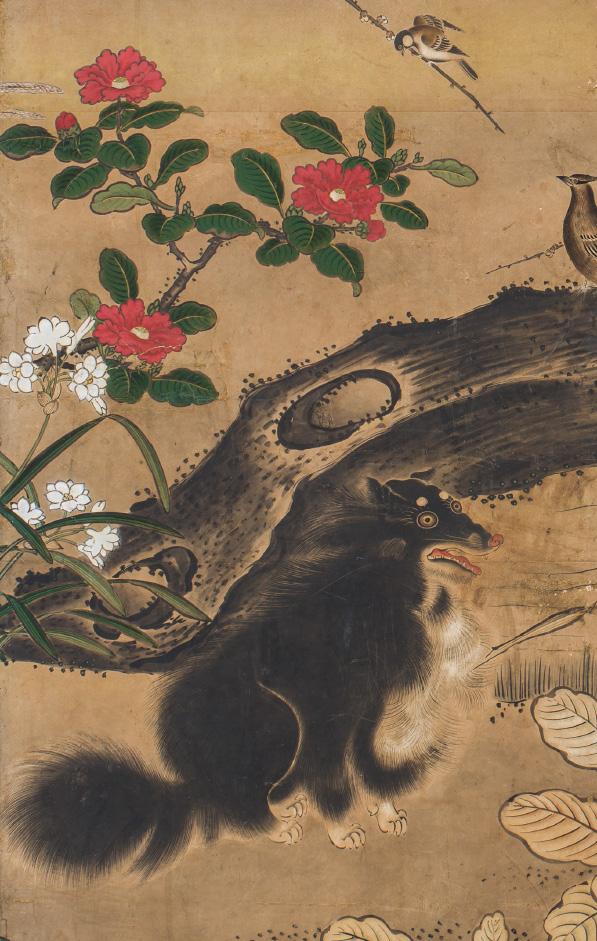
Provenance: The Rooke Family Collection, previously on display at The Ivy, Chippenham. The Ivy is a magnificent Grade I listed manor house, built in 1728 for the lawyer and Member of Parliament John Norris. In 1869, the estate, together with its contents, was acquired by Alexander Beaumont Rooke (1821-1914). The manor passed through several generations of the Rooke family until its sale in 2013, after which the screen was moved to the family’s new home in Wiltshire.
Condition: Good condition with expected extensive wear, small tears and losses, some with minor touchups and repairs, water stains, soiling, and creasing. The frame with traces of wear and use and small losses. Overall presenting beautifully.
Geiai is an enigmatic and highly regarded painter active in Kyoto in the late fifteenth to early sixteenth century. Only a small number of works bearing the Geiai seal are known, typically executed within a distinctive double-line cartouche, as seen here. Documentary evidence is scarce, with a dated underdrawing of 1489 providing one of the few chronological anchors.
The folding screen features a very unusual depiction of a musk cat (jako neko) seated amongst birds, an unusual detail rarely seen on ‘birds and flowers’ paintings of the period. Although not native to Japan, musk cats, or civets, were known in Japan through early Chinese paintings that were imported beginning in the 1200s. For related paintings of musk cats, dated to the 16th century, see a hanging scroll of a jako neko, in the Metropolitan Museum of Art, object number 2015.300.66
(fig. 1), a sixpanel folding screen, in the Suntory Museum of Art (fig. 2), and another sixpanel folding screen, in the Museum of Fine Arts, Boston, accession number MFA116781
(fig. 3)
Recent Japanese scholarship proposes an identification of Geiai with the equally elusive painter Oguri Soritsu (d. 1556), particularly for works bearing the paired seals Geiai and Tonshu, as noted in Rakkan Kao Dai Jiten by Oda Eiichi and Koga Kenzo.
Executed in the characteristic Geiai manner, with confident use of the boneless technique and bearing the correct double-line seal, the present screen is further distinguished by its exceptionally rare and captivating depiction of a jako neko. Combined with its unusually large scale and distinguished provenance, it represents one of the most important and significant works within the oeuvre of Geiai to appear on the market.
MUSEUM COMPARISON
Works bearing the Geiai seal are almost exclusively of small scale, with only very few known exceptions among folding screens. Compare a closely related pair of six-panel folding screens depicting birds and flowers of the four seasons, by Geiai, dated Muromachi period, designated an Important Cultural Property, in the Kyoto National Museum, museum number AK1314. Also compare a closely related screen depicting birds and flowers, dated 16th century, in the collection of the Nezu Art Museum, exhibited in 2015 as part of the Animal Worship exhibition.
Geiai’s paintings are distinguished by a sophisticated range of brush techniques, most notably the “boneless” (mokkotsu) manner, in which forms are rendered without preparatory outlines. This approach is evident in the lively and fluid depiction of the sparrows, demonstrating a painterly confidence characteristic of the master.
Detail of sparrows executed in boneless technique on the present screen
AUCTION COMPARISON
Compare two related paintings of birds and flowers by Geiai, 49 x 32 cm each, at Christie’s, Japanese and Korean Art, 22 March 2002, New York, lot 91 (sold for USD 204,000 or approx. EUR 322,000 converted and adjusted for inflation at the time of writing). Compare two related paintings of birds and herons in a lotus pond by Geiai, 110.8 x 49.8 cm each, at Christie’s, Japanese and Korean Art, 23 March 2004, New York, lot 94 (sold for USD 287,500 or approx. EUR 433,000 converted and adjusted for inflation at the time of writing).
Estimate EUR 40,000 Starting price EUR 20,000
Detail of sparrows executed in boneless technique on a painting of millet and sparrows by Geiai, with the same double-lined seal Geiai, Metropolitan Museum of Art, New York, object number 1975.268.40
Detail of sparrows executed in boneless technique on a painting of sparrows among millet and asters, with the same double-lined seal Geiai, Minneapolis Institute of Art, from the Mary Griggs Burke Collection
A HIGHLY IMPORTANT SIX-PANEL ‘SNOW-DUSTED WILLOW AND DUCKS’ (FOLDING SCREEN), ATTRIBUTED TO KANO EITOKU, FORMERLY KEPT AS A TREASURED ITEM IN THE JURAKUDAI PALACE IN KYOTO
A HIGHLY IMPORTANT SIX-PANEL ‘SNOW-DUSTED WILLOW AND DUCKS’ (FOLDING SCREEN), ATTRIBUTED TO KANO EITOKU, FORMERLY KEPT AS A TREASURED ITEM IN THE JURAKUDAI PALACE IN KYOTO
Attributed to Kano Eitoku (1543-1590), unsigned Japan, c. 1589-1590, Momoyama period (1573-1615)
Ink, watercolors, gouache, and gold leaf on paper, mounted on silk brocade on six lacquered wood panels with brass fittings. This monumental folding screen is finely painted with a large willow tree, delicately dusted with snow, surrounded by blossoming camellias signaling the arrival of spring, alongside evergreen bamboo leaves. A braided wooden fence separates the shore from which the majestic tree rises, while gently rippling waters below are graced by a small flock of ducks swimming, with a pair in flight above the scene.
SIZE 169.9 x 379.3 cm
Provenance: From an old private collection in Nice, France. A label affixed to the back confirms it was held in the Jurakudai Palace in Kyoto in the late 16th century.
Condition: Very good condition with old wear and vibrant colors. Some soiling and expected flaking to the gold leaf. The back with traces of wear and use. Occasional tears and losses to the joints with associated repairs.
Kano Eitoku (1543-1590) was one of the most renowned painters of the Kano School, a dynasty of artists who played a central role in the development of Japanese painting during the AzuchiMomoyama period. His unique style combined the Chinese ink traditions with the richly decorative elements of Yamato-e, the native Japanese aesthetic.
INSCRIPTIONS
On the back, a label reads: 聚楽 御所御物、法印永 徳筆 [painted by (Kano) Eitoku, with the title of Dharma’s Law, a treasure item kept at the Jurakudai Palace (Kyoto)].
MUSEUM COMPARISON
Compare a closely related pair of screens depicting cypress trees, by Kano Eitoku, designated a National Treasure, c. 1590, in the Tokyo National Museum, collection reference no. A-1069.
This folding screen is a rare and highly significant example of Kano Eitoku’s work, and it was once a treasured item in the Jurakudai Palace in Kyoto. The Jurakudai was an immense, castle-like mansion built by the powerful warlord Toyotomi Hideyoshi and completed in 1587. Hideyoshi, who ruled Japan as regent after Oda Nobunaga’s death, spared no expense in the creation of this architectural marvel, which was not only a personal residence but also a symbol of his power and influence. In 1588, the Jurakudai was visited by Emperor Go-Yozei, cementing its importance in the political and cultural spheres of the time. The palace was later handed down to Hideyoshi’s nephew, Toyotomi Hidetsugu, but after Hidetsugu’s death by seppuku in 1595, the Jurakudai Palace was dismantled. The Gyobutsu - or treasured items - kept at the palace, including swords, tea utensils, and important works of art, were considered among the most significant items in Hideyoshi’s collection, and this screen, attributed to the master painter Kano Eitoku, was one of them.
Eitoku was not only a leading figure in the courtly art scene but also an official painter (goyoeshi) to both Oda Nobunaga and Toyotomi Hideyoshi, two of Japan’s most powerful and influential warlords. His work, such as this screen, exemplifies the grandeur and splendor of the period, as well as the influence of Chinese landscape painting, which the Kano School adapted to suit Japanese tastes.
The Hoin (法印) or “Seal of Dharma’s Law” inscribed on the label to the back of the screen, was the highest rank awarded to Buddhist artists in Japan, marking the exceptional mastery and the patronage that Eitoku enjoyed from the highest echelons of society, including the Tokugawa shogunate and Toyotomi Hideyoshi himself.
Estimate EUR 40,000
Starting price EUR 20,000
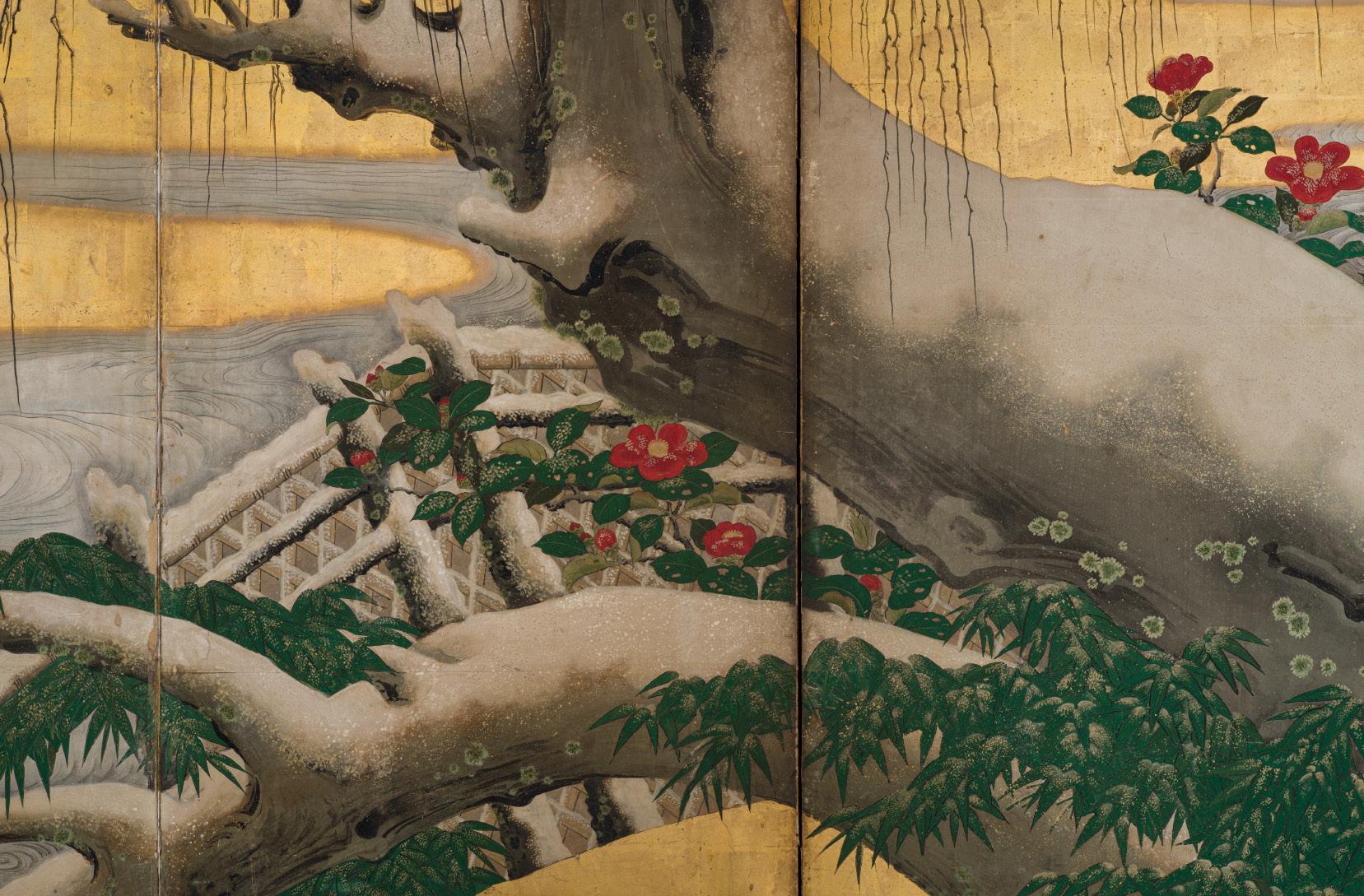
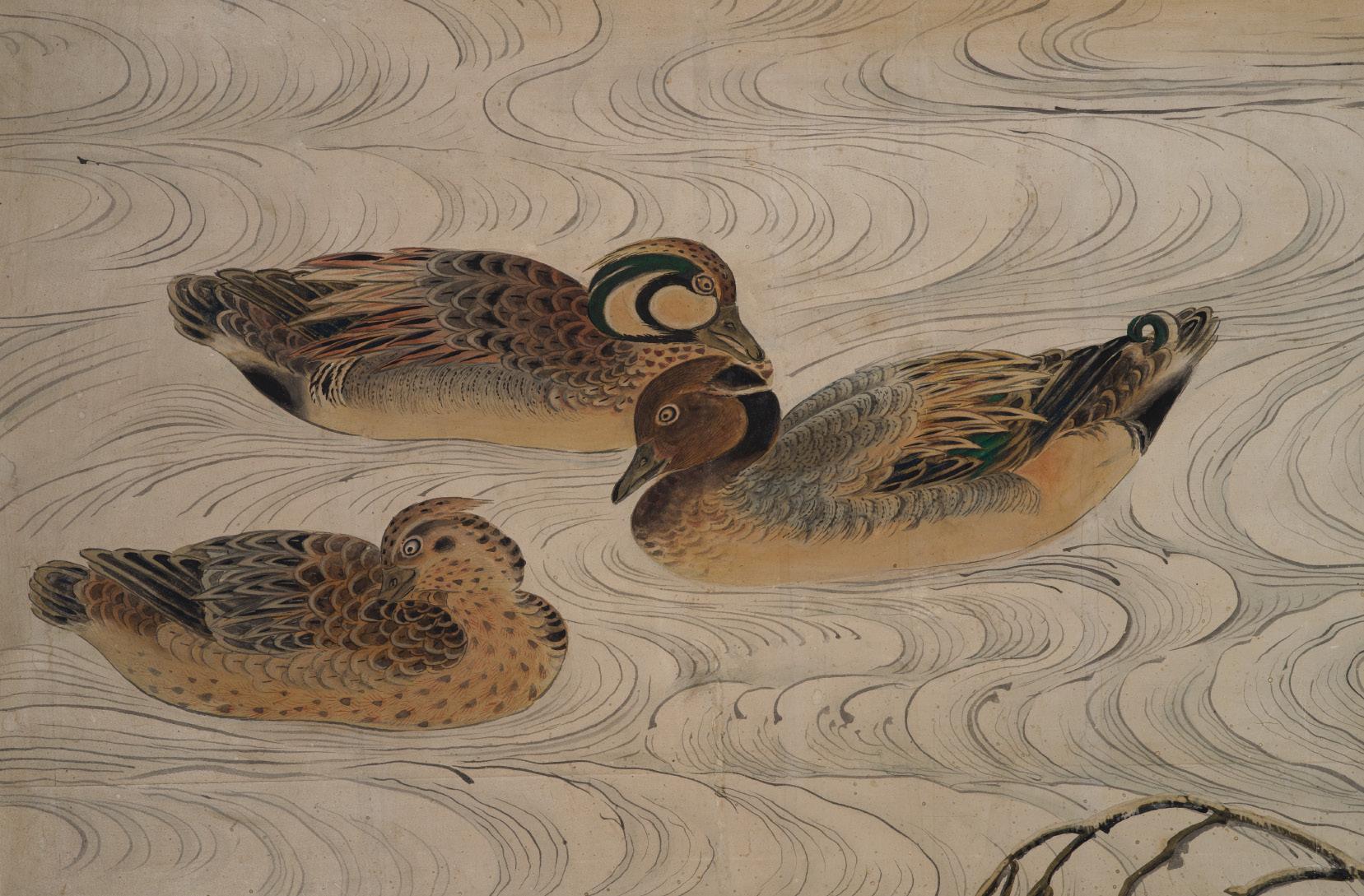
268
OGATA KORIN: AN IMPORTANT PAIR OF RINPA SIX-PANEL ‘FLOWERS OF THE FOUR SEASONS’ BYOBU (FOLDING SCREEN)
By Ogata Korin (1658-1716), signed Korin with seals Ogata and Kansei and Korin zu with seals Ogata and Kansei Japan, late 17th to early 18th century (Edo period 1615-1868)
Ink, watercolors, gouache, and gold foil on paper. Each mounted within a silk brocade frame on six lacquered wood panels with brass ‘folding-fan’ fittings. This magnificent pair of screens belongs to a genre of lyrical paintings of flowers, grasses, and other plants that flourished around the middle of the seventeenth century. The subject is an imaginary garden in which flowers of all four seasons are in bloom. Overflowing with vitality and dazzling against an all-gold ground, this lush profusion of natural beauty is dense with plants for spring and summer on the right screen, more open for autumn and winter on the left.
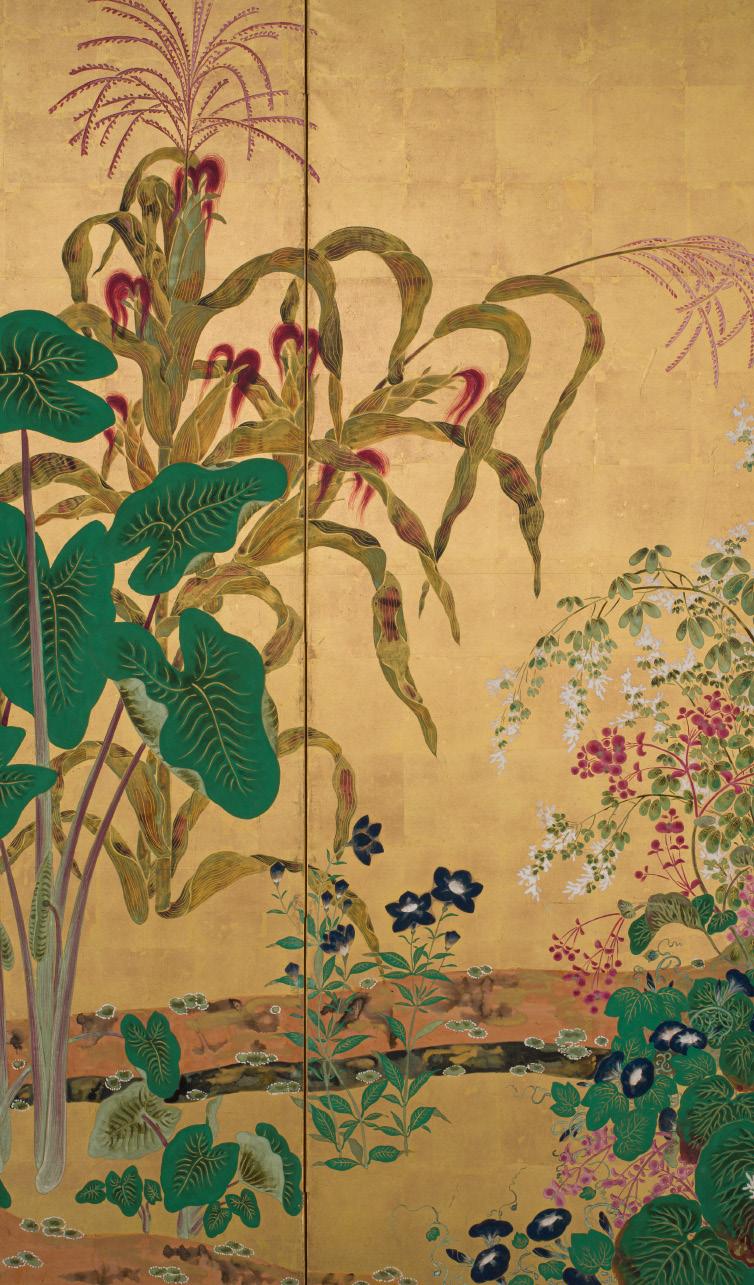
Inscriptions: To the first panel, signed 光琳 Korin with seals 緒方 Ogata and 澗声 Kansei; and the second panel, signed 光琳圖 Korin zu [painted by Korin] with seals 緒方 Ogata and 澗声 Kansei.
SIZE 181 x 378 cm (each)
Condition: Very good condition with minor wear and vibrant colors. Little soiling, tiny losses, and minuscule flaking to pigment and gold foil - some with associated repairs and touchups. The back with traces of wear and use. Presenting exceptionally well and in a remarkable state of preservation.
On the first screen (spring and summer), the flowers include yellow Japanese roses (yamabuki), tree peonies, pinks, opium poppies, clematis, Japanese irises, and water plantain.
On the second screen (autumn and winter), you can find eggplants, miscanthus grasses, bush clover, yellow maidenflowers, bellflowers, chrysanthemums, and Shasta daisies.
Ogata Korin’s work is regarded as some of the most important and innovative in Japanese art. A master of the Rinpa school, Korin was known for his bold, graphic style and his ability to imbue his subjects with both a decorative richness and intellectual depth. His innovations - such as the incorporation of new brush techniques and his lavish use of gold and other expensive materials - set him apart as a transformative figure in the Edo period.
MUSEUM
COMPARISON
Compare a closely related pair of six-panel folding screens depicting Irises at Yatsuhashi, by the same artist, dated after 1709, size 179.1 x 371.5 cm (each), in the Metropolitan Museum of Art, object number 53.7.1, .2.
AUCTION COMPARISON
Compare a closely related pair of six-panel folding screens depicting chrysanthemums, by the same artist, dated to the early 18th century, size 166.3 x 357.6 cm (each), at Sotheby’s, Masterpieces of Asian Art from the Okada Museum of Art, 22 November 2025, Hong Kong, lot 1014 (sold for HKD 3,810,000 or approx. EUR 429,000 converted and adjusted for inflation at the time of writing). Compare a closely related pair of sixpanel folding screens depicting flowers and grasses of the four seasons, Rinpa school, sealed I’nen, dated to the mid-17th century, at Christie’s, The Exceptional Sale 2017, 6 July 2017, London, lot 15 (sold for GBP 317,000 or approx. EUR 494,000 converted and adjusted for inflation at the time of writing).
Estimate EUR 30,000 Starting price EUR 15,000
AN IMPRESSIVE RINPA SCHOOL FOUR-PANEL ‘BLOOMING NADESHIKO’ BYOBU (FOLDING SCREEN)
Japan, 17th century, Edo period (1615-1868)
Ink, watercolors, and gold paint on paper. Mounted on silk brocade on four wood panels with metal fittings. Finely painted to depict red and white carnation (nadeshiko) flowers blooming in a large field, the landscape sprinkled with gold dust.
SIZE 94.5 x 160 cm
Condition: Good condition with wear, flaking to pigment, little soiling, small losses, and tiny tears. The back with traces of wear and use.
Rinpa is a modern term that refers to a distinctive style of Japanese pictorial and applied arts that arose in the early seventeenth century and has continued through modern times. Literally meaning ‘school of Korin,’ Rinpa derives its name from Ogata Korin (1658–1716), a celebrated painter from Kyoto. It embraces art marked by a bold, graphic abbreviation of natural motifs, frequent reference to traditional court literature and poetry, the lavish use of expensive mineral and metallic pigments, incorporation of calligraphy into painting compositions, and innovative
experimentation with new brush techniques. Transmitted by means of pattern books and manuals, the work of the Ogata Korin inspired numerous other craftsmen.
MUSEUM COMPARISON
Compare a related pair of six-panel screens depicting Moon in Musashi Plain, dated to the early 1600s, in the Indianapolis Museum of Art Galleries at Newfields, accession number 2000.1.
AUCTION COMPARISON
Compare a related Rinpa school six-panel folding screen depicting flowers, dated Edo period, 168.5 cm long, at Christie’s, Art d’Asie, 12 December 2023, Paris, lot 69 (sold for EUR 13,860 or approx. EUR 14,500 adjusted for inflation at the time of writing).
Estimate EUR 8,000 Starting price EUR 4,000
FUJIWARA KANEFUSA: A SUPERB FOUR-PANEL ‘POPPIES’ BYOBU (FOLDING SCREEN) DEPICTING POPPIES
By Fujiwara Kanefusa, signed Hogen Fujiwara no Kanefusa hitsu with seal mark Hidetoshi Japan, 18th century, Edo period (1615-1868)
Ink, watercolors, gouache, silver paint, and gold leaf on paper. Mounted on brocade on a black-lacquered frame with brass fittings. Painted in vibrant colors with scattered, white and red poppies on a gold ground washed with silver.
Inscriptions: To the lower left corner, signed Hogen Fujiwara no Kanefusa hitsu 法眼藤原兼房筆 [painted by Fujiwara Kanefusa with the Hogen Title] with seal mark Hidetoshi.
SIZE 91.1 x 199 cm
Condition: Excellent condition with minor wear and few touchups to the gold leaf. The frame with minute traces of wear.
The depiction of poppies in Japanese painting gained prominence through the innovations of Tawaraya Sotatsu and the Rinpa school, whose artists favored bold compositions of seasonal flora set against richly worked gold grounds. In this context, poppies are associated with the early summer season, their
ephemeral blossoms lending themselves to the Rinpa aesthetic of elegance and decorative abstraction.
MUSEUM COMPARISON
Compare a related six-panel folding screen of white poppies on gold ground, School of Ogata Korin, dated Edo period, 170.2 × 383.5 cm, in the Metropolitan Museum of Art, object number 49.35.1.
AUCTION COMPARISON
Compare a related Rinpa school six-panel Byobu depicting poppies, dated 17th century, 171 x 373 cm, at Zacke, Fine Japanese Art, 13 June 2025, Vienna, lot 299 (sold for EUR 13,000).
Estimate EUR 15,000
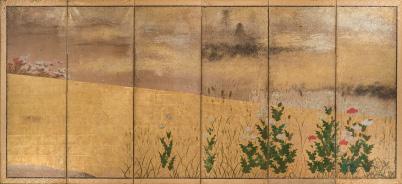
Starting price EUR 7,500
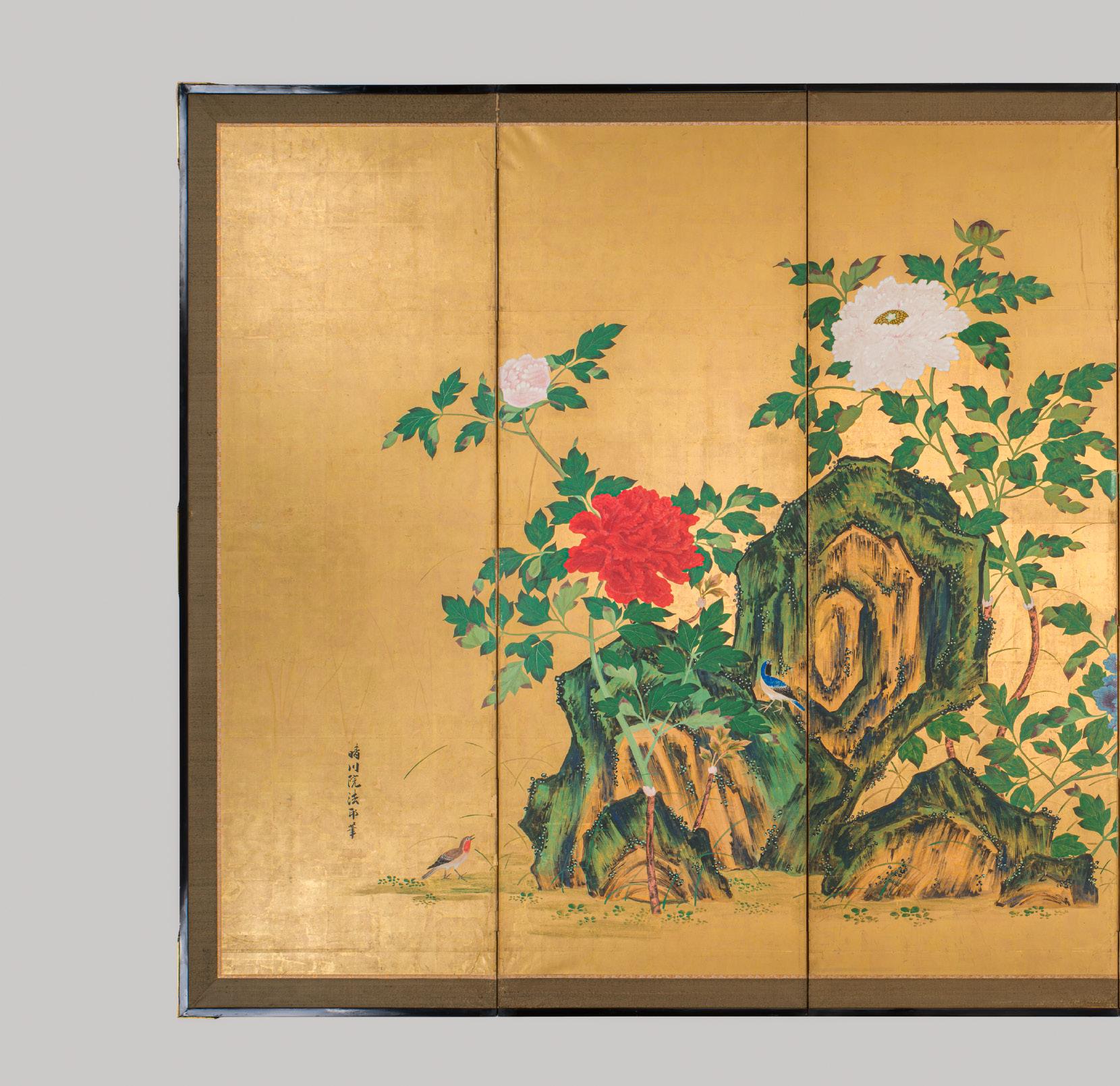
KANO SEISEN’IN OSANOBU: A VERY FINE SIX-PANEL ‘BIRDS AND FLOWERS’ BYOBU (FOLDING SCREEN)
By Kano Seisen’in Osanobu (1796-1846), signed Seisen’in Hoin hitsu with a red pot seal mark and another seal Seisen’in Japan, first half of the 19th century, Edo period (1615-1868)
Ink, watercolors, gouache, and gold leaf on paper. Mounted on silk brocade on six black-lacquered wood panels with finely chased brass beautifully incised with karakusa and cherry blossoms. Finely painted in vibrant colors with white, red, and blue peonies, growing amid rocks, and scattered with small birds, all against a lustrous gold ground.
Inscriptions: To the lower left corner Seisen’in Hoin hitsu 晴川院 法印筆 [painted by the honorary priest of Seisenin] with two seal marks, one reading Seisen’in.
SIZE 180.3 x 362 cm
Condition: Very good condition with minor surface wear, some scratches, few touchups to the gold ground and painted details. The back with traces of wear and age.
Kano Osanobu (1796-1846), son of the eminent Kano school painter Kano Eishin, was a leading figure of the late Edo period. Initially named Gyokusen, he later adopted the names Seisen, Seisenin, and the pen name Kaishinsai. Entering service at Edo
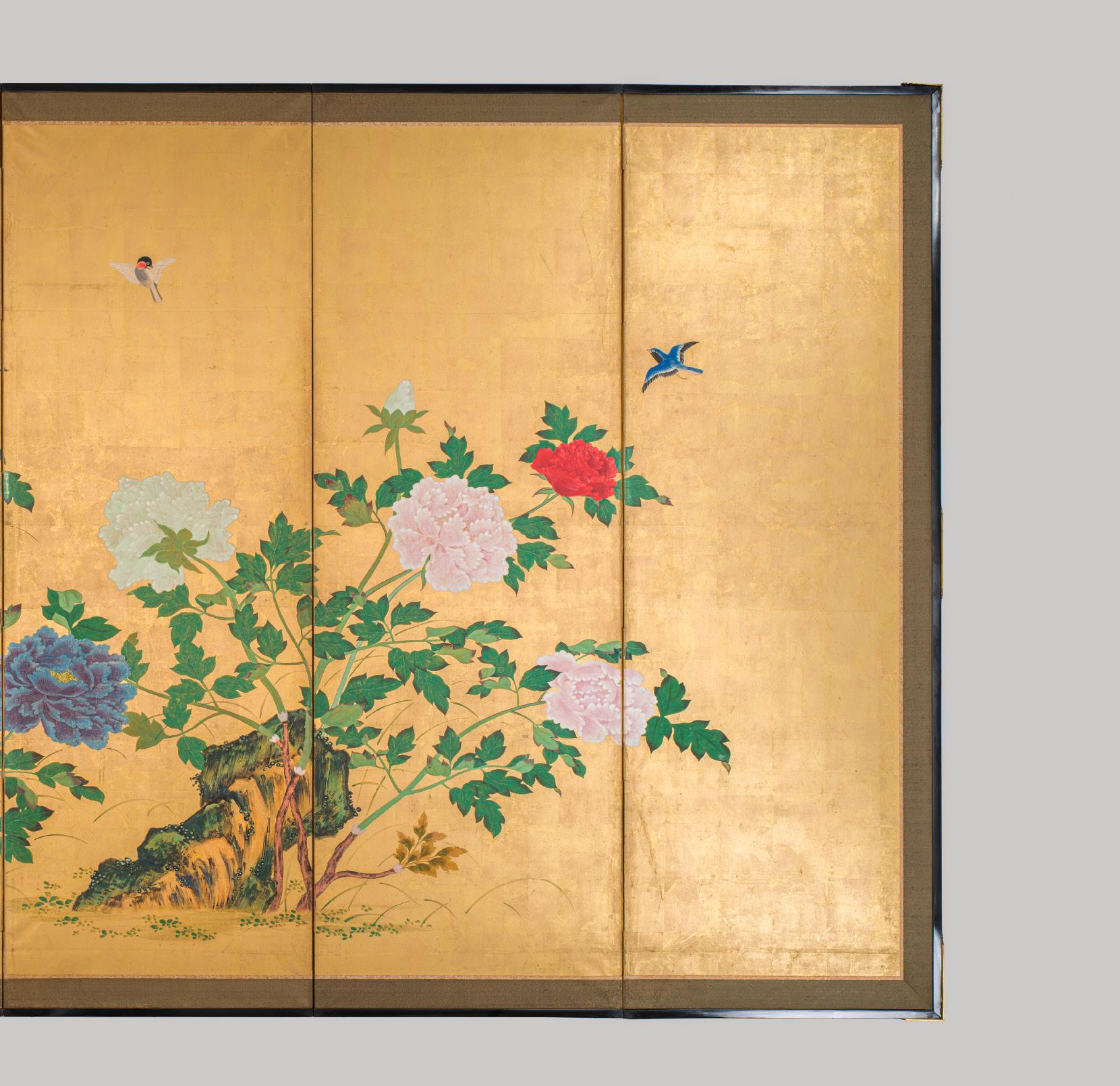
Castle in 1810, he worked within the inner palace and, at the age of twenty-four, was granted the title of Hogen and the court rank of Nakatsukasakyo. Following his father’s death in 1828, he became the ninth head of the Kano family and was later elevated to the rank of Hoin. During the Tenpo and Koka eras (1830s–1840s), he directed major decorative projects at Edo Castle, including the wall paintings of the Nishinomaru and Honmaru palaces, overseeing large-scale workshop production. Continuing his father’s legacy, he engaged deeply with the study and reproduction of Chinese painting and classical Japanese scrolls, while also contributing to the transformation of the Kano style through a synthesis of tradition and more expressive, forward-looking approaches that would influence the development of modern Japanese painting.
MUSEUM COMPARISON
Compare two related hanging scrolls of peonies by Kano Seisen’in Osanobu, dated first half of the 19th century, 119.1 x 45.6 cm (each), in the Museum of Fine Arts, Boston, accession number 11.4336 and 11.4334.
Estimate EUR 8,000
Starting price EUR 4,000
A SUPERB KANO SCHOOL SIX-PANEL ‘FLOWER CARTS (HANAGURUMA)’ BYOBU (FOLDING SCREEN)
Japan, late 17th to early 18th century, Edo period (1615-1868)
Ink, watercolors, gouache, gold paint, and gold leaf on paper. Mounted on silk brocade on six lacquered wood panels with metal fittings, set upon an additional sage-green painted wood stand, ideal for presentation; the joints affixed with hinges. Finely painted with three ornate wooden carts bearing abundant seasonal flower arrangements, two in woven wicker vases and one in a large bronze vessel, including chrysanthemums (kiku), irises (shobu), lotus (hasu), and morning glories (asagao), set amid verdant foliage.
SIZE 137.4 × 287.4 cm
Condition: Very good condition with wear, minor soiling, light flaking and rubbing, and small losses to the gold leaf with associated touchups. The back with traces of wear and use and the hinges slightly loose.
MUSEUM COMPARISON
Compare a closely related pair of sixpanel byobu (folding screens) depicting five ornate flower carts (hanaguruma), dated 17th century, 154.5 x 364.2 cm (each), in the Tokyo National Museum, institutional reference number A-1459. Compare a six-panel byobu (folding screen) depicting a flower cart, dated early 18th century, 170 x 366 cm, in the National Gallery of Victoria, Melbourne, Australia, accession number AS13.a-b-1994.
AUCTION COMPARISON
Compare a closely related later six-panel byobu (folding screen) depicting a single ornate flower cart, dated 19th century, 156.2 x 358.1 cm, at Bonhams, Fine Japanese Works of Art, 22 March 2011, New York, lot 3317 (sold for USD 7,930 or approx. EUR 10,000 converted and adjusted for inflation at the time of writing).
Estimate EUR 8,000
Starting price EUR 4,000
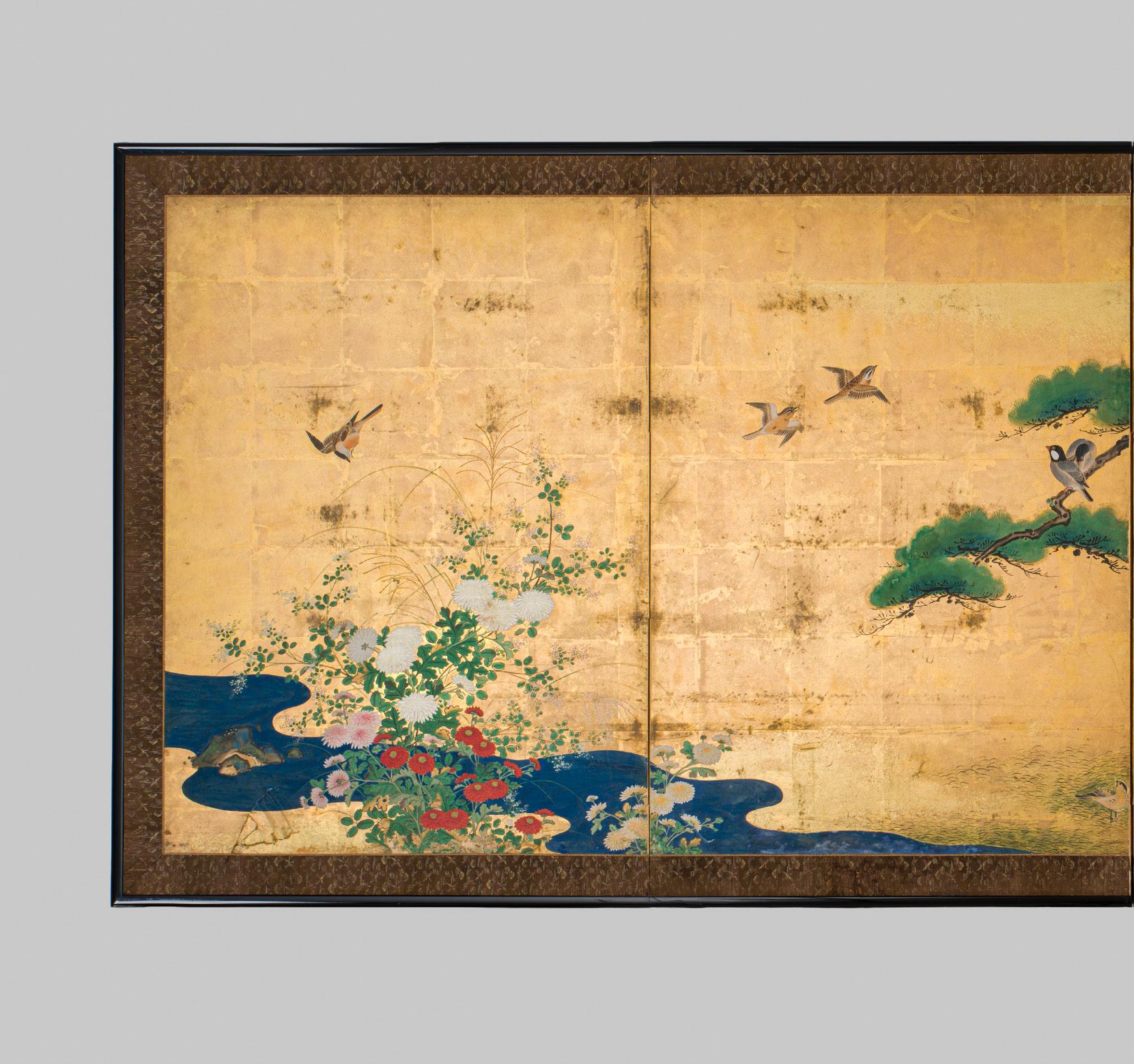
AN IMPRESSIVE KANO SCHOOL FOUR-PANEL ‘BIRDS IN AUTUMNNAL LANDSCAPE’ BYOBU (FOLDING SCREEN)
Japan, 17th-18th century, Edo period (1615-1868)
Ink, watercolors, gouache, and gold leaf on paper. Mounted on silk brocade on four lacquered wood panels with finely chased brass fittings, each pair of panels further supported within an elaborate secondary wooden framing structure, ideal for presentation on a wall. Finely painted with a group of sparrows (suzume), cinereous tits (shima enaga), and a Japanese robin (komadori), some perched on the lush branches of gnarled evergreen pine trees, amidst autumnal maple foliage and bamboo stalks. A small group of chicks is depicted nestled among verdant grasses, while others fly above
the scene, which is completed by a meandering stream bordered with blossoming chrysanthemums.
SIZE 100.3 x 266.4 cm
Provenance: The private collection of Mark Walberg, Pennsylvania, USA. Mark Walberg is a distinguished dealer and collector of Asian art, whose career spans more than half a century. He began collecting at the age of thirteen and, over the ensuing fifty-five years, established an international reputation through his work with major auction houses, as well as through consulting and appraisal services for some of the most respected figures in the field. Condition: Good condition with old wear and good, well-preserved colors. The image with minor soiling, indented tears, small losses, flaking to pigment, wear to gold leaf. Small touchups and associated restorations. The back with traces of wear and handling.
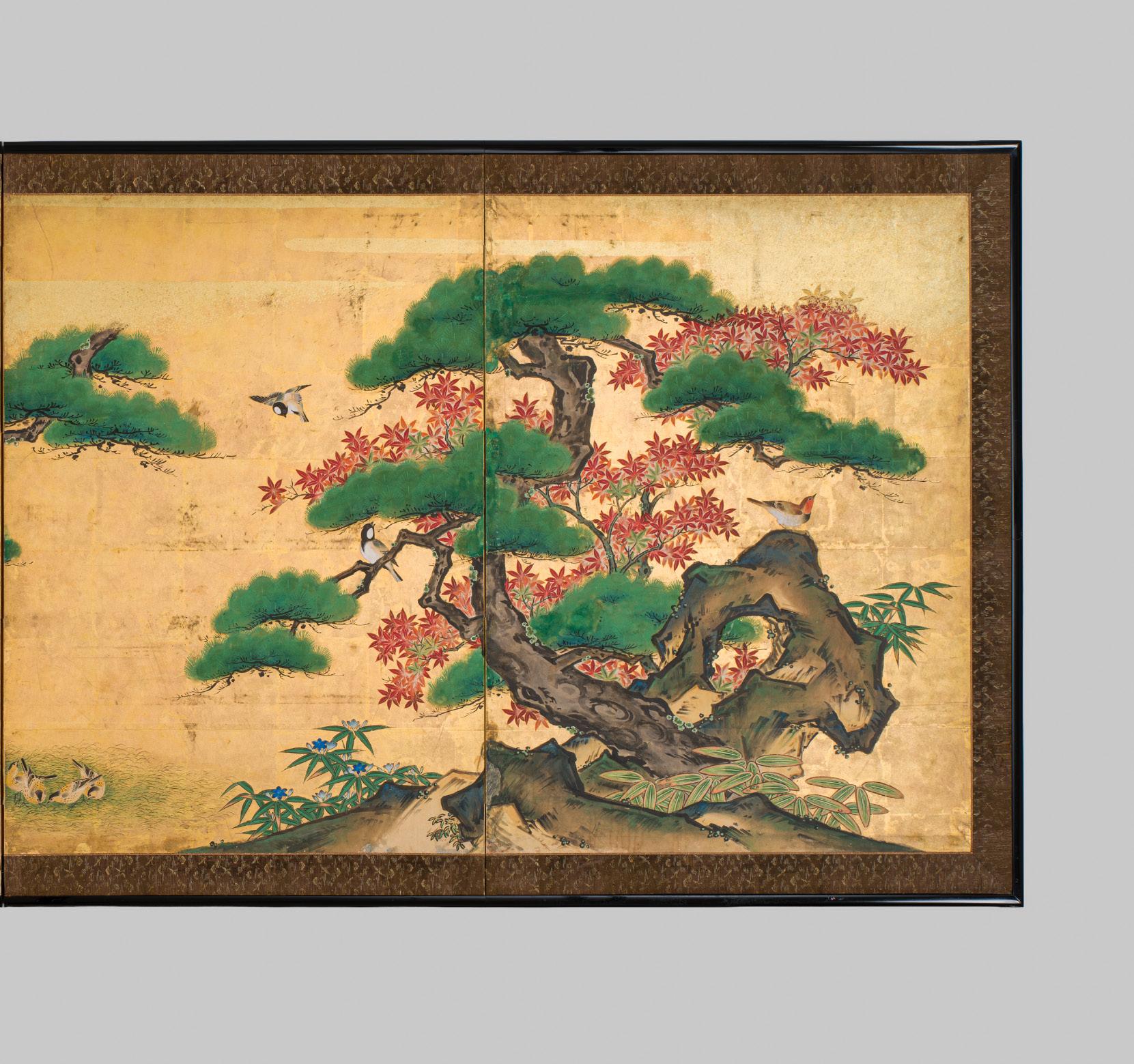
The present folding screen displayed next to lot 179 in the mansion of Mark Walberg in Sunbury, Pennsylvania, once the residence of the first senator of the state, William Maclay
MUSEUM COMPARISON
Compare a closely related Kano school six-panel byobu (folding screen) depicting birds and flowers of the four seasons, attributed to Kano Takanobu (1571-1618) or his school, 172.5 x 63.5 cm, in the National Museum of Korea, collection number 10029.
Estimate EUR 8,000
Starting price EUR 4,000
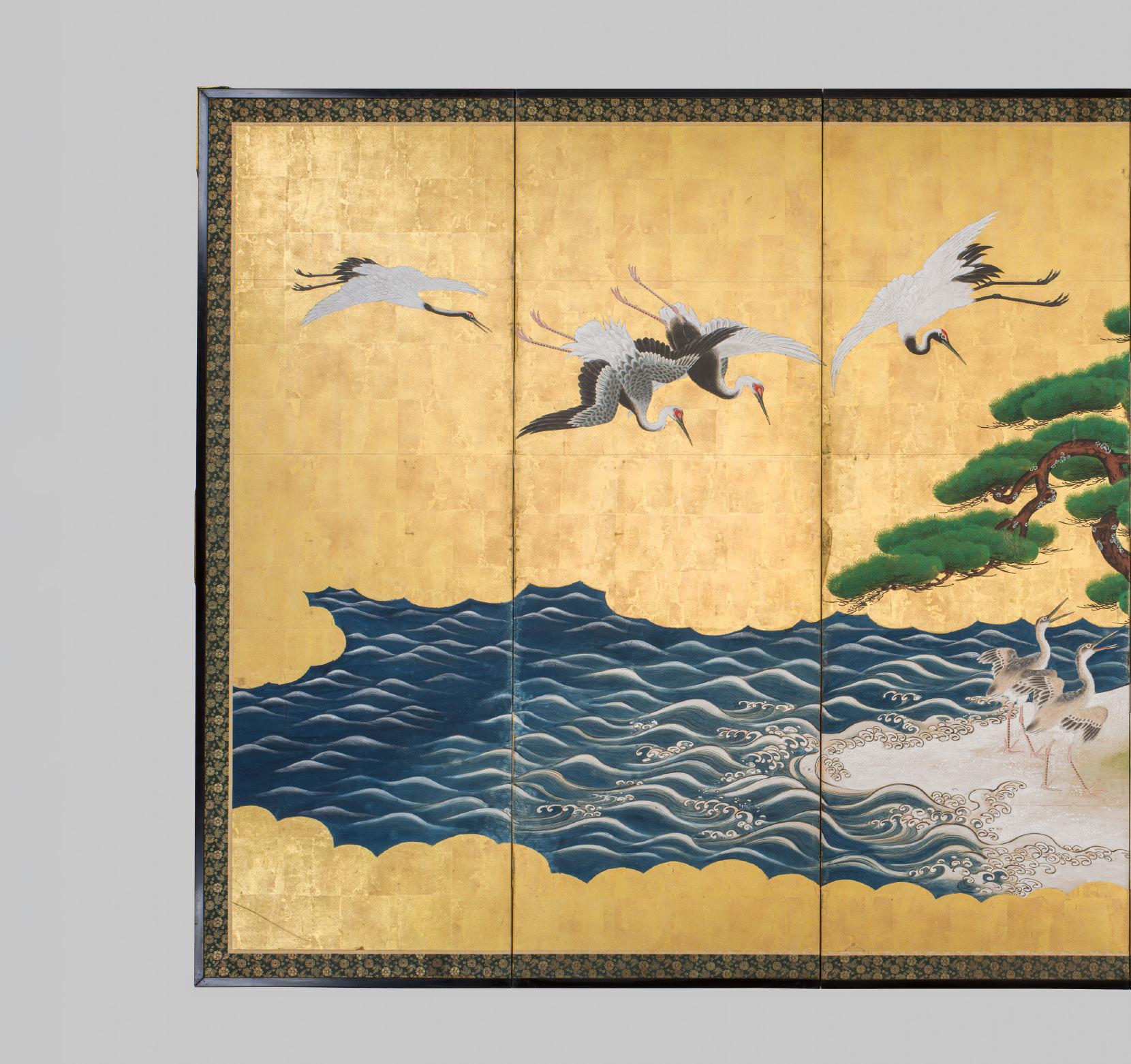
274
A FINE KANO SCHOOL SIX-PANEL
Japan, 18th century, Edo period (1615-1868)
Ink, watercolors, gouache, and gold leaf on paper. Mounted on silk brocade on six lacquered wood panels with finely chased floral gilt brass fittings. Finely painted with a group of red-capped cranes (tanchozuru) standing with their young before gnarled, luxuriant pine trees, while others soar above the rippling waters surrounding them.
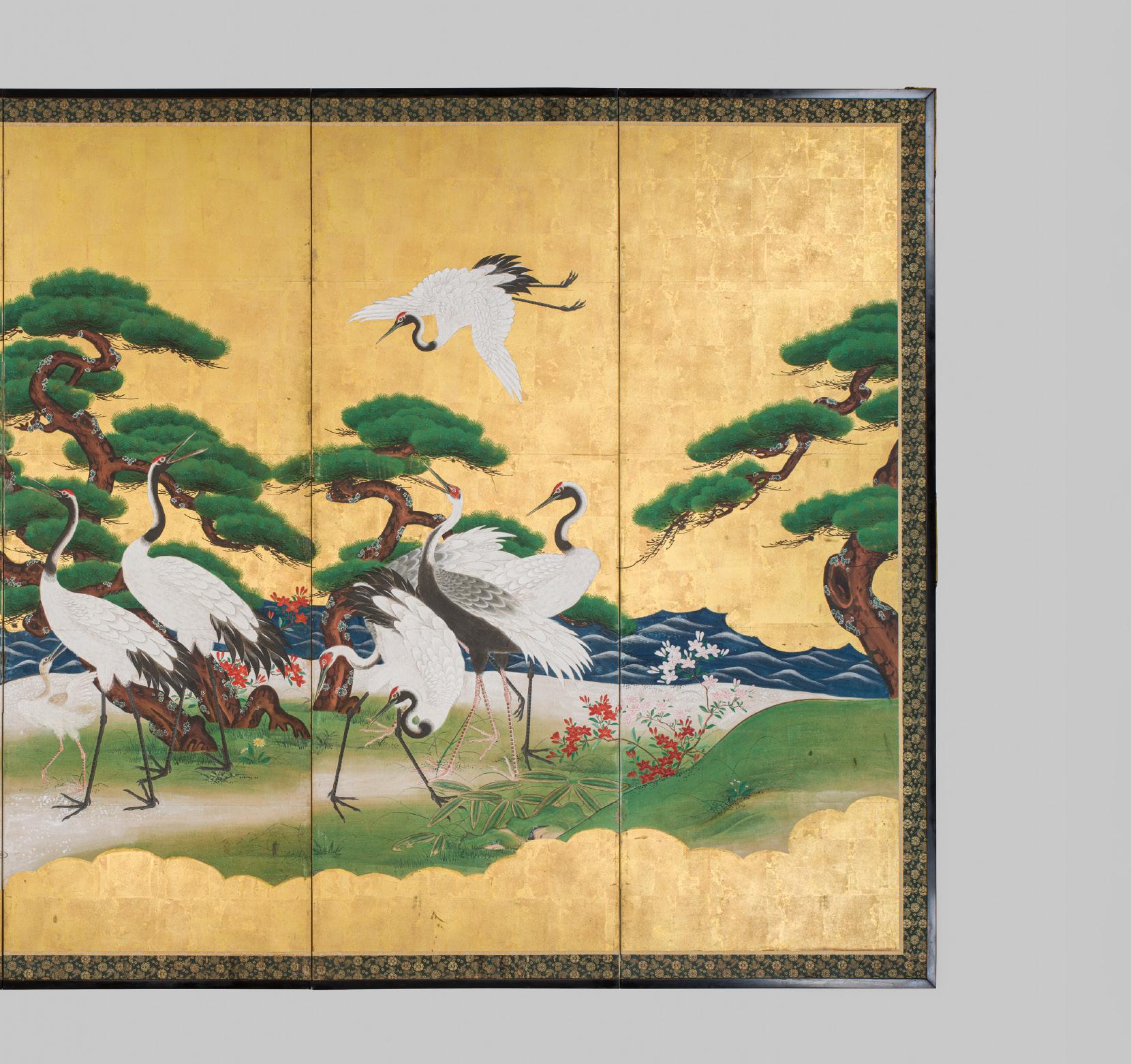
SIZE 182.9 x 377 cm
Condition: Excellent condition with minor wear and vibrant colors. The back with traces of wear and use. Minute expected tears to the joints.
The Kano school of painters was an artistic group composed of Kano male relatives as well as talented students who were granted the family name. The Kano school provided paintings for temples and palaces in Japan’s capital cities for generations. The artists prided themselves on their knowledge of Chinese painting styles, which they adapted for Japanese tastes.
Compare a closely related six-panel byobu (folding screen) depicting red-crested cranes and their chicks among pine trees and swirling waters, dated 18th century, 170.7 x 61.7 cm, at Sotheby’s, Japanese Works of Art from Private Collections, London, 5 October 2023, lot 2 (sold for GBP 10,795 or approx. EUR 13,500 converted and adjusted for inflation at the time of writing).
Estimate EUR 15,000 Starting price EUR 7,500
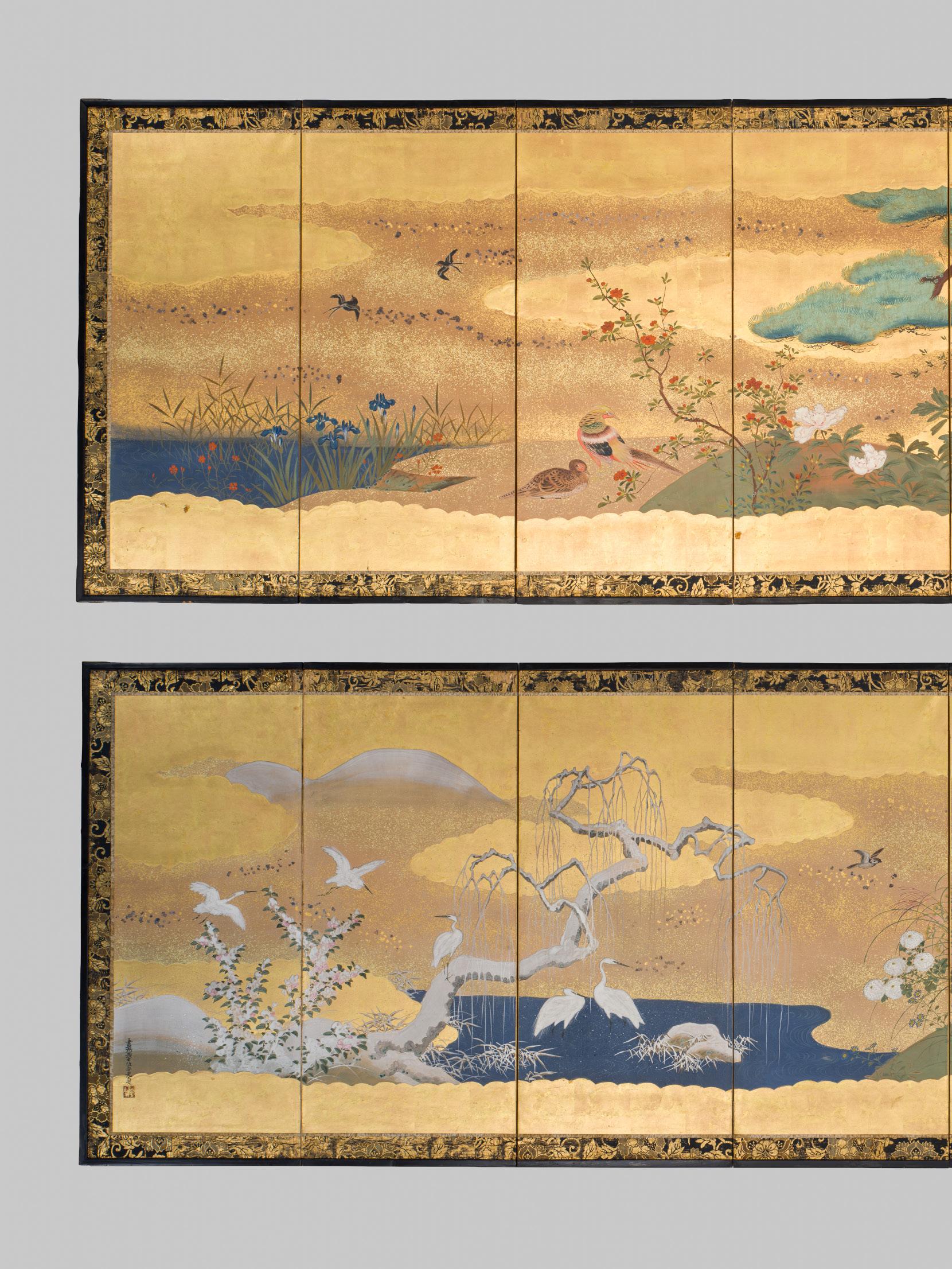
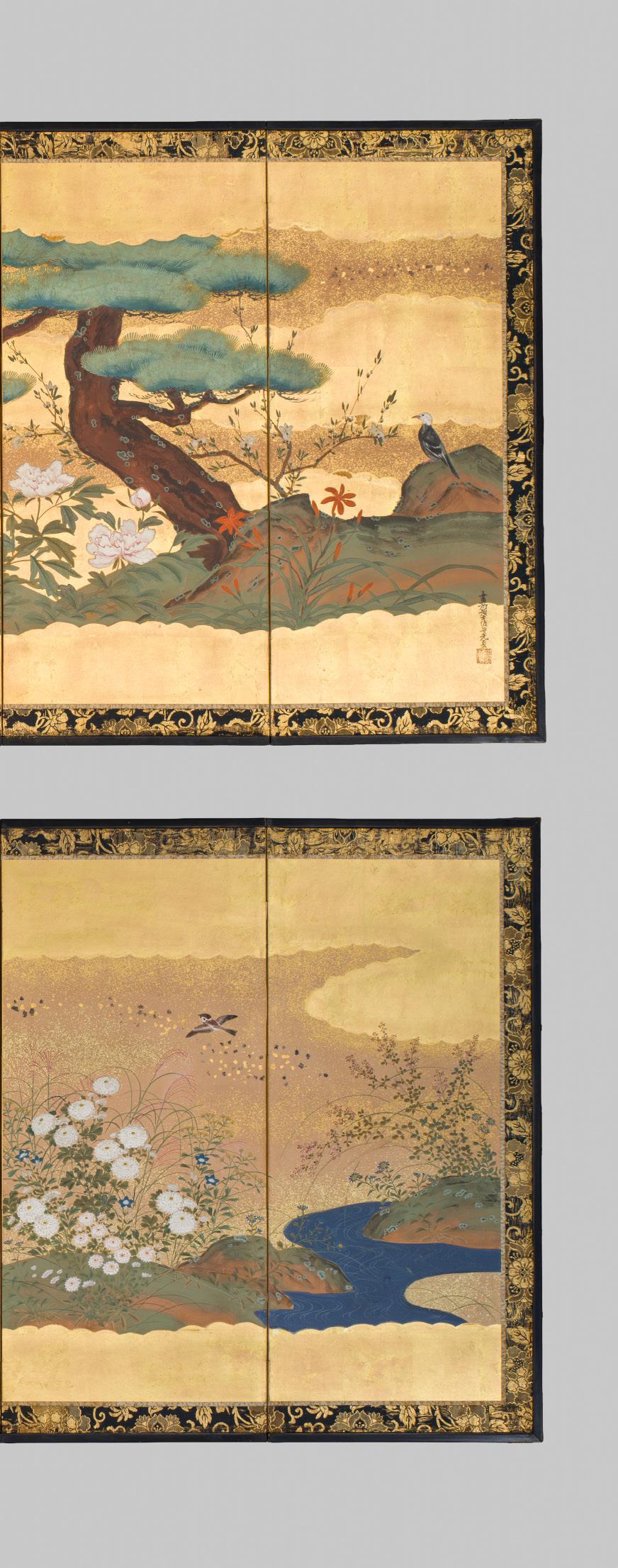
275
TOSA MITSUSADA: A SUPERB PAIR OF SIX-PANEL ‘BIRDS AND FLOWERS’ BYOBU (FOLDING SCREENS)
By Tosa Mitsusada (1738-1806), signed Edokoro azukari Tosa no kami Mitsusada and sealed Gain jisho Japan, late 18th-early 19th century, late Edo period (1615-1868)
Ink, watercolors, and gold leaf on paper. Each mounted on silk brocade on six black lacquered wood panels with metal fittings.
The first, meticulously painted with a composite scene of seasonal flora, centered on a gnarled willow dusted with snow, alongside a cluster of camellias (tsubaki) similarly laden, evoking the quiet persistence of winter while subtly suggesting the imminent arrival of spring. Snow-capped mountains rise in the background, and a gently flowing stream winds through the composition, inhabited by egrets and a pair of sparrows soaring above.
The second, finely rendered with a variety of birds delicately arranged around a lush evergreen pine, set amid blooming hibiscus (haibisukasu), white peonies (shakuyaku), and irises (shobu), celebrating the advent of spring and the approach of summer. Windblown reeds line the edge of a serene pond, above which a pair of swallows (tsubame) flutters gracefully, all interspersed by sweeping clouds.
The reverses of both screens are decorated with young pines beneath clouds dusted in gold and silver.
Inscriptions: Each signed to the bottom right Edokoro azukari Tosa no kami Mitsusada 画所預土佐光貞 [Tosa Mitsusada in charge of Painting Atelier to the Court] and sealed Gain jisho 画院持詔 [Head of Painting Bureau].
SIZE 84 x 217 cm (each)
Condition: Very good condition with minor wear and vibrant colors. Little soiling, minor flaking, and small losses to gold leaf. The back with expected traces of wear and use and minuscule tears.
Tosa Mitsusada (1738-1806), also known as Fujiwara no Mitsusada, was the second son of Tosa Mitsuyoshi (1700-1772) and a leading figure of the Tosa school. Appointed Edokoro azukari (official painter to the Imperial Court) in 1754, he played a central role in maintaining and transmitting the classical Yamato-e tradition. In 1789, during the renovation of the Kyoto Imperial Palace, he was commissioned to produce sliding door (fusuma) paintings, and he continued to receive court patronage throughout his career, attaining high court rank before being succeeded by his son, Tosa Mitsufu, in 1806.
For a related Tosa school painting executed in a similar style, by Tosa Mitsuoki (1617-1691), see The Metropolitan Museum of Art, New York, object number 2014.768.1.
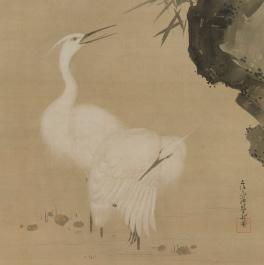
Estimate EUR 10,000
Starting price EUR 5,000
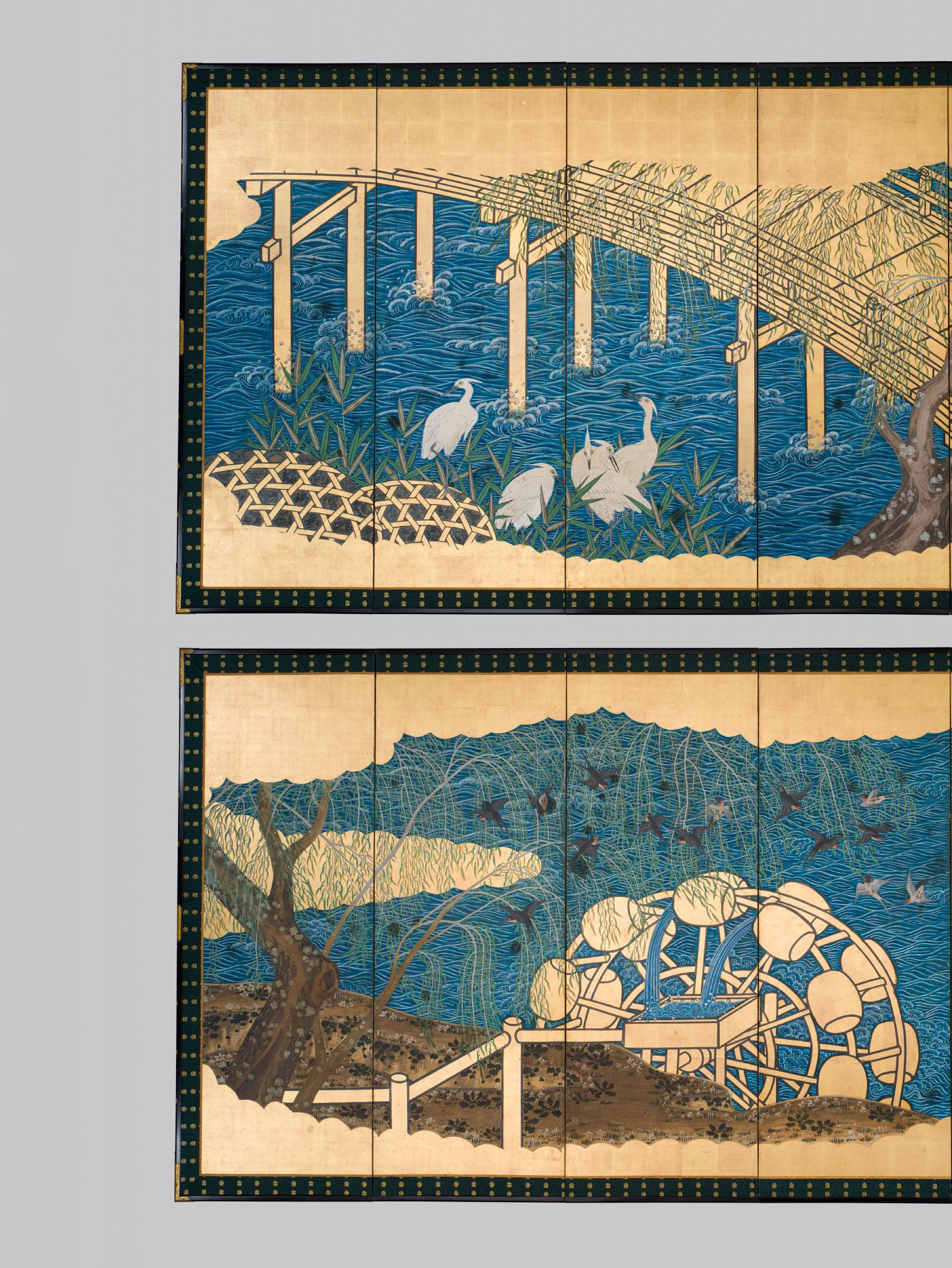
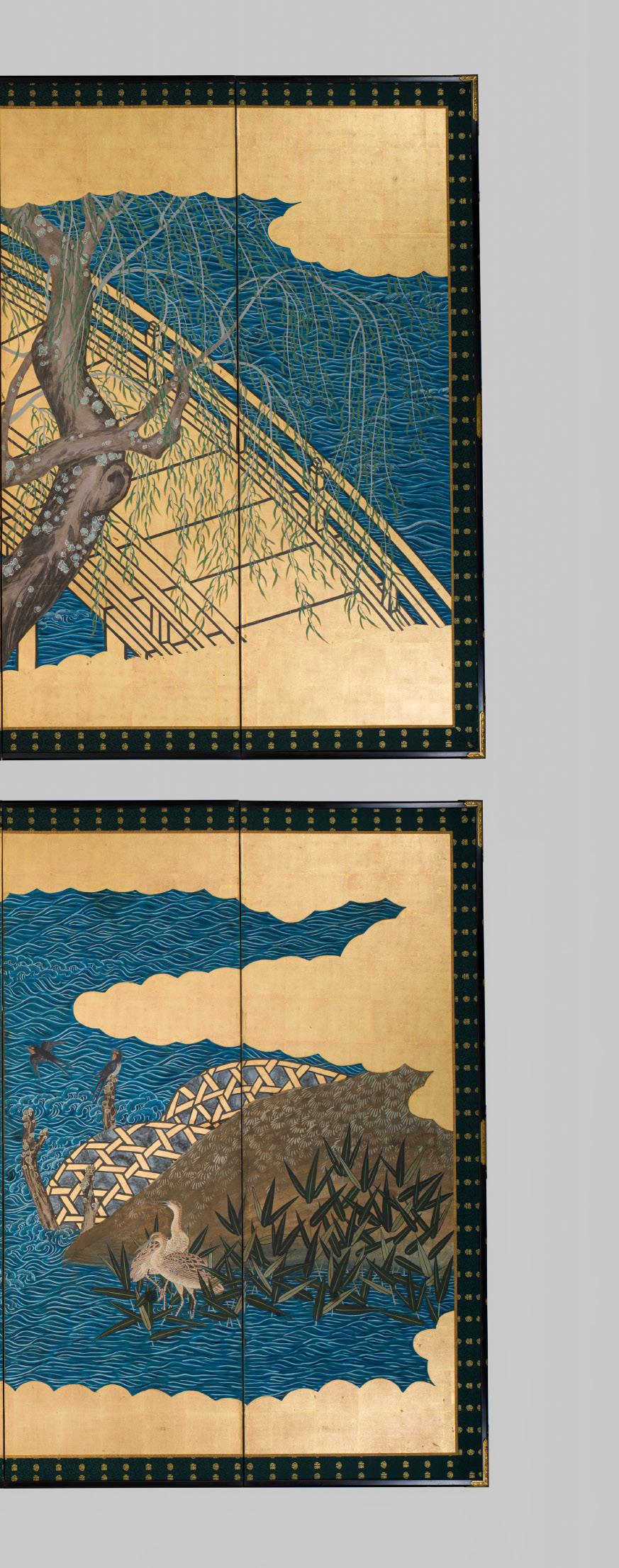
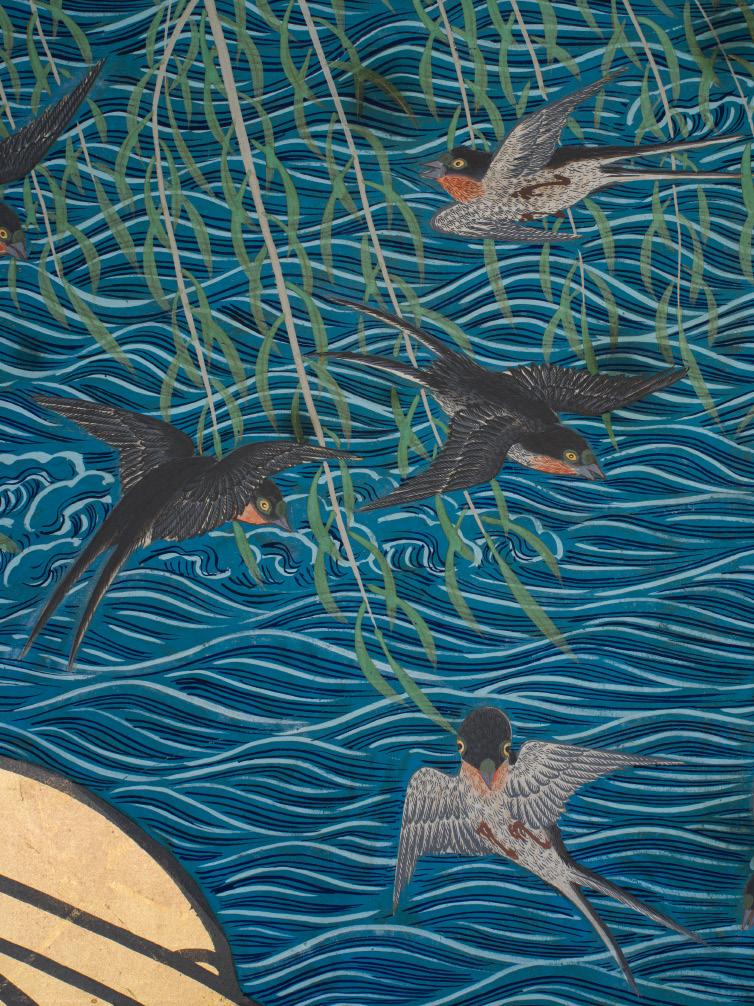
276
Japan, 19th century, late Edo period (1615-1868)
Ink, watercolors, gouache, gold paint, and gold foil on paper. Each mounted within a silk brocade frame on six lacquered wood panels with gilt-metal fittings incised with foliate scrolls bearing chrysanthemum blossoms. The first panel painted with an overbridge over the Uji river, a large willow to one side, and a few egrets and jakago (stone filled baskets) to the shore. The second, similarly detailed, with egrets, jakago, reeds, and willow; a large waterwheel to the center and a flock of swallow flying above. The strong architectural lines of the bridge are softened by the round forms of a waterwheel and jakago which form the embankment.
SIZE 173.5 x 364 cm (each)
Condition: Excellent condition with minor wear and vibrant colors. Little soiling and minuscule flaking to pigment. The back with traces of wear and use.
This pair of six-panel folding screens captures the iconic Uji River bridge in Kyoto, a scene immortalized in The Tale of Genji and celebrated in Japanese poetry since the 8th century. Depicting willows, a bridge, and a waterwheel, the screens evoke the tranquil yet dynamic nature of the river, with egrets fluttering over the gentle waves and stone-filled baskets protecting the embankments. The Uji River’s natural beauty is further intertwined with religious significance, as the area became home to the Byodoin temple in the 11th century, designed as a replica of Amida Buddha’s Western Paradise. Symbolically, the bridge may represent a connection between the earthly realm and the Pure Land, blending the river’s cultural and spiritual importance.
Estimate EUR 10,000
Starting price EUR 5,000
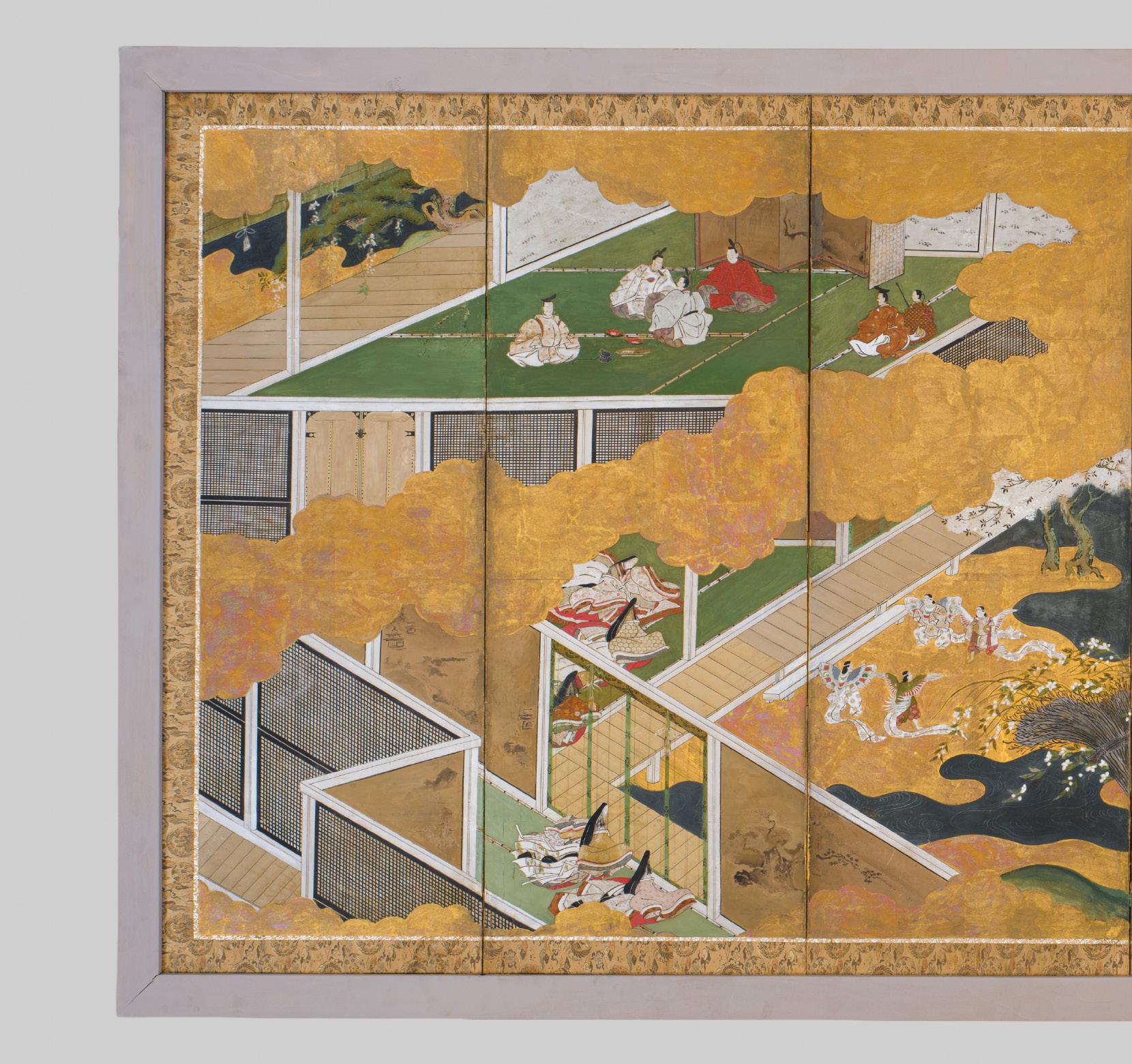
A FINE SIX-PANEL ‘TALE OF GENJI’ BYOBU (FOLDING SCREEN)
Japan, 17th-18th century, Edo period (1615-1868)
Ink, watercolors, gouache, gold paint, and gold foil on paper. Mounted on silk brocade on six wood panels supported within a secondary wooden framing structure. Exquisitely painted to depict court scenes from the Tale of Genji including a celestial boat, serene garden settings with blossoming trees, and a procession of dignitaries, all framed by sweeping clouds of gilt above and below.
Image SIZE 126.5 x 281.5 cm, SIZE incl. frame 139.3 x 291.4 cm
Provenance: From an old private collection in Southeastern France.
Condition: Good condition with old wear and scattered soiling. The image with scattered tears, small losses, and flaking to pigments – many with associated touchups and restoration. The back with signs of wear, small losses, and tears.
The Tale of Genji captures the refined aesthetics of Heian court life, where aristocrats valued seasonal beauty and poetic sensitivity as measures of character and status. This screen painting reflects that world, with figures seated in a palace interior - partially opened to the landscape - contemplating flowering trees that echo the novel’s recurring themes of impermanence and longing. Just as in Genji, the architectural openness blurs the boundary between human emotion and the natural world, making nature a silent participant in the story of love and courtly life.
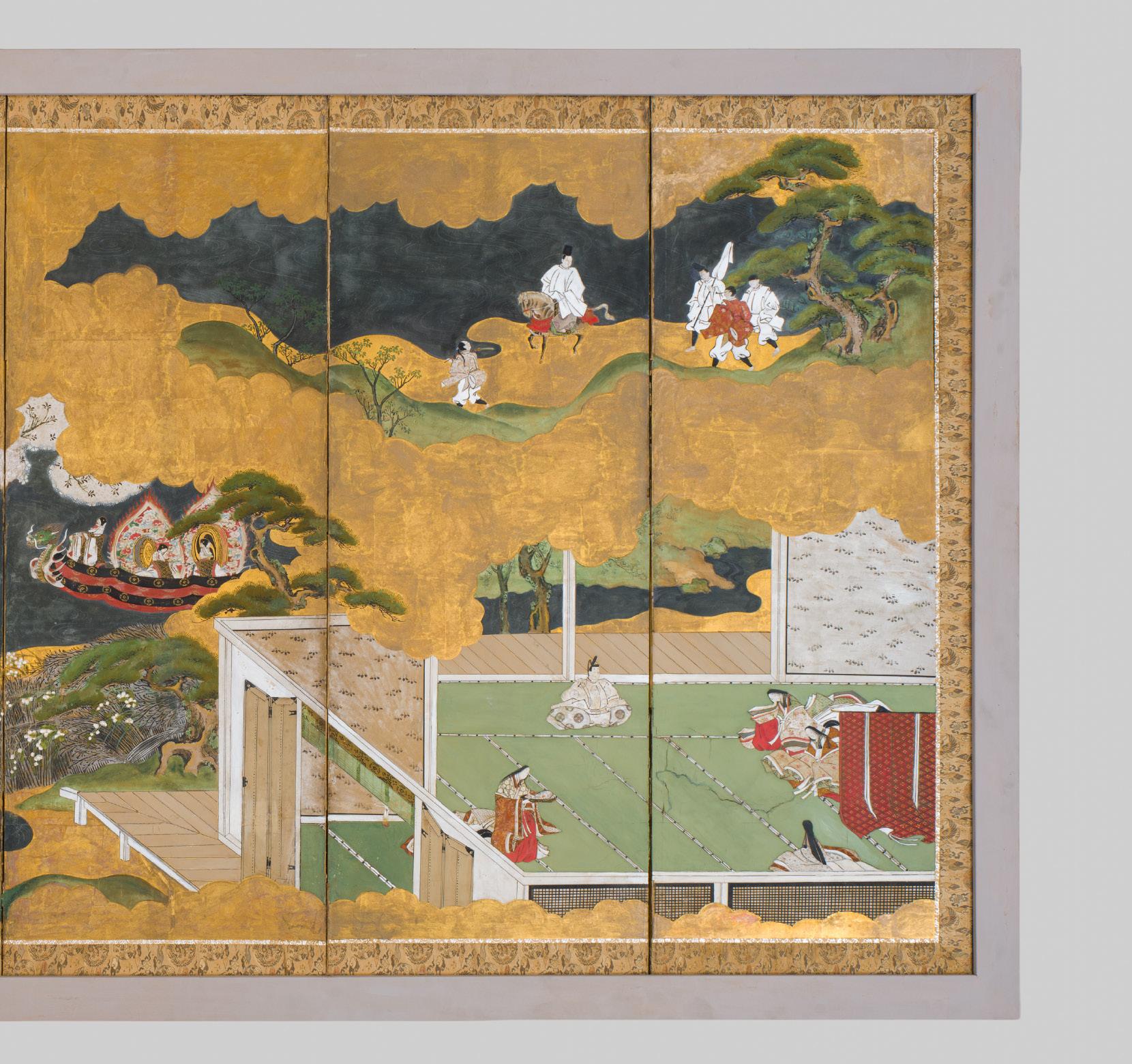
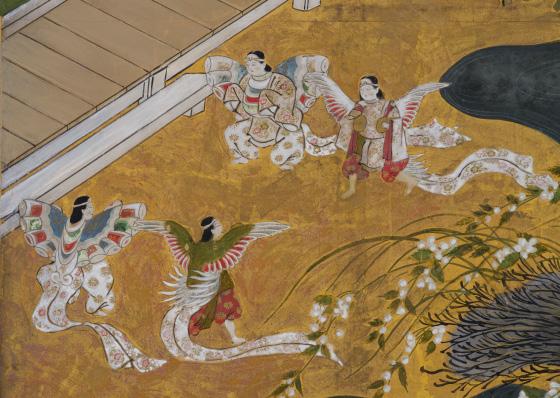
MUSEUM COMPARISON
Compare a closely related six panel screen depicting scenes from the Tale of Genji, dated to 1600-1700, 91 x 232 cm, in the Art Gallery of South Australia, accession number 997A40.
AUCTION COMPARISON
Compare a closely related later pair of six-fold screens depicting scenes from the Tale of Genji, dated 19th century, 151 x 362.8 cm, at Christie’s, Japanese and Korean Art, 23 March 2000, New York, lot 175 (sold for USD 23,000 or approx. EUR 37,000 converted and adjusted for inflation at the time of writing).
Estimate EUR 8,000 Starting price EUR 4,000
278
A FINE PAIR OF SIX-PANEL BYOBU
(FOLDING SCREENS) DEPICTING A HUNTING SCENE ON THE PLAIN OF MOUNT FUJI
Japan, late 17th-18th century, Edo period (1615-1868)
Ink, watercolors, gouache, and gold foil on paper. Each mounted within a silk brocade frame on six lacquered wood panels with gilt-metal fittings incised with foliate scrolls. Finely painted with a mountainous landscape depicting several wild boars, rabbits, and deer being pursued by determined hunting party, few on horseback while others on foot, holding bows and arrows, halberds (naginata), and large swords; a view of the tall peak of Mount Fuji to the back.
SIZE 175 x 367 cm (each)
Inscriptions: The wood tomobako inscribed
月求 Endo shi, Taisho jugo-nen shigatsu motome [This is acquired by The Endo Family, in the fourth month of the Taisho 15 (1926)]
Provenance: The private collection of the Endo Family, acquired in 1926 (according to the tomobako).
Condition: Good condition with wear and good colors. Some soiling, few stains, and flaking to pigment. Small losses with associated repairs and touchups. Expected flaking to gold foil. The back with signs of wear and use.
With an inscribed wood storage box that holds both screens.
The present pair of screens depicting a hunting scene before Mount Fuji likely references Minamoto no Yoritomo (11471199), the founder and first shogun of the Kamakura shogunate in Japan. In May 1193 he hosted a boar hunting party near Mount Fuji, where a giant boar charged at him which Nitta no Shiro (also known as Tadatsune) bravely slayed, saving Yoritomo.
AUCTION COMPARISON
Compare a closely related six-panel byobu (only one) depicting a hunting scene before Mount Fuji, Edo period, dated late 17th century, at Sotheby’s, Pursuit of an Ideal: Fine Japanese Works of Art, 5 November 2021, London, lot 60 (sold for GBP 35,280 or approx. EUR 51,000 converted and adjusted for inflation at the time of writing).
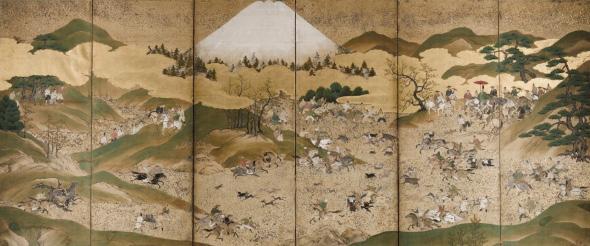
Estimate EUR 10,000
Starting price EUR 5,000
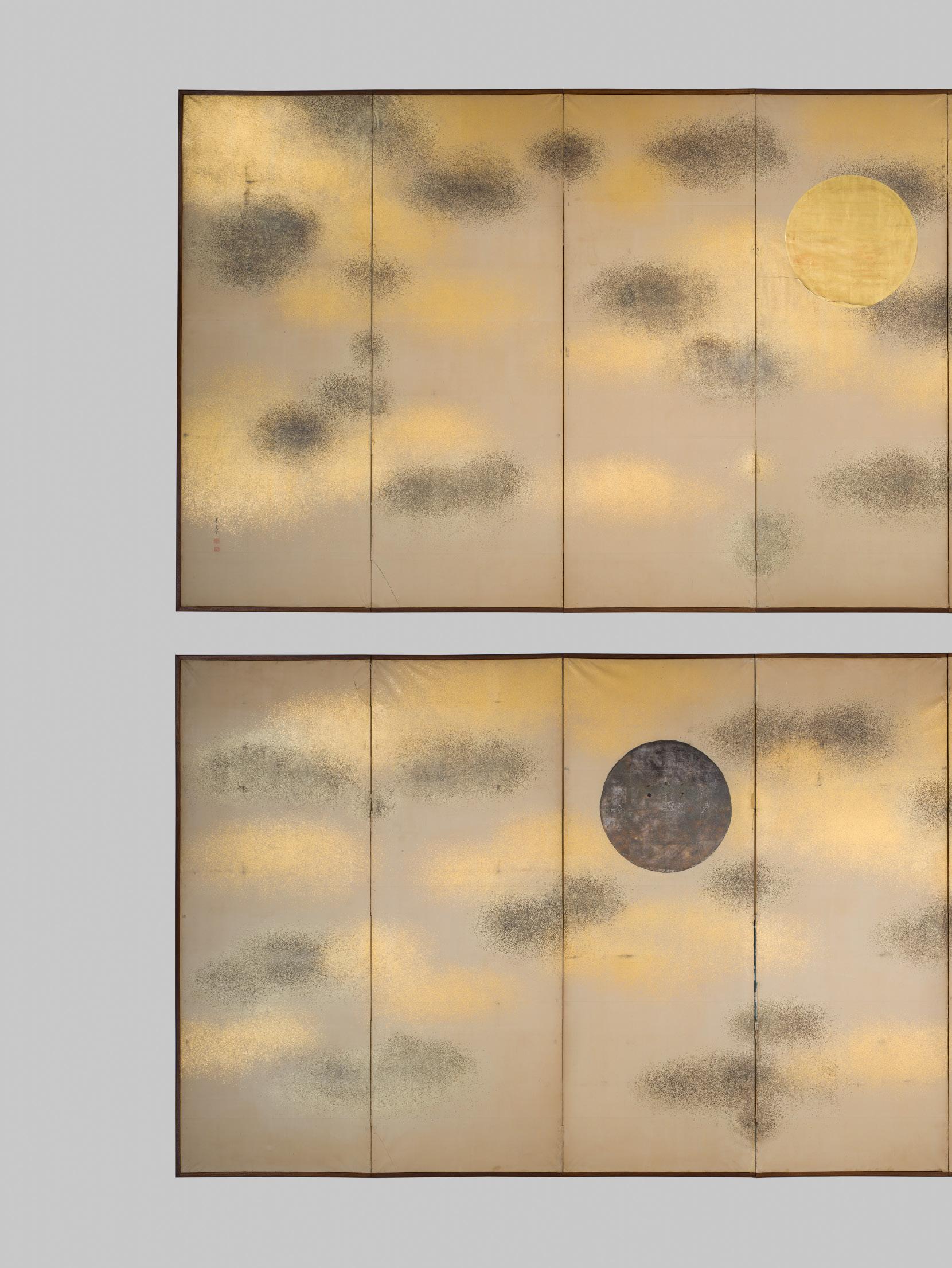
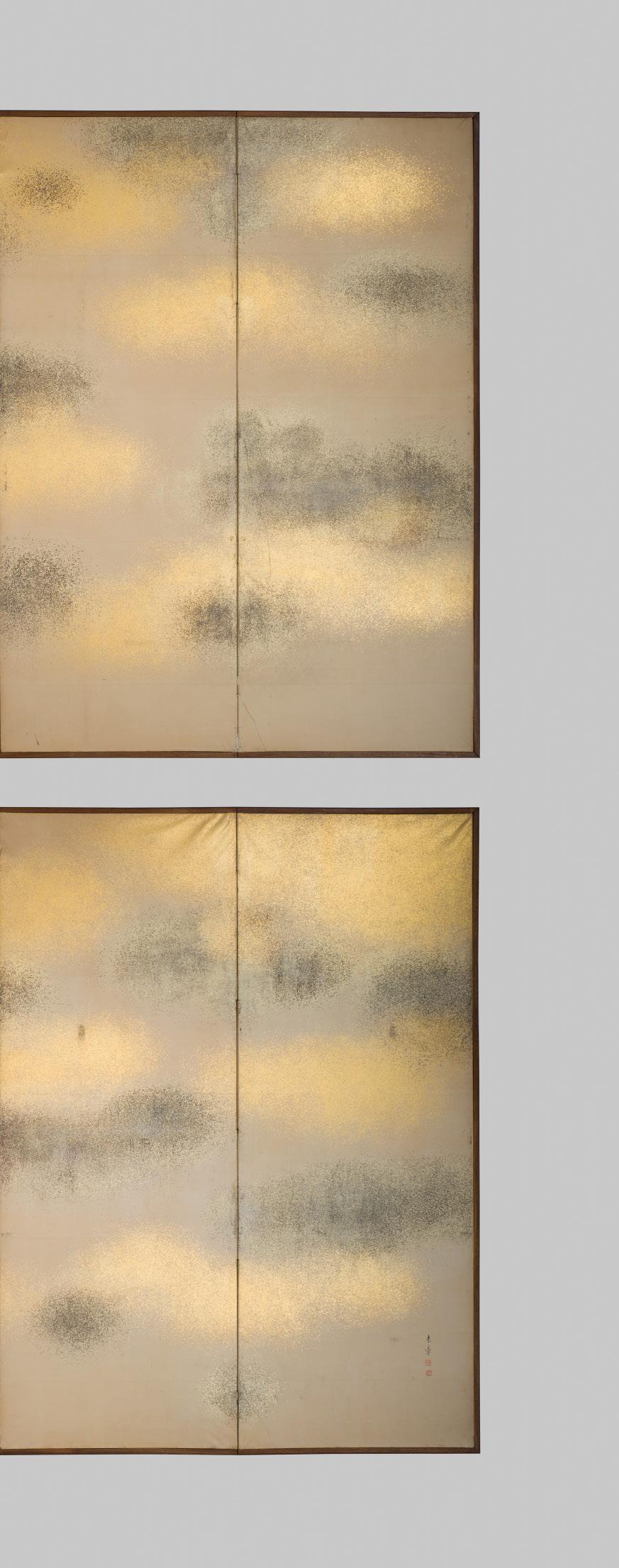
By Nakajima Raisho (1796-1871), signed Raisho and sealed Shin Raisho no in Shikei uji Japan, 19th century, Edo period (1615-1868)
Ink, silver and gold paint on paper. Each mounted on six wood panels. The pair presents a refined and atmospheric depiction of the sun and moon. One screen is exquisitely painted with a radiant golden sun emerging through a field of softly drifting clouds, rendered using a delicate sprinkling technique that creates a subtle sense of depth and movement. The companion screen mirrors this composition with a full moon set amid similarly treated clouds, establishing a harmonious balance between the two. The celestial discs are executed in gold and silver leaf respectively, their luminous surfaces contrasting elegantly with the finely modulated cloud forms.
Inscriptions: Each screen signed Raisho, 来章 and sealed Shin Raisho no in Shikei uji [Raisho, descendant of the Shikei family].
SIZE 171.5 x 361 cm (each)
Provenance: Milne Henderson Gallery, London, 1981. A copy of an invoice from Milne Henderson Gallery, dated 16 February 1981, stating a purchase price of GBP 21,275 or approx. EUR 100,000 (converted and adjusted for inflation at the time of writing), accompanies this lot. Condition: Good condition with wear, flaking to pigment, and scattered tears with associated losses. The back with traces of wear and use. Tears and losses to the joints with associated reinforcements.
Nakajima Raisho (1796-1871), a native of Kyoto, honed his artistic skills under the tutelage of Watanabe Nangaku and Maruyama Ozui, esteemed disciples of Maruyama Okyo. Renowned for his mastery of the Shijo style, Raisho excelled in the delicate art of kacho-ga, depicting birds and flowers with exquisite realism. His captivating works are showcased in prestigious collections worldwide, including the British Museum, the Museum of Fine Arts, Boston, and the Smithsonian’s National Museum of Asian Art.
Compare a related fourpanel screen depicting ducks under a pine tree in the sunlight by the same artist, signed Raisho, 156.3 x 256.6 cm, at Christie’s, Japanese and Korean Art, 22 March 2002, New York, lot 116 (sold for USD 12,925 or approx. EUR 20,500 converted and adjusted for inflation at the time of writing).
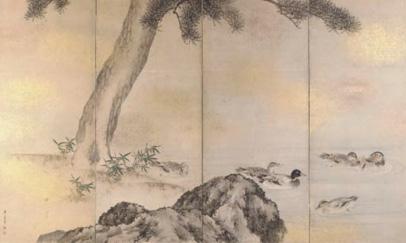
Estimate EUR 15,000 Starting price EUR 7,500
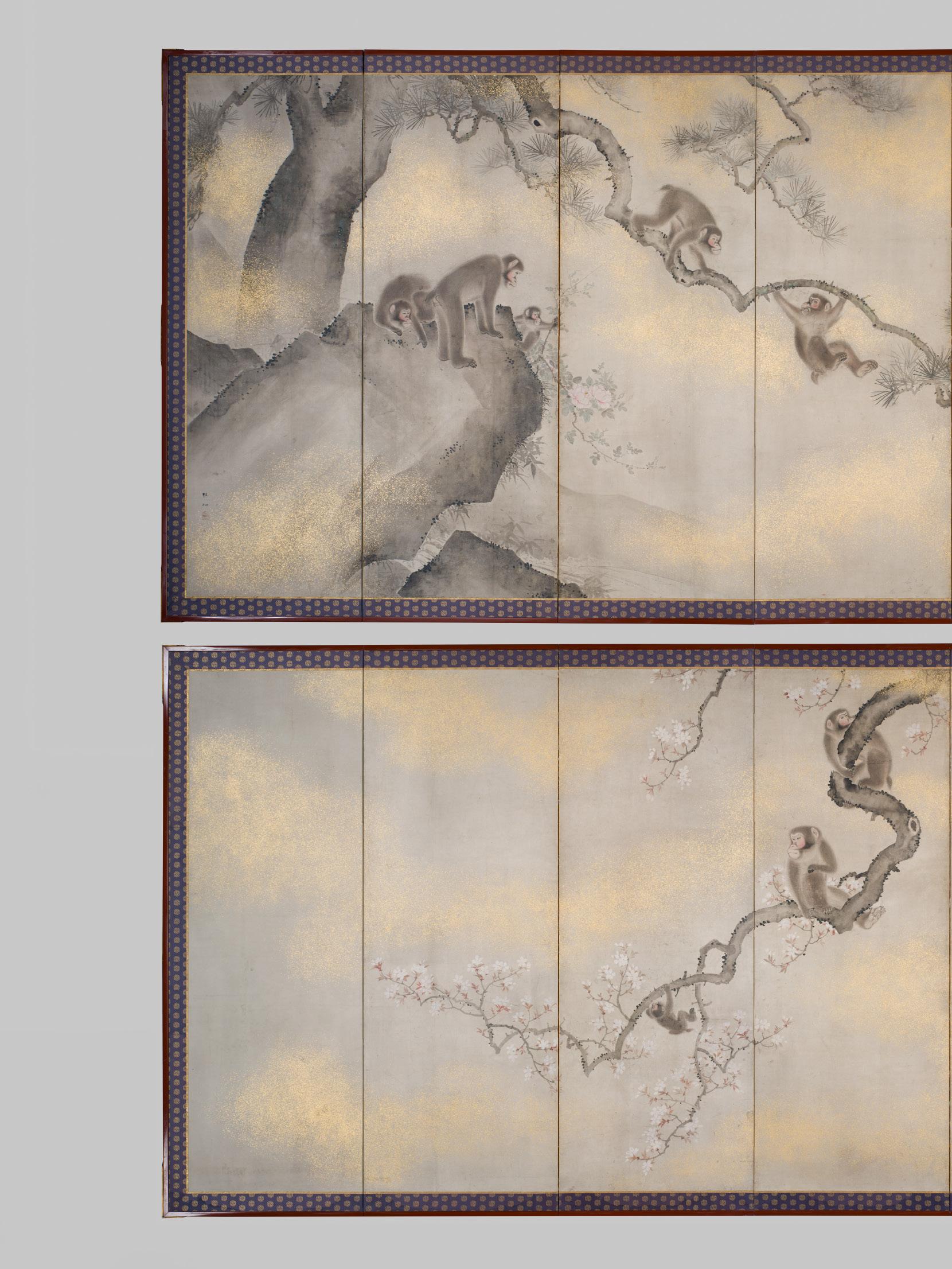
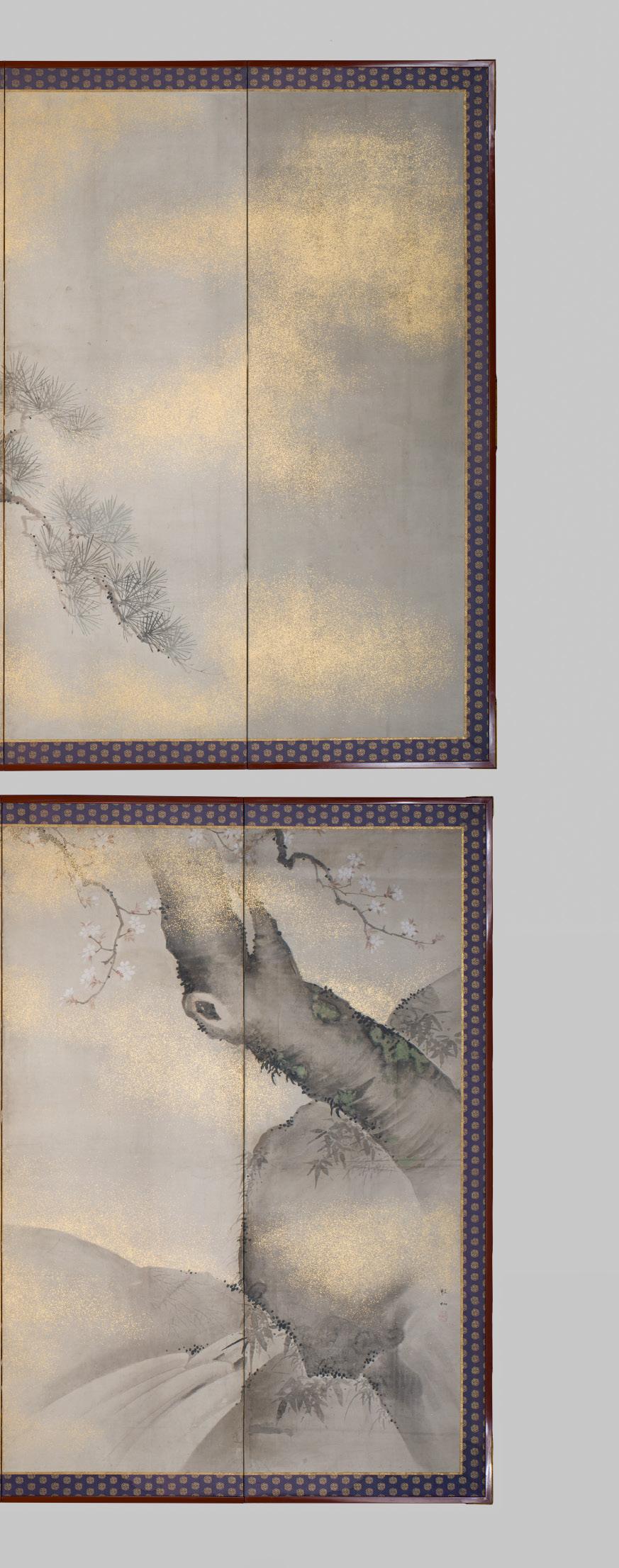
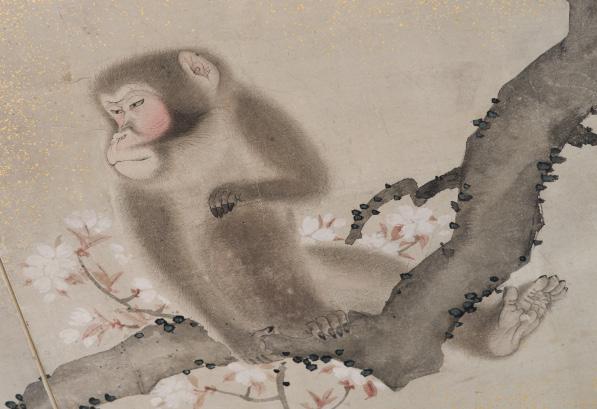
280
MORI SOSEN: AN IMPRESSIVE AND VERY FINE PAIR OF SIX-PANEL ‘MONKEYS’ BYOBU (FOLDING SCREENS)
By Mori Sosen (1747-1821), signed Sosen with seal Morikata Japan, late 18th-early 19th century, Edo period (1615-1868)
Ink, watercolors, gouache, and gold paint on paper. Mounted on silk brocade and set within six lacquered wood panels with finely chased and ring-punched brass fittings incised with karakusa. The pair presents complementary scenes of macaque monkeys in seasonal settings. One screen depicts monkeys animatedly moving among the branches of a pine tree, while the other shows monkeys climbing a flowering cherry tree. The animals are rendered with remarkable vitality, their postures lively and varied, and their fur described with soft, naturalistic brushwork.
Inscriptions: One signed to the lower right, the other to the lower left, Sosen (狙仙), each with a red seal Morikata (守象), the artist’s given name.
SIZE 178 x 364 cm (each)
Provenance: Koller, Asiatica, 30 September 2008, Zurich, lot 490 (mid-estimate CHF 25,000 or approx. EUR 28,500 converted and adjusted for inflation at the time of writing).
Condition: Very good condition with minor wear, little soiling, few stains, and minor rubbing to pigments. The frame with traces of wear and use.
Mori Sosen (1747-1821), founder of the Mori painting school and active in Osaka, is celebrated as the foremost painter of monkeys in Japanese art, earning the sobriquet “Monkey Painter Sosen.”
Like his contemporary Maruyama Okyo, he worked from direct observation, producing studies of remarkable immediacy and realism. This approach is clearly evident in the present screens, where the nuanced rendering of fur and expressive movement of the animals exemplify his mastery.
AUCTION
COMPARISON
Compare a closely related six-panel screen of monkeys atop trees, after Mori Sosen, dated to the 19th century, 173 cm high, at Christie’s, The House Sale, 5 April 2006, New York, lot 438 (sold for USD 28,800 or approx. EUR 40,500 converted and adjusted for inflation at the time of writing). Compare a closely related large hanging scroll of monkeys, by Mori Sosen and also bearing the seal Morikata, at Zacke, Fine Japanese Art, 4 June 2021, Vienna, lot 265 (sold for EUR 15,168).
Estimate EUR 15,000
Starting price EUR 7,500
By Ichimura Hocho (1781-1822), signed Hocho and sealed Seiryo no in Japan, early 19th century, Edo period (1615-1868)
Ink, watercolors, and gold paint on paper. Mounted on six wood panels. Finely painted to depict a prowling tiger advancing across the composition, its mouth opened in a snarl and head turned back in a moment of heightened alertness. The fur is articulated with lively, varied brushwork, lending the animal a palpable sense of movement and vitality. The figure is set against a softly glowing ground, allowing the tiger to dominate the pictorial space. Above, the branches of a pine tree emerge only partially into view, their presence understated and subtly framing the scene rather than competing with the central motif. This restrained use of landscape elements enhances the dramatic isolation and tension of the tiger.
Inscription: To the upper right, signed Hocho 鳳頂 and sealed Seiryo no in 成亮之印
SIZE 171.5 x 361 cm
Condition: Very good condition with wear and some browning to paper. Little soiling, few stains, scattered foxing, and small tears with associated repairs. The back with signs of wear and use.
In Japanese visual culture, the tiger is a potent symbol of strength, courage, and protection.
Ichimura Hocho (1781-1822) was a painter active in Kyoto and a pupil of the renowned Kawamura Bunpo, from whom he inherited the character “Ho” in his name. Working within the Shijo tradition, Hocho combined the school’s emphasis on natural observation with a decorative sensibility suited to large-scale compositions such as screens. His works demonstrate a refined command of brushwork and composition, and he was particularly adept at depicting animals and birds with vitality and expressive force.
MUSEUM COMPARISON
For another work by the artist see a hanging scroll painting of a peacock in the Kyoto National Museum, photo no. 72275-31696.
Estimate EUR 6,000
Starting price EUR 3,000
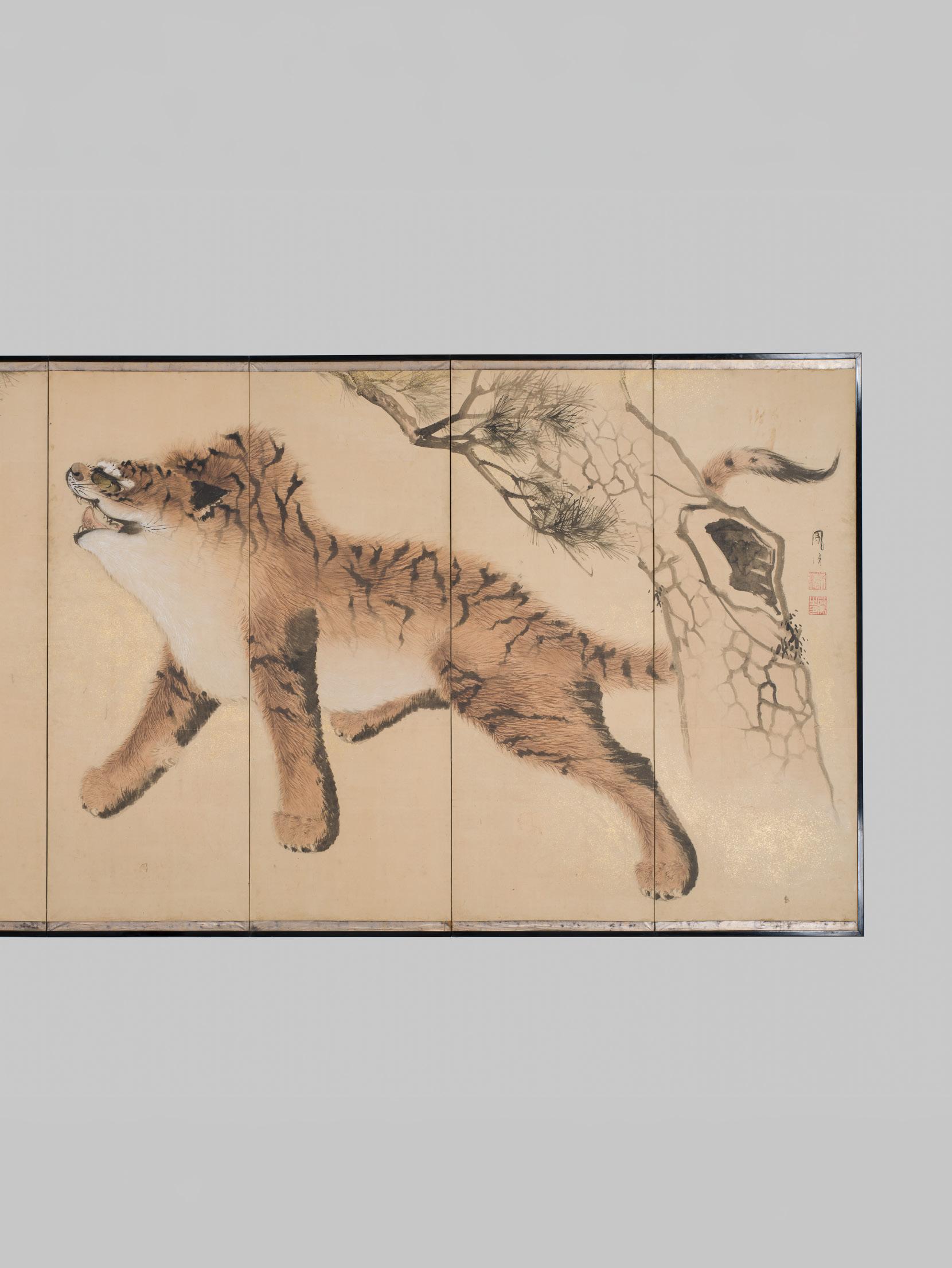
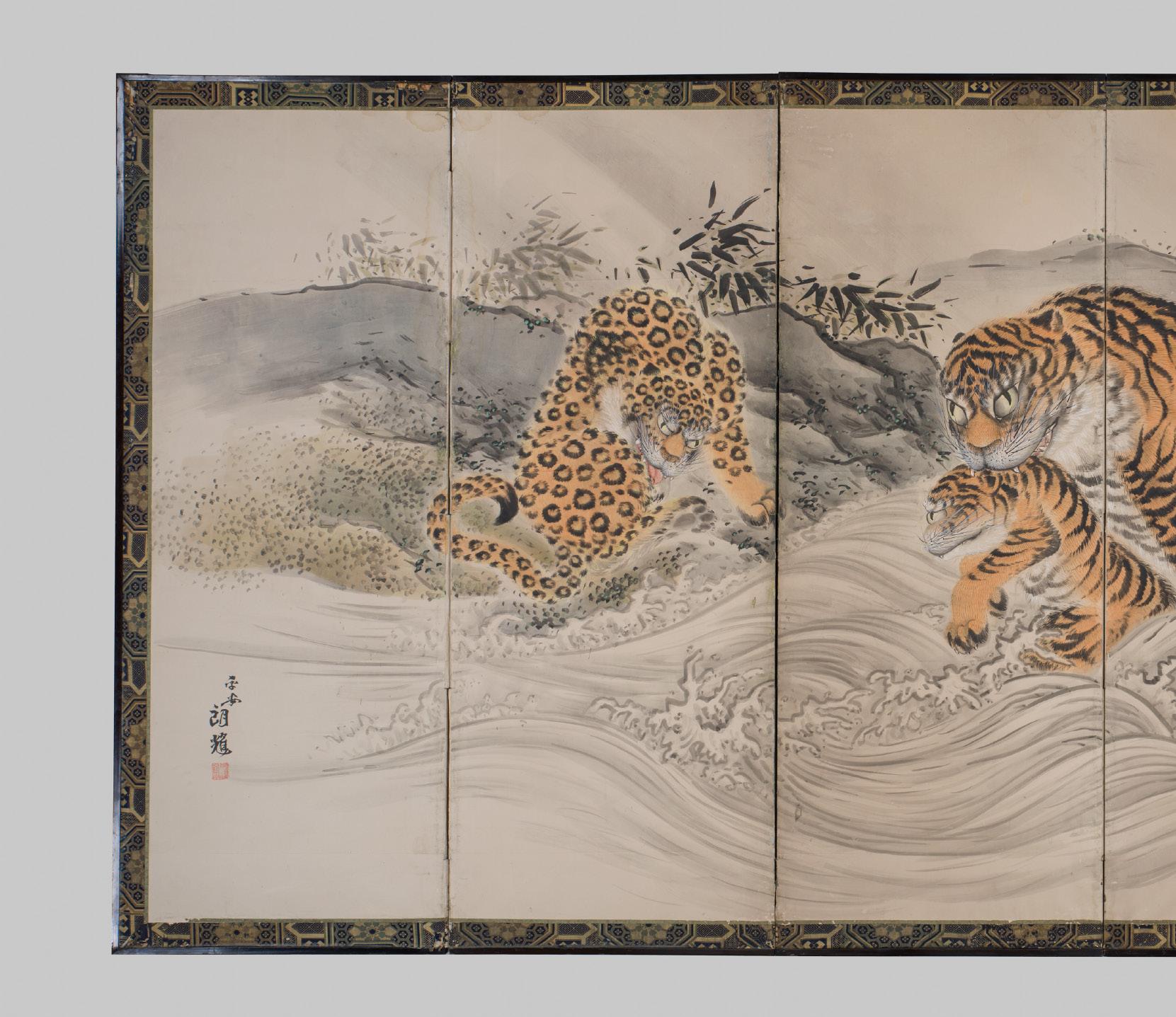
SASAKI EISHIN: A RARE AND IMPRESSIVE SIX-PANEL BYOBU ‘LEOPARD AND TIGERS’ (FOLDING SCREEN)
By Sasaki Eishin (active c. 1830), signed Heian Royo and sealed Royosai Japan, c. 1830, Edo period (1615-1868)
Ink, watercolors, and gouache on paper. Mounted on silk brocade on six lacquered wood panels with pierced metal fittings. Finely painted to depict a dramatic scene of a tiger leaping through the turbulent river, carrying its young, while a leopard grooms itself on the riverbank, surrounded by bamboo.
Inscriptions: To the left side, signed Heian Royo 平安朗耀 and sealed Royosai 朗耀斎
SIZE 171 x 381 cm
Condition: Good condition with old wear. Some soiling, few stains, and small indented tears. The back with signs of wear and use and insect activity. The joints and sections of the back reinforced. Presenting beautifully.
Sasaki Eishin, active in the early 19th century, appears to have worked in Kyoto (as suggested by the use of “Heian” in his signature) and was likely influenced by the Maruyama-Shijo tradition as well as the powerful animal imagery associated with the Kishi school.
The composition reflects a Japanese understanding of tiger imagery derived from Chinese models, adapted in a culture where tigers were known, though not native to Japan. In premodern Japan, the leopard (hyo) was often understood as the female counterpart of the tiger, and the present scene may therefore be read as a tiger and its mate carrying their young across a turbulent river. The image conveys themes of parental care, cooperation, and protection, while also illustrating how imported continental motifs were reinterpreted within Japanese visual culture through observation, imagination, and inherited convention.
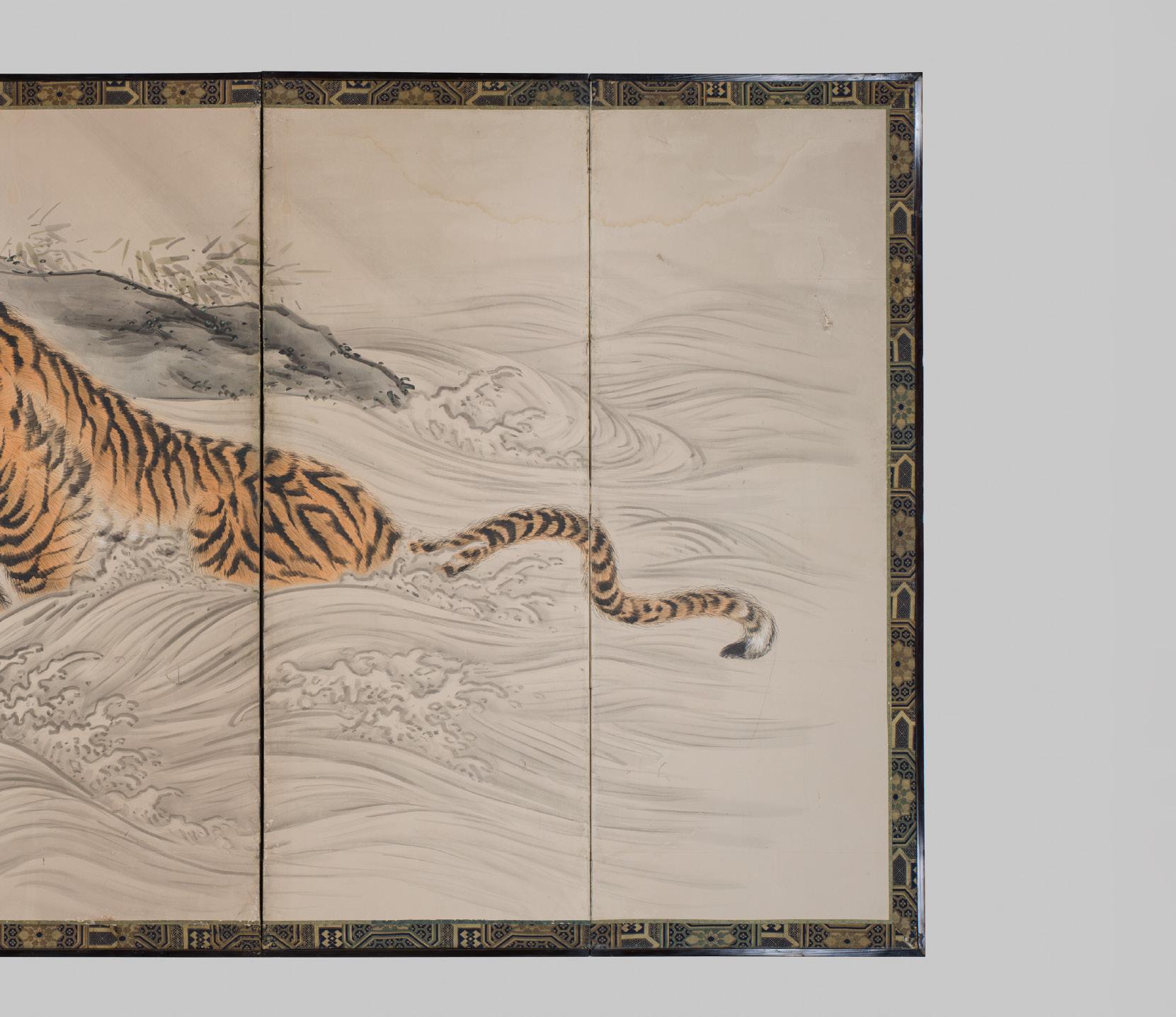
Estimate EUR 15,000
Starting price EUR 7,500
MUSEUM COMPARISON
Compare a related pair of six-panel screens depicting tigers crossing the water, by Kishi Ganku, dated to the early 1800s, 179.4 x 384.8 cm, in the Cleveland Museum of Art, accession number 1983.3. Compare a related six-panel screen depicting a tiger and leopard, by Kishi Ganku, dated 18th-19th century, 171.2 x 372.1 cm, in the Museum of Fine Arts, Houston, object number 94.4.2.
HIKATA HOSHO: AN IMPRESSIVE PAIR OF TWO-PANEL ‘TIGER AND DRAGON’ BYOBU (FOLDING SCREENS)
By Hikata Hosho (1878-1934), signed Hosho and sealed Hosho Japan, Taisho period (1912-1926)
Ink on paper. Each mounted on two wood panels. The first exquisitely painted to depict a fierce tiger crouching and poised, seemingly ready to pounce, with its muscular build and intense facial expression. The second screen presents a coiling dragon emerging through the clouds.
Inscriptions: One to the left, the other to the right, signed Hosho 芳沼 and sealed Hosho 芳沼
SIZE 170 x 188 cm (each)
Condition: Good condition with wear, scattered foxing and browning of paper, soiling and streaked stains, and the edges and joints with associated touchups and restorations. The back with traces of wear and use. Presenting beautifully.
Hikida (Hikita) Hosho (1878-1934) was a Japanese painter born in Kyoto. He studied natural sciences and engineering at Ritsumeikan University before dedicating himself entirely to painting and studying under Kikuchi Hobun. His most famous work, ‘Mongolian Women Horse Riders’ from around 1917, showcases his ability to blend traditional Japanese elements with the cultural context of his subjects. Hosho was a regular exhibitor at Bunten exhibitions beginning from the first such exhibition in 1907, when he was twentynine, until the twelfth Bunten of 1918. Later, he exhibited works in the 1920 and 1931 Teiten exhibitions, earning the title of “Mukansa,” meaning that he had achieved such a solid reputation that he no longer had to submit works for approval by the jury. Hosho, however, eventually acquired a reputation as a reclusive artist, operating outside normal art societies and eschewing publicity; he is said to have lived a simple life and worked in a rather primitive atelier.
Compare a related Kano school sixpanel screen depicting a tiger and dragon, dated 18th century, 169 x 375 cm, at Zacke, Fine Japanese Art, 14 June 2024, Vienna, lot 303 (sold for EUR 23,400).
Estimate EUR 4,000
Starting price EUR 2,000
284
MOCHIZUKI SEIHO: A CHARMING TWO-PANEL ‘CAT UNDER GRAPEVINE’ BYOBU (FOLDING SCREEN)
By Mochizuki Seiho (1846-1915), signed Seiho and seal Seiho […] in Japan, Meiji (1868-1912) to Taisho era (1912-1926)
Ink, watercolors, and gouache on silk. Mounted on two lacquered wood panels with chased metal fittings. Finely painted with a cat seated under the foliage of a scrolling grape vine laden with fruits and resting against a bamboo stock.
Inscriptions: To the bottom-left, signed 青鳳 Seiho and seal 青鳳 […] 印 Seiho […] in.
SIZE 174 x 181 cm
Condition: Very good condition with minor wear and fresh colors. Little soiling and scattered foxing. The back with traces of wear and use.
Mochizuki Seiho (1846-1915) was the adopted son of the great Mochizuki Kinpo, who was highly regarded, trained by Shijo School masters, and whose pieces were purchased multiple times by the Imperial Household. They both spent many years in Hokkaido (northern Japan) and were able to regularly study and compose pieces depicting heavy snowfalls, which did not occur in their other city of residence, Tokyo, where they achieved most of their success.
MUSEUM COMPARISON
Compare a related hanging scroll painting depicting a raccoon dog in the snow by the same artist, Meiji period, dated to the 20th century, in the Museum of the Imperial Collections, Sannomaru Shozokan, collection number SZK000624.
Estimate EUR 3,000
Starting price EUR 1,500

By Ito Jakucho (1716-1800), signed Heian Jakuchu koji and sealed Jakuchu koji Japan, c. 1755
Exhibited:
MAO Museo d’Arte Orientale, Turin, Kakemono: Five centuries of Japanese painting. The Perino Collection, 27 March-28 June 2020. MUSEC Museo delle Culture, Lugano, Kakemono: Five centuries of Japanese painting. The Perino Collection, 17 July 2020-11 April 2021.
Ink, watercolors, and gofun on silk. Mounted as a hanging scroll painting on a silk brocade frame with bone jikusaki (roller ends). Superbly painted to depict a group of seven tanchozuru (redcrowned cranes) huddling together for warmth.
Inscriptions: To the bottom-left edge, signed Heian Jakuchu koji with seal Jakuchu koji.
Image SIZE 51 x 110.5 cm, SIZE incl. mounting 64 x 197 cm
Provenance: Ex-collection Dr. Claudio Perino, Turin, Italy, acquired mostly in Japan in early 2000s. Azca Auctions, Pursuing Perfection, the Perino Collection, 31 March 2025, London, lot 38 (bought-in, mid-estimate GBP 50,000 or approx. EUR 58,500 converted and adjusted for inflation at the time of writing). Dr. Claudio Perino is a collector with a keen interest in Japanese, Chinese and Far Eastern cultures. His collection consists of over 2000 works of art, partly loaned to the Museum of Oriental Arts (MAO) in Turin, Italy and to the Museo delle Culture (MUSEC) in Lugano, Switzerland. Condition: Very good condition with minor wear, little flaking to pigment, minuscule soiling, and scattered flaking and folds. The mounting with signs of wear and use, and paper backing to the top edge.

Forrer, Matthi [ed.] (2020) Kakemono: Five centuries of Japanese painting. The Perino Collection, 2020, p. 60, no 36.
Ito Jakucho (1716-1800) inherited his father’s greengrocery business but preferred to live the solitary life of a painter. Sometime in his early thirties he became interested in Zen Buddhism and met Daiten Kenjo (1719-1801), a scholar-monk who became abbot of Shokoku-ji, one of the five most important Zen monasteries in Kyoto. Daiten proved influential in the artist’s life going forward. Jakuchu is usually described as an idiosyncratic nonconformist, positioning him in stark contrast to the prevailing orthodox Kano lineage. However, his meticulously detailed paintings reveal his own conscientious reliance on Chinese prototypes. Daiten, his friend, patron and spiritual guide, made the Chinese works available to him. For example, the artist was able to study original paintings of cranes by the obscure fifteenth-century Chinese artist Wen Zheng that were preserved at Shokoku-ji. Today, Jakuchu is a household name in Japan—exhibitions of his work are always blockbusters, and for good reason. Jakuchu used the seal on this painting for just a short time, early in his career—they appear on less than five other paintings.
The meticulously painted birds, with their lifelike plumage, contrast beautifully with the semi-abstract landscape, evoking the feeling of a cold morning, shrouded in a freezing mist, that surrounds the graceful flock.
In this work, we see the familiar Manchurian crane (Grus Japonensis) with a red crest and snow-white plumage, a symbol of longevity, fidelity, and good fortune throughout East Asia. The long-necked bird is said to live a thousand years and has been an auspicious symbol in East Asia since Chinese antiquity—in Daoist lore, the crane shares the world of the immortals. Because of their lifetime monogamy, cranes also symbolize happy marriage. The number seven is also considered particularly auspicious in this region, making the number of birds depicted no mere coincidence, but rather an intentional choice that enhances the image’s significance.
Jakucho painted cranes numerous times, most notably in his renowned series of thirty scrolls titled Colorful Realm of Living Beings (Doshoku Sai-e) (see literature comparison), which he presented to Shokoku-ji. The series was later transferred to the Imperial Court in the 1890s and is now housed at the Museum of the Imperial Collections (Sannomaru Shozokan) as a National Treasure.
AUCTION COMPARISON
Compare a closely related hanging scroll painting of a pair of cranes and the rising sun, by the same artist, size 124.5 x 55.6 cm, at Christie’s, Japanese and Korean Art, 16 March 2021, New York, lot 9 (sold for USD 1,590,000 or approx. EUR 1,679,000 converted and adjusted for inflation at the time of writing).
Estimate EUR 15,000
Starting price EUR 7,500
286
By Mochizuki Kinpo (1846-1915), signed Kinpo and with seal mark Mochizuki manabu in Japan, dated 1897
Ink and watercolors on silk. Mounted as a hanging scroll within a silk brocade frame with ivory jikusaki (roller ends). Finely painted in soft brush strokes to depict a tiger facing the viewer, the majestic feline with forelegs crossed exposing sharp talons, and the face with a fierce expression and piercing eyes.
Inscriptions: To the lower right, signed 金鳳 Kinpo with the seal mark 望月学印 Mochizuki manabu in. To the cover of the wood box, inscribed 虎図壹幅 Tora zu ippuku [picture of a tiger, one scroll]. To the interior of the cover, 明治 丁酉 月 Meiji hinoto-tori ichi gatsu [corresponding to 1897] and signed 金鳳 Kinpo with seal mark 金鳳 Kinpo.
Image SIZE 42.6 x 104.2 cm, SIZE incl. mounting 55.7 x 198.1 cm
Provenance: From the private collection of Heinrich Georg Johann and Eva Harms, assembled in Shanghai between 1935 and 1942.
Condition: Very good condition with minor wear, little soiling, and few creases that are reinforced to the back. The frame with signs of wear, creasing, and the lower section with water damage and stains, all reinforced to the back.
With an inscribed and dated wood tomobako.
Important notice: Please note that we will need to remove the ivory roller ends before shipping / handing over the item. The roller ends are not part of this offer.
Mochizuki Kinpo (1846-1915) born in Osaka, initially studied painting under Jinpo Hayashi, receiving instruction in the Maruyama school, and later continued his training with Kan’ei Nishiyama of the Shijo school. His early ambitions, however, did not immediately center on painting, as he once aspired to become a swordsman. Instead, he entered government service, working for the Ministry of the Interior, where he was appointed to the Geography Division and spent a period stationed in Hokkaido. During this time, he submitted a work based on his experiences in Hokkaido to the First National Painting Exhibition, for which he received a certificate of commendation. Thereafter, he relocated to Tokyo to pursue painting in earnest, exhibiting widely, particularly in exhibitions associated with the Japan Art Association. He mainly created animal images for the Japan Art Association and often won awards.
MUSEUM COMPARISON
Compare a related painting of dogs under the autumn moon by the same artist, in the Museum of the Imperial Collections, Sannomaru Shozokan, reference number SZK000111.
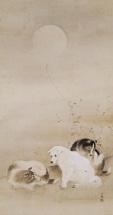
Estimate EUR 4,000
Starting price EUR 2,000
287
SUIHO: DRAGON CHASING THE MAGIC PEARL
By Yonai Suiho (1892-1970), signed Suiho with seal Suiho
Japan, first half of the 20th century, Taisho (1912-1926) to Showa era (1926-1989)
Ink, watercolors, and gold paint on silk. Mounted as a hanging scroll within a silk brocade. Finely painted with delicate brushstrokes to depict a three-clawed dragon catching a magic pearl, its sinuous body emerging from misty clouds.
Inscriptions: To the lower right corner, 穂豊 Suiho with a seal mark 穂豊 Suiho.
Image SIZE 50.2 x 112.7 cm, SIZE incl. mounting 64.3 x 195 cm
Condition: Excellent condition with minor wear, little creasing and minuscule foxing. The frame with some creasing and scattered stains. Tears to the top edge of the mounting with reinforcements to the back.
Estimate EUR 2,000 Starting price EUR 1,000
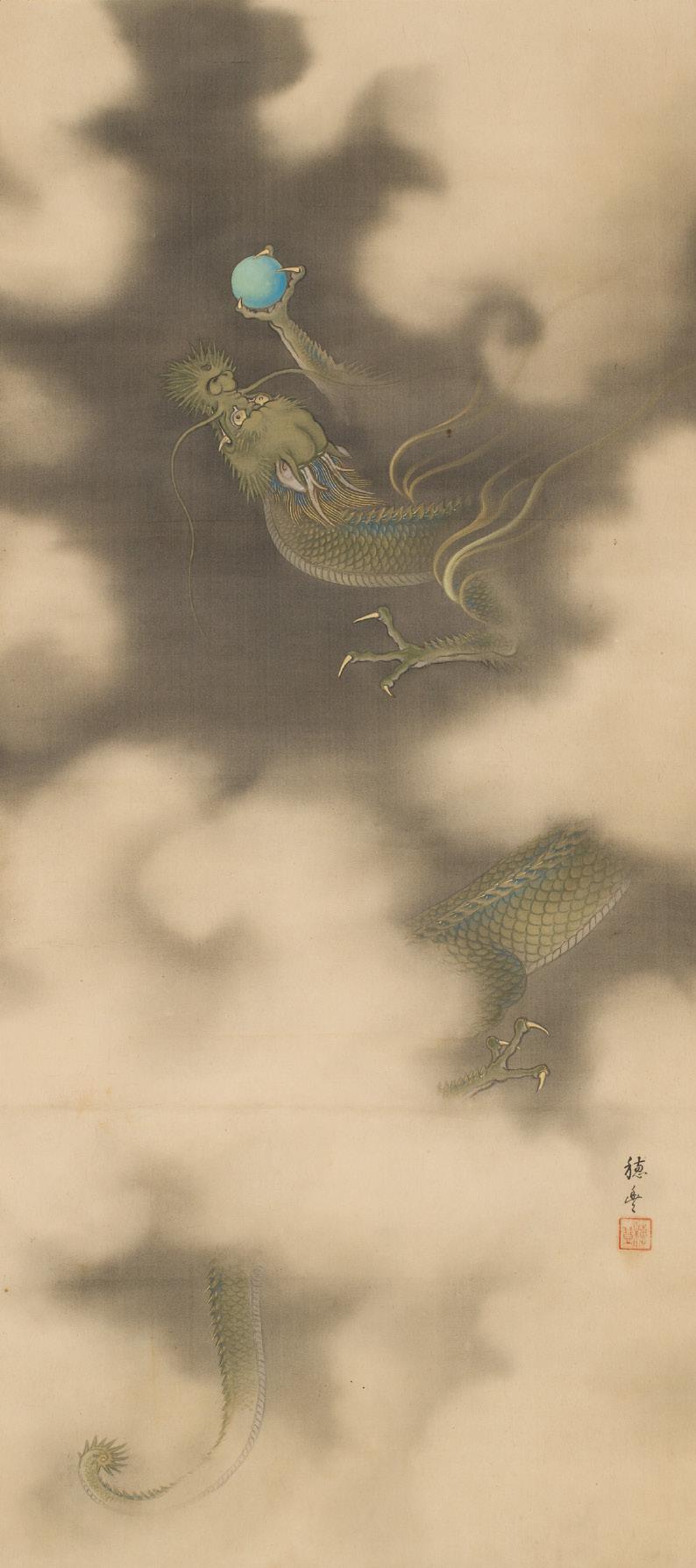
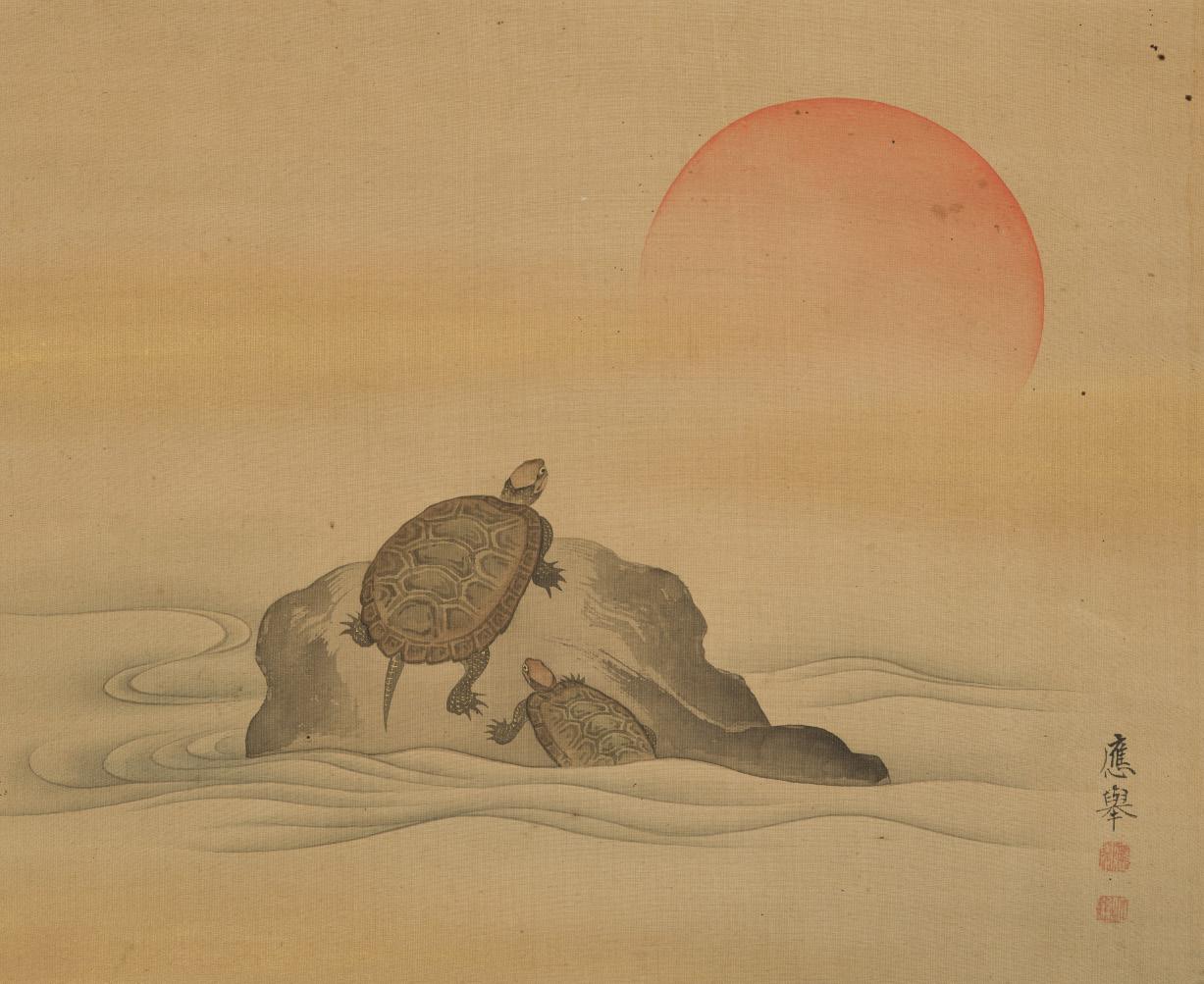
SCROLL PAINTING OF TURTLES BASKING UNDER THE RISING SUN
By a member of the Maruyama Okyo school, signed Okyo with seal mark Okyo and Chusen Japan, late 18th century, Edo period (1615-1868)
Ink, watercolors, and gold paint on silk. Mounted as a hanging scroll within a silk-brocade frame with ivory jikusaki (roller ends). This finely painted work captures two turtles climbing a rock that rises from the water, gazing towards the red sun emerging from the morning mist. The composition with delicate brushwork that enhances the serene atmosphere.
Inscriptions: To the lower right corner, signed 応挙 Okyo with two seal marks 応挙 Okyo and 仲選 Chusen.
Image SIZE 26.5 x 32.8 cm, SIZE incl. mounting 100.2 x 41.8 cm
Provenance: From the estate of a private collector, Heath House, Hampshire, by repute acquired in Asia at the turn of the 19th century, thence by descent in the family.
Condition: Excellent condition with minor wear, little staining, and minuscule foxing. The mounting with creasing, scratches, and tiny tears along the top edge.
Important notice: Please note that we will need to remove the ivory roller ends before shipping / handing over the item. The roller ends are not part of this offer.
Maruyama Okyo (1733-1795), from present-day Kameoka, Kyoto, was a student at the Kano school of painting. He gained much renown after his first commission, the Seven Misfortunes and Seven Fortunes. As his public image grew, Okyo founded his own school in Kyoto, the Maruyama school of painting, dedicated to his style of blending Western naturalism with Eastern decorative designs. He taught his students to rely on nature to render images in a realistic picture of light, shadow, and forms. The school grew popular, and branches soon appeared in other locations, including Osaka. Much of the school’s work is today preserved at Daijo-ji, a temple in Kasumi. Noteworthy pupils include Okyo’s son, Maruyama Ozui, Nagasawa Rosetsu, and Matsumura Goshun.
MUSEUM COMPARISON
Compare a related two-panel folding screen of fish and turtles by Maruyama Okyo, dated c. 17721781, in the Harvard Museum, object number 2018.356.
Estimate EUR 2,000
Starting price EUR 1,000
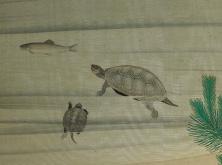
289
SHUITSU:
By Suzuki Shuitsu (1823-1889), signed Seisei Shuitsu with seal Teihakushi
Japan, 19th century, late Edo (1615-1868) to Meiji period (1868-1912)
Ink, watercolors, and gouache on silk. Mounted as a hanging scroll within a silk brocade frame with ivory jikusaki (roller ends). Finely painted with autumnal grasses interspersed with blue Kikyo and white flowers. The mounting with further tall green grasses interspersed with sprigs of blossoms in gilt.
Inscriptions: To the bottom-left, signed 菁々(静々)守一 Seisei Shuitsu with seal 庭柏子 Teihakushi. The wood tomobako inscribed 月秋 草圖、繪表具共、静々守一筆 tsuki akikusa zu, e hyogu tomo, Seisei Shuitsu hitsu [Painting of the moon, autumnal plants, the painting and the simulating picture frame/boarder by Seisei Shuitsu].
Image SIZE 29 x 57.5 cm, SIZE incl. mounting 123 x 70.5 cm
Condition: Excellent condition with minor wear and little soiling near the edges. The mounting with only minor traces of wear and age.
With an inscribed wood tomobako.
Important notice: Please note that we will need to remove the ivory roller ends before shipping / handing over the item. The roller ends are not part of this offer.
MUSEUM COMPARISON
Compare a closely related hanging scroll painting depicting autumn flowers, by the artist, size 189 x 57.4 cm wide, in the British Museum, registration number 1913,0501,0.262.
Estimate EUR 4,000
Starting price EUR 2,000
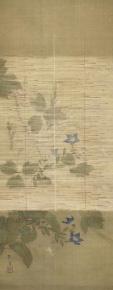
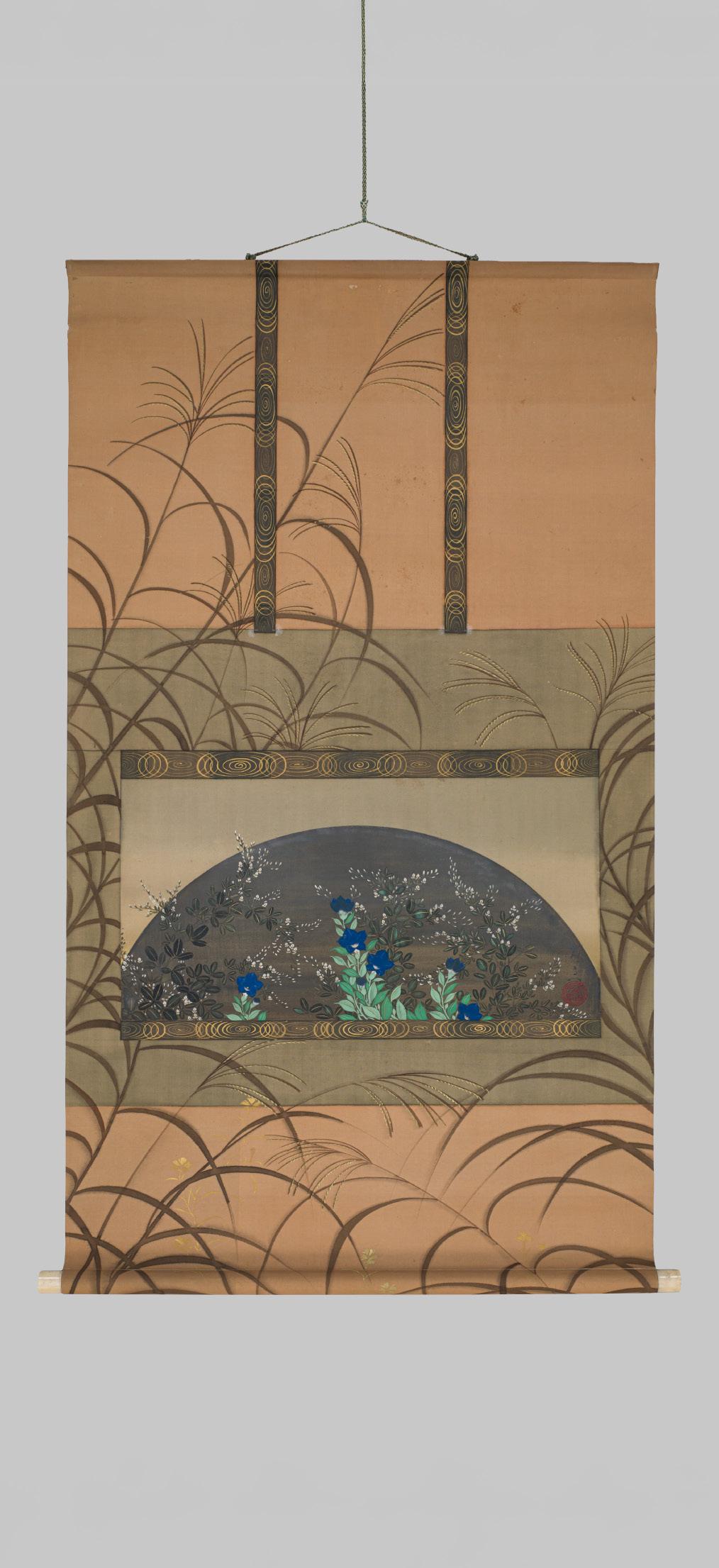
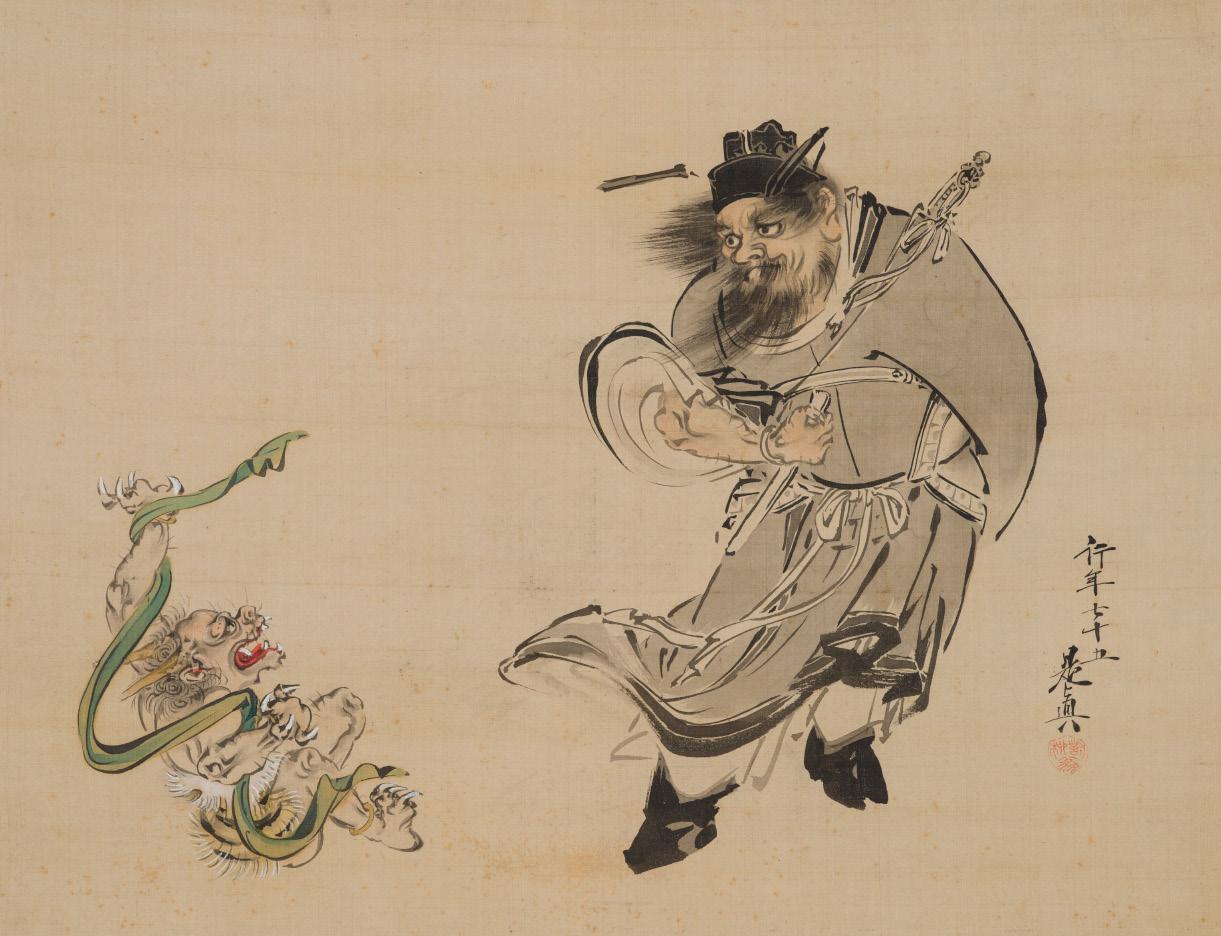
290
By Shibata Zeshin (1807-1891), signed Gyonen nanajugo, Zeshin and sealed Tairyu-o Japan, dated 1881, Meiji period (1868-1912)
Ink, watercolors, and gouache on silk. Mounted as a hanging scroll within a silk brocade frame with wood jikusaki (roller ends). Finely painted to depict Shoki the Demon-Queller, clutching a baton and towering over a demon writhing at his feet, Shoki’s robes and beard billowing in the whirlwind of energy generated by his wrath.
Inscription: To the right edge, signed 行年七十五、是真 Gyonen nanajugo, Zeshin [Zeshin at the age of 75] and sealed 對柳翁 Tairyu-o. With a loose wood panel, inscribed to the front Shibata Zeshin-o hitsu, Shoki no yokofuku [Horizontal painting of Shoki by the venerable Shibata Zeshin] and to the back Kakan’an Chikushin kan hei dai [Examined and titled by Kakan’an Chikushin] with seal Yusai.
Image SIZE 39 x 49 cm and SIZE incl. mounting 136 x 78.5 cm
Provenance: Bonhams, Fine Japanese Art, 11 May 2017, London, lot 172 (sold for GBP 6,000 or approx. EUR 9,500 converted and adjusted for inflation at the time of writing). A private collection in the United Kingdom, acquired from the above. Condition: Very good condition with minor wear, little soiling, and scattered foxing. The frame with traces of wear and use, and creasing.
With a loose wood panel and tomobako, all housed within a black lacquered tomobako.
Shibata Zeshin (1807-1891) was a Japanese painter, lacquer artist, and printmaker of the late Edo period to early Meiji era. Nominated as one of the first Teishitsu Gigeiin (Imperial Court Artist) in Meiji 23 (1890), Shibata Zeshin excelled in several art forms, including
painting, lacquer-making, print design, and calligraphy. He had an outstanding studio with talented students specializing in lacquer, paintings and prints. He has been called ‘Japan’s greatest lacquerer.’ His work, unlike the oils being used by so many of his contemporaries, never needed re-touching and never faded. He was a master of emulating oil or ink painting with lacquer and combined groundbreaking techniques with traditional subjects. His studio was situated on the bank of a river, providing him with ample opportunity to observe nature, and the creatures that inhabit the natural world. Like many painters of the 19th century, he was eclectic in his sources and would have been exposed to traditional styles. However, Zeshin’s skill level was such that he could fluidly mix techniques, ideas, and stylistic options, thus painting part of a composition in one manner and including elements of another to add variety and dynamics unheard of at the time.
MUSEUM COMPARISON
For a closely related hanging scroll depicting Shoki and two oni by the same artist, signed Zeshin, dated to 1865-1870, 99.7 x 36.1 cm, see the British Museum, registration number 1881,1210,0.2355.
AUCTION COMPARISON
Compare a related hanging scroll depicting Shoki and two oni by the same artist, Shibata Zeshin, 109 x 37 cm, at Christie’s, Lacquer, Jade, Bronze, Ink: The Irving Collection Day Sale, 21 March 2019, New York, lot 1153 (sold for USD 22,500 or approx. EUR 25,000 converted and adjusted for inflation at the time of writing).
Estimate EUR 8,000
Starting price EUR 4,000
By Utagawa Hosai, signed Hosai hitsu and seal Seisei Kisen Japan, Meiji period (1868-1912)
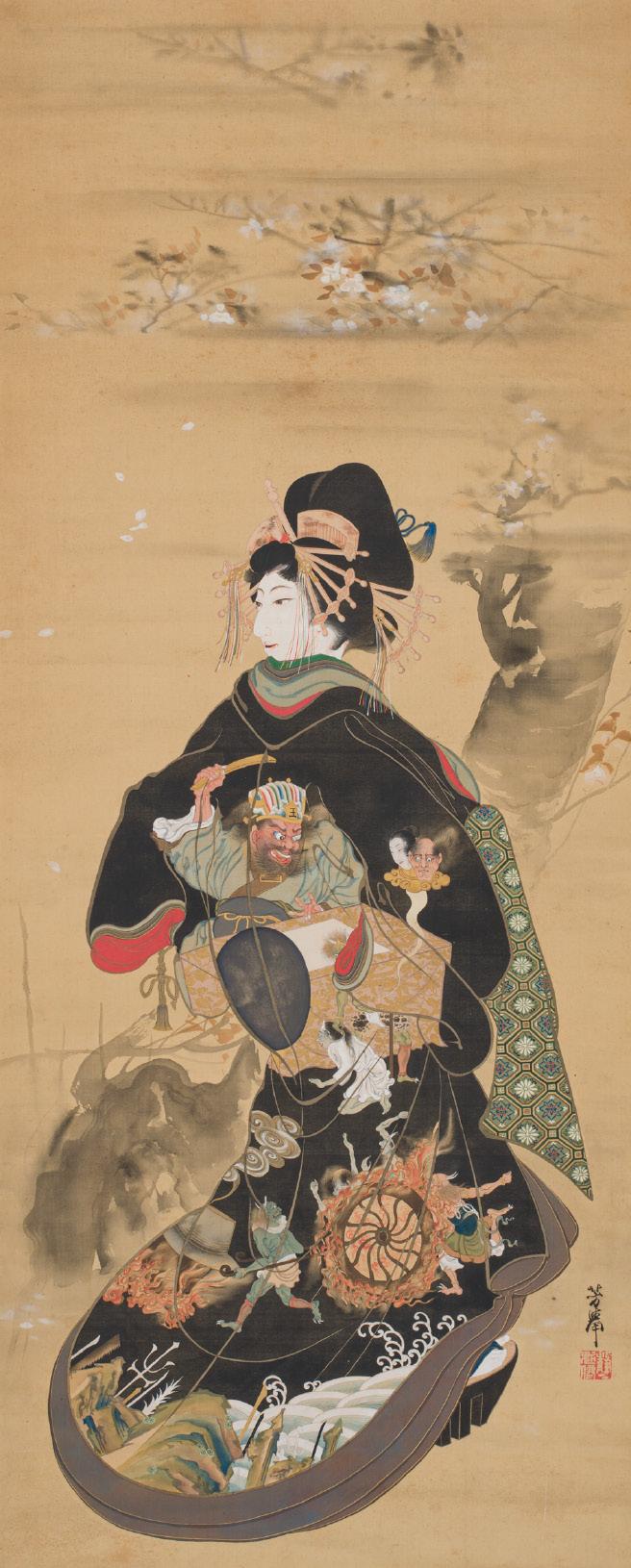
Ink, watercolors, and gouache on silk. Mounted as a hanging scroll within a silk brocade frame with ivory jikusaki (roller ends). Finely painted, the composition depicts Jigoku Dayu, the legendary courtesan, shown standing in a voluminous robe densely decorated with scenes of the Buddhist underworld. At its center appears Emma-o, his stern, bearded visage emerging from swirling folds of drapery that evoke the very fabric of hell. Across the garment unfolds a vivid and unsettling panorama: writhing sinners are seized by horned oni, cast into flames, or dragged across jagged terrain. Flaming wheels turn, limbs contort, and anguished figures cry out amid a landscape of fire and shadow. The robe functions as a pictorial map of damnation, each vignette illustrating torment and karmic retribution, rendered with dynamic, almost chaotic energy that contrasts sharply with Enma’s implacable, judging presence.
Inscriptions: To the bottom-left, signed 芳斎筆 Hosai hitsu [Painted by Hosai] and sealed 静々鬼僊 Seisei Kisen [quiet-quiet oni immortal]. The wood tomobako inscribed 芳斎筆、浮世繪、地獄太夫 ノ圖、壹幅 Hosai hitsu, ukiyoe, Jigoku Dayu no zu, ippuku [Ukiyo-e painting of Jigoku Dayu, one scroll, painted by Hosai].
Image SIZE 52.5 x 129.5 cm, SIZE incl. mounting 66.5 x 216 cm
Condition: Very good condition with minor wear, little creasing, tiny staining, scattered foxing, and minuscule flaking to pigment. The frame with traces of wear and use.
With an inscribed wood tomobako.
Important notice: Please note that we will need to remove the ivory roller ends before shipping / handing over the item. The roller ends are not part of this offer.
Jigoku Dayu (“Hell Courtesan”) is a subject rooted in late Edo-period narrative and theatrical culture. The theme derives from the kabuki play Jigoku Ikkyu banashi (The Story of Ikkyu and Hell), first performed in 1865 and adapted from earlier comic literature. The Zen monk Ikkyu Sojun (1394–1481), renowned for his unconventional character, encounters the courtesan Jigoku, whose name evokes the torments of the underworld. In a moment of revelation, the pleasures of the brothel dissolve into a vision of decay and death, exposing the transience underlying worldly appearances. Through this encounter, Jigoku attains insight into the impermanence of existence.
Hosai’s interpretation emphasizes this tension: the composed elegance of the figure contrasts with the violent imagery that envelops her, transforming the robe into a didactic field of Buddhist imagery. The work operates simultaneously as a theatrical subject and a meditation on mortality and karmic consequence.
Utagawa Hosai was a pupil of Goseda Horyu (also known as Utagawa Horyu), himself a student of Utagawa Kuniyoshi, from whom Hosai inherited the character 芳 (ho / yoshi). Active in Yokohama during the Meiji period, Hosai worked within the Utagawa school tradition, adapting its dynamic narrative style to painting formats.
Compare a closely related scroll painting depicting the same subject by Utagawa Kunisada II, also Utagawa school, at Christie’s, Aesthetic Intuition: Collection Japanese Art in Post-War London, 11 November 2015, London, lot 91 (sold for GBP 62,500 or approx. EUR 101,800 converted and adjusted for inflation at the time of writing).
Estimate EUR 8,000
Starting price EUR 4,000
Attributed to Kitagawa Utamaro (1754-1806), unsigned Japan, late 18th-early 19th century, Edo period (1615-1868)
Ink and watercolors on paper. The work is finely rendered, depicting Kintaro, the legendary child hero, suckling from the Yamauba, his mother, one hand resting on top and the other pinching the free nipple. Yamauba, cradling the orphaned Kintaro, appears with a disheveled appearance, yet the scene conveys an unexpected sensuality and warmth. The soft lines and delicate composition imbue the figures with a surprising intimacy, far from the typical fearsome depictions of Yamauba in other sources.
Image SIZE 47.5 x 53.5 cm, SIZE incl. frame and mounting 67.5 x 73.5 cm
Provenance: Ex-collection Collection of Huguette Berès (19131999), Paris, France. A private collection in Paris, acquired from the above. The original vintage poster of the exhibition showing the present piece is included with the lot. Condition: Very good condition with minor wear and browning to paper. Tiny losses to the edges, little creasing, and foxing. The image is excellently preserved.
Set inside a metal frame behind glass which is further mounted on cloth-covered board.
This painting is a preliminary draft for a famous woodblock print by Utamaro, depicting Yamauba nursing her orphaned son, Kintaro. In Japanese mythology, Yamauba is a fearsome, ogre-like figure, originally depicted as a child-eating demon in early tales such as those in the Konjaku Monogatari (12th century). By the 15th–16th centuries, she was transformed into a more complex figure, sometimes depicted as Kintaro’s mother and a protector rather than a threat. Utamaro’s portrayal accelerates this transformation, presenting Yamauba as a nurturing, tender mother rather than a monster.
This transformation from an ogre to a caring parent mirrors broader shifts in Japanese attitudes toward such mythological figures. Utamaro’s work not only subverts the traditional image of Yamauba but also captures a rare moment of intimacy and maternal tenderness. The imagery of Kintaro, traditionally depicted with bright red skin as a symbol of his supernatural strength, here takes on a more humanized form, as he rests in the embrace of his mother.
Born in 1754, Kitagawa Utamaro was one of the most influential figures in ukiyo-e woodblock printing and painting. Known for his portraits of beautiful women, Utamaro’s later works increasingly explored more dramatic and intimate subjects, often capturing scenes of popular stories or mythological figures with an erotic or emotional charge. His mastery of expression, delicate brushwork, and use of soft color palettes defined his artistic style, which had a lasting influence on European artists during the rise of Japonisme in the late 19th century.
peintures, estampes, Paris, 11 May - 5 June 1954. Illustrated in the accompanying catalog in color on page 1 and featured on the exhibition poster prominently, which is included in this listing.
While Utamaro’s prints of Yamauba and Kintaro are widely recognized, his painted versions are exceedingly rare, adding even greater significance to this preliminary study of the theme.
LITERATURE COMPARISON
For identical prints of the same subject by the artist and published by Tsutaya Juzaburo circa 1801-3, see Shugo Asano and Timothy Clark, Exhibition Catalogue, The Passionate Art of Kitagawa Utamaro, British Museum Press, London, 1995, p.194, pl. 388 and Kiyoshi Shibui, Ukiyoe zuten (Dictionary of Ukiyo-e Images), Kazama Shobo, Tokyo, 1964, vol. 13, p. 209, pl. 5.
AUCTION COMPARISON
Utamaro’s paintings are highly sought after. Compare a related painting of Three Beauties, by the same artist, dated to the Kansei era, size 47.6 x 73.1 cm, at Christie’s, An Important Collection of Japanese Ukiyo-e Paintings, 27 October 1998, New York, lot 61 (sold for USD 332,500 or approx. EUR 573,000 converted and adjusted for inflation at the time of writing).
Estimate EUR 25,000 Starting price EUR 12,000
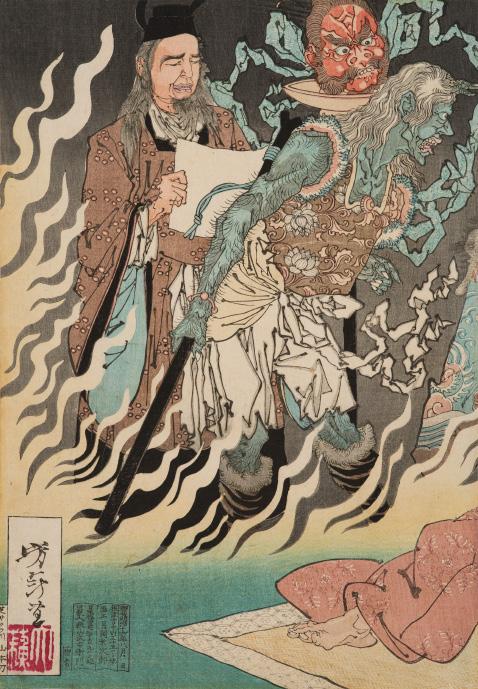
TSUKIOKA YOSHITOSHI: THE FEVER OF TAIRA NO KIYOMORI
By Tsukioka Yoshitoshi (1839-1892), signed Yoshitoshi ga and sealed Taiso Japan, dated 1883
Color woodblock print on paper. Oban triptych. Signed Yoshitoshi ga and sealed Taiso; publisher Akiyama Buemon. Title Taira no Kiyomori hi no yamai no zu (The Fever of Taira no Kiyomori).
This dramatic scene is taken from the Heike Monogatari (Tale of Heike), depicted here is Kiyomori (1118-1181), the son of a concubine of the Emperor Shirakawa Tenno. As punishment for burning a giant bronze Buddha, Kiyomori was tortured by a fever so hot that the water boiled when he bathed. Kiyomori is attended by his praying wife and son, with Enma, the King of Hell, in the background flanked by two of his judges and terrifying demons. Yoshitoshi evokes the vision of hell and fever with unusual and lurid colors.
Size of the sheets ca. 34.6 x 23.7 cm (each), SIZE incl. frame 53.8 x 93.8 cm
Condition: Very good condition. Excellent impression and colors. Little browning of paper, minor soiling and some foxing as visible in the images provided. Trimmed margins.
With a wooden frame and glass for presentation.
Tsukioka Yoshitoshi (1839-1892) was one of the leading woodblock print artists during the Meiji era and one of the last to work in the traditional ukiyo-e manner. Born in Edo (today’s Tokyo), he showed a strong interest in classical Japanese literature and history. When he was 11, he became a student at Kuniyoshi Utagawa’s studio. Under his teacher’s guidance, he showed exquisite draftsmanship skills and learned how to draw from life, something not necessarily part of the training schools of painting and illustration in Japan.
AUCTION COMPARISON
Compare a closely related triptych at Zacke, Fine Japanese Art, 14 June 2024, Vienna, lot 345 (sold for EUR 3,380).
Estimate EUR 2,500
Starting price EUR 1,200
294
ICHIEISAI YOSHITSUYA: TRIPTYCH OF YORIMITSU TRYING TO CAPTURE HAKAMADARE BY DESTROYING HIS MAGIC
By
Ichieisai Yoshitsuya (1822-1866), signed Ichieisai Yoshitsuya Japan, dated 1858
Color woodblock print on paper. Oban Triptych. Signed Ichieisai Yoshitsuya, censor’s seal Horse 4; publisher Tsutaya Kichizo (Koeido). Title Kijutsu o yabutte Yorimitsu Hakamadare o karamen to su (Yorimitsu Tries to Capture Hakamadare by Destroying His Magic).
The triptych depicts the confrontation between Minamoto no Yorimitsu and the magician Hakamadare Yasumasa from the Taiheiki (Chronicle of Great Peace), which is a Japanese historical epic written in the late 14th century and covers the period from 1319 to 1367. Lord Minamoto Yorimitsu (also known as Raiko) and three of his four top retainers pursue the notorious thief Hakamadare, who attempts to evade capture by using magic to create a distracting illusion of a fight between a bear and an enormous snake.
SIZE of the sheets 37 x 74 cm (total), SIZE incl. frame 53.8 x 93.9 cm
Condition: Firmly mounted together. Overall good condition with vibrant colors. Little soiling, minor foxing, browning, small losses, and creasing, all mostly limited to the edges. Sections of the edges reinforced to the back.
With a wooden frame and glass for presentation.
Ichiesai Yoshitsuya (1822-1866) was a Japanese ukiyo-e artist who worked primarily in the mid-19th century. He was a student of Utagawa Kuniyoshi and specialized in creating prints featuring kabuki actors and historical subjects. Yoshitsuya was known for his dynamic and dramatic compositions, as well as his use of bright colors and intricate details. He collaborated with other prominent artists and publishers of his time and created a large body of work that continues to be highly regarded. Yoshitsuya died at the young age of 44.
COMPARISON
Compare a closely related print at Christie’s, From Artist to Woodblock: Japanese Prints, London, 11 July 2019, lot 100 (sold for GBP 6,875 or approx. EUR 10,500 converted and adjusted for inflation at the time of writing).
Estimate EUR 4,000
Starting price EUR 2,000
295
By Yashima
Gakutei (1786-1868), signed Gakutei
Japan, privately issued, c. 1819
Color woodblock print on paper embellished with metallic pigments and embossing. Shikishiban surimono. Signed Gakutei. Title Turtles and Waterweeds, from the set Tsuru kame niban (Cranes and Turtles, A Set of Two).
Depicting three turtles gracefully swimming among finely embossed water plants highlighted with gold pigment. The composition surmounted by two poems signed by Kinkokuen Mahiro.
SIZE of the sheet 19.4 x 17 cm
Condition: Good impression. Very good condition with minor wear. Minor browning to paper, and slightly trimmed margins. A small loss to the bottom-left edge.
AUCTION COMPARISON
Compare a closely related print at Sotheby’s, Japanese Woodblock Prints from an Important Private European Collection, 6-13 June 2025, Paris, lot 661 (sold for EUR 6,350).
Estimate EUR 2,500
Starting price EUR 1,200
296
OGATA GEKKO: THE RAT, THE BLACK STONE OF MUTSU PROVINCE, AND THE CAT OF JOKYO-JI TEMPLE
By Ogata Gekko (1859-1920), signed Gekko zuihitsu and seal Ichigaku Ichiei
Japan, dated 15 July 1896
Color woodblock print on paper. Vertical oban. Signed Gekko and sealed Ichigaku Ichiei; publisher Matsuki Heikichi. Title Nezumi, Rikushu kuroishi, Jokyo-ji no neko (The Rat, the Black Stone of Mutsu Province, and the Cat of Jokyo-ji Temple), from the series Gekko zuihitsu (Gekko’s Miscellany).
Depicting a cat lying on its back, struggling to fend off a large rat lunging at it in a heated combat. The fur of both animals is meticulously rendered, while their combative demeanor is conveyed with striking realism.
SIZE of the sheet 36.5 x 24.9 cm
Condition: Good condition with minor expected wear, some spots as visible in the images provided, and some browning mostly limited to the margins. Light creasing to the outer edges. The back with remnants of thin strips of paper from previous mounting.
MUSEUM COMPARISON
A closely related print is in the Smithsonian Institution, National Museum of Asian Art, accession number S2003.8.1652.
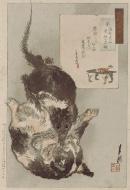
Estimate EUR 1,500
Starting price EUR 800
OHARA KOSON (LOTS 297-300)
Ohara Koson (1877-1945) was a Japanese painter and woodblock print designer of the late 19th and early 20th centuries, part of the shin-hanga (new prints) movement. He is famous as a master of kacho-e (bird-and-flower) designs. Throughout a prolific career, in which he created around 500 prints, he went by three different titles: Ohara Hoson, Ohara Shoson, and Ohara Koson.
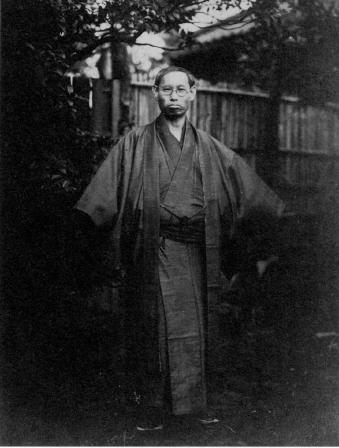
By Ohara Koson (1878-1945), signed Koson and sealed Koson Japan, c. 1900-1930
Color woodblock print and sprinkled gouache on paper. Vertical otanzakuban. Signed Koson and sealed Koson; publisher Daikokuya (Matsuki Heikichi). Title Swallow over Ocean Waves. Stamped to the lower back ‘Made in Japan’.
A dramatic depiction featuring a blue barn swallow in flight above swirling ocean waves, the print enhanced with white pigment for the wave sprays.
SIZE of the sheet 36.7 x 19 cm, SIZE incl. frame 48.5 x 32 cm
Provenance: From the private collection of Robert O. Muller, and thence by descent. The back of the frame inscribed in pencil, ‘Ohara Koson (1878-1945), “Swallow over ocean waves”, Japanese woodblock print c. 1930s, From the collection of Robert O. Muller’. Robert O. Muller (1911-2003) was an American collector and dealer who built one of the most significant private collections of Japanese shin hanga woodblock prints in the twentieth century.
Robert O. Muller appreciating a woodblock print
Condition: Excellent condition. The back with remnants of strips of paper from previous mounting.
With a wooden frame and glass for presentation.
MUSEUM COMPARISON
Compare a closely related print in the Art Gallery of Greater Victoria, Canada, object number 2008.028.003.
Estimate EUR 2,000 Starting price EUR 1,000
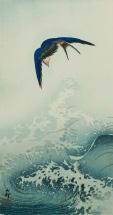
298
OHARA KOSON: SCOPS OWL IN FLIGHT, CHERRY BLOSSOMS AND FULL MOON
By Ohara Koson (1878-1945), signed Shoson and sealed Shoson Japan, c. 1924-1930
Color woodblock print on paper. Vertical oban. Signed Shoson and sealed Shoson; publisher Watanabe Shozaburo, sealed to the lower right. Title Scops Owl in Flight, Cherry Blossoms and Full Moon.
A keen-eyed owl flies past a cherry branch full of blossoms, a large full moon is seen in the background.
SIZE of the sheet 38.5 x 26 cm
Condition: Very good condition with a vibrant impression and fresh colors. Minuscule creasing and minute foxing to the lower register.
AUCTION COMPARISON
Compare a closely related print, bearing the same Watanabe seal, at Zacke, Fine Japanese Art, 5 December 2025, Vienna, lot 360 (sold for EUR 2,860).
Estimate EUR 2,000
Starting price EUR 1,000
299
OHARA KOSON: PLOVERS AND WAVES
By Ohara Koson (1878-1945), signed Shoson and sealed Shoson Japan, c. 1926
Color woodblock print on paper. Vertical oban. Signed Shoson and sealed Shoson; publisher Watanabe Shozaburo, sealed to the lower right. Title Plovers and Waves.
Three plovers standing on a rock at the seaside, one looking towards the crescent moon, with crashing waves in the back.
SIZE of the sheet 38.7 x 25.8 cm
Condition: Very good condition with good impression and fresh colors. The back with two thin strips of paper from previous mounting.
MUSEUM COMPARISON
Compare a closely related print in the Museum of Fine Arts, Boston, accession number 51.1419.
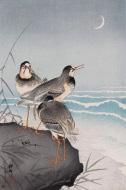
Estimate EUR 1,500
Starting price EUR 800
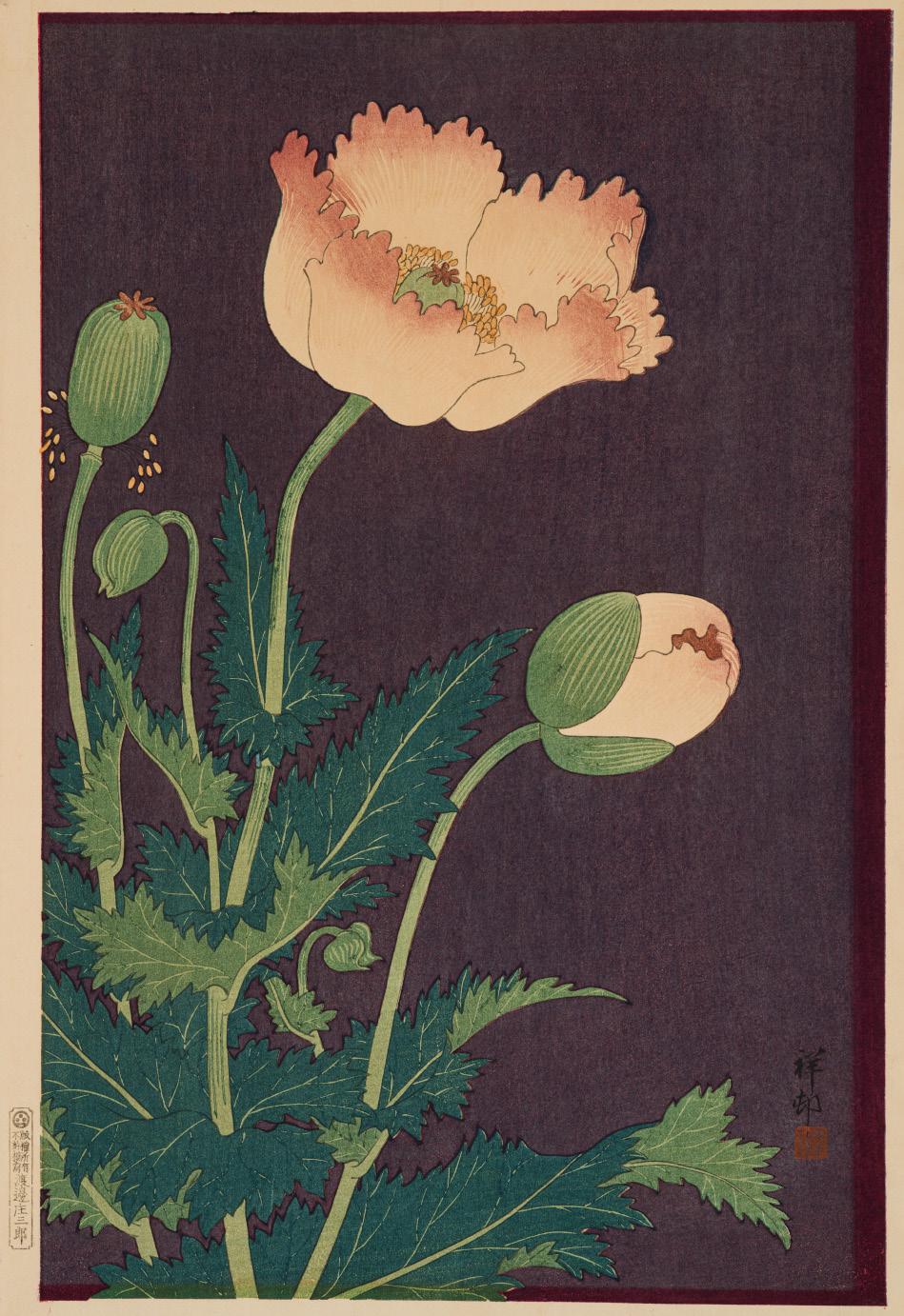
By Ohara Koson (1878-1945), signed Shoson and sealed Shoson Japan, c. 1931-1933
Color woodblock print on paper. Vertical oban. Signed Shoson and sealed Shoson; publisher Watanabe Shozaburo, sealed to the lower left with the ‘D’ seal (corresponding to a dating of 1931-1941). Title Poppy Flower in Bloom. Stamped to the lower back ‘Made in Japan’.
Stunning depiction of rose-colored poppy blossoms and buds on leafy stems, backed by a vibrant maroon ground.
SIZE of the sheet 37.7 x 25.9 cm
Condition: Very good condition, beautiful vibrant impression, a tiny pin hole to the upper left corner. The margins slightly trimmed.
LITERATURE COMPARISON
Compare a closely related print illustrated in Newland, Amy (2010) Crows, Cranes & Camellias: The Natural World of Ohara Koson 1877-1945, p. 211, cat. no. S43.4.
Estimate EUR 4,000
Starting price EUR 2,000
KAWASE HASUI (LOTS 301-307)
Kawase Hasui (1883-1957) was a prominent Japanese artist and printmaker of the shin-hanga (‘new prints’) movement, which focused on traditional techniques and subject matter. He is best known for his landscape prints depicting scenes of Japan, which were highly detailed and often captured the beauty and tranquility of the country’s natural landscapes. Hasui’s works were characterized by their delicate colors and sophisticated composition, and his legacy as a master of shinhanga continues to influence Japanese art and culture today.
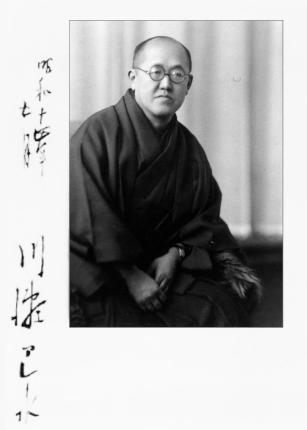
May 1939, and signed by the artist
KAWASE HASUI: SNOW AT SHIBA PARK, TOKYO
By Kawase Hasui (1883-1957), signed Hasui and sealed Kawase Japan, dated January 1931
Color woodblock print on paper. Horizontal oban. Signed Hasui and sealed Kawase; publisher Watanabe Shozaburo, sealed to the lower right. Title Shiba koen no yuki (Snow at Shiba Park, Tokyo).
Depicting a female visitor, sheltered beneath an umbrella, approaching the Tosho-gu shrine in Shiba Park during a blustery snowstorm.
SIZE of the sheet 25.5 x 38.4 cm
Condition: Very good condition with slight browning to paper, mostly limited to the edges. The outer margins trimmed.
AUCTION COMPARISON
Compare a closely related print, with a similar seal, at Christie’s, New Wave: Icons of Modern Japanese Prints Online, New York, 24 September 2024, lot 5 (sold for USD 15,120 or approx. EUR 13,500 converted and adjusted for inflation at the time of writing). Compare a closely related print, with a similar seal, at Bonhams, Samurai · Snow · Spectacle: Japanese Art across Seven Centuries, London, 7 November 2024, lot 344 (sold for GBP 7,040 or approx. EUR 8,500 converted and adjusted for inflation at the time of writing).
Estimate EUR 5,000 Starting price EUR 2,400
KAWASE HASUI: EVENING SNOW AT
By Kawase Hasui (1883-1957), signed Hasui and sealed Kawase Japan, dated March 1935
Color woodblock print on paper. Horizontal oban. Signed Hasui and sealed Kawase; publisher Watanabe Shozaburo, sealed to the lower right. Title Ishinomaki no bosetsu (Evening Snow at Ishinomaki), from the series Nihon fukei shu higashi Nihon hen (Collected Views of Japan, Eastern Japan Edition).
Depicting a cluster of wooden houses rising along the serene shore of a lake, their roofs and the crown of a nearby oak tree heavily blanketed with snow, all set beneath the somber, leaden sky of a winter evening in Ishinomaki.
SIZE of the sheet 24.5 x 37.5 cm, SIZE incl. frame 40.3 x 51.7 cm
Condition: Excellent condition. Beautiful impression.
With a wooden frame and glass for presentation.
AUCTION COMPARISON
Compare a closely related print, with similar seals, at Christie’s, Landscapes of Japan: Woodblock Prints from Edo to Post-War, 26 March 2024, lot 79 (sold for USD 7,560 or approx. EUR 7,000 converted and adjusted for inflation at the time of writing).
Estimate EUR 4,000 Starting price EUR 2,000
By Kawase Hasui (1883-1957), signed Hasui with seal Kawase Japan, dated fall 1927
Color woodblock print on paper. Vertical oban. Signed Hasui with seal Kawase; publisher Bijutsusha (Rumi), sealed to the lower right. Title Nikko Kegon taki (Kegon waterfall, Nikko), from the series Ukiyoe monyo shu (Collection of ukiyoe designs).
Beautiful view of a spectacular waterfall in autumn.
SIZE of the sheet 38.9 x 26.3 cm
Condition: Very good condition with wear, some browning, mostly visible to the back. A few light creases, mostly to the lower end. One mounting hole to the outer edge.
In the late 1920’s the publishing firm Bijutsusha (in Yotsuya, Tokyo) published a series of twelve prints, Ukiyoe monyo shu (Collection of ukiyoe designs), with eight landscapes by Hasui, and four prints depicting beauties by Yamakawa Shuho (1898-1944).
AUCTION COMPARISON
Compare a closely related print at Christie’s, with similar seal, Arts of Asia Online, 28 September 2023, New York, lot 226 (sold for USD 4,788 or approx. EUR 4,500 converted and adjusted for inflation at the time of writing).
Estimate EUR 5,000
Starting price EUR 2,400
By Kawase Hasui (1883-1957), signed Hasui with seal Kawase Japan, dated 1925
Color woodblock print on paper. Vertical oban. Signed Hasui with seal Kawase; publisher Watanabe Shozaburo, the publisher’s seal located to the right within the red building (rare!). Title Shiba Zojoji (Zojoji Temple, Shiba), from the series Tokyo nijukkei (Twenty views of Tokyo).
Depicting the vermilion gate of the Zojo-ji Temple in Shiba, Tokyo. A woman walks against the gale of a blizzard, her umbrella partially closed in the snowstorm. She passes by the main gate of the Sangedatsumon, the oldest wooden building in Tokyo, constructed circa 1622.
SIZE of the sheet 38.5 x 26.3 cm
Condition: Excellent condition, brilliant impression, very slight yellowing to paper, mostly limited to the edges.
Shiba Zojoji is Hasui’s most popular print, and it showcases the artist’s skill in capturing the beauty and tranquility of landscapes. Hasui frequently uses the solitary figure motif in his artwork, which symbolizes the individual’s connection to nature and the landscape.
This print is one of a series of twenty in which he depicted Tokyo landscapes after the Great Kanto Earthquake of 1923. These works thus date from the period in which Tokyo, based on its postquake recovery plan, was becoming a modern city. The figure of the woman walking in the snowstorm, however, is in the tradition of the “beauty in the snow” image, one of the favored renderings of beautiful women in the Edo period. With the vivid color contrast between the white snow, the red gate and the large tree seeming to jut out in the foreground, the composition calls to mind the world of Utagawa Hiroshige.
Compare a closely related print, the Watanabe seal also stamped within the image like in the present lot, at Sotheby’s, Japanese Woodblock Prints, 18 July 2024, London, lot 41 (sold for GBP 45,600 or approx. EUR 55,500 converted and adjusted for inflation at the time of writing).
Estimate EUR 20,000
Starting price EUR 10,000
KAWASE HASUI: HINUMA MARSH, HIROURA, MITO
By Kawase Hasui (1883-1957), signed Hasui and sealed Kawase Japan, dated 1946
Color woodblock print on paper. Horizontal oban. Signed Hasui and sealed Kawase; publisher Watanabe Shozaburo, with seal to the lower-left, and with printer’s mark Suri Ono Gintaro (printed by Ono Gintaro) to the outer-right margin. Title Mito Hinuma Hiroura (Hinuma Marsh, Hiroura, Mito).
Depicting a moonlit view of Hinuma Marsh at Hiroura, the full moon glowing among drifting clouds, framed by the silhouette of a tori gate and a row of pines along the right-hand shore.
SIZE of the sheet 26 x 38.5 cm, SIZE incl. frame 37.8 x 51.4 cm
Condition: Excellent condition with only very minor wear. Beautiful, vibrant impression.
With a wooden frame and glass for presentation.
AUCTION COMPARISON
Compare a closely related print, with identical seals, at Sotheby’s, Landscape to City: 20th Century Japanese Prints. Part 2, London, 10 May 2023, lot 85 (sold for GBP 4,064 or approx. EUR 5,000 converted and adjusted for inflation at the time of writing).
Estimate EUR 5,000 Starting price EUR 2,400
KAWASE HASUI: MOON ON THE ARAKAWA RIVER IN AKABANE
By Kawase Hasui (1883-1957), signed Hasui with seal Kawase Japan, dated 1929
Color woodblock print on paper. Vertical oban. Signed Hasui with seal Kawase; publisher Watanabe Shozaburo, sealed to the lower right. Title Arakawa no tsuki, Akabane (Moon on the Arakawa River in Akabane), from the series Tokyo nijukei (Twenty views of Tokyo).
Depicting the Arakawa River, which runs from Saitama Prefecture through Tokyo, shown from the banks in Akabane, gleaming under the light of the full moon casting its light throughout the composition.
SIZE of the sheet 38.8 x 26.4 cm
Condition: Excellent condition. Some light expected browning to paper, however limited to outer margins. Beautiful, vibrant impression. One mounting hole to the outer edge.
MUSEUM COMPARISON
A closely related print by the same artist is in the Los Angeles County Museum of Art, accession number M.2003.67.70.
AUCTION COMPARISON
Compare a closely related print at Christie’s, Landscapes of Japan: Woodblock Prints from Edo to Post-War, 26 March 2024, New York, lot 62 (sold for USD 13,860 or approx. EUR 12,500 converted and adjusted for inflation at the time of writing).
Estimate EUR 6,000 Starting price EUR 3,000
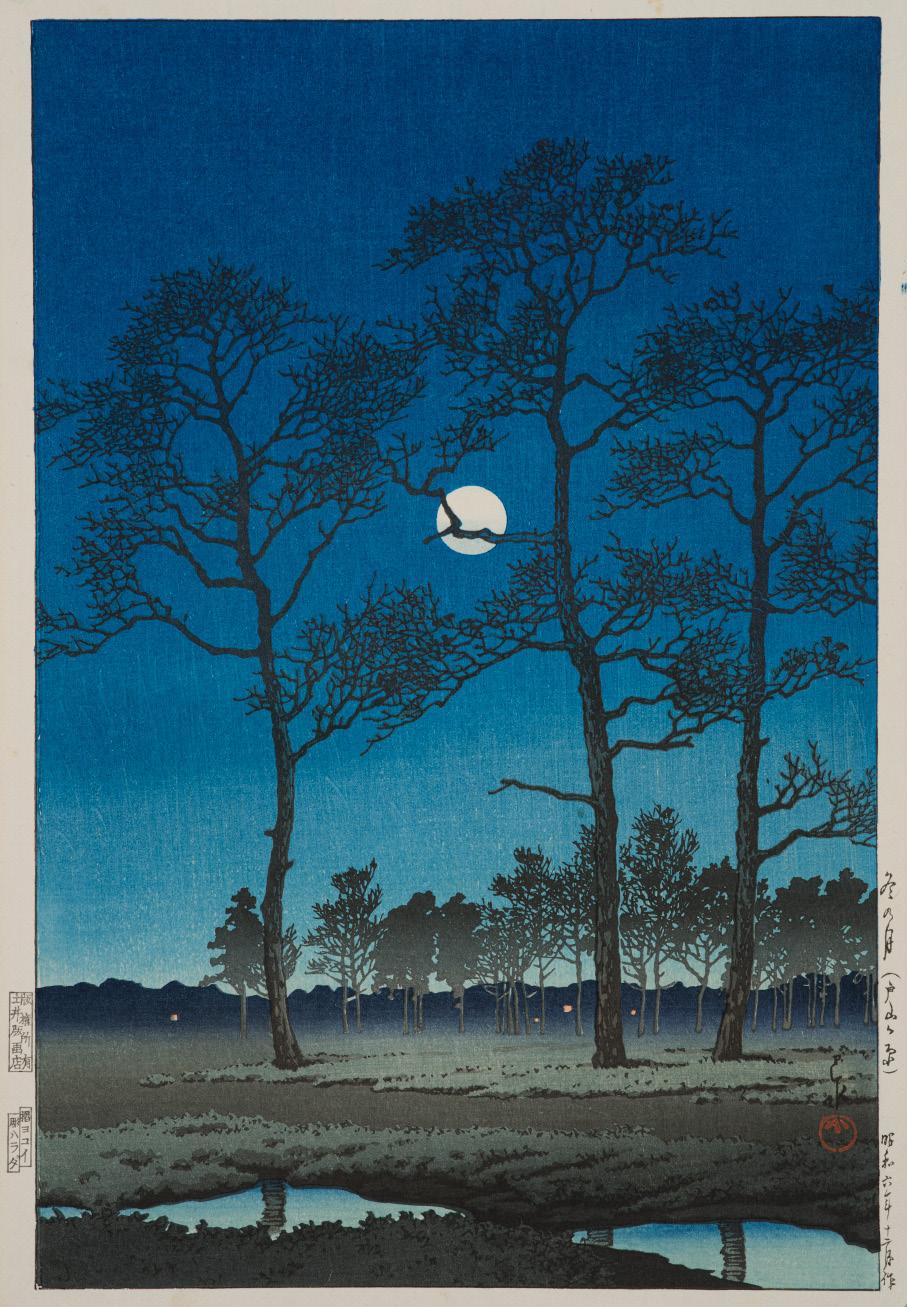
KAWASE HASUI: WINTER MOON AT TOYAMAGAHARA
By Kawase Hasui (1883-1957), signed Hasui and sealed Kawase Japan, dated December 1931
Color woodblock print on paper. Vertical oban. Signed Hasui and sealed Kawase; publisher Doi Sadakazu with watermark ‘Doi’ located on the top-left corner. Title Fuyu no tsuki [Toyamagahara] (Winter Moon at Toyamagahara).
Depicting a moonlit winter view of Toyama Plain, the bare silhouettes of trees traced against the clear blue evening sky, as the final warm glow of the sun fades along the horizon, with few illuminated windows shining in the distance.
SIZE of the sheet 39 x 26.5 cm, SIZE incl. frame 53.3 x 40.8 cm
Condition: Very good condition, excellent impression. A small spot of discoloration near the top that does not affect the image. Faint foxing and light creasing to the outer edges. The back with two thin strips of paper from previous mounting.
With a wooden frame and glass for presentation.
AUCTION COMPARISON
Compare a closely related print, with identical seals, at Christie’s, Landscapes of Japan: Woodblock Prints from Edo to Post-War, 26 March 2024, lot 61 (sold for USD 9,450 or approx. EUR 8,500 converted and adjusted for inflation at the time of writing).
Estimate EUR 5,000
Starting price EUR 2,400
HIROSHI YOSHIDA (LOTS 308-313)
Hiroshi Yoshida (1876-1950) began his artistic training with his adoptive father in Kurume, Fukuoka prefecture. Around the age of twenty, he left Kurume to study with Soritsu Tamura in Kyoto, subsequently moving to Tokyo and the tutelage of Shotaro Koyama. Yoshida studied Westernstyle painting, winning many exhibition prizes, and making several trips to the United States, Europe and North Africa selling his watercolors and oil paintings. While highly successful as an oil painter and watercolor artist, Hiroshi
308
By Yoshida Hiroshi (1876-1950), signed Yoshida and sealed Hiroshi Japan, dated 1927
Color woodblock print on paper. Horizontal oban. Signed Yoshida and sealed Hiroshi, Jizuri (self-printed) seal to the left margin, further signed in Roman script to the outer-lower margin Hiroshi Yoshida. Title Hida, Chikugogawa no yube (Evening on the Chikugo River in Hida), inscribed with the English title “Chikugo River” in Roman script to the outer-lower margin.
A view of the Chikugo River in Hida after sunset, with the dimming light casting a serene atmosphere. The orange lights from a house reflect in the water, while a man in a boat drifts peacefully along the river.
SIZE of the sheet 26.7 x 39.4 cm, SIZE incl. frame 44.5 x 56 cm
Condition: Excellent condition with only minor wear to the outer margins.
The jizuri seal is the most important mark on a Hiroshi Yoshida print as it helps distinguish an early edition where the printing process was directly supervised by him
Yoshida turned to woodblock printmaking upon learning of the Western world’s infatuation with ukiyo-e. While widely traveled and knowledgeable of Western aesthetics, he maintained an allegiance to traditional Japanese techniques and traditions.
Jizuri means “self-printed” and indicates that Hiroshi Yoshida played an active role in the printing process of the respective print. Hiroshi focused heavily on developing prints of the highest quality and normally only the prints with the best impressions received his jizuri seal.
With a wooden frame and glass for presentation.
MUSEUM COMPARISON
Compare a closely related print, also with the jizuri seal, in the Minneapolis Institute of Art, accession number 2002.161.81.
AUCTION COMPARISON
Compare a closely related print, also with the jizuri seal, at Bonhams, Fine Asian Works of Art, 20 November 2006, San Francisco, lot 6045 (part lot, sold for USD 4,780 or approx. EUR 7,000 converted and adjusted for inflation at the time of writing).
Estimate EUR 5,000 Starting price EUR 2,400
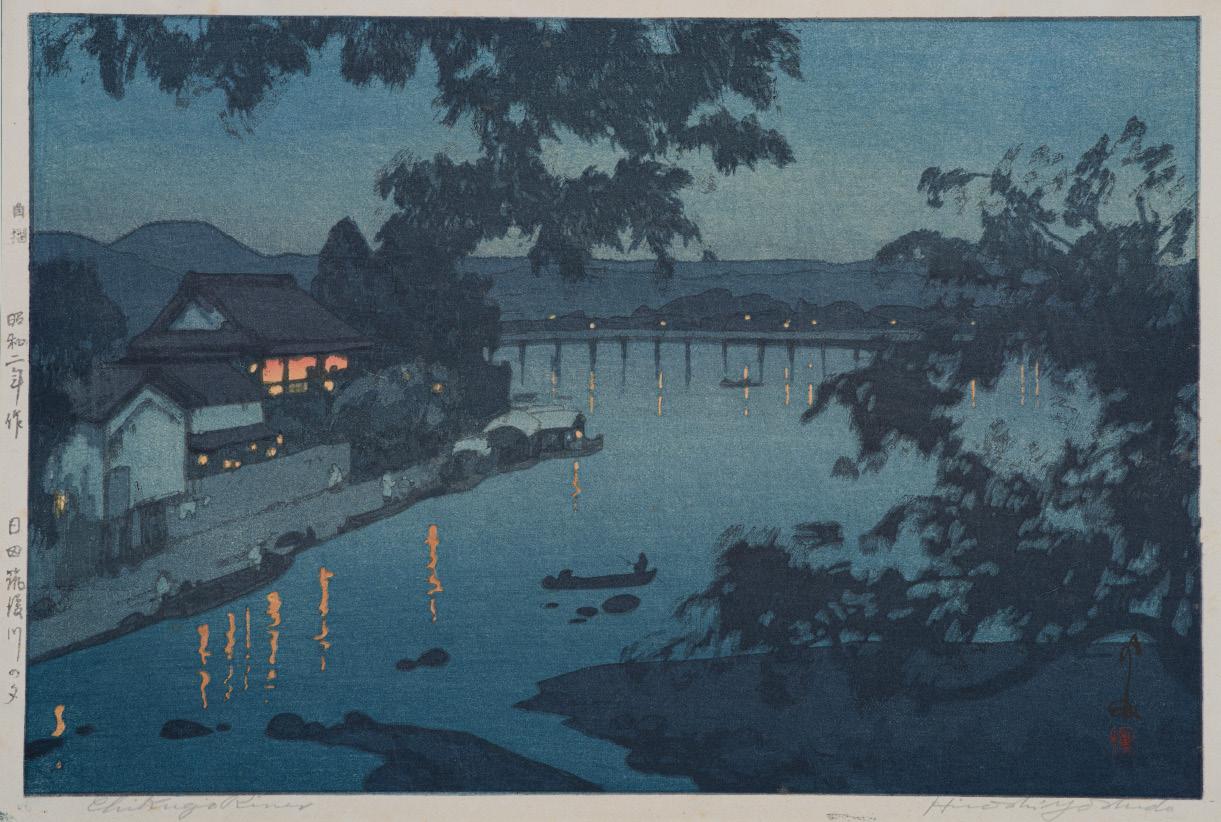
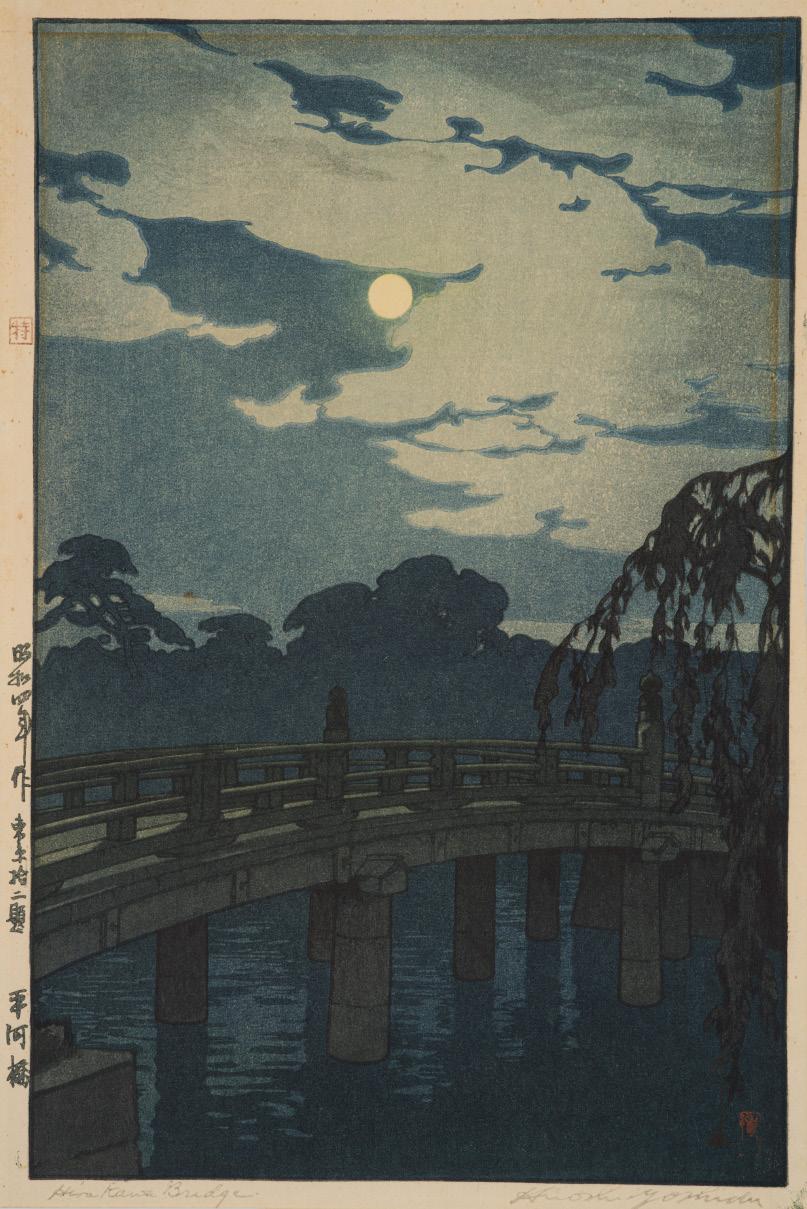
HIROSHI YOSHIDA: HIRAKAWA BRIDGE, WITH TOKU (SPECIAL) SEAL
By Yoshida Hiroshi (1876-1950), signed Yoshida and sealed Hiroshi Japan, dated 1929
Color woodblock print on paper. Vertical oban. Signed Yoshida and sealed Hiroshi, Toku (special) seal to the left margin, further signed in Roman script to the outer-lower margin Hiroshi Yoshida. Title Hirakawa-bashi (Hirakawa Bridge), from the series Tokyo juni dai (Twelve Scenes of Tokyo), inscribed with the English title “Hirakawa Bridge” in Roman script to the outer-lower margin.
A solitary figure crossing Tokyo’s arched, wooden Hirakawa Bridge under a glowing full moon, with weeping willow branches and clouds softly rendered in subtle tones.
SIZE of the sheet 39 x 26 cm
Condition: Good condition with bright colors and little browning to paper. Foxing along the perimeter of the image from previous mounting. Minor ink stains to the outer edges.
This print is distinguished by the rare toku (special) seal in the upper left margin, a mark used by Hiroshi Yoshida for select impressions of the highest quality, often presented as gifts to distinguished individuals or in gratitude. Such examples are seldom encountered at auction.
MUSEUM COMPARISON
Compare a closely related print, lacking the toku seal and with a jizuri seal, in the Museum of Fine Arts Boston, accession number 52.1457.
Estimate EUR 2,000
Starting price EUR 1,000
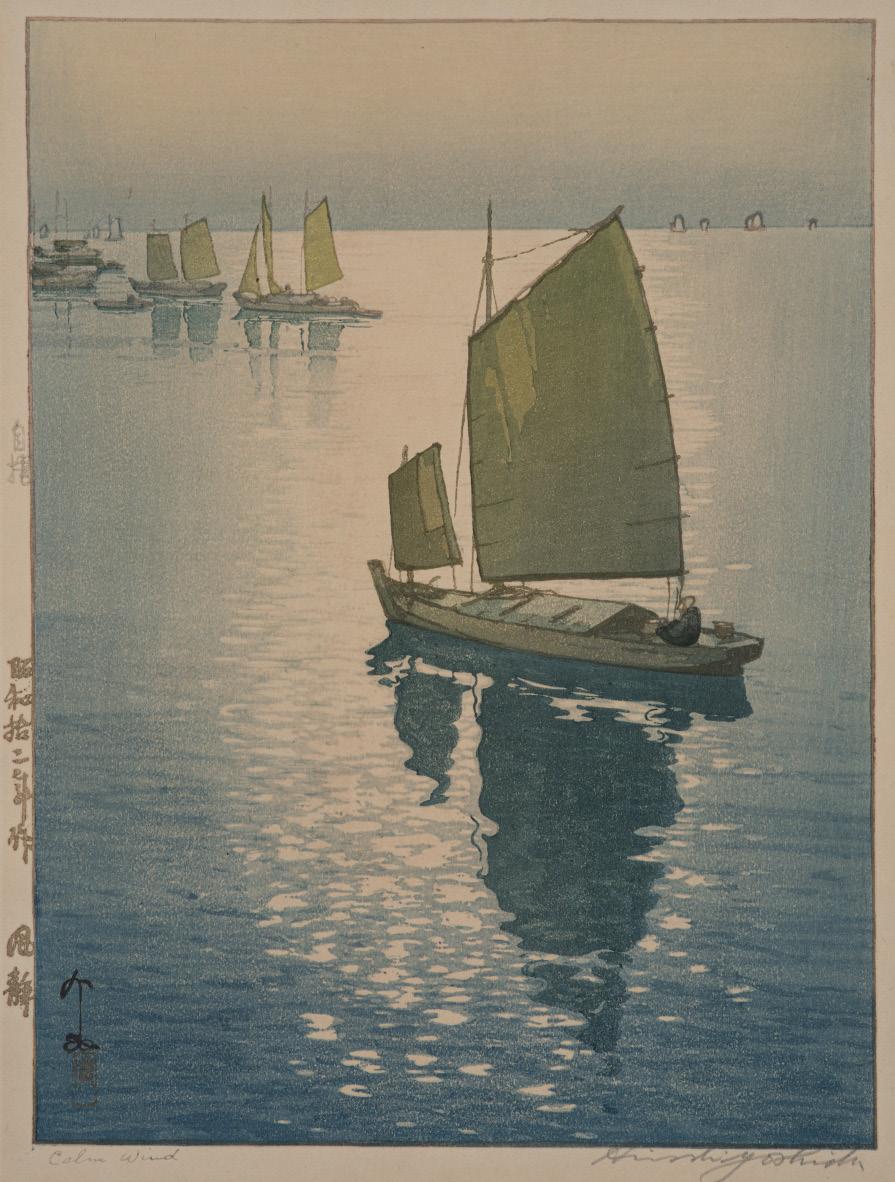
By Yoshida Hiroshi (1876-1950), signed Yoshida and sealed Hiroshi Japan, dated 1937
Color woodblock print on paper. Vertical oban. Signed Yoshida and sealed Hiroshi, Jizuri (self-printed) seal to the left margin, further signed in Roman script to the outer-lower margin Hiroshi Yoshida, embossed with the artist’s studio mark below. Title Fusei (Calm Wind), inscribed with the English title “Calm Wind” in Roman script to the outer-lower margin.
A sailboat drifts in the foreground on a calm sea, with sunlight reflecting off the smooth water’s surface. The soft glow of the sunlight creates a serene ambiance, complemented by several boats in the background.
SIZE of the sheet 40 x 27.3 cm
Condition: Excellent condition. Minuscule soiling to the outer edge and the back with stained adhesive residue from previous mounting, all not affecting the image.
The jizuri seal is the most important mark on a Hiroshi Yoshida print as it helps distinguish an early edition where the printing process was directly supervised by him. Jizuri means “self-printed” and indicates that Hiroshi Yoshida played an active role in the printing process of the respective print. Hiroshi focused heavily on developing prints of the highest quality and normally only the prints with the best impressions received his jizuri seal.
Compare a closely related print, also with jizuri seal and embossed studio mark, at Bonhams, Fine Japanese Prints, including property from the Collection of the late Bertram and Ruth Malenka, 20 March 2019, New York, lot 140 (sold for USD 4,450 or approx. EUR 5,000 converted and adjusted for inflation at the time of writing).
Estimate EUR 3,000 Starting price EUR 1,500
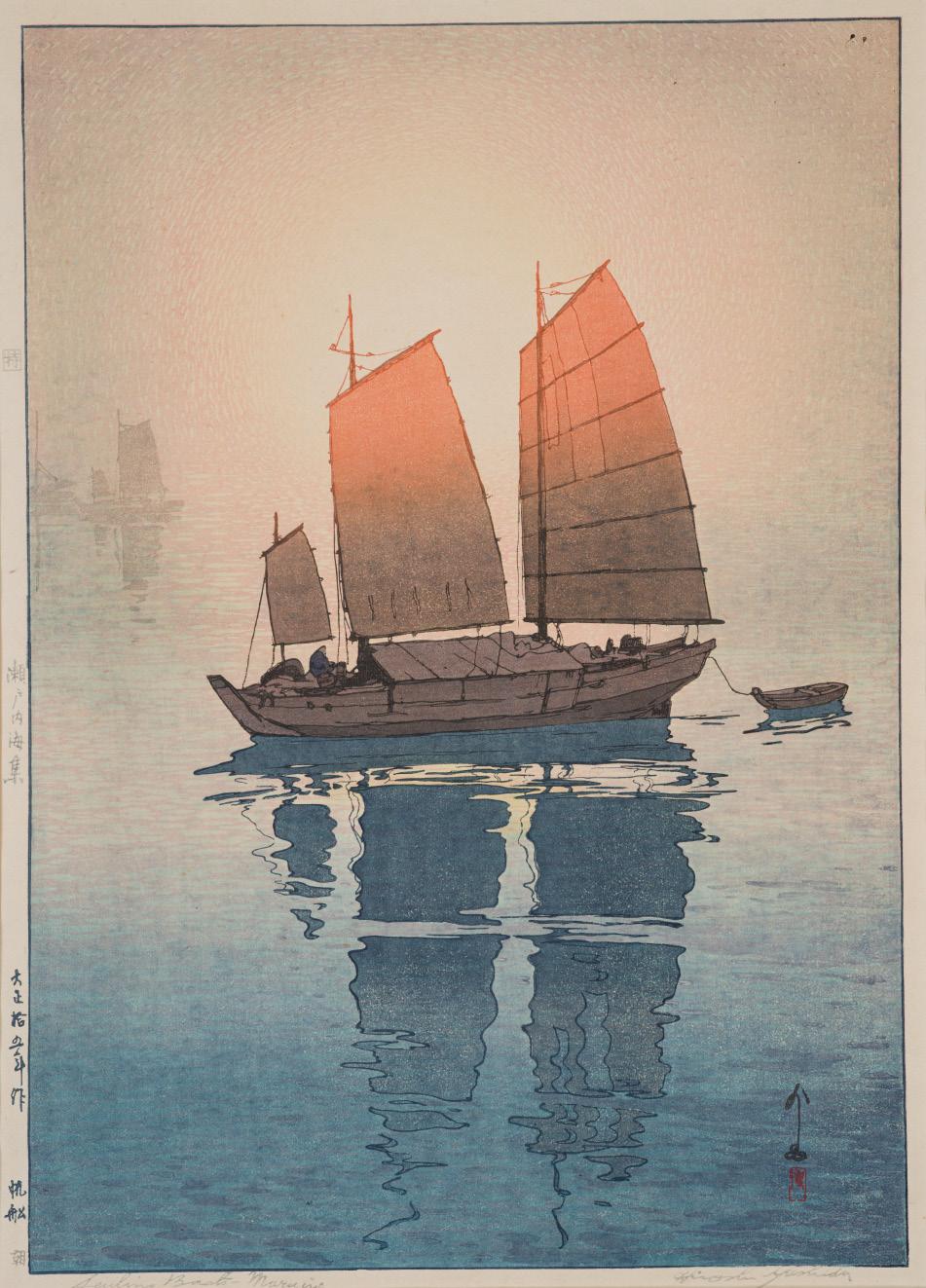
HIROSHI YOSHIDA: AN EXCEPTIONAL GROUP OF TWO PRINTS FROM THE SERIES INLAND SEA, WITH TOKU (SPECIAL) SEALS
By Yoshida Hiroshi (1876-1950), signed Yoshida and sealed Hiroshi Japan, dated 1926
Two color woodblock prints on paper. Each of vertical double oban. Each signed Yoshida with seal Hiroshi, Toku (special) seal to the left margin, further signed in Roman script to the outer-lower margin Hiroshi Yoshida. Titles Hansen, asa (Sailboats, Morning) and Hansen, yu (Sailboats, Evening), from the series Seto Naikai shu (Inland Sea), inscribed with the English titles “Sailing Boats Morning” and “Sailing Boats Evening” in Roman script to the outer-lower margin.
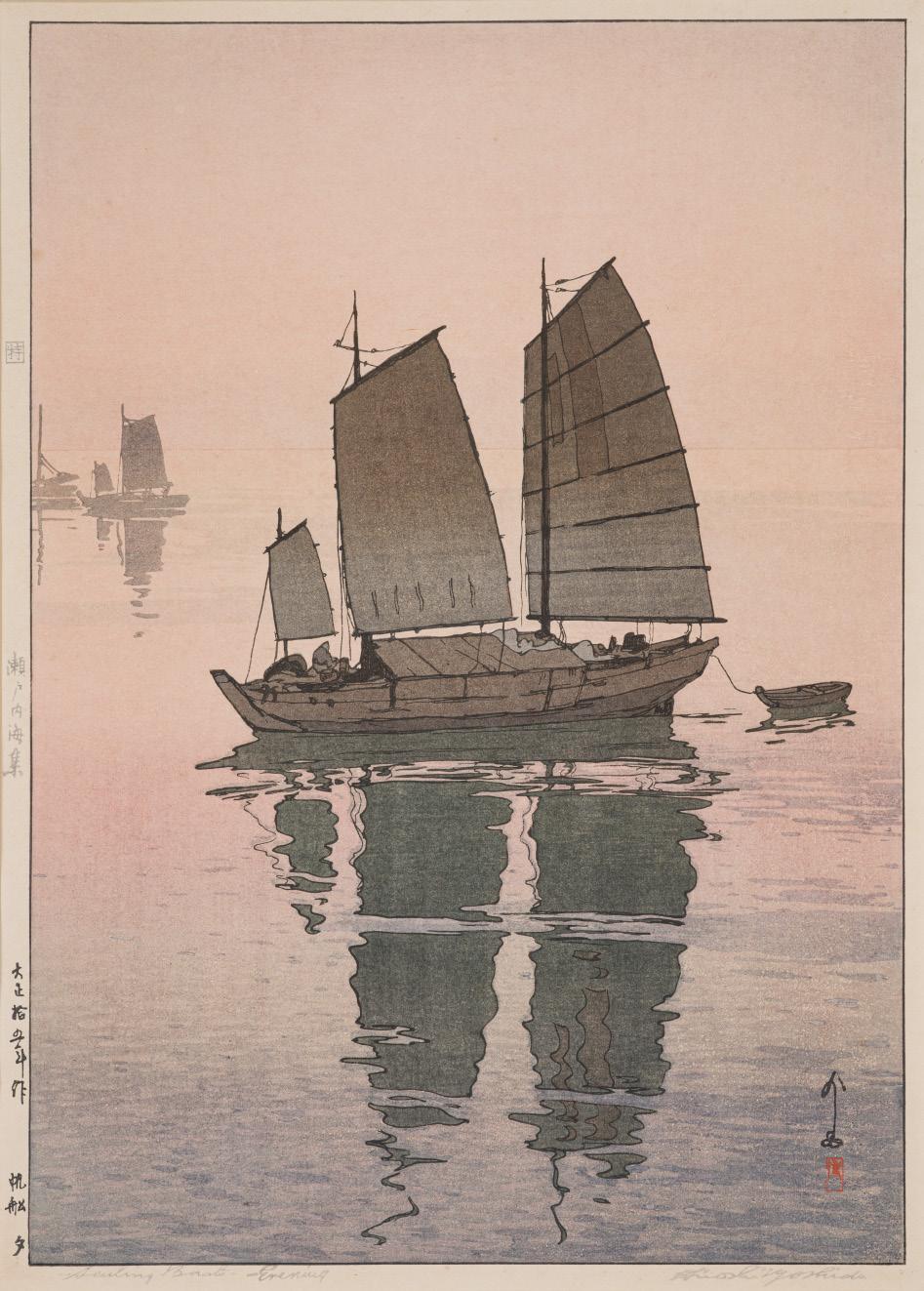
Each depicting a sailboat gently drifting on calm waters with soft light reflecting on the serene surface. The subtle gradient of colors in the sky and water creates a peaceful and tranquil atmosphere.
SIZE of the sheet ca. 53.3 x 38.1 cm (each), SIZE incl. frame 56.6 x 74.8 cm
Condition: Very good condition and impressions. Vibrant colors. The evening print with a faded horizontal line to the center and the morning print with some foxing to the upper right area. Both sheets mounted on passepartout.
Each with a wooden frame and glass for presentation.
These exceptional woodblock prints are distinguished by the rare toku (special) seal in the upper left margin, a mark used by Hiroshi Yoshida for select impressions of the highest quality, often presented as gifts to distinguished individuals or in gratitude. Such examples are seldom encountered at auction.
Compare a closely related print, lacking the toku seal and with a jizuri seal, at Christie’s, Japanese and Korean Art, 16 March 2021, New York, lot 225 (sold for USD 27,500 or approx. EUR 29,000 converted and adjusted for inflation at the time of writing). Compare a closely related print, lacking the toku seal, at Christie’s, Japanese and Korean Art, 24 March 2026, New York, lot 143 (sold for USD 10,160 or approx. EUR 8,800 converted at the time of writing).
Estimate EUR 10,000
Starting price EUR 5,000
By Yoshida Hiroshi (1876-1950), signed Yoshida and sealed Hiroshi Japan, dated 1926
Color woodblock print on paper. Horizontal oban. Signed Yoshida and sealed Hiroshi, Jizuri (self-printed) seal to the left margin, further signed in Roman script to the outer-lower margin Hiroshi Yoshida. Title Goshikibara (Goshiki Plateau), from the series Nihon Arupusu juni dai no uchi (Twelve Scenes in the Japan Alps), inscribed with the English title “Goshikihara” in Roman script to the outer-lower margin.
Terrific view of the rugged scenery of Goshikibara. Fantastic cloud formations fill the sky, shaded in tones of mauve, gray, rose, and green.
SIZE of the sheet 26 x 39 cm, SIZE incl. frame 44 x 56.5 cm
Condition: Excellent impression and condition. Light soiling to the outer edges and stained adhesive residue from previous mounting to the back, all not affecting the image.
With a wooden frame and glass for presentation.
The jizuri seal is the most important mark on a Hiroshi Yoshida print as it helps distinguish an early edition where the printing process was directly supervised by him. Jizuri means “self-printed” and indicates that Hiroshi Yoshida played an active role in the printing process of the respective print. Hiroshi focused heavily on developing prints of the highest quality and normally only the prints with the best impressions received his jizuri seal.
MUSEUM COMPARISON
Compare a closely related print, also with the jizuri seal, in the Museum of Fine Arts Boston, accession number 47.385.
Estimate EUR 8,000
Starting price EUR 4,000
313
HIROSHI YOSHIDA: SPHINX–DAY
By Yoshida Hiroshi (1876-1950), signed Yoshida and sealed Hiroshi Japan, dated 1925
Color woodblock print on paper. Horizontal oban. Signed Yoshida and sealed Hiroshi, Jizuri (self-printed) seal to the left margin, further signed in Roman script to the outer-lower margin Hiroshi Yoshida. Title Sufuinkusu (Sphinx–Day), inscribed with the English title “Sphinx” in Roman script to the outer-lower margin.
Head of the Sphinx, outside Cairo, before it had been excavated. A group of Egyptians and two figures, who appear to be tourists are progressing across the desert on camels and mules.
SIZE of the sheet 26.3 x 38.7 cm, SIZE incl. frame 44.7 x 57.5 cm
Provenance: From a private collection in California, United States, acquired in 1953. The frame with an inscribed label to the back, “Artist: Hiroshi Yoshida, Subject: Sphinx-Day, Series: European, Dated: 1925, Print Number: […]2, Acquired: 1953 Y-16, No. blocks: 14, No. impressions 33, Remarks: […]”.
Condition: Overall good condition with bright colors. One large stain to the blue sky as visible in the catalog illustration and scattered foxing to the back.
With a wooden frame and glass for presentation.
The jizuri seal is the most important mark on a Hiroshi Yoshida print as it helps distinguish an early edition where the printing process was directly supervised by him. Jizuri means “self-printed” and indicates that Hiroshi Yoshida played an active role in the printing process of the respective print. Hiroshi focused heavily on developing prints of the highest quality and normally only the prints with the best impressions received his jizuri seal.
MUSEUM COMPARISON
A closely related print, bearing the same jizuri seal, is in the Museum of Fine Arts Boston, accession number 50.3249.
AUCTION COMPARISON
Compare a closely related print, bearing the same jizuri seal, at Christie’s, Landscape of Japan: Woodblock Prints from Edo to PostWar, 26 March 2024, New York, lot 50 (sold for USD 8,190 or approx. EUR 7,500 converted and adjusted for inflation at the time of writing).
Estimate EUR 6,000 Starting price EUR 3,000
NATORI SHUNSEN: ACTOR NAKAMURA SHIKAKU II AS SHIZUKA GOZEN AT HORIKAWA
By Natori Shunsen (1886–1960), signed Shunsen and sealed Natori Japan, 1926
Color woodblock print on paper. Vertical oban. Signed Shunsen and sealed Natori. With an additional red Natori seal to the lower left corner. Title Actor Nakamura Shikaku II as Shizuka Gozen at Horikawa, from the series Shunsen nigaoe shu (Collection of Portraits by Shunsen).
The actor Nakamura Shikaku II (1900-1981) as Horikawa gosho no Shizuka Gozen, in the play Yoshitsune senbon zakura.
Image SIZE 39.6 x 27.1 cm, SIZE incl. frame 60 x 47.1 cm
Condition: Excellent condition with vibrant colors and a good impression. One mounting hole to the top-right. The back with a strip of paper from previous mounting.
Natori Shunsen (1886-1960), one of the finest designers of actor prints, was born Natori Yoshinosuke, the fifth son of a silk merchant. At the age of eleven, he began studying with Kubota Beisen (1852-1906), a Japanese-style (Nihonga) painter. During this time he received his artist’s name “Shunsen”. He later studied at the Tokyo School of Fine Arts.
Natori Shunsen (1886-1960)
AUCTION COMPARISON
Compare a closely related print, bearing the same Natori seal to the lower left corner, at Christie’s, Japanese and Korean Art, 21 September 2006, New York, lot 105 (part lot, sold for USD 3,840 or approx. EUR 5,500 converted and adjusted for inflation at the time of writing).
Estimate EUR 5,000
Starting price EUR 2,400
By Takahashi Hiroaki (1871-1945), signed Sanji okina Hiroaki and sealed Shotei Japan, dated 1924
Color woodblock print on paper. Horizontal oban. Signed Sanji okina Hiroaki and sealed Shotei; publisher Watanabe Shozaburo. Title Shiro neko Tama (White Cat Tama).
Depicting a cat reclining upon its paws, its snow-white coat subtly tinged with pink hues along the tail, carefully embossed to evoke the texture of its fur, with its head encircled by a red collar and distinguished by the deeply expressive gaze of the animal.
SIZE of the sheet 26.9 x 36.8 cm
Condition: Excellent condition with vibrant colors.
Takahashi Hiroaki (1871-1945), also known as Shotei, was a prominent Japanese woodblock print artist of the late 19th and early 20th centuries. He is best known for his landscape prints, particularly those featuring scenic views of Japan’s countryside and urban scenes of Tokyo during the Taisho and Showa periods. Shotei’s prints are characterized by their simple yet evocative style, with a focus on naturalistic details and atmospheric effects.
MUSEUM COMPARISON
A closely related print is in the Smithsonian Institution, National Museum of Asian Art, accession number S2003.8.3801.
AUCTION COMPARISON
Among Shotei’s most sought-after works are his depictions of cats, notable for their immediacy and charm. For a related print of a cat and tomato plant, dated 1931, see Christie’s, New Wave: Icons of Modern Japanese Prints Online, 24 September 2024, New York, lot 138 (sold for USD 10,710 or approx. EUR 10,000 converted and adjusted for inflation at the time of writing).
Estimate EUR 4,000
Starting price EUR 2,000
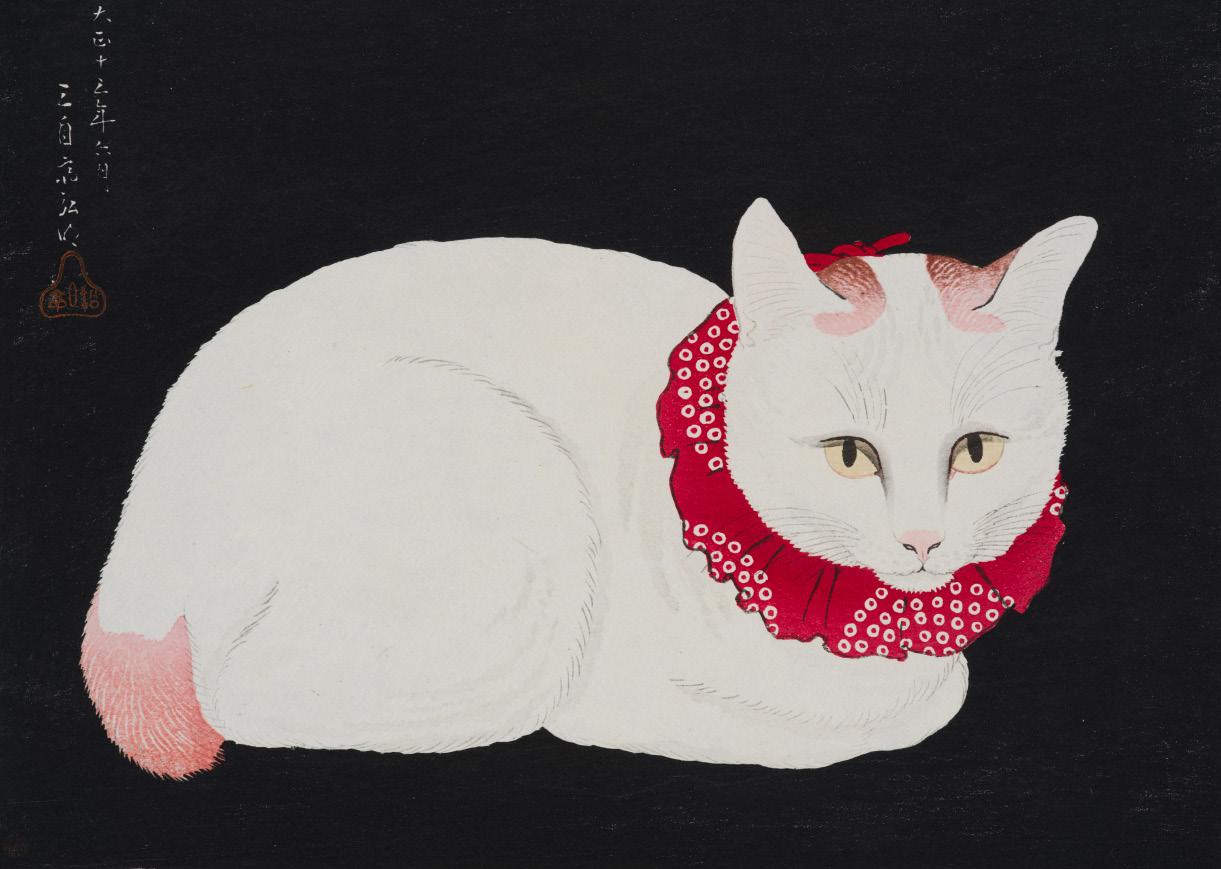
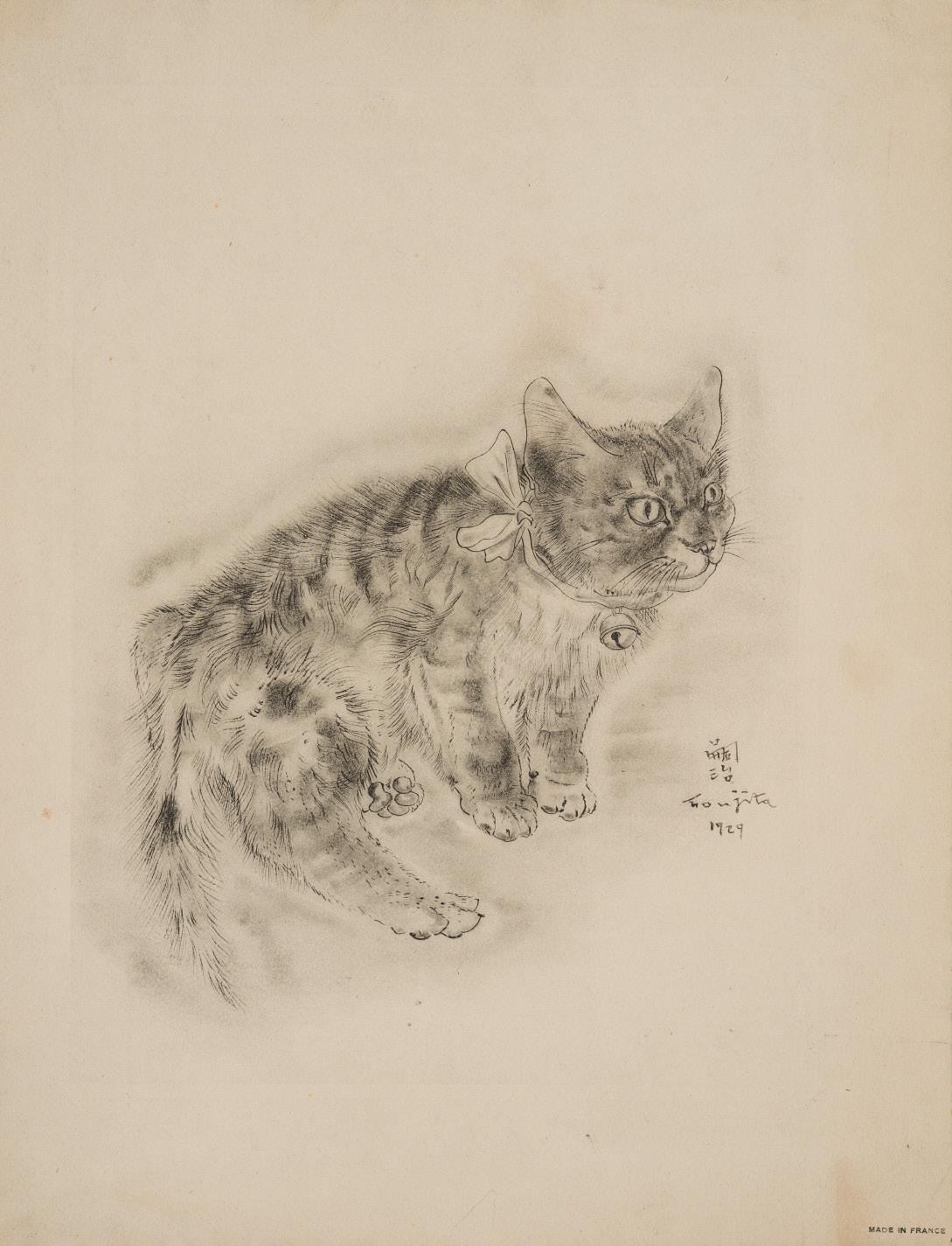
LEONARD TSUGUHARU FOUJITA: SOMILIS, FROM A BOOK OF CATS
By Leonard Tsuhuharu Foujita (1886-1968), signed Foujita France, dated 1929
Somilis, from A Book of Cats
Etching on handmade Arches paper, signed 嗣治 Foujita, 1929, published by Covici-Friede, New York, 1930. Stamped to the bottom-right ‘Made in France’.
Foujita had a great fondness for cats and often included them in his paintings. In fact, he is sometimes referred to as the Cat Painter and is credited with popularizing the idea of the ‘artist and cat’ archetype. A Book of Cats is Foujita’s most beloved work and is “certainly one of the rarest and most desired books on cats in existence” (Sam Kalda, Of Cats and Men, 2017, p. 43).
SIZE of the sheet 32.4 x 25 cm
Condition: Very good condition with minor expected browning of paper and minor soiling.
AUCTION COMPARISON
For the entire book featuring 20 prints see Bonhams, Fine Books & Manuscripts, 11 December 2013, New York, lot 1364 (sold for USD 68,750 or approx. EUR 83,500 converted and adjusted for inflation at the time of writing).
Estimate EUR 4,000
Starting price EUR 2,000
Leonard Tsuguharu Foujita (1886-1968) was a celebrated JapaneseFrench painter known for his unique blend of traditional Japanese art and Western modernism. His works featured bold outlines, flat colors, and strong design, often depicting portraits of women, cats, and scenes from everyday life. Foujita was an active member of the School of Paris, a group of international artists who converged in Paris in the early 20th century. His close friendships with prominent artists, including Modigliani and Picasso, contributed to the development of modern art movements in France and beyond.
Tsuguharu Foujita photographed in 1927
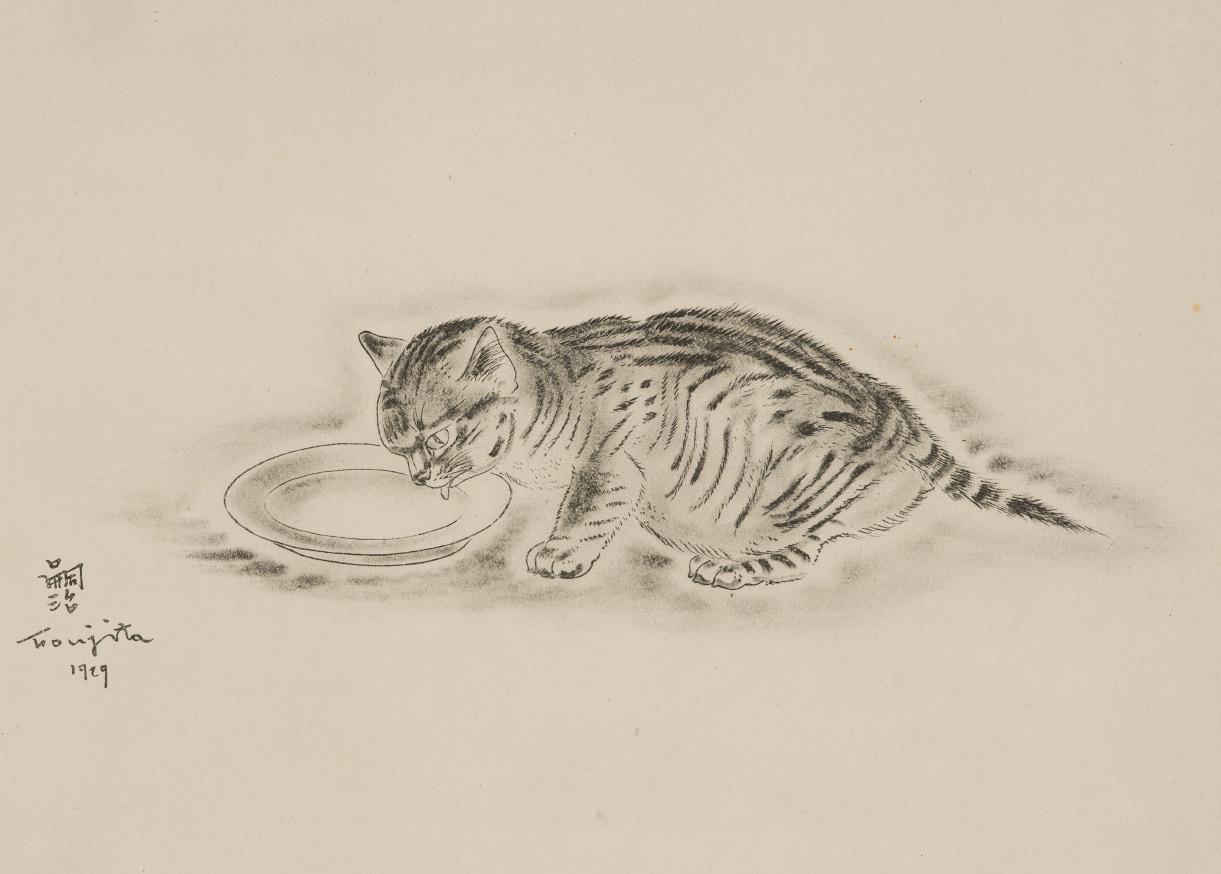
317
LEONARD TSUGUHARU FOUJITA: EPRATH, FROM A BOOK OF CATS
By Leonard Tsuhuharu Foujita (1886-1968), signed Foujita France, dated 1929
Eprath, from A Book of Cats
Etching on handmade Arches paper, signed 嗣治 Foujita, 1929, published by Covici-Friede, New York, 1930. Stamped to the bottom-left ‘Made in France’.
Foujita had a great fondness for cats and often included them in his paintings. In fact, he is sometimes referred to as the Cat Painter and is credited with popularizing the idea of the ‘artist and cat’ archetype. A Book of Cats is Foujita’s most beloved work and is “certainly one of the rarest and most desired books on cats in existence” (Sam Kalda, Of Cats and Men, 2017, p. 43).
SIZE of the sheet 32.4 x 25.6 cm
Condition: Excellent condition. Little browning of paper and minuscule foxing.
AUCTION COMPARISON
Compare a related etching from the same book, titled Atara and Hession, at Zacke, Fine Japanese Art, 6 December 2024, Vienna, lot 294 (sold for EUR 4,160).
Estimate EUR 4,000 Starting price EUR 2,000
§ 1) The auction shall be carried out in accordance with the provisions of the rules of procedure of GALERIE ZACKE©, SZA VERSTEIGERUNGEN UND VERTRIEBS GMBH, Zelinkagasse 6, 1010 WIEN (hereinafter referred to as the company) as well as in accordance with sections 244-246 of the GEWERBEORDNUNG [Industrial Code] of 1994. The auction shall be carried out on commission. The auctioneer shall be entitled to withdraw lots exceptionally, to conduct the auction deviating from the order of the catalog numbers and to offer lots jointly. In the event of any dispute concerning a double bid or if the auctioneer has missed a bid, the auctioneer shall be entitled to revoke acceptance of a bid and to continue auctioning the item. The figures stated in the catalog shall be the highest bid in Euro (€) expected by the respective expert. As a rule, the bid shall be increased by 10% of the last bid. (See table of the bidding increments).
§ 2) The acceptance of a bid shall be granted to the highest bidder unless a hidden reserve has been agreed upon with the consignor of the item in question. Such a hidden reserve (also called limit or just reserve) shall be the minimum price under which the item will not be sold during the auction. This reserve will be disclosed upon request and after the auction only and may exceed the estimate. The auctioneer will in this case bid on behalf of the seller against all other bidders until the reserve has been reached. If a reserve is not reached during the auction, the auctioneer will knock down the item to the highest bidder at the final bid, but the sale will be conditional of the acceptance of this final bid by the seller. In this case the highest bidder shall be bound to his/her last bid for a term of 8 days starting with the day of the knockdown. If the winning bidder does not receive a written cancellation notice within this term of 8 days, the knockdown becomes unconditional and the sale is final. Typically, only a minority of all items in an auction have a hidden reserve.
§ 3) Most items shall be subject to differential taxation. A uniform surcharge of 25% plus the value added tax applicable to the surcharge to the amount of 20% shall be added to the achieved highest bid (final and highest bid). Thus, the surcharge shall be 30% of the final and highest bid in total. Items with added VAT are marked † in the online catalog.
§ 4) In the event of sales abroad, the value added tax will be repaid if the item is sold to a country which is not a member country of the European Union (third country), the legal requirements are met, and the proof of exportation is provided. The value added tax shall not be shown separately on the invoice.
§ 5) The auction buyer must pay the purchase price immediately upon acceptance of the bid (final and highest bid plus 25% surcharge, plus the value added tax applicable to the surcharge to the amount of 20%, or the added VAT on top of the final price, when a lot is highlighted accordingly in the auction catalog). The company may grant an auction buyer a term of payment for the purchase price in whole or in part when this has been formally applied for in writing before the auction.
§ 6) In the event of a term of payment, or any payment delay, in whole or in part, the company shall be entitled to charge default interest (12% p.a.) as well as storage charges (2.4% pf the final and highest bid per month commenced) after 14 days upon acceptance of the bid. The item purchased at auction shall be handed over exclusively upon full payment of the purchase price including all costs and charges accrued since the acceptance of the bid.
§ 7) The buyer should take acquired items into possession, as far as possible, immediately or after the end of the auction. Items which have been fully paid for shall be handed over in our show rooms in GALERIE ZACKE, Zelinkagasse 6, 1010 VIENNA. If a deferred purchase price is not paid within the set period, the company shall be entitled to auction the item again in order to recoup its claim from the defaulting auction buyer. In this case, the defaulting auction buyer shall be liable to the company for the total loss of commission incurred by the company due to the re-auctioning as well as for any default interest and storage charges.
§ 8) The company shall be entitled to a lien on all items of the buyer irrespective of whether the buyer bought them within the scope of an auction or in free sale or the company secured ownership of these items otherwise. This lien shall serve to secure all current and future, qualified, limited and unmatured claims to which the company is entitled and which result from all legal transactions concluded with the buyer.
§ 9) The items received for auction will be exhibited and may be viewed prior to the auction. In doing so, the company shall give everyone the opportunity to check the nature and the condition of the exhibited items to the extent deemed possible within the scope of the exhibition. Every bidder shall be deemed to act on its own behalf unless it provides a written confirmation saying that it acts as a representative or agent of a well-known principal. The company may refuse bids; this shall particularly apply if a bidder who is unknown to the company or with whom the company has no business connections yet does not provide a security deposit before the auction. However, in principle there shall be no claim to accept a bid. If a bid has been refused, the previous bid shall remain effective.
§ 10) The company’s experts evaluate and describe the items received for auction and determine the starting prices unless otherwise stated in the catalog or expert opinion. The information concerning production technique or material, state of preservation, origin, design and age of an item is based on published or otherwise generally accessible (scientific) findings concluded by the company’s expert with the necessary care and accuracy. The company shall warrant to the buyer according to §34-38 of the AGB (Terms and Conditions) that properties are correct provided that any complaints referring to this are made within 45 days after the auction day. Subsequent complaints shall be excluded in principle. The company shall not be liable for any further information in the catalog and expert opinion as well. This shall also apply to illustrations in the catalog. The purpose of these illustrations is to guide the potential buyer during the preview. They shall not be authoritative for the condition or the characteristics of the pictured item. The published condition reports shall only mention defects and damage affecting the artistic or commercial value significantly. Complaints concerning the price shall be excluded upon acceptance of the bid. The company reserves the right to amend the catalog online prior to the auction. These amendments shall also be made public orally by the auctioneer during the auction. In this case, the company shall be liable for the amendment only. All items offered may be checked prior to the auction. These items are used. Any claims for damages exceeding the liability named above and resulting from other material defects or other defects of the item shall be excluded. When making the bid, the bidder confirms that he/she has inspected the item prior to the auction and has made sure that the item corresponds to the description.
§ 11) If a customer is not able to participate in an auction personally, the company shall accept purchase orders. These orders may be placed in writing via mail, e-mail, fax, www.zacke.at or a third party bidding platform. In the case of a purchase order placed by phone or orally, the company shall reserve the right to make the performance dependent on a confirmation from the principal communicated in writing. Furthermore, the company shall not be liable for the performance of purchase orders. Equal purchase orders or live bids will be considered in the order of their receipt. Bids which below the estimate shall be exhausted completely. Bids which do not correspond to the increments determined by the company (see bidding increment table) will be rounded up to the next higher increment. The table of these increments can be sent upon request. The written bid (purchase order) must include the item, the catalog number and the offered top bid limit which is quoted as the amount of the acceptance of the bid without buyer’s commission and without taxes.
Ambiguities shall be carried by the bidder. A purchase order which has already been placed may only be cancelled if the written withdrawal is received by the company at least 72 hours prior to the beginning of the auction.
§ 12) The company may refuse a purchase order without explanation or make its execution dependent on payment of a security deposit. In the event of an unsuccessful order, such a deposit will be reimbursed by the company within 5 working days. Processing of purchase orders is free of charge.
§ 13) Every seller shall in principle be entitled to withdraw the items offered for auction until the start of the auction. Therefore, it is impossible to assume liability or to give warranty for the actual offering.
§ 14) Paid items must be collected within 30 days after payment. Items which have not been collected may be re-offered without further communication at the starting price from the recent auction reduced by 50%. Items which have not been collected within 30 days after the auction or for which the company does not receive any proper shipping instructions stating the type of shipping and the address of dispatch (independent of a possibly placed purchase order) shall be stored at the owner’s risk.
Furthermore, the company shall be entitled to store items which have been purchased at auction and paid but not collected at the buyer’s risk and expense, including the costs for an insurance, with a forwarding agency. It shall be understood that the provision concerning the re-auctioning of unpaid and paid but not collected items must also apply to items not exhibited or stored on the premises of the company. The ownership shall be transferred to the buyer at the time of handing over the issuing note.
§ 15) In the case of mixed lots with a starting price of less than EUR 350.00, the company shall not warrant for the completeness or correctness of the individual items within a mixed lot.
§ 16) A registration for a bid by telephone for one or several items shall automatically represent a bid at the starting price of these items. If the company cannot reach a bidder by telephone, it will bid the starting price on behalf of this bidder when the respective lot is up for auction.
§ 17) Payments made to the company by mistake (through the payer’s fault) (e. g. due to miscalculation of the exchange rate by the payer) or payments made to the company for the same invoice several times shall be compensated in form of a credit note for goods for an indefinite period of time. The repayment of such payments in cash shall be excluded.
§ 18) Certain auction lots may exist several times (multiples). In such a case, the auctioneer may accept a second, third or even more bids from the underbidder(s). In this case, the text in the catalog and not the illustration shall be exclusively binding with regard to the warranty.
§ 19) The company reserves the right to assign to the buyer all rights and obligations resulting from the contractual relationship between the company and the seller by way of a respective declaration, as well as to assign to the seller all rights and obligations resulting from the contractual relationship between the company and the buyer by way of a respective declaration, in each case in terms of a complete assignment of contract with the result that the contractual relationship - following the submission of the aforementioned declarations by the company –shall exclusively be between the seller and the buyer, all of which is in accordance with the basic model of the commission agreement. Buyers and sellers shall already now give their explicit consent to this contract assignment.
§ 20) The place of performance of the contract brought about between the company on the one hand and the seller as well as the buyer on the other hand shall be the place of business of the company. The legal relationships and contracts existing between the company, the sellers and the buyers shall be subject to Austrian law. The company, the sellers and the buyers shall agree to settle all disputes resulting from, concerning and in connection with this contract before the territorially competent court of Vienna.
§ 21) The export of certain art objects from Austria shall require a permit from the Bundesdenkmalamt [Federal Monuments Office]. The company will orally provide information about art objects for which such export permit will probably not be granted at the beginning of the auction.
§ 22) Whenever making a bid, whether personally or via an agent, in writing, online, telephone, or in any other way, the bidder fully and unconditionally accepts the Terms of Auction, the ‘Important Information’ section in the auction catalog, the Terms and Conditions (AGB) of Galerie Zacke, §1-50, the Fee Tariff, and the Bidding Increments table, all as published on www.zacke.at on the day of the auction.