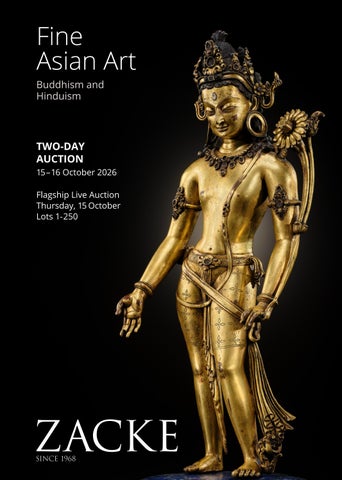
Fine Asian Art Buddhism and Hinduism
TWO-DAY AUCTION 15–16 October 2026 Flagship Live Auction Thursday, 15 October Lots 1-250
Provenances
Museum Deaccessions Museum für Asiatische Kunst, Radevormwald, Germany The Chang Foundation Museum, Taipei, Taiwan The Herbert F. Johnson Museum of Art, Cornell University, Ithaca, United States The Tsui Museum of Art, Hong Kong The Zelnik István Southeast Asian Gold Museum, Budapest, Hungary The Royal Collections of Saxony, Japanese Palace, Dresden, Germany Historic Galleries and Dealerships Abdul Aziz & Sons, Kashmir Alan and Simone Hartman, New York, United States Albert Strang, Argyle Antiques, London, United Kingdom Alberto Santos, The Santos Collection, London, United Kingdom Alexander Goetz, Gallery 101, Bali, Indonesia Alvin Lo, Hong Kong Arch Angel Gallery, Hong Kong Art Treasures Gallery, Hong Kong Barrie M. Heaven (1938–2021), Adelaide, Australia Becker Antiques, Amsterdam, Netherlands Ben Janssens Oriental Art, London, United Kingdom Berwald Oriental Art, London, United Kingdom Bob van Grevenbroek (d. 2004), Kathmandu, Nepal Boris Mirski Gallery, Boston, United States C. C. Teng (Teng Chen-ching), Taipei, Taiwan Christian Deydier, Oriental Bronzes Ltd., London, United Kingdom Clare Chu (formerly Lawrence), London, United Kingdom Damien Woliner, Brussels, Belgium
Doig, Wilson & Wheatley, Edinburgh, Scotland Dr. John K. Fong and Dr. Colin Johnstone of Johnstone-Fong, Inc., Philadelphia, United States E. & J. Frankel Ltd., New York, United States Fabbrini Arte, Rome, Italy G. Malina, Inc., New York, United States Galerie Asboth, Vienna, Austria Galerie du Carré des Antiquaires, Versailles, France Galerie Grusenmeyer-Woliner, Brussels, Belgium Galerie Jacques Mansiet Galerie Peter Hardt, Radevormwald, Germany Gilbert Crutel, Eymery & Cie, Paris, France Ian Alsop, Peaceful Wind, Santa Fe, United States Ikeda Gallery, Tokyo, Japan J. T. Tai & Co., New York, United States James J. Lally, New York, United States Jean and Marcel Nies Oriental Art, Antwerp, Belgium Jean Lostalem, Galerie Slim Bouchoucha, Louvre des Antiquaires, Paris, France John Sparks Ltd., London, United Kingdom
Jules Speelman Asian Art, London, United Kingdom Karen Beagle (1960–2021), London, United Kingdom Kusaka Shogado, Tokyo, Japan L. A. Euwe, Salon D’Antiquités, Den Haag, Netherlands Leonardo Vigorelli, Bergamo, Italy Littleton & Hennessy, London, United Kingdom Marchant & Sons, London, United Kingdom Mark Walberg, Pennsylvania, United States Martin Doustar, Brussels, Belgium MD Flacks Ltd., London, United Kingdom Michael B. Weisbrod, Weisbrod Chinese Art, New York, United States Navin Kumar, Inc., New York, United States Poon, Hong Kong R & G McPherson Antiques, London, United Kingdom Rare Art Gallery, New York, United States Renaud Montméat, Paris, France Sjoerd de Vries (1952–2025) Spink & Son Ltd., London, United Kingdom Stephen McGuiness, Hong Kong Susan Chen (d. 2014), The Sze Yuan Tang Collection, Hong Kong Suzanne Denis, Antiquités, Brussels, Belgium Sílvia Soler, Barcelona, Spain The Pagoda Gallery, Hong Kong Throckmorton Fine Art, New York, United States Whisnant Galleries, New Orleans, United States William Cook, Marlborough, United Kingdom Y. Yamanishi, Gallery UR, Japan Yung Po Hin, Hong Kong
Provenance list continues on the inside back cover
Fine Asian Art Buddhism and Hinduism CATALOG FAS1026
TWO-DAY AUCTION 15-16 October 2026, at 11 am CET
DAY 1 Flagship Live Auction I Lots 1-250 Thursday, 15 October 2026, at 11 am CET
DAY 2 Live Auction Online Catalog I Lots 251-710 Friday, 16 October 2026, at 11 am CET
EXHIBITION 6-14 October 2026, Monday – Friday 10 am – 6 pm as well as by appointment
GALERIE ZACKE Zelinkagasse 6 . 1010 Vienna Austria
Tel +43 1 532 04 52 E-mail office@zacke.at www.zacke.at
VISIT US IN VIENNA HOW TO FIND OUR AUCTION & SHOWROOM AT ZELINKAGASSE 6 NG
Located at Zelinkagasse 6, 1010 Vienna, our auction and preview space is just a seven-minute walk from our longstanding, 10,000-square-foot office, photography, video, and cataloging hub at Sterngasse 13. Both locations are open to the public, and we warmly invite you to visit.
U4
H
SC
E
SS
GA
A NK
LI
ZE
E
SAL
ZG
PL
LF
SP
AT
KE
ÜC
BR
R TO
LZ
SA
AR
K
Z
RIE
S
STERNGASSE 13
15-16 October 2026 at 11 am CET
Register now: www.zacke.at.
L
AI
SS
RU
O
LF
Attend in person in our auction room at Zelinkagasse 6 or participate online via Zacke Live – and enjoy premium buyer’s terms with no additional online bidding fees.
NA
S-K
A RG D
ZELINKAGASSE 6
A UK
NA
SEF
TO RU
DO
JOIN US LIVE
DO
SE AS
JO NZFRA
AG
AG
NZ
GO
U NE
Starting 6 October you’ll be able to explore the exceptional pieces featured in this auction at Zelinkagasse 6, 1010 Vienna.
U2
RI
EN
T OT
FISCHERSTIEGE
In the heart of Vienna’s first district, our showroom spans 6,000-square-foot and has been specially designed to provide a seamless auction and exhibition experience.
Easily accessible by public transport or car (a parking garage is located nearby). By Public Transport: SCHOTTENRING station (U2, U4, tram lines 1, 31, 71, D, and bus 3A)
SC
H
W
ED
EN
PL
AT
U1
Z U4
ABSENTEE BIDDING FORM FOR THE AUCTION Fine Asian Art, Buddhism and Hinduism FAS1026 ON DATE 15-16 October 2026
LOT NR.
LOT TITLE
BID IN EURO
PLEASE RAISE MY BID BY ONE BIDDING INCREMENT (ca. 10%) IF NECESSARY IMPORTANT NOTICE: Bids do not include buyer’s premium and VAT. Margin taxation applies. Items with added VAT are marked in the online catalog.
PLEASE CALL ME WHEN A HIGHER BID THAN MINE HAS BEEN RECEIVED MY PHONE NUMBER
TELEPHONE BIDS: If you like to bid by telephone, please state ‘TEL’ in the ‘BID IN EURO’ column instead of a Euro amount. Galerie Zacke will call you on the day of the auction, on the telephone number provided, 5 lots before the lot you are bidding on and the bidding will commence at the starting price, as stated in the catalog. If Galerie Zacke cannot reach you during the auction, Galerie Zacke will bid the starting price on your behalf. TERMS OF PAYMENT, SHIPPING AND COLLECTION:
NAME
ADRESS CITY, COUNTRY POSTCODE
With the signature on this form, the client instructs the auctioneer to bid on his behalf. The Euro amount up to which the auctioneer shall bid on behalf of the client is either stated in this form or will be communicated to the auctioneer via telephone during the auction. All absentee bidding shall be governed by the terms and conditions [AGB] of Galerie Zacke. The client agrees with his signature that he has read, understood and fully accepted the AGB of Galerie Zacke. Galerie Zacke, founded 1968, is a registered brand of SZA Versteigerungen & Vertriebs GmbH, Vienna, Austria.
PHONE NUMBER
DATE & SIGNATURE
CREDIT CARD PAYMENT PLEASE CHECK THE DESIRED CARD COLLECTION BY CLIENT WITH PAYMENT ON THE PREMISES IN CASH, BY CERTIFIED CHEQUE OR CREDIT CARD INVOICE PAYMENT VIA BANK WIRE AFTER RECEIPT OF INVOICE SHIPPING AFTER RECEIPT OF PAYMENT EXPRESS PARCEL SERVICE REQUIRED (ACCORDING TO TERMS AND CONDITIONS OF GALERIE ZACKE)
AMEX
MASTERCARD
VISA
NAME ADDRESS CARD NUMBER EXPIRY DATE
SECURITY CODE
SHIPPING INSURANCE REQUIRED (ACCORDING TO TERMS AND CONDITIONS OF GALERIE ZACKE)
GALERIE ZACKE Zelinkagasse 6, 1010 Vienna, Austria Email: office@zacke.at Tel: +43-1-532 04 52 Fax: +43-1-532 04 52 20
IMPORTANT NOTICE: Whenever making a bid, whether personally or via an agent, in writing, online, telephone, or in any other way, the bidder fully and unconditionally accepts the Terms of Auction, the ‘Important Information’ section in the auction catalog, the Terms and Conditions (AGB) of Galerie Zacke, §1-48, the Fee Tariff, and the Bidding Increments table, all as published on www.zacke.at on the day of the auction.
AUCTION DAY 2 Friday, 16 October 2026, at 11 am CET Lots 251-710 ONLINE CATALOG
www.zacke.at
IMPORTANT INFORMATION
According to the general terms and conditions of business of Galerie Zacke Vienna, Founded 1968, SZA Versteigerungen & Vertriebs GmbH, 1010 Wien, online at www.zacke.at ABSENTEE BIDDING Absentee bids are carried out under the regulations of the terms of business of Galerie Zacke, SZA Versteigerungen & Vertriebs GmbH, which requires written submission of your purchase limit. Orders without purchase limits cannot be processed. Only the submitted lot number of the auction lot is binding for the processing of the absentee bid. The place of jurisdiction is Vienna, Austrian Law and Austrian jurisdiction are exclusively applicable for all legal questions arising from the business relationship. Absentee bids for this auction will be accepted until the day of auction by 10:00 a.m. We regret that absentee bids received after the time stated above will not be processed until after the auction. PLEASE SEND ABSENTEE BIDS FOR THIS AUCTION TO: Fax: +43 1 532 04 52 20 or Email: office@zacke.at or Mail: Galerie Zacke, Zelinkagasse 6, 1010 Wien, Austria, Europe WE ACCEPT THE FOLLOWING METHODS OF PAYMENTS: • Cash • Certified or personal check • Bank transfer (please inquire to receive our bank account information) • Credit card (Visa, MasterCard, Amex) up to EUR 5.000 - higher amounts require prior approval and are subject to service fees TELEPHONE BIDDING It is generally possible to bid by telephone during the auction. Please fill out the absentee bidding form enclosed in this catalog and include your telephone number at which you can be reached during the auction. In the “bid in euro” column please write “TEL” and then send us the completed absentee bidding form. Galerie Zacke will call you on the day of the auction, on the telephone number provided, 5 lots before the lot you are bidding on and the bidding will commence at the starting price, as stated in the catalog. If Galerie Zacke cannot reach you during the auction, Galerie Zacke will bid the starting price on your behalf. ESTIMATES AND STARTING PRICES The auction will begin with the starting price and written bids will be accepted only with a minimum amount equivalent to the starting price. SHIPPING AND TRANSPORT INSURANCE For domestic shipping Galerie Zacke (hereinafter called “the company”) charges in average Eur 15,- to Eur 50,- per item, depending on size and weight. These fees cover the costs of packing and shipping. Fees for bulky or fragile items, or international shipping will be quoted upon request. The purchased goods are transported at the risk of the customer following handover of the packaged item to the post office or another carrier which the customer agrees to through his/her submission of the purchase order. According to the specific wish of the customer, the auctioned goods may be insured for the value of the purchase price (highest bid and all surcharges). This insurance fee is 3% of the purchase price. For any lots with a purchase prices exceeding EUR 350,- the transport insurance will be automatically arranged by the company if it does not expressively receive the purchaser’s written denial of this service and signed waiver of claims. Payments due to the company under the insurance contract will be charged to the customer. The company is also entitled to assign claims under the insurance contract to the customer providing the terms of the insurance contract do not prevent this. In any case, the company is only required to make payment to the customer specifically if payment has effectively been received from the insurance company. COLOR AND CONDITION Auction lots will be exhibited for viewing prior to the auction, thus offering all interested customers the opportunity to examine the quality and condition of the works exhibited. The catalog illustrations are intended to assist customers during such preview. In illustrations, printed colors do not correspond exactly to the originals. The printed catalog images are not representative for the condition of the illustrated pieces. Hidden flaws and damages are indicated in the condition report. The illustrations in our online catalogs can be strongly magnified, so that most damages and restorations are well recognizable.
ENDANGERED SPECIES / CITES INFORMATION Some items in this catalog may for example consist of ivory, rhinoceroshorn, tortoise shell, or some types of tropical wood, and are subject to the Convention on International Trade in Endangered Species of Wild Fauna and Flora [CITES]. Such items are marked with the symbol Ɏ on www.zacke.at and may only be exported outside the European Union after an export permit in accordance with CITES has been granted by the Austrian authorities. We would like to inform you that such licenses are typically not granted. COMPLAINTS At its auctions, Galerie Zacke sells consigned lots on behalf of third-party consignors. For this reason, any complaints related to purchased lots must be in accordance with §32-48 of the general terms and conditions of business of Galerie Zacke, which can be found on www.zacke.at IMPORTANT INFORMATION Whenever making a bid, whether personally or via an agent, in writing, online, telephone, or in any other way, the bidder fully and unconditionally accepts the Terms of Auction, the ‘Important Information’ section in the auction catalog, the Terms and Conditions (AGB) of Galerie Zacke, §1-50, the Fee Tariff, and the Bidding Increments table, all as published on www.zacke.at on the day of the auction THE ART LOSS REGISTER All items starting above EUR 2,000 have been checked by the Art Loss register.
IMPRINT Publisher Galerie Zacke founded 1968 © SZA Versteigerungen & Vertriebs GmbH 1010 Wien Zelinkagasse 6, Austria, Europe Tel (0043-1) 532 04 52 Email: office@zacke.at Editors Susanne Zacke Marion Schor Experts Alexander Zacke Max Zacke Catalogers Ananya Casius Anne-Aymone Gabriel Daniel Gonzalez-Gracia Tatjana Borodin
PEFC Certified This product is from sustainably managed forests and controlled sources PEFC/06-39-10
www.pefc.at
Assistance and Translation Jue Zhang Anna-Maria Pollmann Photography Georg Bodenstein David Lindengrün Jonas Matyassy Cesilio Cesar Garcia Loreen Sasse Vladimir Ramljak Design Hermann Kienesberger Printing Print Alliance HAV Produktions GmbH Website www.zacke.at © GALERIE ZACKE Reproduction forbidden
produced according to guideline Uz24 Austrian Ecolabel, Print Alliance HAV Produktions GmbH, UW-Nr. 715
TERMS OF AUCTION
§ 1) The auction shall be carried out in accordance with the provisions of the rules of procedure of GALERIE ZACKE©, SZA VERSTEIGERUNGEN UND VERTRIEBS GMBH, Zelinkagasse 6, 1010 WIEN (hereinafter referred to as the company) as well as in accordance with sections 244246 of the GEWERBEORDNUNG [Industrial Code] of 1994. The auction shall be carried out on commission. The auctioneer shall be entitled to withdraw lots exceptionally, to conduct the auction deviating from the order of the catalog numbers and to offer lots jointly. In the event of any dispute concerning a double bid or if the auctioneer has missed a bid, the auctioneer shall be entitled to revoke acceptance of a bid and to continue auctioning the item. The figures stated in the catalog shall be the highest bid in Euro (€) expected by the respective expert. As a rule, the bid shall be increased by 10% of the last bid. (See table of the bidding increments). § 2) The acceptance of a bid shall be granted to the highest bidder unless a hidden reserve has been agreed upon with the consignor of the item in question. Such a hidden reserve (also called limit or just reserve) shall be the minimum price under which the item will not be sold during the auction. This reserve will be disclosed upon request and after the auction only and may exceed the estimate. The auctioneer will in this case bid on behalf of the seller against all other bidders until the reserve has been reached. If a reserve is not reached during the auction, the auctioneer will knock down the item to the highest bidder at the final bid, but the sale will be conditional of the acceptance of this final bid by the seller. In this case the highest bidder shall be bound to his/her last bid for a term of 8 days starting with the day of the knockdown. If the winning bidder does not receive a written cancellation notice within this term of 8 days, the knockdown becomes unconditional and the sale is final. Typically, only a minority of all items in an auction have a hidden reserve. § 3) Most items shall be subject to differential taxation. A uniform surcharge of 25% plus the value added tax applicable to the surcharge to the amount of 20% shall be added to the achieved highest bid (final and highest bid). Thus, the surcharge shall be 30% of the final and highest bid in total. Items with added VAT are marked † in the online catalog. § 4) In the event of sales abroad, the value added tax will be repaid if the item is sold to a country which is not a member country of the European Union (third country), the legal requirements are met, and the proof of exportation is provided. The value added tax shall not be shown separately on the invoice. § 5) The auction buyer must pay the purchase price immediately upon acceptance of the bid (final and highest bid plus 25% surcharge, plus the value added tax applicable to the surcharge to the amount of 20%, or the added VAT on top of the final price, when a lot is highlighted accordingly in the auction catalog). The company may grant an auction buyer a term of payment for the purchase price in whole or in part when this has been formally applied for in writing before the auction. § 6) In the event of a term of payment, or any payment delay, in whole or in part, the company shall be entitled to charge default interest (12% p.a.) as well as storage charges (2.4% pf the final and highest bid per month commenced) after 14 days upon acceptance of the bid. The item purchased at auction shall be handed over exclusively upon full payment of the purchase price including all costs and charges accrued since the acceptance of the bid. § 7) The buyer should take acquired items into possession, as far as possible, immediately or after the end of the auction. Items which have been fully paid for shall be handed over in our show rooms in GALERIE ZACKE, Zelinkagasse 6, 1010 VIENNA. If a deferred purchase price is not paid within the set period, the company shall be entitled to auction the item again in order to recoup its claim from the defaulting auction buyer. In this case, the defaulting auction buyer shall be liable to the company for the total loss of commission incurred by the company due to the re-auctioning as well as for any default interest and storage charges. § 8) The company shall be entitled to a lien on all items of the buyer irrespective of whether the buyer bought them within the scope of an auction or in free sale or the company secured ownership of these items otherwise. This lien shall serve to secure all current and future, qualified, limited and unmatured claims to which the company is entitled and which result from all legal transactions concluded with the buyer. § 9) The items received for auction will be exhibited and may be viewed prior to the auction. In doing so, the company shall give everyone the opportunity to check the nature and the condition of the exhibited items to the extent deemed possible within the scope of the exhibition. Every bidder shall be deemed to act on its own behalf unless it provides a written confirmation saying that it acts as a representative or agent of a well-known principal. The company may refuse bids; this shall particularly apply if a bidder who is unknown to the company or with whom the company has no business connections yet does not provide a security deposit before the auction. However, in principle there shall be no claim to accept a bid. If a bid has been refused, the previous bid shall remain effective. § 10) The company’s experts evaluate and describe the items received for auction and determine the starting prices unless otherwise stated in the catalog or expert opinion. The information concerning production technique or material, state of preservation, origin, design and age of an item is based on published or otherwise generally accessible (scientific) findings concluded by the company’s expert with the necessary care and accuracy. The company shall warrant to the buyer according to §34-38 of the AGB (Terms and Conditions) that properties are correct provided that any complaints referring to this are made within 45 days after the auction day. Subsequent complaints shall be excluded in principle. The company shall not be liable for any further information in the catalog and expert opinion as well. This shall also apply to illustrations in the catalog. The purpose of these illustrations is to guide the potential buyer during the preview. They shall not be authoritative for the condition or the characteristics of the pictured item. The published condition reports shall only mention defects and damage affecting the artistic or commercial value significantly. Complaints concerning the price shall be excluded upon acceptance of the bid. The company reserves the right to amend the catalog online prior to the auction. These amendments shall also be made public orally by the auctioneer during the auction. In this case, the company shall be liable for the amendment only. All items offered may be checked prior to the auction. These items are used. Any claims for damages exceeding the liability named above and resulting from other material defects or other defects of the item shall be excluded. When making the bid, the bidder confirms that he/ she has inspected the item prior to the auction and has made sure that the item corresponds to the description.
§ 11) If a customer is not able to participate in an auction personally, the company shall accept purchase orders. These orders may be placed in writing via mail, e-mail, fax, www.zacke.at or a third party bidding platform. In the case of a purchase order placed by phone or orally, the company shall reserve the right to make the performance dependent on a confirmation from the principal communicated in writing. Furthermore, the company shall not be liable for the performance of purchase orders. Equal purchase orders or live bids will be considered in the order of their receipt. Bids which below the estimate shall be exhausted completely. Bids which do not correspond to the increments determined by the company (see bidding increment table) will be rounded up to the next higher increment. The table of these increments can be sent upon request. The written bid (purchase order) must include the item, the catalog number and the offered top bid limit which is quoted as the amount of the acceptance of the bid without buyer’s commission and without taxes. Ambiguities shall be carried by the bidder. A purchase order which has already been placed may only be cancelled if the written withdrawal is received by the company at least 72 hours prior to the beginning of the auction. § 12) The company may refuse a purchase order without explanation or make its execution dependent on payment of a security deposit. In the event of an unsuccessful order, such a deposit will be reimbursed by the company within 5 working days. Processing of purchase orders is free of charge. § 13) Every seller shall in principle be entitled to withdraw the items offered for auction until the start of the auction. Therefore, it is impossible to assume liability or to give warranty for the actual offering. § 14) Paid items must be collected within 30 days after payment. Items which have not been collected may be re-offered without further communication at the starting price from the recent auction reduced by 50%. Items which have not been collected within 30 days after the auction or for which the company does not receive any proper shipping instructions stating the type of shipping and the address of dispatch (independent of a possibly placed purchase order) shall be stored at the owner’s risk. Furthermore, the company shall be entitled to store items which have been purchased at auction and paid but not collected at the buyer’s risk and expense, including the costs for an insurance, with a forwarding agency. It shall be understood that the provision concerning the re-auctioning of unpaid and paid but not collected items must also apply to items not exhibited or stored on the premises of the company. The ownership shall be transferred to the buyer at the time of handing over the issuing note. § 15) In the case of mixed lots with a starting price of less than EUR 350.00, the company shall not warrant for the completeness or correctness of the individual items within a mixed lot. § 16) A registration for a bid by telephone for one or several items shall automatically represent a bid at the starting price of these items. If the company cannot reach a bidder by telephone, it will bid the starting price on behalf of this bidder when the respective lot is up for auction. § 17) Payments made to the company by mistake (through the payer’s fault) (e. g. due to miscalculation of the exchange rate by the payer) or payments made to the company for the same invoice several times shall be compensated in form of a credit note for goods for an indefinite period of time. The repayment of such payments in cash shall be excluded. § 18) Certain auction lots may exist several times (multiples). In such a case, the auctioneer may accept a second, third or even more bids from the underbidder(s). In this case, the text in the catalog and not the illustration shall be exclusively binding with regard to the warranty. § 19) The company reserves the right to assign to the buyer all rights and obligations resulting from the contractual relationship between the company and the seller by way of a respective declaration, as well as to assign to the seller all rights and obligations resulting from the contractual relationship between the company and the buyer by way of a respective declaration, in each case in terms of a complete assignment of contract with the result that the contractual relationship following the submission of the aforementioned declarations by the company – shall exclusively be between the seller and the buyer, all of which is in accordance with the basic model of the commission agreement. Buyers and sellers shall already now give their explicit consent to this contract assignment. § 20) The place of performance of the contract brought about between the company on the one hand and the seller as well as the buyer on the other hand shall be the place of business of the company. The legal relationships and contracts existing between the company, the sellers and the buyers shall be subject to Austrian law. The company, the sellers and the buyers shall agree to settle all disputes resulting from, concerning and in connection with this contract before the territorially competent court of Vienna. § 21) The export of certain art objects from Austria shall require a permit from the Bundesdenkmalamt [Federal Monuments Office]. The company will orally provide information about art objects for which such export permit will probably not be granted at the beginning of the auction. § 22) Whenever making a bid, whether personally or via an agent, in writing, online, telephone, or in any other way, the bidder fully and unconditionally accepts the Terms of Auction, the ‘Important Information’ section in the auction catalog, the Terms and Conditions (AGB) of Galerie Zacke, §1-50, the Fee Tariff, and the Bidding Increments table, all as published on www.zacke.at on the day of the auction.
1
A POLYCHROME WOOD ALTAR CABINET, TORGAM, EASTERN TIBET, KHAM REGION, 18TH-19TH CENTURY Finely constructed, the rectangular altar cabinet fitted with a pair of hinged doors opening to reveal seven display niches arranged in two registers. Each niche is framed by cusped arches supported on slender columns rising from vase-form bases, the surrounding panels outlined in gesso with scrolling foliage. The exterior of the doors is richly decorated in gilt and polychrome pigments with highlights in gesso, depicting to the upper register fierce zipak (mythical beast) masks amid dense foliate scrollwork on a red ground. Below, stylized mountain peaks rise above bands of multicolored waves representing the cosmic ocean, divided by a narrow band of cloud work. The whole is enclosed within a dark wood frame with carved lappet borders. Provenance: The private collection of Sjoerd de Vries, and thence by descent. Condition: Good condition with extensive wear and natural imperfections including age cracks. Signs of use, flaking and losses to pigment, nicks, scratches, and small losses, all as expected. One door slightly loose. Note that the Buddhist sculptures shown inside the cabinet are not part of the lot.
scrollwork, reinforcing its role as a guardian of the sacred images once housed within. The lower register presents stylized mountain peaks rising from bands of multicolored waves, interspersed with cloud and floral ornament. This arrangement, lishui, recalls the highly codified borders of Qing-dynasty court robes, where mountains, waves, and clouds symbolized the ordered cosmos. Their appearance on the cabinet evokes a sacred landscape and suggests the close artistic exchange between Tibet and the Qing imperial workshops. AUCTION RESULT COMPARISON Type: Closely related Auction: Bonhams New York, 11 September 2012, lot 182 Mid-Estimate: USD 12,500 or approx. EUR 15,500 converted and adjusted for inflation at the time of writing Description: A Mahakala torgam, Tibet, 19th century Expert remark: Compare the closely related form and decoration. Note the similar size (96.5 cm).
Sjoerd de Vries and the Dalai Lama at the Wereldmuseum Rotterdam in 2009, at the inauguration of a Tibetan temple installed by de Vries for the museum
Dimensions: Size 93 x 29 x 83.5 cm Please note that the bronze sculptures are not part of this lot. Expert’s note: The decoration of the cabinet reflects the synthesis of Indian and Chinese visual traditions characteristic of Tibetan art. The fierce masks dominating the upper sections of the doors derive from the Indian kirtimukha, or ‘Face of Glory’, an auspicious and protective motif commonly placed above sacred entrances and architectural openings. Adopted into Tibetan art as the zipak, the mask is here enveloped by luxuriant foliate
8
Estimate EUR 3,000 Starting price EUR 1,500
2
A GEMSTONE-INLAID AND PARCEL-GILT SILVER ‘AMITAYUS’ SHRINE, GAU, TIBET, 18TH-19TH CENTURY Expert’s note: Traditionally, silver in Tibet is rarer and considered more precious than gold, being spared for commissions deemed more costly, meritorious, and efficacious. Its use was largely reserved for currency and ritual vessels; consequently, silver sculpture and other devotional objects, such as the present lot, are extremely rare. The present lot further stands out from most comparable silver gau in its large size, fine modeling, and highly elaborate execution, featuring a waisted double-lotus base, thick beading, and rich parcel-gilding. Finely chased and embossed with the central figure of Buddha Amitayus, depicted seated in dhyanasana upon a double-lotus base, his hands held in dhyana mudra and resting in his lap while supporting a vessel containing the elixir of immortality. The deity is clad in a diaphanous dhoti, finely incised with auspicious shou characters, the fishtail-shaped hems detailed with scrolling tendrils, and a billowing scarf knotted across the chest that falls from the shoulders and winds gracefully around the arms. His face is rendered with a serene, meditative expression, bearing heavy-lidded, downcast eyes beneath gently arched brows, centered by a small punched urna, a slender nose, and full, bow-shaped lips, all framed by long, pendulous earlobes adorned with gilt earrings. The hair is gathered into a high chignon and secured by an elaborate gilt tiara set with brightly colored gemstone inlays, complemented by a similarly gilt and gem-set, intricately modeled necklace, together framing the visage. The head is framed by a finely incised aureole, while the entire figure is enclosed within a scrolling foliate arch bordered by broad beaded bands. The copper back incised with the mantra ‘Om Ah Hum’.
Provenance: From an old private collection in southern Germany, assembled since the 1970s. Condition: Very good condition with expected wear, manufacturing irregularities, traces of use, light warping, small dents, minor tarnish, some inlays possibly renewed. Weight: 581.3 g Dimensions: Height 18.7 cm Gau are sacred receptacles serving many purposes in Tibetan daily life, including as a sign of social status and rank. They are most commonly constructed from metal repoussé and made according to three different sizes. The small and medium sized gaus are portable, while the largest of gaus were often placed within a home or temple. All hold sacred and auspicious objects including tsatsa which can often be seen through a viewing window.
LITERATURE COMPARISON Compare a related smaller Bhutanese parcel-gilt silver gau depicting Mahakala, dated to the 18th century, in the National Gallery of Victoria, accession number 2006.284.
Estimate EUR 2,000 Starting price EUR 1,000
9
HEIGHT 226 CM 10
3
A PAIR OF LARGE (226 CM) GILT-COPPER REPOUSSÉ TEMPLE BANNERS, TIBET, 16TH-17TH CENTURY The two velvet banners each with eight finely chased gilt-copper repoussé plaques, the uppermost with a kirtikmukha mask topped by the Three Jewels, above six square plaques joined by hinges, with lobed reserves enclosing Buddha Shakyamuni, Sadakshari Lokeshvara, Vaishravana, a Kinnara, an elephant, and a horse, all framed by scrolling foliage, the final plaque of foliate shape and worked with a central mantra. (2) Provenance: From an old European private collection. Condition: Good condition with expected wear, manufacturing irregularities, minor surface corrosion, light warping, some elements slightly loose, losses to the gilding, remnants of old pigments. The velvet banners with light soiling, scuffs, small tears and few minute losses, minor loose threads. Weight: 8.7 and 9.4 kg Dimensions: Height 226.5 cm (each banner) The Kirtimukha, or Face of Glory, is among the most enduring and potent protective motifs in the art of the Himalayas. Adopted into Buddhist imagery and embraced with particular authority in Tibet, its leonine mask surmounts temple doorways, thangkas, and sculptural ensembles as a vigilant guardian, devouring obstacles and proclaiming the supremacy of awakened wisdom. In Tibetan art it frequently crowns wrathful deities and architectural thresholds, asserting both protection and spiritual power. In Nepal, especially in the sophisticated metalwork and paubha painting traditions of the Kathmandu Valley, the Kirtimukha appears with streaming garlands or jewels issuing from its jaws, symbols of abundance and auspicious force. At once fearsome and beneficent, the image encapsulates the Himalayan synthesis of protection and transcendence, serving as a commanding emblem of sacred authority. For comparison, see the gilt repoussé tympanum at the entrance of the Patan Museum, Nepal.
The assemblage of prominent figures from the Tibetan Buddhist pantheon, including Buddha Shakyamuni, Sadakshari Lokeshvara, and Vaishravana, together with animals of potent symbolic significance, both mythical and natural, forms a repertory characteristic of the Himalayan visual tradition, in which Buddhist deities coexist with protective beings and auspicious emblems. Shakyamuni embodies the teachings and historical origins of Buddhism; Sadakshari Lokeshvara, a manifestation of Avalokiteshvara associated with the mantra Om Mani Padme Hum, personifies compassion; and Vaishravana, guardian of the north, signifies protection and prosperity. The elephant and horse likewise evoke strength, dignity, good fortune, and prosperity, while the Khyung, a powerful mythical bird of ancient Himalayan origin closely related to the Indian Garuda, further reinforces the protective and apotropaic significance of these temple banners. AUCTION RESULT COMPARISON Type: Closely related Auction: Zacke Vienna, 16 April 2026, lot 17 Price: EUR 20,800 Description: A large (83 cm) gilt-copper repoussé panel depicting Vaishravana and his retinue of six horsemen and four guardian kings, Tibet, 16th-17th century Expert remark: Compare the closely related modeling, gilding and motifs. Note the much smaller size (83 x 62 cm). Estimate EUR 8,000 Starting price EUR 4,000
11
4
A RARE AND MASSIVE (30.5 CM) GEMSTONE-INSET GILT COPPER ALLOY VAJRA, TIBET, 18TH CENTURY Expert’s note: Few dorje combine such monumental scale with such extraordinary sculptural and decorative richness. Its imposing proportions would have precluded conventional handheld use, indicating that it was conceived as a permanent ritual object for the altar of an important monastery or the private shrine of a high-ranking lama. The literature comparisons include a closely related example from the Pritzker Collection, measuring 35 cm, which the Los Angeles County Museum of Art dates to the 18th–19th century. The present author is convinced that both the LACMA example and the present work date to the 18th century. The exceptionally high quality and remarkable density of the finely chased decoration, achieved without ever appearing excessive or compromising the slender and elegant proportions, are characteristic hallmarks of the finest metalwork of the Qianlong period. Whether produced in Tibet or in China as a Tibetan commission, the present work may be confidently dated to around 1750–1760. Every surface is elaborately worked, from the powerful makara heads and finely engraved prongs to the lotus collars, scrolling ornament, jewel-like inlays, and dragons encircling the central grip. Executed with remarkable technical refinement, the present example is an incredibly rare and spectacular ritual object, created not merely as an emblem of spiritual power, but as its commanding physical manifestation. Finely cast and richly gilt, the ritual implement centered by a globular handle worked in relief with a sinuous dragon pursuing flaming pearls amid dense scrolls, neatly inlaid with small cabochons of sapphire, ruby, emerald, and diamond, each representing one of the four celestial directions.
The handle is enclosed by beaded borders and flanked by broad bands of overlapping lotus petals. From either end emerge four elegantly arched prongs issuing from fierce makara heads, each finely incised throughout with scrolling foliage and converging around a central faceted sphere. Provenance: From the estate of Jonathan Bayer and Miranda Townsend, United Kingdom. Jonathan Bayer (1936-2023) was an Americanborn photographer, painter, writer, and collector. Following his mother’s marriage to Herbert Bayer in 1944, he became the stepson of the renowned Bauhaus artist and designer and grew up within his immediate artistic circle. In 1987, he co-founded London Independent Jonathan Bayer Photography and subsequently exhibited both photography and painting. His collection included works inherited from Herbert and Joella Bayer as well as objects connected with Julien Levy and their wider avant-garde circle. Miranda Townsend, his longtime partner and wife from 2013, became the custodian and owner of significant parts of the Bayer family collection. Condition: Very good condition with wear and Herbert Bayer at the exhibition Bauhaus, casting irregularities. Expected rubbing, flaking The Museum of to gilt, scattered corrosion, and the gemstone Modern Art, New inlays possibly replaced. The copper with a York, December 1938 superb, naturally grown patina of remarkable January 1939 depth and lustrous sheen, exceptionally smooth and unctuous to the touch, displaying the rich, mellow surface and subtle tonal variation that can only develop through prolonged natural aging and careful handling over generations. Weight: 1,398 g Dimensions: Length 30.5 cm The vajra (Tibetan: dorje) a symbol of indestructibility and power, is one of the primary ritual symbols in Tibetan Buddhism. Derived from Sanskrit and translating to both thunderbolt and diamond, the vajra consists of two sets of prongs from which lotus petals emanate, flanking a central sphere. Often used in combination with a bell (ghanta) which represents feminine wisdom, the vajra symbolizes the masculine attribute of skillful means or compassion. LITERATURE COMPARISON Vajras of such large size as the present lot are extremely rare. Compare a closely related vajra, attributed to Eastern Tibet or China and dated 18th-19th century, 35.6 cm long, in the Los Angeles County Museum of Art, accession number AC1994.176.1. Compare a closely related gilt-bronze vajra from the collection of legendary Tibetologist E. Gene Smith and illustrated on Himalayan Art Resources, item number 73050.
AUCTION RESULT COMPARISON Type: Closely related Auction: Bonhams New York, 18 March 2013, lot 157 Price: USD 92,500 or approx. EUR 115,000 converted and adjusted for inflation at the time of writing Description: A massive ornamental dorje, Tibet, 18th century Expert remark: Compare the closely related form, manner of casting, and gilding. Note the slightly less ornamental style and the size (35.6 cm). Estimate EUR 15,000 Starting price EUR 7,500
12
13
5
A SILVER AND COPPER INLAID BRONZE FIGURE OF SHAKYAMUNI BUDDHA, TIBET, 13TH CENTURY Expert’s note: Cast in the distinctive manner of 13th-century Tibetan metalwork, this figure belongs to the formative period of Tibetan sculpture known as the Chidar. The ungilded surface is smooth and lustrous, displaying a warm golden tone that has retained much of its brilliance over the centuries. The figure is robustly modeled and stands upright, while the robe falls elegantly from one shoulder and encircles the arm, imparting a graceful sense of movement to the composition. The limbs are elongated, with the fingers and toes rendered delicately and with remarkable vitality. The face is full and rounded, with a pronounced jawline, while the arched brows, characteristic of earlier Tibetan sculpture, are here slightly broader and more relaxed. A closely comparable treatment of the facial features and lotus petals is found in a brass figure of Ratnasambhava published in Ulrich von Schroeder, Indo-Tibetan Bronzes, 1981, p. 180, pl. 34A. X-ray images of the present lot (available upon request) further confirm the exceptional casting precision, a hallmark of Tibetan bronzes from this period. Boldly cast seated in dhyanasana in deep meditation, the right hand lowered in bhumisparsha mudra and the left actively held above the lap in dhyana mudra, with minutely copper-inlaid fingernails. The deity is clad in loosely draped monastic robes with minutely beaded hems. The serene face, with meticulously articulated features including heavily incised eyebrows and sinuously lidded eyes inlaid in silver, bow-shaped lips of copper pursed in a powerful smile. The hair is arranged in precisely modeled, tightly coiled snail-shell curls over the high stupa-shaped ushnisha. The base sealed with a copper plate. Provenance: A noted private collection in the United States, acquired in the mid-1990’s. Sotheby’s New York, 21 March 2019, lot 933, sold for USD 30,000 or approx. EUR 34,500 (converted and adjusted for inflation at the time of writing). A private collection in Hong Kong, acquired from the above. Condition: Good condition with expected old wear, casting irregularities including metal fills, light warping, the back of the base with a fatigue crack, few small recesses and tiny holes mostly to the back, minor dents to the sealing plate. Overall with a naturally developed patina characteristic of this type, remarkably even in appearance and distinguished by an elegant golden sheen. Weight: 1,286 g Dimensions: Height 24.7 cm During the Second Transmission of Buddhism to Tibet (Chidar), generations of Tibetans gathered Indian devotional texts, paintings, and sculpture, seeking a ‘purer’ form of Buddhism from the religion’s geographical origin. Having many features that are faithful to the original, and some deviations, this sculpture is an excellent example of the Pala style of Northeastern India as it was adapted in Tibet.
PREVIOUS AUCTION RESULT The present lot at Sotheby’s New York, 21 March 2019, lot 933, sold for USD 30,000 or approx. EUR 34,500 Aspects of the Pala style exhibited by the present bronze include the broad lotus petals around the base, the light, form-fitting robe, and the spiky snail-shell curls throughout the hair. Further evidence of the Pala heritage informing this work is found in its exquisitely executed silver and copper inlays. The figure’s serene expression is enhanced by finely inlaid silver eyes, while the lips are delicately highlighted with copper. The same refined copper inlay is used to accentuate the fingernails, lending a striking naturalism and subtle vitality to the elegantly extended hand. The figure is ungilded, in common with the majority of metal sculpture from eastern India and in contrast to the popular gilt copper medium of metal sculpture from Nepal. This iconographic form of Shakyamuni Buddha, in which the historical Buddha is presented in the earth-touching gesture (bhumisparsha mudra), recalls an episode from his spiritual biography in which he triumphs over Mara (maravijaya) just prior to his enlightenment. AUCTION RESULT COMPARISON Type: Closely related Auction: Sotheby’s Hong Kong, 2 October 2017, lot 3131 Estimate: HKD 1,500,000 or approx. EUR 203,000 converted and adjusted for inflation at the time of writing Description: An inscribed early copper-inlaid bronze figure of Shakyamuni Buddha, Tibet, 12th-13th century Expert remark: Compare the alloy and patina, the base, inlay decoration, the face, and the tall ushnisha. Note the size (29.8 cm).
AUCTION RESULT COMPARISON Type: Closely related Auction: Bonhams Hong Kong, 2 December 2020, lot 1009 Price: HKD 752,500 or approx. EUR 92,500 converted and adjusted for inflation at the time of writing Description: A silver and copper inlaid copper alloy figure of Buddha Shakyamuni, Tibet, 13th century Expert remark: Compare the closely related modeling, manner of casting, and inlay decoration. Note the size (31.8 cm). Estimate EUR 20,000 Starting price EUR 10,000
14
15
6
AN IMPORTANT AND EARLY COPPER ALLOY FIGURE OF BUDDHA SHAKYAMUNI, TIBET, 13TH CENTURY EXPERT’S NOTE This figure is part of a collection of early Tibetan bronzes produced in the 13th century. These sculptures demonstrate a reliance on existing Indian styles as a foundation for shaping and developing their unique Tibetan traditions to support the growth of Tibetan monasteries. Known as the Chidar, or the Second Transmission of Buddhism to Tibet, this period between the 10th and 12th centuries witnessed the great transmission of Indian Buddhism fig. 1 from Northeast India to Tibet. During the Chidar, generations of Tibetan monks gathered and translated Indian devotional texts. They also drew heavily on Indian paintings and sculpture as highly prized antiques, seeking sources from Buddhism’s homeland as a purer and therefore more potent form of the religion. Numerous examples are preserved in temple collections in Lhasa. See Ulrich von Schroeder, Buddhist Sculptures in Tibet, vol. II, 2001, pp. 1188-1189, pls. 321E-F (fig. 1 and 2). This synthesis of Indian-derived elements and local fig. 2 interpretation reflects the sculptor’s close familiarity with imported models and exemplifies the cultural hybridity that shaped Tibetan artistic production during the 13th century.
Superbly cast with a serene and noble expression, this bronze sculpture of the Buddha Shakyamuni depicts him in deep meditation, his eyes cast down, and the right hand lowered in bhumisparsha mudra and the left held above the lap in dhyana mudra. He is clad in loosely draped monastic robes with minutely incised foliate hems featuring bisected floral roundels and an undulating wave pattern. The serene face, with heavy-lidded downcast eyes beneath arched brows and centered by an urna, is gently smiling with softly pursed lips, flanked by angular pendulous earlobes. The hair is arranged in precisely modeled, tightly coiled snail-shell curls over the high ushnisha, surmounted by a bud-shaped jewel. Provenance: An old private family estate in Rhineland-Palatinate, Germany, by descent. Düsseldorfer Auktionshaus, Düsseldorf, Germany, 25 September 2020, lot 824 (dated 18th century or earlier). A private collection in Switzerland, acquired from the above, and thence by descent. Condition: Remarkably well-preserved with expected old wear and casting irregularities including expected ancient metal fills. Small nicks, tiny dings, and minor old repairs mostly to the back. The base unsealed. Overall with an exceptionally fine, naturally developed patina that not only reflects centuries of handling, tactile contact, and devotional veneration, but also possesses an exceptionally rare golden-bronze sheen and luster. Weight: 3 kg Dimensions: Height 33.3 cm
16
The outstretched hand in the earth-witnessing gesture (bhumisparsha mudra) represents the pivotal moment of Buddha’s enlightenment and his triumph over the demon king Mara at Bodh Gaya, India. The artist appears to have envisioned the historical Buddha’s enlightenment as a moment of quiet realization. This figure embodies various iconographic features of a supranatural being (mahalakshana), including the three folds across his neck, elongated earlobes reflecting his past life as a prince, a pronounced urna, and an unusually tall cranial bump (ushnisha) surmounted by a wishfulfilling gem (cintamani). In terms of its style, this sculpture echoes the Pala style of northeastern India, skillfully adapted in Tibet and executed with exceptional quality. The diaphanous robe, which fans out before the shins, eclipses his left wrist, and drapes over Buddha’s left shoulder, indicates a stylistic borrowing from Northeastern Indian bronzes from the Pala period, reflected in five 10th century bronzes preserved in the Calcutta Museum, see Nihar Ranjan Ray et al., Eastern Indian Bronzes, 1986, Lalit Kala Akademi, no. 220 (fig. 3). Additionally, the fishtail-shaped hem, draped high above his left shoulder, is characteristic of 13th century bronzes fig. 3 from the Khasa Malla kingdom. This influence is evident in a figure from the Claude de Marteau Collection (fig. 4), sold at Bonhams Paris, 14 June 2022, lot 33, for EUR 302,775 or approx. EUR 334,000 (adjusted for inflation at the time of writing). After all, both styles trace the origins of their figural art to the interconnected Gupta (c. 4th-6th centuries) and Licchavi kingdoms (c. 5th8th centuries) of North India and Nepal, respectively. The fusion of these elements in early Tibetan bronze work, as found in the present lot, underscores the artists’ familiarity fig. 4 with Indian and Nepalese traditions, a compelling testament to the evident cultural hybridity within 13th century Tibetan artistic production. AUCTION RESULT COMPARISON Type: Closely related Auction: Bonhams Hong Kong, 1 December 2023, lot 1849 Price: HKD 2,290,000 or approx. EUR 272,000 converted and adjusted for inflation at the time of writing Description: A copper inlaid brass figure of Shakyamuni Buddha, Tibet, 13th century Expert remark: Compare the closely related modeling and similarly incised hems, facial expression, and posture. Note the slightly smaller size (28.9 cm) and copper inlays. Estimate EUR 30,000 Starting price EUR 15,000
17
18
7
A LARGE AND IMPORTANT GILT COPPER ALLOY FIGURE OF AVALOKITESHVARA KHASARPANI, TIBET, 14TH-15TH CENTURY Seated in lalitasana upon a beaded double-lotus base, the right hand lowered in varadamudra and the left raised before the chest in vitarkamudra, each holding the stem of a lotus that blossoms to the shoulders. The slender figure is richly adorned with beaded necklaces, armlets, bracelets, anklets, and a jeweled belt securing a diaphanous dhoti. The serene face bears a compassionate expression, with downcast almond-shaped eyes beneath arched brows, a slender nose, and full lips forming a subtle smile, flanked by elongated earlobes suspending foliate earrings. The hair is gathered into a high chignon surmounted by a finely executed diminutive image of Amitabha Buddha, all behind an elaborate tiara centered by an inlaid ruby. The base is sealed with a copper plate neatly incised with a double vajra. Metallurgy: The present figure is distinguished by the remarkable quality of its casting. The alloy consists predominantly of copper, with smaller amounts of zinc and tin. The rich, high-carat gold layer was applied using the traditional mercury-gilding technique. Provenance: Benny Rustenberg, Amsterdam, Netherlands, in the 1980s. A noted European private collection, acquired from the above. Benny Rustenberg (1940-2017) was a prominent Dutch collector, traveler, and dealer who specialized in Asian antiquities, particularly Tibetan, Nepalese, and Chinese Buddhist art. Condition: Very good condition with expected ancient wear and casting irregularities. Rubbing to gilt, remnants of cold gilt to the face, pigment to the hair, and gilt to the seal plate. The ruby inlay to the crown added later. Weight: 4.3 kg Dimensions: Height 25.8 cm Avalokiteshvara Khasarpani is a compassionate manifestation of the bodhisattva Avalokiteshvara, one of the most widely revered figures in Mahayana Buddhism. As the embodiment of karuna, or boundless compassion, Avalokiteshvara is believed to hear the cries of all beings and respond to those in distress. The epithet Khasarpani distinguishes a specific form of the deity associated with benevolence, protection, and the granting of spiritual and worldly aid. The cult of Avalokiteshvara developed in India during the early centuries of the Common Era and later spread throughout Nepal, Tibet, China, and Southeast Asia. In each region, the bodhisattva assumed different forms while retaining his essential role as a merciful savior. Khasarpani became particularly important in the Buddhist traditions of eastern India and Nepal, where he was invoked in ritual, meditation, and devotional practice.
X-Ray Images: Available upon request. These images suggest the possible presence of sacred contents inside the figure’s head. Since the statue is hermetically sealed and must remain unopened, confirming its contents is impossible, leaving their nature uncertain.
Expert’s note: Few examples of the Pala style as it was reproduced in Tibet remain as faithful to the spirit of sensuality in Indian art as this. A particularly fine Pala original would have served as the model from which the present lot bronze figure drew inspiration, like the gilt bronze figure of Avalokiteshvara in the Patna Museum, Bihar (fig. 1). The figure was probably cast by Newari craftsmen working for a major monastic establishment in central or southern Tibet. It nevertheless stands apart from most works associated with this group in its restrained use of inlay, allowing the sensuous modeling of the deity’s lithe body and the intricate articulation of his elegantly poised fingers and toes to come to the fore. The physiognomy and broad countenance are characteristic of the famed Newari ‘Standing Padmapanis’, such as one held by the Rubin Museum of Art, accession number C2005.16.8 (fig. 2). Compare the treatment of the crown, hair, and face of a larger gilt-copper image of Avalokiteshvara Padmapani, dated circa 14th century, 49 cm high, in Zhwalu Monastery, southern Tibet, and illustrated by Ulrich von Schroeder, Buddhist Sculptures in Tibet, vol. 2, 2001, p. 958, no. 229A (fig. 3). The lotus base and jewelry are shared by two larger 14th-century gilt bronze figures depicting Vajrasattva and Syamatara, 47.4 cm and 54 cm high, illustrated by Ulrich von Schroeder, IndoTibetan Bronzes, 1981, p. 429, nos. 112D (fig. 4) and 112E (fig. 5).
fig. 1
fig. 2
fig. 3
fig. 4
fig. 5
19
LITERATURE COMPARISON Compare a near-identical Tibetan gilt-bronze figure of Avalokiteshvara Khasarpani, dated to the 15th century, included in Xia Ming’s Exhibition of Buddhist Images and Thangkas at the 2014 Beijing International Design Week, and illustrated on Himalayan Art Resources, item no. 33643.
AUCTION RESULT COMPARISON Type: Closely related Auction: Bonhams New York, 13 March 2017, lot 3030 Price: USD 487,500 or approx. EUR 580,000 converted and adjusted for inflation at the time of writing Description: A gilt copper alloy figure of Tara, Tibet, circa 15th century Expert remark: Compare the closely related modeling, manner of casting, and gilding. Note the much smaller size (20.3 cm) and turquoise inlays.
AUCTION RESULT COMPARISON Type: Closely related Auction: Sotheby’s New York, 15 March 2017, lot 215 Price: USD 588,500 or approx. EUR 700,000 converted and adjusted for inflation at the time of writing Description: A gilt-bronze figure of Tara, Tibet, 15th century Expert remark: Compare the closely related modeling, manner of casting, and gilding.
AUCTION RESULT COMPARISON Type: Closely related Auction: Bonhams New York, 23 September 2020, lot 616 Price: USD 680,000 or approx. EUR 767,000 converted and adjusted for inflation at the time of writing Description: A gilt copper alloy figure of Maitreya, Khasa Malla, 13th-14th century Expert remark: Compare the closely related modeling, manner of casting, and gilding, with similar crown, hair, and jewelry. Note the larger size (31.8 cm). Estimate EUR 40,000 Starting price EUR 20,000
20
8
A COPPER ALLOY FIGURE OF MANJUSHRI, TIBET, 13TH-14TH CENTURY Expert’s note: The present figure reflects the enduring influence of northeastern Indian Pala-period bronze imagery on Tibetan sculpture of the 13th and 14th centuries. Following the Chidar (or Second Transmission of Buddhism to Tibet), Tibetan sculptors developed a visual vocabulary distinguished by elegant proportions, refined ornament, and richly articulated surfaces. Particularly characteristic here are the cold-painted face and blue-painted hair, features that heighten the image’s sacred presence while continuing established Indo-Tibetan consecratory practices. The finely punched stylized foliate blossoms decorating the dhoti further recall the sophisticated textile patterns and ornamental precision associated with Pala metalwork. Rather than representing a direct copy of an Indian prototype, however, the sculpture demonstrates the selective assimilation of northeastern Indian conventions into a distinctly Tibetan idiom, combining Pala-inspired refinement with the more robust modeling and devotional intensity characteristic of Tibetan bronze sculpture during this period. Finely cast standing in samabhanga on a lotus base with beaded rims, both hands in front of his breast in vitarka mudra and holding slender stems of lotus flowers that rise to the shoulders where one supports a sword, the other a manuscript. The slender figure variously adorned with beaded jewelry and wearing a diaphanous dhoti punched with stylized foliate blossoms, and a celestial scarf draped around the shoulders and arms, its ends cascading gracefully to the ankles. The cold-painted face with a benign expression, heavy-lidded eyes, a slender nose, and gently pursed lips forming a gentle smile, flanked by ears with pendulous lobes, and crowned by a threepoint tiara that surrounds the tall blue chignon. Provenance: The private collection of Karl Steppé, Belgium. Condition: Very good condition with expected ancient wear and casting irregularities, rubbing and flaking to cold-gilt and pigments, faint remnants of gilding to the body, a small Master Chef Nooror and Karl loss to the hem of the Steppe being honored with shawl, light warping. the prestigious “Officer of The bronze with a the Order of Leopold” at the fine, naturally grown, residence of the Ambassador lustrous patina. of Belgium Weight: 380 g Dimensions: Height 14.9 cm AUCTION RESULT COMPARISON Type: Closely related Auction: Koller, Zurich, 23 September 2006, lot 106 Price: CHF 18,000 or approx. EUR 29,500 converted and adjusted for inflation at the time of writing Description: Standing Avalokiteshvara, Tibet, circa 13th century Expert remark: Compare the closely related modeling and manner of casting with similar dhoti, jewelry, and notched medallion at the knee. Note the size (18.3 cm). Estimate EUR 3,000 Starting price EUR 1,500
21
9
AN IMPORTANT TURQUOISE-INLAID GILT-BRONZE FIGURE OF BUDDHA AKSHOBHYA, TIBETAN-CHINESE, 15TH CENTURY, DE-ACCESSED BY THE CHANG FOUNDATION
PUBLISHED & EXHIBITED James Spencer, Buddhist Images in Gilt Metal, Chang Foundation, Taipei, 1993, p. 40, no. 13 (dated 17th-18th century).
Expert’s note: James Spencer, in his publication for the Chang Foundation, dated the present figure to the 17th–18th century. This dating, however, must now be definitively revised to the 15th century following the identification of a second cast of the same model in the Tsuglakang Temple, Lhasa, as illustrated in the literature comparison. The two figures are nearly identical in casting, dimensions, and overall composition, differing only in minor details of the jewelry and in the absence of turquoise inlays on the Lhasa example. Given the generally high degree of accuracy of Spencer’s publication, the discovery of this closely corresponding second cast represents a significant research finding and provides compelling evidence for correcting the dating of the present figure to the 15th century. Finely cast, seated in dhyanasana on a double-lotus base with beaded rims, the right hand lowered in bhumisparsha mudra, and the left hand held above the lap with the palm upturned. The lithe body dressed in a long dhoti tied with beaded bands around the waist, adorned with luxuriant necklaces and armlets, inlaid in turquoise, while the shoulders are framed by flowing sashes. The face with a serene expression, marked by heavy-lidded, downcast eyes centered by a large round urna above the gently arched brows, a broad nose, and full lips forming a subtle smile, all flanked by long earlobes suspending circular earrings. The hair is neatly arranged in tight curls covering the domed ushnisha, which is surmounted by a bud-shaped jewel, surmounted by a floral crown. Provenance: Collection of T. K. Chang, Taipei, Taiwan, gifted to the Chang Foundation Museum, Taipei, and subsequently de-accessed. The Chang Foundation is a private institution dedicated to the preservation, study, and exhibition of traditional Chinese artifacts, with a focus on ceramics, paintings, scholars’ objects, and tea utensils. Established in 1988 by collector T. K. Chang (1914-1996) and continued by his children, the museum houses his donated collection, which includes ceramics from the Jin dynasty to Qing imperial porcelain, scholars’ objects, tea utensils, and 19th- to 20th-century paintings by artists such as Qi Baishi and Zhang Daqian. Founded to promote Chinese art and culture through research, education, and public engagement, it has facilitated international exhibitions and cross-strait cultural exchanges, including loans of imperial porcelain from mainland China’s Jingdezhen kilns dating to the early Ming dynasty (15th century). Operating from a site in Zhongzheng District, it continues to support lectures, publications, and collaborations to foster appreciation of China’s cultural heritage. Condition: Excellent condition overall with minor wear, casting irregularities, light warping to the base, light nicks, and small surface scratches. The original gilding is exceptionally well preserved, retaining a remarkably rich and lustrous appearance. The inlays have been sensitively and reversibly replaced with ancient Tibetan turquoise showing an attractive, lightly yellowed patina, executed to the highest museum conservation standards. The base is unsealed. Weight: 1.5 kg Dimensions: Height 20.8 cm
22
LITERATURE COMPARISON Compare a near-identical gilt-bronze figure of Buddha Akshobhya, also dated 15th century, 21 cm high, in the Tsuglakang Temple, Lhasa, and illustrated on Himalayan Art Resources, item number 57398. The present image of Akshobhya is characteristic of fifteenth-century Tibetan sculpture and reflects the high degree of refinement achieved in Buddhist bronze casting under the influence of the imperial foundries in Beijing during the reign of the Yongle Emperor. The elongated, slender proportions of the torso, delicate physiognomy, and finely articulated hands are characteristic of this sculptural idiom, as is the scarf draped over the shoulders and falling across the arms. The facial features, however, are more distinctly Nepalese in character, while the treatment of the tiara is somewhat softer than the crisply delineated forms associated with the imperial workshops. By contrast, the use of turquoise inlay to embellish the substantial ornaments reflects a distinctly Tibetan aesthetic preference. Emperor Yongle (1403-1425), a devout Buddhist himself, bestowed generous patronage to Buddhist monasteries and artistic ateliers, fostering the production of artworks depicting Tibetan Buddhist deities and imagery in a highly refined style, executed with the highest level of technical mastery. Gilt bronzes were commissioned from the Imperial workshops in Beijing for personal religious practices and as gifts for the many Tibetan emissaries invited to the court. Akshobhya’s name literally means ‘Immovable One’. As each Transcendental Buddha adopts one of the canonical hand gestures (mudras) referring to a key moment in Shakyamuni’s life, it is apt that Akshobhya should recall Shakyamuni’s unshakeable determination against the armies and temptations of Mara. In mandalas relating to his ‘vajra’ clan, and the Unexcelled Yoga tantras (Anuttarayoga), he occupies the center, but in the earliest tantric mandalas where the Five Transcendental Buddhas first appear, he is the Lord of the eastern quadrant, and represents the transmutation of anger into wisdom. AUCTION RESULT COMPARISON Type: Closely related Auction: Christie’s New York, 21 March 2008, lot 652 Price: USD 61,000 or approx. EUR 81,500 converted and adjusted for inflation at the time of writing Description: A gilt bronze figure of Tara, Tibeto-Chinese, 15th century Expert remark: Compare the related modeling, manner of casting, and gilding, with similar treatment of the drapery and jewelry. Note the related size (22 cm). Estimate EUR 40,000 Starting price EUR 20,000
23
10
AN INSCRIBED SILVER-INLAID GILT COPPER ALLOY FIGURE OF TSONGKHAPA, TIBET, 15TH-16TH CENTURY
The back of the base is meticulously incised with a line of Tibetan inscription, ‘I prostrate to victorious royal ba Tsong kha pa’.
Expert’s note: Comparable gilt copper-alloy images of Tsongkhapa have variously been dated from the 15th to the 17th century, and the present figure has previously been placed toward the later end of that range. This author, however, considers a date in the 15th to 16th century to be more convincing. Its inspired conception and exceptional casting, combined with its naturally developed and wholly consistent patina, and the resulting expressive and spiritual power of the figure, all argue in favor of this earlier dating. It is understandable that the additional ornamentation on the shoulders, distinguishing the present figure from examples explicitly dated to the 15th century, may tempt one to favor a somewhat later date within the broader range. On closer examination, however, this argument is unconvincing. The ornamentation remains restrained in character and derives much of its visual impact from the finely executed silver inlays—a feature of exceptional refinement that is no longer encountered in comparable quality during the 17th century. The main stylistic features, are also far more consistent with 15th century castings from Central Tibet. In particular, the lotus petals and tall foot of the base closely recall the sculptural idiom associated with the atelier of Sonam Gyaltsen, which was active in Tsang during the first half of the 15th century. A useful comparison is the published and exhibited inscribed gilt copper-alloy figure of Gampopa sold at Sotheby’s New York, 24 September 1997, lot 88, and again at Bonhams Hong Kong, 14 March 2017, lot 3225 (fig. 1).
PREVIOUS AUCTION RESULT The present lot at Christie’s New York, 13 September 2016, lot 219 (dated 17th century), sold for USD 32,500 or approx. EUR 39,500
fig. 1
The 15th century was also the decisive period in which Tsongkhapa’s historical and visual legacy became established across Central Tibet. The communities founded by the master and his disciples expanded rapidly from their earliest centers in U into Tsang, while portrait images of Tsongkhapa gave enduring material form to his growing following and the emerging Gelug tradition. In the present figure, the lama’s formal, hieratic bearing is held in subtle fig. 2 tension with an unusually candid sense of personality. The face is warmly characterized by delicately defined laugh lines, plump cheeks, a rounded nose, and a pointed chin, which together convey an impression of approachability and warmth. Even the toes peeking from beneath the robes soften the otherwise composed posture. This is similarly illustrated by a 15th century bronze from Central Tibet sold in the Claude de Marteau Collection at Bonhams, Paris, 14 June 2022, lot 41 (fig. 2). The result is an image of remarkable human presence, with the especially fine modeling of the face and hands creating a subtle counterpoint between portrait likeness and idealized sanctity. Combined with the exceptional quality and elaborate finish, evident in the three graduated bands of beading around the lotus base, the refined silver inlay, and the superbly written inscription, this inspired conception strongly supports a 15th to 16th century dating. Superbly cast seated in padmasana on a double-lotus base with effusive petals and three differently sized rows of finely beaded rims, his hands in dharmachakra mudra, holding lotus stems coming to full bloom at the shoulders, bearing a sword and a sutra manuscript ingenuously inlaid with silver and metal sheet fashioned into a scroll. The founder of the Gelug School is dressed in heavy inner and outer patchwork robes with minutely punched hems, decorated at the right shoulder with scrolling clouds. His face bears a serene expression marked by thickly lidded downcast eyes, elegantly arched brows, and full lips forming a subtle smile, flanked by pendulous earlobes. The neatly incised hair cropped short with pronounced widow’s peak.
24
Provenance: Lempertz, Cologne, 12 December 2008, lot 180 (dated late 17th-early 18th century). A private collection in the United States, acquired from the above. Christie’s New York, 13 September 2016, lot 219 (dated 17th century), sold for USD 32,500 or approx. EUR 39,500 converted and adjusted for inflation at the time of writing). A private collector, acquired from the above. A private collection in Ireland, acquired from the above via the New York market. Published: Himalayan Art Resources, item number 24009. Condition: Good condition with minor wear and casting irregularities. Expected rubbing and minor losses to gilt, few minute dents, occasional light nicks and small surface scratches, remnants of pigments, the base unsealed. Weight: 1,085.9 g Dimensions: Height 16.2 cm AUCTION RESULT COMPARISON Type: Closely related Auction: Christie’s New York, 14 September 2010, lot 66 Price: USD 74,500 or approx. EUR 100,000 converted and adjusted for inflation at the time of writing Description: A gilt bronze figure of Tsongkhapa, Tibet, 15th century Expert remark: Compare the closely related modeling, manner of casting, and gilding. Note the similar facial features, patchwork robe with punched hems, inlaid decoration of the sutra on his shoulder, and size (18.7 cm).
AUCTION RESULT COMPARISON Type: Closely related Auction: Bonhams Paris, 4 October 2022, lot 19 Price: EUR 69,675 or approx. EUR 74,000 adjusted for inflation at the time of writing Description: A gilt copper alloy figure of Tsongkhapa, Central Tibet, 15th century Expert remark: Compare the closely related modeling, manner of casting, and gilding. Note the similar base, patchwork robe with punched hems, and size (18.8 cm). Estimate EUR 10,000 Starting price EUR 5,000
25
11
A GILT-BRONZE FIGURE OF BUDDHA AMITABHA, TIBET, 14TH-15TH CENTURY Superbly cast, seated in dhyanasana upon a double-lotus base with beaded rims, both hands joined in dhyana mudra resting upon his lap while holding the alms bowl. The figure is clad in a diaphanous monastic robe draped over the right shoulder, leaving the chest partially exposed, the hems delicately worked with double-beaded hems and the pleats falling in graceful folds that gather in richly carved folds before his legs. The serene face is sensitively modeled with sinuously lidded eyes beneath softly arched, incised brows, centered with a raised urna, an aquiline nose, and full lips, forming a calm smile, all flanked by long, pendulous earlobes. The hair is neatly arranged in tight curls covering the domed ushnisha, which is surmounted by a bud-shaped jewel. The base sealed with a copper plate neatly incised with a double vajra. Provenance: Collection of Madeleine Sergeant, Ghent, Belgium, and thence by descent. Prof. Dr. Em. Madeleine Sergeant (1942-2022) was a Belgian academic and professor of legal logic associated with KU Leuven and its Kortrijk campus (KULAK). She was also a passionate collector of Chinese porcelain, Buddhist works of Art, and Southeast Asian bronzes. Condition: Very good condition with minor wear, casting irregularities, light rubbing to Madeleine Sergeant gilding, remnants of pigments.
26
Weight: 2.4 kg Dimensions: Height 20.8 cm The transmission of the image of the Buddha from India to Nepal and Tibet prompted, over the course of centuries, its continual adaptation to the distinct cultural and regional traditions in which it was venerated. The present sculpture draws closely upon earlier Indic models, which were also adopted into the style of the early Malla period (c. 1200-1479) from Nepal. This period broadly coincided with the Yuan dynasty in Tibet, an era ruled by Mongol emperors who supported the growth of Tibetan Buddhism, and the building of monasteries and their decorative programs. Offering their skills and mastery to these designs were craftsman hired from the Kathmandu Valley to build and decorate these religious complexes. AUCTION RESULT COMPARISON Type: Related Auction: Bonhams Paris, 4 October 2022, lot 10 Price: EUR 63,375 or approx. EUR 72,000 adjusted for inflation at the time of writing Description: A gilt copper alloy figure of Buddha, Tibet, 14th century Expert remark: Compare the similar physiognomy, facial features, and treatment of the drapery, notably the double-beaded hems. Note the similar size (19 cm), earlier dating, and cold-gilt face. Estimate EUR 20,000 Starting price EUR 10,000
12
AN INSCRIBED GILT COPPER ALLOY FIGURE OF DIPANKARA BUDDHA, TIBET, 16TH-17TH CENTURY Seated in vajraparyankasana on a double-lotus base with beaded edges, neatly incised at the top beneath each knee with consecrated and dedicatory inscriptions. His hands are held in dharmachakra mudra, the palms and soles incised with a dharmachakra wheels, he is wearing a long flowing robe finely engraved to the hems with foliate designs lined by a finely beaded border, gathering in carved and beaded folds at the base, and detailed to the back with further hems and a square ‘double vajra’ panel. The serene face with heavy-lidded, downcast eyes, gently arched brows centered by an urna, and full lips accentuated in red and forming a calm smile. The hair arranged in tight curls over the domed ushnisha topped by a jewel. Inscriptions: At the top of the base to the front left, ‘Tse deh malok ghi thon du schek soh’ (‘This statue is made for the deceased [woman] Logus’), the front right with the name ‘Yangchen’ and the number ‘564’
X-ray images of the present lot (available upon request) reveal that the left arm was cast separately and affixed to the body with three pegs and a nail. .
Provenance: The private collection of a gentleman in Sweden. Beijers Auctions, Sweden, 1984, lot 575 (dated as 18th century). A private collection in Sweden, acquired from the above. The base with an old label inscribed in Swedish, ‘Sino-Tibetan […] Hand[…] bronze […] 1700- tal’. Condition: Good condition with expected old wear, small dents, minor rubbing to the gilt, little corrosion at the seam lines. The base resealed with fine cracks along the seam and traces of soldering.
Weight: 2,480 g Dimensions: Height 27.1 cm AUCTION RESULT COMPARISON Type: Related Auction: Christie’s New York, 21 March 2018, lot 302 Price: USD 93,750 or approx. EUR 108,000 converted and adjusted for inflation at the time of writing Description: A gilt bronze figure of Buddha Vajrasana, Tibet, 15th-16th century Expert remark: Compare the related modeling and incision work as well as the similar facial features, foliate hems, and beaded base. Note the slightly smaller size (23.2 cm). Also note the earlier dating. Estimate EUR 8,000 Starting price EUR 4,000
27
13
AN EARLY GILT COPPER REPOUSSÉ FIGURE OF A BODHISATTVA, TIBET, 15TH-16TH CENTURY Expert’s note: The large scale, deep relief, rich gilding, and exceptional detail indicate that the present panel was created for an important Tibetan religious commission. The bodhisattva is modeled with considerable assurance, from the softly articulated torso and serene face to the precisely worked jewelry and crown. Its sophisticated repoussé technique reflects the celebrated tradition of Newari metalworkers, whose expertise in hammered copper was highly prized throughout Tibet and frequently employed for important monastic projects. Finely modeled standing in a gently flexed tribhanga upon a beaded lotus pedestal, the right hand lowered in vitarka mudra and the left raised before the chest in abhaya mudra, clad in a diaphanous dhoti secured at the waist by a jeweled belt and richly adorned with beaded necklaces, armlets, bracelets, anklets, and foliate ornaments. The face bears a serene and benevolent expression, with downcast almond-shaped eyes beneath gently arched brows centered by a raised circular urna, a slender nose, and full lips forming a subtle smile, flanked by elongated earlobes suspending foliate earrings. The hair is gathered beneath an elaborate jeweled crown, while scrolling lotus tendrils rise over the shoulders. Provenance: German trade, acquired from a private collection. Condition: Good condition with expected wear and manufacturing irregularities, obvious losses, minor tears, light warping, small dings, shallow nicks and surface scratches, minor losses to gilding. One minor element of the scrolling foliage above the left shoulder is loose. Overall with an elegant, naturally grown patina. Weight: 3.8 kg Dimensions: Height 37.8 cm AUCTION RESULT COMPARISON Type: Closely related Auction: Bonhams New York, 14 March 2016, lot 22 Mid-Estimate: USD 40,000 or approx. EUR 49,000 converted and adjusted for inflation at the time of writing Description: A gilt copper repousse panel of a bodhisattva, Nepal, 14th15th century Expert remark: Compare the closely related modeling, repoussé work, and gilding. Note the size (49 cm).
AUCTION RESULT COMPARISON Type: Closely related Auction: Bonhams New York, 14 March 2016, lot 13 Price: USD 37,500 or approx. EUR 46,000 (for two) converted and adjusted for inflation at the time of writing Description: Two gilt copper alloy repoussé plaques of an offering goddess and Manjushri, Tibet, 13th14th century Expert remark: Compare the closely related modeling, repoussé work, and gilding. Note the much smaller size of the figures (the panels 35 cm). Estimate EUR 6,000 Starting price EUR 3,000
28
14
A RARE BRONZE FIGURE OF KUNGA GYALTSEN (1182-1251), THE FOURTH FOUNDER OF THE SAKYA ORDER, TIBET, 15TH-16TH CENTURY The back of the base is neatly incised with a Tibetan inscription: rje btsun kun dga’ rgyal mtshan la na mo – Homage to the venerable Kunga Gyaltsen.
Expert’s note: The present lot is rare for its Buddha-like depiction of Sakya Pandita Kunga Gyaltsen, departing markedly from his conventional iconography. Jeff Watt observes that Sakya Pandita “can be depicted in non-iconic poses and portrayed depending on context and the wishes of the donor and artist” (see Himalayan Art Resources, “Teacher: Sakya Pandita, Kunga Gyaltsen,” updated May 2021). In the present figure, he is endowed with Buddha characteristics through the bhumisparsha mudra, the earth-touching gesture with which Shakyamuni called the earth to witness his victory over Mara and attainment of enlightenment. Through this gesture, the portrait presents the historical master in the image of Shakyamuni at the defining moment of his awakening. Well cast seated in dhyanasana upon a double-lotus base, the right hand lowered in bhumisparsha mudra and the left resting above the lap in dhyana mudra. He is clad in voluminous monastic robes arranged in overlapping layers across the torso and legs, the hems and broad borders finely incised with scrolling floral designs. The outer cloak falls heavily from the shoulders and is richly decorated across the reverse with elaborate foliate scrollwork centered by a stylized floral scrolls. The sensitively modeled face bears a serene expression, with downcast eyes beneath gently arched brows, a broad nose, and full lips forming a subtle smile. The shaven head is defined by a distinctive undulating hairline.
Provenance: From an old private collection in Vienna, Austria, acquired in the Himalayas during the 1950s, and thence by descent in the family. Condition: Good condition with old wear, casting irregularities, signs of tactile worship, few small losses, minuscule dings, light warping to unsealed base. The bronze with a rich, naturally grown, dark patina. Weight: 290.5 g Dimensions: Height 10 cm Sakya Pandita Kunga Gyaltsen Pal Zangpo (1182-1251), a spiritual ancestor of the Panchen Lama lineage in the Gelug order and a great Tibetan scholar whose name may be translated as “Banner of Universal Joy,” was the fourth of the Five Venerable Masters of the Sakya tradition and the sixth Sakya Trizin, or throne holder. His mastery of Sanskrit, logic, epistemology, grammar, poetry, and Buddhist philosophy earned him the title Sakya Pandita, “the Pandit of Sakya.” His writings established him as one of Tibet’s formative intellectual figures, while his journey to the Mongol court during the 1240s opened a decisive chapter in Sakya-Mongol relations. To the Yuan Imperial Court he became Viceroy of Tibet in 1249. LITERATURE COMPARISON Compare a related larger bronze figure of Kunga Gyaltsen, 19.5 cm high, dated 15th century, in the Museum der Kulturen, Basel, illustrated on Himalayan Art Resources, item number 3314025. Compare a related larger silver- and copper-inlaid bronze figure of Kunga Gyaltsen with an inscription to the base, 19.3 cm high, dated 15th-16th century, formerly in the collection of Onno Janssens, sold at Christie’s New York, 22 March 2011, lot 336 (for USD 374,500 or approx. EUR 486,000 converted and adjusted for inflation at the time of writing), and illustrated on Himalayan Art Resources, item number 66791. This bronze also endows the lama with Buddha characteristics, namely the ushnisha. Estimate EUR 2,000 Starting price EUR 1,000
29
15
A GILT COPPER ALLOY FIGURE OF PADMAPANI LOKESHVARA, TIBET, 16TH-17TH CENTURY Exhibited: Columbus Museum of Art, Shadow of the Dragon: Chinese Domestic and Trade Ceramics, 28 February-13 April 1982. The present lot formed part of the exhibition but was not included in the accompanying catalogue. Such omissions are common in museum exhibitions and may result from late-arriving loans, limitations of catalogue space and production schedules, sponsorship considerations, or budgetary constraints, and bear no relation to the importance or quality of the exhibited work. Metallurgy: The alloy composition is highly consistent with Tibetan metal sculpture of the 16th–17th century: Cu 94 ± 2.8%, Zn 5.1 ± 0.3%, Fe 0.3 ± 0.1%, Ni 0.4 ± 0.1%, and As 0.2 ± 0.1%, with only a very small amount of lead. This copper-rich, low-zinc brass, containing minor naturally occurring metallic impurities, is characteristic of the heterogeneous copper alloys employed in Tibetan workshops during this period. The mercury-gilded surface is likewise fully consistent with traditional Tibetan manufacturing practice. The lightly developed corrosion, composed predominantly of copper salts, further corresponds well with the expected long-term aging of such an alloy. Finely cast, the bodhisattva standing in a gently flexed tribhanga upon a separately cast lotus base, the right hand lowered in varadamudra and the left clutching the stem of a lotus blossoming beside the shoulder. He is clad in a diaphanous dhoti meticulously incised with dense foliate scrollwork, secured at the waist by an elaborate jeweled girdle, with long sashes falling gracefully between the legs. The slender figure is richly adorned with foliate earrings, necklaces, armlets, bracelets, anklets, and a long sacred thread descending across the chest. The sensitively modeled, gold-painted face bears a serene and benevolent expression, with downcast eyes beneath gently arched brows, a slender nose, and full lips forming a subtle smile. The hair retains traces of blue pigment and is gathered behind an elaborate foliate crown centered by a diminutive image of Buddha Amitabha. Provenance: Collection of Charles Chow, Columbus, United States, acquired in Southeast Asia between circa 1965-1975, and thence by descent in the family. Becker Antiques, Amsterdam, Netherlands. Copies of provenance statements written and signed by Atanas Nedyalkov of Becker Antiques as well as Graydon Sikes, Ohio, USA, dated 16 October 2025, each confirming the above, accompany the lot. Charles Chow (1925-2025) was a distinguished collector, hailing from a prominent family as the grandson of Sir Shouson Chow (1861-1959), a Hong Kong businessman, politician, and Qing Fong Chow (1923dynasty official. His collection, formed through 2012), Charles Chow’s inheritance and acquisitions, and primarily brother who gifted him numerous pieces through Parke-Bernet in New York starting in the 1970s, was further enriched by gifts from his from the Chow family collection brother, Fong Chow (Tsun Fong, 1923-2012), a renowned ceramicist who served as a curator at the Metropolitan Museum of Art for twentyfive years. Chow and his wife developed a close relationship with the Columbus Museum of Art through Dr. Kamer Aga-Oglu, Curator Emeritus, who wrote the 1982 exhibition catalog where the present lot was exhibited and befriended the couple during their Southeast Asian buying trips. Condition: Overall good condition with expected ancient wear, casting irregularities, Kamer Aga-Oglu, minor warping, light nicks and small surface curator of the 1982 scratches, few dings to the base, light corrosion exhibition at the and associated minor blistering to gilt, the Columbus Museum of pigments and areas of the gilding partially Art, Ohio, USA, where the present lot was renewed over the past centuries. Remnants of shown old varnish. Weight: 4,944 g Dimensions: Height 38.5 cm
30
Columbus Museum of Art
Expert’s note: This refined gilt-bronze figure of Padmapani Lokeshvara belongs to a distinguished tradition of standing bodhisattva imagery that ultimately derives from the golden age of Indian sculpture under the Gupta dynasty, during the 4th to 6th centuries. fig. 1 fig. 2 Its characteristic conception—a limber pose, bare torso, supple waist, and diaphanous lower garment—is exemplified by the celebrated standing Padmapani from Sarnath in the National Museum, New Delhi. The Newars of the Kathmandu Valley adopted and preserved this ancient sculptural idiom, gradually transforming it through the exaggeratedly narrow waists and swelling thighs associated with the early Malla style from the 13th century onward. Renowned throughout Asia for their mastery of metalwork and painting, itinerant Newari artists transmitted their techniques across generations and were frequently commissioned by Tibetan patrons for major religious projects, including the tashi gomang stupas at Densatil and thangka sets produced for Sakya and Ngor monasteries. Compare a related 14th-century Nepalese gilt-copper standing Padmapani in the Rubin Museum of Art, object number C2005.16.8 (fig. 1); and a smaller example dated to the 13th century at Bonhams New York, 16 March 2021, lot 309 (fig. 2). Avalokiteshvara, “The Lord Who Looks Down”, does just so with a kind smile and a gesture of charity with his right hand. Avalokiteshvara is the paradigm of perfected compassion, one of the key virtues a practitioner must develop towards his or her own buddhahood. The master Newar depicts Avalokiteshvara arising from a lotus flower, an ubiquitous Buddhist symbol for any being’s potential to rise from murky waters and realize their innate buddhahood. This form of Avalokiteshvara, known as Padmapani Lokeshvara, ‘The Lotus Holder’, echoes such symbolism, for by his hand help is provided toward enlightened salvation. AUCTION RESULT COMPARISON Type: Closely related Auction: Christie’s New York, 19 March 2014, lot 1011 Price: USD 62,500 or approx. EUR 76,500 converted and adjusted for inflation at the time of writing are the closely related modeling Description: A gilt bronze figure of Avalokiteshvara, Tibet, 15th-16th century Expert remark: Compare the closely related modeling and manner of casting with similar pose, crown, and facial expression. Note the smaller size (30.5 cm) and inlays. Estimate EUR 30,000 Starting price EUR 15,000
31
16
A MONUMENTAL (75 CM) TEMPLE FIGURE OF AMITAYUS, PARCEL-GILT BRONZE, TIBET, 17TH-18TH CENTURY Metallurgical Scientific Analysis: SEM-EDS analysis of the core metal identified a copper alloy comprising 66.0% Cu, 23.1% Zn, 5.7% Sn, and 3.2% Pb, with minor Ni, Si, and Fe. The resulting Cu-Zn-Sn-Pb alloy is fully consistent with established Ming and Qing metallurgical practice. Large-scale archaeometallurgical studies by A.M. Pollard and Ruiliang Liu demonstrate that zinc-rich brass became firmly established in China during the Jiajing period (1521–1567), with zinc contents commonly reaching 20–40%. The present value of 23.1% Zn falls squarely within this documented range, while the present additions of tin and lead are characteristic of historical casting alloys of the 17th and 18th centuries. Comparable multi-component copper alloys are further documented in Chandra L. Reedy’s extensive study of Himalayan Buddhist sculpture. Literature: Chandra L. Reedy, Himalayan Bronzes: Technology, Style, and Choices, 1997; A.M. Pollard & Ruiliang Liu, “Chemical Studies of Ming and Qing (1368–1911 CE) Coinage and the Later History of Brass in China,” Journal of Archaeological Science 142, 2022, 105597. Expert’s note: The classification of individual sculptures within the broader corpus of monumental Nepalese, Tibetan and SinoTibetan gilt-bronze temple images has long been the subject of scholarly discussion. Broadly speaking, two principal groups can be distinguished. The first comprises the Nepalese tradition of the 16th century, of which we are showing two examples here, lot 102G published by Schroeder, and lot 171 from a 1994 Christie’s sale. The second consists of the Sino-Tibetan corpus of the 17th and 18th centuries, exemplified by two monumental examples shown here, which currently reside in the Guimet, Paris, and the Jacques Marchais Museum of Tibetan Art. Regardless of where one places the present figure within this welldocumented sequence, one fact remains striking: no securely documented monumental bronze temple figures of this type are known to have been produced after the end of the 18th century. Finely and massively cast in several sections, the deity seated in dhyanasana atop a double-lotus base with beaded rims, the hands lowered in dhyana mudra cradling a kalasha containing the elixir of immortality in his lap. The Buddha of Measureless Longevity is identified here by his princely sambhogakaya raiment including turquoise- and coral-inlaid beaded foliate jewelry and a meticulously worked flowing dhoti incised with scrolling vines. A similarly decorated billowing celestial scarf is draped around the shoulders and arms, its ends cascading gracefully to the base. His serene facial features, highlighted with cold gold, convey an expression of profound tranquility, marked by heavy-lidded sinuous eyes under arched brows centered by a teardrop-form urna, a slender nose, and pursed lips forming a gently smile, flanked by large circular foliate earrings, and topped with an elaborate five-leaf tiara, the hair cascading in symmetrical curls past the shoulders. Provenance: From a private collection in Switzerland. Condition: Good condition with expected wear and casting irregularities. Small nicks, light warping and few small dents, minor surface scratches, expected losses to inlays, with some possibly replaced. The back of the crown with a minor repair to the edge. The base unsealed. The bronze with a fine, naturally grown, dark patina. Weight: 30 kg Dimensions: Height 75.5 cm
The present lot draws inspiration from the highly celebrated works of the 16th century created by Newar artists of Nepal’s Kathmandu Valley. Amitayus is lavishly adorned with baroque regalia, most notably an elaborate five-leaf crown set with large turquoise cabochons that surmounts his high ushnisha and is further crowned by a jeweled finial. For a close Nepalese parallel exhibiting similarly profuse crown and necklace types, see the 16th-century figure of Sitatara published in von Schroeder, Indo-Tibetan Bronzes, 1981, p. 381, no. 102G (fig. 1). This artistic lineage is further supported by a Nepalese gilt-bronze figure of Four-Armed Avalokiteshvara formerly in the Kemper Collection and sold at Christie’s, Amsterdam, 11 October 1994, lot 171 (fig. 2). The opulent gem-inlaid crown and the intricately rendered scarf on that example find close parallels in the present sculpture.
fig. 2
Amitayus, a form of the Buddha Amitabha in Mahayana and Vajrayana Buddhism, is associated with longevity, wisdom, and immortality. He is typically depicted wearing an ornate crown and holding a vase of Amrita, the nectar of immortality. In Tibetan and Nepalese Buddhist art, Amitayus plays a central role in longevity rituals, revered for overcoming karmic obstacles. His image is widely represented in sculptures and temple decorations, symbolizing enlightenment and the aspiration for a long, spiritually fulfilled life. LITERATURE COMPARISON Compare a closely related smaller Tibetan bronze figure of Amitayus, with similar cold gilt and painted face, tall crown, and richly incised necklace, 56 cm high, also dated 17th-18th century, in the Jacques Marchais Museum of Tibetan Art, accession number 85.04.0170, illustrated by Barbara Lipton & Nima Dorjee Ragnubs, Treasures of Tibetan Art, New York, 1996, p. 127, no. 60, and on Himalayan Art Resources, item number 75056. Compare also a closely related Tibetan gilt copper figure of White Tara, 78.5 cm high, dated to the 17th century, in the Musée Guimet, accession number MA 12495.
AUCTION RESULT COMPARISON Type: Closely related Auction: Bonhams Hong Kong, 29 October 2025, lot 229 Mid-Estimate: HKD 1,850,000 or approx. EUR 215,000 converted and adjusted for inflation at the time of writing Description: A magnificent and large parcel-gilt-bronze figure of White Tara, Mid-Qing dynasty or later Expert remark: Compare the closely related modeling , decoration, and manner of casting with similar base, shallow incised work, inlays, tall crown, and coldpainted face. Note the smaller size (55 cm) and mid-Qing dynasty dating. Estimate EUR 40,000 Starting price EUR 20,000
32
fig. 1
33
17
A GILT BRONZE FIGURE OF THE FOUR-ARMED GUANYIN, SHADAKSHARI AVALOKITESHVARA, 17TH CENTURY, DE-ACCESSED BY THE CHANG FOUNDATION Tibetan-Chinese. Finely cast, seated in dhyanasana atop a double-lotus base, the primary hands held before the chest in namaskara mudra, a gesture of reverence and unified devotion, while the secondary hands are raised to the level of the shoulders, each holding a bodhi bead of a mala, emphasizing meditative recitation and the bodhisattva’s salvific power. The deity is richly adorned with turquoise- and coral-inlaid beaded jewelry and clad in an elaborately patterned shawl and a flowing dhoti. A billowing celestial scarf is draped around the shoulders and arms, its ends cascading gracefully to the base; additionally, a flayed antelope is draped over the left shoulder. The serene face bears a compassionate expression, with downcast eyes beneath gently arched brows, a slender nose, and pursed lips forming a subtle smile, all flanked by elongated earlobes suspending foliate pendant earrings. The hair is neatly arranged in a high chignon behind a five-pointed diadem, surmounted by the head of Amitabha Buddha. Provenance: Collection of T. K. Chang, Taipei, Taiwan, gifted to the Chang Foundation Museum, Taipei, and subsequently de-accessed. Condition: Overall good condition with expected wear and casting irregularities, typical rubbing to gilt, the inlays replaced. The secondary left hand restored.
PUBLISHED & EXHIBITED James Spencer, Buddhist Images in Gilt Metal, Chang Foundation, Taipei, 1993, no. 45.
Weight: 1,107.1 g Dimensions: Height 17.7 cm With a fitted brocade box. (2) AUCTION RESULT COMPARISON Type: Closely related Auction: Christie’s New York, 21 March 2012, lot 814 Price: USD 40,000 or approx. EUR 51,000 converted and adjusted for inflation at the time of writing Description: A gilt bronze figure of Shadakshari, Tibeto-Chinese, 18th century Expert remark: Compare the related modeling, manner of casting, and gilding, and closely related size (17 cm). Note how in this later example, the jewelry is cast and no longer inlaid like in the present lot. Estimate EUR 8,000 Starting price EUR 4,000
34
18
A GILT COPPER ALLOY FIGURE OF MANJUSHRI, PALA REVIVAL, QING DYNASTY, 18TH CENTURY Expert’s note: This figure follows Indian Pala period bronze prototypes, of which various examples were in the Chinese Imperial collection and which inspired the production of revival pieces during the first half of the Qing dynasty not only in Tibet, but also at the workshops of the Qing Imperial Court in Beijing. Tibetan-style Buddhism was revived to an extraordinary extent under the earlier Qing emperors, both for personal and political reasons, resulting in a surge in the production of Buddhist sculpture and painting. The artisans of the Beijing workshops increasingly emulated sculpture from different periods and geographic areas, using as models the bronzes given as gifts from Tibetan dignitaries to the Qing court. Examples of Pala-style sculpture, from 9th-12th century Northeastern India, still remain in The Palace Museum Collection. Compare a Pala-period bronze figure of Vajrasattva, illustrated in Cultural Relics of Tibetan Buddhism Collected in the Qing Palace, Beijing, 1992, catalogue, no. 56; and with a Pala-style Tibetan brass statue of Manjushri, see ibid., no. 53. Tibetan-Chinese. Elegantly cast, standing in a gently flexed pose atop a stepped double-lotus pedestal with plump petals, his right hand lowered in varadamudra and the left raised in vitarkamudra. Sinuous lotus stems rise along either side of the body, blossoming at the shoulders to support the sword and manuscript. He is clad in a short dhoti finely indented with foliate designs and richly adorned with necklaces, armlets, bracelets, anklets, and a jeweled girdle. The cold-painted gilt face bears a serene and steadfast expression, with rounded cheeks, sinuous eyes, an aquiline nose, and gently pursed lips, flanked by foliate earrings. The hair is arranged in a meticulously detailed jatamukuta behind a three-leaf tiara with trailing side ribbons, surmounted by a blossoming jewel. Provenance: The collection of Herbert Fux, Austria, and thence by descent. Dorotheum, Vienna, by repute around 2011. A notable private collection in Vienna, Austria, acquired from the above. Condition: Overall good condition with expected wear and casting irregularities, little flaking to cold gilt, very light warping, few minute dings, old repairs to lotus stems. The bronze with a fine, naturally grown, dark patina.
Herbert Fux in Munich, 1960s
Weight: 486.6 g Dimensions: Height 17.7 cm
LITERATURE COMPARISON Compare a closely related Chinese bronze figure of Manjushri, Pala Revival, dated to the 18th century, illustrated on Himalayan Art Resources, item no. 44644.
AUCTION RESULT COMPARISON Type: Closely related Auction: Bonhams New York, 17 September 2014, lot 53 Price: USD 25,000 or approx. EUR 31,000 converted and adjusted for inflation at the time of writing Description: A copper alloy figure of Manjushri, Qing, Pala Revival, 18th century Expert remark: Compare the closely related modeling and similar pedestal, posture, and expression. Note the size (18 cm). Also note that this lot has lost its gilding almost entirely. Estimate EUR 4,000 Starting price EUR 2,000
35
19
A BLACK STONE FIGURE OF CHAKRASAMVARA, TIBET, 17TH CENTURY OR EARLIER Chakrasamvara and his fierce consort Vajravarahi embracing in alidhasana over prone figures, the four-headed tutelary deity holds various attributes in his twelve radiating arms, the principal hands holding a vajra and ghanta and the uppermost draping a tiger skin over his back, adorned with a garland of severed heads. The consort with her right arm raised, holding a kartika while her left drapes around his neck, her head flung back to look into his face, both within a flaming aureole and above a lotus base. Provenance: From an old private collection in Vienna, Austria, acquired in the Himalayas during the 1950s, and thence by descent in the family. Condition: Very good condition with minor wear, expected encrustations, and only small losses to the edges of the lotus base. Weight: 786 g Dimensions: Height 18 cm
36
LITERATURE COMPARISON Compare a closely related Tibetan sculpture of Chakrasamvara, sold at Christie’s New York, September 2008, and illustrated on Himalayan Art Resources, item fig. 1 fig. 2 number 22483. Compare a related Tibetan sculpture of Chakrasamvara, illustrated in Jicheng Li, Shoukang Gu, and Song Kang, The Realm of Tibetan Buddhism, 1985, and on Himalayan Art Resources, item number 13174 (fig. 1). Compare two earlier Pala examples preserved in Tibetan monastery collections, illustrated in Ulrich von Schroeder, Buddhist Sculptures in Tibet, Hong Kong, 2001, p. 385, pl. 123C-D; and another in the Metropolitan Museum of Art, object number 1988.392 (fig. 2). Estimate EUR 3,000 Starting price EUR 1,500
20
A GILT BRONZE FIGURE OF DHARMATALA, TIBET, 17TH-18TH CENTURY Finely modeled seated on a rectangular throne, with legs supported on a base jutting out from below, dressed in fine robes elegantly falling around the legs and knees, the hands raised before the chest in vitarka mudra below the floating sleeves, the face downcast in a serene expression and gentle smile, flanked by elongated earlobes and surmounted by finely combed hair, tied in a high chignon. The base sealed with a copper plate detailed at the center with an incised wan emblem issuing scrolling foliage. Provenance: Poon, Hong Kong, 1996. A private collection in Belgium, acquired from the above, and thence by descent. Mentioned in an old insurance inventory by the previous owners, no. 464. Condition: Good condition with old wear and minor rubbing to the gilt. The left arm has been reattached and regilded, with associated soldering marks. Few nicks and small losses to the throne, the base resealed in China in the 19th century, and loose contents inside. Overall with a beautiful, naturally grown patina. Weight: 2.1 kg Dimensions: Height 20.7 cm
The present lot depicts Dharmatala (or Dharmata), the attendant and companion of the Sixteen Arhats. Often regarded as an emanation of Avalokiteshvara, Dharmatala is typically represented as a wandering monk carrying a fly whisk and a back-basket containing Buddhist scriptures, frequently accompanied by a tiger. The iconography of Dharmatāla appears to derive from earlier Chinese Buddhist traditions of the Tang and Five Dynasties periods, particularly the imagery of traveling monks and Dharma protectors preserved in the Dunhuang cave paintings. A related depiction of a traveling monk accompanied by a tiger, carrying a load of scrolls on his back and holding a fly whisk, dated to the Tang dynasty and excavated from Dunhuang, is preserved in the British Museum (museum number 1919,0101,0.168). AUCTION RESULT COMPARISON Type: Closely related Auction: Bonhams New York, 13 March 2017, lot 3047 Estimate: USD 20,000 or approx. EUR 23,500 converted and adjusted for inflation at the time of writing Description: A gilt copper alloy figure Dharmatala, Tibet, 17th/18th century Expert remark: Compare the closely related modeling, manner of casting, gilding, and subject, with similar pose and garment folds. Note the smaller size (16.5 cm). Estimate EUR 8,000 Starting price EUR 4,000
37
21
A LARGE (40 CM) GILT-BRONZE FIGURE OF EKADASHAMUKHA AVALOKITESHVARA, TIBET, 17TH-18TH CENTURY Expert’s note: The sealing of the chamber for sacred objects at the back is lost, allowing a view into the interior, where several papers are visible. These have deliberately neither been removed nor lifted to avoid any risk of damage. It is therefore quite possible that further objects remain concealed within the chamber. Finely cast, the eleven-headed, eight-armed bodhisattva depicted standing in samabhanga with his principal hands clasped before the chest in anjali mudra, while the remaining six arms radiate around the torso. Two hands hold a water vessel (kundika) and a Dharma wheel (dharmachakra); another is extended in varada mudra, the open palm displaying the eye of wisdom; and, the remaining three are raised in karana mudra. The figure is clad in a close-fitting dhoti and a billowing shawl draped over the shoulders, while richly embellished with beaded jewelry suspended from the neck and waist. The deity has eleven heads arranged in three tiers of three, each with a serene expression, cobaltblue hair, and a lotus-petal tiara. Above them is the wrathful head of a deity with reddish hair, crowned by a diadem of skulls, which is surmounted by a small head of Buddha Amitabha, likewise bearing a meditative countenance.
Provenance: Collection of Josef Neumann, Sydney, Australia. James R. Lawson, Sydney, 28 April 1999, lot 317. A private collection in Davie County, North Carolina, United States, acquired from the above, and thence by descent within the family. Condition: Very good condition, with expected wear, casting irregularities, traces of handling and appreciation, a solder repair to the right side of the opening on the reverse, with a possible further repair to the front of the upper right thigh, minor losses to the fingers, few old fills, and light rubbing to the gilding and pigments. The figure is extensively and finely painted with old pigments. Possibly some minuscule touchups. Displaying remarkably well. Weight: 2.1 kg (excl. stand), 3.1 kg (incl. stand) Dimensions: Height 40.3 cm (excl. stand), 48.2 cm (incl. stand) With a modern base. (2) AUCTION RESULT COMPARISON Type: Closely related Auction: Koller Basel, 7 May 2013, lot 133 Price: CHF 33,600 or approx. EUR 38,500 converted and adjusted for inflation at the time of writing Description: A gilt-bronze figure of eleven-headed Avalokiteshvara, 18th century Expert remark: Compare the closely related modeling, manner of casting, gilding, decoration, subject, and size (41 cm).
AUCTION RESULT COMPARISON Type: Closely related Auction: Bonhams London, 9 November 2017, lot 210 Mid-Estimate: GBP 25,000 or approx. EUR 40,500 converted and adjusted for inflation at the time of writing Description: A gilt-bronze figure of eleven-headed Avalokiteshvara, 18th century Expert remark: Compare the closely related modeling, manner of casting, gilding, and subject. Note the smaller size (29 cm). Estimate EUR 10,000 Starting price EUR 5,000
38
39
22
A THANGKA OF THE ARHATS KALIKA AND VANAVASIN, CENTRAL TIBET, 16TH CENTURY Inscriptions: The vignettes each inscribed in gold within red cartouches to describe the particular nature of the scene, reinforcing the didactic function of the painting. Published: Himalayan Art Resources, item number 90305, dated 16th century. Gold and distemper on cloth. Seated centrally at the left, Kalika, the 4th arhat, has a shaved head and growth of facial hair. In the two hands he holds large gold earrings—a display of magical emanation. Wearing red robes adorned with gold floral patterns and a blue inner garment, he rests in a relaxed posture on a cushion seat with the head surrounded by a bright red areola. Opposite is Vanavasin, the 3rd arhat, in similar appearance, with the right hand extended forward in a pointing gesture above the knee, the left holds a fly whisk upraised - gold handled, mounted with a white tuft of yak tail. Attired in various robes, he sits in a relaxed posture with the right foot exposed. Above and below, scenes from the life story of the two arhats are played out in lavish palaces, mountain retreats and open landscapes.
Provenance: Navin Kumar, Inc., New York, 1998. The Robert and Lois Baylis Collection, Connecticut, United States, acquired from the above, and thence by descent. A copy of the invoice from Navin Kumar, dated 8 April 1998, addressed to Robert Baylis, attributing the present thangka to Eastern Tibet and dating it ca. 1600, accompanies the lot. Condition: Overall good condition with old wear, minor soiling, light creasing, little flaking to pigments with few touchups, and tiny mounting holes along the outer margins. Two small rectangular sections of the painting restored. The frame is in excellent condition with only minor wear. Dimensions: Image size 76 x 63 cm, Size incl. frame 99.5 x 84 cm Framed behind glass. (2) This thangka pairs Kalika and Vanavasin, two of the Sixteen Elders venerated within the Tibetan Buddhist tradition. AUCTION RESULT COMPARISON Type: Closely related Auction: Sotheby’s New York, 21 March 2012, lot 353 Price: USD 92,500 or approx. EUR 118,000 converted and adjusted for inflation at the time of writing Description: The Arhats Panthaka and Nagasena, Tibet Expert remark: Compare the related subject, iconography, and manner of painting. Note the smaller size (67.3 x 43.2 cm). Estimate EUR 10,000 Starting price EUR 5,000
40
23
A BLACK GROUND THANGKA OF VYAGHRAVAHANA MAHAKALA, TIBET, THARTSE LABRANG OF NGOR EWAM MONASTERY, 17TH-18TH CENTURY Gold and distemper on cloth. Finely painted, depicting at the center the wrathful Mahakala shown astride a tiger, clad in a voluminous dark robe richly embellished with gold floral motifs, while raising in the right hand a flowing ritual staff (khatvanga) and holding to his mouth with his left a skull cup which the blood contained within. His fierce countenance is distinguished by three eyes, a crown of skulls, and an abundant flame-like hair. The upper register with the standing six-armed White Mahakala flanked by two lamas seated in meditation and clad in loose-fitting monastic robes. In the lower register are the Three Monpa attendants of Mahakala’s retinue. The central figure brandishes a knife and holds a skull cup; the figure at right drags a corpse, while the third wields a curved flaying knife (kartika). Provenance: From a private collection in the United States. Condition: Good condition with expected wear, light creasing, flaking and minor losses to pigment with associated touchups. The brocade mounting with few loose threads, few stains, and minor soiling.
Dimensions: Image size 49.1 x 36.7 cm, Size incl. mounting 84.4 x 45.1 cm AUCTION RESULT COMPARISON Type: Closely related Auction: Sotheby’s London, 18 September 2023, lot 140 Price: USD 24,130 or approx. EUR 31,500 converted and adjusted for inflation at the time of writing Description: A thangka depicting Simhamukha Mahakala, Tibet, 18th century Expert remark: Compare the related subject and manner of painting. Note the size (68 x 52.6 cm). Estimate EUR 8,000 Starting price EUR 4,000
41
24
A VERY RARE THANGKA OF THE FIFTH PANCHEN LAMA, LOBSANG YESHE (1663-1737), 18TH CENTURY Gold and distemper on cloth. The Panchen Lama wears a yellow pandita hat and is encircled by a green halo. Saffron and orange monastic robes fall in measured folds, enriched with floral and geometric motifs rendered in fine gold linework. His right hand is raised in vitarka mudra, while the left supports an alms bowl, all before an offering table with ritual vessels. The landscape bridges celestial and terrestrial realms. Set in green hills, a white monastic complex identifiable as Tashilhunpo Monastery rises behind the central figure, while faint rainbow arches above the tiered structure convey its auspicious setting. Billowing clouds drift across a deep indigo sky, framing circular halos enclosing Amitabha Buddha and lineage master Khenchen Dorje Dzinpa above. Vajrabhairava occupies the upper left within a blazing aureole of flames. From the heart of the Panchen Lama emanates a ribbon-like lasso linking to Manjushri below, who raises his sword and supports a lotus-borne scripture. The lower register is animated by Gelug protector deities: Shri Devi (Magzor Gyalmo) astride her mule; Dorje Setrab, red and armored, charging on horseback; and Chingkarwa, the white mounted warrior protector advancing through clouds. Provenance: From a French private collection. Condition: Good condition with expected wear, little soiling, minor creasing, few minute losses to pigments with associated touchups. The mounting with extensive wear, loose threads, tears, losses, and soiling. Dimensions: Image size 69.5 x 40 cm, Size incl. mounting 112 x 63 cm
EXPERT’S NOTE While the composition follows the wellknown series of eighteenth-century woodblock prints produced at Narthang Monastery depicting the Panchen Lama lineage, subtle variations and individual artistic choices demonstrate that the present thangka was fully painted by hand. Compare a related painted woodblock print of the same subject, dated to the nineteenth century, in the Tibet House Museum, New Delhi, illustrated on Himalayan Art Resources, item no. 71932. Most notably, the dragon throne, drapery, and background landscape are rendered with considerably greater intricacy in the present work. More subtly, slight differences in the proportions and relative alignment of the surrounding figures reveal the intervention of a highly skilled painter rather than the mechanical reproduction of a printed model. The lavish use of gold further suggests that the thangka was executed as an important commission.
LITERATURE COMPARISON Compare a related thangka depicting the same subject, one of thirteen thangkas copied from Nartang xylographic designs, dated to the 19th century, size 68.3 × 41.2 cm, in the American Museum of Natural History, New York, cat. nos. 70.2/1216–1228.
Mounted as a hanging scroll on silk. The Fifth Panchen Lama Lobsang Yeshe (1663-1737) was born of a wellknown and noble family in the province of Tsang. He was soon recognised as the true incarnation of Lobsang Chökyi Gyaltsen, (1570-1662), the Fourth Panchen Lama of Tibet, and was installed with great ceremony at Tashilhunpo Monastery. As abbot of Tashilhunpo, he tutored the Sixth and Seventh Dalai Lamas, providing them with vows, teachings on sutras and tantras, and affirming their incarnations amid political instability. Yeshe’s tenure marked a pivotal era of engagement between Tibetan religious authorities and the Qing Empire; in 1713, Emperor Kangxi granted him the title Erdini (dharmaraja) via a golden seal, elevating the Panchen Lama’s prestige and formalizing Qing recognition of his spiritual authority, an honor inherited by successors. Lobsang Yeshe is enumerated as either the Fifth or the Second Panchen Lama due there being two systems in Tibet, one held by the Ganden Podrang (which held Lobzang Chokyi Gyeltsen to be the First Panchen, and that of Tashilhunpo, which counted three lamas - Khedrubje Gelek Pelzang (1385-1438), Sonam Chokyi Langpo (1439-1505), and Wensapa Lobzang Dondrub (1505-1566) - to be the First, Second, and Third Panchen, respectively. The custom of the Treasury of Lives is to count Chokyi Gyeltsen as the Fourth, and Lobzang Yeshe as the Fifth Panchen Lama, following popular convention.
The inscription to the lower margin: Through the benevolence of the great vajradhara master, I received the empowerments and instructions of Vajrabhairava (rdo rje ’jigs byed). I rely upon Kamadevi (’dod khams dbang mo) as the guardian of the
42
AUCTION RESULT COMPARISON Type: Closely related Auction: Bonhams Hong Kong, 24 March 2026, lot 721 Mid-Estimate: USD 60,000 or approx. EUR 53,000 converted at the time of writing Description: A thangka of the Third Panchen Lama, Lobzang Palden Yeshe, Tibet, 18th century Expert remark: Compare the closely related iconography and manner of painting. Note the similar size (63.8 x 36.8 cm).
Estimate EUR 12,000 Starting price EUR 6,000
Dharma. In this way, may the Ganga stream of accumulated merits, gained through the devotion of the community of disciples for the sake of printing the image of the renowned Lobsang Yeshe, the Sun of the Successive of Lives, by the community of disciples and attires, become an ornament that gathers all into his care. Mangalam!
25
AN IMPORTANT AND RARE THANGKA OF THE SEVENTH DALAI LAMA KALSANG GYATSO (1708-1757), TIBET, 18TH CENTURY Distemper and gold on cloth. Finely painted to depict the Seventh Dalai Lama, Kelzang Gyatso, holding a manuscript in his left hand and in his right a lotus stem supporting the Book of Wisdom and the Sword that vanquishes ignorance: both symbols of the bodhisattva of Wisdom, Manjushri. His throne back, as well as each of his robes and cushions, are covered in dense gold patterns achieved with confident brush strokes. On the left and right of the throne are monarchs and Mongol princes making submission to the spiritual leader of Tibet who had the patronage of the Kangxi, Yongzheng and Qianlong Emperors. Above, Padmapani Avalokiteshvara presides over an assembly of Gelug lineage masters, Indian mahasiddhas, and deities, including Amitabha, Shakyamuni Buddha, Sarasvati, and Red Manjushri. Flanking the Dalai Lama are the multi-armed Eleven-Faced Avalokiteshvara, the Dharma kings Songtsen Gampo and Ralpachen, and the protective deities Palden Lhamo, White Six-Armed Mahakala, and Vaishravana. The lower register is centered by an elaborate altar attended by monks, dignitaries, and devotees, while the wrathful protectors Yama Dharmaraja and Six-Armed Mahakala stand amid blazing aureoles below. Provenance: From a private collection in Germany. Condition: Good condition with expected wear, minor soiling, creasing, flaking and losses to pigments with associated touchups. The mounting with extensive wear, losses, tears, loose threads, and minor soiling. Dimensions: Image size 64 x 43 cm, Size incl. mounting 126 x 70 cm Mounting on a silk brocade frame. Soon after his birth, Kalsang Gyatso (1708-1757), whose name means “ocean of good fortune”, was declared the rebirth of the Sixth Dalai Lama. When he reached the age of eight, the Kangxi Emperor sent representatives of the Court so that a combined Chinese-Tibetan-Mongol cavalry could escort the lama to Kumbum. It was in Kumbum that Kelzang Gyatso was enthroned and an Imperial proclamation was publicly read, affirming that ‘this emanation is the veritable rebirth of the former Dalai Lama.’ During the Yongzheng period, the Emperor accepted the Dalai Lama’s petition to the Court ordering that monasteries previously damaged be rebuilt with Imperial funds, thus extending the Imperial patronage. The Dalai Lama then spent several years in exile, following political struggles and the increasing Manchu attempts to formalize their rule in Tibet; but returned in 1735 to Lhasa accompanied, under the order of the Yongzheng Emperor, with a royal entourage of five hundred religious, civil and military representatives, including Changkya Rolpai Dorje. Following the ascension of the Qianlong emperor to the throne, Changkya Rolpai Dorje recommended the political assertion of the Seventh Dalai Lama in Tibet, which proved to be an unforeseen political success due to his personal reputation for learning and spiritual integrity as well as his status.
44
In the field of politics, the Seventh Dalai Lama established a number of institutions, such as the Kashnak, a leadership cabinet that remained at the apex of the secular administration in Tibet until 1959. He also founded a school specializing in calligraphy, literary arts and astrology, the primary subjects required for Tibetan government service, and an archival office that regulated all aspects of Tibetan secular and monastic culture. LITERATURE COMPARISON Compare a closely related thangka of the Seventh Dalai Lama, dated mid-18th century, in the Palace Museum, Beijing, illustrated by D. P. Jackson, The Place of Provenance: Regional Styles in Tibetan Painting, New York, 2012, p. 43, fig. 3.16 (fig. 1). Compare a closely related thangka depicting the Seventh Dalai Lama, from the Tamashige Collection and illustrated on Himalayan Art Resources, item number 31243. Compare a closely related thangka of the Seventh Dalai Lama, dated 18th century, 64.8 x 43.2 cm, in the Rubin Museum of Art, accession number P1994.7.2, illustrated on Himalayan Art Resources, item number 212.
AUCTION RESULT COMPARISON Type: Closely related Auction: Sotheby’s New York, 22 March 2018, lot 970 Price: USD 250,000 or approx. EUR 289,000 converted and adjusted for inflation at the time of writing Description: A thangka depicting the Eighth Dalai Lama, Tibet, 19th century Expert remark: Compare the closely related manner of painting and composition. Note the size (88 x 61 cm).
AUCTION RESULT COMPARISON Type: Closely related Auction: Bonhams Hong Kong, 2 December 2021, lot 1027 Price: HKD 452,500 or approx. EUR 56,000 converted and adjusted for inflation at the time of writing Description: A thangka of the Seventh Dalai Lama, Kalsang Gyatso, Tibet, 18th century Expert remark: Compare the closely related subject, composition, and manner of painting. Note the size (72 x 45 cm). Estimate EUR 15,000 Starting price EUR 7,500
fig. 1
45
26
A FINE THANGKA FROM AN AVADANA KALPALATA SET, CENTRAL TIBET, LHASA COURT STYLE, 18TH CENTURY Expert’s note: This painting demonstrates the remarkable ability of Tibetan artists to translate complex literary narratives into visual form. The composition combines sacred portraiture, landscape painting, architectural representation, and sequential storytelling within a single integrated image. Palaces, monasteries, gardens, forests, and mountain retreats create an idealized Buddhist world in which every setting becomes a stage for the manifestation of virtue. As a whole, the painting functions as both a devotional image of Shakyamuni Buddha and a visual anthology of exemplary deeds. Through the stories of Sudhana, Ekasrnga, and Kumarakaviputra, the thangka presents a meditation on generosity, renunciation, wisdom, learning, and moral perseverance, the qualities that lead beings along the bodhisattva path toward enlightenment. Distemper and gold on cloth. Finely painted, depicting Buddha Shakyamuni seated in dhyanasana upon a multicolored lotus throne, his right hand raised in vitarkamudra and the left resting in the lap in dhyana mudra. He is clad in patchwork monastic robes delicately highlighted with gold floral motifs and framed by a radiating aureole. The central figure is surrounded by an extensive narrative landscape populated with monks, teachers, attendants, and lay devotees engaged in scenes of teaching, worship, travel, and retreat. These vignettes unfold among verdant mountains, winding rivers, billowing clouds, and richly painted monastic pavilions, creating a densely layered sacred topography, filled with extensive gilt inscriptions. The composition is executed in a vibrant palette of red, green, blue, and gold, with finely articulated architecture and minute figural detail throughout. Provenance: From a private collection in France. Condition: Good condition with expected wear, minor soiling, light creasing, some flaking and small losses to pigments with associated touchups. Dimensions: Image size 87 x 56.5 cm, Size incl. mounting 142 x 87 cm Mounted on a fine silk brocade frame decorated with dragons amid clouds, dating from the same period. The present thangka depicts three consecutive Avadana narratives: 64: Sudhana-Manohara Avadana (nor bzang gi rtogs brjod): Prince Sudhana falls in love with Manohara, a celestial kinnari. After she is forced to flee the human realm, Sudhana undertakes a perilous journey to find her, ultimately winning her family’s approval and reuniting with her. The story celebrates devotion, perseverance, and fidelity. 65: Ekasr. nga Avadana, The One-Horned Sage, (rwa gcig pa’i rtogs brjod): The one-horned sage Ekasrnga grows up in complete isolation and possesses extraordinary ascetic power. A woman is sent to seduce him and draw him into society, illustrating the vulnerability of even profound spiritual discipline to sensual desire.
46
66: Kumarakaviputra Avadana, The Noble Deeds of the Youthful Poet (snyan ngags mkhan gyi rtogs brjod): This narrative concerns a gifted young poet whose pride in his learning and eloquence is transformed through an encounter with Buddhist wisdom. He ultimately recognizes the superiority of the Dharma over worldly reputation and literary accomplishment. The pictorial field unfolds as a continuous narrative landscape populated by monasteries, palaces, hermitages, mountains, rivers, celestial beings, monks, nobles, and ascetics. Rather than separating individual episodes into rigid compartments, the artist employs the sophisticated Tibetan narrative convention of continuous storytelling, allowing multiple moments from each avadana to coexist within a unified sacred geography. The viewer is invited to read the painting sequentially, moving through interconnected episodes that illustrate the gradual unfolding of karmic causes and spiritual consequences. The Avadana Kalpalata is a collection of 108 stories based on Leaves of Heaven Tree, a text composed by Kshemendra, a Kashmiri poet who lived in the 11th century. He, in turn, based his text on the Pali canon of Buddhist scripture. The avadanas are moralistic stories which illustrate how Buddhist teachings can lead to enlightenment. Many avadanas are similar to Jataka tales, in that they are based on the previous lives of Buddha Shakyamuni, in which he lived as a Bodhisattva in various forms, demonstrating the virtues necessary to attain enlightenment. Literature comparison: Compare a closely related group of eight thangkas from an Avadanakalpalata set painted in the Lhasa court style, 87.7 x 56 cm, dated 18th century, at Bonhams New York, 14 March 2016, lot 59, sold for USD 245,000 or approx. EUR 298,000 converted and adjusted for inflation at the time of writing), where the authors note that “they derive from the same woodblock prints and are near identical to two complete sets, one held in the Palace Museum Beijing (Zangchuan Fojiao TangkaGugong Bowuyuan Cang Wenwu Zhenpin Quanji, Hong Kong, 2006, pp. 64-95, nos. 56-86), and the other published in Giuseppe Tucci’s founding work, Tibetan Painted Scrolls, Rome, 1949, pl. 102-29.” AUCTION RESULT COMPARISON Type: Closely related Auction: Christie’s New York, 21 March 2018, lot 310 Price: USD 47,500 or approx. EUR 56,000 converted and adjusted for inflation at the time of writing Description: A large and very fine thangka depicting Shakyamuni Buddha and two classic Buddhist teaching stories, Avadana Expert remark: Compare the closely related subject, manner of painting, and composition. Note the size (101.9 x 59.6 cm). Estimate EUR 10,000 Starting price EUR 5,000
47
48
27
A VERY LARGE (50.5 CM) AND IMPORTANT GILT-BRONZE AND CRYSTAL-INLAID FIGURE OF PADMAPANI LOKESHVARA, NEPAL, EARLY MALLA PERIOD, 13TH-14TH CENTURY The crowned and jeweled bodhisattva Padmapani stands in graceful tribhanga with his identifying lotus rising at the left shoulder, its stem extending to the left hand held in vitarka mudra, while the right is lowered in varada mudra. A short dhoti incised with stylized flowerheads is secured around the deity’s waist with a floral-lozenge patterned belt. A sacred thread gently hangs over his left shoulder and across his right hip, drawing the viewer’s attention to the sensitive treatment of the tapered waist and powerful legs. A sash covers the thighs and descends in cascading flutters at the hip.
PREVIOUS AUCTION RESULT The present lot at Christie’s New York, 20 March 2019, lot 685, sold for USD 399,000 or approx. EUR 455,000 Expert’s note: Superb modeling, imposing scale, and majestic bearing combine to create one of the greatest Nepalese Buddhist sculptures known. This magnificent gilt-bronze Padmapani exemplifies the artistry of the Newars, the indigenous people of the Kathmandu Valley. The 13th century marked a golden era for Nepalese art. Newar sculptors and painters received prestigious commissions throughout Tibet, and their influence would extend to the Mongol court of the Yuan dynasty, but it is works like this Padmapani that convey the exquisite indigenous style of Nepalese art made for Kathmandu Valley patrons. The virtuosity of the Newar artist fig. 1 is encapsulated in the graceful posture, compassionate gaze, and warm gilding of this classic Nepalese standing bodhisattva. The statue is modeled with broad shoulders and slim waist in the elegant proportions of youth and the idealized Buddhist vision of a princely savior. The supple pose with bare torso, narrow waist, and diaphanous lower garment traces its origins to another golden age of sculpture, produced under the Gupta Empire. A famed standing Padmapani from Sarnath in the National Museum, New Delhi, fig. 1, exemplifies this root (see for example the Palace Museum exhibition catalog Across the Silk Road, Beijing, 2016, p. 160-161, no. 70). Although indebted to Indian prototypes, Nepalese works developed a distinctive aesthetic. As Dr. Pratapaditya Pal observes, Newar sculptures embody “sensual charm and spiritual grace” with a “languorous elegance” that reflects a sustained engagement with Gupta traditions, preserved in Nepal’s relative geographic isolation long after such forms diminished elsewhere in India (see Nepal: Where the Gods Are Young, 1975, p. 14). By the 13th century, Newar artists had transformed this inherited idiom, exaggerating attenuated waists and voluminous thighs, thereby laying the foundations of the early Malla style. Out of respect for the opinion of the experts at Christie’s, who dated the sculpture to the 14th century, we have incorporated their assessment into our conservative dating between the 13th and 14th centuries. Nevertheless, the present sculpture belongs to a classic and celebrated group and thus there are a number of closely related examples in important private and public collections (see the literature and auction comparisons). Direct comparison with these works strongly suggests that the present figure dates to the 13th century, as indicated by the incised dhoti, large hoop earrings, and overall restraint in decoration relative to later examples.
Provenance: A noted private collection, acquired in the Hong Kong art market in 1996, and thence by descent. Christie’s New York, 20 March 2019, lot 685 (dated 14th century), sold for USD 399,000 or approx. EUR 455,000 converted and adjusted for inflation at the time of writing). The collection of Damien Woliner, Brussels, Belgium, acquired from the above. Published: Himalayan Art Resources, item number 24503. Condition: Superb condition, commensurate with age. The photographs published by Christie’s in 2019 document the figure prior to its subsequent conservation and show a single loss to the back, which has since been carefully reconstructed and integrated without materially altering the surrounding original surface, as evidenced by the original cracks remaining clearly visible. The conservation was carried out to the highest museum standards. The figure was further carefully cleaned and remnants of an old brownish varnish, clearly visible in the Christie’s photographs, were removed; minute areas of gilding were sensitively retouched. These interventions are fully documented by direct comparison of the before-and-after photographs. A fitted base was subsequently commissioned by the present owner, incorporating an earlier, probably 16th–17th century wooden support with a neatly applied scagliola decoration in period style. Considering the monumental scale of the figure and its age of approximately 700–800 years, its overall state of preservation must be regarded as exceptional. Weight: 6.6 kg (excl. base), 9 kg (incl. base) Dimensions: Height 50.5 cm (excl. base and tang), 53 cm (excl. base, incl. tang), 55.5 cm (incl. stand) With an associated Italian scagliola base. (2) Note about the inlays: The figure retains a substantial number of inset smoky quartz cabochons, which are most likely original to the work. Particularly compelling is the presence of the stones in varying states of preservation, ranging from remarkably well-preserved cabochons to partially fragmented examples and small residual splinters remaining within individual settings. This naturally varied pattern of deterioration is highly characteristic of an original, undisturbed stone setting and would be difficult to reconcile with later replacement. The survival of such an extensive original stone embellishment is comparatively rare and considerably enhances the importance of the present figure. Avalokiteshvara, the “Lord who looks upon the World,” is the bodhisattva of compassion, and one of the principle deities in Mahayana Buddhism. Although he has attained enlightenment like the Buddha, the bodhisattva forgoes his escape from the suffering of rebirth to act as a guide to all living beings until they themselves have achieved nirvana. Worshiped in many guises, here he is depicted as Padmapani, the “holder of the lotus.” Like the lotus, which rises from its murky bed below the water to blossom in the pristine air, Padmapani has detached himself from the grounding pain and impurities of the material world and is enlightened in body, speech, and mind. Worshiped in Nepal from at least the mid-sixth century, Avalokiteshvara was one of the most popular Buddhist deities in the Kathmandu Valley. Demand for images of this auspicious bodhisattva was great and from an early period, craftsmen throughout the valley were executing works in wood, stone, paint, and bronze. The deity is nearly always depicted standing, in contrast to the Indian tradition of showing him seated. The style is further characterized by the lithe form of the body and the swaying hips, with the head tilted to the side, resulting in a graceful curvilinear form. The dhoti billows in voluminous folds between the legs and is secured across the thighs with a loosely-draped sash, while the sacred thread hangs from the shoulder across the torso and thighs.
49
The sculpture of the early Malla period, starting from the second half of the twelfth century through the fifteenth century, is characterized by pronounced musculature and elaborate ornamentation. Images of Padmapani Lokeshvara, in particular, have wider and more rounded thighs and broader shoulders. The face of the present example, however, is closely related to a bronze figure of Padmapani Lokeshvara at the Victoria & Albert Museum dated to the fourteenth century (see literature comparison below); both share large hoop earrings, pronounced arching brows, and elongated foliate diadems and chignons. Closing expert notes: Without questioning the assessment made by Christie’s specialists for the sale of 20 March 2019, the reserve of USD 120,000 appears way too low when considered against the figure’s exceptional scale and the auction record for this group. The catalogue photography also did not fully convey the monumentality and sculptural presence of the work. The figure nevertheless sold for USD 399,000, more than tripling its low estimate, but still substantially below prices achieved by considerably smaller examples, including a 32 cm figure dated to the 14th century that realized more than EUR 700,000, and a 45 cm example dated to the 13th century that exceeded EUR 3 million (see auction result comparisons). The purchaser was Damien Woliner, noted collector, expert, and regular exhibitor at TEFAF Maastricht, who has handled major works of Nepalese art for a long time. During the following seven years, the figure remained in his collection and underwent a prolonged program of museum-level conservation (see condition report for more details). The present offering therefore provides a unique opportunity to reassess the work following conservation and further study. As customary in our sales, the reserve has been set substantially below the owner’s original acquisition price, leaving the determination of its present market value to competitive bidding. In the opinion of the present author, the figure represents a major work of early Malla-period sculpture whose scale, quality, condition, and historical importance are impossible to parallel within the six-figure price range. LITERATURE COMPARISON Compare a closely related gilt-bronze figure of Avalokiteshvara, Nepal, dated 13th-14th century, 41 cm high, in the Rubin Museum of Himalayan Art, object number C2005.16.8. Compare a closely related gilt-copper alloy figure of a bodhisattva, dated 13th century, 60.3 cm high, in the Norton Simon Museum, accession number F.1983.28.S. Compare a closely related larger gilt-copper figure of Avalokiteshvara, produced in Nepal, or possibly Tibet, dated to the 14th century, 93 cm high, in the Victoria and Albert Museum, accession number IM.239-1922. See also a slightly earlier Nepalese git-bronze figure of Padmapani, dated Thakuri period, 11th-12th century, in the Metropolitan Museum of Art, object number 1982.220.2; and a slightly later Tibetan gilt-bronze figure depicting the same subject, dated ca. 1400, in the Walters Art Museum, accession number 54.3098.
50
AUCTION RESULT COMPARISON Type: Closely related Auction: Christie’s New York, 20 March 2012, lot 92 Price: USD 2,490,500 or approx. EUR 3,141,000 converted and adjusted for inflation at the time of writing Description: An important gilt bronze figure of Padmapani, Nepal, 13th century Expert remark: Compare the closely related modeling, manner of casting, gilding, and subject. Note the similar size (45.4 cm). AUCTION RESULT COMPARISON Type: Closely related Auction: Christie’s New York, 17 March 2015, lot 25 Price: USD 8,229,000 or approx. EUR 10,084,000 converted and adjusted for inflation at the time of writing Description: A large and important gilt bronze figure of Avalokiteshvara, Nepal, 13th century Expert remark: Compare the closely related modeling, manner of casting, gilding, and subject. Note the larger size (63.4 cm). AUCTION RESULT COMPARISON Type: Closely related Auction: Christie’s New York, 12 September 2012, lot 537 Price: USD 578,500 or approx. EUR 723,000 converted and adjusted for inflation at the time of writing Description: A gilt bronze figure of Padmapani, Nepal, 14th century Expert remark: Compare the closely related modeling, manner of casting, gilding, and subject. Note the smaller size (32.5 cm). Estimate EUR 240,000 Starting price EUR 120,000
51
28
A GILT COPPER ALLOY FIGURE OF DURGA MAHAKALAKSHMI ATOP HER LION, MALLA PERIOD, 15TH-17TH CENTURY
The goddess is richly adorned with beaded foliate jewelry and dressed in a sinuous dhoti, incised at the hems with scrolling vines and falling in pleats before the ankles. Her sensitively modeled face bears a serenely smiling expression quite unusual for this fearful warrior. Her neatly incised hair is secured by a floral tiara and backed by a flaming mandorla. The numerous inlays are made from turquoise, lapis, ruby, and emerald.
PUBLISHED & EXHIBITED 1. Armand Neven, New Studies into Indian and Himalayan Sculpture, Exhibition at De Ruimte, Eersel, Spink & Son, Jean and Marcel Nies, 1980, p. 76, fig. 101 (dated late Malla, end 17th century) 2. Jean & Marcel Nies, Himalayan Art, Sculptures, Thangkas and ritual objects from Nepal, Tibet, Bhutan and Western Himalaya, Eersel, 1981, p. 21-22, cat. no. 21 (dated 17th century). 3. Himalayan Art Resources, item number 8848.
Provenance: Jean and Marcel Nies, Antwerp, Belgium, by 1980. The private collection of Jo Eenens, Netherlands, acquired from the above in 1981 and thence by descent. Marcel Nies Oriental Art, Antwerp, 2017. Collection of John and Karina Stewart, Thailand, acquired from the above. A copy of the signed certificate from Marcel Nies Oriental Art, dated 14 June 2017, addressed to John Stewart, dating the Marcel Nies present lot to the Malla period, ca. 1600 AD, and confirming the provenance above, accompanies the lot. Condition: Good condition with expected wear, casting irregularities, some warping, rubbing and losses to gilding, minute dings, light nicks, small surface scratches, losses and replacements to inlays. A section of the lion’s tail with small losses and minor old repairs. The copper alloy with a fine, naturally grown, John and Karina smooth patina, with small areas of malachite Stewart encrustation. Weight: 6.1 kg (incl. stand) Dimensions: Height 28.5 cm (excl. stand), 30.5 cm (incl. stand)
Scientific Analysis Report: A report issued by CIRAM Science for Art Cultural Heritage on 1 September 2026, no. 0726-OA-1261J-13, based on two metal samples taken from the base, identifies natural corrosion processes supporting the antiquity of the object, with no evidence of modern manufacture or artificial patination. The result is consistent with the dating above. CIRAM’s analysis confirms a 16th-century date for the figure and thus provides scientific support for our assessment that the present lot is of an earlier date than previously assumed (see expert’s note below). A copy of the report accompanies this lot. Expert’s note: According to Armand Neven, this “bronze of a very fine and skillful workmanship is more related to what became the official taste from the second half of the 16th century onwards”, and that this style “evolved from the early 15th century aesthetical change, was still common under the reign of Pratapmalla (1641-1674), when the flaming patterns of the mandorlas and nimbuses became more and more treated in a schematic and stylized fashion.” This judgement explains the conservative 17th-century datings in the publications listed above. However, the piece not only compares very favorably to examples dated to the 15th and 16th centuries (see literature and auction comparisons), but the superb casting quality, spiritual power, and strong patina all speak for an earlier date as well. Nepal. Finely cast, the sixteen-armed goddess seated in sukhasana upon a double-lotus throne raised on the back of her lion vahana, signifying her ability to conquer evil and protect devotees, all supported on a tall lotus base, overall decorated with thick beading and scrolling foliage. The fierce lion rears its head upward, the mouth open in a loud roar revealing teeth and fangs, its flowing mane meticulously detailed. Her principal right hand is lowered in varada mudra and the left is raised in abhaya mudra, while the fourteen secondary arms radiate around the figure with pleasing symmetry, holding an ankush, lotus, arrow, trident, mala, vajra-ghanta, sword, shield, hand-drum, water pot, bow, skull cup, manuscript, and noose.
LITERATURE COMPARISON Compare a closely related inlaid gilt-copper figure of Mahalakshmi, dated to the 16th century, 14 cm high, in the Los Angeles County Museum of Art, accession number M.72.108.5. Compare a closely related gilt-copper figure of Durga, dated to the 15th century, in the Rubin Museum of Art, accession number C2001.10.5, and illustrated by Jeff Watt on Himalayan Art Resources, item number 65028.
AUCTION RESULT COMPARISON Type: Related Auction: Sotheby’s Paris, 21 December 2023, lot 50 Price: EUR 69,850 or approx. EUR 75,000 adjusted for inflation at the time of writing Description: A rare gilt-copper figure of Prajnaparamita, Nepal, 16th century Expert remark: Compare the closely related modeling, manner of casting, gilding (albeit with less wear than the present lot), and inlaid decoration. Note the much smaller size (19.8 cm) and different subject.
AUCTION RESULT COMPARISON Type: Closely related Auction: Christie’s New York, 15 September 2015, lot 41 Price: USD 68,750 or approx. EUR 85,000 converted and adjusted for inflation at the time of writing Description: A gilt-bronze figure of Vasudhara, Nepal, 16th century Expert remark: Compare the closely related Nepalese casting, refined Newari modeling, elaborate jewelry, and elegantly proportioned figure. Note the much smaller size (16 cm high), the loss of gilt, and the six-armed depiction of Vasudhara. Estimate EUR 30,000 Starting price EUR 15,000
52
53
29
A LARGE AND INSCRIBED GILT-COPPER ALLOY FIGURE OF SHAKYAMUNI BUDDHA AS VAJRASANA TATHAGATA, NEPAL, DATED 1664 The front of the base is neatly incised with a Sanskrit text in Devanagari script reading:
um svastu samvat 785 pausala gaka caturdasi kuhnu siko mugudi bahala che tapadevaju moka dina putra rumbusinngana dakiryayata racakam, varja asana tathagata patima dayaka juro || subha || ‘Om! May it be auspicious! Tapadevaju, the resident of the Siko Mugudi Buddhist monastery, passed away on the fourteenth day of the dark half of the Pausa month of (Nepal) Samvat 785 (corresponding to 1664). Rubusina, his son, commissioned this image of Vajrasana Tathagata in advance of the one-year death ritual.’
Superbly modeled, seated in vajraparyankasana on a sharply waisted double-lotus base with a beaded upper rim, the lower section encircled by the inscription. His right hand is lowered in bhumisparsha mudra, calling the earth to witness, while his left rests in his lap in dhyana mudra, holding an alms bowl. He is clad in a diaphanous uttarasanga, draped over the left shoulder and leaving the chest partially exposed, its broad hems richly incised with scrolling floral designs. The face is sensitively modeled with a serene, meditative expression, defined by heavy-lidded downcast eyes beneath elegantly arched and finely incised brows, centered by a raised drop-shaped urna above an incised mark, a prominent aquiline nose, and bow-shaped lips forming a subtle smile, all flanked by elongated pierced earlobes. The hair is neatly arranged in tight curls rising over the high ushnisha, surmounted by a jewel. The base is sealed with a copper plate. Provenance: From an old and important European private collection, by repute acquired from Koller, Zürich, and thence by descent within the family. Condition: Good condition with expected ancient wear, casting irregularities, light warping, small dents, some elements reinforced, minor losses to gilding, light surface scratches. Remnants of ancient pigment and lacquer. Some of the internal metal connections have loosened slightly over the centuries, resulting in a minor degree of movement. Both the gilding and the copper have acquired a beautiful, naturally grown patina over time. Weight: 1.9 kg Dimensions: Height 32.5 cm The finely engraved dedicatory inscription identifies this Buddhist bronze as an image of the Vajrasana Tathagata, or the historical Buddha at the moment of his enlightenment on the Diamond Throne, and records that it was made in the year 1664. It was commissioned by a donor named Rubusina as part of posthumous rituals performed on behalf of his deceased father. The sculpture may therefore have been offered to Siko Mugudi Monastery, where the father of Rubusina is said to have resided. Siko Mugudi was a Buddhist monastery situated near the well-known monument in Kathmandu, Nepal, commonly referred to as the Wooden Pavilion, or Kasthamandapa. The name Siko Mugudi is the original Newari designation from which the later sanskritized form Kasthamandapa derives. Dedicatory inscriptions on Himalayan Buddhist sculpture are closely associated with the practice of generosity (dana), a fundamental ethical and religious virtue. In Mahayana Buddhism, dana is the first of the six perfections (paramita) cultivated on the bodhisattva path. Acts of giving, particularly donations made to monastic communities, are understood to generate punya, or merit, which may benefit the donor in the present life and in future rebirths. Such inscriptions provide important evidence for the social and devotional dimensions of merit-making. By recording the names of donors and, in many cases, those to whom the resulting merit was dedicated, they illuminate practices of merit generation and transfer within Buddhist communities.
54
EXPERT’S NOTE In the later Malla period, from the sixteenth through eighteenth centuries, the rulers of the three kingdoms of the Kathmandu Valley engaged in an extensive construction program to compete with their neighbors. As their central squares increasingly filled with temples and palaces, the demand for religious images reached epic proportions. To meet that demand, the artisans of the Kathmandu Valley turned to the copper repoussé technique, which was faster and more materialconscious than bronze casting. In the repoussé technique, thin sheets of metal are beaten over molds and then pieced together to form a three-dimensional image. While many were in simple copper, polished to imitate gilding, the most important works, including the present lot, were richly gilded. Compare a closely related larger gilt-copper repoussé figure of Maitreya, dated 17th-18th century, at Christie’s New York, 20 March 2019, lot 690. The epithet Vajrasana Tathagata designates the Buddha in his aspect as the one who attained enlightenment at Vajrasana, the Diamond Seat beneath the Bodhi tree at Bodhgaya. The term combines Vajrasana, the sacred site of awakening, with Tathagata, one of the principal titles of the Buddha, conventionally rendered as ‘Thus-Gone’ or ‘Thus-Come One’. The designation thus emphasizes the awakening of the Buddha at Bodhgaya and the sanctity of the site associated with that event, and is often used in ritual, doctrinal, and iconographic contexts, particularly within Mahayana and Vajrayana traditions. AUCTION RESULT COMPARISON Type: Closely related Auction: Bonhams Hong Kong, 2 October 2018, lot 62 Mid-Estimate: HKD 2,750,000 or approx. EUR 348,000 converted and adjusted for inflation at the time of writing Description: A gilt copper alloy figure of Akshobhya, Nepal, 16th century Expert remark: Compare the closely related copper repoussé modeling, gilding, and size (33 cm), with similar base and expression. Note the inlays and lack of inscription.
AUCTION RESULT COMPARISON Type: Related Auction: Sotheby’s New York, 20 March 2025, lot 565 Mid-Estimate: USD 175,000 or approx. EUR 156,000 converted and adjusted for inflation at the time of writing Description: A large inscribed gilt copper alloy figure of Shakyamuni Buddha, Tibet, circa 15th century Expert remark: Compare the related subject, manner of casting, and modeling, notably the seated pose, revealing the similarly fleshy contours of the belly, the treatment of the drapery with incised foliate hems, and the facial features. Note the inscription, similar size (31.5 cm) and slightly earlier dating. Estimate EUR 30,000 Starting price EUR 15,000
55
30
A LIMESTONE STELE OF SARIPUTRA, 16TH-17TH CENTURY, PUBLISHED BY VON SCHROEDER
PUBLISHED Ulrich von Schroeder, Nepalese Stone Sculptures, Volume Two – Buddhist, 2019, p. 1260-1261, pl. 395D.
Art Loss Register: ALR Ref. S00268489. A copy of the certification document accompanies the lot. Nepal. Superbly carved, the disciple of Buddha standing in samabhanga atop a double-lotus pedestal and framed by a lappet aureole and halo. The figure holds an alms bowl (patra) in the left hand that is raised to the chest, while the other holds on to a staff (khakkhara) topped by a leaf-form medallion centered by a miniature stupa. Simply adorned with a wide torque around the neck and large foliate earrings, the disciple is draped in the ripples of a sumptuous robe with incised hems, pleating elegantly to the ankles and left shoulder. The face with a serene expression, heavy-lidded downcast eyes under arched brows, a wide nose, and pursed lips forming a smile, the snail-shell curls neatly covering the rounded head. Provenance: The private collection of Joanne Taylor, London, United Kingdom, acquired by her late husband in the mid-1970s. With a Hungarian art broker thereafter. Zacke, Vienna, 8 December 2018, lot 71, sold for EUR 11,000 or approx. EUR 18,500 adjusted for inflation at the time of writing). The collection of Kristen Tomassi and Axel Dieter Ball, Mallorca, Spain, acquired from the above. Copies of a provenance statement written and signed by Joanne Taylor, dated 26 September 2018, stating expressly that the present lot had been in the United Kingdom since the mid-1970s, and a letter of provenance from Zacke, dated 5 March 2019, further confirming the provenance above, accompany this lot. Condition: Good condition, commensurate with age. Expected wear, small losses – mostly to the aureole and base, old repairs and restorations to the feet and legs, remnants of pigment, signs of weathering and erosion, encrustations. Weight: 63.2 kg (incl. stand) Dimensions: Height 92 cm (excl. stand and tenor), 103 cm (incl. stand) With a modern stand. (2) Estimate EUR 15,000 Starting price EUR 7,500
56
31
A GRAY STONE STELE OF LAKSHMI-NARAYANA, NEPAL, CIRCA 17TH CENTURY Published: Himalayan Art Resources, item number 41064. Finely carved in openwork, the eight-armed deity depicted standing in samabhanga atop a lotus pedestal, in a composite form, the right half of the figure representing Vishnu, holding his characteristic attributes, including the chakra, conch, mace, and lotus-bud stem, accompanied by his vehicle, Garuda, standing at his feet, while the left half represents Lakshmi, holding a sutra, lotus, mirror, and water pot, with her vehicle, the tortoise, below. The deity is clad in a diaphanous sanghati that leaves the torso exposed and is richly adorned with beaded jewelry. The serene face is characterized by large almond-shaped eyes beneath gently arched brows, centered by a raised urna, broad nose, and full lips, flanked by elaborate earrings and surmounted by a richly embellished foliate tiara. The figure is backed by a large, pointed mandorla bordered by prominent beaded bands. Provenance: Sotheby’s New York, 5 December 1992, lot 324. A private collection in New York, acquired from the above. Bonhams New York, 17 September 2014, lot 3, sold for USD 11,875 or approx. EUR 14,500 (converted and adjusted for inflation at the time of writing). A private collection in Philadelphia, United States, acquired from the above, and thence by descent. Condition: Very good condition with expected wear, traces of weathering and erosion, small losses and minor chips, few minor old fills. The stone with a fine, naturally grown, dark patina. Weight: 7.6 kg (incl. stand) Dimensions: Height 38.7 cm (excl. stand), 42.6 cm (incl. stand) With an associated metal stand. (2)
PREVIOUS AUCTION RESULT The present lot at Bonhams New York, 17 September 2014, lot 3, sold for USD 11,875 or approx. EUR 14,500 Lakshmi-Narayana is the dual representation of the Hindu deities Vishnu, also known as Narayana, and his consort, Lakshmi, traditionally featured in their abode, Vaikuntha. AUCTION RESULT COMPARISON Type: Related Auction: Zacke, Vienna, 7 March 2025 Price: EUR 14,300 Description: A gray stone stele of Samvara, 16th-17th century Expert remark: Compare the closely related modeling, manner of carving, and stone. Note the size (44.6 cm), Buddhist subject, and inscription. Estimate EUR 6,000 Starting price EUR 3,000
57
HEIGHT 117 CM 58
32
A VERY LARGE (117 CM) TURQUOISE-INLAID GILT-COPPER REPOUSSÉ FIGURE OF TARA, NEPAL, 18TH-19TH CENTURY OR EARLIER Expert’s note: At 117 cm, the present repoussé figure is exceptional in scale even within this particular group. The continuation of the rocaille decoration indicates that the figure originally formed part of a substantially larger altar or temple ensemble. While Sotheby’s and earlier specialists have generally dated the work to the 19th century, the present author considers an earlier dating to the 17th–18th century more plausible. XRF analysis reveals notable quantities of zinc and lead in the copper, contrasting with the generally more highly refined copper encountered in many later repoussé works and suggesting a less refined metal source. Monumental repoussé figures and architectural temple decorations of this scale are moreover particularly associated with earlier largescale ensembles, whereas later production increasingly favored smaller, independently constructed elements. Finally, the extensive turquoise inlays display considerable variation in condition, including pronounced natural discoloration and yellowing alongside stones of strong color. Taken together, the scale, original architectural context, metal composition, construction, and aged stone settings provide substantial evidence in favor of an earlier date. Finely worked in repoussé, the goddess standing in a gently flexed pose upon a sealed double-lotus pedestal supported on a long, sinuous foliate stem issuing scrolling leaves and terminating in a curled tendril. The deity’s right hand lowered in varada mudra and the left raised before the chest in prithvi mudra. She is clad in a diaphanous dhoti secured at the waist by a jeweled girdle, its long sash falling gracefully between the legs, and richly adorned with beaded jewelry. Extensive turquoise inlays embellish the elaborate crown, necklaces, girdle, and the sacred thread descending diagonally across the chest. The sensitively modeled face bears a serene and benevolent expression, with downcast almond-shaped eyes beneath gently arched brows, a slender nose, and full lips forming a subtle smile. Her hair is gathered beneath an elaborate foliate crown and framed by dense scrolling foliage which rises behind the figure to form an ornate flaming aureole. The back fitted with a large hook for mounting.
Provenance: From a private collection in Germany. Condition: Very good condition with minor wear and manufacturing irregularities. Expected warping, scattered dings, typical rubbing and minor losses to gilding, losses to inlays with a few possibly replaced. With a fine, naturally grown patina overall. Weight: 10.3 kg Dimensions: Height 117 cm
LITERATURE COMPARISON Compare a related gilt-bronze figure of Green Tara with similar inlays to the girdle and crown, Nepal, dated 1500-1600, 48.25 cm high, in the Asian Art Museum, San Francisco, object number B60B160.
AUCTION RESULT COMPARISON Type: Related Auction: Sotheby’s New York, 15 March 2017, lot 203 Price: USD 32,500 or approx. EUR 38,500 converted and adjusted for inflation at the time of writing Description: A gilt-copper repousse figure of Tara, Nepal, 16th-17th century Expert remark: Compare the related modeling, repoussé work, and subject. Estimate EUR 15,000 Starting price EUR 7,500
59
33
A RICHLY GILT AND INSCRIBED BRONZE FIGURE OF CHAKRASAMVARA AND VAJRAYOGINI, NEPAL, DATED 1863
Finely cast seated on a double-lotus throne over a stepped openwork base supported by lions, raised on further lotus petals and foliate lappets. Chakrasamvara holds a vajra in his right hand and a bell in his left, gazing down to his consort Vajrayogini, seated with her arms around his neck holding a skull cup and a curved knife. Both are adorned with elaborate tiaras and backed by an interlocked flaming nimbus and aureole. The back of the lotus throne is incised with a short Nepalese inscription, above a longer inscription on the base. Inscriptions: To the reverse of the base, ‘On the 15th of the dark half of Jesta in the year 983 [corresponding to 1863], this image was made in the name of the deceased Sri Jaya Nalasimha and his son—by his son Sidya Nala Simha and family. On the 13th of the bright half of Thila 984 the image was consecrated.’
PREVIOUS AUCTION RESULT The present lot at Christie’s New York, 23 March 2010, lot 259, sold for USD 25,000 or approx. EUR 34,000
Provenance: A private collection in London, United Kingdom, acquired in the 1980s. Christie’s New York, 23 March 2010, lot 259, sold for USD 25,000 or approx. EUR 34,000 (converted and adjusted for inflation at the time of writing). A private collection in England, acquired from the above. Condition: Good condition with minor wear and casting irregularities, including two old metal fills to the back of the aureole probably inherent to the manufacture. Few minor losses to gilt, remnants of ritual pigment, the throne and pedestal with light warping, few small losses to the back. Weight: 3,552 g Dimensions: Height 27.2 cm Estimate EUR 10,000 Starting price EUR 5,000
60
61
34
A HIGHLY IMPORTANT AND MONUMENTAL (167 CM) INLAID BRONZE FIGURE OF GURU RINPOCHE, PADMASAMBHAVA, BHUTAN, 19TH OR VERY EARLY 20TH CENTURY Expert’s note: The numerous luting lines visible around the figure’s waist and neck, as well as on the lotus base, suggest that this sculpture dates to a time before such large figures could be cast in a single piece, likely in the earlier 19th century. The presence of small patches and fills—integral to the casting process and used to cover flaws—indicates that this was a commissioned work, created specifically for a large temple by a wealthy patron. In Tibet and Bhutan during the 19th century, the tradition of temple donations played a pivotal role in preserving and sustaining religious institutions. Wealthy benefactors often commissioned significant works of art, such as this imposing figure of Guru Rinpoche, to gain spiritual merit and demonstrate their devotion. These donations frequently involved the exchange of large offerings—whether in the form of money, land, or even livestock—in return for blessings and ceremonies conducted by the temple’s monastic community. In some cases, foreign collectors like the Kienzles could acquire such monumental pieces during the turbulent period between the 1950s to 1970s directly from temples, often through substantial donations that supported the temple’s survival during times of political upheaval. Large-scale images of Guru Rinpoche held immense importance in major temples. Revered as the second Buddha, Guru Rinpoche is a central figure in Tibetan Buddhism, symbolizing enlightenment and protection. Monumental depictions of him, like this one, are typically enshrined in prominent locations within temples, serving as focal points for worship and as protectors of the Dharma. Such images were essential for major ceremonial gatherings and often became the spiritual heart of a temple, embodying its wealth, influence, and connection to the divine. Impressively cast in several parts, and elaborately inlaid with partially gilt and silvered bronze and copper, some long sheets have been intricately chased and incised, and others thickly cast to imitate jewels which have been left plain. The eyes, lips, and fingernails are further accented with similar inlays. Guru Rinpoche is seated in lalitasana on a base with distinctively lobed and layered petals below a finely beaded rim, his right hand forming the karana mudra and holding a four-pronged vajra, the left resting in his lap supporting a kapala surmounted by a small vase filled with the elixir of life, the khatvanga cradled in his arm elaborately detailed with three prongs rising from a skull and two severed heads above a vajra suspending a drum and bell on a tasseled string and a billowing ribbon. Provenance: The Kienzle Family Collection, Stuttgart, Germany. Acquired between 1950 and 1985 by siblings Else (1912-2006), Reinhold (1917-2008), and Dr. Horst Kienzle (1924-2019), during their extensive travels in Asia. Subsequently inherited The Kienzle siblings by Dr. Horst Kienzle and bequeathed to the Museum für Asiatische Kunst, Radevormwald, Germany. Released through museum deaccession in 2024. The Kienzle siblings were avid travelers and passionate collectors of Asian and Islamic art. Their collection had gained renown by the 1970s, but the Kienzle’s stopped acquiring new pieces around 1985. Almost thirty years later, the collection was moved to the Museum für Asiatische Kunst, Radevormwald, opened by Peter Hardt in 2014. Before his death in 2019, Horst Kienzle bequeathed his entire property to Peter Hardt and legally adopted him as his son, who has been using the name Peter Kienzle-Hardt ever since. Condition: Very good condition with minor wear and casting irregularities including luting lines and metal patches. Some nicks, light scratches, few minor dents. The inlays with wear to gilt and expected losses. The kapala with soldering marks to the finial. Little warping to base. Remnants of lacquer gilding to the face. Small areas of verdigris. The bronze with a rich, naturally grown, dark patina.
62
Weight: ca. 125 kg (excl. the katvanga, kapala, and earrings) Dimensions: Height 167 cm His face is exquisitely modeled with a serene yet stern expression marked by powerful eyes below furrowed brows, his full lips framed by a scrolling mustache and short chin beard. The hair elegantly falls in long tresses over the shoulders. He wears a richly pleated robe cascading in graceful folds, neatly incised with lotus-petaled medallions enclosing auspicious symbols, the hems with foliate scroll as well as floral and wave diaper, his gently upturned shoes similarly decorated. He is covered in ornate jewelry including a foliate pectoral set with silver and copper jewels, suspending beaded strings with floral ornaments and a dzi bead, and a pair of lotiform earrings with similar inlay. His tall crown with lobed flaps decorated with similar foliate scroll and inlaid jewels, the cap centered by a sun and moon symbol which is also found on the khatvanga, and topped by a ribbon-tied vajra finial from which three feathers rise. Padmasambhava (lit. ‘lotus-born’), known as Guru Rinpoche in Tibet and Bhutan, is regarded as the teacher who founded the Nyingma order and introduced the people of Tibet to the practice of Tantric Buddhism. Tradition has it that he lived from 717 to 762, and was invited by King Tisong Detsen to subdue local deities so that construction of the first Buddhist monastery at Samye could proceed. He has been continuously and widely venerated throughout the region, and became especially popular in the early Qing dynasty under the influence of the Manchu court.
A closely related figure of Guru Rinpoche (Padmasambhava) in situ in Paro, Bhutan
Guru Rinpoche is a highly revered figure in Bhutan, credited with introducing and firmly establishing Vajrayana Buddhism in the region during the 8th century. His influence is profound, with numerous monasteries, temples, and sacred sites dedicated to his legacy, such as the iconic Taktsang Monastery (Tiger’s Nest) in Paro, believed to be where he meditated and subdued negative forces. His teachings and hidden treasure texts (terma), to be discovered at the proper time by future masters, form the foundation of Bhutanese spiritual life.
LITERATURE COMPARISON Compare a related Bhutanese copper alloy figure of Padmasambhava dated to the 19th century, 73.3 cm high, in the Rubin Museum of Himalayan Art, Object number C2006.66.644.
Estimate EUR 30,000 Starting price EUR 15,000
HEIGHT 167 CM
63
35
AN EARLY BRONZE SCULPTURE OF GWANSE’EUM BOSAL (AVALOKITESHVARA), GORYEO DYNASTY Scientific Analysis Report: A thermoluminescence analysis report issued by Oxford Authentication on 3 March 2025, based on sample number N125b49, sets the firing date of the sample taken between 500 and 750 years ago, consistent with the dating of this lot. A copy of the report accompanies this lot. Korea, 13th-14th century. Finely cast standing with the right hand raised in vitarka mudra and the left hand lowered holding a precious vase. The figure is dressed in layered robes gathered around the slender waist and falling in graceful U-shaped pleats above the feet. Long sashes drape across the bare chest and shoulders, extending elegantly to the ground. The rounded face is rendered with soft, serene features, including slit-form eyes beneath arched brows and delicately defined lips, framed by smooth hair gathered into a tall chignon adorned with a simple tiara and flanked by elongated earlobes. The back is hollow, as expected, with a central mounting peg between the shoulders. Provenance: From a European private collection. Christie’s New York, 16 September 2025, lot 313, mid-estimate USD 40,000 or approx. EUR 36,500 (converted and adjusted for inflation at the time of writing). Condition: Good condition with expected wear, casting irregularities, signs of weathering, minor encrustations, the right hand with an old repair, and few tiny cracks to the earlobes and sash. Losses to gilt. The bronze covered in a rich, naturally grown, dark patina. Weight: 788 g (excl. stand), 1,473 g (incl. stand) Dimensions: Height 24.4 cm (excl. stand), 32 cm (incl. stand) With an modern stand. (2) The Goryeo dynasty was distinguished by a strong devotion to Buddhism that pervaded all societal levels, from royalty to commoners. It was noted for its integration and refinement of earlier cultural traditions with a pluralistic approach. Goryeo’s founder, Taejo Wang Geon (877-943), laid the groundwork for a patronage culture that strongly favored Buddhist art when the dynasty was established. As a result of Wang Geon’s influence as a patron, the arts were later supported by the elites of the Buddhist, aristocratic, and royal classes. Goryeo artisans under court patronage strived to meet high standards, producing superb bronzes which testify to the era’s artistic and technical finesse. Buddhist images were often portable, used for private worship, and made from various materials such as wood, lacquer, clay, stone, and metal. Most surviving examples from the Goryeo period are small bronze votive images and stone carvings due to the fragility of materials like wood and lacquer. LITERATURE COMPARISON Compare a related larger bronze figure of Kshitigarbha, dated Goryeo dynasty, 11th century, 49.2 cm tall, in the Kyushu National Museum, collection number C61. Compare a related larger gilt bronze figure of Buddha, dated Goryeo dynasty, 40.5 cm tall, in the Metropolitan Museum of Art, object number 1986.141.
64
EXTERNAL EXPERT AUTHENTICATION The present lot at Christie’s New York, 16 September 2025, lot 313, mid-estimate USD 40,000 or approx. EUR 36,500
AUCTION RESULT COMPARISON Type: Related Auction: Christie’s New York, 16 March 2021, lot 252 Price: USD 162,500 or approx. EUR 177,000 converted and adjusted for inflation at the time of writing Description: A gilt-bronze standing figure of Buddha, Unified Silla to early Goryeo dynasty (9th-10th century) Expert remark: Compare the related modeling and manner of casting with similar pose, size (25.4 cm), and wear to gilt. Estimate EUR 12,000 Starting price EUR 6,000
65
36
A LARGE BRONZE FIGURE OF AMITABHA BUDDHA, LATE GORYEO DYNASTY, 14TH CENTURY, TL-TESTED Scientific Analysis Report: A thermoluminescence analysis report issued by Oxford Authentication on 23 January 2007, based on sample number N107a46, sets the firing date of one of the samples taken to between 400 and 700 years ago, consistent with the dating above. The other sample contained unfired material so could not be dated. A copy of the report accompanies this lot. Finely cast seated in dhyanasana, his left hand lowered and the right hand raised holding a stem, dressed in long flowing robes opening at the chest, tied at the waist, and cascading in folds. The face with a serene expression marked by downcast eyes below gently arched brows, his full lips forming a subtle smile, flanked by elongated earlobes. The hair tightly arranged in small, pointed curls surrounding the very gently domed ushnisha. Provenance: A private collection in New Haven, Connecticut, USA. Sloans & Kenyon, Chevy Chase, USA, 15 September 2006, lot 663 (described as Annamese or Korean and dated circa 14th-15th century, sold for USD 11,210 or approx. EUR 16,000 (converted and adjusted for inflation at the time of writing). A distinguished private collection in New York, United States, acquired from the above. The last owner is a known and well-respected collector of Korean art, and a major donor to institutions including the Metropolitan Museum of Art, the Brooklyn Museum, and the Cleveland Museum of Art. Condition: Good condition with old wear, casting irregularities, obvious losses, remnants of gilt, signs of weathering, encrustations. The bronze with a rich, naturally grown, dark patina with malachite encrustation. Weight: 23 kg Dimensions: Height 45.5 cm LITERATURE COMPARISON Compare a closely related gilt-bronze figure of Buddha, Goryeo dynasty, in the National Museum of Korea, accession number Bongwan371. Compare a closely related gilt-bronze figure of a seated Amitabha, Goryeo dynasty, dated to the 1300s, 33 cm high, in the Cleveland Museum of Art, accession number 1995.67.
66
ON LOAN The Metropolitan Museum of Art, New York, 21 January 2010-30 September 2011, object number TR.17.9.2010, for purchase consideration as confirmed by the Museum via email on 20 August 2026.
AUCTION RESULT COMPARISON Type: Related Auction: Bonhams New York, 11 September 2019, lot 521 Mid-Estimate: USD 1,000,000 or approx. EUR 1,144,000 converted and adjusted for inflation at the time of writing Description: A rare and important Korean gilt bronze figure of Chijang Bosal (Ksitigarbha), Goryeo dynaty, 13th/14th century Expert remark: Compare the related modeling, incision work, facial expression and features, as well as the distinct manner of casting. Note the larger size (53 cm). Estimate EUR 10,000 Starting price EUR 5,000
67
37
A RARE AND IMPORTANT LIMESTONE FIGURE OF BUDDHA SHAKYAMUNI WEARING A DRAGON-CLASP KASAYA, NORTHERN QI DYNASTY, 6TH CENTURY Scientific Analysis Report: A material composition and surface analysis report issued by ORENDA Laboratory (Santa Fe, New Mexico, USA) on 18 April 2007, under report number #204187STC, identified the material as limestone with fossilized sea life (berry stone) exhibiting natural depositional alteration, decomposition wear, and surface diffusion processes consistent with long-term burial and exposure to soil minerals. The analysis concludes that there is ample evidence supporting the authenticity of the figure as Qi/Sui, consistent with the dating above. EXPERT AUTHENTICATION This lot was authenticated and dated by Anthony M. Lee, confirming the dating stated above. Lee has written an essay for this exceptional sculpture, titled ‘That Personal Touch – Individuality in Late Northern Qi Sculpture’, in which he places the figure within the context of the Qingzhou discoveries and demonstrates how its distinctive robes, rare hand gesture, dragon clasp, and surviving surface treatment embody the artistic and religious transformations of the period, concluding that it was not a conventional devotional icon but a purposefully conceived and highly individualized expression of Mahayana thought and courtly taste. The full article can be viewed in the online listing of this lot on our website. China. Finely carved standing in samabhanga with the lowered left hand gathering and clutching the hem of his voluminous robe cascading in broad rhythmic folds across the torso and continuing in gently curving bands to the ankles. The outer robe is gathered over the left shoulder and secured by a finely carved dragon-form clasp, with a looped section of cloth falling beneath. The sensitively modeled face bears a serene, introspective expression, with downcast eyes, gently arched brows, a broad nose, and full lips. The hair is arranged in rows of tight curls over the domed ushnisha. Art Loss Register: ALR Ref: TFA 271-2. A copy of the certification document accompanies the lot. Provenance: Throckmorton Fine Art, New York, United States, by 2008. A private collection in Malibu, United States, acquired from the above, and thence by descent. A copy of the invoice from Throckmorton Fine Art, dated 9 June 2008, confirming the dating above, and stating a purchase price for the present lot of USD 25,000 or approx. EUR 36,000 (converted and adjusted for inflation at the time of writing), accompanies the lot. Condition: Very good condition, commensurate with age. Old wear, obvious losses, signs of weathering and erosion, encrustations, structural fissures, chips to extremities, nicks. Dimensions: Height 79.5 cm (excl. stand), 92 cm (incl. stand)
The clasp on the present figure is considerably more ingenuitive. It takes the form of a descending dragon with its head raised, grasping between its teeth a looped cord attached to the hem of the robe. This playful detail provides a striking contrast to the Buddha’s serene and immobile bearing, while transforming the rigid limestone into the suggestion of layered, weighty fabric. Although apparently unique in its function as a robe clasp, dragons were common ornamental motifs in earlier Buddhist sculpture, often appearing at the apex or base of mandorlas or between a central fig. 1 Buddha and attendant bodhisattvas (see a stele with Maitreya and attendant bodhisattvas, Northern Wei dynasty, in the Metropolitan Museum of Art, object number 19.16, fig. 1). By the Northern Qi period, however, the format of monumental Buddhist statuary had changed and the mandorla was increasingly omitted. One may therefore amusingly surmise that, deprived of the customary setting in which to display his skill in carving ornamental dragons, the sculptor instead chose to incorporate one into the fastening of the robe. The present figure, like other comparable examples from the period, is further distinguished by finely articulated folds that cascade across the surface of the garment. In this respect, it shows close stylistic affinity with a group of sculptures excavated in 1996 at the Longxing Temple site in Qingzhou, Shandong Province, now preserved in the Qingzhou Municipal Museum. See a closely related stone standing figure of Buddha, 78.5 cm high, and a stone figure of an attendant Bodhisattva, 64 cm high (fig. 2), illustrated in Huaqing Wang (ed.), Shandong Qingzhou Longxingsi fig. 2 chutu Fojiao zaoxiang zhan (Buddhist Sculptures: New Discoveries from Qingzhou, Shandong Province), Hong Kong, 2001, p. 172-173, no. 19, and p. 264-265, no. 61.
LITERATURE COMPARISON Compare a closely related figure of a standing Buddha Shakyamuni, possibly Northern Qi dynasty, dated to the late 6th century, 161.9 cm high, in the Saint Louis Art Museum, Missouri, object number 182:1919.
Mounted on a modern stand. (2) This imposing figure exemplifies the restrained monumentality and refined elegance that characterize Buddhist sculpture produced during the transition from the Northern Qi to the Sui dynasty. The gently sloping shoulders, formal frontal stance, and softly articulated facial features convey a sense of profound stillness, while the heavy monastic robes are animated by broad, undulating folds that fall with remarkable clarity and balance. The restrained modeling of the body beneath the robe, together with the abstracted yet tactile treatment of the drapery, reflects the movement away from the more linear styles of the earlier Northern dynasties toward the fuller and increasingly naturalistic forms of the Sui period. Of particular note is the treatment of the kasaya, which is draped diagonally across the body, gathered beneath the left shoulder, and secured by an exceptionally elaborate dragon-form clasp. The adoption of this new mode of wearing the monastic robe required some form of fastening device, and contemporary sculptures display a remarkable variety of solutions (see literature and auction comparisons).
AUCTION RESULT COMPARISON Type: Related Auction: Bonhams New York, 19 March 2018, lot 8037 Price: USD 106,250 or approx. EUR 125,000 converted and adjusted for inflation at the time of writing Description: A fine painted marble torso of Buddha, Late Northern Qi-Sui dynasty Expert remark: Compare the closely related modeling of the garments and related pin issuing a fan shaped fold. Note the smaller size (45.7 cm) and missing head. Estimate EUR 15,000 Starting price EUR 7,500
68
69
70
38
A LIMESTONE HEAD OF MAHASTHAMAPRAPTA, THE BODHISATTVA OF WISDOM, POSSIBLY FROM THE XIANGTANGSHAN CAVES, NORTHERN QI DYNASTY Expert’s note: The present sculpture originates from the region surrounding Northern Wuzhuang and Xiangtangshan in southern Hebei, one of the most important centers of Buddhist sculpture production in medieval China. This attribution was verbally confirmed to the present owner by a senior scholar at the Xiangtangshan Grottoes Research Institute. The Institute has also extended an invitation to lend the sculpture for a future exhibition, should the new owner wish to do so. Furthermore, the attribution is compellingly supported by the sculpture’s material, iconography, and distinctive physiognomy. The elongated oval face, softly swelling cheeks, continuous sweep of the brows into the narrow nose, delicately lowered eyelids, full lips, smooth hair, and monumental openworked crown all belong to the refined sculptural language developed around Xiangtangshan and the Northern Qi capital of Yecheng in southern Hebei. At 42 cm height, the head must originally have belonged to a monumental bodhisattva figure, probably exceeding life size. The Buddhist cave-temples of Xiangtangshan were created principally under Northern Qi patronage near the dynasty’s capital at Yecheng. Large-scale removal of their sculptures began around 1909 amid the political upheavals attending the end of the Qing dynasty, and fragments from the caves began appearing in overseas museum and private collections by 1913. Sculptures removed between circa 1910 and 1930 passed predominantly through the international network of C. T. Loo, while Edgar Worch and Yamanaka & Company also handled works from the site. Overall, many hundred, possibly even more than a thousand individual sculptures and sculptural fragments were removed from the caves. The surface history of the present head provides further support for its origin in a protected cave setting and its early removal from that context. The stone displays a naturally aged and strongly developed surface patina, including extensive smoothing and wear consistent with prolonged exposure and repeated handling or contact. At the same time, there is no deep weathering penetrating the stone of the kind typically associated with long-term outdoor exposure to storm, rain, frost, and repeated freeze-thaw cycles. This combination—a heavily aged and worn surface without corresponding deep deterioration of the stone—is entirely consistent with a sculpture that remained for centuries within the sheltered environment of a grotto. The near absence of earthen or mineral accretions further suggests that the head was never buried for any significant period. Considered together with the documented dispersal of Xiangtangshan sculpture and the reported history of the present head, its surface therefore supports the possibility that it was removed from its original cave setting long ago and subsequently preserved above ground, probably entering the United States through one of the aforementioned dealer networks during the early twentieth century. The regional picture was further transformed in 2012 by the excavation at Beiwuzhuang, within ancient Yecheng, of 2,895 Buddhist sculptures and fragments, principally dating from the Eastern Wei and Northern Qi dynasties. Among these is the bodhisattva head now in the Yecheng Archaeological Museum, reference number 2012JYNH1:459 (fig. 1), which provides a remarkably close excavated parallel to the present sculpture. The two heads share the same profoundly contemplative expression, softly rounded modeling, finely curved eyelids, full bow-shaped lips, tall coiffure, and elaborate crown. Equally significant is the limestone head of Mahasthamaprapta from Caves 4–6 at Southern fig. 1 Xiangtangshan, now in the National Museum of Asian Art, Smithsonian Institution, accession number F1916.346a-b. Its vase-fronted crown, elongated proportions, smooth hair, downcast eyes, and subtly animated lips correspond closely with the present sculpture. Together, these comparisons place the head firmly within the sculptural tradition of Xiangtangshan and the wider Yecheng region.
China, Hebei province. Superbly carved in the round, the serene elongated oval face exquisitely modeled with broad arched brows sweeping toward a long straight nose with gently flared nostrils. The slender undulating eyes are almost closed in meditation, while the full bow-shaped lips form the suggestion of a benevolent smile. The smooth hair is drawn into a tall chignon and encircled by a beaded diadem, its imposing openworked central crest carved with a precious vase framed by a beaded oval and surrounded by scrolling foliate elements. The back of the neck with an oval recess. Provenance: Collection of Patrick Mak, United States, acquired in the late 1990s from an estate sale in the southern United States. A noted private collector from Japan, acquired from the above. A copy of a provenance declaration written and signed by Patrick Mak, dated 25 July 2024, and confirming the above, accompanies the lot. Condition: Very good condition, commensurate with age. Expected wear, signs of old weathering and erosion, nicks, chips, losses, fine structural fissures, remnants of gilding and polychrome pigments, and only minimal surface accretions. Weight: 22.3 kg (excl. stand) Dimensions: Height 42 cm (excl. stand), 57.3 cm (incl. stand) Mounted on a modern stand. (2) The name Xiangtangshan, or ‘Mountain of Echoing Halls’, encompasses the Northern and Southern Xiangtangshan caves as well as the smaller Shuiyusi, or Little Xiangtangshan, site. The monumental caves of Northern Xiangtangshan were closely associated with imperial patronage, while the Southern caves were created on a smaller scale under the sponsorship of members of the Northern Qi elite. Once filled with some of the greatest Buddhist sculptures produced in sixthcentury China, the caves were severely Interior of the West Cave at the Xiangtangshan site damaged during of Shuiyusi, or ‘Monastery of Ablutions’ the early twentieth century, when many figures and architectural elements were chiseled from their original settings and entered the international art market. Important sculptures originating from the complex are now preserved in museums throughout Europe and the United States. AUCTION RESULT COMPARISON Type: Closely related Auction: Bonhams London, 8 November 2018, lot 31 Price: GBP 308,750 or approx. EUR 485,000 converted and adjusted for inflation at the time of writing Description: A white marble head of Mahasthamaprapta, Northern Qi dynasty Expert remark: Compare the related modeling and manner of carving with similar soft facial features, crown element with vase and scalloped edges, and delineated eyes. Note the size (34 cm) and different stone. Estimate EUR 40,000 Starting price EUR 20,000
71
39
A MONUMENTAL (59 CM, 104 KG) LIMESTONE HEAD OF BUDDHA, PROBABLY TIANLONGSHAN GROTTOES, NORTHERN QI-TANG DYNASTY China, 6th-8th century. Finely carved, the square face with sinuous eyelids below elegant high-arched brows issuing from the nose, with full lips above a round chin, fleshy cheeks, and thick round neck, flanked by elongated earlobes. The hair tapering towards the pointy ushnisha, and delineated in symmetrical whorls, with three spiraling whorls above the forehead. Provenance: From an old European private collection. Condition: Overall good condition with expected wear, signs of weathering and erosion, obvious losses, old repairs to the earlobes, few small nicks and minor chips. Overall with an elegant, naturally grown patina. Weight: 104 kg Dimensions: Height 59 cm The Tianlongshan Grottoes are cave-temples carved primarily between the 6th and 8th centuries that remained largely intact until the early 20th century, when numerous sculptures were removed and dispersed onto the international art market. By The Chinese Buddhist cave temples of 1918 the site had already Tianlongshan, or Heavenly Dragon Mountain attracted international attention, and photographs from the 1920s document the caves after substantial removals had taken place. Subsequent scholarship and digital reconstruction projects have demonstrated that many surviving heads and sculptural fragments now held in Western and Japanese collections originated from Tianlongshan and entered the market through early 20th-century dealer networks, most notably that of Sadajirō Yamanaka— explaining why works from this group continue to appear in Western auctions today.
Literature comparison: Compare a related sandstone head of a Bodhisattva, from Tianlongshan Cave 16, dated 8th century, 33 cm tall, in the British Museum, museum number 1937,1013.4. Compare a related sandstone head of Buddha, from Tianlongshan Cave 18, dated 8th century, in the Tokyo National Museum, collection reference number TC-92. Compare a related figure of the seated Buddha from the Tianlongshan Caves, dated early 8th century, 109.5 cm tall, in the Harvard Art Museums, object number 1943.53.22. EXPERT’S NOTE It is exceptionally rare to find a large head of this type, which originally belonged to a figure of approximately 2-3 meters in height depending on the pose. Besides its towering size, the head is further distinguished from most other examples in its crisply carved features and strikingly abstract hairstyle, which closely correspond with the sculpture of the Buddhist cave-temples of Tianlongshan, or Heavenly Dragon Mountain, carved primarily during the Northern Qi and Tang dynasties. For an early example of this type, see a related smaller limestone head of Buddha dated to the late Northern Qi dynasty at Sotheby’s New York, The Arts of the Buddha, 22 September 2005, lot 21.
AUCTION RESULT COMPARISON Type: Closely related Auction: Sotheby’s New York, 23 March 2011, lot 689 Price: USD 518,500 or approx. EUR 670,000 converted and adjusted for inflation at the time of writing Description: A magnificent and monumental sandstone head of Buddha, Tang dynasty Expert remark: Compare the related modeling and manner of carving with similar whorled hairstyle. Note the much larger size (107 cm). Estimate EUR 10,000 Starting price EUR 5,000
72
HEIGHT 59 CM 73
74
40
A POWERFUL BLACK LIMESTONE FIGURE OF A WINGED MYTHICAL LION, BIXIE, SIX DYNASTIES-EARLY TANG DYNASTY China, circa 5th-7th century. Masterfully carved in a dynamic stance standing foursquare on a rectangular base, the muscular legs terminating in eagle-like talons. The body is flanked by two majestic wings tucked closely against the sides, the long trifurcated tail swept over the hindquarters, while the powerfully modeled head of the creature is held proudly erect, framed by a luxuriant mane, the face with large bulging eyes and a beak-like snout, the mouth wide open in a ferocious roar revealing sharp fangs and a protruding tongue. Provenance: From a private collection in Belgium. Condition: Very good condition, with expected wear, traces of weathering and erosion, obvious losses, signs of prolonged burial, encrustations, structural fissures, possible minor old fills or repairs, and minuscule chips. The stone with a rich, naturally grown, dark patina. Weight: 13.3 kg Dimensions: Height 27.3 cm, Length 31.5 cm Winged beasts are a popular and enduring subject in ancient Chinese works of art, and exist in many different forms (as a decorative pattern, flat carving or carving in the round). The best known is perhaps the bixie, whose iconography is closely associated with that of the griffin, popular in the Western Asia and Eurasia steppes, and originated in Mesopotamia in 3000 BC. Bixie occupies a curious position in Chinese art. It is based on the imagery of a lion, a foreign animal, but has the spirit of a fierce tiger. It is often depicted alongside other exotic animals as artistic backdrops for monumental architecture, especially in the Han dynasty where palaces, temples, shrines, and tombs were often decorated with large-scale bronze or stone sculptures of Weng Zhong, qilin, tianlu, elephants, camels, or horses. Bixie and winged beasts in general are an important component amongst the array that makes up this subject matter. Literature comparison: Compare a related black stone chimera, dated 5th century, 54.6 cm high, in the Metropolitan Museum of Art, object number 63.224.1. Compare a related limestone figure of a lion, dated Northern Qi dynasty, 93 cm high, in the Museum Rietberg, Zürich, inventory number RCH 141. AUCTION RESULT COMPARISON Type: Related Auction: Sotheby’s Hong Kong, 5 May 2026, lot 9802 Price: HKD 1,280,000 or approx. EUR 141,000 converted and adjusted for inflation at the time of writing Description: A very rare black limestone carving of a lion, Six Dynasties, 6th century Expert remark: Compare the related modeling, manner of carving, and stone. Note the size (21.6 cm).
EXPERT’S NOTE Winged mythical beasts, often termed bixie, emerged as powerful funerary guardians during the Han dynasty (fig. 1) and remained important throughout the Six Dynasties. By the sixth and seventh centuries, these fantastic creatures increasingly gave way to more naturalistically conceived animals like the lion (fig. 2) and tiger (fig. 3). Court records note that in 635, the Tang Emperor received a real lion as tribute from Samarkand, giving Chinese artists the rare opportunity to observe the animal directly and helping to transform its sculptural representation. The present beast stands compellingly between these traditions: its feathered wings, eaglelike talons, fantastic tail, and hooked beak preserve the chimeric character of the earlier bixie, while its massive chest, luxuriant mane, and leonine features anticipate the powerful animal sculpture of the Tang dynasty. Carved from lustrous black limestone closely associated with Six Dynasties and Tang sculpture, it is an exceptionally rare survival from this transitional stage, for which no close counterpart appears to be recorded.
fig. 1
fig. 2
fig. 3
AUCTION RESULT COMPARISON Type: Related Auction: Christie’s New York, 23 March 2012, lot 1764 Price: USD 458,500 or approx. EUR 577,500 converted and adjusted for inflation at the time of writing Description: A magnificent carved black limestone figure of a lion and prey, Tang dynasty Expert remark: Compare the related modeling, manner of carving, and stone. Note the similar size (28.5 cm). Estimate EUR 8,000 Starting price EUR 4,000
75
41
A RARE LIMESTONE FIGURE OF A BUDDHIST WHITE ELEPHANT, TANG DYNASTY Expert’s note: Stone figures of elephants are extremely rare, particularly in such a compact format. Its modest proportions indicate that it was created for a domestic Buddhist altar, displayed alongside devotional images of comparable scale. The surviving white slip on the present sculpture identifies the animal as the auspicious white elephant of Buddhist tradition. While the elephant typically served as the mount of Samantabhadra, the absence of a saddle, throne, or other regalia shows that the present sculpture was conceived as an independent image. Its boldly simplified modeling, gently lowered head, and gracefully curling trunk imbue the Buddhist animal with a quiet dignity befitting its sacred character. China, 618-907. Masterfully yet simply carved standing foursquare on a rectangular base, its stout legs terminating in three-toed feet, the long tail gently swaying to the right, the powerfully rendered head slightly lowered, its subtly wrinkled face with small almond-shaped eyes, the curling trunk rests on the ground flanked by two tusks with gently curved tips, and large tucked ears neatly incised to evoke the veins of a lotus leaf. Provenance: Weisbrod Chinese Art, New York, United States, by 2000. Collection of Adrienne and John C. Maxwell Jr., New York, United States, acquired from the above, and thence by descent. A copy of an excerpt from an appraisal report by Turner C. Johnson, Jr. Appraisals for the Maxwells, dated 27 February 2012, and stating an insurance value for the present lot of USD 25,000 or approx. John C. Maxwell Jr. EUR 31,500 (converted and adjusted for inflation at (1928-2020) the time of writing), accompanies the lot. Condition: Good condition with expected wear, traces of weathering and erosion, encrustations, small losses, some of which have smoothed over time, structural fissures, minor old fills, flaking to white slip with corresponding touchups. Displaying exceptionally well.
76
PUBLISHED & EXHIBITED Searching for Immortality, Weisbrod Chinese Art, 19 September6 October 2000, p. 40-41, no. 13. Weight: 3.1 kg Dimensions: Height 14.6 cm, Length 24.1 cm The white elephant is intimately associated with the birth of Buddha Shakyamuni. According to Buddhist tradition, Queen Maya, the mother of the Buddha, conceived after dreaming of a bodhisattva riding a six-tusked white elephant entering her womb. AUCTION RESULT COMPARISON Type: Closely related Auction: Christie’s New York, 19 March 2008, lot 392 Price: USD 241,000 or approx. EUR 326,000 converted and adjusted for inflation at the time of writing Description: A rare small white marble figure of an elephant, Tang dynasty Expert remark: Compare the related modeling, subject, and size (17 cm). Note the different stone. Estimate EUR 4,000 Starting price EUR 2,000
42
A SUPERBLY CARVED WHITE MARBLE FIGURE OF A HARE, TANG DYNASTY China, 618-907. The rabbit depicted in a crouching pose atop a large rectangular base, with its legs tucked neatly against its plump body. The naturalistically rendered head is distinguished by a pair of prominent eyes and a pronounced snout, flanked by two elongated funnel-shaped ears, symmetrically arranged and laid back along the curve of the body. Provenance: The Zhichengtang Collection of Wong Bing Kuen and Lau Yuk Kiu, Hong Kong, acquired through the local trade in February 1992. Wong Bing Kuen, a native of Hong Kong, began his career as a hairpiece manufacturer before entering the gift and souvenir trade in the early 1970s. In 1972, through an introduction by a descendant of the MacPherson family, Mr. Wong Bing Kuen he founded the Galaxie Art & Gift Company and Mrs. Lau Yuk Kiu in Prince’s Building, Central. Esteemed for his at Galaxie Art & Gift business acumen, modesty, and integrity, Wong Company, Hong Kong developed the gallery from a souvenir shop into a respected source for Chinese works of art. Alongside their activities as dealers, Wong and his wife, Lau Yuk Kiu, formed their own collection, Zhichengtang, whose name reflects the integrity and enduring commitment to art that guided their collecting. Condition: Very good condition with expected wear, traces of weathering and erosion, signs of prolonged burial, structural fissures, few minor losses, light nibbling. Overall with a naturally grown ivorycolored patina, highlighted by distinct russet hues and a smooth, unctuous surface. Weight: 746.5 g Dimensions: Length 10.8 cm
This carving is a refined example of the small marble figures of hares produced during the Tang dynasty. Such images typically share a similar crouching pose, with the long ears swept back, the head resting on the forepaws, and deeply set oval eyes. The careful naturalistic carving style, together with the natural inclusions and fissures in the marble, lends the figure a remarkable sense of vitality and imminent movement, qualities characteristic of sculpture from the Tang period. Raised on a rectangular base, the present example was most likely intended for use as a weight. In ancient China the moon was represented by a white disc containing a hare, and the rabbit is the fourth animal in the twelve-year cycle of the Chinese zodiac. ´
LITERATURE COMPARISON Compare a closely related white marble hare, dated early 8th century, 11.3 cm long, in the Cleveland Museum of Art, accession number 1984.6.
AUCTION RESULT COMPARISON Type: Related ´ Auction: Christie’s New York, 20 September 2013, lot 1511 Price: USD 30,000 or approx. EUR 35,000 converted and adjusted for inflation at the time of writing Description: A marble carving of a rabbit on a lotus base, Tang dynasty Expert remark: Compare the closely related subject, manner of carving, and stone. Note the lotus base and the size (13.8 cm). Estimate EUR 6,000 Starting price EUR 3,000
77
43
A RARE AND EARLY GILT-BRONZE SEATED FIGURE OF BUDDHA, LIAO DYNASTY China, 907-1125. Finely cast seated in dhyanasana, the hands held in dharmachakra mudra, clad in a loose-fitting monastic robe with richly carved folds, the serene face with downcast eyes, centered above by an urna, the lips forming a gentle smile, flanked by elongated earlobes, the hair arranged in tight curls over the ushnisha centered by a semicircular ornament. Provenance: A noted dealer who operates in the United Kingdom and international trade. A private collection, United Kingdom, acquired from the above. Condition: Very good condition with expected ancient wear, casting irregularities, rubbing and minor losses to gilt, a small loss to the lower rim. Overall with an exceptionally fine, naturally grown patina. Weight: 554 g Dimensions: Height 14.8 cm Alloy Composition and Metallurgical Analysis: Surface XRF analysis detected copper, tin, and lead beneath a gold-andmercury surface layer. Since the measurement was taken through the gilding, the recorded values—Cu circa 62.0%, Sn 1.5%, Pb 2.2%, Au 22.6%, Hg 11.5%, and Fe 0.2%—do not directly represent the bulk alloy. When the gold and mercury are excluded and the remaining metallic constituents proportionally normalized, they indicate an approximate substrate composition of Cu 94.1%, Sn 2.3%, Pb 3.3%, and Fe 0.3%, corresponding to a low-tin, lightly leaded bronze. The high copper content afforded ductility and facilitated the precise finishing of the surface, while the addition of lead improved the fluidity of the molten metal during casting. The virtual absence of zinc, recorded at below 0.1%, is compatible with an early, pre-Ming alloy and distinguishes it from the brass compositions increasingly employed in later periods. A major technical study of 107 Chinese copper-alloy sculptures found leaded tin bronze characteristic of Buddhist images from the Northern Wei through the Song dynasty, while zinc became increasingly prominent from the Ming onward; see Paul J. Jett and Janet G. Douglas, “Chinese Buddhist Bronzes in the Freer Gallery of Art: Physical Features and Elemental Composition,” in Materials Research Society Symposium Proceedings, vol. 267, 1992, p. 205223. The substantial presence of gold and residual mercury confirms the use of traditional mercury-amalgam gilding. No arsenic was detected above the analytical limit. This is significant, as Dali bronzes typically contain arsenic, reflecting the naturally arsenicbearing copper ores historically exploited in Yunnan. The present alloy therefore differs markedly from the metallurgical tradition associated with Dali sculpture. Instead, its leaded tin-bronze composition is characteristic of northern Chinese casting traditions. It strongly indicates that the copper originated from northern China, within the wider Liao sphere. As inheritors of Tang-dynasty sculptural traditions, the contemporaneous Liao and Dali kingdoms both accorded Buddhism an important place in courtly and religious life. Although geographically distant and not known to have maintained sustained direct relations, they belonged to a wider sphere of cultural exchange: Dali enjoyed cordial diplomatic and commercial relations with the Song, while the Song maintained extensive contact with Liao. Religious texts, luxury goods, craftsmen, and artistic models did therefore circulate between northern and southwestern China, creating a complex interplay among the Buddhist arts of Song, Liao, and Dali. Their common reliance on Tang prototypes further accounts for the close stylistic relationship between their sculptures and explains why rare Dali bronzes were long attributed to Liao workshops. The present Buddha not only stands as a notable testament to the cultural exchange between the Liao and Dali Kingdoms, it is in fact particularly close to a small group of Dali images of Amitabha. Characteristic features include the head, large in proportion to the shoulders; the broad, low-domed ushnisha embellished at the front with a gilded demi-florette; and the elongated almond-shaped eyes, which, though contemplatively lowered, appear more open than the heavily lidded eyes of many Tang and Liao figures. Equally telling is the edge of the robe, which descends across the body in a gentle curve related to the pronounced S-shaped configuration frequently encountered on Dali bronzes, before folding back upon and partially obscuring the underlying drapery. Here the curve is more restrained, while the weightier modeling and solemn expression retain something of the northern Chinese tradition. The unusual paired hand gestures correspond to those found on Dali representations of Amitabha and refer to the grades of rebirth in the Buddha’s Western Paradise.
78
Closely related Dali bronzes include a larger gilt-bronze Amitabha dated 12th-13th century at Delon-Hoebanx, Paris, 13 June 2019, lot 176 (fig. 1); gilt-bronze Amitabha sold at Christie’s New York, 20 March 2014, lot 1611, and the mid-eleventh-century Amitabha in the Cleveland Museum of Art, accession number 1942.1082. The latter was formerly classified as Liao but is now assigned to Yunnan on account of its relationship to an inscribed Dali bronze in the Shanghai Museum—an instructive example of the difficulty of separating the two traditions.
fig. 1
The metallurgical evidence adds a further dimension to this artistic convergence. Whereas many scientifically examined Dali bronzes were cast in arsenical copper, the present figure is composed of a low-tin, leaded bronze more closely associated with northern Chinese Buddhist casting. This distinction need not preclude manufacture in Yunnan. Metal ingots, recycled bronze, technical knowledge, and even craftsmen could travel through the same commercial and cultural networks that conveyed Buddhist texts and artistic models. The figure may therefore have been cast in a Yunnan workshop using imported or recycled metal prepared according to a northern Chinese tradition. Although the present surface analysis cannot establish the geological source of the metal, the conjunction of Dali stylistic features with a northern Chinese alloy composition eloquently reflects the interconnected artistic world in which the sculpture was created.
LITERATURE COMPARISON Compare a related gilt-bronze figure of Vairocana, dated Liao dynasty, 24.5 cm tall, in the National Museum of Asian Art, Smithsonian Institute, accession number S2006.7 (fig. 2). Compare a related Dali gilt bronze figure of Vairocana, dated Five Dynasties period, in the Shanghai Museum. fig. 2 AUCTION RESULT COMPARISON Type: Closely related Auction: Christie’s Paris, 6 July 2022, lot 215 Price: EUR 88,200 or approx. EUR 96,500 adjusted for inflation at the time of writing Description: A bronze figure of Buddha Shakyamuni, China, circa 15th century Expert remark: Compare the closely related modeling and manner of casting, particularly the treatment of the robe, serene expression, and small ornament at the front of the ushnisha. Note the size (20.2 cm) and the near-total loss of the original surface decoration, with only traces of gold lacquer remaining. The remarkable price realized—more than seven times the upper estimate—may indicate that bidders regarded the figure as appreciably earlier than its catalogued circa fifteenth-century date.
AUCTION RESULT COMPARISON Type: Closely related Auction: Christie’s Paris, 14 December 2016, lot 56 Price: EUR 482,500 or approx. EUR 592,000 adjusted for inflation at the time of writing Description: An important gilt-bronze figure of Buddha Amitabha, China, Dali Kingdom, Yunnan Province, 12th-13th century Expert remark: Compare the closely related modeling, manner of casting, and gilding, with similar robe, hairstyle, and expression. Note the larger size (28 cm). Estimate EUR 15,000 Starting price EUR 7,500
79
44
A RARE GILT-BRONZE FIGURE OF AMOGHASIDDHI, MING DYNASTY, YONGLE TO XUANDE PERIOD (1403-1435) Scientific Analysis Report: A certificate issued by Re. S. Artes on 30 July 2026, no. R 146195A-23, based on the analysis of a sample taken from the base, which was observed with a scanning electron microscope (SEM), states an alloy composition of Cu : 93,7 ± 2,8 ; Sn : 6,3 ± 0,3 and finds that the bronze exhibits a weathering process developed deeply inside the alloy, showing distinct copper and tin salts, as well as a gilding layer applied with mercury technique and a red pigment (mercury sulfide) at the surface of the weathering layers, all of which is consistent with the dating above. The contents of the alloy do not include any modern elements, further confirming the dating above. A copy of the report accompanies the lot. China. Finely cast seated in dhyanasana above a throne of crisp lotus petals that continue almost seamlessly in the round, the right hand raised in abhaya mudra and the left lowered in dhyana mudra. He wears a flowing dhoti, gathered in soft folds around the knees, and a sash draped over the shoulders leaving the chest bare, adorned with beaded pendant jewelry. The face is sensitively modeled with a composed expression, defined by heavy-lidded downcast eyes and gently pursed lips forming a subtle smile. The hair is arranged in braided strands drawn back into a chignon, with loose tresses falling over the shoulders, and surmounted by a five-leaf tiara. The base is sealed with a copper plate, finely incised with a double vajra. Provenance: From a Tibetan private collection in Denver, Colorado, USA, acquired from a Himalayan art dealer within the past five years. Condition: Overall good condition with extensive wear and casting irregularities, small areas of surface corrosion, rubbing and losses to gilt, remnants of old pigments, small surface scratches, light warping. Weight: 1,092.1 g Dimensions: Height 16.6 cm This image is representative of a group of Buddhist figures made in China during the first half of the fifteenth century that displays a style influenced by the art of Tibet. In the preceding century under the Yuan Dynasty, the authority of Mongol rulers had become closely associated with Tibetan Buddhist or Lamaist rituals. The tradition of Lamaist art continued into the Ming period and prevailed in works of art such as the present example. Missions to Tibet were sent during the early part of the Ming dynasty and sought to maintain good relations with the Tibetan lamas, and images such as the present lot appear to have been made as gifts that were exchanged on such visits. The best of Imperial bronzes from the Yongle period are regarded for their refinement, exquisite mercury gilding, and precision to detail. Incorporating elements from India, Tibet, and Nepal, this syncretic style was introduced by Newari artists employed in the Yuan court between the late 13th and 14th centuries. In its round yet well-proportioned face and plump upper torso, this gilt bronze ranks close among its type. Its Newari aesthetic is unmistakable in the voluptuous lotus petals, lavish jewelry, attenuated physiognomy, and sense of naturalism in the treatment of the drapery. The Yongle Emperor was likely introduced to Tibetan Buddhism and became interested in it around 1380, when he was enfeoffed in Beijing, and of course he had strong ties to the Mongol military elite, who were also adherents of Lamaist Buddhism, so it appears that he continued to practice this form of Buddhism for the rest of his life. Certainly, more works of art depicting Lamaist Buddhist deities and imagery were produced during his reign period than under any other Chinese Emperor, with the exception of Qianlong. Based on the extant number of bronzes depicting the Lord of Wisdom in various forms, the Yongle Emperor likely viewed himself to be the living incarnation of Manjushri in the aspect of an almighty ruler and spiritual successor to the Yuan. For further discussion of this topic see J. C. Y. Watt and D. P. Leidy, Defining Yongle: Imperial Art in Early FifteenthCentury China, Yale University Press, 2005. Visual representations of the celestial Five Presiding Buddhas are commonly distinguished from Shakyamuni by wearing crowns and jewelry. Identified by the right hand in the gesture of reassurance (abhaya mudra), this fine gilded sculpture represents Amoghasiddhi, the Buddha of the North. His name translates to Almighty Conqueror, and he is revered for instructing devotees away from jealousy.
80
LITERATURE COMPARISON Compare a closely related gilt copper alloy figure of Amoghasiddhi, dated to the Yongle period, 18 cm high, in the Art Institute of Chicago, reference number 1925.380, and published in Ulrich von Schroeder, Indo-Tibetan Bronzes, 1981, p. 517, no. 144C. Compare a closely related gilt-bronze figure of Amoghasiddhi, dated Yongle period, 20.8 cm high, published in Ulrich von Schroeder, Buddhist Sculptures in Tibet, Vol. 2, Tibet and China, 2001, p. 1255, no. 345E-F.
AUCTION RESULT COMPARISON Type: Closely related Auction: Christie’s London, 6 November 2007, lot 115 Price: GBP 120,500 or approx. EUR 239,000 converted and adjusted for inflation at the time of writing Description: A finely cast gilt-bronze figure of a seated Amithaba, Yongle Expert remark: Compare the closely related modeling, manner of casting, and gilding (albeit better preserved than on the present lot), with similar base, drapery, jewelry and crown, hair, and expression. Note the size (19.2 cm).
AUCTION RESULT COMPARISON Type: Closely related Auction: Sotheby’s Hong Kong, 7 May 2025, lot 3613 Mid-Estimate: HKD 900,000 or approx. EUR 105,000 converted and adjusted for inflation at the time of writing Description: A very rare gilt-bronze figure of Vajradhara, Ming dynasty, 15th century Expert remark: Compare the closely related modeling, manner of casting, and gilding, with similar drapery, jewelry and crown, hair, and expression. Note the size (14.4 cm) and slightly different base.
AUCTION RESULT COMPARISON Type: Closely related Auction: Bonhams Hong Kong, 5 October 2020, lot 111 Price: HKD 475,625 or approx. EUR 58,500 converted and adjusted for inflation at the time of writing Description: A brass figure of Amoghasiddhi, Tibet, 15th century Expert remark: Compare the closely related modeling and manner of casting with similar torso, jewels, and base. Note the size (19.5 cm) and Tibetan inscription. While perhaps not Chinese in origin, this figure perfectly demonstrates the great influence of Tibetan sculpture on the Ming court during the 15th century. Estimate EUR 15,000 Starting price EUR 7,500
81
45
A VERY LARGE SILVER ‘LOTUS’ STUPA, QIANLONG PERIOD, POSSIBLY IMPERIAL SILVER WORKSHOPS BEIJING Expert’s note: The technical precision, refined workmanship, and use of a precious material suggest that the present stupa was created as an altar furnishing for an imperial Buddhist temple or palace chapel, possibly even within the forbidden city. The extraordinary quality of the repoussé, chasing, punching, and incision work all unmistakably reveal the hand of the Imperial Workshops in Beijing. Such exceptional detail, combined with the remarkably high purity of the silver— approximately 967/1000—is entirely consistent with an imperial commission of the 18th century. fig. 1 Equally compelling is the rigorous conception of the work: both its architectural structure and iconography adhere closely to established imperial prototypes, including stupas executed in other precious materials in the Beijing workshops. Tibetan Buddhism enjoyed extensive patronage at the Qing court, reaching its height under the Qianlong Emperor, an avid practitioner who commissioned temples, images, paintings, and ritual objects—including stupas—for imperial shrines and as gifts to eminent Tibetan lamas. Such objects were fashioned from costly materials according to prescribed iconographic and ritual conventions under close court supervision. For stupas of fig. 2 similar form executed in other materials, see a gilt-decorated falangcai stupa, 41 cm high, dated to the Qing dynasty, in the National Palace Museum, reference number 中瓷 003329N000000000 (fig. 1); and a cloisonné stupa, 66.6 cm high, dated mid- to late 18th century, in the Freer Gallery of Art, Smithsonian Institution, accession number F1991.6 (fig. 2).
Metallurgy: Two XRF analyses, taken respectively from the base and the upper section, yielded silver contents of 96.5% and 96.9%, with the remainder consisting essentially of copper. This corresponds to an exceptionally high average silver fineness of approximately 967/1000. With a net weight of 1,793 g, the object contains approximately 1,734 g of pure silver. China, 1736-1795. Well cast, the globular body neatly chased in low relief with blossoming lotus borne on scrolling tendrils and pierced to one side with a large flame-shaped cartouche, all below a band of overlapping petal lappets to the shoulder. The body is surmounted by a flared collar divided into lotus panels and supporting a tapering spire composed of fourteen raised bands, further crowned by a broad parasol similarly decorated with lappets and topped by a bell-shaped finial, all raised on a lotus pedestal with finely articulated petals and beaded rims. Provenance: A private collection in France. Condition: Excellent condition with minuscule wear, manufacturing irregularities, and minor warping to two petals of the stand. Please note that the gilt bronze figure shown inside the stupa is not part of this lot. Weight: 1,793 g Dimensions: Height 38.7 cm LITERATURE COMPARISON Compare a related Tibetan silver stupa, dated to the 18th century, 25.5 cm high, illustrated by Helmut Uhlig, On the Path of Enlightenment: The Berti Aschmann Foundation of Tibetan Art at the Museum Rietberg Zurich, 1995, no. 166 (fig. 3). Compare a related redlacquered stupa-shaped reliquary shrine, 64.2 cm high, in the National Palace Museum, Taiwan, 中漆 000102N000000000.
AUCTION RESULT COMPARISON Type: Related Auction: Yu Jen, Taipei, 11 December 2010, lot 111 Price: TWD 7,080,000 or approx. EUR 290,000 converted and adjusted for inflation at the time of writing Description: A gilt-silver stupa, Qing dynasty, Qianlong period Expert remark: Compare the related form and material. Note the gilding, figural supports, and the similar size (40 cm). Estimate EUR 10,000 Starting price EUR 5,000
82
fig. 3
83
84
46
A UNIQUE GILT-COPPER PORTRAIT OF THE MANJUSHRI EMPEROR, DEPICTING QIANLONG AS WENSHU RIDING A BUDDHIST LION Expert’s note: The Qianlong Emperor was closely identified with Manjushri (Chinese: Wenshu), the bodhisattva of transcendent wisdom, and was widely presented in Tibetan Buddhist contexts as an emanation of the deity. This association gave rise to the popular designation “Manjushri Emperor,” reinforcing Qianlong’s image as both a universal Buddhist ruler and a divinely sanctioned patron of Tibetan Buddhism. In the Manzhou yuanliu kao (1777), commissioned by the Qianlong Emperor himself, Tibetan sources addressing the Qing ruler as the “Mañjuśrī Great Emperor” were invoked to associate the name Manju (Manchu) with Mañjuśrī. Ultimately, Qianlong cultivated this association to reinforce his sacred legitimacy as both Manchu emperor and Buddhist universal ruler, particularly among his Tibetan and Mongolian subjects. China, Qianlong period (1736-1795). Superbly worked in remarkably sturdy and solid repoussé to depict the Qianlong Emperor as the bodhisattva Manjushri (Wenshu), his left hand raised in vitarka mudra and the right lowered in varada mudra, seated in lalitasana atop an exquisitely modeled Buddhist lion with bulging eyes, curling brows, a wide snout, and a luxuriant mane, its body covered with overlapping scales and terminating in a long sweeping tail. A richly chased saddlecloth extends across its back, decorated on the reverse with a sinuous five-clawed dragon amid cloud scrolls enclosed by finely worked ornamental borders. The deity is clad in voluminous robes richly decorated with large lotus blossoms borne on scrolling vines, and adorned with elaborate beaded jewelry, centered at the chest by a large turquoise inlay. The softly rounded face bears a contemplative expression, with heavylidded eyes beneath gently arched brows, a distinctive nose which is the strongest clue for this important subject, and full lips forming a calm smile, flanked by long pendulous earlobes. Two long tresses emerge from beneath the tiara and fall gracefully over the shoulders. The base is sealed with a gilt-bronze plate neatly incised with a double vajra. Provenance: From the private collection of a lady residing at Sutton Place, New York, USA. Following her passing, the collection passed by inheritance to her heirs. Condition: Very good condition with expected wear and irregularities. Rubbing and minor losses to gilt, few small losses, minor tears to the lion’s hindlegs, and a few minimal areas of warping or bending. The turquoise inlay is a later addition. The bronze with a rich, naturally grown, smooth patina. Weight: 6.2 kg Dimensions: Height 45 cm, Length 36 cm The accompanying X-ray images reveal the sculpture’s hidden technical achievement: a complex hollow construction assembled from numerous separately worked copper elements, precisely shaped and joined to produce a monumental group of extraordinary coherence. Every visible surface was then subjected to meticulous secondary working, the minutely chased dragons, floral scrolls, textile patterns, jewelry, hair, fur, and feathers transforming metal sheet into a dazzling variety of textures. Whether executed within an imperial atelier in Beijing or by a leading workshop serving a Tibetan or Mongolian patron within the Qing sphere, a work of this ambition could only have arisen from the immense wealth, sophisticated organization, and unrivaled technical culture of 18th-century China.
The present group was conceived not merely as an image of Manjushri, but as an imperial portrait-image of the Qianlong Emperor in the bodhisattva’s form, evidently intended for presentation to the Emperor and possibly commissioned as a birthday tribute by a Tibetan or Mongolian patron. Unlike the idealized countenances ordinarily given to Buddhist deities, the face is strikingly individualized, with narrow eyes, a compact mouth, and, most notably, the long and prominent nose characteristic of Qianlong’s known portraits. Compare the later hanging scroll preserving the Emperor’s youthful likeness in the Metropolitan Museum of Art, New York, accession number 42.141.8 (fig. 1). This association is reinforced by the lion’s magnificently worked caparison, prominently decorated with imperial dragons pursuing a flaming pearl amid clouds and waves. The subject, portrait likeness, and Imperial emblems could scarcely have been combined accidentally: they identify the rider simultaneously as Manjushri and as the Manjushri Emperor. Qianlong’s identification with Manjushri was central to both his personal faith and his presentation of Qing sovereignty to the Tibetan and Mongolian Buddhist world. This identification is most explicitly expressed in the celebrated mid-18th-century imperial thangka in the National Museum of Asian Art, Washington, accession number F2000.4, in which Qianlong’s portrait, painted by Giuseppe Castiglione, is incorporated into the body of Manjushri at the center of a Tibetan Buddhist cosmos (fig. 2). A Tibetan inscription confirms him as an incarnation of the bodhisattva and ruler of the Buddhist faith. Qianlong repeatedly returned to Manjushri in his writings and patronage. In 1761, he composed an encomium specifically for an Imperial boxwood carving of Manjushri seated on a lion, exhibited by J.J. Lally & Co., New York, in Elegantly Made: Art for the Chinese Literati, 13-27 March 2020, no. 24 (fig. 3). The importance of the lion-riding form during his reign is further demonstrated by the monumental silk appliqué of Manjushri riding a blue lion, probably made in the Suzhou imperial workshop as a gift for a Tibetan monastery and now in the Metropolitan Museum of Art, New York, accession number 15.95.154 (fig. 4).
fig. 1
fig. 2
fig. 3
fig. 4
Religious images formed an important part of the diplomatic exchange between the Qing throne and the Tibetan and Mongolian hierarchies. Records of the imperial collections identify numerous figures of Manjushri presented by the Dalai and Panchen Lamas. The most compelling historical context for the present work is Qianlong’s seventieth birthday celebrations in 1780, for which the Sixth Panchen Lama made the long journey from Tashi Lhunpo to Chengde and brought numerous costly fig. 5 Buddhist tributes. Among them was a Tibetan statue of Tsongkhapa on a gold pedestal, which Qianlong subsequently ordered the Imperial workshops to reproduce. A version cast in pure gold in 1781 is preserved in the National Palace Museum, Taipei, and was included in the museum’s special exhibition The Khubilghan: The Incarnated Lamas of the Qing Dynasty and Related Artifacts, 2020-2021 (fig. 5). Within this established culture of diplomatic presentation, an image combining Manjushri with Qianlong’s own likeness would have been an especially meaningful birthday offering.
85
Metallurgy analysis confirms that the sculpture was fashioned from virtually pure copper, with only a trace of lead and covered with mercuryamalgam gilding of remarkably high gold content (22.6 carats). The choice of almost unalloyed copper was technically deliberate: its superior malleability permitted the metal to be repeatedly annealed, hammered, raised, and chased into the remarkably complex forms seen here, from the sensitively modeled face and supple hands to the lion’s individually delineated hairs, overlapping curls, and densely ornamented saddlecloth. Such materials and techniques occur in imperial Chinese as well as Tibetan and Mongolian sculpture and therefore do not alone identify the place of manufacture; here, however, they form part of an unmistakably Qianlong Imperial conception. Alloy composition: Cu: 99,9 ± 3; Pb: 0,1 ± 0,1; Gilding: Au: 94,3 ± 2,8; Cu: 2,9 ± 0,2; Ag: 2,9 ± 0,1. Taken together, the individualized likeness, iconography, imperial dragons, double-vajra consecration plate, lavish gilding, and astonishing repoussé construction establish the present group as a masterpiece of Qianlong imperial Buddhist art, most plausibly created as a diplomatic birthday presentation to the Manjushri Emperor himself. Estimate EUR 40,000 Starting price EUR 20,000
86
47
A MONUMENTAL BRONZE BUST OF GUANYIN, MING DYNASTY, MOUNTED ON A SACRED KASUGA CEDAR WOOD STAND BY SUIREI Expert’s note: This bronze bust of Guanyin once belonged to an exceptionally large figure for this type, which must have measured around 95 cm high if seated. At 43 cm, the surviving bust alone possesses a commanding monumentality. It is further distinguished by its Japanese stand, formed from a beautifully weathered slab of Kasuga cedar (sugi) from the sacred Kasugayama Primeval Forest behind Kasuga Taisha in Nara. Revered as the shrine’s divine mountain, the forest has been protected from hunting and logging since 841; it was designated a Special Natural Monument in 1955 and became part of the UNESCO World Heritage Site “Historic Monuments of Ancient Nara” in 1998. Since Kasuga cedar can be obtained only from naturally fallen or dead trees, it is an extraordinarily rare and deeply revered material. The stand bears the seal of Suirei, a little-documented Japanese wood artist known from a small group of similarly signed cedar objects, although the artist’s dates remain unknown. Significantly, the inscription’s reference to the forest as a “Special Natural Monument” dates the stand to 1955 or later. The union of monumental Ming bronze and sacred Japanese timber creates a particularly resonant devotional ensemble, joining two Buddhist artistic traditions across centuries. China, circa 16th century. Finely modeled wearing a cowl and robes with intricate foliate hems falling over the shoulders, the chest adorned with an elaborate beaded necklace, the face gazing downwards with serene expression, finely incised eyelids, lips, and arched brows, and surmounted by an elaborate crown centered by an image of Buddha Amitabha. The hair arranged in a tall chignon with tresses falling onto the shoulders, flanked by elongated earlobes suspending blossom-form earrings.
Provenance: A private collection in Japan, thence by descent. A private collection in the United Kingdom, acquired from the above. Condition: Good condition with expected wear, obvious losses, casting irregularities, few tiny cracks, light nicks. The bronze with a fine, naturally grown, dark patina. Weight: 10.3 kg (excl. stand), 12.4 kg (incl. stand) Dimensions: Height 43 cm tall (excl. stand), 48.5 cm (incl. stand) Mounted on a Kasuga cedar wood stand dating from the second half of the 20th century, signed ‘Suirei’ and further inscribed in Japanese, ‘Special Natural Monument, Nara Kasugayama Primeval Forest (Mount Kasugayama), Kasuga cedar wood’. (2) Estimate EUR 6,000 Starting price EUR 3,000
87
48
A RARE GILT-LACQUERED ZHANGMU (CAMPHOR WOOD) FIGURE OF BUDAI, LATE MING DYNASTY Expert’s note: Camphor wood, zhangmu, occupies a distinctive place in Chinese material culture. Its penetrating fragrance and natural resistance to insects made it particularly prized for chests, cabinets, and other storage furniture; while it also possessed a regional tradition as a carving timber, gilt-lacquered devotional figures like the present lot identified as camphor wood are comparatively seldom encountered. Concealed beneath the lustrous lacquered and gilt surface of the present figure, the aromatic timber constitutes a material refinement perceptible not to the eye, but through its enduring scent and cultural associations. Camphor also has a long history in Chinese medicine, the volatile oil distilled from the tree being valued for its pain-relieving, itch-relieving, and antibacterial properties. Its selection for the present figure therefore carried particular resonance. Revered as the laughing manifestation of Maitreya and a bringer of happiness, abundance, and good fortune, Budai embodied broader hopes for human flourishing, of which health formed an essential part. A Yuan dynasty gilt-lacquered camphor wood figure of Vairocana was included in the exhibition, Ancient Chinese Sculptural Treasures: Carvings in Wood, Kaohsiung Museum of Fine Arts, Kaohsiung, 1998, p. 46-47, no. 1. China, 17th century. Finely carved and richly lacquered, Budai is seated in lalitasana with one knee raised, wearing loose-fitting monastic robes cascading and gathering in superbly carved folds, parted at the chest to reveal his rotund belly. His face with a broad smiling face and heavylidded eyes with neatly painted pupils, flanked by pendulous earlobes. The back with a rectangular aperture.
88
Exhibited: 21 Years, Littleton & Hennessy, Asia Week New York 2017 (dated to the 18th century). Provenance: Littleton & Hennessy, London, by 2017. A private collector, acquired from the above. Condition: Good condition with expected ancient wear, few age cracks, small losses here and there. The seal to the aperture on the back is lost. The lacquer commensurate with age with losses to gilding, flaking, and corresponding old touchups. Overall with an exceptionally fine, naturally grown patina. Weight: 4.4 kg Dimensions: Height 30.8 cm AUCTION RESULT COMPARISON Type: Closely related Auction: Christie’s New York, 6 September 2006, lot 1103 Price: GBP 6,000 or approx. EUR 12,000 converted and adjusted for inflation at the time of writing Description: A Chinese gilt lacquer model of Budai, late Ming dynasty Expert remark: Compare the closely related modeling, manner of carving, lacquering, and subject. Note the much larger size (68.6 cm). Estimate EUR 3,000 Starting price EUR 1,500
49
A GILT-DECORATED TIANHUANG SOAPSTONE FIGURE OF THE DRAGON-SUBDUING (XIANGLONG) LUOHAN, BY YANG YUXUAN, 17TH-18TH CENTURY China. Finely carved seated with the left knee raised to support his hand holding a thin vase from which emanates a dragon with scrolling vapor. His face with exquisitely modeled eyes gazing forward as he shows a a toothy smile lined by thin red-painted lips framed by incised wrinkles. The disciple is dressed in a pleated robe under a shoulder cape tied at the neck and richly detailed with inlaid pearls, gilt hems, incised cloud motifs, and a ruyi border. The dragon coils around his arm, its scales neatly rendered, while looking up at his master. (2) Inscriptions: To the lower back, signed ‘Yuxuan’. Provenance: An old private collection in Paris, France. Condition: The figure in superb condition with expected wear and little rubbing to the gilt. The base with ancient wear, several old cracks and repairs, small losses. Weight: 236 g (excl. stand), 697 g (incl. stand) Dimensions: Height 9.2 cm (excl. stand), 11.5 cm (incl. stand) The semi-translucent stone is of an amber-yellow color with pale cloudy inclusions. The matching rockwork base is carved from a marbled red soapstone and richly gilded. (2) Yang Yuxuan, the Master Soapstone Carver of Minzhong also known by the names Yang Ji, Yu Rei, and Xuan, was born in Zhangpu, Fujian province, and was later commissioned to work in the Palace workshops during the reign of the Kangxi Emperor, where many of his works graced the Imperial collection. His carvings were considered exquisite, and it was said that every living soul wanted to acquire one of his works. The records of Min Xiaoji by Zhou Lianggong notes that “The excellence of his knife work is the equivalent of that done by supernatural beings”.
Although Yang Yuxuan was a prolific carver, only a very small number of his surviving works are signed. Traditionally, while literary artists were highly venerated and were expected to sign their work, craftsmen such as Yang would generally not have carved their signature on a piece unless it was of particular importance. Notable examples of Yang Yuxuan’s signed works are preserved in the Palace Museum, Beijing, suggesting that he was either given specific commissions by the Court, or that his works came to the attention of the Imperial family, either through tributes or gifts. AUCTION RESULT COMPARISON Type: Closely related Auction: Sotheby’s Hong Kong, 3 October 2018, lot 3627 Mid-Estimate: HKD 3,500,000 or approx. EUR 441,000 converted and adjusted for inflation at the time of writing Description: A rare finely carved Tianhuang figure of a luohan and soapstone stand by Zhou Bin, 17th century Expert remark: Compare the closely related manner of carving, material and subject. Note the different artist and smaller size (7.8 cm).
AUCTION RESULT COMPARISON Type: Closely related Auction: Christie’s Hong Kong, 27 November 2007, lot 1849 Price: HKD 487,500 or approx. EUR 87,500 converted and adjusted for inflation at the time of writing Description: A fine soapstone figure of a seated luohan Expert remark: Compare the closely related manner of carving, subject, and twocharacter signature Yu Xuan. Note also the similar size (10.3 cm). Estimate EUR 6,000 Starting price EUR 3,000
89
TWO SHANG BRONZES, FORMERLY WITH CHRISTIAN DEYDIER (LOTS 50-51) Christian Deydier is an internationally respected scholar, author, and dealer specializing in early Chinese art, particularly archaic bronzes. He holds a degree in Chinese language and civilization from the University of Paris and pursued advanced studies in Chinese archaeology at Tai Ta University in Taipei, where he focused on jiaguwen, the earliest known form of Chinese writing from the Shang dynasty. At the age of twenty-six, he published his first major scholarly work with the École Française d’Extrême-Orient, followed in 1980 by Les Bronzes Chinoises, the first comprehensive synthesis devoted to Chinese bronzes. Appointed an expert at the Hôtel Drouot, he went on to establish Oriental Bronzes Ltd, first in London in 1987 and subsequently in Paris, a gallery that evolved into today’s Galerie
Christian Deydier, internationally recognized for its exceptional selection of archaic Chinese bronzes as well as its exhibitions and presentations shown at major venues and art fairs in Paris, Brussels, Hong Kong, and New York. Through his scholarship, gallery program, and publications, Deydier has made a lasting contribution to the academic study and connoisseurly appreciation Christian Deydier of ancient Chinese art.
50
to both the quality of the casting and its exceptional preservation. Concealed beneath the handle and conventionally read Yao Fu Gan, the inscription connects the vessel with the ancestral and social order of the Shang elite, transforming this magnificent ritual object into an important historical document.
THE ‘YAO FU GAN’ (FATHER GAN OF THE YAO CLAN) BRONZE JIAO, SHANG DYNASTY, 14TH CENTURY BC Expert’s note: The present jiao ranks among the finest and most important examples of its type known. It unites a substantial four-element inscription with exceptionally crisp, densely worked decoration, including the very rare continuation of cicada-blade ornament onto all three blade-shaped legs. The powerful taotie masks, prominent eyes, raised brows, C-shaped ears, and intricate leiwen remain remarkably sharp, attesting
90
China, 12th-11th century BC. The body is raised on three tall, curved blade-form legs and finely cast in relief with two taotie masks, one divided by the loop handle and the other divided by a narrow vertical flange, all beneath a band of upright blades at the flared mouth, the legs each similarly cast with cicada blades. A four-character inscription is cast under the handle.
Weight: 1.1 kg Dimensions: Height 22.8 cm
Inscriptions: Below the handle, comprising four pictographic elements arranged in two vertical registers (fig. 1). Following the reading proposed by Christian Deydier, the first is read Yao, the second Fu (‘father’ or paternal ancestor), while the third and fourth are understood together as the compound graph Gan. The inscription may therefore be transliterated Yao Fu Gan (爻父敢) and cautiously rendered ‘(Made for) Father Gan of Yao’. An important epigraphic parallel appears on a closely related bronze jiao formerly in the Cunliffe Collection, published and exhibited by Christian Deydier, The Lippens’ Collection of Ancient Chinese Bronzes, Hong Kong, 2019, p. 54-57, no. 14 (fig. 2), sold at the time for USD 280,000 or approx. EUR 311,000 (converted and adjusted for inflation at the time of writing). That inscription repeats the four pictographic components found on the present lot but includes the additional graph yi (乙), which Deydier records as Yao Fu Yi Gan and translates ‘Father Yi Gan of Yao’ (fig. 3). Because the final two components are read together as the single graph Gan, Deydier describes the comparative inscription as comprising four characters, although visually it contains one more component than the inscription on the present vessel. Crucially, no yi character is seen on the present bronze. This parallel nevertheless raises the possibility that an additional ancestral day-name such as yi once formed part of a longer formula, or that the present inscription represents an abbreviated version of it. Yao has previously been identified as the name or emblem (zuhui 族徽) of an important Shang clan, lineage, or descent group. On this interpretation, Gan may have designated an individual or a subsidiary group associated with the larger Yao lineage, making the inscription a statement of ancestral dedication and social identity. Scholarship has, on the other hand, also cautioned against treating pictographic emblems exclusively as equivalents of hereditary surnames: some signs may instead have denoted an official title, inherited office, or other form of institutional status.
Far rarer and larger than the closely related jue, the jiao is distinguished by its wide mouth terminating in two symmetrically pointed tips and by the absence of the long pouring spout and capped posts characteristic of the jue. Both forms were employed for heating and serving wine during ancestral rituals, their tripod construction allowing them to be placed over a fire or among hot embers. Archaeological excavations have established that the jiao was already in use during the Erligang period and continued to be produced into the Western Zhou dynasty. For a detailed discussion of the formal and stylistic development of the jiao vessel type, see Robert W. Bagley, Ancient Chinese Ritual Bronzes in the Arthur M. Sackler Collections, vol. 1, 1987, p. 208-214. fig. 1
fig. 2
fig. 3
Provenance: Christian Deydier, Oriental Bronzes, London, by 1995. Collection of Louis Depagne, Nice, France, acquired from the above and thence by descent. A private collection in, Paris, France, acquired from the above. A copy of the invoice from Oriental Bronzes, dated 1 June 1995, signed by Christian Deydier, addressed to Louis Depagne, stating a purchase price of GBP 23,000 or approx. EUR 57,000 (converted and adjusted for inflation at the time of writing), and confirming the dating above, accompanies the lot. Louis Depagne (1926-2006) was a French antiquarian, collector, and connoisseur of Asian art, active in Nice from the 1950s. Having begun his career as an antiques dealer at the Marché aux Puces, he later established Curiosités in Nice, specializing in Chinese and Japanese works of art, including ceramics, bronzes, sculpture, and textiles. Depagne developed his passion for Chinese art through scholarly reading and the formation of his own collection. Condition: Superb condition with expected wear, casting irregularities, traces of weathering, corrosion, signs of prolonged burial, minor dents. The bronze with an exquisite, naturally grown patina with vibrant malachite encrustations. The crisply cast decorations are extremely well-preserved, which makes this one of the most attractive examples of its kind. In such pristine condition, it must be considered exceedingly rare.
LITERATURE COMPARISON Compare a related bronze jiao, dated 11th century BC, 22.5 cm high, illustrated and exhibited by J. J. Lally, 19 March-9 April 2011, New York, no. 1. Compare a related bronze jiao, dated 11th-10th century BC, 24.9 cm high, formerly in the collection of Goro Sakamoto and now in the Nara National Museum, accession number 1317-37.
AUCTION RESULT COMPARISON Type: Closely related Auction: Christie’s New York, 17 March 2017, lot 1011 Price: USD 162,500 or approx. EUR 192,000 converted and adjusted for inflation at the time of writing Description: A rare bronze ritual tripod wine vessel, mu ning ri xin jiao, late Shang dynasty Expert remark: : Compare the closely related form, manner of casting, and motifs. Note the size (16.7 cm).
AUCTION RESULT COMPARISON Type: Closely related Auction: Bonhams London, 8 November 2018, lot 25 Mid-Estimate: GBP 175,000 or approx. EUR 276,000 converted and adjusted for inflation at the time of writing Description: A very rare archaic bronze tripod vessel, jiao, late Shang dynasty Expert remark: Compare the closely related form, manner of casting, motifs, and size (22 cm). Estimate EUR 40,000 Starting price EUR 20,000
91
92
93
51
A RARE AND IMPORTANT BRONZE RITUAL TRIPOD WINE VESSEL AND COVER, HE, LATE SHANG-EARLY WESTERN ZHOU DYNASTY Expert’s note: The taotie masks enveloping the present vessel fuse the features of animals and birds into composite beings seemingly caught in continuous metamorphosis, embodying the extraordinary imaginative power of the finest late Shang and early Western Zhou bronzes. Here, the subtle lobing of the body and precise alignment of the principal masks with the three legs lend this visionary imagery remarkable sculptural clarity, while the bulging eyes, sweeping horns, and densely incised scrollwork remain exceptionally crisp. This masterful union of form and ornament, together with the vessel’s outstanding state of preservation, places it among the most distinguished surviving ritual bronzes of its type. China, 12th-11th century BC. Masterfully cast, the subtly lobed pear-shaped body rising from three slender legs through a gently tapering neck, set with a straight, upward-angled spout and a curved handle issuing from the mouth of a stylized dragon head, to a broad circular mouth with a slightly everted rim, fitted with a slightly domed cover surmounted by two loop lugs. Each leg is centered by a large bovine-like ‘taotie’ mask, defined by prominent bulging eyes beneath long horns and reserved against a ground of large ‘leiwen’ motifs, themselves embellished with crisply incised scrollwork. Above, an encircling band is decorated with further stylized masks with raised eyes set amid similar scrolling motifs, which continue onto the cover. Provenance: J. T. Tai & Co., New York, by 1983. Christian Deydier, London, acquired from the above. A private collection in Paris, France, acquired from the above. A copy of the invoice from J. T. Tai & Co., dated 3 November 1983, addressed to Christian Deydier, and stating a purchase price for the present lot of USD 80,000 or approx. EUR 227,000 (converted and adjusted for inflation at the time of writing), accompanies the lot. J. T. Tai (1911-1992) was one of the foremost dealers in Chinese art during the second half of the 20th century. His influence has been ranked by J. T. Tai (1911-1992) the Smithsonian Institution second only to that of C. T. Loo in shaping the understanding and appreciation of Chinese art among Western collectors, scholars, and museums. After leaving China for Hong Kong in 1949, he settled in New York the following year and opened J. T. Tai & Company on Madison Avenue. Renowned for his discerning eye and determination to acquire only works of the highest quality, Tai was instrumental in forming several of America’s greatest collections of Chinese art. Numerous masterpieces that passed through his hands subsequently entered such institutions as the Metropolitan Museum of Art, the Freer Gallery of Art, and the Asian Art Museum of San Francisco. Condition: Excellent condition, commensurate with age, and presenting extraordinary well, with much of the intricate incised decoration remaining remarkably sharp and crisp, something that is exceedingly rare among vessels of this type. Expected wear, casting irregularities, traces of weathering, corrosion, few small losses, surface scratches. The bronze with a superb, naturally grown, dark patina with areas of malachite and cuprite encrustation. Weight: 1.8 kg Dimensions: Height 24.4 cm (incl. cover)
The tripod he is among the earliest forms in the Chinese ritual bronze repertory. Its ancestry reaches back to pottery prototypes of the Erlitou culture, while bronze examples appeared during the Erligang period. These early vessels already establish the type’s defining features: three mammiform legs, a strap handle, a diagonally rising spout, and an integral domed top with an opening above the handle. By the late Shang dynasty, the form could assume a far more monumental and ornate character. Their dense, high-relief ornamentation contrasts sharply with the structural clarity and disciplined surface treatment of the present vessel. Dating from the transition between the late Shang and early Western Zhou dynasties, the present he embodies a refined transformation of this ancient form. The integral top has evolved into a separately cast, fitted cover, the spout rises cleanly from the shoulder, and the three attenuated legs lend the pear-shaped body a poised and elegant silhouette. The ornament is fully integrated with the vessel’s architecture: the principal taotie masks are aligned with the lobes and legs, while the low-relief and incised scrollwork follows and accentuates its swelling contours. The he held water used to dilute wine and was therefore classed among wine vessels, forming part of the sumptuous bronze assemblages employed in ancestral rites. Here, ritual function and technical ingenuity are resolved with exceptional formal balance. LITERATURE COMPARISON Compare a closely related bronze he, dated late 11th century BC, 28.6 cm high, in the Metropolitan Museum of Art, object number 24.72.5a, b. Compare a closely related bronze he, dated 11th century BC, unearthed from Waliu Site in Zhengzhou, Henan Province, now in the Zhengzhou Institute of Cultural Relics and Archaeology. Compare a closely related bronze he, dated 14th-11th century BC, 30 cm high, in the Harvard Art Museum, object number 1943.52.119.
AUCTION RESULT COMPARISON Type: Closely related Auction: Christie’s New York, 21 September 2004, lot 149 Price: USD 321,100 or approx. EUR 489,000 converted and adjusted for inflation at the time of writing Description: A rare bronze ritual tripod wine vessel and cover, he, late Shang dynasty, 12th century BC Expert remark: Compare the closely related form, modeling, and manner of casting, with analogous ‘taotie’ decoration, interspersed with scrolling motifs, and dragon-shaped handle. Note the size (31.7 cm).
AUCTION RESULT COMPARISON Type: Related Auction: Christie’s New York, 24 March 2023, lot 1103 Price: USD 302,400 or approx. EUR 290,000 converted and adjusted for inflation at the time of writing Description: A bronze ritual wine vessel, he, early Western Zhou dynasty, 11th-10th century BC Expert remark: Compare the related form and manner of casting. Note the absence of incised decoration and the size (21 cm). Estimate EUR 60,000 Starting price EUR 30,000
94
95
52
A POWERFUL FALCON-HEADED BRONZE POURING VESSEL, YI, CHU KINGDOM, WARRING STATES PERIOD China, 475-221 BC. Finely cast, the deep vessel supported on a tall splayed foot, the spout superbly modeled as a falcon’s head with large round eyes, curved crest, and the beak wide open, the other side with the bird’s tail. Provenance: From a private collection in Germany. Condition: Good condition commensurate with age. Old wear, casting irregularities, signs of prolonged burial, encrustations, corrosion, light warping, losses and corresponding old fills and repairs. The bronze with a rich, naturally grown patina with vibrant malachite encrustations. Weight: 898.5 g Dimensions: Length 28.7 cm Pouring vessels of this elegant form were produced during the Warring States period in both bronze and painted lacquer in the state of Chu, which dominated the region of the great lakes north of the Yangzi River. Artefacts from this southern region were among the earliest to incorporate avian and zoomorphic imagery consistently into designs in bronze and lacquered wood, drawing upon prototypes first developed in Neolithic ceramic traditions. Their archaeological contexts, including material recovered from the tomb of Zhao Tuo, a high official of the Chu state, at Baoshan, Jingmen City, Hubei Province, whose burial has been dated to 316 BC, together with inscriptions preserved on a number of surviving examples, indicate that vessels of this type were commissioned for and owned by individuals of the highest social rank, including members of the royal house, hereditary nobles, and rulers or senior officials of the regional states. Metallurgy: The metallurgical composition of the present bronze—77.6% copper, 19.5% tin, and 2.9% lead—is fully consistent with alloys employed during the Warring States period. The relatively high tin content is particularly characteristic of ancient Chinese high-tin bronzes, producing a
96
hard alloy well suited to the casting of finely defined forms and details. The modest addition of lead would have improved the fluidity of the molten metal and facilitated casting. The detected copper- and zinc-sulfide inclusions, together with traces of iron, are likewise compatible with the use of naturally occurring, incompletely refined ores and metallurgical materials characteristic of ancient production. Taken as a whole, the composition represents a plausible and highly characteristic ancient Chinese Cu–Sn–Pb bronze alloy and is entirely consistent with a Warring States period attribution. AUCTION RESULT COMPARISON Type: Related Auction: Sotheby’s Hong Kong, 28 July 2022, lot 3024 Price: HKD 126,000 or approx. EUR 15,000 converted and adjusted for inflation at the time of writing Description: A rare archaic bronze ‘bird’ pouring vessel, yi, Chu culture, Spring and Autumn period Expert remark: Compare the closely related form and manner of casting. Note the much smaller size (15.8 cm). AUCTION RESULT COMPARISON Type: Related Auction: Sotheby’s New York, 19 March 2002, lot 103 Price: USD 16,000 or approx. EUR 26,000 converted and adjusted for inflation at the time of writing Description: A rare small early bronze ‘bird’s-head’ libation cup, yi, Eastern Zhou dynasty, late Warring States period Expert remark: Compare the closely related form and manner of casting. Note the much smaller size (12.7 cm). Estimate EUR 3,000 Starting price EUR 1,500
53
A BRONZE OPENWORK ‘DRAGON AND PHOENIX’ CEREMONIAL DAGGER AXE (GE), WITH A BIRD-FORM FINIAL, WARRING STATES PERIOD China, 475-221 BC. Crisply cast, the elongated blade (yuan), with beveled edges, extending from a curved lower edge to a pointed tip and issuing from a slotted shaft, its surface finely decorated in openwork with stylized dragons and phoenixes, their minutely rendered scaly and feathered bodies intricately interlocking. The globular finial in the form of a stylized bird is set with two projections of differing lengths, each terminating in a curved tip. Provenance: From the private collection of Alan and Simone Hartman, New York. The underside of the stand with an old collector’s label, printed ‘A & S Hartman Collection’ and handwritten ‘CB 231 War St.’ Condition: Good condition, with expected wear, casting irregularities, traces of weathering and corrosion, signs of prolonged burial, slight warping, and few minuscule chips. The bronze with a rich, naturally grown patina with Alan and Simone Hartman extensive malachite encrustations. Weight: 23.6 g (finial), 132.4 g (dagger axe), 184.9 g (total incl. stand) Dimensions: Length 15.7 cm (dagger axe) With a fitted “Alan Hartman” velvet stand, dating from the 1980s or earlier. (3)
The ge emerged in late Neolithic China and remained a principal polearm throughout the Shang and Zhou dynasties, continuing in use into the Han. It comprised a transverse blade projecting at right angles from a wooden shaft, secured by a rectangular tang and descending flange. Early blades were fashioned from stone, followed by bronze, while jade and elaborately openworked bronze versions, including the present lot, were created as ceremonial weapons and potent emblems of martial authority. The dagger-axe ranks among the earliest purpose-designed weapons of ancient China. Its transverse blade was employed in sweeping, hooking, and downward cutting blows. Unlike the later ji, it possessed no spear point aligned with the shaft, although the projecting blade itself terminated in a sharp tip. With its intricate openwork and densely cast zoomorphic decoration, however, the present lot was intended not for combat but for ritual display, transforming one of China’s most emblematic Bronze Age weapons into a commanding insignia of rank and military power. AUCTION RESULT COMPARISON Type: Closely related Auction: Sotheby’s Hong Kong, 26 August 2021, lot 1072 Price: HKD 201,600 or approx. EUR 24,500 converted and adjusted for inflation at the time of writing Description: A bronze openwork weapon, ge, Warring States period Expert remark: Compare the closely related form, openwork decoration, and manner of casting. Note the size (19.5 cm). Estimate EUR 3,000 Starting price EUR 1,500
97
Though Chinese tradition asserts that the chariot was invented during the Xia dynasty (possibly 2070 BC–possibly 1600 BC), the horse-drawn chariot is believed to have been introduced in China in the thirteenth century BC, during the Shang dynasty (c. 1600 BC–c. 1046 BC). From the Shang through the Warring States periods, chariots were typically two-wheeled vehicles drawn by two or four horses harnessed to a single draught pole. The chariot initially was a vehicle for hunting and for projecting status, its military role apparently limited to serving as an elevated, mobile command platform, with no evidence that it was used in battle in significant numbers. After the Zhou conquest of the Shang in c. 1046 BC, however, use of the chariot in warfare became much more widespread; in fact, use of war chariots may have played a decisive role in the Zhou overthrow of the Shang. Among the most powerful emblems in Chinese art and culture, the dragon, or long in Chinese, traditionally symbolized auspicious powers, particularly control over water, including not only rivers, lakes, and oceans, but rainfall, hurricanes, and floods as well. In the early, dualistic view of the world that Daoism would espouse, the dragon came to represent the yang, or male forces of the universe, while its counterpart, the phoenix, or fenghuang, came to stand for the yin, or female forces. In due course, the dragon was adopted as the symbol of the emperor, as the personification of yang forces, just as the phoenix was appropriated as the symbol of the empress, as the embodiment of yin forces.
54
A SUPERB GOLD- AND SILVER-INLAID BRONZE ‘DRAGON HEAD’ CHARIOT SHAFT FITTING, WARRING STATES PERIOD Expert’s note: This type of fitting originally capped the end of the chariot shaft—the long pole connecting the axle to the horses. The rectangular aperture accommodated a fastening pin that secured it firmly in place. Cast as a powerful horned dragon head, the fitting is lavishly embellished throughout with intricate gold and silver inlay. China, 475-221 BC. Magnificently cast and beautifully highlighted with gold and silver inlays, the crisply defined visage distinguished by a pair of bulging eyes, a wrinkled snout with closed jaws forming a broad mouth line, framed above by long, finely incised whiskers, and pointed ears, all surmounted by large horns with upward-curving tips. Provenance: From the private collection of Alan and Simone Hartman, New York. Alan Hartman (1930-2023) was an influential American art dealer, who established the legendary Rare Art Gallery. Alan and his wife Simone built a renowned collection for over half a century and became noted art patrons, enriching the collections of Alan and Simone Hartman important museums. Alan Hartman has been described as the greatest antiques dealer of our generation. Condition: Very good condition with expected wear, casting irregularities, traces of weathering, corrosion, signs of prolonged burial, light warping, small losses to the inlays with some possibly reattached. The bronze with a fine, naturally grown patina with vibrant malachite encrustations. Weight: 606.3 g (excl. stand), 1,030 g (incl. stand) Dimensions: Length 16.8 cm (excl. stand), 18.4 cm (incl. stand) With a fitted ‘Alan Hartman’ velvet stand, dating from circa the 1980s or earlier. (2)
98
LITERATURE COMPARISON Compare a closely related gold and silver-inlaid chariot fitting excavated between 1981 and 1983 at Pingliang Tai, Huaiyang, Henan Province, and now in the Henan Provincial Museum (fig. 1). Compare a near identical inlaid bronze chariot shaft head, dated to the Warring States period, on view in the Eastern Zhou Gallery of the Henan Provincial Museum (fig. 2). Compare a related giltbronze chariot shaft fitting in the form of a dragon head with silvered decoration and glass inlay, dated ca. 4th century BC, 23.1 cm long, in the Freer Gallery of Art, Smithsonian Institution, accession number F1932.14a-c.
fig. 1
fig. 2
AUCTION RESULT COMPARISON Type: Related Auction: Sotheby’s New York, 10 September 2019, lot 217 Price: USD 150,000 or approx. EUR 169,000 (for two) converted and adjusted for inflation at the time of writing Description: A rare pair of gold and silver-inlaid bronze chariot yoke ornaments, Eastern Zhou dynasty, Warring States period Expert remark: Compare the closely related manner of casting and decoration with similar gold and silver inlay. Note the much smaller size (6.3 cm) and different subject.
AUCTION RESULT COMPARISON Type: Closely related Auction: Sotheby’s New York, 17 September 2025, lot 165 Price: USD 60,960 or approx. EUR 54,500 converted and adjusted for inflation at the time of writing Description: A rare silver-inlaid bronze ‘beast head’ chariot ornament, Warring States period to Han dynasty Expert remark: Compare the closely related manner of casting and decoration with similar silver inlay. Note the much smaller size (5.8 cm) and lack of gold inlay. Estimate EUR 10,000 Starting price EUR 5,000
99
55
A GOLD-INLAID ‘ZODIAC’ BRONZE WINE VESSEL AND COVER, HU, WARRING STATES PERIOD-WESTERN HAN DYNASTY Expert’s note: The vessel displays a number of remarkable features. Particularly noteworthy are the inlaid animals of the Chinese zodiac, several of which remain clearly visible, while further examples may still lie concealed beneath the extensive patina and encrustations. It is the author’s assumption that the vessel may originally have been decorated with all twelve animals of the zodiac, and that careful conservation could reveal additional figures. Much of the gold inlay remains preserved, although substantial areas are obscured by an exceptionally rich and complex patina. This includes encrustations associated with the burial environment as well as pronounced deposits of cuprite, azurite, and malachite, corrosion products characteristic of ancient copper-based alloys, typically composed principally of copper with varying proportions of tin and lead and occasionally amounts of other elements. Particularly rare is the extraordinary diversity and preservation of these surfaces, producing a remarkably varied interplay of red, blue, and green tones, further heightened by the surviving gold decoration. Of particular interest are the two taotie masks, which would originally have supported bronze or possibly gold rings. Close examination indicates that these are not merely gilded: the masks themselves appear to have been formed from gold sheet, applied to the bronze surface and secured into carefully prepared recesses. This unusually elaborate technique, together with the extensive gold inlays, the possible complete zodiac cycle, and the exceptional preservation of the naturally developed patina, considerably enhances the technical and artistic significance of the vessel. China, 475 BC-8 AD. Heavily cast, the globular body is supported on a straight foot and rises to a gently flared neck with a broad circular mouth, fitted with a slightly domed cover surmounted by three animalshaped lugs. The exterior is finely decorated in horizontal registers highlighted with gold inlays forming scrolling motifs around the body, while the neck is encircled by further bands of pointed leaves and animals of the Chinese zodiac, namely a pig, a dog, a goat, and an ox, all depicted in full stride. The shoulders are set on opposite sides with two small suspension loops in the form of thickly gilt taotie masks. The circular lid is cast separately with three mythical animals on top serving as handles. (2)
LITERATURE COMPARISON Compare a closely related inlaid bronze wine vessel with similar patina, dated Western Han dynasty, 30.9 cm high, formerly in the collection of Goro Sakamoto and now in the Nara National Museum, accession number 1317218. Compare a related gold-inlaid bronze hu, dated to the Han dynasty, approx. 1-200 AD, 33.6 cm high, in the Asian Art Museum, San Francisco, object number B65B66. Compare a related goldand silver-inlaid bronze hu, dated 6th-5th century BC, 43.6 cm high, in the National Museum of Asian Art, Smithsonian Institution, accession number S1987.318. Compare a related gilt-bronze hu of similar form, dated Han dynasty, 52.1 cm high, in the Harvard Art Museums, object number 1943.52.124.
Provenance: From the private collection of Alan and Simone Hartman, New York. Alan Hartman (1930-2023) was an influential American art dealer, who established the legendary Rare Art Gallery. Alan and his wife Simone built a renowned collection for over half a century and became noted art patrons, enriching the collections of Alan and Simone Hartman important museums. Hartman has been described as the greatest antiques dealer of our generation, and was widely recognized as a world authority in Chinese jade, bronzes, and Asian works of art. Condition: Good condition, with expected wear, casting irregularities, traces of weathering, areas of deep corrosion with associated flaking, a small loss to one of the animal-shaped lugs on the cover and few losses to the inlays, with minor touchups. The bronze exhibiting a rich, naturally grown patina, with extensive malachite, azurite, and cuprite encrustations. Weight: 2.7 kg Dimensions: Height 30.4 cm Beginning in the Eastern Zhou period, bronze wine vessels such as the present lot changed from being solely solemn ritual objects into luxury products that exhibited their owner’s wealth and status. The inlay on this pair of vessels was meticulously executed to form stylized clouds and geometric patterns, demonstrating exceptional craftsmanship and sophisticated, creative designs which reflected the fashion of the time. Underscoring this transition in bronze vessels as moving away from solemn ritual objects to objects of conspicuous consumption, is a hu from the Palace Museum, Beijing, Han dynasty which is cast in relief on its base with a nine-character inscription in seal script reading, ‘happiness comes with drinking wine and eating’; see The Complete Collection of Treasures of the Palace Museum: Bronze Articles for Daily Use, Hong Kong, 2006, pp. 62-63, no. 54.
100
AUCTION RESULT COMPARISON Type: Closely related Auction: Christie’s New York, 24 September 2021, lot 711 Price: USD 525,000 or approx. EUR 551,000 converted and adjusted for inflation at the time of writing Description: A very rare copper-inlaid bronze jar, hu, Warring States period, 5th-early 4th century Expert remark: Compare the related form, decoration, and motifs, albeit executed in copper inlay as opposed to the gold of the present lot. Note the similar size (33 cm). Estimate EUR 15,000 Starting price EUR 7,500
101
56
A RARE JADE-INSET AND TURQUOISEINLAID BRONZE BELT HOOK, WARRING STATES PERIODWESTERN HAN DYNASTY Expert’s note: Bronze garment hooks from the Warring States and early Han periods are well known for their refined metalworking and occasional decorative inlays, most commonly in silver or gold. Examples combining multiple inlay materials like the present lot are rare and represent the highest level of technical sophistication achieved by early Chinese metalworkers. The successful integration of these contrasting materials required precise control of casting and inlay techniques, reflecting the advanced craftsmanship of the period and the elite status of such objects, which were worn as prestigious personal ornaments by members of the aristocracy. China, 475 BC-9 AD. Masterfully cast, the slender, gently curved shaft inlaid with a light brownish, partially calcified jade plaque, finely carved in high relief with a dense pattern of tight curls. The upper end terminates in a finely modeled hook in the form of a dragon head, its elongated neck inlaid with turquoise and silver wire to evoke the scaly texture of its skin. The reverse is set with a raised circular button. Provenance: From the private collection of Alan and Simone Hartman, New York. Condition: Very good condition with expected wear, casting irregularities, traces of weathering, little corrosion, signs of prolonged burial, minute Alan and Simone Hartman chips to turquoise inlays with some possibly renewed, remnants of gilt. The bronze with a rich, naturally grown patina with vibrant malachite encrustations. Weight: 91.3 g Dimensions: Length 14.7 cm The adoption of cavalry and the dress style of the nomadic tribes prompted in China the creation of many accessories closely related to the new outfit, such as belt hooks and buckles, fittings for iron swords, horse trappings, and archery-related accessories. Besides their utilitarian function, these accessories also communicated the high status of their owners. Jades had been worn as personal ornaments throughout most of the Bronze Age, and it seems natural that they would be combined with bronze and turquoise to create utilitarian but exceedingly sumptuous items of personal dress. AUCTION RESULT COMPARISON Type: Closely related Auction: Bonhams Hong Kong, 24 November 2013, lot 512 Mid-estimate: HKD 200,000 or approx. EUR 30,000 converted and adjusted for inflation at the time of writing Description: Two archaic bronze gold-inlaid belt buckles, Western Han dynasty, Dian culture Expert remark: Compare the related form, stone-inlaid decoration, and manner of casting of the larger belt hook. Note the similar size (17.1 cm), gilding, and that the lot further comprises a smaller belt hook. Estimate EUR 3,000 Starting price EUR 1,500
102
57
A VERY RARE BRONZE ‘TIGER AND SNAKE’ LAMP, WARRING STATES-HAN DYNASTY China, 475 BC-220 AD. Skillfully cast in two parts, the powerful beast depicted in a dynamic stance with splayed legs, and the muscular haunches raised, the body terminating in a long tail curled to one side. Its head is dramatically turned, detailed with alert circular eyes and pricked ears, the jaws opened wide around a sinuous serpent that coils around the beast’s torso before rising vertically from its mouth to form the stem supporting the shallow circular drip pan, centered by a tall pricket. (2) Provenance: From the private collection of Alan and Simone Hartman, New York. The underside of the stand with an old collector’s label, printed ‘A & S Hartman Collection’ and handwritten ‘CB 231 War St.’ Condition: Overall good condition with expected wear, casting irregularities, signs of prolonged burial, encrustations, areas of corrosion with associated losses, light warping, old repairs, minor losses. The bronze has a rich, naturally developed patina with malachite encrustations. Weight: 637.2 g (total) Dimensions: Height 14.6 cm (total)
Bronze lamps reached the height of sculptural invention during the late Eastern Zhou and Han periods, when the practical elements of base, stem, and dish were transformed into miniature works of art. Figures frequently appear in composite groups, ingenious constructions in which animal (and sometimes also human) bodies form the very architecture of the lamp. AUCTION RESULT COMPARISON Type: Related Auction: Sotheby’s Hong Kong, 26 August 2021, lot 1092 Price: HKD 201,600 or approx. EUR 24,500 converted and adjusted for inflation at the time of writing Description: A bronze ‘figure riding a beast’ oil lamp, Han dynasty Expert remark: Compare the related form, manner of casting, and subject, albeit also including a human figure. Note the height (10 cm). Estimate EUR 4,000 Starting price EUR 2,000
103
104
58
A RARE BRONZE ‘KNEELING FOREIGNER’ LAMP, WARRING STATES-HAN DYNASTY China, 475 BC-220 AD. Finely cast kneeling on one leg with the other bent, dressed in a flowing skirt with neatly carved folds, holding two asymmetrically arranged cylindrical receptacles with short prickets. The face is expertly modeled and neatly incised with large, thickly lidded almond-shaped eyes, elegantly arched brows, and thin, pursed lips. The head surmounted by a tall conical hat with a hanging tip. Metallurgy: XRF readings identified copper, tin, and lead as the principal constituent elements of the alloy, indicating a conventional copper–tin–lead bronze. Such alloys are characteristic of Chinese bronzes of the Warring States and Han periods and are consistent with the expected metallurgical composition of the era. Provenance: From a private collection in London, United Kingdom. Condition: Very good condition with expected ancient wear and casting irregularities, few minor losses, two small fatigue cracks, signs of prolonged burial, encrustations, areas of corrosion. The bronze has a rich, naturally grown patina with vibrant malachite encrustations. Weight: 926 g Dimensions: Height 21.2 cm Cast bronze figures serving as lamp standards flourished from the Warring States period through the Han dynasty, with examples excavated across China and preserved in museum and private collections. Han lamps depicting foreigners are however exceedingly rare, and the present example is further distinguished by its two projecting oil dishes. The figure is marked as a hu, or non-Han outsider, above all by his costume including the extraordinarily tall, pointed cap. A similar example exhibited by Eskenazi in 1996 (see literature comparison) is described as belonging to “one of the minority groups – perhaps the Xiongnu in the north – living a more or less autonomous existence on the borders of China.” His extraordinary pointed cap draws upon a visual vocabulary closely associated with the Scythian and Saka peoples of Inner Asia; by the Han dynasty, however, such headgear had become a generalized pictorial sign of a northern or western foreigner. The kneeling pose has precedents in early Chinese jade carving and Warring States bronze lamp supports. Many earlier jade figures are essentially planar, and many bronze attendants compact and frontally organized; here, by contrast, the bearer is modeled fully in the round. The hanging tip of his cap, the flowing garment, and offset receptacles give the figure unusual naturalism and sculptural vitality. The composition also anticipates the foreign tribute-bearer imagery that became familiar in Tang art. Writing of the Eskenazi lamp in a periodical of the Beijing Palace Museum, Ni Yibin regarded it as one of the earliest surviving Chinese images of a pointed-cap hu and as a form of the traditional huren jinbao— the foreigner bringing treasure—motif. The present lamp gives that theme a striking early expression: the kneeling foreigner bears not treasure, but light. * * Ni Yibin (倪亦斌), “Kangxi ci zun shang de ‘wushi yishou’ tu (shang)” 康熙 瓷尊上的“武士异兽”图(上) [“The ‘Warrior and Strange Beast’ Image on a Kangxi Porcelain Zun, Part I”], Zijincheng 紫禁城 [Forbidden City], 2009, no. 10, pp. 108–111, esp. p. 109, fig. 3.
LITERATURE COMPARISON Compare a related bronze oil lamp in the form of a kneeling man wearing a tall cap, 23.4 cm high, dated to the Han dynasty, illustrated and exhibited by Eskenazi, Sculpture & Ornament, London, 1996 (fig. 1). Compare a related bronze lamp in the form of a kneeling person, 48.9 cm high, dated to the Warring States period, unearthed at Sanmenxia and now in the Henan Museum.
fig. 1
AUCTION RESULT COMPARISON Type: Related Auction: Christie’s New York, 22 March 2013, lot 1137 Price: USD 663,750 or approx. EUR 834,000 converted and adjusted for inflation at the time of writing Description: A very rare bronze figural support, Warring States period, 5th-3rd century BC Expert remark: Compare the related design, manner of casting, and modeling, with similar facial features and pose. Note the size (25.5 cm).
AUCTION RESULT COMPARISON Type: Related Auction: Sotheby’s New York, 18 March 2008, lot 74 Mid-Estimate: USD 700,000 or approx. EUR 956,000 converted and adjusted for inflation at the time of writing Description: An unusual archaic bronze ‘kneeling foreigner’ lamp, Han Dynasty Expert remark: Compare the related design, manner of casting, and modeling, with similar facial features and pose.
AUCTION RESULT COMPARISON Type: Related Auction: Christie’s New York, 19 March 2021, lot 809 Price: USD 175,000 or approx. EUR 193,000 converted and adjusted for inflation at the time of writing Description: A rare bronze figural lamp, Han dynasty Expert remark: Compare the related design, manner of casting, and modeling, with similar facial features and the two receptacles also arranged asymmetrically. Note the size (22.2 cm) and that this foreigner wears a different hat and rides a mythical beast. Estimate EUR 6,000 Starting price EUR 3,000
105
59
A HIGHLY IMPORTANT BRONZE HEAD OF A CELESTIAL HORSE, HAN DYNASTY Alloy composition report: The alloy composition is not simply compatible with a Han dynasty attribution; it is remarkably characteristic of Han bronze technology. The combination of approximately 72.8% copper, 20.2% tin and 6.8% lead corresponds closely to the ternary copper–tin–lead alloys repeatedly documented in published analyses of authenticated Han dynasty bronzes. Such high-tin, leaded bronzes were the standard material for finely cast objects during the Han period, combining excellent casting properties with high hardness and the ability to reproduce exceptionally crisp detail. Comparable alloy compositions have been published in numerous archaeometallurgical studies of Han bronzes, including the analytical surveys by Ma Chengyuan (Ancient Chinese Bronzes), Yin Zhiyi (Scientific and Technological Insights on Ancient Chinese Bronzes), as well as more recent archaeometric research by Pollard & Liu on Chinese bronze alloying practices and compositional traditions. Modern analytical studies of excavated Han bronzes likewise confirm that copper–tin–lead ternary alloys with broadly comparable proportions represent one of the characteristic metallurgical signatures of the period. The trace amount of silicon (0.2%) is technologically insignificant and can readily be explained by naturally occurring impurities in the ore or minor contamination during smelting and casting. Overall, the metallurgical composition is entirely consistent with established Han dynasty bronze technology and provides strong scientific support for the proposed dating. Scientific Analysis Report: A thermoluminescence analysis report issued by Laboratory Kotalla on 9 May 2018, based on sample number 02R150518, sets the manufacturing date of both samples taken to be 2100 years +/-13% ago, consistent with the dating above. A copy of the report accompanies this lot. China, 206 BC-220 AD. Finely cast in a bold and sculptural style, the head expressively modeled with mouth agape revealing two rows of teeth below wide flaring nostrils, bulbous eyes and pricked ears, prominent cheekbones, and short tufts of hair falling down into a squared mane. Provenance: Jean Grosbusch and Yvette Stark Collection, Luxembourg, acquired in China circa in May–June 1970; brought to Luxembourg by them personally and subsequently kept in the family home. Jacques Grosbusch, who was around ten years old at the time, still recalls the arrival of the bronze head in Luxembourg and confirms that it remained permanently displayed in the family home until 2019. The interior of the neck with remnants of an old Chinese customs wax seal. A copy of a provenance statement, written and Jacques Grosbusch signed by Jacques Grosbusch, dated 31 July 2024, confirming the provenance, accompanies the lot. It will be handed to the winning bidder only, after full payment has been received. Condition: Good condition, commensurate with age. Expected wear, casting irregularities, obvious losses, signs of prolonged burial, encrustations, corrosion, few minor cracks and small holes, the right ear with an old repair. Two holes drilled for sample taking to the interior of the mouth and casting core inside the neck. The bronze with a rich, naturally grown patina with deep malachite and azurite encrustation. Weight: 5.1 kg (excl. stand), 7.7 kg (incl. stand) Dimensions: Length 40 cm (excl. stand), Height 50.3 cm (incl. stand) Mounted on an associated stand. (2)
fig. 1
The present lot compares favorably to the famous group of large bronze ‘flying horses’ (fig. 1) excavated in Gansu in 1969, see W. Watson, The Genius of China, London, 1973, Catalogue no. 222, where it is stated that this breed of tall horse was introduced from Central Asia at the beginning of the first century BC. Literature indicates that large-scale bronze horses were originally part of a bronze funerary entourage in provincial elite tombs during the Eastern Han Dynasty. The Chinese did not ride horses, but used them to draw war chariots or carriages. Such horses were extremely hard to produce in one mold, therefore several pieces were joined together to form the sculpture. The cost in terms of labor and material would have been immense and is an indication of the wealth owned even by provincial landowners and officials. During the Western Han Dynasty, although large amounts of terracotta horses and associated cavalry have been excavated among the funerary offerings, large bronze horses were apparently very rare but became more numerous during the Eastern Han. Several similar large bronze horses have been excavated from tombs around Central China, including a pair of large bronze horses from Fangcunling, Xushui county, Hebei province, which dates to the Eastern Han; and another bronze horse from Tomb 8, Xingyi, Guizhou province, also dating to the Eastern Han.
fig. 2
Estimate EUR 20,000 Starting price EUR 10,000
106
fig. 3
fig. 4
LITERATURE COMPARISON Compare a closely related 11-piece bronze figure of a horse, with the head cast separately from the neck (fig. 2-4), dated Han dynasty, 127 cm, from a European private collector and previously on loan to the Musée Guimet, illustrated by Maud Girard-Geslan, Un Cheval Exceptionnel, Association pour le rayonnement des arts asiatiques, 1993, Paris, and in an article in the August 1993 issue of Orientations. Compare a closely related bronze figure of a horse, the head with similar facial features and expression, dated to the Eastern Han dynasty, 114 cm tall, in the Minneapolis Institute of Art, accession number 2002.45 (fig. 5). fig. 5
107
108
60
A UNIQUE AND UNUSUALLY LARGE (14 CM) GILT BRONZE FIGURE OF A YAWNING BEAR, SCRATCHING HIS BACK, CHINA, HAN DYNASTY (206 BC-220 AD) Powerfully cast, the seated bear has the left hand resting on the corresponding knee and right raised to scratch his back just behind its ear, the head is modeled in a bestial expression with large bulging eyes and the mouth wide open in a yawning roar with sharp fangs and the long tongue lolling to one side. The fleshy body with muscular thighs, rotund belly, and dropping chest. The back of the head and the underside each with a circular aperture. The eyes neatly incised. Provenance: A highly important private collection in Vienna, Austria, and thence by family descent. The private collection of Rosalynn Phoa-Bacher and Christoph Bacher, Vienna, acquired from the above circa 2015. Christoph Bacher is a prominent Viennese collector, curator, and gallerist specializing in ancient art. Alongside this career, Bacher and his wife, Rosalynn Phoa-Bacher, assembled a distinguished collection of ancient and Christoph and contemporary art, curated exhibitions, and Rosalynn Bacher became closely involved with contemporary Asian art. Their longstanding interest in archaeology eventually led Christoph to establish Christoph Bacher Archeology and Ancient Art in Vienna in 2015, followed by a second gallery in 2017. The business has since earned an international reputation and is a member of both IADAA and CINOA. Condition: Excellent condition, commensurate with age. Extensive wear, casting irregularities, traces of prolonged burial, rubbing to the gilt, and few minuscule losses due to deep corrosion around the apertures. The bronze with a rich, naturally grown patina with distinct areas of malachite encrustation. The gilding is exceptionally well preserved. METALLURGY Scientific metallurgical analysis (SEM) of the present bronze revealed an alloy composed of 91.3 ± 2.7% copper, 8.2 ± 0.4% tin, and 0.5 ± 0.4% lead, corresponding to a copper-rich, low-lead tin bronze. This composition is fully consistent with metallurgical data obtained from excavated Han-dynasty bronzes. Analyses of early Western Han bronzes from Gejiagou, for example, recorded tin contents ranging from approximately 4 to 14%, while broader archeometallurgical studies demonstrate the extensive use of copper-tin and copper-tin-lead alloys throughout the Han period. Particularly significant are scientific analyses of gilt-bronze objects excavated from the Han royal tomb at Qufu, which identified copper-based substrates containing tin and comparatively low levels of lead together with mercury-amalgam gilding. The gilding of the present figure was likewise identified as mercury gilding, employing gold of approximately 18.8-karat gold, a technique firmly documented in excavated Western and Eastern Han contexts. The combination of a copper-rich tin-bronze substrate, very low lead content, and mercuryamalgam gilding therefore corresponds closely with established Han-period metallurgical practice. The predominantly copper-sulfide inclusions detected within the metal are compatible with ancient copper production from sulfide-bearing ores and present no inconsistency with the proposed dating. Weight: 607 g Dimensions: Height 13.8 cm
The bear has been a popular totemic emblem in China since ancient times. China’s foundation myths hold that the legendary Yellow Emperor, or Huang Di, early on lived with his tribe in the northwest, presumably in modern Shanxi province, but then later migrated to Zhuolu, in present-day Hebei province, where he became a farmer and tamed six different types of ferocious beasts, including the bear, or xiong, with which the Yellow Emperor ever since has been linked. From the Han dynasty onward, and probably even much earlier, bears have been linked with military prowess, shamanism, and immortality. As a corollary, it might be noted that the words for ‘bear’ and ‘virility’ are exact homonyms, not only in modern Mandarin Chinese, in which both are pronounced xiong, but also in ancient Chinese, a connection that likely speaks for itself in terms of symbolism. Bears were depicted in Chinese art at least as early as the Shang dynasty (c. 1600–c. 1050 BC), as evinced by three jade bears excavated in 1976 from the tomb of Lady Fu Hao (died c. 1200 BC), Anyang, Henan province, and by a jade bear in the Grenville L. Winthrop Collection at the Harvard Art Museums, object number 1943.50.308. LITERATURE COMPARISON Compare a closely related gilt bronze figure of a bear, dated Han dynasty, in the Cernuschi Museum, reference number M.C. 2011-1. Compare a closely related gilt bronze mat weight in the form of a bear, dated Western Han dynasty, 17.3 cm tall, in the Cleveland Museum of Art, accession number 1994.203. Compare a closely related gilt bronze figure of a seated bear, dated Six Dynasties period, 16.5 cm long, in the Asian Art Museum, San Francisco, object number B60B487.
AUCTION RESULT COMPARISON Type: Closely related Auction: Christie’s New York, 17 March 2015, lot 1 Price: USD 2,853,000 or approx. EUR 3,552,000 converted and adjusted for inflation at the time of writing Description: A superb gilt-bronze figure of a seated bear, China, Western Han dynasty Expert remark: Compare the slouching pose with rounded features, the rich gilding, and expressive modeling. Note the much smaller size (7.6 cm). Estimate EUR 100,000 Starting price EUR 50,000
109
Expert’s note: The present lot is one of the largest known gilt-bronze Han bears ever made. Among examples of this type, distinguished by the distinctive pose, yawning, and raised paw scratching the ear, it is certainly the largest known and by far the most powerful and primal. The familiar gesture introduces an almost human note of humor, yet the creature remains emphatically wild. It appears to roar and grin at the same moment, combining spontaneous observation with an overwhelming sense of primordial force. The image of the yawning bear scratching his back, sometimes also stretching himself, emerged as a distinctive motif during the Han dynasty, when bears became remarkably prominent in the visual arts, appearing in bronze, jade, lacquer, and as sculptural supports and weights. Rather than presenting the animal in a static or heraldic pose, Han artists frequently depicted the bear engaged in vigorous bodily movement: twisting, stretching, raising its head, and opening or contorting its jaws as if yawning or forcefully exhaling.
and lowered, claw-like hands, translating the bear’s physical power into a practice intended to promote health and longevity.
Such imagery was closely compatible with contemporary concepts of daoyin, the cultivation of the body through stretching, controlled movement, and breathing. The Western Han Daoyin tu, excavated in 1973 from Mawangdui Tomb 3, sealed in 168 BC, is preserved in the Hunan Museum, while a reconstruction is held in the Wellcome Collection. Among its 44 exercises is a figure inscribed xiongjing, or ‘bear walk’, in which the practitioner assumes the animal’s hunched shoulders, firmly planted stance,
Far beyond its symbolic associations with vitality and longevity, the Han-dynasty bear developed a remarkably powerful sculptural language of its own. With its exaggerated movement, expressive features, and radical simplification of the animal form, it achieved a degree of abstraction that appears strikingly modern to the contemporary eye, the present lot being a brilliant example of this appearance.
The extraordinary popularity of the bear acquired particular resonance during the reign of Emperor Wu of Han (Han Wudi, r. 141-87 BC), whose intense pursuit of longevity and immortality profoundly influenced the religious and artistic culture of his court. Wudi patronized ritual specialists and seekers of immortality and showed a sustained fascination with the paradisiacal realms of the xian, or immortals. Within this cultural environment, the bear—with its associations with physical strength, qi, bodily cultivation, and life-prolonging practices—became an especially appropriate image. The stretching and yawning animal can thus be understood within the wider intellectual world of Wudi’s reign, in which the disciplined movement and renewal of the body were intimately connected with the aspiration to extend human life and ultimately transcend mortality.
These qualities would find remarkable echoes two millennia later in the work of modern sculptors, who similarly reduced animal forms to their essential volumes and gestures. In this sense, the Han bear forms an intriguing bridge between the expressive abstraction of ancient Chinese art and the formal experiments of twentieth-century modernism. With its timeless form and commanding expression, the sculpture conveys a striking presence that resonates deeply with contemporary aesthetics. Its simplicity gives it a modern sensibility, underscoring the enduring appeal of expressive animal forms across all cultures and eras of mankind. Modern sculptors have frequently drawn inspiration from aesthetic qualities of African, Oceanic, and ancient Chinese art under the umbrella of primitivism, particularly the fluid abstraction and stylized forms found in early bronzes, ritual figures, and masks. Artists such as Pablo Picasso, Henry Moore and Constantin Brancusi incorporated the principles of simplification, elegance of form, and symbolic abstraction, translating these aesthetic concepts into modernist sculptures. Their work demonstrates how the enduring formal language of ancient artifacts continues to inform contemporary artistic expression, bridging cultural and temporal boundaries.
Joan Miró’s Moonbird, in the Metropolitan Museum of Art, object number 2002.456.121
Pablo Picasso's Baboon and Young in the Museum of Modern Art, object number 196.1956
François Pompon’s Polar Bear in the Metropolitan Museum of Art, object number 30.123ab
Henry Moore’s bronze Animal Head sold at Christie’s New York, 14 November 2018, lot 524
110
Constantin Brancusi’s Phoque II (a marble seal) in the Centre Pompidou, inventory number AM 816 S
François-Xavier Lalanne’s Ours, a standing bronze bear for the proposed Central Park Zoo Garden, sold at Christie’s New York, 11 December 2025, lot 137
111
61
A GILT BRONZE BEAR, HAN DYNASTY, EX J.J. LALLY Expert’s note: This lot is accompanied by a copy of the original typed description issued by J.J. Lally & Co., New York, when the sculpture was acquired by the previous owner. Particularly noteworthy are the passages pointing to the “welldelineated head” and the surface, which is “gilded all over on the exterior with some areas showing cuprite and malachite patination.” The original sales price has unfortunately been redacted from the document. According to oral information, however, the figure was acquired for c. USD 20,000, corresponding to approximately EUR 36,000 after adjustment for inflation and conversion at the time of writing. China, 206 BC-AD 220. Well modeled and hollow-cast in the round in a seated position with right paw resting on the right knee and left paw raised, the head with sharply tapered muzzle and the rounded ears pricked, the back of the head and upper body open with two attachment loops below the ears. Provenance: J. J. Lally, New York, 1996. A private collection in New York, United States, acquired from the above. The underside of the stand with an old handwritten label, ‘larger […] bear […]’. James J. Lally was a renowned antique dealer and connoisseur, recognized as one of the greatest scholar-dealers of Chinese art, who has been a leader in the field for more than 40 years. James J. Lally, 1995 Condition: Very good condition with expected wear, casting irregularities, signs of prolonged burial, encrustations, few minor fatigue cracks. The gilding exceptionally well preserved with only minor losses. The bronze with a rich, naturally grown patina with malachite and cuprite encrustations.
112
PUBLISHED & EXHIBITED Princeton University Art Museum, Recarving China’s Past: Art, Archaeology, and Architecture of the ‘Wu Family Shrines’, 5 March-26 June 2005, p. 418, no. 48. Weight: 97.9 g (excl. stand), 126.6 g (incl. stand) Dimensions: Height 6 cm (excl. stand), 7.1 cm (incl. stand) With a fitted metal stand. (2) AUCTION RESULT COMPARISON Type: Closely related Auction: Christie’s New York, 16 October 2001, lot 180 Price: USD 10,575 or approx. EUR 17,500 converted and adjusted for inflation at the time of writing Description: An unusual small gilt-bronze bear-form support, Western Han dynasty (206 BC-AD 8) Expert remark: Compare the closely related modeling, manner of casting, gilding, and size (5.7 cm). Note the aperture above the head. Estimate EUR 6,000 Starting price EUR 3,000
62
A SILVERED BRONZE ‘ANIMALS AND GRAPEVINES’ MIRROR, INSCRIBED WITH A POEM, TANG DYNASTY China, 618-907. Crisply cast, of circular form, the reverse centered by a knob surrounded by five animals frolicking amidst fruit-laden grapevines, enclosed within a narrow raised border, the outer field bearing a lengthy inscription beneath a sawtooth band. The front of the mirror left undecorated and superbly polished to form its reflective surface, retaining a silvery sheen. One band with a twenty-character poem written in kaishu (regular script), read clockwise: Shang de Qinwang jing, pan bu xi qianjin. Fei guan yu zhao dan, te shi zi ming xin. ‘I received the King of Qin’s mirror as a reward; I would not begrudge even a thousand pieces of gold for it. It is not that I wish to use it to see into men’s innermost selves; rather, it is to illuminate my own heart.’
Provenance: From the private collection of Alan and Simone Hartman, New York. Condition: Very good condition with expected wear, casting irregularities, minor corrosion, encrustations, light warping. The bronze with a rich, naturally grown, dark patina with malachite and cuprite Alan and Simone Hartman encrustations.
Weight: 423.2 g Dimensions: Diameter 13.7 cm With a padded-silk storage box. (2) Inscriptions on Tang-dynasty bronze mirrors are often arranged in a circular pattern. This continuous configuration, in which each section leads into the next, facilitated the emergence and development of palindromic inscriptions, a distinctive literary form and compositional device in classical Chinese literature. Such inscriptions may be read forwards or backwards, as well as cyclically, allowing several different poems to be formed from the same sequence of characters. The Tang scholar Wu Jing, in his Essential Explanations of Ancient Yuefu Titles, described the form as follows: ‘Palindromic poems, whether read forwards or backwards, can be recited as verse and are composed from the same text’. AUCTION RESULT COMPARISON Type: Near-identical Auction: Christie’s New York, 26 March 2010, lot 1277 Price: USD 60,000 or approx. EUR 80,000 converted and adjusted for inflation at the time of writing Description: A silvery bronze ‘animal and grapevine’ mirror, Tang dynasty Expert remark: Compare the closely related form, manner of casting, decoration, and motifs. Note the identical inscription and size (13.8 cm). Estimate EUR 4,000 Starting price EUR 2,000
113
63
A LOBED ‘DRAGON AMID CLOUDS’ BRONZE MIRROR, TANG DYNASTY Expert’s note: Bronze mirrors with the panlong, or coiled-dragon motif, rank among the most celebrated types of Tang-dynasty mirrors. Here, the dragon is rendered with exceptional power and dynamism, its vigorously twisting body adapting perfectly to the complex lobed outline of the mirror—a particularly accomplished and unusual integration of design and form. The remarkably crisp, almost razor-sharp casting further emphasizes the scales, limbs, and finely articulated clouds surrounding the creature. Combined with the extraordinary silvery-white patina, indicative of a high tin content, and the comparatively fine preservation of the reflective surface, these qualities distinguish the present mirror as an exceptional example of its type. China, 8th century. Of circular form with a raised eight-lobed rim, centered by a domed knop, around which a large three-clawed dragon is crisply cast in high relief, its sinuous, scaly body minutely detailed, coiling amid swirling clouds. The fierce head of the creature is meticulously rendered with bulging eyes and gaping jaws revealing sharp fangs beneath a pair of prominent curled horns. The reverse superbly polished. Provenance: From the private collection of Alan and Simone Hartman, New York. Condition: Very good condition, with expected wear, casting irregularities, signs of prolonged burial, minimal corrosion, few minor dents, light surface scratches. The bronze with a rich, naturally grown patina Alan and Simone Hartman with vibrant malachite encrustations. Weight: 1.4 kg Dimensions: Diameter 22.6 cm
114
Bronze mirrors had been produced in China for more than four millennia, serving both as objects of daily use and as burial goods. As noted by Yang Xin, during the Tang dynasty emperors presented mirrors to their ministers on the imperial birthday, and such ‘Birthday Mirrors’ were often decorated with coiled dragons. See Yang Xin et al., Art of the Dragon, Palace Museum, 1988, p. 61.
LITERATURE COMPARISON Compare a near identical bronze lobed ‘dragon’ mirror, dated Tang dynasty, 22.8 cm diameter, in the Compton Verney Art Gallery, Warwickshire, reference number CVCSC 0375.A.
AUCTION RESULT COMPARISON Type: Closely related Auction: Sotheby’s Hong Kong, 30 November 2017, lot 557 Price: HKD 375,000 or approx. EUR 48,500 converted and adjusted for inflation at the time of writing Description: A bronze ‘dragon’ mirror, Tang dynasty Expert remark: Compare the closely related decoration, subject, and manner of casting, with similar silvery sheen and malachite patina. Estimate EUR 6,000 Starting price EUR 3,000
64
A SILVER-INLAID AND LACQUERED BRONZE ‘PHOENIX AND HORSES’ MIRROR, TANG DYNASTY China, 618-907. Skillfully cast, of square form with rounded corners and raised borders on the reverse, centered by a domed knob and surrounded by silver-inlaid pairs of majestic phoenixes and galloping horses intertwined with luxuriant scrolling foliage and blossoming flower heads, all emerging against a dark lacquer ground. The front of the mirror left undecorated and superbly polished to form its reflective surface. Provenance: From the private collection of Alan and Simone Hartman, New York. Condition: Very good condition, with expected wear, casting irregularities, traces of weathering and corrosion, signs of prolonged burial, one minor loss to the lacquer, light tarnishing to silver, and small dents. The bronze with a fine, naturally grown, dark patina with vibrant malachite encrustations. Weight: 411.2 g Dimensions: Length 15.9 cm In the Tang dynasty, the ancient art of mirror production flourished with the introduction of new designs and techniques. One novel technique known as jinyin pingtuo developed in the 8th century and involved coating the back of the bronze mirror with lacquer and embellishing the colored surface with motifs inlaid in gold, silver, or mother-of-pearl. Luxury items like the present lot were used by the Tang emperor as diplomatic gifts, and the present mirror is an elegant example of this type, ornamented with silver phoenixes and horses against a dark lacquer ground.
The term ‘jinyin’ refers to gold and silver, while ‘pingtuo’ describes a process by which the inlaid decoration is leveled with the surrounding surface and subsequently revealed. The technique was not confined to bronze mirrors but could also be applied to objects made of metal, ceramic, or wood. Although ‘jinyin pingtuo’ and objects decorated in this manner are mentioned in Tang-dynasty texts and are known from archaeological finds as well as examples preserved in museum and private collections, no contemporary account of the materials or manufacturing process appears to survive. The production process has been reconstructed as follows: relatively thick sheets of gold and silver were cut into the desired shapes and applied to a lacquered surface. Further layers of lacquer were then added until the metal decoration was completely concealed. Once dry, the surface was carefully polished or burnished to expose the metal inlays and bring them level with the surrounding lacquer. The technique was exceptionally laborintensive and costly. Its use was eventually restricted by the government, and it appears to have disappeared after the tenth century.
LITERATURE COMPARISON Compare a closely related silver-inlaid bronze mirror, where the lacquer ground has deteriorated, dated 8th century, 27.9 cm diameter, in the Metropolitan Museum of Art, object number 22.157.12.
Estimate EUR 4,000 Starting price EUR 2,000
115
65
A RARE GILT-BRONZE ANTHROPOMORPHIC ZODIAC FIGURE OF A DRAGON, TANG DYNASTY SCIENTIFIC ANALYSIS REPORT A report issued by CIRAM Science for Art Cultural Heritage on 31 August 2026, no. 0726-OA-1261J-1, examines a metal sample taken from the base using optical and metallographic microscopy and scanning electron microscopy coupled with energy-dispersive X-ray spectroscopy (SEM-EDX). The analysis identifies a copper-silver alloy containing zinc and silicon, with no modern elements such as aluminium, chromium, or phosphorus detected. The alloy exhibits significant and deeply penetrating corrosion, with the copper-rich phase preferentially affected and replaced by copper oxides and chlorides, while the silver-rich phase displays fragmentation and irregularity. Numerous microcracks further indicate an advanced stage of natural corrosion resulting from prolonged interaction with a sedimentary environment. The report concludes that the alloy composition, degree of corrosion, origin of the weathering, and nature of the corrosion products are consistent with the dating above. A copy of the report accompanies this lot. China, 618-906. Finely cast as a human figure with dragon head standing ramrod straight with hands clasped beside the long sleeves of court robes belted at the waist, falling in crisp folds and fanning out over the tips of the shoes. The head rising from an arched neck and terminating in a curved horn, rendered with mouth ajar below almondshaped eyes and framed by curled eyebrows and lenticular ears. Provenance: A private collection in France, acquired in East Asia during one of numerous work and personal travels, and thence by descent. Condition: Very good condition with expected wear, casting irregularities, rubbing and losses to gilt, a small nick to the lower edge. The bronze with a fine, naturally grown patina with malachite encrustations. Weight: 348 g Dimensions: Height 19.2 cm Zodiac figures first appeared during the Han dynasty as artisans began casting representations of the animals in bronze as offerings. From the Northern Wei dynasty (386-534 AD) onwards, the zodiac animals began to be anthropomorphized, such as in the present lot, and often functioned as grave goods. Numerous painted pottery figures of this subject have been excavated in Tang dynasty tombs, however gilt-bronze examples like the present lot are extremely rare.
LITERATURE COMPARISON Compare a closely related bronze figure of a zodiac pig, dated Tang dynasty, 14.5 cm tall, in the Asian Art Museum, San Francisco, object number B60B21.
AUCTION RESULT COMPARISON Type: Closely related Auction: Sotheby’s New York, 10 September 2019, lot 64 Price: USD 56,250 or approx. EUR 64,500 converted and adjusted for inflation at the time of writing Description: A rare gilt-bronze ‘tiger’ zodiac figure, Tang dynasty Expert remark: Compare the closely related modeling, manner of casting, and gilding, with similar pose, movement of the robe, and size (17.8 cm). Estimate EUR 10,000 Starting price EUR 5,000
116
117
118
66
A RARE GILT-BRONZE ANTHROPOMORPHIC ZODIAC FIGURE OF A RABBIT, TANG DYNASTY SCIENTIFIC ANALYSIS REPORT The counterpart to the present lot, catalog no. 65, was scientifically examined by CIRAM and found to display no evidence of modern manufacture or artificial patination, with its alloy composition and corrosion phenomena consistent with the dating to the Tang Dynasty. See the corresponding catalog entry for further details. As both pieces evidently originate from the same production, and where originally acquired from the same source, there is every reason to expect that a CIRAM analysis of the present lot would produce identical results. The buyer will therefore have the option of having the present lot tested and confirmed by CIRAM upon request, after full payment has been received. China, 618-906. Finely cast as a human figure with rabbit head standing ramrod straight with hands clasped beside the long sleeves of court robes belted at the waist, falling in crisp folds and fanning out over the tips of the shoes. The head rising from an arched neck and terminating in a pair of pricked ears. Provenance: A private collection in France, acquired in East Asia during one of numerous work and personal travels, and thence by descent. Condition: Very good condition with expected wear, casting irregularities, rubbing and losses to gilt, a small dent to the tip of one ear. The bronze with a fine, naturally grown patina with malachite encrustations. Weight: 317.7 g Dimensions: Height 19 cm Zodiac figures first appeared during the Han dynasty as artisans began casting representations of the animals in bronze as offerings. From the Northern Wei dynasty (386-534 AD) onwards, the zodiac animals began to be anthropomorphized, such as in the present lot, and often functioned as grave goods. Numerous painted pottery figures of this subject have been excavated in Tang dynasty tombs, however gilt-bronze examples like the present lot are extremely rare.
LITERATURE COMPARISON Compare a closely related bronze figure of a zodiac rabbit, dated Tang dynasty, 19.5 cm tall, in the Asian Art Museum, San Francisco, object number B60B18.
AUCTION RESULT COMPARISON Type: Closely related Auction: Sotheby’s New York, 19 March 2025, lot 110 Price: USD 44,450 or approx. EUR 41,000 converted and adjusted for inflation at the time of writing Description: A rare gilt-bronze ‘ram’ zodiac figure, Tang dynasty Expert remark: Compare the closely related modeling, manner of casting, and gilding, with similar pose, movement of the robe, and size (18.2 cm). Estimate EUR 10,000 Starting price EUR 5,000
119
67
A RARE AND FINELY CARVED AGATE ‘KALAVINKA’ BOX AND COVER, TANG - LIAO DYNASTY Expert’s note: James Spencer in Buddhist Images in Gilt Metal, Chang Foundation, Taipei, 1993, p. 80, identifies the kalavinka as a particular species of bird from the Himalayan region with a beautiful singing voice. It is thought that its voice symbolizes the spread of Buddhist teaching. A white-glazed ewer in the form of a kalavinka is illustrated by Regina Krahl, “A New Look at the Development of Chinese Ceramics”, in Orientations, November 1992, p. 68, fig. 3, where the author discusses the possible origins of the ‘winged mermaid’, mentioning that “the Sancai tuhui, an encyclopedia compiled in 1607, includes among its illustrations of inhabitants of foreign countries a ‘merman’. Related hybrids, half human/half bird, their hands folded in a devout gesture, are frequently seen in a Buddhist context where they represent the mythical bird kalavinka.” China, circa 8th-11th century. Finely carved, the figure combines the body of a duck with a human head featuring delicate downcast eyes beneath gently arched lips. The hair is arranged in a tall chignon, and the maiden is depicted blowing into a sheng, held between her raised hands. The wings are incised with hatched bands beneath circular motifs, terminating in an upswept tail. The semi-translucent stone is of a fine amber color with russet and white bands enclosing a crystalline patch, ashy-gray striations, and few pale brown opaque inclusions. Provenance: From an old private collection in Taiwan. Condition: Good condition with expected ancient wear, signs of prolonged burial, encrustations and weathering, few tiny chips to the crystalized section of the rims. Minor losses due to natural erosion with corresponding ancient fills. The stone with natural fissures, some of which have developed into thin hairline cracks.
120
Weight: 85.7 g Dimensions: Length 8.4 cm Agate was among the most highly prized hardstones of the Tang dynasty, its translucency and richly variegated bands lending themselves especially well to small vessels, personal ornaments, and objects of luxury. Tang lapidaries often allowed the natural markings of the stone to determine the design, a practice continued and further developed under the Liao, whose craftsmen inherited the cosmopolitan artistic vocabulary of the Tang while favoring compact, sculptural forms enlivened with delicately incised detail. Liao tomb finds include boxes, pendants, and miniature vessels fashioned from agate, crystal, and jade, frequently assuming animal, aquatic, or auspicious forms. LITERATURE COMPARISON Compare a closely related stone kalavinka box, 5.3 cm long, dated to the Tang dynasty, unearthed from the underground palace of Pagoda No. 2 at Fawang Temple, Dengfeng City, now in the collection of the Henan Provincial Institute of Cultural Relics and Archaeology (fig. 1). See also two Liao-dynasty pottery ewers in the form of kalavinkas, one in white glazed stoneware, formerly in the collection of George Eumorfopoulos and now in the British Museum, registration number 1937,0716.69 (fig. 2); and the other in sancai glazed earthenware, formerly in the collection of Walter F. Brown and now in the San Antonio Museum of Art, object number 2013.38.130. Estimate EUR 3,000 Starting price EUR 1,500
fig. 1
fig. 2
68
A SANCAI-GLAZED ‘PHOENIX-HEAD’ MINIATURE EWER, TANG DYNASTY Scientific Analysis Report: A thermoluminescence analysis report issued by Oxford Authentication on 24 August 2026, based on sample number C126m2, sets the firing date of the two samples taken between 900 and 1500 years ago, consistent with the dating above. A copy of the report accompanies this lot. Expert’s note: The present lot is a miniature version of the celebrated Tang-dynasty phoenix-head ewer, examples of which are preserved in numerous important collections and typically stand around 30 cm high. Although no other phoenixhead ewer of comparably diminutive scale appears to be known, rare miniature versions of related ewer types and other classic Tang forms have appeared at auction, often greatly exceeding their modest pre-sale estimates (see auction comparisons below). These vessels and the present lot affirm that, in the finest Tang ceramics, greatness is not always a matter of scale. China, 618-907. Finely modeled, the pear-shaped body rising from a splayed foot to a slender neck terminating in a phoenix head and a circular mouth, one side set with a curved handle with vegetal terminals. The broader sides of the body are decorated in high relief with reserves enclosing scrolling foliage against a dotted ground, all covered in a beautifully variegated interplay of emerald-green, amberand straw-toned glazes, stopping well above the foot to reveal the buff-colored ceramic body beneath. Provenance: Christie’s New York, 19 September 2006, lot 197. The private collection of Alan and Simone Hartman, New York, acquired from the above. With an old label from the Hartman’s inscribed with Alan Hartman’s dating for the present lot, ‘Tang’, and numbered ‘CP 947’. Condition: Very good condition, with expected wear, firing irregularities, including firing cracks and slight warping, minor glaze losses, and a small chip to the rim. Two small holes from sample-taking, now filled. Weight: 191.2 g Dimensions: Height 13.8 cm AUCTION RESULT COMPARISON Type: Related Auction: Christie’s London, 6 November 2019, lot 13 Price: GBP 10,625 or approx. EUR 16,500 converted and adjusted for inflation at the time of writing Description: A small sancai-glazed pottery ewer, Tang dynasty Expert remark: Compare the related form, sancai glaze, and size (16.5 cm). Note the absence of the phoenix head and medallions.
AUCTION RESULT COMPARISON Type: Related Auction: Bonhams London, 6 November 2025, lot 132 Price: GBP 23,040 or approx. EUR 27,500 converted and adjusted for inflation at the time of writing Description: A very rare sancai-eagle head ewer, Tang dynasty Expert remark: Compare the related form, sancai glaze, and size (16.5 cm). Note the eagle head and lack of medallions. Estimate EUR 3,000 Starting price EUR 1,500
121
69
A LARGE FAHUA GLAZED FIGURE OF A LUOHAN, MING DYNASTY, 16TH-17TH CENTURY Scientific Analysis Report: A thermoluminescence analysis report issued by Oxford Authentication on 24 August 2026, based on sample number C126m4, sets the firing date of the three samples taken between 500 and 700 years ago, consistent with the dating above. A copy of the report accompanies this lot. Expert’s note: The Luohan displays the rare jianzhi, or ‘sword-finger’ gesture— termed jianjue when employed as a ritual hand-seal—which closely parallels the Indian prana mudra. Associated with the direction of qi, the gesture embodies the interplay of Yin and Yang: raised, as here, its paired fingers express active, expansive Yang; lowered, they express receptive, yielding Yin. Their swordlike form further evokes the Buddhist image of wisdom cutting through ignorance and the Luohan’s power to subdue obstructive forces. Later Shaolin tradition traced related systems of meditative and physical exercise, including the Eighteen Luohan Hands, to Bodhidharma (Damo), himself venerated in China as a Luohan. China. The figure deftly modeled standing on a rectangular platform, with hands before the chest in jianjue (prana mudra), the large domed head with arched eyebrows above eyes gazing ahead, flanked by long pendulous ears, the forehead centered by a raised protrusion, and clad in long flowing monk’s robes with wide sleeves covered in a deep aubergine and vibrant turquoise glaze. Provenance: From a European private collection. Condition: Ancient wear, expected firing irregularities, several old repairs, some glaze flaking. Displaying exceptionally well. Small holes from sample-taking, now filled. Weight: 21.5 kg Dimensions: Height 69 cm AUCTION RESULT COMPARISON Type: Closely related Auction: Christie’s New York, 15 September 2011, lot 1655 Price: USD 30,000 or approx. EUR 38,500 converted and adjusted for inflation at the time of writing Description: A large turquoise and aubergine-glazed figure of Bodhidharma, 18th/19th century Expert remark: Compare the closely related modeling, glazes, and subject. Note the size (55 cm). The result, more than three times the high estimate, suggests that several bidders may have considered the figure earlier than Christie’s dating. Estimate EUR 6,000 Starting price EUR 3,000
122
70
A GILT-BRONZE AND CLOISONNÉ ENAMEL ALMS BOWL, 15TH CENTURY China. The compressed globular body finely decorated with a lotus meander frieze, the full blooms shown in profile, all five blooms differing slightly in their arrangements of petals and color combinations. Each of the numerous petals are picked out in an array of different colored enamels including red, blue, dark green, yellow and white, with the outermost petals on each bloom depicted as gently folded, some of which are picked out in two complementary tones. The arched stems frame each of the flower heads and issue smaller leaves and buds which divide the larger blooms, all reserved on a turquoise blue ground, the base encircled by an elaborate multi-colored lotuslappet band, the mouth with a classic leafy meander reserved on a red ground. The body is made of copper alloy and the rim and base are gilt. The base is incised with a finely detailed double vajra symbol. Provenance: A private collection in the United Kingdom, acquired in the French auction market around two years ago. By repute, previously in a French private estate. Condition: Fine condition, with significant wear and traces of use from handling. A small area of old fills is present on the shoulder. Manufacturing irregularities include expected pitting and crackling. There are a several superficial bruises and dents to the enamels, as well as rubbing to the gilt. The copper-alloy body shows areas of more pronounced corrosion, mainly to the interior. Some verdigris and malachite encrustations are present. The body is slightly warped in some areas.
EXPERT’S NOTE This dignified alms bowl belongs to a group of cloisonné works created in the 15th century for Buddhist usage, at a time when the Yongle (14031424) and Xuande Emperors (1426-1435) as well as their 15th-century successors were deeply involved in all artistic production of the empire and recruited some of the greatest artisans to create objects in a variety of media for use in Tibetan Buddhist ceremonies. Of particular significance is the neatly incised double-vajra symbol on the base, a classic motif of the early Ming which is well known from the bases of gilt-bronze Buddhist sculptures. For an example from this cloisonné group with a similar double-vajra mark, see a dish dated to the early Ming dynasty at Bonhams Hong Kong, 2 December 2021, lot 28, sold for HKD 1,752,500 or EUR 192,000 (converted at the time of writing). Weight: 935 g Dimensions: Diameter 16.2 cm AUCTION RESULT COMPARISON Type: Near identical Auction: Christie’s Hong Kong, 29 May 2007, lot 1435 Price: HKD 3,000,000 or approx. EUR 545,000 converted and adjusted for inflation at the time of writing Description: An important cloisonne enamel alms bowl, Ming dynasty, early 15th century Expert remark: Compare the form, enamels, motifs, and size (16.5 cm). Estimate EUR 8,000 Starting price EUR 4,000
123
71
A MING DYNASTY BOWL MOUNTED AS A PARCEL-GILT SILVER WINE CUP, JIAJING PERIOD, 1522–1566, THE MOUNTS ENGLISH OR CONTINENTAL EUROPEAN, CIRCA 1580–1585 Expert’s note: The present piece is near identical in form, material, and size to an example previously offered at Sotheby’s (see auction comparison) and was likely executed by the same master goldsmith, intended as a pair or group. Its counterpart passed through the hands of emperors, queens, duchesses, and other high-ranking dignitaries, certainly a sign of its extraordinary historical and artistic importance. The distinctive silver mounts with their Renaissance features, appealing to Western collectors of the 16th century, add to its mysterious charm. The bowl Jiajing period (1522-1566), the parcel-gilt silver mount English or continental Europe, circa 1580-1585. The white porcelain bowl decorated in Akadama style with four large red medallions, set within silver mounts engraved with stylized foliage and secured by four pierced straps, each terminating in an applied grinning Bacchanal mask with curly hair. The bowl raised on a baluster stem decorated with stiff leafage and three lion masks, each holding a silver ring in its mouth, alternating with scallop shells. The stem supported on a domed circular foot finely embossed and chased with strapwork enclosing alternating masks and arrangements of fruit. Provenance: From an old private collection in Berlin, Germany, and thence by descent. Condition: Superb condition with minor wear and manufacturing irregularities, the mount with few soldering marks where the foot meets the cup, few tiny dents, and minuscule nicks. Weight: 296 g Dimensions: Height 13.2 cm
fig. 2
fig. 3
A remarkable proportion of the Chinese porcelain vessels known to have reached Europe during the fourteenth and fifteenth centuries either retain European precious-metal mounts or are recorded as having once possessed them. Slightly later examples include a Ming porcelain cup and cover in the Metropolitan Museum of Art, object number 68.141.125a, b (fig. 2), with London silver-gilt mounts attributed to Affabel Partridge, one of Queen Elizabeth I’s goldsmiths. A closely comparable mounted porcelain cup was presented to the queen during the 1580s. See also the Lennard Cup, a Ming porcelain bowl with silver-gilt mounts and cover, the mounts bearing the maker’s mark FR, London, 1569, in the British Museum, registration no. PDF.695 (fig. 3). This is the earliest recorded example of Chinese porcelain with hallmarked English mounts. Another Chinese blue-and-white porcelain cup, dating to circa 1573–1585 and fitted with English silver-gilt mounts around 1585, is in the Victoria & Albert Museum, accession no. LOAN:GILBERT.50-2008. The gilt silver mount adorning the present cup embodies the decorative vocabulary of the late Renaissance and Mannerism, evident in its intricate interplay of grotesques, lion masks, scallop shells, and Bacchanalian masks. Closely comparable examples are the two ‘Von Manderscheidt’ cups, one of which bears an inscription recording its journey from Turkey and its mounting in 1583 in honor of Count Hermann von Manderscheidt (fig. 4), while its companion is now in the Victoria & Albert Museum, accession number M.16-1970 (fig. 5).
With an associated Japanese wood storage box. (2) The red circular medallions decorating the bowl’s exterior are characteristic of a group of porcelains produced at Jingdezhen during the second half of the 16th century. These wares were highly soughtafter abroad, particularly in Japan, where this distinctive motif became fig. 1 known by the term akadama (red spot decoration). Examples from the same group are preserved in the decorative arts collections of many of the world’s leading museums. A bowl of the same size (9.5 cm diameter), similarly decorated with four red medallions, is illustrated in Regina Krahl, Nurdan Erbahar, Chinese Ceramics in the Topkapi Saray Museum, London, vol. II, p. 824, pl. 1658, no. TKS 15/3034 (fig. 1). The presence of such a closely related bowl in the Topkapi Saray Museum, Turkey, supports the possibility that the present Chinese bowl likewise passed through Turkey before reaching Europe and being mounted. From the time of Marco Polo onwards, Chinese porcelain ranked among the most coveted objects at European courts. Before the establishment of direct maritime trade by the Portuguese in the early 16th century, Chinese porcelain reaching Europe was exceedingly rare. Although they did not understand the material’s precise composition, members of the European elite immediately recognized its remarkable qualities: a thin, luminous white body, inherent impermeability, and the brilliance of its enameled or molded decoration, whose motifs were entirely unfamiliar in Europe. Such wares were often mounted in precious metals by master artisans, further enhancing their value and prestige. The union of scarce Chinese porcelain and exquisite metal mounts produced objects of remarkable refinement, which were proudly displayed in the most distinguished Cabinets of Curiosities and Wunderkammern, the private collections in which European princes preserved and celebrated their most treasured acquisitions.
124
fig. 4 AUCTION RESULT COMPARISON Type: Near identical Auction: Sotheby’s London, 4 July 2018, lot 3 Mid-Estimate: GBP 250,000 or approx. EUR 395,000 converted and adjusted for inflation at the time of writing Description: A Ming dynasty bowl mounted in late 16th century parcel-gilt silver as a wine cup, the bowl Jiajing period, 1522-1566, the mounts unmarked, English or continental Europe, circa 1580-1585 Expert remark: Compare the near identical color, size, and decoration of the bowl, as well as the form and size (13.3 cm) of the metal mounts. Estimate EUR 30,000 Starting price EUR 15,000
fig. 5
125
72
AN IMPORTANT AND VERY LARGE (46 CM) GILT-SPLASHED BRONZE VASE AND COVER, FANG LEI, LATE MING-EARLY QING DYNASTY, PUBLISHED BY MARCHANT Weight: 6.3 kg Dimensions: Height 46.1 cm
PUBLISHED 1. Maurice Ader, Paris, France. Auction catalog, 26 November 1932, no. 150. 2. Cabinet-Portier, Paris, France. 100 ans, 19092009. Page 30, no. 117. 3. Marchant, London, United Kingdom. One Hundred Years, volume II, 2025. Page 491, no. 1991.
With a matching wood stand finely carved with ruyi scrolls, dating from the Qing dynasty. (2) The revival of ancient bronze forms, deeply rooted in Song-dynasty antiquarianism, acquired renewed force during the late Ming and early Qing dynasties. To educated patrons, the ritual bronzes of the Shang and Zhou dynasties embodied the authority and refinement of China’s classical past; seventeenth-century metalworkers accordingly turned to surviving antiquities and illustrated catalogues, not to produce exact replicas, but to create learned reinterpretations suited to contemporary taste. The present vessel transforms the ancient fang lei, retaining its tapering quadrangular body, animal-mask handles, pyramidal cover, and regimented bands of archaic ornament, while its attenuated silhouette and splashed gilding lend it the distinctive magnificence of late Ming and early Qing bronze production. For a Western Zhou bronze fang lei of closely related form, see an example in the Baoji Bronze Ware Museum, Shaanxi.
Expert’s note: It is rare to encounter a provenance that can be traced back almost a century. Rarer still is one documented with such remarkable continuity. The history of this lot also includes several distinguished names, among them Portier, Ader, and Marchant. Of particular importance is the Ader sale of 1932, where the present vessel was sold as part of a pair. According to Stuart Marchant, its companion is today preserved in the Guanfu Museum. Founded by Ma Weidu, the museum houses one of China’s most notable private collections. Ma himself ranks among the most influential figures in modern Chinese collecting. Within the wider corpus of late Ming gold-splash vessels, the present fang lei occupies an exceptional position. A separate and celebrated group follows archaic bronze prototypes, two smaller examples of which appear in the Auction Result Comparisons. Leaving these archaistic vessels aside, the present fang lei must rank among the most imposing and technically ambitious vessels of its type. Its complex construction is matched by an extraordinary visual presence. Another quality is perhaps less immediate, yet equally important. The surface appears to have remained essentially untouched. Gold-sheet vessels were often repeatedly cleaned over the centuries, gradually diminishing their original surfaces. The present example seems remarkably free from such intervention. When left undisturbed, these surfaces acquire a distinctive and impossible-to-reproduce patina. Here, the gilt has developed a rich golden-brown tone, while the background has matured into a deep caramel brown. Over centuries, these contrasting surfaces have gradually merged into a remarkably harmonious whole. Equally characteristic is the soft, elegant luster, clearly visible in the photographs. The future owner should preserve this surface accordingly. Dust should only be removed gently, using a perfectly clean optical microfiber cloth. Water, solvents, polishing agents, or other cleaning products should never be applied. In this way, the remarkable patina can remain as it has survived for centuries. China, 17th century. The superbly cast vase of square section, rising from a spreading foot to a baluster body, the rounded shoulder surmounted by a short neck with everted rim fitted with a square domed cover topped by a bud finial. Lavishly decorated with irregular gilt splashes and finely decorated with elaborately cast and incised bands of archaistic design including taotie masks at the shoulder and confronted mythical beasts to the foot, neck, and cover, all divided by narrow flanges and reserved against leiwen grounds. Inscriptions: To base cast with a four-character mark, ‘dan er bu yan’ (‘simple but desirable’). Provenance: Maurice Ader, Paris, France, 26 November 1932, lot 150. A private collection in Paris, France, acquired from the above and thence by descent. Acquired by Marchant in June 2022 in Paris (see op. cit., p. 479). Condition: Excellent condition with minimal wear, casting irregularities, light warping, few minute losses to gilding.
126
Richard Marchant
LITERATURE COMPARISON Compare a near-identical gilt-splashed bronze vase and cover with the same fourcharacter mark, described by Stuart Marchant as “the absolute pair” to the present lot (see op. cit., p. 480), dated to the late Ming dynasty, in the Guanfu Museum. The Guanfu Museum was founded in Beijing in 1996 by the renowned collector Ma Weidu and is considered the first registered private museum in China. Its important collection focuses on Chinese ceramics, Ming and Qing furniture, jade, lacquer, metalwork, and other works of art. Ma Weidu is regarded as one of the most influential figures in modern The Guanfu Museum Chinese private collecting.
AUCTION RESULT COMPARISON Type: Related Auction: Sotheby’s New York, 20 March 2012, lot 79 Price: USD 62,500 or approx. EUR 79,000 converted and adjusted for inflation at the time of writing Description: A gilt-splashed bronze vase (hu), Qing dynasty, 17th century Expert remark: Compare the closely related mark and gilt splashes as well as the related archaistic design. Note the different form.
AUCTION RESULT COMPARISON Type: Related Auction: Christie’s Hong Kong, 27 November 2013, lot 3591 Price: HKD 600,000 or approx. EUR 90,000 converted and adjusted for inflation at the time of writing Description: A rare gilt-splashed archaistic wine vessel, Jue, late Ming dynasty, 17th century Expert remark: Compare the related archaistic design and closely related gilt splashes. Note the smaller size (22 cm) and different form. Estimate EUR 30,000 Starting price EUR 15,000
127
73
A HU WENMING SILVER-WIRE-INLAID AND PARCEL-GILT BRONZE INCENSE BURNER, GUI, LATE MING DYNASTY Expert’s note: The current censer displays remarkable workmanship combining several complex decorative techniques, including inlay of silver wires, chasing of the wavy ground and hammering of gilt decorations on the main band. The engraved seal mark, Yunjian Hu Wenming zhi, may be translated, ‘made by Hu Wenming of Yunjian (modern Songjiang, near Shanghai)’. Hu Wenming was a celebrated metalworker who was active during the late 16th to early 17th century. The same mark can be found on a closely related censer with similar decoration in the main band and with similar handles, in the Palace Museum Collection and listed as a ‘national first-grade cultural relic’, illustrated in Illustrated Important Chinese Cultural Relics Ranking Standard - Bronze, Beijing, 2006, pl. 143. China, late 16th-early 17th century. Finely cast, of bombé form, with a compressed body raised on a tall, slightly flared foot and surmounted by a broad, gently waisted neck with an everted rim, set with two loop handles issuing from animal masks. Richly chased in relief and gilded against a minutely incised hexagonal-patterned ground, the body is decorated with a central band enclosing mythical sea creatures including winged dragons and horses rising from waves. The foot is encircled by a band of confronted sinuous phoenixes centered by butterflies, while the neck is adorned with a silver wire-inlaid band of key-fret design. The base is chiseled with the six-character Hu Wenming mark within a vertical rectangular gilt reserve. Inscriptions: To the base, Yunjian Hu Wenming zhi [made by Hu Wenming of Yunjian]. Provenance: From the Finer Collection, London, United Kingdom. The base with a paper label from the Finer Collection inscribed with the inventory number ‘CB 3’. Condition: Very good condition with expected wear, casting irregularities, traces of use, rubbing and minor losses to gilt.
128
Ian and Philippa Finer with a part of their collection
Weight: 577.2 g Dimensions: Width 18.1 cm (across handles) Hu Wenming (active c. 1573-1620) is one of the most renowned metalworkers in Chinese history and one of the few whose name and style are discussed in Chinese art-historical writing. Many surviving pieces, like the present lot, bear his six-character seal-script mark ‘Yunjian Hu Wenming zhi’, indicating workshop pride. His works are held in major museum collections and frequently cited as benchmarks of Ming dynasty metalwork. AUCTION RESULT COMPARISON Type: Closely related Auction: Christie’s Hong Kong, 27 November 2017, lot 8117 Price: HKD 562,500 or approx. EUR 73,000 converted and adjusted for inflation at the time of writing Description: A rare parcel-gilt bronze censer, gui, Ming dynasty, 16th-17th century, Yunjian Hu Wenming zhi seal mark Expert remark: Compare the closely related form, manner of casting, decoration, gilding, motifs, and mark. Note the size (26.7 cm).
AUCTION RESULT COMPARISON Type: Closely related Auction: Bonhams London, 15 May 2014, lot 289 Price: GBP 25,000 or approx. EUR 42,000 converted and adjusted for inflation at the time of writing Description: A silver-wire-inlaid parcel-gilt bronze incense burner, late Ming dynasty, Yunjian Hu Wenming zhi seal mark Expert remark: Compare the closely related form, manner of casting, decoration, gilding, and mark. Note the size (15.3 cm) and different central band. Estimate EUR 6,000 Starting price EUR 3,000
74
A PARCEL-GILT SILVER TRIPOD CENSER, XINGYOUHENG TANG MARK, DAOGUANG-EARLY XIANFENG PERIOD
PREVIOUS AUCTION RESULT The present lot at Sotheby’s New York, 15 March 2017, lot 567, sold for USD 27,500 or approx. EUR 32,500 China, 1820-1854. Finely hollow-cast, of archaic li ding form, supported on three cylindrical feet, rising to a waisted neck with everted rim, set by a pair of upright loop handles, the exterior richly decorated with three taotie masks worked in high relief on a leiwen ground, divided by narrow flanges, all heightened with gilt. Provenance: Collection of Prince Ding, Zaiquan (1794-1854). Collection of Philip Edward Howard, United States. Sotheby’s New York, 15 March 2017, lot 567, sold for USD 27,500 or approx. EUR 32,500 (converted and adjusted for inflation at the time of writing). The private collection of Alvin Lo, Hong Kong, acquired from the above. Condition: Very good condition with minor wear, manufacturing irregularities, traces of use, light nicks, little rubbing to gilt, the eye of one of the masks slightly punctured.
EXPERT’S NOTE The mark on the present censer (fig. 1), Dingfu Xingyouhengtang zhen shang (‘installed in the [Prince’s] official residence, the Hall of Constancy, to be treasured and enjoyed’), identifies it as having belonged to Prince Ding, Zaiquan (1794-1854), the Fifth Prince of the Qing dynasty. fig. 1 According to the Jingshi Fangxiang Zhigao (Draft of the Records of Streets and Alleys in the Capital), the Xingyouheng Tang was located in present-day Xisi (Gangwashi) in Beijing, west of the Forbidden City. A great-great-grandson of the Qianlong Emperor, Zaiquan held a distinguished position at court and served in important imperial offices until his death in 1854. Beyond his official career, he was a fig. 2 discerning collector of art and antiquities, and it appears that he regularly had objects from his collection inscribed with his hallmark. His collector’s seal with the same nine-character inscription appears on a Yuan dynasty painting by Qian Xuan titled Laiqin zhizi tu (Crabapple and Gardenia), in the collection of the Freer Gallery of Art, Smithsonian Institution, accession number F1917.183 (fig. 2). For his biography see Arthur W. Hummel, Eminent Chinese of the Ch’ing Period, Taipei, 1991, pp. 728-729. Weight: 1,665 g Dimensions: Height 17.3 cm With a padded storage box. (2)
The underside incised with a nine-character seal mark Dingfu Xingyouhengtang zhen shang. Estimate EUR 8,000 Starting price EUR 4,000
129
75
A LARGE GOLD AND SILVER INLAID BRONZE INCENSE BURNER IN FORM OF A TAPIR, XIZUN, 17TH-18TH CENTURY Expert’s note: The known corpus of gold- and silver-inlaid bronze tapirs serving as incense burners is relatively small, not least because such objects were exceptionally costly to produce due to the considerable amount of specialized labor required for their precious-metal inlays. At over 29 cm in height, the present tapir ranks among the largest known examples of its type, as demonstrated by the literature comparisons and auction results cited. Its decoration is also unusually extensive, combining sheet and wire inlays in both gold and silver, requiring the bronze surface to be carefully chased and undercut after casting so that the precious metals could be hammered securely into place. Particularly remarkable is the exceptional preservation of these inlays: unlike later examples, where lower-purity alloys are often susceptible to corrosion and subsequent losses, the gold and silver here remain remarkably intact and perfectly flush with the bronze, preserving the intricate design with extraordinary clarity. This technical sophistication and state of preservation strongly support a 17th-century date, if not earlier. A closely comparable tapir sold at Christie’s in 2018 for the equivalent of approximately EUR 116,000; while remarkably similar in conception and execution, that example is somewhat smaller and displays less extensive gold- and silver-inlaid decoration than the present work. China. Well cast and finely modeled standing foursquare, the head raised with a curled snout above the angular chin, large eyes framed by scrolling flames, and pointed ears flanking a central nodular horn. It carries a separately cast globular incense holder in the form of a vase with a tall flaring rim. The tail hangs between the hind legs, while the broad collar is decorated with heart-shaped curls and stylized foliage encircling the neck. The body and face are finely inlaid in gold and silver with spiraling motifs reminiscent of archaistic scrollwork. (2) Provenance: From a private collection in Mâcon, France. Condition: Very good condition with expected ancient wear, casting irregularities, few tiny dents and chips, minor losses to inlays. The figure with a fine, naturally grown, dark patina overall. Weight: 3.9 kg Dimensions: Height 29.3 cm The shape and inlaid decoration of this rather spectacular vessel are based on ancient prototypes of the Warring States period. Archaistic vessels of this type are the result of a tremendous interest in ancient bronzes from the Northern Song period onwards, brought about by a renewed interest in Confucianism and anything associated with the rituals of the Bronze Age. The Bronze Age tapirs evidently found favor with the Northern Song Emperor Huizong (r. 1100-1126), who was a keen antiquarian and who instigated the publication of illustrated catalogues of the items in his collection. One of these, the Xuanhe Bogu tulu (‘Xuanhe Illustrated Collection of Antiques’), included an illustration of such an early bronze vessel. The name xizun appears in the Bo gu tu, compiled during the Northern Song dynasty. The word xi meaning ‘sacrificial victim’, often refers to an ox or another animal. The popularity of these zoomorphic vessels continued into the Ming and earlier Qing period. The identity of this particular animal has been much discussed and is variously described as a mythological animal, a rhinoceros, and a tapir. The latter seems the most likely candidate since the form has significant features in common with surviving species of tapir, and archaeology has shown that tapirs were indigenous to China in earlier times. Indeed, remains of tapirs were found in Guizhou that date to 200,000 BC. These animals have long been extinct in China, but the Asian tapir has survived in small numbers in areas of Southeast Asia. It is interesting to note that even the bronze tapirs of the Warring States period are shown with collars, which suggests that at one time there was a degree of domestication.
130
LITERATURE COMPARISON Compare a related zoomorphic cloisonné enamel vessel, xizun, dated Qianlong period, 27.7 cm tall, in the National Palace Museum, Taipei, reference number 中琺000236N000000000. Compare a related gold and silver inlaid bronze vase in form of an ox, xizun, dated Ming-Qing dynasty, length 21.6 cm, in the National Palace Museum, Taiwan, reference number 故銅002521N000000000. AUCTION RESULT COMPARISON Type: Closely related Auction: Christie’s New York, 13 February 2018, lot 108 Price: USD 100,000 or approx. EUR 116,000 converted and adjusted for inflation at the time of writing Description: A Chinese gold and silver-inlaid bronze tapir-form vessel, zun, 17th/18th century Expert remark: Compare the closely related form, pose, the curling of the snout, the gold and silver inlays, as well as the details of the face. Note the smaller size (26.7 cm).
AUCTION RESULT COMPARISON Type: Related Auction: Sotheby’s Hong Kong, 8 April 2013, lot 171 Price: HKD 1,480,000 or approx. EUR 221,000 converted and adjusted for inflation at the time of writing Description: A silver and gold-inlaid archaistic animalform vessel and cover, zun, Ming dynasty Expert remark: Compare the similar subject, the geometric inlays of gold and silver, and pose. Estimate EUR 30,000 Starting price EUR 15,000
131
132
76
A RARE IMPERIAL CLOISONNÉ ENAMEL AND GILT-BRONZE ‘TAPIR’ VESSEL AND COVER, QIANLONG MARK AND OF THE PERIOD Expert’s note: Among collectors of the magnificent imperial animal sculptures of the Ming and Qing dynasties, this incense burner has sometimes been affectionately described as the “mother of all tapirs.” The enthusiasm is understandable. Beyond its impressive size, this is simply an exceptionally beautiful object, revealing its sophistication only upon closer inspection: the finely chased collar, the ingenious placement of the imperial mark on the cover, the superbly preserved gilding particularly visible on the hooves and ears, and the masterful combination of enamel colors around the eyes. Most striking, however, is the emerald-green ground, subtly evoking the deep green patina of an ancient bronze, and densely enlivened by extraordinarily fine gilt-wire cloisonné reminiscent of Shang- and Zhou-Dynasty spiral work. The result is characteristic of the finest imperial workmanship: what initially appears relatively restrained gradually reveals an astonishing wealth of technical refinement. Unlike the more immediately spectacular gold- and silver-inlaid Tapir bronzes of the late Ming period, this tapir does not announce its complexity at first glance. It rewards attention. Together with its large size, this remarkable combination of restraint, ingenuity, and craftsmanship makes it one of the most charismatic examples of its type. China, 1736-1795. Finely modeled in imitation of an archaic Zhoudynasty bronze tapir, standing foursquare with pointed ears and bulging pupils outlined in salmon-pink above a broad snout and open mouth revealing a neat row of teeth. A finely chased scrollwork collar encircles the neck, while the sturdy hooves are picked out in gilt. The body is meticulously decorated with scrolling flames outlined in fine gilt cloisonné wire against a deep emerald-green enamel ground subtly reminiscent of malachite-patinated bronze. The peach-form hinged cover is centered by a square reserve enclosing the four-character Qianlong mark, finely inlaid in gilt wire notably thicker than that employed for the surrounding decoration. (2)
Provenance: From an important private collection in Brussels, Belgium, assembled during the second half of the 20th century, and thence by descent in the family. Condition: Very good condition with minor wear and manufacturing irregularities, including little pitting and a tiny bruise to the rear. The exceptionally well-preserved gilding is particularly remarkable for an object of more than 250 years of age. The cover and vessel are connected by a hinge; only the tiny iron pin securing the hinge is lost and could easily be replaced upon request. Weight: 1,448 g Dimensions: Length 29.5 cm LITERATURE COMPARISON Compare a near identical cloisonné enamel ox-shaped zun, Qianlong mark and period, 28 cm long, in the Qing Court Collection, and illustrated in The Complete Collection of Treasures of the Palace Museum. Metal-bodied Enamel Ware, Hong Kong, 2002, p. 124, no. 120, with the annotation that the model displays a particular realism and is a very successful example of a figure created in imitation of antiquity. The tapir was also included in the International Exhibition of Chinese Art, Royal Academy of Arts, London, 1935, published in Illustrated Catalogue of Chinese Government Exhibits for the International Exhibition of Chinese Art in London, Shanghai, 1936, pl. 7.
AUCTION RESULT COMPARISON Type: Near identical Auction: Sotheby’s Hong Kong, 7 May 2025, lot 3632 Price: HKD 2,159,000 or approx. EUR 247,000 (for two) converted and adjusted for inflation at the time of writing Description: An exceptional and extremely rare pair of imperial cloisonné enamel and gilt-bronze figures of tapirs, Marks and period of Qianlong Expert remark: Compare the near identical form, decoration, and size (29 and 29.5 cm). Estimate EUR 30,000 Starting price EUR 15,000
133
134
77
A GEMSTONE-INSET GILT-BRONZE ‘CAPARISONED ELEPHANT’ WATCH PEDESTAL, FROM THE YUANMINGYUAN (OLD SUMMER PALACE), QIANLONG MARK AND PERIOD China, Beijing, 1735-1796. Finely cast as an elephant, the figure is decorated below the watch holder with a lappet band inlaid with rubies, sapphires, and emeralds. The body is detailed with fine spirals and draped with a sash adorned with bats and Buddhist emblems amid scrolling clouds, and further enhanced by inlaid bands that converge at the head beneath two ruby inlays. The watch holder is fitted with a reticulated cover modeled as a movable dragon surrounded by lingzhi-form clouds. Provenance: London trade. By repute acquired from a private estate in the United Kingdom. Condition: Very good condition with expected ancient wear, little rubbing to the gilt, the hinged cover with a light dent, the joints of the watch holder lost, some inlays lost and others replaced. Overall with a naturally grown patina of exceptional beauty, displaying a rich lustrous sheen and a remarkably unctuous surface.
Copperplate engraving showing the zodiac fountain in front of one of the European palaces in the Yuanmingyuan. Yi Lantai (c. 1738-1786). Collection of the Staatliche Museen zu Berlin
Weight: 251.3 g Dimensions: Length 7.4 cm The Qianlong Emperor was an avid collector of all types of timepieces and automatons and his enthusiasm for both European and Chinese made clocks and watches saw no limit. He had thousands of European and Chinese clocks in his collection that were aimed at mesmerizing the beholder and prized for their novelty and design. The large variety of media employed for the manufacturing of clocks is well illustrated in the Clocks and Watches section of The Complete Collection of Treasures of the Palace Museum. Scientific and Technical Instruments of the Qing Dynasty, Hong Kong, 1998, pp. 188-260. Works of this type, inspired by Western artefacts but distinctly Chinese in their subject matter, are characteristic of the palace manufactories of the Qianlong period. It is reminiscent of the impressive clocks made in Europe for the Imperial court and those of similar style produced in the Imperial workshops in Guangzhou as tribute for the Qing court. The underbelly of the elephant is neatly incised with a six-character reign mark da Qing Qianlong nianzhi followed by Yuanmingyuan disanfen (‘third section of the Old Summer Palace’).
The mark Yuanmingyuan disanfen was incised to identify the location of where the watch pedestal was housed within the Palace. In this instance, the mark shows this lot was originally housed in the third section of the Yuanmingyuan, also known as the Old Summer Palace. It is very rare to find an example with a designated hallmark. See for example a cloisonné enamel box and cover incised with a Qianlong mark and of the period, and further incised ‘Anyou Gong’, referring to the Palace of the same name located in the Yuanmingyuan, sold at Bonhams Hong Kong, 27 May 2012, lot 10. The Yuanmingyuan, located in Beijing, was a monumental imperial complex of palaces and gardens renowned for its architectural grandeur and extensive collections of art, antiquities, and ceremonial objects. In 1860, during the Second Opium War, Western forces led by British and French troops sacked and destroyed the complex, looting thousands of objects, including bronzes, porcelains, and other treasures. Many of these looted objects were dispersed across Europe and eventually entered the international art market, where they were acquired by private collectors, museums, and dealers.
fig. 1 LITERATURE COMPARISON Compare the present lot (fig. 1) with a closely related embellished and enameled gilt-bronze watch pedestal in the form of an elephant, dated 19th century, 5.5 cm long, in the National Palace Museum, Taipei, reference number 故雜004427N000000000 (fig. 2).
fig. 2 AUCTION RESULT COMPARISON Type: Related Auction: Sotheby’s Hong Kong, 8 April 2007, lot 517 Price: HKD 9,504,000 or approx. EUR 1,729,000 converted and adjusted for inflation at the time of writing Description: A magnificent imperial jeweled gilt-bronze elephant clock, Qing dynasty, Qianlong period Expert remark: Compare the related subject, inlays, and finely executed gilt-metal decoration. Estimate EUR 15,000 Starting price EUR 7,500
135
136
78
A SUMPTUOUSLY DECORATED IMPERIAL PASTE-INSET GILT-BRONZE BOX AND COVER, QIANLONG PERIOD China, 1736-1795. The finely gilt copper alloy box is of circular form with a flush-fitting domed cover and interior tray, superbly cast and lavishly decorated with polychrome glass inlays set into a finely punched gilt ground. The cover is centered by a large shou (longevity) character, surrounded by flowering branches and scrolling foliage, the lotus and chrysanthemum blossoms and leaves finely embellished with colored glass cabochons. The lid is encircled by a broad frieze of alternating two- and three-headed ruyi motifs, the latter further enriched with finely incised and carved scrolling ornament. The box is similarly encircled by single-headed ruyi motifs and further floral scrolls. Provenance: Collection of Paul May, Belgium, probably acquired in China by between 1917 and 1920, and thence by descent in the family. Paul May (1872-1934) was a Belgian diplomat. He first served as Secretary of the Belgian Legation in Beijing in 1899 and later returned as Envoy Extraordinary and Minister Plenipotentiary to China from 1917 to 1920, representing Belgium during the final years of the Qing legacy and the early Republican era. During his diplomatic postings, May was exposed to the rich artistic heritage of China, and objects acquired during this period formed part of the circulation of Chinese art among Paul May (1872-1934) European diplomats and collectors. He later served as the Ambassador of Belgium to the United States. Condition: Very good condition with expected wear and manufacturing irregularities. Little warping to the interior, rubbing to gilt, light surface scratches, very minute nicks to edges, few expected losses to glass stones. Weight: 766 g Dimensions: Size 8.5 x 12 cm While the imitation of Chinese styles, known as ‘chinoiserie’, was popular at European courts during the 18th century, there was also a vogue for fine works of art in European style at the imperial Chinese court in Beijing. Starting in the Kangxi reign, an increasing number of Jesuit artists were employed at the imperial court. Meanwhile, Guangzhou had become the main trading center with the West, and the first landing place for many Jesuit missionaries. On this box, craftsmen used colored glass-paste stones that cleverly imitated precious stones such as emeralds, rubies, sapphire
EXPERT’S NOTE This dazzling gilt-bronze box is inlaid with multicolored paste-glass stones, a decorative technique inspired by the European automaton clocks that so enchanted the Qianlong Emperor. Western in technique, its overall design and decorative program are emphatically Chinese: the central shou character and encircling bands of ruyi heads are quintessential motifs of the Qing court. Its radiant sprays of blossoms and foliage, however, recall the gem-set floral vocabulary of Mughal court objects, exemplified by a jade pen box in the Victoria & Albert Museum, accession number 02549(IS); Mughal craftsmanship was another source of great fascination to the Qianlong Emperor. Uniting Western technique, Mughal splendor, and Chinese auspicious symbolism, the box embodies the sophisticated cosmopolitanism of the Qianlong court, matched by the refinement and precision of its execution. and diamonds. The technique was borrowed from the West, where it was originally employed on small snuff boxes, pocket watches and clocks imported to China, but was quickly mastered by Guangzhou craftsmen.
LITERATURE COMPARISON Compare a closely related giltcopper box with similar glass inlay, dated Qing dynasty, but only 7.7 cm diameter, in the National Palace Museum, Taipei, object number 中雜 000054N000000000.
AUCTION RESULT COMPARISON Type: Closely related Auction: Christie’s Hong Kong, 28 May 2014, lot 3011 Price: HKD 6,640,000 or approx. EUR 949,000 converted and adjusted for inflation at the time of writing Description: A magnificent and rare imperial paste-inset gilt-bronze vase and cover, Qianlong period Expert remark: Compare the closely related workmanship, decoration, and motifs with shou character and glass stones. Note the different form and larger size (32 cm). Estimate EUR 15,000 Starting price EUR 7,500
137
138
79
AN IMPERIAL GILT-BRONZE ABACUS, QIANLONG PERIOD Expert’s note: The five-petaled blossoms are arranged in a nine-by-five pattern around the exterior sides, subtly symbolizing the Emperor’s supreme status, making it an ideal tribute object intended for presentation to the Imperial Court. The phrase ‘jiu wu zhi zun’ meaning ‘the supreme authority of the nine and five’, denotes the exclusive status of the Son of Heaven. It originates from the Book of Changes (I Ching), where nine is the highest yang (masculine) number and five is the middle, ideal line of the hexagram, representing a flying dragon in heaven. Hence, it is likely that the present abacus was a tribute gift made directly to the emperor himself. China, 1736-1795. Lavishly constructed, the rectangular frame divided into an upper and lower deck with a beam, the beam and frame surmounted by an undulating band and adorned at each of the four corners with a floret inset with red and green paste, each deck with twelve rods piercing through bean counters, each counter of compressed globular form and centered with a brilliant multi-colored crystal and paste-inset band, all within a frieze of twenty-eight further florets bordering the outer edge of the frame. Provenance: The property of an English Gentleman. Bonhams Hong Kong, 27 November 2014, lot 126, sold for HKD 850,000 or approx. EUR 122,000 (converted and adjusted for inflation at the time of writing). The private collection of Jules Speelman, London, acquired from the above. Jules Speelman is a world-leading dealer and collector of East Asian art with 60 years of Jules Speelman experience. In 1964 he joined his late father, Alfred, in the family business which already stretched back three generations to 19th century Holland and expanded into England around the turn of the century. Originally, A & J Speelman dealt with antiques, from European ceramics, silver, tapestries, and furniture to Chinese porcelain, and works of art. With his father, Jules gradually shifted the focus towards Asia and under Jules Speelman’s skilled direction, A & J Speelman is now considered amongst the foremost dealers in Asian antiques, with a particular emphasis on figurative sculpture and works of art from the past 2000 years. Condition: Very good condition with minor wear, few tiny nicks, light scratches. Two beads lost, very few possibly replaced over time.
PREVIOUS AUCTION RESULT The present lot at Bonhams Hong Kong, 27 November 2014, lot 126, sold for HKD 850,000 or approx. EUR 122,000 While the imitation of Chinese styles, known as ‘chinoiserie’, was popular at European courts during the 18th century, there was also a vogue for fine works of art in European style at the imperial Chinese court in Beijing. Starting in the Kangxi reign, an increasing number of Jesuit artists were employed at the imperial court. Meanwhile, Guangzhou had become the main trading center with the West, and the first landing place for many Jesuit missionaries. Exposed firsthand to foreign objects and technology, Guangzhou craftsmen began to produce wares that adapted Western technology and designs to suit Chinese tastes. Craftsmen used colored glass-paste stones that cleverly imitated precious stones such as emeralds, rubies, sapphire and diamonds. The technique was borrowed from the West, where it was originally employed on small snuff boxes, pocket watches and clocks imported to China, but was quickly mastered by Guangzhou craftsmen. The abacus (suanpan) was an indispensable calculating instrument used by merchants, traders, and government clerks throughout Chinese history. The earliest references to such devices date to around the 1st century BC, as recorded in the Zhoubi Suanjing (The Arithmetical Classic of the Gnomon and the Circular Paths of Heaven). The present rectangular form, characterized by two decks and eleven rods, appears to have become established by the Ming dynasty and remained in widespread use thereafter. For further discussion of the history and development of the Chinese abacus, see The Abacus, Orientations, September 1970, vol. 1, no. 9, p. 46.
Weight: 340 g Dimensions: Size 15.2 x 9.8 cm This exceptionally refined abacus transcends its practical function, becoming a work of art in its own right through the incorporation of Western-inspired glass paste inlay techniques. The lavish decoration reflects the opulence and cosmopolitan character of the Qianlong period, when imperial workshops had access to an extraordinary range of materials and highly skilled artisans. Elaborately decorated calculating instruments of this type are exceedingly rare, and the present example appears to be an exceptional, possibly unique, creation within the corpus of Qing imperial luxury objects.
LITERATURE COMPARISON See a hardwood abacus with agate beads dated to the Kangxi period in the Palace Museum, Beijing, reference number 故00179219. Estimate EUR 20,000 Starting price EUR 10,000
139
80
A RICHLY GILT BRONZE AND CLOISONNÉ ENAMEL VASE, FANGHU, FIVE-CHARACTER QIANLONG MARK AND PERIOD China, 1736-1795. Of squared baluster form with a waisted neck flanked by neatly modeled and gilt phoenix-form handles, the foot and mouth lined by a band of key-fret. Decorated in vibrant enamels on a deep turquoise ground, the sides with a band of stiff leaves above lappets, a narrow border of kui-long around the shoulders, and further stiff leaves enclosing the neck. The base is meticulously incised with a five-character mark Qianlong nianzhi ren and of the period. Provenance: From an old northern German private collection, according to the previous owner’s grandfather collected before 1967. Condition: Very good condition with minor wear, traces of use, manufacturing irregularities including expected minor pitting, little rubbing to gilt, few tiny nicks, and few minor bruises to the lappet band above the foot. An eighteenth-century cloisonné vase in such wellpreserved condition and with no repairs or fills whatsoever must be considered extremely rare. Weight: 2.8 kg Dimensions: Height 30.2 cm These types of cloisonné enamel vases bearing an additional character below the reign mark, together with matching censers and incensetool vessels (luping sanshi), were produced for the Qianlong court as components of formal incense sets, intended for the ritual burning of incense and the preparation and display of the accompanying implements. Some scholars have suggested that the fifth character under the Qianlong mark could have been a way to number the large group of objects in the correct order, see Helmut Brinker and Albert Lutz, Chinese Cloisonné: The Pierre Uldry Collection, New York, 1989, pp. 74-79.
140
LITERATURE COMPARISON Compare a related cloisonné ‘animal mask’ vase, dated Qianlong period, 22.1 cm tall, in the National Palace Museum, Taiwan, reference number 故琺000727N000000000.
AUCTION RESULT COMPARISON Type: Closely related Auction: Christie’s London, 9 November 2004, lot 41 Price: GBP 139,650 or approx. EUR 300,000 converted and adjusted for inflation at the time of writing Description: A rare and fine cloisonne enamel and gilt-bronze two-handled vase, fanghu, cast Qianlong four-character mark within a double square and of the period (1736-95) Expert remark: Compare the closely related form and decoration as well as the related reign mark and size (31.5 cm). Estimate EUR 15,000 Starting price EUR 7,500
141
81
A VERY FINE MOTTLED GREEN JADE SIX-TIERED CONG, NEOLITHIC PERIOD, LIANGZHU CULTURE Expert authentication: Dr. Gu Fang has examined the present lot and confirms its authenticity and the dating above, noting the style of cutting, workmanship, thickness, and quality of stone with decomposed areas indicating burial, all suggest a dating to ca. 3200-2300 BC. He assessed it as a piece of notably good quality. A copy of Dr. Gu’s signed expertise, dated 13 March 2024, accompanies this lot. Dr. Gu Fang (born 1962) is an internationally renowned scholar of Chinese art and a leading authority on jades. He graduated from the Department of Archaeology at the prestigious Beijing University in 1986 and later studied at the Chinese Academy of Social Sciences (CASS), where he now serves as a Senior Fellow specializing in archaeological excavations and Chinese jade research. A former visiting scholar at the Metropolitan Museum of Art in New York, he has authored several books on Chinese jades, including the 15-volume The Complete Collection of Jades Unearthed in China (2007), one of the most comprehensive studies of its kind, as well as Chinese Jade: The Spiritual and Cultural Significance of Jade in China (2012). Southeastern China, c. 3200-2300 BC. Magnificently carved, the thick walls with gently rounded sides enclosing a skillfully hollowed cylindrical interior, the exterior divided into six tiers, each corner decorated with alternating abstract human and animal masks, the former distinguished by the larger eyes above the raised oblong nose shared by both, the latter crowned by two parallel raised bands incised to evoke a feathered crest. The faces are separated by a gently recessed vertical band running down the center of each side. The finely polished, opaque stone is of a deep, dark green tone with paler shadings, russet-brown mottling, and areas of ivory-white calcification. Provenance: An old private collection in New York, United States. A noted private collector in New York, United States, acquired from the above. Condition: Very good condition with expected wear, traces of weathering, signs of prolonged burial, encrustations, few minor chips, the stone with natural fissures, some of which have developed into thin hairline cracks. Weight: 1.7 kg Dimensions: Height 19 cm The Liangzhu culture and its remarkable jade artifacts came to prominence in the late 1980s, when the discovery of several significant cemeteries brought international attention to the richness of their tomb contents. Since then, a wave of new archaeological findings has dramatically transformed our understanding of this late Neolithic civilization. At the Mojiaoshan site, Chinese archaeologists have uncovered the remains of a vast, walled settlement covering 750 acres. This site, the largest known walled settlement from late Neolithic China, includes palatial foundations, jade workshops, habitation zones, and a sophisticated network of internal waterways.
142
The jades of the Liangzhu culture abound in number, diversity, and excel in craftsmanship as some of the most illustrious jade artefacts in the history of Chinese civilization. Among the many types of jades of the Liangzhu culture, the jade cong are the most distinctive. Liangzhu jade cong have a square outer section and a circular inner hollow. Each corner serves as a vertical axis over which a symmetrical mask motif is carved. The cong are the only type of Liangzhu jades with decoration. The early cong were mainly squat, featuring exquisitely carved deity or animal details within the masks, while the later ones were mostly tall with simplified facial features dominated by the eyes and nose.
LITERATURE COMPARISON Compare a closely related five-tiered jade cong carved from a similar stone, dated c. 3300-2250 BC, 17.6 cm high, in the National Museum of Asian Art, Smithsonian Institution, accession number F1917.63.
AUCTION RESULT COMPARISON Type: Closely related Auction: Sotheby’s Hong Kong, 9 October 2020, lot 52 Price: HKD 3,780,000 or approx. EUR 459,000 converted and adjusted for inflation at the time of writing Description: A mottled green jade cong, Neolithic period, Liangzhu culture Expert remark: Compare the closely related form, manner of carving, and stone. Note the size (15.9 cm).
AUCTION RESULT COMPARISON Type: Closely related Auction: Zacke, Vienna, 11 September 2025, lot 218 Price: EUR 104,000 Description: A rare tiered mottled jade cong, Liangzhu culture Expert remark: Compare the closely related form, manner of carving, and alternating mask motifs. Note the related size (17.3 cm). Estimate EUR 20,000 Starting price EUR 10,000
143
82
A RARE TWO-TIERED JADE CONG, NEOLITHIC PERIOD, LIANGZHU CULTURE Expert authentication: Dr. Gu Fang has examined the present lot and confirms its authenticity and the dating above, noting the style of cutting, workmanship, thickness, and quality of stone with decomposed areas indicating burial all suggest a dating to ca. 3200-2300 BC. He assessed it as a piece of notably good quality. A copy of Dr. Gu’s signed expertise, dated 10 September 2021, accompanies this lot. Dr. Gu Fang (born 1962) is an internationally renowned scholar of Chinese art and a leading authority on jades. Southeast China, c. 3200-2300 BC. Superbly carved, the thick walls with gently rounded sides enclosing a cylindrical interior, each corner of both tiers embellished with an abstract animal mask articulated by a pair of incised circular eyes above a raised oblong nose and crowned by two parallel raised bands incised with neatly incised line work. The faces are separated by a gently recessed vertical band running down the center of each side. The translucent stone is of a pale yellowishgreen tone, its surface extensively covered with opaque calcification and displaying areas of reddish mottling and veining throughout, resulting from prolonged burial in association with iron oxides. Provenance: An old private collection in New York, United States. A noted private collector in New York, United States, acquired from the above. Condition: Good condition with expected wear, traces of weathering, signs of prolonged burial, two sections of old repair, few minor old fills, ancient smoothed losses. The stone with natural fissures, some of which have developed over millennia into fine hairline cracks.
144
Weight: 1.4 kg Dimensions: Width 13.7 cm The present lot represents one of the archetypal jade artefacts from the Liangzhu culture (c. 3300-2300 BC). Cong, typically with a square outer section around a circular one inside, remain among the most enigmatic objects from ancient China. AUCTION RESULT COMPARISON Type: Closely related Auction: Christie’s Hong Kong, 28 November 2018, lot 2701 Price: HKD 3,940,000 or approx. EUR 504,000 converted and adjusted for inflation at the time of writing Description: A rare opaque jade ‘animal mask’ cong, Liangzhu culture, circa 3300-2300 BC Expert remark: Compare the closely related form (albeit single-tiered), manner of carving, stone, mask motif, and incised decoration. Note the related size (4.1 cm).
AUCTION RESULT COMPARISON Type: Closely related Auction: Christie’s Hong Kong, 30 May 2018, lot 3080 Price: HKD 3,700,000 or approx. EUR 473,000 converted and adjusted for inflation at the time of writing Description: A very rare jade cong, late Liangzhu culture, circa 30002500 BC Expert remark: Compare the closely related form, manner of carving, stone, and motifs, albeit with the inclusion of a stylized human mask below the animal mask very similar to the ones on the present lot. Note the similar size (6.5 cm).
Estimate EUR 10,000 Starting price EUR 5,000
83
AN IMPORTANT GREEN AND RUSSET JADE TWO-TIERED CONG, LATE NEOLITHIC PERIOD, LIANGZHU CULTURE China, c. 3300-2200 BC. Superbly carved, the thick walls articulated with squared projecting corners and divided into two registers: the upper section embellished in high relief with a stylized animal mask bearing circular eyes set beneath a ridged crown and above an elongated mouth, while the lower portion includes an abstracted human mask, defined by carefully incised ovoid eyes. The superbly polished, semi-translucent stone displays an attractively variegated sage green tone, enhanced by deep russet patches and veins, scattered dark specks, and subtle cloudy inclusions. Provenance: From a noted private collection in Vienna, Austria. Condition: Excellent condition with expected ancient wear, minute nibbling along the edges, minor calcification, the stone with natural fissures, some of which have developed into thin hairline cracks. Weight: 179.9 g Dimensions: Height 5.3 cm With an associated wood storage box. (2) Distinguished by their quantity, variety, and superb craftsmanship, Liangzhu jades are among the most iconic artifacts in the history of Chinese civilization. Among them, the jade cong stands out as the most emblematic. These objects feature a square exterior surrounding a circular inner hollow, with each corner serving as a vertical axis for the carving of symmetrical mask motifs. Early examples are typically squat and intricately decorated with deities or animal forms. In contrast, later versions are tall and slender, with stylized facial features dominated by prominent eyes and noses.
AUCTION RESULT COMPARISON Type: Closely related Auction: Sotheby’s New York, 22 March 2022, lot 33 Price: USD 264,600 or approx. EUR 269,000 converted and adjusted for inflation at the time of writing Description: A green jade cong, Neolithic period, Liangzhu culture Expert remark: Compare the closely related two-tiered form, manner of carving, mark motifs, and size (5.9 cm).
AUCTION RESULT COMPARISON Type: Closely related Auction: Christie’s New York, 19 March 2025, lot 470 Price: USD 60,000 or approx. EUR 55,000 converted and adjusted for inflation at the time of writing Description: A mottled olive-green, russet-brown, and ivory-colored opaque jade cong, China, Neolithic period, Liangzhu culture, 3rd millennium BC Expert remark: Compare the closely related two-tiered form, manner of carving, mask motifs, and stone. Note the similar size (6.5 cm). Estimate EUR 6,000 Starting price EUR 3,000
145
63 CM
84
ONE OF THE LARGEST EVER FOUND JADE DISKS, BI, QIJIA CULTURE, 63 CM DIAMETER Expert’s note: The present ‘bi’ disk is among the largest examples ever recorded, dwarfing almost any example recorded in private and public collections. Comparable disks rarely exceed 40 cm in diameter, while the majority measure between 10 and 20 cm. Expert authentication: Sam Myers has examined the present lot and confirms its authenticity, dating the bi to the early Bronze Age, 2200-1900 BC. He appraised it at a value of USD 80,000 or approx. EUR 94,000 (converted and adjusted for inflation at the time of writing). A copy of the valuation from Myrna Myers Arts d’Extrême Orient, Paris, written and signed by Sam Myers, dated 5 May 2017, accompanies this lot. Sam Myers is a scholar and expert of Chinese jades and works of art with over 50 years of experience. China, 2100-1600 BC. Magnificently carved, of circular form, with a central circular aperture drilled from one side, with a tapered interior edge. The superbly polished, opaque stone is of a beautifully mottled dark green tone with dark, olive and sage-greenish shadings and whitish cloud-like inclusions. Provenance: Throckmorton Fine Art, New York, United States, by 2007. Collection of Lord Anthony Jacobs, London, United Kingdom, acquired from the above. Collection of Marla M. Kosec, London, United Kingdom, acquired from the above. Condition: Good condition, with expected wear, traces of weathering, signs of prolonged burial, natural inclusions, shallow fissures, some of Marla Kosec which have developed over millennia into thin hairline cracks, small chips, and minor nibbling along the edges.
146
Weight: 14.7 kg (excl. stand), 21.6 kg (incl. stand) Dimensions: Diameter 63 cm With an associated metal stand. (2) LITERATURE COMPARISON Compare a closely related smaller jade bi disk, attributed to the Qijia Culture, 46 cm diameter, in the Freer Gallery of Art, National Museum of Asian Art, Smithsonian Institution, accession number F1956.16, where it is described as the “largest disk in the collection, and among the largest known”. AUCTION RESULT COMPARISON Type: Closely related Auction: Bonhams Hong Kong, 30 November 2022, lot 3 Price: HKD 1,326,000 or approx. EUR 153,000 converted and adjusted for inflation at the time of writing Description: A large green jade circular disc, bi, Neolithic Period Expert remark: Compare the closely related form, manner of carving, and stone. Note the much smaller size (33.5 cm). Estimate EUR 30,000 Starting price EUR 15,000
85
A RARE AND MASSIVE MOTTLED GREEN JADE CONG, QIJIA CULTURE Expert authentication: 1. Dr. Gu Fang has examined the present lot and guarantees its authenticity and the dating above. He assessed it as a piece of notably good quality. A copy of Dr. Gu’s signed and notarized expertise, dated 26 February 2007, accompanies this lot. Dr. Gu Fang (born 1962) is an internationally renowned scholar of Chinese art and a leading authority on jades. 2. Sam Myers has examined the present lot and confirms its authenticity and the dating above. He appraised it at a value of USD 35,000 or approx. EUR 41,500 (converted and adjusted for inflation at the time of writing). A copy of the valuation from Myrna Myers Arts d’Extrême Orient, Paris, written and signed by Sam Myers, dated 5 May 2017, accompanies this lot. Sam Myers is a scholar and expert of Chinese jades and works of art with over 50 years of experience. China, 2100-1600 BC. Well carved, the thick-sided square-section faceted exterior is left undecorated, terminating in a short circular foot and mouth, the interior aperture of characteristic circular section, the highly polished stone of an attractive mottled dark sea-green tone. Provenance: Throckmorton Fine Art, New York, United States, by 2007. Collection of Lord Anthony Jacobs, London, United Kingdom, acquired from the above. Collection of Marla M. Kosec, London, United Kingdom, acquired from the above. Condition: Very good condition with minor wear, the stone with natural fissures, some of which have developed into fine hairline cracks, few minor chips, minuscule nibbling along the Lord Anthony Jacobs (1931-2014) edges.
Weight: 9.5 kg (excl. stand), 11.6 kg (incl. stand) Dimensions: Height 24 cm (excl. stand), 28.7 cm (incl. stand) With an associated stand. (2) Expert’s note: This particular example of jade cong is an extraordinary masterpiece, featuring a spectacular combination of plain form, a dark green stone of exceptional mineral quality, and an exceedingly large scale. The latter attribute aligns it directly with the renowned Royal Jade Cong, unearthed in the tomb at the Fanshan cemetery, the richest of all Liangzhu burial sites in terms of both quantity and quality of grave goods. The Royal Jade Cong is remarkable for its impressive dimensions, measuring 17.5 centimeters wide and weighing 6.5 kilograms. It has accordingly been referred to as the ‘King of Cong’ and is widely regarded as one of the most impressive examples of jade cong from the Liangzhu culture. Notably, the dimensions and weight of the present cong are even greater than those of the Royal Jade Cong. AUCTION RESULT COMPARISON Type: Closely related Auction: Christie’s New York, 16 March 2017, lot 801 Price: USD 40,000 or approx. EUR 47,500 converted and adjusted for inflation at the time of writing Description: A greyish-green and buff jade cong, 2nd-1st millennium BC Expert remark: Compare the closely related form, stone, and manner of carving. Note the much smaller size (6.3 cm). Estimate EUR 15,000 Starting price EUR 7,500
147
86
AN INSCRIBED ORACLE BONE, SHANG DYNASTY China, 1250-1000 BC. The bone of a creamy-beige color, finely engraved to one side with two sections of inscriptions separated by a scalloped line. The translation should be regarded as a scholarly interpretation as the characters permit multiple plausible readings and certain passages remain subject to alternative interpretations. Divination was performed. Water was drawn from the well. The ritual altar and sacred vessel were prepared. The leader took up the ritual weapon and made his vow before the ancestral spirits. Sheep, boar, birds, lamb, shell offerings, and Qiang captives were presented in sacrifice. The ancestors, including the Fifth Ancestor, were invoked. The village and fields were entrusted to their protection. May life spring forth, children be raised, strength increase, illness be driven away, and the people remain pure and virtuous. May the household prosper under Heaven. Provenance: Collection of Robert Collis, Hong Kong, circa 1960-1980. A private collection in the United Kingdom, acquired from the above, and thence by descent. Robert H. Collis was a British-trained architect and lecturer at the University of Hong Kong, where he taught architectural history, including modern architecture, during the 1970s. Condition: The fragment in good condition with expected wear, signs of prolonged burial, and an 8 mm age crack to one side. Weight: 118 g Dimensions: Length 18.7 cm
148
Robert Collis (fourth from right) in a 1978 Hong Kong University Faculty of Architecture staff photograph
The inscriptions on the oracle bone contains divinatory language and numerous characters that correspond closely with published Shang oracle-bone inscriptions dating from approximately 1250 to 1000 BC. The inscription appears to record a series of divinations concerning ritual obligations within the royal ancestral cult, involving sacrificial offerings, principally animals and possibly Qiang captives, presented before ancestral spirits in order to obtain divine favor. The divination likely seeks the removal of illness, the well-being of the royal household and settlement, agricultural prosperity, the continuation of life and lineage, and the maintenance of ritual purity and ancestral protection.
LITERATURE COMPARISON Compare a related oracle bone fragment, dated Shang dynasty, 8.9 cm long, in the Metropolitan Museum of Art, object number 23.23.1.
AUCTION RESULT COMPARISON Type: Closely related Auction: Zacke, Vienna, 17 October 2025, lot 389 Price: EUR 13,000 Description: An inscribed oracle bone, Shang dynasty Expert remark: Compare the finely incised inscriptions and overall condition. Note the identical size (18.7 cm). Estimate EUR 4,000 Starting price EUR 2,000
87
A YELLOW JADE PENDANT OF A CROUCHING BEAR, SHANG DYNASTY China, circa 1600-1100 BC. Finely carved, depicting a bear sitting on its haunches with the forelimbs resting on the bent knees, all below a large head with a slightly open mouth revealing its teeth and surmounted by a pair of pointed ears. The surface of the figure neatly incised in double lines with archaic motifs of hooks and scrollwork, and the back of the head pierced horizontally with an aperture for suspension. The translucent stone is of a fine greenish-yellow color with few faint russet veins and patches as well as small areas of creamy ivory-white calcification. Provenance: The Pagoda Gallery, Hong Kong, 1980s-1990s. The collection of Gerhard Einheuser, acquired from the above. Collection of Jacques Cremer, Engelen, Netherlands, acquired from the above in 2010. Condition: Very good condition with significant old wear, traces of prolonged burial, minor soil encrustations, minuscule nibbling, remnants of ancient pigment. The stone with natural fissures, some of which may have developed into small hairline cracks. Gemological analysis report: A gem report issued by Nederlands Edelsteen Laboratorium on 21 March 2024, number E 2420110, identifies the present lot as “natural nephrite jade” with “no indications of impregnation”. A copy of the report accompanies the lot. Weight: 227.6 g Dimensions: Height 6.7 cm The Shang refined Neolithic jade-making practices, fashioning ritual blades and implements of even greater sophistication than those of their predecessors, incorporating jade blades into turquoise-inlaid bronze hafts, and expanding their jade repertoire into representational shapes of humans and animals.
LITERATURE COMPARISON Compare a closely related jade figure of a bear, dated Shang dynasty, Wu Ding period, 3.4 cm tall, in the National Museum of China, Beijing.
AUCTION RESULT COMPARISON Type: Closely related Auction: Sotheby’s Hong Kong, 2 April 2019, lot 3419 Mid-Estimate: HKD 700,000 or approx. EUR 87,500 converted and adjusted for inflation at the time of writing Description: A jade figure of a bear, Shang dynasty Expert remark: Compare the closely related modeling, manner of carving, and decoration with similar pose and fine incision work. Estimate EUR 8,000 Starting price EUR 4,000
149
88
A ‘FU HAO-TYPE’ YELLOWISH-GREEN JADE FIGURE OF A FANTASTIC HORNED BIRD, SHANG DYNASTY China, c. 1600-1050 BC. The bead carved in the form of a compact bird with angular face terminating in a pair of curved ram’s horns, hooked beak, and triangular eyes with circular pupils. The cylindrical body is engraved with archaistic scrolls and stylized wings, and raised on two taloned feet. The stone is pierced vertically from both ends for suspension. The semi-translucent stone is of a pale, yellowish-green color with faint russet veining, tiny opaque inclusions, and a fine, soft polish. Provenance: Alvin Lo Oriental Art, New York, late 1990s-early 2000s. Collection of Robert P. Youngman, New York, acquired from the above and thence by descent. Alvin Lo and Robert Youngman became acquainted after Lo moved to New York in 1997. Youngman had already bought from his father in the 1970s and would become a good client of Lo’s. Numerous pieces published in the book Chinese Jades: Alvin Lo The Youngman Collection. From Neolithic to Qing, like the present lot, were acquired by Robert Youngman from Alvin Lo. Condition: Very good condition with minor wear, few tiny nibbles around the beak. The stone with natural fissures, some of which may have developed into thin hairline cracks. Weight: 30 g Dimensions: Height 2.6 cm With an associated padded storage box. (2) Horned birds such as the present figure are often identified as owls and feature prominently among the arts of the Shang dynasty. The bird’s nocturnal and binocular vision and its binaural hearing and hunting skill were revered from the Neolithic period, when the earliest jade carvings of owls were made. The owl’s terrifying screech would have fit the perception of abnormality in ritual and magic, and it is most likely that the bird played a significant role in Shang belief.
PUBLISHED Robert P. Youngman, The Youngman Collection: Chinese Jades from Neolithic to Qing, Chicago, 2008, p. 49, no. 38. Very similar owl-form jades were excavated in the tomb of Lady Hao. The tomb is an important archaeological site located at Yinxu, the ruins of the ancient Shang dynasty capital Yin. Discovered in 1976, the tomb was identified as the final resting place of Queen and military general Fu Hao, who died around 1200 BC. Fu Hao is believed to be the Lady Hao mentioned in oracle bone inscriptions by King Wu Ding and one of his many wives. The tomb contained an extraordinary array of artifacts, including 755 jade objects. Notably, the Tomb of Fu Hao is the only Shang royal tomb discovered intact. This pristine condition has provided invaluable insights into Shang dynasty culture and the significance of jade in their ritual practices. AUCTION RESULT COMPARISON Type: Closely related Auction: Sotheby’s Hong Kong, 2 April 2019, lot 3416 Price: HKD 350,000 or approx. EUR 43,500 converted and adjusted for inflation at the time of writing Description: A celadon and russet jade figure of an owl, Shang dynasty Expert remark: Compare the closely related manner of carving, decoration, and subject. Note the size (3.5 cm) and that this figure was also previously in the Youngman Collection and is published in the same book as the present lot. Estimate EUR 8,000 Starting price EUR 4,000
150
89
A PALE CELADON JADE ‘HARE’ PENDANT, WESTERN ZHOU DYNASTY China, ca. 1050-771 BC. The flattened pendant carved identically to both sides as a crouching hare in profile, the head with a rounded muzzle and pointed ears above the circular eyes. The body sweeping in a curve to a curled tail, the toes indicated by small incisions, and a small aperture drilled from both sides to the rump. The translucent stone is of a pale celadon color, darkening towards the tail and with a fine soft polish overall. Provenance: Alvin Lo Oriental Art, New York, late 1990s-early 2000s. Collection of Robert P. Youngman, New York, acquired from the above and thence by descent. Condition: Very good condition with minor wear, a tiny old chip to one ear which has smoothed over time. The stone with natural fissures, some of which may have developed into thin hairline cracks.
Robert P. Youngman in 1996
Weight: 10.6 g Dimensions: Length 4.6 cm With a padded storage box. (2) Small hare-shaped pendants like the present lot belong to the main types of jade animal carvings from the Shang and Western Zhou dynasties. In the Western Zhou period, such zoomorphic jades formed part of elaborate personal ornaments and ceremonial assemblages, serving as emblems of status and possibly carrying protective or ritual significance. The animal’s compact body and distinctive elongated ears lent themselves particularly well to the highly stylized vocabulary of early jade carving. The hare also acquired important symbolic associations in early imperial China. Closely connected with the moon and, ultimately, with ideas of longevity and immortality, the animal became an enduring element of Chinese visual culture.
PUBLISHED Robert P. Youngman, The Youngman Collection: Chinese Jades from Neolithic to Qing, Chicago, 2008, p. 54, no. 49.
AUCTION RESULT COMPARISON Type: Closely related Auction: Christie’s Hong Kong, 29 November 2024, lot 1030 Price: HKD 945,000 or approx. EUR 108,000 converted and adjusted for inflation at the time of writing Description: A jade hare, mid-Western Zhou dynasty, circa 950-850 BC Expert remark: Compare the closely related form, manner of carving, and size (3.9 cm). Estimate EUR 6,000 Starting price EUR 3,000
151
90
AN EXTREMELY RARE ‘FU HAO-TYPE’ TURQUOISE MATRIX FIGURE OF A TIGER, WESTERN ZHOU DYNASTY China, ca. 1046-771 BC. The tiger is shown in profile with the head drawn forwards, mouth ajar, and large angular ears, its undulating back gives it the appearance of a crouching animal with two paws tucked below and the tail curled. On both sides the limbs are revealed in incised scrolling lines. The opaque stone is mottled turquoise and dark green with beige and brown patches and a soft, smooth polish. Provenance: Alvin Lo Oriental Art, New York, late 1990s-early 2000s. Collection of Robert P. Youngman, New York, acquired from the above and thence by descent. Condition: Very good condition with extensive wear, traces of prolonged burial, and areas of degradation. The stone with natural fissures, some of which may have developed into thin hairline cracks.
PUBLISHED Robert P. Youngman, The Youngman Collection: Chinese Jades from Neolithic to Qing, Chicago, 2008, p. 54, no. 48.
Robert P. Youngman in 1996
Weight: 43.4 g Dimensions: Length 7.6 cm With an associated padded storage box. (2) The zoomorphic design of this piece is characteristic of jade carvings from the Shang dynasty. It is notable that while certain features on the tiger are naturalistically rendered, such as the eyes, other elements are more abstractly represented, such as the use of scrolls on the feet. The apertures in the tiger’s mouth and tail suggests, it might possibly have been worn as a pendant. Jade figures of this type appear to derive from contemporary depictions of tigers on bronzes from southern China, as discussed by Jessica Rawson in Chinese Jade from the Neolithic to the Qing, London, 1995, p. 206, where she illustrates a line drawing of a bronze tiger with one of a jade example from the tomb of Fu Hao, fig. 3. Similar jade carvings were excavated from the Tomb of Fu Hao, a consort of King Wu Ding (1324-1265 BC), and illustrated in the Tomb of Lady Hao at Yinxu in Anyang (Yinxu Fuhao mu), Beijing, 1980.
The Tomb of Fu Hao is an important archaeological site located at Yinxu, the ruins of the ancient Shang dynasty capital Yin, within modern-day Anyang in Henan Province, China. Discovered in 1976 by archaeologist Zheng Zhenxiang, the tomb was identified as the final resting place of Queen and military general Fu Hao, who died around 1200 BC. Fu Hao is believed to be the Lady Hao mentioned in oracle bone inscriptions by King Wu Ding and one of his many wives. The tomb contained an extraordinary array of artifacts, including 755 jade objects. Notably, the Tomb of Fu Hao is the only Shang royal tomb discovered intact, with its contents undisturbed, likely due to its remote location. This pristine condition has provided invaluable insights into Shang dynasty culture and the significance of jade in their ritual practices. AUCTION RESULT COMPARISON Type: Closely related Auction: Bonhams New York, 15 March 2021, lot 8 Price: USD 24,062 or approx. EUR 26,500 converted and adjusted for inflation at the time of writing Description: A turquoise matrix figural Owl pendant, Shang dynasty or later Expert remark: Compare the closely related stone, manner of carving, and decoration, with similar scrollwork. Note the size (4 cm) and different subject. Note that this figure was also previously in the Youngman Collection. Estimate EUR 8,000 Starting price EUR 4,000
152
91
A PALE GREEN AND RUSSET JADE ‘TIGER’ PENDANT, SPRING AND AUTUMN PERIOD Expert’s note: The present plaque is an excellent representation of Eastern Zhou dynasty jade craftsmanship. At once powerful and fine, elegant and subtle, the carving demonstrates the utter mastery of the material as well as the advanced development of complex and dynamic designs. China, 770-475 BC. Finely carved, of flattened form, the powerful feline depicted in a crouching pose, its legs tucked beneath its striped body terminating in a curling tail and a large head with a prominent snout, each pierced with a small circular aperture, all richly detailed with subtle grooving and neat incision work. The smoothly polished, translucent stone is of an appealing pale green tone with russet patches, cloudy inclusions, and areas of opaque ivorywhite calcification. Provenance: The private collection of Alan and Simone Hartman, New York. Condition: Very good condition with expected wear, traces of weathering, signs of prolonged burial, a minor loss to the scroll at the neck, little nibbling along the edges.
Alan and Simone Hartman
Weight: 63.2 g Dimensions: Length 11.7 cm LITERATURE COMPARISON Compare a closely related jade tiger-shaped pendant, dated to the Spring and Autumn period, 12.5 cm long, excavated from the tomb of Meng, the monarch of Huang State, Baoxiangsi, now in the fig. 1 Henan Provincial Museum, and illustrated by Gu Fang, The Complete Collection of Jades Unearthed in China, vol. 5, 2005, p. 188 (fig. 1); and three further closely related examples in the same museum illustrated ibid., p. 190 and 193.
AUCTION RESULT COMPARISON Type: Closely related Auction: Sotheby’s New York, 23 September 2020, lot 568 Price: USD 403,200 or approx. EUR 450,000 converted and adjusted for inflation at the time of writing Description: An archaic jade ‘tiger’ plaque, Eastern Zhou dynasty Expert remark: Compare the closely related form, motifs, manner of carving, stone, and subject. Note the size (14 cm). Estimate EUR 8,000 Starting price EUR 4,000
153
92
A RARE PAIR OF PALE CELADON ‘DRAGON’ PENDANTS, WARRING STATES PERIOD
PUBLISHED & EXHIBITED Alvin Lo Oriental Art Limited, Auspicious Jade Animals, New York, 2001, no. 1
PREVIOUS AUCTION RESULT The present lot at Bonhams New York, 15 March 2021, lot 15, sold for USD 56,562 or approx. EUR 61,000 China, 475-221 BC. The pendants carved in a mirror image with heads turned backwards and serpentine bodies terminating in curls, the heads, feet and some projections with more detailed realistic fur-like markings, and raised bands framing the neatly incised scrollwork. One dragon with raised comma spirals, the other with raised C-spirals, each pierced to the center top for suspension. Both pendants with original tool-cutting marks to the reverse. The semi-translucent stone is of a pale celadon color with spinach green inclusions and faint russet markings.
154
Provenance: - Alvin Lo Oriental Art Limited, New York, 2001. - Collection of Robert P. Youngman, acquired from the above and thence by descent. - Bonhams New York, 15 March 2021, lot 15, sold for USD 56,562 or approx. EUR 61,000 (converted and adjusted for inflation at the time of writing). - The private collection of Jules Speelman, Jules Speelman London, acquired from the above. Condition: Very good condition with expected wear, signs of prolonged burial, one pendant with a tiny chip to one curl, and few tiny nibbles. The stone with natural fissures, some of which have developed into thin hairline cracks. The box with a photo of the jades and the inventory number ’01-10-001’. Weight: 68.8 g and 69.3 g Dimensions: Length 15.8 cm and 15.9 cm With a padded storage box. (3) Matching pendants of this quality are rare and would have been used by the ruling elite only. Dragon-shaped pendants with ‘S’-shaped bodies and scrolling limbs were included in the range of jade pendants sets from tombs dating from the 6th to 5th centuries BC, becoming a key component in jade pendant sets from the 5th to 3rd centuries BC, before suddenly vanishing during the Han dynasty. Although a large number of pendants in this style were produced, the decoration varied greatly, ranging from incised cloud scrolls, rush-mat or hexagonal patterns in relief, and raised spiraling or grain-type bosses. The holes drilled at the top center enabled the pendant to be hung in perfect balance at the bottom of an assembled set of other components including beads, huang, and bi disc carvings.
AUCTION RESULT COMPARISON Type: Closely related Auction: Sotheby’s Hong Kong, 8 April 2023, lot 3825 Price: HKD 889,000 or approx. EUR 105,000 converted and adjusted for inflation at the time of writing Description: A pair of calcified greyish-celadon jade ‘dragon’ pendants, Eastern Zhou dynasty, Warring States period Expert remark: Compare the closely related form, manner of carving, stone, motifs, and size (15 and 16 cm).
AUCTION RESULT COMPARISON Type: Closely related Auction: Christie’s Hong Kong, 28 November 2018, lot 2755 Price: HKD 875,000 or approx. EUR 112,000 converted and adjusted for inflation at the time of writing Description: A celadon jade silhouette ‘dragon’ pendant and a celadon jade silhouette ‘phoenix’ pendant, Warring States period (475-221 BC) Expert remark: Compare the closely related form, manner of carving, stone, and motifs with similar raised spirals and fur markings. Note the size (11 cm). Estimate EUR 20,000 Starting price EUR 10,000
155
93
A GRAY AND BROWN JADE ‘KNEELING FIGURE’ PENDANT, EASTERN ZHOU DYNASTY China, 771-256 BC. Finely carved in the round as a seated figure with hands clasped below the large belly, the feet turned to either side, the ovoid head incised with almond-shaped eyes below arched eyebrows, and neatly parted hair under the cap. The body is covered in hatched and triangular patterns and a large circle to the abdomen representing the navel. The neck drilled to the back with a vertical perforation for suspension. The semi-translucent stone is of a pale gray hue with few dark brown areas and faint veins. The servile posture, lack of clothing, and patterns of the figure suggest that this might be a non-Han ethnic type, perhaps a captured barbarian slave. Provenance: Alvin Lo Oriental Art, New York, late 1990s-early 2000s. Collection of Robert P. Youngman, New York, acquired from the above and thence by descent. Alvin Lo is a fourthgeneration art collector and dealer specializing in Asian art, with particular expertise in Chinese jades and works of art. Robert P. Youngman (1940-2018) was an investment advisor, philanthropist, and a great enthusiast of Asian Alvin Lo art. Besides forming an impressive collection himself, he established endowed funds at his alma mater to support the acquisition and curation of Asian art, and authored two books, one on Chinese porcelain and the other on Chinese jades, where the present lot is included. Condition: Excellent condition with minor wear. The stone with natural fissures, some of which may have developed into thin hairline cracks. Weight: 17.8 g Dimensions: Height 5.1 cm
PUBLISHED Robert P. Youngman, The Youngman Collection: Chinese Jades from Neolithic to Qing, Chicago, 2008, p. 170, no. 169. Literature comparison: Compare a related jade figure of a kneeling man, dated 6th-5th century BC, 5.8 cm tall, in the Harvard Art Museums, object number 1943.50.318. Compare a related jade pendant of a standing figure, dated Warring States period, 4.2 cm tall, in the National Museum of Asian Art, Smithsonian Institution, accession number S1987.482. AUCTION RESULT COMPARISON Type: Closely related Auction: Christie’s Hong Kong, 29 November 2024, lot 1064 Price: HKD 4,032,000 or approx. EUR 462,000 converted and adjusted for inflation at the time of writing Description: A small white and russet jade standing figure, mid-late Warring States, circa 400-221 BC Expert remark: Compare the closely related manner of carving and subject with similar pose, expression, and size (4.9 cm).
With an associated padded storage box. (2) Estimate EUR 8,000 Starting price EUR 4,000
156
94
A GREEN AND RUSSET JADE ‘DANCING BEAR’ PENDANT, WESTERN HAN DYNASTY China, 206 BC-8 AD. Finely carved in the round as mythical dancing bear, with the upper body facing forward and the lower body twisted to the right, the face detailed with circular eyes below bushy brows, framed by furry jowls and tufted ears, and surmounted by two curving horns enclosing heart-form scrolls. The muscular body with the right hand raised to scratch his ear, while the left arm scratches the belly, a wavy tail curls around from behind, and the hind paws are bent with cuticle claws and dimpled pads. The semi-translucent stone is of an olive green color with russet patches and deep surface veins. The surface displaying a soft polish overall with several unpolished round indentations from tubular tools. Provenance: Alvin Lo Oriental Art, New York, late 1990s-early 2000s. Collection of Robert P. Youngman, New York, acquired from the above and thence by descent. Condition: Very good condition with minor wear, traces of prolonged burial, and tiny nibbles here and there. The stone with natural fissures, some of which have developed into thin hairline cracks. Weight: 61 g Dimensions: Height 7.2 cm With a padded storage box. (2) Han dynasty carvings of animal figures illustrate the aesthetic and technical revolution that took place shortly after the fall of the Zhou dynasty. Animals were often studied from life and carvings became endowed with individualized facial features and naturalistic physical likeness. Bears were depicted in Chinese art at least as early as the Shang dynasty and have been a popular totemic emblem since ancient times. From the Han dynasty onwards, and probably even much earlier, bears have also been linked with military prowess, shamanism, and immortality. It might be noted that the words for ‘bear’ and ‘virility’ are exact homonyms, pronounced in Chinese as ‘xiong’.
PUBLISHED Robert P. Youngman, The Youngman Collection: Chinese Jades from Neolithic to Qing, Chicago, 2008, p. 77, no. 76.
AUCTION RESULT COMPARISON Type: Closely related Auction: Bonhams Hong Kong, 4 May 2026, lot 6 Price: HKD 243,200 or approx. EUR 27,000 converted and adjusted for inflation at the time of writing Description: A white jade figure of a feathery mythical beast, Han dynasty/Northern and Southern dynasties Expert remark: Compare the similar subject, dancing pose, tufted details, and expressive manner of carving. Note the much smaller size (4.5 cm). Estimate EUR 8,000 Starting price EUR 4,000
157
95
A RARE CELADON AND RUSSET JADE FIGURE OF A BEAR, HAN DYNASTY China, 206 BC-AD 220. Exquisitely carved in the round, the anthropomorphic ursine figure depicted kneeling on its left knee, with its arms akimbo and hands resting upon the corresponding thighs. Its rounded belly is subtly articulated with an incised navel and delicately rendered tufts of fur, while the torso extends into a powerfully modeled head inclined to the left, displaying a joyful expression characterized by wide-open eyes, a slender nose with pierced nostrils, and a large gaping mouth revealing a prominent tongue. The finely polished, translucent stone exhibits an appealing celadon hue, enhanced by icy white inclusions, small russet patches, and vivid malachite encrustations. Provenance: The collection of Max Lowenson, assembled in the first half of the 20th century, and thence by descent to Dr. Ben Essex. Max Lowenson (1879-1945) was born in Latvia and immigrated to Cardiff, Wales, where he became a successful businessman. His prosperity allowed him to travel extensively across Asia, leading to the formation of an impressive collection of Chinese art. Lowenson’s legacy continues through his grandson, Dr. Ben Essex, a noted English collector of ancient Chinese works of art. Max Lowenson Today, pieces from Dr. Essex’s collection are housed in (1879-1945) the National Museum of Wales. Condition: Good condition with expected wear, signs of prolonged burial, including areas of vibrant malachite encrustation resulting from long-term proximity to bronze objects during burial, the stone with natural fissures, some of which have developed into thin hairline cracks. Distinct copper-derived mineral encrustations as found on this carving occasionally occur on excavated jades that were interred in close association with bronze objects, as corrosion products from the bronze gradually migrated into the surrounding burial environment and adhered to the jade surface over the course of centuries.
158
Weight: 95.6 g Dimensions: Height 5.5 cm AUCTION RESULT COMPARISON Type: Closely related Auction: Bonhams Hong Kong, 4 May 2026, lot 6 Price: HKD 243,200 or approx. EUR 27,000 converted at the time of writing Description: A white jade figure of a feathery mythical beast, Han to Northern and Southern Dynasties Expert remark: Compare the closely related modeling and manner of carving with similar pose, face, and expression. Note the size (4.5 cm).
AUCTION RESULT COMPARISON Type: Closely related Auction: Zacke Vienna, 15 October 2021, lot 77 Price: EUR 27,808 or approx. EUR 34,000 adjusted for inflation at the time of writing Description: A pale celadon jade figure of a bear, Eastern Han dynasty Expert remark: Compare the modeling and manner of carving. Note the size (4.4 cm). Estimate EUR 4,000 Starting price EUR 2,000
96
A RARE GILT-JADE FIGURE OF A MYTHICAL BEAST, TIANLU, HAN DYNASTY Expert’s note: The surface retains extensive layers of pigments and gilding, characteristic of ancient decorative techniques. Such decoration on jades, however, is extremely rare. The only notable comparison in this regard is a gilt jade figure of a bear also from the Estate of Edith and Joel Frankel, sold in these rooms on 16 October 2025, lot 122 (see auction comparison). The two gilt jades, the bear and this tianlu, where kept as a group of two by the Frankels and always displayed together. No other examples were present in their collection, nor are any others known to us. The gilt jade bear showed few small areas where the coating—composed of barium sulfate with silicate minerals, iron and potassium chlorides, copper, and traces of gold and brass—had been partially removed with modern tools to reveal the jade beneath, sometime in the last 100 years as evidenced by microscopic steel shavings, though the jade core remained untouched and well preserved, much like that of the present lot. China, 206 BC-AD 220. Finely carved, the mythical creature depicted in a recumbent stance, with its legs tucked beneath the body and its long tail extending underneath before emerging in a bifurcated form from the left side. The powerfully modeled head slightly raised, marked by a pair of bulging eyes and a pronounced snout with a gaping mouth revealing sharp fangs. The finely polished stone, of a deep celadon tone enlivened by icy white inclusions, is richly adorned with a thin layer of ancient gilding. Provenance: From the Estate of Edith and Joel Frankel, New York. E & J Frankel was a major New York gallery specializing in Asian Art since 1967. Condition: Very good condition, commensurate with age. Expected wear, signs of weathering, encrustations, corrosion, losses to gilt. Weight: 307.9 g Dimensions: Length 9.6 cm
The image of the lion was still taking shape in China during the Han dynasty. Living lions reached the Eastern Han court as tribute from the Western Regions, but remained exotic animals rarely encountered firsthand, and sculptors interpreted their unfamiliar appearance through the established visual language of tigers, dragons, and protective spirit beasts. The result was a fluid family of leonine forms, ranging from the horned and often winged creatures conventionally called tianlu and bixie to increasingly recognizable, maned lions. Compare the monumental stone tianlu excavated at Chenjiaqiao near Xianyang fig. 1 in 1991, now in the Xi’an Beilin Museum, included in the exhibition Splendeurs des Han, Musée Guimet, 22 October 2014-1 March 2015, Paris (fig. 1). AUCTION RESULT COMPARISON Type: Closely related Auction: Zacke Vienna, 16 October 2025, lot 122 Price: EUR 28,600 Description: A rare gilt-jade figure of a bear, Han dynasty Expert remark: Compare the closely related modeling, manner of carving, and stone, similarly covered in ancient gilding. Note the size (7.6 cm). Also note the identical provenance (see expert’s note above for more details). Estimate EUR 4,000 Starting price EUR 2,000
159
97
A PAIR OF LARGE ROCK CRYSTAL FIGURES OF BIXIE, HAN DYNASTY China, 206 BC-AD 220. Each exquisitely carved, arranged in a symmetrical, opposing composition, as a powerful winged mythical beast shown in a crouching stance, with one foreleg outstretched and the robust paws firmly planted on the ground. Their elongated bodies, finely detailed with sensitively rendered tufts of fur, extend into bifurcated tails that sweep gracefully behind the creatures in naturalistic curves. The powerfully modeled heads are slightly raised in alert postures, their fierce expressions defined by bulging eyes, prominent snouts with gaping mouths issuing wild roars, exposing sharp fangs and curling tongues, and pairs of large horns curling towards their tips. Perched upon the back of each principal beast is a smaller mythical creature, rendered in similarly crouching poses with sinuously contoured bodies, extending one forepaw to touch one of the horns of their mounts. The well-polished, translucent stone of high quality, suffused with warm amber-orange tones acquired through prolonged contact with iron oxides during burial. (2) Provenance: Private collection of Prof. Filippo Salviati, Rome, Italy. Condition: Very good condition with expected wear, traces of weathering and erosion, natural inclusions and fissures, some of which have developed into visible cracks, occasional minor chips, signs of prolonged Prof. Filippo Salviati burial. Weight: 2.5 kg and 2.8 kg Dimensions: Length 19.2 cm and 19.4 cm
Pixiu are mythical hybrid creatures, considered powerful protectors, resembling strong, winged tigers or lions, auspicious for wealth, and said to have a voracious appetite exclusively for gold, silver, and jewels. Therefore, pixiu have always been regarded as being capable of drawing cai qi (wealth) from all directions, and according to the Chinese zodiac, they are especially helpful for those who are going through a bad year. There are two types of pixiu: the one with two horns is the female, called bixie. The one with only one antler is the male, called tianlu. Emperor Wu of the Han dynasty declared that the pixiu would be forever known as the ‘Treasure of the Emperor’, that only royal personage could possess a pixiu, and that it was strictly forbidden for all others to own one, including officials. This law was kept through to the very end of the Qing dynasty. Lifelike sculptures of these mythical beings made from durable materials, such as jade, were made to embody and pacify the elemental and supernatural forces of the living world. LITERATURE COMPARISON Compare a related rock crystal bixie, dated Han dynasty, 11.3 cm long, from the collection of Sam and Myrna Myers, illustrated in Jean-Paul Desroches (ed.) et al, The Beginning of the World. Dragons, Phoenix and Other Chimera, 2020, p. 165, no. 96.
AUCTION RESULT COMPARISON Type: Related Auction: Zacke Vienna, 11 March 2026, lot 31 Price: EUR 97,500 Description: An exceptionally well carved pair of rock crystal feline figures, Han dynasty Expert remark: Compare the related modeling, manner of carving, and stone. Note the smaller size (11.5 cm) and different subject. Estimate EUR 15,000 Starting price EUR 7,500
160
98
A FINE GREEN JADE FIGURE OF A BIXIE, SIX DYNASTIES PERIOD (220–589 AD) Expert’s Note: This work should be understood within the broader development of the bixie image from the Han dynasty into the Six Dynasties period. The motif had become deeply embedded in the artistic vocabulary by the Six Dynasties. Sculptors were able to reinterpret the familiar type, introducing greater movement, complexity, and visual potency. The present carving is an outstanding manifestation of this development: the traditional chimeric beast is retained, yet its individual elements are elaborated and animated to an exceptional degree. The vigorously coiling tail, striated horns, openwork wings, and their unusual disposition transform an established sculptural formula into a markedly more dynamic composition. China. Well carved in dynamic crouching stance, charged with wild ferocity. The muscular limbs terminate in sharp claws, the forelegs flanked by a par of elegantly curved wings, the long coiling tail deeply incised. The powerfully modeled head with large bulging eyes, a prominent snout with gaping jaws revealing sharp fangs, and a long goatee that extends downward to meet the chest, all flanked by two pointed funnel-shaped ears swept back alongside a pair of ribbed horns. The superbly polished, opaque stone is of a mottled dark green tone, with dark specks, russet patches, and areas of creamy-beige calcification. Provenance: The private collection of Alan and Simone Hartman, New York. With an old paper label from the Hartman collection, showing Alan Hartman’s dating “Six Dynasties” and several inventory numbers and codes. Condition: Very good condition with expected wear, traces of weathering, Alan and Simone encrustations, a minuscule loss to one claw, Hartman few minute chips to the tail. The stone with natural fissures, few of which have developed into small hairline cracks. Overall with a fine, naturally grown patina, resulting from extensive handling over a prolonged period of time.
Weight: 373.2 g Dimensions: Length 13.6 cm With a padded-silk storage box. (2) AUCTION RESULT COMPARISON Type: Closely related Auction: Bonhams Hong Kong, 29 May 2024, lot 361 Mid-estimate: HKD 700,000 or approx. EUR 77,000 converted and adjusted for inflation at the time of writing Description: A jade carving of a Bixie, Six Dynasties Expert remark: Compare the closely related subject, modeling, and manner of carving, with similar crouching pose and gaping jaws. Note the different color of the stone, also with areas of creamy-white calcification, and the much smaller size (8.7 cm).
AUCTION RESULT COMPARISON Type: Closely related Auction: Christie’s Hong Kong, 31 May 2017, lot 2743 Mid-estimate: HKD 375,000 or approx. EUR 46,000 converted and adjusted for inflation at the time of writing Description: A white jade Bixie, Six Dynasties Expert remark: Compare the similar subject, modeling, and manner of carving, with analogous crouching pose and upright wings. Note the different color of the stone and much smaller size (6.5 cm). Estimate EUR 8,000 Starting price EUR 4,000
161
99
AN EXTREMELY RARE AND FINE PAIR OF GREENISH-WHITE JADE FIGURES OF BIXIE, HAN DYNASTY TO SIX DYNASTIES Expert’s note: Jade bixie are rare, but a matched pair of this quality is almost never encountered. Conceived as companion sculptures, the beasts face in opposing directions, their twisting bodies, flexed limbs, and curling tails creating a remarkable sense of contained movement. The close correspondence of their color, translucency, and russet skin strongly suggests that both were fashioned from the same lustrous jade pebble, reflecting both the precious nature of the material and the extraordinary ingenuity of the carver. Every contour of the stone has been skillfully and economically utilized, producing two compact yet powerfully animated forms. Monumental in conception despite their intimate scale, the present pair ranks among the greatest surviving jade animal sculptures of the period and constitutes a true tour-de-force of carving. China 206 BC-589 AD. Superbly carved, the two-horned beasts with elongated bodies rendered in an elegant, stealthily crouching stride, richly detailed with scaly wings, bifurcated tails, and fur markings. One beast with the mouth ajar revealing sharp fangs and bulging eyes, the other with a slightly gentler expression and wide snout. The translucent stone is of a greenish-white hue with faint russet markings and veins.
162
Provenance: Sotheby’s Hong Kong, 25 November 2022, lot 464, dated there as “A pair of celadon jade figure of mythical beasts, Ming dynasty or earlier“ and sold for HKD 277,200. The private collection of Jules Speelman, London, acquired from the above. The box with a label inscribed in Chinese, ‘Han dynasty, a pair of jade bixie’. Condition: Excellent condition with minor Jules Speelman wear, signs of weathering, few minuscule nibbles, the stone with natural fissures, some of which may have developed into small hairline cracks. Weight: 46.3 g and 48.4 g Dimensions: Length 9.6 cm and 9.4 cm With a padded storage box. (3) Large stone figures of ferocious beasts including lions and tigers, and imaginary winged figures, were all placed on the tomb avenues of emperors and high ranking officials and military commanders, a tradition that flourished and reached a peak during the Six Dynasties, when immense fabulous beasts drawn from the spiritual world were produced on a grand scale outside the tombs near Nanjing. Simultaneously, an artistic tradition of creating jade animals of the highest quality flourished. In contrast to the majority of earlier two-dimensional jade carvings, made for the afterlife or to adorn the individual, these figural sculptures were created in the round as independent objects, not just as sumptuous display items for the appreciation of the elite, but also to provide the owner with a constant and concrete realization of the powerful supernatural forces latent in the world around.
Pixiu are mythical hybrid creatures, considered powerful protectors, resembling strong, winged tigers or lions, auspicious for wealth, and said to have a voracious appetite exclusively for gold, silver, and jewels. Therefore, Pixiu have always been regarded as being capable of drawing cai qi (wealth) from all directions, and according to the Chinese zodiac, they are especially helpful for those who are going through a bad year. There are two types of Pixiu: The one with two horns is the female, called Bixie. The one with only one antler is the male, called Tianlu.
Zhuge Liang’s description of an able general as ‘a tiger added with wings’ is the bixie personified.
Emperor Wu of the Han dynasty declared that the pixiu would be forever known as the ‘Treasure of the Emperor’, that only royal personage could possess a pixiu, and that it was strictly forbidden for all others to own one, including officials. The iconography of the bixie is closely associated with that of the griffin, popular in the Western Asia and Eurasia steppes, and originated in Mesopotamia in 3000 B.C. Bixie occupies a curious position in Chinese art. It is based on the imagery of a lion, a foreign animal, but has the spirit of a fierce tiger. Although bixie have heads like a lion or a tiger, it is the tiger that most embodies its essence. In the Three Kingdoms period, Zhuge Liang in his military strategy coined the now well-known term ‘like a tiger added with wings’ to describe a general that excels at deploying his troops. The origin of this phrase can be found in his anthology Zhuge Zhongwuhou wenji, juan 4, edited by Zhang Shu (1781-1847): “Military command is the mandate to lead the three armies, and the authority of the chief commander. A general who has the command of the army and knows the essence of troop deployment to gain the upper hand, is like a fierce tiger that has been given wings and able to travel the four seas, to apply force when he sees fit.”
AUCTION RESULT COMPARISON Type: Closely related Auction: Sotheby’s Hong Kong, 6 April 2016, lot 3025 Price: HKD 8,480,000 or approx. EUR 1,133,000 (for one) converted and adjusted for inflation at the time of writing Description: An exceptional and extremely rare yellow jade figure of a mythical beast, Han / Six dynasties Expert remark: Compare the closely related modeling and manner of carving with similar movement of the body and expression. Estimate EUR 20,000 Starting price EUR 10,000
163
100
A COMPLETE SET OF TWENTY RETICULATED WHITE JADE ‘AUTUMN HUNT’ BELT PLAQUES, JIN DYNASTY, CHINA, 1115-1234 EXPERT’S NOTE Complete sets of reticulated belt plaques from the Jin dynasty are extremely rare. The scenes depicted here probably represent the annual autumn hunt, a subject characteristic of Liao and Jin dynasty belt plaques, while the relatively robust and unrefined workmanship is likewise consistent with the period. For a similarly decorated circular plaque dated to the Jin dynasty in the National Palace Museum, Taipei, see Fong and Watt, Possessing the Past, pl. 23. Compare also a related white jade plaque with a deer, crane, and pine, 8.7 cm long, dated JinYuan dynasty, at Christie’s New York, 22 March fig. 1 2024, lot 1209 (fig. 1), sold for USD 6,048 or approx. EUR 5,600 (converted and adjusted for inflation at the time of writing). Given that a complete set is more valuable than the sum of its parts, this one auction result would suggest a value for the present lot of EUR 150,000 or more.
PUBLISHED Robert P. Youngman, The Youngman Collection: Chinese Jades from Neolithic to Qing, Chicago, 2008, p. 192, no. 192.
Belt plaques dating to the Jin dynasty are a bit rarer than those from the Ming dynasty, despite that only one hundred years separate the two periods. Apart from differences in subject matter, earlier examples can often be distinguished by the character of their carving. The compositions are less rigidly ordered and disciplined, with individual elements not yet arranged in the almost seamless manner characteristic of later works. Likewise, the backgrounds tend to lack the sophisticated, finely pierced and meticulously organized patterns seen in Ming examples. Instead, Jin carvings frequently display a more expressive and individual character. Greater emphasis is placed on the movement and interaction of the animals, which are set against lively, sometimes almost chaotic arrangements of varied vegetation. This gives the compositions a remarkable sense of spontaneity and artistic freedom. Another notable feature of early examples is the exceptionally fine quality of the polish, which lends the surface a particularly smooth and refined appearance. Comprising twenty plaques, each carved in openwork. The larger rectangular plaques feature a spotted stag and bird facing a blossom amid a forest of foliage, the peach-form plaques with a stag surrounded by leaves, and the four small rectangular plaques detailed with stylized rocks and flowering plants. The finely polished, translucent stone is of a greenish-white color with lighter and darker inclusions.
164
Provenance: Alvin Lo Oriental Art, New York, late 1990s-early 2000s. Collection of Robert P. Youngman, New York, acquired from the above and thence by descent. Condition: Very good condition with minor wear, Alvin Lo Robert P. Youngman traces of burial including in 1996 minor russet staining, little nibbling here and there, and one of the larger rectangular plaques with a crack and associated tiny losses. The stone with natural fissures, some of which may have developed into thin hairline cracks. Weight: 487 g (total) Dimensions: Length 4.1-7.7 cm With a padded storage box. (21)
LITERATURE COMPARISON Compare a related jade pendant carved with a bird, 3.8 cm long, dated to the Jin dynasty, in the National Palace Museum, Taipei, object number 故玉004830N000000000. Compare also a similarly decorated circular plaque dated to the Jin dynasty in the National Palace Museum, Taipei, see Fong and Watt, Possessing the Past, pl. 23.
AUCTION RESULT COMPARISON Type: Related Auction: Sotheby’s Hong Kong, 29 May 2019, lot 620 Price: HKD 1,750,000 or approx. EUR 218,000 converted and adjusted for inflation at the time of writing Description: An exceptional set of twenty pale celadon jade ‘deer’ belt plaques, Ming dynasty Expert remark: Compare similar forms, openwork carving, color of the jade, and subject. Note the size (the largest 11 cm) and later dating. Estimate EUR 20,000 Starting price EUR 10,000
165
101
A GRAY AND WHITE JADE GROUP OF A BIXIE AND YOUNG, SONG TO MING DYNASTY China, circa 12th to 15th century. Dexterously carved, the two-horned winged beast strides alongside its young offspring, their furcated tails intertwined. Both figures hold their heads majestically aloft and turn towards one another, each with bulging eyes and a prominent snout with gaping jaws revealing sharp fangs and tongue. The finely polished, translucent stone is of a white and dark gray tone, the shadings skillfully utilized by the lapidary.
Provenance: The private collection of Alan and Simone Hartman, New York. Condition: Good condition with expected wear, encrustations, small nicks, and minimal nibbling.
Alan and Simone Hartman
Weight: 92.8 g Dimensions: Length 7.5 cm The carver of this piece has successfully conveyed a sense of movement and liveliness in the depiction of the mythical creature and its cub as they prowl forward together, their heads turned back towards one another. Carvings depicting animals with their young gained popularity during the Yuan and Ming dynasties and continued to be produced throughout the Qing period. AUCTION RESULT COMPARISON Type: Related Auction: Sotheby’s New York, 22 September 2020, lot 258 Mid-Estimate: USD 100,000 or approx. EUR 111,000 converted and adjusted for inflation at the time of writing Description: A pale gray jade ‘mythical beast’ group, Song to Ming dynasty Expert remark: Compare the related subject, modeling, manner of carving, and size (9.2 cm). One can observe that this fine example is already quite advanced in its independent stylistic development, whereas the present figure still retains clear elements characteristic of the Han period. Estimate EUR 6,000 Starting price EUR 3,000
166
102
A YELLOW AND RUSSET JADE CARVING OF AN EAGLE, LATE SONG TO EARLY MING DYNASTY EXPERT’S NOTE Jade birds formed an established category by the Han dynasty, and the present toggle finds an early formal precedent in archaic carvings such as the Western Han jade eagle formerly in the Hei-Chi Collection, sold at Sotheby’s Hong Kong, 9 October 2020, lot 94, for HKD 504,000. The ancient avian type is here reinterpreted in a softer, more rounded sculptural language characteristic of the late Song, Yuan, and earlier Ming dynasties. The hooked beak and alert eye retain the vigor of a bird of prey, while the broad wings are resolved into overlapping scrolls and the tail curls tightly against the body.
China, circa 13th-15th century. Superbly carved, of flattened form, the avian creature is depicted in a recumbent posture with its legs neatly tucked beneath the body, which extends into a long tail gracefully curving to the left. The wings are folded closely against the torso, while the plumage is crisply rendered in high relief. The head, slightly raised and subtly inclined to the left, conveys an expression of alert awareness, distinguished by an attentive gaze and a sharply hooked beak, all crowned by a flowing crest. The body is pierced vertically from both sides with a small circular aperture for suspension.
The finely polished, translucent stone is of an elegant yellow tone with subtle celadon hues, suffused with fine russet veining. Provenance: From a private collector in Toronto, Canada. Acquired a several years ago in the United States. Condition: Excellent condition with minor wear. The stone with natural fissures, some of which have developed into small hairline cracks. Weight: 87.5 g Dimensions: Length 7.7 cm AUCTION RESULT COMPARISON Type: Closely related Auction: Christie’s New York, 24 March 2023, lot 1239 Price: USD 22,680 or approx. EUR 22,000 converted and adjusted for inflation at the time of writing Description: A yellowish-beige jade figure of a bird, Song to Ming dynasty Expert remark: Compare the closely related manner of carving and subject. Note the size (12.4 cm). Estimate EUR 3,000 Starting price EUR 1,500
167
103
AN EXCEPTIONAL JADE FIGURE OF THE ASCETIC BUDDHA SHAKYAMUNI, LATE MING TO EARLY QING DYNASTY China, 17th to early 18th century. Depicted as an emaciated figure leaning his bearded head and both hands upon his raised left knee. The locks of hair and beard framing the downcast eyes and graceful smile. The translucent stone of a variegated dark gray and white color with beige inclusions and russet veining. Provenance: From a long-time private collector and dealer of fine Chinese art and jades in the northeastern USA. Condition: Very good condition with some old wear, few tiny nibbles around the base, and the stone with natural fissures, some of which may have developed into thin hairline cracks. Overall with an exceptionally fine patina, acquired naturally through centuries of handling. Weight: 817 g (excl. stand), 901 g (incl. stand) Dimensions: Height 13.6 cm (excl. stand), 14.5 cm (incl. stand) With a fitted and fabric-coated stand dating from the late Qing dynasty. (2) Prince Siddhartha Gautama renounced his position and wealth at the age of 29, leaving his home to seek enlightenment. He studied under Arada Kalama, gaining ‘the attainment of nothingness,’ and then became a student of the master Udraka Ramaputra, learning how to suppress his desires. However, neither addressed the problem of suffering, nor could satisfy him. So, the Buddha-to-be subjected himself to harsh ascetic discipline, austerity, and severe fasting, wishing to purify and expunge all worldly desires and defilements, transcending all attachment to the physical world.
168
According to a popular version, seeing his condition, a milkmaid mistakes him for a tree spirit and offers him some milk rice, which he accepts. Feeling revived, he embraces the ‘Middle Way’ between extreme asceticism and materialist hedonism. He then goes on to the village of Bodh Gaya where he seats himself on a bed of grass beneath a Bodhi tree and vows to remain there until he understands the means of living without suffering, pursuing enlightenment, and finally achieving Buddhahood through it. Literature comparison: Compare a related jade figure of Shakyamuni as an ascetic, dated late 19th century, in the collection of Isidore and Marianne Cohn, Jr., exhibited in the New Orleans Museum of Art, 11 October 2013 – 23 February 2014. Compare a related larger jade figure of Shakyamuni as an ascetic, dated 1860s-1930s, 26.7 cm high, in the Asian Art Museum, San Francisco, object number B60J13. AUCTION RESULT COMPARISON Type: Closely related Auction: Christie’s London, 7 November 2014, lot 593 Price: GBP 43,750 or approx. EUR 63,000 converted and adjusted for inflation at the time of writing Description: A celadon jade carving of an ascetic monk, 17th-18th century Expert remark: Compare the closely related manner of carving and subject with identical pose. Note also the similar stone. Estimate EUR 10,000 Starting price EUR 5,000
169
104
A SUPERB WHITE AND RUSSET JADE ‘LINGBI’ SCHOLAR’S ROCK, 18TH CENTURY China. The large stone exquisitely carved and pierced to emulate the natural aesthetics of a Lingbi stone, with sculpted branches appearing to grow downward and deep hollowed sections suggestive of erosion from rainfall. The masterfully polished, translucent stone is of a white color with pale russet shading and veins. Provenance: From a private collection in England. Condition: Excellent condition with minor wear. The wood stand with two chips. Weight: 825 g (excl. stand), 952 g (incl. stand) Dimensions: Height 17.8 cm (excl. stand), 20.3 cm (incl. stand) With a carved wood stand dating from the late Qing dynasty. (2) As far back as the Song Dynasty, naturally weathered rocks were collected and displayed for pleasure and by the 17th century individual rocks were important and respected enough to have portraits commissioned. Exceptional examples possess good shape, texture and color, and have resonance when struck. Given these qualities a viewer can admire the strength of outline, perhaps seeing a mountain ridge or a rising cloud within the amorphous mass, and delight in following the twisting, undulating surface texture with their eyes. In the following years, artisans also produced facsimiles of naturally occurring rocks in various materials, including jade, glass, and ceramic. AUCTION RESULT COMPARISON Type: Closely related Auction: Christie’s London, 6 November 2018, lot 109 Price: GBP 47,500 or approx. EUR 75,000 converted and adjusted for inflation at the time of writing Description: A white jade ‘scholar’s rock’ carving, 18th century Expert remark: Compare the closely related manner of carving, stone, and size (17.5 cm). Estimate EUR 3,000 Starting price EUR 1,500
170
105
A WHITE JADE BRUSH POT, BITONG, QIANLONG PERIOD Expert’s note: This white jade brushpot is distinguished by the exceptional quality of its stone on the one hand, and by the remarkable simplicity and restraint of its design on the other. Skillfully carved with a continuous landscape that unfolds like a handscroll as the vessel is turned, the composition achieves a rare sense of harmony and spaciousness, balancing finely carved detail against broad expanses of flawlessly polished surface. These qualities are characteristic of the finest 18th-century jade carving and stand in marked contrast to later brushpots of this type, particularly those produced during the 19th century and thereafter. Such examples frequently employ stone lacking the distinctive pure white color with its subtle grayish tone seen here, while their decoration tends to become increasingly crowded, not to say cluttered, with an abundance of secondary detail and rocks arranged in complex, often almost grotesquely interlocking formations. The present brushpot displays precisely the opposite approach. The landscape is conceived with remarkable breadth and openness, leaving generous areas of undecorated stone and allowing the composition to breathe. Individual details are often minute and exquisitely rendered, yet never disturb the overall serenity of the design. Most impressive, however, is the masterful polish of the extensive plain surfaces—a technically demanding aspect of jade carving that requires exceptional skill and considerable labor. China, 1736-1795. Of cylindrical form, finely carved with undercut detailing, the pot presents a continuous landscape populated with scholars and fishers engaged in daily pursuits, interspersed with pavilions beside water and rock formations. A pair of cranes in flight appears below misty clouds, framed by pines. The translucent stone is of an even white tone.
Provenance: From an old private collection in Taiwan. Condition: Excellent condition with only minor wear. Weight: 1,007 g Dimensions: Height 10.5 cm, Diameter 10.5 cm AUCTION RESULT COMPARISON Type: Closely related Auction: Sotheby’s Hong Kong, 9 April 2024, lot 3672 Price: HKD 1,206,500 or approx. EUR 138,000 converted and adjusted for inflation at the time of writing Description: An exceptional and finely carved white jade brushpot, Qing dynasty, Qianlong period Expert remark: Compare the closely related form, manner of carving, stone, and size (11 cm).
AUCTION RESULT COMPARISON Type: Closely related Auction: Christie’s Hong Kong, 30 May 2023, lot 3091 Price: HKD 1,260,000 or approx. EUR 148,000 converted and adjusted for inflation at the time of writing Description: A carved white jade ‘scholar in landscape’ brush pot, Qianlong period Expert remark: Compare the closely related form, manner of carving, and stone. Note the similar size (12.3 cm). Estimate EUR 3,000 Starting price EUR 1,500
171
106
A PALE CELADON JADE FIGURE OF BUDDHA AMITABHA, QING DYNASTY China, 1644-1912. Finely carved seated on a lotus throne raised on an intricately carved and incised swirling wave-form base, his hands held in dhyana mudra, dressed in loose-fitting monastic robes opening at the chest to reveal an elaborate beaded necklace, with two lappets falling over his knees. The serene face with high arched brows and downcast eyes in a meditative expression, flanked by elongated earlobes, backed by a tall mandorla formed by large overlapping lotus petals that rise from the throne. The translucent stone is of a beautiful pale celadon color with beige and russet inclusions primarily to the back. Provenance: From an old private collection in Taiwan. Condition: Very good condition with minor wear, few tiny chips to the back, few natural fissures, some of which have developed into thin hairline cracks. Weight: 539 g Dimensions: Height 14.1 cm Buddhism flourished during the Qing dynasty, and was encouraged by the devotion of the Kangxi, Yongzheng and Qianlong emperors and their successors. As a result of its popularity, the production of Buddhist statuary, ritual objects, vessels and other implements became widespread, and a variety of materials was employed in their manufacture.
172
AUCTION RESULT COMPARISON Type: Related Auction: Christie’s Paris, 12 June 2019, lot 134 Price: EUR 150,000 or approx. EUR 177,000 adjusted for inflation at the time of writing Description: A pale celadon jade figure of Buddha, China, Qing dynasty Expert remark: Compare the related stone, manner of carving, and subject. Note the larger size (28.5 cm).
AUCTION RESULT COMPARISON Type: Related Auction: Christie’s Paris, 10 December 2025, lot 1 Price: EUR 53,340 Description: A pale celadon jade boulder carving of Buddha in a grotto, China, Qing dynasty, 18th-19th century Expert remark: Compare the related stone, manner of carving, and subject. Note the size (22.6 cm). Estimate EUR 8,000 Starting price EUR 4,000
107
AN EXQUISITE PALE CELADON AND RUSSET JADE SCHOLAR’S BOULDER, EARLY QING DYNASTY China, 17th-18th century. Deftly and deeply carved in openwork and varying degrees of relief from a large jade pebble, one side depicting a rocky landscape in which an elderly scholar plays the zither, accompanied by an attendant playing the flute, beside an incense burner from which a fragrant plume of smoke gently rises, all beneath the shade of a luxuriant pine tree. Beyond them stand small pavilions with hipped roofs beside a waterfall cascading among the rocks, above which a small bridge is crossed by a young man carrying a fly whisk. The reverse presents a second scene featuring a bearded scholar seated at ease upon a rocky outcrop beneath a pine tree and beside a small construction, while below, another elderly figure contemplates the smoke rising from an incense burner on the bank of a stream. The superbly polished, semi-translucent stone is of an attractive pale celadon tone, enlivened by extensive russet areas skillfully incorporated into the carved composition. The pebble rests on a fitted dark wood stand finely carved in openwork with lingzhi fungus motifs. (2) Provenance: The private collection of Alan and Simone Hartman, New York. Condition: Superb condition with only minor wear and few minuscule nicks. The stone with natural fissures, few of which have developed into fine hairline cracks.
Alan and Simone Hartman
Weight: 1.7 kg (excl. stand), 1.9 kg (incl. stand) Dimensions: Length 16.4 cm (total) AUCTION RESULT COMPARISON Type: Closely related Auction: Christie’s London, 14 May 2019, lot 246 Price: GBP 93,750 or approx. EUR 145,000 converted and adjusted for inflation at the time of writing Description: A finely carved large greenishwhite and russet jade ‘landscape’ boulder, Qianlong period (1736-1795) Expert remark: Compare the closely related pebble form, stone, and manner of carving. Note the size (21 cm).
AUCTION RESULT COMPARISON Type: Closely related Auction: Christie’s Hong Kong, 29 May 2007, lot 1416 Price: HKD 1,320,000 or approx. EUR 236,000 converted and adjusted for inflation at the time of writing Description: A fine white jade mountain boulder, Qianlong period (1736-1795) Expert remark: Compare the closely related pebble form, stone, manner of carving, and size (17 cm). Estimate EUR 8,000 Starting price EUR 4,000
173
108
A SUPERBLY CARVED WHITE JADE ‘RED CLIFF’ BOULDER, QING DYNASTY, QIANLONG-JIAQING PERIOD Expert’s note: The jade is of a luminous white hue and finished to an exceptionally smooth, lustrous polish, its pale translucency allowing light to penetrate the more thinly carved passages and create spectacular, ever-changing effects across the surface and within the deeply undercut recesses. The crisp high-relief carving and imaginative use of the pebble’s naturally asymmetrical form attest to the carver’s mastery. One can readily imagine the boulder positioned on a scholar’s desk in an imperial study, where shifting sunlight would, through the centuries, have continually revealed new details among its cliffs, ancient pines, and swirling waters—much as it continues to do today. China, 1736-1820. Dexterously carved, the irregularly shaped boulder shows a scene from the poem Ode to the Red Cliff, in which the Songdynasty poet Su Shi is depicted in a raft with his two companions Huang Tingjian and Foyin being ferried in a boat by an oarsman towards the vast rocky Red Cliff studded with pine trees at different levels, the details of the wispy clouds and waves represented by finely incised lines. The back of the boulder is carved in crisp relief with a pavilion partially hidden by rocks with a pine tree-lined staircase leading up to it, some of the trees and figures undercut, the surfaces rendered to resemble weathered rock. The softly polished, semi-translucent stone is of a beautiful and even white hue with subtle amber streaks around the edges. Provenance: Bonhams Hong Kong, 26 May 2007, lot 238 (dated Jiaqing period), sold for HKD 600,000 or approx. EUR 108,500 (converted and adjusted for inflation at the time of writing). The Sze Tak Tang Collection of Quincy Chuang, Hong Kong, acquired from the above. Christie’s Hong Kong, 30 May 2022, lot 2809, sold for HKD 504,000 or approx. EUR 61,000 (converted and adjusted for inflation at the time of writing). A private collection in the United Kingdom, Quincy Chuang acquired from the above. Quincy Chuang, born in Shanghai, was a distinguished Chinese art collector who served as President of the Min Chiu Society, a renowned association of art collectors in Hong Kong, and as a Director of the Tung Wah Group of Hospitals. He was the brother-in-law of Hu Huichun, whose guidance was instrumental in the formation of the collection. After his death, part of the collection was dispersed through the auction houses Sotheby’s and Christie’s, while a significant group of objects was donated to the Shanghai Museum. Condition: Excellent condition with only minor wear. Weight: 1,119 g (excl. stand), 1,268 g (incl. stand) Dimensions: Length 17.8 cm With an associated fitted wood stand and padded silk storage box. (3) This jade pebble carving illustrates the ‘Preface to the Ode to the Red Cliff’ by Su Shi (1037-1101), composed in 1082. Su Shi appears aboard a small boat together with two companions, the calligrapher Huang Tingjian and the Chan monk Foyin, as well as an oarsman. Within the confines of a jade pebble, the artist has captured the majesty of the scene, breathing life into the swirling waters and the rugged Red Cliff. The contorted windswept pines bring to mind the ‘light breeze’ mentioned in the ode, and the undercut waves allow the viewer to imagine the ‘sound of the river flow’. The way the rocks are rendered in a three-dimensional axe-cut suggests the sharpness of the terrain. The figures in the boat are carved off to the side as if they had just entered the scene, allowing the main focus to be the grandeur of the landscape.
PREVIOUS AUCTION RESULT The present lot at Bonhams Hong Kong, 26 May 2007, lot 238 (dated Jiaqing period), sold for HKD 600,000 or approx. EUR 108,500 Literature comparison: Compare a related pair of jade table screens depicting scenes from the Ode to the Red Cliff and incised with the poem on the reverse, dated to the Qianlong period, in the Palace Museum, Taipei, object numbers 002538N000000000 and 002539N000000000, illustrated in The Refined Taste of the Emperor: Special Exhibition of Archaic and Pictorial Jades of the Ch’ing Court, 1997, no. 63. AUCTION RESULT COMPARISON Type: Closely related Auction: Christie’s London, 14 May 2013, lot 46 Price: GBP 73,875 or approx. EUR 125,500 converted and adjusted for inflation at the time of writing Description: A pale celadon jade boulder, Qianlong period Expert remark: Compare the similar scene and closely related manner of carving and stone. Note the much smaller size (13.2 cm) and that the boulder is incised with a “poem referring to ‘The Ode to the Red Cliff’”.
AUCTION RESULT COMPARISON Type: Closely related Auction: Christie’s New York, 16 September 2016, lot 1280 Price: USD 245,000 or approx. EUR 294,000 converted and adjusted for inflation at the time of writing Description: A well-carved white jade boulder, Qianlong period Expert remark: Compare the closely related manner of carving, motifs with similar pavilion nestled between rocks, and pale stone, albeit with patches of russet. Note the similar length (18.5 cm).
AUCTION RESULT COMPARISON Type: Closely related Auction: Christie’s London, 6 November 2012, lot 114 Price: GBP 181,250 or approx. EUR 315,000 converted and adjusted for inflation at the time of writing Description: A large, finely carved pale celadon jade boulder, 18th century Expert remark: Compare the closely related manner of carving and stone. Note the similar size (17.8 cm) and different subject. Estimate EUR 30,000 Starting price EUR 15,000
174
175
HEIGHT 103 CM 176
109
A LARGE (103 CM) AND IMPORTANT YING SCHOLAR’S ROCK, YINGDE, 18TH CENTURY China. Of irregular, cloud-like outline, the imposing vertical stone rising from a broad base into a gently undulating columnar form. Its surface is deeply fissured with crags and crevices, evoking the sheer face of a towering mountain precipice. The porous stone is of a subtle grey tonality, enlivened by delicate creamy-white veining. Provenance: MD Flacks Ltd., London, by 2014. A private collection in the United Kingdom, acquired from the above. A copy of the invoice from MD Flacks, dated 17 October 2014, and stating a purchase price for the present lot of GBP 60,000 or approx. EUR 101,000 (converted and adjusted for inflation at the time of writing), accompanies the lot. MD Flacks was founded in New York in 1995 by Marcus and Debby Flacks and became a leading international gallery for classical Chinese furniture and scholar’s objects. Renowned particularly for Ming and early Qing hardwood furniture, the firm established its reputation through rigorous connoisseurship, scholarly publications, and major international fairs, relocating to London in 2011. Condition: Good condition with expected wear, natural imperfections, signs of weathering and erosion, losses, cracks, few old repairs, all characteristic of large 18th-century scholar’s rocks. Overall, with a remarkably even and natural patina developed through centuries of weathering, not only characteristic of this type of scholar’s rock but also impossible to replicate convincingly. Weight: 87 kg Dimensions: Height 103.4 cm As far back as the Song Dynasty, naturally weathered rocks were collected and displayed for pleasure and by the 17th century individual rocks were important and respected enough to have portraits commissioned. Exceptional examples possess good shape, texture and color, and have resonance when struck. Given these qualities a viewer can admire the strength of outline, perhaps seeing a mountain ridge or a rising cloud within the amorphous mass, and delight in following the twisting, undulating surface texture with their eyes. Transplanted from its original location where it was hewn by nature over thousands of years, a rock sitting on a hard-working scholar’s desk can represent a whole world in miniature and allow the viewer’s imagination to run. Ying rocks are named after Yingde in central Guangdong province, where the earliest examples were found and harvested in caves. The ‘dimpled’ irregular texture and glossy surfaces of Ying rocks is attributed to the action of water and many Ying rocks are said to have been formed as stalactites. In his seminal text on Chinese scholar’s rocks, Worlds Within Worlds, Harvard University, Cambridge, 1997, p. 26, Robert D. Mowry notes the high opinion accorded to Ying rocks by Ming artists and connoiseurs. As one example, he cites Wen Zhenheng (1585-1645), who, in his treatise Zhangwu zhi (On the things of the world), ranked Ying rocks second only to those from Lingbi among scholars’ rocks. AUCTION RESULT COMPARISON Type: Related Auction: Bonhams New York, 23 March 2026, lot 64 Mid-estimate: USD 40,000 or approx. EUR 35,000 converted at the time of writing Description: A Ying scholar’s rock, Qing dynasty or earlier Expert remark: Compare the related form of the stone, with similarly jagged ridges and deep crevices. Note the much smaller size (74.3 cm). Estimate EUR 10,000 Starting price EUR 5,000
177
178
HARDSTONES & JADES FROM THE PRIVATE COLLECTION OF JULES SPEELMAN LOTS 110-120 AND FURTHER LOTS IN THE ONLINE CATALOG Jules Speelman is a world-leading dealer and collector of East Asian art with 60 years of experience. In 1964 he joined his late father, Alfred, in the family business which already stretched back three generations to 19th century Holland and expanded into England around the turn of the century. Originally, A & J Speelman dealt with antiques, from European ceramics, silver, tapestries, and furniture to Chinese porcelain, and works of art. With his father, Jules gradually shifted the
focus towards Asia and under Jules Speelman’s skilled direction, A & J Speelman is now considered amongst the foremost dealers in Asian antiques, with a particular emphasis on figurative sculpture and works of art from the Jules Speelman past 2000 years.
110
The phoenix as a source of inspiration for vessel forms and decorative motifs appears across a variety of media throughout Chinese art history. The present rock crystal ewer is particularly noteworthy for its close conceptual relationship to a famous Yuan dynasty blue-and-white porcelain ewer excavated from the Yuan capital of Dadu in 1970 (fig. 1). The crystal phoenix’s elongated fig. 1 neck rising organically from the body, the crest extending from the crown of the bird’s head to merge with the shoulder of the vessel, and the sweeping wings embracing the body all closely recall the design principles of this celebrated ceramic prototype.
AN IMPERIAL ROCK CRYSTAL ‘PHOENIX’ TEAPOT AND COVER, QIANLONG PERIOD Expert’s note: Numerous stories surround the collection of Qianlong-period rock crystal vessels assembled by Jules Speelman. The collection was begun by his father, Alfred, more than half a century ago. It is said to include at least one object that can be demonstrably traced to the personal possession of the Qianlong Emperor. The present teapot is remarkable in several respects. The quality of the carving is exceptional. It can only have been executed by the most accomplished carvers working in the Imperial workshops in Beijing. The polish is of extraordinary precision. Equally remarkable is the exceptional purity of the rock crystal. For an object of this size, its clarity is difficult to surpass. This is demonstrated by at least three copies of this teapot that have appeared on the market over the past two decades. All date from the 19th century or later, and in each case the rock crystal is of substantially lesser purity than that of the present Imperial example. This comparison further underlines the exceptional quality of the material selected for the original vessel. In the expert video, we demonstrate the extraordinary optical effects produced when different varieties of tea are served in this vessel. The interaction of the liquid, light, and exceptionally pure crystal creates fantastic plays of color. The resulting visual effects can appear almost hallucinatory. It is a spectacle in its own right. The teapot retains its original cover and matching stand. The stand was also unquestionably made in the imperial workshops. It is probable that the complete ensemble left the Forbidden City during the civil-war-like turmoil of 1860–1861. The precise path subsequently taken by the teapot before it entered the Speelman collection may no longer be possible to reconstruct. But this is ultimately of limited consequence, because for an object of this kind, there can probably be no better provenance than the collection of Jules Speelman. China, 1736-1795. The spout is carved in the form of a bird’s head, with outstretched wings extending gracefully onto the body of the vessel, and resting on a concave foot. The surface is further decorated with finely rendered pomegranate, peach, Buddha’s-hand citron, and camellia blossoms, creating a rich composition of auspicious botanical motifs. The handle incorporates a sinuous chilong dragon, while the circular cover is surmounted by a finely carved pomegranate-form knop. Provenance: The private collection of Jules Speelman, London. The wood stand inscribed with an old inventory number ‘[…] H052’. Condition: Excellent condition with minor wear. Weight: 904 g (excl. stand), 1,015 g (incl. stand) Dimensions: Length 16.3 cm (excl. stand), Height 13.5 cm (incl. stand) With its original and matching hardwood stand, finely carved in openwork with scroll designs, dating from the Qianlong period. (2)
One of the earliest references to rock crystal in Chinese sources dates to the Tang dynasty, when it was described as ‘water transformed into stone’ and as a ‘beautiful material’ imported from Persia. This gave rise to the Chinese name shuijing, meaning “the brilliance of water”. Highly valued by the literati, clear rock crystal was associated with ideals of purity and understated elegance, and was fashioned into a variety of scholar’s objects. Although examples were produced throughout Chinese history, the majority of finely carved rock crystal works date to the 18th century, with those created during the Qianlong period distinguished by their exceptional purity of material and outstanding quality of carving, as found in the present lot. LITERATURE COMPARISON Compare a related rock crystal covered vessel in the shape of a heavenly rooster, dated 18th-19th century, 12.1 cm long, in the Metropolitan Museum of Art, object number 02.18.838a, b, where the authors note that the “vessel was modeled after the bronze ones that were catalogued as ‘heavenly rooster vases’ (tianjizun) in the collection of Emperor Qianlong”.
AUCTION RESULT COMPARISON Type: Closely related Auction: Sotheby’s Hong Kong, 7 April 2010, lot 1986 Price: HKD 980,000 or approx. EUR 166,000 converted and adjusted for inflation at the time of writing Description: A rare rock crystal duck-form vessel, mark and period of Qianlong Expert remark: Compare the similar material, bird-form, and manner of carving. Note the Qianlong nianzhi mark. Estimate EUR 40,000 Starting price EUR 20,000
179
111
A SUPERB CHALCEDONY AGATE QUATREFOIL DISH, 14TH-17TH CENTURY China. Finely carved, the shallow rounded sides divided into four bracket lobes, supported on a broad and thickly rimmed foot of identical outline, and with an attractive polish highlighting the material. The translucent stone with natural banded ripples and eyes of caramel, deep amber, as well as pale gray. Provenance: - Christie’s South Kensington, 24 April 1997, lot 29 (illustrated on color pl. 1). - A private collection in New York, acquired from the above, and thence by descent. - Bonhams New York, 15 March 2021, lot 61. - Property of a Parisian Collector, acquired Jules Speelman from the above, and thence by descent. - Bonhams Paris, 10 December 2024, lot 17, sold for EUR 30,720 or approx. EUR 32,000 (adjusted for inflation at the time of writing). - The private collection of Jules Speelman, London, acquired from the above. - Poly Auction, Beijing, 5 December 2025, lot 2265, mid-estimate CNY 450,000 or approx. EUR 58,500 (converted and adjusted for inflation at the time of writing). The leather box with a label from the Poly auction. Condition: Excellent condition with minor wear. Weight: 203 g Dimensions: Length 20.9 cm With an associated fitted leather box. (2) Agate has been valued in Chinese art since at least the Eastern Zhou dynasty, when its distinctive bands, cloud-like inclusions, and vibrant coloration were prized for the creation of small ornaments and personal adornments. By the Song dynasty, agate was increasingly fashioned into refined vessels, including cup stands, small trays, and cups, often adopting forms inspired by contemporary ceramics and precious metalwork. Left undecorated, these objects allowed the natural beauty of the stone, its translucency, polished surface, and unique patterns to serve as the primary ornament, creating harmonious complements to lacquer and ceramic wares. The quatrefoil and pentafoil forms appear from the Tang dynasty onward, see an agate petaled cup holder, dated Tang, in the National Museum of China (fig. 1), and reach particular prominence during the Song and Yuan dynasties. The elegant petal-shaped silhouette was adopted across a variety of media, including metalwork, lacquer, jade, and ceramics. The form was especially favored by the Ding and Yue kilns, where it became a characteristic shape among refined white wares. For a larger but near identical lozenge-shaped brown lacquer tray, with similar shallow everted rim and delicate ribs where the petals
fig. 1
AUCTION RESULT COMPARISON Type: Related Auction: Sotheby’s Hong Kong, 3 October 2018, lot 3605 Mid-Estimate: HKD 900,000 or approx. EUR 115,000 converted and adjusted for inflation at the time of writing Description: A superbly carved and rare lobed agate bowl, Qing dynasty, Kangxi-Yongzheng period Expert remark: Compare the related stone, manner of carving, and lobed form. Note the similar size (18.5 cm) and slightly later date. Estimate EUR 10,000 Starting price EUR 5,000 meet, dated 14th century, see the Metropolitan Museum of Art, object number 2001.535 (fig. 2). A foliate dish with petals, dated Southern Song-Yuan dynasty, was sold at Christie’s New York, 21 September 2023, lot 809 (fig. 3). A cinnabar lacquer tixi plate of similar outline and called hollyhock-form, dated Ming dynasty, is in the National Palace Museum, Taipei, reference number 故漆000560N000000000 (fig. 4). Also compare a related lacquer bracket-lobed tray of similar form, dated Southern Song dynasty, at Christie’s Hong Kong, 3 June 2015, lot 2911 (fig. 5).
fig. 2
fig. 4
180
PREVIOUS AUCTION RESULT The present lot at Bonhams Paris, 10 December 2024, lot 17, sold for EUR 30,720 or approx. EUR 32,000
fig. 3
fig. 5
181
182
112
AN EXCEPTIONAL AND EXTREMELY RARE CARNELIAN AGATE CARVING OF A BIXIE, 18TH CENTURY Expert’s note: The present figure is impressive for its large size and vibrant color. A sense of playfulness is captured through the creature’s animated expression, bulging eyes and dynamic posture, while its power is implied through the clever incorporation of the natural inclusions of the stone into the overall composition. Such carvings required craftsmen to visualize their final work by merely examining the pebble while being able to adapt it spontaneously depending on further inclusions they came across while modeling the piece. Agate is a rare material that naturally forms when the iron content from the earth’s surface is suffused within cooled down lava. This specific type, distinctive for its striking vermilion-red color, is categorized as nanhong (‘south red’) in Chinese, as such material was only available in the southwest part of China, modern-day Yunnan province. This quality of carnelian agate was among the semi-precious stones prized by the Qing court and was more frequently utilized for the production of playthings, snuff bottles and other small intricately carved scholar’s objects during the 18th century, when the art of agate carving reached its unprecedented height. China. Finely carved in a seated posture, the beast turns its head backwards, its mouth agape revealing sharp fangs, bulging eyes below furrow brows, a wide snout, and goatee, while the bushy tail sweeps alongside its rear haunches. A small horn rises between the ears, its mane and tail incised with fur, and the neck is encircled by a collar suspending a bell. The stone is of a milky white color transitioning to the upper section in bands of vermilion-red and pale brown with few dark green patches. Provenance: Rare Art Gallery, New York, 9 May 1980. A private collection in Pennsylvania, United States, acquired from the above. Christie’s New York, 16 March 2015, lot 3018, sold for USD 81,250 or approx. EUR 100,000 (converted and adjusted for inflation at the time of writing). The private collection of Jules Speelman, London, acquired from the above. Sotheby’s Hong Kong, 2 October 2018, Jules Speelman lot 3422, mid-estimate HKD 1,350,000 or approx. EUR 173,000 (converted and adjusted for inflation at the time of writing). The figure with a label from the Sotheby’s sale. The Rare Art Gallery was established by the influential art dealer Alan Hartman (1930-2023), after he had taken over his parents’ antique business in Manhattan. Alan Hartman has been described as the greatest Alan and Simone Hartman antiques dealer of our generation, and was widely recognized as a world authority in Chinese jade, bronzes, and Asian works of art. Condition: Very good condition with minor wear and tiny nibbles.
EXTERNAL EXPERT AUTHENTICATION The present lot at Sotheby’s Hong Kong, 2 October 2018, lot 3422, mid-estimate HKD 1,350,000 or approx. EUR 173,000 Weight: 1,526 g (excl. stand), 1,890 g (incl. stand) Dimensions: Length 16.3 cm (excl. stand), Height 20.1 cm (incl. stand) With a finely carved matching hardwood stand dating from the Qing dynasty. (2)
LITERATURE COMPARISON Compare a related carnelian agate crane form water dropper, dated 18th century, 7.9 cm wide, in the Metropolitan Museum of Art, object number 02.18.876a, b.
AUCTION RESULT COMPARISON Type: Closely related Auction: Christie’s New York, 19 March 2015, lot 623 Price: USD 75,000 or approx. EUR 91,000 converted and adjusted for inflation at the time of writing Description: A small carnelian agate figure of a mythical beast, China, Qing dynasty, 18th-19th century Expert remark: Compare the similar subject, color of the agate, and manner of carving. Note the much smaller size (6.3 cm). Estimate EUR 30,000 Starting price EUR 15,000
183
113
A RARE MOSS AGATE ‘DOUBLE CARP’ VASE, 18TH CENTURY Expert’s note: Moss agate is a translucent variety of chalcedony formed when silica-rich solutions fill cavities and fissures in rock, creating intricate mineral inclusions resembling moss or aquatic vegetation. Agate enjoyed renewed imperial favor during the Yongzheng reign, when its translucency and richly striated structure were particularly admired for the transformations produced when the stone was held to the light. This appreciation continued under the Qianlong Emperor, whose fascination with agate is well documented: in 1793, the Macartney embassy recorded an immense agate boulder displayed in an imperial pavilion, carved as a landscape and inscribed with a poem composed by the emperor himself. The present carving belongs to this tradition of working in close harmony with the material, its green inclusions ingeniously reserved for the aquatic vegetation surrounding the carp, so that the natural markings of the stone become an integral part of the composition. China. The vessel carved in openwork as a dragon carp accompanied by a smaller carp, both leaping out of lingzhi-form waves, the dragon carp’s large gaping mouth open forming the cavity of the vase, the fins and scales finely detailed, and a flaming pearl amid swirling waves. The semi-translucent stone is of a mottled pale gray color with hues of honey and caramel as well as icy white inclusions, and green moss-like areas dotted with few vermilion-red splashes ingeniously utilized by the carver. According to legend, the Yellow River carp makes its way upstream and passes above the rapids at Longmen (Dragon Gate) in Henan province where it is transformed into a dragon. Accordingly, the motif implies a wish for success in passing the civil service examinations. Provenance: An important European collection. Christie’s London, 5 November 2013, lot 35 (dated 19th century), sold for GBP 47,500 or approx. EUR 81,000 (converted and adjusted for inflation at the time of writing). The private collection of Jules Speelman, London, acquired from the above. The storage box with an image inscribed with the inventory number ‘9vSJL’. Condition: Very good condition with minor wear, a small chip to the wave, and tiny nibbles. The hardwood stand with minor old Adele und Jules Speelman, c. 1970s repairs. Weight: 488 g (excl. stand), 569 g (incl. stand) Dimensions: Height 11.9 cm (excl. stand), 14.3 cm (incl. stand) With a fitted wood stand finely carved in openwork and dating from the Qing dynasty, and a padded storage box. (3)
PREVIOUS AUCTION RESULT The present lot at Christie’s London, 5 November 2013, lot 35, sold for GBP 47,500 or approx. EUR 81,000
LITERATURE COMPARISON Compare a closely related carnelian agate vase in the form of a large dragon-carp and a smaller carp, dated 18th century, in the Metropolitan Museum of Art, object number 02.18.873 (fig. 1). Compare a related red and white agate vase with two dragon-fish, dated Qing dynasty, 23 cm tall, in the National Palace Museum, Beijing, reference number 故00105929. fig. 1 AUCTION RESULT COMPARISON Type: Closely related Auction: Sotheby’s New York, 10 September 2019, lot 93 Price: USD 275,000 or approx. EUR 310,000 converted and adjusted for inflation at the time of writing Description: A large gray and black ‘dragon-carp’ vase, Qing dynasty, 18th/19th century Expert remark: Compare the closely related form, modeling, and subject. Note the different stone and larger size (22.5 cm).
AUCTION RESULT COMPARISON Type: Related Auction: Sotheby’s London, 24 March 2021, lot 240 Price: GBP 44,100 or approx. EUR 66,000 converted and adjusted for inflation at the time of writing Description: A carnelian agate ‘double carp’ vase, Qing Dynasty, 18th/19th century Expert remark: Compare the similar subject, manner of carving, and material. Note the color of the stone and size (20.5 cm). Estimate EUR 20,000 Starting price EUR 10,000
184
185
114
AN IMPERIAL ROSE-QUARTZ ‘DRAGON CARP’ VASE OF EXCEPTIONAL COLOR AND PURITY, QIANLONG PERIOD Expert’s note: The translucent stone is of a spectacular deep pink color. The brilliance and saturation of the color recalls fine pink tourmaline and place the material among the very highest quality rose quartz known. Such a level of material refinement is fully consistent with standards expected for objects produced for the Imperial palace. During the reign of Qianlong, material selection was governed by an uncompromising hierarchy of quality. For stones such as agate, carnelian, rock crystal, rose quartz, lapis lazuli, and tourmaline only specimens of exceptional purity, color intensity, and translucency were considered suitable for imperial use. Stones showing dull coloration, excessive clouding, or structural weakness were systematically excluded from palace workshops. Qianlong’s well-documented engagement with hardstones went beyond mere aesthetic preference. He regarded such materials as embodiments of cosmic order and moral clarity. Agate and carnelian were prized for their saturated hues and visual depth; lapis lazuli for its association with antiquity and transcendence; tourmaline for its vivid and deep color ranges; and rose quartz for its rare combination of luminosity and chromatic softness. In each case, visual brilliance and material integrity were paramount. The present stone, with its unusually rich pink tone and internal luminosity, corresponds precisely to these imperial criteria. China, 1736-1795. The sizeable stone is carved and reticulated as a larger and smaller leaping carp emerging from turbulent, swirling waves. Each fish is finely detailed with a scaly body, dorsal and pectoral fins, and eyes inlaid with tiger’s eye cabochons. The larger carp is depicted with its mouth agape, revealing sharp teeth, and is hollowed to form a vase. The exterior is carved in high relief with a sinuous horned dragon winding across the surface. The translucent stone is of a rose-pink color with icy inclusions. According to legend, the Yellow River carp makes its way upstream and passes above the rapids at Longmen (Dragon Gate) in Henan province where it is transformed into a dragon. Accordingly, the motif implies a wish for success in passing the civil service examinations. The tiger’s eye inlays forming the fishes’ eyes most likely date from the 19th century, as tiger’s eye appears to have become available in China no earlier than around the 1820s–1830s. The original inlays were presumably rock crystal cabochons, possibly painted on the reverse. Their exact original appearance can no longer be reconstructed, as such small inlays inevitably became detached over time and were subsequently replaced. Microscopic examination of the present tiger’s eye cabochons reveals distinct surface wear, indicating that they are historic replacements rather than modern additions. Provenance: Spink & Son, London. An important European collection, acquired from the above. Christie’s London, 5 November 2013, lot 76, sold for GBP 40,000 or approx. EUR 68,000 (converted and adjusted for inflation at the time of writing). The private collection of Jules Speelman, London, acquired from the Spink & Son, London above. Sotheby’s Hong Kong, 2 April 2018, lot 3427, mid-estimate HKD 1,250,000 or approx. EUR 160,000 (converted and adjusted for inflation at the time of writing). The figure with a label from the Sotheby’s sale. Condition: Very good condition with only minor wear. The stone with natural fissures, some of which may have developed into thin hairline cracks. The base is drilled with two apertures. Weight: 2,794 g (excl. stand), 2,918 g (incl. stand) Dimensions: Height 23 cm (excl. stand), 27.5 cm (incl. stand) With a fitted wood stand finely carved as crashing waves and dating from the Qing period. (2)
186
EXTERNAL EXPERT AUTHENTICATION The present lot at Sotheby’s Hong Kong, 2 April 2018, lot 3427, mid-estimate HKD 1,250,000 or approx. EUR 160,000 Imperial works of art carved from rose quartz for the Qing court are exceptionally rare. A highly valued and rare imported material, it was reserved for the finest quality items, such as the rare Imperial rose-quartz bowl with a gilt Qianlong mark and of the period at Sotheby’s, Imperial Pursuits. Treasures from the Palace Workshops, 2 May 2005, lot 556 (fig. 1). Usually such costly material was used sparingly for miniature works of art, such as an imperial rosequartz miniature snuff bottle, carved in the form of a peach, possibly created as a birthday gift for the emperor, illustrated in Hugh Moss, Victor Graham and Ka Bo Tsang, A Treasury of Chinese Snuff Bottles: The Mary and George Bloch Collection, vol. 2, Hong Kong, 1998, no. 272, sold at Bonhams Hong Kong, 23rd November 2010, lot 86 (fig. 2).
fig. 1
The present piece is of substantial size and powerfully carved, the movement of the carp depicted with great vigor, the natural variance fig. 2 in color skillfully utilized into the carving. No comparable example appears to have been published. However, closely related counterparts are found in other materials, including two superlative works of art still in Beijing; one of these is illustrated in the literature comparison for lot 113, while the other is shown below.
LITERATURE COMPARISON Compare a related rock crystal double fish vase, dated Qing dynasty, 14.8 cm tall, in the Palace Museum, Beijing, reference number 故00106011.
AUCTION RESULT COMPARISON Type: Related Auction: Bonhams London, 11 June 2003, lot 29 Price: GBP 193,650 or approx. EUR 420,000 converted and adjusted for inflation at the time of writing Description: An exceptionally fine Imperial yellow and brown jade ‘double carp’ vase Expert remark: Compare the closely related form, modeling, and subject. Note the different stone. Estimate EUR 30,000 Starting price EUR 15,000
187
115
A PAIR OF IMPERIALLY INSCRIBED ‘LONGEVITY’ LAPIS LAZULI TABLE SCREENS ON THEIR MATCHING HUANGHUALI STANDS, QIANLONG PERIOD China, 1736-1795. Comprising two rectangular plaques, each finely carved in relief with a mountainous landscape. One plaque depicts a pair of cranes, one perched upon a rocky outcrop gazing upward toward the other shown in flight beside a cascading waterfall, surrounded by scattered clusters of lingzhi fungus, a pine tree, and willow branches emerging from behind the rocks. The companion plaque portrays two deer grazing beneath a gnarled wutong tree, framed by imposing rock formations and lingzhi, with drifting misty clouds above. The opaque stones are both of a vibrant blue color with minute mica flakes and few creamy white and silvery veins. The reverse of both plaques are inscribed with poetic texts, finely highlighted in gilt.
EXTERNAL EXPERT AUTHENTICATION The present lot at Sotheby’s Hong Kong, 2 October 2018, lot 3409, mid-estimate HKD 1,350,000 or approx. EUR 173,000 The revered lapis lazuli stone was imported into China from Afghanistan, adding to its rarity and value. Because of its mysterious indigo hue, reminiscent of the celestial realm, lapis lazuli was often used for ceremonial objects and ornaments. Due to the soft nature of the stone, lapis lazuli could be worked more easily than jade often with exquisite detailing. There is little doubt that lapis lazuli was highly prized during the Qianlong period, as evidenced by numerous objects and carvings dyed to imitate the natural stone, such as an 18th-century carved stone table screen dyed to mimic lapis lazuli, in the Asian Art Museum of San Francisco, object number B60J13+ (fig. 1), published in Michael Knight et al., Later Chinese Jades, Ming Dynasty to Early Twentieth Century from the Asian Art Museum of San Francisco, San Francisco, 2007, no. 102. In fact, the craftsmen even went to the lengths of inserting small bits of metal to simulate the pyrite inclusions in the natural mineral.
Inscriptions: Imperial Poem on Deer In the spiritual realm, nothing is without, Elusive and graceful, they roam. Their hides, sought after for ceremonial rites, Their antlers, symbols marking them out among the herd. They are not meant for the kitchens, Nor to be pursued with arrows. Forget the pursuit, be with them closely, alone, like the solitary sea gull. Imperial Poem on Cranes Spreading wings, they listen to the call to fly, They love the mountains so return once more. Never expecting rewards of rice and grain, They always accompany the islets and shores. Their cries to the moon hold no resentment, They comb the wind with leisurely thoughts. Though lacking in lofty aspirations, Are they really so different from the recluse? Provenance: The private collection of Jules Speelman, London. Sotheby’s Hong Kong, 2 October 2018, lot 3409, mid-estimate HKD 1,350,000 or approx. EUR 173,000 (converted and adjusted for inflation at the time of writing). Each stand with a label from the Sotheby’s sale. Condition: Very good condition with minor wear and few tiny nibbles and nicks. The stands with minor repairs and tiny chips. Weight: 1,384 g and 1,262 g (the tablets), 783 g (both stands) Dimensions: Height 22.8 x 15.6 cm (each excl. stand), 33.5 cm (each incl. stand) Each with the original, matching, and perfectly fitted Huanghuali wood stand dating from the same period. (4)
The longevity theme is further echoed in the imperial poems inscribed on the reverse of each panel. The two poems originate from the Qing Gaozong yuzhi shiwen quanji (Anthology of Imperial Qianlong poems and proses), Yuzhi shi si ji (Imperial poems) vol. 4, juan 14. The poems are characteristically incised in intaglio and highlighted with gilt, a decorative technique widely employed in the 18th century. The absence of a cyclical date accompanying the poems would suggest that the pair, instead of being works created directly by the Imperial Workshops, may be tribute items sent to the court by high-ranking regional officials. For a similar lapis lazuli boulder with comparable imperial poem without a cyclical date, see the literature comparison below. Literature comparison: Compare a related inscribed mountain carved from lapis lazuli of similar stone quality and color, rendered with comparable landscape scenes with cascade rocks, waterfall and trees, and similarly inscribed with an imperial poem without a cyclical date, in the Palace Museum, Beijing, reference number 故00105408. AUCTION RESULT COMPARISON Type: Closely related Auction: Bonhams Hong Kong, 21 May 2009, lot 1110 Mid-Estimate: HKD 415,000 or approx. EUR 70,000 (for one) converted and adjusted for inflation at the time of writing Description: An inscribed lapis lazuli table screen, Qing dynasty, 18th century Expert remark: Compare the closely related form, stone, manner of carving, imperial poem, and size (22.2 cm). Estimate EUR 30,000 Starting price EUR 15,000
188
fig. 1
189
116
AN IMPORTANT AND FINELY CARVED JADE FIGURE OF BUDDHA, 18TH CENTURY Expert’s note: By the early 18th century, Manchu rule over China had been firmly established. Nevertheless, the Qing emperors continued to face the fundamental question of how a Manchu dynasty should express and reinforce its legitimacy over a vast and culturally diverse empire. Tibetan Buddhism played an important role in this process. Kangxi cultivated close relations with the Tibetan Buddhist establishment, a policy continued under Yongzheng and greatly expanded under Qianlong. Under Qianlong in particular, Tibetan Buddhism became an important element of Imperial representation. The Emperor presented himself not only as the Son of Heaven in the Chinese tradition, but also as a universal Buddhist ruler, and was closely associated with Manjushri. The present figure should be understood within this early Qing context. It belongs to a distinct group of remarkably restrained Buddhist jade carvings. Their appearance is almost severe. Ornament is reduced to a minimum. The carving concentrates instead on two quintessential qualities: the natural beauty of the stone and the spiritual presence of the Buddha. Both are particularly successful in the present figure. The carver has preserved and incorporated the beautiful natural russet veins of the celadon jade rather than attempting to suppress them. At the same time, the figure possesses a powerful and remarkably direct spiritual expression. Later Qing Buddhist jade carvings generally became more elaborate and decorative, while the imperial workshops increasingly had access to exceptionally pure white and green nephrite. The restrained treatment, monumental conception, celadon tone, and deliberate use of the natural russet markings of the present jade are therefore consistent with an early 18th-century date. On stylistic grounds, a date of circa 1725-1740 appears most likely. China. The Buddha is seated in dhyanasana with his hands held in dhyana mudra and adorned with bracelets, dressed in loosely draped robes falling gently over the body, open at the chest to reveal a waisttied dhoti. The serene face bears a contemplative expression with downcast eyes, surmounted by whorls of hair, each rendered with a neatly incised spiral, and centered by a large, protruding urna framed by a border of lappets. The stone is of a pale celadon-gray color, beautifully accented by natural russet veins and light gray patches. Provenance: A private collection in New York, acquired before 1971. Christie’s New York, 23 March 2012, lot 1803 (dated 18th-19th century), sold for USD 242,500 or approx. EUR 310,000 (converted and adjusted for inflation at the time of writing). The private collection of Jules Speelman, London, acquired from the above. Condition: Excellent condition with minor wear and two apertures drilled underneath. The stone with natural fissures, some of which Adele und Jules Speelman, c. 1970s have developed into thin hairline cracks. Weight: 1,911 g Dimensions: Height 18 cm During the Qing dynasty, Buddhist practice enjoyed renewed imperial patronage, particularly under the Kangxi, Yongzheng, and Qianlong emperors, whose personal devotion fostered the production of religious art on an unprecedented scale. This flourishing of Buddhist culture led to the creation of a wide range of devotional objects, including sculptures, ritual implements, vessels, and ceremonial furnishings. Imperial workshops employed a variety of precious materials for these works, among them jade, which was especially valued for its purity, durability, and long-standing symbolic association with virtue and refinement, however, Buddhist jade carvings of this size and quality are exceedingly rare.
190
PREVIOUS AUCTION RESULT The present lot at Christie’s New York, 23 March 2012, lot 1803, sold for USD 242,500 or approx. EUR 310,000 Literature comparison: Compare a closely related pale celadon and gray jade figure of seated Buddha, dated 18th century, 13.5 cm tall, in the Metropolitan Museum of Art, object number 02.18.461. Compare a related larger celadon jade figure of Buddha, dated 18th-19th century, 31.6 cm high, in the Cleveland Museum of Art, accession number 1915.352. AUCTION RESULT COMPARISON Type: Related Auction: Christie’s Hong Kong, 30 November 2020, lot 2902 Price: HKD 4,000,000 or approx. EUR 492,000 converted and adjusted for inflation at the time of writing Description: A pale celadon jade carving of a seated Buddha, Qing dynasty, 18th century Expert remark: Compare the closely related modeling, manner of carving, and size (18.5 cm). Note the stand.
AUCTION RESULT COMPARISON Type: Closely related Auction: Christie’s Hong Kong, 27 November 2019, lot 2836 Price: HKD 1,750,000 or approx. EUR 221,000 converted and adjusted for inflation at the time of writing Description: A greenish-white jade figure of seated Buddha, Qianlong period (1736-1795) Expert remark: Compare the closely related modeling and manner of carving. Note the size (15 cm).
AUCTION RESULT COMPARISON Type: Closely related Auction: Christie’s New York, 26 March 2010, lot 1112 Price: USD 134,500 or approx. EUR 181,000 converted and adjusted for inflation at the time of writing Description: A white jade figure of Amitayus, Qianlong period Expert remark: Compare the closely related modeling and manner of carving. Note the size (14.6 cm). Estimate EUR 60,000 Starting price EUR 30,000
191
117
A FINE PALE CELADON JADE CARVING OF A CARP ON ITS MATCHING SILVER-INLAID ZITAN BASE, 18TH CENTURY Expert’s note: Within this celebrated group of jade fish, represented both by the published comparanda cited and by the recorded auction results, the present example is not only the largest, but also fully comparable in quality of carving and color of the stone to the closely related examples preserved in the Palace Museum, Beijing, and the National Palace Museum, Taipei. Beyond its exceptional provenance, the present jade is further distinguished by the survival of its original and matching zitan wood stand, preserved together with the jade for over 250 years. Such stands are exceedingly rare, and the extraordinary refinement of its openwork carving and exceptionally fine silver-wire inlays leave little doubt that it was produced by the Imperial Workshops in Beijing. The preservation of jade and original imperial stand as a complete ensemble considerably enhances the importance and rarity of the present work. China. Carved in the form of a swimming carp amid crashing waves, the body displays a prominent dorsal fin and fanlike tail, holding lotus blossoms in its mouth that trail gracefully along the flattened body, while further lotus leaves and flowers emerge from the swirling waves below. The semi-translucent stone is of an even pale celadon color with some milky white inclusions, faint russet veins, and a superb polish. The original and matching zitan wood stand has been preserved together with the jade for over 250 years. It is finely carved in openwork with waves and lotus plants that echo the decoration of the jade, and is supported on an openwork structure with four feet, neatly inlaid with fine silver wire that subtly follows the contours of the stand. (2) Provenance: The Property of a Gentleman. Christie’s London, 15 May 2007, lot 349, sold for GBP 36,000 or approx. EUR 72,000 (converted and adjusted for inflation at the time of writing). The private collection of Jules Speelman, London, acquired from the above. Condition: Very good condition with minor wear, few tiny nibbles to edges, and a minuscule chip to the fin on the back. The stone with natural fissures, some of which may have developed into thin hairline cracks. The Adele und Jules stand with minor repairs to the upper section. Speelman, c. 1970s
192
Because of its great reproductive power, the fish is also a symbol for marriage and many children, and the Chinese term for fish, yu, is homophonous with the word for abundance. Together with the lotus, he, in the present carp’s mouth, this provides a rebus for ‘harmony’ (he yu). The combination of fish and lotus was a popular decorative theme during the Song and Yuan dynasties and it experienced renewed popularity during the Ming and Qing dynasties. For a Song-dynasty prototype, see jade pendant in the Palace Museum, Beijing, reference number 故00094603 (fig. 1). LITERATURE COMPARISON Compare a related pale celadon jade figure of a Chinese perch, dated Qing dynasty, 24 cm long, in the National Palace Museum, reference number 故玉 000279N000000000. Compare also a closely related pale celadon jade fish, dated Ming dynasty, 27.5 cm long, illustrated in Robert P. Youngman, The Youngman Collection: Chinese Jades, from Neolithic to Qing, by, Art Media Resources, Chicago, 2008, front cover and p. 138, no. 136.
AUCTION RESULT COMPARISON Type: Closely related Auction: Christie’s Hong Kong, 26 November 2014, lot 3347 Price: HKD 1,000,000 or approx. EUR 144,000 converted and adjusted for inflation at the time of writing Description: A large pale celadon and russet jade carving of a mandarin fish, Qing dynasty, 18th century Expert remark: Compare the closely related modeling, manner of carving, stone, and subject. Note the much smaller size (16.5 cm) and missing base.
Weight: 1,281 g (excl. stand), 1,531 g (incl. stand) Dimensions: Length 22.8 cm (excl. stand) The fish is one of the earliest and most frequent subjects carved from jade, and acquired an important role in Chinese symbolism. In Daoism, fish represent freedom from restraint, while in Confucian thought they evoke the scholar succeeding in the imperial examinations.
PREVIOUS AUCTION RESULT The present lot at Christie’s London, 15 May 2007, lot 349, sold for GBP 36,000 or approx. EUR 72,000
fig. 1
Estimate EUR 40,000 Starting price EUR 20,000
193
118
A SUPERB WHITE JADE ‘LOTUS AND EGRET’ TEAPOT AND COVER, 18TH TO EARLY 19TH CENTURY
EXTERNAL EXPERT AUTHENTICATION The present lot at Sotheby’s Hong Kong, 9 October 2020, lot 3644, mid-estimate HKD 2,150,000 or approx. EUR 262,000 China. The teapot is masterfully carved in openwork as a lotus pod with small circular incisions framing the deeply hollowed mouth, curling stems forming the handle and issuing blossoms and leaves that elegantly frame the exterior and extend to form the base. A large leaf serves as the spout, with a finely carved spider perched at its opening, while an egret adorns one side of the vessel.
The present piece belongs to a distinctive group of 18th-century jade wares characterized by intricate floral compositions and exceptional technical refinement. The complex, precisely executed openwork designs demonstrate both the remarkable skill of Qing jade carvers and their mastery of the challenging medium. The decoration of the jade teapot conveys auspicious wishes for academic achievement and success in the civil service examinations. The recumbent bird carved on the finial represents an egret (lu), a visual pun on the word for ‘road’, while the lotus (lian) and its seeds (ke) form a rebus for lianke, meaning to pass successive levels of the examinations. Together, these motifs create the auspicious phrase ‘yilu lianke’, expressing the wish that one may progress continuously along the path to scholarly success.
The accompanying cover is similarly rendered as a lotus leaf, surmounted by an openwork lotus spray and egret. The stone is of an elegant white hue with cloudy inclusions. Provenance: Sotheby’s Hong Kong, 9 October 2020, lot 3644, midestimate HKD 2,150,000 or approx. EUR 262,000 (converted and adjusted for inflation at the time of writing). The private collection of Jules Speelman, London. Condition: Very good condition with minor wear, a tiny nibble to the tip of the scroll on the cover. Tiny sections have possibly been lightly polished to remove earlier nibbles. Weight: 689 g (excl. stand), 776 g (incl. stand) Dimensions: Height 13.5 cm (excl. stand), 16.5 cm (incl. stand) With a fitted old wood stand finely carved in the form of crashing waves over a lobed base raised on four short feet, and padded storage box. (3)
LITERATURE COMPARISON Compare a related jade vase with lotus and egret, dated to the Qing dynasty, 13.7 cm high, in the National Palace Museum, Taipei, reference number 故玉000695N000000000.
AUCTION RESULT COMPARISON Type: Closely related Auction: Sotheby’s Hong Kong, 27 November 2019, lot 88 Price: HKD 1,875,000 or approx. EUR 235,000 converted and adjusted for inflation at the time of writing Description: A white jade ‘lotus’ teapot and cover, Qing dynasty, 19th century Expert remark: Compare the closely related form, manner of carving, and stone. Note the size (22 cm).
AUCTION RESULT COMPARISON Type: Closely related Auction: Sotheby’s Hong Kong, 7 April 2013, lot 3098 Price: HKD 812,500 or approx. EUR 122,000 converted and adjusted for inflation at the time of writing Description: A white jade teapot, Qing dynasty, 19th century Expert remark: Compare the closely related form, manner of carving, and stone. Jules Speelman, seated far left, at auction in the early days of his collecting journey
194
Estimate EUR 50,000 Starting price EUR 25,000
195
119
A FINE GOLD-LACQUER-EMBELLISHED AGATE BOWL; CHINA, SONG DYNASTY (960–1279) OR YONGZHENG PERIOD (1723–1735); THE JAPANESE LACQUER, MEIJI PERIOD (1868–1912) Expert’s note: Dating unique objects such as the present lot is always a hard challenge. The exceptional quality of the stone and highly refined carving style seen here are only encountered in the finest Chinese agate objects, which were first produced during the Song dynasty (960-1279) and later revived only for a very short period during the Yongzheng Emperor’s reign (1722-1735). The subsequently applied gold hiramaki-e decoration on this bowl is characteristic of the refined workmanship associated with the early Meiji period (1868-1912), although its remarkable quality may suggest an even earlier date; however, an Edo-period date seems unlikely given the political situation at that time. It is also worth noting here that Japanese collectors and connoisseurs traditionally held Songdynasty works in particularly high esteem, often regarding them as the pinnacle of refinement and elegance. In the late 19th century, a tradition emerged in Japan of embellishing Chinese objects, most typically snuff bottles, with maki-e and inlay decoration. While these objects have a distinct charm, the present lot distinguishes itself from them in its restraint, allowing the mesmerizing colors, bands, markings, and translucency of the stone to remain the focal point. Of oval section, the deep rounded sides supported on a flaring foot with a flat base. The bowl is exquisitely painted in fine two-tone gold lacquer around the interior sides with delicate sprays of kiku (chrysanthemum), the subtly contrasting shades of gold lending remarkable sophistication to the design, with selected details executed in light relief to enhance the naturalistic effect. The exterior is similarly decorated with finely rendered grasses and blossoms, their slender stems and petals articulated with breathtaking precision and also subtly raised from the polished surface. The mouth and foot are elegantly lined in gyobu nashiji, providing a richly textured contrast to the gold decoration. The translucent stone of spectacular natural color, carefully selected by the lapidary to exploit its remarkable inherent markings, displaying an intricate interplay of naturally banded ripples and concentric eyes in rich tones of caramel and amber merging into subtle shades of pale gray, with only a few scattered brown inclusions. The softly shifting layers of color lend the stone exceptional depth and movement, their organic patterns becoming particularly vivid as light passes through the translucent material. Provenance: The private collection of Jules Speelman, London. Condition: Superb condition with only minor wear and expected natural imperfections. Weight: 421 g Dimensions: Length 22 cm
196
Jules Speelman
The application of gold hiramaki-e lacquer directly onto a hardstone body represents a rare and innovative technique. Japanese craftsmen like the Shibayama and Tsuda Families experimented with unconventional and foreign materials including snuff bottles originating from China, in combination with traditional lacquer techniques and inlays of precious materials to create luxury objects intended for an international clientele. This practice reflected both the Japanese appreciation fig. 1 of Chinese antiquities (karamono) and the Meiji-era fascination with creating luxurious works that merged historical objects with contemporary artistic innovation. For a Shibayama style inlaid amber snuff bottle with lacquered blossoms and grasses, possibly by Tanzan, see Bonhams Hong Kong, 25 May 2011, lot 102 (fig. 1). AUCTION RESULT COMPARISON Type: Related Auction: Bonhams Hong Kong, 30 May 2017, lot 103 Price: HKD 2,880,000 or approx. EUR 375,000 converted and adjusted for inflation at the time of writing Description: A very rare agate lobed ‘mallow’ bowl, The bowl Song dynasty or later; the silver mounts possibly 16th/17th century Expert remark: This bowl is a rare example of a Song dynasty agate bowl which has later been embellished, in this case with silver mounts. Note the size (18.7 cm).
AUCTION RESULT COMPARISON Type: Related Auction: Bonhams London, 12 May 2011, lot 184 Price: GBP 216,000 or approx. EUR 384,000 converted and adjusted for inflation at the time of writing Description: An extremely rare translucent banded agate oval dish, Incised Yongzheng horizontal four-character mark and of the period Expert remark: Compare the related form, manner of carving, and stone. Note the size (18.7 cm) and Yongzheng reign mark. Estimate EUR 10,000 Starting price EUR 5,000
197
120
A HU-FORM VASE AND COVER, FINELY CARVED FROM CHLOROMELANITE-JADE, 18TH CENTURY Expert’s note: Chloromelanite belongs to the broader family of hardstones historically grouped under the term jade. Jade is not a single mineral species but principally encompasses two mineralogical groups, nephrite and jadeite-related pyroxene rocks, the latter including jadeite-, omphacite-, and other sodium-rich pyroxene varieties. Chloromelanite is an older mineralogical term applied to an exceptionally dark, iron-rich pyroxene jade, generally composed of jadeitic and omphacitic components. It is distinguished by its characteristic deep green color with distinct black markings, caused principally by its elevated iron content, and by its dense, compact structure and characteristically lustrous surface when highly polished. In Chinese works of art, such material belongs to the broader group of jadeite-related stones originating principally from Burma (present-day Myanmar). These materials began to reach China in appreciable quantities during the Qing dynasty and became particularly prized during the 18th century, when Burmese jadeite and related pyroxene jades increasingly entered the imperial and elite lapidary tradition. Chloromelanite jade may therefore be understood as a rare, particularly dark member of the wider family of pyroxene jades that became established in China during the Qianlong period.
Provenance: Sotheby’s Paris, 9 June 2010, lot 130, sold for EUR 36,750 or approx. EUR 50,000 (adjusted for inflation at the time of writing). The private collection of Jules Speelman, London, acquired from the above. Condition: Good condition with minor wear, the cover with small repairs to the interior rim and wing-tip of one bird finial. The stone with natural fissures, some of which have developed into thin hairline cracks. Weight: 505 g Dimensions: Height 14.6 cm With an associated padded storage box. (2) Estimate EUR 20,000 Starting price EUR 10,000
China. Of flattened square baluster form, the body carved in low relief with taotie masks to the lower section, the neck adorned with archaistic chilong handles, centered to the front and back by two lion masks, and the domed cover surmounted by a finial in the form of two opposing birds with long tails trailing down towards the rim. The opaque stone is of an extremely rich emerald-green color throughout with scattered black inclusions.
198
PREVIOUS AUCTION RESULT The present lot at Sotheby’s Paris, 9 June 2010, lot 130, sold for EUR 36,750 or approx. EUR 50,000
121
AN ‘IMPERIAL TRIBUTE’ MOTHER-OF-PEARL AND GLASS INLAID GILT-BRONZE CENSER AND COVER, QIANLONG PERIOD Expert’s note: This exquisite incense burner belongs to a group of highly sophisticated precious objects made in southern Guangdong province, as tribute gifts to the Imperial court in Beijing. Its form is inspired by archaic bronzes, specifically the fang ding, which were extremely popular at the Qianlong Emperor’s Court. Opulently decorated objects such as the current lot epitomize the distinctive fusion of Chinese craftsmanship and Western-inspired decorative elements that flourished in Guangzhou from the mid-18th century. The well-known automaton clocks, perhaps the most extravagant works of art made during the Qing dynasty, and often similarly fashioned with colored glass, are also part of this group. Created within a cosmopolitan environment of artistic exchange, these visually striking works served not only as refined objects of imperial display but also as expressions of the Qing Empires’s unrivaled wealth. China, 1736-1795. Of archaic fang ding form with upright lug handles, supported on four flat, blade-shaped legs issuing from beast heads, each side of the body inlaid with carved and reticulated mother-ofpearl plaques featuring auspicious motifs of bats and kuilong amid floral scroll, framed by inset red and green glass stones, the legs inset with red stones on the short sides and inlaid with mother-of-pearl plaques incised with S-scrolls, the handles and neck neatly incised with bands of key-fret. The reticulated cover is similarly decorated and surmounted by a Buddhist lion finial on a carved turquoise base inlaid with further red stones. The interior with a removable compartment. Provenance: The private collection of Jules Speelman, London. Condition: Good condition with minor wear, a few tiny chips and minute cracks to the mother-of-pearl inlays, some glass inlays renewed, one lost, and few glass inlays with tiny cracks.
Weight: 797 g Dimensions: Height 16.5 cm
LITERATURE COMPARISON Compare a closely related white jade inlaid gilt-copper censer of fang ding form from a five-piece altar offering set, dated Qing dynasty, 35.7 cm tall, in the National Palace Museum, Taipei, reference number 中銅 002374N000000000.
AUCTION RESULT COMPARISON Type: Closely related Auction: Sotheby’s New York, 22 September 2021, lot 218 Price: USD 47,880 or approx. EUR 51,500 converted and adjusted for inflation at the time of writing Description: A rare paste-inset gilt-bronze repoussé vase, Qing dynasty, Qianlong period Expert remark: Compare the closely related glass-inlaid decoration on gilt-bronze. Note the size (19.8 cm). Estimate EUR 15,000 Starting price EUR 7,500
199
122
AN IMPERIAL CEREMONIAL DAGGER WITH A WHITE JADE MUGHAL HILT AND A TIANQI AND QIANGJIN LACQUER SCABBARD, QIANLONG PERIOD Expert’s note: The decoration of the scabbard combines the tianqi (填漆) and qiangjin (戗金) techniques. Tianqi refers to designs filled with contrasting colored lacquers and polished flush with the surrounding ground, while qiangjin describes fine incised lines filled with gold. Here, the black, yellow, and green lotus decoration is executed in tianqi against the red lacquer ground and further enhanced by delicate gold-filled outlines in qiangjin, creating a particularly rich polychrome and gilt effect. China, 1736-1795. The white jade dagger handle is neatly carved with floral bands around the rims. The doubleedged steel blade is intricately inlaid in gold and silver with geometric triangular bands extending along the center. The scabbard is finely decorated with scrolling lotus in black, yellow, and green, outlined in gilt against a red lacquer ground. The mouth and tip of the scabbard are mounted with sharply cast gilt copper alloy fittings, similarly decorated with lotus designs in high relief. Provenance: Sotheby’s London, 3 May 2001, lot 144. The private collection of Jules Speelman, London, acquired from the above. Condition: Very good condition with minor wear, the jade with few Jules Speelman natural fissures, some of which have developed into thin hairline cracks. The sheath with little rubbing to the lacquer and gilt and light surface scratches. Weight: 385 g Dimensions: Length 35.2 cm The present dagger is particularly noteworthy for its combination of three luxurious materials, finely carved nephrite jade, elaborately decorated lacquer, and finely cast gilt bronze fittings, all reflecting the Qianlong Emperor’s appreciation for both foreign-inspired design and exceptional craftsmanship. An avid collector of swords, Qianlong continued the Manchu preference for leng bingqi (cold weapons), such as daggers, swords and sabers, despite the availability of firearms. During the Qianlong period, Mughal jade became highly admired at the Qing court, and numerous jade objects in this distinctive style were commissioned for the imperial collection. This fascination intensified after around 1760, when increased access to high-quality nephrite jade allowed court artisans to create refined interpretations of IndoIslamic models. AUCTION RESULT COMPARISON Type: Closely related Auction: Sotheby’s Hong Kong, 7 October 2009, lot 1735 Price: HKD 860,000 or approx. EUR 147,000 converted and adjusted for inflation at the time of writing Description: A rare imperial sword with a jade hilt and lacquer scabbard qing dynasty, Qianlong period Expert remark: Compare the related materials used for this sword, including the Mughal-style jade for the hilt, lacquer for the scabbard, and gilt-bronze fittings. Estimate EUR 10,000 Starting price EUR 5,000
200
123
A SUPERBLY CARVED BALTIC AMBER AND GOLD ‘DRAGON’ BEAD, KANGXI PERIOD Expert’s note: Superbly carved with two dragons, this rare bead is likely to have been used as a separator in a Buddhist rosary necklace for a member of the Qing Imperial family, if not the Emperor himself. Corals and similarly colored ambers were treasured for their even luster and vivid auspicious color, and their specific use was already included in the earliest basic rules relating to the Imperial wardrobe by the second ruler of the Qing dynasty, Hong Taiji, father of the Shunzhi Emperor (r. 1643-1661) in 1636. Costume and jewelry is represented in this manuscript for both men and women, starting with the Emperor down through many of the ranks of the Imperial clan. A painting of Empress Dowager Xiao Zhuangwen (1613-1688), consort of Hong Taiji, mother of the Shunzhi Emperor and grandmother of the Kangxi Emperor (r. 1662-1722), wearing non-official clothing and holding a rosary with four large coral-colored dividers, in the Palace Museum, Beijing, was included in the exhibition Kangxi, Empereur de Chine, Musée national du Château de Versailles, Versailles, 2004, cat. no. 50. A specific function of such beads is also discussed by Gary Dickinson and Linda Wrigglesworth in Imperial Wardrobe, Berkeley, 2000, p. 158, where the authors note that four larger coral-colored beads were used as separators in the emperor’s principal chaozhu (court necklace). China, 1662-1722. Of globular form, the exterior is exquisitely carved with a pair of ferocious four-clawed dragons amid tumultuous waves chasing a flaming pearl, each powerfully modeled, their scaly bodies terminating in muscular limbs and sharp claws. The bead is pierced vertically and embellished with minute gold filigree bands of ruyi and lappets. A third aperture runs horizontally to the inner channel. Provenance: The private collection of Jules Speelman, London. Sotheby’s Hong Kong, 2 April 2018, lot 3434, mid-estimate HKD 900,000 or approx. EUR 117,000 (converted and adjusted for inflation at the time of writing). Condition: Good condition with minor wear, minor expected bruising below the gold mounts, few tiny chips, and a minute loss to the tip of a flame. There are possible missing inlays on two circular recesses.
EXTERNAL EXPERT AUTHENTICATION The present lot at Sotheby’s Hong Kong, 2 April 2018, lot 3434, mid-estimate HKD 900,000 or approx. EUR 117,000 Weight: 81.6 g (incl. stand) Dimensions: Height 3.5 cm (excl. stand), 11.4 cm (incl. stand) Mounted on a modern stand. (2)
LITERATURE COMPARISON Compare a silver-mounted amber hat finial with coral and turquoise inlay, dated to the Qianlong period, 4.1 cm wide, in the National Palace Museum, reference number 故雜 006421N000000000.
Estimate EUR 15,000 Starting price EUR 7,500
201
124
A SUPERBLY CARVED AND VERY LARGE (72 CM) FULL-TIP ‘CELESTIAL LANDSCAPE’ RHINOCEROS HORN CUP, 19TH CENTURY OR SLIGHTLY EARLIER Expert’s note: This spectacular rhinoceros horn cup is one of the largest examples known; a full-tip cup of this magnificent size and as well preserved as the present lot is extremely rare, because due to their intricate openwork design these cups are prone to damage. fig. 1 The present example is further distinguished from other examples in its exceptional carving quality, challenging the common notion that full-tip cups were produced from the 19th century onwards. See for example the group of deer amid large lingzhi sprigs below leafy tree branches (fig. 1). This motif is clearly inspired fig. 2 by reticulated jade plaques of the Song dynasty, see an example at Sotheby’s Hong Kong, Beasts Of Antiquity – Important Jade Animals From The Chang Shou Studio, 4 April 2017, lot 3313 (fig. 2), and was popular during the Qianlong period across various media including porcelain, jade, and wood. Such inspired craftsmanship and technical refinement at the very least open the possibility a (late)18th-century dating for the present lot. China. Using the full length of the horn, the intricate openwork carving depicts a lush panoply of peach-laden branches, pines, wutong trees, and prunus blossoms, interspersed with birds, three deer resting below lingzhi, and two immortal boys holding vessels and a branch, centered by a mythical lion, framed above by a rim formed of scrolling clouds, and below by craggy rockwork.
The horn is of a warm golden honey-brown tone, displaying one of the finest color variations this author has encountered despite selling more than 100 rhinoceros horn cups over a 40-year career. It also possesses exceptional translucency, allowing light to penetrate the horn and creating a remarkable three-dimensional effect that brings the material vividly to life. Both the rich, darker tones and the luminous golden honey-brown areas rank among the very finest color and grain characteristics found in rhinoceros horn, making the overall quality of the material truly exceptional. Provenance: From an old private collection in northern Germany. According to the previous owner, the present lot was kept in his family for decades. Condition: Excellent condition with old wear, few expected minor age cracks, and tiny nibbles to exposed areas. Good, naturally grown patina. Weight: 2 kg Dimensions: Length 71.5 cm Lavishly decorated full-tip cups from this group were generally produced mainly in Canton where they were fashionable and in high demand, especially from Western collectors. The largest possible horns were selected and carved in an extravagant fashion, as clearly demonstrated by the present cup. AUCTION RESULT COMPARISON Type: Closely related Auction: Christie’s New York, 15 September 2011, lot 1231 Price: USD 314,500 or approx. EUR 406,000 converted and adjusted for inflation at the time of writing Description: A large full-tip rhinoceros horn cup, 19th century Expert remark: Compare the closely related form and manner of carving. Note the smaller size (55.3 cm). Estimate EUR 30,000 Starting price EUR 15,000
202
203
125
A RHINOCEROS HORN ‘DRAGON AND SPIDER’ LIBATION CUP, QING DYNASTY, 17TH-18TH CENTURY Expert’s note: This libation cup is distinguished by its exceptional colors. It is above all in natural sunlight that its full beauty reveals itself to the viewer. As there was no artificial light in the 17th and 18th centuries, such objects were conceived to be experienced exclusively in daylight. When sunlight moves across the surface over the course of the day and begins to pass gently through the material, the cup unfolds a remarkable spectrum of tonal nuances. On a literati’s table, this shifting interplay of light and substance must have created a quietly elevating experience. We invite you to request our dedicated natural-light video, created specifically to capture this effect.
Finely carved in the form of an open camellia blossom, the exterior is enveloped by luxuriant grapevine bearing broad leaves and gnarled branches, some extending over the rim into the interior together with a small cluster of grapes. The handle is exquisitely carved in openwork as a pair of entwined branches, along which a youthful Chilong climbs over the rim and peers into the vessel towards a small spider carved within. Provenance: Belgian trade. By repute acquired from a noted private estate in Brussels. Condition: Superb condition with minor wear and few microscopic nibbles. Exceptionally well-preserved and displaying a superb, naturally grown, dark honey-brown patina. Weight: 347.6 g Dimensions: Height 8.8 cm, Length 18.5 cm AUCTION RESULT COMPARISON Type: Closely related Auction: Bonhams Hong Kong, 29 May 2018, lot 53 Price: HKD 1,875,000 or approx. EUR 238,500 converted and adjusted for inflation at the time of writing Description: A magnificent and large rhinoceros horn ‘chilong, peach, and lychee’ libation cup, 17th century Expert remark: Compare the closely related form, manner of carving, and motifs. Note the slightly larger size (21 cm). Estimate EUR 15,000 Starting price EUR 7,500
204
126
A FINELY CARVED BAMBOO LIU QING ‘SCHOLARS’ BRUSH POT, BITONG, BY SHANG XUN, DATED 1825 China. Of cylindrical form, masterfully carved in the liu qing technique and in varying depths of relief with a continuous scene of scholars gathered in a secluded mountain retreat. To one side, the figures converse upon a rocky terrace before a tiled pavilion, framed by towering cliffs and ancient pines whose gnarled branches and clustered needles form a dense canopy overhead. The landscape continues around the vessel into precipitous crags and a solitary retreat, the reverse opening into a broad, uncarved expanse suggestive of a mist-filled sky. Inscription: To the reverse, signed ‘Shang Xun’ and dated to the yiyou year (corresponding to 1825). Provenance: The Wumingtang Collection of Guo Hongqiu, acquired in Hong Kong, February 2012. Guo Hongqiu (b. 1958) is a noted calligrapher, ink painter, and seal carver. Condition: Expected wear and natural irregularities. Traces of insect activity to the base. Some warping and age cracks, all now Guo Hongqiu, keeper of the Wumingtang stabilized in a climate-controlled humidity Collection chamber.
Weight: 312 g Dimensions: Height 14.7 cm Shang Xun, renowned for his skills in the liu qing technique of carving, was a bamboo master of the Jiaqing (1796-1820) and Daoguang (1821-1850) periods. AUCTION RESULT COMPARISON Type: Related Auction: Christie’s Hong Kong, 31 May 2017, lot 3162 Price: HKD 1,980,000 or approx. EUR 257,000 converted and adjusted for inflation at the time of writing Description: A very rare bamboo liu qing ‘Horse bathing’ brush pot, signed Shang Xun, Qing dynasty, 18th-19th dynasty Expert remark: Compare the related manner of carving and liu qing technique employed in this brush pot by the same carver. Note the size (11.2 cm) Estimate EUR 4,000 Starting price EUR 2,000
205
127
A FINELY INLAID ZITAN ‘MONGOL HUNTSMAN’ BOX AND COVER, BY SHEN YIRU, MING DYNASTY China, 16th century. The circular box and cover finely carved from dense, dark zitan wood, the cover minutely inlaid with mother-of-pearl, lacquered wood, stained bone, soapstone, horn, silver, and gilt bronze with a superbly rendered scene of a Mongol equestrian bowman turning backwards in his saddle, gazing into the distance as his horse stands with its left foreleg raised. The base neatly inlaid in silver wire with a four-character inscription. Inscriptions: To the base, ‘Shen Yiru zhi (made by Shen Yiru)’. Provenance: French trade, by repute acquired from a private estate in Paris, France. Condition: Very good condition with only minor wear and manufacturing irregularities. Light surface scratches, nicks, and small losses. Weight: 162 g Dimensions: Diameter 9 cm Expert’s note: This exquisite box belongs to a rare group of richly inlaid zitan boxes first produced during the Ming dynasty and continued into the Qing, several of which are decorated with comparable Mongolian hunting and equestrian scenes. Works of this exact type are closely associated with Zhou Zhu, the celebrated Ming-period master carver and artist active in Yangzhou during the Jiajing reign. Zhou was renowned for an extraordinarily sophisticated technique—later known as Zhou zhi, or ‘Zhou’s work’— combining hardstones, mother-of-pearl, horn, lacquer, precious metals, and other materials in complex, frequently layered inlays that create a striking sculptural effect.
206
The varied materials, intricate workmanship, and distinctive subject of the present example strongly support a sixteenth-century date. This dating is further confirmed by comparison with a closely related box in the Shuisongshi Shanfang Collection, inscribed with a date corresponding to the dingyou year, 1537, and decorated with a similar Mongolian hunting scene. The design was evidently inspired by contemporary or slightly earlier painting; compare a late fifteenth-century fragment depicting a mounted huntsman holding a falcon, exhibited in Turks: A Journey of a Thousand Years, 600–1600, Royal Academy of Arts, London, 2005, cat. no. 162. AUCTION RESULT COMPARISON Type: Closely related Auction: China Guardian, Beijing, 12 May 2024, lot 1156 Price: RMB 3,450,000 or approx. EUR 468,000 converted and adjusted for inflation at the time of writing Description: Ming dynasty zitan incense box inlaid with various treasures and featuring a foreign horseman on horseback Expert remark: Compare the closely related decoration, motif, and size (8.7 cm). Estimate EUR 8,000 Starting price EUR 4,000
128
A FINELY CARVED CINNABAR LACQUER ‘LOTUS’ DISH, EARLY MING DYNASTY, 1400-1450 China. The shallow dish supported on a circular foot and with curved sides, intricately carved to the interior with dense lotus scroll issuing a central blossom enclosed by six further blooms, each with different petals, framed by a thick rim. The exterior similarly carved with lotus and the underside covered in a lustrous black lacquer. Provenance: The private collection of Alvin Lo, Hong Kong, acquired in the German auction market over twenty years ago. The storage box with a Chinese inscribed label, ‘Early Ming dynasty (15) large cinnabar dish’. Condition: Good condition with minor wear, a fine crack to the base and extending to the well, with small repairs to the underside.
Alvin Lo
Weight: 594 g Dimensions: Diameter 28.5 cm With a padded storage box. (2) The century from the beginning of the Yuan to the early Ming dynasty witnessed the evolution of the art of carved lacquer ware in south China from a decorative craft to a branch of imperially produced artefacts of the highest order, in parallel to a similar development of Chinese blueand-white porcelain. The escalation of skills at the respective workshops allowed the Yongle Emperor to exploit both porcelain and lacquer ware as a means of diplomatic exchange. Lacquer ware of this period is, however, infinitely rarer than the porcelain, because its laborious manufacturing process does not lend itself to series production, but is dependent on the ability of individual craftsmen.
LITERATURE COMPARISON Compare a near-identical cinnabar lacquer dish, dated 1400-1450, 29.1 cm diameter, in the Asian Art Museum, San Francisco, object number B62M65.
AUCTION RESULT COMPARISON Type: Closely related Auction: Bonhams London, 12 May 2011, lot 459A Price: GBP 108,000 or approx. EUR 192,000 converted and adjusted for inflation at the time of writing Description: An extremely rare cinnabar lacquer dish, incised Yongle six-character mark and of the period Expert remark: Compare the closely related form and manner of carving. Note the similar size (25.5 cm) and Yongle reign mark. Estimate EUR 20,000 Starting price EUR 10,000
207
129
A CINNABAR LACQUER INGOT-FORM ‘ZHANG XIAN’ THREE-TIERED BOX AND COVER, 16TH CENTURY Published: Feng-Chun Ma, A Thousand Years of a Hundred Boys in Chinese Art, CA Book Publishing, Hong Kong, 2024, p. 187-189, no. 73. China. The cover finely carved to depict the Daoist immortal Zhang Xian holding a bow and arrow and aiming at the legendary celestial dog, which is flying amid scrolling clouds. He is accompanied by three boys, one holding an osmanthus, another an alms bowl, and with a pine tree to their left. The bottom layer neatly incised with geometric patterns, while the middle layer is defined by stylized blossoms, and the sides are incised with alternating leaves. Provenance: The Feng-Chun Ma Collection, Netherlands. Condition: Very good condition with minor wear, few fine age cracks, little flaking and tiny chips to the black lacquer with touchups mostly to the interior and rims. Weight: 274 g Dimensions: Size 11 x 9.8 x 9.3 cm The unusual ingot-shaped form can be traced back to the Song dynasty. For a Yuan dynasty ingot-shaped incense box with mother-of-pearl inlays see the Asian Art Museum, San Francisco, object number B83M3.a-.b. The form gained wider popularity during the Ming and Qing dynasties, when it served as a form of currency, and became a symbol of wealth and prosperity. The present box is decorated with a scene dedicated to Zhang Xian, a popular deity associated with the birth and protection of male offspring. In Chinese tradition, Zhang Xian was revered as a guardian of lineage and family continuity, embodying the deeply rooted Confucian ideal of preserving the ancestral line through generations of sons. The deity is often depicted accompanied by three boys, drawing a bow towards the celestial dog (tiangou) as it causes solar eclipses by eating the sun, which symbolizes the death of newborn boys and marriages without boys.
208
PUBLISHED & EXHIBITED Patricia Frick, exhibition catalogue, Chinesische Lackkunst. Eine deutsche Privatsammlung, Museum für Lackkunst, Münster, 2010, no. 29 (dated late 16th-early 17th century).
AUCTION RESULT COMPARISON Type: Closely related Auction: Christie’s Hong Kong, 2 May 2025, lot 1020 Price: HKD 441,000 or approx. EUR 50,500 converted and adjusted for inflation at the time of writing Description: A rare carved cinnabar lacquer ingot-form four-tiered box and cover, Ming dynasty, late 15th–early 16th century Expert remark: Compare the closely related form and manner of carving. Note the size (20.5 cm) and different motifs. Estimate EUR 10,000 Starting price EUR 5,000
130
AN IMPERIAL THREE-COLOR LACQUER ZHADOU AND COVER, QIANLONG PERIOD China, 1736-1795. Richly carved through the red and dark green layers to the ochre ground, the wide everted eight-lobed rim carved on top with lotus flowers, interlocking ruyi and foliage bands lined by a key-fret border, the sides neatly incised with hexagonal floral diaper, and the underside of the rim rendered with eight archaistic reserves formed by kuilong. The en suite domed cover is carved around a circle of petal lappets at the base of the bud-form finial with bats alternating with lotus above a band of kuilong. The interior and base are entirely covered in black lacquer. Provenance: Christie’s London, 9 December 2014, lot 118 (erroneously described as two-color lacquer), sold for GBP 4,000 or approx. EUR 6,700 (converted and adjusted for inflation at the time of writing). A private collection in Sweden, acquired from the above. With a label from the Christie’s sale. Condition: Very good condition with minor wear, a small bruise to the rim of the cover, a tiny repair to one of the scrolls on the cover, expected fine age cracks, and few tiny chips. Weight: 179.2 g Dimensions: Length 14.8 cm Expert’s note: The Sanxitang (Three Treasures Hall) was a private study of the Qianlong Emperor. It was so named because it was used to house his favorite three pieces of calligraphy, “Timely Clearing after Snowfall” by Wang Xizhi, “Mid-Autumn” by Wang Xianzhi, and “A Letter to Boyuan” by Wang Xun. The hall also houses a closely related zhadou along with a number of other important scholar’s objects made during the period.
The private study of the Qianlong Emperor, Sanxitang, showing a Zhadou closely related to the present lot
AUCTION RESULT COMPARISON Type: Closely related Auction: Galerie Zacke, Vienna, 16 October 2021, lot 454 Price: EUR 12,008 or approx. EUR 15,500 adjusted for inflation at the time of writing Description: A carved cinnabar lacquer zhadou and cover, midQing Expert remark: Compare the closely related form, petal lappets, hexagonal floral diaper, and size (15 cm). Note the gilt bronze finial and slightly different decoration using red lacquer only. Estimate EUR 6,000 Starting price EUR 3,000
209
131
AN EXTREMELY RARE IMPERIAL PAIR OF GILT-DECORATED RED LACQUER ‘PHOENIX’ DISHES, QIANLONG MARKS AND OF THE PERIOD
PREVIOUS AUCTION RESULT The present lot at Christie’s New York, 23 March 2012, lot 1711, sold for USD 206,500 or approx. EUR 263,000 Expert’s note: Imperial lacquerware produced in the Beijing workshops during the Qianlong period is rare for several practical reasons. The standards of the imperial workshops were exceptionally high across all media. Lacquer, however, differed fundamentally from porcelain, glass, textiles, and many other products made for the court. Production could not easily be increased or standardized. Each object required extensive manual work by highly skilled lacquer craftsmen. In the present pair, the decoration involved not only cinnabar-red lacquer, but also several tones of gold and black lacquer. These were applied and worked in successive stages. Each stage required adequate drying time before the next could begin. Further time was needed for polishing and finishing. The entire production process was therefore both slow and labor-intensive. Lacquer was also considerably more vulnerable in use than porcelain or glass. Its surfaces could be abraded relatively easily. Even limited use could therefore result in visible wear. This affected objects retained at court as well as those presented as imperial gifts to officials, dignitaries, or guests. An even greater problem was structural stability. Lacquer is an organic material and reacts to changes in temperature and humidity. This can cause tension within the structure and eventually lead to cracking. The present dishes are particularly thin-walled, making their survival without significant structural damage all the more remarkable. These factors help explain why imperial lacquerware of this type survives in much smaller numbers than many other products of the Qianlong workshops. Near-identical examples are documented in the literature and in imperial collections, see literature comparison, but the surviving corpus is limited. A matching pair of this quality and state of preservation is therefore particularly rare. China, 1736-1795. Each with shallow sides flaring from a short straight foot, exquisitely decorated in predominantly gold paint with reddishbrown details and black outlines, the center with a phoenix in flight amidst scrolling peony blossoms, the interior and exterior with four ruyi-head-shaped cartouches containing a lotus spray flanked by bats, the foot with a decorative band, all against a rich cinnabar ground. (2) The bases finished in dark brown lacquer, each bearing a gilt six-character mark da Qing Qianlong nianzhi within a double rectangle and of the period.
210
William and Mary Palmer in their Frank Lloyd Wright designed house on Orchard Hill Drive, March 1987
Provenance: Collection of Bill and Mary Palmer, Ann Arbor, Michigan, United States. Christie’s New York, 23 March 2012, lot 1711 (sold for USD 206,500 or approx. EUR 263,000 converted and adjusted for inflation at the time of writing). A private collection in Asia, acquired from the above. Condition: Very good condition with expected wear, the rim and foot with occasional small flakes, one dish’s flakes lightly retouched, little rubbing, few faint age cracks. Weight: 119.2 and 125.3 g (excl. stand), 316.4 and 313.8 g (incl. stand) Dimensions: Diameter 19.2 cm (excl. stand), Height 25.3 cm (incl. stand) With a pair of associated wood stands finely carved in openwork with confronted dragons centered by a flaming pearl, and a storage box. (5) The skill of Qianlong era craftsmen working in the lacquer medium is evident in the resplendent, elegantly painted motif which has been set against a bright cinnabar ground, all enhanced through the use of gilt detailing. Polychrome lacquer became popular in the late Ming and early Qing dynasties and wares were produced either gold engraved in the qiangjin and tianqi technique or more rarely brush painted like the present lot, which allowed greater freedom in the execution of motifs. LITERATURE COMPARISON Compare a nearly identical gold-painted red lacquer dish with a similar ‘phoenix-andpeony’ design, dated Qianlong period, 19 cm diameter, in the Qing Court Collection, illustrated in The Complete Collection of Treasures of the Palace Museum, Lacquer Wares of the Qing Dynasty, vol. 46, 2006, p. 158, no. 115. Estimate EUR 40,000 Starting price EUR 20,000
211
212
132
A RARE HUANGHUALI RECESSED-LEG WINE TABLE, LATE MING-EARLY QING DYNASTY China, 17th-18th century. The single-board floating panel top above a beaded apron with ruyi-cloud-form spandrels, supported on slender square-section legs with central ‘incense-stick’ molding under beaded edges and terminating in ruyi-shaped feet, joined by openwork stretchers carved with a scrolling cloud motif reminiscent of archaic jade pendants. Provenance: From an important Dutch private collector and connoisseur of Chinese art, acquired before 1955 and thence by descent in the family. The collector assembled his collection during an extended period of residence in China, acquiring works with a discerning and scholarly eye before returning to the Netherlands in 1954. Preserved in its entirety within the same family thereafter, the collection was distinguished by its remarkable breadth and scholarly character, encompassing imperial porcelain, bronzes, furniture, silk robes, jade, books, and scrolls. No object from the collection, including the present lot, had appeared on the market prior to its dispersal in 2026. Condition: Very good condition with minor wear and manufacturing irregularities. Few minor dents and few elements slightly loose. Fine, exceptionally beautiful grain and naturally grown patina overall. A huanghuali table of this age in such well-preserved condition must be considered rare. Weight: 31 kg Dimensions: Size 85.5 x 135 x 43 cm The present wine table belongs within the broader tradition of the pingtou’an, literally a “flat-end table.” Unlike the qiaotou’an, whose ends rise in everted flanges, the pingtou’an has a level rectangular top and a restrained architectural profile, supported on recessed legs with shaped aprons and spandrels. Such tables were used in domestic, scholarly, and ceremonial settings, serving as side tables, display stands, altar tables, painting tables, and intimate surfaces for wine vessels and refined objects. Expert’s note: This side table is a superb example of elegant proportions and exquisite craftsmanship. It is an inspired variation of the standard design and exceptional in several ways. Its most distinctive element is the openwork stretcher design reminiscent of archaic jade pendants. This feature is rare among published tables and compares fig. 1 with only very few examples, chiefly a table carved with stretchers in the form of stylized phoenixes in a similar jade-inspired style, dated to the 17th century at Sotheby’s Hong Kong, 13 August 2015, lot 14 (see auction comparison online). The elaborate ruyi-decorated spandrels and feet are similarly archaic elements, derived from the open-panel box construction developed as early as the Tang dynasty. Several small wine tables with such features can be seen in the Song-dynasty painting album, Tianlai ge jiucang Songren huace, part of which is illustrated in Wang Shixiang’s Connoisseurship of Chinese Furniture, vol. I, Hong Kong, 1990, p. 55, fig. 2.20. The legs with central ‘incense-stick’ molding under beaded edges are a classic Ming design that was continued in the Qing dynasty into the 18th century, see a Ming-era jiuzhuo wine table from the Mary and Cheney Cowles collection sold at Bonhams New York, 20 March 2023, lot 82 (see auction comparison below); and a Qing-dynasty qiaotou’an at Christie’s Hong Kong, 29 November 2017, lot 2950 (fig. 1). AUCTION RESULT COMPARISON Type: Closely related Auction: Bonhams New York, 20 March 2023, lot 82 Price: USD 1,980,375 or approx. EUR 1,910,000 converted and adjusted for inflation at the time of writing Description: A huanghuali recessedleg wine table, Jinzhou, Ming dynasty, late-16th/early-17th century Expert remark: Compare the closely related manner of carving and the related form with similar beaded legs and ruyi feet. Note the size (79.7 x 96.8 x 59.8 cm). Estimate EUR 30,000 Starting price EUR 15,000
213
133
A RARE HUANGHUALI CORNER-LEG BENCH, ER’RENDENG, LATE MING-MID QING DYNASTY Expert’s note: The present lot is a particularly fine and rare example of the er’rendeng form, distinguished by its wood-panel seat in place of the more commonly encountered woven-mat surface. The broad central panel is set as a floating element within the surrounding mitered frame, an ingenious construction that permits the timber to expand and contract naturally with changes in humidity while preserving the bench’s precise geometry. Beyond its technical refinement, this method allows the seat to serve as an uninterrupted field upon which the exceptional beauty of the wood may be fully appreciated. The panels were selected for their remarkably animated grain, with long, fluid lines gathering around richly figured whorls and dark, eye-like knots—the prized markings often described by connoisseurs as ‘ghost faces’ or ‘ghost eyes’. Shifting from warm amber and golden brown to deeper reddish tones, the surface possesses an extraordinary sense of depth and movement. The restrained architecture of the bench provides an ideal counterpoint to this dramatic natural figuring, achieving the characteristic harmony of material, construction, and proportion that distinguishes the finest examples of classical Chinese furniture. China, 17th-18th century. The two-panel top of good figuring with distinctive ‘ghost-face’ whorls. Set within a wide rectangular frame with a thumb-grooved edge, supported on a narrow waist above a straight apron, raised on elegant square-section legs terminating in hoof feet and joined by humpback stretchers with hidden tenons. Provenance: From an important Dutch private collector and connoisseur of Chinese art, acquired before 1955 and thence by descent in the family. Condition: Excellent condition with minimal wear, manufacturing irregularities, few light scratches. Fine grain and magnificent, naturally grown patina overall.
214
Weight: 9.7 kg Dimensions: Size 47 x 100.5 x 41 cm The er’rendeng, literally ‘two-person bench’, belongs to the broader family of elongated stools that emerged as raised seating became firmly established in the Chinese domestic interior. Although its essential form was already known by the Song and Yuan dynasties, the bench attained its most refined expression during the Ming and early Qing periods, when the clarity of its construction and harmonious proportions made it particularly well suited to the richly figured hardwoods prized by scholar-official society, not least as their sturdy construction allowed them to function for the display of small, treasured objects. AUCTION RESULT COMPARISON Type: Closely related Auction: Sotheby’s London, 3 November 2021, lot 190 Price: GBP 20,160 or approx. EUR 30,000 converted and adjusted for inflation at the time of writing Description: A rare huanghuali bench, Qing dynasty, 17th/18th century Expert remark: Compare the closely related form with similar floating panel, straight apron, humpback stretchers, and squared corner legs terminating in low hoof feet. Note the size (51.4 x 31.1 x 129.5 cm). Estimate EUR 10,000 Starting price EUR 5,000
134
A HUANGHUALI DEMI-LUNE TABLE, YUEYAZHUO, QING DYNASTY, 18TH CENTURY Scientific Analysis Report: A xylological analysis report issued by CIRAM Science for Art Cultural Heritage on 1 September 2026, test number 0726-OA-1261J-11, examines a wood sample taken from the top of one leg using stereomicroscopic and metallographic microscopy. The study, conducted by xylologist Joey Montagut, identifies the wood as Dalbergia odorifera of the Fabaceae family, commonly known as huanghuali. A copy of the report accompanies this lot. China. Of half-moon form, raised on three slender cabriole legs, with a gently arched apron below, finely carved with scrolling motifs centering on a pointed ruyi-shaped cartouche above the front leg. The rounded cabriole legs terminate in hoof-feet carved with further scrolls standing on a joined semicircular base stretcher. Provenance: From a German private collection, acquired ca. 1900, and thence by descent in the family. A private collection in the Netherlands, acquired from the above. The back inscribed with a old inventory number “34586/3”. Condition: Good condition with typical wear and manufacturing irregularities. Tiny nicks, few chips, remnants of wax and pigments, light surface scratches. The stretcher with an old repair and associated cracks and chips. Presenting splendidly.
Weight: 14 kg Dimensions: Size 91.6 x 87 x 44.9 cm Expert’s note: Thought to be made in pairs, demi-lune tables were usually designed to be pushed together to form a single round table, often indicated by mortises and tenons along the undecorated back edges that physically interlocked the two elements. In the present example, however, the absence of such joinery, together with the finished feet, terminating in elegant ball feet carved with scrolls, the rounded cabriole legs, and the lobed shape of the apron, suggests that the present demi-lune table was designed as a singular example and not as one of a pair. AUCTION RESULT COMPARISON Type: Closely related Auction: Christie’s New York, 27 March 2026, lot 842 Price: USD 203,200 or approximately EUR 170,000 after conversion at the time of writing Description: A very rare green marbleinset huanghuali demi-lune table, 17th-18th century Expert remark: Compare the closely related form, including the rounded cabriole legs, shaped apron, and semi-circular top. Note the green marble-inset top and the size (80 x 79.4 x 39.4 cm). Estimate EUR 15,000 Starting price EUR 7,500
215
135
AN EXCEPTIONAL PAINTED POTTERY FIGURE OF A BIRD, NEOLITHIC PERIOD, MAJIAYAO CULTURE Scientific Analysis Report: A thermoluminescence analysis report issued by Oxford Authentication on 5 August 2026, based on sample number C126j53, sets the firing date of both samples taken between 2800 and 4300 years ago, consistent with the dating above. A copy of the report accompanies this lot. China, Machang phase, c. 2200-2000 BC. Well modeled, the stout body supported on a gently flaring foot and extending into a slender neck surmounted by an abstracted bird’s head distinguished by a long beak and pointed crest, all boldly painted in reddish-brown tones, with the wings prominently rendered on either side of the body, the back and tail with cross-hatched designs. Provenance: From the collection of Dr. Erik Lampl, Paris. Condition: Good condition, commensurate with age. Expected wear, firing irregularities, traces of weathering, signs of prolonged burial, old repairs, losses to pigments with associated touchups, small chips, all as expected from authentic Neolithic pottery excavations. Two small holes from sample-taking, now filled. Weight: 1.3 kg Dimensions: Height 28.3 cm
216
The Majiayao culture developed out of the Yangshao tradition and is renowned for its highly accomplished ceramic production, particularly its painted pottery. Archaeologists conventionally divide the Majiayao culture into four successive chronological phases, Shilingxia, Majiayao, Banshan, and Machang, on the basis of developments in ceramic technology, vessel morphology, and decorative styles. Estimate EUR 8,000 Starting price EUR 4,000
136
AN EXCEPTIONAL PAINTED POTTERY FIGURE OF A BIRD, LATE NEOLITHIC PERIOD, MAJIAYAO CULTURE Scientific Analysis Report: A thermoluminescence analysis report issued by Oxford Authentication on 3 August 2026, based on sample number C126j51, sets the firing date of one of the samples taken between 2800 and 4200 years ago, consistent with the dating above. The other sample contained unfired material and thus could not be dated. A copy of the report accompanies this lot. Expert’s Note: The most remarkable feature of this bird is the pair of enormous eyes painted across its back, precisely where one would normally expect the plumage and wings. The meaning of this extraordinary device has yet to be satisfactorily explained, although an interpretation related to the concept of a bird’s-eye perspective appears tempting. The striking simplicity of the eyes, combined with their disproportionate scale, lends them a dominant, almost hypnotic presence. To the author’s knowledge, no other animal sculpture employing a comparable pictorial device has been published in the literature or otherwise documented. China, Machang phase, c. 2200-2000 BC. Imaginatively handmodeled, the globular body of the animal, supported on a domed foot, extending into a flattened, oval tail and a slender, sinuous neck terminating in a highly abstracted head, slightly raised and distinguished only by a rectangular crest. The surface is boldly decorated in dark brown pigment, arranged in several registers containing crosshatched patterns separated by broad bands, while two large eyes enliven the face of the avian figure.
Provenance: From the collection of Dr. Erik Lampl, Paris. Condition: Good condition with expected wear, firing irregularities, traces of weathering, signs of prolonged burial, typical losses to pigments, with associated touchups, small chips to exposed areas. Two small holes from sample-taking, now filled. Weight: 547.5 g Dimensions: Length 25.3 cm AUCTION RESULT COMPARISON Type: Related Auction: Sotheby’s Hong Kong, 25 November 2022, lot 802 Price: HKD 151,200 approx. EUR 18,000 converted and adjusted for inflation at the time of writing Description: A small painted pottery double neck jar, Majiayao culture, Banshan phase, c. 2600-2300 BC Expert remark: Compare the related decoration and motifs with similar cross-hatching patterns. Note the different form and size (18 cm). Estimate EUR 6,000 Starting price EUR 3,000
217
137
A NEOLITHIC PAINTED POTTERY BIRD-FORM POURING VESSEL, MAJIAYAO CULTURE, MACHANG PHASE Scientific Analysis Report: A thermoluminescence analysis report issued by Oxford Authentication on 4 August 2026, based on sample number C126j67, sets the firing date of both samples taken between 3100 and 4600 years ago, consistent with the dating above. A copy of the report accompanies this lot. China, c. 2200-2000 BC. Well modeled, the globular body supported on a spreading foot, the spout formed as the neck and head of a bird with prominent crest and long beak, the exterior boldly painted in black and reddish-brown pigments with interlaced scroll designs evoking the wings, the neck with stylized feathers, and the head with a pair of large round eyes.
Provenance: The private collection of a Swedish missionary, assembled in Gansu Province, China, during the 1940s, and thence by descent. Collection of Lennart Utterström, Sweden, by 2011. Collection of Dr. Erik Lampl, Paris, acquired from the above. A copy of the purchase agreement between Lennart Utterström and Erik Lampl, detailing a down-payment plan starting July 2011 and stating a purchase price for the present lot of SEK 130,000 or approx. EUR 16,000 (converted and adjusted for inflation at the time of writing), accompanies the lot. Condition: Good condition with expected wear, firing irregularities, signs of prolonged burial, rubbing and minor losses to pigments, light touchups, small chips along the foot rim, fine hairline cracks to interior foot. Two small holes from sample-taking, now filled. Weight: 3.1 kg Dimensions: Height 36.7 cm, Length 38.5 cm AUCTION RESULT COMPARISON Type: Related Auction: Sotheby’s New York, 28 June 2024, lot 62 Price: USD 15,600 or approx. EUR 14,500 converted and adjusted for inflation at the time of writing Description: A very rare painted pottery humanoid head jar and cover, Neolithic period, Majiayao culture, circa 3300-2000 BC Expert remark: Compare the related decoration, motifs, and anthropomorphic form. Note the size (27.3 cm). Estimate EUR 15,000 Starting price EUR 7,500
218
138
AN EXTREMELY RARE PAINTED POTTERY FIGURE OF A BIRD, LATE NEOLITHIC PERIOD, QIJIA CULTURE Scientific Analysis Report: A thermoluminescence analysis report issued by Oxford Authentication on 3 August 2026, based on sample number C126j50, sets the firing date of two samples taken between 2800 and 4200 years ago, consistent with the dating above. A third sample taken from under the back of the body was made of unfired material and thus could not be dated. A copy of the report accompanies this lot. China, Gansu and Eastern Qinghai Province, c. 2050-1700 BC. Boldly modeled, the avian with an ovoid body supported on a tapered foot and extending into a long neck that rises vertically to an abstracted head with open beak, all boldly painted in sepia on the yellow earthenware with cross-hatched patterns and rhomboidal motifs arranged in a series of registers.
Provenance: The private collection of a Swedish missionary, assembled in Gansu Province, China, during the 1940s, and thence by descent. Collection of Lennart Utterström, Sweden, by 2011. Collection of Dr. Erik Lampl, Paris, acquired from the above. A copy of the purchase agreement between Lennart Utterström and Erik Lampl, detailing a downLennart Utterström payment plan starting July 2011 and stating (b. 1948) a purchase price for the present lot of SEK 85,000 or approx. EUR 10,500 (converted and adjusted for inflation at the time of writing), accompanies the lot. Condition: Good condition, commensurate with age. Expected wear, firing irregularities, traces of weathering, signs of prolonged burial, few old repairs, rubbing and losses to pigments with minor touchups, light nicks and surface scratches. Three small holes from sample-taking, now filled. Weight: 1.3 kg Dimensions: Height 28.4 cm
LITERATURE COMPARISON Compare a related yellow pottery birdshaped jar, dated c. 2050-1700 BC, 21.6 long, illustrated in Simon Kwan, Chinese Neolithic Pottery, 2005, p. 216, no. 89.
Estimate EUR 6,000 Starting price EUR 3,000
219
139
Their decoration is no less remarkable. Phoenixes and coiling dragon-serpents surround a near-nude heroic figure who strides into their coils and grasps one of the creatures with outstretched arms, transforming each broad side into a continuous mythological drama.
Scientific Analysis Report: The result of a radiocarbon dating test (C14) conducted by Re. S. Artes, no. R 146195A-2, 28 July 2026, based on one sample taken from the foot rim, is consistent with the dating of this lot. The report states three intervals of dates, namely 650-545 BC with a probability of 56.9 %, 696-662 with a probability of (18.3%), and 776-734 BC with a probability of 20.2 %. Thus, the combined probability for a date between 776-545 BC is 95.4 %.
China, 770-476 BC. Finely carved, the oblong body supported on a rectangular foot and surmounted by a flaring rectangular neck, the wide sides superbly painted in ochre, red, green, brown, yellow, and gilt on a black lacquered ground to depict a heroic immortal wrestling with a ferocious dragon, its sinuous body framing a phoenix, detailed with alternating green and pale brown scales, clawed feet, and emanating fire. The narrow sides decorated with archaic bands and fitted with bronze taotie-masks suspending loose ring handles. The neck and foot similarly decorated with archaic scrolls, as is the single remaining cover. (3)
A PAIR OF LARGE POLYCHROME WOOD ‘IMMORTAL, DRAGON AND PHOENIX’ VESSELS, BIANHU, SPRING AND AUTUMN PERIOD
Expert’s note: This magnificent pair of lacquered wood bianhu represents a discovery of exceptional importance. Radiocarbon analysis dates the wood to 776–545 BC, placing the vessels at the formative beginning of the bianhu tradition in the Spring and Autumn period. Bronze bianhu are securely documented at this date, yet the surviving corpus of lacquered-wood examples otherwise belongs to the Warring States, Qin, and Han dynasties. On current evidence, the present vessels are therefore the earliest known lacquered-wood bianhu, preserving an exceptionally early iteration of a form that became one of the most distinctive vessel types of China.
Provenance: From the private collection of A. Hansen, Denmark. Condition: Good condition with expected wear, manufacturing irregularities, warping, age cracks, flaking to lacquer, the bronze handles reattached with associated minor old fills, one cover lost, all as expected from authentic Han dynasty lacquer ware. Possibly some touchups. The foot with a small hole from sample-taking, now filled. Weight: 2 kg (each) Dimensions: Width 40.3 cm and 40.6 cm LITERATURE COMPARISON Compare a related black and red lacquered vessel of similar form depicting an ox, horse, and bird, dated to the Qin dynasty, 24.2 cm long, unearthed from Tomb no. 44 at Shuihudi, Yunmeng, in 1978, and now in the Hubei Provincial Museum.
AUCTION RESULT COMPARISON Type: Related Auction: Bonhams Hong Kong, 30 November 2022, lot 104 Mid-Estimate: HKD 550,000 or approx. EUR 65,500 (for one) converted and adjusted for inflation at the time of writing Description: An inscribed and painted lacquer wine ‘ear’ cup, Warring States period-early Western Han dynasty Expert remark: Compare the related decoration and motifs. Note the much smaller size (19.5 cm) and later dating. Estimate EUR 10,000 Starting price EUR 5,000
220
140
A HIGHLY IMPORTANT LACQUERED WOOD ‘LIUBO PLAYERS’ GROUP, SPRING AND AUTUMN PERIOD Scientific Analysis Report: The result of a radiocarbon dating test (C14) conducted by Re. S. Artes, no. R 146195A-1, 28 July 2026, based on one sample taken from the base of one figure, is consistent with the dating of this lot. The report states three intervals of dates, namely 650-545 BC with a probability of 56.9 %, 696-662 with a probability of (18.3%), and 776-734 BC with a probability of 20.2 %. Thus, the combined probability for a date between 776-545 BC is 95.4 %. Expert’s note: Radiocarbon analysis places the wood of this remarkable ensemble in the Spring and Autumn period, at the very threshold of Liubo’s archaeologically documented history. No pre-Han figural representation of the game appears in the published archaeological record: the earliest securely excavated boards date from the Warring States period, while the earliest recorded wooden tableau of players is the late Western Han group from Mozuizi tomb no. 48 (see literature comparison). On current evidence, the present work is therefore the earliest known threedimensional depiction of Liubo. It predates its closest wooden sculptural comparison by several centuries. Preserving not only the distinctive gaming board but also the opposing players’ animated gestures and intense psychological engagement, the group transforms a remote tradition known largely through retrospective texts and fragmentary gaming equipment into a vivid image of play. It is a foundational document for the history of Chinese gaming, early wood sculpture, and the representation of secular life. China, 770-476 BC. Comprising two seated figures engaged in a game of Liubo, each dressed in robes accented with red and black borders. One figure appears animated and triumphant, raising his hands in apparent joy, while the other bears a grave expression, with furrowed brows and arms crossed in frustration as he faces imminent defeat.
The accompanying low table is carved with a rectangular central cartouche, covered by a wooden lid, and decorated with TLV patterns, characteristic of ancient Chinese gaming boards associated with Liubo. (4) Provenance: From the private collection of A. Hansen, Denmark. Condition: Good condition with expected wear, signs of weathering and erosion, few age splits, tiny chips here and there, and one figure with sections of the hands reattached. A hole drilled for sample-taking to the base. Weight: 2.4 kg, 2.9 kg, and 559 g Dimensions: Height 30 cm and 31.5 cm (the figures), 9.1 cm (the table) LITERATURE COMPARISON Compare a closely related later group of carved and painted wood Liubo players with board, excavated from the Western Han dynasty tomb no. 48 at Mozuizi, Wuwei, in Gansu Province, illustrated in Wenwu, 1972, no. 12. Another pair of carved wood Liubo players, dated late Western Han, 28 and 29 cm tall, is illustrated in Zhongguo Meishu Quanji, Beijing 1988, vol. 2, pl. 68. Estimate EUR 10,000 Starting price EUR 5,000
221
141
A LARGE POTTERY FIGURE OF A TOMB SHAMAN, SICHUAN, HAN DYNASTY Scientific Analysis Report: A thermoluminescence analysis report issued by Oxford Authentication on 3 August 2026, based on sample number C126j98, sets the firing date of the three samples taken between 1500 and 2400 years ago, consistent with the dating above. A copy of the report accompanies this lot. China, Sichuan province, 206 BC-220 AD. Standing with legs set firmly shoulder-width apart, and separately modeled head, this pottery tomb guardian presents a vividly eccentric and powerful appearance. The figure wears fine robes and protective arm and shoulder armor adorned with roaring beast heads, and is armed with an axe and a writhing snake held close to the body, with a ring-handled knife suspended from the belt. The animalistic features of the head and face—large bulging eyes, bared fangs, and a long protruding tongue—clearly identify the figure as a supernatural spirit rather than a human being. Bovine ears and short horn-like antlers further enhance its ferocious aspect, while human elements such as the topknot, beard, and layered attire provide visual balance. Provenance: Weisbrod Chinese Art, New York, USA, probably circa 2006. Michael B. Weisbrod is a noted scholar of Chinese art, who has published extensively on the subject over a time span of more than 50 years. In 1972, Michael joined his father Dr. Gerald Weisbrod’s Asian art gallery in Toronto, Canada. The father-and-son team opened their New York location on Michael B. Weisbrod Madison Avenue in 1977, and during the next 45 years the gallery held a significant number of exhibitions, selling to museums and private collectors across the globe, eventually adding further locations in Shanghai and Hong Kong. Condition: Very good condition with expected wear and firing irregularities, few minor fissures and firing cracks, small losses. Small holes from sample-taking, now filled. Weight: 18.1 kg Dimensions: Height 117.5 cm AUCTION RESULT COMPARISON Type: Closely related Auction: Sotheby’s New York, 19 March 2007, lot 582 Price: USD 36,000 or approx. EUR 48,000 converted and adjusted for inflation at the time of writing Description: A Sichuan red painted grey pottery figure of a Shaman, Han dynasty Expert remark: Compare the closely related modeling and subject with similar pose, facial features, and ritual implements.
222
Expert’s note: Jessica Rawson has pointed out that a number of iconographic features seen on Eastern Han tomb guardians were consciously inherited from much earlier funerary traditions, in particular from shamanic figures associated with the Chu culture of the Warring States period. In her essay “Tombs and Tomb Furnishings of the Eastern Han Period (AD 25–220)”, published in Ancient Sichuan: Treasures from a Lost Civilization, edited by Robert Bagley, Rawson notes that the expressive, often unsettling physiognomy of Han tomb guardians echoes the visual language of earlier Chu spirit figures. A striking parallel is provided by a wooden Warring States guardian excavated in 1956 from Tomb No. 1 at Changtaiguan, Xinyang, Henan: with its oversized, staring eyes, protruding tongue, and the dramatic motif of biting a snake, the figure embodies shamanic power and apotropaic force. Rawson argues that such traits were selectively absorbed and reinterpreted in Eastern Han funerary sculpture, lending these tomb guardians an archaic authority rooted in much older beliefs about mediation between the human and spirit worlds. Unglazed pottery figures of this type have been excavated from sites associated with the Bashu culture in Eastern Han-dynasty Sichuan. Characterized by oversized ears, elongated tongues, and the same ritual implements, these figures are generally interpreted as representations of shamans and are thought to have been placed at the entrances of tombs as protective guardians. AUCTION RESULT COMPARISON Type: Closely related Auction: Christie’s New York, 17 September 2008, lot 403 Price: USD 32,500 or approx. EUR 40,500 converted and adjusted for inflation at the time of writing Description: A large Sichuan painted grey pottery figure of a shaman, Han dynasty (206 BC-AD 220) Expert remark: Compare the closely related modeling and subject with similar pose, facial features, and ritual implements. Note the size (113 cm). Estimate EUR 10,000 Starting price EUR 5,000
223
142
A PAIR OF PAINTED GRAY POTTERY FIGURES OF A PIG AND SOW, HAN DYNASTY Scientific Analysis Report: A thermoluminescence analysis report issued by QED Laboratoire, Aix-en-Provence, on 23 September 2014, reference no. QED1438/BC-0115, sets the firing date of all four samples taken (two from each pig) between 1500 and 2000 years ago, consistent with the dating above. A copy of the report accompanies this lot. Expert’s note: The present pair of pig figures, originally featuring carved wooden tails that have decayed over time, is a rare example of male and female representations within Han dynasty mingqi. While pigs are a well-known motif in Han funerary sculpture, the survival of a male and female pair is uncommon, making this set a distinctive example. China, 206 BC-220 AD. Each superbly and realistically modeled standing foursquare with the head facing forward, well detailed with almond-shaped eyes, prominent snout, large floppy ears and covered overall in black pigment. The sow rendered with a low full belly with nipples. (2) Provenance: Yung Po Hin, Hong Kong, before 2014. Collection of Jacques Cremer, Engelen, Netherlands, acquired from the above. Condition: Excellent condition with minor wear, soil encrustations, few faint age cracks, tiny nibbles here and there, and traces of prolonged burial. Four drilled holes for sample taking, to the right paw and left buttock of the pig, under the left paw and the left thigh of the sow. Weight: 5.8 kg and 6 kg Dimensions: Length 52 cm and 49 cm
224
LITERATURE COMPARISON A group of pottery pigs was excavated from the Han Yangling, the mausoleum of Emperor Jin (r. 57-141 BC) of the Western Han dynasty located in Xianyang, Shaanxi fig. 1 province. Compare a related painted terracotta pig and sow unearthed from Pit 13 (fig. 1) to the east of the emperor’s tomb, length 44 cm and 41 cm, nos. 26 and 27, illustrated in the Han Yangling Museum booklet.
AUCTION RESULT COMPARISON Type: Closely related Auction: Christie’s New York, 15 September 2011, lot 1441 Price: USD 22,500 or approx. EUR 29,000 (for one) converted and adjusted for inflation at the time of writing Description: A painted grey pottery figure of a sow, Six Dynasties period Expert remark: Compare the closely related modeling with similar pose and details. Note the related size (45.8 cm). Estimate EUR 6,000 Starting price EUR 3,000
143
A RARE GRAY POTTERY FIGURE OF A HORSE, NORTHERN WEI DYNASTY Scientific Analysis Report: A thermoluminescence analysis report issued by CIRAM Science for Art Cultural Heritage in September 2026 confirms the dating above. A copy of the report accompanies this lot. China, 386-534. Finely modeled standing foursquare on a rectangular base, the muscular neck elegantly bowed, scratching his mouth with one of his fore-legs, the head is modeled with protruding eyes, flaring nostrils, and an open mouth, pointed ears and finely incised hair. The horse’s back is covered with a separately potted saddle, neatly incised with a lozenge diaper. (2) Provenance: French trade. Acquired from an old private estate in Quimper, France. Condition: Good condition with expected wear and firing irregularities. Signs of prolonged burial, encrustations, few small nicks, chips to ears and base, light surface scratches. Few old repairs and occasional minor touchups, all as expected from authentic Wei dynasty excavations. Small holes from sample-taking, now filled.
Weight: 6.3 kg Dimensions: Length 41.9 cm ´ LITERATURE COMPARISON Compare a closely related gray pottery horse striking a similar pose, dated to the Northern Dynasties period, 6th century, in the Eisei Bunko Museum, Tokyo, and illustrated in Koyama Fujio, Chugoku toji [Chinese Ceramics], vol. I, Tokyo, 1970, fig. 17, where it is dated to the Northern Wei dynasty. Estimate EUR 6,000 Starting price EUR 3,000
225
144
A PAINTED GRAY POTTERY FIGURE OF A CAPARISONED HORSE, NORTHERN QI DYNASTY Scientific Analysis Report: A thermoluminescence analysis report issued by Oxford Authentication on 16 March 2026, based on sample number C126d33, sets the firing date of all three samples taken between 1100 and 1800 years ago, consistent with the dating above. A copy of the report accompanies this lot. China, 550-577. Well modeled shown striding forward and dressed in a ceremonial ensemble, the ears pricked up in alert, the neck rising in a high arc and mane neatly combed to either side, the thick braided cord tied behind the head suspending a large tassel hanging over the chest above a row of floral-decorated tassels on the chest strap, the head further adorned with a tall plume and studded bridle, the elaborate saddle blankets flaring out to either side, draped with a pleated cloth gathered into an ornamental knot, the gray pottery body covered in white slip with brown, red, and black pigments still remaining. Provenance: A private collection in Wiesbaden, Germany, assembled during the 1990s. Becker Antiques, Amsterdam, Netherlands, acquired from the above in 2018. Becker Antiques was founded in 1969 by the Dutch dealer Jan Simon Becker and established itself over the following decades as a respected specialist in Becker Antiques, Amsterdam Asian art and antiques. Condition: Very good condition overall, commensurate with age. Expected wear, firing flaws, minor losses, traces of prolonged burial, the left side of the saddle blanket and the plume with old repairs, flaking and losses to pigments with few associated light touchups. Small holes from sample-taking, now filled. Weight: 7 kg Dimensions: Height 58.8 cm Horses of the Northern dynasties are distinguished by their stiff legs, widely projecting trapezoid saddles, arched necks, broad chests, and relatively small heads. Horses were highly valued during this period, and the great imperial mounts were magnificently decorated showpiece-symbols of wealth and prestige that were ridden with pride by their owners.
Following Emperor Xiao Wendi’s decree relocating the capital to Luoyang in 494 AD, tomb sculpture styles shifted markedly, reflecting the influence of southern court painting traditions. From the late Northern Wei period onward, equine representations became more naturalistic and elaborately adorned, a stylistic trajectory that continued into the Tang dynasty, evoking Central Asian and Persian influences. Examples of this type of horse sculpture appear in tombs from the late Northern Wei, Eastern Wei (534–550), and Northern Qi (550–577) in Hebei and Shanxi provinces.
LITERATURE COMPARISON Compare a closely related pottery striding horse, dated Northern Qi dynasty, 58.4 cm tall, in the Minneapolis Institute of Art, accession number 2004.205.2.
AUCTION RESULT COMPARISON Type: Closely related Auction: Christie’s New York, 19 September 2007, lot 225 Price: USD 67,000 or approx. EUR 94,000 converted and adjusted for inflation at the time of writing Description: A painted pottery figure of a striding horse, Northern Qi dynasty (550-577) Expert remark: Compare the closely related modeling and decoration with similar head, pose, adornments, and pigments. Note the size (36.8 cm).
AUCTION RESULT COMPARISON Type: Closely related Auction: Christie’s New York, 30 March 2005, lot 247 Price: USD 96,000 or approx. EUR 145,000 converted and adjusted for inflation at the time of writing Description: A large painted grey pottery figure of a caparisoned striding horse northern qi dynasty (550-577) Expert remark: Compare the closely related modeling and decoration with similar head, pose, adornments, and pigments. Note the size (50.4 cm). Estimate EUR 12,000 Starting price EUR 6,000
226
227
China, 618-907. Naturalistically modeled in a graceful mid-stride, emphasizing the muscular body and legs, the head gently turned to the left with pricked ears above bulging eyes, flared nostrils, mouth ajar, and arched neck, conveying a striking sense of vitality, the tail sinuously curved. The saddle and neatly incised saddlecloth with traces of red, black, and turquoise pigments. Provenance: Property from Berwald Oriental Art, London, United Kingdom. John Berwald established Berwald Oriental Art in 1986, opening his first gallery on Kensington Church Street a few years later. Specializing in Chinese ceramics, sculpture, and works of art from the Han through to the Qing dynasty, Berwald has helped to John Berwald discussing form some of the world’s finest collections Transitional porcelain for of Chinese art. Asian Art in London, 2020 Condition: Good condition with expected wear, firing irregularities, small losses, encrustations, flaking to pigments, and minor chips mostly around the feet. Old repairs to the legs and minor touchups as generally expected from Tang dynasty excavations. Small holes from sample-taking, now filled. Presenting exceptionally well. Weight: 22.8 kg Dimensions: Height 90.5 cm
145
A MONUMENTAL (90.5 CM) AND EXTREMELY RARE PAINTED POTTERY FIGURE OF A SADDLED FERGHANA HORSE, TANG DYNASTY, THE LARGEST EVER RECORDED FROM THIS GROUP Scientific Analysis Report: A thermoluminescence analysis report issued by Oxford Authentication on 29 July 2026, based on sample number C126k1, sets the firing date of all three samples taken between 900 and 1500 years ago, consistent with the dating above. A copy of the report accompanies this lot. Expert’s note: The present lot is the largest saddled horse made of unglazed pottery from the Tang-dynasty currently recorded, standing an imposing 90.5 cm high. Only a very small number of Tang pottery horses of any type surpass it in scale, all belonging to different groups. Among these is a Sancai glazed horse measuring 94 cm high, sold at Christie’s New York, 23 March 2012, lot 1964, sold for USD 194,500 or approx. EUR 245,000 (converted and adjusted for inflation at the time of writing). The extraordinary scale of the present horse, which demanded exceptional control in the modeling, assembly, drying, and firing of its massive body and slender legs, identifies it as a work of the highest artistic ambition, created for a burial of commensurate rank and prestige.
228
This spectacular terracotta figure is exceedingly rare for its size and exemplifies the finest of Tang dynasty sculptural art. The powerful sculpture would have been commissioned for internment in a burial belonging to an elite member of the Tang society, and together with a vast array of furnishing in the form of other animal figures, courtiers, entertainers and food and drink vessels, contributed to sustain the tomb occupant in their afterlife. The frequency and exceptional sculptural quality of pottery horses dating to the Tang dynasty testifies to the importance attributed to the animal by contemporary society. Horses represented high status and wealth as only the nobility and the imperial household were allowed to ride them. The creatures were also employed in recreational activities involving dancing, polo and hunting, and finally, they were considered the reward for military invasions and the foundation of imperial solidity. Literature comparison: Compare a related gray pottery model of a horse from a different group, comprising unsaddled standing horses, dated to the Tang dynasty and measuring 110 cm in height, illustrated in Victor Choi, Horses for Eternity-Terracotta Equestrian Tomb Sculpture of Dynastic China, Hong Kong, 2007, p. 230-231, no. 99. AUCTION RESULT COMPARISON Type: Closely related Auction: Christie’s New York, 29 March 2006, lot 376 Price: USD 72,000 or approx. EUR 106,000 converted and adjusted for inflation at the time of writing Description: A large painted grey pottery figure of a saddled horse, Tang dynasty (618-907) Expert remark: Compare the closely related modeling, decoration, and subject, with similar pose, head, and saddle. Note the smaller size (81.2 cm). Estimate EUR 30,000 Starting price EUR 15,000
HEIGHT 90.5 CM 229
146
A VERY LARGE (95 CM) PAINTED POTTERY FIGURE OF A BACTRIAN CAMEL, TANG DYNASTY Scientific Analysis Report: A thermoluminescence analysis report issued by Oxford Authentication on 18 September 2019, based on sample number C119n31, sets the firing date of all three samples taken between 900 and 1500 years ago, consistent with the dating above. A copy of the report accompanies this lot. Expert’s note: The present camel displays a constellation of distinctive features that convincingly place it among the most accomplished examples of Tangdynasty funerary sculpture known to date. Beyond its substantial scale, the extraordinary care devoted to its modeling sets it apart from most funerary objects of the period. Particularly noteworthy are the naturalistically rendered legs, whose subtle articulation conveys an almost palpable sense of the underlying bone and musculature; the meticulously worked texture of the coat; and the animated head, with the tongue extended from the open mouth in a forceful bray, imbuing the sculpture with remarkable vitality. The detachable saddle fitted between the two projecting humps further suggests that the camel may originally have supported a diminutive rider, perhaps an animal such as one of the monkeys occasionally represented riding Tang funerary camels—a distinctive conceit associated with some of the period’s most elaborate sculptural groups. Its imposing size, refined execution, and vivid expression would certainly have made the present camel worthy of such an illustrious camel-and-monkey-rider ensemble. China, 618-906. Superbly modeled in a striding pose, the camel supported on slender legs beneath a full, rounded belly, its twin humps rising through two openings in the detachable saddlecloth. The body terminates in a small, upcurved tail, while the powerful arched neck is adorned with a finely detailed shaggy mane. The spirited head is raised with bulging eyes and a prominent muzzle, the mouth open to reveal the teeth and tongue. Provenance: Collection of Dr. Dr. Rudolf Leopold, Vienna, Austria and thence by descent. Dorotheum, Vienna, 23 March 2020, lot 85. Collection of Georg L. Hartl, Munich, Germany, acquired from the above and thence by descent in the family. Rudolf Leopold (1925-2010) was a renowned Austrian collector and one of the most influential figures in the preservation and recognition of 20th-century Austrian art. Over several decades, he assembled an exceptional collection distinguished by its depth, scholarly rigor, and particular focus on the works of Gustav Klimt and Egon Schiele, as well as other major artists of Viennese Modernism. Through his dedication to collecting, research, and advocacy, he played a decisive role in bringing international recognition to Austrian Expressionism and the artistic achievements of the early 20th century. In 2001, his collection became the foundation of the Leopold Museum in Vienna, establishing a lasting institution dedicated to the study, conservation, and presentation of modern Austrian art. Beyond European modernism, Leopold also maintained a broader interest in the art of other cultures, including a more discreet collection of Chinese art spanning different early dynastic periods, reflecting his appreciation for artistic expression across different historical and geographical contexts. Georg Luitpold Hartl (1939-2025) was a German art dealer specializing in Asian works of art who for nearly fifty years directed the Munich gallery Asiatica. Georg L. Hartl, continuing a family enterprise founded in 1932 by his father, Consul Josef-Maximilian Hartl, in Fuzhou, one of China’s historic treaty ports. Building on this early bridge between Europe and East Asia, he established the gallery as a respected source for Chinese ceramics, Buddhist sculpture, and scholar’s objects, serving collectors and museums internationally. An avid traveler and cosmopolitan in outlook, Hartl also served as Honorary Consul of the Republic of Congo. He owned and managed Schloss Egg in Bernried, Bavaria, a medieval castle acquired by his father in 1939 and operated as a restaurant and hotel from 1963 onward. In 2023, the municipality of Bernried named him an honorary citizen in recognition of his cultural and civic contributions. Condition: Excellent condition, commensurate with age. Old wear, firing irregularities, small repairs to exposed areas, including at the tail and the hooves, minor chips, few minor cracks, losses to pigments, traces of burial, encrustations.
230
Weight: 37.5 kg (incl. base) Dimensions: Height 94.4 cm (excl. base), 99.7 cm (incl. base) With a fitted metal stand. (3) The Tang dynasty is undoubtedly one of the most artistically exciting periods in China’s long history. The arts are characterized by their diversity, the cosmopolitan nature of their design and the high technical skill employed in their manufacture as this pottery example amply demonstrates. In the first half of this dynasty, up to the An Lushan rebellion of 756, the level of luxury enjoyed by the court and the Tang elite ensured the production of a wide range of goods of the highest quality. As China prospered as a result of trade with the west along the famous Silk Road, camels became increasingly important for the transport of wares, since these impressive animals could carry heavy loads over long distances, surviving several days without water. As their large and broad feet did not sink easily into the sand, they became known as ‘the ships of the desert’. Many camels were imported from the states of the Tarim basin, Eastern Turkmenistan and Mongolia and are known as Bactrian camels. The Tang civil servants created a special office to supervise their breeding and services. AUCTION RESULT COMPARISON Type: Related Auction: Christie’s London, 5 November 2019, lot 4 Price: GBP 75,000 or approx. EUR 116,000 converted and adjusted for inflation at the time of writing Description: A massive painted pottery figure of a camel and rider, Tang dynasty Expert remark: Compare the closely related subject and modeling, including a similarly detachable saddle bag, incised detailing to the legs, luxuriant tufts of fur, and a lively, animated expression. Note the presence of the rider and smaller size (78.1 cm).
AUCTION RESULT COMPARISON Type: Related Auction: Sotheby’s New York, 9 September 2005, lot 253 Price: USD 120,000 or approx. EUR 174,500 converted and adjusted for inflation at the time of writing Description: A superb ‘camel-and-monkey’ pottery group, early Tang dynasty Expert remark: Compare the closely related subject and modeling, including a similarly detachable saddle bag. Note the different pose and the presence of a small monkey riding the camel. Estimate EUR 10,000 Starting price EUR 5,000
Dr. Rudolf Leopold in front of Gustav Klimt’s famous painting “Death and Life”
Georg L. Hartl
231
232
147
AN EXTREMELY RARE PAINTED POTTERY FIGURE OF A NURSING MOTHER RIDING A BACTRIAN CAMEL, TANG DYNASTY Scientific Analysis Report: A thermoluminescence analysis report issued by Oxford Authentication on 23 May 2002, based on sample number C102j90, sets the firing date of all four samples taken between 1000 and 1600 years ago, consistent with the dating above. A copy of the report accompanies this lot. Expert’s note: Representations of Turkic caravan women on Tangdynasty camel figures like the present lot are exceptionally rare, with only a handful known in public collections (see literature comparison for two examples, the one in the Nelson-Atkins Museum being nearidentical). Showing a mother nursing her infant as she travels with the caravan, the present group introduces an unusually intimate dimension to Tang-period imagery of the Silk Roads, where families journeyed alongside merchants, handlers, and their animals. China, 618-907. A Western Asiatic woman, who is nursing a baby at her bare left breast, sits astride a kneeling Bactrian camel between its two humps. The plump-proportioned woman has distinctive Turkic facial features, modeled full cheeks, sunken small eyes, hooked nose, and pout lips. She wears the high cap, pants, and boots convenient for nomadic life. She raises her right hand as if pulling the camel’s rein, and curves her left fist as if to grasp the reins, even while she holds the baby in her left arm. The open-mouthed camel is modeled with fur on its head, under its arched neck, on its humps, and around its front legs. It wears a fringed saddle blanket cut to let the humps through. The heavy load on the sides of its humps consists of a fringed blanket covering hinged slates of wood. The group of figures is painted in ochre, red, and black.
Weight: 15.1 kg Dimensions: Length 58.5 cm LITERATURE COMPARISON Compare a near-identical but smaller (45.7 cm long) painted pottery figure of a caravan woman rousing her camel while nursing, dated Tang dynasty, 8th century, in the Nelson Atkins Museum of Art. Compare also a closely related painted pottery figure of a woman breastfeeding while riding a camel, dated Tang dynasty, 46 cm high, in the Aurora Museum, Shanghai.
Provenance: From the estate of Edith and Joel Frankel, New York. E & J Frankel was a major New York gallery specializing in Asian Art since 1967. Run by Edith (1939-2012) and Joel Frankel (1937-2018), it was one of the oldest galleries in the United States focusing exclusively on Asian art. Condition: Good condition with expected wear, firing irregularities, signs of prolonged burial, and areas of encrustation. Some original pigments are well preserved. As is virtually always the case with Han dynasty pottery figures of this type, few old repairs are present. Overall with a beautiful, naturally grown patina.
AUCTION RESULT COMPARISON Type: Closely related Auction: Sotheby’s New York, 9 September 2005, lot 253 Price: USD 120,000 or approx. EUR 177,500 converted and adjusted for inflation at the time of writing Description: A superb ‘camel-and-monkey’ pottery group, early Tang dynasty Expert remark: Compare the related modeling, decoration, and size (58.5 cm). Note the slightly different rendition of the camel motif, here with a monkey instead of a rider.
AUCTION RESULT COMPARISON Type: Closely related Auction: Christie’s London, 5 November 2019, lot 4 Price: GBP 75,000 or approx. EUR 116,500 converted and adjusted for inflation at the time of writing Description: A massive painted pottery figure of a camel and rider, Tang dynasty Expert remark: Compare the related modeling and decoration. Note the larger size (78.1 cm) and the slightly different rendition of the camel motif, here with a simple camel rider only. Estimate EUR 20,000 Starting price EUR 10,000
233
148
A PAIR OF PAINTED AND GILT POTTERY FIGURES OF COURT LADIES, TANG DYNASTY, EARLY TO MID 8TH CENTURY Scientific Analysis Report: A thermoluminescence analysis report issued by Oxford Authentication on 5 August 2026, based on sample number C126j72, sets the firing date of all three samples taken between 900 and 1500 years ago, consistent with the dating above. A copy of the report accompanies this lot. Expert’s note: This exquisitely molded pair of aristocratic ladies provides a fascinating portrait of Tang courtly style. Their elaborately stylized headdresses and low bodices are Persian in inspiration, reflecting the popularity of foreign fashions, particularly those of Turkic and Iranian origin, at the Tang court during the eighth century. Men and women alike adopted foreign styles, while foreign music and dance became fashionable features of courtly entertainment. Fashion evolved remarkably quickly during the Tang dynasty. The slender figures, elaborate coiffures, and distinctive large, puffy shoes seen here belong to an aesthetic that contrasts markedly with the fuller female ideal that came to dominate later Tang art, after circa 750 AD. China, 618-907. Each masterfully modeled, gilt, and painted in vivid polychromy, depicted standing firmly with arms akimbo and hands positioned before the slender torso, clad in a long-sleeved coat with a low padded neckline and epaulets, worn over layers of variously patterned robes, and shoes with elaborately upturned toes. The welldefined, rounded face bears a demure expression, with narrow eyes beneath gently arched brows, a slender nose, and full lips between fleshy cheeks. The hair is neatly combed away from the face and gathered beneath a tall, crested headdress. (2) Provenance: From the estate of Edith and Joel Frankel, New York, United States. E & J Frankel was a major New York gallery specializing in Asian Art since 1967. Run by Edith (1939-2012) and Joel Frankel (1937-2018), it was one of the oldest galleries in the United States focusing exclusively on Asian art. Condition: Good condition, commensurate with age. Expected wear, firing irregularities, traces of weathering, signs of prolonged burial, encrustations, old repairs, rubbing and losses to gilt and pigments with associated light touchups, minor chips, all consistent with authentic excavated Tang-dynasty excavations. Small holes from sample-taking, now filled. Weight: 1.6 kg (each) Dimensions: Height 38.8 cm (each) Literature comparison: Compare a closely related pair of painted pottery figures of court ladies, dated Tang dynasty, in the Östasiatiska Museet, Stockholm, accession number OM-1973-0023. Compare a closely related painted pottery figure of a court lady, dated 7th-8th century, 38.4 cm high, in the Metropolitan Museum of Art, object number 1978.345.
234
AUCTION RESULT COMPARISON Type: Closely related Auction: Sotheby’s New York, 13 September 2017, lot 79 Price: USD 112,500 or approx. EUR 135,000 (for one) converted and adjusted for inflation at the time of writing Description: A painted pottery figure of a lady, Tang dynasty Expert remark: Compare the closely related modeling, decoration, and subject, with similar treatment of the drapery and facial expression.
AUCTION RESULT COMPARISON Type: Closely related Auction: Sotheby’s New York, 21 March 2018, lot 663 Price: USD 25,000 or approx. EUR 30,500 (for one) converted and adjusted for inflation at the time of writing Description: A painted pottery figure of a court lady, Tang dynasty Expert remark: Compare the closely related modeling, decoration, and subject, with similar treatment of the drapery and facial expression. Note the similar size (38.7 cm). Estimate EUR 10,000 Starting price EUR 5,000
235
149
A FINE AMBER AND STRAW GLAZED POTTERY FIGURE OF A FOREIGN HORSE GROOM, TANG DYNASTY Scientific Analysis Report: A thermoluminescence analysis report issued by Oxford Authentication on 24 August 2026, based on sample number C126m9, sets the firing date of the two samples taken between 900 and 1500 years ago, consistent with the dating above. A copy of the report accompanies this lot. Expert’s note: The figure’s animated pose, with one arm raised and both hands clenched as though grasping reins, identifies him as a foreign groom, originally intended to accompany a pottery horse or camel. His features, together with his Western-style costume, characterize him as a Central Asian type familiar in early Tang funerary sculpture. China, 7th-8th century. Superbly modeled standing in a dynamic pose with his right hand raised with clenched fist, while his left arm is held close to the torso with the hand extended forward. The youthful figure is clad in a knee-length tunic crossed over the chest. The fleshy face with large eyes, a broad nose, and full lips slightly parted to reveal teeth, the curled hair secured by a plain headband centered by a circular boss. The figure is covered in a finely crackled straw and deep amber-colored glaze, the latter mainly reserved for the robe, with the head and legs partially left unglazed. Provenance: Christian Deydier, Oriental Bronzes Ltd., London, 1987. Collection of Louis Depagne, Nice, France, acquired from the above. Bonhams London, 11 July 2005, lot 125. A private collection in France, acquired from the above. A copy of the invoice from Oriental Bronzes, dated 14 September 1987, addressed to Louis Depagne, signed by Christian Deydier, confirming the dating above, and stating a purchase price for the present lot of USD 16,000 or EUR 40,000 (converted and adjusted for inflation at the time of writing), accompanies the lot. Condition: Overall good condition with expected wear, firing irregularities, signs of prolonged burial, minor glaze losses with associated touchups, an old repair to the right arm, all as expected from authentic Tang dynasty excavations. Small holes from sample-taking, now filled. Weight: 1.7 kg Dimensions: Height 43.2 cm With an associated padded silk storage box. (2) AUCTION RESULT COMPARISON Type: Related Auction: Sotheby’s New York, 18 September 2024, lot 203 Price: USD 24,000 or approx. EUR 22,000 converted and adjusted for inflation at the time of writing Description: A large and impressive sancaiglazed pottery figure of a groom, Tang dynasty Expert remark: Compare the related modeling and subject with similar stance and robe. Note the larger size (70 cm) and green glaze. Estimate EUR 6,000 Starting price EUR 3,000
236
150
AN IMPRESSIVE SANCAI-GLAZED FIGURE OF A FOREIGN HORSE GROOM, TANG DYNASTY Scientific Analysis Report: A thermoluminescence analysis report issued by Oxford Authentication on 27 August 2026, based on sample number C126m10, sets the firing date of the three samples taken between 900 and 1500 years ago, consistent with the dating above. A copy of the report accompanies this lot. China, 618-907. Finely modeled standing atop a rectangular plinth, with his arms raised and hands positioned as if holding reins. The figure is dressed in a knee-length tunic with broad lapels, secured at the waist by a wide sash, and covered in a lustrous sancai glaze, with the exception of the high boots, which are left unglazed and painted in a dark tone. The crisply modeled face is distinguished by bulging eyes, a prominent nose, and thick lips, the mouth slightly open to reveal the teeth, and surmounted by hair drawn up beneath a double-knotted cap, all left unglazed to reveal the buff-colored ceramic body beneath. Provenance: Collection of Louis Depagne, Nice, France, thence by descent. Collection d’un Grand Amateur Français, acquired from the above. Louis Depagne (1926-2006) was a French antiquarian, collector, and connoisseur of Asian art, active in Nice from the 1950s. Condition: Good condition, commensurate with age. Expected ancient wear and manufacturing irregularities, including small firing cracks, as well as the minor old repairs and touchups typically found on authentic Tangdynasty ceramics. Remnants of old varnish and ancient pigments. Presenting exceptionally well. Small holes from sample-taking, now filled. Weight: 3.8 kg Dimensions: Height 62.6 cm With an associated padded-silk storage box. (2) Individuals from across the Eastern Hemisphere traveled to China during the Tang dynasty along the Silk Roads. While many arrived as merchants and subsequently returned to their places of origin, others settled permanently in major cosmopolitan centers such as Chang’an, the imperial capital, and Luoyang. Among these communities were Central Asian grooms employed in the care and management of horses belonging to the Tang elite. The Central Asian identity of the present groom is articulated through deliberately exaggerated, almost caricatural facial features, together with the distinctive headgear. Such physiognomic conventions were commonly employed in Tang funerary sculpture to characterize figures of non-Chinese origin. The attire further reflects modes of dress associated with Central and Western Asia. AUCTION RESULT COMPARISON Type: Closely related Auction: Christie’s New York, 23 March 2012, lot 1963 Price: USD 30,000 or approx. EUR 38,000 converted and adjusted for inflation at the time of writing Description: A large sancai-glazed pottery figure of a groom, Tang dynasty Expert remark: Compare the closely related modeling, glazes, and size (63.5 cm), with similar pose, robe, headdress, and facial features. Estimate EUR 8,000 Starting price EUR 4,000
237
151
A VERY LARGE (102 CM) SANCAI-GLAZED POTTERY FIGURE OF AN OFFICIAL, TANG DYNASTY Scientific Analysis Report: A thermoluminescence analysis report issued by Oxford Authentication on 24 August 2026, based on sample number C126m6, sets the firing date of the three samples taken between 900 and 1500 years ago, consistent with the dating above. A copy of the report accompanies this lot. China, late 7th century to early 8th century. Finely modeled, depicted standing firmly atop a rockwork pedestal, with his hands clasped before his chest holding a tablet and concealed within the long sleeves of his loose, flowing robe, worn over a long skirt that partially covers the upward-pointing shoes. The fleshy face with heavy-lidded eyes, a broad nose, and full bow-shaped lips framed by a delicately painted mustache, flanked by large ears, the head surmounted by a tall official’s cap embellished with floral motifs. The figure is coated in a luminous sancai glaze in amber, green, and straw tones, which pools and mingles as it flows down the body, save for the face and tall cap which are left unglazed and skillfully painted. Provenance: Collection of Louis Depagne, Nice, France, thence by descent. Collection d’un Grand Amateur Français, acquired from the above. Condition: Good condition, commensurate with age. Expected ancient wear and firing irregularities, signs of prolonged burial, small old repairs, chips, and minor glaze losses with associated touchups. Remarkably, unlike many Tang-dynasty figures of this monumental scale, which are typically extensively restored, this figure has survived with comparatively limited intervention. Small holes from sample-taking, now filled. Weight: 11.1 kg Dimensions: Height 101.7 cm AUCTION RESULT COMPARISON Type: Closely related Auction: Christie’s New York, 13 September 2019, lot 1072 Price: USD 30,000 or approx. EUR 34,000 converted and adjusted for inflation at the time of writing Description: A large sancai-glazed pottery figure of an official, Tang dynasty Expert remark: Compare the closely related subject, modeling, and glaze. Note the smaller size (95.3 cm).
AUCTION RESULT COMPARISON Type: Closely related Auction: Bonhams San Francisco, 24 June 2013, lot 1172 Price: USD 37,500 or approx. EUR 46,500 converted and adjusted for inflation at the time of writing Description: An impressive sancai glazed pottery funerary figure of a dignitary, Tang dynasty Expert remark: Compare the closely related subject, modeling, and glaze. Note the larger size (120.5 cm). Estimate EUR 6,000 Starting price EUR 3,000
238
HEIGHT 102 CM
152
A GREEN GLAZED POTTERY FIGURE OF A FERGHANA HORSE, TANG DYNASTY Scientific Analysis Report: A thermoluminescence analysis report issued by Oxford Authentication on 7 August 2026, based on sample number C126j71, sets the firing date of both samples taken between 1000 and 1600 years ago, consistent with the dating above. A copy of the report accompanies this lot. China, 618-907. The spirited horse standing foursquare on a rectangular base, its head finely modeled and slightly turned with flared nostrils, neatly incised eyes beneath pricked ears. The arched neck features a recessed channel for a natural hair mane, and a clothcovered saddle sits over a blanket on its back. Covered in a striking emerald-green glaze, the saddle with red pigments and the base left unglazed revealing the buff ware. Provenance: Christie’s London, 6 September 2006, lot 1490 (partlot, together with an amber glazed horse of similar size), sold for GBP 3,120 or approx. EUR 6,500 converted and adjusted for inflation at the time of writing). William Cook, Marlborough, United Kingdom, acquired from the above. European private collection, acquired from the above. A copy of the signed invoice from William Cook, dated 17 September 2006, confirming the dating above, and stating a purchase price for the present lot (together with the aforementioned amber-glazed horse) of GBP 6,000 or approx. EUR 12,000 (converted and adjusted for inflation at the time of writing), accompanies this lot. Condition: Good condition, commensurate with age. Expected wear and manufacturing irregularities including tiny firing cracks. Minor losses to glaze, a fine shallow fissure to the neck, old repairs and touchups as generally expected from Tang dynasty excavations. Small holes from sample-taking, now filled. Presenting exceptionally well.
Weight: 2.2 kg Dimensions: Height 33.8 cm, Length 34.2 cm AUCTION RESULT COMPARISON Type: Closely related Auction: Christie’s New York, 24 September 2020, lot 898 Price: USD 22,500 or approx. EUR 25,000 (for two) converted and adjusted for inflation at the time of writing Description: A pair of small green and straw-glazed pottery figures of horses, China, Tang dynasty Expert remark: Compare the closely related modeling and glaze. Note the smaller size (22.9 cm) and missing saddle. Estimate EUR 3,000 Starting price EUR 1,500
239
153
AN EMERALD-GREEN AND SANCAI-GLAZED ‘GALLOPING HORSES’ APPLIQUÉ-DECORATED POTTERY JAR, TANG DYNASTY Scientific Analysis Report: A thermoluminescence analysis report issued by Oxford Authentication on 7 May 2009, based on sample number C109e98, sets the firing date of the two samples taken between 900 and 1500 years ago, consistent with the dating above. A copy of the report accompanies this lot. Expert’s note: While jars of this form are well represented among Tang-dynasty ceramics, examples enriched with applied decoration like the present lot are notably rarer. The current vessel is further distinguished by the particularly imaginative motifs enlivening its surface, including horses in full stride and most remarkably two small handles modeled as crouching rabbits. Although the recumbent hare was a familiar motif in Tang-dynasty pottery, its use as a handle is highly unusual. The exceptional character and rarity of the jar are further underscored by its distinctive sancai palette, dominated by a rich emerald-green glaze covering almost the entire exterior and lending the vessel its remarkable visual richness and distinction. China, 618-907. Skillfully potted, the globular body is supported on a short, slightly tapered foot and rises to high, rounded shoulders, set with two small handles in the form of crouching rabbits, below a short, gently everted rim encircling a broad mouth. The exterior is applied with galloping horses amid blossoming lotus and smaller flower heads, all beneath a rich sancai glaze dominated by the characteristic emerald-green tone. The finely crackled glaze stops short of the base and the interior of the rim, revealing the buff ware. Provenance: Collection of Louis Depagne, Nice, France, thence by descent. Collection d’un Grand Amateur Français, acquired from the above. Louis Depagne (1926-2006) was a French antiquarian, collector, and connoisseur of Asian art, active in Nice from the 1950s. Having begun his career as an antiques dealer at the Marché aux Puces, he later established Curiosités in Nice, specializing in Chinese and Japanese works of art, including ceramics, bronzes, sculpture, and textiles. Depagne developed his passion for Chinese art through scholarly reading and the formation of his own collection, which, according to the Indian writer and art historian Baldoon Dhingra in 1958, he assembled “with an almost instinctive feeling for the delicacy, charm, and sense of peace that Orientalia always brought him”. His friend and fellow collector Marcel Gerbe likewise recalled him as a knowledgeable sinologist and discerning connoisseur, distinguished by the exacting standards he consistently applied when selecting objects for acquisition. As Depagne himself would often tell Gerbe, “The pebbles on the beach are thousands of years old, but that alone does not make them valuable.” Condition: Good condition, commensurate with age. Expected ancient wear and manufacturing irregularities, including small firing cracks, as well as the minor old repairs and touchups typically found on authentic Tang-dynasty ceramics. Remnants of old varnish. French Export License: Certificat d’exportation pour un bien culturel, nr. 129970, dated 19 August 2011, has been granted. A copy of this document accompanies this lot. Weight: 1.8 kg Dimensions: Height 18.7 cm, Diameter 20.7 cm
LITERATURE COMPARISON Compare a closely related sancai glazed appliqué-decorated jar, dated Tang dynasty, 13.1 cm high, in the Cleveland Museum of Art, accession number 1940.44.
AUCTION RESULT COMPARISON Type: Related Auction: Sotheby’s Hong Kong, 29 October 2024, lot 610 Price: HKD 900,000 or approx. EUR 103,000 converted and adjusted for inflation at the time of writing Description: A very rare appliquédecorated sancai-glazed ‘medallion’ jar and cover, Tang dynasty Expert remark: Compare the related glazes and appliqué decoration. Note the larger size (30 cm).
AUCTION RESULT COMPARISON Type: Related Auction: Sotheby’s New York, 19 March 2019, lot 121 Price: USD 75,000 or approx. EUR 85,500 converted and adjusted for inflation at the time of writing Description: A rare molded greenglazed pottery jar, late Tang to Liao dynasty Expert remark: Compare the closely related form as well as the related decoration, albeit more dense and less figural than the present lot. Note the smaller size (11.8 cm) and that the jar is glazed solely in green.
With an associated padded-silk storage box. (2) Estimate EUR 20,000 Starting price EUR 10,000
240
241
154
A LARGE BLUE-SPOTTED AND SANCAI-GLAZED POTTERY EWER AND COVER WITH CROUCHING RABBITS, TANG DYNASTY EXPERT’S NOTE This ewer is remarkable and of extraordinary rarity for several reasons. Most importantly, no other example of this specific form—more commonly associated with Tangdynasty funerary jars (wan nian)—is recorded in either a public or private collection. Although the crouching rabbits are of a classic design, their use as handles is highly unusual. Finally, the combination of blue splashes with sancai glazes, applied here to dramatic effect, lends the vessel striking visual richness and distinction.
Scientific Analysis Report: A thermoluminescence analysis report issued by Oxford Authentication on 4 August 2025, based on sample number C125k22, sets the firing date of the two samples taken between 900 and 1500 years ago, consistent with the dating above. A copy of the report accompanies this lot. China, 618-907. The spherical body rising from a spreading foot and neatly pared base to a short waisted neck with everted rim, the shoulder set with a cylindrical spout and a pair of loop handles in the form of crouching rabbits. The body and neck are liberally splashed
242
with green glaze highlighted with blue spots, against an amber ground with straw-colored wax-resist spots, stopping irregularly and pooling attractively above the foot, revealing the fine white ware. The domed cover with bud-shaped finial is covered in amber, green, and straw glazes. Provenance: From the private collection of Alan and Simone Hartman, New York. Condition: Expected wear and firing irregularities including small firing cracks and glaze craquelure. Minor flaking to glaze. Old repairs and touchups as generally expected from authentic Tang dynasty excavations. Presenting superbly. Weight: 2.2 kg Dimensions: Height 24.8 cm AUCTION RESULT COMPARISON Type: Closely related Auction: Bonhams London, 12 May 2016, lot 24 Price: GBP 45,000 or approx. EUR 75,000 converted and adjusted for inflation at the time of writing Description: A rare blue and sancaiglazed pottery jar, Tang Dynasty Expert remark: Compare the closely related spotted glazes and resist decoration, and most important the blue glaze splashes which are so rare. Note the different form, lacking cover, and the much smaller size (18.3 cm). Estimate EUR 12,000 Starting price EUR 6,000
155
A BLUE-SPLASHED SANCAI-GLAZED ‘CRANE’ TRIPOD DISH, TANG DYNASTY Scientific Analysis Report: A thermoluminescence analysis report issued by Oxford Authentication on 3 August 2026, based on sample number C126j49, sets the firing date of both samples taken between 900 and 1500 years ago, consistent with the dating above. A copy of the report accompanies this lot. China, 618-907. Finely potted with shallow rounded sides supported on three short pad feet and rising to a wide everted rim with a pronounced lip. The interior is crisply incised with a central roundel enclosing a goose in flight, surrounded by radiating lotus leaves and foliate tendrils picked out in blue, amber, and green glazes. The cavetto is resist-decorated in cream against an amber and green ground extending over the exterior and feet, the glaze stopping irregularly around the base to reveal the buff ware. Provenance: Ikeda Gallery, Tokyo, before 2012. A private collection in Asia, acquired from the above. Sotheby’s Hong Kong, 3 December 2021, lot 829, mid-estimate HKD 175,000 or approx. EUR 21,500 (converted and adjusted for inflation at the time of writing). A private collection in Korea. Condition: Good condition, commensurate with age. Expected ancient wear and manufacturing irregularities, including small firing cracks, as well as repairs and touchups typically found on authentic Tang-dynasty ceramics. Presenting remarkably well. Small holes from sample-taking, now filled. Weight: 1.3 kg Dimensions: Diameter 28.8 cm With an associated fitted silk storage box. (2)
EXTERNAL EXPERT AUTHENTICATION The present lot at at Sotheby’s Hong Kong, 3 December 2021, lot 829, mid-estimate HKD 175,000 or approx. EUR 21,500
AUCTION RESULT COMPARISON Type: Closely related Auction: Christie’s New York, 25 September 2020, lot 1804 Price: USD 112,500 or approx. EUR 136,000 converted and adjusted for inflation at the time of writing Description: A rare sancai and blueglazed pottery tripod offering dish, Tang dynasty Expert remark: Compare the closely related form, decoration, glazes, motifs, and size (29 cm). Estimate EUR 6,000 Starting price EUR 3,000
243
156
A RARE JIZHOU PHOSPHATIC-SPLASHED TRIPOD CENSER, SOUTHERN SONG DYNASTY Expert’s note: Tripod censers such as the present lot are exceedingly rare, both within the surviving production of the Jizhou kilns and in the broader corpus of Song-dynasty glazed stoneware. Only a very small number of vessels of this form are recorded in public and private collections, among them a Jizhou tortoiseshell glazed example (see literature comparison). Their scarcity reflects two principal factors: censers were produced in far smaller numbers than tea bowls, since a single incense burner might serve an entire household or altar whereas drinking vessels were required in multiples; moreover, repeated exposure to heat and ash, together with frequent handling and the inherent vulnerability of the projecting tripod feet, considerably diminished their prospects of survival over the centuries. Tea bowls therefore represent the primary and most widely encountered form for the celebrated glazes of the Jizhou kilns and provide a clearer point of comparison. The strong prices achieved at auction by such bowls underscore the enduring desirability and appreciation of these complex glaze effects. Given that bowls are comparatively abundant, while censers of the present type are of extreme rarity, the current work—combining a highly prized glaze with an uncommon form—must be regarded as of great significance. China, 1127-1279. Finely potted with a compressed globular body supported on three short conical feet and surmounted by a short waisted neck with a wide everted rim. The exterior is covered in a lustrous dark brownish-black glaze, liberally decorated with milky splashes of cream and greenish-blue hues running freely in different directions, and thinning to brown on the interior decorated with a grooved spiral and above the feet where the glaze stops slightly irregularly revealing the buff ware.
244
Provenance: A private collector, by repute acquired from Kusaka Shogado, Tokyo. Condition: Very good condition with minor wear, traces of use, and firing irregularities including dark spots, intentional crackling, and glaze recesses, minimal flaking to glaze. Weight: 280 g Dimensions: Diameter 12.5 cm With a wood storage box. (2) The yellowish-milky white ‘phosphatic’ splashes that decorate the black-glazed wares of this type are applied after the initial glazing. These splashes are sometimes poured on the ware while it is held on its side, to create a decorative trail down the body. LITERATURE COMPARISON Compare a related Jizhou phosphatic splashed jar, dated to the 12th13th century, 13.5 cm in diameter, in the Minneapolis Institute of Art, accession number 2001.137.2. Compare a related Jizhou tortoiseshell glazed tripod censer of similar form, dated to the Southern Song dynasty, in the Museum of East Asian Art, Bath, record number BATEA : 643. Estimate EUR 8,000 Starting price EUR 4,000
157
A FINE LONGQUAN CELADON MELON-FORM TEAPOT, SOUTHERN SONG-YUAN DYNASTY China, 1127-1368. Elegantly potted in the form of a lobed melon, the globular body divided into vertical ribs rising from a petal-form foot, fitted with a domed cover surmounted by a stem and a neatly applied loop finial, the latter intended to secure the cover to the handle. Set to one side with a slender tapering spout and to the other with a curved handle, the vessel is covered overall in a lustrous celadon glaze of soft sea-green tone, darkening attractively in the recesses and along the lobed grooves. Provenance: E & J Frankel Ltd., New York, 1997. The Betty Eisler Collection, New York, acquired from the above and thence by descent. A copy of the original signed invoice from E & J Frankel, dated 1 December 1997, addressed to Betty Eisler, attributing the present lot to the Yue kilns and dating it to the Jin dynasty, stating a purchase price for the present lot of USD 3,750 or approx. EUR 7,000 (converted and adjusted for inflation at the time of writing), accompanies this lot. Betty Ellen Eisler (1926-2023) was an avid collector of antique Chinese ceramics. Pieces from her collection are now in the Metropolitan Museum of Art. Condition: Very good condition with minimal wear and manufacturing irregularities including kiln grit. Minuscule nibbling and a small crack to the foot.
Weight: 148 g Dimensions: Height 9 cm, Length 9.7 cm Expert’s note: The present lot belongs to a group of melon-shaped vessels, which occupy an important place within East Asian celadon traditions, their lobed bodies translating the natural form of gourds, melons, and fruit into elegant ceramic design. Similar melon-shaped ewers like the present lot were also produced in Korea during the Goryeo dynasty, reflecting the broader exchange of ceramic forms, glaze technologies, and courtly taste across East Asia. While Goryeo potters absorbed much from Chinese celadon traditions, they developed a distinct aesthetic of their own, often favoring refined proportions, luminous bluish-green glazes, and, in some cases, inlaid decoration. Compare a related Korean melonshaped ewer, dated to Goryeo dynasty, 19.7 cm high, in the National Palace Museum, Taipei, object number 南購瓷000073N000000000. AUCTION RESULT COMPARISON Type: Closely related Auction: Sotheby’s London, 1 November 2023, lot 38 Price: GBP 30,480 or approx. EUR 40,000 converted and adjusted for inflation at the time of writing Description: A rare small ‘Longquan’ celadon-glazed melon-shaped teapot, Southern Song/Yuan dynasty Expert remark: Compare the related melon-shaped form, carving manner and the similar color of the glaze. Note the missing cover and the size (13.3 cm). Estimate EUR 4,000 Starting price EUR 2,000
245
158
A CARVED AND LOBED DINGYAO ‘LOTUS’ DISH, NORTHERN SONG DYNASTY China, 960-1127. The dish has angled sides rising from a broad base, supported on a short foot ring, the lobed mouth rim characteristically unglazed, skillfully incised and combed on the interior with a lotus flowering from long stems, covered in a warm ivory glaze with areas of pooling to the base. Provenance: Christie’s London, 7 November 2006, lot 146 (label to base), sold for GBP 9,600 or approx. EUR 19,500 (converted and adjusted for inflation at the time of writing). C. C. Teng & Co. (label to base), Taipei, Taiwan. A private collection in the United Kingdom, acquired from the above. The base with an old label typed with an inventory number, ‘3969’. The storage box with a label inscribed in Chinese, ‘carved floral dish from the Ding kiln, Northern Song dynasty’. Condition: Superb condition with minor wear, firing irregularities, traces of use, and a minuscule chip to the rim. Weight: 232.1 g Dimensions: Diameter 19.1 cm With a padded silk storage box. (2) Literature comparison: Compare a related smaller ding dish similarly carved with a lotus blossom, 12 cm diameter, dated to the Song dynasty, in the Philadelphia Museum of Art, accession number 1944-20-151.
PREVIOUS AUCTION RESULT The present lot at Christie’s London, 7 November 2006, lot 146, sold for GBP 9,600 or approx. EUR 19,500
AUCTION RESULT COMPARISON Type: Closely related Auction: Sotheby’s London, 5 November 2025, lot 69 Price: GBP 44,450 or approx. EUR 54,000 converted and adjusted for inflation at the time of writing Description: A fine carved Ding ‘lotus’ lobed dish, Northern Song dynasty Expert remark: Compare the closely related lobed form, white glaze, carved decoration, and lotus motif. Note the similar size (20.6 cm). Estimate EUR 8,000 Starting price EUR 4,000
246
159
A JUNYAO PURPLE-SPLASHED DISH, SONG-YUAN DYNASTY, EX TSUI MUSEUM Expert’s note: On the present dish, a distinct patch of malachite green punctuates the lavender splash like the pupil of an eye. This rare and striking effect has been attributed to a high concentration of copper oxide; see Rosemary Scott, Imperial Taste: Chinese Ceramics from the Percival David Foundation, London, 1989, p. 39. China, 12th-13th century. Well potted with shallow rounded sides supported on a short foot and rising to a broad everted rim, covered overall in a thick glaze of rich turquoise blue color thinning to mushroom at the rim, the interior decorated to with a single reddishpurple splash, the glaze stopping irregularly above the foot. Provenance: Collection of the Tsui Museum of Art, Hong Kong, and subsequently deaccessed. Condition: Very good condition with minor wear and expected firing irregularities including dark spots, little pitting, small glaze recesses, and remnants of the saggar to the base.
Tsui Tsin-tong (1994-2010)
Weight: 164 g Dimensions: Diameter 10.5 cm The shallow and sturdy form of this dish, with a wide everted rim, represents a classic shape of Jun ware produced at kilns in Henan province. One of the ‘Five Classic Wares’ of the Song dynasty, these wares are known for their ravishing blue glazes, which were not achieved from pigment but from an optical illusion where minute spherules of glass in the glaze scattered blue light. Unlike the other classic wares of the Song dynasty, the porous and thick body of Jun ware was best suited for simple forms, such as this charming dish.
AUCTION RESULT COMPARISON Type: Closely related Auction: Sotheby’s Hong Kong, 4 April 2015, lot 2833 Price: HKD 325,000 or approx. EUR 45,000 converted and adjusted for inflation at the time of writing Description: A purple-splashed Junyao dish, Song/Yuan dynasty Expert remark: Compare the closely related form and splashed glaze thinning to mushroom at the rims.
AUCTION RESULT COMPARISON Type: Closely related Auction: Christie’s New York, 14 September 2012, lot 1402 Price: USD 52,500 or approx. EUR 66,000 converted and adjusted for inflation at the time of writing Description: A Junyao purple-splashed dish, early Yuan dynasty, 13th century Expert remark: Compare the closely related form and glaze with malachite patches similar to that found on the present lot. Note the larger size (18.3 cm) and that there are multiple splashes. Estimate EUR 4,000 Starting price EUR 2,000
247
160
A JUNYAO PURPLE AND SKY-BLUE GLAZED DISH, LATE SONG TO YUAN DYNASTY, EX E & J FRANKEL Expert’s note: Generally speaking, the proportion of purple in Jun glazes increased from Song through Yuan and into the Ming dynasty. As copper is an exceptionally capricious colorant, even minute variations in its purity and dosage, as well as in the control of the kiln atmosphere, can produce dramatically different results; the increasingly confident mastery of these variables during the later Song and Yuan periods is reflected in examples such as the present bowl. While a broader Yuan–early Ming date could also be considered for the present lot, we have deliberately remained as close as possible to the original attribution by the Frankels, refining it only to Yuan in light of current scholarship. Given the exceptional quality of their collection, which included several of the celebrated Jun ‘Narcissus’ bowls alongside other highly important Jun wares, their dating was almost certainly made through direct comparison with securely attributed Song, Yuan and Ming examples, lending considerable weight to their original assessment. It may also be noteworthy that Edith Frankel expressly described the piece as having an “excellent purple splash” in a handwritten annotation on the original invoice.
fig. 1
The full complexity of the glaze is most vividly revealed in close detail (fig. 1). Rose-red and pale blue interlace in a dense, fluid web, while broader passages of blue course across the surface in sinuous currents. In the reducing atmosphere of the hightemperature kiln, copper in the glaze developed the crimson and violet tones, while microscopic phase separation within the molten glaze formed minute droplets that scattered light and produced Jun’s characteristic opalescent blue. As the glaze flowed and cooled, these effects coalesced into a surface of vitreous depth and extraordinary movement. The enduring prestige of early Jun glazes is reflected in the imperial ceramics they inspired centuries later. Their palette found monumental expression in the famous numbered Jun wares of the early Ming court; under the Yongzheng Emperor, Jun became the subject of systematic experimentation at Jingdezhen. In his 1735 Taocheng jishi bei ji, Tang Ying, superintendent of the imperial kilns, recorded that no fewer than nine varieties of Jun glaze had been developed on fig. 2 imperial orders, five of which were based directly on Song originals sent from the Forbidden City. A similarly colored Jun-imitation tianqiuping, with a Yongzheng mark and of the period, was sold at Sotheby’s New York, 18 September 2024, lot 8 (fig. 2), for USD 480,000 or approx. EUR 443,000 (converted and adjusted for inflation). The Imperial Ming and Qing reinterpretations brought the Jun effect under far greater control, achieving surfaces of consummate refinement. The present dish retains the freedom of the earlier tradition, its colors pooling, veining, and dissolving across the surface with a spontaneity that makes its beauty all the more arresting. China, circa 13th-14th century. Finely potted with shallow rounded sides rising from a tall, slightly spreading foot to a gently curved rim. The interior is covered in a particularly attractive reddish-purple glaze suffused over a sky-blue tone, thinning to a pale mushroom color at the rim. The exterior is similarly glazed in mottled purple and blue tones, stopping around the foot to reveal the buff stoneware body.
248
Provenance: The E & J Frankel Collection, New York, 1986. The Betty Eisler Collection, New York, acquired from the above and thence by descent. A copy of the signed invoice from E & J Frankel, dated 23 December 1986, addressed to Betty Eisler, confirming the provenance and dating above, and stating a purchase price for the present lot of USD 4,000 or approx. EUR 11,000 (converted and adjusted for inflation at the time of writing), accompanies this lot. E & J Frankel was a major New York gallery specializing in Asian Art since 1967. Betty Ellen Eisler (19262023) was a proud-and-loud lifetime New Yorker and longtime fashion merchandising executive. She was an avid collector of antique Chinese ceramics and loved to travel. Pieces from her collection are now in the Metropolitan Museum of Art. Condition: Very good condition with minor wear and manufacturing irregularities including dark spots, light crackling. Tiny losses to foot and a small fatigue crack to rim. Weight: 144 g Dimensions: Diameter 13.2 cm Jun ware took shape during the Song dynasty among the kilns around present-day Yuzhou in northern Henan. Its repertoire consisted largely of bowls, dishes, cups, jars, and small vases, their robust, economical forms covered in opalescent glazes ranging from moon-white and lavender to saturated sky blue. Purple and crimson splashes appeared from an early stage, animating these restrained shapes with irregular passages of color and establishing the chromatic language that came to define the ware. Production continued and broadened under the Jin and Yuan dynasties, as the Jun tradition spread beyond its original centers and its chromatic possibilities were pursued with increasing boldness. During the Yuan dynasty, rose-red and purple could spread across almost the entire vessel, leaving only drifting veins and pools of blue. Red-dominated wares such as the present dish represent the most dramatic extension of this development, expanding the earlier vocabulary of splash and accent into an enveloping field of color.
AUCTION RESULT COMPARISON Type: Related Auction: Sotheby’s New York, 22 September 2021, lot 161 Price: USD 75,600 or approx. EUR 80,000 converted and adjusted for inflation at the time of writing Description: A purple-splashed ‘Jun’ bowl, Yuan dynasty Expert remark: Compare the closely related glaze with a similar reddish purple dominating on the exterior of this bowl. Note the size (18.1 cm). Estimate EUR 8,000 Starting price EUR 4,000
249
161
AN EXCEPTIONAL JUN PURPLE GLAZED VASE, MEIPING, 18TH CENTURY OR EARLIER Expert’s note: The present meiping is distinguished by a magnificent and remarkably controlled deep rose-purple Jun-type glaze. Its finely balanced form is enveloped in a lustrous, opalescent glaze of saturated rose-purple tone, densely mottled with lavender-blue and milky lilac suffusions. Across the broad body, these colors resolve into dense, minute variegations, while around the constricted mouth the thicker glaze fig. 1 gathers into larger milky lavenderblue pools outlined and threaded with deep crimson-purple. Scattered pinholes and delicate variations in color and texture enliven the otherwise glossy surface, while the glaze thins to a mushroom-brown tone at the lip. This rich palette falls within the celebrated range traditionally described as rosefig. 2 purple or grape-purple. Compare the numbered-five grape-purple glazed zhadou-form flowerpot dated to the 15th century in the National Palace Museum, Taipei, object number 中瓷004762N000000000 (fig. 1), and the numbered-seven purple-splashed flowerpot dated to the early 15th century and sold at Sotheby’s New York, 19 March 2025, lot 106 (fig. 2). Although the terms ‘official Jun’ and ‘numbered Jun’ are frequently used interchangeably, they are not absolute synonyms: not all official Jun wares are numbered. Numerals from one to ten occur principally on the standardized series of flowerpots, matching stands, bulb bowls, and related display vessels produced for the court and are generally understood to indicate their relative sizes. The British Museum specifically records that dishes and stem cups of the same official quality and date were also produced without numbers. Closely related unnumbered wares include the imperial lavender-purple glazed dish dated to the Hongwu-Yongle period and sold at Sotheby’s Hong Kong, 5 May 2026, lot 803 (fig. 3), the early 15th-century Juntai dish in the British Museum, registration number 1936,1012.88 (fig. 4), and the purpleglazed bowl dated 14th-15th century in the Cleveland Museum of Art, accession number 1942.666 (fig. 5).
fig. 3
fig. 4
fig. 5
The dating of this group has undergone one of the most consequential revisions in modern Chinese ceramic scholarship. Formerly assigned predominantly to the Song dynasty, discoveries at the Juntai kiln site in Henan and subsequent research increasingly displaced this attribution toward the Yuan and, most convincingly, the early Ming dynasty. Li Baoping concluded that the numbered wares were most probably produced between the 14th and 15th centuries, while the British Museum now dates official Jun production broadly from 1368 to 1435. In a 2009 update to the British Museum’s online catalog, Jessica Harrison-Hall similarly reassigned the British Museum dish cited above from Chenghua-period Jingdezhen production to Juntai in the early 15th century. Although Yuan and later Ming datings have also been proposed, the weight of current evidence favors the first decades of the 15th century (see Li Baoping, ‘Numbered Jun Wares: Controversies and New Kiln Site Discoveries,’ in Transactions of the Oriental Ceramic Society, vol. 71, 2006-2007, pp. 65-77). The extraordinary beauty of Jun glazes was later greatly admired by the Yongzheng and Qianlong emperors, who commissioned imitations of the very highest quality from the imperial kilns at Jingdezhen. In 1729, Tang Ying dispatched Wu Yaopu to Junzhou to investigate the original glaze recipes, and by the following year the resulting wares had received the Yongzheng Emperor’s personal fig. 6 approval. Compare a Jun-type zun with an incised Yongzheng seal mark and of the period, formerly in the W. W. Winkworth collection and sold at Bonhams Hong Kong, 29 May 2024, lot 15 (fig. 6). Production continued under Qianlong, and these Qing reproductions rank among the finest monochromes ever produced at Jingdezhen. The broad dating of the present lot as “18th century or earlier” is retained in deference to the considered opinion of the Sotheby’s specialists who previously catalogued the vase with this very same dating. Nevertheless, its evident age and wear, the brown stoneware body, and the distinctive glaze pooling, minute pinholing, and spontaneous separation of its opalescent colors are more consistent with earlier Jun-type production than with Qing imperial porcelain. Taken together, these features place the vase more convincingly in the early Ming dynasty and, in our considered opinion, most probably in the early 15th century. China. Superbly potted with a swelling broad-shouldered body surmounted by a short waisted neck and a cupped mouth. Covered overall in a thick, opaque glaze of deep rose-purple tone, finely mottled with milky-lavender and pale-blue suffusions, the lustrous surface displaying scattered minute pinholes. The glaze thins to a mushroombrown tone around the mouth and continues in pale blue to the interior, ending irregularly above the foot to expose the dark brown body, while the recessed base is covered in a variegated pale-blue and mushroom-brown glaze. Provenance: A private collection in Gothenburg, Sweden. Sotheby’s Paris, 12 June 2026, lot 380, sold for EUR 33,280 and dated by Sotheby’s experts as “18th century or earlier”. A noted collector, acquired from the above. The base with an old paper label, ‘T.C.M. O’Donovan Collection’. Condition: Excellent condition with some old wear and typical firing irregularities, a tiny nick to the interior of the foot rim, minor glaze craquelure around the shoulder visible under strong blue UV light.
PREVIOUS AUCTION RESULT The present lot at Sotheby’s Paris, 12 June 2026, lot 380, sold for EUR 33,280
250
Weight: 1,482 g Dimensions: Height 29.6 cm Estimate EUR 30,000 Starting price EUR 15,000
251
162
A MAGNIFICENT AND VERY RARE BLUE AND WHITE ‘SANDUO’ VASE, MEIPING, 15TH-16TH CENTURY Scientific Analysis Report: A thermoluminescence analysis report issued by Oxford Authentication on 4 August 2026, based on sample number P126j95, sets the firing date the one sample taken between 350 and 550 years ago, consistent with the dating above. A copy of the report accompanies this lot. Expert’s note: Commanding in form, impeccably painted, and brilliantly orchestrated across every register, the present vase is a tour de force of Ming blue-and-white porcelain and a magnificent example of this exceptionally rare and highly admired group of meiping. Its intense purplish-blue cobalt, pronounced ‘heaping and piling,’ dense stippling, and softly blurred outlines are hallmarks of the blue-and-white painting perfected during the fifteenth century, particularly under the Yongle and Xuande emperors, through the use of iron-rich imported sumaliqing. This celebrated manner was revived with remarkable fidelity during the Yongzheng reign, making the finest eighteenth-century interpretations extremely difficult to distinguish from Ming originals such as the present vase. Indeed, other early Ming examples from this important group have previously been misidentified as eighteenth-century works: a Yongle meiping sold at Sotheby’s New York, 21 September 2005, lot 64, retained an old label erroneously identifying it as Qianlong. The present vase was previously assigned a Yongzheng date, and subsequently submitted by us to Oxford Authentication with a presumed fifteenth-century date based on its distinctive painting. The resulting TL analysis definitively excludes an eighteenthcentury firing and confirms its identification as a rare Ming work of the fifteenth to sixteenth century. China. Superbly potted, the baluster body rising from a slightly splayed foot to full rounded shoulders and a short waisted neck with a rolled lip. The exterior is exquisitely painted in rich tones of cobalt blue with fruiting branches of finger citron, peach, and pomegranate, framed above and below by narrow ruyi bands. The shoulder is encircled by a broad collar of pendent petal lappets densely filled with ruyi scrolls and stippled grounds, while the lower body is decorated with auspicious bats in flight amid stylized clouds. The cobalt is of an intense purplish-blue tone with pronounced ‘heaping and piling,’ minute dark speckling, and softly blurred outlines, lending remarkable depth and vitality to the decoration.
Provenance: Collection of Axel Lagrelius, Sweden, and thence by descent. Axel Lagrelius (1863-1944) was a Swedish chemical engineer, industrialist, and noted art collector, distinguished by his close involvement in scientific and cultural exchange between Sweden and East Asia. He sponsored several major expeditions. In recognition of his public service, he received several honorary titles and was appointed Superintendent of the Court in 1907. In 1926, Lagrelius accompanied the Swedish Crown Prince on his journey to China. He Axel Lagrelius (1863-1944) was also a founding member of the China Committee and an investor in the Karlbeck Syndicate, which acquired important Chinese works of art in China through Orvar Karlbeck between 1928 and 1932. Condition: Very good condition with expected wear and manufacturing irregularities including a tiny firing crack to the interior mouth. Minor fritting along the rim. A small hole from sample-taking, now filled. Weight: 3.7 kg Dimensions: Height 33.7 cm The sublime power of this vase rests above all in its cobalt painting. Its rich purplish-blue recalls the effect of sumaliqing, the iron-rich imported cobalt associated particularly with Yongle and Xuande wares. Where the pigment accumulated at the ends of brushstrokes, in overlapping washes, or in other heavily charged passages, it fired into irregular blue-black concentrations—the celebrated ‘heaping and piling’ effect—which gives the branches an almost three-dimensional presence. Elsewhere, the gentle bleeding of the cobalt beneath the glaze softened the outlines, while dense stippling articulated the skins of the fruits and the intricate ornament at the shoulder. The result is the assured yet subtly diffused manner for which fifteenth-century blue-and-white painting is so highly prized. The fruiting branches of finger citron, peach, and pomegranate form the sanduo, or ‘Three Abundances,’ an auspicious rebus for the blessings of happiness, longevity, and numerous descendants. The finger citron, or Buddha’s hand, signifies happiness and good fortune, the peach promises long life, and the seed-filled pomegranate invokes abundant progeny. Bats among clouds reinforce the wish for blessings. The freely spreading branches are held within a disciplined sequence of ruyi borders and petal lappets, uniting naturalistic observation with the rigorous decorative organization perfected on early Ming blue-and-white porcelain.
LITERATURE COMPARISON Compare a related blue and white moonflask with a similar heaping and piling effect, dated to Yongle period, 1403-1425, in the Museum of Oriental Ceramics, Osaka, accession number 10855.
AUCTION RESULT COMPARISON Type: Closely related Auction: Sotheby’s Hong Kong, 4 October 2011, lot 11 Price: HKD 168,660,000 or approx. EUR 27,300,000 converted and adjusted for inflation at the time of writing Description: An outstanding blue and white vase with fruit sprays, meiping, Ming dynasty, Yongle period Expert remark: Compare the closely related form, decoration, motifs, and manner of painting with similar cobalt tones and pronounced ‘heaping and piling’. Estimate EUR 30,000 Starting price EUR 15,000
252
253
163
A RARE AND IMPORTANT ‘KINRANDE’ DOUBLE-GOURD VASE, HULU PING, JIAJING MARK AND PERIOD Expert’s note: It is very rare to find Kinrande examples with reign marks such as the present vase. Evidently, a limited number of vessels of this decorative style were probably made for the Ming Court rather than for the export market. In Japan, porcelain decorated in gold is affectionately referred to using the textile term ‘gold brocade’ (kinrande). This magnificent vase is one of the most impressive of the group, and even more so for the exceptionally well-preserved gilding. On many Kinrande wares, the period’s gilding techniques eventually resulted in the gold decoration flaking off over time, and well-preserved examples like the present lot are known mostly in Japanese collections. but many of these works have been extremely well-preserved in Japan. This is likely thanks to them being treasured and passed down by tea masters and wealthy merchants since the Azuchi-Momoyama period (15731603). For example, fragments of this type of porcelain have been excavated from the site of Manju-ji Temple (Oita City), a family temple of the Ōtomo clan, which was one of the most powerful feudal families on the southern island of Kyūshū. China, 1522-1566. Superbly potted and richly decorated in gilt as well as iron-red and turquoise-green enamel, the bulbs each centered by four evenly space roundels enclosing shou characters above and lotus blossoms surrounded by leafy tendrils below, against brocade diapered grounds interspersed with floral and auspicious designs, framed by ornate bands of foliate lappets above the foot, key-fret between classic scroll and overlapping petals at the waist, and stiff leaves above further key-fret encircling the neck. The white recessed base with an underglaze-blue six-character mark da Ming Jiajing nianzhi and of the period. Provenance: Hans Öström (label to base), Stockholm, before 1965. A private collection in Germany, acquired from the above and thence by descent. Hans Öström (1879-1964) was a Swedish engineer turned art dealer and a respected authority on Chinese porcelain. After early work with Asea in Sweden and Otis Elevator Co. in Yonkers, New York, he returned to Stockholm and entered the art trade, first with Sigge Björck before founding his own business specializing in Oriental art and antiques. Öström supplied important works to Swedish institutions including the Museum of Far Eastern Antiquities, the Nationalmuseum, and the Museum of Ethnography. He was also a member of the influential Swedish ‘China Club’ (Kinaklubben), whose members included King Gustaf VI Adolf, Carl Kempe, Richard Hultmark, and Anders Hellström, several of whom acquired Chinese works from him. Condition: Very good condition with minor wear and manufacturing irregularities including dark spots. Expected rubbing and minor losses to gilt, the enamels especially well preserved. Overall, a Ming porcelain vase in such condition must be considered extremely rare. Weight: 608 g Dimensions: Height 20.2 cm Kinrande decoration became popular during the Jiajing period (1522-66) and wares decorated in the kinrande style were extensively produced. Kinrande, a Japanese term for gold brocade, refers to textiles woven through with gold thread creating a luxurious golden pattern on a colored ground. The technique of gold decoration on porcelain was not an innovation of the Ming dynasty, however; some rare porcelains from the Ding kilns of Hebei were in the Song dynasty already embellished with gold.
LITERATURE COMPARISON Compare a closely related Kinrande double gourd vase, dated to the 16th century, in the Tokyo National Museum, object number TG3054.
AUCTION RESULT COMPARISON Type: Closely related Auction: Christie’s Hong Kong, 28 May 2014, lot 3421 Price: HKD 525,000 or approx. EUR 76,000 converted and adjusted for inflation at the time of writing Description: A very rare small Kinrande facetted double-gourd vase, Jiajing sixcharacter mark and of the period Expert remark: Compare the closely related decoration and motifs, albeit retaining less of the gilt decoration than the present lot. Compare also the related double gourd form, although the sides are subtly faceted here.
AUCTION RESULT COMPARISON Type: Related Auction: Sotheby’s New York, 18 September 2007, lot 245 Price: USD 85,000 or approx. EUR 120,000 converted and adjusted for inflation at the time of writing Description: A rare and important ‘kinrande’ double-gourd vase, Ming dynasty, Jiajing period Expert remark: Compare the closely related decoration and motifs, albeit retaining none of the gilt decoration preserved in the present lot. Compare also the related double gourd form, although of octagonal section here. Estimate EUR 8,000 Starting price EUR 4,000
254
255
164
A LANGYAO BALUSTER VASE, GUANYIN ZUN, QING DYNASTY, KANGXI PERIOD Expert’s note: The present lot’s magnificent glaze and elegant form, sometimes referred to as a ‘Guanyin vase’, exemplify the skill of the Chinese potters under Lang Tingji. Under his leadership, imperial potters embarked on a mission to rediscover the lost formula of the early Ming period and perfected the creation of deep and even copper-red glazes. This copper glaze turns red after being fired in a reducing or oxygendeprived atmosphere. It sometimes drips down the vessel during firing, creating drops around the foot. It is incredibly hard to achieve, with layers of clear and copper-rich glazes allowing for depths of color, as clearly evidenced by the present lot. China, 1662-1722. Superbly potted, the baluster body rising from a spreading foot over a high rounded shoulder to a short neck with flared rim. Covered with a rich, translucent, and finely crackled glaze of a brilliant strawberry-red tone, attractively thinning at the neck to raspberry and white, the interior and base glazed white. Provenance: From a private collection in the Mid-Atlantic region of the United States. The base with an old label inscribed ‘#824 Rare […] Vase. Kang Hsi’. Condition: Superb condition with minimal wear and manufacturing irregularities including a firing crack to the base and slightly smoothened areas above the foot due to the uneven glaze dripping along the foot rim which is expected from this type of ware. An old microscopic chip to the foot which may be inherent to the manufacture as well. Weight: 1,996 g Dimensions: Height 31.5 cm AUCTION RESULT COMPARISON Type: Closely related Auction: Christie’s London, 7 June 2004, lot 150 Price: GBP 69,310 or approx. EUR 150,000 converted and adjusted for inflation at the time of writing Description: A Langyao baluster vase, Guanyinzun, Kangxi (1662-1722) Expert remark: Compare the closely related form and glaze. Note the size (36.5 cm).
AUCTION RESULT COMPARISON Type: Closely related Auction: Bonhams Hong Kongm 4 June 2015, lot 25 Price: HKD 687,500 or approx. EUR 95,000 converted and adjusted for inflation at the time of writing Description: A Langyao baluster vase, Kangxi Expert remark: Compare the closely related modeling, form with a similar glaze, thinning at the neck. Note the size (41.6 cm). Estimate EUR 6,000 Starting price EUR 3,000
256
165
A FINE AND RARE BLUE AND WHITE GARLIC-HEAD VASE, KANGXI PERIOD
PREVIOUS AUCTION RESULT The present lot at Sotheby’s Paris, 16 June 2022, lot 205, sold for EUR 17,640 or approx. EUR 19,500 Expert’s note: This splendid vase is distinguished by the rarity and elegance of its form. The decoration is executed in a refined, classical manner, with subtle tonal gradations and elements characteristic of the celebrated “Master of the Rocks” style, particularly evident in the treatment of the figures’ robes and the billowing drapery. These richly painted passages contrast beautifully with the swirling clouds and freely arranged floral sprays above, together making the vase a quintessential example of Kangxi blue-and-white porcelain. China, 1662-1722. Well potted with a globular body supported on a spreading foot and surmounted by a slender waisted neck and garlic mouth. Finely painted in shades of cobalt blue with a scholar-official surrounded by two ladies, one kneeling before him, and three attendants, one wielding a large fan. The reverse similarly painted with a fenced garden with rockwork and a plantain tree, all below swirling clouds. The upper neck with delicately painted willow and prunus, the mouth encircled by chrysanthemums and magnolias borne on thin leafy stems. Provenance: Eymery & Cie, Gilbert Crutel, Paris (label to base). A private collection in France, acquired from the above and thence by descent. Sotheby’s Paris, 16 June 2022, lot 205, sold for EUR 17,640 or approx. EUR 19,500 adjusted for inflation at the time of writing). The Santos Collection, no. 5293 (label to base), London, acquired from the above. Condition: Very good condition with minor wear and manufacturing irregularities. Expected minor fritting to the molded neck ring and a minute chip to the base. Weight: 2.3 kg Dimensions: Height 27.6 cm The recessed base with an apocryphal underglaze-blue sixcharacter mark da Ming Chenghua nianzhi. AUCTION RESULT COMPARISON Type: Closely related Auction: Sotheby’s New York, 8 February 2025, lot 1291 Price: USD 19,200 or approx. EUR 18,000 converted and adjusted for inflation at the time of writing Description: A Chinese blue and white garlicmouth vase, Transitional period, 17th century Expert remark: Compare the related form, decoration, and motifs. Note the size (36.2 cm) and slightly earlier date. Estimate EUR 8,000 Starting price EUR 4,000
257
166
A FINE AND LARGE (44 CM) BLUE AND WHITE ‘MYTHICAL BEASTS’ BOTTLE VASE, QING DYNASTY, KANGXI PERIOD China, 1662-1722. Heavily potted, of bottle form, rising from a short foot to a globular body and tall slender neck. Well painted in cobalt blue with large arched panels enclosing mythical animals including a qilin and Buddhist lion, the beasts with spotted bodies, scaly hides, flaming manes, and expressive open jaws, each shown in a rocky landscape with pines within a lobed panel separated by leafy floral sprays below chrysanthemum scroll and a zig-zag band with prunus blossoms at the shoulder, the latter repeated below the mouth, the neck with pendent and upright plantain leaves enclosing lotus scroll, centered by ribboned treasures. Provenance: Collection of Anne Moen Bullitt, Ireland. Adam’s, Dublin, 18 June 2017, lot 155 (sold for EUR 8,450 or approx. EUR 11,000 adjusted for inflation at the time of writing). A private collection in Dublin, Ireland, acquired from the above. Anne Moen Bullitt (19242007) was the daughter of Louise Bryant, the celebrated American journalist of the Russian Revolution, and William C. Bullitt, the first U.S. ambassador to the Soviet Union. After her parents’ bitter divorce, she was raised largely by her father and spent part of her childhood in the rarefied world of international diplomacy, moving between Paris, Moscow, and high society. Her collection reflected this extraordinary life. It included jewelry, silver, furniture, porcelain, Chinese and Japanese works of art, watercolors, and objects of historic association, among them the celebrated 100-carat Cartier diamond necklace made for her marriage to Roderic More O’Ferrall, later sold for over GBP 600,000. Condition: Excellent condition with minor wear and manufacturing irregularities including dark spots, firing cracks to base, and little pitting.
258
Anne Moen Bullitt (1924-2007)
Weight: 3.6 kg Dimensions: Height 44 cm The recessed base marked with an underglaze-blue double circle. AUCTION RESULT COMPARISON Type: Closely related Auction: Bonhams San Francisco, 15 December 2009, lot 8317 Price: USD 24,400 or approx. EUR 33,000 converted and adjusted for inflation at the time of writing Description: A fine blue and white porcelain bottle vase, Kangxi Period Expert remark: Compare the closely related form, painting manner, beast motif, and double circle mark. Note the similar size (46 cm). Estimate EUR 6,000 Starting price EUR 3,000
167
A BLUE AND WHITE ‘PINE AND DEER’ PHOENIX TAIL VASE, YENYEN, KANGXI PERIOD
Provenance: Nagel Stuttgart, 2 November 2012, lot 1049. A private collection in Hong Kong, acquired from the above. Bonhams Hong Kong, 26 May 2014, lot 186, mid-estimate HKD 250,000 or approx. EUR 36,000 (converted and adjusted for inflation at the time of writing). A noted private collector, acquired from the above. Condition: Good condition with minor wear and firing irregularities including dark spots, few burst bubbles, and a firing crack to the base. The rim with a small chip and a tiny flake with associated old repair. Weight: 3.1 kg Dimensions: Height 43.8 cm Literature comparison: Compare a related blue and white ‘landscape’ phoenix-tail vase, dated to 1662-1722, 46 cm high, in the Denver Art Museum, accession number 1974.65.
EXTERNAL EXPERT AUTHENTICATION The present lot at Bonhams Hong Kong, 26 May 2014, lot 186, mid-estimate HKD 250,000 or approx. EUR 36,000 China, 1662-1722. Finely potted, the baluster body surmounted by a tall trumpet neck. The exterior of the body decorated in bright shades of cobalt blue with a continuous scene of two deer cavorting between tall pine trees, below a crane in flight and another crane resting on a branch, the flaring neck painted with a similar scene, framed by a band of clouds below the neck and a geometric band above the foot.
AUCTION RESULT COMPARISON Type: Closely related Auction: Christie’s London, 8 November 2011, lot 380 Price: GBP 32,450 or approx. EUR 58,000 converted and adjusted for inflation at the time of writing Description: A blue and white ‘phoenix tail’ vase, Kangxi period Expert remark: Compare the closely related form, decoration, motifs, and size (45.8 cm). Estimate EUR 6,000 Starting price EUR 3,000
259
168
A FAMILLE VERTE ‘LADY AND BOY’ DISH, KANGXI PERIOD Expert’s note: Many of the finest Kangxi-period famille verte dishes, including the present lot, are distinguished by their strikingly unconventional figural proportions, with elegant ladies shown on a markedly larger scale than the boys accompanying them. Here, the diminutive boy serves as a deliberate pictorial device, accommodating the curvature of the dish and balancing the commanding figure of the lady within its concave surface. Equally remarkable is the extensive use of lustrous black enamel. While such deep black is frequently employed for the elaborate coiffures of female figures, its application across the lady’s robe is exceptionally rare. The dark ground, enlivened by brilliantly colored floral medallions, lends the figure extraordinary visual presence and gives the composition much of its distinctive refinement and dramatic force. China, 1662-1722. Boldly painted in bright enamels of green, yellow, aubergine, black, and blue with iron-red and gilt, with an elegant lady seated on rockwork with one leg crossed over the other and gently bending towards the child, her robes defined by a bold pattern of lobed cartouches enclosing blossoms above a black ground. The happy boy playfully holding foliage in his left hand while dancing. The idyllic scene backed by a fence and colorful blossoms. The dish with shallow rounded sides raised on a channel foot. Provenance: From a private collector in Sweden. The reverse bears the remnants of an old paper label. Condition: Very good condition with expected minor wear, few firing irregularities including dark spots and pitting, and a tiny nick to the rim. Weight: 1,572 g Dimensions: Diameter 34 cm
260
AUCTION RESULT COMPARISON Type: Related Auction: Bonhams New York, 20 March 2023, lot 213 Price: USD 22,950 or approx. EUR 22,500 converted and adjusted for inflation at the time of writing Description: A large famille verte ‘lady playing a sheng’ deep saucer dish, Kangxi period Expert remark: Compare the related decoration, composition, subject, and size (34.8 cm).
AUCTION RESULT COMPARISON Type: Related Auction: Sotheby’s London, 24 March 2021, lot 157 Price: GBP 17,640 or approx. EUR 27,000 converted and adjusted for inflation at the time of writing Description: A famille verte dish, Qing Dynasty, Kangxi Period Expert remark: Compare the related decoration, composition, subject, and size (35.1 cm). Estimate EUR 8,000 Starting price EUR 4,000
169
A LARGE GLAZED BISCUIT FIGURE OF AMITAYUS, QING DYNASTY Scientific Analysis Report: A thermoluminescence analysis report issued by Oxford Authentication on 4 August 2026, based on sample number P126j94, sets the firing date of the sample taken between 150 and 230 years ago, consistent with the dating above. A copy of the report accompanies this lot. Expert’s note: The present figure is an excellent example of the large-scale Buddhist biscuit porcelains produced at Jingdezhen during the Kangxi period. Their origins can be traced to the earlier fahua tradition. The present figure, however, represents a later and technically far more advanced stage of this tradition. Rather than being executed in low-fired fahua earthenware, it is modeled in high-fired biscuit porcelain. The crisp rendering of the facial features, the deeply undercut drapery, and the finely articulated jewelry demonstrate the remarkable advances in modeling achieved at Jingdezhen during the midto late seventeenth century. While retaining the deep turquoise glaze inherited from the earlier fahua aesthetic, Kangxi potters expanded the decorative palette. The present figure exemplifies this successful fusion of the monumental color traditions of fahua with the technical sophistication and artistic refinement of Kangxi porcelain. China, 1790-1870. Well modeled and richly glazed in pale yellow, turquoise, and aubergine, the deity standing in samabhanga and holding a small offering bowl in his right hand, the left hanging pendent at his side, wearing loosely draped robes falling in graceful folds, the chest and arms adorned with fine beaded jewelry. His face with a serene expression marked by heavy-lidded eyes and full lips forming a subtle smile, flanked by elongated pendulous earlobes. The hair pulled up into a high chignon behind the elaborate foliate five-panel crown. The base with a circular aperture. Provenance: The private collection of a Luxembourg ambassador to the United Kingdom who resided in Spain, and thence by family descent. Condition: Very good condition with minor wear, expected firing irregularities, some old stains to the glaze, two small chips to the base, the tip of one crown leaf with an old repair, few minute losses. Small hole from sample-taking, now filled. Weight: 4.7 kg Dimensions: Height 58.2 cm AUCTION RESULT COMPARISON Type: Related Auction: Christie’s, New York, Fine Chinese Ceramics and Works of Art, 21 March 2014, lot 2165 Price: USD 18,750 or approx. EUR 23,500 converted and adjusted for inflation at the time of writing Description: A turquoise and aubergine-glazed figure of a Bodhisattva, 18th/19th century Expert remark: Compare the related modeling and glazes. Note the much smaller size (30 cm). Estimate EUR 6,000 Starting price EUR 3,000
261
170
AN ABSOLUTELY PERFECT PAIR OF DOUCAI ‘LOTUS’ DISHES, YONGZHENG MARKS AND OF THE PERIOD China, 1723-1735. Each superbly potted with gently rounded sides rising from a short foot, the interior finely decorated with a central medallion enclosing a stylized lotus bloom in vibrant iron red surrounded by a crown of foliage formed by interlocking fern-green ruyi-heads, all within double-line borders, the exterior delicately painted with three lotus flowers interspersed with elaborate floral strapwork. The recessed bases each with an underglaze-blue six-character mark da Qing Yongzheng nianzhi within a double circle and of the period. (2) Provenance: An old private collection in London, acquired in the early 20th century and thence by descent. Thereafter with Sílvia Soler, Barcelona. An important private collection in Barcelona, Spain acquired from the above. Sílvia Soler is an art historian and antiquarian based in Barcelona Sílvia Soler, MD of Sílvia Soler who has been active for over three Antiguitats, Barcelona, Spain decades. Her field of expertise encompasses nineteenth- and twentieth-century international painting and sculpture, early European art, ceramics, and works of decorative and applied art. She has developed a particular specialization in Chinese and Japanese art from the sixteenth to the twentieth centuries, notably porcelain, ivory, bronze, lacquer, netsuke, and snuff bottles. Condition: Perfect condition with only minimal wear and negligible firing irregularities. Weight: 100.2 – 106.4 g Dimensions: Diameter 12.2 cm (each)
Literature comparison: Compare a closely related doucai dish, Yongzheng mark and period, from the Sze Tak Tong Collection and illustrated in Louis A. Cort and Jan Stuart, Joined Colors. Decoration and Meaning in Chinese Porcelain, 1993, p. 139, no. 65. Compare a closely related doucai bowl, Yongzheng mark and period, in the National Palace Museum, Taipei, and illustrated in Illustrated Catalogue of the Ch’ing Dynasty Porcelain, vol. 1, 1980, pl. 92. AUCTION RESULT COMPARISON Type: Closely related Auction: Christie’s London, 8 November 2011, lot 324 Price: GBP 103,250 or approx. EUR 184,500 converted and adjusted for inflation at the time of writing Description: A pair of doucai ‘lotus’ dishes, Yongzheng underglaze-blue six-character marks and of the period Expert remark: Compare the closely related form and decorative style. Note the similar mark reign and larger size (15.9 cm).
AUCTION RESULT COMPARISON Type: Closely related Auction: Christie’s Hong Kong, 1 June 2011, lot 3521 Price: HKD 1,100,000 or approx. EUR 179,000 converted and adjusted for inflation at the time of writing Description: A fine pair of doucai ‘lotus’ dishes, Yongzheng six-character marks within double circles and of the period Expert remark: Compare the closely related form and decorative style. Note the similar reign mark and slightly smaller size (11.7 cm). Estimate EUR 20,000 Starting price EUR 10,000
262
263
171
A FINE AND EXCEEDINGLY RARE PAIR OF RU-TYPE DISHES, YONGZHENG MARKS AND OF THE PERIOD Expert’s note: The present lot belongs to the small and highly refined group of Yongzheng-period Ru-type wares, which are characterized by a soft glaze of a specific sky-blue tone and with a smooth unctuous surface, as well as a brown-washed foot and a meticulously inscribed underglaze-blue reign mark in seal form, either with four characters like the present lot or more commonly six. While the form of the present dishes is ubiquitous, found also with other Yongzheng marks in similar glazes like celadon and clair-de-lune, no other dish with this particular glaze and reign mark is known, making the present lot a particularly important and exceptionally rare example. China, 1723-1735. Delicately potted, each with shallow rounded sides rising from a short foot to a gently everted rim, covered overall with an even glaze of sky-blue color with a glaze of bluish-green tone save for the unglazed foot dressed with a brown wash. The recessed bases each with an underglaze-blue four-character seal mark Yongzheng nianzhi and of period. (2)
Provenance: From an important Dutch private collector and connoisseur of Chinese art, acquired before 1955 and thence by descent in the family. Each bowl with an old label inscribed with an inventory number, ’18’ and ‘97’. The collector assembled his collection during an extended period of residence in China, acquiring works with a discerning and scholarly eye before returning to the Netherlands in 1954. Preserved in its entirety within the same family thereafter, the collection was distinguished by its remarkable breadth and scholarly character, encompassing imperial porcelain, bronzes, furniture, silk robes, jade, books, and scrolls. No object from the collection, including the present lot, had appeared on the market prior to its dispersal in 2026. Condition: Excellent condition with little wear and minimal firing irregularities, very light rubbing to brown wash on the foot. Weight: 198 g and 232 g Dimensions: Diameter 17.6 cm The glaze also known as Ru ware represents one of the most refined ceramic traditions of the Northern Song dynasty. Produced in limited quantities for imperial use, Ru ware is distinguished by its subtle blue-green glaze, fine crackle patterns, and restrained aesthetic that embodies Song literati ideals of elegance and naturalness. Owing to its rarity and prestige, Ru ware attracted considerable antiquarian interest in later periods. The Yongzheng Emperor collected Song Ru ware and held it in particular esteem, commissioning the imperial kilns at Jingdezhen to create refined Ru-type porcelains in conscious dialogue with the Song originals. These Qing wares were not simple copies. Song Ru glazes are thick, opalescent, softly opaque, and mellow, while Yongzheng Ru-type glazes are clearer, brighter, and more vitreous, often omitting the fine crackle that is characteristic of the earlier wares, reflecting the technical precision of eighteenth-century imperial porcelain production.
264
This revival of ancient glazes reached its highest technical level under Tang Ying, the greatest supervisor of the Qing imperial kilns, who arrived at Jingdezhen as resident assistant in 1728. Tang Ying became renowned for his mastery of historical ceramic styles, transforming antiquarian admiration into exacting kiln practice. The Jingdezhen taolu praised his copies of famous earlier wares as ‘worthy partners’ of the originals and his imitations of celebrated glazes as ‘cleverly matched’, a judgment that perfectly captures the ambition of Yongzheng Ru-type porcelain: not merely to imitate the past, but to equal it through imperial refinement and technical command. AUCTION RESULT COMPARISON Type: Closely related Auction: Christie’s New York, 19 March 2021, lot 715 Price: USD 200,000 or approx. EUR 182,000 converted and adjusted for inflation at the time of writing Description: A very rare Ru-type vase, Yongzheng six-character seal mark in underglaze blue and of the period Expert remark: Compare the closely related glaze, the underglaze-blue reign mark in seal form, albeit with six characters, and the similarly brown-washed foot. Note the different form and the size (17.8 cm).
AUCTION RESULT COMPARISON Type: Closely related Auction: Christie’s Hong Kong, 27 November 2013, lot 3204 Price: HKD 2,080,000 or approx. EUR 310,000 converted and adjusted for inflation at the time of writing Description: A rare large Ru-type glazed jar, Yongzheng six-character seal mark and of the period Expert remark: Compare the closely related glaze, the underglazeblue reign mark in seal form, albeit with six characters, and the similarly brown-washed foot. Note the different form and the size (33 cm). Estimate EUR 20,000 Starting price EUR 10,000
265
172
AN ABSOLUTELY PERFECT, FINELY CARVED, AND CELADON-GLAZED IMPERIAL ‘CLOUD SCROLL’ BOWL, YONGZHENG MARK AND PERIOD China, 1722-1735. Sturdily potted with deep rounded sides rising from a short foot to a flared rim, the exterior finely carved with a frieze of interlocking S-form vines terminating in a cloud-scroll, covered overall with a brilliant pale celadon glaze, attractively pooling in the recesses, and thinning to a paler hue in the raised sections and to an elegant ivory-white at the rims. The base with an underglaze-blue six-character mark da Qing Yongzheng nianzhi within a double circle and of the period. Provenance: Collection of Henri Maux, acquired while on mission in China between 1945 and 1949, thence by direct descent to his granddaughter. Henri Maux (1901-1950) was a graduate of the École Polytechnique and a member of the Corps des Ponts et Chaussées (French Corps of Bridges and Roads Engineers). He spent the first ten years of his career in Cambodia and Vietnam and later worked in China between 1937 and 1939 as a technical adviser, specializing in infrastructure projects, particularly roads and railways, as part of a League of Nations mission supporting the Chinese government. His rigorous work and dedication earned Henri Maux (1901-1950) him the Order of Jade, awarded in 1941 by the Chinese Ministry of Foreign Affairs. Between 1947 and 1949, he returned to China to lead economic and diplomatic missions on behalf of France and later the United Nations. Following his premature death in a plane crash while returning from an official mission, he was posthumously awarded the Légion d’ Honneur in recognition of his service. A four-volume biography of Henri Maux was later published by his daughter Antoinette Robert-Maux. Condition: Perfect condition with only minor wear and minimal firing irregularities. Weight: 1,020 g Dimensions: Diameter 23 cm
This superb bowl, with its subtle decoration covered in beautiful celadon glaze, is among the finest Yongzheng mark and period vessels made in the Imperial kilns at Jingdezhen, Jiangxi province. It belongs to a special group of celadon-glazed bowls, all of this form, but with varying designs of the central band, made on the order of the Qing Court catering to the Emperor’s sophisticated taste and fondness for elegant monochrome wares. LITERATURE COMPARISON Compare a near identical celadon glazed bowl with similar arabesques, with a Yongzheng mark and of the period, 20.6 cm diameter, in the Kyoto National Museum, museum number GK587. Compare a closely related celadonglazed bowl decorated with a floral band, Yongzheng mark and period, 20.3 cm diameter, illustrated by Marchant on their website, inventory number M4703.
AUCTION RESULT COMPARISON Type: Closely related Auction: Sotheby’s Hong Kong, 7 October 2019, lot 3112 Price: HKD 1,125,000 or approx. EUR 138,000 converted and adjusted for inflation at the time of writing Description: A Fine and Rare Molded Celadon-Glazed ‘Ruyi’ Bowl Mark and Period of Yongzheng Expert remark: Compare the near-identical form, glaze, decoration, reign mark. Note the much smaller size of only 11.5 cm.
AUCTION RESULT COMPARISON Type: Closely related Auction: Sotheby’s Hong Kong, 9 October 2020, lot 98 Price: HKD 1,008,000 or approx. EUR 126,000 converted and adjusted for inflation at the time of writing Description: A fine carved celadon-glazed ‘bajixiang’ bowl, mark and period of Yongzheng Expert remark: Compare the closely related form, glaze, decoration, reign mark, and size (22.5 cm). Note the different band motif. Estimate EUR 40,000 Starting price EUR 20,000
266
267
173
AN EXCEEDINGLY RARE CLAIR DE LUNE-GLAZED FLOWER HOLDER, QIANLONG MARK AND PERIOD Delicately potted, of compressed pear-shaped form, raised from a short ring foot to a waisted neck flaring to an everted neck. The slightly domed top has three circular apertures. Covered overall in an even sky-blue glaze, save for the base. The recessed base with an underglaze-blue six-character seal mark da Qing Qianlong nianzhi and of the period. Provenance: From a private collection in Glasgow, Scotland. Condition: Excellent condition with little minor wear and minimal firing irregularities. Weight: 312 g Dimensions: Height 7 cm, Diameter 8.7 cm The present lot belongs to a rare group of Imperial Qianlong porcelain flower vases, known in contemporary court records as huanang (花囊) and variously described in modern catalogues as flower vases, holders, or receptacles, defined by their distinctive form. Unlike a conventional vase, the openings allowed individual stems to be separated and held at controlled angles, producing a restrained arrangement in which the placement of each flower could be carefully considered. The British Museum has suggested that vessels of this type may also have been used to hold feathers. While they are known in several glazes, each one is extremely rare with only a small handful of examples preserved today, suggesting they were made in a highly limited series. No example in a clair-de-lune glaze like the present lot appears to have yet been published in private or public collections. Among the earliest surviving porcelain versions is the Yongzhengmarked celadon-glazed flower holder formerly in the collection of Sir Percival David and now in the British Museum, registration number PDF,B.578 (fig. 1). Its squat proportions, narrow neck and three pierced openings correspond closely to the model described in the court records. A white or ivory-glazed example of comparable form is also recorded, while a Yongzheng-marked robin’s-egg-blue example remains in the Qing Court collection and is illustrated in The Complete Collection of Treasures of the Palace Museum, Monochrome Porcelain, vol. 37, Hong Kong, 1999, no. 187 (fig. 2). These surviving pieces confirm that the instruction to reproduce the design in different glazes was carried out and that the form was treated as a small-scale vehicle for monochrome experimentation. The inspiration for the shape of these vessels may have been small glazed pottery vessels of earlier Tang dynasty date. A Tang sancaiglazed vessel in the Palace Museum, Beijing, accession number 新 00122204, provides a useful comparison. Such an antiquarian reference would have been entirely in keeping with the tastes of the Yongzheng Emperor and, subsequently, the Qianlong Emperor, both of whom were discerning admirers and collectors of ancient Chinese art. Their patronage encouraged the imperial kilns not merely to reproduce earlier forms and glazes, but to reinterpret them with exceptional technical refinement. Many Qing monochrome glazes were developed in conscious dialog with celebrated ceramics of the past, particularly those of the Song dynasty. Surviving court and workshop records further demonstrate the emperors’ exacting supervision of imperial production, with models, proportions, glaze colours and even minor details repeatedly adjusted until the desired result had been achieved.
268
The development of the form is unusually well documented in the Qing Imperial workshop records. An entry dating to the fourth month of the seventh year of Yongzheng, corresponding to 1729, records that the official Haiwang brought out an ancient bronze flower receptacle for inspection. The Yongzheng Emperor ordered that a turned wooden model be made after it, but directed that the hard edge of the upper dish be softened and three holes opened through its surface. When the wooden model was subsequently presented, he requested that the edge be made rounder and the inner cavity enlarged. Nian Xiyao was then instructed to have several porcelain examples fired in different glazes. The record identifies an ancient bronze huanang as the immediate prototype and also explains why the porcelain design appears from the outset in a range of monochrome treatments. AUCTION RESULT COMPARISON Type: Closely related Auction: Sotheby’s Hong Kong, 3 April 2012, lot 7 Price: HKD 3,140,000 or approx. EUR 500,000 converted and adjusted for inflation at the time of writing Description: A fine celadonglazed flower holder, seal mark and period of Qianlong Expert remark: Compare the closely related form and reign mark. Note the different glaze and carved decoration. Estimate EUR 10,000 Starting price EUR 5,000 During the Qianlong reign, the compact three-aperture model was retained but given a wider decorative range. A carved celadon-glazed example from the Wang Xing Lou collection is finely worked with lotus scrolls and a band of stylised petals, while an aubergine-glazed example from the same collection relies on the contrast between its simple form and deep purple glaze. Both are illustrated by Robert Jacobsen, Ye Peilan, and Julian Thompson in Imperial Perfection: The Palace Porcelain of Three Chinese Emperors: Kangxi, Yongzheng, Qianlong, Hong Kong, 2004, p. 196, no. 74, and p. 240, no. 95, respectively, and were subsequently sold at Christie’s Hong Kong, 30 May 2022, lots 2715 and 2714 (figs. 3 and 4). The aubergine example was described by Christie’s as the only flower holder in that particular glaze then recorded. Further variations on this theme include blue and white examples, such as one sold at Sotheby’s Paris, 16 June 2022, lot 204 (fig. 5); and vases with five apertures instead of three, including a crackled sky-blue glazed flower holder in the National Palace Museum, Taipei, object number 中瓷005002N000000000 (fig. 6). Taken together, the monochrome, carved, and underglaze-blue versions demonstrate the sustained interest of the imperial kilns in this distinctive design. Their exceptional rarity, however, indicates that they were produced only in very limited numbers for the court. Each surviving example, including the present lot, is distinguished by impeccable potting, carefully judged proportions, and consummate glaze and decoration, qualities that would have made these flower holders highly prized at the Qing court from the time of their creation.
fig. 1
fig. 2
fig. 3
fig. 4
fig. 5
fig. 6
269
270
174
THE ‘OCTAVE DU SARTEL’ IMPERIAL ‘TROMPE L’OEIL’ MOONFLASK, BIANHU, MARK AND PERIOD OF QIANLONG Provenance and publication note: The early provenance of the present vase is of exceptional historical significance. It belonged to the celebrated collection of Octave du Sartel (1823–1894) and was already publicly exhibited with his collection at the Exposition Universelle in Paris in 1878, only eighteen years after the Anglo-French campaign in Beijing of 1860. Du Sartel subsequently published and illustrated the vase as no. 157, plate XXXII, in his seminal La Porcelaine de Chine, Paris, 1881, the first major French monograph devoted exclusively to Chinese porcelain. In his accompanying description, he already correctly recognized the vessel as an imitation of archaic bronze, specifically noting its relief decoration derived from ancient bronzes and its glaze reproducing the color and verdigris-like surface effects of aged bronze. The vase was therefore not merely owned by one of the pioneering European scholars of Chinese ceramics, but was studied, exhibited and published by him at the very beginning of the scholarly appreciation of Qing imperial porcelain in Europe. The chronology of its arrival in France is particularly remarkable. The vase must have entered the Du Sartel collection between the dispersal of imperial objects from Beijing following the events of 1860 and its exhibition in Paris in 1878. This narrow window coincides precisely with the first major influx into France of works removed from the Yuanmingyuan, the imperial Old Summer Palace, which was captured and systematically looted by British and French forces in October 1860. A substantial body of these imperial objects was brought back to France, some passing into private collections and others entering the museum collection assembled for Empress Eugénie at Fontainebleau from 1861 onward. Considering the extraordinary rarity, technical sophistication and unmistakably imperial character of this Qianlong faux-bronze vessel, together with its documented presence in Paris by 1881, an origin in the Qing imperial collections in Beijing, and most plausibly among the objects dispersed from the Yuanmingyuan in 1860, represents by far the most convincing historical explanation for its appearance in France at this exceptionally early date. Although the precise intermediary between Beijing and Du Sartel has not yet been identified, the chronological circumstances leave only a remarkably short and historically specific gap in an otherwise exceptionally well-documented provenance. The subsequent history of the vase is secure. Following its publication by Du Sartel in 1881, it was offered in the celebrated sale of his collection at Hôtel Drouot, Paris, 3–5 April 1882, lot 130, thereafter remaining in a French private collection and descending within the family until its reappearance at Cornette de Saint Cyr, Paris, 26 May 2018, where it was acquired by Jules Speelman, from whose collection the present vase now comes.
PUBLISHED Octave du Sartel, La Porcelaine de Chine, 1881, pl. XXXII, no. 157
The resulting provenance can therefore be reconstructed as follows: - Qing imperial collection, Beijing, most plausibly Yuanmingyuan; - Dispersed most likely following the events of 1860; - Unknown ownership in France, 1860/61 to no longer as 1881; - Collection Octave du Sartel, by at least 1881, but probably earlier than that, because Octave du Sartel started collecting decades before, he had already amassed a large collection by 1878; - Exhibited Exposition Universelle, Paris, 1878 (most probably, because Octave du Sartel’s complete collection was exhibited, but no printed publication of the exhibition exists); - Published by Octave du Sartel, La Porcelaine de Chine, 1881, no. 157, pl. XXXII; - Published by Hôtel Drouot, Paris, 3–5 April 1882, lot 130; - A French private collection, and thence by descent, 1882-2018; - Published by Cornette de Saint Cyr, Paris, 26 May 2018; - Collection of Jules Speelman, since 2018; China, 1736-1795. Expertly modeled of compressed globular form supported on a spreading foot and surmounted by a cylindrical neck with a galleried rim, the shoulders applied with a pair of lion-head handles issuing rings from their jaws, either side of the vase with a large medallion molded in low-relief with two confronting chilong flanking a central stylized shou roundel, all against a dense leiwen ground, the foot and neck with a band of leaves, covered overall in manifold lustrous glazes (see expert’s note for more details on that), with some areas picked out in gilt. The recessed base with a six-character da Qing Qianlong nianzhi mark and of the period.
271
Expert’s note: The present vase is of exceptional rarity, and no closely comparable example appears to be recorded. It is further distinguished by the extraordinary quality of its gilt decoration and, above all, by the remarkable complexity of the glazes employed to transform porcelain into a convincing simulation of an ancient bronze vessel. The imitation of other materials represented one of the great technical and artistic challenges embraced by the imperial potters at Jingdezhen from the Yongzheng reign onward,
fig. 1
fig. 2
fig. 3
272
demonstrating the almost limitless potential of the ceramic medium. Such trompe-l’œil effects evidently appealed particularly strongly to the Qianlong Emperor. Among the many simulations created by the imperial workshops during his reign, those imitating archaic bronzes occupy a particularly important position, reflecting Qianlong’s profound engagement with antiquity and his celebrated collection of ancient ritual bronzes. Vessels of the late Shang and Western Zhou periods provided models both for remarkably precise ceramic copies and for imaginative reinterpretations of archaic forms, of which the present moonflask is an outstanding example. At first glance, one might be tempted to describe the surface of the present vase simply as a combination of tea-dust and robin’s-egg glazes. Such terminology, however, considerably understates the sophistication of what the Jingdezhen potters were attempting to achieve here. The glaze covering the principal surface is not merely conventional tea-dust. Rather, its mottled, mineral appearance represents a highly refined variation on the family of iron-rich glazes associated with tea-dust and so-called eel-skin effects, deliberately manipulated to evoke the dense, subtly metallic surface of an ancient bronze after centuries of oxidation and burial (fig. 1). The ability of iron-rich Chinese glazes to produce brown, greenish, silvery and even metallic effects depends not simply upon the presence of iron, but upon its oxidation state, the formation and distribution of different iron-oxide crystalline phases, phase separation within the glaze, and exceptionally precise control of firing atmosphere and, critically, the cooling cycle. Modern analytical studies of historic Chinese iron-rich glazes have demonstrated just how dramatically relatively small changes in these variables can alter their final appearance. The result on the present vase is therefore better understood not as a decorative glaze in the conventional sense, but as a ceramic reconstruction of the mineral surface of an excavated archaic bronze. Indeed, tea-dust-glazed Qing porcelain is itself recognized as having been employed specifically to evoke the patinated surfaces of ancient bronze vessels. Even this, however, was evidently insufficient for the imperial craftsmen responsible for the present vase. Over the dark, subtly metallic ground they created areas of brilliant turquoise, blue and green mottling which at first sight recall the celebrated robin’s-egg palette. Yet here again the effect is more complex and more purposeful than an ordinary robin’s-egg glaze. The mottling has been orchestrated to reproduce the heterogeneous mineral accretions characteristic of excavated archaic bronzes: the intense blueish greens evoke azurite and related copper-corrosion products (fig. 2), while some passages deliberately simulate deeper corrosion using intentional pitting (fig. 3). These colors appear against a darker, locally almost silvery metallic ground, creating the visual impression of copper corrosion developing over an ancient high-tin bronze surface. This distinction is important. The potters were not simply combining fashionable eighteenth-century glaze types; they were employing and modifying the ceramic technologies behind them in order to reproduce different stages and products of bronze corrosion within a single coherent surface. The dark brown and metallic passages suggest the underlying aged bronze; the green areas evoke verdigris and malachite accretions; and the brilliant blue passages imitate the azurite-like mineral deposits encountered on excavated bronzes. The object consequently operates simultaneously on several levels of illusion: porcelain imitates metal, glaze imitates mineral corrosion, gilding imitates surviving ancient gold decoration, pitting simulates deeper corrosion, and an eighteenth-century vessel recreates the visual vocabulary of an antiquity more than two millennia old. Remarkably, precisely this intention was already recognized by Octave du Sartel in 1881, when he published and illustrated the present vase in La Porcelaine de Chine. He described its decoration as being in relief and “imité des bronzes anciens” and specifically observed that its surface was intended to reproduce both the coloration and the “taches vert-de-grisées” of ancient bronzes. Du Sartel thus identified the essential trompe-l’œil character of the vessel exactly 145 years ago. Producing such a surface was technically extraordinarily demanding. Scientific examination of historical iron-rich Chinese glazes has shown that their final coloration and metallic effects can depend upon microscopic crystalline structures formed during firing and cooling; even comparatively small variations in composition, temperature, atmosphere or cooling rate can fundamentally change the result. Experimental studies have likewise demonstrated that some iron-oxide crystalline phases develop specifically during carefully controlled cooling stages. The successful execution of a large and complex vessel such as the present moonflask, combining several radically different surface effects while retaining their intended visual relationship, therefore demanded exceptional control over materials and firing. The extraordinary technical risk inherent in such production also helps to explain why surviving Qianlong trompe-l’œil porcelains of this complexity are so exceptionally rare. They were experimental virtuoso works made at the very summit of imperial ceramic manufacture. Each successful example should consequently be regarded almost as an individual technical achievement rather than merely as one member of a standardized series. The present vase epitomizes this extraordinary ambition.
PREVIOUS AUCTION RESULT The present lot at Cornette de Saint Cyr, Paris, 11 June 2018, lot 35, sold for EUR 629,000 or approx. EUR 751,000
Condition: Superb condition with only minor wear and minimal firing irregularities. Provenance: - Collection of Octave du Sartel, acquired prior to 1881. - Hôtel Drouot, Paris, 3 April 1882, lot 130. Jules Speelman - An old French private collection, acquired from the above and thence by descent. - Cornette de Saint Cyr, Paris, 11 June 2018, lot 35, sold for EUR 629,000 or approx. EUR 751,000 (adjusted for inflation at the time of writing) - The private collection of Jules Speelman, London, acquired from the above. - Christie’s London, 5 November 2019, lot 154, mid-estimate GBP 700,000 or approx. EUR 1,082,000 (converted and adjusted for inflation at the time of writing).
EXTERNAL EXPERT AUTHENTICATION The present lot at Christie’s London, 5 November 2019, lot 154, mid-estimate GBP 700,000 or approx. EUR 1,082,000 encouraged and commissioned contemporary artworks made in the style of ancient masterpieces. In the instance of this particular vase, the emperor’s antiquarian pursuits intersect with a prevalent fascination of the time: the emulation of one material through another in trompe l’oeil (‘trick of the eye’). Porcelain became a canvas for replicating the allure of lacquer, stone, wood, and bronze, seamlessly blending antiquarian interest with the artistic freedom. LITERATURE COMPARISON Compare two related smaller gu-form vases with similar imitationbronze glazes, Qianlong mark and period, in the Palace Museum, Beijing, reference numbers 故00154498 and 故00154619. Compare a related square hu-form jar with similar imitation-bronze glaze and shou characters, dated Qianlong period, 36.7 cm high, in the National Palace Museum, Taipei, reference number 故瓷008457N000000000. Further examples of Qianlong period porcelains decorated in imitation of archaic bronzes from the collection of the Palace Museum, Beijing, are illustrated in Kangxi, Yongzheng, Qianlong. Qing Porcelain from the Palace Museum Collection, Hong Kong, 1989, p. 411-415.
The base with a label from the Octave du Sartel collection, with the number ‘130’, an old inventory number ‘59’, and a third label, inscribed in French ‘120-Grande gour[…] bronze par le to[…] imitant l’oxyde de […] chaque face d’un m[…] décoratifs entourant […] Haut., 45 cent.’ Octave du Sartel (1823-1894) was a pioneering scholar and collector of Chinese porcelain, best known for publishing the first French-language monograph devoted to the subject in 1881. He assembled a substantial collection of works of art, which was dispersed through two important sales during the late 19th century. His collection attracted considerable attention when exhibited at the Paris World’s Fair of 1878, contributing to the growing European appreciation of Chinese porcelain. In addition to his scholarly and collecting activities, du Sartel served on the Improvement Committee of the Manufacture nationale de Sèvres, where he actively supported the advancement of French porcelain production and craftsmanship. Weight: 5.9 kg Dimensions: Height 43.8 cm (excl. stand) With the original and fitted openwork hardwood stand dating from the same period. Remarkably, the stand is already documented together with the vase in Octave du Sartel’s 1881 publication, confirming that the two have remained together for at least 145 years. The survival of an original fitted stand together with its associated vessel over such an exceptionally long period is exceedingly rare and further underscores the remarkable history and preservation of the present vase.(2) This magnificent large vase embodies the spirit of the Qianlong era when archaic bronze vessels were collected by many people who could afford them and their shapes and designs were copied and adapted in a variety of materials including porcelain. Much like his predecessors, the Qianlong Emperor held a profound appreciation for antiquities, surpassing them by personally adding to the Imperial collections an unprecedented number of artefacts. Emulating the legacy of Emperor Huizong of the Northern Song dynasty, Qianlong commissioned illustrated catalogues listing, reproducing and describing various segments of his vast collection. Yet, his interest in antiquities transcended mere acquisitions. He actively
AUCTION RESULT COMPARISON Type: Closely related Auction: Sotheby’s Hong Kong, 7 October 2010, lot 2128 Price: HKD 45,460,000 or approx. EUR 7,070,000 converted and adjusted for inflation at the time of writing Description: A fine and rare robin’s egg-ground gilt-decorated archaistic vase, seal mark and period of Qianlong Expert remark: Compare the closely related glaze, gilt decoration, archaistic design, and reign mark. Note the size (38.1 cm).
AUCTION RESULT COMPARISON Type: Closely related Auction: Sotheby’s Hong Kong, 5 April 2017, lot 3604 Price: HKD 19,300,000 or approx. EUR 2,514,000 converted and adjusted for inflation at the time of writing Description: A rare and important pair of large bronze-imitation vases, seal marks and period of Qianlong Expert remark: Compare the closely related glaze, archaistic design, and reign mark. Estimate EUR 240,000 Starting price EUR 120,000
273
175
A PAIR OF FINE SACRIFICIAL BLUE GLAZED BOWLS, DAOGUANG MARK AND PERIOD China, 1821-1850. Delicately potted, each with deep rounded sides supported on a short foot and rising to an everted rim, applied overall with a vibrant powder-blue glaze, the glaze draining to white towards the rim, the interior and the base covered with a transparent glaze. The recessed bases each with an underglaze-blue six-character seal mark da Qing Daoguang nianzhi and of the period. (2)
Provenance: From an important Dutch private collector and connoisseur of Chinese art, acquired before 1955 and thence by descent in the family. One bowl with an old label inscribed with an inventory number, ‘34’. The collector assembled his collection during an extended period of residence in China, acquiring works with a discerning and scholarly eye before returning to the Netherlands in 1954. Preserved in its entirety within the same family thereafter, the collection was distinguished by its remarkable breadth and scholarly character, encompassing imperial porcelain, bronzes, furniture, silk robes, jade, books, and scrolls. No object from the collection, including the present lot, had appeared on the market prior to its dispersal in 2026. Condition: One in excellent condition with minor wear and few firing irregularities. The other also in very good condition with minor wear and few firing irregularities, including a minuscule firing crack to the base, and a microscopic nick to the rim. Weight: 119 g and 122 g Dimensions: Diameter 10.6 cm
274
Sacrificial blue, or ji lan, is one of the most refined monochrome glazes in the Chinese ceramic tradition, admired for its deep, luminous cobalt-blue tone and restrained imperial elegance. Unlike underglaze-blue decoration, where cobalt is used to paint designs, sacrificial-blue wares are covered in an even high-fired cobalt glaze, producing a rich surface that ranges from dark sapphire to soft midnight blue. AUCTION RESULT COMPARISON Type: Near-identical Auction: Sotheby’s Hong Kong, 8 October 2013, lot 3148 Mid-Estimate: HKD 250,000 or approx. EUR 37,500 converted and adjusted for inflation at the time of writing Description: A pair of fine blue-glazed bowls, seal marks and period of Daoguang Expert remark: Compare the closely related form, glaze, and reign marks.
The glaze was already highly prized in the Ming dynasty, especially during the Xuande period, and was later revived with great care by Qing imperial kilns. Its name derives from its association with ritual and sacrificial vessels, as blue-glazed porcelains formed part of the color-coded ceramic furnishings used in Qing state ceremonies. AUCTION RESULT COMPARISON Type: Closely related Auction: Bonhams New York, 20 March 2023, lot 224 Price: USD 31,875 or approx. EUR 31,000 converted and adjusted for inflation at the time of writing Description: A pair of cobalt blue glazed bowls, Jingweitang zhi mark, Daoguang period Expert remark: Compare the closely related form and glaze. Note the larger size (14.2 cm) and different marks. Estimate EUR 15,000 Starting price EUR 7,500
275
176
AN EXEEDINGLY RARE AND ABSOLTELY PERFECT PAIR OF CELADON-GLAZED BOWLS, DAOGUANG MARKS AND OF THE PERIOD China, 1821-1850. Delicately potted, each with deep rounded sides supported on a short foot and rising to an everted rim, applied overall with a rich celadon glaze of even tone. The recessed white bases each with an underglaze-blue six-character seal mark da Qing Daoguang nianzhi and of the period. (2)
Provenance: From an important Dutch private collector and connoisseur of Chinese art, acquired before 1955 and thence by descent in the family. Each bowl with an old label inscribed with an inventory number, ’114’. The collector assembled his collection during an extended period of residence in China, acquiring works with a discerning and scholarly eye before returning to the Netherlands in 1954. Preserved in its entirety within the same family thereafter, the collection was distinguished by its remarkable breadth and scholarly character, encompassing imperial porcelain, bronzes, furniture, silk robes, jade, books, and scrolls. No object from the collection, including the present lot, had appeared on the market prior to its dispersal in 2026. Condition: Excellent condition with only pitting and dark spots. One bowl with a small imperfection to the base, inherent to the manufacture.
Weight: 288 g and 298 g Dimensions: Diameter 14.3 cm Literature comparison: Compare a related pair of green glazed bowls from the Jingdezhen kilns, recovered from the Desaru shipwreck, with similar seal marks, dated 1821-1861, now in the Southeast Asian Ceramics Museum, Bangkok University.
276
AUCTION RESULT COMPARISON Type: Closely related Auction: Christie’s London, 13 May 2016, lot 609 Price: GBP 17,500 or approx. EUR 28,000 converted and adjusted for inflation at the time of writing Description: A pair of celadon-glazed bowls, Jingwei Tang zhi marks in underglaze blue within double squares, 19th century Expert remark: Compare the closely related form, size (14.3 cm), silky celadon glaze, and brown-dressed rims. Unlike the present example, these bowls bear Jingwei Tang marks.
AUCTION RESULT COMPARISON Type: Related Auction: Christie’s Hong Kong, 30 October 2025, lot 1060 Price: HKD 241,300 or approx. EUR 28,000 converted and adjusted for inflation at the time of writing Description: A pair of small celadon-glazed cups, Jiaqing six-character seal marks in underglaze blue and of the period (1796-1820) Expert remark: Compare the closely related color of the glaze and the mark. Note the much smaller sizes (7.3 cm) and different reign marks.
AUCTION RESULT COMPARISON Type: Closely related Auction: Sotheby’s New York, 22 March 2022, lot 74 Price: USD 30,240 or approx. EUR 33,500 converted and adjusted for inflation at the time of writing Description: A pair of copper-red-glazed bowls, seal marks and period of Daoguang Expert remark: Compare the closely related from, monochrome glaze, and imperial seal marks. Note the sizes (15.5 cm) and the different color. Estimate EUR 15,000 Starting price EUR 7,500
277
177
A RARE AND FINE CELADON-GLAZED BISCUIT FIGURE OF A LUOHAN, 18TH CENTURY Scientific Analysis Report: A thermoluminescence analysis report issued by Oxford Authentication on 4 August 2026, based on sample number P126j90, sets the firing date of the sample taken between 190 and 290 years ago, consistent with the dating above. A copy of the report accompanies this lot. Expert’s note: It is well worth enlarging the photographs of the face, as they reveal the extraordinarily refined modeling of the biscuit porcelain. Particularly striking is the minute yet elegantly curved tongue, rendered with remarkable precision despite its microscopic scale. In the present author’s experience, this level of sculptural refinement is no longer encountered in comparable works of the 19th century. China. Superbly modeled, the aged disciple seated in lalitasana with his right hand resting on the knee and holding a rosary exquisitely molded in relief, his body enveloped in a voluminous robe covered in a luminous pale grayish-green glaze. The drapery opens across the emaciated torso, the unglazed biscuit’s chalky white surface providing a striking contrast with the lustrous glaze of the robe. The meticulously carved face bears a jovial expression, the crescent eyes with black pupils and subtle crow’s feet, the mouth agape in a hearty laugh showing minuscule teeth and tongue, flanked by long pendulous earlobes, the forehead with neatly incised wrinkles below the prominent cranium.
278
Provenance: London trade. By repute acquired from a private estate in Scotland. Condition: Excellent condition with only minor wear and expected firing irregularities. Small hole from sample-taking, now filled. Weight: 1,051 g Dimensions: Height 23.3 cm AUCTION RESULT COMPARISON Type: Closely related Auction: Sotheby’s London, 13 July 2006, lot 586 Mid-Estimate: GBP 3,500 or approx. EUR 7,200 converted and adjusted for inflation at the time of writing Description: A biscuit and celadon-glazed figure of the ascetic Shakyamuni, Qing dynasty Expert remark: Compare the closely related modeling and glaze. Estimate EUR 6,000 Starting price EUR 3,000
178
A DEHUA PORCELAIN FIGURE OF SEATED GUANYIN, HE CHAOZONG MARK, 18TH-19TH CENTURY
Provenance: Christie’s New York, 14 September 2012, lot 1481, sold for USD 37,500 or approx. EUR 47,500 (converted and adjusted for inflation at the time of writing). A private collection in Asia, acquired from the above. Condition: Very good condition with minor wear, some firing irregularities including small firing cracks, glaze pooling and minor pitting, few small glaze lines, a minute chip to the hairpin. Weight: 1,315 g Dimensions: Height 20.9 cm With a fitted and padded silk storage box. (2) The present figure is one of a group from the Dehua kilns bearing the seal impression of the celebrated potter He Chaozong.
PREVIOUS AUCTION RESULT The present lot at Christie’s New York, 14 September 2012, lot 1481, sold for USD 37,500 or approx. EUR 47,500 China, Fujian Province, Dehua kilns. The elegant figure is shown seated with the left arm supported by an arm rest while holding a fly whisk in the left hand and resting the right hand on the raised right knee. Her layered robes are tied with a knotted cord and fall in graceful folds around the body. The face is modeled with delicate features, and the hair is worn in knotted tresses that fall across the shoulders, and in a topknot secured by a hair pin. The glaze is of an exceptionally beautiful and even pale ivory tone. Inscriptions: The reverse impressed with the maker’s mark, ‘He Chaozong’, enclosed within a double-gourd cartouche. The base is further incised with the characters ‘erdi’.
AUCTION RESULT COMPARISON Type: Closely related Auction: Christie’s New York, 15 September 2016, lot 922 Price: USD 30,000 or approx. EUR 36,500 converted and adjusted for inflation at the time of writing Description: A Dehua figure of Guanyin, 18th-19th century Expert remark: Compare the closely related modeling and glaze. Note the size (17.2 cm) and impressed He Chaozong yin mark. Estimate EUR 15,000 Starting price EUR 7,500
279
179
A RARE LONGQUAN CELADON ‘FOUR BOYS AND A LION’ CENSER AND COVER, MING DYNASTY
PREVIOUS AUCTION RESULT The present lot at Christie’s New York, 18 March 2016, lot 1551, sold for USD 23,750 or approx. EUR 28,500
PUBLISHED Robert P. Youngman, The Youngman Collection: Chinese Jades from Neolithic to Qing, Chicago, 2008, p. 170, no. 169.
Published: Feng-Chun Ma, A Thousand Years of a Hundred Boys in Chinese Art, Hong Kong, 2024, p. 86-87, no. 7. China, 15th-16th century. Finely potted, the square censer is decorated on the sides with floral sprigs and is supported on the shoulders of four kneeling human figures, raised on an integral openwork base. The cover is surmounted by a Buddhist lion seated with its left paw resting on a beribboned brocade ball. The whole is covered in a glaze of sea-green color, save for the unglazed foot rim burnt to orange in the firing. (2)
Provenance: An old Japanese private collection. Christie’s New York, 18 March 2016, lot 1551 (sold for USD 23,750 or approx. EUR 28,500 converted and adjusted for inflation at the time of writing). The Feng-Chun Ma Collection, Netherlands, acquired from the above. The base with a label from Feng-Chun Ma Chinese & Japanese Art. Condition: Very good condition with minor wear, firing irregularities, light warping, and minuscule chips along the mouth rim. Weight: 631.8 g Dimensions: Height 16.4 cm Estimate EUR 10,000 Starting price EUR 5,000
280
Feng-Chun Ma
180
AN IMPERIAL YELLOW-GROUND SILK AND METAL-THREAD ‘FIVE DRAGONS’ CARPET, NINGSHOU GONG MARK (FOR USE IN THE PALACE OF TRANQUIL LONGEVITY), QING DYNASTY China, 19th century. Silk and metal thread, probably a silver-copper alloy. Finely woven in shades of deep blue, pale green, and creamy white against a luminous imperial yellow ground. The composition is centered by a lobed circular medallion enclosing a front-facing five-clawed dragon, its sinuous body entwined around a flaming pearl. The roundel is surrounded by a luxuriant floral arrangement and four additional dragons, one at each corner of the rectangular panel framing the scene. The decoration is bordered by a narrow key-fret pattern and further bands ornamented with floral blossoms and lotus petals. Inscriptions: To the top edge, ‘Ningshou Gong beiyong’ (For use in the Palace of Tranquil Longevity). Provenance: From a European private collection, acquired in Stockholm in the 2000s. Condition: Very good condition with expected wear, manufacturing irregularities, traces of use, few minor losses to fringes. The threads with a good shine and only few minor pulls. Dimensions: Size ca. 155 x 240 cm The five-character inscription woven at the top of the carpet reads Ningshou Gong beiyong and can be translated as ‘For use in the Palace of Tranquil Longevity’. Ningshou Gong is located in the northeast corner of the Inner Court of the Forbidden City complex. Construction of the palace began on the Qianlong Emperor’s orders in 1771, in preparation for his retirement, although the Emperor himself never moved into the palace. Estimate EUR 10,000 Starting price EUR 5,000
The Ningshou Gong (Palace of Tranquil Longevity), Forbidden City, Beijing, as it appears today
AUCTION RESULT COMPARISON Type: Closely related Auction: Sotheby’s Paris, 18 June 2020, lot 28 Price: EUR 40,000 or approx. EUR 50,500 adjusted for inflation at the time of writing Description: An Imperial silk ‘five dragons’ carpet, Taihe dian bei yong Mark, Qing dynasty, 19th century Expert remark: Compare the closely related manner of weaving and decoration with similar arrangement of five dragons as well as the related inscription albeit referring to a different hall. Note the size (277 x 186 cm).
281
181
A TIBETAN-STYLE IMPERIAL YELLOW ‘DRAGON’ ROBE, CHUBA, SATIN BROCADE, KANGXI PERIOD
EXTERNAL EXPERT AUTHENTICATION The present lot at Sotheby’s New York, 15 September 2015, lot 215, mid-estimate USD 50,000 or approx. EUR 60,500 China, 1662-1722. Superbly worked in satin stitch on the front, back, and shoulders, depicting eight complete five-clawed dragons grasping flaming pearls and auspicious shou characters, set amid dense, interlacing stylized clouds and smaller dragons. The decoration is woven in gold and picked out in shades of blue, green, red, and ochre against an Imperial yellow ground, above a partial terrestrial diagram at the hem. The collar, inner flap, and one sleeve are fashioned from wave-patterned sections taken from the original border, while the garment is edged and lined with alternating dark and light fur pelts arranged in a checkered pattern. Provenance: Stephen McGuiness, Hong Kong, circa 1980. A private collection in the United States, acquired from the above. Sotheby’s New York, 15 September 2015, lot 215, mid-estimate USD 50,000 (or approx. EUR 60,500 converted and adjusted for inflation at the time of writing). Stephen McGuinness is an American gallerist, collector, and specialist in Asian art, best known as the founder and director of Plum Blossoms Gallery. Condition: Very good condition with expected wear, manufacturing irregularities, few minor losses, and light soiling. The fur trimming along the edges as seen in the 2015 Sotheby’s catalogue photo, which had been removed prior to the sale and was not sold with the robe as detailed in Sotheby’s condition report, is lost. Some of the black thread used in the weave of the brocade, such as in the dragons’ tails, manes, spinal fins and talons, has disintegrated. This is caused by the use of iron oxide in the dye and is common for textiles from that early period. There is a 3 x 4 cm piece of brocade missing from along the edge of the inner flap. The hem of the robe is slightly irregular. There are small repaired holes above the hem on the robe’s lower right and two on the rear lower left. The button beneath the right arm has been reattached. There is some restitching visible along the lower edge of the over flap. There are scattered loose threads and minor pulls. The fur lining to the interior of the robe is partially and visibly lost. Dimensions: Length 129.5 cm, Width 215.2 cm (across sleeves)
282
Interaction with Tibet, which began in the 10th century, underscores the complexities of China’s diplomacy and trade. After the collapse of the Tang dynasty, Tibetans established a rival dynasty, the Xia, which controlled the Gansu corridor and trade with Central Asia and the West. Although Tibetan imperial ambitions were crushed by the Yuan dynasty in the 13th century, its leaders continued to enjoy special prominence due to the strong attachment of the Mongol court to Tantric Buddhism. A century later, the Ming toppled Yuan political authority, but Tibetan Tantric Buddhism continued to be influential among the Mongol populations on the frontiers of the Chinese empire. In efforts to control the political situation in the North and West, the Ming court renewed the Yuan practice of bestowing gifts and titles on Tibetan religious leaders and of sanctioning trade in luxury goods. Religious power politics involving Tibet and Mongolia lasted into the 17th century and imperial patronage of Tibetan Buddhism continued throughout the Qing dynasty.
Tibet, which had no indigenous silk industry, looked to China to supply these luxuries for its aristocracy and high-ranking clergy. Although some silks were manufactured specifically for the Tibetan market, many of the textiles sent to Tibet had originally been produced for the Chinese court. They were often drawn from textiles amassed by the imperial household and held in reserve for such purposes. Although highly prized, garments and furnishing fabrics were often recut to fit Tibetan costume styles or to serve new functions, which were often at variance with their original decorative schemes and symbolic meanings. Qing dynasty robes had sleeve extensions made from separate pieces of pleated silk, as a Manchu homage to their horse-riding nomadic past, where sleeves would have been pushed up while riding. When uncut Qing robes were restyled into chuba, it was necessary to obtain fabric for the sleeves from elsewhere.
AUCTION RESULT COMPARISON Type: Closely related Auction: Bonhams San Francisco, 20 December 2011, lot 8224 Price: USD 35,000 or approx. EUR 44,000 converted and adjusted for inflation at the time of writing Description: A fine Imperial yellow silk brocade chuba, late Ming to early Qing dynasty Expert remark: Note the centrally positioned dragon on the chest, shown similarly facing to one side, as on the present lot. Estimate EUR 20,000 Starting price EUR 10,000
283
182
AN INSCRIBED ‘WATER-LAND RITUAL’ VOTIVE PAINTING OF BUDDHA DATONG ZHISHENG, LATE MING-EARLY QING DYNASTY China, 17th-18th century. Ink, gilt, and watercolors on paper. Finely painted, the Buddha seated in dhyanasana atop a lotus throne raised on an elaborate tiered base centered by a lion and supported on four ruyi feet, his hands held in dharmachakra mudra, clad in loosefitting monastic robes with gold hems, backed by a mandorla and halo, surrounded by wispy flames, all below a ribboned parasol amid swirling clouds and flaming pearls. His serene face with heavy-lidded downcast eyes below short, elegantly arched brows, centered by a golden urna, his full bow-shaped lips forming a subtle smile, the ushnisha peeking through his blue hair. Inscriptions: To the upper right margin, ‘Datong Zhiseng Fo’ [‘Buddha Datong Zhisheng’]. Provenance: From the private collection of Monsieur G., Île Saint-Louis, Paris, and thence by descent. Condition: Good condition with remarkably well-preserved colors, obvious losses mostly along the edges, typical creasing, minor soiling, expected wear. Dimensions: Size 73 x 35.7 cm, Size incl. frame 80.8 x 42.8 cm Framed under acrylic glass. (2)
LITERATURE COMPARISON Compare a closely related painting of Vairocana, dated 1454, 154.7 x 96 cm, in the Spencer Museum of Art, University of Kansas, accession number 1996.0106.
AUCTION RESULT COMPARISON Type: Closely related Auction: Bonhams Hong Kong, 29 April 2025, lot 738 Mid-Estimate: HKD 650,000 or approx. EUR 74,000 converted and adjusted for inflation at the time of writing Description: Bodhisattva, 1617 Expert remark: Compare the closely related subject and manner of painting. Note the crown of the Buddha and the larger size (152 x 79 cm).
This work was likely created for a ‘Water-Land Assembly’, an originally Tantric ritual described as a ‘plenary mass’ that became ‘an important part of the Buddhist establishment’s continuing and remarkably successful effort to maintain its influence in the face of competition from Daoism, Confucianism, and popular beliefs’. See Marsha Weidner (et al.), Latter Days of the Law: Images of Chinese Buddhism 850-1850, 1994, p. 280-281. Datong Zhisheng Buddha, the Buddha of Great Universal and Surpassing Wisdom, appears in the seventh chapter of the Lotus Sutra, “The Parable of the Phantom City.” After attaining enlightenment in an immeasurably distant age, he taught the Lotus Sutra to his sixteen sons, all of whom subsequently achieved Buddhahood; the youngest became Shakyamuni Buddha. His teaching provides the setting for the celebrated parable in which a wise guide conjures a city to offer weary travelers temporary refuge before leading them onward to the true treasure, a powerful expression of the Buddha’s skillful means and the ultimate unity of all paths in the One Vehicle. Within the Water-Land ritual, Datong Zhisheng was invoked in the Upper Hall as the principal representative of all Buddhas of the past. Paintings such as the present work therefore served not merely as devotional images but as active ritual presences, transforming the altar into a cosmic assembly whose awakened power was summoned for the universal deliverance of the living and the dead.
284
AUCTION RESULT COMPARISON Type: Closely related Auction: Zacke, 9 March 2023, lot 197 Result: EUR 20,800 or EUR 23,000 converted and adjusted for inflation at the time of writing Description: An Important Buddhist Votive Painting Depicting Buddha, Early Ming Dynasty, 1400-1450 Expert remark: Compare the closely related subject and manner of painting. Note the earlier date and the larger size (148 x 70 cm).
Estimate EUR 6,000 Starting price EUR 3,000
285
183
‘EAGLE IN A PINE TREE’, BY GAO QIPEI (1660-1734), EX HERBERT F. JOHNSON MUSEUM OF ART, CORNELL UNIVERSITY China. Ink and watercolors on silk within a silk brocade frame. Painted with expressive brushstrokes, the composition depicts an eagle perched on a gnarled pine branch. The large eye, tongue, and feet are emphasized in red and bright yellow, while the remaining image is rendered in shades of gray and black. Inscriptions: To the upper left, ‘Qiedaoren Gao Qipei from Tieling’. Two seals, ‘Gao Qipei yin’ and ‘Nancun’. Condition: Very good condition with expected wear, little browning, minor staining, little creasing, a small tear with repairs and minor touchups to the lower left section. Provenance: - The Kevorkian Foundation, New York. - Parke-Bernet, New York, 4 November 1966, lot 50 (part-lot, dated Ming dynasty). - Herman A. Metzger, New York, acquired from the above and thence by descent to his wife. - The Herbert F. Johnson Museum of Art, Cornell University, Ithaca, United States, gifted from the above (accession number 80.079.010) and subsequently deaccessioned. The reverse with an old label inscribed with an inventory number ‘K539/2’. The plastic cover with an old inventory label from the Herbert F. Johnson Museum of Art, no. 80.79.10, dated Ming dynasty, and described as ‘Eagle in pine tree’ by ‘Kao Ch’I Pei (Gao Qipei)’. Copies of the donation record from the Herbert F. Johnson Museum of Art and the curatorial records from the Herbert F. Johnson Museum of Art for the present lot, accession number 80.079.010, confirming the provenance and dating above, accompany the lot. The Kevorkian Foundation was founded in 1951 in New York by Hagop Kevorkian (ca.1872–1962), one of the early connoisseurs and collectors of Near Eastern and Islamic art. Kevorkian, an Armenianborn archaeologist, dealer, and scholar, assembled a substantial collection of Persian, Islamic, and Near Eastern objects over several decades and frequently exhibited and donated works to major institutions. His foundation became a major Hagop Kevorkian supporter of Middle Eastern studies, establishing endowed positions such as the Kevorkian Chair of Iranian Studies at Columbia University and the Hagop Kevorkian Center for Near Eastern Studies at New York University, as well as funding fellowships, publications, acquisitions, and exhibitions at museums including The Metropolitan Museum of Art. Hagop was particularly drawn to painting, and worked for clients such as J. P. Morgan, Cora Timken Burnett. Parke-Bernet Galleries was a New York based auction house, founded in 1937 by a group of employees of the American Art Association, including Otto Bernet and Hiram H. Parke. It became one of the largest auction houses in the 60s, and was acquired by Sotheby’s in 1964. The company had several high profile auctions with customers such as the Rockefellers, Vanderbilts, or Paul Mellon. Herman A. Metzger (d. 1974) graduated from Cornell University in 1921 as a mechanical engineer and worked for International Petroleum Company. He was later named the vice president and director of Creole Petroleum Corporation. The Herbert F. Johnson Museum of Art was opened in 1973, designed by I. M. Pei & Partners, and named for Herbert F. Johnson, a distinguished Cornell alumnus (Class of 1922), former president and chairman of S. C. Johnson, and long-serving trustee of the University. The Museum’s permanent collection comprises over 40,000 works, spanning six millennia and encompassing artistic traditions from most world cultures. Among others, it specializes in Asian art, prints, drawings, and photographs from the 15th century to the present.
286
The Herbert F. Johnson Museum of Art
Dimensions: Image size 85.7 x 34.9 cm, Size incl. mounting 106.8 x 51.2 cm Gao Qipei (1660-1734), courtesy name Weizhi, sobriquet Qieyuan, was a highly distinctive Qing dynasty painter born in Tieling, Liaoning Province to a Manchu family. Although he served as a successful official-ultimately reaching high rank in the imperial bureaucracy-he is best remembered for his revolutionary contribution to Chinese painting: finger painting, a technique in which he used his hands, fingers, palms, and long fingernails instead of a traditional brush to create his compositions. His figures, landscapes, and flowers were lifelike, enriching the expressive techniques of Chinese painting and establishing him as a unique figure in the Qing Dynasty art world. He also painted in the imperial court during the reign of Emperor Yongzheng.
LITERATURE COMPARISON Compare a related painting of an eagle by Gao Qipei, dated Qing dynasty, 161 x 74.7 cm, in the Shanghai Museum.
AUCTION RESULT COMPARISON Type: Closely related Auction: Christie’s Hong Kong, 27 November 2017, lot 952 Price: HKD 325,000 or approx. EUR 43,000 converted and adjusted for inflation at the time of writing Description: Gao Qipei (1660-1734), Eagles on Pine Expert remark: Compare the closely related subject and manner of painting with similar expressive brushwork and colors. Note the size (184 x 108.5 cm).
AUCTION RESULT COMPARISON Type: Closely related Auction: Christie’s Hong Kong, 30 April 2025, lot 169 Price: HKD 201,600 or approx. EUR 23,500 converted and adjusted for inflation at the time of writing Description: Gao Qipei (1660-1734), Eagle Expert remark: Compare the closely related subject and manner of painting with similar expressive brushwork and colors. Note the size (162 x 85 cm). Estimate EUR 8,000 Starting price EUR 4,000
184
‘LOTUS AND KINGFISHER’, BY QI BAISHI (1863-1957) AND WANG SHENSHENG (1896-1972) China. Ink and watercolor on paper. Finely painted in expressive brushwork to depict a kingfisher perched on a tall lotus stalk, looking down at the large leaves, the scene dotted with pinkish-red lotus blossoms and pods. Inscriptions: 1. Upper left, ‘Executed by the Master of the Jieshanyin Pavilion at the age of four hundred and eighty jiazi’, with seal ‘Laobai’. 2. Center right, ‘Shensheng added the kingfisher to the painting’ followed by the seal mark ‘Shen Sheng’. To the reverse, ‘Qi Baishi, Lotus and Kingfisher’. Provenance: Collection of Dr. Joseph McDermott, Cambridge, United Kingdom, acquired in Japan in the 1980s, and thence by descent. Joseph McDermott (1945-2022) was an emeritus reader in Chinese History and Fellow at St John’s College, University of Cambridge, where he received his PhD in Chinese History in 1979. He taught at St John’s University, University of California, Berkeley, Dr. Joseph McDermott and the International Christian University in Tokyo. His research focused on Chinese social, economic, and cultural history, primarily during the Song, Yuan, and Ming dynasties. Renowned as a gifted linguist and generous scholar, he was celebrated for his intellectual curiosity, collegial warmth, and enduring commitment to Sino-Western academic exchange. His personal painting collection, largely assembled in Japan during the 1980s, reflects both his scholarly insight and refined connoisseurship. Condition: Very good condition with minor old wear, little creasing and trimming, and few tiny tears to the upper section, with associated light touchups not impacting the image.
EXHIBITED St. John’s College, Cambridge University, Chinese Paintings of the Literati: An Exhibition of Highlights from the Collection of Dr Joseph P. McDermott, March 2026. According to the Artprice.com database, Qi Baishi ranked 18th worldwide by public auction turnover in 2025, with annual auction sales of approximately EUR 60.4 million. Qi Baishi thus remains one of the world’s most sought-after artists. The vast majority of auction transactions (84.6%) took place in China, while works sold in the EUR 10,000–50,000 range accounted for 33.3% of the market. According to publicly available auction records, only three collaborative works by Wang Shensheng and Qi Baishi have been recorded since 2013, highlighting the rarity of such joint creations. Wang Shensheng (1896-1972) was a native of Anhui Province. He trained as an apprentice in Lanxi, Zhejiang, and later supported himself painting charcoal works in Shanghai. By the early 1930s he had moved to Beijing, teaching at the Beijing Fine Art Academy of Arts and Fujen Catholic University. After 1949, he held positions at the Beijing Fine Art Academy. Renowned for his bird-and-flower and landscape paintings, Wang excelled in both meticulous gongbi (realistic painting) and expressive and small-scale xieyi (freehand brushwork) compositions. A contemporary of Chen Banding and Wang Xuetao, his work reflects training under masters including Chen Baiyang, Hua Xinluo, and Ren Bonian, combining lively brushwork with understated elegance.
Dimensions: Image size 77 x 34.2 cm, Size incl. frame 197 x 47.1 cm Mounted as a hanging scroll with a silk brocade frame and wooden roller ends. The inscriptions on the present painting indicate that it is a collaborative work by Qi Baishi and Wang Shensheng. The reference to the Master of the Jieshanyin Pavilion pertains to Qi Baishi himself, one of his well-known style names used in both inscriptions and seals. Qi Baishi (1864-1957) is one of the world’s most important artists of the 20th century and has received countless honors and awards like no other painter in the People’s Republic of China. He began his career as a carpenter, though he taught himself to paint using a manual from the Qin dynasty period. His style, which Qi Baishi developed in the second half of his life, is characterized by a powerful, spontaneous brushstroke. He expanded his subject matter to insects, birds, figures, animals, vegetation, and landscapes, and began to incorporate rich color into his compositions, painting in an ever-freer style. His works are focused on the Qi Baishi (1864-1957) spiritual, ephemeral, and mystical qualities of the human condition. In 1953, he was elected president of the China Artists Association, and one year later he was elected to the National People’s Congress.
288
AUCTION RESULT COMPARISON Type: Closely related Auction: China Guardian, Beijing, 22 November 2010, lot 1236 Price: CNY 23,520,000 or approx. EUR 4,056,000 converted and adjusted for inflation at the time of writing Description: Qi Baishi, Red Lotus Expert remark: Compare the similar brushwork, color palette, and subject. Note the size (105 x 34.5 cm).
AUCTION RESULT COMPARISON Type: Closely related Auction: Christie’s Hong Kong, 1 December 2015, lot 1233 Price: HKD 1,480,000 or approx. EUR 205,000 converted and adjusted for inflation at the time of writing Description: Qi Baishi (1863-1957), Lotus and Mandarin Ducks Expert remark: Compare the similar brushwork, color palette, and subject. Note the size (134.3 x 68 cm).
Estimate EUR 20,000 Starting price EUR 10,000
185
‘A YOUNG BEAUTY LOOKING INTO A MIRROR’ BY LIN FENGMIAN (1900-1991) China, before 1975. Ink and color on paper. The youthful woman, dressed in ample, flowing robes, gazes at her delicate features in a mirror held in one hand, while with the other she adjusts her hair beside a vase filled with flowers. The luminous smoothness of her exposed skin, the softness of her blouse, and the pristine porcelain surface of the vase stand in subtle contrast to the dark tones that pervade the introspective scene. Inscriptions: to the lower left corner, signed with the artist’s seal ‘Lin Fengmian yin’. Provenance: From the collection of Hans and Eva Harms, largely assembled in Shanghai between 1935 and 1942, and thence by descent. Heinrich Georg Johann ‘Hans’ Harms (1906-1975) was a German chemist and senior executive in the pharmaceutical industry. He joined Merck in 1933. The Darmstadt-based company, founded in 1668, is one of the world’s oldest pharmaceutical and chemical enterprises. Harms was active in Shanghai from 1935 to 1942, where he and his wife Eva (1905-1998) built a notable collection of Asian art. After Hans Harms (1906the Second World War, he rose steadily within 1975), photographed the company. In 1959, he became the first in 1959 CEO of Merck who was not a member of the founding family. He served as CEO from 1959-1970 and helped lead the company’s postwar expansion and international growth. In 1967, he received the Commander’s Cross of the Order of Merit of the Federal Republic of Germany. From 1970 to 1972, he served as chairman of the German Pharmaceutical Industry Association. Condition: Excellent condition with only minor wear and possibly minimal trimming. The colors remain remarkably crisp, vibrant, and powerful. Dimensions: Image size 66.8 x 66.7 cm, Size incl. frame 71.1 x 71.2 cm Set inside a wooden frame. (2) Lin Fengmian (1900-1991) is considered a pioneer of modern Chinese painting, mostly for blending Western and Chinese styles, as he was one of the earliest Chinese painters to study in Europe. He was also an important innovator in the area of Chinese art education and one of The Four Great Academy Lin Fengmian (1900-1991) Presidents, a group of artists who were revered in the early Republic due to their effective stewardship of the art academies they presided over. According to the Artprice.com database, Lin Fengmian ranked 75th worldwide by public auction turnover in 2025, with annual auction sales of approximately EUR 25.1 million. Lin Fengmian thus remains one of the world’s most sought-after artists. The vast majority of auction transactions (64%) took place in Hong Kong, while works sold below 50,000 euro accounted for 33% of the market.
The motif of a beautiful woman looking into a hand mirror is a recurring and highly characteristic subject in the work of Lin Fengmian, reflecting both his distinctive artistic language and his introspective sensibility. Throughout his career, Lin repeatedly returned to images of solitary women, through which he explored themes of introspection, identity, and quiet melancholy. In these compositions, the female figure is typically situated within a carefully balanced, often square format. Simplified yet expressive lines combine the fluidity of traditional Chinese ink painting with the formal clarity of Western modernism. The elongated figures and stylized facial features at times recall the work of Amedeo Modigliani, while Lin’s treatment of color and composition reveals his sustained engagement with European modernist movements, particularly Fauvism. The hand mirror carries a significance that extends beyond its conventional association with vanity. It becomes an emblem of inward reflection, suggesting self-awareness, and emotional distance. Often depicted alone and absorbed in thought, the female figure conveys a profound sense of stillness and solitude. This restrained melancholy is a defining quality of Lin Fengmian’s work and may also be understood in relation to the periods of hardship and isolation that marked his life. AUCTION RESULT COMPARISON Type: Closely related Auction: Aguttes, Paris,11 March 2020, lot 2 Price: EUR 250,000 or approx. EUR 295,000 adjusted for inflation at the time of writing Description: Lin Fengmian, Woman in the mirror Expert remark: Compare the closely related subject, manner of painting, and composition. Note the similar size (69.8 x 66 cm).
AUCTION RESULT COMPARISON Type: Closely related Auction: Christie’s Hong Kong, 2 June 2015, lot 1378 Price: HKD 4,240,000 or approx. EUR 515,000 converted and adjusted for inflation at the time of writing Description: Lin Fengmian, Seated Lady Expert remark: Compare the closely related subject, painting style, notably the treatment of the drapery, the vase and the facial features, and the artist’s seal. Note the similar size (67 x 67.5 cm).
AUCTION RESULT COMPARISON Type: Closely related Auction: Sotheby’s Hong Kong, 11 October 2021, lot 3140 Price: HKD 3,528,000 or approx. EUR 427,000 converted and adjusted for inflation at the time of writing Description: Lin Fengmian, Lady in blue gown Expert remark: Compare the closely related subject, painting style, notably the treatment of the drapery and the facial features, and the artist’s seal. Note the similar size (69.8 x 66 cm). Estimate EUR 40,000 Starting price EUR 20,000
290
186
‘BAMBOO GROVE’, BY WU GUANZHONG (1919-2010), DATED 1987 China. Ink and watercolor on paper. Painted in striking black, the shoots emerge from the ground in a riot of stalks of all sizes, some stout, some slender, contrasting with the tall and orderly bamboo marked in pale gray and green. The artist refined the black sheath by adding subtle touches of reddish-brown, green, and turquoise splashes, encapsulating the bursting vibrancy of his beloved evergreen plant. Inscriptions: Lower left, signed ‘Wu Guanzhong’ and dated ‘87’, followed by the artist’s seal ‘Tu’. The reverse inscribed in pencil ‘Guanzhong 1987’ and with another seal, ‘Sun Shide’. Provenance: The collection of Dato’ Sri Ho Kam Choy, Malaysia. A private collection in Hong Kong, acquired from the above. Dato’ Sri Kam Choy Ho (b. 1963) is a prominent Malaysian businessman and shipping executive. He is the Chairman and Chief Executive Officer of TMD Energy Ltd, a company listed on the NYSE, and also serves as Group Managing Director of Straits Energy Resources Berhad, one of Malaysia’s leading energy and marine Dato’ Sri Kam Choy Ho logistics companies. With more than 35 years of (b. 1963) experience in the commercial shipping industry, he has played a key role in the development of Malaysia’s marine fuel and shipping sectors and is widely recognized as one of the country’s leading figures in the maritime and energy industries. Condition: Good condition with minor old wear and some horizontal creasing. The silk and paper mounting with significant foxing and other traces of age. Dimensions: Image size 47.2 x 34.5 cm, Sheet size 63.8 x 44.2 cm “Not only is spring bamboo shoot delicious, its form is beautiful. Time after time I carried my box easel on my back to search for the spring bamboo forest …Unfolded before me was a field of black bamboo sprouts, near and far, which appeared to be peeping at me, mocking me. They seemed short, shrunken with age. But I was wrong - they were sheaths left at the roots, which stayed to guard the young bamboo, now emerging a fresh, spring green color, as they stretched rapidly upwards into the sky.” – Wu Guanzhong Wu Guanzhong’s fondness for spring shoots stems from his childhood memory of harvesting them. He studied the robust growth of bamboo shoots, patiently waiting in the forest for an entire week just to capture the very moment the plant breaks through the soil. The artist would often help usher in the spring by venturing out in the wilderness in search of signs that the changing seasons will once again breathe new life into the world.
Wu Guanzhong (1919-2010) was a Chinese artist known for landscapes that combined traditional Eastern ink wash drawing with Western oil painting. Born in Jiangsu Province, he traveled to Paris to study on a scholarship at the École nationale supérieur des Beaux-Arts in 1947. His time in France inspired him greatly and he left having learned formal ideas studying the works of Henri Matisse, Paul Cézanne, and Vincent van Gogh. He was the first living Chinese artist to be given a solo exhibition at London’s British Museum in 1992. His works are held in the collections of the Spencer Museum of Art in Lawrence, the National Gallery Singapore, and the Metropolitan Museum of Art, among others.
According to the Artprice.com database, Wu Guanzhong ranked 41st worldwide by public auction turnover in 2025, with annual worldwide auction sales of approximately EUR 31.3 million. More than half of all auction transactions (53.6%) took place in Hong Kong, while works sold in the EUR 100,000–500,000 range accounted for 24.2% of the market. Drawings and watercolors represented the largest segment of his auction output (55.7%), underlining the sustained international demand for his works. AUCTION RESULT COMPARISON Type: Closely related Auction: Christie’s Hong Kong, 25 November 2014, lot 1554 Price: HKD 2,680,000 or approx. EUR 385,000 converted and adjusted for inflation at the time of writing Description: Wu Guanzhong (1919 - 2010), Spring Bamboo Shoots Expert remark: Compare the closely related manner of painting, composition, palette, and motif. Note the size (47.5 x 44.5 cm).
AUCTION RESULT COMPARISON Type: Closely related Auction: Sotheby’s Hong Kong, 7 April 2023, lot 3035 Price: HKD 16,180,000 or approx. EUR 1,915,000 converted and adjusted for inflation at the time of writing Description: Wu Guanzhong, Bamboo Grove Expert remark: Compare the closely related manner of painting, composition, palette, and motif. Note the much larger size (79.7 x 68.5 cm). Estimate EUR 40,000 Starting price EUR 20,000
292
Wu Guanzhong sketching in a sea of bamboo
Wu Guanzhong (1919-2010)
187
A HIGHLY REFINED ‘BUTTERFLY AND FLOWER’ ENAMEL DISH, 18TH CENTURY, CIRCA 1750, POSSIBLY IMPERIAL WORKSHOPS IN BEIJING China. Finely painted in vivid polychrome enamels, the shallow dish with a central composition of flowering branches issuing from a rocky ground, including large blossoms of peony and chrysanthemum as well as smaller blooms including prunus and camellia, all borne on gnarled twisting stems further bearing furled leaves rendered in green and turquoise, and accompanied by two butterflies hovering above. The central scene is encircled by a blue enameled band of floral scroll at the cavetto and a similar floral band against a yellow-ground interspersed with foliate cartouches enclosing auspicious fruits and flowers. The exterior is similarly decorated with a wide band of floral blossoms borne on leafy scrolling vines framed by narrower bands of scroll, the base with a central dragon roundel surrounded by four sinuous dragons against a bright yellow ground and encircled by a key-fret band.
Provenance: Collection of Yves Monceau du Bergendal and Raymonda Vaxelaire, and thence by descent. Condition: Very good condition with only minor wear and firing irregularities. Light surface scratches, minor rubbing to enamels, few fine hairlines (hardly visible to the naked eye), a small loss to the exterior below the rim with associated minor touchup, a minute bruise to the rim. The colors are exceptionally crisp and brilliant. An 18th-century painted enamel dish in such well-preserved condition must Yves du Monceau (1922-2013) be considered extremely rare. Weight: 605 g Dimensions: Diameter 26 cm
LITERATURE COMPARISON Compare a closely related painted enamel dish, dated to the Yongzheng period, in the Guanfu Museum, Beijing.
Estimate EUR 10,000 Starting price EUR 5,000
294
188
A QAJAR ENAMELED AND INSCRIBED COPPER BOWL, IRAN, 1800-1850 Inscriptions: An inscription extending beneath the upper outer rim apocryphally dates the bowl to 532 AH (1137-38), during the reign of a Sultan Abu Saʿid, and is followed by verses excerpted from two ghazals by Hafiz. A further inscription, arranged around the foot, reproduces a Persian couplet. Finely crafted, with deep, rounded sides supported on a short, straight foot, the surface is richly decorated in vivid polychrome enamels. The interior is centered by a circular medallion depicting a woman in loosely draped robes riding a large-horned bovine amid vegetation, framed by a poetic calligraphic inscription. The cavetto is richly decorated with a series of oval medallions containing eclectic literary scenes populated by groups of young courtesans and elderly sovereigns distinguished by their characteristic white beards. These are complemented by further panels on the exterior of the bowl depicting epic heroes, literary figures, and fantastic animals. Throughout, the panels are bordered by distinctive deep-blue frames and enriched with brilliant gilt details in the form of stars and beaded bands, contrasting with the softer palette of the figural scenes. Provenance: French trade. By repute acquired from a private estate in Paris. Condition: Expected wear, firing irregularities, warping with associated shallow cracks, some possibly stabilized, old repairs, minor dents. Displaying exceptionally well.
Weight: 575.3 g Dimensions: Height 8.3 cm, Diameter 18.6 cm
LITERATURE COMPARISON Compare a closely related Qajar enameled copper pipe head, by Muhammad Ibrahim, Iran, dated 1800-1850, 6.6 cm high, in the Victoria & Albert Museum, accession number 2416-1876.
AUCTION RESULT COMPARISON Type: Related Auction: Sotheby’s London, 22 April 2015, lot 205 Price: GBP 15,000 or approx. EUR 22,000 converted and adjusted for inflation at the time of writing Description: A fine Qajar gold and polychrome enameled ghalian cup, Persia, 19th century Expert remark: Compare the colors, the composition, and the style of the decoration. Estimate EUR 8,000 Starting price EUR 4,000
295
189
AN INSCRIBED DOUBLE-PAINTING FEATURING KHUSRAU SPYING ON SHIRIN BATHING, ISFAHAN SCHOOL, SAFAVID DYNASTY Iran, 16th-17th century. Ink, gouache, silver, and gold on paper. Meticulously painted with delicate brushwork, featuring two paintings, the upper image depicting Shirin taking a bath and combing her long hair, with Khusrau on horseback spying on her, his figure partly hidden behind gently bent and twisted rockwork, amid a lush landscape. The lower image features a group of noblemen centered by a prince, who is resting on cushions, backed by walls and floors decorated with intricately detailed geometric patterns. The images are further framed within fine floral bands, and a wider border of vibrant blue and gilt, depicting birds, deer, and mythical beasts amid leafy shrubs and rocks.
Dimensions: Sheet size 41.2 x 30.7 cm, Size incl. frame 42.5 x 32.4 cm Framed behind glass. (2)
The top right corner of the upper image with a short Persian inscription. Provenance: A private collection in Edinburgh, Scotland, by 1957, and thence by descent. Christie’s London, 3 September 1979, lot 87. A private collection in Austria, acquired from the above, and thence by descent in the family. The back of the leaf inscribed with inventory numbers, measurements, and further annotations. The back of the frame with an old label from Doig, Wilson & Wheatley, Edinburgh. Doig, Wilson & Wheatley, was an Edinburgh based fine art dealer, framer, and restorer, established in 1840. The company used the label that is on the back of the present lot’s frame between 1895 and 1957. Condition: Very good condition with minor wear, little browning, few tiny tears to the lower edge, and minor soiling.
296
LITERATURE COMPARISON Compare a related Persian miniature depicting a wild elephant herd with a similar wide gold-decorated blue-ground border, dated 1640-1650, in the Museum of Islamic Art, Berlin, identification number I. 4596 fol. 16 v.
Estimate EUR 6,000 Starting price EUR 3,000
190
AN EXQUISITELY PAINTED SAFAVID BLUE AND WHITE GARLIC HEAD POTTERY VASE, IRAN, 17TH CENTURY Finely potted, the pear-shaped body rising to a slender, gently tapering neck surmounted by a bulbous garlic mouth. Freely painted in vibrant cobalt blue and anthracite with large flowerheads, curling leaves, and scrolling vines encircling the body, above a ruyi band at the foot, and a band of leafy floral scroll around the shoulder, the neck with upright floral stems between narrow borders, and the mouth with vertical stripes. The base left unglazed, revealing the fine white ware. Provenance: The Goodfellow Collection (label to base). A private collection in the United Kingdom. The base with a further label, inscribed ‘Persian. 18001850’. Condition: Excellent condition with minor wear, traces of use, and manufacturing irregularities including light warping, few dark spots, little fritting to mouth. Weight: 917 g Dimensions: Height 31 cm The introduction of Chinese blue-and-white porcelain into Safavid Persia is closely tied to the flourishing trade between the two regions during the reign of Yongle (1402-1424), a period that marked a new era in Sino-Persian exchange. The history of blue-and-white porcelain in Persia thus spans several centuries, with its full maturity achieved in the seventeenth century. Like many ceramics produced in Safavid Persia, the present vase reflects the aspiration to emulate highly prized Chinese porcelain. Its blue-and-white palette, the floral motifs and lotus blossoms all illustrate this intent. From the late sixteenth to the mid-seventeenth century, Persian potters began to reinterpret Chinese-inspired motifs with greater freedom, often imbuing them with a playful character. LITERATURE COMPARISON Compare a related Safavid garlic-head bottle vase, dated 1642-1666, 37.5 cm high, in the Victoria & Albert Museum, accession number 2500-1876. Compare a related Safavid garlichead bottle vase, dated 1650-1700, 26.1 cm high, in the Victoria & Albert Museum, accession number 448-1874 (fig. 1).
fig. 1
AUCTION RESULT COMPARISON Type: Closely related Auction: Zacke Vienna, 17 October 2025, lot 583 Price: EUR 9,750 or approx. EUR 10,000 adjusted for inflation at the time of writing Description: An exquisitely painted Safavid blue and white pottery jar, Iran, 17th century Expert remark: Compare the closely related decoration, painting manner, and motifs. Note the form. Estimate EUR 3,000 Starting price EUR 1,500
297
191
A RARE GOLD RITUAL MASK, WESTERN EURASIAN STEPPE, POSSIBLY HELLENISTIC OR SCYTHIAN IN THE FIRST MILLENNIUM BC Expert’s note: Both the cultural attribution and dating remain hypothetical, as no comparable examples have ever been recorded. This is not unusual, since gold masks are in general extremely rare, and gold objects from the Eurasian steppes are only sparsely documented. The object’s state of preservation, as well as its stylistic restraint and uncompromising execution, suggest considerable age. However, in the absence of direct comparanda, a precise attribution— both chronologically and geographically—cannot yet be made. Finely worked in repoussé, the oval mask depicting a bearded male face with wide almond-shaped eyes beneath strongly arched brows, a prominent straight nose, and full lips framed by a finely chased moustache and luxuriant beard. The centrally parted hair is arranged in thick, wavy locks radiating around the forehead and temples, while the beard falls in deeply incised, curling strands along the cheeks and chin. The features are boldly modeled, lending the face a commanding and solemn expression. Provenance: Collection of the imperial family of Mohammad Reza Pahlavi, last Shah of Iran. The collection of The Zelnik István Southeast Asian Gold Museum, acquired in Paris in the 1990s from the above via a member of the Pahlavi family. Mohammad Reza Pahlavi (1919-1980) was the last Shah (king) of Iran from 16 September 1941 until his overthrow in the Iranian Revolution on 11 February 1979. He was the second and last monarch of the House of Pahlavi, following in his father Reza Shah’s Dr. István Zelnik footsteps. His dream of what he referred to as a “Great Civilization” in Iran led to a rapid modernization of industry and military, as well as economic and social reforms, ultimately laying the foundation of the modern Iranian state. Condition: Very good condition, commensurate with age. With ancient wear, small dents, warping, a minor tear to the tip of the nose, and signs of burial including soil encrustations. Weight: 70 g Dimensions: Height 17.8 cm Across cultures and millennia, funerary masks have given enduring form to one of humanity’s most universal experiences: death. Created to cover, preserve, idealize, or spiritually protect the face of the deceased, such masks reflect the persistent desire to maintain identity beyond the grave. Gold was especially suited to this purpose. Resistant to corrosion and radiant in appearance, it suggested permanence, divine fig. 1 light, wealth, and the incorruptibility of the soul. Among the most celebrated examples are the gold funerary masks discovered in the royal shaft graves at Mycenae, dating to the sixteenth century BC. Fashioned from thin sheets of gold worked in repoussé, these masks reproduce individualized male features, including prominent eyes, moustaches, and beards. Traditionally associated with rulers and elite warriors, they transformed the mortal face into an enduring emblem of rank, memory, fig. 2 and ancestral authority. See the mask of Agamemnon, the best known of Schliemann’s finds from the royal tombs at Mycenae, in the National Archaeological Museum, Athens, inventory number 624 (fig. 1). Further, the practice of combining gold masks and helmets is well documented from a number of sites across the Greek world and likely had a funerary or religious significance. For a related Archaic Greek gold mask, dated c. 6th century BC, 16.1 cm high, see Christie’s New York, 12 April 2022, lot 68 (fig. 2), sold for USD 107,100 or approx. EUR 108,000 (converted and adjusted for inflation at the time of writing).
298
Official portrait of Mohammad Reza Pahlavi (1919-1980), c. 1973
A further parallel can be drawn with a solid gold funerary mask of a noble Thracian man (fig. 3), discovered in a grave in 2004, during archaeological excavations on the Svetitsata mound near the village of Kran in the Stara Zagora region, and now in the National Archaeological Museum Sofia. The golden mask shows the face of an adult man, with clearly portrayed individual features. It was cast and additionally processed by forging and chiseling. fig. 3 The portrait is dated to the 5th century BC and, so far, the only mask of this kind from this period in Thrace and the Mediterranean area. It said it is the mask of the Odrysian King Teres. The practice continued well into antiquity. A Roman-period gold funerary mask from Jerusalem, dating to the 1st–2nd century AD and now in the British Museum, registration number 1983,0607.1 (fig. 4) was embossed with facial features and pierced along the edges so that it could be sewn onto a burial shroud. Related masks and gold coverings are known from across the eastern Roman world, demonstrating the remarkable longevity and geographical reach of this tradition.
fig. 4
Comparable traditions emerged independently across time and space. Gold masks and facial coverings are also known from South America and Asia, fig. 5 fig. 6 each shaped by distinct religious beliefs and burial customs. Despite their geographical and chronological separation, they share a fundamental impulse: to preserve the likeness of the dead while elevating it beyond ordinary human existence. See a hammered Peruvian gilded-copper mask, Moche valley, dated Phase II; 300-400, 22 cm high, in the Linden-Museum, Stuttgart, inventory number 119155 (fig. 5); and a later Chinese gold funerary mask from the Liao dynasty, 10th-12th century, 24.5 cm high, at Sotheby’s New York, 17 September 2025, lot 170 (fig. 6), sold for USD 107,950 or approx. EUR 97,500 (converted and adjusted for inflation at the time of writing). Estimate EUR 40,000 Starting price EUR 20,000
299
300
192
A UNIQUE AND HIGHLY IMPORTANT TERRACOTTA PLAQUE DEPICTING A MOTHER GODDESS WITH HER CHILD ON A SWING, CHANDRAKETUGARH, SHUNGA PERIOD Scientific Analysis Report: A thermoluminescence sample analysis has been conducted by Archeolabs TL, Saint Bonnet de Chavagne, France, reference no. FH-08-46-02-01-TL, dated 19 November 2008, sets the firing date of the three samples taken between 1800 and 2400 years ago, consistent with the dating above. Exhibited: Renaud Montméat, Brussels Oriental Art Fair, 3 June-7 June 2009 (confirmed by Mr. Montméat via email). Eastern India, circa 1st century BC-1st century AD. Depicting an idyllic garden scene with elegantly adorned women and children gathered beneath luxuriant trees. At the center, a richly jeweled female figure reclines gracefully upon a swing suspended between two tall ornamented pillars, a young girl swinging along with her, attended by further women and children to either side. The sensuously modeled figures wear elaborate coiffures, beaded jewelry, girdles, and finely detailed garments, their affectionate gestures conveying maternal tenderness and domestic harmony. The pillars and lower border are enriched with rosettes and floral ornament, while the dense foliage above lends the composition a sense of abundance and repose. Provenance: A European private collection. Renaud Montméat, Paris, France, acquired from the above. Renaud Montméat has been dealing with Asian art since 1999. Dedicated to Indian, Himalayan and Southeast Asian art, the gallery is located in the center of Paris, France. Condition: Very good condition, commensurate with age. Extensive wear, minor losses, nicks, scratches, chips, soil deposits, signs of Renaud Montméat weathering and erosion, and encrustations.
Weight: 4.6 kg (incl. stand) Dimensions: Size 40 x 51 cm (excl. stand) With an associated metal stand. (2) Chandraketugarh is an archaeological site located beside the Bidyadhari river, about 35 kilometers northeast of Kolkata. Excavation between 1957 and 1968 (conducted by the Asutosh Museum of Indian Art) revealed relics of several historical periods. LITERATURE COMPARISON Compare a closely related terracotta plaque showing a Goddess who bestows riches, probably Sri Lakshmi, Chandraketugarh, West Bengal, dated to the 1st century BC, 26.7 x 20 cm, in the Metropolitan Museum of Art, object number 1990.281. Compare a closely related terracotta plaque showing an animal sacrifice at the shrine of a goddess, Chandraketugarh, dated 2nd–3rd century, and illustrated by Naman Ahuja, “Rumour Has It... The Case of Chandraketugarh”, in Marg (2018), vol. 69, no. 3, p. 88, no. 6.
Estimate EUR 40,000 Starting price EUR 20,000
301
Expert’s note: This finely modeled plaque is the earliest depiction of a swing presently known in Indian art. At its center, a voluptuous and richly adorned goddess reclines upon a deep, curved seat suspended from an architectural frame, accompanied by a small child. Flanked by majestic female figures with children and set amid luxuriant trees and flowering plants, the scene unites the swing with imagery of fertility, abundance, and divine femininity. More than just a charming incidental detail, the swing forms the compositional and symbolic heart of the plaque. The present work predates by some five to six centuries the most celebrated early Indian representation of the motif: the fifth-century mural in Cave 2 at Ajanta, illustrating the Vidhura-pandita Jataka, in which the naga princess Irandatī swings in the royal garden when she is first seen by the yaks.a general Purnaka (fig. 1). By carrying the history of the subject back to the Sunga period, the present plaque demonstrates that the swing had already entered the visual language of Indian art in a remarkably sophisticated and fully developed form. The motif itself has a deep and geographically widespread antiquity. Among its earliest surviving representations is a Minoan clay model excavated from the Tomba degli Ori at Hagia Triada, Crete, and now in the Heraklion Archaeological Museum, inv. nos. Π3039, Π3133, and Π3134 (fig. 2). Dating to circa 1500-1450 BC, it shows a female figure suspended
Fig. 1: Detail of the fifthcentury mural in Cave 2 at Ajanta
302
Fig. 2: A Minoan clay model excavated from the Tomba degli Ori at Hagia Triada, Crete
between two posts crowned by birds. Traditionally understood as a ceremonial swing, the composition has more recently been interpreted as the epiphany of a goddess descending from the heavens—an interpretation that reveals how swinging could evoke divine manifestation rather than mere recreation. In the Greek world, a red-figure terracotta lekythos associated with the Lecce Painter, dating to circa 375-350 BC and now in the Metropolitan Museum of Art, accession no. 13.232.3 (fig. 3), depicts a woman propelling a young girl on a swing, probably in connection with Aiora and Anthesteria, festivals dedicated to Dionysos. Far beyond the Mediterranean and South Asia, the motif also appears in ancient Mesoamerica, as demonstrated by a Classic Veracruz ceramic figure of a woman seated on a swing, dating to circa 100-300 AD and now in the Princeton University Art Museum, object no. 2016-1389 (fig. 4). Against this broad history, the extraordinary importance of the present plaque lies not only in its chronological primacy within Indian art, but also in the exceptional richness of its conception. Unlike the isolated figures and comparatively simple genre scenes preserved elsewhere, the swing is here transformed into the throne-like focus of an elaborate sacred tableau, surrounded by children, attendant figures, luxuriant vegetation, and imagery of maternity and abundance. The plaque therefore stands as both a foundational document for the history of the swing in Indian art and one of the most ambitious surviving ancient representations of the motif anywhere.
Fig. 3: A red-figure terracotta lekythos associated with the Lecce Painter, dating to circa 375-350 BC
Fig. 4: A Classic Veracruz ceramic figure of a woman seated on a swing, dating to circa 100-300 AD
193
A RARE STUCCO NICHE WITH THE FOUR LOKAPALAS OFFERING BEGGING BOWLS TO THE BUDDHA, ANCIENT REGION OF GANDHARA, 4TH-5TH CENTURY Finely modeled, the arched architectural niche depicting Buddha Shakyamuni seated atop a cushioned throne, the lowered left hand clutching the finely pleated folds of his monastic robe, which fall in gently undulating folds across the torso and legs. The serene face is marked by heavy-lidded, downcast eyes with dark pupils beneath arched brows, an aquiline nose, and pursed lips, flanked by ears with elongated lobes. The wavy hair is drawn back from the face and gathered over the gently domed ushnisha, all framed by a circular halo. The Buddha is flanked by two standing monastic disciples leaning attentively toward him, while two kneeling devotees occupy the lower register. The scene is enclosed by a rounded arch supported on rectangular pilasters with foliate capitals, the apex centered by a small floral ornament. Provenance: From an old private collection in the United Kingdom, assembled in the 1990s. Condition: Very good condition with old wear, remnants of pigment, small chips to the extremities, encrustations, cracks, old fills, signs of prolonged burial, two hands lost, all commensurate with age. Weight: 3.8 kg Dimensions: Height 32.5 cm Immediately after the attainment of enlightenment, when the Buddha decided to eat after the forty-nine days emancipation, four begging bowls were presented by the guardians of the four directions. The four lokapalas offered Buddha bowls made of gold, which he refused as too fine. To please Buddha, they changed the bowls into stone, a material associated
with monastic life, and Buddha accepted. Before he began to eat, the Buddha transformed the four bowls into one, in order that no one offering might be seen as favored over the others. LITERATURE COMPARISON Compare a related Bactrian architectural niche with Buddha Shakyamuni and two monks, found at Fayaz-tepe, southern Uzbekistan, dated 1st-2nd century AD, 75 cm high, in the Museum of the History of the People of Uzbekistan, Tashkent, illustrated by Jonathan Tucker, The Silk Road: Art and History, London, 2003, fig. 265.
AUCTION RESULT COMPARISON Type: Closely related Auction: Sotheby’s New York, 20 March 2025, lot 557 Price: USD 50,800 or approx. EUR 46,000 converted and adjusted for inflation at the time of writing Description: A rare stucco niche with a pensive bodhisattva, Ancient Region of Gandhara, 4th-5th century Expert remark: Compare the closely related form of the niche and modeling of the facial features. Note the size (46 cm). Estimate EUR 6,000 Starting price EUR 3,000
303
194
AN IMPORTANT RED SANDSTONE HEAD OF BUDDHA, UTTAR PRADESH, MATURE GUPTA PERIOD, CIRCA 400-450 AD Northern India. Finely carved, the Buddha’s serene face with heavylidded almond-shaped eyes beneath sharply arched brows centered by a deeply recessed urna, a broad nose, and full lips forming a gentle smile, all above a softly rounded chin. The elongated earlobes frame the face, while the hair is arranged in symmetrical rows of tightly coiled curls rising to a prominent ushnisha. Provenance: An old Italian private collection, acquired in the 1970s. A noted Fine Art Gallery in Milano, Italy. The personal collection of Olivier Maréchal, Belgium, acquired from the above. Condition: Good condition, commensurate with age. Ancient wear and weathering, traces of erosion, obvious losses, old repairs and structural fissures which have been stabilized. Weight: 29 kg (incl. stand) Dimensions: Height 39 cm (excl. stand), 51 cm (incl. stand)
The brows arch with tension and alertness, though the lids are half closed. Short curls cover his head and cranial protuberance, which during this period came to be interpreted as a mark of one who has reached enlightenment, his state of awareness having surpassed the boundaries of an ordinary human being. Sculptors working during the time when kings of the Gupta dynasty ruled northern India achieved a balance between fleshy volumes and idealized linear features. This balance led scholars to consider the Gupta period to be a “classical” age of Indian art.
LITERATURE COMPARISON Compare a closely related mottled red sandstone head of Buddha, Mathura, dated circa 450, 30.48 cm high, in the Los Angeles County Museum of Art, accession number M.82.6.3 (fig. 1). Compare a closely related sandstone head of Buddha, circa 400 AD, 30.6 cm high, in the Cleveland Museum of Art, accession number 1963.504. fig. 1 Estimate EUR 20,000 Starting price EUR 10,000
304
195
A SUPERB GRAY SCHIST HEAD OF A BODHISATTVA WITH A ‘KIRTIMUKHA’ TURBAN CREST, ANCIENT REGION OF GANDHARA, 4TH-5TH CENTURY Finely carved, the serene face with heavy-lidded almond-shaped eyes, elegantly arched brows, full lips, and a wavy mustache. His coiffure is secured by a finely embellished and jeweled turban and immaculately arranged in a topknot fronted by a crest depicting a large foliate blossom centered by a lion head that vomits a garland of beads, the sides carved with kneeling devotees with their hands pressed together in devotion. Provenance: The family collection of Rehman Uddin, Swat, Pakistan. Presented to late Mr. Cerne, Slovenia, in gratitude for the work of Cerne’s construction firm Primorje in northern Pakistan and Afghanistan, and thence by descent. A copy of a statement of provenance, written and signed by Rehman Uddin, dated 4th May 1994, confirming the provenance above, accompanies this lot. Condition: Good condition, commensurate with age. Extensive wear, signs of weathering and erosion, chips, scratches, obvious losses, cracks and old fills, and encrustations.
Expert’s note: The turban on the present bodhisattva head has remained intact, providing a rare opportunity to observe ancient haute couture. It gives an exacting rendition of a Kushan turban, with figural decoration at the sides and ruffled fabric surrounding a splendid crest depicting a kirtimukha spewing strings of pearls. The vast majority of Gandharan bodhisattva sculptures have damaged or lost turban crests, making the present head extremely rare. Weight: 18.1 kg Dimensions: Height 36 cm AUCTION RESULT COMPARISON Type: Related Auction: Zacke, Vienna, 11 April 2024, lot 231 Price: EUR 33,800 or approx. EUR 35,000 adjusted for inflation at the time of writing Description: A rare gray schist head of a bodhisattva with ‘Garuda’ turban crest, ancient region of Gandhara, 3rd-4th century Expert remark: Compare the closely related modeling of the facial features and similar turban with a related crest. Note the similar size (36 cm). Estimate EUR 15,000 Starting price EUR 7,500
305
196
A RARE AND IMPORTANT GRAY SCHIST FRAGMENT OF A FASTING BUDDHA, 1ST-2ND CENTURY, PUBLISHED IN KURITA’S GANDHARAN ART Expert’s note The importance of the present fragment lies in its unusually ambitious union of iconic and narrative imagery. The emaciated Siddhartha once dominated the composition, while the relief below recounts Mara’s challenge and defeat. Together, the two registers compress the final stages of Siddhartha’s path toward Enlightenment: mastery over the demands of the body above is joined with triumph over worldly illusion below. Despite the loss of the head and upper torso, this meaning remains remarkably complete. Indeed, in its present state, the fragmented body acquires an unintended but powerful further resonance, contrasting the impermanence of physical form with the enduring promise of spiritual liberation. Its significance is further underscored by its publication in Isao Kurita’s Gandharan Art. The Japanese scholar and collector devoted decades to documenting Gandharan sculptures in museums and otherwise inaccessible private collections. First issued in two volumes in 1988 and 1990 and published in a revised and enlarged edition in 2003, Kurita’s monumental survey remains a standard visual reference in the field. The inclusion of the present fragment therefore establishes its longstanding scholarly importance and its place within the principal published corpus of Gandharan sculpture. Northern Pakistan, Swabi. Finely carved, the emaciated Buddha seated in dhyanasana upon a rectangular throne, the lower body clad in voluminous monastic robes falling in deeply carved, cascading folds across the crossed legs, partially shrouding the naturalistically carved feet. The throne is raised above a narrative frieze carved in high relief with the Attack of Mara, centered by Buddha seated in meditation beneath the Bodhi tree, steadfast amid the animated scene unfolding around him.
PUBLISHED Isao Kurita, Gandharan Art I: The Buddha’s Life Story, Tokyo, 2003, revised edition, p. 285, no. 619.
Provenance: A private collection in Japan, by 1988. A private collection in San Francisco, United States, acquired from the above in 2010. Thereafter with Galerie Grusenmeyer Woliner, Brussels, Belgium. Condition: Good condition, commensurate with age. Old wear, obvious losses, nicks, signs of weathering and erosion, and encrustations. Old restorations to the main figure and central belly section of the figure. Weight: 7.4 kg (incl. stand) Dimensions: Length 31.5 cm (excl. stand), 35.5 cm (incl. stand) Mounted on a modern stand. (2) LITERATURE COMPARISON Compare closely related fragments of an emaciated Buddha, excavated at Takht-i Bahi Plate XLV, 49 cm wide, and now in the Peshawar Museum. Estimate EUR 15,000 Starting price EUR 7,500
306
197
A LARGE SCHIST HEAD OF MAITREYA, ANCIENT REGION OF GANDHARA, 2ND-3RD CENTURY Kushan period. The oval face with heavy-lidded almond-shaped eyes articulated by broad arching eyebrows, a curling mustache extending widely across the lips and rounded chin, the hair set in undulating waves across the forehead secured with a double-looped knot, secured by a pearled string. Provenance: From the private collection of Marie Louise Alexienne Vanleew (1929-2024), Belgium, acquired in the early 1970s and thence by direct descent to her grandson, the present owner of this lot. Condition: Good condition with expected wear, obvious losses, signs of weathering, few encrustations, nicks, shallow cracks, surface scratches. The finely polished stone with a rich, naturally grown, dark patina. Weight: 23.7 kg Dimensions: Height 36 cm (excl. stand), 47.5 cm (incl. stand) With an associated stand. (2) This style of topknot is commonly assigned to Maitreya. The elegantly modeled face displays the classic fusion of Indic and Hellenistic artistic traditions that characterized Gandharan art. Indeed, the double-looped
topknot crowning the deity’s head is reminiscent of the kroibolis of the Apollo Belvedere and points directly to Greek influence. The serene countenance with its contemplative and deeply spiritual expression is masterfully executed. The jeweled headdress is part of the rich suite of aristocratic accoutrements known as bodhisattvabharana, which indicated the deity’s divine identity and also acted as symbols representing the material and spiritual wealth to be gained by lay worshipers. AUCTION RESULT COMPARISON Type: Closely related Auction: Christie’s Paris, 11 June 2014, lot 386 Price: EUR 49,500 or approx. EUR 61,000 adjusted for inflation at the time of writing Description: A grey schist head of a bodhisattva, Gandhara region, 2nd/3rd century Expert remark: Compare the closely related modeling, manner of carving, and size (37 cm). Estimate EUR 6,000 Starting price EUR 3,000
307
198
AN IMPORTANT GRAY SCHIST FIGURE OF BUDDHA SEATED ON THE LION THRONE, ANCIENT REGION OF GANDHARA Kushan period, 2nd-3rd century AD. Magnificently carved, the figure depicted seated in dhyanasana upon a throne draped with an elegantly pleated cloth and supported by two stylized lions, the entire composition rising from a large lotus blossom. His hands are joined in dhyana mudra, resting in his lap, while his body is clad in a long, flowing robe whose finely carved pleats cascade gracefully across the torso before gathering around the legs. The sensitively modeled face conveys a serene meditative expression, characterized by heavy-lidded eyes, a slender nose, and full lips, all flanked by elongated pendulous earlobes. The hair is arranged in neatly rendered wavy locks and gathered into a topknot secured with a ribbon, backed by a large circular halo. Provenance: Collection of Yvette Starck, Luxembourg, acquired c. in 1975, and thence by family descent to Jacques Grosbusch, Luxembourg. Condition: Good condition with expected wear, traces of weathering and erosion, small losses and scattered chips, some of which have smoothed over centuries of exposure, structural fissures mostly to the halo, minor encrustations.
LITERATURE COMPARISON Compare a closely related gray schist figure of the seated Buddha on a lion throne, dated 1st-3rd century, 52 cm high, in the Museum of Asian Art, Berlin, identification number I 74. Compare a closely related gray schist figure of Buddha, dated 2nd-3rd century, 95 cm high, in the British Museum, registration number 1895,1026.1.
Weight: 52.3 kg Dimensions: Height 75.5 cm This image of the Buddha clad in robes of draping folds and seated with his hands gently resting in his lap epitomizes the classical style of sculpture coming from the ancient region of Gandhara. Spanning from the 1st through the 5th centuries C.E., the ancient region of Gandhara comprised of the northwestern part of the Indian subcontinent and held a vital political and cultural position along the Silk Road. The long and dynamic history of the region included epic conquerors, including Darius (550-486 BC), Alexander the Great (356-323 BC), and Menander (342/41 -290 BC), all of who expanded the Hellenic worldview across the territory. In 60 AD, when the Kushans conquered the region, their political and economic prowess combined with the refined philosophies of the local Indic Buddhist religion marked an apex of political, religious and cultural syncretism for nearly four centuries largely influencing distant regions in both Central Asia and China. The Greco-Roman style, characterized by a symmetry of form, blended seamlessly with the spiritual philosophies of the Mahayana Buddhists. The ideals of human beauty and proportion within the Classical world were easily assimilated to the religious aims of the Mahayana Buddhists, whose ultimate nirvana lay in their practices of selfless service to humanity. At the heart of these teachings was the example of the Buddha, who achieved enlightenment and dedicated his life thereafter to teaching others the path to attain nirvana. The seated Buddha is the most iconic image of the Gandharan artistic canon, integrating the proportions of the Classical style with the internal meditative equilibrium achieved by Shakyamuni Buddha. The undulating waves of hair rising into a prominent top-knot, the almond-shaped eyes and rounded face framed in a halo, the fall of the drapery over the body and legs, the restful posture of meditation, all seen in this fine example, are hallmarks of Gandharan style.
308
AUCTION RESULT COMPARISON Type: Closely related Auction: Sotheby’s New York, 20 September 2021, lot 355 Price: USD 126,000 or approx. EUR 131,000 converted and adjusted for inflation at the time of writing Description: A gray schist figure of the seated Buddha, ancient region of Gandhara, 2nd/3rd century Expert remark: Compare the closely related modeling, manner of carving, and subject. Note the smaller size (57.8 cm) and different base. Estimate EUR 30,000 Starting price EUR 15,000
309
199
A GRAY SCHIST FIGURE OF MAITREYA, ANCIENT REGION OF GANDHARA, 3RD-4TH CENTURY Kushan period. Finely carved standing in a graceful pose with the right knee slightly bent, holding a kundika in his lowered left hand. His powerful body is draped in gossamer robes and billowing scarves cascading in naturalistic folds, the feet strapped in sandals decorated with leonine masks, the toes masterfully articulated. The Future Buddha is richly adorned with beaded and floral jewelry. His mustachioed face bears a serene expression marked by half-opened almond-shaped eyes and full lips forming an enigmatic smile. His wavy hair is gathered in a double-looped topknot secured by a beaded headdress, backed by a circular nimbus. all above a plinth centered by a confident Maitreya seated above a cushioned throne venerated by pairs of donor figures indicative of ancient Gandhara’s cosmopolitan civilization. Provenance: R. M. Collection, Sint-Pieters-Leeuw, Belgium, acquired between 1979 and 2009, thence by descent to his wife Marie-Anne Lefevre in 2023. Condition: Overall good condition with expected wear, obvious losses, old repairs including to the aureole and left hand, structural fissures, signs of weathering and erosion, and encrustations. Weight: 52.7 kg (incl. stand) Dimensions: Height 92 cm (excl. stand), 93 cm (incl. stand) Mounted on an associated stand. (2) The present schist figure is of exceptional sculptural quality. The dramatic visual contrast created by the robe’s tension around the body is exceptional. Pulled tightly in vertical and horizontal pleats around the left shoulder and arm, the robe then swoops diagonally across the thighs and slack hems curl above the right knee. AUCTION RESULT COMPARISON Type: Closely related Auction: Christie’s New York, 23 March 2010, lot 140 Price: USD 80,500 or approx. EUR 106,000 converted and adjusted for inflation at the time of writing Description: A gray schist figure of a Standing Maitreya, Gandhara, 2nd-3rd century Expert remark: Compare the closely related subject, modeling, garments, and related losses. Note the size (102.9 cm).
AUCTION RESULT COMPARISON Type: Closely related Auction: Christie’s New York, 16 September 2008, lot 327 Price: USD 146,500 or approx. EUR 192,000 converted and adjusted for inflation at the time of writing Description: A large gray schist figure of Maitreya, Gandhara, 2nd-3rd century Expert remark: Compare the closely related subject, modeling, garments, and related losses. Note the size (127 cm). Estimate EUR 20,000 Starting price EUR 10,000
310
200
A GRAY SCHIST TORSO OF A BODHISATTVA, ANCIENT REGION OF GANDHARA, KUSHAN PERIOD, CIRCA 3RD CENTURY Finely carved, the standing bodhisattva wearing voluminous robes arranged in deeply undercut, cascading folds across the torso and legs, the long scarf held in both hands and draped in a broad curve before the body. The figure is richly adorned with layered necklaces and a foliate armlet, its floral motif repeated on the architectural column of the pedestal below. The feet are clad in finely delineated braided slippers and rest upon a projecting ledge above a recessed narrative panel carved with a central seated figure of Buddha Shakyamuni flanked by attendants beneath an architectural framework. Provenance: A private collection in Belgium. Thereafter with Galerie Grusenmeyer-Woliner, Brussels, Belgium. Condition: Very good condition, commensurate with age. Old wear, obvious losses, scattered chips, signs of weathering and erosion, and expected encrustations. Weight: 12.8 kg (incl. stand) Dimensions: Height 49 cm (excl. stand), 50.5 cm (incl. stand) Literature comparison: Compare a related figure of the bodhisattva Maitreya, Gandhara, dated to the 3rd century, 163.2 cm high, in the Metropolitan Museum of Art, object number 1991.75. AUCTION RESULT COMPARISON Type: Closely related Auction: Bonhams Hong Kong, 7 October 2019, lot 913 Price: HKD 1,100,625 or approx. EUR 139,000 converted and adjusted for inflation at the time of writing Description: A schist torso of a bodhisattva, ancient region of Gandhara, 3rd-4th century Expert remark: Compare the closely related modeling of the garments, torso, and jewelry. Note the larger size (80 cm). Estimate EUR 6,000 Starting price EUR 3,000
311
201
A MONUMENTAL (157 CM) GRAY SCHIST FIGURE OF BUDDHA SHAKYAMUNI, ANCIENT REGION OF GANDHARA, 3RD-4TH CENTURY Kushan period. Well carved, standing on a base centered by an open incense burner flanked by a pair of seated and standing worshipers framed by columns. The figure is clad in a voluminous sanghati draped over both shoulders, the folds falling in measured, rhythmic lines. The face is characterized by a bow-shaped mouth, an aquiline nose, and heavy-lidded, downcast eyes conveying a composed expression. Wavy locks of hair are drawn upward over the ushnisha, backed by the circular halo. Provenance: From the private collection of Marie Louise Alexienne Vanleew (1929-2024), Belgium, acquired in the early 1970s and thence by direct descent to her grandson, the present owner of this lot. A copy of a corresponding provenance letter, issued by the present owner of the lot, will be handed to the winning bidder after full payment has been received. Condition: Good condition with expected wear, signs of weathering and erosion, encrustations, structural fissures mostly to the halo, obvious minor losses, scattered nicks, scratches. Weight: 218 kg Dimensions: Height 157 cm (excl. stand) and 182 cm (incl. stand) With an associated stand. (2) Expert’s note: The relief carved across the pedestal is of particular significance, transforming the base from a structural support into a vivid record of Gandharan devotional practice. Centered on an open incense burner, the four worshipers evoke the offering of incense and flowers before the sacred image. Such figures were commonly intended to represent donors, often accompanied by members of their family or wider kinship group. AUCTION RESULT COMPARISON Type: Closely related Auction: Bonhams Paris, 14 June 2022, lot 26 Price: EUR 567,375 or approx. EUR 623,000 adjusted for inflation at the time of writing Description: A schist figure of Buddha, ancient region of Gandhara, 3rd/4th century Expert remark: Compare the closely related modeling, manner of carving, stone, and subject. Note the size (147.5 cm).
AUCTION RESULT COMPARISON Type: Closely related Auction: Christie’s New York, 22 March 2023, lot 357 Price: USD 693,000 or approx. EUR 663,000 converted and adjusted for inflation at the time of writing Description: A large and important grey schist figure of Buddha Shakyamuni, ancient region of Gandhara, 3rd-4th century CE Expert remark: Compare the closely related modeling, manner of carving, stone, and subject. Note the size (125.4 cm). Estimate EUR 15,000 Starting price EUR 7,500
312
HEIGHT 157 CM
202
A GRAY SCHIST FIGURE OF BUDDHA SHAKYAMUNI, ANCIENT REGION OF GANDHARA, 3RD-4TH CENTURY Expert’s note: This is one of the few instances in which the schist displays clearly visible mineral surface erosion, revealing the stone’s geological structure in a way that is unmistakable. The gradual breakdown of mica and other mineral components results in a subtle flaking and textural softening of the surface. Yet despite this geological transformation, the artistic integrity of the sculpture remains entirely intact. The natural weathering and the sculptor’s original vision now exist in quiet dialogue, the passage of time enhancing rather than diminishing the work — a convergence of geology and artistry that cannot be replicated. Superbly carved, depicted seated in meditation upon a cushioned throne, the front decorated with a further image of the Buddha flanked by two attendants, with the hands resting upon the lap in dhyana mudra. The figure is clad in a voluminous sanghati, with richly carved folds covering both shoulders and cascading elegantly before the legs. The serene face bears heavy-lidded, almond-shaped eyes beneath gently arched brows, centered by a raised circular urna, together with a slender nose and full lips forming a subtle smile, all framed by long, pendulous earlobes. The magnificently rendered, wavy hair is elegantly arranged in a high chignon and framed by a circular halo.
Provenance: Collection of Leonardo Vigorelli, Bergamo, Italy. Condition: Good condition with expected wear, signs of weathering and erosion, encrustations, obvious losses, structural fissures, smoothed chips, few minor old fills. The stone with a superb, naturally grown patina.
Leonardo Vigorelli
Weight: 38.8 kg (incl. stand) Dimensions: Height 66.5 cm (excl. stand), 67.2 cm (incl. stand) With an associated metal stand. (2) AUCTION RESULT COMPARISON Type: Closely related Auction: Christie’s New York, 18 March 2015, lot 4015 Price: USD 137,000 or approx. EUR 166,000 converted and adjusted for inflation at the time of writing Description: A gray schist figure of a seated Buddha, Gandhara, 2nd-3rd century Expert remark: Compare the closely related modeling, manner of carving, stone, and size (67.2 cm). Estimate EUR 15,000 Starting price EUR 7,500
313
203
A COLOSSAL (54 CM) GRAY SCHIST FRAGMENT OF THE RIGHT HAND OF BUDDHA SHAKYAMUNI, ANCIENT REGION OF GANDHARA, 3RD-4TH CENTURY Expert’s note: Measuring more than 50 cm in length, the present hand is a rare surviving fragment of a Gandharan devotional image of extraordinary scale. Judged against the proportions of surviving monumental sculptures, it probably belonged to a figure standing well over three meters high, placing the original image among the most ambitious sculptural commissions produced in Gandhara. The largest securely published freestanding Gandharan schist Buddhas form a remarkably small group: foremost among them are a figure from Sahri-Bahlol Mound B, now in the Peshawar Museum, measuring 264 cm high, and the 250 cm-high Buddha in the MIHO Museum, whose right forearm is lost (fig. 1). Fragmentary remains nevertheless demonstrate that still larger schist colossi once existed. The monumental torso of a bodhisattva in the Metropolitan Museum of Art, probably from Sahri-Bahlol, measures 163.8 cm by itself and originally formed part of a figure standing more than three meters high (fig. 2). Kushan period. Magnificently carved in the round, the hand extends naturally towards the devotee in the abhaya mudra, the gesture of bestowal and supreme compassion, with the wrist gently arched backwards. The palm, modeled with soft, fleshy volumes, gives way to elongated, gently flexed fingers, rendered with remarkable suppleness and entirely devoid of muscular tension as they open in a graceful, natural movement, with the digits distinctively joined by delicate webbing. Provenance: Galerie du Carré des Antiquaires, Versailles, France. Private collection of Jean-Marc Andral, Uccle, Belgium, acquired from the above between 1998 and 2002. Jean-Marc Andral is a Belgian manager based in Brussels and has been active in the healthcare industry for over 25 years. Condition: Good condition, commensurate with age. Expected wear, signs of weathering and erosion, obvious losses, structural cracks, an old Jean-Marc Andral repair to the index finger, old smoothed chips. Weight: 19.1 kg Dimensions: Length 54.3 cm Of particular iconographic significance is the thin web of stone joining the fingers. This feature evokes the Buddha’s webbed hands, one of the thirty-two Great Marks, or Mahalakshanas, of a Fully Enlightened Being. Rarely encountered in Gandharan sculpture, it belongs to an elevated sculptural convention also found in the finest images produced at Mathura during the Kushan and Gupta periods. Together with the remarkable naturalism and precise anatomical modeling, its presence confirms the technical mastery, iconographic refinement, and monumental ambition of the original image. LITERATURE COMPARISON Compare a closely related smaller stone fragment of the right hand of the Buddha, Ancient Region of Gandhara, 1st-2nd century, 32.4 cm long, in the Metropolitan Museum of Art, object number 13.96.18. Estimate EUR 10,000 Starting price EUR 5,000
314
fig. 1
fig. 2
315
204
A MAGNIFICENTLY MODELED LIFESIZE STUCCO HEAD OF BUDDHA, ANCIENT REGION OF GANDHARA, 3RD-4TH CENTURY Expert’s note: This superbly modeled and exceptionally well-preserved head is a particularly fine early example of Gandharan stucco sculpture. Its early date is most clearly seen in the hair, formed entirely of full, deeply modeled waves that rise prominently from the crown and sweep upward over the ushnisha. This wavy hairstyle predates the later development of separately modeled curls. Compare the famous stucco head from Tapa Kalan at Hadda, dated to the 2nd-3rd century and formerly in the National Museum of Afghanistan, Kabul, photographed in 1975 by Louis Dupré (fig. 1). An interesting transitional comparison is also the head sold at Christie’s New York, 22 March 2011, lot 204 (fig. 2), whose predominantly wavy hair already incorporates a number of curls in the center. Damaged stucco sculptures were sometimes repaired by applying fresh plaster and remodeling them in a newer style, which may explain this combination. The present head, by contrast, retains an entirely wavy and consistent hairstyle, without any later curls. Together with the remarkably fresh and precise modeling of the eyes, nose, and mouth, this makes it an unusually pure and accomplished example of the early Gandharan stucco tradition. Kushan period. Finely modeled, the oval face with the gaze half covered by lowered eyelids, evoking Buddha’s detachment from the mundane, below dramatically arched brows, and centered by a circular urna above the aquiline nose, and bow-shaped lips forming a subtle smile. The thick wavy hair radiating from a central widow’s peak, flowing over the domed ushnisha, and flanked by pendulous earlobes with long slits. Some of the old polychrome decoration is significantly intact. Brushstrokes in red cinnabar accentuate the hairline, nose, and lips. Thick black lines run across the arches of his brow and his eyes. Provenance: An old Italian private collection, acquired in the 1970s. A noted Fine Art Gallery in Milano, Italy. Collection of Olivier Maréchal, Belgium, acquired from the above. Olivier Maréchal (b. 1973) is a noted Belgian collector and dealer specializing in the arts of India, Vietnam, and Thailand. He began his career in the mid-1990s, learning from his father who helped him with his first purchases. He later managed Surya Gallery in Brussels, Belgium. Condition: Superb condition, commensurate with age and the fragile nature of the piece. With expected wear, obvious losses, weathering and erosion, encrustations, flaking, chips, and nicks, as well as flaking to the red and black pigment with some touchups. Minor old fills to the back with expected touchups. With a fine, naturally grown patina overall. Dimensions: Height 43 cm (excl. stand), 54 cm (incl. stand) Mounted on an associated metal stand. (2)
fig. 1
In addition to schist, stucco was a popular medium for sculpture in the ancient Gandhara region. A lightweight, malleable ware, stucco readily lends itself to delicate detailing and sensitive modeling, conveying an emotional presence exemplified in this fine head of Buddha. Literature comparison: Compare a closely related head of Buddha from Pakistan, dated to the 3rd-4th century, 40 cm high, in the Newfields’ collection, Indianapolis Museum of Art, accession number 1994.1. AUCTION RESULT COMPARISON Type: Closely related Auction: Bonhams Hong Kong, 2 October 2018, lot 8 Price: HKD 4,660,000 or approx. EUR 599,000 converted and adjusted for inflation at the time of writing Description: A polychromed stucco head of Buddha, Ancient region of Gandhara, circa 4th5th century Expert remark: Compare the closely related modeling with similar serene expression, facial features, and wavy hair. Note the larger size (61 cm). Estimate EUR 40,000 Starting price EUR 20,000
316
fig. 2
317
205
A LARGE AND IMPORTANT STUCCO HEAD OF BUDDHA, ANCIENT REGION OF GANDHARA, 3RD-4TH CENTURY Expert’s note: No style of Indian art is more easily assimilated into the Western canon than Gandharan sculpture. Numerous monasteries, shrines, and stupas, richly decorated with stone and stucco, were commissioned by the merchant communities. Like other Gandharan stucco, this head was originally richly colored. It displays several of the characteristic marks of the Buddha: the prominent hair-knot (ushnisha), here treated in a Graeco-Roman manner unlike contemporary Indian styles; the forehead mark (urna); and the elongated earlobes, an allusion to his former princely status when he wore pendant earrings. The head formed part of a life-size figure, probably of Gautama the Buddha as a young man. Traces of red remain on the lips and eyelids. The face was shaped from a mold, but the hair was modeled by hand. Kushan period. Delicately and crisply modeled, the gently rounded face with heavy-lidded almond-shaped eyes below elegantly arched brows, centered by a concave urna above the aquiline nose, and rosebud mouth forming a subtle smile, the thick wavy hair piled up over the ushnisha. Provenance: An old Italian private collection, acquired in the 1970s. A noted Fine Art Gallery in Milano, Italy. Collection of Olivier Maréchal, Belgium, acquired from the above. Olivier Maréchal (b. 1973) is a noted Belgian collector and dealer specializing in the arts of India, Vietnam, and Thailand. He began his career in the mid-1990s, learning from his father who helped him with his first purchases. He later managed Surya Gallery in Brussels, Belgium. Condition: Excellent condition, commensurate with age and the fragile nature of the piece. With expected wear, obvious losses, old repairs and fills to the ears and neck, weathering and erosion, encrustations, flaking, chips, and nicks, as well as remnants of red and black pigment with expected touchups. Dimensions: Height 42 cm (excl. stand), 53 cm (incl. stand) Mounted on an associated metal stand. (2) In addition to schist, stucco was a popular medium for sculpture in the ancient Gandhara region. A lightweight, malleable ware, stucco readily lends itself to delicate detailing and sensitive modeling, conveying an emotional presence exemplified in this fine head of Buddha. Literature comparison: Compare a closely related smaller stucco head of Buddha, Pakistan, dated c. 4th century, 18.4 cm high, in the Metropolitan Museum of Art, object number 13.96.4.
318
AUCTION RESULT COMPARISON Type: Closely related Auction: Zacke, Vienna, 16 October 2025, lot 236 Price: EUR 65,000 or approx. EUR 67,500 adjusted for inflation at the time of writing Description: A large and important stucco head of Buddha, Ancient region of Gandhara, 3rd-4th century Expert remark: Compare the closely related modeling with similar serene expression, facial features, wavy hair, and size (45 cm).
AUCTION RESULT COMPARISON Type: Closely related Auction: Christie’s New York, 13 September 2017, lot 601 Price: USD 52,500 or approx. EUR 62,000 converted and adjusted for inflation at the time of writing Description: A life-size stucco head of Buddha, Gandhara, 3rd-4th century Expert remark: Compare the closely related modeling with similar serene expression, facial features, wavy hair, and size (45 cm).
AUCTION RESULT COMPARISON Type: Closely related Auction: Christie’s New York, 23 March 2010, lot 109 Price: USD 43,750 or approx. EUR 58,500 converted and adjusted for inflation at the time of writing Description: A large stucco head of a Buddha, Gandhara, 3rd-4th century Expert remark: Compare the closely related modeling with similar serene expression, facial features, and wavy hair. Note the smaller size (36.8 cm). Estimate EUR 20,000 Starting price EUR 10,000
319
206
A HIGHLY DISTINCTIVE TURQUOISE-INLAID BRONZE FIGURE OF AVALOKITESHVARA, SWAT VALLEY, CIRCA 6TH–7TH CENTURY Expert’s note: Of significant art-historical importance, this statue ranks among the finest and largest surviving bronze Buddhist sculptures from the Swat Valley. It retains the Gandharan taste for Classical realism while incorporating Gupta idioms from northern India such as the almond-shaped eyes, bare torso, and slender waist. The present figure thus exemplifies Swat Valley sculpture’s role as an important artistic and religious link between the former Gandharan civilization, the Gupta empire of Northern India, and the rising states of Kashmir, Gilgit, and Western Tibet. Scientific Analysis: SEM analysis identifies the metal as a remarkably pure copper-zinc alloy (brass), composed of copper (85.2 ± 2.6%) and zinc (14.8 ± 0.7%), without other detectable alloying elements. Inclusions of zinc sulfide were also identified. The composition is fully consistent with the established use of brass for Buddhist sculpture in the Greater Gandhara and Swat regions during the early medieval period. Finely cast standing in samabhanga on a separately cast stepped pedestal base, dressed in a long dhoti that falls in fine pleats along the legs and is tied with a twisted belt below the navel, with a long billowing scarf draped over the arms, the chest detailed with beaded necklaces above a turquoise-inlaid pendant. The oval face with neatly incised almond-shaped eyes centered by a turquoise urna, the hair secured with a tall crown centered by a diminutive figure of Buddha Amitabha flanked by a pair lion masks, and falling elegantly in curly tresses over the shoulders. (2) Provenance: An old British private collection, assembled in the 1970s on the Canadian art market. An Oxfordshire art professional, acquired from the above. Condition: Good condition with extensive wear, casting irregularities, traces of weathering and erosion, small dents, few losses to the inlays, and remnants of gilt to the crown. Fine patina with extensive malachite and cuprite encrustations. Weight: 5.3 kg Dimensions: Height 41.3 cm (the figure), 51.3 cm (total) The dissolution of the Kushan Empire in the ancient region of Gandhara, coupled with Central Asian incursions, resulted in Gandharan Buddhist communities becoming increasingly migratory by the 6th century. Buddhism still thrived in a few locations such as Swat, where bronze casters formed a new aesthetic that incorporated elements from various cultures who controlled portions of the ancient region of Gandhara (modern-day Afghanistan and Pakistan) at various times. Under these conditions, small devotional images made of bronze gradually replaced large schist and stucco sculptures. Large bronze figures like the present lot however are extremely rare, and only few comparable bronzes of similar height are known. See a silver-inlaid bronze figure of Vajradharma Lokeshvara of similar size (39.4 cm) and slightly later date, no longer displaying the GrecoRoman realism of the present lot, in the Metropolitan Museum of Art, object number 42.25.20.
320
Avalokiteshvara, also known as Lokanatha, is one of the earliest and most important Bodhisattvas who postponed his own Enlightenment to assist all sentient beings in their own spiritual quest. He was first introduced in the Lotus Sutra, or Saddharma Pundarika Sutram, which was likely compiled in India during the 1st century BC. LITERATURE COMPARISON Compare a related inscribed brass alloy figure of Buddha, Gandhara, dated circa 6th century, sold at Bonhams Hong Kong, 2 October 2018, lot 1. Compare a related earlier bronze figure of Avalokiteshvara, Gandhara, dated 3rd-4th century, 37 cm tall, in the Musée Guimet, object number MA 12128. Compare a related copper alloy figure of Avalokiteshvara, Kashmir, dated circa 4th-5th century, 26.6 cm tall, in the Los Angeles County Museum of Art, accession number M.69.15.2. Compare a related gilt and silvered copper alloy figure of Maitreya, dated early 8th century, likely Swat Valley or Gilgit region, 38.3 cm high, in the Metropolitan Museum of Art, object Number 2003.593.3a, b. Estimate EUR 15,000 Starting price EUR 7,500
321
207
AN EXPRESSIVE TERRACOTTA FIGURE OF VISHNU, GUPTA PERIOD Scientific Analysis: A thermoluminescence analysis report issued by CIRAM Science for Art Cultural Heritage on 1 September 2026, test number 0726-OA-1261J-5, sets the firing date of both samples taken at 1700 +/150 years ago, consistent with the dating above. A copy of the report accompanies this lot. India, West Bengal or Bangladesh, 4th-5th century. Finely modeled with a rounded face, full lips, heavy-lidded eyes, and pierced elongated earlobes suspending rectangular earrings, the head surmounted by an elaborate tiara centered by a moon emblem framed by scrolling ornaments and tassels. The body is dressed in a diaphanous loincloth tied around the waist and falling in long, elegant pleats between the muscular legs. Provenance: From a European private collection. Condition: Good condition with expected wear, obvious losses, small chips, sections of the halo and dhoti with minor old repairs, a small hole pierced to the behind. Overall with a beautiful, naturally grown patina, creating a smooth, silky surface with an elegant, subtly matte luster. Weight: 2.5 kg (excl. stand), 3.4 kg (incl. stand) Dimensions: Height 43.6 cm (excl. stand), 53.5 cm (incl. stand) Terracotta was the traditional material for religious images in the Ganges Valley and in the Mauryan and Shunga periods (3rd1st century BC). Bengal had been the source of some of the most sophisticated figures of gods and goddesses. With a fitted metal stand. (2) AUCTION RESULT COMPARISON Type: Closely related Auction: Christie’s New York, 23 March 2010, lot 154 Price: USD 15,000 or approx. EUR 20,000 converted and adjusted for inflation at the time of writing Description: A terracotta head of a deity, Bangladesh, Gupta period, 5th century Expert remark: Compare the closely related facial features with expressive eyes, tasseled crown, and halo. Note the much smaller size (25.4 cm) and lesser state of preservation. Estimate EUR 6,000 Starting price EUR 3,000
322
208
AN ENIGMATIC REAR-VIEW OF A FERTILITY GODDESS WITH MULTIPLE LINGAS, MARBLE, GREATER GANDHARA REGION, CIRCA 8TH–9TH CENTURY OR EARLIER Expert’s note: The remarkable simplicity of the composition, both conceptually and technically, is one of its most compelling qualities. The nude goddess is shown from behind and reduced to an almost elemental form, with her body itself displaying remarkably little anatomical detail. Instead, the sculptor deliberately directs the viewer’s attention towards the woman’s elaborate braids, prominently arranged across the back and rendered with a degree of complexity that stands in striking contrast to the radical simplification of the body and the lingas. This is particularly unusual for an essentially erotic image, all the more so given the apparent association of the female form with phallic imagery: neither the buttocks nor the barely visible breasts provide the principal visual focus. The hair does. Such abstraction should not be mistaken for technical or artistic naivety. On the contrary, the convincing reduction of a recognizable subject to a small number of essential forms generally presupposes considerable familiarity with that subject. Throughout the history of art, radical simplification tends to emerge from an established visual vocabulary rather than at its beginning: an artist first understands and masters a form before being able to reduce it without losing its expressive force. In modern art, Mark Rothko provides an obvious, if chronologically remote, analogy: his mature abstraction developed progressively from an earlier figurative practice. Something comparable appears to have occurred here. Despite its extreme economy of means, the sculptor clearly understood how the human body could be reduced, reorganized and subordinated to a
particular visual idea, in this case the braids. The result suggests not experimentation with an unfamiliar motif, but considerable sculptural experience and an established tradition behind it. It is therefore all the more remarkable that we have been unable to identify a single convincing parallel. No comparable example has been located in the numerous museum collections, publications, dealer archives or auction records consulted. This is particularly noteworthy given that our own library comprises 5,404 publications, supplemented by access to a vastly greater body of literature through online research libraries. The absence of parallels does not, however, necessarily imply that the object existed in isolation. Archaeology has repeatedly revealed substantial cultural and artistic complexes that were virtually unknown before their discovery. Individual objects belonging to such traditions could consequently not have been correctly classified before the wider archaeological context became available. Well-known examples include the material cultures associated with Chandraketugarh, Prakhon Chai, or Ban Chiang, to name just a few. It is entirely conceivable that the present sculpture represents a comparable situation: a surviving object from a sculptural tradition or regional corpus that has either not yet been identified or remains insufficiently documented. In our view, the sculpture is a work of exceptional expressive power and quality. Its iconography, radical abstraction, sculptural conception, and material combine to make it, on present evidence, unique. Precisely for this reason, however, any attempt at a more specific cultural attribution or dating must remain speculative. We therefore consider the broad chronological and geographical framework proposed by us to be the most responsible approach. While a more precise attribution cannot presently be substantiated, an age of at least one thousand years can, in our assessment, be confidently maintained, not least on the basis of the extensive and clearly ancient weathering, erosion, and damage visible throughout the object.
323
Among the earliest surviving monumental examples is the celebrated Gudimallam Linga (fig. 1) in Andhra Pradesh, generally dated between the third and first centuries BC. Its anatomically naturalistic shaft bears a standing image of Shiva carved in high relief. Early lingas fig. 1 fig. 2 from Mathura and Gandhara likewise retain an overtly phallic form; see a Gupta-era sandstone Shiva Ekamukhalinga from Mathura, dated early 5th century, in the Victoria & Albert Museum, accession number IS.10-1969 (fig. 2).
An instructive comparison may be made with images commonly identified as Lajja Gauri. These represent the female body frontally, with the knees raised and spread, the sexual organs exposed, and the head omitted or replaced by a fully opened lotus (fig. 5). The present figure differs significantly: she is shown from behind, her face concealed because she fig. 5 turns toward the central shaft, while her elaborate braid constitutes one of the composition’s principal features. Significantly, seals interpreted as representations of Lajja Gauri, accompanied by a linga and trident, have been reported from Kashmir Smast in ancient Gandhara, demonstrating that related imagery was known in the region.
fig. 3
The combination of nudity, fertility symbolism, and classically inspired modeling is well established already in early Kushan Gandhara. Particularly significant is a terracotta fertility goddess, reportedly from Charsada and now in the Cleveland Museum of Art (fig. 6), whose gently modeled, full-hipped body reflects GrecoRoman conventions. Although conceived as a sculpture in the round, the figure’s back is similarly articulated by a long central braid, providing a compelling comparison for the distinctive coiffure of the present work. The unusual rear-facing conception finds a further parallel in Gandharan narrative sculpture. A Kushan-period relief of the Great Renunciation from Takht-i-Bahi includes a female attendant seated with her back to the viewer and wearing a very long braid.
The present sculpture carries this conjunction to an exceptionally explicit degree. The woman is not merely associated with a yoni pedestal but physically embraces an assembly of monumental phallic forms. The repetition of three further emblems on the plinth emphasizes that fig. 4 this is a deliberately conceived iconographic program rather than an isolated erotic motif. In the absence of visible facial features or identifying attributes, the figure is best understood as a local fertility divinity or yakshi-like manifestation of Shakti, the feminine generative energy paired with Shiva.
At the opposite end of the possible chronology stands a ninth-century Hindu Shahi ekamukhalinga (fig. 7) from Afghanistan, in which Shiva’s face emerges from a monumental white marble shaft, framed by dramatically flaring locks of hair. The work reflects the distinctive synthesis of Indian, Kashmiri, and Iranian conventions that characterized Shahi sculpture in eastern Afghanistan. Although its form differs from that of the present sculpture, it demonstrates the continued vitality of highly individualized Shiva imagery—and the particular sculptural emphasis placed upon elaborate hair—within the wider Greater Gandhara region. The early Hindu Shahi period should therefore be regarded as the latest plausible horizon for the present work.
From approximately the fifth century onward, the form was increasingly regularized as an evenly cylindrical shaft with a rounded summit. Principal variants include the lingayoni, in which the shaft is set within a spouted pedestal symbolizing the feminine generative principle and the ekamukhalinga (fig. 3), bearing one or more anthropomorphic faces of Shiva. Regional workshops nevertheless developed highly individual interpretations of these forms. A particularly relevant comparison is provided by a seventhcentury Kashmiri diptych constructed in the form of a linga, its interior carved with Shiva and Parvati (fig. 4). Although very different in format from the present sculpture, it similarly brings the male and female divine principles into an intimate relationship within the body of the phallic emblem.
Powerfully carved, the nude female divinity is represented from behind, seated with her legs spread and her torso held upright. Her luxuriant hair is arranged in broad, elaborately incised braids descending in cascades along the center of her back. She leans toward a tall, rounded phallic pillar, while her outstretched arms terminate in hands resting upon two smaller flanking shafts. The ensemble rises from a rectangular plinth, its front carved with a recessed panel containing three further phallic emblems depicted in half relief. Provenance: A private collector from Belgium, before 2005. A Dutch private collector, acquired from the above in 2005/2006, and thence by descent in the family. Condition: Good condition, commensurate with age, with expected wear, traces of weathering and erosion, obvious losses, old repairs, structural fissures, old fills, and small chips, some of which have smoothed over time. The stone with a fine, naturally grown, smooth patina. Displaying remarkably well.
fig. 7
Weight: 14.2 kg Dimensions: Height 33.3 cm The linga, also lingam or Shiva linga, is the principal aniconic emblem of the Hindu god Shiva. Its name derives from the Sanskrit word for a “sign” or “mark.” Usually conceived as an upright pillar with a rounded summit, and frequently possessing an explicitly phallic character, it expresses Shiva’s generative power while simultaneously transcending conventional anthropomorphic representation. In worship, the shaft is commonly set within a yoni-shaped pedestal symbolizing the feminine principle and the creative union of Shiva and Shakti. Within this long regional continuum, the present sculpture appears to stand alone, combining the classically inspired treatment of the female body and coiffure characteristic of Gandhara with an extraordinarily direct and powerful expression of the union between male and female generative forces. Estimate EUR 20,000 Starting price EUR 10,000
324
fig. 6
325
209
A SUPERB MARBLE BUST OF THE FOUR-FACED SHIVA MAHADEVA, HINDU SHAHI, 7TH-8TH CENTURY Finely carved, the four-headed deity shown with a powerfully modeled torso and four arms, holding a conch in the lowered left hand. The principal face serene and idealized, with almond-shaped eyes beneath arched brows, a straight nose, and full lips forming a subtle smile, centered by the third eye. The lateral faces embody contrasting aspects of Shiva, one fierce and wrathful with a contorted expression, the other markedly gentler and more serene, corresponding respectively to Aghora and Vamadeva, while the fourth face appears at the back. The deity is richly adorned with beaded necklaces, large circular earrings, armlets, a sacred thread, and an elaborate jeweled girdle. Each head is surmounted by an ornate crown or headdress, the principal crown rising high above the forehead with densely carved foliate and beaded ornament. Provenance: And important Italian private collection. Leonardo Vigorelli, Bergamo, Italy, acquired from the above. Leonardo Vigorelli is a retired Italian art dealer and noted collector, specializing in African and ancient Hindu-Buddhist art. After studying anthropology and decades of travel as well as extensive field research in India, the Himalayan region, Southeast Asia, and Africa, he founded the Dalton Somaré art gallery in Milan, Italy, which today is run by his two sons. Condition: Good condition, commensurate Leonardo Vigorelli with age. Old wear, obvious losses, signs of weathering and erosion, minor structural cracks, old repairs and few minor fills, encrustations. The marble with a superb, naturally grown, smooth patina. Weight: 69.2 kg (incl. stand) Dimensions: Height 71 cm (excl. stand), 84 cm (incl. stand) This early iconic form of Shiva as the Great God, or mahadeva, embodies his contradictory aspects. Shiva is both a yogi who lives outside of society and a king who rules the world. His yogic qualities can be seen in the matted locks of hair, yet he wears a king’s crown. The forward-looking face of Shiva embodies his sovereignty. His feminine aspect embodies features associated with creation and nurturing. She emanates as his wife Parvati, here seen as his left face. His right head is Bhairava, whose fearsome face embodies Shiva’s powers of destruction. Shahi sculpture represents one of the most fascinating chapters in the art of the ancient northwest, created across present-day Afghanistan and northern Pakistan between the decline of Kushan power and the Islamic conquest. Although the Hindu Shahi dynasty itself arose only in the ninth century, the term is conventionally applied to the wider corpus of Hindu sculpture produced in the region from the post-Kushan period onward. As Donald M. Stadtner has observed, these works emerged within a richly cosmopolitan environment where Buddhism and Hinduism flourished side by side. Xuanzang, traveling through Kapisha in the seventh century, recorded numerous Hindu temples and Shaivite ascetics whose bodies were smeared with ash. Surviving sculptures from Khair Khaneh, Gardez, Tapa Skandar, Hund, and Swat reveal an artistic tradition that united the naturalistic inheritance of Gandhara with Gupta ideals of physical beauty and powerful influences from Kashmir and northern India.
The present bust of Shiva Mahadeva is a commanding expression of this distinctive sculptural tradition. The deity’s three visible heads—centered by the principal face with its vertical third eye and flanked by contrasting benign and fierce aspects—proclaim Shiva’s manifold cosmic nature. The broad shoulders, swelling chest, and softly modeled abdomen possess an imposing physical presence, while the elaborate crowns, abundant jewelry, and remarkably animated lateral faces demonstrate the exceptional inventiveness of the sculptor. These elements exemplify the creative independence of the Shahi ateliers, whose artists transformed inherited Indian iconographic conventions into images of striking regional character. Monumental in conception and exceptionally sophisticated in execution, the present sculpture vividly embodies the cultural brilliance of the Hindu kingdoms that once flourished between Kabul, Gandhara, Kashmir, and the upper Indus. LITERATURE COMPARISON Compare a closely related Shahi marble sculpture, depicting Avalokiteshvara, 86 cm high, formerly with Alexander Goetz, London, published by Donald M. Stadtner, ‘Shahi Sculpture Revisited,’ in Orientations, October 1999, p. 70, fig. 4. Compare a related schist figure of standing Shiva Mahadeva, Northern India, Kashmir, dated to the 8th century, 53 cm high, in the Cleveland Museum of Art, accession number 1989.369.
AUCTION RESULT COMPARISON Type: Related Auction: Christie’s New York, 20 March 2012, lot 39 Price: USD 98,500 or approx. EUR 124,000 converted and adjusted for inflation at the time of writing Description: An important green stone figure of Shiva and Nandi, India, Kashmir, 8th century Expert remark: Compare the related modeling and subject. Note the different stone and smaller size (52.1 cm).
AUCTION RESULT COMPARISON Type: Related Auction: Zacke, Vienna, 11 October 2023, lot 234 Price: EUR 36,400 or approx. EUR 40,500 adjusted for inflation at the time of writing Description: A limestone figure of the threeheaded Vaikuntha Vishnu, Hindu Shahi, Northwestern India, 8th century Expert remark: Compare the closely related modeling and manner of carving. Note the state of preservation, different stone, and larger size (103.4 cm). Estimate EUR 30,000 Starting price EUR 15,000
326
327
210
A RARE AND IMPRESSIVE SANDSTONE STELE DEPICTING SHIVA AND PARVATI, RAVANANUGRAHAMURTI, ABANERI, 8TH-9TH CENTURY India, Rajasthan. Finely carved in deep relief, depicting Shiva and Uma seated in dalliance upon Mount Kailasha, the divine couple flanked by Ganas (attendants) and richly adorned with elaborate jewelry and tall headdresses. Below, the ten-headed demon king Ravana kneels beneath the mountain, straining to lift and shake it with his many arms, while Shiva subdues him by pressing down upon the mountain with the touch of his toe. Uma leans toward her consort in alarm, her sensitively modeled body arranged in an elegant and complex pose. The central scene is framed by two square pilasters densely carved with scrolling foliage, vase-and-foliage motifs, lotus medallions, and auspicious ornament, each surmounted by a fierce kirtimukha mask. Provenance: Collection of Guy Maréchal, Belgium, thence by direct descent to his son Olivier Maréchal. Guy Maréchal (19492025) was a Belgian entrepreneur whose unconventional Guy Maréchal industrial and financial career laid the groundwork for the formation of his Asian art collection. After beginning his professional life as an officer in the Belgian army, he went on to achieve significant success as an independent insurance broker. In the mid-1990s and early 2000s, Maréchal redirected his expertise toward the Asian art market. He sourced works directly in China and India, particularly in Bihar and Madhya Pradesh, supplying French auction houses. Following a major health event in 2006, Guy Maréchal withdrew from commercial activity to become an author and public speaker. He published several works, including Rescapé de la Mort, recounting his recovery after a 51-day coma. Olivier Maréchal (b. 1973) is a noted Belgian collector and dealer specializing in the arts of India, Vietnam, and Thailand. He began his career in the mid-1990s, learning from his father who helped him with his first purchases. He later managed Surya Gallery in Brussels, Belgium. Condition: Very good condition, commensurate with age. Expected old wear, obvious losses, scattered chips, scratches, signs of weathering and erosion, encrustations.
Sculptural representations of Ravananugrahamurti appear frequently in the historical record from the eighth century, most commonly in Shiva temples built with the patronage of royal dynasties such as the Pallavas of Kanchipuram, the Chalukyas, Rashtrakutas and Hoysalas of the Deccan, and the Kalachuri and Pratihara dynasties of central India. Scholars have suggested that these depictions of Shiva’s effortless victory over Ravananugrahamurti seen at the east Ravana, and the mercy he entrance to the Elephanta Caves in subsequently showed the Maharashtra, dated to circa seventh demon, were incorporated century into temples as political messages; the sculptures may have been intended to signify the might of a royal patron, and his mercy towards defeated rivals. Alternatively, the king may have been identified with Ravana, whose might was sufficient to shake even Mount Kailasha to its foundations. A large panel depicting Ravananugrahamurti is seen at the east entrance to the Elephanta Caves in Ravana sculpture in the Dumar Lena Cave Maharashtra, dated to about Temple, Ellora the seventh century CE. Shiva is shown holding onto his attendants by their hair as Ravana shakes the mountain. The scene is also prominently featured in the rock-cut cave temples of Ellora, Maharashtra, including the mid-eighth century Cave 15 or Dashavatara cave, the late eighth-century Cave 16 or Kailasanatha temple, and Cave 29, the Dhumar Lena. Ravananugrahamurti images from Ellora have been discussed for their highly naturalistic portrayals of the episode. Parvati is depicted clinging in fear to Shiva, and Ravana is portrayed with considerable bodily discomfiture, doubled down in the relief from Cave 15 and completely kneeling in Cave 16.
Weight: 62.1 kg (excl. stand), 70.4 kg (incl. stand) Dimensions: Height 73 cm (excl. stand) With an associated metal stand. (2) Ravananugraha or Ravananugraha-murti (form showing favor to Ravana) is a benevolent aspect of the Hindu god Shiva, depicted seated on his abode Mount Kailash with his consort Parvati, while the rakshasa-king (demon-king) Ravana of Lanka attempts to uproot it. According to Hindu scriptures, Ravana was proceeding towards Kailasha on the flying Pushpaka Vimana, but the vehicle stopped moving as it neared the mountain. The enraged demon was warned by Nandi to not proceed further, as Shiva and Parvati were sporting on the mountain. Ravana, mocking Nandi, is then believed to have uprooted Mount Kailasha and lifted it in his arms, frightening Parvati, who clung onto Shiva. The god responded by pressing his foot down onto the mountain, crushing Ravana’s arms and pinning him in place. The defeated demon sang praises to Shiva for over a thousand years, after which the god eventually released him, bestowing him with blessings and a magical sword. The theme is popular in Indian art and is found as early as the Gupta-Pallava era (300–600 AD). The iconography of Ravananugrahamurti images derive directly from the story. They generally consist of two registers; the lower contains Ravana depicted with ten heads, lifting the mountain with multiple arms. His front two arms may be depicted carrying a sword, while his expression or posture may convey the pain or difficulty he is in. Shiva and Parvati are shown in the upper register, seated on the right and left sides respectively. Shiva is usually depicted with a calm expression, while Parvati may be shown seated next to or on the lap of Shiva, with her arms thrown around him to express her fear at the shaking of the mountain.
328
LITERATURE COMPARISON Compare a closely related sandstone Ravananugrahamurti from Abaneri, dated 8th-9th century, in the Albert Hall Museum, Jaipur, accession number 14/59/64, and illustrated by Chandramani Singh in Treasures of the Albert Hall Museum, 2009, p. 24.
AUCTION RESULT COMPARISON Type: Related Auction: Christie’s New York, 16 September 2014, lot 233 Price: USD 161,000 or approx. EUR 199,000 converted and adjusted for inflation at the time of writing Description: A stone stele of Umamaheshvara, India, Uttar Pradesh, circa 9th century Expert remark: Compare the related modeling, manner of carving, and subject. Note the size (84.4 cm). Estimate EUR 20,000 Starting price EUR 10,000
329
Provenance: From the collection of Jean-Marc Andral, acquired from a French gallery over 25 years ago. Jean-Marc Andral is a Belgian manager based in Brussels and has been active in the healthcare industry for over 25 years. Condition: Excellent condition, commensurate with age. Expected old wear, obvious losses, few minor structural cracks, small chips, signs of weathering and erosion, encrustations.
Jean-Marc Andral
Dimensions: Height 104 cm Beginning in the 9th century, the Chandelas rose to power in the region of Khajuraho in Bundelkhand shifting the suzerainty once held by their ruling neighbors, the Gurjara-Pratiharas. Like other feudatories in North India, the Chandelas capitalized on the weakening position of the GurjaraPratiharas, establishing their own principality in the region up until their own downfall in the 13th century. Asserting their divine origins and dynastic name after Chandra, the ancient god of the moon, the Chandelas flourished as a rich and vibrant culture whose kings actively tended to the arts, poetry, and civic projects. Their most notable contributions encompass a legacy of harmoniously integrated sculpture within their architectural designs, almost all exclusively dedicated to religious ends. The present lot is a significant example of the Chandela legacy.
LITERATURE COMPARISON Compare a closely related sandstone relief depicting Shiva’s Family, Haryana or Uttar Pradesh, dated circa mid-10th century, 85.7 cm high, in the Los Angeles County Museum of Art, accession number M.75.11 (fig. 1). Compare a closely related sandstone stele of Sarasvati, Uttar Pradesh, dated 10th-11th century, 71.2 cm high, in the Walters Art Museum, accession number 25.50. fig. 1
211
A LARGE SANDSTONE FIGURE OF PARVATI WITH GANESHA, SKANDA, AND BRAHMA, CHANDELA PERIOD, 10TH-11TH CENTURY Expert’s note: While Parvati is typically revered in her gentle, maternal role as the consort of Shiva, the present sculpture depicts her in the powerful martial aspect of Durga. Standing commandingly with one foot raised upon her lion and accompanied by her sons Ganesha and Skanda, as well as Brahma, she unites the maternal identity of Parvati with the formidable power of the warrior goddess. The lion symbolizes her complete mastery over untamed forces and the ego, while her triumphant bearing expresses the power of divine femininity (shakti) to overcome disorder and restore cosmic balance. Central India, Madhya Pradesh or Uttar Pradesh. Superbly carved with the four-armed goddess Parvati standing in a heroic stance with one leg raised upon a lion, supported on a rectangular base, her principal left hand lowered and clutching one of the festoons suspended from her belt, while the secondary right hand is raised holding a scepter with fluted globular finial. The goddess is clad in a diaphanous dhoti secured by an elaborate jeweled girdle and richly adorned with beaded necklaces, armlets, bracelets, anklets, and long garlands falling across the body. Her face is superbly modeled with elongated almond-shaped eyes, elegantly arched brows, a slender nose, and full bow-shaped lips, framed by her large hoop earrings and elaborate foliate headdress centered by a kirtimukha. The goddess is accompanied by Brahma, seated upon a lotus in the upper register, while her sons Ganesha and Skanda stand beside her. Ganesha is depicted with his characteristic elephant head, while Skanda appears as a youthful princely figure.
330
AUCTION RESULT COMPARISON Type: Closely related Auction: Sotheby’s New York, 24 March 2026, lot 844 Price: USD 217,600 or approx. EUR 189,000 converted at the time of writing Description: A large sandstone stele of Marici, India, Uttar Pradesh, 11th century Expert remark: Compare the closely related modeling and manner of carving with similar striding pose and beaded jewelry. Compare also the similar composition with a large multi-armed figure surrounded by smaller ones. Note the size (95.3 cm) and Buddhist subject.
AUCTION RESULT COMPARISON Type: Closely related Auction: Christie’s New York, 20 March 2009, lot 1268 Price: USD 52,500 or approx. EUR 71,500 converted and adjusted for inflation at the time of writing Description: A buff sandstone stele of Vishnu and Lakshmi, India, Rajasthan or Uttar Pradesh, 11th century Expert remark: Compare the closely related modeling and manner of carving with similar beaded jewelry. Note the size (67.3 cm). Estimate EUR 20,000 Starting price EUR 10,000
331
212
AN IMPORTANT POLISHED BLACK STONE FIGURE OF THE JINA MAHAVIRA, RAJASTHAN, 11TH CENTURY Western India. Finely carved, the Jina seated in dhyanasana on an ornate cushion densely carved with foliate and geometric designs. His hands lowered in dhyana mudra. His rib cage rises in iconographically prescribed diagonals towards his broad chest, bearing the shrivatsa mark which is picked-out in ancient cinnabar pigment between his smooth pectorals. His arms extend from broad shoulders, his neck displays the trivali mark. He shows a determined yet charming expression with large eyes, bow-shaped lips forming a calm smile, a pronounced chin, and rounded cheeks, flanked by elongated earlobes. His hair is neatly arranged in numerous snail-shell curls, and surmounted by a cylindrical protrusion to the top, and framed by a halo projecting radiating rays. Provenance: The family collection of Goethals de Mude de Nieuwland, Castle Borgwal, Gavere, Belgium, acquired between the 1930s and 1950s. Thence presented to their in-house staff, Mr. and Mrs. V.M.-L., Sint-Martens-Latem, Belgium, upon their retirement as a token of gratitude, and thence by descent within the same family. Castle Borgwal is a historic estate situated near Gavere in East Flanders, Belgium. Originally established in the 16th century and extensively rebuilt during the 18th century, it is one of the region’s finest preserved water castles. The estate was formerly owned by the distinguished Flemish noble family of Pottelsberghe and later by Bishop Antonius Triest, one of the most important art patrons in the Southern Netherlands during the 17th century. Surrounded by extensive landscaped grounds, Borgwal has remained an important historic country seat for centuries and today is protected as a Belgian cultural heritage monument. The Goethals de Mude de Nieuwland were among the distinguished noble families of Belgium, with their lineage tracing back several centuries in Flanders. Through the marriage of Countess Flora Malfait to Louis Goethals de Mude de Nieuwland in the nineteenth century, Castle Borgwal became the family’s principal country residence, remaining in their possession for well over a century. The family was closely associated with the political, social, and cultural life of East Flanders, preserving the historic estate and its collections until its sale in 1975. Their long stewardship of Borgwal firmly established the castle as one of the region’s most notable aristocratic residences. Condition: Very good condition with expected wear, signs of weathering, encrustations, structural fissures, remnants of ritual pigment. The stone with a fine, naturally grown, lustrous patina. Weight: 58.2 kg Dimensions: Height 60 cm
This elegant figure probably depicts the Jina Mahavira (circa 480-408 BC), the historical founder of Jainism, a near contemporary of the Buddha Shakyamuni in the fifth century BC. The present statue is a superlative example of 11th century Jain sculpture. Sensuously modeled, the broad shoulders, short neck and narrow waist of the seated Jina demonstrate the powerful and meditative equipoise of the subject. Jainism was established in India around the sixth century BC and flourished alongside Hinduism and Buddhism. The ultimate goal of the Jains or ‘conquerors’ was to achieve liberation from the cycle of reincarnations. They worship a group of twenty-four Supreme Teachers or Tirthankaras, arihants who after attaining kevala jnana (pure infinite knowledge) preach the dharma. An arihant is also called Jina (victor), one who has conquered inner enemies such as anger, attachment, pride, and greed. AUCTION RESULT COMPARISON Type: Closely related Auction: Sotheby’s 16 March 2016, lot 763 Price: USD 670,000 or approx. EUR 830,000 converted and adjusted for inflation at the time of writing Description: A polished black stone figure depicting a Jina, Western India, Rajasthan, dated Samvat 1153 (1096 CE) by inscription Expert remark: Compare the closely related subject, modeling, and manner of carving.
AUCTION RESULT COMPARISON Type: Closely related Auction: Christie’s Paris, 14 December 2016, lot 2 Price: EUR 140,500 or approx. EUR 173,000 adjusted for inflation at the time of writing Description: A rare black stone figure of a Jain Tirthankara, central India, Western Rajasthan region, dated 1098 Expert remark: Compare the closely related subject, modeling, and manner of carving. Note the missing head and the resulting smaller size (49 cm). Estimate EUR 20,000 Starting price EUR 10,000
Mr. and Mrs. V.M.-L. of Sint-Martens-Latem, Belgium, outside Castle Borgwal
332
Castle Borgwal, Gavere, Belgium
333
213
AN EXCEPTIONALLY DETAILED AND FINELY CARVED BLACK STONE STELE OF KHASARPANA LOKESHVARA, PALA PERIOD, 11TH-12TH CENTURY Northeastern India, Bihar or Bengal. Avalokiteshvara is seated in lalitasana on a double-lotus throne, his pendent right leg resting on a diminutive padma, the right hand lowered in varada mudra and the left holding the stem of a lotus flowering beside the shoulder. He is clad in a diaphanous dhoti secured at the waist and richly adorned with beaded necklaces, armlets, bracelets, earrings, and an upavita. His serene face is modeled with almond-shaped eyes beneath gently arched brows centered by a drop-shaped urna, a slender nose, and full lips forming a calm smile, flanked by long pendulous earlobes, the head surmounted by an elaborate foliate crown centered by a small image of Amitabha Buddha. The deity is surrounded by attendant figures, with Bhrikuti and Hayagriva to his left and Tara and the youthful devotee Sudhana, his hands joined in anjali mudra, to his right. The elaborate mandorla is carved with scrolling foliage and rocky formations enclosing the Five Tathagathas seated within individual niches, while two further standing figures flank the central Buddha above. Below the throne are three devotees dancing and playing musical instruments. Provenance: Collection of Guy Maréchal, Belgium, and thence by direct descent to his son Olivier Maréchal. Guy Maréchal (19492025) was a Belgian entrepreneur whose unconventional Guy Maréchal industrial and financial career laid the groundwork for the formation of his Asian art collection. After beginning his professional life as an officer in the Belgian army, he went on to achieve significant success as an independent insurance broker. In the mid-1990s and early 2000s, Maréchal redirected his expertise toward the Asian art market. He sourced works directly in China and India, particularly in Bihar and Madhya Pradesh, supplying French auction houses. Following a major health event in 2006, Guy Maréchal withdrew from commercial activity to become an author and public speaker. He published several works, including Rescapé de la Mort, recounting his recovery after a 51-day coma. Olivier Maréchal (b. 1973) is a noted Belgian collector and dealer specializing in the arts of India, Vietnam, and Thailand. He began his career in the mid-1990s, learning from his father who helped him with his first purchases. He later managed Surya Gallery in Brussels, Belgium. Condition: Very good condition with expected wear, signs of weathering and erosion, minor encrustations, small losses and chips, surface scratches. The stone shows a remarkably fine polish and a superb, naturally grown, lustrous patina with a warm and smooth feel overall. Weight: 102.8 kg Dimensions: Height 94 cm Expert’s note: Until the 10th century, many large Pala steles of Avalokiteshvara show the Bodhisattva in a standing position. In the 11th and 12th centuries, however, the form of representation with two arms and seated in a relaxed position (lalitasana) prevails. This specific form is referred to in contemporary meditation and ritual texts (sadhana) as Khasaparna Lokeshvara (“the Lord of the world who glides through the air [to save all creatures]”).
334
Avalokiteshvara (The Allseeing Lord), known variously as Lokeshvara (Lord of the World), Lokanatha (Savior of the World), and Padmapani (The Lotusbearer), is the pre-eminent bodhisattva of Mahayana Buddhism, which developed in India during the early centuries of the Common Era, and has remained an inspiration to its followers to this day. As a result, he has a wide variety of iconographic forms in both India and all other countries of Asia where his cult spread, as is clear from the surviving archaeological and literary evidence. He was especially venerated in the region of present-day Bihar, West Bengal, and Bangladesh in the Indian subcontinent between the 8th and 12th centuries. The present sculpture is carved from the familiar black stone that occurs in the region of both Bihar and old Bengal (now West Bengal in India and Bangladesh). The material is identified in literature generically as schist but is also known as phyllite. The hardness of the stone allows it to be carved confidently into rich surfaces with both exuberant designs and fine details, as becomes abundantly evident in the present work. LITERATURE COMPARISON Compare a closely related stele of Khasarpan.a Avalokiteśvara, dated circa 11th century, in the National Museum of Bangladesh, Dhaka. Compare a closely related stone stele of Avalokiteshvara seated on Mount Potala, 90.5 cm high, dated to the 11th century, Bangladesh, in a private collection and on loan to the Victoria & Albert Museum, and illustrated by Susan L. Huntington, “Compassion in a Mountain Abode: A Pala Period Image of Avalokiteshvara”. Orientations, volume 48, number 5, September/October 2017, pp. 78-87, fig. 1.
AUCTION RESULT COMPARISON Type: Closely related Auction: Bonhams Hong Kong, 3 October 2017, lot 14 Mid-Estimate: HKD 3,500,000 or approx. EUR 462,000 converted and adjusted for inflation at the time of writing Description: A blackstone stele of Khasaparna Lokeshvara, Bihar or Bengal, Pala period, 11th-12th century Expert remark: Compare the closely related subject, modeling, manner of carving, stone, and size (95.4 cm).
Estimate EUR 30,000 Starting price EUR 15,000
335
214
A BLACK STONE FIGURE OF A YAKSHI, NORTHERN INDIA, CIRCA 12TH-13TH CENTURY Finely carved standing barefoot with legs crossed on a double-lotus base, the hands raised above her head with fingers intertwined, wearing a pleated skirt incised with foliate motifs falling in voluminous folds to the base, the simple blouse with beaded hems, and adorned with jewelry. The face with a serene expression marked by heavylidded downcast eyes under arched brows, a slender nose, and pursed lips forming a gentle smile, flanked by ears suspending large foliate earrings. The hair tied away from the face in a braid falling down the back and crowned by a stylized flaring headdress in the form of a fanned peacock train. Provenance: From an old private collection in Vienna, Austria, acquired in the Himalayas during the 1950s, and thence by descent in the family. Condition: Very good condition with expected wear, signs of weathering, minor encrustation, minor structural fissures. Weight: 8.3 kg Dimensions: Height 54 cm A yakshi is a female earth spirit, accepted as a symbol of fertility by Hindu, Buddhist, and Jain faiths. She is usually portrayed as a widehipped, voluptuous woman, who can cause a tree to bear fruit simply by touching it with her foot. The prominence of the peacock, enemy of serpents, on the back of her headdress suggests that the present yakshi has the power to protect against snakebite. Sculptures of yakshi are often seen in elaborate architectural motifs on the façades of temples and stupas. AUCTION RESULT COMPARISON Type: Related Auction: Christie’s New York, 23 March 1999, lot 17 Price: USD 14,950 or approx. EUR 26,000 converted and adjusted for inflation at the time of writing Description: A black stone stele of a yakshi, India, probably Rajasthan, 12th century Expert remark: Compare the closely related subject and stone as well as the related modeling and manner of carving with similar pose. Note the size (66 cm). Estimate EUR 6,000 Starting price EUR 3,000
336
215
A VERY RARE STONE FIGURE OF BABY KRISHNA LYING ON A BANYAN LEAF, VATAPATRASHAYI, SOUTH INDIA, CIRCA 14TH-15TH CENTURY Masterfully carved, depicted seated in a crouching pose, with the right leg drawn upward, the foot held with his left hand and brought to the mouth. The plump, nude figure, displaying his male attributes, is richly embellished with crisply modeled beaded jewelry around the neck, upper arms, and ankles. His rounded face bears a serene expression, with large almond-shaped eyes beneath gently arched brows, centered by a stylized third eye on the forehead, a broad nose, and full lips forming a subtle smile, all flanked by prominent ears adorned with elaborate earrings. His hair is exquisitely rendered in abundant curls falling over the shoulders and gathered into a short chignon secured by a ribbon. The figure is backed by a large lotus leaf and framed below by a substantial garland suspended across the legs. Provenance: Jean Lostalem, Galerie Slim Bouchoucha, Louvre des Antiquaires, Paris, 2000. An old European private collection, acquired from the above. Condition: Very good condition with expected wear, traces of weathering and erosion, obvious losses, few minor old repairs, smoothed chips, structural fissures. The stone with a fine, naturally grown, lustrous patina.
With an associated metal stand. (2) This subject is known as Vatapatrashayi, ‘the Lord reclining upon the banyan leaf’. During pralaya, the cyclical dissolution of the universe, the manifest world is absorbed into Vishnu and the cosmos is reduced to an infinite expanse of water. The immortal sage Markandeya encounters a radiant infant resting unharmed upon a banyan leaf; the child reveals himself as Narayana, the primordial being who has consumed the universe and from whom creation will arise again. The image therefore deliberately unites apparent opposites: the vulnerability and playfulness of the infant Krishna—expressed by his sucking his own toe—with the limitless power of cosmic Vishnu. The banyan leaf floating upon the waters becomes a symbol of preservation, continuity and renewed creation.
LITERATURE COMPARISON Compare a related 14th-century stone statue of Bala Krishna from a temple dedicated to this god in Hampi, Karnataka, now in the Chennai Museum. Compare a related gilt-copper alloy figure of cosmic Vishnu as infant Krishna, India, Tamil Nadu, dated 16th-17th century, 18.4 cm high, in the Walters Art Museum, accession number 54.3081 (fig. 1). fig. 1
Weight: 6.5 kg (incl. stand) Dimensions: Height 30.8 cm (excl. stand), 39.3 cm (incl. stand)
Estimate EUR 12,000 Starting price EUR 6,000
337
216
AN IMPORTANT AND EARLY BRONZE FIGURE OF NANDI, LATE CHOLA-VIJAYANAGARA PERIOD, 13TH-16TH CENTURY South India. Finely cast, the sacred bull Nandi, vehicle and devoted attendant of Shiva, shown standing foursquare upon a flat plinth. The powerful body is richly adorned with an elaborate saddlecloth finely incised with geometric patterns, ornamental harnesses, pendant bells, tassels, and scrolling foliate motifs across the flanks and haunches. The head is raised with an alert expression, marked by large almondshaped eyes, short pointed horns, projecting ears, and a slightly open mouth revealing the teeth. Further embellished with necklaces, anklets, and a long slender tail curving toward the ground. Provenance: The collection of E. Fleury Pondicherry and Mme. Etienne Jodelle, Paris, France. Collection of Georg Reinhart, Winterthur, Switzerland, acquired from the above in March 1935, and thence by descent in the same family. Georg Reinhart (1877-1955) was an important German art collector, born as one of five children to the lawyer and business entrepreneur Theodor Reinhart (1849-1919) and Lilly Reinhart, née Volkart (1855-1916). In 1851, Reinhart’s maternal grandfather, Salomon Volkart (1816-1893), and his brother Johann Georg Volkart (1825-1862) founded the Georg Reinhart, circa 1926 company Gebrüder Volkart in Winterthur and Bombay, with strategically important branches in India and London that were central to the firm’s cotton-trading business. Reinhart’s father, Theodor, became a partner in 1879 and, in 1912, assumed the management of the trading house together with his sons, including Georg. Georg had previously completed a commercial apprenticeship with the firm, which took him to England, India, the United States, and the Far East. He became a partner in 1904 and senior manager in 1919. He was married to a daughter of the prominent Swiss textile entrepreneur Robert Schwarzenbach, further connecting him with one of Switzerland’s leading industrial families. A self-taught artist, Reinhart served as vice president of the Winterthur Art Association from 1907 to 1939 and as president of the Gallery Association from 1933 to 1950. He supported numerous artists, writers, and cultural figures, including Hermann Hubacher, Giovanni Mardersteig, Niklaus Stoecklin, Karl Geiser, Frans Masereel, and Hermann Hesse. In 1924, he initiated the Kirchner exhibition at the Kunstmuseum Winterthur. Reinhart collected French Impressionist, German Expressionist, and East Asian art, including works by Karl Hofer and Ernst Ludwig Kirchner. Important parts of his collection are now held by institutions including the Kunst Museum Winterthur, the Kunstmuseum Basel, and the Museum Rietberg in Zurich. Condition: Good condition with expected wear and casting irregularities. Rubbing, corrosion, scattered nicks, expected encrustations. The bronze with a naturally developed, rich dark-brown patina, subtly accentuated by areas of warm, smooth wear. Weight: 2,788.7 g Dimensions: Length 19.5 cm, Height 19.5 cm The upper back is pierced with a slot, possibly intended to accommodate a separately cast element, while the rear of the abdomen is pierced with an aperture. Metallurgical Scientific Analysis: XRF analysis identifies the metal as a zinc-rich copper alloy containing 25.0% Zn, 3.0% Sn, and 3.3% Pb, with minor Fe and Si. While South Indian metal images of the medieval period were, unlike their counterparts from Gujarat or Rajasthan, predominantly cast in tin- and lead-bearing bronzes, the use of zinc-rich brass is nevertheless well documented. Particularly significant is Sharada Srinivasan’s extensive archaeometallurgical study of South Indian metal sculpture, which records a Vijayanagara-period Rama, dated to circa the 14th century, cast in brass containing 21% zinc. The 25% zinc content of the present figure therefore finds a close metallurgical parallel within documented 14th century South Indian sculpture. Literature: Sharada Srinivasan, “Lead Isotope and Trace Element Analysis in the Study of Over a Hundred South Indian Metal Icons,” Archaeometry 41/1, 1999, pp. 91–116; Sharada Srinivasan, “Tamil Chola Bronzes and Swamimalai Legacy: Metal Sources and Archaeotechnology,” JOM 68, 2016, pp. 2207–2221.
PUBLISHED & EXHIBITED 1. Asiatische Kunst aus den Sammlungen Georg und Werner Reinhart, Kunstverein Winterthur, 12 January-23 February 1936, p. 11, no. 10 (dated to the 13th century) 2. Asiatische Kunst aus Schweizer Sammlungen, Kunsthalle Bern, 1 February-30 March 1941, p. 16, no. 19 (dated 14th-15th century) 3. Die Sammlung Georg Reinhart, Kunstmuseum Winterthur, 24 May 23 August 1998, p. 228 (illustrated), no. 239 (dated 16th century)
LITERATURE COMPARISON Compare a related bronze figure of a seated Nandi, Chola dynasty, dated to the 12th century, in the Freer Gallery of Art, Smithsonian Institute.
AUCTION RESULT COMPARISON Type: Related Auction: Christie’s New York, 21 March 2015, lot 1072 Price: USD 30,000 or approx. EUR 37,000 converted and adjusted for inflation at the time of writing Description: A bronze figure of Nandi, South India, circa 17th century Expert remark: Compare the related modeling of the bovine with similar stance and size (20.3 cm).
AUCTION RESULT COMPARISON Type: Closely related Auction: Christie’s New York, 30 March 2006, lot 74 Price: USD 24,000 or approx. EUR 35,000 converted and adjusted for inflation at the time of writing Description: A bronze figure of a reclining Nandi, India, Karnataka, circa 15th century Expert remark: Compare the related modeling of the bovine with similar facial details and caparison. Note the size (24.2 cm). Estimate EUR 10,000 Starting price EUR 5,000
338
339
217
A FINE BRONZE FIGURE OF INFANT KRISHNA, SOUTH INDIA, 16TH-17TH CENTURY Finely cast, depicted holding his raised left leg in his right hand bringing his toe to his mouth, naked except for his makara kundala, rings, bangles, armlets, waistband, anklets, toe rings, and necklaces. His hair is also curled up and meticulously rendered. The upper back with a small aperture. Provenance: Barrie M. Heaven, Adelaide, Australia, by 2008. A private collection in Australia, acquired from the above. Barrie M. Heaven (1938-2021) was a prominent Adelaide-based dealer and collector who specialized in Indian and Islamic art. A discerning connoisseur and longstanding supporter of the arts in South Australia, he was also a substantial donor to the Art Gallery of South Australia, contributing significantly to the development of its collections. Condition: Excellent condition with minor wear, casting irregularities, soil encrustations to the crevices. Overall with an almost entirely black patina. Weight: 4.5 kg Dimensions: Height 32.5 cm Though he may appear as a mere child playfully sucking on his toes, Krishna is in fact an incarnation of the powerful god Vishnu. This devotional image portrays a vision the sage Markandeya once had, when he saw the infant lying on a banyan leaf floating in the cosmic ocean. When Krishna revealed his true form, it was the all-pervading Vishnu, resting on the primordial waters between cosmic eras, when he gives rise to the re-creation of the universe. The reclining position implies a banyan leaf which lends its name to this iconography- ‘vatapatra’ (banyan leaf) ‘shayi’ (reclining). Literature comparison: Compare a related smaller bronze figure of Krishna lying on a Banyan leaf, Karnataka, South India, 15th-16th century, 14 cm high, in the Asian Civilisations Museum, accession number 1994-05383. Compare a related smaller inlaid gilded copper alloy figure of cosmic Vishnu as infant Krishna, Tamil Nadu, dated to the 16th-17th century, 18.4 cm high, in the Walters Art Museum, accession number 54.3081. AUCTION RESULT COMPARISON Type: Closely related Auction: Sotheby’s Paris, 9 December 2021, lot 115 Price: EUR 10,710 or approx. EUR 12,500 adjusted for inflation at the time of writing Description: A bronze figure of infant Krishna India, 17th century Expert remark: Compare the closely related modeling and manner of casting with similar hair, adornments, and size (31 cm). Estimate EUR 6,000 Starting price EUR 3,000
340
218
A VERY LARGE (76 CM) BRONZE HEAD OF VARAHA, KARNATAKA, CIRCA 17TH-18TH CENTURY South India. Heavily cast in the form of a boar head, with large, wide-open eyes framed by neatly incised lashes and arched brows, a prominent snout decorated with lotus motifs and flanked by two small, curved tusks, and a pair of leaf-shaped ears. The head is surmounted by a separately cast crown, comprising a tiara incised with lotus petals, a bulbous mid-section centered by a Kirtimukha mask, and terminating in a bud-shaped finial. (2) Provenance: German trade. By repute acquired from a private collection. Condition: Very good condition, with old wear, casting irregularities, including a casting fracture to the right ear, traces of corrosion, minor dents, losses, and surface scratches. The bronze with a fine, naturally grown patina. Weight: 37.3 kg (total) Dimensions: Height 76.4 cm (total) Varaha, the third avatar of Vishnu, is one of the most powerful embodiments of the god’s role as preserver of cosmic order. According to Hindu mythology, when the demon Hiranyaksha seized Bhudevi, the
personification of the earth, and carried her beneath the cosmic ocean, Vishnu assumed the form of a mighty boar, slew the demon, and raised the earth upon his tusks. The present head distills this myth into a commanding monumental form. Its wide-open eyes, powerful snout, and curved tusks convey immense strength, while the lotus ornament and elaborate crown, centered by a kirtimukha mask and surmounted by a lotus-bud finial, proclaim the deity’s divine and royal nature. AUCTION RESULT COMPARISON Type: Closely related Auction: Zacke Vienna, 16 April 2026, lot 229 Price: EUR 9,750 Description: A lingam-form brass head of Narasimha, South India, Karnataka, circa 17th-18th century Expert remark: Compare the related form, modeling, manner of casting, and subject. Note the smaller size (58 cm). Estimate EUR 4,000 Starting price EUR 2,000
341
219
A LARGE BRONZE FIGURE OF PARVATI, LATE VIJAYANAGARA TO EARLY NAYAKA PERIOD, 16TH-17TH CENTURY Expert’s note: XRF analysis identifies the metal as a brass containing approximately 13% zinc, 0.9% silicon, 0.7% lead, and 0.2% tin, with copper forming the balance; aluminum, iron, silver, gold, and mercury are all below the detection limit. This composition is consistent with South Indian metalworking traditions of the late Vijayanagara and early Nayak periods. Over centuries, such copper-rich alloys can develop a particularly attractive golden-brown patina, often dominated by warm cuprite tones and occasionally interspersed with isolated malachite encrustations, as found in this statue. The mature, strikingly elegant appearance of such surfaces is the result of prolonged natural ageing. Another characteristic feature supporting the proposed 15th–16th century dating is found on the lotus base, where the lower tips of the petals remain distinctly projecting and sculpturally pronounced. This feature largely disappears from later South Indian figures. India. Standing in tribhanga atop a circular lotus dais, the goddess wears a richly pleated and bejeweled dhoti, her body sumptuously adorned with sacred thread and fine beaded jewelry framing her voluptuous breasts, the face modeled with almond-shaped eyes, arched brows, and full lips forming a calm smile, the forehead centered by a tilak, below the tall elaborate conical crown.
Provenance: Whisnant Galleries, New Orleans, United States. A private collection in France, acquired from the above. A prestigious private collector in France, acquired from the above. Whisnant Galleries was founded in 1968 and developed into one of New Orleans’ most extensive and distinctive antiques establishments. Its broad and eclectic inventory ranged from seventeenth-century European paintings and furniture of the Gothic Whisnant Galleries, New period through Art Deco to estate Orleans and ethnic jewelry. The gallery was particularly noted for its substantial collection of arms and armor, including Islamic, Indo-Persian, and Indonesian examples, as well as its wide selection of African, Asian, and Oceanic works of art. Condition: Very good condition with minor wear and casting irregularities. Few small dings and nicks. Areas of surface corrosion and encrustations to the base. The bronze with a rich, naturally grown, warm patina with scattered malachite and cuprite encrustations. Weight: 11.5 kg Dimensions: Height 58 cm LITERATURE COMPARISON Compare a closely related bronze figure of Parvati, dated Vijayanagara period, 14th-15th century, in the British Museum, registration number 1966,0419.1. Compare a related bronze figure of Devi, 39 cm high, dated to the 16th century, in the Napier Museum, accession number 519.
AUCTION RESULT COMPARISON Type: Closely related Auction: Christie’s New York, 21 September 2007, lot 112 Price: USD 37,000 or approx. EUR 52,000 converted and adjusted for inflation at the time of writing Description: A bronze figure of Parvati, South India, Vijayanagar period, 15th-16th century Expert remark: Compare the closely related modeling, manner of casting, and size (58 cm).
AUCTION RESULT COMPARISON Type: Closely related Auction: Sotheby’s New York, 17 March 2015, lot 1093 Price: USD 106,250 or approx. EUR 128,000 converted and adjusted for inflation at the time of writing Description: A copper alloy figure of Parvati, South India, Nayaka period, 16th/17th century Expert remark: Compare the closely related modeling and manner of casting. Note the size (64.8 cm). Estimate EUR 10,000 Starting price EUR 5,000
342
343
344
220
A LARGE BRONZE FIGURE OF PARVATI, SOUTH INDIA, LATE VIJAYANAGARA PERIOD, 16TH-17TH CENTURY Finely cast, the goddess standing in an elegant tribhanga upon a circular lotus pedestal raised on a waisted square plinth, her right hand raised to hold the stem of a lotus, and the left arm extended alongside the body. She is clad in a long dhoti finely incised throughout with circular floral motifs and secured at the waist by an elaborate girdle with pendent sashes. Her voluptuous body is richly adorned with layered necklaces, armlets, bracelets, snake-form anklets, and large makara-form earrings. The sensitively modeled face bears a serene expression, with elongated almond-shaped eyes beneath arched brows, a slender nose, and full lips forming a subtle smile, surmounted by a tall, multitiered conical headdress intricately worked with bands of foliate and geometric ornament. Provenance: From a private collection near Paris, France. Condition: Very good condition with expected wear, casting irregularities, fatigue cracks to the base and shirashchakra on the back, traces of weathering, and encrustations. The attachment of the figure to the base has been professionally stabilized. The bronze with a rich, naturally grown dark patina. Weight: 17.2 kg Dimensions: Height 62.5 cm
The Vijayanagara style was greatly influenced by the preceding Chola Dynasty, famed for its extravagant temples and naturalistic, vibrant bronzes. While later Vijayanagara bronzes are similar to those of the Chola Period, the Vijayanagara figures are slightly more stylized. Vijayanagara bronzes are known for their sharp delineations between sections of the body, evinced here by the dramatically narrow waist separating the chest and abdomen. Additionally, the large wide eyes and sharp narrow nose are also typical of bronzes of this period. Compare two closely related earlier Chola bronze figures of Parvati at Christie’s New York, 11 September 2019, lot 327 (fig. 1); and Christie’s New York, 16 September 2008, lot 427.
fig. 1
AUCTION RESULT COMPARISON Type: Closely related Auction: Christie’s New York, 22 September 2021, lot 447 Price: USD 387,500 or approx. EUR 410,000 converted and adjusted for inflation at the time of writing Description: A large bronze figure of Shri Devi, South India, Tamil Nadu, Vijayanagara period, 15th century Expert remark: Compare the closely related modeling and manner of casting. Note the size (70.5 cm).
LITERATURE COMPARISON Compare a closely related bronze figure of Parvati with similar snake-form anklets, Tamil Nadu, dated 1400-1500, 74 cm high, in the Rijksmuseum, Amsterdam, object number AK-MAK-188. Compare a closely related bronze figure of Lakshmi, dated 14th century, 55.9 cm high, illustrated by A&J Speelman on their website (fig. 2). fig. 2
Estimate EUR 15,000 Starting price EUR 7,500
345
346
221
A MONUMENTAL GILT COPPER FISH STANDARD (MAHI-MARATIB), INSCRIBED WITH THE GAYATRI MANTRA, MUGHAL INDIA, RAJASTHAN, LATE 17TH-18TH CENTURY Inscriptions: The palm and fingers of the hand-form finial incised in Devanagari with the Gayatri mantra, arranged according to the ritual sequences of kara-nyasa and anga-nyasa. The Gayatri mantra, first recorded in the Rigveda, is among the oldest and most sacred invocations of the Hindu tradition. Addressed to Savitr, the divine power of the sun, it asks that his radiant light illuminate and inspire the human intellect. The name Gayatri originally refers to the verse’s meter, composed of twenty-four syllables arranged in three lines, although the mantra was later personified as the goddess Gayatri, Mother of the Vedas. In ritual practice, it is commonly preceded by om . bhur bhuvah. svah. , invoking earth, the atmosphere, and heaven. On the present figure, the mantra is divided between the fingers and palm according to the rites of kara-nyasa and anga-nyasa, symbolically installing its sacred power within the hands and body. Nyasa literally means “placing,” “depositing,” or “installing.” In ritual practice, portions of a mantra are symbolically installed in the practitioner’s body by reciting them while touching designated places. Kara-nyasa means “installation upon the hands” (kara, hand). Sections of the mantra are assigned successively to the thumbs, index fingers, middle fingers, ring fingers, little fingers, and finally the palms and backs of the hands. This consecrates the hands before they perform worship, offerings, or ritual gestures. Anga-nyasa means “installation upon the limbs or parts of the body” (anga, limb or bodily member). The mantra is assigned to the heart, head, crown, protective armor, three eyes, and ritual weapon. The purpose is to transform the practitioner’s ordinary body into a ritually purified and divine body. The mantra is no longer merely spoken: it is understood to inhabit the hands and body. On this object, the concept is made unusually literal. The Gayatri mantra’s kara-nyasa formula is engraved directly upon the fingers and palm, while its anga-nyasa formula occupies the central palm. Thus, the inscription is a ritual diagram of the mantra’s placement, rather than a dedication or ordinary prayer. Finely constructed from gilt-copper sheets, the fish head modeled with a broad rounded cranium, elongated upturned snout, and a wide gaping mouth lined with two rows of sharply pointed teeth. The face with large almond-shaped eyes and boldly articulated contours lending the creature a dramatic, almost fantastical expression. The mouth encloses a movable red fabric-covered cushion forming the protruding tongue, while the rear of the head is fitted with the remains of the traditional textile body, intended to stream behind the standard when carried. The crown is surmounted by an upright hand-form finial engraved with inscriptions across the palm and fingers, while the underside is fitted with a cylindrical iron socket for attachment to a carrying pole. Provenance: Karen Beagle, London, circa 1990. Collection of Carlos Cruañas Dalmau, Barcelona, Spain, acquired from the above. Condition: Very good condition with expected wear, manufacturing irregularities, traces of use, small dings, few nicks, tiny losses, minor touchups to polychrome pigments, light warping, rubbing to gilding. The accompanying fabric body with minor soiling, small holes, and tears as expected. At least some of the textiles are of a more recent date than the actual standard. Weight: 38.8 kg Dimensions: Length 65 cm, Height 184 cm (incl. stand) With an associated metal stand. (2)
LITERATURE COMPARISON Compare a closely related mahi maratib preserved at the Darbar Hall, Jai Vilas Palace, Gwalior, Madhya Pradesh.
EXPERT’S NOTE Used as an indicator of high rank, such a monumental fish head standard would have been mounted on a pole and exhibited during important processions, carried either by hand or mounted on an elephant or camel. It is rare to find intact models of such standards and the present example presents a unique opportunity to acquire a symbol of high Mughal honor. Mahi-maratib is noted as being the chief insignia awarded by the Mughal Emperor to give recognition to important allied rulers, those who could bring 6000 zat sawars (horsemen) with them when they joined the emperor on campaign. It was carried in procession ahead of the ruler, flanked by two discs or spheres with which it was associated. The fish’s body, extending from the head, is now invariably fashioned from red cloth that streams out behind it. A painting from Jodhpur, however, depicts the emblem carried in procession on an 2elephant with a more naturalistically rendered silver fish body attached to the golden head, perhaps providing a closer indication of its original appearance (fig. 1). An earlier depiction in the Fig. 1: The Mahi-o-Maratib Insignia in Procession, Procession of Jodhpur, 18th century. Mehrangarh Museum Trust Abdallah Qutb Shah, dating to the mid-17th century, shows the entire emblem in red. Its presence in the Deccan by this date supports the traditional account of the Mughal mahi-maratib as deriving from an earlier insignia whose origins can be traced back at least to the Tughluq Sultans of Delhi (1320-1414).
AUCTION RESULT COMPARISON Type: Closely related Auction: Christie’s London, 1 April 2021, lot 54 Price: GBP 47,500 or approx. EUR 91,000 converted and adjusted for inflation at the time of writing Description: A gilt-copper fish standard (Mahi-Maratib), Mughal India, circa 1700 Expert remark: Compare the closely related form, modeling, and gilding, showing a similarly stylized fish head with an upturned snout. Note the size (62 x 73 cm).
AUCTION RESULT COMPARISON Type: Closely related Auction: Sotheby’s London, 5 October 2011, lot 289 Mid-Estimate: GBP 50,000 or approx. EUR 89,000 converted and adjusted for inflation at the time of writing Description: A rare monumental gilt copper fish standard (mahi maratib), India, 18th/19th century Expert remark: Compare the closely related form, modeling, and gilding, showing a similarly stylized fish head with an upturned snout. Estimate EUR 15,000 Starting price EUR 7,500
347
222
A MUGHAL JADE-HILTED DAGGER, KHANJAR, 18TH CENTURY Northern India. Finely crafted, the curved, double-edged steel blade with a pronounced medial ridge fitted with a jade hilt comprising a curved pommel and short scrolling quillons. Each side is finely carved with blossoming flowers and scrolling leafy sprays. The superbly polished, translucent stone is of an attractive greenish-white tone with icy inclusions and a small russet patch on the quillons. Provenance: A Swiss private collection. A European private collection, acquired from the above. Condition: Very good condition with minor wear, traces of use, minute nicks. The blade with light corrosion and minuscule nibbling along the edges. Weight: 467.2 g Dimensions: Length 34.5 cm LITERATURE COMPARISON Compare a closely related Mughal jade-hilted khanjar, 34.6 cm long, dated 18th-19th century, in the Metropolitan Museum of Art, object number 36.25.706 (fig. 1). Compare a related Mughal fig. 1 jade-hilted dagger, dated 1526-1858, 40 cm long, in the National Palace Museum, object number 南購玉000009N000000000. Compare a closely related Mughal jade hilt, dated to the 18th century, 12.1 cm long, in the Art Institute of Chicago, reference number 1950.1003.
AUCTION RESULT COMPARISON Type: Closely related Auction: Christie’s London, 4 November 2010, lot 250 Price: GBP 12,500 or approx. EUR 23,000 converted and adjusted for inflation at the time of writing Description: A Mughal jade-hilted dagger, North India, 18th century Expert remark: Compare the hilt’s closely related form, manner of carving, and motifs. Note the closely related size (34 cm). Estimate EUR 12,000 Starting price EUR 6,000
348
223
A LARGE (66 X 49 CM) INDIAN PAINTING OF A RULER RECEIVING A PRINCE AND RETINUE OF LADIES AT COURT, MUGHAL, DELHI SCHOOL, 19TH CENTURY Expert’s note: The unusually large scale, horizontal format, and meticulous attention to detail distinguish the present work as a fine and rare example of Delhi painting, far exceeding the dimensions of the album leaves and manuscript illustrations for which Indian miniature painting is best known, while preserving the refined brushwork and remarkable descriptive precision associated with that tradition. Many Delhi painters emerged from or were connected with the later Mughal ateliers and, following the East India Company’s capture of the city in 1803, adapted established courtly techniques to the tastes of a growing British clientele. Their works frequently combined the clarity and jewel-like finish of Mughal painting with European conventions of perspective, modeling, and topographical observation. North India. Ink, gold, and gouache on paper. Meticulously painted with delicate brushstrokes, featuring an elderly ruler seated on a throne flanked by three court ladies, and receiving a prince with an entourage of ladies and children, all dressed in colorful robes with detailed geometric patterns highlighted in gold. The ground further rendered with floral motifs and scrolling veins, and the sky washed in hues of blue and pale yellow, framed by a wide band of floral scrollwork. Provenance: Sotheby’s New York, 11 March 2005, lot 194. The Collection of David Redden, acquired from the above, thence by descent. The reverse of the frame with a label from the Sotheby’s sale and another from A. P. F. Inc., Framemakers and Conservators, New York. Condition: Very good condition with David Redden showcases minor wear, little soiling, and few minute the Declaration of touchups. Independence
Dimensions: Image size 65.8 x 49.5 cm, Size incl. frame 79.3 x 62.6 cm Set within a modern giltwood frame behind glass. (2)
LITERATURE COMPARISON Compare a related earlier Mughal painting by Fayzullah, Lucknow, dated 1755, in the Cleveland Museum of Art, 2013.343.a.
AUCTION RESULT COMPARISON Type: Related Auction: Bonhams London, 14 November 2023, lot 144 Price: GBP 44,800 or approx. EUR 58,500 converted and adjusted for inflation at the time of writing Description: The Mughal Emperor Shah Alam II (reg. 1759-1806) in durbar, with noblemen, attendants, and the British Resident, Archibald Seton, Delhi, circa 1800 Expert remark: Compare the related manner of painting and motifs with similar patterns and broad gold-painted border. Note the different size (39 x 26.5 cm) and format. Estimate EUR 4,000 Starting price EUR 2,000
349
224
A FINE INDIAN MINIATURE PAINTING DEPICTING A ROYAL RETINUE CAUGHT IN A HAILSTORM, PAHARI REGION, LATE 18TH-19TH CENTURY North India. Watercolors, gouache, and gold and silver paint on paper. Finely painted, depicting a military encampment caught in a sudden hailstorm. Soldiers abandon their vessels and activities, leaving garments spread across the ground to be washed by the downpour. Some cover their bleeding heads as they are struck by hail, while others hurry toward shelter. Horses and elephants crowd the encampment, and a general sits within a tent in the lower register seemingly unaffected by the commotion outside. At the upper left, a marching troop advances beyond the storm. Inscriptions: To the back, inscribed ‘Kharaiti Ram, Through Rai Singh’s hand, 1872, no. 24’ above further inscriptions in Persian. Provenance: French trade. Previously in an English private collection and thence by descent. Condition: Excellent condition with minor wear. Dimensions: Image size 27 x 38.5 cm, Size incl. frame 56 x 67.5 cm Set inside a frame, behind glass. (2)
AUCTION RESULT COMPARISON Type: Closely related Auction: Christie’s New York, 13 September 2011, lot 284 Price: USD 15,000 or approx. EUR 19,000 (for two) converted and adjusted for inflation at the time of writing Description: Two paintings from an Usha-Aniruddha series, North India, Pahari region, 1830-50 Expert remark: Compare the closely related manner of painting and composition with similar figures, thick dark clouds, and floral border. Note the size (19.7 x 33.9 cm).
AUCTION RESULT COMPARISON Type: Closely related Auction: Christie’s New York, 22 March 2011, lot 452 Price: USD 21,250 or approx. EUR 27,500 converted and adjusted for inflation at the time of writing Description: A painting of Krishna lifting Mount Govardhan, North India, Pahari region, 1775-1800 Expert remark: Compare the closely related manner of painting and composition with similar figures and thick dark clouds. Note the size (25.3 x 28.2 cm). Estimate EUR 4,000 Starting price EUR 2,000
350
225
A FINE KANGRA PAINTING FROM THE DEVI MAHATMYA: SHUMBA SENDS HIS MESSENGER SUGRIVA TO THE GODDESS Expert’s note: The present scene illustrates Shumbha dispatching the demon Sugriva as his messenger to the Goddess, as recounted in the Devi Mahatmya, an integral section of the Markandeya Purana. The Sanskrit inscription on the reverse quotes Chapter 5, verses 101-104: after Chanda and Munda return from the Himalayas with an account of the Goddess’s extraordinary beauty, Shumbha sends Sugriva to approach her on his behalf and persuade her to come to him willingly. The royal command is expressed through the carefully ordered composition. Shumbha sits enthroned within his palace, surrounded by members of his demonic court, while Sugriva departs to carry out his mission. The messenger subsequently reaches the beautiful mountain retreat where the Goddess resides and addresses her in courteous and pleasing words. India, Punjab Hills, late 18th-early 19th century. Ink, gouache, and gold on paper. Finely painted, depicting the red-skinned demon Shumbha sitting at regal ease in his palace, listening to the accounts of his attendants Chanda and Munda, one is seated at his feet, while the other waits outside. At the lower left, the demon Sugriva departs to carry out the wishes of his master. Inscriptions: On the reverse, four verses from the Devi Mahatmya, Chapter 5, verses 101-104, inscribed in Sanskrit in Devanagari script: The sage said: ‘Having heard these words of Chanda and Munda, Shumbha sent the great asura Sugriva as a messenger to the Goddess. He instructed him: “Go to her and speak these words on my behalf. Act swiftly, so that she comes to me willingly.” Sugriva then went to the exceedingly beautiful place on the mountain where the Goddess dwelt and addressed her in gentle, pleasing words.’ Provenance: From a private collection in New York, United States. Condition: Excellent condition with expected wear, minor losses along the margins not impacting the depiction, minimal soiling, the colors very well preserved.
Dimensions: Size 25.5 x 33.4 cm (folio), 40.3 x 46.9 cm (incl. frame) Set inside a frame. (2) The Sanskrit hymn Devi Mahatmya, an integral section of the Markandeya Purana. This foundational text from the closing centuries of the Gupta period recounts the origins and worship of Devi, the Great Goddess. By this time, the worship of Vishnu and Shiva had largely superseded the ancient sacrificial traditions of Hinduism. Theologians sought to reconcile these personalized deities with the philosophical principles of Vedanta, broadly identifying them with the eternal, impersonal Brahman, the supreme reality underlying the universe. The Devi Mahatmya recounts a series of battles between the Goddess and powerful demons who have defeated the devas—the celestial gods led by Indra, ruler of heaven, whose authority helps sustain the divine order of the universe—and thereby disrupted the cosmic order. In the final episode, the powerful demon brothers Shumbha and Nishumbha conquer the three worlds—the celestial, earthly, and underworld realms—expel the gods from their domains, and seize their powers and treasures. The defeated gods invoke the Goddess for protection, and she ultimately destroys the demon armies and slays Nishumbha and Shumbha. With their defeat, the cosmic order is restored, the gods are freed from fear, and the surviving demons are forced to abandon the celestial realm and return to the underworld. AUCTION RESULT COMPARISON Type: Closely related Auction: Christie’s London, 10 June 2013, lot 14 Price: GBP 6,250 or approx. EUR 10,500 converted and adjusted for inflation at the time of writing Description: A painting from the Devi Mahatmya: Messengers describe Devi’s rejection to the demon king Expert remark: Compare the closely related manner of painting and subject. Note the folio size (22 x 28.6 cm). Estimate EUR 4,000 Starting price EUR 2,000
351
226
A SANDSTONE FIGURE OF VISHNU, PRE-ANGKOR PERIOD, PHNOM DA STYLE Ancient region of Funan, Mekong Delta, 6th-7th century. Superbly carved, the Preserver of the Universe standing in samabhanga, the primary hands holding a lotus bud and knop of a mace, the raised secondary hands with the conch and chakra. Dressed in a short sampot fastened at the waist by a thin belt, centered by a bulbous fold issuing two overlapping fishtail pleats. The face is sensitively modeled in a serene expression marked by almond-shaped eyes with neatly incised pupils, an aquiline nose, and full lips forming a gentle smile, flanked by elongated earlobes, the head surmounted by a tall cylindrical mitre revealing the minutely incised coiled locks underneath. Provenance: Collection of Joseph Verfaillie and Madeleine Denys, Belgium, and thence by direct descent to their son Marc Verfaillie. Joseph Joseph Verfaillie and Verfaillie and Madeleine Denys Madeleine Denys were art collectors with a particular interest in the art of Southeast Asia, especially Khmer sculpture. Condition: Good condition, commensurate with age. Expected wear, obvious losses and cracks, old repairs, chips, signs of weathering and erosion, and encrustations. Weight: 30.6 kg (incl. stand) Dimensions: Height 80 cm (excl. stand), 86 cm (incl. stand) With an associated stand. (2) AUCTION RESULT COMPARISON Type: Closely related Auction: Zacke, Vienna, 17 October 2024, lot 234 Price: EUR 15,600 or approx. EUR 16,800 adjusted for inflation at the time of writing Description: An important and large sandstone figure of Vishnu, Pre-Angkor period, Phnom Da style Expert remark: Compare the closely related modeling of the torso, sampot, and face. Note the different size (153 cm). Estimate EUR 6,000 Starting price EUR 3,000
352
227
A LARGE BRONZE FIGURE OF MAITREYA, PROBABLY FROM THE “PRAKHON CHAI HOARD”, PRE-ANGKOR, 7TH-8TH CENTURY Expert’s Note: Particularly noteworthy is the exceptional rarity of a monumental bronze sculpture of the Prakhon Chai style, excavated and preserved in such remarkable completeness as the present example. Bronzes of this period and type are most often known only in fragmentary condition, frequently surviving without the head or arms. Its outstanding state of preservation, combined with the remarkable beauty of its green mineralized patina, bearing eloquent witness to centuries of burial, confers upon this sculpture a singular importance and makes it an exceptionally rare survivor of the austere spiritual aesthetic that characterized early Buddhist Thailand. Thailand, Buriram Province. Superbly cast, the four-armed deity shown standing gracefully in samabhanga, clad in a short sampot secured at the waist by a loosely knotted belt. The slender, bare torso rises to a finely modeled head with a serene expression, characterized by almond-shaped eyes, a delicate nose, and full lips surmounted by a thin moustache, all flanked by long, pendulous earlobes. The hair is neatly arranged in a towering coiffeur, composed of three tiers of looped curls and centered at the front by a stupa-shaped ornament. Provenance: R. M. Collection, Sint-Pieters-Leeuw, Belgium, acquired between 1979 and 2009, thence by descent to his wife Marie-Anne Lefevre in 2023. Condition: Very good condition with expected wear, casting irregularities, traces of weathering and corrosion, signs of prolonged burial, and flaking. The bronze exhibiting a rich, naturally grown patina, with extensive areas of vibrant malachite encrustations. Weight: 3.6 kg (excl. stand), 5.1 kg (incl. stand) Dimensions: Height 51.2 cm (excl. stand), 52.8 cm (incl. stand) Mounted on an associated wood stand. (2) The so-called “Prakhon Chai Hoard” was accidentally discovered by local villagers in 1964 at Prasat Hin Khao Plai Bat II, a tenth-century Khmer brick temple in Buriram Province. Concealed in a stone-covered pit within the temple precinct, the bronzes were likely buried during the site’s rededication for Brahmanical use. Initially misattributed to Prakhon Chai district, the cache in fact originated from nearby Lahan Sai, though the name has endured. It is possibly the largest and most important cache of Buddhist bronzes ever discovered in mainland Southeast Asia. AUCTION RESULT COMPARISON Type: Related Auction: Christie’s New York, 21 March 2015, lot 1067 Price: USD 81,250 or approx. EUR 101,000 converted and adjusted for inflation at the time of writing Description: A bronze figure of Maitreya, Prakhon Chai style Expert remark: Compare the closely related modeling, manner of casting, and subject. Note the similar size (47.6 cm) and later dating. Estimate EUR 12,000 Starting price EUR 6,000
353
228
AN EXTREMELY RARE AND EXCEPTIONAL KHMER SANDSTONE FRIEZE WITH FOUR GANESHAS, BAKONG STYLE, ANGKOR PERIOD, LATE 9TH CENTURY The frieze is carved in high relief with three standing figures of Ganesha, each holding his broken tusk in the right hand and a bowl of sweets in the left, the curling trunk reaching toward the sweets. Each deity is depicted with a naked upper body and clad in a sampot secured by a corded belt, with a short central flange falling between the legs. The elephant heads are rendered naturalistically with broad foreheads, small eyes, large fan-shaped ears, and long curving trunks. Provenance: The private collection of Joseph Verfaillie and Madeleine Denys, Belgium, and thence by direct descent to their son Marc Verfaillie. Joseph Verfaillie and Madeleine Denys were art collectors with a particular interest in the art of Southeast Asia, especially Khmer sculpture. During the 1960s and Marc Verfaillie as a young boy 1970s, they assembled a diverse with his parents Joseph Verfaillie collection of Asian works of art, and Madeleine Denys acquiring many pieces from a respected Belgian art dealer who later established a gallery in Brussels. Condition: Good condition, commensurate with age. Extensive wear, obvious losses, old repairs, chips, nicks, structural fissures, signs of weathering and erosion, and encrustations.
The present lot on display in the Verfaillie family home
Weight: 349 kg (incl. stand) Dimensions: Height 72 cm (excl. stand), 150 cm (incl. stand) With an associated fitted stand. (2) Bakong, the great stepped-pyramid temple and mausoleum built by Indravarman I (r. 877-889), gives its name to the style of sculpture from this period. It is noted for being iconic and heavily proportioned, with a strong sense of authority conveying the ideas of universal kingship just beginning to become prevalent in Southeast Asia. Bakong sculpture is the first to be carved completely in the round, dispensing with the supporting arch previously used to reinforce the structure—an innovative development during this period and a significant departure from the Indian model. There are few examples of almost complete Bakong sculptures, and this two-sided frieze with four such figures is extremely rare. AUCTION RESULT COMPARISON Type: Closely related Auction: Christie’s Amsterdam, 10 December 2002, lot 160 Price: EUR 41,825 or approx. EUR 67,500 adjusted for inflation at the time of writing Description: A rare Khmer, Bakong style, sandstone frieze with three Ganeshas, late 9th century Expert remark: Compare the closely related modeling, manner of carving, and subject. Note the much smaller size (43 x 50 cm). AUCTION RESULT COMPARISON Type: Closely related Auction: Christie’s New York, 21 March 2007, lot 269 Price: USD 96,000 or approx. EUR 136,000 converted and adjusted for inflation at the time of writing Description: A rare sandstone figure of Ganesha, Khmer, Pre-Angkor period, circa 8th century Expert remark: Compare the closely related modeling of the deity and similar stylized sampot secured with a corded belt. Note the smaller size (34.3 cm) and that this figure depicts only a single Ganesha, unlike the present lot.
The reverse is carved in relief with a further pot-bellied figure of Ganesha seated cross-legged upon a projecting ledge, his arms bent at the sides.
354
Estimate EUR 20,000 Starting price EUR 10,000
355
229
A MASSIVE SANDSTONE FIGURE OF A GUARDIAN LION, ANGKOR PERIOD, 11TH-13TH CENTURY Khmer Empire. Boldly carved, depicted seated on its haunches, with its tail raised and closely following the line of its back until it merges with the mane, which, together with the dense arrangement of thick curls covering its prominent chest, frames the powerfully modeled head of the animal. Its fierce expression is defined by a pair of bulging eyes and a flattened snout, with an upturned nose and a gaping mouth revealing its dentition. Provenance: An old Dutch private collection, assembled in the 1960s and 1970s. Collection of Jacques Cremer, Engelen, Netherlands, acquired from the above. Condition: Good condition with expected wear, signs of weathering and erosion, obvious losses, small chips, some of which have smoothed over the centuries, few old fills. The stone with a fine, naturally grown, smooth patina. Weight: 122.3 kg (incl. stand) Dimensions: Height 69.8 cm (excl. stand), 87.8 cm (incl. stand) With an associated modern stand. (2) This exquisite sculpture of a lion once adorned the precinct of a temple complex. During the golden age of the Angkor period, Khmer kings erected vast cities and monumental sanctuaries that embodied their divine authority and royal power. Guardian lions such as the present example were positioned along terraces and stairways, protecting the central pyramidal sanctuary that symbolized Mount Meru, the sacred mountain regarded in Hindu cosmology as the abode of the gods and the axis of the universe.
356
LITERATURE COMPARISON Compare a closely related sandstone figure of a guardian lion, Khmer Empire, Thailand, Angkor period, 11th-early 12th century, 109 cm high, in the Metropolitan Museum of Art, object number 1979.406 (fig. 1). Compare a closely related sandstone figure of a guardian lion, Khmer Empire, Cambodia, Angkor period, 1150-1250, 88.9 cm high, in the Asian Art Museum, San Francisco, object number B76S1. fig. 1 AUCTION RESULT COMPARISON Type: Closely related Auction: Bonhams New York, 18 March 2013, lot 132 Mid-estimate: USD 50,000 or approx. EUR 62,500 converted and adjusted for inflation at the time of writing Description: A sandstone figure of a guardian lion, Cambodia, Khmer, Bayon style, late 12th-early 13th century Expert remark: Compare the closely related subject, modeling, and manner of carving. Note the similar size (74.9 cm).
Estimate EUR 12,000 Starting price EUR 6,000
230
A LARGE (129 CM) SANDSTONE FIGURE OF DEVI, SAMBOR PREI KUK STYLE, PRE-ANGKOR PERIOD, KINGDOM OF CHENLA, 7TH-8TH CENTURY Superbly carved, depicted standing firmly in samabhanga upon a small pedestal, with the feet set slightly apart. The arms hang naturally beside the torso, the left hand holding a water vessel (kamandalu) and the right a rosary of large beads (akshamala). The figure is clad in a diaphanous sampot, secured at the waist with a long central knot that falls between the legs and terminates in a distinctive fishtail hem. The serene face with almond-shaped eyes, a broad nose, and full lips forming a gentle smile, flanked by long pendulous earlobes. The hair is carefully arranged in a high chignon secured by a circlet. The sculpture is framed by surviving fragments of the stone back-slab and supporting arch. Provenance: A private collection in the United Kingdom, formed between 1975 and 1985 and acquired on the London art and antiques market. Albert Strang, Argyle Antiques, London, by 1989. A private collection in the United Kingdom, acquired from the above and thence by descent in the family. A copy of the invoice from Argyle Antiques, written and signed by Albert Strang, and dated 12 September 1989, accompanies the lot. Condition: Good condition, commensurate with age, with expected wear, natural imperfections, signs of weathering and erosion, obvious losses, a small fracture at the junction of the right hand and body, possibly with an old restoration, old fills, and areas of surface scaling. The stone has developed a rich, naturally grown dark patina. Weight: 80.7 kg (incl. stand) Dimensions: Height 129.2 cm (excl. stand), 151.8 cm (incl. stand) With an old fitted wood stand. (2) AUCTION RESULT COMPARISON Type: Closely related Auction: Christie’s New York, 13 September 2016, lot 249 Price: USD 21,250 or approx. EUR 27,000 converted and adjusted for inflation at the time of writing Description: A grey sandstone figure of Durga, 6th century Expert remark: Compare the closely related manner of carving and modeling of this figure of Durga. Note the much smaller size (51.5 cm). Estimate EUR 10,000 Starting price EUR 5,000
357
231
A DISTINGUISHED DEPICTION OF THE BUDDHA PREACHING THE FIRST SERMON AT SARNATH, CAMBODIA, 10TH CENTURY Superbly carved seated in pralambapadasana on a stepped throne with his feet resting on a lotus blossom. The hands held before the chest in dharmachakra mudra, dressed in a voluminous monastic robe with deep u-form and scrolling folds. The face of a meditative expression with heavy-lidded downcast eyes below gently arched brows, flanked by ears with pendulous lobes, and hair arranged in tight snailshell curls over the domed ushnisha surmounted by a jewelform lotus bud. The Buddha is framed by an exceptionally well-carved, stylized bodhi tree. Provenance: A private collection in Bradenton, Florida, United States, acquired in 1961 in Bangkok, Thailand, and thence by descent. A copy of the collector’s inventory card for the present lot, confirming the dating above, accompanies the lot. Note that the provenance establishes beyond doubt that this object was located in the USA before the UNESCO 1970 Convention entered into force. Condition: Very good condition with old wear, few small losses, minute chips, signs of weathering, encrustations, remnants of pigment on the reverse. Weight: 17.4 kg Dimensions: Height 40 cm The Buddha preaching his first sermon in a deer forest at Sarnath, north of Bodhgaya, where he had experienced enlightenment some weeks prior, is a popular subject Buddhist art. This moment, known as the Dharmachakra Pravartana or Turning of the Wheel of the Law, marks the foundation of the Buddhist sangha and the beginning of the Buddha’s teaching career.
LITERATURE COMPARISON Compare a closely related Cambodian stone figure of Buddha, 45.1 cm high, in the Herbert F. Johnson Museum of Art, Cornell University, object number 95.069.017. Estimate EUR 10,000 Starting price EUR 5,000
The reverse intricately carved in relief to depict a dharma wheel, the stylized spokes centered by a flower head, and the stout trunk depicting a recumbent deer below scrolling vines.
358
359
232
A SILVERED BRONZE FIGURE OF BUDDHA, MON-DVARAVATI PERIOD
Within the context of the dominant Theravada school of Buddhism, which emphasized the singularity of the Buddha Shakyamuni, bronze sculptures from this area also demonstrate a remarkably cohesive design. As unifying features, the Buddha is clad in the humble dress of a religious renunciant, with the thin garment clinging closely to the body to reveal his delicate proportions and graceful contours that lie beneath. His face is characterized by high cheekbones, full lips, prominent eyes, and – as stated – the curved brows that form the characteristic V-shape at the bridge of the nose.
EXTERNAL EXPERT AUTHENTICATION The present lot at at Sotheby’s New York, 19 March 2008, lot 250, mid-estimate USD 30,000 or approx. EUR 40,500 Expert’s note: Cast in bronze and enriched with fine silvering, traces of which remain across the figure, this image would originally have presented a lustrous, light-reflecting surface. More than a sumptuous embellishment, the precious coating intensified the Buddha’s radiant presence, creating a compelling tension between hieratic simplicity and material splendor. The expressively modeled face and elegantly attenuated proportions are hallmarks of the Mon-Dvaravati style. Thailand, 7th-8th century. Superbly cast standing in samabhanga, clad in a diaphanous robe gracefully falling from the left shoulder in a semicircular line below the knees, the face with downcast eyes, elegantly arched brows, and a crisply lined moustache framing a subtle smile, the hair arranged in large snail-shell curls over the ushnisha, topped by a bud finial. Provenance: A private collection in Japan and thence by descent. Gallery UR, Y. Yamanishi, Japan, by 1997. A private collection in New York, United States, acquired from the above and thence by descent. Sotheby’s New York, 19 March 2008, lot 250, mid-estimate USD 30,000 or approx. EUR 40,500 (converted and adjusted for inflation at the time of writing). A private collector, acquired from the above, and thence by descent. A copy of the invoice from Gallery UR, dated 12 November 1997, signed by Yamatomo Yamanishi, and stating a purchase price for the present lot of USD 20,000 or approx. EUR 36,000 (converted and adjusted for inflation at the time of writing), accompanies the lot. Condition: Good condition, commensurate with age. Extensive wear, casting irregularities, signs of weathering, obvious losses, minor fatigue cracks, small nicks, old repairs at the neck, legs, ankles, and part of the robe. One foot with a later mounted peg. The bronze with a rich, naturally grown, lustrous dark patina with malachite, azurite, and cuprite encrustations. Weight: 3.3 kg (incl. stand) Dimensions: Height 34.8 cm (excl. stand), 40.8 cm (incl. stand) Mounted on an modern stand. (2)
360
As expressed by Jean Boisselier, “The school of Dvaravati may stand alongside the great Buddhist artistic traditions of India, so enduring were its innovations and so persuasive its influence on most of the art of Southeast Asia” (J. Boisselier, The Heritage of Thai Sculpture, 1975, page 73). Bronze sculptures of this type and large size are exceedingly rare. Further emphasizing the presence of Buddha in the world of the devotee, the figure is depicted as if in motion, with the hems of the robe gently swaying to the sides. This stance, which also draws upon the classic tribhanga posture of Indian sculpture, presages the famous “Walking Buddhas” of Thailand that would grow prominent many centuries later. The bronze caster has masterfully captured the youthful appearance of Buddha that gives the spiritual themes imported from India their highly unique and refined local expressivity. LITERATURE COMPARISON Compare a closely related silver alloy figure of Buddha preaching, dated Mon Dvaravati period, 39.4 cm tall, in the Metropolitan Museum of Art, object number 1993.387.6. Compare a closely related bronze figure of Buddha Shakyamuni, Thailand, Mon-Dvaravati, c. 8th-9th century, 22.9 cm high, in the Los Angeles County Museum of Art, accession number AC1997.208.1.
AUCTION RESULT COMPARISON Type: Closely related Auction: Sotheby’s New York, 21 March 2012, lot 244 Price: USD 43,750 or approx. EUR 55,000 converted and adjusted for inflation at the time of writing Description: Standing Buddha, silver, Thailand, Mon Dvaravati Expert remark: Compare the closely related modeling and manner of casting with similar pose, robe, and expression. Note the smaller size (21.6 cm) and silver alloy.
Estimate EUR 12,000 Starting price EUR 6,000
361
362
233
AN EXCEEDINGLY RARE AND VERY LARGE (79 CM) FIGURE OF AVALOKITESHVARA, SRIVIJAYA PERIOD, 8TH-9TH CENTURY Scientific Analysis Report: A certificate issued by Re. S. Artes on 31 July 2026, no. R 146195A-13, based on the analysis of a sample taken from the lower part, proper right side, which was observed with a scanning electron microscope (SEM), finds a brass alloy: 85.8% Cu, 7.1% Zn, 3.4% Sn, 3.4% Pb, and 0.3% Fe. The corrosion penetrates deeply into the alloy and includes copper oxides and chlorides, lead migration, and incorporated sediments. These features are considered consistent with long-term natural corrosion. The laboratory therefore concludes that both alloy and corrosion are compatible with an object cast more than 1,000 years ago. A copy of the report accompanies the lot.
Avalokiteshvara acquired particular prominence within this maritime Buddhist world. As the Bodhisattva of Compassion, he offered salvation from both spiritual suffering and immediate physical danger; the Lotus Sutra specifically invokes his power to deliver those imperiled at sea, making him a natural protector of merchants and mariners. The diminutive image of Amitabha in the headdress identifies the deity, while the serene expression and princely ornaments proclaim his celestial rank. Large bronze images such as the present work embody the cosmopolitan character of southern Thailand during this period, combining artistic traditions derived from India, Java, and mainland Southeast Asia. They testify to a world in which maritime routes carried not only precious commodities but also religious ideas, ritual practices, and new forms of sacred art.
Expert’s note: It is difficult to conceive just how imposing the complete figure to which this substantial fragment originally belonged would have been. The surviving section, measuring 79 cm from the top of the headdress to the upper thighs, appears to preserve approximately three-fifths of the figure’s original height. Based on the proportions of comparable standing bronzes, the complete sculpture probably stood around 130-140 cm tall. Southern Thailand. Superbly cast, the bodhisattva standing in samabhanga, the slender torso with broad shoulders and a narrow waist, the arms adorned with large foliate armlets. He is clad in a short dhoti secured by an elaborate jeweled belt, the upper body richly adorned with layered beaded necklaces and a long upavita descending diagonally across the torso and continuing over the back. The sensitively modeled face bears a serene and compassionate expression, with downcast almond-shaped eyes beneath gently arched brows centered by a prominent urna, a slender nose, and full lips forming a subtle smile, flanked by long pendulous earlobes. The hair is gathered into a tall, intricately worked jatamukuta centered by a diminutive seated image of Amitabha Buddha, with long beaded tresses descending along the sides of the head. Provenance: The private collection of Mme. Barbieux, acquired in the late 1980s in Bordeaux, France, and thence by direct descent to her son Eric Dieu. Eric Dieu is a Frenchman who established Galerie Mouhot, a gallery specializing in Khmer Art based in River City Bangkok, named after Henri Mouhot (1826-1861), the mid-19th century naturalist and explorer credited with reintroducing the world to the grandeur of Angkor and the Khmer civilization. Condition: Very good condition with old wear and casting irregularities. Obvious losses including two large apertures to either side of the crotch, signs of prolonged burial, and encrustations. The copper with a naturally grown patina with areas of fine malachite encrustations. Weight: 45.9 kg (incl. stand) Dimensions: Height 79 cm (excl. stand), 91 cm (incl. stand) Mounted on a modern stand. (2) Srivijaya emerged in southern Sumatra during the seventh century and developed into a powerful maritime realm whose influence extended across the Straits of Malacca and much of the Malay Peninsula, including southern Thailand. Situated between the Andaman Sea and the Gulf of Thailand, the peninsula was crossed by routes connecting the Indian Ocean with the South China Sea, along which merchants, monks, sacred texts, and artistic traditions circulated. Centers such as Chaiya and Nakhon Si Thammarat consequently flourished as important nodes of Buddhist devotion and maritime exchange. The close association of southern Thailand with Srivijayan Buddhism is documented by the Ligor inscription of 775, discovered at Nakhon Si Thammarat, which records the foundation by a ruler of Srivijaya of sanctuaries dedicated to the Buddha and the bodhisattvas Padmapani and Vajrapani.
LITERATURE COMPARISON Compare a closely related copper alloy figure of Avalokiteshvara from Southern Thailand, dated late 8th-early 9th century, 76.7 cm high, in the National Museum, Bangkok, accession number SV24, included in the exhibition Lost Kingdoms: Hindu-Buddhist Sculpture of Early Southeast Asia, 5th to 8th Century, 15 April-27 July 2014, and published in the exhibition catalogue by John Guy, p. 259, cat. no. 166. Compare a closely related copper alloy figure of Avalokiteshvara Padmapani, 63.5 cm high, recovered from Wat Wiang, Chaiya, Surat Thani, Southern Thailand, and now in the National Museum, Bangkok, illustrated ibid., p. 258, fig. 146, where the author notes it is “probably the work recorded in a contemporary inscription as having been cast in 775 and was undoubtedly a royal commission.”
AUCTION RESULT COMPARISON Type: Related Auction: Christie’s New York, 20 September 2006, lot 202 Price: USD 66,000 or approx. EUR 94,500 converted and adjusted for inflation at the time of writing Description: A rare bronze figure of Avalokiteshvara, Thailand or Indonesia, Shrivijaya, 9th century Expert remark: Compare the related modeling, manner of casting, and subject. Note the much smaller size (44.5 cm). Estimate EUR 20,000 Starting price EUR 10,000
363
234
A BRONZE FIGURE OF BUDDHA, THAILAND, LOPBURI PERIOD, 12TH-13TH CENTURY Expert’s note: The present figure belongs to the Lopburi tradition while remaining strongly indebted to the artistic vocabulary of the Khmer Empire. Particularly remarkable is the exceptionally well-preserved naturally grown patina, distinguished by an unusually rich and complex interplay of mineralization. Warm reddish-brown passages of cuprite alternate with areas of vivid green malachite, and striking blue azurite, creating subtle variations in color and texture across the bronze (fig. 1). Such richly differentiated, naturally developed surfaces are only rarely preserved to this extent, as centuries of handling, cleaning, restoration, or exposure frequently diminish or remove the more delicate corrosion layers. The remarkable survival and complexity of the present patina therefore constitute an important aspect of the figure’s exceptional character.
PUBLISHED Hôtel Drouot, Mes. Boisgirard & de Heeckeren, 16 March 1979, lot 76 From the Dvaravati period, Lopburi was an active Buddhist center in south-central Thailand and came under the rule of Angkor in the 11th century. The Lopburi style followed the Mahayana Buddhist tradition and displays many stylistic similarities with Cambodian bronzes, in particular bronzes of the Angkor Wat and Bayon style. The physiognomy of these Lopburi images is typified by a human and friendly expression, revealing Thai influence.
fig. 1
Finely cast standing in samapada, both hands raised in vitarka mudra revealing raised circular emblems on the palms, dressed in a sheer robe that hangs gracefully from his forearms, with a pleated, tapering hem, adorned with a belt and collar, the face with almond-shaped eyes and bow-shaped lips, flanked by elongated earlobes suspending large pendeloque earrings, the hair neatly combed into a high conical chignon. Provenance: Hôtel Drouot, Mes. Boisgirard & de Heeckeren, 16 March 1979, lot 76 (identified as U-Thong and dated 14th century). A private collection in Paris, France, acquired from the above, and thence by descent in the family. Condition: Good condition with expected wear, casting irregularities, areas of corrosion, signs of weathering and erosion, and tiny losses. The bronze with a rich, naturally grown, dark patina with distinct malachite, azurite, and cuprite encrustations. French Export License: Certificat d’exportation pour un bien culturel, nr. 260835, dated 27 May 2026, has been granted. A copy accompanies this lot. Weight: 2,1 kg (incl. base) Dimensions: Height 33.4 cm (excl. base), 38.7 cm (incl. base) Mounted to an associated modern base. (2)
364
LITERATURE COMPARISON Compare a related Lopburi bronze figure of Buddha, 12th-13th century, in the Ramkhamhaeng Museum, Sukhothai.
AUCTION RESULT COMPARISON Type: Closely related Auction: Christie’s New York, 21 March 2007, lot 287 Price: USD 21,600 or approx. EUR 30,500 converted and adjusted for inflation at the time of writing Description: A bronze figure of Buddha, Thailand, Lopburi, 13th century Expert remark: Compare the closely related modeling, manner of casting, and subject, with similar robe, adornments, hairstyle, and circular emblems on the palms. Note the similar size (29.2 cm). Estimate EUR 12,000 Starting price EUR 6,000
365
235
A BRONZE FIGURE OF BUDDHA SHAKYAMUNI, THAILAND, 13TH-15TH CENTURY Finely cast, the Buddha seated in dhyanasana upon a broad lobed pedestal raised on stylized feet and separated by foliate pendent elements, the right hand lowered in bhumisparsha mudra and the left resting in the lap in dhyana mudra. The figure is clad in a diaphanous monastic robe draped over the left shoulder, leaving the right shoulder bare, the narrow hem falling vertically across the torso. The sensitively modeled face bears a serene meditative expression, with downcast almond-shaped eyes beneath gently arched brows, a broad nose, and full lips forming a subtle smile, flanked by elongated earlobes. The hair is arranged in rows of tight snail-shell curls surmounted by a tiered ushnisha culminating in a lotus-bud finial, all backed by a beaded headband. Provenance: An old private collection in Thailand and thence by descent. The private collection of Eric Dieu, Bordeaux, France, acquired from the above in 2007. Eric Dieu is a Frenchman who established Galerie Mouhot, a gallery specializing in Khmer Art based in River City Bangkok, named after Henri Mouhot (1826-1861), the mid-19th century naturalist and explorer credited with reintroducing the world to the grandeur of Angkor and the Khmer civilization. Condition: Very good condition with expected wear, casting irregularities, small cracks and losses, signs of weathering, encrustations. The bronze with a rich, naturally grown patina with thick and vibrant malachite encrustations.
366
Weight: 8 kg Dimensions: Height 39.8 cm AUCTION RESULT COMPARISON Type: Related Auction: Christie’s New York, 18 September 2013, lot 385 Price: USD 62,500 or approx. EUR 78,000 converted and adjusted for inflation at the time of writing Description: A bronze figure of Buddha, Thailand, Lopburi style, 13th century Expert remark: Compare the closely related modeling as well as the manner of casting, and especially the similar facial expression, hair, and attire. Note the much smaller size (22.8 cm). Estimate EUR 6,000 Starting price EUR 3,000
236
A RARE AND MASSIVE BRONZE FIGURE OF A BUDDHIST LION, NGHE, LE DYNASTY, 16TH-17TH CENTURY Scientific Analysis Report: A report issued by CIRAM Science for Art Cultural Heritage on 1 September 2026, no. 0726-OA-1261J-3, examines two metal samples taken from the left hind paw and tail using optical and metallographic microscopy and scanning electron microscopy coupled with energy-dispersive X-ray spectroscopy (SEMEDX). The sample from the paw exhibits deep, naturally occurring corrosion, extensive alteration of the lead globules, and numerous microcracks, with no evidence of artificial chemical treatment, providing significant evidence of the object’s antiquity. The tail was found to be cast from a different copper-based alloy and bears superficial layers containing lithopone and synthetic ultramarine blue, indicating that it was restored and repatinated no earlier than the late 19th century. The report concludes that the alloy composition, degree of corrosion, origin of the weathering, and nature of the corrosion products are consistent with the dating above. A copy of the report accompanies this lot. Expert’s note: The present bronze figure was originally part of a censer ensemble, paired with a companion piece. Its hollow body and the channel running through it suggest that smoke from incense would pass through the figure and escape through the mouth. A closely related pair, now recognized as a National Treasure, in the An Bien Collection of Tran Dinh Thang (see literature comparison), is similarly described as an incense burner. Vietnam. Boldly cast, the powerful animal is modeled seated on its hindlegs, the head raised, mouth slightly agape revealing a short tongue and sharp fangs framed by curled lips, the face rendered with piercing eyes above a wide snout, flanked by semi-circular ears and studded brows, and with a rope tied around the neck. Its body coated in raised curls running along the spine and terminating in an upturned fiery tail with open channel for evaporating smoke.
Provenance: A private collection in Paris, France. Condition: Good condition with expected wear, corrosion, casting irregularities, obvious losses, and few dents, cracks, and nicks. The bronze with a rich, naturally grown patina with malachite and cuprite encrustations. Weight: 3.4 kg Dimensions: Height 39 cm The animal with its raised decoration and thinness, not only reflects the artistic style of the era but also showcases the genius of the designer and the bronze craftsman, seemingly returning to the traditions of over 1,000 years ago, to the golden age of the Dong Son culture, with its dense patterns on bronze drums, and clear and concise patterns, expressed in circular bands.
LITERATURE COMPARISON Compare a related copper figure of a nghe, dated 17th century, in the Ho Chi Minh City History Museum (fig. 1). Compare a pair of two bronze incense burners with lion-form covers, dated 16th-17th century, recognized as a National Treasure, in the private collection of Tran Dinh Thang, Hai Phong City. fig. 1
Estimate EUR 4,000 Starting price EUR 2,000
367
237
A LARGE AND IMPORTANT GILT-LACQUERED WOOD FIGURE OF MULTI-ARMED AVALOKITESHVARA, 17TH-18TH CENTURY Vietnam. Finely carved, the bodhisattva standing tall, the principal hands joined before the chest in anjali mudra, while a further pair is lowered before the body and the remaining twenty arms radiate symmetrically around the figure, their hands held in varied gestures and holding attributes including manuscripts, fruit, and a vessel. Avalokiteshvara is clad in voluminous robes falling in layered folds and billowing outward at the sides, the body adorned with necklaces and further jeweled ornaments. The serene face bears a compassionate expression, with downcast eyes beneath arched brows, a slender nose, and gently smiling lips, flanked by elongated earlobes. The hair is gathered beneath a tall, separately carved crown with an openworked foliate pane centered by a diminutive figure of Buddha Amitabha. Provenance: From a private collection in Italy, acquired by the father of the present owner in China in the early 20th century. Condition: Good condition with old wear, expected age cracks and flaking to lacquer, losses to gilding, several arms reattached, typical chips and minor losses to the extremities, some attributes possibly lost. Weight: 7.5 kg (excl. stand), 8.5 kg (incl. stand) Dimensions: Height 68.5 cm (excl. stand), 73 cm (incl. stand) With an associated wood stand. (2) This esoteric form of Avalokiteshvara holds a range of attributes in his twenty-four hands, including manuscripts, fruit, and a vessel. Multi-armed, powerful tantric forms of Avalokiteshvara were introduced into East Asia by the monk Amoghavajra as part of an eighth-century effort to repel Tibet’s military expansion across Central Asia. Later, this protective form of Avalokiteshvara, who is able to aid his numerous devotees with his many arms, became especially popular in Tibet after the north Indian monk Atisha (980-1054) emphasized this tantric deity.
368
LITERATURE COMPARISON Compare a related giltlacquered wood figure of a Avalokiteshvara, Northern Vietnam, dated 18th19th century, 46 cm tall, in the National Gallery, Prague, inventory number Vp 3078. Compare a related carved wood figure depicting the same subject in the Nei Xue Tang Museum, Singapore.
AUCTION RESULT COMPARISON Type: Closely related Auction: Christie’s Paris, 16 December 2022, lot 88 Price: EUR 31,500 or approx. EUR 34,000 adjusted for inflation at the time of writing Description: A gilt-lacquered bronze figure of Avalokiteshvara, Vietnam, 18th century or later Expert remark: Compare the related modeling, lacquer gilding, and subject. Note the size (73.5 cm) and different material. Estimate EUR 10,000 Starting price EUR 5,000
369
238
A LARGE SILVER-INLAID BRONZE FIGURE OF BUDDHA SHAKYAMUNI, PAGAN KINGDOM, BURMA, 12TH CENTURY Magnificently cast, depicted standing on a double-lotus pedestal, with the right hand raised in vitarka mudra and the left lowered, holding the tip of the diaphanous sanghati that falls in gently undulating folds above the feet. The sensitively modeled face bears a serene, meditative expression, distinguished by downcast eyes beneath gently arched brows, centered by a raised, silver-inlaid urna, a slender nose, and full lips forming a subtle smile, all flanked by long, pendulous earlobes. The hair is neatly arranged in tight curls covering the domed ushnisha, which is surmounted by a bud-shaped finial. The eyes, fingers, and toenails are all inlaid in silver, with clearly visible wear to the silver in places, providing further evidence of the object’s considerable age. Provenance: Galerie Peter Hardt, Radevormwald, Germany. Collection of Dr. Kai-Torsten Hohn, Dresden, Germany, acquired from the above. A copy of the invoice from Galerie Peter Hardt, dated 19 May 2014, addressed to Kai-Torsten Hohn, confirming the dating above, and stating a purchase price of EUR 45,000 (or approx. EUR 60,000 converted and adjusted for Peter Kienzle-Hardt and inflation at the time of writing), accompanies his wife, Hong Li-Hardt, the lot. Galerie Peter Hardt was at Galerie Zacke in founded by Peter Kienzle-Hardt (b. 1946), September 2025 a now-retired German art dealer whose engagement with Asian and Himalayan art spans more than five decades. Over the ensuing decades, he organized numerous exhibitions, participated in major international art fairs, and established a reputation as a discerning specialist. Much of the material he handled was acquired directly through travel and long-standing personal networks. In 2014, he established the Museum für Asiatische Kunst, conceived as a public institution presenting a comprehensive survey of Asian art, comprising works from the Kienzle Family Collection supplemented by objects from his own collection. In September 2025, Galerie Zacke held a highly successful auction of objects deaccessioned from the Museum für Asiatische Kunst. Dr. Kai-Torsten Hohn is a German surgeon and distinguished collector. Condition: Very good condition with expected wear, casting irregularities, surface corrosion, two areas of old fill to the shoulder and pedestal, fatigue cracks to the back, light warping, and a few minor dents. The bronze with a fine, naturally grown dark patina with beautiful reddish cuprite accents, typical of early Pagan copper alloys. Weight: 22.4 kg Dimensions: Height 85.5 cm The Kingdom of Pagan was the first Burmese kingdom to unify the regions that would later constitute modern-day Myanmar. Pagan’s 250-year rule over the Irrawaddy valley and its periphery laid the foundation for the ascent of Burmese language and culture, the spread of Bamar ethnicity in Upper Myanmar, and the growth of Theravada Buddhism in Myanmar and in mainland Southeast Asia. The Burmese language and culture gradually became dominant in the upper Irrawaddy valley, eclipsing the Pyu, Mon, and Pali norms by the late 12th century. Theravada Buddhism slowly began to spread to the village level although Tantric, Mahayana, Brahmanic, and animist practices remained heavily entrenched in all social strata. Pagan’s rulers built over 10,000 Buddhist temples in the Bagan Archaeological Zone of which over 2,000 remain today.
370
EXPERT’S NOTE The present lot is remarkably rare for its exquisite workmanship, fine silver inlay, and substantial size, with few comparable examples of this scale known to survive. Its costly materials and commanding presence identify it as a major commission, created for an important temple of the Pagan Kingdom. Pagan sculpture was profoundly influenced by the Pala style, particularly the bronzes of Kurkihar, reflecting the monastic and pilgrimage networks connecting Burma with eastern India. Compare the long flaring robe and elegant silhouette of the Sonnery Kurkihar Buddha, sold at Bonhams Hong Kong, 3 October 2017, lot 16 (fig. 1). The undulating folds, oval face, and sharply defined nose also recall the monumental standing Buddhas at Shwezigon Pagoda, cast during the reign of King Kyansittha (1084–1112/13). Pala conventions were likewise absorbed by the Buddhist workshops of Cholaperiod South India, producing strikingly similar images. Compare a gilt-bronze Buddha of the 11th–12th century in the Victoria and Albert Museum, accession number IPN.2639 (fig. 2), described by the museum as being “in the style closely associated with the port city of Nagapattinam, coastal Tamil Nadu.” Together, these parallels place the present figure within the extensive artistic and religious networks that united the great Buddhist centers surrounding the Bay of Bengal.
fig. 1
fig. 2
LITERATURE COMPARISON Compare a closely related Pagan bronze figure of Buddha, dated 12th century, 47.4 cm high, in the Art Institute of Chicago, reference number 2016.106 (fig. 1). Compare a closely related Pagan bronze figure of Buddha, dated 12th-13th century, 50.5 cm high, in the Metropolitan Museum of Art, object number 1993.235.1.
fig. 1 AUCTION RESULT COMPARISON Type: Closely related Auction: Christie’s New York, 17 September 1998, lot 170 Price: USD 134,500 or approx. EUR 227,000 converted and adjusted for inflation at the time of writing Description: A large bronze figure of Buddha, Burma, Pagan period, 12th century Expert remark: Compare the closely related subject, modeling, and manner of casting, with similar pose, flaring sanghati with undulating folds, oval face, and high ushnisha with budshaped finial. Note the silver-inlaid eyes and the size (50.5 cm). Estimate EUR 30,000 Starting price EUR 15,000
371
239
A LARGE AND INSCRIBED BRONZE FIGURE OF NANDI, BURMA, 19TH CENTURY Superbly cast, the sacred animal seated in a recumbent pose upon a rectangular base, its weight resting on the left side. The left hind leg is folded beneath its massive body, while the bushy tail extends gracefully to the right, its tip draped over the right hind leg. A prominent hump rises behind the neck, which is adorned with a broad necklace composed of foliate and feather-like ornaments. The exquisitely modeled head is held upright with refined poise. The almond-shaped eyes are open and alert, their gaze directed forward, while a vertically oriented third eye on the forehead evokes the association with Shiva, its divine rider. Large, funnel-shaped ears flank the head beneath the short horns, while the closed muzzle lends the animal a serene and composed expression. Provenance: Galerie Peter Hardt, Radevormwald, Germany. Collection of Dr. Kai-Torsten Hohn, Dresden, Germany, acquired from the above. A copy of the invoice from Galerie Peter Hardt, dated 26 April 2014, addressed to Kai-Torsten Hohn, confirming the dating above, and stating a purchase price of EUR 26,000 (or approx. EUR 34,500 adjusted for inflation at the time of writing), accompanies the lot. Condition: Excellent condition, with only minor wear, casting irregularities, and few small dents. The bronze with a fine, naturally grown, dark patina.
The front of the bronze plinth is inscribed with a line of characters in a Mon-Burmese script of Brahmic origin.
Weight: 18.6 kg (excl. stand), 24.9 kg (incl. stand) Dimensions: Length 55.4 cm (excl. stand), 61.8 cm (incl. stand) With a fitted hardwood plinth dating from the 20th century. (2) LITERATURE COMPARISON Compare a related South Indian brass figure of Nandi, preserved at the Ernakulam Shiva Temple in Kerala. Compare a related earlier sandstone carving of Nandi dated Pre-Angkor period, 7th century, 53 cm long, in the National Museum of Cambodia, accession number KA.1584, and included in the seminal exhibition Lost Kingdoms: Hindu-Buddhist Sculpture of Early Southeast Asia, 5th to 8th Century, 15 April-27 July 2014, New York, cat. no. 102.
Peter Kienzle-Hardt and his wife, Hong Li-Hardt, at Galerie Zacke in September 2025
Estimate EUR 10,000 Starting price EUR 5,000
372
240
A RUBY-INSET 22K GOLD ‘BATARA KARPA’ KRIS HANDLE, LATE 19TH-EARLY 20TH CENTURY Metallurgy: XRF analysis identifies gold as the principal component of this lot, with 91.2% gold, 6.6% silver, and 1.7% copper. The measured gold content corresponds to a fineness of approximately 912/1000, or 21.89 carats. The object is therefore made from a high-purity gold alloy with silver and minor copper. Indonesia, Bali. Intricately modeled, set on a flattened globular base inlaid with rubies, from which rises a mythical hybrid creature in the form of a large insect, with six folded legs lying closely against an arched body, likewise inlaid with gemstones and lavishly embellished with jeweled ornament, extending into a horse head. A somnolent expression defines the equine face, characterized by closed eyes, a prominent muzzle, and a long mane falling along either side of the head. The back of the creature is articulated with horizontal ridges evoking an insect carapace, further inlaid with rubies framed by lavish scrolling motifs. Provenance: Collection of Edward and Mary Ellen Gillespie, Mount Pleasant, Southern Carolina, United States, thence by descent. Condition: Superb condition with minor wear, manufacturing irregularities, traces of use, one ruby chipped, and another inlay slightly loose. Weight: 147.9 g Dimensions: Length 10.4 cm Estimated net gold value: The object has a gross weight of approximately 148 grams. Allowing for the gemstones and an estimated 10% deduction for the brass ring typically used inside the hilt for structural support, the net weight of the gold alloy is approximately 133 grams. XRF analysis indicates
a gold content of 91.2%, corresponding to approximately 21.9 carats and a calculated fine-gold content of approximately 121.5 grams. Based on the gold price at the time of cataloguing, the net gold value is approximately EUR 15,000. Net gemstone value: The value of approx. 35 carats of gemstones (equivalent to approx. 7 grams), assessed on the basis of the nature of the stones, their quality, size, color, transparency, and refinement of their cutting, is approx. EUR 2,800, based on a valuation of EUR 80 per carat (estimated at the time of writing). Expert’s note: This rare type of Balinese kris hilt, known in Indonesia as Kocet Kocetan, represents the beetle Batara Karpa. According to Balinese tradition, Batara Karpa was born from an egg laid by Dewi Winata, a bird-like supernatural being and the consort of the sage Rishi Kasyapa. A kris hilt of similar form is illustrated in a drawing from 1907 published in Bruce W. Carpenter, W.O.J. Nieuwenkamp: First European Artist in Bali, 1997, p. 52. AUCTION RESULT COMPARISON Type: Related Auction: Christie’s Amsterdam, 8 May 2001, lot 601 Price: NLG 17,625 or approx. EUR 14,000 converted and adjusted for inflation at the time of writing Description: A Balinese gold keris hilt Expert remark: Compare the related modeling, decoration, and form. Note the size (12.8 cm). Estimate EUR 15,000 Starting price EUR 7,500
373
241
A MAGNIFICENT AND EXCEEDINGLY RARE DIAMOND-INSET 23K GOLD-MOUNTED KRIS AND SCABBARD, 19TH-EARLY 20TH CENTURY Expert’s note The present kris ranks among the most sumptuous surviving examples of Balinese courtly metalwork. Gold and gem-set hilts are rare in themselves, yet examples retaining a scabbard completely encased in chased gold and profusely set with precious stones are rarer still. The extraordinary assemblage of approximately 370 grams of 22.5karat gold and 193 gemstones—139 rubies, 37 sapphires, and 17 diamonds—leaves little doubt that it was commissioned for a ruler or senior member of the Balinese nobility. Both sanctified weapon and court regalia, it gave material form to the rank, wealth, and spiritual authority of its owner. Metallurgy: XRF analysis identifies gold as the principal component of both the dagger sheath and hilt. The sheath contains 93.7% gold, corresponding to a fineness of 937/1000 or 22.49 carats, while the hilt contains 96.4% gold, corresponding to 964/1000 or 23.14 carats. Both are therefore made from exceptionally high-purity gold alloys. The blade consists of an iron-based steel with 97.9% iron. Estimated net gold value: The dagger has a total gross weight of 956 grams, comprising 421 grams for the scabbard and 535 grams for the hilt and blade. After deducting the estimated weights of the wood lining, gemstones, and steel blade, the scabbard and hilt are estimated to contain approximately 130 grams and 240 grams of gold alloy, respectively, for a combined weight of approximately 370 grams. XRF analysis indicates a fineness of approximately 22.5 carats for the scabbard and 23.1 carats for the hilt. Based on the gold price at the time of cataloguing, the estimated net realizable value of the gold is approximately EUR 42,500.
Estimated gemstone value: The gemstones have a combined estimated weight of approximately 150 carats, comprising approximately 50 carats on the hilt and 100 carats on the scabbard. At the time of cataloguing, the value of gemstones of comparable type, cut, quality, color, and transparency is estimated at approximately EUR 12,000. Indonesia, Bali. The hilt (hulu), masterfully worked in gold and rising from a broad jewel-set collar, is modeled as Batara Bayu, the Balinese manifestation of the wind god Vayu and spiritual father of Bhima. The deity is vigorously posed on a rocky outcrop, his right hand raising a flask of life-giving holy water beside his head and his left gathering his lower garment at the hip. His broad, fanged grin, bulging eyes, pronounced mustache, and luxuriant hair lend the figure an animated and fiercely protective presence. The gold surface is intricately worked with scrolling ornament and set with 26 rubies, 11 sapphires varying from deep green to pale bluish white, and 17 diamonds. The scabbard (warangka) is no less imposing, its broad, flaring mouthpiece and elongated sheath body completely encased in chased and repoussé gold. The surface is arranged as a dense, symmetrically ordered field of blossoming flowers and curling foliage, interspersed with stylized masks and enclosed by beaded borders, and set throughout with 113 cabochon rubies and 26 sapphires in tones ranging from deep greenish blue to pale greenish white. The straight, double-edged blade (wilah) is forged of patternwelded iron and steel, tapering from the characteristic broad, asymmetrical base to a pointed tip, its surface animated by an exceptionally dense scrolling pamor. Provenance: Collection of Edward and Mary Ellen Gillespie, Mount Pleasant, South Carolina, United States, and thence by descent. Condition: The blade and hilt are in superb condition with minimal wear. The scabbard is in very good condition with minor wear, manufacturing irregularities, minuscule dings mostly to the back, minor stabilization to some overlapping joins, one inlaid gemstone lost. A few inlays possibly replaced over time or reattached. Weight: 956 g Dimensions: Total length 68 cm (length of hilt 14 cm, length of blade 40 cm) Among the weapons of Southeast Asia, few unite sculptural form, social status, and spiritual meaning as completely as the kris. Developed in Java and known from at least the tenth century, it spread across the Indonesian archipelago and the Malay world, assuming distinctive regional forms. Its defining features are the broad, asymmetrical base and narrow, doubleedged blade, which may be straight, as here, or dramatically undulating. In recognition of its enduring cultural importance, the Indonesian kris and its associated traditions were inscribed on UNESCO’s Representative List of the Intangible Cultural Heritage of Humanity in 2008. LITERATURE COMPARISON Compare a related Balinese kris with similar gemstone-inlaid mounts on an iron scabbard and a similar hilt, dated 1850-1950, 70.5 cm long, in the Asian Art Museum, San Francisco, object number B84W6.a.b. Compare a related Balinese kris with similar gemstone-inlaid hilt depicting Batara Bayu, dated 19th century, in the Metropolitan Museum of Art, object number 28.23.2a, b. Compare also the gem-set gold mounted silver scabbard of a kris presented as a state gift by President Prabowo Subianto of Indonesia to President Tharman Shanmugaratnam of Singapore during the former’s official state visit on 15-16 June 2025.
Estimate EUR 40,000 Starting price EUR 20,000
374
TOTAL LENGTH 68 CM 375
242
A RARE 22.2 KARAT GOLD REPOUSSÉ ‘BHOMA’ BOWL, BALI, 19TH CENTURY Expert’s note: The present bowl is a superb example that demonstrates how Balinese court art preserved and transformed the artistic inheritance of ancient Indonesia. The four guardian faces adorning the present bowl depict Bhoma, a fierce protective figure whose image traditionally appears above the entrances of Balinese temples and palaces to repel malevolent forces and safeguard the sacred spaces within, for example at the Ubud Palace (fig. 1). Bhoma is closely related to the kala motif of ancient Javanese art, a similarly fearsome guardian face that features prominently in the goldwork of ninth- and tenth-century Central Java. The celebrated Wonoboyo hoard, discovered near Prambanan and associated with the court of the ancient Mataram kingdom (732-1016), contained nearly seventeen kilograms of gold and silver coins, bowls, ladles, jewelry, and ceremonial regalia, including a gold armlet centered by a repoussé kala mask (fig. 2) and a gold repoussé bowl depicting scenes from the Ramayana (fig. 3).
fig. 1
fig. 2
fig. 3
Indonesia. Finely worked with shallow rounded sides supported on a short foot, formed from a thin sheet of gold with the rim rolled around a hidden brass ring. Meticulously chased, embossed, and incised with four bhoma (kala) masks with bulging eyes and sharp fangs, separated by four panels containing oblong motifs, framed by bands of clouds below the rim and petals above the foot. The faces are separated by oval motifs against a finely ring-punched ground and framed above and below by scrolling foliate ornament. Provenance: From the estate of Edward and Mary Ellen Gillespie, Mount Pleasant, South Carolina, United States. The base with an old faint inscription in red ink. Condition: Very good condition with minor wear, manufacturing irregularities, traces of handling and use, light warping, and occasional small dents. Weight: 177.6 g Dimensions: Diameter 16.6 cm Metallurgy: XRF analysis identifies the object as being made from an exceptionally high-purity gold alloy, consisting of 92.4% gold, 4.2% copper, and 2.2% silver. The measured gold content corresponds to a fineness of approximately 924/1000, or 22.2 carats. With a net weight of 177.6 grams, the object therefore contains approximately 164.1 grams of pure gold. Based on the current gold price, this corresponds to an intrinsic gold value of approximately EUR 17,500 (as of 8 August 2026). The brass ring inside the rim is estimated to weigh approx. 9-18 g which must be subtracted from the gold weight.
376
A bokor is a circular ceremonial dish or shallow bowl with a low, flaring rim. In Bali, such vessels were used to hold flowers or holy water, as trays for gifts and betel utensils, and as bases for banten gebogan— towering arrangements of fruit and cakes carried to temples as offerings to deities and deified ancestors. The present example is worked in finely controlled repoussé and chasing, its concentric registers of scrolling foliage and raised oval ornaments punctuated by four fierce kala-bhoma masks. The precious material and richness of its decoration identify it as an object created for a courtly or sacred setting. Princely courts throughout Indonesia—known as kraton in Java and puri in Bali—were among the foremost patrons of precious-metal workshops. During the nineteenth century, the prosperous royal houses of Bali, including those of Singaraja and Karangasem, commissioned crowns, jewelry, kris fittings, ritual vessels, and other ceremonial objects both to proclaim dynastic authority and to glorify the gods. Gold bokor were among the rarest products of this patronage, intended for use in palaces and temples. Within court treasuries, precious ceremonial objects might also attain the status of pusaka, ancestral heirlooms whose sacred importance extended far beyond their material value. LITERATURE COMPARISON Compare a closely related larger Balinese bokor, 29.2 cm diameter, dated 19th century, in the Museum of Fine Arts, Houston, object number 2004.2259. Estimate EUR 20,000 Starting price EUR 10,000
377
243
A MAJAPAHIT BRONZE HOARD INCLUDING A FIGURE OF QUEEN TRIBHUWANA AS THE GODDESS PARVATI, EAST JAVA, 14TH-15TH CENTURY
East Java. Comprising a finely cast bronze figure of the deified Queen Tribhuwana in the guise of Parvati, standing erect upon a small pedestal, the principal hands held before the abdomen supporting a ritual vessel, while the secondary hands clutch a mala and conch. She is clad in a long, finely pleated dhoti secured at the waist by an elaborate jeweled girdle, and richly adorned with necklaces, armlets, bracelets, and further beaded ornaments. The serene face is marked by downcast eyes beneath gently arched brows, a slender nose, and full lips forming a subtle smile. Her hair is gathered beneath a tall mukuta composed of stacked tiers, all framed by an oval nimbus. The lot further comprises a large bowl, a chain, a bell, a large bracelet, three pairs of dowry bracelets decreasing in size, numerous strings of coins (seket), and two fragments of a ritual vessel. (24) Provenance: Collection of Paolo Bertuzzi, Italy, acquired on the Bangkok art market and thence by descent in the same family. Photographs taken immediately after Paolo Bertuzzi acquired the present lot show the individual objects contained within the bowl and still embedded in compacted soil and earthen encrustations. These deposits were subsequently removed and not preserved, but remnants of them are still present on several of the pieces. Copies of the original photographs accompany the lot. Condition: Condition commensurate with age. Extensive wear, casting irregularities, signs of prolonged burial, corrosion, encrustations, losses. All with a rich, naturally grown patina with thick malachite and cuprite encrustations.
A photpgraph taken immediately after Paolo Bertuzzi acquired the present lot shows the individual objects contained within the bowl and still embedded in compacted soil and earthen encrustations
378
Weight: 1,723 g (the figure), 8.3 kg (total) Dimensions: Height 31.5 cm (the figure), Diameter 35 cm (the bowl)
Expert’s note: The bronze figure contained within this lot depicts Tribhuwana as the goddess Parvati, a fascinating subject also seen in a stone statue originating from Rimbi temple, East Java, circa 14th century, and now in the collection of National Museum of Indonesia, Jakarta. Tribhuwana Wijayatunggadewi was the third ruler of the Majapahit Empire, reigning from 1328 to 1350. A daughter of the dynasty’s founder, Kertarajasa Jayawardhana, she came to the throne after the death of her half-brother Jayanegara and presided over an important period of military and territorial expansion. During her reign, Majapahit suppressed several internal rebellions and extended its influence across Java and into neighboring territories. Most significantly, Tribhuwana appointed the celebrated Gajah Mada as mahapatih, or prime minister, in 1334. Under her patronage, he proclaimed the famous Palapa Oath, pledging to bring the islands of the archipelago under Majapahit authority. Tribhuwana abdicated in 1350 in favor of her son, Hayam Wuruk, whose reign marked the empire’s
Paolo Bertuzzi working on one of his books, Goa Made, An archeological Discovery
political and cultural apogee. In the deified royal tradition of East Java, Tribhuwana was posthumously associated with the Hindu goddess Parvati. During the Majapahit period, a time marked by flourishing trade, cultural syncretism, and artistic innovation, sculptors elevated the visual representation of female deities to align with the grandeur of the royal court. Elaborate headdresses, intricately carved jewelry, and garments with flowing, textured patterns were crafted to emulate the attire of royalty. This artistic approach symbolized the interconnectedness of divine authority and earthly sovereignty, reinforcing the sacred nature of kingship within the Hindu-Buddhist framework of the Majapahit Empire. The refined courtly idiom of the Majapahit Kingdom drew on a much older network of artistic exchange across the Indian Ocean and maritime Southeast Asia. South Indian traditions contributed models of elegant bodily proportion, elaborate jewelry, and richly ornamented divine imagery—see a related Chola bronze figure of Vishnu dated to the 10th century at Bonhams Paris, 12 June 2023, lot 56, sold for EUR 63,900, while earlier Central and East Javanese sculpture of the 8th and 9th centuries provided an indigenous foundation for the poised, hieratic treatment of sacred figures, see an 8th/9th-century Javanese bronze figure of Shiva at Bonhams Hong Kong, 29 March 2018, lot 9. Sri Lankan influence, transmitted through religious and mercantile contacts, likewise informed aspects of bronze casting and Buddhist iconography, see an Anuradhapuraperiod bronze figure of Brahma standing on a turtle in the Metropolitan Museum of Art, object number 2003.548.2, while the artistic cultures of Srivijaya and southern Thailand formed important intermediary spheres linking Java with the wider Bay of Bengal. Estimate EUR 15,000 Starting price EUR 7,500
379
380
244
AN IMPORTANT GILT-BRONZE FIGURE OF GANESHA, INDONESIA, CIRCA 7TH-8TH CENTURY OR EARLIER Finely cast standing on a waisted lotus pedestal, his right hand extended forward holding the broken tusk and the left supporting a bowl of sweets, toward which his long, sinuous trunk gently curls. The pot-bellied deity is clad in a loosely draped loincloth falling in soft folds around the hips and the elephant head is sensitively modeled with a broad forehead, small almond-shaped eyes, and large fan-shaped ears. Provenance: Originally found in Jambi, Sumatra. The collection of Mr. Ibrahim, Singapore and Indonesia, by 1991. Alexander Goetz, Bali, Indonesia, acquired from the above after 1991. A copy of a certificate of authenticity, confirming the dating and provenance stated above, issued by Gallery 101 and signed by Alexander Goetz personally, accompanies this lot. Alexander Goetz is a noted German art expert and collector who Alexander Goetz specializes in Indonesian works of art. As a young man, he built and sailed wooden boats around the world, and eventually arrived in Bali in 1971. Within a year, he became involved in the local art scene and in 1975, he was sponsored by the Indonesian Institute of Science to do research on contemporary art in Bali. In 1990, Goetz and his family moved to London where he opened the eponymous gallery specializing in Southeast Asian art, with Indonesia as the main focus. Since 2015, Alexander Goetz has run Gallery 101, a dedicated art space in Kabupaten Badung, Bali. Condition: Excellent condition, commensurate with age. Expected wear, encrustations, corrosion, losses to gilt, and signs of prolonged burial. The gilded bronze with a rich, naturally grown patina with vibrant malachite encrustations. Weight: 413.4 g Dimensions: Height 12.7 cm This magnificent gilt-bronze image belongs to the earliest depictions of Ganesha in Indonesia, dating to circa the 7th-8th century or earlier. Its most striking quality is the extraordinary gilding, applied in a thick, lustrous layer and exceptionally well preserved across much of the figure. The deep green encrustations intensify the splendor and ancient character of the surface, contrasting magnificently with the glowing gold. Ganesha stands upon a tall double-lotus pedestal, his compact, rounded body modeled with broad shoulders, sturdy legs, and an immense elephant head. The flexed knees and asymmetrical placement of the feet animate the frontal composition, while the long trunk sweeps toward the vessel held in his left hand. The broad ears and deeply set eyes lend the face an expression of inward concentration. Ornament has been kept to a minimum, emphasizing the deity’s elemental silhouette, commanding presence, and radiant golden surface.
Across Southeast Asia, images of Ganesha produced from the 7th century onward testify to the rapid assimilation of Hindu imagery within the emerging courts and religious centers of the region. Indian sculptural conventions supplied the initial models, which artists in Java, Sumatra, Kalimantan, and the Malay Peninsula transformed through distinctive approaches to bodily volume, expression, ornament, and surface. An important early comparison is a stone figure of standing Ganesha, pre-Angkor period, dating to the second half of the 7th century, in the Metropolitan Museum of Art, object number 1982.220.7 (fig. 1). Like the present bronze, it presents Ganesha as a commanding and autonomous object of worship. The geographical reach and continued development of the cult are further demonstrated by a monumental stone figure of seated four-armed Ganesha, Kutei region, Kalimantan, dating to the second half of the 9th century, in the same collection, object number 1984.486.7 (fig. 2). The present bronze captures this process of localization at a formative moment in Indonesian sculpture. Its two-armed form, restrained ornament, and forceful standing posture retain the clarity and authority of an ancient cult image, while its softly modeled body, animated gesture, and elaborate lotus pedestal demonstrate the sophistication of early Indonesian bronze casting. The self-contained pedestal and absolute frontality establish it as an independent devotional icon. In Indonesia and elsewhere in Southeast Asia, Ganesha assumed a more autonomous cultic role than in India and was worshiped as the principal deity in sanctuaries dedicated specifically to him. The persistence of his image into the 9th century is documented by a bronze figure of seated Ganesha, Indonesia, in the Metropolitan Museum of Art, object number 1987.142.167 (fig. 3), and a bronze figure of seated four-armed Ganesha, Java, in the same collection, object number 1987.142.300 (fig. 4). Within the Shaivite pantheon, Ganesha also retained his place in the divine family, as demonstrated by a bronze figure of Parvati with her infant sons Skanda and Ganesha, Srivijaya, 9th-10th century, sold in these rooms on 16 October 2025, lot 238 (fig. 5). Together, these sculptures reveal the breadth of scale, function, and regional interpretation through which Ganesha was localized across Southeast Asia. The present bronze stands at the beginning of this tradition: a fully resolved Indonesian cult image of exceptional sculptural power, in which Ganesha emerges as a radiant source of protection, prosperity, and success.
fig. 1
fig. 2
fig. 3
fig. 4
fig. 5
Estimate EUR 8,000 Starting price EUR 4,000
381
245
AN EXTREMELY RARE AND IMPORTANT GILT-BRONZE FIGURE OF THE DANCING SHIVA, INDONESIA, 8TH-9TH CENTURY Expert’s note: The extraordinary surface of this figure is the product of an unusually dramatic interaction between craftsmanship, time, and the natural environment. The original gilding was applied in a remarkably thick and generous layer, forming a resilient skin that has endured centuries of burial, humidity, and mineral accretion. In many areas, the gold remains astonishingly vivid beneath dense bluegreen encrustations, its warm brilliance emerging in irregular flashes across the face, torso, limbs, and ornaments. The bronze beneath, however, was more vulnerable. Where the protective gilding was lost or weakened, corrosion advanced deeply into the metal, producing a rugged, almost geological surface of turquoise, malachite-green, and earthen deposits. This striking contrast—between the imperishable nobility of gold and the susceptibility of bronze—has transformed the sculpture in a manner that no artisan could have anticipated. Nature has effectively completed the work, creating a surface of extraordinary depth and complexity. Superbly cast, the weight of the deity effortlessly balanced on his left foot, which is placed upon the hood of a serpent, the right leg raised and bent in an accomplished dancer’s pose. The right hand is lowered toward the bent knee in vitarkamudra, while the left is held loosely above the head in a graceful dancing gesture. Shiva is dressed in a short loincloth secured at the waist by a foliate belt suspending loose sashes and ribbons, the bare torso richly adorned with beaded jewelry. The sensitively modeled face bears a serene expression, with downcast almond-shaped eyes beneath arched brows, a slender nose, and full lips forming a subtle smile. The hair is gathered into a tall jatamukuta, with locks falling to the shoulders. Provenance: Originally found in Jambi, Sumatra. The collection of Mr. Ibrahim, Singapore and Indonesia, by 1991. Alexander Goetz, Bali, Indonesia, acquired from the above between 1991 and 2010. A copy of a certificate of authenticity, confirming the dating and provenance stated above, issued by Gallery 101 and signed by Alexander Goetz personally, accompanies this lot. Alexander Goetz is a noted German art expert and collector who specializes in Indonesian works of art. Condition: Excellent condition, commensurate with age. Expected wear, encrustations, corrosion, erosion, losses to gilt, and signs of prolonged burial overall. The bronze with a magnificent, naturally grown patina with vibrant malachite and Alexander Goetz turquoise encrustations.
382
The dancing pose of the present figure is exceptionally rare in Indonesian sculpture of this period, whether from Srivijaya or Java. Its lively sense of movement and graceful balance find closer parallels in Indian bronzes of roughly the same date, underscoring the broader artistic exchanges that shaped early Southeast Asian Buddhist and Hindu imagery. Compare, for example, an 8th-century bronze figure of Balakrishna in the National Museum, New Delhi, which displays a similarly animated and elegantly poised stance. Weight: 754 g (excl. stand), 1,482 g (incl. stand) Dimensions: Height 23.5 cm (excl. stand), 27.3 cm (incl. stand) With a fitted modern stand. (2)
LITERATURE COMPARISON Compare a closely related Indonesian gilt bronze figure of a standing four-armed Shiva, dated 8th-9th century, 27.9 cm high, in the Metropolitan Museum of Art, object number 2004.556.
Estimate EUR 12,000 Starting price EUR 6,000
383
246
AN IMPORTANT AND VERY LARGE BRONZE FIGURE OF BUDDHA, SRIVIJAYA KINGDOM, 8TH-9TH CENTURY Finely cast, the Buddha standing in a gently flexed pose, the right arm extended downward, while the left hand gathers the edge of the monastic robe. The slender, elegantly proportioned body is clad in a diaphanous uttarasanga draped over the left shoulder, closely following the contours of the torso before falling in broad, gently flaring folds to the ankles. The sensitively modeled face bears a serene meditative expression, with downcast almond-shaped eyes beneath gently arched brows, a slender nose, and full lips forming a subtle smile, flanked by long pendulous earlobes. The hair is arranged in rows of tight curls rising to a tall conical ushnisha surmounted by a lotus bud form knop finial. The bronze displays a rich, mottled dark brown and green patina with areas of malachite encrustation. Provenance: From an important private collection in London, United Kingdom. Acquired c. 1985 in Asia. Condition: Very good condition with expected wear, casting irregularities, small nicks, signs of weathering, encrustations. The bronze covered in a rich, naturally grown patina with malachite encrustations. Weight: 12.9 kg (incl. base) Dimensions: Height 63.5 cm (excl. tangs), 71 cm (incl. tangs), Height 72 cm (incl. base) With a fitted wood and metal base. (2) The early Srivijaya Empire was a major center of Buddhist learning and practice. The Chinese monk Yijing, who visited Palembang in 671 CE, recorded the presence of more than a thousand monks devoted to the study of both Mahayana and Hinayana traditions. His account confirms Palembang’s role as a vibrant hub of Buddhist scholarship and pilgrimage in the 7th century. By the 8th century, Srivijaya had extended its influence northward along the Malay Peninsula, establishing a presence at Ligor (present-day Nakhon Si Thammarat in southern Thailand). This expansion allowed Srivijaya to disseminate Buddhist teachings and institutions into the peninsula. Archaeological and inscriptional evidence from this period reveals that monasteries and Buddhist communities flourished, serving as both transit points for pilgrims en route to Nalanda in India and as local strongholds of Buddhist devotion fostered under Srivijayan patronage. In this cultural landscape, Buddhist sculptural traditions from Srivijaya in the south merged with the Mon-Dvaravati style of northern Thailand, and in some places with Khmer and Javanese influences, creating a distinctive regional idiom. The present bronze Buddha is an exceptional result of this confluence, embodying the refined elegance of Dvaravati form and the maritime cosmopolitanism of Srivijaya.
fig. 1
fig. 3
fig. 4
LITERATURE COMPARISON Compare a related copper alloy figure of Buddha granting boons, with raised U-shaped folds, Western Indonesia, 8th century, 41 cm, exhibited in the Metropolitan Museum of Art, Lost Kingdoms: Hindu-Buddhist Sculpture of Early Southeast Asia, 5th to 8th Century, 14 April-27 July 2014, cat. no. 52. Compare a related bronze figure of Buddha from Kalimantan, dated 7th-8th century, 26.7 cm high, in the Metropolitan Museum of Art, object number 1993.64. Estimate EUR 30,000 Starting price EUR 15,000
384
fig. 2
EXPERT’S NOTE The iconography of this Buddha was widespread in the late first millennium AD, favored in the Mon territories of Thailand (fig. 1) and widely propagated in the Srivijaya regions of peninsular Thailand and Sumatra (fig. 2). This aesthetic vocabulary, marked by a quiet spiritual introspection and fluid grace, was synthesized and reinterpreted in Central Java (fig. 3) during the height of the Sailendra dynasty. Bronze Buddha images from Central Java, such as the present example, are celebrated for their harmonious proportions, smooth modeling, and understated spiritual presence. Rooted in Mon-Dvaravati prototypes and contemporaneous with Srivijayan devotional art, the style also draws upon influences from South Indian imagery (fig. 4), particularly in the treatment of the robe and facial features.
385
247
A SUPERB AND VERY LARGE (50 CM) BRONZE FIGURE OF THE GOLD-LIPPED MAITREYA, SRIVIJAYA KINGDOM, 9TH CENTURY Scientific Analysis Report: A physical-chemical study of the present lot has been performed by Adamantio srl, an Academic Spin-Off of the University of Turin, based on two samples taken on 11 October 2023, using electron microscope images and SEM scanning coupled with EDSa microprobe analyses, with the result consistent with the dating above. A copy of the detailed technical report, dated 16 November 2023, no. 58/2023, accompanies this lot.
EXPERT’S NOTE Few Srivijaya bronzes possess the commanding presence and consummate refinement of the present figure. Its sculptural power is matched by a remarkable subtlety of finish, reaching its apogee in the delicate application of gold to the lips. This minute yet arresting accent draws the entire composition toward Maitreya’s gentle smile, which seems to glow with an almost supernatural radiance against the dark bronze. More than a sumptuous ornament, the gilding transforms the face into the spiritual focus of the sculpture and marks this majestic image as a work of singular beauty and importance. No other recorded Srivijaya bronze displays an equivalent treatment. There is however a Javanese example from the same period, namely the celebrated Shiva Mahadeva Statue discovered in 1933 by local people from the Wadas River area in Tegal, Central Java, and now in the Museum Nasional Indonesia, Jakarta.
Indonesia, Sumatra. Heavily and powerfully cast, the Future Buddha stands in slight tribhanga atop a square base, his four hands held in vitarka mudra with the primary lower arms thrust forward and the secondary hands raised toward his broad shoulders. Maitreya is dressed in a long sampot with neatly carved fishtail pleats and secured by a belt with a floral clasp. His face with a serene expression marked by heavy-lidded eyes, elegantly arched brows, and full smiling lips highlighted in gilt, flanked by long pendulous lobes adorned with floral earrings. The hair is arranged in a tall jatamukuta with towering locks centered by a stupa, with further tresses falling below the neck and terminating in curls, with longer locks elegantly draping onto the shoulders. Provenance: An important private collection in London, United Kingdom. European private collection, acquired from the above. Condition: Excellent condition with expected wear, casting irregularities, signs of weathering, minor nicks, the hands possibly with minor old repairs. The bronze with a rich, naturally grown patina. Weight: 8.5 kg (excl. stand), 10.4 kg (incl. stand) Dimensions: Height 44.5 cm (excl. tang), 49.8 cm (excl. stand, incl. tang), 56.2 cm (incl. stand) With a modern stand. (2)
LITERATURE COMPARISON Compare a related smaller bronze figure of a four-armed Avalokiteshvara from peninsular Thailand, dated 7th-8th century, 25.2 cm tall, in the Metropolitan Museum of Art, object number 1978.407.
AUCTION RESULT COMPARISON Type: Closely related Auction: Zacke, Vienna, 11 April 2024, lot 204 Price: EUR 40,040 or approx. EUR 43,000 adjusted for inflation at the time of writing Description: A rare bronze figure of Maitreya, Srivijaya, 7th century Expert remark: Compare the similar subject, facial features, and details of the crown. Note the size (39 cm) and earlier dating. Estimate EUR 15,000 Starting price EUR 7,500
386
387
388
248
AN INSCRIBED GILT-BRONZE FIGURE OF AVALOKITESHVARA, CENTRAL JAVA, 9TH CENTURY Expert’s note: At 45 cm high, the present figure ranks among the largest and rarest surviving Central Javanese bronze images of Avalokiteshvara from the ninth century. Most Javanese metal sculptures of this period were conceived as small, portable icons and measure less than half the height of the present work; a bronze of such commanding scale is therefore virtually unprecedented. Its importance is heightened further by the retention of extensive, rich gilding, which would originally have endowed the deity with a radiant presence befitting Avalokiteshvara’s compassionate and transcendent nature. The figure also bears eloquent witness to the artistic dialog between Sailendra Java and the Pala territories of northeastern India. The elongated, subtly swaying body, narrow waist, long supple limbs, large hoop earrings, jeweled ornaments, and tall headdress centered by the diminutive image of Amitabha all find close counterparts in Palaperiod Buddhist metalwork. A silver-inlaid gilt bronze Avalokiteshvara attributed to Northeastern India or Western Tibet and dated to the tenth or eleventh century at Christie’s New York, 20 March 2012, lot 87 (see auction comparison online) displays similarly sensuous modeling, cascading locks, princely jewelry, and an elaborate high chignon. Such affinities reflect the movement of monks, texts, ritual practices, and sacred images across the Bay of Bengal: the celebrated Nalanda copperplate of circa 860 records that the Pala king Devapala endowed a monastery at Nalanda at the request of Balaputradeva, ruler of Suvarnadvipa and a descendant of the Sailendra house. The present figure transforms this shared international idiom into an unmistakably Javanese image of poised grace and spiritual authority, while its monumental scale and surviving gilding place it among the most remarkable bronzes of the Central Javanese period. Finely cast, standing in a gently flexed pose upon a stepped rectangular pedestal, the right hand raised toward the waist in vitarka mudra and the left lowered in varada mudra. The slender bodhisattva is clad in a short dhoti secured by a jeweled belt and richly adorned with beaded necklaces, armlets, bracelets, and large hoop earrings. The sensitively modeled face bears a serene expression, with almondshaped eyes beneath arched brows, a slender nose, and full lips forming a subtle smile. The hair is arranged in an elaborate tiered jatamukuta centered by a diminutive seated image of Amitabha Buddha, with long matted locks cascading down the back. The figure displays a rich, variegated green and brown patina with extensive encrustation. Inscriptions: The reverse with a short cast inscription in Kawi, or Old Javanese script, an Indic-derived writing system widely used in Java and elsewhere in maritime Southeast Asia from around the 8th century.
Provenance: The collection of Mr. Ibrahim, Singapore and Indonesia, by 1991. Alexander Goetz, Bali, Indonesia, acquired from the above after 1991. A copy of a certificate of authenticity, confirming the dating and provenance stated above, issued by Gallery 101 and signed by Alexander Goetz personally, accompanies this lot. Condition: Good condition, commensurate with age. Old wear, signs of prolonged burial including pitting and weathering, encrustations, corrosion, losses to gilt. The bronze with a fine, naturally grown patina with vibrant and thick malachite encrustations. Weight: 6.3 kg Dimensions: Height 45 cm LITERATURE COMPARISON Compare a related Indonesian gilt bronze figure of a four-armed Shiva, dated 8th-9th century, 27.9 cm high, in the Metropolitan Museum of Art, object number 2004.556. Compare a related Cham bronze figure of Avalokiteshvara, dated to the 10th century, 52 cm high, in the Museum of Vietnamese History, Ho Chi Minh City, Vietnam, accession number BTLS.1289.
Estimate EUR 12,000 Starting price EUR 6,000
389
390
249
A RARE AND LARGE BRONZE FIGURE OF BUDDHA SHAKYAMUNI, DIVIDED KINGDOMS PERIOD, 15TH-16TH CENTURY Expert’s note: The exceptional scale of the present sculpture distinguishes it from the great majority of surviving Sri Lankan bronzes of the Divided Kingdoms period (1215-1597 CE). It is among the largest seated bronze Buddhas from this period remaining in private hands today, with little to no comparanda on the auction market (for a gilt-bronze figure of similar size in the Met, see literature comparison). The imposing scale lends the figure a particularly majestic presence and attests to the considerable technical ambition involved in its casting. Stylistically, it may be dated to the second half of the Divided Kingdoms period, based on the diaphanous robe, which continues earlier Sinhalese traditions and stands in contrast to the wavy folds introduced during the Kandyan period, and the rounded face. Other features that inform a 15th-16th-century date more specifically for this bronze are its prominent right nipple and the pronounced hemline running underneath it (see John Listopad, Guardian of the Flame, Phoenix Art Museum, 2003, pp. 57-59).
As the historical Buddha and teacher of the Dharma, Shakyamuni occupies the very center of Theravada Buddhism. In Sri Lanka, one of the faith’s oldest and most enduring strongholds, his image became the supreme embodiment of enlightenment and a powerful focus for devotion and the accumulation of merit. Here, the vitarka mudra presents the Buddha expounding his teachings, continuing an iconographic tradition deeply rooted in Sri Lankan Buddhist art.
Sri Lanka. Finely cast seated in ardha padmasana upon a double-lotus base neatly carved and incised with crisp symmetrical petals, his right hand raised in vitarka mudra and the left lowered above the lap in dhyana mudra. The sole of the right foot is incised with a large lotus blossom, dharma wheel, alms bowl with offerings, conch, and swastika, while the palm of the right hand shows a floral mark. He wears a long diaphanous robe draped over the left shoulder, smoothly hugging his empyrean physique. His face bears a calm, meditative expression, with almond-shaped eyes, neatly incised spiral urna and joined arched brows, and full lips forming a calm smile above the prominent chin flanked by elongated earlobes. The hair arranged in tight curls over the ushnisha surmounted by a tall flaming ketumala. Provenance: From a private collection in Germany. Condition: Very good condition with expected ancient wear, casting irregularities including several metal fills inherent to the manufacture, minute dings and minuscule nicks, few minor shallow fissures. Weight: 16.3 kg Dimensions: Height 47.5 cm
fig. 1
LITERATURE COMPARISON Compare a closely related gilt-copper alloy figure of Buddha, Divided Kingdoms period, dated to the 16th century, 48.7 cm high, in the Metropolitan Museum of Art, object number 2010.67 (fig. 1). Compare a closely related bonze figure of a Seated Buddha, Divided Kingdoms period, dated to the 15th century, exhibited in the Guardian of the Flame: The Art of Sri Lanka, hosted at the Cantor Arts Center, Stanford University, 2 March-12 June 2005. Estimate EUR 8,000 Starting price EUR 4,000
391
250
A BRONZE HEAD OF AN OFFICIAL, EDO PEOPLES, 18TH-19TH CENTURY OR EARLIER Nigeria, Court of Benin. Finely cast, the head representing a youthful Benin official wearing a Portuguese-style helmet. The rounded face is sensitively modeled with wide almond-shaped eyes beneath raised rims, a short broad nose, and full lips slightly parted, the rounded chin marked by a shallow dimple. Three incised whisker-like scarification marks extend from either side of the mouth across the cheeks, evoking the leopard, an important emblem of royal power in Benin art. The closely cropped, tightly curled hair emerges beneath the helmet, which is encircled by bands of cross-hatched geometric ornament and surmounted by a small knop. Provenance: Collection of Volker Schneider, Germany, by circa 19961998. Collection of Dr. Andreas Lindner, Munich, Germany, acquired from the above. In the Dr. Andreas Lindner Collection for around thirty years. Volker Schneider is a German collector and dealer specializing in African art, active in the field for over three decades. Dr. Andreas Lindner is a distinguished private collector of African, Oceanic, and Native American art. Condition: Good condition with expected wear and casting irregularities. Few small losses, fatigue cracks, warping, light dings, minor fissures, and encrustations. The bronze with a rich, naturally grown, dark patina with areas of malachite encrustations. Weight: 2,521 g Dimensions: Height 26.2 cm
392
Three different identities have been proposed for this figure. The official may be a messenger from a ruler referred to as the “Ogane,” who today is identified as the leader, or “oni,” of Ife. The present Benin dynasty claims descent from the Yoruba kingdom of Ife. According to a sixteenthcentury Portuguese text, each new “oba,” or king of Benin had to be confirmed by the “Ogane,” whose messenger presented the “oba” with a brass hat, staff, and cross necklace. Another interpretation suggests that he may represent a priest of Osanobua, the Benin creator god. Finally, the figure may depict a member of “Ewua,” a group of palace officials who wake the “oba” each morning and perform a ceremony recalling the origin of the Benin dynasty. LITERATURE COMPARISON Compare related bronze figures of court officials, Court of Benin, dated to the 16th-17th century and 18th-19th century, in the Metropolitan Museum of Art, object numbers 1991.17.32 and 1991.17.30 (fig. 1), and illustrated by Kate Ezra in Royal Art of Benin: The Perls Collection, Metropolitan Museum of Art, 1992, p. 67 and 72-73, figs. 15-16. Estimate EUR 6,000 Starting price EUR 3,000
Private Estates and Collections Asbjoern Hansen, Denmark Adrienne and John C. Maxwell Jr., New York, United States Anne Moen Bullitt (1924–2007), Ireland Augustus II (‘The Strong’) (1670–1733), King of Poland and Elector of Saxony Axel Lagrelius (1863–1944), Sweden Benny Rustenberg (1940–2017), Amsterdam, Netherlands Betty Ellen Eisler (1926–2023), New York, United States Bill and Mary Palmer, Ann Arbor, Michigan, United States Charles Chow, Columbus, United States Dato’ Sri Ho Kam Choy, Malaysia David Billings and Beverly Hall Billings, Nantucket, Massachusetts, United States David Normand Redden (1949–2024) David Taylor (1876–1958), Belfast, Northern Ireland Dr. Andreas Lindner, Germany Dr. Bajracharya, Kathmandu, Nepal Dr. Erik Lampl, Paris, France Dr. Helmut Ploog (1940–2024), Munich, Germany Dr. Joseph McDermott (1945–2022), Cambridge, United Kingdom Dr. Kai-Torsten Hohn, Dresden, Germany Dr. Klaus Dobat (1939–2023), Germany Dr. Rudolf Leopold (1925–2010), Vienna, Austria Dr. Thomas A. Klein (1939–2025), M.D., Philadelphia, United States E. Fleury Pondicherry and Mme. Etienne Jodelle, Paris, France Edward and Mary Ellen Gillespie, Mount Pleasant, South Carolina, United States
Provenance list starts on the inside front cover
Eric Dieu, France Georg Luitpold Hartl (1939–2025), Munich, Germany Georg Reinhart (1877–1955), Winterthur, Switzerland Georgia Roode Gerhard Einheuser (d. 2017) Goethals de Mude de Nieuwland, Castle Borgwal, Mr. and Mrs. V.M.-L., Sint-Martens-Latem, Gavere, Belgium Guy (1949–2025) and Olivier Maréchal (born 1973), Belgium Gérard Wahl-dit-Boyer (1944–2014), Paris, France Hans Achim Lorentz (1899–1974) Hans Öström (1879–1964), Stockholm, Sweden Heinrich Georg Johann “Hans” Harms (1906–1975) and Eva Harms (1905–1998) Henri Léon Marie Brionval (1907–1978) Henri Maux (1901–1950) Herbert Fux (1927–2007), Austria Herman A. Metzger (d. 1974), New York, United States Ian Finer, The Finer Collection, London, United Kingdom Jacques Cremer, Engelen, Netherlands Jacques Grosbusch, Luxembourg Jade Jagger, Kempsford Manor, Fairford, Gloucestershire, United Kingdom Jane Stanton Hitchcock (1946–2025), New York, United States Janne Holmes, Australia Jean-Marc Andral, Belgium Jo Eenens, Netherlands
Joanne Taylor, London, United Kingdom John and Karina Stewart, Thailand John Quirk, Exeter, New South Wales, Australia Jonathan Bayer (1936–2023) and Miranda Townsend, United Kingdom Josef Neumann, Sydney, Australia Joseph Verfaillie and Madeleine Denys, Belgium K. M. Sui Collection, Hong Kong Kai Einheuser Karl Steppé, Belgium Kristen Tomassi and Axel Dieter Ball, Mallorca, Spain Lennart Utterström, Sweden Lim Kee Chin Lord Anthony Jacobs (1931–2014), London, United Kingdom Louis Depagne (1926–2006), Nice, France Marie Louise Alexienne Vanleew (1929–2024), Belgium Marie-Anne Lefevre, R. M. Collection, Sint-PietersLeeuw, Belgium Marla M. Kosec, London, United Kingdom Max Lowenson (1879–1945) and Dr. Ben Essex Mme Barbieux, France Mohammad Reza Pahlavi (1919–1980), last Shah of Iran Monsieur G., Île Saint-Louis, Paris, France Mr. and Mrs. de Meeus, Braine-L’Alleud, Belgium Mr. Ibrahim, Singapore and Indonesia
Octave du Sartel (1823–1894) Paolo Bertuzzi (1943–2022), Bologna, Italy Patrick Mak, United States Paul May (1872–1934), Belgium Peter and Mary White, United Kingdom Philip Edward Howard (1929–2016), United States Prof. Dr. Em. Madeleine Sergeant, Ghent, Belgium Prof. Filippo Salviati, Rome, Italy Richard Mellon Scaife (1932–2014) Robert and Lois Baylis Collection, Connecticut, United States Robert Crowder (1911–2010), Bethany, Illinois, United States Robert H. Collis, Hong Kong Robert Kuo, RenLu Collection, Los Angeles, United States Robert P. Youngman (1940–2018) Rosalynn Phoa-Bacher and Christoph Bacher, Vienna, Austria RR Collection, Belgium Solomon (1893–1987) and Hannah Shahmoon, New Rochelle, New York, United States Sten Bergström (1875–1962) T. C. M. O’ Donovan Collection T. K. Chang, Taipei, Taiwan The Feng-Chun Ma Collection, Netherlands The Goodfellow Collection The Kevorkian Foundation, New York, United States The Kienzle Family Collection, Stuttgart, Germany The Sze Tak Tang Collection of Quincy Chuang, Hong Kong The Wumingtang Collection of Guo Hongqiu The Zhichengtang Collection of Wong Bing Kuen and Lau Yuk Kiu, Hong Kong Thomas P. Kalman, Canada Volker Schneider, Germany Yves du Monceau de Bergendal (1925–2025) and Raymonda Vaxelaire, Brussels, Belgium Yvette Starck, Luxembourg Zaiquan, Prince Ding (1794–1854)
1010 VIENNA AUSTRIA ZELINKAGASSE 6 Tel +43 1 532 04 52 E-mail office@zacke.at
www.zacke.at