Classic Art: A Dealer’s Eye
Asian Art and Antiquities from the Jørgen Illum Ruben Collection
Auction 10 September 2026


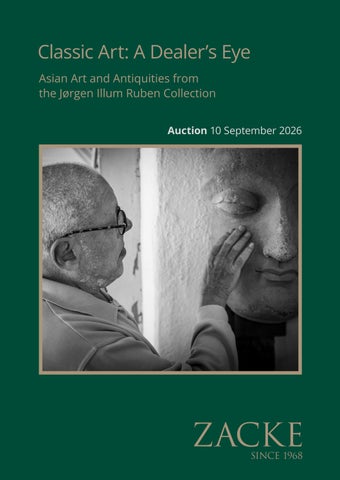
Classic Art: A Dealer’s Eye
Asian Art and Antiquities from the Jørgen Illum Ruben Collection
Auction 10 September 2026
Asian Art and Antiquities from the Jørgen Illum Ruben Collection
CATALOG SINGRUBEN0926 NO RESERVE LIVE AUCTION
10 September 2026, 10 am CET
All lots in this auction are offered with No Reserve, allowing live bids below the starting prices to be considered.
Please note that the starting prices have been set at exceptionally low levels to encourage participation. We encourage you to take advantage of this unique opportunity to acquire remarkable pieces at highly competitive prices.
SESSION 1
Lots 1–115 Print Catalog
SESSION 2
Lots 116–362 Online Catalog
EXHIBITION
31 August – 9 September, Monday – Friday 10 am – 6 pm as well as by appointment
GALERIE ZACKE
Zelinkagasse 6, 1010 Vienna Austria
Tel +43 1 532 04 52
E-mail office@zacke.at
www.zacke.at
ONLINE CATALOG


Publisher
Galerie Zacke founded 1968 © SZA Versteigerungen & Vertriebs GmbH
1010 Wien
Zelinkagasse 6, Austria, Europe
Tel (0043-1) 532 04 52
Email: office@zacke.at
Editors
Susanne Zacke
Marion Schor
Experts
Alexander Zacke
Max Zacke
Catalogers
Ananya Casius
Anne-Aymone Gabriel
Daniel Gonzalez-Gracia
Tatjana Borodin
Assistance and Translation
Anna-Maria Pollmann
Jue Zhang
Photography
Georg Bodenstein
David Lindengrün
Cesilio Cesar Garcia
Jonas Matyassy
Loreen Sasse
Vladimir Ramljak
Design
Christina Zhang
Printing
Print Alliance
HAV Produktions GmbH
Website www.zacke.at
© GALERIE ZACKE
Reproduction forbidden
ABSENTEE BIDDING FORM
FOR THE AUCTION CLASSIC ART: A DEALER’S EYE Asian Art and Antiquities from the Jørgen Illum Ruben Collection ON DATE 10 September 2026
PLEASE RAISE MY BID BY ONE BIDDING INCREMENT (ca. 10%) IF NECESSARY PLEASE CALL ME WHEN A HIGHER BID THAN MINE HAS BEEN RECEIVED
IMPORTANT NOTICE:
Bids do not include buyer’s premium and VAT. Margin taxation applies. Items with added VAT are marked in the online catalog.
TELEPHONE BIDS:
If you like to bid by telephone, please state ‘TEL’ in the ‘BID IN EURO’ column instead of a Euro amount. Galerie Zacke will call you on the day of the auction, on the telephone number provided, 5 lots before the lot you are bidding on and the bidding will commence at the starting price, as stated in the catalog. If Galerie Zacke cannot reach you during the auction, Galerie Zacke will bid the starting price on your behalf. MY PHONE NUMBER
TERMS OF PAYMENT, SHIPPING AND COLLECTION:
NAME AD D RESS
CITY, COUNTRY
POSTCODE
PHONE NUMBER
CREDIT CARD PAYMENT
PLEASE CHECK THE DESIRED CARD
COLLECTION BY CLIENT WITH PAYMENT ON THE PREMISES IN CASH, BY CERTIFIED CHEQUE OR CREDIT CARD
INVOICE PAYMENT
VIA BANK WIRE AFTER RECEIPT OF INVOICE SHIPPING AFTER RECEIPT OF PAYMENT
EXPRESS PARCEL SERVICE
REQUIRED (ACCORDING TO TERMS AND CONDITIONS OF GALERIE ZACKE)
SHIPPING INSURANCE REQUIRED (ACCORDING TO TERMS AND CONDITIONS OF GALERIE ZACKE)
GALERIE ZACKE
Zelinkagasse 6, 1010 Vienna, Austria
Email: office@zacke.at
Tel: +43-1-532 04 52
Fax: +43-1-532 04 52 20
& SIGNATURE
IMPORTANT NOTICE: Whenever making a bid, whether personally or via an agent, in writing, online, telephone, or in any other way, the bidder fully and unconditionally accepts the Terms of Auction, the ‘Important Information’ section in the auction catalog, the Terms and Conditions (AGB) of Galerie Zacke, §1-48, the Fee Tariff, and the Bidding Increments table, all as published on www.zacke.at on the day of the auction.
FOR THE AUCTION CLASSIC ART: A DEALER’S EYE
Asian Art and Antiquities from the Jørgen Illum Ruben Collection ON DATE 10 September 2026


In the heart of Vienna’s first district, our showroom spans 6,000-square-foot and has been specially designed to provide a seamless auction and exhibition experience.
the heart of Vienna’s first spans 6,000-square-foot and has been specially provide a seamless and exhibition
In the heart of Vienna’s first district, our showroom spans 6,000-square-foot and has been specially experience.
Located at Zelinkagasse 6, 1010 Vienna, our auction and preview space is just a seven-minute walk from our longstanding, 10,000-square-foot office, photography, video, and cataloging hub at Sterngasse 13. Both locations are open to the public, and we warmly invite you to visit.
at Zelinkagasse 1010 Vienna, and preview just a seven-minute walk office, photography, video, and cataloging hub 13. are open public, and we warmly invite to visit.
Located at Zelinkagasse 6, 1010 Vienna, our auction and preview space is just a seven-minute walk from our longstanding, 10,000-square-foot office, photography, video, and cataloging hub at Sterngasse 13. Both you to visit.
Starting 31 August you’ll be able to explore the exceptional pieces featured in this auction at Zelinkagasse 6, 1010 Vienna.
Starting 31 August you’ll be able to explore the exceptional pieces featured in this auction at Zelinkagasse 6, 1010 Vienna.
JOIN
US LIVE
US LIVE
10 September 2026 at 10 am CET
10 September 2026 at 10 am CET
10 September 2026 at 10 am CET
HOW TO FIND OUR AUCTION & SHOWROOM AT ZELINKAGASSE 6
HOW TO FIND OUR AUCTION AT ZELINKAGASSE 6
HOW TO FIND OUR AUCTION & SHOWROOM AT ZELINKAGASSE 6
RUDOLFPLATZRUDOLFSPARK
FISCHERSTIEGE
ZELINKAGASSE 6
SCHWEDENPLATZ
ZELINKAGASSE 6 STERNGASSE 13
STERNGASSE 13
ZELINKAGASSE 6 STERNGASSE 13
Starting 31 August you’ll be able the exceptional pieces this auction Vienna. by public transport or car (a garage is nearby).
Attend in person in our auction at Zelinkagasse 6 or participate online via Zacke Live –and enjoy premium terms with no additional online bidding fees
Attend in person in our auction room at Zelinkagasse 6 or participate online via Zacke Live –and enjoy premium buyer’s terms with no additional online bidding fees
Zelinkagasse 6 or participate online via Zacke Live and enjoy premium buyer’s terms with no additional online bidding fees
Easily accessible by public transport or car (a parking garage is located nearby).
Easily accessible by public transport or car (a parking garage is located nearby).
By Public Transport: SCHOTTENRING
Register now: www.zacke.at
Register now: www.zacke.at
Register now: www.zacke.at
By Public Transport: SCHOTTENRING station (U2, U4, tram lines 1, 31, 71, D, and bus 3A)
(U2, U4, lines 1, 31, 71, D, and bus 3A)
By Public Transport: SCHOTTENRING station (U2, U4, tram lines 1, 31, 71, D, and bus 3A)

Dear clients and friends,
After months spent working through the collection to which this catalogue is dedicated, studying, researching, handling, and living with the works entrusted to us, we continue to marvel at its breadth, strength, and quiet intensity. It is the achievement of Jorgen Ruben, a Danish art dealer and collector who has been active for over four decades and is highly regarded in the fi elds of Asian art and classical antiquities. From an early age, Ruben dedicated his life to the pursuit of art, acquiring only objects that truly moved him, and keeping them, often for many years, until he felt they had found the right next custodian.


Ruben’s path into the art world began at home, where his father’s interest in modern painting and his mother’s taste for European decorative arts made collecting part of daily life. As a young man he worked first with Persian rugs and then with antiques, experiences that taught him to look slowly, to trust touch and surface, and to understand quality before theory. Travels to Iran, and especially the encounter with Persepolis, opened a deeper fascination with


the ancient world, while later years in England, Latin America, Japan, and Southeast Asia brought him into direct contact with very different artistic traditions. When he opened his first gallery in Copenhagen in 1984, it was therefore not as a specialist formed by books alone, but as someone whose eye had been sharpened by travel, trade, conversation, and long familiarity with the objects themselves.
Through the decades, Ruben remained active between Copenhagen, London, and Brussels, participating in fairs and exhibitions, and operating several galleries at different moments, including Classic Art in Brussels. Yet he always preferred the intimacy of dealing privately from home. It suited both his nature and his way of seeing: private but warm, discerning but generous, a dealer for whom a work was never merely inventory, and for whom the relationship with the collector formed part of its future history. In that setting, works were placed with people who understood them, and relationships with collectors, dealers, and institutions developed over time.

The Ruben collection is therefore not only the story of one collector’s eye. It is also the story of a community. Ruben’s knowledge was formed through conversation, friendship, and mentorship, within a world in which collectors and dealers learned from one another with remarkable generosity.

Hans Henningsen, the Danish engineer and collector of ancient art, became an important teacher and introduced Ruben to Egyptian antiquities, Chinese ceramics, and trusted specialists in London, including the legendary Adrian Maynard at Spink.


A central figure in this network was Leo Albrecht, named here under a pseudonym in keeping with his preference for privacy and discretion. Many of the most significant works in the present sale were acquired by Albrecht directly from Maynard. Over time, Albrecht also became a dear friend of the Ruben family. In Kyoto, Tatsuo Tazawa became a long-standing guide to Japanese art. Around Ruben was a wider circle of major collectors and dealers, including Freddy Hansen, Jacques Billen, Oliver Klitgaard, and many others whose names recur throughout the provenances of this catalogue.


In 2005, during his years at Classic Art in Brussels, Ruben set this world down on paper in a remarkable 76-page ledger documenting more than 600 objects from his collection. Each entry records a concise provenance, often with acquisition dates, together with Ruben’s own attribution and dating, and the price at which the work was then offered through the gallery. Further entries were added in 2012, including many objects that had already belonged to the collection in 2005 but had not then been available for sale. Even this substantial record is not exhaustive: some works in the present catalogue had remained with Ruben for twenty, thirty, or even forty years, and were never entered into the ledger at all, simply because he was not yet prepared to let them go.
The Jorgen Ruben ledger is far more than a record of acquisition. It is a map of relationships: Copenhagen, London, Brussels, Paris, Zurich, Kyoto, and beyond; private collectors, galleries, auction houses, markets, mentors, friends, and fellow connoisseurs. Again and again, the entries reveal how works moved not anonymously, but through a network of people who looked carefully, handled seriously, argued, remembered, taught, and trusted one another. In this sense, the ledger preserves something that is often lost in the history of objects: the human chain of custodianship.


This catalogue presents works formed across centuries and cultures, but it also preserves the spirit of the collection itself. These are objects chosen with conviction, kept with affection, and placed with care. To offer them now is not simply to disperse a collection, but to continue the conversation through which it was built. We are honored to present the Jorgen Ruben Collection, and to share with you the works, histories, stories, and relationships that give it such great depth.
The Jorgen Ruben Gallery Ledger was first compiled in 2005 and supplemented in 2012. It records those works from the Jorgen Ruben Collection that were available for sale at the time, with entries noting provenance (typically abbreviated by initials), acquisition dates, attribution, dating, and the gallery price assigned at Ruben’s Brussels gallery, Classic Art.
This ledger is of particular importance in establishing that many of the most significant works in this sale, including masterpieces of Thai and Khmer art, were already in Europe before the UNESCO 1970 Convention entered into force.

For each lot in this sale that is recorded in the Jorgen Ruben Gallery Ledger, the catalogue description published in this catalogue and on our website includes a dedicated ‘Ledger’ section reproducing the relevant entry. The corresponding ‘Provenance’ section refl ects that entry.
In preparing the published transcriptions and related provenance statements, we have made the following adjustments and clarifications:
• Spelling errors have been silently corrected for consistency.
• Gallery prices have been adjusted for inflation according to the year of the relevant ledger entry.
• Inventory codes have been omitted.
• Provenance initials used in the original ledger have been retained in the ‘Ledger’ section; the ‘Provenance’ section identifies the person according to a key supplied by Jorgen Ruben.
• Additional information supplied by Jorgen Ruben that is not recorded in the relevant ledger entry is in few instances reflected in the ‘Provenance’ section of the lot.
• Acquisition years recorded in the ledger should be understood as approximate, as some dates go back several decades before the time of entry and in certain cases refer to an acquisition by a previous owner. Further, purchases at regional auction houses can sometimes no longer be verified. Thus, Galerie Zacke cannot independently guarantee the full accuracy of the acquisition dates stated in the ledger.
All lots in this auction (including those not recorded in the Ledger) are accompanied by a copy of a signed affi davit by Jorgen Ruben, confi rming the provenances stated in the catalog. The affi davit will be provided to successful bidders upon request and only after full payment has been received.

THE JORGEN RUBEN GALLERY LEDGER, entry from 2005: “No. 336, LA 1972, A. Maynard, Pre-Khmer, Sambor Prei Kuk 7th c. Shiva [Harihara].”
DATING & ATTRIBUTION GALLERY PRICE
Gallery price: EUR 268,000 or approx. EUR 447,000 adjusted for inflation at the time of writing.
The ledger establishes that this object was located in Europe before the UNESCO 1970 Convention entered into force.
Provenance: Adrian Maynard, London, by 1972. Collection of Leo Albrecht, Denmark, acquired from the above. Jorgen Ruben, acquired from the above before 2005. In the Jorgen Ruben Collection for at least 21 years.

The original ledger documenting the provenance of objects in this collection remains in the possession of Jorgen Ruben and will not be transferred. Upon request, successful bidders will be provided with copies of the individual ledger pages relating to the lot or lots they have purchased. Copies of the ledger in its entirety will not be provided.
Unless otherwise stated in the provenance section of an individual lot, no additional documents are known to exist that further corroborate the provenance information recorded in the ledger.
Zacke considers the ledger to be a credible and reliable historical record. It was compiled at a time when provenance was of considerably less commercial significance than it is today, and therefore long before there would have been any apparent incentive to create or embellish provenance records for market purposes.
The provenance information published in this catalogue is based on the entries contained in the ledger together with any additional provenance specifi cally mentioned in the respective lot description. Zacke will not undertake further provenance research beyond the information made available in the catalogue or otherwise provided in connection with this auction.
By placing a bid, bidders acknowledge that the provenance information for each lot is limited to the documentation described above. Except for confirming that the published provenance reflects the information recorded in the ledger, neither Zacke nor Jorgen Ruben makes any additional representation or warranty regarding the completeness or independent verification of that provenance information.
All lots in this auction are offered with No Reserve, allowing live bids below the starting prices to be considered.
Please note that the starting prices have been set at exceptionally low levels to encourage participation.
We encourage you to take advantage of this unique opportunity to acquire remarkable pieces at highly competitive prices.

Myanmar (Burma). Finely carved seated in ardhapadmasana on a pedestal, his right hand in bhumisparsha mudra, his left arm resting above his lap, dressed in a monk’s robe draped over the left shoulder, the face with a serene expression, with downcast eyes below gently arched eyebrows, flanked by elongated earlobes, and the hair tied away from the face over the gently domed ushnisha.
Provenance: Freddy Hansen, Copenhagen, Denmark, by 1987. Jorgen Ruben, acquired from the above. In the Jorgen Ruben Collection for 39 years. Freddy Hansen was a Danish dealer of Asian art and antiquities, particularly Buddhist sculpture. Based in Copenhagen, he was active from the 1950s onward and became one of Denmark’s most prominent dealers in Asian art before his retirement in the early 1990s.
Condition: Overall good condition with old wear, obvious losses, signs of weathering, expected age cracks, losses, flaking and losses to gilt and lacquer. The wood with a rich, naturally grown patina.
Weight: 369 g
Dimensions: Height 20.3 cm
The Kingdom of Pagan was the first Burmese polity to unite the regions that later formed present-day Myanmar. During approximately 250 years of rule across the Irrawaddy Valley and surrounding territories, Pagan established the foundations for the rise of Burmese language and culture, the expansion of Bamar influence in Upper Myanmar, and the consolidation of Theravada Buddhism throughout Myanmar and mainland Southeast Asia. By the late twelfth century, Burmese linguistic and cultural traditions had become dominant in the upper Irrawaddy Valley, gradually superseding earlier Pyu, Mon, and Pali cultural norms.

THE JORGEN RUBEN GALLERY LEDGER, entry from 2005: “No. 156, FH 1987, Burma Pagan 11th c. wood Buddha” Gallery price: EUR 4,900 or approx. EUR 8,200 adjusted for inflation at the time of writing.
Expert’s note:
The Gupta-style Buddha was a source of inspiration for the entire Buddhist world, including land-bound Nepal and Tibet, the island of Sri Lanka, and the Southeast Asian countries of Burma, Thailand, Cambodia, Vietnam, and Java. This Gupta influence established the quintessential sculptural standards—serene, downcast eyes, clinging diaphanous robes, and harmonious bodily proportions—that became the foundational aesthetic for Burmese temples.
Estimate EUR 3,000
Starting price EUR 1,500

A MONUMENTAL BRONZE HEAD OF BUDDHA SHAKYAMUNI, AVA PERIOD, 17TH CENTURY

THE JORGEN RUBEN GALLERY LEDGER, entry from 2005: “No. 206, FH 1992, Burma Shan 17th c. bronze head of Buddha” Gallery price: EUR 6,600 or approx. EUR 11,000 adjusted for inflation at the time of writing.
Burma. Heavily cast, the serene face with heavy-lidded eyes, below gently arched eyebrows, a broad nose, full lips forming a calm smile, flanked by elongated earlobes. The hair arranged in tight curls above a hairline band, surmounted by an ushnisha and a massive ketumala.
Provenance: Freddy Hansen, Copenhagen, Denmark, by 1992. Jorgen Ruben, acquired from the above. In the Jorgen Ruben Collection for 34 years. Freddy Hansen was a Danish dealer of Asian art and antiquities, particularly Buddhist sculpture. Based in Copenhagen, he was active from the 1950s onward and became one of Denmark’s most prominent dealers in Asian art before his retirement in the early 1990s.
Condition: Good condition with expected wear and casting irregularities, obvious losses, few small dents, tiny nicks. The bronze with a fine, naturally grown, dark patina.
Weight: 25 kg
Dimensions: Height 46.2 cm (excl. stand), 56.5 cm (incl. stand)
With an associated modern stand. (2)
Estimate EUR 4,000 Starting price EUR 2,000


THE JORGEN RUBEN GALLERY LEDGER, entry from 2005: “No. 161, FH 1991, HH 2000, Burma Shan 17th c. stone B., inscribed” Gallery price: EUR 7,800 or approx. EUR 13,000 adjusted for inflation at the time of writing.
Burma. Seated in padmasana on a base, his right hand in bhumisparsha mudra, the left resting on his lap, wearing a sanghati, his face with a meditative expression, arched eyebrows above downcast eyes, the face flanked by elongated earlobes issuing from C-form ears, framed by a lacquered headdress and ushnisha, and surmounted by a bud-shaped finial. The front of the base neatly incised with a line of Burmese inscription.
Provenance: Freddy Hansen, Copenhagen, Denmark, by 1991. Collection of Hans Henningsen, Copenhagen, Denmark, acquired from the above. Jorgen Ruben, acquired from the above in 2000. In the Jorgen Ruben Collection for 26 years. Freddy Hansen was a Danish dealer of Asian art and antiquities, particularly Buddhist sculpture. Based in Copenhagen, he was active from the 1950s onward and became one of Denmark’s most prominent dealers in Asian art before his retirement in the early 1990s. Hans Henningsen (d. 1999) was a Danish engineer and discerning collector of ancient art. From the 1960s onward, he travelled widely across Europe, Britain, and Egypt in pursuit of antiquities, valuing objects above all for their artistic merit, craftsmanship, and authenticity. Henningsen was a friend and mentor to Jorgen Ruben, as well as an early and frequent customer of Ruben’s first gallery in Copenhagen.
Condition: Overall good condition with expected wear, few small nicks and minor chips, flaking and losses to lacquer, the left arm with a minor old fill.
Weight: 82 kg
Dimensions: Height 97.7 cm
The founding of Shan States inside the present-day boundaries of Burma began during the Pagan Kingdom in the Shan Hills and accelerated after 1287 when the Kingdom fell to the Mongols. The Tai people, who came south with the Mongols, stayed, and quickly came to dominate much of the northeastern arc of Burma. The newly founded Shan States were multiethnic and included minorities such as the Chin, the Kachin, the Wa, the Ta'ang, the Lisu, the Lahu, the Pa O, and the Kayah. Although Burmanized Shans founded the Ava Kingdom that ruled central Burma, other Shan States, Mohnyin in particular, constantly raided Ava territories throughout the years. A Mohnyin-led Confederation of Shan States finally conquered Ava in 1527.
Estimate EUR 8,000
Starting price EUR 4,000


THE JORGEN RUBEN GALLERY LEDGER, entry from 2005:
“No. 571, Leo A. 1990, Ex FH, Burmese Shan Giant Buddha, Gilded wood, 17th c. ca. 180 cm ex. Flame” Gallery price: EUR 127,000 or approx. EUR 212,000 adjusted for inflation at the time of writing.
EXPERT'S NOTE
Buddha images substantially larger than life size, such as the present lot, are typically seen as the principal images in early Shan temples. For a comparable example, see a Buddha statue at the Shwe Indein Pagoda, a complex dating from the 12th-13th century.

Burma, Shan state. Well carved seated upon a shaped pedestal with the right hand lowered in bhumisparsha mudra and the left hand placed in his lap. The serene face with downcast eyes, and pursed lips forming a gentle smile, flanked by elongated earlobes. The hair arranged in spiked curls over the ushnisha, rising to a large, separately carved bud-form finial.
Provenance: Freddy Hansen, Copenhagen, Denmark, by 1990. Collection of Leo Albrecht, Denmark, acquired from the above. Jorgen Ruben, acquired from the above before 2005. In the Jorgen Ruben Collection for at least 21 years. Bruun Rasmussen, 29 November 2012, lot 836/587, mid-estimate DKK 750,000 or approx. EUR 125,000 (converted and adjusted for inflation at the time of writing). Freddy Hansen was a Danish dealer of Asian art and antiquities, particularly Buddhist sculpture. Based in Copenhagen, he was active from the 1950s onward and became one of Denmark’s most prominent dealers in Asian art before his retirement in the early 1990s.
Condition: Good condition with expected old wear, signs of weathering, flaking to lacquer with associated minor old repairs, rubbing and minor losses to gilt and lacquer, some losses to plinth, expected age cracks, minor losses mostly to hair, old repairs to sections of the finial and right arm, few old fills and minor touchups, some of the gilt probably renewed over the centuries.
Weight: 190 kg (incl. base)
Dimensions: Height 214 cm (excl. base), 223 cm (incl. base)
Mounted on a massive hardwood base with a central bronze plaque inscribed 'Buddha Sakyamuni. Burma Shan 17th century'. (2)
The founding of Shan States inside the present-day boundaries of Burma began during the Pagan Kingdom in the Shan Hills and accelerated after 1287 when the Kingdom fell to the Mongols. The Tai people, who came south with the Mongols, stayed, and quickly came to dominate much of the northeastern arc of Burma. The newly founded Shan States were multiethnic and included minorities such as the Chin, the Kachin, the Wa, the Ta'ang, the Lisu, the Lahu, the Pa O, and the Kayah. Although Burmanized Shans founded the Ava Kingdom that ruled central Burma, other Shan States, Mohnyin in particular, constantly raided Ava territories throughout the years. A Mohnyin-led Confederation of Shan States finally conquered Ava in 1527.


EXTERNAL EXPERT AUTHENTICATION
The present lot at Bruun Rasmussen, 29 November 2012, lot 836/587, mid-estimate DKK 750,000 or approx. EUR 125,000
Literature comparison:
Compare a related smaller gilt-lacquered wood figure of Buddha, dated to the 18th century, 93.5 cm high, in the British Museum, registration number 1872,0701.3.
Estimate EUR 30,000
Starting price EUR 15,000
5 A RARE AND MONUMENTAL (2 M) GILT-LACQUERED WOOD FIGURE OF BUDDHA, 2ND AVA PERIOD, 16TH-18TH CENTURY
Burma. Carved standing, dressed in a long robe, tied around the waist with a central fold decorated with foliate scrollwork, the left holding seeds and the right in abhaya mudra. He is dressed in a loose-fitting monastic robe cascading in richly carved folds, the hems neatly inlaid with glass. The face in a serene expression with glass-inlaid almondshaped eyes, bow-shaped brows, and full lips forming a calm smile, the smooth hair with ushnisha and a tall bud-shaped finial behind a meticulously glass-inlaid crown.
Provenance: Collection of Robert Jacobsen, Denmark. Bruun Rasmussen, Copenhagen, by repute in 2010. Jorgen Ruben, acquired from the above. In the Jorgen Ruben Collection for around 16 years. Robert Jacobsen (1912-1993) was one of the foremost Danish artists of the twentieth century, internationally renowned for his abstract iron sculptures. Largely selftaught, he achieved worldwide recognition and is represented in major museum collections including the Centre Pompidou in Paris, the Moderna Museet in Stockholm, and the Stedelijk Museum in Amsterdam. Over the course of his career, he assembled a diverse collection of Asian art, including Japanese netsuke, which reflected his lifelong interest in form, craftsmanship, and sculptural expression. Condition: Overall good condition with old wear, expected age cracks, signs of weathering, few tiny nicks, light scratches, few small losses, old repairs and fills. Light flaking, rubbing, and losses to gilt and lacquer. Minor losses to inlays with some possibly renewed. Presenting magnificently.
Weight: 98 kg (incl. stand)

Dimensions: Height 201.5 cm (excl. stand), 213 cm (incl. stand)
Mounted on an associated hardwood stand. (2)
LITERATURE COMPARISON
Compare a related smaller Burmese gilt-lacquered wood figure of Buddha with glass inlays, dated 18th century, 101 cm tall, in the British Museum, registration number 1880.258. Compare a related gilt-lacquered wood figure of Buddha, dated 18th century, 213 cm tall, in the Victoria & Albert Museum, accession number IM.19-1912 (fig. 1).

Estimate EUR 10,000
Starting price EUR 5,000


Expert’s note:
The present bronze belongs to the mature sculptural tradition of the Konbaung period (1752-1885) and may be dated to the 18th century. The image displays several hallmarks of Burmese court-sponsored Buddhist sculpture of the period, including its elegant elongated proportions, gently oval face with lowered gaze, long pendulous earlobes, and the fluid rendering of the monastic robe cascading in rhythmic folds across the body. While these features would later be further refined in the celebrated Mandalay style of the 19th century, the present work retains the restrained modeling and harmonious balance characteristic of earlier Konbaung-period bronzes. The later dedicatory inscription, dated to late 1907, further attests to the continued veneration and spiritual significance of the image.
Burma. Heavily cast, seated in dhyanasana atop a tiered base with the right hand lowered in bhumisparsha mudra and the left above his lap, wearing long flowing robes cascading in voluminous folds. His serene face with downcast eyes in shell and lacquer, and full lips forming a calm smile, flanked by long pendulous earlobes, the hair in tight curls secured by a band above his forehead with remnants of mirror glass inlays.
The front of the base meticulously punched with a dedicatory inscription in two lines of Burmese script:

In the year 1269 of the Myanmar Era, on the eighth day of the waning moon of Tazaungmon [corresponding to late 1907], Ma Nyunt and Ma Han, daughters of U Htun Yaung—the donor-patron of the Great Buddha—and Me Tint, its female patron, residents of Mingin, dedicated this [Buddha image] for worship and veneration as a meritorious deed. May this merit lead to the attainment of Nibbāna. May devas and human beings rejoice and say ‘Sādhu!’
Provenance: Collection of Erling Dessau, Denmark, by 1990. Jorgen Ruben, acquired from the above via the auction market.
Condition: Good condition with expected wear and casting irregularities, minor fatigue cracks and casting patches to the neck, probably inherent to the manufacture. Rubbing and minor losses to lacquer, remnants of gilt, few light dents, minuscule nicks, small surface scratches, losses to inlays. The bronze with a rich, naturally grown, dark patina with areas of malachite and cuprite encrustation.
Weight: 65 kg
Dimensions: Height 77.5 cm
This finely cast image exemplifies the refinement of Konbaung-period Buddhist sculpture in Burma during the 18th century. Founded in 1752, the Konbaung dynasty fostered a flourishing artistic tradition that synthesized earlier Burmese sculptural forms into a distinctive court style characterized by elegant proportions, serene expression, and sophisticated bronze casting. These artistic developments laid the foundation for the later Mandalay style, which emerged during the final decades of the Burmese kingdom in the 19th century.
Here the historical Buddha Shakyamuni performs bhumisparshamudra, the gesture summoning the earth to witness his enlightenment against the evil temptations of the demon king Mara. While the treatment of the Buddha's robes conveys a quiver, as if shaken by the vibrations of his realization, it could also suggest the presence of the earth goddess, affirmed by virtue of the fluid swirls and folds of the garment stylized as cascades and waterfalls which merge into the flowing river of his hem.

LITERATURE COMPARISON
Compare a closely related Burmese bronze Buddha, dated to the 18th century, 71.1 cm high, in the Minneapolis Institute of Art, accession number 96.54.1.

AUCTION RESULT COMPARISON
Type: Closely related
Auction: Van Ham Cologne, 3 December 2015, lot 366
Price: EUR 38,700 or approx. EUR 51,000 adjusted for inflation at the time of writing Description: Bedeutender Buddha. Bronze. Datiert 1876. Expert remark: Compare the closely related modeling and manner of casting with similar pose, robe, facial features, and patina. Note the inscription and larger size (112 cm).

Estimate EUR 15,000
Starting price EUR 7,500

7 AN EXCEPTIONALLY RARE BRONZE FIGURE OF A BODHISATTVA, PROBABLY FROM THE 'PRAKHON CHAI HOARD', PRE-ANGKOR, 8TH-9TH CENTURY

THE JORGEN RUBEN GALLERY LEDGER, entry from 2012: “No. 700, Buddha Shakyamuni (Prakhon Chai) 9th c. Bronze, H.: 27.5 cm, LA 1982 ex Wolff NY” Gallery price: EUR 92,000 or approx. EUR 130,000 adjusted for inflation at the time of writing.
Northeastern Thailand, Buriram province, 8th-9th century. Superbly cast, the Buddha is seated in ardha padmasana on a rectangular pedestal, the hands resting on the knees, dressed in a short sampot, secured by a belt, the face with a serene expression marked by delicately outlined features such as the almond-shaped eyes and full lips forming a gentle smile, the brow minutely incised, flanked by long pendulous ears, the exquisitely modeled hair combed into a tall jatamakuta with tiers of looped curls piled elegantly.
Provenance: William Hirschler Wolff, New York, by 1982. Collection of Leo Albrecht, Denmark, acquired from the above. Jorgen Ruben, acquired from the above before 2005. In the Jorgen Ruben Collection for at least 21 years. William Hirschler Wolff (1906-1991) was an influential New York dealer of Asian antiquities who was widely considered the foremost dealer in Asian art and antiques in the United States. Wolff placed important works with major American museums and private collectors, including John D. Rockefeller III and Norton Simon. Leo Albrecht was a German-born publisher, literary agent, and collector who founded an influential Copenhagen agency in 1951, helping expand the international market for Scandinavian literature. He began collecting art in the late 1950s, with a particular focus on Asian sculpture, forming close ties with Ole Haslund, Lau Sunde, Freddy Hansen, Adrian Maynard, and later Jorgen Ruben, who has described him as “the greatest collector of Asian art in Denmark.”
Condition: Good condition, commensurate with age. Expected wear, casting irregularities, obvious losses, encrustations, areas of corrosion, old repairs, cracks, nicks, scratches. The interior fitted with a metal rod for mounting. The bronze displays a rich, naturally grown patina with thick malachite encrustations.
Weight: 3.5 kg (excl. stand), 4.3 kg (incl. stand)
Dimensions: Height 27 cm (excl. stand), 30.1 cm (incl. stand)
With an associated stand. (2)
As a center of Buddhist practice , primarily Mahayana Buddhism, the Prakhon Chai region produced figures of Buddhas and Bodhisattvas that are depicted as ascetics; the figures are clad in the traditional Khmer and Thai sampot secured with a simple cord, and are otherwise unadorned, a departure from other Khmer styles in which bodhisattvas wear jewelry. As unifying stylistic features, the bodies of Prakhon Chai figures are strikingly slender and graceful, and the fingers of the four hands curl inwards towards the palm, as if the bodhisattva were delicately plucking flowers. The elaborate looping coiffure in the present example is also distinctive to the region, contrasting with the wild jatamukutas of Shaiva ascetics as they are depicted in India.
The so-called “Prakhon Chai Hoard” was accidentally discovered by local villagers in 1964 at Prasat Hin Khao Plai Bat II, a tenth-century Khmer brick temple in Buriram Province. Concealed in a stone-covered pit within the temple precinct, the bronzes were likely buried during the site’s rededication for Brahmanical use. Some bear traces of cloth wrappings, evidence of careful ritual deposition. Initially misattributed to Prakhon Chai district, the cache in fact originated from nearby Lahan Sai, though the name has endured. Numbering at least fifty-three known examples and perhaps two to three hundred in total, it is possibly the largest and most important cache of Buddhist bronzes ever discovered in mainland Southeast Asia.
These sculptures embody a fusion of Mon-Dvaravati, Khmer, and preAngkorian traditions, yet reveal a strikingly local vision. Their slender bodies, serene faces, and restrained drapery convey a spiritual clarity unique to this region. Distinctive features, such as the carefully plaited coiffure of bronze figures, distinguish them from their Indian prototypes and mark them as products of the Korat Plateau. The predominance of Avalokiteshvara and Maitreya over images of the Buddha reflects the strength of Mahayana devotion during this period of Southeast Asian history, making the present example of a seated Buddha even more rare.
The hoard was first systematically studied by Jean Boisselier in 1967, who emphasized both the stylistic unity of the bronzes and their pivotal role in understanding the development of art in the Korat Plateau. His chronology has since been refined through comparisons with sculptures from Ban Thahnot, Ban Fai, and pre-Angkorian Khmer monuments of the eighth century. Their high tin content, which gives the metal a luminous silvery sheen, only enhances their elegance. Today the Prakhon Chai bronzes remain essential witnesses to the religious and artistic ferment of early Southeast Asia, among the most evocative and enduring Buddhist images ever produced.
AUCTION RESULT COMPARISON
Type: Closely related
Auction: Bonhams London, 5 November 2007, lot 305
Mid-Estimate: GBP 27,500 or approx. EUR 53,000 converted and adjusted for inflation at the time of writing
Description: A rare Thai Prakhon Chai bronze figure of Avalokitesvara, late 8th/9th century
Expert remark: Compare the closely related modeling and manner of casting with similar face features and pose. Note the size (18 cm).
Estimate EUR 15,000
Starting price EUR 7,500


8 A BRONZE TORSO OF BUDDHA, SUKHOTHAI KINGDOM, 13TH-14TH CENTURY
Thailand. Elegantly cast with broad shoulders and a slender waist, wearing a diaphanous uttarasanga which covers the left shoulder and crosses the chest diagonally, but leaves the right shoulder and right arm bare, culminating in a fishtail hem over the navel.
Provenance: Freddy Hansen, Copenhagen, Denmark, by 1992. Collection of Hans Henningsen, Copenhagen, Denmark, acquired from the above. Jorgen Ruben, acquired from the above in 2001. In the Jorgen Ruben Collection for 25 years. Freddy Hansen was a Danish dealer of Asian art and antiquities, particularly Buddhist sculpture. Based in Copenhagen, he was active from the 1950s onward and became one of Denmark’s most prominent dealers in Asian art before his retirement in the early 1990s. Hans Henningsen (d. 1999) was a Danish engineer and discerning collector of ancient art. From the 1960s onward, he travelled widely across Europe, Britain, and Egypt in pursuit of antiquities, valuing objects above all for their artistic merit, craftsmanship, and authenticity. Henningsen was a friend and mentor to Jorgen Ruben, as well as an early and frequent customer of Ruben’s first gallery in Copenhagen.
Condition: Expected wear and casting irregularities. Obvious losses, few shallow fissures, stress cracks at the chest with associated small losses, warping, scattered nicks and scratches, signs of weathering, encrustations. The bronze with a rich, naturally grown patina with malachite encrustation.
Weight: 27.8 kg (incl. stand)

THE JORGEN RUBEN GALLERY LEDGER, entry from 2005: “No. 151, FH 1992, HH 2001, Thai Sukhothai / Ayutthaya bronze torso of Buddha 15th c.”
Gallery price: EUR 16,500 or approx. EUR 27,500 adjusted for inflation at the time of writing.
AUCTION RESULT COMPARISON
Type: Closely related
Auction: Christie’s New York, 8 February 2017, lot 58
Price: USD 47,500 or approx. EUR 41,500 converted and adjusted for inflation at the time of writing
Description: A Thai bronze torso fragment of a deity, Sukhothai period, 13th-14th century

Expert remark: Compare the closely related modeling and manner of casting with similar musculature. Note the size (61 cm).
Dimensions: Height 43 cm (excl. stand), 59.5 cm (incl. stand) Estimate

9
A LARGE BRONZE HEAD OF BUDDHA, SUKHOTHAI PERIOD, KAMPHAENG PHET STYLE, 15TH CENTURY
Expert’s note:
Thai bronzes of this size and preservation are exceptionally rare, particularly those that are over 500 years old. It is challenging to imagine the immense scale of the complete sculpture to which this head belonged. If seated, the figure would probably have been around 135 cm high, standing at well over 2 meters tall. Only a few works of similar magnitude have endured the test of time. Despite centuries passing, it has retained all its spirit, a near-magical presence, a sense of tranquility, and, above all, its ability to inspire.
Thailand. Buddha’s slightly elongated oval face with outlined smiling lips, aquiline nose, neatly incised heavy-lidded downcast eyes below finely arched eyebrows in relief, his ears with extended pierced earlobes, the hair arranged in rows of snail-shell curls, surmounted by a gently domed ushnisha. The bronze heavily cast and with a rich naturally grown patina, showing distinct malachite encrustations.
Provenance: Collection of Dane Rose, London, United Kingdom, by 1980. A Danish private collection, acquired from the above. Jorgen Ruben, acquired from the above in 1985. In the Jorgen Ruben Collection for 41 years.
Condition: Superb condition, commensurate with age. Extensive wear, casting irregularities, signs of weathering, losses, nicks, scratches. The bronze has a rich, naturally grown patina with malachite encrustations.
Weight: 12.8 kg (incl. stand)
Dimensions: Height 33 cm (excl. stand), 53 cm (incl. stand)

THE JORGEN RUBEN GALLERY LEDGER, entry from 2012: “No. 721, Thai, Kamphaeng Phet bronze head of Buddha, 15th c., H.: 33 cm, Prov.: UK Coll. D. Rose 1980, DK 1985”
Gallery price: EUR 27,000 or approx. EUR 38,500 adjusted for inflation at the time of writing.
This large and imposing head of Buddha is rendered in the Kamphaeng Phet style, which echoes that of neighboring Sukhothai, but with subtle differences, such as sharper overall facial features and eyebrows that form a continuous line above the bridge of the nose. In this example, superior quality is evinced in the meticulous execution of the curving lines of the barely-parted eyelids and thin but fleshy lips.
AUCTION RESULT COMPARISON
Type: Closely related
Auction: Bonhams New York, 17 September 2014, lot 176
Price: USD 27,500 or approx. EUR 33,500 converted and adjusted for inflation at the time of writing
Description: A copper alloy head of Buddha, Thailand, Late Sukhothai period, Kamphaeng Phet style, 15th century

Expert remark: Compare the closely related manner of casting and modeling. Note the size (38.1 cm).
Estimate EUR 6,000
Starting price EUR 3,000

Finely cast and sensitively modeled, the serene face with a benevolent expression, detailed with a bow-shaped mouth set in a gentle smile, heavily lidded eyes, and a straight nose, all under arched brows. The hair is worked in tight curls over a tall flametipped ushnisha and pushed away from the forehead by a plain, curved headband.


Provenance: Laurits Sunde, Denmark, by 1963. Collection of Leo Albrecht, Denmark, acquired from the above in 1991. Jorgen Ruben, acquired from the above before 2005. In the Jorgen Ruben Collection for at least 21 years. The base with an old label with a typewritten description of the present lot, ‘ThaiPeriode, frühe Phase. Ayuttha-Stil, U Thong C-Typ, ca. 1350-1375. Bronze, H. o. sockel: 25 cm (Sunde 1963)’. The provenance establishes that this object was located in Europe before the UNESCO 1970 Convention entered into force. Laurits "Lau" Sunde (1910-1979) was an important Danish collector and dealer who played a pioneering role in introducing African art to Denmark and the wider Nordic region. He is particularly remembered for his interest in Yoruba art and culture, especially ere ibeji twin figures, which he promoted not only as works of art but also as expressions of the spiritual and ritual traditions of the Yoruba people. Leo Albrecht was a German-born publisher, literary agent, and collector who founded an influential Copenhagen agency in 1951, helping expand the international market for Scandinavian literature. He began collecting art in the late 1950s, with a particular focus on Asian sculpture, forming close ties with Ole Haslund, Lau Sunde, Freddy Hansen, Adrian Maynard, and later Jorgen Ruben, who has described him as “the greatest collector of Asian art in Denmark.”
Condition: Good condition with expected wear, casting irregularities, obvious losses including a small hole above the right eye, signs of weathering, encrustations, remnants of gilt. The bronze with a superb, naturally grown patina with cuprite encrustations.
Weight: 2.1 kg (incl. stand)
Dimensions: Height 25 cm (excl. stand), 34.2 cm (incl. stand)
With an associated stand. (2)
The U-Thong Style, a term used to identify bronzes of three successive chronological groups (identified by the scholar, A.B. Griswold as Styles A, B and C) between the late twelfth and fifteenth centuries, exhibits a blend of Mon, Khmer and other Southeast Asian influences that were maintained from prior workshops in the region. Most U-Thong-style images were relatively small in scale, particularly those in the earlier styles.
The designation of U-Thong is in itself somewhat obscure; although a Mon Dvaravati city-state of that name existed at the height of the Dvaravati period (from roughly the seventh to eleventh century), archaeological evidence suggests it was abandoned by the eleventh century. Instead, the appellation seems to have been in reference to King Ramathibodi, who founded the Ayutthaya kingdom in 1351 and who was also known as Prince U-Thong. Images of the Buddha designated as being in the U-Thong style thus refer to bronzes carried out in a distinct style developed prior to the founding of Ayutthaya, which continued and was synthesized with the mainstream Ayutthaya Buddhist art that flourished after its rise to power. Its earliest stylistic impulses were a sophisticated amalgamation of the other regional styles of the time, including the Khmericized Lopburi kingdom and the Khmer Empire itself to the east, the Mon Haripunjaya kingdom to the north, and the kingdoms of Burma to the west.
The sculptures of the U-Thong style are most strikingly distinguished from other contemporaneous styles in the features of the face and details of the head and hair. The cranial protuberance on the top of the head, referred to as the ushnisha, is, in U-Thong Styles B and C, topped with a tall, flaming jewel. The hair is arranged in small, tight curls, in contrast to the larger ‘snail-shell’ curls found in the contemporaneous sculpture of Sukhothai. Additionally, the hair is separated from the forehead by a thin, plain band. In U-Thong Styles A and B, the band typically runs straight across the top of the forehead. The face, with its heavy-lidded, downcast eyes, broad nose, and wide mouth with full lips, demonstrates the influence of earlier Khmer styles, including the Bayon of the thirteenth century, although in Style C these somewhat severe features are softened. The shape of the face, which in Styles A and B are almost rectangular, is in Style C closer to the more ovalshaped faces of contemporary Ayutthaya sculpture.
Literature comparison:
Compare a related, slightly later Ayutthaya bronze head of Buddha, dated to the 15th century, in the Georges Labit Museum, Toulouse, inventory number 71 3 2.
AUCTION RESULT COMPARISON
Type: Closely related
Auction: Sotheby’s New York, 20 September 2021, lot 375
Estimate: USD 12,000 or approx. EUR 12,500 converted and adjusted for inflation at the time of writing
Description: A copper alloy head of Buddha, Thailand, U-Thong, 14th century
Expert remark: Compare the closely related modeling and manner of casting with similar facial features, hairstyle, and incised details. Note the size (30.5 cm).

Estimate EUR 6,000
Starting price EUR 3,000

A RARE AND LARGE BRONZE FIGURE OF THE WALKING BUDDHA, U-THONG C STYLE, 14TH CENTURY

THE JORGEN RUBEN GALLERY LEDGER, entry from 2005: “No. 134, LA 2002, Thai Walking U-Thong-C Buddha 15th c. bronze”
Gallery price: EUR 185,000 or approx. EUR 309,000 adjusted for inflation at the time of writing.
Thailand. Superbly cast, depicted striding forward with the right leg slightly advanced, the right hand raised in abhaya mudra, the gesture of reassurance and protection, while the left arm extends gracefully alongside the body. The figure is clad in a diaphanous sanghati, elegantly draped over the left shoulder and falling in a gently undulating hemline.
The finely modeled face conveys a profound serenity, characterized by heavy-lidded downcast eyes beneath softly arched brows, a slender nose, and full lips forming a composed smile, all framed by long, pendulous earlobes. The hair is arranged in tight, spiked curls covering the prominent ushnisha, surmounted by a flame.
Provenance: Collection of Leo Albrecht, Denmark, by 2002. Jorgen Ruben, acquired from the above. In the Jorgen Ruben Collection for 24 years.
Condition: Good condition, commensurate with age and displaying superbly. Expected wear, casting irregularities, traces of weathering, fatigue cracks, some with associated old fills, an old repair to the lower body, extensive remnants of gilt, light nicks, few minor dents, surface scratches. The bronze with a smooth, naturally grown, warm patina overall.
Weight: 34.5 kg (incl. stand)
Dimensions: Height 131.7 cm (excl. stand), 134.9 cm (incl. stand)
Mounted on an associated wood stand. (2)
This unusually large image of the Buddha is a paragon of Southeast Asian metal casting and an exemplary example of the rare and refined U-Thong corpus of Thai Buddhist sculpture. The U-Thong style, a term used to classify bronzes into three successive chronological groups, identified by A. B. Griswold as styles A, B, and C, dating from the late twelfth to the fifteenth century, reflects a synthesis of Mon, Khmer, and other Southeast Asian influences that persisted from earlier workshop traditions in the region.
The latest U-Thong group, style C, to which the present bronze may be attributed, was fully developed after the founding of the Ayutthaya Kingdom in 1351. It is the closest of the three phases to the mainstream Ayutthaya style of the fourteenth and fifteenth centuries, while still retaining discernible Mon and Khmer elements. Whereas most U-Thong images, particularly those of the earlier phases, are relatively small in scale, the present bronze is exceptionally impressive due to its almost life-sized scale and the refinement of its casting.
The designation ‘U-Thong’ remains somewhat ambiguous. Although a Mon Dvaravati city-state of this name flourished during the Dvaravati period, from approximately the seventh to eleventh century, archaeological evidence suggests that it had been abandoned by the eleventh century. The term is more plausibly associated with King Ramathibodi, founder of the Ayutthaya Kingdom in 1351, who was also known as Prince U-Thong. Accordingly, the term ‘U-Thong style’ refers to bronzes produced in a distinctive idiom that developed prior to the foundation of Ayutthaya and subsequently evolved through synthesis with the dominant artistic traditions of the Ayutthaya period.
U-Thong sculptures are most readily distinguished from other contemporaneous styles by the treatment of the face and the detailing of the head and hair. The cranial protuberance, or ushnisha, in Styles B and C is typically surmounted by a tall flaming jewel. The hair is rendered in small, tightly coiled curls, in contrast to the larger ‘snail-shell’ curls characteristic of Sukhothai sculpture. In style C, however, the somewhat austere features are softened, as is evident as well in the present work. Likewise, whereas styles A and B tend toward almost rectangular facial structures, style C moves closer to more oval physiognomies characteristic of contemporary Ayutthaya sculpture, a development also apparent in this image.
Equally distinctive of U-Thong style sculpture is the refined handling of the drapery, which often falls in soft folds along the back at the level of the feet, thereby framing the figure in a restrained and balanced manner.
Type: Closely related
Auction: Christie’s New York, 17 September 1999, lot 254
Price: USD 112,500 or approx. EUR 193,000 converted and adjusted for inflation at the time of writing
Description: A large and important bronze figure of a ‘Walking Buddha’, Thailand, Sukhothai, 15th-16th century
Expert remark: Compare the related manner of casting and modeling. Note the size (117 cm).
Estimate EUR 30,000
Starting price EUR 15,000


EXPERT'S NOTE
Thai bronzes of this size and preservation are exceptionally rare, particularly those that are over 500 years old. It is challenging to imagine the impressive scale of the complete seated sculpture to which this head once belonged. The original image probably measured around 125130 cm in height if seated (excluding the base), based on the proportions of a smaller Lan Na bronze figure of Buddha sold at Bonhams New York, 21 March 2023, lot 530A (fig. 1), while a standing figure would have been well over two meters tall. Only a few works of similar magnitude have endured the test of time, and this magnificent head is among the largest privately owned examples. Despite the passage of centuries, it has retained all its spirit: a near-magical presence, a profound sense of tranquility, and, above all, its ability to inspire.

Heavily cast, the serene face with downcast eyes and heavy lids beneath delicately arched brows, a slightly aquiline ‘beaked’ nose and softly smiling and incised lips, flanked by pendulous earlobes, the hair is finely worked in snail-shell curls arranged in tiered rows, surmounted by an ushnisha and a distinctive bud-shaped finial.
Provenance: A private collection in Denmark, acquired in the 1980s. Jorgen Ruben, acquired from the above. In the Jorgen Ruben Collection for at least 37 years.
Condition: Good condition with expected wear and casting irregularities, obvious losses, tiny nicks, small dents, remnants of gilt and lacquer, the bronze covered in an old varnish which shows some flaking, areas of surface corrosion. The bronze has a rich, naturally grown, dark patina with malachite encrustations.
Weight: 11.2 kg
Dimensions: Height 40 cm
This larger than life-size and superbly cast head of the historical Buddha shows him with a sublime inner calm resulting from his deep spiritual compassion. This is enhanced by the rich patina of the bronze. With its prominent bud-shaped finial, it is a classic example of the iconic Phra Singh type, sometimes also called Early Chieng Sen, seen for its robust, fleshier build as one of Thailand's most sensuous Buddha images. The voluminous face, with its snail-shaped curls, is reminiscent of the casting workshops of the city of Chieng Sen in the Lan Na kingdom in North Thailand.
Ceasing to represent the Buddha in a Khmer manner by the 13th century, the emergent Thai kingdoms of Sukhothai and Lan Na developed their own emblematic Buddha images. Coded within Lan Na's Prah Singh type is an intriguing multiculturalism, with a physique and iconography drawn from Indian Gupta and Pala prototypes as they filtered through Pagan and Sri Lanka. Examples of the Prah Singh type are found in Lan Na and Sukhothai bronzes of the 14th and 15th centuries, see a Buddha from Sukhothai and now at Wat Pho, Bangkok, dated last half 14th century, illustrated by Carol Stratton, Buddhist Sculpture of Northern Thailand, 2004, p. 171, fig. 7.18; and another at Wat Phra That Boromathat, described as “Lan Na with some Sukhothai styling”, 86 cm high, dated early 15th century, illustrated ibid., p. 174, fig. 7.29.
LITERATURE COMPARISON
Compare a related Sukhothai bronze head of Buddha, dated 14th15th century, 41.4 cm high, in the Metropolitan Museum of Art, object number 1981.458.

AUCTION RESULT COMPARISON
Type: Related
Auction: Christie’s London, 11 May 2016, lot 102
Price: GBP 40,000 or approx.
EUR 65,000 converted and adjusted for inflation at the time of writing
Description: A monumental bronze head of buddha, Thailand, Chieng Sen period, 15th century
Expert remark: Compare the related modeling and manner of casting with similar facial expression, snail-shell curls, and size (41 cm).
AUCTION RESULT COMPARISON
Type: Related
Auction: Christie’s Amsterdam, 31 October 2000, lot 121
Price: NLG 163,828 or approx.
EUR 140,000 converted and adjusted for inflation at the time of writing
Description: An important Thai, Chien Seng Style, bronze head of Buddha Sakyamuni, 14th/15th century
Expert remark: Compare the related casting manner and modeling with similar facial expression and snail-shell curls. Note the larger size (60 cm).
Estimate EUR 15,000
Starting price EUR 7,500


A BRONZE FIGURE OF BUDDHA SHAKYAMUNI, U-THONG B STYLE, 14TH-15TH CENTURY
Thailand. Finely cast, the Buddha is seated in virasana on a triangular base, his right hand lowered in bhumisparsha mudra and the left resting on his lap. He wears a close-fitting sanghati draped over his left shoulder. His serene face with thickly lidded downcast eyes, an elegantly curved ridged brow, a strong broad nose, and calmly smiling lips. The hair secured by a plain band and arranged in small tight curls over the domed ushnisha topped by a flame finial.
Provenance: Bruun Rasmussen, Copenhagen, by repute ca. 20002002. Jorgen Ruben, acquired from the above. In the Jorgen Ruben Collection for at least 24 years.
Condition: Good condition, commensurate with age. Old wear and manufacturing irregularities, losses to base, one earlobe, and one finger, old repairs at the neck and one finger. The bronze with a rich, naturally grown, dark patina with areas of malachite and cuprite encrustation. The wood base with few chips and a crack. Presenting splendidly.
Weight: 1,399 g
Dimensions: Height 28.8 cm
With an associated wood base. (2)
The U-Thong Style, a term used to identify bronzes of three successive chronological groups (identified by the scholar A.B. Griswold as Styles A, B and C) between the late twelfth and fifteenth centuries, exhibits a blend of Mon, Khmer and other Southeast Asian influences that were maintained from prior workshops in the region. Most U-Thong-style images were relatively small in scale, particularly those in the earlier styles.
LITERATURE COMPARISON
Compare a closely related bronze of Buddha, dated 14th-15th century, 33.6 cm high, in the Walters Art Museum, accession number 54.2801.
Estimate EUR 4,000
Starting price EUR 2,000


A BRONZE FIGURE OF BUDDHA, U-THONG B STYLE, 14TH-15TH CENTURY
Thailand. Seated in virasana on a shaped base, his right hand in bhumisparsha mudra, the left resting on his lap, wearing a samghati with his right shoulder and arm exposed, his face rendered with ridged eyebrows, broad nose, pouting lips, elongated earlobes, and curled hairdress covering the ushnisha, which is surrounded by a flame finial.
Provenance: Bruun Rasmussen, Copenhagen, by repute circa 2015. Jorgen Ruben, acquired from the above. In the Jorgen Ruben Collection for around 11 years.
Condition: Expected old wear, casting irregularities, signs of weathering, small losses, few fine cracks, old repairs at the neck and to the base, minor fills, few nicks, light scratches, extensive remnants of gilt.
Weight: 9.5 kg
Dimensions: Height 47.5 cm
The sculptures of the U-Thong style are most strikingly distinguished from other contemporaneous styles in the features of the face and details of the head and hair.
AUCTION RESULT COMPARISON
Type: Related
Auction: Christie’s Paris, 7 December 2007, lot 402
Price: EUR 120,250 or approx. EUR 162,000 adjusted for inflation at the time of writing
Description: An important bronze figure of Buddha, Thailand, U-Thong style, 15th century
Expert remark: Compare the related modeling and manner of casting. Note the larger size (62 cm).
Estimate EUR 6,000
Starting price EUR 3,000


A FINE BRONZE FIGURE OF BUDDHA MARAVIJAYA, SUKHOTHAI PERIOD, KAMPHAENG PHET STYLE, 15TH CENTURY
Thailand. Seated in virasana atop an integral pedestal with tripod lobed feet, the right hand in bhumisparsamudra, his left resting in his lap, dressed in an uttarasanga which covers the left shoulder and crosses the chest diagonally. The face with an introspective expression, with accentuated pouting lips, heavy-lidded eyes beneath arched eyebrows, an aquiline nose, flanked by elongated earlobes, the hair arranged in small snail-shell curls over the gently domed ushnisha and topped by a conical siraspata.
Provenance: Freddy Hansen, Copenhagen, Denmark, by 1983. Jorgen Ruben, acquired from the above. In the Jorgen Ruben Collection for 43 years.
Condition: Very good condition with wear and casting irregularities. Small nicks, minor dings, light surface scratches, and remnants of gilding. The bronze with a naturally grown patina with areas of malachite encrustations.
Weight: 1,302 g
Dimensions: Height 25 cm
A pervasive stillness permeates this accomplished sculpture, depicting Buddha in his moment of triumph over Mara, and awakening into an eternally blissful consciousness. It is rendered in the Kamphaeng Phet style, which echoes that of neighboring Sukhothai, but with subtle differences, such as sharper overall facial features and eyebrows that form a continuous line above the bridge of the nose. In this example, superior quality is evinced in the meticulous execution of the flame finial, small curls, and elegant fingers.

THE JORGEN RUBEN GALLERY LEDGER, entry from 2005: “No. 121, FH 1983, Thai Kamphaeng Phet 15th c.”
Gallery price: EUR 3,500 or approx. EUR 5,800 adjusted for inflation at the time of writing.
Literature comparison:
Compare a closely related bronze figure of Buddha with similar base, 30.2 cm high, dated “ca. 21st century BE [Buddhist Era]” corresponding to 1458-1557, in the Kamphaeng Phet National Museum.
AUCTION RESULT COMPARISON
Type: Closely related
Auction: Bonhams Hong Kong, 9 October 2014, lot 63
Price: HKD 187,500 or approx. EUR 27,000 converted and adjusted for inflation at the time of writing
Description: A fine bronze seated Buddha, Thai, Sukhothai, 15th-16th century
Expert remark: Compare the closely related modeling and manner of casting with similar base. Note the larger size (50.3 cm).

Estimate EUR 4,000
Starting price EUR 2,000

A RARE GILT-BRONZE FIGURE OF BUDDHA SHAKYAMUNI, KAMPHAENG PHET, SUKHOTHAI PERIOD
Thailand, 15th century. Seated in virasana atop an integral pedestal with tripod feet, the right hand in bhumisparsamudra, his left resting in his lap, dressed in an uttarasanga which covers the left shoulder and crosses the chest diagonally, culminating in a fishtail pleat. The face with an introspective expression, with accentuated pouting lips, heavy-lidded eyes beneath arched eyebrows, an aquiline nose, flanked by long earlobes, the hair arranged in small curls over the gently domed ushnisha topped by a flame finial.
Provenance: Freddy Hansen, Copenhagen, Denmark, by 1985. Jorgen Ruben, acquired from the above. In the Jorgen Ruben Collection for 41 years.
Condition: Good condition with expected wear and casting irregularities, few minuscule losses to the back of the head, the base with an old repair to the back foot, minor flaking and losses to gilding, some of the gilt possibly renewed over the centuries. The bronze with a rich, naturally grown, dark patina with areas of malachite and cuprite encrustation.
Weight: 1,498 g
Dimensions: Height 30 cm
Literally meaning ‘diamond wall’, Kamphaeng Phet was a walled city of pivotal economic and military importance. Founded by the Sukhothai
King Li Thai (c. 1346-74) in the mid-14th century, it was ideally situated for river trade with Southern Burma, the Lan Na kingdom, and the Chao Phraya basin of Central Thailand. Numerous temples and monasteries were established there, many producing distinctive Buddha images in bronze and terracotta. Later absorbed into the Ayutthaya Kingdom, Kamphaeng Phet served as a crucial fortress and strategic buffer in stymieing Burmese advances on the Ayutthayan capital during the Burmese-Siamese wars (16th-19th centuries). Today the remains of the city form part of the Kamphaeng Phet Historical Park.
LITERATURE COMPARISON
Compare a closely related bronze figure of Buddha, lacking the gilding of the present lot, 30.2 cm high, dated “ca. 21st century BE [Buddhist Era]” corresponding to 14581557 AD, in the Kamphaeng Phet National Museum (fig. 1). Compare a related Ayutthaya bronze figure of Buddha with traces of gilding, 34.2 cm high, dated 14th15th century, in the Walters Art Museum, accession number 54.2802.

Estimate EUR 4,000
Starting price EUR 2,000
Thailand. Seated in virasana with the right hand in bhumisparsamudra, his left resting in his lap, wearing a sanghati draped over his left shoulder, the serene face with heavy-lidded downcast eyes below elegantly arched eyebrows, the hair arranged in tight snail-shell curls over the high ushnisha surmounted by a flaming finial.
Provenance: Bruun Rasmussen, Copenhagen, by repute in 2015. Jorgen Ruben, acquired from the above. In the Jorgen Ruben Collection for around 11 years.
Condition: Good condition with expected wear and casting irregularities, losses to base and left leg with few associated minor fissures, flaking and minor losses to gilding.
Weight: 31 kg
Dimensions: Height 70.2 cm
Established in 1238, the Sukhothai Kingdom enjoyed a brief but artistically brilliant period of independence until it was gradually absorbed by the rising Ayutthaya Kingdom, a process completed in 1438. Guided by the reformist influence of Sinhalese Theravada Buddhism, which spread widely across mainland Southeast Asia in the 13th century through monastic networks linking Sri Lanka with the ports of the Bay of Bengal and the Andaman Sea, Sukhothai sculptors returned to ancient poetic descriptions of the mahalakshana (“signs of a great man”). Drawing on these textual ideals, they developed a new, highly refined Buddha image that departed from earlier Mon and Khmer sculptural idioms. One of the most distinctive features of this style is the flame-like ushnisha, a motif that reflects this broader religious and cultural exchange with Sri Lanka.
The bhumisparsa mudra is a gesture that echoes the Buddha’s call of the Earth to witness and attest to his achievement of maravijaya or enlightenment. Before achieving enlightenment, the meditating Buddha was assaulted by the forces of Mara, a demon who personifies both death and the attachments that trap living beings in a cycle of worldly suffering. Prevailing over Mara, the Buddha touched the earth with his right hand so that she would witness his moment of victory–and his enlightenment.
LITERATURE COMPARISON
Compare a closely related giltbronze figure of Buddha in the the Sawanvoranayok National Museum, Sawankhalok, and included in the exhibition Thailand: Brilliant Land Of


The Buddha, Kyushu National Museum, 11 April-4 June 2017. Compare a closely related gilt-bronze figure of Buddha, dated late 15th century, 92 cm high, in the Walters Art Museum, accession number 54.2775.
AUCTION RESULT COMPARISON
Type: Closely related
Auction: Sotheby’s Paris, 12 December 2025, lot 69
Price: EUR 44,450 the time of writing
Description: A bronze seated figure of Buddha, Thailand, Sukhothai period, circa 15th century
Expert remark: Compare the closely related modeling and manner of casting. Note the size (85 cm) and lack of gilt

Estimate EUR 30,000
Starting price EUR 15,000


18
A RARE AND LARGE BRONZE FIGURE OF THE WALKING BUDDHA, CHIENG SEN PERIOD, 15TH CENTURY

THE JORGEN RUBEN GALLERY LEDGER, entry from 2012: “No. 750, Walking Buddha (very rare) on a base of lotus petals, Thai period? Bronze, H.: 80 cm., FH 1986.”
Gallery price: EUR 78,000 or approx. EUR 111,000 adjusted for inflation at the time of writing.
Thailand. Superbly cast, portrayed striding forward with the right leg slightly advanced, standing on a double-lotus pedestal, the right hand raised in vitarka mudra, while the left arm extends gracefully alongside the body. The figure is clad in a diaphanous sanghati, elegantly draped over the left shoulder and falling in a gently undulating hemline. The finely modeled face conveys a profound serenity, characterized by heavy-lidded downcast eyes beneath softly arched brows, a broad nose, and full lips forming a composed smile, all framed by long, pendulous earlobes. The hair is arranged in tight snail curls covering the prominent ushnisha.
Provenance: Freddy Hansen, Copenhagen, Denmark, by 1986. Jorgen Ruben, acquired from the above. In the Jorgen Ruben Collection for 40 years. Freddy Hansen was a Danish dealer of Asian art and antiquities, particularly Buddhist sculpture. Based in Copenhagen, he was active from the 1950s onward and became one of Denmark’s most prominent dealers in Asian art before his retirement in the early 1990s.
Condition: Very good condition with expected wear, casting irregularities, traces of weathering, encrustations, corrosion, a minor loss to the back of the base, few small dents and light nicks. The flame lost. The bronze with a rich, naturally grown patina overall with vibrant malachite encrustations.
Weight: 19.5 kg
Dimensions: Height 80.4 cm
The present sculpture is cast in the Northern Sukhothai style, also referred to as the Chieng Sen style, named after the notable northern Thai city situated on the banks of the Mekong River during the Lan Na kingdom. This stylistic tradition combines elements of both the Sukhothai and Lan Na schools, two of the principal sculptural traditions of Thailand.
Particularly noteworthy in the present example is the treatment of the robe. Whereas classical Lan Na images typically depict the hem of the garment draped high above the left pectoral of the Buddha, here the Sukhothai convention is followed, with the robe descending to terminate at the navel. The work further exhibits the elongated and slender proportions characteristic of the Northern Sukhothai style, features commonly associated with sculptures produced after the mid-15th century, following the annexation of Sukhothai by the Ayutthaya Kingdom.
AUCTION RESULT COMPARISON
Type: Closely related
Auction: Christie’s New York, 13 September 2017, lot 635
Price: USD 100,000 or approx. EUR 117,000 converted and adjusted for inflation at the time of writing
Description: A rare bronze figure of a Walking Buddha, Thailand, Sukhothai period, 15th century Expert remark: Compare the closely related subject, manner of casting, and modeling, with similar drapery and facial features. Note the smaller size (43.7 cm).

Estimate EUR 30,000
Starting price EUR 15,000


THE JORGEN RUBEN GALLERY LEDGER, entry from 2005: “No. 140, FH 1991, Thai Kamphaeng Phet 15th c. bronze Buddha” Gallery price: EUR 6,800 or approx. EUR 11,500 adjusted for inflation at the time of writing.
Thailand. Cast standing in samabhanga on a raised lotus dais, his right hand raised in abhaya mudra, while his left is gracefully extended alongside his body, and wearing a diaphanous sanghati secured with a sash around the waist and flaring downward. The oval face with downcast eyes inlaid in mother-of-pearl and lacquer, flanked by pendulous earlobes, and the hair in tight curls over the ushnisha, surmounted by a flame finial.
Provenance: Freddy Hansen, Copenhagen, Denmark, by 1991. Jorgen Ruben, acquired from the above. In the Jorgen Ruben Collection for 35 years. Freddy Hansen was a Danish dealer of Asian art and antiquities, particularly Buddhist sculpture. Based in Copenhagen, he was active from the 1950s onward and became one of Denmark’s most prominent dealers in Asian art before his retirement in the early 1990s.
Condition: Expected old wear, casting irregularities, few nicks, light scratches, tiny dents, small losses, remnants of gilt, few fine cracks to the head and back, old repairs to the arms and the lower left corner of the robe, touchups to patina, the flame finial reattached. Overall presenting very well.
Weight: 5.4 kg
Dimensions: Height 60.4 cm
The city of Kamphaeng Phet was known for foundries that produced Buddhist bronzes of the highest and finest quality during the fifteenth and sixteenth centuries. Kamphaeng Phet was one of the principal fortified cities of the Sukhothai Kingdom and later an important provincial center under the Ayutthaya Kingdom. Located along the Ping River in northern Thailand, it served both as a strategic military outpost and a major religious center. Numerous temples and monasteries were established there, many producing distinctive Buddha images in bronze and terracotta. Today the remains of the city form part of the Kamphaeng Phet Historical Park.
Established in 1238, the Sukhothai Kingdom enjoyed a brief but artistically brilliant period of independence until it was gradually absorbed by the rising Ayutthaya Kingdom, a process completed in 1438. Guided by the reformist influence of Sinhalese Theravada Buddhism, which spread widely across mainland Southeast Asia in the 13th century through monastic networks linking Sri Lanka with the ports of the Bay of Bengal and the Andaman Sea, Sukhothai sculptors returned to ancient poetic descriptions of the mahalakshana (“signs of a great man”). Drawing on these textual ideals, they developed a new, highly refined Buddha image that departed from earlier Mon and Khmer sculptural idioms. One of the most distinctive features of this style is the flame-like ushnisha, a motif that reflects this broader religious and cultural exchange with Sri Lanka.
AUCTION RESULT COMPARISON
Type: Related
Auction: Christie’s New York, 26 March 2025, lot 510
Price: USD 16,380 or approx. EUR 15,000 converted and adjusted for inflation at the time of writing
Description: A bronze figure of Buddha, Thailand, Sukhothai period, 16th century Expert remark: Compare the related modeling and manner of casting with similar pose and expression. Note the larger size (87.6 cm).

Estimate EUR 8,000
Starting price EUR 4,000


Expert’s note:
This magnificent head of a Buddha belonged to a large-scale standing or seated image. That it was cast independently of the body is clear from the ‘neck collar’ where it would have originally been riveted or soldered onto the torso. It has all the hallmarks of Buddhahood, the auspicious signs (lakshanas) that marked out the bodhisattva Shakyamuni as one destined for full awakening. These include the skull protuberance (ushnisha), here particularly pronounced. The distended earlobes and tufts of hair represented as clock-wise spirals, both of which resulted from the renunciation, are given prominence. Stylistically, it belongs to the high period of Buddha production in the early Ayutthaya period. While the Siamese capital of Ayutthaya is its probable place of casting, we cannot say with certainty, as the prevailing style was widely practiced in this period of political unity.
Thailand. Superbly cast, the serene face sensitively modeled with carefully delineated downcast eyes inlaid in mother-of-pearl and black lacquer below elegantly arched brows converging on a narrow nose bridge, the bow-shaped lips forming a subtle smile, flanked by elongated earlobes, and the hair arranged in tight snail-shell curls over the ushnisha.
Provenance: Ole Haslund, Copenhagen, Denmark, before 1970, thence by descent. Oliver Klitgaard, Denmark, acquired from the above. Jorgen Ruben, acquired from the above in 2007. In the Jorgen Ruben Collection for 19 years. Ole Georg Haslund (18771962) was one of Denmark’s most important art and antiques dealers, developing Ole Haslunds Hus into an internationally renowned Copenhagen institution. A noted tastemaker and patron, he founded the Ole Haslund Artist Foundation in 1941, to which he later left much of his fortune. Oliver Klitgaard is a Danish antiques dealer and collector specializing in Asian art, archaeology, ethnographic material, and antiquities. Based in Copenhagen, he is known for his longstanding friendship with Prince Henrik of Denmark, with whom he shared a passion for jade and Asian art, undertaking numerous collecting trips to China over more than two decades.


THE JORGEN RUBEN GALLERY LEDGER, entry from 2005: “No. 143, OK 2007, Thai Ayutthaya 15th-16th c. bronze Buddha head, Haslund coll. before 1970” Gallery price: EUR 18,000 or approx. EUR 30,000 adjusted for inflation at the time of writing.
The ledger establishes that this object was located in Europe before the UNESCO 1970 Convention entered into force.
Weight: 9.2 kg (incl. stand)
Dimensions: Height 33.2 cm (excl. stand), 46.5 cm (incl. stand)
With an associated wood stand. (2)

Condition: Good condition with old wear, casting irregularities, few nicks, light scratches, tiny dents, small cracks to the neck, expected obvious losses including to gilt and inlays, remnants of lacquer.
LITERATURE COMPARISON
Compare a closely related Thai bronze head of Buddha Shakyamuni with traces of gilt, dated 15th16th century, 39.4 cm high, in the Metropolitan Museum of Art, object number 2019.570.12.
Estimate EUR 8,000
Starting price EUR 4,000

A RARE AND MONUMENTAL (88 CM) LACQUERED WOOD HEAD OF BUDDHA, POST-ANGKORIAN PERIOD, 15TH-16TH CENTURY

THE JORGEN RUBEN GALLERY LEDGER, entry from 2005: “No. 193, Sunde, LA 1975, Post-Khmer 14th-16th c. Giant wood head of Buddha” Gallery price: EUR 21,000 or approx. EUR 35,000 adjusted for inflation at the time of writing.
Expert’s note:
At 88.5 cm high, this monumental wood head of Buddha is a survival of exceptional scale and authority. Conceived on an architectural rather than merely devotional scale, it must once have crowned a colossal cult image, doubtlessly a figure of several meters in height and likely approaching five meters depending on its original posture.
Cambodia or Thailand. Powerfully carved, the face displaying a serene and contemplative expression, with heavy-lidded, downcast eyes set beneath gently arched brows, a broad nose, and full lips forming a subtle, composed smile, all flanked by long, pendulous earlobes. The hair is arranged in tight curls covering the prominent ushnisha surmounted by a large golden jewel.
Provenance:

Laurits Sunde, Denmark, by 1975. Collection of Leo Albrecht, Denmark, acquired from the above. Jorgen Ruben, acquired from the above before 2005. In the Jorgen Ruben Collection for at least 21 years. Laurits "Lau" Sunde (1910-1979) was an important Danish collector and dealer who played a pioneering role in introducing African art to Denmark and the wider Nordic region. He is particularly remembered for his interest in Yoruba art and culture, especially ere ibeji twin figures, which he promoted not only as works of art but also as expressions of the spiritual and ritual traditions of the Yoruba people. Condition: Good condition, commensurate with age, and displaying superbly. Old wear, age cracks, obvious losses, signs of weathering, flaking and losses to lacquer with some possibly renewed over the centuries, minor chips, surface scratches, all as expected. The wood with a rich, naturally grown patina.
Weight: 58.6 kg (incl. stand)
Dimensions: Height 88.5 cm (excl. stand), 121.3 cm (incl. stand)
With an associated metal stand. (2)
Wooden Buddhist sculpture occupied a crucial place in Cambodia from the later Angkorian period into the post-Angkor centuries, yet major examples are exceedingly rare today. Unlike stone, wood was vulnerable to climate, insects, fire, ritual renewal, and dispersal, and the survival of a head of this magnitude is therefore remarkable. The present work belongs to the broad sacred world of late Angkor and post-Angkor Theravada Buddhism, when great images of the Buddha filled monastic and pilgrimage spaces, including Angkor itself. Its style also speaks to the artistic exchange between Cambodia and neighboring Thailand. Epic in scale and deeply contemplative in expression, this head is not simply a fragment of a lost figure, but the commanding remnant of a once-gigantic image that would have embodied the Buddha’s presence with overwhelming physical and spiritual force.
LITERATURE COMPARISON
Compare a related smaller Cambodian wood head of Buddha, dated ca. 12th-14th century, 21.6 cm high, in the Metropolitan Museum of Art, object number 23.54.1.
Estimate EUR 10,000
Starting price EUR 5,000


A BRONZE FIGURE OF BUDDHA SHAKYAMUNI, NORTHERN SUKHOTHAI STYLE, 15TH CENTURY

THE JORGEN RUBEN GALLERY LEDGER, entry from 2005: “No. 122, Thomas Jensen 1992, Thai Sukhothai / Kamphaeng Phet 15th c.”
Gallery price: EUR 5,800 or approx. EUR 9,700 adjusted for inflation at the time of writing.
Thailand. Seated in virasana on a raised pedestal, the right hand lowered in bhumisparsha mudra, the left held in dhyana mudra above his lap, dressed in diaphanous uttarasanga which covers the left shoulder and crosses the chest diagonally, but leaves the right shoulder and right arm bare. The serene face with heavy-lidded downcast eyes, arched brows, and full lips forming a benevolent smile, flanked by elongated earlobes, the hair arranged in small snail-shell curls over the gently domed ushnisha surmounted by a flame finial.
Provenance: Collection of Thomas Jensen, by 1992. Jorgen Ruben, acquired from the above. In the Jorgen Ruben Collection for 34 years. Condition: Very good condition with minor wear and casting irregularities. Small nicks, light scratches, few dings, minuscule losses, and remnants of gilt to the hair. The bronze with a rich, naturally grown, mottled patina with malachite and cuprite encrustations.
Weight: 1,680 g
Dimensions: Height 23.7 cm
This well-preserved sculpture pertains to a sub-category of Northern Sukhothai Buddha images classified by Stratton as the 'Thai Yuan' type, of which there is a closely related important example in the National Museum, Bangkok (see literature comparison below). Sukhothai features abound in the present sculpture, from the 'single lotus' posture, the elegant abstracted fingers, the robe leaving the right shoulder bare, and the sash draped over the left shoulder reaching all the way to his navel.
LITERATURE COMPARISON
Compare a closely related bronze figure of Buddha in the National Museum, Bangkok, illustrated by Carol Stratton, Buddhist Sculpture of Northern Thailand, 2004, p. 205, fig. 8.4.
AUCTION RESULT COMPARISON
Type: Closely related
Auction: Bonhams Paris, 14 June 2022, lot 64
Price: EUR 8,925 or approx. EUR 10,000 adjusted for inflation at the time of writing
Description: A copper alloy figure of Buddha, Thailand, Northern Sukhothai style, 14th-15th century
Expert remark: Compare the closely related modeling and manner of casting. Note the size (33.5 cm).
Estimate EUR 3,000
Starting price EUR 1,500


23
A BRONZE FIGURE OF BUDDHA, AYUTTHAYA PERIOD, 15TH-16TH CENTURY

THE JORGEN RUBEN GALLERY LEDGER, entry from 2005: “No. 132, FH 1990, Thai Ayutthaya fragmented Buddha 15th-16th c.”
Gallery price: EUR 4,000 or approx. EUR 6,700 adjusted for inflation at the time of writing.
Thailand. Cast as Buddha seated in virasana, the left hand rests gently on his lap whilst the elongated fingers of his right hand are outstretched in bhumisparsha mudra. Dressed in a monk's garb, with his feet, right shoulder and full arm exposed, wearing a long scarf that falls diagonally from the left shoulder above the navel. The oval face with a serene expression, downcast eyes, and the lips forming a subtle smile, framed by tight curls covering the head and ushnisha.
Provenance: Freddy Hansen, Copenhagen, Denmark, by 1990. Jorgen Ruben, acquired from the above. In the Jorgen Ruben Collection for 36 years.
Condition: Expected old wear, casting irregularities, signs of weathering, obvious losses, cracks, old repairs and fills, nicks, scratches. The bronze with a fine, naturally grown patina with areas of malachite and cuprite.
Weight: 8.8 kg (incl. stand)
Dimensions: Height 39 cm (excl. stand), 42.2 cm (incl. stand)
With an associated modern stand. (2)
Expert’s note:
This is a fine example of Ayutthaya period production that took inspiration from various Thai artistic traditions, in this case, particularly Sukhothai. Encompassing the lands of the former Mon, Khmer, and Sukhothai kingdoms, Ayutthaya is better understood as a patchwork of self-governing principalities rather than a unified state. Ethnic and political concerns are apparent in Buddha images produced for the Ayutthaya kingdom, a continuation of the syncretic art of the preceding U-Thong period (12th-15th century). U-Thong workshops experimented with the physiognomic representation and iconography of the Buddha, blending features associated with images produced by Mon, Khmer, and Thai artisans (see Hiram W. Woodward, The Sacred Sculpture of Thailand, 1997, pp. 145 & 177).
AUCTION RESULT COMPARISON
Type: Related
Auction: Bonhams San Francisco, 26 June 2018, lot 35
Price: USD 10,000 or approx. EUR 11,500 converted and adjusted for inflation at the time of writing
Description: A copper alloy figure of Buddha, Thailand, Ayutthaya period, 15th century
Expert remark: Compare the related modeling and manner of casting. Note the similar state of preservation and the size (50 cm).
Estimate EUR 4,000
Starting price EUR 2,000


24
A BRONZE BUST OF A DISCIPLE, CHIENG SEN PERIOD, 15TH-16TH CENTURY
Thailand. The face modeled with serene expression, arched eyebrows centered by an aquiline nose, bow shaped lips forming a calm smile, flanked by elongated earlobes, and surmounted by tight curls. The broad shoulders covered in a garment rendered with simple lines that fall naturally along the body.
Provenance: Jorgen Ruben, acquired at the Brafa Art Fair, Brussels, Belgium in 2009. In the Jorgen Ruben Collection for 17 years.
Condition: Good condition with expected wear, casting irregularities, few nicks, light scratches, tiny dents, obvious losses, small touchups, remnants of gilt, lacquer, and varnish.
Weight: 4 kg (incl. stand)
Dimensions: Height 17.5 cm (excl. stand), 24.5 cm (incl. stand)
With an associated modern stand. (2)
The present sculpture is cast in the Northern Sukhothai style, also referred to as the Chieng Sen style, named after the notable northern Thai city situated on the banks of the Mekong River during the Lan Na kingdom. This stylistic tradition combines elements of both the Sukhothai and Lan Na schools, two of the principal sculptural traditions of Thailand.
Literature comparison:
Compare a related Lan Na bronze figure of a disciple in the National Museum, Bangkok.

THE JORGEN RUBEN GALLERY LEDGER, entry from 2012: “No. 744, Fragment of Buddha (bust) Thailand 1500 AD, Bronze, H.: 17.5 cm, BX 2009”
Gallery price: EUR 3,450 or approx. EUR 4,900 adjusted for inflation at the time of writing.
AUCTION RESULT COMPARISON
Type: Related
Auction: Christie’s Paris, 10 December 2010, lot 76
Price: EUR 17,500 or approx. EUR 23,000 adjusted for inflation at the time of writing
Description: A bronze bust of Buddha Shakyamuni, Northern Thailand, Chien Seng period, 16th century
Expert remark: Compare the related modeling and manner of casting. Note the larger size (32 cm), different subject, and similar state of preservation.
Estimate EUR 3,000
Starting price EUR 1,500


A BRONZE FIGURE OF BUDDHA SHAKYAMUNI, CHIENG SEN PERIOD, 16TH CENTURY

THE JORGEN RUBEN GALLERY LEDGER, entry from 2005: “No. 276, FH 1985, Thai Chieng Sen Lan Na bronze Buddha 15th c.” Gallery price: EUR 3,850 or approx. EUR 6,400 adjusted for inflation at the time of writing.
Northern Thailand. Finely cast, the Buddha is seated in virasana on a neatly incised double lotus pedestal with beaded borders raised on a broad octagonal base, the hands resting above the lap, wearing monastic robes draped over his left shoulder, his calm face with halflowered eyes, bow-shaped brows and full lips forming a silent smile. His hair arranged in tight curls over the ushnisha surmounted by a bud-shaped finial.
Provenance: Freddy Hansen, Copenhagen, Denmark, by 1985. Jorgen Ruben, acquired from the above. In the Jorgen Ruben Collection for 41 years. Freddy Hansen was a Danish dealer of Asian art and antiquities, particularly Buddhist sculpture. Based in Copenhagen, he was active from the 1950s onward and became one of Denmark’s most prominent dealers in Asian art before his retirement in the early 1990s. Condition: Good condition with wear and manufacturing irregularities. Tiny nicks, few dents, abrasion to incision, remnants of gilt and pigments, losses to inlaid eyes and small fissures. The bronze with a dark, naturally grown patina.
Weight: 2.1 kg
Dimensions: Height 28 cm
The present sculpture is cast in the Northern Sukhothai style, also referred to as the Chieng Sen style, named after the notable northern Thai city situated on the banks of the Mekong River during the Lan Na kingdom. This stylistic tradition combines elements of both the Sukhothai and Lan Na schools, two of the principal sculptural traditions of Thailand. The distinctive design of the pedestal, with a hexagonal base supporting a lotus throne of broad petals and a beaded upper rim, is characteristic of the Lan Na style. However, whereas classical Lan Na images depict the robe's hem draped high above the left pectoral, here a Sukhothai convention of terminating by the navel is followed.
AUCTION RESULT COMPARISON
Type: Closely related
Auction: Bonhams, New York, 19 March 2019, lot 876
Price: USD 10,075 or approx. EUR 11,000 converted and adjusted for inflation at the time of writing
Description: A copper alloy figure of Buddha, Northern Thailand, Lan Na period, 15th-early 16th century Expert remark: Compare the closely related modeling and manner of casting with similar facial features, robe, and base. Note the similar size (30.7 cm).
Estimate EUR 3,000
Starting price EUR 1,500


26 A MONUMENTAL SANDSTONE HEAD OF BUDDHA, AYUTTHAYA KINGDOM, 15TH CENTURY
Thailand. The exquisitely modeled face bears a serene expression, with deep, heavy-lidded eyes inlaid with mother-of-pearl and black lacquer, elegantly arched brows, and neatly incised lips below an aquiline nose, all defined with gracefully curved lines and flanked by pendulous ears. The hair is arranged in rows of tight curls over the high ushnisha, surmounted by a flaming finial.
Provenance: Mikhel Petersen, Denmark, by 2024. Jorgen Ruben, acquired from the above.
Condition: Good condition with expected wear, signs of weathering and erosion, obvious losses, small chips to ears, few tiny nicks, remnants of old varnish.
Weight: 35 kg (incl. stand)
Dimensions: Height 54.4 cm (excl. stand), 79.5 cm (incl. stand)
With an associated stand. (2)
During the fourteenth through sixteenth centuries, Thailand's Ayutthaya kingdom became one of the most powerful forces on mainland Southeast Asia. Continuing the artistic trajectory set forth under the Sukhothai, the Theravada polity sponsored the production of Buddha images fashioned in a new distinct style. The faces display a curvilinear contour with the hairline extending towards the sinuous browline accentuated by elongated ears flared at the upper and lower tips. The eyes, extending evenly across the width of the face, are three-quarters closed to endow the figure with a sense of serenity that is at once inwardly directed and engaged with the world.
Literature comparison:
Compare a related smaller Ayutthaya stone head of Buddha, dated approx. 1350-1450, 36.8 cm high, in the Asian Art Museum of San Francisco, object number F2002.8.9.
Type: Closely related
Auction: Christie’s New York, 22 March 2011, lot 251
Price: USD 56,250 or approx. EUR 72,000 converted and adjusted for inflation at the time of writing
Description: A large sandstone head of Buddha, Thailand, Ayutthaya, 14th/15th century
Expert remark:

Compare the related carving manner with similar facial features and flame finial. Note the size (47.5 cm).
Estimate EUR 6,000
Starting price EUR 3,000

A SANDSTONE TORSO OF BUDDHA, AYUTTHAYA KINGDOM, 15TH-17TH CENTURY

THE JORGEN RUBEN GALLERY LEDGER, entry from 2005: “No. 155A, FH 1988, Thai Ayutthaya stone torso 15th c.” Gallery price: EUR 2,500 or approx. EUR 4,200 adjusted for inflation at the time of writing.
Thailand. Finely carved, with softly rounded contours and a subtle rendering of the chest and shoulders, dressed in a close-fitting garment exposing the right breast, while a length of fabric with an intricately designed end drapes over the left shoulder onto the abdomen.
Provenance: Freddy Hansen, Copenhagen, Denmark, by 1988. Jorgen Ruben, acquired from the above. In the Jorgen Ruben Collection for 38 years. Freddy Hansen was a Danish dealer of Asian art and antiquities, particularly Buddhist sculpture. Based in Copenhagen, he was active from the 1950s onward and became one of Denmark’s most prominent dealers in Asian art before his retirement in the early 1990s. Condition: Extensive wear and obvious losses, signs of weathering and erosion, nicks, chips, encrustations, remnants of pigment.
Weight: 18.5 kg (incl. stand)
Dimensions: Height 26 cm (excl. stand), 41.5 cm (incl. stand)
With an associated modern stand. (2)

A group of related Buddha statues at Wat Chaiwatthanaram, Ayutthaya, constructed in 1630
Between the later 14th and the 16th centuries, Thailand's Ayutthaya kingdom emerged as a dominant power in mainland Southeast Asia. Building on the artistic foundations laid by the Sukhothai, the Theravada Buddhist state sponsored the creation of Buddha images in a distinctive new style. Buddha images dating to this era are characterized by a synthesis of Sukhothai elegance and local stylistic adaptations, emphasizing serene expressions, subtle modeling of the torso, and smooth, flowing contours.
Estimate EUR 3,000
Starting price EUR 1,500


28
A MASSIVE LIFE-SIZE BRONZE BUST OF BUDDHA, AYUTTHAYA PERIOD, 16TH-17TH CENTURY
Southern Thailand. Heavily cast with broad shoulders, dressed in a monk’s robe tied in a knot at the chest, the head with a calm expression, the pursed lips curling into a wide smile below almond-shaped eyes, gently arched brows, the head surmounted by tight curls over the ushnisha.
Provenance: Collection of Kim Möller, Denmark, by 1988. Jorgen Ruben, acquired from the above. In the Jorgen Ruben Collection for 38 years.
Condition: Expected old wear, casting irregularities, signs of weathering, minor corrosion, obvious losses, flaking and losses to lacquer gilding, nicks, scratches, few fine cracks, minor old repairs and fills, extensive remnants of gilt. The bronze with a fine, naturally grown patina with malachite encrustation. Presenting magnificently.
Weight: 60 kg
Dimensions: Height 83 cm
Literature comparison:
Compare a smaller figure of Phra Malai, dressed in a similar monk’s robe tied at the chest, in the National Museum, Bangkok. Compare a related bronze head of Buddha, 44.3 cm high, dated ca. 1700, in the Freer Gallery of Art, Smithsonian Institution, accession number F1909.49.
AUCTION RESULT COMPARISON
Type: Related
Auction: Christie’s New York, 31 March 2005, lot 131
Price: USD 31,200 or approx.
EUR 47,000 converted and adjusted for inflation at the time of writing
Description: A bronze bust of Buddha, Thailand, Chieng Sen, 15th/16th century
Expert remark: Compare the related modeling, manner of casting, and subject, with similar patina. Note the smaller size (60.8 cm).

Estimate EUR 6,000
Starting price EUR 3,000

29 A FINE BRONZE HEAD OF BUDDHA, AYUTTHAYA PERIOD, 16TH CENTURY
Thailand. Superbly cast, the oval face with a serene expression, the heavy-lidded downcast eyes neatly inlaid with mother-of-pearl below arched brows converging on a narrow nose bridge. His bow-shaped lips forming a subtle smile, flanked by elongated concave ears, the hair tightly arranged in small curls over the ushnisha.
Provenance: Oliver Klitgaard, Denmark, by 2023. Jorgen Ruben, acquired from the above. Oliver Klitgaard is a Danish antiques dealer and collector specializing in Asian art, archaeology, ethnographic material, and antiquities. Based in Copenhagen, he is known for his longstanding friendship with Prince Henrik of Denmark, with whom he shared a passion for jade and Asian art, undertaking numerous collecting trips to China over more than two decades.

Condition: Overall good condition with expected old wear, casting irregularities, obvious losses, few nicks, tiny dents, extensive remnants of gilt. Warping, losses, and few cracks to hair, wear and losses to eye inlays.
Weight: 4 kg (excl. stand), 6 kg (incl. stand)
Dimensions: Height 24.7 cm (excl. stand), 39 cm (incl. stand)
With an associated modern wooden stand. (2)
During the 14th through 16th centuries, Thailand's Ayutthaya kingdom became one of the most powerful forces in mainland Southeast Asia. Continuing the artistic trajectory set forth under the Sukhothai, the Theravada polity sponsored the production of Buddha images fashioned in a new distinct style. The faces display a curvilinear contour with the hairline lower, towards the sinuous brow line, accentuated by elongated ears flared at upper and lower tips. The eyes, extending evenly across the width of the face, are three-quarters closed to endow the figure with a sense of serenity that is at once inwardly directed and also engaged with the world.
AUCTION RESULT COMPARISON
Type: Closely related Auction: Bonhams New York, 19 March 2019, lot 880
Mid-Estimate: USD 17,500 or approx. EUR 20,000 converted and adjusted for inflation at the time of writing
Description: A copper alloy head of Buddha, central Thailand, Ayutthaya period, 16th-18th century Expert remark: Compare the closely related modeling and manner of casting with similar facial features, hairstyle, mother-of-pearl inlaid eyes,

Estimate EUR 6,000
Starting price EUR 3,000

A BRONZE HEAD OF BUDDHA, AYUTTHAYA PERIOD, 17TH CENTURY
Thailand. The serene face sensitively modeled with carefully delineated downcast eyes below elegantly arched brows converging on a narrow nose bridge, the similarly incised bow-shaped lips forming a subtle smile, flanked by elongated earlobes, and the hair arranged in tight curls over the ushnisha.
Provenance: Bruun Rasmussen, Copenhagen, by repute in 2020. Jorgen Ruben, acquired from the above.
Condition: Good condition with expected wear, casting irregularities, obvious losses, an old bruise to the left cheek with thin cracks, light warping, minor nicks, a small old fill to the nose, remnants of gilt and lacquer.
Weight: 5.1 kg (excl. stand), 7.2 kg (incl. stand)
Dimensions: Height 28.5 cm (excl. stand), 41.7 cm (incl. stand)
With an associated wood stand. (2)
Estimate EUR 6,000
Starting price EUR 3,000
AUCTION RESULT COMPARISON
Type: Closely related
Auction: Christie’s New York, 19 March 2013, lot 416
Price: USD 13,750 or approx. EUR 17,000 converted and adjusted for inflation at the time of writing
Description: A bronze head of Buddha, Thailand, Ayutthaya, circa 16th century
Expert remark: Compare the closely related modeling and manner of casting with similar expression, facial features, and size (30.5 cm).


A BRONZE FIGURE OF BUDDHA, CHIENG SEN STYLE, AYUTTHAYA PERIOD, 17TH-18TH CENTURY
Thailand. Finely cast seated in virasana on a shaped plinth, his right hand lowered in bhumisparsha mudra, the left in his lap, wearing a close-fitting sanghati with a sash draped across the left shoulder that falls above the navel. His face with a benign expression marked by downcast eyes inlaid with mother-of-pearl, his bow-shaped lips forming a calm smile, flanked by long pendulous earlobes. The hair arranged in snail-shell curls over the ushnisha topped by a flame finial.
Provenance: Freddy Hansen, Copenhagen, Denmark, by 1983. Jorgen Ruben, acquired from the above. In the Jorgen Ruben Collection for 43 years. Freddy Hansen was a Danish dealer of Asian art and antiquities, particularly Buddhist sculpture. Based in Copenhagen, he was active from the 1950s onward and became one of Denmark’s most prominent dealers in Asian art before his retirement in the early 1990s.
Condition: Good condition with expected old wear, casting irregularities, signs of weathering, few fine cracks, an old small fill to the right thigh, few nicks, light scratches, losses to the inlays with some possibly renewed. The bronze with a rich, naturally grown patina with malachite and cuprite encrustations.
Weight: 33 kg
Dimensions: Height 80 cm
This bronze figure depicts Buddha Shakyamuni in the classic maravijaya posture, symbolizing his triumph over the demon Mara, the god of desire. The finely modeled musculature and dynamic stance reflect the distinctive style of northern Thai bronze sculpture.

THE JORGEN RUBEN GALLERY LEDGER, entry from 2005: “No. 128, FH 1983, Thai Chieng Sen 17th-18th c.”
Gallery price: EUR 9,500 or approx. EUR 16,000 adjusted for inflation at the time of writing.
AUCTION RESULT COMPARISON
Type: Closely related
Auction: Sotheby’s Paris, 10 June 2021, lot 238
Price: EUR 40,320 or approx. EUR 49,500 adjusted for inflation at the time of writing
Description: A large bronze seated Buddha Thailand, Ayutthaya period, 15th-17th century
Expert remark: Compare the closely related modeling and manner of casting. Note the smaller size (53 cm).
Estimate EUR 10,000
Starting price EUR 5,000


Heavily cast seated in virasana on a simple stand, the right hand gracefully extended in bhumisparsa mudra, while the left rests in dhyana mudra upon the lap. The figure is clad in a diaphanous uttarasanga draped over the left shoulder, its hem falling softly across the torso. The finely modeled face conveys a serene expression, defined by heavy-lidded, downcast eyes beneath gently arched brows, a prominent nose, and full lips forming a subtle smile, all framed by long, pendulous earlobes. The hair is arranged in snail-shell curls over the ushnisha surmounted by a small flame finial.


THE JORGEN RUBEN GALLERY LEDGER, entry from 2005: “No. 119, FH 1984, Thai Royal Buddha, bronze, 19th c. Rama 5.” Gallery price: EUR 14,000 or approx. EUR 23,500 adjusted for inflation at the time of writing.
Provenance: Freddy Hansen, Copenhagen, Denmark, by 1984. Jorgen Ruben, acquired from the above. In the Jorgen Ruben Collection for 42 years. Freddy Hansen was a Danish dealer of Asian art and antiquities, particularly Buddhist sculpture. Based in Copenhagen, he was active from the 1950s onward and became one of Denmark’s most prominent dealers in Asian art before his retirement in the early 1990s.
Condition: Excellent condition with minor wear, casting irregularities, expected traces of weathering, occasional nicks, and dents.
Weight: 21.9 kg
Dimensions: Height 64.8 cm
The present lot is inspired by the refined modeling and graceful aesthetic of late Sukhothai sculpture. Having broken free from Khmer domination in the second quarter of the thirteenth century, the Sukhothai kingdom enjoyed a brief but artistically outstanding period of independence until its subordination to Ayutthaya in 1438. During the reign of Ramkhamhaeng (r. 1279-1299), the kingdom reached the height of its power, extending over much of present-day Thailand, with the exception of the northern and northeastern regions. After becoming an independent polity, Sukhothai gradually developed a distinctive artistic language, departing from earlier Khmer-derived traditions. It produced Buddha images of exceptional originality and refinement, regarded as a pinnacle of Thai artistic achievement.
Typical features of this early sculptural tradition include the flamelike ushnisha, large stylized hair curls, elongated earlobes, and a continuous line formed by the eyebrows flowing into the bridge of the nose, whose tip gently turns downward. Also characteristic is the treatment of the robe, draped over the left shoulder of the Buddha, with its edge extending across the left forearm and left leg, all rendered with harmonious volumes and wellbalanced proportions.
LITERATURE COMPARISON
Compare a related earlier bronze figure of the seated Buddha, Thailand, 15th century, 68.6 cm high, in the Metropolitan Museum of Art, object number 2002.131.
Estimate EUR 10,000
Starting price EUR 5,000


LOTS 33–61
Adrian Maynard (1901-1991) was a legendary figure of the postwar Asian art trade in London. As Pratapaditya Pal wrote, Maynard “was not only one of the most respected figures in the Indian and Southeast Asian art world whose opinion was as authoritative as that of the most erudite pundit, but he could deservedly be proud of his substantial contributions to building some of the finest public and private collections in the world.”
Perhaps no one captured the reasons for this standing more precisely than Michael Spink , who, in his homage at Maynard’s memorial service, explained why AM, as he was known to many, was so universally respected in the profession: “Throughout his career his sense of fairness and complete trustworthiness came to be a byword to everyone who came across him. His judgement was valued by us all, and people came to ask his opinion on many varied problems, certain of an honest, balanced and totally sincere answer.”
Maynard’s association with Asia began during the Second World War, when he served for three years in India, mainly at Redhills in Madras. On returning to England he joined the Oriental department of Spink & Son , where his rise was remarkable: although he had no degree in art history, nor even a university education, he became, in 1962, the first non-family director of the company, later serving as Deputy Chairman until his retirement.


Under Maynard, Spink became one of the great meeting places of the international Asian art world. Curators, collectors, scholars, and dealers came not only for works of art, but for judgement, conversation, and confidence. His clients and circle included many of the most important collectors of the period, among them John D. Rockefeller 3rd, Peter and Traudi Plesch, James and Marilynn Alsdorf, and Emmanuel Christofides , who later remembered Spink under Maynard as a place where “the atmosphere was very congenial; the treasures kept coming, so it became my favorite haunt.”


Many collectors and dealers represented in the present sale were connected with Maynard, not least Jorgen Ruben himself, but none more significantly than Leo Albrecht, who acquired many of the most important works in this sale directly from Maynard in the 1960s and 1970s. Maynard clearly also operated independently from Spink, both as a collector and as a dealer. The Adrian Maynard Gallery in London is recorded, for example, in the Stella Kramrisch Papers at the Philadelphia Museum of Art Archives.
What made Maynard exceptional was not merely his access to great objects, but the authority and integrity with which he handled them. In his own words, “a dealer, whose fortune and good name depends on knowing what to buy, has a much greater responsibility to be right about the objects that come into his hands than, say, an academic, who never handles large sums of money”. To Pal, he “was quintessentially the pucca dealer and a perfect gentleman.”
Bibliography:
• Pratapaditya Pal, “Adrian Maynard (1901-1991)” in Orientations, November 1991, p. 93.
• Rosemary Bandini, “Obituary – Richard Barker (1950-2023)” in Antiques Trade Gazette, May 2023, p. 99
• Bonhams London, Instinct & Knowledge: A Life in the Company of Song Ceramics, 15 May 2025, catalogue
• Stella Kramrisch Papers, Philadelphia Museum of Art, Library & Archives


THE JORGEN RUBEN GALLERY LEDGER, entry from 2012: “No. 701, Standing Buddha Srivijaya 9th-11th c. Bronze, H.: 98 cm, LA - Adrian Maynard 1976”
Gallery price: EUR 950,000 or approx. EUR 1,348,000 adjusted for inflation at the time of writing.
Expert’s note:
The present bronze is the most important Mon Dvaravati sculpture to have appeared in the market in recent years and quite possibly the largest known. The treatment of the robe is unusual in that it does not follow the classic tradition of the 'full cape' that is known to have originated from the Indian Gupta. Here the robe is arranged that leaves the right shoulder bare in a style that is more familiar in the 6th-8th century Sri Lankan Buddhas and earlier Amravati figures, who favored robes delineated with parallel lines of fine pleats and figures with broad shoulders and smaller heads. The Mon Dvaravati style introduced a smooth diaphanous treatment of the robe, almost invisible across the androgynous body, and more balanced proportions of the whole figure. As noted by Jean Boisselier in The Heritage of Thai Sculpture, 1975, p. 73, "The school of Dvaravati may stand alongside the great Buddhist artistic traditions of India, so enduring were its innovations and so persuasive its influence on most of the art of Southeast Asia."
Exquisitely cast standing in samabhanga with the right hand raised in vitarka mudra and the left clutching the hem of his diaphanous sanghati draped over the left shoulder, falling in a softly undulating line along the left side of the body and subtly revealing his slender contours. The rounded face conveys a serene expression, characterized by almond-shaped eyes gazing forward, elegantly arched brows, a slender nose, and full lips forming a calm smile. The hair is neatly arranged in tight snail-shell curls over a high ushnisha.
Provenance: Adrian Maynard, London, by 1976. Collection of Leo Albrecht, Denmark, acquired from the above. Jorgen Ruben, acquired from the above before 2005. In the Jorgen Ruben Collection for at least 21 years. Adrian Maynard was one of the most successful and legendary dealers of Asian art of his generation, active at a time when London stood at the center of the international Asian art trade. He joined Spink & Sons in 1947 and later led its Asian art department, becoming Director and Deputy Chairman before his retirement in 1984. Leo Albrecht was a German-born publisher, literary agent, and collector who founded an influential Copenhagen agency in 1951, helping expand the international market for Scandinavian literature. He began collecting art in the late 1950s, with a particular focus on Asian sculpture, forming close ties with Ole Haslund, Lau Sunde, Freddy Hansen, Adrian Maynard, and later Jorgen Ruben, who has described him as “the greatest collector of Asian art in Denmark.”
Condition: Very good condition, commensurate with age. Expected wear, casting irregularities, traces of weathering, encrustations, areas of corrosion, small losses, old repairs at the legs, minor old fills mostly to the back. The bronze has a rich, naturally grown, lustrous patina with vibrant malachite encrustations.
Weight: 44.1 kg (incl. stand)
Dimensions: Height 99.1 cm (excl. stand), 108.5 cm (incl. stand)
With an associated wood stand. (2)
LITERATURE COMPARISON
Compare a closely related Mon-Dvaravati bronze figure of Buddha from Nakhon Pathom Province, 68.6 cm high, dated 8th-9th century, now in the Metropolitan Museum of Art, object number 59.149. Compare a related smaller silver alloy figure of Buddha, Central or northeastern Thailand, Mon-Dvaravati period, 8th-early 9th century, 39.4 cm high, in the Metropolitan Museum of Art, object number 1993.387.6, included in the exhibition Lost Kingdoms: Hindu-Buddhist Sculpture of Early Southeast Asia, 5th to 8th Century, 14 April-27 July 2014, cat. no. 120.


AUCTION RESULT COMPARISON
Type: Closely related
Auction: Bonhams New York, 11 September 2012, lot 5
Price: USD 674,500 or approx. EUR 854,000 converted and adjusted for inflation at the time of writing
Description: The Eilenberg Buddha, copper alloy, Thailand, Mon Dvaravati period, circa 8th century
Expert remark: Compare the closely related modeling, manner of casting, and subject with the robe leaving the right shoulder bare. Note the much smaller size (48.3 cm) and the state of preservation.


AUCTION RESULT COMPARISON
Type: Related
Auction: Christie’s New York, 17 March 2015, lot 29
Price: USD 269,000 or approx. EUR 331,000 converted and adjusted for inflation at the time of writing
Description: A bronze figure of Buddha, Thailand, 8th century
Expert remark: Compare the related modeling and subject. Note the much smaller size (36.1 cm).

Estimate EUR 40,000
Starting price EUR 20,000


MAGNIFICENT AND MONUMENTAL (99 CM)
OF BUDDHA, CENTRAL THAILAND, MON-DVARAVATI PERIOD, 8TH-9TH CENTURY


EXPERT'S NOTE

This magnificent head is a very large example of its type, making it difficult to imagine the scale of the complete sculpture to which it once belonged, which would likely have been approximately 230 cm high based on the proportions of a related smaller (114.2 cm) MonDvaravati figure of standing Buddha in the Cleveland Museum of Art, object number 1973.15 (fig. 1). See also a closely related Dvaravati limestone figure of Buddha, Thailand, Wat Phra Men, Nakhon Pathom, 7th-8th century, ca. 375 cm high, in the National Museum, Bangkok, accession number 594/2509.
Thailand, 7th-8th century. Finely carved and sensitively modeled with a serene expression marked by neatly incised protruding eyes beneath expressive brows, his similarly outlined bow-shaped lips forming a benevolent smile, flanked by long pendulous earlobes. The hair arranged in thick curls over the domed ushnisha.
Provenance: Adrian Maynard, London, by 1972. Collection of Leo Albrecht, Denmark, acquired from the above. Jorgen Ruben, acquired from the above before 2005. In the Jorgen Ruben Collection for at least 21 years. The provenance establishes that this object was located in Europe before the UNESCO 1970 Convention entered into force.
Condition: Overall good condition with expected wear, obvious losses, signs of weathering and erosion, encrustations, small chips, nicks, scratches, structural fissures, the right cheek and ear with old repairs, minor old fills to the face.
Weight: 31.1 kg
Dimensions: Height 38.5 cm (excl. stand), 61 cm (incl. stand)
With an associated stand. (2)
The Mon polity of Dvaravati was one of the earliest and most important societies in mainland Southeast Asia. Based around the Chao Phraya and Mae Klang river basins of central Thailand, the Dvaravati polity was known from early Chinese textual sources, as well as being mentioned in a single local inscription that dates to roughly AD 550-650. Due to the large numbers of Buddhist sculptures associated with the culture, it is most likely that the rulers were patrons of the Buddhist faith.
Dvaravati images of Buddha are heavily influenced by contemporary Indian sculptural styles, including the Gupta style based around the site of Sarnath. The facial features of the Mon Dvaravati Buddhist images, however, display arched, joined eyebrows which are unlike those found in India, and which are therefore characteristic of the Mon Dvaravati style. Compared to earlier and later Thai kingdoms, Dvaravati was relatively geographically and economically isolated, which contributed to the distinct qualities of its sculpture, such as the aforementioned eyebrows, the broad, almost squared face, and the full, prominent lips. Additionally, the local stone was tough and difficult to work with, leading artists to prefer thick, strong features over softness and subtlety. Their style was bold, self-assured, recognizable, and highly influential on subsequent Thai sculpture and artistic production throughout Southeast Asia.
LITERATURE COMPARISON
Compare a closely related Mon-Dvaravati stone head of Buddha, Thailand, dated 7th-8th century, 35.6 cm tall, in the Metropolitan Museum of Art, object number 2025.294. Compare a closely related limestone head of Buddha, dated to 8th-9th century, 33 cm high, in the British Museum, registration number 1963,1016.1 (fig. 2).

AUCTION RESULT COMPARISON
Type: Closely related
Auction: Christie’s New York, 20 March 2024, lot 541
Price: USD 50,400 or approx. EUR 47,500 converted and adjusted for inflation at the time of writing
Description: A rare stone head of Buddha, Thailand, Mon Dvaravati style, 8th9th century
Expert remark: Compare the closely related modeling and manner of carving. Note the smaller size (23.5 cm).
Estimate EUR 40,000
Starting price EUR 20,000

35

THE JORGEN RUBEN GALLERY LEDGER, entry from 2005:
“No. 187, LA 1967, A. Maynard, Thai/Pre-Khmer (Prakhon Chai area)
Mon style 8th-9th c. standing Buddha, pink sandstone.”
Gallery price: EUR 315,000 or approx. EUR 526,000 adjusted for inflation at the time of writing.
The ledger establishes that this object was located in Europe before the UNESCO 1970 Convention entered into force.
Thailand. Sensitively carved, depicted standing firmly in samabhanga on a lotus pedestal, with both hands raised in vitarka mudra, the palms incised with stylized dharmachakra motifs. The figure clad in a diaphanous dhoti with an elegant waistline, its long, flowing sleeves falling in soft folds from the outstretched arms, gracefully framing the well-defined body. The face, bearing a benevolent expression, is distinguished by heavy-lidded, downcast eyes beneath gently arched

brows, a prominent nose, and full lips forming a calm, composed smile, all flanked by long, pendulous earlobes. The hair is meticulously arranged in large, tightly coiled snail-shell curls rising over a prominently domed ushnisha.
Provenance: Adrian Maynard, London, by 1967. Collection of Leo Albrecht, Denmark, acquired from the above. Jorgen Ruben, acquired from the above before 2005. In the Jorgen Ruben Collection for at least 21 years.
Condition: Good condition with old wear, traces of weathering and erosion, small losses and occasional smoothed chips, few minor old repairs and small fills. The stone with a fine, naturally grown patina.
Weight: 91.5 kg (incl. stand)
Dimensions: Height 131.4 cm (incl. tang, excl. stand), 139.8 cm (incl. stand)
With an associated modern stand. (2)
Expert’s note:
Considerable innovations in religious iconography were developed during the Mon-Dvaravati period. For example, many Buddhas hold both of their hands in a gesture of exposition or teaching (vitarka mudra) that in India is confined to the right hand. Images from the related site of Prakhon Chai also exhibit this double hand gesture, but otherwise it is unknown in the Buddhist world.
In the early seventh century, a new Buddha type emerged in Southeast Asia, inspired by artistic innovations then developing in northern India. The principal source of these developments was the important monastic center of Sarnath, whose workshops undoubtedly supplied Buddha images to a wide range of patrons, including itinerant monks who likely acquired small, portable images, often, it may be surmised, carved in wood, for transport to their homelands. The surrounding geography, however, made travel through the territories occupied by Mon communities in present-day Thailand particularly difficult. This contributed to a degree of isolation among the small polities that inhabited the region and, in turn, fostered the emergence of a highly refined and distinctive Mon-Dvaravati style.
While there is great variation within the Mon-Dvaravati tradition, the sensitivity paid to the modeling of these facial features is in keeping with the period’s focus on the purity and fluidity of form. As expressed by Jean Boisselier in The Heritage of Thai Sculpture, 1975, page 73, “The school of Dvaravati may stand alongside the great Buddhist artistic traditions of India, so enduring were its innovations and so persuasive its influence on most of the art of Southeast Asia.”
Type: Closely related
Auction: Sotheby’s New York, 17 March 2015, lot 1100
Price: USD 68,750 or approx. EUR 84,000 converted and adjusted for inflation at the time of writing
Description: A sandstone figure depicting Buddha, Thailand, MonDvaravati period, 7th-9th century
Expert remark: Compare the closely related modeling, manner of carving, and stone, with similar treatment of the hair and body-defining drapery.

Estimate EUR 20,000
Starting price EUR 10,000


THE JORGEN RUBEN GALLERY LEDGER, entry from 2005:
“No. 174, LA 1970, Khmer Bayon Bronze Buddha 13th c.”
Gallery price: EUR 29,500 or approx. EUR 49,500 adjusted for inflation at the time of writing.
The ledger establishes that this object was located in Europe before the UNESCO 1970 Convention entered into force.
Finely cast standing in samabhanga, the left hand raised in abhaya mudra, the gesture of reassurance and protection, with a circular dharmachakra incised in the palm, while the right arm extends gracefully alongside the body. The figure is clad in a diaphanous sanghati, secured at the waist, and falling in a gently undulating hemline with flaring sides. His serene face with heavy-lidded downcast eyes, elegantly arched brows, a slender nose, and full lips forming a calm smile, framed by long pendulous earlobes. The hair is arranged in tight spikes covering the prominent ushnisha, surmounted by a small flame finial.
Provenance: Adrian Maynard, London, by 1970. Collection of Leo Albrecht, Denmark, acquired from the above. Jorgen Ruben, acquired from the above before 2005. In the Jorgen Ruben Collection for at least 21 years.
Condition: Very good condition with expected wear, casting irregularities, traces of weathering, a small loss to the pedestal, shallow fissures to the back, small nicks and surface scratches, remnants of old varnish. The bronze with a rich, naturally grown, mottled patina with areas of malachite encrustation.
Weight: 36.8 kg
Dimensions: Height 94.2 cm (excl. stand), 107.5 cm (incl. stand)
With an associated wood stand. (2)
The Khmer Empire exerted control over a vast region of presentday Thailand, strategically situated along key trade routes, from the midtenth to the thirteenth century. During this period of Khmer political and cultural influence, particularly in the Dvaravati region, with its administrative center at Lopburi, the art and architecture of the area were profoundly shaped by Khmer cultural and aesthetic norms. Mahayana Buddhism and Hinduism both flourished at different times, often coexisting under Khmer rule. The associated monuments closely followed prevailing Khmer artistic conventions, as exemplified by Buddhist sanctuaries such as Prasat Phanom Phimai and Shaivite complexes like Prasat Phanom Rung.
AUCTION RESULT COMPARISON
Type: Closely related
Auction: Christie’s Amsterdam, 31 October 2000, lot 159
Price: NLG 49,198 or approx. EUR 39,500 converted and adjusted for inflation at the time of writing
Description: A Thai, Lopburi style, bronze figure of Buddha Shakyamuni, 13th century
Expert remark: Compare the closely related modeling, manner of casting, and subject. Note the much smaller size (40.5 cm).


AUCTION RESULT COMPARISON
Type: Closely related
Auction: Bonhams New York, 20 March 2018, lot 3217
Price: USD 62,500 or approx. EUR 68,500 converted and adjusted for inflation at the time of writing
Description: A copper alloy figure of Buddha, Central Thailand, Suphanburi, 13th century Expert remark: Compare the closely related modeling, manner of casting, and subject. Note the much smaller size (55.1 cm).

Estimate EUR 20,000
Starting price EUR 10,000
37

THE JORGEN RUBEN GALLERY LEDGER, entry from 2005: “No. 203, LA 1975, A. Maynard, Burma Pagan 11th c. wood crowned Buddha.”
Gallery price: EUR 27,000 or approx. EUR 45,000 adjusted for inflation at the time of writing.
Expert’s note:
The tall finial above the crown and the almost vegetal ornamentation beside it follow a quite different idiom from the high style of Pagan and anticipate the Jambupati images, where the Buddha appears dressed in the ceremonial regalia of a contemporary local monarch. This iconography derives from a legend known in both Myanmar and Thailand, in which Jambupati, an Indian king who rejected the teachings of the Buddha, became overwhelmed by a display of extraordinary spiritual authority. By appearing in magnificent royal attire, the Buddha revealed a power surpassing all earthly sovereignty and ultimately brought about the conversion of the king.
Burma. Finely carved seated in dhyanasana on a double-lotus pedestal, the right hand extended in bhumisparsha mudra and the left resting in dhyana mudra above the lap. The figure clad in a closely fitted robe and adorned with a foliate necklace. The face in a serene expression with heavy-lidded downcast eyes, elegantly arched brows, a broad nose, and full lips forming a subtle smile, framed by long, pendulous earlobes. The hair arranged in a high chignon, surmounted by a tall lotus-bud finial behind a foliate crown, enriched with intricately carved ribbons of scrolling foliage and beaded ornamentation.
Provenance: Adrian Maynard, London, by 1975. Collection of Leo Albrecht, Denmark, acquired from the above. Jorgen Ruben, acquired from the above before 2005. In the Jorgen Ruben Collection for at least 21 years. Adrian Maynard was one of the most successful and legendary dealers of Asian art of his generation, active at a time when London stood at the center of the international Asian art trade. He joined Spink & Sons in 1947 and later led its Asian art department, becoming Director and Deputy Chairman before his retirement in 1984. Leo Albrecht was a German-born publisher, literary agent, and collector who founded an influential Copenhagen agency in 1951, helping expand the international market for Scandinavian literature. He began collecting art in the late 1950s, with a particular focus on Asian sculpture, forming close ties with Ole Haslund, Lau Sunde, Freddy Hansen, Adrian Maynard, and later Jorgen Ruben, who has described him as “the greatest collector of Asian art in Denmark.”
Condition: Very good condition with old wear, signs of weathering, expected age cracks, minor losses, remnants of black and gold lacquer. The wood with an attractive grain and a fine, naturally grown patina.
Weight: 44.1 kg
Dimensions: Height 129.2 cm
The Kingdom of Pagan was the first Burmese polity to unite the regions that later formed present-day Myanmar. During approximately 250 years of rule across the Irrawaddy Valley and surrounding territories, Pagan established the foundations for the rise of Burmese language and culture, the expansion of Bamar influence in Upper Myanmar, and the consolidation of Theravada Buddhism throughout Myanmar and mainland Southeast Asia. By the late twelfth century, Burmese linguistic and cultural traditions had become dominant in the upper Irrawaddy Valley, gradually superseding earlier Pyu, Mon, and Pali cultural norms.
Theravada Buddhism increasingly extended beyond court and monastic circles into village life during this period, although Tantric, Mahayana, Brahmanical, and animist practices remained deeply embedded across all levels of society. Rulers of Pagan sponsored an extensive program of religious construction, commissioning more than 10,000 Buddhist monuments within the Bagan Archaeological Zone, with more than 2,000 surviving today. Wealthy patrons endowed religious institutions with taxexempt land, contributing to the accumulation of substantial monastic wealth. By the late thirteenth century, the growing concentration of tax-free religious estates weakened royal revenues and reduced the capacity of the crown to secure loyalty among court officials and military retainers. Together with internal instability and increasing external pressure from Arakanese, Mon, Mongol, and Shan groups, these developments accelerated the decline of the kingdom. A series of Mongol invasions between 1277 and 1301 ultimately brought an end to this long-established polity.
Literature comparison:
Compare a related gilt and lacquer wood figure of the standing crowned and jeweled Buddha, Burma, Pagan period, 12th-13th century, 197.5 cm high, in the Metropolitan Museum of Art, object number 1992.382.
AUCTION RESULT COMPARISON
Type: Related
Auction: Sotheby’s New York, 20 September 2021, lot 373
Price: USD 63,000 or approx. EUR 66,500 converted and adjusted for inflation at the time of writing
Description: A monumental lacquered and polychrome wood figure of Buddha, Burma, Pagan, circa 13th century
Expert remark: Compare the closely related modeling and manner of carving with similar crown, pectoral, and facial features. Note the size (156.5 cm).

Estimate EUR 20,000
Starting price EUR 10,000

38 A FINE SANDSTONE TORSO OF A MALE DEITY, PRASAT ANDET STYLE, PRE-ANGKORIAN PERIOD, 7TH

THE JORGEN RUBEN GALLERY LEDGER, entry from 2005: “No. 190, LA 1975, A. Maynard, Pre-Khmer Prasat Andet 7th c. stone torso of Vishnu”
Gallery price: EUR 31,000 or approx. EUR 52,000 adjusted for inflation at the time of writing.
Finely carved, the four-armed muscular deity standing in a hieratically frontal position (samabhanga), wearing a long dhoti secured at the waist and forming a vertical pleat at the front, with a thick sash tied around the hips. The elongated torso is naturalistically modeled with broad shoulders and a muscular neck, and the diaphanous robes cling to the legs revealing the form underneath.
Provenance: Adrian Maynard, London, by 1975. Collection of Leo Albrecht, Denmark, acquired from the above. Jorgen Ruben, acquired from the above before 2005. In the Jorgen Ruben Collection for at least 21 years. Adrian Maynard was one of the most successful and legendary dealers of Asian art of his generation, active at a time when London stood at the center of the international Asian art trade. He joined Spink & Sons in 1947 and later led its Asian art department, becoming Director and Deputy Chairman before his retirement in 1984. Leo Albrecht was a German-born publisher, literary agent, and collector who founded an influential Copenhagen agency in 1951, helping expand the international market for Scandinavian literature. He began collecting art in the late 1950s, with a particular focus on Asian sculpture, forming close ties with Ole Haslund, Lau Sunde, Freddy Hansen, Adrian Maynard, and later Jorgen Ruben, who has described him as “the greatest collector of Asian art in Denmark.”
Condition: Good condition with expected wear, obvious losses, nicks, chips, scratches, signs of weathering and erosion, and encrustations.
Weight: 19.5 kg (incl. stand)
Dimensions: Height 57 cm (excl. stand), 63 cm (incl. stand)
Mounted on an associated stand. (2)
The Khmer Empire controlled Cambodia as well as large areas of Vietnam, Thailand, and Laos from the sixth to the fifteenth centuries. Khmer sculpture of the pre-Angkor period is unsurpassed in its grace and spirituality, its remarkable naturalism of anatomy and stance, and its restraint in decoration. The present image with its delicately modeled musculature, supple articulation of limbs, and slender torso draped in a deceptively simple sampot, is characteristic of the finest pre-Angkor style. Prasat Andet was constructed in the second half of the 7th century, sometime between 627 and 707 during the Jayavarman I era, and was dedicated to the Hindu god Harihara.
Literature comparison:
Compare a closely related larger Phnom Da style sandstone figure of a male divinity, dated pre-Angkor period, 6th century, 97 cm high, in the National Museum of Cambodia, inventory number Ka.872.
AUCTION RESULT COMPARISON
Type: Closely related
Auction: Sotheby’s Paris, 12 June 2008, lot 316
Price: EUR 12,500 or approx. EUR 16,500 adjusted for inflation at the time of writing
Description: Torse d'une divinité masculine en grès Pré-Angkorien, VI-VIIE siècle
Expert remark: Compare the closely related modeling and manner of carving with similar dhoti secured to the waist with a thick sash tied around the hips.
Estimate EUR 8,000
Starting price EUR 4,000


A RARE AND IMPORTANT SANDSTONE FIGURE OF BUDDHA MUCHALINDA, ANGKOR BOREI STYLE, PRE-ANGKOR PERIOD, 7TH CENTURY

THE JORGEN RUBEN GALLERY LEDGER, entry from 2005:
“No. 185, LA 1972, A. Maynard, Pre-Angkor 7th c. Angkor Borei
Buddha Muchalinda”
Gallery price: EUR 85,000 or approx. EUR 142,000 adjusted for inflation at the time of writing.
The ledger establishes that this object was located in Europe before the UNESCO 1970 Convention entered into force.
Expert’s note:
Pre-Angkorian sandstone representations of the Buddha Muchalinda are exceptionally rare, and the present sculpture is distinguished by its powerful carving, pronounced three-dimensionality, and remarkable state of preservation. Although Buddhist sculpture of the pre-Angkor period often shares stylistic affinities with contemporaneous Dvaravati art, the slightly elongated proportions of this figure signal a subtle departure from those conventions, lending the Buddha an elegant sense of buoyancy and spiritual elevation. Compare two Dvaravati sandstone reliefs of Buddha Muchalinda in the National Museum, Bangkok, one illustrated in John Guy, Lost Kingdoms: Hindu-Buddhist Sculpture of Early Southeast Asia, p. 200201, no. 111.
Skillfully carved, depicted seated in dhyanasana upon the coiled body of the serpent Muchalinda, his hands resting in his lap in dhyana mudra. The stylized torso, devoid of ornament or drapery, extending into a well-defined head, with the face bearing a meditative expression, characterized by downcast eyes, a broad nose, and full lips forming a subtle smile, all flanked by long, pendulous earlobes, and surmounted by a neatly arranged coiffeur in orderly, large curls that cover an almost imperceptible ushnisha. The figure sheltered by the seven-headed hood of the naga, each head carved with a grotesque visage, with partially open mouth revealing sharp fangs.
Provenance: Adrian Maynard, London, by 1972. Collection of Leo Albrecht, Denmark, acquired from the above. Jorgen Ruben, acquired from the above before 2005. In the Jorgen Ruben Collection for at least 21 years. Adrian Maynard was one of the most successful and legendary dealers of Asian art of his generation, active at a time when London stood at the center of the international Asian art trade. He joined Spink & Sons in 1947 and later led its Asian art department, becoming Director and Deputy Chairman before his retirement in 1984. Leo Albrecht was a German-born publisher, literary agent, and collector who founded an influential Copenhagen agency in 1951, helping expand the international market for Scandinavian literature. He began collecting art in the late 1950s, with a particular focus on Asian sculpture, forming close ties with Ole Haslund, Lau Sunde, Freddy Hansen, Adrian Maynard, and later Jorgen Ruben, who has described him as “the greatest collector of Asian art in Denmark.”
Condition: Good condition, commensurate with age. Expected wear, minor losses, signs of weathering and erosion, old repairs and few minor fills, structural fissures, old smoothed chips, nicks, scratches.
Weight: 103.5 kg (incl. stand)
Dimensions: Height 90.5 cm (excl. stand), 100.8 cm (incl. stand)
With an associated modern stand. (2)
Angkor Borei was an important early center of Buddhism and Buddhist temple construction before the establishment of the Khmer Empire. The present figure is characteristic of Angkor Borei sculpture, as seen in the subtle protuberance of the ushnisha and the large snail-shell curls. Sculpture from this early period draws influence from Brahmanic sources combined with indigenous local traditions, forming a synthesis of unusual and extraordinary beauty exhibiting the naturalism and grace that echoes the treatment of the body in Gupta-period India, where ornamentation is minimized to emphasize the smooth volume of the form.
LITERATURE COMPARISON
Compare a related sandstone figure of Buddha, Pre-Angkor period, Angkor Borei style, exhibited by the Museum Angewandte Kunst, Frankfurt, Buddha 108 Encounters, 26 February-7 June 2015 (fig. 1). Compare a related sandstone figure of Buddha, pre-Angkor period, Phnom Da style, dated 6th century, 90.5 cm high, in the National Museum of Cambodia, inventory number Ka.1591.
AUCTION RESULT COMPARISON
Type: Related
Auction: Christie’s Paris, 14 December 2016, lot 24
Price: EUR 242,500 or approx. EUR 320,000 adjusted for inflation at the time of writing
Description: An important sandstone figure of Buddha Muchalinda, Cambodia, Khmer, Bayon period, late 12th-early 13th century
Expert remark: Compare the related modeling of the figure, with analogous treatment of the hair, manner of carving, and stone. Note the larger size (147 cm) and later date.
Estimate EUR 30,000
Starting price EUR 15,000


A RARE AND LARGE SANDSTONE FIGURE OF GANESHA, PRASAT ANDET STYLE, PRE-ANGKOR PERIOD, 7TH CENTURY

THE JORGEN RUBEN GALLERY LEDGER, entry from 2005: “No. 338, LA 1973, A. Maynard, Pre-Khmer 7th c. standing Ganesha”
Gallery price: EUR 125,000 or approx. EUR 209,000 adjusted for inflation at the time of writing.
Cambodia. Superbly carved, depicted standing in samabhanga, with his primary arms gently raised grasping a radish and a ladoo, while the secondary left arm supports a conch shell held above the shoulder.
The anthropomorphic figure clad in a diaphanous dhoti with a fishtail hem, falling gracefully toward the front over his ample abdomen. The large elephant head distinguished by a long trunk curving to the left, reaching toward the sweet held in his hand, and flanked by prominent tusks and large, ridged ears splayed outward.
Provenance: Adrian Maynard, London, by 1973. Collection of Leo Albrecht, Denmark, acquired from the above. Jorgen Ruben, acquired from the above before 2005. In the Jorgen Ruben Collection for at least 21 years.
Condition: Good condition with old wear, traces of weathering and erosion, obvious losses, two arms with old repairs, smoothed chips, and occasional scratches.
Weight: 84.9 kg
Dimensions: Height 90.3 cm (excl. stand), 106.2 cm (incl. stand)
With an associated metal stand. (2)

Literature comparison:
Compare a closely related sandstone figure of Ganesha, dated preAngkor period, Sambor Prei Kuk style, 7th century, 77 cm high, in the National Museum of Cambodia, inventory number Ka.1611. Compare a closely related smaller sandstone figure of Ganesha, dated pre-Angkor period, Prasat Andet style, second half of the 7th century, 43.8 cm high, in the Metropolitan Museum of Art, object number 1982.220.7, illustrated in Pratapaditya Pal, Sensuous Immortals: Selection of Sculptures from the Pan-Asian Collection, 1979, p. 226, no. 136.
AUCTION RESULT COMPARISON
Type: Closely related
Auction: Christie’s New York, 21 March 2007, lot 269
Price: USD 96,000 or approx. EUR 135,000 converted and adjusted for inflation at the time of writing
Description: A rare sandstone figure of Ganesha, Khmer, Pre-Angkor period, circa 8th century
Expert remark: Compare the related modeling of the figure, manner of carving, and stone. Note the much smaller size (34.3 cm).
Estimate EUR 30,000
Starting price EUR 15,000


A RARE AND IMPORTANT SANDSTONE FIGURE OF HARIHARA, PRASAT ANDET STYLE, PRE-ANGKOR PERIOD, 7TH-8TH CENTURY

THE JORGEN RUBEN GALLERY LEDGER, entry from 2005: “No. 336, LA 1972, A. Maynard, Pre-Khmer, Sambor Prei Kuk 7th c. Shiva [Harihara].”
Gallery price: EUR 268,000 or approx. EUR 447,000 adjusted for inflation at the time of writing.
The ledger establishes that this object was located in Europe before the UNESCO 1970 Convention entered into force.
Ancient region of Funan, Mekong Delta, 6th-7th century. Superbly carved standing in samabhanga, holding a trident in his right hand, representing Vishnu (Hari), and a conch in his raised left hand, representing Shiva (Hara), while the lower left arm is supported on a mace. His powerful body and serene face are masterfully modeled, marked by the slender waist, strong chest, and broad shoulders as well as the almond-shaped eyes centered by the third eye above, with neatly incised lids and pupils, and full lips forming a subtle smile, flanked by long pendulous earlobes, and the hair arranged in a tall smooth kiritamakuta.
Provenance: Adrian Maynard, London, by 1972. Collection of Leo Albrecht, Denmark, acquired from the above. Jorgen Ruben, acquired from the above before 2005. In the Jorgen Ruben Collection for at least 21 years.
Condition: Overall good condition with expected wear, obvious losses and old repairs, chips, nicks, structural fissures, signs of weathering and erosion, encrustations. The stone with a fine, naturally grown patina.
Weight: 58.9 kg (incl. stand)
Dimensions: Height 99 cm (excl. stand), 111 cm (incl. stand)
With an associated stand. (2)
The supporting arch in the upper part of the sculpture connects the arms to the head. This feature reflects the careful craftsmanship and precautions taken by sculptors during the pre-Angkorian period.
Emerging from the syncretic tendencies within Brahmanic religion, the god Harihara gained significant importance during this period, offering devotees the dual protection of Vishnu and Shiva. This era was characterized by a variety of artistic styles, which often overlapped, reflecting the dynamic and diverse cultural influences of the time. In contrast to the later Angkorian period, where a more uniform artistic style prevailed, this period's diversity highlighted a rich tapestry of evolving aesthetic expressions.
LITERATURE COMPARISON
Compare a related sandstone figure of Harihara, Kampong Preah style, dated 8th century, 98 cm high, in the National Museum of Cambodia, inventory number Ka.951 (fig. 1). Compare a related sandstone figure of Harihara, Prasat Andet style, dated late 7th–early 8th century, 90.2 cm high, in the Metropolitan Museum of Art, object number 1977.241.

fig. 1

AUCTION RESULT COMPARISON
Type: Closely related Auction: Christie’s Amsterdam, 31 October 2000, lot 181
Price: NLG 105,318 or approx. EUR 87,000 converted and adjusted for inflation at the time of writing
Description: An important pre Khmer, Prasat Anset style, sandstone figure of Vishnu Expert remark: Compare the closely related modeling and manner of carving with similar sampot, physique, and hairstyle. Note the size (87 cm).
Estimate EUR 18,000
Starting price EUR 9,000


42

THE JORGEN RUBEN GALLERY LEDGER, entry from 2012: “No. 726, Pre Khmer, Angkor Borei, 8th c., Buddha Shakyamuni sitting on a double lotus stand, fine dark sandstone, H. 69 cm, LA 1968, Prov.: L. Albrecht, Adrian Maynard ca. 1968.” Gallery price: EUR 36,600 or approx. EUR 52,000 adjusted for inflation at the time of writing.
The ledger establishes that this object was located in Europe before the UNESCO 1970 Convention entered into force.
Magnificently carved, seated in ardha padmasana upon a double lotus pedestal with the hands joined in dhyana mudra. The figure clad in a diaphanous monastic robe draped over the left shoulder, closely adhering to the sensuously modeled forms of the torso beneath. The face conveys a serene meditative presence, characterized by heavy-lidded, downcast eyes beneath gently arched brows, a broad nose, and full lips forming a faint smile, all flanked by long, pendulous earlobes, while the hair is meticulously arranged in large, tightly coiled snail-shell curls rising over a subtly domed ushnisha.
Provenance: Adrian Maynard, London, by 1968. Collection of Leo Albrecht, Denmark, acquired from the above. Jorgen Ruben, acquired from the above before 2005. In the Jorgen Ruben Collection for at least 21 years.
Condition: Good condition with expected wear, traces of weathering and erosion, obvious losses, an old repair at the neck, old smoothed chips, and scattered scratches. The stone with a fine, naturally grown patina.
Weight: 66.9 kg
Dimensions: Height 70.5 cm
Angkor Borei was a significant early center of Buddhism and Buddhist temple construction prior to the emergence of the Khmer Empire. The present figure displays characteristics typical of Angkor Borei sculpture, notably the subtle projection of the ushnisha and the large snail-shell curls of the hair. Sculptures of this period reveal a naturalism and elegance that recall the treatment of the human body in Gupta-period India, where ornamentation is restrained in favor of emphasizing the smooth, volumetric modeling of the form. The thin drapery clings closely to the body, delicately articulating the contours of the torso and gently defining the abdomen.
LITERATURE COMPARISON
Compare a closely related sandstone seated Buddha, Vietnam, Pre-Angkor period, 7th-8th century, 40.3 cm high, in the Metropolitan Museum of Art, object number 1980.526.3. Compare a closely related sandstone figure of Buddha in meditation, Southern Vietnam, 8th-9th century, 46.5 cm high, in the National Museum of Vietnamese History, Ho Chi Minh City, accession number BTLS 5519, included in the exhibition Lost Kingdoms: Hindu-Buddhist Sculpture of Early Southeast Asia, Metropolitan Museum of Art, 14 April-27 July 2014, and illustrated in the catalog, p. 99, cat. no. 47. Compare a closely related sandstone figure of Buddha, Pre-Angkor period, Angkor Borei style, exhibited by the Museum Angewandte Kunst, Frankfurt, Buddha 108 Encounters, 26 February-7 June 2015 (fig. 1).
AUCTION RESULT COMPARISON
Type: Related
Auction: Christie’s New York, 20 March 2021, lot 151
Price: USD 338,500 or approx. EUR 370,000 converted and adjusted for inflation at the time of writing
Description: A sandstone figure of Buddha Shakyamuni, Angkor Borei, 9th century
Expert remark: Compare the closely related subject and modeling. Note the size (82.6 cm).
Estimate EUR 18,000
Starting price EUR 9,000


THE JORGEN RUBEN GALLERY LEDGER, entry from 2005: “No. 327, LA 1968, A. Maynard, Khmer Preah Ko four-armed Uma 9th c.”
Gallery price: EUR 173,000 or approx. EUR 289,000 adjusted for inflation at the time of writing.
The ledger establishes that this object was located in Europe before the UNESCO 1970 Convention entered into force.
Khmer Empire, Siem Reap. Beautifully modeled in the round with four arms, the figure presents a face of benevolent expression, with wide lips forming a serene smile beneath finely incised eyes. The braided hair rises into a domed chignon with curls cascading down, crowned by a lotus. She wears a sampot secured at the waist with a fishtail sash, part of the fabric gracefully overlapping the left side of the hip, and the pleating is rendered with meticulous attention to detail.
Provenance: Adrian Maynard, London, by 1968. Collection of Leo Albrecht, Denmark, acquired from the above. Jorgen Ruben, acquired from the above before 2005. In the Jorgen Ruben Collection for at least 21 years. Adrian Maynard was one of the most successful and legendary dealers of Asian art of his generation, active at a time when London stood at the center of the international Asian art trade. He joined Spink & Sons in 1947 and later led its Asian art department, becoming Director and Deputy Chairman before his retirement in 1984. Leo Albrecht was a German-born publisher, literary agent, and collector who founded an influential Copenhagen agency in 1951, helping expand the international market for Scandinavian literature. He began collecting art in the late 1950s, with a particular focus on Asian sculpture, forming close ties with Ole Haslund, Lau Sunde, Freddy Hansen, Adrian Maynard, and later Jorgen Ruben, who has described him as “the greatest collector of Asian art in Denmark.”
Condition: Good condition with expected wear and obvious losses, signs of weathering and erosion, encrustations, an old repair at the neck, nicks, chips, scratches.
Weight: 52.2 kg (incl. stand)
Dimensions: Height 96.5 cm (excl. stand), 106 cm (incl. stand)
With an associated modern stand. (2)
The braided and matted chignon (jatamakuta) indicates that this figure represents Uma, the wife of Shiva, who is rarely portrayed with four arms.
Preah Ko (lit. ‘The Sacred Bull’) was the first temple to be built in the ancient and now defunct city of Hariharalaya (in the area that today is called Roluos), some 15 kilometers south-east of the main group of temples at Angkor. The temple was built under the Khmer King Indravarman I in 879 to honor members of the king's family, whom it places in relation with the Hindu deity Shiva. It derives its name from the three statues of sandstone located in the front of and facing the temple's central towers. These statues represent Nandi, the white bull who serves as the mount of Shiva.
LITERATURE COMPARISON


Compare a closely related Preah Ko style sandstone figure of a female deity, dated late 9th century, 142 cm tall, in the Musée Guimet, Paris (fig. 1). Compare a closely related Preah Ko style sandstone figure of Rajendradevi as Gauri, dated late 9th century, 175 cm high, in the National Museum of Cambodia, inventory number Ka.1645 (fig. 2). Compare a related sandstone figure of Uma, dated Angkor period, 10th century, in the National Museum of Asian Art, Smithsonian Institution, accession number S1987.909.
AUCTION RESULT COMPARISON
Type: Related Auction: Christie’s Paris, 14 December 2016, lot 18
Price: EUR 47,500 or approx. EUR 58,500 adjusted for inflation at the time of writing
Description: An important sandstone figure of Uma, Cambodia, Khmer, Koh Ker period, 10th century
Expert remark: Compare the related modeling, manner of carving, stone, and subject. Note the size (113 cm).

Estimate EUR 18,000
Starting price EUR 9,000


THE JORGEN RUBEN GALLERY LEDGER, entry from 2005: “No. 333, A. Maynard, LA 1971, Khmer Bakong Roluos 10th c. Vishnu .”
Gallery price: EUR 74,000 or aprox. EUR 124,000 adjusted for inflation at the time of writing.
The ledger establishes that this object was located in Europe before the UNESCO 1970 Convention entered into force.
Finely carved standing in samabhanga, clad in a knee-length sampot, its elegantly rendered fishtail pleats finely incised and cascading toward the front, secured at the waist by a sash. The well-defined torso left bare, articulated by a subtly incised navel. The finely modeled face conveys a serene and benevolent expression, with almond-shaped eyes beneath gently arched brows, a prominent nose, and full lips forming a composed smile, further distinguished by a delicate moustache, all flanked by long, pendulous earlobes. The hair neatly arranged in a columnar chignon behind a flaring tiara composed of foliate petals.
Provenance: Adrian Maynard, London, by 1971. Collection of Leo Albrecht, Denmark, acquired from the above. Jorgen Ruben, acquired from the above before 2005. In the Jorgen Ruben Collection for at least 21 years. Adrian Maynard was one of the most successful and legendary dealers of Asian art of his generation, active at a time when London stood at the center of the international Asian art trade. He joined Spink & Sons in 1947 and later led its Asian art department, becoming Director and Deputy Chairman before his retirement in 1984. Leo Albrecht was a German-born publisher, literary agent, and collector who founded an influential Copenhagen agency in 1951, helping expand the international market for Scandinavian literature. He began collecting art in the late 1950s, with a particular focus on Asian sculpture, forming close ties with Ole Haslund, Lau Sunde, Freddy Hansen, Adrian Maynard, and later Jorgen Ruben, who has described him as “the greatest collector of Asian art in Denmark.”
Condition: Very good condition with old wear, expected traces of weathering and erosion, obvious losses, and few smoothed chips. The stone with a fine, naturally grown patina.
Weight: 30.6 kg
Dimensions: Height 81.5 cm (excl. stand), 91.3 cm (incl. stand)
With an associated metal stand. (2)
Bakong, the great stepped-pyramid temple and mausoleum built by Indravarman I (r. 877-889), gives its name to the style of sculpture from this period. It is noted for being iconic and heavily proportioned, with a strong sense of authority conveying the ideas of universal kingship just beginning to become prevalent in Southeast Asia. The voluminous form encapsulates the concept of the body as container of the prana (sacred breath), and the diaphragm expansion is almost visible here.
The form of headdress, with upright foliate petals, and the towering chignon with lappet-like locks are also seen in a head of Harihara from Preah Ko (see literature comparison online). Both temples belong to the Roluos Group, built in the late ninth century by Indravarman and his successor Yasovarman I in Hariharalaya, the first capital of the Khmer Empire near present-day Siem Reap. The Roluos Group are some of the earliest permanent structures built by the Khmer polities, marking the beginning of the classical period of Khmer civilization. Some were entirely built with brick, others partially with laterite or sandstone.

Bakong sculpture is the first to be carved completely in the round, dispensing with the supporting arch previously used to reinforce the structure—an innovative development during this period and a significant departure from the Indian model. There are few examples of almost complete Bakong sculptures where the drapery and the headdress are so well preserved, making the present lot extremely rare
AUCTION RESULT COMPARISON
Type: Related
Auction: Sotheby’s New York, 19 September 2008, lot 292
Price: USD 266,500 or approx. EUR 352,000 converted and adjusted for inflation at the time of writing
Description: Male deity, probably Vishnu, sandstone, Khmer, style of the Bakong
Expert remark: Compare the related modeling, manner of carving, and stone. Note the larger size (117 cm).
Estimate EUR 15,000
Starting price EUR 7,500


A LARGE SANDSTONE FIGURE OF GANESHA, KOH KER STYLE, 10TH CENTURY

THE JORGEN RUBEN GALLERY LEDGER, entry from 2005: “No. 182, LA 1968, Adrian Maynard, Khmer Koh Ker Ganesha 10th c.”
Gallery price: EUR 45,000 or approx. EUR 75,000 adjusted for inflation at the time of writing.
The ledger establishes that this object was located in Europe before the UNESCO 1970 Convention entered into force.
Khmer Empire. Boldly carved seated on a rectangular base with the legs crossed in a composed, meditative posture, the deity holds a broken tusk in one hand and a bowl of sweets in the other. The potbellied body is clad in a finely rendered sampot, its flange curling elegantly. The reverse is embellished by a distinctive butterfly-shaped element. The elephant head is crisply defined, with short tusks and a gently curling trunk, flanked by broad, fanned ears, and a tall foliate tiara rising above.

Provenance: Adrian Maynard, London, by 1968. Collection of Leo Albrecht, Denmark, acquired from the above. Jorgen Ruben, acquired from the above before 2005. In the Jorgen Ruben Collection for at least 21 years.
Condition: Good condition with expected wear, signs of weathering and erosion, old chips and small losses, old repair to the left ear.
Weight: 98.8 kg (incl. stand)
Dimensions: Height 95 cm (excl. stand, incl. tang), 97 cm (incl. stand)
With an associated modern stand. (2)
A popular Hindu deity, Ganesha was introduced to Cambodian artists in the 7th century. Over the next five centuries, India's chubby elephant icon was transformed into a sleek, anthropomorphic figure. Ganesha is known by many other names, the most common ones being Ganapati, Vinayaka, Vighanapati, Balachandra, and Vighaneshvara. He has two sons, Ksema (meaning prosperity; he is also called Subha, auspiciousness), and Labha (profit).
LITERATURE COMPARISON
Compare the closely related famous Koh Ker Ganesha, believed to originate from Prasat Bak Temple in Koh Ker, and now in the National Museum of Cambodia. Compare a closely related sandstone figure of Ganesha, 70.5 cm high, dated to the 10th century, in the Birmingham Museum of Art, accession number 1978.73 (fig. 1).
AUCTION RESULT COMPARISON
Type: Closely related
Auction: Christie’s Amsterdam, 8 May 2001, lot 585
Price: NLG 41,125 or approx. EUR 32,500 converted and adjusted for inflation at the time of writing
Description: A Khmer, Angkor Vat style, sandstone figure of Ganesha, 12th century
Expert remark: Compare the closely related modeling and manner of carving with similar pose, adornments, and sampot. Note the much smaller size (37 cm).
AUCTION RESULT COMPARISON
Type: Closely related
Auction: Zacke, Vienna, 16 April 2026, lot 204
Price: EUR 20,800 at the time of writing
Description: A sandstone figure of Ganesha, Angkor period, Angkor Wat style, 12th century
Expert remark: Compare the closely related modeling and manner of carving with similar pose, adornments, and sampot. Note the smaller size (78 cm).
Estimate EUR 15,000
Starting price EUR 7,500


46
A SANDSTONE FIGURE OF GANESHA, KOH KER STYLE, ANGKOR PERIOD, 10TH CENTURY

THE JORGEN RUBEN GALLERY LEDGER, entry from 2005:
“No. 184, LA 1967, A. Maynard, Khmer Koh Ker Ganesha, 10th c."
Gallery price: EUR 19,500 or approx. EUR 32,500 adjusted for inflation at the time of writing.
The ledger establishes that this object was located in Europe before the UNESCO 1970 Convention entered into force.
Khmer Empire. Seated in dhyanasana on a rounded base, both hands resting on his knees and holding a modak and tusk, wearing striated sampot with flange curling over the plain belt, the reverse with butterfly-shaped element, pot-bellied, trunk and short tusks, his face incised with almond-shaped eyes, flanked by large ears, and an ornate crown set on top of his head.
Provenance: Adrian Maynard, London, by 1967. Collection of Leo Albrecht, Denmark, acquired from the above. Jorgen Ruben, acquired from the above before 2005. In the Jorgen Ruben Collection for at least 21 years.
Condition: Good condition, extensive wear, signs of weathering and erosion, small chips, structural cracks, chips, nicks, and scratches.
Weight: 35.1 kg
Dimensions: Height 47.5 cm (excl. stand), 50.3 cm (incl. stand)
With an associated wood stand. (2)
Koh Ker, which lies 50 miles (80 km) northeast of Angkor, was the capital of the Khmer Empire from 928-944. Koh Ker's sculptural style is thus distinct from those developed in Angkor's immediate vicinity. The stone sculpture, often monumental in size, is imbued with a heightened sense of movement and a suppleness of form. The Koh Ker rulers adhered to the Hindu religion, especially the Shaiva sect.
LITERATURE COMPARISON
Compare a closely related larger sandstone figure of Ganesha from the Koh Ker complex, photographed by French archeologists in 1934.

AUCTION RESULT COMPARISON
Type: Related
Auction: Christie’s Amsterdam, 14 October 2004, lot 161
Price: EUR 10,755 or approx. EUR 18,000 adjusted for inflation at the time of writing
Description: A Khmer rose sandstone figure of Ganesha, circa 11th century
Expert remark: Compare the related modeling and manner of carving. Note the closely related size (48 cm).
Estimate EUR 8,000
Starting price EUR 4,000

Khmer Empire. Finely modeled in the round, the figure presents a face of wrathful expression, marked by large bulging eyes with neatly incised pupils, thick brows curling towards a foliate emblem at the center of the forehead, a broad nose, the mouth slightly agape revealing teeth and fangs, and the head surmounted by an elaborate foliate crown. She wears a sampot secured at waist, with part of the fabric gracefully overlapping at the front, and the pleating is rendered with meticulous attention to detail.


THE JORGEN RUBEN GALLERY LEDGER, entry from 2005: “No. 331, LA 1970, A. Maynard, Khmer Koh Ker Devata 10th c.”
Gallery price: EUR 115,000 or approx. EUR 192,000 adjusted for inflation at the time of writing.
The ledger establishes that this object was located in Europe before the UNESCO 1970 Convention entered into force.
Provenance: Adrian Maynard, London, by 1970. Collection of Leo Albrecht, Denmark, acquired from the above. Jorgen Ruben, acquired from the above before 2005. In the Jorgen Ruben Collection for at least 21 years.
Condition: Good condition with expected wear, obvious losses, signs of weathering and erosion, encrustations, an old repair at the neck, minor nicks, smoothed chips.
Weight: 57.3 kg (incl. stand)
Dimensions: Height 99 cm (excl. stand), 103 cm (incl. stand)
With an associated modern stand. (2)
The yakshinis (female) and yakshas (male) are a broad class of naturespirits, usually benevolent, but sometimes mischievous or capricious, connected with water, fertility, trees, the forest, treasure and wilderness. They appear in Hindu, Jain and Buddhist texts, as well as in ancient and medieval era temples of South and Southeast Asia as guardian deities.
The yakshas have a dual personality: On the one hand, they may be inoffensive nature-fairies, associated with woods and mountains, but there is also a darker version of them, which is a kind of a ghost that haunts the wilderness and devours travelers. Kubera, the god of wealth and prosperity, is considered the king of the yakshas. Guardian figures such as the present lot were placed aside of gateways, steps, and entrances of sacred areas like temples.
LITERATURE
COMPARISON


Compare a closely related sandstone torso of a yakshini, alternatively identified as the goddess Kali, found in 1923 at Prasat Kraham, Prasat Thom, Koh Ker, dated first half of the 10th century, the upper torso 67 cm high, now in the National Museum of Cambodia, inventory number Ka.1665. Compare a closely related Koh Ker sandstone head of a yaksha, 40.5 cm high, in the collection of the National Museum of Cambodia, inventory number Ka.1666.
AUCTION RESULT COMPARISON
Type: Related
Auction: Christie’s Paris, 7 June 2011, lot 390
Price: EUR 97,000 or approx. EUR 124,000 adjusted for inflation at the time of writing
Description: A fine sandstone figure of a female deity, Cambodia, Khmer, Koh Ker style, mid-10th century
Expert remark: Compare the closely related modeling, manner of carving, and stone. Note the size (84 cm) and different subject.

Estimate EUR 18,000
Starting price EUR 9,000


THE JORGEN RUBEN GALLERY LEDGER, entry from 2005:
“No. 332, LA 1971, A. Maynard, Khmer Bakheng Deva 10th c.”
Gallery price: EUR 110,000 or approx. EUR 184,000 adjusted for inflation at the time of writing.
The ledger establishes that this object was located in Europe before the UNESCO 1970 Convention entered into force.
Khmer Empire. Finely modeled in the round, the figure presents a face of wrathful expression, marked by large bulging eyes with neatly incised pupils, thick brows curling towards a foliate emblem at the center of the forehead, a broad nose, moustache, the mouth revealing fangs, flanked by elongated ears suspending pendulous earrings, and the head surmounted by an elaborate foliate crown. He wears a short sampot neatly incised with parallel pleats, secured by a belt with double fish-tail textile sections falling to the front, and ornate jewelry decorating his chest, abdomen, and arms.
Provenance: Adrian Maynard, London, by 1971. Collection of Leo Albrecht, Denmark, acquired from the above. Jorgen Ruben, acquired from the above before 2005. In the Jorgen Ruben Collection for at least 21 years.
Condition: Good condition with expected wear, obvious losses, signs of weathering and erosion, encrustations, nicks, chips, possibly few minor old fills to nose and upper lip.
Weight: 53.7 kg (incl. stand)
Dimensions: Height 98.5 cm (excl. stand), 108.5 cm (incl. stand)
With an associated modern stand. (2)
The yakshas (male) and yakshinis (female) are a broad class of naturespirits, usually benevolent, but sometimes mischievous or capricious, connected with water, fertility, trees, the forest, treasure and wilderness. They appear in Hindu, Jain and Buddhist texts, as well as in ancient and medieval-era temples of South and Southeast Asia as guardian deities.
AUCTION RESULT COMPARISON
Type: Closely related
Auction: Christie’s London, 11 May 2016, lot 104
Price: GBP 25,000 or approx. EUR 40,500 converted and adjusted for inflation at the time of writing
Description: A rare and monumental sandstone head, Cambodia, Khmer, Bakheng period, 10th century
Expert remark: Compare the related modeling, manner of carving, and subject. Note the large size (43 cm) and missing body.
Estimate EUR 18,000
Starting price EUR 9,000


49 AN EXCEEDINGLY RARE AND LARGE SANDSTONE
FIGURE OF VISHNU, BAKHENG STYLE, ANGKOR PERIOD, 10TH CENTURY
The present sculpture combines elements of the Bakheng and Koh Ker styles of the late 9th and early 10th centuries, and features a rare and unusual lotiform chignon. Compare a related Khmer sandstone figure of a yaksha with similar lotiform chignon, dated end of the first quarter of the 10th century, 170 cm high, illustrated in Emma C. Bunker and Douglas Latchford, Adoration and Glory: The Golden Age of Khmer Art, 2004, p. 128, no. 37a, b, where the authors note the “combination of Bakheng-style dress and Koh Ker-style diadem”.

Khmer Empire, Cambodia. Masterfully carved, depicted standing firmly in samabhanga, clad in a knee-length pleated sampot with a double fishtail hem that falls gracefully at the front, secured by a sash at the waist. The bare torso defined with subtly contoured breasts and adorned with elaborate jewelry rendered in high relief. The finely sculpted face conveys a serene expression, with almond-shaped eyes beneath delicately arched brows, a broad nose, and full lips forming a restrained smile. Long, pendulous earlobes, embellished with floral earrings, frame the countenance. The hair is neatly arranged and surmounted by a distinctive lotus-bud finial, secured by an intricately ornamented foliate tiara.
Provenance: Adrian Maynard, London, by 1972. Collection of Leo Albrecht, Denmark, acquired from the above. Jorgen Ruben, acquired from the above before 2005. In the Jorgen Ruben Collection for at least 21 years. Adrian Maynard was one of the most successful and legendary dealers of Asian art of his generation, active at a time when London stood at the center of the international Asian art trade. He joined Spink & Sons in 1947 and later led its Asian art department, becoming Director and Deputy Chairman before his retirement in 1984. Leo Albrecht was a German-born publisher, literary agent, and collector who founded an influential Copenhagen agency in 1951, helping expand the international market for Scandinavian literature. He began collecting art in the late 1950s, with a particular focus on Asian sculpture, forming close ties with Ole Haslund, Lau Sunde, Freddy Hansen, Adrian Maynard, and later Jorgen Ruben, who has described him as “the greatest collector of Asian art in Denmark.”
Condition: Very good condition with old wear, expected traces of weathering and erosion, obvious losses, few minor old fills, and old smoothed chips. The stone with a fine, naturally grown patina.

THE JORGEN RUBEN GALLERY LEDGER, entry from 2005: “No. 335, LA 1972, A. Maynard, Khmer Bakheng, bejeweled Vishnu 10th c.”
Gallery price: EUR 115,000 or approx. EUR 192,000 adjusted for inflation at the time of writing.
The ledger establishes that this object was located in Europe before the UNESCO 1970 Convention entered into force.
Weight: 62.6 kg
Dimensions: Height 114.5 cm (excl. stand), 123.4 cm (incl. stand)
With an associated metal stand. (2)
While sculptures of the Bakheng style are generally characterized by a severe stylization in the treatment of the torso, drapery, and facial features, the present example displays an unusual lightness and gentle sensuality that aligns it closely with slightly later traditions, notably the Koh Ker (928944) and the Pre Rup (944-968) styles. This affinity is suggested by the subtle high-relief rendering of the folds of the sampot and by the delicate benevolence of the facial expression. At the same time, the work retains a defining Bakheng characteristic in the treatment of the eyebrows, rendered as a continuous raised ridge, a distinctive formal convention of the style.
AUCTION RESULT COMPARISON
Type: Related
Auction: Christie’s New York, 20 March 2009, lot 1428
Price: USD 146,500 or approx. EUR 199,500 converted and adjusted for inflation at the time of writing
Description: A monumental gray sandstone figure of a Dvarapala, Khmer, Koh Ker Style, 10th century
Expert remark: Compare the related modeling and manner of carving with similar facial features and jewelry. Note the larger size (129.5 cm) and state of preservation.
Estimate EUR 20,000
Starting price EUR 10,000


Khmer Empire. Magnificently carved, standing firmly in samabhanga, clad in a knee-length sampot draped around the waist and secured with a knot, its fishtail folds falling gracefully at the front. The welldefined torso left exposed and marked by a subtly incised navel. The face exquisitely modeled in a benevolent expression with almondshaped eyes beneath gently arched eyebrows, a prominent nose, and full lips forming a composed smile, accentuated by a subtle moustache, all flanked by long earlobes. The hair arranged in a columnar chignon, secured by an intricately decorated tiara.


THE JORGEN RUBEN GALLERY LEDGER, entry from 2005: “No. 334, LA 1971, A. Maynard, Khmer Banteay Srei Vishnu 10th c.”
Gallery price: EUR 135,000 or approx. EUR 225,000 adjusted for inflation at the time of writing.
The ledger establishes that this object was located in Europe before the UNESCO 1970 Convention entered into force.
Provenance: Adrian Maynard, London, by 1971. Collection of Leo Albrecht, Denmark, acquired from the above. Jorgen Ruben, acquired from the above before 2005. In the Jorgen Ruben Collection for at least 21 years.
Condition: Overall good condition with expected wear, expected traces of weathering and erosion, obvious losses, an old repair at the neck, few minor old fills, chips, scratches. The stone with a fine, naturally grown patina.
Weight: 50.8 kg
Dimensions: Height 111.3 cm (excl. stand), 119.2 cm (incl. stand)
With an associated metal stand. (2)
Banteay Srei is a tenth-century Cambodian temple dedicated to the Hindu god Shiva. It was consecrated in 967 and is unique among the major monuments of Angkor in that it was not commissioned by a monarch, but by two court officials, Vishnukumara and Yajnavaraha. It is located near Phnom Dei, about twenty-five kilometers northeast of the main Angkor temple group, associated with the former capitals of Yasodharapura and Angkor Thom. The temple was originally known as Tribhuvanamaheshvara, meaning ‘Great Lord of the Threefold World’, referring to the Shaivite linga that served as its principal sacred image. Its modern name, Banteay Srei, is commonly translated as ‘Citadel of Women’ or ‘Citadel of Beauty’, in reference to the exceptional refinement of its sculpture. The treatment of the face, crown, and tall chignon of the present piece are, like many Banteay Srei style examples, very closely related to Koh Ker-Pre Rup sculpture of the tenth century.
Literature comparison:
Compare a closely related sandstone figure of Shiva, dated mid-10th century, 70.5 cm high, in the Walters Art Museum, accession number 25.229.
AUCTION RESULT COMPARISON
Type: Closely related
Auction: Christie’s Amsterdam, 31 October 2000, lot 180
Price: NLG 76,063 or approx. EUR 63,000 converted and adjusted for inflation at the time of writing
Description: A Khmer, Koh Ker style, sandstone figure of Vishnu, late 10th century
Expert remark: Compare the closely related modeling, manner of carving, and stone. Note the smaller size (77 cm).
Estimate EUR 15,000
Starting price EUR 7,500


THE JORGEN RUBEN GALLERY LEDGER, entry from 2005:
“No. 329, LA 1969, A. Maynard, Khmer Bakheng Uma 10th c.”
Gallery price: EUR 167,000 or approx. EUR 279,000 adjusted for inflation at the time of writing.
The ledger establishes that this object was located in Europe before the UNESCO 1970 Convention entered into force.
Khmer Empire. Finely carved clad in a long, pleaded sampot secured with a belt suspending foliate tassels, folded over in front and the foliate hem forming a fishtail, the torso with incised folds of skin below the chest, the face crisply incised and carved with a serene expression, wide lips forming a calm smile, flanked by elongated earlobes adorned with foliate earrings, and the hair arranged in a high conical headdress with a flared tiara.
Provenance: Adrian Maynard, London, by 1969. Collection of Leo Albrecht, Denmark, acquired from the above. Jorgen Ruben, acquired from the above before 2005. In the Jorgen Ruben Collection for at least 21 years.
Condition: Good condition with expected wear, obvious losses, signs of weathering and erosion, encrustations few minor fills, nicks, chips.
Weight: 53.3 kg (incl. stand)
Dimensions: Height 102 cm (excl. stand), 107 cm (incl. stand)
With an associated stand. (2)
Khmer artists depicted the Hindu goddess Uma with regal stability. Here, she stands facing fully forward, her body neither twisting nor bending. Her long skirt (sampot) creates a strong columnar base. At the same time, her bare chest, pinched waist, and broad hips emphasize her femininity and fertility. Although the artists left upper bodies bare—as was conventional in Khmer dress—they carved intricate designs on the headdress and belt. These patterns, including leaves and flowers, are inspired by nature. Furthermore, the sculptor was clearly interested in the interplay of horizontals (such as the bands of the tiara and the lines of the brow, mouth, and upper edge of the skirt) with verticals (such the nose, the pleats of the skirt, and the pendants hanging from the belt). In contrast to these straight lines, the volumes of the torso and the lower skirt narrow and swell.

AUCTION RESULT COMPARISON
LITERATURE COMPARISON
Compare a closely related sandstone figure of a devi, Bakheng style, dated 9th-10th century, in the Musée Guimet, Paris (fig. 1). Compare a related sandstone figure of a female Hindu deity, dated approx. 890-925, 132.1 cm high, in the Asian Art Museum of San Francisco, object number B68S19.

1
Type: Closely related
Auction: Christie’s Amsterdam, 10 December 2002, lot 137
Price: EUR 71,700 or approx. EUR 123,000 adjusted for inflation at the time of writing
Description: A fine Khmer, Angkor vat style, sandstone figure of Uma, 12th century
Expert remark: Compare the closely related modeling and manner of carving with similar stance, curves, sampot, and headdress. Note the size (92 cm).

Estimate EUR 24,000
Starting price EUR 12,000


THE JORGEN RUBEN GALLERY LEDGER, entry from 2005:
“No. 325, LA 1967, A. Maynard, Khmer Banteay Srei (before Baphuon) Uma w. jeweled sarong.”
Gallery price: EUR 185,000 or approx. EUR 309,000 adjusted for inflation at the time of writing.
The ledger establishes that this object was located in Europe before the UNESCO 1970 Convention entered into force.
Expert’s note:
This impressive sandstone figure of Uma is a fine example of Banteay Srei sculpture, with the modeling of the torso, the curled end of the sarong above the belt, and the elegant central pleat all characteristic of this style. It further anticipates Baphuon female figures in its frontal stance, ovoid skirt, wide at the hips and narrowing around the knees, and the sarong raised at the back and curving down below the navel.
According to Boisselier, the highly decorative style of Banteay Srei inspired the development of Baphuon-period sculpture, a manner that became increasingly embellished as it reached its zenith during the Angkor Wat period a century later, see Helen Ibbitson Jessup and Thierry Zephir (eds.), Millennium of Glory, 1997, page 255.
Khmer Empire. Exquisitely carved standing in samabhanga, the voluptuous deity dressed in a long, striated sampot tied at the front, the long central fold elegantly culminating in a fishtail hem, held together at the hips with a patterned belt fastened in a stylized knot and suspending floral tassels. Her serene expression with finely incised almond-shaped eyes, full lips forming a calm smile, and a broad nose, her hair arranged into a tiered conical chignon behind the flaring foliate tiara.
Provenance: Adrian Maynard, London, by 1967. Collection of Leo Albrecht, Denmark, acquired from the above. Jorgen Ruben, acquired from the above before 2005. In the Jorgen Ruben Collection for at least 21 years.
Condition: Good condition with expected wear, obvious losses, signs of weathering and erosion, chips, nicks, scratches. The stone with a fine, naturally grown patina.
Weight: 31.8 kg
Dimensions: Height 91.3 cm (excl. stand), 100.6 cm (incl. stand)
With an associated stand. (2)
Banteay Srei is a tenth-century Cambodian temple dedicated to the Hindu god Shiva. It was consecrated in 967 and is unique among the major monuments of Angkor in that it was not commissioned by a monarch, but by two court officials, Vishnukumara and Yajnavaraha. It is located near Phnom Dei, about twenty-five kilometers northeast of the main Angkor temple group, associated with the former capitals of Yasodharapura and Angkor Thom.
LITERATURE COMPARISON
Compare a closely related sandstone figure of a female divinity, Baphuon style, 11th century, 69 cm tall, in the National Museum of Cambodia, inventory number Ka.785.

AUCTION RESULT COMPARISON
Type: Closely related
Auction: Christie’s New York, 31 March 2005, lot 120
Price: USD 240,000 or approx. EUR 356,000 converted and adjusted for inflation at the time of writing
Description: A gray sandstone figure of Uma, Khmer, Angkor period, Baphuon style, 11th century
Expert remark: Compare the closely related modeling and manner of carving. Note the much larger size (151.2 cm) and slightly later date.
Estimate EUR 15,000
Starting price EUR 7,500


A LARGE AND MAGNIFICENT SANDSTONE
FIGURE OF BRAHMA, BAKHENG STYLE, ANGKOR PERIOD, 10TH CENTURY
Khmer Empire. Superbly carved, the four-headed, four-armed deity shown standing in samabhanga, wearing a pleated sampot falling to the knees and secured at the waist with a sash featuring distinctive double-anchor folds. The finely modeled faces each displaying a serene expression defined by almond-shaped eyes beneath ridged brows, a broad nose, and full lips set in a calm smile with a subtle moustache, each with rope-like hair piled up into a jatamukuta secured by a string of beads behind a floral diadem.


THE JORGEN RUBEN GALLERY LEDGER, entry from 2005: “No. 566, LA, A. Maynard 1972, Khmer Bakheng four-headed Brahma, 10th c., ca 104 cm h.”
Gallery price: EUR 290,000 or approx. EUR 484,000 adjusted for inflation at the time of writing.
The ledger establishes that this object was located in Europe before the UNESCO 1970 Convention entered into force.
Provenance: Adrian Maynard, London, by 1972. Collection of Leo Albrecht, Denmark, acquired from the above. Jorgen Ruben, acquired from the above before 2005. In the Jorgen Ruben Collection for at least 21 years.
Condition: Good condition with old wear, expected traces of weathering and erosion, obvious losses, and few smoothed chips, the back of the lower right leg with an old repair, possibly few minor old fills.
Weight: 95.8 kg (incl. stand)
Dimensions: Height 106.2 cm (excl. stand), 123.5 cm (incl. stand)
With an associated metal stand. (2)
This representation of Brahma, the Brahmanical God of creation and progenitor of all universes, is conceived as omnipresent. He is therefore depicted with four faces and four arms, in accordance with Indian tradition, symbolizing his universal scope, while each of his four mouths is said to have revealed one of the sacred Vedic texts.
In Khmer art , the Hindu god Brahma is rarely represented in freestanding form, as in the present example. Nevertheless, his sampot already anticipates the Pre Rup style, which may be understood as the definitive stylistic successor to the widely favored Bakheng style, emerging in the early tenth century and named after sculptures associated with the Bakheng temple. The garment is knee-length, drawn up between the legs and secured at the back, and features a pleated ‘double-anchor’, or ‘fishtail’, pendants at the front, particularly distinctive for the period and stylistic context. This sculpture would likely have occupied a subsidiary shrine within a temple complex dedicated primarily to Shiva.
LITERATURE COMPARISON
Compare a closely related sandstone figure of Brahma, Cambodia, dated first quarter of the 10th century, 120.7 cm high, in the Metropolitan Museum of Art, object number 36.96.3.

AUCTION RESULT COMPARISON
Type: Closely related
Auction: Christie’s Paris, 13 December 2016, lot 21
Price: EUR 37,500 or approx. EUR 49,500 adjusted for inflation at the time of writing
Description: A rare sandstone figure of Brahma, Cambodia, Khmer, Pre-Rup period, late 10th century
Expert remark: Compare the closely related modeling, manner of carving, stone, and subject. Note the similar size (96.5 cm).

Estimate EUR 24,000
Starting price EUR 12,000


THE JORGEN RUBEN GALLERY LEDGER, entry from 2005: “No. 188, LA 1973, A. Maynard, Khmer Baphoun 11th c. stone dancing Hevajra.”
Gallery price: EUR 280,000 or approx. EUR 467,000 adjusted for inflation at the time of writing.
Expert’s note:
Many bronze images of Hevajra were made during the reign of Jayavarman VII lasting between 1181 and 1218, but Khmer sandstone sculptures of Hevajra are extremely rare, and no example dating back to the Baphuon period and as well preserved as the present lot is recorded in public or private collections, making this magnificent and imposing sculpture extremely rare.

Khmer Empire. Exquisitely carved, the eight-headed deity shown in a dynamic posture, with one leg raised and multiple arms radiating around the torso, each supporting diminutive anthropomorphic figures. The figure clad in a short pleated sampot secured with a sash at the waist, and embellished with a large jeweled necklace around the neck. The eight heads are arranged in three superimposed tiers, each bearing a serene expression with almond-shaped eyes beneath gently arched eyebrows, a broad nose, and full lips, all flanked by long, pendulous earlobes, and surmounted by a richly detailed tiara.
Provenance: Adrian Maynard, London, by 1973. Collection of Leo Albrecht, Denmark, acquired from the above. Jorgen Ruben, acquired from the above before 2005. In the Jorgen Ruben Collection for at least 21 years.
Condition: Good condition, commensurate with age. Expected wear, signs of weathering and erosion, obvious losses, old repairs and fills, chips, nicks, scratches. The stone with a fine, naturally grown patina.
Weight: 120 kg (incl. stand)
Dimensions: Height 137.2 cm (excl. stand)
With an associated modern stand. (2)
Hevajra was an important figure signaling the practice of Buddhist rituals. King Jayavarman VII placed particular emphasis on Hevajra during consecration rituals and set up a colossal stone sculpture of dancing Hevajra at the east gate of his fortified city in the Khmer capital at Angkor. During the reign of Jayavarman VII, tantric Buddhism became public and widespread, practiced together with other more mainstream forms of Buddhism, Hinduism, and ancestor worship.
According to the Hevajra tantra, the deity is holding humanoid figures that represent the cosmis aspects of Hevajra in his left hands, which are the Indic Gods of Wealth, Death, Sun, Moon, Fire, Wind, Water and Earth. His right hands are holding seven animals and one human, including a bull, lion, cat, camel, goat, horse, and elephant. It would appear that some hand-held attributes of Khmer Hevajra images were changed to match the local fauna, such is the case for the camel which sometimes was substituted for a tiger as camels were unknown in many areas of Southeast Asia.
LITERATURE COMPARISON


Compare a closely related pink sandstone bust of Hevajra, Thailand, 13th century, 54.6 cm high, in the Los Angeles County Museum of Art, accession number M.81.6 (fig. 1). Compare a related sandstone bust of Hevajra, dated late 12th-early 13th century, in the Metropolitan Museum of Art, object number 36.96.4 (fig. 2). Compare a related bronze figure of eight-headed dancing Hevajra, dated 12th-13th century, 30.8 cm high, in the Museum für Asiatische Kunst, Berlin, identification number II 1138.
AUCTION RESULT COMPARISON
Type: Related
Auction: Zacke, Vienna, 11 April 2024, lot 194
Price: EUR 49,400 or approx. EUR 51,000 adjusted for inflation at the time of writing
Description: A rare and large bronze figure of Hevajra in yabyum, Angkor period, Bayon style
Expert remark: Compare the closely related subject. Note the different material and smaller size (39 cm).
Estimate EUR 40,000
Starting price EUR 20,000


55
Khmer Empire, Cambodia. Dexterously carved, depicted standing in samabhanga on a rectangular pedestal, resting his primary left hand upon a faceted mace, while the remaining hands hold his distinctive attributes. The four-armed deity clad in a short, pleated sampot, tied at the front below the navel, its folds fanning across the left thigh and secured at the waist. The face, serene in expression, sensitively modeled with almond-shaped eyes beneath gently arched brows, a broad nose, and full lips forming a subtle smile, all flanked by long, pendulous earlobes. The hair arranged in an elaborate conical chignon, secured by a foliate tiara.
Provenance: Adrian Maynard, London, by 1970/71. Collection of Leo Albrecht, Denmark, acquired from the above. Jorgen Ruben, acquired from the above before 2005. In the Jorgen Ruben Collection for at least 21 years. The provenance establishes that this object was located in Europe before the UNESCO 1970 Convention entered into force.
Condition: Very good condition with expected wear, traces of weathering and erosion, minor losses, some of the forearms and hands with old repairs, old smoothed chips, and occasional scratches. The stone with a fine, naturally grown, smooth patina overall.
Weight: 19.2 kg (excl. stand), 28.2 kg (incl. stand)
Dimensions: Height 77.5 cm (excl. stand), 96.2 cm (incl. stand)
With an associated wood stand. (2)
The Baphuon period is widely regarded as the pinnacle in the depiction of both male and female forms in Khmer art. Building on developments of the previous half-century, artists of this period introduced a range of stylistic refinements that enabled the deities of this era to appear strikingly idealized: male figures are rendered as strong and well-proportioned, while female figures are imbued with sensuality and grace. This exceptional image of Vishnu exemplifies such qualities, presenting an elegant and highly naturalistic interpretation of the deity in idealized human form, consistent with his role as Preserver of the Universe.
In the present example, the grace and delicacy with which the figure is conceived and executed are particularly notable. The slightly bent knees introduce a subtle sense of movement into what is otherwise a static posture. The elaborately carved sampot contrasts with the smoothness of
the body, draped around the hips of the male deity and forming a gentle V-shape below the navel, with refined, flowing folds beneath the belt. The double anchor-shaped textile element between the legs, well attested in earlier periods, disappears in this phase, as seen here, though it reappears in the subsequent Angkor Wat style.
EXPERT'S NOTE
Although this figure is portrayed with Shiva’s third eye (tri-locana), it represents the Hindu god Vishnu, identified by the conch shell in the upper-left hand. It was not uncommon for Khmer images of deities to be altered during periods of religious change or at the beginning of a new regnal cycle. Such interventions allowed rulers to distinguish their religious and political identities from those of their predecessors. For another example of Vishnu portrayed with Shiva’s third eye, see a closely related figure in the Norton Simon Museum, California, accession number M.2004.1.S.
Literature comparison:
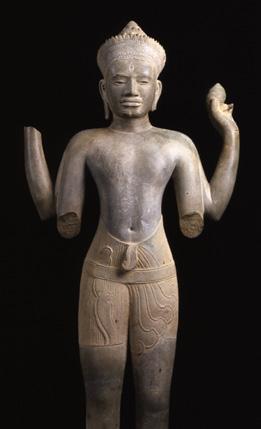
Compare a related sandstone figure of Vishnu, Cambodia, Angkor period, 12th century, in the Tokyo National Museum, collection reference number TC-382.
AUCTION RESULT COMPARISON
Type: Closely related
Auction: Christie’s Paris, 11 December 2013, lot 348
Price: EUR 121,500 or approx. EUR 161,000 adjusted for inflation at the time of writing
Description: A rare and important polished sandstone figure of Vishnu, Cambodia, Khmer, Baphuon style, 11th century
Expert remark: Compare the closely related modeling, manner of carving, and stone, with similar face, crown, sampot, and physique. Note the similar size (66 cm).
Estimate EUR 30,000
Starting price EUR 15,000


THE JORGEN RUBEN GALLERY LEDGER, entry from 2005:
"No. 183, LA 1972, Adrian Maynard, Khmer Angkor Wat 12th c.
Buddha Muchalinda"
Gallery price: EUR 65,000 or approx. EUR 108,500 adjusted for inflation at the time of writing.
The ledger establishes that this object was located in Europe before the UNESCO 1970 Convention entered into force.
Finely carved seated in dhyanasana upon the coiled, scaly body of the serpent Muchalinda, sheltered by the seven-headed hood of the naga, with hands resting in his lap in dhyana mudra. The stylized torso, devoid of ornament or drapery, extends into a well-defined head, his visage bearing a meditative expression, characterized by downcast eyes beneath gently arched brows, a broad nose, and full lips forming a subtle smile, all flanked by long, pendulous earlobes, and surmounted by a carefully arranged conical coiffure secured with a distinctive tiara.
Provenance: Adrian Maynard, London, by 1972. Collection of Leo Albrecht, Denmark, acquired from the above. Jorgen Ruben, acquired from the above before 2005. In the Jorgen Ruben Collection for at least 21 years. Adrian Maynard was one of the most successful and legendary dealers of Asian art of his generation, active at a time when London stood at the center of the international Asian art trade. He joined Spink & Sons in 1947 and later led its Asian art department, becoming Director and Deputy Chairman before his retirement in 1984. Leo Albrecht was a German-born publisher, literary agent, and collector who founded an influential Copenhagen agency in 1951, helping expand the international market for Scandinavian literature. He began collecting art in the late 1950s, with a particular focus on Asian sculpture, forming close ties with Ole Haslund, Lau Sunde, Freddy Hansen, Adrian Maynard, and later Jorgen Ruben, who has described him as “the greatest collector of Asian art in Denmark.”
Condition: Overall good condition with expected wear, signs of weathering and erosion, minor obvious losses, the naga hood with old repairs.
Weight: 86.9 kg (incl. stand)
Dimensions: Height 89.5 cm (excl. stand), 108.5 cm (incl. stand)
With an associated modern stand. (2)
This image of the Buddha sheltered by Muchalinda dates to the Angkor Wat period and exemplifies the distinctive sculptural style that flourished during the twelfth century, when the Khmer Empire reached the height of its territorial expansion. The period began under the reign of Suryavarman II, who commissioned the construction of Angkor Wat, the largest temple of the era and one originally dedicated to Vishnu.
Sculpture of the Angkor Wat period is characterized by a return to the more upright and subtly angular modeling that preceded the eleventhcentury Baphuon style. While retaining a refined sense of monumentality, works of this period are generally more restrained in scale, corresponding more closely to Baphuon sculpture than to the colossal statuary produced during the tenth century and earlier.
Seven-headed nagas frequently appear in Khmer art and architecture as protective beings. Historically, they are prominently represented as balustrades along the causeways leading to major temples, including those at Angkor Wat. The veneration of the naga, a serpent deity of ancient Indian origin, was readily integrated into Angkorian religious culture, where Indic traditions converged with indigenous beliefs in powerful local serpent spirits. In representations of the Buddha Muchalinda, the naga serves as both protector and symbol of spiritual authority, sheltering the Buddha during meditation.
Muchalinda is the name of a naga sheltering the Buddha from the elements after his enlightenment. When a storm raged and torrential rain fell for a whole week, the king of the nagas, Muchalinda, rose from the earth, coiling its body to form a seat and swelled its great hood to shelter Buddha. When the great storm had cleared, the serpent king assumed his human form, bowed before the Buddha, and returned to his palace.
LITERATURE COMPARISON
Compare a closely related sandstone figure of Buddha Muchalinda, dated 1150-1250, 84.5 cm high, in the Art Institute of Chicago, reference number 2016.421.

AUCTION RESULT COMPARISON
Type: Closely related
Auction: Galerie Zacke Vienna, 11 March 2022, lot 568
Price: EUR 63,200 or approx. EUR 75,000 adjusted for inflation at the time of writing
Description: A monumental sandstone figure of Buddha Muchalinda, Angkor period
Expert remark: Compare the closely related modeling, manner of carving, and stone. Note the larger size (121 cm).

Estimate EUR 15,000
Starting price EUR 7,500


THE JORGEN RUBEN GALLERY LEDGER, entry from 2012: “No. 747, LA, A. Maynard, Buddha Muchalinda. Khmer Angkor Wat, 12th c. H.: 70 cm.”
Gallery price: EUR 38,000 or approx. EUR 54,000 adjusted for inflation at the time of writing.
Khmer Empire. Skillfully carved, depicted seated in ardha padmasana upon the coiled, scaly body of the serpent Muchalinda, sheltered by the seven-headed hood of the naga, with hands resting in his lap in dhyana mudra. The bare torso adorned with an elaborate necklace and armlets detailed in high relief. The face finely modeled in a meditative expression with downcast eyes, ridged brows, a broad nose, and full lips forming a subtle smile, all flanked by elongated earlobes embellished with large earrings, and surmounted by a carefully arranged conical coiffure secured with a distinctive tiara.
Provenance: Adrian Maynard, London, by 1970. Collection of Leo Albrecht, Denmark, acquired from the above. Jorgen Ruben, acquired from the above before 2005. In the Jorgen Ruben Collection for at least 21 years. The provenance establishes that this object was located in Europe before the UNESCO 1970 Convention entered into force.
Condition: Very good condition with old wear, traces of weathering and erosion, signs of weathering and erosion, small losses, and few smoothed chips.
Weight: 48.6 kg (incl. stand)
Dimensions: Height 72.5 cm (excl. stand), 86.5 cm (incl. stand)
With an associated modern stand. (2)
This image of the Buddha sheltered by Muchalinda dates to the Angkor Wat period and exemplifies the distinctive sculptural style that flourished during the twelfth century, when the Khmer Empire reached the height of its territorial expansion. The period began under the reign of Suryavarman II, who commissioned the construction of Angkor Wat, the largest temple of the era and one originally dedicated to Vishnu.
AUCTION RESULT COMPARISON
Type: Closely related
Auction: Christie’s New York, 23 March 2010, lot 276
Price: USD 40,000 or approx. EUR 53,500 converted and adjusted for inflation at the time of writing
Description: A stone figure of Buddha Muchalinda, Thailand, 13th century Expert remark: Compare the closely related modeling, manner of carving, and stone. Note the size (94 cm).

Sculpture of the Angkor Wat period is characterized by a return to the more upright and subtly angular modeling that preceded the eleventhcentury Baphuon style. While retaining a refined sense of monumentality, works of this period are generally more restrained in scale, corresponding more closely to Baphuon sculpture than to the colossal statuary produced during the tenth century and earlier.

AUCTION RESULT COMPARISON
Type: Closely related
Auction: Christie’s Paris, 20 June 2017, lot 171
Price: EUR 15,000 or approx.
EUR 18,000 adjusted for inflation at the time of writing
Description: A polished sandstone figure of Buddhamuchalinda, Cambodia, Khmer, Angkor Wat period, 12th century
Expert remark: Compare the closely related modeling, manner of carving, and stone. Note the size (87 cm).

Estimate EUR 12,000
Starting price EUR 6,000
Khmer Empire, Cambodia. Magnificently carved seated in dhyanasana upon the coiled, scaly body of the serpent Muchalinda, sheltered by the seven-headed hood of the naga, with hands resting in his lap in dhyana mudra. The stylized torso, devoid of ornament or drapery, extends into a well-defined head. His visage, distinguished by its broad features, conveys a meditative expression, with downcast eyes beneath gently arched brows, a broad nose, and full lips forming a subtle smile, all flanked by long, pendulous earlobes embellished with large earrings, and surmounted by a carefully arranged conical coiffure, decorated with alternating bands of floral motifs and beaded ornamentation, while secured with a distinctive tiara.

Provenance: Adrian Maynard, London, by 1970. Collection of Leo Albrecht, Denmark, acquired from the above. Jorgen Ruben, acquired from the above before 2005. In the Jorgen Ruben Collection for at least 21 years. The provenance establishes that this object was located in Europe before the UNESCO 1970 Convention entered into force. Adrian Maynard was one of the most successful and legendary dealers of Asian art of his generation, active at a time when London stood at the center of the international Asian art trade. He joined Spink & Sons in 1947 and later led its Asian art department, becoming Director and Deputy Chairman before his retirement in 1984. Leo Albrecht was a Germanborn publisher, literary agent, and collector who founded an influential Copenhagen agency in 1951, helping expand the international market for Scandinavian literature. He began collecting art in the late 1950s, with a particular focus on Asian sculpture, forming close ties with Ole Haslund, Lau Sunde, Freddy Hansen, Adrian Maynard, and later Jorgen Ruben, who has described him as “the greatest collector of Asian art in Denmark.”
Condition: Good condition, commensurate with age. Expected wear, signs of weathering and erosion, structural fissures, old repairs and minor fills, chips, nicks, scratches.
Weight: 69.3 kg
Dimensions: Height 95.8 cm (excl. stand), 102.3 cm (incl. stand)
With an associated modern stand. (2)
This image of the Buddha sheltered by Muchalinda dates to the Angkor Wat period and exemplifies the distinctive sculptural style that flourished during the twelfth century, when the Khmer Empire reached the height of its territorial expansion. The period began under the reign of Suryavarman II, who commissioned the construction of Angkor Wat, the largest temple of the era and one originally dedicated to Vishnu.
Sculpture of the Angkor Wat period is characterized by a return to the more upright and subtly angular modeling that preceded the eleventhcentury Baphuon style. While retaining a refined sense of monumentality, works of this period are generally more restrained in scale, corresponding more closely to Baphuon sculpture than to the colossal statuary produced during the tenth century and earlier.
Seven-headed nagas frequently appear in Khmer art and architecture as protective beings. Historically, they are prominently represented as balustrades along the causeways leading to major temples, including those at Angkor Wat. The veneration of the naga, a serpent deity of ancient Indian origin, was readily integrated into Angkorian religious culture, where Indic traditions converged with indigenous beliefs in powerful local serpent spirits. In representations of the Buddha Muchalinda, the naga serves as both protector and symbol of spiritual authority, sheltering the Buddha during meditation.
AUCTION RESULT COMPARISON
Type: Closely related
Auction: Christie’s Amsterdam, 8 May 2001, lot 595
Price: NLG 37,600 or approx. EUR 29,000 converted and adjusted for inflation at the time of writing
Description: A Khmer, Angkor Vat style, greyish sandstone figure of Buddhamuchalinda, late 12th century
Expert remark: Compare the closely related modeling of the figure, manner of carving, and stone. Note the smaller size (73 cm).
Estimate EUR 15,000
Starting price EUR 7,500


THE JORGEN RUBEN GALLERY LEDGER, entry from 2005: “No. 330, LA 1978, A. Maynard, Khmer Bayon Prajnaparamita Uma, 12th-13th c.”
Gallery price: EUR 76,000 or approx. EUR 127,000 adjusted for inflation at the time of writing.
Khmer Empire. Superbly carved in a sinuous outline with prominent breasts and a beautifully rounded belly, wearing a tightly fitted sampot resting low on the hips, incised with individual flower heads and held up with a floral-banded sash secured with a fishtail knot. The face with a serene expression, heavy-lidded sinuous eyes, and wide smiling lips, flanked by elongated earlobes, the hair piled up into a conical chignon centered by a diminutive figure of the Buddha Amitabha.
Provenance: Adrian Maynard, London, by 1978. Collection of Leo Albrecht, Denmark, acquired from the above. Jorgen Ruben, acquired from the above before 2005. In the Jorgen Ruben Collection for at least 21 years.
Condition: Very good condition with expected wear, obvious losses, signs of weathering and erosion, old chips.
Weight: 69.8 kg (incl. stand)
Dimensions: Height 108 cm (excl. stand), 116 cm (incl. stand)
With an associated stand. (2)
The supple carving of bodily volumes lends this polished stone sculpture a levity and grace for which Khmer sculpture is renowned. It was likely created during the rule of King Jayavarman VII (r. c. 1181-1218), who identified himself with the Buddha and, in turn, equated his mother with Prajnaparamita, the mother of all Buddhas. He commissioned freestanding sculptures of the deity—the Goddess of Transcendent Wisdom—in the queen’s likeness, with a diminutive Buddha in her crown. This dual portrait demonstrates how the Khmer Empire adopted the Indian concept of DevaRaja (God-King) and established its rule with divine order.
The figure’s garment consists of a skirt , with a large triangular fold in front, decorated with floral ornaments; it is held in place at the waist by a wide jeweled belt. Jean Boisselier, who refers to this long sampot as a sarong, describes it in these terms: "The sarong is no longer made of pleated material, but is decorated with florets familiar from the bas-reliefs of Angkor Wat. The downturned edge has practically disappeared, the borders are defined by a narrow braid, and the front flap is folded over on itself and extends to a triangular point, remarkably like a shark's fin.

LITERATURE COMPARISON
Compare a closely related sandstone figure of Prajnaparamita, also with an incised floral skirt and similar hairdo, dated approx. 1200, 95.9 cm tall, in the Asian Art Museum, San Francisco, object number B71S7. Compare a closely related sandstone figure of Prajnaparamita, dated late 12th-early 13th century, 130.8 cm high, in the Minneapolis Institute of Art, accession number 97.105.

AUCTION RESULT COMPARISON
Type: Related
Auction: Christie’s London, 12 May 2004, lot 179 Price: EUR 83,650 or approx. EUR 139,000 adjusted for inflation at the time of writing
Description: A Khmer, Bayon-style, sandstone figure of Prajnaparamita, first half of 13th century Expert remark: Compare the closely related modeling, manner of carving, stone, and size (105 cm).


Estimate EUR 12,000
Starting price EUR 6,000

A SANDSTONE FIGURE OF UMA, BAYON STYLE, ANGKOR PERIOD, 13TH CENTURY

THE JORGEN RUBEN GALLERY LEDGER, entry from 2005: “No. 186, LA 1967, A. Maynard, Khmer Bayon Uma 13th c.” Gallery price: EUR 38,000 or approx. EUR 63,500 adjusted for inflation at the time of writing. The ledger establishes that this object was located in Europe before the UNESCO 1970 Convention entered into force.
Khmer Empire. Boldly carved with prominent breasts and rounded belly, wearing a tightly fitted sampot resting low on the hips, incised with individual flower heads and held up with a floral-banded sash secured with a fishtail knot. The face with a serene expression, heavylidded eyes, and wide smiling lips, flanked by elongated earlobes, and the hair piled up into a conical chignon.
Provenance: Adrian Maynard, London, by 1967. Collection of Leo Albrecht, Denmark, acquired from the above. Jorgen Ruben, acquired from the above before 2005. In the Jorgen Ruben Collection for at least 21 years. Adrian Maynard was one of the most successful and legendary dealers of Asian art of his generation, active at a time when London stood at the center of the international Asian art trade. He joined Spink & Sons in 1947 and later led its Asian art department, becoming Director and Deputy Chairman before his retirement in 1984. Leo Albrecht was a German-born publisher, literary agent, and collector who founded an influential Copenhagen agency in 1951, helping expand the international market for Scandinavian literature. He began collecting art in the late 1950s, with a particular focus on Asian sculpture, forming close ties with Ole Haslund, Lau Sunde, Freddy Hansen, Adrian Maynard, and later Jorgen Ruben, who has described him as “the greatest collector of Asian art in Denmark.”
Condition: Good condition, extensive wear and obvious losses, signs of weathering and erosion, nicks, and chips.
Weight: 25.7 kg (incl. stand)
Dimensions: Height 80 cm (excl. stand), 88 cm (incl. stand)
With an associated modern stand. (2)
The figure’s garment consists of a skirt , with a large triangular fold in front, decorated with floral ornaments; it is held in place at the waist by a wide jeweled belt. Jean Boisselier, who refers to this long sampot as a sarong, describes it in these terms: "The sarong is no longer made of pleated material, but is decorated with florets familiar from the bas-reliefs of Angkor Wat. The downturned edge has practically disappeared, the borders are defined by a narrow braid, and the front flap is folded over on itself and extends to a triangular point, remarkably like a shark's fin.
LITERATURE COMPARISON
Compare a closely related sandstone figure of Prajnaparamita, also with an incised floral skirt and similar hairdo, Kingdom of Angkor, dated approx. 1200, 95.9 cm tall, in the Asian Art Museum, object number B71S7.

AUCTION RESULT COMPARISON
Type: Closely related
Auction: Christie’s New York, 30 March 2006, lot 119
Price: USD 78,000 or approx. EUR 113,000 converted and adjusted for inflation at the time of writing
Description: A gray sandstone figure of Uma, Khmer, Angkor period, Bayon style, 13th century Expert remark: Compare the closely related modeling, manner of carving, stone, subject, and size (84 cm).

Estimate EUR 12,000
Starting price EUR 6,000


61
A RARE KHMER BRONZE FIGURE OF HANUMAN, BAYON STYLE, ANGKOR PERIOD, 12TH-13TH CENTURY
Expert’s note:
When posed in this powerful and exuberant manner, the image of Hanuman stood at the top of a standard. As the son of the wind god and the most powerful of the primeval forest-dwellers, who are depicted with the head and tail of a monkey and the body of a man, Hanuman as an emblem spelled success in battle. Hanuman is most prominently featured in the Indian epic Ramayana, which had gained popularity in Cambodia by the 600s.
Khmer Empire. The monkey-headed king balancing on his right leg atop a domed base, his left leg extended at the same angle as his raised left arm, wearing a short vertically pleated sampot secured by a belt and terminating in a fishtail-form central pleat. The deity is adorned with incised collars, beaded armbands, bracelets, and anklets, and a diadem with three leaf-shaped projections, his tiered conical coiffure surmounted by a lotus-bud cintamani.
Provenance: Adrian Maynard, London, by 1968. Collection of Leo Albrecht, Denmark, acquired from the above. Jorgen Ruben, acquired from the above before 2005. In the Jorgen Ruben Collection for at least 21 years.
Condition: Very good condition with expected wear and casting irregularities. Small nicks and light scratches, tiny dings, signs of weathering, encrustations, a small drilled aperture to the back. The bronze with a rich, naturally grown patina with extensive malachite encrustation.
Weight: 3.1 kg
Dimensions: Height 38 cm

THE JORGEN RUBEN GALLERY LEDGER, entry from 2005: “No. 177, LA 1968, Khmer Bayon 13th c. Bronze Hanuman standard top”
Gallery price: EUR 43,500 or approx. EUR 72,500 adjusted for inflation at the time of writing.
The ledger establishes that this object was located in Europe before the UNESCO 1970 Convention entered into force.
Literature comparison:
Compare a closely related bronze figure of Hanuman, Cambodia, Angkor, Bayon style, dated to the 12th century, size 18 x 19 cm, in the Cleveland Museum of Art, accession number 1991.169. Compare a closely related bronze figure of Hanuman, Angkor period, 15.5 cm high, in the National Museum of Cambodia, inventory number Ga.5472.
AUCTION RESULT COMPARISON
Type: Closely related
Auction: Sotheby’s New York, 25 March 1999, lot 186
Price: USD 60,250 or approx.
EUR 106,000 converted and adjusted for inflation at the time of writing
Description: A Khmer bronze figure of Hanuman, 12th century
Expert remark: Compare the closely related subject, modeling, pose, and adornment. Note the size (28.6 cm).
Estimate EUR 18,000
Starting price EUR 9,000


Expert’s note:
Thai sandstone linga from this period are extremely rare. The present example is particularly notable for the well-preserved and finely polished surface, smoothed through centuries of exposure to the elements.
Finely carved and smoothly polished as a phallic emblem, carefully detailed to emphasize the pronounced glans and its central vascular ridge, distinguished from the cylindrical shaft by a prominent encircling band in high relief.
Provenance: Freddy Hansen, Copenhagen, Denmark, by 1979. Jorgen Ruben, acquired from the above. In the Jorgen Ruben Collection for 47 years. Freddy Hansen was a Danish dealer of Asian art and antiquities, particularly Buddhist sculpture. Based in Copenhagen, he was active from the 1950s onward and became one of Denmark’s most prominent dealers in Asian art before his retirement in the early 1990s.
Condition: Good condition with expected wear, signs of weathering and erosion, minor losses, chips, nicks, and scratches. The stone with a fine, naturally grown patina.
Weight: 38.6 kg
Dimensions: Height 38.3 cm
Shiva was worshipped in innumerable forms, both natural and manmade. Among the most widespread was the linga, a form that became especially prominent in mainland Southeast Asia from about the sixth century onward. As a phallic emblem, the linga symbolized divine generative power and regeneration. Forms of the linga ranged from naturally occurring river-worn stones (banalinga) to mountain peaks regarded as displaying a linga-like profile (lingaparvata).
LITERATURE COMPARISON
Compare a closely related sandstone Shiva linga, Southern Thailand, 7th-8th century, 31.8 cm high, in the Metropolitan Museum of Art, object number 1992.150.3.
Estimate EUR 4,000
Starting price EUR 2,000

A KHMER SANDSTONE TORSO OF UMA, ANGKOR PERIOD, BAPHUON STYLE,
Finely carved and sensuously modeled, her youthful body with gently swelling breasts, the body narrowing to a slender waist contrasting the wide shoulders. She wears a diaphanous, finely pleated dhoti rising at the back and dipping forward to below the navel and knotted at the front.
Provenance: Freddy Hansen, Copenhagen, Denmark, by 1991. Jorgen Ruben, acquired from the above. In the Jorgen Ruben Collection for 35 years.
Condition: Very good condition, commensurate with age. Expected wear, obvious losses, signs of weathering and erosion, encrustations, old fills, small chips, scattered nicks, scratches.
Weight: 37.3 kg (incl. stand)
Dimensions: Height 42.8 cm (excl. stand), 52 cm (incl. stand)
Mounted on an associated stand. (2)
This style of sculpture derives its name from the temple-mountain of the Baphuon, one of the most ambitious constructions undertaken in the Angkor complex by the Khmer monarch Udayadityavarman II in the eleventh century. Compared to the monumental sculptures of the preceding Koh Ker style of the tenth century, Baphuon images were created in a slightly reduced scale. The distinguishing feature of these sculptures is a fluid attenuated line with great care taken towards attaining perfect harmony and
balance of form. With their restrained elegance and soft modeling, Baphuon sculptures are imbued with an inner strength and are amongst the most appealing of Khmer works of art.
A definitive stylistic innovation of the Baphuon period was in the treatment of the garments on both male and female deities depicted curving from a high back to fall low at the front revealing the navel. The belt was initially plain, but developed into a more ornamental detail and various patterns and suspended pendants were introduced. According to Boisselier, the highly decorative style of Banteay Srei inspired the development of Baphuon period sculpture, see Helen Ibbitson Jessup and Thierry Zephir (eds.), Millennium of Glory, 1997, p. 255.
AUCTION RESULT COMPARISON
Type: Closely related
Auction: Christie’s New York, 23 March 2010, lot 274
Price: USD 37,500 or approx.
EUR 50,000 converted and adjusted for inflation at the time of writing
Description: A sandstone torso of Uma, Khmer, Angkor period, Baphuon style, 11th century
Expert remark: Compare the closely related modeling and manner of carving. Note the smaller size (28 cm).
Estimate EUR 6,000
Starting price EUR 3,000


THE JORGEN RUBEN GALLERY LEDGER, entry from 2005:
“No. 328, LA 1978, Sunde, Khmer Baphuon Uma 11th c.”
Gallery price: EUR 97,000 or approx. EUR 162,000 adjusted for inflation at the time of writing.
Khmer Empire. Sensitively carved, standing firmly in samabhanga, clad in a long sampot wrapped around her hips, with a fishtailshaped flange rising above her narrow waist. The garment incised with parallel folds falling toward the front and secured with a tasseled foliate belt tied in a knot. Her torso is defined by prominent breasts, framed below by a pair of incised rib lines. Her visage bears a serene expression, marked by almond-shaped eyes beneath a continuous arched brow, a broad nose, and full lips forming a gentle smile, all flanked by long pendulous earlobes and surmounted by finely matted hair drawn upward, secured with a strand of pearls.
Provenance: Laurits Sunde, Denmark, by 1978. Collection of Leo Albrecht, Denmark, acquired from the above. Jorgen Ruben, acquired from the above before 2005. In the Jorgen Ruben Collection for at least 21 years.
Condition: Overall good condition with expected wear, traces of weathering and erosion, obvious losses, an old repair at the neck, and few smoothed chips. The stone with a fine, naturally grown patina.
Weight: 34.9 kg (incl. stand)
Dimensions: Height 88.5 cm (excl. stand), 97.3 cm (incl. stand)
With an associated modern stand. (2)
Sculpture from the Baphuon period, beginning in the first half of the eleventh century, represents a high point that was never again fully equaled in Khmer art. Divine figures of this era are rendered with notable anatomical precision and convey a serene, dignified presence. The gods are depicted as handsome, well-proportioned male figures of aristocratic Khmer type, while the goddesses appear as beautiful, sensuous, and graceful female forms. These sacred images are refined and naturalistic, presenting the deities in idealized human guise.
The art of the Baphuon period introduced new elements and refinements drawing on the developments of the previous half-century. The wide, muscular torsos are replaced with rounded shoulders and a narrow waist, with curved hips emphasized by the hem of the sampot, which is pulled up over the hips in a U-shape. The folds of the sampot during the Baphuon fall in asymmetrical pleats, emphasizing the multiple layers of the garment, while the knots at the waist often tail off in scrolling embellishments.
Compared to the more imposing works of the tenth century, Baphuon-period sculpture is generally more restrained in scale. Facial expressions are soft and often subtly alluring. The elaborate chignon covers and diadems that were common in much of the tenth century appear less frequently. Instead, the hair is typically arranged in a chignon secured by a simple jeweled or floral circlet.

LITERATURE COMPARISON
Compare a closely related sandstone figure of a standing female deity, probably Uma, dated c. mid-11th century, 75.6 cm high, deaccessioned by the Metropolitan Museum of Art in 2023.

AUCTION RESULT COMPARISON
Type: Closely related
Auction: Bonhams Paris, 25 October 2022, lot 77
Price: EUR 57,075 or approx. EUR 64,500 adjusted for inflation at the time of writing
Description: A sandstone figure of a female deity, Baphuon style, 11th century
Expert remark: Compare the closely related modeling, manner of carving, and stone, with similar physiognomy, braided hair, garment, and size (90 cm).
AUCTION RESULT COMPARISON
Type: Closely related
Auction: Christie’s New York, 21 March 2019, lot 1108
Price: USD 93,750 or approx. EUR 108,000 converted and adjusted for inflation at the time of writing
Description: A sandstone figure of a female deity, Khmer, Baphuon style, 11th century
Expert remark: Compare the closely related modeling and manner of carving. Note the size (71.4 cm).


Estimate EUR 15,000
Starting price EUR 7,500
65
A SANDSTONE TORSO OF UMA, BAPHUON STYLE, ANGKOR PERIOD, 11TH CENTURY
Khmer Empire. Standing in samabhanga, her young unadorned body with prominent breasts and her belly beautifully rounded, wearing a long, pleated sampot tied at the front, the long central fold elegantly culminating in a fishtail at the hem, and held together at the hips with a plain belt.
Provenance: Freddy Hansen, Copenhagen, Denmark, by 1983. Jorgen Ruben, acquired from the above. In the Jorgen Ruben Collection for 43 years. Freddy Hansen was a Danish dealer of Asian art and antiquities, particularly Buddhist sculpture. Based in Copenhagen, he was active from the 1950s onward and became one of Denmark’s most prominent dealers in Asian art before his retirement in the early 1990s.
Condition: Good condition, extensive wear and obvious losses, signs of weathering and erosion, nicks, and structural cracks.
Weight: 67 kg (incl. stand)
Dimensions: Height 91 cm (excl. stand), 97 cm (incl. stand)
With an associated modern stand. (2)
This piece exemplifies the style of Baphuon female figures with the frontal stance, the ovoid skirt wide at the hips and narrowing around the knees, the sampot in an elevated position at the back curving down to below the navel and the elegant central pleat. According to Boisselier the highly decorative style of Banteay Srei inspired the development of Baphuon-period sculpture, a manner which became more embellished with decorative elements as it reached a zenith during the Angkor Wat period a century later, see Helen Ibbitson Jessup and Thierry Zephir, editors, Sculpture of Angkor and Ancient Cambodia - Millennium of Glory, Washington 1997, page 255.
The modeling of the torso, the curled end of the sampot above the belt, and the long central fold recall Banteay Srei sculpture, see Emma C. Bunker and Douglas Latchford, Adoration and Glory, The Golden Age of Khmer Art, Chicago, 2004, page 175, fig. 8.6.
Literature comparison: Compare a related Baphuon style sandstone figure of a female divinity, dated 11th century, 49.1 cm tall, in the National Museum of Cambodia, inventory number Ka.829 / 298.
AUCTION RESULT COMPARISON
Type: Related
Auction: Bonhams London, 8 November 2004, lot 477
Price: GBP 27,485 or approx. EUR 58,000 converted and adjusted for inflation at the time of writing
Description: A superb monumental sandstone torso of a female deity, Khmer, Angkor Period, Baphuon style, 11th century
Expert remark: Compare the closely related modeling, manner of carving, and stone, with similar pleated sampot and fishtail fold. Note the size (104 cm).

AUCTION RESULT COMPARISON
Type: Closely related
Auction: Christie’s Paris, 11 December 2013, lot 351
Price: EUR 31,250 or approx. EUR 39,000 adjusted for inflation at the time of writing
Description: A sandstone torso of Uma, Cambodia, Khmer, Baphuon style, 11th century
Expert remark: Compare the closely related modeling, manner of carving, and stone, with similar pleated sampot and fishtail fold. Note the smaller size (60 cm).

Estimate EUR 12,000
Starting price EUR 6,000


THE JORGEN RUBEN GALLERY LEDGER, entry from 2005: “No. 322, LA, Sunde 1975, Khmer Angkor Wat torso of Vishnu 12th c.” Gallery price: EUR 38,000 or approx. EUR 63,500 adjusted for inflation at the time of writing.
Khmer Empire. Superbly carved, depicted standing firmly in samabhanga, clad in a long sampot wrapped around the hips, with a double fishtail-shaped fold cascading toward the front. The finely articulated torso flanked by four arms, the secondary pair raised, each holding attributes of the deity, while one of these is adorned with a distinctive beaded armlet.
Angkor Wat , erected by King Suryavarman II (r. 1113 - circa 1150), the great ruler of the Khmer empire, was built both as the royal temple complex dedicated to the Hindu deity Vishnu and as the ruler’s personal mausoleum. The magnitude of this building program underscored the intention of the King to establish his authority and strength as a leader. By linking himself directly to Vishnu, the deity associated with restoring cosmic order, he legitimized his spiritual and worldly power. This is captured aesthetically in the sturdy figural proportions and powerfully frontal images created during his time, evident here in this present sculpture of Vishnu.
Provenance: Laurits Sunde, Denmark, by 1975. Collection of Leo Albrecht, Denmark, acquired from the above. Jorgen Ruben, acquired from the above before 2005. In the Jorgen Ruben Collection for at least 21 years. Laurits "Lau" Sunde (1910-1979) was an important Danish collector and dealer who played a pioneering role in introducing African art to Denmark and the wider Nordic region. He is particularly remembered for his interest in Yoruba art and culture, especially ere ibeji twin figures, which he promoted not only as works of art but also as expressions of the spiritual and ritual traditions of the Yoruba people. Leo Albrecht was a German-born publisher, literary agent, and collector who founded an influential Copenhagen agency in 1951, helping expand the international market for Scandinavian literature. He began collecting art in the late 1950s, with a particular focus on Asian sculpture, forming close ties with Ole Haslund, Lau Sunde, Freddy Hansen, Adrian Maynard, and later Jorgen Ruben, who has described him as “the greatest collector of Asian art in Denmark.”
Condition: Good condition with old wear, traces of weathering and erosion, obvious losses, old repairs to secondary arms, few smoothed chips, scattered scratches. The stone with a fine, naturally grown patina.
Dimensions: Height 82.8 cm (excl. stand), 94.9 cm (incl. stand)
With an associated modern stand. (2)
The style of Angkor Wat seen here harks back to the earlier styles of the Koh Ker and Pre Rup traditions of the tenth century, rather than the preceding style of the Baphuon period. Lerner states that for a “ruler concerned with martial campaigns and responsible for such a gigantic personal monument as Angkor Wat, the Baphuon figural style may have appeared too consciously unheroic and sensuous.” (see Martin Lerner, Ancient Khmer Sculpture, New York, 1994, p. 46). Instead, rather than soft contours, each element has weight, as evidenced for example by the thick sampot.
Literature comparison:
Compare a related sandstone figure of Vishnu, Cambodia, Angkor period, 12th century, in the Tokyo National Museum, collection reference no. TC-382.
AUCTION RESULT COMPARISON
Type: Closely related
Auction: Christie’s New York, 25 March 2004, lot 163
Price: USD 45,410 or approx. EUR 70,000 converted and adjusted for inflation at the time of writing
Description: A sandstone torso of a fourarmed deity, Khmer, Angkor period, Angkor Wat style, second half 12th century
Expert remark: Compare the closely related modeling, manner of carving, stone, and size (78.7 cm).
Estimate EUR 12,000
Starting price EUR 6,000


67
A RARE BRONZE FIGURE OF MAITREYA, PROBABLY FROM THE 'PRAKHON CHAI HOARD', PRE-ANGKOR, 8TH-9TH CENTURY
Standing in slight tribhanga with two hands before him and the other two raised, dressed in a short sarong secured at the waist with a cord, the face with wide features, a moustache framing the full lips, and a serene expression flanked by pendulous earlobes, the hair arranged in neat rows in a jatamukuta with finely incised, towering locks centered by a small stupa.
Provenance: Freddy Hansen, Copenhagen, Denmark, by 1990. Jorgen Ruben, acquired from the above. In the Jorgen Ruben Collection for 36 years.
Condition: Good condition, commensurate with age. Extensive wear, signs of weathering and erosion, corrosion, casting flaws, nicks, scratches, minor losses, the feet reattached, a small fill to the face, and the back of the head with touchups. The bronze with a rich, naturally grown patina.
Weight: 519 g (excl. stand), 817 g (incl. stand)
Dimensions: Height 25.9 cm (excl. stand), 31.6 cm (incl. stand)
With an associated stand. (2)
The so-called “Prakhon Chai Hoard” was accidentally discovered by local villagers in 1964 at Prasat Hin Khao Plai Bat II, a tenth-century Khmer brick temple in Buriram Province. Concealed in a stone-covered pit within the temple precinct, the bronzes were likely buried during the site’s rededication
for Brahmanical use. Some bear traces of cloth wrappings, evidence of careful ritual deposition. Initially misattributed to Prakhon Chai district, the cache in fact originated from nearby Lahan Sai, though the name has endured. Numbering at least fifty-three known examples and perhaps two to three hundred in total, it is possibly the largest and most important cache of Buddhist bronzes ever discovered in mainland Southeast Asia.
AUCTION RESULT COMPARISON
Type: Closely related
Auction: Sotheby’s New York, 19 September 2008, lot 291
Price: USD 92,500 or approx. EUR 122,000 converted and adjusted for inflation at the time of writing
Description: Maitreya, Eastern Thailand, Buriram Province, Prakhon Chai
Expert remark: Compare the closely related modeling and manner of casting with similar sarong and hairstyle. Note the size (32.4 cm) and that this lot is now in the collection of the National Museum of Asian Art, Smithsonian Institution, accession number S2015.24.
Estimate EUR 6,000
Starting price EUR 3,000


A BRONZE FIGURE OF PRAJNAPARAMITA, BAYON STYLE, ANGKOR PERIOD, 12TH-13TH CENTURY

THE JORGEN RUBEN GALLERY LEDGER, entry from 2005:
“No. 176, HH 1994, Khmer Bayon 13th c. bronze Uma, wife of Shiva” Gallery price: EUR 5,800 or approx. EUR 9,400 adjusted for inflation at the time of writing.
Thailand. Standing in samabhanga on a flat pedestal, both hands raised and bent at the elbow clutching a manuscript and lotus bud, wearing a tightly fitted sampot resting low on the hips, incised with a patchwork design, and held up with a floral-banded sash secured by a belt, the body adorned in jewelry, her face with a serene expression, almond-shaped eyes, and smiling lips, flanked by elongated earlobes with pendeloque earrings. The hair piled up into a conical chignon behind the flared tiara.
Provenance: Collection of Hans Henningsen, Copenhagen, Denmark, by 1994. Jorgen Ruben, acquired from the above. In the Jorgen Ruben Collection for 32 years.
Condition: Good condition with expected wear, casting irregularities, small losses, signs of weathering, thick encrustations. A small aperture between the legs from mounting. The bronze with a naturally grown patina with areas of malachite encrustations.
Weight: 768 g (excl. stand), 1,119 g (incl. stand)
Dimensions: Height 24 cm (excl. stand), 31.8 cm (incl. stand)
With an associated wood base. (2)
This finely sculpted figure is a powerful representation of Prajnaparamita, the Mahayana Buddhist goddess of transcendent wisdom. The iconography is unmistakable, with the figure holding a lotus stem in one hand and a manuscript in the other—both key attributes of Prajnaparamita, who embodies the wisdom of the Prajnaparamita Sutra.
LITERATURE COMPARISON
Compare a closely related bronze figure of Prajnaparamita, 20.3 cm high, dated late 12th century, formerly in the Denver Art Museum and deaccessioned in March 2023.

AUCTION RESULT COMPARISON
Type: Closely related
Auction: Christie’s New York, 21 September 2007, lot 367
Price: USD 10,625 or approx. EUR 15,000 converted and adjusted for inflation at the time of writing
Description: A bronze figure of Uma, Thailand, Lopburi style, 13th century
Expert remark: Compare the closely related modeling, manner of casting, and size (24 cm). Note the different subject.
Estimate EUR 4,000
Starting price EUR 2,000


A LARGE BRONZE FIGURE OF AVALOKITESHVARA, ANGKOR WAT STYLE, 12TH CENTURY

THE JORGEN RUBEN GALLERY LEDGER, entry from 2012: “No. 746, Standing Buddha Khmer, H. 35.5 cm, LA UK art market 1980.”
Gallery price: EUR 34,000 or approx. EUR 48,000 adjusted for inflation at the time of writing.
Khmer Empire. Standing in samapada on a tiered circular base, holding a lotus bud in each hand, wearing a short pleated sampot, tucked around the belt, the end forming a symmetrical 'fishtail' at the hem, the serene face with almond-shaped eyes, and full lips, the hair surmounted by a conical ushnisha behind a flaring tiara.
Provenance: Collection of Leo Albrecht, Denmark, acquired on the UK art market circa 1980. Jorgen Ruben, acquired from the above before 2005. In the Jorgen Ruben Collection for at least 21 years.
Condition: Very good condition with expected wear and casting irregularities, scattered small nicks and light surface scratches, tiny dings, a chip to the base, traces of weathering, encrustations. The bronze with a rich, naturally grown patina with malachite, azurite, and cuprite encrustations.
Weight: 2.4 kg
Dimensions: Height 35.4 cm
Expert’s note:
The rigid frontal pose is characteristic of the Angkor Wat period and, in contrast to the preceding Baphuon style with its delicate curves, sculptures display an authoritarian nature not seen since the Bakheng period, possibly reflecting political developments at the time. Avalokiteshvara is the personification of compassion and the figure has a lively facial expression with alert eyes and a pleasant smile, bestowing benevolence on the devotee.
Literature comparison:
Compare a closely related bronze figure of a male divinity, 26.9 cm high, Bayon style, dated Angkor period, late 12th to early 13th century, in the National Museum of Cambodia, inventory number Ga.2687.
AUCTION RESULT COMPARISON
Type: Related
Auction: Sotheby’s New York, 19 March 2008, lot 243
Price: USD 73,000 or approx. EUR 99,000 converted and adjusted for inflation at the time of writing
Description: Avalokiteshvara, copper alloy, Khmer, Angkor period
Expert remark: Compare the related modeling, manner of casting, and size (34 cm).
Estimate EUR 12,000
Starting price EUR 6,000


70 A FINE STUCCO HEAD OF BUDDHA, ANCIENT REGION OF GANDHARA, 3RD-4TH CENTURY

THE JORGEN RUBEN GALLERY LEDGER, entry from 2005: “No. 170, PS UK 1984, LA, Gandhara 3rd c. stucco head of Buddha” Gallery price: EUR 5,600 or approx. EUR 9,400 adjusted for inflation at the time of writing.
Kushan period. The rounded face with downcast almond-shaped eyes beneath arched brows in a serene expression, aquiline nose, slight bow-shaped lips, flanked by ears with pendulous lobes, the undulating locks of hair tied away from the face in a chignon above the domed ushnisha.
Provenance: Peter Sloane, London, United Kingdom, by 1984. Collection of Leo Albrecht, Denmark, acquired from the above. Jorgen Ruben, acquired from the above before 2005. In the Jorgen Ruben Collection for at least 21 years. Peter Sloane is a dealer operating from the Grays Antique Market, Mayfair, London, specializing in Indian, African, Southeast Asian, and Himalayan tribal and ethnographic art. Condition: Good condition, commensurate with age. Extensive wear, obvious losses, scattered old repairs and fills, minor chips, signs of weathering and erosion, encrustations.
Weight: 4.4 kg (incl. stand)
Dimensions: Height 25 cm (excl. stand), 30 cm (incl. stand)
Mounted on an associated stand. (2)
Gandhara, located in the rugged foothills of the Himalayas, was a thriving cultural crossroads, where Greek, Parthian, and Kushan influences converged with the indigenous Buddhist tradition. The wealth of the region, bolstered by its pivotal role in trade, allowed for the commissioning of grandiose sculptures and monumental icons that reflected the evolving Buddhist philosophy, particularly from the 4th to 5th centuries AD. These works embodied the transformative ideologies of a flourishing Gandharan society.
AUCTION RESULT COMPARISON
Type: Closely related
Auction: Christie’s New York, 21 March 2007, lot 225
Price: USD 19,200 or approx. EUR 27,000 converted and adjusted for inflation at the time of writing
Description: A stucco head of Buddha, Gandhara, 3rd-4th century
Expert remark: Compare the closely related modeling with similar facial expression and hairstyle. Note the size (20 cm).
Estimate EUR 6,000
Starting price EUR 3,000


THE JORGEN RUBEN GALLERY LEDGER, entry from 2005: “No. 169, LA 2002, UK Mankowitz, Gandhara 2nd-3rd c. Stucco face fragment of Buddha” Gallery price: EUR 28,000 or approx. EUR 47,000 adjusted for inflation at the time of writing.
Expert’s note:
This larger than life-size head was once part of a monumental frieze, from which it was removed a long time ago. Such colossal Buddha images, especially made in stucco, are known from various archaeological sites in the Gandhara region of ancient Pakistan and Afghanistan. The Buddha’s heavily-lidded pensive eyes convey his compassion for all sentient beings.
Kushan period. The face displaying a serene expression with heavy-lidded almond-shaped eyes, below elegantly arched brows, centered by an aquiline nose above full bow-shaped lips with an oval depression used to define the philtrum, framed by gently-rounded cheeks betraying a youthful demeanor.
Provenance: Collection of Dane Rose, London, United Kingdom, 1986. Jonathan Mankowitz, London, 1990s. Collection of Leo Albrecht, Copenhagen, Denmark. Jorgen Ruben, acquired from the above in 2002. In the Jorgen Ruben Collection for 24 years. Jonathan Adam Mankowitz (1949-1992) was a British dealer of Asian works of art active in London and the second son of the celebrated writer, playwright, and screenwriter Wolf Mankowitz and psychoanalyst Ann Mankowitz. He grew up in a family deeply immersed in literature, the arts, and the antiques trade, with his father himself having begun his career as a dealer specializing in English ceramics before achieving literary fame, and both his brother and aunt active in the trade as well. Leo Albrecht was a German-born publisher, literary agent, and collector who founded an influential Copenhagen agency in 1951, helping expand the international market for Scandinavian literature. He began collecting art in the late 1950s, with a particular focus on Asian sculpture, forming close ties with Ole Haslund, Lau Sunde, Freddy Hansen, Adrian Maynard, and later Jorgen Ruben, who has described him as “the greatest collector of Asian art in Denmark.” Condition: Good condition, commensurate with age. Extensive wear, obvious losses, old repairs and fills, chips, nicks and scratches, signs of weathering and erosion, and encrustations.
Weight: 28.5 kg (incl. stand)
Dimensions: Height 46 cm (excl. stand), 57 cm (incl. stand)
Mounted on an associated stand. (2)
Remarkable in its scale, this fragment of a head is from a colossal representation of Buddha produced for a once monumental stupa along the ancient Silk Road in modern day Afghanistan. It presents one of the earliest and most influential sculptural traditions representing Buddha in human form, and bespeaks these thriving centers of Buddhism in the first half of the first millennium AD.
Gandhara, located in the rugged foothills of the Himalayas, was a thriving cultural crossroads, where Greek, Parthian, and Kushan influences converged with the indigenous Buddhist tradition. The wealth of the region, bolstered by its pivotal role in trade, allowed for the commissioning of grandiose sculptures and monumental icons that reflected the evolving Buddhist philosophy, particularly from the 4th to 5th centuries AD. These works embodied the transformative ideologies of a flourishing Gandharan society, as seen in their increasingly complex iconography and monumental scale.
The use of stucco in Gandharan sculpture, particularly at sites such as Hadda, represents a pivotal moment in the history of Buddhist art. Sculptural production in this medium was central to the period, allowing for rapid construction of large-scale images and architectural decoration, as evidenced by the extensive findings at Takht-i-Bahi, where over 270 sculptures were uncovered, many dating to the 3rd to 5th centuries AD. The speed and flexibility of stucco as a material made it ideal for the dynamic religious patronage of the time, where monumental images were created to adorn both monastic shrines and sacred spaces.


Hadda, situated in modern-day Afghanistan, is perhaps the most significant archaeological site for the study of Gandharan stucco. The site, thought to be the origin of this Buddha, reveals the mastery of stucco sculptors who combined Greco-Buddhist styles with Buddhist iconography. These sculptures, like the present lot, would have been integral to the visual and spiritual landscape of Buddhist monasticism. Though much of Hadda was destroyed during the civil war and subsequent looting by the Taliban, its profound legacy continues to influence the understanding of Gandharan art.
LITERATURE COMPARISON
Compare a related smaller stucco head of Buddha, dated 3rd-4th century, 24.1 cm high, in the Museum of Fine Arts, Houston, object number 2009.1708. Compare a related smaller stucco head of Buddha, dated 4th-5th century, 33 cm high, in the British Museum, registration number 1935,0312.1. Compare a related larger stucco head of Buddha, dated 4th century, 68 cm high, in the Los Angeles County Museum of Art, accession number 50.25.


AUCTION RESULT COMPARISON
Type: Related
Auction: Bonhams Hong Kong, 2 October 2018, lot 8
Price: HKD 4,660,000 or approx. EUR 597,000 converted and adjusted for inflation at the time of writing
Description: A polychromed stucco head of Buddha, Ancient region of Gandhara, circa 4th-5th century
Expert remark: Compare the closely related modeling and similar facial expression and dimpled philtrum. Note the size (61 cm) and that the comparable is a complete head with well-preserved polychromy.

Estimate EUR 50,000
Starting price EUR 25,000


A RED SANDSTONE FIGURE OF A CELESTIAL BEAUTY, SURASUNDARI, CENTRAL INDIA, CHANDELA DYNASTY, 10TH-11TH CENTURY

THE JORGEN RUBEN GALLERY LEDGER, entry from 2005: “No. 165, HH 1985, Ex Spinks, India Central 11th c. dancer.”
Gallery price: EUR 7,200 or approx. EUR 12,000 adjusted for inflation at the time of writing.
Rajasthan or Central India. Finely carved, standing in a dynamic pose atop a stylized pedestal, with her left hand poised next to her head, the right clutching an attribute close to her slender stomach, as she twists her body in a dancing motion. Dressed in a diaphanous dhoti secured by a festooned belt, the deity is richly adorned with elaborate jewelry around her neck and waist. Her face with downcast almondshaped eyes and full lips forming a beguiling smile, flanked by ears with large circular earrings, framed by the neatly incised hair in an elegant chignon.
Provenance: Spink & Son, London. Collection of Hans Henningsen, acquired from the above. Jorgen Ruben, acquired from the above in 1985. In the Jorgen Ruben Collection for 41 years.
Condition: Overall good condition with extensive wear, obvious losses, few old repairs, minor fills, structural cracks, chips, nicks, scratches, signs of weathering and erosion, encrustations, extensive remnants of pigments. Displaying very well.
Weight: 33.9 kg (incl. stand)
Dimensions: Height 77.5 cm (excl. stand), 78.5 cm (incl. stand)
Mounted on an associated stand. (2)
AUCTION RESULT COMPARISON
Type: Closely related
Auction: Christie’s New York, 23 September 2004, lot 43
Price: USD 71,700 or approx. EUR 109,000 converted and adjusted for inflation at the time of writing
Description: An Indian buff sandstone figure of Surasundari, India, Madhya or Uttar Pradesh, 11th century
Expert remark: Compare the closely related modeling and manner of carving with similar adornments, form, and size (78.7 cm).

AUCTION RESULT COMPARISON
Type: Closely related
Auction: Christie’s New York, 24 September 2020, lot 704
Price: USD 137,500 or approx. EUR 146,500 converted and adjusted for inflation at the time of writing
Description: A rare buff sandstone figure of Salabhanjika, Central India, Madhya Pradesh or Uttar Pradesh, 10th century
Expert remark: Compare the closely related modeling and manner of carving with similar form, adornments, expression, and size (83.8 cm).

Estimate EUR 4,000
Starting price EUR 2,000

A RED SANDSTONE FIGURE OF A CELESTIAL BEAUTY, SURASUNDARI, MADHYA PRADESH, 12TH CENTURY

THE JORGEN RUBEN GALLERY LEDGER, entry from 2005:
“No. 164, PS UK 1994, India, Madhya Pradesh, Fly wisher 10th-11th c.”
Gallery price: EUR 5,200 or approx. EUR 8,700 adjusted for inflation at the time of writing.
India. Finely carved, standing in a slight tribhanga with her torso swaying to the left, the effortless beauty of this semi-divine female is highlighted by her sinuous form and leisurely activity. Her facial features are precisely delineated, especially her almond-shaped eyes with pupils, well defined-lids, and arched brows. She is adorned with a beaded head ornament, large ear discs, and a thickly beaded necklace that falls between her exaggerated breasts. Her waist belt is festooned with jeweled leg drops connected to rich openwork girdles.
Provenance: Peter Sloane, London, United Kingdom, by 1994. Jorgen Ruben, acquired from the above. In the Jorgen Ruben Collection for 32 years.
Condition: Good condition with expected wear, obvious losses, chips, nicks and scratches, signs of weathering and erosion, and encrustations.
Weight: 4.3 kg (incl. stand)
Dimensions: Height 41 cm (excl. stand), 46 cm (incl. stand)
Mounted on an associated stand. (2)
In Indian art, a surasundari (lit. 'beautiful goddess') is a young maiden characterizing feminine beauty and graceful sensuality.
AUCTION RESULT COMPARISON
Type: Closely related
Auction: Bonhams New York, 17 March 2014, lot 78
Price: USD 87,500 or approx. EUR 107,000 converted and adjusted for inflation at the time of writing
Description: A red sandstone figure of a celestial woman (Surasundari), Rajasthan or Central India, circa 11th century
Expert remark: Compare the closely related modeling, manner of carving, and size (43.2 cm).

Estimate EUR 3,000
Starting price EUR 1,500


THE JORGEN RUBEN GALLERY LEDGER, entry from 2012: “No. 574, HK 2008, Ex UK Coll., Central Indian Lady under Palm tree, 11th c., ca. 76 cm h.”
Gallery price: EUR 18,600 or approx. EUR 26,500 adjusted for inflation at the time of writing.
India. Finely carved, standing in a dynamic pose with her left hand reaching for the long vines above her head, her body twisting in a dancing motion. Dressed in a diaphanous dhoti secured by a festooned belt, the deity is richly adorned with elaborate jewelry around her neck and waist. Her face with downcast almond-shaped eyes and full lips forming a beguiling smile, flanked by ears with large circular earrings, framed by the neatly incised hair in an elegant chignon.
LITERATURE COMPARISON

Kreijger
Provenance: A private collection in the United Kingdom. Hugo Kreijger, Netherlands, acquired from the above. Jorgen Ruben, acquired from the above in 2008. In the Jorgen Ruben Collection for 18 years. Hugo Kreijger is a Dutch scholar, author, and dealer specializing in the arts of the Himalayas and Asia. He studied South, Southeast, and Central Asian art and archaeology at the University of Amsterdam, graduating in 1980, and subsequently served as Head of the India, Himalaya, and Southeast Asia Department at Christie's Amsterdam until 1997. An acknowledged expert on Tibetan and Himalayan art, he has curated museum exhibitions, including Icons of Tibet (1989), and is the author of numerous scholarly publications, notably Tibetan Painting: The Jucker Collection (2001).
Condition: Good condition, commensurate with age. Extensive wear, obvious losses, old repairs and fills, structural cracks, chips, nicks, scratches, signs of weathering and erosion, encrustations.
Weight: 29.9 kg (excl. stand), 40.7 kg (incl. stand)
Dimensions: Height 70 cm (excl. stand)
With an associated stand. (2)
In Indian art, a surasundari (lit. 'beautiful goddess') is a young maiden characterizing feminine beauty and graceful sensuality. Buddhist and Jain shrines have featured sensual figures in form of yakshis and other spirits since the 2nd century BC. However, the surasundari motif gained prominence in Indian temple architecture only around the beginning of the 9th century. Shilpa-Prakasha, a 9th-century Tantric architectural treatise, declares a monument without a surasundari as inferior and fruitless. The 15th century text Kshirarnava states that the surasundaris should be depicted looking down (adho-drishti), not looking at someone. In temple sculptures, the surasundaris are often depicted as attendants of gods and goddesses. They also manifest as dancing apsaras. A salabhanjika or tree nymph is another variation of a surasundari.
Compare a related sandstone figure of a surasundari, dated to the 12th century, Orissa, 85.4 cm high, in the Virginia Museum of Fine Arts, object number 2006.39.

AUCTION RESULT COMPARISON
Type: Closely related
Auction: Christie’s New York, 21 September 2007, lot 59
Price: USD 121,000 or approx. EUR 170,000 converted and adjusted for inflation at the time of writing
Description: A red sandstone figure of Devi, India, Rajasthan or Madhya Pradesh, 10th century
Expert remark: Compare the closely related modeling and manner of carving with similar sinuous form, adornments, expression, and size (80.6 cm).
Estimate EUR 18,000
Starting price EUR 9,000

Northeastern India. Finely and deeply carved, Durga stands in pratyalidhasana, with one leg planted on the beast’s back, and the other extended over her lion mount. Her waist and limbs are slender, while her breasts are firm and round. The buffalo demon lies beheaded at Durga’s feet, with Mahishasura emerging in his anthropomorphic form from the slain animal. Her array of arms brandishing weapons connotes her many powers, while the pronounced musculature of her stomach reveals the tension in her body.
As she braces her foot against the back of the dead beast and raises her sword to dispatch the final blow, she uses her divine strength to plunge the trisula into Mahisha. Eyes wide with intensity, Durga has a smile that lends sweetness to her otherwise wrathful appearance, flanked by matrika assisting in the battle, and above the lotus base carved with fully articulated petals and held up by devotees and dancing figures including Chamunda.
Provenance: Collection of Peter Vangsted, Denmark, by 2000. Jorgen Ruben, acquired from the above. In the Jorgen Ruben Collection for 26 years.
Condition: Very good condition, commensurate with age. Wear, obvious losses, chips, scattered nicks and scratches, signs of weathering and erosion, and encrustations.
Weight: 21.1 kg (incl. wall hanger)
Dimensions: Height 59 cm
Fitted on an associated wall hanger. (2)
Durga puja, or the festival of Durga’s victory of good over evil, is one of the most celebrated festivals in eastern India. In Bengal, Durga is considered the daughter of every home and the festivities celebrate her return to her parents with her children, where for five days she is adored, worshipped and celebrated. The festival marks the battle between Durga and the powerful buffalo demon Mahishasura. A pious devotee of Brahma, Mahishasura was rewarded with a boon that no man or god would be able to conquer him. Thus invincible, he battled the gods and took over the heavens. The gods appealed to the goddess Parvati, who agreed to harness the shakti of all female celestial beings and create Durga, who is bestowed with all the weapons from the gods and a lion for her vehicle. After nine days of battle, Durga vanquished Mahishasura and his army and restored the heavens to the gods.
The worship of a mother goddess as the source of life and fertility has ancient roots, but the text Devi Mahatmya (Glory of the Goddess), composed during the fifth and sixth centuries, led to the dramatic transformation of the female principle into a goddess of great cosmic power. Later, textual sources generally refer to this form of Durga as Mahishasuramardini. She remains the most important and popular form of the goddess, also referred to as Devi or Shakti.
The present sculpture of Mahishasuramardini is a brilliant and important example of Brahmanical sculpture from the Pala period. Between the eighth and the twelfth centuries, the regions of Bihar and Bengal (presently Bangladesh and India) were politically and culturally unified under the reign of the Pala kings. Stone sculptures from these regions are of grey or black schist and it is believed that the grey stone originates in the Gaya region of Bihar and the black and more dense stone is found primarily in the eastern Bihar and Bengal.
The origin of the Pala school of sculpture can be traced to various stylistic sources, including Mathura-Kushana prototypes from the early centuries of the Common Era to the late fifth century Gupta idiom of Sarnath and related sites. Some of the earliest known depictions of Mahishasuramardini are small stone images from Mathura where the goddess is seen killing the buffalo demon or standing peacefully with sun and moon on either side, indicating her presiding over day and night. Other earlier examples are from the entrance to caves 6 and 17 at Udayagiri in Madhya Pradesh from the fourth to fifth centuries and from Aphsad in the seventh century. According to Claudine Buatze-Picron in her discussion on the Hindu images from this region, “As a close study of some of the forms reveals, the [iconography] was not for once and ever fixed but underwent transformations in the course of time; starting in Bihar, the movement reached its apex in north Bengal from the 10th century onwards (Claudine Bautze-Picron and Gouriswar Bhattacharya. The Art of Eastern India: In the Collection of the Museum Für Indische Kunst, Berlin: Stone & Terracotta Sculptures, D. Reimer, 1998, p. 12).
LITERATURE COMPARISON
Compare a closely related phyllite stele depicting the same subject, 81.9 cm high, dated 12th century, in the Dallas Museum of Art, object number 2009.17 (fig. 1). Compare a closely related stone stele depicting Durga Killing the Buffalo Demon, Pala empire, dated 11th-12th century, 87.5 cm high, in the Rijksmuseum, Amsterdam, object number AK-RAK-1992-1. A smaller stele depicting the same subject, dated ca. 11th century, 29.2 cm high, is in the Metropolitan Museum of Art, object number 91.21.'
AUCTION RESULT COMPARISON
Type: Closely related
Auction: Bonhams New York, 19 March 2012, lot 1023
Price: USD 30,488.75 or approx. EUR 39,000 converted and adjusted for inflation at the time of writing
Description: A black stone Durga Mahishasuramardini, Northeast India, 12th century
Expert remark: Compare the closely related modeling, manner of carving, stone, and subject. Note the size (58.4 cm) and state of preservation.
Estimate EUR 15,000
Starting price EUR 7,500

fig. 1


A RARE GRANITE FIGURE OF CHANDIKESHVARA, CHOLA DYNASTY, 13TH CENTURY
South India, Tamil Nadu. The saint is shown seated on a high festooned pedestal in lalitasana, his right hand holds an axe while the left is lowered above his knee. The body is sculpted with a broad and powerful chest in typical Pallava tradition. Simple ornaments adorn his body. His peaceful visage peers forward with downcast eyes beneath slender brows, a bar-shaped nose, a slightly grinning mouth, and cupped ears, and behind his head is a flowing coiffure that adds to his royal appearance.
Provenance: Freddy Hansen, Copenhagen, Denmark, by 1978. Jorgen Ruben, acquired from the above. In the Jorgen Ruben Collection for 48 years.
Condition: Very good condition with expected wear, signs of weathering and erosion, encrustations, minor obvious losses, chips, nicks, scratches.
Dimensions: Height 74 cm (excl. stand), 81 cm (incl. stand)
Mounted on an associated stand. (2)
Estimate EUR 6,000
Starting price EUR 3,000
LITERATURE COMPARISON
Compare a closely related Chola granite figure of Chandikeshvara dated to the 13th century, 61 cm high, in the Tanjore Art Gallery, museum number 109 (fig. 1). Compare a closely related earlier stone figure of Chandikeshvara dated to the Pallava-Chola period, 9th century, in the Salar Jung Museum, Hyderabad.
AUCTION RESULT COMPARISON
Type: Closely related
Auction: Christie’s New York, 17 September 2003, lot 30
Price: USD 11,950 or approx. EUR 18,500 converted and adjusted for inflation at the time of writing
Description: A granite figure of Shiva as the 'Great Teacher', Dakshinamurti
Expert remark: Compare the closely related modeling and manner of carving with similar hairstyle and adornments. Note the size (90 cm).


A GRANITE FIGURE OF BHUDEVI, LATE CHOLA-EARLY VIJAYANAGARA PERIOD, 13TH-14TH CENTURY
India, Tamil Nadu. Finely carved standing in a slight tribangha with the right knee bent, holding a lotus in her right hand and her left by her side. Adorned with multiple necklaces, the deity is dressed in a closefitting dhoti carved with elegantly undulating folds and secured with beaded festoons. Her rounded face with wide almond-shaped eyes surmounted by a conical headdress.
Provenance: Collection of Hans Henningsen, Copenhagen, Denmark, by 1986. Jorgen Ruben, acquired from the above. In the Jorgen Ruben Collection for 40 years.
Condition: Very good condition, commensurate with age. Old wear, obvious losses, repairs to rounded base, small chips, signs of weathering and erosion, and encrustations.
Weight: 15.7 kg (incl. stand)
Dimensions: Height 51 cm (excl. stand), 60 cm (incl. stand)
Mounted on an associated stand. (2)
Estimate EUR 4,000
Starting price EUR 2,000

THE JORGEN RUBEN GALLERY LEDGER, entry from 2005: “No. 166, HH 1986, India 13th c. granit Lady.” Gallery price: EUR 5,300 or approx. EUR 8,900 adjusted for inflation at the time of writing.
AUCTION RESULT COMPARISON
Type: Closely related
Auction: Christie’s New York, 20 September 2006, lot 71
Price: USD 10,200 or approx. EUR 14,500 converted and adjusted for inflation at the time of writing
Description: A granite figure of a Devi, South India, Tamil Nadu, Late Chola-early Vijayanagar period, 13th-14th century
Expert remark: Compare the closely related modeling and manner of carving. Note the size (62.8 cm).


78
A PAIR OF IMPOSING WOOD ‘SINGA HEAD’ ARCHITECTURAL ORNAMENTS, SUMATRA, TOBA BATAK PEOPLE, LATE 19TH-EARLY 20TH CENTURY
Indonesia. Each boldly carved, the grotesque faces with elongated features, including incised circular eyes set beneath a strongly protruding forehead, centered by a straight anthropomorphic nose and a stylized horse-like muzzle. The surfaces further enriched with incised linear decoration and traces of red and white pigments.
Provenance: Laurits Sunde, Denmark, by 1975. Collection of Leo Albrecht, Denmark, acquired from the above. Jorgen Ruben, acquired from the above before 2005. In the Jorgen Ruben Collection for at least 21 years. Laurits "Lau" Sunde (1910-1979) was an important Danish collector and dealer who played a pioneering role in introducing African art to Denmark and the wider Nordic region. He is particularly remembered for his interest in Yoruba art and culture, especially ere ibeji twin figures, which he promoted not only as works of art but also as expressions of the spiritual and ritual traditions of the Yoruba people.

Condition: Good condition with old wear, traces of weathering and erosion, natural age cracks and splits, scattered chips, remnants of pigments.
Weight: 36.2 and 42.1 kg (incl. stand)
Dimensions: 120.2 cm and 122.3 cm (excl. stand), 150.1 and 152.4 cm (incl. stand)
With associated metal stands. (4)
The ‘singa’ is the central motif in Toba Batak art, a supernatural being whose image is believed to protect individuals, households, and communities from malevolent forces. The term ‘singa’ derives from the Sanskrit word for ‘lion’, although in Toba Batak tradition it represents a composite, fantastical creature that incorporates features from several animal species.
LITERATURE COMPARISON
Compare a closely related wood ‘singa’ architectural ornament, Indonesia, Sumatra, Toba Batak people, late 19th to early 20th century, 129.5 cm high, in the Metropolitan Museum of Art, object number 1988.143.28.
AUCTION RESULT COMPARISON
Type: Closely related
Auction: Bonhams New York, 9 February 2014, lot 16
Mid-Estimate: USD 12,500 or approx. EUR 15,500 converted and adjusted for inflation at the time of writing
Description: Pair of Toba Batak architectural heads, Sumatra Island, Greater Sunda Islands


Expert remark: Compare the related subject, manner of carving, and modeling. Note the similar size (110 cm).
Estimate EUR 4,000
Starting price EUR 2,000


A SUPERB EGYPTIAN PAINTED WOOD FIGURE OF THE SEAL BEARER TJETJI, OLD KINGDOM, DYNASTY VI

THE JORGEN RUBEN GALLERY LEDGER, entry from 2005: “No. 70, AB 1981, Egypt. Striding high rank official 6th dynasty” Gallery price: EUR 132,000 or approx. EUR 221,000 adjusted for inflation at the time of writing.
Egypt, 2321-2184 BC. Finely carved in several sections, Tjetji is shown in the classic pose of a standing official, with his left leg advanced in stride, a long staff in his left hand, and a sekhem scepter held horizontally in his right hand, the elongated torso with slender musculature, the eyebrows, eyelines and mouth in relief.
Provenance: Collection of Alfons Billen, Belgium, by 1981. Jorgen Ruben, acquired from the above. In the Jorgen Ruben Collection for 45 years.
Condition: Good condition, commensurate with age. Extensive wear, obvious flaking and rubbing to pigment, the separately carved sections reinforced, expected age cracks, signs of weathering, encrustations, and minor signs of former insect activity.
Weight: 2.2 kg
Dimensions: Height 45.3 cm
Stone statues of men in this pose have back pillars, negative space between the limbs, and, as substitutes for the slender implements, rolled cloths, the button-like ends of which are barely visible within their fists. Since wooden statues were free of these conventions, they tend to look less rigid and more natural.
For a short period during the late Old Kingdom and the 1st Intermediate Period, it was popular to show the tomb's owner without clothes. These figures represent the deceased in the phase of renewal in front of the god Osiris, lord of the underworld.
Expert’s note:
The arms of this statue were made separately and pegged to the body, and the feet tenoned into a separate base. The figure was once fully painted according to the usual conventions, with the body dark red, the hair and nipples black, and the finger- and toenails white. The staff and scepter were also separate pieces, inserted through the holes in Tjetji's hands.
LITERATURE COMPARISON
Compare a closely related inlaid wood nude figure of Tjetji, Dynasty 6, dated 23212184 BC, 75 cm high, in the British Museum, registration number EA29594. Compare a closely related standing male figure, Late Old Kingdom-First Intermediate Period, 2236-2150 BC, 54 cm high, in the Walters Art Museum, accession number 22.211.

AUCTION RESULT COMPARISON
Type: Closely related Auction: Christie’s New York, 8 June 2007, lot 8
Price: USD 336,000 or approx. EUR 473,000 converted and adjusted for inflation at the time of writing
Description: An Egyptian wood figure of a man, Old Kingdom, Dynasty VI Expert remark: Compare the closely related modeling and manner of carving with similar pose and expression. Note the size (80.6 cm) and garment.


Estimate EUR 40,000
Starting price EUR 20,000

80 AN EGYPTIAN WOOD SHABTI WITH A FITTED WOOD ANTHROPOID COFFIN, NEW KINGDOM, DYNASTY XVIII-XIX

THE JORGEN RUBEN GALLERY LEDGER, entry from 2005: “No. 75, HH 1979, Egypt. Wood spare sarcophagus 18th dyn.” Gallery price: EUR 11,000 or approx. EUR 18,500 adjusted for inflation at the time of writing.
Egypt, 1550-1196 BC. The shabti in typical mummiform posture, holding two hoes, wearing a tripartite wig and broad collar, preserved inside a fitted wood anthropoid coffin and lid pierced with holes along the edges for fastening.
Provenance: Collection of Hans Henningsen, Copenhagen, Denmark, by 1979. Jorgen Ruben, acquired from the above. In the Jorgen Ruben Collection for 47 years. Hans Henningsen (d. 1999) was a Danish engineer and discerning collector of ancient art. From the 1960s onward, he travelled widely across Europe, Britain, and Egypt in pursuit of antiquities, valuing objects above all for their artistic merit, craftsmanship, and authenticity. Henningsen was a friend and mentor to Jorgen Ruben, as well as an early and frequent customer of Ruben’s first gallery in Copenhagen. Condition: Good condition with old wear, expected age cracks, signs of prolonged burial, minor losses, commensurate with age.
Weight: 370 g (the shabti), 1,234 g (total)

Hans Henningsen outside Jorgen Ruben’s gallery in Copenhagen, 1991
Dimensions: Height 30 cm (the shabti), 36.5 cm (total)
The tomb shabtis of the New Kingdom were often stored in wooden boxes, while other shabtis such as the present lot, of a type in vogue since the end of the Seventeenth Dynasty, were placed in their own miniature anthropoid coffins.
LITERATURE COMPARISON
Compare a closely related shabti with anthropoid coffin, dated to the New Kingdom, in the collection of the University of Warsaw.

AUCTION RESULT COMPARISON
Type: Closely related
Auction: Bonhams London, 7 July 2016, lot 104
Mid-Estimate: GBP 30,000 or approx. EUR 42,500 converted and adjusted for inflation at the time of writing
Description: An Egyptian painted wood shabti for Lady Huy with an anthropoid coffin, New Kingdom, 18th-19th Dynasty, circa 1550-1196 B.C.
Expert remark: Compare the closely related form, modeling, and manner of carving. Note the size (21.3 cm) and hieroglyphic inscriptions.
Estimate EUR 12,000
Starting price EUR 6,000


THE JORGEN RUBEN GALLERY LEDGER, entry from 2005: “No. 76, JS, Egyptian mummy mask late period.”
Gallery price: EUR 3,800 or approx. EUR 6,300 adjusted for inflation at the time of writing.
Egypt, 664-332 BC. From an anthropoid coffin, the facial features finely carved, particularly his slightly arched eyebrows, the slender nose and plump lips raised in a faint smile. Heavy eyelids shape his solemn eyes which preserve some detailing to the dark pupils. Part of a rounded headdress sits low on the forehead.
Provenance: Julia Schottlander, London. Jorgen Ruben, acquired from the above before 2005. In the Jorgen Ruben Collection for at least 21 years. Julia Schottlander (b. 1955) is a London-based dealer in antiquities who opened a gallery in Bryanston Square, London, in the 1980s, later trading under the name Tetragon. Active primarily during the 1990s and early 2000s, she specializes in small-format antiquities, particularly Ancient Greek and Egyptian bronzes and artifacts, and donated numerous objects to the British Museum and the Ashmolean Museum, Oxford.
Condition: Good condition with old wear, expected age cracks, signs of prolonged burial, little former insect activity, minor losses.
Weight: 1,375 g
Dimensions: Height 29 cm
The back fitted with a metal mounting hook for suspension.
LITERATURE COMPARISON
Compare a closely related Egyptian sarcophagus mark, dated to the Late Period, in the Museu Egipci, Barcelona.

AUCTION RESULT COMPARISON
Type: Related
Auction: Sotheby’s London, 8 December 2021, lot 136
Price: GBP 22,680 or approx. EUR 33,000 converted and adjusted for inflation at the time of writing
Description: An Egyptian Wood Mummy Mask, 21st/22nd Dynasty, 1075-716 BC
Expert remark: Compare the related modeling and manner of carving. Note the size (24.5 cm), state of preservation, and earlier date.
Estimate EUR 4,000
Starting price EUR 2,000


82 AN EGYPTIAN POLYCHROME FIGURE OF PTAH-SOKAR-OSIRIS, LATE PERIOD

THE JORGEN RUBEN GALLERY LEDGER, entry from 2005: “No. 72, LC, Egypt. Ptah Sokar Osiris, complete, Late P.” Gallery price: EUR 14,000 or approx. EUR 23,500 adjusted for inflation at the time of writing.
Egypt, 664-332 BC. Depicted mummiform, with a blue tripartite wig bound in a diadem, surmounted by a separately carved crown of ram horns, sun disk and plumes. The face with eye outlines, pupils, cosmetic lines and conforming brows in black, wearing a blue false beard and a broad collar composed of strands of red and black, the body red and detailed with a cross-hatched design in blue.
The front and back each inscribed with a column of hieroglyphs
Provenance: Lauritz, Copenhagen, Denmark, by repute in circa 2002. Jorgen Ruben, acquired from the above. In the Jorgen Ruben Collection for around 24 years.
Condition: Very good condition, commensurate with age. Extensive wear, obvious losses, expected age cracks, flaking and losses to pigments, signs of prolonged burial, encrustations. The separately carved sections reinforced.
Weight: 1,416 g (incl. stand)
Dimensions: Height 52 cm (excl. stand), 57 cm (incl. stand)
Firmly mounted on an associated wood stand. (2)
This mummiform figure represents the funerary deity Ptah-SokarOsiris, who embodied the concept of rebirth. On the head is a shuty crown: two ostrich plumes; a sun disk; and ram's horns. This type of funerary statuette was an important element of the burial assemblage in the Late and Ptolemaic Periods.
LITERATURE COMPARISON
Compare a closely related wood figure of PtahSokar-Osiris, dated 4th-3rd centuries, 80.5 cm high, in the Museum of Fine Arts, Budapest, inventory number 51.2098.

AUCTION RESULT COMPARISON
Type: Related
Auction: Sotheby’s New York, 11 June 2010, lot 11
Price: USD 11,875 or approx. EUR 16,000 converted and adjusted for inflation at the time of writing
Description: An Egyptian Polychrome Wood figure of Ptah-Sokar-Osiris, Ptolemaic Period, 304-30 BC
Expert remark: Compare the closely related modeling, manner of carving, and polychrome decoration. Note the size (74.9 cm) and base.

AUCTION RESULT COMPARISON
Type: Closely related
Auction: Sotheby’s New York, 11 June 2010, lot 10
Price: USD 18,750 or approx. EUR 25,500 converted and adjusted for inflation at the time of writing
Description: An Egyptian Polychrome Wood Figure of Ptah-Sokar-Osiris, 25th/26th Dynasty, 750-525 B.C.
Expert remark: Compare the closely related modeling, manner of carving, and polychrome decoration. Note the size (53.3 cm), base, and missing crown.
Estimate EUR 8,000
Starting price EUR 4,000


83
AN EGYPTIAN WOOD FIGURE OF PTAH-SOKAR-OSIRIS, LATE PERIOD-PTOLEMAIC PERIOD

THE JORGEN RUBEN GALLERY LEDGER, entry from 2005:
“No. 74, LC, Egypt. Ptah Sokar Osiris ptolemaic” Gallery price: EUR 5,800 or approx. EUR 9,700 adjusted for inflation at the time of writing.
Egypt, 664-30 BC. Of typical mummiform, wearing a tripartite wig, the arms crossed over the chest, the fisted hands emerging from within the vestment, the face finely carved.
The back inscribed with a column of hieroglyphs
Provenance: Lauritz, Copenhagen, Denmark, by repute in 2002. Jorgen Ruben, acquired from the above. In the Jorgen Ruben
Collection for 24 years.
Condition: Good condition with expected wear, minor age cracks, obvious losses, extensive remnants of pigment, signs of prolonged burial, encrustations, few minor signs of former insect activity.
Weight: 1,164 g (incl. stand)
Dimensions: Height 43 cm (excl. stand), 47.5 cm (incl. stand)
With an associated stand. (2)
LITERATURE COMPARISON
Compare a related painted wood figure dated Late Period-Ptolemaic period, in the Musée des Amériques, Auch, accession number 985.44.

AUCTION RESULT COMPARISON
Type: Closely related
Auction: Bonhams London, 16 April 2015, lot 30
Price: GBP 15,000 or approx. EUR 25,000 converted and adjusted for inflation at the time of writing
Description: An Egyptian wood figure of Ptah-Sokar-Osiris, Late Period, circa 664332 BC
Expert remark: Compare the closely related modeling and manner of carving. Note the size (57 cm).
Estimate EUR 4,000
Starting price EUR 2,000

AN EGYPTIAN POLYCHROME WOOD SARCOPHAGUS FRAGMENT DEPICTING NUT, LATE PERIOD-PTOLEMAIC PERIOD

THE JORGEN RUBEN GALLERY LEDGER, entry from 2012: “No. 597, Sacrophagus board with woman, Egypt Late Period painted wood, 74 x 39 cm, Prov. 1970 Vikt. Lindström Stockholm” Gallery price: EUR 4,500 or approx. EUR 6,400 adjusted for inflation at the time of writing.
The ledger establishes that this object was located in Europe before the UNESCO 1970 Convention entered into force.
Egypt, 664-30 BC. From the inside of a sarcophagus, finely painted with Nut, the goddess of the sky and the heavenly bodies, facing right with her arms held by her sides, and wearing a long-beaded dress, beaded jewelry, broad collar, and tripartite wig with a fillet across her forehead, surmounted by a round water pot, the elegantly drawn face with a large eye, a long eyebrow and cosmetic lines.
The right edge of the panel is inscribed with a column of hieroglyphs
Provenance: Viktoria Lindström, Stockholm, Sweden, by 1970. Bukowski's, Stockholm, 23 June 2012, lot 321935. Oliver Klitgaard, Denmark, acquired from the above. Jorgen Ruben, acquired from the above. In the Jorgen Ruben Collection for 14 years.
Condition: Good condition, commensurate with age. Extensive wear, obvious losses, expected age cracks, signs of prolonged burial, encrustations, flaking and rubbing to pigment, minor signs of former insect activity.
Weight: 2.6 kg
Dimensions: Height 74 cm
The back with a pair of metal bars, the foremost suspending loop-cord attachments for mounting.
As a divinity responsible for renewing the sun each day by swallowing the setting sun, Ra, each evening and giving birth to him by her womb in the morning, Nut was regarded as suitable imagery for the underside of the lid of sarcophagi, as this associated the deceased with re-enacting the journey of the Ra between heaven and earth.
AUCTION RESULT COMPARISON
Type: Closely related
Auction: Christie’s London, 25 October 2006, lot 165
Price: GBP 8,400 or approx. EUR 17,000 converted and adjusted for inflation at the time of writing
Description: An Egyptian gesso-painted wood sarcophagus fragment, Ptolemaic period, circa 4th-1st century BC
Expert remark: Compare the closely related manner of painting and similar state of preservation. Note the size (54.5 cm) and later dating.
Estimate EUR 6,000
Starting price EUR 3,000


85 AN EGYPTIAN POLYCHROME WOOD ‘ANUBIS’ SARCOPHAGUS FRAGMENT, LATE PERIOD-PTOLEMAIC PERIOD
Egypt, 664-30 BC. Finely painted with two confronted recumbent black jackals representing Anubis, the god of embalming and protector of the dead.
The upper corners and lower section of the panel inscribed with series of hieroglyphs
Provenance: Michel Daheb, Brussels, Belgium, ca. 1980. Jorgen Ruben, acquired from the above in 2002. In the Jorgen Ruben Collection for 24 years.
Condition: Good condition, commensurate with age. Extensive wear, expected age cracks, obvious losses, old fills with associated touchups, signs of prolonged burial, encrustations, minor signs of former insect activity, minor rubbing and flaking to pigments.
Weight: 1,535 g
Dimensions: Length 65 cm
Anubis was the Egyptian deity of cemeteries and embalming as well as the protector of graves. As with any other culture or religion around the world, the Egyptians believed in paying respect to their dead. Therefore, they conducted elaborate ceremonies and mummification processes to help the deceased pass smoothly into the Afterlife. Anubis was the deity who played an important role in this journey. Depicted with the black head of a jackal, Anubis helped mummify Egyptians when they died.
Jackals were associated with death, because they lurked around cemeteries and would eat decomposing flesh. Therefore, by making Anubis the patron deity of jackals, the Egyptians hoped to protect the bodies from being devoured. In addition, as recorded in the Book of the Dead (The Book of Going Forth by Day) Anubis’s other job was to stand in the Hall of the Two Truths and weigh the hearts of people seeking judgment.

THE JORGEN RUBEN GALLERY LEDGER, entry from 2012: “No. 718, Fragment of Egyptian Sacrophagus showing two Anubises, Late Period, Length 65 cm x Height 20 cm, Prov.: Belgian coll. ca. 1980, DD 2002” Gallery price: EUR 4,850 or approx. EUR 6,900 adjusted for inflation at the time of writing.
LITERATURE COMPARISON
Compare a closely related cartonnage element depicting confronting Anubis, Ptolemaic Period, dated 200-30 BC, part of the mummy of Nesmin in the Metropolitan Museum of Art, object number 86.1.51. See also a similar detail on the sarcophagus of Lady Ta'an, dated circa 300-30 B.C, in the Joseph Moore Museum, Richmond, Indiana.
Estimate EUR 2,000
Starting price EUR 1,000


AN EGYPTIAN POLYCHROME WOOD ‘ANKH AND WAS’ SARCOPHAGUS FRAGMENT, LATE PERIOD-PTOLEMAIC PERIOD
Egypt, 664-30 BC. Finely painted with a band of white ankh (life)-sign flanked by two Seth-headed was-scepters (dominion), all enclosed within a geometric band composed of rectangular beads.
One narrow side is inscribed with a series of hieroglyphs
Provenance: A private Danish collection, by 1991. Jorgen Ruben, acquired from the above. In the Jorgen Ruben Collection for 35 years.
Condition: The fragment in overall good condition with extensive wear, expected age cracks, signs of prolonged burial, encrustations, obvious losses, old fills to the back, flaking and rubbing to pigment, minor signs of former insect activity.
Weight: 1,277 g
Dimensions: Height 44 cm
Firmly mounted on an associated wood stand. (2)
These rectangular decorative panels show a combination of two hieroglyphs, the ankh and was-scepter, with the ankh made up of a T-shaped form topped by a circle and symbolizing life. The was-scepter has the head of a dog-like animal with the lower extremities made into a twopronged scepter, and symbolizes royal authority.

The ankh represents life, especially divine or eternal life. In temple and tomb contexts, it often signifies the life force bestowed by the gods, sometimes shown held to the nose of a king or deceased person as the breath of life. The was-scepter represents dominion, power, authority, and divine control. Its long staff, forked base, and animal-headed finial are traditionally associated with the so-called Seth animal, though the wasscepter itself was not limited to Seth. It was carried by many gods and kings as a sign of cosmic and royal authority.
When the ankh is placed between two was-scepters, the image becomes a compact visual formula for “life and dominion” or “eternal life and divine power.” The symmetrical arrangement gives the motif a protective, almost heraldic quality. Repeated in a frieze, it likely served as a decorative and symbolic blessing, multiplying the promise of life, stability, and divine authority across the sacred space.
AUCTION RESULT
COMPARISON
Type: Related
Auction: Christie’s London, 1 October 2014, lot 178
Price: GBP 4,750 or approx. EUR 8,000 converted and adjusted for inflation at the time of writing
Description: Two Egyptian gesso-painted wood panels, Late Period-Ptolemaic period, circa 664-30 BC Expert remark: Compare the related manner of painting and motifs. Note the much larger size (89 cm).
Estimate EUR 3,000
Starting price EUR 1,500


87
AN EGYPTIAN BRONZE FIGURE OF A FALCON-HEADED HORUS, THIRD INTERMEDIATE-LATE PERIOD

THE JORGEN RUBEN GALLERY LEDGER, entry from 2012: “No. 748, Horus falcon without arms Egypt Late period Bronze, H.: 10.5 cm, BX 2010” Gallery price: EUR 12,000 or approx. EUR 17,000 adjusted for inflation at the time of writing.
Egypt, 1069-332 BC. Striding forward on an integral base with the left foot advanced, the falcon-headed deity wearing a belted kilt and striated tripartite wig, the kilt and wig embellished with inlays in a secondary material. The face with a small beak and articulated eyes.
Provenance: Jorgen Ruben, acquired at the Brafa Art Fair, Brussels, Belgium in 2010 from a Dutch dealer. In the Jorgen Ruben Collection for 16 years.
Condition: Good condition with expected wear, casting irregularities, obvious losses, light nicks and surface scratches, signs of prolonged burial, encrustations. The bronze with a superb, naturally grown patina with malachite and cuprite encrustations.
Weight: 159 g (excl. stand), 171 g (incl. stand)
Dimensions: Height 10.5 cm (excl. stand), 11.2 cm (incl. stand)
With an associated stand. (2)
One of the oldest and most important deities of ancient Egypt , Horus was worshipped in several distinct forms: as a falcon he was a sky god closely associated with divine kingship and solar power, while as Horus the Child he was venerated as the son of Isis and Osiris. As a protector of kingship and an embodiment of royal authority, Horus was prominently represented in temple sculpture, most famously at the Ptolemaic Temple of Horus at Edfu in Upper Egypt.
AUCTION RESULT COMPARISON
Type: Closely related
Auction: Christie’s New York, 11 December 2003, lot 52
Price: USD 7,170 or approx. EUR 11,500 converted and adjusted for inflation at the time of writing
Description: An Egyptian bronze figure of Horus, Third Intermediate Period, Dynasty XXI-XXV, 1070-712 BC Expert remark: Compare the closely related modeling, manner of casting, and subject, with similar incised details, face, and losses. Note the size (15.9 cm).

AUCTION RESULT COMPARISON
Type: Closely related
Auction: Christie’s London, 5 October 2000, lot 108
Price: GBP 6,462 or approx. EUR 14,500 converted and adjusted for inflation at the time of writing
Description: An Egyptian bronze figure of Horus, circa 4th-1st century BC
Expert remark: Closely related modeling, manner of casting, and subject, with similar incised details and face. Note the similar size (12.7 cm).

Estimate EUR 8,000
Starting price EUR 4,000


THE JORGEN RUBEN GALLERY LEDGER, entry from 2005: “No. 68, HH, Egyptian bronze of striding Harpokrates 26 dyn.” Gallery price: EUR 9,400 or approx. EUR 15,500 adjusted for inflation at the time of writing.
Egypt, 664-525 BC. The child god depicted nude, save a pendant incised around his neck, striding forward on an integral plinth, the left leg advanced, his right forefinger raised to his lips, wearing the pschent crown fronted by a uraeus, issuing a braided side-lock.
Provenance: Collection of Hans Henningsen, Copenhagen, Denmark, by 1982. Jorgen Ruben, acquired from the above. In the Jorgen Ruben Collection for 44 years. Hans Henningsen (d. 1999) was a Danish engineer and discerning collector of ancient art. From the 1960s onward, he travelled widely across Europe, Britain, and Egypt in pursuit of antiquities, valuing objects above all for their artistic merit, craftsmanship, and authenticity. Henningsen was a friend and mentor to Jorgen Ruben, as well as an early and frequent customer of Ruben’s first gallery in Copenhagen. Condition: Very good condition with expected wear, casting irregularities, signs of prolonged burial, encrustations. The bronze with a rich, naturally grown, dark patina with malachite and cuprite encrustations.

Hans Henningsen outside Jorgen Ruben’s gallery in Copenhagen, 1991
Weight: 344 g (excl. stand), 682 g (incl. stand)
Dimensions: Height 15.8 cm (excl. stand), 19.2 cm (incl. stand)
With an associated stand. (2)
The figure represents a child god in a striding pose, wearing the red crown of Lower Egypt, which alludes to his royal status. The child god is distinguished from adult gods by a range of iconographic clues: his nudity, the finger raised to the mouth (a child-like gesture), and the sidelock on the right side of his head. He wears an amulet, an attribute common to child gods but not adult gods, as well as a streamer on the back of his crown, armlets and bracelets.
Child gods grew in popularity and cult from the Third Intermediate Period onwards, rivaling even the most powerful and ancient gods, especially as temple offerings. Without an inscription, it can be very difficult to securely distinguish and identify particular child gods, but here the red crown likely identifies the god as Harpokrates (Horus the Child), who was the son of Osiris and Isis.
LITERATURE COMPARISON
Compare a closely related bronze figure of Harpokrates in red crown, dated Late Period-Ptolemaic Period, 13.2 cm high, in the Metropolitan Museum of Art, object number 04.2.615.

AUCTION RESULT COMPARISON
Type: Closely related
Auction: Christie’s New York, 8 June 2004, lot 566
Price: USD 23,900 or approx. EUR 37,000 converted and adjusted for inflation at the time of writing
Description: An Egyptian bronze Harpokrates, Late Period, Dynasty XXVI Expert remark: Compare the closely related modeling and manner of casting. Note the larger size (28.5 cm).

Estimate EUR 8,000
Starting price EUR 4,000


THE JORGEN RUBEN GALLERY LEDGER, entry from 2005: “No. 67, BR, Egyptian bronze striding Horus (with crown [NB: not matching the figure and since removed]) Late period” Gallery price: EUR 32,000 or approx. EUR 53,500 adjusted for inflation at the time of writing.
Egypt, 664-332 BC. Depicted striding forward with his left leg advanced, the left arm to his side with the hand fisted, the priest is nude save for a cap-crown fronted by a uraeus, the face with wide almond-shaped eyes, arched brows, a slender nose, and pursed lips forming a smile, flanked by large protruding ears.
Provenance: Bruun Rasmussen, Copenhagen, by repute in 2008. Jorgen Ruben, acquired from the above. In the Jorgen Ruben Collection for around 18 years.
Condition: Old wear, obvious losses, casting irregularities, rubbing, signs of weathering and erosion, encrustations, traces of varnish. The head and right arm show a sensitively executed, museumgrade repair with minor retouching to the patina. The bronze with a naturally grown dark patina with splashes of malachite encrustation.
Weight: 1,791 g (excl. stand), 1,945 g (incl. stand)
Dimensions: Height 26.5 cm (incl. tenon, excl. stand), 27 cm (incl. stand)
With an associated fitted wood stand. (2)
During Egypt’s Late Period, as the country passed repeatedly between native and foreign rule, its temples remained powerful centers of religious, intellectual, and economic life. Priests sustained the daily cult in the king’s name, entering the sanctuary in a state of ritual purity to open the shrine and tend the divine image through purification, anointing, clothing, incense, hymns, and offerings. Their responsibilities also extended to the administration of temple estates, treasuries, workshops, and archives, placing them among the most learned and influential members of Egyptian society. The present bronze thus gives lasting form to an office that united devotion, learning, and authority: the priest stood between the divine and human worlds, helping to preserve maat, the sacred order upon which Egypt’s prosperity and continued existence were believed to depend.
Estimate EUR 24,000
Starting price EUR 12,000
LITERATURE COMPARISON
Compare a related bronze figure of Imhotep, 16.2 cm high, dated Late Period-Ptolemaic Period, in the Metropolitan Museum of Art, object number 10.130.1310. Compare a related smaller royal statuette, 10.2 cm high, dated 6th-4th century BC, in the Museum of Fine Arts, Budapest, inventory number 51.2244.


AUCTION RESULT
COMPARISON
Type: Related
Auction: Christie’s New York, 11 December 2014, lot 41
Price: USD 52,500 or approx. EUR 66,000 converted and adjusted for inflation at the time of writing
Description: An Egyptian bronze enthroned Harpokrates, Late Period, 26th Dynasty, 664525 BC
Expert remark: Compare the related modeling and manner of casting. Note the much smaller size (11.6 cm).


AN EGYPTIAN BRONZE FIGURE OF ISIS AND HARPOKRATES, LATE PERIOD

THE JORGEN RUBEN GALLERY LEDGER, entry from 2012: “No. 815, Statuette representing Isis and Horus on her knee. Egypt Late Period, Bronze, H.: 19.8 cm. BR 2006” Gallery price: EUR 11,700 or approx. EUR 16,500 adjusted for inflation at the time of writing.
Egypt, 664-332 BC. The goddess seated with her feet resting on a low integral plinth, clad in a tightly-fitted sheath, wearing a striated tripartite wig and vulture headdress, its wings spread behind her ears, fronted by a uraeus and crowned with a cobra-modius supporting cow horns framing a solar disk, her face with large lidded eyes, a straight nose and fleshy lips pursed into a slight smile, offering her left breast to her divine son Harpokrates (Horus-the-Child) seated on her lap, his head cradled by her left hand, wearing an amulet, a cap-crown fronted by a uraeus and the side lock of youth.
Provenance: Bruun Rasmussen, Copenhagen, 2006. Jorgen Ruben, acquired from the above. In the Jorgen Ruben Collection for 20 years. Condition: Overall good condition with expected wear, casting irregularities, signs of prolonged burial, encrustations, old repairs to headdress, few small losses. The bronze with a fine, naturally grown, dark patina with malachite and cuprite encrustation.
Weight: 686 g (excl. stand), 842 g (incl. stand)
Dimensions: Height 22 cm (incl. tenon, excl. stand), 23.9 cm (incl. stand)
With an associated stand. (2)
Isis’ name is first attested in the fifth dynasty in the Pyramid texts. She was the wife of Osiris and the mother of Horus, and thus was symbolically mother to the pharaoh. In the Late Period, the popularity of this important goddess dramatically increased.
She is nearly always depicted in anthropomorphic form, standing or seated on a throne. This statuette shows the goddess in her most beloved pose, nursing her son Horus (known also as the lactans pose). Other goddesses sometimes nurse Horus or other child gods, but Isis is preeminent among them in this role. She wears the horned crown that by the Late Period she had adopted from the goddess Hathor, as well as the vulture headdress that emphasized the role of goddesses as royal mothers. Horus, meanwhile, wears an amulet on his chest, a common feature for child gods.
The large number of statuettes in this particular pose demonstrate some of the qualities for which Isis was most valued in the first millennium BC: her role as a life-giver and protector. These types of statuettes were very common, dedicated not just to Isis cults, but seemingly to many temples and shrines, usually in association with Osiris and the child god Horus.
Literature comparison:
Compare a closely related bronze Isis and Horus, 19.6 cm high, dated Late Period-Ptolemaic Period, in the Metropolitan Museum of Art, object number 45.4.4.
AUCTION RESULT COMPARISON
Type: Closely related
Auction: Christie’s New York, 8 June 2004, lot 559
Price: USD 28,680 or approx. EUR 44,500 converted and adjusted for inflation at the time of writing
Description: An Egyptian bronze group of Isis and Horus, Late Period, Dynasty XXVI, 664-525 BC
Expert remark: Compare the closely related modeling and manner of casting with similar patina. Note the size (26.6 cm).

AUCTION RESULT COMPARISON
Type: Closely related
Auction: Christie’s New York, 9 December 2005, lot 64
Price: USD 54,000 or approx. EUR 81,000 converted and adjusted for inflation at the time of writing
Description: An Egyptian bronze Isis and Horus, Third Intermediate period to Late period, Dynasty XXI-XXX, 1070-343 BC
Expert remark: Compare the closely related modeling and manner of casting with similar patina. Note the size (30.5 cm).

Estimate EUR 10,000
Starting price EUR 5,000

91 AN EGYPTIAN BRONZE FIGURE OF AMEN-RA, LATE PERIOD

THE JORGEN RUBEN GALLERY LEDGER, entry from 2012: “No. 715, Small statuette of Amun Ra Egypt Late Period Bronze H.: 9.00 cm, HH 1980” Gallery price: EUR 4,400 or approx. EUR 6,200 adjusted for inflation at the time of writing.
Egypt, 664-332 BC. Striding forward on a thin integral plinth, his right hand held to his chest and holding a sickle-shaped sword, an ankh formerly held in his left hand, wearing a belted pleated kilt, necklace, false beard secured by a chin strap, and his characteristic headdress consisting of a conically-shaped crown with two tall ostrich plumes fronted by a solar disk.
Provenance: Collection of Hans Henningsen, Copenhagen, Denmark, by 1980. Jorgen Ruben, acquired from the above. In the Jorgen Ruben Collection for 46 years. Hans Henningsen (d. 1999) was a Danish engineer and discerning collector of ancient art. From the 1960s onward, he travelled widely across Europe, Britain, and Egypt in pursuit of antiquities, valuing objects above all for their artistic merit, craftsmanship, and authenticity. Henningsen was a friend and mentor to Jorgen Ruben, as well as an early and frequent customer of Ruben’s first gallery in Copenhagen.
Condition: Very good condition with expected wear, casting irregularities, signs of prolonged burial, encrustations, remnants of gilt. The bronze with a rich, naturally grown, dark patina with malachite encrustation.
Weight: 61.9 g (incl. stand)
Dimensions: Height 9 cm (excl. stand), 10.3 cm (incl. stand)
Mounted on an associated wood stand. (2)
This statue depicts Amen-Ra (Amun), the principal deity of the ancient Egyptian city of Thebes. His sun disk and double plume crown represent his mystical powers, such as bringing light to the sky.
LITERATURE COMPARISON
Compare a closely related bronze statuette of Amen-Ra, dated Late Period, 13.1 cm high, in the Cleveland Museum of Art, accession number 1914.679.

AUCTION RESULT COMPARISON
Type: Closely related
Auction: Christie’s London, 5 July 2017, lot 11
Price: GBP 5,625 or approx. EUR 9,000 converted and adjusted for inflation at the time of writing
Description: An Egyptian bronze Amun, Late Period-Ptolemaic Period, circa 664-30 BC
Expert remark: Compare the closely related modeling and manner of casting with similar crown and kilt. Note the larger size (16.8 cm).
Estimate EUR 3,000
Starting price EUR 1,500


A RARE PAIR OF EGYPTIAN BRONZE FIGURES OF KNEELING PHARAOHS, PTOLEMAIC PERIOD

THE JORGEN RUBEN GALLERY LEDGER, entry from 2005: “No. 69, H BX, Egyptian pair of bronze Pharaohs Late period” Gallery price: EUR 54,000 or approx. EUR 90,000 adjusted for inflation at the time of writing.
Egypt, circa 332-30 BC. Each solid cast figure shown kneeling, the feet separated, the toes splayed, arms lowered and bent at the elbows, projecting forward above gently sloping thighs, the hands with the palms turned in, the torso with broad shoulders, a slender waist and a drop-shaped navel, wearing a belted, pleated kilt with a central tab, and a striped nemes-headcloth fronted by a uraeus with side loops, its tail running straight over the crown. The face
with narrow, convex, slanted eyes and modeled brows, a slender nose rounded at its tip, and a small mouth with protruding lips, with prominent ears, rectangular tenons below the feet and knees for insertion.

EXTERNAL EXPERT AUTHENTICATION
The present lot at Bonhams London, 6 October 2010, lot 56, mid-estimate GBP 50,000 or approx. EUR 91,500

Provenance: Belgian private collection M.B., 1960s. Jacques Billen, Harmakhis, Brussels, Belgium, by 1994. Jorgen Ruben, acquired from the above. In the Jorgen Ruben Collection for 32 years. Bonhams London, 6 October 2010, lot 56, mid-estimate GBP 50,000 or approx. EUR 91,500 converted and adjusted for inflation at the time of writing. The provenance establishes that this object was located in Europe before the UNESCO 1970 Convention entered into force. Jacques Billen (b. 1960) is a specialist of ancient Egyptian art. A graduate in History of Art and Archaeology, Oriental Philology and History of Université Catholique de Louvain, Billen founded his gallery, Harmakhis, in 1988 in Sablon, where he also offers a selection of classical antiquities and occasionally from the Near East.
Condition: Good condition with expected wear, casting irregularities, obvious losses, signs of prolonged burial, encrustations. Each with a fine, naturally grown, dark patina with splashes of malachite and cuprite encrustations.
Weight: 1,306 g and 1,145 g (incl. stand)
Dimensions: Height 13 cm and 13.5 cm (excl. stand and tenon), 16 cm and 17.5 cm (incl. stand)
With an associated stand. (4)
Kneeling, royal statuettes would have been placed on the processional barks of cult statues in antiquity, for the purpose of enabling the pharaoh to "participate magically" in religious festivals. For a discussion of the kneeling pharaoh type see M. Hill, Royal Bronze Statuary from Ancient Egypt: With Special Attention to the Kneeling Pose, Boston, 2004.
AUCTION RESULT COMPARISON
Type: Closely related Auction: Sotheby’s New York, 12 December 2014, lot 11 Price: USD 87,500 or approx. EUR 110,000 (for one) converted and adjusted for inflation at the time of writing
Description: An Egyptian Bronze Figure of a King, 30th Dynasty/early Ptolemaic Period, circa 380-250 B.C. Expert remark: Compare the closely related modeling and similar pose, garbs, wig, and incised decoration. Note the size (16.5 cm).
Estimate EUR 40,000
Starting price EUR 20,000

AN EGYPTIAN LIMESTONE SHABTI, NEW KINGDOM, DYNASTY XIX, REIGN OF RAMESSES II

THE JORGEN RUBEN GALLERY LEDGER, entry from 2005: “No. 95, GP 2007, Egypt 19th Dyn. limestone female ushabti” Gallery price: EUR 11,500 or approx. EUR 19,200 adjusted for inflation at the time of writing.
Egypt, 1279-1213 BC. The mummiform figure wearing a tripartite wig with arms crossed over the chest, the fisted hands emerging from within the vestment, with a horizontal incisions between the lappets to indicate the collar.
Provenance: Günter Puhze, Freiburg, Germany, by 2007. Jorgen Ruben, acquired from the above. In the Jorgen Ruben Collection for 19 years. Günter Puhze is a German antiquities dealer and founder of Galerie Günter Puhze, established in 1975. Specializing in Egyptian, Greek, and Roman antiquities, he has built collections for private collectors and museums internationally and is a founding member of the International Association of Dealers in Ancient Art. Condition: Very good condition with old wear, small nicks, rubbing, old smoothed chips, signs of prolonged burial, and encrustations.
Weight: 439 g
Dimensions: Height 19.7 cm

The shabti was an ancient Egyptian funerary figurine. They were placed in tombs among the grave goods and were intended to act as servants or minions for the deceased, should they be called upon to do manual labor in the afterlife. The practice of using shabtis can be traced to the First Intermediate Period, when wax or terracotta figurines serving as substitutes for the deceased were buried alongside the body. Most shabtis were small, and many produced in multiples – they sometimes covered the floor around a sarcophagus. Shabtis were produced in large quantities throughout Egyptian eras. Alongside scarabs, they rank among the most common ancient Egyptian artifacts and frequently appear in museum exhibits.
LITERATURE COMPARISON
Compare a closely related uninscribed limestone shabti, New Kingdom, dated to the reign of Ramesses II, ca. 1279-1213 BC, 22.5 cm high, in the Metropolitan Museum of Art, object number 86.1.23.

AUCTION RESULT COMPARISON
Type: Closely related
Auction: Christie’s New York, 13 December 2013, lot 6
Price: USD 37,500 or approx. EUR 47,500 converted and adjusted for inflation at the time of writing
Description: An Egyptian alabaster shabti, New Kingdom, 18th dynasty, 15501307 BC
Expert remark: Compare the closely related modeling and manner of carving. Note the size (22.2 cm), different stone, and slightly earlier dating.
Estimate EUR 10,000
Starting price EUR 5,000


THE JORGEN RUBEN GALLERY LEDGER, entry from 2012: “No. 814, Relief: profile of a man. Egypt Ancient Empire, 6th dyn. white limestone, H.: 32.5 cm. HH 1980”
Gallery price: EUR 17,500 or approx. EUR 25,000 adjusted for inflation at the time of writing.
Egypt, circa 2494-2181 BC. Carved in sunken relief, the fragment preserves the torso of a young prince in profile to the left, with delicate traces of ancient pigment, wearing a wide torque. The face is finely detailed with almond-shaped eyes under arched brows and full lips drawn into a gentle smile, all framed by a shoulder-length wig.
Provenance: Collection of Hans Henningsen, Copenhagen, Denmark, by 1980. Jorgen Ruben, acquired from the above. In the Jorgen Ruben Collection for 46 years.
Hans Henningsen (d. 1999) was a Danish engineer and discerning collector of ancient art. From the 1960s onward, he travelled widely across Europe, Britain, and Egypt in pursuit of antiquities, valuing objects above all for their artistic merit, craftsmanship, and authenticity. Henningsen was a friend and mentor to Jorgen Ruben, as well as an early and frequent customer of Ruben’s first gallery in Copenhagen.

Condition: Ancient wear, obvious losses, small chips, nicks and scratches, signs of prolonged burial, encrustations.
Weight: 3,628 g (excl. stand), 4,206 g (incl. stand)
Dimensions: Height 33 cm (excl. stand), 36.5 cm (incl. stand)
With an associated stand. (2)
AUCTION RESULT COMPARISON
Type: Closely related
Auction: Christie’s London, 7 July 2021, lot 8
Price: GBP 13,750 or approx. EUR 20,500 converted and adjusted for inflation at the time of writing
Description: An Egyptian limestone relief fragment with profile male head, Old Kingdom, 5th-6th Dynasty, circa 2494-2181
BC
Expert remark: Compare the closely related modeling, manner of carving, and subject. Note the smaller size (19 cm).

Estimate EUR 10,000
Starting price EUR 5,000


95 AN EGYPTIAN LIMESTONE RELIEF FRAGMENT DEPICTING AN OFFERING SCENE, OLD KINGDOM, 5TH-6TH DYNASTY

THE JORGEN RUBEN GALLERY LEDGER, entry from 2005: “No. 89, JU 1982, Egypt. Lime. Relief of man offering. 6th Dyn.” Gallery price: EUR 7,500 or approx. EUR 12,500 adjusted for inflation at the time of writing.
Egypt, circa 2494-2181 BC. Carved in sunken relief with a young priest in profile with his arm extended forward. The face is finely detailed with almond-shaped eyes under arched brows and full lips drawn into a gentle smile, all framed by a smooth short wig.
Provenance: Joseph Uzan, Galerie Samarcande, Paris, France by 1982. Jorgen Ruben, acquired from the above. In the Jorgen Ruben Collection for 44 years. Galerie Samarcande is a Paris-based antiquities gallery founded in 1973, specializing in archaeology, Asian art, and Islamic art. Since 2013, it has been managed by Sabrina Uzan, continuing the work of her father Joseph Uzan. The gallery is known for supplying pieces to major institutions such as the Louvre, the Musée Guimet, and the Metropolitan Museum of Art in New York.
Condition: Expected wear, obvious losses, nicks and scratches, traces of ancient pigment, signs of prolonged burial, encrustations.
Weight: 6 kg (incl. stand)
Dimensions: Width 26 cm (excl. stand), Height 31 cm (incl. stand)
Firmly mounted on an associated stand. (2)
AUCTION RESULT COMPARISON
Type: Related
Auction: Christie’s London, 3 July 2024, lot 3
Price: GBP 94,500 or approx. EUR 118,000 converted and adjusted for inflation at the time of writing

Description: Two Egyptian limestone relief fragments for Niankhmin, Old Kingdom, 5th Dynasty, Reign of Unas, circa 2345-2315 BC
Expert remark: Compare the related modeling of the figures with short wigs and incised facial features. Note the size (123 cm and 104 cm).
AUCTION RESULT COMPARISON
Type: Related
Auction: Christie’s London, 7 July 2021, lot 9
Price: GBP 11,250 or approx. EUR 17,000 converted and adjusted for inflation at the time of writing
Description: An Egyptian limestone relief fragments for Sienmeseh, Old Kingdom, 5th-6th Dynasty
Expert remark: Compare the related modeling of the figure and similarly incised facial features. Note the size (31.8 cm).
Estimate EUR 6,000
Starting price EUR 3,000


AN EGYPTIAN PLASTER RELIEF FRAGMENT WITH MALE PORTERS, LATE PERIOD, DYNASTY XXVI

THE JORGEN RUBEN GALLERY LEDGER, entry from 2005: “No. 91, HH 1972, Egypt 26th dyn. Mentuemhat tomb relief of two men carrying gifts in baskets, hieroglyphs” Gallery price: EUR 18,000 or approx. EUR 30,000 adjusted for inflation at the time of writing.
The ledger establishes that this object was located in Europe before the UNESCO 1970 Convention entered into force.
Egypt, 664-525 BC. Carved in relief, the fragment preserves two offering bearers walking and facing to the left, carrying a pole across their shoulders with ropes tied to support a loa, all beneath a series of hieroglyphs.
Provenance: Collection of Hans Henningsen, Copenhagen, Denmark, by 1972. Jorgen Ruben, acquired from the above. In the Jorgen Ruben Collection for 54 years. Hans Henningsen (d. 1999) was a Danish engineer and discerning collector of ancient art. From the 1960s onward, he travelled widely across Europe, Britain, and Egypt in pursuit of antiquities, valuing objects above all for their artistic merit, craftsmanship, and authenticity. Henningsen was a friend and mentor to Jorgen Ruben, as well as an early and frequent customer of Ruben’s first gallery in Copenhagen. Condition: Ancient wear, obvious losses, chips, nicks, scratches, signs of prolonged burial, encrustations.

Hans Henningsen outside Jorgen Ruben’s gallery in Copenhagen, 1991
Weight: 1,051 g (excl. stand), 2,074 g (incl. stand)
Dimensions: Length 29 cm
With an associated stand. (2)
LITERATURE COMPARISON
Compare a related smaller limestone relief fragment depicting a man carrying a pole, Dynasty 25-26, 12 cm wide, illustrated by I. Gamer-Wallert in Vermerk: Fundort unbekannt: ägyptologische Entdeckungen bei Privatsammlern in und um Stuttgart, Tubingen, 1997, no. 94, and later sold at Christie’s London, 25 October 2012, lot 63.

AUCTION RESULT COMPARISON
Type: Related
Auction: Christie’s London, 6 July 2022, lot 43
Price: GBP 138,600 or approx. EUR 191,000 converted and adjusted for inflation at the time of writing
Description: An Egyptian limestone relief, Third Intermediate period-Late period, 25th-26th Dynasty
Expert remark: Compare the related subject and stone, albeit carved in sunken relief. Note the size (34.9 cm).

Estimate EUR 12,000
Starting price EUR 6,000


97 AN EGYPTIAN LIMESTONE SCULPTOR'S MODEL RELIEF FRAGMENT DEPICTING A PHARAOH, PTOLEMAIC PERIOD

THE JORGEN RUBEN GALLERY LEDGER, entry from 2012: “No. 724, Egyptian, Ptholemaic limestone trial piece of a Pharaoh, ca. height 19 cm x ca. width 21 cm, Prov.: Belgian Coll. ca. 1960s, AB”
Gallery price: EUR 9,650 or approx. EUR 14,000 adjusted for inflation at the time of writing.
The ledger establishes that this object was located in Europe before the UNESCO 1970 Convention entered into force.
Egypt, 332-30 BC. Finely carved in shallow relief with a pharaoh standing in profile facing right, wearing a nemes headdress with uraeus, the facial features neatly detailed with an almond-shaped eye, straight nose, and full lips. The slender torso with broad shoulders, the arms rendered in long elegant lines, one lowered along the side, the other extending forward.
Provenance: Collection of Alfons Billen, Belgium, ca. 1960s. Jorgen Ruben, acquired from the above before 2012. In the Jorgen Ruben Collection for at least 14 years.
Condition: Ancient wear, obvious losses, chips, nicks, scratches, signs of prolonged burial, encrustations.
Weight: 571 g (excl. stand), 2,417 g (incl. stand)
Dimensions: Height 20 cm (excl. stand), 22 cm (incl. stand)
With an associated stand. (2)
AUCTION RESULT COMPARISON
Type: Closely related
Auction: Sotheby’s New York, 6 June 2006, lot 74
Price: USD 19,200 or approx. EUR 27,500 converted and adjusted for inflation at the time of writing
Description: A limestone sculptor's model, 30th Dynasty/early Ptolemaic Period, circa 380-250 B.C.
Expert remark: Compare the related manner of carving. Note the size (14.4 cm) and state of preservation.

AUCTION RESULT COMPARISON
Type: Closely related
Auction: Christie’s New York, 25 October 2017, lot 10
Price: USD 8,125 or approx. EUR 9,700 converted and adjusted for inflation at the time of writing
Description: An Egyptian plaster relief fragment with Hapy, Ptolemaic period
Expert remark: Note the size (14.6 cm).

Estimate EUR 6,000
Starting price EUR 3,000
A FINE EGYPTIAN TERRACOTTA FIGURE OF ISIS WITH TYMPANON, ROMAN PERIOD

THE JORGEN RUBEN GALLERY LEDGER, entry from 2012: “No. 741, Stauette representing Isis/Hathor, Roman Egypt Terracotta, H.: 30.5 cm, LC 2007” Gallery price: EUR 3,880 or approx. EUR 5,500 adjusted for inflation at the time of writing.
Egypt, 30-395 AD. The hollow-molded figure standing on an integral rectangular base, wearing a long close-fitting dress and Isis mantle, the right hand resting on her hip and the left arm holding a circular tympanon at her side. Her face with finely modeled features, the hair arranged beneath a thick wreath surmounted by a miniature Isis crown. The back left plain with a central circular vent hole, the base open.
Provenance: Lauritz, Copenhagen, Denmark, 2007. Jorgen Ruben, acquired from the above. In the Jorgen Ruben Collection for 19 years.
Condition: Very good condition, commensurate with age. Expected old wear, firing irregularities, minor losses, scattered flaking, signs of prolonged burial, encrustations. Old repairs to the crown and tympanon.
Weight: 705 g
Dimensions: Height 30.4 cm
LITERATURE COMPARISON
Compare a closely related figurine of a woman with a tambourine, Roman era, dated 30 BC395 AD, 30.5 cm high, in the Louvre Museum, Paris, inventory number E 20870 (fig. 1).
Compare a closely related Greco-Roman terracotta sculpture of a woman wearing Isis mantle and dress, dated 1st-2nd century, 20.3 cm high, in the Powerhouse Museum, Sydney, object no. A6445.

AUCTION RESULT COMPARISON
Type: Related
Auction: Christie’s New York, 16 June 2006, lot 205
Price: USD 7,800 or approx. EUR 11,500 converted and adjusted for inflation at the time of writing
Description: An Egyptian Terracotta Isis, Roman period, circa 2nd-3rd century AD
Expert remark: Compare the closely related subject and related modeling with similar headdress. Note the size (38.9 cm).
Estimate EUR 3,000
Starting price EUR 1,500


99

THE JORGEN RUBEN GALLERY LEDGER, entry from 2012: “No. 717, Sculptor's model Egypt Ptol. Period Gypsum unfinished, Front and ear restored, H.: 20.00 cm, MP 2008” Gallery price: EUR 27,000 or approx. EUR 38,500 adjusted for inflation at the time of writing.
Egypt, 332-30 BC. The sculptor's model wearing the nemes headcloth with uraeus, his idealized face with outlined lips in an enigmatic smile and finely outlined almond-shaped eyes, the eyebrows in relief.
Provenance: Jean-Pierre Montesino, Paris, France, by 2008. Jorgen Ruben, acquired from the above at the Brafa Art Fair, Brussels, Belgium. In the Jorgen Ruben Collection for 18 years. Jean-Pierre Montesino is a French antiquities dealer and founder of Galerie Cybèle, established in Paris in 1988. Specializing in Egyptian and Mediterranean antiquities, he is a recognized expert of the European Chamber of Expert-Advisors in Fine Art and a member of the International Association of Dealers in Ancient Art (IADAA). Through Galerie Cybèle, he has supplied works to major private collections and museums, including the Louvre, the Metropolitan Museum of Art, and the Museum of Fine Arts, Boston.
Condition: Overall good condition with expected wear, obvious losses, manufacturing irregularities, light nicks and surface scratches, signs of prolonged burial, encrustations. The right ear restored. The reverse partially filled with plaster to mount a hook for suspension.
Weight: 1,952 g (excl. stand), 3,690 g (incl. stand)
Dimensions: Height 22 cm (excl. stand), 29 cm (incl. stand)
With an associated stand. (2)
The slight smile, the soft facial features, and the downward-pointing viper on the brow (where there would normally be a rearing cobra) of some of these images suggest that they represent one or more of the kings of the fourth century BC. Whether sculptors' models or temple offerings, they illustrate the diversity contained in and the problems associated with this well-attested category of Egyptian art.
LITERATURE COMPARISON
Compare a closely related sculptor’s model of a royal head, dated 6th-4th century BC, 8.5 cm high, in the Brooklyn Museum, accession number 16.50.

AUCTION RESULT COMPARISON
Type: Closely related
Auction: Christie’s London, 5 October 2000, lot 102
Price: GBP 21,150 or approx. EUR 47,500 converted and adjusted for inflation at the time of writing
Description: An Egyptian gypsum sculptor’s model of a royal head, Ptolemaic period, circa 3rd century BC
Expert remark: Compare the closely related modeling of the facial features and expression. Note the size (27.3 cm).
Estimate EUR 15,000
Starting price EUR 7,500


100
AN EGYPTIAN LIMESTONE HEAD OF AN OFFICIAL, DYNASTY XXV-XXVI

THE JORGEN RUBEN GALLERY LEDGER, entry from 2012:
“No. 714, Masculine head (on a high base) Egypt 26th Dyn., White limestone H.: 7.00 cm, RB 2011" Gallery price: EUR 12,500 or approx. EUR 17,500 adjusted for inflation at the time of writing.
Egypt, 712-525 BC. Finely carved, the face with a stern expression, the wide eyes with a thick outline and sharply pointed cosmetic lines extending out towards the temple, below slightly arched brows carved in relief, all above the thick lips curved into a tight smile. The head covered by a striated wig set low on the forehead and tucked behind the ears.
Provenance: Robert Bigler Fine Arts, Zurich, Switzerland, by 2011. Jorgen Ruben, acquired from the above. In the Jorgen Ruben Collection for 15 years. Robert Bigler, Zurich, founded his eponymous gallery in January 1994 and specializes in the brokerage and sale of artworks from East Asia (primarily Buddhist art from China and the Himalayan region), Pharaonic Egypt, prehistoric artifacts, and tribal art from various cultures.
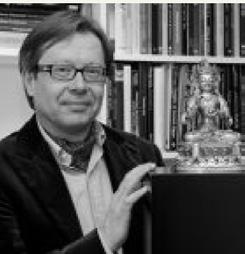
Dr. Robert R. Bigler
Condition: Good condition, commensurate with age. Extensive wear, obvious losses, small chips, scattered nicks and scratches, signs of prolonged burial, and encrustations.
Weight: 450 g (incl. stand)
Dimensions: Height 8 cm (excl. stand), 21.5 cm (incl. stand)
With an associated stand. (2)
LITERATURE COMPARISON
Compare a related larger limestone model of a man’s head, dated Late Period, Dynasty XXVI, in the Museo Egizi, Turin, inventory number Cat. 3137.

AUCTION RESULT COMPARISON
Type: Related
Auction: Christie’s New York, 16 June 2006, lot 183
Price: USD 22,800 or approx. EUR 33,000 converted and adjusted for inflation at the time of writing
Description: An Egyptian green graywacke head of an official, Late Period, Dynasty XXV-XXVI, 712-525 BC
Expert remark: Compare the related modeling and manner of carving. Note the similar size (7.9 cm), different stone, and state of preservation.
Estimate EUR 8,000
Starting price EUR 4,000

101
AN EGYPTIAN PAINTED ALABASTER ‘IMSETY’ CANOPIC JAR HEAD, NEW KINGDOM

THE JORGEN RUBEN GALLERY LEDGER, entry from 2005: “No. 77, AC, Egypt. Canopic lid of Asmeth 18th-20th Dyn.”
Gallery price: EUR 25,000 or approx. EUR 42,000 adjusted for inflation at the time of writing.
Egypt, circa 1550-1070 BC. The lid carved in the form of the head of the Son of Horus, Imsety, the guardian of the liver, wearing a smooth wide wig over his round face with large turned-out ears, the almondshaped eyes rimmed and with painted irises, the nose with flaring nostrils, and the mouth with fleshy lips.
Provenance: Galerie Eberwein, Paris, France, by 2005. Jorgen Ruben, acquired from the above. In the Jorgen Ruben Collection for 21 years.
Condition: Good condition with expected wear, signs of prolonged burial, encrustations, natural striations, small losses, minute nicks, light surface scratches, losses to pigments.
Weight: 5.3 kg
Dimensions: Width 17 cm, Height 15 cm
Imsety was one of the Four Sons of Horus, divine guardians in Egyptian funerary belief. He was depicted with a human head and entrusted with the protection of the liver of the deceased. Unlike his brothers with animal forms, his human appearance stressed closeness to mankind. Imsety was under the protection of Isis, linking him to healing, motherhood, and the myth of Osiris’s resurrection. He was also connected to the south, forming part of the sons’ role as cosmic protectors of the four directions. In funerary texts, he is invoked to preserve vitality and rebirth, ensuring the liver remained unharmed for use in the afterlife. Through this role, Imsety embodied divine care, protection, and renewal within Egyptian religion.
LITERATURE COMPARISON
Compare a closely related painted calcite canopic jar lid, dated New Kingdom, 1479-1425 BC, 12 cm high, in the Museo Egipcio de Turin, inventory number S. 5111/01 (fig. 1).
Compare a closely related jar head in the Louvre.
AUCTION RESULT COMPARISON
Type: Closely related
Auction: Bonhams London, 28 October 2009, lot 38
Price: GBP 9,000 or approx. EUR 17,000 converted and adjusted for inflation at the time of writing
Description: An Egyptian alabaster canopic jar head, New Kingdom, 18th Dynasty
Expert remark: Compare the closely related modeling, manner of carving, and subject. Note the size (12.6 cm).
Estimate EUR 12,000
Starting price EUR 6,000


THE JORGEN RUBEN GALLERY LEDGER, entry from 2005: “No. 82, A. B., H BX 1980, Egypt. Canopic lid Asmeth, 12th Dyn.” Gallery price: EUR 12,000 or approx. EUR 20,000 adjusted for inflation at the time of writing.
Egypt, circa 1991-1802 BC. The banded lid carved in the form of the head of the Son of Horus, Imsety, the guardian of the liver, wearing a smooth wide wig over his small round face with large turned-out ears, the almond-shaped eyes rimmed, the nose with flaring nostrils, and the mouth with fleshy lips.
Provenance: Collection of Alfons Billen, Belgium, thence by descent to his son Jacques Billen. Jorgen Ruben, acquired from the above in 1980. In the Jorgen Ruben Collection for 46 years. Jacques Billen (b. 1960) is a specialist of ancient Egyptian art. A graduate in History of Art and Archaeology, Oriental Philology and History of Université Catholique de Louvain, Billen founded his gallery, Harmakhis, in 1988 in Sablon, where he also offers a selection of classical antiquities and occasionally from the Near East.

Condition: Wear, signs of prolonged burial, encrustations, natural fissures, old repairs and fills, small losses, few chips and nibbles.
Weight: 3.1 kg
Dimensions: Width 13 cm, Height 11.3 cm
Canopic jars contained internal organs removed from the body during the mummification process. The jars came in sets of four, one each for the liver, lungs, stomach, and intestines. The present example depicts Imsety, guardian of the liver, wearing a wide wig leaving his ears exposed.
Imsety was one of the Four Sons of Horus, divine guardians in Egyptian funerary belief. He was depicted with a human head and entrusted with the protection of the liver of the deceased. Unlike his brothers with animal forms, his human appearance stressed closeness to mankind. Imsety was under the protection of Isis, linking him to healing, motherhood, and the myth of Osiris’s resurrection. He was also connected to the south, forming part of the sons’ role as cosmic protectors of the four directions. In funerary texts, he is invoked to preserve vitality and rebirth, ensuring the liver remained unharmed for use in the afterlife. Through this role, Imsety embodied divine care, protection, and renewal within Egyptian religion.
LITERATURE COMPARISON
Compare a closely related later calcite canopic lid of Imsety, dated c. 1569-1081 BC, in the Kunsthistorisches Museum, Vienna, inventory number INV 9933. Compare a closely related later alabaster lid, together with the canopic jar, dated 7th-6th century BC, 10.5 cm size, in the Museum of Fine Arts, Budapest, inventory number 51.2106.1-2.
Estimate EUR 8,000
Starting price EUR 4,000


THE JORGEN RUBEN GALLERY LEDGER, entry from 2005: “No. 79, LC, Egypt. Canopic lid Asmeth. 18th-26th Dyn.” Gallery price: EUR 11,400 or approx. EUR 19,000 adjusted for inflation at the time of writing.
Egypt, circa 1550-525 BC. The lid carved in the form of the head of the Son of Horus, Imsety, the guardian of the liver, wearing a smooth wide wig over his small round face with large turned-out ears, the almondshaped eyes rimmed, the nose with wide nostrils, and the mouth with fleshy lips.
Provenance: Lauritz, Copenhagen, Denmark, by repute in 2002. Jorgen Ruben, acquired from the above. In the Jorgen Ruben Collection for 24 years.
Condition: Good condition with old wear, natural fissures and age cracks, scattered nicks, small chips and nibbling, extensive weathering, and encrustations. The stone with a naturally grown, lustrous patina.
Weight: 3.6 kg
Dimensions: Width 14 cm, Height 13 cm
Canopic jars contained internal organs removed from the body during the mummification process. The jars came in sets of four, one each for the liver, lungs, stomach, and intestines. The present example depicts Imsety, guardian of the liver, wearing a wide wig leaving his ears exposed.
Imsety was one of the Four Sons of Horus, divine guardians in Egyptian funerary belief. He was depicted with a human head and entrusted with the protection of the liver of the deceased. Unlike his brothers with animal forms, his human appearance stressed closeness to mankind. Imsety was under the protection of Isis, linking him to healing, motherhood, and the myth of Osiris’s resurrection. He was also connected to the south, forming part of the sons’ role as cosmic protectors of the four directions. In funerary texts, he is invoked to preserve vitality and rebirth, ensuring the liver remained unharmed for use in the afterlife. Through this role, Imsety embodied divine care, protection, and renewal within Egyptian religion.
LITERATURE COMPARISON
Compare a closely related calcite canopic jar head dated ca. 1569-1081 BC in the Kunsthistorisches Museum, Vienna, inventory number INV 9933.

AUCTION RESULT COMPARISON
Type: Closely related
Auction: Bonhams London, 6 October 2010, lot 29
Mid-Estimate: GBP 7,000 or approx. EUR 13,000 converted and adjusted for inflation at the time of writing
Description: An Egyptian alabaster canopic jar stopper, Late Period
Expert remark: Compare the closely related modeling, manner of carving, stone, subject, and size (13 cm).
Estimate EUR 6,000
Starting price EUR 3,000


104 AN EGYPTIAN LIMESTONE ‘DUAMUTEF’ DUMMY CANOPIC JAR, THIRD INTERMEDIATE PERIOD

THE JORGEN RUBEN GALLERY LEDGER, entry from 2012:
“No. 697, Small canope (fake) [i. e. dummy] in shape of Duamutef Egypt Late period white limestone, H.: 20.7 cm, OK 2005” Gallery price: EUR 8,900 or approx. EUR 12,500 adjusted for inflation at the time of writing.
Egypt, circa 1069-332 BC. Carved out of a single piece of limestone, an incised line indicating the division between the jar and the lid, to depict the Son of Horus, Duamutef, the guardian of the stomach, shown with pointed ears and pronounced slender snout, neatly incised with narrowed eyes with outlines and an incised mouth.
Provenance: Oliver Klitgaard, Denmark, by 2005. Jorgen Ruben, acquired from the above. In the Jorgen Ruben Collection for 21 years. An old collector’s label to the back, ‘F.V.P. Tuamautef’.

Oliver Klitgaard (right) and Prince Henrik in Klitgaard’s antique shop on Holbergsgade in downtown Copenhagen
Condition: Overall good condition with expected wear, small losses, shallow nicks, few minute chips and nibbles, signs of prolonged burial, encrustations, the left ear with an old repair.
Weight: 2 kg
Dimensions: Height 20.3 cm
This dummy jar has no interior cavity and the "lid" is not removable. It dates to a period during which the internal organs were mummified and then placed back into the mummy, but canopic jars continued to be included as part of the burial equipment in order to ensure the protection of the four Sons of Horus.
LITERATURE COMPARISON
Compare a closely related limestone dummy canopic jar depicting Duamutef, dated Third Intermediate Period, 30 cm high, in the Metropolitan Museum of Art, object number 28.3.60 (fig. 1). For a full set of similar dummy canopic jars, see S. D'Auria et al., Mummies & Magic, Dallas, 1990, p. 165, pl. 117.
Estimate EUR 4,000
Starting price EUR 2,000

1
Egypt, 664-332 BC. The lid carved in the form of the head of the Son of Horus, Qebehsenuef, protector of the intestines, wearing a smooth wide wig, his falcon’s face with finely carved features, sharply hooked beak, and large round eyes with incised markings.
Provenance: Bruun Rasmussen, Copenhagen, by repute in 2015. Jorgen Ruben, acquired from the above. In the Jorgen Ruben Collection for 11 years.
Condition: Good condition with expected wear, obvious losses, minor old fills, small chips and nibbles, scattered nicks and scratches, signs of prolonged burial, encrustations.
Weight: 2,623 g
Dimensions: Length 15.5 cm
Qebehsenuef is one of the four so-called sons of Horus that are often depicted as mummies, each with a different head. The sons of Horus were deities who protected the internal organs and are probably best known from their representations on the lids of the canopic jars that contained mummified viscera. They were also thought to assist in the process of mummification and to provide nourishment, possibly because they were associated with the internal organs. Thus, they had a general protective function for the deceased.
LITERATURE COMPARISON
Compare a closely related painted canopic jar lid of a falcon head, dated to 664-332 BC, 12 cm high, in the National Museums Liverpool, accession number 1978.291.190. Compare a closely related canopic jar lid of a falcon head, dated to 664-525 BC, 10.3 cm high, in the Metropolitan Museum of Art, object number 41.160.123 (fig. 1).
AUCTION RESULT COMPARISON
Type: Closely related Auction: Sotheby’s New York, 8 December 2011, lot 37
Price: USD 34,375 or approx. EUR 45,000 converted and adjusted for inflation at the time of writing
Description: A large Egyptian alabaster canopic jar lid, Late Period, 716-30 [sic] BC


Expert remark: Compare the closely related modeling with similar beak. Note the size (21.7 cm) and different stone.
Estimate EUR 4,000
Starting price EUR 2,000


106
AN EGYPTIAN TURQUOISE FAIENCE ‘BES’ AMULET, THIRD INTERMEDIATE PERIOD
Egypt, 1070-664 BC. The bandy-legged god depicted nude standing balanced on a straight tail, with a paunchy belly above his genitalia, his arms bent at the elbows, both palms fisted, his characteristic leonine face with a deeply creased forehead, furrowed diagonal brows, a bulbous nose, thick lips and wide pierced ears, his tongue lolling between his curling mane, surmounted by a neatly incised fanning feather crown. The back of the crown and ears pierced for suspension.
Provenance: Jacques Billen, Harmakhis, Brussels, Belgium, by 2020. Jorgen Ruben, acquired from the above. Jacques Billen (b. 1960) is a specialist of ancient Egyptian art. A graduate in History of Art and Archaeology, Oriental Philology and History of Université Catholique de Louvain, Billen founded his gallery, Harmakhis, in 1988 in Sablon, where he also offers a selection of classical antiquities and occasionally from the Near East.
Condition: Excellent condition with minor wear, firing irregularities, minuscule nibbling.
Weight: 21.5 g
Dimensions: Height 7.6 cm
Although often named simply Bes, this unusual figure is properly termed a Bes-image because it serves to represent a number of different deities who were protective gods, often with a close association to the protection of women and children during and after childbirth. The Bes-image has a mixture of attributes, displaying a dwarf’s body but also incorporating leonine features, such as a lion’s mane and tail.
Bes-images could be standalone offerings, as this one may have been, but they were also frequently incorporated into furniture or personal items to bring good fortune and protection daily. Bes figures had no central cult location, but they were widely manufactured and were closely linked with child gods, who were important in temple cult. Some small Bes shrines are known, and the Bes-image also had a role in temple mammisis, or birth houses.
LITERATURE COMPARISON
Compare a closely related amulet of Bes, dated Third Intermediate Period, 6 cm high, in the Metropolitan Museum of Art, object number 17.194.2232.

AUCTION RESULT COMPARISON
Type: Closely related
Auction: Bonhams London, 8 December 2022, lot 228
Price: GBP 4,845 or approx. EUR 6,600 converted and adjusted for inflation at the time of writing
Description: An Egyptian turquoise glazed faience amulet of Bes, Third Intermediate Period, circa 1069735 BC
Expert remark: Compare the closely related modeling and subject. Note the related size (6.7 cm).

Estimate EUR 3,000
Starting price EUR 1,500

107
A COMPLETE SET OF TURQUOISE-GLAZED FAIENCE AMULETS OF THE FOUR SONS OF HORUS AND A WING SCARAB, THIRD INTERMEDIATE PERIOD-LATE PERIOD
Egypt, 1070-525 BC. Comprising a winged scarab amulet and the four Sons of Horus, Imsety, Hapi, Duamutef, and Qebehsenuef, each modeled as a standing anthropomorphic figure with the heads of a human, baboon, jackal, and falcon with subtle incised details indicating facial features, headdresses, and garment contours. The scarab amulet with outstretched wings finely modeled with incised feathers flanking the central beetle. All overall glazed in a vibrant turquoise. Each with two suspension holes.
Provenance: Lauritz, Copenhagen, Denmark, by repute in circa 2008. Jorgen Ruben, acquired from the above. In the Jorgen Ruben Collection for around 18 years.
Condition: Very good condition with minor wear and firing irregularities including dark spots. Tiny nibbling and minor encrustations.
Weight: 8.5 g (total)
Dimensions: Height 3.5 cm, Length 4.5 cm
The Four Sons of Horus, Imsety, Hapi, Duamutef, and Qebehsenuef, were a central group of protective deities in ancient Egyptian funerary religion, first attested in the Old Kingdom and remaining essential throughout Egyptian history. Closely associated with the mummification process and the preservation of the body, each of the four deities was responsible for guarding one of the principal internal organs placed in canopic jars: Imsety protected the liver, Hapi the lungs, Duamutef the stomach, and Qebehsenuef the intestines. They were typically depicted as mummiform figures or as human bodies with animal heads, human, baboon, jackal, and falcon respectively, symbolically encircling and safeguarding the deceased from all directions. The Four Sons of Horus were closely linked to the goddess Isis and to the cosmic order of protection and regeneration, ensuring the physical integrity of the body so that the soul (ka and ba) could be successfully reborn in the afterlife.
LITERATURE COMPARISON
Compare a closely related faience amulet of the four sons of horus, dated to 381-343 BC, 4 cm high, in the Brooklyn Museum, accession number 37.1806Ea-d.
Compare a closely related faience amulet of the four sons of horus, dated to the Intermediate period-Late period, 4.3 cm high, in the British Museum, registration number 1916,0212.150.


AUCTION RESULT COMPARISON
Type: Closely related Auction: Bonhams London, 14 May 2003, lot 27
Price: GBP 11,162 or approx. EUR 24,000 converted and adjusted for inflation at the time of writing
Description: An Egyptian turquoise glazed composition winged scarab and amulet pectoral, Late Period, 26th Dynasty, circa 664-525 B.C. (9)
Expert remark: Note the gilt metal mounts.
Estimate EUR 4,000
Starting price EUR 2,000


108 AN EGYPTIAN TURQUOISE FAIENCE ‘ANUBIS’ AMULET, LATE PERIOD, DYNASTY XXVI

THE JORGEN RUBEN GALLERY LEDGER, entry from 2012: “No. 749, Amulet representing Anubis walking, Egypt Late Period, light turquoise blue faience, H.: 6.7 cm, PS 2011” Gallery price: EUR 2,200 or approx. EUR 3,100 adjusted for inflation at the time of writing.
Egypt, 664-525 BC. Finely modeled, the jackal-headed god of embalming is depicted striding forward with his left leg advanced on an integral rectangular base, his clenched hands lowered to the sides, and the torso modeled with a slight paunch. Wearing a pleated shendyt (royal kilt) and a striated tripartite wig over the canine face modeled with alert ears above an elongated snout. The back of the figure pierced with a small hole for suspension.
Provenance: Peter Schneider, Brussels, Belgium, by 2011. Jorgen Ruben, acquired from the above. In the Jorgen Ruben Collection for 15 years. Peter Schneider is the founder and curator of Treasuregate Gallery – Art of the Ancient, an international dealership specializing in ancient art, minerals, fossils, and scholarly literature.
Condition: Overall good condition with expected wear and manufacturing irregularities including firing cracks, old repairs to ears, scattered nibbling, minor encrustations.

Peter Schneider, Treasuregate Gallery
Weight: 16 g
Dimensions: Height 6.9 cm
LITERATURE COMPARISON
Compare a closely related amulet of Anubis, dated 7th-6th century BC, 6.1 cm high, in the Museum of Fine Arts, Budapest, inventory number 51.2299.

AUCTION RESULT COMPARISON
Type: Closely related
Auction: Christie’s London, 26 April 2012, lot 125
Price: GBP 3,000 or approx. EUR 5,100 converted and adjusted for inflation at the time of writing
Description: An Egyptian faience Anubis amulet, Late Period, Dynasty XXVI, circa 664-525 BC
Expert remark: Compare the closely related modeling and subject. Note the related size (6 cm).

Estimate EUR 2,000
Starting price EUR 1,000

109 AN EGYPTIAN TURQUOISE FAIENCE ‘PATAIKOS’ AMULET, LATE PERIOD, DYNASTY XXVI
Egypt, 664-525 BC. Boldly rendered as a nude dwarf with bowed legs and short arms set akimbo, the figure displaying a relatively elongated torso, well-defined genitalia, and a deeply impressed circular navel set within a slightly rounded belly. The disproportionately large head presents two faces on opposite sides, both bearing an amiable expression characterized by slit eyes, a broad nose, and full lips. The reverse of the shoulders is fitted with a small loop for suspension.
Provenance: Collection of Hans Henningsen, Copenhagen, Denmark, by 1987. Jorgen Ruben, acquired from the above. In the Jorgen Ruben Collection for 39 years.
Condition: Good condition, with expected wear, firing irregularities, obvious losses, and signs of prolonged burial.
Weight: 4.6 g
Dimensions: Height 3.5 cm
LITERATURE COMPARISON


Compare a closely related pale greenglazed faience amulet of Pataikos, Egypt, Late to Ptolemaic period, dated 664-30 BC, 6.6 cm high, in the Metropolitan Museum of Art, object number 90.6.196. Compare a closely related green-glazed faience amulet of Pataikos, Egypt, Late to Ptolemaic period, dated 1069332 BC, 4.5 cm high, in the Art Institute of Chicago, reference number 1894.196. For two further closely related examples of turquoise-glazed faience amulets depicting Pataikos, see Carol Andrews, Amulets of Ancient Egypt, 1994, p. 39, no. 36.


AUCTION RESULT COMPARISON
Type: Closely related
Auction: Bonhams London, 8 December 2022, lot 248
Mid-Estimate: GBP 17,500 or approx. EUR 24,000 converted and adjusted for inflation at the time of writing
Description: A sizeable Egyptian pale blue glazed faience Pataikos amulet, Late period, c. 664-332 BC
Expert remark: Compare the closely related modeling and subject. Note the larger size (7 cm).
Estimate EUR 3,000
Starting price EUR 1,500


THE JORGEN RUBEN GALLERY LEDGER, entry from 2012:
“No. 719, Roman Bronze fig. of Venus, 1st / 2nd century, H.: 13.00 cm, Prov.: Belgian coll. ca. 1980, DD 2009”
Gallery price: EUR 8,450 or approx. EUR 12,000 adjusted for inflation at the time of writing.
Depicted standing in contrapposto, her sensuously modeled body with broad hips and small breasts, the arms outstretched with palms facing upward, her head tilted slightly to the right, the face with finely cast features, the hair center-parted and tied in a chignon at the back, with a wavy tress falling onto each shoulder.
Provenance: Michel Daheb, Brussels, Belgium, ca. 1980. Jorgen Ruben, acquired from the above in 2009. In the Jorgen Ruben Collection for 17 years.
Condition: Very good condition, commensurate with age. Wear, signs of prolonged burial, encrustations, minor dings and nicks, losses to attributes. The right hand with an old repair. The bronze with a rich, naturally grown patina with malachite and cuprite encrustations.
Weight: 265 g
Dimensions: Height 13 cm (the figure), 16 cm (total)
Venus, the Roman goddess of love, beauty, fertility, and prosperity, occupied a central place in the visual culture of the ancient world. Adapted from the Greek Aphrodite yet distinctly Roman in her associations, she was revered not only as an embodiment of sensual grace and feminine idealization, but also as a powerful ancestral and political deity, especially through her connection to Aeneas and the Julian line. Small bronze figures of Venus, such as the present example, would have appealed to both private devotion and aesthetic appreciation, presenting the goddess in an intimate and enduring medium that captures the refinement, elegance, and quiet allure for which her image was celebrated throughout the Roman Empire.
LITERATURE COMPARISON
Compare a closely related bronze figure of Venus, dated to the 2nd-3rd century, 10.5 cm high, in the Harvard Art Museum, object number 1977.216.3412.

AUCTION RESULT COMPARISON
Type: Closely related
Auction: Christie’s London, 7 December 2006, lot 140
Price: GBP 7,800 or approx. EUR 16,000 converted and adjusted for inflation at the time of writing
Description: A bronze figure of Venus, Roman, circa 1st or 2nd century AD, or 16th century
Expert remark: Compare the closely related modeling and manner of casting. Note the size (12.7 cm).
Estimate EUR 6,000
Starting price EUR 3,000


111
A ROMAN MARBLE SARCOPHAGUS FRAGMENT WITH CUPID, CIRCA 1ST CENTURY AD
The young god with a cherubic oval face, his luxurious curly hair falling in thick locks over the forehead, with lidded unarticulated eyes, all below arching brows.
Provenance: Jorgen Ruben, acquired via the Brussels trade in 2005. In the Jorgen Ruben Collection for 21 years.
Condition: Very good condition with old wear, obvious losses, scattered nicks and scratches, small chips, signs of prolonged burial, and encrustations.
Weight: 16.4 kg (excl. stand), 19.7 kg (incl. stand)
Dimensions: Height 33 cm (excl. stand), 43 cm (incl. stand)
Mounted on an associated stand. (2)
Cupid, the god of love and son of Venus, had a strenuous job of causing humans to fall in love, was a popular motif during the Roman imperial period. He was simultaneously one of the primordial deities, an attendant at the birth of Aphrodite (Venus), and her son by the god Ares (Mars), in her most famous extramarital relationship. He’s also a perpetual youth or even infant, who never grows up.
LITERATURE COMPARISON
Compare a related head of a sleeping cupid, dated 1st century BC-3rd century AD, 16 cm high, in the Walters Art Museum, accession number 23.134.

AUCTION RESULT COMPARISON
Type: Related
Auction: Bonhams London, 5 July 2018, lot 83
Mid-Estimate: GBP 17,500 or approx. EUR 27,500 converted and adjusted for inflation at the time of writing
Description: A Roman marble head of Cupid, circa 1st-2nd century
Expert remark: Compare the related modeling and manner of carving with similar hair and facial features. Note the smaller size (16.5 cm).
Estimate EUR 8,000
Starting price EUR 4,000


A ROMAN

THE JORGEN RUBEN GALLERY LEDGER , entry from 2012:
“No. 802, Corner of a sarcophagus representing Helios, Roman period 2nd-3rd c. BC, H.: 29 cm, JB 2009”
Gallery price: EUR 18,000 or approx. EUR 25,500 adjusted for inflation at the time of writing.
From the right corner of a sarcophagus lid, in the form of a mask of a sea or wind god in profile to the right, his deeply drilled unruly locks falling in waves around his face, his articulated eyes with heavy lids, the inner canthi drilled, set below a strong brow, his full lips gently pursed.
Provenance: Jacques Billen, Harmakhis, Brussels, Belgium, by 2009. Jorgen Ruben, acquired from the above. In the Jorgen Ruben Collection for 17 years.

Billen
Jacques Billen (b. 1960) is a specialist of ancient Egyptian art. A graduate in History of Art and Archaeology, Oriental Philology and History of Université Catholique de Louvain, Billen founded his gallery, Harmakhis, in 1988 in Sablon, where he also offers a selection of classical antiquities and occasionally from the Near East.
Condition: Very good condition with old wear, obvious losses, scattered nicks and scratches, small chips, signs of prolonged burial, encrustations.
Weight: 8.9 kg (incl. stand)
Dimensions: Height 29 cm (excl. stand), 40 cm (incl. stand)
Mounted on an associated stand. (2)
LITERATURE COMPARISON
Compare a closely related sarcophagus lid depicting the mask of Helios, dated 301-400, 27.4 cm high, in the Fitzwilliam Museum, University of Cambridge, accession number GR.48.1850.

AUCTION RESULT COMPARISON
Type: Closely related
Auction: Sotheby’s London, 5 July 2022, lot 179 Mid-Estimate: GBP 25,000 or approx. EUR 34,500 converted and adjusted for inflation at the time of writing
Description: A Roman Marble Acroterion, circa 2nd/3rd Century A.D. Expert remark: Compare the closely related modeling and manner of carving with similar thick curly locks, facial expression, and drilled canthi. Note the closely related size (29.5 cm).
AUCTION RESULT COMPARISON
Type: Closely related
Auction: Christie’s New York, 8 June 2007, lot 187
Price: USD 98,400 or approx. EUR 140,000 converted and adjusted for inflation at the time of writing
Description: A Roman Marble Acroterion, circa early 3rd century AD


Expert remark: Compare the closely related modeling and manner of carving with similar thick curly locks, facial expression, and drilled canthi. Note the size (41.9 cm).
Estimate EUR 15,000
Starting price EUR 7,500
113
A ROMAN MARBLE PORTRAIT HEAD OF A YOUNG WOMAN,
Superbly carved with sharp cheekbones and a pointed chin, the small mouth with rounded lips, the small almond-shaped eyes with the pupils articulated, the soft brows subtly modeled, her hair tucked behind her wide ears, center parted and pulled back in a now-missing fillet, folded up from the nape of her neck and fastened in thick braids at the top of her head, the long graceful neck splaying at the base.
Provenance: With Sineau, Auxerre, France, 1988. Christie’s New York, 7 December 2006, lot 150 (sold for USD 21,600 or approx. EUR 31,500 converted and adjusted for inflation at the time of writing). Jorgen Ruben, acquired from the above. In the Jorgen Ruben Collection for 20 years.
Condition: Good condition with expected old wear, traces of weathering, minor encrustations, obvious losses, small chips, few minor old repairs, fills to underside, the back originally finished in a now-lost secondary material.
Weight: 11.5 kg (incl. stand)
Dimensions: Height 31 cm (excl. stand), 43.5 cm (incl. stand)
With an associated stand. (2)
EXPERT'S NOTE
This finely carved portrait head depicts a young woman of high standing, Perhaps in her late teens or early 20s, possibly the wife or daughter of an Emperor. The coiffure was popularized by the royal family from the time of Julia Mamaea, and is found on portraits from the entire first half of the 3rd century. See for example the portrait of Furia Sabina Tranquillina, wife of the Emperor Gordion, now in the British Museum, registration number 1805,0703.107, illustrated by Diana E. E. Kleiner, Roman Sculpture, 1992, Yale University Press.

LITERATURE COMPARISON
Compare a closely related marble portrait head, perhaps of Otacilia Severa, dated 250-300 AD, 15.9 cm high, in the Walters Art Museum, accession number 23.206.


PREVIOUS AUCTION RESULT
The present lot at Christie’s New York, 7 December 2006, lot 150, sold for USD 21,600 or approx. EUR 31,500
AUCTION RESULT COMPARISON
Type: Closely related
Auction: Christie’s New York, 9 December 2008, lot 178
Price: USD 110,500 or approx. EUR 155,000 converted and adjusted for inflation at the time of writing
Description: A Roman marble portrait head of a young woman, circa 220-240 AD
Expert remark: Compare the closely related modeling and similar facial features, hair, and size (36.8 cm).
Estimate EUR 30,000
Starting price EUR 15,000


114
A ROMAN MARBLE BUST OF A MAN DRESSED IN AN IMPERIAL TOGA, CIRCA 1ST-2ND CENTURY AD

THE JORGEN RUBEN GALLERY LEDGER, entry from 2005: “No. 558, OK, HH 1998, Roman marble Toga dressed breast, 2nd c. AD, ca. 22 cm h.”
Gallery price: EUR 5,350 or approx. EUR 8,900 adjusted for inflation at the time of writing.
Finely carved, enveloped in a heavy cloak draped around the upper body, its thick folds falling broadly over the shoulders and framing a strong neck, above a thinner underlying garment rendered with naturally flowing, delicately detailed pleats.
Provenance: Collection of Hans Henningsen, Copenhagen, Denmark, by 1998. Oliver Klitgaard, Denmark, acquired from the above. Jorgen Ruben, acquired from the above before 2005. In the Jorgen Ruben Collection for at least 21 years.
Condition: Good condition, commensurate with age. Obvious losses, signs of prolonged burial, encrustations, old fills, small chips, scattered nicks and scratches.
Weight: 11.8 kg (incl. base)
Dimensions: Height 22 cm (excl. base) and 33 cm (incl. base)
The bust is raised on a well carved associated marble pedestal base of classic form, dating from the Grand Tour era, circa 18th century or earlier. (2)
The toga was the distinctive dress of the Roman citizen when appearing in public. Its use was forbidden to exiles and to foreigners. It was indispensable on all official occasions, even in Imperial times when more convenient garments had been adopted for ordinary use. See a closely related Roman marble shoulders from a portrait bust of a man dressed in an imperial toga, dated 2nd-3rd century, 48 cm high, at Finch and Co., London.
AUCTION RESULT COMPARISON
Type: Closely related
Auction: Christie’s Paris, 17 February 2011, lot 409
Price: EUR 7,500 or approx. EUR 9,600 adjusted for inflation at the time of writing
Description: A Roman marble female figure, circa 1st-2nd century AD
Expert remark: Compare the closely related modeling and manner of carving with similar pleated toga. Note the identical size (33 cm).
Estimate EUR 3,000
Starting price EUR 1,500


115

THE JORGEN RUBEN GALLERY LEDGER, entry from 2012: “No. 801, Small column (gallery), Roman period Marble, H.: 94.5 cm, O.C. (TEFAF 2006)”
Gallery price: EUR 17,000 or approx. EUR 24,000 adjusted for inflation at the time of writing.
Of tall cylindrical form, raised on a short spreading foot, the sides deeply carved with narrow vertical flutes terminating above the base. The marble is attractively variegated in soft tones of pale rose, salmon-pink, beige, and cream, dramatically streaked with reddishbrown veins and cloudy grey inclusions, the polished upper surface revealing a dense brecciated pattern.
Provenance: Ollivier Chenel, Paris, France, by 2006. Jorgen Ruben, acquired from the above at the TEFAF Maastricht, Netherlands. In the Jorgen Ruben Collection for 20 years. Ollivier Chenel is a Paris-based antiquities dealer and co-founder of Galerie Chenel, which he established together with his wife Gladys in 1999, later joined by his brother Adrien. A third-generation dealer, Chenel specializes in Egyptian, Greek, and Roman antiquities, and has built an international reputation through the gallery’s participation in major art fairs and its collaborations with leading museums, institutions, and private collectors.

Ollivier, Gladys, and Adrien Chenel
Condition: Good condition with expected wear, signs of weathering, encrustations, structural fissures, minor losses, nicks, chips.
Weight: ca. 150 kg
Dimensions: Height 95 cm
LITERATURE COMPARISON
Compare a closely related larger marble column with base and capital, dated circa 117-138 AD, 365.8 cm high (excl. capital), in the Metropolitan Museum of Art, object number 17.230.119.

AUCTION RESULT COMPARISON
Type: Closely related
Auction: Christie’s London, 7 October 2010, lot 144
Price: GBP 13,750 or approx. EUR 25,500 converted and adjusted for inflation at the time of writing
Description: A Roman marble column, circa 1st-3rd century AD
Expert remark: Compare the closely related fluted sides. Note the much larger size (196 cm).

Estimate EUR 12,000
Starting price EUR 6,000

§ 1) The auction shall be carried out in accordance with the provisions of the rules of procedure of GALERIE ZACKE©, SZA VERSTEIGERUNGEN UND VERTRIEBS GMBH, Zelinkagasse 6, 1010 WIEN (hereinafter referred to as the company) as well as in accordance with sections 244246 of the GEWERBEORDNUNG [Industrial Code] of 1994. The auction shall be carried out on commission. The auctioneer shall be entitled to withdraw lots exceptionally, to conduct the auction deviating from the order of the catalog numbers and to offer lots jointly. In the event of any dispute concerning a double bid or if the auctioneer has missed a bid, the auctioneer shall be entitled to revoke acceptance of a bid and to continue auctioning the item. The figures stated in the catalog shall be the highest bid in Euro (€) expected by the respective expert. As a rule, the bid shall be increased by 10% of the last bid. (See table of the bidding increments).
§ 2) The acceptance of a bid shall be granted to the highest bidder unless a hidden reserve has been agreed upon with the consignor of the item in question. Such a hidden reserve (also called limit or just reserve) shall be the minimum price under which the item will not be sold during the auction. This reserve will be disclosed upon request and after the auction only and may exceed the estimate. The auctioneer will in this case bid on behalf of the seller against all other bidders until the reserve has been reached. If a reserve is not reached during the auction, the auctioneer will knock down the item to the highest bidder at the final bid, but the sale will be conditional of the acceptance of this final bid by the seller. In this case the highest bidder shall be bound to his/her last bid for a term of 8 days starting with the day of the knockdown. If the winning bidder does not receive a written cancellation notice within this term of 8 days, the knockdown becomes unconditional and the sale is final. Typically, only a minority of all items in an auction have a hidden reserve.
§ 3) Most items shall be subject to differential taxation. A uniform surcharge of 25% plus the value added tax applicable to the surcharge to the amount of 20% shall be added to the achieved highest bid (final and highest bid). Thus, the surcharge shall be 30% of the final and highest bid in total. Items with added VAT are marked † in the online catalog.
§ 4) In the event of sales abroad, the value added tax will be repaid if the item is sold to a country which is not a member country of the European Union (third country), the legal requirements are met, and the proof of exportation is provided. The value added tax shall not be shown separately on the invoice.
§ 5) The auction buyer must pay the purchase price immediately upon acceptance of the bid (final and highest bid plus 25% surcharge, plus the value added tax applicable to the surcharge to the amount of 20%, or the added VAT on top of the final price, when a lot is highlighted accordingly in the auction catalog). The company may grant an auction buyer a term of payment for the purchase price in whole or in part when this has been formally applied for in writing before the auction.
§ 6) In the event of a term of payment, or any payment delay, in whole or in part, the company shall be entitled to charge default interest (12% p.a.) as well as storage charges (2.4% pf the final and highest bid per month commenced) after 14 days upon acceptance of the bid. The item purchased at auction shall be handed over exclusively upon full payment of the purchase price including all costs and charges accrued since the acceptance of the bid.
§ 7) The buyer should take acquired items into possession, as far as possible, immediately or after the end of the auction. Items which have been fully paid for shall be handed over in our show rooms in GALERIE ZACKE, Zelinkagasse 6, 1010 VIENNA. If a deferred purchase price is not paid within the set period, the company shall be entitled to auction the item again in order to recoup its claim from the defaulting auction buyer. In this case, the defaulting auction buyer shall be liable to the company for the total loss of commission incurred by the company due to the re-auctioning as well as for any default interest and storage charges.
§ 8) The company shall be entitled to a lien on all items of the buyer irrespective of whether the buyer bought them within the scope of an auction or in free sale or the company secured ownership of these items otherwise. This lien shall serve to secure all current and future, qualified, limited and unmatured claims to which the company is entitled and which result from all legal transactions concluded with the buyer.
§ 9) The items received for auction will be exhibited and may be viewed prior to the auction. In doing so, the company shall give everyone the opportunity to check the nature and the condition of the exhibited items to the extent deemed possible within the scope of the exhibition. Every bidder shall be deemed to act on its own behalf unless it provides a written confirmation saying that it acts as a representative or agent of a well-known principal. The company may refuse bids; this shall particularly apply if a bidder who is unknown to the company or with whom the company has no business connections yet does not provide a security deposit before the auction. However, in principle there shall be no claim to accept a bid. If a bid has been refused, the previous bid shall remain effective.
§ 10) The company’s experts evaluate and describe the items received for auction and determine the starting prices unless otherwise stated in the catalog or expert opinion. The information concerning production technique or material, state of preservation, origin, design and age of an item is based on published or otherwise generally accessible (scientific) findings concluded by the company’s expert with the necessary care and accuracy. The company shall warrant to the buyer according to §34-38 of the AGB (Terms and Conditions) that properties are correct provided that any complaints referring to this are made within 45 days after the auction day. Subsequent complaints shall be excluded in principle. The company shall not be liable for any further information in the catalog and expert opinion as well. This shall also apply to illustrations in the catalog. The purpose of these illustrations is to guide the potential buyer during the preview. They shall not be authoritative for the condition or the characteristics of the pictured item. The published condition reports shall only mention defects and damage affecting the artistic or commercial value significantly. Complaints concerning the price shall be excluded upon acceptance of the bid. The company reserves the right to amend the catalog online prior to the auction. These amendments shall also be made public orally by the auctioneer during the auction. In this case, the company shall be liable for the amendment only. All items offered may be checked prior to the auction. These items are used. Any claims for damages exceeding the liability named above and resulting from other material defects or other defects of the item shall be excluded. When making the bid, the bidder confirms that he/ she has inspected the item prior to the auction and has made sure that the item corresponds to the description.
§ 11) If a customer is not able to participate in an auction personally, the company shall accept purchase orders. These orders may be placed in writing via mail, e-mail, fax, www.zacke.at or a third party bidding platform. In the case of a purchase order placed by phone or orally, the company shall reserve the right to make the performance dependent on a confirmation from the principal communicated in writing. Furthermore, the company shall not be liable for the performance of purchase orders. Equal purchase orders or live bids will be considered in the order of their receipt. Bids which below the estimate shall be exhausted completely. Bids which do not correspond to the increments determined by the company (see bidding increment table) will be rounded up to the next higher increment. The table of these increments can be sent upon request. The written bid (purchase order) must include the item, the catalog number and the offered top bid limit which is quoted as the amount of the acceptance of the bid without buyer’s commission and without taxes.
Ambiguities shall be carried by the bidder. A purchase order which has already been placed may only be cancelled if the written withdrawal is received by the company at least 72 hours prior to the beginning of the auction.
§ 12) The company may refuse a purchase order without explanation or make its execution dependent on payment of a security deposit. In the event of an unsuccessful order, such a deposit will be reimbursed by the company within 5 working days. Processing of purchase orders is free of charge.
§ 13) Every seller shall in principle be entitled to withdraw the items offered for auction until the start of the auction. Therefore, it is impossible to assume liability or to give warranty for the actual offering.
§ 14) Paid items must be collected within 30 days after payment. Items which have not been collected may be re-offered without further communication at the starting price from the recent auction reduced by 50%. Items which have not been collected within 30 days after the auction or for which the company does not receive any proper shipping instructions stating the type of shipping and the address of dispatch (independent of a possibly placed purchase order) shall be stored at the owner’s risk.
Furthermore, the company shall be entitled to store items which have been purchased at auction and paid but not collected at the buyer’s risk and expense, including the costs for an insurance, with a forwarding agency. It shall be understood that the provision concerning the re-auctioning of unpaid and paid but not collected items must also apply to items not exhibited or stored on the premises of the company. The ownership shall be transferred to the buyer at the time of handing over the issuing note.
§ 15) In the case of mixed lots with a starting price of less than EUR 350.00, the company shall not warrant for the completeness or correctness of the individual items within a mixed lot.
§ 16) A registration for a bid by telephone for one or several items shall automatically represent a bid at the starting price of these items. If the company cannot reach a bidder by telephone, it will bid the starting price on behalf of this bidder when the respective lot is up for auction.
§ 17) Payments made to the company by mistake (through the payer’s fault) (e. g. due to miscalculation of the exchange rate by the payer) or payments made to the company for the same invoice several times shall be compensated in form of a credit note for goods for an indefinite period of time. The repayment of such payments in cash shall be excluded.
§ 18) Certain auction lots may exist several times (multiples). In such a case, the auctioneer may accept a second, third or even more bids from the underbidder(s). In this case, the text in the catalog and not the illustration shall be exclusively binding with regard to the warranty.
§ 19) The company reserves the right to assign to the buyer all rights and obligations resulting from the contractual relationship between the company and the seller by way of a respective declaration, as well as to assign to the seller all rights and obligations resulting from the contractual relationship between the company and the buyer by way of a respective declaration, in each case in terms of a complete assignment of contract with the result that the contractual relationshipfollowing the submission of the aforementioned declarations by the company – shall exclusively be between the seller and the buyer, all of which is in accordance with the basic model of the commission agreement. Buyers and sellers shall already now give their explicit consent to this contract assignment.
§ 20) The place of performance of the contract brought about between the company on the one hand and the seller as well as the buyer on the other hand shall be the place of business of the company. The legal relationships and contracts existing between the company, the sellers and the buyers shall be subject to Austrian law. The company, the sellers and the buyers shall agree to settle all disputes resulting from, concerning and in connection with this contract before the territorially competent court of Vienna.
§ 21) The export of certain art objects from Austria shall require a permit from the Bundesdenkmalamt [Federal Monuments Office]. The company will orally provide information about art objects for which such export permit will probably not be granted at the beginning of the auction.
§ 22) Whenever making a bid, whether personally or via an agent, in writing, online, telephone, or in any other way, the bidder fully and unconditionally accepts the Terms of Auction, the ‘Important Information’ section in the auction catalog, the Terms and Conditions (AGB) of Galerie Zacke, §1-50, the Fee Tariff, and the Bidding Increments table, all as published on www.zacke.at on the day of the auction.


