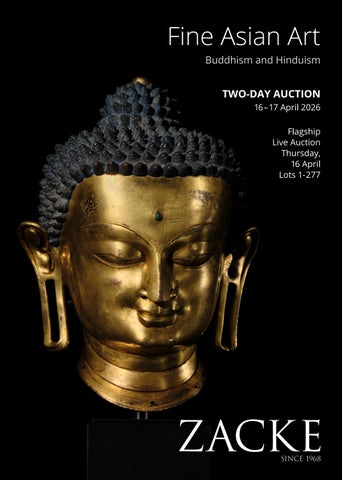
Fine Asian Art Buddhism and Hinduism
TWO-DAY AUCTION 16–17 April 2026 Flagship Live Auction Thursday, 16 April Lots 1-277
Provenances
Museum Deaccessions Museum für Asiatische Kunst, Radevormwald, Germany The Wou Lien-Pai Museum, United Kingdom The Zelnik István Southeast Asian Gold Museum, Budapest, Hungary The Royal Asian Art Society, Netherlands, bequeathed by Erik Maten and Hans van der Veer, Deventer, Netherlands Tibethaus Kulturstiftung, Frankfurt, Germany Historic Galleries and Dealerships Alan and Simone Hartman, New York, USA Alberto Santos, The Santos Collection, London Alvin Lo, Hong Kong ArtHistorical Ltd., London, United Kingdom Asher Eskenazi, Paris, France Becker Antiques, Amsterdam, Netherlands Ben Janssens Oriental Art, London, United Kingdom Bertrand de Lavergne, Paris, France Beurdeley & Cie, Paris, France Brian Harkins, London, United Kingdom Bruno Cooper Works of Art, Norwich, United Kingdom Chris Ng, K & Soon Ltd., Hong Kong Chinese Arts & Crafts, Hong Kong Colette Chan’s Asian Art, Taipei, Taiwan Collet’s Chinese Gallery, London, United Kingdom Deborah Ashencaen and Gennady Leonov Himalayan Art Dr. Gerald Weisbrod and Michael B. Weisbrod, Weisbrod Chinese Art, New York and Toronto E. & J. Frankel Ltd., New York, USA
Edwin “Ed” Hardy, San Francisco, California, USA Farah Massart, Famarte, Belgium Fleurdelys Antiquités, Laurence Paul, London, United Kingdom Frank Caro (1904–1980), C. T. Loo Chinese Art, New York, USA Galerie Christian Deydier, Paris and Hong Kong Galerie Claude Jongen, Belgium Galerie Michael Herrfurth, Asian Art, Essen, Germany Galerie Peter Hardt, Radevormwald, Germany Galerie Vandermeersch, Paris, France Galerie von Schroeder, Zurich, Switzerland Gallery De Ruimte, Netherlands Gerard Hawthorn Ltd., London, United Kingdom Gordon Reece Gallery, London, United Kingdom Gustaaf (1905–1992) and Godfried Wauters, Belgium H. R. N. Norton, London, United Kingdom Hardt & Sons, New York, USA Het Magazijn, Ghent, Belgium J.A.N. Fine Art, London, United Kingdom Jacques Barrère, Paris, France James J. Lally, New York, USA John Eskenazi Ltd., London, United Kingdom John Sparks Ltd., London, United Kingdom Jonathan Tucker & Antonia Tozer Asian Art, London, United Kingdom
Jules Speelman Asian Art, London, United Kingdom Lam & Co. Antiquities, Hong Kong Lawrence B. “Larry” Salander, New York, USA Leonardo Vigorelli, Bergamo, Italy Lothar Heubel, Cologne, Germany Maison L. Wannieck, Paris, France Mallett Antiques, London, United Kingdom Marcel Nies Oriental Art, Antwerp, Belgium Martin Doustar, Brussels, Belgium Michael Barber Fine Asian Art, Chicago, USA Oriental Arts & Crafts, Hong Kong Paola d’Alatri and Howard Wei, Wei Asian Art, Brussels, Belgium Paul Champkins Oriental Art, London, United Kingdom Paul Rutten, Galerie Annapurna, Amsterdam, Netherlands Peter Kemp Antiques, London, United Kingdom Phillip Cha, Chicago, USA Priestley & Ferraro Chinese Art, London, United Kingdom Ralph M. Chait Galleries, New York, USA Raymond G. (1923–2009) and Marsha Vargas Handley, Xanadu Gallery, San Francisco, USA Richfield Antiques, New York, USA Robert Hall, Northumberland, United Kingdom Robert Rousset, Compagnie de la Chine et des Indes, Paris, France Robyn Turner Gallery, Los Angeles, California, USA S. Marchant & Son, London, United Kingdom Schoeni Fine Oriental Art, Hong Kong Sen Shu Tey, Tokyo, Japan Spink & Son Ltd., London, United Kingdom Susan Chen (d. 2014), The Sze Yuan Tang Collection, Hong Kong Susan Page, United Kingdom The Chinese Porcelain Company, New York, USA Throckmorton Fine Art, New York, USA Treasures Gallery, Hong Kong Vanderven Oriental Art, ’s-Hertogenbosch, Netherlands Weber & Bläuer, Lugano, Switzerland Yuen Bo Hin, Hong Kong
Provenance list continues on the inside back cover
Fine Asian Art Buddhism and Hinduism CATALOG FAS0426
TWO-DAY AUCTION 16-17 April 2026, at 11 am CET
DAY 1 Flagship Live Auction I Lots 1-277 Thursday, 16 April 2026, at 11 am CET
DAY 2 Live Auction Online Catalog I Lots 278-693 Friday, 17 April 2026, at 11 am CET
EXHIBITION 8-15 April 2026, Monday – Friday 10 am – 6 pm as well as by appointment
GALERIE ZACKE Zelinkagasse 6 . 1010 Vienna Austria
Tel +43 1 532 04 52 E-mail office@zacke.at www.zacke.at 1
VISIT US IN VIENNA HOW TO FIND OUR AUCTION & SHOWROOM AT ZELINKAGASSE 6 NG
Located at Zelinkagasse 6, 1010 Vienna, our auction and preview space is just a seven-minute walk from our longstanding, 10,000-square-foot office, photography, video, and cataloging hub at Sterngasse 13. Both locations are open to the public, and we warmly invite you to visit.
U4
H
SC
E
SS
GA
A NK
LI
ZE
E
SAL
ZG
PL
LF
SP
AT
KE
ÜC
BR
R TO
LZ
SA
AR
K
Z
RIE
S
STERNGASSE 13
16-17 April 2026 at 11 am CET
Register now: www.zacke.at.
L
AI
SS
RU
O
LF
Attend in person in our auction room at Zelinkagasse 6 or participate online via Zacke Live – and enjoy premium buyer’s terms with no additional online bidding fees.
NA
S-K
A RG D
ZELINKAGASSE 6
A UK
NA
SEF
TO RU
DO
JOIN US LIVE
DO
SE AS
JO NZFRA
AG
AG
NZ
GO
U NE
Starting 8 April you’ll be able to explore the exceptional pieces featured in this auction at Zelinkagasse 6, 1010 Vienna.
U2
RI
EN
T OT
FISCHERSTIEGE
In the heart of Vienna’s first district, our showroom spans 6,000-square-foot and has been specially designed to provide a seamless auction and exhibition experience.
Easily accessible by public transport or car (a parking garage is located nearby). By Public Transport: SCHOTTENRING station (U2, U4, tram lines 1, 31, 71, D, and bus 3A)
SC
H
W
ED
EN
PL
AT
U1
Z U4
ABSENTEE BIDDING FORM FOR THE AUCTION Fine Asian Art, Buddhism and Hinduism FAS0426 ON DATE 16-17 April 2026
LOT NR.
LOT TITLE
BID IN EURO
PLEASE RAISE MY BID BY ONE BIDDING INCREMENT (ca. 10%) IF NECESSARY IMPORTANT NOTICE: Bids do not include buyer’s premium and VAT. Margin taxation applies. Items with added VAT are marked in the online catalog.
PLEASE CALL ME WHEN A HIGHER BID THAN MINE HAS BEEN RECEIVED MY PHONE NUMBER
TELEPHONE BIDS: If you like to bid by telephone, please state ‘TEL’ in the ‘BID IN EURO’ column instead of a Euro amount. Galerie Zacke will call you on the day of the auction, on the telephone number provided, 5 lots before the lot you are bidding on and the bidding will commence at the starting price, as stated in the catalog. If Galerie Zacke cannot reach you during the auction, Galerie Zacke will bid the starting price on your behalf. TERMS OF PAYMENT, SHIPPING AND COLLECTION:
NAME
ADRESS CITY, COUNTRY POSTCODE
With the signature on this form, the client instructs the auctioneer to bid on his behalf. The Euro amount up to which the auctioneer shall bid on behalf of the client is either stated in this form or will be communicated to the auctioneer via telephone during the auction. All absentee bidding shall be governed by the terms and conditions [AGB] of Galerie Zacke. The client agrees with his signature that he has read, understood and fully accepted the AGB of Galerie Zacke. Galerie Zacke, founded 1968, is a registered brand of SZA Versteigerungen & Vertriebs GmbH, Vienna, Austria.
PHONE NUMBER
DATE & SIGNATURE
CREDIT CARD PAYMENT PLEASE CHECK THE DESIRED CARD COLLECTION BY CLIENT WITH PAYMENT ON THE PREMISES IN CASH, BY CERTIFIED CHEQUE OR CREDIT CARD INVOICE PAYMENT VIA BANK WIRE AFTER RECEIPT OF INVOICE SHIPPING AFTER RECEIPT OF PAYMENT EXPRESS PARCEL SERVICE REQUIRED (ACCORDING TO TERMS AND CONDITIONS OF GALERIE ZACKE)
AMEX
MASTERCARD
VISA
NAME ADDRESS CARD NUMBER EXPIRY DATE
SECURITY CODE
SHIPPING INSURANCE REQUIRED (ACCORDING TO TERMS AND CONDITIONS OF GALERIE ZACKE)
GALERIE ZACKE Zelinkagasse 6, 1010 Vienna, Austria Email: office@zacke.at Tel: +43-1-532 04 52 Fax: +43-1-532 04 52 20
IMPORTANT NOTICE: Whenever making a bid, whether personally or via an agent, in writing, online, telephone, or in any other way, the bidder fully and unconditionally accepts the Terms of Auction, the ‘Important Information’ section in the auction catalog, the Terms and Conditions (AGB) of Galerie Zacke, §1-48, the Fee Tariff, and the Bidding Increments table, all as published on www.zacke.at on the day of the auction.
AUCTION DAY 2 Friday, 17 April 2026, at 11 am CET Lots 278-693 ONLINE CATALOG
www.zacke.at
IMPORTANT INFORMATION
According to the general terms and conditions of business of Galerie Zacke Vienna, Founded 1968, SZA Versteigerungen & Vertriebs GmbH, 1010 Wien, online at www.zacke.at ABSENTEE BIDDING Absentee bids are carried out under the regulations of the terms of business of Galerie Zacke, SZA Versteigerungen & Vertriebs GmbH, which requires written submission of your purchase limit. Orders without purchase limits cannot be processed. Only the submitted lot number of the auction lot is binding for the processing of the absentee bid. The place of jurisdiction is Vienna, Austrian Law and Austrian jurisdiction are exclusively applicable for all legal questions arising from the business relationship. Absentee bids for this auction will be accepted until the day of auction by 10:00 a.m. We regret that absentee bids received after the time stated above will not be processed until after the auction. PLEASE SEND ABSENTEE BIDS FOR THIS AUCTION TO: Fax: +43 1 532 04 52 20 or Email: office@zacke.at or Mail: Galerie Zacke, Zelinkagasse 6, 1010 Wien, Austria, Europe WE ACCEPT THE FOLLOWING METHODS OF PAYMENTS: • Cash • Certified or personal check • Bank transfer (please inquire to receive our bank account information) Credit card card (Visa, MasterCard, • Credit MasterCard,Amex) Amex) EUR 5.000 - higher amounts require prior approval upup toto EUR 5.000 - higher amounts require prior approval andand are are subject to subject to service fees service fees TELEPHONE BIDDING TELEPHONE BIDDING It is generally possible to bid by telephone during the auction. Please fill It is generally possible to bid by telephone during the auction. Please fill out the absentee bidding form enclosed in this catalog and include your out the absentee bidding form enclosed in this catalog and include your telephone number In In the telephone numberat atwhich whichyou youcan canbe bereached reachedduring duringthe theauction. auction. the “bid in “bid in euro” euro” column column please pleasewrite write“TEL” “TEL”and andthen thensend sendususthe thecompleted completed absentee bidding absentee bidding form. form. Galerie Galerie Zacke Zackewill willcall callyou youononthe theday dayofofthe the auction, on you auction, on the the telephone telephone number numberprovided, provided,5 5lots lotsbefore beforethe thelotlot you are bidding bidding on on and and the the bidding bidding will willcommence commenceatatthe thestarting startingprice, price, asas stated in the thecatalog. catalog.IfIfGalerie GalerieZacke Zackecannot cannot reach you during the auction, stated in reach you during the auction, Galerie Zacke will willbid bidthe thestarting startingprice priceon onyour yourbehalf. behalf. Galerie Zacke ESTIMATES AND STARTING PRICES ESTIMATES AND STARTING PRICES The auction will begin with the starting price and written bids will be The auction will begin with the starting price and written bids will be accepted starting price. accepted only only with withaaminimum minimumamount amountequivalent equivalenttotothe the starting price. SHIPPING AND TRANSPORT INSURANCE For domestic shipping Galerie Zacke (hereinafter called “the company”) SHIPPING AND TRANSPORT INSURANCE charges in average ur 15,to Eur 50,- per item, depending on size and For domestic shipping Galerie Zacke (hereinafter called “the company”) chargesThese in average Eur 15,to Eur per and item, depending and weight. fees cover the costs of 50,packing shipping. Feeson forsize bulky or weight.items, Theseorfees cover theshipping costs of will packing and shipping. Fees for fragile international be quoted upon request. Thebulky or fragile items, international upon request. purchased goodsorare transportedshipping at the riskwill of be thequoted customer following handover of the packaged item to the post office or another carrier which The purchased goods are transported at the risk of the customer following the customer agrees to through his/her submission of the purchase handover of the packaged item to the post office or another carrier which order. Accordingagrees to the specific wish of the customer, the auctioned goods the customer to through his/her submission of the purchase may insured for thespecific value ofwish the of purchase price (highest bid and all order.beAccording to the the customer, the auctioned goods surcharges). This for insurance fee of is the 3% of the purchase price. Forbid anyand lotsall may be insured the value purchase price (highest with a purchase exceeding 350,transport insurance surcharges). Thisprices insurance fee isEUR 3% of thethe purchase price. For anywill lots withautomatically a purchase prices exceeding 350,- ifthe transport insurance will be arranged by the EUR company it does not expressively be automatically arranged bydenial the company if it does not expressively receive the purchaser’s written of this service and signed waiver of receive Payments the purchaser’s denial of this service and signed waiver claims. due towritten the company under the insurance contract will of claims. Payments due to theThe company under the insurance contract will be charged to the customer. company is also entitled to assign claims be charged to the customer. The company is also entitled to assign claims under the insurance contract to the customer providing the terms of the under the insurance contract to the customer providing the terms of the insurance contract do not prevent this. insurance contract do not prevent this. In In any any case, case, the the company company isis only only required required totomake makepayment paymenttotothe the customer been received from thethe customer specifically specificallyififpayment paymenthas haseffectively effectively been received from insurance company. COLOR AND CONDITION COLOR lots AND CONDITION Auction will be exhibited for viewing prior to the auction, thus offering all Auction lotscustomers will be exhibited for viewingto prior to the the auction, thus offering interested the opportunity examine quality and all interested customers the opportunity examine the and condition of the works exhibited. The catalogtoillustrations are quality intended to condition of the works exhibited. The catalog illustrations are intended assist customers during such preview. In illustrations, printed colors do to assist customers during such preview. In illustrations, printed colors not correspond exactly to the originals. The printed catalog images are not do not correspond exactly to the originals. The printed catalog images are representative for the of theofillustrated pieces.pieces. Hidden flaws and not representative forcondition the condition the illustrated Hidden flaws damages are indicated in theincondition report.report. The illustrations in our in and damages are indicated the condition The illustrations online catalogs can be strongly magnified, so thatsomost and and our online catalogs can be strongly magnified, that damages most damages restorations are well recognizable.
ENDANGERED SPECIES / CITES INFORMATION Some items in this catalog may for example consist of ivory, rhinoceroshorn, tortoise shell, or some types of tropical wood, and are subject to the Convention on International Trade in Endangered Species of Wild Fauna and Flora [CITES]. Such items are marked with the symbol Ɏ on www.zacke.at and may only be exported outside the European Union after an export permit in accordance with CITES has been granted by the Austrian authorities. We would like to inform you that such licenses are typically not granted. COMPLAINTS At its auctions, Galerie Zacke sells consigned lots on behalf of third-party consignors. For this reason, any complaints related to purchased lots must be in accordance with §32-48 of the general terms and conditions of business of Galerie Zacke, which can be found on www.zacke.at IMPORTANT INFORMATION Whenever making a bid, whether personally or via an agent, in writing, online, telephone, or in any other way, the bidder fully and unconditionally accepts the Terms of Auction, the ‘Important Information’ section in the auction catalog, the Terms and Conditions (AGB) of Galerie Zacke, §1-50, the Fee Tariff, and the Bidding Increments table, all as published on www.zacke.at on the day of the auction THE ART LOSS REGISTER All items starting above EUR 2,000 have been checked by the Art Loss register.
IMPRINT Publisher Galerie Zacke founded 1968 © SZA Versteigerungen & Vertriebs GmbH 1010 Wien Zelinkagasse 6, Austria, Europe Tel (0043-1) 532 04 52 Email: office@zacke.at Editors Susanne Zacke Marion Schor
Assistance and Translation Jue Zhang Anna-Maria Pollmann Photography Georg Bodenstein David Lindengrün Jonas Matyassy Cesilio Cesar Garcia Loreen Sasse Design Hermann Kienesberger Printing Print Alliance HAV Produktions GmbH
Experts Alexander Zacke Max Zacke Catalogers Ananya Casius Anne-Aymone Gabriel Daniel Gonzalez-Gracia Tatjana Borodin
Website www.zacke.at © GALERIE ZACKE Reproduction forbidden
PEFC Certified This product is from sustainably managed forests and controlled sources PEFC/06-39-10
www.pefc.at
produced according to guideline Uz24 Austrian Ecolabel, Print Alliance HAV Produktions GmbH, UW-Nr. 715
TERMS OF AUCTION
§ 1) The auction shall be carried out in accordance with the provisions of the rules of procedure of GALERIE ZACKE©, SZA VERSTEIGERUNGEN UND VERTRIEBS GMBH, Zelinkagasse 6, 1010 WIEN (hereinafter referred to as the company) as well as in accordance with sections 244246 of the GEWERBEORDNUNG [Industrial Code] of 1994. The auction shall be carried out on commission. The auctioneer shall be entitled to withdraw lots exceptionally, to conduct the auction deviating from the order of the catalog numbers and to offer lots jointly. In the event of any dispute concerning a double bid or if the auctioneer has missed a bid, the auctioneer shall be entitled to revoke acceptance of a bid and to continue auctioning the item. The figures stated in the catalog shall be the highest bid in Euro (€) expected by the respective expert. As a rule, the bid shall be increased by 10% of the last bid. (See table of the bidding increments). § 2) The acceptance of a bid shall be granted to the highest bidder unless a hidden reserve has been agreed upon with the consignor of the item in question. Such a hidden reserve (also called limit or just reserve) shall be the minimum price under which the item will not be sold during the auction. This reserve will be disclosed upon request and after the auction only and may exceed the estimate. The auctioneer will in this case bid on behalf of the seller against all other bidders until the reserve has been reached. If a reserve is not reached during the auction, the auctioneer will knock down the item to the highest bidder at the final bid, but the sale will be conditional of the acceptance of this final bid by the seller. In this case the highest bidder shall be bound to his/her last bid for a term of 8 days starting with the day of the knockdown. If the winning bidder does not receive a written cancellation notice within this term of 8 days, the knockdown becomes unconditional and the sale is final. Typically, only a minority of all items in an auction have a hidden reserve. § 3) Most items shall be subject to differential taxation. A uniform surcharge of 25% plus the value added tax applicable to the surcharge to the amount of 20% shall be added to the achieved highest bid (final and highest bid). Thus, the surcharge shall be 30% of the final and highest bid in total. Items with added VAT are marked † in the online catalog. § 4) In the event of sales abroad, the value added tax will be repaid if the item is sold to a country which is not a member country of the European Union (third country), the legal requirements are met, and the proof of exportation is provided. The value added tax shall not be shown separately on the invoice. § 5) The auction buyer must pay the purchase price immediately upon acceptance of the bid (final and highest bid plus 25% surcharge, plus the value added tax applicable to the surcharge to the amount of 20%, or the added VAT on top of the final price, when a lot is highlighted accordingly in the auction catalog). The company may grant an auction buyer a term of payment for the purchase price in whole or in part when this has been formally applied for in writing before the auction. § 6) In the event of a term of payment, or any payment delay, in whole or in part, the company shall be entitled to charge default interest (12% p.a.) as well as storage charges (2.4% pf the final and highest bid per month commenced) after 14 days upon acceptance of the bid. The item purchased at auction shall be handed over exclusively upon full payment of the purchase price including all costs and charges accrued since the acceptance of the bid. § 7) The buyer should take acquired items into possession, as far as possible, immediately or after the end of the auction. Items which have been fully paid for shall be handed over in our show rooms in GALERIE ZACKE, Zelinkagasse 6, 1010 VIENNA. If a deferred purchase price is not paid within the set period, the company shall be entitled to auction the item again in order to recoup its claim from the defaulting auction buyer. In this case, the defaulting auction buyer shall be liable to the company for the total loss of commission incurred by the company due to the re-auctioning as well as for any default interest and storage charges. § 8) The company shall be entitled to a lien on all items of the buyer irrespective of whether the buyer bought them within the scope of an auction or in free sale or the company secured ownership of these items otherwise. This lien shall serve to secure all current and future, qualified, limited and unmatured claims to which the company is entitled and which result from all legal transactions concluded with the buyer. § 9) The items received for auction will be exhibited and may be viewed prior to the auction. In doing so, the company shall give everyone the opportunity to check the nature and the condition of the exhibited items to the extent deemed possible within the scope of the exhibition. Every bidder shall be deemed to act on its own behalf unless it provides a written confirmation saying that it acts as a representative or agent of a well-known principal. The company may refuse bids; this shall particularly apply if a bidder who is unknown to the company or with whom the company has no business connections yet does not provide a security deposit before the auction. However, in principle there shall be no claim to accept a bid. If a bid has been refused, the previous bid shall remain effective. § 10) The company’s experts evaluate and describe the items received for auction and determine the starting prices unless otherwise stated in the catalog or expert opinion. The information concerning production technique or material, state of preservation, origin, design and age of an item is based on published or otherwise generally accessible (scientific) findings concluded by the company’s expert with the necessary care and accuracy. The company shall warrant to the buyer according to §34-38 of the AGB (Terms and Conditions) that properties are correct provided that any complaints referring to this are made within 45 days after the auction day. Subsequent complaints shall be excluded in principle. The company shall not be liable for any further information in the catalog and expert opinion as well. This shall also apply to illustrations in the catalog. The purpose of these illustrations is to guide the potential buyer during the preview. They shall not be authoritative for the condition or the characteristics of the pictured item. The published condition reports shall only mention defects and damage affecting the artistic or commercial value significantly. Complaints concerning the price shall be excluded upon acceptance of the bid. The company reserves the right to amend the catalog online prior to the auction. These amendments shall also be made public orally by the auctioneer during the auction. In this case, the company shall be liable for the amendment only. All items offered may be checked prior to the auction. These items are used. Any claims for damages exceeding the liability named above and resulting from other material defects or other defects of the item shall be excluded. When making the bid, the bidder confirms that he/ she has inspected the item prior to the auction and has made sure that the item corresponds to the description.
§ 11) If a customer is not able to participate in an auction personally, the company shall accept purchase orders. These orders may be placed in writing via mail, e-mail, fax, www.zacke.at or a third party bidding platform. In the case of a purchase order placed by phone or orally, the company shall reserve the right to make the performance dependent on a confirmation from the principal communicated in writing. Furthermore, the company shall not be liable for the performance of purchase orders. Equal purchase orders or live bids will be considered in the order of their receipt. Bids which below the estimate shall be exhausted completely. Bids which do not correspond to the increments determined by the company (see bidding increment table) will be rounded up to the next higher increment. The table of these increments can be sent upon request. The written bid (purchase order) must include the item, the catalog number and the offered top bid limit which is quoted as the amount of the acceptance of the bid without buyer’s commission and without taxes. Ambiguities shall be carried by the bidder. A purchase order which has already been placed may only be cancelled if the written withdrawal is received by the company at least 72 hours prior to the beginning of the auction. § 12) The company may refuse a purchase order without explanation or make its execution dependent on payment of a security deposit. In the event of an unsuccessful order, such a deposit will be reimbursed by the company within 5 working days. Processing of purchase orders is free of charge. § 13) Every seller shall in principle be entitled to withdraw the items offered for auction until the start of the auction. Therefore, it is impossible to assume liability or to give warranty for the actual offering. § 14) Paid items must be collected within 30 days after payment. Items which have not been collected may be re-offered without further communication at the starting price from the recent auction reduced by 50%. Items which have not been collected within 30 days after the auction or for which the company does not receive any proper shipping instructions stating the type of shipping and the address of dispatch (independent of a possibly placed purchase order) shall be stored at the owner’s risk. Furthermore, the company shall be entitled to store items which have been purchased at auction and paid but not collected at the buyer’s risk and expense, including the costs for an insurance, with a forwarding agency. It shall be understood that the provision concerning the re-auctioning of unpaid and paid but not collected items must also apply to items not exhibited or stored on the premises of the company. The ownership shall be transferred to the buyer at the time of handing over the issuing note. § 15) In the case of mixed lots with a starting price of less than EUR 350.00, the company shall not warrant for the completeness or correctness of the individual items within a mixed lot. § 16) A registration for a bid by telephone for one or several items shall automatically represent a bid at the starting price of these items. If the company cannot reach a bidder by telephone, it will bid the starting price on behalf of this bidder when the respective lot is up for auction. § 17) Payments made to the company by mistake (through the payer’s fault) (e. g. due to miscalculation of the exchange rate by the payer) or payments made to the company for the same invoice several times shall be compensated in form of a credit note for goods for an indefinite period of time. The repayment of such payments in cash shall be excluded. § 18) Certain auction lots may exist several times (multiples). In such a case, the auctioneer may accept a second, third or even more bids from the underbidder(s). In this case, the text in the catalog and not the illustration shall be exclusively binding with regard to the warranty. § 19) The company reserves the right to assign to the buyer all rights and obligations resulting from the contractual relationship between the company and the seller by way of a respective declaration, as well as to assign to the seller all rights and obligations resulting from the contractual relationship between the company and the buyer by way of a respective declaration, in each case in terms of a complete assignment of contract with the result that the contractual relationship following the submission of the aforementioned declarations by the company – shall exclusively be between the seller and the buyer, all of which is in accordance with the basic model of the commission agreement. Buyers and sellers shall already now give their explicit consent to this contract assignment. § 20) The place of performance of the contract brought about between the company on the one hand and the seller as well as the buyer on the other hand shall be the place of business of the company. The legal relationships and contracts existing between the company, the sellers and the buyers shall be subject to Austrian law. The company, the sellers and the buyers shall agree to settle all disputes resulting from, concerning and in connection with this contract before the territorially competent court of Vienna. § 21) The export of certain art objects from Austria shall require a permit from the Bundesdenkmalamt [Federal Monuments Office]. The company will orally provide information about art objects for which such export permit will probably not be granted at the beginning of the auction. § 22) Whenever making a bid, whether personally or via an agent, in writing, online, telephone, or in any other way, the bidder fully and unconditionally accepts the Terms of Auction, the ‘Important Information’ section in the auction catalog, the Terms and Conditions (AGB) of Galerie Zacke, §1-50, the Fee Tariff, and the Bidding Increments table, all as published on www.zacke.at on the day of the auction.
1
A RARE GILT-BRONZE FIGURE OF MANJUSHRI NAMASANGITI, NEPAL, 14TH-15TH CENTURY Very finely and fluidly cast, the four-armed deity seated on a doublelotus base with a beaded rim, brandishing his sword, wearing a diaphanous dhoti with a geometric hem, adorned with elaborate necklaces and armlets inlaid with turquoise, his face with a benign expression surmounted by a foliate tiara and his hair pulled into a high chignon, a lotus to his left supporting the book of wisdom. Provenance: From the private collection of a noted artist in Vienna, Austria. Condition: Good condition with extensive wear and casting irregularities. Scattered small nicks and surface scratches, light warping, expected rubbing and minor losses to gilding, the bow and arrow lost, minor losses to inlays with some possibly replaced or reattached, few small losses to base, remnants of pigment. The base unsealed. Weight: 936.5 g Dimensions: Height 13.2 cm Manjushri (‘Beautiful Glory’) is the Bodhisattva of Wisdom. He is the patron deity of the Newar Buddhists and is credited with the creation of the Kathmandu Valley. According to the local narrative, the Valley was originally a great lake, and Manjushri used his sword of wisdom to cut a cleft in the mountains that contained the lake. With the lake thus drained, he created the Valley, making it habitable for all sentient beings. Manjushri is envisioned in at least fourteen iconographic forms per religious textual sources.
8
This rare four-armed form of Manjushri derives from the Arya Manjushri Namasangiti Tantra (‘Singing the Names of Manjushri’), a major teaching dating from around the 7th century that conceives of Manjushri as the spiritual progenitor of all Tathagatas and the entire Buddhist cosmos. Manjushri Namasangiti’s many arms convey his cosmic status, cast in a naturalistic array. His attributes are a scripture, a sword, and a bow and arrow (now missing), weapons that symbolize the scripture’s ability to penetrate ignorance. AUCTION RESULT COMPARISON Type: Closely related Auction: Bonhams New York, 17 September 2014, lot 1 Price: USD 81,250 or approx. EUR 92,500 converted and adjusted for inflation at the time of writing Description: A gilt copper alloy figure of Manjushri Namasangiti, Nepal, 15th century Expert remark: Compare the closely related modeling and similar subject, posture, and dynamic positioning of the arms. Note the larger size (21.5 cm). Estimate EUR 4,000 Starting price EUR 2,000
2
A SMALL GILT COPPER-ALLOY FIGURE OF AMITAYUS, NEPAL, 14TH-15TH CENTURY Finely cast seated in dhyanasana on a double lotus base with beaded rims, the hands folded above the lap, dressed in a short dhoti that falls in pleats below the feet, adorned in beaded necklaces and armlets, the face with a serene expression and downcast eyes, surmounted by a foliate crown framing the tall chignon, and flanked by elongated earlobes that suspend floral earrings. The base sealed with a copper plate, incised in zig-zag lines to depict a vajra. Provenance: From the collection of Princess Niloufar Pahlavi, acquired together with her other Buddhist figures in the sale as a group collection in Paris circa 1985. The base with an old label inscribed with an inventory number, ‘T 16’. H.R.H. Princess Niloufar Pahlavi (born 1953) was a member of the Iranian royal family and an active cultural patron and collector, particularly during the later 20th century. As a niece of His Imperial Majesty the Shah Mohammad Reza Pahlavi, she moved within international aristocratic and artistic circles, Princess Pahlavi and where she developed a refined taste for fine Prince Shahram art, decorative arts, and luxury objects. When she moved to Paris with her husband in the 1980s, she assembled an eclectic and sensitive collection housed in a discreet Parisian Hôtel Particulier, which was decorated by Jacques Grange in the early 2000s. Condition: Good condition with expected ancient wear, casting irregularities, rubbing to the gilt, small dents, few tiny nicks and losses, light scratches.
Weight: 245 g Dimensions: Height 10 cm Amitayus, the Buddha of Infinite Life, is the deity associated with the rites that ensure long life. He is especially worshiped by Tibetans, who believe that life can be extended through long lineages, faith, and compassion. It is also believed that one can achieve self-enlightenment and cater to the welfare of others with the help of Amitayus. The current work displays strong characteristics of Nepalese ateliers, particularly the rich coppery tone of the bronze. These workshops had a strong influence on the arts of China and the autonomously-ruled Southeastern regions of Tibet under the Yuan and early Ming dynasties. AUCTION RESULT COMPARISON Type: Closely related Auction: Christie’s New York, 26 September 2023, lot 310 Price: USD 16,380 or approx. EUR 14,500 converted and adjusted for inflation at the time of writing Description: A small gilt-copper figure of Vajradhara, Nepal, 15th century Expert remark: Compare the similar facial expression, rich gilding, size (11.4 cm) and inlays. Estimate EUR 4,000 Starting price EUR 2,000
9
10
3
A LARGE AND IMPORTANT TURQUOISE-INLAID BRONZE FIGURE OF AVALOKITESHVARA, NEPAL, 14TH CENTURY This Bodhisattva, seated in a relaxed posture, makes the gesture of reassurance, abhayamudra, with his right hand, and the left lowered. Wearing a sheer dhoti secured by a floral belt and richly adorned with beaded jewelry neatly inset with turquoise inlays, an antelope skin draped over the left arm. The serene face with downcast eyes and bow-shaped lips forming a benevolent smile, flanked by ears issuing pendulous earrings. The hair is arranged in a high chignon crowned by a five-leaf tiara. The underside retaining its original two seals, the larger flanked by two large and massively cast loops for attachment in a temple shrine. Provenance: From a private collection in Germany. Condition: Good condition with expected wear and casting irregularities, signs of old heat damage, traces of weathering, encrustations, minor losses, light warping and few minor dents, small nicks and surface scratches, old repairs at the right shoulder and back of the head. Remnants of old black lacquer and varnish. Losses to inlays, with some added later. The bronze with a rich, naturally grown, dark patina. Weight: 8.9 kg (excl. stand), 10.2 kg (incl. stand) Dimensions: Height 46 cm (excl. stand), 49 cm (incl. stand) With an associated hardwood stand. (2) Expert’s note: The solid casting and the seat with one leg folded over the other rather than in the more typical dhyanasana posture are unique features found in bodhisattva figures from Malla period Nepal. The beaklike nose and bowed lips, as well as the five-part foliate tiara with ribbons fanning to the side reveal Newari workmanship, the master artisans from the Kathmandu Valley.
LITERATURE COMPARISON Compare a closely related Nepalese bronze figure of Avalokiteshvara, dated to the 14th century, 45.1 cm high, in the Norton Simon Museum, accession number F.1976.05.02.S. Compare a closely related Nepalese gilt-copper figure of a seated bodhisattva, dated to 13th century, 47.6 cm high, in the Asia Society, New York, accession number 1979.49.
AUCTION RESULT COMPARISON Type: Closely related Auction: Christie’s New York, 22 March 2011, lot 24 Price: USD 134,500 or approx. EUR 165,000 converted and adjusted for inflation at the time of writing Description: A gilt bronze figure of Bodhisattva, Nepal, Kathmandu Valley, 14th century Expert remark: Compare the closely related modeling with similar pose and expression. Note the extensively worn gilding and much smaller size (19.7 cm). Estimate EUR 15,000 Starting price EUR 7,500
11
4
A RICHLY DETAILED WOOD MANUSCRIPT COVER, 14TH-15TH CENTURY Tibet. Finely and deeply carved, the three main deities each seated in dhyanasana on a lotus base atop a stepped throne supported by lions and enshrined within an intricate torana with Garuda and apsaras. The central figure, Samantabhadra, is flanked by Buddha Amitayus and Jambhala surrounded by densely carved foliage, while Buddha Shakyamuni sits to the left and Manjushri to the right. All five deities are accompanied by small animals and unified by scrollwork, encircled by four concentric outer borders with bands of foliage, lotus petals, and beads. Provenance: Paul Rutten, Galerie Annapurna, Amsterdam, 1978. An old private collection in the Netherlands, acquired from the above and thence by descent. Paul Rutten was a distinguished Dutch dealer of Asian and African art, and a renowned expert particularly of Tibetan art. He owned several galleries in Amsterdam over the decades, including Galerie Annapurna and Paul Rutten Asiatic & Tribal Art. Condition: Very good condition with old wear and natural imperfections including expected age cracks. Minute nicks, light surface scratches, minor chips to edges, few small losses, remnants of gilt and pigment. Two small mounting holes to the reverse. Good, naturally grown patina overall. Weight: 2,493 g Dimensions: Height 24 cm, Length 67.5 cm AUCTION RESULT COMPARISON Type: Closely related Auction: Bonhams San Francisco, 10 December 2015, lot 8021 Price: USD 12,500 or approx. EUR 16,000 converted and adjusted for inflation at the time of writing Description: A wood Prajnaparamita manuscript cover, Tibet, 15th century Expert remark: Compare the closely related form and manner of carving. Note the size (26.5 x 73 cm). Estimate EUR 3,000 Starting price EUR 1,500
12
5
A GILT BRONZE FIGURE OF CHAKRASAMVARA, TIBET, 15TH-16TH CENTURY Exquisitely cast striding in alidhasana in union with his consort Vajravarahi atop a separately cast lotus base with recumbent figures. The deity’s primary hands crossed at the chest and clutching a vajra and vajra-ghanta, his radiating arms holding numerous attributes, adorned with a sash tipped with pendent jewels and garlands of skulls and severed heads in finely detailed openwork over a tiger skin dhoti, his consort with an apron of beaded festoons. In his secondary hands Chakrasamvara holds an elephant skin spanning across his back, indicated here by just two truncated legs, and attributes including the drum, axe, chopper, trident, decapitated heads, noose, and skull cup. The base sealed with a copper plate incised with a double-vajra. Provenance: From the collection of Princess Niloufar Pahlavi, acquired together with her other Buddhist figures in the sale as a group collection in Paris circa 1985. The sealplate inscribed ‘T I’. H.R.H. Princess Niloufar Pahlavi (born 1953) was a member of the Iranian royal family and an active cultural patron and collector, particularly during the later 20th century. Condition: Overall good condition with expected wear and casting irregularities. A few nicks, scattered scratches, rubbing, and minor losses to the gilt, with a few light dings. The inlaid stones are later replacements. Some attributes, one arm, and the consort’s upper section are lost. The bronze with a rich, naturally grown, lustrous patina. The figure is separately cast and attached to the base, which retains its original seal.
Princess Pahlavi and Prince Shahram
Weight: 1,185 g Dimensions: Height 22.3 cm AUCTION RESULT COMPARISON Type: Closely related Auction: Sotheby’s New York, 17 September 2014, lot 451 Price: USD 125,000 or approx. EUR 143,000 converted and adjusted for inflation at the time of writing Description: A gilt-copper alloy figure of Paramasukha-Chakramsavara and Vajravarahi, Tibet, 15th century Expert remark: Compare the closely related modeling, manner of casting, gilding, and subject, with similar dynamic posture and beaded jewelry. Estimate EUR 8,000 Starting price EUR 4,000
13
6
A VERY FINE STONE STELE OF CHAKRASAMVARA AND VAJRAVAHARI, PALA STYLE, TIBET, 15TH-16TH CENTURY Finely carved to depict the tantric meditational deity Chakrasamvara in union with his consort Vajravarahi, the two figures balancing on one foot atop an oval base, holding a damaru and khatvanga in his primary hands and other attributes including the head of Brahma, trident, kartika, and kapala in the radiating hands, all against dense scrollwork and framed by a flaming aureole. Provenance: From an English country house estate. According to the previous owners, the present lot was acquired from C. Roger Moss, OBE, who acquired it in Hong Kong in the early 1980s. C. Roger Moss, OBE (1936-2020) grew up in Yorkshire and was a lifelong collector of art, best known for his collection of Chinese sculpture dating to the Tang dynasty and earlier. He was a Finance Director at British Airways when the Concorde was launched, then became the CFO of MTR in Hong Kong. During this time he also served Roger Moss, OBE as the president of the Oriental Ceramic Society. (1936-2020) Condition: Very good condition with minor wear, some rubbing to details, small old chips around the edges which have smoothened over time. The base with a pierced aperture to the underside for mounting. Weight: 288 g (excl. stand), 1,139 g (incl. stand) Dimensions: Height 10.2 cm (excl. stand), 12.7 cm (incl. stand) With an associated metal stand. (2) The present lot derives from the tradition of miniature devotional steles created for Buddhist practitioners by craftsmen from the Pala empire of
14
Northeastern India. As Buddhist devotees from much of South Asia and the Himalayas traveled to the Buddhist centers of the Pala regions, an industry sprang up to create small, portable Buddhist images that could be transported back to the pilgrims’ homelands. AUCTION RESULT COMPARISON Type: Related Auction: Christie’s Paris, 7 June 2011, lot 397 Price: EUR 43,000 or approx. EUR 53,500 adjusted for inflation at the time of writing Description: A fine and rare black stone stele depicting Vajrabhairava, Tibet, 15th century Expert remark: Compare the closely related stone as well as the related modeling and manner of carving. Note the size (18.5 cm) and traces of gilt and pigment.
AUCTION RESULT COMPARISON Type: Related Auction: Christie’s New York, 13 September 2016, lot 223 Price: USD 22,500 or approx. EUR 26,000 converted and adjusted for inflation at the time of writing Description: A polychromed black stone figure of a Dakini, possibly Simhamukha, Tibet, 16th/17th century Expert remark: Compare the closely related stone as well as the related modeling and manner of carving. Note the size (15.2 cm) and polychromy. Estimate EUR 3,000 Starting price EUR 1,500
7
A GILT COPPER ALLOY FIGURE OF BUDDHA VAJRASANA, TIBET, 15TH CENTURY Superbly cast seated in dhyanasana on a sharply waisted double-lotus base with beaded rims. His right hand is lowered in bhumisparsha mudra while his left is held above his lap. He is clad in a sheer uttarasanga with finely incised hems, gathering in neatly carved folds at the shoulder and atop the base before the vajra (dorje). His face exquisitely modeled with a serene expression marked by elongated eyes below sinuously arched brows centered by a raised urna, his bow-shaped lips forming a calm smile above the prominent chin, flanked by pendulous earlobes. The hair arranged in tight curls over the high ushnisha surmounted by a golden jewel. The base is sealed with a copper plate incised at the center with a double vajra enclosed within a foliate blossom radiating the Eight Buddhist Emblems. Rare! Provenance: From a private collection in England, acquired before 2000, and thence by descent. Condition: Very good condition with expected wear and casting irregularities, light nicks, small surface scratches, few minor dings, signs of tactile worship including rubbing and losses to gilt, remnants of pigment. The bronze with a rich, naturally grown, warm patina. Weight: 536 g Dimensions: Height 14 cm This fine gilt-bronze figure of Shakyamuni Buddha depicts him upon the Vajrasana or ‘diamond throne’, as indicated by the vajra (Tibetan: dorje) that sits before him. As such, he is known in Tibetan as tub-pa dorje-den. Often confused with the tathagata Akshobhya, this representation of Shakyamuni with a vajra resting before him refers to the
moment when the historical Buddha attained enlightenment. Bodhgaya, generally accepted as the site where Shakyamuni attained enlightenment, was originally referred to as Vajrasana, and Himalayan sculptors often used the vajra as a visual symbol for this location. AUCTION RESULT COMPARISON Type: Closely related Auction: Christie’s New York, 12 September 2012, lot 548 Price: USD 22,500 or approx. EUR 27,000 converted and adjusted for inflation at the time of writing Description: A gilt bronze figure of Buddha, Tibet, 15th century Expert remark: Compare the closely related modeling, manner of casting, and gilding, with similar base albeit lacking the vajra. Note the slightly smaller size (12.7 cm).
AUCTION RESULT COMPARISON Type: Closely related Auction: Christie’s New York, 13 September 2011, lot 314 Price: USD 20,000 or approx. EUR 25,000 converted and adjusted for inflation at the time of writing Description: A gilt bronze figure of Shakyamuni, Tibet, 15th century Expert remark: Compare the closely related modeling, manner of casting, gilding, and subject, with a similar vajra atop the base. Note the slightly larger size (16.2 cm). Estimate EUR 8,000 Starting price EUR 4,000
15
8
AN EXTREMELY RARE, INSCRIBED, PARCEL-SILVERED, AND GILT COPPER ALLOY PORTRAIT FIGURE OF THE THIRD KARMAPA, RANGJUNG DORJE (1284–1339), TIBET, 15TH-16TH CENTURY Expert’s Note: This figure represents Rangjung Dorje (1284–1339), the Third Karmapa of the Karma Kagyu school of Tibetan Buddhism, one of the most influential hierarchs in the history of Tibetan religious thought. Recognized as the third incarnation in the Karmapa lineage, he played a decisive role in consolidating the doctrinal foundations of the Karma Kagyu tradition and in strengthening its institutional presence across Tibet and the Yuan imperial sphere. Rangjung Dorje was renowned not only as a spiritual master but also as a major intellectual figure. He composed important treatises that sought to synthesize Yogācāra and Madhyamaka philosophical systems, and he articulated influential interpretations of tathāgatagarbha (Buddha-nature) doctrine. His writings became foundational within the Karma Kagyu scholastic curriculum and continued to shape Tibetan Buddhist discourse for centuries.
This beautiful portrait of the famed Rangjung Dorje (1284–1339), represents the centuries-old tradition of producing Buddhist effigies of the most important and beloved historical figures. Carefully incised patterns cover almost every inch of the Dorje’s robes, conveying the impression of spectacular gold-embroidered silks covering a precious being. This style of decoration is exclusively found on a number of highly important 15th to 16th century Tibetan Rangjung Dorje (1284–1339) portrait bronzes depicting high-status lamas and is otherwise untypical of Himalayan gilt-bronze sculpture. Literature comparison: Compare a related gilt-bronze figure of a lama with similar incision work, dated to the 16th century, in the Museum der Kulturen, Basel, illustrated on Himalayan Art Resources, item number 3314840.
The hierarch is finely cast seated in dhyanasana on a lotus base with his right hand raised in abhaya mudra and the left held above the lap holding an alms bowl. He is dressed in richly engraved monastic robes decorated with foliate scroll centered by a double-vajra between the knees and spilling in subtly detailed folds over the base, the elaborate incision work continuing over the back of the robe and repeated on his cap. His serene face shows silvered almond-shaped eyes with incised pupils, elegantly arched brows, and bow-shaped lips forming a subtle smile, flanked by elongated earlobes. He wears a pandita-style cap and his hair is pulled up in a conical chignon, surmounted by a lotiform jewel. The back of the base is neatly incised with a Tibetan inscription: Om . svasti rje btsun bla ma karma pa rang byung rdo rje — Om, auspiciousness; the Venerable Lord Lama, the Karmapa Rangjung Dorje.
Provenance: From an old private collection in Hamburg, Germany. Condition: Very good condition with expected wear and casting irregularities. Rubbing and minor losses to gilt. Few minute nicks and light surface scratches. Light warping to base. The base possibly resealed. Weight: 812.7 g Dimensions: Height 13 cm
16
AUCTION RESULT COMPARISON Type: Closely related Auction: Bonhams New York, 14 March 2017, lot 3228 Price: USD 137,500 or approx. EUR 154,000 converted and adjusted for inflation at the time of writing Description: A gilt copper alloy figure of the second Karmapa, Karma Pakshi, Tibet, 16th century Expert remark: Compare the closely related decoration with similar incision work as well as the related modeling, manner of casting, and gilding. Note the size (18 cm) and that this is a portrait figure of the second Karmapa. Estimate EUR 15,000 Starting price EUR 7,500
17
9
A RARE GILT-BRONZE BUST OF BUDDHA SHAKYAMUNI, EARLY MALLA PERIOD, NEPAL, 14TH-15TH CENTURY Expert’s note: The present bronze most likely once formed part of a seated figure of the Buddha Shakyamuni, originally measuring approximately 45 cm in height. The oversized head, poised shoulders, attenuated waist, and full face—characterized by elongated eyes, a hooked nose, and a rounded chin—are hallmark features of the early Malla style, particularly of its later phase in the 14th-15th century. This classical Newari aesthetic was also adopted by the neighboring Khasa Malla kingdom, which governed the Karnali Basin of western Nepal and western Tibet. Early Malla works are rare within the broader corpus of Nepalese art, and surviving images of seated Shakyamuni from this period are especially scarce, making this bronze a notably rare and significant example. Represented as a universal monarch according to the ancient Indian concept of spiritual sovereignty (chakravartin), wearing a regal crown richly inlaid with turquoise and other hardstones in recognition of his Enlightenment, the Buddha is modeled with broad shoulders and attenuated waist, wearing a diaphanous robe with incised floral and geometric patterns on the hem. The rounded face exudes a sense of meditative calm with narrowed downcast eyes, inlaid circular urna, a finely modeled aquiline nose and full, almost smiling lips painted red. Provenance: From an old Italian private collection, in the family for several generations, and thence by descent. Condition: Overall good condition with expected wear and casting irregularities. Obvious losses, a minor old repair, scattered nicks and surface scratches, minuscule fissures, rubbing to gilding, expected losses to inlays with some possibly replaced. The bronze with a rich, naturally grown, lustrous patina.
18
Weight: 1,815 g (excl. stand), 2,754 g (incl. stand) Dimensions: Height 26 cm (excl. stand), 30.5 cm (incl. stand) With an associated metal stand. (2) The Newari, the traditional inhabitants of the Kathmandu Valley, were the master metal casters of the period, and their services were patronized far and wide, including at the Imperial workshops of the Yuan dynasty in Beijing. The sculpture of the early Malla period, starting from the second half of the twelfth century through the fifteenth century, is characterized by pronounced musculature and elaborate ornamentation. Aesthetically, examples made during the early Malla period are among the most refined, with elegant, graceful bodies, delicate hands and fine facial features. AUCTION RESULT COMPARISON Type: Closely related Auction: Sotheby’s London, 4 November 2021, lot 332 Price: GBP 277,200 or approx. EUR 400,000 converted and adjusted for inflation at the time of writing Description: Gilt copper Buddha Shakyamuni with inset stones, Nepal, early Malla period Expert remark: Compare the closely related modeling, manner of casting, gilding, and subject. Note the size (32 cm). Estimate EUR 8,000 Starting price EUR 4,000
10
A LARGE POLYCHROME WOOD FIGURE OF TARA, NEPAL, CIRCA 16TH CENTURY Scientific Analysis Report: The result of a radiocarbon dating test (C14) conducted by Re. S. Artes, no. R 146010A-4, 17 February 2026, based on one sample taken from the back of the neck, is consistent with the dating of this lot. The report states two intervals of dates, namely 1518-1589 with a probability of 63.5 % and 1620-1656 with a probability of 32 %. Thus, the combined probability for a date between 1518 and 1656 is 95.5 %. Finely carved, the deity seated in dhyanasana with her hands held in vitarka mudra with her right lowered and the left raised at her chest, wearing a sheer dhoti secured by a floral belt and richly adorned with a beaded necklace. Her serene face with downcast eyes and bow-shaped lips forming a benevolent smile, flanked by ears issuing large hoop earrings. The hair neatly combed away from the face and tied in a low chignon at the nape of her neck. The figure is finely painted in red and black pigments. Weight: 13 kg Dimensions: Height 73 cm
Provenance: The collection of Dr. Jean Moreaux, Paris. Condition: Good condition, commensurate with age. Expected wear, obvious losses, signs of weathering, age cracks, signs of insect activity, extensive remnants of pigment with flaking and crackling to polychromy, old repairs. The wood with a rich, naturally grown, dark patina.
Portrait of Dr. Jean Moreaux by F. Chapuis
AUCTION RESULT COMPARISON Type: Closely related Auction: Stockholms Auktionsverk, 10 June 2025, lot 78 Price: SEK 500,000 or approx. EUR 47,000 converted and adjusted for inflation at the time of writing Description: A wood figure of Tara, Nepal, 14th century Expert remark: Compare the closely related modeling, manner of carving, and subject, with similar hairstyle, facial expression, and posture. Note also the similar size (67.5 cm). Estimate EUR 8,000 Starting price EUR 4,000
19
11
A RICHLY GILT AND TURQUOISE-INLAID BRONZE FIGURE OF AMITAYUS, TIBET, 14TH CENTURY Expert’s note: The robust physiognomy, coppery bronze, rich beading, and neatly incised hems and garlands are characteristic of 14th-century Tibetan sculpture produced by expert Newar casters. During this period, Newar craftsmen were widely regarded as the preeminent masters of their craft, highly sought after by patrons not only from Tibet but also from China and beyond. Renowned for their unmatched expertise in metalwork, casting, and intricate ornamentation, Newar artists were commissioned by a diverse range of prestigious patrons, including Tibetan religious figures and the Yuan court in China. Their work was in high demand across regions, attesting to the extraordinary skill and artistry that defined Newar craftsmanship. Moreover, this exchange highlights the dynamic cultural interactions between Nepal, Tibet, and China, which significantly shaped the visual and religious landscape of the era. The Newars’ ability to seamlessly blend local traditions with external influences remains a testament to their exceptional adaptability and artistry. Finely cast seated in dhyanasana on a double-lotus base, cradling the overflowing kalasa in his lap, signifying his power to bestow longevity and healing. Adorned with abundant jewelry inlaid with turquoise, his lower body clad in a voluminous dhoti secured with a beaded belt, the cold-gilt face with downcast eyes, straight nose, and pursed lips, flanked by ears with pendulous lobes adorned with large earrings, and crowned with a foliate tiara.
Provenance: From an old private collection in Italy, and thence by descent. Condition: Good condition with minor wear and casting irregularities. The face particularly with signs of strong tactile worship including rubbing and losses to the cold gilding. Few light dents, minor nicks, small surface scratches, rubbing to gilt, and remnants of pigment. Some of the inlays have been added later. The base unsealed. Weight: 822.7 g Dimensions: Height 17.3 cm Literature comparison: Compare a closely related gilt-bronze figure of Amitayus, dated c. 14th-15th century, 26 cm high, in the Philadelphia Museum of Art, accession number 1962-178-9. AUCTION RESULT COMPARISON Type: Closely related Auction: Christie’s New York, 21 September 2007, lot 191 Price: USD 61,000 or approx. EUR 79,500 converted and adjusted for inflation at the time of writing Description: A gilt bronze figure of Padmapani, Tibet, 14th century Expert remark: Compare the closely related modeling and manner of casting with similar beaded jewelry and lotus base. Note the similar size (16.4 cm). Estimate EUR 8,000 Starting price EUR 4,000
20
12
A GILT-BRONZE FIGURE OF AMITAYUS, TIBET, 16TH CENTURY Finely cast seated in dhyanasana on a double-lotus base with beaded rims, holding the kalasa containing the elixir of immortality, richly adorned with jewelry and headdress inlaid with turquoise, his lower body clad in a fitted dhoti secured by a belt, the tranquil face with downcast eyes beneath arched brows, the forehead with a central raised urna, crowned with a foliate tiara, framed by a celestial scarf looping around the head. Provenance: Sotheby’s London, 13th-14th October 1992, lot 693. A private collection in England, acquired from the above. A copy of the invoice from Sotheby’s London, dated 14 October 1992, dating the lot to the 17th century, accompanies the lot. Condition: Very good condition with expected wear and casting irregularities, signs of tactile worship including rubbing and losses to gilt, few minuscule dings, scattered light nicks and surface scratches, remnants of pigment. Some inlays possibly reattached or replaced. The base unsealed. The bronze with a rich, naturally grown, warm patina. Weight: 514 g Dimensions: Height 13.5 cm Amitayus, the Buddha of Infinite Life, is the deity associated with the rites that ensure long life. He is especially worshiped by Tibetans, who believe that life can be extended through long lineages, faith, and compassion. It is also believed that one can achieve self-enlightenment and cater to the welfare of others with the help of Amitayus.
AUCTION RESULT COMPARISON Type: Closely related Auction: Koller Zurich, 6 May 2014, lot 105 Price: CHF 36,000 or approx. EUR 41,000 converted and adjusted for inflation at the time of writing Description: A fine gilt copper figure of Amithaba with rich stone inlays, Tibet, 16th century Expert remark: Compare the closely related modeling, manner of casting, inlays, gilding, and subject, with similar celestial scarf looping around the head. Note the larger size (19.5 cm).
AUCTION RESULT COMPARISON Type: Related Auction: Christie’s New York, 15 September 2015, lot 45 Price: USD 37,500 or approx. EUR 44,000 converted and adjusted for inflation at the time of writing Description: A gilt bronze figure of Green Tara, Tibet, 16th century Expert remark: Compare the closely related modeling, manner of casting, inlays, and gilding, with similar celestial scarf looping around the head. Note the smaller size (11.5 cm) and different subject. Estimate EUR 6,000 Starting price EUR 3,000
21
13
A RARE GILT-BRONZE FIGURE OF VAJRAPANI, TIBET, 15TH-16TH CENTURY The yidam tutelary deity stands in alidhasana, trampling two small supine figures which lie prostate upon a separately cast lotus base. The deity holds a vajra in his outstretched right hand while the left cradles a kapala close to the chest. He is adorned with turquoise-inlaid beaded foliate jewelry and wears a tiger pelt around his waist, the feline’s head draped over the bent right knee, its eyes painted and hide finely incised with characteristic stripes. The base is sealed with a copper plate incised with a double vajra. The cold-painted wrathful face bears a fierce expression marked by wide, piercing eyes, furrowed brows, and mouth agape revealing sharp fangs within, flanked by ears with elongated lobes suspending large foliate earrings. The hair neatly pulled away from the face and tied into a high chignon decorated with a winged beast atop a slithering snake, all behind the tall foliate crown. Provenance: From a private collection in southern Germany. Condition: Good condition with expected wear and casting irregularities. Few tiny dings, small shallow surface scratches, rubbing and minor losses to gilt, light warping to base and crown, minor losses to inlays with some possibly replaced. The cold gilt and pigments to the face well preserved with possibly microscopic touchups. Weight: 659.3 g Dimensions: Height 14.8 cm
22
Expert’s note: While Vajrapani appears primarily as a peaceful bodhisattva in early Mahayana contexts, wrathful manifestations emerged in Tantric (Vajrayana) Buddhism. This sculpture is rare and unusual in its inclusion of a kapala held in the left hand, an attribute more commonly associated with multi-armed forms of Vajrapani as well as other wrathful deities such as Mahakala. The presence of the kapala, together with Vajrapani’s semi-wrathful expression, notably calmer than that seen in most Tibetan representations of the deity, reflects Newari artistic influence on the craftsman who produced this fine figure and may point toward a slightly earlier date. Compare a related Nepalese gilt-bronze figure of Vajrapani in a peaceful and slender form, holding a vajra and kapala in his hands, dated to the 14th century, 18 cm high, in the Ashmolean Museum Oxford, accession number EA2013.87. AUCTION RESULT COMPARISON Type: Closely related Auction: Bonhams Paris, 10 December 2024, lot 90 Price: EUR 24,320 or approx. EUR 24,500 adjusted for inflation at the time of writing Description: A small gilt-copper alloy figure of Vajrapani, Central Tibet, 15th-16th century Expert remark: Compare the closely related modeling, manner of casting, and gilding, with similar pose, semi-wrathful expression, and size (13.5 cm). Estimate EUR 6,000 Starting price EUR 3,000
14
A GILT-BRONZE FIGURE OF NILAMBARA VAJRAPANI, TIBET, 16TH-17TH CENTURY Finely cast striding in alidhasana on a lotus base with neatly beaded rims, his right hand brandishing a vajra-axe, the left lowered in karana mudra. Adorned with snakes and a garland of severed heads, the deity is dressed in a tiger-skin dhoti tied around his waist with his dangling feet, the face of the feline beast incised to the back. His face bears a wrathful expression with wide piercing eyes and furrowed brows centered by a third eye. His flaming red hair is neatly incised, radiating upward behind the skull tiara. The base is sealed with a copper plate, finely incised with a double vajra. Provenance: From a private collection in Denmark. Condition: Very good condition with expected wear and casting irregularities. Few small nicks, tiny dings, rubbing and minor losses to gilt, light surface abrasion, and warping to the vajra-axe. Weight: 664 g Dimensions: Height 13.3 cm Expert’s note: The present figure depicts Nilambara Vajrapani, identifiable through the presence of the eight snakes and the deity’s characteristic stance. The vajra-axe held in the right hand is, however, highly unusual and extremely rare as an attribute of this deity, and indeed of Buddhist yidams more generally. Tibetan ritual vajra-axes belong to the broader corpus of ceremonial weaponry employed in tantric Buddhist practice, in which symbolic arms are used to confront obstacles to enlightenment—such as ignorance, delusion, and ego-attachment—rather than physical adversaries.
By combining the vajra, emblem of indestructible wisdom, with the axe, an instrument of decisive severance, this hybrid implement signifies the cutting through of ignorance and the uncompromising removal of karmic obstructions within esoteric ritual contexts. A closely related TibetanChinese ritual axe made in the Imperial Workshops under the Yongle Emperor, and bearing his reign mark, is preserved in the Cleveland Museum of Art, accession number 1978.9.1. AUCTION RESULT COMPARISON Type: Related Auction: Bonhams New York, 17 September 2014, lot 38 Price: USD 42,500 or approx. EUR 49,000 converted and adjusted for inflation at the time of writing Description: A gilt copper alloy figure of Vajrapani Krodha, Tibeto-Chinese, 17th-18th century Expert remark: Compare the related modeling, manner of casting, and gilding with similar stance and facial expression. Note the similar size (16.3 cm), inlaid jewelry, and different base. Estimate EUR 8,000 Starting price EUR 4,000
23
15
A RARE SILVER FIGURE OF CHAKRASAMVARA AND VAJRAVARAHI, 15TH CENTURY Tibet. Finely cast, the deities in yab-yum with Chakrasamvara striding in alidhasana, his primary arms crossed before his consort holding a vajra and ghanta, the other two arms raised, one holding a drum. His face with a fierce expression, a third eye below the skull crown, and flanked by floral earrings. Vajravarahi wrapping her legs around his waist and gazing into his primary face while raising a skull cup and kartika in her hands. Their bodies adorned in beaded jewelry and ornate sashes, with two garlands suspending skulls and severed heads hanging from Chakrasamvara’s waist and back. Provenance: The private collection of Jules Speelman, London. Bonhams Hong Kong, 2 October 2018, lot 56, mid-estimate HKD 300,000 or approx. EUR 37,000 (converted and adjusted for inflation at the time of writing). Published: Himalayan Art Resources, item number 61787. Condition: Very good condition with old wear, expected casting irregularities, few minor losses, tiny nicks, light surface scratches. Weight: 434 g (excl. stand) Dimensions: Height 13.5 cm (excl. stand), 16.1 cm (incl. stand) With a modern stand. (2) Traditionally, silver in Tibet is rarer and considered more precious than gold, being spared for commissions deemed more costly, meritorious, and efficacious. Its use was largely reserved for currency and ritual vessels; consequently, silver sculpture is extremely rare. Literature comparison: Compare a related Tibetan silver alloy figure of four-armed Heruka and consort, dated 1550-1650, 14 cm high, in the Tibet Museum, Fondation Alain Bordier, accession number ABS 165.
24
EXTERNAL EXPERT AUTHENTICATION The present lot at Bonhams Hong Kong, 2 October 2018, lot 56, mid-estimate HKD 300,000 or approx. EUR 37,000 AUCTION RESULT COMPARISON Type: Closely related Auction: Bonhams Hong Kong, 2 October 2018, lot 45 Price: HKD 1,875,000 or approx. EUR 232,500 converted and adjusted for inflation at the time of writing Description: A gilt silver and gilt copper alloy figure of Chakrasamvara, Tibet, circa 1425-1450 Expert remark: Compare the closely related modeling and subject with similar pose, expression, finely worked details, and size (14.7 cm). Note the gilding and the copper material of the consort. Estimate EUR 8,000 Starting price EUR 4,000
LENGTH 61.5 CM
16
A LARGE GILT COPPER-ALLOY OPENWORK TORANA, NEPAL, 17TH-18TH CENTURY Separately cast in two sections. The arch is centered by a Garuda appliqué with wings spread and arms outstretched, the head with a fierce expression and flaming auburn hair, flanked by pairs of Nagini with their tails tightly coiled and addorsed makaras with bushy curling tails on either side, all against dense scrolls showing neatly incised detail work. Provenance: The Kienzle Family Collection, Stuttgart, Germany. Acquired between 1965 and 1986 by siblings Reinhold (1917-2008) and Dr. Horst Kienzle (1924-2019). Nagel Stuttgart, 19 June 2021, lot 175 Collection of Dr. Helmut The Kienzle siblings Ploog, Munich, Germany, acquired from the above and thence by descent. Condition: Very good condition with expected wear, manufacturing irregularities, few small tears, minute losses, light warping and minor dents, surface scratches, extensive remnants of ancient pigment. Weight: 4.1 kg (incl. stand) Dimensions: Length 61.5 cm (excl. stand), Height 74 cm (incl. stand) Mounted on an associated stand. (2)
This elaborate assortment of mythical creatures frequently surrounds Buddha images. One of each plane—aquatic, terrestrial, and aerial—they evoke Nature’s acceptance of Shakyamuni as a truly enlightened being, conveyed throughout his hagiography. These creatures also function as mythic guardians, with Toranas like the present example often appearing above openings to sacred spaces to prevent the invasion of polluting elements. Literature comparison: Compare a closely related gilt copper torana, Nepal, dated to the 18th century, in the National Museum of Nepal. Compare a closely related gilt copper torana fragment depicting Garuda attacking a naga and nagini, dated 1550-1600, in the Victoria & Albert Museum, accession number IM.142 to B-1926. AUCTION RESULT COMPARISON Type: Closely related Auction: Bonhams Hong Kong, 2 October 2018, lot 121 Estimate: HKD 160,000 or approx. EUR 20,000 converted and adjusted for inflation at the time of writing Description: A gilt copper alloy repoussé Torana, Nepal, 17th century Expert remark: Compare the closely related modeling and gilding. Note the size (85 cm). Estimate EUR 6,000 Starting price EUR 3,000
25
17
A LARGE (83 CM) GILT-COPPER REPOUSSÉ PANEL DEPICTING VAISHRAVANA AND HIS RETINUE OF SIX HORSEMEN AND FOUR GUARDIAN KINGS, TIBET, 16TH-17TH CENTURY Meticulously worked, the central deity seated on a caparisoned lion, raised on a lotus base, his right hand holding a banner, his left hand a mongoose, wearing a sturdy armor, the face with a fierce expression, bulging eyes, surmounted by a tiara and adorned with jewels inlaid in turquoise and coral. He is flanked on the sides by six armor clad horsemen and the Four Guardian Kings to the bottom. All sheltered by a large, overhanging kirtimukha with a wrathful expression, large protruding horns, bulging eyes below flaming eyebrows, a menacing grin revealing teeth and flaming tongue within, and muscular bangled arms ripping apart a sinuous serpent. The reverse of the kīrtimukha mask is sealed with a copper plate, concealing a small chamber that houses sacred scrolls and associated ritual materials. Provenance: An old private estate in the Midwestern United States. Jackson’s International Auctioneers and Appraisers, Cedar Falls, 4 June 2014, lot 605. A private collection in the United States, acquired from the above, and thence by descent in the family. Condition: Good condition with expected wear and manufacturing irregularities, small losses, warping and minor dings, scattered surface scratches, small tears, little rubbing to gilt, and significant remnants of ancient pigments. Mounted on the back for wall suspension. The copper with a naturally grown patina with areas of malachite and cuprite encrustations. Weight: 4.8 kg Dimensions: Size 83 x 62 cm The Six Horsemen identified clockwise from top-right: Bijakundalin, with the back turned, holding a sword; Atavaka holding a lance; Kubera, wearing a helmet hat, holding a sword; Samjneya holding a curved sword; Panchika holding a palace; and Manibhadra holding a jewel. The Four Guardian Kings at the bottom, from left to right: Dhritarashtra (East) holding a lute; Virudhaka (South) with a sword; Virupaksha (West) with a stupa; and Vaishravana (North) with a parasol. AUCTION RESULT COMPARISON Type: Related Auction: Christie’s New York, 21 September 2007, lot 157 Price: USD 169,000 or approx. EUR 224,000 converted and adjusted for inflation at the time of writing Description: A large gilt copper repousse figure of Garuda, Tibet, circa 16th century Expert remark: Compare the related modeling, gilding, and decoration. Note the size (62 cm).
26
In Mahayana Buddhism, Vaishravana is a worldly protector and benefactor. He is the leader of the yaksha race and chief of the Four Directional Guardians, who swore an oath of protection at the feet of Buddha Shakyamuni. His iconography, with corpulent form and a jewel-spewing mongoose, is descended from the Indian wealth deity, Kubera. In Tibetan Buddhism, there are numerous forms of Vaishravana, but the fig. 1 present work’s depiction of him triumphantly riding a lion surrounded by his retinue figures on horseback is one of the most iconic. The meditation practice of Vaishravana riding a lion was popularized by Atisha, the 11th century Indian guru who reintroduced Buddhism to Tibet. See a closely related earlier Tibetan black stone stele of Vaishravana (fig. 1), dated to the 14th century, 30.5 cm high, at Christie’s New York, 16 September 2014, lot 273 (sold for USD 102,500 or approx. EUR 119,000 converted and adjusted for inflation at the time of writing).
The Kirtimukha, or Face of Glory, is among the most enduring and potent protective motifs in the art of the Himalayas. Adopted into Buddhist imagery and embraced with particular authority in Tibet, its leonine mask surmounts temple doorways, thangkas, and sculptural ensembles as a vigilant guardian, devouring obstacles and proclaiming the supremacy of awakened wisdom. In Tibetan art it frequently crowns wrathful deities and architectural thresholds, asserting both protection and spiritual power. In Nepal, especially in the sophisticated metalwork and paubha painting traditions of the Kathmandu Valley, the Kirtimukha appears with streaming garlands or jewels issuing from its jaws, symbols of abundance and auspicious force. At once fearsome and beneficent, the image encapsulates the Himalayan synthesis of protection and transcendence, serving as a commanding emblem of sacred authority. For comparison, see the gilt repoussé tympanum at the entrance of the Patan Museum, Nepal (fig. 2).
fig. 2 Estimate EUR 10,000 Starting price EUR 5,000
27
18
A LARGE GILT COPPER ALLOY REPOUSSÉ PANEL OF VAJRAPANI AND RETINUE, TIBET, CIRCA 17TH-18TH CENTURY EXPERT’S NOTE Large-scale Tibetan repoussé panels of this size are exceedingly rare, having originally served as fixed architectural or altar elements in major monastic settings and seldom surviving intact. The present lot, with its commanding scale and well-preserved gilding, thus represents an exceptional example of high-level repoussé workmanship from the 17th–18th century. Stylistic parallels can be drawn between the present work and a number of repoussé panels produced by Newari craftsmen for the Densatil Monastery. For example, compare a gilt copper alloy figure of Mahakala sold at Sotheby’s Paris, 15 June 2023, lot 170 (fig. 1); a gilt copper alloy panel of Mahakala at Bonhams Hong Kong, 27 November 2024, lot 1012 (fig. 2); and a gilt-copper panel depicting Dhumavati Sridevi in the Asia Society Museum, accession number 2012.004 (fig. 3).
The central deity is surrounded by a terrifying retinue of attendants, comprising from top to bottom, the multi-armed Hevajra with his consort Vajra Nairatmya, the mahasiddha Jalandhara, and the two-armed Vajrapani with consort. The artist repeats them on either side for symmetry. Provenance: From a private collection in the United Kingdom. Condition: Good condition with expected wear and manufacturing irregularities, rubbing and minor losses to gilt, small nicks, warping and minor dents, small losses, few cracks and minor tears, two of which have been reinforced at the back, possibly inherent to the manufacture. Some of the inlays could be later replacements. Remnants of ancient pigment. Weight: 7.5 kg Dimensions: Size 71.5 x 81 cm
fig. 1
fig. 2
fig. 3
Finely inlaid with numerous coral and turquoise beads. The deity striding in alidhasana atop a prostrate figure on a beaded lotus base, his right hand raised in karana mudra and the left held at the chest clutching the billowing scarf draped over his left shoulder, wearing a tiger skin dhoti and snakes around his torso, richly adorned with beaded and floral jewelry, the wrathful face modeled with large eyes below fiery brows and a third eye, the mouth agape, the flaming hair secured by a skull tiara, all framed by a large lobed aureole issuing scrolling foliage.
28
AUCTION RESULT COMPARISON Type: Closely related Auction: Bonhams Hong Kong, 2 October 2018, lot 167 Mid-estimate: HKD 300,000 or approx. EUR 36,000 converted and adjusted for inflation at the time of writing Description: A gilt copper alloy repousse panel of Vajrapani and retinue, Qing dynasty, 18th century Expert remark: Compare the closely related composition, subject, and modeling of the figures. Note the similar size (79.5 x 62.5 cm). Estimate EUR 15,000 Starting price EUR 7,500
29
30
19
A SUPERB GILT BRONZE FIGURE OF GARUDA, TIBETAN-CHINESE, 17TH-18TH CENTURY Exquisitely cast, the deity is crushing venomous serpents under each clawed foot as he stands in alidhasana over a lotus base with beaded rims, his arms and wings outstretched, the legs intricately worked with dense plumage, each feather neatly incised. Adorned with beaded foliate jewelry, the face with a ferocious expression, detailed with a third eye, a sharp curved beak, and furrowed brows, all surmounted by curved horns and flaming hair. The base sealed, the plate intricately chased with a Dharmachakra. Provenance: From the private collection of a noted artist in Vienna, Austria. Condition: Very good condition with minor wear and casting irregularities. Minute nicks and light surface scratches, few tiny dings, expected rubbing to gilt. A small section to the back of the wing reinforced. Weight: 2,351 g Dimensions: Height 22 cm The giant birdlike Garuda spends eternity killing snakelike Nagas, according to both Buddhist and Hindu stories. The feud started when both Garuda’s mother and the Nagas’ mother married the same husband. The husband then gave each wife one wish. The Nagas’ mother asked for a thousand children. Garuda’s mother wished for just two children who were superior to all of the Nagas. Their rivalry continued until Garuda’s mother lost a bet and became the servant and prisoner of the Nagas’ mother. Garuda was able to free his mother by stealing the nectar of immortality from the gods. But he swore vengeance for his mother’s treatment and has been fighting Nagas ever since.
LITERATURE COMPARISON Compare a closely related larger Tibetan-Chinese gilt-bronze figure of Garuda, dated to the 18th century, 44.1 cm high, in the Shanghai Museum.
EXPERT’S NOTE This remarkable sculpture, distinguished by its commanding presence and bold modeling, adheres closely to established Tibetan prototypes while incorporating sophisticated Chinese casting and metalworking techniques. Executed in the Imperial style of the earlier Qing dynasty, it reflects the court’s deliberate synthesis of Tibetan Buddhist iconography with Chinese technical refinement. The quality and material virtuosity of the work strongly suggest that it was commissioned for and originally associated with the Imperial court, most likely during the Yongzheng or Qianlong Emperor’s reign. See a related larger Imperial gilt and polychromed wood figure of Garuda, dated to the 18th century, 96.5 cm high, at Christie’s New York, 13 September 2011, lot 376 (sold for USD 422,500 or approx. EUR 504,000 converted and adjusted for inflation at the time of writing).
AUCTION RESULT COMPARISON Type: Closely related Auction: Christie’s New York, 19 September 2002, lot 178 Price: USD 28,680 or approx. EUR 43,000 converted and adjusted for inflation at the time of writing Description: A large gilt bronze figure of Khyung (Garuda), Tibeto-Chinese, circa 1800 Expert remark: Compare the closely related modeling and subject with a similar rendition of the plumage and face. Note the larger size (46 cm). This sculpture is also published by Jeff Watt on Himalayan Art Resources, item no. 10416, where it is dated to the 17th century. Estimate EUR 8,000 Starting price EUR 4,000
31
32
20
A VERY LARGE AND EXCEPTIONALLY RARE GILT-BRONZE FIGURE OF GREEN TARA, TIBET, CIRCA 16TH-18TH CENTURY Tara is finely cast, seated in lalitasana on a double lotus base with beaded rims, each petal applied with a foliate medallion inlaid at the center with turquoise, her right foot resting on a lotus growing from the base, her left hand raised in vitarka mudra and the right lowered in varada mudra, a floral stem coming to full bloom at each shoulder, wearing a finely incised voluminous dhoti fastened at the waist by a beaded girdle. The goddess is ornately adorned with fine jewelry including a foliate crown framing the forehead and elaborate necklaces falling elegantly down the contours of her bare chest, all richly inlaid with turquoise. Her serene face with downcast eyes, full lips forming a calm smile, and slender brows, all centered by an urna and flanked by ears suspending circular floral earrings. The base retains its original seal plate, bearing a finely incised double vajra emblem. Condition: Very good condition with expected wear and casting irregularities, few light dents, scattered minute nicks, and shallow surface scratches. Some rubbing and minor losses to the gilt, as well as expected small losses to the inlays, with few possibly renewed or reattached. Old repairs to the lotus flower blooming from the base. Several smaller and larger casting patches. Some verdigris and distinct malachite encrustations. The base with some warping, mostly to backside. The left knee with a shallow dent. Overall displaying a fine, naturally grown, lustrous patina. Provenance: - Galerie Peter Hardt, Radevormwald, Germany, early 2000s. A copy of an archived gallery exhibition card from Galerie Peter Hardt, dating the present lot to the 16th-17th century, accompanies the lot. - A private collection in Switzerland, acquired from the above and thence by descent. - Galerie Peter Hardt, Radevormwald, Germany, reacquired by 2013. A copy of a signed expert report from Galerie Peter Hardt, dated 14 July 2014, and dating the figure to the 18th century, accompanies the lot. - Collection of Dr. Kai-Torsten Hohn, Dresden, Germany, acquired from the above. A copy of an invoice from Galerie Peter Hardt, dated 14 July 2014, addressed to Dr. Kai-Torsten Hohn, and stating a purchase price of EUR 130,000 or approx. EUR 169,000 (adjusted for inflation at the time of writing), accompanies the lot. Galerie Peter Hardt was founded by Peter Kienzle-Hardt (b. 1946), a now-retired German art dealer whose engagement with Asian and Himalayan art spans more than five decades and is grounded in extensive first-hand experience in the region. His career began with a formative world journey in 1973, during which he traveled widely throughout Asia, laying the foundation for a lifelong commitment to the study, acquisition, and dissemination of rare works of art and antiquities. Over the ensuing decades, he organized numerous exhibitions, participated in major international art fairs, and established a reputation as a discerning specialist, particularly in Tibetan, Himalayan, and broader Asian sculptural traditions. Much of the material he handled was acquired directly through travel and long-standing personal networks, lending his connoisseurship an experiential depth that is increasingly rare. In 2014, he established the Museum für Asiatische Kunst, conceived as a public institution presenting a comprehensive survey of Asian art, comprising works from the Kienzle Family Collection supplemented by objects from his own collection. In September 2025, Galerie Zacke held a highly successful auction of objects deaccessioned from the Museum für Asiatische Kunst, achieving a remarkable 99% sell-through rate.
EXPERT’S NOTE Dating large-scale Tibetan sculptures such as the present lot—often unique casts that have only rarely entered recorded collections or scholarly publications—is notoriously challenging, a fact underscored by the history of this figure itself. Peter Kienzle-Hardt, a seasoned expert with decades of experience and extensive travel fig. 1 throughout the Himalayan region, dated the sculpture to the 16th–17th century when he first exhibited it in the early 2000s, and later revised his assessment to a more conservative 18th-century dating after reacquiring the piece in 2014, one and a half decades later. There is, however, no doubt as to the sculpture’s age, and it compares favorably with a number of related works preserved in Tibetan monasteries and published by Ulrich von fig. 2 Schroeder; see a brass figure of Green Tara, 49 cm high, dated circa 14th century, illustrated in Buddhist Sculptures in Tibet, vol. 2, no. 329E (fig. 1), p. 1205; a gilt copper figure of Maitreya, 97 cm high, dated circa 14th century, illustrated ibid., no. 229C (fig. 2), p. 959; and a gilt copper figure of Kalachakra with an extensively inlaid pedestal, 60 cm high, dated 1300-1350, illustrated ibid., no. 232C (fig. 3), p. 965, all three photographed by Schroeder in 1993 at fig. 3 Shalu Monastery in Tibet. In light of the exceptional quality of the casting, the stylistic restraint, and the uncompromising level of execution, we believe the present sculpture may even predate both of Peter Hardt’s proposed date ranges. This assessment is supported by several X-ray images (available upon request), which reveal an extraordinarily precise casting with razor-sharp internal edges and contours, as well as the possible presence of sacred contents.
Peter Kienzle-Hardt and his wife, Hong Li-Hardt, at Galerie Zacke in September 2025
Weight: 25.6 kg (total) Dimensions: Height 62 cm Green Tara, also known as Shyamatara, is venerated as a savior and liberator from samsara, the earthly realm of birth and rebirth. According to Buddhist mythology, Green Tara emerged from a lotus bud rising from a lake of the tears of Avalokiteshvara, shed for the suffering of all sentient beings. She embodies compassion in a dynamic form, hence the usual depiction of the goddess with right leg outstretched, ready to leap out to ease suffering. Her right hand is always held out in varada mudra, a gesture of compassion and charity.
33
34
Expert’s Note on Metallurgy: Metallurgical analysis carried out on a polished cross-section by SEM-EDS confirms the sculpture to be cast from a copper-based alloy composed of Cu 94.9% ; Sn 2.0% ; Pb 3.1%. The composition corresponds to a low-tin, leaded bronze, characteristic of many Tibetan and Himalayan cast sculptures of the later period, where high copper content provided ductility and surface refinement, while lead enhanced
The neatly chased double vajra emblem on the copper sealing plate exhibits natural variation in punch spacing, slight misalignments, and visible micro-overlaps. Uneven depth and subtle changes in force along the curves further confirm traditional hammer-and-liner work consistent with a 16th18th century dating or even earlier.
casting fluidity. Microtraces of chromium (<0.1%) were detected and fall within the range of naturally occurring constituents. Examination further identified a gilding layer composed of gold and copper, containing traces of residual mercury, consistent with traditional fire-gilding (mercury amalgam) techniques employed in Tibetan bronze statuary. The analytical results are technically compatible with a 16th–18th century Tibetan production.
LITERATURE COMPARISON Compare a closely related Tibetan gilt copper figure of White Tara, 78.5 cm high, dated to the 17th century, in the Musée Guimet, accession number MA 12495.
INSCRIPTIONS The back inscribed with a neatly incised (not cast) eight-line invocation prayer in Tibetan: Potala yi nä tschog nä TAM yig dschangu là trung shing TAM yig ö kyi drowa dröl Drölma khor tschä scheg su söl Lha dang lhamin tschö pän gyi Shab kyi pema la tü de Pongpa künlä dröl dzä ma Drölma yum la tschag tsäl lo ‘You who were born from the green syllable TAM at the supreme place of Potala, who liberate sentient beings through the light of the syllable TAM, to you, Tara, together with your retinue, I pray to remain here. You, before whose lotus feet gods and demi-gods bow deeply with crowned heads, you who free from all misfortune—before you, Mother Tara, I prostrate myself.’ This is followed by the mantra of Green Tara in the Sanskrit language written in Tibetan script: Om Tare Tuttare Ture Swaha ‘I prostrate to the Liberator, Mother of all the Victorious Ones.’
AUCTION RESULT COMPARISON Type: Closely related Auction: Yu Jen Taipei, Taipei City, 9 November 2025, lot 802 Price: TWD 16,000,000 or approx. EUR 428,000 converted at the time of writing Description: Densatil Monastery a Magnificent and Rare Gilt-Bronze Figure of Vajrasattva, 15th Century Expert remark: Compare the closely related modeling, similar inlays, and size (67.8 cm). Estimate EUR 100,000 Starting price EUR 50,000
35
21
A LARGE (55.5 CM) COPPER REPOUSSÉ FIGURE OF SHADAKSHARI LOKESHVARA, NEPAL, 17TH TO 18TH CENTURY Finely modeled, the deity is seated in dhyānasana on a double-lotus pedestal, the principal hands held together before the chest in anjali mudra, the secondary hands holding a rosary and a lotus bud. Richly adorned with beaded jewelry, a single bead inlaid with coral, the deity wears a diaphanous dhoti falling in voluminous folds before the ankles, the hems decorated with a band of scrolling foliage. The composed face conveys quiet authority, detailed with downcast eyes beneath gently arched brows and centered by a raised urna, flanked by elongated earlobes suspending circular earrings. The hair is arranged in a high chignon surmounted by a diminutive figure of Amitabha Buddha, set before a five-leaf crown inlaid with a coral cabochon at the centre. The base is sealed with a copper plate. Provenance: - An old private collection in Belgium. - Gallery De Ruimte, Netherlands. - Marcel Nies, Antwerp, Belgium, by 1980. - Georg Luitpold Hartl, Munich, Germany, acquired from the above and thence by descent in the family. A copy of an old exhibition card, handwritten by Georg Marcel Nies Luitpold Hartl for the present lot, confirming the dating and provenance above, accompanies the lot. Marcel Nies is a Belgian art expert and dealer who specializes in important works of art from Southeast Asia, India, and the Himalaya regions. Apart from the annual exhibitions held at his gallery, Marcel Nies has taken part in TEFAF Maastricht for over 30 years, showcasing some of the finest pieces in his Georg L. Hartl collection. Nies has supplied works of art to important private collections and museums. Georg Luitpold Hartl (19392025) was a German art dealer specializing in Asian works of art who for nearly fifty years directed the Munich gallery Asiatica–Georg L. Hartl, continuing a family enterprise founded in 1932 by his father, Consul Josef-Maximilian Hartl, in Fuzhou, one of China’s historic treaty ports. An avid traveller and cosmopolitan in outlook, Hartl also served as Honorary Consul of the Republic of the Congo. He owned and managed Schloss Egg in Bernried, Bavaria — a medieval castle acquired by his father in 1939 and operated as a restaurant and hotel from 1963 onward. In 2023, the municipality of Bernried named him an honorary citizen in recognition of his cultural and civic contributions. Condition: Superb condition with expected ancient wear and casting irregularities. Minuscule nicks, few scratches, minor dings, light warping, scattered small tears, minute losses, remnants of pigments. The upper right arm with an old repair.
36
EXPERT’S NOTE The diminutive Amitabha crowning the chignon is executed with exceptional refinement. Despite its small scale, the figure is rendered with sharply defined facial features, precise modeling of the robes, and crisp incised details. The level of finish surpasses that typically encountered on recorded repoussé examples of this type, where the subsidiary Buddha is often treated more schematically. Here, the remarkable finesse of this small figure underscores the extraordinary quality of the overall workmanship. Weight: 5.5 kg Dimensions: Height 55.5 cm Shadakshari Lokeshvara is a revered form of Avalokiteshvara, the bodhisattva of compassion, depicted with four arms and associated with the six-syllable mantra “Om Mani Padme Hum.” In Nepal, particularly within Newar Buddhist traditions, this deity is highly venerated as an embodiment of boundless compassion and a protector of sentient beings. The deity plays a crucial role in Buddhist rituals, symbolizing the interconnectedness of wisdom and compassion in Mahayana and Vajrayana practices. AUCTION RESULT COMPARISON Type: Closely related Auction: Christie’s Hong Kong, 31 May 2017, lot 2814 Price: HKD 1,375,000 or approx. EUR 175,000 converted and adjusted for inflation at the time of writing Description: A large bronze cast and repousse figure of a bodhisattva, Qianlong period Expert remark: Compare the closely related modeling and repoussé work. Note also the similar size (58.5 cm) and dating.
AUCTION RESULT COMPARISON Type: Related Auction: Sotheby’s New York, 21 March 2023, lot 133 Mid-Estimate: USD 90,000 or approx. EUR 82,000 converted and adjusted for inflation at the time of writing Description: A large inscribed copperrepoussé figure of Amitabha Buddha, Tibet or Nepal, circa 17th century Expert remark: Compare the related modeling and repoussé work. Note the smaller size (47.5 cm), the inscription, and the earlier dating. Estimate EUR 30,000 Starting price EUR 15,000
37
22
A MAGNIFICENT GILT-BRONZE FIGURE OF PRAJNAPARAMITA, NEPAL, 18TH CENTURY Seated in dhyanasana on a separately cast lotus base with a beaded rim, the primary right hand held in vitarka mudra and the left supporting a vase above her lap, the secondary arms raised to the shoulders and held in karana mudra. Dressed in a dhoti and adorned with various jewelry and flowing sashes draped over the elbows, the face with heavy-lidded eyes centered by a raised urna and flanked by large foliate earrings, the hair piled into a chignon capped with a finial and locks escaping over his shoulders, all backed by a separately cast flaming nimbus and aureole. The base sealed with a gilt-copper plate incised with a double vajra. The back of the base is neatly incised with a lengthy Nepalese inscription.
Provenance: Ralph M. Chait Galleries, New York, United States. A copy of the original description from Ralph M. Chait Galleries, number 14312, confirming the dating above, accompanies the lot. Condition: Very good condition with expected wear and casting irregularities. Rubbing to gilt, few tiny nicks, minuscule dents, and surface scratches, remnants of pigment, and two attributes possibly lost.
38
Weight: 1,256 g Dimensions: Height 17 cm Expert’s note: While Ralph M. Chait Galleries described the present lot as Cunda, this attribution does not align with the traditional iconography of the deity, who in her four-armed form is typically depicted holding a bowl in her primary hands while the raised right hand is in varada mudra and the left hand clasps a lotus containing the Prajnaparamita text. Instead, we believe this bronze depicts the goddess Prajnaparamita herself, who embodies the concept of transcendent wisdom and is often revered in Nepal. As a central figure in the Vajrayana tradition, Prajnaparamita is venerated for her ability to guide practitioners toward enlightenment by overcoming ignorance and delusion, which aligns with her prominent role in Nepal’s Buddhist iconography and rituals. AUCTION RESULT COMPARISON Type: Closely related Auction: Christie’s New York, 20 March 2012, lot 111 Price: USD 30,000 or approx. EUR 36,000 converted and adjusted for inflation at the time of writing Description: A gilt bronze figure of Manjushri, Nepal, 18th century Expert remark: Compare the closely related modeling, manner of casting, and gilding. Note the larger size (25.4 cm).
Ralph M. Chait in 1970
Estimate EUR 6,000 Starting price EUR 3,000
23
A RUBY AND TURQUOISE INLAID SILVER FIGURE OF INDRA, NEPAL, 17TH-18TH CENTURY Expert’s Note: Larger silver figures, sometimes richly inlaid with rubies and turquoises, represent the highest level of late Nepalese metalwork and were made in limited quantities near the end of the Malla period, circa between 1650 and 1769, when Newar artisans worked under refined court and monastic patronage in the Kathmandu Valley. During this period, silver—an exceptionally costly and symbolically charged material—was reserved for the most prestigious religious commissions, with gemstone inlay used to emphasize devotional (and sometimes royal) significance. The present figure’s controlled chiseling and detailed incision work, balanced ornament, and integrated use of gemstones are hallmarks of this kind of mature late Malla workmanship. After the fall of the Malla courts in 1769, the political and economic conditions necessary for silver commissions of a certain size largely disappeared. Silver was increasingly recycled, and later production focused on smaller ritual or decorative objects rather than largescale sculpture. A 20th-century origin of the present lot can easily be excluded: modern export works are typified by light construction, excessive ornament, and purely decorative gemstone application, all fundamentally at odds with the substantial silver weight, compositional clarity, and stylistic restraint evident here. Finely cast seated in a languid pose with his right leg elegantly folded over the left, the relaxed right arm resting on his knee, and the left extended to the side, supporting the weight of the deity. The Vedic God wearing a diaphanous dhoti, turquoise- and ruby-inlaid foliate jewelry, neatly beaded, and a tall headdress inlaid with further stones and with incised scrollwork. His face gently modeled in a serene expression with a delicately incised third eye, downcast eyes and mouth set in a gentle smile, flanked by a pair of distinct circular earrings, one ribbed and the other applied with raised medallions.
Provenance: From a private collection in London, United Kingdom. Condition: Very good condition with wear and casting irregularities. Old metal fills, probably inherent to the manufacture. Small fissures, scattered dings and nicks, expected tarnish, obvious losses and replacements to inlays. Overall displaying exceptionally well. Weight: 5.3 kg (incl. base) Dimensions: Height 25.3 cm (excl. base), 30.4 cm (incl. base) Firmly mounted on a modern metal base. (2)
LITERATURE COMPARISON Compare a closely related gilt-metal figure of Indra seated in the same pose, illustrated by Jeff Watt on Himalayan Art Resources, under the thematic set “Indian Deity: Indra (Shakra) Masterworks,” item number 19701.
AUCTION RESULT COMPARISON Type: Related Auction: Christie’s New York, 22 March 2011, lot 80 Price: USD 602,500 or approx. EUR 650,000 converted and adjusted for inflation at the time of writing Description: A gilt bronze figure of Indra, 15th – 16th century Expert remark: Compare the related modeling and incision work, the inlays, the pose, and the size (30.8 cm). Note that this example is dated significantly earlier than the present lot. Estimate EUR 6,000 Starting price EUR 3,000
39
24
A GILT-BRONZE BUDDHA SHAKYAMUNI TRIAD, NEPAL, 18TH CENTURY Finely cast, the central Buddha with the right hand lowered in bhumisparshamudra, the left hand resting in his lap in dhyanamudra and holding a patra, flanked by a figure of Shadakshari Avalokiteshvara with primary hands in namaskara mudra, his upper arms holding the mala and padma, and a figure of a Prajnaparamita with her primary hands in dharmachakramudra, the secondary hands holding a mala and pustaka. Each figure is seated in dhyānāsana atop a lotus throne, supported on a stepped rectangular openwork base populated by attendant deities shown bearing the weight of the structure. With a substantial and finely incised Nepalese inscription to the back.
Provenance: Sotheby’s New York, 19 September 1996, lot 286. The catalog entry by Sotheby’s confirms the dating above. A private country house collection in the United Kingdom, acquired from the above, and thence by descent. Condition: Good condition with wear and casting irregularities. Scattered nicks and dings, expected rubbing to gilt, minor warping to the base, obvious losses, the back with areas of surface corrosion and reinforced fissures. Weight: 2.6 kg Dimensions: Length 28 cm, Height 18 cm AUCTION RESULT COMPARISON Type: Related Auction: Bonhams Paris, 14 June 2022, lot 52 Price: EUR 252,375 or approx. EUR 282,000 adjusted for inflation at the time of writing Description: A gilt copper alloy triad of Padmasambhava and his consorts, Mandarava and Yeshe Tsogyal, Tibet, circa 17th century Expert remark: Compare the related modeling, manner of casting, and gilding. Note the size (24 cm).
AUCTION RESULT COMPARISON Type: Related Auction: Bonhams Hong Kong, 30 October 2025, lot 823 Price: HKD 918,400 or approx. EUR 99,500 converted at the time of writing Description: A gilt copper alloy triad of Khadiravani Tara attended by AsokakantaMarici and Ekajata, Nepal, Three Malla Kingdoms period, 15th/16th century Expert remark: Compare the related modeling, manner of casting, and gilding. Note the smaller size (9 cm) and earlier dating. Estimate EUR 10,000 Starting price EUR 5,000
40
41
25
A GILT-BRONZE FIGURE OF A LAMA, TIBETAN-CHINESE, 18TH CENTURY Expert’s note: The depcition of the elephant-and-vase motif on the backside of this statue reflects the broader exchange between Qing imperial visual culture and Tibetan Buddhist craftsmanship in the eighteenth century, a period in which Tibetan artisans frequently adopted and reinterpreted Chinese auspicious symbols within Buddhist and courtly contexts, both in China and Tibet. The elephant (xiang) supporting a vase (ping) was a popular motif in the Qing imperial court, forming the rebus taiping youxiang, meaning ‘peace is manifest’. During the Qing dynasty, live elephants bearing vases appeared in court processions celebrating the emperor’s birthday, while sculptural representations of elephants carrying vases were displayed in throne rooms as potent auspicious emblems. Heavily cast, seated in dhyanasana on a lotus base with his right hand held in abhaya mudra and the left held over the lap, dressed in voluminous robes which are richly chased and neatly incised with auspicious emblems, floral and foliate motifs. The face with a powerful expression, the eyes and lips finely painted, the urna inlaid in turquoise, the head surmounted by a Pandita usha with side flaps falling over his shoulders. The base is sealed, the plate incised with a double vajra.
The backside is finely decorated with an elephant supporting a large vase. Provenance: From the private collection of a Dutch collector of Asian art. Condition: Very good condition with some old wear and shallow surface scratches, minimal corrosion, expected casting irregularities, few small nicks, rubbing to gilt, abrasions to pigments. Weight: 1,299 g Dimensions: Height 14 cm Estimate EUR 4,000 Starting price EUR 2,000
42
26
A VERY RARE GILT-LACQUERED LIMESTONE FIGURE OF HVASHANG, TIBET, 18TH CENTURY Expert’s note: Hvashang, literally “Chinese monk,” is regarded as a historical figure said to have been dispatched by the Emperor Taizong of Tang to invite Gautama Buddha to visit China. As the Buddha had already entered parinirvana, the invitation was instead conveyed to the Sixteen Great Arhats. Frequently identified as the eighteenth arhat, Hvashang became closely associated with the protection and joyful guardianship of children. An inscription on another Tibetan image of Hvashang—likewise depicted surrounded by children—describes him as “the great master who takes care of the joyous games of each and every child”; see Ulrich von Schroeder, Buddhist Sculptures in Tibet, 2001, 278B, p. 1076. The patron of the Sixteen Arhats is depicted seated on a throne adorned with floral motifs and a double vajra, with two children at his side, one to his left pulling playfully at his robe, while the other, to his right, reclines against him, one hand resting lightly upon his lap. The right hand raised and the left lowered, clutching a peach. He is dressed in a loose flowing cloak decorated with gilt-lacquered rosettes and belted at the waist, exposing his chest and distended belly. Provenance: Sotheby’s London, 10 March 1986, lot 49. A private collection in Belgium, acquired from the above, and thence by descent. An old collector’s label to the base, inscribed, ‘Tibet 22 XVIIIc. S’. Published: Himalayan Art Resources, item no. 2893 (erroneously described as wood). Condition: Good condition with expected wear, natural fissures, small chips, scattered minute nicks and surface scratches, and extensive wear to gilt and pigments. Weight: 1,018 g Dimensions: Height 12.8 cm
EXTERNAL EXPERT AUTHENTICATION The present lot at Sotheby’s, London, 10 March 1986, lot 49
AUCTION RESULT COMPARISON Type: Related Auction: Sotheby’s New York, 21 September 2007, lot 61 Price: USD 18,750 or approx. EUR 24,500 converted and adjusted for inflation at the time of writing Description: A gilt copper alloy portrait of the arhat Hvashang, Tibeto-Chinese, 18th century Expert remark: Compare the closely related iconography with the loose flowing cloak exposing his chest and distended belly. Note the different, more common material. Estimate EUR 4,000 Starting price EUR 2,000
43
27
A LARGE AND IMPRESSIVE GILT-BRONZE FIGURE OF VAJRAVARAHI, NEPAL, 18TH CENTURY Finely cast dancing atop a prostrate figure on a beaded lotus base, wielding a kartika with a vajra finial in her right hand and a kapala in her left. The wrathful deity is dressed in a minutely beaded and festooned apron, a billowing scarf, a garland of nineteen severed heads, and numerous necklaces, armlets, and bracelets. The face is expressively delineated with red-painted brows, sharp fangs, and an urna, the sow’s head emerging from behind her right ear, the head surmounted by a skull tiara. The base is sealed and possibly retains sacred contents, the plate is engraved with a double-vajra. Provenance: From a private collection in London, United Kingdom. Condition: Good condition with expected wear and casting irregularities. The garland with a small loss, the celestial scarf with minor cracks, losses, and associated old repairs. Light warping and small dents, surface scratches, rubbing and minor losses to gilt, remnants of ancient pigment. Overall displaying exceptionally well.
44
LITERATURE COMPARISON Compare a near-identical Nepalese parcel-gilt copper figure of Vajravarahi, dated to the 18th century, in the Honolulu Museum of Art (fig. 1). Compare a closely related Tibetan parcel-gilt copper figure of Vajravarahi, dated 1550-1650, 28 cm high, illustrated by Ulrich von Schroeder, Indo-Tibetan Bronzes, 1981, p. 444, no. 120E. Compare a related Tibetan giltbronze figure of Vajravarahi, dated to the 15th century, 27.5 cm high, in the Musée Guimet, accession number MA 13459. fig. 1 Compare a related Tibetan smaller copper alloy figure of Vajravarahi, 16.5 cm high, dated to the 17th century, in the Los Angeles County Museum of Art, accession number M.74.106.1. Weight: 4.2 kg Dimensions: Height 34.5 cm Estimate EUR 6,000 Starting price EUR 3,000
28
A GILT BRONZE FIGURE OF NARO DAKINI, TIBETAN-CHINESE, 18TH CENTURY The wrathful deity finely cast standing in alidhasana, trampling her prostrate worldly emanations, Bhairava and Kalaratri, all atop a separately cast lotus base. Her right hand holding the kartika, the left raised and clasped around a blood-filled kapala which she lowers to her mouth. Clad in a sheer dhoti and richly adorned with beaded jewelry inlaid with turquoise and glass, and a long mundamala around her neck. The face with a fierce expression marked by bulging eyes and bared teeth, flanked by pendulous lobes suspending earrings. Her neatly incised hair falls elegantly down her back and is topped by a half-vajra finial, all fronted by a skull tiara. Provenance: Piasa auctions, Paris, France, 24 March 2005, lot 317, sold for EUR 4,000 including buyer’s premium or approximately EUR 8,500 (adjusted for inflation at the time of writing). At the time the piece had also passed through Cabinet Portier for expertise. Acquired by a SwissFrench collector from the above and thence by descent. The interior of the base with remnants of two old and damaged labels, ‘Thierry Portier 371’ and ‘Piasa 83 80’. Condition: Very good condition with minor wear and casting irregularities. Small nicks, tiny dents, surface scratches, rubbing and minor losses to gilt, expected minor losses to inlays, with some possibly replaced. The base unsealed, the interior with areas of verdigris. Weight: 730.2 g Dimensions: Height 16.8 cm
This expressive sculpture depicts Naro Dakini, a transformation or emanation of Vajrayogini as she appeared to Naropa, one of the root Indian gurus of the Sakya school. In Tibetan Buddhism, Vajrayogini is the most important dakini, a class of female celestial beings who take form in this world to train tantric masters in secret doctrines. Whereas she is more often shown dancing, here Vajrayogini is cast standing on prone figures with her skull-cup raised to the sky – perhaps the most heroic pose afforded to any female figure in Tibetan art. Literature comparison: Compare a closely related figure of Naro Dakini, dated to the early 18th century, 16.5 cm high, in the State Hermitage, Saint Petersburg, and illustrated by Marylin Martin Rhie and Robert Thurman, Wisdom and Compassion, New York, 1996, p. 299, no. 114. AUCTION RESULT COMPARISON Type: Closely related Auction: Bonhams New York, 17 September 2014, lot 37 Price: USD 27,500 or approx. EUR 31,500 converted and adjusted for inflation at the time of writing Description: A copper alloy figure of Vajrayogini, Tibeto-Chinese, 18th century Expert remark: Compare the closely related modeling, manner of casting, gilding, and subject, with similar iconography, prostrate figures, and adornments. Note the size (16.3 cm). Estimate EUR 4,000 Starting price EUR 2,000
45
29
A SMALL GILT-BRONZE FIGURE OF VAJRAPANI AND CONSORT, 18TH-19TH CENTURY Tibetan-Chinese. Cast in three parts, the wrathful deity striding in alidhasana atop a lotus base and holding his consort in yab-yum, their hands held in karana mudra. He is dressed in a tiger skin and wears a sash elegantly framing his shoulders, while both are richly adorned with beaded jewelry. His face with a fierce expression framed by his beard and foliate crown, the flaming hair centered by a vajra head. The base retains it’s original copper sealing plate, neatly incised with a double vajra emblem. Provenance: From the collection of Princess Niloufar Pahlavi, acquired together with her other Buddhist figures in the sale as a group collection in Paris circa 1985. The base with an old label inscribed with an inventory number, ‘T 54’. H.R.H. Princess Niloufar Pahlavi (born 1953) was a member of the Iranian royal family and an active cultural patron and collector, particularly during the later 20th century. As a niece of His Imperial Majesty the Shah Mohammad Reza Pahlavi, she moved within international aristocratic and artistic circles, where she developed a refined taste for fine art, decorative arts, and luxury objects. When she moved to Paris with her husband in the 1980s, she assembled an eclectic and sensitive collection housed in a discreet Parisian Hôtel Particulier, which was decorated by Jacques Grange in the early 2000s. Condition: Good condition with expected old wear, casting irregularities, few tiny nicks and small dents, light surface scratches, rubbing to gilt, minor losses to attributes.
46
Princess Pahlavi and Prince Shahram
Weight: 483 g Dimensions: Height 10.5 cm AUCTION RESULT COMPARISON Type: Closely related Auction: Christie’s London, 15 May 2015, lot 574 Price: GBP 5,250 or approx. EUR 8,500 converted and adjusted for inflation at the time of writing Description: A small gilt-bronze figure of Mahakala, 19th century Expert remark: Compare the closely related modeling, manner of casting, and gilding, with similar pose, consort, and wrathful expression. Note the smaller size (7 cm). Estimate EUR 4,000 Starting price EUR 2,000
30
A GILT-BRONZE GROUP OF YAMA DHARMARAJA AND CHAMUNDA, TIBETAN-CHINESE, 18TH CENTURY Superbly cast in three parts, the deity striding in alidhasana on a buffalo over a prone human figure on a lotus base, his hands extended out to his sides. The Lord of Death is adorned with beaded jewelry extending to his belly, issuing a dharmachakra ornament inlaid at the center with a ruby, a turquoise inlay to a bracelet, a garland of severed heads, and a tasseled celestial scarf draped over his shoulders. His face with a fierce expression marked by three large eyes and an open mouth exposing four pointed fangs framed by bushy eyebrows and a beard, below a pair of sharp horns, his flaming hair secured by a three-skull diadem. He is accompanied by Chamunda standing before him and offering a skull cup in her left hand, her face with a wrathful expression gazing into his eyes. The base sealed with a copper plate incised with a double vajra. (3) Provenance: The private collection of Richard Steiskal-Paur, Vienna, and thence by descent. The base with an old label inscribed ‘KS 167. Gott Mehakale. Bronce. Thibet [sic] 18 Jhdt.’ Professor Richard Steiskal-Paur (1904-2014) was an Austrian scholar and collector who authored numerous articles. He was especially known for his large collection of European snuff boxes. Condition: Very good condition with minor wear and casting irregularities. Few small nicks, surface scratches, tiny dings, expected losses to inlays, little rubbing to gilt, remnants of pigment.
Weight: 1,287 g Dimensions: Height 18.3 cm Yama Dharmaraja was the Lord of Death in ancient Indian mythology but was adopted into the Buddhist pantheon as a Dharma protector. This fearsome god (known as the Outer or External form) is therefore one of the major protectors of Buddhist practice who confronts outer obstacles and protects practitioners (Sangha) from misfortune. The bull upon which he stands is ravaging the body of ignorant life beneath him. AUCTION RESULT COMPARISON Type: Closely related Auction: Christie’s New York, 21 March 2012, lot 806 Price: USD 21,250 or approx. EUR 25,000 converted and adjusted for inflation at the time of writing Description: A gilt bronze figure of Yama Dharmaraja and Chamunda, Tibeto-Chinese, 18th century Expert remark: Compare the closely related modeling, manner of casting, gilding, subject, and size (17.7 cm). Estimate EUR 6,000 Starting price EUR 3,000
47
31
A RARE SILVER-INLAID COPPER-ALLOY FIGURE OF CANDAROSANA, TIBET, CIRCA 17TH-18TH CENTURY Kneeling in alidhasana atop prostrate figures on a separately cast lotus base, holding a sword in his raised right hand and a noose in his left. Dressed in a tiger pelt, the face of the feline expressively cast over the bent knee, and the deity further adorned with serpents and a streaming sash. The face with a wrathful expression, wide bulging eyes below furrowed brows, centered by a third eye, thick scrolling facial hair framing the two rows of the bared silver-inlaid teeth, flanked by ears suspending large foliate earrings. The neatly incised hair pulled away from the face and tied into an elaborate chignon in the form of a peacock, secured by a snake-form band appearing to strangle the flamboyant bird, fronted by a five-leaf tiara. All three eyes of the deity, the tiger head, the fur, and at least one prostrate figure are all neatly inlaid in silver. The base is sealed with a copper plate incised with a double-vajra. Provenance: From an old German private collection in Germany, assembled from 1970 onwards, and thence by descent. Condition: Very good condition with expected ancient wear and casting irregularities, light warping, areas of surface corrosion, small dings, few minute nicks, some warping, shallow surface scratches. The copper with a fine, naturally grown, lustrous patina.
48
Weight: 3.6 kg Dimensions: Height 27.5 cm This sculptural example heightens his wrathful presence through silver-inlaid eyes and teeth, that intensify the fierce gaze. The body is powerfully modeled, with a compact, forceful stance that conveys contained energy rather than mere aggression. The surface has been worn to a smooth, lustrous patina through centuries of ritual handling. The sculpture reflects the expressive force characteristic of early Himalayan tantric art.
LITERATURE COMPARISON Compare a near-identical Nepalese copper figure with silver inlay, identified as Candarosana / Acala, 27.5 cm high, from the Aniko Collection of Dr. Erberto Lo Bue, on loan to the Victoria & Albert Museum, London (accession no. LOAN:ANIKO.7).
Estimate EUR 4,000 Starting price EUR 2,000
32
A COMPLETE AND RARE SET OF 71 IRON SURGICAL INSTRUMENTS, TIBET, 19TH CENTURY The set comprises multiple types of instruments, including a total of four forceps (both straight and curved), one screw, seventeen hooks of varying depths and profiles, nineteen knives and lancets with leaf-shaped and spatulate blades, three forks, five needles, and sixteen probes likely intended for mixing, scraping, or cauterizing substances, along with other specialized tools. Many of the instruments are neatly incised with scrolling motifs, zig-zag bands, and ring-punched decoration. All kept inside a matching leather roll-up case. (72) Provenance: From the collection of Douglas Arbittier, MD, MBA, deaccessioned from the Arbittier Museum of Medical History, York County, Pennsylvania, USA. Douglas Arbittier Condition: Excellent condition with only minor wear. Corrosion to iron, and remnants of old varnish, shallow surface scratches, tiny warping, minor nicks and dents. The leather with soiling. Weight: 7.5 kg Dimensions: Length 91 cm (the case) This large and rare set of iron surgical instruments offers remarkable insight into the long and sophisticated tradition of Tibetan medicine. Preserved examples of Tibetan surgical tools are exceptionally scarce. Such instruments are frequently illustrated in historical medical thangkas and were designed for specialized procedures including bloodletting, cauterization, and minor surgery.
LITERATURE COMPARISON Compare a closely related Tibetan box of surgical instruments in the collection of the Qinghai Tibetan Medicine Cultural Museum. Compare a group of related Tibetan surgical instruments in the Rubin Museum of Art, illustrated on Himalayan Art Resources, item number 65092.
Estimate EUR 10,000 Starting price EUR 5,000
49
33
A LARGE PAIR OF ANCIENT CHINESE MEDICAL CHARTS WITH ACUPUNCTURE POINTS China, circa 17th-18th century. Black ink on cloth. Each depicting standing male figures shown from complementary viewpoints, carefully mapped with acupuncture points and meridian pathways used in Traditional Chinese Medicine. Inscription: Each titled ‘Tongren Mingtang zhi tu’ (Images showing the exact location of the pin points on a sample body), and annotated with accompanying Chinese text identifying specific points and their therapeutic functions. Provenance: Property from an old European private collection. Nagel Stuttgart, 6 May 2011, lot 294. A private collection in southern Germany, acquired from the above, and thence by descent. Condition: Good condition with expected wear, light creasing, old soiling and browning, minimal losses to pigments and cloth, few loose threads and tears along the edges. Dimensions: Image size 152 x 53 cm (each), Size incl. frame 160 x 61.5 cm (each) Each framed behind glass. (2) Tongren mingtang zhi tu are famous acupuncture point charts created in the 29th year of the reign of the Wanli Emperor of the Ming Dynasty (1601) by Zhao Wenbing in collaboration with the physician Yang Jizhou. They were often used as accompanying illustrations to the work “Great Compilation of Acupuncture and Moxibustion” (Zhenjiu dacheng). The chart comprises four plates (two each for front, back, and side views), on which a total of approximately 600 acupuncture points are marked and which depict the human meridians in detail. Acupuncture, whose origins can be traced back over two millennia to texts such as the Huangdi Neijing (Yellow Emperor’s Inner Canon), is founded on the belief that health depends on the balanced flow of qi (vital energy) through an interconnected network of channels, or meridians. The present charts translate abstract medical theory into a practical diagnostic and therapeutic tool, guiding the practitioner in locating precise points for treatment.
50
Unlike Western naturalistic autonomy, the figures emphasize internal pathways, joints, and nodes where energy is believed to concentrate or shift. Each point corresponds to specific organs, functions, or symptoms, reflecting the holistic approach of Traditional Chinese Medicine (TCM), in which the body is understood as an integrated system rather than a collection of isolated parts. Beyond their medical function, these charts embody a sophisticated empirical tradition that developed independently of Western anatomical science, yet sought equally systematic explanations for human health and disease. From the 17th century onward, knowledge of acupuncture and Chinese medical theory entered Europe through Jesuit missionaries, physicians, and later collectors, contributing to early Western medical curiosity and comparative scientific study. As historical documents, these charts stand not only as teaching tools of Qing-period medicine but also as enduring symbols of one of the world’s oldest continuous healing traditions. LITERATURE COMPARISON Compare a closely related set of acupuncture charts, drawn in the Wanli period of the Ming dynasty and printed in the Qing dynasty, 110 cm high, in the YushengtangMuseum of Traditional Chinese Medicine (fig. 1). Compare a closely related acupuncture chart, dated to the Wanli period, in the Horniman Museum & Gardens, museum number 4768. Compare a closely related acupuncture chart, dated to the Qing dynasty, in the American Acupuncture Museum. Estimate EUR 6,000 Starting price EUR 3,000
fig. 1
51
Selected Masterpieces from The Ulrich von Schroeder Collection (Lots 34-39) A distinguished art historian and collector, Ulrich von Schroeder (b. 1943) is one of the most influential figures in the study of Himalayan art. Inspired by his great-great-uncle, the Indologist Leopold von Schroeder, he first traveled to Nepal at age 22, initiating a lifelong commitment to the study and documentation of Himalayan artistic traditions. Frustrated by the inconsistent dating and stylistic attributions in art publications of the 1960s and 1970s, von Schroeder undertook a rigorous four-year study that culminated in the 1981 publication of Indo-Tibetan Bronzes, the first comprehensive chronology of Tibetan metal sculpture. This was followed by his two-volume magnum opus, Buddhist Sculptures in Tibet (2001), documenting over 1,000 bronzes in previously inaccessible monasteries, and Nepalese Stone Sculptures (2019), a monumental survey of nearly 3,000 Hindu and Buddhist stone sculptures in Nepal. To this day, von Schroeder’s publications remain the only reliable encyclopedias on their subjects.
34
A FINELY CARVED SOAPSTONE FIGURE OF SHADBHUJA MAHAKALA, TIBET, 13TH-14TH CENTURY Well carved, the wrathful six-armed deity standing in alidhasana atop a prostrate Ganesha, wearing a garland of severed heads as well as elephant and lion skins wrapped around his shoulder and waist. He is holding a blood-filled kapala (skull cup) and a kartika (chopper) in his primary hands while his radiating arms hold a mala (beads), a damaru (drum), a trishula (trident), and a pasha (lasso). The back with a square aperture to house sacred contents which are now lost, save for remnants of organic material. Provenance: The Ulrich von Schroeder Collection, acquired in 1995. The base with a label from the Ulrich von Schroeder Collection, inscribed ‘1995 MO7’. Condition: Good condition with ancient wear. Few tiny nibbles, minuscule chips along the edges, a small loss to one attribute, old repairs to two extended arms, and two pierced apertures to the underside. The stone with natural fissures, some of which have developed into thin hairline cracks. Weight: 148.9 g Dimensions: Height 9.2 cm With an associated padded silk box. (2) The six-handed form of Mahakala was introduced to Tibet by the founder of the Shangpa Kagyu school, Khyungpo Naljor, in the 12th century. Shadbhuja Mahakala appears in the eight-chapter Kriya Mahakala Tantra. Known as the Dharmapala or ‘protector of the Dharma,’ this wrathful manifestation of Buddha represents ultimate destructive power and the dissolution of the universe at the end of all time. Mahakala is almost always depicted with a crown of five skulls, which represent the transmutation of the five klesas (negative afflictions) into the five wisdoms. He also wears a garland consisting of fifty severed heads, the number fifty is in reference to the number of letters in the Sanskrit alphabet and is symbolic of the pure speech of Buddha. Literature comparison: Compare a related stone figure of Shadbhuja Mahakala, dated to the 14th century, 12.5 cm high, in the Potala Collection, Lhasa, illustrated by Ulrich von Schroeder, Buddhist Sculptures in Tibet, vol. II, 2001, p. 892, pl. 206B.
Ulrich von Schroeder, aged 22, within the Golden Temple monastery in Patan during his first visit to Nepal in 1985. Von Schroeder’s two-volume publication entitled Nepalese Stone Sculptures features more than 3,000 illustrations, including many from this early trip.
EXPERT’S NOTE The outstanding quality of this small soapstone statue is apparent with an understanding of its age and the spiritual adoration paid to it by its owner in hopes of prosperity. In contrast to the sharply defined physiognomies, attenuated features, and slender proportions characteristic of Tibetan bronze and stone sculpture of the same period, this small stone figure is distinguished by its rounded modeling and compact bodily form, reflecting a strong Chinese aesthetic influence. During the Yuan period, depictions of wrathful divinities frequently adopted robust physiques and unexpectedly serene, even benevolent, facial expressions. A closely related example is the renowned Vajrapan.i relief at Feilaifeng in Hangzhou, dated to the 14th century, illustrated by Jeff Watt on Himalayan Art Resources, item no. 73235, which shares comparable traits in its softened facial features, solid massing, and refined yet economical rendering of the hair.
AUCTION RESULT COMPARISON Type: Closely related Auction: Christie’s New York, 12 September 2018, lot 374 Price: USD 47,500 or approx. EUR 52,500 converted and adjusted for inflation at the time of writing Description: A rare soapstone figure of Jambhala, Tibet, 15th century Expert remark: Compare the closely related stone, manner of carving, and modeling with similar wrathful countenance of the deity. Note the size (7.6 cm) and slightly later dating, though this is perhaps countered by the hammer price exceeding the estimate by more than tenfold. Estimate EUR 20,000 Starting price EUR 10,000
52
53
35
A PARCEL-GILT COPPER FIGURE OF KETUMATI MAITREYA, TIBET, 13TH-14TH CENTURY Seated in pralambapadasana (extended legs posture) on a stepped throne with his feet resting on a lotus blossom, the hands held before the chest in dharmachakra-mudra (turning the wheel of the doctrine), awaiting for the prophesized moment when he will descend from his heavenly abode of Tushita and into the earthly realm of Ketumati to be the next Buddha. The deity is dressed in a voluminous uttarasanga with neatly incised hems which covers the left shoulder and crosses the chest diagonally, wrapping around the back and falling over the right shoulder, partially revealing the muscular gilt body underneath. The face with a meditative expression with heavy-lidded downcast eyes below gently arched brows centered by an urna, flanked by ears with pendulous lobes, and hair arranged in tight curls over the domed ushnisha surmounted by a jewel-form lotus bud, all framed by a lightly incised, almond-shaped mandorla. The unsealed figure still holds a few rolls of prayers inside. Provenance: Collection of Dr. Norbert Deuchert, Heidelberg, Germany. Koller Auctions, Zurich, 7 December 2016, lot 114 (mid-estimate CHF 30,000 or approx. EUR 39,000 converted and adjusted for inflation at the time of writing). The Ulrich von Schroeder Collection, acquired from the above in 2017. The back with a label from the Ulrich von Schroeder Collection, inscribed ‘2017 02’. Dr. Norbert Deuchert (b. 1943) is a German historian who served as the Director of Museum Villa Rot from 1992 to 2007. Deuchert studied Ulrich von Schroeder history, philosophy, political science, and art (b. 1943) history, and received his PhD in modern history from the University of Tübingen in 1982. His research focused on German cultural history and the art history of Asia. From 1989 onward, he developed the conceptual framework of the Museum Villa Rot under the guiding principle of “encounter between cultures,” with a particular emphasis on Asian art. He directed the museum until the end of 2007, establishing it as an institution of international renown. Published: Himalayan Art Resources, item number 204607. Condition: Good condition with old wear and casting irregularities. Small dings, surface corrosion, scattered nicks and scratches, old repairs with associated fills to the back of the pedestal, and signs of tactile worship including rubbing and losses to gilt. The base unsealed.
EXTERNAL EXPERT AUTHENTICATION The present lot at Koller Auctions, Zurich, 7 December 2016, lot 114, mid-estimate CHF 30,000 or approx. EUR 39,000 Although the combination of pralambapadasana and dharmachakra-mudra is most frequently associated with Maitreya, it should be noted that this iconographic formula, when accompanied by a crown, may also depict Shakyamuni preaching his first sermon at the Deer Park in Sarnath. This alternative interpretation is documented by von Schroeder in Buddhist Sculptures in Tibet, vol. 1, Hong Kong, 2001, p. 110-111, pl. 20, where a comparable crowned example is illustrated. The present sculpture, by contrast, lacks such ornamental elements. Its austere modeling places it within a corpus of ungilt, monastic works produced in Central Tibet during the 13th and 14th centuries. The unembellished rendering of the robe’s hems, the discreet suggestion of the body beneath the drapery, and the carefully shaped pedestal together anchor the sculpture firmly within this restrained ecclesiastical tradition.
LITERATURE COMPARISON Compare a closely related Tibetan cold-gilt brass figure dated 12th-13th century, illustrated by Ulrich von Schroeder, Buddhist Sculptures in Tibet, vol. 2, Hong Kong, 2003, p. 1146, pl. 300, fig. 300A. Compare a related earlier Nepalese parcel-gilt copper figure of Ketumati Maitreya, dated 11th-12th century, in the Asia Society, New York, accession number 1983.1 (fig. 1). fig. 1
Weight: 579.2 g Dimensions: Height 14.9 cm Maitreya’s position in the Buddhist pantheon is unique. He is worshiped both as a bodhisattva in this age and as the Buddha of the next, destined to succeed the historical Buddha after descending from the Tushita Heaven. The Ketumati Pure Land is the earthly paradise that will be presided over by Maitreya at the time of his descent as a Buddha. According to texts, the world will be in a blissful and peaceful state when Maitreya finally appears as the presiding Buddha: there will be no thieves or robbers, no famine because rain will come in due season and crops will be plentiful, and no disease or danger of fire. Traditionally, Maitreya was depicted in royal regalia, adorned with a crown and regal robes, reflecting his status as a bodhisattva. However, during the revival of the Maitreya cult in the 7th century, his portrayal shifted to that of the future Buddha, where he is depicted in monastic robes, symbolizing his impending role as a spiritual leader. Due to this shift, far fewer depictions of Maitreya as the Future Buddha exist. The existing iconography of the present work, specifically the hand positions and the throne with lotus footrest, suggest the figure represents Buddha Shakyamuni or the Future Buddha, Maitreya. He is seated in a posture known as bhadrasana (auspicious posture) or pralambapadasana (extended legs posture), which is found in Indian art as early as the Kushan period. In Himalayan art, the pose is usually reserved for images of Buddha or Maitreya preaching in their respective heavens. In the major monasteries of Tibet, such as Tashilhunpo or the Jokhang at Lhasa, the largest and most central image is of Maitreya in bodhisattva form, seated on a throne with a lotus foot rest and his hands in dharmachakramudra. While the present work is unusual in that Maitreya is in his Buddha form, there is nonetheless a close affinity with these large monumental images.
54
AUCTION RESULT COMPARISON Type: Related Auction: Christie’s New York, 19 March 2014, lot 1017 Price: USD 317,000 or approx. EUR 370,000 converted and adjusted for inflation at the time of writing Description: A large gilt bronze figure of Buddha Maitreya, Tibet, circa 16th century Expert remark: Compare the related subject and modeling with similar tiered pedestal and voluminous robes. Note the larger size (45 cm), later dating, and gilding.
AUCTION RESULT COMPARISON Type: Related Auction: Christie’s Hong Kong, 3 November 2025, lot 2017 Mid-Estimate: HKD 3,750,000 or approx. EUR 403,000 converted at the time of writing Description: A copper alloy figure of Maitreya, Nepal or Tibet, 11th century Expert remark: Compare the related subject, modeling, and manner of casting. Note the larger size (45.7 cm), earlier dating, and standing pose. Estimate EUR 20,000 Starting price EUR 10,000
55
The present lot on display in Ulrich von Schroeder’s home
36
THE MONUMENTAL AND UNIQUE ‘ULRICH VON SCHROEDER’ GILT-COPPER HEAD OF BUDDHA, TIBET, 14TH CENTURY
Weight: 11.6 kg (excl. stand), 14.6 kg (incl. stand) Dimensions: Height 40.5 cm (excl. stand), 54 cm (incl. stand) With a fitted metal stand. (2)
Expert’s note: This magnificent head is the largest example of its type ever to appear on the Western markets, making it difficult to imagine the sheer scale of the complete sculpture to which it once belonged. The gently downcast eyes indicate that it formed part of a seated Buddha. A standing Buddha—of which only exceedingly rare large-scale examples are known from Tibet—would typically engage the viewer with a forward gaze. The presence of blue pigment in the Buddha’s hair further confirms that the image was venerated in Tibet, while its stylistic features and the exceptional quality of casting and gilt indicate a Newar workshop. The complete sculpture would likely have been approximately 135-145 cm high (see the auction result comparison). Exceptionally cast and powerfully modeled, the face with a benign expression marked by full lips forming an enigmatic smile, sinuously lidded downcast eyes centered by a teardrop-form urna inset with turquoise, elegantly arched brows, and a strong aquiline nose, flanked by gently curved ears with elongated pierced lobes, the hair arranged in tight snail-shell curls over the high domed ushnisha topped by a jewel. Provenance: The Ulrich von Schroeder Collection, acquired in Hong Kong in 2008. The back of the neck and the stand each with a label from the Ulrich von Schroeder Collection, inscribed ’2008 04’. Condition: Excellent condition, commensurate with age. Expected wear and manufacturing irregularities including a casting patch at either temple and circular apertures at the base of the neck. Light surface scratches. Rubbing and minuscule dents to hair curls. Minor bruises and dents overall. Distinct remnants of ancient pigment. Superb, naturally grown, lustrous patina.
56
AUCTION RESULT COMPARISON Type: Closely related Auction: Christie’s New York, 15 September 2008, lot 18 Price: USD 3,666,500 or approx. EUR 4,628,000 converted and adjusted for inflation at the time of writing Description: An important and monumental gilt bronze figure of Buddha, Tibet, 14th century Expert remark: Compare the closely related modeling of the face with similar downcast eyes, full-lipped smile, and teardrop form urna. Note the comparable is a fully seated figure (142 cm).
57
58
Newar craftsmen have been active in Tibet since the introduction of Buddhism around the 7th century, playing a pivotal role in shaping the region’s sculptural tradition. Distinctive Nepalese physiognomic features, such as a broad forehead, teardrop-shaped urna, delicately curved, upward-sweeping eyebrows, and cupid’s-bow lips, are all elegantly captured in this sculpture. The finely modeled, almost spiky curls of the Buddha’s hair are characteristic of large Buddha figures created prior to the 15th century, as seen in images from the Shalu Monastery, fig. 1 (see Ulrich von Schroeder, Buddhist Sculptures in Tibet, Vol. I, 2001 p. 516, pl. 169B). Compare also with several damaged 14th-century bronze statues documented in the Shalu Monastery’s storage during a 1999 survey, fig. 2 (see Michael Henss, The Cultural Monuments of Tibet, Vol. II, 2014 p. 585, fig. 830).
fig. 1
fig. 2
The present lot has a number of iconographic features of a supranatural being (mahalakshana) that the artist has emphasized, including the three folds across his neck, the elongated earlobes, pronounced teardrop urna (neatly inlaid in turquoise), and tall ushnisha surmounted by a wish-fulfilling gem (cintamani). This sumptuously modeled head of Buddha exemplifies the iconic craftsmanship and aesthetic dynamism of the Newar ateliers. The Newar people, creators of the most refined forms of Nepalese material culture, were patronized primarily by the royal courts and the highest ranks of the religious elite. Positioned between India to the south and Tibet and China beyond the Himalayan range to the north, the Kathmandu Valley occupied a unique geographic setting that encouraged the flourishing and dissemination of its distinctive artistic practices.
The 14th century in Tibet witnessed a period of extensive monastic building programs, with large, monumental sculptures commissioned to adorn these newly constructed temples. Given their scale, these sculptures were often cast in separate sections and then joined together with pins and rivets, as demonstrated by the anchor points along the lower rim of the neck in the present lot. Other largescale, contemporaneous gilt Nepalese sculptures cast in multiple parts can be found within Shalu Monastery. Notably, these include a Maitreya figure composed of five sections, showcasing distinct Newar influences in the prominent lower lip and broad forehead, fig. 3, as well as a Buddha Shakyamuni with a dual-cast head and body, fig. 4 (see Ulrich von Schroeder, Buddhist Bronzes in Tibet, Vol. II, 2001, pl. 230C & pl. 231D).
fig. 3
fig. 4
The Newar artisans’ unrivaled mastery of metalwork, particularly in casting and gilding, led to the development of exquisite bronze figures that combined intricate detailing with profound spiritual symbolism. Their works not only served as ritual objects but also as representations of divine power and protection, embodying a seamless fusion of artistry and religious devotion. Literature comparison: Compare a group of seated gilt-bronze figures of Buddha, discovered in the Shalu Monastery’s storage during a 1999 survey, and illustrated by Jeff Watt on Himalayan Art Resources, item numbers 6008, 6010, and 6015. Estimate EUR 60,000 Starting price EUR 30,000
59
37
AN IMPORTANT MAHAPARINIRVANA STUPA, 51 CM HIGH, TIBET, 14TH CENTURY Expert’s note: This exceptional bronze model of a stupa (chorten) distinguishes itself from most examples due to its exceptional height of 51 cm, the precision of its casting, including the finely articulated lotus petals around the base and below its spired parasol. The stupa also survives in a magnificent condition with a buttery, naturally grown patina overall. The domed, bell-shaped body rising from a wide double-lotus frieze with beaded rims and supporting the stepped harmika, surmounted by the yasti with thirteen tiers of circular chattris and canopy, topped by the Mahaparinirvana sun-and-moon finial over a lotus bud with swirling sash. The base remains originally sealed with a copper plate finely incised to the center with a double-vajra. Provenance: The Ulrich von Schroeder Collection, acquired in 2005. The base with a label from the Ulrich von Schroeder Collection, inscribed ‘2005 24’. Condition: Very good condition with expected wear and casting irregularities. Scattered nicks and scratches, few small dings. An old repair to the base of the parasol and minor losses to the parasol’s pendants. Weight: 3,039 g Dimensions: Height 51.5 cm Symbolic of Buddha’s mahaparinirvana (lit. ‘great decease’), the present stupa is topped with a sun and crescent moon—a cosmic visual synecdoche for the universal source of enlightenment, from which all things come and into which all enlightened beings dissolve. One of the most important elements of a stupa, the yasti, represents the axis that connects heaven and earth. The circular umbrellas or chattris signify the supremacy of the whole structure, implying royalty and dignity, and also symbolizing the sacred Tree of Life or enlightenment.
The present lot on display in Ulrich von Schroeder’s home
This style of stupa, characterized by a bell-shaped body supporting a square balcony from which a tapering spire of thirteen disks rises, is known as Kadam or Kadampa, associating it with the early Buddhist school which the Gelug claimed to revive in the 15th century. The Kadampa order’s founder, Atisha (982-1054), a monk from ancient Bengal, is credited with introducing the stupa to Tibet. The Kadampa stupa borrows from earlier Indian models of ancient Bengal’s Pala period (see a small example in the Metropolitan Museum of Art, object number 1982.460.3). Atisha spent the last ten years of his life in residence at Nyethang Drolma monastery where a massive example (322 cm high) has been preserved (see Michael Henss, Buddhist Art in Tibet, Ulm, 2008, p. 80). Stupas are made to hold precious relics of the Buddha or other important religious leaders, as well as symbolic relics of the Buddha’s teachings (dharma). In India stupas were originally hemispherical mounds, but gradually they evolved into more complex forms. Stupas can be found in all sizes throughout the Himalayas, marking important locations. People walk around them, performing a circumambulation, often while turning prayer wheels. Activities such as reciting mantras and walking around stupas, temples, or other sacred sites are believed to increase a person’s merit. Over time they assumed many forms, including scaled-down versions in metal, which serve the same function of housing holy relics, but whose higher purpose in a Buddhist monastery is to evoke the presence of the Buddha and his teachings. LITERATURE COMPARISON Compare a closely related kadampa stupa with near identical proportions and iconographic vocabulary, dated to the 14th century, 71.1 cm high, in the Rubin Museum of Art, object number C2003.12.2 (fig. 1). Compare a group of four closely related kadampa stupas, dated between the 11th and 13th centuries, the largest fig. 1 fig. 2 192 cm, preserved inside a temple at Mindrolling Monastery, U-Tsang, and illustrated by Ulrich von Schroeder, Buddhist Sculptures in Tibet, vol. 1, Hong Kong, 2001, p. 365, fig. IV-6. Compare a closely related brass stupa, dated mid15th century, 50.8 cm high, in the Metropolitan Museum of Art, object number 2016.21.2 (fig. 2). AUCTION RESULT COMPARISON Type: Closely related Auction: Christie’s New York, 12 October 2004, lot 96 Price: USD 45,410 or approx. EUR 72,500 converted and adjusted for inflation at the time of writing Description: A Tibetan bronze Stupa, 13th-14th century Expert remark: Compare the closely related modeling and structure. Note the similar size of 52 cm. Estimate EUR 30,000 Starting price EUR 15,000
60
61
38
AN INSCRIBED ‘MOST EXCELLENT GEM’ GILT-BRONZE FIGURE OF BUDDHA DIPANKARA, TIBET, CIRCA 16TH CENTURY Expert’s note: The figure displays a distinctive physicality, with a powerfully modeled torso, broad shoulders narrowing gracefully toward the waist, and a balanced, dignified stance. This combination of anatomical emphasis and refined posture points to a Nepalese aesthetic influence. Such stylistic and technical hallmarks closely align with works associated with the celebrated Tashi Lhunpo Monastery in Shigatse, an important center of the Gelugpa tradition in Tibet. See a related gilt-bronze figure of Buddha, which also has a similar singlelayered lotus base with long and pointed upward petals, dated to the 17th century, included in the exhibition Golden Eminence: Treasures from the Palace Museum and the Tashi Lhunpo Monastery, Macao Museum of Art, 16 December 2023-17 March 2024, and illustrated in the catalog, p. 296-297, no. 111. Inscriptions: To the top of the base, inscribed between the legs in Tibetan, ‘|| ca / nor bu’i snying po / 9 ||’ [‘ca, most excellent gem, [number] 9’]. This inscription identifies the figure as belonging to a larger, sequentially numbered set.
The present lot on display in Ulrich von Schroeder’s home
Superbly cast seated in vajraparyankasana atop a single-layer lotus base, the hands held before the chest in dharmachakra-mudra (turning the wheel of the doctrine), symbolizing the initiation of Buddhist teaching. The Light Maker is dressed in a voluminous uttarasanga which covers the left shoulder and crosses the chest diagonally, but leaves the right shoulder and right arm bare, unusually swaying to one side instead of following the hem.
X-Ray: Conventional X-ray scans conducted in 2025 confirm the presence of internal cavities within the statue, as well as a highly precise and sharply defined casting—consistent with an authentic 16th-17th century bronze.
The face with a serene meditative expression with heavy-lidded downcast eyes below gently arched brows that merge into a straight nose, flanked by ears with pendulous lobes, and hair arranged in tight curls over the domed ushnisha surmounted by a jewel-form lotus bud. The base sealed with a copper plate, finely incised to the center with a double-vajra. Provenance: A Swiss private collection and thence by descent. Schuler Auktionen, Zurich, 15 September 2016, lot 1041. The Ulrich von Schroeder Collection, acquired from the above. The back with a label from the Ulrich von Schroeder Collection, inscribed ‘2016 06’. Condition: Very good condition with minor wear and casting irregularities. Small dings, minor surface corrosion, light scattered nicks and scratches, remnants of ritual pigment, and signs of tactile worship including rubbing and losses to gilt. Weight: 2.8 kg Dimensions: Height 23.7 cm Dipankara is the Buddha of the age preceding the time and cosmic era of Shakyamuni Buddha. According to legend, a rich Brahmin named Sumati saw that Dipankara was about to step into a puddle of water. To prevent him from soiling his feet, Sumati laid his long hair across the puddle. Following this event, Dipankara prophesied Sumati’s rebirth as the future Buddha. In Nepal, images of Dipankara are worshiped as icons bestowing charity and protecting merchants. Beyond Nepal, Dipankara is rarely worshiped in other parts of the Himalayas, Tibet or surrounding regions. In Tibetan art, Dipankara is almost always depicted alongside Shakyamuni Buddha and the bodhisattva Maitreya (depicted as a Buddha). These three are collectively known as the Buddhas of the Three Times and are often arranged in a triptych.
62
Literature comparison: Compare a closely related Tibetan gilt-bronze figure of Buddha, missing the lotus pedestal, dated 17th-18th century, 19 cm high, formerly in the collection of James and Marilynn Alsdorf and now in the Indianapolis Museum of Art, Newfields, accession number 55.183A-B. AUCTION RESULT COMPARISON Type: Related Auction: Christie’s New York, 21 March 2018, lot 302 Price: USD 93,750 or approx. EUR 104,000 converted and adjusted for inflation at the time of writing Description: A gilt bronze figure of Buddha Vajrasana, Tibet, 15th-16th century Expert remark: Compare the related manner of casting, gilding, and modeling with similar facial features and robe. Note the closely related size (23.2 cm) and different base. Estimate EUR 30,000 Starting price EUR 15,000
63
39
A VERY RARE ‘TWENTY-ONE IMAGES OF GREEN TARA’ THANGKA, TIBET, 17TH-18TH CENTURY Expert’s note: The composition presents a rare and compelling interpretation of the Twenty-One Taras, centered on Green Tara, the Remover of All Fears. Distinctively, the attendant Taras are likewise depicted in green, unified by radiant halos and aureoles rendered in a spectrum of luminous hues. Gold and distemper on cloth. The central deity in princely attire depicted seated in the lalitasana (royal ease) atop a lotus pedestal, the pendant foot resting on a large blossom, holding a lotus sprig in each hand. The figure is surrounded by a pantheon of twenty green Taras, each in similar regalia and adorned with intricately detailed gold jewelry shaped like foliage, the right hand lowered and held in abhaya mudra and the left raised to the chest, delicately holding the stem of a lotus, which comes to bloom at the shoulder. The central deity with a serene expression, her warm features delicately rendered, and eyes cast downward. Red dots highlight her hair and necklace, evoking coral beads—an effect mirrored by the actual coral shown on the offering plate before her. Resting on a pink lotus, the plate holds ivory, two pairs of red ornaments, and a gold flask, each rendered with exquisite care. Mounted as a hanging scroll on a fine kesi silk brocade frame decorated with leafy lotus scroll and the Eight Auspicious Emblems (bajixiang). Provenance: The Ulrich von Schroeder Collection, acquired in 2014. The dowel with a label from the Ulrich von Schroeder Collection, inscribed ‘2014 05’. Condition: Very good condition with wear, minor soiling, few water stains, little creasing, scattered flaking to pigments, few minuscule losses, and fraying to edges. Possibly with minor touchups to the green pigment. The kesi mounting in excellent condition with traces of use to the red backing; the silk veil with minor soiling and tiny tears near the top. Dimensions: Image size 84.5 x 61 cm, Size incl. mounting 170 x 110 cm This finely mounted thangka displays a lively harmony of vivid orange and lush green hues, illustrating the revered Tibetan Buddhist theme of the Twenty-One Taras. Short, assured brushstrokes articulate trees along the mountain ridges, while white clouds subtly shaded in blue frame the central Tara and the surrounding landscape, reflecting a classic Tibetan style that emerged in the 17th century as Chinese influences became increasingly prominent. A particularly engaging and unexpected detail is the discreet depiction of a rabbit, delicately rendered in gray against the silver moon. Referencing a Buddhist Jataka tale, this motif—long established within East Asian mythology—adds a layer of symbolic resonance and enhances the painting’s visual charm.
Ulrich von Schroeder, aged 22, within the Golden Temple monastery in Patan during his first visit to Nepal in 1985. Von Schroeder’s two-volume publication entitled Nepalese Stone Sculptures features more than 3,000 illustrations, including many from this early trip.
From the tantra known as the ‘Twenty-One Praises of Tara’ spoken by the Buddha Samantabhadra arises the system of practice with Twentyone Tara emanations - one for each verse of praise. Each form of Tara has a specific color and accomplishes a specific activity. Based on that, there are three well known and distinct lineages for the different sets of Twentyone Taras: Pandita Suryagupta, Lord Atisha, and from the compendium of practices called the the Sadhanasamucchaya. The three lineages do not share the same iconographic forms and, furthermore, there are numerous offshoot traditions with countless variations. AUCTION RESULT COMPARISON Type: Related Auction: Bonhams New York, 18 September 2013, lot 35 Price: USD 50,000 or approx. EUR 58,000 converted and adjusted for inflation at the time of writing Description: A thangka of Red Tara, Tibet, 18th century Expert remark: Compare the related subject and composition, similarly depicting twenty-one forms of Tara albeit in a more common iconography with no Green Taras. Note the size (67.3 x 47 cm). Estimate EUR 20,000 Starting price EUR 10,000
64
40
A RARE SET OF EIGHT MINIATURE THANGKA DEPICTING THE TEN WRATHFUL KINGS, TIBET, 17TH-18TH CENTURY PUBLISHED & EXHIBITED Spink & Son, The Mirror of Mind: Art of Vajrayana Buddhism, London, 9-30 June 1995, cat. no. 36.
Provenance: Spink & Son, London, 1995. Collection of Nicholas Squire, Suffolk, United Kingdom, acquired from the above and thence by descent. Nicholas John Squire (1949-2024) was a British solicitor who assembled a fine collection Buddhist and Himalayan art, acquired in the 1990s through Spink & Son and Ashencaen & Leonov. Condition: Good condition with expected wear, little soiling, creasing with associated minor flaking to pigments and old touchups here and there. The outer edges pierced for mounting. The frame in very good condition with minor wear and traces of use. Dimensions: Image size 20.5 x 16.8 cm (each), Size framed 55 x 84 cm Matted and framed behind glass. The frame is finely lacquered in silver and gold. (9)
Expert’s note: The Ten Wrathful Kings depicted on the eight thangkas belong to the Vajrakila mandala. It is a unique group of paintings. Normally these deities are depicted as members of various mandalas, but very seldom as a separate and independent group. Some of the Wrathful Kings do appear in texts and iconographic forms as individual deities, playing the roles of yidams or as protective deities engaged in ritual activities, or again acting as principal deities of their own mandalas. This particular iconographic expression of the Ten Wrathful Kings seems to be the only one known at the present time. Gold and distemper on cloth. Each of the Ten Wrathful Kings has three heads and six arms. The upper and lower pairs of hands hold various implements, and the middle pair of hands hold phurbus. Each of the Wrathful Kings is united in the tantric embrace (yab-yum) with his consort, and accompanied by flesh-eating animal-headed monsters (pishaci).
66
The eight miniature thangkas depict: 1. The white Krodhavijaya and his consort trample on Indra while the dark blue Krodhahumkara and his consort trample on Brahma. Below these two Wrathful Kings, from left to right, there are four animal-headed monsters with the heads of a pig, a lizard, a tiger, and a vulture. 2. On the left there is the red Hayagriva with his consort Vajracandali. They trample on Varuna, the Lord of the Nagas. Next to him is the smoke-colored Mahabala with his consort. They trample on the Lord of the Earth, Bhumipati. Below these two kings are four animalheaded monsters with the heads of a cat, a hoopoe bird, a tawny bear, and a rat. 3. The white Yamantaka with his consort Shmashanapati trampling on Yama, the Lord of Death. To their right and left there are two animal-headed monsters with the heads of a stag and an owl. 4. The dark green Amritakundalin and his consort Vayuvega trampling on Kubera, the King of the Yakshas. To their right and left there are two animal-headed monsters with the heads of a lion and a bat. 5. The blue Niladanda and his consort Vajrasena trampling on Agni. To their right and left there are two animal-headed monsters with the heads of a yak and a crow. 6. The blue-green Acala and his consort Vajramushika trampling on Narita, the King of the Rakshasas. To their right and left there are two monsters with the heads of a leopard and a raven. 7. The dark red Trailokyavijaya and his consort trampling on the powerful Ishana and accompanied by two monsters with the heads of a hyena and a weasel. 8. The light green Aparajita and his consort trampling on Vayu. To their right and left there are two monsters with the heads of a wolf (or jackal) and a dog. Estimate EUR 5,000 Starting price EUR 2,400
41
A FINE AND PARCEL-GILT THANGKA OF SHADBHUJA MAHAKALA, TIBETAN-CHINESE, 18TH CENTURY Expert’s note: The present thangka is of superb quality. It is minutely and meticulously executed, rich in detail, and shows sumptuous and intricate use of gilt as well as exceptional fineness of line and brushstroke. The colors are predominantly of mineral origin, with traces of mica visible under raking light. Gold and distemper on cloth. The principal deity in dark blue standing in alidhasana atop a prostrate Ganesha, atop a lotus pedestal, his primary hands held to the chest and holding a kartika and kapala, the radiating secondary hands holding a human skull mala, trident, lasso, and damaru. His torso is wrapped with writhing snakes and garlanded with a sinewy necklace of severed heads, while a tiger skin covers his thighs. A five-pointed skull crown sits before his wild mane of hair which is centered by a diminutive Akshobhya, all backed by an aureole of flames. The upper margin is centered by the four-armed Avalokiteshvara holding a mala and lotus blossom in his raised secondary arms while the primary hands are clasped together in reverence, above eight avatars of Mahakala, all iconographically similar and carrying the same six attributes as the principal deity, six also with similar dark-blue skin while one is gray and another is red, shown in yab-yum with a consort similarly to the lower three blue Mahakalas. The lower margin is centered by Shadbhuja Sita Mahakala, all against a verdant ground populated by fierce beasts and nude figures.
Provenance: From a private collection in France. Condition: Very good condition with expected wear, minor creasing and a reinforced centerfold, small losses to pigments with associated touchups, and little soiling. The image is partially reinforced with paper mounting to the sides. Dimensions: Image size 60 x 40 cm, Size incl. frame 78 x 58 cm With a velvet mat and gilt-lacquered wood frame. (2) AUCTION RESULT COMPARISON Type: Closely related Auction: Bonhams Hong Kong, 2 December 2021, lot 1029 Price: HKD 127,500 or approx. EUR 15,000 converted and adjusted for inflation at the time of writing Description: A thangka of Shadbhuja Mahakala, Qing, Yonghegong style, 18th/19th century Expert remark: Compare the closely related subject and manner of painting. Note the size (74 x 50.8 cm). Estimate EUR 6,000 Starting price EUR 3,000
67
42
AN IMPRESSIVE THANGKA OF BEGTSE CHEN, TIBET, 18TH-19TH CENTURY Distemper and gold paint on cloth, mounted on silk brocade. The fierce protector wearing elaborate armor and thick boots as well as a garland of severed heads and a skull crown before flaming hair, brandishing a sword in his right hand and the heart of an enemy in his left, while cradling a spear with a pendant, bow and arrows in the bend of the elbow, treading on a horse and a human corpse, beneath an image of Amitayus. Flanking the central deity on either side, on the left of the composition, his son, the Lord of Life, holds a lasso and a spear atop a wolf, to the right, his red-faced and blue-bodied consort, the Goddess of Life, holds a sword in her right hand and a purbha in her left, while riding a bear with a miniature corpse clutched between its teeth. Surrounding the central figure is a retinue of eight butcher demons, red in color, with one face and two hands holding various instruments and engaged in the work of carving the flesh from corpses. Inscriptions: The back with a lengthy Tibetan mantra under a lobed arch, with further short mantras scattered above and below.
68
Provenance: English trade. Acquired from an estate near Salisbury, United Kingdom. Condition: Very good condition with expected wear, minor soiling, light creasing, and abrasions with associated minor losses to pigments, touchups, some areas reinforced from the back. The mounting with old wear, tears, and soiling. Dimensions: Image size 53.5 x 36 cm, Size incl. mounting 96 x 52 cm AUCTION RESULT COMPARISON Type: Closely related Auction: Zacke, Vienna, 16 October 2025, lot 48 Price: EUR 23,400 or approx. EUR 24,000 adjusted for inflation at the time of writing Description: An impressive thangka of Begtse Chen, Tibet, 18th-19th century Expert remark: Compare the closely related subject, manner of painting, and composition. Note the image size (43 x 29 cm). Estimate EUR 4,000 Starting price EUR 2,000
43
A THANGKA DEPICTING SUPERSECRET HAYAGRIVA AND CONSORT, TIBET, 18TH-19TH CENTURY Gold and distemper on cloth. Superbly rendered, the winged, fourlegged, six-armed wrathful deity striding in alidhasana in union with his consort atop prostrate figures on an oval lotus base, his primary hands held to the chest and holding a blood-filled kapala, the upper secondary hands grasping the hind paws of the tiger-skin wrapped around his back and tied around his waist and clutching a ritual hook and lasso, while the lower hands are brandishing a sword and scepter, his body further adorned with a garland of severed heads. Vajravarahi is dressed in leopard skin and holds a kapala in her left hand. Hayagriva’s three faces each display a wrathful expression marked by bulging eyes, furrowed brows centered by a third eye, bared teeth, and fiery beard, the flaming hair rising upward and issuing the characteristic horse head above a skull tiara. The upper register of the painting is occupied in the center by Amitabha Buddha flanked by Padmasambhava and Tsongkhapa. And occupying the center of the lower register is Manjushri flanked by White Tara and Mahakala. Inscriptions: To the back, ‘Om Ah Hum’.
Provenance: Property from a Belgian private collection. Condition: Very good condition with expected wear, minor creasing, light soiling, few minuscule losses to pigments. Some touchups. The mounting with old wear, soiling, few minor tears, loose threads here and there. The kesi fragment with tears and losses. Dimensions: Image size 42 x 31 cm, Size incl. mounting 98 x 57 cm Mounted as a hanging scroll on a silk frame, with a 17th-century kesi silk fragment depicting a crane amid clouds sewn below the painting. AUCTION RESULT COMPARISON Type: Closely related Auction: Bonhams New York, 25 March 2022, lot 389 Price: USD 12,750 or approx. EUR 12,500 converted and adjusted for inflation at the time of writing Description: A thangka of Hayagriva, Tibet, 18th-19th century Expert remark: Compare the closely related manner of painting and subject. Note the similar size (47.8 x 34.5 cm). Estimate EUR 6,000 Starting price EUR 3,000
69
The Sixteen Arhats (from the upper right corner moving clockwise):
- Bakula with a black mongoose - Rahula (the Buddha’s only son) with a diadem - Pindola Bharadhvaja with a book and alms bowl - Chudapanthaka in meditation - Nagasena with a staff and libation vase - Panthaka and Gopaka each with a book - Abheda with a stupa - Bhadra with his right hand making the teaching gesture - Kanakabhara-dhvaja in meditation - Kanaka-vatsa with a lasso - Vanavasin with a fly-whisk - Kalika wearing two earrings - Vajriputra with a fly-whisk - Ajita in meditation with a robe over his head - Angaja (with a fly-whisk and incense burner).
44
A THANGKA OF BUDDHA SHAKYAMUNI AND THE SIXTEEN ARHATS, TIBET, 18TH CENTURY Distemper, gilt, and gouache on cloth. Mounted as a hanging scroll on a fabric frame. This finely painted thangka depicts Buddha Shakyamuni seated in dhyanasana on a lotus throne, his left hand lowered in bhumisparsha mudra, calling the Earth to witness his enlightenment, and his right hand holding an alms bowl above his lap. He wears a red patchwork robe embellished with gilt bands, and his serene face— marked by downcast eyes and a faint smile—is framed by a radiant nimbus. The central deity is flanked by his two principal disciples, Sariputta and Maudgalyayana, each holding a khakkhara staff in the right hand and a black alms bowl in the left. Surrounding them are the sixteen seated arhats, with the senior-most placed at the top and the remainder arranged in vertical rows along the sides. Below the throne appears Manjushri, flanked by Abheda and Bhadra, all haloed and rendered with individualized expressions and attributes, completing the richly ordered and balanced composition. The lowest register depicts the Chinese monk Hvashang, shown with his belly exposed, and Dharmatala accompanied by his tiger, both flanked on either side by the Four Guardian Kings, richly attired in armor and bearing their distinctive emblems of protection.
70
Provenance: A private collection in the USA. Condition: Very good condition with wear, creasing and folds, minor flaking to the gilt and pigment with associated touchups, little browning, and few stains. The mounting with old wear, stains and loose threads. Dimensions: Image size 63.5 x 43 cm, Size incl. mounting 102 x 55 cm AUCTION RESULT COMPARISON Type: Closely related Auction: Bonhams London, 11 May 2017, lot 1 Price: GBP 8,750 or approx. EUR 13,500 converted and adjusted for inflation at the time of writing Description: A thangka of Shakyamuni Buddha, Tibet, 19th century Expert remark: Compare the closely related manner of painting, composition, and subject. Note the similar size (62 x 47 cm) and slightly later dating. Estimate EUR 5,000 Starting price EUR 2,400
45
A FINE AND INSCRIBED THANGKA WITH ELEVEN SCENES FROM THE LIFE OF TSONGKHAPA, 19TH CENTURY Gold and distemper on cloth. Finely painted to depict Tsongkhapa seated on a lotus throne, the right hand held in vitarka mudra, gently holding the stem of two lotus flowers supporting a sword and a book, the lowered left holding the Book of Knowledge. He is flanked by two students and surrounded by various scenes from his life related to the numerous teachings and initiations he gave his followers. For a detailed description of the surrounding scenes see www.zacke.at. Inscriptions: The vignettes each inscribed in gold to describe the particular nature of the scene. Provenance: An old private estate in Hamburg, Germany. Tibethaus Kulturstiftung, Frankfurt, gifted from the above. A European private collection, acquired from the above. Condition: Very good condition with wear, creasing and folds, minor flaking to the gilt and pigment with associated touchups, little browning, and tiny stains. The outer edge with soiling and brushstrokes of pigment. Dimensions: Image size 68.5 x 46 cm, Size incl. frame 80 x 58 cm
Framed behind glass. (2) The standard set of paintings depicting the life story of Je Tsongkapa, designed in the early 18th century by Jamyang Shepa (16481721/1722), has fifteen individual compositions. Typically hung in the grand hall of monasteries, they illustrate how, throughout his previous lives, Tsongkhapa, the 15th century saint and scholar of Tibet, cultivated the Path leading to Enlightenment and how his spiritual progression was attested by prophecies of all the Buddhas of the past. The present lot is the fifteenth and last painting in the standard fifteen painting set. AUCTION RESULT COMPARISON Type: Closely related Auction: Bonhams San Francisco, 27 June 2017, lot 8013 Price: USD 31,250 or approx. EUR 35,500 converted and adjusted for inflation at the time of writing Description: A thangka of Tsongkhapa, Central Tibet, 19th century Expert remark: Compare the closely related subject and manner of painting. Note the similar size (66 x 45 cm). Estimate EUR 4,000 Starting price EUR 2,000
71
46
A THANGKA OF THE WHITE VAJRASATTVA AND CONSORT, TIBET, 19TH CENTURY Distemper and gold on cloth. Vajrasattva is white in color, symbolizing his impeccable purity. He holds a vajra in his right hand, and a ghanta in his left. He is depicted in full lotus, or vajra, position in yab-yum with his consort Vajradhatu-ishvari. The Tathagata wears the exquisite silk robes and jeweled ornaments of ancient Indian royalty. Taras and Amitabha form a triad above. All set within a beautiful landscape and framed by a large aureole with sprigs of peaches and large pinkishwhite blossoms. Provenance: Galerie Koller, Zurich, Switzerland, 1985. The private collection of Doris Lässer, Zurich, acquired from the above and thence by descent. A copy of an expert report issued by Galerie Koller, dated July 1985, dating the work to the 19th century, accompanies this lot. Condition: Very good condition with expected wear, little soiling, light creasing, and scattered Doris Lässer Stillwater minor losses to pigments. Dimensions: Image size 44 x 30 cm, Size incl. frame 84 x 48 cm Mounted and framed behind glass. (2)
72
This form of Vajrasattva with his consort Vajradhatu-ishvari is a buddha of purification. Among the Sakya, Kagyu, and Gelug schools, this form of Vajrasattva is associated with the class of Highest Yoga Tantra, specifically the 25th chapter of the Abhidhanottara Tantra, where he is known as Heruka Vajrasattva. As the inner form of the Buddha Vajradhara he represents all the peaceful Buddha families. In the Nyingma Tradition Vajrasattva is an important tutelary deity with many kama (verballytransmitted) and terma (treasure) traditions. AUCTION RESULT COMPARISON Type: Related Auction: Bonhams New York, 20 March 2024, lot 703 Price: USD 23,040 or approx. EUR 20,000 converted and adjusted for inflation at the time of writing Description: A thangka of Padmasambhava Thotreng Tsal, Eastern Tibet, Kham Province, circa 19th century Expert remark: Compare the closely related manner of painting with similar lotus base, floral aureole, and size (41.9 x 31.8 cm). Note the different subject. Estimate EUR 3,000 Starting price EUR 1,500
47
A LARGE HORIZONTAL THANGKA OF TSONGKHAPA WITH BUDDHA AMITABHA AND CHATURBHUJA AVALOKITESHVARA, 18TH-19TH CENTURY Gold and distemper on cloth. The three main deities are each seated in dhyanasana on lotus thrones, backed by identical blue-and-gold aureoles with translucent auras. Tsongkhapa at the center, with his hands held in dharmachakra mudra and holding the stems of lotus flowers coming to full bloom at his shoulders supporting a sword and book, is joined by his students and initial successors Gyaltsab Je and Khedrub Je, all enveloped in thick swirling clouds, below Maitreya in Tushita Heaven attended by lamas and above Yama Dharmaraja, Shadbhuja Mahakala, and Magzor Gyalmo. The central deity is flanked by Buddha Amitabha on the left and Chaturbhuja Avalokiteshvara on the right, each enthroned within elaborate architectural toranas. Amitabha with hands in dhyana mudra holding a bowl, wearing gold, green and orange flowing robes with gold brocade patterns, surrounded by the Eight Great Bodhisattvas, below Vajrasattva, Buddha Shakyamuni, Vajrabhairava, and Akshobhyavajra Guhyasamaja, and above White Mahakala and White Tara. Chaturbhuja Avalokiteshvara is depicted in his Potalaka Pureland, accompanied by retinue figures, a line of Tibetan inscription with his mantra ‘Om Mani Padme Hum’ followed by ‘Svaha’ below the stupa before the entrance. A group of aspirants approach the Pureland from a bridge held by a stone image of a monkey, true to traditional Tibetan lore thought to have arisen miraculously as a manifestation of Avalokiteshvara’s compassion, and visualizing practitioners’ transition from the ordinary world of competition—i.e. craving and frustration—to Potalaka’s compassionate environment. The Pureland is surrounded by Chakrasamvara, Vairocana, Manjushri, and Vajrapani above as well as Green Tara and Jambhala below.
Provenance: A private collection in Switzerland. Condition: Good condition overall with expected wear, staining and soiling, little creasing and one central fold, scattered flaking to pigments with associated touchups, few minute losses, and fraying to edges. Dimensions: Image size 71 x 115.5 cm, Size incl. frame 75.5 x 120 cm Mounted and framed behind glass. (2) This thangka is remarkable both for its rare horizontal format and for the complex multi-figure composition it presents. The horizontal format is highly unusual within Tibetan painting, where vertical, mandala-centered compositions predominate. Here, the lateral extension creates a sense of panoramic vastness, inviting the viewer to read the image almost as a sacred landscape, a celestial realm unfolding across space rather than converging toward a single axis. AUCTION RESULT COMPARISON Type: Closely related Auction: Christie’s New York, 12 September 2012, lot 574 Price: USD 18,750 or approx. EUR 22,000 converted and adjusted for inflation at the time of writing Description: A large thangka of Amitabha with Avalokiteshvara and Green Tara, Tibet, 18th century Expert remark: Compare the closely related format, composition, and manner of painting. Note the size (65.4 x 124.8 cm). Estimate EUR 8,000 Starting price EUR 4,000
73
48
A THANGKA OF PALDEN LHAMO (SRI DEVI), QING DYNASTY, 18TH CENTURY Tibetan-Chinese or Mongolian. Distemper and gold on cloth. Depicting the wrathful goddess riding her mule atop a sea of blood and pointed mountains, holding a Kapala in her left hand and a trident in her right hand, surrounded by flames, and flanked by the lion-faced Simhavaktra and Makara-faced Makaravaktra. Her body adorned with a garland of severed heads, jewelry, and a tiger hide. The face with a fierce expression, three bulging eyes below a skull crown framing her flaming hair. Provenance: From a private collection in Germany. Condition: Very good condition with expected wear, minor soiling, little creasing, scattered minor losses to pigments, few with associated touchups. Two sections to the back reinforced. The silk brocade mounting in good condition with minor tears and losses, soiling, and loose threads. Dimensions: Image size 71 x 48 cm, Size incl. mounting 131 x 81 cm
The top register is centered by Tsongkhapa flanked by his two disciples Gyaltsab Dharma Rinchen with a book and Khedrub Geleg Pelsang holding a bowl. The bottom register is centered by Padmasambhava attended by red and white faced Sinhamukha, and flanked by Tara and Green Tara to the outer edges. Mounted as a hanging scroll with a silk brocade frame with a pleated hanging at the top, and an ochre patch below the image with a shou character repeated four times. AUCTION RESULT COMPARISON Type: Closely related Auction: Sotheby’s Paris, 16 December 2015, lot 67 Price: EUR 32,500 or approx. EUR 39,500 adjusted for inflation at the time of writing Description: Thangka depicting Palden Lhamo on her mule, Qing Dynasty, 18th century Expert remark: Compare the closely related manner of painting, composition, and subject. Estimate EUR 8,000 Starting price EUR 4,000
74
49
A PAIR OF IMPERIAL SILK EMBROIDERED YELLOW-GROUND ‘DRAGON’ PANELS, 18TH CENTURY Expert’s note: The striking five-clawed dragons and the impeccable quality of the weaving leave no doubt that these panels were made in the eighteenth century, when the silk industry reached the highest standards of its aesthetic development. The present dragons most likely once decorated rooms in an Imperial residence. Silk curtains and valances with imperial dragon imagery were used in throne rooms and palaces throughout the Forbidden City. The bright yellow ground was exclusive to only the high-ranking members of the Imperial family, the Emperor, Empress, and Dowager Empress. These lappets show the same symbolic coloration and celestiallandscape imagery encountered in court robes. Similar dragons can be found in a number of other 18th-century Imperial silks, for example see a Qianlong-period silk embroidered dragon robe in the Beijing Palace Museum, object number 故 00042012; a Yongzheng-period silk embroidered dragon robe in the Saint Louis Art Museum, object number 97:1978; and a Qianlong-period kang cushion cover at Bonhams London, 17 May 2018, lot 74. China. Each superbly embroidered in goldcouched thread and silk floss with a five-clawed front-facing dragon emanating flames, its sinuous body coiled around a flaming pearl, surrounded by multi-colored ruyi-form clouds, above the terrestrial diagram with cresting waves and jewels above lishui stripe, all bordered with silvercouched thread and suspending a silk and metal thread tassel. (2) Provenance: Collection of Dr. Helmut Ploog, Munich, Germany, assembled from 1965 onwards and thence by descent. Condition: Very good condition with only minor wear and small irregularities inherent to hand production, tiny pinholes from suspension, light soiling, a few loose threads, the edges folded and sewn to the backing.
Dr. Helmut Ploog (1940-2024)
Dimensions: Length 55.5 cm (excl. tassels) The commissioning of imperial textiles within the 18th century Qing court involved a highly complex procedure and rigorous quality control. AUCTION RESULT COMPARISON Type: Closely related Auction: Christie’s Paris, 11 June 2014, lot 278 Price: EUR 59,100 or approx. EUR 71,500 adjusted for inflation at the time of writing Description: A pair of doublesided brocade ‘dragon’ lappets of Imperial yellow silk, China, Qing dynasty, late Qianlong period (1736-1795) Expert remark: Compare the closely related form, manner of weaving, and motifs. Note the much larger size (194.5 cm). Estimate EUR 6,000 Starting price EUR 3,000
75
50
AN EXTREMELY WELL-PRESERVED ‘PHOENIX’ KESI SILK HANGING, 17TH CENTURY China. Exquisitely woven in the finest possible silk with bright shades of apple and emerald green, iron red, mustard-yellow, sapphire and lapis blue, and gold threads against a royal or midnight blue silk ground. Depicting a majestic phoenix beside a peony blossom, the bird exquisitely detailed with a ruyi crest and long tasseled tail feathers, with two of the sanduo abundances, peaches and pomegranate, growing on leafy stems. All within a gold-thread brocade frame with neatly arranged lotus tendrils, dating from the 19th century. Provenance: From the descendant of a Canadian diplomat in China, who acquired these pieces in situ during the early 20th century. A noted family collection of textiles and rugs, Stratford, Ontario, Canada, since the 1980s, acquired from the above. Condition: Excellent condition with only minor wear and few irrelevant weaving irregularities. The work is likely a fragment from a once much larger panel, set within a silk frame dating from the 19th century. The colors and gold-thread are both unusually crisp and fresh. Dimensions: Image size 132.5 x 82.5 cm, Size incl. frame 149.5 x 100 cm
76
Mounted on a gold brocade frame decorated with lotus scroll and with an olive-green silk backing. Kesi, which means ‘cut silk’, derives from the visual illusion of cut threads that is created by distinct, unblended areas of color, as the weft threads are woven into each color and then cut. The earliest surviving examples of kesi tapestries date to the Tang dynasty (618-907), although the technique was already used earlier in wool and became widely applied only during the Song dynasty (1127-1379). AUCTION RESULT COMPARISON Type: Closely related Auction: Christie’s Hong Kong, 30 October 2001, lot 727 Price: HKD 235,000 or approx. EUR 40,000 converted and adjusted for inflation at the time of writing Description: A superb ‘double-phoenix’ kesi, late Ming/early Qing dynasty, 17th century Expert remark: Compare the closely related design and subject with almost identically executed wings and faces of the phoenix, peaches, and peony blossoms. Note the size (182.8 x 198 cm). Estimate EUR 6,000 Starting price EUR 3,000
51
A RARE SET OF FOUR LAPIS LAZULI-GROUND WALLPAPER PANELS WITH ‘HUNDRED BIRDS WORSHIPING THE PHOENIX’ China, late 18th to early 19th century. Ink, watercolors, gouache, and lapis lazuli on paper. Finely painted with a phoenix and crane perched on rocks at the center panels, surrounded by various birds, including ducks, pheasants, parrots, and quails among others, with auspicious flowers in the background, all on a vibrant blue ground. Provenance: From the private collection of a Belgian aristocrat and thence by descent. Condition: Good condition with expected minor wear, few tiny pinholes, watermarks, small tears with minute touchups, and tiny losses mostly to the edges. Dimensions: Image size 187 x 158 cm, Size incl. frame 192 x 165 cm Mounted and framed. (2)
These wallpaper panels are painted on an exceptionally rare lapis lazuli ground, sourced from lapis lazuli along the Silk Road, primarily from the Badakhshan region, which spans parts of today’s Afghanistan and Tajikistan. The vibrant blue hue of the ground was traditionally reserved for the highest echelons of Chinese aristocracy or the Imperial Court, making its use in these panels particularly significant. The intensity of the decoration, featuring a multitude of birds and flowers in a garden setting, employs a rare and symbolic language. The phoenix birds, symbolizing harmony and rebirth, are explicitly tied to the Imperial Court, particularly the court of the Empress. TRADE LISTING COMPARISON Compare a closely related set of four wallpaper panels depicting the same subject on a similar lapis lazuli blue ground, dated circa 1825, 230 x 184 cm in size, sold by Chalet White, code number 10375, for GBP 18,000 or approx. EUR 20,500 (converted at the time of writing). Estimate EUR 6,000 Starting price EUR 3,000
77
52
YUN SHOUPING (1633-1690): ‘ROOSTER AND IRIS’, DATED 1689 China. Ink and watercolors on silk. Finely painted to depict a white rooster standing amid asters growing around a large pierced craggy rock partially obscuring tall leafy stems issuing vivid white iris blossoms. Inscriptions: To the upper right, dated ‘At the beginning of late spring of the year of Jisi (corresponding to 1689)’, inscribed ‘after the style of Cui Bai of the Northern Song Dynasty, in the Ouxiang Studio’, and signed, ‘Beiyunxi Waishi Shouping’. Two seal marks, ‘Shouping Yin’ and ‘Zhengshu’. The exterior inscribed ‘Yun Shouping’. Provenance: From an old German private collection, acquired before 2000, and thence by descent in the family. Condition: Good condition with expected wear, light creasing, little soiling and minor browning, small tears, some of which have been reinforced with associated touchups. Dimensions: Image size 129.5 x 51.7 cm, Size incl. mounting 260.5 x 67.4 cm Mounted as a hanging scroll with wooden handles. Yun Shouping (1633-1690), sobriquet Nantian, was a major Chinese artist of the early Qing dynasty. Together with the Four Wangs and Wu Li, he is grouped among the ‘Six Masters’ of the early Qing dynasty. Yun had an adventure-filled early life. Following the collapse of the Ming dynasty, he fled with his father, a Ming loyalist, was separated from him, adopted by a high-ranking family among the ruling Manchus, and finally restored to his father in a Buddhist monastery. Yun Shouping refused to serve the Manchu rulers and instead cultivated the literati arts of poetry, calligraphy, and painting. He was a contemporary and close friend of the wealthy and renowned Wang Hui (1632-1717), whom Yun greatly admired, even to the extent, it is said, of acknowledging Wang’s superior mastery of landscape painting and thus devoting himself primarily to flower painting. His art is generally associated with flower painting, usually executed in a ‘boneless’ (mogu) manner that emphasizes washes rather than outlines. Yun earned the respect of both his contemporaries and later generations as a leading representative of literati painting. AUCTION RESULT COMPARISON Type: Closely related Auction: China Guardian, Beijing, 28 June 2009, lot 1197 Price: CNY 123,200 or approx. EUR 23,000 converted and adjusted for inflation at the time of writing Description: Yun Shouping, Chicken (1687) Expert remark: Compare the closely related subject and manner of painting. Note the size (147 x 61 cm). Estimate EUR 5,000 Starting price EUR 2,400
78
53
ZHU DA (BADA SHANREN, 1626-1705): ‘BIRD ON A ROCK’, DATED 1694 China. Ink on paper. Finely painted to depict a bird perched on a small rock and raising its head towards a large lotus blossom and leaf billowing in the wind. Inscriptions: Center right, dated ‘on a winter day in the year of Jiaxu (corresponding to 1694)’ and signed ‘by Bada Shanren’. One seal, ‘Bahai’. The lower left with a collector’s seal, ‘Yang Shi […] Zhencang’, and the lower right with two collector’s seals, one reading ‘Chen Jiawu Zhengcang Yin’ and the other associated with the mid-Qing collector Liu Shu (17591816), ‘Liu Shi Hanbizhuang Yin’. Provenance: - Collection of Liu Shu (1759-1816), China, and thence by descent. - The collection of Robert Rousset, Paris, France, and thence by descent in the family. - Martin Doustar, Brussels, Belgium, acquired from the above in 2018. Robert Rousset Condition: Very good condition (1901-1982) with some old wear; the lower right corner with a small touchup. There is a remote possibility of further restoration, as is often encountered in Kangxi period paintings that survive in well-preserved condition. Any such intervention, if present, would appear to have been carried out at a professional conservation level and is not visible to the naked eye. The frame with expected wear and traces of use. Dimensions: Image size 111 x 52.5 cm, Size incl. frame 138 x 79 cm Framed behind glass. (2) Zhu Da (1626-1705), known as Bada Shanren, was one of the most original and influential painters of the early Qing dynasty. A descendant of the Ming imperial family, he withdrew from public life following the dynasty’s fall and later emerged as a monk and artist. His works are characterized by asymmetry, dramatic empty space, and a charged simplicity. Regarded today as a master of individualist painting, Bada Shanren profoundly influenced later generations, particularly the Yangzhou eccentrics and modern ink painters. AUCTION RESULT COMPARISON Type: Closely related Auction: Sotheby’s Hong Kong, 10 October 2025, lot 3024 Price: HKD 952,500 or approx. EUR 105,000 converted and adjusted for inflation at the time of writing Description: Zhu Da (Bada Shanren), Egret on a Stone Expert remark: Compare the closely related manner of painting and composition with similar expressive brushwork. Note the size (92 x 56 cm).
AUCTION RESULT COMPARISON Type: Closely related Auction: Christie’s New York, 16 September 2014, lot 33 Price: USD 100,000 or approx. EUR 108,000 converted and adjusted for inflation at the time of writing Description: Bada Shanren (Zhu Da, 1626-1705), Bird and rock Expert remark: Compare the closely related subject and manner of painting with similar expressive brushwork. Note the much smaller size (29 x 34.5 cm). Estimate EUR 10,000 Starting price EUR 5,000
79
80
54
A FINE PAINTING OF AN ECLECTUS PARROT ON A BAMBOO SHOOT, QIANLONG PERIOD China, 1736-1795. Ink, watercolors, and gouache on paper. Finely executed, featuring a parrot perched on a bamboo branch, rendered in vivid reds, greens, and blues against a plain ground. The composition is enriched with delicate botanical elements including a butterfly resting on bamboo and a branch with floral buds. Provenance: The previous owner lives in Oxford, United Kingdom. She inherited the present lot from her grandparents, who were stationed at the British Embassy in Shanghai before the Second World War. They were evacuated prior to the Japanese invasion and subsequently lived in Hong Kong. Condition: Very good condition with minor wear, little insect activity, small losses, and tears mostly along the edges. Some foxing and soiling to the backing. Dimensions: Image size 37 x 32.5 cm, Size incl. frame 38.9 x 34.2 cm Framed behind glass. (2) During the 18th century, the Enlightenment sparked a profound intellectual pursuit in Europe to classify and understand the natural world. Naturalists such as Carl Linnaeus developed pioneering systems for naming and categorizing species, and birds, due to their vibrant colors and accessibility, became prime subjects for this scientific endeavor. In an age before photography, detailed illustrations were indispensable for documenting these discoveries, serving as critical records of newly identified species. As European colonial expansion brought a wealth of unfamiliar flora and fauna, these illustrations grew increasingly important, not only for scientific documentation but for conveying the wonders of distant lands. Among the most celebrated bird painters of the period was the French artist Jacques Barraband (1767-1809), whose depictions of parrots, notably those featured in Histoire naturelle des perroquets, are considered some of the finest examples of naturalist art from the late 18th and early 19th centuries. Barraband’s collaboration with the ornithologist François Levaillant produced some of the most accurate and lifelike representations of these exotic creatures, setting a standard in ornithological illustration.
In China, the Compendium of Birds (鳥譜, niaopu), an important yet often overlooked work, was created for the Kangxi court. This painted album, which depicts 360 species of birds, offers a remarkable synthesis of traditional Chinese flower-and-bird painting and European naturalist techniques. Produced by Jiang Tingxi (1669-1733) and later copied by Zhang Weibang and Yu Sheng under the direction of the Qianlong Emperor, the Compendium stands as a testament to the intellectual exchange between China and Europe during this period. The meticulous rendering of birds within this work reflects the Qing court’s growing interest in both cataloging natural history and engaging with Western scientific models. Moreover, the Chinese School’s production of such naturalistic depictions for export further illustrates the broader cross-cultural dialogue of the time, as both Western and Eastern art traditions sought to capture the splendor of the natural world through their respective lenses. The eclectus parrot depicted here is native to regions of Oceania, particularly New Guinea and Australia. It is known for its striking sexual dimorphism, with vivid green males and bright red and purple females. LITERATURE COMPARISON Compare a closely related painting of an eclectus parrot on a bamboo shoot, dated to the Qianlong period, illustrated by J. Longridge (ed.), Bird Paintings of the Ch’ien Lung Period, London, 1967.
AUCTION RESULT COMPARISON Type: Closely related Auction: Sotheby’s London, 29 November 2022, lot 367 Price: GBP 37,800 or approx. EUR 48,500 (for one album) converted and adjusted for inflation at the time of writing Description: Indo-Chinese school, The Begum’s Book of Birds, eighteenth century, contemporary silk binding Expert remark: Compare the closely related subject and manner of painting. Note the lot comprises an album of 35 drawings of birds on trees. Estimate EUR 5,000 Starting price EUR 2,400
81
55
A FINELY CARVED AND POLISHED WHITE MARBLE HEAD OF BUDDHA, NORTHERN WEI DYNASTY China, 386-535. Finely carved with a meditative expression, the face distinguished by heavy-lidded eyes beneath elegantly arched brows, a flaring nose, and a sharply defined mouth forming a calm smile. The bow-shaped lips and prominent philtrum are carefully detailed, flanked by large ears with pendulous lobes, while the hair is neatly arranged into a domed ushnisha. Provenance: Weisbrod Chinese Art, New York, USA. Michael B. Weisbrod is a noted scholar of Chinese art, who has published extensively on the subject over a time span of more than 50 years. In 1972, Michael joined his father Dr. Gerald Weisbrod’s Asian art gallery in Toronto, Canada. The father-and-son team opened their New York location on Madison Avenue in 1977, and during the next 45 years the gallery held Michael B. Weisbrod a significant number of exhibitions, selling to museums and private collectors across the globe, eventually adding further locations in Shanghai and Hong Kong. Condition: Very good condition, commensurate with age. Ancient wear, obvious losses, signs of weathering and erosion, encrustations, light scratches, small chips, the urna with an old fill. Weight: 14.8 kg (excl. stand), 17.4 kg (incl. stand) Dimensions: Height 32 cm (excl. stand), 48.5 cm (incl. stand) With an associated fitted stand. (2) Buddhist stone sculpture experienced one of its greatest moments in the Northern Wei period (386-534), when it was strongly patronized by the Imperial court. As the ruling family gradually adopted a more Chinese lifestyle, a stylistic change also took place in Buddhist sculpture during this period. Buddhist images with foreign-looking features, which had been adopted from Indian and Central Asian prototypes, when the religion was first introduced to China, gradually disappeared and were replaced by more Chinese-looking Buddha figures. One of the most enchanting styles appeared in the late Northern Wei, as represented by the present head, when faces with fine and noble features were depicted with a faint smile, signaling enlightenment as much as benevolence. That the deities thus appeared more approachable undoubtedly helped the rapid propagation of the religion at that time. Literature comparison: Compare a related limestone head of Buddha, Northern Wei or Eastern Wei dynasty, 40.6 cm high, in the Metropolitan Museum of Art, object number 42.25.36.
82
PUBLISHED & EXHIBITED Chinese Works of Art, Weisbrod Chinese Art, New York, USA, 23 September - 9 October 1997, no. 3.
AUCTION RESULT COMPARISON Type: Closely related Auction: Christie’s New York, 24 March 2011, lot 1296 Price: USD 338,500 or approx. EUR 422,000 converted and adjusted for inflation at the time of writing Description: A rare large stone head of Buddha, Northern Wei dynasty, 6th century BC [sic], Gongxian Grotto, Henan Province Expert remark: Compare the closely related modeling with similar square hairline, the pursed lips, and the arched brows. Note the larger size (43.2 cm).
AUCTION RESULT COMPARISON Type: Closely related Auction: Christie’s New York, 22 Mar 1999, lot 157 Price: USD 51,750 or approx. EUR 87,000 converted and adjusted for inflation at the time of writing Description: A well-carved white marble head of Buddha, Northern Qi dynasty Expert remark: Compare the related modeling, manner of carving, and stone. Note the smaller size (27 cm) and slightly later dating. Estimate EUR 8,000 Starting price EUR 4,000
83
84
56
A VERY LARGE AND IMPORTANT LIMESTONE ‘LONG-NECK’ STELE OF SHAKYAMUNI, AVALOKITESHVARA, AND MAHASTHAMAPRAPTA, NORTHERN WEI DYNASTY (386-534) Expert’s note: The stele not only exemplifies the characteristic features of Northern Wei sculpture at its height but surpasses all comparable works in the refinement of its execution. Its markedly elongated necks and attenuated proportions push the style to an extreme. Michael Weisbrod personally regarded it as one of the finest objects in his collection at the time; for this reason, it was retained as a private centerpiece and never published. The extensive cold gilding postdates the sculpture itself and was renewed at different times over many centuries, as is typical for Buddhist devotional stelae. China, early 6th century. Superbly carved, the votive stele depicts Shakyamuni at the center, flanked by the Avalokitesvara to his right and Mahasthamaprapta to the left clasping his hands in anjali mudra. Each figure is supported by an open lotus blossom and backed by the large mandorla which is incised with delicate lotus blossoms and a pair of apsaras gliding above their heads. Provenance: Weisbrod Chinese Art, New York, USA, acquired circa in the 1990s and held until 2007. Thereafter in an art storage facility in New Jersey, and deaccessioned in 2025. Michael B. Weisbrod is a noted scholar of Chinese art, who has published extensively on the subject over a time span of more than 50 years. In 1972, Michael joined his father Dr. Gerald Weisbrod’s Asian art gallery in Toronto, Canada. The father- Michael B. Weisbrod and-son team opened their New York location on Madison Avenue in 1977, and during the next 45 years the gallery held a significant number of exhibitions, selling to museums and private collectors across the globe, eventually adding further locations in Shanghai and Hong Kong. Condition: Expected wear, distinct signs of weathering and erosion, obvious losses, chips, scratches, extensive remnants of gilt, some ancient pigment and remnants of old varnish. The halo with cracks and corresponding old fills. Overall in remarkably good condition and displaying exceptionally well.
According to the Lotus Sutra, the apsaras are protectors of the Buddha and of doctrine. These creatures were frequently portrayed in Buddhist cave temples from at least 420 and grew in popularity during the late Northern Wei and Eastern Wei periods. Expert’s Note on Stone Analysis: Material analysis carried out by SEM reveals a stratified structure comprising three distinct phases. The lower section consists of a calcareous stone substrate exhibiting identical microweathering characteristics along the cutting line and across the exposed surface, with no observable alteration gradient, supporting prolonged and uniform environmental exposure. Above this lies a heterogeneous layer composed of various mineral particulates embedded within an organic matrix. The surface further presents carbon-rich material incorporating small copper-alloy fragments. SEM examination confirms their integration within the surface layer; however, these fragments may derive either from burialrelated accretions or from later conservation interventions. Overall, the observed material phases and weathering patterns are technically coherent with long-term aging and are compatible with a Wei dynasty stone sculpture.
Weight: 388 kg (incl. stand) Dimensions: Height 141 cm (excl. stand and tang), 157 cm (incl. stand) Mounted to a modern stand. (2) The sculptural and stylistic features of the present stele are consistent with Northern Wei dynasty production. Characteristic elements include the gently sloping shoulders and elongated, slender necks of the figures, hallmarks of Buddhist sculpture from the Jingming and Zhengshi periods of the early 6th century. The three figures are enveloped in a softly draped kasaya covering both shoulders, its cascading folds rendered with greater thickness and elegance than those seen on earlier examples. Bodhisattvas are shown wearing flower-petal crowns and flowing capes that pass over the shoulders, curve around the elbows, and billow outward, with trailing ribbons extending behind the head. The lotus bases supporting the Bodhisattvas are also typical of the Northern Wei period, reflecting the departure from earlier Gandharan lion-on-lotus bases. Additionally, the decoration of the mandorla demonstrates a technical shift characteristic of the period, transitioning from flat relief carving to more refined linear incision. The origins of Buddhist steles are traceable to two closely connected historical developments, both documented at the cave temple sites of Yungang and Longmen during the last decades of the fifth century: the rise of Buddhist devotional societies and the first adaptation of the stone tablet form for Buddhist use (see D. C. Wong, Chinese Steles, Pre-Buddhist and Buddhist Use of a Symbolic Form, Honolulu, 2004, p. 43). Steles played a crucial role in the development of regional religious art and the rapid dissemination of Buddhism in Northern Wei China. In Mahayana thought, the production of images of the Buddha was regarded as an act of merit benefiting both patron and artisan. Groups of lay devotees often pooled resources to commission stone steles such as the present example. The representation of a central Buddha flanked by two attendants or bodhisattvas became a hallmark of Northern Wei devotional art, reflecting interpretations of Mahayana teachings and scriptural sources such as the Lotus Sutra, which circulated widely in China by the sixth century.
fig. 1 LITERATURE COMPARISON Compare a closely related limestone stele, with similar long necks and sloping shoulders, dated 505 by inscription, 188 cm high, in the Saint Louis Art Museum, object number 38:1936 (fig. 1). Compare a closely related limestone stele, dated 533 by inscription, 170.2 cm high, in the Asian Art Museum, San Francisco, object number B60S44+. Compare a related limestone stele of Buddha Shakyamuni with similar elongated neck, dated to the early 6th century, 137 cm high, in the Museum Rietberg, Zurich, inventory number RCH 106.
85
AUCTION RESULT COMPARISON Type: Related Auction: Christie’s New York, 18 March 2009, lot 357 Price: USD 1,728,900 or approx. EUR 2,220,000 converted and adjusted for inflation at the time of writing Description: A very rare and important painted white marble Buddhist votive stele, Northern Qi dynasty Expert remark: Compare the related modeling and manner of carving with similar arch, pose, and dress. Note the size (169.8 cm) and slightly later dating.
86
AUCTION RESULT COMPARISON Type: Related Auction: Sotheby’s London, 2 November 2022, lot 211 Price: GBP 252,000 or approx. EUR 339,000 converted and adjusted for inflation at the time of writing Description: A rare and important sandstone Buddhist stele, Eastern Wei dynasty Expert remark: Compare the related modeling and manner of carving with similar composition and treatment of the gowns. Note the size (83 cm) and slightly later dating. Estimate EUR 30,000 Starting price EUR 15,000
57
A FINE WHITE MARBLE FIGURE OF BUDDHA SHAKYAMUNI, NORTHERN QI DYNASTY PUBLISHED & EXHIBITED Millennia Masterpieces, Weisbrod Chinese Art, New York, 22 March-7 April 2000, p. 48-49, no. 7.
China, 550-577. Crisply carved standing on a flat base with the right hand raised in abhaya mudra and the left lowered in varada mudra. Clad in a long flowing monastic robe draped over both shoulders and cascading in graceful folds, and a sash tied around the chest and falling along the body. The rounded face conveying a serene expression, with heavy-lidded eyes beneath gently arched brows, a slender nose, and full lips forming a calm smile, all framed by long, pendulous earlobes. The smooth hair pulled over the high domed ushnisha. Provenance: Weisbrod Chinese Art, New York, USA, by 2005. Condition: Excellent condition, commensurate with age. Expected wear, signs of weathering and erosion, minor losses, few light nicks, shallow surface scratches, small chips, the neck with an old repair. The marble surface with a fine ivory tone naturally developed over centuries, partially covered with old pigments and soil encrustations, indicating a prolonged period of burial. Weight: 12.4 kg (excl stand) Dimensions: Height 59 cm (excl stand), 63 cm (incl. stand) With a modern stand. (2) Literature comparison: Compare a related larger limestone figure of standing Buddha Shakyamuni, Northern Qi dynasty, late 6th century, 114.3 cm high, in the Minneapolis Institute of Art, accession number 2000.207. Compare a related larger marble figure of standing Buddha Shakyamuni, Northern Qi dynasty, 550-577, 103.2 cm high, in the Sackler Collections at the Columbia University, New York, accession number S3516. AUCTION RESULT COMPARISON Type: Closely related Auction: Bonhams San Francisco, 19 December 2016, lot 8198 Price: USD 47,500 or approx. EUR 55,500 converted and adjusted for inflation at the time of writing Description: A rare carved stone figure of the Buddha, Northern Qi Period (550577) CE Expert remark: Compare the closely related subject, style, and carving technique. Note the similar size (63.5 cm). Estimate EUR 6,000 Starting price EUR 3,000
87
58
A FINE BLACK LIMESTONE HEAD OF THE BODHISATTVA OF WISDOM, DASHIZHI (MAHĀSTHĀMAPRĀPTA), NORTHERN QI DYNASTY China, 550-577. Finely carved, the serene face with heavy-lidded downcast eyes below arched brows centered by a large and deeply recessed urna, above small bow-shaped lips forming a gentle smile, framed by a lappet hairline and pendulous earlobes. The hair is drawn up into a tall chignon secured by a delicate, foliate headdress fronted by a vase and tied with ribbons at the sides. Provenance: Old British private collection. The private collection of a gentleman in Somerset, United Kingdom, acquired from the above before 2000 via the European trade. Thence by descent. Condition: Very good condition, commensurate with age. Expected wear, signs of weathering and erosion, tiny nicks, scratches, losses, and remnants of ancient pigments. Surface encrustations, scattered age and fatigue cracks. Weight: 7.9 kg (incl. stand) Dimensions: Height 23.5 cm (excl. stand), 40.2 cm (incl. stand) Mounted on an associated stand. (2) The vase featured at the center of the crown identifies the figure as Mahasthamaprapta, the Bodhisattva of Wisdom and one of the Eight Great Bodhisattvas of the Mahayana tradition of Buddhism. Images of Mahasthamaprapta were typically paired with those of Avalokiteshvara, the Bodhisattva of Compassion, in relation to the cult of Buddha Amitabha and the Pure Land which offered the ideal conditions for attaining awakening in a single lifetime. Heads from the Northern Qi dynasty are distinguished by their refined elegance, elongated proportions, softly rounded features, and composed expression. The influence of Gandharan and Central Asian styles is evident in the gentle modeling of the face and high, arched brows. The urna, sometimes deeply recessed and notably large—as seen in the present lot—is an homage to earlier Kushan-period heads, emphasizing spiritual presence. Carved from a massive block of black limestone, this head retains microscopic traces of pigment and gilding, hallmarks of the period. The 6th century saw a flourishing of Buddhist art, fueled by foreign influences and lavish patronage, leading to the creation of grand cave temples whose sculptures continue to captivate audiences to this day. The present head also reflects the Qi aristocracy’s admiration for the refined, exotic aesthetics of the contemporary Gupta style in India.
88
Literature comparison: Compare a closely related head of Mahasthamaprapta (Dashizhi), dated to the Northern Qi dynasty, 36 cm high, in the National Museum of Asian Art, Smithsonian Institution, accession number F1916.346a-b. AUCTION RESULT COMPARISON Type: Closely related Auction: Bonhams Paris, 25 October 2022, lot 32 Price: EUR 1,482,375 or approx. EUR 1,600,000 adjusted for inflation at the time of writing Description: A stone head of a Bodhisattva, Northern Qi Dynasty Expert remark: Compare the closely related modeling and subject with similar headdress. Note the much larger size (43 cm).
AUCTION RESULT COMPARISON Type: Closely related Auction: Bonhams London, 8 November 2023, lot 31 Price: GBP 308,750 or approx. EUR 388,000 converted and adjusted for inflation at the time of writing Description: A white marble head of Mahasthamaprapta, Northern Qi Dynasty Expert remark: Compare the closely related modeling and subject with similar headdress. Note the size (34 cm) and different stone. Estimate EUR 8,000 Starting price EUR 4,000
89
59
A LARGE FOUR-SIDED, INSCRIBED, AND PAINTED LIMESTONE STELE WITH MAITREYA AND SHAKYAMUNI, NORTHERN QI DYNASTY, DATED 555 Inscriptions: To the lower section of the front, ‘On the third day of the second month of the 6th year of Tianbao (corresponding to 555 AD), the lay devotee Tian Kenu respectfully commissioned for his three mothers the making of one stone image, for the safety and peace of the entire family, young and old.’ China. The rectangular stele overall with finely detailed relief carvings highlighted in ancient green, red, and beige pigments. The front with a curtained niche enclosing Buddha Maitreya seated with legs crossed, accompanied by two standing bodhisattvas, above a second niche depicting Buddha Shakyamuni seated in dhyanasana atop a stepped square throne raised on a lotus plinth, dressed in heavy robes, his right hand held in abhaya mudra and his left in varada mudra, flanked by his disciples Ananda and Kashyapa, both supported on lotus dais growing from the central throne.
The reverse of the stele is carved with three larger niches, the uppermost depicting Maitreya with four Buddhas, the central niche featuring two Buddhas seated on a lotus throne flanked by standing disciples, each holding a bowl, and the lower with Buddha Shakyamuni accompanied by pairs of disciples and bodhisattvas, all above four small arched niches, each with a seated Buddha on a lotus throne. The narrow sides each with three niches enclosing two seated Buddhas above a standing bodhisattva. Provenance: Chris Ng, K & Soon Ltd., Hong Kong, July 24, 2001. Collection of Dr. Helmut Ploog, Munich, Germany, acquired from the above, and thence by descent. A copy of a signed and stamped proforma invoice from K & Soon Ltd., signed by Chris Ng, dated 24 July 2001, accompanies the lot. Dr. Helmut Ploog (1940-2024) was among the most influential and respected graphologists in the Germanspeaking world. Beyond his professional Dr. Helmut Ploog (1940achievements, Ploog cultivated a deep 2024) with the present commitment to the arts. He donated part of his collection, among them several important stele to his left Khmer sculptures, to the Weltmuseum in Vienna. Condition: Very good condition with expected wear, signs of weathering and erosion, encrustations, obvious losses, few chips, small cracks, a minor old repair to the upper edge, losses and fading to pigments. The stone with a fine, naturally grown, smooth patina. Weight: 135.8 kg (incl. stand) Dimensions: Height 98.3 (excl. stand), 112.3 (incl. stand) Mounted on an associated stand. (2) LITERATURE COMPARISON Compare a closely related limestone stele, also depicting Buddha and Maitreya, dated Northern Qi dynasty, in the Asian Civilizations Museum, accession number 199900057 (fig. 1). Compare a fig. 1 fig. 2 related stele of Maitreya, dated 520, 124.8 cm tall, in the Kyoto National Museum, museum number CK28. Compare a closely related limestone stele, dated 564 by inscription, 125.8 cm high, in the National Museum of Asian Art, Smithsonian Institution, accession number F1923.14 (fig. 2). AUCTION RESULT COMPARISON Type: Closely related Auction: Christie’s New York, 15 March 2017, lot 531 Price: USD 75,000 or approx. EUR 84,000 converted and adjusted for inflation at the time of writing Description: A rare four-sided stone Buddhist stele, Sui dynasty Expert remark: Compare the closely related form, modeling, manner of carving, and subject, with similar curtained niches. Note the smaller size (58.1 cm) and slightly later dating. Estimate EUR 15,000 Starting price EUR 7,500
90
91
60
A LARGE AND IMPORTANT ROSE SANDSTONE FIGURE OF GUANYIN, TANG DYNASTY, PROBABLY FROM THE TIANLONGSHAN CAVES Expert’s note: The Tianlongshan cave-temples were carved primarily between the 6th and 8th centuries and remained largely intact until the early 20th century, when numerous sculptures were removed and dispersed onto the international art market. By 1918 the site had already attracted international attention, and photographs from the 1920s document the caves after substantial removals had taken place. Subsequent scholarship and digital reconstruction projects have demonstrated that many surviving heads and sculptural fragments now held in Western and Japanese collections originated from Tianlongshan and entered the market through early 20th-century dealer networks, most notably that of Sadajirō Yamanaka—explaining why works from this group continue to appear in Western auctions today. The present figure’s sandstone material, elegant S-shaped stance, and carving style closely correspond to documented Tianlongshan examples, while its fragmentary condition and break patterns are consistent with known methods of removal from cave settings during this period. China, 618-907. Superbly carved standing in a graceful tribhanga, wearing an elegantly pleated dhoti rolled at the hips below the rounded belly, falling to the feet in rhythmic folds, a draped scarf secured over one shoulder and looping diagonally across the bare chest that is adorned with a looping beaded necklace and a pair of thin beaded strands of jewels intersecting at a large bulging rosette at the navel before looping against the thighs. The full-cheeked face with sensitively carved features, bearing a serene countenance, and hair swept up into a tall, coiled chignon centered by a diminutive figure of Buddha Amitabha, all secured by a plain band secured to the back with trailing ribbons. Provenance: Weisbrod Chinese Art, New York, USA, acquired before 2007. Michael B. Weisbrod is a noted scholar of Chinese art, who has published extensively on the subject over a time span of more than 50 years. In 1972, Michael joined his father Dr. Gerald Weisbrod’s Asian art gallery in Toronto, Canada. The father-and-son team opened their New York location on Madison Avenue in 1977, and during the next 45 years the gallery held a significant number of exhibitions, selling to museums and private collectors across the globe, eventually adding further locations in Shanghai and Hong Kong. Condition: Very good condition, commensurate with age. Old wear, obvious losses, scattered nicks and scratches, signs of weathering and erosion, encrustations, cracks, some old repairs and touchups. Overall displaying exceptionally well. Dimensions: Height 130 cm (excl. stand) Mounted on an associated stand. (2) This finely carved image of Guanyin encapsulates the artistic spirit of the high period of the Tang dynasty, when China’s sculptural tradition reached its most mature phase. The modeling of the bodhisattva is articulated with vivid realism, the dignified poise endowed with the uttermost spirituality. In contrast to the more sinicized treatment of the human form in the Northern Qi and Sui dynasties, sculptures of the high Tang period show a deep level of influence from the artistic style of the Indian Gupta Empire, itself imbued with resonances of the Hellenistic tradition. This is visible not only in the form of the figure itself, but also in the graceful folds of the robes. However, where Gandharan and other earlier prototypes are sterner and more distinct in their seated posture, sculptures of the high Tang period are characterized by gentle S-curves on the body and hips slightly tilted to one side, which imbue the figures with dynamic movement and deep sensuality. These characteristic touches of the high Tang are heightened by the exquisite details the sculptors were able to bring to life from the versatility of the stone: the skillfully defined torso; the graceful curve of the body and the opulent jewelry.
92
The Tianlongshang caves in Shanxi province, Northeastern China
LITERATURE COMPARISON The bodhisattva exhibits close stylistic similarities with other recorded examples from China’s cave temples, particularly those of Tianlongshan, such as the sandstone bodhisattva donated by Eduard von der Heydt to the Museum Rietberg, inventory number RCH135. Compare a closely related granite figure of a bodhisattva, dated to the Tang dynasty, 163 cm high, in the Xuexin Cultural and Educational Foundation, Taipei, collection number H菩薩020023.
AUCTION RESULT COMPARISON Type: Closely related Auction: Sotheby’s Hong Kong, 4 June 2020, lot 436 Price: HKD 2,312,500 or approx. EUR 278,000 converted and adjusted for inflation at the time of writing Description: A sandstone figure of a bodhisattva, Tang dynasty Expert remark: Compare the closely related modeling, manner of carving, and stone. Note the size (112 cm). According to the Sotheby’s condition report, “[t] he torso has been broken and restored”, and the lower legs are “restoration replacements”. Estimate EUR 10,000 Starting price EUR 5,000
93
61
AN IMPORTANT AND RARE WHITE MARBLE TORSO OF BUDDHA MAITREYA, TANG DYNASTY, CIRCA 690-700 AD Expert’s note: Perhaps the most striking feature of this magnificent marble statue is its realistic portrayal of a seated figure beneath drapery. The remains of his thick neck and developed pectoral muscles are visible above an inner garment that crosses from his left shoulder to the right, secured by a knotted sash. The voluminous outer garment falls in uneven pleats and folds, suggesting the natural effects of gravity as it drapes over the arms, legs, and the front edge of the seat. Even the loop of the knotted belt falls naturally over the outer garment’s upper edge. China, late 7th to early 8th century, circa 690-700 AD. Powerfully carved, seated in bhadrasana on a square plinth, his left hand resting on his thigh, wearing voluminous robes elegantly draped over his wide shoulders and broad muscular chest, cascading in deep folds over his pendent legs, falling to the sides of his seat and continuing down his back, the low collar running behind the neck. Provenance: An old private collection in Europe. Jacques Barrère, Paris, France, acquired from the above by 2005. De Poortere Collection, Belgium, acquired from the above and thence by descent. A noted collector in the Netherlands, acquired from the above via the local trade. A copy of an expertise written and signed by Jacques Jacques & Antoine Barrère in the Barrère, dated 30 January 2005, 1990s confirming the dating above, accompanies this lot. In this expertise, the statue is described as “Calcaire” (limestone), which is not incorrect, because limestone is the parent rock of marble, forming through metamorphism under high pressure and temperature conditions. Since 1969, The Jacques Barrère Gallery has held exhibitions to promote and preserve Far-Eastern art. Objects once owned by Barrère are now in major museums around the world, including the Guimet, the Cernuschi, and the Shanghai Museum. The Barrère gallery is a regular exhibitor at TEFAF in Maastricht. Condition: Very good condition, commensurate with age. Expected old wear, signs of weathering and erosion, encrustations, remnants of ancient pigment, small nicks, chips, and obvious losses. The surface with a silky appearance overall, a natural patina, and presenting exceptionally well. Dimensions: Height 66 cm (the marble figure) and 170 cm (incl. stand) With a fitted metal stand, built around 20 years ago. (2) The present lot depicts the Maitreya of the future as the one and only successor of Buddha. This messianic rendition began being depicted during the Six Dynasties on into the Tang dynasty. Maitreya sits with his legs straight rather than folded, which distinguishes him from Shakyamuni, Amitabha, and Vairocana.
94
A most impressive example for the interest in the cult of Maitreya during the Tang dynasty is the huge seated figure of the Future Buddha Maitreya in cave 565 at Longmen, commissioned by the eminent abbot Huijian. The dedicatory inscription dated 673 places its construction during the reign of the emperor Gaozong (650-683) and his wife Wu Zetian (684-704), who usurped the throne as Emperor of the second Zhou dynasty and proclaimed herself as an incarnation of the future Buddha Maitreya in 690. Professor Angela Howard identifies an idealized realism in the full chest and strong limbs discernible beneath the incised robes of this Maitreya (see A. Howard, Wu Hong, Li Song, and Yang Hong, Chinese Sculpture, 2006, Yale University, pp. 298, 301, fig. 3.108). This realism is also evident in the full chest of the present lot, thus enabling a dating to circa 690-700 AD. The present lot compares favorably with carvings found in the Tianlongshan caves, located near Taiyuan in Shansi. In her 1975 article, Professor Marilyn Rhie suggested that work on Cave XXI could have started as early as 703 and continued through A figure of the Future Buddha Maitreya in the the reign of the Emperor Tianlongshan caves, located near Taiyuan in Xuanzong (713-756; Shansi Archives of Asian Art, vol. 28, 1975, p. 6-33). Professor Howard aptly described their striking realism: ‘The art of Tianlongshan is more secular than that of any other Tang site of the early eighth century, to the extent that the holiness of the image is undermined’ (see Howard, Chinese Sculpture, p. 309). The nipple on the right chest of the Tianlongshan Buddha Maitreya, housed in the Tokyo National Museum (see Literature comparison online), like that on the present lot, reflect this secular nature of sculpture from the region. Together with statues from the Longmen caves, these figures produced during the late sixth to early seventh century represent some of the finest Chinese Buddhist sculpture produced in the Tang period. AUCTION RESULT COMPARISON Type: Closely related Auction: Bonhams Los Angeles, 22 June 2021, lot 21 Price: USD 350,312 or approx. EUR 388,000 converted and adjusted for inflation at the time of writing Description: A fine and rare marble torso of Maitreya, Tang dynasty Expert remark: Compare the closely related subject, material, modeling, and manner of carving. Note the garment knot and the size (80 cm).
AUCTION RESULT COMPARISON Type: Closely related Auction: Christie’s New York, 18 March 2016, lot 1404 Price: USD 905,000 or approx. EUR 1,100,000 converted and adjusted for inflation at the time of writing Description: A superbly carved massive white marble torso of Buddha, early Tang dynasty, late 7th-8th century Expert remark: Compare the closely related subject, material, modeling, and manner of carving. Note the size of 120 cm for the complete statue including the base. The actual size of the torso is similar to the present lot. Estimate EUR 80,000 Starting price EUR 40,000
95
62
A RARE AND IMPRESSIVE BLACK STONE FIGURE OF A LION, TANG DYNASTY China, 618-907. Naturalistically and powerfully carved seated on its hind legs, the muscles ripple beneath the skin, exemplifying the beast’s vigorous and nimble nature, the beast’s forepaws supporting its strong body, slightly leaning to its left, the ferocious expression defined by the wide open mouth with bared fangs and lolling tongue, and the mane arranged in neatly detailed curls. All supported on a rectangular base. Provenance: The private collection of Jules Speelman, London, United Kingdom. Jules Speelman is a worldleading dealer and collector of East Asian art with 60 years of experience. In 1964 he joined his late father, Alfred, in the Jules Speelman family business which already stretched back three generations to 19th century Holland and expanded into England around the turn of the century. Originally, A & J Speelman dealt with antiques, from European ceramics, silver, tapestries, and furniture to Chinese porcelain, and works of art. With his father, Jules gradually shifted the focus towards Asia and under Jules Speelman’s skilled direction, A & J Speelman is now considered amongst the foremost dealers in Asian antiques, with a particular emphasis on figurative sculpture and works of art from the past 2000 years. Condition: Very good condition, commensurate with age. Expected wear, traces of weathering, soil encrustations, remnants of pigments and gilt, cracks, losses, scratches, and few nicks. All as expected for an authentic stone lion from the Tang dynasty. Weight: 3.1 kg Dimensions: Height 20.6 cm The lion is well represented in Buddhist art of the Tang dynasty. Its roar was said to represent the dissemination of the Buddhist scriptures. In their role as guardian figures, lions can be found not only lining spirit roads which lead to Imperial tombs, but also in pairs in tombs, such as the pair of small marble lions found guarding the front room of the underground hoard of Buddhist relics at the Famen Temple. See Famen Temple, Shanxi, 1990, pp. 164-167. This figure is stylistically similar to other stone lions of Tang date that are also seated on a plinth, some with their head turned, some with their mouth open. This piece marks an important stylistic shift from the more abstract depictions of lions of the preceding Northern Qi and Sui dynasties, and displays the vigorousness and boldness characteristic of Tang sculptures. The Tang dynasty saw an unprecedented flowering of the arts, resulting from political and military stability and a general openness to foreign trade. Lions were among the most prized tributary items presented to the Tang court by emissaries from the western regions of India and Central Asia. After receiving a lion as tribute from Samarkand in 635, Emperor Taizong (598-649) is recorded to have commissioned a poem in its honor from the court poet Yu Shinan (558-638). Lions were also sent from Samarkand, Khotan and as far as the Arabian Peninsula.
96
Tang carvers and artists strived to successfully display the animal’s majestic demeanor, its ferociousness and strength. A description of a lion painting by the 8th century painter Wei Wutian exemplifies this trend: “When foreign countries presented lions to the court, he made paintings of them that were strikingly lifelike. Later, the lions would be returned to their homes, and only their paintings were kept; even so, whenever the pictures were unrolled, any other animal that caught sight of them would be terrified.” (see Alexander C. Soper, T’ang Ch’ao Ming Hua Lu: Celebrated Painters of the T’ang Dynasty, by Chu Chung-hsuan of T’ang, Artibus Asiae, XXI, 1958, p. 217). Literature comparison: Compare a closely related marble figure of a lion, 28 cm high, dated to the 8th century, from the Sam and Myrna Myers Collection and included in the exhibition From the Lands of Asia. The Sam and Myrna Myers Collection, Pointe-à-Callière, the Montréal Archaeology and History Complex, 17 November 2016-19 March 2017, and illustrated on the cover of the exhibition catalog. AUCTION RESULT COMPARISON Type: Closely related Auction: Sotheby’s Hong Kong, 1 April 2019, lot 3029 Price: HKD 3,000,000 or approx. EUR 367,000 converted and adjusted for inflation at the time of writing Description: A rare and superbly carved large black stone figure of a lion, Tang dynasty Expert remark: Compare the closely related modeling, manner of carving, and subject with similar pose, expression, mane, and base. Note the different size (53.7 cm).
AUCTION RESULT COMPARISON Type: Closely related Auction: Christie’s New York, 23 March 2012, lot 1764 Price: USD 485,500 or approx. EUR 574,000 converted and adjusted for inflation at the time of writing Description: A magnificent carved black limestone figure of a lion and prey Expert remark: Compare the closely related modeling, manner of carving, and subject with similar ferocity, curled mane, and base. Note the size (28.5 cm). Estimate EUR 20,000 Starting price EUR 10,000
97
98
63
AN EXCEPTIONAL PUDDINGSTONE FIGURE OF A LION, TANG DYNASTY China. 618-907. Powerfully carved, the ferocious beast seated on its haunches atop a rectangular plinth, its neatly incised bushy tail curled around its feet. The upper body propped up on its muscular forelegs, the head facing forward with a fierce expression conveyed by bulging eyes and mouth open in a roar, showing sharp teeth and upwardcurled tongue, the ears flattened back above the scrolling mane. The stone is a natural conglomerate composed of variously coloured pebbles suspended in a grey silica matrix. It retains an exceptionally fine ancient polish, notable for its remarkable lustre and smooth, almost unctuous surface. Provenance: Collection of Dr. Helmut Ploog, Munich, Germany, assembled from 1965 onwards and thence by descent. Dr. Helmut Ploog (19402024) was among the most influential and respected graphologists in the German-speaking world. Over the course of a distinguished career as an expert witness, educator, and Dr. Helmut Ploog (1940-2024) author, he published a series of seminal works that are now regarded as standard references in the study of handwriting and character analysis. Beyond his professional achievements, Ploog cultivated a deep commitment to the arts. He assembled a notable collection of Asian art, including significant Chinese and Thai works. He donated part of his collection, among them several important Khmer sculptures, to the Weltmuseum in Vienna. Condition: Very good condition with expected ancient wear, signs of weathering and erosion, encrustations, age cracks, small losses and chips, scratches. The surface with a fine patina, naturally grown over the course of more than one millennium. Weight: 3.7 kg Dimensions: Height 22 cm Puddingstone lion figures from the Tang dynasty are among the earliest examples of using this material in Chinese art. The term “puddingstone” refers to various naturally occurring conglomerates made up of pebbles held together by sedimentary or siliceous rock, named for their appearance, which resembles raisin pudding. The present figure is carved from limestone conglomerate, a material with a long history of imperial appreciation. Limestone conglomerate carvings were collected by the Qianlong Emperor and likely inspired the incorporation of the material into the palace architecture of the Forbidden City. The lion is well represented in Buddhist art of the Tang dynasty. Its roar was said to represent the dissemination of the Buddhist scriptures. In their role as guardian figures, lions can be found not only lining spirit roads which lead to Imperial tombs, but also in pairs in tombs, such as the pair of small marble lions found guarding the front room of the underground hoard of Buddhist relics at the Famen Temple. See Famen Temple, Shanxi, 1990, pp. 164-167. This figure is stylistically similar to other stone lions of Tang date that are also seated on a plinth, some with their head turned, some with their mouth open.
This piece marks an important stylistic shift from the more abstract depictions of lions of the preceding Northern Qi and Sui dynasties, and displays the vigorousness and boldness characteristic of Tang sculptures. The Tang dynasty saw an unprecedented flowering of the arts, resulting from political and military stability and a general openness to foreign trade. Lions were among the most prized tributary items presented to the Tang court by emissaries from the western regions of India and Central Asia. Tang carvers and artists strived to successfully display the animal’s majestic demeanor, its ferociousness and strength. A description of a lion painting by the 8th century painter Wei Wutian exemplifies this trend: “When foreign countries presented lions to the court, he made paintings of them that were strikingly lifelike. Later, the lions would be returned to their homes, and only their paintings were kept; even so, whenever the pictures were unrolled, any other animal that caught sight of them would be terrified.” (see Alexander C. Soper, T’ang Ch’ao Ming Hua Lu: Celebrated Painters of the T’ang Dynasty, by Chu Chung-hsuan of T’ang, Artibus Asiae, XXI, 1958, p. 217).
LITERATURE COMPARISON Compare a pair of closely related puddingstone Guardian lions, 21 cm high, dated to the 8th century, in the Minneapolis Institute of Art, accession numbers 2008.23.1 and -2.
AUCTION RESULT COMPARISON Type: Closely related Auction: Christie’s New York, 21 March 2019, lot 1182 Price: USD 52,500 or approx. EUR 56,500 converted and adjusted for inflation at the time of writing Description: A small puddingstone figure of a lion, Tang dynasty Expert remark: Compare the closely related modeling, manner of carving, stone, and subject. Note the size (14.3 cm).
AUCTION RESULT COMPARISON Type: Related Auction: Bonhams Hong Kong, 29 October 2025, lot 205 Price: HKD 281,600 or approx. EUR 31,000 converted and adjusted for inflation at the time of writing Description: A puddingstone figure of a seated lion, Tang dynasty Expert remark: Compare the closely related modeling, manner of carving, stone, and subject. Note the size (18 cm) and the arguably lower quality of the workmanship in general. Estimate EUR 8,000 Starting price EUR 4,000
99
64
A POWERFUL AND IMPORTANT LIMESTONE FIGURE OF A BIXIE, SIX DYNASTIES PERIOD China, 5th-6th century. Powerfully carved in a prowling pose, the mythical beast is depicted with an intense gaze, its bulging eyes set beneath thick, curling eyebrows. The well-pronounced snout leads to a wide-open mouth in a ferocious roar, baring its fangs. The muscular body is flanked by a pair of wings extending dramatically from the front haunches, detailed with fine incisions, and the spine is lined with curling tufts of hair. The single horn on the chimera’s head identifies the beast as male. The stone is a deep grey limestone with distinct white veining — a material type found in some Chinese sculptures of the Six Dynasties (220–589), though no single variety defines this period’s stone carving tradition. Provenance: Collection of Dr. Helmut Ploog, Munich, Germany, assembled from 1965 onwards and thence by descent. Condition: Fragmentary condition, commensurate with age. Extensive wear, signs of weathering and erosion, obvious losses, an old repair at the neck, chips, nicks, and structural fissures.
Dr. Helmut Ploog (1940-2024)
Despite its fragmentary state, what survives is particularly well preserved, retaining much of its original strength and expression. The modeling remains firm and composed, a resilience frequently encountered in ancient Chinese sculpture, where even incomplete works preserve a remarkable sense of presence.
100
Weight: 29.8 kg Dimensions: Length 48 cm Recent archaeological discoveries have provided compelling evidence that, well before the introduction of Buddhism and the proliferation of Buddhist imagery in China, a distinct tradition of early animal sculpture had already flourished. This sculptural idiom, which developed during the Han dynasty, was shaped both by indigenous prehistoric traditions and by contact with Central Asia and regions farther west. Within this context, chimera figures assumed a prominent role as monumental elements of funerary architecture. During the Han period, such stone chimeras were installed along spirit paths leading to the tombs and mausoleums of the imperial family and other members of the elite. Paired with stone columns and epitaph stelae, large double-horned chimeras were positioned facing one another at the entrance to these sacred avenues, serving as apotropaic guardians against malevolent forces. LITERATURE COMPARISON Compare a closely related larger stone figure of a winged unicorn, dated to the Southern Dynasties period, 90.2 cm long, in the Asian Art Museum of San Francisco, object number B60S145+ (fig. 1). Compare a related larger and earlier stone tomb sculpture of a winged lion, dated to the Han dynasty, ca. 200 AD, 208.3 cm long, in the Penn Museum, object number C656. Estimate EUR 3,000 Starting price EUR 1,500
fig. 1
65
A GLASS-INLAID AND LACQUERED WOOD FIGURE OF BUDDHA SHAKYAMUNI AS AN ASCETIC, YUAN DYNASTY China, 1279-1368. Buddha is seated with both hands resting on his bent left knee supporting his chin, dressed in loose robes draped over his thin frame. His face with a contemplative expression, large open eyes inlaid in black glass below bushy brows, flanked by pendulous earlobes, all above a prominent curly beard and mustache. The base covered in straw and plaster. Provenance: From a private collection in France. Condition: Good condition with expected ancient wear, weathering, signs of insect activity, flaking to the lacquer, remnants of gilt, small chips and losses, age cracks, the left foot with an old repair. Constructed from several separate components, some of which may have been replaced either in part or in their entirety over the course of the past half millennium, as is entirely consistent with this corpus of Yuan dynasty wooden sculpture. The various layers of lacquer may in part date to the time of creation and in part be of later application, again entirely typical for works of this kind. Overall with a beautiful, naturally grown patina. Expert’s note: Buddha images shown with curly hair and a beard are most commonly associated with Yuan-dynasty portrayals of Shakyamuni. The present figure represents Buddha Shakyamuni during his ascetic fast beneath the Bodhi tree, where prolonged meditation culminated in his realization of the true nature of existence and the cessation of suffering. Depictions of the Buddha in this emaciated, ascetic guise became an established convention in Chinese art during the Yuan dynasty.
As observed by Sherman Lee and Wai-kam Ho in Chinese Art under the Mongols: The Yuan Dynasty (1279–1368) (1968, p. 124), the prototype for this imagery can be traced back at least to the Sixteen Arhats by Kuan-hsiu of the Five Dynasties period. Related visual sources also include ninth- and tenth-century Buddhist paintings of hermits, as well as representations of the ascetic figure Vasu from Dunhuang and Central Asia. Weight: 4.5 kg Dimensions: Height 52.5 cm LITERATURE COMPARISON Compare a closely related smaller gilt-lacquered wood figure depicting the same subject, dated to the Yuan dynasty, 28 cm high, in the Princeton University Art Museum, object number y1972-16. Compare a closely related smaller gilt-lacquered wood figure depicting the same subject, dated late 13th-early 14th century, 29.8 cm high, in the Detroit Institute of Arts, accession number 29.172.
Estimate EUR 3,000 Starting price EUR 1,500
101
66
A RARE GILT-BRONZE BODHISATTVA, KOREA, THREE KINGDOMS PERIOD, KINGDOM OF BAEKJE (18 BCE–660 CE), CIRCA 6TH–7TH CENTURY Expert’s note: Although they bear a superficial resemblance to those from the Silla Kingdom, sculptures from Baekje stand apart due to their distinctive faces, robes, and bases. The heads of Baekje figures are typically large in proportion to the body, just as the shoulders are narrow in relation to the head. Rather distinctively, the mouth is often unusually wide, as in this sculpture, resulting in a square chin. In addition, the nose and eyes tend to be large. Furthermore, the protruding tips of the robes on both sides of the body are a common feature of Baekje figures. The bases of Baekje figures typically take the form of a lotus blossom with petals projecting downward. While often referred to as inverted, the lotus is structurally upright; the downward-curving petals expose the conical seedpod that serves as the standing platform for the Bodhisattva. Standing with his weight evenly distributed on both legs above a lotus dais with fleshy petals, his left hand raised holding a jewel, the right hand lowered grasping a precious vase. Dressed in loose robes covering the shoulders, tied around the waist and falling outwards towards the feet. A beaded ornament drapes around the neck, crossing at the stomach and hanging down the legs. The neck is further adorned with a wide band suspending jewelry. The square face with a serene expression, neatly executed downcast eyes above a wide mouth, and framed by locks of hair that are tied in a tall chignon. Provenance: From a noted European private collection. Condition: Good condition with expected wear, casting irregularities, rubbing and losses to gilt, light warping, small surface scratches. The bronze with a fine, naturally grown patina with malachite and cuprite encrustations. Weight: 485 g Dimensions: Height 18.3 cm
LITERATURE COMPARISON Compare a related Baekje gilt bronze figure of a bodhisattva with a similar lotus base, dated mid-6th century, 11.5 cm high, in the National Museum of Korea, accession number M번342 (fig. 1). Compare a related gilt bronze figure of a bodhisattva with a similar chain crossing the body, dated first half of the 7th century, 32 cm high, in the National Museum of Korea, accession number Sinsu 3298. fig. 1 AUCTION RESULT COMPARISON Type: Closely related Auction: Sotheby’s New York, 22 September 2005, lot 61 Mid-Estimate: USD 100,000 or approx. EUR 138,000 converted and adjusted for inflation at the time of writing Description: An important and very rare early Korean gilt bronze figure of standing Kwaneum Bosal (Avalokitesvara) Korea, Paekche kingdom, 7th century Expert remark: Compare the related modeling and manner of casting with similar proportions and facial features. Estimate EUR 15,000 Starting price EUR 7,500
102
67
A GILT BRONZE FIGURE OF AVALOKITESHVARA, EARLY GORYEO DYNASTY, KOREA, CIRCA 10TH-12TH CENTURY Expert’s note: The present figure is hollow-cast and its metallurgic composition indicates a bronze with a relatively high tin content beneath a thin copper layer and gilt surface. In early Korean Buddhist sculpture of the Three Kingdoms and Unified Silla periods, smaller giltbronze images were often solid-cast, while hollow casting was mostly used for larger works. By the Goryeo dynasty, hollow casting became more consistently employed, particularly as production increased in scale and complexity. High-tin copper alloys are characteristic of Korean Buddhist bronzes from the Three Kingdoms through the Goryeo period, while later Joseon examples more commonly incorporate higher zinc content consistent with brass alloys. Taken together, the hollow construction, alloy composition, and surface treatment of the present lot suggest an attribution to the early Goryeo dynasty. This dating is further supported by the style, which closely recalls late Three Kingdoms and Unified Silla precedents—strongly influenced by contemporaneous Tang sculpture—and differs from later Goryeo bronzes shaped in part by Ming models. Finely cast standing atop a downturned lotus petal with incised upper band, dressed in a long dhoti tied around the waist, holding a sash with beaded rims in both arms, a jewel in his right hand, the chest adorned in prominent beaded jewelry, while the face displays broad cheekbones below downcast eyes centered by an urna, his full lips forming a subtle smile. The hair arranged in a high chignon behind an elaborate crown suspending further beaded tassels.
Provenance: From a private collection of an Asian art, assembled at the beginning of the 20th century, and thence by descent through several generations in the family. Condition: Very good condition with expected old wear, casting irregularities, rubbing and minor losses to gilt, few small dents, minuscule nicks, and areas of minor surface corrosion. Weight: 461 g Dimensions: Height 14.3 cm LITERATURE COMPARISON Compare a related earlier gilt copperalloy figure of Avalokiteshvara, 12.7 cm high, dated to the Unified Silla period, in the National Museum of Korea, accession number Bongwan4246. Compare a related earlier gilt bronze figure of a crowned bodhisattva, dated to the Three Kingdoms period, Baekje, first half of the 7th century, in the Harvard Art Museums, object number 1943.53.75. Estimate EUR 4,000 Starting price EUR 2,000
103
68
THE HEAVENLY KINGS VAISHRAVANA AND VIRUDHAKA, A PAIR OF LIMESTONE FIGURES, TANG TO SONG DYNASTY Expert’s note: Although these figures were dated as Ming dynasty in a 1930 catalog from the Internationales Kunst- u. AuktionsHaus, Berlin, a closer examination supports a significantly earlier date. Limestone was almost never used for figural sculpture during the Ming period, when major advances in porcelain and bronze production provided more efficient and technically sophisticated alternatives to labor intensive stone carving. By contrast, the material, carving methods, and sculptural treatment of the present figures are consistent with earlier Buddhist limestone traditions rather than later developments. China, circa 8th-12th century. Each well carved in the round, confidently standing with plump bodies dressed in elaborate armor with a beast mask apron tied around the waist and a billowing sash framing the shoulders and heads. Vaishravana holds his hands at the waist and balances a parasol while Virudhaka brandishes a sword in his right hand. The oval heads detailed with almond-shaped eyes below gently arched eyebrows and subtle smiles, and surmounted by elaborate helmets. (2) Provenance: - R. de Geblaine collection, Dresden, Germany. - Internationales Kunst- u. Auktions-Haus, Berlin, Germany, 15 April 1930, lots 285 and 286. - A private collection in Germany, acquired from the above and thence by descent. - Lodi, Munich, Germany, 1950-65. - Harry Beyer collection, Munich, Germany, acquired from the above and thence by descent. - Georg L. Hartl, Munich, Germany, acquired from the above and thence by descent in the family. Accompanied by a copy of the 1930 catalog entry from the Internationales Kunst- und Auktions-Haus, with plates depicting the present figures. Harry Beyer was a distinguished Munich-based art dealer and passionate collector. He opened a gallery on Salvatorstraße in Munich, where, with more than 60 years in the business, he became one of Germany’s longest-serving art dealers. Part of his collection was donated to the Bavarian Harry Beyer in his gallery in Munich National Museum in Munich. Georg Luitpold Hartl (1939-2025) was a German art dealer specializing in Asian works of art who for nearly fifty years directed the Munich gallery Asiatica–Georg L. Hartl, continuing a family enterprise founded in 1932 by his father Consul Josef-Maximilian Hartl in Fuzhou, one of China’s historic treaty ports. An avid traveler and Georg L. Hartl cosmopolitan by inclination, Hartl also served as Honorary Consul of the Republic of the Congo. In 2023, the municipality of Bernried named him an honorary citizen in recognition of his cultural and civic contributions. Condition: Good condition with expected wear, signs of weathering and erosion, encrustations, nicks, chips, obvious losses, one figure with old repairs to the feet and base. The stone with a rich, naturally grown, smooth patina. Weight: 24.3 kg and 18 kg (incl. stands) Dimensions: Height 65.4 cm and 63 cm (incl. stands) Each with a neatly fitted wood stand, likely carved from huanghuali and dating to the Qing dynasty (1644–1912). (4)
104
The 1930 catalog entry from the Internationales Kunst- und Auktions-Haus, with plates depicting the present figures
LITERATURE COMPARISON Compare a related Tang dynasty stone carving of a Lokapala with beast-mask decorated armor in the Shanghai Museum, reference number CI00054846. Compare a related stone carving of a Guardian King, dated to the Song dynasty, in the Shanghai Museum, reference number CI00039440. Compare a related stone carving of a Heavenly King, dated to the Northern Song dynasty, at the Zhengzhou Kaiyuan Temple (fig. 1). fig. 1 AUCTION RESULT COMPARISON Type: Related Auction: China Guardian, Hong Kong, 12 October 2021, lot 787 Price: HKD 264,000 or approx. EUR 31,500 (for one) converted and adjusted for inflation at the time of writing Description: Tang dynasty, a stone Guardian King Expert remark: Compare the related subject, modeling, manner of carving, and stone. Note the size (51.3 cm). This figure was previously sold at Sotheby’s New York, 22 September 2005, lot 20. Estimate EUR 10,000 Starting price EUR 5,000
105
69
A LARGE POLYCHROME WOOD FIGURE OF BODHIDHARMA AFTER HIS RESURRECTION, EARLY MING DYNASTY China, circa 14th-15th century. Finely carved to depict Damo (Bodhidharma) after he rose from the dead as revealed by his wearing only one shoe, as the raised left foot is bare. Seated with the left knee raised and embraced by the hooked left arm, the right leg pendent, the face dramatic and stern, turned slightly towards the right with the eyes half closed with heavy lids, the features fleshy and expressive, the body dressed in voluminous robes crossed low on the torso exposing the emaciated chest and falling in weighty folds. All with traces of polychrome and intricate gesso design, the surface covered in green, blue, red, black, and cream with areas of gilding. Provenance: Collection of Larry Salander, New York. Collection of Phillip Cha, Chicago, acquired from the above via the local trade. Sotheby’s New York, 21 March 2018, lot 567, mid-estimate USD 50,000 or approx. EUR 54,500 (converted and adjusted for inflation at the time of writing). Michael Barber Fine Asian Art, Chicago, 2021. The collection of an artist and university professor in Vienna, acquired from the above. A copy of a certificate written and signed by Michael Barber, on 31 January 2021, confirming the dating and Phillip and Kay Cha provenance above, accompanies this lot. Lawrence B. ‘Larry’ Salander (born 1949) is a former New York City art dealer who specialized in old master paintings and early European art. His company, the Salander-O’Reilly Galleries, was cited by the Robb Report in 2003 as the best gallery in the world, and became a highprofile venue dealing in works by artists such as Rembrandt, Rubens, and other canonical figures of Western art history in the 1990s and 2000s. Phillip Cha is a retired dealer of Asian art and antiques. He and his wife Kay have enriched both their own lives and those of the wider community over the past five decades through the study and collecting of art. Cha arrived in the United States from South Korea in 1964 to pursue an undergraduate degree in business administration at New York University, where he met Kay Lee, an accomplished artist who had also emigrated from Seoul. The couple later relocated to Chicago to raise their three sons, opening their first gallery on Michigan Avenue in 1975 and traveling internationally several times each year in search of exceptional works of art. Later, they established Asian House of Chicago on Kinzie Street, becoming influential figures in the city’s antiques scene. Alongside their gallery activities, the Chas assembled a distinguished private collection over three decades, comprising rare Chinese bronzes, Song dynasty paintings, and Northern Wei carvings. Condition: Good condition, with expected age-related wear and natural imperfections, including age cracks and splits, signs of weathering, flaking, and losses to pigments and gilding, as well as chips, scratches, and obvious losses. Constructed from several separate components, some of which may have been replaced either in part or in their entirety over the course of the past half millennium, as is entirely consistent with this corpus of Ming dynasty wooden sculpture. The various layers of lacquer may in part date to the time of creation and in part be of later application, again entirely typical for works of this kind. Overall, the piece presents exceptionally well.
EXTERNAL EXPERT AUTHENTICATION The present lot at Sotheby’s New York, 21 March 2018, lot 567, mid-estimate USD 50,000 or approx. EUR 54,500
AUCTION RESULT COMPARISON Type: Closely related Auction: Sotheby’s New York, 15 March 2017, lot 546 Price: USD 162,500 or approx. EUR 182,000 converted and adjusted for inflation at the time of writing Description: A large polychrome gesso and carved wood figure of a Luohan, Ming/Qing dynasty Expert remark: Compare the closely related modeling and manner of carving with similar expression and facial features. Note the similar gesso and polychrome elements as well as the size (102 cm).
AUCTION RESULT COMPARISON Type: Closely Related Auction: Sotheby’s New York, 17 September 2013, lot 54 Price: USD 905,000 or approx. EUR 1,056,000 converted and adjusted for inflation at the time of writing Description: A rare polychrome wood and gesso figure of Maudgalyayana, Song/ Yuan dynasty Expert remark: Compare the related modeling, manner of carving, and decoration with similar gesso and polychrome elements. Estimate EUR 20,000 Starting price EUR 10,000
Weight: 20 kg (excl. base) Dimensions: Height 90.5 cm (excl. base), 92 cm (incl. base) With a modern wood base. (2) Legendary accounts surrounding the life and character of Bodhidharma, the Indian founder of Chan (Zen) Buddhism in China, did not end with his death. According to a legend recorded as early as the 10th century, Bodhidharma rose after death and returned to India, where he was encountered by the Chinese monk Song Yun, who reported that Bodhidharma wore only one shoe. When Bodhidharma’s tomb was later opened, only the other shoe was said to have been found. Literature comparison: Compare a related polychrome wood figure of a luohan, dated c. 1200-1400, 109 cm high, in the Rijksmuseum, Amsterdam, object number AK-MAK-1727. Compare a related painted wood figure of a luohan, dated to the 14th century, 98 cm high, in the Victoria & Albert Museum, accession number A.29-1931.
106
The wood figure of Bodhidharma displayed in the apartment of Phillip and Kay Cha
107
70
A RARE AND FINELY CAST GILT-BRONZE FIGURE OF MANJUSRI, MING DYNASTY, YONGLE TO XUANDE PERIOD (1403-1435) China. The bodhisattva is finely cast seated in dhyanasana upon a double-lotus base, the hands held in dharmachakra mudra while delicately grasping the tips of lotus stems rising to blossom at the shoulders and supporting his attributes, a sword and a book. He wears a flowing dhoti, gathered in soft folds around the knees, and a sash draped over the shoulders leaving the chest bare, adorned with beaded pendant jewelry. The face is sensitively modeled with a composed expression, defined by heavy-lidded downcast eyes and gently pursed lips forming a subtle smile. The hair is arranged in braided strands drawn back into a chignon, with loose tresses falling over the shoulders, and surmounted by a five-leaf tiara. The base is sealed with a copper plate, finely incised with a double vajra. Provenance: A private collection in Turin, Italy, and thence by descent. Becker Antiques, Amsterdam, Netherlands, acquired from the above via an established art dealer in Piedmont, Italy. A copy of a provenance statement written and signed by Atanas Nedyalkov of Becker Antiques, dated 16 February 2026 and confirming the above, accompanies this lot. Condition: Very good condition with expected wear and minor casting irregularities, including small areas of pitting, shallow cast recesses, and slight warping. There are light surface scratches, tiny nicks and losses, and minor rubbing to the gilding. Remnants of an ancient lacquer coating remain, together with traces of old varnish and pigments. The sealing is original, and the seal plate retains faint remnants of red lacquer, as is typical for this corpus. Conservation: At the time this sculpture was acquired by Becker Antiques, the surface retained substantial remnants of old lacquer gilding. On the front-facing areas, however, the lacquer was already heavily worn, with evident flaking, areas of loss, and clear traces of handling and accumulated soiling. A limited, strictly conservative cleaning was therefore undertaken on these areas, with the sole aim of removing surface accretions and allowing the underlying fire gilding and sculptural detail to read more clearly. The reverse, base, and remaining areas were deliberately left untouched in order to preserve the lacquer layer applied over the original gilding. As observed repeatedly within this corpus, such lacquer coatings are generally understood to have been added at a later date — most often in the 16th or 17th century — and do not form part of the original production from the early 15th century. Weight: 2,927 g Dimensions: Height 23.5 cm This image is representative of a group of Buddhist figures made in China during the first half of the fifteenth century that displays a style influenced by the art of Tibet. In the preceding century under the Yuan Dynasty, the authority of Mongol rulers had become closely associated with Tibetan Buddhist or Lamaist rituals. The tradition of Lamaist art continued into the Ming period and prevailed in works of art such as the present example. Missions to Tibet were sent during the early part of the Ming dynasty and sought to maintain good relations with the Tibetan lamas, and images such as the present lot appear to have been made as gifts that were exchanged on such visits. The best of Imperial bronzes from the Yongle period are regarded for their refinement, exquisite gilding, and precision to detail. Incorporating elements from India, Tibet, and Nepal, this syncretic style was introduced by Newari artists employed in the Yuan court between the late 13th and 14th centuries. In its round yet well-proportioned face and plump upper torso, this gilt bronze ranks close among its type. Its Newari aesthetic is unmistakable not only in the voluptuous lotus petals and lavish jewelry, but in Manjushri’s sensuous movement as he sways his hip to one side, causing his dhoti and the ends of the scarf draped over his shoulders to gently twist in response.
The Yongle Emperor was likely introduced to Tibetan Buddhism and became interested in it around 1380, when he was enfeoffed in Beijing, and of course he had strong ties to the Mongol military elite, who were also adherents of Lamaist Buddhism, so it appears that he continued to practice this form of Buddhism for the rest of his life. Certainly, more works of art depicting Lamaist Buddhist deities and imagery were produced during his reign period than under any other Chinese Emperor, with the exception of Qianlong. Based on the extant number of bronzes depicting the Lord of Wisdom in various forms, the Yongle Emperor likely viewed himself to be the living incarnation of Manjushri in the aspect of an almighty ruler and spiritual successor to the Yuan. For further discussion of this topic see J.C.Y. Watt and D.P. Leidy, Defining Yongle: Imperial Art in Early Fifteenth-Century China, Yale University Press, 2005. Expert’s note on metallurgy: XRF readings identified a copper alloy composed primarily of Cu (~63%), Zn (~33%), and Pb (~4%), indicating a leaded brass. Published analyses of early Ming imperial gilt bronzes of the Yongle and Xuande periods frequently report Zn contents of roughly 20–35% and Pb contents of about 2–6%, placing the present composition within these scientifically documented ranges. Two measurements were taken: one on a cleaned gilded surface and one on an uncleaned interior bronze surface. Lighter elements such as Al and Si vary noticeably between the two readings. This variation is most plausibly explained by surface contamination associated with patina and mineral residues on the untreated surface, whereas the cleaned gilded area shows markedly lower values. Overall, the alloy composition and surface characteristics are consistent with those documented for early Ming imperial gilt bronze sculptures. AUCTION RESULT COMPARISON Type: Closely related Auction: Christie’s London, 3 November 2020, lot 71 Price: GBP 50,000 or approx. EUR 73,500 converted and adjusted for inflation at the time of writing Description: A gilt-bronze figure of Manjusri, Ming dynasty Expert remark: Compare the closely related modeling, manner of casting, and subject. Note the related size (25 cm). Also note that the gilding on this figure is lost entirely. AUCTION RESULT COMPARISON Type: Closely related Auction: Christie’s Hong Kong, 26 November 2014, lot 3106 Price: HKD 18,040,000 or approx. EUR 2,521,000 converted and adjusted for inflation at the time of writing Description: An extremely rare giltbronze figure of Manjusri, Yongle incised six-character presentation mark and of the period Expert remark: Compare the closely related modeling, manner of casting, gilding, and subject. Note the similar size (24.9 cm). Also note the incised Imperial reign mark. AUCTION RESULT COMPARISON Type: Closely related Auction: Bonhams London, 7 November 2024, lot 70 Price: GBP 190,900 or approx. EUR 231,000 converted and adjusted for inflation at the time of writing Description: A magnificent and rare gilt-bronze figure of Green Tara, Yongle/ Xuande effaced mark and of the period Expert remark: Compare the closely related modeling, manner of casting, and gilding. Note the similar size (25 cm). Also note the effaced reign mark. Estimate EUR 80,000 Starting price EUR 40,000
108
109
71
A RARE GILT-BRONZE BUDDHIST ALTAR PRICKET CANDLESTICK, ZHUTAI, 15TH CENTURY China. Intricately cast, with a square base detailed with openwork lotus scrolls, flanked at the four corners by taotie masks forming the feet, all below a band of ruyi heads. The mid-section is cast with a pair of crowned faces of the Buddha with elongated earlobes, rising from a prominent double vajra and supporting a wide drip pan in the form of lotus petals. The tall stem supports a smaller drip pan of similar form and terminates in a short pricket. Provenance: Acquired via the London trade, United Kingdom. Condition: Very good condition with minor wear, light scratches, expected rubbing and minor losses to gilt, the top of the pricket slightly bent. Weight: 692 g Dimensions: Height 22 cm Although Tibetan Buddhist imagery began to appear in the repertory of Chinese art already in the Yuan dynasty, Tibetan influence on Chinese Buddhist art became far more pronounced in the Ming dynasty, particularly during the Yongle era (1403-1425), when the imperial court looked favorably upon Buddhism and made a concerted effort to build secular and religious alliances with Tibet, even inviting Tibetan monks to the capital, Beijing, to conduct religious services. During the Yongle reign, the Imperial workshops produced large numbers of gilt-bronze Buddhist ritual objects, including statues, stupas, vajras, bells, and altar sets. These were intended both for use at court and as prestigious gifts to Tibetan Buddhist hierarchs. Expert’s note on metallurgy: XRF readings identified a copper alloy composed primarily of Cu (~80%) and Zn (~20%). Published analyses of early Ming gilt bronzes of the Yongle and Xuande periods frequently report Zn contents of roughly 15–35%, placing the present composition within the scientifically documented range. Two measurements were taken: one on an uncleaned interior bronze surface and one on a gilded exterior area. Lighter elements such as Al, Fe, and Si vary noticeably between these two readings. This variation is explained by surface contamination associated with patina and mineral residues on the untreated surface, whereas the gilded area shows markedly lower values. The gilded area further shows Au together with detectable Hg, consistent with traditional mercury amalgam gilding. Overall, the alloy composition and surface characteristics are consistent with those documented for early Ming gilt bronze objects. Literature comparison: Compare a related larger gilt bronze candlestick, dated to the Ming dynasty, 39.7 cm tall, in the National Palace Museum, Taipei, accession number 中銅002713N000000000. Estimate EUR 15,000 Starting price EUR 7,500
110
EXPERT’S NOTE The design, workmanship, and materials used for the present candlestick (fig. 1) reflect the high standards of court art under the Yongle and Xuande periods. Buddhist ritual implements of this age and quality are fig. 1 fig. 2 rarely published and almost never appear on the market. For other Yongle-period ritual objects, see a damascened iron ritual staff with human heads in the Metropolitan Museum of Art, object number 2015.500.6.28 (fig. 2); a parcelgilt bronze ritual fig. 3 fig. 4 bell with the head of a crowned Buddha in the Asian Art Museum of San Francisco, object number B85B3.b (fig. 3); and a gilt-bronze phurba with Mahakala heads in the Minneapolis Institute of Art, accession number 2000.148. The Buddha heads found on the present lot were later taken up by Qing workshops as well, probably at the behest of the early emperors like Kangxi and Qianlong, who shared Yongle’s passion for and strategic interest in Tibetan Buddhism and would have been deeply familiar with the ritual objects created under his reign, see a cloisonné enamel candlestick in the National Palace Museum, Taipei, accession number 中 琺000442N000000000 (fig. 4).
111
72
A RARE GILT-LACQUERED CLAY FIGURE OF BUDDHA VAIROCANA, MING DYNASTY Tibetan-Chinese, 15th-16th century. Seated in dhyanasana on a double lotus base with beaded rims, the hands folded in abhiseka mudra before the chest, dressed in a robe that falls in elegant folds around the left shoulder and feet, the serene face downcast with a subtle smile, the hair arranged in tight curls over the ushnisha topped with a jewel. The base lacquered in red, with a triangular aperture revealing the interior, filled with yellow textile and remnants of sacred contents. Provenance: From the collection of Princess Niloufar Pahlavi, acquired together with her other Buddhist figures in the sale as a group collection in Paris circa 1985. H.R.H. Princess Niloufar Pahlavi (born 1953) was a member of the Iranian royal family and an active cultural patron and collector, particularly during the later 20th century. Princess Pahlavi and Condition: Good condition with minor wear, Prince Shahram manufacturing irregularities, little flaking and light crackling to gilt and pigments, rubbing and minor losses to gilt, few small chips.
112
Weight: 500 g Dimensions: Height 17.7 cm Expert’s note: The present figure displays the abhiseka . mudra, a gesture specifically associated with Vairocana. Vairocana is revered as the Great Solar Buddha of Light and Truth and represents the Bliss Body (sambhogakaya) of the historical Buddha within Buddhist doctrine. He is also one of the Five Dhyani Buddhas, or Five Wisdom Tathagatas, embodying the five fundamental qualities of the Buddha. See a related larger gilt-bronze figure of Vairocana dated to the Qianlong period, 44.5 cm high, at Christie’s New York, 24 March 2023, lot 1132, sold for USD 151,200. AUCTION RESULT COMPARISON Type: Related Auction: Christie’s New York, 21 September 2022, lot 424 Price: USD 27,720 or approx. EUR 27,500 converted and adjusted for inflation at the time of writing Description: A gilt and polychromed clay figure of Ratnasambhava, China, Qing dynasty, 18th century Expert remark: Compare the related modeling, casting technique, and patina. Note the larger size (31.8 cm). Estimate EUR 3,000 Starting price EUR 1,500
73
A LARGE BRONZE FIGURE OF THE MEDICINE BUDDHA, BHAISHAJYAGURU, MING DYNASTY China, 1368-1644. Finely cast seated in dhyanasana on a double-lotus base with beaded edges, his left hand lowered in dhyana mudra and the right hand extended in varada mudra. He wears loose-fitting robes that fall in elegant folds around the body, and the hems incised with floral patterns. The face downcast supported on a neck with deep folds, flanked by elongated earlobes, and surmounted by tight curls above the ushnisha topped by a jewel. Provenance: From an old estate near Stockholm, Sweden. A private collection in Hong Kong, acquired from the above via the Swedish trade in 2018, and thence by descent. Condition: Good condition with old wear, casting irregularities, small nicks, and light scratches. Rich patina with malachite and cuprite as well as soil encrustations.
Weight: 8.4 kg Dimensions: Height 36.7 cm AUCTION RESULT COMPARISON Type: Closely related Auction: Sotheby’s Paris, 10 June 2021, lot 6 Price: EUR 30,240 or approx. EUR 34,500 adjusted for inflation at the time of writing Description: A large bronze figure of Bhaishajyaguru, Ming dynasty, 15th-16th century Expert remark: Compare the closely related modeling and manner of casting with similar base. Note the size (34.4 cm). Estimate EUR 4,000 Starting price EUR 2,000
113
74
A RARE GILT COPPER ALLOY FIGURE OF AMITAYUS, MING DYNASTY China, 17th century. Boldly cast seated in dhyanasana with the hands folded above the lap, dressed in a long dhoti falling in graceful folds over the knees centered by swirling clouds below the feet, and a billowing scarf draped over the shoulders and arms, the wrists and ankles each adorned with floral jewelry. The serene face sensitively modeled with heavy-lidded eyes, elegantly arched brows, a broad nose, full lips forming a gentle smile, and a prominent rounded chin, flanked by elongated earlobes. The richly incised hair pulled up into a high chignon fronted by an arched plaque finely cast with a shou character, above a beaded floral headdress, and falling in long tresses over the shoulders.
Expert’s note: This thickly cast and unusually restrained representation of Amitayus may explain why this figure was initially identified as Korean by Christie’s in 2018. However, the presence of the shou (longevity) character and the precious vase originally held in the figure’s hands securely identify the deity as Amitayus, which along with its stylistic attributes like the facial features and celestial scarf make a Chinese attribution far more plausible, as supported by Bonhams and the sculpture’s present owner Jules Speelman. Although the unique physiognomy of this particular bronze has few precedents in Chinese images, the robust modeling of his upper torso, together with the soft and rounded treatment of his eyelids, nose, and chin, stylistically relate to works from the 17th century.
The hollow interior reveals three pierced tabs and two bent pegs for attachment on a base.
Christie’s, London, 19 June 1967, lot 120
Provenance: Christie’s, London, 19 June 1967, lot 120 (described as Ming dynasty). Collection of Soame Jenyns, acquired from the above and thence by descent within the family. Christie’s London, 6 November 2018, lot 29 (described as Korean, Joseon period, 17th century), sold for GBP 17,500 or Jules Speelman approx. EUR 27,000 (converted and adjusted for inflation at the time of writing). The private collection of Jules Speelman, London, acquired from the above. Bonhams Hong Kong, 30 November 2022, lot 1040 (described as Ming dynasty, 17th century), mid-estimate HKD 600,000 or approx. EUR 80,500 (converted and adjusted for inflation at the time of writing). Roger Soame Jenyns (1904-1976) was a British art historian, museum curator, and connoisseur specializing in Chinese art, particularly ceramics, jades, and decorative arts. From 1927 to 1931 he was stationed in Hong Kong after which he joined the British Museum as a curator and later became the Deputy Keeper of the Department of Oriental Antiquities until 1968. He wrote several important works on porcelains, including Later Chinese Porcelains (1951) and Ming Pottery and Porcelain (1953). Between 1954 and 1972 he made gifts of Chinese porcelain to the British Museum, and a selection of Chinese and Japanese ceramics are in the Marlay Gallery at the Fitzwilliam Museum, Cambridge on loan from the Jenyns family. Jules Speelman is a world-leading dealer and collector of East Asian art with 60 years of experience. In 1964 he joined his late father, Alfred, in the family business which already stretched back three generations to 19th century Holland and expanded into England around the turn of the century. Originally, A & J Speelman dealt with antiques, from European ceramics, silver, tapestries, and furniture to Chinese porcelain, and works of art. With his father, Jules gradually shifted the focus towards Asia and under Jules Speelman’s skilled direction, A & J Speelman is now considered amongst the foremost dealers in Asian antiques, with a particular emphasis on figurative sculpture and works of art from the past 2000 years. Published: Himalayan Art Resources, item number 4709. Condition: Good condition with expected wear, casting irregularities, rubbing to gilt, losses to attributes, small nicks and shallow surface scratches, few dents to the back, remnants of red lacquer to the scarf. The underside with old pierced holes and nailed patches probably inherent to the manufacture.
114
EXTERNAL EXPERT AUTHENTICATION The present lot at Bonhams Hong Kong, 30 November 2022, lot 1040 (described as Ming dynasty, 17th century), mid-estimate HKD 600,000 or approx. EUR 80,500 Weight: 3.3 kg Dimensions: Height 23.6 cm As attested in the Sukhavativyuha Sutra, a Mahayana text dating to the later second century and translated into Chinese by monks from the Kushan Empire, the cult of Amitayus enjoyed a continuous and enduring presence in China from the Eastern Han period through the Qing dynasty. Alluding to Amitayus’ power to bestow long life, the ‘shou’ (longevity) character is a fitting element. This motif was widely employed on objects and images of the sixteenth and seventeenth centuries, appearing across a range of media due to its shared philosophies among the Three Popular Religions. The prominent use of the shou character here suggests that the bronze was intended not only for devotional use within a Chinese temple, but also for a Mahayana context that accommodated the syncretic integration of Daoist and Confucian ritual traditions. AUCTION RESULT COMPARISON Type: Related Auction: Sotheby’s Hong Kong, 3 October 2018, lot 3626 Price: HKD 47,481,000 or approx. EUR 5,937,000 converted and adjusted for inflation at the time of writing Description: An extremely rare large imperial gilt-bronze figure of Amitayus, Qing dynasty, Kangxi period Expert remark: Compare the closely related subject and related modeling. Note the larger size (53.7 cm) and later dating. Estimate EUR 15,000 Starting price EUR 7,500
115
116
75
A LARGE AND FINELY INLAID SINO-TIBETAN GILT-BRONZE FIGURE OF THE FOUR-ARMED GUANYIN, SHADAKSHARI LOKESHVARA, MING DYNASTY, 16TH TO EARLY 17TH CENTURY Expert’s note: Large-scale Sino-Tibetan gilt bronzes of this size (57 cm) are exceptionally rare. During the Ming dynasty, particularly from the 15th century onward, Tibetan Buddhism received sustained imperial patronage. Workshops active in and around Beijing produced images for court ritual, diplomatic exchange, and major monastic institutions, a tradition that continued into the 16th and early 17th centuries. Sculptures of this scale demanded considerable material and technical resources and were never ordinary devotional objects, but significant commissions reflecting deep political and religious investment. The present figure clearly conveys this elevated status. The extensive inlay of coral, turquoise, and lapis lazuli — numbering around one hundred precisely set beads — indicates sophisticated production consistent with high-level, court-associated workshops. The separately cast double-lotus throne, weighing nearly nine kilograms, reinforces the monumentality of the ensemble. Its substantial mass is deliberate, physically and symbolically elevating the deity. The copper base plate incised with a double vajra corresponds to consecration practices characteristic of Sino-Tibetan bronzes produced within the Buddhist sphere of the Ming court. The combination of scale, sectional casting, lavish inlay, and formal sealing elements forms a coherent technical and iconographic language firmly anchored in elite Sino-Tibetan production of the 16th to early 17th century. Superbly cast seated in vajraparyanksana on a separately cast doublelotus pedestal, with the principal hands pressed together in anjali mudra, the secondary left holding a lotus and the right a rosary, dressed in a short robe covering the shoulders, a long dhoti falling in richly carved folds and belted at the waist, and a billowing scarf draped over her arms and gathering on the base below her knees, and richly adorned with neatly beaded floral jewelry inlaid with turquoise, coral, and lapis lazuli. The hems and scarf are intricately incised with foliate scroll against a minutely ring-punched ground. The face with a serene expression detailed with heavy-lidded downcast eyes under arched brows centered by an urna, a slender nose, and bow-shaped lips forming a gentle smile. The hair pulled away from the face and tied into a high four-tiered chignon crowned by a jewel behind the elaborate five-leaf tiara, again all sumptuously inlaid with turquoise, coral, and lapis lazuli.
Guanyin, the embodiment of universal compassion, could take many forms in Buddhist art of the Ming period. The positions of this figure’s four hands and the flower she holds identify her as a particular form of Avalokiteshvara known as Shadakshari Lokeshvara, the personification of the bodhisattva’s six syllable (sadaksari) mantra, om mani padme hum (homage to the jewel in the lotus). The first known description of the mantra appears in the Karandavyuha Sutra compiled at the end of the 4th century or beginning of the 5th century AD, where Shakyamuni Buddha introduces Avalokiteshvara, and praises the mantra as being the most beneficial. The popularity of this mantra led to its personification and this form of Avalokiteshvara is the patron, and one of the most popular deities in Tibet. All Dalai Lamas are believed to be earthly manifestations of this deity. The stylistic characteristics of this figure of the ‘God of Compassion’ indicate a casting date in the 16th century. The rounded, full face reflects the established Imperial canon of the 15th century, as seen in Xuandeperiod models, while the well-proportioned torso and carefully detailed lotus base continue this earlier courtly aesthetic.
LITERATURE COMPARISON Compare a closely related gilt bronze of Shadakshari Lokeshvara in the Norton Simon Museum, Tibetan Chinese, 16th century, Norton Simon Art Foundation, from the Estate of Jennifer Jones Simon, height 30.5 cm.
The base sealed with a copper plate gracefully incised with a double vajra. Provenance: The base inscribed with an old inventory number, ’10. B’. The present lot originates from a private estate in Washington State, USA, where it remained in professional art storage for several years following the death of its last owner, described by the heirs as “an affluent Aunt [who] passed away several years ago,” after which “her high-end collection went into storage.” The heirs, “tired of paying storage fees,” arranged for the entire holding to be released for sale, reportedly knowing “very little” about the numerous works and paintings involved; among the most significant pieces were a Tiffany Seven Light Lily Lamp and a painting by Claude Pissarro. Condition: Very good condition, commensurate with age, with expected wear and casting irregularities. Minute nicks, shallow surface scratches, small dings, light rubbing, and minor losses to the gilding. Losses to inlays, some possibly replaced or reattached, with traces of adhesive visible. Minor corrosion, small cracks, and casting flaws typical for this corpus, including pitting and recessed areas, as well as a large casting patch to the left side surrounded by several smaller patches. The lotus flower in the upper left hand partially lost. Remnants of old varnish. The underside of the base with remnants of red pigment. Overall presenting an exceptionally attractive, naturally developed patina. Weight: 12.3 kg (excl. base), 21 kg (incl. base) Dimensions: Height 45.8 cm (excl. base), 57 cm (incl. base)
AUCTION RESULT COMPARISON Type: Closely related Auction: Christie’s London, 5 November 2013, lot 370 Price: GBP 242,500 or approx. EUR 399,000 converted and adjusted for inflation at the time of writing Description: A large and rare gilt-bronze figure of Marici, Ming dynasty, 16th-17th century Expert remark: Compare the closely related modeling, manner of casting, and gilding, with similar jewelry, facial expression, and pedestal. Note the similar size (54 cm). Also note the complete lack of inlays. Estimate EUR 50,000 Starting price EUR 24,000
117
118
76
A SILVER-INLAID BRONZE FIGURE OF GUANYIN, YUTANG SHISOU MARK, LATE MING TO EARLY QING DYNASTY Expert’s note: Shisou, a legendary artisan active at the end of the Ming dynasty, is renowned for his silver-inlaid bronzes, particularly refined scholar’s objects. Owing to the absence of reliable historical documentation, his exact dates and biographical details remain uncertain. China, 17th-18th century. Finely cast, the bodhisattva is shown seated in lalitasana beside a vase supported on an outcropping that rises from the rockwork base. Her necklace and urna are richly inlaid with silver beads and her robes are intricately decorated with silver wire clouds. The backside of the statue is neatly inlaid in silver wire with the Yutang Shisou mark. Provenance: An American private collection and thence by descent. Christie’s New York, 27 September 2017, lot 20. A private collection in Scotland, acquired from the above and thence by decent in the family. Condition: Very good condition with minor wear, casting irregularities, few minor losses to silver inlays, one hand slightly loose, tiny nicks, light surface scratches.
Weight: 5.5 kg Dimensions: Height 37 cm AUCTION RESULT COMPARISON Type: Closely related Auction: Christie’s New York, 16 March 2015, lot 3209 Price: USD 27,000 or approx. EUR 31,500 converted and adjusted for inflation at the time of writing Description: A silver wire-inlaid bronze figure of Guanyin, late Ming-early Qing dynasty, 17th-18th century Expert remark: Compare the closely related modeling, manner of casting, inlays, Shisou mark, subject, and size (36.4 cm). Estimate EUR 6,000 Starting price EUR 3,000
119
77
A GILT BRONZE ‘LION’ WEIGHT WITH A MATCHING ZITAN BASE, CHINA, 16TH-17TH CENTURY Finely cast in a crouching position, its face turned to the left, the mouth ajar revealing sharp fangs, the ears tucked to the sides framing bulging eyes below curly eyebrows, the spine framed by tufts of hair and terminating in a long tail swept to one side. With a matching openwork Zitan stand, finely carved in the form of rockwork with lingzhi, dating from the same period. The belly neatly incised with an apocryphal four-character kaishu mark Xuande nianzhi. Provenance: Colette Chan’s Asian Art, Taipei. The private collection of Jules Speelman, London, acquired from the above. Sotheby’s New York, 20 September 2023, lot 805 mid-estimate USD 12,500 or approx. EUR 11,500 (converted and adjusted for inflation at the time of writing). The bronze with a label inscribed ‘H1059’ and ‘WI:C190’. Jules Speelman Condition: Very good condition with expected old wear, casting irregularities, rubbing and minor losses to gilt, shallow surface scratches, few small nicks. The bronze with a rich, naturally grown, lustrous patina. The Zitan stand with age cracks, small losses, and a fine patina overall.
120
Weight: 522 g (excl. stand), 653g (incl. stand) Dimensions: Length 8.4 cm (excl. stand) With a padded silk storage box. (3) This finely cast gilt-bronze figure of a crouching lion is one of a small number of high quality late Ming dynasty paperweights with Xuande reign marks, the current example intricately incised with four characters in kaishu. Small animal sculptures such as the present lot were made from the early Ming dynasty, due to a renewed interest in bronze wares for the scholar’s desk during the Xuande reign. AUCTION RESULT COMPARISON Type: Closely related Auction: Christie’s London, 6 November 2018, lot 27 Price: GBP 22,500 or approx. EUR 34,000 converted and adjusted for inflation at the time of writing Description: A gilt bronze figure of a Buddhist lion, 17th century Expert remark: Compare the closely related modeling, manner of casting, gilding, and subject. Note the size (11.7 cm) and extensive wear to the gilt. Estimate EUR 12,000 Starting price EUR 6,000
78
A VERY RARE GILT COPPER ALLOY FIGURE OF VARUNA, QIANLONG PERIOD China, 1736-1795. Exquisitely cast, the deity straddling a makara, the vahana well detailed with flaming red hair, long snout, open mouth revealing tongue and teeth, and a flamboyantly curling tail, the deity’s torso turned to the side, his hands raised in karana mudra, richly adorned with beaded jewelry and dressed in a voluminous dhoti and a shawl draped across his shoulders. His serene face with sinuously lidded eyes, elegantly arched brows, and slender lips pursed to form a subtle smile, the eyes and lips finely painted, the hair pulled up into a high chignon surmounted by a jewel behind the five-leaf tiara. The separately cast matching rockwork base is sealed with a bronze plate, neatly incised with a double vajra. Provenance: The collection of Hippolyte and Gabriel Jouveau-Dubreuil, Paris, France, thence by descent. Condition: Very good condition with expected wear and casting irregularities. The base with a small copper casting patch probably inherent to the manufacture. Few small nicks, minimal losses to gilt, minor surface abrasions. A small loss to one thumb. The pigments well preserved with only little flaking. Weight: 280 g (excl. wood stand), 350.8 g (incl. wood stand) Dimensions: Height 10 cm (excl. wood stand), 13.2 cm (incl. wood stand) With a fitted wood stand. (2) Varuna is among the earliest deities of the Indian religious tradition, first recorded in the Rig Veda, where he presides over the celestial waters and the expanse of the sky. Over time, his role expanded to encompass the guardianship of cosmic order, law, and truth, establishing him as both
a moral and natural authority. In art, Varuna is traditionally depicted riding the makara, a mythical aquatic creature symbolizing his dominion over the waters. His cult spread from India into Tibet and China through Buddhist ritual and textual transmission, though sculptural representations of this deity are exceedingly rare. AUCTION RESULT COMPARISON Type: Closely related Auction: Christie’s New York, 21 September 2007, lot 136 Price: USD 37,000 or approx. EUR 49,000 converted and adjusted for inflation at the time of writing Description: A gilt bronze figure of Nagaraji, Tibet, 18th century Expert remark: Compare the closely related modeling and manner of casting. Note the similar size (12.5 cm).
AUCTION RESULT COMPARISON Type: Closely related Auction: Sotheby’s Paris, 10 June 2015, lot 36 Price: EUR 20,000 or approx. EUR 24,000 adjusted for inflation at the time of writing Description: Statuette de Varuna en bronze doré, Dynastie Qing, XVIIIE siècle Expert remark: Compare the closely related subject, modeling, and manner of casting. Estimate EUR 6,000 Starting price EUR 3,000
121
79
A PAIR OF IMPERIAL PARCEL-GILT BRONZE ‘AMITAYUS’ ALTAR VASES WITH TIBETAN AND MANCHU SCRIPT, QIANLONG YUZHI MARKS AND OF THE PERIOD China, 1736-1795. Each of square section, the baluster body rising from a tiered foot to broad shoulders set with two gilt elephant masks suspending loose rings, the wider sides fitted with lobed panels enclosing Amitayus appearing from the bud of a lotus flower, holding a precious vessel in his hands, and backed by a mandorla of flames. The panels are set against a ground incised with an assortment of auspicious symbols, comprising ruyi-shaped clouds, bats, the Triratna (triple gem), and ruyi scepters, all framed by a band of raised clouds encircling the shoulders and a band of applied ruyi above the foot. The recessed bases each cast and gilt with a large six-character seal mark da Qing Qianlong yuzhi, flanked by two lines of incised Tibetan inscription. The neck each with two Manchu two-character marks, ‘Made by Imperial Order’ (the same meaning as yuzhi in Chinese). (2) Provenance: The private collection of Jules Speelman, London. Bonhams Hong Kong, 30 November 2022, lot 1055, mid-estimate HKD 800,000 or approx. EUR 93,500 (converted and adjusted for inflation at the time of writing). Jules Speelman is a world-leading dealer and collector of East Asian art with 60 years of Jules Speelman experience. In 1964 he joined his late father, Alfred, in the family business which already stretched back three generations to 19th century Holland and expanded into England around the turn of the century. Originally, A & J Speelman dealt with antiques, from European ceramics, silver, tapestries, and furniture to Chinese porcelain, and works of art. With his father, Jules gradually shifted the focus towards Asia and under Jules Speelman’s skilled direction, A & J Speelman is now considered amongst the foremost dealers in Asian antiques, with a particular emphasis on figurative sculpture and works of art from the past 2000 years. Published: Himalayan Art Resources, item number 4708. Condition: Very good condition with minor wear, few nicks, light scratches, casting irregularities, one panel slightly detached to the interior.
Each vase bears the mark da Qing Qianlong yuzhi (‘Made by Imperial Order in the Qianlong reign of the Great Qing dynasty’). Such marks are rare even on imperial jades and glass and are particularly exceptional when found on bronze vessels. For yuzhi-marked examples, a Tibetan conch shell at Christie’s New York, 21 March 2012, lot 815 and an imperial ruby-red glass bowl and cover with a Qianlong yuzhi mark, see Christie’s Hong Kong, 30 November 2011, lot 3163. Based on the imperial mark and the iconography of Amitayus, the vases were likely commissioned in the Imperial Workshops as presentation pieces for a birthday celebration. The Qianlong Emperor is known to have ordered numerous images of Amitayus in honor of his mother’s birthdays in 1752, 1762, and 1772 (see an example illustrated in Ulrich von Schroeder, Indo-Tibetan Bronzes, 1981, p. 552, no. 158B).
Expert’s note on metallurgy: XRF readings taken on the two vases identified a highly consistent Cu–Zn alloy with minor Sn and Pb, measuring approximately Zn 19–21%, Sn 1.2–1.4%, and Pb 2.0% in both examples. Published analyses of historical Chinese brass commonly report Cu–Zn alloys with small additions of Sn and variable Pb, placing the present compositions well within the documented range for historically produced brass. The close similarity between the two readings supports a comparable alloy composition across the pair. Small amounts of Fe and Si are present and are most plausibly related to surface contamination or corrosion products. Overall, the results are consistent with historically produced brass objects of the type encountered in Qing dynasty metalwork.
122
EXTERNAL EXPERT AUTHENTICATION The present lot at Bonhams Hong Kong, 30 November 2022, lot 1055, mid-estimate HKD 800,000 or approx. EUR 93,500 Weight: 3.9 kg and 4 kg Dimensions: Height 32.3 cm and 32 cm The presence of Tibetan and Manchu inscriptions further indicates that they were intended for use in a Qing lamasery, either in Yonghegong or at one of the temples within the imperial mountain retreat at Rehol. The Qianlong Emperor, modeling himself on his erudite grandfather, the Kangxi Emperor, actively gifted large groups of objects in foreign and domestic affairs as indication of the Empire’s prosperity. By the same token, objects inscribed in multiple languages of Manchu, Chinese, Tibetan, and Mongolian, either to commemorate a military achievement or to express filial piety, were also employed by the Emperor to assert his legitimacy as both a devout Buddhist practitioner as well as a universal ruler. Examples of Imperial objects with multilingual inscriptions include a lapis lazuli alms bowl in the National Palace Museum, Taipei, reference number 故雜001298N000000000; two multilingual steles dated to 1792 in the Yonghe lamasery (Yonghegong); and a group of bronze Buddhas commissioned by the Imperial Court during the Qianlong reign, two of which were sold in these rooms, 11 April 2024, lots 57 and 58. The present vases display a multitude of auspicious symbols, including the triple gem (triratna); ruyi-shaped clouds, ruyi scepters, and bats (fu) as signs of good fortune; and ring handles in the shape of elephant heads representing the homonym for peace (xiang). The latter motif, when combined with the word for vase (ping), forms the rebus, taiping youxiang, meaning, ‘peace is manifest’. AUCTION RESULT COMPARISON Type: Related Auction: Sotheby’s Hong Kong, 22 April 2021, lot 3605 Estimate: HKD 18,000,000 or approx. EUR 2,098,000 converted and adjusted for inflation at the time of writing Description: An important and very rare pair of imperial bronze ‘dragon and phoenix’ vases, mark and period of Qianlong Expert remark: Compare the related form, manner of casting, and reign marks. Note the size (42.7 cm). Estimate EUR 15,000 Starting price EUR 7,500
123
80
A RARE UDAYANA-STYLE GILT-BRONZE FIGURE OF GAUTAMA BUDDHA, QING DYNASTY, 18TH CENTURY Finely cast standing with the right and left hands held in abhaya and varada mudra respectively, the body enveloped in a long robe with elongated sleeve openings and cascading in pronounced folds and undulations, the garment loosely clinging to the gently rounded outlines of his stomach and legs and ending in a flaring hem above the bare feet. The bare copper face of the deity portrayed with a serene and meditative countenance framed by a pair of long pendulous earlobes suspending large earrings and the hair neatly swept away from the face and piled to the top in a tall chignon, fronted by a foliate tiara. The base is originally sealed with a copper plate, neatly incised with a double-vajra. The backside also bears an original sealing plate. Provenance: An old private collection in Italy, thence by descent. The base with remnants of an old ink inscription. Condition: Superb condition with only minor wear and casting irregularities. Surface wear, scattered nicks and scratches, little rubbing to gilding, and small dings to the base. Weight: 1,577 g Dimensions: Height 22.8 cm The Udayana Buddha was popular during the Qianlong period, alongside other sculptures that paid homage to eastern Indian Pala prototypes and to important Kashmiri bronzes preserved in the imperial palace collections. The style of the present figure—characterized by the Buddha’s outer garment covering both shoulders and falling in stylized undulations, and by hair drawn tightly to the head—derives from the Buddhist sculpture of ancient Gandhara and early Central Asian cultures, where Buddha images absorbed classical Graeco-Roman influences in hairstyle and the treatment of flowing robes. LITERATURE COMPARISON Compare a closely related larger giltbronze figure of Buddha Dipankara, dated to the 18th century, 38.1 cm high, in the Philadelphia Museum of Art, accession number 1961-177-4a,b. Compare a related gilt-copper figure of the Udayana Buddha, dated 18th-19th century, 22.2 cm high, in the Rubin Museum of Art, object number C2005.9.1. Compare a closely related figure of Buddha Dipankara, dated to the 18th century, in the Musée Guimet, illustrated by Ulrich von Schroeder, Indo-Tibetan Bronzes, Hong Kong, 2008, p. 552-553, pl. 158F (fig. 1). Another similar example dated to the Qing dynasty is illustrated in ibid., p. 556-557, pl. 160C.
124
fig. 1
This sculpture of the Buddha represents him in a form believed to be based on a sandalwood sculpture commissioned by King Udayana in India during the lifetime of the historical Buddha (c. 400s BC). The image depicts the Buddha when he descended from the Realm of the Thirty-three Gods, after teaching his mother there, to continue his teaching in the human realm. This type of standing Buddha image was very popular in Central Asia and China and subsequently in Tibet. A painting of the Sandalwood Buddha, previously in the Zhantansi, known to us by a picture, and having survived the destruction of the monastery, was preserved in the Imperial Palace up to the 1930s, see Isabelle Charleux, From North India to Buryatia, Xie Jisheng, Luo Wenhua, and Shi Yangang. Studies on Sino-Tibetan Buddhist Art: Proceedings of the Fourth International Conference on Tibetan Archaeology and Art, Shanghai Classics Publishing House, 2014, p. 15, fig. 7.
AUCTION RESULT COMPARISON Type: Closely related Auction: Bonhams London, 9 November 2017, lot 207 Price: GBP 18,750 or approx. EUR 29,500 converted and adjusted for inflation at the time of writing Description: A gilt-bronze figure of Gautama Buddha, 18th century Expert remark: Compare the closely related subject, manner of casting, and modeling with similar U-shaped folds and elongated undulating sleeves. Note the smaller size (19.8 cm). Estimate EUR 8,000 Starting price EUR 4,000
125
81
A RARE ‘TIGER’ BONE HILT, LATE SHANG DYNASTY China, 11th century BC. The hilt finely carved in relief to depict a tiger head with large circular eyes set within classic Shang-type lozenge reserves, and a wide open mouth revealing a curled tongue. The head is surmounted by a small globe, while the sides are enriched with geometric and archaic motifs. The surface decoration combines passages of high relief carving with crisp incision work, creating a subtle interplay of depth and line. Provenance: Collection of François Antonovich, Paris, France, and thence by descent. Collection of Martin Doustar, Brussels, Belgium, acquired from the above. Condition: Good condition, commensurate with age, showing expected wear, signs of prolonged burial, calcification, encrustations, age cracks, old fills, and minuscule losses. The bone has a rich, naturally grown, warm patina.
PUBLISHED & EXHIBITED Martin Doustar, Austronesia & Beyond, Parcours des Mondes 2023, Paris, no. 3. Literature comparison: Compare a related bone carving of a tiger, 4.3 cm long, dated 13th-11th century BC, in the Metropolitan Museum of Art, accession number 1985.214.119. Compare also a bone ornament featuring a similar face, dated 6th-5th century BC, 7 cm long, in the National Museum of Asian Art, Smithsonian Institution, accession number S2012.9.1562.
Martin Doustar in his gallery
Weight: 116 g (excl. stand), 696 g (incl. stand) Dimensions: Length 13 cm (excl. stand) With a modern stand. (2) Bone was widely used for both practical and decorative purposes in ancient China. It was made into vessels, spoons, weapons, and personal adornments.
AUCTION RESULT COMPARISON Type: Closely related Auction: Christie’s New York, 22 March 2013, lot 1192 Price: USD 30,000 or approx. EUR 35,000 converted and adjusted for inflation at the time of writing Description: A rare carved bone figure of a tiger, late Shang dynasty, 11th century BC Expert remark: Compare the closely related modeling, manner of carving, decorative motifs, and material. Note the size (11 cm). Estimate EUR 8,000 Starting price EUR 4,000
126
82
AN EXCEEDINGLY RARE BRONZE RITUAL WINE VESSEL, GU, LATE SHANG DYNASTY, ANYANG PERIOD, 12TH-11TH CENTURY BC China. The slender waisted form rising from a splayed foot to a flaring mouth, the slightly bulbous midsection cast with two dissembled taotie masks set between bands of sharply raised double bowstrings, above a narrow band of striding kui dragons and a further pair of abstracted taotie. Provenance: - Ancient collection of Armand Trampitsch, Paris, France. - Ader Picard Tajan, Paris, 11 October 1985, Lot 62 (dated Shang dynasty, 13th-11th century BC). - Collection of Mme. Leblanc, Paris, France, acquired from the above. - Martin Doustar, Brussels, Belgium, acquired from the above. Condition: Very good condition with expected wear, casting irregularities, signs of prolonged burial, encrustations and corrosion, warping, small nicks, light scratches, few minuscule losses, minor old repairs. The vessel with the typical anthracite color, its lustrous metallic surface still visible beneath the rich, naturally grown patina with encrustations of malachite and cuprite. Weight: 649 g Dimensions: Height 26.3 cm
AUCTION RESULT COMPARISON Type: Closely related Auction: Bonhams London, 13 May 2021, lot 1 Price: GBP 75,250 or approx. EUR 108,000 converted and adjusted for inflation at the time of writing Description: A very rare archaic bronze ritual wine vessel, gu, late Shang dynasty Expert remark: Compare the closely related form, manner of casting, and motifs with similar taotie masks on a plain background. Note the closely related size (25.7 cm) as well as the circular bands, plain foot, and inscription. Estimate EUR 12,000 Starting price EUR 6,000
127
83
A RARE BRONZE RITUAL FOOD VESSEL, YOU, WESTERN ZHOU DYNASTY, 10TH CENTURY BC Scientific Analysis Report: A certificate issued by Re. S. Artes on 18 February 2026, no. R 146031A-2, based on the analysis of a sample taken from the foot rim which was observed with a scanning electron microscope (SEM), finds that the bronze exhibits natural wear, long-time weathering, and corrosion that penetrates deeply into the metal, which have occurred since the casting and point to an age of about 3000 years, consistent with the dating above. The contents of the alloy do not include any modern elements, further confirming the dating above. A copy of the report accompanies the lot. China. The vessel of oval section rises from a broad, flaring foot to a gently tapering neck, the shoulders applied with a pair of protruding tangs. The rounded body is cast on each side with large confronting mythical birds, with bulbous eyes, each shown in profile standing on pronounced talons, with raised head, coiled beak, long trailing crest and upswept tail, below a narrow band of further pairs of birds confronted on animal masks, their long crests arched forward over their heads and their long tails trailing behind, all on leiwen grounds warping along the contours of the body. Provenance: Weisbrod Chinese Art, New York, USA, acquired circa in the 1990s and held until 2007. Thereafter in an art storage facility in New Jersey, and deaccessioned in 2025. Michael B. Weisbrod is a noted scholar of Chinese art, who has published extensively on the subject over a time span of more than 50 years. Condition: Good original condition, commensurate with age. Extensive wear, casting Michael B. Weisbrod irregularities, signs of weathering and erosion, soil encrustations and deposits, areas of corrosion, losses, nicks. The bronze covered in a thick, vibrant, naturally grown patina with extensive malachite, cuprite, and azurite encrustations. Note: The vessel remains in its untreated finding condition, having been kept in the Weisbrod family for some time without any restoration or intervention; only natural wax was later applied for preservation. It is accompanied by a small bag of bronze shards, apparently found together with the vessel and possibly the remnants of its cover. Weight: 2,816 g (excl. shards), 3,029 g (incl. shards) Dimensions: Height 20.5 cm, Width 25.5 cm The you was one of the most important wine vessels of the late Shang and Zhou period, and along with other bronze vessels made for holding food and wine, was part of the important ritual paraphernalia used at the ceremonies and banquets of the upper echelons of society. However, by the end of the Middle Western Zhou, the you, along with other wine vessels, such as zun and jue, had disappeared from the repertoire of bronze vessels used for ritual purposes. The elaborate birds which so elegantly fill and follow the elliptical shape of this vessel reflect a decorative scheme introduced into central China during the Western Zhou period. By the middle of the Western Zhou period, large bird motifs with arching crests and tails had become an important design element on rounded vessels, such as you, the ribbon-like plumage following and enhancing the shape of the vessels. Jessica Rawson who describes the evolution of the bird motif on Western Zhou bronzes, notes that during the middle Western Zhou period large plumed birds motifs on vessels such as gui and you formed a small but influential series and enjoyed comparatively short-lived popularity (see Jessica Rawson, Western Zhou Ritual Bronzes from the Arthur M. Sackler Collections, Washington, D.C., 1990, pp. 79-80).
EXPERT’S NOTE Pairs of large confronted birds, prominently displaying flamboyant plumed crests and tails encircling the head and body, fill the space on both sides of this exceptional bronze vessel. In the evolution of this particular motif the birds represented on this you appear at the height in the middle of the Western Zhou dynasty. During the Anyang phase of the Shang dynasty, small birds occupied secondary positions in subordinate registers in the overall designs of ritual bronzes. Only in the early part of the Western Zhou period did bird motifs suddenly appear in more prominent placements on ritual vessels. Parallel to the bird motifs moving to central positions on bronzes, the sizes and forms of birds changed, an adaptation that may have been linked to new vessel shapes such as you and gui. Tall birds with arched plumes and tails appear on vessels of more generous rounded proportions such as the present you whose forms they enhanced. On vessels such as the present you, confronted pairs of large birds with arched plumage create a continuous, fluid movement that presents a stark contrast to the angular compartmented designs on Shang and early Western Zhou bronzes. Vessels cast with this particular type of large, flamboyant bird designs are exceedingly rare. Compare a bronze gui dated 10th century BC at Christie’s New York, 16 September 2010, lot 878 (fig. 1). See also a dong gui unearthed in 1975 from a tomb at Zhuangbai village, Fufeng county, dated mid-Western Zhou, in the Fufeng County Museum, illustrated in Ji jin zhu guo shi: Zhouyuan chu tu Xi Zhou qing tong qi jing cui (Fine Western Zhou bronzes unearthed from Zhouyuan), 2002, cover and p. 272-281 (fig. 2).
fig. 1 AUCTION RESULT COMPARISON Type: Closely related Auction: Christie’s New York, 16 September 2010, lot 859 Price: USD 1,986,500 or approx. EUR 2,467,000 converted and adjusted for inflation at the time of writing Description: A very rare bronze ritual wine vessel and cover, you, Middle Western Zhou dynasty, 10th century BC Expert remark: Compare the closely related manner of casting, form, and motifs with similar confronted birds and applied animal masks. Note the much larger height (29.2 cm) and the cover.
AUCTION RESULT COMPARISON Type: Closely related Auction: Sotheby’s London, 4 November 2020, lot 137 Price: GBP 201,600 or approx. EUR 300,000 converted and adjusted for inflation at the time of writing Description: A rare large archaic bronze ritual food vessel, gui, Western Zhou dynasty Expert remark: Compare the closely related manner of casting and motifs with similar confronted birds. Note the size (35 cm) and different form. Estimate EUR 20,000 Starting price EUR 10,000
128
fig. 2
129
84
A RARE ARCHAIC BRONZE BELL, BO ZHONG, EASTERN ZHOU DYNASTY, SPRING AND AUTUMN PERIOD China, 5th century BC. Exquisitely cast with confronting dragons on its handle, the upper section is divided into two sections by a plain, wide, vertical panel flanked on each side by three wide horizontal panels, each containing three bosses cast in high relief in the form of outwardly coiling dragons and separated from each other by two narrower horizontal bands of small, sharply cast interlaced stylized dragons framed by plain raised lines. The lower part of each side of the bell is decorated with a very elaborate taotie mask design cast with intricate details in low relief and flanked by hooked and plumed stylized dragons. Condition: Very good condition with expected wear and casting irregularities. Tiny nicks, small dents, few cracks to the interior and lower register. The bronze with a fine, naturally grown, dark patina with malachite encrustations. Provenance: - Christie’s London, 24 June 1968, lot 168. - The collection of Dr. Wou Kiuan, acquired from the above. - Wou Lien-Pai Museum, coll. no. E.8.38. Dr. Wou Kiuan, Paris, - Sotheby’s New York, 22 March 2022, lot 40, November 1939 sold for USD 32,760 (or approx. EUR 32,000 converted and adjusted for inflation at the time of writing). - A private collection in France, acquired from the above. - Galerie Christian Deydier, Paris and Hong Kong, by 2023. Dr. Wou Kiuan (1910-1997) was a Chinese diplomat and noted scholar of Chinese art. His father, Wou Lien-Pai (1873-1944), was one of the leading political figures of early 20th century China, remembered for his role as speaker and leader of parliament during the turbulent years of the Republican era. Dr. Wou himself embarked on an illustrious career in diplomacy until his retirement in 1952, when he settled in London and devoted the rest of his life to the study of Chinese art. It was no doubt fortuitous that Dr. Wou’s years of collecting coincided with an abundant availability of exceptional Chinese art on the London market. From the mid1950s to the late 1960s he was able to form a collection of well over 1,000 works that together represented virtually every category of Chinese art. At the heart of Dr. Wou’s drive to collect was a burning desire to preserve the relics of China’s rich historical past scattered across Europe, and to promote Chinese art and culture. It is unclear when Dr. Wou conceived the idea to create a place to house his collection, but in 1968, he opened the doors to the Wou Lien-Pai Museum, named in honor of his father. Over the years, the museum became a ‘must see’ destination for collectors, academics, and visiting dignitaries, and Dr. Wou would delight in leading his visitors through the galleries, recounting stories of China’s glorious history. Christian Deydier is an internationally respected scholar, author, and dealer specializing in early Chinese art, particularly archaic bronzes. He holds a degree in Chinese language and civilization from the University of Paris and pursued advanced studies in Chinese archaeology at Tai Ta University in Taipei, where he focused on jiaguwen, the earliest known form of Chinese writing from the Shang dynasty. At the age of twenty-six, Christian Deydier he published his first major scholarly work with the École Française d’Extreme-Orient, followed in 1980 by Les Bronzes Chinoises, the first comprehensive synthesis devoted to Chinese bronzes. Appointed an expert at the Hôtel Drouot, he went on to establish Oriental Bronzes Ltd, first in London in 1987 and subsequently in Paris, a gallery that evolved into today’s Galerie Christian Deydier, internationally recognized for its exceptional selection of archaic Chinese bronzes as well as its exhibitions and presentations shown at major venues and art fairs in Paris, Brussels, Hong Kong, and New York. Through his scholarship, gallery program, and publications, Deydier has made a lasting contribution to the academic study and connoisseurly appreciation of ancient Chinese art. French Export Licenses: Certificat d’exportation pour un bien culturel, nr. 234867, dated 10 August 2022, has been granted. A copy of this document accompanies this lot. Weight: 3,481 g Dimensions: Height 24.8 cm With a silk storage box. (2)
130
PREVIOUS AUCTION RESULT The present lot at Sotheby’s New York, 22 March 2022, lot 40, sold for USD 32,760 or approx. EUR 32,000
PUBLISHED 1. Rose Kerr et al., Chinese Antiquities from the Wou Kiuan Collection, Hong Kong, 2011, pl. 27. 2. Christian Deydier, Chinese Masterpieces from Private Collections, Paris, 2023, p. 46, pl. 10.
Bo zhong are fairly thick-sided bells which, like Western bells, are suspended facing downward from their handles. Like yong zhong, bo zhong were made for use in graduated sets, and according to Jenny So in Eastern Zhou Ritual Bronzes from the Arthur M. Sackler Collections, 1995, p. 381, bo zhong and niu zhong appear to have displaced the graduated set of yong zhong after the 5th century BC. The handle is semi-circular, sometimes simple but more often elaborately decorated with three-dimensional animal forms. Bo zhong are usually found in sets of four or five to fourteen, and occasionally in sets of as many as sixty-five. AUCTION RESULT COMPARISON Type: Closely related Auction: Christie’s New York, 23 March 2012, lot 1528 Estimate: USD 194,500 or approx. EUR 235,000 converted and adjusted for inflation at the time of writing Description: A finely cast bronze bell, Bo zhong, Warring states period, 5th century BC Expert remark: Compare the closely related form, manner of casting, decoration, and motifs, with similar patina. Note the similar size (23.5 cm).
AUCTION RESULT COMPARISON Type: Closely related Auction: Sotheby’s New York, 22 September 2021, lot 39 Estimate: USD 100,800 or approx. EUR 100,000 converted and adjusted for inflation at the time of writing Description: An archaic bronze bell (Bo), Eastern Zhou Dynasty, Spring and Autumn period Expert remark: Compare the closely related form, manner of casting, decoration, and motifs, with similar patina. Note the similar size (27.2 cm). Estimate EUR 15,000 Starting price EUR 7,500
131
85
A RARE BRONZE RITUAL WINE VESSEL AND COVER, HU, WARRING STATES PERIOD, WITH TWO INSCRIPTIONS China, 5th-4th century BC. The vessel of pear form, cast with four horizontal bands of interlocking and confronted kui-dragons, divided by raised, narrower bands decorated with stylized cicada and geometric designs, above a band of S-form dragons enclosing the mouth, and the neck set with two powerful taotie masks in crisp reliefs, suspending ring handles. The domed and very heavy cover similarly decorated with a dragon border and surmounted by three loop finials.
The neck is cast with a four-character inscription between the two decorative bands
Provenance: From a very important private collector in Barcelona, Spain. The cover with two old labels, one to the exterior inscribed ‘R9231. Pareja de Jarros Rituales para vino. 44 X 32’ and ‘EBA’, and the other to the interior inscribed ‘13816-70’. Condition: Good condition with expected ancient wear, signs of prolonged burial, encrustations, losses, nicks, small cracks, and scratches. The body with seam lines and old soldering marks. Traces of weathering and deeper corrosion. The bronze covered overall in a rich, naturally grown patina with vibrant malachite and cuprite encrustations. Spanish Export License: Permiso de Exportación definitiva, file no. 2025/032403, dated 23 January 2026, has been granted by the Dirección General de Patrimonio Cultural y Bellas Artes, Ministerio de Cultura, Gobierno de España. A copy accompanies this lot. Weight: 7.7 kg Dimensions: Height 43.5 cm The present Hu is a remarkable example of the creativity associated with Bronze Age design evolution in China, first developing in the Western Zhou period, after which ritual bronzes continued to become increasingly elaborate throughout the Eastern Zhou period. Bronze Hu vessels served as wine containers during the performance of sacrificial ceremonies aimed at worshiping the ancestors. Highly elaborate vessels, such as the present example, were reserved for the highest-ranking members of society and were thus powerful indicators of the power and wealth of their owner. Although Hu vessels may have been in use since the Shang dynasty, they only became truly popular during the Zhou dynasty, with many variants being produced at this time. The present example exhibits a dense sculptural decoration that is the direct result of the use of ‘master decor stamps’, also known as ‘pattern blocks’, which facilitated the mold-making process and brought about specialization and mass production to meet the rapid commercialization of the bronze industry.
132
The base is cast with a nineteencharacter inscription
LITERATURE COMPARISON Compare a closely related bronze hu and cover, dated circa 5th-4th century BC, 37.7 cm high, in the British Museum, registration number 1960,0724.1. Compare another closely related copper-inlaid bronze wine hu, dated early 5th century BC, 39.1 cm tall, in the Metropolitan Museum of Art, object number 1999.46a, b (fig. 1). AUCTION RESULT COMPARISON Type: Closely related Auction: Bonhams London, 13 May 2021, lot 54 Price: GBP 37,750 or approx. EUR 54,000 (for two) converted and adjusted for inflation at the time of writing Description: A rare pair of archaic bronze ritual wine vessels, hu, Warring States Period Expert remark: Compare the closely related form, manner of casting, and motifs. Note the smaller size (36 cm), missing covers, and lack of inscriptions. Estimate EUR 8,000 Starting price EUR 4,000
fig. 1
133
86
A BRONZE RITUAL FOOD VESSEL AND COVER, DING, LATE SPRING AND AUTUMN TO EARLY WARRING STATES PERIOD China, late 6th-early 4th century BC. The spherical body raised on three cabriole feet issuing from taotie masks and decorated with two bands of interlaced dragons separated by a narrow rope-twist band, flanked by a pair of upright handles, the domed cover decorated with a similar band below four loop handles, the central loop fitted with a loose ring. Provenance: Collection of Major Curtis Quisenberry, Texas, United States, acquired in Korea during the 1950s, and thence by descent to his widow Alberta Marie Young Quisenberry. The private collection of Professor J. Gilbert and Cora McAllister, acquired from the above in July 1976, and thence by descent. Copies of the McAllister’s personal notes on the present ding vessel, including a description confirming their acquisition date as well as several comparative examples, accompany Alberta this lot. Marie Young Condition: Good condition, commensurate Quisenberry as with age. Expected ancient wear, manufacturing a child in Texas, irregularities, signs of burial and traces of weathering, United States encrustations, areas of corrosion, minor losses, surface scratches, light dents. The bronze with a superb, naturally grown patina with extensive malachite encrustation. Weight: 1,525 g Dimensions: Height 19 cm, Width 22.5 cm
134
AUCTION RESULT COMPARISON Type: Related Auction: Sotheby’s New York, 27 September 2021, lot 504 Price: USD 21,420 or approx. EUR 22,000 converted and adjusted for inflation at the time of writing Description: An archaic bronze ritual food vessel and cover (ding), Eastern Zhou dynasty, late Spring and Autumn / early Warring States period Expert remark: Compare the related form, manner of casting, and size (22.2 cm). Estimate EUR 4,000 Starting price EUR 2,000
87
A SUPERB GOLD AND SILVER INLAID ‘RAM AND TIGER’ TUNING KEY, QIN ZHEN YAO, WARRING STATES PERIOD China, 475-221 BC. Expertly modeled, the slender shaft surmounted by the profile of a ram’s head with coiling horns terminating in the elongated body and head of a tiger, joining the horns of the ram to form the handle, the arch decorated with the face of a dragon, all richly inlaid with alternating gold and silver stripes and geometric motifs. Provenance: Oriental Arts Crafts, Hong Kong, 2009. A private collection in the United Kingdom, acquired from the above. A copy of the invoice from Oriental Arts Crafts, dated 28 March 2009, accompanies this lot. Condition: Superb condition with expected old wear, few tiny nicks, light scratches, and signs of prolonged burial including soil and malachite encrustation. Weight: 153 g Dimensions: Length 14.8 cm The precise function of tuning keys remained something of a mystery until the excavation of the 5th century BC tomb of the Marquis of Zeng in 1977-1978, when a horde of musical instruments was excavated, including a ten-string zither with tuning pegs requiring the use of a tuning key. LITERATURE COMPARISON Compare a closely related bronze tuning key of similar form and also with ram and tiger heads, dated to the Warring States period, apparently lacking some of the inlays, in the Guanfu Museum.
Estimate EUR 6,000 Starting price EUR 3,000
135
88
A PAIR OF RARE GOLD AND SILVER-INLAID BRONZE CORNER FITTINGS, EASTERN ZHOU DYNASTY, WARRING STATES PERIOD China, 475-221 BC. Superbly cast and sumptuously decorated in gold and silver inlay, the L-shaped fittings each depict a pair of dynamic mythical beasts ingeniously joined at the muzzle, creating the illusion of a single animal when viewed from the pointed center. Each beast is portrayed powerfully striding forward, accentuated by the extensive use of curves in the fluid outlines of the muscular body, echoed in the tail, wings, and horn, as well as the delicate inlays, in a way that juxtaposes with the narrow band at the top. (2) Provenance: Susan Chen, The Sze Yuan Tang Collection. Bonhams Hong Kong, 24 November 2013, lot 465, sold for HKD 525,000 or approx. EUR 75,000 converted and adjusted for inflation at the time of writing. A European private collection, acquired from the above. Sotheby’s New York, 22 March 2023, lot 627, mid-estimate USD 125,000 or approx. Susan Chen EUR 115,000 (converted and adjusted for inflation at the time of writing). Susan Chen (d. 2014) was a prominent Hong Kong collector and dealer. She created the Sze Yuan Tang and Feng Wentang Collections together with her husband Anthony Hardy. In 2016, Bonhams sold parts of the jade collection, which at the time was hailed as the most successful sale of the last decade in this category, reaching a total of HKD 178,000,000 (approximately EUR 20,000,000). Condition: Very good condition with expected wear, minor signs of burial including encrustations and surface corrosion, minor losses to inlays, surface scratches. French Export License: Certificat d’exportation pour un bien culturel, nr. 169781, dated 14 September 2015, has been granted. A copy of the document accompanies this lot. Weight: 508 g and 541 g Dimensions: Height of each element 8.2 cm, Length of each segment 14.2 cm, Total length of each element 28.4 cm
136
EXTERNAL EXPERT AUTHENTICATION The present lot at Sotheby’s New York, 22 March 2023, lot 627, mid-estimate USD 125,000 or approx. EUR 115,000
PREVIOUS AUCTION RESULT The present lot at Bonhams Hong Kong, 24 November 2013, lot 465, sold for HKD 525,000 or approx. EUR 75,000
Brilliant gold and silver-inlaid bronzes were popular and widely distributed in China in the Warring States period, from the fifth through third centuries BC. This method of bronze ornamentation was introduced in the preceding Spring and Autumn period, when a diversification of style and technique in bronze manufacturing arose. The artistic and technological advancements of the Eastern Zhou dynasty can be linked to the economic vitality and growing decentralization of political authority that characterized the times. The earliest metal-inlaid bronzes of the sixth century BC employed copper inlay with animal motifs that appear to derive from nomadic art traditions. Later, more abstract designs with curvilinear elements proved most popular with the Chinese. Gold and silver inlay, as well as copper, with colorful additions of turquoise, glass and even lacquer, made bronzes, previously significant chiefly for their political and religious associations, increasingly valued for their sumptuously decorative appeal as luxury items. The design of this corner mount, which can be interpreted as either two confronted animals that share a common muzzle and mouth, or as a single animal whose body has been split, was being used to decorate bronze vessels as early as the Shang dynasty, and can be seen on two zun of thirteenth century BC date, illustrated by Jay Xu, ‘The diamond-back Dragon of the Late Period’, Chinese Bronzes: Selected articles from Orientations 1983-2000, Hong Kong, p. 304 (fig. 5a) and p. 305 (figs. 5b and 6). The motif is ideal not only for the sides of a vessel, but also for use as a corner support where the split animal can form a true angle. The present pair of corner fittings encapsulates not only the technological virtuosity of the bronze workshops in ancient China but also the peak of luxury design in the Warring States period. Like most bronze animal-form sculptures from this period, the current corner fittings had a practical function and were most likely made as a set of four to serve as a corner support for a low table, vessel or tray for an elite or royal patron. See an elaborate Warring States period bronze lamp supported by three related L-shaped fittings, each modeled in the form of a bifurcated mythical beast, excavated from the tomb of King Cuo of Zhongshan at Pingshan county, Hebei province, exhibited in Zhongshan fengyun
Very few related corner fittings of this type have been preserved. The style of the powerful animal depicted on the present fittings resembles the famous pair of Warring States bronze winged mythical beasts unearthed from the royal tombs of the Zhongshan state, Pingshan county, Hebei province. AUCTION RESULT COMPARISON Type: Closely related Auction: Sotheby’s Hong Kong, 8 October 2022, lot 20 Price: HKD 6,930,000 or approx. EUR 796,000 (for one) converted and adjusted for inflation at the time of writing Description: An important and extremely rare silver-inlaid bronze corner-piece, Eastern Zhou dynasty, Warring States period Expert remark: Compare the closely related form, modeling, inlays (albeit only in silver), and motifs. Note the size (11 cm).
AUCTION RESULT COMPARISON Type: Closely related Auction: Christie’s New York, 17 March 2017, lot 1009 Price: USD 271,500 or approx. EUR 306,000 (for one) converted and adjusted for inflation at the time of writing Description: A very rare and important silver-inlaid bronze corner mount, Warring States period, 4th-3rd century BC Expert remark: Compare the closely related form, modeling, inlays (albeit only in silver), and motifs. Note the size (10.5 x 7.9 cm). Estimate EUR 15,000 Starting price EUR 7,500
137
89
A GOLD-INLAID BRONZE EAR CUP, DUN, LATE SPRING AND AUTUMN PERIOD TO EARLY TO WESTERN HAN DYNASTY China, circa 5th-2nd century BC. Of oval section, flanked by a pair of loop handles, the slightly waisted mouth collared by a gold-inlaid border of triangles, the body similarly decorated with gold-inlaid archaic scrollwork, above additional petal-shaped lappets, all supported on a short foot. Provenance: A Swedish private collection. A private collection in northern Germany, acquired from the above in 2015 and thence by descent. The base with an old collector’s label inscribed in Swedish, ‘wine cup with gold inlays […]’. Condition: Very good condition overall, with expected ancient wear, minor casting irregularities, and clear signs of burial, including encrustations. There are some losses to the inlays, a few of which may have been renewed at some point over the past two millennia. Small dents, minute nicks, light surface scratches, and a few tiny losses are present. The bronze bears a rich, naturally developed dark patina with areas of malachite and cuprite encrustation.
138
Weight: 448 g Dimensions: Length 14.7 cm The inlay technique, which involves setting wire and sheets of precious metals such as gold, silver, or copper into prepared channels appeared at the end of the Spring and Autumn period and became widespread during the Warring States period. LITERATURE COMPARISON Compare a closely related gold inlaid bronze bowl, dated to the Han dynasty, circa 3rd-2nd century BC, 16.1 cm diameter, in the British Museum, museum number 1936,1118.41. Compare a closely related gold inlaid bronze bowl, dated to the Warring States period, in the Shanxi Museum. Estimate EUR 4,000 Starting price EUR 2,000
90
A GOLD-INLAID BRONZE EAR CUP, DUN, LATE SPRING AND AUTUMN PERIOD TO EARLY WESTERN HAN DYNASTY China, circa 5th-2nd century BC. Of oval section, flanked by a pair of loop handles, the slightly waisted mouth collared by a gold-inlaid border of triangles, the body similarly decorated with gold-inlaid archaic scrollwork, above additional petal-shaped lappets, all supported on a short foot. Provenance: Swedish private collection. A private collection in northern Germany, acquired from the above in 2015 and thence by descent. Condition: Very good condition overall, with expected ancient wear, minor casting irregularities, and clear signs of burial, including encrustations. There are some losses to the inlays, a few of which may have been renewed at some point over the past two millennia. Small dents, minute nicks, light surface scratches, and a few tiny losses are present. The bronze bears a rich, naturally developed dark patina with areas of malachite and cuprite encrustation. Weight: 497 g Dimensions: Length 14.8 cm
The inlay technique, which involves setting wire and sheets of precious metals such as gold, silver, or copper into prepared channels, appeared at the end of the Spring and Autumn period and became widespread during the Warring States period. LITERATURE COMPARISON Compare a closely related bronze cup, with recesses indicating it was originally fig. 1 fig. 2 inlaid, dated approx. 500-400 BC, 14.6 cm wide, in the Asian Art Museum of San Francisco, object number B60B720. Compare a pair of closely related oval bowls with turquoise and gold inlays, 17 cm wide, dated 400-300 BC, illustrated by Behzad Bavarian, “Unearthing technology’s influence on the ancient Chinese dynasties through metallurgical investigations”, 2005, p. 17, fig. 18 (fig. 1). Compare a related gold inlaid bronze tripod vessel, 21.2 cm wide, in the Palace Museum, Beijing, reference number 故00077405 (fig. 2). Estimate EUR 4,000 Starting price EUR 2,000
139
91
A SUPERB GARLIC-HEAD BRONZE VASE, SUANTOUHU, HAN DYNASTY Expert’s note: The surface of the bronze vase is enriched with a remarkably attractive natural patina, displaying areas of deep blue azurite, red cuprite, and vivid green malachite. These mineralized encrustations, formed through long-term burial or exposure, create a complex and visually compelling surface. China, 202 BC-220 AD. Finely cast, the compressed globular body supported on a short spreading foot and rising to a long slender neck widening to a lobed garlic-head mouth with a gently circular rim.
Provenance: From the collection of Princess Niloufar Pahlavi, acquired in Paris during the 1980s. H.R.H. Princess Niloufar Pahlavi (born 1953) was a member of the Iranian royal family and an active cultural patron and collector. Condition: Very good condition with expected wear, casting irregularities, signs of burial, encrustations, minor dents. The bronze with a fine, naturally grown, mottled patina with patches of cuprite, azurite, and malachite encrustation. Weight: 2.6 kg Dimensions: Height 37.8 cm AUCTION RESULT COMPARISON Type: Closely related Auction: Christie’s London, 15 May 2018, lot 41 Price: GBP 5,000 or approx. EUR 7,500 converted and adjusted for inflation at the time of writing Description: A bronze garlic-head bottle, hu, Han dynasty Expert remark: Compare the closely related form and manner of casting with similar patina and size (35.6 cm).
The present lot displayed in the Paris apartment of H.R.H. Princess Niloufar Pahlavi
140
Estimate EUR 4,000 Starting price EUR 2,000
92
AN EXTREMELY RARE SET OF SIX PAINTED LACQUER BOXES AND COVERS WITH SILVER EMBELLISHMENTS, HAN DYNASTY China, 206 BC-220 AD. Comprising a horseshoe-shaped box, one of elongated rectangular form, two shorter rectangular boxes, one of circular shape, and another of oval form. Each box is covered in deep vermilion-brown lacquer and finely painted to the exterior sides with black swirls amid punctuated striations, the long rectangular box further with two mythical beasts on the cover. The covers all neatly decorated with silver alloy embellishments showing stylized floral designs. (6) Provenance: An Asian private collection. Weisbrod Chinese Art, New York, 1990s-early 2000s. Condition: Superb condition overall for lacquerware of approximately 2,000 years of age, with expected ancient wear and weathering. Minor warping and tiny nicks are present. Two boxes show a few light age cracks, and the square box exhibits some losses to the cover, with minor repairs. The silver alloy Michael B. Weisbrod embellishments display expected tarnish. Weight: 109 g (total) Dimensions: Lengths 3.4-13.2 cm During the Warring States period and the Han dynasty, lacquer was primarily used to create painted surfaces for coffins, cosmetic boxes, musical instruments, and food vessels. In the Han dynasty, decoration evolved toward a more fluid, linear style that reflected the natural movement of brush painting, with sinuous lines interpreted as cloud motifs and stylized landscapes. Lacquer was also believed to possess magical properties and to function as an elixir of immortality, a belief that likely contributed to its widespread popularity during this period.
PUBLISHED & EXHIBITED Weisbrod Chinese Art, New York, p. 22-23, no. 5. Literature comparison: Compare a closely related larger painted lacquer box and cover with silver inlay, dated to the Han dynasty, circa 2nd-3rd century, 21 cm diameter, in the British Museum, registration number 1940,0605.1. Compare a related lacquered wood and bronze box, dated to the Han dynasty, 10.8 cm long, in the Metropolitan Museum of Art, object number 49.136.6a, b. AUCTION RESULT COMPARISON Type: Closely related Auction: Christie’s Hong Kong, 7 June 2022, lot 3054 Price: HKD 138,600 or approx. EUR 16,500 (for one) converted and adjusted for inflation at the time of writing Description: A rare painted lacquer horseshoe-form box and cover with silver alloy rims and decoration, Han dynasty Expert remark: Compare the closely related form, decoration, and motifs. Note the size (13 cm). Estimate EUR 3,000 Starting price EUR 1,500
141
93
A SMALL RELIEF-DECORATED BRONZE WINE VESSEL, BIANHU, HAN DYNASTY Expert’s note: The figural ornamentation of this vessel draws upon the stone-carved reliefs that once adorned the tombs of nobles and high-ranking officials during the late Eastern Han dynasty. These reliefs depict the military confrontations between the Qin and Han dynasties and used to be arranged in horizontal registers that covered the brick or stone panels forming the interior and exterior walls of funerary chambers. See one example from Shandong province, dated to the mid-2nd century, in the Portland Art Museum, accession number 38.51. See also a rubbing of hunting scenes from a stone relief at a late Eastern Han tomb at Longyangdian Village in Tengzhou County, Shandong Province, now held by the Museum of Tengzhou County. China, 206 BC-220 AD. Finely cast, the flattened oblong body resting on a rectangular, splayed foot and rising to a tubular neck with a circular mouth and thick rim, the shoulders fitted with a pair of lugs. Each side of the vessel is richly decorated in relief with an oval panel divided into four horizontal registers: the lower two depict various battle scenes with figures engaged in close combat, while the upper registers present kneeling figures engaged in ritual acts, accompanied by ceremonial bells, vessels, and other sacred implements.
Provenance: The collection of Asbjorn Hansen, Denmark. Condition: Good condition with expected ancient wear, casting irregularities, signs of burial, encrustations, areas of deep corrosion, few losses, small nicks, shallow surface scratches. The bronze with a rich, naturally grown patina with malachite and cuprite A. Hansen (b. 1955) encrustations. Weight: 734.3 g Dimensions: Height 14.8 cm With an associated padded storage box. (2)
With an associated padded storage box. (2) LITERATURE COMPARISON Compare a closely related smaller bronze bianhu, dated 1st-3rd century AD, 8 cm high, in the National Museum of Asian Art, Smithsonian Institution, accession number S2012.9.1878.
Estimate EUR 3,000 Starting price EUR 1,500
142
94
A PARCEL-GILT AND INCISED BRONZE BELL, NIUZHONG, WESTERN HAN DYNASTY China, 1st century BC. The oval body is surmounted by an arched handle and rests on a curving lower rim. Each side is applied with three rows of six ribbed bosses, interrupted only by gold-picked scrolls and enriched with fine incised decoration. The center is similarly ornamented with crosses and geometric motifs above a band of scrolling vines. Provenance: Collection of Dr. Helmut Ploog, Munich, Germany, assembled from 1965 onwards and thence by descent. Dr. Helmut Ploog (1940-2024) was among the most influential and respected graphologists in the German-speaking world. Beyond his professional achievements, Ploog cultivated a deep commitment to the arts. He assembled a notable collection of Asian art, including Dr. Helmut Ploog significant Chinese and Thai works. He donated (1940-2024) part of his collection, among them several important Khmer sculptures, to the Weltmuseum in Vienna. Condition: Very good condition with extensive wear. Signs of weathering and erosion, corrosion and traces of prolonged burial, a tiny hole to the side, rubbing to the gilt, scratches, nicks and dents. The surface bears malachite and cuprite encrustations and is covered with a superb, naturally developed ancient patina.
Weight: 3.7 kg (excl. stand), 8.3 kg (incl. stand) Dimensions: Height 26.5 cm (excl. stand) With a modern stand. (2) These chime bells were employed in ritual contexts since the Zhou period and were designed to produce two distinct tones when struck at the center or along the side with a mallet. Suspended from an ornamental frame, they formed part of a ceremonial ensemble, their resonant tones believed to establish a sacred atmosphere conducive to communication with ancestral spirits. AUCTION RESULT COMPARISON Type: Closely related Auction: Sotheby’s Paris, 15 June 2023, lot 97 Price: EUR 69,850 or approx. EUR 72,000 adjusted for inflation at the time of writing Description: An archaic bronze gold and silver-inlaid bell, Bo, Warring States period Expert remark: Compare the closely related form and design, albeit executed with gold and silver inlays. Note the size (21.5 cm) and earlier dating. Estimate EUR 6,000 Starting price EUR 3,000
143
95
A RARE BRONZE FIGURE OF A SEATED DRAGON, JIN DYNASTY China, 1115-1234. Finely cast seated upon three powerful legs, the creature raises its left forepaw above swirling cloud vapors, conveying contained energy and alertness. The ferocious head is sharply defined, with a long, curling horn rising above the upturned snout. Its sinuous body is articulated with a pronounced ridged spine that flows seamlessly into the furcated and elaborately scrolling tail, the elegant termination balancing the strength of the stance. Provenance: From a private collection in Pennsylvania, United States, acquired in 1988 and thence by descent. A copy of a letter discussing the present lot, written by the associate curator of the Royal Ontario Museum, Doris Dohrenwend, and addressed to Dean J. F. Leyerle of the University of Toronto, dated 14 March 1983, accompanies the lot. In this letter, the bronze is described as “a somewhat unusual and thus puzzling piece – not the most typical of its kind.” It is tentatively attributed to the northern borderlands of China, “of that type designated variously as ‘Ordos’, Sino-Siberian, etc.” The author further notes connections to “the Eurasian Animal style (with its far-flung manifestation, from South Russia to Inner Mongolia…)” and suggests a date “c. 206 B.C.–A.D. 8,” contemporary with the Western Han period. She characterizes it as “an interesting piece of work” and emphasizes the preliminary nature of the assessment. Condition: Good condition, commensurate with age. Extensive wear, signs of weathering and erosion, traces of prolonged burial, and small losses. The surface with malachite and cuprite encrustations.
144
Weight: 1 kg Dimensions: Height 16.6 cm The most intriguing feature of the present dragon is its distinctive posture. Vigorously portrayed in a seated position with one front paw raised and supported on a trail of vapor, the current lot is a superb work which translates the majestic nature of the mighty dragon into an expressive visual art form. The Jinshi (History of the Jin), compiled during the Yuan dynasty, records that seated dragons served as decorative elements affixed to the danian, a type of imperial carriage used by Jin dynasty emperors. This reference underscores the ritual and ceremonial significance of the motif within courtly contexts. AUCTION RESULT COMPARISON Type: Near identical Auction: Sotheby’s New York, 17 March 2021, lot 200 Price: USD 40,320 or approx. EUR 41,500 converted and adjusted for inflation at the time of writing Description: A rare bronze figure of a crouching dragon, Jin dynasty Expert remark: Compare the near identical modeling, manner of casting, and subject. Note the similar size (19.2 cm). Estimate EUR 6,000 Starting price EUR 3,000
96
A TURQUOISE-INLAID GOLD AND BRONZE ‘TIGER’ PLAQUE, WARRING STATES PERIOD Published & Exhibited: Martin Doustar, Kunstkammer. One Hundred Treasures from the Ancient World, Frieze Masters 2017, London, p. 54-55, no. 26. North China, Hebei or Inner Mongolia, 475-221 BC. The hollow plaque finely cast in bronze and overlaid with a sheet of high-purity gold, modeled as a leaping tiger shown in profile with a single stylized ear at the front of the head. The body is richly set with eight turquoise inlays. Provenance: A private collection in Beijing, China. Acher Eskenasy, Paris, France, acquired from the above. Martin Doustar, Brussels, Belgium, acquired from the above. A private collection in France, acquired from the above. An old label with inventory number ‘N1231’ to the back. Condition: Overall in stable condition in keeping with its antiquity. Marked surface wear, extensive burial accretions, corrosion, areas of bronze Martin Doustar in his gallery fatigue with slight warping and fissures, and old repairs—entirely consistent with excavated material of the Warring States period. The bronze with a rich, naturally grown patina with extensive malachite and cuprite encrustations particularly to the reverse. Weight: 60 g Dimensions: Length 11.5 cm With an associated metal stand. (2)
This fine ornament is a type of decoration commonly found in steppe burials and once adorned the front of a nomadic individual’s robe. Plaques in the shapes of animals, in particular of tigers, are common in the peripheral areas of China. Indeed, these tigers from the steppe area resemble the creatures on the gold bands from the Ziwiye hoard, uncovered in Kurdistan. This tiger motif was to penetrate deep in China, and make a powerful impact. AUCTION RESULT COMPARISON Type: Closely related Auction: Bonhams London, 5 November 2009, lot 10 Price: GBP 33,600 or approx. EUR 61,500 converted and adjusted for inflation at the time of writing Description: A turquoise-inlaid gold tiger plaque, Warring States Period, probably Ordos Expert remark: Compare the closely related form, turquoise inlays, and size (11.5 cm). Estimate EUR 4,000 Starting price EUR 2,000
145
97
A GILT-BRONZE VOTIVE STELE OF A MAITREYA TRIAD, NORTHERN QI DYNASTY Expert’s Note: During the Northern Qi period, Maitreya was most commonly represented in the so-called ‘Western’ pose, seated with both legs pendent—a format derived from Central Asian and Gandharan prototypes that had entered North China along the Silk Routes. In some cases, as in the present example, the ankles are crossed, a subtle variation that lends the figure a composed quality. This posture distinguishes Maitreya from the cross-legged Buddhas of earlier Northern Wei convention (for an example see Zacke, October 16, 2025, lot 67) and underscores his identity as the Buddha of the Future. China, 550-577. The central Maitreya seated with the pendent legs crossed in front of a petal-shaped nimbus bordered with flames, with right hand raised in abhaya mudra and the left in varada mudra and flanked by further bodhisattvas standing on lotus plants. All supported on a tall pedestal with four feet. Provenance: Collection of Dr. Helmut Ploog, Munich, Germany, assembled from 1965 onwards and thence by descent. Condition: Very good condition with expected wear, casting irregularities, nicks, scratches, losses, signs of burial, areas of corrosion, encrustations. The gilding is remarkably well preserved. The bronze with a rich, naturally grown patina with Dr. Helmut Ploog malachite and cuprite encrustation. (1940-2024) Weight: 322 g Dimensions: Height 17.4 cm The Northern Qi period is renowned for the refinement of its stone sculpture, while comparatively few bronze figures have survived. Most extant examples are small-scale works intended for domestic altars. The present triad represents an important example from this brief yet artistically dynamic era, which marked a transition from the Indian-influenced idiom of the Northern Wei to a more sinicized sculptural expression. AUCTION RESULT COMPARISON Type: Closely related Auction: Sotheby’s Hong Kong, 30 June 2020, lot 6001 Price: HKD 175,000 or approx. EUR 20,500 converted and adjusted for inflation at the time of writing Description: A gilt-bronze figure of Amitabha triad, Sui dynasty (581-618) Expert remark: Compare the closely related modeling, manner of casting, and gilding. Note the smaller size (14.3 cm). Estimate EUR 3,000 Starting price EUR 1,500
146
DIAMETER 28.9 CM
98
A VERY LARGE SILVERED ‘PHOENIX AND BIRDS’ OCTAFOIL BRONZE MIRROR, TANG DYNASTY China, 618-907. The mirror is cast in the form of a linghua (water chestnut flower), finely and crisply modeled in relief. A pair of phoenixes flank the central knob, each holding knotted cords trailing from their beaks as they stand upon lotus stems; above the knob, further lotus leaves support two confronted ducks suspending a pendent blossom. Below, a pair of birds—possibly parakeets—stand atop lotus flowers with flowing belt ties (shou) issuing from their beaks. All is enclosed within a circular field, while the barbed lobes of the outer border are decorated with confronted motifs including birds with trailing tassels, pairs of geese, lotus sprays, and additional leafy stems arranged symmetrically. Provenance: From a very important private collector in Barcelona, Spain. A label inscribed ‘EBA 9117’ and ‘1381-44’ is attached to the knop. Condition: Very good condition with expected wear, signs of burial, light corrosion, tiny nicks. The bronze with a fine, naturally grown patina, with scattered malachite encrustations. The silvering is spectacularly well-preserved. Recommended! Weight: 3.4 kg Dimensions: Diameter 28.9 cm
Mirrors of this type were likely used in a woman’s boudoir or presented as marriage gifts, with the symbolic motifs adorning the large mirror reinforcing this purpose. The pair of phoenixes depicted symbolizes a married couple, with the phoenix itself representing virtues such as duty, proper behavior, reliability, and humanity, all qualities idealized for a wife. The knotted cords trailing behind their heads are symbols of longevity. The pair of mandarin ducks further symbolizes conjugal fidelity, representing the enduring love between husband and wife. The tassels held in the beaks of the parakeets represent shou, the decorative knot from a woman’s belt, which, once tied, can only be undone by her husband, emphasizing the bond and unity of marriage. AUCTION RESULT COMPARISON Type: Near identical Auction: Christie’s New York, 22 March 2012, lot 1457 Price: USD 32,500 or approx. EUR 39,000 converted and adjusted for inflation at the time of writing Description: A rare large bronze octafoil mirror, Tang dynasty Expert remark: Compare the near identical form, decoration, and size (28.7 cm). Estimate EUR 4,000 Starting price EUR 2,000
147
99
A GILT-BRONZE ‘RECUMBENT LION’ PAPERWEIGHT, XUANDE MARK AND PERIOD (1425-1435) External Expert Authentication: This lot was previously authenticated by Sotheby’s Hong Kong for their sale on 8 April 2014, confirming the dating as Xuande mark and period, 1425-1435. The experts in charge of this sale were Senior Director Nicholas Chow and Chairman of Asian Arts Henry Howard Sneyd. China, 1425-1435. Superbly cast in a recumbent position with the head turning to the right and resting on one paw, the muscular body detailed with a ridged spine flanked by incised tufts of hair, terminating in a bushy tail wrapping around the right leg, the face with bulging eyes below curled eyebrows, and with four bumps on the forehead. The underside cast with a four-character Xuande nianzhi reign mark in regular script in a slightly curved reserve. Provenance: The private collection of Jules Speelman, London. Sotheby’s Hong Kong, 8 April 2014, lot 83, mid-estimate of HKD 2,500,000 or approximately EUR 350,000 (converted and adjusted for inflation as of the time of writing). Jules Speelman is a world-leading dealer and Jules Speelman collector of East Asian art with 60 years of experience. In 1964 he joined his late father, Alfred, in the family business which already stretched back three generations to 19th century Holland and expanded into England around the turn of the century. Originally, A & J Speelman dealt with antiques, from European ceramics, silver, tapestries, and furniture to Chinese porcelain, and works of art. With his father, Jules gradually shifted the focus towards Asia and under Jules Speelman’s skilled direction, A & J Speelman is now considered amongst the foremost dealers in Asian antiques, with a particular emphasis on figurative sculpture and works of art from the past 2000 years. Condition: Very good condition with minor wear, casting irregularities including little pitting to the extremities, tiny nicks, light scratches, little rubbing, and the underside with typical areas of oxidation. Weight: 480 g Dimensions: Length 9.6 cm This outstanding gilt-bronze figure of a recumbent lion is one of a small number of high quality paperweights dating to the early Ming dynasty. Heavily cast and intricately modeled with varying layers of relief delineating the animal in full naturalistic detail and richly gilded, it is in itself a masterpiece of early Ming craftsmanship, not to be confused with the large number of later Ming wares bearing apocryphal Xuande marks. Paperweights in the form of animal figures have their origin in mat weights from antiquity. Initially simple utilitarian objects used to hold paper in place, they later evolved into refined works made of stone, bronze, jade, and other materials, reflecting the aesthetic values and scholarly ideals of the literati tradition. Paperweights of the Xuande period are closely linked to the imperial court’s patronage of refined scholar’s objects. During his reign, the Xuande Emperor is well documented as having taken a personal interest in the arts, particularly bronze casting and objects for the scholar’s desk. Surviving examples of Xuande paperweights—often cast in bronze and sometimes bearing Xuande reign marks—reflect the period’s emphasis on elegant form, balanced proportions, and restrained decoration.
EXTERNAL EXPERT AUTHENTICATION The present lot at Sotheby’s Hong Kong, 8 April 2014, lot 83, midestimate of HKD 2,500,000 or approximately EUR 350,000
For a stone pillar carved in the form of a lion at the Ming Tombs of Changling, dated circa 1426, with iconography closely related to the present lion, see Osvald Siren, Histoire des Arts Anciens de la Chine, vol. III, La Sculpture de l’Époque Han à l’Époque Ming, Paris and Brussels, 1930, pl. 126D.
AUCTION RESULT COMPARISON Type: Related Auction: Sotheby’s Hong Kong, 2 October 2018, lot 3439 Price: HKD 875,000 or approx. EUR 117,000 converted and adjusted for inflation at the time of writing Description: A rare gilt-bronze ‘mythical beast’ waterdropper, mark and period of Xuande Expert remark: Compare the related modeling, manner of casting, gilding, reign mark, and subject, with similar fine incision work. Note the glass paste inlays and the size (11.6 cm).
AUCTION RESULT COMPARISON Type: Related Auction: Sotheby’s Hong Kong, 7 October 2015, lot 3650 Estimate: HKD 1,500,000 or approx. EUR 199,000 converted and adjusted for inflation at the time of writing Description: An extremely rare giltbronze ‘qilin’ water dropper, mark and period of Xuande Expert remark: Compare the related modeling, manner of casting, reign mark, and gilding. Estimate EUR 15,000 Starting price EUR 7,500
148
149
150
HU WENMING (LOTS 100-105) Hu Wenming (active c. 1573-1620) is one of the most renowned metalworkers in Chinese history and one of the few whose name and style are discussed in Chinese art-historical writing. Originally from Yunjian (present-day Songjiang near Shanghai), he became one of the most accomplished craftsmen of the late Ming dynasty. Most of the works attributed to Hu Wenming are scholarly objects, such as incense burners and brush pots, characterized by densely worked backgrounds covered with naturalistic and other motifs cast in high
relief. His works frequently reinterpret archaic bronze forms with refined late-Ming ornamentation, such as ring-punched grounds, scrolling foliage, mythical beasts, and wave patterns. His work was highly regarded by the educated elite in the Jiangnan region (lower Yangzi delta). Many surviving pieces bear his six-character sealscript mark ‘Yunjian Hu Wenming zhi’, indicating workshop pride. His works are held in major museum collections and frequently cited as benchmarks of Ming dynasty metalwork.
100
A RARE AND IMPORTANT BRONZE TEMPLE BELL BY HU WENMING, MING DYNASTY China, 16th century. Well cast with an ovoid body ending in a broadly flaring rim with upturned sides, the lower body finely decorated on each side with a pair of winged horses flanking a chrysanthemum blossom below a band of pendent stiff leaves enclosing a conch and dissolved dragons, encircled at the shoulder with alternating bands of petals, key-fret, and raised bosses, all above a band of raised circles on the foot. The handles with dragon-head terminals enclosing the incised four-character Hu Wenming mark. Inscriptions: Below the handle, ‘Hu Wenming zhi’ Provenance: Sotheby’s London, 1 November 1985, lot 358. The Finer Collection, acquired from the above. Ian Finer is a London-based Chartered Accountant whose professional work advising clients in the antiques trade fostered a deep personal engagement with Asian art. Over several decades, he assembled a highly regarded private collection of Chinese bronzes and porcelains. At its core were refined works, notably by the famed metalworker Hu Wenming and other scholars’ studio pieces. Finer’s collection, which he carefully curated from important auction houses, collectors, and dealers, was recognized for its museum-quality breadth and Ian and Philippa scholarly focus. Finer with a part Condition: Very good condition with minor wear of their collection and casting irregularities. Scattered small nicks, light scratches, and minute dents. The bronze with a rich, naturally grown, dark patina which is particularly well preserved. EXPERT’S NOTE This temple bell is among the rarest securely documented works by the celebrated Ming metalworker Hu Wenming. Its significance rests on two independent factors: a well-established provenance, having passed through Sotheby’s over forty years ago, and the existence of an identical example in the collection of the British Museum, where it is unequivocally attributed to Hu Wenming and firmly dated to the 16th century. The close correspondence in form, proportions, casting technique, and inscription firmly anchors our bell within Hu Wenming’s documented main oeuvre, making this a good opportunity to acquire a museum-level Ming bronze.
Weight: 1 kg Dimensions: Height 20.1 cm Literature comparison: For another closely related bronze cast and chased bell bearing a Hu Wenming mark, dated to the Ming dynasty, see R. H. Blumenfield, Blanc de Chine. The Great Porcelain of Dehua, New York, 1993, p. 104, pl. D. For two further related bells, see Gerard Tsang and Hugh Moss, Chinese Metalwork of the Hu Wenming Group, International Asian Antiques Fair, Handbook, Hong Kong, 1984, p. 61, no. 39. Estimate EUR 8,000 Starting price EUR 4,000
151
101
A HU WENMING ‘LOTUS’ BRONZE CENSER (GUI), HEAVILY CAST (1.5 KG), MING DYNASTY China, late 16th-early 17th century. Cast with a compressed body supported on a tall, slightly flared foot and rising to a broad waisted neck with everted rim, applied with a pair of dragon-head handles incised with key-fret at the sides and suspending pendent tabs. The body is cast with a central band of lotus blossoms borne on leafy scrolling vines, framed by a band of ten precious objects including scrolls, double-gourd, chimes, cash-coin, and a weiqi board below the rim, as well as a band of lingzhi scroll encircling the foot, all against richly textured grounds. The base is incised with a square panel enclosing the four-character Hu Wenming mark. Inscriptions: To the base, ‘Hu Wenming zhi’ Provenance: Christie’s, London, 14 May 2019, lot 273, mid-estimate GBP 17,500 or approx. EUR 26,250 (converted and adjusted for inflation at the time of writing). A private collection in London, United Kingdom, and thence by descent. Condition: Very good condition with expected old wear, casting irregularities, and ancient traces of use. Few minuscule nicks and small surface scratches. A minute loss to the body. Light verdigris to the interior.
152
EXTERNAL EXPERT AUTHENTICATION The present lot at Christie’s, London, 14 May 2019, lot 273, midestimate GBP 17,500 or approx. EUR 26,250 Weight: 1.5 kg Dimensions: Length 20.7 cm (across the handles) Literature comparison: Compare a related bronze incense burner with similar Hu Wenming mark illustrated by Sydney L. Moss, The Second Bronze Age: Later Chinese Metalwork, Hong Kong, 1991, no. 86. Estimate EUR 6,000 Starting price EUR 3,000
102
A HU WENMING PARCEL-GILT BRONZE ‘BUDDHIST LIONS’ CENSER, GUI, MING DYNASTY China, late 16th-early 17th century. Finely cast, of bombé form with a compressed body supported on a tall, slightly flared foot and surmounted by a broad waisted neck with everted rim, set with two loop handles issuing from animal masks. Richly chased in relief and gilded against a dark ground on each side with a central band enclosing a Buddhist lion flanked by a horse and qilin amid neatly incised waves and wispy flames, all framed by bands of mythical beasts centered by stylized butterflies at the neck and foot reserved against ring-punched grounds. The base is chiseled with the six-character Hu Wenming mark in a vertical rectangular gilt reserve. Inscriptions: To the base, ‘Yunjian Hu Wenming zhi’ (‘made by Hu Wenming of Yunjian’) Provenance: From the Finer Collection. The base with a paper label from the Finer Collection inscribed with the inventory number ‘CB 4 C000’. Condition: Good condition with minor wear, casting irregularities, and old traces of use. Expected rubbing and losses to gilt. Scattered small nicks, light scratches, and few minute dents. The interior with minor verdigris. The bronze with a fine, naturally grown, chocolate-brown patina. The gilding Ian and Philippa is still preserved in most of the cavities, where it Finer with a part of their collection accentuates the design particularly well.
Weight: 533 g Dimensions: Length 17.3 cm (across the handles) AUCTION RESULT COMPARISON Type: Closely related Auction: Christie’s New York, 21 March 2014, lot 2283 Price: USD 68,750 or approx. EUR 81,000 converted and adjusted for inflation at the time of writing Description: A parcel-gilt bronze censer, 16th/17th century Expert remark: Compare the closely related form, chased and gilt decoration with similar wear, Hu Wenming mark, and size (18 cm). Estimate EUR 6,000 Starting price EUR 3,000
153
103
A HU WENMING PARCEL-GILT BRONZE ‘TEN MYTHICAL BEASTS’ CENSER, GUI, MING DYNASTY China, late 16th-early 17th century. Finely cast, the compressed body supported on a tall, slightly flared foot and surmounted by a broad waisted neck with everted rim. The separately cast handles in the form of self-consuming taotie. Richly chased in relief and gilded against a dark ground on each side with a central band enclosing ten whimsical mythical creatures including a Buddhist lion, dragons, qilin, and a longma interspersed with flying birds amid neatly incised waves above foaming crests, all framed by a band of interlinked stylized foliage below the rim and a band of lotus scroll encircling the foot reserved against ring-punched grounds. The base is chiseled with the six-character Hu Wenming mark in a vertical rectangular gilt reserve. Inscriptions: To the base, ‘Yunjian Hu Wenming zhi’ (‘made by Hu Wenming of Yunjian’) Provenance: Gerard Hawthorn, London, 2006. The Finer Collection, acquired from the above. The base with a paper label from the Finer Collection inscribed with the inventory number ‘CB 5’. Gerard Hawthorn joined Sydney L. Moss Ltd in 1963 and later became an independent art dealer, assisting the world’s leading collectors and museums in acquiring rare Chinese antiques. Additionally, he formed his own collection of Chinese art, especially Yixing stoneware, which before their sale in November 2011 was regarded as one of the world’s greatest and most distinguished collections of Yixing wares by a single owner. Condition: Very good condition with minor wear, casting irregularities, and old traces of use. Expected rubbing and minor losses to gilt. Scattered small nicks, light scratches, and minute dents. The interior with minor verdigris. The bronze with a fine, naturally grown, dark patina. The gilt exceptionally well preserved! Weight: 1 kg Dimensions: Length 24 cm (across the handles)
154
PUBLISHED & EXHIBITED Gerard Hawthorn, Oriental Works of Art, London, Spring 2006, no. 8. Literature comparison: Compare a closely related parcel-gilt bronze censer by Hu Wenming, in the Shanghai Museum. AUCTION RESULT COMPARISON Type: Closely related Auction: Christie’s Hong Kong, 1 June 2011, lot 3946 Price: HKD 475,000 or approx. EUR 77,000 converted and adjusted for inflation at the time of writing Description: A finely cast parcel-gilt bronze two-handled censer, Ming dynasty, 16th/17th century, Gui, Yunjian Hu Wenming zhi seal Expert remark: Compare the closely related form, gilt and chased decoration, motifs, and Hu Wenming mark. Note the smaller size (19 cm). Estimate EUR 6,000 Starting price EUR 3,000
104
A HU WENMING PARCEL-GILT BRONZE CENSER WITH A FEIYU (FLYING FISH-DRAGON), MING DYNASTY China, late 16th-early 17th century. The gui-form vessel is richly chased in relief and gilded against a dark ground on each side with a central band enclosing two feiyu (flying fish-dragon), two haima (sea horses), a Buddhist lion, and a qilin, interspersed with flying birds amid neatly incised waves with dew drops above foaming crests. Framed by a band of interlinked stylized foliage below the rim and a band of lotus scroll encircling the foot, each reserved against ring-punched grounds. The base is chiseled with the six-character Hu Wenming mark in a vertical rectangular gilt reserve. Inscriptions: To the base, ‘Yunjian Hu Wenming zhi’ (‘made by Hu Wenming of Yunjian’) Provenance: A private collection in France, acquired in the early 20th century and thence by descent in the family. Sotheby’s Paris, 18 December 2012, lot 86. The Finer Collection, acquired from the above. The base with a paper label from the Finer Collection inscribed with the inventory number ‘CB 7’. A copy of the invoice from Sotheby’s, dated 19 December 2012, accompanies this lot. Condition: Good condition with minor Ian and Philippa Finer with a wear, casting irregularities, and old part of their collection traces of use. Expected rubbing and minor losses to gilt. Scattered small nicks, light scratches, and minute dents. One handle reattached with old soldering marks. The interior with minor verdigris. The bronze with a fine, naturally grown, dark patina. The gilt is still quite well preserved, especially in the central band where it matters most.
Weight: 965 g Dimensions: Length 21 cm (across the handles) Well cast, with a compressed body supported on a tall foot and surmounted by a broad waisted neck with everted rim. The separately cast handles in the form of self-consuming taotie. AUCTION RESULT COMPARISON Type: Closely related Auction: Christie’s Hong Kong, 31 May 2010, lot 1954 Price: HKD 325,000 or approx. EUR 53,000 converted and adjusted for inflation at the time of writing Description: A parcel-gilt bronze censer, late Ming-early Qing dynasty, 17th century Expert remark: Compare the closely related form, chased and gilt decoration, and motifs. Note the related Zhu Zhenming mark and the size (23 cm). Estimate EUR 6,000 Starting price EUR 3,000
155
105
A HU WENMING PARCEL-GILT ‘LINGZHI & LOTUS’ BRONZE TRIPOD CENSER, MING DYNASTY Expert’s note: Lingzhi and lotus, accompanied by peony, iris, and flowering prunus, form a coherent symbolic group expressing wishes for prosperity, longevity, moral resilience, and spiritual purity. Such combinations are characteristic of cultivated elite and scholarly taste and are entirely appropriate for ritual objects of this kind. The program reflects a consciously syncretic Buddhist–Daoist visual language, uniting aspirations for worldly success with spiritual refinement. China, late 16th-early 17th century. The cylindrical body supported on three equally spaced ruyi-form feet decorated with taotie masks, finely chased in low relief and skillfully gilded against a dark coin-diapered ground with a continuous design of auspicious plants including peonies, iris, lingzhi, flowering prunus, and lotus, between key-fret scroll borders at the foot and rim. The base with a gilt circular reserve incised with the four-character Hu Wenming mark. Inscriptions: To the base, ‘Hu Wenming zhi’ Provenance: Brian Harkins, London, 2011. The Finer Collection, acquired from the above. A copy of the invoice from Brian Harkins, dated 9 February 2011, accompanies this lot. The base with a label from the Finer Collection inscribed with the inventory number ‘CB90’. Brian Harkins is an eminent dealer of Chinese and Japanese art and antiquities, based in London. Ian Finer is a London-based Chartered Accountant whose professional work advising clients in the antiques trade fostered a deep personal engagement with Asian art. Over several decades, he assembled a highly regarded private collection of Chinese bronzes and porcelains. Condition: Good condition with expected wear, casting irregularities, old traces of use, minute dents, minuscule nicks, light scratches, the rim with few shallow fissures. The gilding is preserved far beyond what is normally seen on tripod censers of this type.
156
Ian and Philippa Finer with a part of their collection
Weight: 375 g Dimensions: Diameter 10.4 cm AUCTION RESULT COMPARISON Type: Closely related Auction: Poly Auction, Hong Kong, 25 November 2012, lot 824 Price: HKD 207,000 or approx. EUR 32,000 converted and adjusted for inflation at the time of writing Description: A Hu Wenming-type giltbronze tripod censer Expert remark: Compare the closely related chased and gilt decoration, floral and diapered motifs, and the related cylindrical form. Estimate EUR 6,000 Starting price EUR 3,000
106
AN IMPERIAL RUBY-INSET GOLD REPOUSSÉ HAT FINIAL, YUAN TO EARLY MING DYNASTY Expert’s note: Gold repoussé hat finials such as the present example are exceedingly rare, particularly in contrast to the more commonly encountered pierced jade finials that were sometimes mounted upon them. Given the intrinsic value of the metal, examples dating from the Yuan to Ming periods are exceptional survivals, as the majority were melted down and recycled in later centuries. China, 13th-15th century. Finely chased and embossed with a band of lotus petals below a double-beaded rim, each petal set with an oval ruby cabochon, and pierced on each side with two small apertures for mounting. Made from solid gold, the alloy being c. 63% gold, 33% silver, and 3% other metals. Provenance: Hong Kong trade. Acquired from a private collector. Condition: Very good condition with minor old wear, one ruby replaced, tiny nicks, light scratches, and few dents. Fine, naturally grown, reddish patina overall. Weight: 30 g Dimensions: Length 6.3 cm
Gold objects produced during the Yuan and Ming dynasties were primarily intended for personal adornment rather than funerary use, contributing to the scarcity of surviving examples in museum collections. Those that do survive are most often associated with the highest levels of society and the imperial court, where precious metal ornaments were occasionally interred as personal possessions, as evidenced by finds from imperial tombs. Valued for their ability to enhance the luminosity and status of the wearer, gold ornaments were closely associated with elite women and prevailing ideals of feminine beauty. This continuity from the Yuan into the early Ming reflects a period of increasing demand for gold adornments, as wealthy elites sought to emulate courtly fashions and aristocratic practices during a time of social and cultural consolidation. LITERATURE COMPARISON Compare six closely related hat ornaments, similarly worked in gold repoussé with gemstone inlays (e.g. see fig. 1), which were unearthed in 2001 from the tomb of Prince Zhuang of Liang (1411-1441). Two of the ornaments, topped with jade dragons, were identified as especially precious relics which previously belonged to the royal fig. 1 family of the Yuan dynasty. All six are currently held by the Hubei Provincial Museum. Compare also a smaller and later gold hat finial inlaid with pearl, 1.2 cm high, dated to the Qing dynasty, in the National Palace Museum, accession number 故 雜004438N000000000. Estimate EUR 3,000 Starting price EUR 1,500
157
107
A FINE ‘PHOENIX-HEAD’ BRONZE CENSER, XUANDE MARK, MING DYNASTY China, 17th century or earlier. The deep cup-shaped body is finely cast with gently tapering sides, supported on a high, slightly splayed foot. The exterior is decorated with a band of petal lappets, each enclosing a pendent ruyi and framed by a simulated rope and flanked at the shoulder by a pair of phoenix handles. The outer rim of the foot is composed of pendent, formalized lotus lappets. One side is cast in relief with an apocryphal six-character vertical mark da Ming Xuande nianzhi. Provenance: German trade. Acquired from an old estate in Berlin, Germany. Condition: Very good condition with minor wear, traces of use, and casting irregularities. Few tiny nicks, minute dents, and scattered surface scratches. The bronze with a fine, naturally grown patina overall. Weight: 560 g Dimensions: Height 9 cm, Diameter 9.5 cm
LITERATURE COMPARISON Compare a closely related bronze incense burner and cover, with a Xuande mark and of the period, 14.2 cm high, in the National Gallery of Victoria, accession number 1236.a-b-D3. For a similar incense burner and cover in the Empress’ Chinese Museum at Fontainebleau, with similar simulated chain around the body, signed by the supervisor and dated to 1430, see Le Musée chinois de l’impératrice Eugénie, Paris, 1994, pl. 33.
AUCTION RESULT COMPARISON Type: Closely related Auction: Sotheby’s Hong Kong, 27 May 2014, lot 612 Price: HKD 75,000 or approx. EUR 10,000 converted and adjusted for inflation at the time of writing Description: A bronze censer, Ming dynasty, 17th Century Expert remark: Compare the closely related form, decoration, and mark. Estimate EUR 3,000 Starting price EUR 1,500
158
108
A RARE GILT-SPLASHED ‘TAOTIE’ BRONZE AMPHORA VASE, 17TH-18TH CENTURY China. Finely cast, the baluster body raised on a gently splayed foot and surmounted by a waisted neck with everted galleried rim, set with a pair of looped handles issuing from horned dragon heads at the shoulders. The vessel is decorated to the upper section of the body with a wide band enclosing two large and fierce taotie masks set against a leiwen ground, above a band of pendent stiff leaves with key-fret, ruyi, and bagua designs, the foot encircled by a bow-string band, embellished overall with gold dapples of varying sizes. The recessed base cast with an apocryphal six-character mark da Ming Xuande nianzhi. Provenance: The Finer Collection. The base with a paper label from the Finer Collection inscribed with the inventory number ‘CB 72’. Condition: Very good condition with minor wear, casting irregularities, light traces of use, Ian and Philippa Finer with a part of their the interior of the mouth with collection a shallow loss, minor rubbing to gilt, few minuscule nicks and small surface scratches. The bronze with a fine chocolate-brown patina. The gilt splashes are remarkably well preserved! Weight: 1.8 kg Dimensions: Height 27.4 cm The origins of gold-splashed decoration on bronze vessels remain the subject of scholarly debate. Gerard Tsang and Hugh Moss have suggested that the popularity of this technique may have been inspired by the natural patination of Ming dynasty Xuande bronzes, in which irregular oxidation can create an effect resembling scattered gilding (see Arts from the Scholar’s Studio, Hong Kong, 1986, p. 184). Other scholars have linked this style to broader aesthetic currents in Chinese art. Robert Mowry (in China’s Renaissance in Bronze, Phoenix, 1993, p. 169) points to the early 15th-century introduction of fine papers sprinkled with gold and silver, proposing that such materials may have influenced bronze artisans directly or, more broadly, shaped contemporary tastes for abstract metallic decoration, much as seen in Qingbai and Longquan ceramics of the Song, Yuan, and Ming periods. LITERATURE COMPARISON Compare a near identical example, 27.5 cm high, also with a six-character Xuande mark and dated to the 17th century, illustrated by Roger Keverne, The Oriental Art Gallery, Oriental Works of Art, 9 December 1992, no. 54.
AUCTION RESULT COMPARISON Type: Near identical Auction: Ravenel, Hong Kong, 25 May 2014, lot 8044 Mid-Estimate: HKD 100,000 or approx. EUR 14,000 converted and adjusted for inflation at the time of writing Description: A bronze gilt splash vase, Qing dynasty Expert remark: Compare the near identical form, decoration, motifs, and size (27.5 cm). Estimate EUR 4,000 Starting price EUR 2,000
159
160
109
A RARE AND MASSIVE (70 CM) ARCHAISTIC BEAST-FORM VESSEL, YI, 17TH-18TH CENTURY Expert’s note: The present archaistic vessel is remarkable for its massive size. Qing-dynasty archaistic animal-form vessels of such size are exceptionally rare and almost never appear on the auction market. For one example, the only of comparable proportions, see a ‘gong’ bronze vessel supported on a mythical beast, 51 cm high, dated to the Qing dynasty, at Christie’s New York, 21 March 2014, lot 2039 (see auction result comparison). China. Finely cast as a two-horned mythical creature standing on its four legs detailed with scrolls and sharp claws, the mouth agape forming a spout and revealing tongue and teeth, the beast with a fierce expression marked by wide bulging eyes, opposite the handle modeled as a dragon-fish with furcated tail. The deep sides cast with pendent plantain leaves, each enclosing taotie masks flanked by foliate scroll above a ruyi scepter, below a band of stylized animals against a leiwen ground. The interior cast with a large archaistic three-character inscription. Provenance: German trade. Acquired from a private estate near Düsseldorf, Germany. Condition: Good condition with old wear and expected casting irregularities, a short crack below the spout with associated tiny losses, light surface scratches, minuscule nicks, few minute dents, some calcification on the inside of the vessel. The bronze with a rich, naturally grown, dark patina with extensive verdigris. Weight: 9.6 kg Dimensions: Height 32 cm, Length 70 cm Bronze yi emerged as a ritual vessel form during the late Western Zhou dynasty and continued in popularity until the Warring States period. The function of yi has been documented since the earliest stages of Chinese history. Yi were used together with water basins, pan, in ritual ceremonies to cleanse hands. It was stipulated in one of the ancient Chinese classics, the Book of Rites, that an elder would pour water from the yi for the ritual performers to wash their hands before proceeding with sacred rites, and the clan’s junior member would concurrently carry a pan to collect the water. Yi had been a tangible symbol reflecting the ritual etiquette of royalty and the nobility during the Zhou dynasty. Bronze yi, in addition to serving as water implements during ritual ceremonies, also functioned as wine vessels in the Eastern Zhou dynasty. According to the inscription of the Spring and Autumn period Lu Da Si Tu Yuan Yi, discovered in Qufu county during the Republic period, currently preserved in the Shandong Museum, Jinan, the vessel is identified as a ‘drinking vessel’ (see Zhu Fenghan, Zhongguo qingtongqi zonglun [A Comprehensive Survey of Chinese Bronzes], vol. 1, Shanghai, 2009, p. 288).
LITERATURE COMPARISON For archaic prototypes of beast-headed pouring vessels from the Spring and Autumn period, see an example in the Asian Art Museum of San Francisco, object number B60B957; and another in the National Palace Museum, reference number 中銅001130N000000000. AUCTION RESULT COMPARISON Type: Related Auction: Christie’s New York, 21 March 2014, lot 2039 Price: USD 443,000 or approx. EUR 512,000 converted and adjusted for inflation at the time of writing Description: A very large bronze archaistic vessel, Gong, Qing dynasty Expert remark: Compare the related archaistic beast-form design. Note the size (51 cm).
AUCTION RESULT COMPARISON Type: Related Auction: Sotheby’s New York, 19 March 2025, lot 210 Price: USD 15,240 or approx. EUR 13,000 converted and adjusted for inflation at the time of writing Description: A rare bronze ‘dragon’ pouring vessel, Song - Ming dynasty Expert remark: Compare the related animal head and malachite patina. Note the much smaller size (26 cm). Estimate EUR 4,000 Starting price EUR 2,000
161
110
THE UNIQUE ‘IAN FINER’ 13-TARGET ARROW VASE, TOUHU, MING DYNASTY China, 1368-1644. Heavily cast and well detailed with intricate incision work, the base of circular section with a spreading foot, rising to a cylindrical tall neck with two attached tubular sections at the top on the sides, each neatly decorated with diapered designs. Finely decorated in high relief with two clambering chilong and two foreign envoys presenting a section of coral and an elephant tusk, the latter standing atop craggy rockwork emerging from the compressed body and flanked by two attendants holding a large ring and a two-lobed implement, each lobe inscribed with a character reading ‘tai’ and ‘xia’, respectively, the body encircled by four further servants carrying buckets of square and circular form, divided by wing-shaped flanges and set against rockwork. Provenance: From the Finer Collection. The base with two paper labels from the Finer Collection, each inscribed with the inventory number ‘CB 60’. Ian Finer is a London-based Chartered Accountant whose professional work advising clients in the antiques trade fostered a deep personal engagement with Asian art. Over several decades he assembled a highly regarded private collection of Chinese bronzes and porcelains. At its core were refined works, notably by the famed metalworker Hu Wenming and other scholars’ studio pieces. Finer’s collection, which he carefully curated from important auction houses, collectors, and dealers, was recognized for its museum-quality breadth and scholarly focus. Condition: Good condition with minor wear and casting irregularities, tiny losses, few minuscule nicks and minute dents. Old soldering marks and minor repairs, consistent with this group of bronze wares. The bronze with a rich, naturally grown, dark patina with few malachite encrustations to the interior. Weight: 9.1 kg Dimensions: Height 47 cm Vases of this type are for playing Touhu (literally ‘pitch-pot’), an ancient Chinese game in which players threw arrows or sticks into an ornate vessel from a fixed distance. Originating in the Warring States period, likely as a pastime among soldiers or archers, the game evolved from a contest of skill and a drinking diversion into a practice imbued with Confucian moral values, as recorded in the Book of Rites. Players competed by aiming for the vessel’s mouth or tubular lugs, with more difficult openings scoring higher points, while the loser was required to drink wine. Initially favored by the elite, Touhu spread widely and remained popular until the end of the Qing dynasty, and Touhu vases continued to be produced from the Song dynasty onward in materials such as bronze, cloisonné, and ceramic. The figural decoration of this Touhu draws on a long-established visual language of foreign tribute bearers, a tradition that crystallized during the Tang dynasty and found its classical formulation in the celebrated but nowlost Tribute Bearers by Yan Liben, known today through a Song dynasty copy preserved in the National Palace Museum. Here, that pictorial legacy is translated into sculptural form, with orderly rows of foreign envoys and attendants around the vessel, their distinctive dress and accoutrements marking them as emissaries from distant regions of the known world. Bearing costly offerings—vessels and precious materials associated with long-distance exchange—they embody not a literal historical procession but an idealized vision of tribute, one that proclaimed the moral and cultural authority of the Chinese court. Integrated into an object associated with elite recreation and ritualized conduct, this imagery resonates powerfully with the Touhu’s Confucian associations: just as the game articulated hierarchy, restraint, and cultivated skill, so too the tribute bearers affirmed a worldview in which order radiated outward from the imperial center and returned, symbolically, in the form of homage from afar.
162
Ian and Philippa Finer with a part of their collection
LITERATURE COMPARISON Compare a closely related bronze arrow vase dated to the Kangxi period, collected by the sinologist Berthold Laufer in Xian and now in the Field Museum, Chicago, accession number 1114 (fig. 1). Compare a related bronze figural arrow vase with eight target tubes, dated 14th-15th century, 52.5 cm tall, in the British Museum, museum number 1993,1028.1.
fig. 1 AUCTION RESULT COMPARISON Type: Closely related Auction: Bonhams Hong Kong, 29 May 2022, lot 34 Price: HKD 1,036,200 or approx. EUR 122,000 converted and adjusted for inflation at the time of writing Description: A very rare and large bronze ‘boys’ stupa-shaped arrow vase, touhu, Ming dynasty Expert remark: Compare the closely related manner of casting and intricately worked figural decoration, with a similarly high number of targets, though slightly fewer than the present lot (eleven counted). Note the larger size (55.3 cm).
AUCTION RESULT COMPARISON Type: Closely related Auction: Bonhams Hong Kong, 29 May 2022, lot 28 Price: HKD 456,600 or approx. EUR 53,000 converted and adjusted for inflation at the time of writing Description: A very rare bronze arrow vase, touhu, 14th/15th century Expert remark: Compare the closely related form, manner of casting, and rockwork motifs. Note the smaller size (42.1 cm) and that this arrow vase has much fewer targets than the present lot. Estimate EUR 15,000 Starting price EUR 7,500
163
fig. 1 EXPERT’S NOTE The present Touhu is distinguished by an exceptionally complex configuration of no less than 13 individual targets, far exceeding the requirements of ordinary play. The apertures are carefully distributed around the neck and lower body, demanding throws of varying distance, angle, and precision. Such a design presupposes a highly advanced level of skill and control and would have been impractical for casual use. Instead, it points to a competitive context in which complete mastery
of the game was a prerequisite, effectively reserving the use of this Touhu for the most accomplished players only. A well-known painting shows the Xuande Emperor (fig.1) personally engaged in the game. Although any direct association of the present vessel and Emperor Xuande himself remains purely speculative, its exceptional complexity is fully consistent with the courtly milieu in which such highly demanding forms of play were cultivated.
This detail image reveals several of the thirteen arrow targets: three foreign envoys grasping elongated tubes—the one in the center distinctly square in section—another presenting a ring, and two holding a coral branch and an elephant’s tusk which, together with the arc of their arms, form an elegant circular target of their own. And, finally, one attendant holding a large two-lobed implement; this is perhaps the most difficult to hit, requiring the arrow’s fin to get caught between the two lobes.
164
111
A GILT-BRONZE ‘PHOENIX’ TRIPOD CENSER, 18TH CENTURY OR EARLIER Expert’s note: While Christie’s Amsterdam previously dated the present censer to the 18th century, several stylistic and technical considerations point more convincingly to a mid-Ming attribution. The relationship between casting and subsequent surface refinement is particularly telling. The relief ornament is conceived as an integral structural element of the vessel wall and only thereafter sharpened through controled chasing. This measured approach—wherein the vitality of the cast forms is preserved rather than overly reworked—corresponds closely with bronze production of the 15th and 16th centuries. By contrast, many 18th-century examples tend either toward a more formulaic archaism or toward a degree of surface regularity and finish that diminishes the sense of sculptural immediacy found here. The gilding further supports an earlier date. Its tonality is softly modulated rather than uniformly bright, and the surface reveals a natural attenuation consistent with prolonged age and handling. The character of the gilded layer differs materially from the often more homogeneous and technically standardized applications encountered in Qing court production. Taken together, the integration of relief casting and cold work, the compositional restraint of the ornament, and the depth and maturity of the surface patina argue persuasively against an 18th-century dating and instead favor production in the mid-Ming period. China. Heavily cast, the slightly convex cylindrical body reminiscent of a drum supported on three lion-mask paw feet and finely cast in high relief around the sides with a wide band enclosing a pair of phoenixes flying amid swirling clouds, all richly detailed with neat incision work and set against a minutely punched ground.
Provenance: Christie’s Amsterdam, 21 May 2008, lot 330 (dated to the 18th century). A private collection in Belgium, acquired from the above, and thence by descent. The base with remnants of an old inscription written in black ink. Condition: Very good condition with expected old wear, casting irregularities, traces of use, rubbing and minor losses to the gilt, few light surface scratches. The bronze with a fine, naturally grown patina. Weight: 2.8 kg Dimensions: Diameter 17.5 cm, Height 12.5 cm AUCTION RESULT COMPARISON Type: Related Auction: Christie’s New York, 14 September 2017, lot 708 Price: USD 81,250 or approx. EUR 90,500 converted and adjusted for inflation at the time of writing Description: An exceptional large parcel-gilt-bronze tripod censer, Xuande Yuannian mark, corresponding to 1426, Ming dynasty, 15th-17th century Expert remark: Compare the related form, manner of casting, and decoration. Note the larger size (30.5 cm), inscription, and earlier dating. Estimate EUR 3,000 Starting price EUR 1,500
165
112
AN EXCEEDINGLY RARE ELEVEN-TIERED DARK GREEN JADE CONG, LIANGZHU CULTURE China, c. 3300-2200 BC. Of cylindrical form with square projections on four corners, each corner carved with raised bands, a longer and a shorter one, dividing the corners into eleven sections. The opaque stone is of a magnificent deep green color with paler striations and veins. Provenance: Christie’s London, 7 June 1993, lot 3, mid-estimate GBP 24,000 or approx. EUR 61,000 (converted and adjusted for inflation at the time of writing). An important private collection in Germany, acquired from the above, and thence by descent. Held in this collection for the last 33 years. A copy of a Christie’s condition report for the present lot, faxed to the previous owner on 2 June 1993, together with an old photocopy of the Christie’s catalog entry, and some personal notes from the last owner, accompanies this lot. Condition: Very good condition, commensurate with age, with expected ancient wear and inherent natural imperfections, such as inclusions, veins, and small fissures. Distinct traces of weathering and erosion, with signs of prolonged burial. Surface pitting, areas of polishing, and old smoothened chips to the edges. The wood stand with an age crack that has been filled. Weight: 3.2 kg Dimensions: Height 30.7 cm (excl. stand) With an associated wood stand. (2) Jade cong exceeding twenty centimetres in height, such as the present example, are exceptionally rare. The material alone would have required considerable resources, and the labor involved in carving and finishing such a substantial piece was significant. Objects of this scale were almost certainly reserved for individuals of elevated status and would have been regarded as remarkable in their own time. The Liangzhu culture and its remarkable jade artifacts came to prominence in the late 1980s, when the discovery of several significant cemeteries brought international attention to the richness of their tomb contents. Since then, a wave of new archaeological findings has dramatically transformed our understanding of this late Neolithic civilization. At the Mojiaoshan site, Chinese archaeologists have uncovered the remains of a vast, walled settlement covering 750 acres. This site, the largest known walled settlement from late Neolithic China, includes palatial foundations, jade workshops, habitation zones, and a sophisticated network of internal waterways. Distinguished by their quantity, variety, and superb craftsmanship, Liangzhu jades are among the most iconic artifacts in the history of Chinese civilization. Among them, the jade cong stands out as the most emblematic. These objects feature a square exterior surrounding a circular inner hollow, with each corner serving as a vertical axis for the carving of symmetrical mask motifs. Early examples are typically squat and intricately decorated with deities or animal forms. In contrast, later versions are tall and slender, with stylized facial features dominated by prominent eyes and noses.
EXTERNAL EXPERT AUTHENTICATION The present lot at Christie’s London, 7 June 1993, lot 3, midestimate GBP 24,000 or approx. EUR 61,000
LITERATURE COMPARISON Compare a closely related Liangzhu twelvetiered jade cong, 31 cm high, in the Beijing Palace Museum, reference number 故 00096000 (fig. 1). Compare a closely related Liangzhu eleven-tiered jade cong, 32.2 cm high, in the Beijing Palace Museum, reference number 故00103955.
fig. 1 AUCTION RESULT COMPARISON Type: Closely related Auction: Sotheby’s Hong Kong, 8 April 2023, lot 3784 Price: HKD 4,064,000 or approx. EUR 465,000 converted and adjusted for inflation at the time of writing Description: A rare green and russet ‘human face’ jade cong, Neolithic period, Liangzhu culture, circa 2500-2000 BC Expert remark: Compare the closely related form, manner of carving, and stone. Note the smaller size (21.3 cm).
AUCTION RESULT COMPARISON Type: Closely related Auction: Sotheby’s Hong Kong, 8 April 2023, lot 3768 Price: HKD 2,540,000 or approx. EUR 291,000 converted and adjusted for inflation at the time of writing Description: A large archaic mottled jade cong, Neolithic period, Liangzhu culture Expert remark: Compare the closely related form, manner of carving, and stone. Note the smaller size (23.9 cm). Estimate EUR 15,000 Starting price EUR 7,500
166
167
113
A LARGE AND RARE SEVEN-TIERED JADE CONG, NEOLITHIC PERIOD, LIANGZHU CULTURE Expert authentication: 1. Dr. Gu Fang has examined the present lot and guarantees its authenticity and the dating above. He assessed it as a piece of notably good quality. A copy of Dr. Gu’s signed and notarized expertise, dated 23 February 2007, accompanies this lot. Dr. Gu Fang (born 1962) is an internationally renowned scholar of Chinese art and a leading authority on jades. He graduated from the Department of Archaeology at the prestigious Beijing University in 1986 and later studied at the Chinese Academy of Social Sciences (CASS), where he now serves as a Senior Fellow specializing in archaeological excavations and Chinese jade research. A former visiting scholar at the Metropolitan Museum of Art in New York, he has authored several books on Chinese jades, including the 15-volume The Complete Collection of Jades Unearthed in China (2007), one of the most comprehensive studies of its kind, as well as Chinese Jade: The Spiritual and Cultural Significance of Jade in China (2012). 2. Sam Myers has examined the present lot in 2017 and confirmed its authenticity and the dating above. He appraised it at a value of USD 85,000 (or approx. EUR 95,000 converted and adjusted for inflation at the time of writing). A copy of the valuation from Myrna Myers Arts d’Extrême Orient, Paris, written and signed by Sam Myers, dated 5 May 2017, accompanies this lot. Sam Myers is a scholar and expert of Chinese jades and works of art with over 50 years of experience. In 1976, his wife Myrna Myers opened a gallery in Paris, specializing in Asian art, and together the couple built an extraordinary art collection, including one of the world’s most distinguished jade collections, published in numerous catalogs and seen around the world in a number of important museum exhibitions. China, 3300-2200 BC. Finely carved with gently rounded sides and a long, cylindrical interior, carved to each corner with zoomorphic and anthropomorphic mask designs, the former with incised circular eyes above the mouth below horizontal ridges and the latter with large ovoid eyes. The faces are divided with a gently recessed vertical band to the center of each side. The translucent stone of russet veins and white tone with extensive areas of opaque beige calcification. Provenance: Throckmorton Fine Art, New York, United States, by 2007. Collection of Lord Anthony Jacobs, London, United Kingdom, acquired from the above. Collection of Marla M. Kosec, London, United Kingdom, acquired from the above. Lord Anthony Jacobs (1931-2014) was a distinguished British businessman, Lord Anthony Jacobs politician, and philanthropist best known for his leadership of enterprises such as BSM driving schools and the Spudulike restaurant chain. From 1999 to 2002 he sat on the House of Lords Works of Art Committee, reflecting his deep engagement with the arts while building a notable collection over his lifetime. Marla M. Kosec (born 1956) is an American medical professional entrepreneur, philanthropist, and devoted collector whose life has been shaped by decades of travel, service to others, and enduring friendships formed in China, Indonesia, and England. Over 18 years, she assembled a deeply personal collection of Buddhist art and Chinese jades, which she views not as possessions but as living companions. Condition: Expected ancient wear with signs of prolonged burial, including weathering, erosion, calcification, and corresponding surface alteration. Minor nibbling. The base with a chip and an associated visible crack. Further cracks, some with old fills, stabilization and/or restorations. Prospective bidders are invited to request additional video documentation captured under strong backlight conditions prior to bidding. Weight: 1,051 g Dimensions: Height 20.2 cm With a fitted and revolving metal stand. (2)
168
Dr. Gu Fang
Liangzhu culture and its jades became famous by the late 1980s, when some important cemeteries were discovered and the rich contents of their tombs were revealed to the world. However, the discoveries of the past fifteen years have dramatically changed our view of this late Neolithic culture. Chinese archeologists have uncovered at the Mojiaoshan site evidence of a large, walled settlement measuring 750 acres. They unearthed remains of palatial foundations, jade workshops, habitation sites and a network of waterways within the city, which is presently the largest walled settlement of late Neolithic China. The jades of Liangzhu culture abound in number, diversity, and excel in craftsmanship as some of the most illustrious jade artifacts in the history of Chinese civilization. Among the many types of jades of the Liangzhu culture, the jade cong are the most distinctive. Liangzhu jade cong have a square outer section and a circular inner hollow. Each corner serves as a vertical axis over which a symmetrical mask motif is carved. The cong are the only type of Liangzhu jades with decoration. The early cong were mainly squat, featuring exquisitely carved deity or animal details within the masks, while the later ones were mostly tall with simplified facial features dominated by the eyes and nose. AUCTION RESULT COMPARISON Type: Closely related Auction: Zacke Vienna, 11 September 2025, lot 218 Price: EUR 104,000 Description: A rare tiered mottled jade cong, Liangzhu culture Expert remark: Compare the closely related form, similarly composed of seven alternating tiers, manner of carving, and stone. Note the size (17.3 cm).
AUCTION RESULT COMPARISON Type: Closely related Auction: Christie’s Hong Kong, 2 May 2025, lot 1003 Price: HKD 3,024,000 or approx. EUR 330,000 converted and adjusted for inflation at the time of writing Description: A rare six-tiered jade cong, Liangzhu culture, circa 3100-2000 BC Expert remark: Compare the closely related form, color of the stone, and style. Note the size (18 cm). Estimate EUR 20,000 Starting price EUR 10,000
169
114
AN IMPORTANT AND EXTREMELY RARE GREEN JADE THREE-TIERED CONG, NEOLITHIC PERIOD, LIANGZHU CULTURE Expert authentication: 1. Dr. Gu Fang has examined the present lot and guarantees its authenticity and the dating above. He assessed it as a piece of excellent quality. A copy of Dr. Gu’s signed and notarized expertise, dated 26 February 2007, accompanies this lot. Dr. Gu Fang (born 1962) is an internationally renowned scholar of Chinese art and a leading authority on jades. He graduated from the Department of Archaeology at the prestigious Beijing University in 1986 and later studied at the Chinese Academy of Social Sciences (CASS), where he now serves as a Senior Fellow specializing in archaeological excavations and Chinese jade research. A former visiting scholar at the Metropolitan Museum of Art in New York, he has authored several books on Chinese jades, including the 15-volume The Complete Collection of Jades Unearthed in China (2007), one of the most comprehensive studies of its kind, as well as Chinese Jade: The Spiritual and Cultural Significance of Jade in China (2012). 2. Sam Myers has examined the present lot in 2017 and confirmed its authenticity and the dating above. He appraised it at a value of USD 85,000 (or approx. EUR 95,000 converted and adjusted for inflation at the time of writing). A copy of the valuation from Myrna Myers Arts d’Extrême Orient, Paris, written and signed by Sam Myers, dated 5 May 2017, accompanies this lot. Sam Myers is a scholar and expert of Chinese jades and works of art with over 50 years of experience. In 1976, his wife Myrna Myers opened a gallery in Paris, specializing in Asian art, and together the couple built an extraordinary art collection, including one of the world’s most distinguished jade collections, published in numerous catalogs and seen around the world in a number of important museum exhibitions. China, 3300-2200 BC. The thick-walled cong is carved with squared projecting corners divided into three registers, the mask on the upper and lower registers are nearly identical with incised eyes above the mouth below horizontal ridges. The masks in the central register are more ornate and represent an animal mask with similar mouth below large ovoid eyes. The translucent stone is of a beautiful sage-green tone with dark specks, russet veins, and areas of ivory-white calcification. Provenance: Throckmorton Fine Art, New York, United States, by 2007. Collection of Lord Anthony Jacobs, London, United Kingdom, acquired from the above. Collection of Marla M. Kosec, London, United Kingdom, acquired from the above. Lord Anthony Jacobs (19312014) was a distinguished British businessman, politician, and philanthropist best known for his leadership of enterprises such as BSM Marla Kosec driving schools and the Spudulike restaurant chain. From 1999 to 2002 he sat on the House of Lords Works of Art Committee, reflecting his deep engagement with the arts while building a notable collection over his lifetime. Marla M. Kosec (born 1956) is an American medical professional entrepreneur, philanthropist, and devoted collector whose life has been shaped by decades of travel, service to others, and enduring friendships formed in China, Indonesia, and England. Over 18 years, she assembled a deeply personal collection of Buddhist art and Chinese jades, which she views not as possessions but as living companions. Condition: Excellent condition with signs of prolonged burial, traces of weathering and erosion with an old smoothened chip to the rim, the stone with natural fissures, some of which may have developed into small hairlines.
170
Dr. Gu Fang
Weight: 673 g Dimensions: Height 7.8 cm, Diameter 9.5 cm The Liangzhu culture and its remarkable jade artifacts came to prominence in the late 1980s, when the discovery of several significant cemeteries brought international attention to the richness of their tomb contents. Since then, a wave of new archaeological findings has dramatically transformed our understanding of this late Neolithic civilization. At the Mojiaoshan site, Chinese archaeologists have uncovered the remains of a vast, walled settlement covering 750 acres. This site, the largest known walled settlement from late Neolithic China, includes palatial foundations, jade workshops, habitation zones, and a sophisticated network of internal waterways. Distinguished by their quantity, variety, and superb craftsmanship, Liangzhu jades are among the most iconic artifacts in the history of Chinese civilization. Among them, the jade cong stands out as the most emblematic. These objects feature a square exterior surrounding a circular inner hollow, with each corner serving as a vertical axis for the carving of symmetrical mask motifs. Early examples are typically squat and intricately decorated with deities or animal forms. In contrast, later versions are tall and slender, with stylized facial features dominated by prominent eyes and noses. Literature comparison: Compare a closely related green cong with three identical masks, dated to the Neolithic period, 9.1 cm high, in the British Museum, registration number 2022,3034.54. AUCTION RESULT COMPARISON Type: Closely related Auction: Sotheby’s New York, 22 March 2022, lot 33 Price: USD 264,600 or approx. EUR 250,000 converted and adjusted for inflation at the time of writing Description: A green jade cong, Neolithic period, Liangzhu culture Expert remark: Compare the closely related stone, manner of carving, and motifs. Note the much smaller size (5.9 cm) and two-tiered form. Estimate EUR 30,000 Starting price EUR 15,000
171
115
A YELLOW JADE CONG, NEOLITHIC PERIOD, LIANGZHU CULTURE Expert authentication: Dr. Gu Fang has examined the present lot and confirms its authenticity and the dating above, noting the style of cutting, workmanship, thickness and quality of stone with decomposed areas indicating burial all suggest a dating to the Liangzhu culture. He assessed it as a piece of notably good quality. A copy of Dr. Gu’s signed and notarized expertise, dated 25 February 2021, accompanies this lot. Dr. Gu Fang (born 1962) is an internationally renowned scholar of Chinese art and a leading authority on jades. He graduated from the Department of Archaeology at the prestigious Beijing University in 1986 and later studied at the Chinese Academy of Social Sciences (CASS), where he now serves as a Senior Fellow specializing in archaeological excavations and Chinese jade research. A former visiting scholar at the Metropolitan Museum of Art in New York, he has authored several books on Chinese jades, including the 15-volume The Complete Collection of Jades Unearthed in China (2007), one of the most comprehensive studies of its kind, as well as Chinese Jade: The Spiritual and Cultural Significance of Jade in China (2012). China, c. 3300-2200 BC. Of tubular form, the exterior superbly worked and subtly angled with four projecting corners, each worked with a stylized monster face accentuated with well-defined eyes widening towards the temples and enclosing piercing circular pupils, above a narrow horizontal ridge indicating the mouth. The translucent stone of a rich greenish-yellow hue, subtly variegated with russet-brown veins and patches as well as areas of opaque gray and ivory-white calcification. Provenance: Yuen Bo Hin, Hong Kong, 2005. A private collection in New York, acquired from the above. The jade with a label, inscribed ‘15038’. Condition: Very good condition with expected wear, minute nibbling, a small polished area to the rim, the stone with natural fissures, some of which have developed into minor hairline cracks with few associated minute losses and remnants of old fill. Weight: 237 g Dimensions: Width 9 cm, Height 3.9 cm
172
Dr. Gu Fang
Distinguished by their quantity, variety, and superb craftsmanship, Liangzhu jades are among the most iconic artifacts in the history of Chinese civilization. Among them, the jade cong stands out as the most emblematic. These objects feature a square exterior surrounding a circular inner hollow, with each corner serving as a vertical axis for the carving of symmetrical mask motifs. Early examples are typically squat and intricately decorated with deities or animal forms. In contrast, later versions are tall and slender, with stylized facial features dominated by prominent eyes and noses. AUCTION RESULT COMPARISON Type: Closely related Auction: Bonhams Hong Kong, 28 May 2019, lot 104 Price: HKD 1,875,625 or approx. EUR 229,000 converted and adjusted for inflation at the time of writing Description: A rare archaic mottledgreen jade vessel, cong, Neolithic, Liangzhu culture Expert remark: Compare the closely related form with square projections, and size (8.5 cm). Note the different mask motifs and stone color. Estimate EUR 3,000 Starting price EUR 1,500
116
A PALE GREEN JADE BEAD ORNAMENT, NEOLITHIC PERIOD, LIANGZHU CULTURE China, c. 3300-2200 BC. Of oval section with two projections at the narrower sides, reminiscent of a cong, the piece is vertically drilled from both ends at the centre and intricately incised with an animal mask featuring two circular eyes and clawed elements on one side, and a stylised flying bird on the reverse. The semi-translucent stone is of a pale green tone with extensive areas of ivory-white calcification. Provenance: From the collection of David Taylor (1876-1958), passed down through the Taylor family to his descendants. David Taylor (1876-1958), a prominent British businessman based in Belfast, owned several commercial properties and a substantial portfolio of stocks and shares. During his travels to East Asia in the early 20th century, he acquired numerous jades, including the present lot. His grandfather, Sir David Taylor (1815-1904), was born in Perth, Scotland, and relocated to Belfast in 1842, where he served as mayor in 1867, and again in 1883 and 1884. Condition: Excellent condition with expected wear, burial accretions and traces of weathering. The stone shows natural fissures, some extending into fine hairlines, and a few minor nicks. Although the surface is almost entirely calcified, the underlying polish is still clearly discernible. Weight: 152 g Dimensions: Length 7.9 cm
Sir David Taylor, Mayor of Belfast (1867 and 1883-1884), grandfather of David Taylor (1876-1958)
AUCTION RESULT COMPARISON Type: Related Auction: Christie’s Hong Kong, 27 November 2019, lot 2724 Price: HKD 2,375,000 or approx. EUR 291,000 converted and adjusted for inflation at the time of writing Description: A very rare jade bangle, Liangzhu culture, circa 3300-2200 BC Expert remark: Compare the closely related mask motifs and manner of carving with similar incision work. Note the size (9.6 cm) and different form. Estimate EUR 10,000 Starting price EUR 5,000
173
117
ONE OF THE LARGEST EVER FOUND JADE DISKS, BI, QIJIA CULTURE, 74 CM DIAMETER Expert’s note: The present bi disk is quite possibly the largest ever found, dwarfing any example recorded in private and public collections, with the largest comparable disks seldomly exceeding even 40 cm and most ranging between 10 and 20 cm. Expert authentication: 1. Dr. Gu Fang has examined the present lot and guarantees its authenticity and the dating above. He assessed it as a piece of notably good quality. A copy of Dr. Gu’s signed and notarized expertise, dated 25 July 2008, accompanies this lot. Dr. Gu Fang (born 1962) is an internationally renowned scholar of Chinese art and a leading authority on jades. He graduated from the Department of Archaeology at the prestigious Beijing University in 1986 and later studied at the Chinese Academy of Social Sciences (CASS), where he now serves as a Senior Fellow specializing in archaeological excavations and Chinese jade research. A former visiting scholar at the Metropolitan Museum of Art in New York, he has authored several books on Chinese jades, including the 15-volume The Complete Collection of Jades Unearthed in China (2007), one of the most comprehensive studies of its kind, as well as Chinese Jade: The Spiritual and Cultural Significance of Jade in China (2012). 2. Sam Myers has examined the present lot in 2017 and confirmed its authenticity and the dating above. He appraised it at a value of USD 90,000 (or approx. EUR 100,000 converted and adjusted for inflation at the time of writing). A copy of the valuation from Myrna Myers Arts d’Extrême Orient, Paris, written and signed by Sam Myers, dated 5 May 2017, accompanies this lot. Sam Myers is a scholar and expert of Chinese jades and works of art with over 50 years of experience. In 1976, his wife Myrna Myers opened a gallery in Paris, specializing in Asian art, and together the couple built an extraordinary art collection, including one of the world’s most distinguished jade collections, published in numerous catalogs and seen around the world in a number of important museum exhibitions. China, 2200-1900 BC. Of circular form, with a centrally drilled aperture. The finely polished, mostly opaque stone of a beautifully mottled dark green tone with veining and patches of near black, sage, moss, olive, and white, forming vivid cloud-like patterns evocative of a raging thunderstorm. Provenance: Throckmorton Fine Art, New York, United States, by 2008. Collection of Lord Anthony Jacobs, London, United Kingdom, acquired from the above. Collection of Marla M. Kosec, London, United Kingdom, acquired from the above. Lord Anthony Jacobs (1931-2014) was a distinguished British businessman, Lord Anthony Jacobs politician, and philanthropist best known for his leadership of enterprises such as BSM driving schools and the Spudulike restaurant chain. From 1999 to 2002 he sat on the House of Lords Works of Art Committee, reflecting his deep engagement with the arts while building a notable collection over his lifetime. Marla M. Kosec (born 1956) is an American medical professional entrepreneur, philanthropist, and devoted collector whose life has been shaped by decades of travel, service to others, and enduring friendships formed in China, Indonesia, and England. Over 18 years, she assembled a deeply personal collection of Buddhist art and Chinese jades, which she views not as possessions but as living companions. Condition: Good condition with expected wear, signs of prolonged burial and traces of weathering with associated small losses, minor nibbling, small chips, and shallow fissures. Weight: 13.5 kg Dimensions: Diameter 74 cm
174
Dr. Gu Fang
The present disk belongs to the Qijia Culture of Gansu, as indicated by its undecorated surface, the quality of the stone, and the proportionally small central aperture. Before the 1980s, the Qijia culture was virtually unknown to scholars. No excavation reports or related archaeological data existed to account for this culture. Only recently, with the 2005 publication of the 15 volume study, The Complete Set of Unearthed Chinese Jades, edited by Gu Fang, was this culture brought to the attention of scholars. By the time the Qijia people carved this disk, jade had already been exploited by various Neolithic cultures for several millennia, including the closely related plain ritual disks associated with the Liangzhu culture of the Yangtze River Delta (late 4th to late 3rd millennium BC). The Qijia jade bi and cong are generally of larger size than those of the Liangzhu and they more consistently display a lack of any decoration, which contributes to the sense that these jade artifacts were important for symbolic and ritual purposes. Literature comparison: Compare a closely related smaller jade bi disk, attributed to the Qijia Culture, 46 cm diameter, in the Freer Gallery of Art, National Museum of Asian Art, Smithsonian Institution, accession number F1956.16, where it is described as the “largest disk in the collection, and among the largest known.” AUCTION RESULT COMPARISON Type: Related Auction: Christie’s New York, 18 March 2009, lot 277 Price: USD 194,500 or approx. EUR 250,000 converted and adjusted for inflation at the time of writing Description: A very rare and unusually large dark green jade bi, Late Neolithic period, Northwest China, circa 2000 BC Expert remark: Compare the closely related form, stone, and manner of carving. Note the much smaller size (34.1 cm)
AUCTION RESULT COMPARISON Type: Closely related Auction: Bonhams Hong Kong, 30 November 2022, lot 3 Price: HKD 1,326,000 or approx. EUR 153,000 converted and adjusted for inflation at the time of writing Description: A large green jade circular disc, bi, Neolithic Period Expert remark: Compare the closely related form, stone, and manner of carving. Note the much smaller size (33.5 cm) Estimate EUR 30,000 Starting price EUR 15,000
Ø 74 CM 175
118
AN ARCHAIC WHITE JADE ‘HUMANOID’ PENDANT, NEOLITHIC PERIOD, HONGSHAN CULTURE Expert authentication: Dr. Gu Fang has examined the present lot and confirms its authenticity and the dating above, noting that the style of cutting, workmanship, thickness and quality of stone with decomposed areas indicating burial all suggest a dating to ca. 47002500 BC. He assessed it as a piece of notably good quality. A copy of Dr. Gu’s signed and notarized expertise, dated 1 August 2022, accompanies this lot. Dr. Gu Fang (born 1962) is an internationally renowned scholar of Chinese art and a leading authority on jades. He graduated from the Department of Archaeology at the prestigious Beijing University in 1986 and later studied at the Chinese Academy of Social Sciences (CASS), where he now serves as a Senior Fellow specializing in archaeological excavations and Chinese jade research. A former visiting scholar at the Metropolitan Museum of Art in New York, he has authored several books on Chinese jades, including the 15-volume The Complete Collection of Jades Unearthed in China (2007), one of the most comprehensive studies of its kind, as well as Chinese Jade: The Spiritual and Cultural Significance of Jade in China (2012). China, 4700-2500 BC. Finely carved in the round as a humanoid figure with the legs slightly bent and the arms drawn to the chest, the oval face displaying almond-shaped eyes above a wide mouth and nose, flanked by prominent scalloped ears. The back of the neck pierced horizontally for suspension. The partially translucent stone is of a pale beige hue with brown specks and areas of ivory-white calcification to the back. Provenance: From a private collection in New York. The back with two labels, inscribed ‘85878’ and ‘16517’. Condition: Very good condition, commensurate with age, with minor surface wear. Expected traces of weathering and erosion. Natural inclusions and fissures to the stone. Weight: 110 g Dimensions: Height 8.3 cm The Hongshan culture, from which this jade pendant comes, remained unknown until the 1980s. Centered in northeastern China, it is known for large ceremonial structures built with rocks, graves lined with stone slabs,
176
Dr. Gu Fang
and distinctively shaped jades that were often the sole goods found in tombs. The present lot belongs to a distinct group of three-dimensional humanoid figures, a few of which have been recorded during the 20th century, all from ancient collections assembled well before systematic excavations made the culture more widely known and appreciated. LITERATURE COMPARISON Compare a closely related Hongshan humanoid jade figure with similar facial features, exhibited in the Niuheliang Site Museum, Chaoyang, Liaoning province, August 2024. Compare a closely related white stone figure of a goddess, dated late Xinglongwa culture to early Hongshan culture, 4.4 cm tall, in the National Palace Museum, Taipei, reference number 購玉000399N000000000. Estimate EUR 3,000 Starting price EUR 1,500
119
A FINE MOTTLED GREEN JADE CEREMONIAL DAGGER, GE, LATE SHANG DYNASTY Expert authentication: Dr. Gu Fang has examined the present lot and confirms its authenticity and the dating above, noting that the style of cutting, workmanship, thickness and quality of stone with decomposed areas indicating burial all suggest a dating to the late Shang dynasty. He assessed it as a piece of notably good quality. A copy of Dr. Gu’s signed and notarized expertise, dated 15 February 2012, accompanies this lot. Dr. Gu Fang (born 1962) is an internationally renowned scholar of Chinese art and a leading authority on jades. China, 13th-11th century BC. The thinly carved blade of slightly curved form with beveled edges and a medial ridge on both sides, terminating in a pointed tip, and drilled above the tang from one side. The translucent stone is of a variegated hue with shadings of forest, olive, and beige with dark green and brown inclusions. Provenance: From a private collection in New York. The handle with two labels, inscribed ‘59447’ and ‘8297’. Condition: Very good condition with expected wear, few tiny nibbles, the tang with an old smoothened chip. Weight: 47 g Dimensions: Length 19.2 cm Jade ge of the Xia, Shang, and Zhou dynasties were mainly used for ceremonial purposes. A significant number of jade ge were found in the tomb of Fu Hao, at Yinxu in Anyang, Henan Province, demonstrating the importance of the ge ritual blades during the Shang dynasty. AUCTION RESULT COMPARISON Type: Closely related Auction: Sotheby’s Hong Kong, 2 April 2019, lot 3401 Price: HKD 1,125,000 or approx. EUR 137,000 converted and adjusted for inflation at the time of writing Description: An archaic jade ceremonial blade, ge, Shang dynasty Expert remark: Compare the closely related form, manner of carving, and stone. Note the size (23 cm). Estimate EUR 3,000 Starting price EUR 1,500
177
120
A RARE AND EXCEPTIONALLY LARGE (68 CM) DARK GREEN JADE CEREMONIAL BLADE, YAZHANG, WESTERN ZHOU DYNASTY Expert authentication: 1. Dr. Gu Fang has examined the present lot and guarantees its authenticity and the dating above. He assessed it as a piece of notably good quality. A copy of Dr. Gu’s signed and notarized expertise, dated 26 July 2008, accompanies this lot. Dr. Gu Fang (born 1962) is an internationally renowned scholar of Chinese art and a leading authority on jades. He graduated from the Department of Archaeology at the prestigious Beijing University in 1986 and later studied at the Chinese Academy of Social Sciences (CASS), where he now serves as a Senior Fellow specializing in archaeological excavations and Chinese jade research. A former visiting scholar at the Metropolitan Museum of Art in New York, he has authored several books on Chinese jades, including the 15-volume The Complete Collection of Jades Unearthed in China (2007), one of the most comprehensive studies of its kind, as well as Chinese Jade: The Spiritual and Cultural Significance of Jade in China (2012). 2. Sam Myers has examined the present lot in 2017 and confirmed its authenticity, dating it to the Shang dynasty. He appraised the blade at a value of USD 50,000 (or approx. EUR 56,000 converted and adjusted for inflation at the time of writing). A copy of the valuation from Myrna Myers Arts d’Extrême Orient, Paris, written and signed by Sam Myers, dated 5 May 2017, accompanies this lot. Sam Myers is a scholar and expert of Chinese jades and works of art with over 50 years of experience. In 1976, his wife Myrna Myers opened a gallery in Paris, specializing in Asian art, and together the couple built an extraordinary art collection, including one of the world’s most distinguished jade collections, published in numerous catalogs and seen around the world in a number of important museum exhibitions. China, 1100-771 BC. The gently waisted blade flaring towards the strikingly curved end, opposite the tang at the other end above two pierced holes, flanked by pairs of curved flanges centered by four short tooths on either side. The opaque stone is of a greenish-black hue. Provenance: Throckmorton Fine Art, New York, United States, by 2008. Collection of Lord Anthony Jacobs, London, United Kingdom, acquired from the above. Collection of Marla M. Kosec, London, United Kingdom, acquired from the above. Lord Anthony Jacobs (1931-2014) was a distinguished British businessman, Lord Anthony Jacobs politician, and philanthropist. From 1999 to 2002 he sat on the House of Lords Works of Art Committee, reflecting his deep engagement with the arts while building a notable collection over his lifetime. Condition: Good condition with expected wear, signs of prolonged burial and traces of weathering including soil encrustations with remnants of ancient cinnabar, the tip of one fork with an old repair, few shallow fissures, small smoothened chips to edges. Weight: 1,813 g Dimensions: Length 68.2 cm Forked blades first made their appearance during the Neolithic period, although their source of inspiration remains unknown as the form has no prototype in stone implements of the period. The function of this type of blade has been an area of discussion, and interpretations of it as a military implement have been suggested in ancient texts such as Zhouli (Rites of Zhou), as well as Zheng Xuan’s commentaries in the Eastern Han dynasty. Blades of this form are often of large size and are finely and thinly carved, suggesting a ceremonial function, which is consistent with archaeological excavation findings from sacrificial pits.
178
Dr. Gu Fang
The present lot relates closely to a number of blades excavated at Jinsha, an archaeological site located in Qingyang, Chengdu, the capital of the Chinese province of Sichuan. The site is one of the major archaeological discoveries in China during the 21st century. After the decline of Sanxingdui, Jinsha emerged as the capital of the Shu state in the Shang or Western Zhou dynasty. It disappeared between 500 BC and 200 BC with various theories as to the cause positing political revolution, earthquakes, or flooding. The site was accidentally discovered in 2001 after construction revealed a drain which contained artifacts made of bronze, jade, stone and ivory. In 2007, the Jinsha Museum was constructed to display the artifacts and features found. The objects discovered, besides the aforementioned jade blades, include the gold sunbird, a national symbol of China according to the State Administration of Cultural Heritage.
LITERATURE COMPARISON Compare a closely related jade zhang excavated at the Jinsha site in Chengdu, Sichuan, dated late Shang-early Western Zhou period, 67.8 cm long, illustrated by Gu Fang, The Complete Collection of Jades Unearthed in China, vol. 13, Beijing, 2005, p. 70.
AUCTION RESULT COMPARISON Type: Closely related Auction: Christie’s Hong Kong, 30 November 2020, lot 2702 Price: HKD 2,250,000 or approx. EUR 266,000 converted and adjusted for inflation at the time of writing Description: A dark green jade ceremonial blade, Yazhang, Erlitou culture or slightly earlier Expert remark: Compare the closely related form, manner of carving, and stone, with similar toothed projections and dark green color. Note the smaller size (32 cm) and earlier dating.
AUCTION RESULT COMPARISON Type: Closely related Auction: Sotheby’s Hong Kong, 9 April 2024, lot 3610 Price: HKD 5,842,000 or approx. EUR 650,000 converted and adjusted for inflation at the time of writing Description: A rare and large jade ceremonial blade, Yazhang, Neolithic period to early Shang dynasty, c. 2000-1500 BC Expert remark: Compare the closely related form, manner of carving, and stone. Note the smaller size (35.8 cm) and earlier dating. Estimate EUR 15,000 Starting price EUR 7,500
179
121
A GREEN AND RUSSET JADE ‘HUMAN AND BIRD’ CEREMONIAL BLADE, WESTERN ZHOU DYNASTY EXPERT AUTHENTICATION Sam Myers has examined the present lot in 2017 and confirmed its authenticity and the dating above. He appraised it at a value of USD 65,000 (or approx. EUR 72,500 converted and adjusted for inflation at the time of writing). A copy of the valuation from Myrna Myers Arts d’Extrême Orient, Paris, written and signed by Sam Myers, dated 5 May 2017, accompanies this lot.
Expert’s note: Blades with carved decoration, such as the thread relief seen on the present lot, are exceptionally rare. The vast majority of comparable implements from the Neolithic through the Bronze Age feature plain surfaces, sometimes with one or more drilled holes, and only infrequently show incision work that is usually minimal in extent. China, 1100-771 BC. Finely carved, the rectangular blade with a slightly flaring edge elegantly rising to the beveled cutting edge and a drilled circular aperture at the top. Both sides are neatly worked in line-relief to depict a human head whose body merges with that of a coiling dragon. The translucent stone is of a yellowish-green tone with cloudy inclusions, russet veins, and brown patches along the edges. Provenance: Throckmorton Fine Art, New York, United States, by 2008. Collection of Lord Anthony Jacobs, London, United Kingdom, acquired from the above. Collection of Marla M. Kosec, London, United Kingdom, acquired from the above. Condition: Good condition with expected wear, signs of prolonged burial, traces of weathering, minor nibbling, small losses, the stone with natural fissures, some of which Marla Kosec may have developed into small hairlines. Weight: 460 g Dimensions: Size 26.5 x 9.7 cm Literature comparison: Compare a related green jade handle with a bird, China, Western Zhou dynasty, 10th-9th century BC, 13.2 cm long, in the National Museum of Asian Art, Smithsonian Institution, accession number S1987.847. Compare a related white jade handleshaped blade with a bird resting atop the head of a humanoid figure with similarly carved facial features, China, Western Zhou dynasty, 10th-9th century BC, 26.1 cm long, in the Metropolitan Museum of Art, object number 1985.214.96. AUCTION RESULT COMPARISON Type: Closely related Auction: Christie’s New York, 23 September 2022, lot 823 Price: USD 47,880 or approx. EUR 45,500 converted and adjusted for inflation at the time of writing Description: A very rare and finely carved white jade tablet pendant, Mid- to Western Zhou dynasty, 10th-9th century BC Expert remark: Compare the related form with similar hafting hole and beveled edge, manner of carving with similar linework, and human and beast motifs. Note the much smaller size (13 cm). Estimate EUR 12,000 Starting price EUR 6,000
180
122
A WHITE JADE ‘DOUBLE-DRAGON’ PENDANT, HUANG, LATE EASTERN ZHOU-EARLY WESTERN HAN Expert’s note: This huang demonstrates a notable degree of complexity in both conception and execution, distinguished by its refined workmanship and richly articulated details. It exemplifies a regional style prevalent in eastern Anhui, northern Jiangsu (particularly the Xuzhou area), and western Shandong. This tradition is characterized by exceptional craftsmanship, intricate carving, openwork decoration, and the prominent use of dragon and phoenix motifs. It exemplifies a regional style prevalent in eastern Anhui, northern Jiangsu (particularly the Xuzhou area), and western Shandong. This tradition is characterized by exceptional craftsmanship, intricate carving, openwork decoration, and the prominent use of dragon and phoenix motifs. China, ca. 3rd century BC. Of arched form, each extremity finely carved with a detailed dragon head in profile. The slightly open mouths show the teeth and fangs, the eyes are stressed with a slanting line, the snout is pointed and there is a tuft of hair under the chin. The heads, whose contours are highlighted by a plain, narrow band that also delimits the arched section of the pendant, are separated from the rest of the body by another tuft of hair engraved with thin parallel lines. Each side is filled with small comma-spirals carved in relief and linked by incised lines, while the lower section is ornamented with a ropetwist band. The smoothly polished, translucent stone of an attractive greenish-white tone with cloudy inclusions and dark specks.
Provenance: The collection of David Taylor, Belfast, North Ireland, passed down through the Taylor family to his descendants. The private collection of Jules Speelman, London, acquired from the above via the English trade. Condition: Very good condition with minor wear, little signs of burial and traces of Jules Speelman weathering, minor nibbling. Weight: 34.2 g (excl. stand), 158.5 g (incl. stand) Dimensions: Length 13.9 cm (excl. stand), 15.9 cm (incl. stand) With an associated acrylic stand. (2) AUCTION RESULT COMPARISON Type: Closely related Auction: Zacke, Vienna, 11 September 2025, lot 236 Price: EUR 78,000 Description: A pale celadon jade ‘double-dragon and phoenix’ pendant, huang, late Eastern Zhou-early Western Han Expert remark: Compare the closely related form and manner of carving. Note the size (17 cm). Estimate EUR 8,000 Starting price EUR 4,000
181
182
123
AN EXCEPTIONAL AND POWERFULLY CARVED WHITE AND BROWN JADE CARVING OF A BIXIE, WESTERN HAN DYNASTY China, 206-8 BC. Superbly carved in the round, the mythical creature depicted in an animated pose, prowling with its right front leg striding forward, the majestic head turned over its back and resting on the rounded rear of its sinuous body, well detailed with funnel-shaped ears flanking a pair of long curled horns, staring intensely through bulging eyes above a pronounced snout, the mouth agape baring its teeth and sharp canines. The muscular body skillfully picked out with a pair of wings extending from the front legs, the furcated tail echoing the curved contours of the wings and terminating in a neatly grooved scrolling tip. The smoothly polished, partially translucent stone of a grayish-white hue with russet-brown patches, dark specks and veins, and areas of ivorywhite calcification. Provenance: From the private collection of Alvin Lo, Hong Kong, acquired privately in Hong Kong circa twelve years ago. Condition: Very good condition with expected wear, signs of prolonged burial with associated few minuscule losses, tiny nibbling, the stone with natural inclusions and fissures, some of which have developed into small Alvin Lo hairlines. Weight: 344.7 g Dimensions: Length 11.6 cm With a padded storage box. (2) Moving away from the highly stylized depictions of animals in the Shang and Zhou dynasties, artisans of the early Western Han Dynasty through to the early Six Dynasties period continuously developed a more naturalistic approach to representing animals. This aesthetic was applied to images of both real and mythical creatures, and across artistic mediums. At the same time, lapidary arts flourished, and jade animals of unprecedentedly high quality started to be carved. The present bixie is a superb example of the sculptural practices of the period, and the era’s enthusiasm for miraculous creatures that were believed to possess supernatural power. Pixiu are mythical hybrid creatures, considered powerful protectors, resembling strong, winged tigers or lions, auspicious for wealth, and said to have a voracious appetite exclusively for gold, silver, and jewels. Therefore, Pixiu have always been regarded as being capable of drawing cai qi (wealth) from all directions, and according to the Chinese zodiac, they are especially helpful for those who are going through a bad year. There are two types of Pixiu: the one with two horns is the female, called Bixie. The one with only one antler is the male, called Tianlu.
Emperor Wu of the Han dynasty declared that the pixiu would be forever known as the ‘Treasure of the Emperor’, that only royal personage could possess a pixiu, and that it was strictly forbidden for all others to own one, including officials. This law was kept through to the very end of the Qing dynasty. Lifelike sculptures of these mythical beings made from durable materials, such as jade, were made to embody and pacify the elemental and supernatural forces of the living world. The iconography of the bixie is closely associated with that of the griffin, popular in the Western Asia and Eurasia steppes, and originated in Mesopotamia in 3000 B.C. Bixie occupies a curious position in Chinese art. It is based on the imagery of a lion, a foreign animal, but has the spirit of a fierce tiger. It is often depicted alongside other exotic animals as artistic backdrops for monumental architectures, especially in the Han dynasty where palaces, temples, shrines and tombs were often decorated with large-scale bronze or stone sculptures of Weng Zhong, qilin, tianlu, elephants, camels or horses. Bixie is an important component amongst the array that makes up this subject matter. The tiger most embodies the bixie’s essence. In the Three Kingdoms period, Zhuge Liang in his military strategy coined the now well-known term ‘like a tiger added with wings’ to describe a general that excels at deploying his troops. Zhuge Liang’s description of an able general as ‘a tiger added with wings’ is the Han dynasty jade bixie personified. AUCTION RESULT COMPARISON Type: Closely related Auction: Christie’s Hong Kong, 29 November 2024, lot 1066 Price: HKD 20,945,000 or approx. EUR 2,330,000 converted and adjusted for inflation at the time of writing Description: A highly important and superbly carved turquoise bixie, Western Han dynasty Expert remark: Compare the closely related modeling and subject with similar pose and size (10.2 cm) albeit carved from a different stone.
AUCTION RESULT COMPARISON Type: Related Auction: Christie’s Hong Kong, 29 November 2022, lot 2748 Price: HKD 26,850,000 or approx. EUR 3,118,000 converted and adjusted for inflation at the time of writing Description: An exceedingly rare and exceptional jade carving of a mythical beast, bixie, late Western Han dynasty, c. 1st century BC Expert remark: Compare the closely related modeling, manner of carving, stone, and subject. Note the smaller size (7.2 cm). Estimate EUR 30,000 Starting price EUR 15,000
183
124
A PALE CELADON JADE ‘TULU’ VESSEL AND COVER, CHINA, QIANLONG PERIOD (1736-1795) Expert’s note: The jade is of remarkably even pale celadon tone, suffused with cloudy-white inclusions, a minute russet patch, and scattered tiny dark specks. It displays an excellent, well-preserved polish, as expected, imparting an unctuous and silky-smooth surface throughout. The vessel is carved with a rectangular body and columnar corners rising from four waisted feet. The body is decorated with a band of interlocking serpentine dragons above a further band of taotie masks framed by lappet bands, with a pair of dragon-head handles bearing loose rings to the sides. The cover is surmounted by a pierced coiled dragon finial, surrounded by four further coiled chilong medallions to the corners. The Zitan stand is original to the piece and dates from the same period. It is delicately carved and pierced in openwork to the sides with scrolling vines, and decorated to the top in low relief with a lotus blossom amid scrollwork. (3) Provenance: From an old private collection in Paris, France, kept in the same family over several generations. Condition: Excellent condition with only minor wear and very little minuscule nibbling. Weight: 682 g (incl. stand) Dimensions: Height 13.1 cm (excl. stand), 16.6 cm (incl. stand) This type of vessel is carved in imitation of an archaic bronze form originally used as a container for artists’ materials. Colored pigments were stored in the tubular compartments at each corner, separated by wooden dividers, while the central compartment held a saucer and water for mixing colors. For a discussion of the bronze prototypes, see Cheng Te Kun, The T’u-Lu Colour-Container of the Shang–Chou Period, B.M.F.E.A., no. 37, 1965, p. 239-249, pls. 1-6, which also illustrates examples in jade, marble, and pottery.
184
LITERATURE COMPARISON Compare a closely related pale celadon jade vessel and cover, tulu, dated Qianlong period, 13.3 cm tall, in the National Palace Museum, Taipei, reference number 故玉005830N000000000 (fig. 1). Compare a closely related pale celadon jade vessel and cover, tulu, dated Qing dynasty, 12.5 cm tall, in the Palace Museum, Beijing, reference number 故00098790.
fig. 1
AUCTION RESULT COMPARISON Type: Closely related Auction: Christie’s London, 15 May 2012, lot 198 Price: GBP 193,250 or approx. EUR 325,000 converted and adjusted for inflation at the time of writing Description: A pale celadon jade archaistic vessel and cover, tulu, Qianlong period Expert remark: Compare the closely related form, motifs, manner of carving, stone, and size (14 cm).
AUCTION RESULT COMPARISON Type: Closely related Auction: Christie’s Paris, 10 December 2020, lot 188 Price: EUR 275,000 or approx. EUR 318,000 adjusted for inflation at the time of writing Description: A white jade archaistic quadripod censer and cover, tulu, China, Qing dynasty, Qianlong period Expert remark: Compare the closely related form, motifs, manner of carving, stone, and size (12.5 cm). Estimate EUR 30,000 Starting price EUR 15,000
185
125
A SUPERBLY CARVED WHITE JADE ‘SCHOLARS’ BOULDER, 18TH CENTURY China. Well carved as a rocky mountain with two scholars ascending a mountainous pass lined with a pine tree beside a stream, one scholar pointing towards the bridge above crossing over a waterfall to a pagoda. The reverse similarly carved with a pavilion in a cave, the lapidary cleverly using the beige areas of the stone to highlight a craggy rock. The translucent stone of a white hue with icy inclusions, faint russet veins, the color with beige and cream areas. Provenance: From the Thornton Family Collection of Jades, Montreal, Canada, acquired in the local trade between the 1960s and 1990s. Theodosia Dawes Bond Thornton (1915-2009) assembled one of Canada’s most significant private art collections, featuring works by prominent Canadian modern painters such as Lawren Harris and A.Y. Jackson, alongside an exceptional group of Chinese jades and snuff bottles. Her passion for Chinese art was sparked in the 1920s when her grandmother Rachel Dawes Bond took the family on a tour of China Theodosia Dawes Bond and began collecting scholar’s objects. Thornton (1915-2009) Many of these pieces were later passed down to Theodosia, who expanded the collection through acquisitions from Montreal’s esteemed Gurie Gallery. Her close friendship with gallery owner Alex Gurevich deepened her appreciation for Chinese jades. Like her grandmother, she favored small, tactile pieces meant for contemplation and handling. In the 1990s, her daughter Joan continued the tradition, expanding the collection with larger jade carvings sourced from emerging dealers in Montreal and New York after the closure of Gurie Gallery. Condition: Very good condition with minor old wear. The stone with small nicks and natural fissures, some of which have developed into thin hairline cracks, and a fine, naturally grown patina overall. The matching wood stand in good condition with traces of use, light scratches, and minute nicks. Weight: 1.2 kg (excl stand), 1.4 kg (incl. stand) Dimensions: Height 16.7 cm (excl stand), 19.3 cm (incl. stand) With a fitted wood stand carved in imitation of burl wood with large gnarls and knobs, dating from the same period. (2)
186
The present jade boulder is elaborately carved to depict a hermit scene in the rugged mountains, home to immortals and reclusive scholars. These mountains, boldly and irregularly carved with rocky paths, waterfall, pine trees, and vegetation, are often inhabited by tiny figures. Compact and upright, domed boulders depicting scholars or immortals ascending a path were especially popular during the Qianlong period, as they symbolized the ascending career of the scholar-literati within the civil service. Boulder mountains testify to the jade carvers’ tremendous skills and reflect their reverence for the natural qualities of the stone. They were able to carve elaborate and lively tableaus within the confines of the boulder, keeping the silhouette intact while artistically manipulating the natural ‘imperfections’ of the stone to enhance the design. The Chinese literati fascination with carved jade boulders is discussed by Robert Kleiner in Chinese Jades from the Collection of Alan and Simone Hartman, Hong Kong, 1996, p. 160, suggesting that they “represented miniature idealized landscapes into which the scholar himself could retreat without having to leave his study and they complement the miniature gardens and trees cultivated by most scholars.” AUCTION RESULT COMPARISON Type: Closely related Auction: Christie’s Hong Kong, 30 May 2018, lot 2957 Price: HKD 1,375,000 or approx. EUR 174,000 converted and adjusted for inflation at the time of writing Description: A carved white jade ‘scholar’ boulder, Qing dynasty, 18th century Expert remark: Compare the closely related modeling, manner of carving, stone, and subject. Note the similar size (15.6 cm).
AUCTION RESULT COMPARISON Type: Closely related Auction: Christie’s Hong Kong, 1 December 2010, lot 3155 Price: HKD 1,820,000 or approx. EUR 301,000 converted and adjusted for inflation at the time of writing Description: A finely carved white jade boulder, Qing dynasty, 18th century Expert remark: Compare the closely related modeling, manner of carving, stone, and subject. Note the similar size (15.2 cm). Estimate EUR 8,000 Starting price EUR 4,000
187
126
THE PRIESTLEY–FERRARO ‘SEVEN BUDDHAS OF THE PAST’ JADE BOWL, QIANLONG PERIOD China, 1736-1795. The deep vessel with thick sides rising from a rounded base is richly carved in high relief on the exterior to depict seven Buddhas seated in dhyanasana on a lotus throne with hands lowered in dhyana mudra, each framed by a mandorla and halo, their faces rendered with serene expressions flanked by heavy earlobes. The stone is of an elegant pale gray tone with lustrous blackish-brown patches and veins as well as cloudy white inclusions. Provenance: An old French private estate. Christie’s Paris, 12 December 2018, lot 153. Priestley & Ferraro Chinese Art, acquired from the above. The base with two labels, one from Christie’s ‘16245 lot 153’, the other from Priestley & Ferraro Chinese Art number ‘282’. Priestley & Ferraro Chinese Art was a London-based dealership founded in 1994 by David Priestley and Benedicta Ferraro, specializing in early Chinese art for nearly three decades. David Priestley studied Song dynasty ceramics under Mary Tregear at Oxford before joining Sotheby’s London, where he served as a specialist in the Chinese Department. The gallery focused particularly on Song ceramics, lacquer, and jade, and was a regular participant of Asian Art in London and Asia Week New York. Condition: Very good condition with minor ancient wear. The stone with natural fissures, few of which have developed into thin hairline cracks. Weight: 1.3 kg Dimensions: Diameter 13 cm The seven Buddhas represented here are the seven historical Buddhas of this world, namely, Vipashyin, Shikhin, Vishvabhu, Krakucchanda, Kanakamuni, Kashyapa, and Shakyamuni. They are often referred to as The Seven Buddhas of the Past and are a group of enlightened beings revered in Buddhist tradition as predecessors of the historical Buddha, Shakyamuni. They represent successive manifestations of awakening across cosmic time, affirming the continuity and universality of the Buddhist path. Together, they embody the timeless transmission of wisdom, moral discipline, and compassion. In Buddhist art, the Seven Buddhas are often depicted as a unified assembly, symbolizing doctrinal lineage, spiritual legitimacy, and the eternal renewal of enlightenment across successive worlds. The theme of the Seven Historical Buddhas was among the Qianlong Emperor’s favored subjects. In 1770, he composed an essay on the Seven Buddhas to be inscribed on a tablet for the newly completed Seven Buddha Pagoda Pavilion outside the Forbidden City; see The Eulogy on the SevenBuddha-Tower Pavilion (Qifuota bei ji), recorded in the Second Compilation of Imperial Writings, juan 30. In this essay, the Emperor recounts how a Tibetan scroll presented as tribute by the Panchen Lama sparked his interest in the Seven Buddhas, prompting him to consult various sutras and seek guidance from learned authorities, including his religious mentor, Changkya Rolpai Dorje. Through this research, he traced the lineage of the Seven Buddhas, which he then set out in detail. The construction of the pavilion served to commemorate this inquiry and reflects the high esteem in which he held the subject. In the Tang dynasty, the poet Pi Rixiu (c. 834-883) composed a poem on a green stone alms bowl in the Kaiyuan Temple, supposedly once used by the Buddha himself, which somehow found its way to China. Having read the poem, the Qianlong Emperor made a special request to see this bowl when he visited the temple on his first Southern Tour. He was apparently very taken by the simple and archaic form of the bowl and ordered to have an aloeswood example made when he returned to the capital. In 1758 (Qianlong bingyin year) he composed the poem On an Aloeswood Alms Bowl to commemorate this event, giving details in a footnote: “Pi Rixiu’s poem recorded in detail the alms bowl in the Kaiyuan Temple. I asked to see it and composed on it last year during the Southern Tour, and ordered for it to remain in the temple. I am fond of its archaic form and asked a fine craftsman to make one in aloeswood accordingly. (Second Compilation of Imperial Poems, juan 75)” In 1786, he composed another poem titled On a Seven-Buddha Bowl of Khotan Jade, with a very informative footnote: “Although the alms bowl in the Kaiyuan Temple is not made of green stone, it is of archaic and elegant form. Upon returning I ordered a fine craftsman to make one using aloeswood, and inscribed on it with the names of the Buddhas and psalms furthermore, because aloeswood is not as durable as jade, I ordered to have this jade alms bowl made so one can pay tribute to it forever. (Fifth Compilation of Imperial Poems, juan 27)”
188
David Priestley in his office
In the same year, the Emperor ordered the Suzhou imperial jade workshop to carve Seven-Buddha alms bowls from jades, explaining the reason for remaking the bowl in a more durable material. The present bowl is most likely one of the alms bowls produced during that time. The fact that many other examples of Seven-Buddha alms bowls in various other mediums exist, besides jade chiefly in wood and lacquer, further demonstrates Qianlong’s fondness of this subject. AUCTION RESULT COMPARISON Type: Closely related Auction: Christie’s New York, 13 September 2019, lot 844 Price: USD 237,500 or approx. EUR 258,000 converted and adjusted for inflation at the time of writing Description: A rare and large mottled dark green jade alms bowl, Qianlong period Expert remark: Compare the closely related form, manner of carving, and subject. Like the present bowl, this example bears no inscriptions. Note the green-colored stone and the size (24 cm).
AUCTION RESULT COMPARISON Type: Closely related Auction: Christie’s Hong Kong, 29 November 2024, lot 1430 Price: HKD 4,536,000 or approx. EUR 519,000 converted and adjusted for inflation at the time of writing Description: An Imperial inscribed spinach-green jade ‘Seven Buddha’ alm’s bowl, Qianlong incised bingwu yubi mark, corresponding to 1786 and of the period Expert remark: Compare the closely related manner of carving and subject. Note the incurved sides, spinach-green stone, inscriptions and mark, and size (26 cm).
AUCTION RESULT COMPARISON Type: Related Auction: Christie’s London, 15 May 2007, lot 186 Price: GBP 144,000 or approx. EUR 278,000 converted and adjusted for inflation at the time of writing Description: A very rare Imperial inscribed aloeswood ‘Seven-Buddha’ bowl, incised Qianlong bingwu date, corresponding to 1786 Expert remark: Compare the closely related subject. Note the different material, inscriptions and mark, and size (23 cm). Estimate EUR 20,000 Starting price EUR 10,000
189
127
A LARGE WHITE JADE FIGURE OF AN ELEPHANT AND A BOY, 18TH CENTURY China. Skillfully worked to depict a standing elephant, the animal’s body rendered with characteristic folds of wrinkles and terminating in a long, finely incised tail swept to the right, the back covered in a long, tasseled saddlecloth decorated with five bats (wufu) centered by a shou medallion. A young boy attempts to climb up the pachyderm while holding a lingzhi fungus, his face with a cheerful expression. The translucent stone is of a white hue with a light greenish tint in some areas as well as faint brown mottling, cloudy inclusions, and small white specks. Provenance: From the private collection of a gentleman in San Francisco, United States, assembled during the 1970s and 1980s, and thence by descent in the family. Condition: Excellent condition with minor old wear. Natural inclusions. The stone with a fine, naturally grown patina and a smooth polish, rendering an unctuous feel overall. Weight: 2.6 kg Dimensions: Length 15.8 cm With a padded storage box. (2)
This carving is full of auspicious imagery, such as the boy climbing on the elephant representing the wish for good fortune, as the phrase ‘ride an elephant’ is close in pronunciation to ‘good fortune’ (jixiang), as well as the five bats (wufu, wishing for the Five Blessings) and shou (longevity) character carved on the saddlecloth. The elephant itself is an auspicious symbol which is used in numerous rebuses to convey peace, prosperity, and good fortune. In Buddhism, elephants are regarded as one of the Seven Treasures and in a broader context are seen as symbols of strength, wisdom, and power. The elephant is further associated with the mythical Emperor Shun, one of the twenty-four paragons of filial piety. AUCTION RESULT COMPARISON Type: Closely related Auction: Christie’s New York, 21 March 2019, lot 1174 Price: USD 50,000 or approx. EUR 54,500 converted and adjusted for inflation at the time of writing Description: A pale greyish green jade figure of an elephant and boy, China, Qing dynasty, 18th century Expert remark: Compare the closely related subject, modeling, and manner of carving with similar saddlecloth, fine incision work, and size (16.5 cm). Estimate EUR 5,000 Starting price EUR 2,400
190
128
A SET OF NINE ARCHAISTIC MINIATURE WHITE JADE VESSELS FOR AN IMPERIAL TREASURE BOX, 18TH-19TH CENTURY China. The impressive and rare set comprising nine vessels and implements, each well hollowed, some with matching covers, all richly detailed, and finely carved in low relief with archaistic designs. The mostly translucent stones ranging from brilliant white to pale celadon hues with cloudy inclusions, some with scattered darker specks. (9) Provenance: From the Thornton Family Collection of Jades, Montreal, Canada, acquired in the local trade between the 1960s and 1990s. Theodosia Dawes Bond Thornton (1915-2009) assembled one of Canada’s most significant private art collections, featuring works by prominent Canadian modern painters alongside an exceptional group of Chinese jades and snuff bottles. Her passion for Chinese art was sparked in the 1920s when her grandmother Rachel began collecting scholar’s objects. Many of these pieces Theodosia Dawes Bond were later passed down to Theodosia, Thornton (1915-2009) who expanded the collection through acquisitions from Montreal’s esteemed Gurie Gallery. Her close friendship with gallery owner Alex Gurevich deepened her appreciation for Chinese jades. In the 1990s, her daughter Joan continued the tradition, expanding the collection with larger jade carvings sourced from emerging dealers in Montreal and New York after the closure of Gurie Gallery. Condition: Very good condition with minor wear, few tiny nibbles here and there, and the fangding with an old repair to one handle. Weight: 458 g (together) Dimensions: Height 4.1-8 cm With a padded storage box. (10)
The set comprises: - A bell with studs, yongzhong - A ritual food vessel and cover, gui - A rectangular censer, fangding - A pouring vessel with taotie masks and beast-form cover, guang - A ritual wine vessel and cover with large handle and taotie masks, you - A wine vessel in form of a fish, hu - A wine vessel and cover with stylized foliage, hu - A ritual vessel and cover in form of a boar and bird, shizun - A ‘phoenix’ vessel and cover, hu These miniature jade carvings draw inspiration from the shapes and motifs of Shang and Zhou dynasty ritual bronzes. AUCTION RESULT COMPARISON Type: Closely related Auction: Christie’s London, 8 November 2016, lot 179 Price: GBP 10,000 or approx. EUR 16,000 (for five) converted and adjusted for inflation at the time of writing Description: A group of five celadon jade miniature archaistic vessels, 19th century Expert remark: Compare the closely related forms, stone, and manner of carving. Note the size (6.1 cm max. high).
AUCTION RESULT COMPARISON Type: Closely related Auction: Christie’s Hong Kong, 29 November 2005, lot 1570 Price: HKD 264,000 or approx. EUR 48,000 (for four) converted and adjusted for inflation at the time of writing Description: A set of four white jade miniatures for an imperial treasure box, Qianlong period Expert remark: Compare the closely related forms, stone, and manner of carving. Note the size (6.5 cm max. high). Estimate EUR 5,000 Starting price EUR 2,400
191
129
A SUPERB ‘LIANJIANGHUANG’ SOAPSTONE CARVING OF FIVE CHILONG, 17TH CENTURY China. Finely carved in the round, showing five writhing chilong with leonine heads and curling tails, three of which feature a horn on the head, carved out against a ground of dense ruyi-form clouds, all confined within the outline of a large pebble. The translucent stone is of a rich golden caramel tone with a honey-beige patch. Provenance: The private collection of Jules Speelman, London. Sotheby’s Hong Kong, 25 November 2022, lot 509, mid-estimate HKD 110,000 or approx. EUR 12,500 (converted and adjusted for inflation at the time of writing). Jules Speelman is a world-leading dealer and collector of East Asian art with 60 years of experience. Condition: Very good condition with expected wear, minor nibbling, and few tiny nicks. The stone with natural inclusions and fissures, some of which have developed into thin hairlines. Weight: 220.7 g (the carving) Dimensions: Length 9.4 cm With a fabric covered stand and a padded box. (3)
192
EXTERNAL EXPERT AUTHENTICATION The present lot at Sotheby’s Hong Kong, 25 November 2022, lot 509, mid-estimate HKD 110,000 or approx. EUR 12,500 The present work is carved from tianjianghuang (‘lotus river yellow’) soapstone, a rare material prized for its warm coloration, subtle translucency, and smooth, oily luster. Its visual affinity with tianhuang soapstone from Shoushan is often noted, particularly in finely preserved examples. Estimate EUR 6,000 Starting price EUR 3,000
130
A SUPERB 22K GOLD-MOUNTED AGATE BOWL, YONGZHENG DYNASTY OR EARLIER China, 1723-1725 or earlier. The shallow dish is raised on a slightly elevated foot and rises to an everted rim with scalloped edges, neatly lined in 22-carat solid gold. Carved from translucent pale gray stone, the vessel is skillfully worked to highlight a rust-orange crystalline inclusion at the well, framed by concentric bands. The sides are carved to accentuate the organic honeycomb texture of the stone and further enriched by black and minute orange speckling beneath the rim. Provenance: The private collection of Jules Speelman, London. Jules Speelman is a world-leading dealer and collector of East Asian art with 60 years of experience. Condition: Very good condition with minor wear, few nicks, tiny scratches, the base with a Jules Speelman minuscule bruise.
Weight: Height 280.5 g Dimensions: Length 15.9 cm AUCTION RESULT COMPARISON Type: Closely related Auction: Sotheby’s Hong Kong, 8 April 2023, lot 12 Mid-Estimate: HKD 175,000 or approx. EUR 20,000 converted and adjusted for inflation at the time of writing Description: A rare agate lobed ink palette, Qing dynasty, Yongzheng period or earlier Expert remark: Compare the related lobed form and similar stone. Note the size (8.8 cm). Estimate EUR 6,000 Starting price EUR 3,000
193
131
AN IMPERIAL ROSE QUARTZ TRIPOD CENSER AND COVER, QIANLONG PERIOD
Queen Mary with Peter Sparks at John Sparks in London
PREVIOUS AUCTION RESULT The present lot at Bonhams London, 17 May 2012, lot 228, sold for GBP 75,650 or approx. EUR 127,500 Expert’s note: The translucent stone is of a spectacular deep pink color with scattered white and light pink inclusions. The brilliance and saturation of the color recall fine pink tourmaline and place the material among the very highest quality rose quartz known. Such a level of material refinement is fully consistent with standards expected for objects produced for the Imperial palace. During the reign of Qianlong, material selection was governed by an uncompromising hierarchy of quality. For stones, only specimens of exceptional purity, color intensity, and translucency were considered suitable for imperial use. Qianlong’s well-documented engagement with hardstones went beyond mere aesthetic preference. He regarded such materials as embodiments of cosmic order and moral clarity. Rose quartz was prized for its rare combination of luminosity and chromatic softness. The present stone, with its unusually rich pink tone and internal luminosity, corresponds precisely to these imperial criteria. China, 1736-1795. The censer raised on three squat legs issuing from commanding monster masks, the compressed globular body well carved in crisp, low relief with an archaistic band of taotie masks, set with a pair of loop handles suspending loose rings surmounted by dragon heads, and the domed cover also carved with a taotie band below the openwork finial of a coiled dragon. The vessel is accompanied by a matching silver-wire inlaid Imperial wood stand, finely decorated with carved archaistic masks, and blossoms amid scrolls, the base inlaid with the six-character reign mark da Qing Qianlong nianzhi and of the period. (2)
Provenance: - John Sparks, London, before 1971. - Collection of Henry M. Knight, Amsterdam, Netherlands, acquired from the above. - The Property of a Lady, acquired from the above. - Bonhams London, 17 May 2012, lot 228 (dated late 18th-19th century). - The private collection of Jules Speelman, London, acquired from the above. A copy of the invoice from Bonhams, addressed to Jules Speelman, dated 17 May 2012, and stating a purchase price of GBP 78,380 or approx. EUR 131,000 (converted and adjusted for inflation at the time of writing), accompanies the lot. Jules Speelman personally considers the present work to date to the 18th century. A copy of a provenance statement reflecting this view, written and signed by Jules Speelman and dated 16 February 2026, accompanies the lot. Condition: Very good condition with some old wear, little nibbling, light scratches, and few tiny chips to the mask handles of the vessel. The stone with natural fissures, some of which have developed into thin hairline cracks. The stand shows a beautiful, naturally grown patina. The two sections of the stand have been reattached. Weight: 2.5 kg (excl. stand), 3 kg (incl. stand) Dimensions: Width 20 cm (across handles), Height 19.5 cm (excl. stand), 26 cm (incl. stand)
LITERATURE COMPARISON Compare a related rose quartz censer, dated to the Qianlong period, 17 cm tall, in the Nanjing Museum, reference number 449.
AUCTION RESULT COMPARISON Type: Related Auction: Sotheby’s Hong Kong, 2 April 2018, lot 3427 Estimate: HKD 1,000,000 or approx. EUR 124,000 converted and adjusted for inflation at the time of writing Description: A magnificent and extremely rare imperial rose-quartz ‘dragon carp’ vase, Qianlong period Expert remark: Compare the closely related stone and manner of carving. Note the different form and similar size (22 cm). Estimate EUR 30,000 Starting price EUR 15,000
194
195
132
AN OUTSTANDING TURQUOISE ‘THREE FRIENDS OF WINTER’ VASE AND COVER, QIANLONG PERIOD China, 1736-1795. The vessel of flattened baluster shape, supported on a splayed foot and rising to a waisted neck, carved in high relief and intricate openwork around the sides to depict a pair of geese standing below a pine tree to one side, two swallows perched on prunus growing along the other side, and bamboo to the front. The matching cover similarly decorated with a pair of swallows on blossoming prunus. Together with a matching openwork hardwood stand, finely carved, dating from the same period. (2) Provenance: The private collection of Jules Speelman, London. Sotheby’s Hong Kong, 2 April 2018, lot 3451, mid-estimate HKD 1,000,000 or approx. EUR 125,000 (converted and adjusted for inflation at the time of writing). Jules Speelman is a world-leading dealer and collector Jules Speelman of East Asian art with 60 years of experience. In 1964 he joined his late father, Alfred, in the family business which already stretched back three generations to 19th century Holland and expanded into England around the turn of the century. Originally, A & J Speelman dealt with antiques, from European ceramics, silver, tapestries, and furniture to Chinese porcelain, and works of art. With his father, Jules gradually shifted the focus towards Asia and under Jules Speelman’s skilled direction, A & J Speelman is now considered amongst the foremost dealers in Asian antiques, with a particular emphasis on figurative sculpture and works of art from the past 2000 years. Condition: Good condition showing old wear, as expected with minute chips and nicks to exposed areas, small old repairs and fills to natural fissures. The wood stand with small old repairs. Overall with remarkably fine, naturally grown patina and thus displaying exceptionally well. Given the fragile nature and age of this piece, the condition must be regarded as outstanding!
EXTERNAL EXPERT AUTHENTICATION The present lot at Sotheby’s Hong Kong, 2 April 2018, lot 3451, mid-estimate HKD 1,000,000 or approx. EUR 125,000
Weight: 2 kg (excl. stand), 2.2 kg (incl. stand) Dimensions: Height 23 cm (excl. stand), 27 cm (incl. stand) Known in Chinese as lüsongshi (green pine stone), turquoise is a porous and relatively soft material that can be easily scratched and was therefore more commonly employed as an inlay or as an element of court dress accessories rather than for independent objects. Ranging in color from greenish hues to sky blue and frequently traversed by a dense matrix, turquoise demands exceptional imagination and technical skill to successfully align an auspicious subject with the stone’s irregular character. Vessels of this scale carved in turquoise are therefore extremely rare. The present work exemplifies the craftsman’s ability to achieve visual harmony between the motif of the Three Friends of Winter and the heavily veined stone, evoking a sense of archaism and quiet mystery, with its crackled surface serving as a meditation on both transience and endurance. Literature comparison: For related vases of this type, see one carved with birds and water lilies on a slender body at Sotheby’s Rome, 13th January 1973, lot 141; another carved with birds perched amidst floral branches on a flattened body, sold at Sotheby’s London, 7th-8th May 1973, lot 68; and a third example with Guanyin and a small boy standing on a rock at Christie’s London, 21st February 1968, lot 151.
196
fig. 1
fig. 2
Following the Qing conquest of Xinjiang in 1759, turquoise mines in the region provided the court with direct access to substantial sources of the stone. Long prized in Tibetan culture for its Buddhist associations with the wisdom of earth and sky, turquoise was readily adopted by the Qing court, as evidenced by objects such as the Qianlong Emperor’s turquoise necklace worn during ceremonial rites at the Altar of the Moon, now in the National Palace Museum, Taipei, reference number 故00071687 (fig. 1), and a gold stupa inlaid with hardstones, including turquoises, crafted on the Qianlong’s orders to store the remains of his mother’s hair, now in the Peabody Essex Museum, Salem (fig. 2). Estimate EUR 15,000 Starting price EUR 7,500
197
133
A RARE BLACK AND WHITE JADE ‘QILIN & BOOK’ SNUFF BOTTLE, SUZHOU SCHOOL, 1750-1830 China. Well hollowed, the rectangular body with sloped shoulders supported on an oval foot and rising to a cylindrical neck with flat mouth, deeply carved on one side through the gray-white and gray layers to depict a qilin on clouds, its mouth emanating further scrolling clouds that support a book, its scales finely incised. The reverse neatly carved in low relief with a phoenix perched on one leg in the manner of a crane, amid rockwork and bamboo. In Chinese tradition, a qilin emitting or presenting a book is a powerful auspicious symbol linked to wisdom, virtue, and the birth of exceptional talent—especially scholars and future officials. Provenance: The private collection of Professor J. Gilbert & Cora McAllister, no. 155 (label to base), acquired in August 1974 (according to copies of the collectors’ handwritten notes accompanying this lot), and thence by descent in the family. Dr. J. Gilbert McAllister (19041993) was Emeritus Professor of Handwritten Notes from the Collector Anthropology at the University of Texas, where he built a distinguished career as a cultural anthropologist, archaeologist, and academic leader. Condition: Very good condition with minor wear and minute nibbles to the mouth. The stone with few natural fissures, some of which may have developed into small hairline cracks.
198
Stopper: Jadeite with metal mount and bronze spoon Weight: 82.2 g Dimensions: Height including stopper 74 mm. Diameter neck 16 mm and mouth 6 mm. The present bottle is a striking example of the classic Suzhou carvings belonging to the multiple-plane cameo group, where white grounds as seen on this snuff bottle are exceedingly rare. Here the use of three distinct planes of pale and dark gray on a creamy-white ground is quite skillful and under the extraordinary plastic control of the medium of a master jade-carver. The carver has not only utilized the varying colors of the stone but also the natural fissures in the material which clearly existed before it was carved as is most obvious on the reverse carved in low relief. AUCTION RESULT COMPARISON Type: Closely related Auction: Christie’s New York, 21 March 2000, lot 206 Price: USD 34,500 or approx. EUR 56,000 converted and adjusted for inflation at the time of writing Description: An unusual gray and black jade bottle, 1750-1820 Expert remark: Compare the closely related form, manner of carving, and colors. Note the black ground. Estimate EUR 6,000 Starting price EUR 3,000
134
AN INSCRIBED BLACK AND WHITE JADE ‘HORSES’ SNUFF BOTTLE, SUZHOU SCHOOL, 1740-1860 China. Well hollowed, the stout rounded rectangular body supported on a short oval foot and rising to a cylindrical neck with concave mouth. One side is carved through the bluish-gray and white outer layer to the grayish-black ground with two horses and an oval reserve incised with a two-character inscription. The translucent stone with faint striations, dark specks, and few small russet veins. Inscriptions: To the front, lower left, ‘Wen Fang’. Provenance: From a private collection of snuff bottles in the United Kingdom, formed around twenty-five years ago, and thence by descent. Condition: Excellent condition with minor wear. The stone with few natural fissures, some of which may have developed into small hairline cracks. Stopper: Coral carved with chilong, bone platelet Weight: 96.1 g Dimensions: Height including stopper 63 mm. Diameter neck 19 mm and mouth 6 mm.
The Suzhou School uses color with dramatic effect. There is a small superbly made group of black, gray, and white nephrite bottles where the white or pale gray inclusions are carved against the black ground. The ‘black and white’ bottles are, to many collectors, the zenith of this school combining artistry and technique to a degree that is lacking elsewhere. The Suzhou School is also renowned for its inscriptions appearing in various guises and locations on the bottles. On a number of bottles from the black, gray, and white nephrite group, the inscription is incised on one face of the bottle, usually regarded as the reverse of the piece. On occasion, however, it is carved into the smooth face of the rockwork or positioned to one side of the scene, as seen in the present lot. AUCTION RESULT COMPARISON Type: Closely related Auction: Bonhams New York, 16 September 2013, lot 8006 Price: USD 31,250 or approx. EUR 37,000 converted and adjusted for inflation at the time of writing Description: A black and grey jade snuff bottle with horses, 1740-1860 Expert remark: Compare the similar color of the stone, subject, and size (6.1 cm). Estimate EUR 4,000 Starting price EUR 2,000
199
135
A LARGE NEOLITHIC PAINTED POTTERY JAR, MAJIAYAO CULTURE, CIRCA 2500-2000 BC China, Guanghe county, Gansu province, Banshan to Machang phase. Finely potted, the globular jar tapering toward a flat base, surmounted by a short neck with a gently everted rim, flanked by two small loop handles. Boldly painted in black and burgundy slips to the shoulder with two serrated chevron bands interspersed with large dots, framed by double-wave borders at the waist and encircling the neck, the interior of the mouth with a similar wave band. Provenance: Christie’s London, 7 June 1993, lot 9, mid-estimate GBP 4,500 or approx. EUR 11,500 (converted and adjusted for inflation at the time of writing). An important private collection in Germany, acquired from the above and thence by descent. A copy of Christie’s condition report for the present lot, faxed to the previous owner on 2 June 1993, together with an old photocopy of the Christie’s catalog entry, annotated in pencil with what is probably the purchase price, “DM 12,000” or approx. EUR 11,000 (converted and adjusted for inflation at the time of writing), accompanies this lot. Condition: Very good condition with ancient wear and firing irregularities. Expected minor losses to pigments, light surface scratches, a small shallow chip to the shoulder. Weight: 3,553 g Dimensions: Height 38 cm Gracious in its proportion and thoughtful in its composition, the present jar is not only an outstanding example of large painted pottery jars from the Banshan phase in Majiayao culture, but also an exquisite masterpiece combining geometry and abstractionism in the art of pottery. It is widely believed that such jars were intended to be viewed from the top, which probably explained why they are usually undecorated from the midpoint of the vessel as they would remain invisible to the eye.
200
EXTERNAL EXPERT AUTHENTICATION The present lot at Christie’s London, 7 June 1993, lot 9, midestimate GBP 4,500 or approx. EUR 11,500 AUCTION RESULT COMPARISON Type: Related Auction: Sotheby’s Hong Kong, 25 May 2022, lot 806 Price: HKD 277,200 or approx. EUR 32,500 converted and adjusted for inflation at the time of writing Description: A large painted pottery jar Majiayao culture, Banshan to Machang phase, c. 2600-2000 BC Expert remark: Compare the related form, decoration, and motifs. Note the size (38 cm). Estimate EUR 3,000 Starting price EUR 1,500
136
A LARGE AND IMPORTANT POTTERY JAR, NEOLITHIC PERIOD, MAJIAYAO CULTURE, LATE 3RD MILLENNIUM BC China, Banshan type. Finely potted, the globular jar tapering toward a flat base, surmounted by a short neck with a gently everted rim, flanked by two small loop handles. The shoulders boldly painted in black and burgundy slip, with a band of cross-hatched, egg-shaped panels, interspersed with wave-like linear motifs, and overlapped by a series of thick horizontal bands encircling the vessel. The neck adorned with a distinctive upright triangular frieze, framed by additional plain bands of varying thickness and color. Provenance: Sotheby’s London, 10 December 1985, lot 62 (midestimate GBP 10,000 or approx. EUR 37,500 converted and adjusted for inflation at the time of writing). An important private collection in Germany, acquired from the above and thence by descent. Condition: Very good condition with expected old wear and firing irregularities. Distinct traces of weathering and signs of prolonged burial, consistent with age. Typical rubbing to pigments. Sparse minor nicks, light surface scratches, and occasional minuscule chips. Possibly with minor old touchups. Overall with a beautiful, naturally grown patina. Weight: 3,772 g Dimensions: Height 39.7 cm The most distinctive product of the Majiayao culture (3800-2000 BC) was a type of painted pottery of extraordinary refinement which has become associated with the Neolithic grave sites at Banshan in Gansu province. This jar, like others shown here, was fashioned without the use of a potter’s wheel by coiling rolls of clay into the desired shape, after which it was smoothed, burnished, painted and fired at a temperature around 1000 degrees F. Because most Majiayao pottery was a less refined, more
EXTERNAL EXPERT AUTHENTICATION The present lot at Sotheby’s London, 10 December 1985, lot 62, mid-estimate GBP 10,000 or approx. EUR 37,500 utilitarian ware, and since elaborate jars such as this were usually buried with the deceased, it is probably that they held food for the afterlife and the designs may have held religious significance for the ancient Chinese. AUCTION RESULT COMPARISON Type: Closely related Auction: Christie’s New York, 21 March 2019, lot 1218 Price: USD 27,500 or approx. EUR 29,500 converted and adjusted for inflation at the time of writing Description: A painted pottery two-handled jar, China, Neolithic period, Majiayao culture, Banshan type, 3rd millennium BC Expert remark: Compare the closely related form, decoration, and size (39.4 cm). Estimate EUR 3,000 Starting price EUR 1,500
201
137
A LARGE PAINTED POTTERY ‘RAM’ VESSEL, ZUN, HAN DYNASTY Scientific Analysis Report: A thermoluminescence analysis report issued by Alliance-Science-Art on 8 October 1994, based on reference number 14.15.37-TL 9291, sets the firing date of the three samples taken between 1,700 and 2,100 years ago, consistent with the dating above. A copy of the report accompanies this lot. China, 206 BC-220 AD. The tubular body is finely modeled in a recumbent pose with the legs neatly tucked beneath and the head lifted between elegantly curled horns. A broad band, picked out in red and white pigments, encircles the torso and rises toward a cylindrical aperture at the back, which forms the vessel’s mouth. The tail is shaped in a semi-cylindrical curve, while the eyes, lips, and horns are carefully articulated with red highlights. Provenance: From a private collection in France and thence by descent. Condition: Very good condition, commensurate with age. Expected wear, firing cracks, signs of burial, encrustations, few small chips, one foot with an old repair, possibly further minor repairs and touchups, as is typical for authentic Han dynasty excavations. French Export License: Certificate d’exportation pour un bien culturel, file no. 103110, dated 15 September 2008, has been granted by the Ministre de la culture et de la communication, France. A copy accompanies this lot.
202
Weight: 5.2 kg Dimensions: Length 46.5 cm With a padded storage box. (2) Literature comparison: Compare a closely related Han-dynasty gray pottery zun in the form of a recumbent ram, 40 cm long, unearthed in April 2006 from Tomb M11 at Lingtou, Zhicheng, and now in the Jiyuan Museum. AUCTION RESULT COMPARISON Type: Closely related Auction: Christie’s New York, 16 September 1999, lot 260 Price: USD 27,600 or approx. EUR 45,000 converted and adjusted for inflation at the time of writing Description: An unusual painted grey pottery vessel and cover, Han dynasty Expert remark: Compare the related zoomorphic form. Note the size (38.7 cm). Estimate EUR 2,000 Starting price EUR 1,000
138
A RARE PAINTED POTTERY ‘TARGET’ BASIN, PAN, HAN DYNASTY Scientific Analysis Report: A thermoluminescence analysis report issued by Oxford Authentication on 25 February 2026, based on sample number C126b64, sets the firing date of the two samples taken between 1500 and 2400 years ago, consistent with the dating above. A copy of the report accompanies this lot. China, 206 BC-220 AD. The deep sides rising from a flat foot to a flared rim, the dark gray ware boldly painted in lustrous black and luminous red pigments with concentric circular bands forming a boldly abstract and remarkably modern ‘target’ design. Provenance: Lam & Co. Antiquities, Hong Kong, 2004. A copy of a certificate of antiquity from Lam & Co., dated 5 March 2004 and confirming the dating above, accompanies the lot. Lam & Co. Antiquities was established in 1998 and has since become a respected specialist in Chinese antiques. Condition: Very good condition with old wear, slight warping, traces of burial and soil encrustations, nicks, scratches, a few small chips, and a small hole drilled to the exterior, for sample analysis. There is minor retouching to the ancient pigments, consistent with conservation practices observed within this corpus.
EXPERT’S NOTE Expressive polychrome designs on ancient Chinese wares (fig. 1) have had a far-reaching influence across cultures and periods, inspiring countless artists and fig. 1 fig. 2 even entire movements. The American painter Jasper Johns (b. 1930) was stationed in Sendai, Japan in 1952-1953 during the Korean War, an experience many scholars see as formative for his artistic development. Johns’ later focus on surface, materiality, and the act of marking has often been noted for its resonance with East Asian artistic traditions. His target paintings, begun shortly after his return to New York in 1953, bear a striking formal resemblance to the present pottery basin, revealing an unexpected continuity of visual language across time and culture. See an example dated 1958 (fig. 2) and included in a joint retrospective exhibition by the Philadelphia Museum of Art and Whitney Museum of American Art, 30 September 2020-13 February 2022. Weight: 2.6 kg Dimensions: Diameter 42 cm The present basin, known as pan in Chinese, was produced in a variety of materials, including lacquer and bronze, and was traditionally used for the presentation and serving of food. Estimate EUR 2,000 Starting price EUR 1,000
203
139
A LARGE POTTERY FIGURE OF A TOMB SHAMAN, SICHUAN, HAN DYNASTY Scientific Analysis Report: A thermoluminescence analysis report issued by Oxford Authentication on 6 January 2026, based on sample number C125s59, sets the firing date of the four samples taken between 1500 and 2400 years ago, consistent with the dating above. A copy of the report accompanies this lot. China, Sichuan province, 206 BC-220 AD. Standing with legs set firmly shoulderwidth apart, and separately modeled head, this pottery tomb guardian presents a vividly eccentric and powerful appearance. The figure wears belted robes and protective arm and shoulder armor adorned with roaring beast heads, and is armed with an axe and a writhing snake held close to the body, with a ring-handled knife suspended from the belt. The animalistic features of the head and face—large bulging eyes, bared fangs, and a long protruding tongue—clearly identify the figure as a supernatural spirit rather than a human being. Bovine ears and short horn-like antlers further enhance its ferocious aspect, while human elements such as the topknot, beard, and layered attire provide visual balance. Provenance: Weisbrod Chinese Art, New York, USA, 2006. Michael B. Weisbrod is a noted scholar of Chinese art, who has published extensively on the subject over a time span of more than 50 years. Condition: Very good condition with expected wear and firing irregularities, few minor fissures, small losses, tiny chips, the front of the left foot with an old repair, drilled holes from sample-taking, now filled. Weight: 30 kg (incl. stand) Dimensions: Height 120 cm (excl. stand), 125 cm (incl. stand) Mounted on an associated stand. (2) Unglazed pottery figures of this type have been excavated from sites associated with the Bashu culture in Eastern Han-dynasty Sichuan. Characterized by oversized ears, elongated tongues, and the same ritual implements, these figures are generally interpreted as representations of shamans and are thought to have been placed at the entrances of tombs as protective guardians. AUCTION RESULT COMPARISON Type: Closely related Auction: Sotheby’s New York, 19 March 2007, lot 582 Price: USD 36,000 or approx. EUR 48,000 converted and adjusted for inflation at the time of writing Description: A Sichuan red painted grey pottery figure of a Shaman, Han dynasty Expert remark: Compare the closely related modeling and subject with similar pose, facial features, amd ritual implements.
204
PUBLISHED & EXHIBITED 1. Inspiration & Refinement, Weisbrod Chinese Art, New York, Spring 2006, p. 36-37, no. 6. 2. Recent Acquisitions, Weisbrod Chinese Art, New York, Autumn 2005, no. 7.
EXPERT’S NOTE Jessica Rawson has pointed out that a number of iconographic features seen on Eastern Han tomb guardians were consciously inherited from much earlier funerary traditions, in particular from shamanic figures associated with the Chu culture of the Warring States period. In her essay “Tombs and Tomb Furnishings of the Eastern Han Period (AD 25–220)”, published in Ancient Sichuan: Treasures from a Lost Civilization, edited by Robert Bagley, Rawson notes that the expressive, often unsettling physiognomy of Han tomb guardians echoes the visual language of earlier Chu spirit figures. A striking parallel is provided by a wooden Warring States guardian excavated in 1956 from Tomb No. 1 at Changtaiguan, Xinyang, Henan: with its oversized, staring eyes, protruding tongue, and the dramatic motif of biting a snake, the figure embodies shamanic power and apotropaic force. Rawson argues that such traits were selectively absorbed and reinterpreted in Eastern Han funerary sculpture, lending these tomb guardians an archaic authority rooted in much older beliefs about mediation between the human and spirit worlds.
AUCTION RESULT COMPARISON Type: Closely related Auction: Christie’s New York, 17 September 2008, lot 403 Price: USD 32,500 or approx. EUR 40,500 converted and adjusted for inflation at the time of writing Description: A large Sichuan painted grey pottery figure of a shaman, Han dynasty (206 BC-AD 220) Expert remark: Compare the closely related modeling and subject with similar pose, facial features, amd ritual implements. Note the size (113 cm). Estimate EUR 10,000 Starting price EUR 5,000
205
206
140
A MONUMENTAL AND HIGHLY IMPORTANT SICHUAN POTTERY HORSE, HAN DYNASTY, THE LARGEST EVER RECORDED FROM THIS GROUP Expert’s note: The present lot is the largest Han-dynasty pottery horse of this monumental scale currently recorded, surpassing in size the well-known green-glazed example in the Princeton University Art Museum (see Literature comparison), and ex aequo with an example sold at Christie’s New York on 16 September 1998, lot 295, height 156 cm (see Auction result comparison). Scientific Analysis Reports: A thermoluminescence analysis report issued by Oxford Authentication on 6 January 2026, based on sample number C125s60, sets the firing date of all three samples taken between 1500 and 2400 years ago, consistent with the dating above. A copy of the report accompanies this lot. China, 206 BC-220 AD. Impressively modeled striding proudly forward on well-formed legs, with head raised and ears alertly pricked, the lips of the prominent muzzle open wide exposing large teeth, with chevron eyebrows over prominent eyes, short bound tail, the saddle blanket lifting slightly at the corners. Provenance: Weisbrod Chinese Art, New York, acquired from the above. Michael B. Weisbrod is a noted scholar of Chinese art, who has published extensively on the subject over a time span of more than 50 years. In 1972, Michael joined his father Dr. Gerald Weisbrod’s Asian art gallery in Toronto, Canada. The father-and-son team opened their New York location on Madison Avenue in 1977, and during the next Michael B. Weisbrod 45 years the gallery held a significant number of exhibitions, selling to museums and private collectors across the globe, eventually adding further locations in Shanghai and Hong Kong. Condition: Superb condition, fully commensurate with age. Expected wear is present, together with signs of weathering and erosion consistent with prolonged burial. There is no clear indication of modern repairs, even under extremely strong blue light; although such interventions must remain a distant possibility, any potential areas of filling, should they exist, could equally be inherent to the manufacturing process rather than later intervention. Also note that all three TL test samples provided the same result, further reducing the possibility of modern fills being present. Such an exceptional state of preservation is virtually unheard of and exceedingly rare among excavated Han-dynasty pottery figures. Small holes from sample-taking are present and now filled. Dimensions: Height circa 156 cm, Length circa 132 cm, maximum diagonal extent circa 200 cm
This spectacularly large animal epitomizes the Han delight in horses. To combat the Xiongnu tribes on China’s northern borders, the Han emperor Wudi brought some of the renowned tianma (heavenly horses) from the Ferghana area of Central Asia. These powerful horses were a favorite theme in Han art, whether in paintings, stone sculpture, bronzes such as the ‘flying horse’ of Gansu, or in ceramics. The horse had long been revered for its military importance and majestic beauty, and, as an allegory of wealth and the aristocracy, it featured in the tombs of all high-ranking individuals.
Extremely large prancing horses like the present lot bear relation to the famous group of large bronze ‘flying horses’ excavated in Gansu in 1969, see W. Watson, The Genius of China, London, 1973, catalog no. 222, where it is stated that this breed of tall horse was introduced from Central Asia at the beginning of the first century BC.
207
fig. 1 LITERATURE COMPARISON Horses, although not of this size, have been found a number of tombs within the Han empire. Among the most famous are those from the graves of the well-known Han dynasty minister Zhou Bo and his son excavated at Yangjiawan, Xianyang, Shaanxi province, see Los Angeles County Museum of Art, The Quest for Eternity, Thames and Hudson, 1987, catalog, nos. 11-15. A large prancing horse was excavated from a rock-face tomb at Majiashan, Xinduxian, Sichuan province, see Wenwu ziliao congkan, 1985, No. 9, pl. vi-5. In addition to the well-sculpted head, flaring nostrils and upwardly-curling top lip characteristic of these Han horses, typified by the large bronze horse excavated at Hejiashan, Jinyang, Sichuan province and recorded in Wenwu, 1991, no. 3, p. 9, pl. iii, the current example has emphatically defined hindquarters. A similar definition of the hindquarters can be seen on many of the lacquered horses found in a Western Han tomb at Shuangbaoshan, Yongxing, Mianyan, Sichuan province, see Wenwu, 1996, no. 10, p. 20, fig. 18, no. 2. A similarly rendered Eastern Han pottery horse, but covered in a green glaze and of slightly smaller size (139.7 cm. high), is in the collection of the Princeton University Art Museum, accession number 1997-32 (fig. 1), where it is described as “among the largest examples of its kind found to date.”
208
AUCTION RESULT COMPARISON Type: Closely related Auction: Christie’s New York, 16 September 1998, lot 295 Price: USD 145,500 or approx. EUR 248,000 converted and adjusted for inflation at the time of writing Description: A massive Sichuan gray pottery figure of a striding horse, Han dynasty Expert remark: Compare the closely related modeling and size (156 cm). Estimate EUR 50,000 Starting price EUR 24,000
HEIGHT 156 CM
209
210
141
The most magnificent breed, immortalized in Chinese literature and the visual arts, was the Ferghana horse, introduced into central China from the West during the Han dynasty. These were the fabled ‘celestial’ or ‘bloodsweating’ horses, known for their speed, power, and stamina. The renowned court artist Han Gan (720-60) changed the nature of Chinese horse painting when he depicted one of Emperor Xuanzong’s (r. 847-59) favorite horses, Night-Shining White (now in the collection of the Metropolitan Museum of Art), in a realistic rather than supernatural manner. This development parallels the realism of Tang arts in general, and is exemplified by the present lot.
A LARGE SANCAI GLAZED POTTERY FIGURE OF A FERGHANA HORSE, TANG DYNASTY Scientific Analysis Report: A thermoluminescence analysis report issued by Oxford Authentication on 13 October 2025, based on sample number C125p43, sets the firing date of the two samples taken between 900 and 1500 years ago, consistent with the dating above. A copy of the report accompanies this lot. China, 618-907. Standing foursquare on a rectangular pedestal, its head turned slightly left and down with ears pricked and the mouth open in a neigh, and the neck grooved for a mane. The powerful and muscular body is coated in an elegant straw glaze, suffused with distinct pale apple-green tones, while the head and legs are enlivened by rich, translucent splashes of amber. Provenance: From a private collection in Düsseldorf, Germany, and thence by descent. Condition: Overall preserved in stable condition, commensurate with age. Visible surface wear, burial accretions, soil encrustations, minor chips, hairlines, glaze loss and craquelure, signs of weathering and erosion. Old restorations including fills and retouching, consistent with excavated Tang dynasty statues of this large size. Two small holes from sampling have since been filled. Weight: 16 kg Dimensions: Length 62 cm, Height 64.5 cm The impressive physical presence of the present figure is further heightened by the depiction without harnesses, saddles, or trappings, a notable departure from most Tang horses of comparable scale. Shown unencumbered and animated with vitality, it conveys both the freedom of the celebrated Ferghana horses and the high esteem in which they were held at the Tang court.
AUCTION RESULT COMPARISON Type: Closely related Auction: Christie’s New York, 20 September 2002, lot 257 Price: USD 45,410 or approx. EUR 68,000 converted and adjusted for inflation at the time of writing Description: A large straw and amber-glazed pottery figure of a horse, Tang dynasty (618-907) Expert remark: Compare the closely related modeling and decoration with similar pose and head accentuated with amber glaze. Note the smaller size (55.3 cm). Estimate EUR 15,000 Starting price EUR 7,500
211
142
A RARE SANCAI SPLASHED POTTERY FIGURE OF A RAM, TANG DYNASTY Scientific Analysis Report: A thermoluminescence analysis report issued by Oxford Authentication on 20 September 2021, based on sample number C121k51, sets the firing date of the one sample taken between 900 and 1500 years ago, consistent with the dating above. A copy of the report accompanies this lot. China, 618-906. The animal standing foursquare on a short rectangular base, its shaggy fur vividly expressed with splashes of apple green over the straw-glazed body, its head well modeled with round eyes and a long snout flanked by funnel-shaped ears and long curled horns accentuated in ochre glaze. Provenance: From a private collection in the United Kingdom. Sotheby’s London, 3 November 2021, lot 101, mid-estimate GBP 5,000 or approx. EUR 7,200 (converted and adjusted for inflation at the time of writing). Condition: Good condition with minor ancient wear and firing irregularities including glaze recesses and dark spots, light glaze flaking. Expected old repairs to legs and neck. The front left leg with a small drilled hole from sample-taking. The glaze is exceptionally well preserved with crisp, striking colors. Rare! Weight: 573 g Dimensions: Length 19.5 cm
AUCTION RESULT COMPARISON Type: Closely related Auction: Sotheby’s New York, 22 March 2022, lot 94 Price: USD 16,380 or approx. EUR 16,000 converted and adjusted for inflation at the time of writing Description: A rare blue-splashed pottery figure of a ram, Tang dynasty Expert remark: Compare the closely related modeling, subject, and size (19.8 cm). Note the blue-splashed glaze. Estimate EUR 4,000 Starting price EUR 2,000
212
143
A RARE AND FINELY PAINTED POTTERY GROUP OF A KNEELING CAMEL AND FOREIGN RIDER, TANG DYNASTY Scientific Analysis Report: A thermoluminescence analysis report issued by Oxford Authentication on 25 February 2026, based on sample number C126b70, sets the firing date of all three samples taken between 900 and 1500 years ago, consistent with the dating above. A copy of the report accompanies this lot. China, 618-907. Exquisitely modeled showing the Bactrian camel with forelegs bent and haunches inclined forward in a half-rising stance atop a rectangular base, the braying beast with its head raised and jaws wide revealing teeth and tongue, the saddle detailed with scrolling clouds and supporting a foreign rider with black curled hair dressed in a long tunic and black shoes, all richly painted in ochre, red, green, black, and white pigments. Provenance: Weisbrod Chinese Art, New York, 1998. Michael B. Weisbrod is a noted scholar of Chinese art, who has published extensively on the subject over a time span of more than 50 years. In 1972, Michael joined his father Dr. Gerald Weisbrod’s Asian art gallery in Toronto, Canada. The father-and-son team opened their New York location on Madison Avenue in 1977, and during the next 45 years the gallery held a significant number of exhibitions, selling to museums and private collectors across the globe, eventually adding further locations in Shanghai and Hong Kong. Condition: The feet and neck possibly with some old repairs and touchups as generally expected from Tang dynasty excavations. A small chip to one left ear, fine fissures, and encrustations. Small drilled holes from sample-taking, now filled. Overall very good condition. Weight: 7.2 kg Dimensions: Height 37.3 cm, Length 50 cm
Expert’s note: The present group is arguably among the finest of its type. Large kneeling camels from the Tang dynasty are exceptionally rare because their modeling required a high level of artistic skills and technical knowledge, hence animals more frequently represented are those either standing or reclining.
PUBLISHED & EXHIBITED Chinese Works of Art, Weisbrod Chinese Art, 24 March-9 April 1998, New York, p. 40-43, no. 13.
AUCTION RESULT COMPARISON Type: Closely related Auction: Fraysse & Associés, Paris, 4 December 2025, lot 288 Price: EUR 94,448 Description: Camel and rider, Tang dynasty Expert remark: Compare the closely related modeling and subject. Note the near-identical size (39 cm). Estimate EUR 6,000 Starting price EUR 3,000
213
214
144
A MAGNIFICENT AND VERY LARGE SANCAI-GLAZED BACTRIAN CAMEL, TANG DYNASTY Scientific Analysis Report: A thermoluminescence analysis report issued by Oxford Authentication on 22 November 2005, based on sample number C205g73, sets the firing date of two samples taken between 900 and 1500 years ago, consistent with the dating above. A copy of the report accompanies this lot. China, 618-907. Standing foursquare on an unglazed rectangular base, the head raised high and the mouth open in a braying motion with tongue and teeth bared, further detailed with round bulging eyes and funnel-shaped ears, covered in an amber glaze. The fringed saddle cloth is splashed with green, ochre and cream glazes, and the protruding twin humps are highlighted in a cream glaze. Provenance: Collection of Robert Hafter, Küsnacht, Switzerland, acquired before 2005, and thence by descent in the same family. Robert Hafter (d. 2024) was a Swiss dealer of European and Asian antiques, furniture, and decorative art. He opened his first shop in 1966, which later developed into a family business eventually continued by his children Anatol and Natalie Hafter after his retirement in 2005, who deepened the company’s focus on Asian art. Condition: Superb condition, commensurate with age. Expected wear and manufacturing irregularities including firing cracks. Minor losses, few small chips and minute nicks, shallow Natalie Hafter, surface scratches. Old touchups and repairs to daughter of Robert Hafter, who worked one foot, one hump, and possibly other smaller in the family business areas, as always with authentic Tang dynasty for 25 years before excavations. Two small holes from samplesuceeding her father taking. Displaying magnificently overall. in 2005 Weight: 12.5 kg Dimensions: Height 70 cm This splendid figure of a camel would have been extremely costly to produce at the time. It would have been commissioned for internment in a burial belonging to an elite member of the Tang society and deemed to become alive for the benefit of its owner. Ancestors in China were seen as active participants in the life of their living offspring, which they could positively influence if provided with continuous care. Miniature universes were thus presented in burials and filled with a variety of necessities disguised as painted, carved or molded images, which were believed to function like their real counterpart if provided with the correct features (see Jessica Rawson, ‘The Power of Images: The Model Universe of The First Emperor and Its Legacy,’ Historical Research, 2002, vol.75, no.188, pp.12354). Forming an analogical relation with daily forms, these figures embodied important social and ideological aspects of their own time. Burial arrangements were restricted by the social standing of the deceased and guarded by the state governance. By the Tang dynasty, the burials constructed for the highest-ranking members of the society would include a group of thirteen large sancai pottery figures: two earth spirits, two lokapalas, two civil officials, two horses, two camels, and three grooms. The figures would have been placed at the entrance of the main burial chamber, guarding a wealth of luxury vessels and personal ornaments made of gold, silver, textile, and other precious materials. Vast riches poured into the Tang capital, Chang’an (present day Xi’an, Shaanxi province), from the Silk Road. Merchants came from far afield to acquire silk, bamboo and lacquer wares, and imported perfumes, horse and jewels. Different types of food, spices, and wines were also imported in Tang China, as well as exotic musical genres, fashions and literary styles. In the arts, many foreign shapes such as amphoras, bird-headed ewers, rhyton cups, and decorative motifs such as hunting scenes, floral medallions, garlands, swags, scrolling vines and Buddhist symbols, were imported from Central Asia and the Middle East. The recent excavation of thirty-seven tax receipts, recording approximately 600 payments, made in a year at a tax office outside Turfan (present-day Xinjiang Autonomous Region), testifies to the fast pace of trading activities during the Tang dynasty. Chang’an’s two main markets, referred to as the Eastern and the Western Market, both filled with shops, eateries and tea houses, and additional trading centers, were established in the proximity of its main gates.
The Bactrian camel was not indigenous to China. Ezekiel Schloss, in Ancient Chinese Ceramic Sculpture, Connecticut, 1977, vol. I, pl. 220, discusses the importation of tens of thousands of camels from the states of the Tarim Basin, Eastern Turkestan, and Mongolia. The Tang state even created a special office to supervise the imperial camel herds which carried out various state assignments, including military courier service for the northern frontier. The camel was also used by the court and the merchants for local transportation and, of course, were the ‘ships of the desert’ linking China to the oasis cities of central Asia, Samarkand, Persia and Syria. The animated attitude of this remarkable camel is reminiscent of the running camels vividly depicted on the murals of Crown Prince Zhanghuai’s tomb (d. 684), in Qianxian, Xi’an, Shaanxi Province, painted in A.D. 706 and 711, illustrated in Out of China’s Earth: Archaeological Discoveries in People’s Republic of China, Beijing, 1981, pl. 258. AUCTION RESULT COMPARISON Type: Closely related Auction: Poly Auction Hong Kong, 14 July 2023, lot 3218 Price: HKD 3,120,000 or approx. EUR 347,000 converted and adjusted for inflation at the time of writing Description: A sancai-glazed figure of a camel, Tang dynasty, 618-907 Expert remark: Compare the closely related modeling and glaze. Note the similar size (76 cm).
AUCTION RESULT COMPARISON Type: Closely related Auction: Christie’s New York, 13 September 2019, lot 1076 Price: USD 200,000 or approx. EUR 211,000 converted and adjusted for inflation at the time of writing Description: A large sancai-glazed pottery figure of a striding Bactrian camel, Tang dynasty (ad 618-907) Expert remark: Compare the closely related modeling and glaze. Note the slightly larger size (81 cm). Estimate EUR 10,000 Starting price EUR 5,000
215
216
145
A VERY LARGE (71 CM) SANCAI-GLAZED AND INCISED POTTERY FIGURE OF A BACTRIAN CAMEL, TANG DYNASTY Scientific Analysis Report: A thermoluminescence analysis report issued by Oxford Authentication on 25 February 2026, based on sample number C126b67, sets the firing date of the two samples taken between 900 and 1500 years ago, consistent with the dating above. A copy of the report accompanies this lot. China, 618-906. Standing foursquare on an unglazed rectangular base, the head raised high and the mouth open in a braying motion, further detailed with round bulging eyes and funnel-shaped ears, covered in green, ochre, and straw glazes. The saddle is finely incised with floral sprays flanked by swirling clouds. Provenance: Collection of Dr. Helmut Ploog, Munich, Germany, assembled from 1965 onwards and thence by descent. Dr. Helmut Ploog (19402024) was among the most influential and respected graphologists in the German-speaking world. Over the course of a distinguished career as an expert witness, educator, and author, he published a series of seminal works that Dr. Helmut Ploog (1940-2024) are now regarded as standard references in the study of handwriting and character analysis. Beyond his professional achievements, Ploog cultivated a deep commitment to the arts. He assembled a notable collection of Asian art, including significant Chinese and Thai works. He donated part of his collection, among them several important Khmer sculptures, to the Weltmuseum in Vienna. Condition: Good condition, commensurate with age. Old repairs and touchups as generally expected from authentic Tang dynasty excavations. Small losses, firing cracks, flaking to the glaze, encrustations, and a small hole from sample-taking, now filled. Weight: 13.3 kg Dimensions: Height 70.8 cm This fine example of Tang dynasty pottery would have been made for the tombs of the Tang elite. Such figures, which would have been very expensive to purchase, provided an obvious indication of the wealth of a family who could afford to inter such costly goods with their deceased relative. Not surprisingly, camels have been found among the burial items in a number of Tang Imperial tombs, as well as some of those belonging to other members of the Tang nobility The two-humped Bactrian camel was known in China as early as the Han dynasty (206 BC – 220 AD), having been brought from Central Asia and Eastern Turkestan as tribute. The camel was used by the court and the merchants to transport Chinese goods across the difficult terrain of the Silk
The present camel in Dr. Helmut Ploog’s house, photographed in April 2006
Road to the eager markets of Central Asia, Samarkand, Persia and Syria. They carried, on their return journeys, many of the exotic luxuries from the west that were desired by the sophisticated Tang court.
LITERATURE COMPARISON Compare a closely related sancai glazed pottery figure of a Bactrian camel, also with an incised saddle, dated Tang dynasty, 80 cm tall, in the Palace Museum, Beijing, lot 新00142689.
AUCTION RESULT COMPARISON Type: Closely related Auction: Christie’s New York, 17 March 2017, lot 1136 Price: USD 87,500 or approx. EUR 98,500 converted and adjusted for inflation at the time of writing Description: A large sancai-glazed pottery figure of a Bactrian camel, Tang dynasty Expert remark: Compare the similar subject, pose, and finely detailed saddle. Note the size (80 cm). Estimate EUR 10,000 Starting price EUR 5,000
217
146
A PAIR OF LARGE AND FINELY PAINTED GUARDIAN FIGURES, WUSHIYONG, TANG DYNASTY, PUBLISHED AND TL-TESTED Scientific Analysis Reports: 1. A thermoluminescence analysis report issued by Oxford Authentication on 5 January 2026, based on sample number C125s44, sets the firing date of all three samples taken between 900 and 1500 years ago, consistent with the dating above. A copy of the report accompanies this lot. 2. A thermoluminescence analysis report issued by Oxford Authentication on 5 January 2026, based on sample number C125s45, sets the firing date of all three samples taken between 900 and 1500 years ago, consistent with the dating above. A copy of the report accompanies this lot.
PUBLISHED & EXHIBITED
1. Chinese Works of Art, Weisbrod Chinese Art, 23 September9 October 1997, New York, p. 26-29, no. 7. 2. Opulence and Desire. The Tang Dynasty, Weisbrod Chinese Art, 28 March-26 May 2005, New York, p. 86-89, no. 34.
China, 618-907. Impressively potted, each standing upright atop a rockwork base, both slender in build, with elongated legs and sinewy forearms, their faces powerfully modeled with bulging eyes, deeply furrowed brows, broad noses with flaring nostrils, and thick black moustaches. One figure’s mouth is closed, while the other’s is slightly open, revealing teeth and the tip of the tongue. Their fierce expressions are heightened by painted red lips. Each wears a close-fitting helmet adorned with feathered, flame-like projections and dotted motifs on a deep red ground. The guardians are clad in crisply rendered armor embellished with floral designs on the helmets, shoulders, and around their pronounced bellies, painted in red, white, green, and black over a white slip. Striped red-and-black tiger skins drape over their legs from beneath the armor at the back, above flaring skirts, while leopard skin elements join the armor at either side of the torso. (2) Provenance: Weisbrod Chinese Art, New York, 1997. A private collection in Canada, acquired from the above. Weisbrod Chinese Art, New York, 2005. Michael B. Weisbrod is a noted scholar of Chinese art, who has published extensively on the subject over a time span of more than 50 years. In 1972, Michael joined his father Dr. Gerald Weisbrod’s Asian art gallery in Toronto, Canada. The father-and-son team opened their New York location on Madison Avenue in 1977, and during the next 45 years the gallery held a significant number of exhibitions, selling to museums and private collectors across the globe, eventually adding further locations in Shanghai and Hong Kong. Condition: Overall presenting remarkably well and fully commensurate with age, possibly with old repairs, as commonly observed on authentic Tang dynasty excavated material. Signs of weathering consistent with prolonged burial are evident. Minor wear and firing flaws are present. The pigments are exceptionally well preserved, with only minimal touchups. Small nicks and losses. Each guardian shows drilled holes from sample-taking, now professionally filled.
Weight: 8.1 kg and 8.7 kg Dimensions: Height 78 cm and 77.5 cm Literature comparison: A pair of smaller painted pottery guardians with similar headdress and decoration atop recumbent animals is illustrated in Liu Liang-yu, A Survey of Chinese Ceramic, Early Wares: Prehistoric to Tenth Century, p. 259, and from the Tang dynasty. Another pair of pottery guardians is illustrated in Warren E. Cox, The Book of Pottery and Porcelain, Volume I, plate 31, b–d. AUCTION RESULT COMPARISON Type: Closely related Auction: Christie’s New York, 14 September 2012, lot 1379 Price: USD 27,500 or approx. EUR 33,000 converted and adjusted for inflation at the time of writing Description: A pair of large painted red pottery guardian figures, wushiyong, Tang dynasty Expert remark: Compare the closely related modeling with similar armor and expression. Note the similar sizes (83.8 cm and 82 cm). Estimate EUR 10,000 Starting price EUR 5,000
218
219
220
147
A POWERFUL SANCAI-GLAZED GUARDIAN FIGURE, LOKAPALA, TANG DYNASTY, HEIGHT 91 CM Scientific Analysis Report: A thermoluminescence analysis report issued by Oxford Authentication on 15 September 2025, based on sample number C125p39, sets the firing date of the three samples taken between 900 and 1500 years ago, consistent with the dating above. A copy of the report accompanies this lot. Expert’s note: Given its scale and the refined quality of the modeling, and when assessed against documented Lokapala figures in major public collections in China and internationally, this sculpture clearly derives from the tomb of a person of high rank. China, 7th-8th century. Powerfully modeled and richly covered in partially splashed glazes of amber, emerald green, and straw. Standing on a recumbent bull over a pierced rockwork base, his left hand at the waist and the right arm bent, poised to thrust a spear. The lokapala is dressed in elaborate armor with dragon epaulets and divided breast plate, over a knee-length tunic. His unglazed face is well modeled with a fierce, somewhat hypnotic expression. The head is surmounted by a tall phoenix-form headdress. Provenance: From a private collection in Düsseldorf, Germany, and thence by descent. Condition: Good condition, commensurate with age. Expected wear, signs of burial, encrustations, chips, few losses, glaze flaking, old repairs and touchups, as is typical for authentic Tang dynasty excavations. Three small holes from sample-taking, now filled. Weight: 8.7 kg Dimensions: Height 91.5 cm Large, imposing guardian figures like the present lot were made to stand guard in the tombs of Tang dynasty elite. These guardians were modeled on the Buddhist ‘Heavenly Kings’ (tian wang) and carried on the tradition of the massive stone guardian figures (lishi) that were positioned at the entrances to cave-shrines during the early Tang dynasty. The glazed pottery figures of the late 7th to mid-8th centuries had now evolved into military guardians and were dressed in elaborate armor like the present figure. One of the earliest tombs to contain sancai pieces was that of Li Feng, Prince of Guo (622-675), fifteenth son of Emperor Gaozu, founder of the Tang dynasty. By the first decade of the 8th century, large sancai figures were included in the tombs of royalty and nobility both at the capital Chang’an (modern day Xi’an) and at Luoyang, which served as the Eastern Capital in the Tang period. The inclusion of large sancai figures declined following the An Lushan rebellion of 755-763, which had a devastating effect on the Empire, seriously weakening the dynasty, and leading to the loss of the Western Regions.
LITERATURE COMPARISON Compare a closely sancai glazed tomb guardian, dated 700-750, 99 cm high, in the Victoria & Albert Museum, accession number C.48-1955.
AUCTION RESULT COMPARISON Type: Closely related Auction: Christie’s New York, 22 March 2013, lot 1430 Price: USD 15,000 or approx. EUR 18,500 converted and adjusted for inflation at the time of writing Description: A sancai-glazed pottery figure of a lokapala, Tang dynasty (618-907) Expert remark: Compare the closely related modeling, glazes, and subject with similar pose, expression, and size (86 cm). Estimate EUR 5,000 Starting price EUR 2,400
221
148
A SANCAI-GLAZED APPLIQUÉ-DECORATED TRIPOD JAR, TANG DYNASTY Scientific Analysis Report: A thermoluminescence analysis report issued by Oxford Authentication on 5 January 2026, based on sample number C125s36, sets the firing date of the two samples taken between 900 and 1500 years ago, consistent with the dating above. A copy of the report accompanies this lot. China, 618-907. Well potted with a compressed globular body raised on three lion paw supports and rising to a short neck and flared rim, the body applied with pairs of winged horses and Buddhist lions in high relief below an incised double-line border, the shoulder applied with four evenly spaced leaves, the censer finely decorated with splashes of emerald green and amber on a straw-glazed ground stopping irregularly around the legs to reveal the pale buff ware. Provenance: From the private collection of Alan and Simone Hartman, New York. An old label from the Hartmans inscribed ‘CP595 TANG’ to the base. Alan Hartman (1930-2023) was an influential American art dealer, who took over his parents’ antique business in Manhattan and established the legendary Rare Art Gallery on Madison Alan and Simone Hartman Avenue, with further locations in Dallas and Palm Beach. His wife Simone (née Horowitz) already served as assistant manager of the New York gallery before the couple married in 1975, and together they built a renowned collection for over half a century and became noted art patrons, enriching the collections of important museums including the Museum of Fine Arts, Boston (which opened the Alan and Simone Hartman Galleries in 2013) as well as the Metropolitan Museum of Art and Brooklyn Museum in New York. Alan Hartman has been described as the greatest antiques dealer of our generation, and was widely recognized as a world authority in Chinese jade, bronzes, and Asian works of art. Condition: Very good condition with old wear and firing irregularities including small firing cracks and glaze recesses. Few minute chips, minor glaze flaking, two small drilled holes from sample-taking, now filled.
222
Weight: 1.4 kg Dimensions: Length 23.5 cm, Height 15 cm Literature comparison: Compare a closely related sancai tripod incense burner with similar applied decoration, dated ca. late 7th-first half of the 8th century, 17 cm tall, in the Metropolitan Museum of Art, object number 1991.253.5. AUCTION RESULT COMPARISON Type: Closely related Auction: Christie’s Hong Kong, 4 October 2016, lot 3 Price: HKD 275,000 or approx. EUR 36,000 converted and adjusted for inflation at the time of writing Description: A sancai-glazed appliquedecorated tripod jar, Tang dynasty Expert remark: Compare the closely related form, glaze, and applied decoration, albeit with a floral motif. Note the related size (13.3 cm high). Estimate EUR 4,000 Starting price EUR 2,000
149
A RARE BLUE AND SANCAI GLAZED ‘FLORAL’ TRIPOD DISH, TANG DYNASTY Scientific Analysis Report: A thermoluminescence analysis report issued by Oxford Authentication on 4 August 2025, based on sample number C125k21, sets the firing date of one sample taken between 900 and 1500 years ago, consistent with the dating above. A copy of the report accompanies this lot. China, 618-907. The shallow dish supported on three stout feet, the well incised with a central flowerhead encircled by linked ruyi-heads forming a large florette, all reserved on a amber-colored, resist-spotted ground, and the rim covered in green transitioning to amber to the exterior and stopping above the base. Provenance: From the private collection of Alan and Simone Hartman, New York. Condition: Very good condition, commensurate with age and as expected for authentic Sancai wares from the Tang dynasty. Old wear and firing irregularities including glaze crackling and flaking. Chips, cracks, and old repairs with associated glaze touchups. Two holes drilled from sample-taking, now filled. Displaying exceptionally well.
Weight: 193 g Dimensions: Diameter 23.8 cm AUCTION RESULT COMPARISON Type: Closely related Auction: Sotheby’s Hong Kong, 8 April 2023, lot 3685 Estimate: HKD 600,000 or approx. EUR 68,500 converted and adjusted for inflation at the time of writing Description: A blue and sancai-glazed ‘floral’ tripod dish, Tang dynasty Expert remark: Compare the closely related form, glazes, decoration, motifs, and size (24 cm).
AUCTION RESULT COMPARISON Type: Closely related Auction: Sotheby’s Hong Kong, 20 May 2025, lot 3452 Price: HKD 279,400 or approx. EUR 30,500 converted and adjusted for inflation at the time of writing Description: A blue and sancai ‘floral’ tripod dish, Tang dynasty Expert remark: Compare the closely related form, glazes, decoration, motifs, and size (23.7 cm). Estimate EUR 8,000 Starting price EUR 4,000
223
150
A SANCAI GLAZED RELIQUARY JAR AND COVER WITH A GREEN GLAZED STAND, TANG-LIAO DYNASTY Published & Exhibited: Opulence and Desire, The Tang Dynasty, Weisbrod Chinese Art, New York, 28 March-26 May 2005, p. 62-63, no. 23. Scientific Analysis Report: A thermoluminescence analysis report issued by Oxford Authentication on 6 January 2026, based on sample number C125s58, sets the firing date of all three samples taken from the cover, vase, and stand between 700 and 1100 years ago, consistent with the dating above. A copy of the report accompanies this lot. China, 9th-11th century. The ovoid body tapering towards the mouth and flat foot, covered overall in a straw glaze suffused with a network of fine crackles. The conical cover with finger-pinched tiers encircling the central bud-form knob and covered in the same straw glaze. All supported on a tall, flaring stand with four cut-outs evenly spaced around the side and covered with a thin green glaze.
224
The upper body of the vessel with a single, subtle splash of amber glaze, which together with the straw and green glazes found elsewhere on the covered jar and stand, respectively, constitutes the three colors known as sancai. Provenance: Weisbrod Chinese Art, New York, USA, by 2005. Michael B. Weisbrod is a noted scholar of Chinese art, who has published extensively on the subject over a time span of more than 50 years. Condition: Good condition with expected old wear and manufacturing irregularities including firing cracks, pottery lines, and uneven glazing, signs of burial including soil encrustations, some glaze flaking with associated minor touchups, small old repairs to the knob and the stand, surface scratches, tiny nicks. Three small holes from sample-taking. Weight: 5 kg (total) Dimensions: Height 38 cm (jar and cover), 48 cm (total) Expert’s note: The ovoid, neckless form with an overlapping cover appears to derive from Tang-dynasty glazed jars, produced in both monochrome and sancai glazes. Estimate EUR 3,000 Starting price EUR 1,500
151
A CARVED LONGQUAN CELADON ‘BOY AND LOTUS’ INKSTONE AND COVER, YUAN DYNASTY China, 1279-1368. The rectangular inkstone features an elongated grinding surface and a rectangular well, molded in biscuit, centered by a finely detailed fish in relief against a celadon ground. The base rests on four corner feet joined by a scalloped apron. The celadonglazed cover is carved with a boy holding a large lotus stem issuing two blossoms, shown nude except for a loincloth, adorned with bracelets and ankle rings, his head shaved save for a single tuft of hair. Provenance: A private collection in Hong Kong. Sotheby’s New York, 20 March 2024, lot 178. The Feng-Chun Ma Collection, Netherlands, acquired from the above. The base with two labels ‘Chinese & Japanese Art Feng-Chun Ma’ and ‘80’. Feng-Chun Ma is a distinguished scholar, collector, and dealer of Chinese art with more than thirty-five years of experience. Condition: Very good condition with minor wear, expected manufacturing irregularities including dark spots and two firing cracks issuing short hairlines, and a shallow old chip to the grinding area. Weight: 965 g Dimensions: Size 12.8 x 8.3 x 5 cm
PUBLISHED Feng-Chun Ma, A Thousand Years of a Hundred Boys in Chinese Art, Hong Kong, 2024, p. 200-201, no. 80.
LITERATURE COMPARISON Compare a near identical Longquan celadon glazed inkstone with cover, formerly in the Edward T. Chow Collection, sold at Sotheby’s London, 16 December 1980, lot 307, and illustrated by Gerard Tsang and Hugh Moss, Arts from the Scholar’s Studio, Oriental Ceramic Society Hong Kong and Fung Ping Shan Museum, University of Hong Kong, 1986, no. 203. Estimate EUR 4,000 Starting price EUR 2,000
225
152
A RARE SANCAI GLAZED HEAD OF THE DRAGON KING OF THE EAST SEA, LIAO-SONG DYNASTY Scientific Analysis Report: A thermoluminescence analysis report issued by Oxford Authentication on 25 February 2026, based on sample number C126b74, sets the firing date of the two samples taken between 600 and 1000 years ago, consistent with the dating above. A copy of the report accompanies this lot. China, 916-1279. The face is forcefully modeled with a fierce expression: bulging eyes glance sideways beneath sharply curling eyebrows; a pointed nose with flaring nostrils rises above a wide mouth framed by a bushy moustache and beard. The forehead is accentuated by protruding veins on the temples, heightening the sense of tension and authority. The hair is neatly combed and surmounted by an official’s hat. The skin is covered in a vibrant green glaze, contrasted by dark hair and a red-glazed beard and eyebrows, with additional details picked out in ochre and straw-colored glazes. Provenance: A private estate in Switzerland. An important private collection in Paris, France, acquired from the above via the Swiss trade in 2017. Condition: Good condition, commensurate with age. Expected wear, firing irregularities, obvious losses, small chips to exposed areas. Few minor old repairs to the nose, beard, and eyebrows. Weight: 5.7 kg (incl. stand) Dimensions: Height 28.5 cm (excl. stand), 35.5 cm (incl. stand)
226
With a fitted modern stand. (2) Expert’s note: Life-size Liao dynasty sculptures are extremely rare, with the most famous being the Yixian glazed pottery luohans, discovered before World War I in caves at Yizhou and described as one of the most important groups of ceramic sculpture in the world. Today they can be found in a number of museums, including one at the British Museum, registration number 1913,1221.1, and two at the Metropolitan Museum of Art, object numbers 21.76 and 20.114. AUCTION RESULT COMPARISON Type: Related Auction: Christie’s Hong Kong, 9 July 2020, lot 2701 Price: HKD 812,500 or approx. EUR 95,500 (for two) converted and adjusted for inflation at the time of writing Description: Two impressive large painted stucco heads of guardian kings, head painted in white: Northern Song dynasty (960-1127) head painted in red: Ming dynasty or earlier Expert remark: Compare the closely related modeling of this head and the subject with similar expression, bulging eyes glancing to the side, bushy brows, and flared nostrils. Note the size (50 cm). This head is dated to the Northern Song dynasty, while the lot further comprises a red-painted guardian head dated “Ming dynasty or earlier”. Estimate EUR 6,000 Starting price EUR 3,000
153
A SUPERB LONGQUAN CELADON ‘TWIN FISH’ CHARGER, SOUTHERN SONG-YUAN DYNASTY China, late 13th-early 14th century. Well potted with shallow rounded sides rising from a short foot to a broad flaring rim, finely molded in high relief to the interior with a pair of swimming fish, the well encircled with an incised scroll band, the exterior carved with a band of upright lotus petals, covered overall in a thick sea-green glaze darkening in the recesses and thinning at the edges, the foot rim left unglazed revealing the ware burnt to orange in the firing. Provenance: From a private collection, Columbus, Ohio, United States, assembled between 1965 and 1985 from sources in Southeast and East Asia as well as New York. Condition: Excellent condition with expected ancient wear and firing irregularities including warping, little kiln grit, small glaze recesses, and a firing crack to the base. Weight: 2.5 kg Dimensions: Diameter 36.3 cm
Paired fish symbolize fertility and connubial bliss, and they are also one of the Eight Buddhist symbols. Dishes of this type, known as ‘twin fish’ dishes, were popular products of the Longquan kilns during the late Southern Song to early Ming period. AUCTION RESULT COMPARISON Type: Near identical Auction: Sotheby’s New York, 17 September 2013, lot 293 Price: USD 50,000 or approx. EUR 58,500 converted and adjusted for inflation at the time of writing Description: A ‘longquan’ celadon ‘twin fish’ dish Southern Song / Yuan dynasty, late 13th / early 14th century Expert remark: Compare the form, glaze, decoration, and motifs. Note the related size (38 cm). Estimate EUR 8,000 Starting price EUR 4,000
227
154
A FINE DING CARVED ‘LOTUS’ HEXAFOIL BOWL, NORTHERN SONG DYNASTY China, 960-1127. The bowl is elegantly potted with thin, slightly rounded sides flaring to a lobed rim, fluidly carved on the interior with lotus blossoms and leaves on slender stems, covered inside and out with a lustrous, pale ivory-toned glaze with the exception of the mouth revealing the fine, white body. Provenance: A Japanese private collection of early ceramics. Sotheby’s Hong Kong, 24 November 2014, lot 1008, sold for HKD 437,500 or approx. EUR 62,500 (converted and adjusted for inflation at the time of writing). Priestley & Ferraro Chinese Art, acquired from the above. The bowl and box each with a label from Priestley & Ferraro Chinese Art inscribed with an inventory number, David Priestley in ‘2064’. Priestley & Ferraro Chinese Art was a his office London-based dealership founded in 1994 by David Priestley and Benedicta Ferraro, specializing in early Chinese art for nearly three decades. David Priestley studied Song dynasty ceramics under Mary Tregear at Oxford before joining Sotheby’s London, where he served as a specialist in the Chinese Department. The gallery focused particularly on Song ceramics, lacquer, and jade, and was a regular participant of Asian Art in London and Asia Week New York. Condition: Superb condition with minor wear and firing irregularities including few dark spots, expected minor abrasion to the rim, occasional light scratches.
PUBLISHED & EXHIBITED
1. Priestley & Ferraro, The Ageless Garden: Botanical Beauty in Chinese Art, London, November 2024, no. 13 2. Priestley & Ferraro, Song Ceramics & Works of Art, London, November 2015, no. 6
Weight: 341 g Dimensions: Diameter 21.8 cm With a padded storage box. (2) Dingzhou patterned porcelains rival the beauty of carved red jade, When Lugong brews tea in Sichuan style. by Su Shi (1037-1101), Poem on Tea Brewing at the Examination Hall In his 1072 poem Shiyuan jiancha (Tea Brewing at the Examination Hall), the Northern Song literatus and statesman Su Shi recalled an occasion when his friend Wen Yanbo brewed tea in a carved Ding white-glazed bowl, noting that the red hue of the tea resembled carved red jade against the luminous glaze. This account shows that Ding bowls were not only used for tea drinking but were also prized by Song literati for the striking contrast between the white glaze and the tea’s color. Su Shi’s later appointment as Governor of Dingzhou in 1093—home to the Ding kilns—further underscored his close association with these wares, and his praise helped establish their enduring prestige. The present bowl is particularly desirable for its elegant form, fluent carving, and resplendent glaze. By the late Northern Song period, the Ding kilns peaked in the production of carved decoration and the technique of inverted firing (fushao) was in widespread use. Carved decoration involved intricately etched patterns on the surface of the porcelain before glazing, often depicting delicate floral motifs or abstract designs. This method added a layer of visual depth and texture to the pieces, enhancing their elegance. The fushao technique, or inverted firing, required placing the porcelain upside down in the kiln, often atop a bed of ash. This process ensured a smooth, even glaze and allowed for the precise control of color and sheen, resulting in a refined and lustrous finish that became a hallmark of Ding ware. These combined techniques produced works of exceptional beauty and sophistication, exemplifying the high point of Song dynasty porcelain craftsmanship.
PREVIOUS AUCTION RESULT The present lot at Sotheby’s Hong Kong, 24 November 2014, lot 1008, sold for HKD 437,500 or approx. EUR 62,500 Literature comparison: Compare a closely related Ding carved bowl, dated to the Northern Song dynasty, 11th-12th century, 22.8 cm diameter, formerly in the Oppenheim Collection and now in the British Museum, registration number 1947,0712.59, illustrated in The World’s Great Collections: Oriental Ceramics, vol. 5., pl. 20. Compare a closely related Ding carved bowl from the Qing Court collection and still in Beijing, illustrated in The Complete Collection of Treasures of the Palace Museum, Porcelain of the Song Dynasty, Hong Kong, 1996, p. 60, no. 52. Compare a closely related Ding carved bowl, dated to the Song dynasty, 25 cm diameter, in the National Palace Museum, Taipei, accession number 故瓷 003053N000000000. Compare a closely related Ding carved ‘daylily’ bowl, dated to the Song dynasty, in the China National Museum, illustrated in Ding Kiln of China, Beijing, 2012, p. 347 and 412. AUCTION RESULT COMPARISON Type: Closely related Auction: Christie’s Hong Kong, 26 November 2018, lot 8005 Price: HKD 1,750,000 or approx. EUR 223,000 converted and adjusted for inflation at the time of writing Description: A fine ding carved ‘lotus’ hexafoil bowl, Northern Song dynasty Expert remark: Compare the closely related form, glaze, carved decoration, and lotus motif. Note the size (19.7 cm). Estimate EUR 20,000 Starting price EUR 10,000
228
229
155
A LONGQUAN CELADON ‘WHITE TIGER OF THE WEST’ JAR AND COVER, SOUTHERN SONG DYNASTY China, 1127-1279. Superbly potted, the ovoid body carved around the exterior with overlapping stiff lotus leaves, rising to a rounded shoulder and a short cylindrical neck with everted flaring rim, a large tiger with finely-incised stripes coiled around the shoulder and upper body facing a recumbent lamb. The shallow domed cover surmounted by a flying bird finial, Covered overall with a soft sea-green glaze. Provenance: Collection of Martin Månsson, acquired before 1952, and thence by descent. Bonhams London, 10 November 2016, lot 10. English private collection, Dorset, acquired from the above. A copy of the invoice from Bonhams, on 10 November 2016, lot 10, with a purchase price of GBP 49,400 or approx. EUR 79,000 (converted and adjusted for inflation at the time of writing), accompanies the lot. An old label with a collection number ‘11’ to the cover. Erik Martin Månsson (1880-1952) was a well-known Swedish collector and entrepreneur with early commercial ties to Russia and Japan. From 1911 to 1917 he lived in St. Petersburg, where he ran a business trading high-quality stainless steel and acquired fluency in Russian. After returning to Japan in 1920, he established a new sales operation in Osaka and Kobe and began assembling a distinguished collection of Japanese art, aided by his study of the language. His collection encompassed woodblock prints, netsuke, inro, porcelain, swords, lacquer, and silver. In the 1930s, he expanded his interests to Chinese art, focusing on fine porcelain, Tang silver, and early bronzes, which he studied through publications and in close consultation with the Kyoto dealer Kusaka Shogado. He made his final visit to Japan in 1938, acquiring numerous works that further enriched his collection. Condition: Excellent condition with minor wear and manufacturing irregularities including small firing cracks and minor glaze abrasion, few tiny chips to the upper rim and foot.
Martin Månsson (1880-1952)
Weight: 1.5 kg Dimensions: Height 26.4 cm (incl. cover) The present vessel is decorated with the White Tiger of the West, one of the Animals of the Four Directions (siling) in Chinese cosmology. The White Tiger is shown pursuing a lamb, while a bird is depicted on the cover, possibly alluding to the Red Bird of the South. From the Han dynasty (206 BC-AD 220) onward, such cosmological creatures were commonly used to decorate coffins and tomb furnishings. Jars of the present type were intended to store provisions for the afterlife, such as grain, and form part of Chinese burial traditions. Another jar with cover, from the Percival David Foundation and now in the British Museum, registration number PDF.204 (one of the pair), features the Green Dragon of the East chasing a flaming pearl. Jars such as the present lot, would have originally been made in pairs with the other one bearing the Green Dragon of the East. Surviving examples of the jars depicting the White Tiger of the West, like the present lot, for some reason are rarer than those with the Green Dragon of the East. LITERATURE COMPARISON Compare a near identical Longquan jar with a tiger and dog applied to the body and a bird on the cover, dated 12th-13th century, 25.2 cm high, from the Percival David Foundation and now in the British Museum, registration number PDF.204 (fig. 1). Note this vessel is part of a pair, with the other featuring a dragon encircling the neck. Compare a related jar with dragon, dated 12th-13th century, 25.4 cm tall, in the Metropolitan Museum of Art, object number 18.139.1a, b.
230
fig. 1
PREVIOUS AUCTION RESULT The present lot at Bonhams London, 10 November 2016, lot 10, with a purchase price of GBP 49,400 or approx. EUR 79,000
AUCTION RESULT COMPARISON Type: Closely related Auction: Sotheby’s London, 14 May 2008, lot 312 Price: GBP 114,500 or approx. EUR 215,000 converted and adjusted for inflation at the time of writing Description: A fine and rare ‘Longquan’ celadon funerary jar and cover, Southern Song dynasty Expert remark: Compare the closely related form, glaze, and decoration. This jar depicts the Green Dragon of the East. Estimate EUR 20,000 Starting price EUR 10,000
231
156
A HUOZHOU WHITE-GLAZED ‘GEESE’ BOWL, JIN TO YUAN DYNASTY Expert’s note: The present bowl imitates the color and incised decoration of the famed Ding wares, which were produced as ‘official wares’ for use at court, and were highly esteemed throughout China. Its origin in the Huozhou kilns of Shanxi province is revealed by the unglazed ring at its center, which suggests it was fired in a stack to save space in the kiln. China, Huozhou kilns, Shanxi province, 12th-14th century. Delicately potted, the rounded sides rising from a short, slightly spreading foot, the interior neatly molded with a raised band of geese in flight, covered overall in a creamy-white glaze save for an unglazed ring to the interior.
PUBLISHED Bo Gyllensvärd, Chinese Ceramics in the Carl Kempe Collection, Stockholm, 1964, pl. 432.
Provenance: The Carl Kempe Collection, thence by descent. Sotheby’s London, 5 November 2008, lot 552. A private collection in the United Kingdom, acquired from the above. Sotheby’s London, 10 May 2017, lot 205, mid-estimate GBP 4,000 or approx. EUR 6,200. An American collector, acquired subsequently and thence by descent. Condition: Excellent condition with old wear and expected firing irregularities including minor pitting, little glaze abrasion, and glaze pooling. Dr. Johan Carl Kempe (1884-1967) Very rare in this pristine state of preservation. Weight: 80 g Dimensions: Diameter 11.5 cm The Huozhou kilns were renowned for producing fine quality white wares inspired by the celebrated Ding wares of the Northern Song dynasty. Production at this kiln began in the late Northern Song period and reached its height during the Jin dynasty.
232
Estimate EUR 4,000 Starting price EUR 2,000
157
A SHUFU-TYPE ANHUA-DECORATED ‘DRAGON’ STEM BOWL, YUAN DYNASTY (1279-1368) China, 1279-1368. Well potted, with deep rounded sides rising to gently everted rim, raised on a tall, gently flared, hollowed, and ribbed ‘bamboo’ stem, molded to the interior with a sinuous dragon with minutely incised scales. The stem bowl is covered overall with a white glaze. Provenance: Collection of Ernst Arthur Voretzsch (1868-1965), and thence by descent in the family. Condition: Very good condition with minor wear and firing irregularities including dark spots, burst bubbles, firing cracks at the base of the bowl, and minor glaze lines. Short hairlines to the rim.
EXPERT’S NOTE The present stem cup is distinguished by its exceptionally refined anhua decoration, a rare technique in which motifs are carved or molded into the surface so subtly that they remain almost imperceptible under normal lighting. In the present example, the sinuous dragon emerges with remarkable clarity only under strong back light.
Ernst Arthur Voretzsch (18681965)
Weight: 182 g Dimensions: Height 9.4 cm, Diameter 11.5 cm The glaze on this vase is the so-called shufu glaze, which developed in the Yuan dynasty as a variant of the qingbai glaze. The shufu glaze is slightly more opaque than qingbai and has a silky texture rather than a glassy surface. The name shufu derives from the fact that a number of wares with this glaze have the two characters shu and fu in low relief on their interior. It is believed that these were intended for use by a Yuan dynasty government department, the Shumiyuan, which is normally equated with a Privy Council.
AUCTION RESULT COMPARISON Type: Closely related Auction: Christie’s Hong Kong, 27 November 2013, lot 3289 Price: HKD 500,000 or approx. EUR 70,000 converted and adjusted for inflation at the time of writing Description: A shufu moulded ‘dragon’ stem bowl, Yuan dynasty (1279-1368) Expert remark: Compare the closely related form, molded decoration, dragon motif, and size (9.4 cm). Estimate EUR 8,000 Starting price EUR 4,000
233
158
A FINELY MODELED SANCAI-GLAZED CENTERPIECE PANEL OF WEITUO, MING DYNASTY China, 1368-1644. This architectural component, much more imposing than an ordinary tile, was designed as the main centerpiece on the roof ridge of a Buddhist temple. It is finely modeled in deep relief with the warrior god Weituo standing proudly on rockwork with his hands clasped together in anjali mudra before the chest to support a sutra scroll. The deity wears a billowing scarf and elaborate armor with a ferocious beast mask covering his belly and a beast-form helmet with wing-shaped flanges. The three glaze colors are emerald-green, amber, and dark brown. Provenance: Collection of Y. Kayvan, Los Angeles, United States, acquired from a Los Angeles gallery in the late 1990s-2005. Condition: Good condition with old wear, manufacturing irregularities including firing cracks and glaze recesses, few small losses to exposed areas, some with small old repairs as expected, the finial of the helmet lost, minor glaze flaking. Overall remarkably well preserved and presenting splendidly.
234
Weight: 25.4 kg (excl. stand) Dimensions: Size 68.5 x 39.7 (excl. stand) With a modern stand. (2)
LITERATURE COMPARISON Compare a closely related yellow and green glazed tile depicting Weituo, dated 1548 by inscription, 73 cm tall, in the Victoria & Albert Museum, accession number C.71-1939.
Estimate EUR 4,000 Starting price EUR 2,000
159
AN EMERALD GREEN AND AMBER GLAZED FIGURE OF BUDDHA VAIROCANA, MING DYNASTY China, 1368-1644. The ceramic statue is well modeled to depict Buddha seated in dhyanasana on a circular lotus throne, his hands folded before the chest in abhisheka mudra, dressed in loose, green glazed robes draping over the shoulders and opening at the chest, the hems highlighted in yellow, the round face with downcast eyes, centered above by an urna, and surmounted by rows of tight curls covering the ushnisha. The lotus base detailed to each petal with an impressed lotus blossom. Provenance: L. Wannieck, Paris, France. An old private collection in Paris, France acquired from the above and thence by descent. The back with an old label, ‘L. Wannieck, The L. 1. Rue St Georges, Paris, Epoque Wannieck Ming, 1368-1620’, confirming the Imports of dating above. Chinese Condition: Good condition with old Art Store wear and manufacturing irregularities in Paris, c. 1920 including glaze crackling and recesses as well as firing cracks. Minor glaze flaking, few small chips to exposed areas, the neck with an old repair, obvious losses, remnants of gilt and pigment.
Scientific Analysis Report: A thermoluminescence analysis report issued by Oxford Authentication on 25 February 2026, based on sample number N126b91, sets the firing date of the two samples taken between 500 and 800 years ago, consistent with the dating above. A copy of the report accompanies this lot. Weight: 11.1 kg (excl. stand), 13 kg (incl. stand) Dimensions: Height 47.5 cm (excl. stand), 51.5 cm (incl. stand) With a modern stand. (2) AUCTION RESULT COMPARISON Type: Closely related Auction: Christie’s Paris, 22 June 2016, lot 326 Price: EUR 63,900 or approx. EUR 77,000 adjusted for inflation at the time of writing Description: A green and yellow-glazed figure of Buddha Shakyamuni, China, Ming dynasty Expert remark: Compare the closely related glazes, modeling, and subject with similar pose, mudra, expression, and lotus petals. Note the size (69 cm). Estimate EUR 6,000 Starting price EUR 3,000
235
160
A FINE FAMILLE-VERTE ‘MAGPIE AND PRUNUS’ DISH, KANGXI PERIOD China, 1662-1722. The shallow dish finely painted in gilt and vibrant enamels to depict a bird perched on a blossoming prunus branch, with rockwork, a spray of bamboo, and other auspicious flowers below, all backed by an ornate fence. The rim is enclosed by a zig-zag floraldiapered border. The pairing of prunus with magpie in Chinese culture sounds similar to the phrase ‘mei xi que’, which can be interpreted as ‘may happiness and joy arrive’. This association is often used in artistic imagery to symbolize the welcoming of spring and the renewal of the landscape. Tradition also holds that if a magpie lands near your house, it is a sign of good luck and positive opportunities approaching. Provenance: Mallett, London, June 1939. The Reginald and Lena Palmer Collection, no. 527, acquired from the above, thence by descent to their son William A. Palmer, and thence by further descent. The base with an old label inscribed with the Palmer Collection inventory number, ‘527’. A copy of a page from the Palmer Collection ledger listing the present lot, no. 527, and confirming the provenance and dating above, accompanies this lot. Condition: Good condition with minor wear and firing irregularities, occasional light Reginald and Lena surface scratches, little fritting and two 2-cm- Palmer, 1949 hairlines to the rim, light rubbing and minor losses to gilt and enamels, few tiny chips to foot.
236
A page from the Palmer Collection ledger listing the present lot, no. 527
Weight: 536 g Dimensions: Diameter 27.6 cm AUCTION RESULT COMPARISON Type: Related Auction: Christie’s, 27 March 2013, lot 297 Price: EUR 23,750 or approx. EUR 30,500 adjusted for inflation at the time of writing Description: A Chinese famille verte dish, Kangxi period (1662-1722) Expert remark: Compare form, composition, and subject, as well as the related decoration, albeit with a significantly lesser variety in colors, and size (28 cm). Estimate EUR 4,000 Starting price EUR 2,000
161
A FINE FAMILLE VERTE ‘LADY AND BOYS’ DISH, KANGXI PERIOD China, 1662-1722. The shallow dish painted in gilt and bright enamels of blue, pale and emerald-green, aubergine, iron-red, yellow, and black to depict a noble lady standing in a palace garden, her body dressed in loose robes, holding a lotus flower, and accompanied by two young boys, one holding a sheng. Behind her stands a table with a qin wrapped in a brocaded cloth beside a censer and box. The background with a plantain, rockwork, and fence. The base with an underglaze-blue floral mark within a double circle. The sheng (mouth organ) is a homonym for ‘giving birth’ (sheng) and thus refers to the hope for the birth of many sons. Provenance: The Feng-Chun Ma Collection, Netherlands. The base with a label from Feng-Chun Ma Chinese & Japanese Art and another inscribed ‘26’. Condition: Good condition with minor wear and firing irregularities including few minute pits. Occasional light scratches, minor nibbling to the foot. One side with a stabilized hairline crack, approximately 4 cm in length, likely inherent to the firing process; the enamels on the small tuft Feng-Chun Ma of green grass in this area were added later. The and her son Paul colors on this dish are particularly well-preserved. Ruitenbeek
PUBLISHED Feng-Chun Ma, A Thousand Years of a Hundred Boys in Chinese Art, Hong Kong, 2024, p. 113, no. 26.
Weight: 556 g Dimensions: Diameter 27.1 cm AUCTION RESULT COMPARISON Type: Closely related Auction: Sotheby’s London, 2 November 2022, lot 330 Price: GBP 15,120 or approx. EUR 20,500 converted and adjusted for inflation at the time of writing Description: A famille-verte ‘lady and child’ dish, Qing dynasty, Kangxi period Expert remark: Compare the closely related form, decoration, and subject, similarly showing a lady and boy in a fenced garden with a small gilt censer on a table. Note the size (21 cm). Estimate EUR 6,000 Starting price EUR 3,000
237
162
A BLUE AND WHITE ‘BOY AND LOTUS’ BOX AND COVER, KANGXI PERIOD China, 1662-1722. Of circular form, finely decorated in shades of cobalt blue on the domed cover with a central roundel enclosing a boy standing atop a lotus leaf and holding a lotus stem amid further foliage, dressed in an apron with bracelets around the wrists and ankles, and his head shaved leaving a tuft of hair, encircled by bands of scroll and linked ruyi repeated along the sides of the box. The recessed base with a double circle in underglaze blue. Provenance: Vanderven Oriental Art, ‘s-Hertogenbosch, Netherlands, 1985. A private collection in the Netherlands, acquired from the above. The Feng-Chun Ma Collection, Netherlands, acquired from the above. The base with three labels, one printed ‘Vanderven Oriental Art 15’, another from ‘Feng-Chun Ma Chinese & Japanese Bea and Clemens Art’, and the third inscribed ‘16’. The interior of the cover with another ‘Vanderven Oriental Art 15’ van der Ven in the early 1970s label. Condition: Very good condition with minor wear and firing irregularities including minor glaze crazing mostly to the interior. The foot with an old small chip.
Published: Feng-Chun Ma, A Thousand Years of a Hundred Boys in Chinese Art, Hong Kong, 2024, p. 102, no. 16.
Weight: 242 g Dimensions: Diameter 11 cm In Chinese art, the image of a boy holding a lotus is a richly layered symbol of auspicious wishes. Over time, especially from the Song dynasty onward, the boy-and-lotus image became a popular decorative theme, embodying ideals of fertility, moral virtue, and future success, particularly the aspiration that sons would grow to achieve scholarly distinction and official rank. AUCTION RESULT COMPARISON Type: Related Auction: Sotheby’s Hong Kong, 10 July 2020, lot 3107 Price: HKD 400,000 or approx. EUR 48,500 converted and adjusted for inflation at the time of writing Description: A blue and white ‘boy and peony’ dish, mark and period of Kangxi Expert remark: Compare the related decoration and subject, albeit with peony. Note the size (15.8 cm) different form, and reign mark. Estimate EUR 4,000 Starting price EUR 2,000
238
163
A FAMILLE-VERTE BISCUIT ‘DRAGON’ PEN BOX AND COVER, KANGXI PERIOD Published & Exhibited: 1. Famille Verte Porcelain of the Kangxi Period, The Chinese Porcelain Company, New York, 1994, cat. no. 23. 2. The Chinese Porcelain Company, A Dealer’s Record 1985-2000, New York, 2000, p. 121. China, 1662-1722. Of oblong form, the flat cover painted with a writhing dragon amid flame wisps in pursuit of a flaming pearl, the long sides of the box each with striding chilong with curving bifurcated tail and grasping a long-stemmed lotus bloom, divided by auspicious emblems, the box exterior similarly decorated, the interior with three circular and oblong-shaped compartments. (2) Provenance: - Collection of Edgar and Hedwig Worch, acquired in 1938 and thence by descent. - Christie’s New York, 2 June 1994, lot 400. - The Chinese Porcelain Company, New York, acquired from the above. - Collection of Jeffrey P. Stamen, no. 206 (label to base), The Jie Rui Tang Collection, acquired from the above. - Sotheby’s New York, 20 March 2018, lot 351, Edgar Worch sold for USD 37,500 (or approx. EUR 41,000 converted and adjusted for inflation at the time of writing). Condition: Very good condition with expected old wear and firing irregularities including two small kiln chips to the foot rim. The cover with a tiny nick and a small shallow chip to the unglazed rim, the interior of the box with few minute chips and tiny hairlines to the aperture rims. Weight: 649 g Dimensions: Length 20.4 cm
PREVIOUS AUCTION RESULT The present lot at Sotheby’s New York, 20 March 2018, lot 351, sold for USD 37,500 or approx. EUR 41,000 AUCTION RESULT COMPARISON Type: Closely related Auction: Sotheby’s London, 6 November 2013, lot 86 Price: GBP 15,000 or approx. EUR 24,500 converted and adjusted for inflation at the time of writing Description: A famille-verte ‘dragon’ biscuit pen box and cover Qing dynasty, Kangxi period Expert remark: Compare the closely related form, decoration, and motifs, albeit on a white ground. Estimate EUR 8,000 Starting price EUR 4,000
The present elongated form with rounded ends is modeled after an Islamic metal prototype known from the 13th century, which was often richly chased and inlaid with gold and silver. Originally closely modeled after the Islamic form, the shape gradually changed to suit the requirements of Chinese calligraphers. Furthermore, decoration on pen boxes include motifs that conveyed auspicious messages, as seen on the present example.
239
164
THE ABSOLUTELY PERFECT ‘J. J. LALLY’ AUBERGINE AND GREEN-GLAZED ‘DRAGON’ BOWL, KANGXI MARK AND PERIOD Expert’s note: The design derives from a Ming dynasty prototype, exemplified by a larger bowl bearing a Wanli reign mark, illustrated in Porcelain of the National Palace Museum: Enameled Ware of the Ming Dynasty, Hong Kong, 1966, vol. III, pl. 9. According to Chuimei Ho and Bennett Bronson, the emperor seldom dined with his family, doing so primarily on special occasions such as the Lantern Festival, celebrated on the fifteenth day of the New Year. On this occasion, the women who shared the imperial table were provided with ceramic and lacquer wares strictly prescribed according to rank. Green-glazed porcelains decorated with purple dragons appear to have been reserved for sixth-rank guiren consorts; see Splendours of China’s Forbidden City: The Glorious Reign of Emperor Qianlong, 2004, pp. 197–202. Two-color dragon bowls and dishes of this type were produced throughout the Qing dynasty, beginning in the Kangxi reign; however, Kangxi examples are extremely rare, particularly in pristine condition. It is conceivable that no other example outside museum collections survives in such an exceptionally wellpreserved state. The same color combination is documented on wares from the Yongzheng, Qianlong, Jiaqing, Daoguang, and Guangxu periods, with the largest number of extant examples dating to the Daoguang reign. China, 1662-1722. The steep rounded sides rising towards the gently flared rim, finely incised and painted on the exterior in aubergine with five-clawed dragons striding amidst flames and clouds in pursuit of flaming pearls above a band of waves crashing on rocks, all reserved on a vivid green-glazed ground. The interior and the base left white, the latter with an underglaze-blue six-character mark da Qing Kangxi nianzhi within a double circle and of the period. Provenance: A private collection in New York, United States. J. J. Lally, no. 4718 (labels to base and box), New York. Christie’s New York, 23 March 2023, lot 903, sold for USD 100,800 or approx. EUR 98,000 (converted and adjusted for inflation at the time of writing). The Santos Collection, no. 3347 (label to interior), London, acquired from the above. The box with two labels from the 2023 Christie’s sale. James J. Lally was a renowned antique dealer and connoisseur, recognized as one of the greatest scholar-dealers of James J Lally, 1995 Chinese art, who has been a leader in the field for more than 40 years. After graduating from Harvard College and Columbia University, Lally joined Sotheby’s where he held many positions within the Chinese art department. In 1970 he served as the director of Chinese works of art at Sotheby’s in New York and Hong Kong, and by 1983 was named president of Sotheby’s in North America. In 1986, he founded his namesake gallery, J. J. Lally & Co. The gallery helped to establish New York as a major center of commerce for Chinese art and allowed Lally to concentrate on his own specific interests, particularly early ceramics, ritual bronze vessels, archaic jade carvings, and sculpture. Lally brought a learned approach to his work, publishing detailed, scholarly catalogs that have remained important reference guides within the field. This meticulous approach continued when he produced his own exhibitions and catalog. In the spring of 2023, Christie’s and Bonhams conducted single owner sales of Lally’s collection which broke several auction records. Alberto Santos is an international dealer and collector of Chinese porcelain, active in the field since 1979. He first established himself as a gallery owner in London before transitioning in 1999 to working privately, while continuing to exhibit at major international art fairs around the world. Santos specializes in Song to Qing dynasty ceramics and has built a reputation for sourcing rare and high-quality works for private collectors, museums, interior designers, and dealers worldwide. He also authored Yongzheng, A Private Collection, and collaborated between 2005 and 2009 on the publication Portugal in Porcelain from China: 500 Years of Trade. Condition: Superb condition with only minor wear and minimal firing irregularities.
240
PREVIOUS AUCTION RESULT The present lot at Christie’s New York, 23 March 2023, lot 903, sold for USD 100,800 or approx. EUR 98,000 Weight: 80.4 g Dimensions: Diameter 10.4 cm With a padded box. (2) Literature comparison: Compare a closely related aubergine and green dragon bowl, also with a Kangxi mark and of the period, 10.2 cm diameter, in the Rijksmuseum, object number AK-RBK-1955-10-A, and another (13.1 cm diameter) formerly in the Avery Brundage Collection and now in the Asian Art Museum of San Francisco, object number B60P1575. Compare a similar Kangxi bowl, preserved in the Palace Museum, Beijing, and published in Geng Baochang, ed., Gugong Bowuyuan cang gu taoci ciliao xuancui [Selection of ancient ceramic material from the Palace Museum], vol. 2, Beijing, 2005, pl. 88. Another bowl is kept in the Shanghai Museum and illustrated in Wang Qingzheng, ed., Kangxi Porcelain Wares from the Shanghai Museum Collection, Shanghai, 1998, pl. 196. Two Kangxi-marked bowls of this form and size, formerly in the Helen and Peter Lin Collection, are published in Joined Colors: Decoration and Meaning in Chinese Porcelain, Chinese Ceramics from the Min Chiu Society, Arthur M. Sackler Gallery, Smithsonian Institution, Washington, D.C., 1993, pp. 90-91, nos. 19 and 20. AUCTION RESULT COMPARISON Type: Near identical Auction: Sotheby’s Hong Kong, 7 April 2013, lot 3180 Estimate: HKD 1,800,000 or approx. EUR 266,000 (for two) converted and adjusted for inflation at the time of writing Description: A pair of green-and-aubergine bowls, marks and period of Kangxi Expert remark: Compare the near identical form, decoration, colors, motifs, and reign mark. Note that according to the Sotheby’s’ condition report, each bowl has a 5 mm hairline from the rim. Estimate EUR 30,000 Starting price EUR 15,000
241
165
A RARE PAIR OF ABSOLUTELY PERFECT WUCAI ‘HEAVENLY HORSES’ JARS AND COVERS, LATE KANGXI TO YONGZHENG PERIOD Exhibited: The present lot was on permanent loan and exhibited over several decades at the Asia-Africa Museum in Geneva, Switzerland, until its deaccession. China, early 18th century. Each finely potted with a baluster body, the broad shoulders tapering to a flat base, surmounted by a cylindrical neck, brightly painted in underglaze blue and bright enamels with standing and galloping horses amid auspicious treasures and aside mountain peaks, all reserved on a dense ground of swirling iron-red waves capped with green froth and dotted with plum blossoms, the shoulder with a dotted band, the domed cover similarly decorated, and surmounted by a blue bud finial. Provenance: From a noted private collection in Geneva, Switzerland, assembled since the 1960s, and thence by descent. An important part of this collection was on permanent loan and exhibited over several decades at the Asia-Africa Museum in Geneva, including the present lot. The interiors of the covers and the bases each inscribed with an inventory number ‘AMA-A395/4’, the stands with labels inscribed with the same inventory number, the interiors of the covers further with old labels including one from the Asia-Africa Museum. Condition: Excellent condition with only minor wear and expected firing irregularities including dark spots and pitting. Minimal surface abrasions and few light scratches. The enamels incredibly well-preserved. A pair of wucai jars in such pristine condition must be considered extremely rare.
242
Scientific Analysis Report: A thermoluminescence analysis report issued by Oxford Authentication on 25 February 2026, based on sample number P126b72, sets the firing date of the sample taken between 200 and 300 years ago, consistent with the dating above. A copy of the report accompanies this lot. Weight: 9 kg (both, excl. base), 10.7 kg (both, incl. base) Dimensions: Height 39 cm (each excl. base) Each with an associated old wood stand. (6) AUCTION RESULT COMPARISON Type: Closely related Auction: Sotheby’s New York, 24 March 2021, lot 685 Price: USD 12,600 or approx. EUR 13,500 (for one) converted and adjusted for inflation at the time of writing Description: A wucai ‘horse’ jar and cover, Qing dynasty, 17th century Expert remark: Compare the closely related form, decoration, and size (39.3 cm). Note the condition issues. Estimate EUR 6,000 Starting price EUR 3,000
166
A RARE AND CHARMING ‘SPOTTED DEER AND BATS’ BOWL, LATE KANGXI TO YONGZHENG PERIOD Expert’s note: The green enamel ground on which the deer are set recalls techniques developed during the Kangxi period, including the use of stippled black markings beneath the glaze. By contrast, the painting of the deer is notably more refined than typical famille verte examples, indicating a date in the early Yongzheng period. China, early 18th century. Finely potted with rounded sides rising from a straight foot to a gently everted rim, the exterior finely enameled in pale apple-green, brown, black, and iron-red with a stag and a doe recumbent alongside one another on a speckled grassy knoll, their bodies turned towards each other, the opposite side with two iron-red bats swooping through the air. The base with an auspicious mark including treasures and flowers in a double-square within a double circle. Provenance: The Peter and Mary White collection of Chinese art, no. 187 (label to base). The base with a second label inscribed ‘Yongzheng 1723-35. Two deer + bat. 120’. Peter and Mary White are distinguished British collectors whose lifelong engagement with ceramics spans more than fifty years. Their collection, comprising over 3,000 objects, reflects a broad and scholarly interest in the Peter and Mary White with global history of ceramics. pieces from their collection Condition: Fine condition with minor old wear, traces of use, and firing irregularities including few dark spots. The rim with a small chip and 3 cm hairline. Light rubbing to enamels, small surface scratches and minor glaze abrasion to interior.
Weight: 846 g Dimensions: Diameter 21 cm The elegant composition of deer conveys a delicacy and sensitivity characteristic of porcelains produced in the late Kangxi period and the early years of the Yongzheng reign. The subject, featuring a pair of spotted deer (lu), a rebus for ‘salary’ (lu), accompanied by two bats (fu), a homophone for ‘good fortune’ (fu), is rich in auspicious symbolism. Together, these motifs express wishes for prosperity, longevity, and happiness, themes further reinforced by the auspicious mark on the base. AUCTION RESULT COMPARISON Type: Closely related Auction: Sotheby’s New York, 20 March 2018, lot 325 Estimate: USD 20,000 or approx. EUR 22,500 converted and adjusted for inflation at the time of writing Description: A famille-verte ‘deer’ bowl, Qing dynasty, Late Kangxi/early Yongzheng period Expert remark: Compare the closely related form, colors, and subject. Note the less refined brushwork, the number of bats, and size (18.1 cm). Estimate EUR 3,000 Starting price EUR 1,500
243
167
A GILT-DECORATED POWDER-BLUE-GROUND ‘LADIES’ ROULEAU VASE, LATE KANGXI TO YONGZHENG PERIOD China, circa 1700-1720. The tall vase is raised on a short tapering foot and surmounted by a bamboo-form neck with galleried rim. The body is decorated with four lobed panels in the famille verte palette enclosing elegant ladies in terraced gardens engaged in leisurely pursuits, finely painted in gilt and bright enamels in shades of green, yellow, aubergine, iron-red, and black, on a powder-blue ground richly decorated with gilt lotus scrolls, all below a band of alternating cartouches with auspicious emblems and prunus blossoms against a brocade-patterned ground encircling the shoulder. The neck with two enameled cartouches with scholars in landscapes against further lotus scroll, all framed by a scroll band around the rim and bands of ruyi-lappets and key-fret at the foot. The recessed base with a double circle in cobalt blue. The four lobed panels show: - A lady dressed in a green and yellow robe decorated with floral emblems and playing with a parrot. Two seal marks. - A lady dressed in an aubergine and green robe with lotus and prunus emblems, standing before a plantain and looking down at a spotted cat. Two seal marks (one reading ‘Loutai’ [pavilion]). - A lady dressed in a green, yellow, and white robe with wavey and phoenix emblems, seated at a table and playing with two white rabbits, backed by a pine. Two seal marks (one reading ‘Qinyun’ [sound of the zither]). - A lady dressed in a red, green, and white robe with long sleeves, holding a fan, and smiling at two birds flying above. Two seal marks (One reading ‘Wanhua’ [ten thousand flowers]). Provenance: The collection of Thomas R. Vaughan, New York, United States, and thence by descent in the family. Condition: Very good condition with minor wear and firing irregularities including little pitting and few dark spots. Expected rubbing to the gilt and minor surface abrasion. The base drilled with associated small shallow chips.
Thomas R. Vaughan (1908-1979)
Weight: 2.8 kg Dimensions: Height 44.9 cm Expert’s note: The present vase was recently discussed in an online forum for collectors of Chinese porcelain and works of art. While participants mostly agreed that the vase dates no later than the 18th century, one group was convinced it was a genuine Kangxi piece while another suggested it may date from the Yongzheng or Qianlong reigns. A link to this forum will be provided upon request.
LITERATURE COMPARISON Compare a closely related vase with romantic scenes, dated to the early 18th century, 43.2 cm high, in the Metropolitan Museum of Art, object number 14.40.239.
AUCTION RESULT COMPARISON Type: Closely related Auction: Christie’s New York, 17 March 2017, lot 1258 Price: USD 21,250 or approx. EUR 24,000 converted and adjusted for inflation at the time of writing Description: A famille verte powder blue-ground rouleau vase, Kangxi period Expert remark: Compare the closely related form, decoration, motifs, and size (44.5 cm). Note the strong rubbing to the gilding. Estimate EUR 8,000 Starting price EUR 4,000
244
245
168
A PRISTINE CLAIR-DE-LUNE GLAZED BEAKER VASE, GU, KANGXI TO YONGZHENG PERIOD Expert’s note: The Chinese describe the cool, blue-tinged white glaze of this beaker as moon white, a term Western collectors later rendered in French as clair de lune. Its elegant trumpet mouth and gently swelling midsection consciously echo the ancient bronze gu vessels used as early as the Shang dynasty. By adopting this archaic silhouette, the potter aligns the piece with China’s longstanding antiquarian tradition. The restrained, pale glaze further reinforces this dialogue with the past. Its subtle tonal depth recalls the refined monochrome wares that reached particular sophistication during the Song dynasty, when quiet surface nuance was valued above overt ornament. China, 1662-1735. The vessel finely potted on a splayed foot rising to a bulging mid-section decorated on either end with a band of raised dots, incised below and above with fine lines, and surmounted by a wide trumpet neck, covered inside and out in a pale blue clair-de-lune glaze. The recessed base with a finely painted underglaze-blue artemesia leaf mark enclosed within a double circle. Provenance: Collection of Emil Zuckerkandl, Berta Vienna, Austria, Zuckerkandlthence by descent Szeps, 1886, to his wife Berta portrait Zuckerkandl-Szeps, by Vilma Elisabeth and thence by von Parlaghy further descent Emil Zuckerkandl Brochfeld in the family. Condition: Excellent condition with minor only minor old wear and minimal firing irregularities.
246
Weight: 221 g Dimensions: Height 16.6 cm
LITERATURE COMPARISON Compare a closely related clair de lune glazed beaker-shaped vase, with a Kangxi mark and of the period, 18.7 cm high, in the National Museum of Asian Art, Smithsonian Institution, accession number F1991.13.
AUCTION RESULT COMPARISON Type: Closely related Auction: Sotheby’s London, 11 May 2022, lot 6 Price: GBP 27,720 or approx. EUR 37,000 converted and adjusted for inflation at the time of writing Description: A miniature clare-de-lune-glazed vase, Gu, Seal mark and period of Yongzheng Expert remark: Compare the related form and glaze. Note the reign mark and size (11.3 cm). Estimate EUR 4,000 Starting price EUR 2,000
169
A ‘ROBIN’S EGG’ GLAZED YIXING TEAPOT AND COVER, HANFANGHU, 18TH CENTURY X-Rays: Conventional X-rays conducted in 2026 allowed us to detect a neatly incised seal mark on the base. Two characters became fully legible, reading Xin and Zhai. The mark is not visible to the naked eye, as it has been almost entirely obscured by the robin’s egg glaze. The X-ray examination was therefore essential in confirming its presence and documenting the inscription. The seal most likely represents a mid-Qing artist’s or studio mark. China. The square body of the faceted teapot tapers gently to the mouth rim, and has a loop handle on one side and a small, curved spout on the other. The square, domed cover is surmounted by a loop handle and pierced with a small vent hole. The exterior and base are covered with a finely mottled turquoise and blue glaze. Provenance: Collection of Solomon Adler, gifted to his brother in the early 1960s, and thence by direct descent. Condition: Good condition with expected wear, traces of use, and manufacturing irregularities including pitting and firing cracks to the interior. The inside of the lid with a visible small repair. Minor glaze flaking and few small chips to the rim.
Solomon Adler shaking hands with Chairman Mao
Weight: 988 g (excl. stand), 1,139 g (incl. stand) Dimensions: Height 20.1 cm (excl. stand), 23 cm (incl. stand) With an associated stand. (2)
The seal mark on the base, revealed by x-ray
AUCTION RESULT COMPARISON Type: Closely related Auction: Christie’s New York, 21 March 2014, lot 2203 Price: GBP 50,000 or approx. EUR 58,000 converted and adjusted for inflation at the time of writing Description: A yixing ‘robin’s egg’-enameled faceted teapot and cover, 18th century Expert remark: Compare the closely related form, glaze, and size (19 cm). This teapot shows a “faint seal mark, inscribed Ling Wanquan zhi”. Estimate EUR 6,000 Starting price EUR 3,000
247
170
THE EX-MORGAN AND PALMER EGGSHELL PORCELAIN ‘PEONY’ DISH, 18TH CENTURY China. Delicately potted, the shallow dish finely decorated in gilt and blue enamels to the well with sprays of peony, chrysanthemum, and grapes, framed by a wide scalloped band forming a blossom, and painted below the rim with dense scrollwork alternating with blossoms. Provenance: The Morgan Collection, no. 349 H (label to base). Collection of Francis and Margaret Mallett, no. 25 F.R. (label to base). John Sparks, London, July 1945. The Reginald and Lena Palmer Collection, no. 600 (label to base). A copy of a page from the Palmer Collection ledger listing the present lot, no. 600, and confirming the provenance and dating above, accompanies this lot. John Pierpont Morgan (1837-1913), America’s most powerful financier, was also a visionary art collector. By his death, his holdings J. P. Morgan ranked among the world’s finest, with many treasures enriching the Metropolitan Museum of Art, where he served as president, and the Morgan Library & Museum, created to preserve his remarkable library and manuscripts. Francis Mallet was the son of John Mallet, the founder of Mallet & Son, an antique dealer in the United Kingdom. From 1937 Francis took over the business and opened a location in London. He owned an exceptional collection which he bequeathed to the Ashmolean Museum. The Reginald and Lena Palmer Collection was one of the most important private European collections of Chinese art during the late 19th and 20th centuries. Their important and sublime collection was hosted in over ten exhibitions by the OCS. Condition: Very good condition with minor wear and firing irregularities including few small dark spots, the rim with a 4 cm hairline. The enamels and gilding are exceptionally well preserved, displaying crisp colors and subtle tonal gradations rarely seen.
248
A page from the Palmer Collection ledger listing the present lot, no. 600
Weight: 187 g Dimensions: Diameter 19.6 cm AUCTION RESULT COMPARISON Type: Related Auction: Christie’s New York, 22 September 2023, lot 1084 Price: USD 13,860 or approx. EUR 12,500 converted and adjusted for inflation at the time of writing Description: A blue-enameled ‘eggshell’ ‘lady and scholar’ dish, Yongzheng period Expert remark: Compare the related form, decoration, and size (21.3 cm). Estimate EUR 5,000 Starting price EUR 2,400
171
A COPPER-RED GLAZED WATER POT, WITH A SILVER COVER, 18TH CENTURY China. Well potted with a compressed body supported on a short foot, the exterior covered in a finely streaked, crackle-suffused, vivid red glaze thinning to a pale mushroom around the mouth and stopping unevenly above the unglazed foot. The interior covered in a translucent brown glaze. The recessed base left white. With a neatly fitted, reticulated gilt-silver chrysanthemum-form cover, inscribed with the silver hallmark chunyin (“pure silver”). Provenance: Sen Shu Tey, Tokyo, by 2023. J.A.N. Fine Art, September 2023. A private collection in the United Kingdom, acquired from the above. A copy of the invoice from J.A.N. Fine Art, London, dated 23 September 2023 and confirming the dating above, accompanies the lot. The box inscribed to a label on the cover ‘da Qing Qianlong red glazed censer’ and to the box ‘a vibrant red glazed tea caddy’, and with a label from Sen Shu Tey Ancient Art, number ‘39’. Senshu Tey was Oshima Chiaki, the master of established in 1996 in Tokyo by Chiaki Sen Shu Tey Oshima, who had previously worked for over 25 years in the art and antiques field. The business, which has dubbed its collection as ‘the world’s finest art works from the smallest gallery in the world’, specializes in Chinese ceramics and works of art. In September 2016, an ‘oil-spot’ tenmoku jian tea bowl was sold for USD 11,700,000, setting the world’s auction record for any jian ware. The rare object was consigned by Oshima Chiaki, on behalf of a client. Condition: Excellent condition with only minor wear and firing irregularities.
Weight: 249 g Dimensions: Diameter 9.8 cm With a Japanese wood storage box with two old labels, one on the cover inscribed ‘Daishin Kenryu Koyu Koro’ (‘red glazed incense burner of the Qianlong era, Great Qing’), and one on the box inscribed ‘Senkoyu Chaire’ (‘bright red glazed tea caddy’). (3) AUCTION RESULT COMPARISON Type: Closely related Auction: Christie’s New York, 14 December 2021, lot 50 Price: USD 12,500 or approx. EUR 12,500 converted and adjusted for inflation at the time of writing Description: A copper-red-glazed brush washer, China, 18th-19th century Expert remark: Compare the closely related copper-red glaze and the related compressed form. Note the size (14.6 cm).
AUCTION RESULT COMPARISON Type: Closely related Auction: Christie’s New York, 19 March 2021, lot 865 Price: USD 56,250 or approx. EUR 59,500 converted and adjusted for inflation at the time of writing Description: A rare small copperred-glazed water pot, Yongzheng six-character mark in underglaze blue within a double circle and of the period Expert remark: Compare the closely related copper-red glaze and the related compressed form and size (10.8 cm). Note the reign mark. Estimate EUR 3,000 Starting price EUR 1,500
249
172
AN IRON-RED AND GILT-DECORATED ‘PHOENIX-TAIL’ PALACE VASE, YENYEN, KANGXI PERIOD China, early 18th century. The finely attenuated baluster body rising to a tall trumpet neck, all decorated in iron-red and gilt with leafy sprays of stylized chrysanthemum scroll in ruyi borders around the shoulders below a brocade-patterned band with lobed cartouches enclosing lotus sprays. The neck and foot enclosed by tall and stiff leaf tips and the recessed base with a double circle in cobalt blue. Provenance: Christie’s London, 15 March 1982, lot 117. A private collection in Berlin, Germany, acquired from the above. Nagel, Stuttgart, 10 November 2008, lot 213, sold for EUR 8,320 or approx. EUR 11,500 (adjusted for inflation at the time of writing). A private collection in Germany, acquired from the above and thence by descent. Condition: Expected old wear and firing irregularities, including a luting line to the center of the body, with a few scattered dark spots. Light rubbing and a few light scratches. The neck with an old, sensitively executed, professional restoration. Prospective bidders are invited to request additional video documentation captured under strong backlight conditions prior to bidding. Weight: 9 kg Dimensions: Height 71.5 cm Literature comparison: Compare a pair of closely related yenyen vases in the Christiansborg Palace, Copenhagen, illustrated by O. V. Krog et al, Treasures from Imperial China. The Forbidden City and the Royal Danish Court, 2006, p. 349, fig. 8. AUCTION RESULT COMPARISON Type: Near identical Auction: Christie’s New York, 23 January 2007, lot 19 Price: USD 26,400 or approx. EUR 36,000 (for two) converted and adjusted for inflation at the time of writing Description: A very large pair of yenyen vases, first quarter 18th century Expert remark: Compare the near identical form, decoration, motifs, and size (71.4 cm).
AUCTION RESULT COMPARISON Type: Closely related Auction: Christie’s New York, 25 September 2020, lot 1582 Price: USD 68,750 or approx. EUR 73,000 converted and adjusted for inflation at the time of writing Description: A rare large ironred and gilt-decorated ‘phoenixtail’ vase, Kangxi period Expert remark: Compare the closely related phoenix-tail form, iron-red and gilt decoration, and stiff leaves around the neck. Note the related size (69.5 cm) and that the body is decorated with a landscape scene. Estimate EUR 8,000 Starting price EUR 4,000
250
173
A FINE DOUCAI ‘PEACH’ DISH, YONGZHENG MARK AND PERIOD China, 1723-1735. Finely potted and delicately painted in cobalt blue and bright enamels in shades of green, yellow, red, and aubergine with a branch bearing peaches growing beside a rock, with butterflies and bamboo in the background, encircled around the sides by further sprays of peach branches, all within double-lined borders. The exterior sides with rockwork, lingzhi, and bamboo. The base with an underglaze-blue six-character mark da Qing Yongzheng nianzhi within a double circle and of the period. Provenance: From a private collection in Hessen, Germany. Condition: Good condition with little wear and expected firing irregularities including minute pitting and a small area of kiln grit to the foot. Few fleabites, a minute shallow chip to the rim, and a minuscule bruise at the foot. Few microscopic hairlines, likely inherent to firing. Prospective bidders are invited to request additional video documentation captured under strong backlight conditions prior to bidding.
Weight: 147 g Dimensions: Diameter 15.2 cm AUCTION RESULT COMPARISON Type: Closely related Auction: Christie’s New York, 19 September 2025, lot 1054 Price: USD 44,450 or approx. EUR 38,500 converted and adjusted for inflation at the time of writing Description: A doucai ‘peach and bamboo’ dish, Yongzheng six-character mark in underglaze blue within a double circle and of the period (1723-1735) Expert remark: Compare the closely related form, decoration, motifs, reign mark, and size (15 cm). Estimate EUR 3,000 Starting price EUR 1,500
251
174
A PAIR OF DOUCAI ‘DRAGON AND CARP’ DISHES, YONGZHENG MARKS AND PERIOD China, 1723-1735. Each with rounded sides rising from a tapered foot, the central medallion painted with a sinuous iron-red dragon amidst radiating colorful cloud wisps and stylized flame scrolls, all encircled by four carp leaping from turbulent foaming green waves, the decoration divided by double line borders repeated at the rim, the exterior similarly decorated with crashing green waves.
Evelyn Annenberg Jaffe Hall (right) with her sister Lita Annenberg Hazen (left) and Truman Capote during a visit to Sunnylands, the California estate of their brother Walter Annenberg
The bases each with an underglaze-blue six-character mark da Qing Yongzheng nianzhi within a double circle and of the period. (2) Provenance: - Frank Caro, C. T. Loo Chinese Art, New York, February 1966. - Collection of Evelyn Annenberg Hall and William Jaffe, acquired from the above and thence by direct descent to their daughter. - Christie’s New York, 29 March 2006, lot 109. - A private collection in the United Kingdom, acquired from the above. - Sotheby’s London, 9 November 2011, lot 424, sold for GBP 25,000 or approx. EUR 45,000 (converted and adjusted for inflation at the time of writing) - The Hsin Hua Tang collection, Asia, acquired from the above. Each dish with six labels to the base, including one from the Evelyn Annenberg Hall and William Jaffe collection, inscribed ‘FC [Frank Caro] 5801= RPX=’, four from the 2006 Christie’s sale, and one from the Hsin Hua Tang collection inscribed with the inventory numbers ‘QY51’ and ‘QY5-2’, respectively. Condition: Very good condition with minor wear and minimal firing irregularities. The first dish with a 0.4 cm shallow chip to the rim, a 2.2 cm glaze flake, and few tiny chips to foot. The second dish with two minute glaze frits (1.5 mm and 2 mm) to the rim, a minuscule loss to the red enamels above the dragon’s head, and a glaze imperfection to the waves on the exterior.
252
PREVIOUS AUCTION RESULT The present lot at Sotheby’s London, 9 November 2011, lot 424, sold for GBP 25,000 or approx. EUR 45,000 Weight: 164.8 g and 194 g Dimensions: Diameter 15.5 cm and 15.6 cm Estimate EUR 15,000 Starting price EUR 7,500
253
175
AN IMPERIAL BLUE AND WHITE ‘PHOENIX AND DRAGON’ DOUBLE VASE AND COVER, QIANLONG MARK AND OF THE PERIOD Expert’s note: When the present lot was offered by Christie’s in Paris on 13 June 2018, lot 82, it prompted substantial scholarly discussion. The debate involved museum and auction-house specialists, as well as prominent private collectors from China, Taiwan, the United Kingdom, and the United States, many of whom considered the work to be genuinely of the period, despite Christie’s rather conservative dating to around 1900. Acquired on that occasion by Jules Speelman, after a fierce bidding war, the piece now returns to the market as part of a gradual rebalancing of his extensive holdings of Chinese art. Jules Speelman personally considers the present work to be Qianlong mark and period. A copy of a provenance statement reflecting this view, written and signed by Jules Speelman, dated 16 February 2026, accompanies the lot. China, 1736-1795. Shaped as a pair of conjoined baluster vases, the body is decorated with a continuous band depicting two phoenixes and archaistic kui dragons, framed below by a band of stylized banana leaves and petals and above by a lappet band and scrolls. The lid is topped with two knob-shaped handles rising from stylized flames. The base bears a horizontal six-character seal mark da Qing Qianlong nianzhi. Provenance: Previously in a French private collection, acquired in the French art market in the 1960s-1970s, and thence by descent. The Property of a French private collector, acquired from the above. Christie’s Paris, 13 June 2018, lot 82, sold for EUR 150,000 or approx. EUR 176,000 (adjusted Jules Speelman for inflation at the time of writing). The private collection of Jules Speelman, London, acquired from the above. In its auction catalog, Christie’s dated the present lot to the early 20th century and described the reign mark as apocryphal, assigning a notably low estimate. This was quickly exceeded in the saleroom by bidders who clearly believed the piece to be of the period. Jules Speelman is a world-leading dealer and collector of East Asian art with 60 years of experience. In 1964 he joined his late father, Alfred, in the family business which already stretched back three generations to 19th century Holland and expanded into England around the turn of the century. Originally, A & J Speelman dealt with antiques, from European ceramics, silver, tapestries, and furniture to Chinese porcelain, and works of art. With his father, Jules gradually shifted the focus towards Asia and under Jules Speelman’s skilled direction, A & J Speelman is now considered amongst the foremost dealers in Asian antiques, with a particular emphasis on figurative sculpture and works of art from the past 2000 years. Condition: Very good condition with minor wear and minimal firing irregularities. Few light scratches and minor surface abrasion. One knop on the cover with an old repair. Weight: 1.7 kg Dimensions: Height 28 cm (incl. cover) With a padded silk storage box, with a label inscribed in Chinese, ‘Qianlong mark, blue and white covered double vase’. (2)
PREVIOUS AUCTION RESULT The present lot at Christie’s Paris, 13 June 2018, lot 82, sold for EUR 150,000 or approx. EUR 176,000 The vibrant design on the present vessel is rich in symbolism. The sinuous dragon, emblem of the emperor, represents wisdom and power, whereas its harmonic counterpart, the soaring phoenix, symbol of the empress, signifies immortality and resurrection. Such symbolic union was commonly used to decorate imperial objects starting from the Ming dynasty, and continued to prevail in the Qing court where they were used on vessels made in various media.
LITERATURE COMPARISON Compare a closely related blue and white twin conjoined vase, with a Qianlong mark and of the period, of smaller size (21.2 cm high), in the National Palace Museum, Taipei, object number 中瓷 004967N000000000.
AUCTION RESULT COMPARISON Type: Closely related Auction: Holly’s Auctions, Guangzhou, 9 August 2019, lot 1126 Price: RMB 2,472,500 or approx. EUR 317,000 converted and adjusted for inflation at the time of writing Description: A blue and white doublenecked vase with dragon and phoenix design, Qing dynasty, Qianlong period Expert remark: Compare the closely related form, decoration, and motifs. Note the similar size of the vessel (22 cm) and missing cover. Estimate EUR 60,000 Starting price EUR 30,000
254
255
176
AN EXCEPTIONAL COPPER-RED GLAZED STEM CUP, QIANLONG MARK AND PERIOD China, 1736-1795. Superbly potted, the shallow rounded sides rising from a splayed hollow foot encircled by a horizontal rib reminiscent of a bamboo node. The exterior covered in a rich glaze of crushed strawberry color thinning to a pale celadon below the rim, the interior and base glazed white. The recessed base with an underglaze-blue six-character seal mark da Qing Qianlong nianzhi and of the period. Provenance: From a noted European private collection, assembled in the late 1970s-1980s, and thence by family descent. Condition: Very good condition with minor wear and firing irregularities including dark spots, burst bubbles, and minor glaze lines. The foot rim with four minute shallow chips.
EXPERT’S NOTE The present stem bowl is remarkable for its superb copper-red glaze, which graduates with exceptional subtlety into a pale celadon tone, creating a striking and highly refined chromatic transition akin to the famed Langyao glaze developed at the Jingdezhen imperial kilns under the supervision of Lang Tingji (1663-1715), governor of Jiangxi Province between 1705 and 1712. Such controlled shading is technically extremely demanding, as copper-red glazes are notoriously difficult to fire successfully, let alone to control in the manner found on the present lot, making examples of this quality particularly prized. Compare a closely related Kangxi-mark-and-period bowl with a similar glaze modulation (fig. 1) at Christie’s Hong Kong, 28 May 2014, lot 3434, sold for HKD 750,000 (or approx. EUR 103,000 converted and adjusted for inflation at the time of writing). Compare also a closely related Langyao-imitation red-glazed dish with a similar Qianlong seal mark (fig. 2), and of the period, at Sotheby’s Hong Kong, 8 April 2023, lot 3637, mid-estimate HKD 350,000 (or approx. EUR 39,000 converted and adjusted for inflation at the time of writing).
Weight: 583 g Dimensions: Height 9.4 cm, Diameter 20.9 cm Estimate EUR 15,000 Starting price EUR 7,500
fig. 1
256
fig. 2
177
AN IMPERIAL FAMILLE-ROSE ‘HUNDRED BATS’ BOTTLE VASE, GUANGXU MARK AND PERIOD China, 1875–1908. Well potted with a compressed globular body rising from a slightly spreading foot to a cylindrical neck, finely enameled with numerous iron-red bats flying amid multi-colored cloud scrolls, between a band of ruyi-heads at the rim and upright lappets around the foot, each further with a gilt line border. The recessed base with an iron-red six-character mark da Qing Guangxu nianzhi and of the period. Expert’s note: The term “hundred bats” is traditional. In fact, the bats were counted twice, yielding a total of ninety. Provenance: A private collection in the United Kingdom. Sotheby’s London, 18 May 2018, lot 520. A private collection in the United States, acquired from the above, and thence by descent. Condition: Excellent condition with expected old wear and minuscule firing irregularities.
Weight: 3.1 kg Dimensions: Height 32.5 cm AUCTION RESULT COMPARISON Type: Near identical Auction: Christie’s Hong Kong, 27 November 2013, lot 3457 Price: HKD 275,000 or approx. EUR 40,000 converted and adjusted for inflation at the time of writing Description: A famille rose ‘hundred bats’ vase, Guangxu iron-red six-character mark and of the period Expert remark: Compare the near identical form, decoration, motifs, reign mark, and size (32.6 cm). Estimate EUR 15,000 Starting price EUR 7,500
257
178
AN EXCEPTIONALLY RARE IMPERIAL ‘FIVE DRAGONS’ BOTTLE VASE, DAOGUANG MARK AND PERIOD Expert’s note: The depiction of five dragons carries strong imperial connotations, as the number five holds profound cosmological significance, reflecting the emperor’s position at the center of the four cardinal directions. Since antiquity, Chinese political thought conceived of rulership in spatial terms: the sovereign occupied the central axis, presiding over the four quarters as the structuring framework of the realm. This cosmological model, embedded in ritual texts, urban planning, and state ceremony, defined the emperor as the pivotal mediator between Heaven and Earth. Within this system, the grouping of five dragons must be understood as a visual articulation of central authority. The rarity of the present lot, known in only one other example forming its pair (see auction result comparison), suggests a commission of particular significance, possibly created for the Daoguang Emperor himself. Green, within classical Chinese cosmology, is associated with renewal and vital resurgence. In the context of a reign marked by considerable strain, such emphasis may be read as an appeal to restoration and rebalancing of the realm—an interpretation that remains circumstantial, yet conceptually consistent with longstanding imperial symbolism. China, 1821-1850. Finely potted with a globular body set on a solid foot and rising to a tall, waisted neck with an everted rim, this exquisite form is a distinctive interpretation of the classic yuhuchunping shape. The exterior is superbly enameled in green and black with five Imperial five-clawed dragons pursuing flaming pearls amid delicately stippled ruyi-shaped clouds, all enclosed by gilt bands at the mouth and foot further defined by iron-red lines. The interior and base are coated in turquoise enamel, while the dragons’ claws and teeth are carefully highlighted in white.
PREVIOUS AUCTION RESULT The present lot at Sotheby’s New York, 23 March 2022, lot 362, sold for USD 94,500 or approx. EUR 90,000 Literature comparison: Compare a closely related vase of the same form and design, but painted in black enamel, dated to the Daoguang period, in the collection of the Seikado Bunko Art Museum, Tokyo, included in the exhibition Seikado zo Shincho toji. Keitokuchin kanyo no bi [Qing dynasty porcelain collected in the Seikado. Beauty of Jingdezhen imperial kilns], Tokyo, 2006, and illustrated in the catalog, p. 83, pl. 75. Compare a related lidded dragon jar with a Daoguang mark and of the period, 19.8 cm high, in the National Palace Museum, Taipei, reference number 故瓷 008825N000000000.
The base with an iron-red six-character reign mark, da Qing Daoguang nianzhi, and of the period. Provenance: Property from a Canadian private collection, according to the previous owner acquired from Dr. P. Franklin, who assembled his collection between the late 1940s and 1950s. Sotheby’s New York, 23 March 2022, lot 362, sold for USD 94,500 or approx. EUR 90,000 (converted and adjusted for inflation at the time of writing). A noted European private collection, acquired from the above. Condition: Excellent condition with only minor wear and firing irregularities including few tiny discolored patches to the foot. Weight: 1.5 kg Dimensions: Height 27.9 cm This vase is extremely rare, with only one other example recorded (see auction result comparison). Finely proportioned and decorated with five green-enameled dragons, it constitutes a superb example of imperial porcelain from the Daoguang period. The design originated in the Chenghua reign and continued in favor throughout the Ming and Qing dynasties. During the Ming dynasty, dragons were typically incised into the reserved biscuit body before being enameled in green, whereas Qing potters applied the green enamel over a transparent glaze.
AUCTION RESULT COMPARISON Type: Near identical Auction: Christie’s Hong Kong, 29 May 2013, lot 2028 Price: HKD 2,310,000 or approx. EUR 335,000 converted and adjusted for inflation at the time of writing Description: A very rare green-enamelled ‘dragon’ bottle vase, Daoguang iron-red six-character seal mark and of the period Expert remark: Compare the near identical form, decoration, motifs, reign mark, and size (27 cm). Given that no other examples are recorded in public or private collections, this vase is probably the pair to the present lot. Estimate EUR 40,000 Starting price EUR 20,000
258
259
179
A BLUE AND WHITE ‘SIXTEEN BOYS’ BOWL, DAOGUANG MARK AND PERIOD, PUBLISHED AND EXHIBITED, EX WEISHAUPT COLLECTION Exhibited: Museum für Kunsthandwerk, Frankfurt, Germany, From the Dragon’s Treasure: Chinese Porcelain from the 19th and 20th centuries in the Weishaupt Collection, 1987. Qing archival records: An entry in the ‘Gongdang Jindan’ (Tribute List), dated to the eighth day of the fifteenth year of the Daoguang reign (corresponding to 1835), records: “Respectfully presented by De Shun [...] (place to the eastern building of the Shende Tang), twenty large bowls with the ‘sixteen boys’ motif, and twenty medium bowls with the ‘sixteen boys’ motif [...]”. The present lot most likely corresponds to one of the mentioned bowls listed in this document. China, 1821-1850. Well potted with deep rounded sides supported on a straight foot and rising to a gently flaring rim, the exterior decorated in inky shades of cobalt blue with a continuous scene of boys at play in a garden landscape, separated in two groups with eight younger boys dressed in dudou (aprons) standing around a table with an artificial watercourse on top, and a second group of eight older boys forming a procession, wearing loose robes, and holding instruments such as cymbals, a laba (long trumpet), parasol, a gong, and wooden sticks, the images divided by a zig-zag fence and auspicious plants.
PUBLISHED 1. Gunhild Avitabile, From the Dragon’s Treasure: Chinese Porcelain from the 19th and 20th centuries in the Weishaupt Collection, London, 1987, no. 98. 2. Feng-Chun Ma, A Thousand Years of a Hundred Boys in Chinese Art, Hong Kong, 2024, p. 144-145, no. 44.
The recessed base with an underglaze-blue six-character seal mark da Qing Daoguang nianzhi and of the period. Provenance: The Weishaupt Collection, no. 575 (label to base), Berlin, Germany. The Feng-Chun Ma Collection, Netherlands, acquired from the above. The base with a label from Feng-Chun Ma Chinese & Japanese Art and another inscribed ‘44’. Georg Weishaupt (1906-2004) was a German businessman and an important collector of Chinese porcelain. Over a period of approximately thirty years, he assembled an impressive collection of around 900 pieces of East Asian porcelain, Feng-Chun Ma portions of which were regularly exhibited in and her son Paul museums across Germany from the 1970s through Ruitenbeek the 1990s. His collection focused primarily on porcelain dating from the late 18th century until the founding of the Chinese Republic in 1911. Weishaupt was among the first collectors in Germany to devote himself to this previously underappreciated field and published numerous books and exhibition catalogs. Much of his collection is now housed in the Museum of Asian Art, Berlin. Condition: Good condition with only minimal wear and firing irregularities. Three very minor flakes to rim. Prospective bidders are invited to request additional video documentation captured under strong backlight conditions prior to bidding. Weight: 296.4 g Dimensions: Diameter 15.4 cm Gunhild Avitabile, in From the Dragon’s Treasure: Chinese Porcelain from the 19th and 20th centuries in the Weishaupt Collection, no. 98, proposes that the boys are depicted imitating a scholarly pastime inspired by the famous poetry contest at Lanting (the Orchid Pavilion). At this gathering, participants sat along a winding stream as wine cups floated past; when a cup reached a participant, he was required to compose a poem, and failure to do so resulted in the obligation to empty the cup. The ‘boys at play’ motif draws upon Buddhist, Daoist, and Confucian traditions. Its roots lie in Buddhist imagery, where the Buddha’s birth from the calyx of a lotus flower gave rise to the enduring image of a boy holding a lotus. By the Tang dynasty, representations of children had entered secular art, reaching particular prominence in the Song dynasty through Su Hanchen’s celebrated paintings of idealized children at play. From the Yongle reign (1402-1424) onward, this imagery coalesced into the ‘hundred boys’ theme (baizitu), inspired by the Zhou dynasty legend of King Wu, who fathered ninety-nine sons and adopted another to complete the auspicious number of one hundred.
Expert’s note: This animated ‘boys at play’ subject can be traced to Song dynasty prototypes and is closely related to a group of bowls generally attributed to the Chenghua period (1465-1487). Compare two Chenghua mark and period bowls with the ‘children at play’ subject, in the National Palace Museum Collection, Taipei, accession number故瓷 003143N000000000 and 故瓷003142N000000000. LITERATURE COMPARISON Compare a closely related blue and white bowl depicting the same subject, also with a Daoguang mark and of the period, 15.2 cm diameter, in the Gardiner Museum, object number, G01.2.100 (fig. 1), and another in the Minneapolis Institute of Art, accession fig. 1 number 2022.73.10. Further closely related Daoguang-marked bowls are held by the Shanghai Museum, accession number CI00016395, and the Guangdong Museum, accession number 148920. AUCTION RESULT COMPARISON Type: Closely related Auction: Sotheby’s London, 6 November 2024, lot 18 Price: GBP 48,000 or approx. EUR 57,500 converted and adjusted for inflation at the time of writing Description: A fine and rare blue and white ‘hundred boys’ bowl, Seal mark and period of Qianlong Expert remark: Compare the closely related subject and size. Note the Qianlong mark. Estimate EUR 20,000 Starting price EUR 10,000
260
261
180
A FINE PAIR OF FAMILLE ROSE ENAMEL BOWLS, QIANLONG PERIOD, EX PALMER COLLECTION China, 1736-1795. Each with deep rounded sides superbly painted in vibrant enamels to the exterior with butterflies amid floral sprays of peony, finger citron, and peaches, above a band of blue scrolls framing the foot, all below blue and brown line borders encircling the rim, the interiors each decorated with a central peach spray. (2) Provenance: John Sparks Ltd, London, 1958. The Reginald and Lena Palmer Collection, acquired from the above, thence by descent to their son William A. Palmer, no. X200 (labels to bases), and thence by further descent. The bases each with an old label from John Sparks Ltd. A copy of the invoice from John Sparks, dated 31 December 1958, addressed to R. H. Palmer, confirming the dating above, accompanies the lot. The Reginald and Lena Palmer Collection was one of the most Reginald and Lena important private European collections of Chinese Palmer, 1949 art during the late 19th and 20th centuries. Reginald Palmer (1898-1970) was the son of W. Howard (1865-1923) and Ada Palmer (1870-1953), and his grandfather established a successful biscuit manufacturing firm known as Huntley & Palmer in 1841, which remained in the family for three generations. The constant commercial success of the firm enabled members of the family to pursue their collective passion for Chinese art. The first pieces of the Palmer Collection were assembled by Reginald’s father, Howard, who kept a collection of 17th century Chinese porcelain in their Victorian mansion in Berkshire, where pieces of fine Chinese art had been kept even prior to its acquisition by the Palmer family. Reginald married Lena Cobham (d. 1981) in the 1920s and began collecting Ming and early Qing dynasty domestic porcelain ware, deviating from the taste of his parents who collected primarily export ware. The couple joined the Oriental Ceramic Society in the 1940s, but despite varying trends in the market and changing tastes of collectors, they continued to focus on collecting Ming and early Qing porcelain up until Reginald’s death in 1970. Their important and sublime collection was hosted in over ten exhibitions by the OCS. Condition: Very good condition with minor wear and manufacturing irregularities, the enamels exceptionally well preserved with little rubbing and few light scratches, a tiny dent to one foot rim. The colors are exceptionally crisp, literally untouched. Recommended! Weight: 103.5 g and 91.9 g Dimensions: Diameter 9.7 cm and 9.8 cm Literature comparison: Compare a closely related painted enamel bowl with figural decoration, dated to the Qianlong period, in the Guanfu Museum. Compare a related painted enamel bowl dated to the late Qianlong period, 12.1 cm diameter, in the Metropolitan Museum of Art, object number 24.80.403. Compare a painted enamel dish with similar flowering sprays, dated to the 18th century, 20.3 cm diameter, in the Metropolitan Museum of Art, object number 2016.498.2.
262
EXPERT’S NOTE The present pair of bowls is exceptional for the extraordinary quality of its enameling. Under extreme magnification, the rose palette reveals granulose streaks and pastose accumulations of pigment, closely resembling layered paint rather than conventional enamel. The effect recalls Claude Monet’s late Water Lilies, where form dissolves and the viewer is confronted not with a clearly delineated motif, but with a sensuous surface in which color, texture, and light merge. Such brilliant execution demanded material resources and technical control far beyond the reach of the average Canton workshop of the 18th century and leaves this author with literally no other plausible alternative than production within the Imperial Workshops in Beijing.
One highly magnified image of the present bowls and a detail from Claude Monet’s Water Lilies (1916) now in the National Museum of Western Art, Tokyo, collection number P.1959-0151
AUCTION RESULT COMPARISON Type: Closely related Auction: Sotheby’s New York, 21 March 2018, lot 596 Price: USD 50,000 or approx. EUR 56,000 converted and adjusted for inflation at the time of writing Description: A pair of painted enamel ‘bird and flower’ bowls, Qianlong marks and period Expert remark: Compare the closely related decoration and motifs. Note the size (16.4 cm), reign marks, and different form. Estimate EUR 8,000 Starting price EUR 4,000
263
181
A FINELY ENAMELED YELLOW-GROUND BOWL, QIANLONG PERIOD China, 1736-1795. Finely painted around the exterior with a dense leafy floral frieze on a bright yellow ground framed below by a border of ruyi and above by a thin scrolling band. The interior finely painted with five pink bats amidst multi-colored auspicious clouds enclosing a shou medallion, superimposed on a peach sprig in the center of the well. The base with a distinct ‘phoenix roundel’ mark in neatly shaded blue enamels. Provenance: From a European private collection, originally acquired in the second half of the 19th century during diplomatic service in China, and thence by descent through several generations in the family. With an old label showing a large inventory number, ‘3’. Condition: Very good condition with only minor wear and firing irregularities, such as minuscule dark spots to the interior, light surface scratches, few fine hairlines, and a minute bruise to the rim. An 18thcentury enamel bowl in such pristine condition must be considered extremely rare. Weight: 237 g Dimensions: Diameter 15.1 cm The present bowl is a particularly refined example of imperial painted enamel on copper from the Qianlong period, distinguished by the luminosity of its jaune ground and the painterly assurance of its floral scrollwork. The radiant yellow enamel—an imperial color of unmistakable courtly resonance—forms a continuous, velvety field across the exterior, upon which unfurl luxuriant meandering lotus and chrysanthemum blossoms in a saturated famille rose palette. The decorative scheme reflects not merely technical fluency, but a cultivated aesthetic sensibility aligned with court taste at its most exacting.
264
From a technical perspective, the bowl exhibits the disciplined control associated with production under imperial auspices. The enamels are confidently built up and precisely fired, achieving a compact density while retaining a subtle translucency that animates the surface. A fine and even crackle, characteristic of well-fired eighteenth-century copperbodied enamels, further attests to careful kiln management and material refinement. Such qualities situate the present bowl firmly within the highest tradition of Qianlong-period enamel production, when the dialogue between the Beijing Imperial Workshops and the Canton ateliers yielded works of extraordinary technical and aesthetic accomplishment. The symbolism of the present bowl is highly auspicious and suggests that it may have been intended as a birthday gift. AUCTION RESULT COMPARISON Type: Near identical Auction: Christie’s New York, 15 September 2011, lot 1215 Price: USD 37,500 or approx. EUR 45,000 converted and adjusted for inflation at the time of writing Description: A painted enamel yellow-ground bowl, Qianlong period Expert remark: Compare the form, decoration, motifs, and size (15.2 cm). Estimate EUR 6,000 Starting price EUR 3,000
182
AN EXCEEDINGLY RARE PAIR OF PAINTED ENAMEL MOONFLASKS, BIANHU, QIANLONG PERIOD Expert’s note: This pair of moonflasks is extremely rare. Although vessels of this form were produced in a variety of materials, including porcelain, cloisonné enamel, jade, and bronze, no comparable examples in painted enamel appear to be recorded. Across all mediums, it is further rare to find moonflasks which follow the practical prototype so closely, including loops on the narrow sides reserved for leather straps that would have originally carried them. China, 1736-1795. Each is skillfully modeled with a circular body on a splayed foot, rising to a cylindrical neck and set with a pair of lugs on each narrow side. Finely painted in gilt and vivid enamels, the flasks show figural scenes before mountain and river landscapes, framed by blue and yellow grounds of dense floral scrollwork. The neck and foot carry additional scrolling decoration, and lobed cartouches enclosing peach branches appear on the longer sides of the foot. The first Bianhu with a scholar accompanied by an official and two bearers holding yellow dragon banners, and with three goats (sanyang) beside rockwork, the reverse depicting a female deity playing a flute for her two immortal companions and a young boy. The second Bianhu shows two elderly swordsmen, one wearing a wide-brimmed feathered hat and the other an official’s cap, accompanied by a noble lady, the verso featuring Manchurian nobility and a musician. (2)
Provenance: British trade. Acquired from a noted private collection, London, United Kingdom. Condition: Good condition. Old wear and manufacturing irregularities, including firing cracks to the interior. The enamels with typical crackling and minor losses, several sensitively retouched. Some warping, light dents and bruises, a few small nicks, and surface scratches. Well preserved overall, especially in comparison with many 18th-century Canton enamels, which commonly show heavier enamel loss and more pronounced distortion. Weight: 1.2 kg (each) Dimensions: Heigth 34.8 cm 35.3 cm The strength of this pair of painted enamel moonflasks lies in the vivid palette and the balanced figural scenes, finely framed and contrasted with intricate floral scrollwork. Such wares were produced in Guangzhou by accomplished workshop artists trained in techniques transmitted by Jesuit missionaries, who introduced enameling on metal to China during the early Qing dynasty. AUCTION RESULT COMPARISON Type: Closely related Auction: Sotheby’s Hong Kong, 7 April 2013, lot 3054 Estimate: HKD 500,000 or approx. EUR 72,500 converted and adjusted for inflation at the time of writing Description: A Canton enamel warmer and cover, Qing dynasty, Qianlong period Expert remark: Compare the closely related decoration and motifs with similar colors, scrollwork, and figural reserves. Note that this lot comprises a single handwarmer. Estimate EUR 8,000 Starting price EUR 4,000
265
183
AN ‘IMPERIAL TRIBUTE’ DOUBLE-SIDED ENAMEL PANEL WITH A EUROPEAN SUBJECT, 18TH CENTURY Expert’s note: Imperial Tribute refers to the formal gifts and offerings presented to the Chinese emperor by local artisans as well as regional officials and foreign governments. These tributes were an important aspect of the Qing dynasty’s diplomatic and trade practices, serving to demonstrate loyalty, honor, and the exchange of cultural goods between the imperial court and various regions or foreign entities. During the Qianlong period, the southern port of Guangzhou served as the primary trade hub between Europe and China. Inspired by European painted enamels and oil paintings, local Cantonese craftsmen began producing a significant number of painted enamel wares featuring foreign flowers, Western architecture, and figures. These pieces were sent as tribute to the Imperial Court in Beijing, see Tributes from Guangdong to the Qing Court, Hong Kong, 1987, pages 54 and 88. The front is exquisitely painted in vibrant enamels with an exotic scene of a European gentleman and his attendant carrying a vase with coral branch, the pair poised to cross a bridge within a mountainous landscape with European-style buildings visible in the distance, a third man looking on as he leans out of a window. The reverse is finely decorated with blooming narcissus bulbs and a pair of magpies perched on a fruit-bearing branch, with the grass finely stippled and detailed with colorful stones. Inscriptions: To the reverse, upper right, ‘Light clouds conceal the birds’ shadows; Fragrant dew disperses the sorrows of spring.’ With a red seal, ‘You Ju’ (‘Secluded Dwelling’). Provenance: From an old private collection in Styria, Austria, assembled in the 1940s and 1950s. The back with an old inventory label ‘92’ to the upper right corner. Condition: Very good condition, with minor old wear, firing irregularities, and a few light scratches. The colors remain remarkably fresh and crisp. Minuscule hairlines, as commonly expected for these wares.
The reverse of the present lot
266
Dimensions: Image size 19.7 x 14.5 cm, Size including frame 21.9 x 16.9 cm With an old European frame, dating from around 1900. (2) LITERATURE COMPARISON Compare a closely related painted enamel panel mounted as a table screen, depicting a landscape with Europeans on one side and a bird-and-flowers scene on the other, dated to the Qing dynasty, in the Shanghai Museum, reference number fig. 1 CI00027299 (fig. 1). See also a related painted enamel panel with European figures, 18th century, illustrated by Michael Gillingham, Chinese Painted Enamel, Oxford, 1978, p.19.
AUCTION RESULT COMPARISON Type: Closely related Auction: Bonhams London, 11 May 2021, lot 304 Price: GBP 60,250 or approx. EUR 86,500 converted and adjusted for inflation at the time of writing Description: A rare and large painted enamel ‘European subject’ double-sided screen, Qianlong, the zitan stand and frame, 19th century Expert remark: Compare the closely related decoration, manner of painting, and motifs, similarly depicting a European subject on one side and an inscribed bird-and-flowers scene on the other. Note the size (62.6 cm total) and wood frame. Estimate EUR 6,000 Starting price EUR 3,000
267
184
A LARGE GILT-BRONZE CLOISONNÉ ENAMEL ‘LOTUS’ TRIPOD CENSER AND COVER, QIANLONG PERIOD China, 1736-1795. The globular body is supported on three cabriole legs and rises to a short, straight neck with an everted rim, the exterior is decorated in bright enamels against a turquoise ground with large lotus blooms borne on undulating foliate scrolls, together with a dharmachakra and parasol, all below a band of pendent trefoils, the shoulder is flanked by a pair of S-shaped handles. The censer is surmounted by an elaborately cast gilt-bronze finial in the form of a dragon clutching a pearl, coiling atop a double-lotus base, its head finely detailed with an outstretched tongue and a fierce expression. Inscription: The interior of the censer inscribed in ink with the character ‘Tian’ (Heaven) several times along with numbering. The cover similarly inscribed with the character ‘Di’ (Earth) followed by the number 1. Provenance: From an old private collection in Norfolk, United Kingdom. The cover inscribed with an old inventory number, ‘470’. Condition: Good condition with old wear, expected manufacturing irregularities including pitting, small losses with associated old fills, minor rubbing to gilt, small nicks and shallow surface scratches. The legs slightly loose. Overall presenting exceptionally well.
Weight: 6.7 kg Dimensions: Height 43 cm, Width 47 cm (across handles) This lavishly decorated censer exemplifies the apogee of artistic and technical achievement of cloisonné enamel craftsmanship during the Qianlong period. The censer is of ding form, based on the shape of archaic ritual vessels of the Shang dynasty. Its cauldron-like shape, standing on three stout legs, reflects the predilection in the Ming and Qing periods for vessels in the form of archaic bronzes of the Shang and Zhou dynasties. Although the overall outlines of the archaic models were retained, the craftsmen liberally applied more contemporary lotus scrolls to the body. AUCTION RESULT COMPARISON Type: Closely related Auction: Sotheby’s London, 1 November 2023, lot 219 Mid-Estimate: GBP 50,000 or approx. EUR 62,000 converted and adjusted for inflation at the time of writing Description: A large cloisonné enamel ‘lotus’ tripod censer and cover, Qing dynasty, Qianlong period Expert remark: Compare the closely related form, decoration and finial. Note the slightly larger size (52.8 cm) and different gilt-bronze elements. Estimate EUR 8,000 Starting price EUR 4,000
268
LENGTH 44 CM (EACH)
185
AN EXCEPTIONALLY RARE AND LARGE PAIR OF CLOISONNÉ ENAMEL ‘SACRIFICIAL’ SHEEP, QIANLONG TO JIAQING, FOR THE ISLAMIC MARKET Expert’s note: This pair of exceptionally rare cloisonné sheep, with their white bodies and contrasting black heads and limbs, was created for the Islamic market during the Qianlong or Jiaqing periods (17351821). There is a closely related example of such sheep standing on plinths with Arabic inscriptions translating to ‘the sacrificial lamb’ (see auction result comparison), a symbol of divine grace and obedience to God, most famously represented in the story of the Prophet Ibrahim (Abraham) and his son. The present pair possibly once stood on similar plinths. Each finely cast in mirror image, standing foursquare with the heads gently turned to the side and the mouths slightly agape, exquisitely enameled with white coats sharply contrasted by black heads, ears, and legs, all detailed with a dense pattern of wire curls articulating the animals’ shaggy fur. (2) Provenance: British trade. Acquired from an estate in London, United Kingdom. Condition: Good condition with old wear and expected manufacturing irregularities including pitting and few small firing cracks. Some rubbing to gilt, few small bruises and losses to enamels mainly to the ears, some with associated old fills, light scratches, some wires slightly loosened around the mouth and ears. Overall presenting exceptionally well. Weight: 2.5 kg and 2.6 kg Dimensions: Length 44 cm (each) Cloisonné objects produced for the Islamic and Persian markets during the Qing dynasty, particularly under Emperor Qianlong, represent a fascinating confluence of artistic traditions. During this period, China was
not only a major political power but also a central hub for international trade. The Silk Road and maritime routes brought Chinese artisans into contact with foreign markets, including those in Persia and the Islamic world. Literature comparison: Compare a related cloisonné enamel brush holder in the form of a ram and shepherd, with a Qianlong mark and of the period, 16 cm long, in the Beijing Palace Museum, accession number 故 00116223. AUCTION RESULT COMPARISON Type: Closely related Auction: Christie’s New York, 18 September 2014, lot 649 Price: USD 293,000 or approx. EUR 341,000 converted and adjusted for inflation at the time of writing Description: A pair of massive cloisonné enamel figures of sheep Expert remark: Compare the closely related modeling, decoration, and subject. Note the much larger size (122 cm), as well as the plinths, each with an Arabic inscription translating to ‘the sacrificial lamb’. Further note that Christie’s lot essay mentions that similar figures of animals on plinths date back to the Qianlong period. The price eventually realized for this pair very clearly suggests an earlier dating than ‘20th century’. Estimate EUR 4,000 Starting price EUR 2,000
269
186
A FINELY PAINTED LACQUER ‘SNAKES’ CUP AND COVER, WARRING STATES PERIOD China, Chu Kingdom, 475-221 BC. The domed cover rises steeply to a flat medallion carved and painted in red and yellow with eight intertwining snakes. The exterior surfaces are further carved with twelve sinuous, interlacing serpents and heightened with neatly painted details. The interior is lacquered red; the exterior and base are finished in black lacquer. Provenance: The private collection of A. Hansen, Denmark. Mr. Hansen (b. 1955) is a retired Danish Supreme Court lawyer and lifelong collector with a deep passion for history and culture. Condition: Very good condition, commensurate with age. Expected ancient wear, age cracks, flaking and losses to the lacquer, minor warping and material fatigue, a few minute chips, small A. Hansen (b. 1955) nicks, and light scratches. The surface has developed an elegant, naturally matured patina consistent with wares from this well-documented corpus. Weight: 607.5 g Dimensions: Height 21.5 cm The southern state of Chu, which dominated the area of the great lakes north of the Yangzi River, is renowned for its complex views of the spirit world, as recorded in the later Han-period Classic of the Mountains and Seas (Shanhaijing). It seems likely that this southern region, which had employed figures of animals for its bronze and lacquered wood artifacts, retained a deep-seated interest in representing form in three dimensions.
270
In this heavily forested area, the abundance of wood made wooden sculpture possible. Chu culture is renowned for its elaborately carved and painted lacquer objects, which remain relatively well preserved in Chu Kingdom tombs of the Warring States period because of their special architectural designs. LITERATURE COMPARISON Compare a closely related lacquered wood vessel and cover, dated to the Warring States period, 21 cm high, in the Princeton Art Museum, object number 2000-274 a-b (fig. 1). Compare a closely related lacquered wood vessel and cover, dated to the Warring States period, unearthed from Chu Tomb no. 471 in Yutaishan, Jiangling Prefecture, Hubei Province, now held by the Jingzhou Museum.
AUCTION RESULT COMPARISON Type: Closely related Auction: Bonhams Hong Kong, 29 May 2022, lot 112 Price: HKD 507,000 or approx. EUR 58,000 converted and adjusted for inflation at the time of writing Description: A rare painted lacquer ‘snake’ cup and cover, Warring States period Expert remark: Compare the closely related form, manner of carving, decoration, intertwined snake motif, and size (20.5 cm). Estimate EUR 3,000 Starting price EUR 1,500
fig. 1
187
A PAINTED WOOD FIGURE OF A ‘BEAUTY’, EASTERN ZHOU DYNASTY Expert’s note: The present wood sculpture, despite being around 2,400 years old, bears a striking resemblance to the works of Amedeo Modigliani (1884-1920) and Constantin Brâncuși (1876-1957), two pioneers of Modernism who worked mainly in France. Given the huge interest in Chinese art among Western European artists during the late 19th and early 20th centuries, it is easily conceivable that both artists were influenced by figures from this group. Through his work, Modigliani had, by all accounts, come to dream of creating what he called a “Temple of Beauty”. At the basis of Modigliani’s sculptural vision was an innate concept of a sublime, timeless and all-encompassing beauty. Looking at the present pair of Zhou dynasty beauties, it becomes quite clear that Chinese sculpture must have played a certain role in the creation of Modigliani’s iconic heads. China, 4th century BC. Elegantly yet plainly carved, the large oval head, strikingly scooped out and painted with almond-shaped eyes below the arched eyebrows, centered by a slender nose with triangular tip, the ears pierced for rings, the frowning mouth simply incised. The arms are folded in front of the chest with joined hands. The long robe falls in a gently spreading cone and is painted with a sash and two long tasseled ends. Provenance: Collection of Laurent Malmezat, France, acquired in Hong Kong in the 1980s and thence by descent. Martin Doustar, Brussels, acquired from the above. Condition: Excellent condition, Martin Doustar in his commensurate with gallery age. Old wear, signs of weathering, erosion, natural age cracks, minor losses, old repairs at the neck and waist, remnants of ancient black and red pigments. Weight: 2,636 g (incl. stand) Dimensions: Height 52.2 (excl. stand), 55.1 cm (incl. stand) With an associated metal stand. (2) AUCTION RESULT COMPARISON Type: Closely related Auction: Christie’s New York, 21 March 2000, lot 193 Price: USD 68,500 or approx. EUR 109,000 (for two) converted and adjusted for inflation at the time of writing Description: A very rare pair of large painted wood figures of attendants, Eastern Zhou dynasty Expert remark: Compare the closely related standing pose of the figure, manner of carving, and painted decoration. Note the slightly larger size (57.2 cm) and that the lot comprises two figures. Estimate EUR 8,000 Starting price EUR 4,000
271
188
A SUPERB RHINOCEROS HORN ‘MAGNOLIA’ LIBATION CUP, CHINA, 17TH-18TH CENTURY Expert’s note: This libation cup is distinguished by its exceptional colors. It is above all in natural sunlight that its full beauty reveals itself to the viewer. As there was no artificial light in the 17th century, such objects were conceived to be experienced exclusively in daylight. When sunlight moves across the surface over the course of the day and begins to pass gently through the material, the cup unfolds a remarkable spectrum of tonal nuances. On a literati’s table, this shifting interplay of light and substance must have created a quietly elevating experience. We invite you to request our dedicated natural-light video, created specifically to capture this effect. Exquisitely carved in the shape of a magnolia flower with six neatly incised petals, the exterior in high relief and fine openwork with magnolia blossoms and buds borne on gnarled stems forming the foot. Once grown exclusively for the imperial family, magnolias are understood as allusions to beautiful women. Provenance: From a private estate in Paris, France. Condition: Very good condition with minor wear, expected natural age cracks, few minuscule nicks, a tiny chip to the rim and foot, and light surface scratches. Overall remarkably well-preserved and with a rich, naturally grown, dark honey-brown patina. Weight: 218 g Dimensions: Height 8 cm, Length 17 cm LITERATURE COMPARISON Compare a closely related rhinoceros horn cup, dated to the early 17th century, 14.6 cm long, in the Metropolitan Museum of Art, object number 08.212.5 (fig. 1). Compare a related rhinoceros horn cup, dated to the Ming dynasty, 13.2 cm long, in the Shanghai Museum.
AUCTION RESULT COMPARISON Type: Very closely related Auction: Christie’s Hong Kong, 28 November 2012, lot 2173 Price: HKD 1,580,000 or approx. EUR 235,000 converted and adjusted for inflation at the time of writing Description: A carved rhinoceros horn floral-form libation cup, Qing dynasty, 18th century Expert remark: Compare the closely related form and manner of carving. Note the similar size (14 cm). Estimate EUR 20,000 Starting price EUR 10,000
272
fig. 1
273
189
AN EXTREMELY RARE PAIR OF RICHLY GILT IMPERIAL BRONZE AND CINNABAR LACQUER ‘SHOU’ BOWLS AND COVERS, QIANLONG PERIOD China, 1736-1795. Each with a massive and richly gilt bronze body. The deep rounded sides rising from a spreading foot to an everted rim, deftly carved overall through the rich cinnabar lacquer to the exterior with alternating lotus blossoms and shou characters encircled by ruyi borders, surrounded by scrolling foliage against a dense lozengediapered ground, framed by a band of ruyi-heads below the rim and a band of key-fret encircling the foot.
EXPERT’S NOTE Pairs of Imperial carved cinnabar lacquer bowls with gilt-bronze bodies of this exact auspicious type are exceptionally rare. Even the National Palace Museum records only a single example, cataloged as a “wan sui chang chun” bowl with no cover. The Palace Museum presents its nearidentical Qianlong “wan shou chang chun” bowl and cover as a singular, highlighted example within its published material, underscoring the extraordinary rarity of a complete pair. To the best of our knowledge, no comparable pair has appeared on the Western auction market in recent decades.
The matching covers similarly formed and decorated, the rims and interiors richly gilt. (4) Provenance: Spink & Son, London (label to one bowl). The Mark and Elizabeth Harding Collection, Kimberley, South Africa, acquired from the above. Mark and Elizabeth Harding were prominent private collectors with a particular interest in Asian and modern art. They began building their collection in the late 1960s, notably acquiring works by Vladimir Tretchikoff in 1969, and developed a close personal relationship with the artist, selecting studio works during visits to Cape Town in the early 1970s. Their collection has been featured in international and South African auctions, including significant Asian works such as netsuke and ceramics. Condition: Very good condition with minor wear, little warping, expected minor age cracks, few minute losses to lacquer and few tiny touchups. Light rubbing to gilt. With a beautiful naturally grown patina overall, displaying exceptionally well. Weight: 388.2 g and 335.3 g (including covers) Dimensions: Diameter 11 cm and 11.1 cm (the cups)
fig. 1
During the Qianlong reign, cinnabar lacquer ware reached its zenith, becoming one of the most celebrated achievements of Qing craftsmanship. The meticulous process of applying multiple layers of lacquer to create rich, deep red surfaces was perfected during this period. Lacquer was carefully carved to reveal intricate designs, often featuring floral, landscape, and figural motifs, demonstrating both technical precision and artistic elegance. The Qianlong period was marked by a heightened appreciation for lacquer’s potential, as it was applied to a variety of materials, blending traditional techniques with innovative experimentation. This era’s lacquer pieces, known for their luxurious finish and remarkable depth of color, were highly prized by the imperial court and collectors alike. AUCTION RESULT COMPARISON Type: Closely related Auction: Christie’s Hong Kong, 6 April 2015, lot 20 Price: HKD 2,320,000 or approx. EUR 314,000 converted and adjusted for inflation at the time of writing Description: A carved cinnabar lacquer bowl and stand, Qianlong period Expert remark: Compare the closely related manner of carving, high relief, bronze body, and rich gilding. Note the different form and size (20 cm). Estimate EUR 30,000 Starting price EUR 15,000
274
fig. 2
LITERATURE COMPARISON Compare a closely related cinnabar lacquer bowl with ‘wan sui chang chun’ characters to the side, dated 18th century, 12.6 cm diameter, in the National Palace Museum, Taipei, reference number 故漆 000195N000000000 (fig. 1). Compare a closely related cinnabar lacquer bowl with ‘wan shou chang chun’ characters to the side, dated to the Qianlong period, in the Palace Museum, Beijing (fig. 2).
275
190
A FINELY CARVED BAMBOO ‘SCHOLARS AND MUSICIANS’ BRUSHPOT, BITONG, LATE 17TH - 18TH CENTURY Expert’s note: The current brush pot, though unsigned, displays spectacular craftsmanship with intricately rendered details and complex composition, and is undoubtedly the work of a master carver. It is rare to find a bamboo brushpot so finely carved. China. Exquisitely carved in layered relief with finely undercut details, depicting an animated figural scene of five scholars gathered around a long table. The figures are shown engaged in refined pursuits, some drinking tea, others reading from a scroll, amidst an array of scholarly accoutrements including a teapot, water pot, cups, and other scholarly vessels, alongside a vase of flowers, books, and a censer, with an unfurled scroll resting at the center. The scholars are attended by three female musicians playing the zither, sheng, and flute, while two attendants converse as they prepare tea and food. Another attendant emerges from a bamboo grove, and a young boy holding a gourd stands waiting at the table. The entire composition is framed by intricately carved rockwork and a landscape of windswept pine, bamboo, wutong, and plantain trees, all set beneath drifting, mist-laden clouds, creating a scene of cultivated elegance and poetic harmony. Of cylindrical form, the thick sides fitted with a zitan wood rim, the base mounted with zitan wood and raised on three short feet.
276
Provenance: From a private collection in the United States. Condition: Very good condition with expected old wear and traces of weathering. Few natural age cracks, one to the lower section which has been partially filled. Light warping, shallow surface scratches, tiny nicks, few minuscule losses. Overall with an exceptionally beautiful, naturally grown patina. Weight: 253 g Dimensions: Height 13.1 cm AUCTION RESULT COMPARISON Type: Closely related Auction: Bonhams Hong Kong, 27 May 2021, lot 58 Price: HKD 477,500 or approx. EUR 56,500 converted and adjusted for inflation at the time of writing Description: A rare bamboo ‘ten ladies’ brushpot, bitong, 18th century Expert remark: Compare the closely related form, manner of carving, and composition. Note the size (16 cm) as well as the similar zitan wood rim and base. Estimate EUR 4,000 Starting price EUR 2,000
191
AN ICONIC AND VERY RARE IVORY FIGURE OF BUDDHA MUCHALINDA, THAILAND, 17TH-18TH CENTURY Expert’s Note: The iconic depiction of the Buddha protected by the serpent king Muchalinda is well known in stone and, more rarely, in wood. In other materials, however, the subject is distinctly uncommon. Fully developed compositions in bronze are rare due to the technical difficulty of casting a seated Buddha together with a large, multiheaded naga. In ivory, such representations are rarer still, as the material’s size and structural limitations make the execution of a complete Muchalinda composition exceptionally demanding. Finely carved, seated in dhyanasana upon the coiled body of the serpent king Muchalinda, his hands lowered in dhyana mudra, dressed in a modest uttarasanga. The face with downcast eyes and a benevolent expression, flanked by elongated earlobes. The hair is drawn back and piled over the domed ushnisha, while behind him rises the full-bodied naga, its powerful coils forming the seat and its seven heads rearing protectively around the Buddha; the reverse decorated with a large sun wheel. The monastic garments, the scales, and the naga heads display delicate and remarkably well-preserved incision work. Provenance: From an old private collection in Hungary and thence by descent. Condition: Very good condition with old wear as expected, natural fissures and age cracks, minuscule nicks, nibbling and small chips to the coiled body. An exceptionally beautiful honey-brown patina, grown naturally through centuries of worship and handling.
Weight: 70.1 g Dimensions: Height 9.9 cm Muchalinda is the name of a naga sheltering the Buddha from the elements after his enlightenment. When a storm raged and torrential rain fell for a whole week, the king of the nagas, Muchalinda, rose from the earth, coiling its body to form a seat and swelled its great hood to shelter Buddha. When the great storm had cleared, the serpent king assumed his human form, bowed before the Buddha, and returned to his palace. Seven-headed nagas are often depicted as guardian statues, carved as balustrades on causeways leading to main Cambodian temples, such as those found in Angkor Wat.
LITERATURE COMPARISON Compare a related ivory figure of Buddha, 19.7 cm high, dated approx. 1750-1850, in the Asian Art Museum of San Francsico, accession number B60S479.
Estimate EUR 3,000 Starting price EUR 1,500
277
192
A POLISHED SANDSTONE HEAD OF VISHNU, PRE-ANGKOR PERIOD, PRASAT ANDET STYLE, 7TH CENTURY Finely carved, with double-lined bow-shaped lips set beneath a broad nose, elongated almond-shaped eyes with incised pupils, and gently arched brows. The head is surmounted by a cylindrical miter with a rounded top, partially revealing the hair beneath, and flanked by ears with pendulous lobes. Provenance: The private collection of Monsieur M., acquired in 1968. The private collection of Michael Phillips, acquired from the above via the Spanish trade. Condition: Good condition, commensurate with age. Old wear, obvious losses, scattered chips, nicks, and scratches, Michael Phillips and Queen Elizabeth II signs of weathering and erosion, encrustations, structural fissures. The polish of the stone is exceptionally well-preserved. Recommended!
Weight: 3.6 kg (incl. stand) Dimensions: Height 21 cm (excl. stand), 29 cm (incl. stand) Mounted on an associated stand. (2) Vishnu has the features of royalty, indicated by the high mitre-like crown with the flat top, distinctive to types made at the site of Prasat Andet. This Hindu temple in the village of Prasat was constructed in the second half of the 7th century, sometime between 627 and 707 during the Jayavarman I era, and dedicated to Harihara. AUCTION RESULT COMPARISON Type: Closely related Auction: Christie’s New York, 22 March 2011, lot 474 Price: USD 21,250 or approx. EUR 26,500 converted and adjusted for inflation at the time of writing Description: A sandstone head of a deity, Khmer, Pre-Angkor period, 7th-8th century Expert remark: Compare the closely related modeling and manner of carving with similar tall mitre and expression. Note the size (28.8 cm). Estimate EUR 8,000 Starting price EUR 4,000
278
193
A SANDSTONE ‘SHIVA’ EKAMUKHALINGA, KHMER, PRE-ANGKOR PERIOD, 7TH-8TH CENTURY The surface smoothly polished with a square base and an octagonal mid-section rising to the incised and domed top. Centered by an image of Shiva which is meticulously carved with fine facial features, his neatly incised hair secured by a jeweled tiara. Provenance: The private collection of Mrs. Jeannoty, Belgium, acquired in the 1980s. The collection of Farah Massart, Belgium, acquired from the above. Farah Farah Massart in her gallery, Famarte Massart is a gallerist and expert in Asian art whose passion began more than thirty years ago while traveling extensively across Asia. After earning a degree in languages and building a career in business management, she reoriented her life toward Southeast Asian and Indian art, founding her gallery Famarte in 2012. Famarte specializes in high-quality sculpture, ritual objects, and contemporary Asian art. Farah regularly participates in international art fairs and exhibitions. Condition: Very good condition with expected wear, traces of weathering and erosion, chips, nicks, scratches. The sandstone with fine old wear from worship within the culture, and a naturally grown patina, giving the piece an overall unctuous feel. Weight: 20.1 kg Dimensions: Height 41 cm Ekamukhalinga are linga represented with a single anthropomorphic image of Shiva. The linga is a phallic symbol representing the regenerative force of this god. Although Shiva is known as the destroyer, he manifests the divine trinity in his form as the linga. As described in the Lingapurana, the square is symbolic of Brahma, the creator, the octagon represents Vishnu, the protector, and the cylindrical top represents Shiva. Expert’s note: Original Khmer sandstone lingams have become exceedingly rare, particularly those like the present lot, with a top beautifully polished by centuries of rainfall and worship. AUCTION RESULT COMPARISON Type: Closely related Auction: Christie’s New York, 25 March 2004, lot 153 Price: USD 22,705 or approx. EUR 33,500 converted and adjusted for inflation at the time of writing Description: A stone ekamukhalinga, Khmer, PreAngkor period, 8th century Expert remark: Compare the closely related form and manner of carving. Note the size (59.6 cm). Estimate EUR 4,000 Starting price EUR 2,000
279
194
A BRONZE FIGURE OF MAITREYA, PRE-ANGKOR, EARLY 8TH CENTURY, PROBABLY FROM THE ‘PRAKHON CHAI HOARD’
PUBLISHED René van Dijk, Serenity. Typology of South East Asian Buddha Art Styles, Asian Art Collection, 2022, p. 213-214.
Northeastern Thailand, Buriram province. Finely cast, standing with a slight lean forward, the radiating four hands clasped into a loose fist, dressed in a short sampot, secured by a narrow belt, the face with a serene expression marked by delicately outlined features such as the almond-shaped eyes and full lips forming a gentle smile, the brow and mustache minutely incised, the exquisitely modeled hair combed into a tall jatamakuta with tiers of looped curls piled elegantly and centered to the front with a diminutive stupa. Provenance: Collection of René van Dijk, Delft, Netherlands, acquired in the Bangkok trade, Thailand. Condition: Good condition, commensurate with age. Expected wear, casting irregularities, signs of prolonged burial, René van Dijk encrustations, areas of corrosion, signs of weathering and material fatigue. Old repairs to the legs. The bronze displays a rich, naturally grown patina with thick malachite encrustations. Weight: 4.5 kg (incl. stand) Dimensions: Height 45 cm (excl. stand), 56 cm (incl. stand) Mounted on an associated stand. (2) AUCTION RESULT COMPARISON Type: Closely related Auction: Lempertz Cologne, 9 December 2016, lot 633 Price: EUR 74,400 or approx. EUR 96,000 adjusted for inflation at the time of writing Description: A fine and rare Buriram bronze figure of Avalokiteshvara. Thailand, Khorat plateau. Early 8th century Expert remark: Compare the closely related modeling and manner of casting with similar short sarong and pendulous earlobes. Note the size (53.5 cm). Estimate EUR 4,000 Starting price EUR 2,000
280
195
A SILVERED COPPER ALLOY FIGURE OF THE ENTHRONED BUDDHA, MON-DVARAVATI, THAILAND, 8TH-9TH CENTURY Finely cast seated in bhadrasana atop a cushioned pedestal decorated with a sawtooth rim, his extended feet parted and arms bent, wearing a diaphanous sanghati gracefully draped over his left shoulder and pooling between the legs in voluminous folds. His serene face with heavy-lidded eyes, thick arched brows, and full lips, flanked by ears with pendulous lobes. The hair arranged in large snail-shell curls over the gently domed ushnisha. Provenance: Property from the Nitta Group Collection, acquired by Nitta Muneichi in the 1950s-1960s. Condition: Good condition, commensurate with age. Extensive wear, obvious losses, pitting, fissures, scattered nicks and minor scratches, signs of burial, encrustations. The bronze with a rich, naturally grown, lustrous patina.
Nitta Muneichi (1912-2006)
Weight: 906 g (excl. stand), 1,391 g (incl. stand) Dimensions: Height 18.5 cm (excl. stand), 19 cm (incl. stand) With a fitted metal stand. (2) Images of seated Buddhas with legs pendent, known as bhadrasana, were frequently found all over Southeast Asia during the 1st millennium AD, displaying a number of different hand gestures, chiefly variations of vitarka and dharmachakra mudras, with the latter being much more common in mainland Southeast Asia. The earliest Southeast Asian image of this kind is a sandstone Buddha, dated circa late 7th century, from Son Tho, southern Vietnam, and now in the Museum of History, Ho Chi Minh City, inventory number BTLS 5517.
Expert’s note: Nitta Muneichi was evidently fond of ‘Bhadrasana Buddhas’ such as the present bronze. One of the most famous sculptures in his collection, a Sui-Tang gilt-bronze figure known as the ‘Nitta Maitreya’, initially sold at Christie’s Hong Kong, 26 April 1998, lot 60, was offered by Christie’s Hong Kong in a single-lot sale on 30 May 2018, bought-in at an estimate of HKD 40,000,000 or approx. EUR 4,981,000 (converted and adjusted for inflation at the time of writing). LITERATURE COMPARISON Compare a closely related larger Thai bronze figure of a seated Buddha, dated c. 8th century, 36.5 cm high, in the Walters Art Museum, accession number 54.2878. Compare a closely related larger gilt-copper figure of the enthroned Buddha preaching, Myanmar or Thailand, dated 8th-9th century, in the Cleveland Museum of Art, accession number 1989.49. Estimate EUR 6,000 Starting price EUR 3,000
281
196
A BRONZE FIGURE OF BUDDHA, MON-DVARAVATI, 8TH-10TH CENTURY Expert’s note: Certain areas of the face reveal exceptionally refined modeling, particularly in the delicately articulated eyelids and brows, as well as along the crisp edges of the uttarasanga. These features reflect the precision achievable through the lost-wax casting technique, in which details were first carefully formed in wax before casting in bronze. Such technical refinement is consistent with high-quality Mon Dvaravati bronzes of the period, which are known for their controlled lost-wax production, balanced proportions, and restrained yet confident surface modeling. It is nevertheless uncommon to find an example in which at least some of these subtle details have survived in such a well-preserved state. Thailand. Superbly cast, striding with the left leg slightly raised, his right hand held in vitarka mudra and his left gracefully extended alongside his body, wearing a diaphanous uttarasanga elegantly draped over the left shoulder in overlapping pleats and flaring downward in a gently undulating hemline. The serene face with downcast eyes below gently arched brows, flanked by elongated earlobes, the hair arranged in tight snail-shell curls over the ushnisha topped by a lotus-bud finial. Provenance: From the private collection of Darwin Freeman, collected between 1968 and 1971, and thence by descent within the same family. Condition: Very good condition, commensurate with age. Wear, casting irregularities, scattered nicks and scratches, minor losses, weathering and areas of corrosion, with the possibility of small old repairs. Examination under strong UV light reveals no detectable restorations; however, owing to the depth and compact nature of the surface, minor interventions may remain concealed. The bronze displays a rich, naturally developed patina with vibrant malachite and cuprite encrustations. Weight: 3.8 kg (excl. stand), 6.3 kg (incl. stand) Dimensions: Height 50.5 cm (excl. stand), 61.7 cm (incl. stand) With an associated lacquered metal stand. (2) The fertile valleys of Thailand near the base of the River Chao Phraya produced not only great agricultural resources, but also some of the region’s most graceful and pristine works of art. Within the local context of the dominant Theravada school of Buddhism, which emphasized the singularity of the Buddha Shakyamuni, bronze sculptures from this area demonstrate a remarkably cohesive style that is highly particular to the region and the period. As unifying features, the Buddha is clad in the humble dress of a religious renunciant, with the thin garment clinging closely to the body to reveal the delicate proportions and graceful contour that lies beneath. His face is characterized by high cheekbones, full lips, prominent eyes, and curved brows that form a V-shape at the bridge of the nose. His hair is arranged in thick spiral-curls that rise over the ushnisha, the Buddha’s sacred cranial protuberance. The hands may be poised in a number of possible arrangements; here the left reaches down in varadamudra, the gesture of bestowing blessings, and the right is raised with the forefinger and thumb joined in vitarkamudra, the gesture of explication. Hands are proportionally emphasized with respect to the body, as if to show that the Buddha is in fact engaged in the activities of giving blessings or transmitting teachings, though his ethereal appearance might suggest his only task is meditation. The delicate curl of the fingers, here most visible in the right hand, gently resembles the characteristic “plucking gesture” of the renowned bronzes from the Prakhon Chai area (see an example sold at Christie’s New York, 17 March 2015, lot 1067), which flourished at the same time as the Dvaravati kingdom in the riverine valleys.
282
Further emphasizing the presence of the Buddha in the world of the devotee, the figure is depicted as if in motion, stepping with the left foot forward while the hem of the robe gently sways to the side in response. This stance, which draws upon the classic tribhanga posture of Indian sculpture, also presages the famous “Walking Buddhas” of Thailand that would grow prominent many centuries later. The bronze caster has captured the youthful appearance of a Buddha that gives spiritual themes imported from India a unique and highly refined local expressivity. Literature comparison: Compare a related silver alloy figure of Buddha preaching, Central or northeastern Thailand, 8th-early 9th century, 39.4 cm high, in the Metropolitan Museum of Art, object number 1993.387.6. Compare a related bronze figure of Buddha, dated to the Mon period, 8th century, 52 cm high, formerly in the collection of James and Marilynn Alsdorf and now in the Art Institute of Chicago, reference number 2016.433. AUCTION RESULT COMPARISON Type: Closely related Auction: Christie’s New York, 17 March 2015, lot 29 Price: USD 269,000 or approx. EUR 308,000 converted and adjusted for inflation at the time of writing Description: A bronze figure of Buddha, Thailand, 8th century Expert remark: Compare the closely related modeling and manner of casting with similar diaphanous garments, hand gestures, and facial expression. Note the size (36.1 cm).
AUCTION RESULT COMPARISON Type: Closely related Auction: Bonhams New York, 11 September 2012, lot 5 Price: USD 674,500 or approx. EUR 795,000 converted and adjusted for inflation at the time of writing Description: The Eilenberg Buddha, Thailand, Mon Dvaravati period, circa 8th century Expert remark: Compare the closely related modeling and manner of casting. Note the similar size (48.3 cm). Estimate EUR 20,000 Starting price EUR 10,000
283
197
A POLISHED SANDSTONE FIGURE OF BUDDHA, MON DVARAVATI PERIOD, 7TH-9TH CENTURY Thailand, 8th-9th century. Finely sculpted and sensitively carved, standing in samabhanga with his right hand raised. Wearing a diaphanous dhoti with an elegant waistline, draping from his outstretched arms, and pooling in pleats to the ankles. His serene face bearing a benevolent expression with full lined lips forming a calm smile, downcast eyes beneath arched brows, and his hair arranged in neat snail-shell curls around a domed ushnisha. Provenance: From the private collection of Marie Louise Alexienne Vanleew (19292024), Belgium, acquired in the early 1960s and thence by direct descent to her grandson, the present owner of this lot. Condition: Very good condition, commensurate with age. Wear, obvious losses, signs of weathering and erosion, encrustations, structural fissures, shallow surface scratches, minor nicks.
Marie Louise Alexienne Vanleew (1929-2024) together with her grandson, the present owner of this lot, 1980s
Weight: 58.5 kg (incl. stand) Dimensions: Height 96 cm (excl. stand), 103 cm (incl. stand) Mounted on an associated stand. (2) This figure is masterfully realized, with the delicate uttarasangha draped over both shoulders and ending in a curved hem at mid-calf. Below this, a second hem of the dhoti is visible at the ankles, and the artist has expertly carved where it nips into the soft flesh of the waist. The entire figure is described within a frame formed by the arms and robes, a metaphor for the restrained sensuality with which early Dvaravati works are carved. The graceful forms evolve out of Gupta prototypes, Sarnath in particular, in which the sensual curves of the earlier period are elongated into subtle contours, as in the present work. LITERATURE COMPARISON Compare a closely related sandstone figure of the Buddha preaching, late 7th century, 94 cm high, in the collection of the Musée Guimet, reference number M8G18891, and exhibited in the Metropolitan Museum of Art, Lost Kingdoms: Hindu-Buddhist Sculpture of Early Southeast Asia, 5th to 8th Century, April 14, 2014–July 27, 2014, cat. no. 44. Compare a closely related sandstone figure of Buddha, dated mid-7th century, 100.3 cm high, in the Metropolitan Museum of Art, object number 1993.477.3 (fig. 1), exhibited ibid., cat. no. 49.
AUCTION RESULT COMPARISON Type: Closely related Auction: Sotheby’s New York, 17 March 2015, lot 1100 Price: USD 68,750 or approx. EUR 80,500 converted and adjusted for inflation at the time of writing Description: A sandstone figure depicting Buddha, Thailand, Mon Dvaravati period, 7th-9th century Expert remark: Compare the closely related modeling and similar style of the diaphanous dhoti, facial expression, and hair. Estimate EUR 8,000 Starting price EUR 4,000
284
fig. 1
198
A RARE AND IMPORTANT SANDSTONE FIGURE OF UMA, BAKHENG STYLE, ANGKOR PERIOD, LATE 9TH-EARLY 10TH CENTURY Khmer Empire. Standing in samabhanga, the unadorned figure with prominent breasts and a beautifully rounded belly, dressed in a long, striated sarong secured by a tasseled belt with an overhanging flange to the front. The exquisite head of the deity with large leaf-shaped eyes set beneath fine, ridged brows, her full mouth curved in a slight smile. Her hair is arranged in a tall chignon composed of tiered symmetrical loops and secured at her forehead with a richly carved foliate diadem. Provenance: From an important Austrian private collection. Condition: Good condition, commensurate with age. Extensive wear, obvious losses, signs of weathering and erosion, encrustations, nicks, scratches, large chips, cracks, and surface abrasion. Dimensions: Height 93 cm (excl. stand and tang), 114 cm (incl. stand and tang) Mounted on an associated stand. (2) The treatment of the eyebrows in a continuous raised ridge is a formal Bakheng convention, as is the careful attention paid to the delineation of each individual facial feature. While Bakheng period sulptures are characterized by a slight severity in their expressions, this face with its wide, open eyes and gentle smile exudes benevolence. Uma’s heavy breasts, diadem terminating in a fluid double bow at the back of the head, and the skirt’s wide upper flap are further indicative of the Bakheng style, named after a pyramidal, mountain-shaped temple called Phnom Bakheng built by the Khmer king Yashovarman I at the end of the 9th century. LITERATURE COMPARISON Compare a closely related Bakheng style sandstone figure of a female Hindu deity, dated approx. 890-925, 132.1 cm high, in the Asian Art Museum of San Francisco, object number B68S19 (fig. 1). Compare a closely related sandstone figure of Uma, dated to the 10th century, 124.2 cm high, in the National Museum of Asian Art, Smithsonian Institute, accession number S1987.909.
fig. 1
AUCTION RESULT COMPARISON Type: Closely related Auction: Christie’s Paris, 14 December 2016, lot 18 Price: EUR 47,500 or approx. EUR 57,500 adjusted for inflation at the time of writing Description: An important sandstone figure of Uma, Cambodia, Khmer, Koh Ker period, 10th century Expert remark: Compare the closely related modeling, manner of carving, stone, and subject. Note the similar size (113 cm). In many ways, the Bakheng style is quite similar to the later Koh Ker style, which developed in the first half of the 10th century at Koh Ker, especially in their shared interest in strong, solid bodies and clear sculptural volumes. Estimate EUR 10,000 Starting price EUR 5,000
285
199
A MONUMENTAL (183 CM) SANDSTONE FIGURE OF A DANCING UMA, ANGKOR PERIOD, KOH KER STYLE Scientific Analysis Report: A certificate issued by Re. S. Artes on 22 May 2017 (no. R 248830A-12), based on scientific analysis of a stone sample taken from the skirt and a surface imprint from the face, concludes that the study of the stone sample taken from the skirt indicates that “the material has been significantly weathered after the carving work”, which is consistent with an antiquity of several centuries. The surface imprint taken from the face, by contrast, exhibits “evidence of a modern treatment”, corresponding to conservation work carried out in modern times. A copy of the report accompanies the lot.
Expert’s Note: The sample taken from the skirt was drawn from a deeper and less disturbed area and is, in our view, more diagnostically conclusive for determining the age of the sculpture than the surface imprint taken from the face. The long-term weathering processes observed in this sample, which occurred after the carving was completed, clearly support an age consistent with the dating stated above. The stainless steel residues detected on the face do not contradict this dating, but instead indicate conservation work carried out on the face, affecting only the outermost surface. Khmer Empire, 925-950. Exquisitely carved, standing in a wide-legged dancing stance atop a flat pedestal, the hands clenched and lowered to the sides, wearing a short striated sampot with an overhanging flange falling above it, the central hem culminating in a double fish-tail flange. The face carved with a serene expression with large almondshaped eyes, full lips forming a calm smile, and a broad nose. The hair arranged into a high cylindrical chignon behind the flaring foliate tiara. Provenance: From the private collection of Camille Mines (1950-2018), Luxembourg. By family repute acquired by his father, René Mines, in the local trade in late 2017. By descent to Robert Mines. A copy of a provenance statement written and signed by Robert Mines, dated 22 January 2024, confirming the above, accompanies this lot. Condition: Good condition, commensurate with age. Expected wear and obvious losses, with several breaks professionally restored. Chips, nicks, scratches, signs of weathering and erosion, and areas of encrustation. Evidence of professional conservation is consistent with the findings of the Re. S. Artes report. Dimensions: Height 155 cm (excl. stand), 183 cm (incl. stand) Mounted on an associated stand. (2) The Koh Ker temple complex, approximately 80km northeast of Angkor, was the capital of the Khmer Empire from 928-944 under the kings Jayavarman IV and Harshavarman II. Koh Ker’s sculptural style is distinct from those developed in Angkor’s immediate vicinity. The stone sculpture, often monumental in size, is imbued with a heightened sense of movement and a suppleness of form. The broad flap of pleated fabric that hangs over the sash at the waist, a fashion which first appeared in the last quarter of the ninth century, then became the convention in the tenth century during the Koh Ker period and can also be seen on the male figure from Banteay Srei. LITERATURE COMPARISON Compare a closely related Koh Ker style sandstone figure of a female deity in a dancing pose, dated to the second quarter of the 10th century, in the Musée Guimet, accession number MG 18096 (fig. 1), illustrated by Helen Jessup and Thierry Zephir in Sculpture of Angkor and Ancient Cambodia: Millennium of Glory, Paris, 1997, p. 213, cat. no. 43. Compare two closely related larger Koh Ker sandstone figures, 236 cm and 234 cm high, in the collection of the National Museum of Cambodia, inventory numbers NMC.149 and NMC.150.
Musée Guimet, Paris
Estimate EUR 50,000 Starting price EUR 24,000
286
fig. 1
287
200
A HIGHLY IMPORTANT SANDSTONE FIGURE OF UMA, ANGKOR PERIOD, BAPHUON STYLE, EARLY 11TH CENTURY Expert’s note: This exceptional sculpture is most remarkable for the tactile quality of its polished surface, suggestive of youthful skin. Baphuon period sculptures with a smooth, diaphanous sampot rather than one incised with pleats are extremely rare and likely date to the earlier part of the 11th century. Compare a closely related Baphuon style female torso showing a similarly fine polish, 96.5 cm high, dated to the early 11th century, formerly in the collection of John D. Rockefeller 3rd and now in the Asia Society, New York, accession number 1979.065, illustrated by Sherman E. Lee, Ancient Cambodian Sculpture, 1969, p. 58, cat. no. 20. Khmer Empire. The voluptuously carved female deity depicted with supple breasts, slender waist, and wide hips, wearing a smoothly polished, plain sampot, secured by a belt around the hips, a fishtailshaped flange falling to the front. The face with a benign expression with heavy-lidded eyes beneath a ridged brow and neatly incised full lips forming a subtle smile, flanked by long pendulous lobes, the intricately braided hair rising to a domed topknot with a lotus flowerhead at the top. Provenance: Weber & Bläuer, Lugano, Switzerland, 1998. A private collection in Berlin, Germany, acquired from the above. A copy of an invoice from Weber & Bläuer, dated 21 August 1998, signed by M. van Ouwerkerk, confirming the dating above, and stating a purchase price of CHF 240,000 or approx. EUR 308,000 (converted and adjusted for inflation at the time of writing), accompanies this lot. Weber & Bläuer, Lugano, was a long-established Swiss art and antiques firm active from the mid-20th century, frequently cited in provenance records through invoices and certificates. M. van Ouwerkerk served as its managing director and also appears in public auction records as a private collector and estate name, cited in major sales. Condition: Excellent condition, commensurate with age. Wear, signs of weathering and erosion, encrustations, obvious losses, minor structural fissures, chips, nicks, scratches. The stone with a fine, naturally grown, smooth patina. Weight: 49 kg (incl. stand) Dimensions: Height 102 cm (excl. stand), 113 cm (incl. stand) Mounted on an associated metal stand. (2) The sculpture created during the Baphuon period, beginning in the first half of the 11th century, represents an apex never quite equaled again in Khmer art. Divine figures from this time are rendered with anatomical precision as well as a serene and dignified presence. The gods appear as handsome, well-built Khmer aristocratic male figures and the goddesses are beautiful, sensuous, graceful females. These sacred images are elegant and naturalistic in their appeal, presenting the deities in idealized human terms.
288
The sculpture is modest in size compared to some of the overpowering images produced during the tenth century. The faces are soft and often seductive in their expressions. The ubiquitous chignon-covers and diadems represented on images during much of the tenth century are less frequently represented during the Baphuon period. Instead, the hair is pulled up into a chignon that is held in place by a simple jeweled or flowered chain. The workmanship is superb and executed with a jeweler’s precision. AUCTION RESULT COMPARISON Type: Closely related Auction: Christie’s New York, 23 September 2004, lot 63 Price: USD 1,127,500 or approx. EUR 1,623,000 converted and adjusted for inflation at the time of writing Description: An important sandstone figure of Uma, Angkor period, Baphuon style, 11th century Expert remark: Compare the closely related modeling, manner of carving, and subject, with a similar plain sampot, braided hair, and facial expression. Note the smaller size (70.5 cm).
AUCTION RESULT COMPARISON Type: Closely related Auction: Christie’s New York, 21 March 2008, lot 508 Price: USD 2,113,000 or approx. EUR 2,714,000 converted and adjusted for inflation at the time of writing Description: A highly important and large sandstone figure of Uma, Khmer, Baphuon style, first half 11th century Expert remark: Compare the closely related modeling, manner of carving, and subject, albeit with a pleated sampot. Note the larger size (118.7 cm). Estimate EUR 30,000 Starting price EUR 15,000
289
201
A LARGE SANDSTONE FIGURE OF AVALOKITESHVARA, ANGKOR PERIOD, ANGKOR WAT STYLE, 12TH CENTURY Gracefully carved, standing in samabhanga atop a pedestal, the fourarmed deity is dressed in a short sampot neatly incised with parallel pleats, secured by a belt with double fish-tail folds falling to the front and a butterfly knot at the back. The gently rounded face with a serene expression, almond-shaped eyes, gently ridged brows, and delicately outlined lips forming a subtle smile, flanked by ears adorned with pendeloque earrings. The hair is arranged in a cylindrical topknot centered by a diminutive figure of Buddha Muchalinda and secured with a large foliate tiara. Provenance: From a private collection in Bergamo, Italy. Leonardo Vigorelli, Bergamo, Italy, acquired from the above. Leonardo Vigorelli, a retired Italian art dealer and renowned collector, once specialized in African and ancient Hindu-Buddhist art. With a background in anthropology and decades of travel and field research across India, the Himalayas, Southeast Asia, and Africa, he founded the prestigious Dalton Somaré art Leonardo Vigorelli gallery in Milan, now managed by his two sons. Condition: Very good condition with expected wear, signs of weathering and erosion, encrustations, obvious losses, small chips, scattered nicks and scratches, and distinct remnants of ancient lacquer gilding. Weight: 61 kg (incl. stand) Dimensions: Height 123 cm (excl. stand), 129 cm (incl. stand) Mounted on an associated stand. (2) Powerfully and sensitively carved, this figure of Avalokiteshvara stands as a compelling example of Khmer sculpture from the era in which Angkor Wat was constructed. Although the temple itself was dedicated to the Hindu god Vishnu, Buddhist devotion flourished simultaneously in the region, supporting commissions executed in the very same ateliers that produced Hindu imagery. A unified aesthetic language characterizes Khmer art of this period, often described as syncretic in nature. Yet distinct iconographic markers consistently define each divinity. In the present case, the four arms and cylindrical chignon could initially suggest Vishnu, who shares comparable attributes. The decisive feature, however, is the small seated figure of Buddha Muchalinda nestled within the braided coiffure, which unequivocally identifies the subject as Avalokiteshvara. In addition to his role as an attendant to the Buddha, Avalokiteshvara became a powerful divinity of his own in Southeast Asia. Avalokiteshvara is the Bodhisattva of Compassion, and also the Protector of Mariners. While originating in India, this bodhisattva enjoyed particular popularity in areas outside of the subcontinent that were reached through maritime trade networks, such as Sri Lanka and Southeast Asia. The present figure is expertly modeled. The range of geometric and ornamental forms that decorate the garments and crown are testament to the complexity and detail of Khmer craftsmanship that persisted throughout the empire. The short sampot is arranged in multiple patterns, including tightly spaced vertical pleats enhanced by a fishtail fold, and loosely fanned diagonal waves from the right to the left thigh. A doubleanchor fold bridges the thighs, the gathered fabric pulled snugly between the legs from the verso and then set in an elegant crest on back and front just below the top of the sampot. The whole arrangement is secured with a broad belt of double-links, and the upper hem of the garment stands slightly away from the torso.
290
The chest is puffed as if the figure sips in a breath of prana, or sacred breath, and the body is slender with shoulders that are narrow from back to front as is typical for Angkor Wat period sculpture. The spine is erect and gently arched to emulate the naga, or sacred serpent, a symbol incorporated into Khmer imagery from Indic religion which became a governing principal at the core of Khmer visual and performing arts. The gently smiling face has bold features including almond-shaped eyes and full lips. The crown is expertly carved with a tremendous level of detail and variety, including bands of pearls, diamond shapes, and rosettes. The plaited locks are pulled up beneath the crown tightly against the head and piled in a cylindrical topknot. The miniature figure of Buddha Muchalinda, who is remarkably alert and lifelike, appears to be resting in the hair, carried compassionately by the bodhisattva.
LITERATURE COMPARISON Compare a closely related sandstone figure of the Bodhisattva Avalokiteshvara, Angkor Wat style, dated to the first half of the 12th century, 116.8 cm high, in the Norton Simon Museum, accession number F.1972.16.2.S.
AUCTION RESULT COMPARISON Type: Closely related Auction: Christie’s New York, 17 March 2015, lot 36 Price: USD 425,000 or approx. EUR 495,000 converted and adjusted for inflation at the time of writing Description: A sandstone figure of Avalokiteshvara, Khmer, Angkor period, Angkor Wat style, 12th century Expert remark: Compare the closely related subject, modeling, and similar pleating of the sampot and styling of the hair. Note the smaller size (76.1 cm).
AUCTION RESULT COMPARISON Type: Closely related Auction: Christie’s New York, 21 March 2019, lot 1107 Price: USD 212,500 or approx. EUR 230,000 converted and adjusted for inflation at the time of writing Description: A sandstone figure of a male deity, Khmer, Angkor period, Angkor Wat style, 12th century Expert remark: Compare the closely related subject, modeling, and similar pleating of the sampot and styling of the hair. Note the smaller size (71.2 cm). Estimate EUR 20,000 Starting price EUR 10,000
291
202
A RARE SANDSTONE IMAGE OF THE ASCETIC SHIVA, ANGKOR WAT STYLE, 12TH-13TH CENTURY Expert’s note: The present figure represents a rare manifestation of Shiva, in which he assumed the guise of a Brahmin ascetic and entered the forest to test Parvati during her performance of penance (tapas). Upon revealing himself, he retains the pointed beard — a distinctive feature also rendered in this sculpture. The sharply defined hairline, cylindrical chignon encircled by beaded bands, wide almond-shaped eyes, full lips, and composed expression are characteristic of the Angkor Wat style. Khmer Empire. Superbly carved standing in samabhanga, dressed in a rope-suspended loincloth secured with a central triangular flange passing between the legs and culminating in butterfly tangs. The serene face with almond-shaped eyes, gently arched brows, a broad nose, and full pursed lips forming a gentle smile, flanked by ears with distended lobes, and a long goatee. The neatly braided hair tied away from the face in a tall chignon, terminating in a flower head to the top, and secured by a beaded band. Provenance: RR Collection, Belgium, acquired in the 1980s by the father of the previous owner and thence by direct descent. Condition: Very good condition, commensurate with age. Wear, obvious losses, signs of weathering and erosion, small chips, nicks, encrustations, minor structural fissures, one old repair near the ankle. Weight: 26.6 kg Dimensions: Height 83 cm (excl. stand), 90 cm (incl. stand) Mounted on an associated stand. (2) AUCTION RESULT COMPARISON Type: Closely related Auction: Christie’s New York, 12 September 2018, lot 341 Price: USD 100,000 or approx. EUR 108,000 converted and adjusted for inflation at the time of writing Description: A buff sandstone figure of Shiva, Khmer, Angkor period, Bayon style, 12th-13th century Expert remark: Compare the closely related subject as well as the related modeling and manner of carving. Note the size (111 cm). Also note the goatee, albeit less pronounced than in the present example. Estimate EUR 15,000 Starting price EUR 7,500
292
203
A SANDSTONE FIGURE OF A MALE DEITY, ANGKOR PERIOD, ANGKOR WAT STYLE, 12TH CENTURY Khmer Empire. Standing in samabhanga with legs slightly apart, wearing a vertically striated sampot secured by a plain belt, with flange to his left, the back side with butterfly-shaped element, the naked upper body with a carved belly-button and broad shoulders rising to a stout neck with incised folds. Provenance: Weber & Bläuer, Lugano, Switzerland, 1998. A private collection in Berlin, Germany, acquired from the above. A copy of an invoice from Weber & Bläuer, dated 21 August 1998, signed by M. van Ouwerkerk, describing the present lot as a 10th-century Koh Ker piece, and stating a purchase price of CHF 30,000 or approx. EUR 38,500 (converted and adjusted for inflation at the time of writing), accompanies this lot. Condition: Very good condition, commensurate with age. Wear, obvious losses, structural fissures, small chips, scattered nicks and scratches, signs of weathering and erosion, encrustations, remnants of old pigment. Weight: 32.5 kg (incl. stand) Dimensions: Height 69.8 cm (excl. stand), 79.3 cm (incl. stand) Mounted on an associated stand. (2) Expert’s note: Khmer sandstone figures of the Angkor Wat period reflect a sophisticated synthesis of earlier sculptural traditions, drawing strength and monumentality from the robust styles of the Koh Ker and Pre Rup periods while refining them into a more harmonious and idealized aesthetic. AUCTION RESULT COMPARISON Type: Closely related Auction: Christie’s Paris, 10 December 2020, lot 84 Price: EUR 125,000 or approx. EUR 144,000 adjusted for inflation at the time of writing Description: A sandstone figure of a male deity, Cambodia, Khmer, Angkor Wat period, 12th century Expert remark: Compare the closely related robust physiognomy and thick garment of the sampot with similar pleats to the thigh. Note the larger size (110 cm). Estimate EUR 6,000 Starting price EUR 3,000
293
204
A SANDSTONE FIGURE OF GANESHA, ANGKOR PERIOD, ANGKOR WAT STYLE, 12TH CENTURY Carved as Ganesha seated on a rounded base with the legs crossed in a composed, meditative posture, the deity holds a broken tusk in one hand and a modak in the other. The pot-bellied body is clad in a finely rendered sampot, its flange curling elegantly over a plain belt. The reverse is embellished by a distinctive butterfly-shaped element. The elephant head is crisply defined, with short tusks and a gently curling trunk, flanked by broad, fanned ears. A tall foliate tiara rises above, lending vertical emphasis and underscoring the divine authority of the figure. Provenance: From the private collection of Marie Louise Alexienne Vanleew (19292024), Belgium, acquired in the early 1960s and thence by direct descent to her grandson, the present owner of this lot. A copy of a provenance statement written and signed by the present owner, confirming the above, accompanies this lot. Condition: Good condition, commensurate with age, showing expected wear, signs of weathering and erosion, encrustations, shallow surface scratches, nicks, structural fissures, and obvious losses.
Marie Louise Alexienne Vanleew (1929-2024) together with her grandson, the present owner of this lot, 1980s
Weight: 57.8 kg Dimensions: Height 78 cm (incl. tang), 85.5 cm (incl. tang and stand)
294
Mounted on an associated stand. (2) LITERATURE COMPARISON Compare a related sandstone bust of Ganesha, dated 12th-13th century, in the Linden Museum, Stuttgart, accession number SA 36801. Compare a related Baphuon style sandstone figure of a seated Ganesha, dated to the 11th century, from Preah Khan Temple, Siem Reap Province, in the Angkor National Museum, object number C.A.ក. 020, N.6849 (fig. 1). AUCTION RESULT COMPARISON Type: Closely related Auction: Christie’s Amsterdam, 8 May 2001, lot 585 Price: NLG 41,125 or approx. EUR 32,500 converted and adjusted for inflation at the time of writing Description: A Khmer, Angkor Vat style, sandstone figure of Ganesha, 12th century Expert remark: Compare the closely related modeling and manner of carving with similar pose, adornments, and sampot. Note the much smaller size (37 cm). Estimate EUR 8,000 Starting price EUR 4,000
fig. 1
205
A FINE BRONZE FIGURE OF GANESHA, KHMER EMPIRE, ANGKOR PERIOD Khmer Empire, late 11th-12th century. Seated in dhyanasana, the pot-bellied deity holding a fragment of a tusk in one hand, and the curling stem of a lotus in the other, richly adorned with jewelry and clad in a short sampot elegantly tied with a butterfly tang to the back. The serene face with a short curling trunk, fanning ears, and wide eyes, the hair arranged in a conical chignon behind the tiara. Provenance: The collection of Dr. Jean Moreaux, Paris. Dr. Jean Moreaux (d. 2012) was an eminent surgeon, member of the Académie de Médecine, and passionate art lover who patiently Portrait of assembled his collection over several Dr. Jean decades. Moreaux Condition: Good condition with expected by F. wear and casting irregularities, signs of Chapuis weathering, scattered nicks and scratches, small losses to tusks and attributes. The bronze with a naturally grown patina with malachite and cuprite encrustations. Weight: 768 g (incl. base) Dimensions: Height 12.6 cm (excl. base), 14.7 cm (incl. base) Mounted on a modern acrylic glass base. (2) God of wisdom and remover of obstacles both visible and invisible, the elephant-headed Ganesha is invoked at the commencement of any new undertaking or journey. As the deity’s spirit was thought to reside within its likeness, this small bronze statue would thus constitute a perfect traveling companion, guiding its owner towards wise decisions and safe paths.
AUCTION RESULT COMPARISON Type: Closely related Auction: Zacke, Vienna, 17 October 2024, lot 265 Price: EUR 14,300 or approx. EUR 15,000 adjusted for inflation at the time of writing Description: A fine bronze figure of Ganesha, Khmer empire, Angkor Wat style Expert remark: Compare the closely related modeling and manner of casting. Note the size (9 cm).
AUCTION RESULT COMPARISON Type: Closely related Auction: Christie’s New York, 20 March 2009, lot 1218 Price: USD 86,500 or approx. EUR 112,000 converted and adjusted for inflation at the time of writing Description: A bronze figure of a kneeling Ganesha, Khmer, Angkor period, 13th century Expert remark: Compare the closely related modeling and manner of casting. Note the different pose and larger size (22.3 cm). Estimate EUR 8,000 Starting price EUR 4,000
295
206
A BRONZE FIGURE OF GANESHA, ANGKOR PERIOD, KHMER EMPIRE, 12TH-13TH CENTURY Scientific Analysis Report: An XRF laboratory test report issued by Hebolabo, Pelt, Belgium, on 12 March 2025, based on verification analysis by EDXRF (energy dispersive x-ray fluorescence spectrometry), concludes that the statue “is made of high leaded brass, originated in medieval Khmer Empire”. A copy of the report accompanies this lot. Metallurgy: Analysis indicates an alloy composed of approximately 49% copper, 24.5% zinc, 22% lead, and minor tin, identifying the metal as a high-leaded brass rather than a classical tin bronze. This composition is technically consistent with historical Southeast Asian casting practices of the period and presents no metallurgical features that would contradict a 12th–13th century Khmer attribution. Seated in ardha padmasana on a tiered rectangular plinth, the lowered hands holding a broken tusk and noose, and the raised arms clasped around an attribute and mala. Adorned with jewelry and sinuous serpents wrapped around its torso, the elephant-headed deity is clad in a short sampot elegantly tied with a stylized tang to the back. The serene face with a curling trunk, flaring ears, and wide eyes, the hair secured in a conical chignon, backed by a tiara.
Provenance: From the private collection of Darwin Freeman, collected between 1968 and 1971, and thence by descent within the same family. Born 1946 in Idaho, United States, Darwin Freeman was a member of the armed forces and later became an avid collector. He met his wife in the mid-1960s, and the pair later relocated to her hometown of Innsbruck, Austria. In 1967, Freeman was drafted into the US Army and served in Germany and Thailand. While he was stationed at the Embassy in Bangkok, between 1969 and 1971, he actively began engaging in the exploration and collection of ancient bronzes and other works of art. Upon completing his duty, Freeman arranged for his collection to be shipped to Austria, where it remained in storage until this day. Condition: Very good condition, commensurate with age. Old wear, small nicks, dents and losses, possibly minor repairs, surface corrosion and soil encrustations. Under strong UV light no restorations are apparent; however, given the depth and density of the naturally developed patina, small interventions may be concealed beneath the surface. The bronze is covered with extensive malachite and cuprite encrustations. Weight: 14.7 kg Dimensions: Height 38 cm A popular Hindu deity, Ganesha was introduced to Cambodian artists in the 7th century. Over the next five centuries, India’s chubby elephant icon was transformed into a sleek, anthropomorphic figure. He sits meditatively in a classic lotus position, holding his own broken tusk.
LITERATURE COMPARISON Compare a closely related bronze figure of Ganesha, Siem Reap province, Puok district, Angkor, dated to the 13th century, in the National Museum of Cambodia, formerly in the Musée Guimet, accession number Ga.5987.
AUCTION RESULT COMPARISON Type: Closely related Auction: Zacke, Vienna, 16 October 2021, lot 559 Price: EUR 32,864 or approx. EUR 41,500 adjusted for inflation at the time of writing Description: A bronze figure of Ganesha, Bayon style, 12th century Expert remark: Compare the closely related modeling and similar attributes, patina, and garments. Note the size (17.4 cm).
AUCTION RESULT COMPARISON Type: Closely related Auction: Sotheby’s New York, 19 March 2008, lot 244 Price: USD 52,000 or approx. EUR 66,500 converted and adjusted for inflation at the time of writing Description: Ganesha, copper alloy, Khmer, Angkor period, Bayon style Expert remark: Compare the closely related modeling and similar attributes, patina, and garments. Note the size (20.3 cm). Estimate EUR 30,000 Starting price EUR 15,000
296
297
207
A BUDDHIST BRONZE TRIAD OF BUDDHA MUCHALINDA WITH HIS CONSORTS LOKESHVARA AND PRAJNAPARAMITA, BAYON STYLE, 13TH CENTURY Khmer Empire. Separately cast in four parts, the present triad represents Buddha Muchalinda flanked on either side by the male bodhisattva of compassion, Lokeshvara, and the female bodhisattva of wisdom, Prajnaparamita. The Buddha, seated on a serpentine base and sheltered by the hood of the seven-headed Muchalinda, holds his hands in dhyanamudra. The four-armed Lokeshvara stands to his left, carrying a rosary, scroll, amrita vase, and a lotus bud. On the left, Prajnaparamita holds a scroll and a lotus bud. The three figures are all dressed in similarly-styled jewelry, including their collar necklaces, armbands, bracelets, anklets, and waistbands supporting their respective sampots. (4) Provenance: Spink & Son, London, 29 July 1999. A private collection in the United States, acquired from the above. A copy of an Estate Tax Appraisal from Christie’s New York, dated 9 October 2020, confirming the provenance and dating above, and stating an insurance value for the present lot of USD 40,000 or approx. EUR 41,500 (converted and adjusted for inflation at the time of writing), accompanies the lot. Condition: Overall condition is good and commensurate with age, rarity, and inherent fragility. The bronze presents with expected age-related wear, including casting irregularities, surface weathering, encrustations, minor losses and dents, some warping mostly to base, fatigue cracks, and a few old repairs. There is one larger loss to the reverse of the base; however, this does not detract from the overall integrity of the piece. Areas of bronze fatigue, erosion, and corrosion are present, all consistent with long-term burial and aging. The surface displays a magnificent, naturally developed patina, with extensive malachite and azurite encrustations, contributing significantly to its aesthetics overall.
298
Weight: 3.9 kg Dimensions: Height 34.5 cm Such triads representing Buddha with Lokeshvara and Prajnaparamita were most common during the reign of Jayavarman VII (1181-1218), while Mahayana Buddhism was predominant in Khmer culture. This iconography was once attributed to the story of the Buddha and Muchalinda, the serpent king, as described in Theravada texts like the Abhiniskramana Sutra. However, recent studies suggest the central seated figure represents Vairocana Buddha, venerated in the esoteric tradition, and that the imagery may be linked to the spread of the Sarva Tathagata Tattva Samgraha tantra in Khmer art from the 10th century onward. The presence of two attendant Esoteric Buddhist deities further supports this interpretation. Literature comparison: Compare a closely related Buddhist triad, dated late 12th-early 13th century, in the National Museum of Cambodia, accession number Ga5470, included in the exhibition Gods of Angkor: Bronzes from the National Museum of Cambodia, J. Paul Getty Museum, 22 February-14 August 2011. AUCTION RESULT COMPARISON Type: Closely related Auction: Christie’s Paris, 11 December 2013, lot 345 Price: EUR 49,500 or approx. EUR 60,000 adjusted for inflation at the time of writing Description: An important bronze group of a Buddhist triad, Khmer, Bayon style, 13th century Expert remark: Compare the closely related modeling, manner of casting, and subject. Note the similar size (39.5 cm). Estimate EUR 8,000 Starting price EUR 4,000
299
208
A RARE AND IMPORTANT BRONZE FIGURE OF BUDDHA, PAGAN PERIOD Burma, 11th-12th century. Superbly cast standing on a shaped base, the right arm held in vitarka mudra and his left holding the tip of his sanghati, the flaring robe falling in undulating folds above the feet. The wide face with a serene expression, sensitively modeled and neatly incised with downcast eyes, arched brows, and bow-shaped lips, flanked by pendulous earlobes, the hair arranged in tight curls over the high ushnisha surmounted by a large bud finial. Provenance: The private collection of Michael Phillips. Michael Phillips (born 1943) is an Academy Awardwinning film producer. Michael Phillips and Queen Condition: Very Elizabeth II good condition with expected wear, casting irregularities, tiny nicks, small losses, cracks, dents, encrustations. The bronze with a fine, naturally grown, dark patina. Weight: 7.2 kg (incl. stand) Dimensions: Height 43.1 cm (excl. stand), 52.3 cm (incl. stand) Mounted on an associated stand. (2) Expert’s note: Burmese sculptural art in the Pagan Empire was strongly influenced by the Pala style, particularly Kurkihar bronzes, reflecting the cultural exchange between the great monasteries of these regions. Compare, for example, the long flaring robe and elegant silhouetted frame of the Sonnery Kurkihar Buddha sold at Bonhams Hong Kong, 3 October 2017, lot 16. Similar details, including the undulating folds of the robe, oval face, and sharp nose, are also exhibited by the great standing Buddhas of Shwezigon Pagoda completed during the reign (1084 to 1112/13) of King Kyansittha of the Pagan dynasty.
LITERATURE COMPARISON Compare a closely related Pagan bronze figure of Buddha, dated to the 12th century, 47.4 cm high, in the Art Institute of Chicago, reference number 2016.106.
AUCTION RESULT COMPARISON Type: Closely related Auction: Christie’s New York, 17 September 1998, lot 170 Price: USD 134,500 or approx. EUR 227,000 converted and adjusted for inflation at the time of writing Description: A large bronze figure of Buddha, Burma, Pagan period, 12th century Expert remark: Compare the closely related modeling and manner of casting with similar pose, flaring sanghati with undulating folds, oval face, and high ushnisha with large bud finial. Note the silver-inlaid eyes and the size (50.5 cm). Estimate EUR 15,000 Starting price EUR 7,500
300
209
A BRONZE FIGURE OF THE CROWNED BUDDHA, THAILAND, LOPBURI, 12TH-13TH CENTURY The image of the Buddha in royal attire, with both hands raised, emerged in late Khmer art around the mid-12th century. This unusual iconographic convention derives from Mon representations of the Buddha during the Dvaravati period (7th–10th centuries). The richly ornamental figure type finds its closest antecedent in the lintel reliefs of Phimai, a 12th-century provincial Khmer center in present-day eastern Thailand. Crowned Buddhas of this type are associated with both Angkor, particularly in the Bayon style, and with the Buddhist art of Lopburi. Finely cast standing in samabhanga on a waisted circular lotus base with both hands thrust forward and held in vitarka mudra, wearing a long diaphanous sanghati secured at the waist by an elaborate tasseled belt and richly adorned with ornate jewelry. His contemplative expression with heavy-lidded downcast eyes below fine eyebrows, with a broad nose and full lips. The hair arranged in a conical chignon behind a multi-pointed crown. Provenance: From the private collection of Darwin Freeman, collected between 1968 and 1971, and thence by descent within the same family. Condition: Excellent condition with old wear, casting irregularities, signs of weathering, tiny nicks, light dents, few minuscule losses. The bronze with a rich, naturally grown, dark patina with vibrant malachite encrustations. Weight: 2.2 kg Dimensions: Height 36 cm LITERATURE COMPARISON Compare a closely related bronze Buddha, Lopburi, dated c. 12 century, 35 cm high, exhibited in London by Joost Van den Bergh in Objects of Worship: Jain, Gandhara and Hindu Sculpture, 2017, no. OOW03 (fig. 1). Compare a related Khmer bronze figure of Buddha, Angkor Wat style, dated to the mid-12th century, 37 cm high, in the Victoria & Albert Museum, accession number IS.341988.
fig. 1
AUCTION RESULT COMPARISON Type: Closely related Auction: Christie’s Amsterdam, 19 November 1997, lot 96 Price: NLG 20,757 or approx. EUR 18,000 converted and adjusted for inflation at the time of writing Description: A Thai, Lopburi style, bronze figure of Buddha Shakyamuni, 13th century Expert remark: Compare the closely related modeling, manner of casting, and ornamentation. Note the similar size (38.2 cm). Estimate EUR 8,000 Starting price EUR 4,000
301
210
A LIFE-SIZE BRONZE FIGURE OF BUDDHA, AYUTTHAYA PERIOD, 16TH CENTURY
Weight: 115 kg Dimensions: Height 112.5 cm
Thailand. Finely cast seated in ardha padmasana on a short base, his right hand lowered in bhumisparsha mudra and the left held in dhyana mudra above his lap, wearing a tight-fitting robe with incised hems at the ankles and long fishtail pleat draped over the left shoulder, the serene face with heavy-lidded eyes inlaid in mother-of-pearl with black lacquer irises, arched brows, and full lips forming a benevolent smile, flanked by elongated earlobes, the gilt hair arranged in tight curls over the ushnisha.
This life-size bronze Buddha is a quintessential example of the Ayutthaya style at its creative peak. Buddha is here afforded an exquisitely proportioned dome and ushnisha, covered by symmetrical nubs of hair terminating in a heart-shaped hairline. The different planes of his face are subtly articulated, contrasting with the crisp lines delineating the eyes, nose, and mouth to achieve a serene yet confident expression. His waist and lower belly are also modeled with suppleness.
Provenance: Lempertz, Cologne, 5 June 1999, lot 377. Godfried Wauters, Belgium, acquired from the above and kept for the past 27 years in his private collection. Godfried Wauters is a second-generation Belgian antiques dealer who was active for fifty years with his own gallery. From the age of fourteen he accompanied his parents to markets and fairs and grew up immersed in the trade before establishing his business independently. Over five decades he participated in international antique fairs in Godfried Wauters Belgium, Germany, France and Luxembourg, building a reputation for reliability and a carefully considered selection. He continued and further developed the important private collection assembled by his father Gustaaf Wauters (1905-1992), which focused on Asian and African sculpture. Travels to China, Thailand, Cambodia, Vietnam and Indonesia deepened Godfried’s knowledge and contributed to the thoughtful expansion of this distinctive multigenerational collection. Condition: Good condition with expected wear and casting irregularities, warping and losses to base, minor fatigue cracks, small nicks and surface scratches, minor dents, extensive remnants of giltlacquer, minor old fills. The flame finial added later. The bronze with a rich, naturally grown patina with malachite encrustations.
302
The Ayutthaya Kingdom considered the Buddha as a symbol of enlightenment and wisdom, and was known for its patronage of Buddhism, and many temples built during the period. These temples housed images of the Buddha and other Buddhist deities and were regarded as sacred places where people could practice their faith. The Ayutthaya Kingdom’s rulers also used Buddhism as a means of legitimizing their power, considering themselves as “Buddha’s representatives on earth,” and their patronage of Buddhism was seen as a sign of their moral authority and righteousness. Thailand’s Ayutthaya kingdom was one of the most powerful forces in mainland Southeast Asia between the 14th and 18th centuries. Continuing the artistic trajectory set forth under the Sukhothai, the Theravada polity sponsored the production of Buddha images fashioned in a new distinct style. The faces display a curvilinear contour with the lower hairline, towards the sinuous brow line, accentuated by elongated ears flared at the upper and lower tips. The eyes, extending evenly across the width of the face, are three-quarters closed to endow the figure with a sense of serenity that is at once inwardly directed and also engaged with the world. AUCTION RESULT COMPARISON Type: Closely related Auction: Christie’s New York, 22 March 2000, lot 161 Price: USD 43,700 or approx. EUR 69,500 converted and adjusted for inflation at the time of writing Description: A large bronze figure of Buddha, Northern Thailand, Chiang Saen style, 16th century Expert remark: Compare the closely related modeling and manner of casting. Note the slightly smaller size (103 cm). Estimate EUR 30,000 Starting price EUR 15,000
303
211
A LARGE BRONZE RAIN DRUM, MAHORA THUK, AYUTTHAYA PERIOD, 14TH-17TH CENTURY Southeast Asia, Thailand or Laos. The flat top is centered by an eightrayed star medallion, its beams alternating with stylized petals and enclosed within concentric registers of blossoms, fish, birds, and geometric motifs, with four frogs applied along the rim. The sides flare outward and are fitted with a pair of double-strap handles, the surface carefully organized in bands of geometric and foliate ornament. Provenance: Collection of Dr. Helmut Ploog, Munich, Germany, assembled from 1965 and thence by descent. Condition: Good condition with expected old wear, casting irregularities, old soldering marks and fills, small repairs, dents, small bruises, losses and minor warping. The bronze with a fine, naturally grown patina with Dr. Helmut Ploog (1940-2024) malachite encrustations. Weight: 16.3 kg Dimensions: Diameter 60.2 cm, Height 48 cm Bronze drums, which have been unearthed throughout Southeast Asia and parts of southern China, represent one of the oldest continuous musical traditions. These beautifully decorated instruments are made in sections by the lost-wax casting method and topped by a bronze tympanum instead of a skin head. Literature comparison: Compare a closely related bronze rain drum with a similar star decoration at the center, dated 14th-17th century, in the Metropolitan Museum of Art, object number 66.38.
304
AUCTION RESULT COMPARISON Type: Closely related Auction: Christie’s New York, 21 March 2015, lot 1011 Price: USD 32,500 or approx. EUR 37,500 converted and adjusted for inflation at the time of writing Description: A Southeast Asian bronze rain drum, 18th/19th century Expert remark: Compare the closely related form and manner of casting. Note the size (52.6 cm) and later dating.
Estimate EUR 3,000 Starting price EUR 1,500
HEIGHT 99 CM
212
A LARGE (99 CM) COPPER ALLOY FIGURE OF BUDDHA, LAOS, 15TH-16TH CENTURY Separately cast in three parts, seated in ardhapadmasana on a tall pedestal neatly incised with floral scroll to either side and raised on a tiered hexagonal base pierced with a foliate design. His right hand lowered in bhumisparshamudra and the left held above the lap in dhyanamudra, he wears a tight-fitting robe with a wide hem draped over the left shoulder. His face with a serene expression marked by heavy-lidded downcast eyes, elegantly arched brows, and full lips forming a calm smile, flanked by elongated earlobes, gently curling to the edges. The hair arranged in tight snail-shell curls arranged over the domed ushnisha and topped by a tall flame finial. Provenance: Collection of Dr. Helmut Ploog, Munich, Germany, acquired in 2007 and thence by descent. A copy of Dr. Ploog’s collection card for the present lot with a short description and confirmation of the attribution and acquisition date stated above accompanies this lot. Condition: Good condition with expected wear and casting irregularities, traces of weathering, encrustations, few minor losses, small nicks and surfaces scratches, light warping, minor fissures, extensive remnants of lacquer gilding. The bronze with a rich, naturally grown, lustrous patina with malachite and cuprite encrustations.
Weight: 52.3 kg Dimensions: Height 99 cm AUCTION RESULT COMPARISON Type: Closely related Auction: Koller, Zurich, 7 Juni 2016, lot 469 Price: CHF 35,300 or approx. EUR 51,000 converted and adjusted for inflation at the time of writing Description: A bronze figure of Buddha Shakyamuni seated on a high throne, Laos, c. 16th century Expert remark: Compare the related modeling and manner of casting with similar expression and pose. Note the similar size (93 cm) and the inscription to the base. Estimate EUR 6,000 Starting price EUR 3,000
305
213
A LARGE GILT-LACQUERED BRONZE FIGURE OF BUDDHA, AYUTTHAYA PERIOD, THAILAND, 17TH-18TH CENTURY Exhibited: Galerie Claude Jongen, Les Sages d’Extrême-Orient, Brussels, 27 May-1 October 1977. Heavily and finely cast, this impressive figure embodies the composed presence and refined proportions associated with the Sukhothai tradition. Seated in maravijaya, the right hand lowered in bhumisparsha mudra and the left resting in dhyana mudra above the lap, the Buddha wears a close-fitting robe with incised hems at the ankles and a long fishtail pleat falling elegantly over the left shoulder. The face is sensitively modeled, with heavy-lidded eyes beneath gently arched brows and full lips set in a restrained, benevolent smile. Elongated earlobes frame the visage. The hair is arranged in tight curls rising to a domed ushnisha, surmounted by a separately cast flame finial—an emblematic feature of the Sukhothai idiom, emphasizing both spiritual radiance and the technical sophistication of the bronze casting. Provenance: Galerie Claude Jongen, Belgium, by 1977. Gustaaf Wauters, Belgium, acquired from the above, and thence by descent to his son Godfried Wauters. Godfried Wauters is a secondgeneration Belgian antiques dealer who was active for fifty years with his own gallery. From the age of fourteen he accompanied his parents to markets and fairs and grew up immersed in the trade before establishing his business independently. Over five decades he participated in international antique fairs in Belgium, Germany, France and Godfried Wauters with the Luxembourg, building a reputation for present lot reliability and a carefully considered selection. He continued and further developed the important private collection assembled by his father Gustaaf Wauters (1905-1992), which focused on Asian and African sculpture. Travels to China, Thailand, Cambodia, Vietnam and Indonesia deepened Godfried’s knowledge and contributed to the thoughtful expansion of this distinctive multigenerational collection. Condition: Good condition with expected wear and casting irregularities. Tiny nicks and dents, signs of weathering, extensive flaking and losses to the lacquered gilt, areas of minor surface corrosion, shallow fissures, and possibly minor touchups. The bronze with a rich, naturally-grown, dark patina. Weight: 109 kg (incl. base) Dimensions: Height 106 cm (excl. base), 118 cm (incl. base) Mounted on an associated base. (2)
306
By the 16th century, Thailand’s Ayutthaya kingdom had become one of the most powerful forces on mainland Southeast Asia. Continuing the artistic trajectory set forth under the Sukhothai, the Theravada polity sponsored the production of Buddha images fashioned in a new distinct style. The faces display a curvilinear contour with the hairline lower towards the sinuous browline accentuated by elongated ears flared at upper and lower tips. The eyes, extending evenly across the width of the face, are three-quarters closed to endow the figure with a sense of serenity that is at once inwardly directed and also engaged with the world. The Ayutthaya Kingdom considered the Buddha as a symbol of enlightenment and wisdom, and was known for its patronage of Buddhism, and many temples built during the period. These temples housed images of the Buddha and other Buddhist deities and were regarded as sacred places where people could practice their faith. The Ayutthaya Kingdom’s rulers also used Buddhism as a means of legitimizing their power, considering themselves as “Buddha’s representatives on earth,” and their patronage of Buddhism was seen as a sign of their moral authority and righteousness. LITERATURE COMPARISON Compare a closely related gilt-lacquered bronze figure of Buddha, 107 cm high, also dated to 17th18th century, in the Museum of Oriental Art, Turin, inventory number Sb/15. Compare also a closely related but earlier bronze figure of a seated Buddha, Sukhothai Period, dated to the 14th century, 107.3 cm high, in the Brooklyn Museum, accession number 82.228.
AUCTION RESULT COMPARISON Type: Closely related Auction: Sotheby’s London, 21 September 2021, lot 63 Price: GBP 75,600 or approx. EUR 109,000 converted and adjusted for inflation at the time of writing Description: Thailand, Ayutthaya Period, 16th/17th century, Seated Buddha Expert remark: Compare the closely related modeling, manner of casting, and lacquer gilding. Note the smaller size (97 cm). Estimate EUR 30,000 Starting price EUR 15,000
307
214
A MONUMENTAL (100 CM) AND VERY RARE GILT-LACQUERED WOOD STATUE OF BUDDHA, VIETNAM, 17TH-18TH CENTURY Expert’s Note: Dating to the Lê dynasty (1428–1789), this exceptionally large wooden Buddha stands out even within the established corpus of early Vietnamese Buddhist sculpture. The meditative intensity of the expression is striking—far more austere and inward than the softened, devotional types that dominate later periods. The restrained modeling and remarkable gravity suggest that this figure once occupied a central position on a major temple altar. Sculptures of this scale are rare outside Vietnam; to encounter such an important example in Europe is rather unusual. Seated in dhyānasana on an oval base, the hands lowered in dhyāna mudrā above the lap, wearing loose, voluminous robes opening at the chest. The facial features convey a pronounced contemplative withdrawal, while the sharply defined curls covering the head underscore the spiritual character of the image. Finely carved from several joint sections of wood with numerous layers of lacquer-gilt and black lacquer. Provenance: From a private collection in Zaragoza, Spain, acquired through inheritance. Condition: Very good condition overall, commensurate with age, and presenting exceptionally well. The surface shows ancient wear with traces of natural aging and weathering. There are age cracks, areas of lacquer flaking, and minor losses, some accompanied by old repairs, and discreet touchups. Small sections of the gilding have been refreshed over the centuries. All of this is consistent with this corpus of early Vietnamese Buddhist sculpture carved in wood. Weight: ca. 70 kg Dimensions: Height 100 cm Literature comparison: Compare a closely related smaller gilt-lacquered figure of a seated Buddha, Vietnam, dated to the 17th century, 45.7 cm high, in the USC Pacific Asia Museum, Pasadena, accession number 1996.28.2. AUCTION RESULT COMPARISON Type: Closely related Auction: Zacke, Vienna, 27 June 2025, lot 409 Price: EUR 26,000 or approx. EUR 26,500 adjusted for inflation at the time of writing Description: A large gilt-lacquered wood statue of Buddha, Vietnam, 17th-18th century Expert remark: Compare the closely related modeling, manner of carving, and lacquer gilding, with similar expression and base. Note the much smaller size (80 cm). Estimate EUR 8,000 Starting price EUR 4,000
308
309
215
A RED SANDSTONE HEAD OF GARUDA, MATHURA, KUSHAN PERIOD, CIRCA 3RD CENTURY Central India. The expressively carved bird head features large, rounded eyes set beneath double-incised brows, a sharply hooked beak, and a short, upright crest. It is flanked by ears with elongated lobes suspending prominent earrings. Provenance: Property from the Nitta Group Collection, acquired by Nitta Muneichi in the 1950s-1960s. Nitta Muneichi (1912-2006) was born in Taipei as Peng Kai-dong. He left Taipei for Japan as an adolescent and later took on a Japanese name. After the Second World War, he opened an antique shop on Ginza in Tokyo and in 1950 he began collecting Buddhist bronzes, which eventually became his main collecting Nitta Muneichi interest. A superb Dali gilt-bronze seated (1912-2006) figure of Acuoye Guanyin formerly in the Nitta collection was sold at Sotheby’s Hong Kong, 8 October 2022, lot 10, for a record price of HKD 48,775,000 or approx. EUR 5,656,000. Condition: Good condition, commensurate with age. Old wear, obvious losses, structural fissures, scattered nicks and scratches, small chips, signs of weathering and erosion, and encrustations. Weight: 11.5 kg (incl. stand) Dimensions: Height 25 cm (excl. stand), 32.5 cm (incl. stand)
310
Mounted on an associated stand. (2) Due to its location on the caravan trade routes through central India, Mathura was for centuries an important economic center. In the 2nd and 3rd centuries, it became a capital for the mighty Kushan Empire. The mythical bird Garuda has a long ancestry in Indian mythology and was originally conceived as a sun bird. Because of Vishnu’s early career as a solar deity in Vedic mythology, he came to inherit Garuda as his mount. Garuda is also an avowed enemy of snakes, trampling one here with his knee. Because he is a creature of fantasy, Garuda had particular appeal for the artists in all of Indian Asia and the countless varieties of his images reflect the unlimited possibilities of the human imagination. LITERATURE COMPARISON Compare a related Mathura sandstone figure of Garuda carrying away a nagi, dated to the Kushan period, 3rd century, 68 cm high, in the Government Museum, Mathura, object number 38.2802, and illustrated in the Virtual Museum of Images & Sounds, accession number 44397. Estimate EUR 5,000 Starting price EUR 2,400
216
A SMALL IVORY PLAQUE OF A KING WITH HIS ATTENDANTS, SHUNGA PERIOD, CIRCA 100 BC Published: A & J Speelman Oriental Art, London, website. India, West Bengal, Chandraketugarh. Intricately carved in relief to depict a king and his female attendants. The figures are dressed in long dhotis, with bare chests and feet, their hair styled into elaborate topknots, adorned with layers of beaded jewelry around their ankles, wrists, arms, neck, and chest, while floral pendants decorate their ears. The king is backed by a beaded halo and holds his right hand at the chest. All within a raised border. Provenance: The private collection of Jules Speelman, London. Jules Speelman is a world-leading dealer and collector of East Asian art with 60 years of experience. Condition: Good condition with ancient wear, expected age cracks, one with an old repair, few tiny nicks. The ivory with a rich, naturally grown, caramel-brown patina. Weight: 11.4 g (excl. stand) Dimensions: Size 4.5 x 3.3 cm (excl. stand)
Jules Speelman
With an acrylic stand. (2) Literature comparison: Compare a closely related ivory plaque with a winged goddess and two attendants, West Bengal, dated 1st century BC, in the Metropolitan Museum, object number 2004.553.2. Compare a closely related larger terracotta votive plaque of a bodhisattva, Chandraketugarh, dated 1st century BC, size 65 x 46 cm, in the ArGa Oriental Collections. AUCTION RESULT COMPARISON Type: Closely related Auction: Christie’s New York, 20 September 2000, lot 33 Price: USD 11,162 or approx. EUR 17,500 converted and adjusted for inflation at the time of writing Description: A Rare Bone Plaque, West Bengal, Chandraketugarh type, Shunga period, circa 1st century BC Expert remark: Compare the closely related manner of carving with similar treatment of the jewelry. Note the size (11 cm) and material. Estimate EUR 5,000 Starting price EUR 2,400
311
312
217
A LARGE AND HIGHLY IMPORTANT CHUNAR SANDSTONE TORSO OF THE BUDDHA, SARNATH, GUPTA PERIOD, 5TH CENTURY India, Uttar Pradesh. Standing in a slightly flexed pose with the right leg advanced, the cape-like outer robe closely follows the sensuous contours of the body, relieved only by the fishtail pleats of the diaphanous undergarment gathered at the ankles. The left hand is lowered above the hem, which descends in softly cascading folds. Provenance: Jonathan Tucker and Antonia Tozer Asian Art, London, United Kingdom, 2016. The private collection of Michael Phillips, acquired from the above. A copy of an email correspondence between Jonathan Tucker & Antonia Tozer Asian Art and Michael Phillips, with a detailed description of the present lot and Michael Phillips and Queen Elizabeth II stating a purchase price of GBP 50,000 or approx. EUR 80,000 (converted and adjusted for inflation at the time of writing), accompanies this lot. Michael Phillips (born 1943) is an Academy Award-winning film producer. Born in Brooklyn, New York, his parents were Lawrence and Shirley Phillips, noted New York dealers in Asian fine arts, selling to the Met, the LACMA, the Chicago Art Institute, and the British Museum among others. Michael Phillips is a collector of Asian art himself, particularly Indian, Southeast Asian, and Himalayan sculpture. His most important films include The Sting (winning the Academy Award for Best Picture in 1973), Taxi Driver (winning the Palme d’Or at the 1976 Cannes Film Festival), and Steven Spielberg’s Close Encounters of the Third Kind. Condition: Very good condition, commensurate with age. Old wear, obvious losses, small chips, scattered nicks and scratches, signs of weathering and erosion, encrustations. The stone with a fine, naturally grown, smooth patina. Weight: 71.5 kg (incl. stand) Dimensions: Height 81 cm (excl. stand), 89 cm (incl. stand) Mounted on an associated stand. (2) The Gupta period derives its name from a long succession of kings bearing the Gupta suffix. By the second half of the fifth century Sarnath became the principal center, during the reigns of Buddhagupta and Kumaragupta. Sarnath is located near the ancient city of Varanasi on the banks of the Ganges River and is identified as the place where the Buddha gave his first teaching. The characteristics of the Sarnath School of sculpture include the wearing of a diaphanous robe which accentuates the contours of the body, a softly swelling chest and abdomen and elongated lower limbs. The small number of figures that survive are typically carved in pale beige Chunar sandstone like the present lot. Gupta art from Sarnath and Mathura shared a highly refined court style favoring abstract and idealized figures that are now recognized as India’s “classical” style. When compared to its Mathuran counterparts, Sarnath sculpture displays an even greater level of sensitivity, with gently rounded forms, subtle lines, delicate detail such as the finely delineated folds at the shoulders, and concentration on the essence. It represents the universally acknowledged pinnacle of Indian art. The drapery is completely smooth, as opposed to Gandharan sculpture, revealing a gently stylized bodily outline and emphasis on the hands and their gestures. Why Buddha was portrayed in a stylized way, resisting exact portraiture, is often explained by the former being able to better communicate his true essence. Without neck or arms, the sculpture’s surviving state heightens the already pronounced abstraction inherent to the Gupta style, often viewed as the golden age of Indian sculpture.
EXPERT’S NOTE The sculpture is carved from Chunar sandstone, a fine-grained and dense material quarried in the region of Chunar, along the Ganges. Valued from the Mauryan period onward, Chunar sandstone was favored for high-status sculptural commissions due to its ability to take a smooth finish and hold crisp detail. Its warm buff to reddish tones and characteristic surface polish are consistent with the stone traditionally employed for elite religious sculpture in northern India, particularly in Sarnath during the Gupta era. Depicting the Buddha in a plain robe that clings to the body, without interrupting the beauty of its contours, was a new development in the sculptural workshops of Sarnath during the 5th century AD. This form spread slowly by means of portable images to peninsular Southeast Asia, as exemplified by a Dvaravati sandstone Buddha torso, dated 7th-8th century, now in the Walters Art Museum, accession number 25.149.
LITERATURE COMPARISON Compare a closely related Sarnath sandstone torso of Buddha dated to the 5th century, 97.8 cm high, in the Musée Guimet, and illustrated by Jeannine Auboyer in Rarities of the Musée Guimet, New York, 1975, no. 12 (fig. 1). Compare a closely related fig. 1 fig. 2 Sarnath sandstone torso of Buddha, dated to the 5th century, in the Nelson-Atkins Museum of Art, accession number 39-19, illustrated by Pratapaditya Pal, The Ideal Image, New York, 1978, p. 70, no. 17 (fig. 2). Compare a closely related Sarnath sandstone torso of Buddha, dated to the 5th century, 76.2 cm high, in the Cleveland Museum of Art, accession number 1943.278.
AUCTION RESULT COMPARISON Type: Closely related Auction: Sotheby’s London, 26 February 2002, lot 12 Price: GBP 157,500 or approx. EUR 338,000 converted and adjusted for inflation at the time of writing Description: A Gupta red sandstone torso of Buddha, Uttah Pradesh, 5th century Expert remark: Compare the closely related modeling, manner of carving, and subject. Note the red color of the sandstone. Estimate EUR 60,000 Starting price EUR 30,000
313
218
A PINK SANDSTONE RELIEF OF VAISHNAVI, VARAHI, INDRANI AND CHAMUNDA, PRATIHARA DYNASTY, 8TH-9TH CENTURY Central India. Deeply carved to depict four Mother Goddesses, with the four-armed Vaishnavi holding a chakra, gada, and conch; the boar-headed Varahi holding a rod, skull-cup, sickle, and pestle, a diminutive buffalo to her feet; Indrani clutching a goad, water pot, and a fruit (bijapura), her elephant vahana Airavata resting by her feet; and Chamunda standing atop a male corpse (preta), biting a finger while her other hands clutch a mace, kapala, and axe. Each figure is standing atop a lotus pedestal, dressed in diaphanous dhotis, and generously adorned with foliate jewelry, all framed by large foliate nimbuses. Provenance: Collection of Guy Maréchal, Belgium, and thence by direct descent to his son Olivier Maréchal. Guy Maréchal (19492025) was a Belgian entrepreneur whose unconventional industrial and financial career laid the groundwork for the formation of his Asian art collection. Condition: Very good condition, commensurate with age. Wear, obvious losses, signs of weathering and erosion, encrustations, Guy Maréchal minor structural fissures, nicks, scratches, small chips, some with associated minor old repairs. Weight: 106 kg Dimensions: Size 62 x 91 cm In early Indian sculpture, including during the Kushan period, the matrikas were initially represented as ferocious and dangerous, often shown eating children. In later traditions, such as in the present relief, they come to represent protective motherly deities and became associated with the cults of Shiva and his son, Skanda. In some traditions, such as the Devi Mahatmya, the matrikas are borne out of Durga’s struggle with the demon, Mahishasura; taking on the attributes of their associated male deities, the matrikas help to defeat the demon armies of Mahishasura. Following in this tradition, each matrika can usually be identified by certain iconographic attributes, such as the implements they carry or their vahanas (mounts), corresponding to those of their male aspect. The Gurjara-Pratihara dynasty, also known as the Pratihara Empire, played a significant role in the history of Rajasthan. The Gurjara-Pratiharas emerged as a prominent power in North India during the 6th century AD. It is generally believed that they originated from the Gurjar community, and their early dominance was centered around present-day Rajasthan and Gujarat. The Gurjara-Pratiharas expanded their rule in Rajasthan, with their capital located in Mandore, near present-day Jodhpur. They established control over much of Rajasthan, including the region of Marwar. The dynasty reached its zenith under King Bhoja (836-885 AD). During his reign, the empire extended into central and northern India, and the arts and culture also flourished. The artistic tradition of the Khajuraho temples is rooted in the architectural and iconographic framework established during the Pratihara period, under whose political influence the Chandella rulers initially emerged. As former Pratihara feudatories, the Chandellas inherited the Nagara temple vocabulary and sculptural conventions of this period, which they subsequently refined and expanded after achieving independence. The monuments at Khajuraho thus represent the mature culmination of late Pratihara artistic principles, developed into a distinctive Chandella style characterized by heightened plasticity, dense ornamentation, and an increased emphasis on Tantric and Shakta imagery.
314
LITERATURE COMPARISON Compare a closely related sandstone relief of the four Saptamatrika: Vaishnavi, Varahi, Indrani, and Chamunda, Pratihara period, dated c. 8th-9th century, 112 cm wide, in the Kannauj Museum, and exhibited at Palais des Beaux-Arts, Brussels, Corps de l’Inde, October 2013-January 2014.
AUCTION RESULT COMPARISON Type: Closely related Auction: Christie’s New York, 18 September 2013, lot 221 Price: USD 81,250 or approx. EUR 94,500 converted and adjusted for inflation at the time of writing Description: A buff sandstone relief of the Mother Goddesses, India, Madhya Pradesh, 9th century Expert remark: Compare the closely related subject, modeling, and manner of carving. Note the similar size (68 x 85 cm).
AUCTION RESULT COMPARISON Type: Closely related Auction: Christie’s New York, 11 September 2019, lot 305 Price: USD 275,000 or approx. EUR 292,000 converted and adjusted for inflation at the time of writing Description: A large and important buff sandstone relief with seven matrikas, Central India, 8th-9th century Expert remark: Compare the closely related subject, modeling, and manner of carving. Note the size (134.6 cm). Estimate EUR 30,000 Starting price EUR 15,000
315
219
A JAIN SANDSTONE STELE OF MAHAVIRA, MADHYA PRADESH OR RAJASTHAN, 10TH-11TH CENTURY India. Carved standing upright in kayotsarga on a tall pedestal centered by addorsed lions flanked by worshipers, the arms hanging to his knees, the face with heavy-lidded eyes below arched eyebrows, the mouth with full lips, flanked by elongated earlobes, backed by a halo. The deity framed by an elaborate niche populated by seated and standing jinas, separated by a vyala standing on a recumbent elephant head, each reserved within a pillared nook, all topped by lustrating elephants. Provenance: From the private collection of Alain Finard, Paris, France. Alain Finard was an antiquities dealer whose atelier, Galerie Alain et Gerard, was an institution on Rue de Beaune since the late 1970s. Condition: Very good condition, commensurate with age. Old wear, obvious losses, signs of weathering and erosion, encrustations, nicks, scratches, small chips, a Alain Finard small section with adhesive residue.
316
Dimensions: Height 78 cm (excl. stand), 90 cm (incl. stand) Mounted on an associated metal stand. (2) LITERATURE COMPARISON Compare a closely related sandstone stele of a tirthankara, Madhya Pradesh, dated to the 10th century, in the Khajuraho Museum. Compare a closely related stele of Neminatha, 83.2 cm high, dated to the 11th century, in the Arthur M. Sackler Gallery, Smithsonian Institution, and illustrated in the Virtual Museum of Images & Sounds, accession number ACSAA_13059 (fig. 1). Estimate EUR 12,000 Starting price EUR 6,000
fig. 1
220
A RARE SANDSTONE FIGURE OF VINAYAKI, THE FEMALE FORM OF GANESHA, RAJASTHAN OR MADHYA PRADESH, 10TH-12TH CENTURY EXPERT’S NOTE Images of Vinayaki are exceptionally rare. She is the elephant-headed female counterpart of Ganesha and remains one of the least clearly defined deities within the Hindu pantheon. Her mythology and iconography are fluid and only sparsely recorded in textual sources. Owing to her elephantine features, she is directly associated with Ganesha, yet she does not possess a firmly codified identity. fig. 1 She appears under various names, including Stri Ganesha (female Ganesha), Vainayaki, Gajanana (elephant-faced), Vighneshvari (Mistress of the Remover of Obstacles), and Ganeshani — all feminine forms derived from Ganesha’s own epithets. Counted among the sixty-four Yoginis and regarded as a shakti of Ganesha, she represents a distinct Tantric manifestation within Hindu iconography. Compare the present statue with a closely related figure at the Harshnath Temple (fig. 1), Sikar, Rajasthan (10th century).
India. The voluptuously carved four-armed deity seated kneeling with a gentle sway in her body, holding a broken tusk, ankusha, lotus blossom, and a bowl of sweets, wearing a diaphanous dhoti and necklaces that pool over her well-defined breasts. The elephant face carved with gentle eyes, a curling trunk, and ears fanning open to the sides, crowned by a tiered mukata, all below an openwork arch. Provenance: The private collection of Norbert Bück and Béatrice BückHennebelle, Mersch, Luxembourg. Condition: Good condition, commensurate with age. Wear, obvious losses, signs of weathering and erosion, encrustations, scattered nicks and scratches, cracks, a few old repairs to the underside. Weight: 32.8 kg (incl. stand) Dimensions: Height 49 cm (excl. stand), 56 cm (incl. stand) Mounted on an associated stand. (2) Estimate EUR 6,000 Starting price EUR 3,000
317
221
A GREENISH-GRAY SCHIST STELE OF SHIVA PLAYING THE VINA, ALMORA, 10TH-11TH CENTURY Expert’s Note: Published by Dr. Pratapaditya Pal—whose scholarship on Himalayan and Indian sculpture is foundational—this stele occupies a rarefied position within the Almora corpus; for works of this region, inclusion in his research is widely regarded as the holy grail of recognition. Stone stelae from Almora carved in the characteristic greenish schist are scarce to begin with, and examples preserving such a crisp, lustrous surface polish are rarer still. The survival of this refined finish, integral to the sculpture’s original aesthetic intent, places the present lot in a very small group of highly desirable pieces.
Dr. Pratapaditya Pal
James and Marilynn Alsdorf
North India. Seated on his crouching bull in the graceful posture, lalitasana, Shiva plays the long vina with his two principal hands. His second right hand holds a rosary and a bunch of lotuses, and his left grasps the shaft of his trident. Only his right ear wears an earring. A large foliate nimbus surrounds his head. Provenance: The James and Marilynn Alsdorf Collection, Chicago, Illinois. Thence by descent. James and Marilynn Alsdorf got married in 1952 and built a life that was centered on art, philanthropy and family. Studying and collecting art was their all-consuming passion, and it took them all over the world. As well as being great collectors, the Alsdorfs were loyal supporters of museums and cultural institutions across Chicago and the wider United States. James Alsdorf served as Chairman of the AIC, and Marilynn sat on various committees. In 1967, the Alsdorfs joined other prominent Chicago collectors in founding the Museum of Contemporary Art Chicago, an institution to which they would provide extensive financial and personal leadership. After James’s passing in 1990, Marilynn, who was known as ‘the queen of the Chicago arts community’, continued to build upon her husband’s legacy in art and philanthropy, making a transformative bequest to the AIC in 1997, and funding a curatorial position in Indian and Southeast Asian Art at the AIC in 2006. Condition: Good condition with expected wear, signs of weathering and erosion, encrustations, obvious losses, chips, nicks, scratches, remnants of varnish. The stone with a fine, naturally grown, lustrous patina. Weight: 13.5 kg Dimensions: Height 39.5 cm The present stele hails from the Almora region, situated in the Kumaon hills at the crossroads of the Gangetic plains and the western Himalayas, which emerged between the 9th and 12th centuries as a significant center of stone sculpture. It is carved from a characteristic soft-textured, greenish-gray schist and further resembles other works from the region in the treatment of the nimbus, face, and jewelry (see literature and auction result comparisons). Under the patronage of local dynasties— most notably the Katyuris—artists developed a refined idiom rooted in the classical Gupta tradition, with flowing lines, well-rounded forms, and sensuous expression. At the same time, the sculptural language of Almora reveals a heightened plasticity and ornamental clarity, reflecting both local taste and the dynamic cultural exchanges fostered by trans-Himalayan trade routes. The greenish-gray schist, a material that permitted precise detailing and a smooth, lustrous surface finish, is similar to that employed in contemporaneous Kashmiri ateliers.
PUBLISHED & EXHIBITED Pratapaditya Pal, A Collecting Odyssey: Indian, Himalayan and Southeast Asian Art from the James and Marylinn Alsdorf Collection, Art Institute of Chicago, 2 August-26 October 1997, p. 20, cat. no. 14.
LITERATURE COMPARISON Compare a closely related greenishgray schist figure of Maheshvari from Almora, connected to the present lot in a series of MotherGoddess figures, dated to the 10th-11th century, 42 cm high, published by Pratapaditya Pal, A Collecting Odyssey: Indian, Himalayan and Southeast Asian Art. From the James and Marylinn Alsdorf Collection, 1997, p. 185, cat. no. 237.
AUCTION RESULT COMPARISON Type: Closely related Auction: Christie’s New York, 31 March 2005, lot 61 Price: USD 84,000 or approx. EUR 118,000 converted and adjusted for inflation at the time of writing Description: A black stone stele of Shiva and Parvati, Umamaheshvara, India, Uttar Pradesh, late 9th-early 10th century Expert remark: Compare the closely related modeling and manner of carving with similar treatment of the nimbus, face, dhoti, jewelry, and trident. Note the related size (38.3 cm). Estimate EUR 15,000 Starting price EUR 7,500
318
319
222
AN IMPORTANT BLACK STONE STELE OF PADMAPANI, PALA PERIOD, NORTHEASTERN INDIA, 10TH-12TH CENTURY Padmapani, the lotus bearer, is seated in lalitasana on a double lotus throne with a pendent leg resting on a diminutive padma, his right hand lowered in varada mudra and his left holding a lotus coming to full bloom beside his face. He is wearing a sheer dhoti tied at the waist and his body is richly adorned with beaded jewelry and an upavita (sacred thread). His serene face with almond-shaped eyes below gently arched eyebrows centered by a drop-shaped urna, above his full lips forming a calm smile, flanked by long pendulous earlobes, and surmounted by a tall headdress centered to the front by a small figure of the Amitabha Buddha. Below the throne are three devoting figures, one with a bull’s head, two worshipers flanking his sides, and seven Buddhas are depicted in the upper section within niches. Provenance: Collection of Guy Maréchal, Belgium, and thence by direct descent to his son Olivier Maréchal. Guy Maréchal (19492025) was a Belgian entrepreneur whose unconventional industrial and financial career laid the groundwork for the formation of his Asian art collection. After beginning his professional life as an officer in the Belgian army, he went on to achieve significant success as an independent insurance broker. Guy Maréchal In the mid-1990s and early 2000s, Maréchal redirected his expertise toward the Asian art market. He sourced works directly in China and India, particularly in Bihar and Madhya Pradesh, supplying French auction houses. Following a major health event in 2006, Guy Maréchal withdrew from commercial activity to become an author and public speaker. He published several works, including Rescapé de la Mort, recounting his recovery after a 51-day coma. Olivier Maréchal (b. 1973) is a noted Belgian collector and dealer specializing in the arts of India, Vietnam, and Thailand. He began his career in the mid-1990s, learning from his father who helped him with his first purchases. He later managed Surya Gallery in Brussels, Belgium. Condition: Very good condition with extensive wear, small chips, few losses, tiny nicks, signs of weathering and erosion, and soil encrustations. The surface with a remarkably fine polish, rendering an unctuous, smooth feel overall. Weight: 40 kg Dimensions: Height 67 cm Avalokiteshvara (The Allseeing Lord), known variously as Lokeshvara (Lord of the World), Lokanatha (Savior of the World), and Padmapani (The Lotusbearer), is the pre-eminent bodhisattva of Mahayana Buddhism, which developed in India during the early centuries of the Common Era, and has remained an inspiration to its followers to this day. As a result, he has a wide variety of iconographic forms in both India and all other countries of Asia where his cult spread, as is clear from the surviving archaeological and literary evidence. He was especially venerated in the region of present-day Bihar, West Bengal, and Bangladesh in the Indian subcontinent between the 8th and 12th centuries. The present sculpture is carved from the familiar black stone that occurs in the region of both Bihar and old Bengal (now West Bengal in India and Bangladesh). The material is identified in literature generically as schist but is also known as phylite. The hardness of the stone allows it to be carved confidently into rich surfaces with both exuberant designs and fine details, as becomes abundantly evident in the present work.
320
LITERATURE COMPARISON Compare a closely related stone stele of Padmapani from Bengal, dated 10th-11th century, in the National Museum of India, New Delhi. Compare a closely related stone stele of Avalokiteshvara seated on Mount Potala, 90.5 cm high, dated to the 11th century (fig. 1), in a private collection and on loan to the Victoria & Albert Museum, and illustrated by Susan L. Huntington, “Compassion in a Mountain Abode: A Pala Period Image of Avalokiteshvara”. Orientations, volume 48, number 5, September/October 2017, pp. 78-87, fig. 1.
AUCTION RESULT COMPARISON Type: Closely related Auction: Christie’s New York, 18 September 2013, lot 233 Price: USD 111,750 or approx. EUR 131,000 converted and adjusted for inflation at the time of writing Description: A black stone stele of Padmapani, Northeastern India, Pala period, 10th century Expert remark: Compare the closely related modeling, manner of carving, stone, and subject. Note the size (46.3 cm) and Buddhist creed inscribed on the arched back.
AUCTION RESULT COMPARISON Type: Related Auction: Christie’s New York, 21 March 2012, lot 739 Price: USD 80,500 or approx. EUR 96,500 converted and adjusted for inflation at the time of writing Description: A black stone stele of Padmapani, Northeastern India, Pala period, 11th/12th century Expert remark: Compare the closely related modeling, manner of carving, stone, and subject. Note the size (95.4 cm). Estimate EUR 15,000 Starting price EUR 7,500
fig. 1
321
223
AN EXCEEDINGLY RARE BLACKSTONE STELE OF VISHNU AS THE FISH AVATAR MATSYA, PALA-SENA PERIOD, 11TH-12TH CENTURY Bangladesh. Finely and deeply carved to depict Vishnu as Matsya, supported on a tilted lotus base atop scrolling vines, the lower half of the body in form of a fish with neatly incised scales, his four arms holding a conch, a mala, the dharma wheel, and a mace, and the hands in varada and abhaya mudra, richly adorned with a pleated sash, billowing scarf, and ornate jewelry. The face with a serene expression marked by almond-shaped eyes below elegantly arched brows centered by an urna, his full lips forming a calm smile. The head crowned by a tall mitre finely detailed with beaded and foliate designs, and backed by a trilobed aureole. Matsya is flanked by smaller figures of Lakshmi holding a fly-whisk and Sarasvati playing the lute. The upper section depicts two celestial garland bearers to either side of a parasol issuing leafy scrolls. The scene is supported on a stepped pedestal with two worshipers centered by Garuda. Provenance: From the collection of Jean-Marc Andral, acquired in Gujarat, India, in October 1990. Jean-Marc Andral is a Belgian manager based in Brussels and active in the healthcare industry for over 25 years. Condition: Very good condition with expected wear, signs of weathering and erosion, encrustations, small chips, light nicks, surface scratches, remnants of pigment.
Jean-Marc Andral
Weight: 40 kg Dimensions: Height 69.5 cm Matsya is the first of the ten Dashavatara incarnations of the Hindu god Vishnu. In this form, Vishnu took the shape of a giant fish to save the ancient scriptures (the Vedas) from a great flood. The story is a key part of Hindu mythology, where Vishnu, in the form of Matsya, guides the sacred texts and the sage Manu’s boat, carrying the surviving life forms to safety. Matsya is often depicted as a fish with a human head, or half-fish and halfhuman. The Senas, under whose rule this sculpture was created, were a Hindu dynasty ruling Greater Bengal who dethroned the Buddhist Palas. Originating from Karnataka, which is known for the extravagant surrounds of its medieval sculpture, the Sena’s built upon the Pala style by filling the often plain stele-back with zestful ornamentation.
322
LITERATURE COMPARISON Compare a closely related stele of Vishnu as Matsya, in the Bangladesh National Museum, Dhaka.
AUCTION RESULT COMPARISON Type: Related Auction: Bonhams New York, 23 September 2020, lot 644 Price: USD 137,575 or approx. EUR 143,500 converted and adjusted for inflation at the time of writing Description: A blackstone stele of Uma Maheshvara, attributed to Amrita (a. 11th/12th century), Bangladesh, Pala-Sena period, 11th/12th century Expert remark: Compare the related modeling, manner of carving, stone, and composition, with similar treatment of the jewelry and hair. Note the similar size (73.4 cm) and different subject. This stele was attributed to a known stonemason called Amrita. Estimate EUR 15,000 Starting price EUR 7,500
323
224
A BRONZE FIGURE OF GANESHA, SOUTHEAST ASIA, CHOLA EMPIRE SPHERE, 12TH-13TH CENTURY Finely cast, the elephant-headed deity is shown striding forward on his left leg. His primary hands hold a broken tusk and a modak (sweet), which he tastes with his long, curling trunk, while the radiating secondary hands carry a goad, mala, fly-whisk, and lotus blossom. He wears a short sampot secured at the waist with an embellished belt, with the upavita (sacred thread) draped across his left shoulder. His body is richly adorned with foliate jewelry and the naturalistically modeled face is crowned by a tiered crown, applied with foliate appliqués, all backed by a circular nimbus. Provenance: A.H. Collection, acquired in France between 1980 and 2005. London trade, acquired from the above. A noted collection of Asian and Himalayan Art in the United Kingdom, acquired from the above, and thence by descent. Condition: Very good condition with expected wear, casting irregularities, minor warping, traces of weathering, signs of burial, encrustations, losses. The bronze with a thick, naturally grown, vibrant patina with extensive malachite encrustations: Weight: 1,910 g (incl. stand) Dimensions: Height 24.2 cm (excl. stand), 31 cm (incl. stand) Mounted on an associated stand. (2) Expert’s note on Metallurgy: Metallurgical analysis carried out on a polished cross-section by SEM-EDS confirms the present bronze to be cast from a copper-based alloy composed of Cu 85.9% ; Zn 5.7% ; Sn 5.9% ; Pb 0.6% ; Fe 0.8% ; Ni 1.1%, with traces of manganese. The results indicate a copper–tin–zinc alloy with minor lead, consistent with historic copper-alloy formulations employed in the Indian subcontinent, where moderate tin and zinc contents were used to balance casting characteristics and structural properties. The presence of minor nickel, iron, and trace manganese falls within the range of naturally occurring constituents detectable in such metallurgical systems. The cross-sectional examination confirms the integrity of the alloy matrix. Overall, the analytical results are technically compatible with late Gupta-period copper-alloy casting traditions. In Southeast Asia, Ganesha occupied a particularly prominent and increasingly autonomous role in Southeast Asian religious life. Unlike in much of India, where he typically functioned as a subsidiary deity, images of Ganesha in Southeast Asia were frequently enshrined as primary icons, housed in independent temples and serving as focal points of worship. In Cambodia, Ganesha was introduced to local artistic traditions as early as the seventh century, and over the ensuing centuries his form evolved from the rounded, childlike Indian archetype into a more slender, anthropomorphic figure adapted to Khmer aesthetic sensibilities. In maritime Southeast Asia, particularly within the cultural orbit of Srivijaya and on the island of Java, Ganesha imagery flourished between the eighth and twelfth centuries, reflecting the deity’s importance in mercantile, royal, and scholastic contexts. As a remover of obstacles and patron of learning and success, Ganesha resonated deeply within trading polities that depended on ritual protection for navigation, commerce, and political legitimacy. In Thailand, where he is known as Phra Phikanet or Phra Phikanesuan, Ganesha similarly emerged during this period as a powerful deity of fortune and achievement, his cult persisting long after the decline of direct Indian political influence.
The Chola Empire at its greatest extent c. 1030, under Rajendra I
324
EXPERT’S NOTE The Chola Empire was a medieval thalassocrat power based in southern India, ruled by the Chola dynasty, and distinguished by its far-reaching overseas sphere of cultural influence, as well as numerous dominions and protectorates across Southeast Asia. The scale of Chola’s power and influence among elites in South, Southeast, and East Asia is evidenced by their expeditions to the Ganges, their naval assaults on cities of the Srivijaya Empire on Sumatra, and their repeated diplomatic embassies to China. At its height, the Chola navy represented the pinnacle of premodern maritime capability. The empire reached its imperial apogee in the late eleventh and early twelfth centuries under Rajaraja I and his successor Rajendra I, whose campaigns against Srivijaya destabilized that longdominant maritime network and reshaped patterns of trade and political authority across the Indian Ocean, with significant repercussions in maritime Southeast Asia, including Java. Wealth generated through territorial expansion, maritime control, and elite patronage was reinvested in monumental stone temples and exquisite bronze sculptures, achievements that came to define the Chola Empire’s cultural production. Chola craftsmen perfected lost-wax bronze casting all over Southeast Asia at an unprecedented scale and refinement, producing images of remarkable technical precision and expressive vitality, much like the present lot. These works profoundly influenced sculptural traditions in nearby regions such as Sri Lanka, as well as mainland and island Southeast Asia, shaping local artistic idioms in Cambodia, Thailand, Indonesia, and beyond. The present bronze stands as a compelling testament to this farreaching cultural influence. Its confident stance, tall jat. amukut. a headdress, and rhythmically articulated treatment of jewelry and drapery closely correspond to a Chola-period bronze figure of Ganesha in the New Orleans Museum of Art (accession number 2010.227, see fig. 1), underscoring the enduring visual coherence of Chola sculptural canons across all of Southeast Asia. Compare a related Southeast Asian bronze figure of Ganesha, 43 cm high, dated to the 12th century, in the State Museum of Oriental Art, Moscow (fig. 2). Compare also a related bronze Ganesha from Central Java, dated to the 8th century, with Alexander Goetz, Gallery 101, Bali (fig. 3). Estimate EUR 8,000 Starting price EUR 4,000
fig. 1
fig. 2
fig. 3
325
225
A CHLORITIC SCHIST FRAGMENT OF KRISHNA LIFTING MOUNT GOVARDHAN, HOYSALA DYNASTY (1000–1346), KARNATAKA, SOUTHERN INDIA Exquisitely modeled, the deity with his left arm raised and outstretched, the angular face with crisply delineated features such as heavy-lidded downcast eyes, elegantly arched eyebrows, and bow-shaped lips forming a calm smile, flanked by pendulous earlobes suspending circular earrings, the chest adorned with a beaded necklace, the upavita diagonally crossing the chest, and the hair modeled in twisted braids, tied away from the face and looped into an elegant chignon over the head, centered by a tear-drop form ornament. Expert’s note: As described in the Bhagavata Purana, the youthful Krishna miraculously lifts Mount Govardhan near Mathura to shelter villagers and cowherds from the devastating storm unleashed by Indra. The present figure, identified by the raised proper left arm held well above the head, clearly corresponds to this iconography. Although preserved only as a fragment, the gesture proves that it once formed part of a larger narrative frieze depicting the Govardhan episode. A close comparable and fully preserved rendering of this subject appears at the Hoysaleshwar Temple (fig. 1), constructed in the 12th century under the Hoysala ruler Vishnuvardhana (r. 1108–1152). The temple is renowned for its dense narrative reliefs, rhythmic figural modeling, sharply defined ornament, and highly intricate surface treatment carved in chloritic schist,
326
exactly like the present fragment. The sculptural language—characterized by dynamic movement, elaborate jewelry, and crisply articulated physiognomies— provides a compelling stylistic framework for understanding the present fragment, even if its original architectural context cannot be fully reconstructed with certainty.
fig. 1
Provenance: From a private collection in Belgium, acquired in India in the 1980s-1990s. Condition: Very good condition, commensurate with age. Expected wear, signs of weathering and erosion, encrustations, obvious losses, minor chips, small nicks and surface scratches. Weight: 25.8 kg (excl. stand) Dimensions: Height 45 cm (excl. stand) With an associated metal stand. (2) Estimate EUR 6,000 Starting price EUR 3,000
226
A BRONZE FIGURE OF SHIVA NATARAJA, LATE VIJAYANAGARA PERIOD, SOUTH INDIA, 16TH TO 17TH CENTURY Dancing atop the prostrate apasmara on a lotus base raised over a waisted plinth, the left leg raised and hands outstretched holding a damaru and flaming lamp, adorned with a streaming sash around his forearm, the benevolent face backed by a shrirashchakra and the flared tresses of hair supporting the goddess Ganga, surrounded by a flaming reticulated aureole emerging from the mouths of two makaras. Provenance: Collection of Hans and Eva Harms, largely assembled in Shanghai between 1935 and 1942, and thence by descent. Condition: Good condition with expected wear and casting irregularities, warping, small losses, areas of minor surface corrosion, the base and aureole with signs of old repair work including remnants of solder and two areas reinforced with metal wire. With a fine, Hans Harms (1906-1975), naturally grown, golden-brown patina overall. photographed in 1959 Weight: 3.3 kg Dimensions: Height 35 cm
Shiva Nataraja, Shiva as Lord of the Dance, is considered the creator of the universe and dances the world into existence. At the same time, he is also its destroyer. Much symbolism is attached to this specific form of Shiva. His drum stands for the creation of the world. His open palm protects human beings while his downward-stretched hand symbolizes the solace of the world. His other hand holds the fire standing for the dissolution of the world. The dwarf on whom he tramples represents ignorance and the large flaming aureole the cosmos. The goddess Ganga represented in his hair is said to have fallen from heaven to earth through his locks. AUCTION RESULT COMPARISON Type: Closely related Auction: Christie’s New York, 19 March 2013, lot 254 Price: USD 27,500 or approx. EUR 32,500 converted and adjusted for inflation at the time of writing Description: A bronze figure of Shiva Nataraja, South India, Vijayanagara period, 16th century Expert remark: Compare the closely related modeling, manner of casting, and subject with similar pose, serpentine hair and naga headdress, flaming aureole, and lotus pedestal. Note the size (28.5 cm). Estimate EUR 6,000 Starting price EUR 3,000
327
227
A LARGE BRONZE FIGURE OF SHIVA VISHAPAHARANA, VIJAYANAGARA OR NAYAKA PERIOD, 17TH-18TH CENTURY South India, Tamil Nadu. Well cast seated in lalitasana atop a tiered rectangular pedestal neatly incised with hatchwork, beaded rims, and lotus petals, his right leg pendent, adorned with abundant regalia including the ornate crown with sirischakra on the reverse and a fivepronged keyura medallion at the center of his tall headdress. Shiva is dressed in a waist cloth secured by a central lion-face clasp with loops on either side, sporting a bahu-valaya (shoulder ornament) that drapes over the right shoulder and flails outwards towards the bicep. His primary right hand is lowered in varada mudra, the left in karana mudra clutching the sinuous body of a cobra, the secondary hands raised, one with an antelope, symbolizing the soul longing to reach Shivahood, and the other with an axe embodying his power to cut through fetters. Provenance: A private estate in Manhattan, New York, United States. Paul Anavian, New York. A private collection in the United Kingdom, acquired from the above. Paul Anavian is a second-generation dealer specializing in ancient and Islamic works of art. His father, Habib Anavian Paul Anavian, managing (1915-1995), founded the family director of Manhattan Art & business, now a staple gallery within the Manhattan Art & Antiques Center, Antiques Center of which Anavian now serves as the managing director. Condition: Very good condition with ancient wear and expected casting irregularities. Minor warping and tiny dings, small losses, some with associated old metal fills possibly inherent to the manufacture. The sirischakra reattached. The bronze with a fine, naturally grown, lustrous patina with patches of verdigris.
328
Weight: 17.7 kg Dimensions: Height 45.5 cm Shiva is depicted here with youth and vigor. His arched back and broad shoulders manifest a powerful frame resembling the head of a bull – a Tamil Nadu aesthetic prescription that traces back to the 11th century. Literature comparison: Compare an earlier figure depicting the same subject, dated to the 9th century, 62 cm high, in the Government Museum, Chennai, accession number 81195. Compare also the earlier Thanjavur Shiva depicting Vishapaharana, dated to the Chola period, c. mid-10th century, 58 cm high, in the British Museum, registration number 1970,0921.1. AUCTION RESULT COMPARISON Type: Related Auction: Christie’s New York, 17 March 2021, lot 430 Price: USD 150,000 or approx. EUR 157,000 converted and adjusted for inflation at the time of writing Description: A bronze figure of Shiva, South India, Tamil Nadu, Vijayanagara or Nayaka period, 16th-17th century Expert remark: Compare the closely related subject as well as the related modeling and manner of casting. Note the size (49.5 cm), missing base, and earlier dating. Estimate EUR 8,000 Starting price EUR 4,000
329
228
A MONUMENTAL (142 CM) WOOD FIGURE OF HANUMAN, TAMIL NADU, SOUTH INDIA, 18TH-19TH CENTURY Superbly carved, the large muscular figure carved kneeling on one knee with arms outstretched in reverence. Simply dressed in a tasseled langot (loincloth) and adorned with jewelry, the deity’s face with a fierce expression, round bulging eyes, a wide nose, and a large open mouth forming a grim smile and revealing sharp fangs, flanked by wing-shaped ears suspending foliate earrings, the hair arranged in a tiered conical chignon behind a tasseled tiara. Provenance: From the private collection of Françoise Leroy-Laveissère, acquired in the 1960s-1980s during her tenure as an Asian Art expert at Hôtel Drouot, Paris. Condition: Overall good condition with expected wear and natural imperfections including age cracks and splits. Small losses. The tip of the tail lost. Repairs and reinforcements to the joints. Expected natural weathering and with a fine patina overall. Dimensions: Height 142 cm (excl. stand), 155 cm (incl. stand) Mounted on a wood stand. Note that both literature comparisons have a similar wood stand. (2) In the Ramayana, the monkey hero Hanuman helps the god Rama rescue his abducted wife, Sita. Here Hanuman kneels with outstretched arms to show his devotion to Rama. Throughout West and South India, villagers carry wooden images such as this through the streets during temple festivals. Garlands of fresh flowers donated by the devout add color and fragrance to the intricately carved decoration that ornaments the figure. This sculpture would have probably been regularly re-painted for festival appearances. LITERATURE COMPARISON Compare a related wood figure of Hanuman dated to the 19th century, 107.3 cm high, in the Denver Art Museum, accession number 1991.1012 (fig. 1). Compare a fig. 1 related wood ceremonial vehicle depicting Garuda, dated 18th-19th century, 90 cm high, in the Asian Civilisations Museum, Singapore, accession number 1994-00514.
HEIGHT 142 CM 330
Estimate EUR 6,000 Starting price EUR 3,000
229
A LINGAM-FORM BRASS HEAD OF NARASIMHA, SOUTH INDIA, KARNATAKA, CIRCA 17TH-18TH CENTURY A massive cast in four parts, the face powerfully modeled with large bulging eyes below arched brows centered by an urdhva pundra tilak, the broad snout featuring sharp flaring fangs and a dangling tongue incised with fish scales, all framed by thick curling tufts of his mane and alert ears projecting removable serpent hoods. The face is crowned by a removable crown richly incised with geometric motifs interspersed by a dharma wheel and conch to the front, and a Narasimha to the back, and further applied with a coiled snake to the center, terminating in a peaked knop. (4) Provenance: German trade. Acquired from a private collection in Germany. Condition: Very good condition with old wear and casting irregularities. Traces of use, scattered nicks and scratches, minor dents, and small losses along the edges. The bronze with a fine, naturally grown patina with malachite encrustations to the interior. Weight: 10.9 kg Dimensions: Height 58 cm Narasimha, the fourth avatar of Vishnu, is among the most powerful and compelling figures in Hindu iconography, representing the victory of divine will and dharma over oppression. Manifesting as a half-man, half-lion, Vishnu assumes this fierce form to vanquish the demon king Hiranyakashipu, who had gained near-invincibility through a boon that protected him from man or beast, indoors or out, by day or night. In a moment rich with symbolic nuance, Narasimha bursts from a pillar at twilight and slays the demon on the threshold of a palace, thereby circumventing each clause of the boon and restoring cosmic balance. EXPERT’S NOTE Narasimha is worshiped in a rare lingam form in several South Indian temples, including the 16th-century Kanakachala Lakshmi Narasimha Temple dedicated to Lord Vishnu, located in Kanakagiri, in the Gangavathi taluk of Koppal district in the Karnataka state, where a similar Narasimha head is held. Literature comparison: Compare a related brass Shivalinga cover from Maharashtra, dated 17th-18th century, 53.3 cm high, in the Los Angeles County Museum of Art, accession number AC1995.220.1. Estimate EUR 4,000 Starting price EUR 2,000
331
230
AN ENAMELED SILVER HOOKAH BASE, LUCKNOW, 18TH-19TH CENTURY Expert’s note: The present hookah base is of an early form showing Persian influence. The enamel work is of a high standard and in remarkably good condition. North India. The hookah base of curved conical form with flaring mouth, the silver body richly decorated in vivid blue, yellow, green, and red enamels with lobed cartouches enclosing leafy sprays, the neck encircled by delicate floral sprays within boteh-form recesses alternating with birds and blossoms, with similar narrower bands below the mouth. The base is hammered with a stylized flowerhead, the foot rim is made of copper, the mouth is lined in bronze to the interior. Provenance: From a private collection in the United Kingdom. Condition: Good condition with expected ancient wear, small dents, light scratches, and some losses to enamels with corresponding touchups. Weight: 552 g Dimensions: Height 20.2 cm Lucknow emerged as an important center for courtly crafts such as fine enameling on silver. It was the capital of the state of Oudh which was established in 1750. The flourishing arts scene was largely on account of the
332
patronage of the local, wealthy Nawabs of Oudh. By the mid-19th century, Lucknow was India’s largest and wealthiest city. A stupendous public building program on the part of the local rulers transformed the city into an almost mythical destination with one grand edifice after another. Hookah bases are for smoking tobacco which is not indigenous to India. The Portuguese generally are credited with its introduction to the subcontinent in the sixteenth century. Hookah bases became an ever-present motif in north Indian paintings and miniatures by the 1770s. Literature comparison: Compare a closely related Lucknow enameled silver and leather hookah base, dated to the 18th century, 20.2 cm high, sold by Michael Backman Ltd., London, inventory number 3026. AUCTION RESULT COMPARISON Type: Closely related Auction: Bonhams London, 6 October 2015, lot 120 Price: GBP 10,000 or approx. EUR 16,000 converted and adjusted for inflation at the time of writing Description: An enamelled silver huqqa base, Lucknow, early 19th century Expert remark: Compare the closely related decoration and floral motifs as well as the related form. Note the similar size (19 cm). Estimate EUR 3,000 Starting price EUR 1,500
231
A LARGE SILVER DAMASCENED IRON FIGURE OF A WATERFOWL, PERSIA, QAJAR, 18TH-19TH CENTURY An elegant body with a long, curving neck terminating in a slender beak, set on two sturdy feet and finished with a short, curled tail. The surface is finely decorated with silver inlays of scrolling vines encircling the large wings, which are rendered with delicately detailed plumage. Provenance: From a private estate near Brussels, Belgium. Condition: Very good condition with expected old wear, manufacturing irregularities, small areas of light corrosion, shallow surface scratches, little corrosion, and few tiny losses to the silver inlays. Weight: 3.3 kg Dimensions: Height 62.5 cm Damascened iron figures of animals are one of the Qajar period’s most beloved creations, depicting a vast range of creatures including waterfowl, peacocks, doves, ibexes, deer, cats, elephants, camels, and many more.
These sculptures served to decorate the ‘alams’ (devotional standards) used during important ceremonies and processions, the most important taking place during the month of Muharram and commemorating Hussain’s martyrdom in Kerbela (see Annabelle Collinet, L’empire des Roses: Chefsd’œuvre de l’art persan du XIXe siècle, Louvre-Lens, 2018, p. 92-93). AUCTION RESULT COMPARISON Type: Related Auction: Sotheby’s London, 28 April 2010, lot 646 Price: GBP 11,250 or approx. EUR 20,000 (for two) converted and adjusted for inflation at the time of writing Description: A pair of Qajar damascened steel cockerels Persia, 19th century Expert remark: Compare the related decoration, manner of casting, and bird subject. Note the size (35.5 cm), brass-damascened details, and inscriptions. Estimate EUR 3,000 Starting price EUR 1,500
333
232
AN EXPRESSIVE CELADON-GLAZED FIGURE OF GANESHA, INDIA, 19TH TO FIRST HALF OF THE 20TH CENTURY Finely modeled seated atop a tall lotus pedestal in lalitasana, the primary hands lowered and clutching a broken tusk and modak (sweet), the raised secondary hands holding a trident and conch. Adorned with jewelry, the elephant-headed deity is clad in a dhoti incised with geometric design and secured below the protruding belly with a foliate belt. The serene face with a curling trunk, flaring ears, and wide eyes, the hair secured in a conical chignon, backed by a wide tiara. Provenance: From a private collection in Frankfurt am Main, Germany. Condition: Very good condition with minor wear and firing irregularities such as glaze recesses, glaze pooling, and fine glaze crackling. Two small losses to the rim of the pedestal with associated minor fills and touchups. The unglazed areas of the ware burnt to orange in the firing. Weight: 13.4 kg Dimensions: Height 54.7 cm
334
EXPERT’S NOTE The present figure is covered in a thick lead glaze showing characteristic pooling in recessed areas, where localized variations in glaze thickness and kiln atmosphere produced subtle violet tonal shifts. Copperbearing lead glazes of this type formed part of a broader ceramic vocabulary that spread across the Persianate world and into the Indian subcontinent from the fig. 1 early modern period onward. Under the Mughal Empire and in the courts of the Deccan Sultanates, glaze technologies and aesthetic preferences derived from Persian models became firmly established within Indian ceramic production. By the nineteenth century, such techniques had been absorbed into regional workshop practices, where they were applied not only to architectural elements and vessels but occasionally to devotional imagery. Compare a greenglazed pottery plaque depicting Ganesha in the Albert Hall Museum, Jaipur, accession number 8859 (fig. 1). Estimate EUR 3,000 Starting price EUR 1,500
233
AN EXCEPTIONAL TANJORE SCHOOL PAINTING OF KOTHANDA RAMA Expert’s note: The iconography of Kothanda Rama, depicting Rama holding the bow, is a long-established and well-documented subject within Hindu visual culture. It appears in Indian sculpture, bronze casting, and painting traditions over many centuries, particularly in South India, where the image is closely associated with royal virtue and dharma. The present work is a Tanjore painting dating from the late 19th to early 20th century, produced at a time when the Tanjore school had reached a high level of technical mastery. The painting incorporates extensive applications of solid 24-karat gold foil, carefully integrated into the composition. It shows a clear influence of late 19th- and early 20th-century Indian naturalist tendencies, most evident in the expressive modeling of the faces and the reduced yet powerful representation of the figures overall. A related depiction of Kothanda Rama appeared in 1927 as a chromolithograph intended for much wider circulation, created by G. V. Venkatesh Rao and produced by the Raja Ravi Varma Press. This later printed image reflects the significance of this very subject and underscores the importance of earlier painted interpretations, such as the present work.
South India, late 19th-early 20th century. Watercolors, gouache, and 24-carat gold foil on paper, laid down on wood. Depicting the grand darbar (court) of Rama holding his bow (kothanda) in hand, flanked by Lakshman and Sita, with Hanuman bowing before the holy trio. Provenance: London trade. Acquired from a private estate in the United Kingdom. Condition: Good condition with wear, slight rubbing, minor stains, some flaking and losses to the edges. Small losses and flaking to the gold foil as expected. Minor touchups. The frame with old wear, small chips, and signs of use. Dimensions: Image size 64 x 52 cm, Size incl. frame 70 x 59 cm With an old gilt-lacquered wood frame, behind glass. (2) Estimate EUR 6,000 Starting price EUR 3,000
335
234
A RARE JAIN ‘NAVATTATVA PURUSHAKARA YANTRA’ PAINTING OF THE COSMIC PARSHVANATHA, INDIA, GUJARAT, 16TH-17TH CENTURY Opaque watercolors on mashru cloth. This fine painting is a type of meditative picture consisting of a cosmic diagram superimposed on the seated figure of Parshvanatha, one of the principal deities of the Jain religion. Similar in concept and function to Buddhist mandalas, the mystic diagram is dominated by linked squares and circles representing the Jain cosmos. The nine interconnected circles represent the continents, mountains, and rivers of the universe. Symmetrically balanced on either side of Parsvanatha are subsidiary Jain deities, and the plants and animals of the mortal realm. The painting contains extensive, skillfully written inscriptions in pothi-style Devanagari script, presenting explanatory text and precise cosmological measurements drawn from the Jain Sangrahan.i tradition, a corpus of texts devoted to systematic descriptions of the universe and its structure. Provenance: Collection of Guy Maréchal, Belgium, thence by direct descent to his son Olivier Maréchal. Guy Maréchal (1949-2025) was a Belgian entrepreneur whose unconventional industrial and financial career laid the groundwork for the formation of his Asian art collection. Guy Maréchal Condition: Good condition with old wear, little soiling, minor creasing and small losses to pigments.
336
Dimensions: Size incl. mounting 112.5 x 122.5 cm (incl. green panel) Mounted on a green silk panel. Surviving examples of large Jain paintings of this age and size are extremely rare. Generally, only manuscript paintings survive from this period, which do not allow for the level of artistic elaboration seen in the present painting. This work may be understood as a purushakara yantra—a diagram in which the cosmos is mapped onto a human form.
LITERATURE COMPARISON Compare a near identical cosmic diagram depicting Parshvanatha, dated c. 1525, 78.7 x 68.6 cm, in the Minneapolis Institute of Art, accession number 97.77.
Estimate EUR 8,000 Starting price EUR 4,000
235
A MUGHAL PAINTING OF A NOBLE LADY ON A TERRACE, 17TH-18TH CENTURY Northern India. Opaque watercolors, ink, and gold on paper, matted. Finely painted to depict a young lady standing on a palace terrace, gazing and pointing at the sun, dressed in a gold-striped orange pleated ghagra, a green odhani, and a yellow choli, richly adorned with pearls and ruby-inlaid gold jewelry. The scene is framed by an inner border with floral motifs in gold on a blue ground, and a richly painted outer border with floral sprays and butterflies against a gold-sprinkled ground. Inscriptions: The back with a lengthy Arabic inscription containing a classical Islamic jurisprudential (fiqh) text discussing tayammum, the act of dry ritual purification using clean sand, stone, or earth. Provenance: From the private collection of Ed Hardy, San Francisco, California. Edwin “Ed” Hardy is a retired San Francisco art dealer renowned for his expertise in Asian decorative art. He established Ed Hardy San Francisco in 1976, where he cultivated an eclectic collection that seamlessly blended Eastern Ed Hardy and Western art traditions. Shortly after his retirement, a single-owner sale of his collection was held at Bonhams in 2009, presenting works he had acquired over several decades. The present lot, however, remained in his private collection until very recently. Condition: Excellent condition with only minor wear. Light rubbing and losses to pigments.
Dimensions: Sheet size 26.5 x 16.4 cm AUCTION RESULT COMPARISON Type: Closely related Auction: Bonhams London, 22 May 2025, lot 219 Price: GBP 14,720 or approx. EUR 17,000 converted and adjusted for inflation at the time of writing Description: A maiden standing beneath a flowering tree (perhaps illustrating Sarang ragini), on a page from an album made for William Fraser, Mughal, circa 1800 Expert remark: Compare the closely related manner of painting with similar borders. Note the size (13.2 x 17.4 cm) Estimate EUR 4,000 Starting price EUR 2,000
337
236
A PAIR OF ‘SIR ELIJAH IMPEY’ ASTROLOGICAL ILLUSTRATIONS DEPICTING SURYA AND SANI, BENGAL, C. 1780 Northern India. Gouache and gold on paper, mounted on European paper. The first depicting the sun god Surya in a chariot driven by Aruna and drawn by a seven-headed white stallion. The second shows Sani (personifying the planet Saturn), the son of Chhaya and the Sun, in a chariot drawn by a pair of buffaloes. Each within red borders framed by ink rules.
EXTERNAL EXPERT AUTHENTICATION The present lot at Sotheby’s New York, 20-21 September 1985, lot 388 Provenance: - Collection of Sir Elijah Impey, Bengal, India. - Phillip’s London, May 21, 1810, lot 346 (part-lot) - A private collection in London, United Kingdom, acquired from the above and thence by descent. - Sotheby’s New York, 20-21 September 1985, lot 388 - A private collection in the United States, acquired from the above. - Sotheby’s New York, 23 March 1995, lot 312 (part-lot) - A private collection on the East Coast of the United States, acquired from the above and thence by descent. Condition: Excellent condition with only minor wear, very little creasing, and few minuscule stains. Dimensions: Sheet size c. 19.5 x 23 cm, Size incl. frame c. 34.5 x 32.5 cm Each mounted and framed behind glass. (4) LITERATURE COMPARISON Compare a closely related Pahari painting of Prthu, dated about 1740, fig. 1 21.8 x 32.6 cm, in the Museum of Fine Arts, Boston, accession number 63.145 (fig. 1). Compare a closely related Pahari painting of Krishna, attributed to Fattu (1725-1825) and dated c. 1765, 27.4 x 37.3 cm, in the Yale University Art Gallery, accession number 2001.138.34. Estimate EUR 3,000 Starting price EUR 1,500
338
237
A PAIR OF ‘SIR ELIJAH IMPEY’ ASTROLOGICAL ILLUSTRATIONS DEPICTING KETU AND RADHU, BENGAL, C. 1780 Northern India. Gouache and gold on paper, mounted on European paper. The first with Ketu, the descending node, depicted as a headless torso drawn in a chariot by a pair of rhinoceroses. The second with Radhu, the bringer of eclipses, son of Viprachitti and Sinhika, depicted as a severed head riding in a chariot drawn by two rhinoceroses. Each within red borders framed by ink rules. Provenance: - Collection of Sir Elijah Impey, Bengal, India. -Phillip’s London, May 21, 1810, lot 346 (partlot) - A private collection in London, United Kingdom, acquired from the above and thence by descent. Sir Elijah Impey - Sotheby’s New York, (1732-1809) 20-21 September 1985, lot 389 - A private collection in the United States, acquired from the above. - Sotheby’s New York, 23 March 1995, lot 312 (part-lot) - A private collection on the East Coast of the United States, acquired from the above and thence by descent. Sir Elijah Impey (1732-1809) was Chief Justice of Bengal from 1774 to 1782. Along with his wife, Lady Impey, he was a well-known patron of Indian artists. They are known for the studies of flora and fauna they commissioned, but Sir Elijah was also an avid collector of Indian miniature paintings. The present lot is an example of this interest, and its subject may well reflect Impey’s desire to form an almost documentary group of portrayals of aspects of Hindu religion in the same manner as the natural history paintings. Condition: Excellent condition with minimal wear, very little creasing, and few minuscule stains. Dimensions: Sheet size c. 19.5 x 23 cm, Size incl. frame c. 34.5 x 32.5 cm Each mounted and framed behind glass. (4)
LITERATURE COMPARISON Compare a closely related Pahari painting of a charioteer in a similar style, attributed to Manaku (about 1700-1760) and dated about 1740, 21.8 x 32.6 cm, in the Museum of Fine Arts, Boston, accession number 63.143.
Estimate EUR 3,000 Starting price EUR 1,500
339
238
A NEO-SUMERIAN DIORITE FIGURE OF GUDEA, SOUTHERN MESOPOTAMIA, CIRCA 2200-2100 BC Expert’s note: The Akkadian Empire lasted roughly from the 24th to the late 22nd century BC, collapsing around 2154 BC, likely under pressure from internal instability and incursions traditionally associated with the Gutians. In the decades that followed, southern Mesopotamia was divided among competing city-states before the political consolidation under the Third Dynasty of Ur (Ur III). The city-state of Lagash flourished during this Neo-Sumerian revival. Under Gudea (ca. 2144–2124 B.C., slightly earlier than traditionally cited) and his successor Ur-Ningirsu II, Lagash produced an extraordinary corpus of royal statuary as well as extensive Sumerian hymns and dedicatory inscriptions. Unlike the preceding Akkadian art, which favored heightened naturalism and dynastic power imagery (as seen in works like the Victory Stele of Naram-Sin), Neo-Sumerian sculpture is marked by compact volumes and an atmosphere of devotional introspection. The present sculpture belongs to the celebrated series of hardstone (primarily diorite) statues commissioned by Gudea. These were installed in temples throughout Lagash as perpetual votive surrogates, intended to represent the ruler in continuous prayer before the gods, especially Ningirsu. The figure seated atop a modest throne, his bare feet planted firmly on the platform while his hands are outstretched, wearing a voluminous robe which falls elegantly down his stout figure in U-form folds. The gently rounded face with wide almond-shaped eyes under arched brows, a narrow nose, and gently pursed lips forming a kind smile, flanked by alert ears, the head covered by a plain scarf that falls down the back to the nape of the neck.
340
Provenance: From a private collection in Bergamo, Italy. Leonardo Vigorelli, Bergamo, Italy, acquired from the above. Condition: Good condition with expected wear, minor obvious losses, signs of weathering and erosion, encrustations, structural fissures, old repairs, small chips, nicks, scratches.
Leonardo Vigorelli
Weight: 3.3 kg Dimensions: Height 20 cm LITERATURE COMPARISON Compare a closely related Neo-Sumerian diorite statue of Gudea, dated c. 2090 BC, 44 cm high, in the Metropolitan Museum of Art, object number 59.2. Compare a closely related NeoSumerian chlorite figure of a woman, dated c. 2120 BC, 17.8 cm high, in the Louvre, inventory number AO 295. Estimate EUR 8,000 Starting price EUR 4,000
239
A RARE AND LARGE CARVED LIMESTONE ‘ZEBU’ BOWL, HARRAPAN CULTURE Expert authentication: Sam Myers, Paris, France, has examined the present lot and confirms its authenticity and the dating above. He appraises it at a value of USD 25,000 (or approx. EUR 28,000 converted and adjusted for inflation at the time of writing). A copy of Sam Myers’ valuation, dated 5 May 2017, accompanies this lot. Indus Valley, 2350-2000 BC. Of globular form, rising from a short, straight ring foot with rounded sides to an inverted rim, finely carved in shallow relief with panels decorated with muscular oxen contained within rectangular frames. Provenance: Collection of Lord Anthony Jacobs, London, United Kingdom and Palm Beach, Florida. Collection of Marla M. Kosec, West Palm Beach, Florida, acquired from the above. A copy of a certificate of authenticity from Robyn Turner Gallery, Los Angeles, California, issued in 2008, confirming the provenance and dating above, accompanies the lot. Condition: Very good condition with expected wear, signs of prolonged burial and traces of weathering , natural imperfections, shallow surface scratches, the rim with a minor old fill. Weight: 4.6 kg Dimensions: Diameter 30.5 cm This carved globular bowl is most plausibly attributed to the Harappan culture of the Indus Valley (c. 2350-2000 BC), one of the great Bronze Age civilizations of South Asia. Such imagery of humped zebu bulls, as seen in the present lot, is closely associated with Indus Valley visual culture, where oxen symbolized agricultural prosperity and economic stability, underscoring the central role of farming within Harappan society.
A stone seal depicting a zebu bull, excavated at Harappa, photographed by the archeologist Jonathan Mark Kenoyer
Beyond its local cultural significance, the bowl can also be understood within the wider framework of the so-called ‘Intercultural Style’, a phenomenon that reflects artistic exchange between the Indus Valley and regions of Western Asia, including Mesopotamia and the Persian Gulf. Comparable vessels, often carved in chlorite and bearing animal processions rendered in low relief, have been found or attributed to coastal entrepots such as Tarut Island, suggesting that such objects circulated through long-distance trade networks and may have been destined for elite or temple contexts. LITERATURE COMPARISON Compare a related chlorite vessel with two zebu from the Persian Gulf region, Tarut island, dated 26002350 BC, 11.4 cm high, in the Metropolitan Museum of Art, object number 2014.717 (fig. 1). Compare a related painted pottery jar with zebu from Balochistan, dated 22002000 BC, in the Ancient Orient Museum, Tokyo.
fig. 1
Estimate EUR 12,000 Starting price EUR 6,000
341
240
AN ANCIENT PERSIAN ‘IBEX’ STEATITE RHYTON, 2ND-1ST MILLENIUM BC Iran. Of trumpet form, terminating in the forequarters of a crouching ibex with folded forelimbs, generously excavated eyes above a rounded snout, and alert ears to the sides. The stone vessel unadorned with three simple raised bands to the mouth. Provenance: A private collection in Brussels, Belgium, acquired circa 1970, and thence by descent. Martin Doustar, Brussels, Belgium, acquired from the above. Condition: Good condition, commensurate with age. Old wear, natural fissures, small losses, tiny chips and flaking, signs of weathering and erosion, soil encrustations. Weight: 537.4 g (excl. stand), 428.5 g (incl. stand) Dimensions: Height 15.5 cm (excl. stand), 20.8 cm (incl. stand) Mounted on an associated stand. (2) The rhyton first appeared in Iran in the 4th Millennium BC and continued to be used throughout the pre-Islamic period. An 11th century Persian dictionary gives the definition of the rhyton as ‘a bull or cow formed of pottery, gold or other materials used for the drinking of wine’. However, Hittite texts found in Turkey (circa 1450-1200 B.C.) refer to the use of animal-shaped rhytons for making ritual libations of wine or beer to certain deities. It is quite possible that rhytons were used for both purposes and that deities were being made offerings of drink in imitation of everyday domestic meals. Rhytons carved in stone are rare.
PUBLISHED & EXHIBITED Martin Doustar, Kunstkammer. One Hundred Treasures from the Ancient World, Frieze Masters 2017, London, page 30, no. 12. The English word rhyton originates in the ancient Greek. The conical rhyton form has been known in the Aegean region since the Bronze Age, or the 2nd millennium BC. However, it was by no means confined to that region. Similar in form to, and perhaps originating from, the drinking horn, it has been widespread over Eurasia since prehistoric times.
LITERATURE COMPARISON Compare a closely related vessel with an ibex-shaped handle from Choga Mish, Khuzistan, first half of the 2nd millennium BC, in the Tehran National Museum.
Estimate EUR 8,000 Starting price EUR 4,000
342
241
A LARGE SILVER REPOUSSÉ GOBLET DEPICTING THE ABDUCTION OF WOMEN, ANCIENT REGION OF GANDHARA, CIRCA 1ST-4TH CENTURY The large vessel raised on a short circular foot and rising to a gently flaring mouth, the waisted sides decorated to the exterior with a continuous pillage scene depicting three soldiers armed with shields and spikes kidnapping women dressed in fine garments, their heavily pleated garments coming undone as the militia drags them away, a horse in the midst with one hoof raised, its head sharply turned to the back as it neighs. A solitary figure dressed in voluminous robes gently prods the ankle of a soldier with a large staff, appearing to distract him, so the woman can set herself free and escape. Provenance: The Collection of a Central Asian Royal Family, by the mid-1990s. The collection of The Zelnik István Southeast Asian Gold Museum, acquired from the above in Paris, France, and held in the collection for over 30 years. Condition: Good condition, commensurate with age, showing expected ancient wear, signs of prolonged burial, weathering and corrosion, encrustations, tarnish, some warping, dents, dings, minor losses, as well as small tears and cracks. Considering its considerable age of at least 1,600 Dr. István Zelnik years, the object is exceptionally well preserved. It essentially remains in an entirely original and untreated, as-found state—an uncommon circumstance in itself. The surface patina is stable and well developed. Weight: 1,261 g Dimensions: Height 16.8 cm
The Zelnik István Southeast Asian Gold Museum
LITERATURE COMPARISON Compare a related silver repoussé medallion, Roman or Gandhara, dated circa late 1st century BC-early 1st century AD, at Christie’s New York, 14 September 2010, lot 43. Compare a related Gandharan silver cup depicting the ritual sequence of a ‘Dionysiac’ performance, in the Fitzwilliam Museum, Cambridge, illustrated by Elizabeth Errington and Joe Cribb, The Crossroads of Asia. Transformation in image and symbol in the art of ancient Afghanistan and Pakistan, 1992, x-xi. Compare a related silver bowl, Eastern Iran or Afghanistan, dated 4th-5th century, 14.6 cm wide, in the David Collection, Copenhagen, inventory number 2/1984.
Estimate EUR 15,000 Starting price EUR 7,500
343
344
242
A LARGE AND FINE GRAY SCHIST FIGURE OF BUDDHA SHAKYAMUNI, ANCIENT REGION OF GANDHARA, 2ND-3RD CENTURY Kushan period. Finely carved, standing in samabhanga on a rectangular plinth carved in relief to the sides with blossoms. He is wearing voluminous robes draped across both shoulders and elegantly falling in heavy folds, while his left hand holds the edge of the fabric. His serene face with almond-shaped eyes and full lips forming a gentle smile, centered by an urna and flanked by elongated earlobes. The hair arranged in wavy locks and surmounted by an ushnisha. The remains of a halo can be seen behind the head. Provenance: R. M. Collection, Sint-Pieters-Leeuw, Belgium, acquired between 1979 and 2009, thence by descent to his wife Marie-Anne Lefevre in 2023. Condition: Excellent condition, commensurate with age. Expected wear, signs of weathering and erosion, obvious losses, chips, nicks, scratches, few structural cracks. Weight: ca. 145 kg Dimensions: Height 105 cm This magnificent standing Buddha figure exemplifies the mastery when sculpture in the ancient region of Gandhara was at its most refined. The monastic raiment is draped across both shoulders with considerable back throw, hanging naturalistically in u-shaped folds that reveal the contours of the powerful body. The faithful rendering of the deeply carved folds of the garment, the face, and the ripples of the hair are particularly exquisite and are a testament to the skill of the sculptor. This masterfully carved figure embodies an idealized and transcendent male form. While activated with energy, movement and life, the Buddha is simultaneously in a state of otherworldly tranquility. In the ancient region of Gandhara, the sculptural tradition was strongly influenced by the Hellenistic style left in the wake of Alexander. Local artisans favored the principles of figural naturalism, in particular the athletic and heroic idealized body. The depiction of the Indian dhoti and sanghati, like that of the Greek chiton and himaton, presented an opportunity to reproduce voluminous folds of drapery with wondrous aplomb, as is evident in the present work. Literature comparison: Compare a closely related Gandharan schist figure of Buddha, dated 2nd-3rd century, 104.2 cm high, in the British Museum, registration number 1947,0511.1. AUCTION RESULT COMPARISON Type: Closely related Auction: Christie’s New York, 16 September 2014, lot 218 Price: USD 93,750 or approx. EUR 108,000 converted and adjusted for inflation at the time of writing Description: A fine gray schist figure of Buddha, Gandhara, 2nd/3rd century Expert remark: Compare the closely related modeling, manner of carving, and subject. Note the smaller size (78.7 cm).
AUCTION RESULT COMPARISON Type: Closely related Auction: Christie’s Paris, 12 December 2023, lot 190 Price: EUR 189,000 or approx. EUR 193,000 adjusted for inflation at the time of writing Description: A large grey schist figure of a Buddha Shakyamuni, ancient region of Gandhara, 3rd-4th century Expert remark: Compare the closely related modeling, manner of carving, and subject. Note the similar size (105.5 cm). Estimate EUR 30,000 Starting price EUR 15,000
345
243
A GRAY SCHIST FRIEZE WITH THE SCENE OF THE ENTREATY TO PREACH, ANCIENT REGION OF GANDHARA Kushan period, 2nd-3rd century. Finely carved in relief to depict Buddha seated in dhyanasana on a rectangular pedestal, dressed in loose robes, his hands folded on the lap, flanked by Brahma and Indra who implore him to preach. The robes finely draped over their bodies and falling in neatly incised pleads. The hairs wavy and their faces detailed with almond-shaped eyes. Provenance: The private collection of Mrs. Jeannoty, Belgium, acquired in the 1980s. The collection of Farah Massart, Belgium, acquired from the above. Farah Massart is a gallerist and expert in Asian art whose passion began more than thirty years ago while traveling extensively across Asia. Condition: Good condition, commensurate with Farah Massart in her age. Extensive wear, obvious losses, chips, nicks gallery, Famarte and scratches, signs of weathering and erosion, encrustations. Weight: 12.1 kg (incl. stand) Dimensions: Size 32 x 42 cm (excl. stand), 43.5 x 33.8 cm (incl. stand) Mounted on an associated stand. (2) This relief captures a pivotal moment in the life of the Buddha. According to the Mahāvastu, after attaining enlightenment, the Buddha hesitated to teach, fearing that the world would reject his insights. Sensing his reluctance, Brahma, accompanied by Indra and other gods, implored him to preach and “set rolling the wheel of the dharma” (see John James Jones, The Mahāvastu, Vol. 3, London, 1956, pp. 302–309). This scene serves as a key episode within a broader narrative, foreshadowing the formation of the sangha and the dissemination of Buddhist teachings. In the historical context of Gandhara, it reflects Buddhism’s expansion and its doctrinal shift away from Vedic traditions, emphasized through the gods’ appeal to the Buddha.
346
AUCTION RESULT COMPARISON Type: Closely related Auction: Bonhams New York, 17 September 2014, lot 82 Price: USD 43,750 or approx. EUR 51,000 converted and adjusted for inflation at the time of writing Description: A schist relief panel of the entreaty of preach, ancient region of Gandhara, 2nd-3rd century Expert remark: Compare the closely related subject as well as the related modeling and manner of carving. Note the size (38.7 x 44.4 cm).
AUCTION RESULT COMPARISON Type: Related Auction: Christie’s New York, 21 March 2008, lot 562 Price: USD 29,800 or approx. EUR 38,500 converted and adjusted for inflation at the time of writing Description: A large gray schist relief of Buddha with attendants, Gandhara, 2nd/3rd century Expert remark: Compare the related modeling and manner of carving. Note the size (50 cm) and that this is a fragment only, with obvious condition issues. Estimate EUR 4,000 Starting price EUR 2,000
244
A GRAY SCHIST FIGURE OF GAUTAMA SIDDHARTHA MEDITATING UNDER THE JAMBU TREE, ANCIENT REGION OF GANDHARA, 3RD CENTURY Kushan period. Finely carved seated in dhyanasana below a leafformed canopy, the figure is rendered with a calm, meditative expression, almond-shaped eyes, and a gentle smile, the head surmounted by a turban with a lion medallion and diadem, the torso is adorned with necklaces and armlets, while a long scarf is draped over the left shoulder and falling elegantly across the legs to form a semicircle. All supported on a rectangular plinth decorated to the front with three devotees praying towards a large vessel, and a farmer with two oxen. Provenance: The collection of Yvette Starck, Luxembourg, acquired in 1975, and thence by descent to Jacques Grosbusch, Luxembourg. Condition: Good condition, commensurate with age. Signs of weathering and erosion, structural fissures, small chips, few nicks, soil encrustations, minor old repairs. The arched section reattached. Jacques Grosbusch
Weight: 42 kg Dimensions: Height 72 cm As a young prince, Siddhartha Gautama, later known as the Buddha, was taken into the fields to observe a ceremonial ploughing. There he saw labourers straining in the heat and birds descending to devour the insects unearthed by the plough — a stark revelation of toil, suffering, and the cycle of life and death. Overcome by what he witnessed, he withdrew from the spectacle and seated himself beneath a jambu tree, where he spontaneously entered a state of deep meditation. This formative episode foreshadowed his later awakening beneath the bodhi tree.
LITERATURE COMPARISON Compare a closely related Gandharan gray schist figure of Siddhartha meditating below the Jambu tree, dated to the 3rd century, 58.4 cm high, in the Norton Simon Museum, accession number F.1975.17.29.S.
Estimate EUR 15,000 Starting price EUR 7,500
347
245
A GRAY SCHIST HEAD OF BUDDHA DIPANKARA, ANCIENT REGION OF GANDHARA, 3RD-4TH CENTURY Kushan period. Finely carved, the serene face turned to the right, sensitively modeled with heavy-lidded almond-shaped eyes below elegantly arched brows, centered by a raised circular urna, the pronounced aquiline nose above full bow-shaped lips framed by a subtle moustache, flanked by elongated earlobes, the hair arranged in long locks forming symmetrical waves and flowing over the dome of his ushnisha, secured by a diadem. The head backed by several blossoms and lotus flowers. Provenance: R. M. Collection, Sint-Pieters-Leeuw, Belgium, acquired between 1979 and 2009, thence by descent to his wife Marie-Anne Lefevre in 2023. Condition: Very good condition, commensurate with age. Expected wear, signs of weathering and erosion, encrustations, obvious losses, chips, nicks, scratches. Weight: 19.5 kg (excl. stand), 21.2 kg (incl. stand) Dimensions: Height 37 cm (excl. stand), 39 cm (incl. stand) With a modern metal stand. (2) According to legend, when the Dipankara Buddha announced his visit to the town of Dipavati, the king reserved all the available flowers to offer proper homage. The young ascetic Megha (the Buddha Shakyamuni in a past life), unable to purchase any flowers, met a young girl who had acquired some lotuses by chance. He purchased five from her and persuaded her that in all future lifetimes, she should be his wife. As he tossed the lotuses to Dipankara, they remained suspended in mid-air around the Buddha’s head, who then foretold that Megha would become the Buddha in an eternal future life. In gratitude, Megha untied his hair and used it to cover the muddy ground, requesting the Buddha to walk upon it. This scene is depicted in the present example, with the pendant lotus stems framing the Buddha’s face against the halo. For a similar example, see Isao Kurita, Gandharan Art I, 2003, p. 10, fig. P1-II. Literature comparison: Compare a related Gandharan schist panel depicting a scene from the Dipankara Jataka, dated ca. 2nd century, 22.2 x 21.3 cm, in the Metropolitan Museum of Art, object number 1998.491. Compare a related Gandharan schist relief with the Dipankara Jataka, dated 3rd-5th century, 69.3 cm tall, in the Miho Museum, Japan.
348
AUCTION RESULT COMPARISON Type: Closely related Auction: Bonhams Hong Kong, 1 December 2023, lot 1860 Price: HKD 766,000 or approx. EUR 87,000 converted and adjusted for inflation at the time of writing Description: A grey schist bust of the Buddha with lotus flower and devotee, Ancient region of Gandhara, 3rd/4th century Expert remark: Compare the closely related modeling, manner of carving, and subject, with similar facial expression, treatment of the hair and moustache, and lotus flowers. Note the larger size (70 cm).
AUCTION RESULT COMPARISON Type: Closely related Auction: Christie’s New York, 21 March 2012, lot 717 Price: USD 74,500 or approx. EUR 88,500 converted and adjusted for inflation at the time of writing Description: A gray schist bust of Buddha, Gandhara, 2nd/3rd century Expert remark: Compare the closely related modeling, manner of carving, and subject, with similar facial expression, treatment of the hair and moustache, and lotus flowers. Note the larger size (53.3 cm). Estimate EUR 15,000 Starting price EUR 7,500
349
246
THE MONUMENTAL AND HIGHLY IMPORTANT ‘KIENZLE’ STUCCO STATUE OF BUDDHA GANDHARA, PROBABLY HADDA, CIRCA 3RD-5TH CENTURY THE LARGEST RECORDED EXAMPLE OF ITS TYPE, RESCUED DURING THE TALIBAN ADVANCE IN 1994 Exhibited: Museum für Asiatische Kunst, Radevormwald, Germany, 2014-2024. Powerfully modeled seated in dhyanasana on an oval pedestal raised on a waisted lotus base with overlapping petals, the deity’s hands held in dhyanamudra above his lap, dressed in a voluminous sanghati draped over both shoulders, pooling elegantly in U-shaped folds at his ankles and spilling over the edge of the base. The serene face with heavy-lidded almond-shaped eyes, below elegantly arched brows, centered by a recessed circular urna, an aquiline nose above full bow-shaped lips, flanked by elongated earlobes, and the hair arranged in long wavy locks over the domed ushnisha. Provenance: The collection of Dr. Horst Kienzle, Oberammergau, Germany, acquired in 1994-1995 from Ahmad Sultan Ali, Afghanistan. Bequeathed to the Museum für Asiatische Kunst, Radevormwald, Germany, 2014. Released through museum deaccession in 2024. A copy of a letter written in German by Peter Kienzle-Hardt, confirming the provenance above and detailing the journey of this Buddha from Afghanistan to Oberammergau, Germany, accompanies the lot (for an English translation, see the Dr. Horst Kienzle “The Kienzle Buddha’s Tumultuous Journey” article). Dr. Horst Kienzle (1924-2019) was an avid traveler and passionate collector of Asian art, together with his two older siblings Else and Reinhold. The three siblings lived together for much of their lives, sharing homes in Stuttgart and Oberammergau, where Horst was chief anesthesiologist at the county hospital between 1968 and 1990. During their many travels, the Kienzles sought out and explored temples, monasteries, and markets, always trying to find the best pieces wherever they went, investing large sums of money and forging lasting relationships to ensure they could acquire them. Their collection had gained renown by the 1970s, and the Kienzles stopped acquiring new pieces around 1985, with the present Buddha being a rare and rather dramatic exception. Almost thirty years later, the collection was moved to the Museum für Asiatische Kunst, Radevormwald, opened by Peter Hardt in 2014. Before his death in 2019, Horst Kienzle bequeathed his entire property to Peter Hardt and legally adopted him as his son, who has been using the name Peter Kienzle-Hardt ever since. Condition: Overall superb condition, fully commensurate with age. Expected wear, minor losses, signs of weathering and erosion, areas of encrustation, localized flaking, small chips, nicks, and cracks. The pigments appear to have been at least partially renewed within the last century. The sculpture was reassembled from no fewer than three fragments by a conservation specialist in Pakistan (see The Kienzle Buddha’s Tumultuous Journey below). During this process, museumgrade conservation treatment was undertaken, although the scale of the intervention remains undocumented. The very fact that a specialist from Pakistan was later commissioned to travel approximately 6,000 kilometers to Oberammergau to undertake the reassembly indicates the technical complexity of the task. Such an effort would hardly have been necessary had the work been minor or within the routine capabilities of local conservators. It is therefore reasonable to assume that the intervention was substantial. Moreover, the figure had reportedly been dismantled in situ under immediate pressure during the advance of Taliban forces, a period marked by systematic iconoclasm directed against Buddhist imagery. It is conceivable that the sculpture sustained additional structural stress and losses during its hurried dismantling and subsequent clandestine transport out of Taliban-controlled Afghanistan, circumstances that would further explain the scale and difficulty of the later conservation campaign.
350
The Buddha on display at Museum für Asiatische Kunst, Radevormwald, Germany, 2014-2024
Expert’s note: The present lot is the largest intact seated stucco Buddha ever publicly recorded, representing the pinnacle of Gandharan sculptural achievement. In Gandhara, stucco was primarily used for heads, hands, and feet, while bodies were often crafted from fragile clay, explaining the many disembodied stucco heads that survive today. Due to the material’s susceptibility to water damage, few stucco and clay sculptures have endured, making this monumental piece a rare and significant survival. The technique, particularly refined in Hadda—one of the most important Gandharan centers— was integral to Buddhist iconography of the time. Though often overshadowed by the more durable schist sculptures, stucco was the favored medium for large-scale devotional imagery, as seen in this Buddha, which embodies the artistic and spiritual legacy of Gandhara. Weight: 750 kg (incl. stand) Dimensions: Height 230 cm (excl. stand), 265 cm (incl. stand) Mounted on an associated steel base with a black lacquer wood cover. The figure is further accompanied by a transportation crate allowing for air travel. (3)
HEIGHT 230 CM 351
The Kienzle Buddha’s Tumultuous Journey Memory Minutes By Peter Kienzle-Hardt In 1994, during the rise of the Taliban in Afghanistan, the systematic destruction of Buddhist works of art began—a dramatic loss for the region’s cultural heritage. Amid these difficult circumstances, Dr. Kienzle received a desperate phone call from his close and long-time friend Ahmad Sultan Ali (name possibly misspelled). Ahmad lived in the region and witnessed the growing violence against cultural property. He was particularly concerned about a previously undiscovered Buddha statue that was also at risk of being destroyed. Ahmad asked Dr. Kienzle for assistance in bringing the statue to safety. For Dr. Kienzle, it was immediately clear that he would help—despite the delicate political situation, which made a personal journey impossible. He assured Ahmad of his full financial support in order to remove the Buddha from the country. The rescue operation required careful planning over several weeks. Because of the danger that written communication might be intercepted, the two men remained exclusively in telephone contact—brief, concise conversations, always with underlying risk. The statue had to be dismantled prior to transport, something they had discussed in advance. An expert from Pakistan would later be commissioned to reassemble the sculpture. How exactly Ahmad succeeded in removing the Buddha from the region remains unclear to this day—many details were deliberately left undocumented for security reasons. After a long and risky journey lasting over six months, the individual parts of the statue finally arrived in Oberammergau. One year later, the promised specialist was able to travel there and painstakingly reassembled the Buddha. For many years, the Waldhaus in St. Gregor in Oberammergau was the home of Dr. Horst Kienzle and his siblings. Dr. Kienzle in particular loved the garden. With great care and personal dedication, he designed and maintained the extensive property. The dilapidated old barn near the A long-cherished wish Waldhäusle, St. Gregor, Oberammergau. of his was to install two monumental bronzes in the Image taken by Peter Hardt before the rediscovery of the Buddha in 2014 garden. However, this plan was never realized. After a serious accident involving his sister Else, the family gradually withdrew from Oberammergau. The siblings relocated to Stuttgart, and the house eventually remained unoccupied. Over time, the estate fell into disrepair and the garden became overgrown. Dr. Kienzle, ultimately living alone, felt overwhelmed by the maintenance and no longer traveled there himself—even though in conversations he would still fondly refer to the ‘Waldhäusle’ (‘small forest house’). In discussions with his longtime friend Peter Hardt, he occasionally mentioned that a few pieces were still there—including a red VW in the barn and “a few little treasures or delicacies,” as he called them—leaving only vague hints. Shortly before the opening of the museum, Peter and Tobias Hardt drove to Oberammergau to investigate. From the road, the house was barely visible—it was completely overgrown, and the property was in neglected condition. In the old barn, they expected to find the announced VW—instead, beneath a tarpaulin, they discovered the present stucco Buddha, which Dr. Kienzle had arranged to have rescued from Afghanistan 20 years earlier. To its right and left lay the two bronze figures that had originally been intended for the garden. For the Hardts, it was immediately clear: these pieces tell not only A picture of the present lot within the of art, but also of a deeply dilapidated old barn near the Waldhäusle, personal story, and they St. Gregor, Oberammergau. Image taken deserved a special place in by Peter Hardt after the rediscovery of the Buddha in 2014 the museum.
352
Expert remarks on cultural heritage matters By Alexander Zacke
Export license of the Federal Republic of Germany, dated 24 June 2024
The statue was exported to Austria on the basis of an export license issued pursuant to §24 of the German Cultural Property Protection Act (Kulturgutschutzgesetz) of the Federal Republic of Germany, dated 24 June 2024. Prior to this, the figure had been brought from Afghanistan to Germany in 1994 under emergency circumstances during the advance of the Taliban. It is well documented that the Taliban systematically destroyed Afghanistan’s Buddhist heritage. The most widely known example is the destruction in March 2001 of the monumental Buddhas of Bamiyan, dating from the 6th century, which were deliberately blown up after international appeals for their preservation were rejected. Likewise, the archaeological site of Hadda, one of the most important centers of Gandharan Buddhist art, suffered extensive looting and destruction. Numerous monasteries and stupas were destroyed, sculptures were smashed, and the remaining material was dispersed or lost to illicit excavation. The broader pattern is clear: Buddhist monuments were not merely collateral damage of war, they were intentionally eradicated as part of a fundamental Islamist campaign. No formal documents from 1994 exist. The removal must be understood against the backdrop of armed conflict and the imminent threat of destruction. At present, repatriation to Afghanistan is not an option. The Taliban remain in power, and based on their documented systematic destruction of Buddhist cultural heritage, the loss of this figure would be a certainty, especially as no institutional framework exists today that could ensure its long-term preservation. Nevertheless, it cannot be ruled out that the political and cultural landscape in Afghanistan may change in the far future, although recent history provides little reason for confidence.
55 meter Bamlyan Buddha before and after destruction
353
This extraordinary stucco sculpture stands as a remarkable testament to the heights of Gandharan art during a period of profound religious and cultural exchange. Towering at 2.3 meters, this monumental Buddha exemplifies the fusion of foreign styles and Buddhist ideals that defined the Gandharan artistic tradition, which emerged as a direct result of the region’s strategic position along the ancient Silk Road. Gandhara, located in the rugged foothills of the Himalayas, was a thriving cultural crossroads, where Greek, Parthian, and Kushan influences converged with the indigenous Buddhist tradition. The wealth of the region, bolstered by its pivotal role in trade, allowed for the commissioning of grandiose sculptures and monumental icons that reflected the evolving Buddhist philosophy, particularly from the 4th to 5th centuries AD. These works embodied the transformative ideologies of a flourishing Gandharan society, as seen in their increasingly complex iconography and monumental scale. The use of stucco in Gandharan sculpture, particularly at sites such as Hadda, represents a pivotal moment in the history of Buddhist art. Sculptural production in this medium was central to the period, allowing for rapid construction of large-scale images and architectural decoration, as evidenced by the extensive findings at Takht-i-Bahi, where over 270 sculptures were uncovered, many dating to the 3rd to 5th centuries AD. The speed and flexibility of stucco as a material made it ideal for the dynamic religious patronage of the time, where monumental images were created to adorn both monastic shrines and sacred spaces. Hadda, situated in modern-day Afghanistan, is perhaps the most significant archaeological site for the study of Gandharan stucco. The site, thought to be the origin of this Buddha, reveals the mastery of stucco sculptors who combined Greco-Buddhist styles with Buddhist iconography. These sculptures, like the present lot, would have been integral to the visual and spiritual landscape of Buddhist monasticism. Though much of Hadda was destroyed during the civil war and subsequent looting by the Taliban, its profound legacy continues to influence the understanding of Gandharan art. Notably, the colossal scale of this Buddha, executed completely in stucco, underscores the extraordinary technical and artistic achievements of Gandharan artisans. These monumental sculptures were not only symbols of the Buddha’s spiritual power but also visual markers of the flourishing Buddhist patronage and the expansive networks that supported it. The preservation of such masterpieces, particularly those crafted in the resilient medium of stucco, offers a direct link to the cultural and religious vibrancy of ancient Gandhara. LITERATURE COMPARISON For related monumental stucco figures, see a figure of a meditating Buddha in the Taxila Museum, Pakistan; a 1975 photograph by Louis Dupree of a seated Hadda Buddha, in the National Museum of Afghanistan, Kabul; a seated Buddha with the hands in dharmachakra mudra, Hadda or Taxila, dated 4th-5th century, in the Miho Museum, Japan, accession number H-78; and one of the last intact figures of Buddha in the Bhamla Stupa, Khyber Pakhtunkhwa district, Pakistan. The sizes of the pieces above appear to not have been recorded but it seems unlikely that any of them are substantially larger than the present lot.
AUCTION RESULT COMPARISON Type: Related Auction: Christie’s New York, 27 March 2003, lot 17 Price: USD 276,300 or approx. EUR 414,000 converted and adjusted for inflation at the time of writing Description: A stucco figure of Buddha, Gandhara, circa 3rd century Expert remark: Compare the closely related modeling with similar stylized wavy hair, voluminous garments, and facial expression. Note the much smaller size (59.6 cm).
AUCTION RESULT COMPARISON Type: Related Auction: Bonhams Hong Kong, 2 October 2018, lot 8 Price: HKD 4,660,000 or approx. EUR 584,000 converted and adjusted for inflation at the time of writing Description: A polychromed stucco head of Buddha, Ancient region of Gandhara, circa 4th-5th century Expert remark: Compare the closely related modeling of the face with similar heavy-lidded eyes and stylized wavy hair. Note the size (61 cm) and state of preservation.
AUCTION RESULT COMPARISON Type: Related Auction: Bonhams Hong Kong, 2 October 2018, lot 9 Price: HKD 3,100,000 or approx. EUR 389,000 converted and adjusted for inflation at the time of writing Description: A stucco panel of Buddha surrounded by Buddhas and Bodhisattvas, Ancient Region of Gandhara, 4th-5th century Expert remark: Compare the closely related modeling with similar stylized wavy hair, voluminous garments, and facial expression. Note the much smaller size (111 cm). Estimate EUR 300,000 Starting price EUR 150,000
354
355
247
THE MONUMENTAL ‘KIENZLE’ TORSO OF A BODHISATTVA, ANCIENT REGION OF GANDHARA, KUSHAN PERIOD, CIRCA 3RD-5TH CENTURY This exceptional torso of a bodhisattva is a paragon of Gandharan sculpture, its abundance of intricately carved details matched in quality by the extraordinary naturalism of the youthful figure and the large scale of the sculpture. Depicting a bodhisattva in the regal dress of an Indian prince, the figure captures the spiritual enlightenment of a semi-divine being who has postponed nirvana in order to act as a compassionate guide to those seeking enlightenment on earth. Masterfully carved, the muscular torso with a naturalistic sense of definition and depth, adorned in a series of necklaces and sacred threads, draped in a diaphanous dhoti falling in thin pleats against the lower body, subtly outlining the firm legs and bent left knee, secured with a ribbon knotted to the front, a voluminous shawl falls over the left shoulder, dripping artfully across the thighs and then rising up to wrap around the right arm. Provenance: The Kienzle Family Collection, Stuttgart, Germany. Acquired between 1950 and 1985 by siblings Else (1912-2006), Reinhold (1917-2008), and Dr. Horst Kienzle (1924-2019), during their extensive travels in Asia. Subsequently inherited by Dr. Horst Kienzle and bequeathed to the Museum für Asiatische Kunst, Radevormwald, Germany. Released through museum deaccession in 2024. The Kienzle siblings were avid travelers and passionate collectors of Asian and Islamic art. Their collection had gained renown by the 1970s, but the Kienzle’s stopped acquiring new pieces around 1985. Almost thirty years later, the collection was moved to the Museum für Asiatische Kunst, Radevormwald, opened by Peter Hardt in 2014. Before his death in 2019, Horst Kienzle bequeathed his entire property to Peter Hardt and legally adopted him as his son, who has been using the name Peter Kienzle-Hardt ever since. Condition: Good condition overall, consistent with age. Visible losses, weathering, and erosion, with areas of encrustation, minor old fills, and stabilized structural fissures and cracks. Scattered chips, nicks, and surface scratches are present throughout. The pattern of surface alteration and the formation of fissures indicate that this torso was likely submerged in or exposed to water for an extended period, contributing to its distinctive texture and patina. Material, source, and geology: Petrographic analysis of the present piece confirms a dolomitic limestone (dolostone), rather than the gray-to-black schist classically associated with Gandharan sculpture. Analysis also reveals surface alteration caused by exposure to acid, a treatment often employed in South Asia during the early to mid-20th century to remove encrustations of soil silicates and metal oxides from excavated stone. Beneath this altered crust, however, are distinct traces of natural weathering, confirming prolonged environmental exposure prior to this intervention. In Gandharan scholarship, carbonate stones have traditionally been described simply as ‘limestone’, and in general only recent petrographic analysis has distinguished dolomitic limestone as a specific and recurrent material within this broader category. Geological sourcing locates this carbonate stone most plausibly within formations of the nearby Salt Range, such as the Jutana dolostone exposed at Khewra Gorge, Nammal/Sakesar, and Kalabagh, long recognized as ancient quarry zones. Such fine-grained carbonates would have been valued for their smooth surface and capacity to take a high polish, making them well suited to large-scale, highly finished sculpture. Within the Gandharan sculptural economy, major production centers such as Taxila functioned as hubs for the manufacture, finishing, and distribution of monumental Buddhist imagery. Excavated material from Taxila demonstrates that its workshops were capable of producing large figures with sophisticated modeling and deep undercutting, primarily in schist but not exclusively so. Although limestone and dolomitic limestone objects are less common within the Taxilan corpus, their presence indicates that such carbonate stones were also worked within the broader workshop networks supplying the region, possibly using imported material rather than local quarry sources. Limestone and dolomitic limestone have often suffered an unfavorable reputation in Gandharan studies, in part because they weather differently than schist and may appear less crisp after long burial or exposure, leading to assumptions that such works are provincial or of inferior quality. The present monumental torso, however, clearly demonstrates that highly refined carving—including substantial undercutting and nuanced modeling of drapery and anatomy—was entirely achievable in this type of stone.
356
The Kienzle siblings
Its technical sophistication challenges the notion that schist was the only medium capable of supporting the full range of Gandharan sculptural ambition, and instead points to a more flexible material economy in which skilled carvers exploited both schist and fine carbonates to comparable artistic effect. German Export License: Ausfuhrgenehmigung Nr. 132/2024, dated 25 June 2025, has been granted. A copy accompanies this lot. Weight: 820 kg (incl. stand) Dimensions: Height 154 cm (excl. stand), 198 cm (incl. stand) Mounted on an associated stand constructed of steel, clad with a blacklacquered wood cover. (2) Expert’s note: The lavish decoration of the figure extends to the luxurious jewelry in which the bodhisattva is bedecked. His chest is adorned with a series of necklaces and sacred threads, each based on actual jewelry types that are known from found extant examples: - Closest to his neck is a wide torc decorated with medallions carved in the form of faceted gems and interspersed by strands of pearls. - Over the torc hangs a heavy multi-chain necklace joined at the chest with dragon-head-form clasps, which are in turn connected by another faceted gem. Such necklaces were likely made by joining thousands of small gold loops into larger chains, as evidenced by an example found at Dalverzinetepe in Uzbekistan, illustrated by C. Woodford Schmidt in “The Sacred and Secular: Jewellery in Buddhist Sculpture in the Northern Kushan Realm,” The Jewels of India, Bombay, 1995, p. 31, fig. 14. - Another multi-strand chain necklace hangs diagonally across his chest, looping over his proper right shoulder. - The final strand of jewelry runs from his proper left shoulder to the right side of his ribcage, and supports small beads and amulet boxes which would have held rolled-up sutras; extant examples of this form can be found in the collection of the British Museum (acc. no. 1880.29). AUCTION RESULT COMPARISON Type: Closely related Auction: Bonhams Hong Kong, 2 October 2018, lot 6 Price: HKD 2,560,000 or approx. EUR 320,000 converted and adjusted for inflation at the time of writing Description: A schist torso of a Bodhisattva, ancient region of Gandhara, circa 4th century Expert remark: Compare the closely related modeling of the stout torso and similar drapery of the garments and layers of jewelry. Note the smaller size (85 cm).
AUCTION RESULT COMPARISON Type: Closely related Auction: Bonhams Hong Kong, 7 October 2019, lot 913 Price: HKD 1,100,625 or approx. EUR 135,000 converted and adjusted for inflation at the time of writing Description: A schist torso of a Bodhisattva, ancient region of Gandhara, 3rd-4th century Expert remark: Compare the closely related modeling of the stout torso and similar drapery of the garments and layers of jewelry. Note the smaller size (80 cm). Estimate EUR 30,000 Starting price EUR 15,000
357
248
A LARGE SCHIST HEAD OF A BODHISATTVA WITH A ‘KĪRTIMUKHA’ TURBAN, GANDHARA, 4TH–5TH CENTURY, FORMERLY IN THE COLLECTION OF BEGUM BAKHT ZEBA Expert’s note: The turban on the present bodhisattva head has remained largely intact, providing an opportunity to observe ancient haute couture. It gives an exacting rendition of a Kushan turban, with figural decoration at the sides and ruffled fabric surrounding a prominent crest depicting a kirtimukha spewing strings of pearls. The vast majority of Gandharan bodhisattva sculptures have damaged or lost turban crests, making the present head exceptionally rare. Finely carved, the serene face with heavy-lidded almond-shaped eyes, elegantly arched brows, full lips, and a wavy mustache, flanked by leogryph earrings. His coiffure is secured by a finely embellished and jeweled turban that is immaculately arranged in a topknot fronted by a crest depicting a large foliate blossom centered by a lion head that vomits a garland of pearls, the string of beads swooping to the sides and pinned in place by foliate medallions centered by neatly carved Hellenistic ‘Hercules’ heads. Provenance: The private collection of the Princess of Swat, Begum Bakht Zeba Bibi, c. 1970s. Collection of Julian Cerne (1938-2023), Slovenia, acquired from the above in the 1980s and thence by descent in the family. A copy of a declaration from the Royal Family of Swat, signed and sealed by Begum Bakht Zeba Bibi, confirming the provenance above, accompanies this lot. Princess Begum Bakht Zeba Bibi was the wife of Prince Miangul Jahan Zeb (1908-1987), the last Wali of Swat, who was popular for promoting education in the region. The Wali was keen to preserve the history of his principality and investigate its archaeology. In 1955 he invited the Italian Archaeological Mission in Swat to the valley under the leadership of the noted scholar Giuseppe Tucci. In 1958 he sponsored the building of the Swat Museum, which contains exceptionally fine examples of Gandharan art and artifacts. Condition: Good condition, commensurate with age. Expected wear, obvious losses, chips, nicks, scratches, structural fissures, signs of weathering and erosion, and encrustations. Weight: 51.6 kg (incl. stand) Dimensions: Height 50 cm (excl. stand), 62 cm (incl. stand)
Prince Miangul Jahanzeb (1908-1987) in 1925
Literature comparison: Compare a closely related head of a Bodhisattva with a similar lion crest, dated to the 4th-5th century, formerly in the collection of the National Gallery of Australia, and now returned to Pakistan. Compare a related gray schist figure of the four-armed Hariti with a similar kiritmukha crest spewing pearls, Sahri-Bahlol, dated to the 2nd-3rd century, 118 cm high, in the Peshawar Museum, accession number PM-02895. Compare a related Gupta sandstone head of Vishnu with a similar crest adorning the headdress, Central India, dated c. 300s, 40.6 cm high, in the Cleveland Museum of Art, accession number 1969.57. AUCTION RESULT COMPARISON Type: Closely related Auction: Zacke, Vienna, 10 April 2025, lot 192 Price: EUR 104,000 or approx. EUR 106,000 adjusted for inflation at the time of writing Description: A monumental and highly important gray schist head of a bodhisattva with a ‘Garuda’ turban crest, ancient region of Gandhara, 4th-5th century Expert remark: Compare the closely related modeling and manner of carving. Note the larger size (70 cm) and different turban crest.
Mounted on an associated stand. (2) Within Gandharan art, the lion motif reflects both Hellenistic and Indian traditions. It appears in architectural elements, thrones, and headdresses as a guardian image—protective yet regal. Comparable motifs are found across the ancient world: gold vessels from Bactria, Crete, Greece, Etruria, and Persia bear lion heads gripping the rims between their jaws, symbolizing guardianship over sacred or precious contents. In Gandhara, this imagery found new life in the adornment of bodhisattvas and divine beings. Particularly striking is the use of the kirtimukha—a leonine face or mask—often positioned on crowns or turbans, its gaping mouth disgorging strings of pearls, garlands of beads, and jeweled tassels. This vivid image symbolized the transmission of spiritual power and the benefits derived from the Buddha’s voice. The combination of the lion’s fierce protective energy with the refined grace of Gandharan craftsmanship exemplifies the syncretic spirit of this art, merging local belief, Buddhist symbolism, and classical aesthetics into a single, harmonious form.
358
AUCTION RESULT COMPARISON Type: Closely related Auction: Bonhams New York, 23 July 2020, lot 809 Price: USD 50,075 or approx. EUR 59,000 converted and adjusted for inflation at the time of writing Description: A schist head of Siddhartha, Ancient region of Gandhara, circa 3rd century Expert remark: Compare the closely related modeling and manner of carving. Note the smaller size (33.7 cm) and different turban crest. Estimate EUR 30,000 Starting price EUR 15,000
359
249
AN EXCEPTIONALLY LARGE BRONZE FIGURE OF BUDDHA ON THE LION THRONE, SWAT VALLEY, 7TH-8TH CENTURY, TL TESTED Expert’s Note: This is an absolute rarity. Numerous smaller examples of this exact subject have been sold at Christie’s and Sotheby’s in New York over the past two decades, often for outrageous prices, yet not a single one comes remotely close to the present work in the quality of casting, the state of preservation, and—above all—its exceptional and commanding size. In sheer presence and authority, this statue reflects the grandeur and spiritual force of the early Swat Valley tradition like no other recorded example. And as if that were not decisive enough, the piece is accompanied by a copy of the thermoluminescence test from Oxford Authentication—widely regarded in the field as the only scientific analysis that offers a fully reliable and internationally recognized guarantee of authenticity. Scientific Analysis Report: A thermoluminescence analysis report issued by Oxford Authentication on 29 January 2026, based on sample number N126a81, sets the firing date of one sample taken between 1200 and 1800 years ago, consistent with the dating above. A copy of the report accompanies this lot. Seated in dhyanasana on a tiered plinth supported by a pair of lions and raised on a double-lotus base, his hands lowered above the lap in dhyana mudra, wearing a loose-fitting sanghati falling from his shoulders in precisely rendered folds. The serene face with almondshaped eyes, neatly incised brows, and full lips forming a subtle smile, flanked by long pendulous earlobes, the hair arranged in tight curls over the high domed ushnisha. Provenance: The private collection of Mme. Barbieux, acquired in the late 1980s in Bordeaux, France, and thence by direct descent to her son Eric Dieu. Eric Dieu is a Frenchman who established Galerie Mouhot, a gallery specializing in Khmer Art based in River City Bangkok, named after Henri Mouhot (1826-1861), the mid-19th century naturalist and explorer credited with reintroducing the world to the grandeur of Angkor and the Khmer civilization. Condition: Very good condition, commensurate with age. Signs of weathering and erosion from subsequent burial. Casting irregularities, small nicks, minor losses. The eyes with remnants of silver inlay. The back of the shoulder with a small hole from sample-taking, now filled. The bronze covered in a rich, naturally grown patina with distinct malachite encrustations. Weight: 5.1 kg Dimensions: Height 32.8 cm The verdant valley of Swat, located in modern-day Pakistan, fell within the cultural boundaries of Ancient Gandhara’s Buddhist civilization. Hundreds of monastic sites were established in Swat before the 2nd century AD. Secluded within the lush foothills of the Hindu Kush mountains, Swat later served as a crucial bastion for Buddhism as political and economic stability diminished in Gandhara proper due to the dissolution of the Kushan Empire and recurring Hun raids. As a result, a small but exciting school of Buddhist sculpture flourished in Swat between the 6th and 10th centuries, incorporating artistic elements from the various empires that controlled portions of the broader region over time. The intriguing cosmopolitan aesthetic of Swat bronzes is reflected in this magnificent Buddha. While much of the Gandharan taste for GrecoRoman realism is lost, the commanding posture, composition of his lion throne, and pleated vestiture still arguably harken back to some of Gandharan art’s key idioms. The V-shaped pleats on his chest are associated with Kashmiri prototypes, as is the use of the bronze with a high silver or tin content. The Swat craftsman responsible for this bronze also drew extensively from the art of the Gupta period (4th-6th century), considered the Golden Age of Indian art, which here informed the face with its rounded shape, small mouth and incised eyebrows. This figure perfectly embodies the various influences combined by Swat artists to such pleasing effect. Lion thrones appear in early Indian art centuries before the decline of Gandhara — for example in Mauryan and post-Mauryan royal imagery, and in Mathura sculpture. They signal sovereignty, legitimacy, and spiritual authority. The lion itself was a pan-Indian Buddhist symbol long before any political collapse in Gandhara. The Buddha is called Śākyasim . ha — “Lion of the Shakyas.” His teaching is the sim . hanāda — the “lion’s roar.” In Gandhara and the Swat Valley, lions beneath the throne are part of a broader visual language: royal authority + cosmic stability + the Buddha as universal ruler (cakravartin concept adapted spiritually).
360
LITERATURE COMPARISON Compare a closely related Kashmir school bronze figure of Buddha seated on a lion throne, dated to the 9th century, 23.2 cm high, in the British Museum, registration fig. 1 fig. 2 number 1957,0212.1 (fig. 1). Compare a closely related Swat Valley bronze figure of Buddha with Maitreya and Avalokiteshvara, 16.8 cm high, in the Rubin Museum of Art, object number C2006.71.10 (fig. 2). Compare a closely related Swat Valley bronze figure of Shakyamuni Buddha, 15.5 cm high, with later-added cold gold and pigments, in the National Palace Museum, Beijing. Compare a related Swat bronze figure of Buddha Shakyamuni, dated 6th-7th century, 12.5 cm high, in the Ashmolean Museum Oxford, accession number EA1995.115.
AUCTION RESULT COMPARISON Type: Closely related Auction: Bonhams New York, 16 March 2015, lot 9 Price: USD 365,000 or approx. EUR 426,000 converted and adjusted for inflation at the time of writing Description: A copper alloy figure of Avalokiteshvara, Swat valley, 8th-9th century Expert remark: Compare the closely related modeling and manner of casting with similar base. Note the different subject and size (14.6 cm).
AUCTION RESULT COMPARISON Type: Related Auction: Christie’s New York, 19 March 2014, lot 1040 Price: USD 209,000 or approx. EUR 244,000 converted and adjusted for inflation at the time of writing Description: A bronze figure of Buddha, Kashmir, 7th century Expert remark: Compare the related modeling and manner of casting. Note the smaller size (14.5 cm). Estimate EUR 15,000 Starting price EUR 7,500
361
362
250
A LARGE AND IMPORTANT BRONZE FIGURE OF AVALOKITESHVARA PADMAPANI, SWAT VALLEY, 7TH-9TH CENTURY Expert’s note: The present sculpture is exceptionally rare due to its unusually large size, with only a handful of comparable bronzes of similar height recorded in both private and public collections, making it an extraordinary example within its category. See a related bronze figure of Vajradharma Lokeshvara, 39.4 cm high, dated to the 9th century, in the Metropolitan Museum of Art, object number 42.25.20. See a related bronze figure of Bhaishajyaraja, 36 cm high, dated 8th-9th century, in the Museo delle Civiltà–Museo di Arte Orientale, Rome, accession number 651. Pakistan. Finely cast seated in lalitasana on a waisted pedestal incised with a geometric and floral motif atop a lotus base, the right elbow resting on the thigh with the index finger raised toward the face in a graceful pensive gesture. A lotus stem is held in the left hand, rising to full bloom at the shoulder. The deity wears a finely pleated dhoti and sacred thread, the skin of an antelope draped across the shoulders. The serene face with heavy-lidded downcast eyes below incised brows, a wide nose, and gently pursed lips forming a gentle smile, flanked by ears with elongated lobes. The hair neatly braided and pulled away from the face into a high chignon centered by a diminutive figure of Amitabha. Provenance: A.H. Collection, acquired in France between 1980 and 2005. London trade, acquired from the above. A noted collection of Asian and Himalayan Art in the United Kingdom, acquired from the above, and thence by descent. Condition: Very good condition with expected wear and casting irregularities. Few minuscule nicks, minor dents, and light scratches. The eyes were probably once inlaid with now lost gemstones. The bronze with a rich, naturally grown patina overall, showing exceptionally vibrant malachite encrustation.
The Swat Valley was an important artistic center of the Buddhist art of Gandhara, which can be broadly dated between the first and the fourth century. At the end of the seventh century, when the region was disputed among the rulers of Kabul (Turki Shahi and then Hindu Shahi), the Tibetans, and the Chinese imperial forces, it began experiencing a new artistic phase. This is evidenced by sophisticated rock sculptures, mainly representing bodhisattvas connected with the Mahayana tradition, including a closely related stone carving of Padmapani at Arabkhanchina, Swat Kingdom, Pakistan, dated 7th-8th century.
LITERATURE COMPARISON Compare a closely related bronze figure of Avalokiteshvara Padmapani, Swat Valley, dated to the 7th century, 22.2 cm high, in the Metropolitan Museum of Art, object number 1974.273.
Weight: 2.9 kg Dimensions: Height 31 cm Expert’s Note on Metallurgy: Metallurgical analysis of the present sculpture confirms it to be cast from a copper-based alloy composed of Cu 79.7% ; Zn 13.9% ; Sn 5.4% ; Pb 0.6% ; Fe 0.4%. The composition corresponds to a leaded tin brass (copper alloy with significant zinc and moderate tin content), a formulation consistent with historic copper alloys employed across the northwestern regions of the Indian subcontinent and adjacent areas. Microscopic examination detected inclusions of zinc sulphides containing traces of selenium, indicative of sulphidic ore sources. The corrosion stratigraphy shows layered alteration products without structural penetration into the tin-rich phase, and the lead inclusions remain intact and unmodified. The preservation of the tin-rich phase and lead globules is technically compatible with copper-alloy casting traditions documented in the Swat Valley and related Himalayan regions during the early medieval period. Padmapani, the Holder of the Lotus, is a form of Avalokiteshvara, the Bodhisattva of Compassion. While later Kashmiri and Nepalese figures of Padmapani depict him standing, most Swat Valley sculptures show him seated with his leg raised and his right hand drawn to his shoulder or chin. The prototype for this pose is the pensive bodhisattva that emerged in Gandhara in the early centuries AD. One interpretation identifies these figures as the Prince Siddhartha himself, who in watching the plowing of his father’s fields, began to meditate on the suffering of all beings. The serene pose of these figures, articulating the compassion shown by the young Buddha, naturally suited depictions of the bodhisattva Avalokiteshvara, with the inclusion of the lotus as an identifying iconographic symbol.
AUCTION RESULT COMPARISON Type: Closely related Auction: Bonhams Hong Kong, 1 December 2023, lot 1857 Price: HKD 1,210,500 or approx. EUR 135,000 converted and adjusted for inflation at the time of writing Description: A silver inlaid copper alloy figure of Padmapani Lokeshvara, Swat Valley, circa 7th century Expert remark: Compare the related modeling, manner of casting, and subject, with similarly incised garment folds, facial expression, and patina. Note the much smaller size (12.7 cm). Estimate EUR 8,000 Starting price EUR 4,000
363
251
A WESTERN ASIATIC GOLD BRACELET WITH LION-HEADED TERMINALS, CIRCA 8TH-6TH CENTURY BC Of penannular form, the bracelet features lion-headed terminals with gently protruding ears, finely detailed facial features, a wide-open snarling mouth, and a neatly incised, textured mane. The beast heads are ringed by a wide granulated collar of diminishing size. Provenance: From the collection of Enrico Bertuzzi, Bologna, Italy. Condition: Excellent condition, commensurate with age. Minor wear, manufacturing irregularities, small dings, and scattered encrustations. Weight: 65.9 g Dimensions: Width 9 cm Gold has long been the currency of social and political status. Lion-headed protomes form the terminals of this substantial gold bracelet. The image of confronting lions is a motif that has a long iconographical history in Western Asia. Many fascinating and unique objects of exquisite beauty come from this region of the world, and its rich and longstanding artistic heritage inspired much of the Mediterranean world from the Mycenaean period onward.
364
LITERATURE COMPARISON Compare a related gold lion bracelet, Iran, 800 BC-600 BC, 9.5 cm, in the Louvre Abu Dhabi, inventory number LAD 2009.019.
AUCTION RESULT COMPARISON Type: Closely related Auction: Freeman’s Hindman, Chicago, 26 May 2022, lot 79 Price: USD 28,125 or approx. EUR 26,500 converted and adjusted for inflation at the time of writing Description: A Western Asiatic gold bracelet with lion-headed terminals, circa 8th-6th century BC Expert remark: Compare the related form and modeling of the lionhead terminals. Note the size (12.1 cm). Estimate EUR 12,000 Starting price EUR 6,000
252
A PAIR OF GREEK GOLD AND GARNET ‘SIREN’ EARRINGS, HELLENISTIC PERIOD, CIRCA 4TH-3RD CENTURY BC Each of hoop form, with a spiraling wire tapering to a plain wire, set with three globular garnets interspaced with gold beaded wire and granulated collars with zigzag edges, terminating in a bare-breasted winged siren with outstretched talons. (2) Provenance: From the private collection of Enrico Bertuzzi, Bologna, Italy. Condition: Very good condition with expected wear, manufacturing irregularities, minuscule losses, soil encrustations, small dings, few nicks, and warping. Weight: 29.5 g and 28.6 g Dimensions: Height 4.6 cm and 4.7 cm Sirens were mythical creatures that were part-woman, part-bird, who, while best known as temptresses, also used their powers of song to praise men of great fame, and thus appear frequently on funerary monuments of the 4th century BC. See a pentelic marble figure of a siren with a kithara from a grave monument, Athens, Classical-early Hellenistic, dated to the 2nd half 4th century BC, in the Walters Art Museum, accession number 23.3. Literature comparison: Compare a closely related pair of Greek gold earrings with griffin protome, Hellenistic period, 3.7 cm wide, in the Louvre, inventory number (entry number) RFML.AGER.2018.34.6.2.
AUCTION RESULT COMPARISON Type: Closely related Auction: Christie’s New York, 6 December 2000, lot 69 Price: USD 21,150 or approx. EUR 33,500 converted and adjusted for inflation at the time of writing Description: A pair of Greek gold and garnet sphinx earrings, Hellenistic period, circa 3rd-2nd century BC Expert remark: Compare the related modeling of hoop with the winged Sphinx and similar garnet bezel. Note the size (5.7 cm).
AUCTION RESULT COMPARISON Type: Related Auction: Christie’s New York, 7 December 2006, lot 235 Price: USD 57,600 or approx. EUR 79,000 converted and adjusted for inflation at the time of writing Description: A pair of Greek gold earrings, Hellenistic period, circa late 4th-3rd century BC Expert remark: Compare the related modeling of the winged Eros. Note the size (3.3 cm). Estimate EUR 15,000 Starting price EUR 7,500
365
253
A CARNELIAN-INSET GOLD ‘GRAPEVINE’ WREATH, HELLENISTIC PERIOD Western Asia, circa 4th century BC to 3rd century AD. Superbly worked in repoussé with grape bunches and leaves, composed of finely chased gold sheet and gold wire, centered by a large carnelian cabochon set on a circular medallion with granulated beadwork, all neatly attached to two semi-circular gold rods. Provenance: A private collection in Toronto, Canada. Leonardo Vigorelli, Bergamo, Italy, acquired from the above. Condition: Very good condition overall, commensurate with age. Expected wear, manufacturing irregularities, small losses, light warping and minor dents, old repairs, surface scratches.
Leonardo Vigorelli
Weight: 59.7 g (excl. stand), 648.6 g (incl. stand) Dimensions: Length 16.3 cm (excl. stand), Height 15.2 cm (incl. stand) With a fitted museum stand. (2) Hellenistic gold wreaths were placed in graves as funerary offerings for the honored dead or dedicated to the gods in sanctuaries. Delicate and finely worked, they were far too fragile to have been worn in life as crowns or diadems. They are best known from the royal tombs of Macedon: a celebrated gold myrtle wreath, believed to have belonged to Meda, the fifth wife of Philip II of Macedon, was discovered at Vergina. Yet such wreaths were not confined to the Macedonian court. Examples have been found across the Hellenistic world—from southern Italy and the Dardanelles to the Levant and further east into Western Asia, where the present lot is said to have originated.
Beyond their funerary role, wreaths also carried potent religious symbolism, particularly in the cult of Dionysus. In Dionysian ritual, devotees crowned themselves with vegetal garlands—most commonly ivy, vine, or myrtle—plants sacred to the god and emblematic of vitality, rebirth, and ecstatic transformation. Such wreaths signified participation in mystery rites that promised renewal and a blessed afterlife. AUCTION RESULT COMPARISON Type: Closely related Auction: Giquello Paris, 11 June 2024, lot 5 Mid-estimate: EUR 70,000 or approx. EUR 70,500 adjusted for inflation at the time of writing Description: A rare gold wreath, Hellenistic art, 2nd century BC to 3rd century AD Expert remark: Compare the closely related modeling and decoration. Note the size (18 cm).
AUCTION RESULT COMPARISON Type: Related Auction: Christie’s New York, 28 October 2019, lot 437 Price: USD 325,000 or approx. EUR 349,000 converted and adjusted for inflation at the time of writing Description: A Greek gold oak wreath, late Classical to early Hellenistic period, circa 4th-3rd century BC Expert remark: Compare the related modeling and decoration. Note the size (44.4 cm). Estimate EUR 20,000 Starting price EUR 10,000
366
254
A GREEK GOLD, GARNET, AND SARDONYX NECKLACE, HELLENISTIC PERIOD, CIRCA 2ND-1ST CENTURY BC Centered by a large circular medallion with a box-set oval sardonyx fringed with granulation, suspended on a wide granulated bracket with rounded terminals connected to two lengths of chain composed of wire links, each threaded with spherical beads of garnet and gold embellished with granulation, the beads interspersed with gold disks rimmed with granulation, finished with a hook-and-loop closure. Provenance: From the collection of Enrico Bertuzzi, Bologna, Italy. Condition: Very good condition with expected wear, manufacturing irregularities, minuscule losses, soil encrustations, tiny dings, few nicks and light scratches, and warping. Weight: 71.1 g Dimensions: Length 46 cm (opened), Diameter of the medallion 4.5 cm Between 334 and 323 BC, Alexander the Great and his armies conquered much of the known world, creating an empire that stretched from Greece and Asia Minor through Egypt and the Persian empire in the Near East to India. This unprecedented contact with cultures far and wide disseminated Greek culture and its arts, and exposed Greek artistic styles to a host of new exotic influences. The death of Alexander the Great in 323 BC traditionally marks the beginning of the Hellenistic period. AUCTION RESULT COMPARISON Type: Closely related Auction: Christie’s New York, 8 December 2005, lot 55 Price: USD 26,400 or approx. EUR 37,000 converted and adjusted for inflation at the time of writing Description: A Greek gold, glass, and stone necklace, Hellenistic period, circa 2nd-1st century BC Expert remark: Compare the closely related granulated gold beads and similar central stone. Note the size (34.9 cm).
Estimate EUR 15,000 Starting price EUR 7,500
367
368
255
AN EXCEEDINGLY RARE GOLD FIGURE OF HERCULES RIDING A LION, CENTRAL ASIA, PROBABLY BACTRIAN, CIRCA 1ST-2ND CENTURY AD Scientific Analysis Report: A certificate issued by Re. S. Artes on 18 February 2026, no. R 146031A-3, based on the analysis of a sample taken from under the back of the right foot, with a scanning electron microscope (SEM), finds that the gold alloy is homogenously composed of three elements: gold, copper, and silver, with no detection of modern elements such as aluminum or cadmium, consistent with the composition of ancient gold with no impurities or inconsistencies. A copy of the report accompanies the lot. Alloy composition range: The alloy analytics report written and signed by Dr. Emmanuel Vartanian, indicates an alloy composition of 91.3% gold, 5.2% copper, and 3.5% silver. Well modeled striding a lion bareback, the hands tightly clutching a sturdy club in both hands, the nude youthful hero with a muscular body, his thick curly hair and beard adding to his rugged demeanor. The feline beast stands foursquare with an animated expression on its gently raised face, the limber body detailed with a long scrolling tail, large paws with sharp claws, and a fierce expression on its face marked by large eyes and mouth agape revealing sharp teeth within, framed by its characteristic mane. Provenance: Collection of the imperial family of Mohammad Reza Pahlavi, last Shah of Iran. The collection of The Zelnik István Southeast Asian Gold Museum, acquired from the above. Mohammad Reza Pahlavi (1919-1980) was the last Shah (king) of Iran from 16 September 1941 until his overthrow in the Iranian Revolution on 11 February 1979. He was the second and last monarch of the House of Pahlavi, following in his father Reza Shah’s footsteps. Dr. István Zelnik, President of the Hungarian South and Southeast Asian Research Institute, is a former high-ranking Hungarian diplomat who spent several decades in Southeast Asia, building the largest known private collection of Asian art in Europe. Research supported by the institute played a key role in raising international awareness of Koh Ker and led to its inscription on the UNESCO World Heritage List. Condition: Very good condition with minor wear, some irregularities inherent to production, encrustations, nicks, scratches, dings, and one small loss to the back of the right ankle.
Official portrait of Mohammad Reza Pahlavi (1919-1980), c. 1973
Dr. István Zelnik
Between the 2nd century BC and the 2nd century AD, Persia, Parthia, and Bactria formed a closely connected cultural and political continuum linking the Iranian plateau with Central Asia and northwestern India. This period was marked not by isolation, but by layered inheritance and active exchange. The enduring legacy of the Achaemenid Empire remained fundamental. Even after Alexander’s conquest and the Seleucid interlude, concepts of divine kingship, imperial administration, and courtly display continued to shape regional power structures. In Bactria, Hellenistic rule introduced Greek language and artistic conventions, yet these merged with longstanding Iranian traditions rather than replacing them. Coinage vividly reflects this synthesis, combining Greek portraiture with local dress, symbols, and deities. The rise of the Parthian Empire in the mid-2nd century BC reasserted Iranian authority across much of the former Achaemenid world. Parthian rulers adopted earlier imperial models while incorporating Hellenistic visual forms, creating a distinctive artistic language characterized by formal, frontal representation. Their dominion stretched from Mesopotamia to eastern Iran, facilitating trade and diplomatic contact across regions. In Bactria and beyond, migrations of steppe peoples reshaped the political landscape, culminating in the emergence of the Kushan Empire in the 1st century AD. The Kushans unified Bactria with territories extending into northern India and controlled vital Silk Road networks. Their coinage and religious imagery demonstrate striking pluralism, integrating Greek inscriptions, Iranian gods, Indian motifs, and Buddhist iconography. LITERATURE COMPARISON Compare a closely related gold standing figure, dated 1st-2nd century AD and attributed to the North-West frontier of the Kushan Empire (modern-day Punjab), 5.1 cm high, in the Victoria & Albert Museum, accession number IS.13-1948. Compare a related Bactrian gold appliqué depicting Aphrodite, found in Tillya tepe, Tomb VI, dated 1st century AD, 5 cm high, in the National Museum of Afghanistan, Kabul, accession number MK 04.40.9, and illustrated by Pierre Cambon, Afghanistan: Les trésors retrouvés, Collections du Musée National de Kaboul, 2007, p. 207, no. 135. Compare a related bronze figure of Hercules, Afghanistan, dated to the 1st century, 7.3 cm high, in the Ashmolean Museum, Oxford, accession number EA1994.57.
Weight: 203.3 g Dimensions: Height 14 cm Herakles (Roman: Hercules) is the hero of Greek epic literature celebrated for his strength and many feats of bravery and heroism. The subject can be identified by the club in his hands. Herakles was a popular figure throughout the Hellenistic world and was venerated throughout Greek-influenced Central Asia. In Greek mythology, Heracles (Hercules) is traditionally identified by his club and the skin of the Nemean lion, slain as the first of his Twelve Labors. The knotted wooden club serves as his principal attribute and a symbol of his superhuman strength. While Dionysus (Roman: Bacchus), by contrast, is associated with wild felines—most commonly the panther, but also the tiger or lion in later representations, Heracles is frequently shown riding one of these animals or accompanied by them as part of his ecstatic retinue, reflecting his dominion over nature, instinct, and divine frenzy.
Estimate EUR 50,000 Starting price EUR 24,000
369
256
A HIGHLY IMPORTANT GOLD AND GLASS ‘BUDDHA SHAKYAMUNI’ BRACELET, ANCIENT REGION OF GANDHARA, PROBABLY TAXILA, 1ST-2ND CENTURY AD Kushan Empire. Separately cast in three sections hinged together, with a loose pin serving as the clasp, each element is worked in repoussé. The principal face of the bracelet takes the form of a large medallion centered by a lotus bloom, set with a finely molded glass paste head of Buddha in high relief. The petals are interspersed with prominent bosses and framed by a beaded rim along the outer edge. The broad sides of the band are similarly enriched with granulated beadwork forming confronting scrolling spade motifs, divided by thick bosses and enclosed within matching beaded borders, creating a cohesive and architectonic design. Provenance: The Collection of a Central Asian Royal Family, by the mid-1990s. The collection of The Zelnik István Southeast Asian Gold Museum, acquired from the above in Paris, France. Condition: Good condition with expected ancient wear, casting irregularities, minor losses, small tears and minute shallow fissures, light dings, surface scratches, insignificant nicks, and soil encrustations.
Dr. István Zelnik
Weight: 120 g Dimensions: Length 8.5 cm, Diameter of the centerpiece 7.5 cm This fine gold bracelet belongs to the rare corpus of surviving ornaments from ancient South Asia.
370
LITERATURE COMPARISON Compare a closely related gold bracelet from Taxila, dated 1st century AD, in the National Museum, New Delhi, accession number 49.262/3.
Estimate EUR 30,000 Starting price EUR 15,000
257
A RARE GOLD REPOUSSÉ PLAQUE DEPICTING MAITREYA, MON-DVARAVATI, 7TH-8TH CENTURY Thailand. Of rectangular form, minutely embossed and chased to depict the ascetic-bodhisattva Maitreya standing in a slight tribhanga atop a lotus pedestal issuing several scrolling blooms, the primary hands of the deity clutching a kundika (water flask) and stem of a lotus, the secondary arms raised and holding prayer beads and a manuscript. The face with a serene expression, almond-shaped eyes below arched brows, flanked by ears with pendulous earrings, the hair tied in a tall jatamakuta away from the face, centered by a diminutive stupa. Provenance: A private collection in Bergamo, Italy. Leonardo Vigorelli, Bergamo, Italy, acquired from the above. The back of the stand with a label from Dalton Somaré Galleria, Milan, Italy. Condition: Very good condition with expected wear, manufacturing irregularities, light warping and small dents, few thin tears and minuscule Leonardo Vigorelli holes, encrustations. Weight: 15 g (excl. stand), 793.3 g (incl. stand) Dimensions: Height 12 cm (excl. stand), 20.2 cm (incl. stand) With an associated and fitted museum stand. (2) This finely worked gold repoussé plaque belongs to a rare and evocative group of early Southeast Asian ritual objects. Fashioned from a thin sheet of gold and worked in repoussé, the design would have been carefully hammered from the reverse to create a softly raised image, demonstrating both technical refinement and devotional intent.
Such plaques are closely associated with early Buddhist practice in the region, particularly during the Dvaravati period. Rather than serving as visible adornments, many examples were created for ritual interment. They were sometimes buried as foundation deposits beneath temples or sacred structures, consecrating the ground prior to construction and imbuing the site with spiritual protection and merit. The preciousness of the material underscores the sanctity of the act. Gold, incorruptible and luminous, was especially suited to objects intended for religious dedication. Though small in scale, plaques of this type carry profound symbolic significance, embodying both personal devotion and communal religious aspiration at a formative moment in the development of Thai Buddhist art. LITERATURE COMPARISON Compare a closely related gold repoussé plaque depicting Vishnu, Thailand, MonDvaravati period, dated c. 600s, 7.6 cm high, in the Cleveland Museum of Art, accession number 1973.75 (fig. 1). Compare a fig. 1 fig. 2 closely related gold repoussé plaque depicting Vishnu with attendant, Thailand, dated c. 700, 30.2 cm high, in the Norton Simon Museum, accession number F.1972.19.2.S. Compare a closely related gold repoussé plaque depicting a bodhisattva, Thailand, dated to the 7th-8th century, 12.1 cm high, in the Norton Simon Museum, accession number M.1975.15.1.2.S (fig. 2). Estimate EUR 12,000 Starting price EUR 6,000
371
258
A GOLD AND GLASS PASTE ‘THREE BUDDHIST JEWELS’ (TRIRATNA) RING, JAVA, CIRCA 12TH CENTURY Indonesia. The hoop, of rounded section, broadens at the shoulders to support a raised, elongated oval bezel set with three glass paste cabochons arranged in a triangular formation, comprising a larger red cabochon above and two smaller green cabochons beneath. The bezel is enclosed by a delicate twisted-wire frame, while the shoulders are enriched with applied foliate petals issuing bow-like tendrils, lending the piece a refined ornamental character. Provenance: A private collection in Bergamo, Italy. Leonardo Vigorelli, Bergamo, Italy, acquired from the above. Leonardo Vigorelli, a retired Italian art dealer and renowned collector, once specialized in African and ancient HinduBuddhist art. With a background in anthropology and decades of travel and field research across India, the Himalayas, Southeast Asia, and Africa, he founded the prestigious Dalton Somaré art Leonardo Vigorelli gallery in Milan, now managed by his two sons. Condition: Very good condition with expected wear, manufacturing irregularities, minuscule dings, small nibbles to glass stones, soil encrustations. Weight: 64 g Dimensions: Maximum width 3.5 cm
This fine Javanese gold ring is conceived as a luminous meditation on the Three Jewels (Triratna) of Buddhism — the Buddha, the Dharma, and the Sangha — the sacred triad in which all Buddhists take refuge. Its carefully orchestrated setting of three glass cabochons, arranged in a triangular formation, gives material form to one of the most enduring symbols of the Buddhist world. The red stone may be read as signifying the Buddha, the awakened source and spiritual exemplar, while the two translucent greenblue stones evoke the Dharma, the sustaining law or teaching, and the Sangha, the community that preserves and transmits it. LITERATURE COMPARISON Compare a closely related Javanese gold ring with bezel of three stones and foliate designs, dated to the last quarter of the 10th-last quarter of the 15th century, 3.2 cm wide, in the Metropolitan Museum of Art, object number 1998.544.339.
AUCTION RESULT COMPARISON Type: Closely related Auction: Sotheby’s Hong Kong, 28 July 2021, lot 1013 Price: HKD 126,000 or approx. EUR 15,000 converted and adjusted for inflation at the time of writing Description: A gem-set gold ‘lotus’ ring Java, Indonesia, 12th century Expert remark: Compare the closely related form, material, and workmanship. Note the smaller size (1.6 cm). Estimate EUR 8,000 Starting price EUR 4,000
372
259
A GEMSTONE INLAID GOLD RING, THAILAND, AYUTTHAYA PERIOD, 17TH-18TH CENTURY Densely ornamented, the hoop of rounded section widens at the shoulders to support a prominent domed cluster bezel set with a central ruby-pink cabochon within a beaded collet. Surrounding it are multiple smaller circular cabochons of purple hue, each individually collet-set and framed by delicate filigree scrollwork, the composition flanked by projecting makara heads. The shoulders and sides are worked in similar fashion, with additional cabochon stones set in circular collets, interspersed with fine granulation and tightly coiled filigree, creating a richly textured and architectonic surface. The inlaid stones are almandine garnets, tourmalines and rubies. Provenance: From a private collection in Bergamo, Italy. Leonardo Vigorelli, Bergamo, Italy, acquired from the above. Condition: Excellent condition with minor wear and manufacturing irregularities. Weight: 50 g Dimensions: Maximum width 4.2 cm From the early kingdoms of Southeast Asia, jewelry offers not only beautiful adornment, but also an art form that bears testimony to significant developments and beliefs of the ancient world. Gold, in particular, was a sacred material used to sanctify temples, to express beauty, to signify connections with divinity, and to honor the dead.
For as long as civilization has existed, humans have adorned themselves. Starting with shells, stones and bones, the love of jewelry evolved with the discovery of rare and precious materials all the way to the engineered diamonds of today. Gold jewelry, in particular, carried heavy significance in Asian civilizations. The meanings different cultures assigned to jewelry have been as varied as the designs they produce and the materials they use. Yet they are unified in the instinct to express beauty, nobility, and divinity. Golden objects accentuate the attributes of the wearer, and their designs express a culture’s aesthetic sense. Ancient jewelry in Southeast Asia were worn by both female and male deities, queens and kings, and women and men alike. Body objects designed to accentuate beauty and status may often be highly suggestive with meanings associated with fertility, eroticism, and creative power. LITERATURE COMPARISON Compare a related Thai gold ring with rubies and diamonds, dated 1700s, in the Worcester Art Museum, object number 1924.135. Compare a related Khmer gold and tumbled crystal ring, dated Angkor period, 9th-13th century, 1.9 cm wide, illustrated by Susan Ollemans in Ancient Gold Rings from Asia, The Tuyet Nguyet Collection, Arts of Asia, July-August 2017, pl. 10. Estimate EUR 8,000 Starting price EUR 4,000
373
260
A RUBY-INSET 18 CARAT GOLD (292 GRAMS) ‘JASMINE BUD’ BRIDAL NECKLACE, MALLIGAI ARUMBU MALAI, TAMIL NADU, 19TH CENTURY South India. Superbly modeled as 61 individual stylized buds of Arabian jasmine (Jasminum sambac), each fashioned from 18-carat solid gold and set with a ruby below an engraved foliate element, suspended from tightly woven gold filigree strings encased within further engraved interlocking floral and leaf lappets, all terminating in a broad clasp incised with a fish and secured by a removable cylindrical pin. Provenance: From the private collection of Pierluigi and Celestina C., Milan, Italy, assembled since the 1970s. Pierluigi C. was born in Marignano, Italy. Trained as an architect with a strong humanistic background, his passion for the Orient emerged through his future wife, Celestina. Her interest in India had been shaped by Sonali Dasgupta, wife of Roberto Rossellini, who ran a boutique in Rome specializing in Indian jewelry and objects. By the 1970s, their shared curiosity turned into collecting. They embarked on nearly two decades of journeys throughout the Himalayan regions, increasingly guided by the writings of the Italian orientalist Giuseppe Tucci. Pierluigi also studied Tibetan at the Ghe Pel Ling Institute in Milan and developed a focused research interest in Tibetan carpets, forming a collection of several hundred examples conceived for iconographic and didactic study. This work culminated in the traveling exhibition L’anno del dragone (from 1991) and in his publication Tappeti del Tibet e della vecchia Cina (1991), the first Italian-language study devoted to the subject. Condition: Excellent condition with only minor wear and traces of use. Weight: 292.3 g Dimensions: Length 66 cm Net gold value: The value of 292 grams of 18-carat gold at the time of writing was approx. EUR 30,000. The distinctive design of the necklace derives from the ethnic Indian culture of the Tamil Nadu and Kerala region, where such necklaces would have been worn by the bride during their traditional wedding. The form of this necklace recalls the flower garlands central to Indian secular and religious life, used to welcome guests, adorn temple deities, or bless a bride and groom. In Hindu belief, flowers carry specific divine associations.
374
The jasmine bud necklace is particularly associated with Tamil-speaking areas in the South of India. The wearing of Jasmine buds has a long history there: the Silappatikaram, a second century Tamil epic, at one point describes the tragic lover Kovalan wearing “a garland of jasmine buds, their hearts forced open by bees” (see Usha R. Bala Krishnan and Meera Sushil Kumar, Dance of the Peacock: Jewellery Traditions of India, Mumbai, 1999, p. 102).
Portrait of a Mughal Woman, Francesco Renaldi, 1787, depicting a woman wearing a similar necklace as the present lot. Metropolitan Museum of Art, object number 2024.98
Literature comparison: Compare a closely related ruby-inset gold jasmine bud necklace, dated to the 19th century, in the Metropolitan Museum of Art, object number 2008.190.308. Compare a closely related gold jasmine bud necklace inset with red semi-precious stones, dated to late 19th-early 20th century, 92 cm long, in the Freer Gallery of Art, Smithsonian Institution, accession number F1990.4, illustrated by Usha R. Bala Krishnan and Meera Sushil Kumar, Dance of the Peacock: Jewellery Traditions of India, Mumbai, 1999, p. 102, cat. no. 145, where it is dated to the 19th century. AUCTION RESULT COMPARISON Type: Closely related Auction: Bonhams Hong Kong, 9 October 2014, lot 61 Price: HKD 500,000 or approx. EUR 70,000 converted and adjusted for inflation at the time of writing Description: A gilt and embellished ‘jasmine buds’ bridal necklace, Indian, 19th century Expert remark: Compare the closely related design and modeling of the embellished jasmine buds. Note the size (73.3 cm). Note also that in 2014, when this necklace was sold, the price for 292 g 18-carat gold was approx. EUR 9,000, while today it is approx. EUR 30,000. Estimate EUR 30,000 Starting price EUR 15,000
375
261
A GOLD NARRATIVE PENDANT DEPICTING ARJUNA WIWAHA, SOUTHEAST MALUKU, MAJAPAHIT PERIOD, 14TH-16TH CENTURY Indonesia. Skillfully and meticulously worked to depict Arjuna absorbed in deep meditation as he seeks from Shiva the boon of an invincible weapon, the composition captures the charged stillness of the moment. Four celestial nymphs attempt to disrupt his concentration and thwart his quest, their animated poses contrasting with the ascetic’s composure. The scene is enveloped by dense, scrolling foliage and enclosed within a finely beaded border, lending richness to the narrative relief. Provenance: A private collection in Bergamo, Italy. Leonardo Vigorelli, Bergamo, Italy, acquired from the above. Condition: Very good condition with expected wear, manufacturing irregularities, signs of tactile worship, minuscule losses to outer edges, Leonardo Vigorelli encrustations. Weight: 47.5 g Dimensions: Height 5.9 cm Arjuna Wiwaha was the first kakawin to appear in the East Javan period of the Javanese classical Hindu-Buddhist era in the 11th century. It was composed by Mpu Kanwa during the reign of King Airlangga (c. 1019-1042) of the Kahuripan Kingdom, and is estimated to have been finished in 1030.
The kakawin epic tells the story of Arjuna, an excellent archer and the third of the five legendary Pandawa brothers mentioned in the Mahabharata. It is set at the time when the brothers had lost everything to their rivals and cousins, the Korawa. Arjuna aims at regaining his family’s fortunes by obtaining a weapon from the gods, and to that effect he practices meditation and asceticism. At the same time, the demon Niwatakawaca is disturbing the peace and order of the gods’ abode (svargaloka) and can only be defeated by a man. The gods decide to test Arjuna and send him seven apsaras to seduce him and lure him away from his quest. This failing to deter him from his meditation and ascetism, Arjuna is tested anew, this time to determine whether he seeks the welfare of others or only his own deliverance from the world. To this purpose, the god Indra descends to earth disguised as an old Brahmana and discusses religious matters with Arjuna; Arjuna correctly answers Indra’s questions, the latter then reveals his true identity and returns to svargaloka. Thus Arjuna passes this second test. He is then given the task of defeating Niwatakawaca. He eventually achieves this too, and receives a reward: seven days in heaven and marriage to each of the seven apsaras in turn. LITERATURE COMPARISON Compare a closely related gold plaque from Southeast Maluku, dated 14th-16th century, 7 cm high, illustrated by Anne Richter and Bruce W. Carpenter in Gold Jewellery of the Indonesian Archipelago, 2012, p. 71 (fig. 1). Compare a related Javanese gold chastity plaque, dated to the Majapahit period, 14th century, in the Metropolitan Museum of Art, object number 1998.544.5. Compare a related relief panel depicting Arjunawiwaha in Candi Kedaton, a hillside temple on the west flank of Mount Argopuro, Java, dated to the Majapahit period, 14th century. Estimate EUR 12,000 Starting price EUR 6,000
376
fig. 1
262
A GOLD-DAMASCENED IRON KRIS WITH A GEM-SET GILT-SILVER ‘BAYU’ HILT AND IVORY WRONGKA Indonesia, Bali, 19th century The gilt-silver hilt (hulu) is finely modeled as Bayu seated upon a bejewelled rock, his right hand holding a flask containing the elixir of life, the left grasping part of his shawl. His face bears a ferocious expression, with bulging eyes and an open mouth revealing his teeth, and is set with ancient glass cabochons and semi-precious stones. The iron undulating double blade (wilah), formed with five curves (luk), is decorated toward the forte with gilt-damascened scrollwork; one corner features a mythical beast seated on its haunches. The short guard is further enriched with applied gilt foliage. The wooden scabbard is polished and mottled in dark brown to simulate tortoiseshell, and is fitted with a broad, curved ivory wrongka. Provenance: From a private estate in Belgium. Condition: Very good condition with old wear and expected manufacturing irregularities, areas of minor surface corrosion to the hilt, expected losses to inlays with some possibly replaced or reattached, small losses to the gilt damascening, the scabbard with minor natural imperfections.
Weight: 988 g (total) Dimensions: Length 68 cm (total), 15 cm (the hilt), 38.2 cm (the blade) AUCTION RESULT COMPARISON Type: Closely related Auction: Christie’s Amsterdam, 8 May 2001, lot 601 Price: NLG 17,625 or approx. EUR 14,000 (for just the hilt) converted and adjusted for inflation at the time of writing Description: A Balinese gold keris hilt Expert remark: Compare the related modeling, gilding, inlays, and subject of this handle lacking a blade. Note the size (12.8 cm). Estimate EUR 4,000 Starting price EUR 2,000
377
Ancient Goa Made Bronzes from the Collection of Paolo Bertuzzi (Lots 263-265) Goa (or Gua) Made (Made Cave) is a site north of the Brantas River in East Java. Its importance was first discovered by Anacleto Spazzapan, an Italian archeologist, designer, and collector of ethnographic and folk art who frequently traveled to Indonesia. He was first introduced to the site in 1999. He brought back several sample fragments of fired clay, which he sent to Arcadia labs in Milan for thermoluminescence testing. The first official excavations were subsequently conducted in an underground temple by the Bureau for the Archaeological Conservation of East Java (BACEJ) in 2001 and 2006, the latter funded by Paolo Bertuzzi (the last owner of the present lot), who had developed a profound interest in the site. Finds included imported glazed pottery, Chinese copper or bronze coins, and highly distinct bronze heads such as the present lot. Thermoluminescence analysis of terracotta bricks found in the excavations indicated a date in the early 1st millennium BC. This would not only suggest the discovery of a lost civilization but also challenge widely held notions of Southeast Asian history. The earliest uncontested architectural remains in East Java are two temples dating from the 8th - 9th century AD. In 2007, a joint Italian–Indonesian archaeological team undertook more extensive excavations at Goa Made, bringing to light a previously unrecognized shaft and a complex subterranean architectural system. The integrated layout of the structure suggests deliberate planning and coordinated construction, implying organized communal participation in both its creation and use. In the years that followed, differing interpretations of the site’s chronology and function emerged among scholars associated with the project. In 2010, Andreas M. Steiner and Massimo Vidale, writing in the Italian journal Archeo, expressed support for an early first-millennium BC date based on the available evidence. In the same year, however, Fiorella Rispoli, in an article for World Archaeology, questioned the reliability of certain thermoluminescence results and proposed instead a post10th-century AD dating for the bronze heads. She further suggested that the subterranean complex may have functioned as a watermanagement system, though this interpretation does not fully account for the presence of the bronze heads, which appear to relate to established East Javanese religious traditions. The debate remains unresolved. While some scholars have been persuaded by the early dating proposed by Steiner and Vidale, others remain cautious, noting methodological uncertainties and the need for further controlled excavation and scientific testing before a definitive chronology can be established.
263
A BRONZE HUMANOID FIGURE, GOA MADE, EAST JAVA, INDONESIA, 1ST MILLENNIUM BC-1ST MILLENNIUM AD
The moment of discovery. One of the masks emerges from the earth in the subterranean complex.
Inside the underground complex in which the masks were found
The huge artificial ditch that was cut in order for the structure to be constructed is visible in the section of the trench. The opening of Shaft 4 lies within the trench.
Paolo Bertuzzi (1943-2022) was a fashion stylist from Bologna, Italy, and the son of Enrichetta Bertuzzi, founder of Hettabretz, a noted Italian Paolo Bertuzzi working on fashion company the book Goa Made - An with customers Archaeological Discovery such as the Rothschild family, Audrey Hepburn, and Elizabeth Taylor. Paolo Bertuzzi later took over his mother’s business and designed exclusive pieces, some of which were exhibited in the Costume Institute of the Metropolitan Museum in New York, USA. He was also an avid collector of antiques for more than 60 years. His collection includes both archaic and contemporary art, and he edited two important books about Asian art, Goa Made - An Archaeological Discovery, about a large-scale archaeological project carried out with the Italian and Indonesian governments, and Majapahit, Masterpieces from a Forgotten Kingdom.
Indonesia. Finely cast and modeled in the round with a hollow interior, the figure is rising in stacked, tapering registers to a rounded finial, with two compact faces bearing prominent eyebrows above downcast eyes set above a simplified, almost modernist nose and mouth. The body is abstracted into tiered, block-like segments, while the lower section broadens into a solid plinth. The surface shows a fine dark patina with areas of green encrustation, consistent with age and exposure. Provenance: From the collection of Paolo Bertuzzi. Condition: Good condition, commensurate with age. Expected wear, signs of prolonged burial, encrustations, corrosion, few cracks, minor repairs. The bronze with a rich, naturally grown patina with vibrant malachite encrustation. Weight: 2.4 kg Dimensions: Height 49.5 cm
PUBLISHED 1. Claudio Giardino, Massimo Vidale, and Gian Luca Bonora (editors), Goa Made - An Archeological Discovery, Rome, 2012, p. 115, fig. 1, and p. 231, no. 185. 2. Fiorella Rispoli, The curious case of the Gua Made green masks, World Archeology, 22 September 2010.
The present artifact may reflect Hindu-Buddhist symbolism, possibly illustrating the Sad Chakra Beda, or six yogic energy centers in the body. The base may represent a chakra symbol leading to the fight level with dual human faces, while the sixth chakra is symbolized at the head as a central meeting point of two channels. These channels converge to allow prana (life force) to be released, enabling spiritual liberation before death, as is discussed in Claudio Giardino, Massimo Vidale, and Gian Luca Bonora (editors), Goa Made - An Archeological Discovery, Rome, 2012, p. 115. Estimate EUR 4,000 Starting price EUR 2,000
378
379
264
A BRONZE FIGURE OF A SEATED MALE DEITY, GOA MADE, EAST JAVA, INDONESIA, 1ST MILLENNIUM BC-1ST MILLENNIUM AD
PUBLISHED Claudio Giardino, Massimo Vidale, and Gian Luca Bonora (editors), Goa Made - An Archeological Discovery, Rome, 2012, p. 235, no. 194.
Indonesia. Finely cast and modeled in the round with a hollow interior, depicting a compact, stylized human figure seated with legs drawn up, the sole of the feet touching, and arms folded across the torso. The head is broad with a smoothly rounded scalp, heavy-lidded eyes framed by a pronounced brow ridge, and a gently curved mouth that imparts a serene expression. Prominent ears flank the face, while the facial features are minimally articulated.
380
Provenance: From the collection of Paolo Bertuzzi. Paolo Bertuzzi (1943-2022) was a fashion stylist from Bologna, Italy, and the son of Enrichetta Bertuzzi, founder of Hettabretz, a noted Italian fashion company. He was also an avid collector of antiques for more than 60 years. His collection includes both archaic and contemporary art, Paolo Bertuzzi working on and he edited two important books the book Goa Made - An about Asian art, Goa Made - An Archaeological Discovery Archaeological Discovery, about a largescale archaeological project carried out with the Italian and Indonesian governments, and Majapahit, Masterpieces from a Forgotten Kingdom. Condition: Good condition, commensurate with age. Expected wear, signs of prolonged burial, few minor losses. The base closed. The surface bears a rich, naturally grown, dark patina with areas of malachite encrustation, consistent with age and exposure. Weight: 1.6 kg Dimensions: Height 30 cm Estimate EUR 3,000 Starting price EUR 1,500
265
A BRONZE HEAD OF A MAN, GOA MADE, EAST JAVA, INDONESIA, 1ST MILLENNIUM BC-1ST MILLENNIUM AD Indonesia. Finely cast and modeled in the round with a hollow interior, the head is styled with expressive brows above almond-shaped eyes, a thin nose, open mouth forming a subtle smile, flanked by elongated, protruding ears, and surmounted by a prominent projection. Provenance: From the collection of Paolo Bertuzzi. Condition: Good condition, commensurate with age. Expected wear, signs of prolonged burial, encrustations, corrosion, obvious losses, cracks, repairs. The bronze with a rich, naturally grown patina with vibrant malachite encrustation. Weight: 1.1 kg Dimensions: Height 26.5 cm The present head may plausibly be understood as a stylized representation of protective headgear, drawing formal parallels with metal helmets known from other cultural contexts. Comparable helmet forms are documented in Chinese and Mongol military equipment of the Yuan period, suggesting that the sculptural treatment of the head could reflect an adaptation or abstraction of such martial prototypes. For related comparative material, see Claudio Giardino, Massimo Vidale, and Gian Luca Bonora (eds.), Goa Made – An Archaeological Discovery, Rome, 2012, pp. 133–134.
PUBLISHED
1. Claudio Giardino, Massimo Vidale, and Gian Luca Bonora (eds.), Goa Made: An Archeological Discovery, Rome, 2012, p. 243, no. 223. 2. Fiorella Rispoli, The curious case of the Gua Made green masks, World Archeology, 22 September 2010. Estimate EUR 3,000 Starting price EUR 1,500
381
382
266
AN IMPORTANT AND LARGE BRONZE RITUAL AXE, INDONESIA, NORTH SUMATRA, CIRCA 500 BC-300 AD The slender tubular shaft rising from a broad crescentic blade with a slightly convex cutting edge and flaring upward into an anthropomorphic terminal detailed with large hollow eyes set beneath an overhanging brow, the angular nose descending sharply to a small, pursed mouth, flanked by c-form ears. The cylindrical body is densely ornamented with neatly arranged rows of raised spirals, creating a textured, almost scaled surface. Provenance: Collection of Martin Doustar, Brussels, Belgium. Martin Doustar is a Brussels-based art dealer and collector whose career spans more than two decades. He began his professional journey in the early 2000s with a focus on Modern Art, developing a keen interest in the ways early twentieth-century artists were influenced by ‘primitive’ art from Africa and Oceania. Over time, his connoisseurship expanded into archaeological and ethnographic fields, with particular expertise in the Martin Doustar in his gallery ancient arts of the Pacific, Africa, and pre-Columbian America, while also encompassing Asian material culture and modern masterpieces. He is the author of numerous scholarly catalogs and has organized thematic exhibitions on a wide range of subjects. Condition: Very good condition with expected wear, casting irregularities, minuscule losses along the blade, signs of prolonged burial, encrustations, rubbing. A small section to the shaft with tiny losses and associated minor cracks. Covered overall in a smooth, naturally grown patina with vibrant malachite and cuprite encrustations. Weight: 1,985 g Dimensions: Height 49.5 cm With a fitted wood box and cover. (2)
PUBLISHED & EXHIBITED Martin Doustar, Austronesia. In Pursuit of the Origins, Parcours des Mondes 2022, Paris, no. 13.
LITERATURE COMPARISON Compare a related Indonesian bronze ceremonial axe, possibly Sulawesi, dated c. 100 BC-300 AD, 105.1 cm high, in the Metropolitan Museum of Art, object number 1993.525. Compare a related Indonesian bronze hafted axe with face, dated c. 500 BC-300 AD, 13 cm high, in the Metropolitan Museum of Art, object number 2001.433.404. Estimate EUR 15,000 Starting price EUR 7,500
383
267
A BRONZE FIGURE OF AVALOKITESHVARA PADMAPANI SEATED ON MOUNT POTALA, SRIVIJAYA EMPIRE, SUMATRA, 8TH-10TH CENTURY Scientific Analysis Report: A physicalchemical study of the present lot has been performed by Adamantio srl, an Academic Spin-Off of the University of Turin, based on two samples taken on 11 October 2023, using electron microscope images and SEM scanning coupled with EDSa microprobe analyses, with the result consistent with the dating above. A copy of the detailed technical report, dated 16 November 2023, no. 57/2023, accompanies this lot. Expert’s note: For a highly detailed commentary written by John Eskenazi, elaborating on the historical context and showing further comparisons, please request a PDF copy of the academic dossier for this lot from our customer support department. Seated in lalitasana on a double-lotus base set above a stepped plinth rendered as Mount Potala, the pendant right foot rests on a lotus pad. The figure leans lightly against the extended left arm, which clasps the stem of a lotus rising to bloom at the shoulder, while the right hand lowers in varadamudra, gently touching the knee. He wears a diaphanous dhoti, finely incised with rhythmic pleats and secured by a foliate belt; additional foliate ornaments accentuate the bare torso. The composition is framed by an elaborate openwork aureole with a flaming rim, punctuated by beaded and plain bands, interrupted by a register of short, brick-like tiers. The face bears a composed expression, with heavy-lidded, downcast eyes beneath arched brows centered by an urna, a slender nose, and full lips shaped into a subtle smile. Elongated ears with pendulous lobes suspend large circular earrings. The thick, braided hair is gathered into an elegant chignon, secured behind a low tiara and centered by a diminutive image of Buddha Amitabha. Provenance: John Eskenazi, London, United Kingdom. An important private collection in London, United Kingdom. Condition: Very good condition with expected wear, casting irregularities, traces of weathering and burial, encrustations, minor areas of corrosion, scattered minute nicks, light surface scratches, and small fissures consistent with age and metal fatigue. The backplate shows a sensitively executed repair with minor retouching to the patina on the reverse. There may be further small, old restorations which are not discernible even under strong ultraviolet light. Given the considerable age of the statue, this remarkably pristine state of preservation must be regarded as exceptional. Weight: 10.9 kg (excl. stand), 16.9 kg (incl. stand) Dimensions: 41.5 cm (excl. stand), 43.9 cm (incl. stand) With an associated stand. (2) Avalokiteshvara Padmapani is seated in lalitasana on a rare and magnificent throne that represents the bodhisattva’s Mount Potala home, presented in a form that resembles Mount Meru. For Hindus, Jains and Buddhists, fig. 1 Mount Meru is the center of the cosmos, where the physical and spiritual worlds meet. The form also resembles a three-dimensional mandala; mandalas are meditation diagrams used by Jains, Hindus and esoteric Buddhists in their quest for greater spiritual knowledge. By navigating one’s mental powers through the mandala, overcoming obstacles and barriers on the way, one may obtain the necessary knowledge to move towards its peak, in this instance the region ruled and protected by Padmapani. Some of the most sacred remarkable architecture in Southeast Asia was conceived as a mandala, for instance the giant edifices of Borobudur, Java, and Angkor Wat, Cambodia, as well as some of the more modest temples. See the Candi Muara Takus, Central Sumatra, c. 11th century; and the Borobudur Temple complex, Central Java, dating from the 8th and 9th centuries (fig. 1).
384
This concept and its accompanying imagery originated in eastern India. Initially, pilgrims returning home to Southeast Asia after studying in eastern India brought with them the sacred texts and statues required to conduct their own rituals. By the 9th century, however, bronze images were created in Srivijaya, initially perhaps by artists who had traveled there from India in search of work. The name Avalokiteshvara means “the Lord who Looks Down”, referring to his home at the summit of Mount Potala. Observing the follies of mankind and acting as a guide whenever possible, he sheds perpetual tears at the helplessness he sees. In the 8th and early 9th centuries, the Buddhist Sailendra dynasty ruled Srivijaya and western parts of Java. Their name means “Lords of the Mountain” and it is possible that through this epithet, they identified themselves with Avalokiteshvara, residing at the summit of Mount Potala. By the beginning of the 8th century, the kingdoms of Srivijaya and Mataram in Central Java controlled the narrow maritime passage linking the South China Sea and the Indian Ocean. Srivijaya is now generally perceived as a city state located near the modern city of Palambang, but it influenced a much wider region, exerting trading and fig. 2 political control of ports in Sumatra, southern Thailand and Malaysia that all played a major role in the merchant shipping trade. Srivijaya enjoyed harmonious diplomatic relations with its Indian trading associates, notably the Pala Empire of Bengal and Bihar and, until the mid-11th century, the rulers of southern India and Sri Lanka. See a related figure of an enthroned Buddha, Bangladesh, Dacca district, dated c. 11th-12th century, in the Dacca Museum (fig. 2); and a gold and silver enthroned Buddha, Central Myanmar, Khin Ba stupa, Sri Ksetra, dated to the 6th century, in the National Museum, Yangon. The lithe, elegant figure with slender proportions and long limbs is typical of Srivijaya images of the 9th century. Of particular interest in this instance, however, is the elaborate aureole surrounding the Buddha, the design of which mirrors stylistic developments that occurred in eastern India in the first half of the 9th century. This was a time when relations between the monasteries in Srivijaya and Bihar were especially close and so this figure provides evidence of an association that directed the progress and development of Tantric Buddhism more widely at that time. See a closely related bronze figure fig. 3 of Bodhisattva Avalokiteshvara, Nalanda, Bihar, dated to the mid mid-9th century, in the Norton Simon Museum, accession number M.1974.09.1.S; and another closely related bronze figure of Prajnaparamita, Nalanda, Bihar, dated to the 8th-9th century, 12.4 cm high, in the Indian Museum, Kolkata, accession number 9430/ A24285 (fig. 3).
AUCTION RESULT COMPARISON Type: Related Auction: Christie’s New York, 20 March 2002, lot 14 Price: USD 226,000 or approx. EUR 345,000 converted and adjusted for inflation at the time of writing Description: An important bronze figure of the Medicine Buddha, Baishajyaguru, Central Java, 8th/9th century Expert remark: Compare the related modeling and manner of casting with similar aureole. Note the size (31 cm). This Central Javanese figure shows a similar Pala influence as the present lot. Estimate EUR 30,000 Starting price EUR 15,000
385
268
A LARGE AND HIGHLY IMPORTANT BRONZE FIGURE OF THE ENTHRONED BUDDHA, SRIVIJAYA EMPIRE, SUMATRA, 8TH-10TH CENTURY Scientific Analysis Report: A physical-chemical study of the present lot has been performed by Adamantio srl, an Academic Spin-Off of the University of Turin, based on three samples taken on 11 October 2023, using electron microscope images and SEM scanning coupled with EDSa microprobe analyses, with the result consistent with the dating above. A copy of the detailed technical report, dated 16 November 2023, no. 55/2023, accompanies this lot. Expert’s note: For a highly detailed commentary written by John Eskenazi, elaborating on the historical context and showing further comparisons, please request a PDF copy of the academic dossier for this lot from our customer support department. Indonesia. Superbly cast, standing with the right leg slightly bent atop a beaded double lotus on a tiered pedestal adorned with diminutive figures of meditating Buddhas within a recessed niche, backed by an elaborate mandorla with further Buddhas and radiating scrolls, rising from a bricked base and balanced on the backs of makaras. Buddha is dressed in a voluminous monastic robe covering both shoulders and following the contours of the body, the hands partially outstretched and held in karana mudra. His face with a serene expression marked by heavy-lidded downcast eyes below incised brows, centered by a raised urna, a straight nose, and pursed lips forming a gentle smile, flanked by ears with pendulous lobes, the hair in large snail-shell curls rising over the gently domed ushnisha, all backed by a circular nimbus and sheltered by a tall stupa. Provenance: John Eskenazi, London, United Kingdom. An important and distinguished private collection in London, United Kingdom. John Eskenazi is one of the most internationally respected dealers in Indian, Gandharan, Himalayan and Southeast Asian works of art. Condition: Very good condition with expected wear, traces of weathering, encrustations, areas of surface corrosion, tiny nicks, minuscule dents, few minor losses. Two old repairs to the backplate, small old repairs and fills with associated minor touchups here and there, executed at a museum conservation level. The bronze with a rich, naturally grown patina with vibrant malachite encrustations. Weight: 16.6 kg Dimensions: Height 76.5 cm Buddhism is an altruistic faith, drawing adherents from every social background. As Buddhism increased its influence on both the mainland and westernmost islands of Southeast Asia, close association with Indian monasteries helped to establish beneficial diplomatic and trading relationships. Precious gifts of bronze statues and sacred texts were carried by the evangelists and pilgrims who traveled by land and sea between the great teaching monasteries that grew up along the trade routes where the communities that embraced the faith generously supported the establishments where they studied and developed their spiritual knowledge. The present Buddha is accompanied by several companions, all of whom are seated with their hands in their laps, who are more withdrawn and meditative and appear to be residents of Nirvana or another heavenly realm. Their presence encourages Buddhist students to focus on their studies, ultimately to attain a similar state of perfection. Srivijaya was a Buddhist thalassocrat empire based on the island of Sumatra (in modern-day Western Indonesia), which influenced much of Southeast Asia and was an important center for the expansion of Buddhism from the 7th to the 12th century AD. It also was the first unified kingdom to dominate much of the Malay Archipelago. At its height, it exerted trading and political control over a number ports in Sumatra, southern Thailand, and Malaysia that all played a major role in the merchant shipping trade.
386
The modeling of this magnificent sculpture, particularly the facial features, ushnisha, robe treatment, and backplate design, reveals a strong influence from the Pala artistic tradition of Eastern India. These stylistic correspondences suggest that the present image was likely produced under the influence of itinerant monks or craftsmen from the Indian subcontinent, making it a so-called “missionary bronze” that reflects the diffusion of Pala aesthetics across the wider Buddhist world of maritime Southeast Asia (see a related black basalt figure of Buddha, Pala dynasty, dated to the 11th century, 157 cm high, in the Bihar Museum, accession number Arch. 23, fig. 1). Further, the Buddha stands straight but a slight imbalance of his feet gives him a realistically natural stance; this relaxed pose, deriving from northern and eastern Indian images, intensifies the masterful impression of the Buddha. See a sandstone figure of the Historic Buddha granting boons, Northern India, Sarnath region, late 5th century, Asia Society, New York, accession number 1979.5 (fig. 2).
fig. 1
fig. 2
Due to its location, the powerful state over time developed more and more complex technology utilizing maritime resources. The rise of the Srivijayan Empire was therefore also parallel to the end of the Malay seafaring period. Although Srivijaya was conquered by the Chola of southern India in the mid-11th century, it seems to have retained its reputation as a center of Buddhism until the arrival of Islam in the 14th century. AUCTION RESULT COMPARISON Type: Related Auction: Christie’s New York, 13 September 2016, lot 250 Price: USD 87,500 or approx. EUR 98,500 converted and adjusted for inflation at the time of writing Description: A bronze figure of Buddha, Thailand, Mon-Dvaravati period, 8th/9th century Expert remark: Compare the related modeling and manner of casting with similar pose. Note the size (54.6 cm).
AUCTION RESULT COMPARISON Type: Related Auction: Zacke, Vienna, 17 October 2024, lot 223 Price: EUR 58,500 or approx. EUR 61,500 adjusted for inflation at the time of writing Description: A rare and exceptionally large bronze figure of Dewi Sri, Borneo, 12th century Expert remark: Note the later dating and larger size (105 cm). Estimate EUR 40,000 Starting price EUR 20,000
387
269
A BRONZE FIGURE OF THE STANDING BUDDHA, SRIVIJAYA, WESTERN INDONESIA, 8TH-10TH CENTURY Finely cast standing in a slight tribhanga, the right hand lowered in varada mudra, the left raised and held in karana mudra, clutching the hem of the sanghati that covers both shoulders and falls gracefully in neatly raised U-shaped folds. His face is cast with a serene expression, heavy-lidded downcast eyes with incised lids below arched brows, centered by a raised urna, the full lips forming a calm smile, flanked by long pendulous earlobes. The hair arranged in tight curls over the gently domed ushnisha. Provenance: Collection of Louis Auguste de Bourmont, Liège, Belgium. La Balaustra Antichità, Arte Archeologia classica orientale e precolombiana, 1997, Bologna, Italy, acquired from the above. Collection of Paolo Bertuzzi, acquired from the above, and thence by descent in the family. A copy of a stamped certificate written by Giuliana Zanetti of Antichità La Balaustra, addressed to Paolo Bertuzzi, dated 2 February 1997, attributing the present lot to Java and dating it to the 10th century, and confirming the provenance above, accompanies this lot. Condition: Excellent condition with expected ancient wear, casting irregularities, traces of weathering, erosion, soil encrustations, material fatigue. The bronze with a smooth, naturally grown patina showing vibrant malachite encrustations. Weight: 7.1 kg Dimensions: Height 40.5 cm (excl. tangs), 45.5 cm (incl. tangs) LITERATURE COMPARISON Compare a related copper alloy figure of Buddha granting boons, with similarly raised U-shaped folds, Western Indonesia, 8th century, 41 cm, exhibited in the Metropolitan Museum of Art, Lost Kingdoms: HinduBuddhist Sculpture of Early Southeast Asia, 5th to 8th Century, 14 April-27 July 2014, cat. no. 52. Compare a related bronze figure of Buddha from Kalimantan, dated 7th-8th century, 26.7 cm high, in the Metropolitan Museum of Art, object number 1993.64 (fig. 1). AUCTION RESULT COMPARISON Type: Closely related Auction: Zacke Vienna, 17 October 2024, lot 219 Price: EUR 31,200 or approx. EUR 33,000 adjusted for inflation at the time of writing Description: A bronze figure of Buddha, Srivijaya, 8th-9th century Expert remark: Compare the closely related modeling and similar raised folds, facial expression, hair, and size (39.6 cm). Estimate EUR 4,000 Starting price EUR 2,000
388
fig. 1
270
A RARE AND LARGE BRONZE FIGURE OF TARA, JAVA, 9TH-10TH CENTURY Indonesia. Cast standing in a slight tribhanga, the goddess’ graceful figure is pinched at the waist and adorned with elaborate beaded jewelry. Her left arm lingers in lola hasta mudra holding the stem of a lotus blossoming at her shoulder while the right is raised in karana mudra. She is clad in a close-fitting sampot secured with a festooned belt. Her serene face is detailed with deeply incised eyes, elegantly arched brows, and a beguiling smile, the head crowned by a tall mukata and culminating in a lotus bud, backed by an oval nimbus. Provenance: A.H. Collection, acquired in France between 1980 and 2005. London trade, acquired from the above. A noted collection of Asian and Himalayan Art in the United Kingdom, acquired from the above, and thence by descent. Condition: Good condition with expected wear, casting irregularities, obvious losses, signs of weathering, and scattered nicks and scratches. The bronze with a rich, naturally grown patina with malachite encrustations. Weight: 4.3 kg (incl. stand) Dimensions: Height 38 cm (excl. stand), 43.7 cm (incl. stand) Mounted on an associated metal stand. (2) Literature comparison: Compare a related smaller Javanese bronze figure of Manjushri, dated ca. mid-9th century, 22.5 cm high, in the Metropolitan Museum of Art, object number 2001.758.2. AUCTION RESULT COMPARISON Type: Closely related Auction: Zacke, Vienna, 6 March 2021, lot 713 Price: EUR 17,696 or approx. EUR 22,500 adjusted for inflation at the time of writing Description: A Javanese bronze figure of Avalokiteshvara, 9th-10th century Expert remark: Compare the closely related modeling and manner of casting with similar pose, attire, budding lotus, and facial expression. Note the much smaller size (28.5 cm).
AUCTION RESULT COMPARISON Type: Closely related Auction: Zacke, Vienna, 10 April 2025, lot 259 Price: EUR 26,000 or approx. EUR 26,500 adjusted for inflation at the time of writing Description: A large bronze figure of Tara, Srivijaya period, Indonesia, 8th9th century Expert remark: Compare the closely related modeling and manner of casting with similar pose, attire, budding lotus, and facial expression. Note the larger size (54.5 cm). Estimate EUR 4,000 Starting price EUR 2,000
389
271
A LARGE (45 CM) AND VERY RARE COPPER ALLOY FIGURE OF VISHNU, CENTRAL JAVA, 9TH-10TH CENTURY Indonesia. Finely cast standing in samapada atop a waisted doublelotus base raised on a tiered pedestal, the primary right hand resting on the handle of his mace, the left bent at the waist and held in karana mudra, the secondary arms raised and holding a fly-whisk and conch. He is wearing a long diaphanous dhoti and upavita (sacred thread) across his left shoulder, his body richly adorned with floral jewelry, his face bearing a serene expression, his hair pulled up into a high chignon secured by a band and topped by a jewel, behind the foliate tiara. Provenance: A.H. Collection, acquired in France between 1980 and 2005. London trade, acquired from the above. A noted collection of Asian and Himalayan Art in the United Kingdom, acquired from the above, and thence by descent. Condition: Very good condition with expected wear, casting irregularities, signs of weathering, and scattered nicks and scratches. One small hole to the base. The bronze with a rich, naturally grown patina with malachite encrustations. Weight: 5.2 kg Dimensions: Height 45 cm Vishnu is the preserver and protector of the universe, called upon to save it from great calamity. In the current attitude, he is a martial deity, holding the mace and a conch to call troops to arms. LITERATURE COMPARISON Compare a related smaller Javanese bronze figure of a four-armed Vishnu, dated late 9th-first half of the 10th century, in the Metropolitan Museum of Art, object number 1987.142.15. Compare a related smaller Central Javanese bronze figure of Bhrikuti, dated to the 9th century, in the Walters Art Museum, accession number 54.2969 (fig. 1). AUCTION RESULT COMPARISON Type: Closely related Auction: Bonhams Hong Kong, 29 March 2018, lot 11 Price: HKD 375,000 or approx. EUR 47,000 converted and adjusted for inflation at the time of writing Description: A copper alloy figure of Vishnu, Java, 9th10th century Expert remark: Compare the closely related modeling and similar attributes, pedestal, and facial expression. Note the smaller size (29 cm). Estimate EUR 8,000 Starting price EUR 4,000
390
fig. 1
391
272
A ‘PRAYING MANTIS AND HORNBILL’ WOOD CANOE PROW, ASMAT, CASUARINA COAST, 17TH CENTURY
PUBLISHED Jac Hoogerbrugge (ed.), Ukiran-ukiran kayu Irian Jaya (The Art of Wood Carving in Irian Jaya), 1977, no. 22.
Indonesia, Western New Guinea. Of openwork form, the composite prow carved in a stylized form to depict a human figure seated atop a stool, his feet striding the sides, a praying mantis sitting upright to his feet, balancing a hornbill on its gently rounded head, the bird’s large beak tipping the chin of the human, as its clawed feet press against the belly. The flattened conical face of the human detailed with sunken almond-shaped eyes below arched brows, sharp nose with pierced nostrils, and conical headdress covering his head. Carved with recessed niches and geometric markings painted red. Provenance: From the private collection of Jac Hoogerbrugge, Netherlands, acquired in 1956 and thence by descent. The figure inscribed with an inventory number ‘1913’ and another which has been struck out, ‘58.’ A copy of a sketch of the present lot by drawn by Jac Jac Hoogerbrugge Hoogerbrugge, labeled 1913, in Jakarta c. 1950 accompanies the lot. Condition: Very good condition with expected wear, minor age cracks, small losses, chips, signs of weathering, and losses to pigments. A fine, naturally grown patina overall. Weight: 2.9 kg Dimensions: Height 74.5 cm The Asmat, a Papuan people of approximately 60,000 souls live in the densely forested mangrove swamps and adjoining rainforests on the southwest coast of Indonesian Irian Jaya. Their cultural tradition comprised elaborate cosmologies, intricate initiatory cult systems, headhunting practices and, related to all this, one of the most spectacular ritual woodcarving practices worldwide. AUCTION RESULT COMPARISON Type: Closely related Auction: Sotheby’s Paris, 10 December 2014, lot 51 Price: USD 17,500 or approx. EUR 20,500 converted and adjusted for inflation at the time of writing Description: Carved element of a secondary pole, Asmat region, Papua New Guinea Expert remark: Compare the closely related openwork motif with human figures and stylized birds. Note the size (123 cm). Estimate EUR 4,000 Starting price EUR 2,000
392
273
A WOOD ANCESTOR ALTAR PANEL, DARO NDRA AMA, BAWOMATALUO, SOUTH NIAS ISLAND, LATE 19TH TO MID-20TH CENTURY Indonesia. Meticulously carved in relief, the rectangular panel depicting an ancestral figure (adu), seated and wearing the tall golden crown (takula ana’a) reserved exclusively for high-ranking figures, flanked by tall headdresses made of gold branches once worn by priestesses and noblewomen, above a stylized buffalo head. The bottom register with saita motifs, earrings, a small jewelry box, and a twisted necklace (nifatali). Provenance: From the private collection of Jacques Cortecero, acquired in 1974 in the village of Bawomataluo in the south of Nias Island, Indonesia, and kept in the collection ever since. Thence by descent in the family. Condition: Very good condition with minor old wear, natural age cracks, splinters, and small chips to the edges. The wood overall with an exceptionally fine, lustrous patina which as naturally grown to an elegant gold-brown tone. Jacques Cortecero Weight: 4.8 kg Dimensions: Size 51 x 29 cm Masterfully carved, this Nias panel is a striking fusion of symbolic figures and intricate motifs. The saita motifs—with their spiraling, interwoven patterns—frame the central composition, imbuing the piece with rhythm and movement. Dominating the carving is a stylized buffalo head, a rare and potent symbol, intricately woven into the design. Its horns and features blend seamlessly with the surrounding patterns, underscoring the buffalo’s deep cultural significance. At the heart of the panel sits a revered ancestral figure, its exaggerated features emphasizing the importance of lineage and status.
Nias is the name of the largest island within a small archipelago of the same name that lies some 150 kilometers off the west coast of Northern Sumatra. Until the consolidation of Dutch rule in the early 20th century, Nias was home to one of the Indonesian archipelago’s most vibrant aristocratic warrior cultures.
The monoxylous construction showcases remarkable craftsmanship, with every detail carved from a single piece of wood, embodying the spiritual and social interconnectedness of the Nias people. Far beyond a decorative object, this piece is a powerful representation of ancestral reverence, serving as a vital connection between the living and their forebears. AUCTION RESULT COMPARISON Type: Closely related Auction: Sotheby’s Paris, 11 December 2013, lot 65 Price: EUR 18,750 or approx. EUR 23,000 adjusted for inflation at the time of writing Description: Altar panel, Nias Island, Indonesia Expert remark: Compare the related modeling and similar seated figure. Note the size (59 x 33.5 cm). Estimate EUR 6,000 Starting price EUR 3,000
393
394
274
A FINELY CARVED WOOD ANCESTRAL MOTHER FIGURE, LESSER SUNDA ISLANDS, EAST TIMOR, LATE 19TH-EARLY 20TH CENTURY, HEIGHT 150 CM Finely carved standing with slightly flexed knees, the arms drawn upward and curled around the breasts, the compact figure displays a carefully organized decorative scheme. At the upper central register, a splayed mythical figure is neatly depicted in relief. The distended abdomen is centered by a large circular roundel, from which four further splayed figures radiate from the navel, encircled by a beaded band. The entire composition is framed within crisply defined geometric borders, reinforcing the rhythmic clarity of the design. The face, conceived in a helmet-like form, is marked by a straight nose, circular eyes, and a short, straight mouth, lending it a stylized, almost abstract presence. It rises from a tall, stout neck articulated with incised beaded bands. The figure is surmounted by a pedestal supporting a curled, stylized bird shown preening its feather, an animated counterpoint to the otherwise frontal and hieratic stance. Provenance: Father Akerboom, Missionarii Sacratissimi Cordis Jesu (MSC). The private collection of Jac Hoogerbrugge, Netherlands, acquired from the above. Copies of inventory notes by Jac Hoogerbrugge in Dutch, confirming the provenance above, as well as of a hand drawn sketch of the present lot by Hoogerbrugge accompany the lot. The Missionarii Sacratissimi Cordis Jesu (MSC, Missionaries of the Jac Hoogerbrugge in Sacred Heart), popularly known as ‘Rooi Jakarta c. 1950 Harten’, have been a large part of the Tilburg missionary society for over 150 years. From the Netherlands, the MSC organized extensive missionary work, particularly in Indonesia, New Guinea, the Philippines, and Brazil. Father Akerboom was a member of the congregation of the Missionaries of the Sacred Heart in Tilburg. He collected and sold tribal art on behalf of the congregation. Jac Hoogerbrugge (1923-2014) was an astute collector and connoisseur of tribal art. Serving as a transport agent and, subsequently, as a United Nations official in Indonesia and New Guinea allowed him to probe deeply into the ritual art of the Batak (North Sumatra), Lake Sentani, the Humboldt Bay, the Asmat (New Guinea), and the Dayak (Borneo). A hand drawn Condition: Very good condition with expected sketch of the ancient wear, natural age cracks, small losses, chips, present lot by Hoogerbrugge, and minor signs of weathering. Overall with a fine, labeled ‘a’ naturally grown, dark patina.
Weight: 15.4 kg Dimensions: Height 149.6 cm East Timor produced a distinctive corpus of monumental wood sculpture associated with ancestral veneration and the sacred house (uma lulik), the ritual and genealogical center of the community. Figures of this type were conceived as vertical, architectonic presences mediating between lineage ancestors and the living, their stacked composition articulating a symbolic axis linking terrestrial and celestial realms. The pronounced abdomen, here marked with a radiating navel motif, underscores themes of fertility, generative power, and ancestral continuity central to Timorese cosmology. The tall cylindrical neck encircled by dense geometric incision recalls the layered ornamentation of ceremonial textiles, while the restrained helmet-like face with drilled circular eyes and projecting nose corresponds to sculptural types documented in eastern and northern Timor, including Atauro Island.
AUCTION RESULT COMPARISON Type: Related Auction: Sotheby’s Paris, 11 December 2013, lot 66 Price: EUR 49,500 or approx. EUR 60,000 (for two) adjusted for inflation at the time of writing Description: Pair of statues, Atauro, Lesser Sunda Islands, East Timor Expert remark: Compare the closely related modeling of the face and related tall headdress. Note the size (245 cm and 220 cm).
Estimate EUR 6,000 Starting price EUR 3,000
395
275
A VERY LARGE TERRACOTTA FIGURE OF A MALE DEITY, NOK CULTURE, NIGERIA, 500 BC-200 AD Scientific Analysis Report: A thermoluminescence analysis report issued by Oxford Authentication on 25 February 2026, based on sample number N126b93, sets the firing date of all three samples taken between 1500 and 2400 years ago, consistent with the dating above. A copy of the report accompanies this lot. Finely worked to depict a slender, kneeling figure holding a bird-form vessel in the left hand, tapering to a conical opening. Bindings encircle the neck, arms, and torso, lending the composition a taut presence. The face is boldly modeled with large triangular eyes and pierced pupils, a broad nose above an open mouth showing teeth, and a pronounced forehead. The head is surmounted by a hat, completing the compact yet expressive appearance. Provenance: Collection of André Gué, France. The collection of Dr. Herbert Stepic, Vienna, Austria, acquired from the above. André Gué was a French engineer and economist with significant experience in international development. He worked for many years as a senior official at the World Bank, where he managed country programs worldwide, including in Eastern Africa and later in Latin America and Herbert Stepic presenting his the Caribbean. Over the course of forty-year collection of African more than fifty years, he built an art at the BA Kunstforum, impressive collection of African art, Vienna, 5 December 2011 renowned for its depth and quality. His deep involvement with African development provided him with invaluable connections and firsthand knowledge of the continent’s rich cultural heritage. Dr. Herbert Stepic (born 1946) is a distinguished Austrian banker and one of the foremost private collectors of African art in Europe. Over the course of four decades, he has built one of the best and largest collections on the continent, comprising approximately 1,500 exceptional works that represent the diverse cultures of subSaharan Africa. Among the highlights are extensive Dogon iron works from Mali and significant examples from the Nok, Sokoto, and Katsina cultures. In recognition of his achievements as a collector, Dr. Stepic was awarded the viennaARTaward in 2017. Despite the remarkable scale of his collection, he has never before parted with a piece, making this sale a historic first for him. Condition: Good condition, commensurate with age. Expected wear, firing irregularities, signs of burial, encrustations, visible losses, cracks, small chips, and old repairs around the waist and right arm — all consistent with known examples from this corpus. Weight: 30 kg Dimensions: Height 86 cm Nok terracottas are the earliest known sculptures from ancient Nigeria. Sculptures of this kind were first discovered in 1943 by Bernard Fagg near the northern Nigerian village of Nok, after which the culture that produced them was named. Most Nok sculpture is hollow and coil-built like pottery. Finely worked to a resilient consistency from local clays and gravel, the millennia-long endurance of these ancient objects is a testament to the technical ability of their makers. This is not to say that Nok sculpture has survived unchanged by time. The slip of many Nok terracottas has eroded, leaving a grainy, pocked exterior that does not reflect their original smooth appearance. Most of the Nok sculpture found consists of what appear to be portrait heads and bodies fragmented by damage and age. The recovered portions of the baked clay bodies that have survived show that they were sculpted in standing, sitting, and genuflecting postures.
396
LITERATURE COMPARISON Compare a related male figure, Northern Nigeria, Nok Culture, dated ca. 195 BC -205 AD, 49.5 cm high, in the Kimbell Art Museum, accession number AP 1996.03.
AUCTION RESULT COMPARISON Type: Closely related Auction: Zacke, Vienna, 16 October 2025, lot 269 Price: EUR 58,500 or approx. EUR 59,500 adjusted for inflation at the time of writing Description: A terracotta figure of a male deity, Nok culture, Nigeria, 500 BC-200 AD Expert remark: Compare the closely related modeling and decoration with similar pose, facial features, and ribbed bands. Note the size (75 cm). Estimate EUR 24,000 Starting price EUR 12,000
HEIGHT 86 CM 397
276
A RARE AND IMPORTANT COPPER ALLOY HEAD OF A KING, IFE, YORUBA PEOPLE, 14TH-16TH CENTURY Scientific Analysis Report: A metallurgical analysis report issued by Antiques Analytics – Institute of Scientific Authenticity Testing on 21 April 2001, report number AA 01-11704, sets the alloy date of the sample taken to the 16th century or earlier, consistent with the dating above. A copy of the report accompanies this lot. Alloy composition range: The alloy analytics report written and signed by Dr. R. Neunteufel indicates an alloy composition of 86% copper, 7.8% zinc, 0.28% nickel, 3.4 % lead, 3.9% tin, <0.02% arsenic, 0.06% antimony, <0.01% aluminum, and <0.01% cadmium.
Nigeria. Finely cast, the commemorative head with naturalistic facial features, modeled with a pensively serene expression, marked by narrow eyes with lightly lifted lateral aspects, a high brow, gently rounded cheeks, an angular jaw, a well-shaped nose, and gently parted full lips, all above a tall neck incised with horizontal folds. The face is covered with incised striations, representing scarifications, stretching around the jowls then up the forehead into the line formed by the edge of the cap which covers the unadorned skull. Pierced apertures follow the edge of the hairline, with four additional holes puncturing the neck, and two more through the ears. Provenance: - See the lot essay for an image of 10 Wúnmọníjẹ̀ Compound heads taken at the British Museum in 1947. The present lot possibly corresponds to the third head from the right in this group; note in particular the characteristic large loss at the top and the closely corresponding facial features. - A private collection in Ife, Nigeria. - Collection of Volker Schneider, Germany, acquired from the above, around 1990. Dr. Omotoso Eluyemi - Collection of Dr. Andreas Lindner, acquired (1939-2006) from the above in the late 1990s. - A letter of confirmation written and signed by Chief Dr. Omotoso Eluyemi, Director General and Chief Executive of the National Commission for Museums & Monuments, Nigeria, attached with images of the present lot, dated 24 October 2003, confirms that the present lot originates from an ancient (“Ile Owuro”) village in Ife and has been “private property for so many years”. A copy of this document accompanies the lot. Condition: Good condition with expected wear and casting irregularities, such as pitting, small recesses, and warping. Few surface scratches, minute nicks, light dings, small losses, minor fissures, a larger loss at the top. The bronze with a rich, naturally grown, dark patina. Weight: 3.8 kg Dimensions: Height 29.5 cm
398
According to Yoruba oral traditions, the history of Ife unfolds in three major phases. The first of these is known as Ife Oodaye, or Ile Owuro, referred to as “the land of the earliest days”. The inhabitants of Ife Oodaye were believed to be powerful giants with mystic abilities. This ancient era ended tragically due to a great flood. The second phase is named Ife Ooyelagbo, known as “Ife of the survivors”, which followed the flood and saw the rise of numerous autonomous communities, each ruled by its own Oba and council of chiefs. The third era is known as Ife Oodaye Oduduwa and marked the emergence of Oduduwa and the eventual unification of these scattered communities into a centralized kingdom.
Ten Wúnmọníjẹ̀ Compound heads at the British Museum in 1947, as well as the crowned Olókun head (far left) and Ọbalùfọ̀n mask (foreground, left), where they were on loan for an exhibition. The present lot possibly corresponds to the third head from the right in this group; note in particular the characteristic large loss at the top and the closely corresponding facial features.
In January 1938, laborers clearing topsoil for house foundations struck metal in the Wunmonije Compound at Ife, in present-day south-western Nigeria. The accidental discovery led to the recovery of seventeen naturalistic heads in brass and copper, along with the broken upper half of a royal figure. A related cast example is preserved in the British Museum (registration no. CRS.12). The precise identification and function of these heads remain debated. They unmistakably represent individuals of rank and authority, most plausibly an Ooni (king) of Ife, yet whether they served as commemorative royal portraits, ritual effigies, or formed part of a larger shrine context has not been conclusively established. The finds from the Wunmonije Compound were published in 19381939 and created a sensation in the western world. It was initially assumed that these beautiful sculptures could not have been made in Africa by African artists. The lifelike modeling was compared with the classical traditions of Ancient Greece and Rome. It was even suggested that these heads were evidence that Ife was the site of the legendary lost civilization of Atlantis as described by the Greek philosopher, Plato. The sculptures from Ife are now rightly seen as one of the highest achievements of African art and culture. LITERATURE COMPARISON Compare a closely related head of a king, Ife, illustrated by Kristian Fenzl and Armand Duchâteau, Afrika-Kopfskulpturen, 1998, Kunsthalle Krems, Krems an der Donau, p. 78-79, pl. 41, and on the cover of the catalog. Compare a closely related plaster cast of a bronze Ife head, preserved in the British Museum, registration number CRS.6, the original discovered in the Wunmonije Compound close to the Ooni’s palace at Ife, and dated 14th-16th century, now in the collections of the National Museum Ife, Nigeria, accession number 38.1.4. Compare the famous Ife Head, dated 1300-1450, 35 cm high, in the British Museum, registration number Af1939,34.1.
Estimate EUR 20,000 Starting price EUR 10,000
399
277
YIRAWALA (1897-1976): ‘KANGAROO’ Australia, c. 1962. Natural earth pigments on eucalyptus bark. Finely painted with ochre and white pigments, depicting a kangaroo shown in a dynamic, upright pose with an elongated body and arching tail. Articulated internal patterning fills the form, with rhythmic crosshatching and linear motifs suggesting musculature and bone structure, set against the warm, unpainted surface of the bark. Signed on the reverse. David Yirawala (1897-1976) was an Aboriginal Australian leader, ceremonial figure, and one of the most influential painters of Western Arnhem Land, celebrated for transforming traditional bark painting into a dynamic and widely recognized art form. As a cultural custodian and mentor, he played a pivotal role in educating younger artists and advocating for the significance of Indigenous art, earning him the reputation as the ‘Picasso of Indigenous Australian art’. Yirawala (1897-1976) Yirawala’s paintings were exhibited and are held in major national and international collections including the Art Gallery of New South Wales, the Museum of Contemporary Art Sydney, and the Seattle Art Museum.
400
Provenance: J. A. Davidson, Melbourne, 1960s. The Joan and Robert Rowland Collection, Melbourne, Australia, acquired from the above. Sotheby’s Sydney, 18 October 2011, lot 112. The Samuel and Esther Sarick Collection, Canada, acquired from the above. Condition: Very good condition with minor wear and natural imperfections including expected age cracks, light scratches, and few minor losses to pigments. Dimensions: Size 100 x 59 cm AUCTION RESULT COMPARISON Type: Closely related Auction: Bonhams Sydney, 24 November 2013, lot 72 Price: AUD 19,520 or approx. EUR 16,000 converted and adjusted for inflation at the time of writing Description: Yirawala (circa 1897-1976), Grey Rock Wallaby - Mardayin Ceremony Expert remark: Compare the closely related manner of painting and subject. Note the size (109.5 x 47 cm). Estimate EUR 10,000 Starting price EUR 5,000
Private Estates and Collections A. John Lippitt (1928–2019), Hampshire, United Kingdom Alain Finard, Paris, France André Gué, France Armand Trampitsch (1890–1970), Paris, France Asbjørn Hansen (born 1955), Denmark Auguste “Hippolyte” and Gabriel Jouveau-Dubreuil, Paris, France Baroness Carmen Thyssen-Bornemisza C. Roger Moss, OBE (1936–2020), United Kingdom Carl Krotch, Chicago, USA Darwin Freeman, USA David Taylor (1876–1958), Belfast, Northern Ireland De Poortere Collection, Belgium Doris Lässer Stillwater, Zurich, Switzerland Dorothy “Dee” Torbert Brink (1921–2021), Laguna Hills, California, and Ellison Torbert, Black Mountain, North Carolina, USA Douglas Arbittier, MD, MBA Dr. Andreas Lindner, Germany Dr. Helmut Ploog (1940–2024), Munich, Germany Dr. Herbert Stepic, Vienna, Austria Dr. Horst Kienzle, Germany Dr. J. Gilbert and Cora McAllister (1904–1993) Dr. Jean Moreaux (d. 2012), Paris, France Dr. Johan Carl Kempe (1884–1967), Sweden Dr. Kai-Torsten Hohn, Dresden, Germany Dr. Norbert Deuchert, Heidelberg, Germany Dr. Wou Kiuan (1910–1997), United Kingdom E. Lloyd Noakes (1925–2008), California, USA Edgar (1880–1972) and Hedwig Worch (1893–1987) Edward A. “Ted” and Anne Wrangham, Northumberland, United Kingdom Emil Zuckerkandl and Berta Zuckerkandl-Szeps (1864–1945), Vienna, Austria Erik Martin Månsson (1880–1952), Sweden Ernst Arthur Voretzsch (1868–1965), Germany Evelyn Annenberg Hall (1911–2005) and William Jaffe (1907–1972), USA Father Akerboom, Missionarii Sacratissimi Cordis Jesu (MSC) François Antonovich, Paris, France
Provenance list starts on the inside front cover
Françoise Leroy-Laveissère, Paris, France General Prosper Clément de Grandprey (1851–1932), France Georg Luitpold Hartl (1939–2025), Munich, Germany Georg Weishaupt (1906–2004), Germany Gerard and Elvina Hawthorn, Hampshire, United Kingdom Gert Mosler, Amsterdam, Netherlands George C. T. Wan, New York, USA Guy (1949–2025) and Olivier Maréchal (born 1973), Belgium Harry Beyer Collection, Munich, Germany Heinrich Georg Johann “Hans” Harms (1906–1975) and Eva Harms (1905–1998) Henry M. Knight (d. 1971), Amsterdam, Netherlands Ian Finer, The Finder Collection, London, United Kingdom Jac Hoogerbrugge, Netherlands Jacques Cortecero, Netherlands Jacques Grosbusch, Luxembourg James A. “Jim” Davidson (1908–1994), Melbourne, Australia Jean-Marc Andral, Belgium Jeffrey P. Stamen, The Jie Rui Tang Collection John Pierpont Morgan (1837–1913), New York, USA John W. Allen, United Kingdom Julian Cerne (1938–2023), Slovenia The Kleykamp Family, The Hague, Netherlands
Laurent Malmezat, France Lazar Brodsky (1848–1904), Kiev, Ukraine Liu Shu (1759–1816), China Lord Anthony Jacobs (1931–2014), London, United Kingdom and Palm Beach, Florida, USA Louis Auguste de Bourmont, Liège, Belgium Major Curtis (1917–1975) and Alberta Marie Young Quisenberry, Texas, USA Marla M. Kosec (born 1956), West Palm Beach, Florida, USA Marie Louise Alexienne Vanleew (1929–2024), Belgium Michael and Ingrid Kelly, Fredericksburg, Virginia, USA Michael Phillips (born 1943), USA Mme Barbieux and Eric Dieu, France Mme Leblanc, Paris, France Mohammad Reza Pahlavi (1919–1980), last Shah of Iran Mr and Mrs Bannister, London, United Kingdom Mrs Jeannoty, Belgium Naomi Lindstrom (1924–2014), California, USA Nicholas John Squire (1949–2024), Suffolk, United Kingdom Nitta Muneichi (1912–2006), Property from the Nitta Group Collection
Norbert Bück and Béatrice Bück-Hennebelle, Mersch, Luxembourg Paolo (1943–2022) and Enrico Bertuzzi, Bologna, Italy Paul Anavian, New York, USA Peter and Mary White, United Kingdom Peter Kienzle-Hardt (born 1946), Radevormwald, Germany Philippe Solvit, Paris, France Pierluigi and Celestina C., Milan, Italy Prema Goet, United Kingdom Princess of Swat, Begum Bakht Zeba Bibi Professor Richard Steiskal-Paur (1904–2014), Vienna, Austria R. de Geblaine Collection, Dresden, Germany R. M. Collection, Sint-Pieters-Leeuw, Belgium René van Dijk, Delft, Netherlands René, Camille (1950–2018) and Robert Mines, Luxembourg Robert Hafter (d. 2024), Küsnacht, Switzerland Robert Kuo, RenLu Collection, Los Angeles, USA Roger Soame Jenyns (1904–1976), United Kingdom RR Collection, Belgium S. van der Velden, Delft, Netherlands Sir Elijah Impey (1732–1809), Bengal, India Solomon Adler (1909–1994), United Kingdom Suzanne Henriette Marguerite Braley (1893–1970), Monaco The Chasseloup-Laubat Family Collection, Prosper de Chasseloup-Laubat (1805–1873) The Feng-Chun Ma Collection, Netherlands The James and Marilynn Alsdorf Collection, Chicago, Illinois, USA The Joan and Robert Rowland Collection, Melbourne, Australia The Kienzle Family Collection, Stuttgart, Germany The Mark and Elizabeth Harding Collection, Kimberley, South Africa The Reginald (1898–1970) and Lena (d. 1981) Palmer Collection The Samuel and Esther Sarick Collection, Canada The Ulrich von Schroeder Collection, Switzerland Theodosia Dawes Bond Thornton (1915–2009), Montreal, Canada Thomas R. Vaughan (1908–1979), New York, USA Volker Schneider, Germany Wallee Padungsiriseti, Bangkok, Thailand Y. Kayvan, Los Angeles, USA Yvette Starck, Luxembourg
1010 VIENNA AUSTRIA ZELINKAGASSE 6 Tel +43 1 532 04 52 E-mail office@zacke.at
www.zacke.at