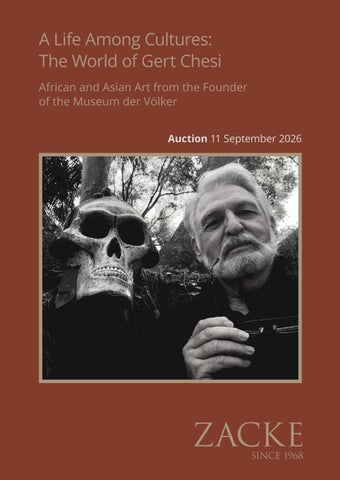
A Life Among Cultures: The World of Gert Chesi African and Asian Art from the Founder of the Museum der Völker Auction 11 September 2026
A LIFE AMONG CULTURES: THE WORLD OF GERT CHESI African and Asian Art from the Founder of the Museum der Völker CATALOG SINGCHESI0926
NO RESERVE LIVE AUCTION 11 September 2026, 2 pm CET
IMPORTANT INFORMATION FOR BUYERS All lots in this auction are offered with No Reserve, allowing live bids below the starting prices to be considered. Please note that the starting prices have been set at exceptionally low levels to encourage participation. We encourage you to take advantage of this unique opportunity to acquire remarkable pieces at highly competitive prices.
SESSION 1 Lots 1–101 Print Catalog
SESSION 2 Lots 102–258 Online Catalog
EXHIBITION 31 August – 9 September, Monday – Friday 10 am – 6 pm as well as by appointment
GALERIE ZACKE Zelinkagasse 6, 1010 Vienna Austria
Tel +43 1 532 04 52 E-mail office@zacke.at www.zacke.at ALL LOTS TO BE SOLD AT NO RESERVE | 1
SESSION 2 Lots 102–258
ONLINE CATALOG
2 | ALL LOTS TO BE SOLD AT NO RESERVE
www.zacke.at
VISIT US IN VIENNA
VISIT US IN VIENNA
VISIT US IN VIENNA
In the heart of Vienna’s first district, our showroom spans In the heart of Vienna’s first district, our showroom In theAUCTION heart of Vienna’s first district, HOW TO FIND OUR & SHOWROOM 6,000-square-foot and has been specially designed to provide a spans 6,000-square-foot and has been specially spans AT ZELINKAGASSE 6 6,000-square-foot and has be seamless auction and exhibition experience. designed to provide a seamless auction and exhibition designed to provide a seamless auc experience. experience. G
U2
IN
NR
TE
T HO
U4
NZ
GO
Located at Zelinkagasse 6, 1010 Vienna, our auction and Located at Zelinkagasse 6, 1010 Vienna, our auction Located at Zelinkagasse 6, 1010 V SC SE preview space is just a seven-minute walk from ourlongstanding, S A and preview space is just a seven-minute walk from our and preview space is just a seven-m G KA 10,000-square-foot office, photography, video, and cataloging LIN E longstanding, 10,000-square-foot office, photography, longstanding, 10,000-square-foot offi Z at Sterngasse 13. Both locations arevideo, open and to the public, hub at Sterng video, and cataloging hub at Sterngasse hub 13. Both cataloging and we warmly invite you to visit. locations are open to the public, and we warmly invite locations are open to the public, and you to visit. you to visit. AG
AU
N DO
SE
JO NZ-
AS
FRA
AG
UT NE
L
NA
KA
E
SS
GA
OR
AI S-K
SEF
Starting 31 August you’ll be able to explore the exceptional Starting 31 August you’ll be able to explore the Starting 31 August you’ll be able to pieces featured in this auction at Zelinkagasse 6, 1010 Vienna. exceptional pieces featured in this auction at exceptional pieces featured in thisCKaE RU Ü BR D O OR Zelinkagasse 6, 1010 Vienna. Zelinkagasse 6, 1010 Vienna. LF ZT R AL UD
SP
OL
SAL
ZG
11 September 2026, 2 pm CET
JOIN US LIVE 10 September 2026 at 10 am CET
ZELINKAGASSE 6
LA
K
TZ
RIE
S
FISCHERSTIEGE
JOIN US LIVE
S
AR
FP
JOIN US LIVE
Attend in person at ourSTERNGASSE auction room at 13
SC
H
W
ED
EN
PL
AT
U1
Zelinkagasse 6 or participate online via Live –2026 at 10 am CET 10Zacke September and enjoy premium buyer’s terms with no additional
Attend in person in our auction room at Attend in person in our auction room platform online bidding fees. Easily accessible by public transport6ororcar Zelinkagasse 6 or participate online via Zacke Live – Zelinkagasse participate online (a parking garage is located nearby). and enjoy premium buyer’s terms with no and enjoy premium buyer’s terms additional online bidding fees. additional online bidding fees. Register now: www.zacke.at By Public Transport: SCHOTTENRING station Register now: www.zacke.at. Register now: www.zacke.at. (U2, U4, tram lines 1, 31, 71, D, and bus 3A) ALL LOTS TO BE SOLD AT NO RESERVE | 3
IMPRINT Publisher Galerie Zacke founded 1968 © SZA Versteigerungen & Vertriebs GmbH 1010 Wien Zelinkagasse 6, Austria, Europe Tel (0043-1) 532 04 52 Email: office@zacke.at Editors Susanne Zacke Marion Schor
4 | ALL LOTS TO BE SOLD AT NO RESERVE
Assistance and Translation Anna-Maria Pollmann Jue Zhang Photography Georg Bodenstein David Lindengrün Cesilio Cesar Garcia Jonas Matyassy Loreen Sasse Vladimir Ramljak Design Christina Zhang
Experts Max Zacke Alexander Zacke
Printing Print Alliance HAV Produktions GmbH
Catalogers Ananya Casius Anne-Aymone Gabriel Daniel Gonzalez-Gracia Tatjana Borodin
Website www.zacke.at © GALERIE ZACKE Reproduction forbidden
ABSENTEE BIDDING FORM
FOR THE AUCTION A LIFE AMONG CULTURES: THE WORLD OF GERT CHESI African and Asian Art from the Founder of the Museum der Völker ON DATE 11 September 2026
LOT NR.
LOT TITLE
BID IN EURO
PLEASE RAISE MY BID BY ONE BIDDING INCREMENT (ca. 10%) IF NECESSARY IMPORTANT NOTICE: Bids do not include buyer’s premium and VAT. Margin taxation applies. Items with added VAT are marked in the online catalog.
PLEASE CALL ME WHEN A HIGHER BID THAN MINE HAS BEEN RECEIVED MY PHONE NUMBER
TELEPHONE BIDS: If you like to bid by telephone, please state ‘TEL’ in the ‘BID IN EURO’ column instead of a Euro amount. Galerie Zacke will call you on the day of the auction, on the telephone number provided, 5 lots before the lot you are bidding on and the bidding will commence at the starting price, as stated in the catalog. If Galerie Zacke cannot reach you during the auction, Galerie Zacke will bid the starting price on your behalf. TERMS OF PAYMENT, SHIPPING AND COLLECTION:
NAME
ADDRESS CITY, COUNTRY POSTCODE
With the signature on this form, the client instructs the auctioneer to bid on his behalf. The Euro amount up to which the auctioneer shall bid on behalf of the client is either stated in this form or will be communicated to the auctioneer via telephone during the auction. All absentee bidding shall be governed by the terms and conditions [AGB] of Galerie Zacke. The client agrees with his signature that he has read, understood and fully accepted the AGB of Galerie Zacke. Galerie Zacke, founded 1968, is a registered brand of SZA Versteigerungen & Vertriebs GmbH, Vienna, Austria.
PHONE NUMBER
DATE & SIGNATURE
CREDIT CARD PAYMENT PLEASE CHECK THE DESIRED CARD COLLECTION BY CLIENT WITH PAYMENT ON THE PREMISES IN CASH, BY CERTIFIED CHEQUE OR CREDIT CARD INVOICE PAYMENT VIA BANK WIRE AFTER RECEIPT OF INVOICE SHIPPING AFTER RECEIPT OF PAYMENT EXPRESS PARCEL SERVICE REQUIRED (ACCORDING TO TERMS AND CONDITIONS OF GALERIE ZACKE)
AMEX
MASTERCARD
VISA
NAME ADDRESS CARD NUMBER EXPIRY DATE
SECURITY CODE
SHIPPING INSURANCE REQUIRED (ACCORDING TO TERMS AND CONDITIONS OF GALERIE ZACKE)
GALERIE ZACKE Zelinkagasse 6, 1010 Vienna, Austria Email: office@zacke.at Tel: +43-1-532 04 52 Fax: +43-1-532 04 52 20
IMPORTANT NOTICE: Whenever making a bid, whether personally or via an agent, in writing, online, telephone, or in any other way, the bidder fully and unconditionally accepts the Terms of Auction, the ‘Important Information’ section in the auction catalog, the Terms and Conditions (AGB) of Galerie Zacke, §1-48, the Fee Tariff, and the Bidding Increments table, all as published on www.zacke.at on the day of the auction.
ALL LOTS TO BE SOLD AT NO RESERVE | 5
| ALL LOTS TO BE SOLD AT NO RESERVE 6| 2 ALL LOTS TO BE SOLD AT NO RESERVE
A LIFE AMONG CULTURES: THE WORLD OF GERT CHESI African and Asian Art from the Founder of the Museum der Völker Dear clients and friends, The collection presented in this catalogue belongs to a man whose work has never been confined to a single field, country, or category. A Life Among Cultures: The World of Gert Chesi is the title of this auction, but it is also an apt description of a life still actively devoted to travelling, photographing, writing, collecting, filming, exhibiting, and building
bridges between cultures. Gert Chesi is a photographer, journalist, author, ethnographer, collector, curator, filmmaker, and museum founder; above all, he remains a tireless observer of human creativity, ritual, beauty, and belief.
|7 ALL LOTS LOTS TO TO BE BE SOLD SOLD AT AT NO NO RESERVE RESERVE | ALL 3
In 1960, Gert Chesi founded one of Austria’s first jazz clubs, Studio 12 in Schwaz
Born in Schwaz, Tyrol, in 1940, Chesi began as a journalist and photographer in 1959. Almost immediately, he also became a cultural organizer. In 1960 he founded Studio 12 in Schwaz, one of the earliest jazz clubs in Austria and the first in western Austria according to his official biography; two years later he founded the Galerie Eremitage, and in 1963 he became a freelance
contributor to the Austrian Broadcasting Corporation (ORF) and organized the Schwazer September, a festival for music and art. These early projects already show the pattern that would define his life: the desire to bring distant worlds, unfamiliar forms, and new artistic languages into direct contact with his own surroundings.
Africa entered Chesi’s life early and decisively. In 1961 he undertook a five-month motorcycle journey to Africa, and in 1964 he spent eight months at Albert Schweitzer’s hospital in Lambarene, Gabon. Chesi became one of the last photographers to portray Schweitzer during his lifetime; after Schweitzer’s death in 1965, these photographs brought Chesi his first major international attention and helped establish him as a photojournalist. It was also during this period that his collecting began, together with his sustained engagement with African art, ritual, and ethnography.
Albert Schweitzer, Gabon, 1964
8 | ALL LOTS TO BE SOLD AT NO RESERVE
Gert Chesi with a friend in the Nubian Desert on his first trip to Africa, 1959
Albert Schweitzer and Gert Chesi, Gabon, 1964 ALL LOTS TO BE SOLD AT NO RESERVE | 9
Gert Chesi, early 1960s
From the late 1960s onward, Chesi’s work expanded across several media at once. He published on art and ethnographic subjects, produced radio and television work for the ORF, organized exhibitions of African art and photography, and began building an ethnophotographic archive. In 1971, ethnomusicological recordings made by Chesi appeared on the double album Black Magic; in 1975 his first major photographic book, Die letzten Afrikaner, was published in six languages. His 1978 book Voodoo – Afrikas geheime Macht, based on extensive studies in Africa and Haiti, marked a central moment in his lifelong engagement with Voodoo and other spiritual traditions. This engagement was never academic in the narrow sense. Chesi entered temples, villages, ceremonies, and ritual landscapes as a photographer, writer, participant-observer, and collector, returning again and again to the worlds of healing, possession, sacrifice, ancestor cults, and spiritual power that shaped so much of his later work.
The most enduring institutional expression of this commitment was the Haus der Völker, founded by Chesi in Schwaz in 1995 and later continued as the Museum der Völker. What began as the vision of one collector became a public forum for the art and ethnography of Africa, Asia, Indonesia, and the wider nonEuropean world. For Chesi, the museum was never merely a place of display. It was a platform for exhibitions, publications, lectures, films, music, scholarship, and cultural exchange. In 1997 he became scientific adviser to the Museum für Völkerkunde in Hamburg and organized its annual exhibition; in 2000 the Haus der Völker received the Tyrolean Museum Prize, and in 2001 Chesi was awarded the Austrian state-conferred title of Professor in recognition of his outstanding cultural achievements. 10 | ALL LOTS TO BE SOLD AT NO RESERVE
A Voodoo priest and practitioners in Togo, photographed by Gert Chesi in the 1970s
His collecting and his work for the museum were inseparable. Objects were acquired not simply as possessions, but as material for exhibitions, publications, study, and encounter. In 1998, the Haus der Völker participated in major exhibitions in Linz and Cologne, while Chesi produced The Sound of Voodoo, the first CD in the series The Sound of Afrika. Around the same time he traveled repeatedly through China and Asia, selecting works for the exhibition 2000 Jahre Seidenstraße in collaboration with Museum für
Völkerkunde specialists in Berlin. In 2001 he acquired important Nok sculptures for the Haus der Völker, while exhibitions such as Buddha in Kunst und Mythos and later Asian projects expanded the museum’s reach beyond Africa into the arts of Asia.
Exhibitions at the Museum der Völker (formerly Haus der Völker) featuring objects offered in this auction ALL LOTS TO BE SOLD AT NO RESERVE | 11
Gerd Merzeder at the Vegetarien Festival in Phuket, Thailand, photographed by Gert Chesi
Gert Chesi in Bada Valley, Sulawesi, photographed by Gerd Merzeder
A particularly important collaborator was Gerd Merzeder. In 2005, the year Chesi moved his main residence to Togo, the two founded A4 – Magazin für außereuropäische Kunst und Kultur, one of the first German-language magazines devoted to nonEuropean art and culture. In 2006, Merzeder and Chesi also collaborated with Prestel, a leading international publisher of art and photography books, on a major publication devoted to the Nok culture. These projects show how closely Chesi’s activities as collector, author, publisher, photographer, and curator remained connected: the museum was not a static collection, but an active workshop of research, image-making, writing, and exhibition.
In 2012, a modern extension was added to the museum with support from the State of Tyrol and the City of Schwaz, and in 2013 the Museum der Völker opened as the successor to the Haus der Völker. Chesi also increasingly turned to film, creating a documentary series intended to give the cultures of the world a forum; by 2016, his official biography recorded more than forty documentary films, and later accounts speak of an even larger body of work. The locations of these films — Thailand, India, Togo, Benin, Ghana, Burma, Ethiopia, Indonesia, and beyond — mirror the same geography of travel and encounter that shaped the collection itself. 12 | ALL LOTS TO BE SOLD AT NO RESERVE
Covers of A4 Magazin, created by Gerhard Merzeder and Gert Chesi
The following images provide a glimpse into the private spaces of Gert Chesi, where his lifelong passion for the arts and cultures found expression. Works offered in the present auction are visible throughout these photographs, shown in the surroundings that shaped their history within Chesi’s collection.
Interior view of Gert Chesi’s residence in Schwaz, Tyrol, with works from his collection displayed
Gert Chesi in his Schwaz depot
Interior view of Gert Chesi’s Bangkok residence
The present auction is closely connected with this history. Many of the works offered here were previously exhibited at the Museum der Völker, although records were not always kept. For that reason, museum exhibition history has been mentioned only in those cases where it can be confirmed with certainty. Following Chesi’s later separation from the institution, a substantial part of his collection remained with the City of Schwaz and the museum he had founded, while other works returned to, or remained with, him as part of his personal collection. It is from this living and deeply personal world of objects — formed over decades and inseparable from his work as photographer, author, ethnographer, filmmaker, and curator — that the present auction has been assembled. The range of the sale reflects the range of Chesi’s life. There are works from across Africa, with particular strength in West African material from Nigeria, Togo, Benin, Ghana, and neighboring regions, including Voodoo objects and other works connected with ritual, healing, protection, possession, and spiritual practice. Alongside them are examples of contemporary African art, Southeast Asian sculpture, and selected Japanese and Chinese works. The collection is not unified by geography alone, but by Chesi’s eye for objects that carry presence, belief, history, and human intensity. To present this collection is to enter the world of Gert Chesi: a world of journeys, encounters, exhibitions, books, ceremonies, conversations, images, sounds, and films. These works reflect a life among cultures that continues to unfold, and a collector whose understanding of art has always extended beyond the object itself toward the people, rituals, histories, and beliefs that give it meaning. We are honored to present A Life Among Cultures: The World of Gert Chesi and invite you to join us on this journey through the depth, variety, and remarkable spirit of his collection.
Gert Chesi’s residence in Togo, with a structure of his own design
With our best wishes, Max Zacke and Team ALL LOTS TO BE SOLD AT NO RESERVE | 13
14 | ALL LOTS TO BE SOLD AT NO RESERVE
ALL LOTS TO BE SOLD AT NO RESERVE | 15
1 A MASSIVE TERRACOTTA FIGURE OF A KNEELING MALE DEITY, NOK CULTURE, NIGERIA, 500 BC-200 AD
PUBLISHED Gert Chesi & Gerhard Merzeder, The Nok Culture: Art in Nigeria 2500 Years Ago, 2006, p. 56-57
Weight: 35.7 kg Dimensions: Height 110 cm SCIENTIFIC ANALYSIS REPORT A thermoluminescence analysis report issued by Oxford Authentication on 28 July 2026, based on sample number N126j82, sets the firing date of the four samples taken between 1400 and 2100 years ago, consistent with the dating above. A copy of the report accompanies this lot.
Finely worked to depict a slender, kneeling figure holding a hornshaped ornament in his left hand. A necklace suspending tassels and bindings encircle the neck, chest, arms, and legs, lending the composition a taut presence. The waist with a wide belt suspending a cloth satchel. The face is boldly modeled with large triangular eyes and pierced pupils, a broad nose above an open mouth showing teeth, framed by pronounced lips, flanked by a combed beard and goatee, and triangular bands to the cheek. The head is surmounted by sculpted hair forming horns. Provenance: Professor Gert Chesi, acquired by 2004 for the Museum der Völker (formerly Haus der Völker, Museum für Kunst und Ethnographie), Schwaz, Tyrol, Austria, and subsequently de-accessed. A letter of confirmation written and signed by Dr. Omotoso Eluyemi, Director General and Chief Executive of the National Commission for Museums & Monuments, Nigeria, dated 20 July 2004, confirms that the present lot is “neither part of the cultural heritage of the Federal Republic of Nigeria Dr. Omotoso Eluyemi (1939-2006) nor is it national property [and] has been exported in accordance with the laws in vigour on the basis of an export permit issued to Mr. Gert Chesi.” A copy of this document accompanies the lot. Dr. Omotoso Eluyemi (1939-2006) was born in Ife and became the first Yoruba scholar to earn a Ph.D. in archaeology, at the Academy of Sciences, Moscow, in 1979. He served as Curator in the Federal Department of Antiquities, Lagos in 196970, and later pioneered archaeological studies at Obafemi Awolowo University, founding its Department of Archaeology in 1984 and serving as its Chair until 1989. A member of the World Archaeological Congress and long-standing Editorial Board member of the West African Journal of Archaeology, he later established the Center for Yoruba Cultural Studies and Elusope Temple of Deities. In 2000, he was appointed by President Olusegun Obasanjo to head the National Commission for Museums and Monuments. Condition: Good condition with expected wear, manufacturing irregularities including firing cracks, signs of prolonged burial, encrustations, obvious minor losses, small chips, few minor old repairs. Small holes from sample-taking have been filled.
16 | ALL LOTS TO BE SOLD AT NO RESERVE
Nok terracottas are the earliest known sculptures from ancient Nigeria. Sculptures of this kind were first discovered in 1943 by Bernard Fagg near the northern Nigerian village of Nok, after which the culture that produced them was named. Most Nok sculpture is hollow and coil-built like pottery. Finely worked to a resilient consistency from local clays and gravel, the millennia-long endurance of these ancient objects is a testament to the technical ability of their makers. This is not to say that Nok sculpture has survived unchanged by time. The slip of many Nok terracottas has eroded, leaving a grainy, pocked exterior that does not reflect their original smooth appearance. Most of the Nok sculpture found consists of what appear to be portrait heads and bodies fragmented by damage and age. The recovered portions of the baked clay bodies that have survived show that they were sculpted in standing, sitting, and genuflecting postures. Although every Nok sculpture is unique, certain stylistic traits are found throughout the corpus of known work. Triangular eyes and perforated pupils, noses, mouths, and ears combine to depict men and women with bold, abstracted features. Perhaps the most striking aspects of Nok sculptures are the elaborately detailed hairstyles and jewelry that adorn many of the figures. The variety, inventiveness, and beauty of their design is a beguiling record of cultivated devotion to body ornamentation.
LITERATURE COMPARISON Compare a closely related terracotta figure of a kneeling male figure, Nok culture, 65.5 cm tall, published in Chika Okeke-Agulu and John Picton, Nationalism and the Rhetoric of Modernism in Nigeria, The Art of Uche Okeke and Demas Nwoko, 1960-1968, African Arts, Spring, 2006, vol. 39, no. 1, p. 34, picture 12.
AUCTION RESULT COMPARISON Type: Closely related Auction: Zacke, Vienna, 16 October 2025, lot 269 Price: EUR 58,500 Description: A terracotta figure of a male deity, Nok culture, Nigeria, 500 BC-200 AD Expert remark: Compare the closely related ware and modeling with similar pose. Note the smaller size (75 cm).
Estimate EUR 24,000 Starting price EUR 12,000
ALL LOTS TO BE SOLD AT NO RESERVE | 17
18 | ALL LOTS TO BE SOLD AT NO RESERVE
2 A MASSIVE TERRACOTTA FIGURE OF A MALE DEITY, NOK CULTURE, NIGERIA, 500 BC-200 AD SCIENTIFIC ANALYSIS REPORTS 1. A thermoluminescence analysis report issued by Oxford Authentication on 28 July 2026, based on sample number N126j77, sets the firing date of three samples taken between 1800 and 2700 years ago, consistent with the dating above. A fourth sample, taken from the right side of the neck, appeared to be contaminated and could not be dated. A copy of the report accompanies this lot. 2. A thermoluminescence analysis report issued by Laboratory Kotalla, based on sample number 11030804, sets the firing date of the samples taken to be 2200 years +/-20% years ago, consistent with the dating above. A copy of the report accompanies this lot.
Finely modeled to depict a tall slender figure standing atop a rounded base, adorned with twine-form bindings that snake around the torso, a wide belt above the waist suspending triangular tassels and sashes, and the neck with a large circular collar. The face modeled with triangular eyes centered by pierced pupils, the mouth ajar flanked by a short moustache and combed goatee, and a tall forehead framed by tightly coiled curls. Provenance: Professor Gert Chesi, acquired by 2003 for the Museum der Völker (formerly Haus der Völker, Museum für Kunst und Ethnographie), Schwaz, Tyrol, Austria, and subsequently de-accessed. A letter of confirmation written and signed by Dr. Omotoso Eluyemi, Director General and Chief Executive of the National Commission for Museums & Monuments, Nigeria, dated 16 August 2003, confirms that the present lot is “neither part of the cultural heritage of the Federal Republic Dr. Omotoso Eluyemi (1939-2006) of Nigeria nor is it national property [and] has been exported in accordance with the laws in vigour on the basis of an export permit issued to Mr. Gert Chesi.” A copy of this document accompanies the lot. Dr. Omotoso Eluyemi (19392006) was born in Ife and became the first Yoruba scholar to earn a Ph.D. in archaeology, at the Academy of Sciences, Moscow, in 1979. He served as Curator in the Federal Department of Antiquities, Lagos in 1969-70, and later pioneered archaeological studies at Obafemi Awolowo University, founding its Department of Archaeology in 1984 and serving as its Chair until 1989. A member of the World Archaeological Congress and long-standing Editorial Board member of the West African Journal of Archaeology, he later established the Center for Yoruba Cultural Studies and Elusope Temple of Deities. In 2000, he was appointed by President Olusegun Obasanjo to head the National Commission for Museums and Monuments. Condition: Good condition, commensurate with age. Expected wear, firing irregularities, signs of burial, encrustations, losses, cracks, small chips, old repairs to the legs and chest, all consistent with known examples from this corpus. Small holes from sample-taking have been filled. Weight: 21.9 kg Dimensions: Height 118 cm
The Nok terracottas are among the earliest known large-scale figurative sculptures in Africa, only preceded by Egyptian sculptural art. Sculptures of this kind were first discovered in 1943 by Bernard Fagg near the northern Nigerian village of Nok, after which the culture that produced them was named.
LITERATURE COMPARISON Compare a closely related male figure, Nok culture, dated ca. 195 BC-205 AD, 49.5 cm tall, in the Kimbell Art Museum, accession number AP 1996.03.
Estimate EUR 15,000 Starting price EUR 7,500
ALL LOTS TO BE SOLD AT NO RESERVE | 19
3 A VERY LARGE TERRACOTTA FIGURE OF A KING, NOK CULTURE, NIGERIA, 500 BC-200 AD Finely modeled seated on a stool with the right leg raised to support the chin of the elongated face, the body adorned with twine-form bindings that snake around the arms, the neck with a broad collar and beaded necklace, his right leg adorned with an eight-form emblem to the shin, the left arm tucked beside the chest, and the right arm raised supporting a small satchel. The face rendered with triangular eyes centered by pierced pupils, large nostrils above voluminous lips that frame teeth, the chin terminating in a goatee, and surmounted by sculptured hair.
SCIENTIFIC ANALYSIS REPORTS 1. A thermoluminescence analysis report issued by Oxford Authentication on 28 July 2026, based on sample number N126j76, sets the firing date of the five samples taken between 1700 and 2500 years ago, consistent with the dating above. A copy of the report accompanies this lot. 2. A thermoluminescence analysis report issued by Laboratory Kotalla on 7 May 2008, based on sample number 04060508, sets the firing date of the samples taken to be 2100 years +/-20% years ago, consistent with the dating above. A copy of the report accompanies this lot.
Provenance: Sani Amidou, Lomé, Togo, by 2003. Professor Gert Chesi, acquired from the above for the Museum der Völker (formerly Haus der Völker, Museum für Kunst und Ethnographie), Schwaz, Tyrol, Austria, and subsequently deaccessed. A letter of confirmation written and signed by Dr. Omotoso Eluyemi, Director General and Chief Executive of the National Commission for Museums & Monuments, Nigeria, dated 17 September 2003, confirms that the Dr. Omotoso Eluyemi present lot is “neither part of the cultural (1939-2006) heritage of the Federal Republic of Nigeria nor is it national property [and] has been exported in accordance with the laws in vigour on the basis of an export permit issued to Mr. Sani Amidou.” A copy of this document accompanies the lot. Condition: Overall good condition with expected wear, firing irregularities, signs of burial, encrustations, obvious losses, few minor cracks, small chips. Minor old repairs, as is typical for authentic Nok excavations. Small holes from sampletaking have been filled.
Weight: 42.7 kg Dimensions: Height 93.5 cm LITERATURE COMPARISON Compare a closely related terracotta figure of a man resting his chin on his knee, Nok sculpture, dated ca. 500 BC-500 AD, 38 cm tall, in the Louvre, accession number 70.1998.11.1. Compare a related terracotta head of a king with a similar coiffure, Nok culture, dated 500 BC-500 AD, 30.2 cm tall, in the Minneapolis Institute of Art, accession number 2001.198.27. Estimate EUR 15,000 Starting price EUR 7,500
20 | ALL LOTS TO BE SOLD AT NO RESERVE
ALL LOTS TO BE SOLD AT NO RESERVE | 21
4 A LARGE TERRACOTTA FIGURE OF A KNEELING MAN, NOK CULTURE, NIGERIA, 500 BC-200 AD
SCIENTIFIC ANALYSIS REPORT A thermoluminescence analysis report issued by Oxford Authentication on 28 July 2026, based on sample number N126j80, sets the firing date of two samples taken between 1500 and 2200 years ago, consistent with the dating above. Two further samples consisted of unfired material which cannot be dated. A copy of the report accompanies this lot.
Finely modeled kneeling on a short circular base centered to the front by a small bearded head, the elongated body adorned with twine-form bindings at the arms and legs, ropes that snake around the torso, and waist, the neck with a large circular collar, and the waistband suspending a tassel. The face modeled with triangular eyes centered by pierced pupils, the mouth flanked by a short moustache and combed goatee, and a tall forehead framed by sculpted hair. Provenance: Professor Gert Chesi, acquired by 2005 for the Museum der Völker (formerly Haus der Völker, Museum für Kunst und Ethnographie), Schwaz, Tyrol, Austria, and subsequently de-accessed. A letter of confirmation written and signed by Dr. Omotoso Eluyemi, Director General and Chief Executive of the National Commission for Museums & Monuments, Nigeria, dated 17 March 2005, confirms that the present lot is “neither part of the cultural heritage of the Federal Republic of Nigeria nor is it national property [and] has been exported in accordance with the laws in vigour on the basis of an export permit issued to Mr. Gert Chesi.” A copy of this document accompanies the lot. Dr. Omotoso Eluyemi (1939-2006) was born in Ife and became the first Yoruba scholar to earn a Ph.D. in archaeology, at the Academy of Sciences, Moscow, in 1979. He served as Curator in the Federal Department of Antiquities, Lagos in 1969-70, and later pioneered archaeological studies at Obafemi Awolowo University, founding its Department of Archaeology in 1984 and serving as its Chair until 1989. A member of the World Archaeological Congress and long-standing Editorial Board member of the West African Journal of Archaeology, he later established the Center for Yoruba Cultural Studies and Elusope Temple of Deities. In 2000, he was appointed by President Olusegun Obasanjo to head the National Commission for Museums and Monuments. Condition: Overall good condition with expected wear, firing irregularities, signs of burial, encrustations, tiny losses and small chips, few minor cracks, old repairs and fills, as is typical for authentic Nok excavations. Small holes from sample-taking have been filled. Weight: 28.4 kg Dimensions: Height 90 cm
22 | ALL LOTS TO BE SOLD AT NO RESERVE
Dr. Omotoso Eluyemi (1939-2006)
LITERATURE COMPARISON Compare a closely related Nok terracotta figure of a kneeling man, 60.9 cm tall, in the Yale University Art Gallery, accession number 2006.51.362.
Estimate EUR 12,000 Starting price EUR 6,000
ALL LOTS TO BE SOLD AT NO RESERVE | 23
5 A RARE AND LARGE TERRACOTTA FIGURE OF A MAN, NOK CULTURE, NIGERIA, 500 BC-200 AD Finely modeled with elongated proportions in a standing position, wearing a coiled collar around the neck and a wide belt encircling the waist, suspending a humanoid tassel and sash falling between the legs. The left arm tucked beside the chest, and the elongated face incised with triangular eyes centered by pierced pupils above a wide nose and open mouth and surmounted by a hat with a short, circular brim. Provenance: Professor Gert Chesi, acquired by 2007 for the Museum der Völker (formerly Haus der Völker, Museum für Kunst und Ethnographie), Schwaz, Tyrol, Austria, and subsequently deaccessed. A letter of confirmation written and signed by Dr. Omotoso Eluyemi, Director General and Chief Executive of the National Commission for Museums & Monuments, Nigeria, dated 15 January 2007, confirms that the present lot is “neither part of the cultural heritage of Dr. Omotoso Eluyemi the Federal Republic of Nigeria nor is it national property [and] has been exported (1939-2006) in accordance with the laws in vigour on the basis of an export permit issued to Mr. Gert Chesi.” A copy of this document accompanies the lot. Dr. Omotoso Eluyemi (1939-2006) was born in Ife and became the first Yoruba scholar to earn a Ph.D. in archaeology, at the Academy of Sciences, Moscow, in 1979. He served as Curator in the Federal Department of Antiquities, Lagos in 1969-70, and later pioneered archaeological studies at Obafemi Awolowo University, founding its Department of Archaeology in 1984 and serving as its Chair until 1989. A member of the World Archaeological Congress and long-standing Editorial Board member of the West African Journal of Archaeology, he later established the Center for Yoruba Cultural Studies and Elusope Temple of Deities. In 2000, he was appointed by President Olusegun Obasanjo to head the National Commission for Museums and Monuments. Condition: Good condition, commensurate with age. Expected wear, firing irregularities, signs of burial, encrustations, visible losses, cracks, small chips, and old repairs around the left leg and right arm — all consistent with known examples from this corpus. Small holes from sample-taking have been filled.
SCIENTIFIC ANALYSIS REPORTS 1. A thermoluminescence analysis report issued by Oxford Authentication on 28 July 2026, based on sample number N126j83, sets the firing date of the three samples taken between 1400 and 2200 years ago, consistent with the dating above. A copy of the report accompanies this lot. 2. A thermoluminescence analysis report issued by Laboratory Kotalla on 25 August 2006, based on sample number 04230806, sets the firing date of the samples taken to be 2100 years +/-20 % years ago, consistent with the dating above. A copy of the report accompanies this lot. Most Nok sculpture is hollow and coil-built like pottery. Finely worked to a resilient consistency from local clays and gravel, the millennia-long endurance of these ancient objects is a testament to the technical ability of their makers. This is not to say that Nok sculpture has survived unchanged by time. The slip of many Nok terracottas has eroded, leaving a grainy, pocked exterior that does not reflect their original smooth appearance. Most of the Nok sculpture found consists of what appear to be portrait heads and bodies fragmented by damage and age. The recovered portions of the baked clay bodies that have survived show that they were sculpted in standing, sitting, and genuflecting postures. Although every Nok sculpture is unique, certain stylistic traits are found throughout the corpus of known work. Triangular eyes and perforated pupils, noses, mouths, and ears combine to depict men and women with bold, abstracted features. Perhaps the most striking aspects of Nok sculptures are the elaborately detailed hairstyles and jewelry that adorn many of the figures. The variety, inventiveness, and beauty of their design is a beguiling record of cultivated devotion to body ornamentation.
LITERATURE COMPARISON Compare a related terracotta bust of a man, Nok culture, dated 200 BC-195 AD, 56.5 cm tall, in the Detroit Institute of Arts, accession number 2012.74.
Weight: 21 kg Dimensions: Height 87.5 cm The Nok terracottas are among the earliest known large-scale figurative sculptures in Africa, only preceded by Egyptian sculptural art. Sculptures of this kind were first discovered in 1943 by Bernard Fagg near the northern Nigerian village of Nok, after which the culture that produced them was named.
24 | ALL LOTS TO BE SOLD AT NO RESERVE
Estimate EUR 12,000 Starting price EUR 6,000
ALL LOTS TO BE SOLD AT NO RESERVE | 25
6 A VERY LARGE TERRACOTTA STANDING FIGURE OF A FEMALE DEITY, NOK CULTURE, NIGERIA, 500 BC-200 AD
SCIENTIFIC ANALYSIS REPORT A thermoluminescence analysis report issued by Oxford Authentication on 28 July 2026, based on sample number N126j79, sets the firing date of the four samples taken between 1600 and 2400 years ago, consistent with the dating above. A copy of the report accompanies this lot.
Finely modeled standing, the elongated body adorned with a long necklace and coiled bands around the waist, a wide circular collar enclosing the neck, and a belt suspending a tassel and incised sash to the front. The oblong face rendered with triangular eyes centered by pierced pupils, a wide nose, and voluminous lips. The tall forehead surmounted by an elaborate coiffure consisting of rows of large hemispheres. Provenance: Professor Gert Chesi, acquired circa 1990-2015 for the Museum der Völker (formerly Haus der Völker, Museum für Kunst und Ethnographie), Schwaz, Tyrol, Austria, and subsequently de-accessed. Condition: Good condition, commensurate with age. Expected wear, firing irregularities, signs of burial, encrustations, obvious losses, cracks, small chips, minor repairs, all consistent with known examples from this corpus. Small holes from sample-taking have been filled. Weight: 11.7 kg Dimensions: Height 98 cm The Nok terracottas are among the earliest known large-scale figurative sculptures in Africa, only preceded by Egyptian sculptural art. Sculptures of this kind were first discovered in 1943 by Bernard Fagg near the northern Nigerian village of Nok, after which the culture that produced them was named. Most Nok sculpture is hollow and coil-built like pottery. Finely worked to a resilient consistency from local clays and gravel, the millennia-long endurance of these ancient objects is a testament to the technical ability of their makers. This is not to say that Nok sculpture has survived unchanged by time. The slip of many Nok terracottas has eroded, leaving a grainy, pocked exterior that does not reflect their original smooth appearance. Most of the Nok sculpture found consists of what appear to be portrait heads and bodies fragmented by damage and age. The recovered portions of the baked clay bodies that have survived show that they were sculpted in standing, sitting, and genuflecting postures.
LITERATURE COMPARISON Compare a related Nok terracotta head with a similar coiffure, 24.8 cm tall, in the Minneapolis Institute of Art, accession number 2002.27.16. Compare a related Nok terracotta female figure in the Yale University Art Gallery, 45.7 cm high, accession number 2006.51.115.
Estimate EUR 8,000 Starting price EUR 4,000
26 | ALL LOTS TO BE SOLD AT NO RESERVE
ALL LOTS TO BE SOLD AT NO RESERVE | 27
7 A TERRACOTTA FIGURE OF A MAN, NOK CULTURE, NIGERIA, 500 BC-200 AD SCIENTIFIC ANALYSIS REPORT A thermoluminescence analysis report issued by Oxford Authentication on 28 July 2026, based on sample number N126j92, sets the firing date of the five samples taken between 1800 and 2700 years ago, consistent with the dating above. A copy of the report accompanies this lot.
Finely modeled standing, the nude body adorned with a coiled collar around the neck and incised band encircling the waist, double lines crossing over the navel, the hands bracing the chest, and with an outsized head rendered with gentle eyes centered by pierced pupils below leaf-form eyebrows, an open mouth framed by a long combed beard tied into a knot, and finely combed coiffure flanked by horns. Provenance: Professor Gert Chesi, acquired circa 1990-2015 for the Museum der Völker (formerly Haus der Völker, Museum für Kunst und Ethnographie), Schwaz, Tyrol, Austria, and subsequently de-accessed. Condition: Very good condition, commensurate with age. Expected wear, firing irregularities, encrustations, minor losses, cracks, small chips, few minor old repairs. Small holes from sample-taking have been filled. Weight: 17.9 kg Dimensions: Height 77 cm Expert’s note: The present figure exhibits several characteristic features of the Sokoto sculptural tradition. Modeled and fired from a hollow core of reddish terracotta, the head is distinguished by a large, rounded calotte set above a high, broad forehead. The eyebrows are deeply incised and appear to droop or “hang” over the eyes, lending the face a stylized and expressive appearance typical of this regional artistic tradition.
LITERATURE COMPARISON Compare a closely related Nok terracotta figure, 61 cm tall, in the Minneapolis Institute of Art, accession number 2000.203.13 (fig. 1). Compare a related Sokoto culture terracotta figure, 45.7 cm tall, in the Yale University Art Gallery, accession number 2010.6.152.
fig. 1 Estimate EUR 4,000 Starting price EUR 2,000
28 | ALL LOTS TO BE SOLD AT NO RESERVE
8 A TERRACOTTA HEAD OF A MAN, SOKOTO CULTURE, NIGERIA, 500 BC-200 AD Finely modeled with large expressive eyes below drooping eyebrows, small nose and slit-form mouth framed by voluminous lips, the chin terminating in a long, combed beard, flanked by subtly indicated ears, and the prominent forehead surmounted by a hat. The cylindrical neck is encircled by a coiled collar. Provenance: Professor Gert Chesi, acquired circa 1990-2015 for the Museum der Völker (formerly Haus der Völker, Museum für Kunst und Ethnographie), Schwaz, Tyrol, Austria, and subsequently de-accessed. Condition: Good condition, commensurate with age. Expected wear, firing irregularities, signs of burial, encrustations, obvious losses, minor cracks, small chips, old repairs, all consistent with known examples from this corpus. Weight: 5.9 kg Dimensions: Height 42 cm The present male figure exhibits several characteristic features of the Sokoto sculptural tradition. Modeled and fired from a hollow core of reddish terracotta, the head is distinguished by a large, rounded calotte set above a high, broad forehead. The eyebrows appear to droop or “hang” over the eyes, lending the face a stylized and expressive appearance typical of this regional artistic tradition.
LITERATURE COMPARISON Compare a related terracotta head, Sokoto culture, dated ca. 500 BC –200 AD, 27.9 cm tall, in the Yale University Art Gallery, accession number 2010.6.159. Compare a related terracotta fragment of a female figure, Sokoto culture, dated ca. 500 BC –200 AD, 41.9 cm tall, in the Yale University Art Gallery, accession number 2010.6.155. Estimate EUR 2,000 Starting price EUR 1,000
ALL LOTS TO BE SOLD AT NO RESERVE | 29
9 A TERRACOTTA HEAD OF A MAN, SOKOTO CULTURE, NIGERIA, 500 BC-200 AD Finely modeled with large expressive eyes below hanging eyebrows, small nose and slit-form mouth, the chin terminating in a combed and pointed goatee, flanked by subtly indicated ears, and the prominent forehead surmounted by a hat. The cylindrical neck is encircled by a coiled collar. Provenance: Professor Gert Chesi, acquired circa 1990-2015 for the Museum der Völker (formerly Haus der Völker, Museum für Kunst und Ethnographie), Schwaz, Tyrol, Austria, and subsequently de-accessed. Condition: Good condition, commensurate with age. Expected wear, firing irregularities, signs of burial, encrustations, obvious losses. Weight: 5.9 kg Dimensions: Height 33 cm These type of clay figures, often overshadowed by the betterknown Nok terracottas, belong to a distinctive sculptural tradition that flourished during a comparable period. It was only in the early 1990s that in the area near the city of Sokoto, in northwestern Nigeria, terracotta objects displaying a special, consistent style were found. These items, mostly heads and figures, were called Sokoto culture after the place were they had first been found. The majority of surviving works are sculpted heads, which likely originally formed part of larger standing figures. Their distinctive stylistic features set them apart
30 | ALL LOTS TO BE SOLD AT NO RESERVE
from other terracotta traditions in Nigeria, suggesting the presence of a sophisticated and culturally rich society that has otherwise left only limited archaeological traces. LITERATURE COMPARISON Compare a related terracotta head, Sokoto culture, dated ca. 500 BC –200 AD, 38.1 cm tall, in the Yale University Art Gallery, accession number 2010.6.160. Compare a related terracotta male figure, Sokoto culture, dated ca. 500 BC –200 AD, 43.8 cm tall, in the Yale University Art Gallery, accession number 2010.6.148.
Estimate EUR 3,000 Starting price EUR 1,500
10 A TERRACOTTA FIGURE OF A MAN, SOKOTO CULTURE, NIGERIA, 500 BC-200 AD Finely modeled with large expressive eyes below drooping eyebrows incised in a herringbone pattern, small nose and slit-form mouth forming a faint smile, the chin terminating in a long, combed beard tied by a hatched band, flanked by subtly indicated ears, and the prominent forehead surmounted by a stippled hat. The wide neck is encircled by a coiled collar and the hands are resting at the belly. Provenance: Professor Gert Chesi, acquired circa 1990-2015 for the Museum der Völker (formerly Haus der Völker, Museum für Kunst und Ethnographie), Schwaz, Tyrol, Austria, and subsequently de-accessed. Condition: Good condition, commensurate with age. Expected wear, firing irregularities, signs of burial, encrustations, visible losses, cracks, small chips, and repairs to the back and arms, all consistent with known examples from this corpus. Small holes from sampletaking have been filled. Weight: 7.2 kg Dimensions: Height 44.5 cm The present male figure exhibits several characteristic features of the Sokoto sculptural tradition. Modeled and fired from a hollow core of reddish terracotta, the head is distinguished by a large, rounded calotte set above a high, broad forehead. The eyebrows appear to droop or “hang” over the eyes, lending the face a stylized and expressive appearance typical of this regional artistic tradition.
SCIENTIFIC ANALYSIS REPORTS 1. A thermoluminescence analysis report issued by Oxford Authentication on 28 July 2026, based on sample number N126j78, sets the firing date of the three samples taken between 1500 and 2200 years ago, consistent with the dating above. A copy of the report accompanies this lot. 2. A thermoluminescence analysis report issued by Laboratory Kotalla on 10 July 2006, based on sample number 03080706, sets the firing date of the samples taken to be 2100 years +/-20% years ago, consistent with the dating above. A copy of the report accompanies this lot.
LITERATURE COMPARISON Compare a related terracotta head, Sokoto culture, dated ca. 500 BC –200 AD, 46.3 cm tall, in the Yale University Art Gallery, accession number 2010.6.154.
Estimate EUR 8,000 Starting price EUR 4,000
ALL LOTS TO BE SOLD AT NO RESERVE | 31
11 A TERRACOTTA FIGURE OF A MAN, KATSINA CULTURE, NIGERIA, 500 BC-200 AD PUBLISHED Gert Chesi & Daphne Schlorhaufer, Afrika Asien. Kunst der Völker. Die Sammlungen im Haus der Völker, Schwaz, 1996, p. 136-137.
Finely modeled seated in a characteristic squatting pose with the hands resting on the knees. The stylized face with slit form mouth below a small nose, flanked by two further slit-form markings at the cheek, subtly indicated ears and eyes, and a tall forehead. Provenance: Professor Gert Chesi, acquired circa 1990-2015 for the Museum der Völker (formerly Haus der Völker, Museum für Kunst und Ethnographie), Schwaz, Tyrol, Austria, and subsequently de-accessed. Condition: Good condition, commensurate with age. Expected wear, firing irregularities, signs of burial, encrustations, obvious losses, few minor cracks, small chips, the top of the head with an old repair, all consistent with known examples from this corpus.
32 | ALL LOTS TO BE SOLD AT NO RESERVE
Weight: 10.2 kg (excl. stand) Dimensions: Height 47 cm (excl. stand) With an associated modern stand. (2) LITERATURE COMPARISON Comparea related Katsina terracotta sculpture, dated 200 BC-100 AD, in the Timothy S. Y. Lam Museum of Anthropology, Wake Forest University, accession number 2019.07.A.20.a-b. Compare a related Sokoto terracotta human figure, 69.2 cm tall, in the Yale University Art Gallery, accession number 2010.6.105. Estimate EUR 2,000 Starting price EUR 1,000
12 A TERRACOTTA HEAD, KATSINA CULTURE, NIGERIA, 500 BC-200 AD Finely modeled with a small, compact face, the figure is defined by elongated horizontal slits forming the eyes and mouth. The nose is rendered with flaring nostrils, flanked by small, subtly indicated ears, and the head is surmounted by a row of small protrusions forming the coiffure.
SCIENTIFIC ANALYSIS REPORT A thermoluminescence analysis report issued by Laboratory Kotalla on 10 November 1999, based on sample number 991052, sets the firing date of both samples taken to be 2100 years +/-210 years ago, consistent with the dating above. A copy of the report accompanies this lot.
Provenance: Professor Gert Chesi, acquired circa 1990-2015 for the Museum der Völker (formerly Haus der Völker, Museum für Kunst und Ethnographie), Schwaz, Tyrol, Austria, and subsequently de-accessed. Condition: Good condition with expected wear, firing irregularities, signs of burial, encrustations, obvious losses. Two small holes from sample taking. Weight: 2.6 kg Dimensions: Length 20 cm The Katsina terracottas are a distinctive sculptural tradition from northern Nigeria, associated with the wider corpus of West African terracotta art. Dating primarily around 500 BC to 200 AD, they are characterized by highly stylized human figures and heads, often featuring elongated facial proportions, sharply defined eyes and mouths, and elaborate coiffures rendered as geometric or linear patterns. These works likely formed part of larger ritual or commemorative sculptures.
LITERATURE COMPARISON Compare a closely related terracotta anthropomorphic head, Katsina culture, dated ca. 200 BC –500 AD, 17.7 cm tall, in the Yale University Art Gallery, accession number 2010.6.102. Compare a related terracotta head, Katsina culture, dated ca. 200 BC –500 AD, 19 cm tall, in the Yale University Art Gallery, accession number 2011.38.3.
Estimate EUR 1,500 Starting price EUR 750
ALL LOTS TO BE SOLD AT NO RESERVE | 33
13 A TERRACOTTA MEMORIAL HEAD, AKAN PEOPLE, TWIFO-HEMANG REGION, 17TH- 18TH CENTURY Ghana. Finely modeled, the ovoid face detailed with coffee-bean eyes and lips, gently arched eyebrows, thin nose, flanked by rounded ears, and surmounted by tight curls, all supported on a tall, cylindrical neck detailed with ribs.
LITERATURE COMPARISON Compare a closely related terracotta memorial head, Akan people, dated 18th century, 28.9 cm tall, in the Saint Louis Art Museum, object number 283:1982. Compare a related memorial head, Nsodie, Akan people, dated 17th- mid-18th century, 20.3 cm tall, in the Metropolitan Museum of Art, object number 1978.412.563. Compare a related terracotta memorial head, Akan people, dated to the 18th century in the Musee Dapper, Paris, number 2801, and exhibited and illustrated in the Metropolitan Museum of Art, Heroic Africans: Legendary Leaders, Iconic Sculptures, 20 September 2011 – 29 January 2012, p. 84, fig. 67.
Provenance: Professor Gert Chesi, acquired circa 1990-2015 for the Museum der Völker (formerly Haus der Völker, Museum für Kunst und Ethnographie), Schwaz, Tyrol, Austria, and subsequently de-accessed. Condition: Overall good condition with expected wear, firing irregularities, signs of burial, encrustations, obvious losses, few minor cracks, small chips, the nose with an old repair. Weight: 1.9 kg Dimensions: Height 27 cm The broad forehead and arched eyebrows of this sculpture conveys nobility, while the carefully executed hairstyle signifies high status and courtly demeanor. This head was modeled only after the individual’s death. Consequently, the artist was challenged with the task of reproducing the deceased’s approximate likeness. The Akan made idealized portraits as memorials to important individuals. Heads such as these would be installed, following funeral rites, in the "asensie," or “place of the pots,” outside of the village, where it could be periodically visited and honored. European visitors observed this type of terracotta sculpture among the Akan in the 17th century, and this sculptural tradition continued until at least the early 20th century. Estimate EUR 1,500 Starting price EUR 750
34 | ALL LOTS TO BE SOLD AT NO RESERVE
AUCTION RESULT COMPARISON Type: Related Auction: Sotheby’s New York, 28 October 2025, lot 74 Price: USD 15,240 or approx. EUR 14,000 converted and adjusted for inflation at the time of writing Description: Akan-Twi Commemorative Head, Twifo-Hemang Region, Ghana Expert remark: Compare the related modeling with similar eyebrows, ringed neck, and size (28 cm).
14 A TERRACOTTA EQUESTRIAN, DAKAKARI PEOPLE, 19TH CENTURY Nigeria. Well modeled standing foursquare, the camel with a raised head, drooping ears, and large nostrils, surmounted by a male equestrian, the elongated face with similar features including a wide nose and full lips forming a gentle smile, slit-form eyes, and erected genitals. The figures are decorated with finely incised lines and raised bands evoking ropes. Provenance: Professor Gert Chesi, acquired by 2000 for the Museum der Völker (formerly Haus der Völker, Museum für Kunst und Ethnographie), Schwaz, Tyrol, Austria, and subsequently de-accessed. Condition: Wear, firing irregularities, expected old repairs, few small chips, soil encrustations. Weight: 10 kg Dimensions: Height 51 cm Such sculptures were traditionally placed on the graves of prominent individuals and served both to venerate the deceased and to strengthen the connection between the living and the spiritual world. The open mouth, a recurring motif in Dakakari art, is an expression of mourning or ritual invocation. The Dakakari are known for their pottery tradition, which is predominantly practiced by women. Especially the creation of sacred figures, such as these, were reserved exclusively for women. This knowledge, encompassing both technical skills and spiritual significance, was passed down within the family line from mother to daughter, ensuring the cultural and spiritual continuity of the works across generations.
SCIENTIFIC ANALYSIS REPORT A thermoluminescence analysis report issued by Laboratory Kotalla on 6 November 2000, based on sample number 001002, sets the manufacturing date of the samples taken to be 180 years +/-40 years ago, consistent with the dating above. A copy of the report accompanies this lot.
AUCTION RESULT COMPARISON Type: Related Auction: Sotheby’s Paris, 21 June 2023, lot 29 Price: EUR 4,064 or approx. EUR 4,300 adjusted for inflation at the time of writing Description: Dakakari Horserider Figure, Nigeria Expert remark: Compare the related modeling and subject. Note the size (42 cm). Estimate EUR 1,500 Starting price EUR 750
ALL LOTS TO BE SOLD AT NO RESERVE | 35
36 | ALL LOTS TO BE SOLD AT NO RESERVE
15 A FINE BENIN BRONZE ‘SNAIL’ ALTAR FIGURE, 16TH-17TH CENTURY
PUBLISHED Stefan Eisenhofer, Kulte Künstler Könige in Afrika – Tradition und Moderne in Südnigeria, Katalog des OÖ Landesmuseums, Neue Folge 119, Linz, 1997, no. II/1.29.
SCIENTIFIC ANALYSIS REPORT A thermoluminescence analysis report issued by Laboratory Kotalla on 25 March 1999, based on sample number 1990312, sets the manufacturing date of both samples taken to be 350 years +/-35 years ago, consistent with the dating above. A copy of the report accompanies this lot.
Alloy Composition Report: A metallurgical analysis report issued by Aventis – Research & Technologies on 12 April 1999, sample number PC 729, sets the alloy date of the sample taken to the 16th to 17th century, consistent with the dating above. The alloy analytics report indicates an alloy composition of 71% copper, 24% zinc, 0.36% nickel, 1.9% lead, 2.4% tin, <0.02% arsenic, <0.02% antimony, <0.03% cadmium. A copy of the report accompanies this lot. Nigeria, Court of Benin. Finely cast, the snail carrying a large shell, the main portion of the shell delicately incised with bands of lozenges alternating with arches on a stippled ground. The shell rises to further bands of stippled and hatched lines, while the body is enhanced with finely incised linear detailing, and the head is rendered with four short tentacles.
Provenance: Galerie Walu, Zurich, by 1999. Professor Gert Chesi, acquired from the above for the Museum der Völker (formerly Haus der Völker, Museum für Kunst und Ethnographie), Schwaz, Tyrol, Austria, and subsequently de-accessed. Condition: Good condition with minor wear, casting irregularities, few dents, small cracks, minor losses to the tentacles, minor corrosion. The René and Jean David of underside with three small holes from Galerie Walu sample-taking. Weight: 1,359 g Dimensions: Length 29 cm The pattern on the snail’s shell is likely a reference to bronze triton shells found in Igbo-Ukwu, Nigeria and dated to the 9th century (see literature comparison below). The vessel was either of a conch or the large African land snail and possesses intricate thin strands of linear and curvilinear patterns on its surface which is typical of the Igbo-Ukwu bronze art. These scarifications have been noted to be ‘Ichi’ symbols which are attributed to the royalty of the Nri people.
LITERATURE COMPARISON Compare a related earlier Igbo-Ukwu bronze snail vessel, dated 9th century, in the Nigerian National Museum.
Estimate EUR 6,000 Starting price EUR 3,000
ALL LOTS TO BE SOLD AT NO RESERVE | 37
16 A RARE AND EXCEPTIONAL BENIN BRONZE ‘TWIN MUDFISH’ STOOL, 17TH CENTURY Alloy Composition Report: A metallurgical analysis report issued by Aventis – Research & Technologies on 20 August 1998, sample number ND 771, sets the alloy date of the sample taken to the 17th century, consistent with the dating above. The alloy analytics report indicates an alloy composition of 60% copper, 29% zinc, 0.47% nickel, 2.5% lead, 1.1% tin, <0.02% arsenic, <0.02% antimony, <0.02% cadmium. A copy of the report accompanies this lot. Nigeria, Court of Benin. Finely cast in two parts, in the form of two intertwined mudfish of flattened form with circular eyes, finely incised to the head with lozenges centered by circles, flanked by ribbed whiskers, the body rendered with stippled scales, all supported on a flaring stand decorated to the side with a braided band above a stippled ground. Provenance: René David, Galerie Walu, Zurich, by 1997. Professor Gert Chesi, acquired from the above for the Museum der Völker (formerly Haus der Völker, Museum für Kunst und Ethnographie), Schwaz, Tyrol, Austria, and subsequently de-accessed. A copy of a signed certificate from Galerie Walu, dated 21 February 1997 and confirming the dating and attribution above, accompanies the lot. A copy of a Memorandum of Understanding between the National Commission for Museums and Monuments and Galerie Walu, signed by the museum’s Director General and Chief Executive Dr. Omotoso Eluyemi and the gallery’s owner René David, dated 4 May 2001, confirming that the present lot is not a prohibited object under Nigerian law, accompanies the lot. Condition: Good condition with minor wear, casting irregularities, traces of use, small dents, few fine cracks, minor surface corrosion, old soldering marks to the underside of the base and mudfish. Superb, naturally grown patina with malachite and cuprite encrustations.
38 | ALL LOTS TO BE SOLD AT NO RESERVE
SCIENTIFIC ANALYSIS REPORT A thermoluminescence analysis report issued by Laboratory Kotalla on 18 February 1997, based on sample number 970218, sets the manufacturing date of both samples taken to be 350 years +/-20% years ago, consistent with the dating above. A copy of the report accompanies this lot.
Weight: 7.5 kg Dimensions: Length 45.8 cm In Benin cosmology, the mudfish (flat-head catfish) was a potent emblem of power, transformation, and royal authority. Its remarkable ability to lie dormant in the mud during the dry season and reemerge with the rains was interpreted as a form of rebirth, symbolizing the dual existence of royalty between the earthly and divine realms. LITERATURE COMPARISON Compare a closely related bronze stool with two intertwined mud fish, Benin city, dated 16th century, 34.5 cm wide, in the National Museum Lagos. Compare a related brass plaque with two mudfish, Court of Benin, Nigeria, dated ca. 1540-1570, 23.5 cm long, in the Metropolitan Museum of Art, object number 1991.17.24. Estimate EUR 10,000 Starting price EUR 5,000
ALL LOTS TO BE SOLD AT NO RESERVE | 39
40 | ALL LOTS TO BE SOLD AT NO RESERVE
17 A FINE BENIN BRONZE HEAD OF AN EQUESTRIAN, 16TH-17TH CENTURY
SCIENTIFIC ANALYSIS REPORT A thermoluminescence analysis report issued by Laboratory Kotalla on 12 February 1998, based on sample number 980207, sets the manufacturing date of both samples taken to be 550 years +/-60 years ago, consistent with the dating above. A copy of the report accompanies this lot.
Provenance: René David, Galerie Walu, Zurich, by 1998. Professor Gert Chesi, acquired from the above for the Museum der Völker (formerly Haus der Völker, Museum für Kunst und Ethnographie), Schwaz, Tyrol, Austria, and subsequently de-accessed. A copy of a Memorandum of Understanding between the National Commission for Museums and Monuments and Galerie Walu, signed by the museum’s Director General and Chief Executive Dr. Omotoso Eluyemi and the gallery’s owner René David, dated 4 May 2001, confirming that the present lot is not a prohibited object under Nigerian law, accompanies the lot. Condition: Good condition with expected wear, casting irregularities, few small dents, minor losses, fine patina with malachite and cuprite encrustations. Small holes from sample taking.
Dr. Omotoso Eluyemi (1939-2006)
Weight: 2.1 kg Dimensions: Height 27.3 cm
Alloy Composition Report: A metallurgical analysis report issued by Aventis – Research & Technologies on 14 October 1998, sample number NA 690, sets the alloy date of the sample taken to the 16th-17th century, consistent with the dating above. The alloy analytics report indicates an alloy composition of 63% copper, 30% zinc, 0.81% nickel, 3.2% lead, 1.5% tin, <0.02% arsenic, <0.05% antimony, <0.03% cadmium. A copy of the report accompanies this lot. Nigeria, Court of Benin. Finely cast, the face with long chin and high cheekbones, featuring bulging eyes inlaid in iron, a short nose above pursed lips, the head surmounted by an elaborate, tiered headdress decorated with feathers and beads, terminating in a bird-head finial on top, and secured by a strap under the chin. The neck emerges from a circular collar with brick-wall exterior framing a triangular band alternating with coffee-bean form beads.
LITERATURE COMPARISON Compare a closely related smaller Benin brass head of an equestrian figure, dated 16th-19th century, 15.8 cm tall, in the British Museum, registration number Af1897,-.526.
Estimate EUR 12,000 Starting price EUR 6,000
ALL LOTS TO BE SOLD AT NO RESERVE | 41
18 A FINE BRONZE FIGURE OF A GODDESS, EDO PEOPLES, 17TH-18TH CENTURY Alloy Composition Report: A metallurgical analysis report issued by Aventis – Research & Technologies on 5 July 1999, sample number PC 378-62, sets the alloy date of the sample taken to the 17th-18th century, consistent with the dating above. The alloy analytics report indicates an alloy composition of 66% copper, 28% zinc, 0.46% nickel, 2.7% lead, 1.5% tin, <0.02% arsenic, <0.04% antimony, aluminum 0,65%, <0.01% cadmium. A copy of the report accompanies this lot. Nigeria, Court of Benin. Superbly cast standing with the arms raised at the shoulders, prominent breasts and slender waist, the body adorned with braided bands framing the shoulders and crossing over the chest, a beaded waist band below the navel, coiling armbands and anklets, the hair arranged in tight coils interspersed with beads. The feet flanked by two large loops for mounting. The figure may represent the beloved wife of Ake, the 15th-century deified hunter venerated as a deity of archers. According to another interpretation, it depicts Princess Edeleyo, the first-born daughter of Oba Ewuare, who was to succeed her brother after he was killed by a poisoned arrow, but died before she could ascend the throne. Provenance: René David, Galerie Walu, Zurich, by 1999. Professor Gert Chesi, acquired from the above for the Museum der Völker (formerly Haus der Völker, Museum für Kunst und Ethnographie), Schwaz, Tyrol, Austria, and subsequently de-accessed. A copy of a Memorandum of Understanding between the National Commission for Museums and Monuments and Galerie Walu, signed by the museum’s Director General and Chief Executive Dr. Omotoso Eluyemi and the gallery’s owner René David, dated 4 May 2001, confirming that the present lot is not a prohibited object under Nigerian law, accompanies the lot. Dr. Omotoso Eluyemi (1939-2006) was born in Ife and became the first Yoruba scholar to earn a Ph.D. in archaeology, at the Academy of Sciences, Moscow, in 1979. He served as Curator in the Federal Department of Antiquities, Lagos in 196970, and later pioneered archaeological studies at Obafemi Awolowo University, founding its Department of Archaeology in 1984 and serving as its Chair until 1989. A member of the World Archaeological Congress and long-standing Editorial Board member of the West African Journal of Archaeology, he later established the Center for Yoruba Cultural Studies and Elusope Temple of Deities. In 2000, he was appointed by President Olusegun Obasanjo to head the National Commission for Museums and Monuments. Galerie Walu is a Swiss family gallery devoted to traditional African art, particularly the cultures of West Africa, with roots going back to 1957. Its defining figure was René David (1928-2015), a traveler, dealer, and connoisseur whose repeated journeys to Mali, Cameroon, the Congo, Côte d’Ivoire, Ghana, and other regions shaped both the gallery’s collections and its reputation. Together with Denise David, he later established Galerie Walu on Rämistrasse in Zurich, where it became an important meeting place for collectors and scholars of African art, known for carefully selected works, rigorous documentation, and a strong commitment to cultural context. Their son, Jean David, continued the family business and further developed Galerie Walu’s role as a respected specialist gallery for African and tribal art. By the 1990s, Galerie Walu was widely recognized for its exhibitions, publications, and expertise in the field. Condition: Good condition with expected wear, few tiny losses, few fine cracks, small nicks. The bronze with a rich, naturally grown, dark patina with malachite encrustations. Small holes from sample taking. Weight: 10.4 kg Dimensions: Height 58 cm
42 | ALL LOTS TO BE SOLD AT NO RESERVE
Dr. Omotoso Eluyemi (1939-2006)
René and Jean David of Galerie Walu
SCIENTIFIC ANALYSIS REPORT A thermoluminescence analysis report issued by Laboratory Kotalla on 4 June 1999, based on sample number 990594, sets the manufacturing date of both samples taken to be 300 years +/-60 years ago, consistent with the dating above. A copy of the report accompanies this lot.
LITERATURE COMPARISON Compare a closely related bronze figure of the goddess Irhevbu or princess Edeleyo, Benin, dated 17th-18th century, in the Ethnologisches Museum, Staatliche Museen zu Berlin, identity number III C 10864.
Estimate EUR 24,000 Starting price EUR 12,000
ALL LOTS TO BE SOLD AT NO RESERVE | 43
44 | ALL LOTS TO BE SOLD AT NO RESERVE
19 AN IMPORTANT AND LARGE BENIN BRONZE OSUN HEAD, CIRCA 18TH CENTURY Alloy Composition Report: A metallurgical analysis report issued by Aventis – Research & Technologies on 17 August 1998, sample number ND 764, sets the alloy date of the sample taken to the 16th century, consistent with the dating above. The alloy analytics report indicates an alloy composition of 74% copper, 18% zinc, 0.37% nickel, 3.9% lead, 3.0% tin, <0.03% arsenic, <0.08% antimony, <0.03% cadmium. A copy of the report accompanies this lot. Kingdom of Benin. Finely cast, the head with naturalistic facial features, wide eyes with iron-inlaid pupils below six raised scarification marks, centered by a braided strand of hair suspending a lozenge bead, the cupid-bow lips pursed and gently ajar famed by two frogs which are eaten by the snakes that emerge from the inner corner of the eyes. Another pair of snakes stem from the nostrils and curl towards the temples devouring frogs. The head is surmounted by four birds standing on the cover of a medicine pot above thunder stones. Provenance: René David, Galerie Walu, Zurich, by 1997. Professor Gert Chesi, acquired from the above for the Museum der Völker (formerly Haus der Völker, Museum für Kunst und Ethnographie), Schwaz, Tyrol, Austria, and subsequently de-accessed. A copy of a Memorandum of Understanding between the National Commission for Museums and Monuments and Galerie Walu, signed by the museum’s Director General and René and Jean David of Chief Executive Dr. Omotoso Eluyemi Galerie Walu and the gallery’s owner René David, dated 4 May 2001, confirming that the present lot is not a prohibited object under Nigerian law, accompanies the lot. Dr. Omotoso Eluyemi (19392006) was born in Ife and became the first Yoruba scholar to earn a Ph.D. in archaeology, at the Academy of Sciences, Moscow, in 1979. He served as Curator in the Federal Department of Antiquities, Lagos in 1969-70, and later pioneered archaeological studies at Obafemi Awolowo University, founding its Department of Archaeology in 1984 and serving as its Chair until 1989. A member of the World Archaeological Congress and long-standing Editorial Board member of the West African Journal of Archaeology, he later established the Center for Yoruba Cultural Studies and Elusope Temple of Deities. In 2000, he was appointed by President Olusegun Obasanjo to head the National Commission for Museums and Monuments. Galerie Walu is a Swiss family gallery devoted to traditional African art, particularly the cultures of West Africa, with roots going back to 1957. Its defining figure was René David (1928-2015), a traveler, dealer, and connoisseur whose repeated journeys to Mali, Cameroon, the Congo, Côte d’Ivoire, Ghana, and other regions shaped both the gallery’s collections and its reputation. Together with Denise David, he later established Galerie Walu on Rämistrasse in Zurich, where it became an important meeting place for collectors and scholars of African art, known for carefully selected works, rigorous documentation, and a strong commitment to cultural context. Their son, Jean David, continued the family business and further developed Galerie Walu’s role as a respected specialist gallery for African and tribal art. By the 1990s, Galerie Walu was widely recognized for its exhibitions, publications, and expertise in the field. Condition: Good condition with expected wear, casting irregularities, small losses, few thin cracks, small dents, and tiny nicks. Small holes from sample taking.
SCIENTIFIC ANALYSIS REPORT A thermoluminescence analysis report issued by Laboratory Kotalla on 28 April 1997, based on sample number 970431, sets the manufacturing date of both samples taken to be 550 years +/-70 years ago, consistent with the dating above. A copy of the report accompanies this lot. The TL result of approximately 550 years should be understood as an indication of antiquity rather than a precise date. In bronze sculpture, TL analysis dates the sampled clay core, not the metal itself, and may be affected by residual older signal, contamination, restoration, or dose-rate assumptions. This is especially relevant for older TL tests from the 1990s, which can produce an apparently earlier date than the object’s art-historical dating. Weight: 3.6 kg Dimensions: Height 40.3 cm This magnificent bronze head was used in the worship of Osun, the deity whose power is associated with forest leaves and roots employed by herbalists and priests for healing, protection, and, when necessary, destruction. The head is adorned with representations of frogs, snakes, and birds, symbolizing the mystical and magical aspects of kingship and the occult powers of the Oba. Four birds surmount the head, reminiscent of those depicted atop the palace, and are connected to the night and the bush, evoking protective and prophetic powers. Snakes emerging from the nostrils are interpreted as Osun’s warriors, embodying the Oba’s ability to vanquish enemies, while the thunder-stones on the forehead allude to lightning and its destructive potency.
LITERATURE COMPARISON Compare a closely related later Benin brass Osun head, dated 18th century, 27.5 cm tall, sold at Sotheby’s London, 13 April 1948, lot 235, and now in the British Museum, registration number Af1948,09.1. Compare a closely related later Benin bronze portrait head of an Oba, dated 18th century, exhibited at the Residenza Universitaria Biomedica, Pavia, 1 December 201724 February 2018 (fig. 1).
fig. 1 Estimate EUR 20,000 Starting price EUR 10,000
ALL LOTS TO BE SOLD AT NO RESERVE | 45
20 A PAIR OF YORUBA BRONZE BELLS, OMO, 19TH TO MID-20TH CENTURY Nigeria. Finely cast, the quadrangular bells with sharply tapering sides and curved openings, supported on four globular feet, decorated to the front with a face featuring scarifications on the cheeks below circular eyes and coffee-bean form lips, the design accentuated by braided ropes, and suspending an iron clapper. The bells joined by an old fabric sash. (2) Provenance: Professor Gert Chesi, acquired circa 1990-2015 for the Museum der Völker (formerly Haus der Völker, Museum für Kunst und Ethnographie), Schwaz, Tyrol, Austria, and subsequently de-accessed. Condition: Very good condition with expected wear, traces of use, and casting irregularities. Weight: 707 g and 705 g Dimensions: Height 15.8 cm and 16.8 cm These bells would have been displayed by a prominent Yoruba chief as a mark of rank and power, worn at the left hip by a long sash draped over the right shoulder. Most four-sided bells are associated with the Benin Kingdom, where they were traditionally placed on ancestral altars and sometimes worn by the king’s soldiers, see an example in the National Museum of African Art, Smithsonian Institution, object number 2008-9-31 (fig. 1). The sharply tapered fig. 1 sides and curved opening however indicate the present lot’s origin within the neighboring Yoruba communities to the west of the Niger river. Neaher
46 | ALL LOTS TO BE SOLD AT NO RESERVE
Maas and Nancy Christine suggest such bells may be associated with Ekiti communities to the north of Benin City, see Summoning the Ancestors: Southern Nigerian Bronzes, Fowler Museum at UCLA, 2021, p. 32. In Yoruba culture, such bells are connected to the Oshugbo society, used to honor community founders or worn as emblems of rank. LITERATURE COMPARISON Compare a closely related Yoruba copper alloy bell with face, dated early 20th century, in the National Museum of African Art, Smithsonian Institution, object number 2002-20-24. Compare a closely related Yoruba bronze omo bell, dated early to mid-20th century, 15.2 cm long, in the Hartenberger World Music Collection of Historical Instruments, catalog number AF-IDST-018-14. Estimate EUR 2,000 Starting price EUR 1,000
21 A CARVED WOOD ‘COCKEREL’ BOX AND COVER, YORUBA PEOPLE, 20TH CENTURY Nigeria. Modeled as a standing rooster, the upper section of the body forms the cover while the feet and belly constitute the bowl. The exterior is incised with hatched and linear patterns to evoke the bird’s plumage, with four lozenges positioned just below the rim. The head is finely detailed, featuring circular eyes, a pointed beak, and a comb, and the body is painted in vibrant shades of blue and red. Provenance: Professor Gert Chesi, acquired circa 1990-2015 for the Museum der Völker (formerly Haus der Völker, Museum für Kunst und Ethnographie), Schwaz, Tyrol, Austria, and subsequently de-accessed. Condition: Fair condition with expected wear, traces of use, warping and age cracks, small losses, one side of the vessel with a fracture fitted with three old iron brackets, further old repairs to the beak and one claw. Flaking and losses to pigments. Presenting splendidly.
LITERATURE COMPARISON Compare a related smaller Yoruba wood container, 26.3 cm tall, collected between 1960-1973 and now in the Lowe Art Museum, object number 91.0090. Compare a related Yoruba painted wood ceremonial dish in the form of a rooster, dated 20th century, 54.6 cm long, in the North Carolina Museum of Art, object number G.71.45.6.
Weight: 2.7 kg Dimensions: Height 48.5 cm This fine lidded vessel was probably used to serve kola nuts, a delicacy offered to guests as a gesture of hospitality. The blue pigment used here carries special significance for the Yoruba. Expressing coolness, it is associated with water and water deities as well as admired qualities such as purity, discretion, and composure. Among the Yoruba, chickens, which are often used for ritual sacrifices, are associated with sacred observance. They are also important to the cuisine of a region where the prevalence of sleeping sickness, borne by the tsetse fly, makes raising cattle impractical. Estimate EUR 1,500 Starting price EUR 750
AUCTION RESULT COMPARISON Type: Related Auction: Christie’s New York, 10 May 2012, lot 19 Price: USD 5,250 or approx. EUR 6,700 converted and adjusted for inflation at the time of writing Description: Yoruba box, Nigeria Expert remark: Compare the related form, manner of carving, and decoration with similar incision work. Note the size (41 cm).
ALL LOTS TO BE SOLD AT NO RESERVE | 47
22 A YORUBA KING’S BEADED STAFF, LATE 19TH-EARLY 20TH CENTURY Expert’s note: The Yoruba reserve the use of beads for royalty, priests and priestesses, and the embellishment of ritual and ceremonial objects. Only kings are permitted to use the full range of beaded regalia: crowns, fans, flywhisks, canes, ceremonial staffs, necklaces, footwear, thrones, footrests, footstools, and entire garments. Nigeria. The staff decorated at the mid-section with a wide band of inlaid cowrie shells, framed above and below by strings of vibrant glass pearls terminating in bronze bells, and surmounted by a bronze bird-form finial suspending three chains with larger bells, all raised on an iron pole. The top of the staff is also distinctive with a delicately wrought bird, intended to represent the feminine power which establishes the right of the Oba to reign. Provenance: Professor Gert Chesi, acquired circa 1990-2015 for the Museum der Völker (formerly Haus der Völker, Museum für Kunst und Ethnographie), Schwaz, Tyrol, Austria, and subsequently de-accessed. Condition: Good condition with expected wear, traces of use, encrustations, small losses, little warping. Weight: 3.5 kg (excl. stand), 5.7 kg (incl. stand) Dimensions: Length 89 cm (excl. stand), 98 cm (incl. stand) Mounted on an associated stand. (2)
LITERATURE COMPARISON Compare a related Yoruba King’s beaded staff, dated 20th century, 175.3 cm long, in the Virginia Museum of Fine Arts, object number 97.109.
AUCTION RESULT COMPARISON Type: Related Auction: Christie’s New York, 11 May 2022, lot 16 Price: USD 18,900 or approx. EUR 19,000 converted and adjusted for inflation at the time of writing Description: Yoruba crown, Nigeria Expert remark: Compare the related beadwork and bird finial on this Yoruba crown. Note the size (54.6 cm).
Estimate EUR 2,000 Starting price EUR 1,000
48 | ALL LOTS TO BE SOLD AT NO RESERVE
23 A FINE YORUBA BRONZE FIGURE OF A WOMAN, 18TH-19TH CENTURY Nigeria. Finely cast seated on a stool suspending a row of tassels terminating in bells, the nude body is rendered with prominent breasts and navel, with triangular incised bands and hatched areas accentuating the form. The elongated arms rest on the knees, while a long neck rises to an ovoid head featuring coffee-bean-shaped eyes above pursed lips, and cheeks marked with scarification lines connecting the mouth to the ears. The head is surmounted by an elaborate coiffure in form of a mohawk crest. The figure is supported on three tall pillars rising from a flaring pedestal, further decorated with additional bells. Provenance: Professor Gert Chesi, acquired circa 1990-2015 for the Museum der Völker (formerly Haus der Völker, Museum für Kunst und Ethnographie), Schwaz, Tyrol, Austria, and subsequently de-accessed. Condition: Very good condition with minor wear, casting irregularities, tiny nicks, and few of the tassels and bells lost. Weight: 3.4 kg Dimensions: Height 38.6 cm
The Yoruba people are a major ethnic group of West Africa, concentrated primarily in southwestern Nigeria, with populations in Benin and Togo. They are distinguished by a highly developed cultural system encompassing language, political organization, and religious philosophy. The Yoruba language is widely spoken and has significant literary and oral traditions. Their religious worldview is centered on Ifá divination and a complex pantheon of deities known as orishas. Yoruba artistic production, particularly sculpture, textiles, and music, has had lasting influence across West Africa and the Atlantic diaspora, shaping cultural and religious practices in the Americas.
LITERATURE COMPARISON Compare a related bronze figure with bells, Yoruba people, 32.4 cm tall, in the British Museum, museum number Af1993,02.84.
Estimate EUR 2,000 Starting price EUR 1,000
ALL LOTS TO BE SOLD AT NO RESERVE | 49
24 A RARE PAIR OF LARGE YORUBA BRONZE EDAN OGBONI STAVES, 19TH-EARLY 20TH CENTURY Each skillfully cast, one depicting a male figure and the other a female, both shown in a crouched position, their emaciated legs flexed beneath them, while a stylized serpent ascends along a slender shaft beneath the figures, reaching their respective genital areas. Their similarly slender arms are gently raised, hands together as they hold small bowls in front of elongated torsos adorned with tasseled necklaces. The large oval heads are marked by grotesque facial expressions, with bulging eyes, broad noses, and tightly drawn mouths from which a curved pipe emerges, all framed on either side by carefully arranged curls and surmounted by a suspension loop at the crown. (2) Provenance: Professor Gert Chesi, acquired circa 1990-2015 for the Museum der Völker (formerly Haus der Völker, Museum für Kunst und Ethnographie), Schwaz, Tyrol, Austria, and subsequently de-accessed. Condition: Good condition with expected wear, traces of use, casting irregularities, light warping, few cracks, minor dents, surface corrosion, small nicks.
The inherent resistance of bronze to corrosion symbolizes immortality, as well as aspirations toward longevity and well-being. A member of Furthermore, the the Ogboni typically paired male Society wearing and female figures comparable embody the duality examples of of Onile. The Ogboni Edan staves tradition holds that the suspended union of two members around his neck yields a third. This ‘third entity’ is understood as a mystery or hidden principle arising from the conjunction of male and female, a concept visually expressed in the paired figures of the Edan. This emergent presence is often interpreted as an expression of wholeness or completion, sometimes associated with the fulfillment of life itself.
LITERATURE COMPARISON Compare a related pair of smaller Yoruba bronze Ogboni initiate’s Edan staves, dated to the 19th century, illustrated by Michael Backman Ltd, London, inventory number 6653.
Weight: 2.8 kg (total) Dimensions: Height 39.8 and 41.7 cm The present figures were designed to be worn at either end of a chain draped over the shoulders and behind the neck of an Ogboni initiate, serving as insignia of rank during society meetings and ceremonies. The chain passes through loops at the tops of their heads, securing them in place.
50 | ALL LOTS TO BE SOLD AT NO RESERVE
Estimate EUR 2,000 Starting price EUR 1,000
25 A LARGE YORUBA BRONZE AND IRON CEREMONIAL STAFF BY YEMI BISIRI Nigeria, mid-20th century. This ritual staff is composed of two primary sections. The upper section is surmounted by a figural finial depicting a king mounted on a horse, holding a staff and wearing an elaborate crown, flanked by two attendants above two bands decorated with loops and triangular motifs. The lower section comprises seven articulated parts featuring alternating zoomorphic and humanoid figures with prominent, bulging eyes, interspersed with vertebrae-like ornamentation, and terminating in a tripod base set below zig-zag flanges. Provenance: Professor Gert Chesi, acquired circa 1990-2015 for the Museum der Völker (formerly Haus der Völker, Museum für Kunst und Ethnographie), Schwaz, Tyrol, Austria, and subsequently de-accessed. Condition: Good condition with minor wear, casting irregularities, one section reattached, minor warping, and minor malachite encrustations. Weight: 5.3 kg Dimensions: Length 160.5 cm Yemi Bisiri was a Nigerian brass caster, especially known for his lost-wax brass figures for the Ogboni cult but of contemporary style. He exhibited in the Contemporary Art From Africa at Institute of Contemporary Arts London (ICA) in London in 1967.
LITERATURE COMPARISON Compare a closely related figural sculpture by Yemi Bisiri in the Timothy S. Y. Lam Museum of Anthropology, catalog number 2018.07.E.04.
Estimate EUR 1,500 Starting price EUR 750
ALL LOTS TO BE SOLD AT NO RESERVE | 51
52 | ALL LOTS TO BE SOLD AT NO RESERVE
Large head visible through the smaller figures on the central column
26 A FINE YORUBA WOOD PRESTIGE CHAIR BY THE ATELIER OF OLOWE OF ISE, EARLY 20TH CENTURY Nigeria. This chair is finely carved in the round and organized in two registers. The lower tier depicts a dynamic procession of women and men bearing a cockerel, drums, and other musical instruments, accompanied by two equestrians, one raising a firearm and the other holding a spear. The upper tier presents a king enthroned wearing a tall headdress, flanked by two ladies, with three attendants positioned on each side. The seat rests on a central column adorned with large heads visible through the smaller figures, while the backrest is pierced with a lattice pattern and framed by tall armrests decorated with carved heads set against a gemoetric ground. Provenance: Professor Gert Chesi, acquired by 2010 for the Museum der Völker (formerly Haus der Völker, Museum für Kunst und Ethnographie), Schwaz, Tyrol, Austria, and subsequently deaccessed. A letter of confirmation written and signed by Adeyinka Fime, Assistant Director of the National Commission for Museums & Monuments, Nigeria, dated 19 February 2010, confirms that the present lot is “neither part of the cultural heritage of the Federal Republic of Nigeria nor is it national property [and] has been exported in accordance with the laws in vigour of the basis of an export permit issued to Mr. Chesi Gerhard.” A copy of this document accompanies the lot. Condition: Good condition with minor wear, traces of use, small chips, few tiny losses, some of the figures with thin cracks and minor old repairs, expected flaking to the pigments. The wood with a fine, naturally grown, dark patina. Weight: 45.5 kg Dimensions: Height 82.2 cm
Olowe of Ise (1873-1938), originally Olowere, is regarded by Western art historians as one of the most significant 20th-century artists of the Yoruba people. A master wood sculptor, he was a leading innovator of the African design tradition known as oju-ona. Born in Efon-Alaiye and active primarily in Ise, Olowe began his career at the court of King Arinjale, the Oba of Ise, initially serving as a messenger before rising to prominence as a sculptor. He produced elaborate architectural commissions, including doors and veranda posts, as well as personal and ritual objects for Olowe of Ise wealthy families. In 1924, his work was exhibited (1873-1938) internationally for the first time when a door and lintel ensemble from the royal palace at Ikere was selected for the Nigerian Pavilion at the British Empire Exhibition in Wembley, London, marking the beginning of his global recognition.
LITERATURE COMPARISON Compare a related larger carved wood chief’s throne, by Olowe of Ise, 143 cm tall, in the Detroit Institute of Arts, accession number 2008.47.
Estimate EUR 12,000 Starting price EUR 6,000
ALL LOTS TO BE SOLD AT NO RESERVE | 53
27 A LARGE (2 M) AND FINELY CARVED WOOD VERANDA POST (ÒPÓ) FOR A YORUBA PALACE, 19TH CENTURY
EXPERT'S NOTE The present monumental work formed part of a series of sculpted architectural supports created for the exterior courtyard of a Yoruba royal complex. Yoruba palaces are typically composed of multiple courtyards, each enclosed by intricately carved figurative veranda posts that serve both structural and symbolic functions. These posts often depict a rich repertoire of human figures and motifs, reflecting social hierarchy, spiritual beliefs, and historical narratives. See Veranda posts carved by Olowe of Ise, in the inner courtyard of the palace of the Ogoga, ruler of Ikere, photographed by William Flagg, published in John Pemberton, ‘Art and Rituals for Yoruba Sacred Kings’, Art Institute of Chicago Museum Studies, 1989, vol. 15, no. 2, p. 97-174.
Magnificently carved as an anthropomorphic figure seated upon a towering chair, with the left hand resting upon the lap, while the right holds a large fly whisk with which it sweeps the head of a diminutive figure crouched between its legs. The elongated torso is adorned with a straight-edged beaded necklace, rising to a slender neck and a finely modeled head characterized by prominent bulging eyes, a broad nose, and a smiling mouth revealing the teeth. The grotesque visage is flanked by large ears and surmounted by a tall headdress, carved in high relief with ancestral faces arranged within a chevron pattern, all framed by tapering supports. Provenance: Professor Gert Chesi, acquired circa 1990-2015 for the Museum der Völker (formerly Haus der Völker, Museum für Kunst und Ethnographie), Schwaz, Tyrol, Austria, and subsequently de-accessed. Condition: Good condition with expected wear, minor age cracks, signs of weathering, extensive remnants of pigments with associated flaking. The wood exhibiting an attractive grain and a rich, naturally grown patina. Weight: 33.3 kg (incl. stand) Dimensions: Height 200.5 cm (excl. stand), 204.3 cm (incl. stand) With an associated metal stand. (2) The Yoruba people are a major ethnic group of West Africa, concentrated primarily in southwestern Nigeria, with populations in Benin and Togo. They are distinguished by a highly developed cultural system encompassing language, political organization, and religious philosophy. The Yoruba language is widely spoken and has significant literary and oral traditions. Their religious worldview is centered on Ifá divination and a complex pantheon of deities known as orishas. Yoruba artistic production, particularly sculpture, textiles, and music, has had lasting influence across West Africa and the Atlantic diaspora, shaping cultural and religious practices in the Americas.
LITERATURE COMPARISON Compare a closely related Yoruba wood veranda post, 167 cm high, in the National Museum of African Art, Smithsonian Institution, accession number 73-26-4. Compare a related Yoruba wood veranda post by Olowe of Ise, 180.3 cm high, in the Metropolitan Museum of Art, object number 1996.558.
Estimate EUR 6,000 Starting price EUR 3,000
54 | ALL LOTS TO BE SOLD AT NO RESERVE
HEIGHT 2 METERS
ALL LOTS TO BE SOLD AT NO RESERVE | 55
56 | ALL LOTS TO BE SOLD AT NO RESERVE
28 A LARGE BAMANA WOOD FIGURE OF KONOMANI, BOUGOUNI REGION, 17TH TO MID-20TH CENTURY Mali. The female figure is seated with short legs and a slender, elongated upper body with a rounded belly, well-carved breasts, and long, narrow limbs, the hands resting against the chest. The head is also elongated and surmounted by a high, conical headdress, while the face is rendered with almond-shaped eyes, a long straight nose, and a small, pursed mouth. Provenance: Professor Gert Chesi, acquired circa 1990-2015 for the Museum der Völker (formerly Haus der Völker, Museum für Kunst und Ethnographie), Schwaz, Tyrol, Austria, and subsequently de-accessed. Condition: Overall good condition with old wear, signs of weathering, expected age cracks, flaking to pigments, small chips, minor losses, the neck with an old fill, the right headdress flap with an old repair. The wood with a rich, naturally grown patina. Weight: 20.8 kg Dimensions: Height 127 cm The artist workshops in the Bougouni region produced a singular corpus of sculptures, very different from the rest of the Bamana artistic tradition. This powerful figure, originating from the Jo society, is remarkable in its imposing presence and naturalistic fluidity of forms. Initiation into the Jo society once marked the transition to adult life of young men and some women among the southern Bamana. Members of Jo oversaw an annual cycle of rituals. The most important of these, a rite devoted to fertility and social cohesion, took place during the rainy season. Among the collective responsibilities of Jo’s leadership was the commissioning and care of mafile fenw, or ‘things to look at’ and contemplate. These refined sculptures were cared for through communal ceremonies during which they were carried in a dancing procession, purified, and decorated in preparation for public display. Over the course of the seven years of initiation, jocew (advanced members of the association) revealed and explained the esoteric significance of their potent creations to more recent initiates. With her pregnant belly and full breasts, Konomani (‘little pregnant one’) was one of an array of sculptures created to honor Gwandusu, the heroic mother. Arranged in a position of respect, Konomani was integrated into a jo ko don, an annual sculpture display that addressed concerns related to infertility and imparted shared social values. In Bamana thought, intercourse and childbirth are closely associated with sculptural production; the making of objects is analogous to the making of children. Jomogoniw (little sculptures of Jo) were cared for over many generations. Jo ko don thus displays honored creative production on multiple levels: through the central subject of the nurturing mother, the sponsorship of new sculptures, and the preservation of existing ones.
LITERATURE COMPARISON Compare a closely related Bamana figure of Konomani, dated 17th-mid-20th century, 102.9 cm high, in the Metropolitan Museum of Art, object number 1978.412.338.
AUCTION RESULT COMPARISON Type: Closely related Auction: Christie’s Paris, 2 December 2020, lot 66 Price: EUR 225,000 or approx. EUR 270,000 adjusted for inflation at the time of writing Description: A Bamana figure, Gwandusu, Mali Expert remark: Compare the closely related modeling and manner of carving. Note the size (92 cm).
Estimate EUR 8,000 Starting price EUR 4,000
ALL LOTS TO BE SOLD AT NO RESERVE | 57
29 A BAULE WOOD ‘BLOLO BIAN’ FIGURE, LATE 19TH TO MID-20TH CENTURY Ivory Coast. The figure is carved seated on a chair, the hands resting on the thighs, the abdomen, centered by a protruding navel and the arms and chest encircled by beaded and incised chains. He displays an outsized head with closed eyes set above upturned lips, all surmounted by hair made of ropes as well as a rope beard. Provenance: Professor Gert Chesi, acquired circa 1990-2015 for the Museum der Völker (formerly Haus der Völker, Museum für Kunst und Ethnographie), Schwaz, Tyrol, Austria, and subsequently de-accessed. Condition: Good condition with expected wear and manufacturing irregularities, flaking to pigments, few light nicks and minute chips, a minor loss to one foot, the other foot and corresponding section of the base with an old repair. Weight: 1,699 g Dimensions: Height 46.3 cm
AUCTION RESULT COMPARISON Type: Related Auction: Sotheby’s Paris, 30 November 2021, lot 130 Price: EUR 97,020 or approx. EUR 113,000 adjusted for inflation at the time of writing Description: Baule figure, Côte d'Ivoire Expert remark: Compare the related carving manner and modeling with similar facial features. Note the size (55 cm).
AUCTION RESULT COMPARISON Type: Related Auction: Sotheby’s Paris, 8 June 2022, lot 5 Price: EUR 26,460 or approx. EUR 29,000 adjusted for inflation at the time of writing Description: Baule Figure, Côte d'Ivoire Expert remark: Compare the related carving manner and modeling with similar facial features and beard. Note the size (46 cm).
Estimate EUR 1,500 Starting price EUR 750
58 | ALL LOTS TO BE SOLD AT NO RESERVE
30 A FINE AND LARGE BAULE WOOD ‘COLON’ FIGURE, EARLY 20TH CENTURY Ivory Coast. Boldly carved and entirely lacquered in dark tones, depicted standing firmly on both legs, its arms hanging naturally at the sides, with the left hand resting against the hip while the right holds a small bottle. The nude body revealing the male genitalia and the elongated torso, which rises to a well-defined head, marked by large almond-shaped eyes with prominent pupils, framed by projecting ears, and surmounted by a distinctive crested headdress.
Provenance: René David, Galerie Walu, Zurich, by 1999. Professor Gert Chesi, acquired from the above for the Museum der Völker (formerly Haus der Völker, Museum für Kunst und Ethnographie), Schwaz, Tyrol, Austria, and subsequently de-accessed. Condition: Very good condition with minor wear, expected age cracks, light flaking, small chips, shallow surface scratches, few light nicks.
René and Jean David of Galerie Walu
Weight: 4.9 kg Dimensions: Height 101.7 cm Colon figures constitute a distinctive genre of wooden sculpture that emerged in West Africa during the colonial period, particularly among the Baule. The term ‘colon’, derived from the French word for ‘colonist’, refers to their depiction of European colonial officials, who are often identifiable by elements of Western attire, as exemplified by the distinctive headgear worn by the present figure, while simultaneously incorporating established representations of spiritual or otherworldly beings deeply embedded in Baule belief systems. AUCTION RESULT COMPARISON Type: Related Auction: Bonhams San Francisco, 5 May 2015, lot 129 Price: USD 10,000 or approx. EUR 12,500 converted and adjusted for inflation at the time of writing Description: Large Baule male standing figure, Ivory Coast Expert remark: Compare the related subject, modeling, and manner of carving. Note the similar size (107.3 cm). According to Bonhams, a letter by William Fagg notes that this figure is particularly noteworthy for "its austereness and grave beauty. The piece was more than likely carved in the area around Abidjan in the 1920s."
AUCTION RESULT COMPARISON Type: Related Auction: Christie’s New York, 21 March 2015, lot 1091 Price: USD 8,125 or approx. EUR 10,000 converted and adjusted for inflation at the time of writing Description: A Baule ‘colon’ figure, Ivory Coast Expert remark: Compare the related subject, modeling, and manner of carving. Note the similar size (96.5 cm).
Estimate EUR 1,500 Starting price EUR 750
ALL LOTS TO BE SOLD AT NO RESERVE | 59
31 A RARE AND LARGE BIDJOGO POLYCHROME WOOD ‘MAN ASTRIDE A BOVINE HEAD’ SCEPTER FINIAL Guinea-Bissau, Bijagós Archipelago, 20th century. Boldy carved in the form of a ram head, painted in vivid red, black, and white pigments, with almond-shaped eyes on either side, flanked by drooping ears, a prominent muzzle with a separately carved movable lower jaw, and two long, curved horns. A nude male figure sits atop the head, grasping one horn with the left hand while extending the right arm forward to maintain balance. His well-defined head bears stylized facial features, including almond-shaped eyes beneath a protruding forehead, a flattened nose, and full lips, all flanked by large ears, and surmounted by a finely modeled cranium. Provenance: Professor Gert Chesi, acquired circa 1990-2015 for the Museum der Völker (formerly Haus der Völker, Museum für Kunst und Ethnographie), Schwaz, Tyrol, Austria, and subsequently de-accessed. Condition: Overall good condition with wear, traces of use, expected age cracks, old repairs, some elements slightly loose, little flaking to pigments, minute nicks, light surface scratches. Weight: 4.1 kg (incl. stand) Dimensions: Height 69.3 cm (excl. stand), 75.3 cm (incl. stand) With an associated modern stand. (2)
A young Bidjogo woman holding a ritual scepter with finial similar to the present lot, albeit smaller and simpler in workmanship The Bidjogo, also known as the Bijagó or Bissago, are an ethnic group inhabiting the Bijagós Archipelago off the coast of Guinea-Bissau in West Africa. They speak Bidjogo, a language belonging to the Atlantic branch of the Niger–Congo language family that occupies a distinctive position within this linguistic group owing to the long isolation of the Bijagós Archipelago.
LITERATURE COMPARISON Compare a related Bidjogo painted wood bovine mask, 49.5 cm long, sold at Sotheby’s London, 22 March 1982, lot 206, and now in the British Museum, registration number Af1983,08.1.
Estimate EUR 6,000 Starting price EUR 3,000
60 | ALL LOTS TO BE SOLD AT NO RESERVE
ALL LOTS TO BE SOLD AT NO RESERVE | 61
32 A LARGE ASHANTI WOOD MATERNITY FIGURE OF A QUEEN MOTHER, OBAA HEMAA Ghana, 20th century. Finely carved seated in upright posture on a leopard with extended tongue, the mother wears only beaded necklaces and bands, a loin cloth, and a pair of sandals, feeding her child that is seated on her lap, her finely braided coiffure above a wellmodeled face with elegant features like the coffee-bean eyes and mouth, the neck ringed. Provenance: Professor Gert Chesi, acquired circa 1990-2015 for the Museum der Völker (formerly Haus der Völker, Museum für Kunst und Ethnographie), Schwaz, Tyrol, Austria, and subsequently de-accessed. Condition: Good condition with minor wear, few expected age cracks, minor obvious losses, small chips, remnants of gilt and pigments. The wood with a fine dark patina. Weight: 4.5 kg Dimensions: Height 68.5 cm Maternity figures underscore women's prestige and influence in the Akan culture of West Africa. For the matrilineal Akan people, motherhood is a badge of honor with profound symbolic implications for fertility and society's continuity. Consequently, maternity figures appear frequently in religious shrines and altars. The present figure, depicting a queen mother, known as Obaa Hemaa, is a rare variety of an idealized portrait of a historical personage. The artist employed appropriate visual codes to represent a queen mother, namely the sandals she wears and the leopard she sits upon, a symbol of regality. Besides its sculptural beauty, the interest of this figure lies in her unusual coiffure, which is rare among the Ashanti and may be an abstract representation of a group of terracotta pots carried by women on their head.
LITERATURE COMPARISON Compare a closely related carved wood Ashanti maternity figure, dated 19th century, 50 cm tall, in the Detroit Institute of Arts, accession number 2017.18 (fig. 1). Compare a related pair of maternity figures, Ashanti people, Ghana, in the Museum of Black Civilisations, Dakar.
fig. 1
AUCTION RESULT COMPARISON Type: Related Auction: Sotheby’s New York, 17 November 2006, lot 209 Mid-Estimate: USD 12,500 or approx. EUR 18,000 converted and adjusted for inflation at the time of writing Description: An Ashanti female figure Expert remark: Compare the related modeling, manner of carving, and subject, with similar coiffure.
Estimate EUR 6,000 Starting price EUR 3,000
62 | ALL LOTS TO BE SOLD AT NO RESERVE
33 A FINE AND RARE BÉTÉ WOOD FIGURE OF A GODDESS, LATE 19TH-EARLY 20TH CENTURY Ivory Coast. Boldly carved standing with proportionally short bent legs, elongated torso, and arms held at the sides, the hands in an offering gesture with the palms turned forward. The body with prominent breasts and protruding navel is richly decorated with neatly incised geometric patterns, including lozenges, triangles, crosshatching, and linear bands, emphasizing the abdomen, thighs, and lower body. The head resting on a stretched neck, the serene masklike face dominated by a wide bulging forehead, almond-shaped eyes, arched brows, a long straight nose, and small pursed mouth, surmounted by a finely worked coiffure. Provenance: Professor Gert Chesi, acquired circa 1990-2015 for the Museum der Völker (formerly Haus der Völker, Museum für Kunst und Ethnographie), Schwaz, Tyrol, Austria, and subsequently de-accessed. Condition: Good condition with expected wear and manufacturing irregularities. Few losses to the feet and thumb, tiny nicks, small chips, traces of insect activity, light surface scratches and age cracks. Weight: 3 kg Dimensions: Height 72.4 cm Bété statuary is exceptionally rare, and its original function remains only partially understood. The Bété, settled in west-central Côte d’Ivoire near the Sassandra River, produced few known figural sculptures. The present figure thus belongs to a small and little-documented corpus of Bété sculpture, valued today for its rarity, strong sculptural presence, and connection to one of the least represented figural traditions of Côte d’Ivoire.
LITERATURE COMPARISON Compare a closely related Bété wood figure, dated 19th-20th century, 61.3 cm high, in the Metropolitan Museum of Art, object number 1978.563.
AUCTION RESULT COMPARISON Type: Related Auction: Sotheby’s New York, 18 June 2026, lot 87 Price: USD 19,200 or approx. EUR 17,000 converted at the time of writing Description: Bete-Guro Figure, Côte d'Ivoire Expert remark: Compare the closely related casting manner and modeling with a similar pose and face features. Note the size (56.2 cm), male figure and missing incision work.
Estimate EUR 1,000 Starting price EUR 500
ALL LOTS TO BE SOLD AT NO RESERVE | 63
34 A VERY LARGE (147 CM) SENUFO WOOD FIGURE OF A MALE RHYTHM POUNDER, DEBLE Ivory Coast, late 19th-first half of the 20th century. The cylindrical base supporting the nude figure with slightly bent knees and elongated torso with rounded shoulders leading to arms resting at the protruding abdomen featuring a cross made of triple lines, the ovoid head with single crested coiffure above demilune ears, framing the heart-shaped face with sloping facial plane recessed at the eyes above a broad smile showing teeth. Provenance: René David, Galerie Walu, Zurich, by 1999. Professor Gert Chesi, acquired from the above for the Museum der Völker (formerly Haus der Völker, Museum für Kunst und Ethnographie), Schwaz, Tyrol, Austria, and subsequently de-accessed. Condition: Very good condition with minor wear, signs of ceremonial use, few old chips, light scratches, and expected age cracks. Weight: 15.5 kg (incl. stand) Dimensions: Height 146.7 cm (excl. stand), 149.5 cm (incl. stand) With an associated modern stand. (2) The Senufo people, who live in northern Côte d’Ivoire, are the largest ethnic group in the country and their presence extends beyond the borders of Mali and Burkina Faso. Their richly diverse sculpture is part of a stylistic tradition specific to the savannah regions. The Senufo are well known for their elegant sculpture, which is often associated with the Poro, an important men's and women's religious society. This object, called a deble, was likely used at Poro festivities, such as initiations and funerals. Deble are held by their upper arms and pounded on the ground to mark a rhythm for dancers, hence the name rhythm pounder. The worn arms on this piece show it was used repeatedly.
64 | ALL LOTS TO BE SOLD AT NO RESERVE
René and Jean David of Galerie Walu
AUCTION RESULT COMPARISON Type: Related Auction: Sotheby’s Paris, 13 June 2018, lot 30 Estimate: EUR 30,000 or approx. EUR 36,000 adjusted for inflation at the time of writing Description: Statue deble, Senufo, Ivory coast Expert remark: Compare the related modeling, manner of carving, and subject, with similar elongated features and treatment of the face. Note the larger size (112 cm).
Estimate EUR 4,000 Starting price EUR 2,000
HEIGHT 147 CM
ALL LOTS TO BE SOLD AT NO RESERVE | 65
35 A PAIR OF LARGE WOOD SENUFO FIGURES, IVORY COAST, LATE 19TH TO MID-20TH CENTURY Korhogo, Bandama River. Each of elongated form, standing firmly atop a base, with shortened legs and a long torso, the hands resting on the hips, broad shoulders, long cylindrical neck supporting the cylindrical head capped by a crescent-form coiffure, the face flanked by crescent-form ears, with arching brows above slit eyes and protruding lips. (2) Provenance: René David, Galerie Walu, Zurich, by 1999. Professor Gert Chesi, acquired from the above for the Museum der Völker (formerly Haus der Völker, Museum für Kunst und Ethnographie), Schwaz, Tyrol, Austria, and subsequently deaccessed. René and Jean David Condition: Very good of Galerie Walu condition with expected wear, few age cracks, small chips to base, light nicks. Weight: 5.3 kg and 5.5 kg Dimensions: Height 123.3 cm and 124.4 cm Men’s Poro and women’s Sandogo associations are central to the spiritual and social life of Senufo communities, overseeing both communal welfare and ritual practice. While divination is most commonly associated with Sandogo women, senior Poro members and other accomplished men also establish and maintain divinatory traditions. The impressive height of this sculpture indicates that it likely functioned as a pombia, a large spirit figure placed on an altar or in a prominent courtyard to honor deceased Poro elders or to serve as a focal point in ceremonial processions. These monumental sculptures not only mediate between the human and spiritual realms but also reflect the status, wealth, and ritual authority of their owners. The female figure in this pair stands taller than her male companion, reflecting an aesthetic choice common in Senufo sculpture. Artists elevate the stature of the female form to honor women and allude to their maternal roles in Poro, an initiation cycle that transforms uninitiated boys into productive adults. Membership in Poro is largely male and in Sandogo largely female. The arts and practices of both institutions demonstrate the interdependence of both genders. AUCTION RESULT COMPARISON Type: Closely related Auction: Bonhams Los Angeles, 5 December 2017, lot 64 Price: USD 9,375 or approx. EUR 11,000 (for one) converted and adjusted for inflation at the time of writing Description: Large Senufo Figure, Ivory Coast Expert remark: Compare the closely related modeling and manner of carving. Note the size (132 cm). Estimate EUR 3,000 Starting price EUR 1,500
66 | ALL LOTS TO BE SOLD AT NO RESERVE
ALL LOTS TO BE SOLD AT NO RESERVE | 67
36 A RARE PAIR OF IGBO PAINTED TERRACOTTA ‘MBARI’ FIGURES, MID-20TH CENTURY Nigeria. Each boldly modeled, the male figure standing firmly with legs slightly apart, exposing the genitalia, arms extended alongside the body, with the left hand holding a horn-shaped vessel. The female figure appears seated upon an intricately shaped stool, with hands resting upon the knees. Both figures display a projecting navel, while the female figure also features prominent breasts, all decorated with dark scrolling and geometric motifs that extend into their respective faces. An elaborate necklace lavishly inlaid with mineral beads adorns the neck of the female figure, while similarly inlaid bead ornaments encircle her waist and the wrists of the male figure. Their powerfully defined faces, hieratic in expression, are defined by bulging eyes, broad noses, and oval mouths, each surmounted by a distinctive headdress. (2) Provenance: Professor Gert Chesi, acquired circa 1990-2015 for the Museum der Völker (formerly Haus der Völker, Museum für Kunst und Ethnographie), Schwaz, Tyrol, Austria, and subsequently de-accessed. Condition: Good condition with expected wear, few minor losses, flaking and rubbing to pigments, the female figure with minor cracks, encrustations.
68 | ALL LOTS TO BE SOLD AT NO RESERVE
Weight: 20.1 and 29.7 kg Dimensions: Height 108.5 and 110.5 cm LITERATURE COMPARISON Compare a closely related pair of Igbo painted terracotta Mbari figures, dated circa 1950, illustrated by Bruno Mignot on his website. Compare a closely related pair of Igbo painted terracotta figures, formerly in the collection of Gert Chesi and now in the Museum der Völker, Schwaz. Estimate EUR 4,000 Starting price EUR 2,000
37 A VERY RARE WOOD ‘MONKEY HEAD’ HELMET MASK, CAMEROON, 20TH CENTURY Boldly carved and coated in a dark hue, the domed head presenting schematic facial features, with two metal-inlaid eyes set within flattened eye sockets above a prominent simian muzzle, the mouth defined by serrated fangs, sharply rendered in profile, flanked on either side by concave ears. The lower section of the helmet is perforated with several small apertures, likely intended for fastening or attachment. Provenance: Professor Gert Chesi, acquired circa 1990-2015 for the Museum der Völker (formerly Haus der Völker, Museum für Kunst und Ethnographie), Schwaz, Tyrol, Austria, and subsequently de-accessed. Condition: Very good condition with expected wear, traces of use, minor age cracks, signs of former insect activity, minor flaking to pigments, small chips, light surface scratches.
LITERATURE COMPARISON Compare a related Bamileke monkey mask, dated 1970s-1980s, in the Second Face Museum of Cultural Masks, catalog ID AFCM007. Compare a related Bulu ape mask illustrated by Ann Porteus Sidewalk Tribal Gallery, Tasmania.
Weight: 2.2 kg (excl. stand), 5.5 kg (incl. stand) Dimensions: Length 44.5 cm (excl. stand), Height 43.2 cm (incl. stand) With an associated metal stand. (2) Monkey and gorilla masks are found among several peoples of Cameroon, including the Balimeke and the Bulu. Among these groups, such masks embody ancestral spirits in the case of human representations, or forces of nature in the case of animal forms. They are performed in dances associated with the conclusion of initiation rites and the validation of passage into adulthood for adolescent boys.
Estimate EUR 3,000 Starting price EUR 1,500
ALL LOTS TO BE SOLD AT NO RESERVE | 69
70 | ALL LOTS TO BE SOLD AT NO RESERVE
38 A FINE SENUFO WOOD ‘FIRESPITTER’ HELMET MASK, KPONYUGO, FIRST HALF OF THE 20TH CENTURY Ivory Coast. Boldly and skillfully carved as a zoomorphic head with squared open mouth showing sharp fangs to one side and terminating in a pair of long, curved horns to the other, surmounted by a cup with chameleon and hornbill figures above the bulging eyes. Provenance: Antiquités à la Reine Margot, Paris, 8 December 1959. A private collector, acquired from the above. Sotheby’s New York, 16 May 2008, lot 87, sold for USD 11,250 or approx. EUR 15,500 (converted and adjusted for inflation at the time of writing). The Joey and Toby Tanenbaum Collection, Toronto, acquired from the above. Professor Gert Chesi, acquired from the above via the Swiss trade Joey Tanenbaum for the Museum der Völker (formerly Haus der Völker, Museum für Kunst und Ethnographie), Schwaz, Tyrol, Austria, and subsequently de-accessed. Condition: Good condition with expected wear, traces of use, minor chips, surface abrasion, small nicks, light surface scratches, few fine age cracks, remnants of brown and white pigment, an old screw inserted to the rim for support. The wood with a superb, naturally grown patina. Weight: 3.2 kg Dimensions: Length 79.5 cm This large and elaborate Senufo helmet mask, known as kponyugo (alternately spelled wanyugo), incorporates a pastiche of animal attributes, including antelope horns, crocodile jaws and teeth, warthog tusks, and figures of a hornbill and chameleon. The combination produces a formidable and terrifying vision, embodying both natural and supernatural strength.
LITERATURE COMPARISON Compare a closely related Siena wood ritual helmet mask, Ivory Coast, dated first half 20th century, 86.4 cm long, in the Allen Memorial Art Museum, object number 1955.36.
PREVIOUS AUCTION RESULT The present lot at Sotheby’s New York, 16 May 2008, lot 87, sold for USD 11,250 or approx. EUR 15,500 AUCTION RESULT COMPARISON Type: Closely related Auction: Christie’s New York, 10 May 2018, lot 911 Price: USD 47,500 or approx. EUR 55,500 converted and adjusted for inflation at the time of writing Description: A senufo firespitter helmet mask, Ivory coast, 20th century Expert remark: Compare the closely related form, manner of carving, and size (79 cm). Estimate EUR 6,000 Starting price EUR 3,000
ALL LOTS TO BE SOLD AT NO RESERVE | 71
39 A LARGE EWE WOOD FEMALE ANCESTOR FIGURE, TOGO, 19TH-EARLY 20TH CENTURY Well carved, stands upright on two solid legs, with a rectangular torso and simplified arms projecting from the shoulders, the face with a long, narrow nose, incised eyes, and a linear mouth. The surface retains traces of wear and natural patina, attesting to its long use in ritual contexts. Provenance: Professor Gert Chesi, acquired circa 1990-2015 for the Museum der Völker (formerly Haus der Völker, Museum für Kunst und Ethnographie), Schwaz, Tyrol, Austria, and subsequently de-accessed. Condition: Very good condition with minor wear, expected age cracks, signs of weathering, traces of insect activity. Weight: 23.3 kg Dimensions: Height 119.5 cm With an associated modern stand. (2) Fetish figures among the Ewe people of southern Togo occupy a central role in the spiritual and social life of the community, serving as intermediaries between the human and spirit worlds, embodying protective, divinatory, and ancestral powers. Ewe ritual practice distinguishes between figures representing individual spirits, collective guardians, and deities associated with fertility, morality, or social order, and these objects are frequently housed in household shrines or village temples where they mediate daily life and communal rites. Across the broader Gbespeaking region, the Moba people of northern Togo and adjacent Burkina Faso employ analogous figures in their ritual systems, including objects that invoke protection, control of the environment, or intercession with ancestors. While stylistically the Moba and Ewe figures differ - the Moba favoring more elongated, abstracted forms and the Ewe emphasizing expressive faces and incised details - the underlying cultural logic is closely aligned: both groups use anthropomorphic carvings to channel spiritual efficacy and maintain societal equilibrium.
LITERATURE COMPARISON Compare a related smaller Ewe wood female figure, dated 19th-20th century, 61.6 cm high, in the Metropolitan Museum of Art, object number 1976.26.2.
Estimate EUR 1,500 Starting price EUR 750
72 | ALL LOTS TO BE SOLD AT NO RESERVE
40 A MOBA WOOD ANCESTOR FIGURE, SAKAB TCHITCHIRI, CIRCA 1900 OR EARLIER Togo. Boldly carved, with highly abstracted anthropomorphic features, presenting elongated arms hanging at the sides from a roughly rounded torso, rising to a pronounced head inclined forward, creating a marked hunch along the back. The wood exhibiting an attractive grain and a fine, naturally grown patina. Provenance: Professor Gert Chesi, acquired circa 1990-2015 for the Museum der Völker (formerly Haus der Völker, Museum für Kunst und Ethnographie), Schwaz, Tyrol, Austria, and subsequently de-accessed. Condition: Good condition, with expected wear, natural imperfections, such as splits and age cracks, traces of weathering and erosion, scattered losses, extensive scaling, and occasional remnants of pigments. Weight: 17.8 kg (total) Dimensions: Height 77.2 cm (excl. stand), 92.8 cm (incl. stand) With an associated stand. (2) Moba art ranks among the most minimalist sculptural traditions in Africa, conveying complex spiritual concepts with an extraordinary economy of means. The corpus of Moba figures, whether carved in wood or forged in iron, is remarkably consistent, leaving little room for fanciful variation. The sculptor’s artistry is expressed above all in the choice of material, the grain and form of the wood, and the subtle proportions of the major elements, particularly the head. Moba woodcarvers are known as tikpierroa. Although carving is generally practiced by men and accessible to any male member of society, the carving of these figures is traditionally restricted to sons of diviners. Carvers use an adze, a specialized tool used primarily for woodcarving, in order to shape these ritual objects.
AUCTION RESULT COMPARISON Type: Closely related Auction: Christie’s Paris, 10 December 2003, lot 208 Price: EUR 7,637 or approx. EUR 12,500 adjusted for inflation at the time of writing Description: A Moba figure, Sakab Tchitchiri, Togo Expert remark: Compare the closely related subject, modeling, and manner of carving. Note the size (65.5 cm).
Estimate EUR 1,500 Starting price EUR 750
ALL LOTS TO BE SOLD AT NO RESERVE | 73
Voodoo: Art, Ritual, and Spiritual Power LOTS 41–49
National Voodoo Congress, Togo. Photograph by Gert Chesi. 74 | ALL LOTS TO BE SOLD AT NO RESERVE
41 AN EWE POLYCHROME WOOD VOODOO SKULL MASK, TOGO, 20TH CENTURY Carved from light wood to resemble a human skull with large eye sockets, a heart-shaped opening for the nose, and full set of teeth. The face covered in white pigments while the top of the head is painted in black over a fabric drapery and surmounted by a circular protrusion that suspends three strings with cowrie shells. Pierced to the lower rim for mounting. Provenance: Professor Gert Chesi, acquired circa 1990-2015 for the Museum der Völker (formerly Haus der Völker, Museum für Kunst und Ethnographie), Schwaz, Tyrol, Austria, and subsequently de-accessed. Condition: Overall good condition with minor wear, few age cracks, minor chips, the left side of the mandible with a minor old repair. Weight: 1,091 g Dimensions: Length 26.5 cm Rooted in the Voodoo (or Vodun) traditions of Togo, the present mask emerges from a ritual world in which the living, the dead and spiritual forces remain in active communication. The ritual arts associated with these traditions encompass many forms, including bocio, carved figures empowered through binding and the application of ritually potent substances, and asen, iron memorial altars through which the living engage with the dead. Such objects are not conceived solely as aesthetic representations, but as active participants in systems of mediation and spiritual efficacy. With its hollow gaze, bared teeth and materially charged crown, the present mask occupies this threshold with remarkable intensity: at once an image of death, a possible vessel of presence and a powerful reminder that the boundary between the visible and invisible worlds is never absolute. The mask also gives striking form to one of humanity’s most enduring meditations: the certainty of death. In the European tradition, this idea is
Gert Chesi inside the Voodoo Forest with the present lot encapsulated by the phrase memento mori—“remember that you must die”—an artistic and philosophical reminder of mortality. Skulls, often accompanied by bones, hourglasses, coffins or fading flowers, signify the brevity of life and the vanity of worldly achievement. From Leonardo da Vinci’s anatomical studies to Jean-Michel Basquiat’s spectral heads, artists have repeatedly returned to the skull, drawn to its simultaneous universality and anonymity.
LITERATURE COMPARISON Compare a related voodoo human skull embellished with cowrie shells, 68 cm high, attributed to Benin or Togo and dated to the 20th century, in the Château Musée Vodou, Strasbourg, inventory number 0830.
Estimate EUR 2,000 Starting price EUR 1,000
ALL LOTS TO BE SOLD AT NO RESERVE | 75
42 A RARE JUKUN WOOD ‘CONJOINED SKELETONS’ VOODOO STATUE
EXHIBITED Museum der Völker (formerly Haus der Völker, Museum für Kunst und Ethnographie), Das Böste – Exponate aus schwarzmagischen Kreisen, Schwaz, Tyrol, Austria, 16 January-13 March 2016.
Expert’s note: The present lot is exceptionally rare in its depiction of conjoined skeletons, although representations of conjoined twinning do occur in Central and West African art. While still uncommon, such imagery is comparatively more prevalent in this region, which has the world’s highest incidence of twinning and, consequently, a higher incidence of conjoined births. Beyond the Yoruba Ire Ibeji, examples are also found among the Lobi and Mumuwe, whose figurative traditions similarly emphasize ancestor reverence. See Cedrik TekendoNgongang et al, Cross-cultural Representations of Conjoined Twins. American Journal of Medical Genetics Part C Seminars in Medical Genetics, 2021, p. 240-253. Nigeria, 20th century. Finely carved from light wood in the round as two skeletons joined at the ribcage, holding hands and facing each other, the skull with outsized eye sockets and a wide set of teeth, raised on an elongated neck, all supported on a circular base. Provenance: Professor Gert Chesi, acquired circa 1990-2015 for the Museum der Völker (formerly Haus der Völker, Museum für Kunst und Ethnographie), Schwaz, Tyrol, Austria, and subsequently de-accessed. Condition: Good condition with old wear, signs of weathering and erosion, few small chips, minor age cracks, tiny losses, and extensive remnants of black, white, and red pigments. Weight: 2.9 kg Dimensions: Height 72 cm The present carving depicts thoracopagus conjoined twins, the most common form of conjoined twinning, in which two individuals are united faceto-face through the chest and upper abdomen. The figures rise on separate pairs of legs and retain distinct skulls, spines, arms, and rib cages, yet their bodies converge at the sternum to form a single, inseparable composition. Their interlocked hands reinforce the physical and spiritual unity of the pair: two persons joined in a single corporeal form, each distinct yet inseparable from the other.
Human thoracopagus specimen from the Meckel Collection, Martin Luther University Halle-Wittenberg
The skeletal treatment deepens this union. Reduced to their enduring bodily framework, the twins are bound not merely in life but beyond the dissolution of the flesh. Their union becomes an essential state rather than a temporary condition, transforming the anatomy of conjoined twins into an image of absolute interdependence. Estimate EUR 2,000 Starting price EUR 1,000
76 | ALL LOTS TO BE SOLD AT NO RESERVE
43 A RARE AND LARGE JUKUN WOOD VOODOO FIGURE OF A MALE SKELETON Nigeria, circa 1970-1980. Carved in the round as a standing figure with stylized skeletal features, characterized by a prominent rib cage and stomach with deep incisions and an exposed and segmented spinal column extending to a skull with circular eye sockets and bared, gritted teeth. The arms are elongated and tubular, hanging straight at the sides, while the legs are slightly flexed and supported on a pair of pointed feet. Provenance: Professor Gert Chesi, acquired circa 1990-2015 for the Museum der Völker (formerly Haus der Völker, Museum für Kunst und Ethnographie), Schwaz, Tyrol, Austria, and subsequently de-accessed. Condition: Overall good condition with expected wear, signs of weathering and erosion, few age cracks, traces of insect activity, tiny nicks, few chips, the right arm with an old repair. Weight: 6.7 kg Dimensions: Height 116.5 cm Among the most arresting sculptural traditions of Nigeria’s Middle Benue region are the rare skeletal figures attributed to the Jukun, Tiv, and neighboring peoples, including the Chamba and Mumuye. The precise cultural attribution of individual examples is often difficult to determine, reflecting the longstanding proximity and artistic interchange among these communities. With their carved skulls, exposed rib cages, articulated vertebrae, and elongated limbs, these uncompromising sculptures reduce the human body to its bare structure, transforming the skeleton into a potent image of ancestry, mortality, and existence beyond physical death. Such figures are generally associated with funerary commemoration and the continuing relationship between the living and the dead. The skeleton was evidently not conceived merely as a macabre image, but as a durable representation of the deceased, stripped of transient flesh yet preserved within the ancestral and communal order. Related skeletal imagery also appears among other Nigerian peoples, including the Ibibio, although it is considerably rarer in freestanding sculpture, underscoring the broader circulation—and exceptional nature— of this form within the region.
LITERATURE COMPARISON Compare a related Tiv wood skeleton Janus figure, 88 cm high, dated 1970-1980, illustrated by Bruno Mignot on his website. Compare a related wood sculpture of a skeleton in the Musée International d’Art d’Afrique du Golfe de Guinée, Lomé.
Estimate EUR 3,000 Starting price EUR 1,500
ALL LOTS TO BE SOLD AT NO RESERVE | 77
44 AN IMPRESSIVE EKOI HEADDRESS, CROSS RIVER REGION, NIGERIA
EXHIBITED Museum der Völker (formerly Haus der Völker, Museum für Kunst und Ethnographie), Schwaz, Tyrol, Austria, before 2018.
Well carved from wood and covered in skin, the face is rendered with deep-set eyes, a broad nose, and a slightly open mouth revealing translucent horn teeth, flanked by ears and surmounted by multiple spiraling horns, each meticulously modeled with fine ridges. The neck is encircled with woven basket fibers. Provenance: Professor Gert Chesi, acquired circa 1990-2015 for the Museum der Völker (formerly Haus der Völker, Museum für Kunst und Ethnographie), Schwaz, Tyrol, Austria, and subsequently de-accessed. Condition: Overall good condition with expected wear and manufacturing irregularities. The horns with old repairs of which one has been reinforced. Tiny nicks, small losses to basket and flaking to leather. Weight: 1,692 g Dimensions: Height 68 cm Headdresses made of antelope skin stretched over a carved head are a distinctive art form of the Cross River region in southeastern Nigeria and western Cameroon. Worldwide, this practice is unique. This female evocation of ideal feminine beauty was most probably worn by an Ejagham woman in the context of a female society called Ekpa, which was responsible for girls' education in preparation for marriage. The headdress represents a girl who evokes ideal female beauty and is ready for marriage. The depicted hairstyle was worn during the coming-out ceremony following the girls’ seclusion. Literature comparison: Compare a closely related Ekoi wood headdress, 70 cm high, in the British Museum, registration number Af1942,05.2. Compare a closely related Ejagham wood headdress, dated to the early 20th century, 67.3 cm high, in the Cleveland Museum of Art, accession number 1990.23.
78 | ALL LOTS TO BE SOLD AT NO RESERVE
AUCTION RESULT COMPARISON Type: Closely related Auction: Sotheby’s New York, 18 May 2021, lot 67 Price: USD 20,160 or approx. EUR 22,000 converted and adjusted for inflation at the time of writing Description: Ibibio-Efik Headdress, Cross River Region, Nigeria Expert remark: Compare the closely related carving manner with similar face features and headdress. Note the size (58.4 cm)
AUCTION RESULT COMPARISON Type: Closely related Auction: Christie’s New York, 11 May 2022, lot 13 Price: USD 44,100 or approx. EUR 43,000 converted and adjusted for inflation at the time of writing Description: Ekoi-Ejagham headdress, Nigeria Expert remark: Compare the closely related carving manner with similar face features and headdress. Note the size (54 cm). Estimate EUR 6,000 Starting price EUR 3,000
ALL LOTS TO BE SOLD AT NO RESERVE | 79
45 A RARE LIFE-SIZE LACQUERED WOOD VOODOO FIGURE OF A CRUCIFIED WOMAN Togo, 20th century. The figure is carved in full round, with a naturalistic torso and limbs, the nude body covered in a short loin cloth below twines that encircle the waist, she is tied to a cross referencing the crucifixion of Jesus Christ. The oblong face with almond-shaped eyes, full lips below a thin nose and tall forehead framed by finely combed hair. Provenance: Professor Gert Chesi, acquired circa 1990-2015 for the Museum der Völker (formerly Haus der Völker, Museum für Kunst und Ethnographie), Schwaz, Tyrol, Austria, and subsequently de-accessed. Condition: Good condition with minor wear, signs of weathering, few fine cracks, flaking, small chips, and tiny losses, the fabric with soiling, traces of worshiping, with pigments. Dimensions: Height 180 cm Christianity was introduced to Togo by missionaries during the 15th century, and in many areas, Catholic and Voodoo practices frequently intersected. Despite a large portion of the population identifying as Christian, many Togolese actively practice religious syncretism, blending Christian and Voodoo rituals to ensure ancestral protection, personal health, and spiritual harmony. In such contexts, Voodoo iconography is often intertwined with Christian symbols such as crosses.
Jesus Christ crucified in Togoville In Togoville (locally known as Togo-Bè), a village rich in protective deities and fetish figures, a Catholic cathedral was constructed in 1910, where the Virgin Mary is reported to have appeared in 1973. The village remains an important center for Voodoo, hosting one of the country’s most powerful priestesses, who receives thousands of worshipers annually seeking blessings in exchange for offerings to the deities. The present lot photographed by Gert Chesi in situ during a voodoo ritual in Togo
80 | ALL LOTS TO BE SOLD AT NO RESERVE
Estimate EUR 8,000 Starting price EUR 4,000
HEIGHT 180 CM ALL LOTS TO BE SOLD AT NO RESERVE | 81
46 A FINE LACQUERED WOOD VOODOO FIGURE OF MAMI WATA, BY ADIMA KOKOU Togo, second half of the 20th century. Finely carved in wood and finished with a glossy lacquered surface, the nude figure depicts Mami Wata, the powerful water spirit. She is shown fair-skinned, standing upright, the lower half of the body rendered as a coiling snake rising from a circular base, a smaller serpent encircles her neck, the face is carefully modeled with wide, alert eyes and a subtle smile framed by long black hair, and the hands are raised with the left hand holding an egg that the snake attempts to eat. Provenance: Professor Gert Chesi, acquired circa 1990-2015 for the Museum der Völker (formerly Haus der Völker, Museum für Kunst und Ethnographie), Schwaz, Tyrol, Austria, and subsequently de-accessed. Condition: Very good condition with minor wear, few nicks, light scratches, some age cracks, few splits with associated touchups to the lacquer, the forearms and the head of the snake reattached.
82 | ALL LOTS TO BE SOLD AT NO RESERVE
Weight: 17.1 kg Dimensions: Height 107 cm Adima Kokou is the son of a Christian artist who carved the ‘Venavis’, the funerary puppets for the inhabitants of Tsévié. Kokou, who took over his father’s atelier, expanded the program; he began carving figures for the pantheon of Mami Wata and soon became one of the leading Voodoo carvers in Togo. His figures became part of the collection of the Museum der Völker, Tirol. Estimate EUR 2,000 Starting price EUR 1,000
Adima Kokou in the village of Tsévié
47 A PAIR OF LARGE LACQUERED WOOD VOODOO FIGURES, BY ADIMA KOKOU Togo, second half of the 20th century. The nude couple standing sturdily on their feet, detailed with black and red highlights contrasting with the bright white lacquer, featuring straight legs and arms, broad shoulders, the woman with ringed neck. The delicately carved oval heads featuring a calm expression, framed by black hair, the man’s hair stippled while the woman’s hair is long and tied at the back, their mouths in a subtle smile, and the eyes marked with black pupils. (2) Provenance: Professor Gert Chesi, acquired circa 1990-2015 for the Museum der Völker (formerly Haus der Völker, Museum für Kunst und Ethnographie), Schwaz, Tyrol, Austria, and subsequently de-accessed. Condition: Good condition with minor wear, tiny nicks, light scratches, some age cracks with associated old repairs.
is shared by the community of believers and contributes to the fact that the social recognition of the artist often falls far below their actual artistic achievement. Concepts of individual fame or personal celebrity are largely absent in Voodoo practice. Whether artist, farmer, or village chief, all are considered servants of divine powers that ensure the well-being of the community. Within this framework, art is an integral component of religious life, inseparable from ritual and spiritual practice.
LITERATURE COMPARISON Compare a related carved wood female figure, Ewe people, Western Africa, dated 20th century, 21 cm tall, in the Minneapolis Institute of Art, accession number 92.66.3.
Weight: 8.7 kg (each) Dimensions: Height 92.5 cm and 92 cm Voodoo artists typically work in silence and do not sign their works, as they regard themselves as instruments of the deities and spirits. Within this belief system, artistic creation is not attributed to the individual, but understood as guided by spiritual forces acting through the maker’s hands. This perception
Estimate EUR 3,000 Starting price EUR 1,500
ALL LOTS TO BE SOLD AT NO RESERVE | 83
48 A FINE LACQUERED WOOD FIGURE OF MAMI WATA, BY AGBAGLI KOSSI (1935-1991) Exhibited: Museum der Völker (formerly Haus der Völker, Museum für Kunst und Ethnographie), Schwaz, Tyrol, Austria, before 2018. Togo, 20th century. Finely carved as a fair-skinned female figure joined at the waist with a white dog, the hair lacquered in deep black framing the oval face, rendered with triangular eyes below arched brows, and her arms raised and stretched to the front. Provenance: Professor Gert Chesi, acquired circa 1990-2015 for the Museum der Völker (formerly Haus der Völker, Museum für Kunst und Ethnographie), Schwaz, Tyrol, Austria, and subsequently de-accessed. Condition: Overall good condition with minor wear, cracks to chest, the arms and the dog’s tail with old repairs, little flaking to lacquer, minor touchups. Weight: 6.3 kg Dimensions: Height 67.5 cm (excl. stand), 69.5 cm (incl. stand) Agbagli Kossi (1935-1991) was a Togolese sculptor associated with the Voodoo artistic tradition of southern Togo. His workshop in Lomé became a focal point for the production of devotional sculpture, and his works circulated both within religious contexts and in international collections. Kossi gained wider recognition in the late 20th century, when his sculptures were Agbagli Kossi beside his included in the exhibition Les Magiciens figures, illustrated in Gert de la Terre (1989 and 1991) in Paris and Chesi, Voodoo, Perlinger in Centro Atlántico de Arte Moderno, in Verlag, München, 1979, p. 141 Las Palmas de Gran Canaria, Spain. In 2008, his work appeared at the Mami Wata: Arts for Water Spirits in Africa and Its Diasporas showcasing at the Fowler Museum of UCLA in Los Angeles.
84 | ALL LOTS TO BE SOLD AT NO RESERVE
PUBLISHED Gert Chesi & Daphne Schlorhaufer, Afrika Asien. Kunst der Völker. Die Sammlungen im Haus der Völker, Schwaz, 1996, p. 81 and p. 85.
LITERATURE COMPARISON Compare a closely related figure by Agbagli Kossi, illustrated in “Wertanlage: Voodoo und die Kunst der Zauberer”, in Geld. Das Deutsche Bank Magazin, 1986, no. 2, p. 23.
Estimate EUR 3,000 Starting price EUR 1,500
49 A PAIR OF IBIBIO PAINTED WOOD FIGURES OF MAMI WATA Southeast Nigeria, second half of the 20th century. Each figure with upraised arms holding one snake in her right hand, draped over her shoulders to her left arm, while a second snake circles her waist with its head facing the woman's chin. The faces with a serene expression, painted eyes, nose, and mouth, framed by black hair, wearing a colorful dress and the snakes detailed with geometric patterns, all supported on a short base. (2) Provenance: Professor Gert Chesi, acquired circa 1990-2015 for the Museum der Völker (formerly Haus der Völker, Museum für Kunst und Ethnographie), Schwaz, Tyrol, Austria, and subsequently de-accessed. Condition: Fair condition with expected wear, signs of ritual use, expected age cracks, small chips, flaking to pigments, old repairs, the head of one snake lost. Weight: 2.9 kg and 1.7 kg Dimensions: Height 57.2 cm and 54 cm Depictions of Mami Wata testify to the dynamism and creativity with which Africans respond to imported ideas and images. Mami Wata is recognized today by peoples throughout Africa as a powerful water spirit. Her origins can be traced to a late 19th century lithograph of a female snake charmer in Hamburg, Germany. In the 1950s, this image was reprinted in a calendar from an Indian company that was circulated widely in western and central Africa.
In southeast Nigeria among the Ibibio and the Anaang, figures and masks of Mami Wata blended with ideas of earlier water spirits and deities. She was considered a giver of wealth and was also linked with curing problems of infertility. Her brightly painted images often include long fiber tresses. She is typically understood as a powerful, ambivalent spirit associated with water, wealth, healing, beauty, and danger, and functions as a mediator between the human and spiritual worlds, often appearing in dreams or trance states to initiate devotees. LITERATURE COMPARISON Compare a closely related Anang or Ibibio painted wood figure of Mami Wata, Nigeria, dated late 20th century, in the African Art Museum, Smithsonian Institution, object number 2009-16-1. Compare a closely related Ibibio painted wood figure of Mami Wata, 44.5 cm tall, in the Lowe Art Museum, object number 2007.13.1. Estimate EUR 3,000 Starting price EUR 1,500
ALL LOTS TO BE SOLD AT NO RESERVE | 85
LEON POLLUX (LOTS 50–51) Leon Pollux (1948-2022) was a Munich-based sculptor and painter whose work is distinguished by a powerful synthesis of figuration, abstraction, and cross-cultural inspiration. Born in Berchtesgaden and shaped by formative years spent in Bavaria and Liberia, West Africa, he developed a visual language deeply informed by encounters with African cultures and a sustained engagement with the human figure. Pollux studied at the Academy of Fine Arts in
Munich under leading professors including Mac Zimmermann and Günter Fruhtrunk, and early in his career gained recognition through exhibitions at the Neue Münchner Galerie. From the 1980s onward, he increasingly shifted from painting toward sculptural and performative practices, creating large-scale figural works and installation environments that explore presence, memory, and psychological states. His oeuvre was presented in a major exhibition at the Museum der Völker in Schwaz.
Leon Pollux
50 A SUPERB GROUP OF THREE PAINTED WOOD AND GLAZED TERRACOTTA ‘GUARDIAN SPIRIT’ STATUES BY LEON POLLUX (1948-2022) Germany. Each figure is skillfully constructed with a slender, armless body and elongated neck finely carved from wood, standing in subtle contrapposto on an integral block base. The exquisitely modeled terracotta heads are rendered with sensitively articulated faces, half-closed eyes, and full red lips, and covered in thin, richly mottled glazes—the largest grayish-black and the two smaller heads reddish-black and grayish-white, respectively. The wooden necks are painted in corresponding tones, rendering the transition between wood and terracotta virtually imperceptible. (3)
Provenance: Professor Gert Chesi, acquired for the Museum der Völker (formerly Haus der Völker, Museum für Kunst und Ethnographie), Schwaz, Tyrol, Austria, and subsequently de-accessed. Condition: Overall very good condition with minor wear and age cracks, one figure with associated fills and touchups possibly inherent to the manufacture. Weight: 20.1 kg, 22.8 kg, and 40.3 kg Dimensions: Height 114 cm, 115.8 cm, and 218 cm
PUBLISHED Leon-Pollux.de, website, dated 2002 (the larger figure, ‘Großer schwarzer Schutzgeist’)
LITERATURE COMPARISON Compare a group of similar sculptures by the same artist exhibited in the Museum der Völker, Leon Pollux Menschen, 8 September 2017-February 2018.
Estimate EUR 20,000 Starting price EUR 10,000
86 | ALL LOTS TO BE SOLD AT NO RESERVE
ALL LOTS TO BE SOLD AT NO RESERVE | 87
Dimensions: Size 144 x 115 cm
51 ‘MASKENOPFER’, BY LEON POLLUX (1948-2022) Germany, 1996. Oil on paper. Finely painted with a centrally placed bird mask suspended along a thin vertical line above a pedestal, set against a warm, monochromatic orange-brown ground. The pale bone head is rendered with an elongated beak from which red pigment appears to drip downward toward the pedestal. Inscriptions: To the back, titled and dated ‘Maskenopfer 1996’. Provenance: Professor Gert Chesi, acquired for the Museum der Völker (formerly Haus der Völker, Museum für Kunst und Ethnographie), Schwaz, Tyrol, Austria, and subsequently de-accessed. Condition: Excellent condition with minor wear.
88 | ALL LOTS TO BE SOLD AT NO RESERVE
Framed behind glass.
LITERATURE COMPARISON Compare a related painting of a head with red pigment dripping downward, titled ‘Ich bewohne die Erde’ dated 2002, 115 x 180 cm, illustrated on the artist’s website.
Estimate EUR 4,000 Starting price EUR 2,000
DOMINIQUE ZINKPÈ (LOTS 52–56) Dominique Zinkpè (b. 1969, Cotonou, Benin) is a self-taught multidisciplinary artist whose work bridges traditional African cosmologies and contemporary social critique. Initially trained at a sewing school, Zinkpè discovered painting through books and developed a personal artistic language that spans drawing, painting, sculpture, installation, and video. His early recognition came in 1993 when he was awarded the Young African Talent Prize at the Grapholies Biennial in Abidjan. Influenced by Christian Lattier, he honed a distinctive style characterized by magical realism, blending human, animal, and ritual imagery drawn from Voodoo traditions and Yoruba twin cults. Zinkpè is best known for his large-scale sculptural assemblages, including thousands
of individually carved wooden figures forming immersive installations, which address themes of migration, social injustice, and human resilience. His work has been featured internationally at Dak’Art, Havana Biennial, Zeitz MOCAA, Stedelijk Museum Amsterdam, Kunsthalle Wien, and MMK Frankfurt, and is included in prominent collections including the Zinsou Foundation, Blachère Foundation, and Sindika Dokolo Collection. Zinkpè has received numerous accolades, including the UEMOA Prize at Dak’Art 2002 and a special mention at the 2023 LOEWE Foundation Craft Prize. Beyond his personal practice, he has significantly contributed to the development of Beninese contemporary art through initiatives such as the Boulev’Art street project, the Unik art space, and the organization of the first Benin Biennial.
Dominique Zinkpè
52 ‘UNTITLED’, BY DOMINIQUE ZINKPÈ (B. 1969) Benin. Mixed media on paper. Expressively drawn in accents of red, blue, yellow, green, purple, black and white, depicting a contorted two-headed humanoid figure with a bestial face and a second, more abstract visage. The body shown in an exaggerated, athletic stance, with elongated yet muscular limbs and distorted proportions. The artist’s loose, immediate line work is combined with rapid color application and sporadic markings, including arrows and gestural strokes. Inscriptions: Lower right, signed ‘Zinkpe’ above a Benin ‘Robert Schuman – Europafrique’ stamp. Provenance: Professor Gert Chesi, acquired for the Museum der Völker (formerly Haus der Völker, Museum für Kunst und Ethnographie), Schwaz, Tyrol, Austria, and subsequently de-accessed. Condition: Excellent condition with minor wear. Dimensions: Size 80 x 60 cm (excl. frame), 99 x 74.3 cm (incl. frame) Framed behind glass. AUCTION RESULT COMPARISON Type: Closely related Auction: Piasa Paris, 19 May 2021, lot 44 Price: EUR 3,900 or approx. EUR 4,500 adjusted for inflation at the time of writing Description: Dominique Zinkpe (1969), Sans titre (2012) Expert remark: Compare the closely related medium, motif, and painting manner. Note the larger size (152 x 120 cm). Estimate EUR 2,000 Starting price EUR 1,000
ALL LOTS TO BE SOLD AT NO RESERVE | 89
53 ‘TROIS TÊTES QUATRE PIEDS’, BY DOMINIQUE ZINKPÈ (B. 1969), DATED 2007 Benin. Oil on canvas. Expressively painted in black, red, green and yellow, set on a white ground, depicting contorted figures, some humanoid, some bestial, intertwined in a tense arrangement. The artist’s gestural brushwork emphasizes muscularity and movement, while sharply defined lines, single words, signs of crosses, and splashes of bright color punctuate the forms. Inscriptions: Lower right, signed and dated ‘Zinkpe 07’. To the back, titled ‘Trois Têtes Quatre Pieds’. Provenance: Professor Gert Chesi, acquired for the Museum der Völker (formerly Haus der Völker, Museum für Kunst und Ethnographie), Schwaz, Tyrol, Austria, and subsequently de-accessed. Condition: Excellent condition with minor wear. Dimensions: Size 180 x 150 cm Framed.
90 | ALL LOTS TO BE SOLD AT NO RESERVE
AUCTION RESULT COMPARISON Type: Closely related Auction: Sotheby’s London, 16 May 2017, lot 39 Price: GBP 10,000 or approx. EUR 16,000 converted and adjusted for inflation at the time of writing Description: Dominique Zinkpè Expert remark: Compare the closely related manner of painting with similar coloration and motifs. Note the identical size (180 x 150 cm).
Estimate EUR 6,000 Starting price EUR 3,000
54 ‘CALIN’, BY DOMINIQUE ZINKPÈ (B. 1969), DATED 2009 Benin. Oil on canvas. Expressively painted in black, red, blue, yellow, pink and purple, set on a white ground, depicting contorted figures of different sizes, partly humanoid, partly bestial, arranged in a tense, dynamic composition. The artist’s gestural brushwork emphasizes movement, while sharply defined lines and splashes of bright red indicate bloody marks, punctuating the limbs and private parts. Inscriptions: Lower right, signed and dated ‘Zinkpe 09’. To the back, titled ‘Calin’. Provenance: Professor Gert Chesi, acquired for the Museum der Völker (formerly Haus der Völker, Museum für Kunst und Ethnographie), Schwaz, Tyrol, Austria, and subsequently de-accessed. Condition: Excellent condition with minor wear. Dimensions: Size 180 x 150 cm Framed.
AUCTION RESULT COMPARISON Type: Closely related Auction: Sotheby’s London, 28 March 2018, lot 43 Price: GBP 10,000 or approx. EUR 16,000 converted and adjusted for inflation at the time of writing Description: Dominique Zinkpè, Tourbillon Expert remark: Compare the closely related manner of painting with similar coloration and motifs. Note the size (150 x 150 cm).
Estimate EUR 6,000 Starting price EUR 3,000
ALL LOTS TO BE SOLD AT NO RESERVE | 91
55 ‘UNTITLED’, BY DOMINIQUE ZINKPÈ (B. 1969), DATED 2006 Benin. Oil on canvas. Expressively painted in a palette of red, black, yellow, green, blue, and white, set against an orange ground, depicting two central contoured humanoid figures with bestial, grinning visages, one striding confidently forward while the other appears poised to interact with it. Beneath the central figures, smaller, subsidiary figures are depicted. The energetic brushwork emphasizes movement and muscularity, while sharply defined lines, vibrant color accents, and subtle markings punctuate the forms. Inscriptions: Lower right, signed and dated ‘Zinkpe 06’. Provenance: Professor Gert Chesi, acquired for the Museum der Völker (formerly Haus der Völker, Museum für Kunst und Ethnographie), Schwaz, Tyrol, Austria, and subsequently de-accessed. Condition: Excellent condition with minor wear. Dimensions: Size 180 x 150 cm Framed.
92 | ALL LOTS TO BE SOLD AT NO RESERVE
AUCTION RESULT COMPARISON Type: Closely related Auction: Sotheby’s London, 15 October 2019, lot 35 Price: GBP 11,250 or approx. EUR 17,000 converted and adjusted for inflation at the time of writing Description: Dominique Zinkpè, Amour et Jalousie Expert remark: Compare the closely related manner of painting and motifs. Note the size (200 x 199.5 cm). Estimate EUR 8,000 Starting price EUR 4,000
56 ‘UNTITLED’, BY DOMINIQUE ZINKPÈ (B. 1969), DATED 2006 Benin. Oil on canvas. Expressively painted in a vivid palette of red, black, yellow, green, and white on a red ground, the composition depicts a contorted humanoid figure with a bestial, grinning visage, its teeth bared. The figure stands on its toes with one leg raised, interacting with a second figure, biting its toes. Beneath them, a fourlegged animal is depicted in a crouching posture, drinking the blood dripping from the central figure’s hip. Inscriptions: Lower right, signed and dated ‘Zinkpe 06’. Provenance: Professor Gert Chesi, acquired for the Museum der Völker (formerly Haus der Völker, Museum für Kunst und Ethnographie), Schwaz, Tyrol, Austria, and subsequently de-accessed. Condition: Excellent condition with only a chip to the frame. Dimensions: Size 177 x 150 cm Framed.
AUCTION RESULT COMPARISON Type: Closely related Auction: Bonhams London, 20 March 2019, lot 75 Price: GBP 13,812 or approx. EUR 21,000 converted and adjusted for inflation at the time of writing Description: Dominique Zinkpe (Beninese, born 1969), Belle d'un Jour Expert remark: Compare the closely related manner of painting and motif. Note the size (150 x 150 cm). Estimate EUR 8,000 Starting price EUR 4,000
ALL LOTS TO BE SOLD AT NO RESERVE | 93
94 | ALL LOTS TO BE SOLD AT NO RESERVE
Fine Asian Art LOTS 57–101
ALL LOTS TO BE SOLD AT NO RESERVE | 95
57 A GRANITE FIGURE OF SHIVA BHAIRAVA, TAMIL NADU, CHOLA PERIOD, 13TH CENTURY South India. Powerfully carved standing in samabhanga, accompanied by his canine vahana. His principal hands hold a trishula and a skull cup kapala, while the secondary hands grasp a damaru and a pasha. The naked torso is richly adorned with beaded jewelry and a mundamala. The well-defined face with a wrathful expression, with large almondshaped eyes, furrowed brows, a broad nose, and full lips showing small fangs. Above, matted locks of hair rise in flame-like forms, creating a dramatic aureole that frames the head. Provenance: Professor Gert Chesi, acquired circa 1990-2015 for the Museum der Völker (formerly Haus der Völker, Museum für Kunst und Ethnographie), Schwaz, Tyrol, Austria, and subsequently de-accessed. Condition: Very good condition with expected wear, signs of weathering and erosion, minor losses, old smoothed chips. The stone with a rich, naturally grown, smooth patina. Weight: 36.3 kg Dimensions: Height 76.6 cm (excl. stand), 95.3 cm (incl. stand) With an associated modern stand. (2) Bhairava is accompanied by a dog, a characteristic element of the iconography of Shiva in his fierce manifestation, associated with the cremation grounds.
LITERATURE COMPARISON Compare a closely related granite figure of Bhairava, South India, Tamil Nadu, Chola period, late 11th century, 85 cm high, in the Asian Civilizations Museum, Singapore, accession number 2000-03945. Compare a closely related Chola granite figure of Shiva as Bhairava, dated Chola period, early 13th century, 78.7 cm high, in the Los Angeles County Museum of Art, accession number M.70.42.4 (fig. 1).
fig. 1 AUCTION RESULT COMPARISON Type: Closely related Auction: Christie’s New York, 21 March 2007, lot 260 Price: USD 22,800 or approx. EUR 33,000 converted and adjusted for inflation at the time of writing Description: A granite figure of Bhairava, South India, Tamil Nadu, Chola period, 13th century Expert remark: Compare the closely related modeling, manner of carving, and stone. Note the larger size (126.4 cm). Estimate EUR 4,000 Starting price EUR 2,000
96 | ALL LOTS TO BE SOLD AT NO RESERVE
58 A MASSIVE GRANITE FIGURE OF A DEVI, CHOLAVIJAYANAGAR PERIOD, CIRCA 13TH-15TH CENTURY Southern India, Tamil Nadu, Thanjavur. Sensuously carved, the fourarmed deity depicted seated at regal ease in lalitasana upon a tiered plinth. Her slender-waisted torso, endowed with abundant feminine attributes, is richly adorned with an elaborate necklace, multiple armlets, and a distinctive chest band. The well-defined face bears a hieratic expression, characterized by almond-shaped eyes, a broad nose, and full lips. Large ears, embellished with circular earrings, frame the visage, which is surmounted by a tall headdress. Provenance: Professor Gert Chesi, acquired circa 1990-2015 for the Museum der Völker (formerly Haus der Völker, Museum für Kunst und Ethnographie), Schwaz, Tyrol, Austria, and subsequently de-accessed. Condition: Good condition with expected wear, signs of weathering and erosion, encrustations, obvious losses, occasional chips, minor old fills, remnants of pigment. The stone with a rich, naturally grown, smooth patina. Weight: 57.3 kg Dimensions: Height 64.5 cm The present figure is a superb example of the sculptural achievements attained in Tamil Nadu during a period when stone carvers had reached an exceptional level of technical mastery in the representation of divinized human forms. Granite from Tamil Nadu is particularly difficult to work, making the profound sensuality and refined modeling of this figure all the more remarkable.
LITERATURE COMPARISON Compare a closely related granite figure of Lakshmi, South India, Tamil Nadu, Thanjavur, 16th century, 152.4 cm high, in the Tanjore Art Gallery and Museum, accession number 9929.
AUCTION RESULT COMPARISON Type: Closely related Auction: Christie’s New York, 17 March 2015, lot 32 Price: USD 87,500 or approx. EUR 109,000 converted and adjusted for inflation at the time of writing Description: A granite figure of a Brahmani, South India, Tamil Nadu, Chola period, 12th century Expert remark: Compare the closely related modeling, manner of carving, and stone. Note the similar size (68 cm) and different subject. Estimate EUR 4,000 Starting price EUR 2,000
ALL LOTS TO BE SOLD AT NO RESERVE | 97
98 | ALL LOTS TO BE SOLD AT NO RESERVE
59 A MAGNIFICENT SANDSTONE CARVING OF NANDI, PRE-ANGKOR PERIOD, 7TH-8TH CENTURY Expert’s note: This superb temple sculpture is far more than a representation of a sacred animal. It was conceived to evoke a profound spiritual presence, transcending the physical form itself. The Nandi, powerfully yet sensuously carved, radiates both strength and serenity. Its inspired expression and beautifully modeled body reveal an austerity of design balanced with harmonious, flowing volumes. Remarkable from every angle, the piece exemplifies the rare artistic achievements of the pre-Angkorian period. The sacred animal depicted in a recumbent posture atop a rectangular plinth, resting its weight on its left side. The left hind leg is folded beneath its massive body, while the tail extends gracefully to the right, its tip draped over the right hind leg. A prominent hump rises behind the neck, which is adorned with a delicate necklace suspending a bell-shaped pendant that rests upon the dewlap. The head, exquisitely sculpted, is held upright with dignified poise. Its almond-shaped eyes remain open and alert, their gaze originally directed toward the entrance of the sanctuary in which the figure was installed. Framed by large funnel-shaped ears set beneath short horns, the face is completed by a closed muzzle that conveys a serene and composed expression. Provenance: Professor Gert Chesi, acquired circa 1990-2015 for the Museum der Völker (formerly Haus der Völker, Museum für Kunst und Ethnographie), Schwaz, Tyrol, Austria, and subsequently de-accessed. Condition: Very good condition with expected wear, signs of weathering and erosion, encrustations, minor losses, surface scratches. The stone with a rich, naturally grown, dark patina. Weight: 69.1 kg Dimensions: Length 62.2 cm LITERATURE COMPARISON Compare a closely related preAngkor sandstone carving of Nandi, dated 7th century, 53 cm long, in the National Museum of Cambodia, accession number KA.1584, and illustrated in the seminal exhibition Lost Kingdoms: Hindu-Buddhist Sculpture of Early Southeast Asia, 5th to 8th Century, 15 April-27 July 2014, New York, cat. no. 102.
AUCTION RESULT COMPARISON Type: Closely related Auction: Christie’s Paris, 13 June 2018, lot 238 Price: EUR 35,000 or approx. EUR 43,500 adjusted for inflation at the time of writing Description: A sandstone carving of nandi, Cambodia, Khmer Empire, second half 10th century Expert remark: Compare the closely related modeling, manner of carving, stone, and subject, with similar pose, features, and base. Note the size (53 cm) and later dating. Estimate EUR 8,000 Starting price EUR 4,000
ALL LOTS TO BE SOLD AT NO RESERVE | 99
100 | ALL LOTS TO BE SOLD AT NO RESERVE
60 A LARGE AND MASSIVE SANDSTONE ‘SHIVA’ EKAMUKHALINGA, PRE-ANGKOR PERIOD, 7TH-8TH CENTURY Expert’s note: Original Khmer sandstone lingams have become exceedingly rare, particularly those like the present lot, with a top beautifully polished by centuries of rainfall and worship. Boldly carved and finely polished, set on a square base, transitioning through an octagonal shaft to an incised, domed finial in the form of a glans. At its center appears a skillfully carved image of Shiva, rendered with delicately defined facial features, framed by large ears adorned with pendulous earrings, while his carefully incised hair is secured beneath a distinctive headdress. Provenance: Professor Gert Chesi, acquired circa 1990-2015 for the Museum der Völker (formerly Haus der Völker, Museum für Kunst und Ethnographie), Schwaz, Tyrol, Austria, and subsequently de-accessed. Condition: Good condition, commensurate with age, with expected wear, traces of weathering and erosion, old repairs and fills, minor chips, surface scratches. The stone with a fine, naturally grown patina. Weight: 111.4 kg Dimensions: Height 81.8 cm AUCTION RESULT COMPARISON Type: Closely related Auction: Christie’s New York, 25 March 2004, lot 153 Price: USD 22,705 or approx. EUR 33,500 converted and adjusted for inflation at the time of writing Description: A stone ekamukhalinga, Khmer, Pre-Angkor period, 8th century Expert remark: Compare the closely related form, manner of carving, and stone. Note the smaller size (59.6 cm).
AUCTION RESULT COMPARISON Type: Closely related Auction: Zacke, Vienna, 18 October 2024, lot 679 Price: EUR 15,600 or approx. EUR 16,500 adjusted for inflation at the time of writing Description: A rare sandstone ekamukhalinga, Pre-Angkor period, 7th-8th century Expert remark: Compare the closely related form, manner of carving, and stone. Note the smaller size (65.5 cm).
Estimate EUR 6,000 Starting price EUR 3,000
ALL LOTS TO BE SOLD AT NO RESERVE | 101
102 | ALL LOTS TO BE SOLD AT NO RESERVE
61 A RARE AND MASSIVE KHMER SANDSTONE ‘YAKSHA AND KALA’ LINTEL, BAPHUON STYLE, ANGKOR PERIOD, 11TH CENTURY Magnificently carved, the leonine visage of Kala occupies the central lower portion of the composition, clamping within its jaws and grasping with its hands the sinuous torso of a serpent, whose elongated body vertically divides the scene. Above, the flexed figure of a yaksha appears, his torso bare, with well-defined facial features surmounted by distinctive headgear, set within a lobed, leaf-like niche. Both figures are enveloped by elongated scrolling foliage, rendered in varying degrees of relief, which imparts a striking sense of depth and spatial complexity to the arrangement. Provenance: Professor Gert Chesi, acquired circa 1990-2015 for the Museum der Völker (formerly Haus der Völker, Museum für Kunst und Ethnographie), Schwaz, Tyrol, Austria, and subsequently de-accessed. Condition: Good condition with expected wear, obvious losses and fractures, signs of weathering and erosion, old smoothed chips, the sections reassembled using a metal substructure as visible on the reverse. Weight: 185.4 kg Dimensions: Height 69.5 cm (excl. stand), 86.3 cm (incl. stand), Length 122.4 cm With an associated metal stand. (2) Within the architectural and sculptural language of the Khmer Empire, door lintels occupied a prominent position above temple entrances, marking the transition from the exterior approach to the sacred interior. During the Angkor period, and particularly in the refined idiom associated with the Baphuon style of the eleventh century, these architectural elements were enriched with deeply carved relief decoration, their compositions carefully balanced between structural clarity, vegetal ornament, and divine or protective imagery. Such lintels typically spanned the upper part of the doorway, resting upon the projecting jambs and forming one of the principal sculptural focal points of the entrance.
In the present lintel, the image of the kala, known in the broader Indian and Himalayan tradition as kirtimukha, dominates the composition, occupying its customary position in the lower central register. With its leonine features and gaping jaws, the kala constitutes one of the most enduring apotropaic motifs in Khmer art. Incorporated into the visual language of the Empire and prominently displayed on temples of the Angkor period, it served to ward off malevolent forces and to mark the liminal threshold between the human and divine realms. Its presence is therefore particularly appropriate on lintels and other architectural elements associated with sacred entrances. Above the kala appears a yaksha, a member of the broad class of nature spirits widely represented in the religious traditions of South and Southeast Asia. The figure is identifiable by its characteristic asymmetrical bent-knee posture, a dynamic stance that accords well with the animated yet controlled formal language of Baphuon-period sculpture. In temple iconography, yakshas frequently functioned as guardian beings, despite their inherently ambivalent nature. They were regarded both as benevolent tutelary spirits associated with forests, mountains, fertility, and natural abundance, and as fearsome beings inhabiting the wilderness. This dual character endowed them with particular significance as protectors of sacred spaces and intermediaries between the cultivated and untamed worlds. LITERATURE COMPARISON Compare a closely related sandstone lintel, Cambodia, Angkor period, 11th century, 116.8 cm long, in the University of Michigan Museum of Art, accession number 2000/2.315. Compare a closely related sandstone lintel with a mask of Kala, Thailand, Angkor period, c. first quarter of the 11th century, 170.2 cm long, in the Metropolitan Museum of Art, object number 1994.94. Estimate EUR 12,000 Starting price EUR 6,000
ALL LOTS TO BE SOLD AT NO RESERVE | 103
104 | ALL LOTS TO BE SOLD AT NO RESERVE
62 A LARGE AND IMPRESSIVE SANDSTONE FIGURE OF AVALOKITESHVARA, ANGKOR PERIOD, BAYON STYLE, 12TH-13TH CENTURY Khmer Empire, Cambodia. Superbly sculpted, depicted standing in samabhanga, the once four-armed deity clad in a short pleated sampot, secured at the waist below the navel by a meticulously carved sash decorated with foliate motifs. The serene face sensitively modeled with heavy-lidded downcast eyes, a broad nose, and full lips forming a subtle smile, flanked by long pendulous earlobes. The hair is arranged in a columnar chignon centered by the diminutive figure of the Buddha Amitabha. Provenance: Professor Gert Chesi, acquired circa 1990-2015 for the Museum der Völker (formerly Haus der Völker, Museum für Kunst und Ethnographie), Schwaz, Tyrol, Austria, and subsequently de-accessed. Condition: Very good condition with expected wear, signs of weathering and erosion, encrustations, obvious losses, old smoothed chips, surface scratches. Weight: 65.1 kg (incl. stand) Dimensions: Height 116.5 cm (excl. stand), 117.8 cm (incl. stand) With an associated modern stand. (2) This figure may be stylistically attributed to the later years of the reign of King Jayavarman VII (r. 1181–1219), the devout Buddhist ruler who established Bayon as his state temple in the Khmer capital of Angkor and commissioned numerous Buddhist images for its sanctuaries and related religious foundations. The present sculpture exemplifies the style that emerged during his reign, characterized by a heightened naturalism in both physiognomy and bodily form. Distinctive features include the softly modeled face, with subtle smile, downcast eyes, and hair rendered as a close-fitting cap. The facial traits of the present figure can be associated with the idealized likeness of Jayavarman VII himself, whose image is thought to have informed a number of sculptural representations produced under royal patronage. LITERATURE COMPARISON Compare a closely related sandstone figure of Avalokiteshvara, dated 1175-1225, 85.1 cm high, in the Asian Art Museum, San Francisco, object number B71S5. Compare a related larger stone figure of the eight-armed Avalokiteshvara, dated late 12th century, 196.9 cm high, formerly in the Metropolitan Museum of Art and deaccessioned in 2023.
AUCTION RESULT COMPARISON Type: Closely related Auction: Christie’s Amsterdam, 16 December 2003, lot 154 Price: EUR 41,825 or approx. EUR 68,500 adjusted for inflation at the time of writing Description: A Khmer, Bayon style, sandstone figure of Lokeshvara, 13th century Expert remark: Compare the closely related modeling, manner of carving, and stone. Note the size (90 cm).
Estimate EUR 18,000 Starting price EUR 9,000
ALL LOTS TO BE SOLD AT NO RESERVE | 105
BAN CHIANG (LOTS 63–66) Ban Chiang denotes an archeological site located in Nong Han district, Udon Thani Province, Thailand. Discovered in 1957, the site attracted enormous publicity due to its distinctive pottery. During the first formal scientific excavation in 1967, archaeologists unearthed several skeletons, together with bronze grave gifts and unglazed earthenware pots which had been low-fired, some finely incised and other painted red with unique, highly expressive and characteristic designs. A subsequent excavation at Ban Chiang in 1974-1975 was followed by an article by Chester Gorman and Pisit Charoenwongsa, claiming evidence for the earliest dates in the world for bronze casting and iron working. Subsequent excavations, including that at Ban Non Wat, have now shown that the proposed early dates for Ban Chiang are unlikely. The first dating of the artifacts used the thermoluminescence technique, resulting in a range from 4420-3400 BC, which would have made the site the earliest
Bronze Age culture in the world. These dates stirred worldwide interest. Thermoluminescence dating of pottery was at the time an experimental technique and had been applied to Ban Chiang sherds of uncertain provenance. However, with the 1974-1975 excavation, sufficient material became available for radiocarbon dating. Re-analysis by radiocarbon dating suggested that a more likely date for the earliest metallurgy at Ban Chiang was c. 2000-1700 BC. A date of 2100 BC was obtained from rice phytoliths taken from inside a vessel taken from the lowest grave, which had no metal remains. The youngest grave was about 200 AD. Bronze making began circa 2000 BC as evidenced by crucibles and other fragments. A contrasting analysis was conducted by Charles Higham of the University of Otago using the bones of the people who lived at Ban Chiang and the bones of animals interred with them. The resulting determinations were analyzed using Bayesian statistics and the results suggested that the initial settlement of Ban Chiang took place about 1500 BC, with the transition to the Bronze Age about 1000 BC. The chronology of Ban Chiang metallurgy is still in considerable dispute.
63 A GROUP OF TWO INCISED POTTERY URNS, BAN CHIANG, 3600-1000 BC Thailand, Udon Thani Province. Each of ovoid form raised on a tall, splayed foot, rising to an everted rim, and neatly incised with fine parallel lines forming evenly spaced swirls to the body, foot, and rim, and geometric designs to the upper rim. (2) Provenance: Professor Gert Chesi, acquired circa 1990-2015 for the Museum der Völker (formerly Haus der Völker, Museum für Kunst und Ethnographie), Schwaz, Tyrol, Austria, and subsequently de-accessed. Condition: Good condition, commensurate with age. Expected old wear, few repairs throughout the body with associated touchups, small chips to the rim, minor soil encrustations. Overall presenting very well. Weight: 1,725 g and 1,887 g Dimensions: Height 28.7 cm and 33 cm
106 | ALL LOTS TO BE SOLD AT NO RESERVE
LITERATURE COMPARISON Compare a closely related incised vase, Ban Chiang, dated 3600-1000 BC, 46.7 cm, in the Metropolitan Museum of Art, object number 1984.494.6. Compare a related jar with similar incision work, Ban Chiang, dated to c. 1550 BC, 19.2 cm high, in the Art Gallery of New South Wales, accession number 41.1981. Estimate EUR 2,000 Starting price EUR 1,000
Wat Pho Si Nai is about a kilometer away from the Ban Chiang Museum. It is the only original archaeological site in a cluster that has not been built on by the encroachment of the village. The site shows how pots were buried with people during funeral rites.
64 A RARE TERRACOTTA CEREMONIAL VESSEL IN THE FORM OF A WATER BUFFALO, BAN CHIANG, 1000-300 BC Thailand, Udon Thani Province. The body of ovoid form rising from four sturdy feet to a flaring mouth, a head is positioned to one side, with two prominent horns, defined ears, bulging eyes, and an open mouth, while the reverse shows a tucked-in tail, the exterior with finely incised swirling bands. Provenance: Professor Gert Chesi, acquired circa 1990-2015 for the Museum der Völker (formerly Haus der Völker, Museum für Kunst und Ethnographie), Schwaz, Tyrol, Austria, and subsequently de-accessed. Condition: Good condition, commensurate with age. Expected old wear, repairs throughout the body with associated touchups, small chips to the rim, minor soil encrustations. Presenting splendidly.
Weight: 2.1 kg Dimensions: Length 27 cm
LITERATURE COMPARISON Compare a closely related Ban Chiang earthenware ceremonial vessel in the form of a water buffalo, 38 cm long, in the Minneapolis Institute of Art, accession number 2000.204.1.
Estimate EUR 1,500 Starting price EUR 750
ALL LOTS TO BE SOLD AT NO RESERVE | 107
65 A GROUP OF TWO PAINTED POTTERY ‘SPIRAL’ VESSELS, BAN CHIANG, 3RD CENTURY BC-3RD CENTURY AD Thailand, Udon Thani Province. Each of ovoid form raised on a tall, splayed foot, rising to an everted rim, and painted in red pigments forming evenly spaced spirals, swirls and lines to the body, foot, and rim. (2) Provenance: Professor Gert Chesi, acquired circa 1990-2015 for the Museum der Völker (formerly Haus der Völker, Museum für Kunst und Ethnographie), Schwaz, Tyrol, Austria, and subsequently de-accessed. Condition: Good condition, commensurate with age. Expected wear, obvious repairs and losses, signs of prolonged burial, encrustations, small chips, scratches. Weight: 2.4 kg and 3.1 kg Dimensions: Height 25 cm and 42.5 cm Estimate EUR 2,000 Starting price EUR 1,000
108 | ALL LOTS TO BE SOLD AT NO RESERVE
LITERATURE COMPARISON Compare a closely related Ban Chiang painted pottery vessel, dated 3rd century BC3rd century AD, 25.4 cm high, in the British Museum, registration number 1972,0919.1. Compare a closely related Ban Chiang painted pottery vessel, dated Late Period, 300 BC-200 AD, in the Penn Museum, object number 84-29-1.
66 A PAINTED POTTERY ‘SPIRAL’ VASE, BAN CHIANG, 3RD CENTURY BC-3RD CENTURY AD Thailand, Udon Thani Province. Well potted with a broad-shouldered ovoid body surmounted by a waisted neck with wide flaring trumpet mouth, finely painted with red lines forming a spiral to the body, the neck and upper rim similarly decorated with a series of geometric bands and angular motifs, including parallel lines, triangular teeth, and serrated patterns. Provenance: Professor Gert Chesi, acquired circa 1990-2015 for the Museum der Völker (formerly Haus der Völker, Museum für Kunst und Ethnographie), Schwaz, Tyrol, Austria, and subsequently de-accessed. Condition: Very good condition, commensurate with age. Old wear, traces of use, signs of prolonged burial, encrustations, small chips, old repairs and touchups as expected from authentic Neolithic pottery excavations. Weight: 4.4 kg (excl. stand), 4.6 kg (incl. stand) Dimensions: Height 42.8 cm (excl. stand), 50.7 cm (incl stand)
With an associated stand. (2)
LITERATURE COMPARISON Compare a closely related vase, 38 cm high, dated 3rd century BC-3rd century AD, in the British Museum, registration number 1974,0617.1.
Estimate EUR 1,500 Starting price EUR 750
ALL LOTS TO BE SOLD AT NO RESERVE | 109
67 A GILT-BRONZE FIGURE OF BUDDHA SHAKYAMUNI, AYUTTHAYA KINGDOM, 15TH-16TH CENTURY
SCIENTIFIC ANALYSIS REPORT A thermoluminescence analysis report issued by Laboratory Kotalla on 30 July 1999, based on sample number 990778, sets the firing date of both samples taken to be 550 years +/-50 years ago, consistent with the dating above. A copy of the report accompanies this lot.
Thailand. Heavily cast, seated in virasana with the right hand lowered in bhumisparsa mudra and the left resting in his lap, wearing a sanghati draped over his left shoulder. His serene face with downcast eyes inlaid in mother-of-pearl, arched brows, and full lips, flanked by long pendulous earlobes. The hair arranged in tight curls with a high ushnisha. Provenance: Professor Gert Chesi, acquired circa 1990-2015 for the Museum der Völker (formerly Haus der Völker, Museum für Kunst und Ethnographie), Schwaz, Tyrol, Austria, and subsequently de-accessed. Condition: Good condition with expected wear, casting flaws, minor losses, small dents, rubbing and losses to gilt, nicks, scratches. The bronze with a rich, naturally grown, lustrous patina with scattered malachite encrustations. Weight: 9.4 kg Dimensions: Height 38 cm Thailand's Ayutthaya kingdom was one of the most powerful forces in mainland Southeast Asia between the 14th and 18th centuries. Continuing the artistic trajectory set forth under the Sukhothai, the Theravada polity sponsored the production of Buddha images fashioned
110 | ALL LOTS TO BE SOLD AT NO RESERVE
in a new distinct style. The faces display a curvilinear contour with the lower hairline, towards the sinuous brow line, accentuated by elongated ears flared at the upper and lower tips. The eyes, extending evenly across the width of the face, are three-quarters closed to endow the figure with a sense of serenity that is at once inwardly directed and also engaged with the world. AUCTION RESULT COMPARISON Type: Related Auction: Christie’s New York, 21 March 2015, lot 1071 Price: USD 81,250 or approx. EUR 100,000 converted and adjusted for inflation at the time of writing Description: A bronze figure of Buddha, Thailand, Ayutthaya period, 15th century Expert remark: Compare the related modeling, manner of casting, and gilding, albeit with stronger wear than the present lot. Note the larger size (66 cm) and more elongated face. AUCTION RESULT COMPARISON Type: Related Auction: Christie’s Amsterdam, 31 October 2000, lot 154 Price: NLG 32,765 or approx. EUR 23,000 converted and adjusted for inflation at the time of writing Description: A North Thai, Ayutthaya style, bronze figure of Buddha Sakyamuni, 16th century Expert remark: Compare the related manner of casting and modeling with similar facial features. Note the larger size (62 cm) and that most of the gilding is lost. Estimate EUR 3,000 Starting price EUR 1,500
68 A RARE AND LARGE GILT-LACQUERED BRONZE FIGURE OF PHRA MALAI, RATTANAKOSIN KINGDOM Thailand, reign of King Rama III, 1824-1851. Magnificently executed, depicted seated in virasana upon a separately cast double-lotus pedestal, his right hand lowered in bhumisparsha mudra and the left resting on his lap, holding a separately cast, richly ornamented leaf-shaped fan. The figure is clad in a close-fitting sanghati, lavishly adorned with finely rendered floral motifs, contrasting with the smooth surface of the exposed right shoulder. The well-modeled face conveys a serene meditative presence, with heavy-lidded downcast eyes beneath gently arched brows, a slender nose, and full lips forming a subtle smile. Elongated earlobes frame the visage, which is surmounted by a carefully arranged coiffure of tight curls. Provenance: Professor Gert Chesi, acquired circa 1990-2015 for the Museum der Völker (formerly Haus der Völker, Museum für Kunst und Ethnographie), Schwaz, Tyrol, Austria, and subsequently de-accessed. Condition: Good condition, with expected wear, casting irregularities, traces of corrosion, light warping, losses to eye-inlays, rubbing to gilding and pigments, with possible retouching, scattered nicks, and surface scratches. Weight: 91.3 kg (total) Dimensions: Height 89 cm (incl. mirror) In the present example, the monk is identified by the fan held in his left hand, his principal attribute, as well as by the absence of the ushnisha, the cranial protuberance conventionally associated with the historical Buddha. Such fans are traditionally employed by Buddhist monks during the recitation of scriptures, prayers for devotees, and other religious ceremonies, serving as symbols of spiritual authority, monastic dignity, and learned attainment.
LITERATURE COMPARISON Compare a closely related gilt-bronze figure of the Venerable Phra Malai, Thailand, 1925, 94 cm high, in the Chung Tai World Museum.
Estimate EUR 8,000 Starting price EUR 4,000
ALL LOTS TO BE SOLD AT NO RESERVE | 111
HEIGHT 163 CM
112 | ALL LOTS TO BE SOLD AT NO RESERVE
69 A VERY LARGE (163 CM) GILT-LACQUERED WOOD FIGURE OF BUDDHA CALLING FOR THE RAIN, LUANG PHRABANG PERIOD, 18TH CENTURY EXPERT'S NOTE The present statue is remarkable for its monumental scale, refined carving, and exceptional state of preservation. Depicted standing with both arms pendent at the sides, the figure adopts a posture unique to the Buddhist sculptural traditions of Southeast Asia. This distinctive gesture has been variously interpreted as representing the Buddha during his descent from Tavatimsa Heaven, after preaching to his mother, or following his Enlightenment. In Thailand, it is more commonly associated with the pang ham yat (‘calling for rain’) gesture. The distinctive treatment of the belt likewise finds close stylistic parallels in a Buddha image from Vientiane, illustrated in S. Lopetcharat, Lao Buddha: The Image and Its History, Bangkok, 2000, p. 244. See also a Burmese gilt-lacquered wood figure of Buddha standing with arms pendent, dated late 18th century, 175 cm high, illustrated by Zentner, SKU 1500750 (fig. 1).
The history and religion of Laos and northern Thailand share a various degree of assimilation and development. The founder of the Thai Lan Na Kingdom, King Mangrai, took Vientiane under his rule in the 13th century. Half a century later, the Thai exile Fa Ngum broke away and established the Lao kingdom Lan Xang Hom Khao. He is credited with bringing the Sinhalese Buddhism adopted in Northern Thailand to Laos. Similarly, Lao Buddhist sculpture borrowed heavily from northern Thai styles produced at centers of production like Chiang Mai. Within this context, it is not surprising that the present lot shows stylistic features common to both cultures.
fig. 1
Laos. Standing in samabhanga atop a separately cast, square and multi-tiered pedestal, wearing a diaphanous monastic robe secured at the waist by a belt and holding his hands straight along his body. The face with a serene expression, heavy-lidded, downcast eyes, small lips that form a calm smile, as well as elegantly arched brows, flanked by elongated ears. Their hair is arranged in pointed curls around a high ushnisha, which is surmounted by a separately cast ketumala. Provenance: Professor Gert Chesi, acquired circa 1990-2015 for the Museum der Völker (formerly Haus der Völker, Museum für Kunst und Ethnographie), Schwaz, Tyrol, Austria, and subsequently de-accessed. Condition: Very good condition with typical wear and manufacturing irregularities. Tiny nicks, small dents, age cracks, losses to gilt, remnants of pigments, minor losses mostly to hair. Dimensions: Height 163 cm (excl. stand), 198 cm (incl. stand) Mounted on an associated stand. (2)
AUCTION RESULT COMPARISON Type: Related Auction: Christie’s Amsterdam, 24 May 2006, lot 707 Price: EUR 13,200 or approx. EUR 21,500 adjusted for inflation at the time of writing Description: A Laos bronze figure of Buddha Sakyamuni, 18th century Expert remark: Compare the related modeling and subject with similar pose and expression. Note the related size (160 cm) and the different material.
Estimate EUR 15,000 Starting price EUR 7,500
ALL LOTS TO BE SOLD AT NO RESERVE | 113
70 A GILT-LACQUERED BRONZE FIGURE OF BUDDHA SHAKYAMUNI, RATTANAKOSIN KINGDOM Thailand, reign of King Rama III, 1824-1851. Finely cast seated in virasana upon a tiered pedestal elaborately decorated with lotus leaves and geometric motifs, with his hands resting upon his lap in dhyana mudra. The figure clad in a close-fitting sanghati, richly adorned with floral-patterned motifs, which contrasts with the smooth surface of the exposed right shoulder. The well-defined face conveys a serene, meditative expression, characterized by heavy-lidded, downcast eyes beneath gently arched brows, a slender nose, and full lips forming a calm smile, all flanked by long, pendulous earlobes. The hair is neatly arranged in tight curls covering the domed ushnisha and surmounted by a separately cast flame finial. The reverse of the pedestal with two loops for mounting. Provenance: Professor Gert Chesi, acquired circa 1990-2015 for the Museum der Völker (formerly Haus der Völker, Museum für Kunst und Ethnographie), Schwaz, Tyrol, Austria, and subsequently de-accessed. Condition: Good condition with expected wear, casting irregularities, traces of weathering, little surface corrosion, few minor fatigue cracks, light warping, rubbing and flaking to gilding and pigments, light surface scratches. Weight: 34.3 kg (total) Dimensions: Height 68.3 cm (incl. finial) Buddha images wearing robes of this patterned type, a symbol of royalty, were introduced during the reign of King Rama III (1824–1851) and ceased to be produced thereafter. It is therefore highly likely that this majestic sculpture was a royal commission produced during the reign of King Rama III.
114 | ALL LOTS TO BE SOLD AT NO RESERVE
LITERATURE COMPARISON Compare a related gilt bronze figure of Buddha, Thailand, dated Rattanakosin period, c. 1900, 70 cm high, in the Walters Art Museum, accession number 54.2987.
AUCTION RESULT COMPARISON Type: Closely related Auction: Christie’s New York, 5 June 2004, lot 998 Price: USD 4,541 or approx. EUR 7,000 converted and adjusted for inflation at the time of writing Description: A Thai gilt-lacquered bronze figure of Buddha, late Rattanakosin period, 19th century Expert remark: Compare the closely related subject, modeling, and manner of casting. Note the similar size (73.5 cm).
Estimate EUR 4,000 Starting price EUR 2,000
71 A LARGE GILT-LACQUERED BRONZE FIGURE OF BUDDHA MARAVIJAYA, RATTANAKOSIN KINGDOM Thailand, reign of King Rama III, 1824-1851. Finely cast, depicted seated in dhyanasana upon a lavishly decorated double-lotus pedestal, with the right hand lowered in bhumisparsha mudra and the left resting upon his lap. The figure clad in a close-fitting sanghati, richly adorned with floral-patterned motifs, which contrasts with the smooth surface of the exposed right shoulder. The well-defined face conveys a serene, meditative expression, characterized by heavylidded, downcast eyes beneath gently arched brows, a slender nose, and full lips forming a calm smile, all flanked by long, pendulous earlobes. The hair is neatly arranged in tight curls covering the domed ushnisha and surmounted by a separately cast flaming finial. The reverse of the pedestal with a loop for mounting. Provenance: Professor Gert Chesi, acquired circa 1990-2015 for the Museum der Völker (formerly Haus der Völker, Museum für Kunst und Ethnographie), Schwaz, Tyrol, Austria, and subsequently de-accessed. Condition: Good condition with expected wear, casting irregularities, traces of weathering, the right earlobe fractured with associated old fills, losses and cracks to reverse, light warping, rubbing and flaking to lacquer gilding. The flame finial possibly replaced. Weight: 54.3 kg Dimensions: Height 92.5 cm
LITERATURE COMPARISON Compare a related gilt-bronze figure of Buddha Shakyamuni, Thailand, Rattanakosin kingdom, 19th-20th century, 56.4 cm, in the University of Virginia Museum of Art, accession number 1991.12.3.
AUCTION RESULT COMPARISON Type: Closely related Auction: Bonhams New York, 23 July 2020, lot 841 Price: USD 22,575 or approx. EUR 25,500 converted and adjusted for inflation at the time of writing Description: A gilt lacquer copper alloy figure of Buddha, Thailand, Rattanakosin period, 19th century Expert remark: Compare the closely related modeling, manner of casting, and lacquer gilding, with similarly ornate sanghati typical of sculpture during the reign of King Rama III. Note the similar size (90 cm) and lacking base.
Estimate EUR 6,000 Starting price EUR 3,000
ALL LOTS TO BE SOLD AT NO RESERVE | 115
72 A GILT-BRONZE FIGURE OF BUDDHA SHAKYAMUNI, SHAN STATES, 16TH CENTURY
SCIENTIFIC ANALYSIS REPORT A thermoluminescence analysis report issued by Laboratory Kotalla on 10 November 1999, based on sample number 991051, sets the firing date of both samples taken to be 500 years +/-50 years ago, consistent with the dating above. A copy of the report accompanies this lot.
Burma. Finely cast, seated in dhyanasana atop a tiered, waisted pedestal with neatly incised with lotus petals. His right hand lowered in bhumisparsha mudra and the left held in dhyana mudra above the lap, wearing loose-fitting monastic robes further incised with fine lines and dots. Provenance: Professor Gert Chesi, acquired circa 1990-2015 for the Museum der Völker (formerly Haus der Völker, Museum für Kunst und Ethnographie), Schwaz, Tyrol, Austria, and subsequently de-accessed. Condition: Very good condition with minor wear and casting irregularities. Tiny nicks, few dents, losses to gilt and a fissure to the back of the base. The bronze with a dark, naturally grown patina with malachite encrustation. Weight: 3 kg Dimensions: Height 32.8 cm
116 | ALL LOTS TO BE SOLD AT NO RESERVE
LITERATURE COMPARISON Compare a closely related Burmese bronze figure of Buddha Shakyamuni with similar incision work, dated to 16th17th century, in the British Museum, registration number 2004,0517.1.
AUCTION RESULT COMPARISON Type: Closely related Auction: Christie’s Amsterdam, 31 October 2006, lot 548 Price: EUR 15,600 or approx. EUR 24,500 adjusted for inflation at the time of writing Description: A Burmese bronze figure of Buddha Sakyamuni, 17th-18th century Expert remark: Compare the closely related modeling and manner of casting with similar flanged base. Note the later date and much larger size (73 cm).
Estimate EUR 4,000 Starting price EUR 2,000
73 A RARE BRONZE FIGURE OF BUDDHA SHAKYAMUNI WITH DISCIPLES, SHAN STATES, 17TH-18TH CENTURY
SCIENTIFIC ANALYSIS REPORT A thermoluminescence analysis report issued by Laboratory Kotalla on 30 July 1999, based on sample number 990777, sets the firing date of both samples taken to be 360 years +/-50 years ago, consistent with the dating above. A copy of the report accompanies this lot.
Burma. Finely cast, seated in dhyanasana atop a lotus throne raised on a stepped pedestal, his right hand lowered in bhumisparsha mudra and the left held above the lap, dressed in a sanghati draped over his left shoulder. The serene face with heavy-lidded downcast eyes below elegantly arched brows, his full bow-shaped lips forming a calm smile, flanked by elongated earlobes. The hair arranged in tight curls over the ushnisha topped by a large bud-shaped ketumala. Separately cast, the two disciplines, Sariputra and Maudgalyayana, flanking the Buddha, kneeling on a rectangular base, the hands clasped together in anjali mudra, the serene face with almond-shaped downcast eyes below gently arched brows, flanked by elongated earlobes.
Provenance: Professor Gert Chesi, acquired circa 1990-2015 for the Museum der Völker (formerly Haus der Völker, Museum für Kunst und Ethnographie), Schwaz, Tyrol, Austria, and subsequently de-accessed. Condition: Very good condition with minor wear and casting irregularities. Tiny nicks, small dents, remnants of gilt. The bronze with a fine, naturally grown patina and cuprite and malachite encrustations. Weight: 3.4 kg Dimensions: Height 25.3 cm
LITERATURE COMPARISON Compare a closely related bronze triad of the Buddha with Sariputra and Maudgalyayana, 32.5 cm high, dated to the 18th century, in the British Museum, registration number 1939,0120.5.
Estimate EUR 4,000 Starting price EUR 2,000
ALL LOTS TO BE SOLD AT NO RESERVE | 117
74 A LARGE BRONZE FIGURE OF BUDDHA SHAKYAMUNI, MANDALAY PERIOD SCIENTIFIC ANALYSIS REPORT A thermoluminescence analysis report issued by Laboratory Kotalla on 12 April 2001, based on sample number 010395, sets the firing date of both samples taken to be 120 years +/-30 years ago, consistent with the dating above. A copy of the report accompanies this lot.
Expert’s note: The present bronze belongs to the mature sculptural tradition of the Konbaung period (1752-1885) and may be dated to the 18th century. The image displays several characteristics associated with Burmese courtsponsored Buddhist sculpture of the period, including the elegant elongated proportions, gently oval face with lowered gaze, long pendulous earlobes, and the fluid treatment of the monastic robe falling in rhythmic folds across the body. While these features would later become more fully developed in the celebrated Mandalay style of the 19th century, the present work retains the restrained modeling and balanced composition characteristic of earlier Konbaung-period bronzes. Burma, 19th century. Heavily cast, seated in dhyanasana atop a tiered base with large loop handles for adjustment. The right hand is lowered in bhumisparsha mudra and the left above his lap, wearing long flowing robes cascading in voluminous folds. His serene face with downcast eyes and full lips forming a calm smile, flanked by long pendulous earlobes, the hair in tight curls secured by a band above his forehead. Provenance: Professor Gert Chesi, acquired circa 1990-2015 for the Museum der Völker (formerly Haus der Völker, Museum für Kunst und Ethnographie), Schwaz, Tyrol, Austria, and subsequently de-accessed. Condition: Fair condition with expected wear, casting irregularities, small light dents, few minor losses, old repairs to the nose and one ear, scattered minor fills, remnants of gilt. The bronze has a fine, naturally grown, dark patina with cuprite and malachite encrustation. Weight: 80 kg Dimensions: Height 75.5 cm This finely cast image represents the high point of the Mandalay period (1857-1885) for traditional Burmese sculpture in technique and theme. The term refers to the final phase of Burmese royal art, named after the establishment of the last royal capital at Mandalay by King Mindon in 1857, which became the principal artistic and religious center of the kingdom. The historical Buddha Shakyamuni is shown performing the bhumisparsa mudra, the gesture by which he calls the earth to witness his enlightenment in the face of the temptations of the demon king Mara. The rendering of the Buddha robes conveys a subtle tremor, as if stirred by vibrations of awakening. At the same time, it may also evoke presence of the earth goddess, suggested by fluid swirls and cascading folds of the garment, which resemble waterfalls merging into a flowing river-like hem.
118 | ALL LOTS TO BE SOLD AT NO RESERVE
PUBLISHED Gert Chesi & Daphne Schlorhaufer, Afrika Asien. Kunst der Völker. Die Sammlungen im Haus der Völker, Schwaz, 1996, p. 155. In the Tai cultural sphere, the earth deity is known as Nang Thoranee or Mae Thoranee, ‘Lady Earth’ or ‘Mother Earth’. Unique to Southeast Asia, she is closely associated with water and waterfalls, reflecting the syncretic fusion of indigenous traditions with Hindu-Buddhist beliefs.
LITERATURE COMPARISON Compare a closely related bronze figure of Buddha Shakyamuni, in the Asian Civilisations Museum, Singapore, accession number 2014-00461.
AUCTION RESULT COMPARISON Type: Closely related Auction: Van Ham Cologne, 3 December 2015, lot 366 Price: EUR 38,700 or approx. EUR 51,000 adjusted for inflation at the time of writing Description: Bedeutender Buddha. Bronze. Datiert 1876. Expert remark: Compare the closely related modeling and manner of casting with similar pose, robe, facial features, and patina. Note the larger size (112 cm) and dating inscription.
Estimate EUR 15,000 Starting price EUR 7,500
ALL LOTS TO BE SOLD AT NO RESERVE | 119
75 AN EXCEEDINGLY RARE MARBLE FIGURE OF JAMBHUPATI, KONBAUNG DYNASTY, 18TH-19TH CENTURY Burma. Finely carved, depicted seated in padmasana upon a doublelotus pedestal, with the right hand lowered in bhumisparsha mudra, while the left rests gently in the lap. The figure is clad in a close-fitting sanghati, richly incised to suggest his elaborate jewelry. The crisply defined face conveys a serene, meditative expression, with heavylidded, downcast eyes, a slender nose, and full lips forming a tranquil smile, all flanked by elongated earlobes adorned with earrings in the form of lotus stems, and surmounted by a tiered crown decorated with leaf motifs. Provenance: Professor Gert Chesi, acquired circa 1990-2015 for the Museum der Völker (formerly Haus der Völker, Museum für Kunst und Ethnographie), Schwaz, Tyrol, Austria, and subsequently de-accessed. Condition: Good condition, with expected wear, natural imperfections, traces of weathering and erosion, the right forearm fractured, possibly repaired, scattered chips, minor encrustation, and sparse remains of pigment. Weight: 70.7 kg Dimensions: Height 83.3 cm Buddha images carved from single blocks of marble were primarily produced in the Mandalay region of Burma (present-day Myanmar). The marble used for these works was obtained mainly from two sources: quarries in the Sagyin Hills, to the north of Mandalay, and in the vicinity of Kyauk-hse, to the south. The use of marble for religious sculpture in this area is documented from at least the seventeenth century onward. The significance of the crowned and bejeweled Buddha image varied in different places and periods. In the region of Thailand and Myanmar, one story explained that the Buddha manifested himself enthroned, wearing a magnificent crown and royal finery, in response to an arrogant king named Jambupati who once attempted to impress the Buddha with his grandeur. The lesson was that the grandeur of buddhahood vastly outshines that of earthly kingship.
LITERATURE COMPARISON Compare a closely related smaller Burmese marble figure of Jambhupati, dated mid-19th century or earlier, 35 cm high, in the Victoria & Albert Museum, accession number 449(IS).
Estimate EUR 6,000 Starting price EUR 3,000
120 | ALL LOTS TO BE SOLD AT NO RESERVE
ALL LOTS TO BE SOLD AT NO RESERVE | 121
76 A FINE GILT-LACQUERED BRONZE FIGURE OF BUDDHA SHAKYAMUNI, MANDALAY PERIOD Burma, 19th century. Finely cast, depicted seated in dhyanasana atop a tiered plinth, the right hand lowered in bhumisparsha mudra and the left resting upon his lap. The figure clad in long, flowing robes cascading in voluminous folds over the left shoulder, leaving the right shoulder exposed, and gathering around his legs. His well-defined face conveys a serene, meditative expression, marked by glass-inlaid, heavy-lidded eyes, an aquiline nose, and full lips forming a gentle, composed smile, framed by elongated, pendulous earlobes. The hair is neatly arranged in tight curls covering the domed ushnisha, secured by a crystal-inlaid band above the forehead. Provenance: Professor Gert Chesi, acquired circa 1990-2015 for the Museum der Völker (formerly Haus der Völker, Museum für Kunst und Ethnographie), Schwaz, Tyrol, Austria, and subsequently de-accessed. Condition: Good condition with expected wear, casting irregularities, traces of weathering and corrosion, a fracture at the rear of the base and possible evidence of restoration to the mouth, minor losses to inlaid decoration, remnants of original gilding and pigments with associated flaking, occasional dents, and surface scratches. Weight: 15.8 kg Dimensions: Height 50.8 cm
122 | ALL LOTS TO BE SOLD AT NO RESERVE
LITERATURE COMPARISON Compare a closely related bronze figure of Buddha, Burma, Mandalay period, c. 1840, 68 cm high, illustrated by Michael Backman Ltd., London, inventory number 8902.
AUCTION RESULT COMPARISON Type: Closely related Auction: Christie’s London, 12 May 2016, lot 205 Price: GBP 3,000 or approx. EUR 5,000 converted and adjusted for inflation at the time of writing Description: A bronze figure of Buddha, Burma, Mandalay period, 19th century Expert remark: Compare the closely related subject, modeling, and manner of casting. Note the smaller size (36.5 cm) and stronger wear to lacquer gilding. Estimate EUR 3,000 Starting price EUR 1,500
77 A GILT-LACQUERED BRONZE FIGURE OF BUDDHA SHAKYAMUNI, LAOS, 16TH-17TH CENTURY Heavily cast, seated in virasana atop a tall tiered throne, his right hand lowered in bhumisparsha mudra and the left held in dhyana mudra above his lap, wearing a tight-fitting robe with a pleated hem draped over the left shoulder, the serene face with heavy-lidded eyes, arched brows, and full lips forming a calm smile, flanked by elongated earlobes, the hair arranged in tight curls over the ushnisha topped by a tall flame finial. Provenance: Professor Gert Chesi, acquired circa 1990-2015 for the Museum der Völker (formerly Haus der Völker, Museum für Kunst und Ethnographie), Schwaz, Tyrol, Austria, and subsequently de-accessed. Condition: Good with minor wear and casting irregularities including tiny nicks, losses to gilt and inlays, small fissures to the base. The bronze with a fine, naturally grown patina and malachite encrustations. Weight: 7.5 kg Dimensions: Height 44.5 cm
AUCTION RESULT COMPARISON Type: Closely related Auction: Christie’s Amsterdam, 31 October 2000, lot 112 Price: NLG 19,893 or approx. EUR 14,000 converted and adjusted for inflation at the time of writing Description: A Laos, Chien Seng style, bronze figure of Buddha Sakyamuni, late 16th century Expert remark: Compare the closely related casting manner and modeling with similar facial features and patina. Note the size (34 cm) and missing base, retaining only the beaded rim which is similar to that found on the present lot.
Estimate EUR 2,000 Starting price EUR 1,000
ALL LOTS TO BE SOLD AT NO RESERVE | 123
78 A LARGE (103 CM) GILT-LACQUERED WOOD FIGURE OF BUDDHA SHAKYAMUNI, LUANG PHRABANG PERIOD, 18TH CENTURY Laos. Powerfully carved, seated in virasana atop a lotus pedestal, his right hand lowered to touch the earth in bhumisparsha mudra, while the left rests upon the lap in dhyana mudra, clad in a diaphanous sanghati draped over the left shoulder to cover his elongated torso. The oval face bearing a serene and contemplative expression distinguished by crystalinlaid heavy-lidded eyes gazing forward, a prominent nose, and full lips forming a gentle smile, framed by large convex ears. The hair is arranged in tight spikes below the flame finial. Provenance: Professor Gert Chesi, acquired circa 1990-2015 for the Museum der Völker (formerly Haus der Völker, Museum für Kunst und Ethnographie), Schwaz, Tyrol, Austria, and subsequently de-accessed. Condition: Good condition with minor wear, expected age cracks, signs of weathering and erosion, minor obvious losses, occasional small chips, light warping, flaking and minor losses to lacquer gilding, some of which has been renewed over the centuries. Weight: 41.6 kg (incl. stand) Dimensions: Height 103.2 cm (excl. stand), 107.1 cm (incl. stand) With an associated modern stand. (2) LITERATURE COMPARISON Compare a related lacquered wood figure of Buddha from Shan State, 88 cm high, dated 18th century, exhibited in The Art of Compassion. Tibetan, Mongolian, and Burmese Buddhist Art from the Todd Barlin Collection, The Oceanic Arts Australia, Sydney, 2018.
AUCTION RESULT COMPARISON Type: Related Auction: Bonhams London, 8 June 2004, lot 454 Mid-Estimate: GBP 3,500 or approx. EUR 7,500 converted and adjusted for inflation at the time of writing Description: An immense red-lacquered and gilt Buddha, Northern Thailand or Laos, 18th century Expert remark: Compare the related modeling, manner of carving, and gilt-lacquering. Note the size (163 cm).
Estimate EUR 2,000 Starting price EUR 1,000
124 | ALL LOTS TO BE SOLD AT NO RESERVE
79 A VERY LARGE (139 CM) LACQUERED WOOD FIGURE OF BUDDHA, LUANG PHRABANG PERIOD, 18TH-19TH CENTURY Laos. Skillfully carved and vividly polychromed, predominantly in yellow, the figure depicted seated in dhyanasana atop a tall, tiered plinth centered by a large circular roundel, the hands resting upon the lap and joined in dhyana mudra. The elongated torso, defined by a narrow waist, rises into a large oval head with stylized facial features, conveying a serene expression, characterized by almond-shaped eyes beneath arched brows, a slender nose, and full lips forming a gentle smile, all flanked by large ears and surmounted by a tall finial emerging from a lotus blossom. Provenance: Professor Gert Chesi, acquired circa 1990-2015 for the Museum der Völker (formerly Haus der Völker, Museum für Kunst und Ethnographie), Schwaz, Tyrol, Austria, and subsequently de-accessed. Condition: Good condition with minor wear, expected age cracks, flaking and losses to pigments, occasional small chips and surface scratches, few minor old fills, the pigments possibly partially renewed over the centuries. Weight: 50.1 kg (incl. stand) Dimensions: Height 138.5 cm (excl. stand), 145.2 cm (incl. stand) With an associated modern stand. (2) Luang Phrabang was among the most important royal and religious centers of Lao artistic production. Its court and leading monasteries attracted accomplished woodcarvers capable of producing large, richly lacquered and gilded images for elite and communal patronage. The assured symmetry, monumental proportions, and complex throne of the present figure indicate the work of a professional atelier.
LITERATURE COMPARISON Compare a related wood figure of Buddha with remnants of lacquer, dated Luang Phrabang period, circa 1850, in the Lao National Museum.
Estimate EUR 2,000 Starting price EUR 1,000
ALL LOTS TO BE SOLD AT NO RESERVE | 125
80 A LARGE POLYCHROME WOOD FIGURE OF A MONKEY ON A TREE STUMP, BURMA, 19TH-20TH CENTURY Well carved and painted in blue and red, the figure depicts a monkey in a climbing pose, perched atop a tree trunk, with elongated limbs grasping the branching form beneath, the hands and feet firmly wrapped around the supports. The face is rendered with expressive features, including a protruding muzzle, rounded cheeks, and incised details indicating the eyes and mouth. Provenance: Professor Gert Chesi, acquired circa 1990-2015 for the Museum der Völker (formerly Haus der Völker, Museum für Kunst und Ethnographie), Schwaz, Tyrol, Austria, and subsequently de-accessed. Condition: Good condition with extensive wear and manufacturing irregularities. Tiny nicks, losses to one arm, natural age cracks and losses to pigments. Weight: 10.6 kg Dimensions: Height 80.2 cm The monkey occupies a vivid and highly charged place in Burmese art, where it is often understood not merely as an animal subject, but through its association with Hanuman, the heroic monkey-general of Rama in the Ramayana. In Burma, the epic was localized as the Yama Zatdaw, absorbed into Buddhist narrative, courtly performance, music, masks, and visual art; within this context Hanuman became a figure of courage, intelligence, martial energy, and unwavering devotion.
126 | ALL LOTS TO BE SOLD AT NO RESERVE
A wood sculpture of monkeys in a tree in Kep, Cambodia AUCTION RESULT COMPARISON Type: Related Auction: Bonhams San Francisco, 5 May 2009, lot 1315 Price: USD 3,355 or approx. EUR 5,000 converted and adjusted for inflation at the time of writing Description: A Thai gilt bronze figure of a kneeling monkey, first quarter 20th century Expert remark: Compare the related modeling and motif. Note the different material and the size (40.6 cm). Estimate EUR 2,000 Starting price EUR 1,000
81 A MONUMENTAL (188 CM) WOOD FIGURE OF THE KING OF NATS THAGYAMIN, LATE 19TH CENTURY Burma. Standing on a naturally carved raised base, the figure has both arms raised and wears the royal Konbaung court costume, adorned with beaded bands and roundels. The face bears a serene expression with almond-shaped eyes, a wide nose, and full lips, flanked by elongated ears. The head is surmounted by a stepped conical headdress. Provenance: Professor Gert Chesi, acquired circa 1990-2015 for the Museum der Völker (formerly Haus der Völker, Museum für Kunst und Ethnographie), Schwaz, Tyrol, Austria, and subsequently de-accessed. Condition: Good condition with expected wear, signs of weathering, age cracks and splits, obvious losses, traces of former insect activity, remnants of pigments. Weight: 45.9 kg Dimensions: Height 188 cm Thagyamin is the supreme figure in the Burmese nat pantheon, revered as the King of the Nats and a celestial sovereign who presides over both deities and spirits. Rooted in pre-Buddhist animist beliefs and later integrated into Theravada Buddhist cosmology, he is associated with moral authority, kingship, and cosmic justice. Unlike most nats, who are spirits of humans who died violently, Thagyamin attained his status through merit, ascending to the Trayastriṃsa heaven to rule over other nats. He is often depicted riding the three-headed elephant Airavaṇa or a celestial chariot, holding ritual symbols such as a conch shell and fly-whisk to signify authority. Folklore describes his annual descent during Thingyan, the Burmese New Year festival, to observe and record human deeds, rewarding the virtuous and admonishing the wicked. His imagery is prominent in temples and household shrines throughout Myanmar. AUCTION RESULT COMPARISON Type: Closely related Auction: Christie’s Paris, 18 October 2005, lot 108 Price: EUR 8,365 or approx. EUR 12,000 adjusted for inflation at the time of writing Description: A Burmese lacquered wood figure of king of Nats Thagya min, late 19th century Expert remark: Compare the closely related carving manner and modeling with similar facial features. Note the size (174 cm).
Estimate EUR 4,000 Starting price EUR 2,000
HEIGHT 188 CM ALL LOTS TO BE SOLD AT NO RESERVE | 127
EXPERT'S NOTE (LOTS 82–83) The du-yin is a characteristic finial of Burmese royal and religious architecture, positioned at the corners or terminal points of the tiered pyatthat roof. Its boldly rising, recurved profile has traditionally been likened both to the breast of a peacock and to the prow of a ceremonial Detail from the roof line of vessel. Such finials the Golden Palace Monastery were frequently enriched with smaller pot-shaped pinnacles (as seen in the present lot) known as sein-oh, or ‘diamond pots’, producing the elaborate ascending silhouettes associated with the great teak monasteries and palace buildings of the Mandalay period. The present example displays formal and decorative features closely comparable to the carved teak roof ornaments of Shwenandaw Kyaung in Mandalay. The monastery was created from the former royal apartments of King Mindon within the Mandalay Palace, which were dismantled and re-erected by his son, King Thibaw, in 1878 as a memorial monastery. Celebrated for its intricate carvings of Buddhist narratives and its richly ornamented roofline, Shwenandaw remains the principal surviving original teak structure of the former Royal Palace complex.
82 A LARGE (125 CM) TEAK WOOD ‘PEACOCK CHEST’ ROOF ORNAMENT, DU-YIN, MANDALAY PERIOD Burma, late 19th century. Boldly carved, the ornament displays the characteristic swelling, recurved profile traditionally likened to the breast of a peacock or the prow of a vessel. The lower section is worked in high relief and openwork with a crowned nat seated in rajalilasana, the right knee raised and the corresponding arm resting upon it, richly attired in layered garments and ornaments and wearing a tall tiered headdress. Above, the body rises to a tapering central finial flanked by two smaller sein-oh pinnacles, each surmounted by a diminutive nat figure. Provenance: Professor Gert Chesi, acquired circa 1990-2015 for the Museum der Völker (formerly Haus der Völker, Museum für Kunst und Ethnographie), Schwaz, Tyrol, Austria, and subsequently de-accessed. Condition: Good condition, with expected wear, natural imperfections, such as visible splits and age cracks, traces of weathering and erosion, obvious losses, and scattered chips. The wood exhibiting an attractive grain and a fine, naturally grown patina. Weight: 20.3 kg (incl. stand) Dimensions: Height 124.5 cm (excl. stand), 147.3 cm (incl. stand) With an associated stand. (2) Estimate EUR 3,000 Starting price EUR 1,500
128 | ALL LOTS TO BE SOLD AT NO RESERVE
83 A LARGE (153 CM) TEAK WOOD ‘PEACOCK CHEST’ ROOF ORNAMENT, DU-YIN, MANDALAY PERIOD Burma, late 19th century. Boldly carved in openwork, the ornament forms the characteristic swelling, recurved profile traditionally likened to the breast of a peacock or the prow of a ceremonial vessel. The lower section is animated by two richly adorned nat figures in vigorous poses amid scrolling vegetal ornament, one distinguished by a prominent double-strand pectoral. Above rise three bulbous sein-oh pinnacles, each surmounted by a diminutive crowned nat adorant with hands joined before the chest in anjali mudra. Provenance: Professor Gert Chesi, acquired circa 1990-2015 for the Museum der Völker (formerly Haus der Völker, Museum für Kunst und Ethnographie), Schwaz, Tyrol, Austria, and subsequently de-accessed. Condition: Good condition with expected wear, signs of weathering, age cracks and splits, small losses, minor chips. Several iron nails are embedded in the shaft. The wood exhibiting an attractive grain and a fine, naturally grown patina. Weight: 25.9 kg (incl. stand) Dimensions: Height 153.2 cm (excl. stand), 161.5 cm (incl. stand) Nats are powerful tutelary spirits venerated in Burma (present-day Myanmar) and neighboring regions alongside Buddhism. They are traditionally divided into two broad categories: the Thirty-Seven Great Nats, whose status was formalized by King Anawrahta as part of an official pantheon, and a wider array of local guardian spirits associated with forests, mountains, Shwenandaw Monastery in rivers, and villages. Many of Mandalay in Myanmar 1976 the Thirty-Seven Great Nats are believed to have been historical individuals who suffered violent or untimely deaths and were subsequently deified. The veneration of nats predates the introduction of Buddhism to Burma. Following the establishment of Buddhism, nat worship was incorporated into Buddhist practice through a process of religious syncretism. As part of his efforts to promote Theravada Buddhism, King Anawrahta integrated established nat cults into the new religious framework, facilitating the acceptance of Buddhism while preserving deeply rooted local beliefs and ritual traditions. Estimate EUR 3,000 Starting price EUR 1,500
ALL LOTS TO BE SOLD AT NO RESERVE | 129
84 A LARGE (116 CM) WOOD ‘GARUDA’ PALACE ROOF ORNAMENT, CHOFA, 17TH-18TH CENTURY Thailand. Boldly carved to depict Garuda with a broad swelling breast and a flattened reverse for attachment to the apex of a temple gable. The body rises in a sweeping curve to the stylized avian head, distinguished by a powerful hooked beak, deeply recessed eyes, and a bifurcated crest projecting above the crown. Provenance: Professor Gert Chesi, acquired circa 1990-2015 for the Museum der Völker (formerly Haus der Völker, Museum für Kunst und Ethnographie), Schwaz, Tyrol, Austria, and subsequently de-accessed. Condition: Good condition with old wear, age cracks and splits, signs of weathering and erosion, obvious losses, scattered chips, minor encrustations. The wood exhibiting an attractive grain and a rich, naturally grown patina. Weight: 23.1 kg Dimensions: Length 116.2 cm (excl. stand), 139.5 cm (incl. stand) With an associated modern stand. (2) The chofa is a Lao and Thai architectural decorative ornament that adorns the top at the end of wat and palace roofs in most Southeast Asian countries, such as Thailand, Cambodia, Laos, and Myanmar. It resembles a tall thin bird and looks hornlike. The chofa is generally believed to represent the mythical creature Garuda, half bird and half man, who is the vehicle of the Hindu god Vishnu. A temple in Chiang Mai, The ceremony of chofa Thailand, with similar chofa raising (yok chofa) marks the completion of the structure that the chofa tops. The ceremony revolves around the consecration of the chofa and the structure, mostly ubosot or wihan, and ends with the topping off the roof with the chofa. Such ceremonies are considered a great merit in Thai Buddhism.
LITERATURE COMPARISON Compare a related smaller chofa, dated 18th century, 38.1 cm high, illustrated by Zentner, SKU 1404208, priced at USD 4,500 or approx. EUR 3,900 (converted at the time of writing).
Estimate EUR 2,000 Starting price EUR 1,000
130 | ALL LOTS TO BE SOLD AT NO RESERVE
85 A MONUMENTAL (209 CM) TEAK WOOD ANCESTOR POLE, THAT MAI, 19TH CENTURY Thailand, Isan Province. Skillfully carved, of imposing vertical profile and rectangular section, composed of three clearly articulated parts: a prismatic base shaft designed for anchoring the stela into the ground; a central body of similar form, hollowed internally, with a rectangular opening on one face for the insertion of relics; and a tapering upper section culminating in a pointed finial. The transitions between these sections articulated through stepped, chamfered tiers. Provenance: Professor Gert Chesi, acquired circa 1990-2015 for the Museum der Völker (formerly Haus der Völker, Museum für Kunst und Ethnographie), Schwaz, Tyrol, Austria, and subsequently de-accessed. Condition: Good condition with old wear, obvious losses, age cracks and splits, signs of weathering and erosion. The wood exhibiting an attractive grain and a rich, naturally grown, dark patina. Presenting magnificently. Weight: 55.4 kg (incl. stand) Dimensions: Height 209.3 cm (excl. stand), 218.5 cm (incl. stand) With an associated modern stand. (2) A that mai is a wooden reliquary used to house the relics of ancestors, serving as a focus for remembrance and veneration in a manner comparable to the Lanna That Chedi and the central Thai Chedi. It is traditionally placed along temple boundaries or on elevated ground within family property. The remains of the deceased were initially placed in an earthenware urn, later replaced by a glass container, and then inserted into the rectangular cavity of the That Mai, which was subsequently sealed for protection. Believed to contain the spirit of the deceased, these structures are regarded with deep reverence and are therefore rarely disturbed or destroyed. Reliquaries of this type can still be seen in various ancient temples across Thailand. LITERATURE COMPARISON For similar examples photographed in situ, see one at Wat Tra Khlong Pho, Nong Rua District, illustrated in Naengnhoi Panchapan, The Soul of Isan Wood Carving, 1993, p. 89, and further wooden that at Wat Tha Bung, Muang District, illustrated ibid. Estimate EUR 2,000 Starting price EUR 1,000
ALL LOTS TO BE SOLD AT NO RESERVE | 131
86 A DAYAK WOOD MEDICINE MAN’S BASKET, LUPONG MANANG, 19TH-EARLY 20TH CENTURY Indonesia, Kalimantan. Finely crafted, of prismatic form, fitted with a chamfered cover. The exterior is decorated with multiple anthropomorphic figures boldly carved in a variety of poses and bearing schematic facial features, all of them arranged in two horizontal registers around the container and secured by bands of plaited rattan, which is fitted with an additional rattan cord for carrying. The wood displays an attractive grain and a fine, naturally grown, dark patina. Provenance: Professor Gert Chesi, acquired circa 1990-2015 for the Museum der Völker (formerly Haus der Völker, Museum für Kunst und Ethnographie), Schwaz, Tyrol, Austria, and subsequently de-accessed. Condition: Very good condition, with expected wear, natural imperfections, such as visible splits and age cracks, traces of handling and usage, mostly to the interior, surface scratches, and sparse nicks. Weight: 4.5 kg Dimensions: Height 49.8 cm The general name Dayak includes all the peoples native to the inland area of the island of Borneo, who principally settled in the Sarawak and Kalimantan regions. The term underpins a cultural identity that may be attributed to a broad variety of ethnicities including such diverse peoples as the Iban, Kayan, Kenyah, Ngaju, and Ot Danum.
132 | ALL LOTS TO BE SOLD AT NO RESERVE
Traditional Dayak belief systems are broadly animistic, as is common throughout much of Indonesia, and are grounded in cosmologies that trace ancestral origins to mythic animals. In this context, shamans occupy a central position in Dayak spiritual life, acting as mediators between the spirit world, the human realm, and the underworld, they are responsible for maintaining cosmic balance through communication with the deities (duata), safeguarding communal well-being, and preserving social and spiritual harmony within the community. They also heal illness, employing medicinal plants, ritual chants, and sacred objects, all of which are used in ritual practice and often kept in containers such as the present lot. LITERATURE COMPARISON Compare a related wood medicine man’s basket, Indonesia, Borneo, Dayak people, c. 1900, 30.2 cm high, in the British Museum, registration number As1906,0529.1.a. Compare a related Dayak wood shaman’s paraphernalia container, dated 19th century, in the Honolulu Museum of Art. Estimate EUR 2,000 Starting price EUR 1,000
87 A DAYAK WOOD ANTHROPOMORPHIC FIGURE, HAMPATONG Indonesia, Borneo, East Kalimantan. Boldly carved by human hand and shaped by the elements, standing firmly upon a rectangular pedestal, its legs slightly flexed and held apart in parallel stance. The highly abstracted torso rises through a slender neck into a schematic face defined by deeply hollowed eye sockets, inlaid with white circular discs fashioned from turbo sea snail shells to articulate the eyes, and a flattened nose with a narrow chin, all surmounted by an abstracted headpiece. The wood reveals an attractive grain and a rich, naturally developed patina. Provenance: Professor Gert Chesi, acquired circa 1990-2015 for the Museum der Völker (formerly Haus der Völker, Museum für Kunst und Ethnographie), Schwaz, Tyrol, Austria, and subsequently de-accessed. Condition: Good condition overall, with expected wear, natural imperfections, such as visible splits and age cracks, extensive traces of weathering and erosion, obvious losses, evidence of restoration, mostly to the right eye, and small areas of soil encrustation. Weight: 23.9 kg Dimensions: 99.2 cm (excl. stand), 100.1 cm (incl. stand) With an associated modern stand. (2)
LITERATURE COMPARISON Compare a related ironwood hampatong, dated circa 1900, 114.3 cm high, in the Bowers Art Museum, accession number 97.80.1.
AUCTION RESULT COMPARISON Type: Closely related Auction: Christie’s Paris, 27 March 2025, lot 111 Price: EUR 40,320 or approx. EUR 41,500 adjusted for inflation at the time of writing Description: Dayak Hampatong figure, East Kalimantan Province, Borneo, Indonesia Expert remark: Compare the closely related subject, modeling, and manner of carving. Note the much larger size (176 cm).
Estimate EUR 3,000 Starting price EUR 1,500
ALL LOTS TO BE SOLD AT NO RESERVE | 133
88 A PAIR OF WOOD KORWAR ANCESTOR FIGURES, CENDERAWASIH BAY, 19TH-EARLY 20TH CENTURY Indonesia, West Papua New Guinea. Each boldly carved and depicted in a crouching posture on an oval pedestal, with disproportionately large heads marked by schematically rendered facial features. One figure has an emptied cranium, which it holds in place with two sticks grasped in its hands. The other, slightly more upright, rests its hands on two shafts that appear to be interwoven, each terminating in smaller heads with highly abstracted features. (2) Provenance: Professor Gert Chesi, acquired circa 1990-2015 for the Museum der Völker (formerly Haus der Völker, Museum für Kunst und Ethnographie), Schwaz, Tyrol, Austria, and subsequently de-accessed. Condition: Good condition with expected wear, signs of weathering, age cracks, minor losses, flaking to pigments, one figure with an old repair to one arm. The wood exhibiting a rich, naturally grown patina. Weight: 6.9 kg (total) Dimensions: Height 40.5 and 41.8 cm Created in the Cenderawasih Bay region of northwestern New Guinea, korwar figures represented individuals who had recently died. Each functioned as a supernatural vessel into which the spirit of the deceased ancestor could be invoked for consultation or the presentation of offerings. Korwar imagery is highly conventionalized, depicting the ancestor in a seated or standing posture with a robust head and an arrow-shaped nose, hallmarks of the style. Although the sex of the figures is often difficult to determine, each originally represented a male or female individual, corresponding to the gender of the deceased. Normally kept within the house of the family of the commemorated person, korwar were also carried on dangerous sea voyages to ensure a successful outcome. Cenderawasih canoes often incorporated korwar heads in prow and stern ornaments, while
134 | ALL LOTS TO BE SOLD AT NO RESERVE
miniature korwar were carried as protective amulets. The pervasive presence of these ancestral images served to protect the living and emphasized the importance of ancestors in all aspects of daily life.
LITERATURE COMPARISON Compare a related wood ancestor figure (korwar), Indonesia, West Papua New Guinea, 19th-20th century, 34 cm high, in the British Museum, registration number Oc1944,02.2052.
AUCTION RESULT COMPARISON Type: Related Auction: Bonhams Los Angeles, 22 May 2018, lot 319 Mid-Estimate: USD 30,000 or approx. EUR 35,000 (for one) converted and adjusted for inflation at the time of writing Description: Ancestor figure, Biak Island, Cenderwash Bay, Irian Jaya Expert remark: Compare the related subject, modeling, and manner of carving. Note the smaller size (24 cm). Estimate EUR 2,000 Starting price EUR 1,000
89 A TOBA BATAK POLYCHROME WOOD ARCHITECTURAL ‘SINGA’ HEAD, SUMATRA, LATE 19TH TO EARLY 20TH CENTURY Indonesia. Boldly carved, the grotesque leonine face presenting highly abstracted features, including large, black-painted circular eyes set within sharply defined sockets beneath a strongly protruding forehead, centered by a flattened rectangular nose, and a stylized, horse-like muzzle. The surface is further enriched with incised decoration of triangular motifs, with traces of white pigment covering the overall surface. Provenance: Professor Gert Chesi, acquired circa 1990-2015 for the Museum der Völker (formerly Haus der Völker, Museum für Kunst und Ethnographie), Schwaz, Tyrol, Austria, and subsequently de-accessed. Condition: Good condition with expected wear, signs of weathering, age cracks, traces of insect activity, losses to pigments with the eyes possibly touched up, occasional chips. Weight: 18.9 kg Dimensions: Height 77.5 cm (excl. stand), 92.1 cm (incl. stand) With an associated modern stand. (2) The central motif in Toba Batak art is the ‘singa’, a supernatural being whose image is believed to protect individuals, households, and communities from malevolent spiritual forces. The term ‘singa’ is derived from the Sanskrit word for ‘lion’. However, the Toba Batak singa is a fantastical composite creature, incorporating features from multiple species. Among its defining characteristics are three stylized, backward-curving horns that crown the head. It typically also features large, rounded eyes, a human-like nose, and a horse-like muzzle with a long, protruding tongue intended to intimidate supernatural adversaries. The singa motif appears across a wide range of objects, from finger rings to monumental stone sarcophagi. Some of its most prominent manifestations are found on the facades of Toba Batak houses and rice granaries. This large singa head functions as a facade ornament.
LITERATURE COMPARISON Compare a closely related wood architectural ornament (singa), Indonesia, Sumatra, Toba Batak peoples, late 19th to early 20th century, 129.5 cm high, in the Metropolitan Museum of Art, object number 1988.143.28.
AUCTION RESULT COMPARISON Type: Closely related Auction: Bonhams New York, 9 February 2014, lot 16 Mid-Estimate: USD 12,500 or approx. EUR 15,500 (for two) converted and adjusted for inflation at the time of writing Description: Pair of Toba Batak architectural heads, Sumatra Island, Greater Sunda Islands Expert remark: Compare the closely related subject, modeling, and manner of carving. Note the size (110 cm).
Estimate EUR 2,000 Starting price EUR 1,000
ALL LOTS TO BE SOLD AT NO RESERVE | 135
90 AN IMPRESSIVE AND EXCEEDINGLY RARE MARBLE STELE OF THE COSMIC BUDDHA, TANG-LIAO DYNASTY China, circa 8th-11th century. Magnificently carved, depicted seated in dhyanasana upon an oval pedestal richly decorated in high relief with multiple figural scenes, which rests on a substantial tiered base supported by two crouching lions with fierce faces. The figure is clad in voluminous robes that cascade over the legs in deeply carved folds, each enlivened with narrative scenes illustrating various aspects of the Buddhist universe. The sensitively modeled face conveys a serene expression characterized by heavy-lidded, downcast eyes, a slender nose, and full lips forming a restrained, contemplative smile, all flanked by long, pendulous earlobes. The hair is neatly arranged in broad waves that rise to cover the domed ushnisha, backed by a circular halo with diminutive images of seated Buddhas radiating around the head. Provenance: Professor Gert Chesi, acquired circa 1990-2015 for the Museum der Völker (formerly Haus der Völker, Museum für Kunst und Ethnographie), Schwaz, Tyrol, Austria, and subsequently de-accessed. Condition: Good condition with expected wear, signs of weathering and erosion, encrustations, obvious losses, scattered chips, minor old fills, remnants of pigments. Weight: 172.4 kg Dimensions: Height 81.5 cm (excl. stand), 82.3 cm (incl. stand)
EXPERT'S NOTE Stylistically this impressive figure compares well with the monumental sculpture of the Longmen Grottoes in Luoyang, Henan, carved directly into limestone cliffs mainly during the Northern Wei and Tang dynasties. The carving of the facial features, especially the small pursed mouth, obliquely cut eyes and curved brows, the shape of the face with its full cheeks and small rounded double chin, and the hair carved in distinctive whorls are all seen in the famous colossal Vairocana statue, widely considered the quintessence of Buddhist sculpture in China.
LITERATURE COMPARISON Compare the closely related marble figure of the Cosmic Buddha, 104.1 cm high, dated Tang dynasty “or later”, on view at the Asian Art Museum, San Francisco, object number B61S66 (fig. 1). Compare a related stone sculpture of Buddha Shakyamuni, found in 1991 at the Liaoera Lindong South Pagoda, constructed around 1043.
fig. 1
With an associated metal stand. (2) The Cosmic Buddha presents a unified representation of the Buddhist universe within a single image, conceived as the totality of a single divine Buddha-body. Here, the Buddha is shown enthroned on a two-tiered pedestal that symbolizes Mount Meru, the axis and summit of the world. The opening of his robes reveals a three-tiered vision of the Buddhist realm. In the lowest register appears a hell scene, where a demon stirs a cauldron of sinners. Above this lies the human realm, in which the historical Buddha Sakyamuni departs from the palace of his father after encountering old age and death. In the upper register, the Buddha is shown reclining at the moment of his passing, attended by monks in mourning. From his chest emerges a triangular representation of Mount Meru. Its summit forms a heavenly domain inhabited by the mansions of the gods and also functions as the mountain on which the Cosmic Buddha is seated. Estimate EUR 15,000 Starting price EUR 7,500
136 | ALL LOTS TO BE SOLD AT NO RESERVE
AUCTION RESULT COMPARISON Type: Related Auction: Christie’s New York, 17 March 2017, lot 1018 Price: USD 150,000 or approx. EUR 180,000 converted and adjusted for inflation at the time of writing Description: A dated stone figure of Amitabha Buddha, Tang dynasty, dated by inscription to AD 720 Expert remark: Compare the related modeling, manner of carving, and subject, with similar expression. Note the smaller size (49 cm) and dating inscription.
ALL LOTS TO BE SOLD AT NO RESERVE | 137
91 A PAIR OF LARGE PAINTED POTTERY FIGURES OF EARTH SPIRITS, ZHENMUSHOU, TANG DYNASTY China, 618-907. Each crisply modeled, the figures seated atop a rockwork plinth with the muscular contours of the supernatural beings’ bodies finely defined. The earth spirits are shown seated upright on their haunches, each with a fierce, expressive visage, the mouths opened in a dramatic snarl revealing fangs, with flared nostrils, bulging eyes, and strongly modeled brows. The heads are surmounted by prominent horned projections rising vertically, the ears are large and projecting, while the feet are solidly formed. Each with a rectangular aperture to the back of the head. (2) Provenance: Professor Gert Chesi, acquired circa 1990-2015 for the Museum der Völker (formerly Haus der Völker, Museum für Kunst und Ethnographie), Schwaz, Tyrol, Austria, and subsequently de-accessed. Condition: Good condition with old wear, expected losses, firing irregularities, signs of prolonged burial, encrustations, remnants of pigments, occasional small chips, light surface scratches, few minor old repairs and touchups as generally expected from authentic Tang dynasty excavations. Weight: 9.1 kg and 9.8 kg Dimensions: Height 69.5 cm and 70.1 cm Tomb guardians in the form of composite beasts first begin to appear in the Six Dynasties period, at the same time that Buddhist images with guardian lions are first seen and produced in China. They usually appear in pairs, one with a human head and the other with a lion head. Their supernatural powers, indicated by antlers, spiky flanges and flames enable them to confront evil spirits and to protect any area within their gaze.
138 | ALL LOTS TO BE SOLD AT NO RESERVE
LITERATURE COMPARISON Compare a related smaller pottery anthropomorphic earth spirit, dated to the Tang dynasty, 30 cm high, in the British Museum, registration number 1910,0418.22.
AUCTION RESULT COMPARISON Type: Closely related Auction: Christie’s New York, 21 September 2004, lot 188 Price: USD 16,730 or approx. EUR 26,000 (for one) converted and adjusted for inflation at the time of writing Description: A large painted grey pottery figure of an earth spirit, Tang dynasty (618-907) Expert remark: Compare the closely related carving manner and modeling with similar pose. Note the size (69.9 cm).
Estimate EUR 3,000 Starting price EUR 1,500
92 A RARE AND LARGE PAINTED POTTERY FIGURE OF A PRANCING ARABIAN HORSE, TANG DYNASTY Expert’s note: The Arabian horse was introduced to China several times throughout history. According to legend, the Prophet Mohammed’s companion Omar, together with his wife and forty horsemen mounted on Arabian horses, arrived in the Yili region of Xinjiang. Despite these encounters, depictions of Arabian horses during the Tang dynasty remain rare. Their distinctive smaller, ‘dished’ head gives the eyes a wider field of vision—up to 160 degrees—compared with horses with a more prominent nasal structure. Arabian horses also possess larger, slightly protruding eyes relative to their head size, a conformation that likely contributed to the breed’s adaptability and survival. China, 618-907. The spirited horse is depicted mid-stride with its right foreleg raised, its head finely modeled with an open mouth, flared nostrils, and expressive eyes beneath pricked ears. The arched neck features a recessed channel for a natural hair mane. The horse left unglazed, revealing the buff ware. Provenance: Professor Gert Chesi, acquired circa 1990-2015 for the Museum der Völker (formerly Haus der Völker, Museum für Kunst und Ethnographie), Schwaz, Tyrol, Austria, and subsequently de-accessed. Condition: Good condition, commensurate with age. Old wear, firing irregularities, signs of prolonged burial, encrustations, small chips and shallow surface scratches, minor losses, few old repairs and touchups as generally expected from authentic Tang dynasty excavations. Weight: 9.1 kg Dimensions: Length 49 cm, Height 54 cm
AUCTION RESULT COMPARISON Type: Closely related Auction: Bonhams Los Angeles, 15 December 2020, lot 539 Price: USD 10,837 or approx. EUR 12,000 converted and adjusted for inflation at the time of writing Description: An unglazed pottery horse, Tang dynasty Expert remark: Compare the closely related modeling and subject with similar pose and features. Note the size (60.3 cm).
AUCTION RESULT COMPARISON Type: Closely related Auction: Christie’s New York, 24 March 2004, lot 129 Price: USD 31,070 or approx. EUR 48,500 converted and adjusted for inflation at the time of writing Description: A large painted buff pottery figure of a horse, Tang dynasty Expert remark: Compare the closely related modeling and subject. Note the similar size (55.2 cm). Estimate EUR 4,000 Starting price EUR 2,000
ALL LOTS TO BE SOLD AT NO RESERVE | 139
93 A PAIR OF LARGE POTTERY FIGURES OF COURT OFFICIALS, TANG DYNASTY China, 618-907. Each finely modeled to depict a civil official firmly standing with hands clasped and the arms concealed beneath the long sleeves of the flowing robes, the broad face modeled with crisp features and framed by the hair drawn up under a stiff court cap. (2) Provenance: Professor Gert Chesi, acquired circa 1990-2015 for the Museum der Völker (formerly Haus der Völker, Museum für Kunst und Ethnographie), Schwaz, Tyrol, Austria, and subsequently de-accessed. Condition: Good condition, commensurate with age. Old wear, firing irregularities, signs of prolonged burial, encrustations, remnants of pigments, old repairs and touchups as generally expected from authentic Tang dynasty excavations. Small nicks, few chips and shallow surface scratches. Weight: 4.8 kg and 5 kg Dimensions: Height 60 cm and 60.4 cm Earthenware tomb figures such as the present examples made up a sizable segment of the ceramics manufactured during the Tang period. Literally hundreds of figures, including soldiers, servants, musicians, tomb guardians, horses, and camels were placed in tombs to provide for the needs of the dead. Made in all sizes and in a wide range of qualities, these figures reflect the status of the deceased. By the beginning of the eighth century, the sculptural quality of Chinese tomb figures had reached its zenith. They were modeled with unprecedented naturalism and animation. As never before, the potter imparted life and movement to his creations, capturing the essence of a gesture or a mood with superlative fidelity.
140 | ALL LOTS TO BE SOLD AT NO RESERVE
Literature comparison: Compare a closely related pottery figure of an official, dated to the Tang dynasty, 45.7 cm high, in the Metropolitan Museum of Art, object number 18.56.27. AUCTION RESULT COMPARISON Type: Closely related Auction: Christie’s New York, 15 September 2011, lot 1445 Price: USD 8,125 or approx. EUR 10,500 converted and adjusted for inflation at the time of writing Description: Two painted pottery figures of court officials, Tang dynasty Expert remark: Compare the closely related modeling, decoration, and subject. Note the smaller size (39.4 and 41.3 cm). Estimate EUR 2,000 Starting price EUR 1,000
94 A LARGE PAINTED RED POTTERY FIGURE OF A WARRIOR, TANG DYNASTY China, 618-907. Well-proportioned, standing in contrapposto on a rockwork plinth, with arms raised in a combative posture alongside his body, one fist clenched. The figure dressed in layered armor with beast-mask epaulets, over a long tunic that cascades in subtly carved folds over the legs, while the head is held high and displays a fearsome expression, characterized by defiant eyes beneath furrowed brows, surmounted by a pointed helmet with upturned earflaps. Provenance: Professor Gert Chesi, acquired circa 1990-2015 for the Museum der Völker (formerly Haus der Völker, Museum für Kunst und Ethnographie), Schwaz, Tyrol, Austria, and subsequently de-accessed. Condition: Very good condition, commensurate with age. Old wear, firing irregularities, signs of prolonged burial, encrustations, small nicks, few chips and shallow surface scratches, remnants of pigments, old repairs to the back and minor touchups as generally expected from authentic Tang dynasty excavations. Weight: 7.9 kg Dimensions: Height 75.8 cm The figure wears multilayered parade armor, including a helmet with upturned earflaps, neck and shoulder guards, scalloped breast and backplates fastened with knotted cords over a tunic with a pleated hem, flared elbow cuffs over long, fitted sleeves, and protective leggings beneath a sweeping skirt. Each component of this elaborate attire was meticulously modeled in clay before firing and subsequently enriched with pigments.
Because cold pigments are more susceptible to deterioration than fired glazes, only traces of the most intricate patterns remain, yet they reveal the elegant decoration that once enhanced the powerful presence of this fierce guardian. Literature comparison: Compare a closely related painted pottery figure of a tomb guardian, dated to the Tang dynasty, in the Musée Cernuschi, Paris, inventory number M.C. 5598. Compare a closely related painted pottery figure of a warrior, exhibited in the Portland Art Museum. Compare a related painted pottery figure of an armored guardian, dated late 7th-early 8th century, 96.5 cm high, in the Art Institute of Chicago, reference number 1943.1139. AUCTION RESULT COMPARISON Type: Closely related Auction: Christie’s New York, 14 September 2012, lot 1379 Price: USD 27,500 or approx. EUR 32,500 (for two) converted and adjusted for inflation at the time of writing Description: A pair of large painted red pottery guardian figures, wushiyong, Tang dynasty Expert remark: Compare the closely related modeling, decoration, and subject. Note the size (83.8 cm). Estimate EUR 3,000 Starting price EUR 1,500
ALL LOTS TO BE SOLD AT NO RESERVE | 141
95 AN EXCEPTIONAL PAIR OF POLYCHROME AND GILTLACQUERED WOOD FIGURES DEPICTING MONJU AND FUGEN BOSATSU, LATE MUROMACHI-EARLY EDO PERIOD Expert’s note: These sculptures are remarkable for the refinement and expressive power of the carving, as well as the exceptional preservation of their elaborate original decoration. Complete pairs of Fugen and Monju of this quality are exceedingly rare, particularly when retaining their respective animal mounts and richly adorned surfaces in such remarkably intact condition. Dating from the transitional period between the late medieval and early modern eras, the sculptures embody the consummate craftsmanship, visual splendor, and profound devotional presence of Japanese Buddhist wood sculpture. Japan, 16th-17th century. Superbly carved, seated in hanka-za, Fugen Bosatsu atop a recumbent elephant serving as his vahana and Monju Bosatsu atop a giant shishi, all supported on a rocky, rectangular base. Each holding their attributes and dressed in loose robes covering the legs, the serene and gilt faces with downcast eyes, the hair tied in an elaborate chignon behind an ornate openwork hokan. (2) 142 | ALL LOTS TO BE SOLD AT NO RESERVE
Provenance: Professor Gert Chesi, acquired circa 1990-2015 for the Museum der Völker (formerly Haus der Völker, Museum für Kunst und Ethnographie), Schwaz, Tyrol, Austria, and subsequently de-accessed. Condition: Very good condition with expected wear and manufacturing irregularities. Tiny nicks, small chips, losses to pigments and gilt and few age cracks. Small repairs and losses to aureole. Presenting exceptionally well. Weight: 3.9 kg and 5.3 kg Dimensions: Height 61 cm and 62.3 cm Among the most revered attendant bodhisattvas of the historical Buddha Shakyamuni, Monju Bosatsu (Sanskrit: Manjushri) and Fugen Bosatsu (Samantabhadra) embody the complementary virtues upon which Mahayana Buddhist practice is founded: wisdom and compassionate action. Their association is first established in the Avatamsaka Sutra and further reinforced by the Lotus Sutra, texts that profoundly shaped Japanese Buddhism from the Nara period onward. Installed to either side of Shaka Nyorai in temple triads, Monju, seated upon a powerful shishi (Buddhist lion), represents transcendent wisdom capable of dispelling ignorance, while Fugen, borne by his characteristic white six-tusked elephant, personifies virtuous conduct, meditation, and the practical realization of Buddhist teachings. Together they form one of the most enduring and recognizable iconographic groups in East Asian Buddhist art, symbolizing the inseparable union of wisdom and enlightened practice.
LITERATURE COMPARISON Compare a related gilt-lacquered wood figure of Monju Bosatsu, dated to the Edo period, 50 cm high, in the Ethnological Museum of Berlin, identification number I D 27245 a,b.
AUCTION RESULT COMPARISON Type: Related Auction: Bonhams New York, 14 September 2010, lot 6141 Mid-Estimate: USD 17,500 or approx. EUR 23,000 (for one) converted and adjusted for inflation at the time of writing Description: A large wood sculpture of the bodhisattva Fugen, dated 1710 Expert remark: Compare the related modeling, manner of carving, decoration, polychromy, and lacquer gilding. Note the size (80 cm) and dating inscription.
AUCTION RESULT COMPARISON Type: Related Auction: Christie’s Paris, 8 June 2010, lot 415 Price: EUR 61,000 or approx. EUR 80,000 (for one) adjusted for inflation at the time of writing Description: A rare lacquered-wood figure of Fugen Bosatsu, Japan, 13th/15th century Expert remark: Compare the related modeling, manner of carving, decoration, polychromy, and lacquer gilding. Note the much larger size (104 cm) and earlier date.
Estimate EUR 12,000 Starting price EUR 6,000
ALL LOTS TO BE SOLD AT NO RESERVE | 143
96 A RARE GILT-LACQUERED WOOD FIGURE OF KANNON BOSATSU, LATE MUROMACHI-EARLY EDO PERIOD, 16TH-17TH CENTURY Japan. Of yosegi-zukuri construction, finely standing upon a lotus pedestal raised on a tiered hexagonal stand, further adorned with lotus foliage. The right hand is lowered in segan-in (varada mudra), while the left is slightly raised before the chest. The figure is clad in loosely draped monastic robes that fall in voluminous folds from the shoulders and open at the chest, adorned with a reticulated necklace (munakazari). The well-defined face with full, fleshy contours, conveys a serene, meditative expression, with heavy-lidded, downcast eyes beneath gently arched eyebrows, centered by an inlaid urna above a slender nose and full lips, all flanked by elongated, pendulous earlobes. The hair is neatly arranged in orderly tufts, secured with a simple diadem and a pair of metal ribbons hanging at either side. Provenance: Professor Gert Chesi, acquired circa 1990-2015 for the Museum der Völker (formerly Haus der Völker, Museum für Kunst und Ethnographie), Schwaz, Tyrol, Austria, and subsequently de-accessed. Condition: Overall good condition with expected wear, obvious losses, minor chips to exposed areas, the metal mounts slightly loose and warped, rubbing and flaking to gilding and pigments with associated minor touchups. Weight: 3.3 kg (total) Dimensions: Height 82.1 cm (total) AUCTION RESULT COMPARISON Type: Related Auction: Bonhams London, 6 November 2014, lot 275 Mid-Estimate: GBP 20,000 or approx. EUR 33,000 converted and adjusted for inflation at the time of writing Description: A gilt-wood model of the Bodhisattva Kannon, probably Muromachi period Expert remark: Compare the related modeling, manner of carving, and lacquer gilding. Note the spurious dating and closely related size (82.5 cm).
Estimate EUR 4,000 Starting price EUR 2,000
144 | ALL LOTS TO BE SOLD AT NO RESERVE
97 A LARGE (88.6 CM) GILT-LACQUERED WOOD FIGURE OF AMIDA NYORAI, EDO PERIOD, 18TH CENTURY Japan. Of yosegi (jointed) construction, delicately carved and finely lacquered in black and gold, the figure standing in samabhanga upon a separately carved lotus dias, itself supported on an elaborate, tiered circular plinth adorned with lotus, hanabishi, key fret, and scrolling bands. His right hand raised in seppo-in (vitarka mudra) and his left lowered in yogan-in (varada mudra). He is clad in a loosely draped monastic robe opening at the chest and cascading in voluminous folds. The rounded face, serene in expression, distinguished by downcast eyes beneath gently arched brows, centered by a prominent byakugo (urna), a slender nose, and full lips, all flanked by pierced, pendulous earlobes. The hair arranged in tight curls surmounted by a nikkeishu (jewel of wisdom) and backed by a richly carved, openwork cloud-form kogai (aureole). Provenance: Professor Gert Chesi, acquired circa 1990-2015 for the Museum der Völker (formerly Haus der Völker, Museum für Kunst und Ethnographie), Schwaz, Tyrol, Austria, and subsequently de-accessed. Condition: Overall good condition with expected wear and manufacturing irregularities. Small nicks and minuscule chips, minor age cracks, rubbing and light flaking to lacquer, few minor losses. Old repairs and touchups, most notably to the kohai and to one foot. Presenting exceptionally well. Weight: 2,497 g Dimensions: Height 88.6 cm Literature comparison: Compare a closely related gilt-lacquered wood figure of Amida, dated to the 18th century, in the Historical Museum of Bern, inventory number 1887.277.76. AUCTION RESULT COMPARISON Type: Closely related Auction: Christie’s Paris, 22 June 2016, lot 115 Price: EUR 8,125 or approx. EUR 10,500 adjusted for inflation at the time of writing Description: A gilt-lacquered figure of Buddha Amida, Japan, Edo period Expert remark: Compare the closely related modeling, manner of carving, and lacquer gilding. Note the size (99 cm).
Estimate EUR 6,000 Starting price EUR 3,000
ALL LOTS TO BE SOLD AT NO RESERVE | 145
146 | ALL LOTS TO BE SOLD AT NO RESERVE
98 A LARGE (108.5 CM) AND IMPRESSIVE GILT-LACQUERED WOOD FIGURE OF YAKUSHI NYORAI (BHAISAJYAGURU), EDO PERIOD, 17TH-18TH CENTURY Japan. Of yosegi-zukuri construction, the Medicine Buddha finely carved seated in kekka fuza (dhyanasana) upon a large circular lotus pedestal raised on a tiered hexagonal base decorated with further lotus petals as well as foliate and floral designs carved in openwork. His right hand is raised in semui-in (abhaya mudra), while the left is lowered to hold a covered medicine flask. He is clad in loosely draped monastic robes, open at the chest and cascading in voluminous folds from the shoulders to gather gracefully around the crossed legs. The well-defined face, with full, fleshy contours, conveys a serene meditative expression, with heavy-lidded, downcast eyes beneath gently arched eyebrows, centered by an inlaid urna, above a broad nose and full lips framed by a delicately curling moustache, all flanked by elongated ears with pierced earlobes. The hair is neatly arranged in tight curls, surmounted by an inlaid nikkeishu (Jewel of Wisdom), covering the domed ushnisha. The figure is backed by a large boat-shaped kohai (mandorla), with a circular lotus blossom behind the head and a narrow aureole behind the body, while the remainder of the surface is richly decorated in high relief with large swirling clouds. Provenance: Professor Gert Chesi, acquired circa 1990-2015 for the Museum der Völker (formerly Haus der Völker, Museum für Kunst und Ethnographie), Schwaz, Tyrol, Austria, and subsequently de-accessed. Condition: Overall good condition with expected wear, minor age cracks, a loss to the base, minor old repairs most notably to some lotus petals and the compressed section of the base. Occasional chips, surface scratches, and rubbing to the lacquer with associated minor touchups. Weight: 12.5 kg Dimensions: Height 108.5 cm
Yakushi Nyorai in Sanskrit (Bhaisajyaguru) means 'master of medicine' and is associated with healing. He made twelve vows while he was bodhisattva. Two of them were mental and physical healing and when they were fulfilled he became a Buddha. Although Yakushi is also known for Beryl radiance and frequently depicted with blue skin in India and Tibet, in this painting his golden skin is a reflection of the Chinese The bronze Yakushi Nyorai at standard and an example of Yakushi-ji, a National Treasure the transmission of Buddhism originally cast during the reign from China to Japan through of Emperor Temmu in 680 and Korea. Introduced to Japan in the seventh century AD, Yakushi completed by Empress Jito in 697 still has relevance in death memorials, such as the ‘Thirteen Buddha’ memorial where Yakushi is the deity of the forty-ninth day after death. AUCTION RESULT COMPARISON Type: Related Auction: Christie’s Paris, 8 December 2021, lot 143 Price: EUR 325,000 or approx. EUR 399,000 adjusted for inflation at the time of writing Description: A rare and massive gilt-wood figure of Buddha Amitabha (Amida Nyorai) and stand, Japan, Edo period Expert remark: Compare the related modeling, manner of carving, and lacquer gilding, with similar positioning of the hands, treatment of the drapery, and decoration of the mandorla. Note the much larger size (219 cm). Estimate EUR 15,000 Starting price EUR 7,500
ALL LOTS TO BE SOLD AT NO RESERVE | 147
148 | ALL LOTS TO BE SOLD AT NO RESERVE
99 A FINE GILT-LACQUERED WOOD FIGURE OF AMIDA NYORAI, EDO PERIOD Japan, 1615-1868. Of yosegi-zukuri construction, finely carved standing in samabhanga atop a double lotus pedestal raised on a tiered cylindrical base, which is further adorned with lotus foliage and panels bearing shippo-patterned motifs. His hands are held in raigou-in mudra, welcoming the dead into his Pure Land. He is dressed in loosely draped monastic robes, open at the chest and falling in voluminous folds from the shoulders. The well modeled face with full fleshy contours conveys a serene meditative expression with heavy-lidded downcast eyes beneath gently arched eyebrows centered by an inlaid urna, above a broad nose and full lips, flanked by elongated, pendulous earlobes. The hair is neatly arranged in tight curls, surmounted by an inlaid nikkeishu ( Jewel of Wisdom), covering the domed ushnisha. The figure is backed by a large boat-shaped kohai (mandorla), whose head is centered with a lotus blossom, while the remainder of the surface is richly decorated in high relief with large swirling clouds. Provenance: Professor Gert Chesi, acquired circa 1990-2015 for the Museum der Völker (formerly Haus der Völker, Museum für Kunst und Ethnographie), Schwaz, Tyrol, Austria, and subsequently de-accessed. Condition: Good condition, with expected wear, small losses to the fingers and minor chips to other exposed areas, with associated old fills and scattered retouching, the inlaid urna on the forehead replaced, rubbing and flaking to the gilding and pigments, with some areas of repainting. Weight: 2.2 kg (total) Dimensions: Height 74.8 cm (total)
The sculpture represents Amitabha, known in Japanese as Amida Nyorai, the Buddha of Infinite Light. Amitabha presides over the Western Pure Land, a transcendent realm of salvation to which all may gain access through sincere and devoted recitation of his name. This vision of redemption became central to the Jodo (Pure Land) school of Buddhism. Systematized in 1175 by the monk Honen, its emphasis on spiritual accessibility enabled this doctrine to spread widely across Japan, reaching diverse social and feudal strata. Often depicted within an elaborate mandorla, the boat-shaped halo symbolizes his role as a guide, leading sentient beings across the ocean of suffering that pervades the world. Literature comparison: Compare a related larger gilt-lacquered figure of Buddha Amida, Japan, Edo period, 17th-19th century, 172 cm high, in the Musée Georges-Labit, Toulouse, inventory number 92.8.5.
AUCTION RESULT COMPARISON Type: Closely related Auction: Zacke, Vienna, 16 June 2023, lot 61 Price: EUR 11,700 or approx. EUR 13,000 adjusted for inflation at the time of writing Description: A gilt wood figure of Amida Nyorai, Japan, 18th-19th century, Edo period Expert remark: Compare the related modeling, manner of carving, and lacquer gilding. Note the similar size (78 cm).
Estimate EUR 8,000 Starting price EUR 4,000
ALL LOTS TO BE SOLD AT NO RESERVE | 149
100 AN OKEGAWA NIMAI-DO GUSOKU (TWO-PIECE CUIRASS ARMOR) AND AN IRON SUJIBACHI KABUTO Japan, 18th-19th century, Edo period (1615-1868). The predominantly black-lacquered components laced in blue, mounted on fine gold silk brocade, and fitted with kanamono with foliate design, as well as the Tuskini hoshi mon, associated with the Chiba clan. The armor comprises: Kabuto (Helmet): A thirty-two-plate iron bowl with raised ridges, finished mounted with a five-stage giltmetal chrysanthemum-form tehen kanamono, fitted with an agemaki-no-kan (decorative tassel) to the back, the wide-brimmed mabisashi surmounted by a giltlacquered maedate in the form of a circular ‘star’ and ‘half-moon’ Tuskini hoshi mon framed, all flanked by gently upturned roiro-lacquered fukigaeshi further decorated with the same mon, above the lacquer fivelame jikoro. Menpo (Mask): An iron menpo with a removable nose plate secured by pins, cast with flared nostrils and an open mouth, below a horse-hair mustache, designed with deeply embossed wrinkles, the chin with asenagashi, and the cheeks with bent anchoring posts, all fitted with a three-lame yodarekake. Do (Chest Plate): A lacquered-iron nimai do with seven sections of five-lame kusazuri, the front and the back with foliate-form metal age’maki (decorative tassels) and the gilt-lacquered Tuskini hoshi mon. Sode (Shoulder Guard): A pair of six-lame roirolacquered iron sode. Kote (Armored Sleeves) and Tekko (Gauntlets): A pair of roiro-lacquered iron and kusari (chain mail) kote and tekko. Suneate (Shin Guards): A pair of roiro-lacquered iron and kusari (chain mail) suneate. Provenance: Professor Gert Chesi, acquired circa 1990-2015 for the Museum der Völker (formerly Haus der Völker, Museum für Kunst und Ethnographie), Schwaz, Tyrol, Austria, and subsequently de-accessed. Condition: Very good condition with expected wear, traces of use, light soiling, minor losses. The lacquer with age cracks, small losses, and flaking. With a wood storage box (yoroibako). AUCTION RESULT COMPARISON Type: Related Auction: Bonhams New York, 22 October 2009, lot 3030 Price: USD 23,180 or approx. EUR 31,000 converted and adjusted for inflation at the time of writing Description: A blacklacquer armor with a yokohagi okegawa do, 18th19th century Expert remark: Note the similar menpo, maedate, and blue lacing. Estimate EUR 6,000 Starting price EUR 3,000
150 | ALL LOTS TO BE SOLD AT NO RESERVE
101 AN OKEGAWA NIMAI-DO GUSOKU (TWO-PIECE CUIRASS ARMOR) AND AN IRON SUJIBACHI KABUTO Japan, 20th century, Showa period (1925-1989). The predominantly gold and black-lacquered components laced in orange and yellow, mounted on fine beige silk brocade, and fitted with kanamono with foliate design, as well as the mukaizuru mon, associated with Gamo clan. The armor comprises: Kabuto (Helmet): A eight-plate iron bowl with raised ridges, finished mounted with a six-stage metal chrysanthemum-form tehen kanamono, fitted with an agemaki-no-kan (decorative tassel) to the back, the wide-brimmed mabisashi fitted with leather and mukaizuru mon surmounted by a maedate in the form of two horns decorated with mukaizuru mon and openwork hinome, all flanked by gently upturned fukigaeshi decorated with leather and mukaizuru mon, above the lacquer four-lame jikoro. Menpo (Mask): An iron menpo with a removable nose plate secured by pins, cast with flared nostrils and an open mouth, the lips lacquered red and teeth in gold, below a horse-hair mustache, designed with deeply embossed wrinkles, the chin with ase-nagashi, and the cheeks with bent anchoring posts, all fitted with a fourlame yodarekake. Do (Chest Plate): A lacquered-iron nimai do with six sections of five-lame kusazuri, the front and the back with foliate-form metal age’maki (decorative tassels) and the gilt-lacquered mukaizuru mon. Sode (Shoulder Guard): A pair of eight-lame lacquered iron sode. Kote (Armored Sleeves) and Tekko (Gauntlets): A pair of lacquered iron and kusari (chain mail) kote and tekko. Suneate (Shin Guards): A pair of lacquered iron and kusari (chain mail) suneate. Provenance: Professor Gert Chesi, acquired circa 1990-2015 for the Museum der Völker (formerly Haus der Völker, Museum für Kunst und Ethnographie), Schwaz, Tyrol, Austria, and subsequently de-accessed. Condition: Very good condition with minor wear and soiling. The lacquer with light surface scratches and the maedate with a loss. With an armor stand and a wood storage box (yoroibako) decorated in gold hiramaki-e with the mukaizuru mon.
AUCTION RESULT COMPARISON Type: Related Auction: Bonhams New York, 31 March-9 April 2025, lot 123 Mid-Estimate: USD 8,000 or approx. EUR 7,500 converted and adjusted for inflation at the time of writing Description: A suit of armor with an o-boshi kabuto, Showa era, 20th century Expert remark: Note the similar menpo, maedate, and orange lacing.
Estimate EUR 4,000 Starting price EUR 2,000
ALL LOTS TO BE SOLD AT NO RESERVE | 151
TERMS OF AUCTION
§ 1) The auction shall be carried out in accordance with the provisions of the rules of procedure of GALERIE ZACKE©, SZA VERSTEIGERUNGEN UND VERTRIEBS GMBH, Zelinkagasse 6, 1010 WIEN (hereinafter referred to as the company) as well as in accordance with sections 244246 of the GEWERBEORDNUNG [Industrial Code] of 1994. The auction shall be carried out on commission. The auctioneer shall be entitled to withdraw lots exceptionally, to conduct the auction deviating from the order of the catalog numbers and to offer lots jointly. In the event of any dispute concerning a double bid or if the auctioneer has missed a bid, the auctioneer shall be entitled to revoke acceptance of a bid and to continue auctioning the item. The figures stated in the catalog shall be the highest bid in Euro (€) expected by the respective expert. As a rule, the bid shall be increased by 10% of the last bid. (See table of the bidding increments). § 2) The acceptance of a bid shall be granted to the highest bidder unless a hidden reserve has been agreed upon with the consignor of the item in question. Such a hidden reserve (also called limit or just reserve) shall be the minimum price under which the item will not be sold during the auction. This reserve will be disclosed upon request and after the auction only and may exceed the estimate. The auctioneer will in this case bid on behalf of the seller against all other bidders until the reserve has been reached. If a reserve is not reached during the auction, the auctioneer will knock down the item to the highest bidder at the final bid, but the sale will be conditional of the acceptance of this final bid by the seller. In this case the highest bidder shall be bound to his/her last bid for a term of 8 days starting with the day of the knockdown. If the winning bidder does not receive a written cancellation notice within this term of 8 days, the knockdown becomes unconditional and the sale is final. Typically, only a minority of all items in an auction have a hidden reserve. § 3) Most items shall be subject to differential taxation. A uniform surcharge of 25% plus the value added tax applicable to the surcharge to the amount of 20% shall be added to the achieved highest bid (final and highest bid). Thus, the surcharge shall be 30% of the final and highest bid in total. Items with added VAT are marked † in the online catalog. § 4) In the event of sales abroad, the value added tax will be repaid if the item is sold to a country which is not a member country of the European Union (third country), the legal requirements are met, and the proof of exportation is provided. The value added tax shall not be shown separately on the invoice. § 5) The auction buyer must pay the purchase price immediately upon acceptance of the bid (final and highest bid plus 25% surcharge, plus the value added tax applicable to the surcharge to the amount of 20%, or the added VAT on top of the final price, when a lot is highlighted accordingly in the auction catalog). The company may grant an auction buyer a term of payment for the purchase price in whole or in part when this has been formally applied for in writing before the auction. § 6) In the event of a term of payment, or any payment delay, in whole or in part, the company shall be entitled to charge default interest (12% p.a.) as well as storage charges (2.4% pf the final and highest bid per month commenced) after 14 days upon acceptance of the bid. The item purchased at auction shall be handed over exclusively upon full payment of the purchase price including all costs and charges accrued since the acceptance of the bid. § 7) The buyer should take acquired items into possession, as far as possible, immediately or after the end of the auction. Items which have been fully paid for shall be handed over in our show rooms in GALERIE ZACKE, Zelinkagasse 6, 1010 VIENNA. If a deferred purchase price is not paid within the set period, the company shall be entitled to auction the item again in order to recoup its claim from the defaulting auction buyer. In this case, the defaulting auction buyer shall be liable to the company for the total loss of commission incurred by the company due to the re-auctioning as well as for any default interest and storage charges. § 8) The company shall be entitled to a lien on all items of the buyer irrespective of whether the buyer bought them within the scope of an auction or in free sale or the company secured ownership of these items otherwise. This lien shall serve to secure all current and future, qualified, limited and unmatured claims to which the company is entitled and which result from all legal transactions concluded with the buyer. § 9) The items received for auction will be exhibited and may be viewed prior to the auction. In doing so, the company shall give everyone the opportunity to check the nature and the condition of the exhibited items to the extent deemed possible within the scope of the exhibition. Every bidder shall be deemed to act on its own behalf unless it provides a written confirmation saying that it acts as a representative or agent of a well-known principal. The company may refuse bids; this shall particularly apply if a bidder who is unknown to the company or with whom the company has no business connections yet does not provide a security deposit before the auction. However, in principle there shall be no claim to accept a bid. If a bid has been refused, the previous bid shall remain effective. § 10) The company’s experts evaluate and describe the items received for auction and determine the starting prices unless otherwise stated in the catalog or expert opinion. The information concerning production technique or material, state of preservation, origin, design and age of an item is based on published or otherwise generally accessible (scientific) findings concluded by the company’s expert with the necessary care and accuracy. The company shall warrant to the buyer according to §34-38 of the AGB (Terms and Conditions) that properties are correct provided that any complaints referring to this are made within 45 days after the auction day. Subsequent complaints shall be excluded in principle. The company shall not be liable for any further information in the catalog and expert opinion as well. This shall also apply to illustrations in the catalog. The purpose of these illustrations is to guide the potential buyer during the preview. They shall not be authoritative for the condition or the characteristics of the pictured item. The published condition reports shall only mention defects and damage affecting the artistic or commercial value significantly. Complaints concerning the price shall be excluded upon acceptance of the bid. The company reserves the right to amend the catalog online prior to the auction. These amendments shall also be made public orally by the auctioneer during the auction. In this case, the company shall be liable for the amendment only. All items offered may be checked prior to the auction. These items are used. Any claims for damages exceeding the liability named above and resulting from other material defects or other defects of the item shall be excluded. When making the bid, the bidder confirms that he/ she has inspected the item prior to the auction and has made sure that the item corresponds to the description.
§ 11) If a customer is not able to participate in an auction personally, the company shall accept purchase orders. These orders may be placed in writing via mail, e-mail, fax, www.zacke.at or a third party bidding platform. In the case of a purchase order placed by phone or orally, the company shall reserve the right to make the performance dependent on a confirmation from the principal communicated in writing. Furthermore, the company shall not be liable for the performance of purchase orders. Equal purchase orders or live bids will be considered in the order of their receipt. Bids which below the estimate shall be exhausted completely. Bids which do not correspond to the increments determined by the company (see bidding increment table) will be rounded up to the next higher increment. The table of these increments can be sent upon request. The written bid (purchase order) must include the item, the catalog number and the offered top bid limit which is quoted as the amount of the acceptance of the bid without buyer’s commission and without taxes. Ambiguities shall be carried by the bidder. A purchase order which has already been placed may only be cancelled if the written withdrawal is received by the company at least 72 hours prior to the beginning of the auction. § 12) The company may refuse a purchase order without explanation or make its execution dependent on payment of a security deposit. In the event of an unsuccessful order, such a deposit will be reimbursed by the company within 5 working days. Processing of purchase orders is free of charge. § 13) Every seller shall in principle be entitled to withdraw the items offered for auction until the start of the auction. Therefore, it is impossible to assume liability or to give warranty for the actual offering. § 14) Paid items must be collected within 30 days after payment. Items which have not been collected may be re-offered without further communication at the starting price from the recent auction reduced by 50%. Items which have not been collected within 30 days after the auction or for which the company does not receive any proper shipping instructions stating the type of shipping and the address of dispatch (independent of a possibly placed purchase order) shall be stored at the owner’s risk. Furthermore, the company shall be entitled to store items which have been purchased at auction and paid but not collected at the buyer’s risk and expense, including the costs for an insurance, with a forwarding agency. It shall be understood that the provision concerning the re-auctioning of unpaid and paid but not collected items must also apply to items not exhibited or stored on the premises of the company. The ownership shall be transferred to the buyer at the time of handing over the issuing note. § 15) In the case of mixed lots with a starting price of less than EUR 350.00, the company shall not warrant for the completeness or correctness of the individual items within a mixed lot. § 16) A registration for a bid by telephone for one or several items shall automatically represent a bid at the starting price of these items. If the company cannot reach a bidder by telephone, it will bid the starting price on behalf of this bidder when the respective lot is up for auction. § 17) Payments made to the company by mistake (through the payer’s fault) (e. g. due to miscalculation of the exchange rate by the payer) or payments made to the company for the same invoice several times shall be compensated in form of a credit note for goods for an indefinite period of time. The repayment of such payments in cash shall be excluded. § 18) Certain auction lots may exist several times (multiples). In such a case, the auctioneer may accept a second, third or even more bids from the underbidder(s). In this case, the text in the catalog and not the illustration shall be exclusively binding with regard to the warranty. § 19) The company reserves the right to assign to the buyer all rights and obligations resulting from the contractual relationship between the company and the seller by way of a respective declaration, as well as to assign to the seller all rights and obligations resulting from the contractual relationship between the company and the buyer by way of a respective declaration, in each case in terms of a complete assignment of contract with the result that the contractual relationship following the submission of the aforementioned declarations by the company – shall exclusively be between the seller and the buyer, all of which is in accordance with the basic model of the commission agreement. Buyers and sellers shall already now give their explicit consent to this contract assignment. § 20) The place of performance of the contract brought about between the company on the one hand and the seller as well as the buyer on the other hand shall be the place of business of the company. The legal relationships and contracts existing between the company, the sellers and the buyers shall be subject to Austrian law. The company, the sellers and the buyers shall agree to settle all disputes resulting from, concerning and in connection with this contract before the territorially competent court of Vienna. § 21) The export of certain art objects from Austria shall require a permit from the Bundesdenkmalamt [Federal Monuments Office]. The company will orally provide information about art objects for which such export permit will probably not be granted at the beginning of the auction. § 22) Whenever making a bid, whether personally or via an agent, in writing, online, telephone, or in any other way, the bidder fully and unconditionally accepts the Terms of Auction, the ‘Important Information’ section in the auction catalog, the Terms and Conditions (AGB) of Galerie Zacke, §1-50, the Fee Tariff, and the Bidding Increments table, all as published on www.zacke.at on the day of the auction.
1010 VIENNA AUSTRIA ZELINKAGASSE 6 Tel +43 1 532 04 52 E-mail office@zacke.at
www.zacke.at