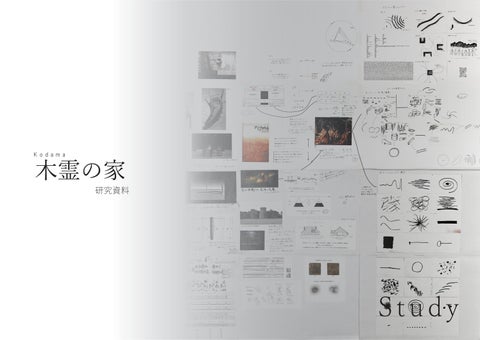
木霊の家
研究資料

This design was based on a video of an existing wooden frame that once existed in Tokyo Gaienmae, which was used in Ryoji Suzuki's "Absolute Site" (1987), as the only documentation of its existence, and was designed with the actual construction in mind. I selected this legendary work, which has formal similarities with the absolute site but is little known due to its brief exhibition only, as a stage to output my past research while exploring its possibilities in the modern age. (If you are interested, please click the QR code below right to watch the video.)
To give an overview, in 1987, a wooden house was demolished and a new building was constructed on the site, a common scheme in the modern era. Ryoji Suzuki decided to call a halt to this plan, and instead of destroying the house, he demolished it, leaving only the wooden axis intact, in an attempt to rewind the act of construction. He then placed metal wires for the purpose of a short-term earthquake-resistant structure, and inserted glass panels of six-thirds glass on the first floor only, using T-shaped steel bundles in key places throughout. Afterwards, the glass floor was broken with a hammer in front of a crowd of people who were attracted to the architecture without knowing the specific intent of the project, and this was captured on video. This goes beyond the meaning of the architecture and leads us to various speculations.
Like "Absolute On-Site," I dare not use explanations, but rather attempt to convey the work through the medium of drawings alone . I was fascinated by the fascination of the design and its strong message in a single 21:08 video. Although it may not be as powerful as this overwhelming work, I hope that it conveys the unspoken enthusiasm of a person who has devoted four years to designing.
Also, although this love will never reach the author of "Absolute Site," Mr. Ryoji Suzuki, cocreator Kyoji Takubo, and all the other people involved, I would like to take this opportunity to express my heartfelt respect to them.
Yusuke Ehara

Until the production of this correlation map(2022/12/16)
This research, which has gradually uncovered measures to find a relationship between architecture and sound (music), has naturally branched out and has become unmanageable. Therefore, rather than simplifying and summarizing, we decided to affirm this complicated situation once and look back on the past in the order of the numbers in the figure above, and use them as clues for our output.
Art in the Age of Reproduction Technology
DS+R(slow house)
Differences between Western and Eastern views of music
菅木志雄「包囲周閉」
Study of Gagaku
知覚循環
1本の木材を音源
とした空間の研究
Gagaku Notation

correlation map
Study of 105 square timber Annual Ring/Grain Studies Egawa Residence
(each item is presented in chronological order of the time studied)
/Notes for a discussion on the subject of "Architecture and Music
/An Attempt at Gagaku Notation
/The scene of Gagaku "Shoka" tradition (quoted image used)
/Cross-sectional drawing of the Egawa Family Residence
/Attempt of Notation in the Egawa Family Residence
/Analysis of deviation points in wooden frame
/Experiment of replacing sound field with magnetic field
/The relationship between the disappearance of AURA and reproduction technology (arrangement)
/John Hayduck research
/Wood scans from a home improvement store
/Wood grain/annual rings of wood
/Anemic Cinema (using quoted images)
/Rotation experiments
/ synonyms for "sound/music" drawing
/Form/idea drawing from letters
/Form from letters / form study
/Form from sound / Idea drawing
/ Form from sound / form study
/Conclusion of morphological analysis
/Three Elements of Sound Drawing
/ Tentative concept
/Thinking of the Mono-ha (Shio Suga and Tomonori Kimura) (use quoted image)
/ "Cognitive Composition
/ Study Model with Wood Cognitive Diagram
/ "Eye Blink" by Yoko Ono (image used for citation)
/ "Absolute Field" (image used for citation)
/Compression Diagram of Time
Items marked with "*" (use of quoted image) are indicated on the page from which the quoted image was taken.


▶雑誌『建築文化』1997年12月号に掲載された建築と音楽の関係性について議論する論考をすべて読む(12作品):音楽と建築に対する研究を行うための土台を作る


▼ Research to find the unique form of Gagaku music "Koshitenraku" by representing each part of the music in graphic notation.


▲Oral tradition of "shoka": sound holds meaning and concept, but does not evoke anything concrete
1間(ここでは約1,885mm)

Family Cross Sectional Chart Launch ⅰ: Making the Japanese shakuhan system familiar to the hand. Experiments to explore the relationship between objects


▲Egawa Family Cross-sectional Diagram Start-up II: Familiarizing the hand with the Japanese shakuhan system. Experiments to explore the relationship between light, wind, and heat


2022年
238.95×112.5mm Ball point pen / Tracing paper
貫の痕跡 Yusuke Ehara


248.609×207.9mm Ball point pen / Marker / Tracing paper 2022年
Yusuke Ehara
▲Arrange the drawings of the Egawa family residence by component and attempt notations.
(The above five works are based on actual measurements and the report on the repair work of the Egawa family residence.)

Yusuke Ehara 201.25×140.25mm
Ball point pen / Marker / Tracing paper 2022年
▲The stones used for the foundation of the Egawa family residence were buried in the ground:
This was an opportunity to consider time and drawings in parallel.


▲Investigating deviations in wood-frame construction: sketches exploring dissonance in architecture
▼Study of foreign matter: sound field → magnetic field, sound source→magnet, sound spread/interrelationship→iron sand


▲The Role of Gagaku Standing and Poetic Texts: A Study to Explore the Relationship between the Loss of Aura and Reproduction Technology in the Arts in General (Including Music/Architecture).
Research to explore the relationship between the disappearance of aura and reproduction technology in the arts in general (including music/architecture). Perspectives on comparative art theory. ヴァルター・ベンヤミン「複製技術の時代における芸術作品」『複製技術時代の芸術』 高木久雄・高原宏平訳、佐々木基一編、晶文社、1999年参照


◀▲Research
on John Hayduck (architect)
I analyzed the relationship between music and the forms Haydak creates using sketches and other materials. (The sketches are used to feed the forms.)

▼ I was given a piece of wood that had deteriorated over time at a home improvement center.
One piece of wood contained a variety of information.


▲Write down the annual rings and stripes on a piece of wood one by one.
Know that there is information that cannot be captured by sight alone. Relation to unfocused experience
右下QRコード内動画切り抜き引用

▲Anemic Cinema: Read backwards, ameniC cimenA, is not unidirectional but omnidirectional, like music. Figure images that appear to move smoothly when rotated.


▲ Rotation experiment: a rotation was applied with respect to the approximate center of the annual ring with reference to the Anemic Cinema. It was found that it did not have omni-directionality like music. Discovery of a connection with Gagaku
❶観念ドローイング
ⅰ文字からの形態
❷形態スタディ
③観念ドローイング
ⅱ音からの形態
▲Form Study (Study from Letters_Conception Drawing) Study on the "form" of sound from "écriture

◀ Searched the Internet for "sound/music" and came up with the following synonyms: Since the way we perceive sound varies gr eatly depending on individual emotional fluctuations, we thought that an exhaustive research method would be effective.


▲Conceptual Drawing
A drawing of a conception: something that could not be shaped, but could be expressed with two-dimensional information.
❶観念ドローイング
ⅰ文字からの形態
❷形態スタディ
③観念ドローイング
ⅱ音からの形態
��い����(�)
��(�)
����が��が�����を����る
まるで��の��な��を�る

整列した柱にいらないものが挟まれている
リズムを持った柱(等間隔で並ぶ)
夾雑物(ノイズ / 不協和音)


整っていない��を�いる �しず�����る ����が�の���でも�れる �な���が���る �ら�な��が���る
リズム���の��を持�


▲Form Study: Red columns as sound sources
We were able to classify them into 20 types as elements (continued on next page)


❶観念ドローイング
ⅰ文字からの形態
ⅱ音からの形態
❷形態スタディ
③観念ドローイング


▲Conceptual drawing: Listen to each of the six "Gagaku" instruments for one second, Draw a picture with a makie within a certain time on a paper of a given size (continued on next page)


▲Listen to Gagaku for 1 second and represent it in the form Summarize what each has in common, etc.
❶観念ドローイング
ⅰ文字からの形態
❷形態スタディ
③観念ドローイング
ⅱ音からの形態
▶Sketch of a conceptual drawing on p29-32 in three dimensions
: Going for a direct form. I made the sketches while being conscious of the fact that they existed in reality, not in a singular form.
(continued on next page)


▲Three elements of sound form (hypothesis) : The findings in the morphological analysis on p22-36 indicate that the sound element is completed by three elements.

Elements


Elements of Sound Form Image Drawing (all)
木材認知図・寸法・視野の領域の角度
のみで構成された世界の建築


装置としての空間
3寸5分材(105角材)


物質的なの建築(形態が音を想起させる)
実空間
▲Tentative Concept - Architecture to connect to each idea I would like to create an architecture that does not impose a sound image, but rather creates an opportunity for people to recall their own images.
どこか(観念世界)

そこ(建築空間)
木材は「自然」であり、その一部でもある「もの」。
木材は斜交いとしての機能を有しているが、
少し押したら落ちてしまう無意味さも有している
その無意味さに気づくと、入れ替わるように
外の風景を〈見る〉。
ここで人は、観観念的な「自然(世界)」を見ている。
木材は体験者をどどこかへと接続させる媒介である。 求心性を持っていない。
ここ(体験者/居住者)
▲Reference 1: Kishio Suga, "Infinite State: A "thing" with spatial expanse. https://www.tokyoartbeat.com/articles/-/an-introduction-to-mono-ha
どこか(観念世界)

そこ(建築空間)

ここ(体験者/居住者)
https://www.kishiosuga.com/installations-concealed-and-enclosed-surroundings-1997
▲Reference 2: Kishio Suga, "Encircling Perimeter: A "thing" with spatial expansion

同じ形態を持った違う素材のモノたち。
この中には、①木目のある板と②木目の写真があった。
それらの関係が空間的に拡張されたとき、
〈現実〉と〈虚構〉の弁証法によって生成される空間での
経験の仕方が“分分からない”。
「そそこ(建築空間)が“分分かる“」を無効化する。 そこ(建築空間)
ここ(体験者/居住者)
②の所在は観観念世界であり、空間を再構築し、
体験者は観観念世界との結びつけを深める。
▲Reference 3: Yuki Kimura, "post disembodiment": Blurring the line between there (architectural space) and somewhere else (conceptual world) https://www.takaishiigallery.com/jp/archives/3683/

The "Perceptual Circulation" Model
① 予期により活動を方向づける図式(スキーマ)を予想 (人の記憶や知識に寄与するため、時間的広がりを持つ) ② それをもとに探索(五感を用いた調査)を行い対象を観察する
③ 探索の結果は元の図式を修正する
④ ①から反復する(より多くの情報を取り入れる)

▲U. Neisser, "Composition of Cognition": U. Neisser, known as the father of cognitive psychology, proposed the "perceptual cycle" model, which incorporates the active activities shown in the above figure into the perceptual model, regarding cognition as a continuous process of anticipation, exploration, and information extraction. This is a very good way to systematize the human senses

Perceptual Circulation + Form Study Model
初期、微視的な部分に知覚循環を当てはめる図式を音から想起され るイメージ※に置き換えそれを体現するための探索を行い、部材が 持つ潜在的音性が強調されるような形態を試行する
知覚循環から連続的に形態スタディに移行する
▲A model of form study using perceptual cycles: Perceptual cycles are things that are expressed when humans perceive things, and in a broad sense, the act of creating architecture is also a kind of act of perceiving things.

▲Wood Placement and Cognitive Processes for Study: Revealing the latent soundness of the members using U. Neisser's "Composition of Cognition".


▲Wood Placement and Cognitive Processes for Study: Revealing the latent soundness of the members using U. Neisser's "Composition of Cognition".
視覚 光 秒速約30万km
聴覚 音 秒速331.45m
圧縮された距離ができる Ⅰ 遠距離視覚
Ⅴ 接触(触覚)
Ⅵ 想像
この距離を埋めるための装置
33.145m 0.1秒/音速の空間
◀▲Compression of time by the difference between the speed of sight and hearing: flipping the speed of sound and light into distance. Later, we will discover similarities with Ono Yoko's "Eye Blink
Maximum Eye Rotation
Normal line of sight Sitting Normal line of sight Standing Standard Line of Sight
Maximum Eye Rotation
Optimum Eye Rotation

標準レンズ:一番人間の視野に近い
日常生活での有効視野のイメージ
▲Research on the extent and degree to which people can see objects (Increasing our knowledge of hearing, in turn, requires a detailed knowledge of vision.)


A model of experimental space based on wood cognitive diagrams: forms are also created to create experimental devices and fall into paradoxes. And its groundedness is required. The groundedness o f this apparatus was fragile.
▲Yoko Ono-1966-Eye Blink


In a moment of time when you close your eyelids, familiar things begin to look different. This work shows the relationship between architecture and the compression of time.


▲"Absolute Site" by Ryoji Suzuki
A work that sublimated a wooden shaft used as a house for a long time into an exhibition space by exposing it.
I felt similarities with my own research this time.
解体年:1987 年
場所:東京都渋谷区神宮前2丁目4-12 かつての用途:住宅

木造の寸法 maximum minimum
音の寸法
340,000 mm /1秒
木軸をリズムとして捉え、音速と言う速度の
寸法を木軸に挿入する。
建築内部の密度を上昇させる
▲Compression diagram of time
Sound enters the existing wooden shaft (absolute site) and, in turn, time compression occurs due to the collision between sound time and the dimensions of the wooden shaft.


翻って、時間が圧縮され、 今まで見ていたが、注目していなかった
物を認知し始める