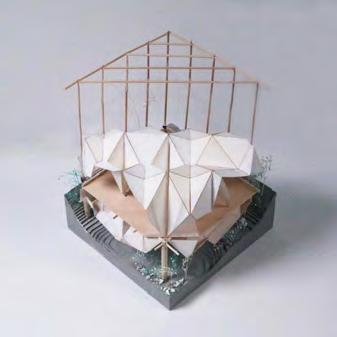
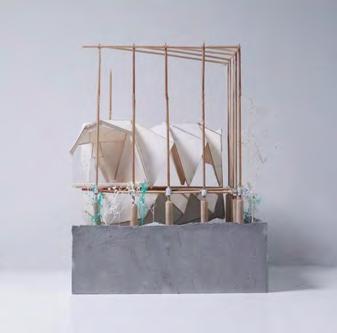
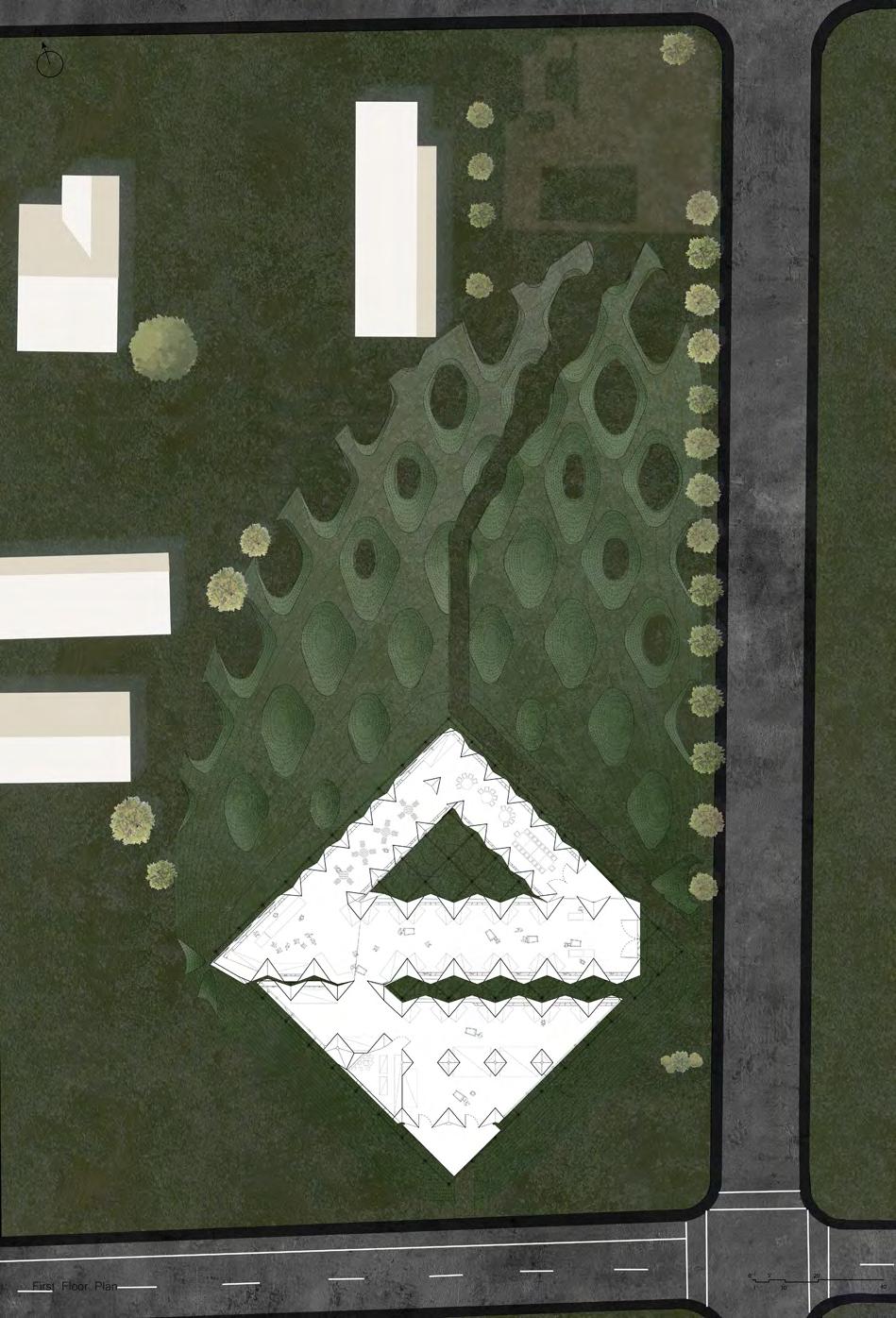
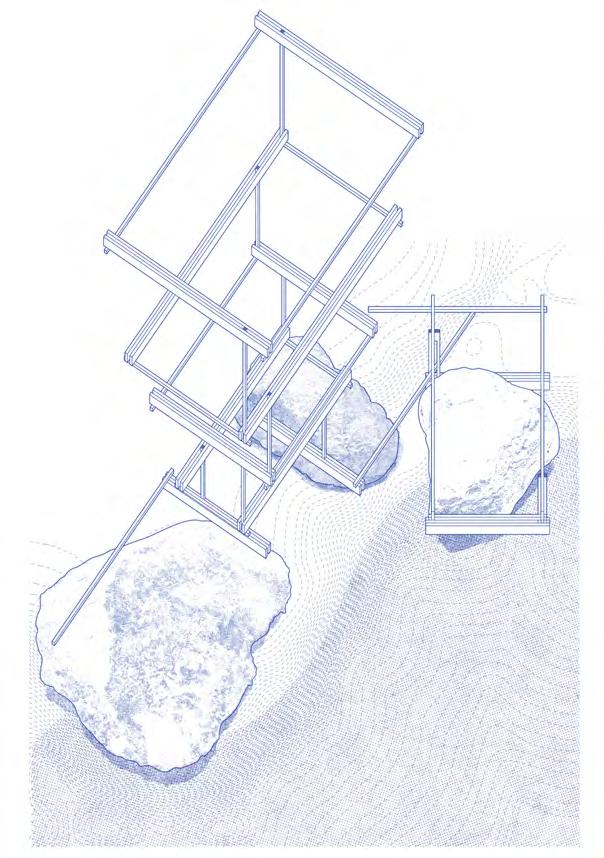
I am writing to recommend Kelvin Duan with great enthusiasm. I had the pleasure of working with him as an instructor at the Syracuse University School of Architecture, where he was a student in the option studio ARC408, “Seaside Adaptations: Between publics, leisure and infrastructure,” taught during the Fall 2025 semester. Over the course of the term, I was able to closely observe his intellectual growth, design rigor, and commitment to architectural inquiry, and I am confident he would be an excellent addition to a professional architectural environment. His application has my strongest support.
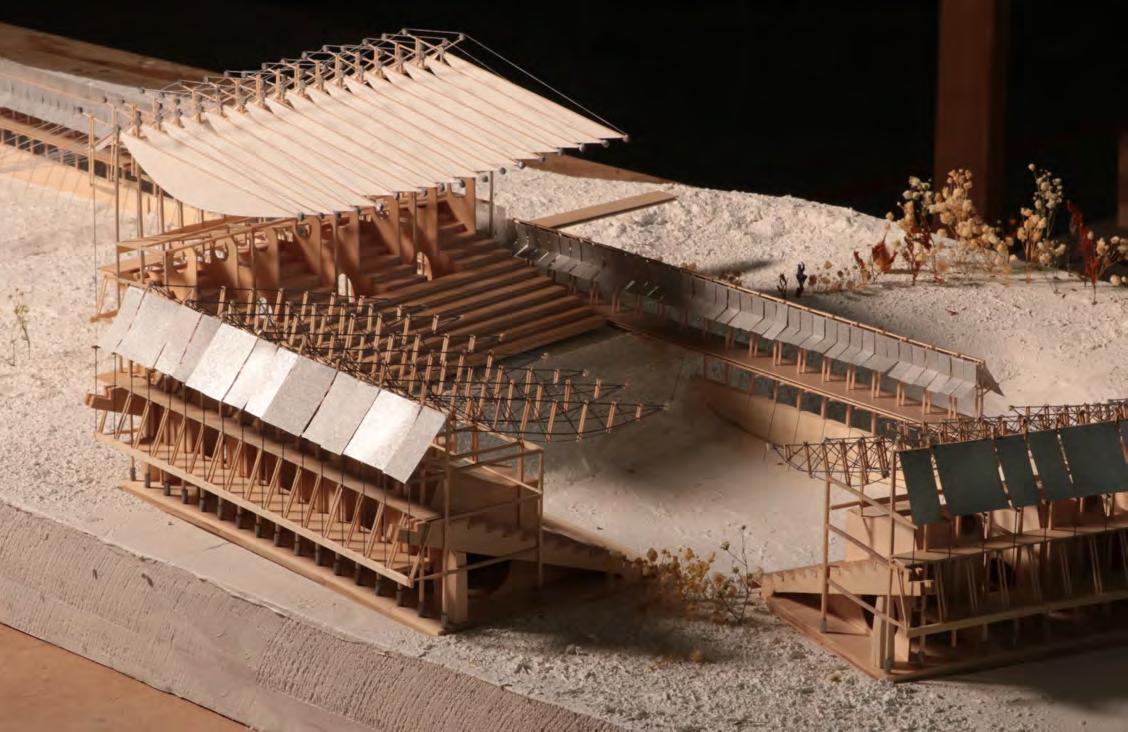
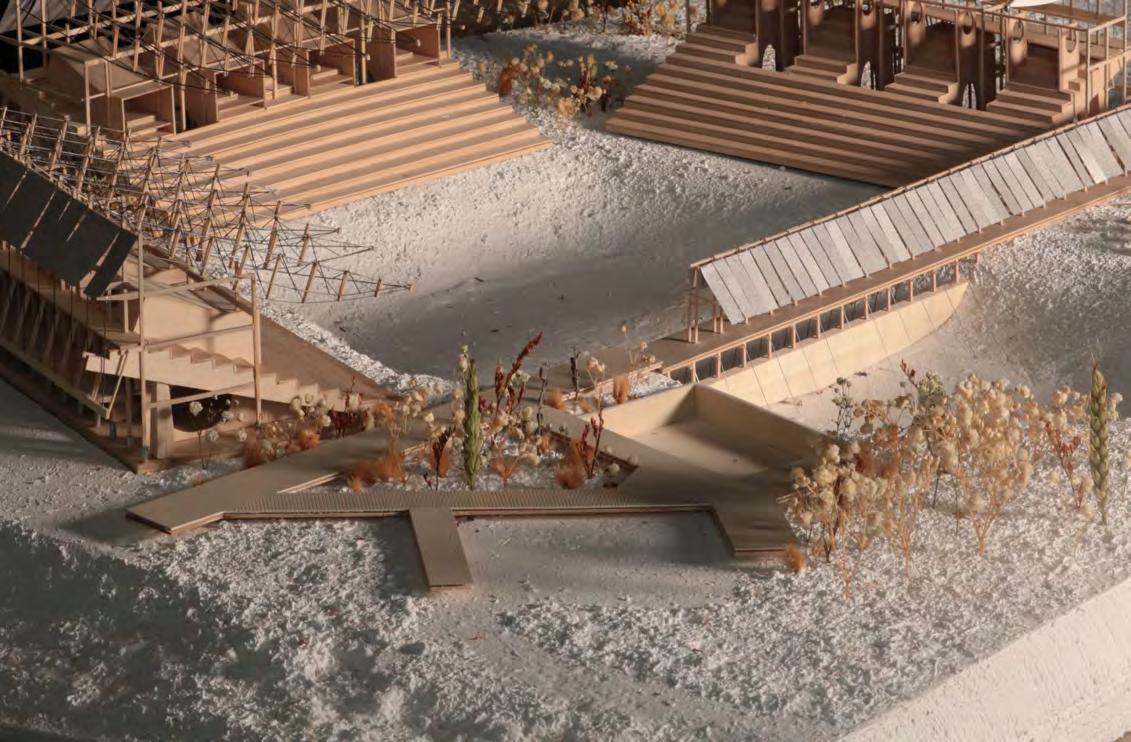
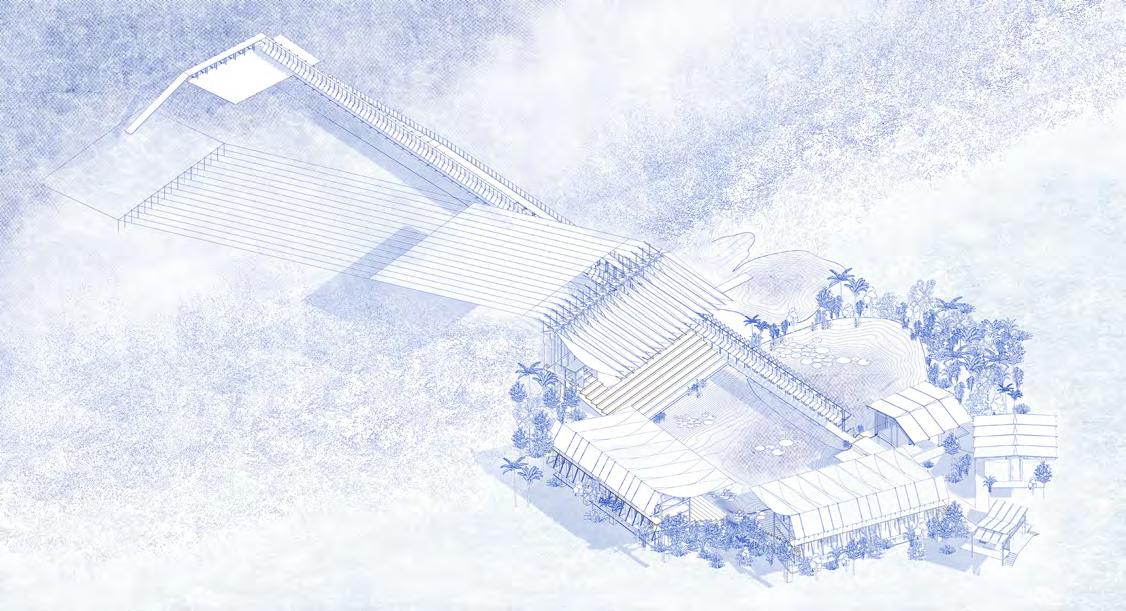
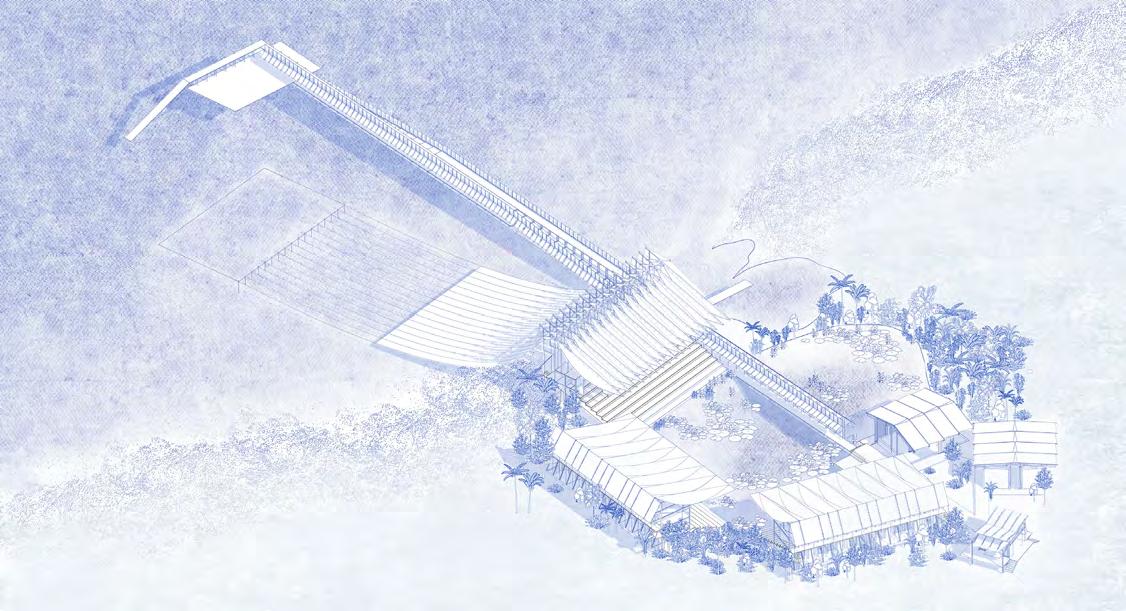
Kelvin approached the studio with curiosity, discipline, and a strong sense of purpose. His project proposed a speculative yet grounded rethinking of coastal conditions in Biscayne Bay, developing an adaptive reuse framework that engaged existing infrastructures while opening them to new public and environmental possibilities. His work was supported by careful research, iterative model -making, and a clear command of drawing and representation across scales. He demonstrated an ability to synthesize complex c onstraints into coherent architectural propositions, while remaining open to critique and refinement throughout the semester. I want to emphasize his unique rendering skills, as well as conceptual clarity at early stages.
As part of the studio, we traveled to Miami, where the students’ projects were presented in a public exhibition setting. Kelvin distinguished himself during these events through his ability to articulate ideas clearly and thoughtfully to a broad audience, including educators, community members, and local stakeholders. His presentations were confident yet measured, and reflected a deep understanding of both the social and spatial implications of his work. In addition, he consistently contributed to a positiv e studio culture, offering constructive feedback to his peers and engaging collaboratively in discussions.
Based on his performance and professional attitude, I believe Kelvin is very exceptionally well prepared to undertake an internship and a junior architect position, as part of the five -year Bachelor of Architecture program at Syracuse University. I am confident that he will approach professional practice with the same seriousness, creativity, and critical engagement that he brought to the studio, and that he will make the most of any opportunity to learn and contribute.
Please feel free to contact me should you require any additional information.
Sincerely,
Pablo Sequero, Principal, founder, salazarsequeromedina
Visiting Critic, School of Architecture Syracuse University
Yuqi is a Syracuse University student pursuing a Bachelor of Architecture (B.Arch'27). He has led a nationally award-winning design team and completed internships in Switzerland and China, including positions at Herzog & de Meuron in Basel and OPEN Architecture in Beijing.
EXPERIENCE
He has contributed to conceptual design development, preliminary research, and BIM workflows. His interests focus on localized design strategies, material tectonics, and an intellectual dialogue with site context.
Herzog & de Meuron Ltd. Arkitektur Praktikant, Basel, Switzerland
2022 NOMA Student National Competition, Nashville, TN
the Land and Memory"
- Honorable Mention
2023 NOMA Student National Competition, Portland, OR
Facilitated conceptual design of the confidential 690 POSCO Hub Phase II in collaboration with architects. Developed visualizations for client meetings and drafted comprehensive client reports. Contributed to BIM workflow focusing on masterplan, sections, and building enclosures. Produced physical models and mock-ups at various scales.
OPEN Architecture Architectural Intern, Beijing, China
2025 CityLab UCLA "Small Lot, Big Impact" Design Competition, Los Angeles, CA
- Participant - Student Honorable Mention
[Competitions] [Education]
B.Arch'27, Syracuse University SoA | GPA 3.7
- Dean's List 2021-2025 - Outstanding Portfolio Scholarship
Class of 2021, Cambridge School of Weston, Boston, MA
[Exhibition]
"Laboratory of the Future" 2023 Venice Biennale
Conceptual design for a temporary mycelium pavilion situated in front of the American Pavilion, developed as part of the Syracuse Architecture Abroad summer program.
Contributed to the 75% Schematic Design phase of a residential project in Nanshan, Shenzhen. Supported conceptual design for a temporary installation at Powerhouse Parramatta Musuem, Sydney, Australia.
Syracuse University SoA NOMAS Chapter Design Team Chair/E-board member, Syracuse, NY
Led a design team of 5–10 students in the Barbara G. Laurie Design Competitions. Participated in monthly e-board meetings and organized seasonal events to promote the organization.
Acplus Institute of Shanghai Architectural Design & Research Co., Ltd. Architectural Intern, Shanghai, China
Collaborated with structural engineering consultants on a pedestrian bridge design that connects a historical industrial plant adapted by David Chipperfield Architects to a TOD commercial center in Jingdezhen.
"Between
"Vertical Bungalow"
VERTICAL BUNGALOW
"Small Lots, Big Impact" Design Competition
Type: medium-size apartment Year: 3rd-year summer
Collaborator(s): Qilingli Rannia Zhang Site: Los Angeles, CA, US
Student Honorable Mention
FLIPPER? FLIPPED SHOW
Subverting the hierarchy between viewer and subjects
Type: cultural, infrastructure Year: 4th-year studio
Collaborator(s): Qilingli Rannia Zhang Site: Miami, FL, US
THE DRIFTER
Flood-resilient food co-op
Type: retail market Year: 2nd-year studio
Collaborator(s): Individual Site: New Orleans, LA, US
URBAN NEXUS
Co-housing Manhattanies
Type: residential, commercial Year: 3rd-year studio
Collaborator(s): Individual Site: Manhattan, NY, US
OTHER WORKS
Professional Work & Competition
Not A Hotel CompetitionYakushima Island, Japan
Internship WorkOpen Architecture, Beijing, China
FLIPPER? FLIPPED SHOW
An attempt for subversion a manifesto a dance
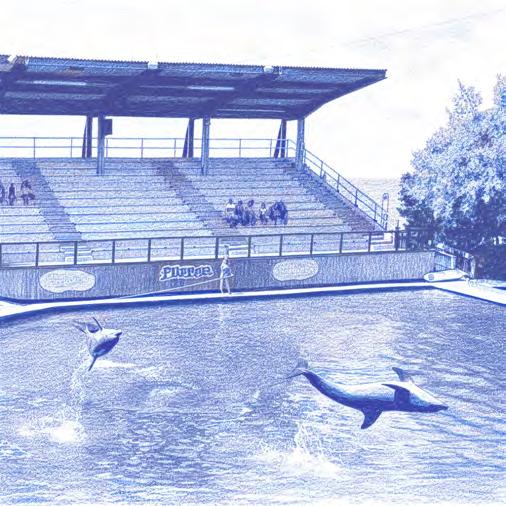
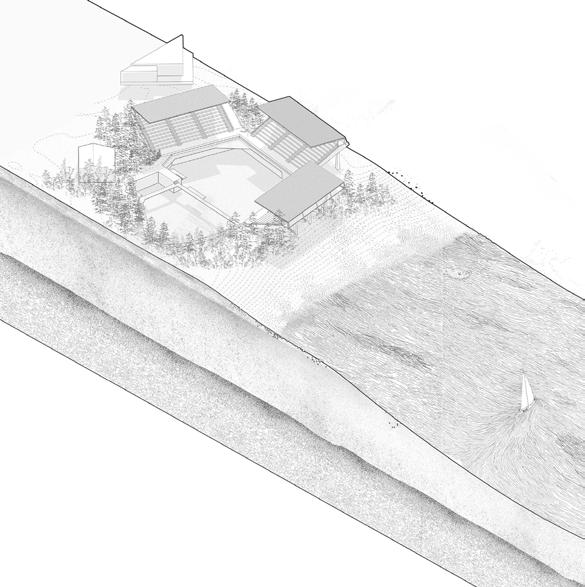
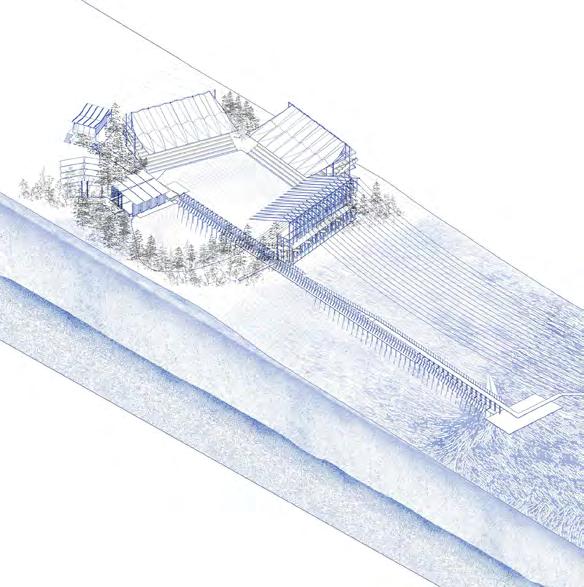
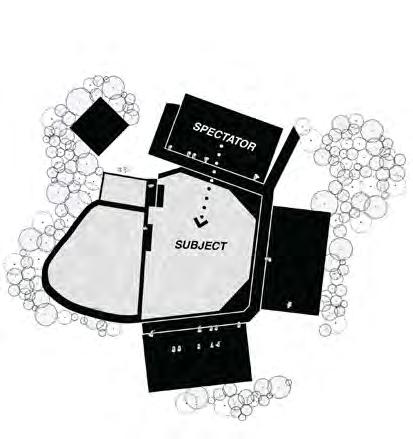
This site was once a theater for a borrowed wildness, where the celebrated intelligence of dolphins was framed as entertainment beneath a towering citadel of bleachers. That structure was a manifesto in wood and concrete: a vertical order declaring humans as detached spectators, life as scheduled spectacle, and the complex estuary as mere backdrop. It was an architecture of separation, elevating the gaze to a position of dominion while obscuring the authentic, interwoven rhythms of the brackish ponds and the open sea. This was not a dialogue with place, but a monologue imposed upon it.
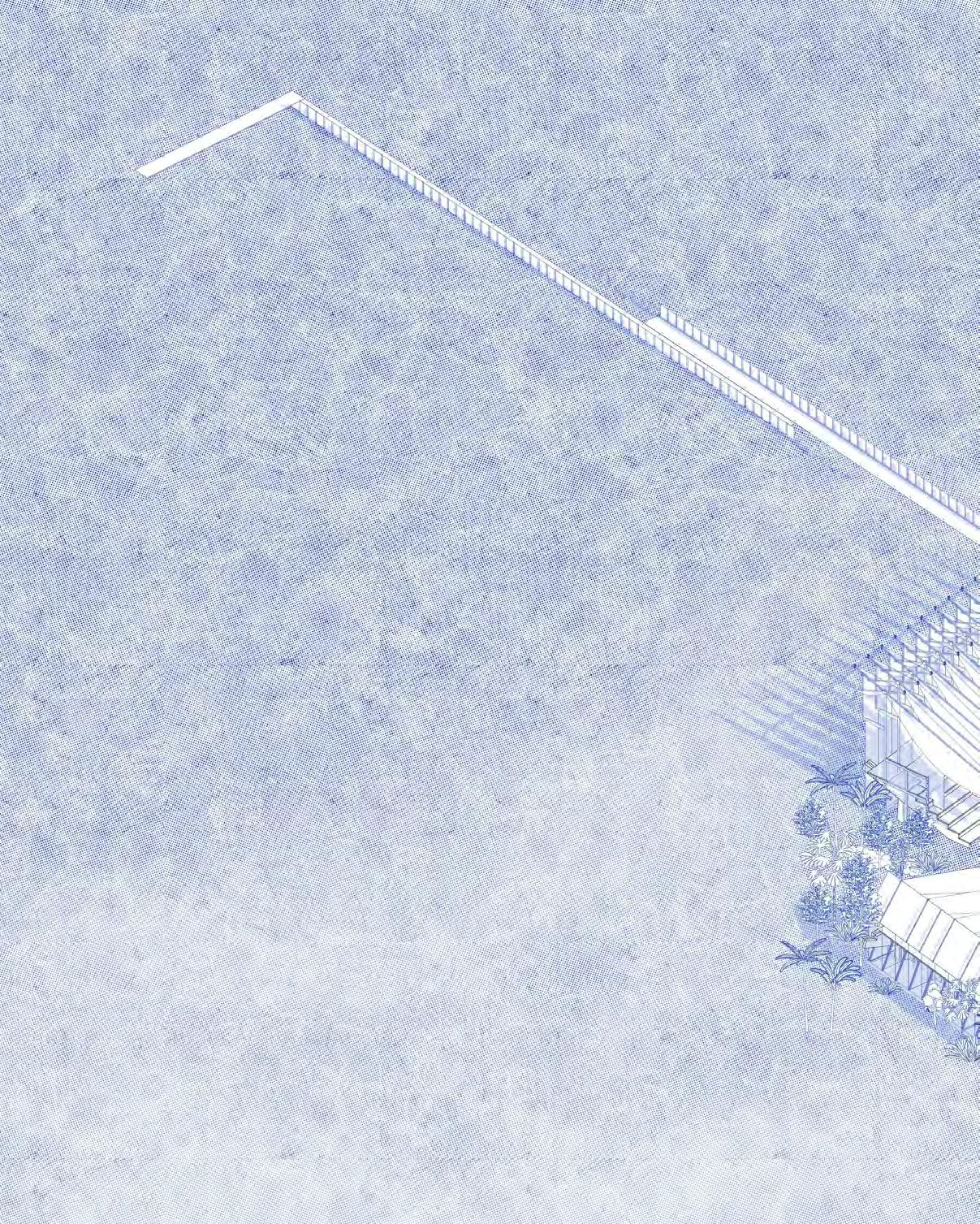
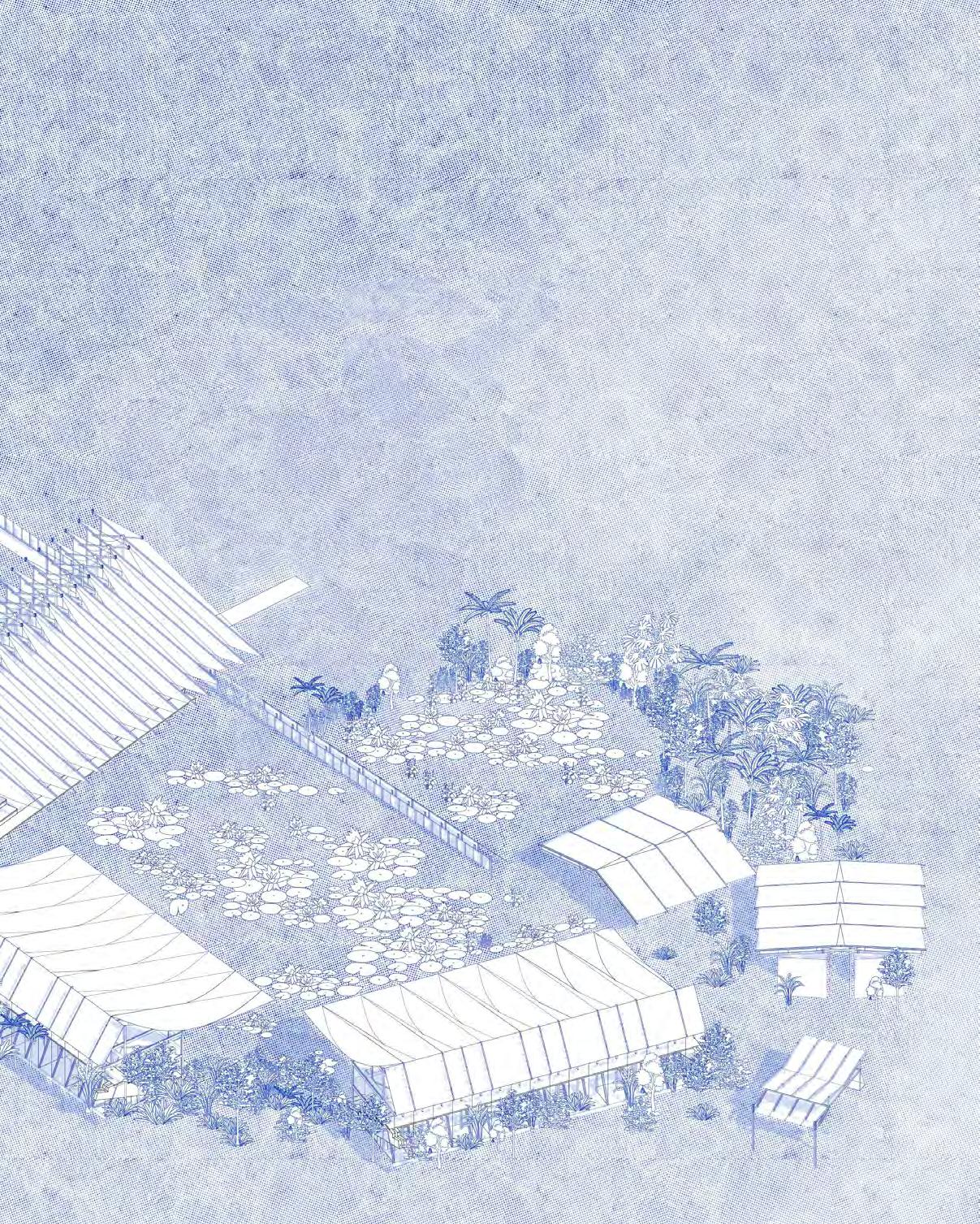
We propose an inversion of that historical hierarchy . The new architecture relinquishes its podium, descending to meet the water at its own level. It becomes a porous framework:a series of passages, platforms, and thresholds designed for subtle mediation. The rigid stage is dissolved into a wandering path that traces the land’s forgotten gradient to the mangrove.
Type: cultural, infrastructure
Year: 4th-year studio
Instructor: Pablo Sequero
Collaborator(s): Qilingli Rannia Zhang
Site: 4400, Rickenbacker Cswy, Miami, FL
Our intervention, thus, begins with a question of atonement and realignment. How can architecture not occupy, but open? How can it foster encounter instead of exhibition ?
In this way, we seek to repair the fundamental disconnect . The new structure is a careful incision, stitching the torn edges of land and sea back together. It is an instrument for listening, built to amplify the enduring pulse of the site itself—a pulse that long precedes the spectacle and will patiently outlast it. This is an architecture of humility, facilitating a renewed and reciprocal relationship with the living world.
[An Obsolete Platform]
A stilted path cast far into the sea. Fulcrum firm-fastened on the reef.
A lattice, a frame— muscular, precise, yielding only to salt's slow rust.
And yet, how laughable: the gentlest current mocks its strength.
Each wave resounds through its bones like cymbals struck in furious unison.
It is hurled high, joints clattering like brittle bones in a spineless body.
Then the tide withdraws. And the dock, magically, rediscovers its balance on a chance corner of the reef—
a miracle for no eyes.
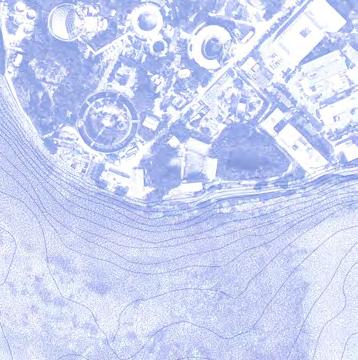
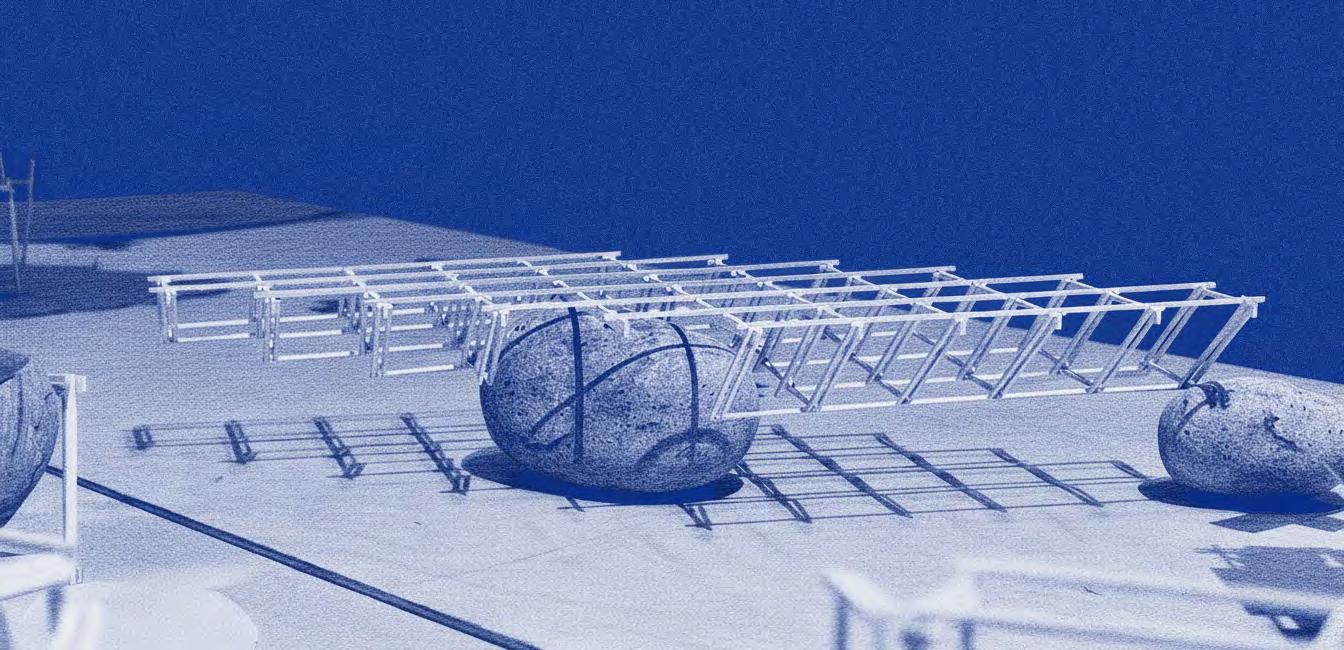
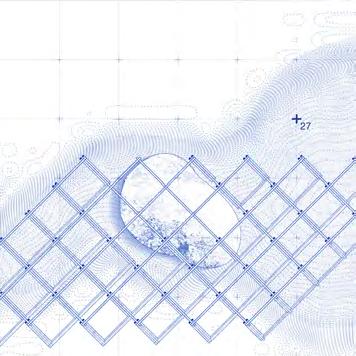
Our preliminary studies began by reading the site's adjacent shoreline terrain not merely as landscapes, but as the basis for an imaginary archipelago —a speculative field condition of rock and tidal memory. This conceptual ground became the foundation for exploring how waterresilient structures might interact with such a condition.
We asked how architecture could engage as a peer within this dynamic system. Rather than resisting the sea as an adversary, we envisioned structures that acknowledge and incorporate tidal rhythms , letting water flow through permeable frames, allowing platforms to float or settle with the swell, and creating spaces that frame the dialogue between solid rock and liquid motion.
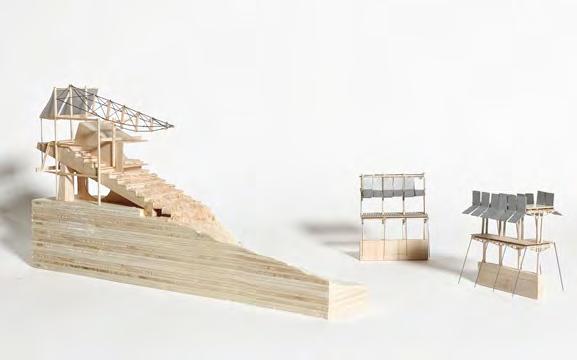
TEMPORAL TECTONIC STUDY MODEL
[Existing Flipper Show Site]
Bisected by a skeletal, temporary floating bridge, the old dolphin pool exists as a poignant tableau of dual confinement. This narrow causeway does not guide; it severs, its path ending in abrupt and deliberate futility against the solid mass of the bleacher and the dense, tangled wall of the mangroves. The intended pilgrimage to the sea is cut short, physically trapping visitors within a manufactured landscape, caught between the gaze of the empty stands and the impenetrable, living forest.
This architectural intervention is a direct, and damning, conversation with the site’s past. The bridge’s false promise of passage mirrors the pool’s original, tragic purpose: the incarceration of dolphins. Here, the memory of those captive animals is made palpable. The water, once a prison for marine life, now becomes a stage for a shared, symbolic entrapment. The human spectator is made complicit, transformed from a free-willed observer into a participant in a constrained environment. The circularity of this experience is inescapable; the very water that held the dolphins now reflects a new form of captivity. In this transformed space, the distinction between jailer and jailed blurs, leaving both human and the ghost of the animal, symbolically, with no way out.
CURRENT SITE CONDITION
INTERVENTION + STRATEGIES
"The
Green Core"
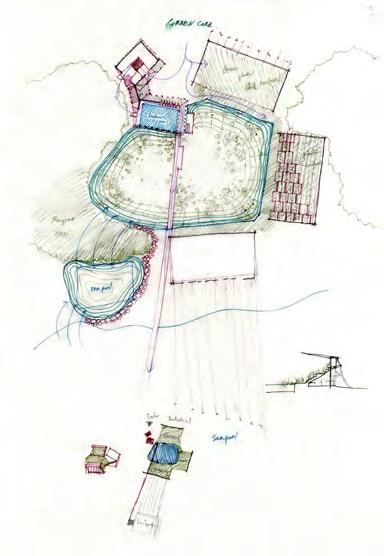
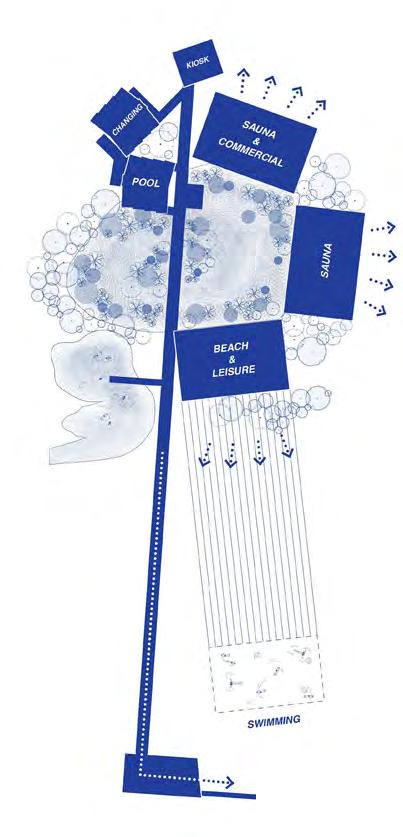
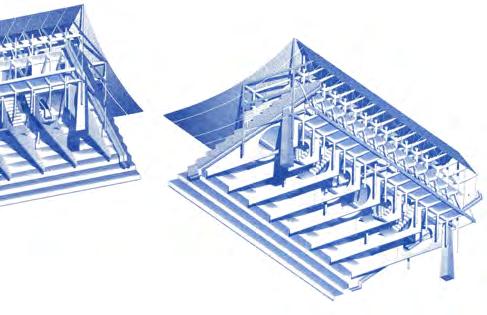
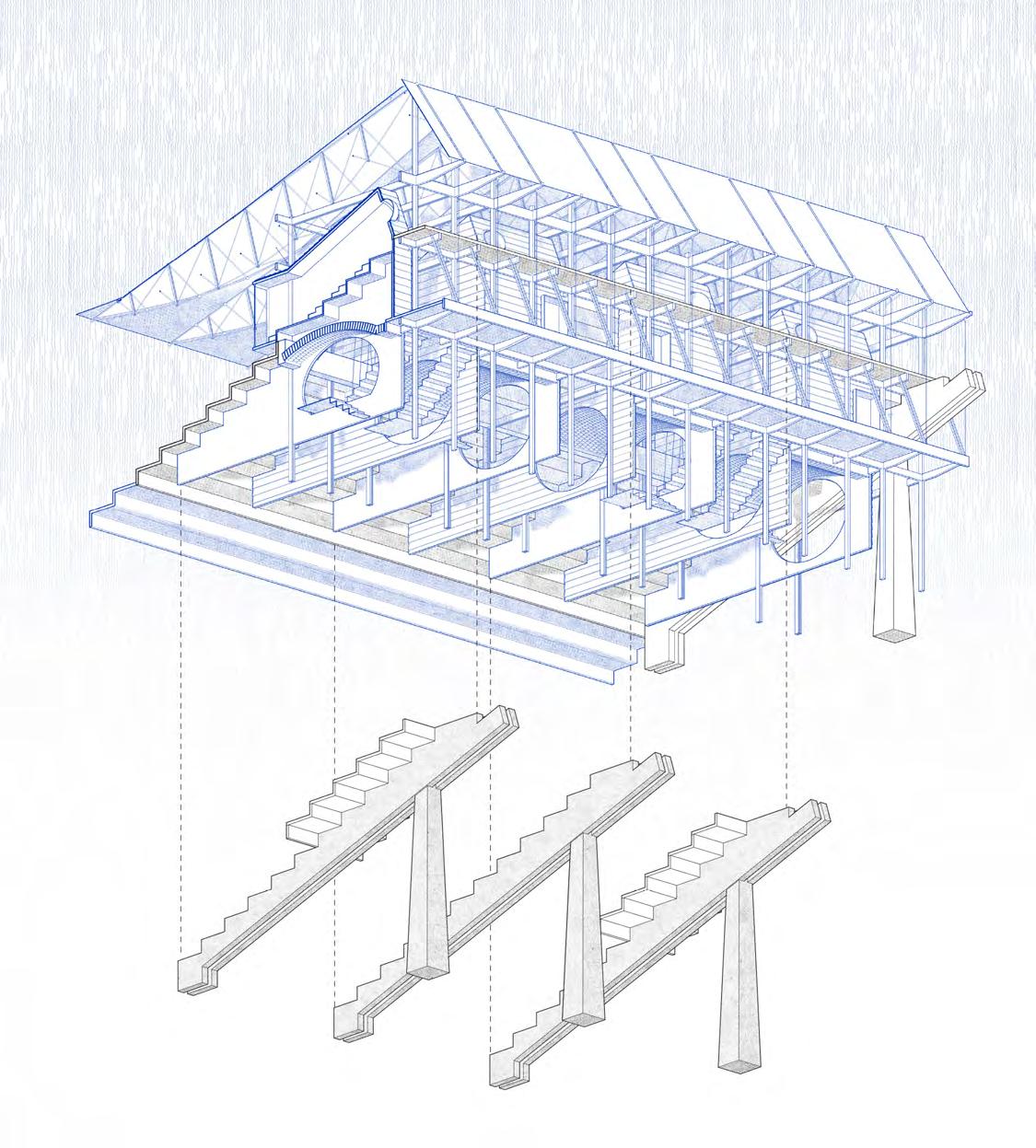
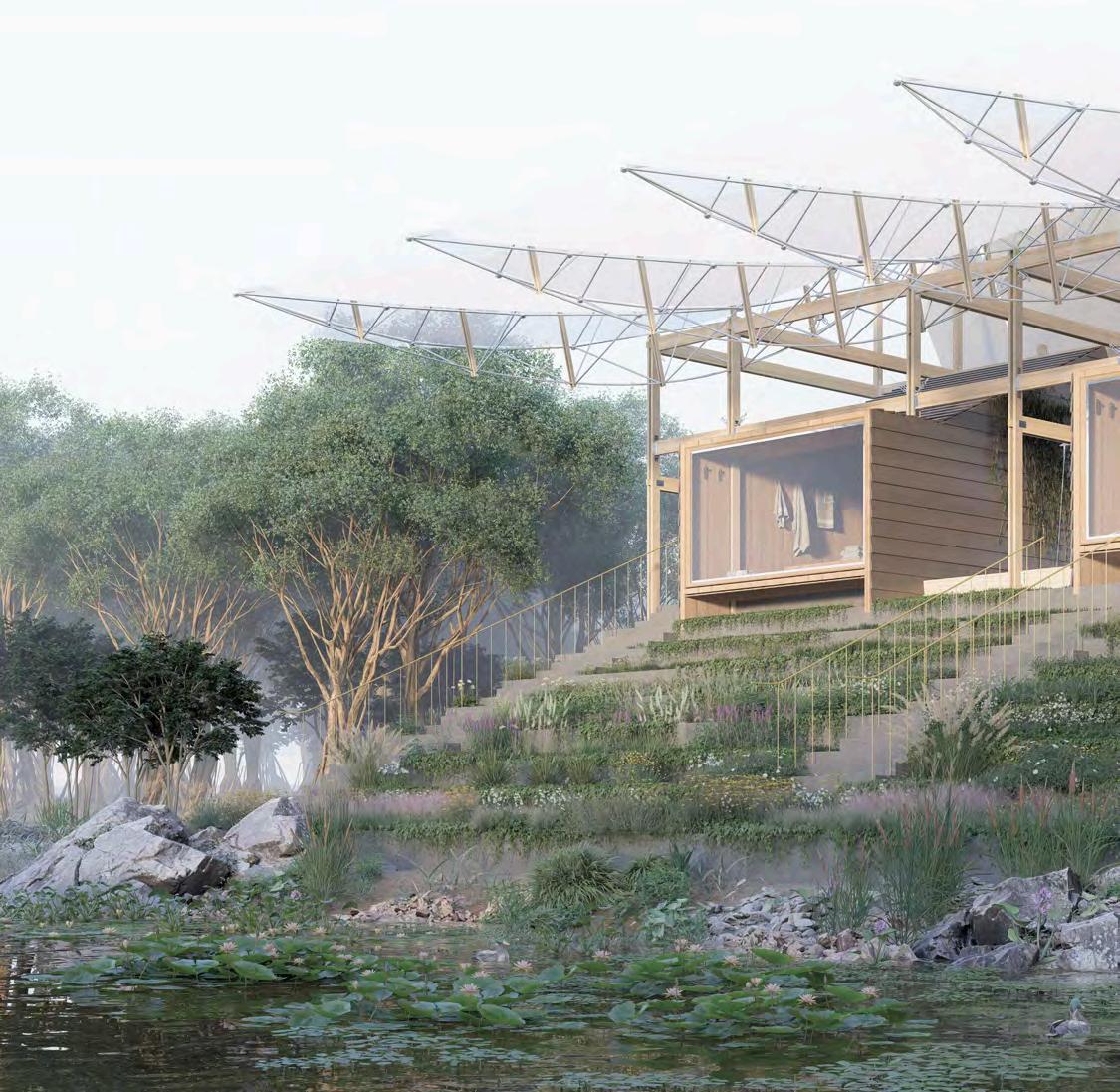
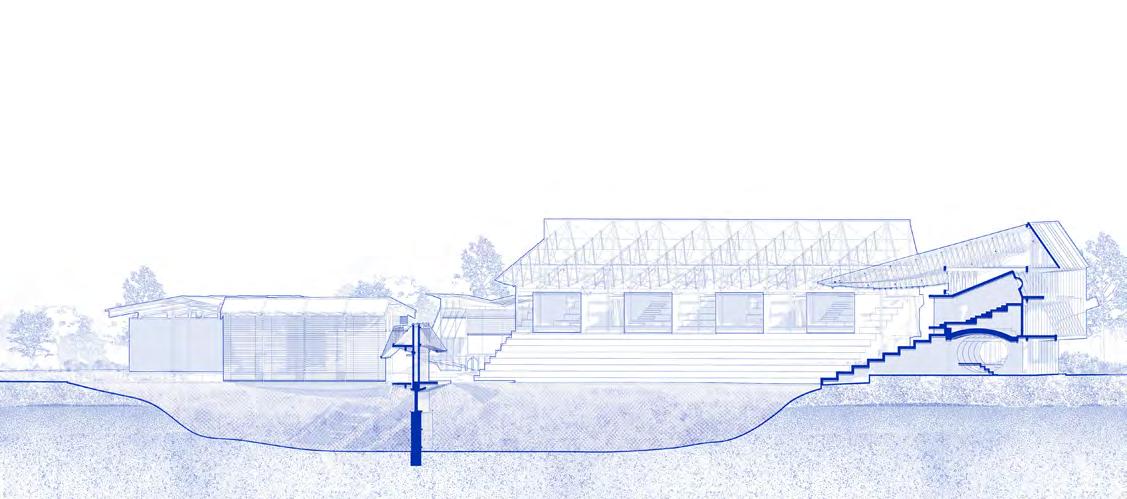
The bleachers are no longer objects for spectacle but are enveloped with native vegetation, dissolving their hard edges back into the landscape. Within this re-greened landform, we have inserted four submerged sauna rooms, using the existing staircases for access to create intimate, sensory experiences focused on the natural environment.
They frame the serenity of mangrove oasis, the lunar pull on the waterline, the resilient push of cordgrass through stone. The visitor is repositioned from spectator to witness, and perhaps, to participant.
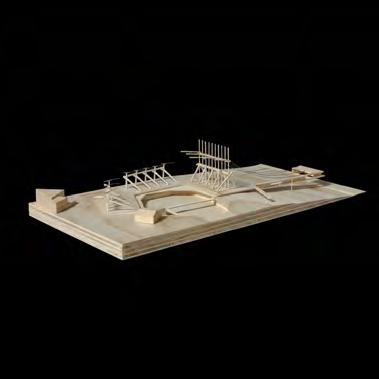
Concept Massing Model 1'=1/32"
"The Axis"
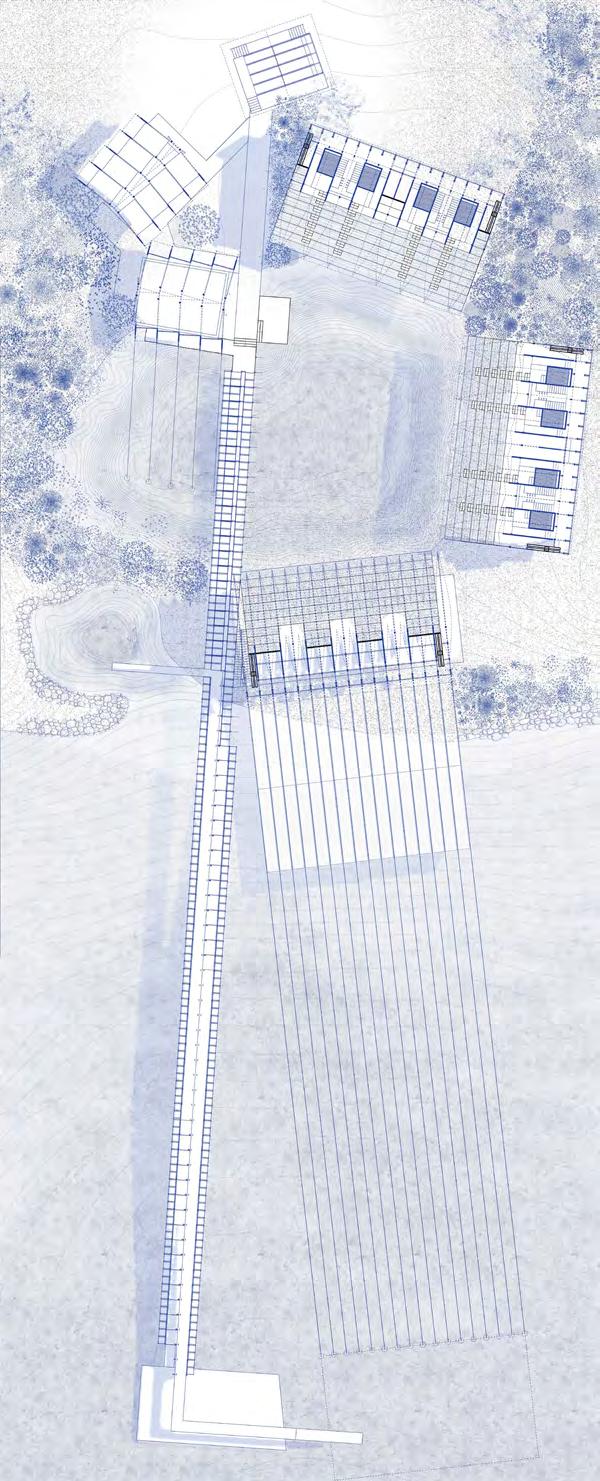
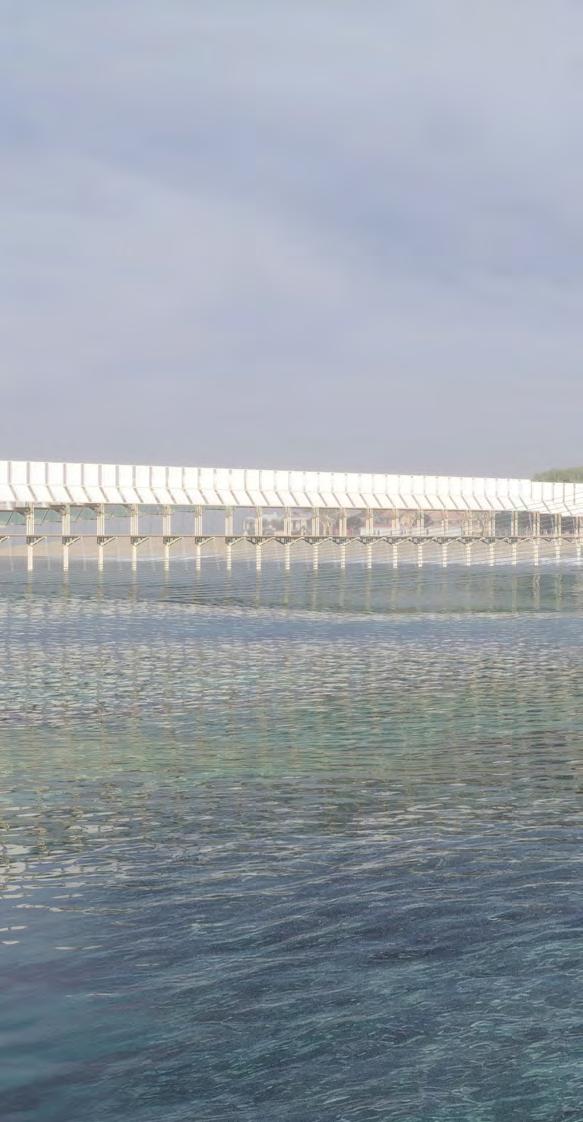
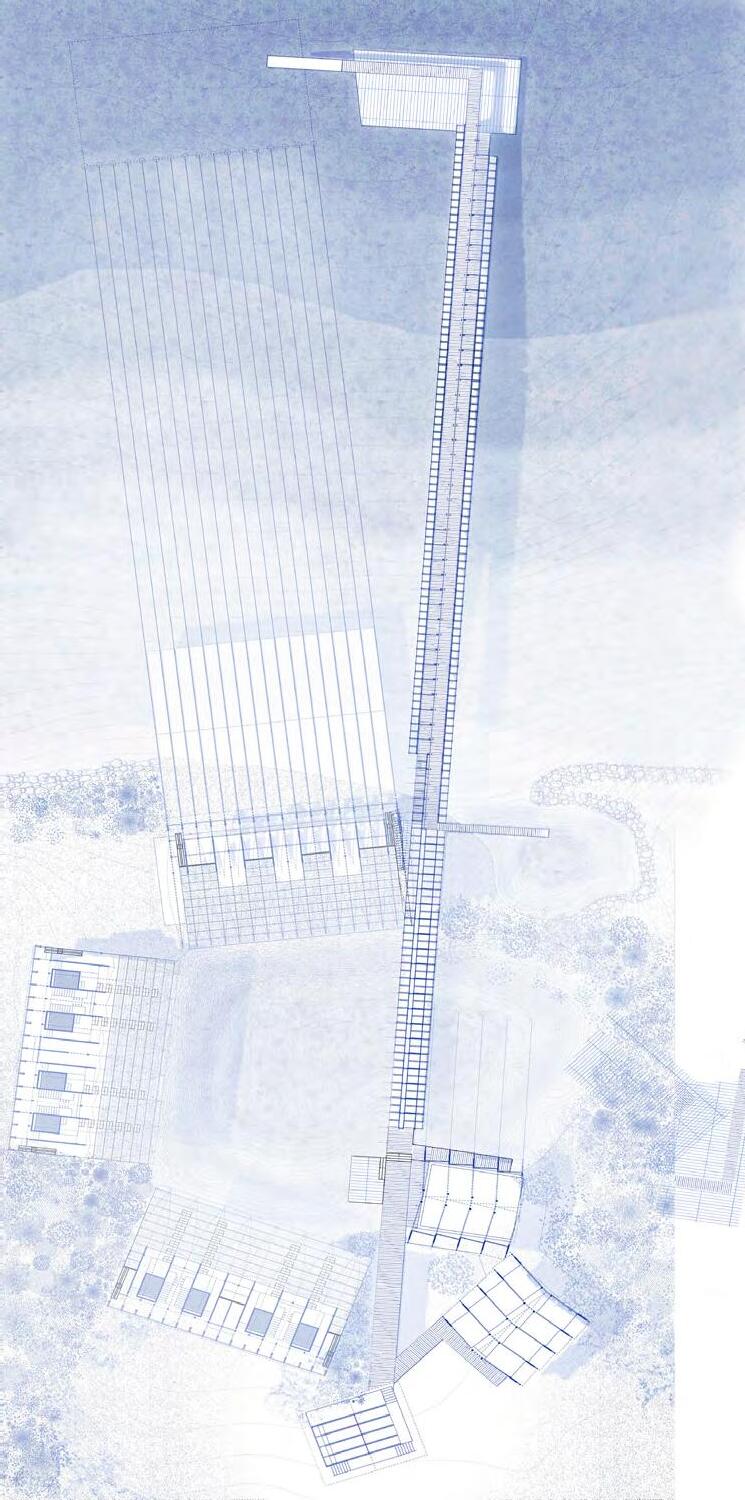
A central bridge, reclaimed from, structurally reinforced over, and extended from the former temporary buoyant bridge at the center of the dolphin pond, serves as the primary axis of the project. It guides movement from the entrance toward the ocean and ultimately connects to a slide that descends into a mobile sea pool. Because swimming in the existing ponds is prohibited, a new sea pool is introduced and enclosed by a ring of retaining stones to accommodate diving activities.
"The Skin"
We operate on the principle that “the site is the quarry,” treating the existing infrastructure as both material and foundation. Rather than erasing or completely transforming it, we propose a new “skin” or veil that overlays and reinterprets what is already there. This approach resists the imposition of a single, universal geometry across the site; instead, it develops a series of nuanced, context-specific strategies for each functional structure.
Schematic figure-ground diagram
Human-nature & spectator-object relationship in the past
Schematic figure-ground diagram
& spectator-object relationship now
BLEACHERS ADAPTATION
"The Billboard"
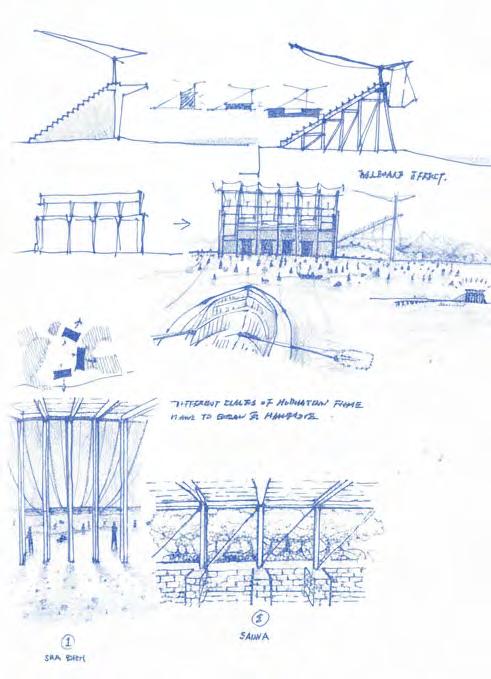
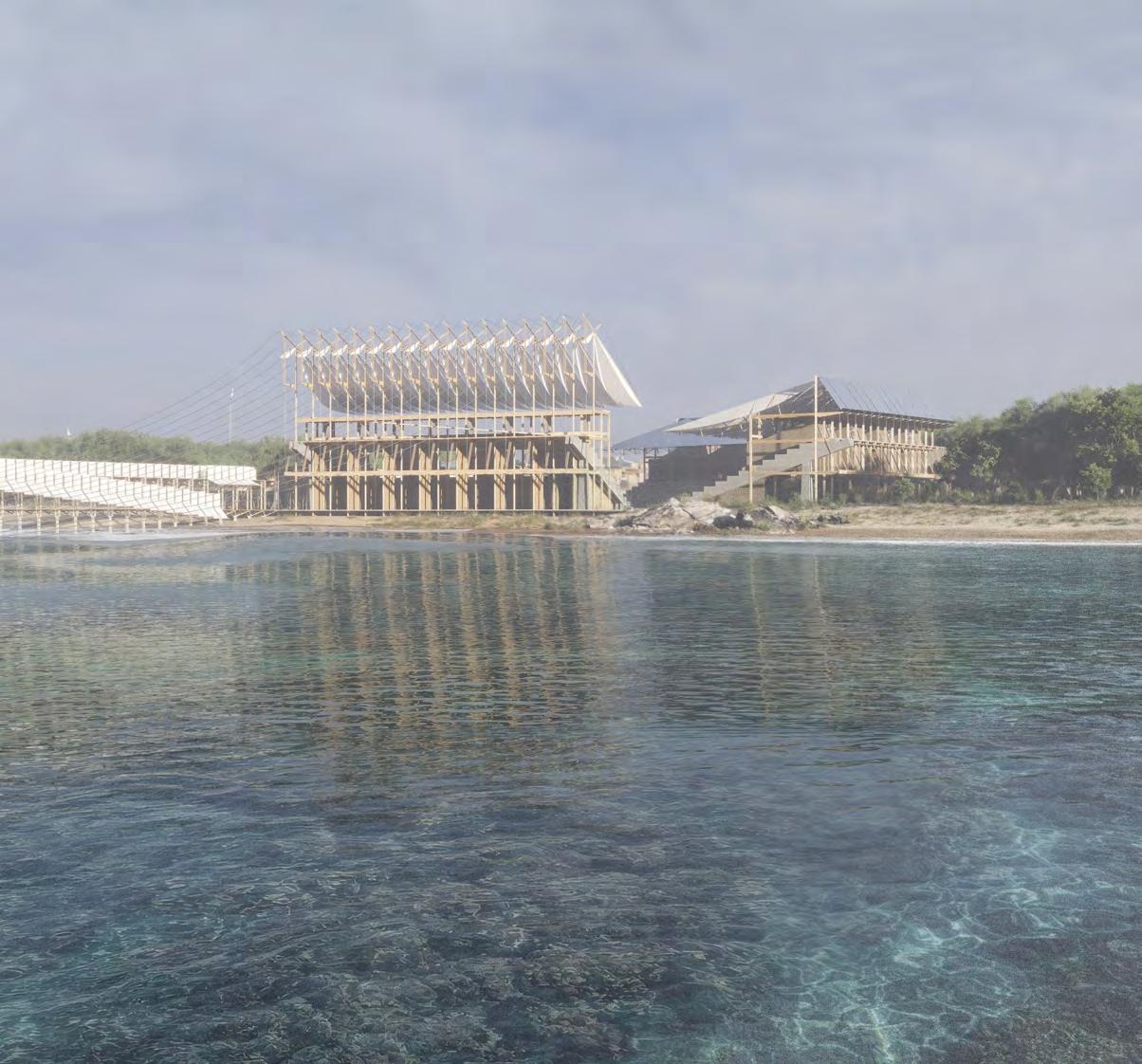
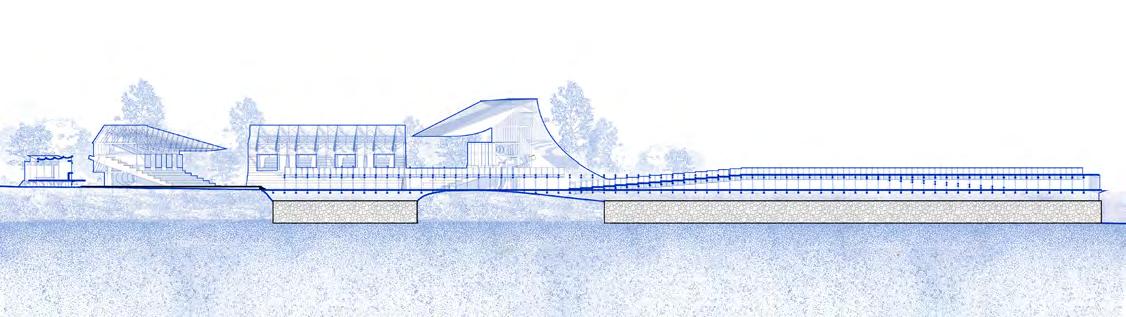
On the southern bleacher, oriented toward the ocean, we reconceived the structure as a billboard that actively communicates with the waterfront. It performs a dual role—a viewing platform high above ground and a projected façade toward the sea . Its stepped geometry and elevated profile were deliberately emphasized to capture the attention of those approaching by boat , transforming it into a recognizable marker along the shoreline.
From a distance, the bleacher reads as a horizontal sign of arrival, signaling the site’s identity before one even reaches the shore . This gesture reinforces the project’s dialogue between land and water, establishing a visual and spatial connection that situates the building within its broader maritime landscape.
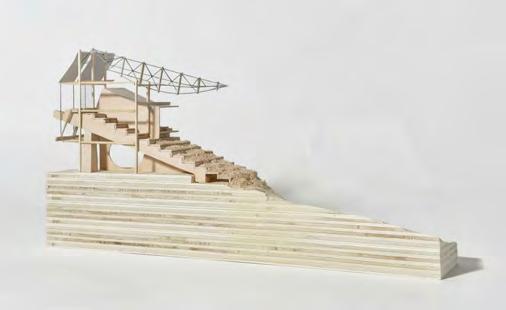
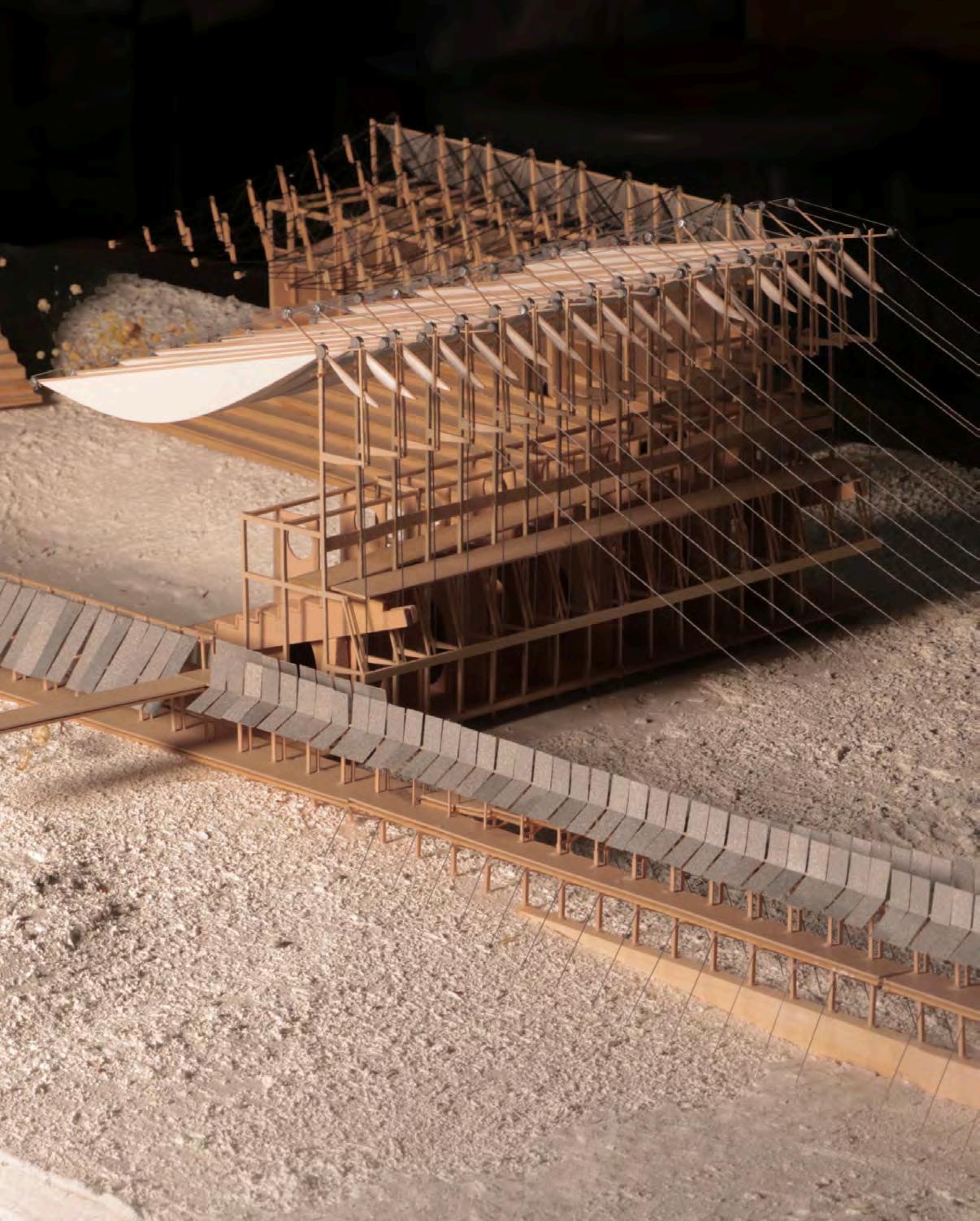
Sauna Bleacher Chunk Model 1'=1/16"
Ship View from the Sea
Long Section A - A towards the sea-facing "billboard" bleacher
BLEACHERS ADAPTATION
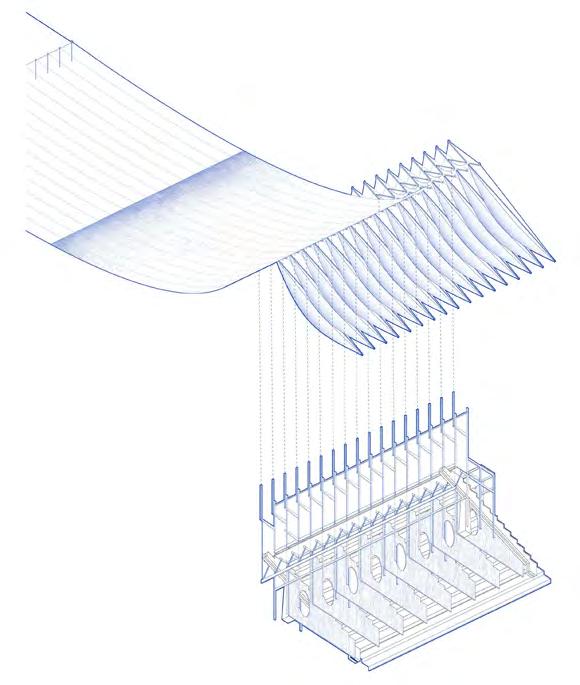
Seaside Bleacher Contractable Canopy Attachment
"The Tuxedo"
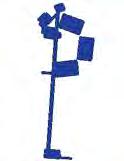
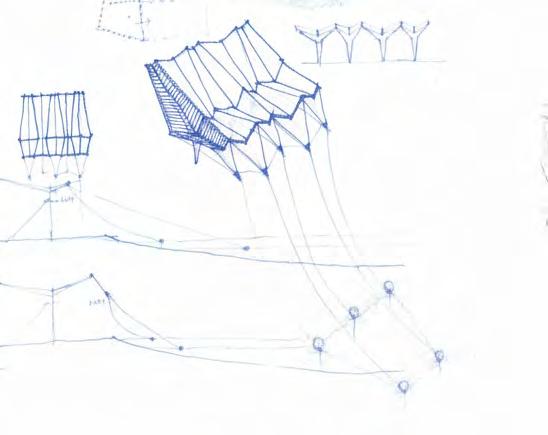
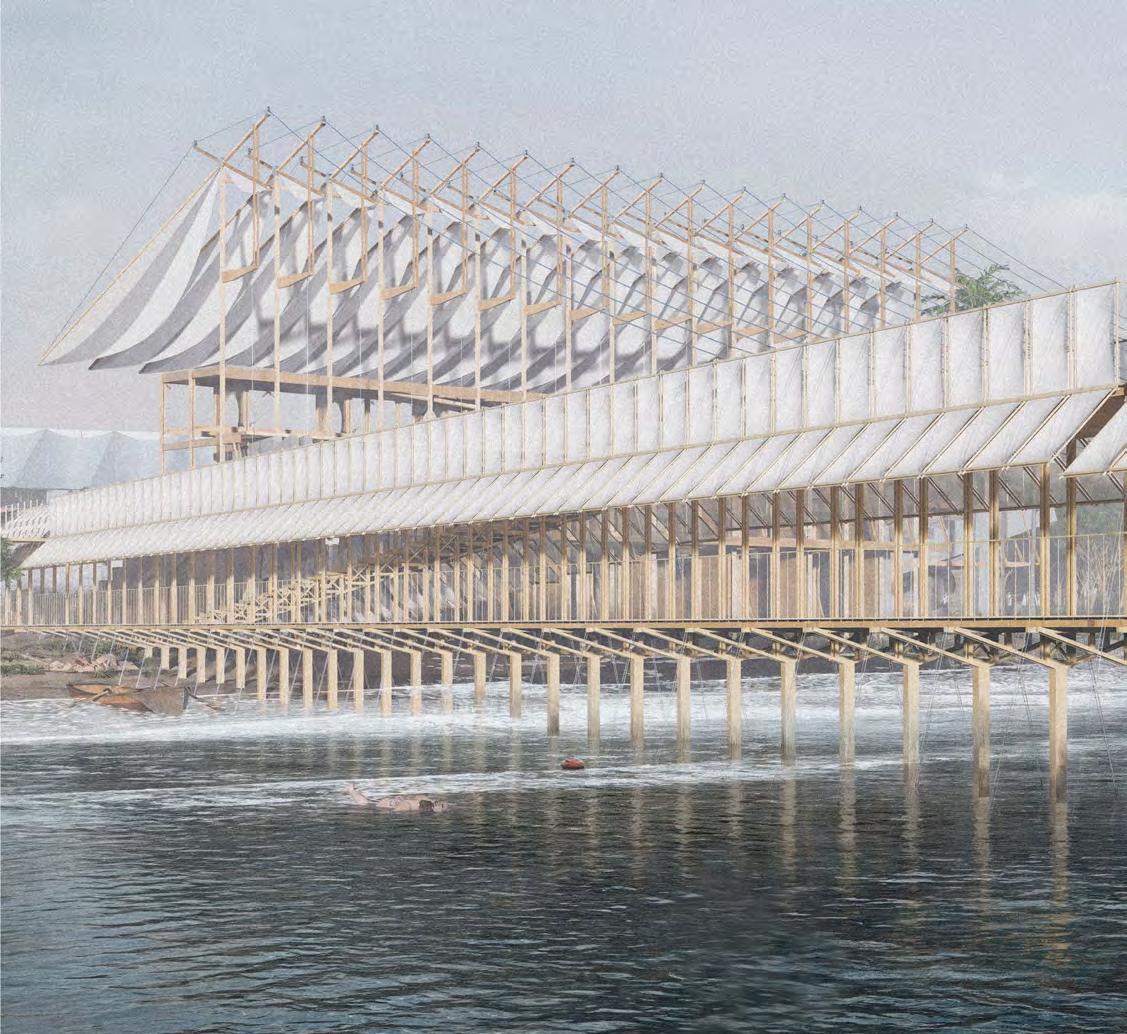
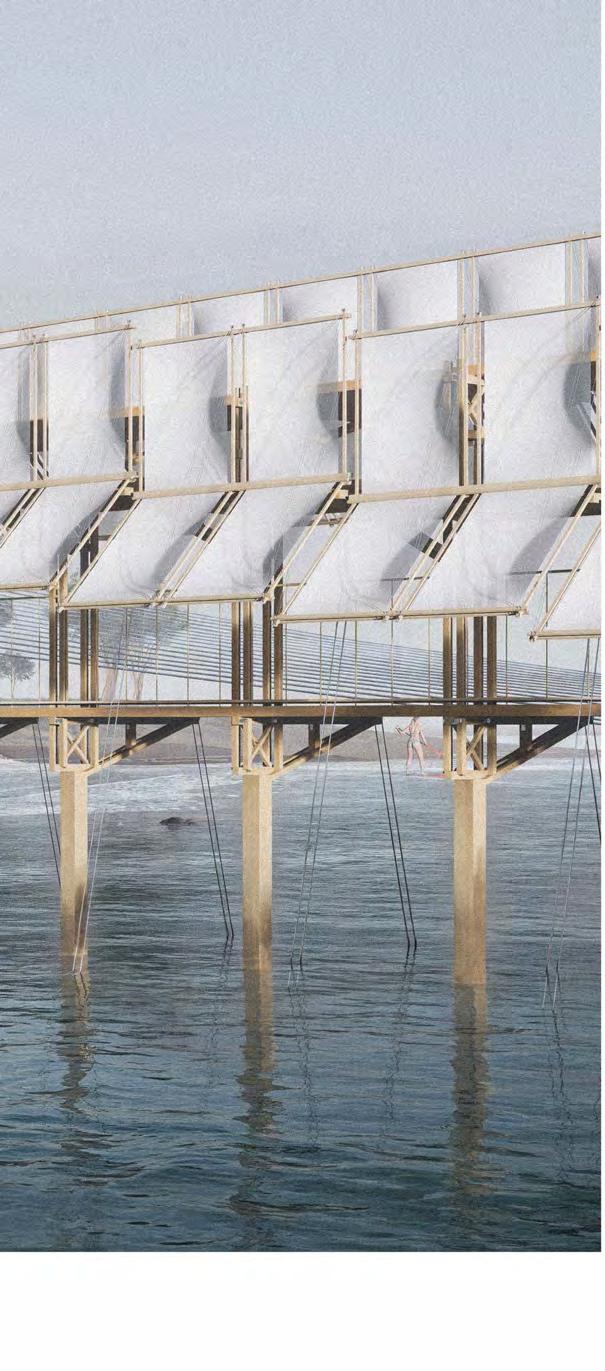
At the heart of the intervention, a tide responsive kinetic structure creates a direct dialogue between architecture and ocean. A cable and pulley system connects a floating sea pool to a tensile textile canopy on the roof. As tides move the pool, the motion is transmitted, causing the fabric canopy to rise and fall in a slow, continuous rhythm.
Beneath it, the sheltered gray space breathes in response, "inhaling" and "exhaling" with the lunar pulse. Light filters through the shifting membrane, animating the ground with moving patterns.
This inversion of the site’s history makes the ocean the principal actor and the architecture a sensitive participant. The structure translates the immense, invisible force of the tides into an intimate, somatic experience, replacing a stage for spectacle with a space for sensory connection to the enduring rhythms of the natural world. and mechanical poetry.
BLEACHERS ADAPTATION
[Low Tide - 10 a.m. & 5 p.m. Daily]
[Low Tide - 7 a.m. & 8 p.m. Daily]
A Dynamic Sea Pool - Canopy System
The diurnal tidal pattern of Biscayne Bay exhibits a winter range exceeding 3ft, with high tides occurring near 10 a.m. and 5 p.m., and corresponding lows around 7 a.m. and 8 p.m. These two daily cycles produce pronounced temporal variations in the tension of the canopy's suspension cables. As the cables systematically tighten and slacken in response, the attached mobile sea pool translates precisely along the axis of the bridge, traversing a horizontal distance of 100 ft. Its farthest reach coincides with the lowest tide in the afternoon, positioning the pool adjacent to the waterslide platform at the bridge's terminal. The pool’s journey becomes a direct reflection of lunar and hydraulic forces, making the passage of time and the pulse of the estuary legible in the movement of the structure itself.
BLEACHERS
"The Recluse"
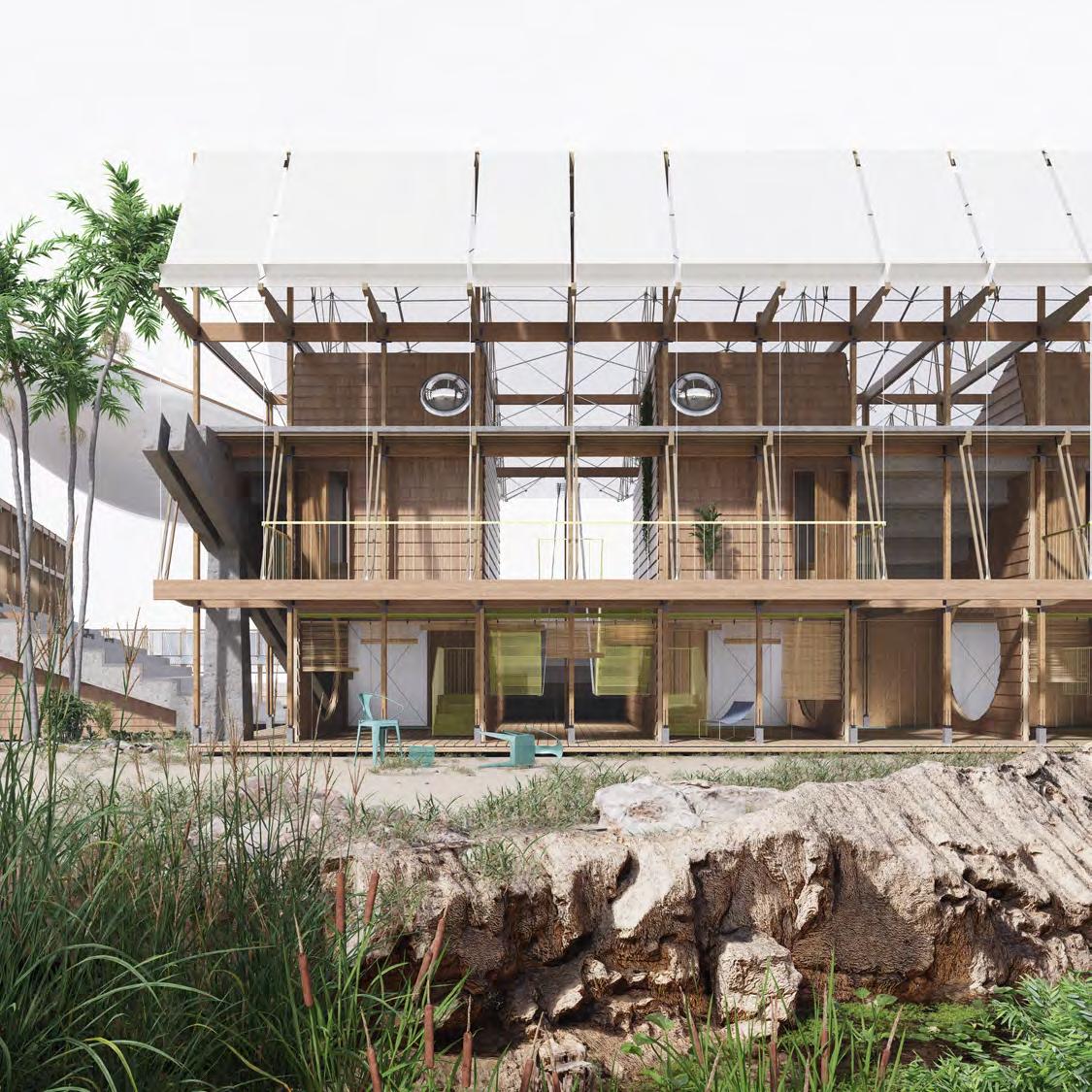
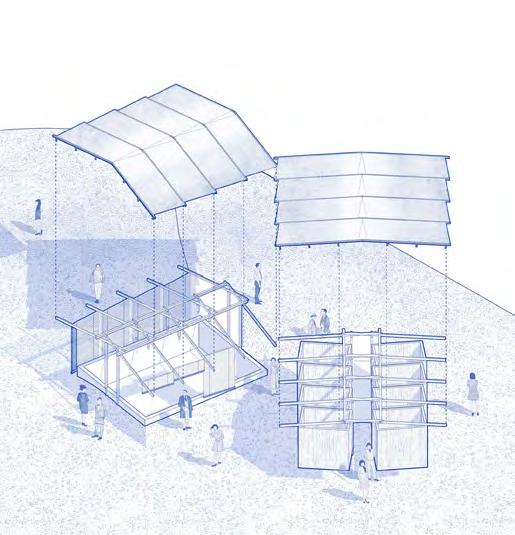
The two inland bleachers facing the biogenic pond have been repurposed as hubs for wellness, recreation, and professional gatherings . Four individual timber sauna units are integrated into the existing concrete structure using a dedicated frame & tensile system. To create ample space for leisure activities, three of the original five concrete post-and-beam sections were carefully removed prior to installation. The salvaged material from these components are repurposed, broken down into gables and packed within a linear foundation that supports the new floating central bridge.
View of the sauna structures from the rear of the pond-side bleacher
BLEACHERS
View of the "green slope" from the front of the pond-side bleacher
BLEACHERS ADAPTATION
"The Green Shed"
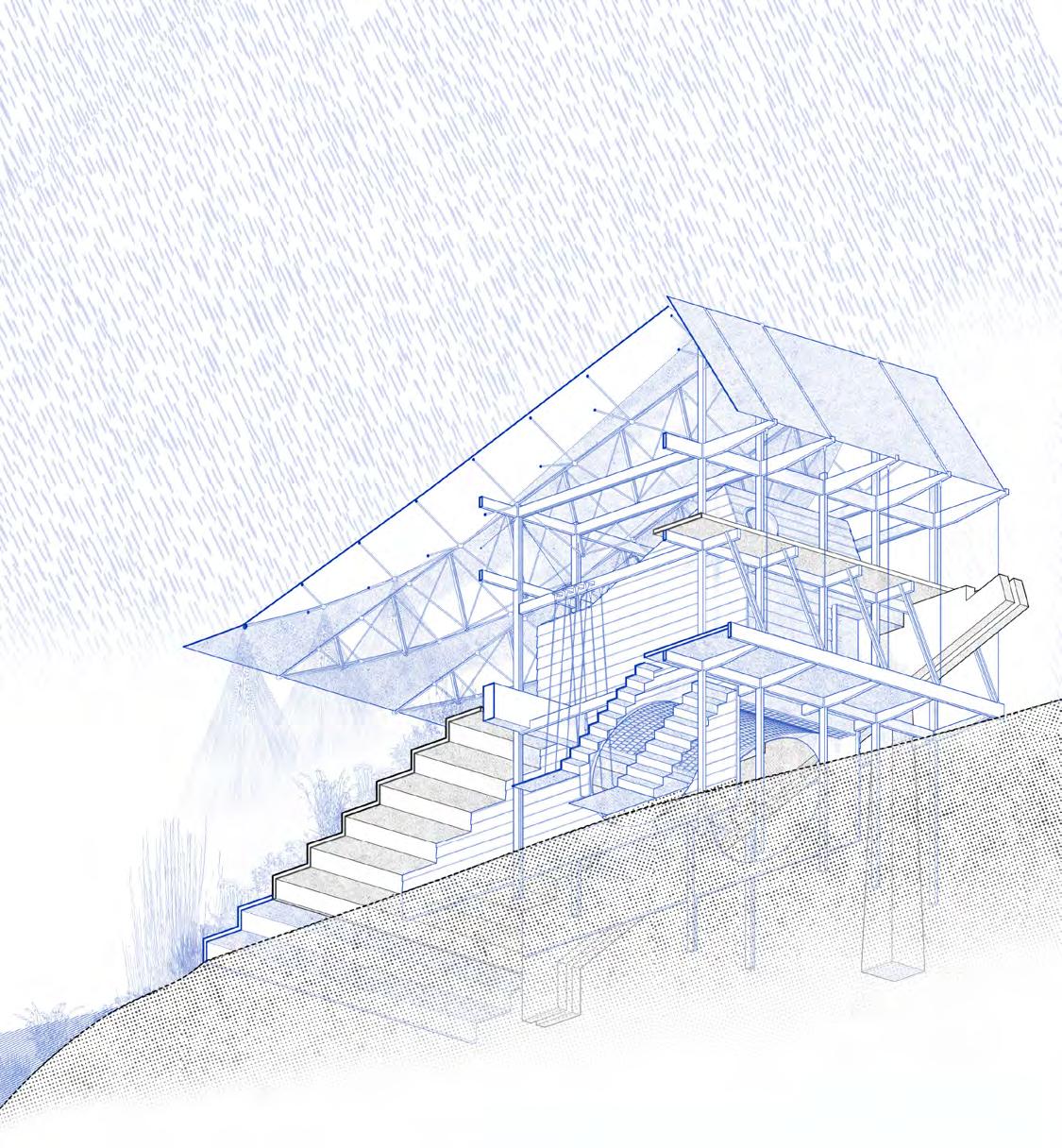
A new roof system replaces the former steel sheathing, employing a durable ETFE membrane stretched across an inverted bowstring truss structure. Strategically tilted 30 degrees toward the pond , this configuration manages runoff to protect the programmatic space at the bleacher's rear while functioning as a rainwater harvesting system for irrigation. In a sustainable reintegration of materials, the existing steps have been converted into planters for endemic vegetation . This intervention creates the visual effect of a seamless, vegetated landform cascading from the bleachers into the aquatic landscape. Accessed exclusively from the rear, the sauna units offer users an uninterrupted vista of the "green core." The decking within each saona repurposes the original concrete stepping, creating an extended platform for reclining and contemplative engagement with the landscape.
BLEACHERS ADAPTATION
Spatial Potential
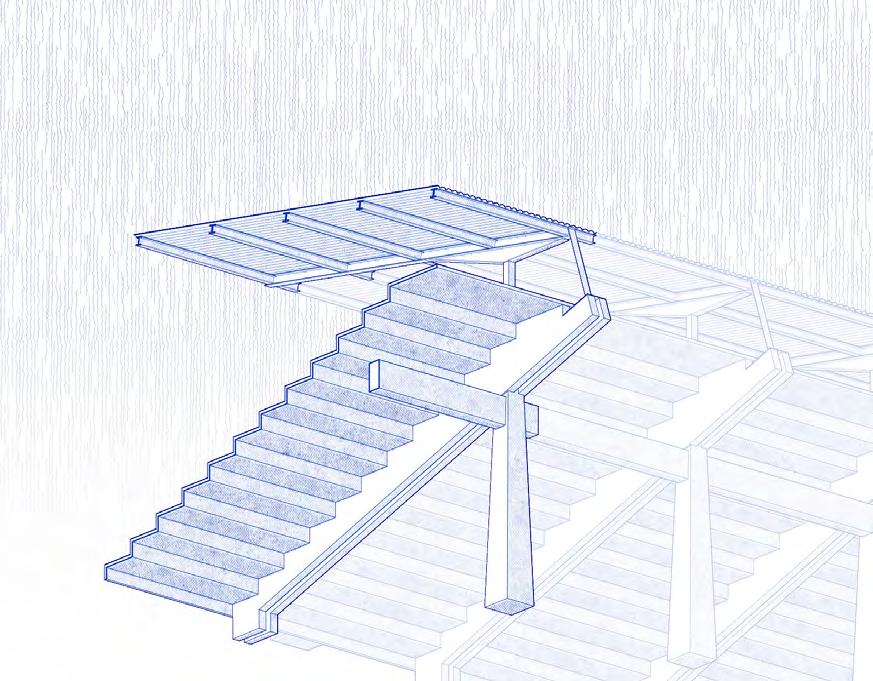
The existing bleacher structure utilizes a simply supported concrete beam system, capped by a steel foil roof slanted toward the rear for drainage. This configuration overlooks the spatial potential beneath the seating area, which remains underutilized and disconnected from user activity concentrated at the stage front. A comprehensive makeover is required to holistically integrate this vacant volume, transforming it into functional space while incorporating a functionally sustainable system for an ecologically responsive facility.
Optimized Climate
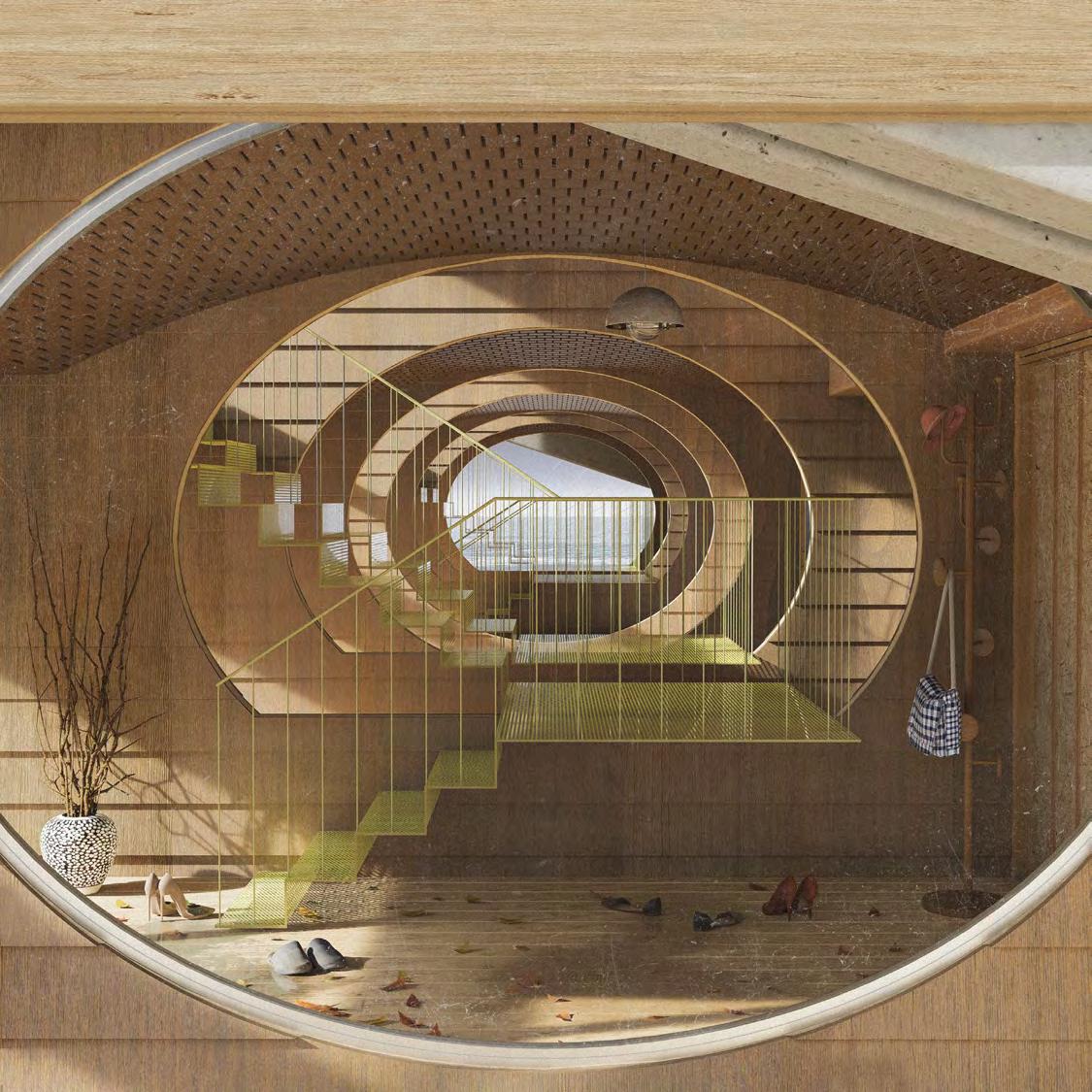
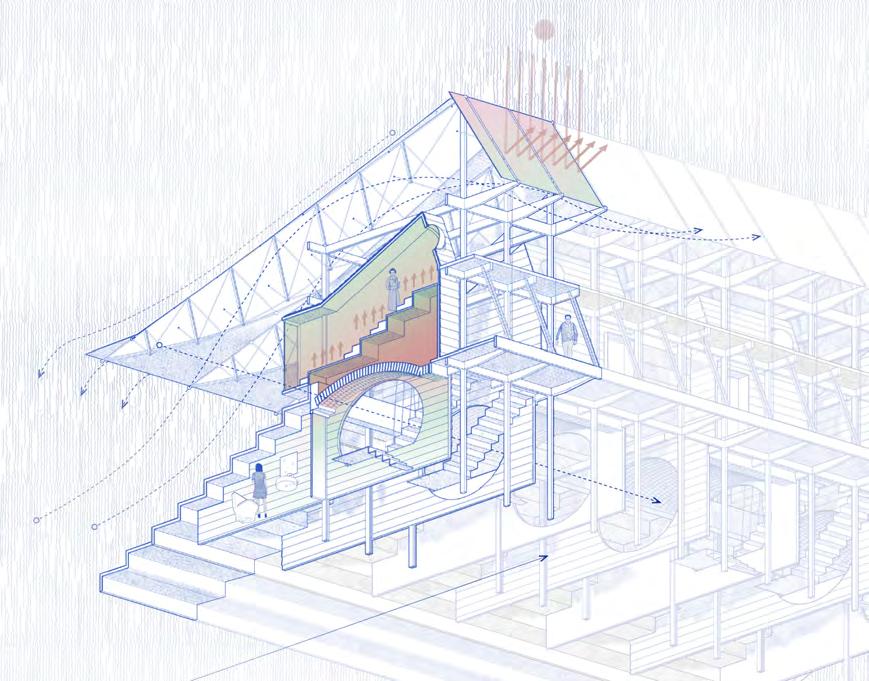
The adapted bleacher structure organizes distinct programs through corresponding material strategies. Sauna units extending from the concrete stage are set upon a brick hearth. This masonry mass, together with the existing concrete, serves as an effective thermal body to maintain a hot interior micro-climate. The hearth is shaped as a barrel vault, which isolates heat from the resting area below to keep it cool. To serve new programmatic needs at the rear, the ETFE roofing now slopes in the opposite direction for water drainage. Below the saunas, segmented drywalls built in 15ft modules contain auxiliary leisure spaces, with circular cutouts to allow for through ventilation
"The Causeway"
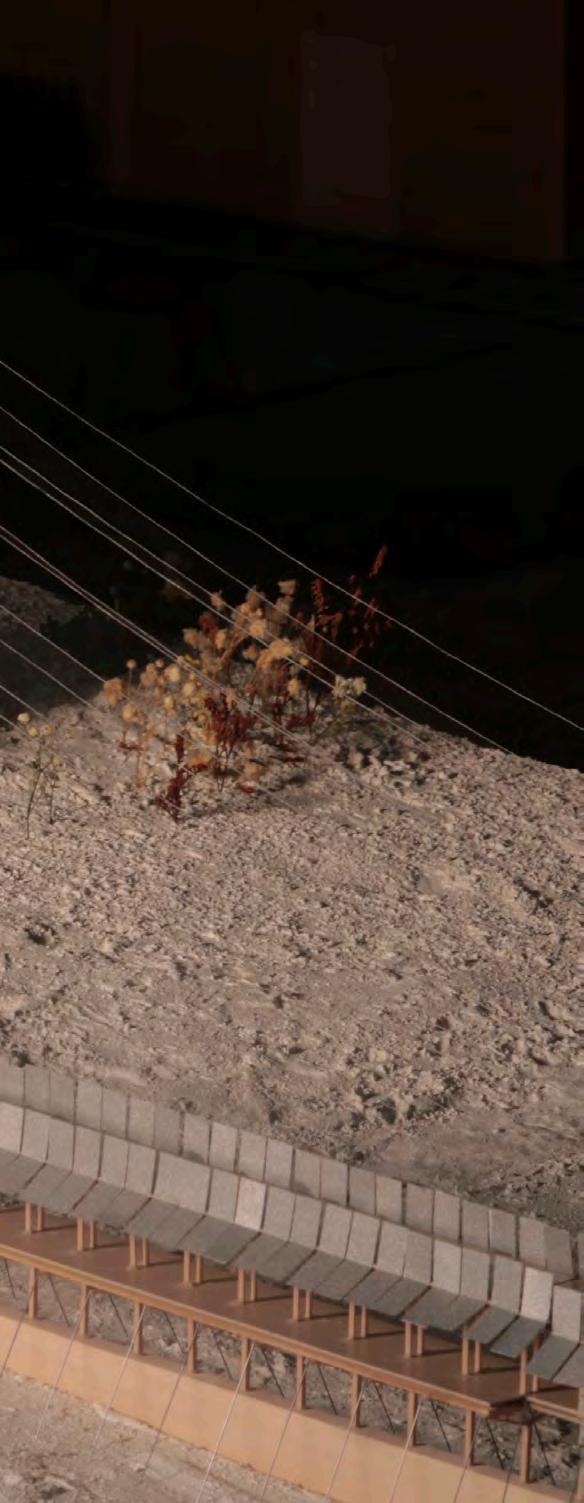
The floating bridge is reimagined as a linear causeway that extends into the ocean, linking several programmatic zones within the masterplan. Its elongated form creates a continuous promenade that culminates in a far terminal, housing a sightseeing platform and a slide descending into a mobile swimming pool suspended from the "Tuxedo" system. This structure transforms walking into a deliberate, almost spiritual journey: a passage where movement feels both inevitable and measured, shaped by the rhythmic expanse of the sea and sky. In this setting, the act of traversal becomes an exercise in perception, framing views and sequencing encounters in a narrative of approach and arrival.
Bridge - Pond Section
Changing Room & Indoor Swimming
Bridge - Beach Section Bridge - Stair Stepping
"Tuxedo' Canopy
[Changing Room & Indoor Swimming Pool]
Section Bridge - Single Decker]
"Cradle to Cradle"
Beneath the waterline, the bridge’s structural footing incorporates gables repurposed from the removed concrete beams of the original bleachers. These submerged elements function as artificial reef substrates, encouraging colonization by oysters and coral worms. This biodeposition not only fosters marine habitat but also biologically reinforces the foundation through natural calcification.
Above the surface, the bridge transitions from a single-level to a double-level configuration as it extends seaward. This elevated pathway allows visitors to ascend gradually along one side, culminating at the terminal platform featuring the waterslide. Upon re-entering the bridge from the swimming pool, the return journey follows the lower level, creating a continuous, intuitive loop that separates arrival and departure flows while framing distinct visual and experiential relationships with the surrounding seascape.
[Beach
[Ocean Section Stair Stepping - Double Decker]
[Pond Section Bridge - Single Decker]
Indoor Swimming Pool
Recycled Concrete Aggragates
Design the Demise
The conception of the "Flipper? Flipped Show" project embraced a complete life cycle, from its purposeful design inception to its orchestrated dissolution. Recognizing the inherent vulnerability of its lightweight, economical frame structures to Florida's frequent storms and hurricanes, the installation was conceived as intentionally temporary. This transience is not viewed as a shortcoming but as a source of metaphysical and aesthetic value, where gradual decay and disassembly become integral chapters of the architectural narrative.
We envision a specific, resonant sequence of demise. The tensile "Tuxedo" canopy is projected to reach its structural limit during an extreme tidal surge or flood event, eventually shearing away. What remains is its stark, skeletal frame: a grandiose, tacit billboard standing as a monumental relic that silently narrates the site's climatic history and former use. This process of subtraction reveals a new form and a new meaning.
The endpoint of this designed decay is a grand ecological integration. Given current sea-level rise projections, the entire site will eventually succumb to permanent inundation, merging all its water elements into a continuous lagoon Stripped of their lighter auxiliary structures and sauna houses, the robust concrete bleachers will endure as a submerged armature. These ruins are destined to become a foundation for new life, actively fostering coral colonization and evolving into a vital component of a nascent lagoon ecosystem. Thus, the project completes its cycle, transitioning from a temporary venue for human gathering to a permanent substrate for marine regeneration.
"ASHES TO ASHES, DUST TO DUST"
VERTICAL BUNGALOW
"Small Lots, Big Impact" Design Competiton
Type: Medium Size Residential
Year: 4th-year Summer
Instructor: Independent Work
Collaborator(s): Qilingli Rannia Zhang
Site: East Hollywood, Los Angeles
Award: Student Honorable Mention
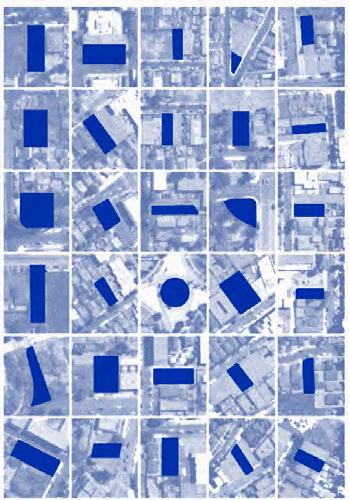
The "Small Lots, Big Impacts" initiative, led by cityLAB UCLA in collaboration with the City of Los Angeles, confronts the city's intertwined housing affordability crisis and climate vulnerabilities, particularly in the wake of devastating wildfires . It challenges architects, designers, and students to reimagine the future of urban living by creating innovative, resilient, and community oriented housing models for small, underutilized public lots
The design competition is structured around two distinct site categories, "Gentle Density" for infill lots and "Shared Future" for missing middle housing , each presenting unique opportunities for sustainable densification. Winning proposals will be judged on key objectives including staying power, livability, performance, resilience, and adaptability.
The goal is to generate replicable, cost effective prototypes that demonstrate how Los Angeles can gently densify its residential fabric, expand homeownership, and foster connected neighborhoods. This initiative aims to translate visionary design into built reality, ultimately creating a blueprint for addressing housing shortages and enhancing community resilience on thousands of similar parcels across the city and beyond.
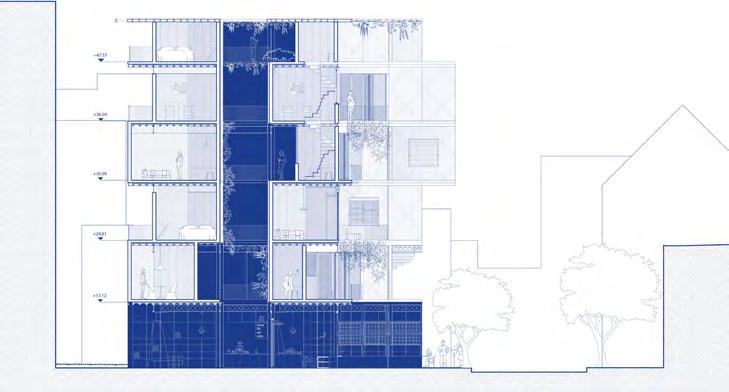
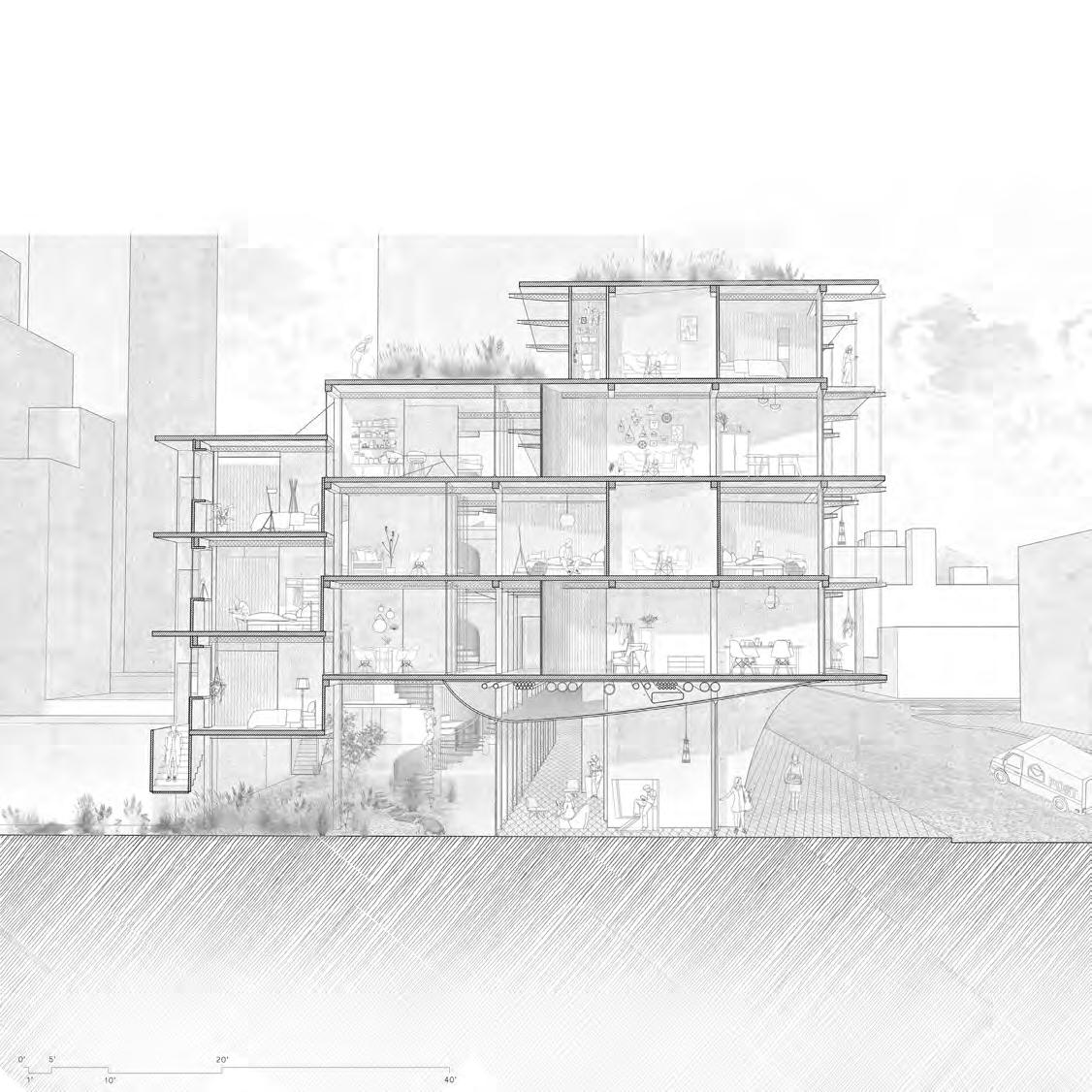
Short Section through Ground-floor Communal Cafe
SMALL LOTS BIG IMPACT
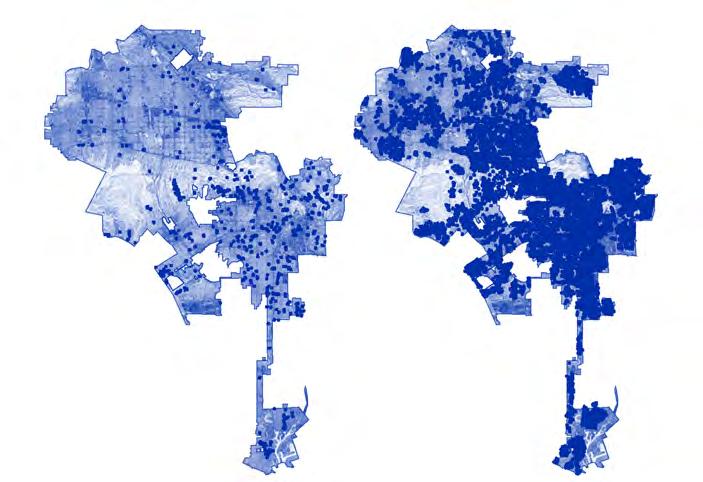
Excessive Lots
Thousands of small, underutilized lots, both publicly and privately owned, exist across Los Angeles, representing a vast opportunity for new housing development. By offering a selection of its own parcels, the City of Los Angeles is strategically piloting innovative housing models intended for replication on private lots throughout the region. The Small Lots, Big Impacts initiative aims to demonstrate how to achieve beautiful, efficient, and contextually sensitive construction to gently densify the city's characteristic low rise neighborhoods.
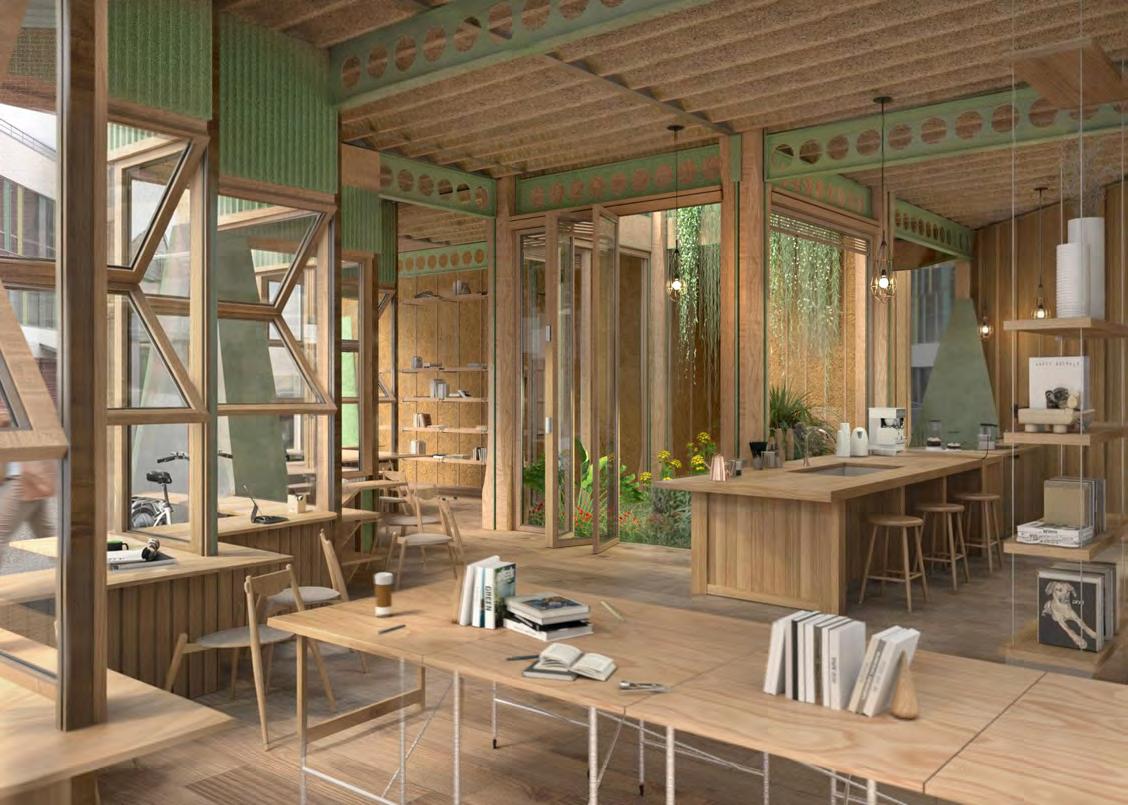
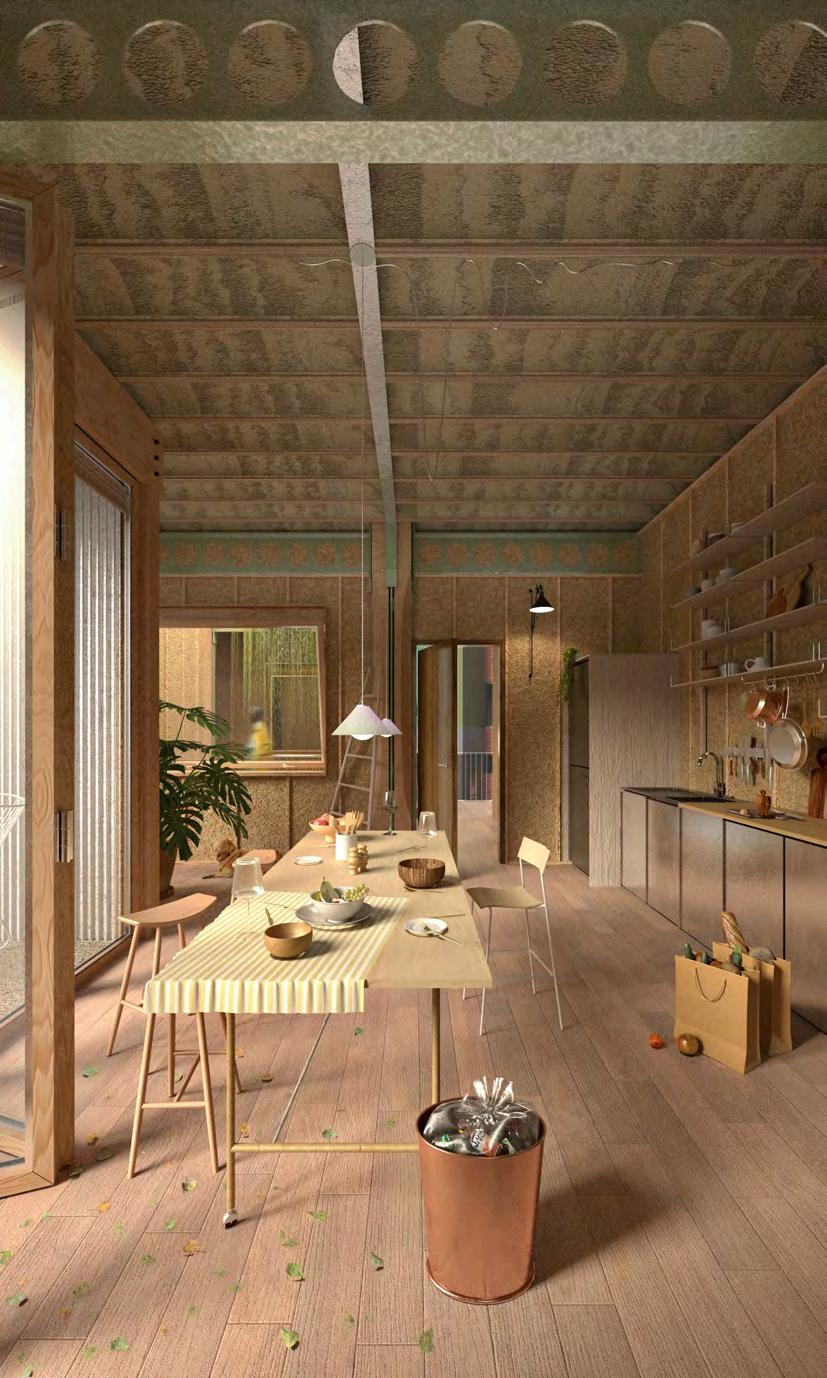
View of Ground Floor Communal Space
Vertical Street"
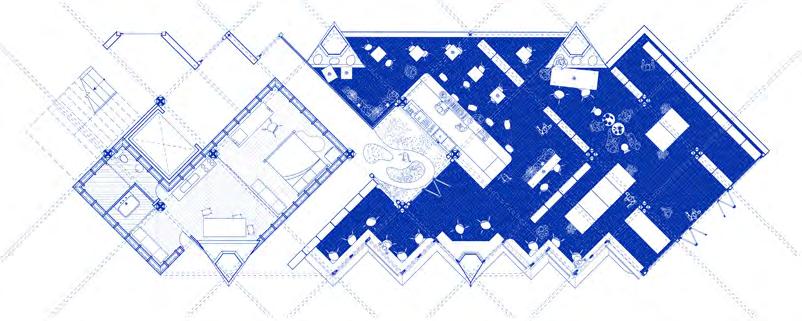
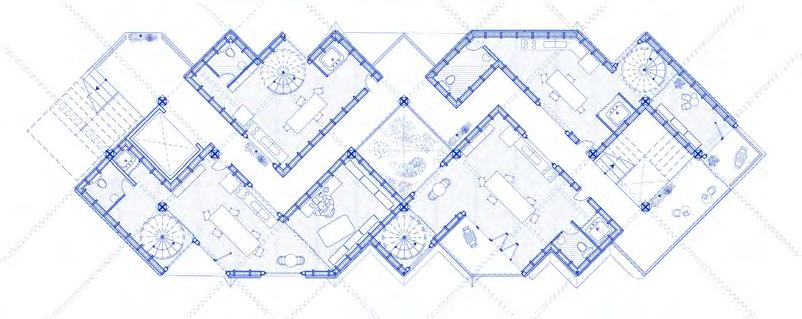
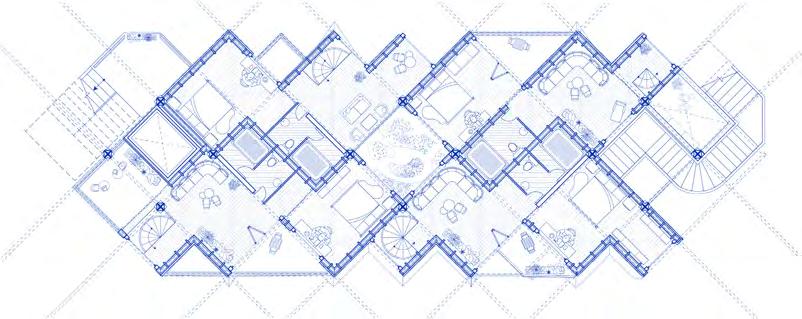
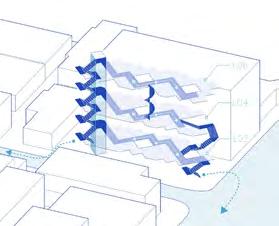
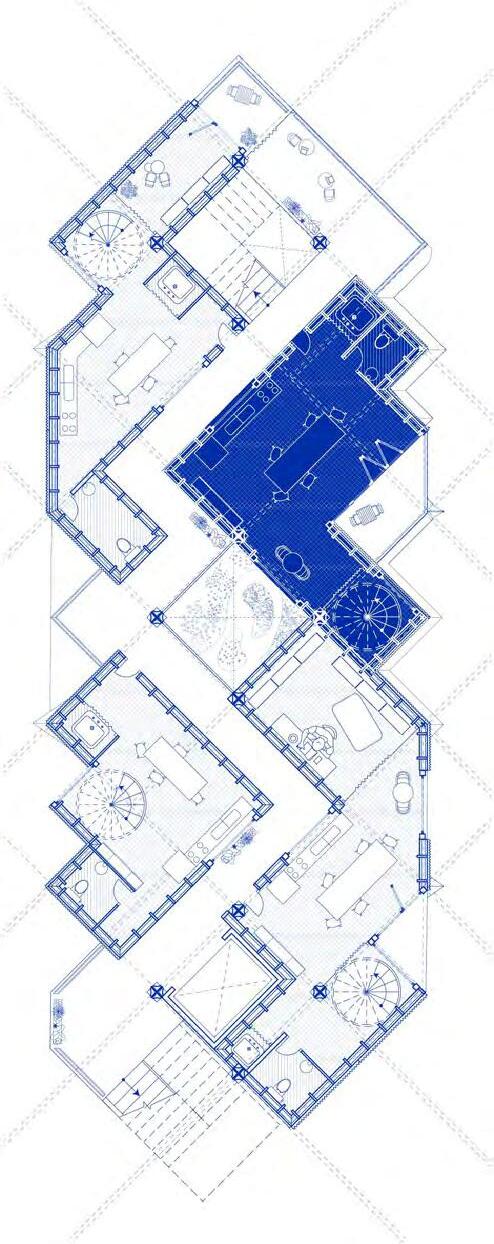
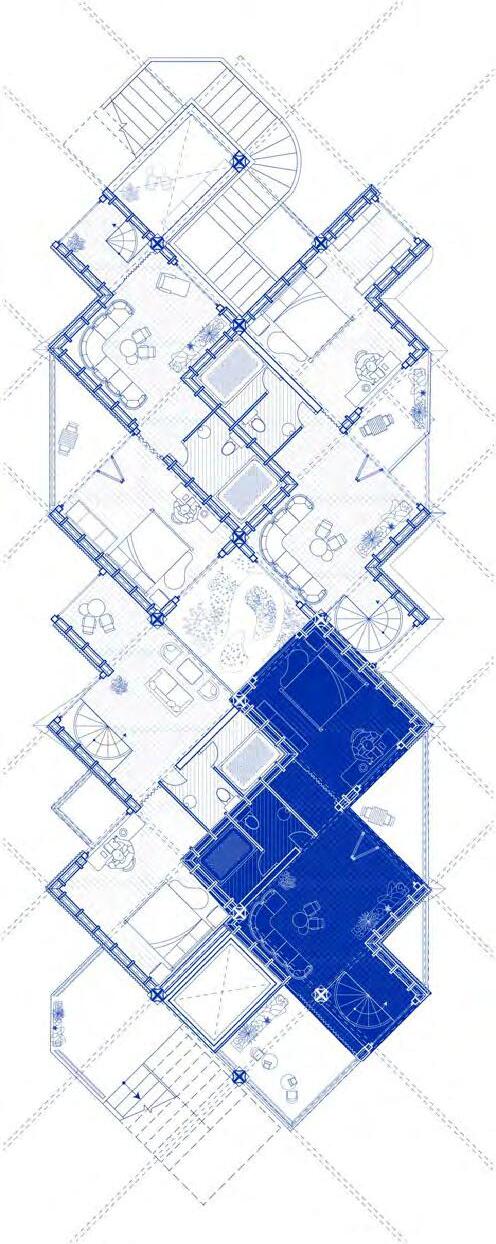
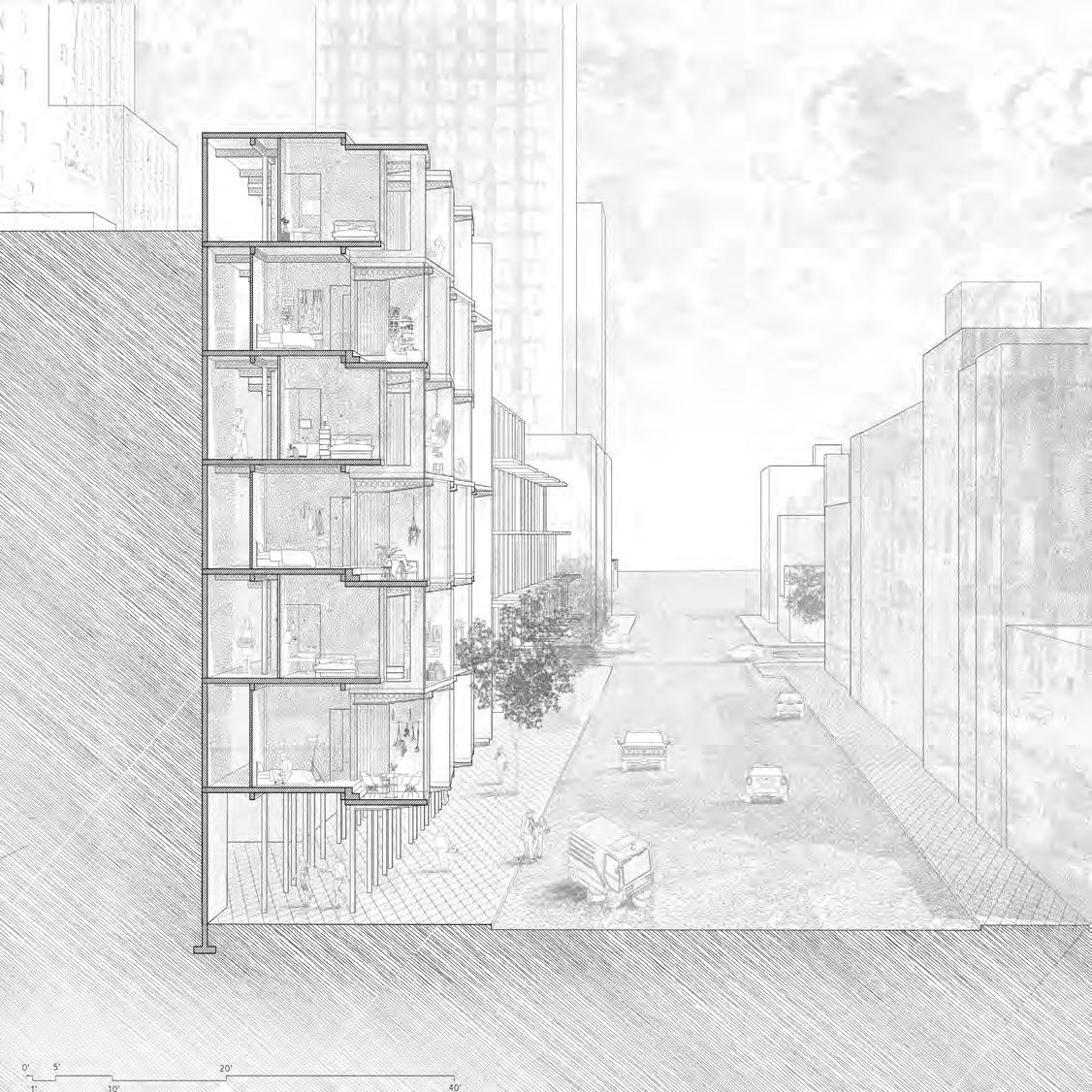
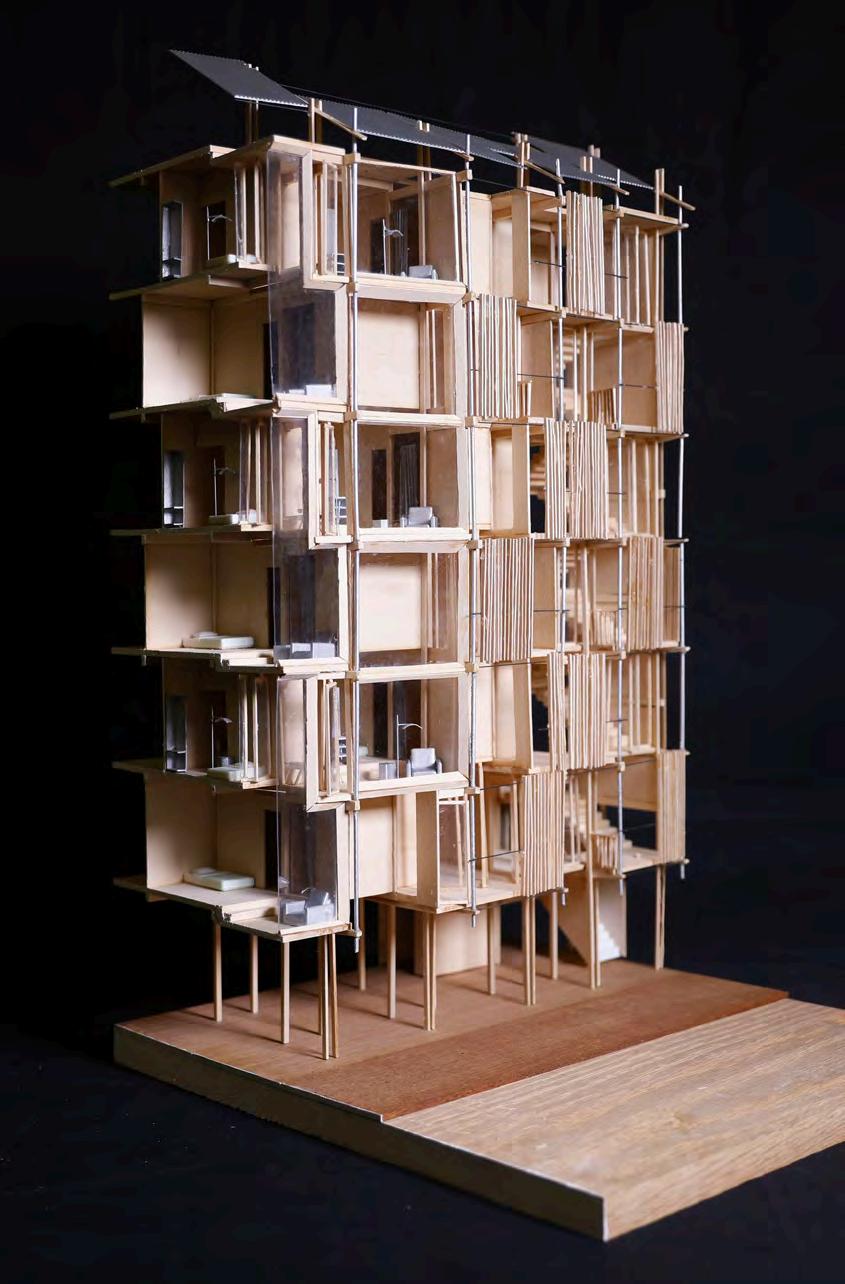
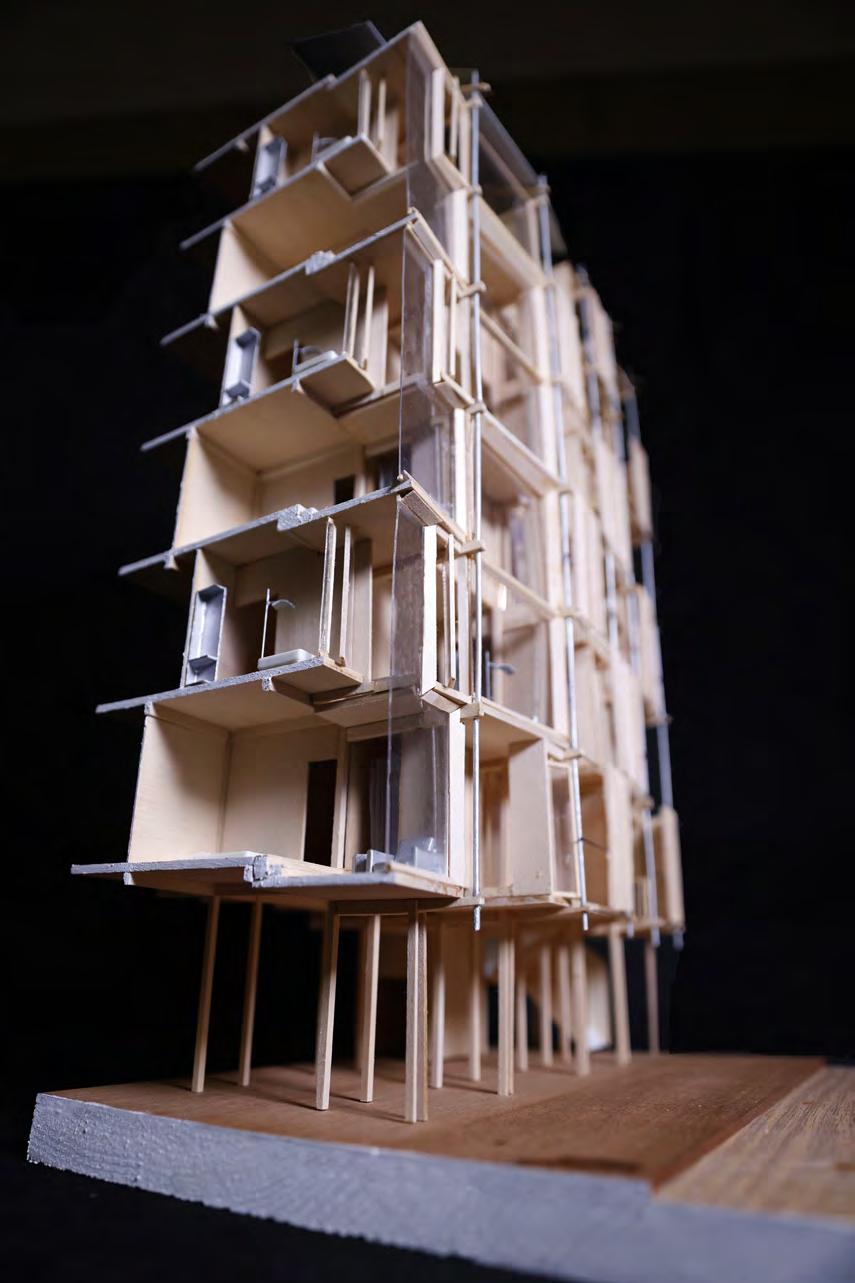
The defining communal spine is a zigzagging corridor that weaves vertically around skylights on alternating floors, drawing daylight deep into the plan and creating a rhythm of illuminated spaces. With two access points per level, this path enhances orientation and accessibility. Its dynamic geometry naturally slows movement, forming informal gathering pockets that foster unplanned encounters. Functioning as a social condenser, it acts as a vertical street that encourages connection and dialogue among residents.
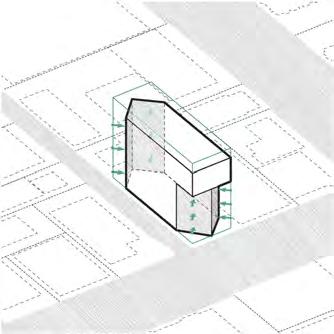
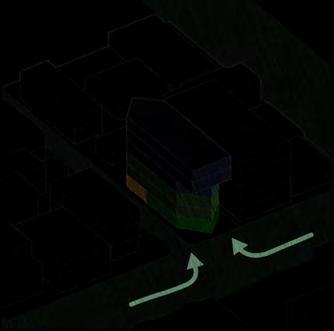
Shared Future Site C is a narrow lot in West Hollywood, oriented along a northwestsoutheast axis. Its immediate adjacency to two prominent urban passageways calls for a responsive and engaging architectural solution. This can be achieved through deliberate massing and thoughtful articulation of the façade to create an inviting presence within its dynamic context.
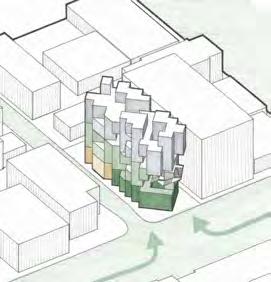
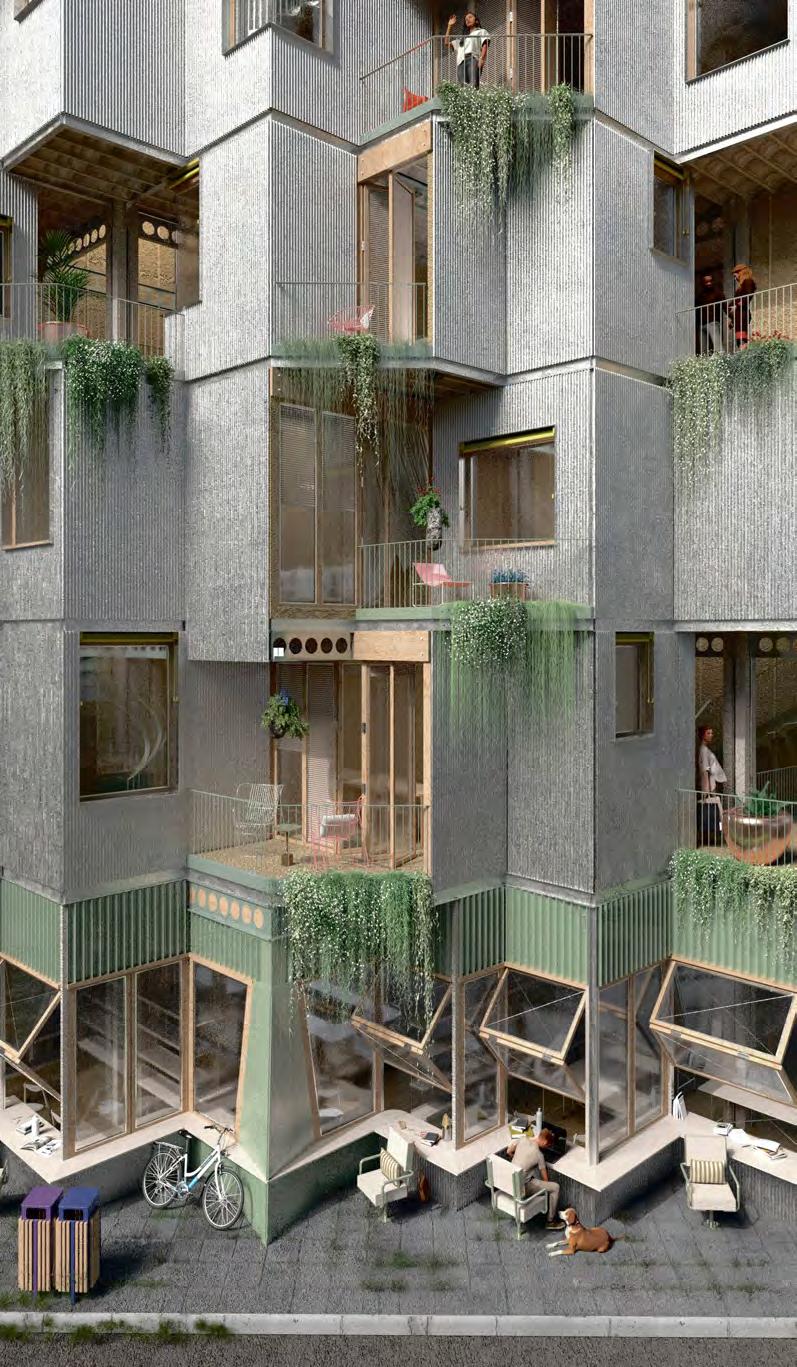
The façades addressing the commercial corridor and the southern edge are deliberately tapered at their base. This sculptural gesture opens the building visually and spatially toward the pedestrian realm, creating an engaged and inviting streetscape presence. The design responds directly to the unique conditions of the alleycorner site, mediating between the active corridor and the more intimate scale of the adjacent lane. Through this considered formal strategy, the architecture frames a transitional experience, employing material and massing to foster connection while thoughtfully navigating the site’s specific urban constraints.
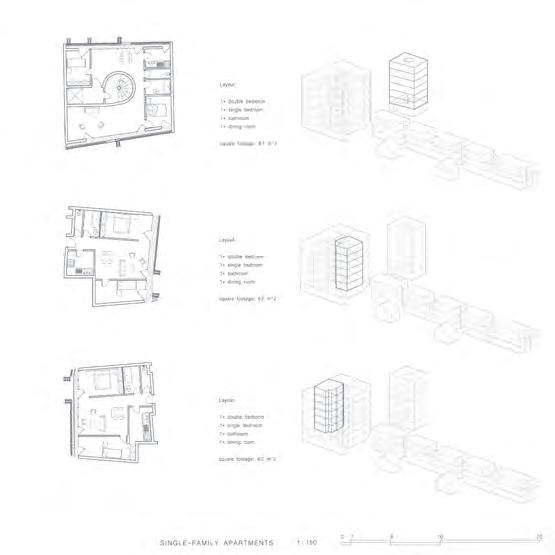
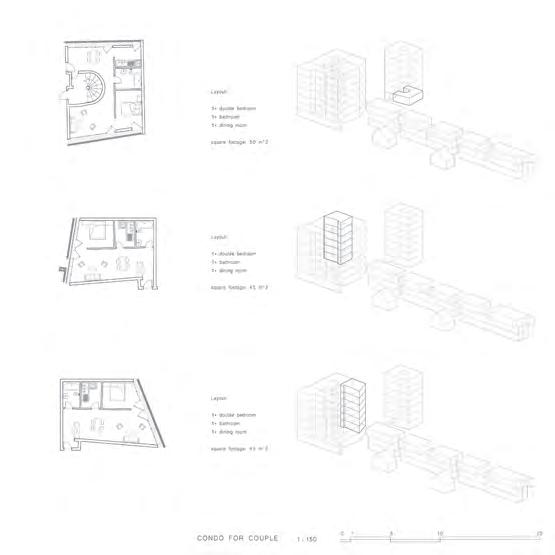
The design carefully scales the building to harmonize with its surrounding context. It comprises a mix of modular unit types— including studios, two-story one-bedroom units, and three-story two-bedroom units—for a total of ten residences. This variety supports diverse living needs while maintaining a coherent architectural volume. At ground level, the program expands to include a community library and café These amenities activate the street edge, fostering social interaction and providing shared resources that integrate the building into the daily life of the neighborhood.
A 45-degree rotation introduces dynamism to the modular massing, activating its relationship to the street and fostering a more engaging urban dialogue. This formal move is complemented by a spatial strategy of stacked and interwoven public and private volumes. This layered arrangement reflects the communal ethos of Southern California’s bungalow courts, translating the traditional shared courtyard and collective living model into a contemporary, vertical expression.
Living, Dining, Cooking
Showering, Sleeping
Reading, Social, Cafe
"Earthen Refuge"
The primary structural system consists of a steel frame, complemented by shear walls constructed from recycled oriented strand board (OSB) panels, promoting both strength and sustainability. Rammed earth bricks, prefabricated using locally sourced clay, are installed between the joists. These bricks serve as thermal mass, offering excellent heat retention and contributing to passive heating and cooling throughout the year, thereby enhancing the building’s energy efficiency and environmental performance.
The facade uses easily affordable corrugated steel sheets to reflect solar radiation during mid-summer. Besides aesthetics, this material choice directly responds to the region’s escalating wildfire risks by providing a non-combustible exterior layer that enhances the building’s resilience.
First Floor Single Unit: Living, Cooking, Dining, Public
[First Floor Plan]
SMALL LOTS BIG IMPACT
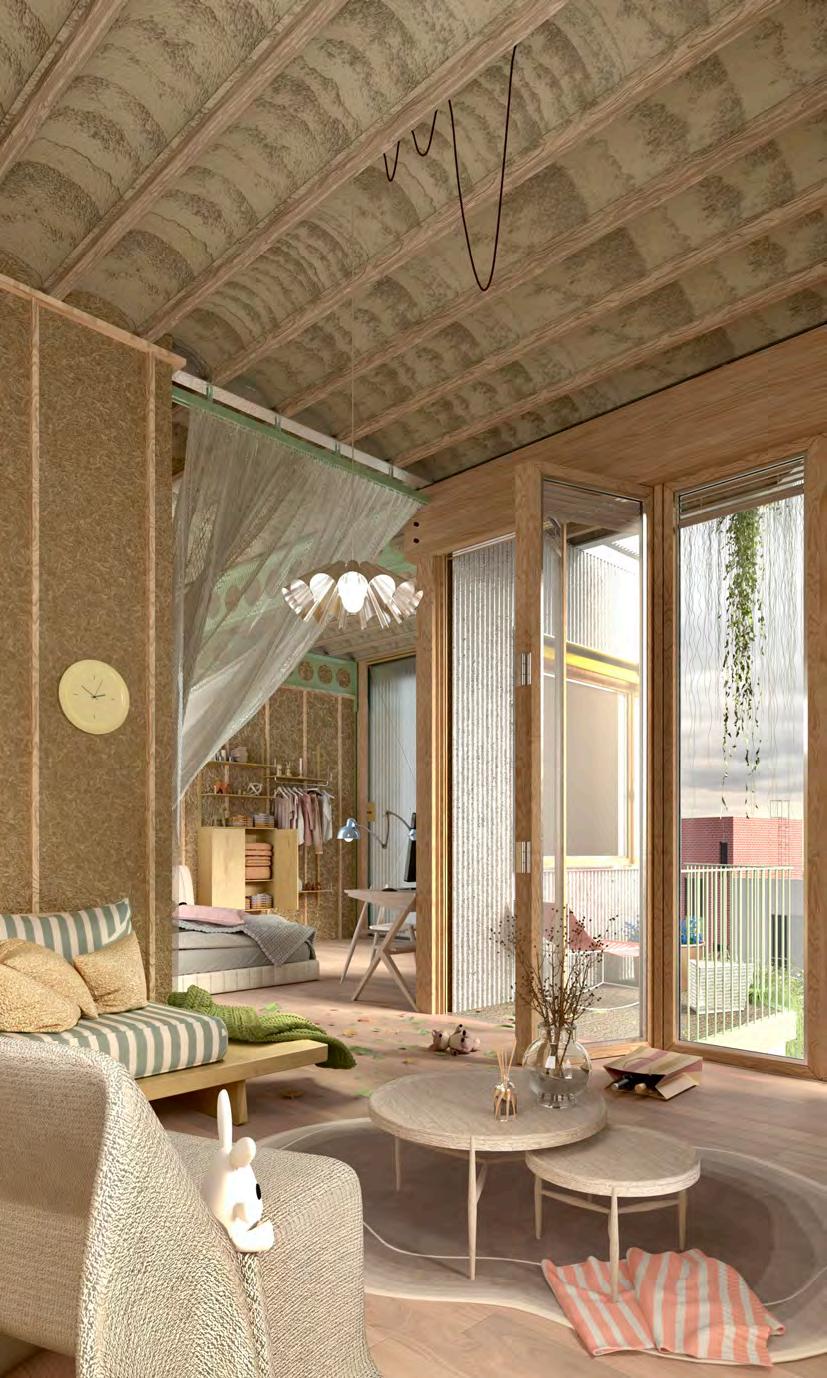
The private bedroom is conceived as a warm, flexible retreat defined by natural materials and soft light Exposed timber framing, textured fiber panels, and a gently arched ceiling emphasize material honesty and craftsmanship while creating a sense of enclosure.
Full-height glazed doors open to a small balcony, allowing daylight and fresh air to permeate the space. Translucent curtains and textured glass provide privacy while maintaining a calm, ambient atmosphere. Lightweight partitions, open shelving, and low-profile furniture loosely define areas for sleeping, working, and storage, supporting adaptability and everyday comfort.
Second Floor Single Unit: Sleeping, Studying, Showering, Private
"Enfolded Corner"
[Second Floor Plan]
URBAN CONFLUENCE
Housing Manhattanies: Lower East Side Co-housing Design
Type: Residential, Commercial
Year: 3rd-year studio
Instructor: Rocio Crosetto Brizzio
Collaborator(s): Individual
Site: 129 Delancey Street, Manhattan, NY
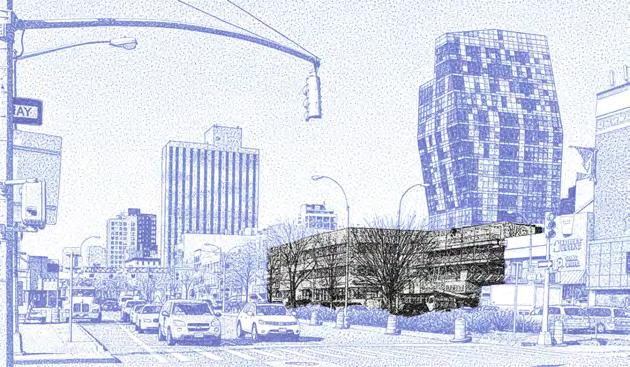
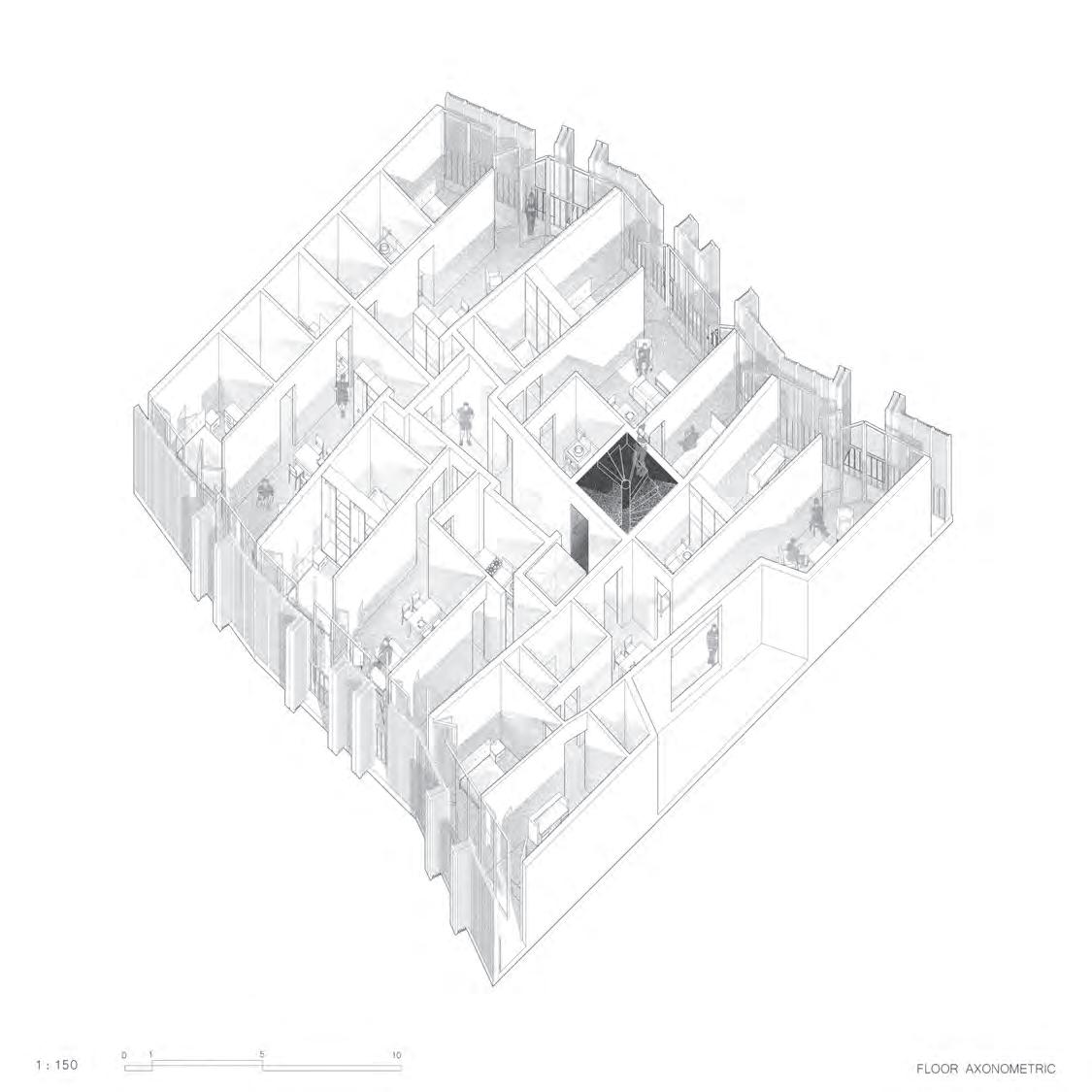
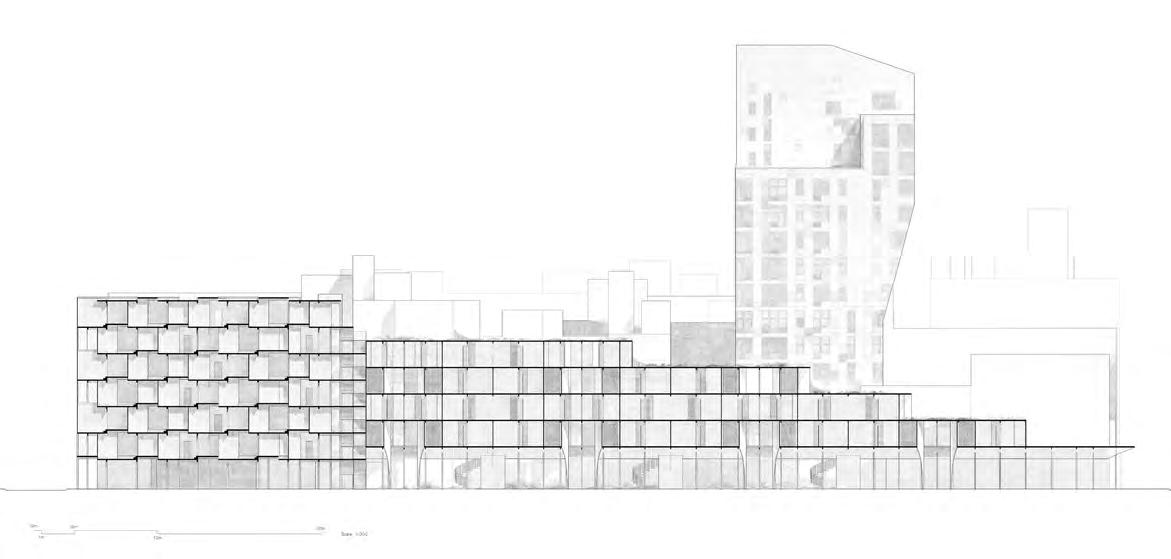
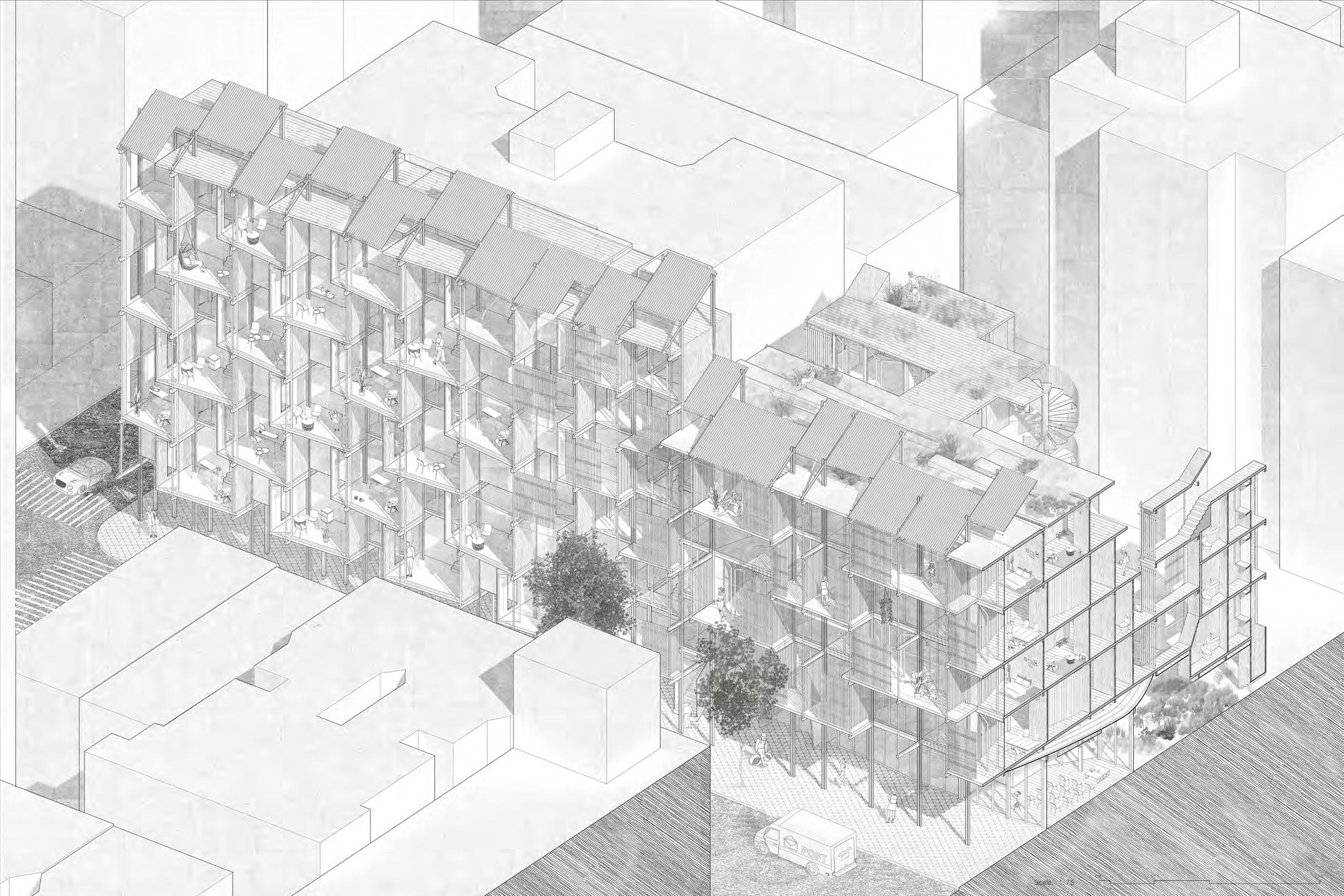
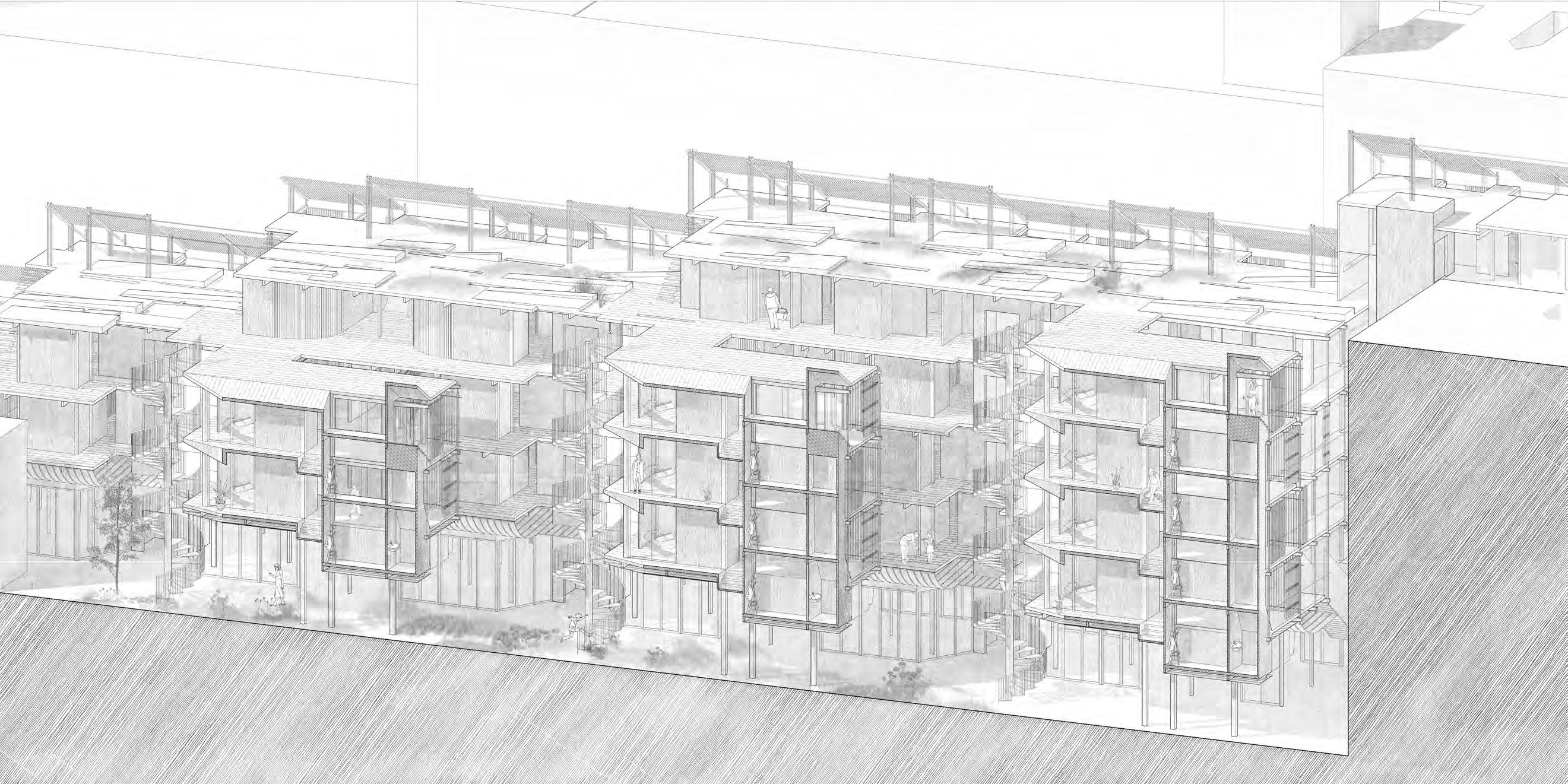
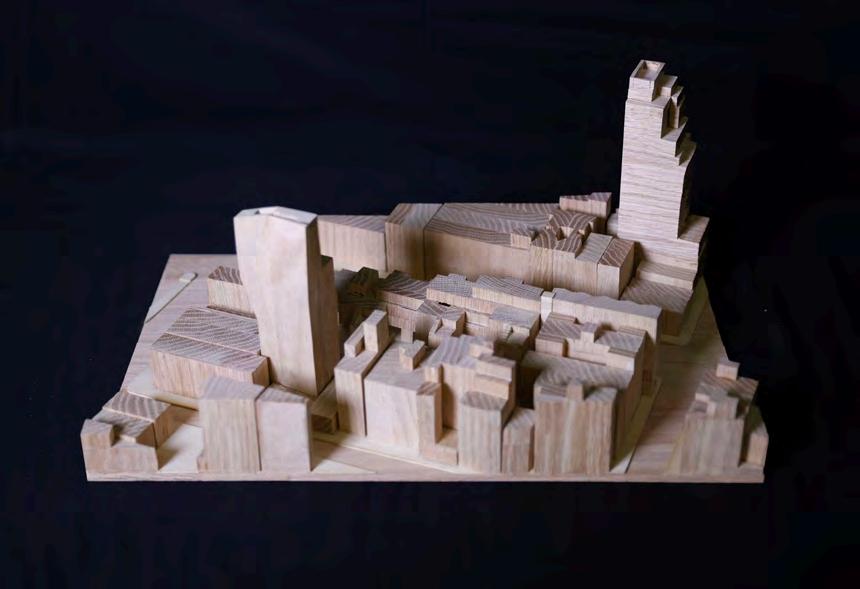
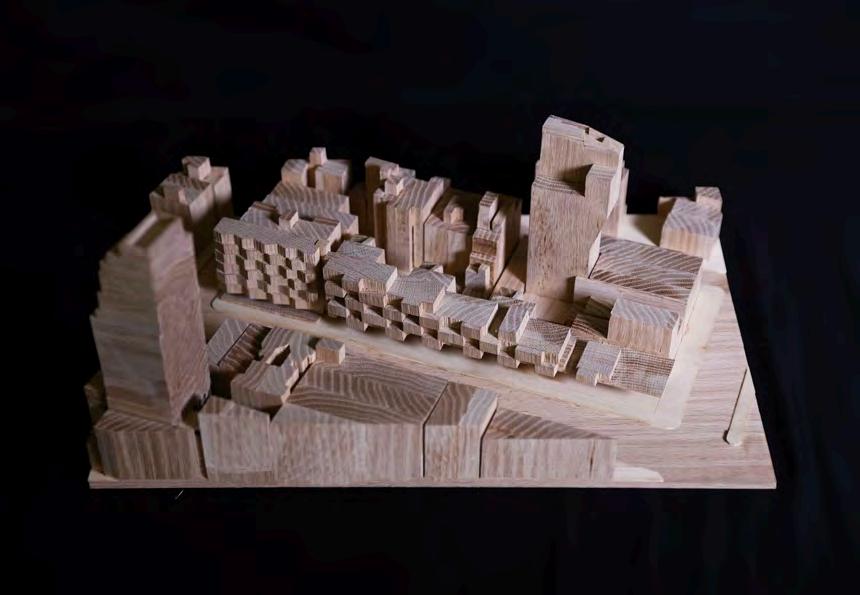
Situated in Manhattan’s Lower East Side (LES), this cohousing project draws direct inspiration from the area’s longstanding immigrant history, which has defined its vibrant, layered character over generations. Fostering an inclusive community is central to the design, which organizes three distinct residential volumes around a series of shared courtyards to accommodate diverse household sizes. These residential units, facing Essex Street, are intentionally oriented inward to promote resident interaction and a shared sense of place, supported by dedicated coliving spaces that strengthen social interconnectedness.
Further encouraging engagement with the urban fabric, units along Rivington Street provide residents with panoramic views, inviting them to connect visually and experientially with the neighborhood’s dynamic energy. Elevated above street level, the project’s transparent glass volume on the ground level embodies a principle of architectural and social transparency, while offering a thoughtful response to urban pressures such as gentrification. This elevated structure houses flexible commercial and communal spaces, serving as both a bridge and a beacon that physically and symbolically connects residents to their surroundings.
By thoughtfully integrating historical legacy with contemporary design, the project demonstrates a dual commitment to honoring the neighborhood’s cultural identity and thoughtfully embracing its ongoing evolution. In essence, this Lower East Side cohousing initiative stands as a physical manifestation of diversity, community, and intentional inclusivity, reflecting the area’s rich past while contributing to its continuing urban narrative.
PRECEDENT
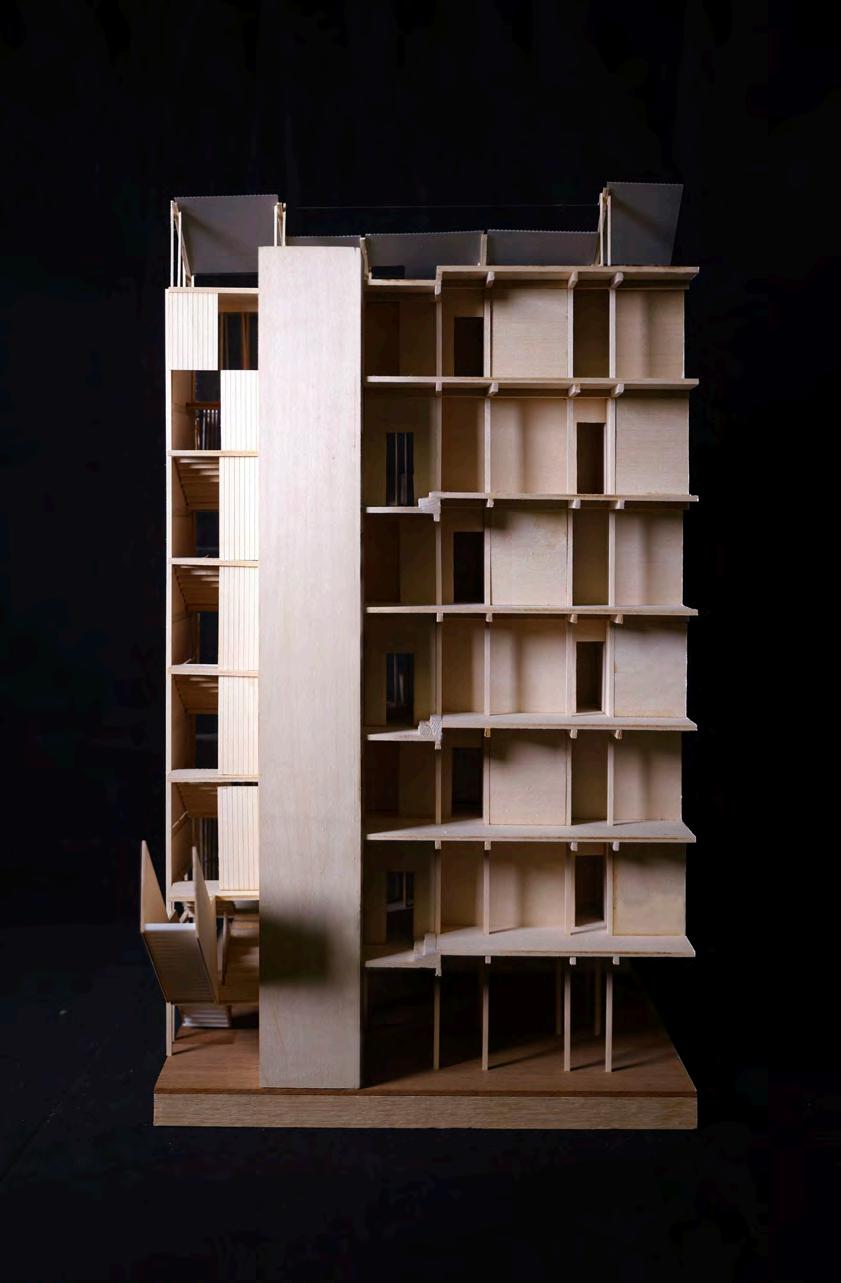
Name: 149 Rue des Suisse Apartment Buildings
Architect: Herzog & de Meuron
Year of Completion: 1997
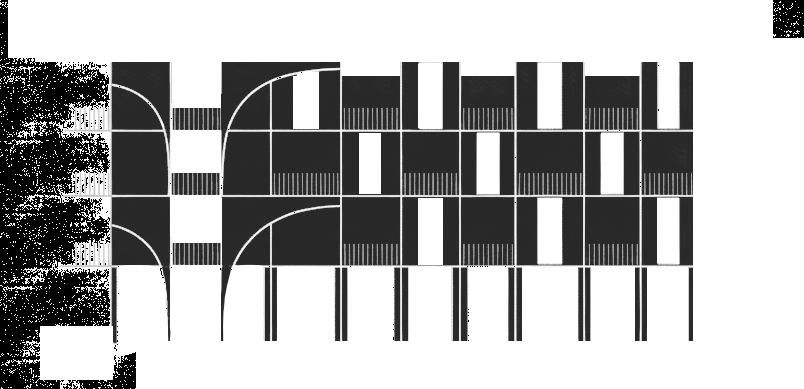
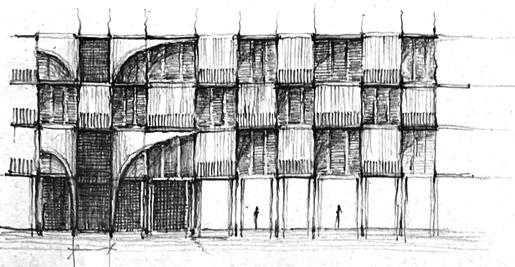
Plan v.s. Facade
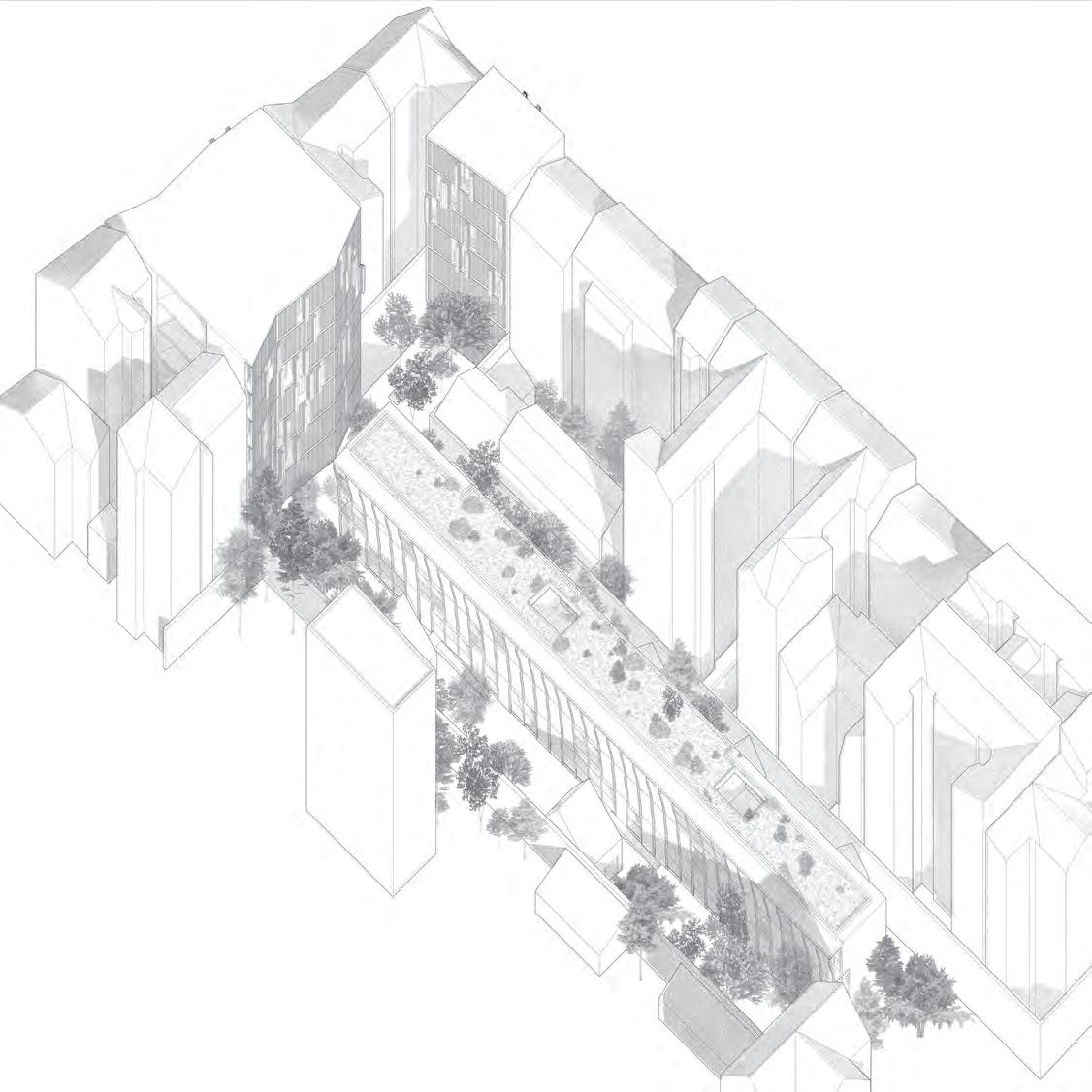
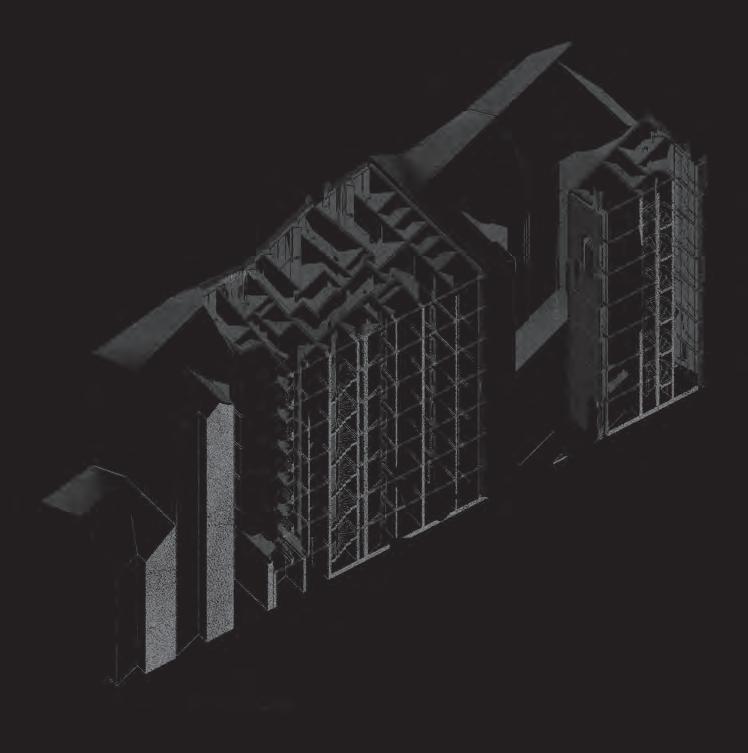
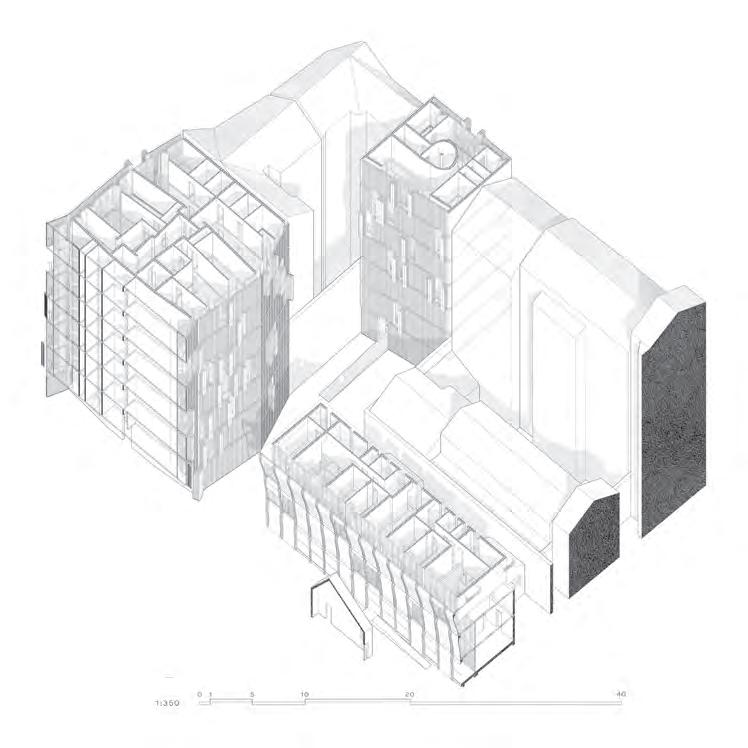
The housing project in Paris's 14th arrondissement is defined by two distinct urban conditions: the street-facing blocks along the Rue des Suisses and the Rue Jonquoy, and the interior courtyard space bounded by high fire walls at the rear, known as the îlot.
The two apartment buildings located on the Rue des Suisses and the Rue Jonquoy are integrated into the continuous street frontage, a typology characteristic of housing blocks throughout Parisian arrondissements. The relatively homogeneous façades of the adjacent buildings are organized by a strong vertical rhythm. As is common in many 19th-century Parisian quarters, this repetition along the street conveys a sense of ordered elegance, even when individual structures are not remarkable.
"Urban Hub"
The masterplan's layout is designed to channel pedestrian movement from several adjacent streets, guiding this flow toward a central point of convergence. This intentional orchestration of circulation creates a dynamic central courtyard, establishing it as a vital urban hub for gathering and social exchange.
Furthermore, the interstitial zones situated between the building's primary outer envelope and the private residential units enhance both the architectural character and the practical utility of the complex. These grey spaces serve a dual purpose: they articulate the façade with depth and texture, while also providing functional buffers that improve privacy, mediate environmental conditions, and offer residents valuable semi-private outdoor areas.
Shading Mechanism
The central rowhouses draw conceptual inspiration from the narrow, intimate alleyways characteristic of historic Paris. This architectural homage is complemented by functional innovation: partially open balconies are enclosed with rollable sun shades, transforming these transitional spaces into sheltered, communal leisure areas within the building's fabric.
Moreover, the project actively contributes to urban ecology through the integration of green roofs and cultivated courtyard vegetation. These features not only increase the city's green coverage ratio but also promote environmental sustainability by mitigating heat island effect, managing stormwater, and enhancing biodiversity.
[Axonometic plan rendering showing facade shading scheme]
PRECEDENT STUDY
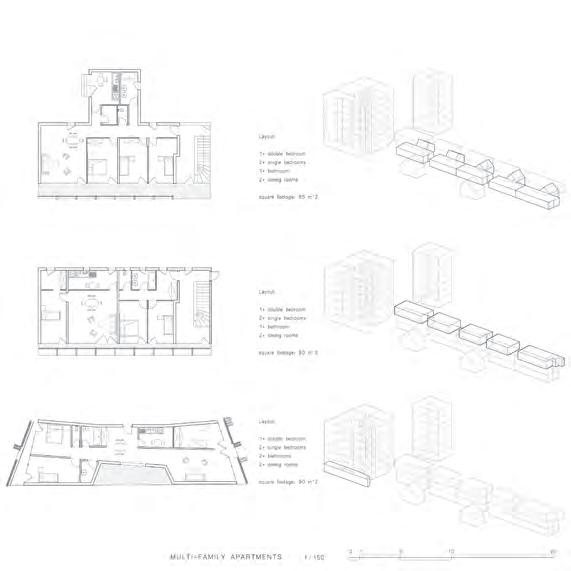
The project promotes social and demographic inclusivity through a varied composition of residential units, encompassing spacious three-bedroom family apartments alongside more compact one-bedroom configurations. This range accommodates diverse household sizes, needs, and lifestyles, ensuring broader accessibility within the urban fabric.
Architecturally, the design engages directly with its Parisian context. The deliberate arrangement of fenestrations establishes a strong vertical rhythm, drawing from the traditional proportions of local streetscapes to achieve visual coherence and harmony within the built environment.
This formal consideration is augmented by a dynamic functional layer: adjustable steel screens clad the street-facing facades. These screens serve a dual purpose.
Aesthetically, they introduce a textured, mutable quality, allowing the building's frontality to evolve continuously in response to occupant use and the shifting daylight. Functionally, they provide adaptable mediation between interior and exterior, enhancing occupant control over privacy, shading, and views, thereby embedding a capacity for change within the fixed architectural structure.
[PLAN - SECOND FLOOR]
[PLAN - THIRD FLOOR]
116 Delancey Street, Manhattan, New York City
[MULTIFAMILY APARTMENTS]
[SINGLE RENTAL UNITS]
[SHORT SECTION - MULTIFAMILY APARTMENTS]
SCHEMATIC DESIGN
Differentiated Program
The ground floor is designated for a business incubator, featuring a glass storefront design that delineates the boundary between street activity and the three adjacent public courtyards. Simultaneously, this transparent storefront design enhances visibility between the two parallel spaces, fostering a sense of connection and openness throughout the site.
The vegetated, accessible roofs are designed as a series of setbacks sloping toward the southwest side of the site, strategically oriented to maximize sun exposure during the winter months.
The rental single units are positioned on the northern side of the plot, facing Rivington St. They boast vertically interlocked, double-height living rooms, appealing to young renters in search of a novel residential experience.
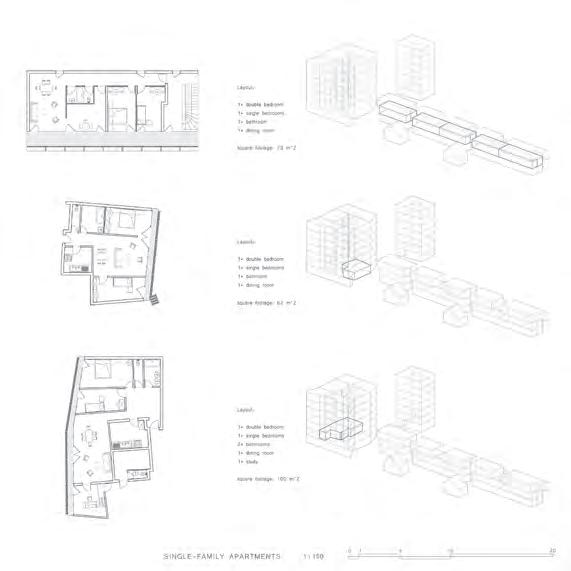
The three backside courtyards are divided by stacks of split-level co-op apartments, featuring shared living rooms and two queen-size bedrooms connected by staircases. *For a more in-depth view of these units, refer to the project's introduction page, where a detailed illustration is provided.
SCHEMATIC DESIGN
[SITE MASSING MODEL]
[SINGLE RENTAL UNIT - STREET-FACING]
[SINGLE RENTAL UNIT - STREET-PERSPECTIVE]
[SINGLE RENTAL UNIT - REAR SIDE CIRCULATION]
OTHER WORKS
THE WATER DRIP HOUSE: Not A Hotel International Design Compeition
Type: Luxury residence & vacation house
Year: 4th-year winter
Instructor: Independent Work
Collaborator(s): Qilingli Rannia Zhang, Ronghao Harry Jin
Site: Yakushima Island, Japan
Breathable
Backyard drainage gutters and partition walls
Key Project Data
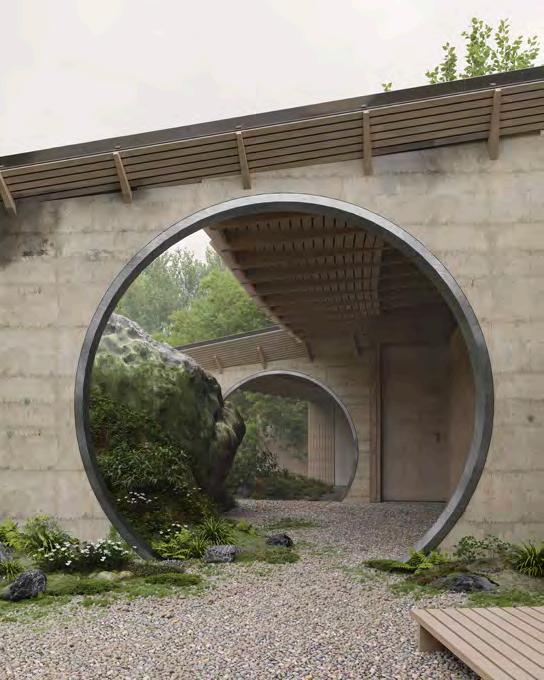
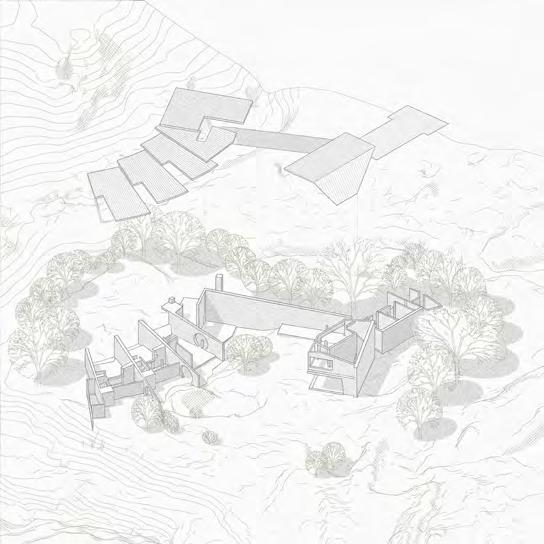
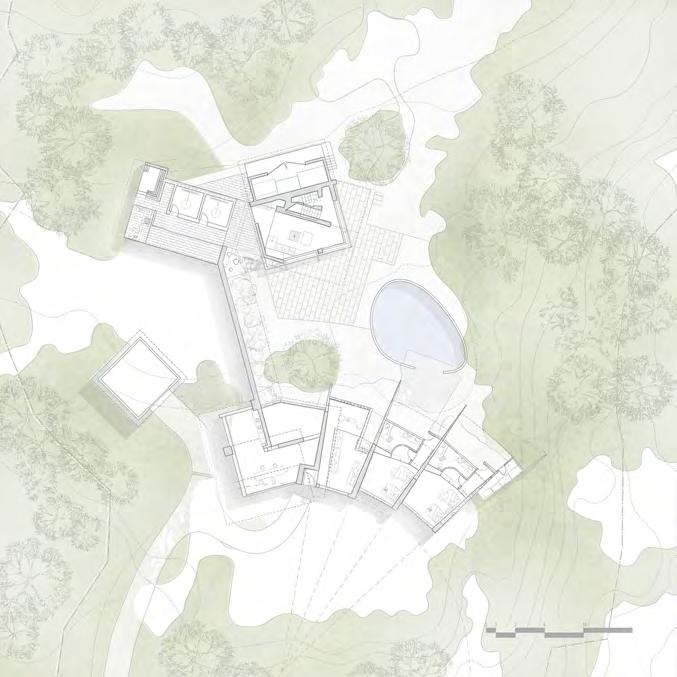
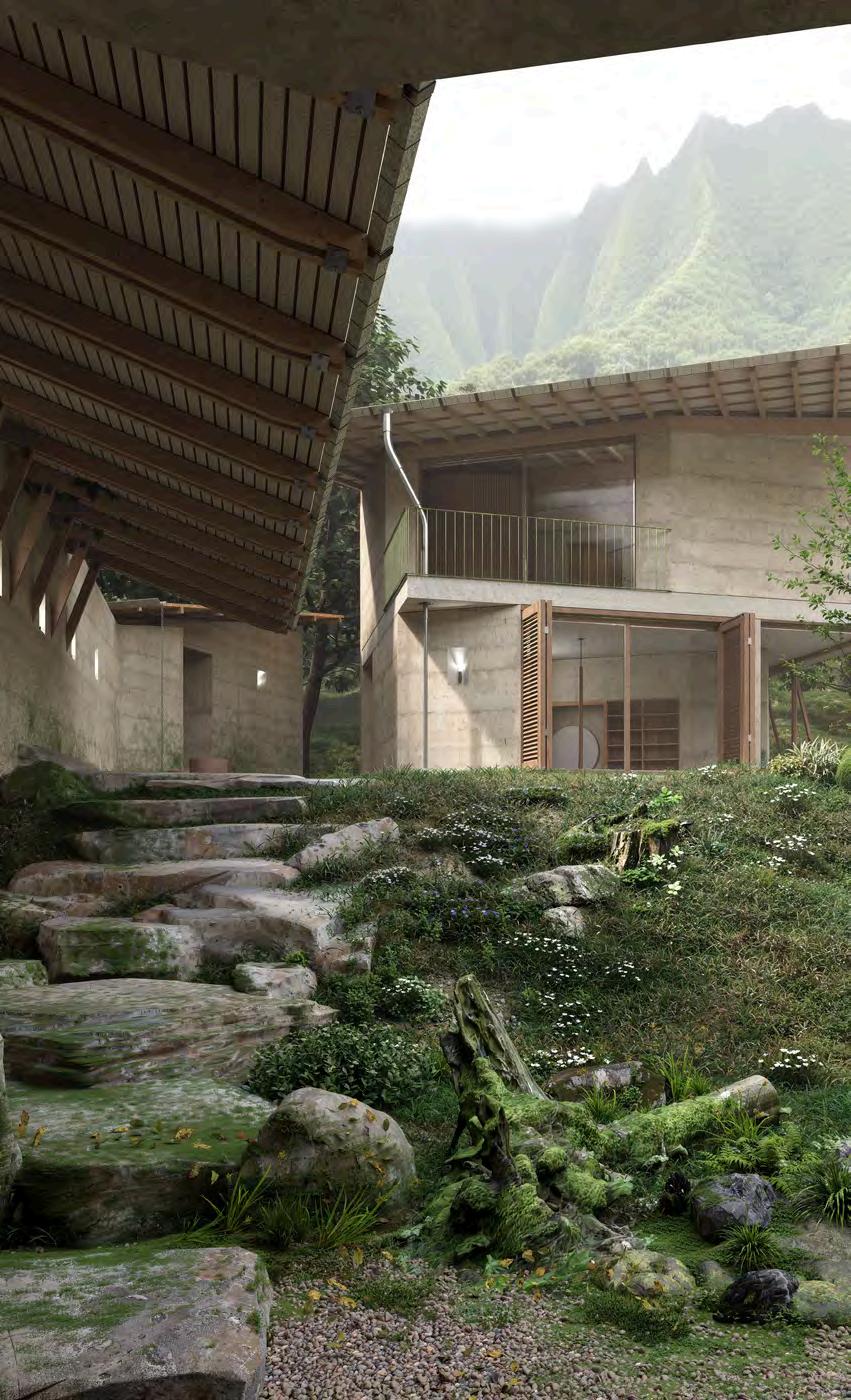
This luxury Yakushima residence masterfully transforms the island's legendary, persistent rainfall into its central design narrative and poetic essence. The architecture actively choreographs water's rhythm , turning every downpour into a multisensory performance.
Stepping into the curated threshold, where a delicate cleansing drip channel at each house's backyard serves as a ritualistic portal, a veil of falling droplets that marks the transition from the outside world into a mindful sanctuary.
On the roof, the deep eaves are equipped with sculptural copper scuppers installed along the concrete partition walls that extend like precision instruments, releasing steady, rhythmic filaments of water.
THE DRIFTER
Flood-resilient food co-op
Type: Retail Market
Year: 2nd-year Studio
Instructor: Aurelie Frolet
Collaborator(s): Individual Work
Site: Lower Ninth Ward, New Orleans, LA, US
THE DRIFTER
Buoyancy in a Sinking Community
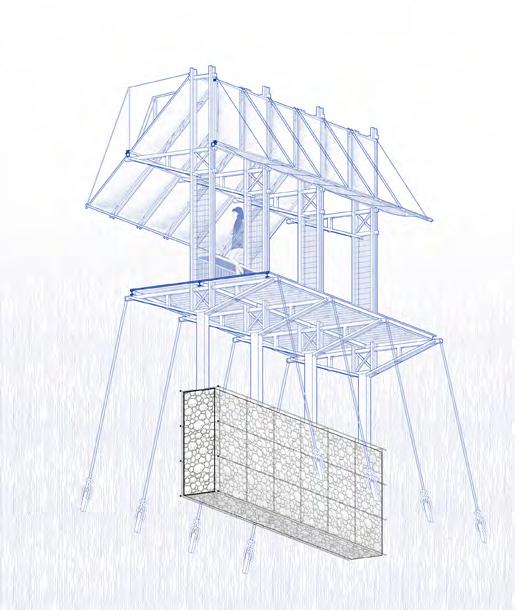
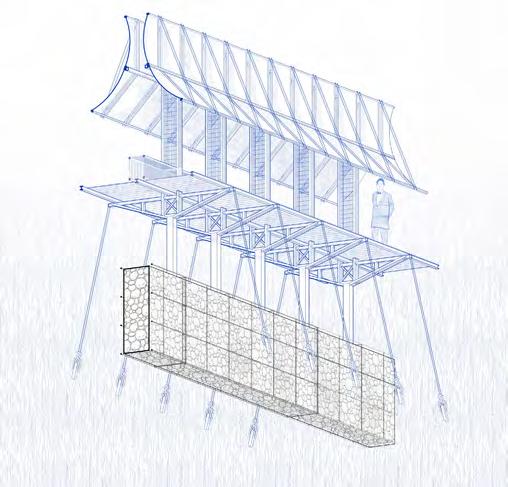
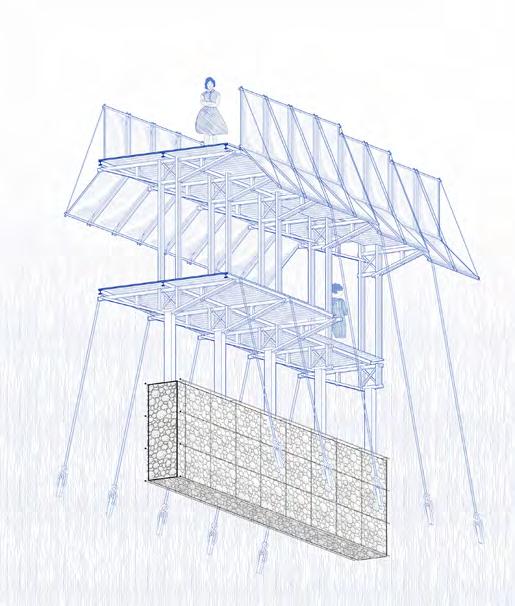
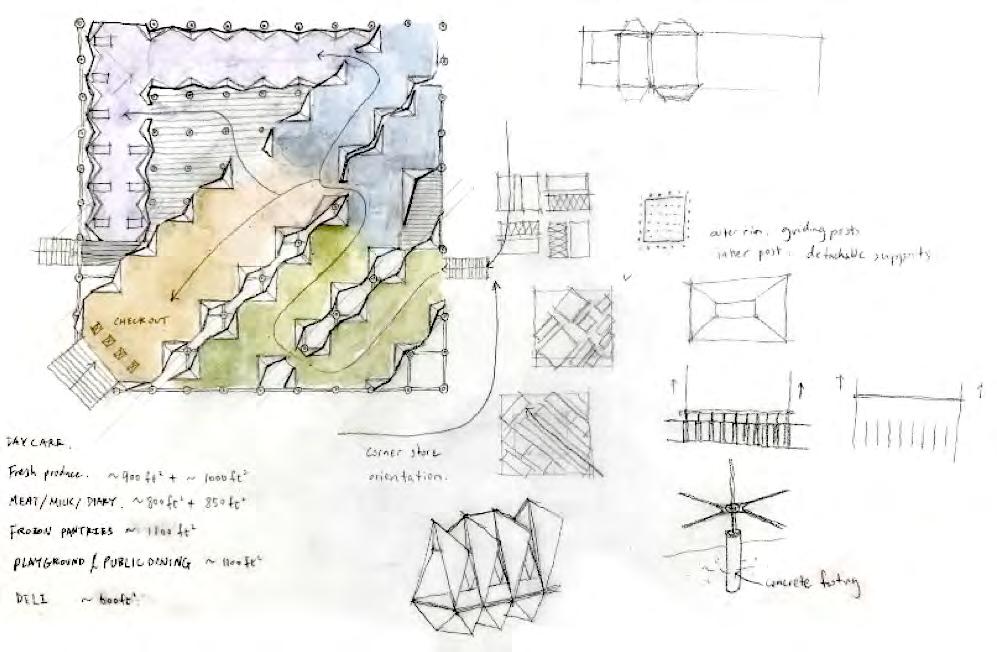
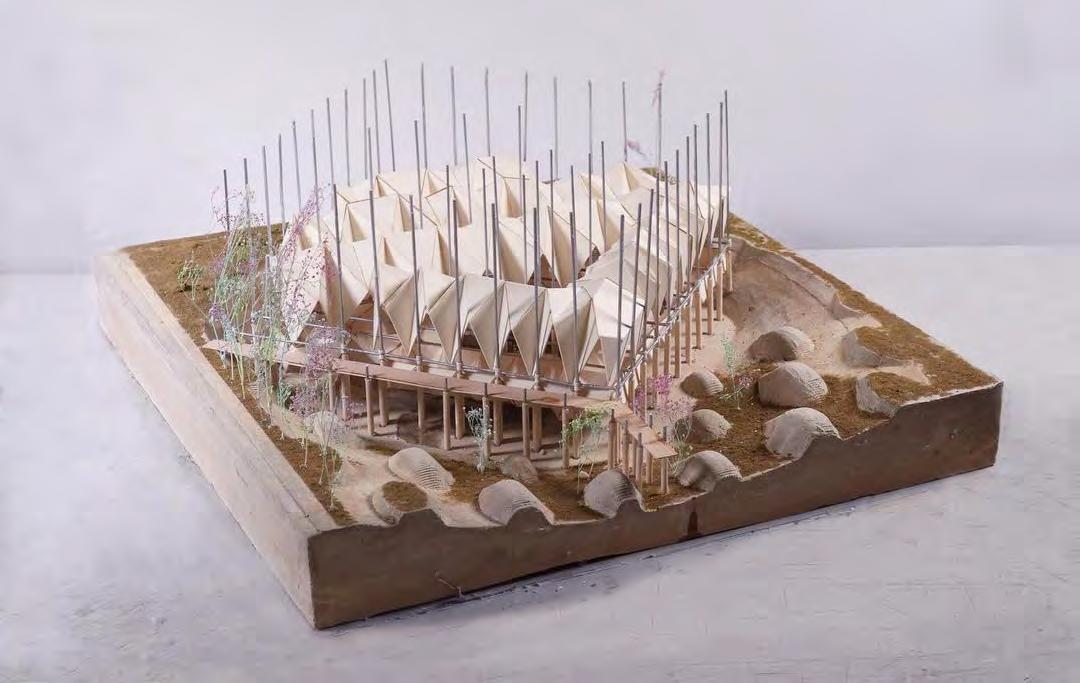
Situated in New Orleans' Lower Ninth Ward , a community deeply scarred by the aftermath of Hurricane Katrina, the design of DRIFTER features a lightweight, floatable deck system anchored on hydraulic pole s. This innovative mechanism allows the functional living space to be effortlessly lifted during flooding events , thereby ensuring the safety and security of its inhabitants.
The project is born from the crucible of the district's turbulent history, including the white fly infestation and the enduring struggle against African American poverty and food deserts. Within this resilient structure, a cooperative market provides affordable access to fresh produce and locally sourced goods, addressing critical community needs.
During typical dry days, the area beneath the elevated deck transforms into a serene water garden featuring undulating artificial terrain. Employing a mechanism akin to wave-absorbing blocks, the ground is sculpted into a network of mounds designed to mitigate the destructive impact of floodwaters. This thoughtful landscape serves a dual purpose, offering peaceful civic space in fair weather while functioning as a soft, engineered buffer against storm surges , embodying a dynamic harmony between daily community life and adaptive resilience in the face of environmental
THE DRIFTER
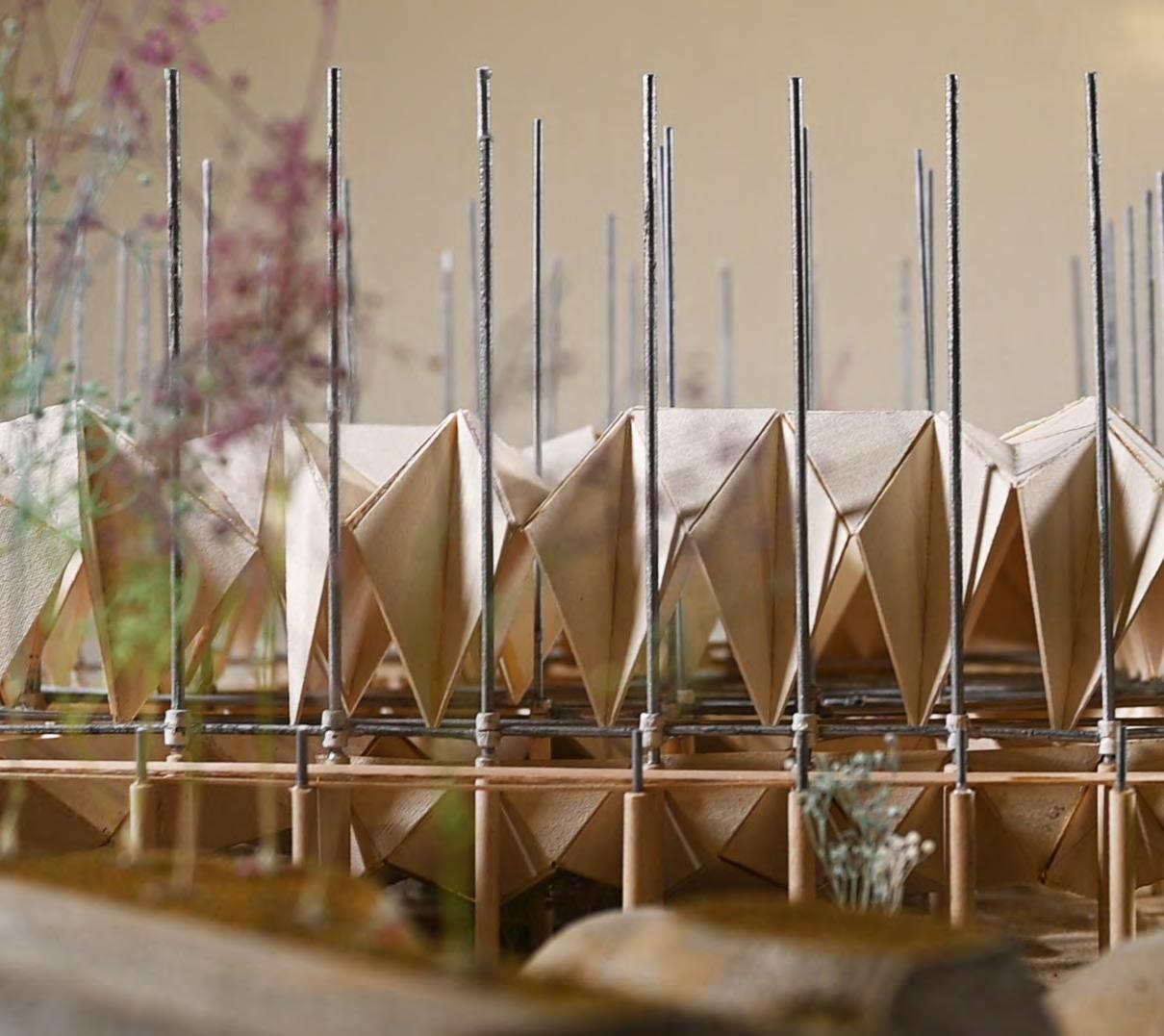
Suspended above its floatable frame, the market is crowned by a graceful tent structure defined by lightness and permeability.
The canopy is formed from panels of ethereal, thin fabric, meticulously stretched and tensioned across a slender tensile frame. This engineered system creates a billowing, aerodynamic roofscape that appears to float independently of the solid deck below.
Resilience/Transience
The semi-translucent curtains diffuse the harsh southern sun, bathing the market floor in a soft, even glow while offering shelter from the elements. In breezes, the entire structure breathes and shifts subtly, its fabric skin rippling like a sail.
A principle of resilient transience is embodied through a durable yet dematerialized enclosure that provides a defined civic space without imposing a heavy, permanent footprint.