38 AÑOS
La Biblia del viajero en Yucatán The Traveler’s Bible in Yucatán Yucatán Today, es un medio bilingüe de información turística sobre destinos, cultura y el qué hacer en Yucatán con 38 años de trayectoria.
x x x Yucatán Today, is a bilingual tourist information medium about destinations, culture, and everyday life in Yucatán with 38 years of history.
www.yucatantoday.com
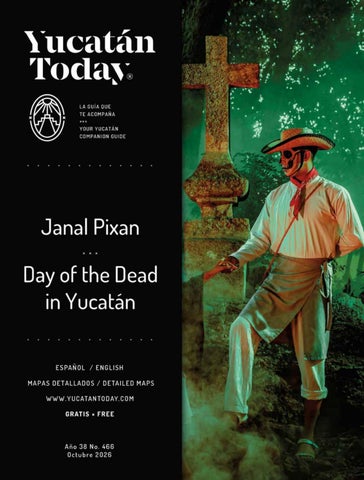
Prepárate para el Festival de las Ánimas 2026 Get Ready for the 2026 Festival of Souls año, Mérida se engalana presentando el Festival de las C ada Ánimas, inspirado en la ancestral conmemoración maya dedicada
year, Mérida lights up for the Festival de las Ánimas (Festival of E very Souls), a celebration based on the Maya observance of remember-
a recordar a quienes ya partieron: los Días de Finados o Janal Pixan.
ing those who have passed: the Days of the Dead, or Janal Pixan.
Si estás en Mérida entre el 24 de octubre y el 2 de noviembre de 2026, encontrarás que la ciudad se llena de aromas, colores, música y expresiones artísticas que hacen de esta celebración una experiencia única para quienes buscan conocer el patrimonio cultural de Yucatán.
If you’re in Mérida between October 24 and November 2, 2026, you’ll find the city filled with aromas, colors, music, and artistic expressions that make this celebration a unique way to experience Yucatán’s cultural heritage.
La programación también incluirá bailes tradicionales en la Vaquería de las Ánimas, y un toque del centro del país en el Desfile de Catrinas. Los amantes del deporte y la movilidad también podrán sumarse a la Rodada de las Ánimas, un recorrido ciclista que une la convivencia con el respeto a las tradiciones. Los más interesados en historia y arte podrán participar en los recorridos por el Cementerio General, donde el patrimonio y la memoria colectiva cobran un significado especial durante estas fechas. Pero el momento más emblemático del festival se vivirá el 30 de octubre con el tradicional Paseo de las Ánimas, una de las manifestaciones culturales más importantes de Yucatán. Miles de personas, vestidas con trajes típicos yucatecos o simplemente de blanco convertirán las calles del Centro Histórico en un escenario lleno de velas, flores, altares, música y expresiones culturales que evocan el regreso simbólico de las almas para reunirse con sus familias. El Festival de las Ánimas de Mérida es mucho más que una agenda de actividades: es una oportunidad para adentrarse en la cultura viva de la ciudad, conocer la gastronomía tradicional, recorrer sus barrios históricos, convivir con sus habitantes y comprender el profundo significado que los Días de Finados o Janal Pixan tienen para las familias yucatecas.
During the festival, for example, the city’s main square (Plaza Grande) will be home to a Monumental Altar, a space for remembrance and offerings where locals and visitors can honor their loved ones in the heart of the city. Another highlight will be the Ninth Mucbipollo Fair at San Sebastián Park, where you can discover and taste the season’s most iconic dish, prepared using recipes passed down through generations and traditionally cooked underground in a Maya-style oven, or píib. FOTO: H.AYUNTAMIENTO DE MÉRIDA
Durante el Festival, por ejemplo, la Plaza Grande albergará un Altar Monumental, espacio dedicado al recuerdo y a la ofrenda que permitirá a habitantes y visitantes rendir homenaje a sus seres queridos en el corazón de la ciudad. Otro atractivo será la 9a. Feria del Mucbipollo en el Parque de San Sebastián, donde podrás conocer y saborear el platillo más representativo de esta temporada, preparado con recetas heredadas de generación en generación y cocido bajo tierra en el tradicional horno maya (píib).
Life and Culture
EN PORTADA • COVER STORY
The program will also include traditional dancing at the Vaquería de las Ánimas, as well as a touch of central México at the Catrina Parade (the dressed-up skeletons you probably associate with Day of the Dead). Sports and cycling enthusiasts can join the Rodada de las Ánimas, a bike ride that combines community spirit with respect for local traditions, while those interested in history and art can take part in tours of the General Cemetery, where heritage and collective memory take on special meaning at this time of year.
But the festival’s most awaited moment comes on October 30, with the traditional Paseo de las Ánimas (Stroll of the Souls), one of Yucatán’s most important cultural expressions. Thousands of people, dressed in traditional Yucatecan clothing (or simply in white), will transform the streets of Mérida’s Centro into a scene of candles, flowers, altars, music, and cultural expressions evoking the symbolic return of souls to reunite with their families. The Festival de las Ánimas in Mérida is much more than a collection of events. It’s an opportunity to immerse yourself in the city’s living culture, discover traditional cuisine, explore its historic neighborhoods, meet its residents, and understand the deep significance that the Days of the Dead, or Janal Pixan, hold for Yucatecan families. Descubre más: / Find out more: www.merida.gob.mx/animas
1
ÍNDICE • CONTENTS
VIDA Y CULTURA SOCIOS FUNDADORES • FOUNDING PARTNERS Juan Manuel Mier y Terán Calero Judy Abbott de Mier y Terán DIRECTOR Andrea Mier y Terán Abbott / andrea@yucatantoday.com
Las prácticas de los Días de Finados
3
The Authentic Practices of Days of Finados
Los wáayes
4
The Shape-Shifting Witches of Yucatán
Los guardianes del mundo maya
5
The Guardians of the Maya World
EDITOR • EDITOR Alicia Navarrete Alonso / editor@yucatantoday.com
El ritual de la melancolía
8
The Yucatecan Ritual of Melancholy
ASISTENTE EDITORIAL • EDITORIAL ASSISTANT Sara Alba Prim / escribe@yucatantoday.com
El platillo del mes: Mukbilpollo
9
The Dish of the Month: Mukbilpollo
ESCRITORES COLABORADORES • CONTRIBUTING WRITERS Samantha Acosta, José Ivan Borges Castillo, Olivia Camarena, Violeta H. Cantarell, Raúl Gasque, Alicia Navarrete DISEÑO GRÁFICO • GRAPHIC DESIGN Magali Ramírez D. / diseno@yucatantoday.com DIGITAL • DIGITAL Sharon Cetina Ruiz / estrategia@yucatantoday.com Carlos Guzmán Andrade / contenido@yucatantoday.com ADMINISTRACIÓN • ADMINISTRATION Renée Morales Jiménez / gerente@yucatantoday.com Yorgina Montalvo Pech / clientes@yucatantoday.com Jocelyn Medel / contabilidad@yucatantoday.com DISTRIBUCIÓN • DISTRIBUTION Roberto Pérez Miguel / cobranza@yucatantoday.com VENTAS • SALES L.T. Monserrat Castillo / ventas@yucatantoday.com
www.yucatantoday.com yucatantoday
Yucatan Today
yucatantoday
YucatanToday
TIRAJE MENSUAL 10,000 MONTHLY CIRCULATION 10,000 Todos los derechos reservados por Dynamic Offset SA de CV. Reserva de derechos al uso exclusivo del título YUCATAN TODAY - Certificado de Derecho de Autor No. 04-2025-022714224500-102 SECOFI. Calle 39 #483 interior 10, x 54 y 56, Centro Mérida, Yucatán, México, C.P. 97000 m 999 927 8531 Lun. - vie. / Mon. - Fri. 9 am - 5 pm. Prohibida la reproducción total o parcial del contenido sin autorización por escrito de los editores. La revista asume que el material aquí presentado es original y no infrige los derechos reservados de ley. Yucatán Today no se hace responsable por el contenido de los anuncios. / Yucatán Today is not responsible
for the content of the advertisements.
Leyenda / Key:
Anunciante / Advertises in Yucatán Today
YUCATÁN TODAY ES LA GUÍA RECOMENDADA POR YUCATÁN TODAY IS THE GUIDE RECOMMENDED BY
Qué hacer este mes Eventos Galerías / Museos / DIR
MÉRIDA
Yucatán Today MEDIA KIT
PUBLICIDAD • ADVERTISING
13 Galleries / Museums / DIR MÉRIDA
Centro de Mérida / MAPA
15 Mérida Downtown / MAP
Bienestar / Directorio de salud / DIR
ESTE MES La comida de los altares yucatecos Acerca de Mérida Los pixanes, por todo Yucatán
PRINCIPALES DESTINOS Haciendas Cenotes y grutas
16 Wellness / Health Directory / DIR THIS MONTH 17 The Food That Goes on Yucatecan Altars 20 About Mérida 22 The Pixanes, All Across Yucatán MOST VISITED DESTINATIONS 25 Haciendas 26 Cenotes and Caves
Pueblos Mágicos de Yucatán
28 Yucatán's Magical Towns
Zonas arqueológicas mayas
30 Maya Archaeological Sites
Uxmal / Ruta Puuc
GUÍAS Cómo llegar
32 Uxmal / Puuc Route 34 Chichén Itzá 36 The Yucatán Coast GUIDES 38 How to get There
Agencias de Viaje / Bienes Raíces / DIR
39 Travel Agencies / Real Estate / DIR
Consulados / Números teléfonicos
Travel Tips / Emergency Numbers /
de emergencia / DIR 999 782 9527 / ventas@yucatantoday.com
12 Events
14 Mérida City / MAP
La costa yucateca YUCATÁN TODAY MEJOR CREADOR DE CONTENIDO TURÍSTICO 2021 YUCATÁN TODAY, BEST TOURISM CONTENT CREATOR 2021
10 What’s Going on This Month
Ciudad de Mérida / MAPA
Chichén Itzá
2
LIFE AND CULTURE
40 Consulates / DIR
Las auténticas prácticas de los Días de Finados The Authentic Practices of Days of Finados la breve ponencia “U k’iinilo’ob finados: Los días de finados” publiE ncada en Facebook, el Dr. Fidencio Briceño Chel, renombrado lingüista
Briceño Chel, a renowned Maya linguist and researchD r.er,Fidencio posted a Facebook video called “U k’iinilo’ob finados: The Days of
e investigador maya, resalta los elementos auténticos de las prácticas de los Días de Finados. Aquí te presentamos un resumen de algunos de sus puntos.
Finados” where he talks about the authentic practices of Days of the Deceased. Here’s a summary of some of his key points.
Entre los mayas, la conmemoración de los “finados” o fieles difuntos representa una reunión con los ancestros, y posee un significado mucho más amplio que lo que se conoce turísticamente como Janal Pixan. Este acto ceremonial incluye la cariñosa preparación de la llegada de las ánimas: limpiar la casa, preparar los manteles, planear con qué alimentos recibirlas. Esto es también porque se cree que todos los que recuerdan con amor las almas de los difuntos recibirán su protección en esta tierra.
Among the Maya, the commemoration of the faithful departed is a deeply meaningful tradition that symbolizes a reunion with ancestors; it encompasses much more than what is known by tourists as Janal Pixan. This ceremonial act involves the thoughtful preparation of the souls’ arrival, as it is believed that those who lovingly remember the souls of the departed will be blessed with their protection.
Estos platillos son los que se ofrecen a las almas para recibirlas a su llegada, porque pueden disfrutarlos durante el tiempo que pasarán en nuestros hogares, acompañando a y acompañados de la familia. En cambio, las ofrendas para el biix (ochovario u ochavario) se preparan especialmente para que el alma las pueda llevar de regreso a su morada; por eso se procura que sea comida seca. Es entonces cuando se les pone el pib o mukbilpollo, el tradicional tamal que se hornea bajo tierra. El mantener viva la relación con nuestros ancestros permite que también los aprendizajes y los conocimientos que nos heredaron sigan vigentes; hay una permanente y mutua comunicación entre nuestros muertos y nosotros que permanecemos vivos en esta tierra. Así pues, la comida y el recibimiento de los difuntos no es una simple conmemoración folklórica, sino un espacio en el ciclo anual maya que nos permite asimilar y reproducir nuestra propia cosmopercepción: la muerte es parte de la vida y el recibir a nuestros ancestros es también enseñarles que todavía pervive el amor hacia ellos, aun después de fallecidos. Visita www.yuc.today/241006 para saber más sobre los alimentos, colores y aromas de los altares tradicionales, y ver la ponencia completa en voz del Dr. Fidencio Briceño.
The traditional setup is laid out on a regular table, on a single level, and includes food, sweets, flowers, drinks, and candles; some altar-tables feature work tools or utensils, but this is done for the sake of tourists, not the pixanes (souls). Pixanes are welcomed and fed their favorite dishes, placed in clay plates or, alternatively, in jícaras (calabashes); glass or crystal utensils are not used so that the souls will not be spooked by their own reflection. Some of the dishes traditionally placed on the altars include relleno negro and chilmole, along with traditional sweets and seasonal fruits such as jícamas, oranges, and mandarins; this is why xe’ek’ (a salad of jicama with citrus) is an essential part of the offerings. Children are generally offered non-spicy foods, lots of traditional sweets, fruits, and colorful candles; some families also place toys on the table-altar. FOTO: YUCATÁN TODAY
Lo tradicional es que en la mesa-altar se acomoden alimentos, dulces, flores, bebidas y velas en un solo nivel; colocar utensilios o herramientas de trabajo es una folklorización para los turistas, y no es del agrado de las ánimas. A éstas se les recibe y alimenta con su comida predilecta, colocada en platos de barro o en jícaras; no se usan utensilios de vidrio o cristal para que no se vean reflejadas en ellos. Algunos platillos colocados tradicionalmente son el relleno negro y el chilmole; éstos se acompañan con dulces típicos y frutas de la temporada como jícamas, naranjas dulces y mandarinas; por eso también entre nosotros el xe’ek’ (ensalada de jícama con cítricos) es infaltable.
Life and Culture
¿QUIÉNES SON LOS MAYAS? • WHO ARE THE MAYA?
These dishes are offered to the souls to welcome them upon their arrival, so they can enjoy them during the time they will spend in our homes, accompanied by and accompanying the family. In contrast, the offerings placed for the biix (the end of the season) are prepared specifically so that the soul can take them back to their resting place. Therefore, dry food is preferred. This is when pib or mukbilpollo, the traditional tamal baked underground, is offered. Keeping the connection with our ancestors alive helps make sure their lessons and knowledge stay meaningful. This way, there’s always a continuous and heartfelt exchange between those who have passed on and us who are still on this Earth. Thus, the food and welcoming of the departed is not merely a picturesque tradition, but a moment in the annual Maya cycle that helps us honor and keep alive our worldview: death is a part of life, and by welcoming our ancestors, we show them that our love continues to thrive despite their passing. Visit www.yuc.today/241006en to learn more about the food, colors, and aromas of traditional altars, and to watch the full presentation in Dr. Fidencio Briceño’s own words.
3
Vida y Cultura
QUIÉNES SON LOS MAYAS • WHO ARE THE MAYA
Los wáayes: brujos animales de Yucatán Wáayes: The Shape-Shifting Witches of Yucatán sinfín de seres mitológicos yucatecos que se divierten confunD eldiendo y desapareciendo a la gente, hoy déjame contarte sobre los
wáayes. Esta figura (cuyo nombre puede escribirse uay, huay o, según la ortografía maya, wáay) es un tipo de brujo cuya característica principal es que puede transformarse en un animal; si has oído hablar de los nahuales del centro de México, definitivamente se trata de seres similares.
Los rumores sobre la presencia de un wáay surgen cuando existen apariciones irregulares de algún animal sin dueño, sobre todo cerdos o perros de gran tamaño. En estos casos, se cree que la presencia misteriosa del animal podría tratarse en realidad de un ser humano transformado. Los wáayes más populares son el wáaychivo (el más conocido), el wáaypeek’ (que se transforma en perro) y el wáayk’éek’en (que se transforma en cerdo). Sin embargo, la variedad puede ser tan grande como la de animales que encontramos en la Península. Vale la pena aclarar que los wáayes no son la única razón por la que un animal siniestro podría aparecerse por las noches. En Yucatán se conoce como “mal viento” a las apariciones sobrenaturales o malas energías, que pueden materializarse en forma de animal. Así, en algunas anécdotas cotidianas (como siempre, más comunes en los pueblos y ciudades pequeñas), nos encontramos con personas que se topan de noche con gallinas, cabras u otros animales en lugares considerados como embrujados; además de la mala sensación que transmiten, se dice que estas apariciones en forma de animal suelen desaparecer inexplicablemente de la vista. En estos casos, no necesariamente se trataría de un brujo transformado en animal; podría ser sólo un mal viento que tomó esa imagen para asustar al caminante. Aunque las noticias sobre wáayes que asustan a una población en su versión animal son cada vez menos frecuentes, como historias de pueblo suelen mantenerse bastante vivas. Algunas poblaciones tienen leyendas específicas de wáayes que habitaron en sus límites, como el wáaypeek’ de Ticul o el wáaykot o pájaro brujo de Yaxcabá. En otras, todavía se cree que hay algún brujo local que se transforma en algún animal en específico por las noches. El que haya un brujo en el pueblo con estos poderes no implica necesariamente que sea malvado. Sin embargo, como bien nos han enseñado todas las leyendas, siempre es mejor no meterse en su camino.
4
Visita www.yuc.today/260706 para leer más sobre brujos y otros “malos aires” o apariciones yucatecas.
are countless mythological beings in Yucatán that delight T here in confusing people—or even making them disappear, like the
aluxes (which we'll covert on the following pages). But there are also the very mysterious wáayes.
Their name may be spelled uay, huay, or, following proper Maya rules, wáay. But let’s get to them already: a wáay is a type of sorcerer whose defining characteristic is the ability to transform into an animal. If you’ve heard of the nahuales of central México, you’ll recognize the resemblance. Rumors of a wáay tend to arise when a suspicious animal begins appearing unexpectedly, particularly a large pig or dog of unknown origin. In these cases, people may suspect that the mysterious creature is actually a human being in disguise. The most famous wáayes are the wáaychivo (the best-known one, which transforms into a goat), the wáaypeek’ (which takes the form of a dog), and the wáayk’éek’en, (which becomes a pig). The possibilities, however, are as varied as the animals found throughout the Península. It’s worth noting that wáayes aren’t the only explanation for a sinister animal appearing after dark. In Yucatán, the term “bad wind” (mal viento) is used for supernatural apparitions or negative energies, which can take many forms, including that of an animal. In everyday stories (and particularly in smaller towns and communities), you may hear about people encountering chickens, goats, or other animals at night in places considered haunted. Besides the unsettling feeling they inspire, these animal apparitions are said to turn up or vanish inexplicably. In such cases, the creature may not be a sorcerer in animal form at all; it could simply be a "bad wind" that chose that shape to frighten a passerby. Although stories of wáayes terrorizing entire communities in animal form are becoming less common, they remain very much alive as part of Yucatán’s folklore. Some towns have their own legends about wáayes that once lived nearby, such as the wáaypeek’ of Ticul or the wáaykot or witch bird of Yaxcabá. In many other places, people still believe that a local sorcerer can transform into a particular animal after dark. Having a sorcerer with these powers in your town doesn’t necessarily mean they are evil. Still, as every good legend has taught us, it’s probably best not to cross their path. Visit www.yuc.today/260706en to read more about sorcerers and other local “bad winds” or apparitions. POR / BY SAMANTHA ACOSTA
Q paradojica.edicion
Aluxes, guardianes del mundo maya Aluxes, Guardians of the Maya World oído hablar de los aluxes? En la ¿ Has creencia maya, los aluxes tienen múlti-
ples representaciones y orígenes. Por ejemplo, uno de los mitos cuenta que los aluxes son los "hombres de la primera humanidad", quienes se convertirían en piedra al salir el sol y recobrarían su estado al atardecer. Otro dice que los aluxes se crean a partir de muñecos de barro que son despertados a la realidad y se vuelven eternos. Lo cierto es que los aluxes son considerados los destacados guardianes y protectores de montes, milpas y vestigios arqueológicos. Quienes los han visto dicen que son tan bajitos que es fácil confundirlos con niños y que están hechos de viento. Porque los aluxes toman muy en serio su labor como guardianes, quienes entran en sus territorios sin el debido respeto son los que suelen encontrárselos. Su presencia se puede hacer notar en la forma de alguna travesura: objetos perdidos, risas, silbidos, golpecitos en puertas o ventanas, etc. Sin embargo, los aluxes son capaces hasta de causar enfermedades y de “perder” a la gente en el "monte" (selva)—castigos que sólo un sacerdote maya puede revertir. Los yucatecos tenemos muy clara la importancia de convivir pacíficamente con estos seres. Es costumbre para los campesinos, por ejemplo, hacerles una ofrenda durante el periodo de siembra; con esto, piden a los aluxes que cuiden su cosecha y espanten a quienes quieran entrar en sus tierras con malas intenciones. También es todavía bastante común encontrar yucatecos que les ponen ofrendas en algún rincón de su casa, desde dulces y frutas hasta alcohol y cigarros. Incluso si no hay ceremonia de por medio, no pierdes nada manteniendo la paz. No importa si estás de paso por Yucatán o si vives aquí: siempre recuerda que la base de tu relación con los aluxes debe ser el respeto por tu entorno. Especialmente cuando te encuentres en grutas, cenotes, sitios arqueológicos, o simplemente en el “monte”, procura dedicar unos instantes a reconocer que eres sólo un visitante, y quizá que te gustaría contar con su permiso y protección. Si te llegas a encontrar con alguno, no hay que asustarse. Pídeles ayuda, cumple con la ofrenda y no olvides después darles las gracias.
Life and Culture
UN DÍA EN LA VIDA • A DAY IN THE LIFE
ALUX ALUX.- sus. Hombre mítico diminuto hecho de barro que cobra vida y cuida los montículos arqueológicos y las milpas.
ALUX.- n. (pr. ah-LOOSH) A tiny mythical man made of clay who comes to life and protects archaeological mounds and cornfields.
Fuente/Source: Diccionario Introductorio Español - Maya / Maya - Español, Universidad de Quintana Roo, 2009
Los guardianes de las tierras y las cosechas se quedarán de tu lado.
H
ave you ever heard of the aluxes? In Maya lore, aluxes have many different representations and origins. For example, one myth says that aluxes are the “men of the first humanity,” who turn to stone when the sun comes up, only to regain their original form at dusk. Others believe that aluxes can actually be created from little clay figures that are awakened to reality, and become eternal. Whatever their origin, aluxes are widely regarded as guardians and protectors of the forest, cornfields, and archaeological remains. Those who claim to have seen them say they are so small that they can easily be mistaken for children, and that they are made of wind. Because aluxes take their duties as guardians seriously, those who enter their territory without showing proper respect are the ones most likely to encounter them. Their presence may make itself known through mischief: missing or misplaced objects, sounds of laughter, footsteps, whistles, or tapping at doors and windows. But aluxes are also said to be capable of causing illness and making people lost in the
forest—punishments that can only be undone with the intercession of a Maya priest. People in Yucatán understand the importance of living peacefully alongside these beings. For example, farmers usually make offerings during planting season, asking the aluxes to protect their crops and keep anyone with bad intentions off their land. It is also fairly common to find people who leave offerings for them somewhere in their homes, from sweets and fruit to alcohol and cigarettes. Even if there is no ceremony involved, it can't hurt to keep the peace. Whether you are just passing through Yucatán or call it home, always remember that the foundation of your relationship with aluxes should be respect for your surroundings. Especially when you find yourself in caves, cenotes, archaeological sites, or simply out in nature, take a moment to acknowledge that you are only a visitor, and perhaps that you would like their permission and protection while you’re there. And if you happen to encounter one, there is no need to be afraid. Ask for its help, keep up your end of the offering, and don't forget to say thank you afterward. The guardians of the land and the harvest will remain on your side.
5
UN DÍA EN LA VIDA • A DAY IN THE LIFE Algunos relatos de nuestros lectores
Vida y Cultura
A few reader submitted stories
El alux del puente
The alux from the bridge —Jocelyn M.
Cuenta mi papá que, durante la construcción de un puente en Cancún, más de una vez la obra colapsó o se desplomó sin razón. Varios ingenieros trataron de descubrir la falla, pero no se explicaban por qué no resistía. Un día, una persona le preguntó a los constructores si le habían pedido permiso a los aluxes para construir en esa área. Los ingenieros, no muy convencidos, pero al borde de sus casillas, construyeron una "casita" donde dejaron ofrendas para los aluxes. Fue hasta entonces que el puente se pudo construir sin más contratiempos. La casita todavía se puede ver abajo del puente.
La viejita
El alux travieso
—Olivia C.
—Rob V.
The old lady Hace algún tiempo, una mujer en Sisal estaba enferma del estómago y, por la hora, no alcanzó a consultar con el doctor. Cerca del centro de salud se encontró con una “viejitita” vestida de hipil, que parecía haber salido de los matorrales cercanos. La viejita le dio una pequeña bolsa con insumos naturales para hacerse un remedio, y le advirtió que cuando bebiera el menjurje sentiría un dolor intenso, pero después se sentiría mejor. La señora, desesperada, siguió las instrucciones y se curó. A la mañana siguiente, nadie le supo dar razón de quién era la viejita, por lo que le aconsejaron hacer una ofrenda en agradecimiento.
Some time ago, a woman in Sisal had a stomachache, but because it was late in the day, she missed the last doctor’s shift. Near the health center, she came across a very, very old, tiny woman wearing an hipil, who seemed to have emerged from the nearby brush. The old woman gave her a small bag of natural ingredients with which to make a remedy and warned her that drinking the concoction would cause intense pain, but that afterward she would feel better. Desperate, the woman followed her instructions and was cured. The next morning, no one could tell her who the old woman was, so they advised her to leave an offering in gratitude.
The alux's shadow —Alberto C.
6
Yo soy de CDMX; un gran amigo me regaló un alux, de las artesanías que venden en el mercado. Ya había escuchado que eran protectores y que también hacían travesuras. Un día, el control remoto de mi televisión se perdió; moví cosas, busqué debajo de la cama, almohadas, ropa y nada. Así que le hablé a mi alux y le dije “¡Oye, no! Tú eres protector, eres guardián y nunca te he hecho nada malo, así que tú mismo me vas a ayudar a encontrar el control de mi tele”. A la mañana siguiente, el control apareció debajo de mi almohada. Le di las gracias a mi alux, le puse dulces y un vasito con xtabentún y desde entonces ya no me ha escondido nada ni me ha hecho travesuras.
I'm from México City, but a good friend from Yucatán gave me an alux, one of the handmade figures sold at the market. I'd already heard that they were protectors, but also tricksters. One day, my TV remote disappeared. I looked everywhere,—nothing. So I spoke to my alux and said, “Hey! No! You're a protector, you're a guardian, and I've never wronged you, so you're going to help me find my TV remote.” The next morning, the remote appeared underneath my pillow. I thanked my alux and told him that now that we had this bond, he'd become my guardian. I left him some candy and a little glass of xtabentún, and since then he hasn't hidden anything from me or played any more tricks.
My father says that while a bridge was being built in Cancún, the construction collapsed several times for no apparent reason. Several engineers tried to figure out what was wrong, but they couldn't understand why the structure would constantly fail. One day, someone asked the builders whether they had asked the aluxes for permission to build there. The engineers weren't particularly convinced, but they were at their wits' end, so they built a little “house” and left offerings for the aluxes. Only then was the bridge completed without any further trouble. The little house can still be seen beneath the bridge.
La sombra del alux
The sneaky alux
Hace varios años, mi prima Laura fue invitada a pasar un fin de semana en la casa de los abuelos de una amiga suya en un pueblo por los rumbos de Peto. Durante la cena alcanzó a ver, con el rabillo del ojo, una sombra que pasó rápidamente a ras de piso por la pared al final de la cocina. No le dio importancia pero ya en la noche, mientras preparaba su hamaca para dormir, vio (o creyó ver) la misma sombra veloz que salía del cuarto. A la mañana siguiente le contó a su amiga lo que había visto (o creído ver) y ella le respondió: "No te asustes, es el alux que vive en el patio. Tiene mucho tiempo con nosotros y le da curiosidad cada vez que tenemos visita, seguro se asomó a ver quién eres".
Several years ago, my cousin Laura was invited to spend a weekend at the grandparents' house of a friend in a village near Peto. During dinner, she caught a glimpse out of the corner of her eye of a shadow that quickly moved along the floor by the wall at the far end of the kitchen. She didn't think much of it. Later that night, while preparing her hammock for sleep, she saw the same swift shadow coming out of the bedroom. The next morning, she told her friend what she had seen (or thought she'd seen), and her friend replied, “Don't be scared. It's the alux that lives in the yard. He's been with us for a long time, and he gets curious whenever we have visitors. He probably just came over to see who you were.”
UN DÍA EN LA VIDA • A DAY IN THE LIFE
The lost boy —José Luis L.
Haciendo trabajo de campo cuando estaba en la universidad, mis compañeros y yo le preguntamos a un señor de un pueblo si alguna vez había visto un alux. “Gracias a Dios no”, respondió. Nos contó la historia del nieto de un amigo suyo, que se había perdido cuando salió a jugar al patio de su casa; sus papás llamaron a la policía, pero el abuelo les dijo que perdían el tiempo y fue a buscar al j-meen (sacerdote). Mientras se llevaban a cabo las búsquedas, el j-meen hizo una ceremonia pidiendo el regreso del niño, y luego le dijo a su abuelo dónde ir a buscarlo: en una milpa a unos cinco kilómetros de distancia. Ahí estaba el niño, fresco y sin gota de hambre, porque, según contó, se había encontrado a otros niños que lo acompañaron y le dijeron qué podía comer en la milpa. Cuando el niño oyó que su abuelo lo llamaba, volteó a donde estaban sus nuevos amiguitos, y vio que estaban hechos de viento y desaparecieron.
La escuela
The school —José A.
Me tocó reemplazar a un velador en una escuela; llegada la hora, me acomodé en mi hamaca, pero como es normal, no me dormí pronto porque no estaba en casa. Después de medianoche, escuché unos golpes como de martillo en las paredes, una vez tras otra. Encendí mi lámpara y salí para ver y no encontré nada anormal. Afoqué cerca de las bardas y no se veía nada raro. Seguro de que no había personas ni nada más, volví a acostarme. Poco tiempo después, volví a escuchar esos golpes, ahora por el techo. Nuevamente salí para ver si era un búho u otro animal, pero igual que la vez anterior no vi nada. La noche siguiente lo platiqué en casa y me sugirieron llevar algunos dulces; esa noche ya no escuché los golpes como la anterior.
El alux inconforme
The unhappy alux —H.W.
La venganza del alux
The revenge of the alux —Leobardo Cox Tec
Una vecina nos contó que en un pueblo vio una figura de barro que le llamó la atención. Cuando trató de comprársela a sus dueños, le dijeron que no estaba a la venta, pero ella insistió tanto que se la regalaron. Apenas instaló la figura en su casa, cosas raras empezaron a pasar: ruidos, cosas que se caían, objetos perdidos o cambiados de lugar. Otra de las vecinas le recomendó usar una tela de algodón para taparle los ojos y los oídos a la figura, meterla a una caja de cartón cerrada y llevarla de regreso con sus dueños, porque seguro era un alux que no estaba contento con su nueva casa. Así lo hizo la vecina, y según dice, todo volvió a la normalidad inmediatamente.
When I was doing fieldwork at university, my classmates and I asked a man from a village whether he'd ever seen an alux. “Thank God, no,” he replied. He told us about the grandson of a friend who had gone missing while playing outside his house. His parents called the police, but his grandfather told them they were wasting their time and went to find the j-meen (priest). While the search continued, the j-meen performed a ceremony asking for the boy's return and then told his grandfather where to look for him: in a cornfield about five kilometers away. That's where they found the boy, perfectly fine and unbothered by heat, thirst, or hunger. He said he'd met some children who had kept him company and told him what he could eat in the cornfield. When the boy heard his grandfather calling, he turned toward his new friends—and saw that they were made of wind before they disappeared.
I once had to fill in for a night watchman at a school. When night came, I settled into my hammock, but I didn't fall asleep right away because I wasn't at home. A little after midnight, I heard what sounded like hammering on the walls, over and over again. I turned on my flashlight and went outside to investigate, but found nothing unusual. I shone the light along the walls and saw nothing strange. Certain there were no people— or anything else—around, I went back to sleep. A short while later, I heard the knocking again, this time coming from the roof. Once again, I went outside, thinking it might be an owl or some other animal, but just as before, I found nothing. The next night, I mentioned it at home, and they suggested that I bring some sweets. That night, I didn't hear the knocking again.
Life and Culture
El niño perdido
A neighbor once told us about a clay figure she saw in a village that caught her attention. When she tried to buy it from its owners, they told her it wasn't for sale, but she insisted so much that they eventually gave it to her for free. As soon as she brought the figure home, strange things began happening: noises, things falling over, and objects disappearing or changing places. Another neighbor suggested that she cover the figure's eyes and ears with a piece of cotton cloth, place it in a closed cardboard box, and return it to its owners, because it was surely an alux who wasn't happy to have been taken from his home. That's what she did, and according to her, everything immediately returned to normal.
Hace mucho tiempo en el pueblo de Tabi había un hombre solitario ya entrado en años. Las canas le pintaban su cabeza y siempre andaba por el pueblo con honda tristeza, porque nunca se había casado: no tenía esposa ni hijos. Un día, cansado de sufrir, tomó una terrible decisión: arrojarse al gran cenote que se encontraba en la plaza del pueblo. Cuando se iba sumergiendo a lo más profundo del agua, en la enorme oscuridad, escuchó lo que parecían ser risas y burlas hacia él y su infeliz suerte. Abrió los ojos bajo el agua y se sorprendió: ¡realmente había alguien ahí!
Long ago, in the village of Tabi, there lived a solitary man who was well beyond his younger years. Gray colored his temples, and he wandered the village with a deep sadness, for he had never married and had no wife or children. One day, tired of suffering, he made a terrible decision: he would throw himself into the great cenote in the village square. As he sank into the deepest, darkest waters, he heard what sounded like laughter and voices mocking him and his miserable fate. He opened his eyes beneath the water and was astonished to discover that there really was someone there. CONTINUA LEYENDO
KEEP READING
7
Mukbilpollo, el ritual de la melancolía Mukbilpollo, the Ritual of Melancholy algo más delicioso y profundo que la memoria? Eso es el ¿ Hay mukbilpollo, o pib: una memoria enterrada en la tierra roja de
Yucatán y convertida en un crujiente resultado; en un baile total, entregado y sincero. ¿Por qué es esto tan especial? Porque todo ritual marca un antes y un después en nuestras vidas, y comer mukbilpollo, el platillo tradicional del Janal Pixan, es un ritual. Éste, el manjar supremo de la temporada, es sólo una corteza de masa y carne cocida en un horno o de forma subterránea, pero se encuentra al centro de una experiencia única, irrepetible y especial. Uno pensaría que el platillo más extrañado por un yucateco migrante sería la cochinita pibil. Pero muchas veces, si tienes la oportunidad de preguntarle a algunos, contestan que es el mukbilpollo. Esto no es sólo por su delicioso sabor, sino también por toda la carga emocional que lo rodea.
there anything more delicious and profound than memory? I sThat’ s what mukbilpollo, or pib, is: a memory buried in the red earth
of Yucatán and transformed into a crispy outcome; into a total, devoted, and sincere dance. Why is this so special? You see, every ritual marks a before and an after in our lives, and eating mukbilpollo, the traditional dish of Janal Pixan, is a ritual.
The supreme delicacy of the season is just a crust of dough and meat, cooked in an conventional or underground oven (known as píib), but it lies at the center of a unique, unrepeatable, and special experience. You might expect the dish most longed for by a Yucateco away from home to be cochinita pibil. Surprisingly, though, more often than not they’ll say that it’s mukbilpollo. This isn’t solely due to its delicious taste but also because of the profound emotional resonance it carries. FOTO: YUCATÁN TODAY
Vida y Cultura
ES MUY YUCATECO • IT'S VERY YUCATECAN
Hasta hace poco, comer pib era un privilegio que pertenecía únicamente al mes de noviembre. Esto ocasionaba que literalmente hubiera yucatecos que vivían en distintos rincones de México o en el extranjero, y que venían a Yucatán solamente a comer pibes. A pesar de la disponibilidad actual, estos viajes siguen ocurriendo. Familias enteras se reúnen alrededor de este platillo, con la foto de un difunto amado y una vela. La fusión de vida y algo más habita a quien transita la experiencia de saborear este platillo, espolvoreado de hojas de plátano tostadas. Aquí va otra pregunta: ¿hay algo más serio en la vida que la muerte? Cuando las dos se juntan pueden llevarnos a ese lugar donde se descubre la esencia de nuestro ser: cuando muerdes un crujiente mukbilpollo, los colores dentro de ti se desatan. Se puede comer caliente, tibio y frío. Este último generalmente después de que han pasado varios días y hemos renunciado a mirar la báscula por unos días. El pib o mukbilpollo es, en sí, un sincretismo absoluto: la unión de la fe y la cultura maya con la española. El maíz la hace esencialmente prehispánica, pero la manteca de puerco (o su carne, si tu pib la incluye) la hacen también un alimento con influencia de ultramar. Es así que, en el pib, los yucatecos reconocemos nuestras raíces y nuestro origen. Hasta el chel (rubio) más chel se siente primeramente maya al robar un bocado de la bandeja.
8
El mukbilpollo no sólo se consume; se muerde, se absorbe, se siente. Habita el paladar, pero también el alma. Este manjar llega sólo una vez al año, para recordarnos que también se puede llegar al estómago a través del corazón. ¿No conoces los pibes? Te contamos más en la pág. 9.
Until recently, having pib was a privilege reserved exclusively for November: Yucatecos living elsewhere in México or abroad would travel home only to eat pibes. But despite its current widespread availability, these trips still take place. Entire families gather around this dish, accompanied by a photo of a loved one, no longer with us, and a flickering candle. The fusion of life and something more dwells in those who experience the taste of this dish, sprinkled with toasted banana leaves. Here’s another question: Is there anything more serious in life than death? When the two come together like lovers in a song, they can take us to that place where the essence of life is discovered; when you bite into a crispy mukbilpollo, the colors inside you become unleashed. It can be eaten hot, warm, and cold.
The pib or mukbilpollo is, in itself, an absolute syncretism: the union of Maya faith and culture with Spanish influence. Corn, the basis of this tamal, makes it essentially pre-Hispanic, but the pork lard (or its meat, if those are the chosen ingredients in your home) also makes it a food with overseas influence. This is how, in a mukbilpollo, Yucatecos recognize our roots, our origin. Even the “chel” (blond) among the chel primarily feels Maya when taking a bite from the tray. Mukbilpollo is not just consumed; it’s bitten, absorbed, and felt. It dwells in the palate, but also in the soul. This delicacy arrives only once a year to remind us that, while usually the way to a person’s heart is through the stomach, the reverse is also possible. Unfamiliar with mukbilpollo? Turn to page 9 to find out more. POR / BY RAÚL GASQUE
Q raul.gasque
EL PLATILLO YUCATECO DEL MES • THE YUCATECAN DISH OF THE MONTH
Mukbilpollo Este tamal, lleno de simbolismos, se considera el único platillo que las ánimas se pueden llevar de regreso al inframundo.
A symbol-filled tamal, considered the only dish that souls can take with them on their journey back to the underworld.
K’óol (salsa espesa) Qué encontrarás en tu plato: Un enorme tamal horneado (entero o por “rebanada”), crujiente por fuera y semisólido por dentro. El relleno lleva k’óol (una salsa espesa a base de maíz), tomate, cebolla, epazote y a veces chile habanero; la masa puede tener espelón (frijoles).
Corn-based filling
What you’ll find on your plate: A huge, baked tamal (whole or by the slice), crunchy on the outside, and gooey or even runny on the inside. The filling is made with k’óol (a thick corn-based sauce), tomato, onion, epazote, and sometimes habanero peppers; black-eyed peas may be added to the masa.
Hoja de plátano
Frijoles de espelón
Banana leaves
ÁN TOD UCAT O: Y FOT
Black-eyed peas
What it should come with: Pickled habanero peppers. Some people serve it with tomato sauce.
AY
Con qué se acompaña: Chile habanero encurtido. Algunas personas le agregan salsa de tomate.
Masa crujiente
Pollo cocido
Crunchy masa
Cooked chicken Otras presentaciones: Aunque el relleno más tradicional es el pollo, actualmente se elaboran también con cerdo (incluyendo lomitos, carne ahumada o chicharra), o incluso variantes con jamón y queso o vegetarianas. La cantidad de k’óol, que determina su consistencia, también varía.
Other variants: Chicken is the most traditional filling, but options with pork (in lomitos, smoked meat, or chicharra), and even ham and cheese or vegetarian, are also available. The amount of kóol, which determines runniness, also varies.
MÁS SOBRE EL MUKBILPOLLO ꞏ MORE ABOUT MUKBILPOLLO Preparación. Tradicionalmente en horno subterráneo, pero también de leña o convencional. Fechas. Desde el 31 de octubre y hasta finales de noviembre en el interior del estado.
Checa la página 17 de esta edición para conocer más sobre otros platillos que se colocan en los altares. Síguenos en redes sociales y visita YucatanToday.com para toda nuestra cobertura de Janal Pixan: www.yuc.today/janalpixan
Preparation. They’re traditionally cooked underground, but also in woodfire or conventional ovens. Dates. Beginning October 31 and through November in villages outside Mérida.
Turn to page 17 for more dishes placed on altars. For updated programs across the state and our full Janal Pixan archive, follow us on socials and visit our website at YucatanToday.com or directly at www.yuc.today/janal-pixan
9
Vida y Cultura
24-2 OCTNOV
Festival de las Ánimas Mérida 2026 The 2026 Festival of the Souls Llegó la temporada más esperada por muchos yucatecos, y con ella, uno de los festivales más icónicos del año: el Festival de las Ánimas. Durante varios días, la tradición yucateca se entrelaza con expresiones de otras regiones del país en una agenda llena de actividades que no te querrás perder. El momento cumbre será el Paseo de las Ánimas, el 30 de octubre. Pero hay mucho más en todo el estado: descubre más actividades en la página 22. October brings one of Mérida's most awaited events: the Festival of the Souls. Over several days, Yucatecan traditions intertwine with expressions from other regions of México in a full program of activities you won’t want to miss. The highlight every year is The Souls’ Parade on October 30. But there's plenty more throughout the state—get the details on page 22.
1-24 FESTIVAL DE LAS AVES TOH
TOH BIRD FESTIVAL ¿Disfrutas la observación de aves? Entonces octubre trae muchas razones para salir a explorar Yucatán con el Festival de las Aves Toh. Este mes encontrarás un taller infantil el 3 de octubre en el Jardín Botánico Regional “Roger Orellana” CICY, seguido de una salida de observación de aves el día 4 por la carretera Mérida–Chuburná Puerto–Vía Sierra Papacal. El 9 de octubre, el Parque Zoológico del Centenario será sede del Festival OCT
10
FOTO: H. AYUNTAMIENTO DE MÉRIDA
QUÉ HACER ESTE MES: OCTUBRE ꞏ WHAT'S GOING ON THIS MONTH: OCTOBER Alas Silvestres, como parte del Festival de Aves Migratorias, mientras que el 17 podrás conocer más sobre las aves de la Reserva Cuxtal en Casa Cuxtal. Éstos son sólo algunos de los eventos programados para octubre; consulta el programa completo en su página de Facebook. Do you enjoy birdwatching? Then you’ll be happy to know October brings plenty of reasons to get out and explore Yucatán with the Toh Bird Festival. This month’s activities include a children’s workshop on October 3 at the “Roger Orellana” Regional Botanical Garden at CICY, followed by a birdwatching outing on October 4 along the Mérida–Chuburná Puerto–Vía Sierra Papacal road. On October 9, Parque Zoológico del Centenario will host the Alas Silvestres Festival as part of the Migratory Bird Festival, while on October 17, you can learn more about the birds of the Cuxtal Reserve at Casa Cuxtal. These are just a few of the events scheduled for October. Check out the full program on the festival’s Facebook page. E Festival de las Aves TOH
1-23 BORDES, TRAYECTOS Y MUDANZAS
BORDERS, JOURNEYS, AND MOVES Este mes, date una vuelta por el Centro Contemporáneo del Mayab para conocer Bordes, trayectos y mudanzas, el proyecto fotográfico de Mina Bárcenas. A través de fotografías, audiovisuales y apuntes, la artista explora su propia cartografía afectiva y la manera en que nuestros recuerdos se relacionan con los lugares que habitamos, recorremos y dejamos atrás. Tienes hasta el 23 de octubre para acercarte a esta exposición. This month, stop by the Centro Contemporáneo del Mayab to see Borders, Journeys, and Moves, a photographic project by Mina Bárcenas. Through photographs, audiovisual pieces, and notes, the artist explores her own affective cartography and the ways our memories become intertwined with the places we inhabit, pass through, and leave behind. You have until October 23 to visit the exhibition and discover the different paths, boundaries, and changes of place that shape her perspective. OCT
1-28 T'EEP'. SÁBANAS DEL CENTRO DEL
MUNDO MAYA T'EEP'. SHEETS FROM THE CENTER OF THE MAYA WORLD Este mes, date una vuelta por el Museo de la Ciudad de Mérida para conocer T'eep': Sábanas del centro del mundo maya / La habitación expandida, una instalación escénica y textil de Elena Martínez Bolio. La obra reúne sábanas bordadas por mujeres de OCT
distintas generaciones, que juntas se convierten en una especie de tendedero vivo donde se cruzan historias, recuerdos y formas de resistencia. Puedes visitar la exposición hasta el 28 de octubre. La entrada al museo y a la exposición es gratuita. This month, stop by Museo de la Ciudad de Mérida to see T'eep'. Sheets From the Center of the Maya World / The Expanded Room, a textile and scenic installation by Elena Martínez Bolio. The work brings together embroidered sheets made by women from different generations, transforming them into a living clothesline of stories, memories, and resilience. The exhibition is on view through October 28. Admission to the museum and the exhibition is free.
2-29 CONCIERTOS EN MÉRIDA
CONCERTS IN MÉRIDA Este octubre, Mérida tendrá una agenda musical bastante movida, con artistas de distintos géneros llegando a la ciudad. El mes arranca el 2 de octubre con Enjambre, que se presentará a las 9 pm en el Foro GNP. Al día siguiente, será el turno de Mijares, quien llegará al mismo escenario para interpretar algunos de sus mayores éxitos. La música continúa el 17 de octubre con Natanael Cano, también a las 9 pm en el Foro GNP. El 25, Alan Parsons tomará el escenario del recinto, mientras que el 29 de octubre Pandora cerrará el mes con un concierto a las 9 pm en el Auditorio Coca-Cola La Isla Mérida. Consigue tus boletos para todos estos eventos a través de www.eticket.mx This October, Mérida will have a packed music calendar, with artists from different genres coming to town. The month kicks off on October 2 with Enjambre, performing at 9 pm at Foro GNP. The following day, Mijares will take the same stage to perform some of his biggest hits. The music continues on October 17 with Natanael Cano, also at 9 pm at Foro GNP. On October 25, Alan Parsons will take the stage at the venue, while Pandora will close out the month with a 9 pm concert at Auditorio Coca-Cola La Isla Mérida on October 29. If you’re already making plans for October, these concerts are great options for a night of live music in the city. Get your tickets for all of these events through www.eticket.mx OCT
9-11 OKTOBERFEST YUCATÁN 2026
Del 9 al 11 de octubre regresa una de las celebraciones favoritas de los meridanos: el Oktoberfest Yucatán 2026. Esta fiesta alemana, pensada para toda la familia, reúne lo mejor de su gastronomía, música en vivo y, por supuesto, la clásica cerveza alemana que no puede faltar. La cita OCT
QUÉ HACER ESTE MES: OCTUBRE ꞏ WHAT'S GOING ON THIS MONTH: OCTOBER
OCTUBRE EN MEL: ARTESANÍA, CULTURA Y TRADICIÓN OCTOBER AT MEL: ART, CULTURE, AND TRADITION Este 18 de octubre, de 10 am a 2 pm, no te pierdas el MEL Spooky Bazaar 2026, un bazar de emprendedores que reunirá artesanías, joyería, ropa, artes visuales y más. Después, el 24, de 10 am a 1 pm, llegará Hilos de Identidad en MEL, un evento que reunirá a maestras artesanas de la región. Incluirá una demostración de altar de Janal Pixan, exposición de prendas típicas, un desfile de moda y comida local. This October 18, from 10 am to 2 pm, don't miss the MEL Spooky Bazaar 2026, a market bringing together local entrepreneurs offering handmade crafts, jewelry, clothing, visual art, and more. Then, on October 24 from 10 am to 1 pm, Threads of Identity: A Celebration of Janal Pixan at MEL will bring together master artisans and craftspeople from the region. The program will include a Janal Pixan altar, an exhibition of traditional clothing, a fashion show, and local food. www.meridaenglishlibrary.com/social-events
15-15 CÓDIGOS DEL ESPACIO URBANO
CODES OF URBAN SPACE Este 15 de octubre a las 6 pm, date una vuelta por la Galería Universitaria del Campus de Arquitectura, Hábitat, Arte y Diseño de la UADY para conocer Códigos del Espacio Urbano, una instalación audiovisual de Isaac Zambra y José Luis Gil Bolio. A través de proyecciones, planos superpuestos y una composición electroacústica multicanal, la obra propone mirar la ciudad de otra manera: como un lenguaje en constante movimiento y como un territorio cultural que se transforma con quienes lo habitan. Podrás visitar la exposición hasta el 15 de noviembre. La entrada es gratuita. On October 15 at 6 pm, stop by the University Gallery at UADY’s Campus of Architecture, Habitat, Art, and Design to see Codes of Urban Space, an audiovisual installation by Isaac Zambra and José Luis Gil Bolio. Through projections, layered plans, and a multichannel electroacoustic composition, the work invites you to look at the city in a different way: as a language in constant motion and as a living cultural territory shaped by the people who inhabit it. The exhibition will be on view through November 15. Admission is free. OCTNOV
INDIE FEST YUCATÁN 2026 El Indie Fest Yucatán regresa este 17 de OCT octubre con una nueva edición cargada de música y propuestas independientes. A partir de las 5 pm, el escenario del Club de Leones de Mérida reunirá a artistas como Austin TV, BLNKO, Moon Jungle, Viajeros Ácidos, Carrera al Fin del Mundo y varios invitados más que pondrán el ambiente durante toda la noche. Pero la música no será lo único: la entrada general incluye acceso a la zona de food trucks, el bazar indie y distintas activaciones que se llevarán a cabo a lo largo del festival. Los boletos tienen un costo de $650 pesos y ya puedes conseguirlos en www.indiefestyucatan.mx
17
Life and Culture
PATROCINADOS · SPONSORED
será en el Deportivo Rogers Hall, con boletos disponibles en www.tusboletos.mx. El costo por día es de $270 pesos para adultos y $170 pesos para niños. From October 9 to 11, one of Mérida’s favorite celebrations returns: Oktoberfest Yucatán 2026. This German-inspired festival, designed for the whole family, brings together the best of its cuisine, live music, and of course, plenty of classic German beer options. The event will take place at Deportivo Rogers Hall, with tickets available at www.tusboletos.mx. Admission is $270 pesos for adults and $170 pesos for children, per day.
ESENCIA DE YUCATÁN EN SOHO GALLERIES ESSENCE OF YUCATÁN AT SOHO GALLERIES Este 10 de octubre a las 7 pm, SoHo Galleries presenta Esencia de Yucatán, una colección de bowls de edición limitada creados por los artistas canadienses Dan y Nisha. La pareja reinterpreta algunos de los elementos más reconocibles de Yucatán, desde la flora y fauna de la región hasta Chichén Itzá y distintos rincones de Mérida. Es una manera distinta de acercarse a Yucatán y de guardar un pedacito de su esencia en casa. On October 10 at 7 pm, SoHo Galleries will present Essence of Yucatán, a limited-edition collection of bowls created by Canadian artists Dan and Nisha. The couple reinterprets some of Yucatán’s most recognizable elements. It's a different way to connect with Yucatán, and to take a little piece of its essence home. www.sohogalleriesmx.com Indie Fest Yucatán returns this October 17 with another edition packed with music and independent talent. Starting at 5 pm, the stage at Club de Leones de Mérida will bring together acts including Austin TV, BLNKO, Moon Jungle, Viajeros Ácidos, Carrera al Fin del Mundo, and several more guests who will keep the energy going all night. And there’s more than music to look forward to: your general admission ticket also includes access to the food truck area, indie bazaar, and activities happening throughout the festival. Tickets are $650 pesos and are available now at www.indiefestyucatan.mx CARRERA EL SENDERO DE LAS ÁNIMAS OCT THE TRAIL OF THE SOULS RACE Si quieres celebrar Halloween de una manera diferente y poner a prueba tus piernas, el 31 de octubre llega El Sendero de las Ánimas, una evento nocturno que incluye caminata 4K (apta para atletas desde los 5 años de edad) y carrera 8K (con cinco categorías a partir de los 15 años). La salida será a las 6:30 pm desde la Hacienda San Ignacio (entre Mérida y
31
Progreso). Habrá reconocimientos para los tres primeros lugares de cada categoría, y premios para los cinco primeros lugares absolutos. La inscripción cuesta $420 pesos; consulta la convocatoria en www.vivedeporte.mx/evento_1399. If you want to celebrate Halloween in a different way and put your legs to the test, El Sendero de las Ánimas (The Path of the Souls) is the perfect plan for October 31. This nighttime event features a 4K walk open to participants ages 5 and up, as well as an 8K race for runners 15 and up, starting at Hacienda San Ignacio (between Mérida and Progreso) at 6:30 pm. The 8K will offer recognition to the top three finishers in each category, along with cash prizes for the five fastest overall finishers. Registration costs $420 pesos, and tickets are available at www.vivedeporte.mx/evento_1399. CONSULTA LA CARTELERA COMPLETA
CHECK OUT THE FULL PROGRAM
11
EVENTOS DEL MES: OCTUBRE ꞏ EVENTS THIS MONTH: OCTOBER
Vida y Cultura
FOTO: YUCATÁN TODAY
EVENTOS SEMANALES IN MÉRIDA • WEEKLY EVENTS IN MÉRIDA
VIDEO MAPPINGS
................ VIERNES / FRIDAY ............... Clase de pilates en MEL / Pilates class at MEL 11 am - 12 pm. Una clase / One class: $200 pesos Callejón Artesanal / Craft Alley 6 - 11 pm, Parque de Santa Ana Pok Ta Pok: Representación del juego de pelota maya / Maya ballgame performance 8 pm, Catedral de San Ildefonso Noche de Leyendas: Teatro itinerante
Promenade theater (in Spanish)
8:30 pm, Catedral de San Ildefonso, $200 pesos ............... SÁBADO / SATURDAY .............. Mercado Slow Food Yucatán
Organic farmer's market
Pok Ta Pok
.................. LUNES / MONDAY .................. Recorrido por el Cementerio General
Bilingual Tour of the Cemetery
8:30 am; $150 - $180 pesos m 999 272 2535 Conversaciones con amigos: Intercambio de idiomas / English-Spanish language exchange 7 - 9 pm, Mérida English Library; $20 pesos Vaquería Yucateca: Danza folklórica (jarana) / Free traditional folk dancing (jarana) show 9 pm, Palacio Municipal; gratis / free ................ MARTES / TUESDAY ............... Martes de Trova: Concierto de tríos de música romántica / Free romantic Yucatecan music
concert featuring guitar trios
8:30 pm, Centro Cultural Olimpo; gratis / free Remembranzas Musicales: Danzón, mambo y chachachá al aire libre / Outdoor social dancing 8:30 pm, Parque de Santiago; gratis / free .......... MIÉRCOLES / WEDNESDAY .......... Miércoles de Trova: Concierto de música romántica de tríos
Romantic Yucatecan music concert featuring guitar trios
8 pm, Museo de la Canción Yucateca; $100 pesos ................ JUEVES / THURSDAY ............... Serenata Yucateca / Yucatecan Serenade: Presentación de trova y danza folklórica
Trova and folk dance performances
9 pm, Parque de Santa Lucía; gratis / free
12
9 am - 1 pm, Av. Reforma x 33-D, Mérida Mercado Riqueza Local / Farmers' market 8 am - 1 pm, Parque Gonzalo Guerrero Sábados infantiles: Talleres de manualidades / Children's arts and crafts workshops 10 am - 12 pm, Centro Cultural José Martí Noche Mexicana: Espectáculos folklóricos y mariachi / Folk and mariachi performances 8 pm, Remate de Paseo de Montejo Noche de Leyendas: Teatro itinerante
Promenade theater (in Spanish)
8:30 pm, Catedral de San Ildefonso, $200 pesos ............... DOMINGO / SUNDAY .............. Biciruta (La Ermita - Paseo de Montejo): Cierre de calles para recorrer en bicicleta
Streets closed for your cycling pleasure
8 am - 12:30 pm, Paseo de Montejo Mercado Orgánico de la Alemán
Organic farmers' market in Colonia Alemán
8:30 am - 1:30 pm, Calle 31-A x 26 y 28, Alemán Mérida en Domingo: Artesanías y presentaciones culturales / Craft fair and performances 10 am - 8 pm, Plaza Grande El Minaret mirador / Tower View 10 am - 10 pm, sin costo para comensales de Yerba Santa / free for Yerba Santa diners Paseo de Montejo .............LUN. - SÁB. / MON. - SAT. ............ Recorridos gratuitos a pie
Free Bilingual Walking Tours
Centro: "Por el corazón de Mérida"
"Through the Heart of Mérida" 9:15 am, Módulo C.C. Olimpo
Noches de Kukulcán
Chichén Itzá: Noches de Kukulcán Mié. - dom., Wed. - Sun., 7 pm $730 - $1,163 pesos; boletos en taquilla
Tickets at the box office
www.nochesdekukulkan.com.mx Mérida: Diálogos del Conquistador Miércoles / Wednesday, 8:30 pm Evento gratuito
Free event (in Spanish only) Museo Casa Montejo E Mérida es Cultura
Mérida: Origen y Memoria Jue. - dom. / Thu. - Sun., 8 - 9:30 pm Evento gratuito / Free event La Peni, Av. Itzáes x 59, Centro E Mérida es Cultura Valladolid: Noches de la Heroica Valladolid Mar. - dom., 8 pm (español); evento gratuito
Tue. - Sun., 8:30 pm (English); free event Ex-Convento de San Bernardino de Siena
Valladolid en la Historia Mar. - dom., Tue. - Sun., 10 pm (español);
10:30 pm (English) Evento gratuito / Free event
Iglesia de San Servacio E H. Ayuntamiento de Valladolid Yucatán 2024-2027
Prime Center Distrito Xcanatún: El nuevo punto comercial del norte de Mérida A New Power Center for North Mérida
El corredor de la carretera Mérida-Progreso ya cuenta con un referente a la medida de su dinamismo y crecimiento: Prime Center Distrito Xcanatún. Desarrollado por Bterra Desarrollos —el brazo inmobiliario de Grupo Bepensa—, este complejo sobresale por su conveniencia y eficiencia, pues permite resolver múltiples necesidades en una sola visita:
The Mérida-Progreso highway corridor now has a commercial destination designed to meet the service needs of a dynamic and rapidly growing area: Prime Center Distrito Xcanatún. Developed by Bterra Desarrollos —the real estate arm of the Bepensa Business Group— this complex stands out for its convenience and efficiency, as it allows shoppers to take care of multiple needs in a single visit:
• Supermercado: Chedraui Selecto, una propuesta integral para que encuentres todo lo necesario para tu hogar en un espacio cómodo y accesible. • Gastronomía: Opciones variadas para pausas breves o encuentros sociales: Boston's Pizza, Los Trompos, Starbucks, Santa Clara, El Globo, Chocolates Cacep, Venettia, La Crepería y Élada. • Salud y bienestar: Espacios dedicados al cuidado personal: Ópticas Hannia, Biomédicos de Mérida, Todo para sus Pies y los servicios estéticos de Esmaltadas. • Estilo de vida: Alternativas orientadas al día a día: Arbemás, Sneakerz Mid y la clínica veterinaria Humanimals. • Conectividad: Soluciones prácticas y tecnológicas: Telcel, AT&T, Envíoexpress, Impresto!, Fotoideas, Tintorerías Max, Pinturas Mapla y Rocase.
• Supermarket: Chedraui Selecto, an all-in-one shopping experience where you can find everything you need for your home in a comfortable, accessible setting. • Restaurants: Fast and casual options for a quick bite or a social outing: Boston’s Pizza, Los Trompos, Starbucks, Santa Clara, El Globo, Chocolates Cacep, Venettia, La Crepería, and Élada. • Health & wellness: Services dedicated to personal care, including Ópticas Hannia, Biomédicos de Mérida, Todo para sus Pies, and the beauty services at Esmaltadas. • Lifestyle: Everyday essentials and services, including Arbemás, Sneakerz Mid, and Humanimals veterinary clinic. • Connectivity & services: Practical and technology-focused solutions from Telcel, AT&T, Envíoexpress, Impresto!, Fotoideas, Tintorerías Max, Pinturas Mapla, and Rocase.
Como parte del desarrollo y crecimiento inmobiliario del Distrito Xcanatún, Prime Center evoluciona a la par de una de las zonas con mayor crecimiento y desarrollo al norte de la ciudad.
As part of the ongoing real estate development and growth of Distrito Xcanatún, Prime Center continues to evolve alongside one of the fastest-growing areas in northern Mérida.
PRIME CENTER
L +52 999 649 1263 Q primecentermx C Bterra Desarrollos www.primecenter.com.mx
CONTENIDO PATROCINADO · SPONSORED CONTENT
MUSEOS Y GALERÍAS • MUSEUMS AND GALLERIES
Arboretum de Frutales Mayas Cholul • Maya fruit garden Calle 22 x 23, Cholul QE arboretumcholul Gratis / Free
It takes a single glance to understand why this building on Paseo de Montejo was nicknamed "palace"—even before it was filled with treasures. The Palacio Cantón, an architectural gem in Mérida, was originally built as a private residence, but is now home to seasonal exhibitions on the history and culture of the region, from pre-Hispanic times to the present day.
Gran Museo del Mundo Maya
Maya civilization museum
Calle 60 #299-E, Unidad Revolución Q granmuseomaya $25 - $150 pesos C. C. Fernando Castro Pacheco
Hacienda Sotuta de Peón Museo Vivo del Henequén
Museo de la Ciudad • City Museum Calle 56 x 65 y 65-A, Centro E Museo de la Ciudad de Mérida Gratis / Free Museo de la Luz • Science Museum Gran Parque La Plancha www.museodelaluz.unam.mx 9 am - 1 pm, 4 - 8 pm $25 - $100 pesos Museo de Historia Ateneo Peninsular • History museum Calle 60 x 59 y 61, Centro www.bit.ly/MHAPEmid Gratis / Free
Lux Perpetua Art Centre Calle 20 #87-E x 15, Col. Itzimná E Lux Perpetua Art Centre
E Hacienda Sotuta de Peon Por reservación / By reservation $640 - $1,020 pesos Museo de Ropa Étnica de México · Folk Garment Museum Valladolid www.murem.org Por donación / By donation Museo del Meteorito
Exctinction Asteroid Museum Progreso www.bit.ly/MMProgreso $100 - $350 pesos
Museo Casa Montejo Calle 63 #506 x 60 y 62, Centro Q museocasamontejo Gratis / Free FOTO: SHARON CETINA
SoHo Galleries Calle 60 x 43 y 41, Centro, Mérida Q sohogalleriesmx E SOHO Galleries
A EO
R QU
EOLÓGICO DEL PUUC FO TO: SHA RO N
CE TI
NA
Centro Cultural Hartii Calle 21 x 36 y 38, Campestre, QE hartii.art
Living Henequén Museum
S MU
GALERÍAS DE ARTE · ART GALLERIES
Casa 480 Calle 33 #480 Col. Jesús Carranza Q casa480.art
Galería de Arte Sacro de Yucatán · Religious Art Museum Conkal: Convento de San Francisco www.galeriadeartesacro.com $30 pesos
Museo de la Canción Yucateca Calle 57 #464 x 48 y 50, Centro $50 pesos
Espacio Argáez Punto Cero Calle 15 x 26, Brisas Mar. - jue. / Tue. - Thu. 8 am - 6 pm Q victor_argaez_gallery
Uxmal & Valladolid E Choco-Story Mexico $280 pesos
Gran Museo de Chichén Itzá www.bit.ly/GMChichen Gratis / Free
Yucatecan Song Museum
Calle 43 x Paseo de Montejo y calle 58, Centro, Mérida Q mpalaciocanton Mar. - dom. / Tue. - Sun. 8 am - 5 pm $105 - $210 pesos
Choco-Story
Chocolate Museum
Art museum and cultural center
Paseo de Montejo x calle 39, Centro Gratis / Free
FOTO: @ATNAVARRETE
Basta un vistazo para entender por qué esta joya arquitectónica se ganó el sobrenombre de "palacio", incluso sin tomar en cuenta los tesoros que resguarda. El Palacio Cantón, ubicado sobre el Paseo de Montejo, fue una residencia particular antes de convertirse en museo; visítalo para recorrer distintas exposiciones temporales sobre la historia y cultura de la región.
YUCATÁN
MÉRIDA
Life and Culture
Museo Palacio Cantón Palacio Cantón Anthropology Museum
Museo de los Ferrocarriles
The Railway Museum
Gran Parque La Plancha: Calle 43 x 46 y 48, Centro $40 - $120 pesos Palacio de la Música
Mexican Music Interactive Museum Calle 59 x 58, Centro, Mérida Q palaciodelamusicacnmm E Palacio de la Música - Centro Nacional de la Música Mexicana $25 - $200 pesos
CONSULTA LA LISTA COMPLETA
CHECK OUT THE FULL LIST
13
MAPA / CIUDAD DE MÉRIDA • MAP / MÉRIDA CITY TODAS LAS DISTANCIAS SON PARTIENDO DEL CENTRO DE LA CIUDAD • ALL DISTANCES SHOWN ARE FROM DOWNTOWN
PRIME CENTER
Boulevard
JESÚS
ma
Call e
Call e
0
SAN ANTONIO XLUCH
6 Calle 8
SALIDA
1
180 Hda. Xtepén Hda. Temozón Maxcanú Hda. Santa Rosa Uxmal Choco-Story Halachó Ticul Kabáh
26 km 42 km 65 km 75 km 80 km 80 km 81 km 84 km 102 km
Oxkutzcab 113 km Loltún 118 km Labná 118 km Xlapak 121 km Sayil 126 km Campeche 174 km Chetumal 386 km Villahermosa 560 km CDMX 1314 km
i Per
3
ico
2
Hacienda Petac
20 km
Reserva Ecológica Cuxtal / Park
A
Periférico
IMSS
Estación IE-TRAM
IE-TRAM
Parque Recreativo de Oriente
VERGEL
REPARTO GRANJAS co éri rif Pe KANASÍN
6
25 km 38 km 38 km
80
SALIDA
7
Acuaparque SALIDA
Amerimed Hospitals
9
8
Cruz Roja
PLAZA ORIENTE
LOS HÉROES
SALIDA
Tixkokob Hda. San José SALIDA Z.A. Aké
FIDEL VELÁZQUEZ
IMSS
Unidad Deportiva Kukulcán
Estación IE-TRAM
M TRA ín IE- anas K
18
Ruta de los Conventos
4
fér
SALIDA
IMSS
SALIDA
SALIDA
SAN JOSÉ TECÓH
69
Calle 35
POLÍGONO 108
IMSS
65
AZCORRA
CINCO COLONIAS ITZINCAB
MACROPLAZA
o .C Av
Calle 59
Calle 5
0 Calle 6
6 e6
SERAPIO RENDÓN
án cat Yu . v SANTA MARÍA A
Parque de la Alemán
28
AEROPUERTO INTERNACIONAL MANUEL CRESCENCIO REJÓN
MAYA
hó
CHUMINÓPOLIS
IMSS
11
LOS PINOS PLAZA JARDINES FIESTA DE MÉRIDA
e Call
DOLORES OTERO SANTA ROSA
Circuito Colonias
EMILIANO ZAPATA
Estación IE-TRAM
CENTRALES CARRANZA
PÁGINA 15
MELITÓN SALAZAR
án
lem
.A Av
42 Calle
261
n ció
via
v. A
A
Sam's Club
Ca ll
ico fér Pe ri
TIXCACAL
21 EL ROBLE
ITZIMNÁ
La Plancha
CENTRO
MULSAY Infante Cementerio General / Cemetery SAMBULÁ
SALIDA
es
Centenario / Zoo
o II
XOCLÁN
Umán 16 km Campeche 180 km
ul
BOJÓRQUEZ
bl Av. Juan Pa
MÉXICO
Conkal 17 km Baca 35 km Motul 47 km San Bruno 65 km Telchac Puerto 72 km San Crisanto 80 km Espita 163 km Tizimín 170 km Río Lagartos 218 km Las Coloradas 236 km El Cuyo 265 km
Hacienda Sotuta de Peón 33 km
IE TEY -TRA A M-
Ca ll
e2
7
180 Estación Tren Maya 13 km Homún 59 km Tekit 69 km Izamal 72 km Holcá 82 km Maní 95 km Chichén Itzá 120 km Tekax 130 km Valladolid 160 km Cobá 220 km Tulum 266 km Playa del Carmen 290 km Cancún 306 km Isla Mujeres 330 km
XMATKUIL: Feria Yucatán
© YUCATÁN TODAY
IMSS
Xoclán Cementerio / Cemetery
CIUDAD INDUSTRIAL
Av. Colón
Av. Itzáes
INALÁMBRICA
ek
up
Av. R efor
IMSS
Ca n
500 Noches
a re Co
ic bl pú e . R SALIDA Av
Hospital de Alta
ac aR rre
176
IE-TRAM
rico Peri fé
Mérida
SUSULÁ
IMSS
Av. Mérida 2000
20
90 km
NORA QUINTANA
to
GARCÍA GINERÉS
e ad
Especialidad VICTORY PLATZ PLAZA ALTABRISA
BUENAVISTA Av .C
43 km
CHOLUL
MANGUS
MONTECRISTO
ejo
SALIDA
cin
t on
Av . Ja
CAMPESTRE Calle 21
lle 7
18
CIUDAD CAUCEL
Celestún
TANLUM
Star Óptica PENSIONES PLAZA IMSS Ca SALIDA DORADA
IMSS
Animaya / Zoo
CHUBURNÁ
Calle 21
PLAZA LAS AMÉRICAS
ógico
Texas Roadhouse Caucel
Club Campestre
13
.M rol .P Av
CAUCEL
Sam's Club
FRACC. DEL PRADO
Av. Tecnol
30 km 53 km
o
Ca lle 2
XCUMPICH
36 km
SALIDA
éric
Texas Roadhouse CITY CENTER Costco Gran Museo del Mundo Maya GRAN PLAZA
1
Hunucmá Sisal
Peri f
THE HARBOR
16 Calle 5 Siglo XXI
281
14
14
Progreso Bacalauh Crabster Mobula Chicxulub
LA ISLA
22
SALIDA
Consulado de Estados Unidos PLAZA GALERÍAS
Montejo
DZITYÁ
Christus Muguerza
SALIDA
Cal le
· Lagos Taverna Griega · Secretaría de Relaciones Exteriores
14 km 14 km 15 km 15 km 16 km
CONKAL
Visitante Car Rental
ín
261
LAS AMÉRICAS
Av. Ga
45 km 50 km 44 km
Paseo d e
Chelem Chuburná Puerto Yucatán Country Lakes
Foro GNP Club de Golf La Ceiba Univ. Anáhuac Mayab Yucatán Country Club Dzibilchaltún
XCANATÚN
rcía La v
ENCUENTRA MÁS NEGOCIOS EN LOS MAPAS DE AMPLIACIÓN YOU CAN FIND MORE BUSINESSES ON ENLARGED AREA MAPS
AMPLIACIÓN EN PÁGINAS CENTRALES • ENLARGED IN CENTERFOLD
Montejo 495
BARRIO DE SANTA ANA
Hola / Spanish School
Ki’ Xocolatl
The Diplomat
Café La Habana Palacio de Gobierno
Ex Convento de Monjas 8 Calle 6
4
4
Museo Coreano Korean Museum
Hamaka Professional Co. Hosting
Calle 6
5
8
Terminal Noroeste Autobuses del Oriente
Calle 6
7
Calle 6
9
1
6
Cementerio General Cemetery
Calle 44
5
3
Mayo
Calle 5
Calle 6
Calle 7 8
Calle 6
Calle 6 1
Calle 7
Calle 68
Calle 6 6
Calle 7
0
Colectivos a Hunucmá, Sisal y Halachó
Arco del Puente Del Puente Arch
Museo de la Ciudad Mercado Lucas de Galvez
Bazar San Juan Colectivos a Tekax y Akil
BARRIO DE SAN JUAN
Arco de Dragones Dragones Arch
1o de
Bazar García Rejón
Arco de San Juan San Juan Arch
Bazar García Rejón
Calle 6 3
Calle 4
Calle 6
0
Calle 5 8
Calle 7
4
Calle 7
2
Calle 5
6
Armando Palacio Calle Manzanero 73 de Gobierno · Palacio de Casa del la Música Bordado Parque Hidalgo · Pinacoteca Centro Picheta Destino Cultural Juan Gamboa Yucatán Olimpo Calle 7 Palacio 5 Catedral de Municipal San Ildefonso Calle 6 PLAZA 1 Pasaje de la Revolución BARRIO DE GRANDE SAN SEBASTIÁN Museo Ateneo / Tren Maya Matilda La Casa de Calle 6 3 Montejo Parque Hotel Eulogio BARRIO DE Sevilla LA ERMITA Rosado
Colectivos a Ticul, Muna y Oxkutzcab Terminal ADO
0
Tercera Orden
Casa Modeon
Autoprogreso
Eulogio Rosado
Calle 5 9
BARRIO DE LA MEJORADA
Calle 6
La Casta
Café UADY Calle 71 Divina La Habana Calle 5 9
Viajes Colibrí
La Casa de Montejo
Canción Yucateca
Distrito Mejorada
2
Guayaberas Jack
Calle 5 5
Catedral de San Ildefonso Pasaje de la Revolución Museo Ateneo / Tren Maya
PLAZA GRANDE
Calle 5 5 Calle 5 7
Calle 6
Artesanaria
2 Calle 6
CaCllae 69 lle 57
Hda. Sotuta de Peón Pick Up Point
Best Car Rental
Calle 67
Hotel Sevilla
Calle 6
AMPLIACIÓN • ENLARGED AREA
Matilda Calle 6 6
Ceremonia
Casa Modeon
Palacio de la Música
Destino Yucatán
Calle 5 1
Calle 5 3
Calle 5 4
Calle 70
La Casta Divina Casa del Bordado
Viajes Colibrí
Calle 50
78
Calle 63
Artesanaria
Nalu Art Mérida
BARRIO DE SANTIAGO
Calle 6 1
Call e
VER ABAJO • SEE BELOW
Galería El Zapote
Calle 59
Tumáka’t / Modern Dance La Rendija
6
Galería Le Cirque
Calle 5
7
Calle 4 9
52
9-A
La Plancha Museo de los Ferrocarriles Museo de la Luz
Peccato Maya Chuc Teya Santa Lucía
Calle
Calle 5
Calle 47
Calle 5
e5
Calle
Ca ll
Calle 45
Ya’axtal
Galería Art 64.53
Merida English Library
Calle 54
Call e 72
Call e
53
74-A
Calle
REMATE DE PASEO DE MONTEJO
Calle 62
Izel
74
Calle 7
6
Call e 70
Co’ox Mayab
Mérida
PASEO DE MONTEJO
ENCUENTRA MÁS NEGOCIOS EN LOS MAPAS DE AMPLIACIÓN YOU CAN FIND MORE BUSINESSES ON ENLARGED AREA MAPS
© YUCATÁN TODAY
MAPA / CENTRO DE MÉRIDA • MAP/ MÉRIDA DOWNTOWN
15
DIRECTORIO DE SALUD Y BIENESTAR • HEALTH AND WELLNESS DIRECTORY
Guías
y todo el estado de Yucatán, ha M érida, sido por mucho tiempo un polo de sa-
and all of Yucatán, has long been M érida, a healthcare hub for southeast México.
lud para el sureste de México. Con una gran infraestructura de servicios médicos, modernos y equipados hospitales y profesionales de clase mundial, es fácil ver por qué cada vez más personas eligen venir a atenderse aquí para todo tipo de dolencias y tratamientos.
With outstanding infrastructure, modern and fully equipped hospitals, and world-class health professionals, it isn’t hard to understand why a growing number of travelers are choosing to come here to be treated for all sorts of ailments, dental work, and even cosmetic surgery.
Tampoco es necesario descuidar tu salud mental y emocional, con opciones para prácticas de meditación, arte y muchos otros hobbies, además de terapias que van desde los masajes hasta tratamientos de medicina alternativa y tradicional, psicoterapia, etc.
You don’t need to set your mental and emotional health aside while you’re here, either. All over the state you’ll find places to practice meditation, art, and many other hobbies, in addition to therapies that go from massage to alternative and traditional medicine, psychotherapy etc.
Amerimed Hospitals Chichí Suárez Mérida m 999 838 2719 www.amerimedhospitals.com
Clínica de Mérida García Ginerés Mérida m 999 942 1800 www.clinicademerida.com.mx
Centro Médico Americano Progreso m 969 935 0951 www.cmaprogreso.com.mx
Star Médica Altabrisa Mérida m 999 930 2880 www.starmedica.com
Centro Médico de las Américas (CMA) Mérida (Centro) m 999 926 2111 www.centromedicodelasamericas.com.mx
16
Dr. José Aguilar Cirujano urólogo / Urologic surgeon Hospital Star Médica m 999 611 7430 Quality Dental: Dr. Javier Cámara Odontología general y especializada
General and specialized dentistry m 999 167 9444 E Quality Dental
Spiritual and cleansing sessions, healing massages # 988 957 5366 Q mayahermano E Hermano Maya www.hermanomaya.com
Star Óptica Servicio profesional de optometría
Professional optician
m 999 137 0060 www.staroptica.com
Hospital General Dr. Agustín O'Horán Atención médica gratuita en caso de emergencia
Free emergency care
Zona de Hospitales (Sur de Mérida) Periférico Manuel Berzunza Km 7.5 Mérida
Para emergencias, también puedes llamar al
For emergencies, you can also call
HEALTH AND WELLNESS
Shaman Hermano Maya Sesiones espirituales, limpias, masajes
HOSPITALES • HOSPITALS
Christus Muguerza Temozón Norte Mérida m 999 689 4500 www.christusmuguerza.com.mx
SALUD Y BIENESTAR
911
Espacio Quiropráctico Francés Calle 79 #160 x 32 y 34, Col. Montes de Amé L 999 134 8095 Q espacioquiropracticofrances Ya'axtal Ecotienda
Ecostore
m 999 941 2603 Q yaaxtal E Ya'axtal Ecotienda www.yaaxtal.com
COMER EN YUCATÁN • EATING IN YUCATÁN
que Janal Pixan se trata de P ensando compartir la mesa con el recuerdo de
los seres queridos que ya no están en este plano, quizá te preguntes en qué consisten los alimentos que se van a servir.
Hoy se puede decir que existen dos tipos de altares yucatecos: los caseros y los de exhibición. Un altar de exhibición deberá llevar dulces de pepita, calabaza o papaya, atole, pibinales y xtuchitos (panes yucatecos de muerto), además de una cruz verde, flores nativas, velas de cera y copal. Aunque actualmente la gente tiene que averiguar dónde conseguirlas, todas estas cosas eran cotidianas para los yucatecos de ayer. Las exhibiciones de altares son una manera de conservar no sólo estas memorias, sino los sabores y saberes que llevan detrás. Por otro lado, los altares que la gente prepara en casa necesariamente irán cambiando con el tiempo, para incorporar los platillos y bebidas favoritos de los más recientes difuntos. Si la
Altar displays, designed to remain on view for only a few hours, bring breakfast, lunch, and dinner together in a single setting, and usually include a mukbilpollo, which was traditionally reserved for the biix, the day the departed went back to the underworld.
that you know that Janal Pixan is a N ow time to share the table with the memory of
For context, up until the 1960s, the Yucatán Península was so isolated from the rest of México that the trip required several days of travel by road and boat. As a result, many Mexican dishes that are now commonplace were unknown here. For the most part, people ate the same dishes their parents, and grandparents had eaten, with
We could argue that there are now two types of Yucatecan altars: those made at home and those created for public display. A display altar should include traditional candies, atole, pibinales, and xtuchitos (Yucatecan pan de muerto), along with a green cross, native flowers, beeswax candles, and copal. While today many people have to seek out these things for their school or office altar, they were all part of everyday life for Yucatecos in the past. Altar displays are therefore a way of preserving not only these memories, but also the flavors and knowledge behind them.
the small tweaks that the passage of time entails. In the 1980s, when the traditions surrounding the Días de Finados (by then increasingly known as Janal Pixan) began to be brought to the public eye to be properly preserved, the foods placed on the altars were, of course, the dishes Yucatecan families had placed on their tables for generations.
Home altars, on the other hand, will naturally evolve over time, incorporating the favorite foods and drinks of more recently departed loved ones. If the tradition continues, our grandchildren may one day welcome us back with sushi, pizza, Nutella marquesitas, and esquites. Served in jícaras, I hope, because I, for one, would not like to be frightened by my own reflection.
loved ones who are no longer with us, you may be wondering what exactly our guests are served.
FOTO: YUCATÁN TODAY
Empecemos con algo de contexto. Recuerda que, hasta mediados del siglo pasado, la Península de Yucatán estuvo tan aislada del resto de México que se requerían varios días de viaje en carretera y en barco para llegar hasta aquí. Por lo tanto, los platillos mexicanos que hoy nos parecen cotidianos (chilaquiles, mole, carnitas, etc.) eran exóticos o de plano desconocidos. La gente comía en su mayoría los mismos platillos que sus padres y sus abuelos, incorporando pequeñas modificaciones familiares, y a veces uno que otro novedoso ingrediente que se empezaba a conseguir. Por lo tanto, en la década de los 1980s, cuando las prácticas de los Días de Finados se empezaron a visibilizar con el fin de conservarlas, la comida que se puso en los altares fue la tradicional yucateca; las muestras de altares (destinados a ser exhibidos sólo por unas horas) combinan desayuno, comida y cena en un solo lugar al mismo tiempo, incluyendo el mukbilpollo que solía estar reservado para el biix, el momento en que los Finados emprendían el camino de regreso.
tradición se conserva, nuestros nietos quizá nos reciban con sushi, pizzas, marquesitas con nutella y esquites con hot nuts. Aunque esperemos que en jícaras, para que nosotros tampoco nos asustemos con nuestro propio reflejo.
Food
La comida de los altares yucatecos The Food That Goes on Yucatecan Altars
17
COMER EN YUCATÁN • EATING IN YUCATÁN Los alimentos tradicionales de los altares No importa si estás preparando tu propio altar de exhibición o si sólo quieres reconocer algunos de los alimentos que verás sobre uno; éstos son algunos de los alimentos que no pueden faltar.
Gastronomía
Pibinal. Un elote tierno cocinado bajo tierra durante varios días, de color caramelo e intenso sabor ahumado.
Xe’ek’. Ensalada de cítricos con jícama.
Xe’ek’. A citrus salad with jícama.
Pibinal. A tender ear of corn cooked underground for several days, with a caramel color and an intense smoky flavor.
Dulces de pepita. Mazapán artesanal de pepita de calabaza molida, usualmente presentado en forma de frutas.
Pepita candies. Marzipan handmade from ground pumpkin seeds, usually shaped like miniature fruits.
Chocolate. A base de agua y cacao, con especias según la tradición familiar.
18
Hot chocolate. Made with water and cacao, with spices added according to family tradition.
COMER EN YUCATÁN • EATING IN YUCATÁN Food you can find on traditional Yucatecan altars
Whether you’re preparing your own display altar or simply curious about the food often found on one, here are a few of the essentials. Atole nuevo. Atole blanco preparado con maíz recién cosechado.
Atole nuevo. White atole (sweet corn gruel) made with freshly harvested corn.
ALIMENTOS QUE NO VAN EN UN ALTAR YUCATECO FOODS NOT FOUND ON A TRADITIONAL YUCATECAN ALTAR Pan de muerto. El pan de muerto típico del centro del país (con la evocación a huesos y lágrimas) no se usa en los altares tradicionales yucatecos.
Pan de muerto. The famous pastry from central México, with its evocation of bones and tears, is not used on traditional Yucatecan altars.
Food
Calaveritas. Ni de azúcar ni de chocolate, ni ninguna otra referencia a la muerte.
Sugar skulls. Not sugar, not chocolate, and not any other representations of death.
Mukbilpollo o pib. El último día, se pone el mukbilpollo u otros tipos de tamal, que son platillos que el finado puede llevarse consigo en su regreso al inframundo.
Mukbilpollo or pib. On the final day, mukbilpollo or other types of tamales, as these are dishes the departed can take with them on their journey back to the underworld.
Dulce de fruta (fruta melada o en almíbar). Fruta (desde papaya hasta cocoyol, nance o calabaza) cocida en almíbar, en algunos casos con alcohol.
Candied fruit. Fruit (anything from papaya to cocoyol, nance, or squash) cooked in syrup, sometimes with alcohol.
El platillo favorito del difunto. Cualquier platillo tradicional que haya agradado especialmente a quien se dedica el altar.
The departed’s favorite dish. Any traditional dish that was especially loved by the person being honored on the altar.
Xtuchitos. Pan con esencia de anís u otras especias, en forma de personas o animales.
Xtuchitos. Bread flavored with anise or other spices, shaped like people or animals.
Ahí lo tienes: lo que necesitas para distinguir un auténtico altar a la usanza antigua de uno moderno o hasta intercultural. Haz el tuyo como tú quieras: ¡lo que importa es el cariño que pongas para los pixanes que esperas recibir!
There you have it: everything you need to tell an authentic, old-school Yucatecan altar apart from a more modern, or even intercultural one. And if you’re setting up your own, use whatever options you like: what matters is your love for the souls whose visit you’re expecting.
19
FOTO: YUCATÁN TODAY
ACERCA DE MÉRIDA
Palacio de Gobierno
Yucatán’s Government Palace
Mérida
es reconocida por ser una ciuM érida dad vibrante, llena de historia y cultu-
ra, pero que al mismo tiempo busca abrazar el futuro. Fue fundada en 1542 por Francisco de Montejo, pero su historia va mucho más atrás. La ciudad fue establecida sobre la ciudad maya de Ichcaanzihó, como lo atestiguan las piedras que hoy conforman algunos de los edificios del centro, en las que aún se pueden ver patrones de grabados prehispánicos. Su ubicación la mantuvo culturalmente alejada del resto de México a lo largo de varios siglos, y más hermanada con Cuba y hasta varios países europeos que con los demás estados del país hasta mediados del siglo XX. Con Mérida como tu base, puedes visitar imponentes iglesias y conventos coloniales, sitios arqueológicos mayas, museos, haciendas, cenotes, playas y mucho más; sin embargo, la ciudad misma ofrece un sinfín de actividades por descubrir. La zona más turística de la ciudad es, por mucho, el centro histórico, que es uno de los más grandes de México. Por lo mismo, más allá de la plaza central, conocida como Plaza Grande, se considera que el centro está dividido en varios “barrios” o rumbos cercanos a determinadas iglesias. Alrededor de la Plaza Grande podrás
20
visitar el Palacio de Gobierno, la Catedral de San Ildefonso y el Museo Casa Montejo. Palacio de Gobierno. Vale la pena visitar la oficina del gobernador por los murales del distinguido pintor Fernando Castro Pacheco, en los que podrás observar una crónica de la fascinante historia de Yucatán. Visita nuestro sitio web para tener una guía de cada uno de los cuadros. Catedral de San Ildefonso. La primera en construirse en tierra firme en todo el continente americano, hoy es apenas una fracción de lo
LOS BARRIOS DE MÉRIDA Los “barrios” de Mérida se distribuyen alrededor de ciertas iglesias. Santa Ana (calle 60 x 45 y 47) Restaurantes y bares para todos los gustos Galerías de arte Santa Lucía (calle 60 x 53 y 55) Restaurantes y cafeterías Los jueves, Serenata Yucateca (pag. 12) La Mejorada (calle 50 x 59) El Museo de la Canción Yucateca El Monumento a los Niños Héroes La Ermita (calle 66 x 79) La Ermita de Santa Isabel y su pintoresco kiosko San Cristóbal (calle 50 x 67 y 69) La Parroquia de Nuestra Señora de Guadalupe San Juan (calle 64 x 67-A) La fuente de “La Negrita” San Sebastián (calle 70 x 75) Panuchos frente al parque Santiago (calle 59 x 72 y 70) El mercado y sus puestos de comida Los martes, Remembranzas Musicales (pág. 12)
que llegó a ser; aun perdida su extensión, sigue siendo un espectacular sitio de visita. Museo Casa Montejo. La residencia más antigua de Yucatán perteneció a don Francisco de Montejo “El Adelantado”, fundador de la
ciudad. Aunque la casa se encuentra conservada, su interior no corresponde a la época colonial; verás mobiliario de entre los siglos XIX y XX, así como exposiciones temporales de distintas índoles. La entrada suele ser gratuita. Palacio Municipal de Mérida. Otro de los edificios más antiguos de la ciudad, alberga algunos murales de la cosmogonía maya. Sobre su fachada podrás observar el escudo nacional, y en la torre, un reloj y el escudo de Mérida. Después del centro, seguramente no querrás perderte el célebre Paseo de Montejo. Este boulevard se abre a partir de la calle 49 (donde se encuentra su “remate” o final) y se extiende casi dos kilómetros hacia el norte hasta el Monumento a la Patria, en el barrio de Itzimná. A partir de ese punto, su nombre cambia a Prolongación de Paseo de Montejo (o Prolongación Montejo), y atraviesa la ciudad hasta unirse con la carretera a Progreso. Sobre Paseo de Montejo verás una retafila de mansiones de estilo europeo; construidas con la riqueza de las haciendas a finales del siglo XIX, hoy en su mayoría albergan bancos, restaurantes y museos como el Regional de Antropología Palacio Cantón, el Centro Cultural Fernando Castro Pacheco (dedicado al autor de los murales del Palacio de Gobierno y a su obra; se encuentra en la esquina con la calle 39) y Montejo 495, Casa Museo (esquina con 45). Hacia el norte te encontrarás con el extraordinario Monumento a la Patria, tallado a mano por el colombiano Rómulo Rozo entre 1945 y 1956. Su enorme superficie contiene más de 300 figuras que representan la historia de México. Más allá de estas áreas se encuentran las zonas residenciales de la ciudad. Por la historia y cultura de nuestra región, cada una cuenta con sus propias historias y sitios de interés. En nuestro sitio web te ofrecemos guías más completa para distintas áreas de la hermosa ciudad de Mérida.
Calle 35
Colonias
21-A Calle
COLEGIO MÉRIDA
Calle 60
20
MÉXICO
o
Boli
SANJUANISTAS 7 37
Office Depot
Ca
13
Emiliana Joyería
Call e
o
íban
re
Call e
27
Av. L
40
est
500 Noches Carñito Cevicheria Peruana Foro 19
36
Colon Campe 33
Call e
Colonia México Calle 20 /
Call e
Calle 21
ias Galería Lux Perpetua
INM - INSTITUTO NACIONAL DE MIGRACIÓN
alle
mp
Cal le
án
Alem
ITZIMNÁ
Colonia Itzimná
a Ca
Cal le
Super Akí
Call e
e
COLEGIO ROGER’S HALL
Yaaxtal
nid
Díaz
Av.
Colonia Jesús Carranza
Ponc
Colo n
21 Call e
érez
Calle 19
Burger King
Ave
Fraccionamiento del Norte C
osé
a IE
33-A
35
AM Av. P
IE - TRAM Estación Teya Kanasín
Colonia Buenavista
MONUMENTO A LA PATRIA
Pan Montejo Agustín Galería
IE-TR
Casa 480
Las Cruces
Av. J
M
Walmart
-TRA
37
Ruta
Circuito
Calle 33-B
Calle
37
Calle 39
Calle 41
3 39
41
Calle 4
Calle
Calle
48
Casa Tuut
CMA
Soriana
Calle 60
jo
54
TELMEX
C Chuburn
15
ESTADIO SALVADOR ALVARADO
onte
3
5
Call e
47 Calle
Calle
PASEO
0
2 Calle
Av
Rut
M
6
s
le
pu
u .C
· Delina · YerbaSanta Casa Museo
Calle
Museo de la Luz PARQUE Mercado Gastronómico LA PLANCHA Call e 44 Lago artificial Anfiteatro Museo de Calle 42 los Ferrocarriles IE-TRAM Centro Peninsular en Humanidades y Ciencias Sociales UNAM (CEPHCIS) Calle 4
CIC - CENTRO INTERNACIONAL DE CONGRESOS DE YUCATÁN
Paseo 60
Call e
IE-TRA
Vagón Santa Fe
Siqueff
de M
2-A
54
Calle
Ruta
Cal le
0
Pase o
Calle 6
· Estación Ie-Tram · Crabster El Pinar CEM · Teya Viva
Calle 6
Call e
51
UNIVERSIDAD DE LAS ARTES DE YUCATÁN
2
Rosas & Xocolate
49
Call e 50
Call e
53 Call e
54
Calle 4
55 Call e Call e
Centro
Calle 6
SoHo Galleries Montejo 495 Palacio Cantón
Casa T’HŌ Calle
Café La Habana
· Mercado Slow Food
Colonia Pedregales de Tanlum
20
52
56
SANTA ANA
Centro Comercial Colón
22
Calle
Ya’axtal
REMATE DE PASEO DE MONTEJO
a
Colonia Yucatán
Dr. Javier Cámara
le
8
Plaza de Toros
rm
le
Peccato Maya Chuc
Calle 5
Ref o
l Ca
Calle
Centro de Artes Visuales
6
l Ca
Viajes Colibrí
Nuup
Av.
Calle 6
Calle 4
2
Calle 45
Calle 6
SANTA LUCÍA Artesanaria
Casa Modeon
Casas Caracol
uito
4
Av. C olón
Calle 6
Teya Santa Lucía
Circ
Café La Habana
CENTRO PAG. 21
SECRETARÍA DE SEGURIDAD PUBLICA
CHEDRAUI SELECTO
mercio Cámara de Co
Colonia Benito Juárez Norte Ya’axtal
Calle 69
Calle 42
Colonia Sodzil Norte Calle 40
Espacio Quiropráctico Francés
Calle 38
Wah Bao
Calle 36C
Colonia Montes de Amé
261
Visitante Car Rental
UNIVERSIDAD MARISTA
Calle 23
E D
Colonia Villas CLUB CAMPESTRE DE La YUCATÁN Hacienda
Colonia Cordemex
Calle 42
Sanbravo
Cal l
e1
e1
HOME DEPOT
Texas Roadhouse
Calle 33
G F e1
Cal l
Cal l
e1
Cal l
Walmart Express
LA GRAN PLAZA
THE HARBOR
1
nia estre
n
ció
nga
lo Pro
Mo
Calle 39
Calle 9
Colonia Gonzalo Guerrero ntejo
Starbucks
Ki Xocolatl COSTCO
Carretera a Progreso
Calle 71
SAM’S CLUB
INAH
DECATHLON
PLAZA GALERÍAS
3 Calle
all e3 Cal le 1 H
INSTITUTO TECNOLÓGICO DE MÉRIDA
SAT
GRAN MUSEO DEL MUNDO MAYA DE MÉRIDA
75 Calle 75
Calle 60
Calle 1
Centro Universitario Montejo
Calle 12
Calle 79
Calle 2
1
7
CAAY
CENTRO DE CONVENCIONES SIGLO XXI
· Lagos Taverna Griega Consulado EUA · Secretaría de Relaciones Exteriores
Calle 36D
Colonia San Ramón Norte
Izamal Valladolid Río Largartos Cancún
Av. T emoz ón
Calle 14
Prime Center Foro GNP Club de Golf La Ceiba Yucatán Country Club Dzibilchaltún Progreso Bacalauh Cabo Coral Crabster Mobula Ya’axtal
Periférico
Colonia Juan B. Sosa
20
6
B
Cal le
Calle 1
Colonia Xcumpich
Calle 5
Colonia ná de Hidalgo
Uxmal & Ruta Puuc Aeropuerto Celestún Campeche
Calle 21
O DE MONTEJO Y PROLONGACIÓN
gnacio utiérrez
PARQUE NACIONAL ARRECIFE ALACRANES
Isla Desterrada
GOLFO DE MÉXICO
Isla Desertora Isla Pérez Isla Chica
www.yucatantoday.com
Isla Pájaros
Progreso
Dzilam de Brav
Santa El Tajo Clara
Chabihau San Crisanto
Telchac Puerto
12
Xtampú 10 23 Uaymitún Xcambó Dzilam Yucalpetén Chicxulub 14 6 González 24 Puerto Chuburná 15 Chelem 9 19 13 Xtul Xbec Dzidzantún Sinanché San 26 Yobain 10 Dzemul 14 Ignacio 33 Universidad Timul Anáhuac Mayab Country Lakes Telchac Pueblo 7 Yucatan Club de Golf La Ceiba San 15 Cansahcab Country Club Temax Ixil 9 12 Hacienda Xcanatún Antonio 6 6 Cámara Ucí Sierra Papacal Chenché Dzibilchaltún Mocochá Baca Dzoncauich Suytunchén Komchén de las Torres 23 68 11 Foro GNP 15 Suma RESERVA ECOLÓG Noc-Ac RESERVA ESTATAL 5 DE OX-WATZ Conkal Cheumán 2 EL PALMAR 9 Teya 4 Tepakán Yaxkukul Cholul Dzityá Hunucmá 11 Ucú Thohokul 14 5 26 Muxupip Chacmay 6 16 5 Bokobá 11 Tixkokob 5 Hacienda Sitpach Caucel 9 Tekal de Venegas 8 11 San José Tekantó 13 Susulá 6 5 Nohuayún 6 6 Chalmuch RESERVA 12 Tetiz Tixpéhual 5 Cacalchén DE LA Hacienda Texán de Oxcum Citilcum 5 Teya BIÓSFERA Cuca Palomeque Kimbilá Kinchil 11 Aké CELESTÚN 7 Kanasín Hunxectaman 7 Sahé Hubilá Dziuché Samahil 7 45 13 Tunk Bella Flor27 29 Kinich Kakmó 8 Tahmek 10 Celestún Umán 64 Tamchén 7 7 Xmatkuil San José Hoctún 12 7 22 6 Holactún Hacienda Oriente 13 Sudzal 4 Poxilá Chuntuac 4 7 Xocchel Tedzidz Seyé RESERVA DE LA Xanaba 4 6 5 3 35 16 BIÓSFERA DE Xtepén 16 Molas 5 Xucú Hocabá Sinkeuel San Pedro LOS PETENES 17 Hacienda Timucuy Acancéh 58 Zona de Sahcabá 9 Petac 6 Hacienda Kantunil 16 Dzitina Cenotes Sanahcat Itzincab 12 12 Yaxcopoil Xcorralcat 5 5 Holca 25 5 Parador Turístico Cenote Eknakán Cuzamá 10 14 Cenote 14 Hacienda 13 Chocholá Huhí X-Batún 64 Peba Libre Chihuan Homún Sotuta de Peón12 7 Chunkanán Sihunchén Unió 10 Cacao El Paraíso Uayalcéh Isla Arena Chencoh S. Antonio 11 Hacienda 30 San Mulix 23 Zona de Temozón 16 12 Bernardo Chunchicmil 4 Telchaquillo Cenotes Kopomá Hacienda 6 Tibolón 8 Santo Mucuyché 5 Ochil Abalá 4 Pixyah 11 Kochol 6 Domingo 9 17 Zona de Cenote Maxcanú Mayapán Cenotes Kankirixché San Mateo Tabi 14 Hacienda 8 Hacienda 11 9 Sotuta Sta. María Santa Rosa Calcehtok 20 Santo Domingo 10 25 Susulá 19 Acú 18 de Yunkú Oxkintok Grutas Opichén 10 13 Mahzucil Yaxcabá Calcehtok 17 18 San Antonio 14 15 Chactún de Campos Tankuché San Cepeda Caca 8 Sacalum 12 Antonio 8 Mama Halachó Tixcacaltuyub 10 14 Sihó 8 Mayapán Cantamayec Becal 9 13 11 10 San Nicolás 9 Chapab 15 12 8 Chumayel Yaxekel Tahdzibichén Dolores Cholul 12 Santa Cruz 12 4 Nunkiní 12 Lázaro Santa María 20 10 8 Dzan 8 Hacienda Calkiní Cárdenas Tipikal 12 Santa Yokat Choco-Story Cruz Xnolán 15 Sahcabá Nuevo 18 Concepción 15 Dzitbalché 11 Nenalá Chican Bajos de Sisal
Sisal
Motul
Mérida
Izamal
SONDA DE CAMPECHE
Tecóh
Ticul
14
7
Chun Kanan Isla Jaina
Jaina
Poc Boc Hecelchakán
Orizaba
11
Tinun
20
Nilchi
Lerma
China 29
5
San Agustín Ola
Xcampeu Bobolá 17 Cholul Pocyaxum
Hacienda Boxol Mucuychakan Uayamón 15 61 Hacienda Nohakal Seybaplaya Uayamón Puerta Campeche 31
35 18
Vicente Guerrero
26
10
Colón Caporal
9
36
Minerva
Hobomo
19
14
82
San Antonio Cayal
10
Pueblo Nuevo Crucero Oxa
19
Z.A. Edzná
Noyaxché
4
Hopelchén
Ich Ek 10
Santa Rita Becanchén
10
Z.A. Dzibitún
Quetzal Bolonchen Cahuich
Melchor Ocampo
65
40
Nilum
Adolfo López Mateos
Felipe Carrillo Puerto
Ticum
8
11
Thul
Lázaro Cárdenas
Mesatunica
Iturbide (Vicente Guerrero) 20
Chumbek
Tzucacab 34
Dziuché 6 Felipe II Felipe I
Becanchén Candelaria
8
30
Xnoh-Cruz
Xput
Xbacab 9
7 8
Pixoyal
Cinco de
Cafeta 14
El Martirio 14 El Nar
Pozo Prata
Othon P. Blanco
QUINT RO 23
6
Insurgen
14
Zafarrancho Gavilane
20
Dzibalchén
Chunchintok
Ramon Corona
Xmaben
Chunek
Chanchen
Xkanha
Xpanzil Bel-Ha
Calakmul Ecoturismo
12
San Isidro Poniente
Francisco Villa
RESERVA DE LA BIÓSFERA DE CALAKMUL
11
Adolfo de la 17 Huerta
56
Ucum
Piedras Negras
35
25
Escárcega
8
Kankab-Chen
Puerto Arturo
Nohalal
10
La Presum
25
Santa Fe
86
Peto
5 16
San Pedro
17
Tahdziú
9
Santuario Kaabná 11
19
Konchen
35
Chacsinkin Ek Balam
Kantemo
San Diego
Huntochac
13
34
Xtampac
Z.A. Chal Tuni
Col. Ortíz Ávila
20
Kazaytún Nohcacab
30
Fco. J. Kancabchén Mujica
19
90
Timul
17
25
12
Chenooh Carlos Cano Cruz Z.A. Hochob
Kalmankaal
Chacmultún
Sabaché
Dzutah Tixméhuac Xbox 12
Tixcuytun
12
Yaxhachén
Xcupil Cacab
Pakchén
Tekax
10
Cisteka
10
Kinil
5
Xaya
Pencuyut
Xul 13
Rancho Sosa
San Martín
San Luciano San Miguel
7
4
12
11
Salvador Alvarado
San Antonio Yaxná Yaxche Akal 19
5
31
Suc Tuc
10
Alfredo V. Bonfil Lubná Pich 10
Ruóz Cortinez
Canasayab
José María Morelos y Pavón
15
Revolución
30
CAMPECHE
Champotón
Ulumal Ciudad del Carmen
San Pablo Poctún
16
Tikinmul
10
Villa Madero 16 Comolú Hool Haltunchén 12 10 Sihochac Keste Cd. del Sol La Joya San José San José Carpizo 13 Carpizo Uno Dos Arellano Moguel El Paraíso
66
San Juan Bautista
Sartenejas
Kiuic
Reserva Biocultural Kaxal Kiuic
Bolonchén de Rejón
Z.A. y Grutas Xtacumbilxunán
Monte Bello
Labná
Xlapak
8 5
26
San Lorenzo
119
Oxkutzcab
5
Grutas 8 de Loltún Akil Yaaxhon Emiliano Zapata Chocantes
Museo Arqueológico del Puuc 31
Sayil
Bencoc
Chunyaxmic
Kanki
9
Hampolol Z.A. Lacanmul
Nohalal
Yalnón
Tenabo
41
42
Yontholín
14
Kabah
Cumpich
Teabo
Maní
13
Santa Elena
Uxmal
Dzochén
Blanca Flor
Pomuch
La Costa
Campeche
18
7
Zodzil
7
YUCATÁ Tekit
Muna
10
Rio Verde
Dieciocho de Marzo 8
12
Miguel Alemán
Isidro Fabela
67
El Cedralito
Las Coloradas
Río Lagartos 2
San Felipe RESERVA ECOLÓGICA BOCAS DE DZILAM
San Diego
12
10
11
RESERVA DE LA BIÓSFERA DE RÍO LAGARTOS
Zona de Cenotes
Sta. Pilar
Yalsihón
Zona de Cenotes San Anselmo Nohyaxche Buctzotz
Grano de Oro
Chuntzalán
Sucilá
25
Yokdzonot Mahaycab
Cenotillo 17
kás
28
Quintana Roo
13
e Cenote ón Yokdzonot
Tinum
6
Popolá
7
Chichimilá Xocén Tekom
27
Santa Rosa Chanchen San Silverio San Silverio
15
12
mida
30
San Antonio Tuk
6
11
9
José María Morelos
alito 15
Dos Aguadas
Cenote Azul
Hobompich
Adolfo L. Mateos
23
56
es
5
14
5
Polyuc
28
25
Betania 21
Dzula
Señor Dos Esperanzas
Yaxley
54
3
18
Chan Santa Cruz
12
Jesús Martínez Ross 35 12
Celarain
PENÍNSULA DE YUCATÁN
El Playón
96
Punta Allen Santa Julia
Vigía Chico
Zona Arqueológica Archaeological Zone
Reserva Ecológica Ecological Reserve
Cenote Sinkhole
Aeropuerto Airport
Gruta Cave
Zona Urbana Urban Area
Carretera Federal de Cuota Federal Toll Highway Carretera Federal Libre Federal Free Highway Carretera Estatal State Highway
RESERVA DE LA BIÓSFERA DE SIAN KA’AN
Bahía del Espíritu Santo
Candelaria de Chal Ziquipal
Camino de Terracería Secondary Road Ferry
76
ESCALA GRÁFICA ESCALA 1: 350 000 0 5 10 20 30 km
El Porvenir
7
12
45
14
Boca Paila
Kopchén
Noh-Bec
Nuevo Jerusalén
PARQUE NACIONAL ARRECIFES DE COZUMEL
24
Simbología • Symbols
Petcacab
14
11
El Cedral
50
42
49
100
Margarita Maza de Juárez
San Andrés X-Hazil Sur
34
Mixtequilla
15
Nuevo Plan de la Noria
16
Chancah Derrepente
27
MAR CARIBE
Felipe Carrillo Puerto
Yoactun
Ramonal
45
Z.A. Tulum
Bahía de la Ascención
Laguna Kaná
16
16
18
12
San José
Xel-Há
Chunyaxché San Pablo
Antonio Chun-Has SanNuevo
Chunhuhub
Pedro Moreno
14
Chancanab
10
30
7 17
PUNTA NORTE
Cozumel
Akumal
81
10
129
Paa-mul 35 Puerto Aventuras Xpu-Há
La Esperanza
35
TANA OO
ntes
Chun-Yah
Chumpón
21
14
Playa del Carmen
José María Pino Suárez
Chun On 25
10
44
10
ranjal
51
19
30
32
Chum Kopo
22
Yodzonot Chico
Sacalaca 32
Dzoyolá
17
Puerto Morelos
Punta Maroma
Tulum San Ramón
16
Emiliano Zapata
Calica Xcaret Punta Venado
20
16
Javier Rojo Gómez
Central Vallarta
El Naranjal
Rancho Viejo
Tepich
X-Cabil
60
San Francisco
21
20
Agua Azul
Francisco Umay 45 San Jose Macario Gómez
San Salvador
Puerto Juárez
30
15
8
6
Tihosuco
Tintal
El Ideal
Sajacanchen Chan Tres Reyes
42
5
Leona Vicario
26
Z.A. Cobá
San Pedro
69
70
73
87
Tixcacalcupul
Mul 14
Punta Laguna Hidalgo y Cortés
Chemax
Nuevo Valladolid
10
El Cedral
Nuevo Durango Tres Reyes
7
19
Xlapak
18
San Pedro
17
X - Catzin
Kanxoc
33
22
Chechmil
Cacchoben
12 7
8
14
6 9
Mahahual Bacalar Sitio Arqueológico Mario Ancona Chetumal Belize City
Tampalam 26
Pulticub
Limones
El Cafetal
Isla Mujeres
15 25
20
Popolnah
Cenote Choj Ha
6
17
El Edén
Cenote Pueblo Fantasma
Punta Sam
El Meco
Kantunilkin
7
30
Yalcón 14 Tixhualahtún
6
6
11
4
12
Cenotes Dzinup
11
Cuncunul 7
Uspibil
Isla Blanca
Cancún
San Manuel Km 11
X-Can
Tesoco
Valladolid
Cenote Grutas Ikkil Balankanché Xcatún 6 7 Káua 2
Yalcobá Tahmuy
6
X-Tut
Hunukú Dzalbay
Sta 12 Rita
ÁREA DE PROTECCIÓN DE FAUNA Y FLORA YUMBALAM
San Isidro
Chan San Cenote Andrés San Pedro Chemax Nuevo Mucel X-Can
Yokdzonot Presentado
Ek Balam
Uayma
Chankom Dzeal Xbojom Yaxuna 6 30 18 Xanlah alchén Xcoptell Kancabdzonot Xacabchen 8 Muchucuxcah X-Hasil Kanakom Xuxcab 7 Xkalakdzonot Huechen Chibilub 20 Balam 13 San Pedro Tiholop
Nabalam Actuncoh
10
Parador Xaman Ek
10
153
ÁN Chichén Itzá
Chen Dzonot
Nicte Ha
24
Temozón
Pisté
Popolá
50
37
Yaxché 91
24
Pocobuch 12
Zona de 16 Cenotes
Dzulutoc Xocempich 16
50
8
Isla Contoy
Boca Iglesia
San Ángel
Tixcancal Trascorral
Calotmul
Kunche
Dzitás
Kulubá
Kancabchén
10
14
11
12
Cenote Azul
Holcá
Espita
22
Xuilub Yokdzonot
11
16
13
Solferino
Colonia Yucatán
Tizimín
16 17
Chenkeken
22
Chiquilá San Eusebio
Santa Pilar Santa Isabel
Dzibichén
Kikil
Dzitox Xhualtez Santa Ma. Tuzil Hunmuch
Tuxina
Santa Clara
Isla Holbox Moctezuma
Dzonot Carretero
18
15
23
38
Tixbacab
GICA
Panabá
13
La Gran 99 Lucha
12
Monte 17 Cristo Zona de Cenotes 54
Cabo Catoche
El Cuyo San José
San Francisco
34
19
33
35
Yohactún
Loche
Sta. Rosa
12 44
San Nicolás
24
Yalsihón
vo
San Fernando
22
18
Tzucox
Derechos Reservados YUCATÁN TODAY® Prohibida su reproducción total o parcial de datos y simbología sin autorización correspondiente.
ABOUT MÉRIDA FOTO: MKCT
is known for being a vibrant city, M érida rich in history, culture, and tradition,
while also embracing the future. Founded in 1542 by Francisco de Montejo (a name you’ll hear often during your stay), Mérida’s history stretches much further back. The city was established upon the Maya city of Ichcaanzihó, evidenced by the stones still forming some of Centro’s (Mérida’s downtown) buildings, bearing pre-Hispanic engravings. Its location, and the scarcity of transportation, kept it culturally distinct from the rest of México for centuries, fostering closer ties with Cuba and various European countries until the mid-20th century. That’s why, during your visit, you’ll likely feel that Mérida, and all of Yucatán, feel very different from the rest of the country.
The most touristy area of the city is undoubtedly Centro Histórico (the historic center), one of the largest in México. Therefore, beyond the main square, known as Plaza Grande, locations in Centro are described by the barrio (vicinity), depending on the church they’re nearest to. Around Plaza Grande, you can visit Palacio de Gobierno, the Cathedral of San Ildefonso, Montejo Casa Museo (yes, the residence of the city’s founder turned into a museum), and the Municipal Palace. Palacio de Gobierno. Don’t miss the chance to explore the governor’s office and admire the murals by the renowned painter Fernando Castro Pacheco, depicting the fascinating history of Yucatán. Visit our website for a guide to each of the paintings. Cathedral of San Ildefonso. The first to be built on the mainland in the entire American continent, today it is only a fraction of what it used to be; with its extension divided and its original interior looted, it remains an incredible site to visit. Montejo Casa Museo. The oldest residence in Yucatán belonged to Don Francisco de Montejo “El Adelantado”, the city’s founder. It is important to mention that although the house is preserved, its interior does not correspond to the colonial period; you’ll see furniture from the 19th and 20th centuries, as well as temporary exhibitions of various kinds. Admission is usually free. After the downtown area, you absolutely must experience the iconic Paseo de Montejo. This
Barrio de Santa Lucía
MÉRIDA’S BARRIOS Centro is navigated by barrios, which reference specific locations: Santa Ana (Calle 60 x 45 y 47) Bars, restaurants, and art galleries Santa Lucía (Calle 60 x 53 y 55) Al fresco dining On Thursdays, the Yucatecan Serenade (see page 12) La Mejorada (Calle 50 x 59) The Yucatecan Song Museum La Ermita (Calle 66 x 79) The church of Saint Elizabeth and its lovely gazebo San Cristóbal (Calle 50 x 67 y 69) The Parish of Our Lady of Guadalupe San Juan (Calle 64 x 67-A) The “La Negrita” fountain. San Sebastián (Calle 70 x 75) Panuchos by the park Santiago (Calle 59 x 72 y 70) The market and its food stalls On Tuesdays, community dancing (see page 12)
boulevard starts at Calle 49, (where it culminates at its ‘Remate’ or endpoint) and stretches nearly two kilometers north to Monumento a la Patria (Monument to the Motherland) in the barrio of Itzimná. From that point, its name changes to Prolongación de Paseo de Montejo (Prolongación Montejo, for short), and it crosses the city until it merges with the road to Progreso.
Along Paseo de Montejo, you’ll be greeted by a stunning lineup of European-style mansions. Originally built with the riches from the haciendas in the late 19th century, these grand buildings now host offices, banks, and restaurants, as well as museums like the Regional Anthropology Museum, Palacio Cantón (corner of 43), and Montejo 495, Casa Museo (corner of 45).
Mérida
With Mérida as your base, you can explore imposing colonial churches and convents, Maya archaeological sites, museums, haciendas, cenotes, beaches, and much more; however, the city itself offers countless activities and sights to discover.
Heading north, you’ll encounter the extraordinary Monumento a la Patria, hand-carved by Colombian sculptor Rómulo Rozo between 1945 and 1956. Spanning an impressive surface area (45 feet high by 131 in diameter), the monument boasts over 300 figures that not only depict Mexican history but also encompass various symbols representing both Mexican and Yucatecan culture. Beyond these areas lie mainly the residential zones of the city. Each neighborhood has its own unique stories, traditions, and attractions, reflecting the rich history and culture of our region. Want to delve deeper? Head to our website for more details.
21
DESCUBRIENDO LUGARES • YOU’RE GOING PLACES
Los Pixanes, por todo Yucatán The Pixanes, All Across Yucatán bir una vez más a los pixanes: las ánimas o almas de nuestros fieles difuntos. Mérida, desde luego, se coloca a la cabeza en número y tamaño de actividades, pero son cada vez más las poblaciones y municipios que preparan eventos que sorprenden a todos los viajeros.
or souls of our departed loved ones. Mérida, of course, leads the way in the number and scale of its events, but as the years go by, more and more towns are putting together celebrations that are sure to surprise travelers. As we go to print, event calendars have yet to be published, but here’s an idea of what to expect and where to look, based on what has been organized in previous years. By the time you read this, all the latest information will already be available on our website and social media, so be sure to check in with us there.
22
RÍO LA
G A R TO
S
FOTO: E H. AYUNTAMIENTO DE CONKAL 2024-2027
FOTO: E H. AYUNTAMIENTO DE RÍO LAGARTOS 2024-2027
FOTO: YUCATÁN TODAY
Este mes
Al cierre de esta edición, los calendarios de eventos aún no se publican, pero aquí te explicamos qué esperar y dónde, con base en lo que se ha organizado en años anteriores. Para cuando leas esto, toda la información actualizada ya estará disponible en nuestro sitio web y redes sociales, así que no dejes de visitarnos ahí.
A D I R MÉ
FOTO: E H. AYUNTAMIENTO DE ESPITA
October, the entire Maya region preI npares to welcome the pixanes, the spirits
octubre, toda el área maya (y prácticaE nmente todo México) se prepara para reci-
Paseos de las Ánimas o Pixanes Uno de los eventos más esperados de toda la celebración consiste en una representación de las almas de nuestros seres queridos en el momento que salen del inframundo para regresar al mundo de los vivos. Decenas de personas maquilladas como calaveras y ataviadas en trajes regionales iluminan las calles con la luz de las velas que llevan. El ambiente suele ser solemne: los “pixanes” caminan en silencio, y la música de fondo contribuye a crear una atmósfera de profundo respeto. Una vez finalizada la procesión, el ambiente es más relajado y hasta festivo.
Strolls or Parades of Souls
En varias localidades, estas procesiones parten del cementerio principal, pero esto puede variar según los organizadores. Varios puertos yucatecos (como Progreso, Sisal y Río Lagartos) realizan también procesiones en lanchas decoradas que llenan las rías de luz y color.
In several communities, these processions begin at the local cemetery, although this can vary depending on the organizers. Several Yucatecan ports, including Progreso, Sisal, and Río Lagartos, also hold processions on decorated boats that fill waterways with light and color.
The most anticipated events of the season, these are usually called either Paseo de las Ánimas or Paseo de Pixanes. They are a representation of the souls of our loved ones as they leave the underworld and return to the world of the living. Tons of people, made up as skeletons and dressed in traditional regional clothing, illuminate the streets with the candles they carry. The atmosphere is usually solemn: the “pixanes” walk in silence, and the background music helps create an atmosphere of profound respect. Once the procession ends, the mood becomes more relaxed.
DESCUBRIENDO LUGARES • YOU’RE GOING PLACES
IZAMAL
Catrinas y calaveras Se conoce como “catrina” a la figura de la calaca ataviada con elegantes vestidos de la usanza europea de finales del siglo XIX. Aunque la imagen comenzó como una sátira social, actualmente se asocia a la celebración del Día de Muertos del centro del país. Así, cada año, varios poblados yucatecos celebran su mexicanidad mediante todo tipo de eventos relacionados con catrinas y catrines. Las catrinas, igual que las ánimas, llevan las caras pintadas como calaveras, pero
frecuentemente con más decoraciones; la distinción más importante entre ambos, sin embargo, es la vestimenta, que suele ser más vistosa, ya sea por su colorido o volumen, o por evocar los emblemáticos trajes de charro. En Mérida, las Catrinas suelen tomar la ciudad en el marco de la Noche Mexicana.
Catrinas and calaveras
You’ve probably seen a catrina, whether you’re aware or not: the “catrina” is that iconic skeleton figure dressed in the elegant European-style
ESO
FOTO: E H. AYUNTAMIENTO DE IZAMAL 2025-2027
PROGR
L
This month
Vaquerías are large public dances usually held as part of a patron saint festival. Hundreds of people turn out in their finest regional attire to perform Yucatán’s traditional dance, the jarana. In Mérida, a jarana performance known as the Vaquería Meridana has been held every Monday evening since 1982. During the Festival de las Ánimas, dancers perform with their faces painted as skeletons. Other communities, including Tekax and San José Tzal, have begun presenting their own versions of this lively celebration.
CONKA
FOTO: E H. AYUNTAMIENTO DE IZAMAL 2025-2027
Vaquerías de las Ánimas
FOTO: E H. AYUNTAMIENTO DE PROGRESO 2024-2027
Vaquerías de las Ánimas Las vaquerías son grandes bailes públicos que se organizan usualmente en el marco de una fiesta patronal, y en los cuales cientos de personas lucen sus mejores trajes regionales mientras bailan jarana. En Mérida, todos los lunes desde 1982, se presenta una exhibición de jarana conocida como la Vaquería Meridana; en el marco del Festival de las Ánimas, los bailarines ejecutan las coreografías y suertes igualmente ataviados con el traje regional, pero con las caras pintadas como calaveras. Recientemente, más localidades, como Tekax y San José Tzal, han presentado sus propias versiones de este espectáculo de danza.
fashions of the late 19th century. Although the image began as a form of social satire, it is now closely associated with Día de Muertos celebrations in central México. Every year, several Yucatecan communities celebrate their Mexican identity with all kinds of catrina and catrín-themed events. Like the ánimas, catrinas wear skull makeup, but their look often features more embellishments. The most important distinction, however, is their clothing, which tends to be more elaborate. In Mérida, catrinas often take over the city as part of Noche Mexicana.
23
DESCUBRIENDO LUGARES • YOU'RE GOING PLACES Altar exhibitions
Exhibición de altares Las exhibiciones de altares son, por mucho, la actividad más difundida de estos días. Plazas públicas, escuelas, centros de trabajo y oficinas de gobierno son tan sólo algunos de los lugares donde podrás encontrarte con un altar comunitario. En algunos casos, se trata de iniciativas propias, y en otras, de eventos organizados para que distintos grupos creen su propio altar y se pueda demostrar la rica diversidad de tradiciones que coexisten aquí.
Altar exhibitions are by far the most widespread activity during this time of year. Public parks, schools, workplaces, and government offices are just some of the places where you may come across a community altar. In some cases, these are independently organized initiatives; in others, different groups are invited to put one together, showcasing the rich diversity of traditions that coexist here. In Mérida’s Plaza Grande, in addition to the Altar Monumental, exhibitions featuring altars from different municipalities have also been set up, although usually for one day only. If you find yourself elsewhere in the state around finados (late October and into November), make sure to ask if there’s somewhere nearby where you can see an altar exhibition.
24
Yucatecan towns that have held Janal Pixan festivals in the past • Conkal • Espita • Izamal • Maní • Maxcanú • Mérida • San José Tzal
• San Pedro Chimay • Motul • Progreso • Río Lagartos • Sisal • Tizimín • Valladolid
FOTO: E H. AYUNTAMIENTO DE RÍO LAGARTOS 2024-2027 FOTO: H. AYUNTAMIENTO DE CONKAL 2024-2027
D VA L L A D O L I
Localidades yucatecas que han tenido festivales de Janal Pixan en años anteriores
E S P I TA
FOTO: E H. AYUNTAMIENTO DE ESPITA
Este mes
En la Plaza Grande de Mérida, además del Altar Monumental, se han instalado exhibiciones de altares de distintos municipios. Si te encuentras en el interior del estado en las fechas de finados (finales de octubre y noviembre), no dejes de preguntar si hay algún lugar donde puedas ver un altar.
CONÓCELOS • DISCOVER THEM
Halloween y noches del terror Desde luego, siempre hay un espacio para las brujas y espantos. Aunque como eventos públicos son menos frecuentes, eso no significa que sean inexistentes. Por otro lado, también es cierto que donde algunos ven actividades terroríficas, otros ven recorridos de arquitectura, historia o naturaleza. Así, podrías encontrar desde fiestas de disfraces hasta “noches de leyendas”, donde se narran algunos mitos locales, visitas a haciendas abandonadas y recorridos guiados por algunos cementerios. Éstas son algunas actividades que suelen verse cada año; las sedes y fechas suelen cambiar de un año a otro. Encuentra los programas actualizados en nuestras redes: QE yucatantoday ¿Planeas visitar el Festival de las Ánimas? Escanea el código para descargar el PDF gratuito de nuestra guía de supervivencia.
Halloween and other spooky activities
Although Halloween-themed events are less common as public celebrations organized by local governments, that doesn’t mean they’re nonexistent. The lineup might include everything from costume parties to “nights of legends,” where local myths and tales of mystery and the unexplained are brought to life (though, usually, in Spanish only). You may also find visits to abandoned haciendas and guided tours of some of Yucatán’s cemeteries. These are just some of the activities you may encounter each year. Programs and participating communities tend to change (and, usually, grow) from one edition to the next, so check our socials for updates.
Are you planning to go to Mérida’s Festival of Souls? We have a handy survival guide you’ll love. Scan the code to download the free PDF.
Hacienda San José Cholul
de México fueron unidaL asdeshaciendas productivas agrícolas y ganade-
ras, que evolucionaron para convertirse en símbolos de prosperidad económica y cultural. En Yucatán, debido a su relativa lejanía del resto del país, las haciendas inicialmente produjeron una variedad de bienes; sin embargo, con el tiempo, comenzaron a especializarse, ya sea en el cultivo de caña de azúcar (industria que colapsó a finales del siglo XIX) o de henequén. Durante gran parte de los siglos XIX y XX, la fibra del henequén fue la materia prima esencial para la elaboración de cuerdas y sogas en todo el mundo; el henequén yucateco se exportaba a toda América y Europa. Sin embargo, con la invención de las fibras sintéticas, las vastas extensiones de tierra dedicadas al cultivo de henequén se volvieron insostenibles. Así, en la segunda mitad del siglo XX la mayoría de las haciendas fueron progresivamente abandonadas, fraccionadas o demolidas, devoradas por la selva yucateca. De las que quedan, algunas pueden visitarse como ruinas históricas; otras funcionan como restaurantes, spas u hoteles de lujo; muchas se rentan como espacios para eventos, y apenas un par se dedican aún a la desfibración de henequén. La Hacienda Sotuta de Peón, por ejemplo, opera actualmente como un “museo vivo”, donde puedes conocer el proceso por ti mismo y recorrer los espacios de la hacienda. Las haciendas de hoy suelen conservar su casa principal (el centro administrativo de la propiedad) y las casas de máquinas (donde se
Hacienda Temozón
procesaba el henequén); algunas más todavía tienen una capilla o hasta una cárcel. Lo que nunca falta en las haciendas modernas son amplios jardines con enormes árboles, arcadas (largos pasillos con arcos), techos altos y
TOUR/PASADÍA EN HACIENDA HACIENDA TOURS/DAY PASSES Hacienda Sotuta de Peón Carr. Tekik de Regil - Uayalceh Hacienda Uxmal Plantation Z.A. Uxmal Hacienda Chichén Resort Carr. Chichén Itzá - Valladolid Hacienda Mucuyché Carr. Abalá - Telchaquillo Hacienda San Antonio Hool Mérida Hacienda Santo Domingo de Yunkú Carr. Mucuyché - Sacalum Hacienda Santuario Noc Ac Carr. Mérida - Chuburná Puerto Hacienda Yaxcopoil Carr. Umán - Muna Hacienda Xcanatun Mérida Hacienda Zamná Carr. Baca - Timul
in México were mainly agH aciendas ricultural and livestock production
units. Over time, they evolved into symbols of economic and cultural prosperity, showcasing architecture, furnishings, and art influenced by various parts of the world. But let’s start at the beginning. Due to Yucatán’s relative distance from the rest of the country, haciendas here initially produced a variety of goods. Over time, they began to specialize, exclusively growing either sugarcane or henequén, a variety of agave. For much of the 19th and 20th centuries, henequén fiber was the essential raw material for making textile and rope products; Yucatecan henequén was exported to locations across the world. However, the invention of synthetic fibers killed the henequén industry, making the haciendas unsustainable. Most haciendas were gradually abandoned, subdivided, or demolished, and many reclaimed by the Yucatecan jungle. Of those that survived, a few can now be visited as historical ruins; others operate as restaurants, spas, or luxury hotels, as is the case with Hacienda Petac, Hacienda Santa Rosa de Lima, and San José Cholul. Many are available to rent for events, and just a couple are still involved in henequén processing. For a comprehensive visit, check out Hacienda Sotuta de Peón, which operates as a living museum. There you can see the henequén plants being processed and also tour the hacienda grounds.
robustas paredes de mampostería, que suelen tener al menos unos 30 cm de espesor.
Several of the haciendas that remain can still be visited. You’ll likely come across buildings like the Main House, the Machine House, where the henequén processing actually took place, a chapel, and numerous smaller buildings for storage. Additionally, haciendas often had their own school, infirmary, company store, cemetery, jail, and stables. What you’ll find for sure are expansive gardens with centuries-old trees, as well as arcades (long hallways with arches), high ceilings, and thick masonry walls. Many haciendas open to the public today feature swimming pools for guests. When original, these were usually water storage tanks; in most cases, though, the pools are more recent constructions.
Visita www.yuc.today/haciendas para leer la versión extendida de este artículo.
Visit www.yuc.today/haciendas-en to read the extended version of this article.
Guía completa / Full guide: www.yuc.today/pasadia-hacienda
www.yuc.today/hacienda-daypass
Haciendas
FOTO: SHARON CETINA
FOTO: CARLOS GUZMÁN
HACIENDAS
25
Gruta Chocantes, Tekax
U
Cenotes y Grutas
na de las maravillas que encontramos en el estado de Yucatán son los cenotes: increíbles espacios subterráneos inundados por agua filtrada a través del suelo calcáreo.
26
Antes de la Conquista, los cenotes no se usaban de forma recreativa. Para los mayas prehispánicos, los cenotes eran lugares sagrados, ya que, además de ser el único recurso para la obtención de agua fresca en la selva yucateca, representaban la entrada al inframundo. En la actualidad, aunque las cosas han cambiado, es importante recordar que tanto grutas como cenotes han sido refugios, fuentes de recursos y lugares sagrados. Cuando los visites, sé consciente y respetuoso de su fragilidad y cuidado; evita tocar las formaciones y enjuágate bien antes de ingresar. Lo que podemos decirte con toda certeza es que, si visitas un cenote, la experiencia quedará grabada en tu mente por siempre: cada cenote es una obra de arte de la naturaleza, debido a las singulares formaciones de estalactitas, estalagmitas y columnas que se han formado a lo largo de millones de años. ¿Qué llevar para visitar un cenote? La mayoría de los cenotes tienen chalecos salvavidas disponibles en préstamo o renta, usualmente en diversos tamaños. Un visor o snórkel enriquecerá mucho tu visita, pues te permitirá ver las bases de algunas de las estalagmitas a tu alrededor. Una lámpara submarina podría ser útil ya sea para explorar o para darte una idea de la profundidad de los cenotes. Si no estás acostumbrado a andar descalzo, o si te preocupa caminar sobre piedras resbalosas (con justa razón), usar zapatos para agua no es mala idea. Lo que no puede faltar es, desde luego, tu traje de baño y, si lo deseas, un cambio de ropa. Un buen tip es llevar toallas de secado rápido o, aun mejor, las deportivas de nadador.
¿Cómo escoger qué cenote visitar? Con literalmente miles de opciones para elegir, cada viajero tendrá su favorito según sus gustos, intereses y experiencia. Nuestra sugerencia siempre será visitar más de uno e ir observando cuáles son las características que son más importantes para ti: ¿prefieres los cenotes abiertos, semiabiertos o cerrados? ¿Rústicos o más intervenidos? ¿Turísticos o aventurosos? ¿Quieres que se encuentre cerca de otros atractivos o irás a donde sea únicamente para conocer un cenote específico? Como puedes ver, las combinaciones son infinitas.
GUÍA BÁSICA DE CENOTES: BASIC CENOTE GUIDE: Poblaciones con muchos cenotes
Towns with many cenotes: Homún, Cuzamá y Cenotillo
Para niños y adultos mayores
Suitable for kids & seniors Santa Bárbara (Homún)
Con actividades adicionales • Activities galore Hacienda Selva Maya (Valladolid) Chichikan (Valladolid), X’Canché (Ek Balam) Hacienda Sotuta de Peón Rústicos cerca de Valladolid
Rustic close to Valladolid
Xcanahaltún, Palomitas, Dos Aguas, Sac Aua, Yokdzonot y X’Canché Cooperativas cerca de Chemax y Xcan
Co-ops close to Chemax and Xcan
Cenote Pueblo Fantasma, Cenote Choj Ha Rústicos cerca de Uxmal
Rustic close to Uxmal
Kankirixché, Xbatún y el trío: Nah Yah, Suem y Noh Mozón Nocturnos • Open at night San Ignacio (Chocholá), Zazil Tunich (Valladolid) y Cenote Chihuán (Holcá) En sitios arqueológicos
recuerda que todas las grutas requieren acompañamiento de un guía. Aquí te presentamos algunas que puedes visitar. Parque Kaalmankal (Tekax): Aquí encontrarás una experiencia emocionante (pero menos intensa) para chicos y grandes. Además de la gruta, cuentan con un pequeño rappel para principiantes, un péndulo y un columpio con vista infinita (ideal para fotos inolvidables). También es posible acampar aquí. E Parque Ecoturístico Kaalmankal Tekax Chocantes (Tekax): En Tekax, la opción predilecta de los más extremos amantes de la adrenalina es sin duda Gruta Chocantes. Sus interiores tienen hermosas formaciones minerales de carbonato de calcio en forma de cascadas que brillan intensamente cuando se iluminan. Se requiere de gran condición física para hacer el recorrido de casi 8 km, ya que hay descenso, arrastre y caminata por espacios que pueden llegar a ser muy estrechos. Gruta Chocantes ofrece además varias actividades extremas, como la tirolesa más alta del estado (también disponible en versión hamaca), un mirador y senderos interpretativos. E Gruta chocantes Las Sartenejas (Tekax): Aquí encontrarás tres grutas con diferentes niveles de recorridos, además de senderos de naturaleza que despertarán la imaginación de todos en tu grupo. Las Sartenejas son una gran opción para quienes apenas se inician en el mundo de la espeleología, pues algunos de sus recorridos son por grutas bastante abiertas y espaciosas. Asegúrate de decirle a tu guía lo que tienes en mente para tu experiencia. E Gruta Las Sartenejas II Visita nuestro sitio web para leer nuestras guías completas para visitar las grutas y cenotes yucatecos: www.yuc.today/cenotes FOTO: YUCATÁN TODAY
FOTO: MKCT
CENOTES Y GRUTAS • CENOTES AND CAVES
At archaeological sites
Xlacáh (Dzibilchaltún), Sagrado (Chichén Itzá) (sin acceso a nado / no swimming allowed) X’Canché (Ek Balam) Visita privada • Private visit Los 7 Cenotes y Destino Mío
Grutas No todos los espacios subterráneos de Yucatán están llenos de agua; también contamos con kilómetros y kilómetros de grutas para explorar como senderos subterráneos para apreciar sus formaciones naturales. Por seguridad siempre visítalas con ropa y zapatos adecuados, y
Cenote Xcanché
CENOTES Y GRUTAS • CENOTES AND CAVES FOTO: MKCT
are one of the most unique marC enotes vels you’ll find in Yucatán: breathtaking
subterranean spaces that have been naturally flooded with limestone-filtered water.
Before the Spanish Conquest, cenotes weren’t used as recreational spaces. They were sacred places, not only because they were the only resource for fresh, sweet water in the local Yucatecan jungle, but also because they represented the entrance to the underworld. Things have somewhat changed, but it’s important to be aware and respectful of their fragility and care; avoid touching the formations and make sure to rinse off any daily-use chemicals you may have on you. What we can say for sure is that, if you visit a cenote, the experience will be etched in your mind forever: every cenote is a natural work of art due to the stalactites, stalagmites, and columns that have taken millions of years to form.
Cenote Yokdzonot, Yaxcabá
Aktún Usil • Maxcanú En estas grutas verás These caves include a altares, cerámica y display of pre-Hispanic otros vestigios prehis- Maya vestiges and pánicos. glyphs.
Most cenotes offer life jackets (usually in different sizes) to borrow or rent. However, if you or your family have your own that you’re comfortable with, it will always be better to bring them. Snorkeling gear or just goggles will make your visit all the richer, as you’ll be able to look at the bases of some of the stalagmites around you. An underwater lamp might also be useful, whether to explore or to give you an idea of how deep the cenote is. If you’re not used to walking barefoot, or (understandably) worried about walking on slippery stones, water shoes are also a good idea. What you’ll definitely need is, of course, your bathing suit and, if you’d like, a change of clothes. Bringing along quick-dry towels or, even better, the chamois ones swimmers use will make your life easier.
Calcehtok • Oxkintok Se caracterizan por It’s characterized by its sus túneles, donde tunnels, which you can es posible escalar y/o climb up and/or rappel hacer rapel. down. Tzabnah • Tecoh Esta gruta cuenta con The two-hour tour goes algunos cenotes cris- through several crystaltalinos donde podrás clear cenotes where you refrescarte. can cool off. Todas las grutas requieren acompañamiento de un guía. / Caves in Yucatán
How to choose a cenote to visit
cannot be visited without a trained guide.
FOTO: SPINODIVING
As mentioned above, with literally thousands of options to choose from, each traveler is bound
to have a unique preference according to their own taste, interests, and experience.
Parque Kaalmankal (Tekax): Here’s an exciting (but not too extreme) experience for all ages. In addition to their caves, there is a beginners’ rappel descent, a pendulum, and an infinite swing (great for breathtaking pictures). Camping is also available. E Parque Ecoturístico Kaalmankal Tekax Chocantes (Tekax): These stunning caves are filled with crystal formations: beautiful walls of minerals that look like frozen waterfalls. You will also have the opportunity to see how brightly they shine when the light hits them. Exploring the caves requires you to do a fair amount of climbing, crawling, and walking for about 8 km through some spots that can get particularly tight. E Gruta chocantes
Cenotes and Caves
What to bring when you visit a cenote
Here are a few options of caves you can visit; check out our website for more:
Visit our website to read our full guide to make the most of your visit to Yucatán’s caves and cenotes: www.yuc.today/cenotes-en FOTO: @ATNAVARRETE
OTRAS GRUTAS EN YUCATÁN OTHER CAVES YOU CAN VISIT
Our suggestion will always be to visit more than one and try to determine which features matter to you the most: do you prefer open, semi-open, or cave cenotes? Rustic or more manicured? Touristy or off-the-beaten-path? Do you want to make it a stop along a longer route or will you make the trip just to visit a specific cenote? As you can see, the possible combinations are endless.
Caves in Yucatán Tour de buceo en cenote Kankirixche
Spinodiving diving tour at cenote Kankirixche
Not every underground space in Yucatán is filled with water; there are also miles and miles of underground “trails” filled with natural formations.
Gruta Aktun Usil, Maxcanú
27
FOTO: @ATNAVARRETE
PUEBLOS MÁGICOS DE YUCATÁN el Pueblo Mágico para ti. La llamada “Sultana de la Sierra” se encuentra entre valles y cerros, y sobre un enorme laberinto de cavernas subterráneas. Tekax te ofrece senderismo, espeleología, circuitos off-road en bicicleta de montaña o cuatrimoto, tirolesas, rapel y muchas otras actividades que toda la familia puede realizar, con distintos grados de dificultad. Puntos emblemáticos: Además de sus grutas, la Ermita de San Diego de Alcalá y la iglesia de San Juan Bautista, la segunda más grande de Yucatán después de la Catedral de Mérida.
nuestra opinión, todo Yucatán tiene E nmagia. Sin embargo, el gobierno mexica-
Pueblos Mágicos
no reconoce a ciertas poblaciones como “Pueblos Mágicos” por contar con atributos (naturales, históricos o gastronómicos) que las hacen únicas. Yucatán cuenta con siete; aquí te presentamos seis, ordenados por distancia desde Mérida. Escanea el QR para leer la guía completa. Sisal 60 km al noroeste de Mérida El único Pueblo Mágico de Yucatán que se ubica en la costa, Sisal destaca no sólo por su naturaleza, sino también por su historia. El que alguna vez fue el principal puerto internacional de Yucatán, hoy es un tranquilo pueblo de pescadores. Aquí los principales atractivos son, sí, definitivamente el mar y la blanca arena, pero también encantadores manglares y tranquilos ojos de agua. Y lo que no puede faltar, un delicioso festín de mariscos bien frescos. Puntos emblemáticos: La playa, los manglares, el faro y el fuerte de Santiago. Izamal 70 km al este de Mérida Izamal, la Ciudad Amarilla, es instantáneamente reconocible tanto por el masivo atrio elevado de su convento como por su color, pero ofrece mucho más que eso. Aquí, las construcciones coloniales conviven con vestigios arqueológicos prehispánicos (todos de acceso gratuito) y una identidad moderna que se enorgullece de su legado maya.
28
Recorre la ciudad a pie, en bicicleta o en un tour en cuatrimoto y curiosea por su plaza principal; en tiendas como Hecho a Mano (dentro del hotel San Miguel) podrás surtirte de artesanías para ti o para tus seres queridos. Para una experiencia diferente, en el santuario
TODAY’S TIPS: IZAMAL · Visit the Convent. · Visitar el Convento. · Climb the pyramids. · Subir a las pirámides. · ATV tours of the city. · Tours de la ciudad en and its surroundings. cuatrimoto. · Energy cleansing Maya · Ceremonias y limpias ceremonies. energéticas mayas. · Video mapping show: · Video mapping Thursday - Saturday Jueves - sábado Parque de los Cañones, 8 pm Entrada / Admission: $110 - $163 pesos
del Hermano Maya podrás realizarte una limpia energética o participar en una inolvidable experiencia en temazcal. Puntos emblemáticos: El Ex-Convento de San Antonio de Padua y la pirámide Kinich Kakmó (la tercera más alta de México). Maní 95 km al sureste de Mérida De nuestros Pueblos Mágicos, ninguno dice “turismo cultural” como Maní. Su iglesia y ex-convento (visítalos con previa reservación a direccionturismo2022@gmail.com) son un viaje por la historia y el arte de Yucatán. También puedes maravillarte con la variedad de abejas meliponas (sin aguijón) que aquí se crían, o participar en alguno de los talleres ofrecidos por sus expertos maestros, desde cocina hasta bordado. Lo que no puede faltar en tu visita es su delicioso poc chuc (filete de cerdo asado).
Puntos emblemáticos: La Iglesia de San Servacio, el Ex-Convento de San Bernardino de Siena y la Calzada de los Frailes. Espita 160 km al este de Mérida La que una vez fue la capital cultural del estado hoy es la capital estatal del turismo de descanso. Su ubicación te permite tener una base distinta para tus visitas a Chichén Itzá, Ek Balam y Río Lagartos, pero deja al menos un día para disfrutar tu estancia: aquí, la tranquila atmósfera de un poblado tradicional yucateco esconde varias sobresalientes opciones de hospedaje de las que no querrás despedirte. Puntos emblemáticos: La Parroquia de San José y el mercado Juan José Méndez. FOTO: MKCT
Convento de San Antonio de Padua, Izamal
Valladolid 160 km al este-sureste de Mérida Este Pueblo Mágico se encuentra justo donde las distintas autopistas hacia Quintana Roo convergen, además de encontrarse muy cerca de Chichén Itzá. Sin embargo, su ubicación no es lo que la hace especial; fundada en 1543 (sólo un año después que Mérida), la ciudad de Valladolid cuenta con construcciones que te dejarán sin aliento, varios museos, calles encantadoras, cenotes espectaculares y gastronomía sin igual. Completa tu visita con paradas en los poblados cercanos de Uayma y Xocén.
Puntos emblemáticos: El ex-Convento de San Miguel Arcángel y el Museo del Bordado Yucateco. Tekax 120 km al sureste de Mérida Si el turismo de aventura es lo tuyo, Tekax es
Convento de San Bernardino de Siena
Convent, Valladolid
al government has a program that formally recognizes specific towns as Pueblos Mágicos (Magical Towns) for certain attributes (which may be natural, historical, cultural, etc.) that make them unique. Yucatán has seven Magical Towns; read about six of them below, listed by distance from Mérida. Scan the QR for a fuller, more detailed guide on our website.
Sisal
60 km (37 mi) northeast of Mérida The only Magical Town on Yucatán’s Gulf coast, Sisal stands out for both its natural beauty and its history. Once the state’s main international port and a target of pirate attacks, it is now a peaceful fishing village. While the sea and its white-sand beaches are undoubtedly the main attraction, visitors will also find charming mangroves, tranquil freshwater springs, and, of course, unforgettable feasts of freshly caught seafood. Iconic sights: The beach, the mangroves, the lighthouse, and the Fort of Santiago (St. James).
Izamal
70 km (43 mi) east of Mérida Known as the Yellow City, Izamal is instantly recognizable for both its convent and massive elevated atrium and for its distinctive color, but it offers far more than that. Here, colonial buildings coexist with ancient pyramids (all of which are free to visit) and a modern identity that proudly boasts its Maya heritage. Tour the city by foot, bike, or ATV tour and explore its main square; venture into stores such as Hecho a Mano (inside Hotel San Miguel), where you can stock up on crafts for yourself or your loved ones. You can also visit Hermano Maya’s sanctuary , where you can participate in a temazcal or any other spiritual ceremony of your choosing. Iconic sights: The former convent of St. Anthony of Padua and the Kinich Kakmó pyramid, the third tallest in México.
Maní
95 km (59 mi) southeast of Mérida Among Yucatán’s Magical Towns, none says “cultural tourism” quite like Maní. Once the site of an important Maya chiefdom, Maní is also known for the 1562 Auto-da-Fé that took place in its church atrium, where a massive number of Maya codices, records, and artifacts were burned. Nowadays, the church and former convent can be toured (with advance reservation by emailing direccionturismo2022 @gmail.com); this donation-based tour is a
fascinating journey through Yucatán’s history and artistic heritage. You can also learn about the stingless melipona bees raised in the area or participate in workshops led by local masters, covering everything from traditional cooking to embroidery. If you eat pork, the town’s famous poc chuc (a charcoal-grilled fillet with pickled onions) is a must. Iconic sights: The church and former convent of San Miguel Arcángel, and the Yucatecan Embroidery Museum.
Tekax
120 km (74 mi) southeast of Mérida If adventure travel is your thing, Tekax is the Magical Town for you. Known as the “Sultana of the Hills,” its nestled between hills and valleys, atop a vast labyrinth of underground caves. Here, you can try hiking, caving, off-road mountain biking and ATV circuits, ziplining, rappelling, and many other family-friendly activities with varying levels of difficulty. Iconic sights: The caves, the San Diego de Alcalá Hermitage, and the San Juan Bautista church, the second largest in Yucatán after Mérida’s Cathedral.
Espita
160 km (99 mi) east of Mérida Once known as the cultural capital of the state, Espita has reinvented itself as Yucatán’s capital of slow travel and relaxation. Its location makes it an excellent base for exploring Chichén Itzá, Ek Balam, and Río Lagartos, but make sure to schedule a day to truly savor your stay: here, the peaceful charm of a traditional Yucatecan town comes with several exceptional places to stay you may never want to leave. Iconic sights: The San José Parish Church and the Juan José Méndez market.
Ex-Convento de San Miguel Arcángel
Ex-Convent, Maní
TODAY’S TIPS: VALLADOLID · Visita al Museo Choco-Story. · Admira ropa típica mexicana en MUREM. · Vista a la plaza desde Terraza Don Diablo. · Caminata por la Calzada de los Frailes. · Video mappings (detalles en pág. 12).
· Visit the Choco-Story Cacao Museum. · See traditional Mexican garments at MUREM. · Take in the view from Don Diablo Rooftop. · Walk along Calzada de los Frailes. · Video mapping shows (details on p. 12)
Mérida, the city boasts breathtaking architecture, several museums, charming streets, spectacular cenotes, and an outstanding culinary scene. Round out your stay with stops at the nearby villages of Xocén and Uayma. Iconic sights: The San Servacio Church, the Former Convent of San Bernardino de Siena, and Calzada de los Frailes. CONSULTA LA GUÍA COMPLETA
Magical Towns
opinion, all of Yucatán is filled I nwithourmagic. However, México’s feder-
FOTO: ARIANNE OSALDE
YUCATÁN’S MAGICAL TOWNS
CHECK OUT THE FULL GUIDE
Valladolid
160 km (99 mi) east-southeast of Mérida Valladolid sits at the crossroads of the highways leading to Quintana Roo and is located just a short distance from tourist hotspot Chichén Itzá. Yet its location is only part of what makes it special. Founded in 1543, just one year after
29
FOTO: @ATNAVARRETE
ZONAS ARQUEOLÓGICAS MAYAS • MAYA ARCHAEOLOGICAL SITES cubriéndolas con nuevas versiones de ellas mismas. Tanto la Pirámide como el Palacio de los Estucos cuentan con rejas de acceso. Si vas en horario de visita y éstas están cerradas, acércate a la caseta del INAH en la esquina de las calles 20 x 21; los custodios te abrirán y contarán sobre la historia del lugar. Entrada al sitio: $80 - $145 pesos. Cómo llegar: Autobuses LUS ofrece salidas desde la terminal Noreste (calle 67 x 50 y 52, Centro).
la cultura maya sigue viva hasta A unque el día de hoy, no cabe duda que los ves-
Sitios Arqueológicos
tigios de sus grandes construcciones prehispánicas son una de las atracciones más importantes de Yucatán. En Yucatán existen 17 sitios abiertos al público; todos ellos abren de 8 am a 4 pm todos los días, y ofrecen entrada gratuita para residentes legales en México todos los domingos. A continuación te presentamos cuatro sitios (menos conocidos que Chichén Itzá) que vale la pena conocer.
Ek Balam (estrella jaguar): Esta zona arqueológica, al norte de Valladolid, presenta algunos de los ejemplos más sorprendentes de esculturas y estucos que puedes encontrar en Yucatán. Sube al templo superior de la Acrópolis (¡todavía puedes hacerlo!) y maravíllate por las figuras de guerreros alados y un monumental monstruo de la tierra, cuyas fauces conducen al inframundo. Aprovecha tu visita para refrescarte en el cenote X’Canché, vecino del sitio, puedes caminar los 2 km que conducen a él, rentar una bicicleta, o contratar un bicitaxi. Para comer, el sitio cuenta con un restaurante, o puedes pasar a Temozón a probar sus deliciosas longanizas y carnes ahumadas. Entrada al sitio: $237 pesos para nacionales, $691 pesos para extranjeros. Cómo llegar: Hay tours disponibles desde Mérida y Valladolid. Por tu cuenta,
AVISO IMPORTANTE
30
Al cierre de esta edición, el sitio arqueológico de Mayapán se encuentra cerrados hasta nuevo aviso. Antes de planear tu visita, te sugerimos consultar nuestras redes sociales o el sitio del INAH: www.inah.gob.mx/zonas-arqueologicas
desde Valladolid, toma unos 25 minutos en taxi (colectivo, $40 pesos por persona; privado, $250 pesos por vehículo). Aké (bejuco): Aunque la hacienda henequenera (hoy desfibradora) San Lorenzo Aké se erigió sobre el sitio arqueológico, todavía se pueden apreciar varios de sus edificios prehispánicos. Entre ellos destaca el de Las Pilastras: una plataforma de 102 m de largo por 36 m de ancho cuya parte superior alberga 35 pilastras de hasta 4.30 m de altura y que probablemente hayan servido para sostener uno de los techos de madera y palma más grandes de Mesoamérica. Sube a la estructura más alta del lugar y tómate un tiempo para disfrutar de la vista y el viento; sigue recorriendo el sitio, y quizá te encuentres con el sacbé que llevaba directo a Izamal o con Jorge Pech, custodio del lugar que estará encantado de platicarte acerca de la importancia del lugar en la época prehispánica. Entrada al sitio: $80 - $145 pesos. Cómo llegar: Desde Mérida, toma la carretera 80 a Tixkokob y luego la desviación a la derecha en el Km 25.
Xcambó (lugar donde se realizan trueques): Este sitio arqueológico, uno de los más antiguos del estado, es el único en Yucatán que se ubica en la costa, a un kilómetro de la carretera Progreso - Telchac Puerto. Esta ubicación convirtió la ciudad en un importante puerto comercial, donde productos locales, como la sal y el algodón, se cambiaban por mercancías provenientes de otras latitudes, como la obsidiana y el jade. Puedes complementar tu visita con un recorrido por la aledaña salinera de Xtampú, donde una cooperativa local te guiará amablemente por el proceso de cultivo, secado y cosecha de sal (recorrido guiado: $20 pesos por persona). Entrada al sitio: $105 - $210 pesos. Cómo llegar: Si no tienes vehículo, puedes tomar un mototaxi desde Telchac Puerto; Autobuses Noreste (calle 67 x 50 y 52, Centro) ofrece servicio a Telchac, a $65 pesos. Visita www.yuc.today/zonas-arq para tener una guía de los 17 sitios arqueológicos de Yucatán. FOTO: MKCT
El Arco ꞏ The Arch, Oxkintok
Acanceh (quejido de venado): En Acanceh (se pronuncia akankéj), como en Izamal, las construcciones mayas prehispánicas conviven con edificios coloniales y del México contemporáneo. Se han hallado alrededor de 300 vestigios mayas prehispánicos en Acanceh, de los cuales se pueden visitar la Pirámide de los Mascarones, el Palacio de los Estucos, y el Observatorio. La Pirámide, justo frente a la plaza principal, ostenta cinco mascarones monumentales (de entre 2.25 y 3.5 m de altura) que representan a Kinich Ajaw, dios maya del sol. Éstos, cabe mencionar, no estaban a la vista a la llegada de los españoles; recuerda que los mayas solían ampliar sus edificaciones
Xcambó
ZONAS ARQUEOLÓGICAS MAYAS • MAYA ARCHAEOLOGICAL SITES FOTO: YUCATÁN TODAY
culture is alive and well, but there’s no M aya question that the archaeological remains
of some of its greatest pre-Hispanic constructions are one of the most important reasons to visit Yucatán. In addition to information on the most famous sites on the next pages, here you’ll find some tips to visit one of the lesser known Maya sites in the area. Most sites (not just the ones listed) are open 8 am to 4 pm every day, and offer free admission for legal residents in México on Sundays.
Ek Balam (Jaguar Star): This archaeological site, north of Valladolid, offers some of the best preserved and most amazing examples of Maya stucco and sculpture work. Climb the Acrópolis and be amazed by its figures of winged warriors, and the entrance to the underworld in the shape of a monster’s open jaws.
Acanceh
While you’re there, stop by cenote X’Canché; you can walk the mile and a half that separates it from the site, rent a bike, or hire a taxi-cycle. Hungry? The site offers a restaurant, but you can also stop at nearby Temozón to try a delicious longaniza (sausage) or carne ahumada (smoked meat) taco.
Admission: $80 - $145 pesos.
Admission: $100 pesos for Yucatecos, $237 pesos for Mexicans, and $691 pesos for foreigners.
How to get there: From Mérida, take state road 80 to Tixkokob, then exit right on Km 25.
How to get there: From Valladolid, a taxi (collective, $40 pesos per person; private, $250 pesos per vehicle) takes about 25 minutes.
FOTO: LAURA PASOS
Aké (Vine): Although the San Lorenzo Aké henequén hacienda (now a fiber plant) was erected on top of the archaeological site, you can still appreciate several of its pre-Hispanic buildings. Among them stands out Las Pilastras (The Pillars): a platform measuring 102 meters long by 36 meters wide (335 ft x
Acanceh (Moan of the Deer): In Acanceh (pronounced akan-KAY), like in Izamal, monumental Maya structures coexist with colonial and contemporary buildings. This is due to how convenient it was for Spanish settlers to have material handy for their own constructions. Acanceh boasts over 300 Maya structures, the most monumental being three: the Pyramid of the Masks, the Palace of the Stuccoes, and the Observatory. The Pyramid, across the main square, gets its name from the five breathtaking masks representing Kinich Ajaw, the Maya sun god. Both the Pyramid and the Palace of the Stuccoes are gated. If you’re there during visiting hours and they seem to be closed, talk to the caretakers at the INAH booth (on the corner of Calles 20 x 21, by the square). Admission: $80 - $145 pesos. How to get there: Autobuses LUS offers bus services from the Noreste terminal (Calle 67 x 50 y 52, Centro).
Acrópolis, Ek Balam
Xcambó (Place where Trades are Made): This archaeological site, one of the earliest in the state, is the only one in Yucatán to be found on the coast, just under a mile from the
Progreso - Telchac Puerto road. Its location made this city an important trading port, where local products (such as salt and cotton) would be traded for merchandise brought from all over, including obsidian and jade. Visitors at Xcambó are allowed to (respectfully) climb the structures; the site is extensive and very nice to visit due to its proximity to the coast and the sea breeze. Round off your visit to Xcambó with a visit to the neighboring Xtampú salt mines, where a local cooperative offers guided tours of the pools, and share their knowledge regarding the salt cultivation, drying, and harvesting processes. Admission: $105 - $210 pesos. How to get there: As it happens with most of these less visited sites, the most convenient way there is to drive (check out rental options on page 47); travel agencies may also offer tours. By public transportation, you can take a mototaxi from Telchac Puerto. To get to Telchac Puerto by bus, go to Autobuses Noreste (Calle 67 x 50 y 52, Centro); $65 pesos per person.
Archaeological Sites
118 ft), with 35 pillars on its upper part, reaching heights of up to 4.30 meters (14 feet). These pillars likely supported one of the largest wooden and palm roofs in Mesoamerica. Continue exploring the site, and you might come across the sacbé (pre-Hispanic walkway) that led straight to Izamal, or meet Jorge Pech, the site’s guardian, who will be delighted to tell you about its importance in pre-Hispanic times.
Visit www.yuc.today/arch-sites for a guide to all 17 archaeological sites in Yucatán. IMPORTANT NOTICE As we go to print, the site of Mayapán is closed until further notice. Make sure to check out our website and social media, or, alternatively, the INAH official site (in Spanish only) before making the journey to visit either. www.inah.gob.mx/zonas-arqueologicas
CONONCE LOS 17 SITIOS MAYAS
CHECK OUT ALL 17 MAYA SITES
31
Labná
la Ruta Puuc casi siempre significa V isitar ir a Uxmal; el resto de las zonas arqueo-
Sitios Arqueológicos
lógicas que la integran (Sayil, Labná, Xlapak y Kabah) suelen pasar a segundo plano. Quizá porque, aunque una carretera las une todas, llegar a ellas no resulta tan sencillo si no tienes auto o chofer privado. Sin embargo, la totalidad de la Ruta Puuc es Patrimonio de la Humanidad de la UNESCO desde 1996, y cada uno de los sitios tiene algo distinto qué ofrecer. Labná $80 - $145 pesos Estructura icónica: El Arco Monumental y minuciosamente decorado, el Arco de Labná es perfecto para tomar fotos. Asegúrate de examinarlo de cerca: en los recovecos de los relieves podrás apreciar vestigios de la pintura con la que estaba decorado. Xlapak $80 - $145 pesos Estructura icónica: El Palacio Xlapak es el más pequeño de los sitios del Puuc, además de ser el menos restaurado. Aún así, su Palacio impresiona por su simetría y ornamentación, compuesta por mosaicos de piedra y detalladas máscaras del dios Chaac.
¿QUÉ ES LA RUTA PUUC? La Ruta Puuc consiste en cinco sitios (distribuidos a lo largo de unos 40 kilómetros) que comparten cultura y un estilo arquitectónico muy geométrico y ornamentado.
región maya peninsular. Algunos lo califican como “gótico maya” por su vistosa acumulación de figuras geométricas y celosías en la forma de cientos de representaciones de la cara del dios Chaac, dios maya de la lluvia. El sitio de Kabah continúa cruzando la carretera, donde verás la Gran Pirámide y un arco monumental que, aunque es mucho más sobrio (menos decorado) que el de Labná, es también mucho más grande. Museo Arqueológico del Puuc Gratuito hasta nuevo aviso Piezas icónicas: El pectoral de Sak Nikté, las estelas de Uxmal, la Cocina Real de Kabah Este recién inaugurado museo reúne 251 piezas arqueológicas y dos décadas de investigación sobre la región Puuc. Ubicado a sólo 800 metros de Kabah, el museo consta de cuatro salas temáticas que aluden a la organización del universo según la cosmovisión maya. El recorrido te llevará tanto por piezas auténticas como por réplicas interactivas que puedes tocar y mover para entender mejor distintos aspectos de esta civilización. Uxmal $105 - $586 pesos Estructura icónica: El Templo del Adivino Con su singular base ovalada y sus 35 metros
Sayil $80 - $145 pesos Estructura icónica: El Gran Palacio El Gran Palacio es una estructura de tres pisos y unas 90 habitaciones dispuestos a lo largo de 85 metros de fachada. Aún así, es apenas el principio de lo que te espera en Sayil, como elMirador o el Templo de las Jambas.
32
Kabah $85 - $155 pesos Estructura icónica: El Codz Pop Conocido también como Templo de los Mascarones, es un imperdible de toda la
de altura, esta pirámide es impresionante; sin embargo, Uxmal está lleno de rincones encantadores que te sorprenderán, especialmente si vas sin prisa y con mucha atención al detalle. No dejes de subir al Palacio del Gobernador, que, para muchos, es el más extraordinario ejemplo de arquitectura precolombina de toda América. Desde ahí verás también el Palomar y su elaborada crestería, y el espesor de la selva que rodea el sitio visitable. A las afueras del sitio arqueológico de Uxmal se encuentra Choco-Story, Ecoparque Museo del Chocolate (un recorrido por la historia del cacao y el pueblo maya, además de reserva ecológica). El Hotel Hacienda Uxmal ofrece restaurante y bar, además de recorridos a bordo de Land Rover vintage. Otros sitios Los sitios arqueológicos de Oxkintok (cerca de Maxcanú) y Chacmultún (cerca de Tekax) no solían considerarse parte de la Ruta Puuc, pero ahora se sabe que eran ciudades claves de la región y se pueden visitar. Las grutas de Loltún, por el contrario, sí son parte oficial de la ruta; se espera que éstas reabran antes del fin de 2026 después de estar cerradas por mantenimiento por varios años; consulta nuestras redes para tener las actualizaciones más recientes. Cómo llegar: Hay tours a Uxmal desde Mérida saliendo todos los días; para la ruta necesitarás un tour privado o un auto. Checa opciones en nuestro listado en la página 39. Visita www.yuc.today/ruta-puuc para saber más sobre cada sitio y actividades cercanas. FOTO: MKCT
FOTO: BRENDA AVILA
UXMAL / RUTA PUUC • UXMAL / PUUC ROUTE
Cuadrángulo de las Monjas, Uxmal ꞏ The Nunnery
FOTO: SHARON CETINA
UXMAL / RUTA PUUC • UXMAL / PUUC ROUTE everything, from entire buildings to nooks and crannies that will surely surprise you, especially if you take the time and look closely. Make sure to climb the Governor’s Palace, considered by many to be the most extraordinary example of pre-Columbian architecture in all of the Americas. From there, you’ll see not only the recently opened Palomar (the dovecote) and its intricate crest, but also the thickness of the jungle that surrounds the accessible site, concealing the vast expanse yet to be explored. Nearby attractions include Choco-Story, Chocolate Museum and Ecopark , an interactive stroll through the history of cacao, from the ancient Maya to today; it also serves as a nature reserve and wildlife rescue center. You could also cool off at the restaurant/bar at Hotel Hacienda Uxmal , across the road, or book a tour of the former hacienda on their vintage Land Rovers.
Tour en Land Rover
Land Rover tour, Hacienda Uxmal
WHAT IS THE PUUC ROUTE? Spanning about 40 km (25 mi), the Puuc Route comprises five sites that share a common culture and a highly ornate architectural style.
Labná
$80 - $145 pesos Iconic structure: The Arch Monumental and exquisitely decorated, the Arch of Labná is one of the best places along the Puuc Route to take photos. Take a closer look and you’ll spot traces of the original Maya pigments still preserved within the carved reliefs.
Kabah
$80 - $145 pesos Iconic structure: The Palace Xlapak is the smallest of the five Puuc sites and the least extensively restored, which makes it a quick and peaceful stop along the route. Its Palace is striking for its symmetry and rich ornamentation, featuring intricate stone mosaics and finely carved masks of the rain god Chaac.
Sayil
Uxmal
$80 - $145 pesos Iconic structure: The Great Palace El Gran Palacio is a breathtaking three-level structure with over 90 rooms laid out along its 85-meter façade—and it’s only the beginning of
The sites of Oxkintok (near Maxcanú) and Chacmultún (near Tekax) are not officially on the route, but they fit the criteria and sit at its ends. The Loltún Caves, on the other hand, are part of it, and are expected to reopen before the end of 2026 after several years of being closed for maintenance. Check out our socials QE yucatantoday for the latest updates. How to get there: Day tours to Uxmal depart Mérida daily; to do the full route you’ll need a private tour or a rental car. Find options on page 39. Visit www.yuc.today/puuc-route to read about the rest of the route and how to plan your visit.
The Puuc Archaeological Museum
Free until further notice Iconic artifacts: Sak Nikté’s ornamental chestpiece, Uxmal stelae, the Royal Kitchen of Kabah This newly opened museum showcases 251 archaeological artifacts, as well as two decades of research into the Puuc region. Located just half a mile from the archaeological site of Kabah, the museum comprises four themed galleries that allude to the layout of the universe as understood in the Maya worldview. The collection includes both authentic pieces and replicas you can touch and even play with to better understand different aspects of this ancient civilization.
Xlapak
Other sites
$85 - $155 pesos Iconic structure: The Codz Pop Also known as the Temple of the Masks, the Codz Pop is a must-see not only along the Puuc Route, but throughout the Maya region of the Yucatán Península. Some have described its façade as an example of “Maya Gothic” because of its spectacular profusion of geometric designs and latticework, creating an intricate stone mosaic that originally featured more than three hundred representations of the face of Chaac, the Maya god of rain. The wonders of Kabah extend across the road, where you’ll find the Great Pyramid and a monumental arch. Although more understated in decoration compared to the Arch at Labná, it is significantly taller.
$105 - $586 pesos Iconic structure: The Pyramid of the Magician With its distinctive oval base, the Pyramid of the Magician is unquestionably Uxmal’s best-known landmark. However, Uxmal is filled with
Hunucmá
Tixkokob
Mérida
Hacienda Teya
Aké
Umán
Tahmek Hacienda Petac
Zona de Cenotes
S. Antonio Mulix
Acancéh Cuzamá Homún Chunkanán
Tecoh
Hacienda Temozón Abalá
Hacienda Sotuta de Peón
Telchaquillo
Mayapán
Oxkintok Grutas Calcehtok
Sacalum
Muna Lázaro Cárdenas
Uxmal Hotel Hacienda Uxmal
Archaeological Sites
sites officially on it (Sayil, Labná, Xlapak, and Kabah) often receive far less attention. That may be because, although they are all connected by a highway, reaching them without a car can be challenging; trying to visit them all in one day is exhausting. The full route, however, has been a UNESCO World Heritage site since 1996, with each site offering its own reason to visit.
what awaits at Sayil, including the Mirador and the partially buried Palace of the Door Jambs.
© YUCATÁN TODAY
exploring the Puuc Route F ormeansmany,visiting Uxmal, while the other
Kabah Sayil
Maní Oxkutzcab
Museo Arquelógico del Puuc
Labná Xlapak
Akil Grutas de Loltún
Tekax
Chacmultún Xul
Yaxhachén
Tekit
Mama
Ticul
Santa Elena Choco Story
Zona de Cenotes
33
FOTO: @ATNAVARRETE
CHICHÉN ITZÁ manejar la enorme carga de visitantes que llega a Chichén Itzá todos los días. Esta visita no tiene costo adicional, pero sí es necesario reservar con anticipación para asegurar tu espacio en alguno de los grupos admitidos (detalles en el recuadro a la izquierda de esta página). Es importante recalcar que en esta área no hay servicios disponibles (sanitarios, andadores, etc.) y que para llegar es necesaria una caminata de poco más de un kilómetro (unos 25 minutos) por un sendero rústico. Cómo llegar: En auto, desde Mérida, toma la carretera a Cancún y sigue los señalamientos hacia Chichén Itzá. También hay tours diarios saliendo desde Mérida. Visita www.yuc.today/chichen-itza para leer el artículo completo, con toda la información que necesitas para planear tu visita.
Sitios Arqueológicos
fotos con su edificio más famoso. Pero hay mucho más por ver y descubrir para quienes estén dispuestos a sobrellevar la cacofonía de los grupos masivos y los vendedores de artesanías. Si realmente quieres conocer Chichén Itzá y maravillarte con todo lo que ofrece, necesitarás más de un par de horas. El acceso principal al sitio cambió recientemente. Ahora, llegarás al Centro de Atención al Visitante (CATVI), donde se encuentra también el Gran Museo de Chichén Itzá (p. 13) y un tianguis de artesanos. La primera parada principal será el Cenote Sagrado, para continuar hacia el Gran Juego de Pelota y finalmente a la postal más famosa de Yucatán (y quizá de México): el Castillo o Pirámide de Kukulkán. Más allá de lo icónico e impactante que es, observa de cerca su grandeza: sus 365 escalones hacen referencia al año solar, distribuidos en sus cuatro caras (las estaciones del año). Fíjate en los rastros de su crestería, que ostentaba símbolos de caracoles cortados una referencia al viento y, por lo tanto, al dios Kukulkán.
A partir de aquí, puedes desviarte hacia tu izquierda hacia el Templo de los Guerreros. Si continúas el camino hacia el sur, pasarás el Osario y llegarás al Caracol u Observatorio y al Conjunto de las Monjas. El Observatorio, que habría tenido la forma de un pastel de boda, contiene una escalera de caracol que llevaba hasta el nivel superior. Ahí, sus ventanas permitían a los astrónomos mayas estudiar y documentar los cuerpos estelares dentro de su campo de visión asignado.
1
Toda el área alrededor del Castillo y los sacbés (caminos prehispánicos) que conducen a las demás áreas se encuentran normalmente abarrotadas de vendedores de artesanías, lo que puede llegar a ser una sorpresa desagradable para los visitantes. Mientras más te alejes de esa área central la cantidad de vendedores disminuye.
2
Asegúrate de usar ropa fresca y respirable y zapatos cómodos para caminar, de preferencia cerrados. Necesitarás un sombrero, mucho filtro solar, repelente de insectos y suficiente agua fresca. Un abanico portátil o una sombrilla nunca saldrán sobrando.
3
En marzo y septiembre podrás observar el fenómeno arqueo-astronómico del Castillo de Kukulkán. La sombra de sus nueve plataformas se proyecta sobre las alfardas de las escalinatas, formando siete triángulos de luz. Conforme el sol baja, los triángulos, combinados con las esculturas al pie de las escalinatas, dan la impresión de una serpiente que desciende del Castillo. En estos días Chichén Itzá puede recibir varios miles de visitantes; toma tus precauciones.
Chichén Viejo En contraste, el área visitable de Chichén Viejo se considera un área habitacional destinada a alguna de las élites gobernantes de la ciudad; aquí la arquitectura es más horizontal, con decoraciones más parecidas a las del estilo Puuc. Por el momento, el acceso a Chichén Viejo se encuentra limitado a dos horarios de jueves a sábado, ya que esta sección no podría
Abierto todos los días de 8 am a 4 pm. Entrada: $676 pesos (extranjeros), $303 pesos (mexicanos) y $105 pesos (locales). Entrada gratuita para mexicanos los domingos.
34
TODAY'S TIPS
Esta sección es lo que se considera el área ceremonial de Chichén Itzá, como lo señala la presencia de las muchas estructuras piramidales.
CHICHÉN ITZÁ EN CORTO
Chichén Viejo: Jue. - sáb., dos recorridos limitados. Reserva: visitas.chichenitza@inah.gob.mx Video mapping: Compra tus boletos en www.nochesdekukulkan.com
Tzompantli
FOTO: @ATNAVARRETE
de turistas de todo el mundo llegan M iles diariamente a Chichén Itzá para tomarse
FOTO: @ATNAVARRETE
Chichén Viejo
Chichén Viejo
CHICHÉN ITZÁ FOTO: @ATNAVARRETE
of visitors from all over the T housands world arrive in Chichén Itzá every day
to take pictures with the Kukulkán pyramid (El Castillo) and look around its surroundings. Yet there’s so much more to see for those willing to endure the heat and the jarring cacophony of massive groups and handcraft vendors: to make the most to your visit and marvel at everything Chichén Itzá has to offer, you need way more than a couple of hours. The site’s main entrance recently changed. You will now access through the Visitor Center (CATVI), which is also home to Gran Museo de Chichén Itzá (p. 13) and a handicrafts market. From there, your visit begins at the Sacred Cenote, continues to the Grand Ball Court, and then to Yucatán’s (perhaps even México’s) most iconic building: El Castillo, also known as the Pyramid of Kukulkán.
Chichén Viejo
TODAY'S TIPS
El Caracol, believed to have resembled a tiered wedding cake, contains a spiral staircase that once led to its upper chamber. From there, carefully positioned windows allowed Maya astronomers to observe and record the movements of celestial bodies within their designated fields of view. This is considered the ceremonial área of Chichén Itzá, as evidenced by its many structures dedicated to ritual and religious activities.
From here, you can turn left to visit the Temple of the Warriors. If you continue south instead, you’ll pass the Ossuary before reaching El Caracol (the Observatory) and the Nunnery Complex.
The entire area around the Castillo and the sacbés (pre-Hispanic walkways) that lead to the other areas are usually crowded with handcraft vendors and booths, which visitors usually find unpleasantly surprising. The further you are from the central area, the amount of vendors (and the noise level) goes down.
2
Make sure to wear cool, breathable clothes and comfortable walking shoes, preferably closed. You’ll need a hat, lots of sunscreen, insect repellent, and enough cool drinking water. You won’t regret bringing a hand fan or an umbrella.
3
In March and September, you can see an archaeo-astronomical phenomenon on El Castillo. The shadow of its nine platforms is projected onto the staircase balustrades, creating seven triangles of light. As the sun goes down, the triangles, combined with the sculptures at the base of the staircase, create the illusion of a snake descending from the top of the structure. This phenomenon attracts visitors by the literal thousands; keep that in mind when planning your visit.
FOTO: @ATNAVARRETE
Chichén Viejo
In contrast, the visitable section of Chichén Viejo is thought to have been a residential quarter for the city’s ruling elite. Here, the architecture is lower and more expansive, with decorative details characteristic of the Puuc architectural style.
FOTO: @ATNAVARRETE
Access to Chichén Viejo is currently limited to two time slots from Thursday to Saturday, as the area could not handle the huge load of visitors that arrive in Chichén Itzá every day. There is no additional fee to visit, but advance reservations are required (see details on this page). Please note that in Chichén Viejo there are CHICHÉN ITZÁ IN SHORT Open every day of the year from 8 am to 4 pm. Admission: $676 pesos (foreign visitors), $303 pesos (Mexican citizens), and $105 pesos (locals). Free admission for Mexicans on Sundays. Chichén Viejo: Thu. - Sat., limited admission by advance booking: visitas.chichenitza@inah.gob.mx Video mapping: Check website for available dates www.nochesdekukulkan.com
1
Archaeological Sites
Beyond its iconic appearance, take a moment to take in the monument’s remarkable design. Its 365 steps correspond to the solar year, divided among its four sides, which represent the seasons. Look closely and you’ll also notice traces of the crestwork that once crowned the temple, decorated with motifs of spiral conch shells—a symbol associated with the wind and, therefore, with the god Kukulkán.
no services available (restrooms, walkways, etc.), and the access requires a three-quartermile hike (about 1.2 kilometers, roughly 25 minutes) on a rustic trail. How to get there: By car, from Mérida, take the highway to Cancún and follow the signs to Chichén Itzá. Also, many travel agencies offer daily tours from Mérida.
Cenote Sagrado ꞏ Sacred Cenote
Visit www.yuc.today/chichen-itza-en for the full version of this article.
35
FOTO: JUAN MANUEL MIER Y TERÁN C.
LA COSTA YUCATECA • THE YUCATÁN COAST
San Crisanto
Y
Playas
ucatán cuenta con aproximadamente 375 kilómetros de costa, que se expanden desde Celestún al poniente hasta El Cuyo al oriente. Sin embargo, las playas yucatecas no están todas conectadas entre sí por una sola carretera; la carretera costera sólo va desde Chuburná Puerto hasta Dzilam de Bravo. Al oriente, el acceso a los puertos de San Felipe, Río Lagartos y Las Coloradas es por Tizimín, y a El Cuyo, por el poblado de Colonia Yucatán. Al poniente, tanto Celestún como Sisal (pág. 28) tienen sus propias carreteras.
36
Cerca o lejos unas de otras, todas las playas de Yucatán comparten ciertas características: arena blanca, aguas de color verde turquesa (aunque suelen ser descritas como Costa Esmeralda), poca profundidad y oleaje tranquilo. Además, casi todas ellas se transforman por completo con negocios y vida nocturna durante la Semana Santa y los meses de julio y agosto, cuando yucatecos de todas partes buscan pasar “la temporada” cerca de la playa. Sin embargo, algunos de los puertos se distinguen por una u otra razón, como te explicamos aquí.
Progreso Progreso se fundó en 1871 expresamente para sustituir a Sisal como el principal puerto internacional de Yucatán, y definitivamente lo ha logrado. Actualmente Progreso ofrece un sinfín de servicios para todos los rangos de presupuesto, recibe cruceros y eventos internacionales y, entre febrero y marzo, organiza uno de los Carnavales más concurridos de Yucatán. Recorre sus malecones (el Internacional a la izquierda del muelle y el Tradicional a su derecha), disfruta de la vista, curiosea los puestos y restaurantes o escápate un rato del calor en el Museo del Meteorito, donde puedes saber más sobre el asteroide que impactó la Tierra y acabó con los dinosaurios.
A LO LARGO DE LA COSTERA Chuburná Puerto Playón de Chuburná “Las Dunas” Extensa playa para acampar o pasar el día
Large stretch of beach for day or overnight camping Progreso Estatua de Poseidón Dentro del mar, frente al Malecón Internacional
In the sea, in front of the International Boardwalk Muelle de Progreso El más largo del mundo, con 8 km
The longest pier in the world at 8 km (5 mi) Museo del Meteorito Dedicado a la extinción de los dinosaurios
Dinosaur extinction asteroid museum El Corchito Parque natural con tres cenotes
Natural park with three cenotes
San Crisanto Apenas 10 km al este de Telchac Puerto encontrarás el puerto de San Crisanto. Aquí, las vocaciones principales son la pesca y el cultivo de coco, como verás en la oferta de dulces a lo
largo de toda la carretera. Especialmente tradicionales aquí son las “tortillitas”, unas tostadas dulces, de las que seguramente hallarás difícil comer sólo una. El puerto cuenta también con un proyecto sustentable (Ejido San Crisanto ) que reúne a los pobladores en actividades turísticas, artesanales y de conservación; parte del mismo consiste en paseos por el manglar en chalanas de pértiga (sin motor) que finalizan con una visita a un ojo de agua dulce ($110 pesos por persona). Ésta es una experiencia muy diferente a otras similares en el estado, no sólo por la naturaleza, sino por la atmósfera de total silencio, relajación y conexión con el ambiente. Para asegurarte de no perdértela, reserva con anticipación al m.999 353 2293 o m 991 105 3710. El Ejido tiene también el balneario Zac-Ha, una playa privada con palapas, baños, regaderas, área de estacionamiento y espacio para acampar (pasadía: $110 pesos por persona, de 8 am a 4 pm; campamento: $180 pesos por persona). Igualmente puedes hospedarte en sus cabañas ubicadas un kilómetro más adelante, disponibles con previa reservación. El Cuyo El puerto más lejano de Yucatán desde Mérida es también uno de los que mejor conservan su esencia de pueblo pesquero. Si lo tuyo es vida nocturna y un estilo cosmopolita, sigue buscando; ahora, si lo que quieres es contacto con la naturaleza, playa y muy buena comida, El Cuyo tiene todo lo que buscas, de dos maneras distintas. Por un lado, desconexión, paz y relajación total al ritmo de las olas. Por el otro, El Cuyo también ofrece una sorprendente cantidad de opciones para poner a prueba tu cuerpo y tu mente, incluyendo el kitesurf (la estrella aquí), pero también clases de trapecio (de enero a mayo), pilates, yoga, etc.
FOTO: MKCT
FOTO: MKCT
LA COSTA YUCATECA • THE YUCATÁN COAST waters (though ours is known as the Emerald Coast), shallow depths, and gentle waves. Most of them are also thorougly transformed with temporary businesses and nightlife during Easter break, July, and August, when Yucatecos from all over make extended stays near the shore. Here’s how a few of them differ.
Progreso
San Felipe y Río Lagartos Estos dos puertos, relativamente cercanos entre sí, se encuentran dentro de la Reserva de la Biósfera Ría Lagartos. Como es el caso con Dzilam de Bravo, ambos se encuentran rodeados de manglares y humedales; el acceso a la playa es en lancha. De la misma forma, puedes pagar únicamente el cruce a la playa, o tomar alguno de los tours que aquí se ofrecen, incluyendo avistamiento de aves o cocodrilos, con vistas a las lagunas rosadas de Las Coloradas, baño de barro rico en minerales, y una parada en sus paradisíacas playas vírgenes.
ALONG THE COASTAL ROAD Carr. Progreso - Dzilam Km 6.5: Sendero Jurásico Recorrido interactivo sobre dinosaurios
Interactive dinosaur trail Km 15: Parador Uaymitún Mirador de naturaleza y renta de binoculares
Nature lookout point and binocular rentals Km 33.5: Z.A. Xcambó Sitio arqueológico (desviación a Dzemul)
Maya archaeological site (on detour to Dzemul)
Avistamiento de flamencos Prácticamente toda la costa yucateca es hábitat del flamenco rosa, por lo que no es raro verlos en las ciénegas desde la carretera, o surcando los cielos en parvadas. Para ver las mayores concentraciones, existen tours especializados saliendo tanto desde Celestún (donde se congregan sobre todo entre noviembre y febrero) como desde Río Lagartos y San Felipe (especialmente entre marzo y octubre). Éstas son sólo algunas de las playas de Yucatán; escanea el código QR en esta página para conocer más, y en más detalle.
boasts approximately 375 kiY ucatán lometers (230 miles) of coastline,
stretching from Celestún in the west to El Cuyo in the east. Not all of the beaches are connected, though; the coastal road only runs from Chuburná Puerto to Dzilam de Bravo. To the east, access to San Felipe, Río Lagartos, and Las Coloradas is through Tizimín, while El Cuyo is accessed through the village of Colonia Yucatán. The western ports of Celestún and Sisal (p. 29) each have their own road. Nearly all of Yucatán’s beaches share the same characteristics: white sand, turquoise-green
Km 40: Estatua de Chaac Muelle de Telchac
Statue of the Maya god of rain on the Telchac pier Km 50: Manglares de San Crisanto Recorrido ecoturístico por el manglar y cenote
Pole boat tour of the mangrove tunnels and cenote
Walk along its boardwalks, enjoy the view, explore the stores and restaurants, or escape the heat at the Museo del Meteorito, all about the asteroid impact that killed the dinosaurs some 65 million years ago.
Tour con Sisal Expeditions
Sisal Expeditions tour, Sisal
The project also has a beach area with palapas, full bathrooms, and camping space, called Balneario Zac-Ha (day pass: $110 pesos per person, from 8 am to 4 pm; camping: $180 pesos per person), as well as cabins, available with prior reservation.
Flamingos in the wild
The entirety of Yucatán’s coast serves as a habitat for pink flamingos, so it isn’t unusual to spot a few along the swamps that line the coastal road or flying overhead in groups. To see the largest possible flamboyances of bright coral-colored flamingoes, there are specialized tours departing from Celestún (where concentrations are highest between November and February) and from Río Lagartos and San Felipe (especially between March and October). These are only a few of the beaches that Yucatán offers; scan the QR code below to find out more, in further detail. MÁS PLAYAS DE YUCATÁN
Beaches
Dzilam de Bravo
Progreso was founded in 1871 with the express purpose of replacing Sisal as the state’s main port, and it has delivered. Progreso now offers a wide range of services for every budget, serves as a docking port for international cruise ships, and hosts all kinds of international events. Between February and March, it is also the site of one of Yucatán’s most popular Carnavales.
MORE YUCATÁN BEACHES
San Crisanto
Most San Crisanto locals work in fishing and coconut cultivation (you’ll see plenty of signs for coconut-based concoctions along the road), but a few of them are grouped together as Ejido San Crisanto , a cooperative devoted tourism, craftsmanship, and conservation activities. This cooperative offers mangrove tours on pole boats, culminating in a visit to a freshwater spring where you can swim; the tour is $110 pesos per person. Book in advance at m 999 353 2293 or m 991 105 3710.
37
CÓMO LLEGAR • HOW TO GET THERE tiene tanto por ver y hacer que Y ucatán puede ser difícil hacer planes. En las si-
guientes páginas encontrarás información sobre algunos de los mejores destinos en Yucatán incluyendo lo que no te puedes perder y costos. Combínalo con nuestro Mapa Peninsular a color para planear tu itinerario sin problemas. Para más consejos útiles para tu estancia aquí, checa nuestra página 40. ¡Que comience la aventura!
has so much to see and do that Y ucatán you’re bound to be overwhelmed by the
choices! On the following pages, you will find information on some of Yucatán’s best destinations, including highlights and entry fees. Pair it perfectly with our color Map of the Península so that you can plan your itinerary hassle-free. Check out our page 40 to get additional tips that will be useful during your stay in our area. Let the adventure begin!
• Terminal ADO Mérida Paseo 60 Calle 60 x 35, Centro • Terminal ADO Mérida Altabrisa Calle 26 x Av. República de Corea www.ado.com.mx Sólo destinos en otros estados
Destinations in other states only:
Cancún, Aeropuerto de Cancún y Playa del Carmen (Quintana Roo), Villahermosa (Tabasco)
BICICLETAS PÚBLICAS PUBLIC BIKE SHARING
PRIMERA Y SEGUNDA CLASE FIRST- AND SECOND-CLASS SERVICES
IE-TRAM VA Y VEN
Take a public bike (hourly rental) by scanning the QR code at bike stations; app download required. Descarga / Download: www.yuc.today/EnBici
Tarifa / Fare: $45 pesos Desde / From: La Plancha Hacia / To: Kanasín, Estación Tren Maya Teya, FI-UADY, Umán
VA Y VEN AEROPUERTO VA Y VEN AIRPORT ROUTE
Tarifa / Fare: $45 pesos Paradas / Stops: Aeropuerto Internacional de Mérida, TAME 69, TAME 68, Plaza Grande, Santa Ana, C. 37 x 60, Paseo 60, Fiesta Americana, La Plancha, C.I. de Congresos, Instituto Bancarios, C. 57 x 62 y 64
SISTEMA DE MOVILIDAD “VA Y VEN” “VA Y VEN” MOBILITY SYSTEM · Comprende autobuses e IE-Tram (tranvía)
Comprises buses and IE-Tram
OTROS SERVICIOS • OTHER SERVICES
· No se acepta efectivo; únicamente pago contactless (via Google Pay o Apple Pay) o con tarjeta recargable, a la venta en tiendas y cajeros Va-y-Ven
RUTAS • ROUTES
www.yuc.today/moovitapp
No cash accepted; payment can only be contactless (or via Google Pay or Apple Pay) or with a rechargeable card, available at stores and Va-y-Ven ATMs
TOUR DE LA CIUDAD • CITY TOUR
Turibus Salidas / Starting point: Catedral de Mérida, Paseo 60 www.turibus.com.mx/merida Carnavalito Salidas / Starting point: Parque de Santa Lucía www.carnavalitocitytour.com.mx
· Mapas y monitoreo de autobuses en la app:
Maps and real-time bus location on the app:
Descarga la app / Download the app: www.yuc.today/vayven Rutas dentro de Mérida / Routes in Mérida Tarifa / Fare: $12 pesos (5 am - 11 pm) $15 pesos (11 pm - 5 am)
AUTOPISTA DE CUOTA A CANCÚN Y PLAYA DEL CARMEN
TOLL ROAD TO CANCÚN AND PLAYA DEL CARMEN
Servicios: baños públicos, parador con tiendas, restaurantes, cafetería y gasolinera (Km 153, a la altura de Valladolid).
Services: restrooms, rest stop with shops, restaurants, coffee shop, and gas station (Km 153, by the exit to Valladolid).
Mérida
Guías
SERVICIOS DE LUJO LUXURY SERVICES
TRANSPORTE PÚBLICO EN MÉRIDA • PUBLIC TRANSPORTATION IN MÉRIDA
Toma una bicicleta compartida (en renta por hora) escaneando el código QR en las bici-estaciones; se requiere descargar la app.
Cancún
$100.00
Valladolid
$408.00
Cancún
$237.00
Valladolid
$321.00
Playa del Carmen
Mérida
$544.00
Playa del Carmen
Mérida
$458.00
Cedral (Holbox)
Mérida $136.00 Mérida
Chichén
$645.00
Tarifas en pesos para vehículos de dos ejes. / Rates in pesos for two-axle vehicles.
Las terminales de pago con tarjeta funcionan intermitentemente; se recomienda traer efectivo.
Card charge service is intermittent; bring cash to avoid delays.
TREN MAYA / MAYA TRAIN
38
FORÁNEOS • BEYOND MÉRIDA
Conecta diversos puntos del sureste de México, desde Chiapas hasta Quintana Roo. Los boletos sólo se venden en el sitio web oficial o en las taquillas de las estaciones. / Connects several points in Southeast México, from Chiapas to Quintana Roo; tickets are sold at stations or at: www.trenmaya.gob.mx
Terminal ADO Mérida Centro Histórico Calle 69 x 68 y 70, Centro, Mérida m 999 924 0830 Destinos en Yucatán / Destinations in Yucatán: Chichén Itzá, Uxmal, Valladolid, Tizimín, Oxkutzcab, Peto, Tekax, Ticul, Tzucacab Destinos en otros estados / Destinations in other states: Calkiní, Campeche, Ciudad del Carmen, Champotón, Escárcega (Campeche), Villahermosa (Tabasco), Cancún, Playa del Carmen, Cobá, Tulum (Quintana Roo)
SEGUNDA CLASE SECOND-CLASS SERVICES
Terminal de Autobuses Noreste – LUS Calle 67 x 50 y 52, Centro, Mérida m 999 924 6355 y 999 924 7865 www.autobusesdelnoreste.com.mx/horarios Destinos en Yucatán / Destinations in Yucatán: Acanceh, Baca, Buctzotz, Cansahcab, Chumayel, Conkal, Dzidzantún, Dzilam de Bravo, Dzilam González, Dzoncauich, Mamita (Mama), Maní, Mocochá, Motul, Oxkutzcab, Petectunich, Sucilá, Suma, Teabo, Tecoh, Tehuitz, Tekat, Tekit, Telchaquillo, Temax, Tepich, Tipikal, Tizimín
VUELOS DIRECTOS NON-STOP FLIGHTS Internacionales / International: Calgary* (WJ), Dallas (AA), Guatemala* (TAG), Houston (UA), La Habana (VA), Los Ángeles* (VA), Miami (AA, VA), Orlando (VA), Toronto* (WJ) *Temporada/Seasonal Nacionales / Domestic: Cancún (AE), Ciudad de México (AM, V, VA), Guadalajara (V, VA), Guanajuato (V, VA), Monterrey (V, VA), Oaxaca (V), Quéretaro (VA), Tijuana (V), Toluca (VA), Tuxtla Gutiérrez (VA), Veracruz (VA), Villahermosa (AE, VA) Leyenda / Legend: AE: Aerus (www.flyaerus.com) AA: American Airlines (www.aa.com) AM: Aeromexico (www.aeromexico.com) TAG: Transportes Aéreos Guatemaltecos (www.tag.com.gt) UA: United Airlines (www.united.com) V: Volaris (www.volaris.com) VA: Viva (www.vivaaerobus.com) WJ: WestJet (www.westjet.com)
AGENCIAS DE VIAJE / TOURS / TRANSPORTACIÓN • TRAVEL AGENCIES / TOURS / TRANSPORTATION Aventura en el Mayab Operador turístico de guías certificados Certified tour guide operator m 999 190 4459 www.aventuraenelmayab.com Q aventuraenelmayab Co’ox Mayab Red de cooperativas turísticas Tourism cooperatives network comunicacion@cooxmayab.com www.cooxmayab.com Q cooxmayab E Co’ox Mayab Ejido San Crisanto Tours del manglar y club de playa Mangrove tours and beach club m 991 105 3710 m 999 353 2293 Mayan Ecotours Agencia de viajes legalmente establecida y certificada • Legally established and certified travel agency m 999 105 4614 www.mayanecotours.com Viajes Colibrí Yucatán Tour operador y agencia de viajes Tour operator and travel agency m 999 204 5234 reservas.viajes.colibri@gmail.com www.tourenmerida.com
Wonderful Travels Viajes al Caribe nacionales e internacionales National and international trips to the Caribbean m 999 325 4316 QE WonderfulTravelsMID Tours en Acanceh m 999 369 4652 Tours en Maní direccionturismo2022@gmail.com Tours en Motul m 991 106 7427 Tours en Sisal m 999 260 6816 m 999 197 9258 Tours de avistamiento de aves Nature and birdwatching tours m 988 967 6130 (Celestún) m 999 650 5925 (Mérida) m 999 280 5117 (Valladolid) m 985 211 7068 (Xocén) Tours y experiencias culinarias Culinary experiences and tours m 997 128 6409 (Halachó) m 997 133 5768 (Santa Elena) m 985 852 6555 (Valladolid) m 997 165 6866 (Maní)
RENTADORAS DE AUTOS
CAR RENTAL AGENCIES Mayan Wheels Car Rental Mérida m 999 242 5057 Progreso m 969 103 6735 Montejo Car Rental m 999 923 9316 montejocarrental.com Visitante Car Rental m 999 316 5656 L 999 947 9681 E Visitante Car Rental Xootrip m 999 950 2290 # 999 236 1545 www.xootrip.com E Xootrip Yucatán Best Car Rental m 999 923 6337 # 999 328 2577 yucatanbestcar@gmail.com
INMOBILIARIAS • REAL ESTATE
TRANSPORTE PRIVADO • PRIVATE TRANSPORTATION
Gone South Property Management m 999 164 1118 www.gonesouth.online
Yucatán Connection m 999 163 8224 info@yucatan-connection.com www.yucatan-connection.com
+ PROPERTY MANAGEMENT
Marvin Azamar m 999 358 8088
Red Home Realty m 999 275 8333 www.redhome.mx Q redhome_mx
Guides
Hamaka Professional Co-Hosting m 999 306 4482 www.hamaka.mx QE hamaka.mx
39
CONSEJOS DE VIAJE • TRAVEL TIPS BIENVENIDO A YUCATÁN En Yucatán el clima es cálido todo el año. Aquí siempre es buena idea usar ropa fresca y respirable y andar con un abanico de mano y una sombrilla portátil. Hidrátate con agua purificada. Propinas: Las propinas son esenciales para prestadores de servicios como meseros, camaristas de hotel y guías en sitios arqueológicos y grutas. En restaurantes, el 15% del consumo es una propina justa; para empacadores en el supermercado y empleados de gasolineras, $5 a $10 pesos.
WELCOME TO YUCATÁN In Yucatán, the weather is tropically warm (and very humid) all year long. Always wear sunscreen, remain in the shade when possible, and stay hydrated by drinking purified water only; in this weather, natural fibers are your best friends. Tipping: Tips are essential to service industry staff, but excessive tipping can lead to service providers favoring tourists over locals. Please tip according to local customs; in restaurants, 15% of your bill is a generous tip; supermarket baggers and parking attendants expect $5 to $10 pesos.
CONDUCIR EN YUCATÁN DRIVING IN YUCATÁN Alcoholímetros: Son comunes aquí los reDrinking and driving: You might run into tenes policiales, donde un agente te realizará police breathalyzer checkpoints; should the aluna prueba de alcocohol concentration hol en el aliento. Si el in your breath be 0.40 CLIMA · WEATHER alcoholímetro marca mg/L or above, you Octubre trae un cambio 0.40 mg/L o más, las could be fined or jailed, de estación perceptible, sanciones pueden ir and your vehicle towed. con noches más frescas y desde multas hasta lluvias frecuentes. Sigue la inmovilización del Parking: Street parksiendo temporada de huvehículo. ing is limited in Centro, Estacionamiento: Está prohibido estacionarse en banquetas pintadas de color rojo y amarillo. En el centro hay estacionamientos públicos, que cobran hasta $40 pesos por hora.
Max
34ºC 93ºF Min 21ºC / 70ºF
racanes, así que mantente atento a los avisos oficiales ante posibles fenómenos meteorológicos.
October brings a more noticeable change of season to Yucatán, with cooler nights and frequent rain. Hurricane season is still underway, so keep an eye on official advisories for possible weather events.
Gasolina: Aquí no hay gasolineras de autoservicio. Pídele al despachador la cantidad que necesites y asegúrate de que la bomba marque ceros. La mayoría de las gasolineras aceptan tarjetas de crédito, pero es mejor preguntar.
Guías
Topes: Sobre todo en el interior del estado, abundan los topes “sorpresa”: que pueden no estar debidamente señalizados. Asistencia en carretera: Los Ángeles Verdes brindan asistencia gratuita a viajeros todos los días del año de 8 am a 6 pm. Para llamarlos marca m 999 983 1184. TEMPORADA DE HURACANES De junio a noviembre es la temporada de tormentas tropicales; mantente al tanto de los avisos oficiales y sigue las instrucciones de las autoridades.
40
Encuentra más información en nuestro sitio web: www.yuc.today/consejos-viaje
and parking by curbs painted yellow or red is forbidden. Look for public parking lots, which may charge up to $40 pesos per hour; rates should be posted at the entrance.
Gas stations: There are no self-serve stations in México. Ask the attendant for the amount you need (in pesos or liters) and make sure the pump is set to “zero.” Credit cards are also accepted at most stations, but it’s always a good idea to ask beforehand. Speedbumps (topes): Keep an eye out for surprise speedbumps; especially in villages, some residents build their own, meaning they may be not properly signaled nor up to code.
Roadside assistance: Ángeles Verdes provides free roadside assistance to travelers on Mexican highways from 8 am to 6 pm, 365 days a year. Call them at m 999 983 1184. HURRICANE SEASON Tropical storms may strike between June and November; keep an eye out for announcements and instructions from official sources only. Visit www.yuc.today/travel-tips for more information to make the most of your stay.
TELÉFONOS DE EMERGENCIA •
EMERGENCY PHONE NUMBERS Emergencia / Emergency m 911 Bomberos / Fire department m 999 924 9242 y 060 Policía Estatal / State police m 999 930 3200 Ángeles Verdes (auxilio vial) / Roadside help m 999 983 1184 y 078 Guardia Nacional / National Guard m 999 946 1223 / 999 946 1203 Policía de Mérida / Mérida Police m 999 942 0060 y 999 942 0070
CONSULADOS • CONSULATES Instituto Nacional de Migración
Mexican Immigration Office m 999 925 5009 Alemania • Germany m 999 944 3252 / merida@hk-diplo.de Belice • Belize m 999 928 5421 / consbelize@dutton.com.mx Canadá m 998 883 3360 / 555 724 9795 Chipre • Cyprus m 999 924 6821 / tonyabxa@hotmail.com Colombia m 999 996 6820 / chyucatan@cancilleria.gov.co República de Corea • Republic of Korea m 999 666 7207 / rponceg@me.com Cuba m 999 944 4216 m 999 944 3283 consulcubamer1@prodigy.net.mx España • Spain m 999 948 3489 / consulado.es.mid@gmail.com Estados Unidos • U.S.A. m 999 689 0660 / AskMeridaACS@state.gov Francia • France m 999 931 8196 / merida.chfrance@gmail.com Honduras m 999 923 1978 / consulhonyuc@hotmail com Irlanda • Ireland m 998 195 9063 anthony.leeman@honoraryconsul.ie Líbano • Lebanon m 999 925 9957 / rdodajemahum@msn.com Luxemburgo • Luxembourg merida@consul-hon.lu