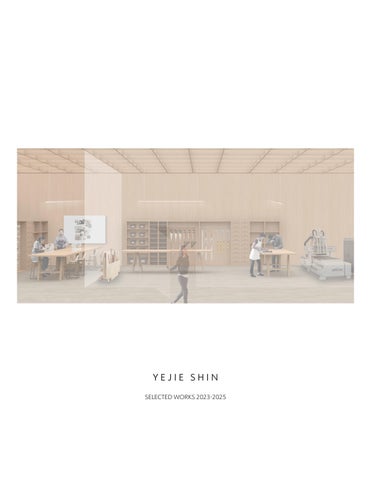
YEJIE SHIN
Brooklyn, NY (929) 549 3281
yejieshin26@gmail.com
www.yejieshin.com

“Designing interiors as spatial systems that balance autonomy and collective life”
As a designer, I am interested in how spatial systems shape behavior, interaction, and perception. My work explores the balance between autonomy and collective life. How interiors can support both retreat and engagement within a coherent framework.
I approach design through structure and adaptability, developing environments that respond to context while remaining materially intentional. Rather than treating space as a singular object, I see it as a layered system. Composed of circulation, thresholds, material expression, and light working together to shape experience.
My goal is to create interiors that are deliberate, grounded, and experiential. Spaces that communicate quietly but with conviction.

VERGE OF MAKING
Library as a Third Place
Advanced Studio Library Course Project
Software Rhino, Illustrator, V-ray, Photoshop

This project reimagines the library as an evolving third place, an adaptive social infrastructure that fosters collaboration, knowledge exchange, and creativity.
Situated in a repurposed industrial building, the design challenges the conventional notion of a static library by introducing an open, flexible space that responds to the needs of Brooklyn’s artists. Rather than a place of quiet study, it is a fluid and dynamic environment where creative production, learning, and community engagement seamlessly coexist.
By providing studio spaces, digital resources, fabrication tools, and areas for public interaction, the library supports a range of artistic processes, from ideation and experimentation to exhibition and exchange. Modular elements and adaptable layouts allow the space to shift and evolve, ensuring accessibility and relevance for a diverse and everchanging community. More than just a repository of knowledge, this library is a site of creation, where Brooklyn’s artists find the tools, inspiration, and connections needed to sustain their craft and collectively shape the cultural landscape of the city.


From Archive to Agency
This project transforms the historic library model, once centered on books and silent reading, into an active civic infrastructure for making and collective production. Archives expand into fabrication labs, reading rooms evolve into exhibition and workshop spaces, and studio and technology areas become visible extensions of knowledge.

Exploded Axonometric

Visible Work, Shared Space
The library expands beyond reading into an active environment of making and collaboration. Fabrication tables, material storage, and digital tools are positioned in open view, allowing creative processes to become part of the public experience.


Material and Furniture Palette
Materials

E. Woven Terracptta Fabric
F. Patterned Textile
E. Mustard Accent Textile
F. Sheer Fabric
Furniture and Lighting

Study

Lab


Exhibition
The double-height commons acts as the social core of the library, balancing openness and retreat. Reading niches are embedded along the perimeter, while movable seating and curtain partitions allow the ground floor to shift between exhibition, gathering, and quiet study.

LAYERED INTERACTION
Play in Urban Space
Course
Ideation Representation
Software Revit,Illustrator, V-Ray, Photoshop
This project explores the intersection of public and private space through a layered geometric framework that fosters both community engagement and individual reflection. The design is inspired by the delicate balance between interaction and enclosure in urban environments, shaping spaces that collect, enclose, and entertain.
By utilizing flexible boundaries and dynamic forms, the project creates a responsive environment that adapts to different moments of social interaction, personal contemplation, and communal exchange.


A Study of Spatical Dynamics
Guided by three operative verbs, this project explores spatial composition through iterative geometric studies. Additive and subtractive strategies shape environments that collect interaction, enclose reflection, and support occupation. Flexible boundaries and layered geometries balance openness with enclosure, fostering both collective engagement and individual retreat.

Additive Studies Curved Surface Creation

Elevation East

Elevation North
CITY DUPLEX
An Urban Retreat Above the City
Hotel Course Project
Collaborator
Hospitality
Keliang Li
Software Rhino, Enscape, Illustrator, Photoshop

City Duplex proposes a bi-level hospitality ecosystem designed to operate in dual modes. Productivity by day, social activation by night. Developed for Pullman Hotel Berlin, the concept responds directly to contemporary conference culture, integrating flexible rooms, scalable infrastructure, and seamless spatial transitions.
Rather than creating a single-purpose meeting center, the project establishes a layered civic interior. The duplex framework allows spaces to reconfigure and shift atmosphere throughout the day, pairing Commons and Lounge environments that balance focus, gathering, and informal exchange. City Duplex repositions the meeting floor as calibrated social infrastructure. Adaptable, efficient, and experientially intentional.


Hospitality Through Vertical Continuity
The duplex strategy separates yet connects social, dining, and private functions across two levels. Public amenities anchor the lower floor, while elevated lounges and courtyard spaces create a more intimate atmosphere above. The sectional relationship allows visual continuity and circulation flow, reinforcing a seamless transition between work, leisure, and social engagement.


First Floor Material Palette
A. Dark Wulnut Veneer
B. Burl Veneer
C. Terracotta Wool
D. Brushed Bronze
E. Honed Travertine
F. Tufted Wool Broadloom
G. Patterned Area Rug
H. Veined Grey Stone
I. Rosso Marble
J. Dark Emperador Marble
K. Brick
L. Bouclé Wool

Second Floor Material Palette
A. Textured Wool Carpet
B. Dark Wulnut Veneer
C. Sienna Upholstery Textile
D. Ivory Wool
E. Travertine Tile
F. Antique Aged Mirror
G. Burnished Clay Carpet
H. Oak Wood
I. Rose Bronze
J. Leather
K. Onyx
L. Fluted Wood Panel
M. Steel
N. Felt
O. Sheer Fabric


Focused Exchange
Meeting and private dining rooms are composed with restraint and material depth, framed by continuous wood paneling and expressive stone surfaces.
The suite is designed with flexibility in mind: operable partitions allow individual rooms to merge into a larger gathering space, accommodating presentations, receptions, or formal events.


CHANGING TIES
Dining Shed to Community Nourishment
Studio Dining Shed Course Project
Collaborator Studio

Undulating containers transform New York City’s soon-to-be-abandoned dining sheds into fresh air pantries, creating a dynamic system that ties together food, community, and local agriculture. Rather than static structures, the woven containers respond to seasonality and evolving food access needs, ensuring a flexible and adaptable framework for urban nourishment.
A network of knotted containers is suspended within the existing shed infrastructure, creating a permeable and visually engaging food display. The intervention bridges the gap between growers and urban consumers, fostering community-driven food accessibility through seasonal programs and partnerships with local farms and food organizations. As a system that transforms both spatially and socially, Changing Ties reimagines public space as an evolving platform for food distribution, interaction, and shared sustainability.

Before It Vanishes
The Changing Ties system reclaims underutilized dining sheds as adaptable food hubs, creating a public space for nourishment, exchange, and sustainability. By integrating modular, knotted containers, the project transforms these structures into multi-functional environments that support seasonal food distribution, community markets, and educational programs.
Section North

Through its lightweight, flexible structure, the system accommodates different user needs throughout the day, shifting between roles as a farmers’ market, public gathering space, and community event venue.


Food, Containment, and Knots
The modular storage system adapts to various food distribution needs, using knotted containers that balance structure, breathability, and visibility. Designed through research on seasonal produce cycles and storage conditions, the system ensures proper airflow while accommodating different food sizes and densities.
Variations in knot density, material thickness, and proportions allow the system to flexibly store small, delicate produce and larger items alike.
Longer opening (greater distance between top and middle hoops) allows for larger produce to fit

Smaller hoop diameters mean that fewer knots are needed to create a high density for small produce
Variation in number of knots creates slightly lower density and visual difference

New York City’s outdoor dining sheds, originally conceived as emergency infrastructure, now sit in limbo. Neither permanent architecture nor temporary installation. While they expand seating, their static form prioritizes enclosure over public engagement, operating as private extensions rather than shared urban space.

Changing Ties Usage
“Changing Ties” reimagines the abandoned shed as an adaptive civic framework. Woven containers and modular planting systems transform it into a shared neighborhood node, introducing visibility, exchange, and seasonal participation, shifting from commercial add-on to collective urban infrastructure.
BUOYANT, INTERDEPENDENT
Floating Habitat
Advanced Studio Residential Course Project
Software Rhino, Illustrator, V-Ray, Photoshop

Buoyant, Interdependent proposes a floating habitat where community is shaped through shared reliance rather than fixed ground. Repurposed grain silos are transformed into modular dwellings linked by collective infrastructure, supporting diverse modes of living while reinforcing social connection. Circulation paths, communal platforms, and shared resources create a spatial framework that encourages encounter, cooperation, and mutual support.
Balancing autonomy with collective life, the project positions interdependence as both a social ethic and an architectural strategy. Housing is reimagined as a buoyant network, one capable of adapting to environmental uncertainty while fostering resilience through connection rather than isolation.


Salvage as Structure
Salvaged grain silos and concrete tubs are retrofitted into buoyant structural units, forming a modular framework for floating community. Linked by shared platforms, the system promotes resource efficiency while enabling collective living.

Reuse becomes both material strategy and spatial driver, supporting an adaptable habitat responsive to environmental change.


Between Autonomy and Collective Life
A floating neighborhood structured by shared infrastructure, where independent dwellings are anchored within a cooperative spatial framework that supports encounter, visibility, and evolving forms of community. Organized as a field rather than a singular object, the settlement allows moments of retreat and participation to coexist
Exploded Axonometric

Longitudinal Section


A central promenade organizes the silo dwellings into a shared social spine, where circulation becomes encounter. Soft seating clusters transform the passage into an inhabitable threshold — balancing privacy with collective life and framing community as an everyday spatial condition rather than a programmed event.

Elevated above the waterline, the communal deck operates as an outdoor living room — a platform for informal gathering, work, and pause. Shaded yet open to the horizon, it supports a fluid overlap of domestic and civic rituals, suggesting a new model of neighborhood grounded in adaptability and shared stewardship.
WALDORF ASTORIA
RESIDENTIAL RENOVATION
Material Expression Inspired by Vintage Automotive Design
Residential Location Project Area 2162 SF
301 Park Ave, New York

A high-end residential renovation within Waldorf Astoria, translating the precision, tonal depth, and refined material contrasts of vintage automotive design into a contemporary interior setting. The scope included furniture planning, lighting coordination, and detailed material specification aligned with procurement and documentation workflows.
Assisted in FF&E selection, furniture layouts, lighting schedules, and procurement coordination through Studio Designer, supporting documentation and client presentation packages.

FF&E Development and Interior Documentation
Comprehensive FF&E development and interior documentation for a high-end residential renovation. Work included furniture planning, material and finish specification, lighting schedules, and procurement coordination, ensuring alignment between design intent and execution.
Furniture Plan

Primary Bedroom/Bathroom

CONSTRUCTION DOCUMENTATION

Cafe Interior l Revit Workflow

POP-UP LEISURE
Furniture Design
Project
Furniture
Method Workshop
Material Paper Board

It is important to spend time alne where we can reflect on ourselves and listen to the voice of our thoughts. We need a private space to call our own, rest and recharge, like our bedroom filled with what we need.
This sustainable furniture of a sofa and a stool includes a structure of a popup book. This portable furniture brings comfort and intimacy anywhere they are carried. Ultimately, the unfamiliar place exposed to the world gives us the energy to interact with people, imbued with attachment