Howtonavigate YarraRangesCivicCentre Access Guide
15 Anderson Street
Lilydale, VIC, 3140


@yarrarangesyouth
03 9294 6716
youth@yarraranges.vic.gov.au
https://www.yarraranges.vic.gov.au/Our-services/Young-people

15 Anderson Street
Lilydale, VIC, 3140
@yarrarangesyouth
03 9294 6716
youth@yarraranges.vic.gov.au
https://www.yarraranges.vic.gov.au/Our-services/Young-people
An Access Guide is a document that describes a physical venue and how to access it. They are designed to support people of different abilities to access the venue.
The Yarra Ranges Youth Team have written an Access Guide for Yarra Ranges Civic Centre. We are not experts, but we are genuine in our aim to support young people and community members to access our programs. We will improve this Access Guide with your feedback.
Not all places and spaces are easy to access. We hope our Access Guide will give young people and the community more agency over how they participate.
If you have any questions or concerns, please get in touch. You can email youth@yarraranges.vic.gov.au
Or, call us on 03 9294 6716
You may want to read this document in full, or skip to the parts you want more information about. There are pictures in this document, with image descriptions that may help you to visualise and understand the space.
Imagedescription:The Yarra Ranges Youth Team’s 2024 Youth Ambassadors. There are five, smiling together in the foyer of the Civic Centre. From left to right, back to front: Charley, Thomas, Jared, Steph, and Sammy.
Imagedescription:An aerial view of Yarra Ranges Civic Centre and surrounds. The Civic Centre is pictured as a large orange rectangle at the intersecting corner of Hardy Street and Anderson Street, highlighted by a bright yellow circular outline. Surrounding details include the Lilydale Bowls Club to the left of the Civic Centre, and the Tennis Club below.
Yarra Ranges Council Civic Centre is located at:
15 Anderson Street Lilydale, VIC, 3140
You can find the Civic Centre 300 metres away from the corner of Anderson Street and Main Street.
It is also on the corner of where Hardy Street and Anderson Street meet.
See the Google Maps reference to the left of this page.
The entrance to Yarra Ranges Civic Centre is approximately 300m from the corner of Main Street and Anderson Street. This is a four (4) minute, relatively flat walk.
Starting from the corner of Main Street and Anderson Street, walk along the footpath on the right side of the street. There are two intersections with pedestrian lights to cross.
Continue walking straight ahead until you see a footpath to your right. Follow either the sloping ramps or stairs along this footpath. They will lead you to the side entrance of the Civic Centre which says “Staff Entry Only” .
Walk past this entrance on the footpath in front of the building.
There is a large glass door at the main entrance with the Yarra Ranges Council logo to the left. You can approach this door by a staircase or ramp.
There are park benches, parking bays, and a shared traffic/pedestrian area in front of the building.
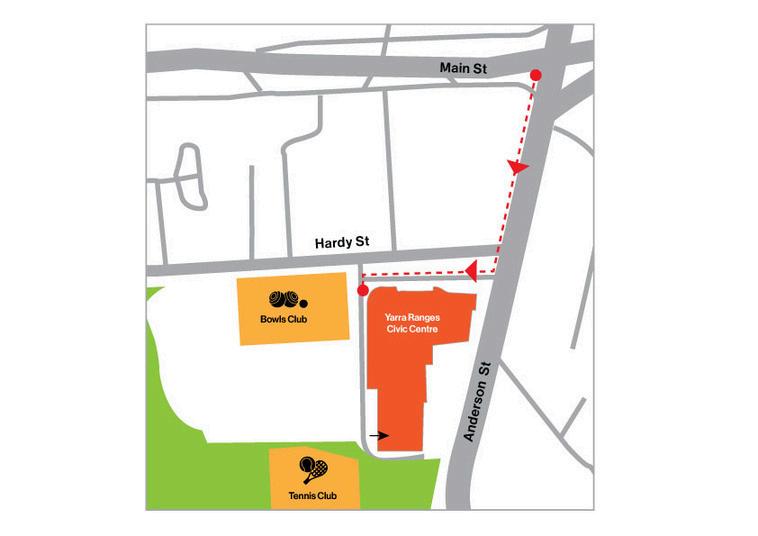
Imagedescription:An aerial map of the path along Anderson Street to Yarra Ranges Civic Centre, displayed as an orange rectangle. A red circle starts the path at the corner of Main Street. A red dashed line goes downwards on Anderson Street, then left to the entrance of the Civic Centre. A red circle ends the path at the main entrance to the Civic Centre.
The entrance to Yarra Ranges Council Civic Centre is approximately 300m from the Olinda Creek exit of Lilydale Marketplace. This is a five (5) minute, uphill walk.
Starting from Olinda Creek, walk along the footpath on the right side of the street. Continue walking straight ahead. Check for traffic when you cross any entrances to the carparks.
To your right, you will pass the Lilydale Bowls Club. At the end of the Bowls Club fence, there is a footpath walking towards the Civic Centre. Follow this footpath until you reach a pedestrian zebra crossing on your left. Cross here, and you will be at the main entrance to Yarra Ranges Civic Centre.
You can approach the main glass door (marked by the Yarra Ranges Council logo on the left) via the staircase or a sloping ramp.
There are park benches, parking bays, and a shared traffic/pedestrian area in front of the building.
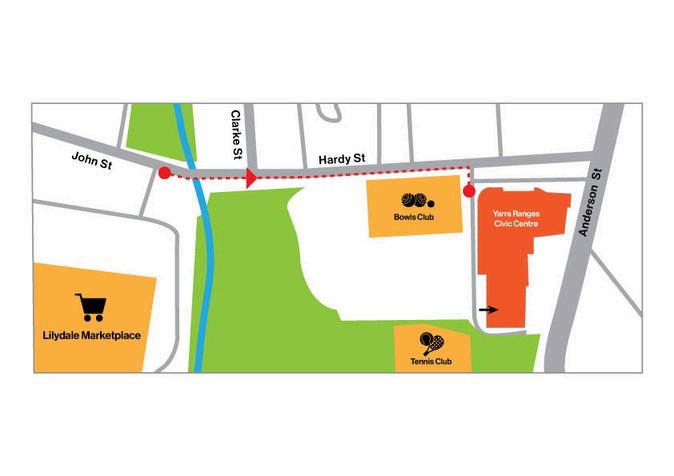
Imagedescription:An aerial map of the path along Hardy Street to the Civic Centre. A red circle starts the path at Olinda Creek, which is shown as a blue line, and above Lilydale Marketplace, a yellow square. A red dashed line goes right on Hardy Street, then down to the Civic Centre. A red circle ends the path at the main entrance to the Civic Centre.
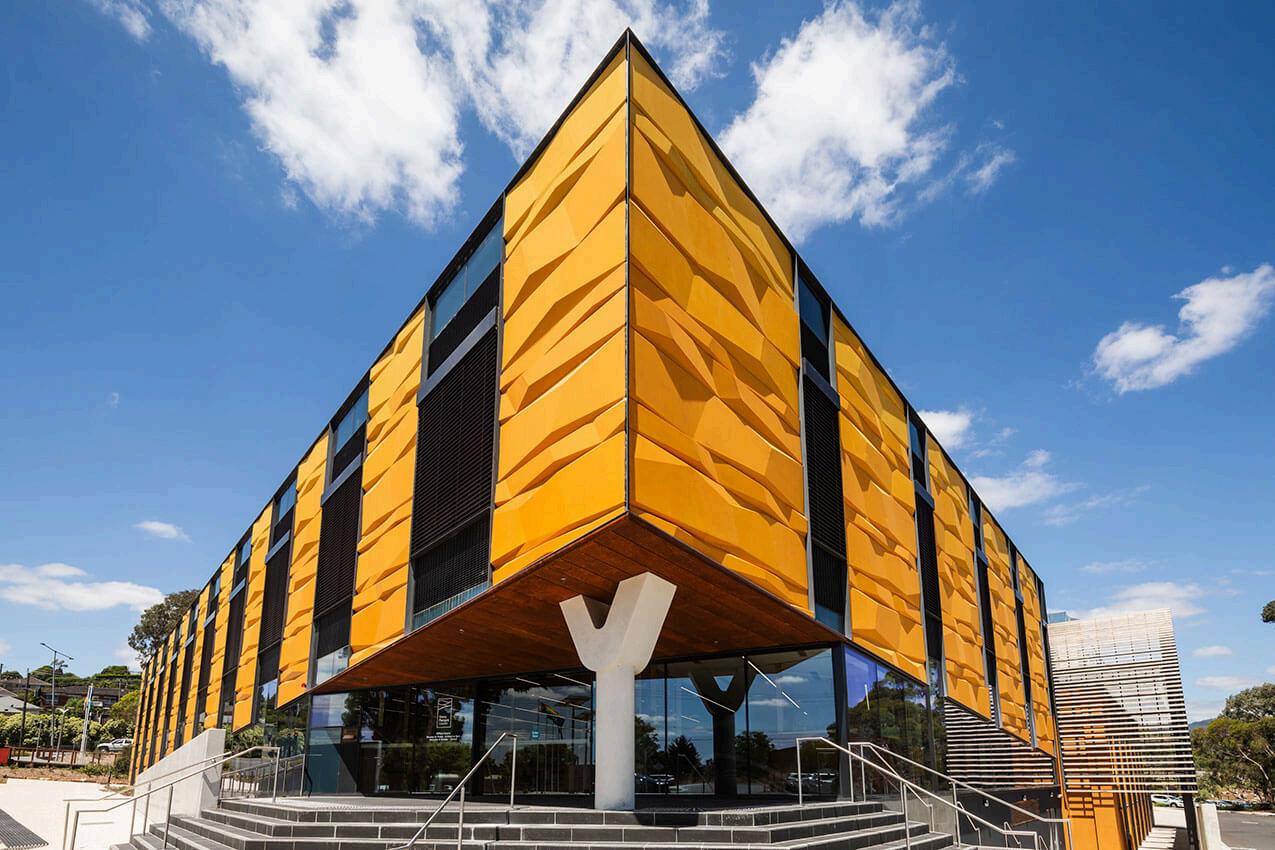
Imagedescription:The front of the Yarra Ranges Civic Centre building is visible, taken from Hardy Street. There is a car park in the foreground, with a wide footpath and flag poles to the left, and a yellow pedestrian crossing sign to the right. The Yarra Ranges Civic Centre has large glass panels and orange geometric panels in a striped pattern, and is rectangular.
Imagedescription: A set of stairs leading to the left side of the Civic Centre are shown. The stairs are yellow with brown stone sides, and have wooden railings with wires lining the gaps. The stairs lead down from a grey tile pathway, and go downwards towards the Yarra Ranges Civic Centre. This building has orange and glass panels, and a bike rack is visible.
Imagedescription:Thisimageshowsthemainentrancetothe CivicCentre,accessedbyastaircase.Thisstaircasehas multipleentriessurroundingthemainplatform.Itisgrey,tiled, andhasmetalrailingsthatarewidelydispersedacrossthe stairs.Infrontofthestairs,blackterrain-changedotsarevisible onbeigeconcrete.Thereisawhitesupportbeamtotherightof thestaircase’stopplatform,andaglassslidingdoorattheback.
Imagedescription:Thisimageshowsarampleadingtothe mainentranceoftheCivicCentre.Itislocatedontheleftside ofthestaircase.Theperspectivelooksuptheramptowards thetopplatform.Itismadeofgreyconcretetiles,withblack terrain-changedotsattherampstart.Ithasmetalrailingon bothsideswithfrequentsupportbeams,andagreyconcrete wallontherightside.Itisnexttotheglasswallofthebuilding.
AttheCivicCentre
The closest parking is located directly outside the Civic Centre. You can access the car park via Anderson Street and Hardy Street.
There are three-hour parking bays and accessible parking bays at the front of the building.
Behind the building, there is registered staff parking and public parking.
Near the tennis courts, there are diagonal parks. The first half are staff parks, and second half are public parks with some or no time limit. To the right and left of this strip, there are more public parks with no time limit.
OnMainStreet
There is free parking with a range of time limits along Main Street, including outside Coles, along the main shopping strips, and at Lilydale Train Station.
OnJohnStreet
There is free parking with a range of time limits at Lilydale Marketplace on John Street.
Imagedescription: A map depicting the Yarra Ranges Civic Centre car park guide is depicted. It is an aerial view of the car parks available around the Civic Centre. It is oriented with Anderson Street at the top of the image, and Hardy Street to the left. The Civic Centre is labelled on a mint shape to the top left of the image. Unrestricted parking is highlighted by yellow shapes. 3-hour limited parking is highlighted in pale green shapes to the left of the Civic Centre. Accessible parking is highlighted in pink to the left of the Civic Centre.
Lilydale Station
Lilydale Train Station is 1km away from the Civic Centre. You can walk from Lilydale Station.
It is approximately fifteen (15) minutes by foot to the Civic Centre from Lilydale Station. It is a steady uphill walk, with a steep hill towards the end.
The most direct way is to walk along the right side of Main Street towards Anderson Street.
There are multiple pedestrian crossings along Main Street. The intersections are often busy with foot traffic and cars, due to the nearby shops.
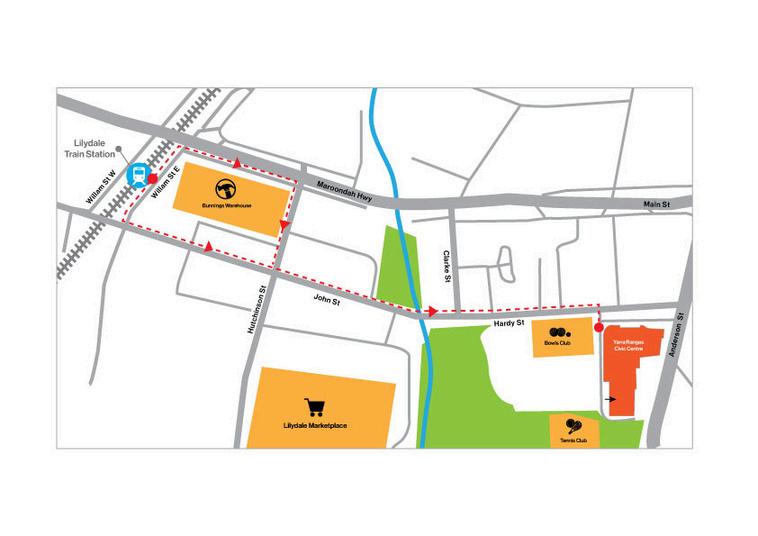
Once you pass Bunnings, turn right and walk until you reach John Street. Then, face left and begin following John Street to Hardy Street, and cross the intersections at the traffic lights to get to the right side of the road. Continue along the uphill footpath towards Anderson Street to get to the Civic Centre.
Imagedescription:An aerial map of the path from Lilydale Station to Yarra Ranges Civic Centre. A red circle starts the path at Lilydale Station. A red dashed line goes right or left along Main Street, and then down either side of Bunnings Warehouse, shown as a yellow rectangle. The path travels right, following John Street. Once passing Olinda Creek, marked by a blue line, John Street becomes Hardy Street, and the red line continues right towards Anderson Street. The path goes down once it has passed the yellow square marking the Bowls Club to the orange rectangle marking the Civic Centre. A red circle ends the path at the Civic Centre main entrance.
VIDEOFEATURE—AlternateRoute
If you would like to walk along with the Youth Team, we have created a video of us walking to the Yarra Ranges Civic Centre after getting off a train at Lilydale Station.
This video shows a similar route to the one written on the last page. It takes a similar amount of time with pedestrian zebra crossings and visible landmarks.
This video is focused on helping someone visualise a path, so it will not be a relevant resource for someone with impaired vision. However, it does feature captions for deaf and hard-of-hearing viewers.
You can access this video by clicking the following text or copying the URL into your internet browser.
VideoLink
https://www.instagram.com/reel/C9O1g83N6WC/? utm source=ig web copy link&igsh=MzRlODBiNWFlZA==
Imagedescription:A screenshot from the linked video feature is shown. It depicts a front view of the Civic Centre. The building is tall, with glass and orange panels. Stairs and the end of a ramp are visible at the entrance. A masculine person stands by the ramp to the left. A caption reads “and the beautiful Council building” in white text on a grey background.
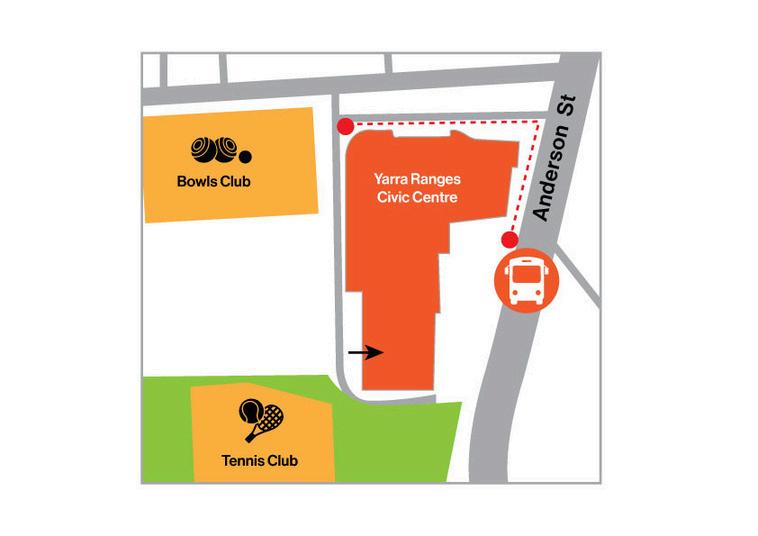
Imagedescription:An aerial map of the path from “Cobden Cres/Anderson St Bus Stop” to Yarra Ranges Civic Centre. A red circle starts the path at the bus stop on Anderson Street.
The bus stop is an orange symbol with a picture of a bus. A red dashed line goes up on Anderson Street, then left towards the Yarra Ranges Civic Centre main entrance, marked by an orange rectangle. A red circle ends the path.
BusRoute679and663
The 679 bus and 663 bus can be caught at Lilydale Station. They are found at Bay F and Bay B respectively, on the ground level of the train station. They stop at the “Cobden Cres/Anderson St Bus Stop” opposite the Yarra Ranges Civic Centre.
It is a 160m walk from the bus stop to the building. This is approximately two (2) minutes by foot.
Walk back along Anderson Street towards Hardy Street. Stop at the intersection pedestrian lights to cross the street, walking towards Hardy Street. Cross the intersection pedestrian lights again, walking towards the Civic Centre building.
Follow the footpath to your right until you reach a wide footpath to your left. Walk forward to the Civic Centre until you reach the main entry. Be mindful of traffic as this is a shared pedestrian zone.
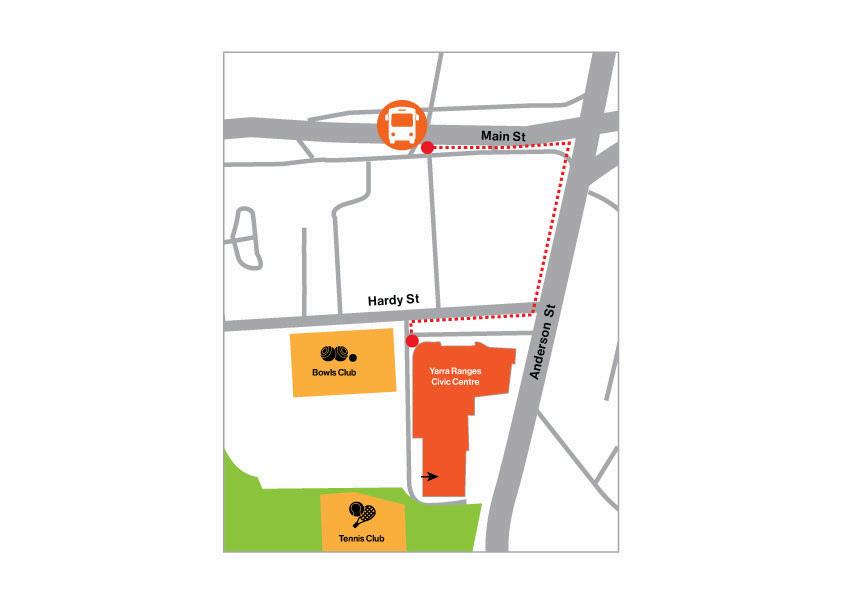
Imagedescription:An aerial map of the path from “Castella St/Maroondah Hwy Bus Stop” to Yarra Ranges Civic Centre. A red circle starts the path at the bus stop on Main Street. The bus stop is an orange symbol with a picture of a bus. A red dashed line goes right along Main Street towards Anderson Street, then down towards Hardy Street. It then continues left and then downwards to the entrance of the Civic Centre. A red circle ends the path.
BusRoute683and685
The 683 bus can be caught at Bay I, or the “Lilydale Station/Main Street Bus Stop” outside Lilydale Station. The 685 bus can be caught at Lilydale Station at Bay E.
Whilst these busses have different starting points, they have similar routes. They both stop at the “Castella St/Maroondah Hwy Bus Stop” outside “Edward’s Bakery”.
It is a 440m walk from the bus stop to the Civic Centre. This is approximately six (6) minutes by foot.
Walk along Main Street towards Anderson Street. Turn right at the intersection pedestrian lights and walk along Anderson Street towards Hardy Street.
Cross the intersection, then follow the footpath to your right until you reach a wide footpath to your left. Follow the wide footpath to the Yarra Ranges Civic Centre until you reach the main entry. Be mindful of traffic as this is a shared pedestrian zone.
At the building entrance, there is a set of stairs and a winding ramp which allow access to the main door.
The main door is made of glass. This door slides open to the left automatically between 8:30am and 5pm. It has to be unlocked manually by a member of staff from inside or outside beyond these hours.
If a member of staff is not visible or available outside of opening hours to help you open the door:
1. First, refer to the contact of the program you are attending 2. Call the Youth Team on 03 9294 6716
After the main door, there is an entry foyer with a high ceiling and white lighting. The floor is textured to wipe your shoes on. There is a second automatic glass door which will slide to the left as you approach. It is always unlocked.
Once you pass through the second door, you will be in the reception area of the Yarra Ranges Civic Centre.
Imagedescription:ThemainentrancetotheYarraRanges CivicCentreisvisible.Itconsistsofaconcreteplatform,alarge glassslidingdoor,andglasspanelsoneitherside.Thedooris closed,andhasagreencircularstickeratthecentrereading “EnterHere”inwhitetext.Theleftglasspanelincludesthe YarraRangesCouncillogo,andtextreading“OfficeHours: MondaytoFriday-8:30amto5pm,Saturday&SundayClosed”.Alltheglasspanelshaveagreydividingstripeinthe centre.Reflectionsofthecarparkcanbeseenintheglass.
Imagedescription:The main entrance to the Civic Centre is visible. It consists of a concrete platform, a large glass sliding door, and glass panels on either side. The glass sliding door is mostly open. The foyer is visible: with black carpet, plants in the right corner, and another glass sliding door to the back left. The reception area is partially visible from this angle.
Imagedescription:The entry foyer of the Yarra Ranges Civic Centre is seen. There is a glass sliding door at the back, with a green circular sticker at the centre reading “Enter Here” in white text. There is a grey dividing stripe centred on the door. The foyer has black carpet, and half-wooden panel, half-glass walls. The reception area is seen through the glass panels.
Imagedescription:The reception area of the Civic Centre is shown. There is a large curved desk with black and wooden panels at the centre, with black text reading “Customer Service”. The desk has computer monitors and pen holders. There are two yellow seats to the right side of the desk. There are slats of wood behind the desk, with a festive branch decoration. The floor is wooden. Behind the desk, the entry to a hallway is visible. There is some furniture in the foreground, including a blue ottoman and a yellow cross couch.
The reception area is a large space that expands to the left and right of the entry foyer.
The reception area has a wooden floor. It is lit with a combination of artificial lighting and natural lighting from large floor-to-ceiling windows.
When you enter the reception area, the customer service desk is on your right side. The desk is a large curved shape. The reception staff are just visible from a seated position.
On the right side of the reception area, there are booth tables and an area for families to entertain children in. You may see seats and beanbags here.
To the left, there are several seats, desks, and chairs for the public to sit at. People may be waiting to be seen by a Council member, working in the public space, or a council staff member may be going to a workshop. This area is usually not busy, because people come and go as they are attended by reception.
The reception area may include people talking, including the receptionists, members of the public, and children.
Imagedescription:The left side of the Civic Centre reception is shown. It has wooden floorboards, and wooden panel walls.Glass doors are seen in the back right corner, and a long hallway is seen in the left corner. Furniture is available in the central space, including cross-shaped yellow couches, blue ottomans, and a long wooden table with yellow chairs.
Imagedescription:The right side of the Civic Centre reception is shown. It has wooden floorboards, and glass panel walls. There are two booths with tables and seating available against the walls. In the right corner, a small carpeted area is visible, with ottomans, and stylised artwork depicting a galah. In the foreground, a yellow cross-shaped couch is visible.
There is a total of three (3) toilets in the reception area, behind the reception desk. If you have not already checked into a program with the reception team, it is best to ask a receptionist if you can access the toilets so they are not alarmed when a member of public walks behind their desk.
When you enter the reception area, the toilets will not be visible.
Walk around the left side of the reception desk: there is a hallway. The toilet doors are on the left of this hallway. The doors are grey, with blue signs on the wall beside them. There is one accessible toilet, and a general toilet door that leads to two gendered doors.
The doorway to the accessible toilet is 865mm wide and the sink is 835mm off the ground. There is hand railing next to the toilet.
In the gendered toilets, there are toilet cubicles. The cubicle doors are black and do not have handles. The “male” toilets have urinals as well. Opposite the cubicles, there are sinks with soap dispensers.
Whilst the toilet doors are gendered, youth events are permitted to put up “Gender Neutral Bathroom” signs. Please use the toilet you feel the most comfortable with.
Imagedescription:The hallway leading to the toilets is shown.
To the left, there is a grey pannelled wall with the Yarra Ranges Council logo, and 3-dimensional text reading “WominjekaWelcome”. To the right of this wall, there is a short hallway with grey panelling, light grey doors, and blue signs beside these doors. The first door is the accessible toilet. The second door leads to the gendered toilets. Two more doors are visible, but can only be accessed by staff.
Imagedescription:The hallway with the reception bathrooms/toilets is shown on a closer perspective. There are five doors, and blue signs beside the first two doors. The first door is the accessible toilet. The second door leads to the gendered toilets. The last three doors can only be accessed by staff, including the frosted glass doors that end the hallway.
Imagedescription:A blue sign reads “About this all gender toilet: This toilet is designed an an ‘all gender’ facility. This means that people of all gender identities and expressions are welcome to use it. This is another way we are making the Yarra Ranges Council workplace and community more inclusive for all staff and visitors. Here and elsewhere, please feel free to use the toilet that best fits your gender identity.”
Imagedescription:The door to the accessible toilet is shown. It is grey, with a metal handle, and an “in use” indicator. Blue signage on the right describes it is an accessible, allgender, and baby change toilet.
Imagedescription:The door to the gendered toilets is shown. It is grey, with a metal panel on the right to push it open. Blue signs on the right describe it as “Toilets”, with simple masculine and feminine artwork.
Imagedescription:The interior of the gendered “female” toilets is shown. It has two sinks with soap, and a mirror to the right. There are four black toilet stalls to the left and back. The walls have green tiles in a gradient. The gendered “male” toilets have a similar layout, with urinals included.
Conference Room A is to the left of the reception area, at the centre of the hallway.
The door that leads to Conference Room A is 880mm wide and can be extended to 1755mm wide. The hallway is over 1 metre wide.
Conference Room A has white perspex walls on both sides of the room. Sometimes you can see light from the other rooms through these walls. There are single doors at the back of each wall that are both 840mm wide. They connect the rooms together.
The back wall is made of floor-to-ceiling windows. This allows natural light in during the daytime, and outdoor lights are visible at nighttime.
Conference Room A has dimmable artificial lights. Sometimes, they automatically brighten to their full brightness without warning. This can be quickly fixed whenever it occurs.
Conference Room A has chairs, tables, and sometimes beanbags. The room can change for different activities. Ask your program contact for more details about what it will look like when you arrive, or if you need something specific to help you feel comfortable in the space.
Imagedescription:The hallway to Conference Room A in the Civic Centre is shown. On the left of the hallway, there is a staircase surrounded by glass panelling and a glass door that can only be accessed by staff. On the right, there is a wooden wall with three entries spaced evenly. The second one, leading to Conference Room A, is just visible at the centre of the hallway. At the end of the hallway, there is a glass door with an emergency exit lit sign above it. The hallway is carpeted.
Imagedescription:Conference Room A is shown from the entrance of the room. It shows a wide room, with glass panels on the back wall. It has grey carpet. There are tables and chairs arranged in throughout the space, with black bollards connected by red fabric. There is a TV screen visible on the back glass wall, and a view of the outdoor pillars and garden.
Imagedescription:Conference Room A is shown from the end of the room. It shows a wide room, with perspex panels on the side walls, and a wooden back wall with multiple closet doors. It has grey carpet. There are tables and chairs throughout the space. The entry doorway is visible, with both doors open, and closed single doors in the furthest left and right corners.
Conference Room B is to the left of the reception area, at the end of the hallway.
The door that leads to Conference Room B is 880mm wide and can be extended to 1755mm wide. The hallway is over 1 metre wide.
Conference Room B has white perspex walls on the right side of the room. Sometimes you can see light from the other room through this wall.
The left side of the room is half wooden walls, and half floor-toceiling windows. The back wall is also made of windows. This allows natural light in during the daytime, and outdoor lights are visible at nighttime.
Conference Room B has dimmable artificial lights. Sometimes, they automatically brighten to their full brightness without warning. This can be quickly fixed whenever it occurs.
Conference Room B has chairs, tables, and sometimes beanbags. The room can change for different activities. Ask your program contact for more details about what it will look like when you arrive, or if you need something specific to help you feel comfortable in the space.
Imagedescription:The hallway to Conference Room B in the Civic Centre is shown. On the left of the hallway, there is a staircase surrounded by glass panelling and a glass door that can only be accessed by staff. On the right, there is a wooden wall with three entries spaced evenly. The very last one, leading to Conference Room B, is just visible at the back of the hallway. At the end of the hallway, there is a glass door with an emergency exit lit sign above it. The hallway is carpeted.
Imagedescription:Conference Room B is shown from the entrance of the room. It shows a long room, with glass panels on the left and back wall. It has grey carpet. There are tables and chairs arranged in a horseshoe shape, with the opening facing the back glass wall. There is a TV screen visible on the back glass wall, and a portable TV screen partially visible.
Imagedescription:Conference Room B is shown from the end of the room. It shows a long room, with perspex panels on the left wall and a wooden back wall. It has grey carpet, and there are tables and chairs arranged in a horseshoe shape with the opening facing the viewer. The entry doorway is visible, with both doors closed, and another door in the left back corner.
Karawun & Bour-Deet are found behind the reception desk in a short hallway. It has two separate doors labelled with the room names at either end of the room.
In the hallway, walk past the toilets on your left, and you will see these doors on your right side. There are staff-only glazed doors at the end of this hallway.
The doors that lead to Karawun and Bour-Deet are 885mm wide. The hallway is over 2 metres wide.
Karawun + Bour-Deet have a combination of art walls, tinted windows, and solid walls. The windows have blinds that can be lowered to protect privacy, or raised to allow in natural light. The room has dimmable artificial lights hanging from the ceiling. The room is rectangular, with an additional rectangle space in the back left corner.
Karawun + Bour-Deet feature chairs, tables, and sometimes beanbags. The room can change for different activities. Ask your program contact for more details about what it will look like when you arrive, or if you need something specific to help you feel comfortable in the space.
Imagedescription:The hallway behind the reception desk is shown, focusing on the right-side wall of the hallway. This wall has two glass doors at either end, and glass panels between.
The closest door reads “Karawun” in white text, on a green patterned background. On the glass panels, large artworks depicting native flora and abstract, combined imagery of First Nations’ people are visible. Through the first glass door, there is visible furniture in the room, including tables and chairs.
Imagedescription:Karawun & Bour-Deet is shown from the back wall. The room has glass panels on the left side, covered by black blinds. There are two whiteboards in the back left corner - one on the wall, one free-standing. A large TV screen with speakers is centred on the front wall. Tables and chairs are arranged in a circle at the centre of the room.
Imagedescription:Karawun & Bour-Deet is shown from the front wall. There is an extra nook visible in the right corner. A large TV screen is centred on the back wall. Tables and chairs are arranged in a circle at the centre of the room. On the back wall, large artworks depicting native flora and abstract imagery of First Nations’ people are visible.
This index of links will refer you to Google Maps to access live copies of the map and journey. These live maps can be helpful as they can include audible instructions. They also feature updates on road closures, accidents, or other barriers that might change the accessibility of the route you are taking.
We encourage you to utilise these links as an alternative support if you are encountering any issues with the instructions in this Access Guide.
This index has been made in the order they appear in the document, not alphabetical order.
If you notice any significant or permanent changes to your journey that do not match the content in this Access Guide, please let us know so we can update the information. You can email youth@yarraranges.vic.gov.au, or call us on 03 9294 6716.
Be My Eyes is a free app designed to support people who are blind or have low vision to access real-time visual assistance. Users can connect with a global network of volunteers, specialist company representatives, and visual AI to receive live descriptions, product support, and guidance.
This resource has been included as a suggestion from our consultation with the Yarra Ranges Council Disability Advisory Committee. We received feedback to include a resource that supports people’s access in the event that this Access Guide is missing key information.