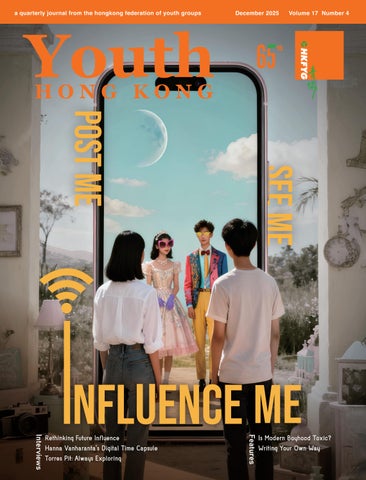
December 2025
Volume 17 Number 4
See Me
Post Me
ME Features
Interviews
Rethinking Future Influence Hanna Vanharanta's Digital Time Capsule Torres Pit: Always Exploring
Is Modern Boyhood Toxic? Writing Your Own Way
2 Let us hear
OVERVIEW
4
INTERVIEWS
6
Redefining Trust, Values and Community Judith Lee
THEME SECTION
Professor Dino Zhang: Rethinking Future Influence Through Its Past
9
Lawyer Benjamin Choi: Influence Responsibly
13
Hanna Vanharanta: Creating a Digital Time Capsule
ON THE SIDE
16
Hong Kong Races to Catch Up
YOUTH SPEAK
17
Followers: What We Follow
23
in Live Commerce Influencers: How We Influence
YOUTH WATCH
30
What do Influencers Influence?
HKFYG SERVICES
34
How the Federation Supports Youth Influencers
OPINION
36
YOUTH SPACE
Is Modern Boyhood Toxic? Oscar Cheung
WRITING
38
Writing Your Own Way Kirsten Choi
MUSIC
40
Soundtracks of My Life Paisley Kwok
READING
42
Book Worm Hedwig Siu
Youth Hong Kong December 2025 Volume 17 Number 4 YOUTH HONG KONG published quarterly by The Hong Kong Federation of Youth Groups
ARTWORK & DESIGN Bryan Tsui COVER DESIGN Bryan Tsui, GenAI
EDITORIAL BOARD Hsu Siu-man Lakshmi Jacota William Chung Ada Chau Christa Cheung Judith Lee Marco Yu Miranda Ho Mia Yao
PRINTING New Century Printing Industrial Ltd. ISSN 2071-3193 (Print) ISSN 2519-1098 (Online) WEB youthhongkong.hkfyg.org.hk CORRESPONDENCE to The Editor, Youth Hong Kong, 21/F, The Hong Kong Federation of Youth Groups Building, 21 Pak Fuk Road, North Point, Hong Kong
EDITING Mia Yao (Managing Editor), Lakshmi Jacota, Elaine Morgan
TEL 3755 7220 FAX 3755 7155 EMAIL youthhongkong@hkfyg.org.hk
INTERVIEWS Mia Yao, Lakshmi Jacota, Stella Chen, Michelle Leung, Xu Peilun
ADVERTISING ENQUIRIES Valerie Wong 3755 7112 Mia Yao 3755 7220
CIRCULATION (unaudited) 9,000 in Hong Kong, throughout the region and overseas VIEWS EXPRESSED are the authors’ and interviewees’, may come from official sources, and do not necessarily reflect the views of the editorial board or publisher REPRODUCTION OF CONTENTS without written permission from the publisher is prohibited SECTIONS & TRANSLATION Mia Yao, Michelle Leung, Xu Peilun
HKFYG HIGHTLIGHTS
ALUMNI
44
Finding Home, Building Bridges
ORGANIC FARM
47
Be Organic Be Healthy
LEADERSHIP
48
Winter School
COMMUNITY
49
NEIGHBOURHOOD First Reunion Lunch
YOUTH FORUM
50
Navigating Change Together
SPORTS
51
Jockey Club Believe & Bounce Basketball
PHOTOGRAPHS stock images or in public domain TRADEMARKS All brand names and product names are registered trademarks. Youth Hong Kong is not associated with any product or vendor mentioned in articles.
The Hong Kong Federation of Youth Groups was founded in 1960 and is the city’s largest youth service organisation. More than 25,000 activities are organised by over 90 units annually with attendance of nearly 4.5 million. Services Camps, Leisure, Cultural and Sports Services, Counselling, Creativity education and STEM, Education and continuous learning, Employment and entrepreneurship, Exchange, Leadership training, M21 Multimedia, Parenting, Research and Publications, Volunteering, Youth at Risk, Youth SPOTs WEB hkfyg.org.hk m21.hk Online donations giving.hkfyg.org.hk
Printed on FSC Paper with Soy-ink.
EDITORIAL | December 2025 | Youth Hong Kong 3
When I was growing up, the people we considered “influencers” were generally our family and teachers, as well as our friends and peers. Sometimes, we took inspiration from celebrities and traditional mass media. However, on the whole, we tended to be influenced by those whom we knew in real life. Social media and technology have changed all that. Now we are being more influenced by people we don’t even know. They are informing us about things that might, in the end, shape the way we think about education or employment; about how we construct and construe our leisure activities or what we could/should aspire towards. Sometimes, these influencers just share their daily lives, and we follow them — out of curiosity, amusement, or as a means of escape. These carefully curated lives thrive on those who follow them, and for many young people, in particular, this is part of their daily lives. Yet this global cultural phenomenon is, quite frankly, something that we really don’t fully understand. This issue of Youth Hong Kong, therefore, will examine some cornerstones of this culture. We talk to academics, psychologists, social workers and lawyers, as well as influencers themselves and, of course, those who follow them. This important cultural shift in our world calls for us to nurture a generation who are more media literate and more responsible, both in how we use our own influence and whom we let influence us. Let’s decipher the nuances together! We wish you all the best for the New Year! HSU Siu-man
Executive Director, HKFYG December 2025
4
OVERVIEW
by Judith Lee
A look at how influencer culture has evolved into a new attention-seeking economy that reshapes the way we see and interact with the world.
I’ve always been proud to be a millennial, born of a
experience and scripted narratives. This profound shift,
generation that experienced life without the glow of a
which extends far beyond mere advertising, is more
internet. This dual perspective means our memory of the
previously accepted values and our community.
smartphone and then within the full, disruptive force of the world is still sharp: phone cords, landlines, and celebrities defined by local television stations.
The analogue world’s monopoly on attention didn't just
fade — it exploded, ushering in a fragmented new
reality. The rise of video and short-form content like Instagram Reels and TikTok, alongside platforms
popular across Asia such as Xiaohongshu (RedNote or 小紅書), added a type of “virtual” authenticity and
emotional immediacy. It seems that the entire attention game is now run by influencers, Key Opinion Leaders
(KOLs), or content creators, a massive group of people
who, by virtue of simply turning their entire personal lives into a product, have blurred the lines between real
than a marketing trend; it has come to redefine trust, What this means is that, at its core, this new culture of
influence represents the pervasive shift in media consumption, commerce, and interpersonal
relationships driven by digital personalities. It is a
system built on the ability of ordinary people to build trust, seek attention, and turn their passion into a career.
Wait a minute: is it just a new culture, or is it a new
economy? It is essentially a new economic system
where personal identity is recognised and monetised. Digital creators run their own media empires, and it is more common that consumers trust the influencers more than celebrities or people around them.
December 2025 | Youth Hong Kong
A classic example is Chiara Ferragni, the Italian fashion
stop people from losing interest. Everything they do,
icon who transformed a blog into a global multi-million
including eating, working out, and even arguing with
her story is the ultimate blueprint for turning influence
basically means they don't have a private life anymore; it
Euro brand. With over 28 million followers on Instagram, into a scalable business, whereby she meticulously
monetised her personal life by strategically leveraging her followers to launch her own physical product line and media agency.
Its impact lies not only in terms of building up personal
brands, but this culture has changed the way we see the world. I once dreamed of becoming a travel journalist
when studying photojournalism. I wanted to capture the real heart of a place, how people live, their best
moments and the place’s uniqueness, all through a
camera lens, write an article and then share them in the newspaper. That powerful, old-school impulse to
document and share the world hasn't vanished; it has merely evolved. With the rise of influencers, we now
have a more immediate and penetrative way of seeing the entire globe.
The generic travel writing of yesterday was often — but
not exclusively — about polished photos, perfect
itineraries, and fancy hotels. Today, influencers dive into the micro-experiences of a trip or a local outing,
discovering the tiny, messy, yet amazing elements of a city. When they share their struggles, their real-time
reactions, or those beautifully unedited moments, they immediately break down that barrier between viewer
and destination. They're not some expert reporting on a culture, but more like your best friend exploring alongside you.
I believe that the continuous sharing helps travellers
avoid travel disasters. Traditional guides might miss the small stuff, but influencers fill that gap by offering
down-to-earth details not always found anywhere else. For example, they provide vital warnings about
prevalent tourist scams, share candid lessons on
cultural etiquette mistakes, and give heads-up about the way you dress or tip.
Travel influencers turn their experiences into practical,
real-world utility for millions. However, there is a caution to this too — the danger of being too intrusive and not
culturally sensitive or caring just to get a good story. So, as with everything else, discernment is critical.
While on the surface the influencer lifestyle through
their storytelling might appear to be carefree, exotic and envy-inducing, it is actually a huge struggle for these creators to balance their projected image while also
trying to be their true selves. They easily burn out trying
to be present 24/7 just to keep the algorithms happy and
their partners, can be turned into consumable content. It all gets turned into a product.
Chasing algorithmic trends and securing commercial
partnerships often undermines the public's perception of a creator's genuineness. For instance, many brand
deals are hidden or inadequately disclosed. Yet, some influencers manage to navigate this promotional
minefield, retaining the trust they have cultivated with
their audience while effectively endorsing products. This dynamic underscores once again why media literacy is essential today.
This new attention-seeking economy relies on complex,
multi-layered monetisation far beyond basic brand
sponsorship, with creator revenue from paid posts,
merchandise, and subscriptions. Crucially, success now pivots on engagement rate. This focus on deep
connection drives the rise of micro-influencers and
necessitates the constant output of highly personalised content.
Young people who participate in this new business
model are, in essence, starting small businesses, after acquiring vital transferable skills in editing, data
analytics, budget management, and persuasion tactics.
The creator journey functions as a real-world vocational training programme, offering youth a competitive
advantage beyond traditional academic qualifications. In a city defined by high-pressure, narrow career paths
dominated by finance and property, could this be a
genuine economic opportunity? By bypassing rigid
corporate structures and basing earnings from niche
passions, this seems like a thrilling new blueprint for life and work, providing a robust alternative to the latest challenging financial realities.
Ultimately, influencer culture is not a passing trend but
more an economic and cultural shift, based on trust
being established within unknown communities, and
value being redefined. While some may argue that this
model represents our traditional ways of being, I believe it simply provides a modern model for skill acquisition, social relevance, and personal expression for youth nowadays, and at the same time, new forms of consumption behaviour.
Who knows what attention seekers will plan next? With
the media landscape constantly changing and relying more and more on the online connection between a
creator and their most engaged followers, we’ll have to wait and see.
5
6
INTERVIEW 1
Rethinking Future Influence Through Its Past
While many dismiss influencers as shallow, Assistant Professor Dino Zhang argues that only by understanding the history of online content can we shape a more diverse and meaningful digital future.
At a crowded lunch spot, diners with wearable
cameras are describing each bite they eat. On a
A Culturally Nuanced Lens
Hong Kong footbridge, domestic workers on
Despite influencers becoming a part of daily life and
picnic mats are coaxing one another into TikTok
shaping young people’s aspirations, Dino says society
dances. Around the corner, a cluster of
still tends to dismiss this phenomenon as “a bunch of
schoolboys records a new viral drink challenge.
kids doing random things online and not contributing
For many passers-by, the instinctive reaction is
to society.” To understand this culture better, the
a quiet, mumbled: Ugh, just another influencer
School of Creative Media in 2023 launched the
wannabe.
Influencer Studies Stream, a postgraduate programme
“We're living in a society where being an
contemporary influencer practices through a nuanced
influencer means being something extremely
banal. There's nothing special about it,” says
Dino Zhang, Assistant Professor at the School of Creative Media, City University of Hong Kong (CityU). Speaking to Youth Hong Kong, Dino shares his observations on the evolution of
influencer culture, delving into its history, social impact and future, in an era of ever-increasing algorithmic content and AI-driven platforms.
of which he is Deputy Leader. The course examines
lens of history, cultural theory, political economy and different social media platforms.
“We ask our students to look beyond content and
consider the theory of aesthetics and internet history to understand how we have arrived at this point and what the future might hold. This is critical, especially given the incoming flood of AI-generated, commercially driven, homogeneous content.”
December 2025 | Youth Hong Kong
And this less diverse online environment, as he
platforms that became mainstream in the mid-2000s,
and addressed through this programme.
creators to turn hobbies into careers.
elaborates, is a problem that needs to be understood
7
and then to the monetised models that now allow
This innovative approach contrasts with university
Even the production process has changed. Over the
social media content creation. Instead, it prioritises
loop videos and troll pranks to today’s highly polished
programmes that focus more on marketing, business or critical thinking, steering students away from adopting a narrow entrepreneurial business mindset that
emphasises marketing, generating views and attracting
past two decades, online content has evolved from productions, sometimes with equipment more sophisticated than TV studios.
advertisers, explains Dino. “We are not saying money
Dino uses Vine, an entertainment network founded in
things work on different platforms from a wider
Vine began by allowing users to create and share
does not matter, but we also need to understand how socio-economic and cultural perspective.”
What is now known as the global creator economy is
estimated to have a current market value of around 250 billion US dollars, a figure projected to double by 2027,
2012, as an example. Now a defunct mobile app,
six-second, loop video clips. It was the pioneer of short video sharing, with users such as Logan Paul, an
American influencer, who subsequently became a giant with 23 million subscribers on YouTube today.
according to Goldman Sachs. Advertising Agency
“We want our students to understand the shifts in social
Survey reveals that young people spend 2.5 hours on
“In the past, its content was not valued in the way it is
OMD’s Hong Kong Youngster Social Media Behaviour social media each day on average, primarily on
video-hosting platforms such as Instagram, Facebook
and TikTok. They use influencers on these platforms to stay updated on the latest trends.
Tracking the Evolution Today’s consumers, especially the younger ones, want
greater agency and are increasingly moving away from traditional forms of entertainment, says Dino. Rather than watching TVB, a Hong Kong commercial
television station, young people turn to YouTube
channels like Mill MILK for videos on local culture and lifestyles. “They no longer want what TV channels
offer,” a shift, he says, that “is evident in how local beauty contests, once prestigious, have become subjects of ridicule.”
Understanding this change is central to the study of
today’s influencer culture on the CityU programme. It can be seen when tracking online culture from early webcam and text-based websites, to the streaming
media, and YouTube is a good example,” says Dino. today when it is overtly monetised.” This does not
create a dichotomy between past and present. Instead,
he stresses, it is simply an evolution, a continuation and construction based on the past.
“Things are always both new and old, at least in the
media landscape,” he points out. “Live streaming and
the concept of a ‘channel’ are borrowed from television. Even the para-social intimacy people feel with small
influencers resembles an older culture, such as that of underground idols from Japan.”
“People love underground idols, because the created
intimacy means one can develop a closer relationship based on meeting and talking to them more often,
almost like friends,” he continues. “Fans”, he explains, “don’t necessarily seek authenticity; they enjoy a
relationship with a performed identity.” Herein lies the
social contract. “There is continuity with the old media in the new media, and we want our students to recognise that.”
INTERVIEW 1
Concerns and Misconceptions
The initial optimism about the internet as a democratising
As influencer culture is devoured by followers and
YouTube over 20 years ago. Having witnessed the growth
becomes increasingly ubiquitous, officials have begun to assess motivations, impact and cultural
consequences. Are they beneficial or detrimental? “Many people enter this space wanting to be famous. That entrepreneurial mentality is always there,” Dino
says. “But realistically, no one should set ‘one million subscribers’ as a life goal. A healthier approach is to make content you enjoy and engage with your
audience. Sometimes your channel grows; sometimes it doesn’t.”
Becoming famous and making lots of money does not
equate with making the internet space better. Instead, according to Dino, it results in what he calls the
“homogenisation of content.” “It’s bad for society when everyone talks about the same things. We
should have diversity.” Part of the School of Creative
Media’s goal, he says, is to help students look beyond money, the ephemeral and the superficial, and to
develop the ability to analyse a broader historical and cultural landscape of social media critically.
This holds true even when considering different
influencer landscapes. The Chinese Mainland and
Hong Kong social media have grown in contrasting
directions, says Dino. On the mainland, the absence of a robust advertising revenue model has pushed creators towards live commerce as the only viable
way to earn. This has produced an ecosystem where e-commerce dominates creator behaviour. In Hong Kong, by contrast, a hybrid environment has been influenced by models and platforms from both Western countries and China.
In spite of these variations, the debates remain the
same. For instance, do short videos shorten attention spans? Dino remains sceptical. “It depends on the
platform. YouTube promotes long-form content that people even use to fall asleep,” he says. “I want
students to avoid oversimplified claims and instead learn to appreciate the deep insights the internet offers, if they have the eye to see them.”
force has faded, especially after the rise of Facebook and
of extreme views, violent content and misinformation, Dino remains pessimistic about issues such as censorship and harmful content. Nevertheless, he acknowledges that the online world still contains “profound” material and
information. What is essential, especially for students and young people, he explains, is discernment and an
enhanced human curatorial process that allows for the positive in a landscape increasingly shaped by algorithms and AI.
“Algorithms give you an infinite amount of content, but do not necessarily give you what you actually want. I think to a degree, people don't know what they want until they
see it,” he says. Almost like the consumption of art: it is all a matter of subjectivity. Similarly, machines can’t
entirely predict human preferences: “It's accidental; it's
not expected, and therefore, we need to be discerning.”
A Diverse Future
“
“
8
We want to see a different, divergent internet.
So, what is the conclusion? According to Dino, we need to be attuned to progress. While there are concerns
about an internet overrun by AI-generated material, he believes that there might eventually be nostalgia and, therefore, demand for authenticity and imperfection. Glossy productions might no longer be admired,
vis-à-vis the old grainy, unpolished clips of yesteryear. “In that sense, imperfection becomes desirable and a new aesthetic,” he says, illustrating Marie Antoinette,
the last Queen of France’s point that “there is nothing new except what has been forgotten.”
“We don’t know what the future will be like,” he says,
“we want to see a different, divergent internet.” For the internet to survive, especially when it is flooded with
AI-generated content and chatbots, Dino says we need to find a strategy that once again provides new imaginings for both creators and followers.
INTERVIEW 2
December 2025 | Youth Hong Kong
9
Responsibly As influencer culture continues to expand, legal systems need to keep on adapting. Sometimes adaptation appears slow and reactive, but nonetheless, it is a necessary process. Lawyer Benjamin Choi’s message is simple: Influence is power that needs to be used sensibly. The influencer world is no longer the carefree
landscape it once was, and governments worldwide are tightening regulations to match the rising
influence of online creators. In the Chinese Mainland,
Risks &
Responsibilities
for example, influencers must register under their real
From a legal perspective, influencers fall into two broad
they must also hold professional credentials. These
influencers engage in paid promotions, brand
economy to ensure accountability and expertise.
ambassadorships tied to specific marketing campaigns.
"There’s a clear consumer-protection rationale," says
contractual obligations and professional expectations that
names and if they want to discuss specialised topics,
categories: commercial and non-commercial. Commercial
measures represent a restructuring of the influencer
partnerships, sponsorships, affiliate links or long-term
Benjamin Choi, intellectual property lawyer at Jingtian & Gongcheng. “If millions are potentially receiving
Here, influencers operate like micro-businesses with mirror traditional endorsement relationships.
medical or financial advice from online influencers,
“Once money changes hands, you’re not just sharing your
points out that enforcement poses challenges: not all
out. Non-commercial influencers earn indirectly through
“professional advice” and the lines between personal
personal creative projects. They face fewer legal risks but
the source should have relevant training.” But he also
lifestyle, you’re representing a brand,” Benjamin points
online content falls neatly into the category of
advertising revenue, fan donations, live streaming gifts or
experience, opinion, and instruction can often
are still vulnerable to misinformation disputes and content
become blurred.
misuse.
Would Hong Kong follow China’s lead? Benjamin
Benjamin notes that these distinctions shape part of the
process, has no exclusive or specific dedicated
legal exposure, especially concerning product claims and
for various influencer or key opinion leader (KOL)
that is untrue,” he notes, but intellectual property disputes
Kong is regulated under the Trade Descriptions
influencer exaggeration in terms of product claims, or
Ordinance, which broadly cover all promoted goods
items, risks violating laws such as the Trade Descriptions
doubts it. Hong Kong, with its slower legislative
problem. Commercial influencers face the highest risk of
influencer laws. Instead, laws exist that already cater
contract breaches. “The biggest risk is saying something
issues. For example, in relation to marketing, Hong
are rare in day-to-day product endorsements. Instead,
Ordinance (TDO) and the Misrepresentation
hyperbole that damages credibility by promoting untested
and services.
Ordinance. Benjamin notes that influencers may
“If someone is scammed by a KOL, prosecutors don’t
because brands can impose morality clauses that will
need a ‘KOL law’ to act,” Benjamin explains. However, some regions still pass new laws to try to keep pace with the fast-evolving digital landscape.
underestimate how closely they are monitored, especially end contracts as a result of damaging influencer
behaviour. “Personal conduct matters. One controversy can end a deal overnight.”
10
INTERVIEW 2
AI &
the New Grey Areas
As AI-generated content floods social media, authorship and copyright are getting more
complicated, especially when computer-produced
images and videos mimic human-created work. These
The Mindset
grey areas have no clear laws to address them.
Benjamin ends with a clear message for influencers
Hong Kong lacks a “right of portrait” law like the
people’s vulnerability online. He highlights the risks of
Chinese Mainland, making it harder for celebrities to take legal action if their AI-generated likenesses are used commercially. Benjamin says this is a clear
example of “the law not catching up fast enough,"
where creators, platforms and lawyers are still figuring
and followers alike, particularly highlighting young
exposure to influencers who wish to monetise their influence and warns young people who look to
creators for guidance, emotional support and a sense of identity.
out what the rules should be. “Sometimes we know
To influencers, he says, “Recognise that you have a
there may be no legal recourse.”
and particularly the younger ones who lack
that certain acts or behaviour are morally wrong, but
Traditional influencer content rarely raises copyright
responsibility, especially to consumers and followers, experience and discernment.”
issues unless it uses copyright-protected music or
He urges influencers to be transparent about
generators, voice filters and automated design tools is
choose what they promote carefully. “It’s about
fair use. Some AI platforms claim copyright over
have to add value to yourself by offering good
artists to question whether their work was used without
adding that quality content adds lasting value.
images without permission. But the rise of AI image
sponsorships, to avoid unverifiable claims, and to
clouding the lines around ownership, originality and
intention. If something feels off, don’t share it. You
output, others assign it to users leaving original human
content if you want to be a good KOL,” he says,
consent to train these models.
To followers, he offers a reminder to be “selective,
Despite these concerns, Benjamin stresses that AI
wise and forward-thinking” and to use the same
creators and audiences. Still, influencers and
making a purchase in the real world. This kind of
boundaries carefully, while consumers must stay alert
overcrowded influencer field, he says, where young
itself isn’t inherently harmful, most uses benefit
methods of making comparisons as one would before
companies must navigate legal and ethical
critical thinking is increasingly important in the
and judicious.
people sometimes follow blindly. With so many legal and ethical grey areas in play, consumers shouldn’t take everything at face value but should fact-check and protect themselves from misleading trends or promises.
Laws and culture must evolve side by side if
innovation is to be balanced with accountability.
Then, a safer, fairer digital space may be created.
December 2025 | Youth Hong Kong
11
Why Do People Follow Them? A 2024 survey by the Influencer Marketing Factory
found that 27% of users follow virtual influencers for their content, 19% for their storytelling and 15%
because they feel inspired. The psychology behind this connection can be explained by Social
Presence Theory, which suggests that the more we feel as if we are “with” someone — even if only
What Are Virtual Influencers?
digitally — the stronger our emotional response.
Virtual influencers, also known as AI influencers,
Crucially, the brain responds not to realism but to
are computer-generated characters designed to
perceived presence. If the character seems warm,
behave like real people online. They have
relatable or authentic, emotional attachment follows,
personalities, aesthetics and fully developed social
even when followers know the influencer is not
media lives. They collaborate with brands to
human.
promote products, ideas and lifestyles. Powered by
CGI (computer-generated imagery), motion-capture technology and —increasingly — generative AI,
What Are the Concerns?
these digital figures are transforming the way
For brands, virtual influencers offer affordability,
content is created, consumed and marketed.
creative flexibility and lower reputational risk, but
concerns remain over ethics and societal impact.
Virtual influencers are especially popular among
Critics warn that virtual characters may reinforce
younger generations. Around 70% of global social
harmful beauty standards or racial and gender
media users aged 18 to 44 follow at least one virtual
stereotypes, and some governments, such as
influencer, compared to 51% of those above 45. In
China’s, have already begun targeting AI misuse
the United States, 52% of users already follow a
through regulation.
virtual influencer, with even higher numbers globally.
ia lu
Ze
la
u
al
ag
M
ue iq
do
lM
M
Li
Lu Lu do Magalu, created by Brazilian
Lil Miquela, a Los
Mia Zelu rose to fame after posting
has grown from a digital shopping
was listed among Time
“attending” Wimbledon. Mia presents as a
retailer Magazine Luiza in 2003, assistant into one of Brazil’s
most-followed influencers with
over 8 million Instagram followers.
Angeles–based “robot girl”, Magazine’s “25 Most Influential People on the Internet” in
2018. Her feed mixes fashion, identity and activism in a way
convincingly lifelike images of herself
stylish young woman with long blonde hair and blue eyes, and her Instagram account —
clearly marked as AI-run — has amassed
more than 216,000 followers. Comments on her posts often read, “I want to be like you”, “You live my dream” or “I envy your life”,
showing just how real the connection can feel.
12
Understanding Teen Vulnerability to Influence Kathy Chau, Clinical Psychologist at HKFYG Wellness
outspoken, and are therefore admired.” Such
particularly sensitive to external influences during their
motivating self-improvement, but for others, they can
PLUS, offers valuable insight into why adolescents are critical developmental years.
Between the ages of 12 and 18, young people’s
comparisons can spark personal growth for some, trigger self-doubt, anxiety and a sense of inadequacy.
brains are still maturing, especially the regions
Moreover, peer dynamics can amplify influence.
“Dopamine, the brain’s neurotransmitter linked to
group norms, even if they do not personally admire
involved in processing pleasure and reward.
motivation and enjoyment, is especially active during
this stage,” Kathy explains. “When teenagers receive
recognition or attention online, their dopamine circuits light up, making social media engagement feel
especially rewarding.” This neurological wiring,
primed for reward, increases their susceptibility to
online validation and peer approval, reinforcing social
“Adolescents may feel compelled to conform to
certain influencers,” she observes. Drawing on Erik Erikson’s social identity theory, she highlights that adolescence is a time of identity exploration and confusion. “The pressure to fit in and gain social acceptance can intensify identity struggles, impacting emotional well-being.”
media use.
Understanding these intertwined neurological and
Beyond brain chemistry, social dynamics also play a
wellness. By encouraging critical thinking,
powerful role. “Teenagers often compare themselves to those who seem more confident, attractive or
successful,” Kathy says. “Influencers fit this image
perfectly. They appear cooler, more trendy and more
social factors is essential for promoting youth
self-awareness, and balanced media consumption, educators and caregivers can help young people navigate social influencers with greater resilience and a stronger sense of self.
INTERVIEW 3
December 2025 | Youth Hong Kong
Hanna Vanharanta:
13
Creating a Digital Time Capsule Gen Z YouTuber, Hanna Vanharanta, tells the journey of recording her life in the online space. She plans to fill that space with memories until she’s 80. In an age of overwhelming volume of content online, is being a content creator a viable career? We have all wondered what we will be doing when we are older. 22-year-old YouTuber, Hanna Vanharanta, imagines her childhood passion enduring far into the unpredictable future. She pictures herself still filming, editing and posting videos online when she becomes, in the words of W. B. Yeats, "old and grey and full of sleep." “Content creation is always going to be a part of my life. When I’m 80, I’ll probably still be posting YouTube videos for my 80-year-old girl friends,” Hanna says, flashing a double finger victory sign and smiling conspiratorially. Since graduating from the University of Hong Kong in June 2025, Hanna has become a full-time YouTube
content creator. With over 236,000 subscribers, her videos revolve mainly around vlogs documenting her life with friends, family and school, covering everything from hanging out and studying for exams to decorating her bedroom. In an online interview with Youth Hong Kong, Hanna recalls her journey since her very first video, posted 11 years ago. She shares reflections on the reality that lies behind a seemingly glamorous career, as well as her vision for the future. For her, being a content creator is not just a passing fad — it has longevity.
14
INTERVIEW 3
When Work Never Switches Off Like any job, content creation can lead to burnout, especially as Hanna’s viewer count and video output grew. “When you like something so much, you don't want to do it badly,” Hanna points out, adding that she feels pressure to create new, exciting stories even when her days are sometimes repetitive. She does not want to let people down.
The Algorithm Found My People Hanna started posting videos at the age of 15 as a high school hobby and a creative outlet. “I’ve always felt like a creative kid, loving singing, dancing and taking photos,” she says, so when the YouTube trend emerged, she and her friends naturally began making videos of their own. Growing up with the internet and social media like everyone from Gen Z, Hanna initially posted for herself and her friends, capturing memories with clips of “being silly.” After a year or two, when some videos went viral, she began to truly develop her online community. “I guess the algorithm found my people.” “I learnt that telling the story of my life through a lens is what I enjoy the most, especially when filming something very ordinary, like walking around or going to school.” Editing and putting these moments together, then making them into a compelling miniature movie, gives her fulfilment. I’ve never had anything else that has given me much more fulfilment than this. Most young people dream of becoming teachers, firefighters, or astronauts. Even a few years ago, being a creator was not considered a career option. This was true not only for the older generations, but also for Hanna’s own. Before university, she had no idea one could earn money from making videos. Upon graduation, however, her parents and friends encouraged her to explore content creation as a full-time career and see where it would lead.
“I want to put my best foot forward and create something I feel proud of,” she says. Sometimes, she questions the quality of a video she has made or gets stuck for inspiration. “You have to wait for inspiration. You can’t force it, but it's very painful to just wait.” At the same time, having the autonomy to decide what to do as a content creator — which may sound like a privilege to some — also contributes to burnout. Documenting everyday existence blurs the line between work and life, she says. “I never fully switch off. This is my life,” she explains. “When you're so into something like this and can be your own boss, you don't really check out.” To maintain a healthy balance, Hanna takes one day off every week to escape from filming or editing videos. This helps save her from constant exhaustion, she says. She is aware of the complicated nature of social media and algorithms, as well as the dilemma of creating content that works well for audiences rather than just being her authentic self. As long as she has passion and a clear picture of the content she enjoys, she says that moments of struggle pass, and enjoyment returns. “It's hard not to let the numbers affect you, but if that's your only goal, it's going to make you burn out quickly,” she warns, emphasising that content must come from “a place of passion” and genuine enjoyment. “If you don't have that and you’re chasing something else, you'll get very tired of it very quickly.” She’s not overly worried about receiving negative comments or being judged. This courage stems from her parents’ encouragement, support and protection. Although she started posting videos about her life in
December 2025 | Youth Hong Kong
high school, Hanna’s parents monitored them and the comments on her channel, actively protecting her while still allowing space for creative exploration. “They wanted me to study hard, so they allowed me to pursue my passions, but they also wanted me to experience life as a child. So I think they did a really good balancing job while allowing me an outlet for creativity,” she reveals. “My parents always told me that nothing is embarrassing about just being you and living life just for yourself, so I’ve lived like that my whole life.”
Love My Community Through her YouTube channel over the past decade, Hanna has built her own online community. Most of her followers are Hong Kong girls of her own age, and sometimes, perhaps surprisingly, they are mothers who want to find out what their children think is trendy. Hanna is happy to attract followers of all ages, not only those who grew up with her through high school, on to university, and into the workplace. “It's kind of funny, growing up together like that. It's really lovely. I love my community.” Because of her background growing up in a Hong Kong-Finnish mixed family, her online content also attracts curious people from abroad who have connections with the city but never lived here, those who want to know what life is like being of mixed parentage, or simply those who want to switch off their brains and relax through her videos.
little time capsule on the
“
“
My channel would be a internet that will always be a part of me.
Vlogging at 80 In an age of bombardment from influencers every day, Hanna believes that everyone can become an influencer. “You just have to be unique, and everyone's unique. It's just a matter of how you want to share your story.” She is optimistic about the future of content creation and young people with creative ambitions. She thinks Hong Kong needs more young influencers and hopes to meet more people sharing their talent like her, but in domains such as music and art. Her message is that if you believe you have stories to tell, just tell them; don’t be scared, have the courage to try and just be yourself. “I think the biggest fear people have is judgment. It’s normal because it’s weird to put yourself out there.” No matter how fast the world changes, Hanna thinks being an influencer is a long-term, sustainable career, and the skills of telling different kinds of stories are transferable, regardless of the industry or the era. When it comes to future career plans, Hanna is open to possibilities. “I don’t want to put myself in a box and let content creation be the only thing in my life,” she says. In a fast-changing world where a new career can emerge at any moment, she’s willing to dabble in any creative field that interests her. “Content creation is such a random thing. I didn’t know that when I was younger, but I do now.” For Hanna, the YouTube channel she built, one video after another, is her “baby,” an online space full of memories and a fundamental part of her identity. “Doing social media and making videos is a part of me and always will be. I have never ever thought of quitting. Even if I decided to become a lawyer, for example, I would always do this on the side.” No matter how quickly the world evolves, Hanna is sure that her love for capturing life and sharing videos will not fade. “I think it would be cute to watch myself growing old while posting scenes from my life. It would be like a little time capsule on the internet that will always be a part of me.”
15
16
ON THE SIDE
Hong Kong Races to Catch Up in Live Commerce As Typhoon Signal No. 8 empties the streets and shuts down the city, Kelly Lin is hurrying toward the one
place she knows people will gather: her livestream.
Unlike most occupations we know, her live streaming
business sees the most active audiences under severe weather conditions. Kelly began her journey in 2020 as a live-commerce host, before it became a trend during COVID.
Hong Kong’s live-commerce industry is accelerating as education institutions and major e-commerce
players move to train new talent, responding to rising market demand and changing consumer behaviour.
COVID‑19 pushed retailers and small businesses onto live streams to clear stock when foot traffic collapsed, although its size is still smaller and more fragmented
Common misconceptions, Garry says, are that an e-commerce host only needs good speaking and selling skills or that only celebrities or KOLs can
become hosts. However, he notes that a professional
broadcast requires teamwork, clear role specialisation, in-depth product knowledge, customer segmentation,
real-time audience interaction, platform analytics, and seamless order fulfilment.
At the Hong Kong Institute of Vocational Education,
students now train across three key areas: on-camera
performance, backstage operations, and business and ethical practices. Each element, Garry emphasises, is
essential to producing streams that are both engaging and commercially effective.
than the Chinese Mainland.
With the development of cross-border logistics and live
“Live commerce is now a core part of e-commerce,”
opportunities to expand into the Greater Bay Area and
says Garry Lau, Senior Lecture at the Department of
Business, Hong Kong Institute of Vocational Education (Sha Tin), in a written interview, adding that the growth potential of Hong Kong has led to “a strong need” to nurture live commerce professionals.
To meet this rising demand, the Vocational Training Council (VTC) signed an MoU with Hong Kong
Technology Venture Company Limited (HKTV) in 2024 to nurture talents for the digital and e-commerce
sectors. The collaboration allows students to directly
participate in live streaming production, enabling them to grasp the essentials of e-commerce operations.
Unlike the traditional way of building connections with customers face-to-face, Kelly says live-commerce hosts need to build trust with customers online.
commerce, Garry says Hong Kong welcomes new the Southeast Asian markets. With bilingual
e-commerce talents, he says, made-in-Hong-Kong
products and other consumer packaged goods will be able to reach global and regional consumers directly, increasing profit margins and reducing reliance on physical stores.
The post-pandemic landscape has seen an increasing number of consumers adopt home-shopping habits, a trend that promises significant growth potential for the market. Kelly thinks this growth is further amplified by the development of AI, which is already being
integrated into the live-streaming process to offer more efficient assistance and interactive possibilities.
YOUTH SPEAK: FOLLOWERS
December 2025 | Youth Hong Kong
WHAT WE FOLLOW This section explores the complex relationship followers have with online personalities. Drawing on questions about their consumption habits, emotional responses, and views on the shift from traditional fame, young people share how they navigate the online space, managing feelings of social comparison, and defining their own identity.
NANCY I mostly follow fashion influencers, not necessarily to copy their outfits directly,
but to appreciate the inspiration and ingenuity behind their style. I'm often "wowed" by a look that is visually stunning and aesthetically pleasing, particularly when it features striking cover photos with amazing colour and material contrasts, or styles that I can realistically adapt into my own wardrobe.
are able to purchase certain items has made me feel the clear economic gap, and at times, I feel a sense of envy — even pressure — when I see them dressed exquisitely or owning beautiful items. However, I counter this pressure by reflecting on why I feel this way. I don't actually desire luxury goods, but simply appreciate beautiful things, which I know isn't limited to expensive clothes. Most importantly, by focusing on other aspects of my life
I choose to follow someone when their content
and what I find meaningful, these feelings of
gives me a sense of relaxation, novelty and
frustration usually pass.
connection. I also use social media to unwind in my free time and look for new information or perspectives. Beyond that, I tend to follow people whose personalities immediately resonate with me. I am not averse to unfollowing them, either if any of these factors change or if I haven't been paying attention to their content for a while. As the influencers who most influence me shape my sartorial style, I would say that they, along with the rise of live-streaming e-commerce on Chinese platforms, have affected my spending habits, leading me to shop more frequently than before. They also shape my aspirations. Many fashion
Compared to the distant, untouchable aura of traditional celebrities, current influencer culture feels more accessible and relational. Instead of movie stars on a red carpet, I'm following someone who feels like a peer, someone who lives close to me and shares my interests, obviously because of the proximity of social media. In fact, I believe influencer culture is a complex and inevitable part of modern media. On the positive side, it's a source of inspiration and information on niche interests. It can feel more democratic, allowing anyone with talent or a unique perspective to build a platform. On the negative
influencers come from wealthy backgrounds and
side, it can promote consumerism, create
showcase a high-consumption lifestyle. While I'm
unrealistic lifestyle expectations, and, as I
not interested in luxury goods, I do appreciate
myself experienced, highlight social and economic
beautiful things. Seeing how they (and other fans)
inequalities in a very personal way.
17
18
YOUTH SPEAK: FOLLOWERS
CHRIS I feel drawn to influencers who offer food for
their content in a similar way, in order to survive.
thought. Ideally, I want to use the internet for
However, their content, while perhaps being more
educational content the most, whether
worthwhile, may not be as entertaining.
neuroscience professors like Andrew Huberman or podcasters like Steven Bartlett.
Finally, let’s not forget a third category of so-called “gurus.” Their content is similar to the first group,
When an influencer’s content, or online presence,
but their approach differs. They aim to instruct and
becomes infested with drama, or they lose sight of
almost indoctrinate, rather than just provide food for
their original purpose to educate themselves and
thought. They take the responsibility of
their viewers, I find myself losing interest. In the
decision-making and value-setting above the
same way, if I stumble upon a piece of content that
follower, and to provide a digestible, easy-to-follow
seems to live up to my standards of quality, I follow
solution. Their popularity is because many
it. That standard means I look for influencers who
followers want easy answers and simple ways on
approach followers in good faith, trying to teach,
how to live or behave. So, if someone convincingly
rather than selling one-size-fits-all content. I am not
claims to have it all figured out, we want to believe
looking for answers or rules to live by from people
them. In those moments, I believe, we should
who might, or might not, know better than me. I am
commit to thinking for ourselves and work out our
looking for fuel to feed my thinking, which will, in
own responsibilities.
turn, help form my views on how I choose to live my life. I see a stark dichotomy within influencers. One
Influencer culture can range from healthy to toxic, and from meaningful to completely shallow. I understand that there is a lot of potential for growth
group operates in good faith and is driven by
in some content, but I also see a lot of harmful
purpose, while another is driven by money or fame,
models peddling destructive lifestyles. What can
exploiting their followers, potentially rendering them
unfailingly shift us towards the better end of
worse off in the process. This latter group is the
both spectra is being mindful of how and what
descendant of traditional celebrity culture, adapted
we consume: thinking through content rather
to modern media platforms. Their content is toxic
than letting it slowly shape us through sheer
drama, delivered in an entertaining fashion, which
exposure and popularity.
normalises and romanticises it. The former group, on the other hand, might sometimes need to market
December 2025 | Youth Hong Kong
CHRISTY I mostly follow dance creators because I love
there were basically two paths: acting or singing.
dancing. But the feelings I get from watching them
Those industries were tiny and incredibly hard to
are mixed. On the one hand, it pushes me to
break into. You needed the right look, the right
improve. Seeing others dance so beautifully makes
connections, and a fair amount of luck, often
me want to work harder, to reach that same level of
backed by family or money. Honestly, that whole
natural flow. On the other hand, it can be
model of fame was unequal from the start.
anxiety-inducing. Especially when I realise that some of these brilliant dancers are my age, or even younger, performing on big stages and surrounded by fans, I can’t help but compare myself to them. That sometimes makes me feel inadequate.
But social media is different. You can begin from an ordinary place, simply sharing what you love, showing what you’re good at, or just living your life authentically and energetically. People will still watch. You don’t need to be “chosen” by the
I’m learning to make peace with that. I remind
entertainment industry; you can choose yourself.
myself that dance is about personal expression,
That, I think, is a real shift. It’s turned visibility from
and what’s “excellent” on social media doesn’t
an elite privilege into something far more
need to be copied. Rather, it can be a mirror,
accessible.
helping me discover who I am. I do understand why so many people today are
It’s not just about fame. It can even become a career. You can gradually turn your personality and
glued to online content. My younger brother is
interests into something that sustains you
obsessed with YouTubers in gaming and music.
financially. Today, not everyone wants to follow the
Honestly, I worry about him getting lost online
traditional route, like the big-company internship,
sometimes. That kind of obsession says something
the stable job, all the way to retirement. Social
about our generation. We grew up in a world of instant gratification — tap once, and you get pleasure right away. Compared to that, things that require long-term effort, like reading, are getting harder to sustain. My brother isn’t necessarily lazy; it’s just that he’s been conditioned by the pace of this era to crave
media gives us the illusion that “who we are” can shape “what we become.” But the reality is that not everyone can just post a few clips and start making money. There are still gatekeepers — algorithms, traffic, platform rules — that decide who gets pushed to the top. So I don’t see influencer culture as simply
immediate rewards, and the environment is
shallow or attention-seeking. It’s a way of
reshaping young people’s patience and attention.
redistributing the power to speak. You can
That said, I don’t completely reject “influencer culture.” In fact, I think there’s something positive about it. It’s opened up new possibilities. In the past, if you wanted to be seen or become famous,
influence others through your voice, offering them resonance, comfort, inspiration, or just a glimpse of another way to live. And that, to me, feels meaningful.
19
20
YOUTH SPEAK: FOLLOWERS
MELINDA For me, online content is more of a way to relax
Instead, I tend to let the algorithm do its thing. It
than something I take seriously or try to imitate.
might be impersonal, but it’s surprisingly good at
Compared with those who share strong opinions or
showing me content that matches my mood or
political views, the influencers I follow are mostly
curiosity in the moment.
funny, pet-related, or stress-relief creators, the light-hearted kind. Of course, social media can sometimes be stressful, giving me anxiety when the algorithms amplify people who stand out.
I think today’s internet culture is a mix of empowerment and superficiality. Anyone can post, go viral, or be seen, which makes creativity more democratic than ever. The barriers have fallen;
The reasons I follow certain people are simple:
everyone has a shot at being noticed. But at the
their content makes me feel relaxed, happy, or
same time, that visibility comes with a cost. Traffic
in some way, understood. For example, I like
can give you a new identity or a polished moment
watching overseas student vloggers whose
in the spotlight. But it can also turn against you.
experiences are similar to mine. That sense of similarity makes their content relatable, and it makes the online world feel a bit more real.
The fragility lies in this: going viral isn’t hard; sustaining it is. To keep people’s attention online, you need to constantly innovate and stay perfectly
That said, I do unfollow people sometimes. Many
in tune with public sentiment. One sentence, one
creators, once they gain popularity, start filling their
opinion can change everything. For example, a
content with ads and sponsorships and drifting
creator once discussed why graduate employment
away from genuine expression to commercial
rates were low, but a few poorly phrased comments
formulas. The sincerity and creativity that drew me
ended up offending young audiences and led to a
in at first often get replaced by polished marketing.
huge backlash.
When “sharing” turns into “selling”, when jokes come with product links, it just feels hollow.
Cases like that remind me that in the age of algorithms, expression is both free and risky and a
I’m cautious about who I follow, because I know
double-edged sword. Being “famous” doesn’t
how fleeting online fame can be. A meme can be
necessarily mean being “understood." Algorithms
overused in a week; a creator can go from viral to
can magnify a single moment, but they can’t
forgotten just as quickly. For me, who I follow
sustain genuine value. Social media has given
doesn’t really matter. What matters is what kind of
everyone a stage to show who they are, but it
content helps me find connection or emotional
has also made reputation more fragile, more
release. That feels more authentic — and definitely
fragmented even, than ever.
more freeing — than chasing short-lived hype.
December 2025 | Youth Hong Kong
VAISAKH I don't follow a single person or name, but I
"information bomb," which I recognise are
consistently engage with several inspiring pages
challenging to sustain. Therefore, I try to maintain a
and channels. On Instagram, my favourites include
necessary balance by being highly selective about
mindset.therapy, pathsofstoicism, and
what I consume and by taking regular breaks.
goodmindsquote. When it comes to YouTube, I enjoy channels like Better Than Yesterday, The School of Life, and TED-Ed. I am primarily drawn to content centred around self-development, self-help, practical philosophy, and other insightful subjects that encourage reflection and personal growth. Essentially, I seek out anything that helps me strive to be the best I can. My decision to follow someone hinges on whether their content genuinely adds value to my life. This can manifest as education, entertainment, or simply a sense of comfort, such as something fun or relaxing, balancing learning and relaxation. Conversely, I will usually unfollow when an account becomes overly promotional, appears fake, or wastes my time unnecessarily. I believe influencers can have a meaningful impact. The specific channels and pages I follow have positively influenced my personality, productivity, thinking patterns, attitudes, and personal traits, as I actively attempt to put their advice into action. Since this influence is often intellectual and emotional, it can be difficult to fully articulate its depth. Sometimes I want to live up to what I see online, but my reactions are mixed. On the one hand, I sometimes feel pressure because the advice is often good and practical, prompting me to ask why I shouldn't implement changes that could improve my life overall. On the other hand, it can feel like an
Influencer culture fundamentally feels more personal and accessible than traditional celebrity culture. Unlike older forms of fame, influencers often share aspects of their daily lives and interact directly with their followers. However, it's vital to remember that it is still social media, and it remains difficult to discern what is truly authentic versus what is promotional or manufactured content. I believe influencer culture is a curious mix of the positive, harmful, healthy, and meaningful. It is ultimately an undeniable part of modern media, and just as one cannot label the internet as being ‘good’ or ‘bad’, the same applies here. Outcome truly depends on the individual, what they consume, how they consume it and whether it is used for growth and well-being. Blindly chasing unrealistic standards or following content indiscriminately can certainly be harmful. We must accept that influencer culture is now a major fixture in modern media, and it's our responsibility as viewers to engage with it critically and consciously. As I mentioned earlier, I cannot point to a single modern "influencer" who deeply inspires me. As a millennial at the core, I am still primarily influenced and inspired by profound achievers and legends like former Indian President APJ Abdul Kalam or former American President Abraham Lincoln; Indian physicist and Nobel Laureate Sir C. V. Raman, Nobel Prize winner Marie Curie, or tennis player Serena Williams. The list goes on…
21
22
EXPLAINER YOUTH SPEAK: FOLLOWERS
MICHELLE We all follow influencers on social media for
“Influencers don’t care if you go broke,” and
different reasons. Personally, I enjoy watching
someone commented, “Their job is to take money
vlogs on YouTube — they give me a sneak peek
out of our pockets and put it in theirs.” I agreed,
into someone else’s world. It’s strangely comforting
though ironically, I only found the video through an
to see people sharing snippets of their lives. But having worked in marketing has made me more mindful of the “influence” behind this culture.
influencer I follow, called Cara Nicole, the “financial freedom girl” who makes video essays. At the end of the day, influencer culture is a
Influencers fuel materialism and consumerism,
double-edged sword. While it brings out creativity,
which worries me, as overconsumption lies at the
it’s also quietly changing how we make purchases,
core of many issues like pollution and inequality.
decisions, connections, and more — but the
Recently, I came across a YouTube video titled
choice to be “influenced” is in our hands.
YOUTH SPEAK: INFLUENCERS
HOW WE INFLUENCE
December 2025 | Youth Hong Kong
23
This section explores the lived experiences of content creators. Through their personal stories — from their creative beginnings, moments of burnout and negotiating audience expectations, to the pursuit of authenticity, they reflect on what it truly means to build influence today.
PERSONAL GROWTH Marco Dubbing | Music
marcoleung163d
I’ve always been someone who loves to share. When I
I think that the market is oversaturated. Algorithms can
first started my account, it was purely to document and
overlook even good content, and the fact that most
share my creative work: dubbing, filming and
Hong Kong influencers speak Cantonese limits our
songwriting. I typically avoid posting pictures of myself to
reach. While many GenZs chase viral trends and
keep the focus on my work rather than my appearance,
attention-grabbing posts, they don’t plan for long-term
as there are plenty of attractive people out there.
content. I believe pursuing KOL work solely for money is unwise; it’s unstable, and disappointment often follows.
Making content isn’t about money for me. It’s more about personal growth. Through content creation, I’ve
Creating dubbing videos can be exhausting; I’ve stayed
met many interesting people, like voice actors,
up all night just to finish one. Filming vlogs abroad is no
podcasters and musicians.
easier. Even if I have no interest in a place, I still push myself to go and end up spending so much time on my
This year, as I approach 30, I decided to take my
phone. I often find it hard to truly experience and
account more seriously and see what I could achieve.
appreciate the scenery around me.
The result is positive. My followers have surged from around 5,000 to 30,000, and what makes me happiest is that they appreciate my work.
I hope to promote Cantonese dubbing. There used to be so many classic TVB dramas, but now few people pay attention to the beauty of this language. Using one’s
As my followers have grown, I’ve become more careful
voice to express and communicate can be very
when posting photos with friends to protect their privacy.
powerful.
I avoid swearing and inappropriate content, mindful of younger audiences. I’m cautious about uploading my
To young creators, I’d say: don’t chase empty hype,
own photos too, as I sometimes struggle with
don’t compare yourself with others. Be authentic, think
appearance anxiety. Being a KOL is actually quite
for yourself. If you believe something is worth doing,
tough, because you inevitably care about how others
then do it.
see you.
24
YOUTH SPEAK: INFLUENCERS
ALWAYS EXPLORING Torres Lifestyle | Culture | Comedy
torres_pit
Becoming a creator was a complete coincidence. In
The online ecosystem has changed dramatically. People are
2014, during an internship in Shanghai, I was randomly
getting more picky because viewers are spoiled now. The
interviewed for a street show and later invited to become
rise of AI, which is capable of generating high-quality videos
its host. The video received great feedback — that was
in seconds, has made human connection more important
when I realised that creating content could be a
than ever. Face-to-face events, though smaller in scale, feel
profession. At first, I followed audience reactions, but
more genuine. I believe the next stage of content creation is
later I discovered what I truly love: travelling, meeting
shifting from “pleasing algorithms” to “connecting with
people, filming, and sharing stories. Growing up in Hong
people." Algorithmic exposure brings attention, but only
Kong, an international city, I was lucky to be exposed to
genuine connection builds trust, and that trust is the most
diverse cultures that taught me to see things from
precious gift a creator can have.
multiple angles. I hope to use videos to connect people, making content a dialogue between my own interests and what audiences want to see.
If I could speak to my younger self when I first started, I’d probably say, “It’s too hard, don’t do it” (just kidding). When I graduated, I didn’t rush to find a job, and before I knew it,
My motivation is to step out of my comfort zone. Many
that “hobby” had become a journey. Creating is like climbing
people think that means simply trying new things, but for
a mountain — halfway up, you realise the peak is farther
me, it’s a mindset of facing the unknown and still
than you expected, yet you keep going. I’m glad I never quit.
choosing to express myself. I’m quite “thick-skinned”: I
Over the years, I’ve learned life lessons beyond books: how
dare to talk to strangers, film on the streets, and in doing
to live with pressure, and how to pause and look back.
so, I push my limits. When I take that step, viewers see
Growth isn’t just about moving forward all the time — it’s
that being brave is possible too. This mutual
about staying clear-headed through the ups and downs, and
encouragement keeps me going.
sometimes taking a step back to reflect.
I began with light-hearted themes, such as where girls
To young creators, I want to say this: I once made 30 to 40
prefer to go on a first date, but gradually moved towards
videos that no one watched. But I’m glad I made those first
more complex topics, for example exploring different
forty, because without them, I wouldn’t have built my career.
jobs in Hong Kong. This shift reflects my growth, and my
You never know when or where that turning point will come.
audience is growing with me.
No one can tell you, “Just make one more video and you’ll
The hardest part of being a creator is coming up with
depends on how much you love it — so don’t do it unless
good ideas and starting from scratch. I wasn’t an
you truly do.
make it.” You simply have to keep trying. In the end, it
overnight success; I built my audience video by video. In the beginning, I had no resources or guidance. Even
If one day my child wants to become a creator, I’ll support
small things, like deciding my hairstyle, were my job. I
them. By then, platforms may change, but the message will
kept experimenting, trading time for experience. Later,
be the same: if you genuinely love it, go for it. I probably
when I finally had the resources, the challenge became
won’t help them promote their work, because I don’t know
how to stay passionate. Creating content means
where I’ll be by then, and I’ve always taken life one day at a
constant repetition — brainstorming, filming, responding
time. Just like seven years ago, I couldn’t have imagined
to viewers. If it becomes mechanical, the passion fades.
being where I am today. Life’s like that — you never know
So I push myself to try new formats, such as the offline
what will happen, but you can always choose to explore.
stand-up show I recently did, to keep my creativity alive.
December 2025 | Youth Hong Kong
THE TRIANGLE OF STRUGGLE Yoshi Travel | Beauty | Food
yoshi.1c
When I first boarded a plane to Saudi Arabia for
evolving digital age, staying creative and adaptable is
my first travel collaboration, I could hardly believe
essential for personal and professional growth.
it. Travelling for work had always been a dream, but doing it “for free” as a creator was something I
Balancing authenticity with commercial demands and
never imagined when starting my YouTube
viewership is what I call a “triangle of struggle."
channel. This experience validated my efforts and
Initially, my channel focused on mindfulness and
showed me that my work was reaching a wider
personal growth, but those topics were too niche for
audience. Although the videos from that trip didn’t
mainstream appeal or sponsors. After discussions
go viral, the process of creating them filled me with
with my management company, we shifted toward
immense
travel and lifestyle content. This compromise was
Discovery has been central to my creative journey.
harsh, it is part of the creative process. Once a solid
tough but necessary. I’ve learned that while reality is After leaving the television industry, I wanted to
brand and loyal audience are established, creators
connect with audiences on my own terms. Through
can gradually return to the freedom that inspired them.
YouTube and Instagram, I shared my experiences, which I felt were genuine and relatable. However,
Income instability is another challenge for freelancers
the transition wasn’t easy. As a YouTuber, I had to
and content creators. There’s no guaranteed
handle everything myself — filming, editing,
paycheck, only hoping that a new video might capture
scripting — skills I had never learned before. I did
attention. It’s a game of endurance and faith. I remain
wonder if I had entered an already saturated
optimistic, understanding that life is not all about work.
space, and I often compared myself to others.
Pursuing hobbies and maintaining balance and taking care of wellbeing, are crucial for long-term creativity.
My creative process is spontaneous. I rarely script my travel vlogs; instead, I capture moments
Over the years, I’ve learned to separate my public and
naturally: laughter with friends, street food
private lives. Initially, I believed in “being myself” at all
discoveries, and unexpected encounters. This
times, but the constant scrutiny and criticism taught
unplanned storytelling reflects my personality. I
me that not everyone needs to see all aspects of my
always strive to include a memorable moment in
life. Setting boundaries has brought me peace. My
each video, whether it’s a witty punchline or a
journey into spiritual learning and counselling
quirky experience.
psychology has also helped me with calmness.
When people ask me what keeps me going, I often
Ultimately, I hope to make viewers feel a little lighter,
jokingly say “money!” The truth is, my YouTube
even if just for a moment. In fast-paced Hong Kong,
channel isn’t profitable yet, and collaborations on
happiness can feel like a luxury. If my work can bring
Instagram have slowed due to the economy. What
a smile to someone’s day, that’s enough. I’ve also
truly motivates me is self-expression. Creating
started organising wellness workshops to raise mental
content allows me to show different sides of myself
health awareness and am studying counselling
beyond my television persona. In this rapidly
psychology to share more with my followers, as an important aspect of my social responsibility.
25
26
YOUTH SPEAK: INFLUENCERS
THE POWER WITHIN Zoe Fitness | Lifestyle
zoesportdiary
Once, I was a fat girl who tried every wrong way to lose
I developed anxiety about my appearance and body,
weight, from skipping meals to taking pills. Then one day,
wanting to look prettier or more polished on camera.
I came across fitness influencers from Taiwan and the West who weren’t necessarily slim like Cinderella, but
It took time, and a lot of self-reflection, to learn to
strong, healthy, and glowing with confidence. They could
embrace authenticity again — to remind myself, and
eat well, stay active, and still look amazing. That completely
others, that every version of ourselves deserves
changed how I saw health and beauty. I decided to start
appreciation. I have also been troubled by online
working out properly — not to chase a number on the
malicious comments and haters, but I am learning to
scale, but to build a body I could be proud of.
respond with a calm mindset, using humorous ways to reply to them.
When I began my fitness journey in 2017, I created a social media account just for myself. I wanted to record
Financially speaking, I don’t depend on influencer
my progress, document my workouts, and share my
income even now. Being a KOL isn’t enough to live on
meals. Back then, not many Hong Kong people were into
due to limited advertising income. Especially when the
fitness, so I didn’t expect anyone to watch. But
economy declines, companies’ marketing budgets
surprisingly, people did. Many girls who struggled with
become smaller. I also run my own gym and work as a
their bodies the way I once did began following me. They
fitness coach. My social media is an extension of that —
saw a bit of themselves in my story, and that’s how my
a platform to connect, inspire, and bring people closer
small online diary turned into a growing community.
to a healthier lifestyle.
What keeps me creating even today is my genuine
Over the years, my audience has evolved. At first, most
passion for fitness. Exercise isn’t something temporary;
of my followers were young women looking to get fit.
it’s something that stays with you. It makes me happy, not
But after I got married and became a mother, I started
only because I can eat and still stay fit, but also because I
sharing my pre- and postnatal fitness journey, and it
can see real progress: more muscle tone, a stronger
began resonating with other mums. That, to me, has
body, a reflection I’m proud of. As my following grew, I
been incredibly meaningful. Knowing that my story can
began to realise that my story had an impact. That gave
motivate women at different stages of life gives me a
me a sense of mission to help other women avoid the
deep sense of fulfilment.
mistakes I made, and to inspire them to find strength through fitness.
Looking ahead, I hope my content continues to
Of course, it hasn’t always been easy. When my channel
the more I feel the weight of responsibility to share
empower more people. The more my influence grows, started gaining attention, I began to feel pressure, afraid
positive, honest, and uplifting messages. My goal isn’t
that what I posted might influence others in the wrong
just to promote fitness, but to encourage
way or be harshly judged. I used to post raw, unfiltered
self-acceptance and to bring a bit of strength and
photos and videos, but soon I found myself spending
positivity into the world.
hours perfecting each post, worrying about how I looked.
December 2025 | Youth Hong Kong
MY TRIAL YEAR Chung-yan Art | Lifestyle
I have loved the camera since childhood, inspired
chungyan64
on exhibitions, leading to collaborations with
by my father's passion for photography. In primary
museums and creative spaces. There was no initial
school, I began making short videos and uploading
income, because unlike YouTube, Instagram
them to YouTube. During the pandemic, while in
doesn’t have a revenue-sharing system. But
secondary school, I created “Silent Vlogs”, where
opportunities for brand partnerships arose as my
creators shared their daily lives without speaking,
audience grew.
and I documented my routine of studying and working from home. To my surprise, these videos
However, challenges persist. Many think my job is
attracted a lot of viewers, prompting me to manage
easy: just filming videos for payment. They think,
my social media more seriously.
“You’ve got over 20,000 followers, it must be fun not to go to an office.” It may look glamourous, but
While studying journalism and communication at
it is very demanding. They underestimate the hard
university, I realised that my video work aligned
work, pressure, and uncertainty involved, and their
with different career options in the industry,
comments can be discouraging, making me
whether in journalism, public relations or media
question my decision to be a full-time content creator.
production. They all focused on storytelling. I then thought, instead of pursuing a traditional full-time
At times, filming can also hinder my ability to fully
job and working for a boss, why not manage my
enjoy experiences. To manage this, I plan my
own platform? At that point, I already had around
shots, narration and B-roll in advance, allowing me
20,000 followers, so I decided to give myself a year
to focus on the moment after capturing what I need.
to try it out and see how far I could go. If things
I also keep my personal life separate from my work,
didn’t work out, I could always find a full-time job
avoiding sharing certain aspects online.
later. At the moment, I see being a content creator as a Now, after graduating, I run my channel full-time
sustainable career, in spite of occasional doubts. I
and truly enjoy the freedom it offers. Unlike my
aim for my content to be informative, not just
friends who have to wake up early and rush to
entertaining. While many use social media to
work, I set my own schedule for filming and editing,
unwind, I hope my audience gains useful insights
which brings me a strong sense of fulfilment. My
from my videos. My videos reflect my genuine
income covers my expenses and allows me to save
interests in exploring life, and filming is an
for travel. Money isn’t my main concern; what
extension of that. I believe I can continue this path
matters more is living the life I want. Therefore, I
long-term, though whether it continues to be my
find content creation suits me perfectly.
primary income source will depend on how things develop in the future.
Most of my videos are driven by personal interests; I create content that excites me. Initially, I focused
27
28
YOUTH SPEAK: INFLUENCERS
SHARING EVERYDAY JOY Wendy Pets | Dogs
deng.and.doumi.the.frenchie
I started taking photos of Deng and Doumi quite
light falling at the perfect angle, I’m always moved. That
naturally. It happened during the COVID-19 pandemic,
instant is fleeting, but it feels so real.
when everyone was suddenly confined at home and the world felt unusually quiet and a little heavy. At that time,
I’ve always believed in taking small, seemingly boring
we began to long for something simple and light-hearted,
things seriously. Looking back now, I realise that this
something that could ease the tension in everyday life. For
creative process has a deeper meaning. Through it, I’ve
me, watching my dogs eat, sleep, and play brought a sense
come to see human connections in a new light.
of calm and comfort. Their steady, ordinary routine gave
Because of my two dogs, I’ve met so many kind-hearted
me a feeling of stability when everything else felt
people — dog owners, followers, and brand partners.
uncertain.
We meet because of a shared love for dogs, and when
At first, I just wanted to record their everyday life, and I
or gain. Those interactions feel genuinely warm, and
we talk, there’s no need to pretend, no talk of efficiency never expected so many people to enjoy it. Later, some
they remind me that even in a world that moves faster
brands reached out for collaborations, especially around
and grows more commercial by the day, there are still
festive seasons, and that’s when I gradually realised this
people willing to slow down to pause, smile, and be
wasn’t just a hobby — it had become a form of creation.
healed by dogs.
Each time I take photos, I put thought into new compositions, themes, and moods. To others, they may
I’ve always felt that Deng and Doumi have taught me
simply look like a few cute pictures of dogs, but to me, it’s
the most important lesson — to live in the present. They
a genuine form of expression — my way of understanding
don’t look back, nor do they worry for tomorrow; they
life and sharing emotions through images.
simply find joy in today. Through my photos, I hope to remind people that even in such a complicated world,
When it comes to filming, Deng and Doumi have
we can still be moved by the purity of the present
completely different personalities. One is calm, the other
moment. Sometimes, just a few seconds of watching
mischievous; yet both are two ways of approaching life. It
them smile is enough to make us remember what life is
made me realise that what I capture through the lens isn’t
meant to be simple, gentle, and worth cherishing.
just the dogs themselves, but also a reflection of how we grow together. Whenever I manage to catch that “just right” moment of their expressions, their wagging tails, the
December 2025 | Youth Hong Kong
THE DEPTH OF CONTENT Patrick Culture www.thechow.net
I’ve always wanted to write and work in media. In
influencer culture in Hong Kong and around the
the wake of legacy media outlets closing their
world is in seeking the widest reach possible — the
doors or not mentoring young talent, I thought it’d
most followers, likes, comments, shares, etc. But I
be a good idea to start my own newsletter, THE
want people to learn something new from what I
CHOW, which reports on “the business of
write. I want them to feel like their perspectives
subculture.”
were challenged and, hopefully, for them to
I’ve written about hip-hop as a lens into US-China
whether I would rather have 100,000 people watch
resonate with what I have to say. So if you ask me relations, rave culture and Asian modernity, the
a 30-second Instagram reel of my morning routine,
visual culture of industrial decline, the Asian
or have 1,000 people sit down with an essay I
epidemic of faux Japanese-ness, and the punk
wrote, my answer would be the latter.
revival in Hong Kong as “the world’s most expensive city.” All my reporting on the newsletter
Many of the day-in-my-life or gymfluencer creators
is part of a larger project exploring this question:
are creating to pursue metrics. This way of playing
What can subculture, be it hyperlocal brands,
the social media game is a race to the bottom,
“underground” art and design, communities outside
promoting more forms of superficiality. But I also
the mainstream, tell us about economic shifts and
think that everyone pursuing likes for the sake of
emerging business trends?
likes will get one-shotted by the algorithm and AI,
When I started the newsletter, part of it was for
video content. Creators with audiences who
and it's why I don’t care at all to create short-form personal enjoyment, but more of it came from
genuinely care about what they have to say will
seeing it as the only viable way to build a career as
stick around, no matter what medium they use.
a writer in the internet age. I’m still a fan of old media. I just bought 10 books during a recent trip to
I really jolt at the word “influencer.” I much prefer
New York and regularly subscribe to magazines,
the word “creator,” though I’m really not sure how
but I am trying to see how I can interface the very
accurate that is either. But I am a writer. And that
analogue form of writing into the attention economy
means trying to sit down with ideas and examine
and into social media.
them rigorously, and spitting them out with a
Newsletters are an especially difficult channel to
perspective-changing.
keyboard in a way that is artful and grow when you look at it purely in terms of numbers and KPIs. But I wouldn’t have it any other way.
If my work promotes any “values” or “messages,”
There’s a certain power in the depth of your reach
then it’s really just to encourage people to think
— that is, whether your audience is high quality and
harder about things and pay closer attention to how
engages with your ideas rigorously. A big part of
so much of our world is interconnected.
29
30
YOUTH WATCH
What do Influencers
Influence? Influencers are pivotal in setting trends, amplifying identities, building communities, impacting consumer
behaviour, and shaping culture. The vibrant space they occupy empowers them to become trusted voices,
blending fun, advocacy and product promotion. With technology and emerging platforms, these creators are driving a dynamic shift in the digital landscape like never before.
Governments also hire influencers to boost tourism. For example, in 2024, the Hong Kong Tourism Board
invited comedian Jimmy O. Yang and over 620 KOLs from outside the city in its strategy of "Seeing is Believing," welcoming them to share their first-hand travel experience with fans.
Globally, the topics of their content cover dimensions including beauty, fashion, fitness, gaming, lifestyle, social justice, sustainability, and wellness. They also address social issues, from diversity to mental health, tailoring content to resonate with audiences across regions and platforms.
Global Influencer Advertising Market Projections of 16 Selected Countries and Regions in 2025
Canada UK Italy
US
Japan Chinese Mainland
India
Nigeria
South Korea
Hong Kong Thailand Singapore Indonesia
Brazil Australia South Africa
December 2025 | Youth Hong Kong
Major Social Media Platforms Launch Year Global
2004
Approx. Monthly Active Users (2025) 3 billion
Content Type / Features Diverse content, social networking
YouTube
2005
2.7 billion
Long-form video, tutorials, livestream
X
2006
561 million
(formerly Twitter)
Real-time updates, news, hashtags, public discourse, trending topics
2010
3 billion
Photos, videos, stories, influencer marketing
TikTok
2016
1.6 billion
Short-form viral videos, trends
Threads
2023
400 million
Text-focused social networking, alternative to X, connected with Instagram
China
Bilibili (嗶哩嗶哩)
2009
Weibo (微博)
2009
578 million
Microblogging, news, trends
2011
1.38 billion
Messaging, payments,
WeChat (微信)
376 million
Youth culture, anime, livestreaming
social, e-commerce super app
Kuaishou (快手)
2011
731 million
Short videos, live streaming
Xiaohongshu
2013
320 million
Lifestyle, e-commerce,
(小紅書 or RedNote) Douyin (抖音)
2016
766 million
ShareChat
2015
160 million
Moj (TikTok alternative)
2018
150 million
Short videos, viral trends
LINE
2011
97 million
Messaging, social, super
Chinese version of TikTok India
Japan
social commerce Short videos, live streaming, e-commerce Indian regional language content
app features South Korea
Kakaotalk
2010
48.2 million
Messaging, brand pages
Thailand
Pantip
1999
Not publicly
Forums, niche discussions
disclosed
31
32
YOUTH WATCH
Comparing Asia with the Rest of the World Asia’s influencer landscape, distinguished by the scale and diversity of its markets and
platforms, sets it apart from the Western influencer economy. While Western influencers often emphasise polished personal branding and individual celebrity, Asian influencers integrate commerce, community, and culture in more intertwined and localised ways. Moreover, Asian influencers frequently serve as cultural ambassadors within highly
segmented linguistic and regional markets, tailoring content that resonates deeply with local identities. This is in contrast to the broader, sometimes more generic, targeting common in Europe and North America. The conflation of social values with brand
promotion, particularly around sustainability and social advocacy, is also a growing trend in Asia, reflecting evolving consumer expectations regionally and globally.
Hong Kong
Chinese Mainland
Hong Kong’s influencer scene straddles tradition and
The influencer, or Wanghong (internet celebrity), landscape
innovation, reflecting its unique cultural and economic position. Influencers there often operate on a mix of
global and Chinese platforms using multiple languages,
highlighting Hong Kong’s multicultural background. They share real-life experiences and emphasise Hong Kong local culture and social issues, creating content that reflects city life and traditions.
This diverse group of content creators includes fitness YouTuber Emi Wong, comedic commentators like
Smilingboris (笑波子), Mingjai (Ming仔), and lifestyle
creator Hanna Vanharanta. (see page 13) Recently, a
75-year-old uncle became a beloved influencer in Hong
Kong on the social media platform Threads. Simon Yuen, affectionately known as Uncle Simon by his followers,
has gained popularity since 2024 by sharing simple and
authentic moments of daily life with his wife. Many of his followers are young people who see his lifestyle as an ideal example of retirement living.
Influencers also play a critical role in boosting the local
economy and sales. The city’s online shopping platform, HKTV Mall, for example, actively recruits influencers
through livestream shopping to promote local products. Similarly, brands like Chanel Beauty invested
significantly in influencer Mother’s Day campaigns.
in the Chinese Mainland is defined by its comparatively
independent ecosystem of super-apps. At the heart of this
ecosystem is a hyper-commercial and sales-driven model, with livestreaming e-commerce as its powerhouse.
Top influencers, such as Li Jiaqi (李佳琦), host marathon
shopping streams, generating billions of revenue in a single session. Content is meticulously crafted for "grass-planting" (種草), which is a popular internet slang term to describe
the act of sharing and recommending things, and is heavily optimised to cater to platform algorithms and the loyal
"super fans" who actively spend to support their favourite influencers.
Apart from the livestreaming side, content creator Li Ziqi
(李子柒) posts about a romanticised, self-sufficient rural life, from farming, cooking, to crafting traditional items. Papi
Jiang (papi醬) became famous for her fast-paced, satirical videos where she plays multiple characters, while
commenting on social issues and generational differences, building fame on highly produced, narrative-driven videos or relatable comedy. There are also experts and
knowledge-sharing influencers, such as Professor Luo Xiang, who have become famous by making complex topics, like law and technology, accessible to a mass audience.
December 2025 | Youth Hong Kong
Japan
Thailand
Japan’s influencer marketing has surged alongside
Thailand’s influencer ecosystem is booming, with over
increasing internet penetration, with platforms like Instagram, Twitter, and YouTube becoming primary sources of information for young audiences. Unlike traditional media, influencers in Japan cultivate genuine trust by providing relatable, often behind-the-scenes insights into their lives. For example, lifestyle and tech influencers deliver comprehensive product reviews that appear more credible than formal advertisements. Notably, Japanese influencers emphasise subtlety and craftsmanship, reflecting cultural values of precision and dedication. Standout names include Naomi Watanabe, a leading fashion and body positivity influencer, and Hikakin, known as the “King of Japanese YouTube,” for his product reviews.
South Korea In South Korea, influencer marketing thrives on celebrity
3 million individuals, 5% of the country’s population,
working as influencers. Thai influencers often act as cultural trendsetters, blending entertainment and
endorsement with a deep understanding of local and global audiences. Standout examples include Freen Sarocha, who bridges luxury fashion and beauty
industries, and Santa (Pongsapak Udompoch), whose content mixes pop culture and collaborations that
resonate strongly with youth. Additionally, Thailand has a thriving community of LGBTQ+ influencers, like the
well-known Bie The Ska, who champion inclusivity and
bring diverse voices into mainstream influencer culture. The country also embraces cutting-edge tech; some
influencers use AI avatars to engage audiences in novel
ways, pioneering new digital identity forms. This blend of
tradition, diversity, and tech innovation defines Thailand’s distinctive influencer landscape.
power, as well as on micro and nano influencers, who
Singapore
especially the MZ generation (Millennials and Gen Z). A
Singapore’s influencer scene is distinguished by a
prominence by offering approachable tutorials and honest
and lifestyle. Influencers like Yoyo Cao have become
fosters two-way communication, making followers feel
business acumen, based on her journey from opening
illustrates the innovative landscape, combining
Tan, a YouTuber known for comedy skits, vlogs, and
pushing boundaries of engagement and brand storytelling.
his content in food, travel, and lifestyle.
build intimate, trust-based connections with followers,
striking example is makeup influencer Leo J, who rose to
strong entrepreneurial spirit and a focus on fashion
reviews. Unlike traditional endorsements, his content
emblematic figures, merging fashion expertise with
part of a community. The rise of virtual influencers further
a label to becoming a top style setter in Asia. JianHao
AI-generated characters with influencer marketing,
content focused on youth culture, and Brad Lau, with
Indonesia Indonesia presents a unique scenario where influencers
use their platforms not only for commercial purposes, but
also for social advocacy and community mobilisation. The country’s digital marketing landscape is characterised by a blend of entertainment, charitable campaigns, and
social awareness, often intertwined in the content. Jerome Polin, known for making math education engaging,
reaches younger audiences while blending humour with learning. Fellexandro Ruby has built a strong platform
focused on youth empowerment and community building, reaching beyond traditional influencer boundaries.
India India presents the most vast and heterogeneous
market for influencers, reflecting its linguistic and cultural diversity. Influencers here range from
Bollywood celebrities to regional language content creators who reach millions through YouTube,
Instagram, and emerging platforms like Koo (a Twitter alternative). Standout influencers include Tanmay
Bhat, a comedian and content creator recognised for his unfiltered, satirical style. Sakshi Sindwani
promotes body positivity and self-love; Prajakta Koli, known as MostlySane, blends relatable content with social awareness campaigns, while Diipa
Büller-Khosla combines entrepreneurship with environmental activism.
33
34
HKFYG SERVICES
How the Federation Supports Young Influencers The Federation actively supports young influencers and digital entrepreneurs by providing a comprehensive ecosystem tailored to the modern creator. The goal is to equip young people with the skills, resources, and emotional resilience needed to thrive in the dynamic digital landscape and build purposeful, sustainable careers.
Leadership Training: NextGen English Influencers
Multimedia: M21 Creator Space
How can future leaders dive into content creation and
With young people increasingly eager to express themselves
multimedia? This past summer, the HKFYG Leadership
through media, their biggest challenge is often not a lack of
Institute tackled that question with its Summer School for
ideas, but a lack of space to bring them to life. M21 Creator
NextGen English Influencers, tailored for students passionate
Space, a 24/7 co-creation hub for young creators aged 18 to
about digital storytelling. Over four transformative days,
35, provides a platform where young people can freely
participants turned their initial ideas into polished short reels,
explore their ideas without the pressure of high rental costs or
exploring themes from personal experiences to uplifting tales
limited resources.
of perseverance. Watching these young creators take their hesitant sketches to confident narratives was truly inspiring.
Creator Space offers professional equipment, collaborative opportunities and a supportive environment that encourages
The programme extended beyond the classroom, featuring
experimentation and innovation. It’s where young creators
lessons, site visits, and engaging fireside chats. A highlight
can build their own voice, refine their craft, and grow their
was the discussion with industry experts, where participants
audience, while staying grounded in purpose and
fired off questions about content hacks, algorithm-friendly
community. The space also serves as a youth empowerment
hooks and strategies for authentic engagement. This session
platform by nurturing creative confidence, fostering peer
provided valuable insights into the influencer landscape,
learning, and connecting with mentors and industry
leaving everyone buzzing with actionable takeaways. Equally
professionals. Through hands-on experience and community
memorable was the visit to Google Hong Kong. Touring the
support, young creators are inspired to express themselves,
vibrant office offered a peek behind the curtain of YouTube's
tell their stories, and shape the future of media and culture.
secretive algorithm process. Participants unravelled how data drives content discovery and learned how to combine analytics with creativity.
December 2025 | Youth Hong Kong
Counselling: Re: Imagine Lab
35
Employment: Youth Business Hong Kong
To help young people cope with social comparison anxiety
The Youth Business Hong Kong (YBHK) programme,
resulting from constant virtual engagement, the Federation’s
organised by the Federation, supports young people aspiring
Media Counselling Centre uTouch and the School of
to start or expand a business, offering seed money through
Journalism at the Chinese University of Hong Kong partnered
interest-free loans (up to HK$180,000, or up to HK$200,000
to design the Re: Imagine Lab OMO Online Image
for AI-enabled projects), mentorship, professional
Remodelling Project, utilising ecology, technology and care
consultancy, hands-on business support, and essential
as an intervention approach. The project offers personalised
information networks.
social media analysis, influencer training, image makeovers and hands-on workshops, enabling participants to gain insights into the ecology of the social media landscape, learning to leverage technology tools and care for their own emotional well-being, ultimately reducing anxiety and empowering them to regain control over their lives.
Influencers and entrepreneurs, such as Joy Yu, were among the participants in this programme designed to empower entrepreneurial talents. This alignment with innovative, youth-led ventures makes YBHK a practical pathway for young Hong Kong residents seeking to turn ideas into sustainable enterprises while building mentorship-backed networks.
36
YOUTH SPACE : OPINION
IS MODERN BOYHOOD TOXIC? by Oscar Cheung
A unique perspective on how today’s boys have to navigate identity, misogyny, and the digital world. I watched the Netflix series, Adolescence, the moment it dropped in March 2025 and was completely blindsided by its riveting plot. It wasn’t until my
rewatch, after the cast, directors, and writers swept eight awards in September at the Emmys, that I moved
past the shock factor and began examining the
underlying messages. What I found was that the social commentary hit incredibly close to home.
Spanning four episodes, the series follows the events surrounding Jamie and the alleged murder of his
schoolmate, Katie. The show traces the fallout from
Jamie’s arrest, the police investigation at his school, one
of
his
sessions
with
Briony,
a
forensic
psychologist, and the lingering impact on his family one year after the incident, revealing complicated
factors of cyberbullying, peer pressure, social media, bullying, toxic masculinity, mental health, and modern parenting in the digital age.
Adolescence garnered critical acclaim, particularly for its direction and cinematography: each hour-long episode was filmed in a single continuous shot. One review from The Guardian hailed it as “the closest thing to TV perfection in decades."
Beyond its technical flair, Adolescence confronts problems young men face in the modern world. Teenage boys struggle with self-identity, which is exacerbated by inadequate support systems and uninhibited access to social media. In turn, some may become radicalised and spew misogyny that harms girls and women.
December 2025 | Youth Hong Kong
37
I have been studying at a boys’ school for the past five
should’ve done better.” Parents undeniably shape their
is a quiet pressure to conform. It is always much easier to
complicated in the digital age, as they are not in control of
years. As with relatively homogeneous environments, there make friends with shared interests. This year, I started watching live football. It has been enjoyable, especially joining in post-match banter. However, I often worry that
my newfound passion might stem from the fear of not meeting a stereotypical standard of masculinity.
children’s safety and self-worth, but that responsibility is social media’s influence on their children. Schools fare no better.
When
teachers
already
shoulder
endless
administrative work, can we realistically expect them to act as friends, advocates, and counsellors? And when they’re overwhelmed, can we really blame them?
Adolescence actually made me question if I was jumping
We live in a digital world utterly unlike that of our parents
being a “manly” pursuit. Jamie was taken by his father,
teenagers connect to the world, has amplified online hate
on the football bandwagon because of its reputation of
Eddie, to football and boxing because he thought it would him
up."
Of
course, this reinforces the long-standing expectation
that
cultural boys
should be sporty, or at least be interested in sports. In a way,
I
see
“
some
speech. One prominent influencer emerging from the manosphere, an anti-feminist online
network of male communities, is Andrew Tate, who has propagated
All kids really need is one thing that makes them feel okay about themselves
aggressive sexist views on TikTok
“
“toughen
and teachers. Social media, while revolutionising how
since 2022. His inflammatory rhetoric denying the existence of depression,
demeaning women as property of
— Detective Sergeant Misha Frank, Adolescence
resemblance between me
men, and even blaming victims of
sexual assault has infiltrated schools
and Jamie: neither of us is
worldwide. Even my schoolmates
athletic, but creative. Jamie
have incessantly reposted his videos on Instagram Stories.
in drawing; me in creative writing. Looking back, I see in myself a subconscious need to fit
into a masculine narrative, resulting in attempts at a more confident gait, lifting weights for muscular arms (to no avail), or changing my taste in music.
I realise my idea of masculinity is fragile: I feel insecure about the way I present myself, fearing that I might be seen
as effeminate. There’s nothing inherently wrong with
walking differently, having lanky arms, or listening to “basic” pop music, but there is always a voice in the background
insisting
that
these
are
emasculating
characteristics, leaving me to wonder whether my self-identity is being submerged in exchange for popularity or a closer rapport among my peers.
Who Is to Blame The journey towards individuality becomes even more treacherous without the guidance of trusted adults.
Adolescence concludes with Eddie weeping on Jamie’s bed and whispering into his teddy bear: “I’m sorry, son. I
While I found his opinion appalling and muted such
content, it still appealed to a global audience of young men. Why? Perhaps
because
chauvinism
was
his
wrapped
presented
in
message the
of
guise
male
of
self-improvement. Tate’s videos flaunting supercars, mansions, and luxury watches — using material wealth to project images of success — were bound to resonate with
teenagers vulnerable to external influence, as they seek identity development. Followers misconstrued aggression, dominance and sexism as hallmarks of masculinity leading
to prosperity, without considering the toxicity of it all. (Continued on page 46)
⏩
Oscar Cheung, 16, is a member of Youth Hong Kong's young writers team. He is from St. Paul’s College and participated in the HKFYG English Public Speaking Contest. Passionate about writing, music, and most importantly, life, he strives to find joy in the most mundane things and share that happiness with those around him.
38
YOUTH SPACE:WRITING
WRITING YOUR OWN WAY by Kirsten Choi
A student’s reflection on why writing isn’t one-size-fits-all, but a balancing act between your unique subjective style and the objective rules.
Eagerly awaiting my writing paper exam, I was thrilled
thoughts spiralled down the drain. I questioned all my prior
to finally see my grade. Wondering if I’d score a 23, 24
knowledge and work, wondering if I had always been
or 25 out of 25, I was shocked as I laid eyes on a
wrong about my talents and creativity. So one day, I
screeching 19, marked in bloody, scorching red ink. I
decided to ask my teacher what had happened. What she
let out an exasperated gasp, thinking there was
told me changed my whole perception of writing.
definitely a marking mistake.
Writing is a subjective concept. I find good in works people
My previous teacher had never given me lower than 23,
deem as bad, and I find what is considered good, bad.
and receiving a 19 from another teacher was foreign
Different people have different standards, and we all view
territory. How could I even get something much lower
creativity in different ways. Some could link it to deeper
than my average? I was absolutely devastated, and my
ideas, whereas others discerned no depth whatsoever.
December 2025 | Youth Hong Kong
That’s when it hit me: the marker of my writing had a
better, so good writing can be achieved by mastering
different approach to creativity than my normal teacher.
objective criteria. Many excellent writers have learnt to
Taking a look at the comments again, I discovered some
adhere to linking the objective: structure, grammar and
of her points were valid and reasonable.
process, with the subjective: content, humour, tone and
Subjectivity mainly lies in the depth, creative interpretation
even style, and we can learn and be inspired by them.
and literary devices of different works. Take this famous
Therefore, because genres and styles of writing can be
short story as an example, “For sale: Baby shoes, never
subjective, there is no need to be discouraged by the
worn.” To some, it's a brief sentence about baby shoes on
comments of others. Some might find your writing a work
sale; a technically and literally correct assumption.
of art, whereas others might view it as the creation of
However, the true meaning might be that the baby had
Satan. And that is okay because people have different
died, and the shoes remain unworn. Our individual
writing styles. What appeals to one may be as distant as
interpretation of meaning, though, may actually and
the moon and the sun, yet that does not invalidate one
factually differ from the author’s intent. It is normal to
creation over another.
mis-assume or mistake hidden meanings.
Thus, it is important for us to learn to appreciate a variety
If writing really is that subjective, you might be wondering:
of writing styles of writers, whether controversial,
how do teachers fairly mark them? The answer lies in the
dystopian, or abstract. Each is unique in a way that makes
objective standards.
their creations theirs. Receiving conflicting opinions is not
Picture this, a writing with perfect grammar, consistent flow, clear prose, detailed descriptions and linked plots. Then, picture this, a writing with messy grammatical
a sign of failure; it indicates that your writing has had the power to be thought-provoking, requiring further analysis and deeper thinking.
structures, inconsistent pacing, lack of detail and plot
The goal isn’t to write for everyone so that they all love
holes. Which one would be more pleasing to read?
your work. Instead, it is to write for an audience that
Definitely the first one.
connects with your voice and style. Subjectivity, to like or
So, while writing might be thought of as subjective, it’s not actually without any objective standards. Accuracy and
not, is a choice. It is also a freedom for you to express whatever you want in your own way.
clear interpretations are general factors that make writing
Kirsten Choi is a student from Ying Wa Girls’ School who is passionate about writing and public speaking. As a participant in this year's HKFYG English Public Speaking Contest, she believes that words connect people and act as the strongest form of communication. When she’s not writing or doing public speaking, she enjoys spending her time shopping and going to the beach.
39
40
YOUTH SPACE : MUSIC
SOUNDTRACKS OF MY LIFE by Paisley Kwok
A young writer traces her emotional journey through the lyrics that helped her understand friendship, identity, and the courage to grow.
Music is a universal language for emotional expression. As a person who finds solace in songs and soundtracks, it was something that always felt comforting and called to me at different points in my life. Like the first time I realised life was not the sunshine and rainbows I expected it to be, I remember relating to the lyrics of Taylor Swift’s You’re on Your Own, Kid. I had a friend from kindergarten, and we were basically inseparable until we grew apart. A part of me wanted to cling to the friendship I’d built with her:
Summer went away, still the yearning stays I play it cool with the best of them I found myself holding onto something that was dear to me, but I’d lost my friend without realising it. I now would do anything to be aligned with a certain friend group and emulate how they behaved. I waited ages to see you there I searched the party of better bodies Just to learn that you never cared
December 2025 | Youth Hong Kong
The feelings I was clinging onto seemed wasted and all I
To something new, something brave,
felt was grief and anger. That’s when I decided to reflect what I had done wrong, and what I needed to work on. It was an overwhelming and dreadful process. So make the friendship bracelets, take the moment and taste it Back in the present, having moved on with new friends, looking back has its own lessons to teach: cherish friends as they can get lost in time. The lyrics also seemed like an encouragement for me to do the stuff that matters to me in the moment.
to someone I, I have never been The contrast allows the audience to connect directly with Mal's inner life. It serves as a moment of genuine, non-magical, and personal reflection, which grounds Mal's character and makes her journey more meaningful to the viewer. Will you still be with me when the magic's all run out? This expresses a fundamental anxiety in any friendship: If I stop trying to be who you want me to be, and I show you my flaws and my real self, will you still love me?
You’re on your own, kid You always have been As someone who prefers solitude, there is concern about me being alone. The song implies that being on my own need not be something scary or pessimistic. Instead, it reminds me that I can face hardships on my own and still live the life I desire. As Taylor provided the soundtrack for that moment in my life, If Only, accompanied me in another instance. From the Disney Channel Original Movie Descendants, the song is performed by Dove Cameron, who plays Mal, the daughter of Maleficent, and helped me when I was making statements like, “If only I hadn’t intervened with something, it’ll be alright.” A million thoughts in my head Should I let my heart keep listening As the character overthinks everything, like everyone else
A question that transcends the fantasy setting. This honesty is a huge reason why fans, including myself, connect with it. It felt weird because I hadn’t really made my own decisions before, and that moment of freedom felt unfamiliar. We have, no matter our age, experienced these emotions at some point, when looking back tasting the bittersweet memories: bitter enough to remember the hurt; and sweet enough to feel released. My young life has already been a bumpy ride. To all of you out there, struggling to find your true selves, and not letting yourself down because of criticism, I’d say it takes time to heal and grow wings. Looking back will become a lesson in who you want to be. And in all these moments, there are soundtracks to journey with you.
when they lose someone they’ve resonated with, or when they are trying to discover their true identity, especially in the process of maturing, the song is placed as an emotional centrepiece, slowing down the other fast-paced, high-energy musical numbers.
Paisley Kwok, 14, is a student from HKFYG Lee Shan Kee College. She is passionate about writing and reading books, while seeking opportunities to maximise learning.
41
42
YOUTH SPACE : READING
BOOK WORM by Hedwig Siu
A student’s cry to read more! No one can deny that reading is a crucial part of
and lift-the-flap stories cluttered every surface. My love of
signs, work documents, menus or directions. Now, it
possibilities, each sentence an unknown future. And before
modern-day life; anytime, anyplace, we are reading:
seems the enjoyment of text-based media is fading fast in comparison to the rise of social media and bite-sized videos — forms of entertainment made for shorter attention spans. Still, there remain a handful of
passionate readers who would pick up a book over a
video game console any day. So, what is it about books that captivates these resilient hearts and minds?
Since I was a child, books were all over my house. My mother was a strong advocate of reading, even for
toddlers. Fairy tales and counting guides, picture books
books was planted. Each page held new and unlimited
I knew it, I was reading novels at the age of six. My mind
learned how to visualise scenes based on description and how to imagine characters. I learned how to see through words and understand worlds different from our own.
At the time, I hadn’t realised this was called imagination. I
believed it was normal to be open-minded and perceptive. I thought it was common practice for everyone to open a
book and drown in every scene, leaving reality behind, or swim in a world of words. This did not make me a
daydreamer, but instead helped sharpen and develop my
December 2025 | Youth Hong Kong
mind, teaching me to focus and think out of the box.
It is never really about the books; it is about habits.
I didn’t just absorb; I learnt and applied. The vocabulary
Watching this fast-paced world move around and ahead
and I learnt how to solve problems and to approach the
just can’t help but wonder: Is reading for pleasure going
began writing my own novel.
Think about it. If we all collectively give up reading as a
and grammar in the books improved my English skills,
of me with artificial intelligence and luminescent screens, I
same issue in more than one way. Not long ago, I even
to be a thing of the past, left behind as ancient history?
Some have claimed that my experience is uncommon and
leisure activity, what will happen? I can already foresee a
my friend, for example, who used to detest reading. A
increased restlessness among children, and the loss of a
Reader programme to encourage students to read. With
feelings, but also language, culture, and so much more
no choice but to begin reading. Over the course of a year,
Because to me, a book is more than a bunch of papers
unrelatable. However, it is just about circumstances. Take
few possible outcomes: job loss among full-time authors,
while ago, our school implemented the Accelerated
beautiful way of expressing not just our opinions and
the programme tied to our English grade, my friend had
that lies underneath the rigid cover of a book.
her reading level skyrocketed. She gained new
vocabulary, witty responses, and now, you would never
see her without a book in her hands. That’s how much the power of reading can change you.
between pieces of cardboard; more than just printed
words on dead trees; more than sentences and scenarios mushed together. No, a book is a type of expression, art, creation, someone’s thoughts, someone’s hidden voice,
While I am happy for my friend, as an avid reader who
someone’s passion displayed for the world to see. Books
see people being “forced” to read. I believe that reading
videos about Italian brain-rot or meaningless memes.
voluntary act. A little like drawing: people draw because
opportunities to learn and grow.
likes promoting books and reading culture, it kills me to
are more — if not definitely better — than 30-second
should never be a task or requirement, but rather a
They create worlds beyond our understanding and offer
they want to and because they feel the art. Likewise, the
So please, when tempted to pick up their Instagram or
enjoyment of reading can only be truly experienced
through a genuine willingness to do so. There’s no point in being forced to read, because you’re not really enjoying
43
TikTok, don’t. Find a book instead, and allow yourself to get lost within a magical world.
anything; it becomes nothing more than looking at long words that you don’t care about.
As a teenager, I spotted the changes amongst my peers and the little addictive screens that rob them of their
interests and their ability to imagine. My heart breaks to
see beloved paperbacks sob, lying abandoned on their shelves, rotting away untouched.
Hedwig Siu is a 13-year-old international school student who enjoys reading, sleeping, writing, public speaking, drawing and fluffy things. She likes fiction and her favourite book is The Midnight Library. She aspires to become a psychologist and end discrimination towards neurodivergence one day.
44
HKFYG HIGHLIGHTS:ALUMNI
Finding Home, Building Bridges From a lost student to a committed mentor, William Du shows how connection can reshape a life and many others. Born and raised in the Chinese Mainland, William grew up fascinated by Hong Kong long before he ever arrived. As a child, he watched the 1997 handover on television and devoured Hong Kong dramas and detective series. The city on screen seemed fast, modern, full of possibility. His first visit finally came in 2008, during the Beijing Olympics, for a Model United Nations conference at the Chinese University of Hong Kong. “Hong Kong felt like the future,” he reflects. Years later, he became a university student, and the city became his second home.
Small Act, Big Beginning That first day in Hong Kong was anything but glamorous. “I was standing at Hung Hom Station with two big suitcases, completely lost,” William laughs. “There were so many footbridges, and I had no idea where the student hall was.” He didn’t speak Cantonese and resorted to bits of English, hoping someone would understand. Then a stranger approached, spoke to him in Putonghua, and helped carry his bags to the student hall. “That moment stayed with me,” William says. “It made me realise that language is the first step to belonging.”
Determined to integrate, William promised himself to learn Cantonese no matter how hard it was. “Even if I sounded awkward, I insisted on using it with classmates,” he recalls. “I didn’t want to hide behind English or Putonghua.” Those early efforts were more than linguistic; they helped him to step out of his comfort zone and embrace the unfamiliar. “When you learn a language, you learn a culture,” he says. “And for me, that was the beginning of truly understanding Hong Kong.”
From Hong Kong to Global With Cantonese now a bridge, William became more curious. At the Hong Kong Polytechnic University (PolyU), he studied Social Policy and Administration, eager to understand Hong Kong society, politics and people. The mindset to learn more than just through textbooks pushed him to join conferences, volunteer at events, and actively seek every opportunity to broaden his horizons. Soon, exploration went global. William joined an exchange programme and internship in Canada and the United States, respectively, attended summer school in the United Kingdom, and participated in a study programme organised by Mercedes-Benz in Germany. Each experience added a new layer to his perspective. “The more I saw the world abroad, the more I appreciated Hong Kong’s connectivity and opportunities,” he reflects. Seeing other cities made him value Hong Kong’s unique position as a hub — a place where East meets West and possibilities converge.
December 2025 | Youth Hong Kong
Alongside these ventures, William was also searching for a sense of belonging closer to home. “I didn’t attend a local secondary school, so I was looking for a community,” he recalls. It led him to the Federation, where he found peers and mentors who shared his passion for growth. “It felt like a place where ideas and friendships could thrive,” he says. From Dragon 100, where he forged lasting friendships, to Youth I.D.E.A.S., which taught him how to communicate with media and engage policymakers, the Federation became a quiet companion and an alma mater in his journey as he explored both the world and himself.
Taking the Initiative and Giving Back A pivotal moment arrived at a gala during an international conference. Spotting Ronnie Chan, Chairman of Hang Lung Properties, William summoned his nerve, walked up and introduced himself in Cantonese. He recalls with a faint smile, “He instantly knew I wasn’t local.” That brief exchange led to an email, a long silence and then an invitation to volunteer at a major Hang Lung event. “From this encounter, I learnt about the power of initiative,” says William. Mentorship became a defining theme in William’s life. From Ronnie Chan to Bernard Chan, Chairman of the West Kowloon Cultural District Authority Board, and other leaders, each offered guidance that shaped his outlook. “I believe in mentorship — passing on what was once given to me,” he says. That belief drives his commitment to give back to young people and to his “alma mater,” the Federation, which accompanied him through his formative years. Today, William mentors students at the University of Hong Kong and PolyU, often pairing a mainland student with a local one to foster mutual understanding. He also launched initiatives like Time Auction, encouraging young people to exchange volunteer hours for learning opportunities with mentors. Beyond these, he serves as a mentor in various programmes organised by the HKFYG Leadership Institute, sharing his journey and insights with aspiring leaders. “I want them to learn from each other, just like I did,” he says. “It’s
45
about building bridges and creating opportunities for the next generation.” Giving back didn’t stop at youth. Inspired by another mentor, George Yeo, the former Minister for Foreign Affairs in Singapore, and his mother, a paediatric doctor, William began supporting children with cancer through fundraising initiatives. He also champions mental health for young people, exploring ways to ease stress and strengthen resilience. “Belonging is not just physical, but emotional,” he says. “If we can help young people feel supported, we help them thrive.” Managing these initiatives wasn’t easy. “Honestly, it was hard to juggle everything,” he admits. “I had to prioritise what mattered most and sacrifice some leisure time. But when you know your purpose, those trade-offs feel worthwhile.”
Be a Generalist, Stay Curious William describes his career as “T-shaped”: broad exposure across policy, culture, and community, anchored by deep expertise in real estate leasing and marketing. “Soft skills, like communication, critical thinking, and curiosity, help you cross divides,” he says. His advice to young people is simple yet profound: “You’ll never know what you’ll become until you keep trying, keep learning.” Not every step leads straight to the destination, he adds. “Sometimes you circle around, explore the ‘nearby,’ and discover what matters.” For William, that journey began with a single act of kindness at Hung Hom Station and continues today as he helps others find their own path. “Belonging leads to responsibility, and responsibility shapes the next generation,” he says.
William Du is a seasoned business executive
who has gained greatly from HKFYG activities
through programmes such as Dragon 100,
Youth I.D.E.A.S., and he fully championed the
idea of youth mentorship through his experience
with the HKFYG Leadership Institute.
46
YOUTH SPACE : OPINION
⏩ (Continued from page 37) It is worth noting here that
Tate has been charged with rape and human trafficking in
authorities linked to unchecked social media exposure.
These are but two instances highlighting how online
Romania and the UK. He should never be seen as a role
radicalisation produces tangible, harrowing effects.
The misogyny that echoes Tate’s beliefs permeates
how easily innocence can be eroded by toxic
model, let alone the epitome of masculinity.
Adolescence. Briony’s psychological assessment notes
that Katie wasn’t Jamie’s type because she was “flat”,
highlighting his overt objectification of girls. When
questioned about the night of the murder, Jamie says, “I
could have touched any part of her body. I really wanted
to, but I didn't. Most boys would've touched her, so that
makes me better.”
I was chilled to the bone by this particular quote. How can
refraining from sexually assaulting a girl, but then
murdering her, be framed as moral superiority? That this
logic comes from a 13-year-old child is terrifying.
Dismantling Stereotypes
The plot of Adolescence serves as a stark reminder of
masculinity. Insecure young men, regardless of age or
background, are being exploited under the guise of
empowerment. They are indoctrinated by sexism and
become its messengers. Hate speech online can then
translate into ruthless acts offline, endangering the lives
of others. And the perpetrators don’t look like monsters.
Many viewers of the show, myself included, were thrown
by the incongruence of Jamie’s doe-eyed physical
appearance and his vile, misogynistic thoughts and
deeds.
As modern-day adolescents, we must navigate both real
and digital worlds while trying to define ourselves. Our
egos are fragile, and we instinctively cling to things that
In our daily lives, prejudice against women often manifests
affirm our self-worth.
teacher is “on her period” when she reprimands students;
Dismantling masculine stereotypes is easier said than
itself in seemingly innocuous sayings. The jokes that a
or teasing someone for “running like a girl” in PE lessons;
or telling a friend to “man up” when he’s upset, reflect
pervasive stereotypes that harm people of all genders and
have led to countless cases of gender-based violence.
In 2024, three girls, aged 6 to 9, were stabbed to death at
a Taylor Swift-themed dance workshop in the UK by a
17-year-old boy, who was believed to be influenced by
radical materials online. In 2025, a 14-year-old boy in
Malaysia was arrested for killing a 16-year-old girl, a case
done. But what if we relied on each other more than on
online influencers? What if we lent an empathetic ear to
our friends, refusing to partake in discriminatory
discourse? Or if we were less judgmental or
hypercritical? Instead, what if we wove a support
network where everyone feels seen? Then, the plot of
Adolescence might just remain in the realm of fiction.
December 2025 | Youth Hong Kong
47
Be Organic Be Healthy
Discover the Perfect Lunar New Year Delicacy
With Lunar New Year around the corner, the HKFYG Jockey Club Organic Farm proudly presents its festive Organic Daikon Cake — a seasonal delight you won’t want to miss! Prepared with a health-focused recipe, this cake is made using our own organically grown daikon, the only ones in Hong Kong certified under both the USDA National Organic Program and Hong Kong’s organic standards.
Free from MSG and preservatives, it brings warmth and wholesome goodness to your celebrations, making it the perfect festive treat for the Year of the Horse. Share it with family and friends as a gesture of health, joy, and heartfelt blessings.
*Images are for reference only.
hkfygorganicfarm
For Order and Enquiry:
Tel/ WhatsApp: 2838 4808
Website: www.organicfarm.hk
Email: organicfarm@hkfyg.org.hk
All images are for reference only.
Place your order here
Scan and follow us:
hkfygorganicfarm
48
HKFYG HIGHLIGHTS: HIGHLIGHTS:LEADERSHIP RESEARCH 主辦機構 Organiser
支持機構 Supporting Organisations
Department of Mechanical and Automation Engineering The Chinese University of Hong Kong
Winter School
Empower Students with Future Skills In today’s fast-paced educational landscape, it is vital to prepare students not only for academic excellence but also for the dynamic challenges of the future. The HKFYG Leadership Institute’s Winter School for Future Professionals offers two thematic tracks for participants to choose from, designed to inspire, challenge, and prepare young minds for tomorrow’s opportunities.
MedTech Master
ESG Explorer
This track offers a deep dive into Hong Kong’s
This track focuses on sustainability and the
rapidly evolving medical technology sector,
circular economy, including a taster lecture at
featuring a university lecture at CUHK’s
HKUST’s Division of Environment and
Department of Biomedical Engineering, a visit to
Sustainability, visits to smart recycling facilities
CUHK’s research team developing magnetic
and AS Watson Industries, and a team-based
microrobots for minimally invasive intervention
hackathon addressing real ESG cases.
and a 3D printing MedTech start-up, and a team-based hackathon to tackle real-world healthcare challenges. All participants will join Common Core Sessions designed to strengthen essential skills for future success, including career and university planning workshops, interview and CV preparation, personal statement writing, and mentor sharing. This programme is ideal for students who wish to improve their interview skills and are interested in pursuing popular subjects such as medical technology or sustainability.
Registration Information Eligibility
Details
. S3 - S6 (Grade 9-13) students in the 2025/26 academic year . Competent in English communication
12–15 February 2026 (4 days, 3 nights) The HKFYG Leadership Institute, Fanling
. Early Bird Fee: HK$4,000 per person (Deadline: 25 January 2026, Sunday) . Regular Fee: HK$4,500 per person (Deadline: 1 February 2026, Sunday)
Register Now WhatsApp: 6796 7693
December 2025 | Youth Hong Kong
Organised by
Supporting Media
Neighbours Are Always Here NEIGHBOURHOOD First Reunion Lunch
SAT
07 FEB
Ping Pak Lane Park
18 Districts
49
50
HKFYG HIGHLIGHTS: YOUTH FORUM
Keynote Address
Future Forward: Young People Ten Years From Now
The HKFYG 65th Anniversary Youth Forum: Navigating Change Together concluded on 26 November at the Hong Kong Convention and Exhibition Centre. Bringing together nearly 30 speakers from academia, government, social and business sectors, we explored the future of youth development over the next ten years under three core pillars: Talent Cultivation, Social Participation and Environmental Wellness. Graced by distinguished guests and prominent speakers
Officiated by Clarence Leung Wang-ching, Acting Secretary for Home and Youth Affairs; Wan Ning, Deputy Director-General, Youth Department, Liaison Office of the Central People’s Government in the HKSAR; Ho Kai-ming, Under Secretary for Labour and Welfare; Kenneth Leung Yuk-wai, Vice-Chairman, Youth Development Commission; and the HKFYG’s President Kenneth Chen Wei-on and Executive Director Hsu Siu-man, the Forum opened with a Keynote Address and a Featured Presentation.
“We are now in a world upended by ‘great changes unseen in a century.’ When chaos is the new normal, what young people need is ‘battle-readiness’ – to respond, adjust and navigate whatever comes their way,” shared Professor Anthony Cheung, Chair Professor & Advisor (Public Administration), The Education University of Hong Kong.
Featured Presentation
Who are the Present Generation
“With strong bargaining power, the present generation embrace a ‘slash’ lifestyle. How we help them develop core competencies and actualise their self-worth remains a topic warranting our attention,” shared Dr Kay Lam, Consultant, Department of Public and International Affairs, City University of Hong Kong. A day filled with insights and perspectives
Scan for more details here
In the two plenary and six parallel sessions that followed, we further sparked discussions on “Intergenerational Dialogue: An Inclusive Future”, “How Young People Can Shape Their Own Futures”, “What Does Gen Z Bring Forward to the Workplace?”, “Small vs Big NGOs: Competition or Collaboration?”, “How Can Young People Break Free From Emotional Quicksand?”, “The Age of AI: How Can Young People Stand Out?”, “Unleashing Creativity: Youth-Driven Social Innovation”, and “What Does It Take to Build a Community Where Mental Health Matters?”
December 2025 | Youth Hong Kong
51