PAINT DECORATING&
Published by the Paint & Decorating Retailers Association

Published by the Paint & Decorating Retailers Association
Boost your brand’s reputation with eco-friendly business practices. p. 28

Caulk & Sealants Update p. 35 The Latest in Abrasives p. 40 Pigeons & Poison p. 52 Walnut Hill Paint Company p. 62

By Steve Penhollow
The quirks of the sandpaper and abrasive tool category mean that most DIY customers left to their own devices will choose incorrectly.


25 Retailer Profile
By Steve Penhollow
O. F. Richter & Sons has been serving northern Alabama since 1947, and 11 of the founder’s descendants work there.
28
By Julianne Will
Operating your business in an environmentally friendly fashion makes for great PR, but finding strategies that work can be a real pain.
35 Holding Tight
By Karon Warren
Caulk, sealants and the guns that apply them are paint-industry mainstays that will sell as long as builders are building.




8



8 N ews
Unsafe lead levels; ICP and Axalta acquisitions; record sales for S-W.
16 Products
A new coating from Faux Effects; a paint measurement tool debuts.
A cknowledgement
In our January 2017 issue, the article “Good Complements” (p. 60) contained images of a project or projects done by Anything But Plain, a decorative painting and plaster company in Houston. In that story, PDR did not credit the company for its work. We apologize for the omission.
47 Science
De-icing surfaces may have just gotten a lot easier and cheaper to do.
48 I ndustry
Modern Masters is one of the best known names in the faux-finish category.
52 Health
Pigeons, of all things, can help researchers find kids with lead poisoning.
56 Business
These companies make it their business to help your business be greener.


Near the end of March 2013, I was wrapping up work on my first issue as editor of Paint and Decorating Retailer . Before that, I’d spent years covering an altogether different industry and I didn’t know what to expect from this new group of people. Independent paint store owners? I didn’t know who they were.
It didn’t take me long to learn an important fact about them, one that would resonate through most of the decisions the magazine’s editorial department made over the next four years. Few, if any, groups of Americans were hit harder by the great recession. Many of the store owners I spoke with and observed were being besieged by forces that often seemed insurmountable. And to some they were. Sadly, every week, I saw businesses that had been open for decades—or even a century—close their doors.
“
I’m proud to have had the chance to spend so much time with independent retailers. The dealers and manufacturers I spoke with taught me a lot about determination, patience and pride.
’’
Another thing I learned fairly quickly was that I shared a certain mind-set with these store owners. They serve the construction industry, and I was brought up in a working-class family. My father was a policeman and my four sisters married tradesmen: a carpenter, a welder and a couple of plumbers. I’d spent a few years after college working as a painter. So the people who ran the businesses we cover at PDR were far from strangers to me. I saw them at every holiday, on Christmas mornings and around the Thanksgiving table.
This will be my final issue as editor of the magazine, and I’m proud to have had the chance to spend so much time with independent retailers. The dealers and manufacturers I spoke with taught me a lot about determination, patience and pride. Thanks to everyone I had an opportunity to talk and work with over these past four years—I wish you all the very best. May your doors stay open as long as you want them that way.

Sincerely,

Steve Stevens steve@pdra.org

Publisher/Director of Sales
Dan Simon, dan@pdra.org
Editorial
Editor
Steve Stevens steve@pdra.org
Art Director
Murry Keith murry@pdra.org
Directories Editor/Circulation Manager
Lori Goad lori@pdra.org
Production Director
Jo Ann Ray jo@pdra.org
Director of Finance/Human Resources
Renée Nolte renee@pdra.org
Association Coordinator
Tina Sullivan tina@pdra.org
Account Executive
Brandi Hemmer brandi@pdra.org
a dv E rtising
Publisher/Director of Sales
Dan Simon dan@pdra.org
Phone: (800) 737-0107, Fax: (636) 229-4750
Account Executives
Richard Bright rbright@brightconcepts.net
Phone: (410) 869-3253, Fax: (530) 452-2266
Brandi Hemmer brandi@pdra.org
Phone: (636) 680-2785, Fax: (636) 229-4750
P dra EXECU tiv E lE ad E rs HiP
LeAnn Day
Executive Director
O fficers
Craig Bond
President and Western Region Director
Tommy’s Paint Pot, Eugene, Oregon
Jeff Baggaley
Past President
Color Company Decorating Centre Ltd., London, Ontario, Canada
Mike Fleck
Vice President/Treasurer and Eastern Region Director
Fleck’s Paint Spot, Toms River, New Jersey
D irectOrs
Robert Mueller
Director at Large
Benjamin Moore Kelowna, Kelowna, B.C., Canada
Jay Donnelly
Midwest Region Director
Flanagan Paint & Supply, St. Louis, Missouri
P dra a dvisory Committ
EE
Dori Marks, PPG Industries
Thomas Hill, The Coatings Alliance
Eugene Andreassi, Benjamin Moore
Joe Jankoski, Hunter Douglas
Bob Clemence, Hyde Tools
John J. Petroci III, Dumond Chemicals
John Shingledecker, Allpro Corporation
Richard Russo, Reed Exhibitions











An investigation finds millions of U.S. children live in homes with unsafe levels of lead.
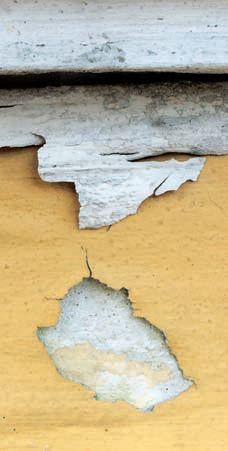
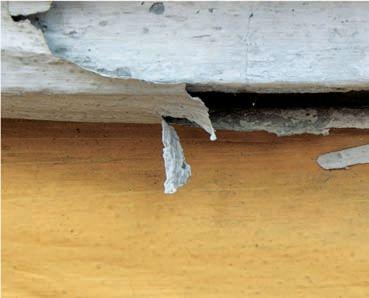
Arecent report from the Reuters news agency revealed 3,000 regions in the United States with lead poisoning rates that are at least twice as high as rates in notorious Flint, Michigan. For the investigation, Reuters looked at 21 states and used “census tract and zip code–level data from millions of childhood blood tests to identify nearly 3,000 U.S. communities with recently recorded lead poisoning rates at least double those in Flint,” the news agency said. “More than 1,100 of these neighborhoods,” according to Reuters, “had a rate of elevated blood tests at least four times higher than in Flint.”
The communities get little of the attention that has been accorded Flint, the report revealed. No less than 4 million U.S. households have children living in them who are regularly exposed to high lead levels, the U.S. Centers for Disease Control and Prevention (CDC)
said. There is no safe level of lead, the CDC said, but the organization has set a threshold for an elevated blood lead level at 5 micrograms per deciliter. The CDC recommends a public health response for anything higher than this level. Many cities responded to the report with action.
“This has just laid out that it’s not just a Detroit issue, it’s not just a Baltimore issue,” Ruth Ann Norton, president of Green & Healthy Homes Initiative, a Baltimore-based nonprofit, told Reuters. “This started conversations with mayors and governors.” A number of elected officials in Indiana took bold steps. “Everything has moved into fast-forward pace here since your story,” Heidi Beidinger-Burnett, a county health board member and a professor at Notre Dame’s Eck Institute for Global Health, told Reuters. “We are acting with a sense of urgency because kids here depend on it.”


Axalta Coating Systems, a coatings company based in Philadelphia, recently announced that it had acquired two companies: Ellis Paint Company and Century Industrial Coatings. Ellis Paint Company was founded in Montana in 1887 and has been headquartered in Southern California since the 1930s. Century Industrial Coatings has been based in Jacksonville, Texas, since the 1960s.
“We look forward to welcoming Century into Axalta,” said Michael Cash, a senior vice president at Axalta. “Century’s customers really value its broad suite of products, its ability to develop solutions with unparalleled agility and its focus on customer service. With this acquisition, we will have the opportunity to offer our combined customers an entirely new range of products with best-in-class service.”
“We are excited to bring our legacy and products to a much broader national and global stage,” said Don Harvey, CEO of Century Industrial Coatings. “Axalta has shown a real commitment to the industrial coatings space, and we are confident our customers will find further success with access to their full line of innovative and high-quality industrial coatings, including E-Coat, powder and liquid industrial products.”
About Axalta’s alliance with Ellis Paint, Ellis president and CEO Sandra Berg said, “Our company has proven itself in California through three generations. It is tremendously exciting to know that Axalta will not only help us better serve our current customers but also make our assortment of environmentally responsible products available to a wider range of national and international customers.”
Cash said Axalta is excited to have Ellis Paint’s brands added to Axalta’s portfolio.
“Ellis Paint’s commitment to providing innovative and sustainable coatings is renowned in the industry,” he said, “and will align well with our focus on technology and business strategy.”
In other Axalta news, the company recently launched a mobile color-matching app for powder coating professionals. It allows users to scan a surface and match it up with an Alesta stock powder coating hue. “Our new and exciting color-matching app provides the powder coating industry with a quick and simple way to scan a color and select the best Axalta match,” said Kristen Boyd, one of Axalta’s marketing managers. “The technology… will save customers time and provide quicker and easier color selections.”

Innovative Chemical Products (ICP), a leading specialty chemicals manufacturing platform, recently announced three major acquisitions: MinusNine Technologies, Fomo Products and Rock-Tred Corp.
MinusNine Technologies is a coatings and adhesives company based in Birdsboro, Pennsylvania; Fomo Products is a Norton, Ohio, polyurethane foam sealant and adhesives company; and Rock-Tred is an Illinois-based polymer floor coating manufacturer.
Paul Grzebielucha, president of ICP Industrial, expressed enthusiasm about the MinusNine acquisition.

“We are excited to welcome MinusNine to the ICP team,” said Doug Mattscheck, CEO of the ICP Group. “Our combined brands, products and technologies propel us into a new chapter for our industrial division. Additionally, this acquisition will strengthen our ability to support our customers through innovation as we continue to lead the specialty coatings and adhesives markets.”

“The opportunity for continued growth and our complementary cultures make this an ideal fit,” he said. “Through sharing best practices, scalable operational capacity, advanced technologies and talented leadership and employees, we can leverage both companies’ capabilities to deliver great value to our customers and increased opportunities to our team members.”
Mattscheck said Christopher O’Brien, the former owner of Rock-Tred, has been made a vice president of flooring systems for ICP. “He will work with me to strategically expand this product range organically and through acquisitions,” he said.

Stefan Gantenbein, president and COO of Fomo Products, said his company is excited to join the ICP Adhesives team. Gantenbein will serve as division president of ICP Adhesives. Innovative Chemical Products Group is a portfolio company of Audax Private Equity.


The Sherwin-Williams Company announced in January that its 2016 net sales had increased 4.6 percent to a record-making $11.86 billion, according to Cleveland Plain Dealer reporter Janet H. Cho.
The Cleveland-based paint company also anticipates acquiring the Minneapolis-based coatings company Valspar soon, Cho wrote. The deal is still awaiting approval from the Federal Trade Commission. It would be the largest acquisition in Sherwin-Williams’s 150-year history, she wrote. Combined revenues of the merged companies would be $15.6 billion with an adjusted profit figure of $2.8 billion. The deal would give SherwinWilliams 58,000 employees worldwide.
“We are moving forward on a divestiture that we believe will allow us to gain approval from the FTC,” said Sherwin-Williams head John G. Morikis. “The expected divestiture has revenues below the $650 million threshold, and we expect to negotiate the divestiture and complete the Valspar transaction at $113 per common share within 90 days.”

A blog post on the financial website Seeking Alpha predicted that Sherwin-Williams will have “more than a 50 percent market share in its industry when all is said and done.”
“That means that half of all paints sold in the USA will put money into the coffers of Sherwin-Williams,” the author of the post wrote.
In early February, Zacks Investment Research upgraded Sherwin-Williams from a “hold” rating to a “buy” rating in a research report issued to clients and investors. A Gainesville (Florida) Sun column by Lauren Rudd described Sherwin-Williams as a quality investment. “To its credit, Sherwin-Williams follows a strategy of growth through acquisition aided by several internal initiatives, such as efficient working capital management and innovation,” she wrote. “This enables it to reduce its dependency on prevailing market conditions.” •




Domingue Architectural Finishes made its U.S. debut late last year with lime wash, mineral paint and plasters. Domingue Architectural Finishes, featuring products designed by Belgian painter Eddy Dankers, comes stateside in a partnership with Chateau Domingue, a furniture importer in Houston.
“My family has been making our own paints and plasters for centuries,” Dankers told Architectural Digest magazine. “Lime paint is the mother of all paint. The ancient Romans, ancient Egyptians and pre-Columbian people all used it.” Dankers has traced his family’s profession back to 1637. Chateau Domingue was founded in 2002 by Ruth Gay. It specializes in French, Belgian and Italian designs from the 15th through 19th centuries. “I look for grandness and simplicity,” Gay told Traditional
Home magazine, referring to her buying trips. “I don’t buy anything glitzy or over the top.”
It’s like “a big treasure hunt” every time she travels to Europe, Gay told Luxe magazine. “We’re giving these pieces a second life,” she said. Gay said she believes the smallest details count. “What started as a love for reclaimed European architectural elements has blossomed into a greater passion to bring the entire aesthetic right to my clients’ fingertips,” she told Luxe . “I enjoy seeing people inspired by the possibilities.”
Gay worked with Dankers to come up with the Domingue Architectural Finishes line. “In my experience, Americans are open and experimental, as well as great appreciators of European heritage,” said Dankers. “I’ve long wanted to introduce these materials to the U.S. market, but the right partner was critical.”
Gay said she was hugely impressed with Dankers’s work upon discovering it. “It was immediately obvious to me that these products would be industry game changers in the U.S.,” said Gay.
Gay and Dankers collaborated on the line with Eve Ashcraft, a New York–based architectural color specialist. She created the 140 color options. The products are all inherently healthy, Gay told Architectural Digest . “There are no chemicals or VOCs,” she said. “They are completely natural and allow walls to breathe.” Dankers said he believes that the collection triggers a philosophical shift. “I have a different view of what paint can be,” he said. “It’s been my dream to bring that here.” For more information, visit dominguefinishes.com .
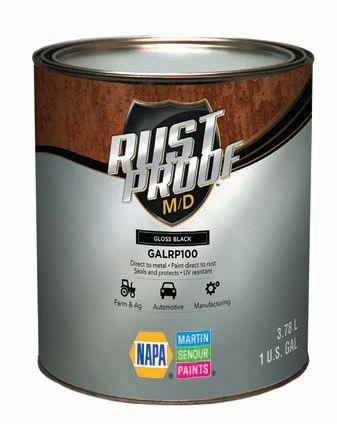
The Martin Senour Company, of Warrensville Heights, Ohio, has introduced a new paint designed for body-shop proprietors interested in increasing corrosion repair efficiency. RustProof M/D is, according to the company, “a powerful yet easy-to-use solution for combating rust.”
“RustProof M/D’s UV-resistant formula is designed for unrivaled durability and
ongoing protection in most environments,” said Kyle Hauenstein, product manager for Martin Senour. RustProof M/D “seals the surface of the substrate, stopping existing rust from spreading and new rust from forming,” according to the company. It can be applied over rusted surfaces with little or no prep. “It offers the best of both worlds: commercial-grade quality with an ease of use weekend warriors will appreciate,” said Hauenstein.

An inspection equipment manufacturer based in the U.K. has launched a new tool for nondestructive measurement of dry film thickness on concrete.
The new Elcometer 500 Coating Thickness Gauge, from Manchester’s Elcometer company, works on cementitious substrates up to 10 millimeters thick.
It works three times faster than other technologies, according to the company. Furthermore, it prevents false or incorrect readings and is easy and comfortable to use.
Data collected can generate instant reports via Bluetooth, USB PC software or mobile devices, according to the company. The new Elcometer 500 Coating Thickness Gauge is also rugged and powerful, the company said.


Faux Effects International, a company in Fort Pierce, Florida, that specializes in textured coatings, recently introduced Galaxy Stone, a luminescent architectural coating that can add a distinctive effect to most surfaces.
Faux finishing developed as a way of inexpensively replicating, with paint, pricey materials
such as marble. Faux Effects International offers a line of water-based faux-finishing products that the company says “provide consistently slower drying times” and allow “maximum workability.” Galaxy Stone is designed for interior and exterior use and is formulated for easy rollon application. It may be applied over primer coats and wall paint, the company said.

Alfa, an Italian company, recently released a mixing instrument for the production of color samples that is designed to reproduce samples of 100 cubic centimeters.
The Color Lab can dispense microdrops as small as 0.0077 cc, one-tenth of the current industry standard, according to the company.
Color Lab is an environmentally friendly device because it is more efficient and creates less waste, according to Alfa. “It’s vital for laboratories to create color samples, to optimize formulation and to improve productivity, while reducing waste and mistints,” said Alfa CEO Marco Rossetti. “With the Color Lab and our patented technology, we are proud to deliver the solution that satisfies those needs, in only 0.64 square meters.”

Late last year, Alfa introduced the Color Tester, a marketing tool. It’s a vending machine that produces
“infinite tints” and delivers paint samples of 100 cc in less than one minute, according to the company. It’s a user-friendly DIY tool that allows retailers to offer better service and a unique experience, the company said. “The Color Tester is the first self-service dispenser for the DIY market that brings the consumer closer to the colored product,” said Rossetti.
Hero Products Group added two new models to its product line: the A300 Series Automatic Colorant Dispenser and the S2650 5G Platform Shaker.
Hero said the two new products exhibit technical and design improvements over previous iterations of similar products. “The A300 Series Automatic Dispenser incorporates several technical enhancements along with a smoother ergonomic design,” the company said. “It is an ideal tool for low- to medium-volume paint retailers that require accuracy, efficiency and reliability in a limited space.” The company added that “innovations introduced in the A300 Series combined with the already proven accuracy, repeatability and reliability of [its] PCP (Progressive Cavity Pump) technology make the A300 Series a high-performing and efficient automatic
dispenser with a maximum dispense of 80 ounces per minute and an optional hybrid feature that allows for the addition of maxflow pumps to the most used colorants.”
The shaker, Hero said, is reliable and reduces noise. “The new S2650 5G [five gallon] automatic shaker is a quiet, sturdy and reliable unit with a small footprint especially designed for a variety of mixing environments,” the company said. “It incorporates vibrational technology with a clamping system that thoroughly mixes from half-pints to a five-gallon container. Customers will also be able to shake one-, two-, three- or four-gallon cans or a case of four gallons in one shake cycle. The S2650 5G automatic shaker includes easy-to-use digital controls, a reversible door and a stainless-steel tray for convenience and easy loading, along with an emergency stop button for enhanced security.” •


In 1965, artist Robert Indiana designed a Christmas card for Manhattan’s Museum of Modern Art. The card had just one word on it: love. Indiana was an early proponent of pop art, a style that became popular in the mid-1950s; his friend Andy Warhol was a fellow practitioner. Word got out about Indiana’s Love design and it became so popular in the early 1970s that it was co-opted by marketers for everything from T-shirts to paperweights. Large sculptures of it began appearing in cities around the world, including this one in Philadelphia, which has been perched there almost continuously since 1976. At the end of November, though, the sculpture was temporarily removed from its place so that a restoration team could finally give the Love sculpture a bit of love itself.



Several centuries of combined experience set this Alabama retailer apart from the rest.
By Steve Penhollow
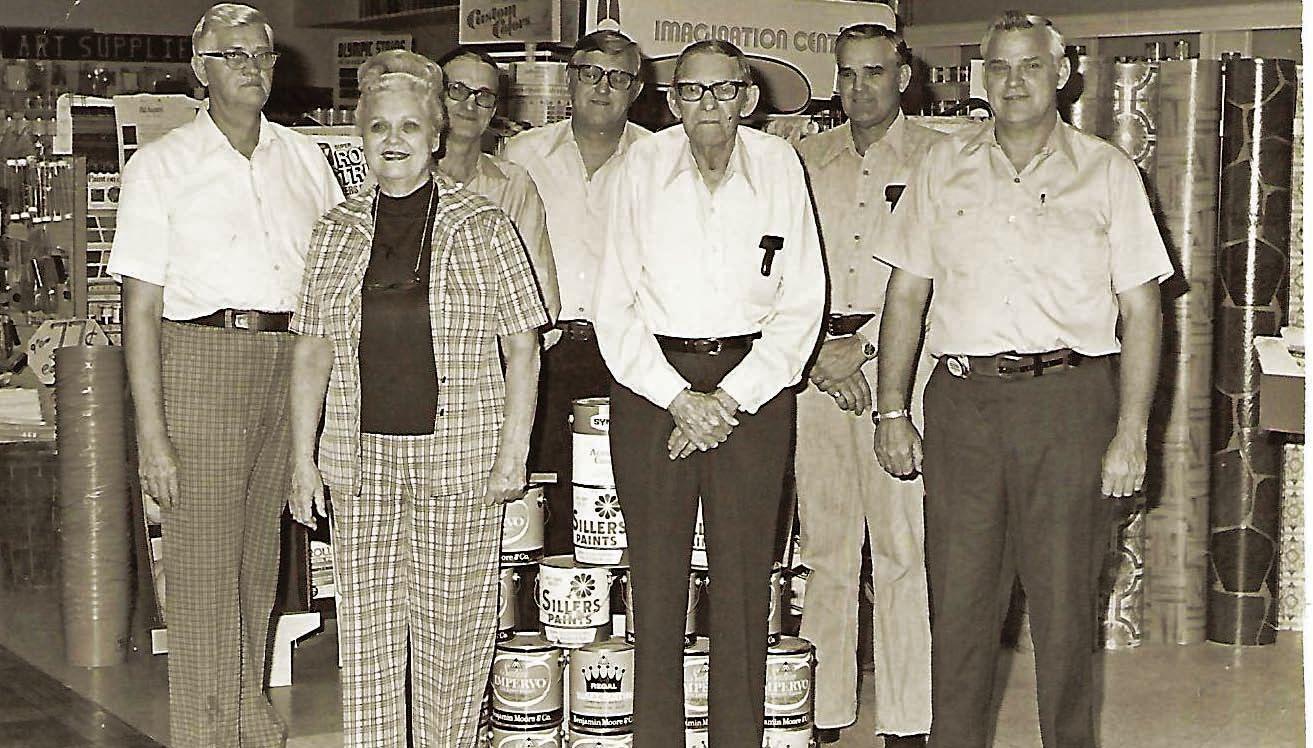
During WWII, painting contractor Otto Frank Richter watched four of his five sons go off to fight for their country and he had the good fortune to see them all return. But one son was permanently debilitated and all of his boys needed jobs, so he opened a paint store in 1947, according to current co-owner Maria Schultz.
Schultz grew up in the store and remembers that the brothers got along well. “They did things together outside of the store,” she said. “They’d gather. They all lived in the same area.” Each brother (and one sister, who joined later) had a specific role in the business. “Toward the end, Arthur was in the retail store,” said



“I think people begin to know the quality and service they are going to find here. Service is our biggest thing.”
Schultz, who is the daughter of the founder’s son, Roy. “Frank was in the warehouse, Hubert was over the painting contractors, Clarence ran a crew out of Decatur, Roy did the floor covering part, and Evelyn, the daughter, was in the store also.”
O. F. Richter and Sons, with three northern Alabama locations, celebrates its 70th year in 2017. It is still very much a family business, with 11 descendants now involved in its daily operation. The stores employ 33 people, said Schultz, and the business has 19 co-owners, only some of which are active participants. Schultz has worked in the stores in some capacity for 45 years, and that isn’t even the longest stint. Two of her cousins have been with the business for more than 50 years.
Many independent retailers brag about the years of accumulated expertise amassed by their longtime staffers, but few can boast about centuries’ worth. “We can’t begin to compete with the big boxes’ advertising dollars,” said Schultz. “But I think people begin to know the quality and service they are going to find here. Service is our biggest thing. They like that we can help them with colors and we can mix their paint and change it a little bit on the
tint if it’s not perfect for them.”
Schultz said they have a core clientele that has “been with us for a long time.” She said she still sees customers who have been doing business with O. F. Richter and Sons at least since she started working in the stores. A Richter may have helped found Cullman, Alabama, where the main store is located, so the name carries a lot of weight with residents, she said.
Schultz said her cousin Tim, who has been in charge of the contracting side of things for many years, turned 70 in January. He shows no signs of slowing down. “He’ll be here until we take him out feet first,” she said. “He’s still capable. We’ve been blessed with good genes.” There are currently six people over 60 working in the stores, Schultz said.
Succession is often a stressful issue in family businesses, but the size of the Richter clan would seem to alleviate any uncertainty in that regard. “We already have the fourth generation working,” she said. “I think they’ll eventually be in charge.”
The Richters learned long ago how to manage conflict, she said. “We’re not going to agree all the time,” said Schultz. “But we don’t get mad. We know when to walk off.” Joining the business on a permanent basis wasn’t a forgone conclusion for Schultz. She studied business and accounting at Saint Bernard College with a vague plan of becoming an accountant. But accounting proved to be a little too sleepy for Schultz. “It was not my cup of tea,” she said. “It was pretty low-key.” As some of the founders of the business passed away, the need arose for younger Richters to take their place. “They were very encouraging for you to stay,” said Schultz.
The business has experienced its share of ups and downs over the years, Schultz said, but the former have always followed the latter. When wallpaper fell out of favor, the business decided to buck the trend and stick with that product category, she said. They’re glad they did. “We had a designer who liked to use a lot of wallpaper and that kept us going for a while,” said Schultz. “I guess it came down to plain old stubbornness. We just didn’t want to give it up. So now we’re about the only ones in town.”
Schultz said there’s no magic formula
for weathering bad times. “You just have to look at everything and see where you need to cut and where you need to expand,” she said. “You need to see what’s going on in your community. Each community is going to be different. You just have to hang in there.”
It’s not surprising to learn that retiring isn’t an option that Schultz has
given much consideration. “I think I’ll always be around in some way,” she said. “Sitting at home is not for me. As long as I’m able and my mind is still good, I’ll be here. I think that’s just part of the German work ethic.” •
Steve Penhollow is an award-winning journalist based in Fort Wayne, Indiana.


Running your business in an environmentally conscious way means more than just stocking low-VOC paint. Check out these creative ways to green up your business.
By Julianne Will
t’s easy to talk about operating in a more sustainable, earth-friendly way. It’s harder to know exactly how. So we’ve put together some simple steps that you and your team can tackle. But don’t let the volume of awesome ideas overwhelm you. Take the advice of Kyle Wente, president of EcoEnclose, a manufacturer of earth-friendly packaging (and a sustainable business itself) based in Louisville, Colorado. “There are two very basic ideas that are by far the most important when it comes to implementing green practices: 1) Make a
change. 2) Stick with it until it becomes a habit.
“To a store owner trying to make sales and meet payroll, a list can be daunting. So just start small, with a single change. Take one small piece of your operation and make one change to improve it,” said Wente. “Sticking to these small steps will have a significant impact on your culture and your company over time. It will create great momentum for more changes.” So make this the year you go beyond the green products on your store shelves. Take your pick of ideas and make some stick.
And then there was light! Start by swapping out your bulbs: Choosing a compact fluorescent light (CFL) can save more than $50 in electricity over its lifetime compared with an incandescent bulb, according to LetsGoGreen.biz, while eliminating as much as 150 pounds of carbon each year. Automatically turn lights on or off with body-heat detectors in the break room and bathrooms, or use solar lighting outdoors to eliminate electricity waste.
Speaking of waste: A regular coffee maker is ideal—use unbleached filters and compost the grounds. But if you’re addicted to the convenience of Keurig K-Cups, look into New Hampshire Coffee Roasting Co.’s single-serving environmentally friendly

Host craft events using paint chips, paint and paint cans. See popsugar.com and search Paint Sample crafts for loads of ideas.

coffee pods; Rogers OneCup, made from 97 percent biodegradable materials; Dean’s Beans recyclable cups, which are compatible with K-Cup brewing systems (including Keurig 2.0); or Tayst 100 percent compostable coffee pods.
If you’re hosting a customer event or stocking the design studio’s coffee station, look for plates, hot and cold cups, and utensils created with compostable sugarcane pulp, corn or even plant starch from brands such as Eco Products and GreenWare. Most can even go in the microwave. For the break room, however, skip disposable all together. “Go with reusable utensils, plates and mugs,” said Wente. “Not compostable or biodegradable, but reusable. Grow up, folks: Wash your dishes and put them back in cabinet!”
When cleaning up around the store, look for products that use natural substances as their active ingredients rather than toxic chemicals—they’re safer for humans, pets and the water supply. Make it easy with disinfecting wipes that are based on thyme oil and are EPA registered yet still kill more than 99 percent of household germs, including cold and flu viruses.
There’s also a lot of room for improvement in the cleansers that you use on your skin several times a day or on the dishes from which you eat. Consider all the ways they can be better: USDA Certified









• PegasusLighting.com
• NewLeafPaper.com
• SeventhGeneration.com
• Staples.com
• POSSupply.com
• Bagito.co
• EcoEnclose.com
• GoodWeave.org
Biobased; scented with essential oils or botanicals; free of dyes or synthetic fragrances; hypoallergenic; biodegradable; not tested on animals; made without triclosan or phthalates; even bottled in recycled plastic.
It’s not hard anymore to find toilet tissue, paper towels, tissues and napkins made with recycled paper, but take it to the next level and select unbleached versions that are free of inks, dyes and fragrances—those with sensitive skin will thank you. Even better, find brands that are compostable, too.
When you’re done with all of it, line your trash cans with brands such as BioBags, which can be digested by microorganisms in the soil and thus composted along with their organic contents. And as you’re getting rid of the microorganisms you don’t want, along with weeds and grasses, be kind to neighborhood pets, the birds that eat the bugs, and even your own nervous system with natural pest and lawn products.

“To a store owner trying to make sales and meet payroll, a list can be daunting. So just start small, with a single change. Take one small piece of your operation and make one change to improve it.”
Cash-register paper might as well be rat poison. “There’s more BPA in a single thermal paper receipt than the total amount that would leach out from a polycarbonate water bottle used for many years,” said John Warner, Ph.D., president of the Warner Babcock Institute for Green Chemistry, in an article published on ConsumerReports.org on March 29, 2014. BPA has been linked to a greater risk for breast and prostate cancers, cardiovascular disease, and reproductive and brain development abnormalities.
So go phenol-free (BPA and BPS). Today you can even find register paper rolls with recycled cores. Or use a POS system that delivers receipts via email. No printing required, and you’ll build a beautiful customer list!
Get that green feeling when sealing shipments and supplies in recycled cardboard boxes with tape that’s plant-derived, renewable
and naturally biodegradable. You can even use less (and save more) when you choose water-activated kraft-paper tape.
Hopefully you’re already using recycled paper. But is it made from 100 percent post-consumer recycled fiber and processed chlorine-free in a plant that uses less water than other manufacturers? Take a page from New Leaf Paper, which is Forest Stewardship Council certified, Ancient Forest Friendly and a B Corporation and offsets energy with Green-e certified renewable energy certificates.
Don’t forget to recycle that paper after you use it. But wait— do you even need to print that document at all? When you do, choose an efficient toner and recycle your used ink cartridges. Finally, remember to turn off and unplug appliances and electronics at night. Computers, printers, coffee makers…they all draw incremental power even when they’re in sleep mode.



f you’re serious about operating your business in an environmentally friendly way, tell your customers and community how you’re doing it.
• Post often about your store’s green efforts on social media.
• Host workshops for customers on ways to green up their homes.
• Make green initiatives a standing feature in newsletters and blogs.
• Display green logos and certifications on your website and in the store.
• Create an in-store scavenger hunt for green products and initiatives.
• Host paint recycling days and encourage donating excess paint to a local nonprofit.
• Have a company car? Make it an electric one and claim zero emissions.
“Retail shopping bags have taken a wonderful progression over the past few years. We have many retailers providing reusable bags or even charging customers for the use of bags,” said Wente. “But what’s better than recycling? Not using in the first place. A simple question— ‘Do you need a bag today?’ versus ‘Here is your bag’—can make a big difference in consumption and your bottom line.” Saving money and the environment at the same time—what could be better? But maybe you do need a bag. How about paper? Here again, look for 100 percent recycled paper with a high percentage of post-consumer content (stuff destined for the dump). You also can give out reusable shopping totes as promotional items or sell them in your store. Bagito makes an inexpensive model from 100 percent rPet fabric (recycled plastics). It goes on a keychain and can be branded. Or upgrade to 100 percent organic cotton and purchase wholesale. Bagito donates a percentage of profits to Power2Sustain, a program that teaches K–12 students about sustainability.
If you put down a handmade carpet in your store (or sell them), make sure they’re GoodWeave certified, which ensures child-labor-free rugs and provides opportunities to rescued and at-risk children. You can even make over your shelving and displays. Let your creativity shine and inspire your customers with upcycled furnishings! Pinterest is a great source for ideas, such as old doors as display tables, old ladders as display racks, pallets fashioned into shelving, an upright piano as a quart-can paint unit, signs using chalkboard paint, signs made from clipboards and signage using paint chips. Above all, don’t forget the most fundamental steps: Recycle all packaging, and purchase inventory and supplies with care—only what you need. “Remember, consumers are becoming more and more educated about waste and the environment,” said Wente. Pick from the list and lead the way! •
Julianne Will is a marketing professional and a writer specializing in the green industry as well as the founder of a business retailing handcrafted goods and dedicated to operating sustainably.




By Karon Warren


Thanks to a strengthening economy and a growing new home construction industry, the caulk, caulk gun and sealants category is not only strong but also thriving, say the category’s manufacturers. More-educated consumers are also boosting sales of these products, leaving industry experts looking ahead to a bright future.
In the past, manufacturers say selecting and purchasing caulk, caulk guns and sealants was a quick process, with consumers choosing an inexpensive throwaway product. That is no longer the case. “I can only speak to caulking and sealants, but the overall state of the category is one of growth, albeit slight overall growth,” said Darci Kunard, brand manager for Sashco Sealants. “For Sashco, we are seeing unprecedented growth, above the industry average. More attention is being paid to the types of sealants and using the right sealant for a specific job, such as purchasing a roofing sealant to fix a leaky gutter and a bathroom caulk for the bathroom sink.”
Tom Allen, director of Dripless Inc., said new formulations that address sealing and adhering in construction, DIY, manufacturing and other segments also are resulting in more sales. In turn, these new formulations require quality dispensing tools that have the proper strength to dispense them correctly, also leading to increased sales.
Perhaps the biggest trend in the caulk, caulk gun and sealants category is the move toward higher-quality products. “Again, I can only speak to


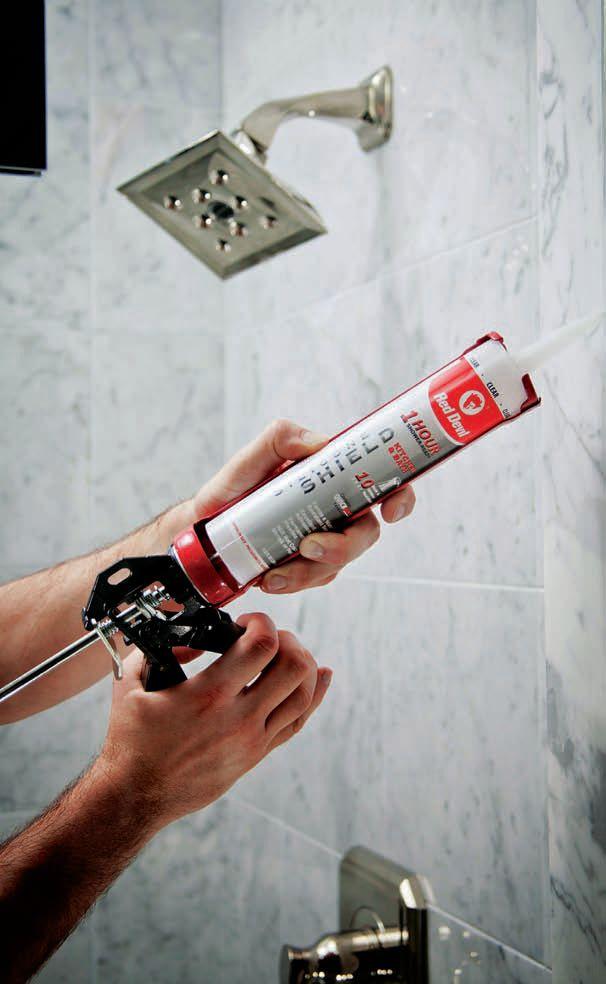
caulking and sealants, but I believe we are seeing a dramatic shift toward high-performance products, and consumers are actively seeking out products that perform over the long term,” said Kunard. “People are not willing to settle for cheap products or private-label products. People do not want to caulk every year; they would rather choose a product that lasts, doing the job right the first time. There is a resurgence in consumers seeking educational information on caulking.”
At Dripless Inc., Allen said he’s seeing a similar movement. “Modern building codes require a fairly tight building envelope for controlling environmental intrusion, e.g., air and water,” he said. “So the sealants used need to be effective and applied efficiently. The biggest trend I see is that end users are spending more on top-quality tools to gun the sealant, which makes for a better job that’s done quicker

Consumers are actively seeking out products that perform over the long term.

with less waste. So our hottest products are our higherquality products. For Dripless, this has been an increase of perhaps 20 percent.”
One additional trend in caulk guns is toward smaller containers and easier-to-use applicators. “The Gen Xers and Millennials are taking over from the Baby Boomers,” said Alan Crupper, vice president of marketing for Red Devil Inc. “This younger demographic wants more environmentally friendly products.”
Sausage guns are a great example of this trend. “Sausage packs are the future,” said Tyler Hippen, sales and marketing coordinator for Newborn Brothers. “They are much more economical, not to mention better for the environment. After dispensing a sausage pack, you are left with only a small, compressed foil pack.”
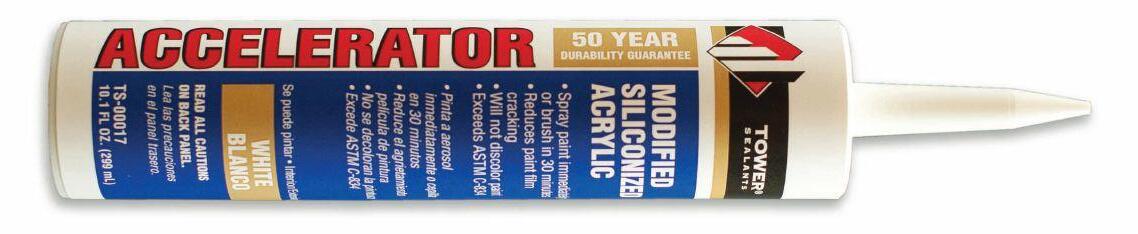
Some of the top sellers for the caulk, caulk gun and sealants category include silicone caulk, acrylic latex caulk, water-based caulking and sealant products, and solvent-based caulking and sealant products. “Water-based caulking and sealant products tend to be quite popular for use indoors,” said Kunard. “They are easy to use and clean up, and have low odor as well as low VOCs. For severe weather—rain, standing water, snow, ice— solvent-based caulking and sealant products are required. Consumers need a product that works in all weather and can instantly stop a leak. If you live in Michigan, in the winter you can’t afford to wait for a dry and temperate day to fix a roof leak. You need to fix that leak today.”
In the window, door and siding segment, premium elastomeric latex and hybrid sealants continue to dominate thanks to their high flexibility and adhesion, which make
them able to withstand temperature fluctuations without cracking, according to Jennifer Johnson, group product director of caulks and sealants for DAP Products Inc. “These sealants also offer outstanding weather resistance, paintability and easy application, making them ideal for demanding outdoor applications.”
For the kitchen and bath segment, Johnson said siliconized latex technology that repels water, dirt and stains is very popular because the sealant stays looking clean, fresh and new.
According to Dale Tomazin, executive vice president for Tower Sealants, new construction sealants that deliver productivity and eliminate callbacks also remain in demand. For caulk guns, top sellers include both high-end composite guns and lower-priced throwaway products.
FALLING FA ST
Category manufacturers said one type of item that is losing steam is the low-end, lower-priced stuff. “These
“The Gen Xers and Millennials are taking over from the Baby Boomers. This younger demographic wants more environmentally friendly products.”
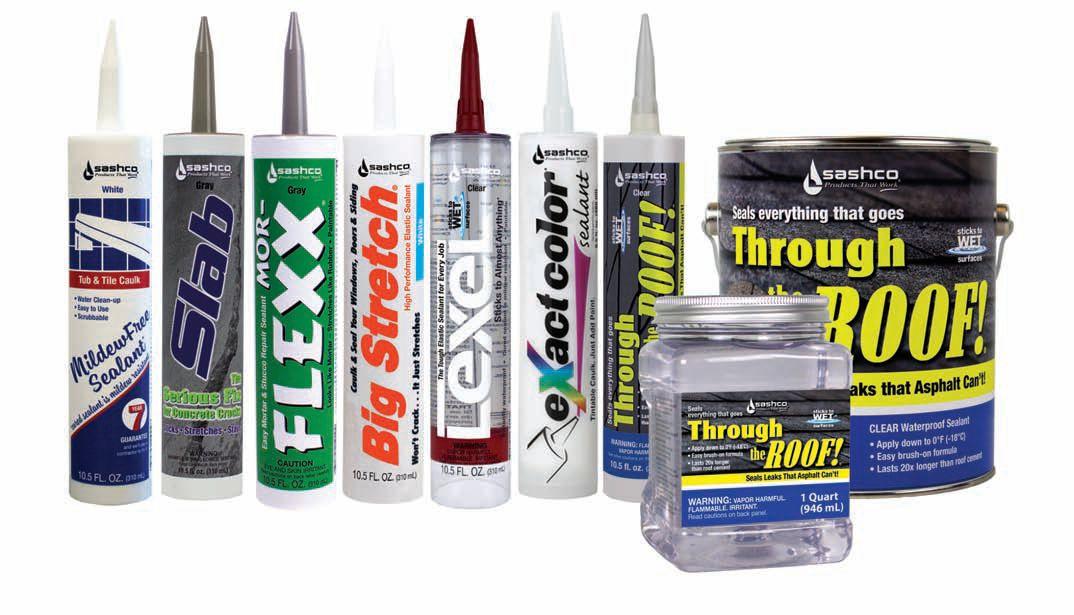

legacy formulations in painter’s caulks have dwindled in popularity because the way people paint has changed,” said Tomazin. “This is mainly a new construction challenge—everything is about speed. Today’s painter can’t afford to wait four to six hours before applying paint; they paint over the caulk in an hour or less. So, understanding these challenges, we’ve developed an affordable caulk that can withstand these conditions.”
Private-label caulking products also seem to be dwindling in the marketplace. “Consumers have realized there is a difference in caulking products, and they are seeking out brand names they either know and trust or that come highly recommended,” said Kunard.
The same could be said for caulk guns. “The low-end, cheapo throwaway guns still sell by the bushel, but that doesn’t mean they are popular,” said Allen. “So the sales of those guns are strong, but the popularity is low and getting lower.”
For caulk, caulk gun and sealant manufacturers, the biggest challenge in recent years has been educating consumers on their products so people buy the right products for their projects, resulting in satisfied and, hopefully, repeat customers. “Once you’ve hurdled that barrier and opened the customers’ eyes to the truth that money spent on a high-quality caulk gun is money well spent, then the payoff is customer satisfaction and loyalty is awesome,” said Allen.
To overcome this challenge, today’s manufacturers are providing more information in stores and online to teach consumers about their products and help them make informed purchases. For instance, Sashco offers a wide variety of videos, marketing materials and direct outreach to consumers. “Sashco has a free merchandising program for retailers that provides our marketing materials and demo blocks: the actual product, in use, that hangs on the retail shelf,” said Kunard. “This program has been shown to increase sales of caulking an average of 65 percent. Further, our consumerbased outreach has helped to educate people on how to caulk, as well as how
to choose the right product for the job.”
Increased consumer interest in their products has manufacturers excited about the future. “The whole mind-set is changing,” said Crupper. “People are not as intimidated by using caulk and sealants. People can see it online, learn how to use it.” And, going forward, there will be much more for these consumers to
see and experience in this category. “It is an exciting future for caulks and sealants!” said Kunard. “We foresee many innovations on the horizon for the category, and all will benefit the consumer.” •
Karon Warren is a freelance journalist based in Atlanta and has written about business, lifestyle and travel for more than 10 years.





By Steve Penhollow



Van Pisarri, resident staining and sanding expert at Eagle Paint & Wallpaper, in Englewood, New Jersey, takes an assertive approach to educating his customers about abrasives and sanding tools. “If they come into the store and I see them even look over at the display,” he said, “I’ll immediately find my way over there and point them in the right direction.”
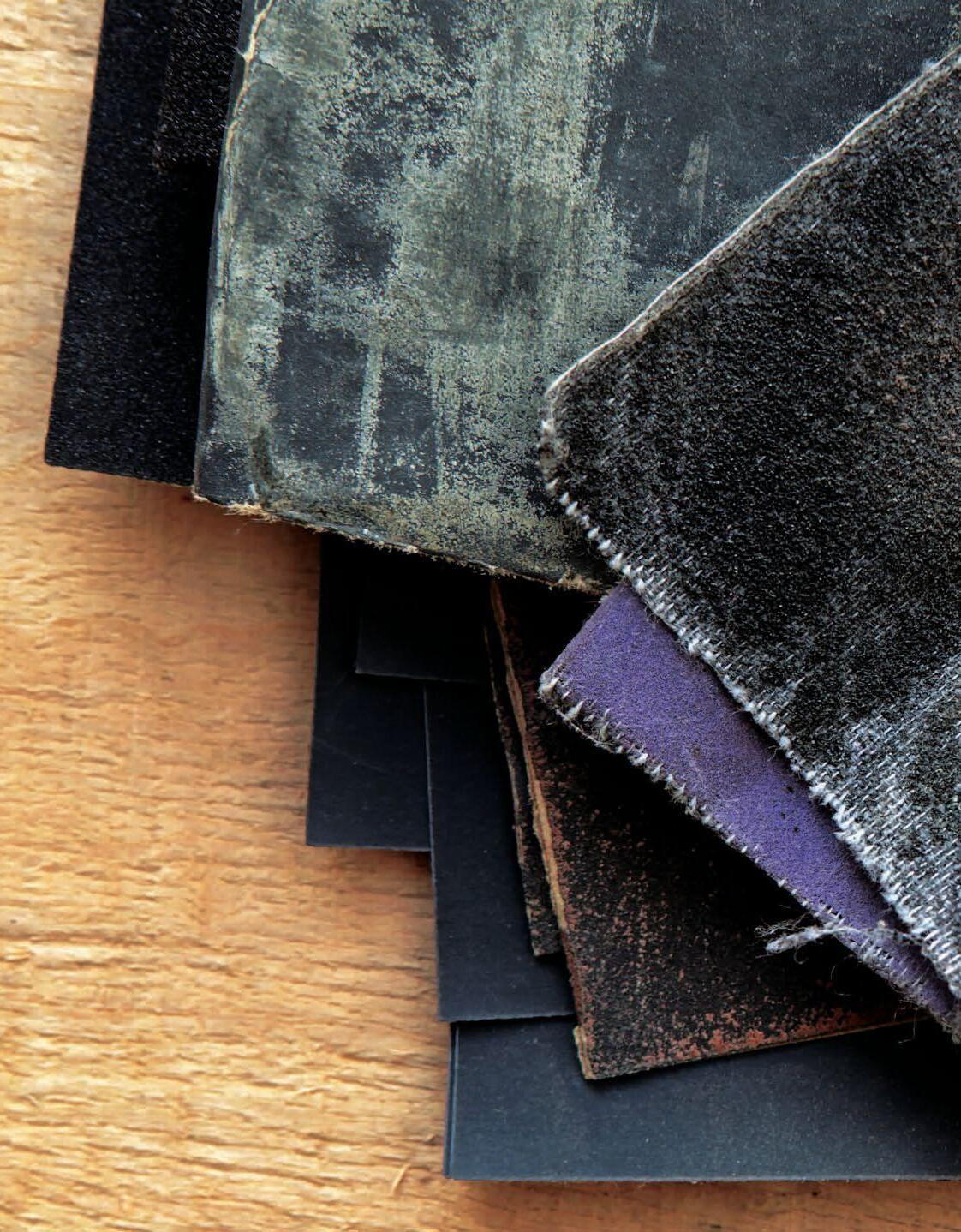
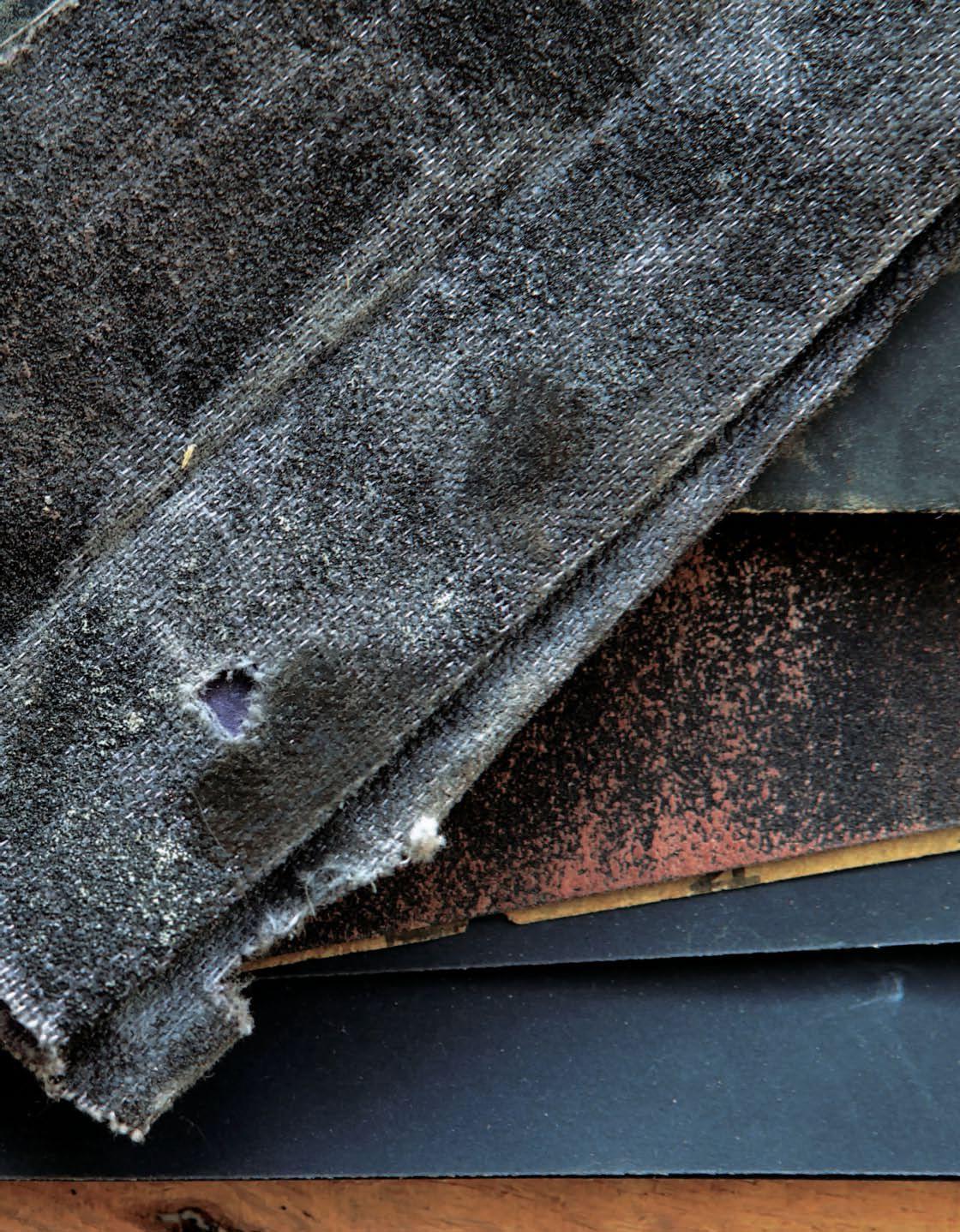
An unguided or misguided customer can make a lot of mistakes while choosing coated abrasives and sanding equipment. For example, they can choose the wrong grit for the job, according to Roland Kolilias, president of Blue Dolphin Abrasives & Tapes.


“If the user picks the wrong grit, the job will never end with good results and will take much longer to complete,” he said. “The key to a desirable end result is to work with the correct grits. Start out with lower grits to remove the imperfections of the substrate and then gradually move to higher grits for the final touches.”
Thomas Leecock, owner of John’s Paint Store, in Palmer, Massachusetts, said choosing the wrong grit is a common mistake made by customers seeking coated abrasives in his store. That’s why he keeps these products “close to the counter,” he said, where he and his employees can provide guidance.
Matching abrasives to sanding jobs can be a tricky business, according to John English of Woodshop News “One really has to read carefully to understand exactly what a specific sandpaper can do and, more importantly, what it can’t do,” he wrote. “A few words misconstrued can be the difference between an unacceptable and a great sanding job.”


Sanding is one of the most common construction and repair tasks around the home, wrote Don Munch for the Amarillo (Texas) Globe-News, and one of the easiest to do right. “Use [abrasives] properly and it’s almost impossible to do a bad job,” he wrote. “However, the wrong abrasives can make it almost impossible to get good results, no matter how hard you work with them.”
Another common mistake that un-schooled DIYers make, Leecock said, is not understanding how much or how little sanding is required for a particular job.
Sanding tools have grown much more sophisticated, but they are also much easier to use. “The whole sander manufacturing industry has been awakened to the fact that professionals aren’t the only ones who are going to do this,” Hank Dermer, manager of Rental Zone in Lancaster, Pennsylvania, told the Intelligencer Journal newspaper.
Eagle Paint & Wallpaper carries Festool sanding equipment, and Pisarri believes that it is “so far above what you could buy in a big-box store.” It is natural, perhaps, for customers to opt for the most inexpensive equipment without considering how much future cost and labor that initial purchase will add

to subsequent sanding endeavors, he said. “If you buy an inexpensive tool,” he said, “all the reasons that Festool came out with what they came out with are going to be missed.”
The tools that Eagle Paint & Wallpaper sells are matched with an extraction system to collect dust. “The extraction system they have is very quiet and very powerful,” said Pisarri. “It’s hooked up to the tool, so when you turn the tool on, the extraction system boots up.”
Some customers forgo the expense of an extraction system in favor of buying a separate wet/dry vacuum. “They don’t even use the vac with the tool,” said Pisarri, “because it screams. The decibel level is very high, which makes it very difficult to use on the job. It’s not practical.”
Then they have dust flying everywhere, he said. “The cost of cleaning up the dust, the cost of trying to control the dust and just having particles on everything they’re gonna paint—those are problems,” said Pisarri.
Another area where sanding tool manufacturers have addressed customer needs is ergonomics, meaning the science of creating a better fit between tool and user. Kolilias said Blue Dolphin has just


introduced a new line of ergonomic handsanding tools. “These tools are designed to reduce fatigue and improve the end result of the job,” he said.
This is why educating the customer is so important, Pisarri said. Customers often walk into the store with a rough idea of how much they think sanding equipment should cost, based on their experiences in
big-box and hardware stores, and the cost of the newer systems tends to skew higher than those mental estimates.
“You have to sit down with them and explain what these tools are capable of doing,” said Pisarri, “how they run more efficiently, how they last years longer, how there is no need to worry about fixing them because of the three-year warranty.”

What Pisarri says to professionals who are reluctant to spend the money is this: “When your crew goes into a house and a customer understands and sees that you are controlling dust to the extent that your crew is controlling it, and the dust isn’t moving through the whole house because it’s being captured and they’re working with equipment that is quiet, these types of things move a contractor up to a new level.”
All the contractors to whom Pisarri has sold this equipment receive high customer recommendations that carry over from job to job. “They don’t have to prove themselves as much,” he said. “People aren’t giving them such a hard time about the price.” When a contractor and crew do cleaner jobs and leave cleaner sites, the equipment pays for itself many times over, Pisarri said.
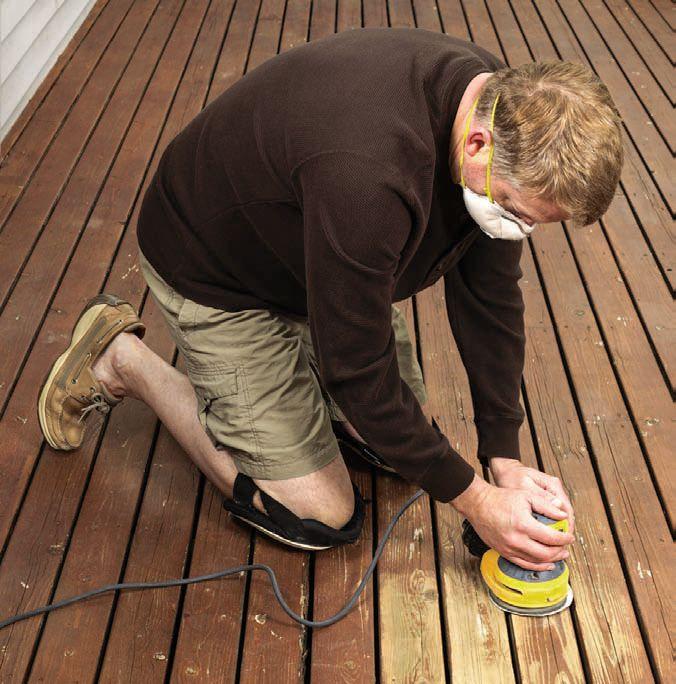
It’s not just a desire for greater efficiency that drives technological innovations in the sanding category, Pisarri said. It’s a desire for a healthier work environment. “Years ago I used to get a sander and I didn’t vacuum anything up,” he said. “I sucked up the dust all day. I didn’t wear a mask. Health considerations are something I really didn’t think about.
“These days I think people are more conscious about their crews breathing in drywall dust, and customers are really fussy about that today,” said Pisarri. “Twenty or 25 years ago, I don’t think people thought about their health the way they do now. Today everything’s an issue, whether it’s an odor or dust. People don’t want to have to think about that stuff; they want it taken care of.”
This is a product category where the independent retailer can readily prove its superiority to the big-box store, Pisarri said. Big-box stores don’t stock state-ofthe-art sanding systems, nor do they have employees who can explain the benefits of one approach over another. “For the most part, you can just go into a [big-box] store and get a sander with a little bag or something,” he said. “But that usually gets tossed if someone’s using it a lot. It’s not practical. It doesn’t do the job.”
“Not everyone is going to invest in the top things,” said Pisarri. “But the ones that do are going to see the value immediately.” •





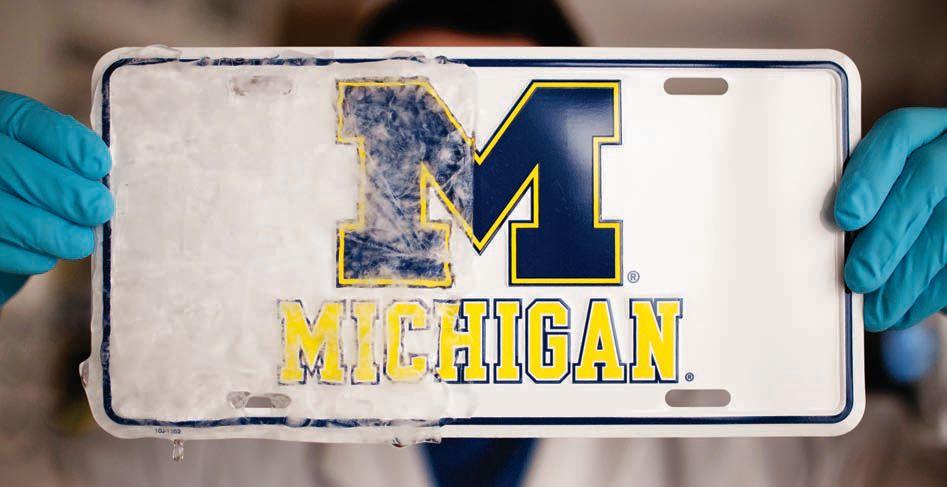
Thanks to a new spray-on coating, ice on your windshield may be a thing of the past.
If you live in a cold clime and want to de-ice your windshield, you either need chemicals or a scraper and some elbow grease. But University of Michigan researchers may have come up with something better.
According to a report from Michigan News , one of the university’s media outlets, the innovation’s benefits are not limited to car windows. It called the coating “durable and inexpensive,” adding that it’s remarkably effective and its applications are myriad. “Thin, clear and slightly rubbery to the touch, the spray-on formula could make ice slide off equipment, airplanes and car windshields with only the force of gravity or a gentle breeze,” the report said. “This could have major implications in industries like energy, shipping and transportation, where ice is a constant problem in cold climates.
“The new coating could also lead to big energy
savings in freezers,” the report added, “which today rely on complex and energy-hungry defrosting systems to stay frost-free. An ice-repelling coating could do the same job with zero energy consumption, making household and industrial freezers up to 20 percent more efficient.”
In a Wall Street Journal article last year, science editor Daniela Hernandez said the researchers had been able to embed oils within the coatings. “Embedding the oils in the coating helps keep the lubricant from wearing off. The coatings are completely solid, but embedded oils can still move around at the microscopic level.”
The Michigan team received funding from the Michigan Economic Development Corporation’s Entrepreneur and Innovation initiative, the Office of Naval Research, the Air Force Office of Scientific Research, and the National Science Foundation’s Nanomanufacturing Program. •
After a year of transition, this decorative paints company is ready to move forward.
The company now known as Modern Masters first came into existence in 1962 as a business that manufactured custom coatings for the furniture, decorative accessory, residential lighting and wall decor industries. Founder James W. Rogers called the company Custom Paint & Chemical Co. Inc. and based it in California’s San Fernando Valley. In the late ’80s, as the economy took a downturn and the furniture industry began to wane, the company sought out new customers. It turned its attention to fine artists and introduced the Modern Masters line of artist acrylics in 1989. With this shift, Modern Masters got a foothold in the decorative finishes industry.
In June 2016, Modern Masters became a division of RustOleum, a move that has had its challenges. Modern Masters closed its California manufacturing plant and moved those operations to Rockford, Illinois, with other Rust-Oleum operations. “It’s been a challenge, but the thought process behind it is to streamline,” Jim Rogers II, division president and the founder’s son, said. “We needed expanded capability to get into some different areas of the industry we wanted to get involved with, and we would rather [consolidate operations] than spend money to build a new plant here in
California. There are a lot more logistics involved with it, but as we’re going along in time, this thing will smooth out and it’ll be a better service point for our customers.”
With the move complete and smoother integration, Modern Masters is ready to resume its new product development. “We had a lot of things that sat on the back burner that were prepared or ready to go prior to our move, and they had to be pushed off until we smoothed things out with our manufacturing processes,” Rogers said. “Now that that’s getting through the mill and we’re fairly happy with what’s going on there, we can start to focus on bringing out new lines.”
Those new lines include two key products: Colorfast EX Zero VOC exempt solvent 2K acrylic polyurethane and nonfading Theme Paint Zero. Both lines are geared toward the movie and theme industries as well as customers who have high-traffic requirements for their surfaces and finishes. “We [manufacture these products] for all the major theme parks around the world,” Rogers said. He added that the products can go on any substrate and exceed the requirements for most environmental rules. “[The users are] not regulated to having a different type of material or VOC requirement for each [project the end user is] doing, whether it’s a ride vehicle or handrails or architectural element on the building.”










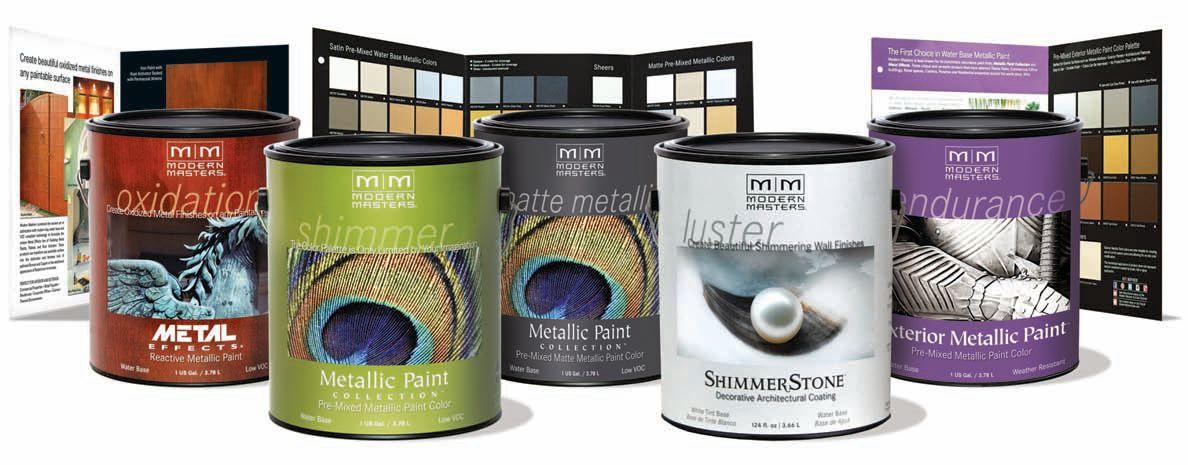

Also new for 2017 is an exterior metallic—a single-component, water-based acrylic that does not require a topcoat and can be used in commercial and residential projects. “We’ve had a lot of people request that over the years,” said Rogers. He explained that Modern Masters customers have typically
used the company’s regular metallic paints and then applied a waterborne polyurethane as a topcoat to give it exterior durability. “Now it’s in a single product,” he said. “I think this will be a great line.”
To help independent retailers move these and other Modern Masters products, the company hopes to have more dealers sign up for its e-commerce platform, KIBO, wherein retailers sign up (at no cost) as a Modern Masters fulfiller. When consumers order products, the orders are pushed through to the dealers, who ship the orders out. “We wanted to find a way to be more involved with independent retailers, not less involved,” said Rogers. “We continue to educate dealers on the system to get more of them on board.”
Maintaining those relationships with independent retailers remains an essential component in the Modern Masters business plan for the foreseeable future. “We’re still here—Monique and I—running this division, and we are focused on our innovative marketing, products and sales and our independent dealer base,” said Rogers. “We are trying to do a better job than our competitors and stay relevant in the market. A lot of people have wondered what’s happened to us. We’re going through this transition, but we’re all OK. We’re still here and still ready to serve them.” •
~ Karon Warren






Researchers examined lead levels found in urban pigeons and then compared those with lead levels found in children from the same neighborhoods. The results, published last year in the science journal Chemosphere , found a connection between lead levels in the birds and the children.
Researchers said the birds could be a critical component in attempts to trace lead exposure in children. Rebecca Calisi, Ph.D., an assistant professor in the department of neurobiology, physiology

A study demonstrates that by looking at lead levels in pigeons, researchers may be able to detect lead poisoning in children.


and behavior at the University of California at Davis, ran the study along with Fayme Cai, an undergraduate at Barnard College.
Calisi and Cai’s research, according to an article in Durability + Design , “centers on two main factors related to lead exposure. One is locale, and another is season—lead levels in children tend to
rise in summer, and the new study found the same phenomenon in pigeons.”
The article went on to say that Calisi and Cai found that neighborhoods where more children had higher than normal lead levels matched neighborhoods where pigeons also had higher than normal levels.
The fact that pigeons tend to stay local, researchers said, means the results

of the study can be reliably extrapolated to others in the area. According to the article, the thinking among those who study pigeons is that “the birds generally spend their lives within a radius of about two kilometers, a trait that makes localized studies tenable.”
The researchers said they looked at blood lead levels in 825 “visibly ill or abnormally behaving pigeons” in New York City from 2010 to 2015. They used data provided by New York’s Wild Bird Fund, a group that collects and rehabilitates sick and injured wild birds in the city. Lead from paint that had been used on buildings before the government banned the use of lead paint for housing in 1978 can make its way into soil and water supplies as old buildings deteriorate or are demolished.
There are a number of factors that could contribute to high blood lead levels in birds and humans.
Calisi and Cai said that pigeons have been used before to study heavy-metal contamination, but this research is thought to be the first correlating lead levels in pigeons and humans, according to the Design + Durability article. “The new study notes that there are a number of factors that could contribute to high blood lead levels in birds and humans. A correlation between heavy traffic and higher lead levels has been found.”
The researchers said they are aiming to discover new ways of finding, tracking and dealing with lead poisoning, which tends to disproportionately affect children. “This is a powerful example of how we can use pigeons to monitor the location and prevalence of pollutants,” Calisi said, according to the article. “We can use these ‘rats with wings’—which are anything but—to monitor dangers to human health.” •

These groups boost your brand’s social-responsibility efforts by offering guidance and hands-on assistance.
BCorp is to business what Fair Trade certification is to coffee or USDA Organic certification is to milk. The nonprofit B Lab certifies for-profit companies that have met rigorous standards of social and environmental performance, accountability and transparency. The process is challenging, but it’s a great selling point to customers if you complete it. And even if you don’t, the steps are a great road map. “B Corp certification helps us stay focused on best practices: less operational waste, lower energy usage, a better and more complete employee handbook


and sourcing code of ethics, and so on,” said Mandy Cabot, CEO of Dansko Footwear, at bcorporation.net. “In addition, B Corps love to share. Whether it’s great ideas about marketing, operations, community outreach or sourcing, or offering discounts to fellow B Corps on goods and services, the community of B Corps generates a tremendous amount of collective goodwill, energy and value.”
Patti Phillips, Ph.D., president and CEO of the ROI Institute, has published an analysis called Green Scorecard: Measuring the Return on Investment in Sustainability Initiatives. “Today,




most (if not all) businesses recognize that climate change is a problem,” she wrote with her coauthor and husband, Jack Phillips. “Smart companies use their environmental strategy to build competitive advantage.” Find the book on Amazon and check out the free tools at roiinstitute.net to measure your efforts.
Composting is not the same as recycling, nor can it happen in a landfill. So go to biobagusa.com to find this maker of compostable bags. The company offers consulting services from concept to launch and from implementation to analysis

for businesses looking for alternatives to polyethylene-based products. According to the company, “BioBag isn’t a large, petroleum-based plastic-bag company that now conveniently dabbles in the new business of compostable bags. We are a small, privately owned company dedicated to only producing certified compostable bags and films. The resin we use is sourced from Italy, as there is no ‘compostable resin’ supplier in North America that can guarantee a resin that is based on GMO Free crops. The resin is then blown into compostable bags and film at our production facility in California.”

MIT SMR is a business journal dedicated to “advances in management practice,” according to its website. Sign up for its free sustainability newsletter at sloanreview.mit.edu/follow and get interviews with top business leaders, new research from leading sustainable business thinkers and annual global research reports.

LEED-certified buildings can use less energy, offer improved health and productivity for employees, and provide tax benefits and government incentives. Find details and resources at usgbc.org •


Your connection to the communit Y of paint and decorating retailers
f or more information about the exclusive benefits of membership in the paint & decorating retailers association, call tina sullivan or Brandi hemmer at 800-737-0107 or email info@pdra.org .


The winner of the PDRA’s scholarship program will be announced at the National Hardware Show in May.
The check will be presented to the nominating store owner by officials from the PDRA and Reed Exhibitions, the event-management organization responsible for the NHS. The student may or may not attend the event.
Nathan Koerperich of Garden City, Kansas, won last year’s $5,000 prize. Koerperich was then a high school student in Garden City, an agricultural community in southwestern Kansas. He ranked in the top 10 percent of his class and was accepted into the National Honor Society and the state’s honors program. Koerperich also
played football and golf for the Garden City High Buffaloes.
Five recommendation letters were submitted with his nomination package, although only two were required. One of those was from his employer and grandfather, James Koerperich, who praised the young man’s dependability and his longtime involvement in the family business. “Nathan has grown up around our paint and decorating store since he was a toddler,” the elder Koerperich wrote in his nomination letter. “He has been an ‘employee’ of the store since he was 8 or 9 years old, taking out trash and mopping floors. Eventually, he graduated to doing lawn care, unloading freight trucks, keeping tinting machines full and operating the forklift.”

The PDRA’s latest Value Paks—coupon books containing offers for free and discounted paint and decorating products and services—are now available to all PDRA members. Individuals must be members to receive the savings, which add up to thousands of dollars. Join or renew a PDRA membership and receive the Value Pak by email. Members can download a Value Pak at pdra.org .

Time is running out to register for the National Hardware Store, so go to pdra.org/trade-show and register for free. The event is set to take place May 9–11, 2017, at the Las Vegas Convention Center. Last year, the show brought more than 700 new buyers and distributors to the paint and accessories segment. According to NHS officials, the event was “the single-largest buying opportunity in the U.S. for this sector, providing one of the most effective trips you’ll spend out of the office all year.”


You may receive Paint & Decorating Retailer magazine, but that doesn’t mean you’re a member of the PDRA. So connect with us at 800-737-0107 or info@pdra.org and get the benefits of membership.

Our Paint Drawdown Kit includes an eightinch metal drawdown bar machined to deposit precisely three mils of paint. It also has a 10-inch-by-12-inch clipboard with 40 drawdown cards for product demos.














PDR: How did you get into the paint business?
Lauren: My husband, Don, and I have owned Walnut Hill Paint for 19 years. My dad, John Wood, started the business in 1967. He ran a Sherwin-Williams store and also a Glidden store before getting his own. At one time, he had five locations.
PDR: What have been some of your best business decisions?
Lauren: Hiring well-qualified people. Jerry Hibberd, our store manager, has 30-plus years of experience and is very knowledgeable. He receives calls from all around the area asking for paint advice.
PDR: Why did you join the PDRA?
Lauren: We saw they have a lot of benefits and decided we wanted to be a part of it. They’re offering a marketing program, and we got involved with that. We think the PDRA is going to be very helpful.
PDR: What is the most challenging aspect of doing business in Dallas?
Lauren: Having Sherwin-Williams on every corner and a lot of Home Depot stores is probably the most challenging aspect of doing business in Dallas. However, those same competitors— Sherwin-Williams, Glidden, Home Depot—also send customers to our store for difficult stain and paint matches.
PDR: Tell us a little about your experience as paint store owners.
Lauren: We’ve really enjoyed it. We feel like all the customers are our good friends, and we see them quite a bit. Some have been trading with us for a long time. As far as business goes, we probably do more business with the pot-and-brush painters. But we get some DIY people, too. And we get some designers and architects. A little bit of everything.





Stay ahead of the pack with the industry’s leading events, shows and exhibitions


May 9–11

March 4–5
The PACOA Spring Dealer Market
PACOA, the Paint Applicator Corporation of America, is a wholesale distributor of paint, hardware, lumber and janitorial and building supplies. The organization serves independent retail dealers throughout the New York tri-state area. The event will be held at Queens College in Flushing, New York, in the Fitzgerald Gymnasium. Go to pacoa.com for more information.
March 12–15
The Coatings Alliance Dealer Meeting
The manufacturers of C2 Paints, the dealer-owned cooperative, will be holding their 17th annual meeting in Cancun, Mexico. For more information, visit c2paint.com or contact Heather Connor at 716-853-5776.
March 15–17

The PDRA Paint & Accessories segment at the National Hardware Show is the single-largest buying opportunity in the U.S. for the paint sector. The events are to be held again this year at the Las Vegas Convention Center. Register at nationalhardwareshow.com or contact PDRA membership coordinator Tina Sullivan at 800-737-0107 or tina@pdra.org for more information
6th International Architectural Paint Research Conference
The conference will be hosted by Columbia University in New York City and its theme will be Powers of Ten , a reference to a 1977 short film. Like the film, Architectural Paint Research (APR) deals with magnitudes of scale, from a single pigment particle to a painted house to the decorative tastes of an entire region. Check out apr2017.org to register and learn more.



Authorities announced plans to build a new Statue of Liberty Museum on Liberty Island in New York Harbor and said they intend for the attraction to be open to the public sometime in 2019. The Statue of Liberty - Ellis Island Foundation, Inc. (SOLEIF) is working with the National Park Service to bring the plans to life. SOLEIF said the new 26,000-square-foot museum will be part of “a beautification plan that also includes landscaping and lighting” and will provide a place for visitors to “learn about and honor the statue’s history, influence and legacy in the world.” SOLEIF added that the current museum is located inside the Statue of Liberty monument and is accessible only to a small fraction of visitors due to the safety upgrades that were put in place following September 11, 2001.