High Performance Retailing Brought to You By Hardware Retailing and The Farnsworth Group
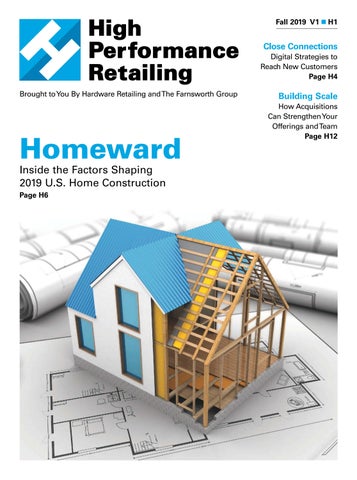
Homeward Inside the Factors Shaping 2019 U.S. Home Construction Page H6
Fall 2019 V1
H1
Close Connections Digital Strategies to Reach New Customers Page H4
Building Scale How Acquisitions Can Strengthen Your Offerings and Team Page H12
Contents Fall 2019 | Volume 1 | Issue 1
Features
H6
High Performance Retailing
H6 High Performance Retailing is a collaboration between the North American Retail Hardware Association and The Farnsworth Group. Both organizations are committed to helping the home improvement industry prosper with relevant, informative and timely data.
Building a New Mindset More than a decade after the national housing crisis, home construction remains a mixed bag. Grant Farnsworth, director of business development for The Farnsworth Group, discusses the many factors influencing the industry. Robert Dietz, chief economist of the National Association of Home Builders, offers his perspective on future trends.
Executive Vice President and Executive Editor, NRHA Dan Tratensek, dant@nrha.org Senior Partner, The Farnsworth Group Jim Robisch, jrobisch@thefarnsworthgroup.com
H12 Leaps and Bounds Jeremy Melnick, owner of Gordon’s Ace Hardware, considered many ways he could expand his business, but decided acquisition was the best path forward. Learn how his acquisition strategy not only netted new retail space, but also new customers and opportunities.
H12
Online Exclusive High Performance in Action High Performance Retailing goes far beyond the pages of this magazine. Visit HPRmag.com/join-us for an exclusive video with Dan Tratensek as he outlines the magazine’s mission.
H2
High Performance Retailing Fall 2019
Editorial, Design & Production Managing Editor Melanie Moul, mmoul@nrha.org Project Editor Todd Taber, ttaber@nrha.org Copy Editors Kate Klein Hans Cummings
Departments H3 . . . . . . . . . . . . . . Foundations H4 . . . . . . . . . . . In Conversation H14 . . . . . . . . . . . . Springboard H15 . . . . . . . Between the Lines
Market Research Analyst, The Farnsworth Group Amy Theophilus, atheophilus@thefarnsworthgroup.com
Senior Designer Lynnea Chom Production Manager Nancy Vondersaar
Sponsorship Opportunities
66% of customers prefer to be in contact with brands via messaging over any other medium. Source: Twilio
Vice President of Sales and Publisher Kevin Hohman Northeast Regional Manager Lowell Huffman, lhuffman@nrha.org 317-275-9443 Southeast Regional Manager Nick O’Connor, noconnor@nrha.org 317-275-9409 Midwest Regional Manager Brad Lyons, blyons@nrha.org 317-275-9424
Foundations
Driven by Data Timely Information Is Essential For High Performance Retailing any have said, “Information is power.” But in today’s marketplace, which is changing at light-speed pace, current and accurate information is even more important and powerful than ever before. Businessman Mark Cuban’s expansion on this quote drives home and even strengthens the original message. “Information is power, particularly when competition ignores the opportunity to do the same.” Today’s retail realities are different than in decades, years and even months past. Retailing is more challenging today, taking place not only in your brick-and-mortar base, but also online and in the minds of consumers. Today’s retailers must deal with new generations of customer segments, new products, stronger competition and select an array of media choices to reach customers. Applying tried-and-true strategies from the recent past might help you realize quick fixes or short-lived gains. However, these strategies are based on outdated information. In no way will these dated strategies ensure high performance results or long-term growth and future success for your operation. To achieve these ends, you need reliable, accurate and timely data to drive your business forward. The Farnsworth Group is proud to partner with Hardware Retailing and the North American Retail Hardware Association to present High Performance Retailing, a new joint publication that uses actionable, current data to present new success strategies for retailers. To achieve higher revenue and greater profits, we believe it is critical to integrate up-to-date market information into your strategy planning and learn how your retail peers are finding new paths to profits. The Farnsworth Group’s overall industry data will provide a solid framework of information as you refine your business’s plan for retail success. High Performance Retailing will provide relevant insights, information on emerging retail trends, and data on opportunities to reach new customers with each quarterly installment. Wondering how data can truly enrich your business? Visit nrha.org/codb for the results of NRHA’s annual Cost of Doing Business Study to see the tangible differences between typical and high performing retailers. Be on the lookout for new installments of High Performance Retailing each quarter to help you find new strategies and solutions to guide your business to new summits of success.
M
To achieve higher revenue and greater profits, we believe it is critical to integrate up-to-date market information into your strategy planning.
Jim Robisch Senior Partner, The Farnsworth Group jrobisch@thefarnsworthgroup.com
Fall 2019 High Performance Retailing
H3
In Conversation
Staying Top of Mind Using Digital Strategies to Grow Closer to Customers inding ways to grow closer to customers is paramount for independent home improvement operators. By establishing a more personal connection with customers, retailers can solidify their reputations as must-shop destinations.
F
Zach Williams says how home improvement products are marketed, found and sold is rapidly changing. Companies like Netflix and Airbnb were able to leverage customer curiosity and erode companies like Blockbuster Video and countless hotel chains. High Performance Retailing spoke to Williams about the ways independent retailers can combine new technology, social media outreach and time-tested customer service to grow closer to customers and become a trusted home improvement partner.
High Performance Retailing (HPR): According to Venveo’s data, 97 percent of all sales begin online, but only 6 percent actually take place over the internet. What does that fact reveal about modern home improvement customers? Zach Williams (ZW): The reality is, before customers even visit a store, they’re much more educated than they used to be. They’re researching products far in advance of purchasing and they’re starting online to gather that information. You have to think about how you’re positioned, what’s being said about your business online and the information you provide. If you’re not active in that realm, then most likely you’re losing sales.
H4
High Performance Retailing Fall 2019
Zach Williams is the founder of Venveo, a digital marketing firm that focuses on bringing new marketing strategies to building supply manufacturers. In his role, Williams is constantly scouting the digital landscape to find new opportunities for Venveo’s customers.
66% of customers prefer to be in contact with brands via messaging over any other medium. Source: Twilio
HPR: What can retailers do to stimulate interactions and grow closer to their customers? ZW: For retailers, it’s important to ask two marketing questions. One: How do I increase people’s awareness of my business and the products and services I offer? Two: How do I turn that awareness into action and get someone to actually convert to a sale? For business owners, if you get someone in your store, the chance they will buy a product increases. If I were a retailer and my goal were to get an online visitor into my store, I would need to be sure I offer not only the products and services that my community needs, but also the ability to be found by potential shoppers. Retailers need to make being found online one of their core competencies. One of the simplest things they can do is create a Google Local listing. This feature ensures your business has a map listing whenever someone searches for it to drive in-store visits.
HPR: You also recommend growing closer to customers through conversation—both digitally and in stores. How can retailers accomplish this? ZW: One thing we’re seeing with real estate is that people are beginning to look for homes without actually even
talking to a person. People don’t want to talk to people they don’t know, but they are willing to talk to technology because it almost feels like there’s a barrier. A customer might have questions about your products and pricing, and those are both things that can be quickly addressed via chat. One simple way to use a chatbot for your website is to think of the top five most common questions your customers have about your business and services. Either create a chatbot that answers these questions directly on your website, or train members of your staff to be online and answer questions from customers. Chat features are an efficient way to provide easier access to basic business information to help motivate in-store visits. If you add a chat feature to your website, you’ll most likely see an increase in overall customer satisfaction and employee productivity because of these resources.
Disrupting the Disruptors Williams says there are three main ways to ensure your business stays aware of shifting customer preferences and isn’t caught off guard by emerging retail trends.
Conversation is the new lead. Find new ways to share basic business details. Through chatbots or mobile apps, give customers the information they need.
HPR: How can independent retailers best compete online, even against retail giants like Amazon?
Value is the new currency.
ZW: I think the biggest thing retailers can do is provide service and value that Amazon and other large online retailers cannot.
Williams says retailers can create valuable online experiences for customers. Consider launching a DIY blog, recording how-to videos or contributing to podcasts.
The name of the game in winning more sales right now is reducing friction. Friction can come in many forms. Amazon reduces friction by making it super easy to buy something wherever you are and get it to your doorstep in a day or two. You may not be able to have an online store that competes with Amazon, but you can surely reduce friction in the areas of education, customer service, logistics, delivery, follow-through and other valuable parts of your offering that will continue to expand your reach within your local market.
Community is king. Retailers understand their communities in ways big boxes never will. Leverage that relationship to act quickly to meet community needs reliably.
Fall 2019 High Performance Retailing
H5
A Place to Call Home Understanding the Forces Influencing U.S. Homebuilding
ome improvement stores are places of possibility. Every aisle, each shelf and all transactions your team earns bring individuals and families one step closer to living in the space of their dreams. Understanding the intersection of home improvement retail and residential construction can be critical to a retailer’s long-term success. By knowing the disparate factors that drive homebuilding rates and influence new construction and renovation, you can determine what your business needs to do to capture sales from residential construction teams and the average DIYer this season and in the years to come. In its first quarterly installment, High Performance Retailing takes a deep dive into the metrics and measurements affecting U.S. homebuilding. Grant Farnsworth, director of business development for The Farnsworth Group, leads readers through the social and economic factors shaping current homebuilding. Robert Dietz, chief economist of the National Association of Home Builders (NAHB), gives independent retailers the information they need to draw new sales from construction crews.
H
H6
Macros of U.S. Homebuilding To get a more detailed look at the factors affecting current U.S. homebuilding, Farnsworth points to several macro drivers that give retailers a broad view of national housing trends. One of the key factors impacting housing is the rate of household growth, a metric that combines the headship rate (the percentage of people who are heads of households) with census population projections. Farnsworth says to support a healthy housing market, the annual formation of 1.2 million to 1.4 million households is critical. From 2000-2005, just under 1.4 million new households were created on average annually. This figure dropped heavily in 2008, the beginning of the Great Recession, to just 400,000 new households. Farnsworth says roughly 1.5 million new households were formed in 2018, a positive sign that suggests a healthy demand for current and future residential construction projects. Home values themselves have a major effect on residential construction. Farnsworth says rising home values have pros and cons for the market.
High Performance Retailing Fall 2019
Home Truths of Housing From 2008 to 2018, the median value of new homes in the U.S. has increased by
40.2% From 2017 to 2018, the household growth rate rose by
39.2% In 2018, the average national mortgage rate rose to
4.5% In 2018, the national unemployment level for construction workers was just
6.0% Sources: National Association of Realtors, U.S. Census Bureau, Joint Center for Housing Studies of Harvard University, Freddie Mac, U.S. Bureau of Labor Statistics
Fall 2019 High Performance Retailing
H7
“With more new households, new and existing home values are going up like crazy,” Farnsworth says. “In our industry, we get excited when we see high home value and high equity. That means people can take that equity and put it back in their home through renovation projects or even buy a new home.” But there’s a costly catch to rising home values, Farnsworth says. “The negative side, however, is that prices are getting so high, on average, that it’s impacting affordability and who can enter the housing market,” he says. “With home values so high, the country is massively underbuilt and underserved on entry-level price point homes.” One factor influenced in part by home value is housing affordability, a metric that measures whether the typical family earns enough income to qualify for a mortgage on a typical home. “Based on historical standards, housing affordability is really good
right now. The average person can afford the average home. But that rate is the lowest it’s been in 10 years,” Farnsworth says. Farnsworth calls home sales a mixed bag for modern home construction. Census data shows existing home sales were down year over year for the first time since 2014. That decrease may be attributed to low home inventory, increases in rental properties and low household formation. “Most home sales are occurring at affordable price points, which is great news. But luxury home sales are down, and overall inventory is down. So once a home goes on the market, it usually sells quickly, but then again, we don’t have enough supply to meet potential demand,” Farnsworth says.
A Question of Confidence Confidence levels among construction professionals and homeowners are key facets of the U.S. residential construction market, Farnsworth says.
Median Home Value Prices New Homes
Existing Homes
350
$323.1
$325.3 $317.2
Price in Thousands
$307.8 300
$294.2
$261.6 $248.8
$249.4
250
$235.5 $223.9
200 2015
2016
2017 Year
Source: U.S. Census Bureau and National Association of Realtors
H8
High Performance Retailing Fall 2019
2018
Jan-19
“Almost across the board, we’re seeing strong optimism and security both on the contractor side and consumer side,” he says. Consumer confidence is currently high, which indicates spending may remain stable for the foreseeable future. In the months following the Great Recession, consumer confidence levels plummeted to just 38 points. Now, more than a decade removed from the housing crisis, consumer confidence levels remain buoyant at 131 points. Builder confidence, measured by the NAHB, is another metric that fell dramatically during the housing crisis and in the years following it. As of 2013, the metric has begun to rise. Currently, the figure is 65 points, which represents a favorable outlook on future home sales. Confidence among contracting professionals is currently high, The Farnsworth Group data indicates. The current figures are strong, but remain flat year over year.
“For contractors, business is good,” Farnsworth says. “In some cases, we see contractors turning down 8 to 10 percent of the work that comes through their door.”
A Knock at the Door The U.S. homebuilding industry is affected by a number of factors. From the national levels of housing inventory to labor rates and material prices, home construction is not an island. Currently, the supply of available homes is increasing. This metric represents the number of months it would take for the current inventory of available homes to sell, given the current pace of home sales. Historically, around six months indicates a healthy rate. As of January, this metric was 6.6 months. This rise could be due to the fact that as home prices climb, fewer homebuyers are able to afford to enter the market. However, homeownership itself is also beginning to rise after its 20-year low at the beginning of 2016.
Confidence in Getting New Business in the Next 6 Months (0 represents not at all confident, 10 represents extremely confident. Arrows indicate change from previous results.)
Remodeling Contractors
8.7
Exterior Contractors
9.0
Mechanical Contractors
8.8
Finish Contractors
8.8
Landscape Contractors
8.8
“Homeownership rates had been a hot topic in the last few years, but we’re seeing those increase slightly and come back to historical levels and where we anticipate them to stay for the next few years,” Farnsworth says. One of the major barriers to increasing home ownership is affordability, which represents a matrix of factors, Farnsworth says. “Labor, material and land prices are all rising,” he says. “The reason there are too few affordable homes is that homebuilders have yet to figure out how to build them and remain profitable. It’s kind of a perfect storm of costs preventing entry-level construction.” Labor costs and tariffs play a critical role in the housing market, Farnsworth says. As material costs rise, so do home prices. This begins a cycle that bars prospective homeowners from entering the market.
Source: HomeAdvisor/Farnsworth Group Index, Q3 2018 and Q1 2019
Fall 2019 High Performance Retailing
H9
Recently, the North American Retail Hardware Association (NRHA) surveyed more than 200 independent retailers to determine their views on recent tariffs. Notably, 67 percent of surveyed retailers believe tariffs on products entering the U.S. will have a negative effect on their small businesses. More than 91 percent of retailers have seen product prices rise as a result of tariffs. The national skilled labor gap is also affecting home construction, Farnsworth says. As fewer younger people enter the industry, crews are getting smaller and unable to work as quickly or on as large a scale as they would like. This fact causes labor costs to rise as crews seek to work quickly and efficiently. “The labor shortage is affecting not just the construction industry, but also tech and health care and so much more,” he says. “Construction unemployment is at the same low level as it was at the last construction peak, and we’re building about 700,000 fewer homes. We just don’t have the bodies.” —Todd Taber
Who Are the Homeowners?
36.4%
U.S. Housing Starts This figure is climbing but remains below levels seen before the housing crisis.
Number of Housing Starts in Thousands
1,500
1,006
1,112
1,174
1,282
of U.S. residents under 35 own a home
1,318
1,200
70.1% of 45 to 54 year olds own a home
900
600
74.8%
300
of 55 to 64 year olds own a home
0 2014
2015
2016 Year
Source: U.S. Census Bureau
H10 High Performance Retailing Fall 2019
2017
2018 Source: U.S. Census Bureau, July 2019
Homebuilders Have Their Say As the chief economist for the National Association of Home Builders (NAHB), Robert Dietz stays abreast of shifting home construction trends and the industry. He spoke with High Performance Retailing to explain
how U.S. homebuilders view current homebuilding conditions, what home improvement retailers can do to earn business from professional builders and how his association believes homebuilding will fare in the future.
Home construction is slightly lagging in 2019. The NAHB represents more than 140,000 construction professionals. Dietz says that many of the association’s members reported “a slow start” to 2019. “At the end of 2018, there was an increase on interest rates to just above 5 percent,” he says. “That impact was strong enough to take the wind out of the sails of the housing market, and we reached a 10-year low on housing affordability. The consequence is that construction of single-family homes has lagged.”
Homebuilders want high performance retailers to help them save time. Dietz points to the skilled labor shortage as one of the most important aspects of home construction in 2019. “With the labor shortage, getting timing lined up correctly for large projects is key for home builders,” Dietz says. “One of the things we tell building suppliers is if you have products that can save time on the work site, that product is likely to have a market premium due to the fact the labor shortage remains a limiting factor on the volume of projects that can be finished.”
NAHB is cautiously optimistic about future homebuilding trends. Thanks to low mortgage rates hovering around 4 percent, a healthy labor market with unemployment at just 3.7 percent and more millennials entering into homeownership and steadily positive builder confidence, Dietz sees good signs for U.S. home construction ahead. “We’re going to have to play some catch-up, but there is some cautious optimism among homebuilders, and we expect something of a rebound before the end of 2019,” Dietz says.
Fall 2019 High Performance Retailing
H11
The Growth Goal Inside the Acquisition Strategy of Gordon’s Ace Hardware
ergers and acquisitions are powerful forces in home improvement retail. The rate by which they’re completed has risen by 58 percent in the U.S. in the last decade, and in 2017, the total of all such deals amounted to $1.9 trillion, according to the Institute for Mergers, Acquisitions and Alliances. For many home improvement retailers, acquisitions are the quickest ways to grow their footprint and reach new customers. Jeremy Melnick, owner of Gordon’s Ace Hardware, viewed acquisitions as the right path forward for
M
his operation. Discover how he decided the time was right to acquire businesses and how he merged staff members into a cohesive, powerful sales force.
Seizing the Opportunity Gordon’s Ace Hardware was founded in 1950 in downtown Chicago. Until 2005, the business fluctuated between one and two stores. In 2006, Melnick was approached by the owner of a four-store chain within Melnick’s market. He was looking to retire and offered to sell the locations to Melnick. “You have to review the situation and determine what’s best for your business.
H12 High Performance Retailing Fall 2019
We opened a ground-up store on Orleans Street in Chicago in 2005 and were looking for ways to grow even more,” Melnick says. “Those four stores surrounded my existing stores, so it made sense to build on the market they already had. It wasn’t always pretty, but we went from one store to six in essentially 18 months.”
Searching Outside Melnick says one of the most important aspects of his acquisitions was seeking external advice, from his co-op, financial experts and retail peers.
“Ace was extremely helpful,” he says. “They put together multiple pro formas and because they had experience with chain operations and growth strategies, they were able to advise me on a lot of financial and operational areas I didn’t even know to ask about.” Another important component of successfully acquiring four new businesses was drafting a buy-sell agreement with a trusted lawyer. “Any time we had questions after the closing, we could refer to that document where everything was spelled out in black and white,” he says. He also conferred with other business owners who had scaled their operations to fine-tune his approach.
We’ve had good and bad experiences— sometimes people leave automatically, sometimes people recognize the opportunity to grow and act on it.
‘A Zone Defense’ As Melnick merged businesses and stayed afloat during a national economic downturn, he relied heavily on his existing management personnel and key associates from the acquired stores who stayed on through the acquisition. “When you’re a single location, you can see everything in one shot,” he says. “When you expand, you have to use your management team to divide and conquer. With six stores, it became a zone defense.” Melnick went from managing 12 employees to as many as 50. Though that influx was daunting, he says it also brought new employees with new skills he could depend on. He relied on one of his most trusted existing team members to manage inventory and entrusted two managers from the acquired business for human resources tasks. “Evaluating the strengths of the existing employees was really important in the transition,” he says.
“I had to put my faith in people, who I didn’t know well at the time and merge our existing processes. That was the key to our success and the key to overcoming the economic hurdles of 2008.”
Reaping the Benefits As the dust settled, sales grew and Gordon’s Ace Hardware increased its overall service area. The transition also motivated his staff to update the company’s employee handbook to more clearly define its goals and values. Additionally, Melnick says the acquisition brought new opportunities for employees at all levels. “Ask anyone who’s acquired businesses, and there are always changes,” he says. “We’ve had good and bad experiences—sometimes people leave automatically, sometimes people recognize the opportunity to grow and act on it.” —Todd Taber
—Jeremy Melnick, Gordon’s Ace Hardware
Fall 2019 High Performance Retailing
H13
Springboard
The Ad Agency 3 Changes Retailers Should Know About Google Ads or many small business owners, Google Ads is a powerful component of their marketing strategy. Retailers can create their own digital ads and target them precisely to their intended audience, allowing a sharper ad focus than other methods. But the platform is always
F
Gallery Ads Present New Possibilities Previously, the Google Ad network was largely based in text, but with Gallery Ads, advertisers can now incorporate brand-specific imagery into their ads. Gallery ads display as a carousel, allowing advertisers to place four to eight images at the top of the search results page (SERP). On average, campaigns that use Gallery ads experience a 25 percent uptick in user interactions, Google says.
Bumper Ads Leave an Impression One of the benefits of Google Ads is its ability to serve ads on YouTube, the world’s most popular video platform. Many advertisers have been unable to find the time and resources to create unique video ads specifically for YouTube, but Google’s bumper machine streamlines the process. It can transform any video shorter than 90 seconds into a 6-second bumper ad primed for placement on YouTube, offering advertisers a high-impact way to bring their ads to life.
adding new features and regulations, so retailers must stay on top of new Google Ads capabilities. At its Marketing Live event in May, Google representatives outlined the new Google Ads features that can help business owners advertise their products more effectively than ever before.
Patio Furniture Sale at Joe’s Hardware Ad www.joeshardware.com Joe’s Hardware
1 of 5
1
DIY Paint Projects Watch Later
Share
2
Local Campaigns Promote Community Investment Implementing a marketing campaign to your specific region just became much easier. Local campaigns will now feature semi-automated functions that enable brick-and-mortar advertisers to place ads across Google SERPs, maps, YouTube and Google’s Display feature. Google optimizes ad delivery through its properties to prioritize displaying your ad to local shoppers.
H14 High Performance Retailing Fall 2019
3
Between the Lines
The Cash Clash Analyst Says Cashless Retail Legislation Is Unnecessary ashless retail remains a divisive topic, a recent report from Bloomberg confirms. In the article, some retailers say that by eliminating cash transactions, they provide quicker service, enabling employees to focus on customer service and complete more transactions. Opponents say it disenfranchises low-income customers or those with poor credit. According to Bloomberg, more than 24 million U.S. households have a bank account, but also use money orders, check cashing or payday loans.
C
Retailers should decide what’s best for business.
Cashless retail may be more marketing than mainstay.
J. Craig Shearman, vice president of government affairs public relations at the National Retail Federation, says the organization believes retailers should make their own decisions. Cashless bans enacted in New Jersey, Philadelphia, San Francisco and other locations are largely unnecessary, he says. “These laws are really a solution in search of a problem because cashless stores are relatively uncommon, and many businesses prefer cash to avoid credit card transaction fees,” he says.
Shearman says much of the focus on cashless retail has been due to a few high-profile companies experimenting with cashless payments. “There have been a few isolated examples, but it’s not something that we’re seeing at most major national chains or at most mall stores. That’s not to say some retailers won’t experiment with it in the future—the payments landscape is evolving all the time—but it’s not an industrywide trend at the moment,” he says.
Payment Method by Transaction Size (In Stores 2018) 100%
7%
6%
Cash is almost universally accepted, and most retailers are always going to accept cash. We don’t foresee that changing in the near future.
8%
Percent of transactions made by method
20% 26%
40%
34% 41% 30%
18% 22%
25% 2%
31%
30%
Cash
16%
49%
4% 33% 16%
Check
10%
16%
10%
6%
0% $0-$9.99
—J. Craig Shearman, National Retail Federation
$10-$24.99
$25-$49.99
$50-$99.99
Credit Debit/Pre-Paid
$100 and More
Other (Electronic, Mobile)
Source: Federal Reserve Bank of San Francisco
Fall 2019 High Performance Retailing
H15