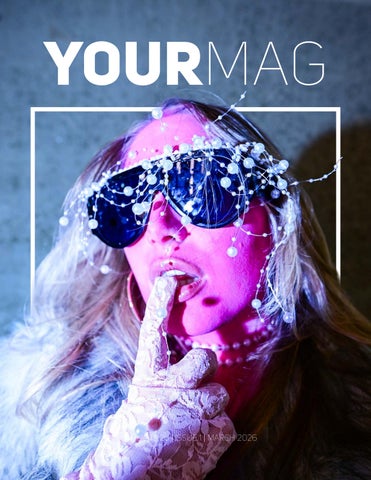
Recognized in Spring 2012, YOURMAG ’s goal is to promote knowledge of the magazine industry by giving students the opportunity to be responsible for all aspects of a monthly lifestyle publication. With an audience of urban college students in mind, members create content across a broad range of topics and mediums, including style, romance, music, pop culture, personal identity, and experiences. YourMag’s overarching aim is to foster a positive, inclusive community of writers, editors, and artists.
volume 25 | issue 1 | March 2026
LAUREN MALLETT Managing Editor
Ryan williams Editorial Director
LUCY LATORRE Web Editor
ELLA DONOGHUE Asst. Web Editor
Molly peay Romance Editor
Heather thorn Asst. Romance Editor
Emma fisher Photo Director
Payton montaina Copy Chief
Bri Cordon Social Media Director
KAT BOSKOVIC Editor-in-Chief
molly dehaven Head Designer
Audrey Coleman Co-Asst. Head Designer
ELizabeth liatsos Co-Asst. Head Designer
OLIVIA FLANZ A&E Editor
Lindsay gould Asst. A&E Editor
Anna chalupa Head Proofreader
grace chandler Asst. Head Proofreader
Tiffany Tran Marketing Director
JAVIER GOMEZ-Petit Creative Director
KYLIE LOHSE Community Chair
ella mordarski Style Editor
tehya tenasco Asst. Style Editor
isabella castello Living Editor
louise berke Asst. Living Editor
izzy maher Art Director
isaiah flynn Head Stylist
Alexandra azan YMTV Director
Copy editors: Kristin Barrett, Tiana DiStasio, Bethany Hanson, Madison Lucchesi, Olivia Mazzola, and Jules Telfort
GRAPHIC designERS: Sydney beliveau, ema sabau, Lauren Mallett, elizabeth liatsos, audrey coleman, Javier Gomez-Petit
Proofreaders: Kat Boskovic, Grace Chandler, Anna Chalupa, Madison Lucchesi, Payton Montaina, and Jules Telfort
LetterfromtheEditor
There’s nothing quite like the first YourMag issue of a new semester, especially in the spring. As the snow begins to melt and the sun beams down over campus, we come out of our winter-break induced hibernation, ready to create with a fresh outlook and revitalized energies.
In my final semester with YourMag, I am so thrilled and honored to be writing my very own editor’s letters and introducing these beautiful issues. This semester marks 15 years of YourMag, a truly incredible feat. This publication has served one goal for all these years: to represent you, dear reader. With our upcoming slate of issues, we hope to do just that.
In this issue, you will find the beautiful words and creations of our contributors, staff, and executive board members. We explore the theme of POP ART with wide eyes, investigating pop culture through the lens of themed raves and social media aesthetics, examining the effects of consumerism on literature and fashion trends, and critiquing the culture of dating and customer service jobs. I hope each page of this issue sparks your inner artist and brings some color to your life, just as it has for us.
With love, Lauren Mallett <3
WRITTEN BY MADELYN MCHOUL
With ribbons woven through her hair, heart-shaped sunglasses slipping down her nose, and a lollipopstained tongue, the “coquette” girl flourishes. She is dainty, but her glamorous essence flaunts itself as she struts to unreleased Lana Del Rey tracks in her wired headphones. She portrays herself as the pure embodiment of femininity, garnished in pinks with the attitude of an angel; one would be shocked to hear a slick of profanity fall from her heavenly, lipstick-smeared mouth.
She snaps photos of herself, reclined between floral sheets and bow-shaped pillows. An almost-empty can of Diet Coke rests between her hands. She’ll caption it later on, posting it to her Tumblr blog or a TikTok slideshow, writing “Dinner” with pink and red emojis to follow.
Her favorite movie is the 1997 version of Lolita, and it plays in the background, increasing in volume as her stomach growls louder. Intricately, she inspects every inch of her skin in the photos, ensuring that no masculine elements are infiltrating her appearance. She compares herself to the adolescent girl on the screen, craving to be desired in the way Humbert Humbert craves the precious, young Lolita.
A draft of her photos waits patiently on her phone as she opens Tumblr to curate a different post, one to fulfill this desire. “I just want what they have,” she writes, placing a GIF of Lolita and Humbert Humbert beneath her caption. She posts it almost immediately, leaving curated tags beneath the post like #Coquettegirl, #Lolitacore, #Iloveoldermen. She waits for her audience to roll into the comments.
In the darkness of her bedroom, her phone glows and vibrates. Other young girls, so similar to her, reblog the post, all in agreement that they, too, want to be thirsted and hunted—to be used and torn apart in their short, gingham skirts. Their accounts are identical to hers, filled with moodboards of young women having their pigtails pulled by an older, masculine hand, and captions all hungry for the same desire to be groomed through their romanticized lens.
These girls, all bonded by their love for the “coquette” aesthetic, have found one another, not just through their similar interests in film and fashion, but through this shared craving to be groomed. Some are lonely; they go through hours of school without once being acknowledged by a peer. Some are already dealing with the aftermath of being groomed at a young age,
ART BY KAT BOSKOVIC
attempting to heal themselves through what they know best. Some are girls struggling with mental illness and using dark romanticization as a form of escapism.
They cling to the “coquette” aesthetic, knowing that its softness and child like elements attract the men that will quench this thirst—this thirst that they believe could never be satisfied by someone their age. With only one click on their phones, these “coquette” girls are met with an overwhelming amount of messages and comments from predators. That’s when, through censored Tumblr tags and anonymous chat websites, the “coquette” girls meet their idealized match. Then, their “coquette” lifestyle transforms from a heavy romanticization of grooming to actually experiencing the suffering it brings.
Society has never had this much access to widespread communication or forms of media. It’s not hard to attract a pedophile. All you need to be, after all, is young. For centuries, young girls have suffered at the hands of older, predatory men. Yet, what happens when these same young girls, now wrongfully influenced by complex media in the rising digital age, believe that these predatory dynamics are what they need most? It is so easy for a young girl to stumble upon a movie like Lolita without fully understanding its nature and see it through a romantic lens. In a society where instant gratification is abused and everything has the potential to be glamorized, it’s so easy to fall down the wrong path and right into the hands of a pedophile.
But the “coquette” girls believe that these hands will mold them into something beautiful, into the adored, feminine doll that they aspire to be. In the end, they’re shaped into something worse than the abused or lonely girl they had been before this lifestyle. They’re left with cracks in their skin, the trauma of this digital abuse seeping through, and a giant, glowing sign plastered over their head reading: “Not a victim.”
Because how could they be? Young girls have always suffered at the hands of the patriarchy. But after seeking out such an immoral passage of it, “coquette” girls are left with dark bruises and trauma from predatory relationships in their youth, and the guilt that they had thrown the very first punch. They will forever be left with a voice in their head, one curated by both themselves and society, saying that they were old enough to know better.
But how can a girl, so easily influenced by the media around her, with an underdeveloped brain filled with immature impulses, truly have known better? YM
We’ve all witnessed it, you might have even done it: monkey branching. And I’m not talking about going to the zoo. In fact, I’m not even talking about monkeys at all. The phenomenon of monkey branching is that of serial monogamy. Vogue defines it as “jumping from one partner to the next,” often resulting in a whiplash effect on relationships from the speed in which the serial dater rinses and repeats.
Serial monogamists are almost always dating someone. They quickly—if not immediately—move into another relationship once the previous one ends and are unlikely to stay single for more than a couple weeks or months. In some cases, they even set their eyes on a potential partner while in their current relationship. Like a monkey swinging from branch to branch, the serial monogamist never lets go of one relationship too long before reaching for another.
When questions of timing and intention emerge, monkey branching can blur the lines of cheating and monogamy. Premeditation can be considered emotional cheating, posing questions of (in)fidelity when the serial monogamist’s eyes wander, actively scouting possible options while still committed to someone else.
The constant dopamine rushes of monkey branching (not to mention the honeymoon phases) can make the pursuit of novelty addictive. Though serial monogamists may be addicted to the neurochemical high of early intimacy and love, subconscious fears can prevent them from sustaining healthy bonds once the butterflies fly away.
on the potential destructive behavior imposed on the serial monogamist and their partner(s) alike when the dating pattern isn’t addressed. There’s a difference between preferring to be monogamous and being unable to enjoy life or even function as a single person. By not taking a break or learning how to be alone, the serial dater sets both themselves and the people they date up for failure.
Monkey branching can have several implications on the monogamist, potentially stifling the development of meaningful connections, harming self-esteem, or cementing codependent bonds. Starting another relationship as soon as one ends halts the grieving process, providing a distraction from mourning loss and love. This avoidance of emotional reflection leads to the pursuit of external validation as opposed to introspection.
The partner being left, on the other hand, may experience feelings of abandonment, betrayal, self-doubt, and emotional distress. When they begin to wonder what they did wrong for their partner to move onto another relationship, their self-doubt can carry into future relationships and lead to issues opening up again.
The roots of serial monogamy are nothing new: societal pressure and the fear of being alone. One’s inability to be comfortably alone is a sign of underlying attachment, self-esteem, or validation issues fueled by the pursuit of novelty. Serial daters may have a fear of loneliness driven by low self-esteem, pushing them to search for a shiny new relationship even if their heart isn’t all in. Dating to avoid being single can become a pattern of intense and passionate, but brief, connections that break up as quickly as they begin.
Our culture puts a high price tag on coupledom, teaching us that we’re only as good as the relationship we’re in. Society’s obsession with romance pressures us to find a partner under the pretense that it’s the only way to find happiness and fulfillment in life—and we learn to view our relationships as a testament to our self-worth. As a result, serial monogamy can become a cyclical dating pattern when the dater doesn’t stop to ask themselves why they swing from relationship to relationship in search of external validation.
Let’s be clear: I’m not telling you not to date; I’m advising
Never embracing the fact that you could be abandoned in a relationship sets yourself up to be the one abandoning. Monkey branching can become more than pursuing the grass that’s greener. Without addressing the underlying issues, the serial monogamist may repeat the behavior and ultimately never find the stability, satisfaction, and commitment they seek.
Learning to be securely alone allows us to securely attach in a healthy way later. After all, you can only be happy in a relationship when you’re happy being alone, too. Though serial monogamists chase external validation, the fulfillment they so desperately chase after can only be found in themselves.
The first step is recognizing the pattern, and the rest is conscious change carried out by introspection and selfimprovement. It’s important to sit with the discomfort of being single, an act that allows us to spend time with ourselves and reconsider our values and priorities. Only when we become comfortable being with ourselves can we pursue others in a healthy manner— then, the relationship can become meaningful, rather than an avoidance.
Finding stability from within is crucial to stop self-sabotaging. Investigating emotional fears and deep-rooted attachment styles allows us to learn from—and break—the unhealthy patterns that harm our relationships. Digging deeper lets us form relationships fed by more than initial attraction and physical chemistry: longevity. YM
ART BY LUCY LATORRE
Organic Orgasm
Iwish I could write about something more interesting, but I always come back to the subject of love.
I was raised in the golden age of romance. It started with an early obsession of sappy Wattpad originals and turned into to a slightly healthier obsession of relationship psychology and Emily Henry. I found a passion in sharing love stories with the world, trickling down the publishing pipeline from editorial to marketing. Recently, I created a Substack, sharing personal philosophy and literary recommendations under the alias, “Be Moore Romantic.”
Despite this, I find myself disillusioned with my generation’s take on modern romance.
Four years ago, I wrote a personal essay coined with the same title: “The Organic Orgasm.” It dissected the Gen Z phenomenon of dating app culture from the perspective of a college freshman in a city of sexually confused, baby-adults experiencing their first taste of freedom. In my discoveries, I noted how, in the age of rapid consumerism, we’ve redesigned the barriers of human interaction from face-to-face to face-to-screen.
Yet, so many people flock to dating apps in hopes of finding a connection, even if it’s just for the night. The Tinder game has become so normalized in Gen Z culture that it’s considered my closest peers’ favorite pastime.
It goes something like this: a group of friends sit in a circle, and one friend has their Tinder open. The group collectively decides whether they should swipe left or right based on nothing but physical attractiveness and age. The triviality of the game is revealed when you realize how shallow the concept of the dating app truly is. When a person is reduced to physical appearance, the possibility of a genuine connection is significantly lowered—you’re not venturing beyond surface-level attraction.
I’m not here to preach the golden prophecy or shove voluntary abstinence down your throat. I know that my methods for finding love are unconventional in the digital age. The golden prophecy isn’t for everybody. While my friends are swiping to their hearts content and gallivanting off to Esplanade dates and happily ever afters, I’ve found comfort in being the friend waiting at home with a tub of cookies and cream ice cream. When the night of thrills ends with an empty spot in their bed, and an abrupt ghosting from a 5-foot10-inch finance guy, I’m ready and waiting with tissues and a bottle of wine.
My problem with dating apps arises when I witness so many charming, educated, and amazing individuals closing themself off from finding that in-person connection in favor of a dating app because it’s easier.
The players of this digital game rely on dopamine hits. They attribute their self-worth to how many swipes they can get on a photograph showing off a scandalous slip of their midriff. It’s exhilarating, sharing screenshots of new matches to that threeperson group chat and giggling over a funny prompt.
It’s fun. It’s easy. Yet, each time, my friends find themselves questioning their self-worth while clutching a voiceless screen and waiting for a shirtless gym pic to text them back. All before the inevitable crash.
ART BY LUCY LATORRE
Psychologists conduct decades-long studies asking questions a little trickier than what can be found through human biology: how to find love; how to secure it; how to nourish it. Self-help books, with punchy titles and subpar movie adaptations, promise with a 10-step how-to guide that every great love story is just around the corner. No matter how much bell hooks I read or how many social media rabbit holes I follow, I can’t figure it out. I can’t figure out how to define a love that’s in person, not in the movies or imaginary worlds I try to escape through. But for the fellow hopeless romantics, I can try.
When I think about that four-letter word—love—I always think about fall. Snuggled under cozy blankets, sipping on the last dredges of apple cider, letting the sweet juice travel down my throat and settle in my stomach. The smell of freshly-baked pastries wafting through café doors, promising a new experience in the form of a flaky delight.
It’s movie nights, heads bent, darting eyes, and longing. Latenight talks and insecurities bleeding out of every previously closed pore. It’s belly-aching laughter and a gut curdling scream of devotion, of anguish. Sans agony. It’s humming love songs under my breath and a hand outstretched to pull you back down to bed. It’s romanticizing the look of yearning and listening to “I’ve Seen It” by Olivia Dean on repeat. It’s not a perfect story, but it’ll be the best damn thing you ever dreamt.
Love is anxious lovers huddled for warmth amid the calming storm, holding tight until winter tears them apart. And if you’re lucky enough to survive through the blistering cold and holiday music playing on an ear-bleeding loop, you might luck out and get a kiss when the clock strikes midnight.
Love, in its messiest, most devastating form, is the reward and consequence of the search for human connection. Love is cradling a shaking fist in your hand and caressing it, hoping that they won’t strike back. I’m searching for a love that can’t be bought, sold, or bartered. It can’t be liked, hearted, or clicked.
The organic orgasm is a treacherous pursuit. I can’t promise meet-cutes, third-act breakups, and cookie-cutter happily ever afters. I can’t romanticize loneliness, cold mornings, and evening dread.
To spend your life waiting for something that may never come is terrifying. But imagine the day when desire blooms scarlet red across your cheeks and a hand finds yours in a crowd and you find yourself falling headfirst for a wide-toothed grin, too beautiful for man’s words to describe. For a single touch, a single glance, a single moment of genuine connection, I’d admit defeat. I’d throw in my towel, wave goodbye to the cynics, and embrace love with a glorious conviction.
Some people call me crazy, and I might be a fool. But I’d rather risk it all than spend a lifetime wondering what could’ve, should’ve, would’ve been.
I’ll spend a lifetime howling at the moon and waiting for the last rays of sunshine to call me home. I’m afraid, but I’d rather do it scared than sing odes to a ghost.
Even after it’s over and I’ve screamed to the heavens and cried all my tears, I’ll look back on my great loves with fond memories.
I’ll spend my life searching for that beauty—the kind of love that you can’t find on a dating app. YM
Dolled All
Dolled Up
DIRECTED BY HAZEL ROREM
PHOTOGRAPHED BY SOPHIE SCHOLL AND TOWANA KOO
MODELED BY SIDNEY SCHMITT, SOFIA WELCH, AND MIA TORRILLO
A Love Letter to the Mary Jane
WRITTEN
BY
SOFIA WELCH
Abrown leather pair of Doc Martens that I received this past Christmas, which I’m still breaking in. A classic black patent pair with a heel that I wore to every formal in high school. A stiletto pair with double straps and mini gold buckles that hurt my feet. My current, still-growing, collection of beloved Mary Janes. Something in me has always gravitated towards its simple, sweet silhouette: closed-toe, low-cut, with a strap across the instep. This iconic style has taken over my modern shoe rack, leaving little room for anything else.
Mary Janes first stepped into the cultural spotlight in the early 20th century when the Brown Shoe Company associated the early style of the shoe with the character of Mary Jane from the Buster Brown comic strip. The simplicity and durability of the shoe made it popular for young girls and boys. However, in the 1930s, a more grown-up version was appropriated by the flapper aesthetic. It was a comfortable choice for high-energy dancing, and the innocent connotation of the shoe contrasted with the freedom and empowerment at the heart of the flapper girl lifestyle.
Among the evolving cultural landscape of the 1960s, the Mary Jane saw a shift from a practical piece of footwear to a bold fashion statement, showing women’s desire for expression and independence, as fashion historian Emma Katharina observed. The youth culture and Mod fashion movement in the 60s was a rebellion against traditional conservative styles, led by young people who wanted to express themselves through clothing. The Mod style popularized chunky, bold Mary Janes, with platform heels paired with mini skirts and shift dresses. A move toward shorter hemlines in young women’s fashion was emblematic of women’s desire for less conservative clothing. Shorter ensembles made shoes a focal point. New, cheaper materials like vinyl meant that shoes were treated as accessories rather than necessities, experimenting with brighter, trendy colors and bold two-tone combinations. Popularized by figures like Twiggy, with her iconic babydoll lashes, Mary Janes captured the hearts of
PHOTOGRAPHED BY
EMA SABAU
“Dolly Girls,” lovers of an aesthetic that Katharina described as “a subgenre of Mod style that channeled playfulness and femininity.”
Mary Janes continued to be a large part of fashion and returned to mainstream culture in the 1990s. Underground London’s subculture blog explained the grunge-era dichotomy Mary Janes represented, noting how figures like Courtney Love channeled the feminine grunge aesthetic by juxtaposing the sweet femininity of Mary Janes and florals with the angst of dark makeup and undone hair. The runway also frequently featured Mary Janes in the collections of popular 1990s designers like Chanel, Betsey Johnson, and Marc Jacobs. Designers and pop culture today still favor the Mary Jane. Marc Jacobs’ popular “Kiki Knee-High Boot” is basically a Mary Jane on steroids with its towering heel and eleven buckle straps. 2020s online fashion trends also adore the Mary Jane; its versatility and vintage associations make it popular among young girls who seek to channel a more distinctive, timeless style amid microtrends.
My love affair with Mary Janes started with one pair and escalated quickly from there on. The Mary Jane style of shoe was something I wore as a young girl, and part of my attraction to it is the nostalgia and vision of my younger self it evokes. With growing pains and an unsure sense of self, channeling this style in my footwear was something comforting. The versatility of the style allows me to experiment with my fashion, while still having the throughline of the Mary Jane to anchor me. It’s a way to embrace my femininity and love for fashion. It’s become an irreplaceable part of my style and identity. Though simple and juvenile in origin, I carry their cultural transformation and the lives of all the women who have worn them throughout the last century with me every time I buckle them on. They have become symbols of a woman’s expression, boldness, and freedom.
Mary Janes were never just one thing. They are timeless yet ever-changing, innocent yet powerful, nostalgic yet fresh. The Mary Jane never limits itself, and with it at the heart of my style, it reminds me never to limit myself. YM
Anatomy Winter Coat of the
WRITTEN BY TEHYA TENASCO
WPHOTO BY EMMA FISHER
hen I saw girls online fawning over the Brandy Melville peacoat, I could feel a brand new, niche corner of fashion TikTok emerging. It’s strange to watch something you’ve always been a fan of suddenly become a seasonal, online trend. Peacoats have been a prominent factor in my personal style since childhood, which is why the recent boom in popularity this winter has me wondering…what is outerwear? At what moment does a coat become more than something warm to throw on before braving Alaskachusetts?
First, a quick history lesson! The story of the peacoat begins with Dutch sailors in the 1880s. In dire need of overrelenting windchill protection, these sailors designed a long, thickly woven, usually navy colored wool coat with distinguished lapels and cartoony buttons. Though the Dutch invented the coat, the British are cited to have popularized the stylish, navy attire. The name “peacoat” comes from the Dutch word “pije,” meaning a coat made from itchy or prickly wool (I found the name quite silly-sounding when I was a little kid). The peacoat eventually made its way to the U.S. Navy for a similar reason, establishing the garment as a practical piece of outerwear, fit for hard working sailors and seafarers. Due to its blocky silhouette and traditional weaving technique, designers across the world have put their own unique touch on the classic coat. Maison Margiela, Dior, Burberry, Miu Miu, and so many more have influenced the iconic double breasted look for modern day wear. It was only a matter of time before the style was thrust back into the fashion zeitgeist to be revived by retailers and consumers. The cropped cut of the Brandy Melville peacoat, accompanied by the pronounced lapels, is quite cute. Choosing to produce the coat in navy makes me imagine that some historical research was put into the final
I’ve owned many winter coats, and warmth is almost never on the list of top priorities when I’m shopping. In my mind, my outfits exist in a limbo between late autumn and early spring–warmth is optional, depending on what I’m looking for. I bought a peacoat in mid summer on Depop, eager to get a jump on seasonal prices. $40 or so later, the Rue 21 peacoat arrived. Not only did the brand intrigue me, but the high collar and sleeves adorned in black ruffles was the exact statement detail I was in search of.
In an ever-evolving culture where prices get higher and quality of life dips lower, we deserve to feel good in the clothing we wear. The revival of the peacoat is a telltale sign that young adults today desire to express their
whimsy and wonder in professional settings. While the peacoat of yesterday was designed with the best interest of the body in mind, the peacoat of today is a statement against the expected; a physical adornment representing the unique optimism and lust for life young people hold.
Despite the style’s naval history, I’ve always associated peacoats with spring green. An odd, unexpectedly Pixie Hollow-esque color that I couldn’t help but adore as an elementary schooler. Oversized black buttons, smooth lapels, a silky inner lining that I found dolllike. I’ve always been extremely susceptible to doll-evoking clothing. My spring green peacoat was reserved for holiday visits and Easter Sunday brunches, meaning that a chance to wear it had me jumping for joy. Like anything and everything, I grew out of my beloved peacoat and passed it down to my younger sisters, who passed it down to my younger cousin. Its magnetic, out of the ordinary traits were not lost on me. The coat’s uniqueness was unequivocally vulnerable, translating to the outside world my playful, childhood innocence and wit. Outerwear is anatomically vulnerable, manifesting to the outer world the hopes and gravitational pulls of the inner psyche. There’s no hiding when it comes to wearing a coat. Outerwear is a reflection of the encased body, an inside out X-Ray capable of exclaiming softly to the world, and to ourselves, what truly matters in the moment.
At the jewelry counter, “real” has become a negotiable word. Lab-grown diamonds are chemically identical to mined diamonds. They test the same; they shine the same; they’re often larger, clearer, and dramatically cheaper. When asked about the validity of our lab-grown diamond collection, the manager of the jewelry store I work at compares the sculpted stones to in vitro babies: “Would you tell a kid conceived through IVF that they’re not human?”
And it’s the clever comparison of a saleswoman. No one wants to be the asshole arguing that a lab-grown diamond isn’t “real” after that, certainly not in a store where you have no idea if the girl trying on rings next to you was conceived in a petri dish. The comparison works not because it clarifies the science, but because it shifts the debate from geology to ethics.
However, no tennis bracelet aspirant is actually confused about the chemistry; their eyebrows furrow over the narrative. A mined diamond, though possibly smaller with more blemishes, arrives with a ready-made mythology of tectonic pressure, subterranean darkness, and billions of years of patient formation. The stone on your left ring finger is proof of endurance and carries the romance of having survived—and thrived. Its flashier lab-grown counterpart, however, arrives with a certificate and a warranty, along with a timeline measured in meager weeks.
Since the lab grown diamond’s entrance into commercial relevance fifteen years ago, it now represents 14% of the United States’ total jewelry market; it’s sprung so popular, in fact, that over half of engaged American couples opted for the cost effective option in 2024 (CNBC). Clearly, romance collides with arithmetic at a certain point. If two stones refract the same light, survive the same daily wear, and come with identical grading reports, what exactly is the additional fifteen thousand dollars buying you?
For Frances Gerety, copywriter for British multinational diamond company De Beers Group and genesis of the tagline “a diamond is forever,” the answer was obvious: pedigree. After breadlines spinning around blocks and hefty wartime expenditures, the natural diamond was costly and out-of-reach to the homebound soldier who wanted nothing more than a small house, a steady income, and a life that unfolded predictably across dinner tables and front lawns. Thrusting a mere product in the faces of men who had toiled the last five years in trench warfare wouldn’t work; De Beers needed to sell an idea, a reverie of permanence that could eclipse the memory of artillery fire with guarantee. De Beer’s triptych of delicate women, each cradling blossoms and parting their lips toward the diamond suspended in the dusky sky, and Gerety’s catchphrase scrawled in swoops beneath whispered: one deposit, and this is yours.
But the “forever” that the advertisement sold extended beyond love or stability: it was a claim to social distinction. Diamonds were no longer ring finger adornments, but symbols of status that rendered the sparkle secondary to the story. By the 1980s, 40 years after De Beers launched the campaign, over 80% of engagement rings paraded a diamond, each stone a signal that the wearer could participate in the narrative of rarity, value, and cultural prestige.
What had begun as clever marketing solidified into social expectation: the diamond was proof of love—and proof of standing.
But when a near-perfect, three-carat lab stone sits poised in the case for under five thousand, the old logic begins to look theatrical. If the same stone costs up to 16 times more simply because it was blasted from the ground, why pay the voluntary tax to participate in a mythology fewer buyers feel obligated to uphold? Why begin a marriage by incinerating the down payment on a house?
Though we don’t specialize in engagement rings, the jewelry store I work at attracts many couples in search of the perfect wedding band: effortlessly slim, blinding symmetry, pinprick scintillation. Heads nod at the humble prices of lab-grown options, eyes widen at the numbers for their natural counterparts. “If it’s lab,” the brideto-be asked in a hushed voice, “will people be able to tell?” Not from the stone, I told her. And this simple confirmation, that the cheaper alternative is seemingly identical to the naked eye, is almost always the nail-in-the-coffin for the natural diamond bands.
“I never understood the hate toward lab-grown diamonds,” a college student with a particularly lavish taste once told me over a tray of solitaire studs. “I’d rather put the extra ten grand toward a honeymoon—or anything else.”
And she isn’t alone in this sentiment; there is always a new car, a kitchen renovation, or a year of daycare to redirect savings. Not only are lab-grown diamonds winning over new fiancés, they’re even converting longtime natural-diamond couples. “If the original ring features a one-carat natural diamond, now they’re replacing it for a three or four carat lab-grown option for the same price or less,” Juliet Gomes, customer service manager of fine jewelry brand Ritani, tells CNN Business.
As ashamed as I am to admit it, I often sneak a glance at a customer’s left ring finger to gauge how far I can stretch my 1% commission rate. But a once near-universal shorthand for class has lost its certainty as women with boulders on their hands frown at tennis bracelet prices and opt for our cubic-zirconia alternatives instead. Yet even in this recalibration, the natural diamond can reclaim a measure of social power by leaning even harder into the very narratives that once justified its expense. If a slip of paper attesting to your diamond’s natural origins can’t be produced without looking like a snob, designer settings and brand-name mountings can.
These cues—curved pavé bands, asymmetrical solitaires, engraved logos—would serve as a language of distinction legible only to those fluent in luxury’s lexicon. For most of us, a dozen yachts bobbing in a harbor may as well be identical, but a multi-millionaire can identify the 1990s vintage hull against a sea of mass-produced superyachts; a subtle hallmark instantly sets a natural diamond ring apart from its in vitro neighbors in the case. Value shifts from substance to performance, and a gesture of love and permanence becomes a microcosm of a society obsessed with appearances. In the end, whether mined or manufactured, the diamond’s enduring power lies not in its romance, but the dystopia it codifies: our collective complicity in paying for the story and status, not the stone. YM
YOUR CLOSET YOUR CLOSET
INTERVIEWED BY TEHYA
Jacqui
TENASCO
(she/her)
PHOTOGRAPHED BY EMMA
FISHER
What movie character’s wardrobe do you identify most with?
This is not a movie but a TV series—I’ve still never watched it, but anything out of the 90s sitcom Blossom is pure gold in my eyes. That main girl sure knows how to wear a hat! What is one unique story about a piece of clothing in your closet?
Every one of the crochet pieces I own was a gift from a loved one. For instance, the Very Hungry Caterpillar leg warmers were a gift from Nikki Huynh (‘27), one of my first friends at Emerson. The sheep scarf was given by my aunt. The pink sweater vest was a Christmas gift from my sister. I like to dress myself in garments that remind me of the people who love me, and who make me the person I am.
What song would you use to narrate your style?
“Dandelion” by Antje Duvekot Three favorite accessories to add to an outfit?
Bolo ties! Scarves! Funky hats! What is your favorite color to wear? Green!
YOUR CLOSET YOUR CLOSET
INTERVIEWED BY TEHYA
Nadine
TENASCO
(she/her)
How would you describe your personal style in three words?
Chaotic, unpredictable, color-coordinated. What movie character’s wardrobe do you identify most with?
Cher & Dionne (Clueless), Winx, Effy (Skins) & Mad Hatter (Alice in Wonderland). What are three pieces in your wardrobe you can’t live without?
My City bag, my SpongeBob hoodie dress, and my leopard scarf that my mom gave me.
PHOTOGRAPHED BY
EMMA FISHER
What is your favorite color to wear? Blue. What is your favorite season to style outfits for?
Summerrrrrrrrrrr (I’m a tropical girlllll).
Pink
Girls
DIRECTED BY IZZY MAHER
ASSISTED BY RYAN WILLIAMS
PHOTOGRAPHED BY IZZY MAHER
STYLED BY IZZY MAHER
MAKEUP BY IZZY MAHER AND SAMMY LEVINSON
MODELED BY MADISON DECINA, GIGI WATSON, AND IZZIE BANNISTER
WRITTEN
MADISON LUCCHESI
The first time I saw the shrine my aunt set up for my grandmother’s urn, I walked backward into a wall and started hysterically laughing because shrines and all kinds of “dead stuff”—ashes, bones, crypts, tombs, catacombs, and so forth—absolutely repulse me.
Yet, tears still welled in my eyes. I hadn’t been warned that the wooden box containing my grandmother’s remains found a home on top of a dresser in my aunt’s spare bedroom. Alongside the scarf I bought for her in Mexico that she wore daily—the scarf I thought would become mine as a way to feel close to her.
I loved my grandmother very much. We were best friends, but I loved her, not her cremated remains. So when the time comes that I inherit her ashes, since my aunt has no children, I will have someone else—God knows it won’t be me—sprinkle my Nonna under the raspberry bushes in her backyard where I spent summers weaving between thorn-filled branches to pick the reddest, juiciest lamponi.
While that decision seemed clear, I still have no idea what I will do with my relative’s belongings when they die, knowing my family expects that anything remotely sentimental gets saved.
My family is particularly morbid. Each “kid” has been assigned at least one parent, aunt, or uncle that they’re in charge of in their old age. I am in charge of both my mom and my aunt, so I often ask them if their postmortem wishes have changed and joke that I need to hire an actuary to estimate the exact time I should put my aunt in the three years of end-of-life care she already paid for.
So when I raised the question about belongings to my mom and aunt, they were seemingly unfazed—like it was any other family dinner topic.
“Throw it out,” my mom said with a shrug.
“You cannot throw everything out,” my aunt responded in a soft, almost heartbroken voice.
“Well, where am I supposed to put it all?”
“The trash … Donate it to Goodwill,” my mom said.
“Um, so, I can get rid of the painting of Scott then?” I said, referring to the painting my grandmother had commissioned of her son—my uncle—who died as a toddler and hung above her bedroom mantle for decades.
“Madison Lucchesi, absolutely not!” my aunt barked.
“That’s what I mean. What am I supposed to do with pictures of people I never met and don’t even recognize?”
No one could give me an answer. It doesn’t feel right to just throw something like that away, and it definitely doesn’t belong at a thrift store. But does it really belong in the back of my closet as a sort of haunted family heirloom staring back at me?
While paintings are few and far between, photos are not. My every move from birth until now has been documented. There are thousands of images spanning the years, from five-year-old me devouring my Disney princess birthday cake to loading suitcases into the trunk of my blue SUV before leaving for my semester abroad. And that is just my life in a collection documenting everyone’s lives.
I researched the options for archiving photos—digitizing them, throwing them out, or donating some to historical societies—but quickly realized I didn’t really have a choice. I cannot erase my family’s history or sterilely digitize it. It’s disrespectful to my love of history and the lives of the people who shaped me into the person I am today. There’s just no way out of inheriting the mountains of photos and other items that are destined to be mine.
But it isn’t just about the physical objects, it’s about the stories behind them.
Because one day, when they’re gone, the only way to keep their memories alive will be through my own. I will be tasked with passing on stories of summers swimming in Lake Winnipesaukee, eating green tapioca for St. Patrick’s Day, and growing up in a house with my parents, brother, uncles, and grandmother all under one roof to my kids, nieces, and nephews, so they have a sense of where and who they come from.
I owe my family members that much. To keep their belongings as a way to keep their memory alive for the next few generations. To honor everything they’ve done for me and will continue to do for me into their old age.
So now, I need to spend a little less time talking to them about my classes and friends and a little more time asking them about their favorite memories and defining moments. That way, one day, I’ll know the stories behind the pictures and items I would have otherwise considered junk. YM
BY
PHOTOGRAPHED BY EMMA FISHER
Your waitress hates you. Certainly a vitriol comes from the customers few and far between with an attitude, a ripe, untraceable smell, or dietary restrictions that turn the back of house into a horserace parlor—except all the horses had to get taken out back and shot. The ideal customer hydroplanes through a dinner service threatening to turn into a catastrophe at any second—coming to an easy stop, stacking their dishware conveniently, tipping 20%, and leaving with a quiet thank you. They do not feign ignorance to the social order at play. You are my waitress. I am being served, and you are doing the serving.
A waitress, over the course of a single shift, must navigate a purgatorial position within the restaurant. She juggles the insatiable wants of her tables amid the managerial panopticon while trying to convince kitchen staff to get their shit together in a manner that doesn’t make them sour on her. After rushes, she offers them drinks and words of encouragement. Your waitress hopes her bosses didn’t catch her breaking the rules in an impossible industry that says violating our policies will result in immediate termination, but customer is king. Serving is more political than Washington, D.C., and the customers who deny this reality are the ones spending the evening seducing the waitress with compassion and interest—before leaving a $5 bill for a $200 tab. Stimulating conversation, however well it might pass the time, is not a supplement to the waitress’ income.
On Friday and Saturday nights, hundreds of college-aged women in Boston, including your waitress, prepare for a night out. They use the same makeup products, mist their nicest perfumes, and take the same train into the city. Their routines look remarkably similar leading into the night. But they differ in our final destination, and your waitress hates those girls for their freedom. And they are too happy and undeserving of that hate for the feeling to be mutual.
I only recently started running out of my tiny designer perfumes from freshman year. The international students left piles of products outside their dorms approaching summer break, unable to take anything over three ounces abroad. For the first time in my life, I smelled like Dior and Burberry and Chanel No. 5. I never wore them unless I knew I’d be clocking in, knowing a better smell meant an extra dollar or two on top of a regular tip. My peers on the train don all black, like me, but only our upper bodies match. Compared to their skirts, my slacks are too big on me.
I nibble on the same free meal every shift, once a relief, now a burdensome pile of meat slop, and smoke enough cigarettes to keep me permanently nauseous. I buy as few groceries as I can, because winter is the off-season for restaurants, and stomach through sexual advances from the kitchen manager so he might offer one of our more appetizing meals without my having to pay for it.
My shoes are black nonslip clogs covered in blotches of baby spit up. I take Clorox wipes to them weekly, but the spores of rotten food and sticky cocktail spills operate like a hydra—for every stain I scrub off, two grow back in its place.
The owner of the restaurant, a fascist in denial that his business is slowly, miserably going under, took over after my only managerial ally mysteriously vanished off the schedule. The owner knew from the start that I refused to pretend like I was anything more to the customers than a waitress.
My abstention certainly cost me higher bills, and therefore, higher
tips, but kept the little dignity I had intact. Like the most successful politicians, the greatest servers are the shameless ones willing to bend over and take whatever the establishment wants for a better paycheck. The owner resented my inability to pimp myself out, and permanently scheduled me for the slowest shifts.
The waitress’ customers will hate her, condescend her, and underpay her throughout their meals. She will cross the threshold into front and back of house dozens of times throughout the night, getting stopped by patrons who belong to different tables, desperate for condiments, or a manager, encouraging she has a quick drink knowing that if she accepts, she will be fired the following day by the fun-loving manager in question.
The line cook will ask her on a date, again, ask to drive her home, again, and initiate a hug, again. There will be no one to report this to, as the kitchen manager/head chef will engage in the same behavior.
The waitress will dote on every table, burning her fingertips to bring out fresh food, touching up makeup, pretending it’s someone’s birthday to offer a free dessert, talking down a hysterical kid, playing babysitter and girlfriend and CDC and mayor and whore and mediator and line cook and accountant and maid and jester and-
And still, the table full of British people will leave swiftly, pretending they’re unfamiliar with tipping. The table of eight will leave 18%, a lowball for the services offered, but not low enough to justify being angry about it. One of every five waitresses you have will be frantically coping with a pregnancy scare throughout all of this. She probably has class the following day, or another job. If you see your waitress making frequent trips to the women’s bathroom she may be: A) Coping with a UTI; B) Vaping; C) Seeing if she got her period; D) Crying; E) Hiding from male coworkers; F) All of the above.
I was the only woman in her early twenties (and of a non-manager status) there. The manager I liked was too executive to hit on. The other waitresses were in their late twenties, mothers. Our hostess was not yet 17. I took the brunt of the men’s HR violations.
I once arrived to a slow Wednesday night shift still a little stoned from the afternoon. One of the managers slinked toward me close enough to smell his rotting breath from a shift full of under-the-counter shots. His pupils are huge. A week prior, he said he liked my schoolgirl braids. Those and a tight shirt and you’ll do well tonight! I laughed along with him. He stared at my body until he could guess my weight during another shift. My work apron doubled as a belt and a corset, and I purposely swung my hips as I moved. Usually, on the walk home, I threw up along the sidewalk.
Late into the weekend evening, sometimes into the following morning, the girls and I reunite on the train. They’re breathless and recapping the night’s drama. Our makeup is similarly smeared from sweat, but they smell of sex and flavored vodka, and I smell like smoked meat and gastric acid. They switch to a different train line than me, telling me they live in a Back Bay brownstone or BU dorm, and I live by the airport. After transferring, the other commuters sharing a similar final destination as me all wear nonslip shoes and tired eyes.
We do not hate each other, I don’t think. We share a camaraderie, an understanding we are all the same demoralized Bolshevik waiting for things to change, knowing we will be back together again the following morning. YM
Your Waitress Hates You
Purrfect Match
WRITTEN BY JULIA BOURQUE
I’m sitting on the bathroom floor, head resting on my knees, wondering why the LSAT was so hard for me. After a day of not being able to focus and missing “easy” practice questions because my mind convinced myself that this bad day would result in nothing more than failure: no law school, no prospects, and isolation.
If you were to take a look inside my brain you would see a cluttered mess, desperately trying to look neat. A pile that looks like my junk drawer sitting in the corner, staring at you, masquerading as organization. I couldn’t sit down and enjoy the quiet. My mind was a petri dish with the perfect environment for my negative thoughts to flourish.
I have always thought there was something wrong with me. Relaxing should be innate, yet, for a long time, I never allowed myself to take time to do nothing. I needed to plan every second of my day or else I was somehow failing myself. I loved the rush I got from never sitting still though; it gave me productive days. It’s the same kind of rush I get after reading a satisfying ending to a novel or getting the perfect ratio of milk-to-espresso in my latte. This cycle was not sustainable, though: the days that I didn’t consider “productive” were tarnished by my inability to prevent my anxious thoughts from spiraling.
Night after night I’d find myself on the bathroom floor convinced I never did enough during the day. I always could’ve done more practice tests, edited my personal statements more meticulously, or watched more LSAT YouTube explanations. And I was on that floor alone after pushing anyone who tried to encourage me away because, in my mind, they could never understand how much of a disappointment I really was.
But one night while stuck in my own head and on the cold tile, I thought of someone who wouldn’t try to cheer me up and remind me I was down in their efforts.
Someone who didn’t know what the LSAT was, or what a pencil was for that matter. I opened my local animal shelter’s website and scrolled through the cats looking for a home. I sent in an application on a whim, and by the next day I was welcomed to come visit.
I arrived at the shelter a few weeks later with the mindset that the perfect cat would choose me.
On the train ride to the shelter I had so much adrenaline that I probably
PHOTOGRAPHED BY ELLA MORDARSKI
could’ve pushed the train there myself.
I met my cat Marla there. She was peacefully asleep in a cupboard and purred the whole visit. All the nerves from the train eased and I was present with her. I took her home and set her up in my bathroom as she adjusted. The entire afternoon got away from me, and before I knew it, it was past 9:00 p.m; I could not believe I spent hours quietly sitting on the bathroom floor with her.
It took three weeks of wet treats and patience for her to fully warm up to me. She was so skittish it forced me to slow down around her. When sitting next to her, I wanted to exude calmness and peace, and I kept this with me even as she ventured around the rest of my apartment.
I gave up a lot of control in this process. I did not see it at the time, but she taught me how to rest. The first time she felt brave enough to cuddle on the couch with me, I could feel a weight being lifted off my shoulders. The rest of the noise stopped.
I thought I would be stuck in that cycle of constant motion forever. I thought maybe it was genetic or something in my brain that made me unchangeable. But that wasn’t true. I needed Marla. She showed me how to take a break, sit in the sun, and enjoy the quiet. It definitely helps that she is a lap cat who loves attention, but we have formed a symbiotic relationship. She needs a warm lap and chin scratches, and I need her.
I am so grateful for the night that led me to give up control and adopt her. And now, if you were to look in my see me and Marla peacefully asleep in the sun or
DIRECTED BY OLIVIA FLANZ
PHOTOGRAPHED BY OLIVIA FLANZ
MODELED BY MADELEINE GOLDEN AND JOSELIN DURAN
WRITTEN BY OLIVIA FLANZ
If you’ve been on the internet for the past two months, you’ve probably heard of the Heated Rivalry Rave. I first noticed the phenomenon over winter break, when a video came up on my feed of a group of friends dancing under a massive screen broadcasting a TikTok edit of Ilya and Shane to the song “All The Things She Said” by t.A.T.u. I was intrigued to say the least. I thought it was a one-off event, and then my suitemates started sending videos of the Heated Rivalry rave videos from New York City, Los Angeles, Chicago, Washington D.C., Philadelphia, San Francisco, and more. Never had I ever seen a show so popular that a venue can dedicate a rave to it and know people would show up and buy tickets. It was ridiculous, and I knew I had to attend the moment they came to Boston.
So when the rave was happening in the Fenway area, we immediately bought tickets. Completely dismissing Boston’s overall bad reputation for nightlife, we were pretty much convinced that this night was going to be the best night of our lives. I mean, we are in Boston—a huge hockey city, the literal city that Ilya plays for in the show! We knew the night was bound to be fun.
And apparently, so did the hundreds of people who were lined up all the way down Lansdowne Street. This was us arriving early, too. Overall, it took around thirty minutes to get into the venue, but we weren’t deterred. A long line only meant a big crowd, which meant good vibes—at least that’s what I’d normally say. If it wasn’t for the fact that when I looked around, a fair number of people were just standing and watching the screen and recording with their phones. We’ve seen the show already. We aren’t seeing anything we haven’t seen before. And sure, the edits are good, but none of them are that good.
Cases like this are more proof that venues should have the no photos or video policy. The purpose of actually going out is to enjoy the place you are at, and while I love a fit check, that should be wrapped up during the pre-game, not when you are at the function. One of my favorite nights out was at a venue that forced everyone who came in to have their phone cameras
ART BY LAUREN MALLETT
taped, front and back. Not only did it relieve even the tiniest thought of taking any photos, it also made even touching my phone pointless.
Yet, there we were, in a sea of Bruins jerseys, sunglasses, and too many straight couples for my liking; a lot of people were stagnant. Thankfully, we got in line next to the right kind of people and, as a group, we were dancing and bringing the vibe. Eventually, we were able to get closer to the front, where more people had the right idea. A random person complimented my sunglasses, and I said I liked their sunglasses too, and suddenly, we were taking turns spinning each other. At some point, the DJ jumped off the stage and started crowdsurfing.
Some of the music was questionable to say the least: I had to blink twice to make sure I wasn’t in a frat basement from freshman year. Amid Rihanna, Lady Gaga, Bad Bunny, and other dance music, Paramore’s “The Only Exception” and Taylor Swift’s “You Belong With Me” was a bit of a whiplash. Of course, though, they played “All The Things She Said.”
The night overall was a good time. We got to dance, and my friend found Prada sunglasses on the floor (they ended up being fake, but a win is a win). Do I think the Heated Rivalry rave’s marketing strategy is genius: yes. But unfortunately, the majority of the crowd attending the rave did not get the memo that we were, in fact, at a rave, and neither did whoever came up with the music lineup. It’s not that the concept of a Heated Rivalry party doesn’t work, as there wouldn’t be popups of this across the country if people didn’t want it. The issue with internetsensation-turned-reality parties is that the event will pretty much never live up to the actual media that it draws its inspiration from. There have been Euphoria-themed parties and Love Island watch parties, which people are drawn towards based on their love of the franchises, yet the events always seem to turn into a social media spectacle rather than an experience people are enjoying at the moment. Unfortunately, it seemed the rave fell into a similar boat, the buzz and passion that you would expect was lost on screens. A Heated Rivalry rave with no heat. YM
WRITTEN BY ELLA MORDARSKI
One of my favorite pastimes is reading the parents guide section of IMDb. I love scrolling through the descriptions of sex, drugs, violence, and profanity that parents have diligently written in hopes of protecting innocent children from the real world. In reality, these interpretations read more like stand-up comedy bits quipped by a divorcée mom rather than genuine warnings. While I don’t necessarily condone this soft-core censorship, it does get me thinking about the concept of nudity in film and television.
It’s pretty well documented at this point that Hollywood isn’t exactly paving the way for feminism. Since the beginnings of showbiz, actresses have been exploited in film and television. Seen as nothing more than sex objects, often flashing their breasts and behind for no relevant purpose. While filmmakers somehow always find a way to include female nudity in any project, seeing the penis in high definition has been something long reserved for the likes of pornography.
In recent years, male nudity has become a more common member of the entertainment industry, specifically that of the allusive penis. Shows like Euphoria and The White Lotus are just a few examples where male full-frontal was on detailed display. Viewers often have an overzealous reaction when a male actor drops trou, which makes sense; it’s not a common occurrence. After the initial shock factor, they often run to social media to ask the question on everybody’s mind: Is it real?
I hate to burst everyone’s horny bubble; however, that penis you shamefully paused the screen to get a better look at … is most likely a prosthetic. The fake appendage is often used in film and television as a replacement for the real fleshy thing. These prosthetic penises aren’t just any common dildo you pick up from Adam & Eve or the back of Spencer’s at your hometown mall. Every vein, curve, pubic hair, and head is carefully constructed by special effect artists to resemble the real package. The goal? Viewers shouldn’t be able to tell whether what they see on screen is the actor’s actual manhood or just a well crafted stand-in.
While expert makeup artists are the ones applying the prosthetic on set, the sausage gets made off the backlot. There are a few specialists in town with a reputation for their world-renowned penis skills. This includes Autonomous F/X, owned by Jason Collins, who is responsible for the meat sticks in Euphoria, Minx, and even the talking penis in Pam & Tommy. In an interview with Allure, Collins remarked on his recent penis-based business boom: “We started getting calls from people [after] we did Euphoria,” he says. “[Productions] know that I can do that, and I know the methodology to get it done.” Besides penises, these artists are responsible for all types of prosthetics. From otherworldly horned aliends and bloody stab wounds to hyper-realistic baby bumps for Sydney Sweeney—they can truly make anything a director desires.
A prosthetic penis first begins to take shape as a simple mold. According to Collins, there are “approximately 12 different penis molds” to choose from in his shop. While some molds are custommade to fulfill a specific vision, others are reused for multiple different productions. The molds are filled with a silicone-based formula that can be made denser or thinner depending on the intended, well … hardness. After it has fully set, an artist can start adding detail to the phallic piece of silicone, including the … eh-em … balls—for
ART BY LUCY LATORRE
lack of a better term. Back on set, when the penis is ready for its closeup, the prosthetic can be worn either as a belt or glued directly onto the performer, depending on the amount of skin they are displaying in the scene. On-set makeup artists are responsible for covering up any imperfections, that might suggest the package isn’t the actor’s own. This is when an intimacy coordinator joins the chat, acting as a liaison between the actor and production team, ensuring everyone feels safe during filming while not impeding on the artist’s integrity. They say size doesn’t matter, but it’s truly a team effort to fabricate the perfect fake penis.
Now, I know what everyone is thinking: Why use a faux schlong? Well, actors are good, but there are some things that even the best in the business can’t replicate. From specific size dimensions to erections and releases, a prosthetic penis provides production versatility. Like it or not, sometimes the penis is a poignant part of the plot or necessary for character development. Producers have the ability to make detailed requests to artists, improving the overall “realness” of the scene, and— let’s be honest—keep the audience engaged. One of the most famous examples of a blockbuster penis is spotted in Paul Thomas Anderson’s Boogie Nights. Porn star Dirk Diggler, played by Mark Wahlberg, is blessed in the film with an exaggerated dong, one of the reasons for his adult film success. So when it came time to show the theater, a prosthetic was the best way to express the overstated size, which Wahlberg has apparently kept all these years later—that’s definitely a unique family heirloom.
On a more serious note, a prosthetic penis adds comfortability to an otherwise uncomfortable situation. While there are plenty of examples of male actors going truly all in, it’s understandable to want to keep that thing locked away. No matter how you identify, everyone struggles with body image at some point in their lives. It can be anything: a weird shaped birthmark on your ass, how your boobs hang, or of course, the size of your penis. Having those “flaws” filmed and dissected truly sounds like my personal hell. In the internet age, anyone can simply look up nude clips, and replay them for enjoyment. Websites like AZnude even lets you filter specific actors and shows for male or female actors. You can literally have an Oscar, and people will still be more impressed by that sex scene you did 16 years ago.
For decades, filmmakers deliberately decided to conceal the special guest due to restrictions it would place on a film’s rating. Many, including the Motion Picture Association (MPA), believed the penis was simply the crudist thing one could possibly show. However, with the evolution of culture also came an evolution within the MPA. Regulations began changing and filmmakers started getting a tad more loosey-goosey with male full-frontals. Most importantly, the #MeToo movement happened, and people truly began to understand the systemic depths of sexism within the entertainment industry. For so long, women had been pushed into baring it all, and now it was the men’s turn. “It was always a lopsided thing: You can see a woman fully naked, but heaven forbid we see a man’s penis … whether it’s TV or cinema, it’s the last frontier,” observed Collins. YM
Limited Edition Lit
The True Cost of Your Shelves
WRITTEN BY LAUREN MALLETT
Within popular culture, there is a perceived notion that books are special, that they are inherently different from other commodities available on the mass market. Ideas like this are perpetuated by social narratives of class and status. Historically, literature has been seen as a higher art form, reserved for the privileged few. Even the ability to read was reserved for those of upper class and high social status. A large collection of books was viewed as a symbol of knowledge and wealth.
So how does this notion persist in a world where books are more accessible than ever? It continues just how it always has: by creating division and constructs of status. An orange is always an orange, and any bar of soap is just that, a bar of soap. Most commodities are viewed purely for their function, their value derived from their simple purposes. Books, however, have their own lives beyond their basic purpose of spreading knowledge and ideas. Anyone can walk into a library and pick up a tattered, worn-out copy of The Lord of the Rings held by hundreds of hands before their own. Not everyone can afford to purchase their own copy, let alone the limited-run, leather-bound anniversary edition with gilded pages and exclusive illustrations. With books, there is an idea of exclusivity. The modern day publishing industry relies heavily on individuals’ desires to obtain this exclusivity, to feel special. Cultural focus on aesthetics and visual appeal has transformed the very nature of a book into something more. The focus has shifted from the contents within the pages to the beauty and intricate details of the covers they are held by. We no longer subscribe to the notion of not judging a book by its cover; in fact, that is now precisely what we do.
PHOTOGRAPHED BY LAUREN MALLETT
mass-market paperbacks decreased by 52.2%. Consumers are no longer buying the affordable options on the shelves, rather, they’re opting to pay higher costs for the books that are seen as “better,” focusing on the perception rather than the value of their spending. Though this concept is heavily driven by consumerism and capitalist culture, it is not purely on the consumer’s side. Many publishing houses have noticed these trends toward aesthetic priorities and have used that for gain. Even legacy brands such as Chambers and Penguin Random House have played into this, focusing on making their existing backlist books look as pretty as possible in new, exclusive editions (see the PRH Clothbound Classics being pushed at Barnes & Noble), rather than investing these funds into publishing new works, or toward making existing ones more affordable and accessible. These houses are keenly aware of how people view a new, fancy edition of a book in comparison to something old or used, and they profit off of that, even when it can come at the detriment of consumers and readers.
We no longer subscribe to the notion of not judging a book by its cover; in fact, that is now precisely what we do.
“BookTok” influencers pride themselves on their pristine collections of aesthetically satisfying books, encouraging viewers to shell out a few extra dollars they may not have to purchase that Barnes & Noble exclusive edition with edge printing and “bonus content.” No longer is a book valued by the story it tells or the knowledge it shares, but by how others perceive oneself for owning a certain copy in a certain condition. According to a survey by the U.S. Bureau of Economic Analysis, consumer expenditure on recreational books in the U.S. sat at nearly $31 billion in 2024, the highest recorded data in the whole set, going back to 1999. Americans are spending record amounts of money on books, and when you look at the breakdown, there’s a noticeable trend in which types of books are being purchased. Publisher’s Weekly published a survey by Nielsen that shows the difference in units sold of books between 2013 and 2021. For trade paperback books, there was an increase by 40.8%; hardcovers increased by 48.5%; meanwhile,
For book enthusiasts, there is such a pressure to own books, and to have brand-new matching collections. Having those overflowing bookshelves of exclusive editions that all fit into one’s personal aesthetic is the new symbol of status, of what makes a “reader,” regardless of whether one is actually reading the books they buy. A book, like any other commodity, should be valued by its purpose, not its supposed status. A book is meant to spread knowledge, to share ideas, and inspire creative thought, and any book can do that—whether it’s a $40 hardback signed by the author, or a well-loved and repaired mass-market paperback borrowed from a public library. So while books are treated as highbrow, they fundamentally are not, and it is up to a new generation of publishers to refocus the value of books on their contents and bring accessibility back into reading. While that new generation rises through the ranks, there are many ways to bring casual reading back into your own life. Go to your local library; in most—if not all—places, it is completely free to obtain a library card and borrow books. There are also apps and websites that allow you to borrow books from your library digitally if you aren’t able to go physically or have difficulties with print books. Find a friend and shop each other’s shelves for your next read, or spend some time in your local cafe if they have a shelf for patrons to peruse. There are so many books in the world, and they can be found all over. Reading does not have to become an expensive hobby; it’s up to readers all over to show ourselves and each other just how powerful our community can be. YM
EXTRA, EXTRA! YMP3
Applause – Lady Gaga
If Lyrics Were Confidential – Waterparks
Pop Muzik – Robin Scott
are You Satisfied? – Marina
National Anthem – LAna del Rey
artpop - Lady Gaga
Million Dollar MAn – LAna del Rey
Sparkling Diamond – Moulin Rouge Cast
these Boots are Made For Walking –
NAncy Sinatra
G.U.Y. – Lady Gaga
the Walk – the CuRe, mike saunders
Psycho Killer – Talking Heads
Land of 1000 DAnces – Wilson Pickett
Celebrity Skin – Hole
death By Sex – Kim Petras
Life on Mars? – David Bowie
Immaterial – SOPHIE
Blue Monday – New Order
Just CAn’t Get Enough – depecHe Mode
Money is Everything – Addison Rae
RaptuRe - Blondie
INTRODUCING:
THEG.O.A.T! (ment)
SOPHIE RASMUSSEN THEINCOMPARABLE!
HOW WOULD YOU DESCRIBE YOUR WORK IN ONE SENTENCE?
My work immerses audiences by covertly intertwining human intuition with curated creative environments, as a soul interprets an environment before the conscious mind understands the space it occupies.
WHAT IS YOUR HISTORY WITH PRODUCTION DESIGN?
I started building environments as a kid by making forts in the woods, but I began to dabble in art direction and production design in high school theatre, working as a Props Lead. In that auditorium, I learned how to decorate a set, create elaborate props on a budget, and lead a team in collaborative art.
WHO INSPIRES YOUR WORK?
My art is inspired by the people who surround me in my daily life. My friends are amazingly human. I’m a big people-watcher, and my loved ones often fall victim to this ritual. Because, ultimately, being a production designer requires a metaphorical eye for feeling a space in order to understand the natural way in which people might interact with it. What better way to train that PD instinct than by spending time with the people who mean most to me?
WHAT IS YOUR
FAVORITE
PROJECT YOU’VE CREATED?
The production design I’ve done for Down By The Harbor, Katie Pak’s (‘26) BFA thesis film, was the most challenging and fulfilling project I’ve taken on. Back home in Michig an during the holidays, I planned out a full production design for a 1940s period piece shooting in NYC. Over one shoot day, I had to turn an apartment in the Bronx from a luxurious 1940s bachelor pad into a modern day addict’s broken home. Such a challenge but so much fun. Though I will say, I’ve got a few upcoming projects that I think might take that “favorite” title … Stay tuned!
WHAT ADVICE WOULD YOU GIVE TO UPCOMING ARTISTS?
Embrace boredom. Look for inspiration off of social media. Delete Pinterest & hit up your local library!
WHERE DO YOU SEE YOURSELF IN 10 YEARS?
I see myself making elaborately ridiculous sets for music videos. I imagine myself letting my weirdness shine, with millions of dollars of a budget, for every project. In a perfect world. Most likely, I’ll be by a body of water, sipping a beer, with my favorite people and talking about our favorite art. Right where I am right now, yet so much different.
WHAT DOES PRODUCTION DESIGN MEAN TO YOU?
Production design is a translation of life through space. The medium takes on the personality of a character—their unspoken habits, interests, and quirks—and lays it out for an audience to dissect on their own terms.
CAN YOU DESCRIBE YOUR CREATIVE PROCESS?
My creative process as a production designer starts with a director’s vision—a story, a script, an idea. From there, I catalogue each object that the characters interact with in one big spreadsheet. Not everything in a set’s production design will be spelled out for me, though … that’s the fun of it! I meet with the director over the course of pre-production and read the script a bunch of times to get into the characters’ minds (my high school acting experience helps with this a lot!). Then, after I understand a character in and out, I put together a vision board of items, cultural references, and spaces that align with each character. From there it’s all about sourcing, getting crafty, and putting it all together on set.
WHERE CAN READERS FIND MORE OF YOUR WORK?
Check out @sophie.rasmu and @rasmu.media on Instagram. I do more than production design—I’m a documentary filmmaker, music video director, creative director and photographer. I’ll make a website eventually!