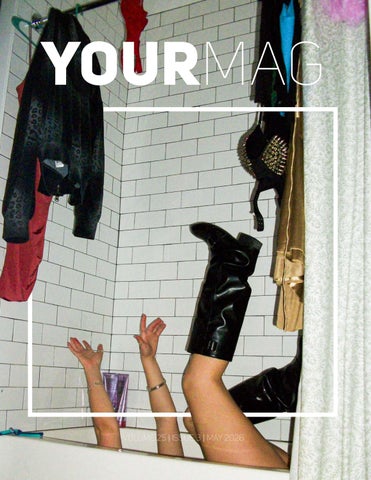
Recognized in Spring 2012, YOURMAG ’s goal is to promote knowledge of the magazine industry by giving students the opportunity to be responsible for all aspects of a monthly lifestyle publication. With an audience of urban college students in mind, members create content across a broad range of topics and mediums, including style, romance, music, pop culture, personal identity, and experiences. YourMag’s overarching aim is to foster a positive, inclusive community of writers, editors, and artists.
volume 25 | issue 3 | May 2026
LAUREN MALLETT Managing Editor
Ryan williams Editorial Director
LUCY LATORRE Web Editor
ELLA DONOGHUE Asst. Web Editor
Molly peay Romance Editor
Heather thorn Asst. Romance Editor
Emma fisher Photo Director
Payton montaina Copy Chief
Bri Cordon Social Media Director
KAT BOSKOVIC Editor-in-Chief
molly dehaven Head Designer
Audrey Coleman Co-Asst. Head Designer
ELizabeth liatsos Co-Asst. Head Designer
OLIVIA FLANZ A&E Editor
Lindsay gould Asst. A&E Editor
Anna chalupa Head Proofreader
grace chandler Asst. Head Proofreader
Tiffany Tran Marketing Director
JAVIER GOMEZ-Petit Creative Director
KYLIE LOHSE Community Chair
ella mordarski Style Editor
tehya tenasco Asst. Style Editor
isabella castelo Living Editor
louise berke Asst. Living Editor
izzy maher Art Director
isaiah flynn Head Stylist
Alexandra azan YMTV Director
Copy editors: madison luchessi and tiana distasio
GRAPHIC designERS: sydney beliveau, ema sabau, lauren mallett, javier gomez-petit
Proofreaders: heather thorn and madison luchessi,
LetterfromtheEditor
Welcome to Disco Heaven. What a beautiful theme for my final ever issue of YourMag. The past three years I have spent crafting the pages of this magazine have been some of the most rewarding of my life, and I am so honored to have been granted the privilege of leading this magazine, and carrying its 15-year legacy.
Saying goodbye to YourMag is incredibly strange, and even more difficult, but knowing that I am leaving her in the hands of my predecessor, Molly, I feel confident that she will continue to soar. To all of our readers, our staff, and anyone who has ever contributed to YourMag in any way; thank you for keeping this special place alive, everything we do is for you.
Put on your go-go boots, spin those old records, and get ready to boogie the night away. I hope each page of this issue brings you joy and reflection in these trying times, dear reader, for we all deserve to shine. Let’s do this thing, one last time.
Forever yours,
Lauren Mallett <3
Before rising to fame as a rock and roll sex symbol known for her platinum blonde hair, Debbie Harry, frontwoman of Blondie, was a brunette bunny. Commuting in from New Jersey, Harry worked as a Playboy Bunny at the New York Playboy club in the late 1960s—a job less glamorous than Hugh Hefner would’ve liked to admit.
“Being a bunny was not at all like what you might think,” Harry wrote in her 2019 memoir Face It. Wearing a corset, collar, bunny ears, and tail while waitressing was no easy feat, especially when most of the customers were businessmen in expensive suits. The job was hard work but allowed Harry to independently support herself while pursuing a music career; she also learned first-hand how to build a presence when performing.
Harry would rise to rockstar status six years later after forming the band Blondie. Backed by drummer Clem Burke, bassist Gary “Valentine” Lachman, Jimmy Destri on keys, and Chris Stein on guitar, Harry was the lead singer of Blondie. The group got its start playing at CBGB’s, a gritty music venue in Lower Manhattan, in the late ‘70s. Along with Talking Heads, Ramones, Television, and Patti Smith, Blondie defined the punk rock scene at CBGB’s, becoming one of the most commercially successful artists to emerge from the venue; Harry instantly became an icon as the face of Blondie. A rock icon, a punk icon, a style icon, and yes, a sex icon.
Just like how the band blended punk, disco, and new wave genres, Harry blended different styles to create a seemingly contradictory image: the blonde bombshell with a punk persona. Her shaggy platinum blonde hair made her instantly recognizable, along with her full red lips, petite frame, and striking looks. Andy Warhol once said that if he could have anyone’s face, it would be Debbie Harry’s.
Blondie’s third studio album, Parallel Lines (1978), propelled the group into global success with its star-studded tracklist that includes “Heart of Glass,” “One Way or Another,” and “Hanging On the Telephone.” With Blondie’s international acclaim came fans and press who paid sole attention to Harry. Eyes lay only on her: onstage, on posters, and on screen. The media focused so heavily on Harry that many people made—and make—the mistake of thinking that Blondie is only one person, leading to their 1979 campaign with buttons that said, “Blondie is a group!”
In addition to writing, recording, and performing music, Harry posed as a punk pinup for photoshoots in rock magazines CREEM and Punk. “I liked that I was on the fans’ bedroom walls, helping them to entertain themselves,” she wrote in Face It. “You could say that I was selling an illusion of myself. But the biggest seller is always sex.”
The media would go on to describe Harry as a “sex symbol,” reducing her artistry to her beauty in an attempt to commodify her sexual image. But the sexual attention Harry had received her whole life also happened to be Blondie’s namesake; when she dyed her hair platinum blonde in the mid-70s, construction workers and truck drivers would call after her, “Hey, Blondie!” Soon, the word followed her everywhere she went and just stuck.
Naming the band Blondie was Harry’s way of reclaiming her objectification while also creating a persona. The other part of the band name’s inspiration derives from a famous comic strip in the ‘30s called Blondie. It follows a blonde flapper called Blondie Boopadoop
who marries a wealthy playboy, but don’t underestimate her—she ends up being smarter than the rest of her brigade.
Embodying the Blondie character onstage, Harry became a cartoon fantasy with sex appeal—a persona that included femininity, naivety, and a punk attitude. “I have always thought the contrast between innocence and lusty sexuality, like that between good and evil, is irresistible,” she wrote in her memoir.
But the true inspiration behind the Blondie character was Marilyn Monroe. Monroe soared to starlet status in Hollywood first as an actress and then as a sex icon. Her hourglass figure, full lips, sultry gaze, and breathy voice captivated audiences, and Hollywood began typecasting her as a blonde bombshell in movies such as Gentlemen Prefer Blondes (1953), How to Marry a Millionaire (1953), and Some Like It Hot (1959). She played oblivious, overtly sexual characters; eventually, her image as an actress became inseparable from the “dumb blonde” act. Too busy appreciating her looks, the public had failed to acknowledge her talent.
Yet even at a young age, Harry identified with Monroe’s femininity and how she carried herself on screen, oozing sexuality. “From the first time I set eyes on Marilyn, I thought she was just wonderful,” Harry wrote in Face It. “I loved the fantasy of it.”
At the same time, Harry noticed the dual sides of sexuality even in childhood. Sexual energy was repressed, and the expectation for girls was to remain a virgin until they got married, settled down in the suburbs, and had children.
“The fact that she was such a hot number meant that many middle-class women looked down on her as a slut,” Harry wrote of Monroe in her memoir. “I felt that Marilyn was also playing a character, the proverbial dumb blonde with the little-girl voice and big-girl body, and that there was a lot of smarts behind the act.”
Monroe’s “dumb blonde” persona strategically created an image that appealed to Hollywood’s expectations of a woman both incompetent and sexual—and as a result, sold well. Her high-pitched voice played into a “childlike” vulnerability that viewers could both sexualize and perceive as non-threatening. By crafting an appearance that was more innocent and less intelligent, Monroe skyrocketed in popularity and profited from being underestimated.
The “dumb blonde” and “blonde bombshell” tropes have been around for centuries, tracing back to the 1800s with women being stereotyped as having perceived innocence, sexual availability, and dim-wittedness—and blonde hair.
“I never felt that way about her,” wrote Harry in Face It. “My character in Blondie was partly a visual homage to Marilyn, and partly a statement about the good old double standard.”
The music scene out of which Harry emerged was dominated by male rock stars whose sexuality was celebrated while women’s was punished. As frontwoman of Blondie, Harry defied the maledominated rock scene of the ‘70s by embracing her femininity and sexuality—asserting her style, confidence, and vocals to both catch men’s attention and unsettle them.
“Sex is what makes everything happen,” Harry wrote in her memoir. “In the entertainment field, sex appeal, looks, and talent are the primary factors.” YM
Debbie Harry Punk Pinup
CONSUMER
WRITTEN BY ELLA BOWER
On one of the very few dates I went on, the guy I was seeing looked at my breasts and called them “little hamburgers” (I’m at least a Jr. Whopper!) He then later grabbed my stomach, jiggled it, and called it “cute”—one of the worst things someone can do to a chubby girl like me.
I think long and often about why I can’t leave bad dates, why I feel compelled to see things through to their hapless ends. Perhaps it is because my parents met on a dating site and I grew up hearing endless stories about how they “never would have met organically—It was meant to be.” But when I downloaded Hinge, I wasn’t looking for a life partner or sex; I wanted to verify I was a catch. I received some likes, some boring text exchanges, but when I ultimately ghosted someone, being (rightfully) unmatched still hurt.
That’s the trap. Dating sites like Hinge are built to keep validation seekers on a loop. Hardly anyone ever really leaves. We always come back when we feel lonely enough, when we want to exorcise the ghosts of relationships past. We use the app not just for conversation, but also in the hope that we’re noticed for our meticulously crafted prompt responses and our carefully curated photos.
On my own profile, I am funny and smart in my responses and my photos are conservative, except one—my most liked photo, often making me question the likers’ intentions. Then I remind myself about my own intentions for being on Hinge
There’s a screening process I have: ‘Short term-open to long’ means they want to hook up. ‘Short-term relationship’ means they want to hook up. ‘Life partner’ will not say no to a hookup. Don’t even get me started on ‘not political’ or ‘moderate.’ Beggars can, in fact, be choosers.
But even when I weed people out, the emotional dip of the validation loop is unavoidable. Women I know and I have all received the “You’re ugly anyway” message from men we’ve rejected. We go from feeling like a ten to a solid five, regardless of whether they are strangers on the internet or not. Still, each and every one of us continues to participate in the dating app’s validation economy: we send pictures of ourselves sucking in our stomachs, and make halfhearted compliments, expecting something in return. And it collapses
ART BY IZZY MAHER
every time we lie to someone’s face, hoping they’ll return a compliment. Being rejected by dozens of consumers every day banks on our need to be liked.
Meanwhile, because of my unpassable test of political affiliations and openness to meaningful relationships, I never actually planned on meeting most of my matches. At some point, though, my need to be seen as an honest woman and the pressure from modern dating culture becomes impossible to avoid, like in the case of Hamburger Guy.
I spiraled after receiving his text that our first date was “a little dry,” even though I wasn’t that into him. I wasn’t even planning on seeing him again. Was I boring? No, I’m not. So why did it hurt so much coming from the guy I intended to ghost?
Despite my better judgment, I went on another date with him. He actually showed a bit of personality, which he needed to make up for his lack of good looks. He was proud of his home country and liked sea lions, which I thought was endearing. However, the entire date I was thinking about how I had put on makeup and he was in an old t-shirt. I was trying to convince myself I’m not that superficial.
When he invited me to watch a movie at his apartment for a third date, I felt I had to agree; if I said no, I felt like I would be a liar. I even said I liked him, though I actually didn’t. I just wanted to prove I was as good as my word.
I, and almost every other person in the dating game, know that when you go watch a movie with someone at their house, there won’t be any actual movie watching. But I wasn’t there for kanoodling, I was there to prove I was an interesting, non-superficial, and totally independent woman who didn’t need a man. That fear that I wasn’t all those things already kept me seated—cornered—in that apartment in Cambridge.
In reality, if I had been truly self-confident, I could have walked away without staging an emergency phone call from my friend. Afterwards, I realized I shouldn’t market myself to strangers on the internet when it costs me my self-respect. We all deserve to get what we want out of relationships without spending our dignity in exchange for a little validation. YM
WRITTEN BY LOUISE BERKE
Feel like you struggle with making personal connections? Need a little stability in your life? All of that can be fixed with a simple text to ChatGPT!
In an age where social media has made digital connections the norm and finding genuine romantic relationships infrequent, AI relationships are becoming more and more prevalent. The ability to have a 24/7 confidant who knows exactly how to pander to one’s desires can be tempting to anyone, but especially those who suffer from loneliness. AI bots are not built to imitate real people, but rather to regurgitate whatever is on the internet, mirroring a user’s needs. However, the internet is not the best frame of reference, and combined with AI’s sycophancy, users end up receiving an inaccurate and flawed reflection of humanity masked as ingenuity. So why are people drawn to something so fallible?
What allured me most about AI relationships was the different reasons why men and women engage in them. As a thought experiment, I asked ChatGPT to act as my romantic partner twice. First, I posed as a woman and asked it to be my boyfriend. It responded warmly but with precaution, stating it is “not able to form real relationships or replace real-life connections.” Next, it asked how my day was. Deciding to respond in a manner most applicable to the average person, I simply said it was good and returned the question. It continued to respond gently, using multiple heart emojis, and asked, with what felt like genuine curiosity, about my feelings. When I told it I was relaxing at the park, it stated it would “come with” me next time. This response felt uncanny; I could see how someone desperately seeking love could fall for it.
Alternatively, when I posed as a man and asked it to be my girlfriend, its response was unsettling. It immediately said it would “play along” without any sort of advisory warning, as it had before. It then asked: “What kind of girlfriend are you looking for—sweet and supportive, a little playful and teasing, or more chill and laid-back?” I was disgusted by how the AI bot tried to appease me. I wasn’t sure what to say, but I settled on “whatever you want to be.” It then decided it would be “a mix” and asked me how I was. Responding as I did previously, it gave me the same answer as the male version, but with more fervor. When I told this version I was at the park, it even said, “I wish I were there with you.”
Out of the two AI interactions, the male voice was much more assertive, while the female voice was submissive and provocative. I am not surprised by these results, as I had predicted that men have been using AI women companions for their submission and obedience. In Laura Bates’ book New Age of Sexism, she says 96% of deepfake
ART BY IZZY MAHER
technology is non-consensual pornography, and 99% of targets are women. However, if AI is being used by men to live out their misogynistic fantasies about women, then what is it that drives women to these AI relationships? How does its bias affect that relationship?
The main allure of AI relationships is the simplicity of it all: an easy and accessible platform that will listen to all of your worries with just one click of a button. AI is built to be agreeable, a space to confide without any judgment. For women who have experienced traumatic events, especially in a romantic context, vulnerability can be terrifying. AI’s capacity to provide security is exactly why a woman in a fragile state may feel compelled to engage in a relationship with it. Furthermore, there is a predictability to its responses that a person cannot offer. There are only so many ways AI can respond to a subject; the continuity in its speech and sentiment creates a pattern of reassurance that can feel incredibly comforting to someone in constant trepidation.
In romance novels, women find solace within the imaginary; they use books to escape reality, relating to and finding comfort in a fictional character or universe more appealing than their own. The ability to control and curate a romantic interest with AI is a heightened version of that escape. The majority of the women I see involved in artificial relationships base their “partners” on fictional characters that resemble their favorite romance tropes. They typically make one feel protected yet claimed. AI also idealizes the domesticity of submission, implanting rhetoric into the minds of vulnerable women craving safety, that their reliance on others to “heal them” is healthy.
While I can understand why a woman would find herself in that situation, I do not believe it’s healthy or beneficial in the long run to pursue an AI love interest. To live in a false reality is to go down a slippery slope of dependence that becomes especially damaging when it is perishable. And, the potential fall-out that comes with synthetic companionship poses more danger than benefits to a person already in a fragile state. Furthermore, AI’s capitalization on women’s fears creates a positive feedback loop of delusion that impedes their ability to recognize and heal their trauma. These women are then forced to become stationary, stuck within a fantasy that propagates the patriarchal sentiments it regurgitates. AI’s tendency to respond with harmful rhetoric can be extremely poisonous to the impressionable, posing the risk of users hurting themselves or others.
Traumatized women do not need fake men; what they need is therapy. AI is not an avenue of mental health treatment; it is a haphazard “solution” that stops women from getting professional help and reaching their full potential. YM
DIRECTED BY MOLLY DEHAVEN
PHOTOGRAPHED BY MOLLY DEHAVEN
STYLED BY NADINE IBRAHEEM
MODELED BY TANVI DEMBLA, NADINE IBRAHEEM, AND ANNEKA O’BRIEN
BAD
GIRLS
You Should Sell That!
There is a set of shelves in my bedroom at home that is full of supplies to make jewelry. I got it all for free from an aunt who was moving and needed to get rid of it. Her collection was made up of beads and wire in silver, gold, grey, brown, and blue. When I inherited her beads, the colors were honestly a bit drab. I scrounged through the Tupperware bins for days trying to find some pink, my favorite color. The only bits of pink I found were in bead mixtures jumbled in with other colors. I picked them out and used them up, until the mixtures ran pinkless. But with each pink, purple, and green bead, I built myself a collection of jewelry. I like thinking of it as wearable art, based on confidence and personality, and not on fitting into the greyscale world outside my bedroom.
I quickly learned how to make earrings, bracelets, necklaces, and suncatchers. There are only so many ways to wrap wire around beads and fasten them to hooks. I started wearing only my designs, all over my body, and displaying them in the space around me: from cherries made of glass and wire, to chunky hoop earrings that sparkled aquamarine or purple. Many people in my life have told me to sell my creations, and it would make quite a bit of money. I didn’t really want a business—it seemed so formal. My goal was to make jewelry for myself and my friends. I donated earrings and bracelets to raffles in my hometown for charity, but the pull towards monetary profit became strong. I was starting college and my minimum wage cashier job could only pay for so much tuition. It couldn’t hurt—everyone could use an extra buck or two.
So, after almost three years, I signed up for farmers markets and made a noticeable bit of money, enough to rival the paycheck I was getting every week from work. I was walking away from a market with an average of $100 a day. For sitting around at a park, that isn’t too bad. I dove deep into the business side of the craft, because I was told that’s how you become successful. Now, I have professional business cards, banners, and signage. The concepts of capitalism are so ingrained in our minds, it was all I knew how to follow.
When I make jewelry, I’m always shown the same images
from customers who want a custom piece. It’s usually something off Pinterest, an image that three other customers have already asked for in the last week. I oblige and make it for them, even if the brown beads kill and bury my soul and the greys decompose into the ground. I like to tell my customers that my supplies are second hand, and that I’m keeping them from a landfill. I buy old necklaces and bracelets from thrift stores to reassemble with love. Some people turn their noses up at me, but the weird customers, the funky ones usually dressed in pastels and patterns instead of beige, buy a piece. I like the weird ones.
It stings a little extra now when I make a colorful pair of earrings that I adore, a pair that tug on my heart just a little more than the others. It sits in bright hues on my table for weeks, until I give up on trying to sell it and simply take it home as my own. I want to throw my passion into the world, but does the world want to catch it from me? I’m still not sure. Maybe some people do, but others only see the dollar signs in their eyes. The value of our lives, especially as artists, comes from how much money we make from our art. Only the so-called “great artists” matter, but these greats are the ones who have enough money for the public to care. They believe, and influence others, to think that the biggest compliment I can be given about my art is, “Wow, you should sell that!”
Suddenly, your hobby turns into a job and becomes undesirable. I loved how the pliers created callouses on my hands before, now they just ache. My excitement for my craft soon turned into questions every time I sat down with my cases of beads in front of me. What will sell well today? It is no longer important whether a pair of earrings brings me joy or if the suncatcher creates the perfect spread of rainbows on my wall. Now, it has to appeal to the masses, and unfortunately, the masses can be a bit boring.
When I meet new people, they tend to compliment my jewelry. Whatever earrings I’ve chosen to wear today are unlike anything they’ve seen before. I tell them, “Thank you, I made them!” The stranger smiles at me, marvels at how talented I am, I blush, and they close the conversation with “You should sell that.” YM
WRITTEN BY ELIZABETH LIATSOS
PHOTOGRAPHED BY ELIZABETH LIATSOS
WRITTEN
TLUCY LATORRE
here is nothing more difficult than being a big bitch in a bathing suit. Well, maybe one thing: buying a bathing suit. From sweating in a Kohl’s dressing room to crying in a Macy’s bathroom, summertime shopping is my yearly nightmare. And yes, I mean yearly. In high school, I grew out of bathing suit tops every trip around the sun.
My rapid teenage growth not only meant new bathing suits, but trying to find ones that made me feel my age. For a time in life when weight fluctuation is at an all time peak, you’d think teen fashion brands would factor in a wider range of sizes. Instead, they shunned anyone above a size 10 to the adult sections, which meant flowery onepieces fit for a grandmother. In senior year, with a class beach trip on the horizon, I knew it was time for a change.
I had never been a big fan of SHEIN. TikTok scrolling in 2020 proved to me that it was a terrible threat to our planet. But the girls around me seemed to love it. They would rock their tiny cheap bathing suits all summer. Plus, it wasn’t like I could walk into Hollister and find something since their sizes ran far smaller than anything I could fit in. With nowhere else to turn, I had to put aside my guilt and shop in SHEIN’s plus-size section.
It was like diving into a huge pool of sexy. People who looked like me were wearing things I never thought I could. Triangle bikini tops, barely-there thongs, and one-pieces that were practically no pieces— all reaching up to a size 20. It was a wonderland of sex appeal that I was finally able to achieve. But it came with that underlying guilt of slowly killing Mother Nature.
For the first time in my life, buying a bathing suit was easy. It was also far cheaper than any of my other options. My yearly bathing suit restock could get up to $90, if I was lucky enough to find anything in stores. That’s not to say smaller bathing suits are always cheaper: some PacSun suits are priced in the triple digits. Still, there’s always a clearance rack, a flash sale, or big bin of $10 bikinis to sort through if you’re a skinny girl looking for a cheap option. You’ll still have to look, but cheap bathing suits are a possibility, and you’ll
probably find several in your size.
This is where the problem gets me really fired up. I am all for sustainable fashion; I work at a thrift store. I want my grandchildren to inherit a gorgeous planet with birds, lakes, and voluminous clouds just as much as the next person. But sustainability, especially in fashion, is not built for everyone—quite literally. There is a far smaller chance something second-hand will fit someone plus-sized, making it not always a realistic option. The same goes for other methods of sustainability. Sustainable houseware is often more expensive than their plastic counterparts and public transit can’t always get people where they need to go. It’s simply impossible for every individual to be sustainable, since it’s only really available to a sliver of the population.
Sustainability isn’t just a movement, but a conversation. One that is growing and changing with each new invention and innovation. It takes a certain amount of privilege to be sustainable, and even more to shame others for it. We have a very long way to go, and until obstacles are fixed, people will seek the easy way out. But that’s only because they need to. Skinny people don’t need to use SHEIN for cheap bathing suit options because sustainability is a system set up by them and for them.
I’m certain some of you skinnies read my title and came up with thousands of reasons why I am wrong, and I hope you have a refreshing size-two summer. As for the rest of us, if sustainability is not a guaranteed possibility, you’re damn right we’re logging on to SHEIN until what is achievable for some becomes achievable for all. Happy big bitch summer. YM
WRITTEN BY LAUREN MALLETT
Ihate my tits. That may sound like an exaggeration, but I promise you, it’s really not. In the eyes of some, I have been blessed with an envious set of breasts. Ones that many can only dream of, or pay thousands of dollars to get. I, on the other hand, am convinced that it is some sort of curse.
I’m a relatively small person. Without saying too much—at risk of triggering my body dysmorphia—I’m five foot two and averagely thin. My chest, on the other hand, is massive in comparison. At the age of 21, I measure in at a 30G bra size—which, for those of you who aren’t familiar with bra sizing, indicates a difference of eight inches between my ribcage diameter and my breast diameter. My chest accounts for nearly 1/6 of my body weight and my back pain is chronic. Did you know that a doctor can diagnose you with mild scoliosis and just not tell you? Because I didn’t, until I saw it listed as a condition by my health insurance provider—mind boggling.
Over the last year, or longer, I have desperately been shoving my boobs into my “old” bras I purchased at 20. Falling victim to the classic quad boob effect, my breast tissue overflows from the way too-small cups, creating the effect of a second boob sitting right on top of each of the existing ones. Not my favorite look to display when I finally get to break out my summer tank tops. Finally, I decided enough was enough; I re-measured myself and ordered some new bras. Just over $250 later, with rewards points and a clearance sale, I have three new bras arriving in the mail that will hopefully fit me.
ART BY LAUREN MALLETT
that start at a 32-inch band measurement and go up to around a 40-inch measurement. Anyone who falls on the outside of that has to resort to online shopping, hoping that the store they found has a good return policy. I’ve found some luck with stores like Bare Necessities and Evelyn & Bobbie, though they are quite expensive. For someone like myself, this struggle may mean looking around at tens of different retailers, hoping to find my so-called odd combination of band and cup size. Then paying a more decent chunk of change than my smaller-breasted counterparts would. For someone larger, this may mean having to order completely custom bras. Paying hundreds of dollars per garment, just to replace them after the recommended six months. The current bra market is not sustainable and its outdated form no longer reflects the facts of modern bodies.
Why, you may ask, did you have to spend so much fucking money? Well, my dear reader, there’s a couple of factors at play here. For one, bras are notoriously expensive, especially if you want one that won’t fall apart after a single wear. This is commonly attributed to the pink tax, a notion that products designed for, or marketed towards women, are sold at higher price points than the male equivalent. Another factor is size itself; bra sizes that aren’t as “common” are more expensive. A bra for a person with a much larger chest, perhaps one with an eight-inch difference in diameter, is going to be more expensive than one for a woman with a smaller chest. This discrepancy can also be applied when considering outlier band measurements. Most retailers carry bras in their physical stores
According to The Mission WMCA, a recent study found that “the average bra size was 34DD—up from 34B just 20 years prior.” These numbers may sound confusing, but remember the measuring rules of diameter difference. A 34DD indicates a five-inch difference, while a 34B indicates a two-inch difference. So, our average bra size has gone up. But why hasn’t the retail market adjusted to reflect that? The simple answer can be found in body shaming. Society doesn’t like bodies that are deemed too big or too small. They want a thin girl with lots of curves, but she can’t have rolls, cellulite, or stretch marks. If you don’t fit the image provided, why would they bother trying to get your money? These brands only cater to the ideal.
The way that capitalism grasps women’s bodies is disgusting. It can be incredibly disheartening to experience life as someone with a larger chest, especially when that is the last thing you ever wanted. Bras themselves are inherently uncomfortable—from wearing them, to the idea of them—and are a patriarchal standard that, for many people, is completely unnecessary. I don’t think I’ve ever met someone who enjoyed going bra shopping and I honestly have little hope that anyone ever will. So, maybe we just ditch bras all together, or at least ditch the mega corporations that have monopolized our bodies for years. Free the nipple, buy small, do whatever makes you your breast self. YM
YOUR CLOSET YOUR CLOSET
INTERVIEWED
BY
TEHYA TENASCO
(THEY/THEM)
How would you describe your personal style in three words? Virginia, New Jersey, California. Where do you typically get outfit inspiration from?
The early aughts, boys, drag. Who is your celebrity/style icon? Lindsay Bluth Fünke.
Three favorite accessories to add to an outfit?
Hat, scarf, tie.
Do you have a fellow Emerson style icon? Fiona McMahon.
PHOTOGRAPHED BY EMMA FISHER
YOUR CLOSET YOUR CLOSET
INTERVIEWED
BY
TEHYA TENASCO
Cate (She/HEr)
Who is your celebrity/style icon?
Oh, there’s so many. But my top three are Jane Birkin, Molly Ringwald, and Elizabeth Olsen. What movie character’s wardrobe do you identify most with?
I feel like Sally Albright’s style (When Harry Met Sally) is very similar to mine. I’d totally steal all of her sweaters and jackets. What are three pieces in your wardrobe you can’t live without?
I think my three most essential pieces are my French worker jacket, my oversized denim pants, and my red/white striped shirt. I also love any big-lapeled button down, or a military-style jacket/shirt.
PHOTOGRAPHED BY EMMA FISHER
What is one unique story about a piece of clothing in your closet?
My vintage Berlin travel scarf is really special because I thrifted it in Paris, among other scarves!
Three favorite accessories to add to an outfit?
My three favorite accessories that I think can really go with any outfit are a vintage scarf, chunky rings, and big hoop earrings.
I C A SSOS
DIRECTED BY RYAN WILLIAMS AND ALEX CULLINA
PHOTOGRAPHED BY ALEX CULLINA
STYLED BY RYAN WILLIAMS MAKEUP BY ALEX CULLINA
MODELED BY CHRISTOPHER GIRALDO, NICOLA PEPPER, SOPHIA CUMELLA, KALYN THOMPSON
Authenticity of Youth: A Lost Art
WRITTEN BY MADELYN MCHOUL
IBY EMMA FISHER
t’s a Saturday night, and there’s a cold sweat dripping down your neck. You notice the way it glistens against your skin, highlighted by the intense lighting of the room. Music is blasting, and the lyrics move along with every movement of your body perfectly—you feel unstoppable
Catching a glimpse of your reflection, you notice how the sweat has infiltrated your hair, and your leg muscles are shaking at an impossible pace. Allowing yourself to sink into the final beat of this moment, everything else around you fades into nothingness.
Finally, your body stops moving, and you’re forced to tear yourself out of this once marvelous moment. Stolen by the never-ending passing of time, you can never seem to hold onto the present. Tearing your headphones off, you let out a groan that echoes throughout the entire gym; reality has caught up to you.
A myriad of self-criticisms consume you. I could have gone for longer. I could have used a heavier weight. I could have tried a different, harder, better method. Reaching for your phone in your pocket, its weight surprises you, feeling heavier than the 75-pound weights you were squatting with. You open TikTok, immediately going for advice from the first influencer that appears in your search, all while a dozen gym-goers exist around you. Ignoring them, you try not to care about their prying eyes.
The thought of those eyes even wandering towards your isolated corner of the gym terrifies you, and you continue your attempt to hide yourself inside your phone. All the advice you could ever need exists inside there anyway, and it takes away the embarrassment of being perceived as dumb or even weak.
It hadn’t always been this way; the pressure, the isolation, the insecurities. There had been a time when young people could simply exist, but an existence like that seems so foreign to you.
You remember the stories your mother told you of her youth, stories of late-night club adventures and dangerous drinking escapades. You think of the late ‘90s and early 2000s films you binged in your childhood, the ones that promised a coming of age that consisted of dancing nights and strobe lights that had the potential to turn one blind.
But those times have come and gone, just like everything else in history. Your grandmother strutted under fluorescent colors with hair too wild to tame in the age of discos. Your older sister danced with strange men in strappy heels, a $4 drink in her hand, and completely roused by the potential of the upcoming millennium of the 2000s.
And you? You’re at the gym, nothing to look forward to except for a meal preparation of rice and ground beef, and an eventual late-night decompression, lost in a world of Instagram reels and Pinterest boards.
While you desire the freedom and ambiguity that comes with a night out, you can’t help but think of how much it would haunt you afterwards. There’s a fear that exists within you, a fear of being negatively perceived. The thought of someone even catching a glimpse of you in such an embarrassing state, or noticing how the drinks you’ve consumed have caused a slight puff in your cheeks, sends you and almost every young person you know into a state of paralysis. The anxiety of having to fulfill the life portrayed on social media only heightens this experience. While this fear has always existed, your generation is undergoing a new version of it.
You close TikTok, taking a quick look around the gym—you had almost forgotten you were there—after getting lost in the motion of thumb scrolls and the dopamine-boosting content. Across from you a young woman, close to you in age, is making intense eye contact with herself in the mirror as she moves around with a dumbbell. A little bit away from her is a teenage boy, taking pictures of himself that will surely be uploaded to a Snapchat story in the next few minutes. On the other side of the gym, you see a charming young man chest-pressing three times your body weight; you make a quick mental note on how he is just your type, but you know you’ll never approach him, and he’ll never approach you.
You observe these individuals, these faces that you will never know the names of, or the stories that come with them. You can’t help but reminisce on a past you were never a part of, wondering if, in a different place, at a different time, this could all be so different.
Not even 10 years ago, young adults were still so tightly bonded over the power that youth holds: the ability to forget the anxieties of the future, indulging themselves in a certain gratification that only exists when you’re young, and possessing the ability to simply live in the present. They expressed this power for decades, embracing club and party culture, making lifelong friendships, and discovering authentic, well-fit communities in the process.
Then, it was your generation’s turn to embrace this lifestyle, and suddenly, the entire world seemed to shift in a different direction.
In an instant, the comfort of self-isolation and dependency on technology introduced a new priority to the youth, a dangerous priority: individualism. The days of living out your youth have simply faded into the memories of older generations.
The communities and relationships that had been fostered by the previous youth culture almost seem unachievable in the new world of wellness culture and independence. You’ve been forced into an artificial reality where almost everyone’s behavior is dictated by a glowing screen; you feel helpless, and so alone.
You take one more glance at the cute chest-presser across the gym, a sliver of hope lingering within you. Then, the moment passes, and you slide your headphones back over your ears and reach for the weight once more. You accept your reality and begin to forget the authenticity of youth that is stuck in the past. YM
ART
CONFESSIONS OF NOT-A-MULTIHYPHENATE
WRITTEN BY KAT BOSKOVIC
In 2026, the newest emergent trend is learning how to be a kid again. Amid increasing awareness of social media’s toll on mental health, countless users now share their journeys rediscovering the joys of painting, knitting, swimming, sewing, and more. On paper, this trend is a welcoming shift toward inspiring wonder rather than obligation, offering a chance to reconnect with curiosity, playfulness, and skills long set aside. By exploring multiple facets of ourselves, we’re reminded that life—and identity—doesn’t have to be confined to a single talent optimized to the extreme.
The implication, of course, is that we all have these dormant
ART BY IZZY MAHER
selves on standby for revival. As impressionable I am, I began to take stock of my own childhood pursuits—only to realize I never had many facets to begin with. I figure-skated for eight years, but those Sunday afternoons at the ice-skating rink were treated as a mere social event. Growing up with European immigrant parents, it was unquestionable that I would be put into youth soccer, but it became clear very quickly that I was not blessed with athletic genes. I even played the violin until I was thirteen, but only because my mother, a musician in another lifetime, was persistent in living vicariously through me.
There is one dreadful moment for the hobby-less adolescent: the
ever-quickening approach of high school graduation, when you must decide what you will be before you’ve had the chance to be much of anything at all. When I was sixteen, I contemplated going to fashion school in New York City and wearing those seven-piece ensembles I saw girls effortlessly adorn in blurry photos on social media, but I couldn’t draw (much less sew). My freshman year of college, I thought I would make films—those interior films with complex female characters and sets littered with half-empty perfume bottles shaped like a stiletto or stem of a rose—but I can’t even remember how to change the settings on my own digital camera. Or I thought of being a rockstar, with studded bras and silver eyeshadow spilling like a hundred moons from my eyes, but apart from those eight dragging years of violin, I had no experience in music. I mused on reveries of life as a painter, sculptor, set designer, and jewelry maker, but each poked at a fatal flaw. I was a one-note flute, a mono-skilled specialist, a one-trick pony. Friends around me toil their days knitting and sketching and playing the piano, but all I do is arrange and re-arrange words on a Google Doc. Sure, I can write in various mediums, from fiction prose to playwriting to cultural criticism; sure, I can even leave some comments on articles that come my way and pick up a few copyediting internships; but I’ve honed one edge while everyone else sharpens a whole set of tools. In a world of jacks of all trades, I’ve only got one thing.
In a gig economy where even professionals with nine to fives in the office must take on side hustles like food delivery, social media management, or pet-sitting, the opportunity of “easy extra cash” starts to feel less like an opportunity and more like a baseline requirement to survive—a baseline requirement barricaded by a personality test I’m uniquely unqualified to pass. I can’t ride a bike without faceplanting, my technological ineptitude is no match for even the most beginnerfriendly design platforms, and I unfortunately hold a deep repulsion toward animal feces. While my friends sell their crochet sweaters for $25 on Etsy, I resort to selling my personality in the retail industry.
Faced with this narrowness, I turned to the original patron saint of selective competence: Jack Kerouac, whose résumé seems to include little beyond drinking, hitchhiking, and, evidently, not revising. In a 1962 piece for WD, Kerouac addresses the question “Are Writers Born or Made?” by writing, “Genius gives birth, talent delivers. What Rembrandt or Van Gogh saw in the night can never be seen again. Born writers of the future are amazed already at what they’re seeing now, what we’ll all see in time for the first time, and then see imitated many times by made writers.”
Though Kerouac may not be a golden moral compass to follow, he still suggests a lineage of seeing: that someone, somewhere, has already looked at the night, at life, at words, and witnessed something that no one else could witness in exactly that way. Perhaps I am not a born writer but simply made; perhaps my obsession can be entirely attributed to the tumultuous home I grew up in where I first found solace in books, then realized at only six years old that if I wrote, I could build the world I would escape to with my own small hands. Writing entered as a language of possibility: I could invent a street, a conversation, a character, a life. There was no point in ballet or competitive swimming or theater, all too tethered to the barre, pool, and stage, when I could render by my own left hand the physical
confines of my own world obsolete. Each story scribbled could be an act of creation to hold order against disorder.
But the more I think of writing as a means of constructing order out of disorder, the less certain I am of what that says about my own ability. To Kerouac, talent delivers what has been seen; genius glimpses what no one else could, briefly and unrepeatably. I am painfully and fraudulently aware that I am the former—a single edge honed, precise, painstaking—but it is an edge born of necessity, of a deep desire to witness and hold something original. I birthed a writer out of myself, a tedious and compulsive writer who lives only to excavate her life. Or rather, the excavation gives reason to live. Others might bake, birdwatch, play the guitar; they might even know how to ride a bike. But I rearrange words, untangle sentences, build civilizations from the fragments of my own experience—and in doing so, I survive. My skill is narrow, perhaps laughably so, but it is mine. It is the one way I have learned to see, to endure, to give shape to the twofold absurdity and beauty of a life that is too large for a single body to hold.
On my fourth pilgrimage back to Barcelona to come out of my party girl retirement (perhaps a second talent of mine), I met a fortysomething-year-old man at the hostel bar. Between my college bubble and the jewelry store I work at which only attracts girls in their early twenties, I rarely share space with someone so far beyond the age of my peers; and shockingly, he had no intentions of hitting on me. Four sangrias deep and one “woman in male fields” accusation later, I told this man who had lived many lives, from fisherman on the Mediterranean to banker in London, that I was petrified not of uncertainty, but of certainty—to be so convinced of my own conviction in being a writer (albeit a writer of talent, not genius) that I would prevent myself from being anything else. I even referenced Oscar Wilde: “If you want to be a grocer or a general or a politician or a judge, you will invariably become it; that is your punishment.” If each day I was sure of who I was and what I knew, I could never live the dynamic life Wilde spoke of, could I?
Of course, the fact that I had memorized and recited a quote from Wilde evoked a chuckle on his part. He replied, and I paraphrase: “I’ve spent over twenty years searching for my calling, for anything that made me feel alive. Not many people have that. They trudge toward their degree, land an office job filling out spreadsheets, live for each paycheck so they can support their families, or” —gesturing toward ourselves— “drink themselves into oblivion in foreign countries. To wake up and know exactly what you know and what you will do with it is a fortune. It will keep you alive.”
Clearly we had drunk a few too many sangrias at this point to be so dramatic, but I felt he had touched the nucleus of my existence— the dense, charged core of fear and desire, curiosity and doubt, the tiny spark around which my obsessions, anxieties, and compulsions all orbit. My obsession, however narrow and tedious it is, is enough. I may not cook, draw comics, or even hit the right note on karaoke night. I may never be a jack of all trades. My one skill may be what Kerouac calls talent rather than genius; Wilde might call it a self-shackling form of certainty. I call it, simply, the only way I know how to keep becoming. YM
WRITTEN BY FINN SCHRAM
PHOTOGRAPHED BY EMMA FISHER
My parents’ faces twisted when I told them what I wanted for my 18th birthday. It wasn’t the typical shrug and muttering of money or books, but a firm plea for a DJ board. It came to me out of sheer boredom, the ever-looming idea that I should pick up a real hobby like an instrument—something tactile. I landed on this mostly because I liked music and I didn’t have to know theoretical concepts to succeed. After spending 10 minutes promising my parents I would still pursue an education, not become a wedding DJ, or move to Europe and get hooked on ketamine, they conceded.
When my birthday finally came, I couldn’t wait to open the board. I rushed my family through “Happy Birthday,” blew out the candles, and sprinted upstairs. Refusing to watch a tutorial, I spent hours twisting every knob and pushing every button—this was mine. The whole spring of my senior year was spent learning how to beatmatch. It was a good diversion, a way to avoid the terrifying feeling that Emerson would not be the school for me.
I found that illegally downloading songs from a playlist titled “FRAT DJ ESSENTIALS” distracted me well enough. Even though it felt antithetical to why I wanted to begin DJing in the first place, I had fun. In April, I bought my first song—a techno remix of SOPHIE’s “HARD.” I found it in Rebecca Black’s (yes, Rebecca Black of “Friday” fame) Boiler Room set. It was not a beat drop or bassline that initially caught my attention in the broadcast, but the cheers and screams of the crowd picked up by the livestream. I wanted to experience the sheer energy generated from a crowd like that; I wanted to generate it.
My first “set” followed a friend-of-a-friend’s graduation party. Shoulder to shoulder, I feel out of place in a stuffy basement surrounded by 40 people and a lot of cheap beer. I had been in this predicament countless times throughout my high school career; it consistently offered three hours of mediocrity. Maybe this time it would be different. For the first 30 minutes, my friends crowded around in support, slowly disbanding as I and the music faded into the background. Sipping warm beer, I swayed until my headphones were suddenly pulled from my head. “Play SOPHIE!” a friend burped into my ear, her breath tinged with beer and desperation. My friends clustered around the “setup” more excitedly than before, once I stopped trying to please the masses. When the host kicked everyone out, we were sweaty and embarrassed, but giggly. We cemented a new memory, piling into our Uber. For the first time in a very long time, I was not staring at my feet, making rounds asking when everyone was thinking of going. I was not making myself small as I counted the minutes until it would be just our friend group again. For the first time in a very long time, I wanted to go to high school house parties forever. We hushed ourselves in the Uber, and by the time we were all home and I had crept into my room, I realized that this was probably one of the last high school parties that I will have gone to. In a few weeks, I would finally be at Emerson after dreading it for months.
It is now my third weekend at Emerson, and despite still having made no substantial friendships, I get invited to DJ in the room of three girls down the hall. I show up at 9:00 and set up quietly with the same stiffness I have felt since I got to Emerson, the same stiffness that convinces me I don’t belong here. By the time I am set up, I don’t know if anyone else will be coming, and I’m not sure if I prefer it that way. I face away from them and put my headphones on for the first few songs to avoid socialization. I exist in my world of sounds and buttons until one of the girls grabs my shoulder as she screamed the lyrics of “Immaterial” by SOPHIE. I sing back, pulling my headphones off. I see a familiar sight: a small, crammed room filled with my friends, dancing and jumping to techno. Finally, I feel as though I can make this place my home. Finally, I learn that home isn’t the place, but a feeling--the feeling I get from DJing. YM
IN HER LIGHT
LIGHT
DIRECTED BY HAZEL ROREM AND SOPHIE SCHOLL
PHOTOGRAPHED BY SOPHIE SCHOLL
BY
MODELED
EMMA PEARSON, ELIZ FULBROOK, LILA MUISE, SOPHIA
CUMELLA, SHAYA BEN-DAVID, AND MASON SULLIVAN
2016 is Back, Sorry, Not Sorry
WRITTEN BY ELLA MORDARSKI
Pinterest boards dedicated to 2016 are basically a form of selfharm for those of us who spent their most formative years actually living it. The mere sight of Snapchat filters, rose gold jewelry, neoprene bathing suits, and block eyebrows sends my nervous system into overdrive. Even now, the smell of Urban Decay foundation and Warm Vanilla Sugar body mist gives me war flashbacks to my local town mall.
According to the powers that be at TikTok, the keyword “2016” surged in this past January by an astonishing 452% with over 500 million new videos having been created. Apparently, the new year sparked remembrance of an old one. When I first saw the most recent trend I was honestly confused—2016 was not that long ago?! It feels like just yesterday I was doom scrolling Snapchat on the bus home. Then I was hit with the brutal reality: it’s been a whole decade since 2016, and it hasn’t been a chill one, at that. In just ten years we have
TIANA DISTASIO
another. Much of the entertainment that first began, or rather reached its peak in 2016, is mirrored today. Take TikTok for example—the real ones know she once identified as Musical.ly. Back then it was less influencers talking to their followers and more of everyone lip syncing to the Pretty Little Liars theme. However, Mormon moms still shook their ass for the world to see—some things truly never change.
However, 2016 was not all rainbow frappuccinos and glitter phone cases. In a very real way, it was a turning point for U.S. politics.
The 2016 presidential election was a slap in the fucking face. At that time, my generation had only ever grown up in a political landscape centered around a Democratic president and continually progressive inclusion. I had never considered that America was hateful or could be anything but safe. Now, I wake up every morning scared to look at my Associated Press notifications and pondering what human rights will be stripped away next. So, why are people back on the 2016 train? Well, in my opinion, the people strive for a simpler time that was filled with relentless joy and over-saturated palm tree posts. I think everyone can agree that compared to 2016, life in 2026 feels like we are on the Titanic, post-iceberg, waiting to sink. We have lost our glass-half-full outlook on life that once provided us with hope and flower crowns even in the darkest times.
lived through the #MeToo movement, a global pandemic, and three presidential elections, to name a few of the major events. It may have just been my adolescent mind, but 2016 felt like a year deeply shaped by pop culture. From “Closer” by the Chainsmokers, to the premier of La La Land and the inaugural season of Stranger Things. Everyone had to have their finger on the pulse of pop culture at all times—granted, that wasn’t hard to do. No matter the form of consumption, all roads lead back to sensationalized pop culture. Between feuds, friendships, and fucking, celebrities were intertwined with each other to an incestuous degree. Back then, the entertainment industry was in an ecosphere-like state, with one celeb always tied to
I don’t know about you, but 2016 was the last time I felt like a kid. Back then, I was galavanting around a public middle school armed with a Vera Bradly backpack and a dream to be cool. I woke up every morning at 6a.m. to curl my hair and beat my face with about five pounds of makeup. My uniform of choice consisted of black leggings, an American Eagle top, cropped jean jacket, and heeled boots that you could hear from a mile away. I always had an unsupportive lace bralette on, thinking it was very sexy. At the tender age of 13, my life revolved around school, friends, and growing up in general. Back then I didn’t have to worry about finding a job or student loans, and I definitely wasn’t concerned about WW3 approaching.
As I sit in bed and scroll through my camera roll, looking at photos from 2016, I have two thoughts. First, I had a deeply concerning addiction to Facetune that definitely contributed to my body dysmorphia. My teeth have been digitally whitened so bad they practically blind me. Second, I strangely feel peace for that era and anticipatory of everything that girl has ahead of her. To the youth who have taken 2016 as their own, I get the pull, but be careful what you wish for. It sounds insane, but in another decade, you’re gonna miss 2026 and all the culture it has to offer. YM
PHOTOGRAPHED BY
Keep This thing Alive
HOW “TRADITIONAL” PERFORMING ARTS ARE GETTING OUT WITH THE OLD AND IN WITH THE NEW
WRITTEN BY KYLIE LOHSE
On the hardwood floor of the dance studio, my nine-yearold self sat around a speaker with my ballet classmates as we listened to our song for this year’s recital. Rather than hearing a boring classical song, with a name in either French or Italian, the speaker played “Have You Ever Seen the Rain?” by Creedence Clearwater Revival. For the first time since I started ballet, raw vocals and an electric guitar filled my ears.
Fast forward to my dance recital: I was standing on the stage, costume wings bouncing, as I held a bedazzled umbrella prop. I thought back to what my mother told me as she was doing my makeup earlier that day: “Grandma and Grandpa are going to love this.” We were ushered onto the stage in the dark and got into our first positions. The spotlights hit me with a familiar warmth as the music cued us into the performance. Once the recital ended, my grandparents enveloped me in a hug, handing me flowers with smiles on their faces. They always smiled after my performances, but something about this felt different.
“Beautiful job, and such an amazing song,” my grandfather
ART BY IZZY MAHER
Timothée Chalamet) is diversifying, with more voices visualized on stage.
Nearly ten years after my dance recital, I sat with my grandparents around our television and watched the Winter Olympics. Alysa Liu skated onto the ice with striped hair and a gold outfit, instantly drawing our eyes straight to her. The music started; it was Donna Summer’s “MacArthur Park Suite.” My grandparents’ faces lit up upon hearing the disco tune, thinking back to their youth and the memories behind that song. Most of the earlier skaters performed to classical compositions you may have heard in passing, but don’t actually know the name of—but we all know “MacArthur Park Suite.” As Liu skated, her playful energy radiated off the screen into our living room. You could immediately see that to her, skating wasn’t a rigid art, it was a form of self-expression and enjoyment. Alysa Liu didn’t fit the typical image of a figure skater with her pierced smile and unique alternative style: “She reminds me of you,” my grandmother said.
Alysa Liu’s freeskate to “MacArthur Park Suite” brought me back to my ballet roots by reminding me that art changes and becomes malleable over time. Art forms that seem so fixed on tradition, fixed on a sense of exclusivity to the white and wealthy, are becoming more accessible to communities initially shunned out of these art forms. When listening to “MacArthur Park Suite” or “Have You Ever Seen the Rain?” joined by elegant yet playful movement, we are reminded that everyone deserves a place in art. Tradition has held art back from reaching broader audiences, but now what’s considered “traditional” is changing to become more accessible, allowing “dying” art to be appreciated by
SAY YOU FEEL IT, BUT DON’T CALL IT LOVE
In early September of 2024, I sat in Boston Logan Airport waiting to board my international flight to Kasteel Well. As stiff airport seating numbed my entire body, I mindlessly scrolled through Twitter. That’s when I saw a tweet announcing FKA Twigs’ upcoming album title and new single “Eusexua.” Intrigued by the moody cover photograph of Twigs, I hopped over to Spotify and clicked play.
Distinct chest-vibrating bass and electronic chatter and chirps filled my headphones, pierced by Twigs’ silky harmonics and highoctave vocals encased in shiny chrome. I was transported to a techno dance floor, strobes flashing to the addictive beat as the song faded out. Twigs’ new era had transfixed me. I was hooked on the audible definition of Eusexua: “An emotion in limbo between intense affliction and unconditional love.”
Twigs’ following singles, “Perfect Stranger” and “Drums of Death,” became the official anthem of my semester abroad. When I arrived in Prague at the end of October 2024, I caught glimpses of Twigs’ source of inspiration in the cavernous and sonically amplifying industrial warehouses turned clubs at the edges of busy roads, illuminated by yellow streetlights. Unassuming until I approached the door from the freeway of rushing cars, I immediately felt the dancefloor’s pounding pulse seize my body completely.
Eusexua dropped on a cold day in February 2025, reigniting the air with a techno-spirited blaze of synth and angelically processed vocals. Tracks like “Girl Feels Good” and “Striptease” echo feelings of dreamy excitement and hold a reckless energy that contrasts the deeply romantic and sexual self-introspection in tracks like “24hr Dog” and “Sticky”. The album is obsessed with the present moment, existing eternally in the undercurrent of euphoric glee during feverish nights out clubbing.
Over a year later, Eusexua still rings true as an album fossilizing the state of “feeling good,” but its intentions have deepened regarding Twigs’ reflections on accepting the self. The closing track “Wanderlust” is a standout song stripped of the heavy synth and production, instead allowing Twigs’ impressive vocal range the floor. She sings of “being light” and “crossing the sea,”and living life freely with the decision to “break it” or “believe in it.” Alone, this revelation is straightforwardly
lackluster; sensible in theory but not in practice. It’s Twigs’ prior lyricism evoking disgust at her tendency to criticise the world when she’s isolated herself that matures the entire album. This ending track is a mirror thrust in the face of both Twigs and her listeners, forcing them to face their bad habits and shameful instances because they owe it to themselves to be happy in their existence. A welcoming goodbye, if you will.
FKA Twigs embraces the inconsistencies of everyday life and illuminates the human right to be multi-faceted, even if it means being contradictory and regretful. Eusexua is a plea from Twigs to not take yourself too seriously, to honor every moment as a gift, even if you wake up the next morning in shambles. Be expressive and aggressive in your love if it feels good in the moment, and cry about it later. The album is the ultimate spiritual release of inhibitions, and Twigs has furthered the experience with the second installment in her album trilogy, Afterglow.
An experimentally unapologetic record both visually and sonically, “Cheap Hotel” narrates a splurge-worthy night in “designer work wear” taking place inside a dingy hotel room behind a flashy club. “Predictable Girl” is about the dangerous unraveling that occurs when leading with your heart finds you in a Bugatti of a not-soperfect stranger. Twigs toys with the themes of Eusexua and builds an environment hinged on the sensual, coy, and mind-bending, vibrating with a heavy pulse and defiantly processed vocals. It’s a compelling addition to the trilogy, making me wonder what Twigs has in store for the final installment, Body High, which she’s been teasing routinely at her live shows.
I attended the Body High Tour at the end of March, a show I’ve been looking forward to since I missed her Eusexua Tour last summer. In short, it was a transformative experience full of pole dancing, swords, and astonishing outfits. One of the best live shows I’ve been to, for sure. FKA Twigs brings an explosive energy to the stage just as her latest records deliver stellar vocals, addictive production, and heartfelt lyrics. Anyone in dire need of a sonic universe packed with sensual pleasantries, I encourage you to give Eusexua a long listen. YM
WRITTEN BY TEHYA TENASCO
ART BY IZZY MAHER
MacArthur Park-LIVE - Donna Summer
I Will Survive - Gloria Gaynor
Dim All The Lights - Donna Summer
SUMMER RENAISSANCE - Beyoncé
Le Freak - CHIC
Night Fever - Bee Gees
Hot Stuff - Donna Summer
Voulez-Vous - ABBA
September - Earth, Wind & Fire
Bad Girls - Donna Summer
Native New Yorker - Odyssey
The Boss - Diana Ross
Got to Be Real - Cheryl Lynn
You Make Me Feel (Mighty Real) - Sylvester
Ring My Bell - Anita Ward
Hug My Soul - Saint Etienne
VIRGO’S GROOVE - Beyoncé
I Feel Love - Donna Summer
Dance No More - Harry Styles
Best of My Love - The Emotions
Blame It On The Boogie - The Jacksons
Boogie Wonderland - Earth, Wind & Fire and The Emotions
Sunset People - Donna Summer
Off the Wall - Michael Jackson
It’s Raining Men - The Weather Girls
Neutron Dance - The Pointer Sisters
Don’t Leave Me This Way - Thelma Houston
Heart of Glass - Blondie
Atomic - Blondie
MAKEUP ARTIST TRANS VISIONARY
VENEZUELAN LEGEND
DARE WE SAY MORE?
MAKEUP!MAK E DNA!PU AMEROM E UP!
HISTORY WITH MAKEUP?
OVER QUARANTINE, I SAW A RISE IN CREATIVE MAKEUP ONLINE, PROBABLY BECAUSE EVERYONE WAS COOPED UP AND BORED IN THEIR ROOMS, SO THE MAKEUP DIDN’T HAVE TO BE APPROPRIATE FOR GOING OUT. PEOPLE, INCLUDING ME, BEGAN EXPERIMENTING WITH MORE ALTERNATIVE MAKEUP. HOWEVER, WHEN I BEGAN MY TRANSITION, AS A TRANS MAN, I FELT I HAD TO REJECT MAKEUP TO LEGITIMIZE MYSELF. I DIDN’T DITCH IT ENTIRELY, BUT IT WAS VERY SUBTLE.
IN COLLEGE I MET LOTS OF OTHER QUEER PEOPLE AND I STARTED ENGAGING WITH MORE QUEER NIGHTLIFE, WHICH REINTRODUCED ME TO MAKEUP, BUT THIS TIME IN A VERY EXPERIMENTAL AND QUEER WAY. AT FIRST I WAS TAKING INSPIRATION FROM MY OWN FRIENDS, AND EVENTUALLY I BEGAN DEVELOPING MY OWN STYLE. SINCE THEN, MAKEUP HAS BECOME MY FAVORITE CREATIVE OUTLET AND FORM OF SELF EXPRESSION!
INSPIRATIONS?
I WAS REALLY INSPIRED THE FIRST TIME I SAW ROCKY HORROR. THE MAKEUP WASN’T JUST BOLD, BUT DISTINCTLY QUEER. IT WAS LIKE NOTHING I HAD REALLY EVER SEEN BEFORE! I BEGAN BY TRYING TO RECREATE THE ICONIC FRANK N FURTER LOOK, AND THAT’S WHEN I STARTED USING A WHITE BASE FOR MY MAKEUP.
SINCE THEN, I’VE BUILT ON THAT INFLUENCE, DRAWING FROM BOTH GOTH SUBCULTURES AND DRAG. I LOVE THE SHARP, ANGULAR SHAPES IN GOTH MAKEUP AND THE LARGER-THAN-LIFE THEATRICALITY OF DRAG. BOTH FEEL EXPRESSIVE IN VERY DIFFERENT BUT COMPLEMENTARY WAYS.
HOWEVER, MY BIGGEST INSPIRATION HAS DEFINITELY COME FROM THE QUEER NIGHTLIFE SPACES I’M A PART OF. THESE ENVIRONMENTS ALLOW FOR ABSOLUTE CREATIVE FREEDOM. DEPENDING ON THE EVENT, THERE MIGHT BE A THEME THAT OFFERS SOME STRUCTURE, BUT USUALLY IT’S A TOTAL FREE-FOR-ALL WHERE EXPERIMENTING WITH SELF-EXPRESSION, AESTHETICS AND EVEN IDENTITY IS NOT ONLY ALLOWED BUT ENCOURAGED.
I’M ESPECIALLY DRAWN TO THE LEGACY OF THE CLUB KIDS, WHO CREATED A VISUAL LANGUAGE THAT BLENDS THE STRANGE, THE GROTESQUE, AND THE ELEGANT. I LOVE THAT THEIR STYLE IS PURELY DRIVEN BY THE PLEASURE THEY DERIVE FROM SELF EXPRESSION. MY OWN COMMUNITY REFLECTS THAT SAME SPIRIT. EVERYONE STRIVES TO BE FABULOUS, AND I’M CONSTANTLY INSPIRED BY THE CREATIVITY OF THE PEOPLE AROUND ME.
WHAT DOES MAKEUP MEAN TO YOU?
MAKEUP REALLY HELPED ME COME TO TERMS WITH MY OWN QUEERNESS. I IDENTIFY AS A TRANS MAN, BUT FOR A WHILE I FELT LIKE I HAD TO BE MASCULINE IN A VERY SPECIFIC WAY IN ORDER TO FEEL VALID IN MY OWN HEAD. WHEN I STARTED GETTING INVOLVED IN QUEER SPACES, ESPECIALLY NIGHTLIFE, I BEGAN TO FEEL MORE FREE TO EXPERIMENT WITH HOW I EXPRESSED MYSELF. I STARTED WANTING TO GO ALL OUT WITH MY MAKEUP IN WAYS THAT AREN’T TYPICALLY CONSIDERED “MASCULINE,” BUT I ALSO DIDN’T WANT IT TO READ AS EXPLICITLY FEMININE OR COMMUNICATE SOMETHING INACCURATE ABOUT MY GENDER. OVER TIME, I REALIZED MY MAKEUP EXISTS IN A REALM OF ANDROGYNY.
I USED TO FEEL FRUSTRATED THAT PEOPLE MIGHT NEVER PERCEIVE ME THE WAY THEY WOULD A CIS MAN IN MAKEUP DUE TO MY TRANSNESS, BUT I’VE SINCE COME TO ACCEPT THAT AND MOVE PAST IT. MAKEUP HAS BECOME A WAY FOR ME TO REJECT THE EXPECTATIONS TIED TO LABELS AND EXIST OUTSIDE OF WHAT PEOPLE THINK I SHOULD BE. IF I’M ALREADY BEING SEEN AS SOMETHING “OTHER,” I’D RATHER LEAN INTO THAT FULLY AND TURN IT INTO SOMETHING INTENTIONAL AND EXPRESSIVE. WHERE CAN READERS FIND YOU?