Your Home Magazine|January/February 2025|Quail West
YOUR HOME MeetsSimplicity Soul
®
PUBLISHER
Channing Spano
ART DIRECTOR
Sylvia Miller
CONTRIBUTING WRITERS
Oliver Nash
Channing Spano
US FEATURE YOUR HOME PRODUCTS AND SERVICES
We are always on the lookout for new and innovative products and services that our readers would enjoy knowing about for their fine homes. Give us a call at 239.235.3170 or email at info@yhmagazine.com to discuss how effective content marketing can be for your company.
Your Home Magazine® is sent to you courtesy of the real estate professional(s) that specialize in your neighborhood. If you’d like to change your mailing preferences, please email us at info@yhmagazine.com.
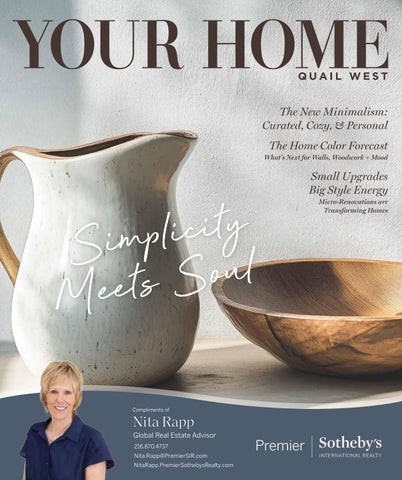
The New Minimalism: Curated, Cozy, & Personal Where simplicity meets soul in the modern home.
Living Starts Here How Tomorrow’s Technology Is Quietly Transforming the Way We Live at Home
The Home Color Forecast What’s Next for Walls, Woodwork + Mood
The Ones We Remember
by Channing Spano
TASTEFUL TOUCHES
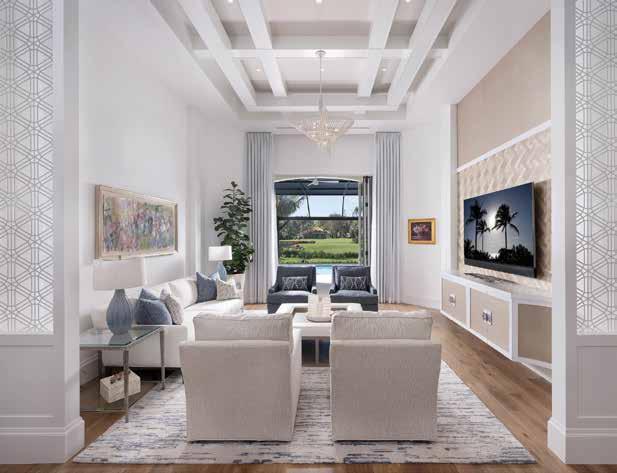
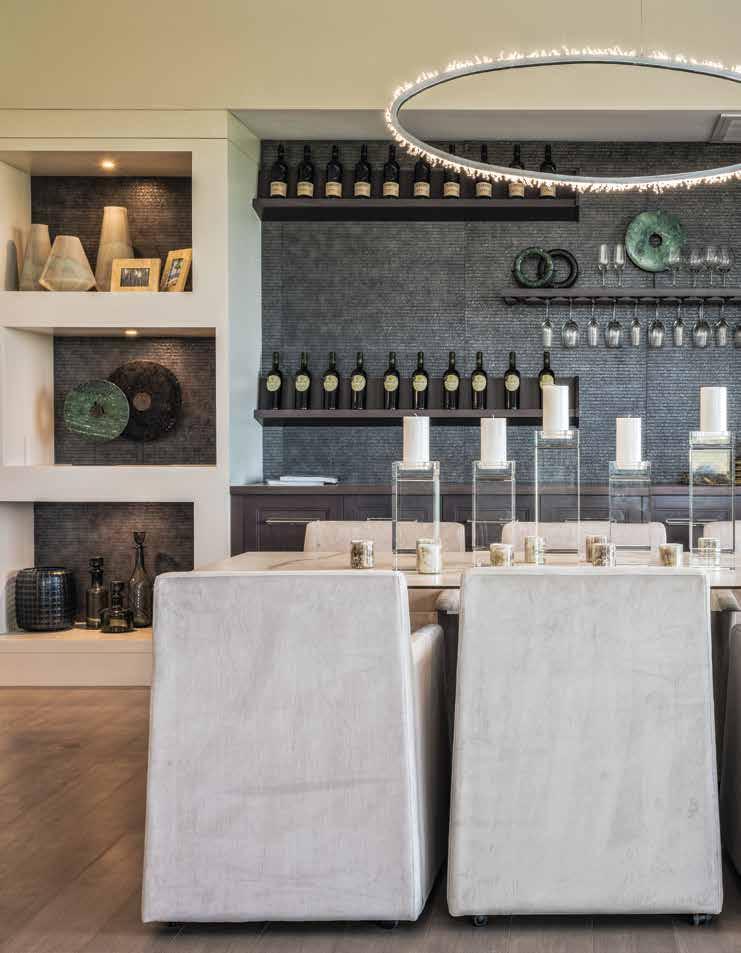
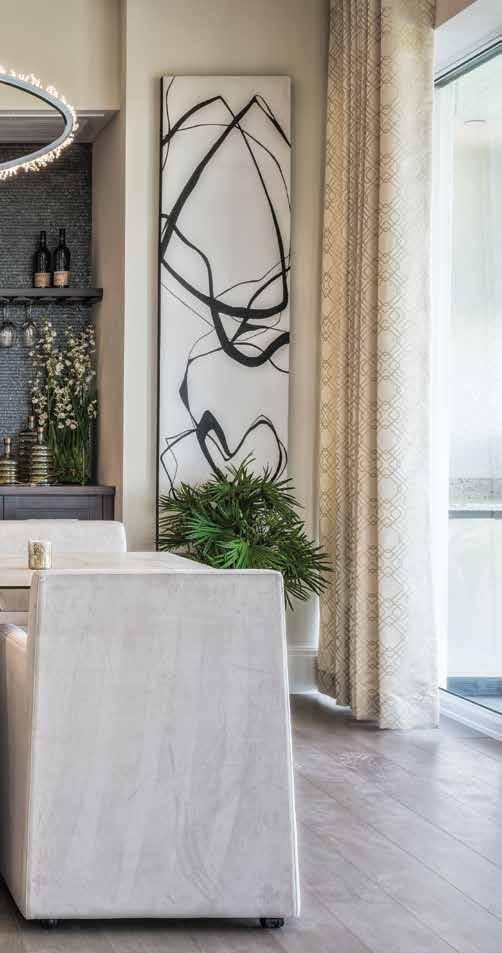
A closer view of the dining area displays a beautiful space decorated with a custom-designed black and white free-flowing picture crafted by a CDH art vendor—with the unusual dimensions of 24 inches wide by 84 inches high. The dining room table holds a European ceramic tabletop with refractory ends. “Featured on the back wall, which showcases the built-in wine bar with backlit LED lighting, is a mica-flect wallpaper that’s the same as the fireplace wall in the family room which connects the two spaces,” says the designers. Glorious glass candlesticks blend beautifully with the blingy oval lighting ring.
Over the years, certain homes linger in our minds long after the last photograph is published. It’s not always the largest rooms or the most dramatic ones that stay with us, but a feeling, a combination of light, proportion, texture, and intention that quietly makes itself unforgettable. As we look back through our archives, these are the spaces we return to again and again, the rooms that continue to inspire us each time we revisit them.
Over the years, certain homes linger in our minds long after the last photograph is published. It’s not always the largest rooms or the most dramatic ones that stay with us, but a feeling, a combination of light, proportion, texture, and intention that quietly makes itself unforgettable. As we look back through our archives, these are the spaces we return to again and again, the rooms that continue to inspire us each time we revisit them.
This collection brings together eight homes we’ve featured in the past, each represented by a single room. They are not connected by location or era, but by something less tangible: a sense of design confidence and individuality that transcends any one style. Each image captures a moment that stood out to us when we first encountered it.
What we love most about revisiting these homes is seeing how different they all are. A dining room layered with warmth and intimacy sits alongside a light-filled bedroom designed for rest and retreat. A sculptural living space gives way to a serene bath, while an outdoor setting invites conversation, leisure, and escape. Some rooms are bold and expressive, others restrained and quietly elegant, but each one reflects a thoughtful approach to living and design.
COOL AND COLORFUL
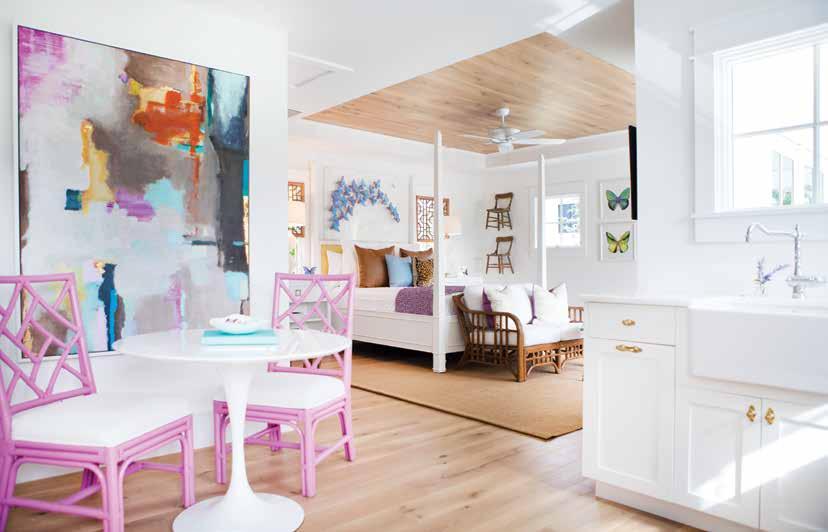
Signifying new beginnings and rebirth, butterflies are the perfect mascot for this master bedroom. The master suite is full of color. Two painted chairs flank a table with a Mid-century flair while a wet bar provides owners and the perfect place to start the day with a quick cup of coffee. Light wood floors are carried through the master bedroom and mimicked in the ceiling detail above the comfortable poster bed. Here again, both modern and classic elements are blended through art, textures, and colors.
Looking back like this reminds us that great homes don’t follow a formula. They reflect the people who live in them, the designers who shaped them, and the moments they were created for. These spaces aren’t about trends or rules, they’re about atmosphere, comfort, and the art of making a house feel personal. Whether it’s a striking lighting choice, an unexpected color story, or a perfectly balanced composition, each room captures a design moment that felt right then - and still feels right now.
We feel incredibly fortunate to have had a frontrow seat to so many beautiful interiors over the years. Publishing these homes has always been about more than documenting finished spaces; it’s about celebrating creativity, craftsmanship, and the many ways people express themselves through where they live. This look back is as much about gratitude as it is about inspiration, and gratitude for the designers, homeowners, and creatives who trusted us with their work,
and inspiration drawn from the diversity and depth of their visions.
We’ve intentionally let the rooms speak for themselves here. Each image is paired with its original caption, offering context and insight without overwhelming the experience. Together, they form a visual conversation, one that moves from room to room, home to home, highlighting how varied and compelling residential design can be when it’s rooted in intention and individuality.
As you turn the pages, we invite you to slow down and linger. Notice the details, the way spaces are layered, and the emotions they evoke. These rooms may come from different homes, but collectively they tell a story about what we value most in design: authenticity, beauty, and spaces that resonate long after you’ve seen them.
This is our look back at eight rooms from eight homes that stayed with us. We hope they stay with you too.
DRINKING IN THE DECOR
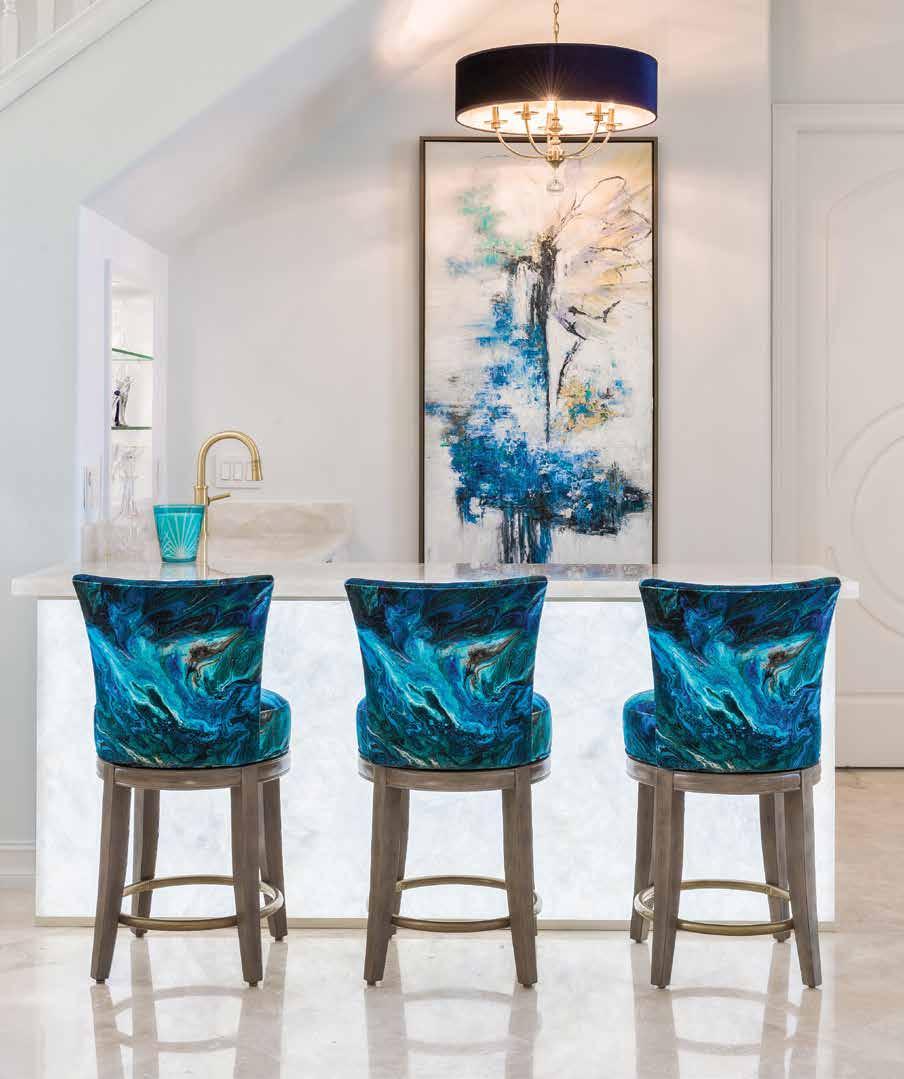
As you walk through the home’s entrance, one of the first things that you see is the bar. Mesmerizing bar stools are designed with a swirling velvet fabric in hues of blue and teal by Designmaster. Matching artwork above the bar was provided by a private label CDH and a chandelier featuring an attractive navy-blue shade pairs with the icemaker, also done in blue. The door to the right leads to the owner’s office, and the first-floor guest bedroom. Here, at the bar, is the perfect spot to enjoy a cool, refreshing beverage, or a delectable, fragrant glass of wine.
TIME TO UNWIND
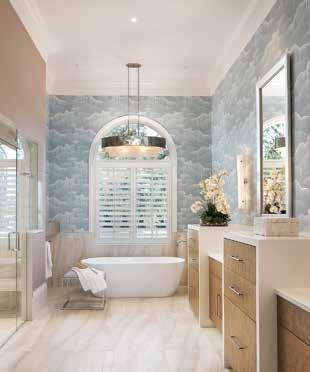
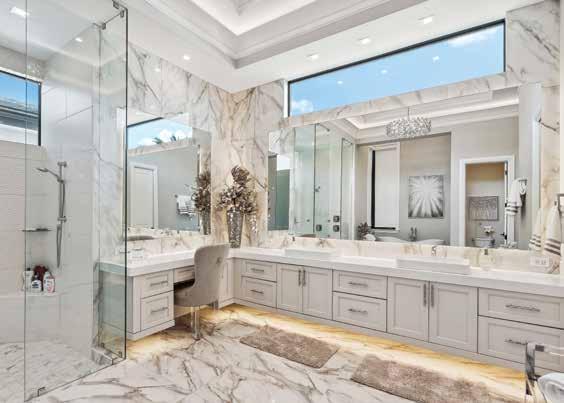
24x24-inch tiles emulating marble from Wayne Wiles Floor Covering are used in the sumptuous master bath. Complementary smaller print floor tiles, combined with ivory wall tiles, line the glass, walk-in shower which has a trio of Moen shower heads. Floating underlit cabinetry in a light gray shade holds twin trough sinks in the white quartz counter. Recessed and backlit mirrors above the counter and built-in vanity chase any shadows away in this bright bathroom.
MASTERFUL RE S T
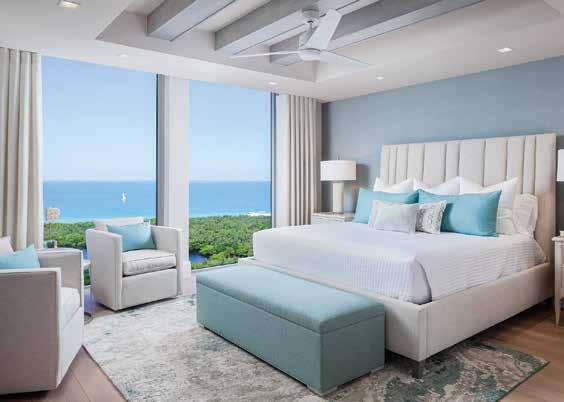
The master bedroom was inspired by the rug. “The clients really loved this particular area rug so it became the starting point for the whole room,” says Walter. What they particularly liked was the seafoam and jewel tone colors that were brought into the room so Walter picked up those hues in the grasscloth used to clad the headboard wall. She also picked complementary colors for the throw pillows on the bed and armchairs making sure to keep them both a little more vibrant than the tones found in the living spaces. A Bernhardt bed is comfortably accented by Signoria Firenze bedding that allows the other pops of color to shine. Robin Bruce barrel chairs and a long bench are perfect for seating and storage. The space is finished with it’s own interesting ceiling details and custom drapes.
A Bernhardt bed is comfortably accented by Signoria Firenze bedding that allows the other pops of color to shine.
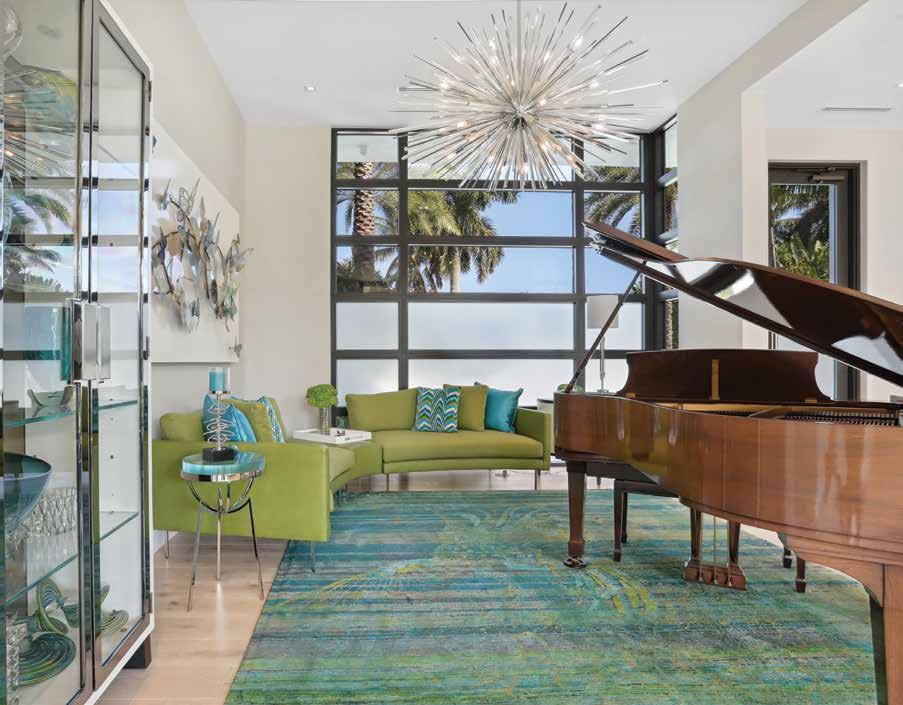
The striking sofas are by Thayer Coggin and the glass etagere cabinet is by Century Furniture.
NOTES OF LOVELINESS
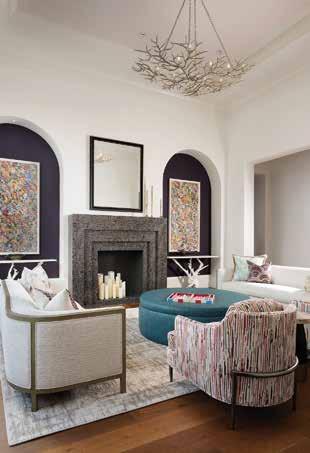
As you walk into the home, the piano room sits to your right while to the left is the dining room. Here, a dazzling ceiling lighting fixture, brought by the owners, is shaped like a symmetrical star snowflake designed in silver with bulbs inside and pieces of crystal extending out. It serves as a captivating focal point while the grand Steinway piano speaks of refinement and luxury. “The owner loves playing the piano,” Johnson expresses. Bringing in hues of blue, avocado green, and silver through the accessories, the room emanates a lively vibe that the decorative butterfly artwork, also brought by the owners, enhances. The striking sofas are by Thayer Coggin and the glass etagere cabinet is by Century Furniture. Light wood flooring has been installed throughout the home and the area rug in shades of avocado green and turquoise blue, as well as all of the carpeting in the residence, was brought by the owners. A large picture window reveals tropical palms indicative of South Florida vegetation.
RESORT LIVING
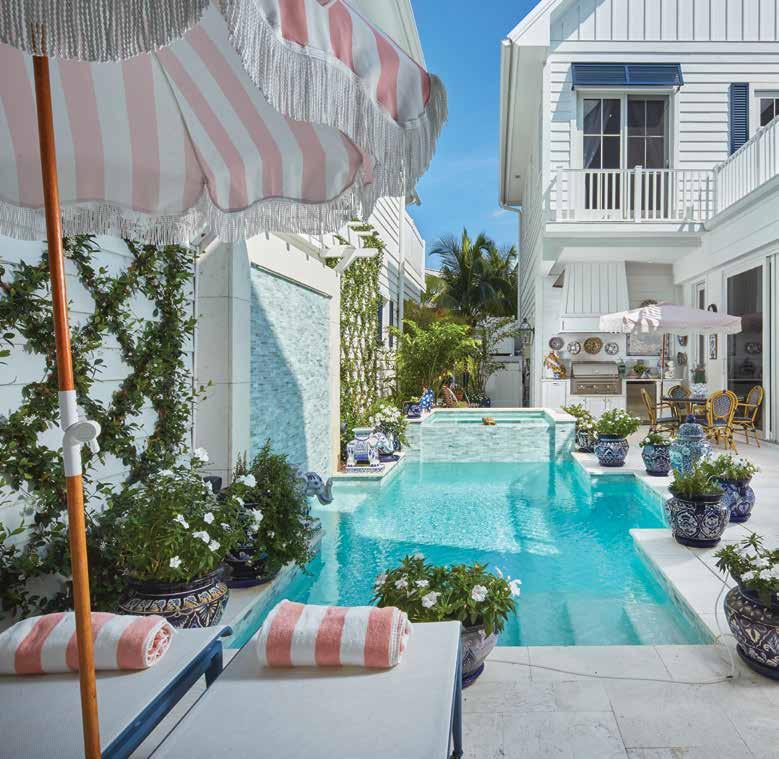
Outside, the home’s large pool and lanai makes guests and anyone lucky enough to call this place home feel like they are spending the day at a Riviera resort. Classing pink striped umbrellas and towels create a playful space while blue and white planters create a cohesive feel bringing the design inside the home to the great outdoors. The pool and spa combo are enhanced by a beautiful water feature that creates a lovely soundscape that can be heard throughout the home once the doors have been pushed open. At the far end of the lanai, an outdoor kitchen has been designed with the same care as the interior spaces and offers a second area to cook and entertain.
PEACEFUL SETTING
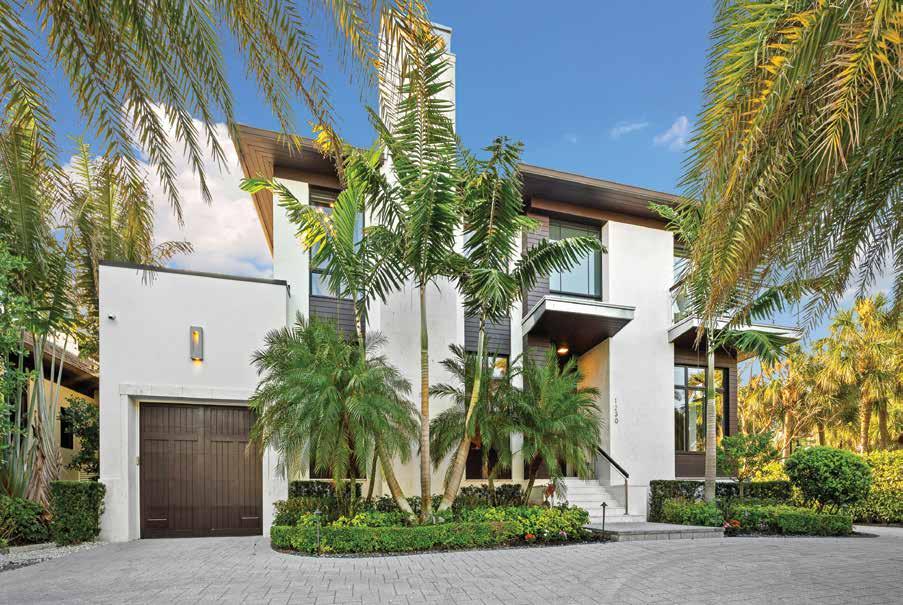
Behind its simple and elegant exterior, this home includes five bedrooms plus a den and five baths with 4,381 square feet under air. Clean lines, thoughtful proportions, and a seamless relationship with its surroundings define the striking exterior of this home. From the moment you arrive, the architecture sets a confident tone. It’s modern yet inviting, bold without feeling imposing. Crisp materials are balanced by lush landscaping, softening the geometry and creating a sense of arrival that feels intentional and welcoming. Large openings hint at the light-filled interiors beyond, while layered volumes add depth and visual interest from every angle. The design feels grounded and effortless, allowing structure and setting to work together rather than compete. It’s an exterior that doesn’t rely on excess to make an impression; instead, it draws you in through restraint, clarity, and a strong architectural point of view.
The New Language of Fine Jewelry
Color, Craft, and Confident Gold for the Year Ahead
Fine jewelry is entering a richly expressive chapter.
After years of restraint and minimalism, the coming year signals a return to emotion, individuality, and visual warmth without sacrificing refinement.
Rather than chasing novelty for novelty’s sake, today’s most compelling jewelry trends reflect a deeper understanding of design, materials, and personal style. For discerning collectors and luxury lifestyle readers, this moment is less about trends as fleeting fashion and more about jewelry as a form of self-expression rooted in craftsmanship and permanence.
At the center of this evolution is a renewed appreciation for color, the tactile beauty of gold, and the art of layering with intention. These shifts feel particularly resonant for an audience that values quality over quantity and understands jewelry not as an accessory, but as a personal archive filled with pieces that mark time, taste, and memory.
The Return of Color as a Mark of Sophistication
Color has always been part of fine jewelry’s history, yet for a long stretch it took a backseat to all-white diamond looks and pared-down palettes. The pendulum is now swinging in the other direction, and colored gemstones are emerging as essential components of modern fine jewelry collections, prized not for trendiness, but for their individuality and expressive depth.
Sapphires in particular have expanded far beyond their classic royal blue associations. Today’s collectors are gravitating toward sapphires in soft peach, muted teal, olive green, and pale lavender, tones that feel organic, nuanced, and quietly luxurious. Morganite, spinel, and tourmaline are also enjoying renewed attention, especially when their natural color variations are allowed to shine without excessive enhancement or over-design.
For seasoned jewelry buyers, colored stones offer something diamonds cannot always provide: emotional specificity. Color carries mood and meaning, allowing a piece to feel personal rather than conventional. In an era where individuality is prized, these stones function almost like signatures—recognizable, memorable, and deeply tied to personal taste.
Smokey Stones and the Appeal of Subtle Drama
Among the most compelling developments within the colored stone movement is the rise of smokey, atmospheric hues. Champagne diamonds, sunset-toned sapphires, cognac stones, and softly burnished ambers are gaining favor for their complexity and warmth. These are not bright, declarative colors; they are layered, moody, and sophisticated colors that reveal themselves slowly.
What makes these hues particularly appealing is their versatility. Smokey stones pair effortlessly with both yellow and rose gold, and they transition seamlessly from day to evening. Their subdued saturation makes them wearable in a way that brighter stones sometimes are not, especially for clients who favor elegance over ostentation. There is also a philosophical appeal to these colors. They reflect a broader cultural shift toward authenticity and depth. Much like a fine wine or aged leather, smokey gemstones tell a story of nuance rather than perfection. Slight variations in tone, inclusions, or warmth are no longer flaws to be hidden, but characteristics to be celebrated.
The Reign of Bold Yellow Gold
Perhaps no material is experiencing a more confident resurgence than yellow gold. While it never truly disappeared, its current expression is unapologetically bold. High-polish finishes, chunky silhouettes, and substantial weight are defining characteristics of this renewed gold aesthetic.
This shift is partly generational. Many luxury consumers now seek pieces that feel enduring and materially valuable, looking for jewelry that announces its presence through craftsmanship rather than sparkle alone. Yellow gold answers that desire with warmth, substance, and timeless appeal.
High-polish gold, in particular, reflects light in a way that feels sculptural rather than decorative. When shaped into bold cuffs, oversized chains, or thick bangles, it becomes almost architectural. These pieces are designed to be worn as statements, often without the need for gemstones at all.
There is also a practical elegance to gold-forward jewelry. It ages beautifully, develops character over time, and feels appropriate in virtually any setting. For those who value versatility and longevity, bold yellow gold represents both aesthetic confidence and wise investment.
Layering as an Expression of Personal Narrative
Layered jewelry has existed for decades, but its current iteration is far more considered than the casual stacking trends of the past. Today’s layered looks are intentional, architectural, and curated, particularly when it comes to necklaces and bracelets.
Rather than uniform repetition, modern layering embraces contrast. Delicate chains are worn alongside heavier links. Diamond-set strands are offset with plain gold. The goal is not abundance, but balance. Each piece has a role, contributing to a cohesive visual story rather than competing for attention.
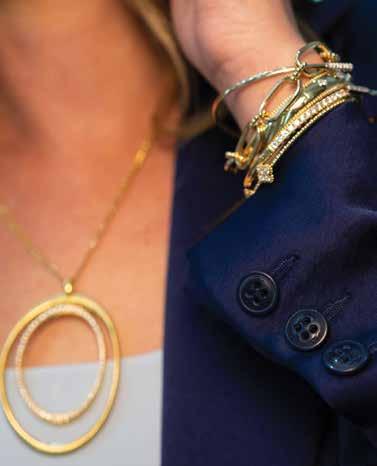
A defining element of this trend is the presence of a focal point: a bold statement necklace or bracelet that anchors the look. This central piece, whether a sculptural gold collar, a gemstone-forward pendant, or a high-polish link necklace, serves as the foundation around which lighter layers orbit. The effect is elegant rather than cluttered, expressive without being overwhelming.
This approach to layering is appealing because it allows existing pieces to be reimagined. Heirlooms can be mixed with contemporary designs.
A well-loved chain can find new life alongside a newly acquired statement piece. Layering becomes not just a styling technique, but a way of weaving together different chapters of one’s jewelry story.
For more information on the fine jewelry shown here, or to add to your own personal collection, see the experts at the Diamond District. Diamonddistrictusa.com
A More Thoughtful Relationship with Fine Jewelry
Taken together, these trends suggest a broader shift in how fine jewelry is being approached and appreciated. The focus is no longer on acquiring pieces for single occasions or fleeting fashions. Instead, there is a growing desire for jewelry that feels personal, expressive, and enduring.
Color is chosen for meaning rather than novelty. Smokey hues replace high contrast with depth. Layering becomes a reflection of personal history. Gold is valued for its substance as much as its beauty. These are not trends driven by impulse, but by intention. The focus now has shifted back to jewelry that evolves alongside its wearer, gaining richness over time rather than losing relevance.
Fine jewelry is reclaiming its role as both art and artifact. It invites us to look beyond surface sparkle and rediscover the pleasure of materials, craftsmanship, and self-expression. In doing so, it reminds us that the most meaningful jewelry trends are not about what is new, but about what endures.
INSIDE OUT
There’s a quiet shift taking root in the design world, one that isn’t about color trends or furniture silhouettes, but about something deeper, softer, and more elemental. Homes are becoming more alive. Not in the metaphorical sense, but in the very real way that plants, natural textures, organic shapes, and sunlight are moving from accessories to essentials. What we’re witnessing is the rise of bio-design: an interior style that brings the outside in with intention, weaving natural forces into the way we live.
It’s a movement born out of many things - the desire for calm in a fast world, the comforting presence of greenery, the rising awareness of mental wellness, and the growing appreciation for sustainability and materials that feel good to touch. But beyond all that, bio-design reflects a collective longing for connection: to nature, to the seasons, to our homes, and to ourselves.
Across architecture, interiors, and product design, nature is no longer a theme. It’s a foundation. And the result is a new kind of home: one that breathes, one that evolves, one that nourishes.
The New Naturalism
For decades, “bringing nature in” meant adding a plant to the corner of the living room or selecting a jute rug for texture. Today, it means so much more. The new naturalism is immersive. It’s holistic. It’s woven through the walls, materials, light, and energy of a space. Designers are thinking like gardeners: considering growth, longevity, cycles, softness, and organic imperfection.
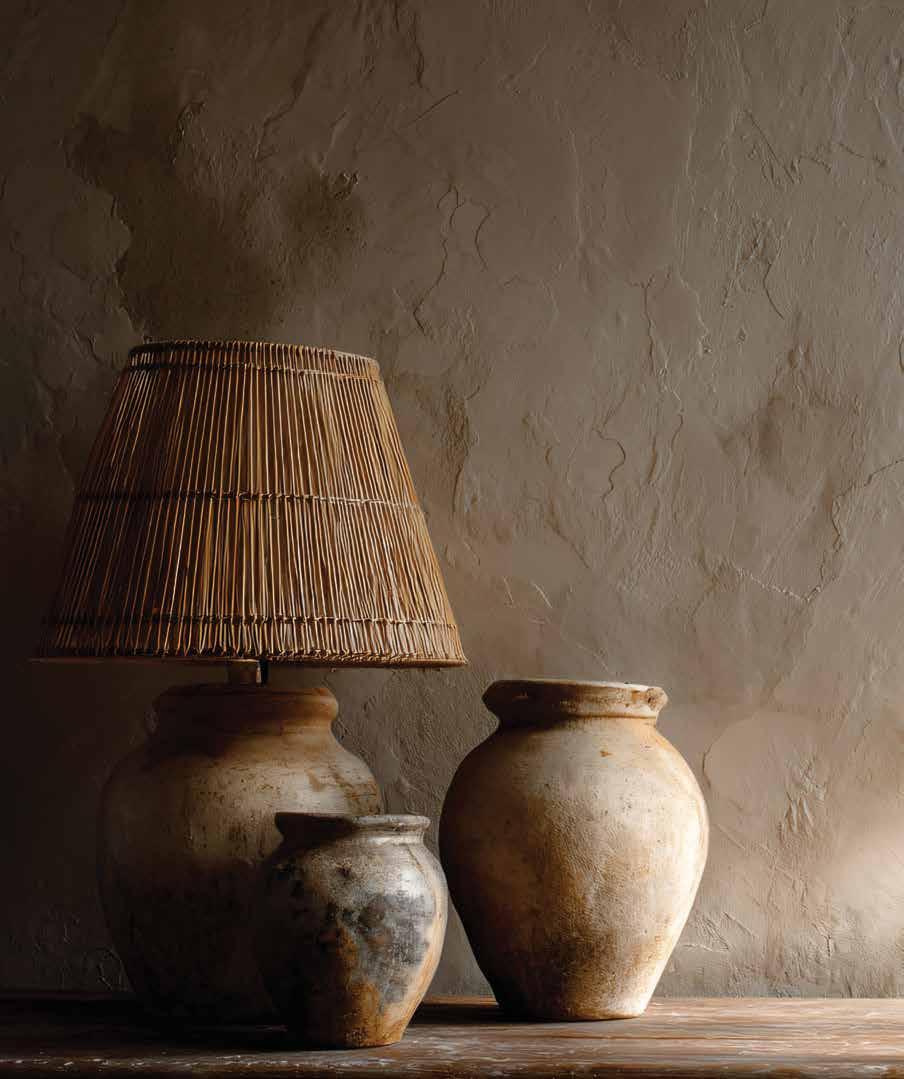
The look isn’t rustic, nor is it minimalist. It sits somewhere in between a warm, lived-in sophistication where the textures of nature take center stage. Limewash walls that feel like wind-worn stone. Clay pots in earthy tones. Rattan and cane that gather sunlight in gentle patterns. Furniture with curves reminiscent of rivers and dunes. Wood that still looks like wood, with grain and knots that celebrate its origin.
Homes That Breathe
The Rise of Indoor Garden Corners
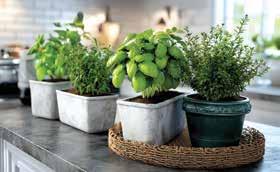
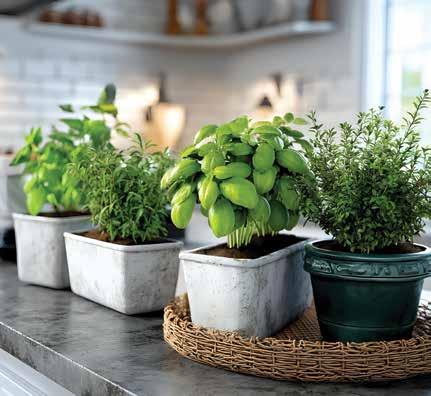
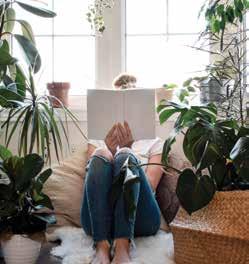
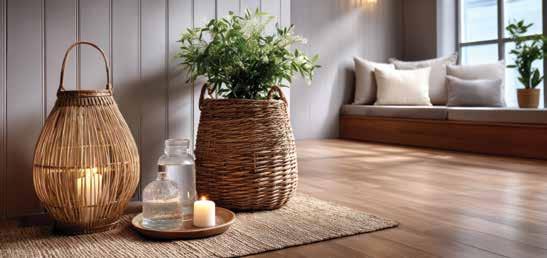
One of the defining elements of bio-design is the indoor garden corner. A small, curated pocket of greenery that anchors a room. These little ecosystems are appearing everywhere: in kitchens, where herb shelves turn cooking into a sensory ritual; in bedrooms, where leafy plants soften the morning light; in entryways, where tall, sculptural greens welcome guests like silent hosts.
Indoor garden corners don’t require a greenhouse or a green thumb. They require intention. A sunny window and a few curated plants can create a moment of life that changes the entire mood of a space. Small hydroponic units are turning countertops into micro-farms. Floating shelves are holding rows of trailing vines. Even windowsills are becoming lush mini-environments of rosemary, thyme, basil, mint, and microgreens.
These green corners aren’t decorative. They’re interactive. They’re living. And they remind us that a home is more than a place to be, it’s a place to grow.
The Poetry of Organic Texture
Texture is the soul of the nature-driven home. Smooth, flat surfaces are giving way to materials with movement, grain, fiber, and patinas that age gracefully and feel grounding to the touch. Jute, sisal, and seagrass add an earthiness beneath your feet. Limewash paint creates walls that feel like they’ve been shaped by fog and sunlight. Clay and terracotta bring warmth and a sense of elemental connection. Raw oak with visible grain underscores authenticity. Rattan introduces woven softness and an airy rhythm. Texture replaces ornamentation. A room designed around natural texture doesn’t need much else. A limewashed wall with a woven pendant overhead feels as decorative as a gallery wall while offering an calmer feel. The materials do the talking. They whisper instead of shout. The beauty of texture-anchored design is that it photographs well and feels even better in person. It softens corners. It pulls in light. It invites touch. And in the context of bio-design, texture is not merely aesthetic, it’s emotional.
Sculptural Plants
The Statement Pieces of 2026
Plants are no longer accents; they are the protagonists of modern interiors. And the boldest among them have become sculptural art.
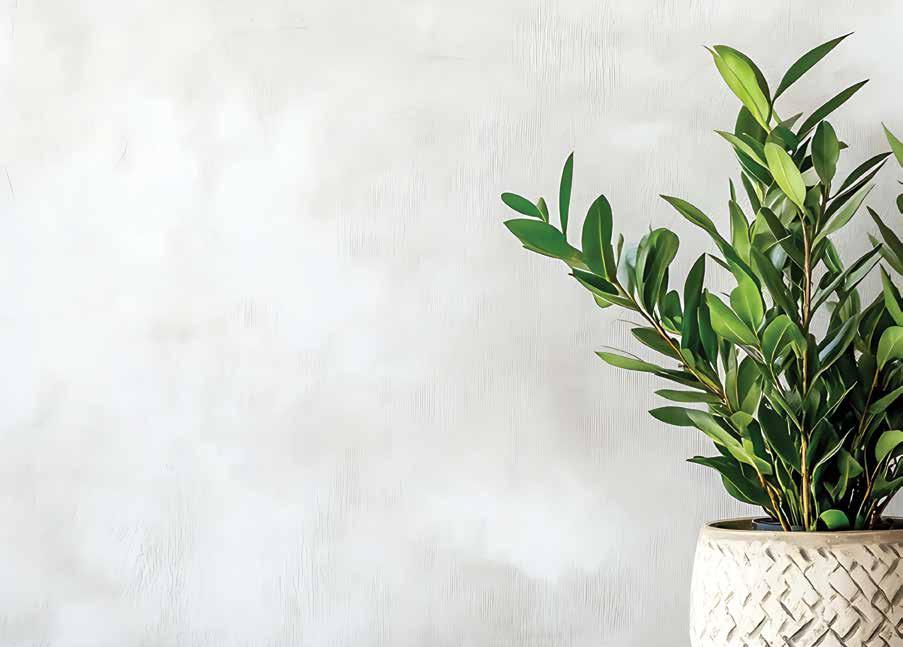
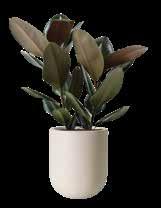
The bird-of-paradise, with its fan-like leaves stretching toward the ceiling, brings a sense of architectural scale. Rubber trees, glossy and moody, create drama and shadow. Fiddle leaf figs, once overexposed, are reemerging in more natural, branching forms that feel more like trees than props. Monstera deliciosa, with its lyrical cuts and oversized presence, feels like living sculpture.
Plant styling is becoming more thoughtful, too. Instead of scattering small pots around a room, designers are clustering plants in compositions: tall next to short, structured next to trailing, glossy next to matte. The effect is immersive, like stepping into a quiet conservatory.
And the pots themselves matter. Simple clay, matte ceramic, raw stone, or woven baskets that blend into the soft palette of organic interiors add so much texture and interest to a space without overwhelming.
The sculptural plant isn’t about maximal greenery. It’s about anchoring a space with life, movement, and oxygen.
High-Drama Green
Moss Walls and Living Surfaces
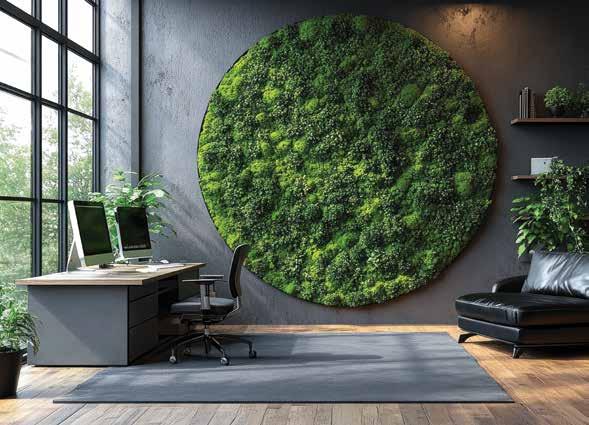
For those who want nature on a grander scale, bio-design offers dramatic possibilities. Moss walls are becoming the new gallery wall offering a lush, textural, and surprisingly low-maintenance option when using preserved varieties. In modern homes, they act like interior landscapes, adding softness where architecture is sharp.
Living walls, while more complex, are becoming increasingly accessible through modular systems that allow plants to thrive indoors with built-in lighting and irrigation. These vertical gardens offer not just beauty but acoustic softness, improved air quality, and a sense of stepping into another world.
Not every home needs a full living wall. Even a framed panel of moss, a long trough of succulents, or a single sculptural installation over a console can create a moment of visual calm and natural wonder.
The Shape of Nature
Curves, Waves, and Asymmetry
Bio-design doesn’t stop at plants or materials, it extends into form. Nature rarely works in straight lines, and interior design is following suit. Furniture, lighting, and decor are embracing curves: wavelike sofas, asymmetrical coffee tables, organically shaped mirrors, and lighting fixtures that resemble vines or branches.
These forms invite movement. They soften a room’s geometry. They create balance against the angular lines of windows, cabinets, and
A Practical Guide to Bio-Design
(Without Losing the Magic)
Plants for Beginners vs. Plant Lovers
For beginners:
Choose forgiving plants like Pothos, ZZ plants, snake plants, philodendron varieties. They tolerate low light and irregular care, and they still deliver a lush presence.
For plant lovers:
Go for character and sculptural drama by adding bird-of-paradise, rubber trees, monstera, staghorn fern, trailing hoyas, or indoor citrus trees.
Best P L acements for l ight Needs
• Plants that love sun, like jasmine, herbs, succulents, citrus, belong in bright windows or sunrooms.
• Plants that tolerate shade, or ferns, ivy, snake plants, thrive in corners or softly lit living rooms.
• Positioning plants based on their natural habitats is the key to a thriving indoor ecosystem.
l ayering g reenery Into y our e xisting Decor
Instead of adding plants randomly, think of them as part of the composition:
Place a trailing vine on a bookshelf, a tall plant near a sofa arm, a small fern on the nightstand, a mini herb garden on the kitchen counter. Let greenery be the connective tissue of the room.
n atura L l ight h acks
If a room lacks sunlight:
• Choose reflective surfaces like mirrors or matte ceramics.
• Use soft, diffused lighting that mimics daylight.
• Consider grow bulbs discreetly integrated into existing lamps. Light is nature’s design collaborator and a powerful one.
built-ins. And they allow interiors to feel more like living organisms, flexible, fluid, evolving, and less like static compositions.
The rise of organic shapes is part aesthetic, part psychological. Curves feel comforting. They emulate nature’s natural rhythm. And in a time where we crave calm, curved silhouettes feel like a gentle embrace.
The Emotional Impact of a Nature-Driven Home
Perhaps the most compelling aspect of bio-design is the way it makes us feel. Homes shaped by nature tend to encourage slower living. They support routines that are grounding rather than draining. They create space for breathing, stretching, and daydreaming. They foster creativity and calm. They remind us that we are part of something larger.
A nature-driven home is not simply decorative, it’s supportive. Plants clean the air, natural materials regulate temperature and humidity, curved furniture relaxes the nervous system, and sunlight softens even the hardest days.
In a world that asks us to move fast, the nature-driven home invites us to pause.
Closing Thoughts
A Home That Lives With You
Bio-design isn’t a trend, it’s a return to materials that feel real, to shapes that soothe, greenery that grounds us, and interiors that breathe.
As homes continue to evolve this year and beyond, the nature-driven home will only grow more relevant. It’s adaptable. It’s sustainable. It’s beautiful in a way that transcends style cycles. But most importantly, it’s personal.
A nature-integrated home doesn’t aim to impress, it aims to comfort. It grows with you, shifts with you, and invites you to slow down and reconnect with the world beyond your walls. In every leaf, every texture, every imperfect curve, it reminds you: life happens here.
Coastal Calm From Tuscan Confusion to
Calm
by: Oliver Nash photographs: David B Bates Photography
When designer Diana Hall of Diana Hall Design first stepped inside this home, she was met with a puzzle of mismatched intentions - a Tuscan-style structure that had, over the years, accumulated a series of quirky and inconsistent updates. Among the most surprising discoveries was a set of turquoise kitchen cabinets, a bold but outof-place choice that clashed with the home’s original architecture and the serene coastal setting just beyond its doors. The clients were ready for a reset, and Hall knew immediately that the transformation would begin not by overpowering the home’s bones, but by revealing their potential.
A Framed Horizon
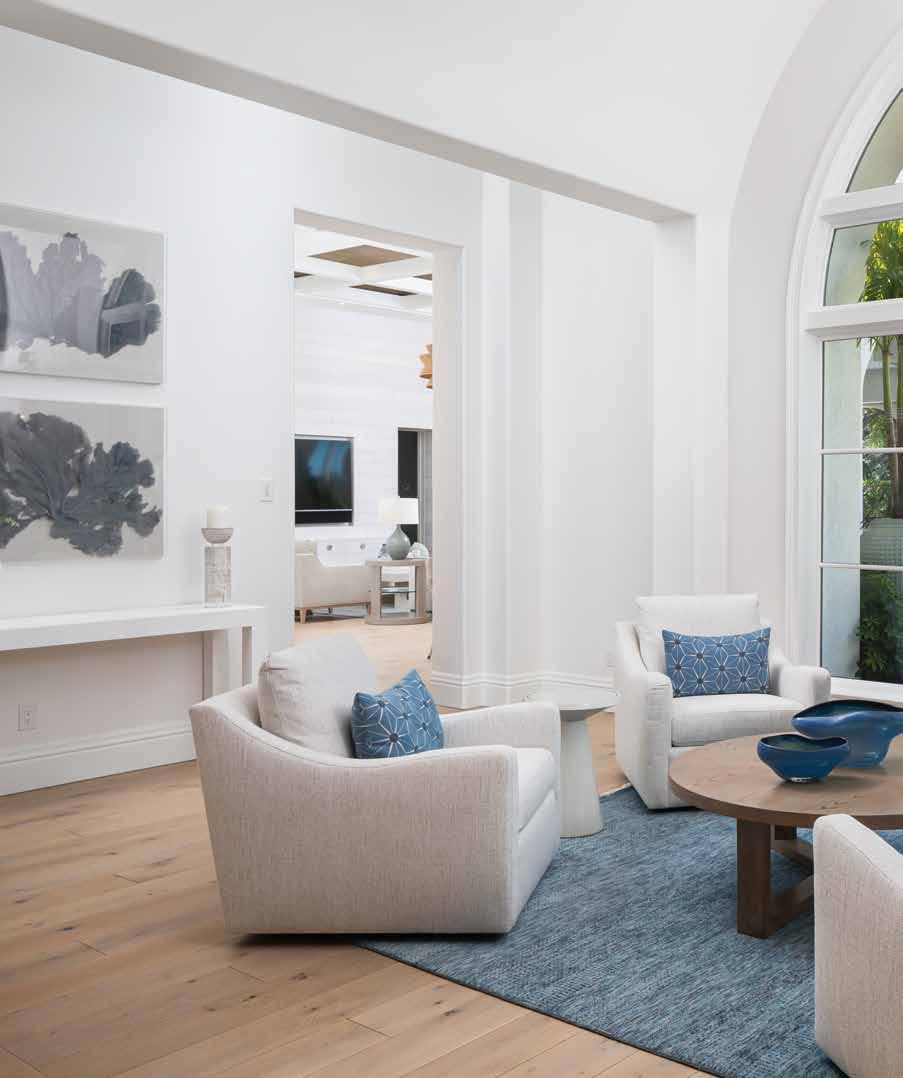
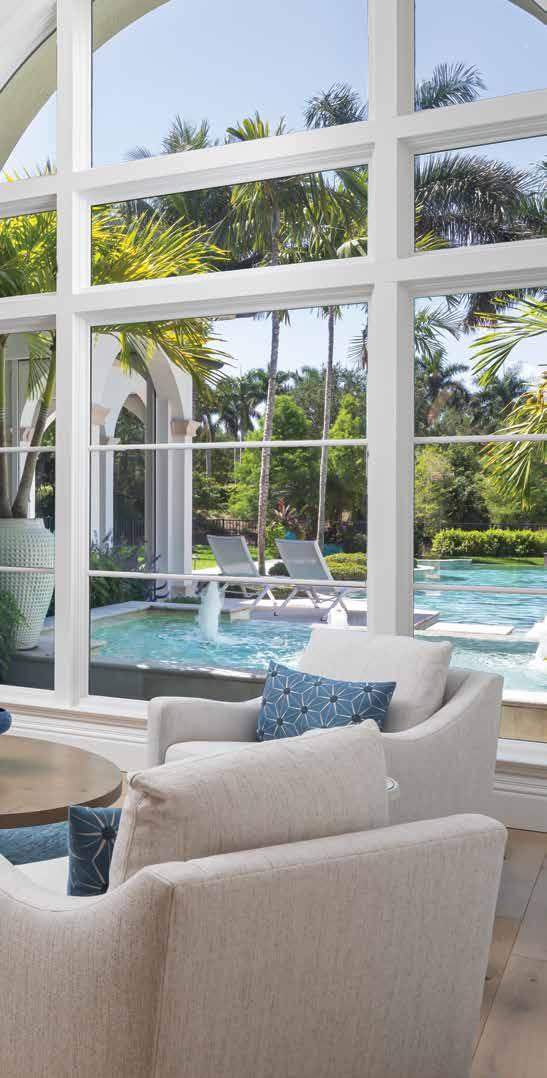
This chat area became the emotional heart of the renovation, the space that inspired the project’s direction. Hall centered the room around the home’s most striking architectural feature: the sweeping arched window overlooking palms, water, and sky. This natural tableau established the home’s refreshed palette of layered blues, cloud whites, and soft neutrals. Four swivel chairs create an intimate conversation circle anchored by a round wood coffee table, its tone echoing the driftwood hues of the flooring. Textured blue accents in pillows and ceramics introduce depth without distraction, reinforcing the coastal serenity Hall wanted the entire home to embody. Clean lines, minimal ornamentation, and a crisp backdrop keep the focus on the view, allowing the outdoors to act as living artwork. This space is a perfect encapsulation of Hall’s approach - quiet luxury, natural connection, and intentional simplicity.
The design vision emerged from a single architectural feature that Hall felt deserved center stage: the grand arched window in the front living room, framing palms, water, and sky like a natural painting. She used that moment as the anchor of the entire project. From there, a cohesive, calming palette of soft whites, driftwood tones, layered blues, and muted greens, was introduced to unify the home’s previously disjointed spaces.
Hall reworked the floor plan’s visual flow, ensuring each room felt connected yet distinct. Natural materials and organic textures play quietly throughout. Woven lighting, pale oak flooring, textured rugs, and matte finishes all bring warmth to the cool coastal colors. Furniture selections lean modern but welcoming, arranged to emphasize conversation, comfort, and views. Art, too, was carefully integrated, including works from local Naples artists that nod subtly to the Gulf Coast.
The kitchen became a serene command center, completely redesigned with timeless cabinetry, sculptural lighting, and understated luxury. Bathrooms received tailored identities using pale painted vanities and patterned tilework, offering a fresh, spa-like quality without overwhelming the senses. Throughout the home, the guiding principle was restraint: every choice intentional, every detail supporting a unified narrative of serenity and coastal refinement.
What began as a house full of mixed messages is now a harmonious retreat, elegant, airy, and grounded in its Florida setting. Thanks to Hall’s vision, the home feels effortless, balanced, and beautifully modern, with its architectural strengths finally allowed to shine.
Layered Comfort
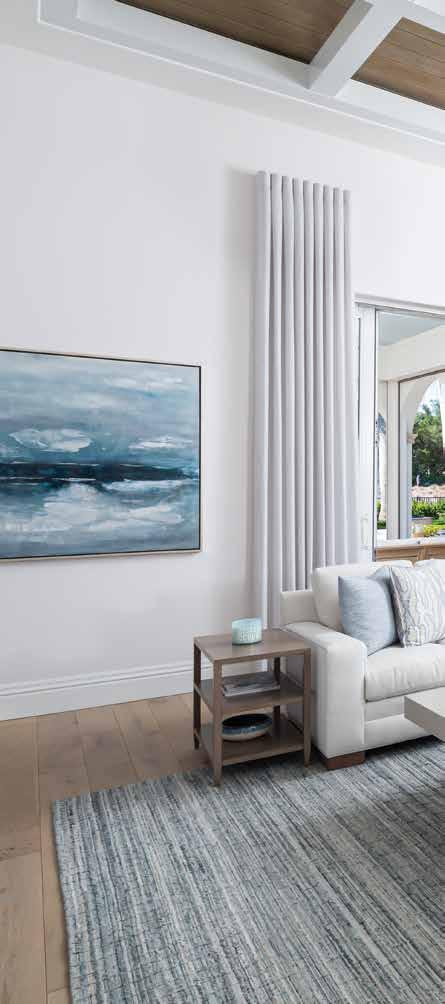
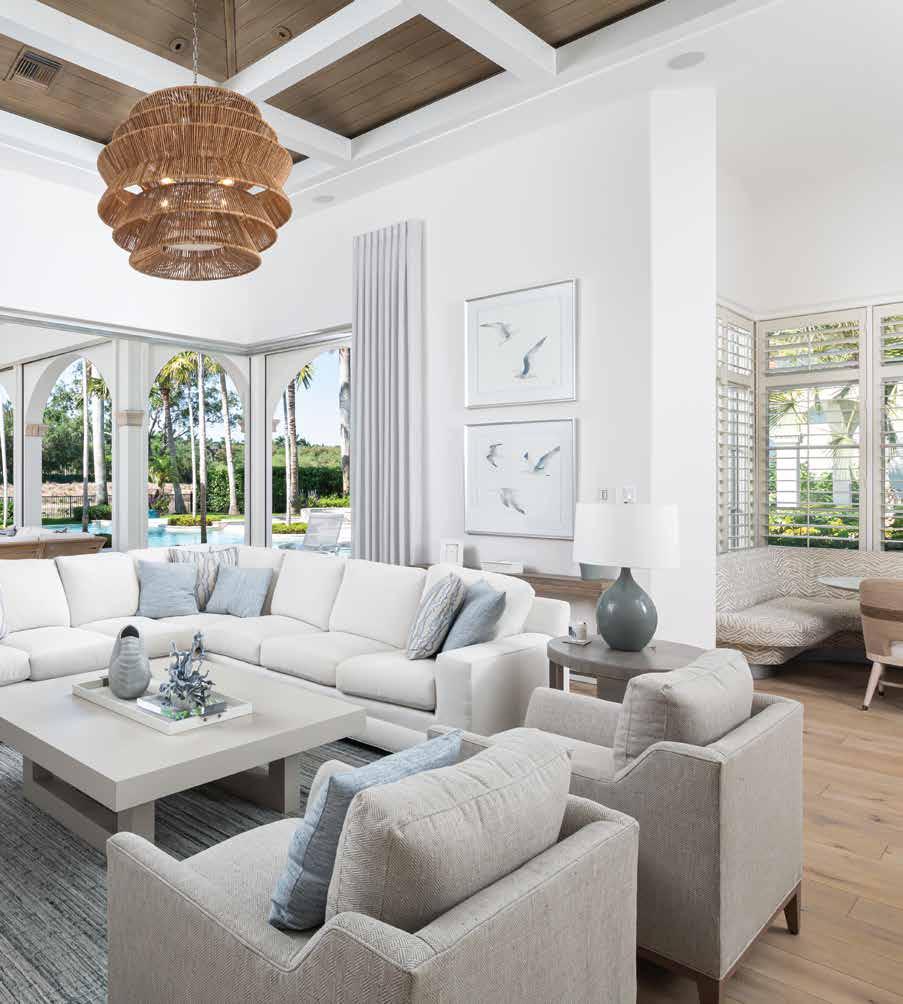
This spacious living room demonstrates Hall’s ability to modernize without losing warmth. The oversized sectional establishes a generous gathering zone while maintaining the home’s calm, muted palette. Behind it, a series of arched openings echo the signature window and tie the interior architecture together. A woven gray-and-white rug adds subtle pattern, while soft blue pillows introduce airy movement reminiscent of the Gulf waters. Artwork featuring coastal abstractions reinforces the home’s location without resorting to literal themes. The built-in window seating area on the right adds flexibility and charm, creating a nook that feels both cozy and connected. By using tonal layering, light wood, soft stone, pale textiles, Hall creates a cohesive environment that flows effortlessly into the adjoining kitchen and dining spaces.
Organic Statement
This angle reveals the home’s defining blend of organic texture and clean architecture. The statement woven chandelier is the star of the space, adding sculptural warmth beneath the coffered ceiling’s refined geometry. Its natural material brings balance to the crisp whites and pale woods that organize the room’s design language. The light is set against a once turquoise blue ceiling that’s been painted to match the kitchen island, tying the two rooms together. The sectional, from Taylor King, and paired armchairs are upholstered in soft, inviting neutrals, making the space ideal for relaxed gatherings. Hall kept accessories minimal, adding a candle, a few curated objects, ensuring the room feels uncluttered and serene. Light filters in from multiple directions, highlighting the layered textiles and providing a sense of effortless coastal calm. The room opens seamlessly into the kitchen, and together these spaces form the home’s central hub of connection and comfort.
The Calm Center
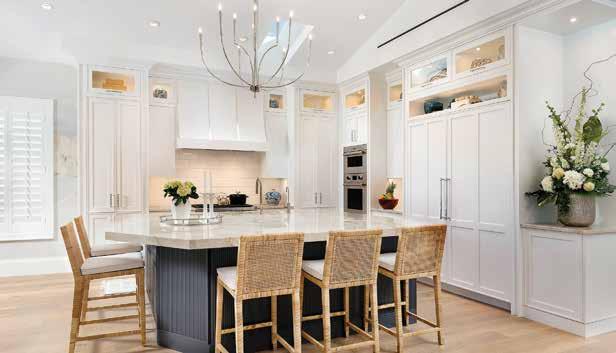
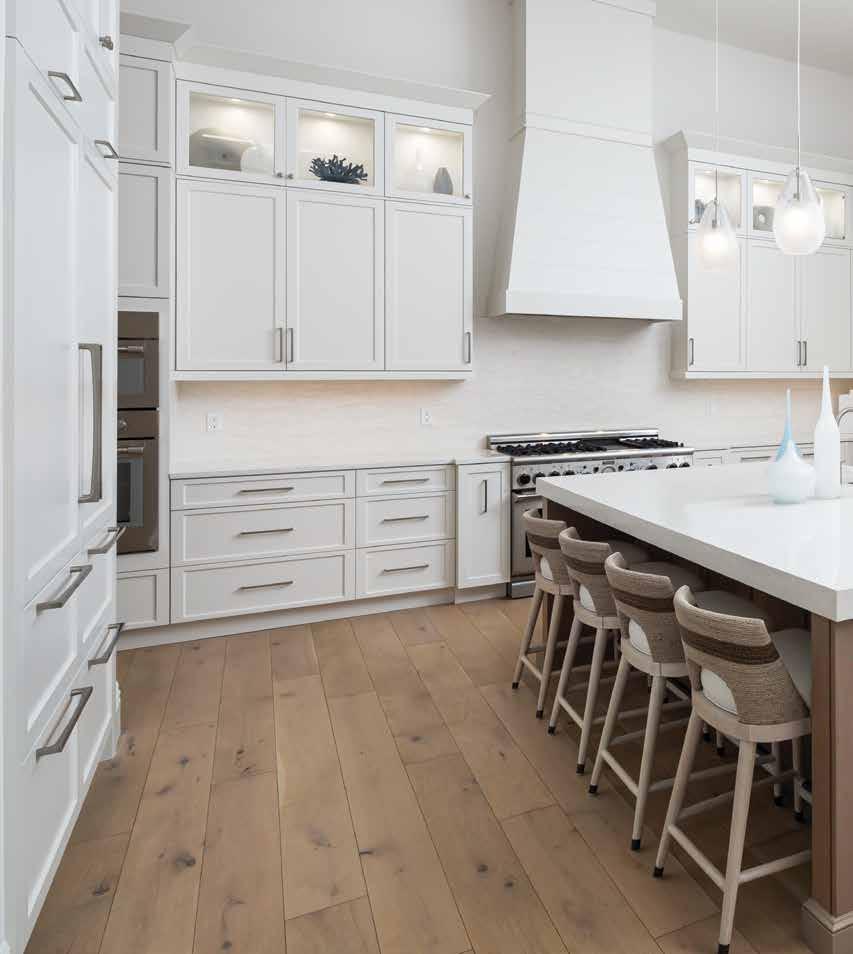
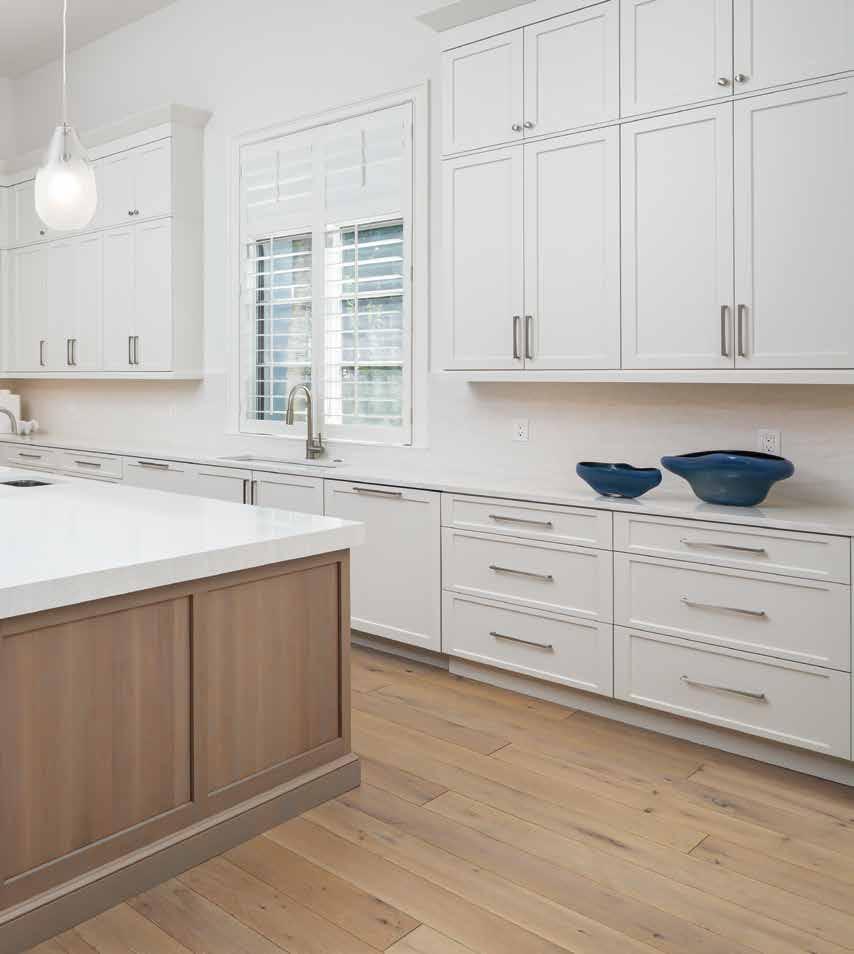
This view highlights how Hall unified the home’s formerly disjointed spaces. The kitchen island’s natural wood base anchors the room, adding warmth against the expanse of white cabinetry. Sculptural pendant lights float overhead, providing soft illumination without competing for attention. Every detail is refined but approachable, from the paneled appliances to the subtle veining of the countertops. Looking outward toward the living room, the eye follows a clean visual path, down the island and out to the pool beyond, revealing how open sightlines transformed the home’s flow. The result is a kitchen that feels airy, functional, and timeless, serving as both a working space and a social center.
The kitchen became a serene command center, completely redesigned with timeless cabinetry, sculptural lighting, and understated luxury.
Coastal Refresh
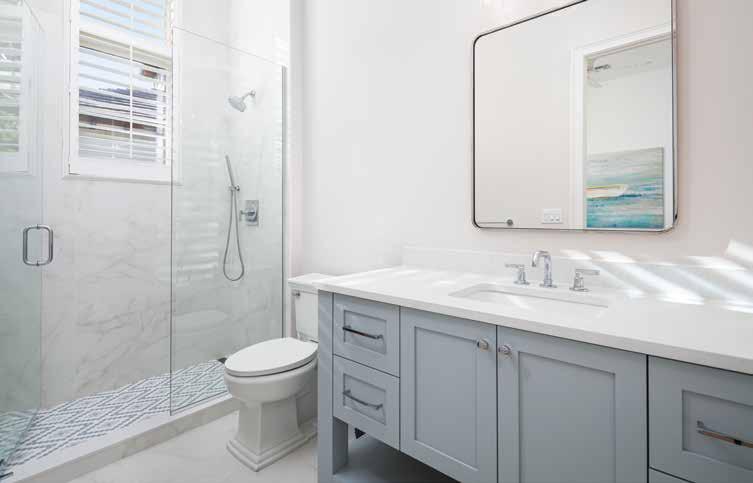
This bathroom refresh is a study in soft, spa-like elegance. Hall selected a powdery blue vanity to introduce gentle color while maintaining the home’s overall serenity. The quartz countertop and chrome fixtures offer modern refinement, keeping the palette light and calming. The shower features large format tile with a patterned mosaic floor that adds personality without overwhelming the tight space. Light filters beautifully through plantation shutters, creating shifting reflections across the large framed mirror. Every detail, from cabinet hardware to glass shower enclosure, was chosen for durability and understated style. The result is a fresh, polished space that feels both coastal and contemporary.
Bathrooms received tailored identities using pale painted vanities and patterned tilework, offering a fresh, spa-like quality without overwhelming the senses.
Modern Retreat
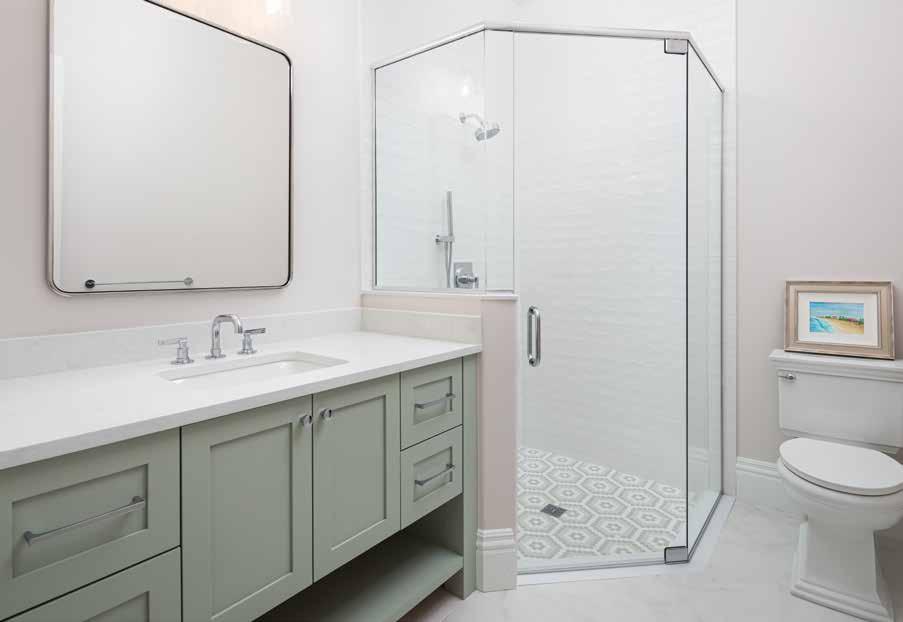
In this guest bath, Hall introduced a subtle sage green vanity, offering a soothing yet distinctive twist on the home’s coastal palette. The hue pairs effortlessly with the crisp white quartz countertop and chrome plumbing fixtures, creating a refined, grounded look. A geometric patterned tile in the shower adds playful sophistication, while glossy white wall tile keeps the space bright and modern. The artwork above the toilet introduces a small but meaningful touch of color echoing home’s coastal setting. The frameless glass enclosure and oversized mirror visually expand the room, enhancing its airy feel. This bath exemplifies Hall’s ability to give each space its own identity while maintaining complete cohesiveness.
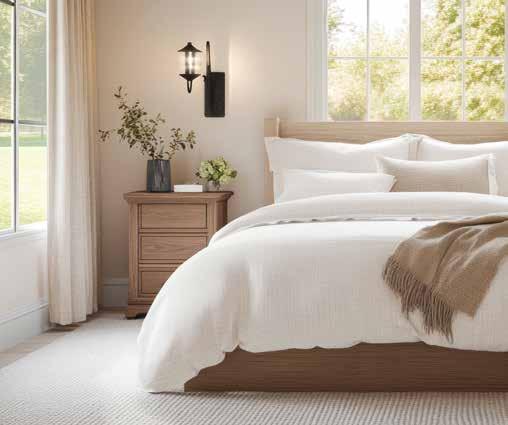
The New Minimalism: Curated, Cozy, and Personal
Where simplicity meets soul in the modern home.
Minimalism, for years, was defined by its sparseness. Clean surfaces, sharp lines, and strict restraint became the aesthetic shorthand for “good taste.” Homes were white, immaculate, edited down to their quietest possible form. But as the world shifted, growing more chaotic, more digital, more fast paced, those pristine spaces began to feel less like sanctuaries and more like stage sets. People craved something gentler. Something warmer. Something that felt like life.
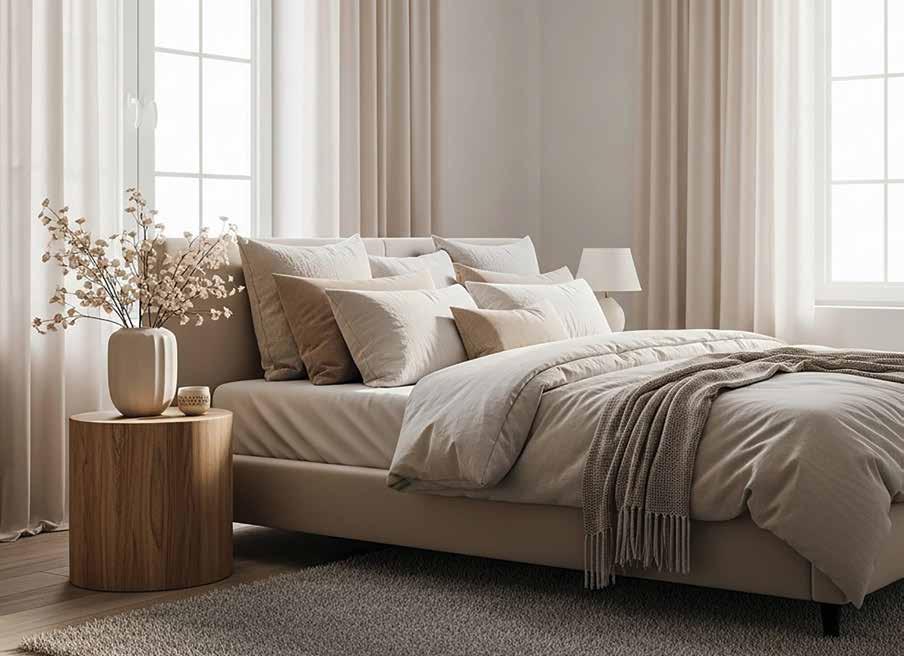
And so minimalism has evolved. The new version still values clarity and simplicity, but it also embraces comfort, softness, and meaning. It welcomes the kinds of objects that tell stories. It celebrates imperfect textures and lived-in materials. It prizes curation over austerity. The new minimalist home isn’t about having less; it’s about making room for what matters.
Across design studios, interiors magazines, and social feeds, this shift is unmistakable. Minimalism is growing up, and warming up.
A Gentler Approach to Space
The new wave of minimalism starts not with subtraction, but with intention. It asks a simple question: What supports me here? That shift alone transforms the tone of a home. Instead of stripping away everything until the room echoes, the goal becomes creating an environment that nurtures calm, clarity, and creativity.
This approach embraces warmth in both color and materials. Whites soften into creams and almond tones. Grays evolve into organic mushroom shades and clay-tinted beiges. Light wood, once chosen for its Scandinavian coolness, now appears in honeyed, tactile finishes. There’s an ease to these rooms, a sense that they welcome afternoon light, that they hold warmth the way fabric holds a familiar scent.
In the new minimalist home, the palette is less strict and more soulful. Instead of crisp emptiness, you find quiet fullness.
ceramic mug stays on open shelving because it brings joy. A sculptural wooden stool serves as both art and function. A piece of textile art softens a wall with organic texture. These objects aren’t clutter. Instead, they act as anchors holding memories and adding warmth to the space.
This curated approach doesn’t abandon minimalism’s core values; it redefines them. The aim is not to showcase more, but to showcase better. Each piece earns its place through emotional resonance or quiet beauty. Everything feels chosen, not accumulated.
In this way, the new minimalist home becomes a gallery of meaning, not just a study in restraint.
Embracing Organic Shapes and Textures
If old-school minimalism was angular, the new minimalism is distinctly curved. It brings in the silhouette of river stones, the
If old-school minimalism was angular, the new minimalism is distinctly curved.
The Rise of Curated Objects
Perhaps the most striking change in the evolution of minimalism is the reintroduction of meaningful objects. Where traditional minimalism often discouraged decorative items, the new version recognizes that a home feels empty when stripped of personal expression. Today’s minimalists are curators, not purists.
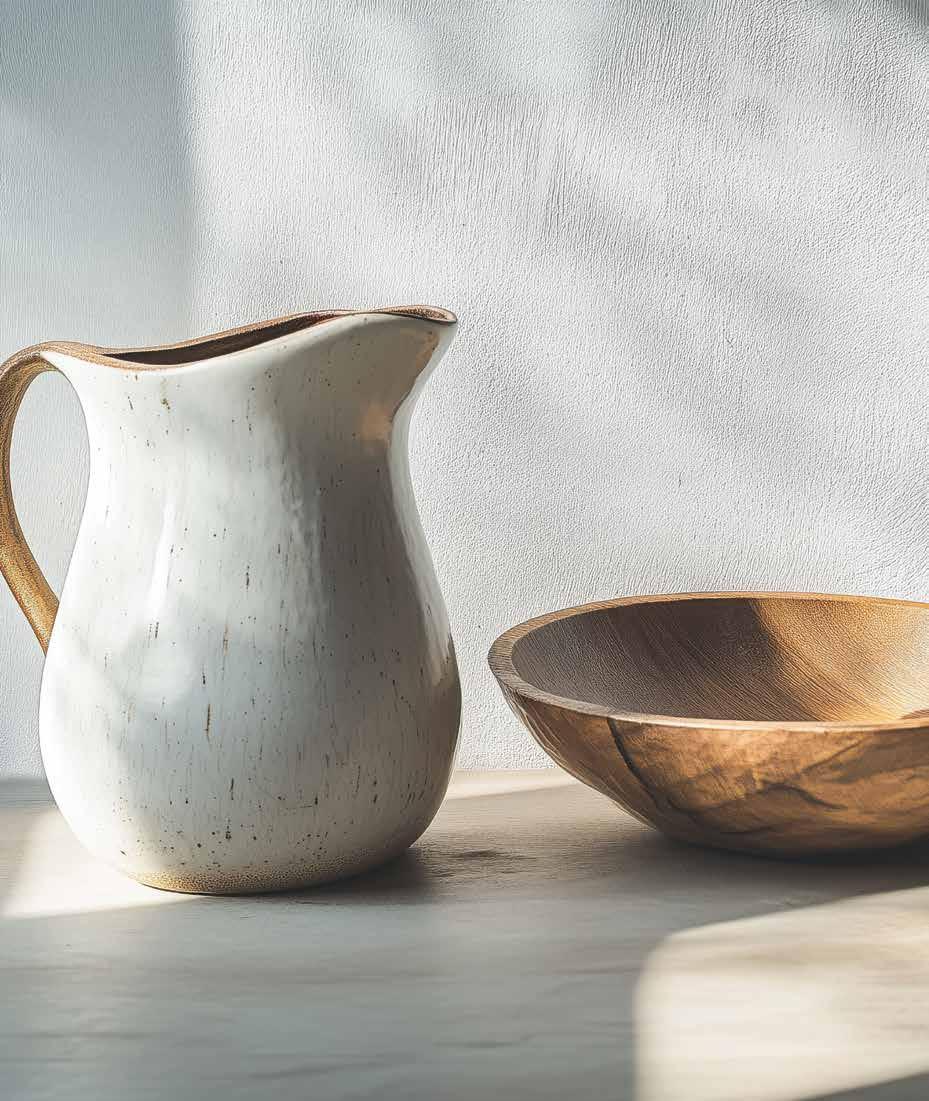
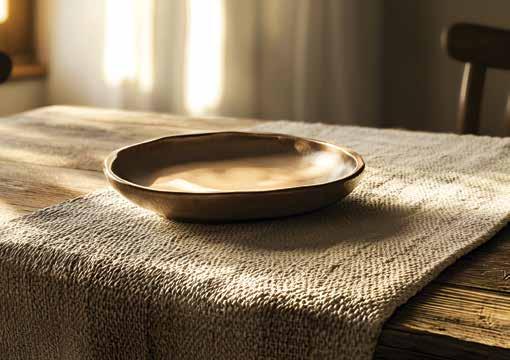
A single handmade bowl on a dining table becomes a focal point. A favorite
line of a coastline, the sweep of a dune. Curves soften a room and create gentle movement, a visual exhale.
Coffee tables with asymmetrical edges, sofas with rounded arms, lamps that resemble sculpted clay, mirrors shaped like puddles or waves. These forms break up rigidity and invite touch. They also blend beautifully with natural materials, which are foundational in today’s minimalist spaces. Textiles play a starring role. Linen curtains billow softly at the window. Bouclé chairs
offer a cloud-like perch. Washed cotton bedding creates a quiet, rumpled elegance. Woven rugs add a grounding layer underfoot. Clay vessels, unglazed or subtly textured, give weight and earthiness.
This emphasis on tactility is more than a style choice. It’s a response to an increasingly digital, screen-filled world. Organic shapes and textures give the senses something to hold onto and a reminder that the home is not just visual, but physical.
A More Human Minimalism
What makes this new approach feel so resonant is its humanity. Traditional minimalism often prioritized visual order over lived experience. You could admire it, but you didn’t always want to curl up in it. The new minimalism corrects that imbalance. It allows softness, comfort, and personality to enter the picture without sacrificing simplicity.
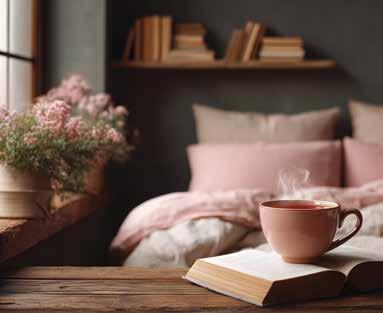
Blankets are draped more casually. Books are left on the nightstand instead of hidden away. A well-loved chair shows the slightest patina. A plant grows larger than expected and is allowed to take up space. It’s a style that says: you live here — and that’s a beautiful thing.
This warmth extends to the way rooms are arranged. Instead of forcing open space as a rule, designers now create negative space where it serves a purpose. A quiet corner for grounding. A cleared-off coffee table that encourages conversation. A dining table free from clutter so meals feel ritualistic. Space becomes intentional, not empty. The result is a minimalism that breathes instead of constrains.
The Art of Editing, Not Eliminating
Editing is at the heart of this movement, but editing in the emotional sense, not the ruthless one. The new minimalist edit asks: What deserves to stay because it enriches my daily experience? What can go because it distracts?
This is where minimalism becomes a personal practice rather than a rulebook. Some homes will have more objects, some fewer. The key is the thoughtfulness behind each decision.
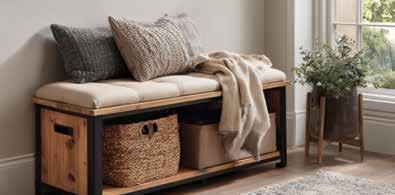
Editing with emotion creates rooms that feel like reflections of the people who inhabit them, creating places where the essentials aren’t just functional, but meaningful. A single stack of books on a bench. A small collection of handmade pottery. A framed photograph leaning instead of hanging, inviting interaction. Everything has purpose, but not everything has to be perfect.
In the new minimalism, imperfection becomes part of the charm.
Simplicity Without Sterility
Perhaps the most refreshing part of minimalism’s evolution is its willingness to embrace life’s messiness. Instead of striving for pristine surfaces that feel untouchable, the new minimalist home is designed to be used and enjoyed.
Warm lighting replaces harsh overhead fixtures, creating glow instead of glare. Sofas are chosen for comfort first, style second. A kitchen counter may hold a beloved cutting board or a fruit bowl instead of being polished into emptiness. A mudroom might showcase woven baskets filled with everyday items instead of hiding them away.
These moments of lived-in beauty keep a minimalist home from feeling sterile. They make the space feel inhabited, warm, and alive.
Minimalism becomes less about how a room looks at its most perfect, and more about how it can actually feel soft, intentional, and grounded.
In the new minimalism, imperfection becomes part of the charm.
As minimalism moves toward warmth and personalization, there’s a renewed interest in artisan-made pieces.
Craft, Authenticity, and the Value of the Handmade
As minimalism moves toward warmth and personalization, there’s a renewed interest in artisan-made pieces. Hand-turned bowls, small-batch ceramics, handwoven throws, carved wooden spoons, locally crafted furniture. These pieces carry the fingerprint of the maker, adding soul in a way mass-produced items rarely can.
These handmade elements invite storytelling. They introduce texture, imperfection, and humanity. They also support the movement toward conscious consumption: buying fewer pieces, but choosing them well. Authenticity has become a cornerstone of the new minimalism, not showy luxury, but quiet craftsmanship.
Finding Balance in the Quiet
In many ways, the new minimalism is less a style than a feeling. It’s a sense of calm, lightness, and clarity that radiates through a home, not about owning less. People are now using this tool to create space for more of what matters: comfort, ease, meaning, intention.
This approach offers a counterbalance to the noise of modern life. It grounds us in our surroundings. It slows the pace. It encourages us to find beauty in restraint rather than excess, in quality rather than quantity, in comfort rather than coldness.
A Simpler, Softer Future
Minimalism’s evolution reflects our cultural moment, a desire to live with clarity and purpose, but also with softness and warmth. What emerges is a style that is neither austere nor cluttered, neither sterile nor chaotic. It’s a harmony of order and personality, structure and ease.
The new minimalist home is quiet but not silent, simple but not stark, curated but not precious. It is refined and receptive, lived-in and loved, edited and expressive.
Small Upgrades
Big Style Energy
Micro-Renovations are Transforming Homes
There’s a quiet revolution happening inside homes right now. It’s not fueled by contractors, demolition days, or the kind of remodels that take months and swallow entire budgets. Instead, the design world is embracing something smaller, smarter, and infinitely more livable: the micro-renovation.
The micro-reno isn’t a single project or a specific set of tasks. It’s a mindset, a new approach to decorating centered around intentional, high-impact tweaks that reshape the feel of a home without altering its bones. A shift in color palette here, a new texture there, a reimagined corner, a better lamp, a layer of warmth that slowly, quietly allows the whole space becomes something new.
In 2026, micro-renovations reflect larger design values: comfort, curation, warmth, and personal expression. Homes are moving away from big, showpiece makeovers and toward gentle, continuous evolutions. The result? Interiors that feel deeply lived-in, deeply personal, and deeply satisfying.
Here’s what the micro-renovation movement looks like now, and how small updates can create big style energy in every room of the house.
The Rise of the Micro-Reno
Homeowners are looking for a way to refresh without disruption. The typical renovation timeline which usually includes weeks of dust, material delays, construction noise, feels increasingly at odds with the desire for ease and tranquility. Micro-renovations, by contrast, slip into daily life almost invisibly. You can transform a corner between breakfast and dinnertime. You can rethink a room this weekend, not this year.
Culturally, the shift ties into larger themes: people are chasing more emotional connection to their homes, gravitating toward spaces that feel comforting and expressive. The polished, minimal interiors of a few years ago are giving way to warmth, layers, and lived-in character. And instead of spending on full remodels, homeowners are investing in smaller, more frequent updates that keep their rooms feeling current without sacrificing comfort.
What Micro-Renovation Really Means
At its core, a micro-renovation is about refining your home, not reinventing it. It’s the art of working with what you already have and amplifying it with strategic, stylish shifts. These changes don’t require new floorplans, heavy tools, or specialized expertise. But they do require an eye for detail, a sense of mood, and intention.
A micro-reno might mean upgrading a room’s lighting to create a warmer glow. It might mean swapping a few key textiles or adding a piece of sculptural furniture. It might mean refreshing the color palette with a deep, modern accent hue or bringing in natural materials that add tactility. Each move works subtly, but together, they transform the energy of a space.
This is design in motion: a home that evolves, rather than one that is simply “finished.”
The New Rules of Micro-Renovating
RULE 1: Start With the Mood, Not the Materials
Traditional renovations begin with materials
— tile samples, paint swatches, hardware finishes. Micro-renovations start earlier: with mood. How do you want this room to feel?
• A shift in mood can redirect a room’s entire visual identity. For example:
• A “warm minimal” space might invite creamy neutrals and soft lighting.
• A “quiet luxury” palette might mean layered textures and brushed metals.
• A “natural calm” aesthetic could favor sage, clay, woven baskets, and organic shapes.
When the mood is clear, picking upgrades becomes effortless and the result is more cohesive.
RULE 2: Layering Replaces Large-Scale Replacing
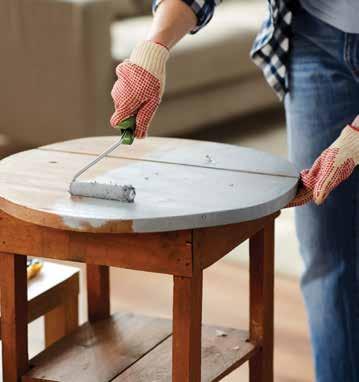
Instead of buying a new sofa or gutting cabinetry, the micro-renor is a master of layering: rugs over hardwood, throws over sofas, curtains over blinds, artwork layered over existing visual lines.
The layering effect accomplishes more than people expect:
• It warms cold rooms.
• It softens sharp architecture.
• It adds depth and dimension without changing anything structural.
A tonal set of pillows, a textured ottoman, or a coffee table with a more substantial silhouette can refresh an entire seating area. Layering gives a room soul.
RULE 3: Tactile Design Is the New Luxury Micro-renovations often achieve impact not through new shapes or bold colors, but through texture. 2026 is all about tactile luxury — materials that beg to be touched. Bouclé, linen, terracotta, jute, velvet, brushed stone, matte ceramics, soft leather, raw wood. These textures add richness
without overwhelming the room. They also work with a wide range of photography, letting your layout rely on evocative vignettes: a linen curtain lifting in the breeze, a stone lamp on a smooth console, a woven basket under a sculptural side table.
Texture is editorially rich and renovation-light creating the perfect micro-reno combo.
RULE 4: Edit, Curate, Elevate
One of the most powerful micro-renovations is subtraction. Removing clutter, curating surfaces, and elevating everyday objects instantly makes a space feel intentional and at ease.
Picture a sideboard that once held a dozen items now styled with three: an oversized ceramic vase, a sculptural lamp, and a stack of art books. Or a bedroom dresser topped with a single bowl and a favorite framed photo. Small edits can read like a full transformation.
A curated room is a sign of confidence. It lets every object tell its story.
RULE 5: One Upgrade Per Corner
Micro-renovation isn’t about overhauling entire rooms. It’s about “moments” like corners, nooks, and focal points.
Think of the places your eyes naturally go: The reading chair in the corner. The entryway table. The mantel. The breakfast nook. The bedside built-ins. The bathroom vanity. Refreshing just one element in each of these spaces can make a home feel completely renewed. This might be:
• a new lamp
• a mirror
• a larger plant
• a textured throw
• a fresh piece of art
• a new candle or ceramic bowl
The goal: create a collection of elevated small moments that collectively shift the atmosphere.
Ten Elegant Micro-Reno Ideas Under $300
| jossandmain.com
$44.99 | crateandbarrel.com
| potterybarn.com
High-Impact Changes With Low Commitment
Here are the kinds of updates that fit any room and require no complicated installation.
Shift the Palette: A throw blanket, a rug, a single accent chair, or a new bedding set can reposition the entire room’s color story.
Introduce a New Texture: A plush ottoman, woven baskets, or linen drapes add immediate depth.
Upgrade the Lighting Mood: Not the fixture — the feeling: a new shade, a taller lamp, a warmer bulb, or a layered lighting plan.
Re-style Your Surfaces: Group objects in threes. Use bigger, fewer pieces. Leave white space.
Refresh a Focal Point: A new piece of art over the sofa. A round mirror in the entry. A sculptural lamp on the mantel.
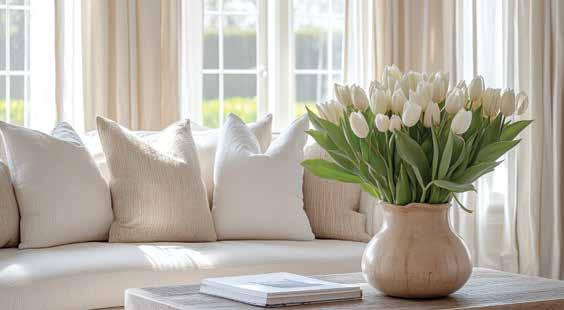
Bring in the Greenery: Tall plants, oversized branches, or dried botanical arrangements bring life and movement.
Architectural Without Construction: Large-scale art, canvas room dividers, textured screens, and tall drapery create the illusion of architectural upgrades.
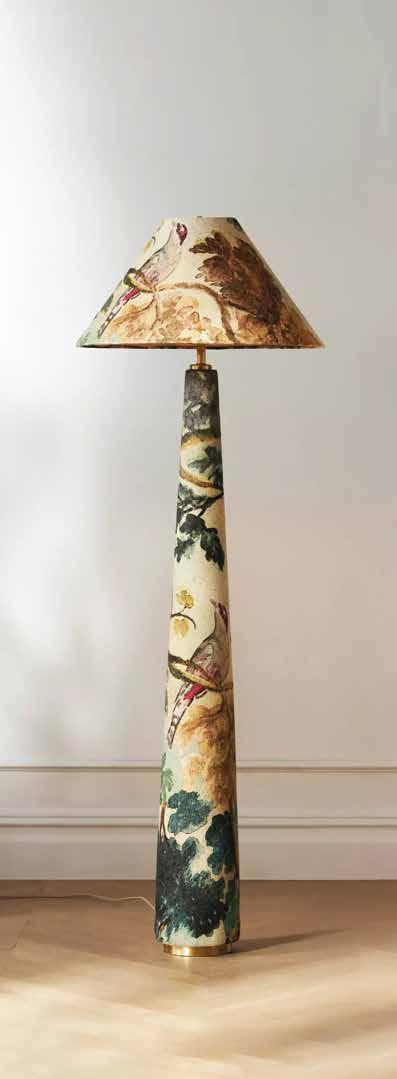
A generously sized lamp in a natural material
2. Fresh bedding in a new color palette
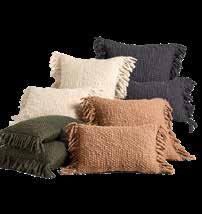
3. A soft, textured area rug
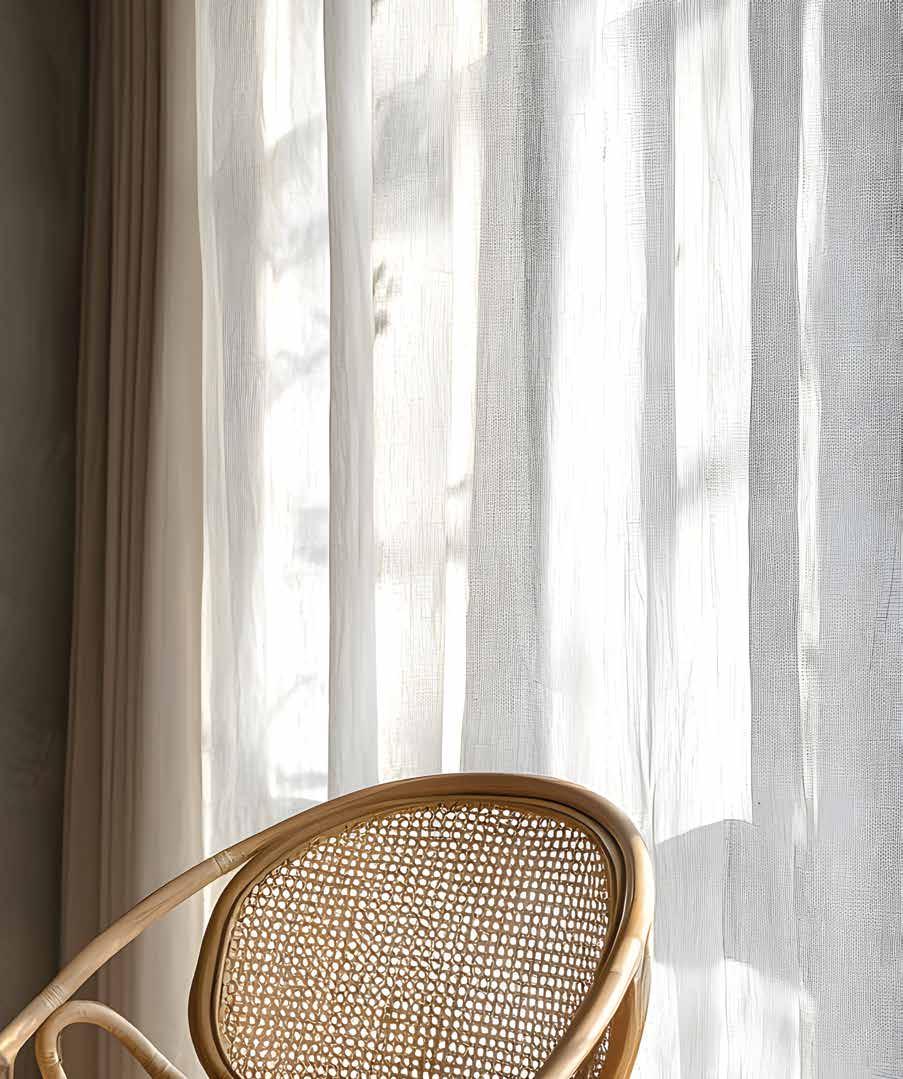
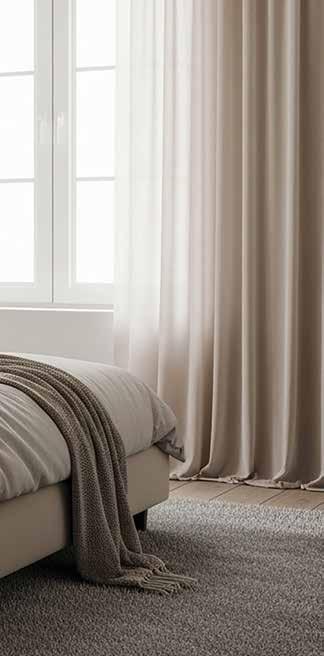
4. Linen curtains that add height and softness
5. A statement side table
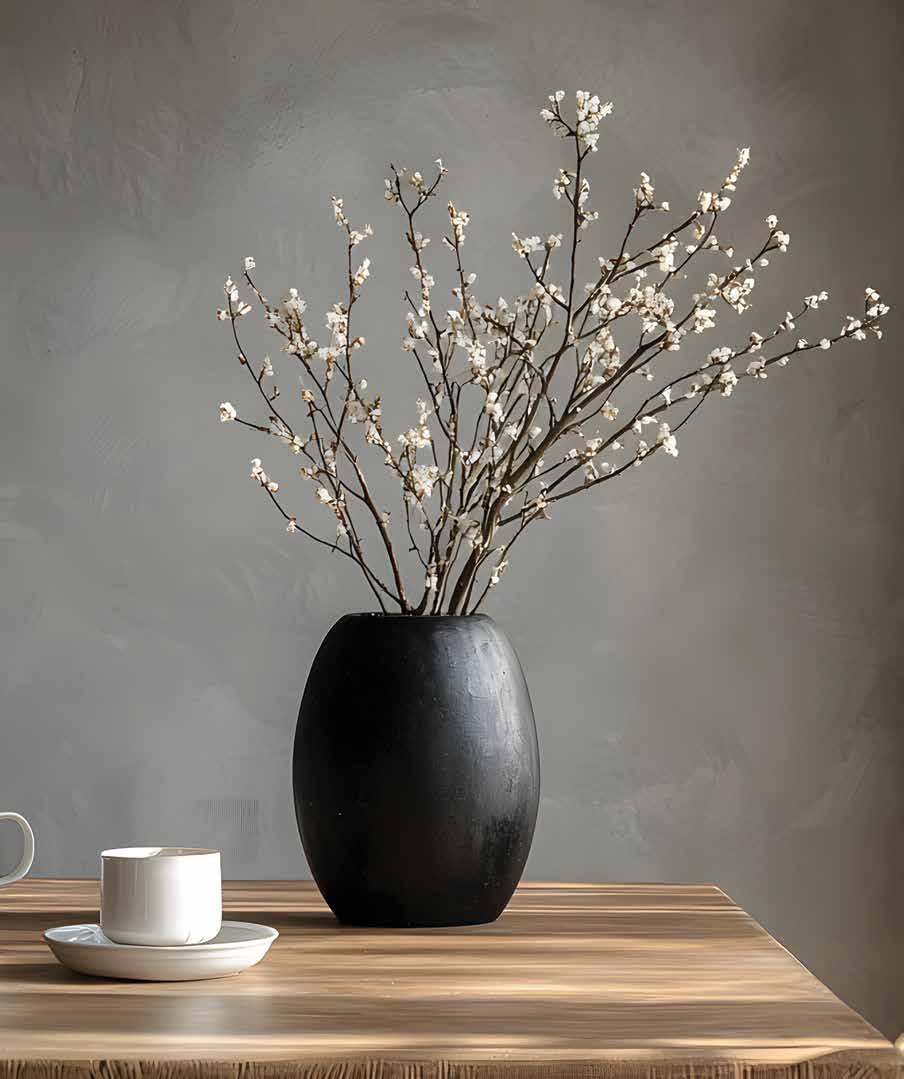
6. Tall branches in a sculptural vase
7. Bathroom accessory refresh in a cohesive finish
8. A large piece of art (or framed textile)
9. A tonal throw pillow set
10. A statement plant like a rubber tree or fiddle leaf
Micro-renovations celebrate the idea that home isn’t a destination, it’s an ongoing story. Every small shift, every new texture, every curated corner is a new chapter. In 2026, design favors warmth over perfection, personality over polish, evolution over overhaul. These small updates don’t just change the look of a room. They change the way you feel in it. And that, at its core, is the real magic of a micro-renovation.
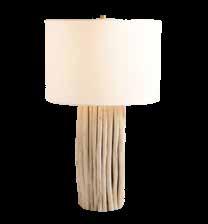
West Driftwood Table Lamp $299
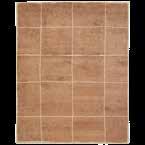
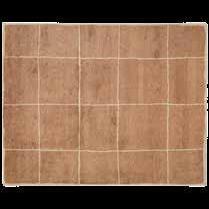
Indoor Rug (3’x5’) $279
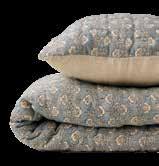
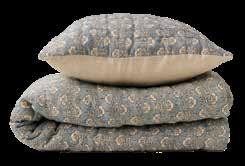
Flora Block Print Quilt $278 | magnolia.com
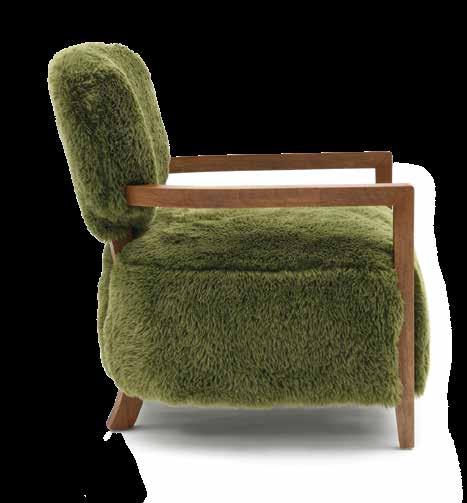
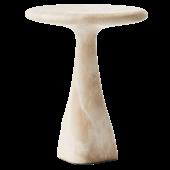
Espira Round Cream Marbled Resin Side Table $299 | cb2.com
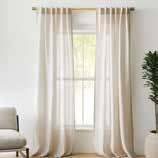
Sheer European Flax Linen Curtain $59 | westelm.com
How Tomorrow’s Technology Is Quietly Transforming the Way We Live at Home
For years, “smart home” was shorthand for gadgets like a novelty lightbulb that changed color on command, a speaker that played your playlist, an app that locked your front door. But in 2026, a smarter home looks and behaves very differently. It feels less like a collection of devices and more like an ecosystem: one that anticipates needs, adjusts to routines, enhances wellness, and uses energy with thoughtful precision. Today’s tech isn’t trying to dazzle you. If anything, it’s trying not to be noticed. The best home innovations fade into the background, quietly improving comfort, nurturing health, and reducing friction in everyday life. What’s emerging is a new standard of living that is seamless, responsive, and surprisingly human. This is the high-tech home of now, and the trends shaping it.
The House That Learns: AI-Driven Home Systems
The smartest homes today aren’t the ones with the most gadgets; they’re the ones where all the technology works together, and learns together. AI-driven home systems are stepping into that coordinating role, turning scattered tools into an intelligent, adaptive network.
Adaptive Thermostats
Unlike the programmed thermostats of the past, today’s learning thermostats don’t wait for instructions. They watch patterns: what time you wake up, when the house empties out, how warm you like it after dinner, how cool you prefer it when you sleep. Within days, the system creates a personalized schedule that saves energy and meets your comfort preferences before you even think about it.
More advanced systems now integrate weather forecasts, local utility rate patterns, and indoor air quality to make adjustments as conditions shift. They behave like the home’s own nervous system, one that’s responsive, attuned, and increasingly autonomous.
Smart Lighting That Feels Natural
Lighting has evolved beyond on/off convenience. New adaptive lighting systems adjust their brightness and temperature throughout the day to align with your circadian rhythm. Morning light is clean and cool to help you wake up. Late-day lighting softens into warm, golden tones that cue your body to settle down.
Motion sensors, geofencing, and AI patterns turn lighting into an ambient experience: the house greets you with a glow as you come home, dims automatically during movie night, and gently brightens in the morning without harshness.
Energy Systems That Do the Math for You
Whole-home energy monitors have stepped into the spotlight as utilities introduce dynamic pricing and sustainability becomes a priority. These monitors identify power-hungry appliances, track usage by the minute, suggest ways to shift consumption to off-peak hours, and even automate energy-saving sequences.
For homes with solar panels or battery storage, AI can now decide the smartest time to store energy, use energy, or sell it back to the grid. It’s the most empowering kind of automation, the kind that saves real money.
Wellness Tech: Creating a Healthier, Happier Home
Wellness is no longer a niche category in home tech. it’s the driving force behind almost every new product. Today’s innovations focus on creating homes that support sleep, air quality, mental health, and physical comfort.
Air Quality Intelligence
Indoor air quality has become a mainstream priority. Advanced sensors now read fine particulates, VOCs, humidity levels, carbon dioxide, and temperature swings with surprising accuracy. When they detect imbalance, like a spike in dust or a drop in oxygen, they automatically trigger air purification or ventilation adjustments.
Some systems now communicate with HVAC units, increasing fresh-air intake or rerouting airflow in real time.
Circadian Wellness Lighting
Unlike aesthetic mood lighting, wellness lighting is rooted in biology. These systems simulate sunlight’s natural progression, which helps regulate melatonin, improve alertness, and enhance overall mood.
Home offices, in particular, are benefitting: people report fewer headaches, less eye strain, and increased focus simply by working under adaptive light.
Smart Humidity and Comfort Controls
Humidity impacts everything from skin, sleep, allergies, even furniture longevity. New smart humidifiers and dehumidifiers constantly read air conditions and adjust output automatically, keeping the home between the ideal 40–60% range. Some systems integrate scent diffusers, essential oils, or ionizing filters to create an environment that supports relaxation or focus.
Water Quality Tracking
Add-on devices for faucets and whole-home filtration systems can now test water purity on demand, presenting mineral content, pH levels, or potential contaminants in real time. It’s wellness in a form that’s usually invisible, until now.
The Kitchen of the Future: Sleek, Efficient, Effortless
The kitchen remains the most high-impact room for smart innovation. The trend is clear: technology that reduces waste, streamlines cooking, and supports healthier eating.
Smart Refrigeration and Inventory Tracking
Today’s refrigerators no longer just keep food cold, they manage it. Internal cameras and inventory apps recognize items, track expiration dates, suggest recipes based on what you already have, and remind you when staples run low.
It’s a true assistant, ensuring freshness and reducing food waste.
Induction Cooking Goes Mainstream
Induction cooking has officially shifted from trend to standard. Faster than gas, safer for families, and more energy-efficient, induction cooktops now include advanced features like:
• auto-simmer and boil detection
• pan sensing
• app-controlled temperature
• safety shutoff
They’re sleek, clean, and aligned with the growing environmental focus in home design.
Deep Integration With Apps and Assistants
From preheating the oven while you drive home to scanning a wine bottle for instant pairing suggestions, the kitchen is becoming more responsive and communicative. Voice assistants can now guide multi-step recipes and adjust timers or heat settings without you touching anything.
The Smart Garden: Tech That Makes Growing Easier
2026’s version of a smart home extends beyond walls and into the garden, or even the countertop.
Automated Irrigation Systems
Connected irrigation systems use weather data, soil sensors, and moisture readings to give plants exactly the water they need, exactly when they need it. Many can cut water use by 30–50% while keeping gardens healthier.
Home Hydroponics
Compact, beautifully designed hydroponic units allow year-round growing of herbs, lettuces, edible flowers, and some vegetables. Modern systems adjust their own lighting, nutrient levels, and watering cycles. No green thumb required!
The Smart-Home Sweet Spot: What’s Worth It?
Not all tech is created equal. Some upgrades truly change the way you live. Here are the investments that deliver the biggest impact:
Worth the Investment:
• AI thermostat + whole-home energy monitor: immediate comfort + long-term savings
• Circadian lighting system: major improvement in mood and sleep
• Advanced air purification with sensors: especially valuable for allergies or pets
• Induction cooktop: safer, faster, cleaner
• App-based irrigation system: ideal for both avid gardeners and novices
Soil Sensor Intelligence
Pocket-sized soil monitors now offer precise readings of moisture, sunlight, pH, and nutrient levels. Paired with plant-care apps, they tell you exactly when to water, rotate, or feed. For plant lovers, this is the next best thing to telepathy.
Robotic Tools
Robotic mowers, weeders, and seed-spreaders are poised to become the new battery-powered helpers of the backyard. They free up time and reduce physical labor which is perfect for homeowners who love a thriving yard but not the heavy lifting.
The Future of Home Tech Is Invisible
The most interesting thing about the smart homes of today is how little they feel like “tech homes.” The blinking gadgets and complicated dashboards of earlier years are being replaced with technology that blends into the background.
Lights shift gently without calling attention to themselves. Air circulates invisibly. Appliances self-monitor. Gardens thrive. Energy is used strategically. The house anticipates rather than reacts. The experience is less about fascination and more about ease.
The best high-tech innovations don’t change your home, they change how you live in it.
Technologies homeowners repeatedly say they would buy again...
Under $200: Big Results, Low Commitment
Some of the most impressive advances fall under the “affordable but transformative” category:
a Portable AQ sensors
a Smart plugs
a Voice-activated assistants
a LED grow lights for indoor plants
a Smart light strips for under-cabinet lighting
a Digital water-quality meters
a Bluetooth radiator valves
a App-connected humidifiers
Upgrades that give you a taste of future living without a major investment...
One of the biggest misconceptions about home tech is that setup requires expertise. Today’s devices range from incredibly simple to better-left-to-a-pro.
Recommended: Hardwired lighting systems, induction conversions, whole-home panels, integrated water treatment. Most upgrades are surprisingly approachable — making 2026’s high-tech home more accessible than ever.
The Home The Home
Color Forecast Color Forecast
What’s Next for Walls, Woodwork + Mood
Every year, as the calendar turns, interiors quietly shift. Walls that once glowed crisp white begin to deepen. Neutrals grow warmer. Greens and blues relax into more natural, soothed tones. In 2026, we’re seeing a subtle but powerful recalibration: design palettes are turning toward grounding warmth, nuanced depth, and nature-inflected calm.
Fueled by cultural desire for comfort and balance — and a growing hunger for interiors that feel rooted in the real world — the top paint houses and trend watchers are pointing to a new spectrum of color: soft neutrals, smoky botanicals, moody charcoals, and refined accents. Here’s your forecast.
Forecast Forecast
2.
The Mood Shift: Why This Year Looks and Feels Different
After a decade or more of crisp minimalism — with austere whites, cool grays, and sleek blacks — many homeowners are ready for something softer. 2026 isn’t about high-contrast drama or high-gloss coldness. It’s about texture, depth, and the comfort of familiarity.
In design circles, this plays out as a move toward “quiet living”: spaces that welcome you, that age gracefully, and that adapt to multiple uses. Paint colors are no longer just a backdrop — they’re foundational to a home’s emotional tone.
Across this year’s “Colors of the Year” from many major brands, the through-line is unmistakable: earth-inspired, nature-rooted, quietly sophisticated. With that in mind, here are the top color directions we expect to define homes in 2026 — and how to use them well.
1.
The New Neutrals: Soft, Grounded, Welcoming
Forget sterile white or moody gray as the default. In 2026, neutrals are getting an upgrade — warm, sandy, and embracing subtle complexity.
Rich Browns & Charcoals: Depth, Drama, and a Hint of Restraint
Browns and deep charcoal tones are resurging, not as heavy statements, but as grounding anchors.
Sherwin‑Williams’s 2026 Color of the Year, Universal Khaki (SW 6150), exemplifies this direction: a mid-tone neutral with gentle yellow-khaki undertones that reads as warm and grounded.
Dutch Boy Paints chose Melodious Ivory (313 2DB), a creamy off-white that slides comfortably between classic warmth and modern softness — ideal when you want brightness without coldness.
WHY PEOPLE ARE DRAWN TO THESE: They act like a canvas that quietly supports life — furniture, textiles, plants — rather than competing with them. These neutrals fare beautifully under both natural and artificial light; they adapt to shifting seasons and subtle decor changes.
WHERE TO USE THEM: As main wall colors in living rooms, hallways, or primary bedrooms. Also fantastic for ceilings and trim — a warm “blank slate” that lets other design elements take center stage.
Benjamin Moore’s 2026 Color of the Year, Silhouette (AF 655), is described as a deep espresso-charcoal hue: rich, sophisticated, and versatile. It reflects a broader resurgence of interest in the brown color family.
Some trend forecasts show charcoals and greige-browns as the new “anchor neutrals,” offering a serious alternative to black or stark gray which are good for creating cocooned, intimate spaces.
WHY THIS MATTERS NOW: In times of flux, darker tones feel stabilizing. They add weight and permanence to rooms, create contrast with lighter neutrals, and offer a dramatic backdrop for art, woodwork, or metallic accents.
USE WISELY: Try Silhouette or a charcoal-brown mix on cabinetry, accent walls, or even ceilings — think dens, home libraries, dining rooms. For an elevated yet moody vibe, pair with brushed metallic hardware, soft lighting, and natural textures.
Sherwin-Williams Universal Khaki
Dutch Boy Paints Melodious Ivory
Benjamin Moore Silhouette
3.
4.
Moody
Blues & Atmospheric Charcoals: Calm Meets Cool
Blue remains a go-to — but 2026’s blues are softer, moodier, and more atmospheric than the saturated navy or bright “coastal blue” of past seasons.
Design trend round-ups are projecting muted blues and soft slate tones as staples for the year, often juxtaposed against warming neutrals and natural textures for a balanced, modern look.
WHERE THIS WORKS: Bedrooms, home offices, bathrooms — or any room where you want calm and depth. Try slate-blues on built-ins, fireplaces, or accent walls, paired with warm woods, cashmere-toned rugs, and soft lighting for contrast.
2026 isn’t abandoning color — but it’s embracing subtler, emotionally rich accents over loud trendiness. Think of warm spice, soft mauves, and earthy terracottas.
Although not every brand has named a bold accent shade for 2026, the broader shift toward richer, warmer undertones suggests that these colors will continue creeping into home palettes — in art, upholstery, textiles, and accessories.
USE THEM AS: punctuation — a burnt-paprika pillow, a clay-toned throw, a mauve-tinged accent wall. They’re ideal for making a neutral room feel personal and layered.
Botanical Greens & Smoky Jades: Nature Moves In Greens are evolving — moving away from bold “houseplant” shades and toward softer, mineral-inspired neutrals.
Behr’s 2026 Color of the Year, Hidden Gem (N430 6A), is a smoky jade that blends blue and green into a surprisingly versatile tone — described by Behr as a “new neutral.”
Other trend watchers highlight muted sages, faded eucalyptus, and dusty moss tones as strong candidates for 2026 interiors.
THE APPEAL: These shades evoke calm — the kind you feel in shaded gardens or quiet forests. They bring an organic softness and pair beautifully with natural materials (wood, linen, clay) and greenery.
HOW TO USE THEM: On kitchen cabinetry, bathroom vanities, entryways — places where you want a sense of calm and rootedness. For drama, consider a full “color-drench” approach: walls, trim, even built-ins in Hidden Gem, balanced with warm neutrals and natural wood.
6.
Layering, Texture & Tone-on-Tone: The New Rules for 2026
What sets 2026 palette direction apart is not just the color — it’s how you use it. This year, layering, texture, and tonal variation are just as important as hue.
• Pair Warm Neutrals with Smoky Greens + Aged Metals
• Combine Deep Charcoal with Wood and Woven Textiles
• Try “Tonal Drench” — same hue on walls, trim, doors — but in varying sheens or textures
It’s not maximalism. It’s intentional depth — a softly layered richness that feels curated, not chaotic.
Behr
Hidden Gem
How to Use the Forecast Smart Decorating Moves for 2026
Here are practical, smart ways to bring the 2026 palette into your home — whether you’re doing a full room rebalance or a subtle seasonal refresh.
Goal
Update Without Full Repaint
Try This Why It Works
Use a 2026 neutral (Universal Khaki/Melodious Ivory) on a single wall, or re-paint door frames/trim
Ground Busy Décor or Open Floor-Plan Paint all built-ins, trim, and molding the same warm neutral
Add Depth in a Cozy Room
Make Small Rooms
Feel Larger but Not Sterile
Bring in Personality
Use smoky green (Hidden Gem) or deep brown (Silhouette) on cabinetry or accent wall, then layer wood and soft textiles
Use misty slate blue or softened neutral on walls + ceiling
Spice-toned pillows, throws, rugs, or small furniture — or try a terracotta accent wall
Warmer neutrals refresh the space without drastic change
Creates cohesion and anchors a varied interior
Provides intimacy, richness and connection to nature
Keeps brightness while adding subtle color dimension
Accent tones inject warmth without overwhelming
What This Forecast Means for the Year Ahead
Neutrals are back — but warmer and more personal. Gone are the days of “pure white everything.” 2026 wants nuance, depth and subtle variation.
Nature wins. Botanical greens, earthy browns, stone-matte finishes, and natural textures — all signal a return to materials and colors grounded in the real world.
Softer drama over sharp contrast. Rather than high-contrast black/white or saturated jewel tones, the palette leans toward moodier, layered subtleties. Flexibility and longevity. The colors trending now are meant to age well, shift with lighting or seasons, and evolve with personal décor changes.
If 2025 was about renewal and bold recalibration, 2026 is about settling in: drawing warmth from surroundings, creating homes that feel lived-in and soulful, and building interiors that reflect life, not just style.
Use this forecast as a guide, not a rulebook. Think of these colors as building blocks. Mix them, layer them, and use them as needed. And when you tap into the quiet confidence of 2026, your home doesn’t just look current — it feels timeless.
One Pot, Big Flavor
As the year kicks off, we want meals that are delicious and comforting without demanding too much time or energy. This is the season of simple rituals: a pot simmering on the stove, a sheet pan sliding into the oven, dinner coming together with minimal fuss and maximum comfort.
These recipes streamline the process without sacrificing flavor. Here, you’ll find ingredients that build on one another, dishes that practically cook themselves, and cleanups that stay blissfully minimal. There’s something deeply satisfying about letting a single pan do the heavy lifting, filling the kitchen with warmth and familiar aromas. As we ease into the year ahead, these meals offer a gentler approach to cooking: cozy, practical, and designed for real life.
One-Pot Lemon Orzo with Seasoned Shrimp
Serves 4
INGREDIENTS
2 tbsp olive oil
1 lb large shrimp, peeled and deveined
1 tsp paprika
½ tsp garlic powder
½ tsp dried oregano
½ tsp salt
¼ tsp black pepper
1 small onion, finely chopped
2 cloves garlic, minced
1 ½ cups orzo
3 cups chicken or vegetable broth
Zest of 1 lemon
¼ cup lemon juice
½ cup crumbled feta
Fresh parsley, chopped
Lemon slices, for serving
INSTRUCTIONS
1. In a bowl, toss shrimp with paprika, garlic powder, oregano, salt, and pepper. Set aside.
2. In a large skillet or wide pot, heat 1 tablespoon of olive oil over medium heat. Add the onion and cook until softened, about 5 minutes. Add the garlic and cook for 30 seconds.
3. Stir in the orzo and cook for 1–2 minutes until lightly toasted.
4. Add broth, lemon zest, and lemon juice. Bring to a simmer, reduce heat to low, cover, and cook for 10–12 minutes, stirring occasionally, until the orzo is tender and most liquid is absorbed.
5. Meanwhile, heat the remaining tablespoon of olive oil in a separate small skillet over medium-high heat. Add the seasoned shrimp and cook 2–3 minutes per side, until opaque and slightly charred at the edges.
6. Fluff the orzo and fold in half of the feta. Top with shrimp, remaining feta, parsley, and lemon slices.Serve warm.
Loaded Sheet Pan Nachos
Serves 6
INGREDIENTS
1 bag tortilla chips
1 lb ground beef or turkey
1 tbsp chili powder
1 tsp cumin
1 tsp smoked paprika
½ tsp garlic powder
½ ttsp onion powder
1 tsp salt
1 cup shredded cheddar or Mexican blend cheese
1 cup shredded Monterey Jack
1 cup cherry tomatoes, halved
1 avocado, diced
½ cup red onion, diced
1 jalapeño, sliced
¼ cup cilantro leaves
Lime wedges, for serving
Optional toppings: sour cream, salsa, pico de gallo, guacamole
INSTRUCTIONS
1. Heat oven to 400°F. Line a sheet pan with foil or parchment.
2. In a skillet over medium heat, cook the ground beef until browned. Drain excess fat. Stir in chili powder, cumin, smoked paprika, garlic powder, onion powder, and salt. Cook for 1–2 minutes to bloom the spices.
3. Spread tortilla chips onto the sheet pan. Top with half the cheese, followed by the seasoned meat, and then the remaining cheese.
4. Warm in the oven for 8–10 minutes, or until the cheese is fully melted.
5. Scatter tomatoes, avocado, red onion, jalapeño slices, and cilantro over the hot nachos. Serve with lime wedges and desired extras.
One-Pot Golden Chicken & Rice (Serves
4)
INGREDIENTS
2 tbsp olive oil
4–6 bone-in chicken pieces (drumsticks + thighs)
Kosher salt and freshly ground black pepper
1 large onion, finely sliced
3 cloves garlic, minced
1 tsp smoked paprika (optional but adds warmth)
1 cup long-grain white rice, rinsed
2 ¼ cups chicken broth
½ cup pitted olives (Kalamata or similar)
1 tbsp lemon juice (optional)
Fresh parsley, chopped, for garnish
INSTRUCTIONS
1. Heat the olive oil in a wide, heavy pot or Dutch oven over medium-high heat. Pat the chicken dry and season generously with salt and pepper. Add the pieces to the pot and cook until golden on both sides, 8–10 minutes total. Transfer to a plate.
2. Lower the heat to medium. Add the sliced onion to the pot along with a pinch of salt. Cook, stirring often, until softened and golden around the edges — about 8 minutes. Add the garlic and paprika and cook 1 minute more, until fragrant.
3. Stir in the rice, coating it in the onion mixture so each grain glistens. Pour in the chicken broth and stir, scraping up any browned bits from the bottom of the pot.
4. Nestle the browned chicken pieces back into the pot along with any accumulated juices. Scatter the olives around them. Bring the mixture to a simmer.
5. Reduce the heat to low, cover, and cook for 25–30 minutes, or until the rice is tender and the chicken is cooked through. Avoid lifting the lid too often — the steam is doing important work.
6. Remove from heat and let sit, covered, for 5 minutes. Uncover, drizzle with lemon juice if using, and fluff the rice lightly around the chicken. Garnish with parsley. Serve straight from the pot, family-style.
Slow Cooker Beef Roast with Potatoes & Carrots
(Serves 6)
INGREDIENTS
3–4 lb beef chuck roast
1 ½ tsp kosher salt
1 tsp black pepper
1 tbsp olive oil
1 large onion, sliced
4 cloves garlic, smashed
1 lb baby potatoes, halved
4–5 large carrots, cut into chunks
1 cup beef broth
½ cup red wine (or extra broth)
2 tbsp tomato paste
1 tbsp Worcestershire sauce
2 sprigs fresh rosemary
4–5 sprigs fresh thyme
INSTRUCTIONS
1. Heat olive oil in a large skillet over medium-high heat. Pat the roast dry and season with salt and pepper. Sear on all sides until deeply browned, 3–4 minutes per side. Transfer to the slow cooker.
2. Add the onions, garlic, potatoes, and carrots around the roast.
3. In a bowl, whisk together broth, wine, tomato paste, and Worcestershire. Pour over the roast and vegetables.
4. Tuck rosemary and thyme around the roast.
5. Cover and cook on LOW for 8–10 hours or HIGH for 4–5 hours, until the meat is fall-apart tender.
6. Remove herbs. Slice or shred the roast and serve with vegetables, spooning plenty of cooking juices over the top.
Sheet-Pan Hawaiian Chicken (Serves
4)
INGREDIENTS
2 lb chicken thighs or drumsticks
1 red bell pepper, sliced
1 small red onion, cut into wedges
2 cups fresh pineapple chunks
3 green onions, sliced
1 tbsp sesame seeds
FOR THE SAUCE:
½ cup soy sauce
¼ cup pineapple juice
3 tbsp brown sugar
2 tbsp rice vinegar
2 tbsp ketchup
1 tbsp grated fresh ginger
2 cloves garlic, minced
1 tbsp cornstarch mixed with 2 tbsp water
INSTRUCTIONS
1. Heat oven to 425°F. Line a sheet pan with parchment or lightly oil it.
2. In a small saucepan, whisk together soy sauce, pineapple juice, brown sugar, rice vinegar, ketchup, ginger, and garlic. Bring to a simmer over medium heat. Stir in the cornstarch slurry and cook until glossy and thickened, 1–2 minutes. Remove from heat.
3. Place chicken on the sheet pan and season lightly with salt and pepper. Spoon about half of the sauce over the chicken, coating well.
4. Scatter pineapple chunks, red pepper slices, and red onion wedges around the chicken.
5. Bake for 30–35 minutes, or until chicken is deeply caramelized and cooked through (165°F). Toss the vegetables halfway through so they roast evenly.
6. Brush the remaining sauce over the hot chicken for extra shine and flavor.
7. Sprinkle with green onions and sesame seeds before serving.
Moroccan Chickpea & Carrot Stew
Serves 4
INGREDIENTS
2 tbsp olive oil
1 onion, diced
3 cloves garlic, minced
1 tbsp tomato paste
1 tbsp ground cumin
1 tsp ground coriander
1 tsp smoked paprika
½ tsp turmeric
¼ tsp cinnamon
Pinch of red pepper flakes (optional)
4–5 large carrots, sliced into rounds
1 can (14.5 oz) diced tomatoes
2 cans (15 oz each) chickpeas, drained and rinsed
3 cups vegetable broth
Salt and pepper to taste
½ cup chopped fresh cilantro (plus more for topping)
Lemon wedges, for serving
INSTRUCTIONS
1. Heat olive oil in a pot over medium heat. Add the onion and cook until softened, about 5 minutes. Stir in garlic and tomato paste; cook 1 minute more.
2. Add cumin, coriander, smoked paprika, turmeric, cinnamon, and red pepper flakes. Cook for 30 seconds, stirring constantly.
3. Stir in the carrots, diced tomatoes, chickpeas, and broth. Season with salt and pepper. Bring to a simmer.
4. Cover and simmer for 25–30 minutes, or until carrots are tender and the stew has thickened slightly.
5. Stir in the cilantro and adjust seasoning.
6. Ladle into bowls and top with extra cilantro. Serve with lemon wedges.