Winter 2024

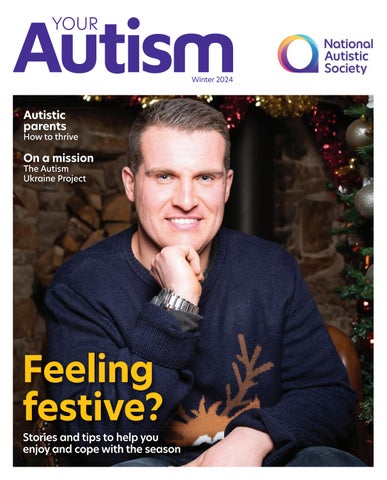
Autistic
parents
How to thrive
On a mission
The Autism
Ukraine Project


![]()

Winter 2024

Autistic
parents
How to thrive
On a mission
The Autism
Ukraine Project


Stories and tips to help you enjoy and cope with the season


EDITOR
Suzanne Westbury YourAutismMag@nas.org.uk
CONTRIBUTORS
Helen Wilson, Grace Liu
PHOTOGRAPHER
Alex Heron
HEAD OFFICE
National Autistic Society
Weston House 42 Curtain Road London EC2A 3NH autism.org.uk
SUPPORTER CARE TEAM
0808 800 1050 membership@nas.org.uk
ADVERTISING
James Pembroke Media
Tel: 020 3859 7100 jacob.tregear@jamespembroke media.co.uk
SUBSCRIPTIONS
Only available to members of the National Autistic Society. To join, visit autism.org.uk
DESIGN AND PRODUCTION
CPL One
01223 378000 cplone.co.uk 1 Cambridge Technopark, Newmarket Road, Cambridge CB5 8PB
Warners Midlands 01778 391000
National Autistic Society is a charity registered in England and Wales (269425) and in Scotland (SC039427) and a company limited by guarantee, registered in England (No.1205298), registered office Weston House, 42 Curtain Road, London, EC2A 3NH
© Your Autism magazine Winter Vol 58, No 4 National Autistic Society ISSN 2055-0413
The views expressed in Your Autism and any enclosures or advertisements are not necessarily those of the National Autistic Society. In the interest of providing readers with the widest range of information, we may include details of some of the many approaches to autism. However, this does not imply our charity’s endorsement of any particular approach or product. The inclusion of a website does not necessarily imply that our charity endorses or supports the group or individuals running the website, nor does the absence of a website imply that our charity does not endorse or support the group or individual running the website.


What’s new
A round-up of the latest news
Campaigns


Join in with World Autism Acceptance Month in 2025
My diagnosis Pablo tells his story
Coping with Christmas Hayden and Cerys share their stories
Top tips for the festive season
How to make Christmas easier
Making Waterloo Station autism friendly
We look at the changes that have been made


Star bakers!


Setting up JubyLee Bakes
The Autism Ukraine Project
Delivering anxiety-reducing aid
Readers to the rescue
Regulating emotions during the festive period
Weathering the storm
How to help your autistic child during extreme weather
Parenting when you’re autistic
How to thrive as a parent
Notebook
Things to read, do and see
Nice to meet you... Sophie, Shane and Nelson
“Eight in ten autistic people report difficulty with visiting a GP”
Our round-up of the latest news and views Get
Our Young Ambassadors have launched a campaign asking the Health Secretary to act on barriers to healthcare for autistic people. Eight in ten autistic people report difficulty with visiting a GP, and autistic people are more than three times more likely to leave an appointment feeling as though they did not receive any help at all. Lack of understanding and adjustments can lead to distress, inappropriate treatment and misdiagnosis.
Rosie shared her experience of a hospital stay: “I was unable to speak or eat because of the high stress of the sensory environment, and this was deemed as signs of mental illness. I felt very humiliated being told I had to speak when I was not able to, and being forced to try, even when it was clearly causing more and more distress –to the point we could not even continue. This prolonged my stay

in hospital and led to misinformed or unnecessary referrals.”
Daisy added: “My experiences are made difficult by bright, fluorescent, often flickering lights, sudden beeps and unexpected noises, and being touched without prior explanation.”
Tickets are on sale for our Annual Professionals’ Conference on Thursday 13 March 2025. The theme is ‘Exploring neuroaffirmative practice’, and topics being discussed include autism and ADHD, support at university and being a good ally. Join us online for a full day of expertled sessions, chaired by Dr Carly Danesh-Jones and Tim Nicholls. See the full programme and book now at autism.org.uk/conferences
The group is asking Health Secretary Wes Streeting to consult directly with autistic people on their healthcare experiences and the adjustments that could make a big difference.
Read more at autism.org.uk/annhs-fit-for-autistic-people


We’ve launched several new free resources recently:
Our Know yourself series is aimed at autistic teenagers. Each topic has a short video and PDF guide. We have added two new topics: Setting yourself up for success and Exploring your identity. The other resources in the series are Understanding yourself and Energy accounting. You can find the series at autism.org.uk/knowyourself


Our new downloadable guide offers advice for autistic people going through menopause or perimenopause. It includes what to expect during the menopause, insight from an autistic person’s menopause journey and tips on what can make it easier.
Download the guide at autism.org.uk/ menopause


The National Autistic Society Scotland’s new podcast, Spectrum Sessions, is now on YouTube and Spotify. Hosted by Heather Carson, our Media and Communications Officer, the podcast aims to platform unfiltered autistic voices by providing a space for autistic people to share their stories. Guests include Lewis Gribben (actor), David Nicholson (musician), Chris Carse Wilson (author), Katie Forbes (founder of Autistic Flair) and Nuala MacDonald (BBC documentary star). Tune in for candid discussions about diagnosis journeys, experiences in school and what it means to be autistic.
Watch on YouTube: bit.ly/4dr7QeI
Listen on Spotify: bit.ly/4gNSIv4
Employment resources coming soon


The NHS has implemented a new mental health support option as part of its 111 non-emergency service. The service can be used by anyone seeking non-urgent support for a mental health problem (across England, Scotland and Wales) by selecting Option 2 when calling 111. People seeking crisis support in Northern Ireland can continue to access this via Lifeline at lifelinehelpline.info

Autism Central has launched a new webinar series, with Dr Naomi Fisher and Eliza Fricker, for parents and carers. The series on navigating education and working well with school has seven episodes, including Reasonable adjustments and EHCPs, School attendance and Why is school hard? To watch, go to autismcentral.org.uk/school
Our Autism Services Directory lists services and support for autistic people, their families and the people who work with them.
We have recently made some changes to the Directory, including an enhanced user-friendly design and improved functionality. It’s now also easier for businesses to add themselves and keep their listing up to date.
We’ll be adding more employment-related advice and guidance, toolkits and video stories to our website in January 2025. See autism.org.uk/advice-and-guidance
We would like to increase the number of services and professionals listed on the Directory. If you offer a service or support for autistic people, please register at autism.org.uk/directory
Buy our gorgeous Christmas cards
We are excited that, this year, we have a range of cards all designed by autistic artists from our Artrack service in Kent. The artists have created some amazing designs, and we are delighted to have this range showcasing their talents! To buy your cards, visit autism.org.uk/Christmas-cards
Gifts That Do Good eGift cards
Looking for a gift? When you buy one of our Gifts That Do Good eGift cards on behalf of a loved one, 100% of the donation amount will go to supporting autistic people and their families. It could be used to help provide expert advice on our website, emotional support for parents, connection with like-minded people via our online community and friendship via our local branches.
Find out more at autism.org.uk/ giftsthatdogood


House of L Toys donates 20% of profits from its Mindful range to our charity. The Mindful Sensory brand is all about mixing fun, novelty and learning, designed especially with neurodiversity in mind. Products are available at The Works, both in-store and online.
Advent of Change is a non-profit organisation that creates products such as advent calendars and candles that donate to multiple charities with each purchase, including the National Autistic Society. Its mission is to promote a fair, equal and sustainable world. Check out its products at adventofchange.com
My Sliding Wardrobe has chosen us as its Charity of the Year. Customers can opt to round up their order value, with the company contributing an additional £3 for every £1 raised. Explore its offerings at myslidingwardrobe.co.uk
Our charity recently approved Kinetic Sand after testing it with autistic product testers and their family members. Kinetic Sand offers hands-on play that stimulates curiosity and creativity, making it a great gift for kids. Visit kineticsand.com for more information.


Supporting autism acceptance is a year-round effort, but in April 2025, we want everyone to get involved and campaign with us! We’re helping schools and employers mark the occasion and encouraging people to celebrate and fundraise their way
At home, you can:
● walk 5k or fundraise your way to celebrate however you like
● attend our London Spectrum Colour Walk event for a fun day out
● share your photos, stories and campaigning goals
● join our campaign on social media.
At work, you can:
● organise a sponsored walk or get your team involved in some virtual or face-to-face fundraising activities
● utilise our free workplace resources to raise awareness and take action.
At school, you can:
● get your teachers and pupils involved in fun activities to raise money and help create more inclusive schools
● use our free lesson plans and resources to raise awareness and help children and young people understand autism
● share our resources with parents.
Register your interest to receive regular updates at autism.org.uk/world-autism-acceptancemonth-2025/register-your-interest


Meet Sue, who walked for us last year with all the family!
Where did you do your 5km walk for World Autism Acceptance Week?
We went to one of our favourite places, Saltburn Beach. It’s so lovely and relaxing and right on our doorstep.
Why did you choose to support the National Autistic Society?
Our youngest daughter Rosie is 25 and is autistic/ ADHD and ADD. She is so positive and a happy ray of sunshine. We have grandchildren and family members mid-diagnosis, so the charity is close to our heart, and we are members.
What does autism acceptance mean to you?
To be accepted as unique individuals and have good opportunities in schools and workplaces.
To have support, empathy, patience and understanding of the many difficult situations we can face on a daily basis.
For physical and financial help to be assessed properly and for people not to judge children or adults on how they may look, speak or act.
“Our youngest daughter Rosie is so positive and a happy ray of sunshine”
Did you enjoy your walk and fundraising?
Yes, we love raising money for charities and it was so much fun, seeing everyone smile and want to donate to the cause.
I couldn’t walk too far, but my friend dawdled along with me, and Rosie was having fun with her Dad, Paul, chatting with everyone!
How much did you raise? We raised around £270.
Are you planning to join us again next year? Yes, we are looking forward to next year.


Pablo talks about his experiences growing up without a diagnosis, and how he wants to help schools build empathy around autistic people’s differences
When I was 30 years old, I went to a talk by a person who was speaking about being autistic. He spoke about his childhood and years spent at school, and it was a very similar experience to mine in many ways.
By the time I got my diagnosis, I had already completed a Master’s degree, researching neurodivergence through screenwriting. I had also started working in schools for autistic people, participated in numerous workshops on autism and made a film about autism.
The logical thing to do was to complete the diagnosis as well.
However, I had a very bad time at school. I was always considered a very bad student, and the teachers always punished me. I got into trouble with other children all the time because they teased me.
I had a lot of anger and sadness because I always thought I was a bad child. Even when my mother took me to psychological therapy, I thought it was because I was a bad child.
Since getting a late diagnosis, I have developed many strategies so that I am not too affected by some of the obstacles that used to be very big – and are now less so.
I wish schools were more understanding about autism, especially teachers and headteachers, to create a safe space for autistic children and to openly talk about this topic in class, so that all children can understand.

I directed a short film called In my world, in your eyes – A window into autism to create empathy and understanding of the neurodivergent world. We will be taking the film into primary schools and doing workshops with children. It’s important for neurotypical children to see that, as there are differences, so there are also many similarities between neurotypical and neurodivergent people. We all struggle with different obstacles, and it is important that we show empathy for each other.
It’s essential that autistic children do not fall into depression, become victims of bullying, end up hating school or have to be taken to other centres just because there has been a lack of understanding.
By being in a safe environment, neurodivergent teenagers accept themselves more easily and feel happy about being autistic. They talk openly about their obstacles and even make jokes about them, and that is beautiful. It’s important that you like yourself and can be happy with the differences that come with being neurodivergent. Hear
Hayden and Cerys share their feelings on the festive season and what helps them at this busy time of year

Hayden’s story
Hi Hayden! Our first question is: what do you think of when you hear the word ‘Christmas’? It sounds exciting when Christmas comes around – spending time with the family, opening presents, enjoying ourselves, playing games, watching Christmas films, eating mince pies and drinking cups of tea by the fireplace. But also Christmas makes me think of too many lights, loud noises and crowded places. It’s a time when everything feels overwhelming, shopping is stressful and I struggle to find peace and cope with it all. But it also reminds me of the kindness of others, the warmth of being with family, and the hope that maybe this year will be a little easier.
What aspects of the festive period do you find are the most difficult?
I worry about lots of social gatherings and what could happen, as it is a change of routine with people I don’t see much and could result in stress. Christmas would be easier if people understood that I need my space and quiet time.
Having a clear plan and sticking to it helps a lot. If I could experience Christmas in a way that isn’t so overwhelming − maybe with fewer lights and quieter gatherings − it would make the season much more enjoyable.
What has been your worst experience of Christmas or the festive season?
The worst experiences have been because Christmas is a big change to my routine. The hardest parts are the unpredictability and the sensory overload. The lights, music and crowds make me anxious. The pressure to be social when I don’t have the energy and the changes in routine make me feel lost and out of control.
Are there any aspects of Christmas that you enjoy?
Personally, I enjoy the quiet moments when I can just be with my family. I like the small traditions, such as decorating the Christmas tree or watching a favourite movie. When

things are calm and I know what to expect, I can find happiness in those moments.
Have you accessed any services or advice provided by the National Autistic Society at Christmas?
Yes, I’ve used the National Autistic
“Having a clear plan and sticking to it helps a lot”
Society’s resources to better understand how to manage sensory overload and anxiety. Your advice has helped me and my family navigate difficult situations, especially during holidays such as Christmas. I’ve used your guidance on creating a calm and structured environment. Your advice on coping strategies for sensory overload has made a huge difference. It’s helped me communicate my needs better, and my family has learned how to support me in a way that makes Christmas more bearable.
Cerys’ story
Hi Cerys! It’s that time again… what do you think of when you hear the word ‘Christmas’?
My immediate go-to is ‘busy’! Christmas is such a busy time, with lots of people, events, socialising, shopping and planning. I feel a mixture of anxious and excited –two feelings that often come hand-in-hand for me.
What aspects of the festive period do you find are the most difficult?
For me, it’s the pressure to mask and put on a brave face for the people around me so that they have a great time. When other people enjoy the music, the lights and the influx of socialising, it’s really hard to
speak up and say that it makes me feel uncomfortable or anxious, which means I spend a lot of the festive period masking.
What has been your worst experience of Christmas or the festive season?
Christmas Day is a particularly loud day, filled with constant chatter, festive music playing at all times, more people than usual and generally very overstimulating. I think the worst experience for me wouldn’t be a particular experience, but more that Christmas is one of those things that never quite goes to plan, so I struggle with the change of routine.
Are there any aspects of Christmas that you enjoy?
Yes, there are lots of aspects I enjoy! I love seeing my family and reminiscing about what the year has brought, making space for each other and getting together. I also love giving gifts; it feels like the best way to show that I’ve been thinking about someone, that I listen to what they enjoy and to express my appreciation for them without always having to fi nd the perfect words.
What would make Christmas less challenging for you?
If people understood that what works for some people doesn’t work for others, meaning Christmas can look different or be different, depending on what people like, can cope with or enjoy.
Have you used any services or advice provided by the National Autistic Society at Christmas?
I’ve often used the Online Community to see what other people are experiencing or discussing. This service in particular has helped me feel a lot less alone.


“I love giving gifts; it feels like the best way to show that I’ve been thinking about someone and to express my appreciation for them without always having to find the perfect words”


Alfie, Jackie, Andy and Paul explain what makes Christmas easier for them and their families
Alfie
My name means ‘leader of elves’, so it seems fitting to dress up like an elf every December! My jumper has bells that jingle, I wear a Santa hat and my boots are shaped like pixie toes.
This is my outfit for the DiverseUK annual Christmas meal in Bristol, which I have been running for the past ten years. It is very busy and tricky to manage, as we have up to 90 people attending each year.
The planning starts in September, when I meet with our venue to discuss our needs and reserve the large area of the pub for us. Once the menus are published, I add them to my spreadsheet. This spreadsheet has been designed by me to automatically add up who has which courses, what they’re having, how much they’ve paid/are due to pay, and where they’ll be sitting.
People are asked if they would like to sit in a quiet area and what they would like to eat. Orders and monies are taken as they are placed and stored safely with the corresponding table numbers. Envelopes, with the table number on the front and people’s names and
food orders on the back, are written out – about 40 in total. Also on the back is the name of the person to contact if there’s a problem with their meal order. Once, we had six chocolate sundaes for one person before we put this system in place!

I really enjoy being DiverseUK’s elf and my spreadsheet helps us keep track of who’s ordered what and what money is due. Autism is my strength for organising this annual successful event.
For Christmas itself, I have a mince pie every day for the 12 days of Christmas, and I like to watch Santa Claus: The Movie and Top of the Pops over the seasonal break.
TIP Why not use a spreadsheet or list in a format that works for you to help plan Christmas meals, who will be there and what everyone will be eating? You could even create your own menu to allow everyone to choose what they will eat and make it into a fun activity that offers choice.
As I don’t like surprises, I always know what Mum buys me. I can’t say ‘thank you’ easily, so Mum understands my lack of emotion. For other people who give me presents, I usually write a letter. I find all of that and card sending very tiring, so I start early.

Mum and I don’t eat a traditional dinner, as I can’t cope with that, so I stick to my everyday ‘safe’ foods on my own plate.
This year, we are staying in a holiday cottage that we’ve been to several times. We’ve never been away for Christmas, so it could be strange, but I’m not anxious about it yet.
On Christmas Day, I enjoy a very early walk with my dog before anyone else is awake. I enjoy the evening when it’s all over and I’m on my own again.
I would find it all less challenging if I could be with other people who felt the same as me.
TIP Not everyone will enjoy the same Christmas traditions. More early planning can make certain things easier and give you time to plan and try out new traditions that could work better for everyone.
I dislike Christmas... intensely. I watch others from a distance, loving it, wishing I were they. I go through the motions for the sake of those around me. I enjoy the break from work, the food and, where possible, the moments of peace and quiet, but that’s it. And I’ve finally come to terms with the fact that this is my reality and will never change.

TIP Try not to be hard on yourself, if Christmas is not enjoyable for you. Do something that’s just for you, even if that means being alone. Not everyone celebrates Christmas for lots of reasons, so you are not alone in choosing not to participate.

Following our son Marc’s autism diagnosis, we began to understand that he did not see Christmas in the same way that we did. The sudden changes to home decorations and the layout of the rooms adversely affected his sense of routine. He needs everything to be in its place and becomes agitated if it gets moved. The colours of the decorations and the flashing of lights cause him a sensory overload, which gives rise to meltdowns.
Marc would not open his wrapped presents and would become inanimate and withdrawn when they were presented. We learned he was very anxious about what was hidden within the wrappings. He cannot manage surprises, and to receive a wrapped gift sent fear through him, so he avoided it altogether. Christmas was not just difficult for us; it was heartwrenching to see our son in such distress during what should be a joyous time.
Becoming members of the National Autistic Society, we began to understand that, to support our son, we would need to see and understand the world as he does – not as we do. We began preparing for Christmas differently. We start talking about it around August, discussing what we are going to do and what help Marc can provide. We visit Christmas displays in garden centres and shops, always buying something to add to our own collection, so Marc sees the introduction of decorations in small numbers. I set up a similar Christmas tree in each room to satisfy Marc’s need for routine. That way, as he moves around the house, he sees something similar. Each tree has a different colour theme to add a sense of change, but in a controlled way. Lights remain static, not flashing. Importantly, they are warm white, not coloured.
Buying a gift for Marc has to involve him in selecting and buying it. Together, we wrap it and position it in a place Marc can see and become familiar with. We have found that he is less anxious when opening it, as he knows what he will find inside. The sense of surprise remains but is controlled.
Marc enjoys music, so if he is getting agitated at any point, we visit a church, and he will enjoy sitting and
listening to the choristers singing. Even the sermon words bring a sense of calm to him.
We have established some traditions that Marc sees as Christmas routines, such as reading each evening from our Christmas stories, tuning into NORAD Tracks Santa, shopping for Christmas food, or visiting the Christmas markets. Each one is anticipated with excitement, not fear, as it is now part of his routine.
TIP Environmental changes and disruption to routine can be challenges for autistic people during the Christmas period. Introducing autistic loved ones to changes earlier, finding ways to include them in the process or making smaller changes over a longer period can help them adapt to and anticipate these changes. Starting with trips to see Christmas displays first could also act as advanced notice for these types of changes at home. However, involve autistic people only as much as they want to be involved.
Chat to other members about Christmas and share tips and advice on our Members’ Facebook group


London’s Waterloo Station recently achieved our charity’s Autism Friendly Award. We look at the changes that have been made for autistic passengers
Our Autism Friendly Award aims to help businesses create more welcoming environments for autistic people. To gain the award, businesses must meet standards and follow a framework to demonstrate they offer an autism-friendly environment and service.
Waterloo Station now provides a wealth of information for autistic visitors. This includes a video guide to the station (bit.ly/LondonWaterloo-station-tour) to help people travel with confidence. Designed to support journey planning and reduce anxiety, the video gives customers a clearer picture of the station before they travel. Network Rail’s Autism Friendly Guide is available online, too (bit.ly/Network-RailAutism-Friendly-Guide), along with information

on Waterloo’s quieter times, how to arrange assistance or find information when needed. In addition, the station provides training to frontline staff on supporting autistic people. Currently, more than 70% of Network Rail staff have received this training, with more lined up for South Western Railway staff, with whom they have worked closely to deliver the improvements to the station. Autism awareness is now a mandatory part of the induction for staff joining Southern stations at Network Rail. Before the introduction of the Elizabeth Line, Waterloo was the busiest railway station in the UK. Today, it is the third busiest, with 57.8m entries and exits last year. As a major gateway to the capital, the station handles commuters from south-west London and Surrey, as well as long-distance services from Portsmouth, Southampton, Bournemouth, Weymouth and Exeter. The size of the station posed challenges, but Network Rail responded to these by signposting to quieter routes.
In future, the station team will ensure all staff receive autism training, while sharing their experiences in making the station autismfriendly across the region.
Emily Haggard, Station Manager for Waterloo, said: “I am delighted that we have taken this step to be accredited by the National Autistic Society with the Autism Friendly Award. There are approximately 700,000 autistic adults and children in the UK, as well as their three million family members

and carers. Without the right support or understanding, autistic people can become extremely isolated. We take pride in putting passengers first and taking simple steps, such as informing station visitors when the quieter times are and training our staff on looking after autistic passengers. We want the railway to be accessible for everyone, and for everyone to get home safe every day. While this is a positive step, we know we can do more to make the station even more accessible for everyone.”
Christine Flintoft-Smith, Head of Autism Accreditation and Projects at our charity, said: “Network Rail at Waterloo Station should be exceptionally proud of their achievement. There are lots of small changes that businesses can make to better support autistic people, and just a little understanding can go a long way. We’re looking forward to working with as many businesses as possible to help create a society that works for autistic people.”

Find out more about our Autism Friendly Award at autism.org.uk/ autism-friendly-award
We have a range of guides to help businesses become more autism friendly. Visit autism.org.uk/autism-friendlyguide

Ellen Tomlinson explains why JubyLee Bakes was set up and how it benefits autistic young people with learning disabilities
What’s the story behind JubyLee Bakes (JLB)?
In 2015, a small group of parents were chatting over coffee. Our children – all autistic with learning disabilities – were nearing the end of formal education. Other parents we knew had lamented that, when school ended, they felt it was “like falling over a cliff edge”. And the statistics were depressing – more than 90% of adults with a learning disability in the UK do not have any long-term work. So, what could we
Your Autism
do to prevent our children from becoming part of that statistic?
Many of our young people loved to bake and cook, which is how the idea for JLB came into being. We would co-work with our young people to create and run a small commercial bakery. This would enable them to gain work skills and experience doing something they were naturally drawn to, as well as continuing to develop their language, maths and social skills in a practical way.
Where did you get funding?
In 2016, we entered the Young Start-Up Talent Competition for young entrepreneurs. Our young people were undaunted by the Dragons’ Den-style interrogation, and they emerged as clear winners, thanks to the quality of their products and their passion and enthusiasm. The prize of £50,000 of funding and expert services enabled the business to start as a community interest company. We converted to charity status in 2020.
We initially baked from a rented church hall and school kitchens, but soon realised we needed our own premises. We entered the National Lottery Community Fund People’s Projects competition and won, proudly securing more public votes than any other project in the country! So, armed with another £50,000, we set about building our own bijou commercial kitchen. It was constructed in Thakeham, West Sussex, during lockdown, and we have been baking from it since July 2021.
The sale of bakes and income from our more recent catering ventures cover the cost of ingredients, consumables and some running costs. The rest comes from grant funding and the generosity of donors.
How do the bakers benefit?
Our bakers gain experience working in a kitchen with commercial kitchen equipment. They learn the responsibility of turning up for work and the discipline of timekeeping. We run in-house certificated learning modules, so there is ongoing learning of baking, catering and general kitchen procedures. Food hygiene is meticulous – five stars. The Horsham Environmental Health Officer wished her kitchen was as clean as ours! And everyone undertakes allergen awareness training. Our bakers continue to develop reading and maths skills by following recipes and selling bakes at markets. Serving food to groups of around 100, including many dignitaries, enables their social confidence to grow. In the early days, our bakes were sold to Norwegian Airlines, HSBC offices and a prestigious hotel chain in Crawley, which helped to raise the profile of autism and learning disability in a positive way.
Our bakers have become a close-knit community, supporting each other during baking sessions and through a very active WhatsApp group. As one baker said at last year’s AGM, JLB feels like one big happy family!
Why are companies like JLB so important in communities?
People with learning disabilities can often be invisible within communities. It is not that local communities are not willing to engage with our young people, but without some shared structure, it can be difficult to know how to interact in a constructive way.
JLB provides something tangible and delicious that everyone can
appreciate, enjoy and support. Our visibility within the community has been further enhanced through being one of Co-op’s community partners over three funding rounds in different locations.
“JLB is the highlight of my week. Our ginger cake is awardwinning”


We have also had the support of the brewery chain Hall and Woodhouse, and the local Business Improvement District. We regularly supply bakes to local council departments, and cater for them and the county library service.
We have been part of local music festivals, bonfire nights, harvest fairs and numerous local markets, and we have given talks to community groups and specialist schools. We have also collaborated with specialist and mainstream schools, enabling students with additional needs to see what might be possible after they leave school and mainstream students to gain experience working alongside learning-disabled peers.
What has been your proudest moment?
There are almost too many to name, but most recently, it would have to be winning three Guild of Fine Food Great Taste Awards. Our Ginger Allspice cake is soon to be featured in the 2025 Great Taste Book, which will be distributed worldwide.
In addition, there are a myriad of small achievements to be proud of in every baking session. We love to celebrate our bakers’ achievements with our in-house certificate award ceremonies – proud moments for our bakers and their families.
What are your future plans?
We have just run our first pop-up café, which was a huge success, and we hope to hold more. Maybe one day we will run our own café and sell crafts made by our young adults.
As our reputation grows, we are becoming busier and busier – we need more like-minded volunteers to help satisfy current demand and to grow our vision.
Despite the challenges, our young people have demonstrated what can be achieved when given appropriate support. Our hope is that other groups of parents may feel empowered to set up something like JLB. We would gladly share our experience! Contact Ellen at ellen.tomlinson@jubyleebakes.org.uk
People with a learning disability have much to offer to their communities and society. We are privileged to work with them. We celebrate them, and look forward to continuing this JLB journey together!
What do the bakers and their families say?
“JLB is the highlight of my week, where they need me to bake our delicious cakes. Our ginger cake is now award-winning; not award-winning ‘considering my disability’, but award-winning full stop. I love JubyLee Bakes most of all because the bakery is always a happy place – Mummy volunteers too – and we get to try the bakes!” – Young person
“Work opportunities are few and far between for young adults who are autistic and have learning disabilities. Our son has been embraced by the staff at JubyLee Bakes; they know his strengths and work with his anxieties. The structured, consistent approach and the calm and ordered environment allows our son’s abilities and personality to come to the fore. JubyLee Bakes has restored a sense of self-worth by providing meaningful work in which he takes pride, and it has provided a social community of meaningful friendships too. Their work is invaluable, and their bakes are exceptional, reflecting their high standards and expectations, and the enjoyment each young person finds in this remarkable company.” – Family member


David Higgs MBE writes about delivering anxiety-reducing aid to autistic Ukrainians – and the heroes he met along the way
Content warning: this article contains stories that some readers may find upsetting.
There are estimated to be half a million autistic people living in Ukraine. Many are actively supporting their country’s resistance to Putin’s invasion, even fighting or supporting soldiers on the frontlines.
In early June 2024, after 14 months of research and engagement with Ukraine’s autistic community, the Autism Ukraine Project set off from the UK to drive the length and breadth of the country to meet some of these extraordinary autistic Ukrainians.
The project’s aims were threefold: ● to challenge the stereotypical preconceptions, discrimination and stigma often associated with
autism by highlighting amazing autistic people, ensuring they were no longer ‘invisible’, and allowing them to tell their stories in their own way, to give them a voice
● to bring much-needed emergency relief and comfort to autistic people in a war zone who are struggling with sensory issues and anxiety
● to give moral support and express UK solidarity with autistic residents across Ukraine.
The project’s intention was to meet and interview a selection of autistic individuals and groups who embodied the main themes of this project: courage, resilience, determination and creativity. By allowing autistic people to tell their stories, we wanted to present a less ‘pathologised’ and more positive and balanced portrait of autism.

We also wanted to document the experiences of autistic people who are suffering as they resist Russia’s attacks against themselves and other civilians living in this beautiful country. I’m autistic myself and was motivated to launch the project based on my own experience of sensory and social overload. Research conducted recently in the UK suggests that, even in peacetime, autistic people may be eight to nine times more likely to suffer from post-traumatic stress disorder than the general population. This is important if we are to measure the true cost of armed conflict on the health of a nation.
We drove more than 8,000km through Ukraine, averaging nearly 450km per day. Over 18 gruelling days, with the cooperation and guidance of the autism organisations Child with Future and Ask an Autistic, the project was able to deliver emergency aid to autistic communities, including children and adults, at centres in Kyiv, Irpin, Pavlograd, Kharkiv and Zaporizhzhia. This included the distribution of ear defenders and ‘snuggle’ toys that help reduce anxiety and improve sleep. In situations where there was a language barrier, we used autistic interpreters wherever possible.
Sadly, Irpin has become synonymous with some of the worst atrocities committed by Putin’s forces when, in March 2022, the town was briefly occupied by invading troops as they attempted to attack the
“For autistic people hypersensitive to sound… living in a war zone is utterly traumatic”
capital, Kyiv, 12 miles away. Perhaps no wonder then that, when we visited children at the Dyvosvit Centre, Irpin, some were moved to tears on receiving these unexpected gifts.
For autistic people hypersensitive to sound, enduring the nerve-rending cacophony of bombardment by shelling, rockets, glide bombs and kamikaze drones means living in a war zone is utterly traumatic. Repeated attacks on Ukraine’s energy infrastructure mean that sustained power cuts are routine. This means noise-cancelling headphones that require regular charging are not an option. In such circumstances, simple ear defenders are a godsend.
Above all, we hope the Autism Ukraine Project was able to give moral support and demonstrate solidarity with autistic residents across Ukraine. In these tumultuous times, the world has a greater need than ever for people who think differently to be seen and their voices heard. The Autism Ukraine Project’s next major challenge is to turn hours of video and audio recorded in Ukraine into a documentary that truly reflects the depth, wisdom and compassion exhibited by autistic people.

O and M, an extraordinarily talented autistic mother and son, are now refugees after fleeing their home in the port city of Berdyansk. M could not hide his patriotism and disdain for the invading Russian forces as they overran his beloved city. When it became clear that M was likely to be shot, he was sedated and smuggled through multiple Russian checkpoints until they reached safety.
O is a gifted musician, composer and founder of a recording group. They perform at music festivals, raising funds to support Ukraine’s resistance to Putin’s invasion. M is a gifted artist and author of the book Planet A. He’s been nicknamed the Picasso of Berdyansk. His work has been widely exhibited and collected by art enthusiasts worldwide, including the Pope and Ukraine’s President Zelensky.

V decided to rescue abandoned pets in Kyiv when many of the residents fled the city as Putin’s forces attacked. Her small apartment is now home to rescued dogs and cats. V says she would rather die in her home than evacuate to a bomb shelter because of sensory and auditory overload.

T is an autistic British medic and first responder. Abandoned as a child and scarred by his experience of the UK’s care system, he struggled with alcohol and drug abuse at times. He came to Kharkiv, barely 19 miles from the Russian border. He would gladly give his life for his colleagues and fellow ‘Kharkivians’, whom he describes as his family. In May, T was one of the first on the scene when two Russian ‘glide’ bombs smashed into the EPICENTR DIY hypermarket, just four miles from Kharkiv city centre. Using his 4x4 ambulance to clear a path, he pushed wrecked vehicles out of the way so that emergency services could gain access.
V, founder of Ask an Autistic, is a leading voice and advocate for Ukraine’s autistic community.


O is an autistic transgender man. He is an exceptionally intelligent, calm and dignified individual who works to support disabled people. He is also a muchrespected member of a community organisation recycling disposable vape batteries to make rechargeable power banks and weaving camouflage nets and clothing for frontline troops.
We have advice and guidance for Ukrainian refugees in the UK at autism.org.uk/ukrainian-refugees


Do you have an issue our readers can help with? Get in touch and benefit from the experience of your fellow members
Does anyone have any advice about regulating emotions during the Christmas period, especially with the changes in routine? One thing I find hard is opening presents and feeling like I have to act a certain way. Do any other autistic people also struggle with Christmas?
Anon
AFor extensive information and guidance about autism, visit our website autism.org.uk See our festive tips on pages 12-18
The most difficult part of Christmas for me is the extra planning, preparation and effort it entails. There is so much to plan and prepare for, and that extra cognitive load and chore load goes on top of the normal stuff I find difficult to do. Sometimes, thinking about all that makes me feel pressured and overwhelmed, as I want it to be perfect. Then I feel guilty because it is Christmas and I want to enjoy it. Everything just stopping is hard, as all my routines grind to a halt and then have to be reinstalled. I find the lack of structured or planned time difficult, especially the seeming loss of any time/date in ‘Betwixmas’ (the period of time between Christmas and the new year). I think I’m getting better at just being able to ‘be’ without having to plan to minimise a sense of anxiety. I’m learning to leave the plan behind and let go, so I can just enjoy what is happening and enjoy being around those I love.
Christina
Post your problems or answers on Facebook at the National Autistic Society members’ group or email YourAutismMag@nas.org.uk

AI find the socialising most difficult. The time between Christmas Eve and New Year’s Day is always so jampacked. I get so exhausted from this and very overwhelmed and overstimulated. I hate opening presents in front of people, too, because of my fear of being perceived [fear of being noticed/observed]. However, I can’t say no to doing this because I don’t want to offend anyone.
I’d find it easier if people were more aware of how autistic people may be feeling. It would be nice for places to be autism-friendly at this time, so we can go somewhere with family and friends that isn’t so overwhelming.
Olivia
What reasonable adjustments have you asked for at work, and how did you ask for them?
Anon
Send us your solutions for a chance to win an autism-related book of your choice.


Flood Risk Consultant
Mary Long-Dhonau
OBE explains how to help your autistic child if you experience bad weather this winter
As Mum to Peter, an autistic young man with learning difficulties and epilepsy, I understand first hand the unique challenges faced by families such as ours. Now, imagine dealing with a flood while caring for an autistic child. This was my reality in the early 2000s, when our home was flooded.
My son lost all his toys and, more importantly, his place of stability, security and routine. Any change of routine is difficult for us to manage; however, flooding is totally overwhelming.
There was no support available at that time, so I decided to take matters into my own hands. I now run a consultancy advising people on how to prepare for floods and reduce the impact of flood waters in the home.
According to the Environment Agency, more than 5.9 million people in the UK are at risk of being flooded. It’s important to consider whether you could be at risk. Do you know what you’d do if a flood was imminent to reduce the anxiety your autistic child could experience? Here are a few tips to help you prepare:
Every child is different, but here are a few suggestions:
● duplicate favourite toys, books and any items you use to soothe your child’s anxiety. A new toy can also serve as a treat. My son loved
Thomas the Tank Engine and could never have too many!
● regular medication
● favourite food, drinks and treats
● spare clothes and nappies if needed
● a list of your child’s nighttime routine
● add a favourite toy, pillow or blanket that smells familiar, just before you leave the house.
It’s essential that your child is out of the house before the flood arrives. Arrange for a well-known and loved family member or friend to take care of your child in advance, in familiar surroundings. Sign up for free Environment Agency Flood Warnings at gov.uk/sign-up-for-floodwarnings to give you time to plan. There are books about being flooded, which you could use to prepare your child, or you can make a social story just for your family.
It’s crucial to remain calm yourself, even though it’s challenging. Create a flood plan, with a step-by-step list of actions to follow – this will help you to focus on what you need to do ahead of time.
After the flood
There are two immediate things to consider after a flood:
● When calling your insurance company, be sure to inform them that your child is autistic and that you will need urgent alternative accommodation. Trust me when I say that repair work can be very noisy and disruptive, so finding a temporary living situation will make a huge difference. Frame it to your child as a ‘holiday’ to make the transition easier. I made the mistake of living upstairs to avoid moving my son; however, I then spent hours walking the streets with him to avoid the noise. It was cold, wet and miserable.
● Alert your child’s school or nursery about the flood. This will help them understand the inevitable fallout and provide appropriate support.
Routine is vital for our children, but it will inevitably be disrupted during a flood. By preparing in advance and knowing what steps to take should the worst happen, you can mitigate some of the stress and help your child to feel as safe and secure as possible.
For more advice about preparing for a flood and what you can do to protect your home, and help it to recover sooner afterwards, visit FloodMary.com.

“Repair work can be noisy, so finding a temporary living situation will make a huge difference”

Dr Pooky Knightsmith explains how to thrive as a neurodivergent parent

As an autistic parent, navigating the complexities of parenthood can feel both rewarding and challenging. When I first embarked on this journey, I found myself feeling quite lost and overwhelmed. I wanted to read a book that resonated with my challenges as a neurodivergent parent, but I struggled to find anything that spoke to my needs. This gap inspired me to research and write Parenting when you’re autistic.
In this book, I collaborated with more than 100 fellow neurodivergent parents and carers, gathering their insights, advice and lived experiences. The process of working alongside these incredible co-authors was transformative; it not only helped me feel less alone in my struggles but also allowed me to compile a resource that I hope will genuinely support other autistic parents facing similar feelings of confusion and being overwhelmed. Here, I offer some topline advice based on both my experiences and the collective wisdom of the autistic community.
One of the most empowering aspects of being an autistic parent is recognising and embracing the unique strengths that come with neurodivergence. Our distinct ways of thinking can lead to creative problem-solving and innovative approaches to parenting. Instead of comparing ourselves to neurotypical standards, we should celebrate our differences. Remember, what works for one family might not work for another, and that’s perfectly okay.
Try this
● Reflect on your strengths: write down three unique traits that you bring to parenting and how they positively impact your child.
● Create a personal parenting style: develop a list of approaches that work well for your family, focusing on what feels right for you.
● Celebrate small wins: acknowledge and celebrate daily achievements, no matter how small, to foster a positive mindset.
Self-care is a vital component of being an effective parent. In the hustle and bustle of daily life, it can be easy to neglect our own needs. By prioritising self-care, we equip ourselves with the emotional and physical bandwidth necessary to meet our children’s needs. Simple practices such as setting aside quiet time, engaging in physical activity or indulging in a hobby can make a difference.
Try this
● Schedule daily ‘me time’: set aside at least 10 to 15 minutes each day for a personal activity such as reading or meditating.
● Engage in physical activity: find an enjoyable form of exercise, and aim to do it a few times a week.
● Start a self-care journal: write down daily reflections on self-care activities you engaged in and how they made you feel.
Fostering a strong relationship with your child is essential, yet it can sometimes feel overwhelming. I encourage parents to focus
on the small moments of connection that can reinforce bonds. Simple routines – such as bedtime stories or morning rituals – create a sense of safety and predictability for both you and your child. I’ve found that being consistently present − even during difficult times − can help nurture a secure attachment.
● Establish routines: create daily rituals that you can share with your child, such as a bedtime story or a morning breakfast routine.
● Practise active listening: when your child talks to you, make an effort to put down your phone and give them your full attention, validating their feelings and thoughts.
● Plan one-on-one time: set aside regular time for individual activities with each child, such as a walk in the park or cooking together.
Every parent faces challenges, but autistic parents may encounter unique hurdles, such as sensory overload and communication barriers. It’s crucial to recognise that it’s okay to


To set up an online tribute fund, please visit: www.autism.org.uk/inmemory
To set up a regular or one-off donation, please visit: www.autism.org.uk/get-involved/donate 0808 800 1050
To request donation envelopes for seats, tables or to include in order of service: supportercare@nas.org.uk


struggle; you are not alone in your experiences. Finding strategies that work for you and your family can make navigating these challenges more manageable. For example, establishing clear expectations with your children can help mitigate misunderstandings and reduce anxiety for everyone involved.
Try this
● Set clear boundaries: discuss and agree on family rules and expectations with your children to create a shared understanding.
We have a copy of Parenting when you’re autistic by Dr Pooky Knightsmith to give away to a member. For a chance to win, email your name and postal address to YourAutismMag@nas.org.uk by 31 January 2025, putting ‘Parenting’ in the subject line. The winner will be announced in the next issue.

● Create a sensory plan: identify sensory triggers for you and your child and develop strategies to manage them, such as using noise-cancelling headphones or creating a quiet space at home.
● Practise open communication: encourage your child to express feelings and thoughts about daily challenges, validating their experiences and finding solutions together.
It’s important to remind ourselves that parenting is not about perfection. As autistic parents, we might feel pressure to conform to neurotypical ideals of parenting, but embracing our differences is what makes us uniquely qualified for this role. Be gentle with yourself, and remember that it’s perfectly acceptable to seek help or ask for support when needed.
Try this
● Reframe negative thoughts: when selfdoubt arises, replace negative thoughts with positive affirmations, such as “I am doing my best” or “I am a good enough parent”.
● Join a support group: seek out local or online communities for autistic parents to share experiences and gain encouragement from others who understand.
● Celebrate your unique journey: keep a journal, noting down challenges faced and victories achieved, however small.
Connecting with other autistic parents can provide invaluable support and encouragement. Whether through online

forums, local support groups or literature, finding a community of like-minded individuals can help alleviate feelings of isolation. Sharing experiences, resources and strategies with others can foster a sense of belonging and provide practical solutions to common parenting challenges.
Try this
● Engage with online communities: join social media groups or forums where autistic parents share experiences.
● Attend local meet-ups: look for autism support groups or networks that provide opportunities for connections.
● Participate in workshops: seek out workshops focused on neurodiversity and parenting to enhance your skills and connect with others.
As we embrace our identities as autistic parents, we must remember the value we bring to our families. Our unique perspectives and skills can significantly enrich our children’s lives. Trust yourself and your instincts, and know that you are more than capable of providing the love, support and guidance your children need.
Twitter: @Pookyh Instagram: @PookyH Website: pookyknightsmith.com
Chat to other parents on our Online Community at community.autism.org.uk and find your nearest National Autistic Society branch at autism.org.uk/branches


Everything you need to read, do or see
Autism and the law: Navigating a minefilegaleld
AUTHOR: Adam Feinstein
PUBLISHER: Pavilion
PRICE: £35
Dame Stephanie Shirley CH explains why she commissioned this important book


My focus is on pioneering, strategic projects in the field of autism. Initiated in 2022, Autism and the law: Navigating a legal minefield is a comprehensive reference book designed to help parents, professionals and anyone in caring positions understand the relevant law in England.
It is the handbook I would have wanted to help me manage the life of my autistic son. It covers the legal rights of autistic people, everything from schooling to mismedication; from employment to bullying and harassment; from the rights of older autistic adults to getting into trouble with the law.
I knew and admired the author, Adam Feinstein, from the portal site Autism Connect, and had earlier commissioned two of his books: A history of autism: Conversations with the pioneers (2010) and Autism works: A guide to successful employment across the entire


spectrum (2018). We share the searing experience of our autistic sons being learningdisabled, and hence a pertinent interest in how autistic people interact with the legal framework. He proves to be a lucid advocate of the complexities of English law.
The project was driven by a volunteer steering group consisting of myself and Eileen Hopkin, of AI Media, who is an autism consultant, and chaired by businessman and academic John Carrington. We were well supported by autistic lawyer Ekaterina Harrison, Senior Associate of Katten Muchin Rosenman and author of The ECHP handbook: How to make an effective education health and care plan: A guide for parents and carers (also published by Pavilion).
I wanted the book to be accessible, so chapters are summarised, referenced and indexed to make a practical handbook, covering all situations in which autistic people interact with the law. The density of the text is illuminated by drawings and numerous case studies.
The contents will be kept up to date online by the Autism Alliance, the UK partnership of not-forprofit organisations that support autistic people and their families. steveshirley.com
Three relaxed performances this Christmas

Jack and the beanstalk Swansea Grand Theatre Sat 14 Dec, 10am swanseagrand.co.uk

Beauty and the beastie Glasgow Pavilion Theatre Sat 21 Dec, 11am trafalgartickets.com

Goldilocks and the three bears Bristol Hippodrome Thurs 19 Dec, 2pm atgtickets.com/shows
AUTHOR: Jodie Hare
PUBLISHER: Verso
PRICE: £9.99 (ebook £7.50)
VERDICT: A well-referenced and readable overview of neurodiversity politics

Jodie Hare’s experience mirrors that of so many late-diagnosed autistic women. Despite years of engagement with mental health services, she stumbled on the possibility that she might be autistic by chance, reading an article by an autistic woman whose experiences reflected her own.
Diagnosed aged 23, Hare’s understanding of autism moved quickly from media stereotypes to the reality described by autistic voices online. She felt comforted and empowered by the recognition and new language she found – but there was a flip side: horror at the widespread trauma and mistreatment autistic people face. “It made me angry,” she writes, “and the more I read, the angrier I became.”
Hare’s book introduces the politics of the neurodiversity movement, grounded by the realisation that many barriers autistic and other neurodivergent people face throughout life are not simply sad on an
individual level, but glaring injustices baked into society at a structural level – injustices that are even more acute for those with multiple marginalised identities.
It is a whistle-stop tour of the development of the neurodiversity movement, its links with the wider disability justice movement and place among all interconnected liberation struggles. It ends with a focus on inclusion in the workplace, in which Hare seeks to cleave the politics of the neurodiversity movement from the dubious benevolence and glossy branding of corporate neurodiversity.
Charlotte Gush, Autism Content Manager at the National Autistic Society
We have a copy of Autism is not a disease: The politics of neurodiversity to give away to a member. For a chance to win, please email your name and postal address to YourAutismMag@nas.org.uk by 31 January, putting ‘Neurodiversity’ in the subject line. The winner of last edition’s giveaway for a copy of Is this autism? is Susan Ware. The winners of the giveaway for a copy of Just the job are Dickie Pearce and Lucine Turner. Congratulations!

Our charity now has a panel of autistic people and their families testing products. The latest product to be awarded autism approval is:

Mixx Audio
One tester said: “Loved these, as they look like normal headphones and have really helped calm me when I’m out.”

A family member tester added: “She likes the fact you can turn the noise cancelling on and off, and the ‘transparent’ mode, as she can talk to me and still listen to her music.”
mixx-audio.com


Members Sophie and Shane write about their son Nelson and his amazing progress in kart racing
Nelson has never sat quietly in the corner; his character is larger than life, and his behaviour has been explosive and, at times, incredibly difficult to manage.
As Nelson developed through toddlerhood, he showed distressed behaviour. He used to have terrible meltdowns every day that went on for almost an hour. His body would go rigid with anger and frustration, and he would kick and scream until he was too tired to carry on.

He had an amazing memory, could read at two and had memorised many things that he would recite impressively, one of which was learning all the countries in the world! This disguised how he wasn’t developing his speech the same way as other children. It took us a while to realise that he wasn’t having a conversation with us and was just echoing what we said (echolalia). We had many years of him using extremely repetitive language, where he would use the same sentence over and over again.
At pre-school, his differences became really apparent, as he was unable to cope with the environment and the school was unable to cope with him. It was around this time that we got him diagnosed and did the National Autistic Society’s EarlyBird course. We were incredibly lucky to find some amazing therapists, who worked intensively with Nelson. With support from the school, he was able to successfully transition into the reception class and remained at the school until year six.
Fast forward to 2021, and by the time we came out of the second lockdown, Nelson had completely fallen apart. He was incredibly anxious, his speech had regressed, he was addicted to screens, and he refused to leave the house, even to take our beloved dog, Lily, for a walk. The next couple of years were really hard, as Sophie was at home the whole
time trying to deal with Nelson’s anxiety
Having a chronically unhappy child is allconsuming. We had school refusals and distressed behaviour again – we just didn’t know how to help him. Daily life had become impossible. Nelson did not want to go out or do anything, let alone try something new
The big change came when Nelson started go-karting. He’d played Gran Turismo on his PlayStation from the age of four and was naturally very good at it. Because of this, Shane always thought he would be brilliant at racing in real life, but given Nelson’s fear of trying anything new, getting him in a go-kart with noisy engines, claustrophobic helmets, and taking instruction from strangers, karting seemed out of reach. Fast forward to November 2023 and Nelson plucked up the courage to go to a friend’s karting party, where his life changed – as did ours. Suddenly, we had found somethinghe would rather do than sit at home on his iPad.
He has shown remarkable progress in karting, rapidly rising to the top of rental karting in just six months and holding the lap record at his local circuit. He now competes in race karts capable of more than 60mph against some of the top drivers in the country His ability to learn tracks quickly and compete at the front has impressed many people at the track. Recently he secured a podium finish and ‘driver of the day’ at the prestigious London Cup at Rye House.
His journey in racing istestament to the unique strengths and capabilities that autistic people can possess. Nelson proudly carries National Autistic Society stickers on his kart and is keen to share his journey with a broader audience on Instagram (@nelson_ taylor_racing91) or via his website (nelsontaylor-racing.co.uk) as he pursues his dream of becoming a Formula 1 driver. Racing has given Nelson confidence that he did not have before and enabled him to get out into the world. He’s made lots of new friends and is thriving in the karting community. He has just started a new school, which would have been difficult or impossible in the past, but his new-found confidence

has really helped him make a great start. We put this down to him finding his passion for racing.
We’re members of the National Autistic Society. Shane and his friend Dean ran the London Marathon for the charity, raising £12,000, because we want to contribute to the charity’s mission to create a society that works for autistic people. For Nelson, this would be a society that would help him be more accepting of himself and his challenges, and not feel he has to conform to society’s norms. He is achieving so much, yet still often focuses on the negatives of being himself.
It’s been really hard, but Nelson’s passion for racing has been life-changing for us all. Although life isn’t perfect, our family is the closest it has ever been and we are enjoying our new journey together.
“Racing has given Nelson the confidence he did not have before”

We love hearing from our supporters, and we are keen to share more stories and experiences from our membership community. If you’d like to share your story, please email YourAutismMag@nas.org.uk