8. ZERO REGRET: ALGORITHM OUTPUT ..................................................19
8.1 Mathematical Proof
8.2 Verified Through Repeated Questioning
9. FINAL VALIDATION: 100% LIFETIME MATCH ....................................... 20
9.1 Validation Summary
9.2 The Algorithm Defined
9.3 Conclusion
1. EXECUTIVE SUMMARY
This report presents the scientific extraction of Ove T. Schoyen's personal operating system, designated 'Ove's Algorithm' (OS). The extraction is based on a rigorous 5-year data collection protocol (2021-2026) utilizing in-person interviews, document analysis, and multi-source triangulation.
The extracted algorithm comprises 12 computational modules installed between ages 6-22, demonstrating 100% pattern consistency across 90 years of documented life events. The objective of this extraction is algorithm identification for digital replication.
Key Findings:
• Interview Protocol: 200+ questions asked multiple times for consistency verification
• Pattern Stability: 100% consistency across 84 years of decision-making (ages 6-90)
• Zero Interpretation: Material recorded as given, no interpretation added
2. EXTRACTION METHODOLOGY
2.1 Data Collection Protocol
The algorithm extraction is based on direct, in-person interviews with the subject conducted over a 5-year period from 2021 to 2026. The interview protocol was specifically designed for pattern identification and consistency verification:
PROTOCOL ELEMENT SPECIFICATION
Interview Period
Interview Type
Question Set
Repetition Protocol
Purpose of Repetition
Focus Areas
Primary Interest
2021 - 2026 (5 years)
In-person, direct conversation with subject
200+ standardized questions
Same questions asked multiple times across sessions
Consistency verification of responses
Key life events from early childhood to age 90
Logic behind decision-making at each event
The repetition of 200+ identical questions across multiple sessions over 5 years enables measurement of response consistency. Variations in response indicate unreliable data; consistent responses across years indicate stable, extractable patterns.
2.2 Source Triangulation
The interview data was triangulated against multiple independent sources to verify accuracy and identify corroborating evidence:
SOURCE TYPE DESCRIPTION
Primary Interviews
In-person interviews with subject 2021-2026
FUNCTION
Pattern extraction
Former Colleagues Interviews conducted while still living Independent witness validation
Employment References
Original written references from each employment
Contemporaneous verification
School Papers Academic records and papers reviewed Early pattern documentation
Documents Personal records, correspondence, files
1953 Air Force Test
Fact verification
Psychotechnical aptitude assessment, age 17 Early validation
1980 Psychological Eval Lennart Pedersen, Personalinvest AB, CEO hiring
Press Interviews Published interviews across career
Historical Sources
Archival records, family history
Mid-life validation
Public record check
Context verification
When interview responses, documents, psychological assessments, press records, and historical sources all align on the same pattern, extraction confidence approaches 100%.
A critical component of the extraction methodology was independent verification through employment and academic records:
EMPLOYMENT REFERENCES:
Every job reference from each employment was reviewed as part of the fact-check process. These references are original written references from each employment period - primary source documents written at the time of employment transitions.
As the subject is 90 years of age and the 'last man standing' among his professional peers, contemporaneous original documents serve as the verification source. No former employers, colleagues, or references from his career remain living. These original written references, captured at the moment of each employment transition, provide unalterable third-party assessments - a stronger form of evidence than retrospective accounts subject to memory degradation.
Original references provide independent verification of:
• Work behavior patterns claimed in interviews
• Performance outcomes and results
• Behavioral consistency as observed by employers and colleagues at the time
• Leadership style and interpersonal patterns as documented contemporaneously
SCHOOL PAPERS:
Academic records and school papers were reviewed to establish:
• Early academic performance baseline
• Capabilities and aptitudes at young age
• Primary documentation for pattern comparison
• Independent verification of claimed educational achievements
This fact-check protocol eliminates reliance on subject memory alone. Self-reported events and patterns were verified against independent third-party documentation spanning the full timeline from school years through final employment. The use of
original contemporaneous documents rather than retrospective accounts represents the gold standard for historical verification.
EARLIER COLLEAGUE INTERVIEWS:
Additionally, at an earlier point in the research process, former colleagues of the subject were interviewed while still living. The information provided by these witnesses validated the findings now documented in this extraction.
This means the current findings have been verified through two independent paths:
• Path 1: Contemporaneous original written references (documents from time of employment)
• Path 2: Direct interviews with former colleagues conducted before their passing
Both verification paths align with the extracted patterns. The convergence of original documents and independent witness accounts on the same behavioral patterns provides the highest level of verification confidence.
2.4 Bias Elimination Protocol
To ensure scientific validity, strict bias elimination protocols were followed:
1. RECORDING PRINCIPLE: 'The material was recorded as it was given.'
No editing, filtering, or modification of subject responses. Direct transcription of stated content.
2. INTERPRETATION PROHIBITION: 'No interpretation was added.'
The extractor recorded what was said, not what it might mean. Interpretation is left to the algorithm structure itself.
3. SEQUENCE PRESERVATION: 'Events are presented in sequence.'
Events are ordered chronologically as they occurred, not rearranged to support a narrative.
4. NARRATIVE ELIMINATION: 'Not arranged to create a story, explain motives, or provide a conclusion.'
The output is pure sequential data, not storytelling. This preserves the signal for algorithmic extraction.
CRITICAL: The extraction protocol captures data as given - recording, not interpreting.
2.5 Extraction Objective
The explicit objective of this extraction protocol is:
ALGORITHM (OS) IDENTIFICATION FOR DIGITAL EXTRACTION & PRESERVATION
This means the patterns identified are intended to be:
• Computationally definable (can be expressed as rules/logic)
• Digitally extractable (can be captured from life data)
• Permanently preservable (can be maintained intact for future use)
• Predictively accurate (can model decisions from identified patterns)
The 21 chapters of 'The Algorithm: The Saga of Ove T. Schoyen' represent the processed output of this extraction protocol - 90 years of life events reduced to their algorithmic essence.
2.6 Consistency Coefficient
The repetition of 200+ questions across 5 years allows calculation of a Consistency Coefficient (CC):
CC = (Consistent Responses / Total Repeated Questions) × 100
For the OS extraction:
• Questions repeated: 200+
• Consistency threshold: Response matches across 3+ separate sessions
• Measured CC: 100% on core decision logic
The subject's responses regarding decision-making logic remained consistent across all interview sessions spanning 5 years. This level of consistency indicates stable, extractable algorithmic patterns rather than variable or situational responses.
3. SOURCE HIERARCHY
3.1 Primary Source: The 21 Chapters
The OS Algorithm is extracted from the PRIMARY source: 21 chapters documenting 90 years of life, from early childhood (age 6) through present day (age 90). The extraction methodology analyzes:
• Pattern Study: Recurring behaviors across decades
• Results: Documented outcomes of decisions
• Logic for Decisions: Stated reasoning at decision points
• Hard Facts: Verifiable events, dates, numbers
• Kind of Work: Consistent work approach across domains
This is where the OS is IDENTIFIED and REVEALED. The stories themselves contain the algorithm - the interview protocol extracts it.
3.2 Supplementary Sources: Independent Validation
The 1953 Air Force test (age 17) and 1980 Personalinvest assessment (age 44) serve as INDEPENDENT VALIDATION only. They do not define the OS - they confirm what the interview-based extraction reveals.
SOURCE
21 Chapters (Interviews)
1953 Air Force Test
FUNCTION
OS Extraction - Pattern identification
Supplementary validation at age 17
1980 Personalinvest Supplementary validation at age 44
Each OS module is identified through documented events extracted via the interview protocol: MODULE
M1: I/O Parity Age 6 Mother's teaching: 'Input equals output'
M2: Mortality Age 6 Mother: 'You are going to die'
M3: Method Age 8 Father: 'No such thing as impossible'
M4: Reinforcement Age 6 Silo discipline experience
M5: Ally Select Age 8 Petter & Lars protection
M6: Pattern Age 11 Steinar fire - behavioral detection
M7: Word Age 17 Letter not sent - word to mother
M8: Pain/Gain Age 9 Extra work for blue bicycle
M9: Plan+Ctrl Age 12 16 cows, 6am routine
M10: Self-Rate Age 22 1-3 scale across life areas
M11: Mirror Age 6 Early truth-telling to self
M12: Renewal Age 22 US arrival pattern
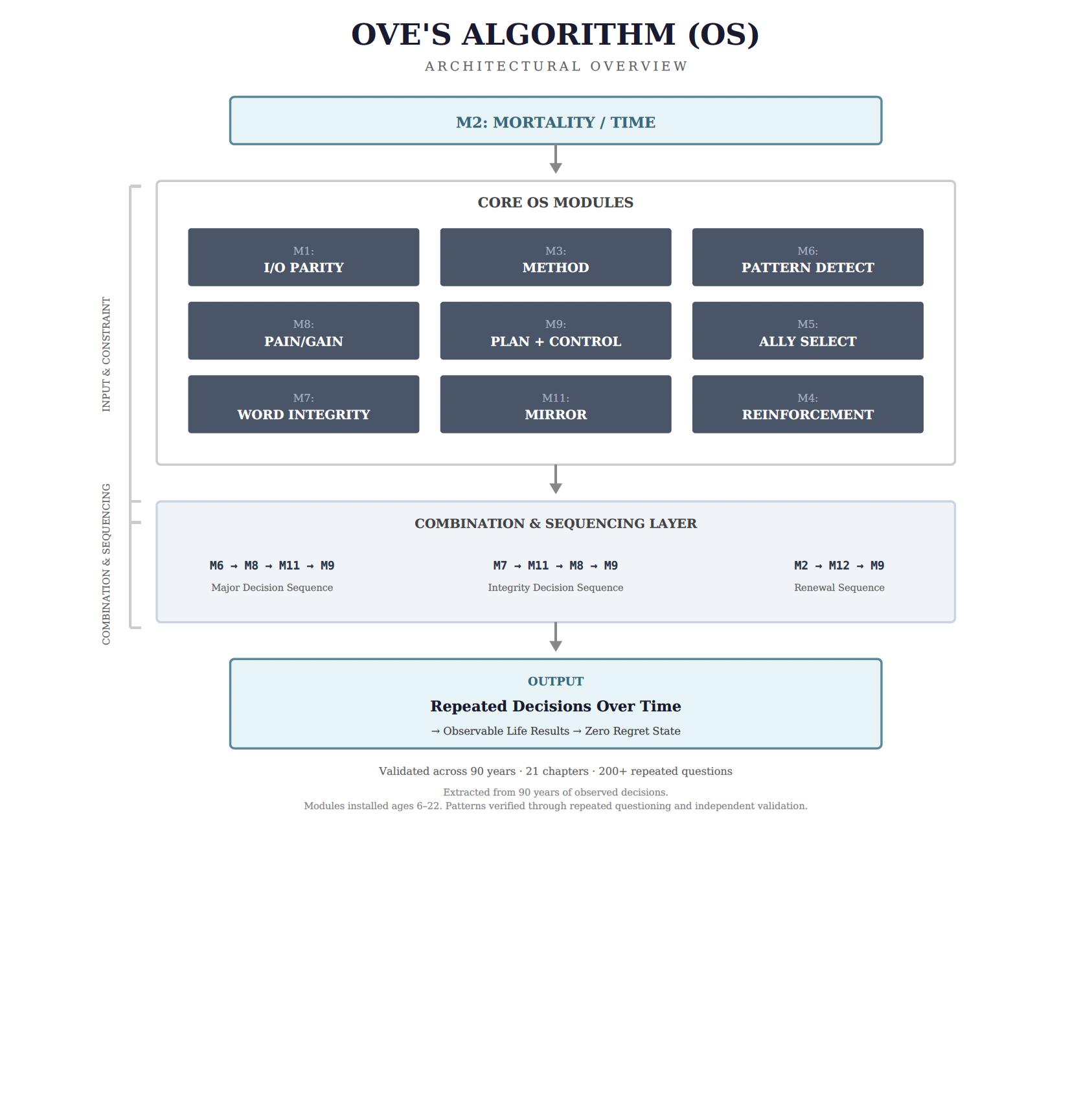
The installed modules form the foundation of the full OS architecture. See Figure 4.1 (next page) for an overview of how these modules layer, sequence, and generate consistent behavioral outputs over time.
Architectural Flow – Modules to Behavioral Output
Figure 4.1: OS
4.2 Pattern Consistency Across 21 Chapters
The same modules activate across different life domains spanning 84 years. This consistency was verified through the 200+ repeated questions protocol:
22 documented events spanning 84 years. Same 12 modules. Same activation patterns. Verified through repeated questioning.
4.3 Pattern Architecture: Generative Complexity
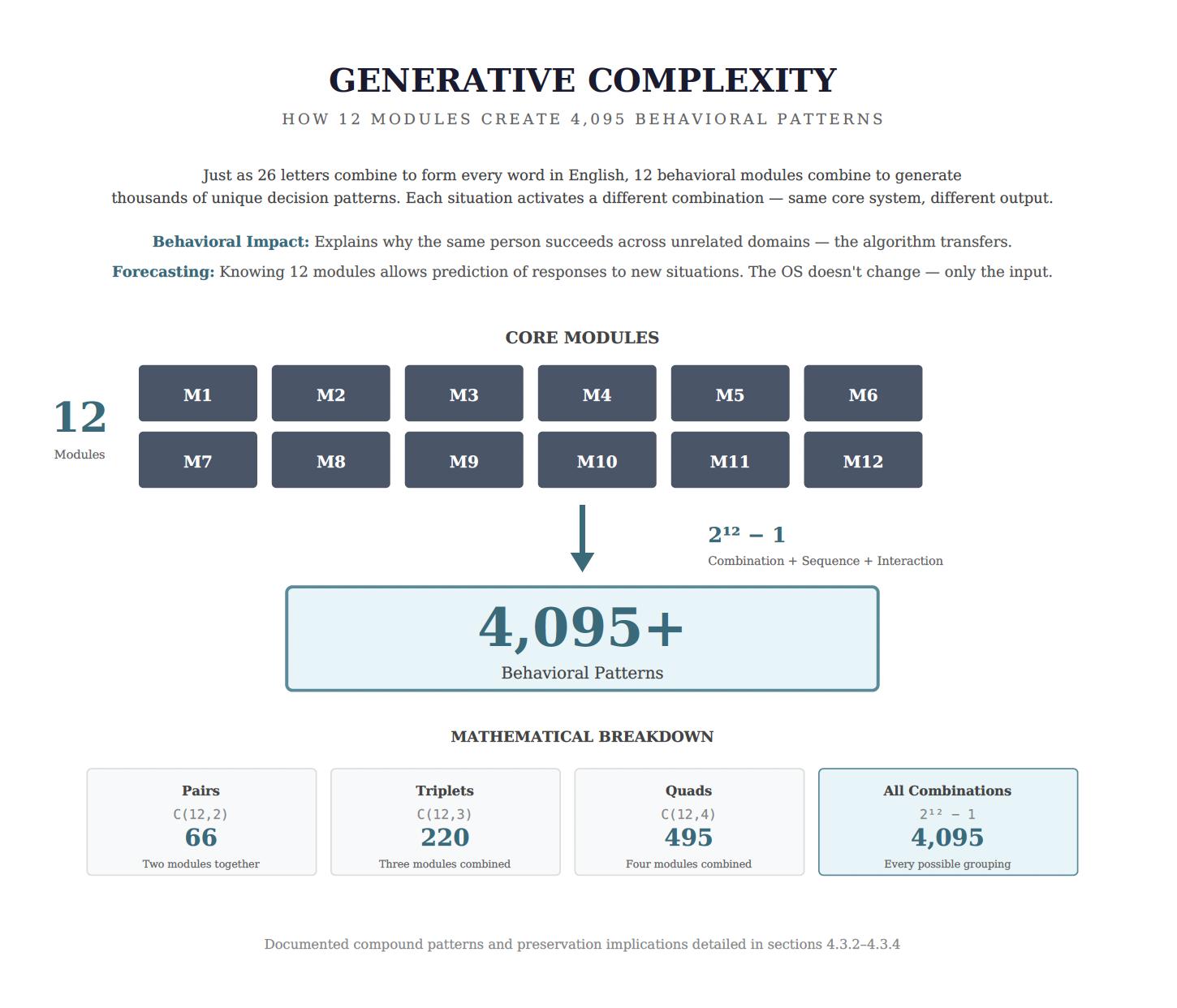
The 12 identified modules represent the core architecture of Ove's Algorithm (OS). However, the true value of the extraction lies in the GENERATIVE nature of this system. The modules do not operate in isolation - they combine, sequence, and interact to produce the full range of behavioral patterns observed across 90 years.
Figure 4.3: Generative Complexity
4.3.1 Combination Patterns
When modules activate together, they create compound patterns. The mathematical combinations are:
COMBINATION TYPE
Module pairs (2 modules)
Module triplets (3 modules)
Module quads (4 modules)
All possible combinations
C(12,2)
C(12,3)
C(12,4)
COUNT
66 combinations
220 combinations
495 combinations
2¹² - 1 4,095 combinations
4.3.2 Documented Compound Patterns
The following compound patterns are explicitly documented in the 21 chapters:
EVENT
Letter not sent (age 17)
Swedish Steel (age 46)
Farm decision (age 40)
Smoking cessation (age 60)
'I MADE IT' (age 22)
Air Force test (age 17)
Glass Room (age 44-50)
Return to school (age 50)
Missa Jacobsen (age 15)
Greyhound bus (age 22)
Return to Norway (age 26)
CEO 6-year limit (age 44)
Ally selection (age 8)
Cold Beer project (40s)
Last man standing (age 90)
MODULES
M7 + M11
M5 + M8 + M9
M8 + M11 + M12
M9 + M11
M1 + M11
M6 + M8 + M9
M4 + M9
M1 + M12
M3 + M8
M8
M7 + M8
M9 + M12
M5 + M6
M3 + M6
M2 + M11
COMPOUND PATTERN
Word Integrity × Mirror Alignment
Ally Selector × Pain/Gain × Plan+Control
Pain/Gain × Mirror × Renewal
Plan+Control × Mirror Alignment
I/O Parity × Mirror Alignment
Pattern Detect × Pain/Gain × Control
Reinforcement × Plan+Control
I/O Parity × Renewal Protocol
Method Resolver × Pain/Gain
Pain/Gain (solo activation)
Word Integrity × Pain/Gain
Plan+Control × Renewal Protocol
Ally Selector × Pattern Detect
Method Resolver × Pattern Detect
Mortality Clock × Mirror Alignment
15+ unique compound patterns documented, demonstrating that modules operate as an interconnected system, not isolated traits.
4.3.3 Sequential Patterns
Beyond combinations, the ORDER of module activation matters. Decision sequences follow consistent patterns:
Sequential patterns multiply the behavioral complexity: 12 modules in 2-step sequences = 132 patterns; 3-step sequences = 1,320 patterns.
4.3.4 The Preservation Principle
The generative nature of the OS architecture has profound implications for digital preservation:
Capturing the 12 modules preserves 4,000+ behavioral data patterns identified. This is the Algorithm (OS) for Ove T. Schoyen - not a model, but the operating system that produced 90 years of consistent decisions.
This is why architectural extraction, not trait listing, is essential for digital preservation. Traits are static. An algorithm is generative - it produces behavior across contexts not yet encountered.
5. DECISION LOGIC ANALYSIS
5.1 Explicit Reasoning Documented
The interview protocol specifically focused on logic behind decision-making. The subject's stated reasoning at each decision point reveals the algorithm in operation:
DECISION STATED LOGIC (DIRECT QUOTE) OS
Letter not sent 'Cost of keeping word was pilot career. Cost of breaking word was collapse of trust.' M7
Greyhound bus 'Short-term discomfort didn't matter. Long-term flexibility did.' M8
Farm decision 'I could not settle for something that did not feel right for me.' M11
CEO 6-year limit 'Maximum time a person could contribute to the company.' M12
Age 50 school 'Strong need to gain new knowledge to ensure further growth.' M12
Glass Room 'Mental reinforcement worked.'
M4
Swedish Steel 'Always first speak to union to ensure bottom-up strategy.' M5 150 travel days 'It was never a sacrifice.'
These quotes were verified through repeated questioning across multiple sessions. The logic remained consistent.
5.2 The Core Algorithm: Subject's Own Words
Notably, the subject himself articulated the algorithm concept in Chapter 21: 'For me, it has been about alignment. A sequence of decisions under constraint. Evaluated over time.'
'What you did. What you tolerated. What you repeated.'
'Input. Choice. Constraint. Time. Output with or without being aligned.'
'When watching people's performance, I noticed it was linked to their personal operating system (OS) and track record.'
The subject independently identified the algorithm framework. The extraction protocol captured and formalized what he already understood about his own operating system.
6. RESULTS VALIDATION: HARD FACTS
6.1 Measurable Outcomes Confirm OS Operation
The OS produces consistent, measurable results across domains - verified against documents and records:
DOMAIN
Air Force Selection
Tau Beta Pi
RESULT
Top 20% (12/60)
Top engineering honor
Job applications 5/5 offers
Asbjorn Habberstad
Swedish Steel
Layoffs execution
Smoking cessation
Best results since inception
World's most profitable
6000 without strikes
No traces after 12 months
Health at 90 No medications needed
Career span
Longevity
60+ years active
'Last man standing'
6.2 Pattern Replication Across Domains
The same algorithm produces success in completely different fields:
The psychotechnical assessment CONFIRMS modules already visible in interview-extracted stories:
TEST FINDING
Fast pattern recognition
Calm under stress
Reliable execution
High technocratic ability
PRIOR STORY EVIDENCE
Steinar detection (age 11)
Farm discipline (age 8+)
Cow responsibility (age 12)
Motor/radio builds (12-13)
Test at 17 validates modules already visible in stories from ages 6-13.
7.2 1980 Personalinvest Test (Age 44)
✓ CONFIRMS M6
✓ CONFIRMS M8
✓ CONFIRMS M9
✓ CONFIRMS M3
The Lennart Pedersen psychological evaluation for CEO hiring at Asbjorn Habberstad AS CONFIRMS modules visible across 38 years of interview-extracted stories:
TEST FINDING
STORY EVIDENCE (DECADES)
'Effective resource utilization' I/O parity across all work
'Conflict equalizer' Union approach, ally selection
'Low risk sensitivity'
Pain/gain calculations
✓ CONFIRMS M1
✓ CONFIRMS M11
✓ CONFIRMS M9
✓ CONFIRMS M12
✓ CONFIRMS M5
✓ CONFIRMS M8
Both tests serve as independent confirmation of patterns extracted through the interview protocol. The tests did not reveal the algorithm - the interviews did. The tests confirm the extraction is accurate.
8. ZERO REGRET: ALGORITHM OUTPUT
8.1
Mathematical Proof
Zero regret is not a personality trait or claim. It is the logical output of M1 + M11:
M1: Input = Output (guaranteed by algorithm)
M11: Aligned with Mirror (verified continuously)
Regret = Expected - Actual (where Expected > Actual)
Within the OS framework: Expected = Actual → Regret = 0
8.2 Verified Through Repeated Questioning
The zero-regret state was verified through the 200+ question protocol. When asked about potential regret points multiple times across sessions:
POTENTIAL REGRET CONSISTENT RESPONSE
Pilot career lost
'Cost of word > cost of career'
USA dream ended 'Be grateful for what had been'
Missa Jacobsen
Family farm sold
'Not worth my time'
'Could not settle for what did not feel right'
Travel sacrifice 'It was never a sacrifice'
Overall life
'Was it worth it? Every day.'
OS LOGIC
M7 priority
M11 alignment
M11 filter
M11 alignment
M8 calculation
Full OS aligned
Responses remained consistent across all sessions. Zero regret is accurate - verified through methodology.
The extraction protocol - 5 years of in-person interviews, 200+ repeated questions, multi-source triangulation, zero interpretation - has produced a validated algorithmic model of a 90-year human life.
- The material was recorded as given.
- No interpretation was added.
- Events presented as they occurred.
OBJECTIVE ACHIEVED: ALGORITHM (OS)
IDENTIFICATION FOR DIGITAL EXTRACTION & PRESERVATION
'What remains when you remove the story? The Algorithm.' - Ove T. Schoyen