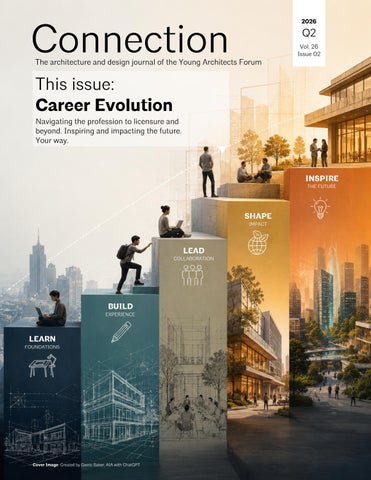
Connection
2026
Q2
The architecture and design journal of the Young Architects Forum
Vol. 26 Issue 02
This issue: Career Evolution
Navigating the profession to licensure and beyond. Inspiring and impacting the future. Your way.
INSPIRE THE FUTURE
SHAPE IMPACT
LEAD
COLLABORATION
BUILD
EXPERIENCE
LEARN
FOUNDATIONS
Cover Image: Created by Garric Baker, AIA with ChatGPT
Connection
2026 Young Architects Forum Advisory Committee 2026 Chair 2026 Vice Chair 2026 Past Chair 2026-2027 Advocacy Director 2026-2027 Communications Director 2025-2026 Community Director 2026-2027 Knowledge Director 2025-2026 Strategic Vision Director 2026 AIA Strategic Council Representative 2026 College of Fellows Representative 2026 Council of Architectural Component Executives Liaison AIA Staff Liaison
2026 Young Architect Representatives Alabama, Ashley Askew, AIA Alaska, ChungTse Lin, AIA Arizona, Sarah Potzler, AIA Arkansas, Lauren Miller, AIA California, Magdalini Vraila, AIA Colorado, Lauren Falcon, AIA Connecticut, James Regnier, AIA Delaware, Lauren DeSimone, AIA Florida, Bryce Bounds, AIA Georgia, Adam Drummond, AIA Hawaii, Krithika Penedo, AIA Idaho, Katie Darter Bennett, AIA Illinois, Raquel Guzman Geara, AIA Indiana, Rachel Lindemann, AIA Iowa, Ben Hansen, AIA Kansas, Garric Baker, AIA Kentucky, Jessica Farmer, AIA Louisiana, Calvin Gallion, AIA Maine, Sarah Kayser, AIA Maryland, Alonzo Colon, AIA Massachusetts, Charly Kring, AIA Michigan, Cara Wagner, AIA Minnesota, Constance Chen, AIA Mississippi, Robert Farr, AIA Missouri, Valerie Michalek, AIA Montana, Elizabeth Zachman, AIA Nebraska, Angel Coleman, AIA
Kiara Gilmore, AIA Anastasia Markiw, AIA Sarah Woynicz, AIA Tanya Kataria, AIA Nicole Becker, AIA Kumi Wickramanayaka, AIA Arlenne Gil, AIA Kaylyn Kirby, AIA Ashley Thornberry, AIA Lisa Lamkin, FAIA Hillary Cole Kathleen McCormick
Nevada, Kristen Levin, AIA New Hampshire, Brooke DeYoung, AIA New Jersey, Abby Benjamin, AIA New Mexico, Diana Duran, AIA New York, Mi Zhang, AIA North Carolina, Carrigan (Pennypacker) Doble, AIA North Dakota, Ben Gutowski, AIA Ohio, Margaret Beecroft, AIA Oklahoma, Brian Letzig, AIA Oregon, Elizabeth Lagarde, AIA Pennsylvania, Melanie Ngami, AIA Puerto Rico, Reily J. Calderón - Rivera, AIA Rhode Island, Vacant South Carolina, Cheyenne Kalb, AIA South Dakota, Elizabeth “Liz” Brown, AIA Tennessee, Sarah Page, AIA Texas, Justin Taplet, AIA Utah, Melissa Gaddis, AIA Vermont, Vacant Virginia, John McKenna, AIA Washington, Rio Namiki, AIA Washington D.C., Mika Naraynsingh, AIA West Virginia, Daniel Garvin, AIA Wisconsin, Justin Marquis, AIA Wyoming, Kendra Shirley, AIA AIA International, Jason Holland, AIA
Connection is the official quarterly publication of the Young Architects Forum of AIA. This publication is created through the volunteer efforts of dedicated Young Architect Forum members and made possible through generous grant funding from the College of Fellows. Copyright 2026 by The American Institute of Architects. All rights reserved Views expressed in this publication are solely those of the authors and not those of The American Institute of Architects. Copyright © of individual articles belongs to the author. All images permissions are obtained by or copyright of the author.
2
Issue No. 02: 2026 Quarter 2
Contents 5
Figuring It Out, Editor’s Note Nicole Becker, AIA
28
Three Voices on Growth, Learning, and Perspective in Practice Scott Ross Steffes, IIDA, NCIDQ, LEED
6
Career Evolution, Chair’s Message Kiara Gilmore, AIA
33
Advocacy in Action Series Tanya Kataria, AIA
7
The Align Mentorship Program Kumi Wickramanayaka, AIA, NCARB, LEED AP BD+C
36
Architecture, AI & Evolution in Practice Arti Verma, AIA, NCARB, LEED AP BD+C, ALA
10
Shaping the Future While Navigating It Devora Schwartz, AIA, NCARB
39
Design Process Toolkits Liz Brown, AIA, NCARB
12
Preservation is Personal Danielle McCormick, Assoc. AIA
42
Building a Portfolio Career Evelyn Lee, FAIA, NOMA
14
Navigating Architect Career Evolution Tricia Eiswald, SHRM-SCP
44
Navigating Your Next Career Move Megan Simmons
16
Empowering with Access, Visibility, and Community Graciela Carrillo, FAIA
46
Specialist vs Generalist Caitlin Brady, AIA, LEED AP BD+C
18
The Cost of AI in Practice Gabriella Bermea, AIA, NOMA
50
20
Designing Access by Building a Scholarship Ecosystem Saakshi Terway, Assoc. AIA
Career Pivots: When Architecture Takes You Somewhere Unexpected Jane Rodrigues, AIA, NCARB, LEED AP BD+C
22
Beyond the Ladder Tarjanee Soni, Assoc. AIA
54
A More Beautiful Question Garric Baker, AIA
24
Designing a Career as a System Afomia Hunde, Assoc. AIA, NOMA
55
ABC | Archi-TEXT Book Club Jane Rodrigues, AIA, NCARB, LEED AP BD+C
26
Redesigning Success C. Adam Drummond, AIA
57
Connect + Chill Young Architect’s Forum Knowledge Committee
3
Connection
Editorial team Nicole Becker, AIA, NCARB, LEED AP BD+C Editor in chief Nicole is a project architect at Jacobs, based in Portland, OR practicing at the intersection of design, infrastructure, and emerging technologies. She is the 2026 Communications Director for the Young Architects Forum.
Bryce W. Bounds, AIA, NCARB, CGC Senior editor Bryce is a Miami native, a Construction Project Management Supervisor in the Public Works department of Broward County, and Florida’s YAR. He attended Design and Architecture Senior High School (DASH) in Miami-Dade and graduated from the Rhode Island School of Design (RISD) with bachelors in both Architecture and Fine Art. Constance Chen, AIA, NCARB Senior editor Constance is a Minnesota native and a principal at Locus Architecture in Minneapolis. A University of Notre Dame graduate, her design approach intends to make meaningful connections between people and spaces. She serves as Minnesota’s YAR. Valerie Michaelek, AIA, NCARB Senior editor Valerie is a Project Architect at HOK in St. Louis. Her professional experience spans a diverse range of project types, including aviation, science and technology, higher education, corporate, healthcare, and commercial work, and includes volunteer leadership at the local, state, regional, and national levels through the AIA. She currently serves as AIA Missouri’s YAR. Ben Gutowski, AIA, NCARB Senior editor Ben is an Associate Architect at Zerr Berg Architects in Fargo, ND. He works on projects from schematic design through construction and anything from museums to schools. He is passionate about design and meaningfully connecting people to the built environment. He is serving his first year as North Dakota’s Young Architect Representative.
4
Justin Marquis, AIA, NCARB Senior editor Justin is a Project Architect with Somerville Architects & Engineers in Green Bay, Wisconsin. Managing projects through all phases of development from conceptual design to construction administration, he currently supports the healthcare and educational studios at Somerville. He has a degree from the University of Wisconsin - Milwaukee and lives in the Fox Valley area with his family. Justin is the Wisconsin Young Architect Representative.. Garric Baker, AIA, NCARB Senior graphic designer Garric is a graduate of the College of Architecture, Planning & Design at Kansas State University and excels in leadership positions with state and regional Chambers of Commerce, Young Professionals, the Kansas Barn Alliance, local and state Wide AIA Kansas Board of Directors, and Regional Economic Development activities. Katie Bennett, AIA, NCARB Senior graphic designer Katie is a project manager at Babcock Design in Salt Lake City, Utah and Boise, Idaho, and oversees projects during their inception phase through schematic design. She is the current YAR for the state of Idaho and is passionate about housing and sustainable design. Calvin Gallion, III, AIA, NOMA, NCARB, LEED GA Senior graphic designer Calvin is an architect and principal at studio^RISE in New Orleans. A Tulane graduate and Natchitoches native, he is a passionate advocate for community and rehabilitation projects. He serves as EDI Chair for AIA New Orleans and as Louisiana’s YAR. Kendra Shirley, AIA, NCARB Senior graphic designer Kendra is a project architect at Arete Design Group in Wyoming and Colorado and is Wyoming’s YAR. As a graduate from one of the top undergraduate architecture programs in the country, Kendra’s training and experience provides her with a unique and innovative perspective for creating extraordinary experiences and designs.
Issue No. 02: 2026 Quarter 2
Figuring It Out Editor’s Note What is career evolution? If I’m being honest, it hasn’t always felt like a clear process or ideal, and it certainly hasn’t always gone as planned. Often it’s looked like uncertainty, questioning, and learning, sometimes the hard way. Sometimes, it’s reconciling the version of success I once imagined with the one that’s actually unfolding. Careers rarely unfold the way we imagine them. Opportunities emerge, priorities shift, and the definition of success evolves alongside us. In many ways, navigating a career in architecture today feels less like climbing a ladder and more like designing a system. One that works for us. This issue reflects that reality. There’s no single narrative of growth, only a collection of perspectives that, together, feel more honest. In Three Voices on Growth, Learning, and Perspective in Practice, and The Power of Career Depth vs. Breadth, we see how differently a career can take shape depending on what we value and where we choose to focus. Pieces like Career Pivots and Switchers resonated with me in particular, because they acknowledge something we don’t always say out loud: sometimes the most defining moves in our careers are the ones we didn’t plan and highlight the courage it takes to step into the unknown. There’s a thread in this issue about designing our careers more intentionally. Articles like Designing a Career as a System, Building a Career Portfolio, and Designing Role Profiles and Career Paths remind us that while we can’t control every outcome, we can shape the structure around us, how we grow, and how we define progress. We can’t ignore how technology continues to reshape our work and the future of our careers. Pieces like Architecture, AI, & Evolution in Practice and The Cost of AI in Practice ask us to reflect not only on what tools we use, but how they influence the trajectory of our careers. At the same time, Design Process Toolkits and Navigating Your Next Career Move provide tangible frameworks for charting what comes next, reinforcing that growth is not accidental, it’s designed. This issue reminded me to think about how much of our career is influenced by who we are outside of it. Preservation is Personal and reflections from the Open Mic Night - “Shaping the Future While Navigating it”, conversations highlight how life: motherhood, identity, lived experience don’t sit adjacent to our careers, they shape them. And pieces like Beyond the Ladder and Designing Access by Building a Scholarship Ecosystem are reminders that opportunity can be created, advocated for, and extended to others. If there’s one thing I’m still learning, it’s that career evolution
isn’t about having it figured out. It’s about staying open. Open to change, to growth, to redefining success when it no longer fits. As you read through this issue, I hope you see parts of your own journey reflected back to you. And maybe more importantly, I hope you feel a little less pressure to have all the answers, and a little more confidence in your ability to navigate what comes next. We’re all figuring it out as we go. In progress, Nicole Becker Editor in chief / Connection
Editorial Committee Call Q3 2026: Call for submissions - Shaping the Future Our editorial committee welcomes the submission of articles, projects, photography, and other design content. Submitted content is subject to editorial review and selected for publication in e-magazine format based on relevance to the theme of a particular issue. 2026 Editorial Committee: Call for volunteers, contributing writers, interviewers, and design critics. Connection’s editorial committee is currently seeking architects interested in building their writing portfolio to work with our editorial team to pursue targeted article topics and interviews that will be shared amongst Connection’s largely circulated e-magazine format. Responsibilities include contributing one or more articles per publication cycle (3–4 per year). If you are interested in contributing to Connection, please contact the editor in chief at: nicolejbecker1@gmail.com.
Nicole Becker, AIA NCARB, LEED AP BD+C
Project Architect at Jacobs, Portland, OR 2025-2026 Communications Director AIA Young Architects Forum.
5
Connection
Career Evolution Chair’s message There is no single model for growth. Career evolution often sounds like a destination. Something achieved through promotion, licensure, leadership titles, or a well-plotted next step. But in practice, evolution is rarely linear. More often, it is iterative. It happens through questions, pivots, uncertainty, and the courage to respond to change rather than resist it.
We are practicing in a time when the definition of architectural leadership is expanding. Creativity and influence now show up in many forms, through design, certainly, but also through policy, entrepreneurship, technology, community-building, and interdisciplinary collaboration. The profession is evolving, and architects are evolving with it.
For many in the Young Architects Forum, this feels especially real. We are in a stage of practice where growth often arrives all at once: increasing project responsibility, expanding leadership roles, shifting personal priorities, and a profession itself in constant flux. In that context, career evolution is not simply about climbing. It is about navigating.
As the Young Architects Forum, we believe part of our role is not to prescribe one path forward, but to help illuminate many. To create space for honest conversations about growth, transitions, ambition, and uncertainty. To remind one another that careers can stretch, branch, pause, and transform, and still be deeply rooted in architecture.
Sometimes that navigation looks like moving into firm leadership, public service, academia, development, advocacy, or adjacent paths that broaden what architectural practice can be. Sometimes it looks less dramatic, but no less meaningful, a recalibration of values, a renewed focus on mentorship, a shift in how we define success, or an opportunity to shape a role that doesn’t yet exist.
As you move through this issue, I invite you to reflect on your own evolution. Where is your practice growing? What assumptions about career might be ready to shift? What possibilities might emerge if you viewed your path less as a ladder to climb, and more as a practice to shape?
The questions many of us ask; What’s next? - Do I stay or pivot? - How do I grow without losing what drew me to this profession? are not signs of instability. They are signs of engagement and growth. They reflect architects actively shaping careers with intention. This issue explores those realities. Not career advancement as a singular ladder, but evolution as a dynamic process of responding to opportunity, challenge, and changing aspirations. The stories in these pages reflect something powerful: there is no single model for growth. There is only the ongoing work of aligning our skills, values, and ambitions with the impact we hope to make. And perhaps that is what makes this moment in the profession so full of possibility.
6
Careers, like design, are iterative. They are shaped over time through exploration, reflection, and revision. May we stay curious enough to evolve.
With appreciation, Kiara Gilmore, AIA 2026 Chair | Young Architects Forum
SarahGilmore, Kiara Woynicz, AIA AIA Firstname Lastname is an theAssociate 2025 Chair at of Modus the Young StudioArchitects in Fayetteville, Forum Arkansas. and a Lorem ipsum dolor Project Architect Gilmore serves asat2026 HKS.Chair She brings ofsit the Young aamet, community-centric Architects Forum focusbrings and to clients a perspective and teams, rooted valuing in mentorship, purpose-driven service, practice consectetur adipiscing elit, sed doand that supportsdesign. high-impact the firm’s social justice, equity, diversity, and eiusmod tempor incididunt ut labore. inclusion efforts to foster belonging in the profession.
Issue No. 02: 2026 Quarter 2
The Align Mentorship Program Meet Our 2026 Align Cohort
Above: Edward J. Kodet Jr., FAIA, LEED AP BD+C
The Align Mentorship Program, a joint initiative between the Young Architects Forum (YAF) and the AIA College of Fellows, is a long-term mentorship experience that connects early career architects with AIA Fellows through small “pod” groups. Designed as a multi-year engagement, the program supports professional growth, leadership development, and the exploration of each participant’s career legacy. Pods are typically made up of four to six young architects and two to three Fellows. They are organized around focus areas in Practice, Scholarship, or Civic work, allowing participants to engage in meaningful dialogue and shared learning across experience levels and regions.
FELLOWS Name: Edward J. Kodet Jr., FAIA, LEED AP BD+C State: Minnesota I believe mentorship is the core to the profession’s success. I believe in one-on-one where there are not out of bound questions. In mentoring I discuss design, marketing, salaries, firm profits, lawsuits, client dismissals, negotiating with building officials, contractors, and anyone else that affects the project and our ability to enhance the practice of architecture.
Top Right: Elizabeth Hallas, FAIA, LEED AP BD+C Bottom Right: Rona G. Rothenberg, FAIA DBIA, PMP
Name: Elizabeth Hallas, FAIA, LEED AP BD+C State: Colorado As a new ‘25 fellow, I found this to be a rewarding opportunity to get involved and help our younger colleagues chart their paths and have been impressed with their curiosity, initiative and enthusiasm. Name: Rona G. Rothenberg, FAIA DBIA, PMP State: California As an architect with a long career delivering capital programs in government and industry and as a Citizen Architect focused on service to the public through thoughtful, lasting, affordable, functional and accessible, and well-designed campuses and facilities, I have found that there is nothing more satisfying than investing, through mentorship, in the talented architects who will carry on our work and are the future of our profession-across generations, cultures and races, genders, interests and abilities.
Mentorship is fun. I enjoyed the experience and have many architect friends because of the experience. In all fairness, I learn as much as the people I mentor.
7
Connection
Top Row (Left to Right): Brett Rathbone, AIA, NCARB, LEED AP BD+C; Aaron Stant, AIA, WELL AP, LEED Green Associate; Brooke Godinez, AIA NCARB NCIDQ; Gabriella Bermea, AIA, NCARB, NOMA, WELL AP Bottom Row (Left to Right): Asia J. Burgin, AIA, NOMA, NCIDQ, WELL AP, NCARB; Alexandra Christiana, AIA LEED AP BD+C WELL AP LFA; Hannah Fugate, AIA; Jack Whalen, AIA YOUNG ARCHITECTS Name: Brett Rathbone, AIA, NCARB, LEED AP BD+C State: Minnesota (residence) North Dakota (work) I wanted to engage with driven peers in the industry and established mentors to learn from everyone. Name: Aaron Stant, AIA, WELL AP, LEED Green Associate State: Ohio I planned to gain insight and wisdom into balancing a specialized passion with overall career development as an architect. Name: Brooke Godinez, AIA NCARB NCIDQ State: Florida I am seeking guidance from experienced leaders to help me recognize and refine my strengths and continue growing as both an architect and a leader. Name: Gabriella Bermea, AIA, NCARB, NOMA, WELL AP State: Texas My goal is to deepen the strategic mentorship and sustained guidance that will sharpen my leadership across national service, governance, and professional impact while building a cohesive, scalable leadership ecosystem. Name: Asia J. Burgin, AIA, NOMA, NCIDQ, WELL AP, NCARB State: Georgia I applied to the ALIGN Mentorship Program to enhance my strategic approach and institutional leadership through
8
purposeful mentorship, developing the skills necessary to advance preservation, equity, and inclusive design on a national scale. Name: Alexandra Christiana, AIA LEED AP BD+C WELL AP LFA State: Massachusetts I am looking forward to connecting with both peers and industry leaders to develop strategies for expanding my impact and advancing sustainable design impact. Name: Hannah Fugate, AIA State: Oregon I am looking for clarity in the next season of my career whether that’s starting my own firm, teaching, or taking on more leadership where I am - and excited to connect with everyone in the program along the way. Name: Jack Whalen, AIA State: Delaware, Florida I saw ALIGN as the perfect opportunity to help myself answer what’s next in defining my career, to push myself to new heights, and to receive guidance from outstanding industry leaders to accelerate my growth and broaden my horizons.
Issue No. 02: 2026 Quarter 2
Above: Krutika Shah, AIA, NCARB, SEED, LEED AP BD+C Top Right: Yanci Chen, AIA, NCARB, NOMA, IIDA Bottom Right: Lauren Miller, AIA
Name: Krutika Shah, AIA, NCARB, SEED, LEED AP BD+C State: Rockville, MD I applied to the Align Mentorship Program to ensure my leadership continues to evolve with intentional, purposeful growth supported by structured, reflective, high‑impact mentorship. Name: Yanci Chen, AIA, NCARB, NOMA, IIDA State: Seattle, WA I applied to the Align Mentorship Program to explore my next growth trajectory and to develop the personal strengths that translate technical expertise into leadership impact. Name: Lauren Miller, AIA State: Arkansas I am in a new phase of my career, and want to surround myself with mentors and peers to help guide me as I develop as a leader, architect, and person.
Kumi Wickramanayaka, AIA, NCARB, LEED AP BD+C
Kumi is a Project Manager at Davis Carter Scott in Washington DC. She currently serves as the Washington, D.C. YAR.
9
Connection
Shaping the Future While Navigating It
What an Open Mic Revealed About Career Evolution Organized by Kumi Wickramanayaka, AIA and moderated by Mi Zhang, AIA the recent AIA Young Architects Forum “Open Mic Night” on shaping the future of architectural education, brought together professionals from different corners of the industry to discuss a question many emerging professionals continue to ask: How well does architectural education prepare us for the realities of practice and where does it fall short? What made the conversation particularly meaningful was not only the diversity of perspectives on the panel, but the diversity of career paths represented. The panel included Jeremy Fretts, AIA NCARB who transitioned from practice into a role focused on architectural education and policy at NCARB; myself, a practicing architect, mentor, and advocate; James Wesala, AIA a practicing architect and professor at the ASU Design School; and Jack Whalen, AIA Regional Director for the ACE Mentor Program of America. While our paths into and through architecture looked very different, there was one shared realization among all of us: our understanding of the profession truly accelerated once we entered practice. School taught us how to think like architects. Experience taught us how to actually be them. Architectural education gives students invaluable tools. It teaches spatial thinking, conceptual development, graphic communication, and design process. But the transition into practice often reveals the gap between academic preparation and professional reality. Many of us reflected on how our understanding of architecture did not fully begin until “School taught us how we were working on to think like architects. professional projects Experience taught us how with actual teams, budgets, consultants, to actually be them.” clients, and deadlines. That realization tied directly into this quarter’s Young Architects Forum theme: navigating career evolution. Career evolution in architecture is often framed as something that happens years into practice; a shift into leadership, specialization, advocacy, or alternative career paths. But this conversation highlighted that career evolution begins much earlier. It begins in the transition
10
between student and professional, when emerging architects start reconciling what they were taught with what the profession actually demands. One of the strongest themes throughout the discussion was collaboration. In school, students are often conditioned to work independently. Studio culture rewards ownership of an individual concept, and while group projects exist, the academic environment still largely centers around personal authorship. In practice, however, architecture becomes deeply collaborative almost immediately. Emerging professionals quickly learn that no project is designed by one person alone. We rely on engineers, consultants, contractors, clients, and internal teams. We balance design intent with budgets, schedules, constructability, and code compliance. Communication evolves just as rapidly as technical ability. In school, presentations are often delivered to peers and professors who already understand architectural language. In practice, communication must adapt constantly depending on the audience. Architects must explain ideas to clients unfamiliar with construction, coordinate with engineers focused on performance and systems, communicate clearly through drawings for contractors building the work, and present code information in ways that satisfy Authorities Having Jurisdiction. These are skills that can only develop through exposure and repetition. Mentorship emerged as another recurring theme throughout the evening. Several panelists discussed how difficult it can be for students and recent graduates to access consistent guidance during the transition from academia into practice. While some schools, including my alma mater New York Institute of Technology (NYIT), offer alumni mentorship opportunities, many students still experience a disconnect between education and the profession itself. Jack Whalen spoke about how pivotal mentorship was throughout his own career and how that continuity often disappears during the “in-between” phase where students are no longer fully within academia but have not yet established themselves professionally. It was a sentiment many of us recognized immediately.
Issue No. 02: 2026 Quarter 2
Unexpectedly, some of the most impactful mentorship happens informally inside firms through project work, redlines, conversations, and shared problem-solving. Personally, the rapid acceleration of my own career during the COVID era reshaped how I approached leadership. As firms reopened and teams expanded, I transitioned quickly from recent graduate to project manager overseeing production and mentoring younger staff simultaneously. Teaching while managing became part of my leadership style because I recognized how valuable that guidance would have been earlier in my own career. At the same time, the panel acknowledged that meaningful mentorship requires intentionality. In the pace of everyday practice, mentorship can easily become secondary unless firms and professionals “...meaningful mentorship deliberately create space for it. Programs requires intentionality.” through AIA, alumni networks, and mentorship organizations help fill that gap while also allowing emerging professionals to become the mentors they once needed themselve. The discussion also turned toward what architectural education could do differently moving forward. Technical training became a major point of conversation. Many students graduate without fully understanding how materials and systems come together to create a building, despite the fact that technical detailing and coordination are often among the first responsibilities assigned in practice. There is also an entire segment of the profession centered around technical excellence, detailing, and building systems, not solely conceptual design, and students deserve exposure to those paths as viable and valuable forms of practice. Code literacy was another area the panel identified as essential. Buildings cannot exist without code compliance, yet many students encounter code only superficially in school before being expected to apply it immediately in practice.
The profession is evolving, and architects are evolving with it. Some remain in traditional practice. Others move into education, advocacy, policy, mentorship, community leadership, or industry organizations. Panelists like Jeremy Fretts and Jack Whalen demonstrated that licensure itself is not the end goal, but rather a foundation that can open countless avenues to impact the profession in different ways. That reality is especially important for emerging professionals to hear. Career evolution is not a deviation from architecture; it is part of architecture itself. As the conversation concluded, one thing became increasingly clear: shaping the future of architectural education and navigating career evolution are not separate conversations. They are deeply connected. The way we educate future architects influences how they lead, collaborate, communicate, mentor, and ultimately define success within the profession. And perhaps the future of architecture will not be shaped solely by changing curriculum requirements or new technologies, but by architects who are willing to openly share their experiences, challenge traditional expectations, and help create the support systems they once needed themselves.
“Programs through AIA, alumni networks, and mentorship organizations help fill that gap while also allowing emerging professionals to become the mentors they once needed themselves.”
One example discussed during the panel was a course run by James Wesala at ASU, where younger students are paired with graduate students in a semester-long project that simulates a professional firm environment. Students work within budgets, timelines, leadership structures, and collaborative team dynamics that more closely resemble practice. It was the type of educational experience many of us wished we had encountered ourselves.
“...there is no singular architectural career path...” Perhaps the most important takeaway from the evening was that there is no singular architectural career path anymore. Or maybe there never was.
Devora Schwartz, AIA NCARB
Schwartz is a Project Manager at LMV Architects in Poughkeepsie. She is a mentor passionate about empowering future architects and supporting the next generation of design professionals.
11
Connection
Preservation Is Personal
Evolving Practice Through Motherhood and Leadership
Architecture, at its core, is an act of translation. We translate ideas into space, history into form, and human needs into the built environment. Long before I stepped into a professional role, I understood translation in a more literal sense—growing up between cultures, navigating language, identity, and belonging. Today, as I transition into a senior professional role while also embracing motherhood, I’ve come to realize that both experiences—migration and caregiving—have fundamentally shaped how I practice architecture, particularly in the field of historic preservation.
has deepened my commitment to preservation, but also made me more intentional about where I invest my energy. Not every opportunity aligns. Not every pace is sustainable. And not every definition of success is worth pursuing. In practice, this has meant letting go of the idea that I need to do everything, or do it all at once. Instead, I approach my career
My journey into architecture was never just about design. It was about understanding context—cultural, historical, and personal. Raised with a European upbringing and Filipino roots, I often found myself acting as a bridge between worlds. I translated not just language, but expectations, values, and ways of seeing. That early role as an interpreter has stayed with me. In practice, I now translate between clients and communities, between past and present, and between the technical and the emotional dimensions of a project. That perspective remains central to my work. But as my career evolves, so does my understanding of what it means to practice historic preservation. It is no longer only about whose histories we safeguard—it is also about how we sustain ourselves while doing so. Balancing professional responsibilities, while navigating the realities of motherhood: These dual shifts have not only changed my day-to-day routines, but have also reframed how I approach architecture, time, and impact. If my early career was about finding my voice, this phase is about learning how to use it— clearly, responsibly, and in ways that support others. Architecture often presents career growth as a steady, upward trajectory, but lived experience tells a different story. Growth is layered. It expands and contracts. It requires recalibration. As an immigrant, and now as a mother, I have had to redefine what progression looks like on my own terms. Motherhood, in particular, has sharpened my awareness of time—not just deadlines and deliverables, but generational time. In preservation, we often speak about longevity: how buildings endure, how materials weather as years pass, how interventions extend the life of a structure. Becoming a parent has made that concept more immediate. The future is no longer abstract—it is personal. It is present in the spaces we create and in the values we carry forward. This
12
Above: 1989 My Grandparents visiting me in Germany Juxtaposition of 1986 Ludwig Museum against 1248 Cologne Cathedral. Photo Credit: Danielle McCormick, AIA Below: Quiet Overlap of Roles - Motherhood during the pandemic. Photo Credit: Danielle McCormick, AIA
Issue No. 02: 2026 Quarter 2
Left: Existing Conditions of Historic Davis Hospital at Mitchell Community College. Photo Credit: McCormick Right: Collaborating with fellow National Associates Committee StARs at the Annual Conference . Photo Credit: McCormick the way I approach a preservation project: by understanding existing conditions, identifying what is essential, and making thoughtful interventions. Stepping into a senior level role has also required a shift in mindset—from doing to leading. Earlier in my career, much of my value was tied to production: drawings, details, problem-solving. While those skills remain important, leadership asks for something different. It requires clarity in communication, trust in others, and the ability to guide a team through complexity.
understanding of preservation, women and motherhood.
Interestingly, many of these skills mirror what I experienced growing up as a translator. Born and raised in Germany, by Filipino parents - at that time I was navigating between languages and cultures. Now, I translate between clients, consultants, and communities—balancing technical constraints with human needs. Leadership, in this sense, is not about authority. It is about connection.
For emerging professionals reading this, particularly those who see themselves reflected in these intersecting identities, I offer this: your path will not look like anyone else’s—and that is not a disadvantage. The experiences that shape you outside of architecture—your culture, your family, your responsibilities— are not interruptions to your career. They are integral to it. They influence how you see, how you question, and how you create.
Motherhood has reinforced this understanding. It has made me more attuned to listening, more decisive under pressure, and more accepting of imperfection. Architecture, as a discipline, often prioritizes precision and control. But both parenting and preservation remind us that not everything can—or should—be controlled. There is value in adaptability, in patience, and in allowing things to evolve. Of course, this balance is not effortless. There are tensions—between professional expectations and personal responsibilities, between ambition and capacity. But rather than seeing these as competing forces, I have started to understand them as part of the same system. They inform each other.
As I continue to grow in my career, I am learning to embrace a different definition of evolution. It is not about constant acceleration, but about alignment. It is about building a practice that reflects not only what I do, but who I am. Preservation taught me that meaningful work is not just about adding something new—it is about understanding what already exists and choosing how to carry it forward. In this phase of my life, that lesson “Because in the end, feels more relevant the work is not only than ever. Because about the buildings we in the end, the work is not only about the preserve. It is also about buildings we preserve. the lives we are building It is also about the alongside them.” lives we are building alongside them.
The empathy I bring to my role as a mother strengthens my leadership in the workplace. The discipline and problem-solving I practice as an architect supports how I navigate daily life. These are not separate identities—they are interconnected. My continued involvement in professional organizations, including leadership roles within the Association for Preservation Technology (APT), the AIA|DC Historic Resources Committee (HRC) and AIA|DC Women in Architecture and Design Committee (WIA) has also taken on new meaning in this phase. These platforms are not just professional engagements—they are opportunities to advocate for a broader, more inclusive
As immigrant architects, we bring perspectives that challenge dominant narratives about what is worth preserving. We recognize that history is not singular. It is layered, complex, and often contested. Ensuring that these perspectives are represented—both in projects and in professional spaces—is a responsibility I take seriously, especially as I move into more visible leadership roles.
Danielle McCormick, Assoc. AIA
McCormick is a Sr. Technical Designer at Stantec in Washington DC, focusing on preservation and modernization. She serves as AIA NAC StAR - DC and has leadership roles with AIA|DC HRC, AIA|DC WIA and others.
13
Connection
Navigating Architect Career Evolution Designing Role Profiles and Career Paths Architect careers are rarely linear. As firms grow, diversify project types, and adopt new delivery models, the expectations placed on architects evolve as well. Yet many organizations still rely on informal titles or loosely defined ladders that don’t reflect how architects actually develop—from emerging professionals to licensed leaders. Supporting longterm career evolution requires intentional design. Clear role profiles, multiple career tracks, and alignment with professional programs such as AXP to create structure without rigidity. Together, they offer transparency, mobility, and meaningful growth throughout an architect’s career journey.
“Supporting long-term career evolution requires intentional design.”
Why Career Structure Matters in Architecture Architecture blends technical expertise, design judgment, regulatory responsibility, and leadership. Over time, architects develop strengths in different areas—design, project delivery, technical specialization, people leadership, or firm strategy. Without defined career pathways, common challenges emerge: • Early-career architects left unsure about how experience translates into advancement • Licensed architects feeling pressure to move into management without skills to do so • Inconsistent expectations attached to the same title across studios or offices • Difficulty connecting day-to-day work to licensure or longterm goals Clear role profiles and multiple tracks provide a framework that supports both individual ambition and firm needs—while complementing licensure requirements rather than competing with them. Creating Strong Architect Role Profiles A role profile describes what success looks like at a given stage of practice. It goes deeper than a job description, offering clarity around responsibility, decision-making, and professional growth.
14
Effective architect role profiles typically define: • Scope of work The scale and complexity of projects or systems an architect supports. • Decision authority What design, technical, or coordination decisions they are expected to own. • Required competencies Design, technical, regulatory, and collaboration skills. • Collaboration model How they work with project managers, consultants, and clients. • Growth signals Behaviors that indicate readiness for the next level. For emerging professionals, role profiles can also align directly with AXP experience areas, helping staff and supervisors connect daily work to licensure progress.
“Architecture blends technical expertise, design judgment, regulatory responsibility, and leadership.” Using AXP to Support Early-Career Development The Architectural Experience Program (AXP) provides a structured framework for developing core competencies required for licensure. When firms intentionally connect AXP to role profiles, early-career architects gain clarity and momentum. AXP supports: • Transparency around required experience areas • Mobility across project phases and responsibilities • More consistent mentoring and feedback • Clear documentation of professional growth Firms can map junior and intermediate role profiles to AXP categories such as: • Practice Management • Project Management • Programming & Analysis • Project Planning & Design • Project Development & Documentation • Construction & Evaluation
Issue No. 02: 2026 Quarter 2
This alignment helps emerging architects understand not just what they are doing, but why it matters for their long-term career. Designing Multiple Career Tracks for Architects Not all architects evolve in the same direction—and they shouldn’t have to. Well-designed career frameworks recognize multiple paths that offer equal value, respect, and advancement potential. If we don’t “Not all architects elvove currently have a dedicated path of in the same direction interest, we invite staff and they shouldn’t have to partner with HR to design their own path. to.” If their business case for their role is strong and it matches a current business need, we get creative in defining a new path. We had recent success with this as we created two new role opportunities based on conversations with mid-career staff. The issue was our structure wasn’t set up in a way that allowed project-side staff to receive real-time feedback, so we created two new Key Manager roles on the architect side and encouraged anyone interested to apply. This allowed two people to pivot from their project work to help others and take on some leadership responsibilities. It was a win for the business and for those employees who were looking for the next challenge. Common career tracks include: • Design & Technical Track Focused on design leadership, technical depth, and project excellence. • Project & Practice Leadership Track Emphasizing coordination, delivery, client relationships, and firm operations. • People & Organizational Leadership Track Centered on mentoring, market leadership, and strategic growth.
For example: • Early levels focus on execution and learning • Mid-levels demonstrate independent leadership within projects • Senior levels shape standards, mentor others, and influence firm direction When progression is visible and documented, architects can make informed choices about their development—whether that means deepening expertise or expanding influence. Supporting Career Choice and Mobility The most effective architecture firms normalize career conversations early and often. Career frameworks work best when people understand their options and feel supported in exploring them. Strong supporting practices include: • Regular check-ins tied to role profiles and AXP progress • Assessing staff fairly and equitably against role profile criteria • Provide real-time, honest, empowering feedback • Coaches and Mentors aligned with both career track and licensure goals • Recognition of lateral moves as growth • Transparency around how licensure fits into long-term advancement Choice, when paired with structure, becomes a retention strategy. Final Thoughts Architect career evolution thrives when structure meets flexibility. Role profiles provide clarity particularly when converted into a performance assessment tool. Multiple tracks provide choice. Programs like AXP provide professional grounding and shared standards.
Each track should include licensed and unlicensed roles, acknowledging that licensure enhances capability without defining contribution.
“Role profiles provide clarity. . . multiple tracks provide choice. . .”
Key principles for track design: • Comparable seniority and compensation across tracks • No “default” promotion into management • Clear criteria for advancement within each path (role profiles) • Opportunities to move between tracks over time
Together, they form an ecosystem where architects can grow with intention—building skills, earning credentials, and finding paths that align with both personal strengths and organizational needs.
Mapping Progression Within Each Track Progression should be tied to impact, not tenure. Within each track, advancement typically reflects: • Broader project scope or complexity • Increased autonomy and judgment • Greater influence across teams or clients • Stronger mentorship and stewardship responsibilities
The end goal isn’t to force a single definition of success—but to design a profession where many careers can flourish. Tricia Eiswald, SHRM-SCP
Trish is BWBR’s Director of People and Culture. As a Principal and active member of the Board of Directors, she designs, develops, and implements HR best practices to align with strategic goals.
15
Connection
Empowering with Access, Visbility, and Community Immigrant Architects Coalition (IAC) The work of the Immigrant Architects Coalition (IAC) is grounded in a simple but powerful premise: knowledge is one of the most effective tools for empowerment, particularly in a profession where the contributions of immigrant architects have historically been underrepresented, underrecognized, and lacking visibility. For immigrant architects and designers navigating new cultural, professional, and regulatory landscapes, access to shared experiences, practical guidance, and visible role models can fundamentally shape career trajectories. Through a growing ecosystem of initiatives, including published books, podcasts, editorials, and the forthcoming IAC Journal: Insight, IAC has positioned knowledge-sharing as a central pillar of its mission to advance equity in the profession. BOOKS AS COLLECTIVE KNOWLEDGE PLATFORMS One of IAC’s most impactful knowledge-sharing initiatives is its book series, beginning with City Shapers: Stories of Immigrant Designers and continuing with the recently released City Shapers: Stories of Immigrant Designers Vol. II. These publications function as structured repositories of lived experience and professional insights, offering first-person perspectives on navigating the architecture profession in the U.S. Both publications reflect a growing and increasingly visible community of immigrant designers who are not only contributing to the profession, but actively shaping it through leadership, innovation, and advocacy.
The IAC’s second book, Prospering in the U.S.: A Guideline for Immigrant Architects, moves beyond storytelling into actionable guidance across a range of critical topics, including cultural adaptation, educational pathways, licensure strategies, community engagement, and entrepreneurship. The result is a comprehensive, practice-oriented resource that equips immigrant architects with tools to navigate both professional systems and cultural contexts. While City Shapers captures lived experiences, Prospering in the U.S. translates those experiences into structured knowledge, bridging inspiration with implementation. Collectively, these publications serve multiple functions: • Representation: They make visible the breadth of immigrant contributions to the built environment. • Guidance: They provide practical insights for emerging professionals navigating similar paths. • Validation: They affirm that non-linear, international, and non-traditional career trajectories are integral to the profession. In doing so, IAC’s publications challenge dominant narratives about architectural success and reframe them through a global, inclusive lens. PODCASTS AS ACCESSIBLE KNOWLEDGE EXCHANGE The podcast platform functions as a dynamic and accessible medium for knowledge exchange. The IAC Podcast, particularly its Licensing Series, captures real-time conversations with immigrant architects who have successfully navigated the path to licensure in the United States. Unlike traditional educational formats, the podcast emphasizes candid dialogue. Guests share not only strategies for passing the Architect Registration Examination (ARE), but also the emotional and logistical realities of balancing work, family, immigration processes, and professional development. This format makes knowledge both relatable and immediately applicable.
Above: Books Published by IAC
16
Importantly, the podcast format increases accessibility across continents, time constraints to engage with content on their own terms, reinforcing IAC’s commitment to equitable access to information.
Issue No. 02: 2026 Quarter 2
BLOGS AND THOUGHT LEADERSHIP IAC has cultivated editorial platforms that provide timely, reflective, and research-informed content. Through blog posts, a newsletter and editorial contributions, the organization addresses topics at the intersection of practice, policy, and lived experience. These editorials explore issues such as barriers to licensure and employment, immigration policy impacts on the profession, equity within firms and institutions, and the influence of cultural perspectives on design. Engaging with these topics contributes to a broader dialogue within the profession, one that aligns with the framework established by the American Institute of Architects and its emphasis on advancing equity, diversity, and inclusion, while also leveraging the agility of editorial platforms. Unlike books, which require longer production cycles, blogs enable IAC to respond to emerging issues in real time, ensuring continued relevance and responsiveness to the evolving needs of the community.
This publication will integrate storytelling, professional guidance and critical discourse across topics including licensure strategies, career development and cross-border practice insights. By fostering shared narratives and diverse perspectives, Insight will strengthen community connections and cultivate a collective voice within the immigrant design community. The journal will also act as a platform for advocacy and equity by centering on immigrant perspectives. It will contribute in advancing critical conversations around access and systemic barriers while reinforcing IAC’s role as both a knowledge hub and a catalyst for a more inclusive profession. BUILDING AN INCLUSIVE KNOWLEDGE ECOSYSTEM Collectively, IAC’s initiatives, books, podcasts, editorials, and the Insight journal, form an integrated infrastructure. Each platform serves a distinct function, yet all are interconnected through a shared goal: empowering immigrant architects and designers through access, visibility, and community. The launch of IAC Journal: Insight marks the next phase of this evolution. As a sustainable and respected publication, it will further amplify voices, support professional growth, and contribute meaningfully to a more equitable and globally informed design profession. For IAC, sharing knowledge is a strategic driver of equity, a catalyst for empowerment, and a critical foundation for lasting impact.
Above: Podcast produced by IAC
INSIGHT - THE IAC JOURNAL The forthcoming journal represents a significant expansion of IAC’s knowledge-sharing infrastructure, serving as a dedicated publishing platform to formalize and scale editorial efforts while maintaining a strong focus on immigrant voices.
Graciela Carrillo, FAIA Vice president, treasurer, and a cofounder of the Immigrant Architects Coalition (IAC)
17
Connection
Issue No. 17: Quarter 3 2019
The Cost of AI in Practice
On Judgement, Proximity, and the Invisible Curriculum Firms are building the most efficient teams in the history of architecture. The question nobody is asking is: what efficiency is costing the people inside the practice? A 2026 crossindustry report by the Chief and Harris poll found that 69% of organizations have already reduced entry-level and early-career hiring due to AI capabilities.¹ In architecture, the roles being eliminated represent the mechanism by which professional judgment has historically been built, through repetition, through proximity, through doing the work next to someone who already knows how. There has always been an invisible curriculum in architecture. It does not live in a syllabus or a job description. It lives in the redlined set, the coordination call, the deadline that teaches you how to triage, the moment a senior architect catches something in a detail you did not know to look for. Discernment is built through hours upon hours of supervision and asking for the hundredth time, “Where is that reference set again?”
stakes explicit. The AXP requires 3,740 hours of documented experience across defined practice areas because the profession has long recognized that judgement must be crafted over time.
“When firms reduce the entry-level roles where those hours have historically accumulated, they are not just disrupting career development. They are disrupting the licensure pipeline itself.” This is not a phenomenon unique to architecture. The 2025 RAND Corporation Building Impact report², the first major study of the school-to-practice gap since the 1996 Boyer Report, identifies gaps in career transition support and firm-level mentorship infrastructure across the profession and specifically recommends strengthening firm-level collaboration to address them. The conditions it was written to address are accelerating faster than the profession anticipated.
The invisible curriculum has always been inequitably distributed, more accessible to those with proximity to power, less accessible to first-generation professionals, those outside major markets, and those without sponsors. That is not a new observation. What is new is the speed at which the mechanism itself is being removed. The roles that generated the potential for knowledge transfer, the redlines, the coordination tasks, the production work that forced early-career architects to understand how buildings go together, are disappearing. And the profession has not yet designed a replacement for what they were quietly teaching. The disruption is not that AI is doing the work. It is that the work was never just the work. When a junior architect spent two years coordinating mechanical conflicts, detailing toilet rooms, and redlining shop drawings, they were not performing administrative tasks. They were developing spatial intuition. Pattern recognition. The sense that something is wrong before they can articulate why. Those are not skills that can be instructed into existence. The Chief-Harris report confirms what many in the profession are observing 87% of senior leaders have witnessed negative consequences when AI is prioritized without parallel human development. These include teams that can execute but cannot think strategically, a decline in work quality despite productivity gains, and loss of institutional knowledge with no pathway to transfer. The profession’s own licensure structure makes the
18
[image 1] ²
[image 2] ²
Issue No. 02: 2026 Quarter 2
The data on firm structure compounds the problem: 75% of architecture firms have fewer than 10 employees, yet twothirds of all employees and three-quarters of all revenue concentrate in larger firms.³ Both ends of the profession face the same succession crisis at different scales. Small firms have little formalized development pipeline. Large firms have HR departments and mentorship initiatives that sparingly connect to actual career pathway definition at the corporate leadership level. So what can firms do instead? Here are three specific considerations. Preserve the transfer of knowledge deliberately. If AI handles production, build structured review and critique back in the process. Make early-career staff engage with the work analytically before and after AI touches it. Require them to redline AI-generated drawings. Ask them to explain why a detail works before they hand it off. For earlycareer architects navigating firms that have not yet made this shift, the same principle applies at the individual level. Seek the redline. Ask to review marked-up drawings even when you did not produce them. Maintain leadership and ownership over what is being created, even if it’s not your stamp on the drawings. Our roles require protection of the health, safety, and welfare of the public. Hold the line strong, and maintain professional responsibility. Ask senior staff to walk you through judgment calls in real time, not just what they decided, but how they saw it. The correction is the curriculum. Make the invisible curriculum visible. What your senior staff know is often undocumented, formalize that transfer. Document the judgment calls. Build mentorship structures that go beyond assignments and track skill development. Mentorship without structure is osmosis, and osmosis is not a retention strategy. For those earlier in their careers, make your own development visible to yourself first. Keep a project journal. Write down what you did not know at the start of each project and what you know at the end. That documentation becomes the map your firm has not yet built for you.
Measure human development the way you measure utilization. If it does not get tracked, it does not get resourced. Career milestone frameworks, skill acquisition checkpoints, intentional pathway definition at every career stage, these are not HR luxuries. They are succession infrastructure. 85% of senior leaders across industries have already taken team-level action to preserve human development alongside AI, establishing guidelines, creating space for skill growth, and having explicit conversations about what good judgment looks like. The profession has the same tools available. The question is whether firms will use them before the gap becomes a crisis. Architects design environments where people learn, work, and belong. But have we applied that same intentionality to the environments where architects themselves develop? AI did not create that gap, but it is widening faster than we anticipated, and the cost of inaction is a generation of architects who were never taught to think. The research is in motion. The conversation is starting. The profession is ready. The question is whether your firm will wait to be studied or decide to be intentional now.
References 1. Chief and Harris Poll. “Beyond Speed: How Women Leaders Are Defining the Human-Agentic Workforce.” April 7, 2026. https://chief.com/research/beyondspeed 2. Caren Tarr, et al. “Building Impact: Strengthening the Architecture Profession.” RAND Corporation, AIA, NCARB, ACSA. 2025. https://www.rand.org/ pubs/research_reports/RRA3126-1.html 3. AIA. “2024 AIA Firm Survey.” American Institute of Architects. 2024. https://www.aia.org/resources/6151-firm-survey-report
Gabriella Bermea, AIA, NOMA
Gabriella is a senior associate and project manager at Perkins Eastman in Austin, Texas, where she specializes in the design and construction of Pre-K-12 educational facilities. She is the Chair for NCARB’s Futures Collaborative and Co-Chair of NOMA’s Elevate committee.
19
Connection
Designing Access by Building a Scholarship Ecosystem Immigrant Architects Coalition (IAC)
Above: Image created by Saakshi Terway
For many immigrant architecture students, entry into the profession is shaped as much by immigration policy as by architectural talent. The cost of education is rarely just tuition. It is tuition layered with visa restrictions that limit work hours, volatile currency exchange rates, and the need to rebuild professional networks from scratch. It is navigating OPT timelines, work authorization renewals, and the uncertainty of sponsorship while trying to focus on studio and exams. Beneath it all is the quiet pressure to move quickly, succeed visibly, and justify the opportunity to study and practice in a new country. These are not isolated experiences. They are structural realities across immigrant journeys in architecture. When financial barriers push designers out of the pipeline, the profession becomes less representative of the communities it serves. That narrowing of representation shapes whose lived experiences inform our buildings, our public spaces, and ultimately the decisions that define the built environment. Architecture education and professional advancement carry costs that are easy to underestimate. Federal aid can be limited. In-state tuition may not apply. Studio expenses are recurring and unavoidable. Progressing toward licensure adds another layer through ARE exam fees, study materials, and retakes. For immigrant designers balancing visa timelines and financial responsibilities, these pressures directly influence career decisions. Scholarships are not luxuries. They are stabilizers that make long-term planning possible.
20
In reviewing scholarship applications, I have seen how even a modest award can determine whether someone manages the financial strain of tuition and visa-related costs without disrupting their academic progress. The impact is not symbolic. It is structural. During my own education, I received a partial alumni-funded scholarship. It did not remove every financial burden, but it provided stability when I needed it most. More importantly, it signaled that I belonged. Even partial support can shift a trajectory. That experience reshaped how I understood responsibility within the profession. If access could be designed intentionally at one moment in my journey, it could be designed for others as well. I am still navigating my own licensure journey as I work through the ARE exams. Alongside that process, I established the Terway Inclusivity Scholarship at the University of Cincinnati, the IAC Architectural Excellence Scholarship, and the IAC ARE Scholarship for Immigrant Designers. Each effort has been rooted in the same goal: to acknowledge immigrant realities without defining applicants solely by their challenges. Building scholarship pathways is not charity. It is professional leadership, because it shapes who has the opportunity to influence the built environment and who advances into positions of decision-making. It is an act of design.
Issue No. 02: 2026 Quarter 2
Scholarships alone will not dismantle systemic inequities in education or practice, but they can shift access at critical moments and determine who remains in the profession long enough to lead. A scholarship ecosystem is not a one-time grant. It treats access as infrastructure rather than benevolence. It is sustained, layered support across education and licensure. In practice, that means supporting immigrant designers at multiple inflection points, from student-focused funding such as the IAC Architectural Excellence Scholarship to licensurefocused support like the IAC ARE Scholarship and university-based initiatives such as the Terway Inclusivity Scholarship. Access is cumulative. Relief may come from one intervention, but mobility requires continuity. If you are applying, approach the process strategically and confidently. If you are established, consider how your influence, resources, or decision-making power might expand access. If you are unsure where to begin, start by contributing to programs that are already building pathways forward. Designing the future of our profession includes designing pathways into it. Access is not a side issue in architecture. It already shapes who advances and who does not. The question is whether we are willing to design it intentionally. To make this work more practical, I am including a one-pager, Strategic Guidance for Scholarship Applicants, that I developed from my experience applying for scholarships, establishing funding programs, and serving as a reviewer and juror. My hope is that it offers clarity and confidence to those navigating the process.
Above: Graphic developed by Saakshi Terway, Associate AIA
Saakshi Terway, Assoc. AIA
is a Design Professional at Quinn Evans in Washington, DC and the 2026 Associate Director to the AIA Board.
21
Connection
Beyond the Ladder: Initiative Before Authority
Left: Initiated the design and development of an 80ft tunnel installation, exploring material and light while building a collective spirit Center: .Student-led designbuild installation where initiative and coordination came together to create a traditional cultural backdrop Right: A design-build installation developed through collective team effort, An early instance of leadership emerging through collaborative action
Can professional growth in architecture begin long before, titles, licensure, or authority? How long does it take to write a first professional bio on a platform like LinkedIn? A bio that defines your position, rank and place within a hierarchy. And what does a bio begin to show as years pass by?
Typically: Designer > Architect > Manager > Principal From the perspective of a bio, this progression appears linear. But as you begin to read between the lines, and more importantly, when you start living through those titles, you start to question: Is career growth in architecture truly a linear ladder of titles, licenses, and hierarchy? Or is it far more fluid, buoyant, and constantly shaped by instantaneous choices? As I move through my early professional years and watch my resume expand, I have begun to experience a fragmentation of roles and positions. I no longer see my career as a unidirectional path like a highway. Instead, I have found myself navigating multiple trajectories simultaneously. Less a straight line, more a zigzagging, meandering trail with multiple trajectories unfolding at once. University years are often the only structured phase of an architectural journey. The realities of professional life, however, rarely follow certainty. Careers in architecture are often shaped by unexpected opportunities, chances taken and an active responsive mindset. Working at the intersection of professional practice and academia, as an architectural designer and an adjunct professor, the roles appear contrasting but are unexpectedly reciprocating. On one hand, the tangible, technical dimension of architecture questioning practicality in real time, responding to regions,
22
climates and regulatory frameworks and coordinating with agencies and consultants defines the architectural designer in me. This realm constantly reinforces the importance of collaboration. Architecture is never an isolated act; it is a collective effort of architects, engineers, consultants and craftsmen, each contributing as part of a larger whole. On the other hand, the less tangible, conceptual and formative dimension offers a different lens. Academia fosters inquiry, speculation and interpretation. It provides access to tools, literature, critique and evolving technologies that continuously challenge and expand one’s thinking. This space constantly reinforces my architectural foundation and pushes me to keep evolving while giving me the agency to help shape it for future generations. Reflecting on these roles reveals distinct yet mutually reinforcing fronts. Operating across these parallel roles pushes me to remain informed by the past, reinforce in the present, and act responsibly to the future. Through this, I have begun to reinterpret early career experiences in architecture as a phase I call ‘Initiative before Authority’. What if leadership in architecture is not limited by title or position? What if it does not begin with licensure? Leadership, in my opinion, begins much earlier through initiative rather than authority.
“Authority may grant leadership, but it cannot cultivate it.”
Issue No. 02: 2026 Quarter 2
Left: Studio Exhibition Curation as a Teaching Associate at CEPT University, India, bridging pedagogy, representation and architectural inquiry Right: Model Fabrication of Spanish Pavilion for 2025 Venice Architecture Biennale, an exercise in material craft and collaborative making
“Leadership is often practiced early but remains largely invisible.” Leadership begins with taking responsibility for an idea, forming a team, leading a design competition, coordinating a group in a design-build installation, or simply showing up and taking charge regardless of designation. We might not always be prepared to lead in these moments. But it is through the act of stepping forward that we begin to understand what leadership demands. Looking back, many of my earliest encounters with leadership emerged in spaces where I simply chose to step forward. Leadership first revealed itself not in “Looking back, many of formal practice, but in my earliest encounters moments of initiative with leadership emerged amidst serving as in spaces where I simply a student leader, coordinating events, chose to step forward.” leading installation projects on and off campus. These roles did not come with authority but demanded accountability. In my early professional experience in India, I found myself drawn to opportunities beyond defined roles, bringing teams together, designing installations and leading hand-on projects for public festivals. Managing time was challenging. Working weekends was necessary. Leading people was not easy. But these experiences built something fundamental; responsibility, resilience and the ability to collaborate across disciplines. In these moments of showing up, for roles without titles or recognition, I began to develop confidence, expand networks and understand the value of initiative. Reflecting on these experiences now, I realize that leadership, though often invisible, is practiced early.
As young professionals, we tend to underestimate this phase because it lacks validation. Yet it is precisely here that we have the greatest agency to experiment, to initiate and to grow. The multiplicity of these roles, whether in studios, internships, professional organizations, teaching assistantship, or volunteer roles become the foundation for both personal and collective growth. They shape not only our professional trajectories but also our ability to contribute meaningfully to the discipline. Living and growing in these variety of roles, I would reinstate that this quality not only shapes a profession but also shapes the way we inhabit life itself. Taking initiative and responsibility extends beyond professional boundaries. Navigating multiple roles and responsibilities cultivates qualities such as attention to detail, problem-solving, systems thinking, sensitivity to space and people, and the ability to manage time and pressure with integrity. Over time, these qualities begin to transcend the workplace. They influence how we organize our lives, collaborate with others, and perceive the world around us. In this sense, early years in architecture does not just build careers, it builds ways of thinking and being. Perhaps navigating the formative years of a profession is not about reaching a destination, but about continuously becoming; through participation, initiative and the courage to lead long before authority arrives.
Tarjanee Soni, Assoc. AIA is an Arch. Designer at EXP in Chicago, Illinois & an Adjunct Prof. at the Illinois Institute of Technology
23
Connection
Issue No. 17: Quarter 3 2019
Designing a Career as a System: Rethinking Evolution in Architecture Early in practice, careers are often framed as linear sequences. Education leads to internship, internship to licensure, licensure to promotion. The expectation is progression, forward movement along a defined path, marked by titles and milestones. It is a clear model, but increasingly an insufficient one. Architecture itself operates differently. We are trained to think in systems, to understand relationships between components, constraints, and outcomes. We learn to design within complexity, to anticipate change, and to respond to conditions that are rarely static. Yet when it comes to our own careers, many of us
24
default to the linear mindset that fails to reflect the nature of the profession we have entered. In practice, career evolution unfolds across interconnected domains. Design, policy and planning, technology, development and finance, community, and climate are no longer separate tracks. Movement across these domains, rather than progression within a single track, shapes how architects build capacity, influence, and agency over time. A more useful way to think about career evolution, then, is not as a sequence, but as a system.
Issue No. 02: 2026 Quarter 2
Movement across domains compounds over time. The most resilient careers are designed, not discovered Career evolution operates as a system of interconnected domains, where movement across roles, disciplines, and decision points shapes long-term impact. Within this system, roles, skills, networks, and experiences function as interconnected nodes that shape access, opportunity, and impact. Movement is not simply upward. It is lateral, iterative, and often nonlinear. Each decision expands or constrains exposure to new collaborators, new forms of knowledge, and new areas of influence. Growth, in this context, is not defined by progression alone, but by how effectively we navigate and recombine these relationships over time. This shift has practical implications for how emerging professionals approach the early stages of their careers. Design for adjacency, not just advancement. Traditional career thinking prioritizes the next title or role. A systems approach prioritizes proximity to new knowledge and capabilities. Roles that expand exposure to different project types, disciplines, or decision-making processes often create more long-term value than those that offer incremental advancement within a narrow scope. Adjacency builds range, and range compounds over time. Track where decisions are made. Architectural impact is shaped not only through design, but through the systems that determine what gets built, funded, approved, and maintained. Understanding where these decisions occur and how they are influenced allows emerging professionals to position themselves more intentionally. Influence is shaped less by hierarchy than by proximity to decision-making. Build interoperable skills. As the profession expands, so does the need for skills that translate across contexts. Technical proficiency remains essential, but it is no longer sufficient on its own. The ability to move between design, analysis, coordination, and strategic thinking enables architects to engage with a wider range of challenges and collaborators. Interoperability creates mobility without fragmentation. Reposition, do not restart. Career shifts are often framed as departures or resets. In reality, they are more effective when treated as repositioning within a system. Each experience contributes to a cumulative body of knowledge that can be applied in new contexts. The goal is not to abandon previous work, but to integrate it in ways that expand both capability and perspective.
These principles point toward a different model of professional growth, one that values connectivity over hierarchy, adaptability over predictability, and long-term positioning over shortterm advancement. This perspective also reflects broader transformations within the discipline itself. Architecture is increasingly intertwined with environmental, social, technological, economic, and civic forces, requiring practitioners to engage across scales and sectors beyond the boundaries of traditional practice. As a result, career trajectories are becoming more interdisciplinary, dynamic, and integrative. These paths are not departures from architecture, but extensions of its evolving role within society. For emerging professionals, this moment can feel both uncertain and expansive. The absence of a singular prescribed path introduces ambiguity, but it also creates space to define new forms of practice, leadership, and engagement. The question shifts from “What is the next step?” to “Where can my work create the greatest impact, and how do I position myself to contribute meaningfully within a changing professional landscape?” Careers, much like the environments we design, are shaped over time through decisions, constraints, relationships, “Where can my and opportunities. work create the They evolve through iteration, reflection, and greatest impact, and adjustment, influenced how do I position by forces both visible and myself to contribute invisible, yet strengthened by intentional structure meaningfully within a long-term thinking. changing professional and Architecture equips us landscape?” with the capacity to navigate complexity, synthesize competing conditions, and imagine new possibilities. Applying that same mode of thinking to our careers allows us to move with greater clarity, adaptability, and purpose, even in the absence of a fixed trajectory. Career evolution, then, is not about arriving at a predefined destination. It is about designing a framework capable of adapting, responding, and growing alongside the conditions that shape it. In a profession defined by constant transformation, adaptability may be the most enduring form of stability we can build.
Afomia Hunde, Assoc. AIA, NOMA is an architectural designer whose work operates at the intersection of the built environment, infrastructure, climate, and public systems.
25
Connection
Redesigning Success: Rejecting Borrowed Ambitions and Building a Life of My Own Making In September of 2023 it finally happened. The moment I had been striving for. I was offered partnership at my firm. It was everything I had been working towards. The late nights. The student loans. The exams. The steady climb through titles and responsibilities. All of it pointed to this moment. When the offer came, my first instinct was immediate: Say Yes! Say it loudly. Say it without hesitation. Say it fast. (Before they change their minds.)
The weight didn’t show up all at once. At first, it showed up physically. I wasn’t sleeping well. I started grinding my teeth. First at night, then all the time. I didn’t immediately connect it to work, but eventually it became clear. The stress wasn’t just about my job anymore; it was about everyone’s.
You see, like many young architects, I defined my success in a straight line: The next promotion, the next raise, the next title, the next version of my business card. Each next step was proof (to others and myself) that I was a great architect. And partnership – that was the pinnacle.
As a partner, your success is no longer your own. You carry the weight of the entire firm – its people, its projects, its future. Employees depend on you for their livelihoods, their growth, their stability. The responsibility is constant, and it’s heavy. Not heavy like lifting a weight. Heavy like walking into the ocean. The transition is gradual – water at the ankle, then knee, then waist – each step asking more of you than the last, until forward motion becomes less about direction and more about responding to the pull of what surrounds you.
So I said yes. Then everything suddenly changed, right? Actually, for a while nothing changed. I sat at the same desk, worked on the same projects, and collaborated with the same people. It was months before it was announced, but once others knew, finally it began to feel real. The congratulations came rolling in – calls, texts, emails, social media likes and comments. Initially, it was great, but what no one warns you about is that the moment you “make it” is also the moment things begin to shift. Oftentimes, in ways you never anticipated.
And at the same time, life outside the office wasn’t slowing down. I was a husband and a father to two young boys, while also serving as an advisor to AIA Georgia’s Christopher Kelley Leadership Development Program and as Georgia’s representative to the AIA National Young Architects Forum. I already had a full life before adding the pressures of partnership. What I began to realize was simple, but difficult to admit: I didn’t need more stress. I needed more space, more air, and more margin.
The biggest surprise wasn’t the title. It wasn’t the late nights. (Although, they definitely increased.) It was the weight — the weight of every decision you make. Not design decisions. Not detailing or problem solving. Business decisions.
The hardest part wasn’t what was added to my plate – stress, late nights, partner meetings, business development. No, the hardest part was what disappeared – enjoyment, creativity, time. Time with my wife. Time with my kids. Time to be present without a phone bussing, without emails pulling me away from the dinner table, from school events, from vacations that no longer felt like vacations. Beyond time, something less tangible but equally important was being taken up: mental capacity.
Do we take this project? Is it right for the firm? Are we financially stable? What insurance package do we offer our employees? Health? Vision? Dental? Life? HSA? FSA? High deductible? Low deductible? Short term disability? Long term disability? Maternity leave? Paternity leave? PTO? Two weeks? Three weeks? Raises? Bonuses? Who? How much? Invoices. Accounts receivable. Accounts payable. Expense reports. Employee Reviews. Are they growing? Are they profitable? Are they fulfilled? Are they overwhelmed? Are we? The list doesn’t end; it just evolves. Somewhere along the way, I realized I was spending more time running a business than practicing architecture. My days filled with meetings about insurance, operations, staffing, finances – important work, necessary work. However, it was not the work that drew me to this profession in the first place. I was no longer creating buildings. I was managing the people who created the buildings.
26
I had been operating at 100% for two years straight. Alarm set for 4am. Always thinking. Always solving. Always carrying something forward. Because, to stop and take a break was to fall behind. There was no room left to be still. To be bored. To let ideas form organically. Somewhere in the process of becoming successful, I had lost the parts of architecture – and life – that made it meaningful. Admitting that was not easy. Partnership was the goal. Walking away from it felt like failure, even when I knew it wasn’t. I wrestled with that idea longer than I expected – not because of what others would think, but because of what it meant to me. I loved the people I worked with. I believed in the firm. I had invested seven years into building something alongside
Issue No. 02: 2026 Quarter 2
them. Leaving wasn’t just a professional decision – it was a personal one. And relationships change when you leave. That’s unavoidable. There are seasons in life, and not everyone moves between them with you. Letting go of the idea that things can stay the same was one of the hardest parts. But staying, I realized, would have meant letting go of something else: myself and the life I wanted. As architects, we design every day. We sketch, test, revise, discard, refine. We explore options, question assumptions, and reshape ideas until they align with an ethos. And yet, when it comes to our careers, many of us follow a default path. Education > Experience > Exams > Licensure > Architect > Project Manager > Senior Project Manager > Partner. (or some variation of that path) We take the next step simply because it’s the next step. We rarely stop to ask if it’s the right one. What I began to understand is this: Designing your career requires the same intentionality as designing a building. It means stepping back and asking not just what’s next, but what actually serves me. It means recognizing that just because something is available – or even prestigious – doesn’t mean it’s aligned. Leaving partnership wasn’t a dramatic moment – it was a slow, deliberate process. I planned carefully. I interviewed quietly. I built a transition timeline in my head. Still, no matter how much you plan, there’s always a moment when you have to step forward without certainty and that’s where fear lives. Because what if you’re wrong? What if you walk away from something people spend their entire careers chasing and realize, you made a mistake? The truth is, you don’t get to know in advance. There is no safety net where you can try it and return unchanged. Decisions of this magnitude reshape your path. You can’t go backwards; only somewhere new. That’s what makes it difficult and ultimately, that’s what makes it worth it in the end.
Above: Comic created by C. Adam Drummond, AIA
No one with small kids gets actual peace and quiet.) Hear me on this. Not everyone should walk away from something like partnership. For many, maybe even for most, it is exactly the right path. However, this is what I would offer to those coming up behind me. Be honest with yourself about what season you’re in. Is this your time to hustle? Or, is this your time to edit? After Today, I’m back in the role I held before partnership: Architect. all, the eraser is just as much part of the pencil as the lead. Both The difference is, now it’s a choice — an intentional decision. Not are valid. But they require vastly different decisions. the next step but the right step. I chose a larger firm – one with established systems, resources and structure, because that’s We often talk about designing buildings. We talk less about what I wanted. For the first time in a long time, I didn’t have to designing careers, but the truth is, you have just as much agency in one as the other. You are the subject matter expert on what carry every decision. your life should look like. The only one in the entire world! Sketch At first, I’ll admit, that was an adjustment. Letting go of control it out. Rework it. Change direction. Edit. Remove. Add. Try again. is a habit you have to unlearn. But eventually, something shifted. And when something no longer fits the ethos – have the courage The stress eased. The work became enjoyable again. And to crumple up the paper, toss it in the bin, and start again. Design perhaps most importantly, life outside of work came back into something intentional. Something that reflects you. A career as unique and personal as yourself because, just in case no one has focus. told you yet, you can! Success, for me at least, no longer looks like a title. It’s not a job or a promotion. For me, success looks like sitting on my back patio in the evening sun. Listening to the geese on the pond C. Adam Drummond, AIA behind my house. Watching my boys run through the sprinklers. is an architect at Pond and Company Resting without reservation. Laughing without limit. My wife and currently serves as GA’s rep to sitting next to me. Me, fully present – not competing with emails, calls and decisions during family time. There is space. There is the AIA National YAF. quiet. There is peace. (Quiet of mind and peace of spirit, that is. Above: Headshot by Sydney Montgomery Photography
27
Connection
Three Voices on Growth, Learning, and Perspective in Practice
Above: Art installation at Donor Network offices. Photo credit Scott Steffes
Career growth in architecture and interior design isn’t a step-bystep climb, it’s a wild, exhilarating climb powered by curiosity, gutsy experiments, sharp mentors, and the occasional dramatic pivot. To dig into how designers navigate that evolution, I connected with three professionals at different stages of their creative course. They entered my orbit at different moments, but all carried the same connected thread: growth and mentorship. Our relationships have evolved as our paths collide, and that original spark of exploration and trust keeps pushing each connection forward in exciting ways. What follows is a conversation, structured through shared questions, that reveals how perspective shifts over time while core values remain strikingly consistent.
28
CHAPTER 1: Emerging Perspectives: Designing with Purpose A Conversation with Callie Evarts, Interior Design Graduate Scott: What initially drew you to design, and how did you find your way into the field? Callie Evarts: My path to interior design has been a bit unconventional. After completing my undergraduate degree, I worked in education, and that experience really opened my eyes to how deeply the built environment affects students; how they learn, behave, and feel in a space. From there, I pursued a master’s degree in public health, which allowed me to think more
Issue No. 02: 2026 Quarter 2 more tangible. Still, I think it’s about balancing ambition with openness; embracing learning opportunities without being overwhelmed by everything that lies ahead. Scott: You’ve mentioned mentorship as an important part of your experience. What has been most impactful for you in those relationships? Callie: For me, the most valuable part of mentorship has been having a safe and open space to ask questions. Being able to talk honestly about real projects, workplace dynamics, and career decisions helps demystify the profession. I’ve really appreciated mentors who are willing to share their own journeys, the successes and the challenges. That transparency makes a huge difference when you’re just starting out and trying to understand what your path might look like. Scott: You’ve also completed an internship during school. How has that influenced your expectations for your first year in practice?
Above: Scott & Callie on a jobsite. Photo credit Scott Steffes
critically about how environments influence health, behavior, and overall well-being. Eventually, I realized that interior design was the point where all of these interests intersect: designing spaces that respond directly to the needs of occupants, especially in sectors like education and healthcare. Scott: Now that you’re nearing the end of your formal education, does interior design still feel like the right choice? Callie: Yes, absolutely. Though I’ll be honest, it hasn’t always been easy. The program came with a very steep learning curve, especially early on. Learning new software, navigating studio culture, and managing heavy workloads felt overwhelming at times. That said, working through the design process, from early concept development to research-driven decisions, has been incredibly rewarding. I’ve grown a lot by taking things one step at a time, and I now feel confident that this career aligns with both my interests and values. Scott: Many students experience apprehension as they transition from school into practice. Are there career-related fears you’re navigating right now? Callie: Definitely. Being early in your career comes with a lot of unknowns. There’s a strong desire to succeed, but also uncertainty about what that success should look like or how quickly it should happen. Internship experiences have helped ease some of that anxiety by making the profession feel
Callie: The internship experience has been incredibly helpful, especially in bridging the gap between school and professional practice. In school, we focus a lot on concepts and design thinking, which is essential, but applying those ideas on large, real-world projects is a different challenge. In my first six months to a year, I envision myself observing, listening, and asking a lot of questions. Everything from how projects move through Revit to basic workplace culture, like how teams collaborate day-today. Building confidence through exposure and repetition feels more realistic than expecting immediate mastery. Scott: Looking back on your education so far, is there anything you would do differently if you had the chance? Callie: I think I would give myself more grace early on. The first year felt intimidating because everything was new, and it was easy to feel behind. In hindsight, I’d remind myself that discomfort is part of the learning process. I would also lean more quickly into collaboration with classmates. Over time, our cohort became much more open about sharing ideas and supporting each other, and that shift made a huge difference. Design education, and the profession itself, is far more collaborative than competitive, and embracing that earlier would have eased a lot of stress. Scott: As someone preparing to enter the profession, what excites you most about the next chapter? Callie: I’m excited to keep learning. Whether that’s developing technical skills, understanding how teams function, or seeing how design decisions impact people in real time, there’s so much ahead. Ultimately, I’m motivated by the idea that thoughtful design can improve everyday experiences, especially in environments centered on health and education. Being part of that process is what drew me to interior design in the first place, and it’s what continues to excite me moving forward.
29
Connection
Above: ASU Design Studio. Photo credit Scott Steffes
CHAPTER 2: From Curiosity to Confidence A Conversation with Jacquelyn Guthrie, Designer Scott: Jacquelyn, you’re still early in your career but already gaining meaningful experience. How does your current role compare to what you imagined when you were finishing school?
day has been incredibly impactful. What has stayed constant however, is my desire for purposeful design; spaces that don’t just look good but actively support how organizations function. That value has only deepened. Scott: You mentioned your interests have “deepened.” Can you share an example?
Jacquelyn: After having the opportunity to intern at a couple firms, I would say my role aligns very closely to what I envisioned for myself when graduating. Prior to interning, I could never have imagined the level of responsibility, opportunity, and support I now have. Being at my current firm has helped bridge the gap between expectations and reality, and I feel fortunate that my role reflects where I hoped to be post-graduation.
Jacquelyn: One interest that has deepened has been my interest in specifications. I’m now actively involved in project manuals and global specifications calls, and I love understanding how all the pieces come together. Beyond that, mentoring interns and helping with recruiting has become a big passion, especially being part of hiring decisions and supporting interns through their experience.
Scott: Do you feel like you’re moving at the right pace professionally?
Scott: What do you see as your next major career milestones?
Jacquelyn: Yes, I do. Early in your career it’s easy to compare trajectories, but I’m comfortable with my pace. I’ve been able to take on meaningful work, learn continuously, and grow without feeling rushed or stagnant. That balance has been important. Scott: Have the aspects of interior design that originally attracted you to the profession stayed the same, or have they changed? Jacquelyn: I was initially interested in a wider range of practice areas like healthcare and education, but my current role helped me realize how much I enjoy workplace design. Being able to shape the experience of a place where people spend most of their
30
Jacquelyn: Looking ahead, NCIDQ licensure is my next major career goal. As a designer, becoming certified helps push forward the value of interior design and cements the impact the industry has on the built environment. Another major milestone is seeing a large-scale project through from the initial phases to project close out. Being part of a project over a longer timeline and understanding the full process is incredibly valuable to me. Scott: When it comes to mentorship, what are you looking for now that you’re in practice? Jacquelyn: I’ve realized that what I really value is sponsorship. A sponsor is someone who advocates for you behind closed doors - on staffing calls, in leadership discussions - and helps create opportunities while also mentoring. I’m grateful to have
Issue No. 02: 2026 Quarter 2
inform my approach regardless of the project or phase in my career. Scott: That gap between design intent and execution never really goes away, does it? Brian: Not at all. Even at more advanced stages in practice, you continue to encounter constraints that weren’t immediately apparent during design, whether related to material availability, structural coordination, or MEP system requirements. For example, realizing that specified materials aren’t available in assumed dimensions, or that ductwork, conduit, or structural elements require adjustments, can significantly impact detailing and layout. These moments reinforce the importance of aligning design intent with real-world conditions and maintaining a grounded, adaptable, and pragmatic approach throughout the project. Scott: How has mentorship played a role throughout your career, and how has that changed over time?
Above: Banner Play Zone. Photo credit Kevin Korczyk Photography
that support where I am now, and it’s made a real impact on my growth and confidence. Scott: Looking back at your time in school, is there anything you would have done differently, or advice you’d give students today? Jacquelyn: I’d emphasize networking even more. Coffee chats, site tours, guest speakers - those experiences supplemented my education in ways studio alone couldn’t. I was involved, but there’s always room to do more. My advice is to proactively seek out industry engagement; that’s where learning accelerates and connections are built. CHAPTER 3: Learning by Doing: Mentorship, Mistakes and Meaningful Balance A Conversation with Brian Ledesma, Senior Architectural Designer Scott: Brian, when you look back across your career, is there a particularly impactful or defining moment that helped shape how you work today? Brian: There have been many defining moments at different stages of my career, but one of the most impactful early experiences was seeing my design work move from drawings into construction. While design and modeling are critical parts of the process, it is only once construction begins that you truly understand the realities of constructability, material behavior, and field conditions. That initial realization, that design intent does not always translate seamlessly into construction, has stayed with me. It reinforced the importance of grounding design decisions in practical constraints, and those lessons continue to
Brian: I was very fortunate early on. At the firm where I started, there was a strong culture of mentoring—across teams and disciplines. I had multiple mentors who invested time in teaching me not just how to design, but how the profession works as a whole. Now, more than 20 years in, I still benefit from those relationships, even with mentors who are retired. At the same time, I find myself mentoring younger designers—sometimes informally—by sharing small lessons that can help them along their path. It’s rewarding to see that cycle come full circle. Scott: At this stage in your career, what’s the most valuable thing a mentor can offer you now? Brian: The freedom to fail. That never stops being important. Mistakes are inevitable, whether it’s code compliance, field direction, or even a relationship issue. Having an environment where you’re allowed to make a mistake, own it, fix it, and learn from it. That’s invaluable at any level. Scott: Is there something that gives you optimism about the next generation of architects and designers? Brian: Absolutely. What gives me optimism is the mindset of younger designers—their curiosity, openness to learning, and comfort with change. You see that in how quickly they’ve embraced tools like AI and other emerging technologies. They’re using them to explore ideas faster and more broadly, but more importantly, they’re thinking critically about how those tools fit into the design process. That balance between innovation and thoughtful application is really promising for the future of the profession. Scott: Along with that speed, we’re also seeing shifts around work-life balance. What’s your perspective on that? Brian: I remember plenty of nights working until 2 or 3 a.m.
31
Connection
Above: IIDA Student Tour at Shepley Bulfinch; photo credit Scott Steffes
Above: Mentorship in action at ASU. Photo credit Scott Steffes
to meet deadlines, it was just part of the culture. Today, there seems to be more awareness around burnout and healthier work habits. That’s a good thing. The challenge is knowing when the work is “good enough.” You can always do more, but at some point, you have to ask whether that extra effort truly serves the client or just your own expectations.
spoke to the power of mentorship and the evolving forms it takes, from early transparency and guidance to sponsorship and the freedom to fail. They echoed the importance of grounding design in real‑world conditions, whether through internships, specifications, or the realities of construction. And despite generational differences, all three share a deep belief in purposeful, human‑centered design and an optimism about the future shaped by collaboration, adaptability, and a commitment to impact. Together, their perspectives form a layered portrait of what it means to grow in this profession and why that growth continues to matter.
Scott: That balance between quality and efficiency is tough. Brian: It is. I still ask myself, “Will someone outside this project understand what I’m presenting?” If not, I might spend the extra time refining it. But I also recognize there has to be a limit. Communication, trust, and clarity often matter more than perfection. Scott: Any final thoughts you’d share with designers earlier in their careers? Brian: Be curious, ask why things work the way they do, and don’t be afraid to make mistakes. Learn from the field, value relationships, and remember that this profession is a long journey. What you invest in, especially learning and mentorship, pays dividends for decades.
A Shared Trajectory Across three conversations with designers at distinctly different stages of their careers, a student on the cusp of graduation, an emerging professional finding her stride, and a seasoned leader reflecting on decades of practice, a remarkably consistent story emerged. Their experiences reveal that a design career is never linear; it’s shaped by intrigue, recalibration, and the willingness to learn from both successes and missteps. Each designer
32
Scott Ross Steffes, IIDA, NCIDQ, LEED
is a Senior Healthcare Designer and Associate at Shepley Bulfinch. Scott is a jack-of-all-trades who is able to wear many hats—including that of lead interior design, planner and project manager.
Issue No. 02: 2026 Quarter 2
Advocacy Work Group in action.
Advocacy in Action Series The Advocacy Focus Group is proud to present the Advocacy in Action Series--a curated collection of resource documents created by young architects, for young architects. Through this initiative, the Young Architects Forum seeks to amplify the collective knowledge of early to mid-career professionals and create accessible tools that support growth, career resilience, and meaningful engagement in the profession. Each quarter, three new documents will be released, addressing topics that shape the young architect experience, including career development, leadership, self-advocacy, and wellness. If you are interested in contributing your own resource document to the series, please reach out to Tanya Kataria, YAF 2026 Advocacy Director, at tkataria@integrusarch.com.
Tanya Kataria, AIA
is a Project Architect at Integrus Architecture in Seattle, Washington. Kataria currently serves as Advocacy Director for the AIA Young Architects Forum, where she brings together her passions for advocacy, equitable design, and environmental stewardship to help shape a more inclusive profession.
2026 Young Architect Forum Annual Meeting Attendees
33
Connection
With a thoughtful, methodical approach, Architects instinctively evaluate difficult situations from multiple angles before formulating hypotheses on complex issues, checking facts and looking for gaps in their reasoning.
The most recent Architect to serve in U.S. Congress was Richard Swett, D-NH, from 1991-1995.
Architects are natural collaborators, working with anyone and everyone to find the best solutions to shared problems.
why
ARCHITECTS
are prime candidates for
PUBLIC OFFICE
When Architects serve in office, the public is more likely to consider the impact of good design on their lives.
Architects currently serving in State Legislatures include: Tim Kearney, PA Senate Stephan34 Pappas, WY Senate Don Chapman, SC House Davina Duerr, WA House
Not only can Architects envision improvements for their communities, they possess the ability to realize their ambitions with skillsets honed for storytelling, forecasting, and project development, resulting in substantive changes for their constituents.
Don’t know where to start? Respond to a need in your community, volunteer, and engage openly on policy changes that impact you.
Architects are no stranger to balancing distinct goals and limited funding, creating maximum impact on a tight budget. Building and redefining community is at the core of Architecture. While the scale may change, the underlying principles remain the same.
6
Issue No. 02: 2026 Quarter 2
WAYS WAYS TO TO GET GET INVOLVED INVOLVED WITH WITH ADVOCACY ADVOCACY LOCALLY LOCALLY
Civil Rights & Social Justice
Health & Wellness
Look for your local NAACP chapter to work on civil & racial rights.
Take care of yourself. Check in on your friends and family.
Join your neighborhood association to advocate for zoning, safety, and community resources.
Know your resources: Suicide Lifeline: Call or text 988
Voting & Civic Rights Look into the League of Women Voters:
Crisis Line – Text: HOME to 741741 NAMI Helpline: 1-800-950-6264
a Nonpartisan group focused on voter education, registration drives, and informed participation.
Environmental Protection Find your local Sierra Club Chapter: Organize outdoor activities, conservation efforts, and environmental advocacy at the.
Education & Youth ACE Mentor Program ACE is a program for high school students who are interested in learning about Architecture, Construction, Engineering, and related professions.
Affordable Housing Volunteer with Habitat for Humanity: a global nonprofit helping communities build or improve places people call home. 35
Connection
Architecture, AI & Evolution in Practice An Interview with Akhil Hemanth Akhil Hemanth is an AI Technology Architect based in Atlanta, GA. With a Master’s from SCAD and experience at Newcomb-Boyd, HKS, and The Beck Group, he specializes in blending innovative architectural design with cutting-edge technology. Passionate about integrating AI and automation into the AEC industry, he’s also a self-taught programmer creating applications for applied technology. His diverse portfolio includes singlefamily homes, commercial buildings, senior-living, K-12, and mixed-use developments. Actively involved in the community, Akhil has served on the board of Freedom by Design and is the President of the AIA Savannah Young Architects Forum. Committed to democratizing emerging technologies, he pushes boundaries in AEC with AI and innovative tech solutions. He is also a host of the podcast “Tell Me More”. Q: How would you personally define “evolution” in architecture today, especially in a field where roles, tools, and expectations are rapidly shifting? AH: I don’t see evolution in architecture as a shift in tools, I see it as a shift in what the role of the architect actually is. Generally, architects are primarily designers. Then the role expanded to include coordination, documentation, and increasingly digital tools - from BIM to parametric design. But what’s happening now with AI is fundamentally different. We are moving from production drawings to designing systems that produce outcomes. So to me, evolution in architecture is not just about adopting new technology. It is about redefining the architect’s role from producing information to orchestrating intelligence. Q: Looking at your journey across architecture, and AI innovation, what have been the key inflection points that shaped your career direction? AH: Looking back, my career has been shaped by moments where I felt limited by the tools I was using, and each time instead of accepting that limit, I worked to push through it. My first real shift was from using tools to understanding how they fundamentally work. That curiosity led me to visualization. I felt traditional representation methods weren’t capturing what buildings could actually feel like, so I explored AR. But I couldn’t build the experiences I was imagining, so I learned HTML and JavaScript to build them myself. That led to a deeper inflection point. I stopped being a consumer of software and started being
36
a builder of it. Then AI entered the picture, and that changed everything. I could now operate at a completely different scale. I wasn’t just building tools anymore. I could design systems that think and assist. So what might look like a scattered path across parametric design, visualization, web development, and AI was really one continuous thread: removing the friction between an idea and its execution. That’s what continues to shape my direction today. Q: Architecture careers were once seen as linear. In your experience, how has that changed, and what does a “nonlinear” career path look like in practice today? AH: Alongside the traditional path, new layers have emerged within firms such as design technology, BIM strategy, computational design, sustainability analytics, and now AI and data-driven workflows. So a non-linear career in AEC today is less about abandoning the traditional path and more about moving across these layers. You may still understand and execute design and delivery, but your influence might come from improving workflows, connecting tools, structuring information, or helping teams make better decisions. My own path has followed that pattern. I have moved across design, technology, and AI-driven workflows, not because each step was part of a formal track, but because each one gave me a new way to contribute to how work happens. And I think that
Issue No. 02: 2026 Quarter 2
Above: Akhil Hemanth Presenting AI Design Process at Aspire 2024. Photo Credit: Arti Verma
is the shift. Careers are no longer only about climbing a single ladder. They are also about building a combination of capabilities that allow you to create value across the practice. Q: As you’ve moved between design, technology, and research-driven work, which core skills have remained most transferable across these shifts? AH: As I’ve moved across design, technology, and researchdriven work, the most transferable skill has been translation. A lot of my work sits between different worlds. There is the design world, where people think through space, experience, and intent. There is the technology world, where you think in terms of systems, data, logic, and implementation. And then there is the practice side, where things have to fit into real workflows, deadlines, teams, and constraints. Being able to translate between those worlds has been critical to my journey. Translation requires framing the problem or challenge, because you have to understand what is actually being solved. It requires communication, because you often have to explain technical ideas to non-technical people, or explain design needs to technical teams. And it requires pattern recognition, because you start to see similarities between problems that may look unrelated on the surface. The tools have changed at every stage, but that ability to connect ideas, people, and systems has stayed constant. I think that is one of the most valuable skills architects already have. We are trained to work across disciplines, synthesize constraints, and
make things understandable. That skill translates directly into technology, research, and AI-driven work. How has AI influenced not just your design process, but your career opportunities and the kinds of roles you now find yourself stepping into? AH: At the design level, the biggest shift has been how iterative and continuous the process has become. With AI, the iterative loop has compressed significantly. I can iterate faster, but more importantly, I can retain context. Instead of starting from scratch, I build on previous decisions, refine them, and move forward. But the bigger impact has been on my career. Because I understand how to work within these workflows, I’ve naturally moved beyond traditional design roles into thinking about systems, tools, and how teams operate. I find myself building applications, shaping internal processes, and helping teams adopt AI in a practical way. In AEC, that matters because so much of the work is not just design but instead coordination, documentation, knowledge reuse, and decision-making across teams. That has opened up opportunities like speaking engagements at conferences, working with firms on AI integration, and building products that sit alongside traditional practice. So for me, AI hasn’t just improved efficiency. It has expanded the scope of what I can do and changed the level at which I operate.
37
Connection What mindset shifts were necessary for you to stay adaptable while navigating transitions between traditional practice and emerging technologies? AH: I think the biggest mindset shift was learning to move without having complete certainty. In traditional practice, there is often a clear progression. You learn tools, refine them, and build expertise over time. But when I started moving into technology and AI, that model did not fully work anymore because the tools and workflows were changing too quickly. So I had to shift from “I need to know this perfectly” to “I need to figure this out quickly.” Another important shift was becoming more comfortable with failure as an individual. A lot of emerging technology work does not work on the first attempt. Every failed attempt is valuable feedback and gives me more information about the problem, the tool, or the implementation. The final shift was moving from being only a user of tools to becoming a builder. Instead of asking whether the right software already exists, I started asking whether I could create or adapt something myself. Career evolution often involves uncertainty. How have experimentation and risk-taking played a role in shaping your professional growth? AH: Risk has played a major role in my growth, but not always in obvious ways. A lot of the risk came from choosing to go deep into areas before I knew exactly how they would help me. When I started learning programming, visualization, or AI, there was no guaranteed outcome that the output could translate into a role, a project, or an opportunity. But I had a belief that these shifts would matter. So the risk was investing time and energy into things before their value was obvious. At the time, some of those choices felt disconnected from traditional architecture. Looking back, they are exactly the things that shaped my current direction. That has taught me that career growth is not always clear while it is happening, and trusting that the dots will connect later.
but it cannot replace the judgment behind it. For young architects, I would reframe the goal entirely. Do not focus only on becoming the person who knows the most about a tool. Become the person who asks the best questions, understands the systems, and can turn available information into a clear decision. Because in a field that keeps moving, the expert is not the one who knows everything. It is the one who knows what to do next. Q: As you look toward the future, how do you see career paths in architecture evolving over the next decade with AI and emerging technologies reshaping the profession? AH: As I look toward the next decade, I do not think architecture careers will disappear. I think they will become more layered. The traditional path will still exist. But new career layers will continue to emerge around that foundation. We are already seeing it with design technology, computational design, sustainability analytics, and AI. Over the next decade those areas will stop sitting on the side as innovation teams and become part of how firms actually deliver work. The architect of the future may not only produce drawings. They may also design workflows, orchestrate AI systems, validate outputs, and help teams make better decisions faster. Career paths will also become more hybrid. Someone might start in design, move into digital practice, then into product development, research, or AI implementation. The boundary between practitioner, technologist, and strategist will become much more fluid. What will not change is the need for judgment. AI can generate options, summarize information, and accelerate workflows, but architects will still need to understand context, constraints, and the human consequences of decisions. That cannot be automated. So I see the profession moving from role-based careers to capability-based careers. The people who thrive will not be the ones who master one tool or one process. They will be the ones who connect design thinking, technical fluency, and sound judgment. In that sense the future architect is not less important. The future architect has more leverage, and more responsibility.
For me, experimentation gave structure to that uncertainty. And over time, those experiments compounded into new capabilities, new opportunities, and a clearer sense of where I could create value. So risk, for me, has been about belief before proof. It has been about trusting that if I kept learning and building, the direction would eventually reveal itself. In a world where tools evolve quickly, how do you define “expertise” today — and how should young architects think about becoming experts in a rapidly changing field? AH: Expertise today is about what you do with information. It is about framing the problem correctly, synthesizing what is available, understanding the constraints, and making an informed decision in context. AI can assist with that process,
38
Arti Verma, AIA, NCARB, LEED AP BD+C, ALA is a Project Manager at Dynamik Design in Atlanta, GA. She serves on the AFGA and is a part of the IAC Editorial Committee
Issue IssueNo. No.02: 17: 2026 Quarter Quarter 3 2019 2
Design Process Toolkits As architects, the top priority for the profession must be to protect the health, safety, and welfare of the communities we serve and the clients who hire us. As our collective knowledge around health grows, we have increased obligations as well as increased opportunities to address various needs through our design work. The scope of what constitutes health and safety has broadened over time, and our collective understanding of what factors impact long-term health has deepened. Newly licensed architects with a fresh perspective are uniquely positioned to advocate for these ideas in their firms, design teams, and communities. While some newly licensed architects are in positions where they feel able to impact policy on a broad scale, many others feel like their hands are tied, and do not see a clear pathway towards advocating for these shifting priorities. Clients’ wants and needs drive all of our work, but sometimes our ethical obligation requires that we provide more than the bare minimum that a jurisdiction requires or a client has established as a priority. Depending on the project type, this might mean designing a space that is more inclusive than code minimums; considering the specific health trends experienced by the demographic of the space’s primary users, increasing feelings of belonging, or incorporating sustainability goals even if they are not specifically required or requested. None of this is meant to work around a client’s desires, but instead is to ask questions a client may have never known to ask and to demonstrate the added value architects bring to the design process. In the AEC industry, there are already firms and individuals developing these tools and making them available to all.The Young Architects Forum’s (YAF’s) Advocacy Focus Group hosted a free webinar in Q4 of 2025 to highlight these resources. Four panelists spoke on “Design Process Toolkits to Create Equitable Spaces.” These data-driven frameworks can help guide our practice, allowing us to shape the future of the profession, and to advocate for our own individual career growth. Presenters included: - Amanda Loper, FAIA, LEED AP; Principal at David Baker Architects - Amina Helstern, LEED AP, LFA, Fitwel Ambassador; Director of Regenerative Design, Associate Principal at Perkins&Will - Melissa K. Malburg, IIDA; Principal and Director of Strategy & Transformation at Progressive Companies - Mike Bahr, LEED AP BD&C and LFA; Regional Sustainability Manager at Turner Construction
As you map pathways for your future, these four existing tools may help you navigate the trajectory of your own career growth. Loper, of David Baker Architects (DBA), shared an overview of her firm’s 9 Ways to Make Housing for People, which has been published as a book of the same name. Though DBA’s expertise comes primarily from mixed-use residential projects in an urban context, many of these are applicable to most projects at a variety of scales. DBA acknowledges that when working on affordable housing projects or “in a jurisdiction that doesn’t put as much importance on design,” those clients or communities may only be looking for minimum compliance, but that it is “an equitable idea for [them] that everyone deserves good design.” This framework emphasizes what those design ideas look like in community-forward projects, and how they are not specific to any single design style or budget, and that these can be applied in almost any context.
Reweave the Urban
Make Big Moves
A Little Goes a Long Way
Fabric
Activate the Edges
Be Welcoming
Cultivate Connection
Enlightened Circulation
Get Personal
Art for All
Above: Icons and Book Cover by David Baker Architects
For detailed information about each of these ways, visit: https:// www.dbarchitect.com/ideas/9-ways
39
Connection
Helstern, of Perkins&Will, spoke on the PRECEDE framework, the Public Repository to Engage Community and Enhance Design Equity. This is an open-source dashboard that allows communities and design teams to access detailed data related to public health, socioeconomic factors, and environmental conditions for specific geographies, in a way that is applicable for design solutions. This data exists in many forms across multiple agencies, but Helstern stated that “knowledge silos persist,” and the information that is compiled for public health researchers or policy makers is not usually available in a format that is digestible for people outside of those industries. The goal of the PRECEDE framework is to allow designers to understand this data, identify priorities for their location in collaboration with clients, filter it by relevance for their specific projects, and explore design opportunities to support positive health impacts within these priority areas. The PRECEDE dashboard includes three segments: Learn, Explore, and Act. Each of these helps facilitate conversations with clients and communities, and the dashboard includes a comprehensive user guide. To begin your own learning, visit https://precede.perkinswill.com/ Malburg, of Progressive Companies, shared her firm’s approach to design with their toolkit for belonging, demonstrated through a case study of a Community College redesign. Originally tasked with remodeling a library, the design team dove into the process of understanding the variety of people who would use this space. The people who make up the campus community are “profoundly human and profoundly complex,” and Malburg’s team saw that “they’re diverse, they’re busy, they’re hopeful, and they deserve a place that says without words, ‘you belong here.’” What they found through their exploration was that these spaces needed to elevate and celebrate multi-cultural belonging. “It wasn’t enough for the building to function well, but it really had to signal that it was for them.” Situations like this one are why they developed this toolkit for belonging.
Above and left: Icons by Perkins&Will
40
“...they deserve a place that says without words, ‘you belong here.’” Progressive Companies uncovered three design principles that would become the priorities for this project, and developed a matrix-style rating system that helped them select the frameworks that would be valuable for this project. Rather than establishing one specific framework that they apply to all projects, they used the priorities of this project to determine what existing frameworks would help support the priorities. Looking at this project through a lens of prioritizing belonging, they found that three principles–universal design, traumainformed design, and biophilic design–would be the most effective ways to make people feel safe, welcome, and seen. The amount of choice provided by universal design and traumainformed design allowed users of various needs, abilities, and cultures find areas of the building that feel deeply personal to them, without dictating how they need to interact with the space. Biophilic design reinforces the human connection to nature, but it also provides sensory relief in a campus that trends towards brutalist concrete design. Looking at these three frameworks together, the design team was able to provide options for many demographics, accommodating individual needs without ever making a person feel like they had to choose a less desirable path through a building because of a need or limitation. Read more about this project here: https://issuu.com/ appafacilitiesmanager/docs/fmmagazine_q4_final/64
Issue No. 02: 2026 Quarter 2
Bahr, of Turner Construction, brought his insight from the General Contractor side of the industry. He began by emphasizing the importance of evaluating what pieces of a construction project they have control over, what they have influence on even without full control, and what is completely out of their control. Bahr underscored how they “have to figure out how [to] level up every single project. Whether the architect is into it, whether the client cares about sustainability, whether the regulatory conditions are there, doesn’t really matter. [They] have to level up every project.” Turner has made an internal commitment to sustainability, and while some of that comes from client education and advocacy, what they have found is that because so much of a project is out of their control, they also need to find the places where they can make an impact even without client or design team buy-in. This commitment to increasing their sustainability efforts whether or not a project team, client, or jurisdiction requires it, means that they need to document multiple tiers of potential solutions. To this end, they developed a “Good, Better, Best” Matrix, which maps factors that affect sustainability, rates them based on the impact they have on a project, and identifies the ideal time to implement the solution into project documents and processes. Whether these solutions are built into the building science, the construction materials, the fuel sources used on site by the contractors, or other factors, there is an ideal time to write these into the drawings or contracts, and attempting to implement them later will have complications for schedule and budget. A clear understanding of these timelines will help contractors and designers broach these subjects with their clients at the right time, and in some cases may help a team realize that it is not too late to incorporate sustainability into a project. Though there are many pieces that are best incorporated during early design phases, knowing that there are more options for increasing sustainability is helpful for all. The matrix began with the idea that even if your timeline, geography, or budget do not allow for incorporation of all of the “Best” options, even the addition of one “Good” option is preferred over none. To learn more about sustainability options that you can incorporate into your practice, visit: https://www.turnerconstruction.com/ commitments/environmental-sustainability-and-resiliency As we Young Architects aim to increase our skills and gain credibility in our field, passion for ideas that those around us do not actively embrace sometimes feels like a liability. The
challenge of getting buy-in from others can become a barrier to effectively advocate , both for ourselves and for our clients. We offer these tools as tested and vetted, data-driven approaches. While they are not universally used throughout our industry, early adoption of these sorts of design tools allows us to support our communities in ways they might never know to ask about, to lead conversations around topics that often fall off the radar if design professionals do not start them, and to increase our value as designers while we shape our own futures and growth. Intentional use of toolkits like these helps us build safer, more equitable spaces, and allow us to advocate for the health, safety, and welfare of our clients and communities.
Watch YAF social media to be informed about upcoming Advocacy webinars
Liz Brown, AIA, NCARB
Architect and Employee-Owner at ISG in Sioux Falls, SD. Brown is also an avid reader, enthusiastic walker, and reluctant runner, who serves as South Dakota’s representative to the AIA’s Young Architect’s Forum.
41
Connection
Issue No. 17: Quarter 3 2019
Building a Portfolio Career Somewhere along the way, someone asked me to describe what I do. I said architect, then writer, then consultant, then speaker. The list kept going. They looked at me the way people look at a menu with too many options. Here is how I describe myself now: I am the founder of Practice of Architecture, host of Practice Disrupted -- a podcast exploring what it means to reimagine the profession, with over 75,000 listeners globally -- an angel investor, startup advisor, founding advisor to Women Defining AI, and outside board member to architecture firms. I pivoted, intentionally and unapologetically. And I am genuinely excited about every part of what that makes possible. What I built has a name. It is called a portfolio career. Not the PDF. Not the document you send when you are looking for a job. A career composed of multiple streams of work, each one drawing from the same creative intelligence, all of them part of a coherent whole.
The model is simpler than it sounds: instead of one role at one organization, you hold a collection of different engagements simultaneously. Fee work, creative work, teaching, consulting, making. Each strand draws from the same core expertise. None of them is a detour. Together, they scaffold up every part of who you are as a creative person. In architecture school, we learn portfolio as a noun. It is the document. The portfolio career asks us to treat it as something closer to a practice: an ongoing, accumulating body of work across multiple surfaces. For a long time, architects who worked this way did so quietly. The writing on the side, the jewelry line, the teaching gig -- these were treated as hobbies at best, distractions at worst.
The profession’s traditional model asked for full I had been building one since 2005, when I started writing for Inhabitat, before anyone considered blogging a way to make a commitment to one thing, one living. The writing came first. Then speaking, then consulting, then Practice Disrupted. Then digital courses, advisory work, board seats. None of it was a plan. It was a pattern I recognized firm, one identity. in retrospect. For most of architecture’s history, a career was understood as a ladder. You joined a firm, moved from junior to senior, made associate, made principal, made partner. The ladder had clear rungs and a clear direction: up.
That frame is not wrong. It is just incomplete. The ladder accounts for advancement within a single institution -- though it is worth noting that many architects are no longer staying at single institutions long enough to climb it in the first place, but that is a whole other article. What the ladder cannot account for is the creative person who has more to give than one institution can hold. It does not account for the architect who teaches, writes, runs a side practice, or sits on a board, and still shows up fully to the work of design. For that person, the ladder is too narrow a frame. The portfolio career is the alternative. The term has been around since 1989, when the organizational philosopher Charles Handy predicted it would define the future of work. In architecture, many of us were already living it. We just did not have language for it. And there is a strong argument that we need to take it far more seriously as a profession.
42
Then the creator economy arrived and made visible what some of us had been doing all along. Digital creators, 3D printing entrepreneurs, independent educators, maker-platform businesses -- the infrastructure now exists, and the cultural legitimacy has followed. Currently, More than 40 percent of professionals globally report multiple income streams. The portfolio career is no longer fringe. It is a recognized model for how work actually functions for creative people in a complex economy. Architects are not behind on this. Some of us were living it before it had a name. Consider what an architecture education actually gives you: visual communication, spatial reasoning, systems thinking, the ability to synthesize information across disciplines and make something from it. These are not skills that belong exclusively to the studio or the construction site. They are portfolio skills. They transfer. Take for example, Jenny Wu. Jenny is a principal at Oyler Wu
Issue No. 02: 2026 Quarter 2
Collaborative, CEO of LACE by Jenny Wu, a faculty member at SCI-Arc, and a published author. These are not four separate careers that happen to belong to the same person. They are four surfaces for the same creative intelligence. The spatial thinking that informs her architecture informs the geometry and scale of the jewelry. The pedagogy of the classroom sharpens how she articulates ideas in practice. The writing consolidates what she knows into a form that travels. Each strand is in conversation with the others. This is what a portfolio career actually does: it creates compound returns on a single creative self. Here is what I believe, and what I have seen: it is genuinely hard for creative people to find one thing that satisfies the whole individual. Not because we are unfocused, but because we are wide. Architecture asks us to think across scales, across disciplines, across time. The same capacity that makes someone a good architect often makes them restless inside a single role. That restlessness is not a problem to solve. It is information. The writing I started at Inhabitat in 2005 made me a better practitioner -- not because it taught me architectural skills, but because it taught me to articulate ideas in public, to think through problems by putting them into language, and to develop a point of view distinct from the firm I happened to be working at. The speaking came next, and the speaking sharpened the writing. The advising sharpened both. None of it was planned. All of it compounded.
No one job is going to satisfy all of what you are. And once I understood that, I stopped waiting for one that would. If you have been measuring your career by the ladder -- the next title, the next firm, the next credential -- try measuring it by the portfolio instead. Not instead of ambition. Instead of the assumption that ambition only moves in one direction. Look at what you are already doing. The workshop you teach on Saturdays. The writing you do occasionally. The prints you sell, the furniture you build, the course you have been meaning to put together. You are not moonlighting. Moonlighting implies a hierarchy: one real job, and then the lesser thing. A portfolio career rejects that hierarchy. Every strand is real. That is not a failure of the work, or of you. It is the nature of being a creative person who is wide enough to need more than one outlet. That is okay. More than okay. It is worth building around. The ladder tells you where you are in relation to everyone above you. The portfolio asks a different question: how much of yourself are you actually using?
Evelyn Lee, FAIA, NOMA
The founder of Practice of Architecture and host of Practice Disrupted, with over 75,000 listeners globally. Through her speaking, writing, and community work, she helps architects build stronger businesses and challenge the systems holding the profession back. She’s also a founding advisor to Women Defining AI.
43
Connection
Navigating Your Next Career Move I relocated 4 times in 10 years (including 3 international moves) and with each move came a job hunt and a lot of introspection. The main takeaways?
during class. Then, we built out templates and trained staff on this approach. Now, there is a team at that firm continuing the design research foundation that we built using these principles.
•
Look at analogous industries — what can you learn from them?
•
•
Careers are long, and we should shape our path by what we want to learn next. There are many “right” ways to be an architect, but the key is finding the right balance — with work that keeps you challenged, interested, and fulfilled. Be curious and explore different opportunities. Don’t be afraid to raise your hand and try something new!
After I got licensed, I wanted to learn more about design research and strategy, and kept noticing that tech companies with user experience teams were leading the way in asking the right questions to drive design decisions. They were focused on leading with curiosity; pairing data and human-centered
From each job, you learn what you like and what you do not like. There are a lot of different ways to engage in the field, and it is important to take stock of where you want to be and how you like to spend your time day-to-day. When I first graduated architecture school, I thought there was one right way to be an architect - drawing, designing, and documenting. However, after working in my first full-time job I recognized that architects wear many different hats - managing projects, leading teams, working with clients, business development, planning, strategizing, and more. There is value in being either a generalist or a specialist, but the most important part is following your interests and strengths to develop a range of skills that you can use throughout your career. If you want to test out an idea or experience, try it on a smaller scale and see if it adds value to your work. If you notice a gap in your knowledge, if there’s a new skill you want to learn, or if there’s a tangential role you want to explore, experiment with it. Do initial research, see if your company has a training budget to upskill you and create unique value on your team. While working at a large architecture firm, a colleague and I were curious about ethnographic research (the study of people in their environment), and how it could apply to our work, so we took an introductory course to learn the basics and started identifying projects to test out this work. One project involved sitting in on numerous Geological Sciences classes at Ohio University (Athens, OH) to understand how the space was actually used
44
Above: I worked with a Teaching Assistant at The Ohio State University (Columbus, OH) to participate in some of the labs students take in General Chemistry to understand the process for how the spaces are used before we renovated their chemistry teaching laboratories. Photo Credit: Megan Simmons
Issue No. 02: 2026 Quarter 2
design to inform and ensure that the right thing was built. This observation led me to look for jobs in those spaces to learn more. When starting from scratch in a new industry or a new city, understand the context of the market to be able to frame how your experiences will translate. Interview people in the industry you are looking to work in. Cold calling can connect you with new people - it is a numbers game, and the only missed opportunities are the ones you don’t pursue. I created a side project for myself called Women in Design where I spoke with 25 women around the globe working in different facets of design to learn about their career paths. I sought out different companies, organizations, and individuals doing work I found interesting, and reached out via LinkedIn or email and was pleasantly surprised by how many enthusiastic responses I got! It helped introduce me to the lingo of different design fields, expand my network, and frame my experience with what a potential company may be looking for. It will be uncomfortable trying something new! When I joined a User Experience consultancy in Bristol, England, my first month was shadowing others in their work, understanding the role, and asking questions. Then, I got to test my creative design and facilitation skills, earning my stripes by
running hundreds of user interviews. I started by building out discussion guides (agendas), speaking to people about their experience using a website or a process, and having them walk me through exactly what they would do next or look for at each step. My architecture background gave me a strong foundation of curiosity and collaborating with people to uncover their needs, and this opportunity helped me to develop and then refine my skills. It is okay to change your mind! Careers are long and not always linear. After living abroad and working primarily in design research at tech companies, I realized that I missed working on buildings. While I learned so much from these related fields, I wanted to bring it all together and apply what I learned back to architecture. So, when I decided to move back to the US, I narrowed in on my other passion – schools. At my current firm, I work on building projects end-to-end and am continually learning, growing, and building up my skills, while also using my design research experience to help clients understand their needs to plan and strategize for the future. While at times, not following a clear path is stressful, it is also exciting to build a variety of skills and, in the end, the whole of my experiences is greater than the sum of its parts. Careers are built on a foundation of the roles we hold, the places we work, the people we work with, the projects we work on, and the choices we make in pursuit of our next curiosity.
Megan Simmons Above: A colleague and I worked on a project about inclusive user centered design with the NHS to ensure a variety of perspectives are heard before design begins. We shared our learnings at a design conference in Edinburgh, Scotland. Photo Credit: Megan Simmons
is an Architect, Educator, and Design Strategist. She works at STR Partners in Chicago, IL designing and planning K-12 schools that empower and engage learners.
45
Connection
Specialist vs Generalist: Contrasting Career Depth and Breadth
The question of depth versus breadth doesn’t usually present itself right out of college; most careers don’t start with a clear path towards generalization or specialization. Early on, the focus is on learning and absorption. Future architects are challenged to build skills, gain exposure, understand how to engage with clients, develop programs, and construct details. As experience increases, some professionals develop deep expertise, while others expand across roles and disciplines. So, which approach is more impactful over the course of a career: depth or breadth? As an architect with over a decade of experience, I have worked across three different U.S. cities on a wide range of project types, currently focusing on higher education projects at HCM’s DC Metro office. I am also the host of the Architectette Podcast, where I interview women across architecture, design, and construction. A theme that frequently emerges in these conversations is the
Shannon Dowling
Erin Alley
46
She is a prolific thought leader in the industry and a trusted resource for clients, consultants, and design teams. She is a value-add to projects and advises on nearly every education space coming out of the firm. Contrastingly, Erin Alley has worked in both design and project management. Her career started on the client side where she worked for Gap Inc. for 13 years. Eventually, she transitioned back to architecture firm leadership. As a Principal at RMW in San Francisco, CA, she leads ground-up retail, office, and data center project types simultaneously. She often jokes that she has gone “from denim to data” and enjoys the varied mix of projects. Her skills are not tethered to one project type, rather her strengths are in her abilities to connect with clients and project teams and to champion efficient, effective solutions to design issues encountered. Let’s hear from our specialist and our generalist.
contrast between career depth and breadth as a strategy for career advancement. To explore this idea further, I invited two former guests, Shannon Dowling and Erin Alley, to share their experiences and perspectives as a specialist and a generalist respectively.
Q: Shannon, what is the power of being a specialist?
Shannon Dowling, based in Richmond, VA, is a Principal at Ayers Saint Gross and has focused her expertise on design and strategy for learning environments. She has taught as an adjunct professor at VCU’s School of the Arts and has developed research for the Learning Spaces Collaboratory and the Society of College and University Planning.
Erin: The power of being a generalist is about saying ‘yes’ and staying open to opportunities. From a business standpoint, it means you can provide value at a lot of different junctures within a project’s duration. When one area is slow, you can pivot.
Shannon: For me, specialization is about passion and depth. My energy is focused on a field I genuinely care about, and each project builds on the last. That continuity helps me go deeper, connect ideas over time, and continue growing in a more intentional way. Q: Erin, what is the power of being a generalist?
It also makes work more engaging because you are always learning and leaning into your curiosity. You go deep when needed, then pull back out and apply that knowledge elsewhere, which builds a really diverse body of experience over time. Q: Are your teams composed of other generalists or
Issue No. 02: 2026 Quarter 2 specialists? How do you typically contribute to a project? Do you have ease or difficulty leading people with similar or dissimilar interests or expertise? Shannon: At our firm, there’s an inherent level of specialization: choosing to work in higher education means we all share a common focus and passion. Some teams, like those working on classroom planning, are made up of deep specialists. On architecture projects, I often contribute to classroom planning while others bring different strengths. That dynamic tends to position me as a mentor, which is something I really enjoy. Erin: We primarily staff our projects with generalists so that more people can contribute and share knowledge. We strategically bring in specialists when their construction knowledge or technical expertise is critical, but then we try to share that knowledge across the team so that each individual can build a broader skill set which makes our firm stronger and more flexible. Q: What has been your strength in pursuing projects or building relationships with clients? Shannon: I think the strength I bring is authenticity and genuine passion for the work. I care deeply about this field, and that comes through whether I’m drawing on research, referencing peer-reviewed studies, or connecting ideas across projects and institutions. Clients recognize that it’s real. My involvement with organizations like the Society for College and University Planning (SCUP) and the Learning Space Rating System also adds credibility and keeps me connected to broader
conversations in the field. And beyond that, there’s a strong network of peers doing similar work. We support one another and share knowledge. Mutual respect and word-of-mouth trust play a meaningful role in building relationships. Erin: Building strong client relationships comes down to doing good work and providing excellent service to the client. If you are lucky enough to get the first project and do it really well, you often get the second. Over time, client relationships become more like partnerships where you balance design, budget, and project expectations so that you want to have their backs and help them succeed within their teams. Q: How has being a generalist or specialist impacted your career? Did you receive any career advice that encouraged you to follow this path? Shannon: For me, specialization created alignment, both professionally and personally. As a parent, it allowed me to focus my time and energy on work that genuinely mattered to me. Now, with two kids in college, I see the impact of that work every day in the student experience. Early in my career, I tried to learn everything and fit a more traditional mold of what an architect should be. I was balancing reduced hours in the office with a very broad profession, and much of it didn’t sustain my interest. I found myself growing through mimicry, which was unsatisfying. About 10 or 12 years in, a principal encouraged me to stop trying to be a “typical architect” and instead lean into how I think and what I care about. That permission to focus really unlocked my passion and shaped the direction of my career.
Above: Shannon Dowling shares a presentation on the Learning Space Rating System. Photo credit: Shannon Dowling
47
Connection
Above: Shannon Dowling leads ‘Buzz’ of Georgia Institute of Technology through a student engagement activity. Photo credit: Shannon Dowling
Erin: My path into being a generalist was not something I clearly planned, it just evolved. I started as a generalist, then spent a long stretch in a more niche role focused on flagship retail projects, and later pushed myself to expand again. Even when I was working in a specific area, that experience helped me get pulled into other opportunities: your experiences can build on each other and allow you to take on broader and more complex work. Q: Shannon, how have you deepened your expertise? Shannon: I’m naturally curious and genuinely love what I do, so
the line between work and personal interest is often blurred. I’m constantly reading, researching, and engaging in conversations about learning environments and student success. I’ve also been intentional about building expertise outside of a traditional career path by teaching as an adjunct, pursuing a research fellowship with SCUP, and contributing to cross-institutional research through Elon University Center for Engaged Learning. I make a point to engage with people across higher education— not just designers—which helps broaden my perspective and deepen my work. Q: Erin, how do you maintain knowledge across many different sectors? Erin: Maintaining knowledge across sectors is really about understanding key principles and knowing what to hold onto. I have a great memory and remember the important drivers for each client or building type, even if I am not a technical expert in all of them. When it comes to deeper expertise, the team is everything. I rely on people who have institutional knowledge and then ask the right questions to make sure we are covering what matters most. Q: Advice for young people regarding developing skills, relationships, or strategies for advancement? Would you redo anything if you started again?
Above: Erin Alley assess building materials on a site visit. Photo credit: Erin Alley
48
Shannon: Lean into what genuinely interests you and never stop learning. Bring your full, authentic self to your career, even the messy, unfinished parts! Also, invest in relationships.
Issue No. 02: 2026 Quarter 2
Above: Erin Alley provides feedback during a design review. Photo credit: Erin Alley
I’m naturally more introverted and didn’t grow up around professional networking, so it felt unfamiliar at first. Looking back, I wish I had leaned into that sooner. What I’ve learned is that if you’re genuinely curious about others, most people are incredibly generous with their time, knowledge, and support. Over time, you build your own village—that’s what sustains you, challenges you, and helps you grow. Erin: Relationships are everything. The people you meet early in your career will move, grow, and show up again in different ways, so it is important to maintain those connections. Even something simple like sending a message saying “It was great working together!” can keep you top of mind. It does not have to be formal, just consistent. Looking back, that is something I would have been more intentional about.
Shannon brings value through her deep knowledge of learning environments and educational practice, becoming a trusted resource through years of intentional focus. Erin’s adaptability and ability to connect ideas across experiences has made her a valuable partner to clients and teams across a wide range of project types and challenges. Ultimately, a successful career is less about fitting into a prescribed mold and more about staying curious, investing in relationships, and paying attention to the work that energizes you. The most fulfilling careers are often the ones where your work feels aligned with who you are and how you want to contribute. And that sense of alignment is success itself.
There is a lot of overlap between project types, delivery methods, and sectors. One experience often carries into another, whether it is retail into mixed use or one building type informing another. That ability to connect different kinds of work makes generalists more adaptable. It also gives you some resilience, because you are not tied to a single sector and can shift as new opportunities come in.
The question of depth versus breadth may not actually be a choice at all, but rather a realization of which path best aligns with your interests, strengths, and goals. Both Shannon and Erin have built meaningful and impactful careers rooted in authenticity and expertise, despite taking very different approaches to professional growth.
Caitlin Brady, AIA, LEED AP BD+C is a Senior Associate at HCM, based in Washington, DC. She hosts the Architectette Podcast, which features stories from women shaping the built environment and redefining leadership in AEC.
49
Connection
Career Pivots: When Architecture Takes You Somewhere Unexpected Balasubramanian, AIA, NOMA Balasubramanian is the Director of Architecture at the American Institute of Steel Construction in Chicago, Illinois. Balasubramanian is also a licensed architect with over 15 years of experience who advances innovation in steel design, sustainability, and collaboration between architects and the steel industry.
Je’Nen Chastain, MBA, Assoc. AIA CEO & Founder at Apostrophe Consulting, a national advisory firm guiding architecture and design practices through leadership transitions and organizational transformation. She advises executive teams and nextgeneration leaders on strategy, organizational design, leadership development, and sustainable business growth.
Erin Peavey, AIA, WELL AP, EDAC Researcher, architect, and author whose work explores how built environments shape our capacity to connect. A Principal at HKS, she writes the Psychology Today column Designed for Happiness and hosts the podcast Shared Space. Her forthcoming book from Island Press argues that what we experience as personal failure to connect is often environmental — and that the conditions for belonging can be deliberately built.
There’s a moment in many architectural careers when you pause; not because you’ve lost direction, but because you begin to question the one you’ve been following.
And while roles differ, their journeys reveal a shared truth – architecture is not a fixed path but an evolving practice, one where impact is defined not by role but by perspective.
In exploring the idea of career pivots, I found myself returning to a question that feels both personal and universal: What does it mean to practice architecture beyond its traditional boundaries? This feature highlights my conversation with three professionals who reflect on their journeys. Each story reflects a shift not driven by departure but by alignment.
What follows is a conversation across disciplines, grounded in reflections, risk, and redefinition:
50
Issue No. 02: 2026 Quarter 2
WHEN ARCHITECTURE STOPS BEING ENOUGH Nima Balasubramanian, AIA, NOMA I began my career in architecture with the traditional path in mind; starting as an intern while still in school, even taking an unpaid role at first. Some days felt downright discouraging, but my commitment to the profession didn’t waver. Sincerity and persistence helped shape my early career. Doors began to open, leading me from urban planning into specialized hospitalityfocused firms. Like many, I initially believed my journey would culminate in becoming a licensed design architect. However, professional practice taught me that architecture extends far beyond design.
Schools traditionally diminish the presence of an architect to just being the designer. But we do so much more than design a beautiful building.
Working on diverse projects allowed me to engage in coordination, on-site problem-solving, and collaboration with consultants and contractors. Each experience pushed me beyond the conventional path and encouraged me to explore adjacent roles within the industry. A real shift happened when I started my own firm in the Netherlands, and later took an operations leadership role in Atlanta, GA. Those years changed how I saw the industry. They deepened my understanding of responsibility, team dynamics, and the business side of architecture. Over time, the “grind” of the profession started to weigh on me, and I became increasingly aware of systemic challenges within the profession, particularly unsustainable workloads, limited resources, and the constant strain placed on teams. This environment began to impact both my own well-being and my ability to support those around me. I had to take a step back to reassess what I wanted from my career and my life. While I remain deeply passionate about architecture, I recognized the need for a path that offered balance, sustainability, and the opportunity to make a real impact. Moving into an architecture-adjacent role as the Director of Architecture at the American Institute of Steel Construction was a very intentional choice. I’ve always liked change, so I went into the transition with more curiosity than fear. I leaned on conversations with mentors, peers, and professionals outside the field to help me evaluate my options and get a clearer sense of what mattered most. Today, my view of success has changed. It’s not just about traditional milestones anymore. For me, it’s about working in a supportive environment, contributing meaningfully, and finding genuine fulfillment. Sure, I sometimes miss the rush of being on site and resolving problems in real time. But I value the balance I have found. I see my career as a continuous process – currently in a phase of development, always exploring new ways to expand my impact within the industry.
Above: Architect at the NY Iron Worker’s facility during a guided steel construction workshop. Photo Credit: Julie Thompson.
SHAPING THE BUSINESS OF ARCHITECTURE Je’Nen Chastain, MBA, Assoc. AIA My career path looks nothing like what I envisioned at the start. Looking back, two pivotal moments changed everything for me. The first was my involvement with the American Institute of Architecture Students (AIAS), where I served as President and spent a year in Washington, D.C., engaging with students, programs, and leaders across the country. That experience gave me a broad, industry-wide perspective rather than one rooted solely in firm-based practice. The second was entering the profession during the Great Recession, which was much tougher. Instability was immediate: layoffs, rescinded offers, and shortterm roles. Sticking to a traditional path just wasn’t an option; the industry was too unpredictable. In navigating these challenges, I began to see that many firms weren’t designed to adapt, with leadership structures and business systems lagging behind the pace of change. That’s the gap I work in today. That realization drove me to pursue an MBA. It was both a practical and intentional decision; I wanted to build a skill set that would provide stability and allow me to better understand the business side of the profession. Through coursework and conversations, I started to see how blending architectural expertise with business strategy could fill gaps I had experienced firsthand. My transition was not without hesitation. Stepping away from the licensure path meant letting go of a part of my identity.
51
Connection
With time, I’ve reframed that perspective and realized I didn’t need to follow that path to contribute meaningfully to the profession. Today, I guide firms through leadership transitions and help leaders design systems for growth and resilience. Mentorship and community played an important role throughout this journey. Rather than one defining voice, I found guidance in many conversations, each offering a bit of clarity, building my confidence & nudging me forward. Today, my definition of success has evolved. It means being genuine, pursuing meaningful work, and making an impact where it matters. I still value the sense of community architecture offers, but I have realized I can be a part of it without following the traditional path. I view my career as iterative, much like an ongoing design process. Each experience has reshaped my direction, and my portfolio of work reflects both my architectural foundation and my role in shaping the profession’s evolution.
You don’t have to leave the industry to evolve your role. There’s real opportunity in blending architectural training with other skill sets to move the profession forward.
Issue No. 17: Quarter 3 2019
Erin Peavey AIA, WELL AP, EDAC I didn’t follow the typical path into architecture. I initially wanted to be a social worker, driven by a deep desire to serve people in need. But over time, I realized I was called to work further upstream, where I could also serve caregivers who carry so much for the rest of us. This led me to psychology, and eventually to a pivotal moment in an environmental psychology course that changed everything for me. That was the moment everything clicked; I recognized the profound impact of the built environment on human well-being and saw architecture as the lever I’d been looking for. I pursued a dual path in architecture and psychology, not as a pivot from one field to another, but as a natural synthesis of the way I think. From early on, I was interested in how design decisions influence stress, health, and behavior. And this natural curiosity drew me to healthcare architecture and evidencebased design. For me, integrating research and practice was never optional; it was the only way that made sense. Early in my career, I intentionally created roles that allowed me to operate as both a researcher and practitioner. It wasn’t easy, and honestly, looking back now, the hours were probably unsustainable. Over time, I realized that bridging these worlds required more than expertise; it required translation. Research alone does not change practice unless it is communicated in a way that is clear, compelling, and actionable. This insight led me to expand my work into storytelling, writing, and broader communication, to influence decision-making across the pipeline, e.g., from designers to policymakers to everyday people. Mentorship, professional communities, and active involvement in organizations have been seminal to my growth. I am grateful to the AIA for shaping my career in many ways. I have consistently sought out opportunities to learn, contribute, and lead, without waiting for permission. I believe deeply in investing in oneself by developing skills, building relationships, and pursuing what excites you - curiosity beyond the confines of a job description. My definition of success had remained consistent for over a decade: to create a positive impact on the world, specifically for vulnerable populations. To this, I added, “while also enjoying my life”. That balance is vital. Over time, I have also come to value relationships, self-awareness, and intentional living as much as professional achievements. Today, I see my career as an ongoing experiment; constantly testing, refining, and expanding. I continue to explore how to better integrate research, design, and human experience to create real, lasting impact. That question keeps me moving forward.
Above: Je’Nen Chastain leads a group workshop at the AIA North Carolina Center for Architecture & Design. Photo Credit: Baxter Miller.
WHEN ARCHITECTURE MEETS HUMAN EXPERIENCE
52
Issue No. 02: 2026 Quarter 2
Make failure as cheap as possible.
architecture, but extensions of its reach. And yet, making a pivot can feel uncertain. The profession has long been defined by a single standard of success, making it difficult to step outside that framework. But a pivot is not an abandonment; it is a redefinition. The value of architectural training lies not only in designing buildings but in cultivating systems thinking, empathy, and leadership. These qualities are increasingly essential in addressing today’s complex challenges. In fact, some of the most meaningful contributions to the built environment occur at its edges through mentorship, advocacy, and interdisciplinary collaboration. For me, investing in outreach and mentorship has been one such shift, expanding my perspective, deepening my sense of purpose, and reinforcing that our influence extends beyond the projects we design, to the communities we serve.
Career growth is not just about moving forward. It’s about evolution. And evolution requires reflection, adaptability, and courage to question established paths. It asks us to leverage our skills, trust our instincts, and remain open to new possibilities. What may seem like divergence in the moment often becomes a defining chapter in hindsight.
Above: Erin, listening and engaging with the community at the Community Health Fair for Waco Family Medicine in 2021. Photo Credit: Erin Peavey.
DESIGNING A PATH FORWARD For a long time, I believed there was a clear path in architecture – one that progressed from education to experience, to licensure, and steadily upward within practice. Like many emerging professionals, I focused on the next milestone, the next step forward. But over time, I’ve come to realize that a career in architecture is rarely linear. More often, it is shaped by reflection, unexpected opportunities, and an evolving sense of purpose. The above conversations reinforced this understanding. Architecture, at its core, is expansive. It teaches us how to think critically, communicate ideas, and navigate complexity with intention. These skills extend far beyond traditional practice, finding relevance in fields such as development, policy, sustainability, education, and technology. Increasingly, architects are contributing in diverse and impactful ways, influencing the built environment from multiple vantage points. These conversations highlighted another fact: pivots are rarely defined by a single moment. Often, they emerge gradually as a desire to engage with architecture differently. For some, it’s a pull toward greater community impact, while for others, it’s the need for creative autonomy, better work-life integration, or new intellectual challenges. These are not departures from
For emerging professionals, this perspective can be both grounding and empowering. The paths may not always be visible, but they are shaped by curiosity, engagement, and a willingness to explore. Because in architecture, as in design, the most meaningful outcomes are rarely the ones we set out to create, but the ones we discover along the way. If this article has piqued your interest, here are some RESOURCES for you to explore: Check the Architecture Center at AISC Listen to No Exceptions Taken on Spotify, Apple or Amazon Learn more about what Erin does at https://www.erinpeavey. com/ and https://www.psychologytoday.com/us/contributors/ erin-peavey. Sign up for her newsletter and read this article. Listen to Shared Space on Spotify or Apple Book recommendation: Pattern Language by Christopher Alexander
Jane Rodrigues, AIA, NCARB, LEED AP BD+C Rodrigues is a Project Manager at Dynamik Design in Atlanta, GA. Rodrigues is a licensed architect, 2026 CKLDP Chair and a 2024 AIA Georgia Carmen Stan Memorial Scholarship recipient.
53
Connection
A More Beautiful Question Asking, What’s Next in Your Career Evolution
Over the past month, AIA Kansas has interviewed each of the candidates for AIA National’s Board of Directors, and each interview has a preplanned script, curated questions, and various stock answers “Computers are useless, to those questions. There have been two all they do is give you enduring topics: what answers.” - Pablo is most important in the realm of Picasso, 1968 architecture and what are future pressing needs. Having sat in on a majority of the interviews, a common theme emerged that applied to both: Mentorship. Some candidates viewed mentorship as what was important to them, passing on their knowledge to the upcoming generations, while other candidates viewed it as the best way to prepare recent graduates and young professionals. Then, moving from the subjective to more technical questions; a common follow up question was how the candidate sees AI impacting the architecture profession. Some expressed the belief that we still do not know how AI is evolving. Others believe that architecture is one of the earliest professions that will be replaced. However, today’s tools cannot produce a full set of construction documents and specifications for a building project, but advancements are being made at rapidly increasing speeds. Here enters a more beautiful question. It’s the title of a book by Warren Berger, specifically, “A More Beautiful Question: The Power of Inquiry to Spark Breakthrough Ideas.” In the early chapters, he quotes Picasso’s 1968 quip decades before the AI era. When candidates claim that AI can replace architects, it leads one to ask, “What kind of prompt could be so detailed as to produce an entire project, construction documents and specifications?” That’s a tall order. AI definitely isn’t ready for it, but someday, it could be. Let’s look to another quote, misattributed to Albert Einstein, “Computers are incredibly fast, accurate, and stupid; humans are incredibly slow, inaccurate, and brilliant; together they are powerful beyond imagination.” Artificial Intelligence may be operating quicker than a human, but like Picasso states, it only gives us answers. In mentorship then, the average mentor is not doing much more than AI could
54
provide. Answers without understanding do not make future leaders of design. How are you challenging your team to ask the questions of the unknown? What questions can we be asking to tackle future issues?
“Computers are incredibly fast, accurate, and stupid; humans are incredibly slow, inaccurate, and brilliant; together they are powerful beyond imagination.” Rather than framing mentorship as solely focusing on passing on the wisdom of earlier generations, we should be mentoring our teams on how to ask the right questions. Is there a way that mentors can provide young professionals with both knowledge and a questioning mindset? It may be true that AI will replace architects in the future. It may eliminate thousands of jobs, but for every thousand jobs lost, there will be a thousand different ones generated. These newly generated jobs will require an entirely new skillset. A startling comment made in one interview is that for every five architects that retire, we are only replacing them with one. If we cannot produce enough architects to fill the current workforce, how can AI be used to fill the gap? Currently mentors are leading their teams into professions that may soon become obsolete. We should strive to mentor the next generations to ask difficult questions. “We should strive Encourage the ability to mentor the next to build a questioning mindset. We should generations to ask strive to evolve our difficult questions.” mentorship styles to improve their adaptability to a changing world and ask more beautiful questions.
Garric Baker, AIA, NCARB
Garric is an owner at Baker McMillan located in Manhattan, KS. He is currently serving his fourth year as the AIA Kansas YAR. He has a master’s degree from the College of Architecture, Planning & Design at Kansas State University
Issue No. 02: 2026 Quarter 2
ABC | Archi-TEXT Book Club Switchers: How Smart Professionals Change Careers – And Seize Success by Dr. Dawn Graham, A Review In her book, Switchers: How Smart Professionals Change Careers, Dr. Dawn. Graham reframes career change as a strategic process rather than a risky leap into the unknown. Drawing from her experience as a psychologist, recruiter, and career coach, Graham argues that most people stumble with career transitions not because they’re unqualified, but simply because they lack a clear strategy for navigating change. Split across thirteen chapters, the book weaves together research-backed insights, hands-on exercises, and actionable advice to help readers identify barriers, redefine their professional identity, and communicate their value. Dawn breaks career transitions into three types: industry, functional, and double switches, and explains how each one demands a unique method and mindset. What really sets Switchers apart from typical career books is its psychological perspective. Instead of focusing solely on resume tips and interview tricks, Graham digs into how fear, uncertainty, and risk aversion steer our choices. Through her “4R” framework – responsibility, reality, risk, and resilience – she provides tools to aid readers overcome mental barriers and move toward meaningful change. Although this book speaks to folks in every industry, its lessons resonate strongly with those in architecture and design, where career paths are often viewed as rigid and linear. Relevance to Emerging Professionals If you’re an emerging architect professional navigating licensure, shifting interests, workplace dynamics, or even burnout, Switchers feels timely. The practice of architecture often promotes a traditional path: education, internship, licensure, and advancement within a firm. Yet many early-career professionals find themselves curious about things beyond conventional structures, including sustainability, urban planning, development, technology, research, fabrication, or academia. Graham’s big idea that change is growth and not a sign of failure offers an important perspective for young professionals in architecture. In a field where your identity gets wrapped up in titles, firms, or licensure status, this book encourages readers to
define themselves by the value they bring to their work, teams, and communities. It is especially helpful for architects considering transitions, but unsure how to position themselves competitively. Graham stresses that career management should not be a reaction reserved for moments of dissatisfaction, but an ongoing practice involving networking, storytelling, and intentional brandbuilding. These are areas many architecture professionals are rarely taught formally but increasingly need to master. Who Should Read This Switchers is a solid pick for anyone in the AEC industry looking to grow, move, or reinvent their career. This includes interns exploring alternative career paths, architects chasing leadership, or professionals considering interdisciplinary work. The book is especially valuable for readers who already know what they want next but lack a roadmap to get there. Even so, Graham packs in plenty of exercises for those still trying to define their goals, making it equally helpful for anyone facing uncertainty or reassessment. Readers with real-world experience will likely connect most with Graham’s focus on transferable skills and networking, but students or recent graduates will still find valuable career planning guidance. Key Takeaways One of the book’s strongest contributions is its framework for identifying the type of career switch you’re making. By distinguishing between industry, functional, and double switches, Graham helps readers gauge the complexity of the transition and plan strategically. Another standout takeaway is the “subskills mapping” exercise. This helps the reader break down their current role into transferable competencies and translate them into skills aligned with the desired field. For architects, this is especially valuable. Skills such as project management, systems thinking, collaboration, visualization, and stakeholder coordination are highly transferable but often difficult to explain outside the design world. Graham also zeroes in on framing and communication. She notes that if professionals are unclear about their goals, their
55
Connection
network and potential employers will struggle to help them. The book includes strategies for crafting compelling career stories, communicating value effectively, and avoiding language that unintentionally raises red flags during interviews. Networking is another core theme, but Graham goes beyond the generic “just connect” advice. She shares scripts, strategies, and practical steps to relationship building. Her push for proactive networking and personal branding feels particularly relevant in the evolving design profession. Perhaps the book’s greatest strength lies in its psychological insights. Graham points out that the human brain is wired for risk aversion and survival, making a career change feel daunting. She also provides insight into the employer’s psychology and the fear associated with hiring a “switcher”. By understanding these biases, readers can manage fear and move ahead with greater clarity and resilience. Her advice to prospective switchers is to “connect the dots” of their skills and how these transfer to their targeted “switch”. Core Themes At its core, Switchers is about resilience, adaptability, and intentional growth. Graham frames careers as evolving journeys rather than fixed destinations, which feels increasingly true in architecture as the profession expands beyond traditional models. Identity is another central theme. Graham challenges professionals to stop defining themselves solely by titles or employers and instead focus on the value they contribute. This perspective is especially meaningful in architecture, where identity often feels tied to conventional career milestones. Leadership, communication, and collaboration also get attention as skills you need for long-term success. Graham reinforces the idea that professional success depends not only on technical expertise but on emotional intelligence, strategy, and relationship-building. Strength The greatest strength of Switchers is its practicality. Graham combines actionable advice with psychological insights, making
56
the book both inspiring and applicable. The exercises, examples, and scripts turn intimidating career transitions into something manageable. The tone of the book is honest too. Graham recognizes career change as being tough without framing it as a failure. Instead, she frames it as an act of courage and intentional growth. For architects, specifically, the focus on transferable skills, strategic communication, and networking feels right for today’s practice. Yes, some parts of the book feel more tailored to corporate or general business settings than to architecture’s unique world. Readers seeking architecture-specific case studies may therefore need to adapt some of Graham’s advice to fit the design profession. Still, the broader strategies apply. Final Thoughts Switchers is a thoughtful, strategic, and motivating guide for anyone figuring their next move. More than a job-search manual, it is a book about tackling your fears, recognizing your value, and growing your career with intention. For emerging professionals engaged here, this book offers an important reminder that architectural careers do not need to follow a single prescribed path to be meaningful or successful. Whether you’re pursuing leadership within practice, exploring adjacent industries, or considering a complete career pivot, Switchers gives you tools and reassurance every step of the way.
Dr. Dawn Graham Website
Jane Rodrigues, AIA, NCARB, LEED AP BD+C
Rodrigues is a Project Manager at Dynamik Design in Atlanta, GA. Rodrigues is a licensed architect, 2026 CKLDP Chair and a 2024 AIA Georgia Carmen Stan Memorial Scholarship recipient.
Issue No. 02: 2026 Quarter 2
Connect + Chill
Cocktails & Streaming Content for the Casual Consumer Each quater the YAF Knowledge Focus Group curates streaming video content and a cocktail / mocktail recipe to salute each quarterly theme. In Q4 we highlight Driving Wellness: Mitigating Burnout, Redefining Wellness with the following recommendations:
Author: AIA YAF Knowledge Focus Group (Arlenne Gil, AIA/Magdalini Vraila, AIA/Joe Taylor, AIA/Mel Ngami, AIA/Robert Farr, AIA/ Elizabeth Zachman, AIA/Brady Laurin, AIA/Trent Schmitz, AIA/Diana Duran, AIA/Mi Zhang, AIA/Reily Joel Calderon Rivera, AIA/Daniela Moral, AIA/Courtney Carrier,AIA)
Author Bio: The AIA YAF Knowledge Focus Group is dedicated to identifying important issues of recently licensed architects and the creation of knowledge resources to enable young architects to advance their careers
57
Connection
58