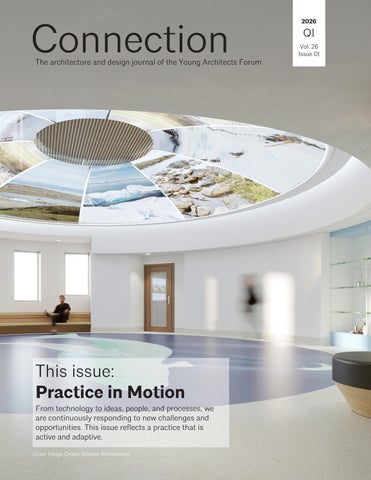
This issue: Practice in Motion
From technology to ideas, people, and processes, we are continuously responding to new challenges and opportunities. This issue reflects a practice that is active and adaptive.
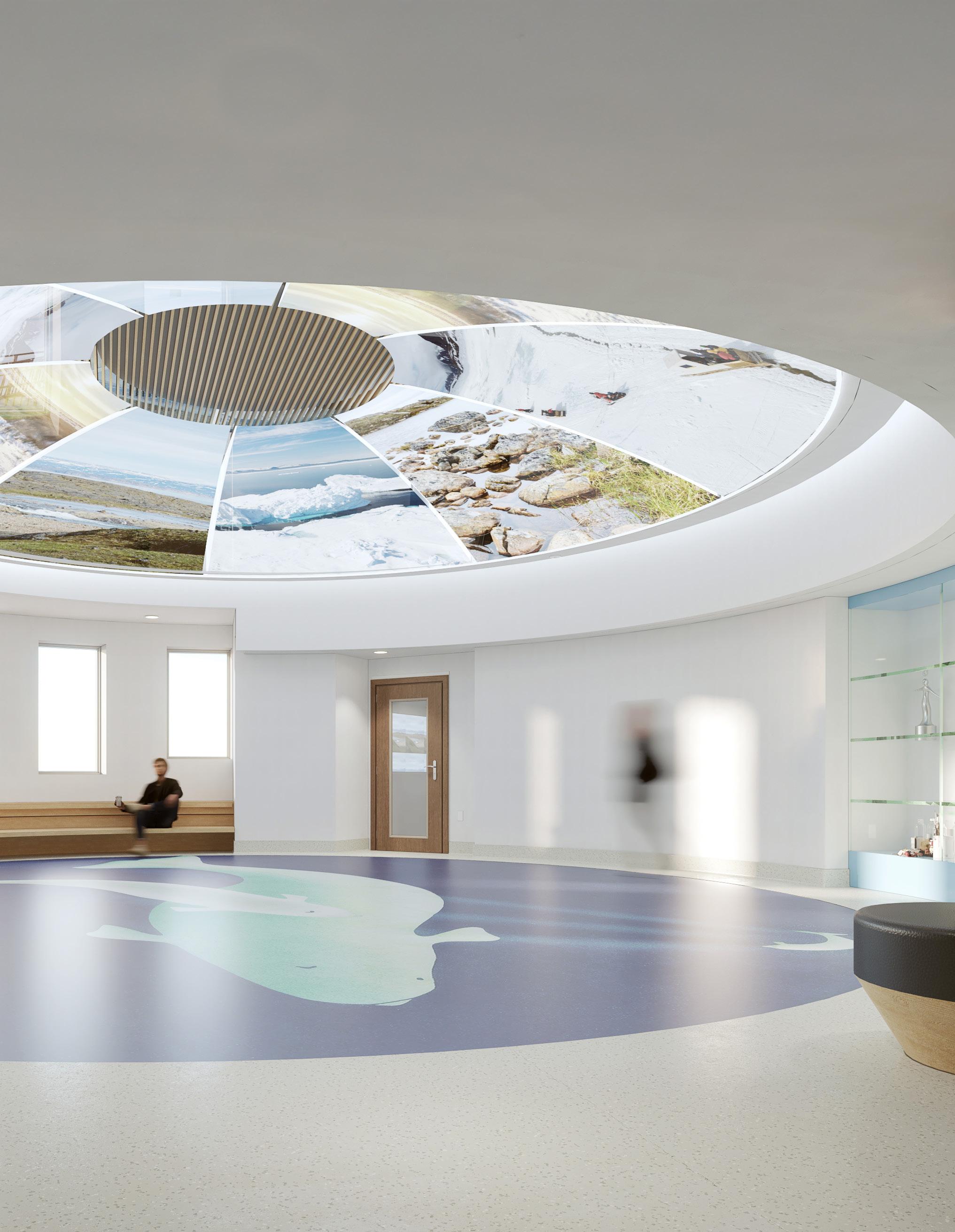
Cover Image Credit: Stantec Architecture
2026 Young Architects Forum Advisory Committee
2026 Chair
2026 Vice Chair
2026 Past Chair
2026-2027 Advocacy Director
2026-2027 Communications Director
2025-2026 Community Director
2026-2027 Knowledge Director
2025-2026 Strategy Director
2026 AIA Strategic Council Representative
2026 College of Fellows Representative
2026 Council of Architectural Component Executives Liaison
AIA Staff Liaison
2026 Young Architect Representatives
Alabama, Ashley Askew, AIA Alaska, ChungTse Lin, AIA Arizona, Sarah Potzler, AIA Arkansas, Lauren Miller, AIA California, Magdalini Vraila, AIA Colorado, Lauren Falcon, AIA Connecticut, James Regnier, AIA Delaware, Lauren DeSimone, AIA Florida, Bryce Bounds, AIA Georgia, Adam Drummond, AIA
Hawaii, Krithika Penedo, AIA Idaho, Katie Darter Bennett, AIA Illinois, Raquel Guzman Geara, AIA Indiana, Rachel Lindemann, AIA Iowa, Ben Hansen, AIA Kansas, Garric Baker, AIA Kentucky, Jessica Farmer, AIA Lousiana, Calvin Gallion, AIA Maine, Sarah Kayser, AIA Maryland, Alonzo Colon, AIA Massachusetts, Charly Kring, AIA Michigan, Cara Wagner, AIA Minnesota, Constance Chen, AIA Mississippi, Robert Farr, AIA Missouri, Valerie Michalek, AIA Montana, Elizabeth Zachman, AIA Nebraska, Angel Coleman, AIA
Kiara Gilmore, AIA
Anastasia Markiw, AIA
Sarah Woynicz, AIA
Tanya Kataria, AIA
Nicole Becker, AIA
Kumi Wickramanayaka, AIA
Arlenne Gil, AIA
Kaylyn Kirby, AIA
Ashley Thornberry, AIA
Lisa Lamkin, FAIA
Hillary Cole
Kathleen McCormick
Nevada, Kristen Levin, AIA
New Hampshire, Brooke DeYoung, AIA
New Jersey, Abby Benjamin, AIA
New Mexico, Diana Duran, AIA
New York, Mi Zhang, AIA
North Carolina, Carrigan (Pennypacker) Doble, AIA
North Dakota, Ben Gutowski, AIA
Ohio, Margaret Beecroft, AIA
Oklahoma, Brian Letzig, AIA
Oregon, Elizabeth Lagarde, AIA
Pennsylvania, Melanie Ngami, AIA
Puerto Rico, Reily J. Calderón - Rivera, AIA
Rhode Island, Vacant
South Carolina, Cheyenne Kalb, AIA
South Dakota, Elizabeth “Liz” Brown, AIA
Tennessee, Sarah Page, AIA
Texas, Justin Taplet, AIA
Utah, Melissa Gaddis, AIA
Vermont, Vacant
Virginia, John McKenna, AIA
Washington, Rio Namiki, AIA
Washington D.C., Mika Naraynsingh, AIA
West Virginia, Daniel Garvin, AIA
Wisconsin, Justin Marquis, AIA
Wyoming, Kendra Shirley, AIA
AIA International, Jason Holland, AIA

Connection is the official quarterly publication of the Young Architects Forum of AIA.
This publication is created through the volunteer efforts of dedicated Young Architect Forum members and made possible through generous grant funding from the College of Fellows.
Copyright 2026 by The American Institute of Architects. All rights reserved.
Views expressed in this publication are solely those of the authors and not those of The American Institute of Architects. Copyright © of individual articles belongs to the author. All images permissions are obtained by or copyright of the author.
05 Momentum & Meaning, Editor’s Note
Nicole Becker, AIA
06 Practice in Motion, Chair’s Message
Kiara Gilmore, AIA
07 A Resiliency Toolkit for Architecture Firms
Laura Sherman, AIA, Chris Tromp, AIA
08 Redesigning Wellness Policies
Arti Verma, AIA
10 A Beacon of Hope
Stephen Parker, AIA
13 From Immigrant Paths to Leadership
Carolina Galvez, AIA, Dorota Gocal, IAC
17 Daylighting Design for Circadian Health in Existing Buildings
College of Fellows, Julia Siple, AIA, LEED BD+C, WELL AP
20 Reflections on My First Year on the AIA Strategic Council
Thierry Paret, FAIA, NOMA, MRIAI, RIBA, LEED AP
22 The Heavy Head that Wears the Crown Krutika Shah, AIA
24 Advocacy in Action Series
Tanya Kataria, AIA
28 Learning to Lead Before You’re “In Charge”
Devora Schwartz, AIA
30 Visibility with Integrity: Practice in the Social Age
Gabriella Bermea, AIA
34 Learning to Lead
Jane Rodrigues, AIA
36 The Multiplicity of Practice
Zuzanna Bojarska, Assoc. AIA
38 Evolving Practice through a Culture of Mentorship
Jane Rodrigues, AIA
42 Why Defining the Problem Matters More than Ever Yash Mehta, Assoc. AIA
43 Reducing Friction: From Lines to Logic Sanand Maddipati
44 ABC | Archi-TEXT Book Club
Justin Marquis, AIA
45 Connect + Chill
Young Architect’s Forum Knowledge Committee
Editorial team
Nicole Becker, AIA, NCARB, LEED AP BD+C Editor in chief

Nicole is an architect at Jacobs, based in Portland, OR practicing at the intersection of design, infrastructure, and emerging technologies. She is the 2026 Communciations Director for the Young Architects Forum.
Bryce W. Bounds, AIA, NCARB, CGC Senior editor

Bryce is a Miami native, a Construction Project Management Supervisor in the Public Work Dept. of Broward County, FL, Florida’s YAR, and Preside-Elect of AIA Fort Lauderdale. He attended nationally ranked Design and Architecture Senior High (DASH), and graduated from the Rhode Island School of Design (RISD) with bachelors in both Architecture and Fine Art
Constance Chen, AIA, NCARB Senior editor

Constance is a Minnesota native and a principal at Locus Architecture in Minneapolis. A University of Notre Dame graduate, her design approach intends to make meaningful connections between people and spaces. She serves as Minnesota’s YAR.
Valerie Michaelek, AIA, NCARB Senior editor

Valerie is a Project Architect at HOK in St. Louis. Her Professional experience spans a diverse range of project types, including aviation, science and technology, higher education, corporate, healthcare, and commercial work, and includes volunteer leadership at the local, state, regional, and national levels through the AIA. She currently serves as AIA Missouri’s YAR.
Ben Gutowski, AIA, NCARB Senior graphic designer
Ben is an Associate Architect as Zerr Berg Architects in Fargo, ND. He works on projects from schematic design through construction and anything from museums to schools. He is passionate about design and meaningfully connecting people to the built environment. He is serving his first year as North Dakota’s Young Architect Representative.
Justin Marquis, AIA, NCARB Senior editor

Justin is a Project Architect with Somerville Architects & Engineers in Green Bay, Wisconsin. Managing projects through all phases of development from conceptual design to construction administration, he currently supports the healthcare and educational studios at Somerville. He has a degree from the University of Wisconsin - Milwaukee and lives in the Fox Valley area with his family. Justin is the Wisconsin Young Architect Representative..
Garric Baker, AIA, NCARB Senior graphic designer
Garric is an owner at Baker McMillan located in Manhattan, Kansas. He currently serves as the AIA Kansas YAR and is finishing four years in this role. He holds a master’s degree from the College of Architecture, Planning & Design at Kansas State University.
Katie Bennett, AIA, NCARB Senior graphic designer

Katie is a project manager at Babcock Design in Salt Lake City, Utah and Boise, Idaho, and oversees projects during their inception phase through schematic design. She is the current YAR for the state of Idaho and is passionate about housing and sustainable design.
Calvin Gallion, III, AIA, NOMA, NCARB, LEED GA Senior graphic designer

Calvin is an architect and principal at studio^RISE in New Orleans, A Tulane School of Architecture alumnus and Natchitoches native, he is a passionate advocate for community and rehabilitation projects. He currently serves as the YAR for AIA Louisiana.
Kendra Shirley, AIA, NCARB Senior graphic designer

Kendra is a project architect at Arete Design Group in Wyoming and Colorado and is Wyoming’s YAR. As a graduate from one of the top undergraduate architecture programs in the country, Kendra’s training and experience provides her with a unique and innovative perspective for creating extraordinary experiences and designs.
Momentum & Meaning
Editor’s Note
What a year this quarter has been. All of the “next year’s problems” are now a backlog of today’s problems, and the lessons learned on burnout in Q4 were inspiring, yet harder than said to put into practice. While we may feel a collective sense of running on low battery, there’s also the quiet joy of what a new year can bring. We must remain hopeful in the impact and change we can create: in this profession, in our personal lives, in our communities, and in our world. We are angry. We are angry. But we must not let anger breed apathy and defeat. Acting on our hope amidst times that feel overwhelming is immensely important.
As we begin the year thinking about how our profession, and the world around it, is continuously in motion, shifting, growing, and evolving, this issue explores what that movement means for architects today. Motion shows up in how we care for ourselves through Redefining Wellness as Practicing what we Preach. It appears in the ways firms support their people in Redesigning Wellness Policies, from meaningful benefits and workplace culture to daylighting strategies that honor circadian health and design approaches that prioritize human wellbeing.
Practice in motion is also professional motion. We see it in mentorship that shapes emerging leaders by Evolving Practice Through a Culture of Mentorship, in leadership journeys that unfold without titles, and in the messy middle where growth truly happens and how AI is shaping practice in Reducing Friction: From Lines to Logic. Stories From Immigrant Paths to Leadership, motherhood and The Heavy Head that Wears the Crown, and the courage to define professional goals through Visibility with Integrity remind us that careers are not linear, they are living systems, constantly adapting.
At the scale of practice, motion asks us to reconsider visibility, differentiation, and advocacy. From voices in action and ethical
presence in the social age, to reconciling the impact of AI, architects are redefining how influence and impact take shape on all scales. A Beacon of Hope, a recovery center designed to support healing from generational trauma, reflects this broader truth: movement is not only about progress, but about healing, listening, and responding to context with intentionality. We see the need for this not only without our profession but within this nation and beyond.
What ties these stories together is not speed, but purpose. Practice in motion is less about rushing forward and more about choosing direction with clarity, humility, and intention.
If the past year has taught us anything, it is that momentum does not come from constant motion. It comes from resilience, pause, reflection, and the willingness to keep moving, thoughtfully, toward a future we are still shaping together.
In community, Nicole Becker Editor in chief / Connection
2026 Editorial Committee:
Call for volunteers, contributing writers, interviewers, and design critics.
Connection’s editorial committee is currently seeking architects interested in building their writing portfolio to work with our editorial team to pursue targeted article topics and interviews that will be shared amongst Connection’s largely circulated e-magazine format. Responsibilities include contributing one or more articles per publication cycle (3–4 per year). If you are interested in contributing to Connection, please contact the editor in chief at: nicolejbecker1@gmail.com.
Nicole Becker, AIA NCARB, LEED AP BD+C Architect at Jacobs in Portland, OR; 2025-2026
Practice in Motion
Chair’s message
Architecture is not static. Neither are the architects who practice it.
“Practice in Motion” reflects a truth many of us are living every day: the profession is evolving in real time, and so are we. The ways we design, lead, collaborate, and define success are shifting, sometimes subtly, sometimes dramatically. And for emerging and mid-career architects in particular, that motion can feel both energizing and disorienting.
We are practicing in a moment defined by change. New technologies reshape workflows almost overnight. Project delivery models continue to expand. Expectations around leadership, mentorship, and workplace culture are being actively questioned and rewritten. At the same time, many of us are navigating growing responsibilities, at work, at home, and within our communities, while asking ourselves familiar but increasingly complex questions: Where is my practice headed? What does growth look like now? And how do I stay grounded while everything is moving?
Practice in motion does not mean instability. It means responsiveness. It means learning to adapt without losing purpose, and evolving without abandoning our values. Motion asks us to stay curious, to challenge default paths, and to recognize that professional growth is rarely linear. Some seasons require acceleration; others require pause, recalibration, or redirection altogether.
Within this issue, you’ll hear from architects who are embracing that movement through new roles, new tools, new ways of working, and new definitions of impact. These stories are not
prescriptions. They are snapshots of practice as it exists today: iterative, relational, and deeply human. Together, they reflect a profession that is actively shaping itself rather than waiting to be shaped.
As the Young Architects Forum, our role is to support architects through these transitions not with a single roadmap, but by creating space for shared learning, honest conversation, and collective momentum. Practice in motion is not something to “solve.” It is something to engage with, intentionally, thoughtfully, and together.
As you read this issue, I invite you to reflect on your own practice. What is in motion right now? What feels uncertain, and what feels full of possibility? Where might a small shift unlock meaningful change?
Architecture has always been a discipline of movement: between ideas and execution, between individual and collective effort, between where we are and what comes next. The challenge, and the opportunity, is learning how to move with it.
Let’s keep going.
With appreciation, Kiara Gilmore, AIA 2026 Chair | Young Architects Forum
Firstname Lastname Lorem ipsum dolor sit amet, consectetur adipiscing elit, sed do eiusmod tempor incididunt ut labore.
Sarah Woynicz, AIA is the 2025 Chair of the Young Architects Forum and a Project Architect at HKS. She brings a community-centric focus to clients and teams, valuing purpose-driven practice that supports the firm’s social justice, equity, diversity, and inclusion efforts to foster belonging in the profession.
Kiara Gilmore, AIA
Kiara Gilmore, AIA is an Associate at Modus Studio in Fayetteville, Arkansas. Gilmore serves as 2026 Chair of the Young Architects Forum and brings a perspective rooted in mentorship, service, and high-impact design.
A Resiliency Toolkit for Architecture Firms
People · Projects · Practice Future-Proof Practice
This toolkit was developed from the Early Leaders Practice Simulation Lab held during the 2025 AIA Aspire Conference, where architects, designers, and firm leaders from diverse experience levels and geographies collaborated to develop strategies for building resilient practices in response to current industry research.
Insights from this collaborative workshop have been distilled into the following guidelines focused on strengthening People, Projects, and Practice.
People
Lead by Example
Leadership at all levels should model balance. This signals to teams that healthy practices go hand-in-hand with professional growth.
Normalize Transparency
Share the realities of workload, finances, and business challenges. Acknowledging them as a team fosters collective problem-solving and prepares future leaders to face similar obstacles.
Value Time
Discuss workload expectations and responsibilities regularly. Treat wellbeing as a shared responsibility across all levels of the firm.
Projects
Build Strong Relationships
Long-term resilience comes from trusted partnerships—both with clients and within teams. Nurture repeat work by building relationships rooted in shared values, transparency, and mutual goals.
Fulfill Project Needs
Strategically align project pursuits with firm goals. Plan proactively to bring in outside experts or partners where gaps exist in expertise.
Work Smarter
Leverage technology to enhance quality and efficiency. Remain open to alternative delivery strategies that better serve both project and client.
Set Healthy Precedents
Avoid work that undermines your principles. Making one exception to this can quickly become a precedent, eroding trust with both staff and clients.


Practice
Inclusive and Transparent Leadership
Decisions are stronger when more voices are included. Build structures for staff input, encourage early feedback, and ensure that information flows openly between leadership and teams.
Adaptive Systems
Establish workflows, staffing approaches, and technologies that can be reassessed and evolved as the profession changes.
Stay Accountable to Firm Values
In moments of pressure, return to the firm’s founding values. These act as the compass that orients decisions across people, projects, and practice— ensuring that adaptation never means compromise.
AIA Aspire Early Leaders Practice Simulation Lab 2025 Lab Outcomes Report
Compiled by Laura Sherman, AIA, and Chris Tromp, Assoc. AIA
Chris, a Sr Project Coordinator with The Beck Group, aims to blend innovative design with environmental responsibility through his work. Currently serving as Georgia’s AIA Statewide Associate Representative, Chris leads in advancing mentorship and advocacy for emerging professionals.
Chris Tromp, Assoc. AIA
Laura Sherman, AIA
Laura is an architect in Atlanta leading in adaptive reuse and community-centered design. She serves as Georgia’s AIA Young Architects Forum representative and mentors emerging professionals.
Creating a Healthier Workplace for Young Architects Redesigning Wellness Policies
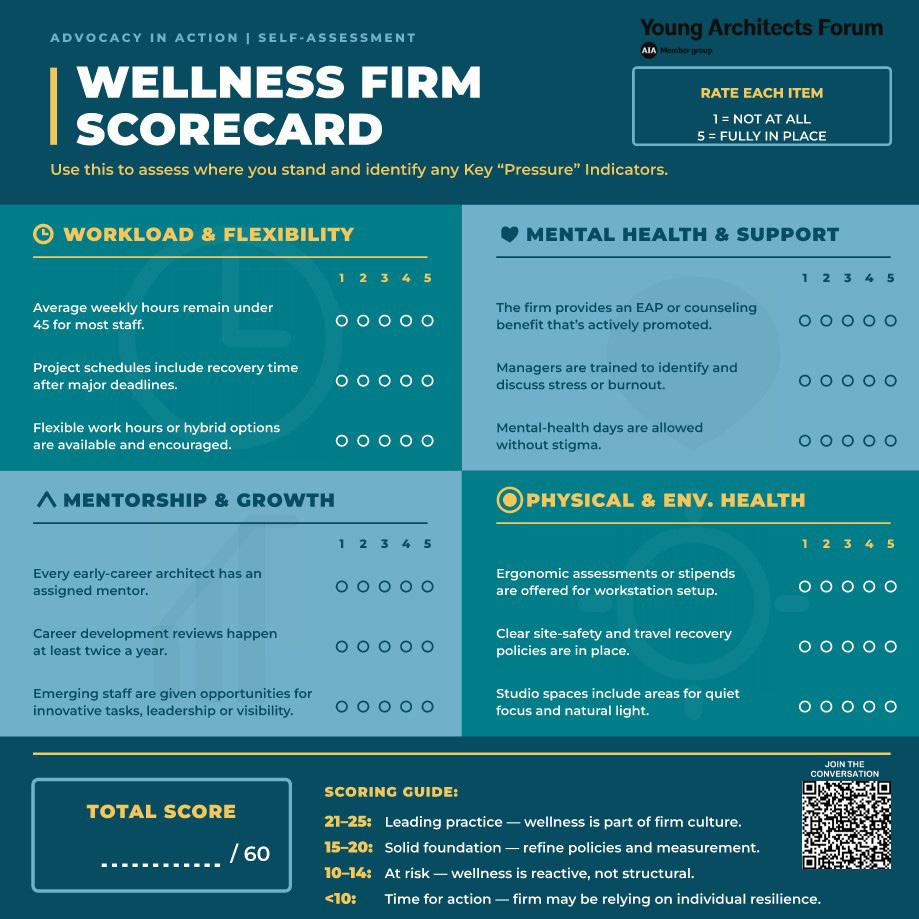
The first decade of an architecture professional’s career is a period of immense and intense growth. Young professionals are often under pressure to learn fast, perform well and “establish themselves” in the office. In addition, this demographic faces juggling their transition from an academic environment, navigating the challenging journey of licensure, and often the lack of mentorship in their career trajectory. Oftentimes, people don’t realize that they are on the burnout trajectory until it’s too late. It is essential to self analyze and look for KPIsKey “Pressure” Indicators to evaluate if your workplace systemically prioritizes your physical and mental wellbeing.
A 2024 survey by Monograph1 revealed that young professionals often report long work hours
Young professionals often report long work hours and blurred work-life boundaries
and blurred work-life boundaries. They also hesitate to use benefits such as PTO for fear it may reflect poorly on their performance. The result is a culture where exhaustion is normalized, and health and well being feels secondary to deadlines.
In today’s overall professional environment across various fields, wellness is no longer a perk - it has become a part of workplace policy and infrastructure. But, architecture as a profession has a lot of catching up to do in this realm. Archinect’s 2023 Mental Health Survey Results2 shows that 70.9% of individuals noted that they do not have access to Institutional Mental Health Support provided by their firms. And, only 10.9% of that same group feel very comfortable discussing mental health concerns with peers and superiors. When firms lack wellness initiatives, it leads to faster burnout, high turnover, reduction in creativity affecting the overall firm growth, and employee retention. While other sectors are using a more formal approach to wellness, architecture often relies on an individual’s resilience - which is an outdated model.
wellness generally fall under4 buckets - Policy, Benefits, Physical Environment and Workplace Culture.
Unfortunately, changing the culture of the profession isn’t just evaluating the benefits your company provides on paper, it is a systemic shift in the mindset of both young and seasoned professionals. While late night and last minute “heroic” design efforts provide us with the short term boost of adrenalin, we need to realize that this is often detrimental in the long run and
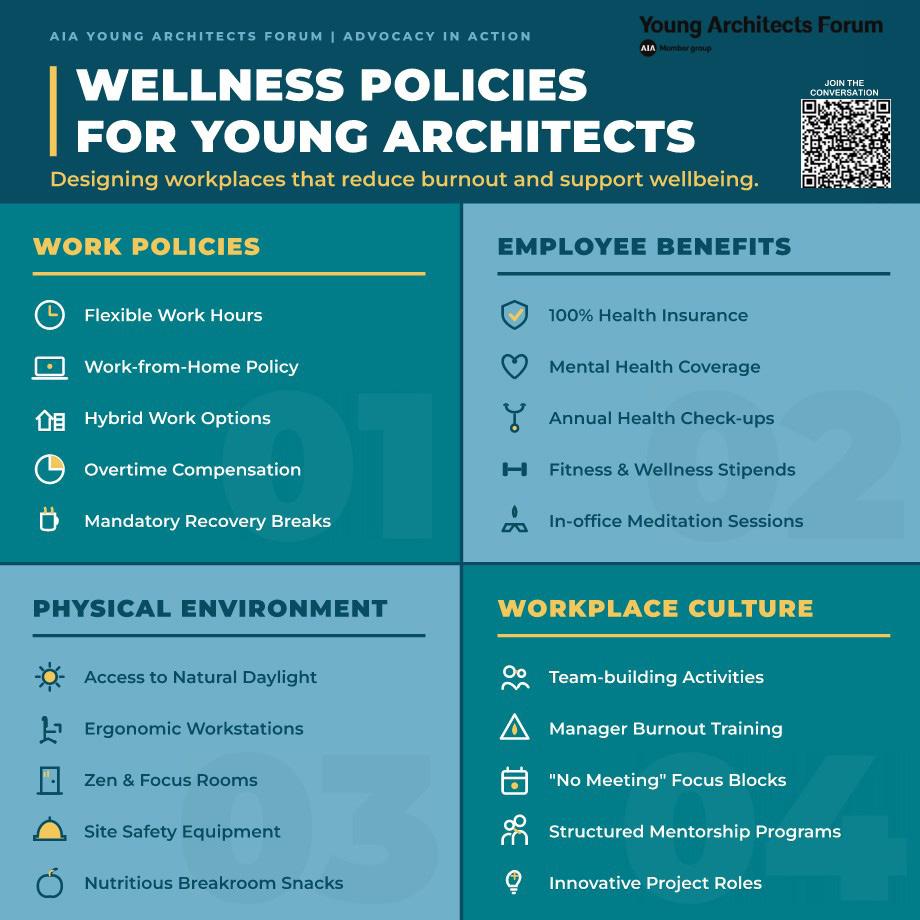
Evaluating the architecture profession against what’s working in other professions and analyzing those against CDCs Workplace Health Manual3 and CDC’s Workplace Health Model4, what companies most commonly provide today as resources for
we should not promote this occurrence frequently to prevent it from becoming a norm. As young architects, we need to consciously start conversations in the workplace to create an awareness regarding the need for focus on well being, so that firm management can identify the need to update firm policies. Focusing on culture and mindset5 is the key to drive successful and meaningful change in this realm.
Below is a self evaluation checklist to identify if your firm
supports health and wellbeing.
1 The State of Burnout in Architecture, by Rebecca Hey, Monograph Editorial - April 2024
2 Archinect’s 2023 Mental Health Survey Results, Oct 2023
3 CDC Worksite Health ScoreCard Manual, Feb 2025
4 CDC Workplace Health Model, July 2024
5 AIA - Experts weigh in on tackling mental health in architecture, Dec 2023
Arti Verma, AIA, NCARB, LEED
AP BD+C, ALA
PM at Dynamik Design in Atlanta, GA. Licensed Architect and a certified breathwork and meditation instructor
A Beacon of Hope Designing For Generational Trauma and Healing
I arrived in Ottawa a day early, only to learn my seat had been canceled. After rebooking, the aircraft flew lower and longer than expected, skimming mist and coastline as the pilots searched for a clear approach. From above, the rolling seas and tundra unfolded like a living map: vast, spare, and humbling. The first landing attempt was scratched entirely when the airfield couldn’t be found. The weather, we were reminded, doesn’t negotiate in the Arctic.
We diverted to northern Québec and touched down on a remote airstrip with no cell coverage, no terminal, and only a fuel truck waiting for us in the wilderness. After two clear weather reports, the pilots felt confident enough to try again. When we finally landed in Iqaluit, late in the day instead of early morning, the cabin erupted in cheers. It felt like a small victory, and in hindsight, an appropriate beginning.
Designing a recovery center in the Canadian Arctic requires patience, adaptability, humility, and trust in forces far larger than oneself. The land sets the rules. The people set the vision. The architect’s role is to listen, translate, and make space for healing to occur.
That project is Aqqusariaq, the Nunavut Recovery Centre. Aqqusariaq means “a trail you go through to reach your destination” in Inuktitut. The word does not promise ease or linearity. It acknowledges that a journey takes time and effort and that recovery is not a single moment but a passage.
The Government of Nunavut set out to create a voluntary, Inuit-led recovery facility rooted in a model of care developed
by Inuit, for Inuit. This wasn’t about importing a framework and adapting it. It was about collaborating on a new kind of behavioral-health environment—one that responds directly to generational trauma, addiction, and mental-health needs while honoring Inuit culture, language, family structures, and relationship to the land.
At 40,000 square feet with 24 inpatient beds and a construction cost of $83.7 million CAD, Aqqusariaq is the northernmost behavioral-health facility of its kind in the world. It will support thousands of Nunavummiut across the territory.
Healing Generational Trauma
Aqqusariaq exists because Inuit communities demanded control over their own destiny—over how care is defined, delivered, and experienced. Funding for the center comes from federal and territorial sources, reflecting an unusual and powerful collaboration. But the authority over the model of care belongs to the community itself.
Our role as designers was not to direct, listen, learn and lead collaboratively. To create a physical environment capable of holding Inuit values, practices, and lived realities without filtering them through Western assumptions about efficiency, security, or treatment.
Keeping Families Together
Most addiction and mental-health facilities are not designed for families. They separate patients by acuity, age, diagnosis, and
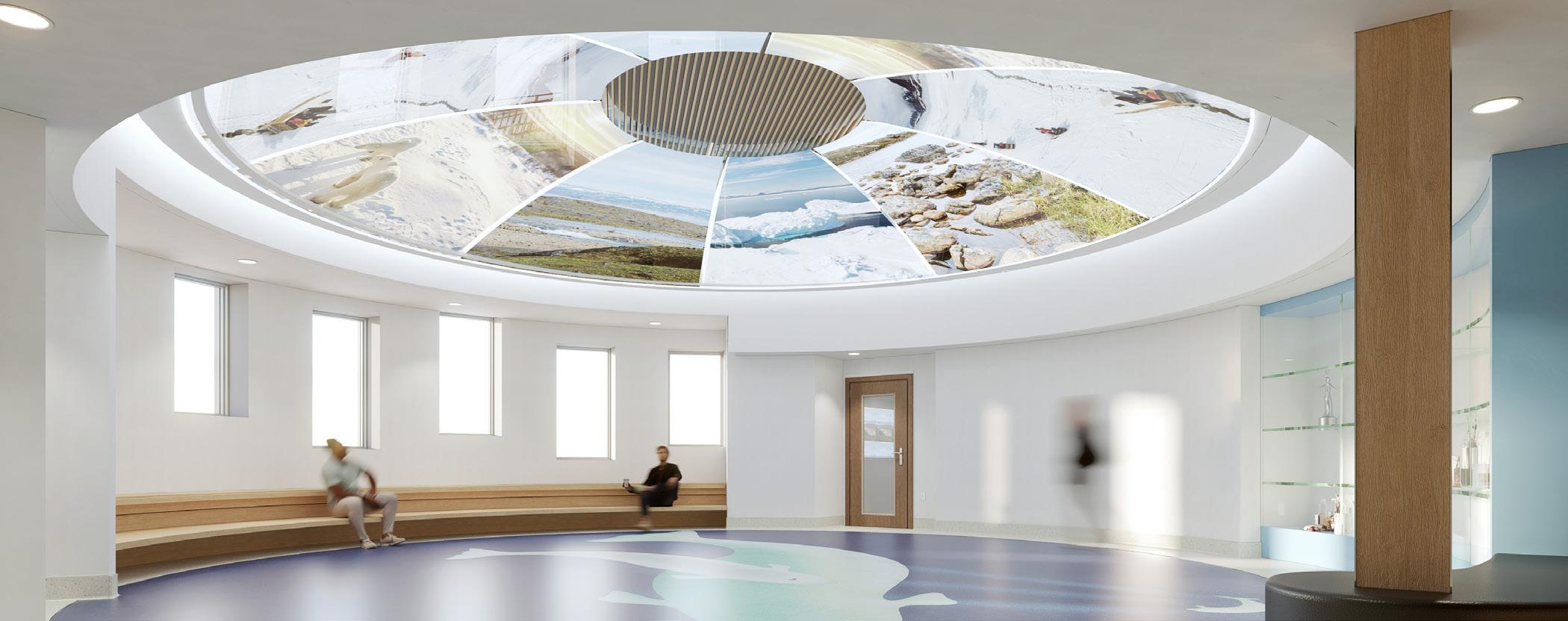
Stantec Architects: Aqqusariaq Ceremony Space
liability risk. Aqqusariaq deliberately resists that approach.
The facility includes 24 beds arranged in flexible configurations, including family suites that allow parents, children, partners, and grandparents to stay together. The complexity of family systems and navigating addiction is acknowledged and honored. Mothers with infants. Parents caring for children on the autism spectrum. Multi-generational households seeking support.
Likewise, generational trauma cannot be addressed in isolation. Healing requires reconnection across age groups, culture, and lived experience. Aqqusariaq supports this through shared spaces: youth lounges, visitation rooms, group therapy areas, and communal amenities that encourage interaction while protecting privacy between cohorts.
Boundaries remain intact. Certain patient populations require separation at times, and the building allows for that without feeling punitive or institutional. Instead, the building is framed as a place of care, belonging, and agency.
Beyond Efficiency
From a US architectural perspective, Aqqusariaq might be considered an inefficient building.
Its corridors are wide and generous. Rooms are shaped by use rather than by modular grids. The geometry is, frankly, wonky— one of the most complex forms I have ever worked on. We chose to harmonize empathy with evidentiary research on lowering social density while improving the milieu or therapeutic spaces.
Inuit culture values gathering, storytelling, shared labor, and intergenerational presence. Narrow corridors discourage conversation. Rectilinear planning does not accommodate flexible family configurations. A strict emphasis on efficiency often suppresses social interaction in favor of throughput.
Aqqusariaq takes cues from traditional Inuit structures, shaped by and for wind, snow, and seasonal changes. The building is elevated to manage snowdrifts. Its façade responds to the nine
Inuit seasons, shifting visually with light, shadow, and weather.
Multiple entrances allow people to come and go freely. There is no curfew, no lockdown, no physical or chemical restraints. This operational assumption of risk was intentional.
“Recovery requires dignity”
Recovery requires dignity: Putting a kettle on for tea. Walking outside when needing to self-regulate. Choosing when and how to engage socially provides voice and choice, a traumainformed principle. The building supports autonomy while quietly embedding safety through robust construction, ligature-resistant systems, barricade-resistant doors, and thoughtfully designed interiors. Art and repatriated artifacts are front and center, signaling the value invested in these spaces and that those receiving care here are valued and belong.
Culture as Care
We also needed to design for and around the fact that Aqqusariaq intends to integrate culture as therapy.
On-the-land programming connects patients to hunting, navigation, and survival skills. A skinning, butchering, and tanning workshop, complete with a safe hide-stretching rack capable of accommodating a polar bear, is part of the facility, which was a first for most of us I believe. All of this supports traditional practices rarely acknowledged in clinical environments.
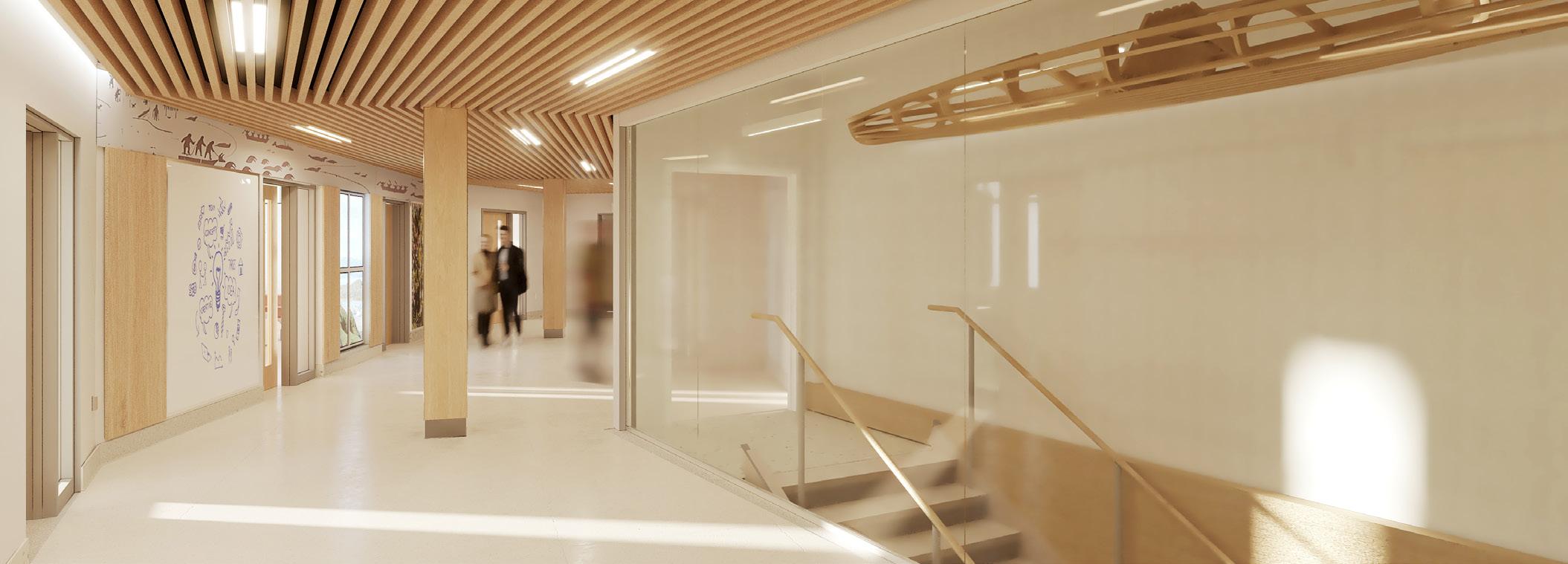
There are spaces for traditional crafting, a shared ceremonial room, and areas for music and storytelling. We repatriated found objects, such as a kayak, and commissioned indigenous artwork, embedding it throughout the building. Artifacts are not displayed as curiosities but as living expressions of continuity.
Graphics reference constellations, animals, and seasonal markers: the season of the skin tent, the geese, the caribou hunt, the seal pups, the polar bear. Each speaks to cycles of survival and sustenance. In some ways, the building functions as both
Stantec Architects: Main Stair
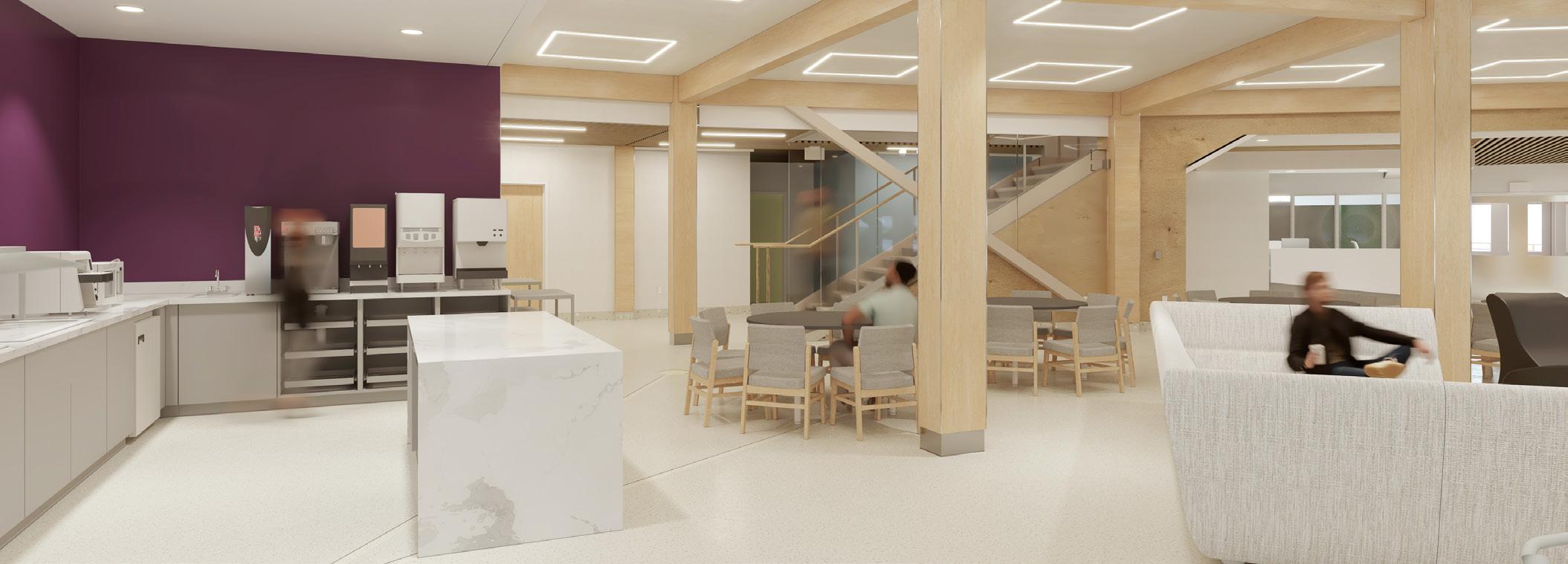
care facility and cultural archive, a place where traditions are honored and reimagined.
Flexibility as Respect
The two-story facility includes outpatient counseling, group therapy, intake and assessment spaces, and clinical areas capable of supporting a range of acuities. Two dedicated wings address generational trauma and addictions, specifically.
A “zipper” program allows patients to move fluidly between inpatient and outpatient care. Group therapy spaces flex to expand or contract. Public and private zones are clearly legible without relying on signage or security.
An on-site daycare, accessible via a separate entrance, removes one of the most significant barriers to care. Parents can attend therapy knowing their children are safe nearby. This single design move represents a profound shift in how access, equity, and support are understood.
Outdoor storage accommodates snowmobiles and firearms, a necessity for life on the tundra, where travel requires selfreliance and protection. Deep freezers support subsistence food practices. Kitchens are designed for communal cooking rather than an institutional meal service.
Everything must be delivered to the site by boat or air freight. Nothing about this project, or life on the Arctic tundra, is easy. And yet, the effort itself becomes part of the meaning.
Architecture as Advocate
Aqqusariaq is not an answer to generational trauma; it’s a response.
The Inuit do not want us to overpromise; they want us to be honest, inclusive, and respectful. No one facility or treatment modality can heal centuries of harm. We hope, however, that this project provides a place where healing can begin.
As architects, we are trained to solve problems, but this project required something different: restraint, humility, and a willingness to be corrected. It required us to accept that modern “best practices” are not universal truths. A Two-eyed Way to seeing asks us to consider Indigenous knowledge and evidencebased design. Most importantly, it required intense listening, an ongoing dialogue that shaped our decisions large and small.
Stories that Matter
Standing outside the completed structure, overlooking the tundra and bay, it is clear that Aqqusariaq belongs to this place. It is not in the city, nor isolated from it.
This building represents a shift in how behavioral-health environments can be conceived. It demonstrates that architecture can participate meaningfully in addressing generational trauma—not by imposing solutions but by creating space for communities to define healing for themselves.
Other members of the Stantec team working on this project include: Melissa White, architectural team lead in Northern Canada; Josh Armstrong, architect and leader of Stantec’s Iqaluit office; Ena Kenny, interiors lead; Deanna Brown, architect and; and Maggie Burt, intern architect in the Yellowknife office.
For me, Aqqusariaq has reinforced that our responsibility as designers is not to be the loudest voice in the room, but to help manifest the voices that matter most. Another Inuit saying could apply here: “Our ancestors are happy when stories from the land are told, and retold, and preserved.”
May this be a place for healing, and resilience, and storytelling.
Stephen Parker, AIA
is a mental + behavioral health SME at Stantec in Washington DC, + an AIA Young Architect Award recipient
Stantec Architects: Dining Room
From Immigrant Paths to Leadership
What WLS 2025 Taught Us
Immagrant Architects Coalition
Dorota Gocal, Assoc. AIA, LEED AP BD+C
Dorota is a senior designer and project manager at N2 Design + Architecture, PC. She co-chairs AIA Long Island Women in Architecture, mentoring emerging architects and advancing equity and human-centered design.

Carolina Galvez, Assoc. AIA, ASID Member
is an architect and interior designer based in Miami. She leads hospitality and residential developments, elevating projects through thoughtful design and leadership while inspiring women to lead with confidence and purpose.
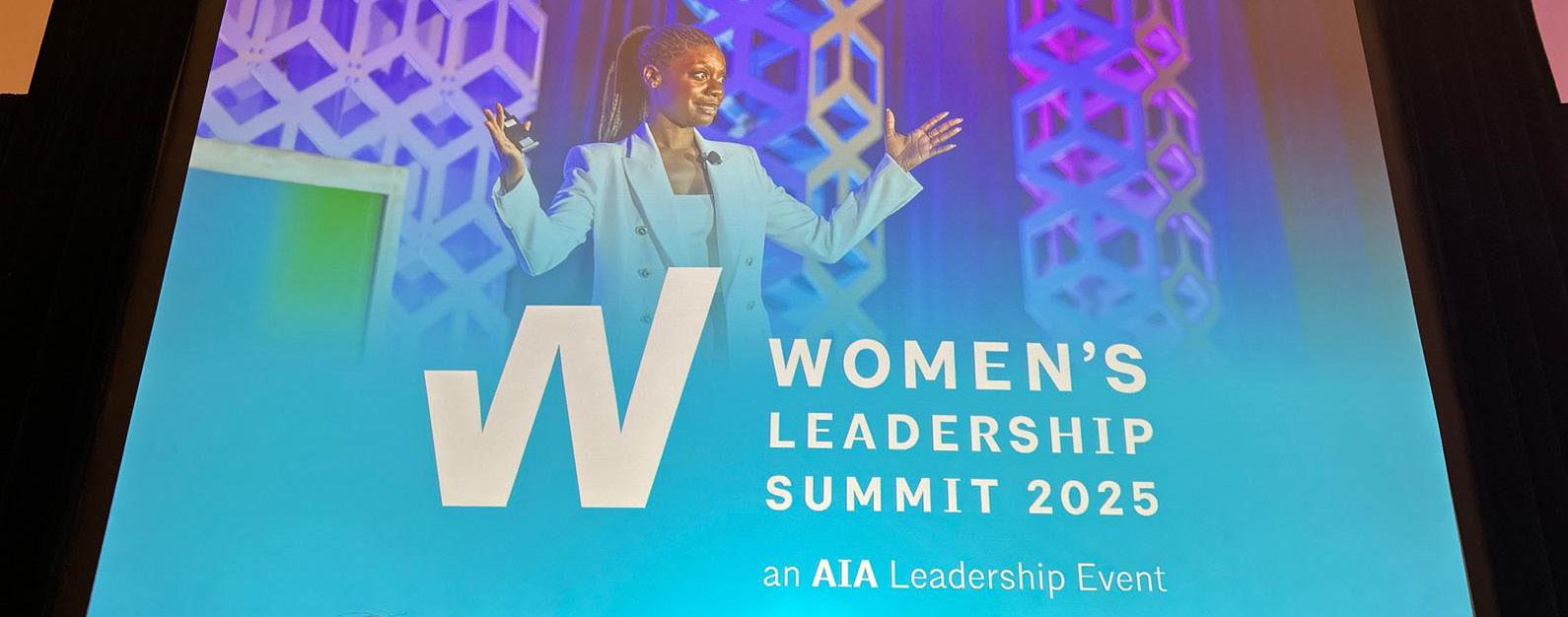
When we signed up for the 2025 AIA Women’s Leadership Summit (WLS) in Atlanta, we thought we were attending a major industry event. What we didn’t anticipate was stepping into one of the most powerful rooms of our careers — a space filled with women who looked like us, sounded like us, and had walked paths similar to ours, redefining what leadership in architecture truly means.
As immigrant architects navigating careers in the U.S. on O-1 visas, our journeys have been anything but linear. They have been complex, emotional, exhausting, empowering, and deeply personal.
At WLS, as we connected with women across roles and career stages, we recognized a shared reality: despite different paths, many of us navigate similar pressures — to prove legitimacy, to move faster, to justify our presence. Those conversations, often informal and unguarded, made our experiences feel visible and understood.
WLS became more than a conference. It became a place where our stories, struggles, and ambitions were recognized, not as exceptions, but as part of the profession’s evolving leadership narrative.
WLS 2025 banner displayed at the AIA Women’s Leadership Summit, Atlanta. Photo credit: Dorota Gocal
A Room Where We Belong
WLS is one of the most influential gatherings in the AEC industry, powered by AIA and supported by leading architecture firms. From the very first breakfast to the final keynote, every interaction revealed the same truth: women in architecture carry extraordinary stories.
Principals of major firms, emerging designers, educators, builders, engineers, and project managers gathered in one space, all sharing ambition, doubt, resilience, and an unmistakable drive to leave a mark.
Imposter syndrome surfaced repeatedly in conversations. Many of us, especially immigrant professionals, know the weight of working twice as hard to be seen.
In our own careers, it has shown up as the constant need to prove our legitimacy: our credentials, our experience, even our right to occupy certain spaces. At times, it is reinforced by systems that underestimate our voices or overlook the value of nontraditional paths.
At WLS, hearing these same doubts voiced by women across seniority levels shifted something. Being in a room filled with leaders who had arrived through different routes reminded us that belonging is not granted — it is claimed, collectively.
A Seat at the Table
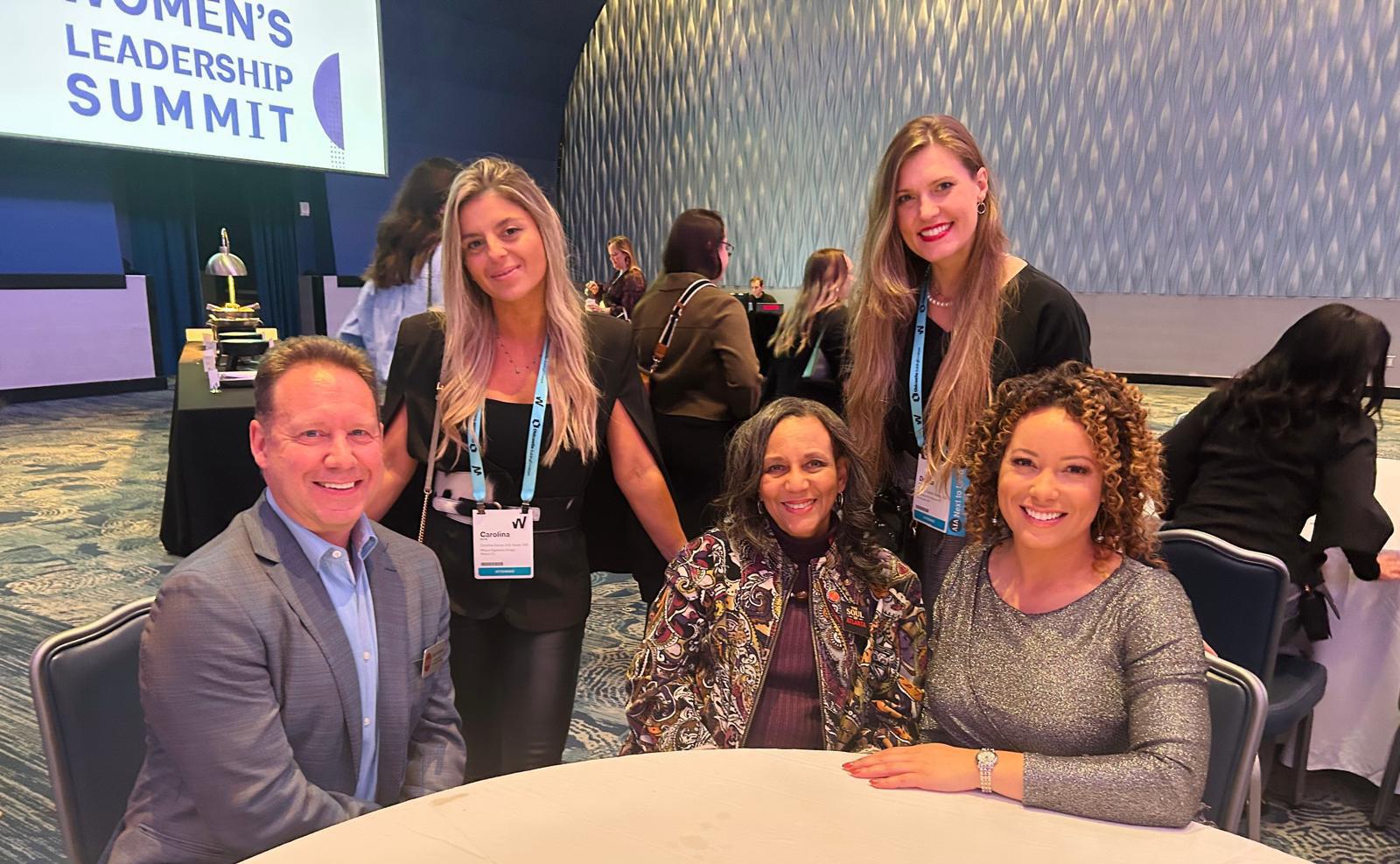
One of the moments that left a lasting impression was the opening-night celebration, where we had the honor of sitting at the same table as Cheryl McAfee, FAIA, NOMA, LEED AP; Jessi Mitchell, CBS anchor and WLS host; and David Southerland, Executive Director.
Cheryl — the first woman licensed in Kansas, former president of the National Organization of Minority Architects (NOMA), and CEO of McAfee3, the architecture firm founded by her fathershared the story of being the first woman to fight for the creation of Next to Lead.
Hearing her courage, perseverance, and dedication to opening doors for other women and immigrant architects was profoundly moving. That moment reminded us that leadership is not only personal achievement, but it is the act of creating space for others to rise alongside you.
Dorota Gocal and Carolina Gálvez at the WLS opening-night celebration with Cheryl McAfee, FAIA, NOMA, LEED AP; Jessi Mitchell, CBS anchor; and David Southerland, Executive Director. Photo credit: Dorota Gocal
Leadership Through Humanity
Throughout WLS, vulnerability and humanity were not secondary themes; they were central.
Evelyn Lee, FAIA, NOMA, 2025 AIA President, opened a keynote with words that resonated deeply:
“Emotion doesn’t weaken leadership. It deepens it.”
Speakers reminded us that leadership is not a title or a position; it is a daily practice rooted in empathy, integrity, and authenticity.
Vernice “FlyGirl” Armour, the first Black female combat pilot in U.S. history, offered a powerful reminder:
“Acknowledge obstacles, don’t give them power.”
Immigrant architects often navigate obstacles that are both visible and invisible. These words felt like a permission slip to lead boldly, to embrace humanity, and to treat our lived experiences as a source of strength.
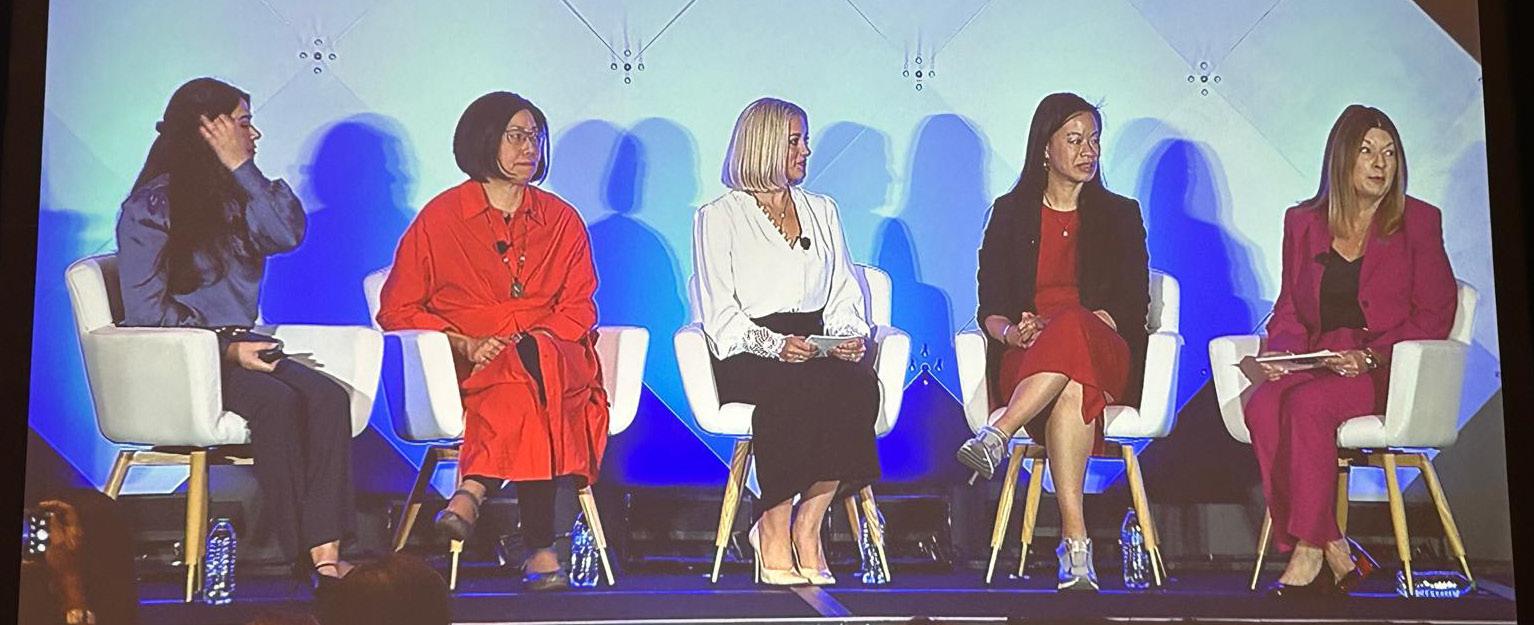
Panels such as Design for Impact, featuring Illya Azaroff, FAIA, Jazz Graves, AIA, and others, reinforced that leadership also means impact through sustainable, resilient, and equitable design.
Creating Space and Seizing Opportunities
Many attendees, including students and emerging professionals, were able to participate thanks to scholarships and grants covering registration, travel, and accommodations. For immigrant architects in particular, that access meant more than attendance. It created visibility, confidence, and proximity to leadership, often the first step toward imagining oneself not only within the profession but shaping its future.
WLS reinforced a message that echoed throughout the summit:
“Empower yourself. Don’t wait for permission.”
Leadership is built, not given. Opportunity expands when access is intentional and when those in leadership choose to invest in who gets to enter the room.
A Community That Lifts as It Climbs
What makes WLS unforgettable is the people. Everyone, from award-winning firm principals to students, was approachable, candid, and willing to share their stories. Informal dinners, casual meetups, and hallway conversations extended the summit beyond sessions, fostering a network of support, solidarity, and inspiration. Quotes from fellow attendees captured the energy:
“Seeing women who look like me in leadership positions made me believe I can do the same.”
“Empowerment comes from connection and intentional action.”
“WLS is the space where I realized my voice has weight.”
We left every interaction with new tools, new perspectives, and a renewed sense of purpose.
Wendy Rogers, FAIA; Rosa Sheng, FAIA; Emily Schickner, AIA; Evelyn Lee, FAIA; and Margo Martin during the ‘Leading Through the Now’ keynote at WLS 2025.
Photo credit: Dorota Gocal
Why This Matters for Immigrant Architects
Our immigrant paths are strengths, not obstacles. They bring resilience, adaptability, cultural intelligence, and perspectives that enrich the profession.
Recognizing these strengths also carries responsibility to mentor others navigating similar paths, to advocate for more inclusive systems, and to actively participate in shaping the future of leadership in architecture.
WLS reminded us that leadership in architecture is evolving, becoming more inclusive, collaborative, and shaped by diverse voices.
We left Atlanta inspired, energized, and more committed than ever to leaving a legacy, not just in the buildings we design, but in the women we uplift, the communities we influence, and the doors we open for others.
Final Reflection
WLS 2025 taught us this:
• We belong here.
• We earned our seat.
• Our immigrant paths have shaped us into leaders.
• Together, we rise, one connection, one story, one act of courage at a time.
To our fellow immigrant architects: bring your ideas, questions, and dreams. Apply for scholarships or grants. Participate in Next to Lead. WLS is more than a summit; it’s a catalyst for connection, growth, and leadership.
Come ready to be inspired, to belong, and to rise.
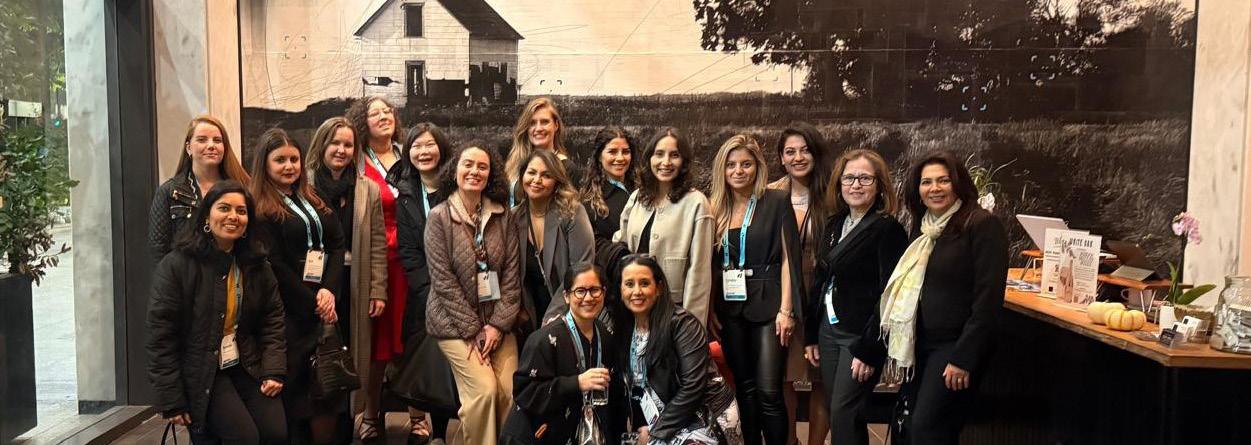
Members of the Immigrant Architects Coalition enjoying a ‘Dine Arounds’ networking event at WLS 2025. Photo credit: Carolina Galvez
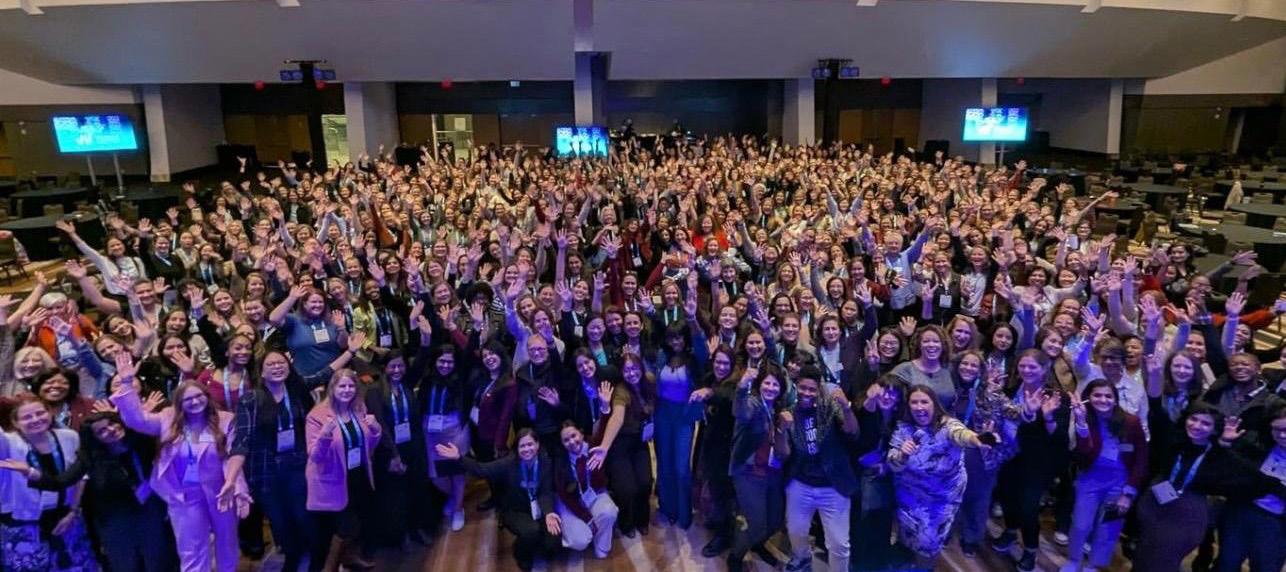
Attendees of the 2025 AIA Women’s Leadership Summit gathered for a group photo. Photo credit: AIA
Daylighting Design for Circadian Health in Existing Buildings
Upjohn Research
Drives
Practical Innovation in Architecture
Previously published in the 2024 Q4 edition of the COF Quarterly
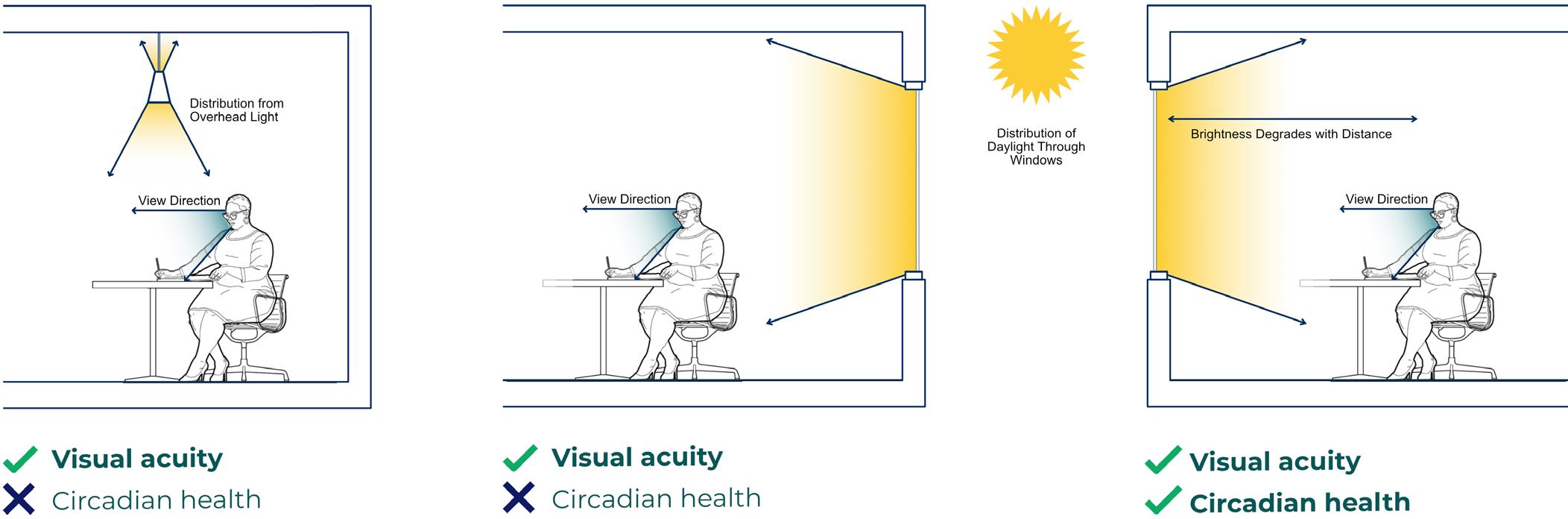
The AIA Upjohn Research Initiative plays an important role in advancing architectural practice. By supporting and publishing applied research, the program enables architects to pursue indepth study, collaborate with academic partners, and translate ideas into tools that directly inform design. It provides space for curiosity, encouraging firms like Quinn Evans to step beyond daily project work and explore questions that can elevate both practice and design impact.
At Quinn Evans, our experience with the Upjohn grant grew out of that same sense of curiosity and a series of well-timed conversations. As part of our culture of learning, we regularly invite practitioners outside the firm and beyond the field of architecture to share their work. One of those presentations featured Siobhan Rockcastle, director of the Baker Lighting Lab and co-director of the Institute for Health in the Built Environment at the University of Oregon. Dr. Rockcastle, a former professor of my colleague Denise Gravelle, AIA, LEED AP BD+C, spoke with our team about daylight design, health, and case study applications.
A lively discussion followed, revealing a gap in clear, accessible guidance for improving circadian health in existing buildings. The conversation sparked the idea for collaboration and ultimately, our Upjohn grant proposal. We wanted to identify strategies that could help designers and projects—especially those that might not be able to do a complex daylight modeling analysis—make meaningful improvements to the many spaces where people spend most of their time indoors. Partnering with Dr. Rockcastle and her team, we applied for an Upjohn grant to explore this challenge.
The resulting research culminated in a report and accompanying design guide that is publicly accessible on our website and forthcoming by the AIA. By sharing our work broadly, we hope to encourage other firms to build on our findings and continue expanding the role of research in creating healthy, sustainable environments. For us, the project reinforced how curiosity, collaboration, and on-going learning are central to innovation— and to the evolving practice of architecture.
Photo Above: If daylight does not reach the vertical field-view, it will not increase circadian health.
The Problem
Circadian health—the alignment of our biological rhythms with the natural day-night cycle—is a growing area of research but not yet widely understood or easily applied within architectural practice. While designers recognize that access to daylight contributes to wellness, few have clear guidance on how to intentionally support circadian health through design— particularly in the context of existing buildings.
Green building rating systems such as LEED acknowledge daylight’s value, but their metrics primarily focus on visual comfort and energy performance rather than the timing, duration, and quality of light that most influence circadian rhythms. The WELL Building Standard begins to address this connection through its equivalent melanopic lux (EML) metric, but that measure focuses largely on electric lighting and remains challenging for many projects to model or apply.
As a result, architects often lack straightforward, data-backed strategies for improving circadian health potential in real-world projects. This gap between emerging scientific understanding and accessible design guidance became the focus of our Upjohn research: to translate complex daylight science into practical, actionable strategies that designers can use every day.
Our Goal
We set out to develop data-backed strategies that improve a building’s potential to support circadian health. Furthermore, we wanted to provide guidance that works for both new construction and renovations—because renovations present the additional challenge of working within the constraints of an existing building envelope. Our aim was to find opportunities regardless of project scope or size to enhance daylight conditions that support health and wellbeing.
Our Research
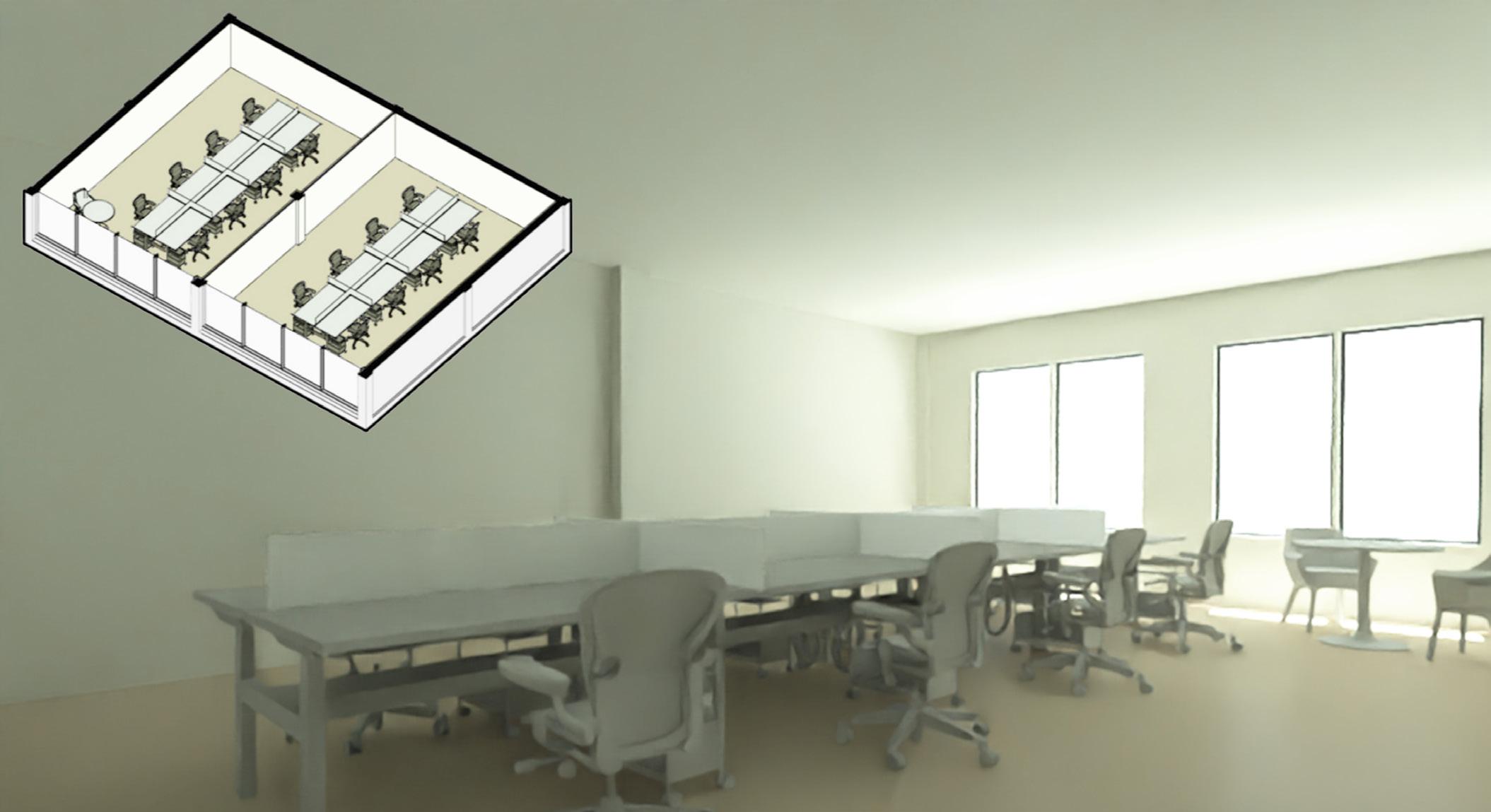
Our partners at the University of Oregon created digital simulations that compared the circadian health impacts of different design decisions. We helped set the parameters for the simulated space (a 30-by-40-foot office space with 16 desks and windows on one side), the design variables (including window-to-wall ratio [WWR], furniture orientation, and surface reflectance), and the range within variables based on our long experience working with existing buildings. The team then studied a variety of design changes one by one and quantified their potential effect on circadian health.
To show real-world applications, we also analyzed three projects from Quinn Evans’ portfolio. Our case studies quantify the circadian health potential of an elementary school, a government office building, and a commercial office tenant space before and after renovation.
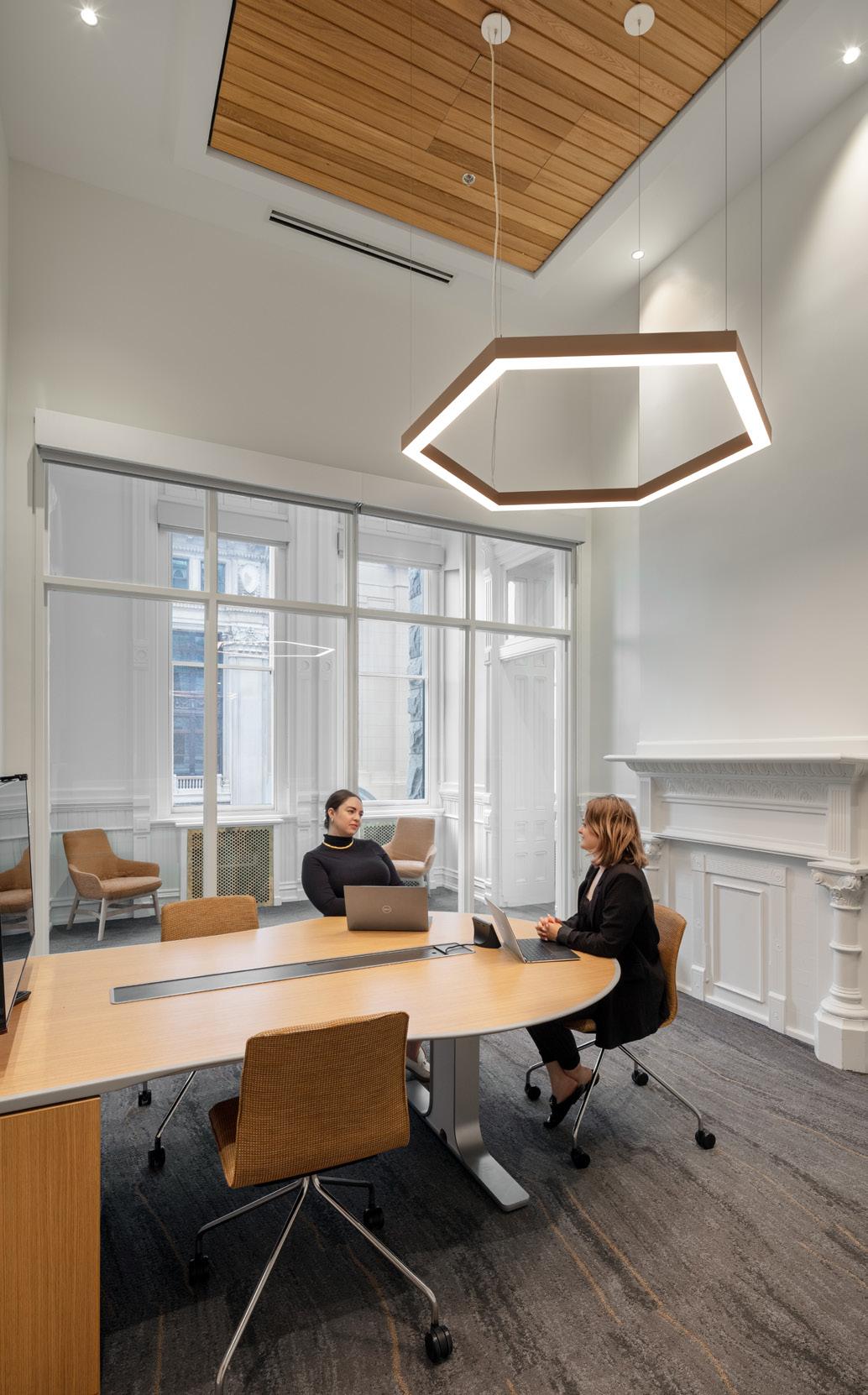
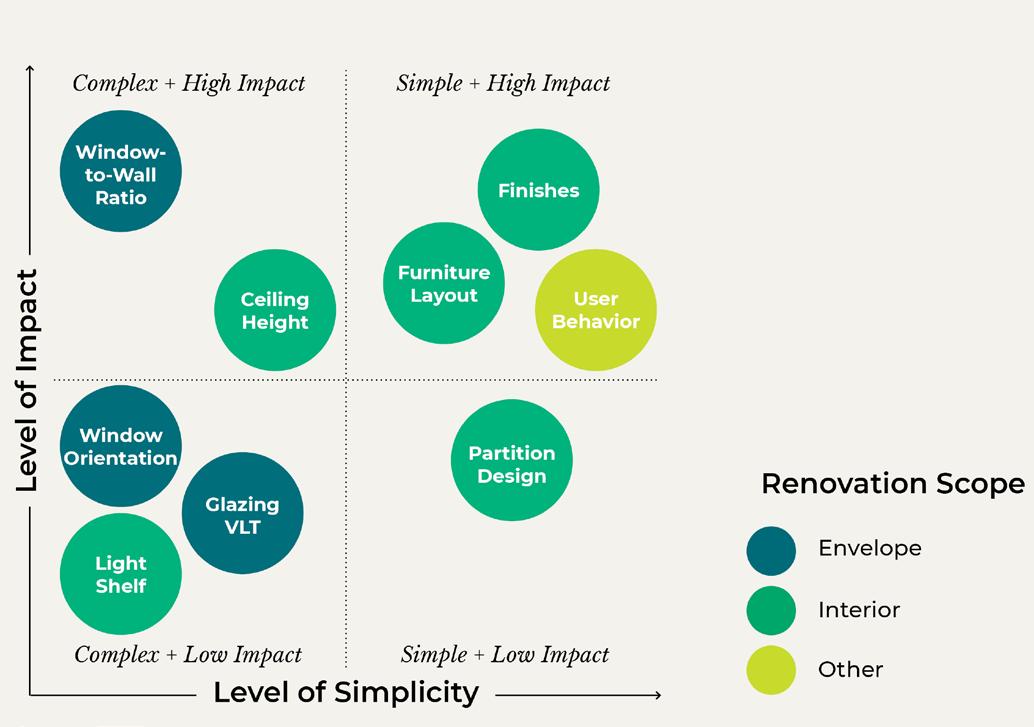
Photo Above: Our research shows that even interior-only renovations can greatly increase circadian health potential
Photo Above: This scatter plot illustrates the relative complexity and potential circadian health impacts of the design variables we studied
Our Research
Our partners at the University of Oregon created digital simulations that compared the circadian health impacts of different design decisions. We helped set the parameters for the simulated space (a 30-by-40-foot office space with 16 desks and windows on one side), the design variables (including window-to-wall ratio [WWR], furniture orientation, and surface reflectance), and the range within variables based on our long experience working with existing buildings. The team then studied a variety of design changes one by one and quantified their potential effect on circadian health.
To show real-world applications, we also analyzed three projects from Quinn Evans’ portfolio. Our case studies quantify the circadian health potential of an elementary school, a government office building, and a commercial office tenant space before and after renovation.
Our Findings
In short, we found that buildings can meaningfully support circadian health by providing enough daylight at occupants’ eye level in the morning hours. To better measure this potential, our research partners proposed a novel metric: spatial melanopic daylight autonomy EML 150/275/50%. This metric expresses the percentage of workstation positions within the space where the occupant’s view position meets or exceeds 150 equivalent melanopic lux for at least 50% of the time between 9:00am and 1:00pm over the course of a year.
As expected, increasing the WWR had a big impact. But we were surprised by how effective simpler, more accessible strategies could be. Optimizing furniture layouts and programming in a way that would encourage occupants to spend a portion of time in better-lit spaces both produced notable benefits. Similarly, using light-colored and reflective finishes on walls, ceilings, and floors increased a space’s circadian health potential nearly as much as increasing window size.
What’s Next?
We learned a great deal from our research partners at the University of Oregon—and not just about daylighting for circadian health. The collaboration underscored the value of pairing rigorous academic research with applied professional experience. While our partners brought sophisticated analytical tools and methods, we contributed real-world case studies and helped translate findings into actionable guidance for designers working on everyday projects.
This experience has encouraged us to keep asking questions, testing ideas, and sharing what we learn. We see research not as a separate endeavor, but as a natural extension of practice— one that helps architects continually refine how we design for people, health, and the planet.

Julia Siple, AIA, LEED BD+C, WELL AP
Principle and Director of Sustainability at Quinn Evans
Photo Above: An axonometric diagram and rendering of our shoe-box model with baseline conditions
Reflections on My First Year on the AIA Strategic Council
Previously published in the 2024 Q4 edition of the COF Quarterly
As a relatively new member of the AIA Strategic Council, I’ve found the experience to be both enlightening and profoundly rewarding. I suppose my journey has been the reverse of most other councilors’ paths, given that I previously served on the National Board in 2016 and 2017 as a Director at Large during the transition to what was then the new, smaller board structure. This prior exposure provided a unique lens through which to approach my role on the Council, but it didn’t diminish the sense of novelty in navigating this particular forum.
My inaugural year has largely been about finding my bearings and building cohesion with my colleagues, particularly within the AIA of the Future Working Group. What has struck me most profoundly is the warmth and inclusivity extended by the more seasoned councilors. Their generosity in sharing insights has made the onboarding process far smoother than I anticipated. I must extend special thanks to the AIA of the Future Co-Chairs, Paolo Campos, AIA and Robert Easter, FAIA, who have been exemplary in guiding those of us who are uninitiated. Their mentorship has been invaluable in helping me integrate and contribute effectively.
On a broader Strategic Council level, Jessica O’Donnell, AIA has been instrumental in providing guidance on how to approach AIA International initiatives. Her expertise has enriched my understanding of how the organization’s global reach intersects with our domestic efforts, fostering a more holistic perspective on our strategic priorities.
In my current professional role as Vice President of the New York City School Construction Authority, where I lead the Architecture, Engineering & Design Management division, high-level strategy is a daily imperative. This mirrors some of my past positions, including serving as Design Advisor to the Government of Qatar, where I navigated complex, large-scale built environment challenges. I believe these experiences bring tangible value to the AIA Strategic Council, offering practical insights into policy, design innovation, and international collaboration that can inform our collective deliberations. I also hope that my many years as an expatriate, having lived and worked in Europe and the Middle East, combined with my return to New York, will bring a unique and valuable perspective to the Strategic Council’s discussions.
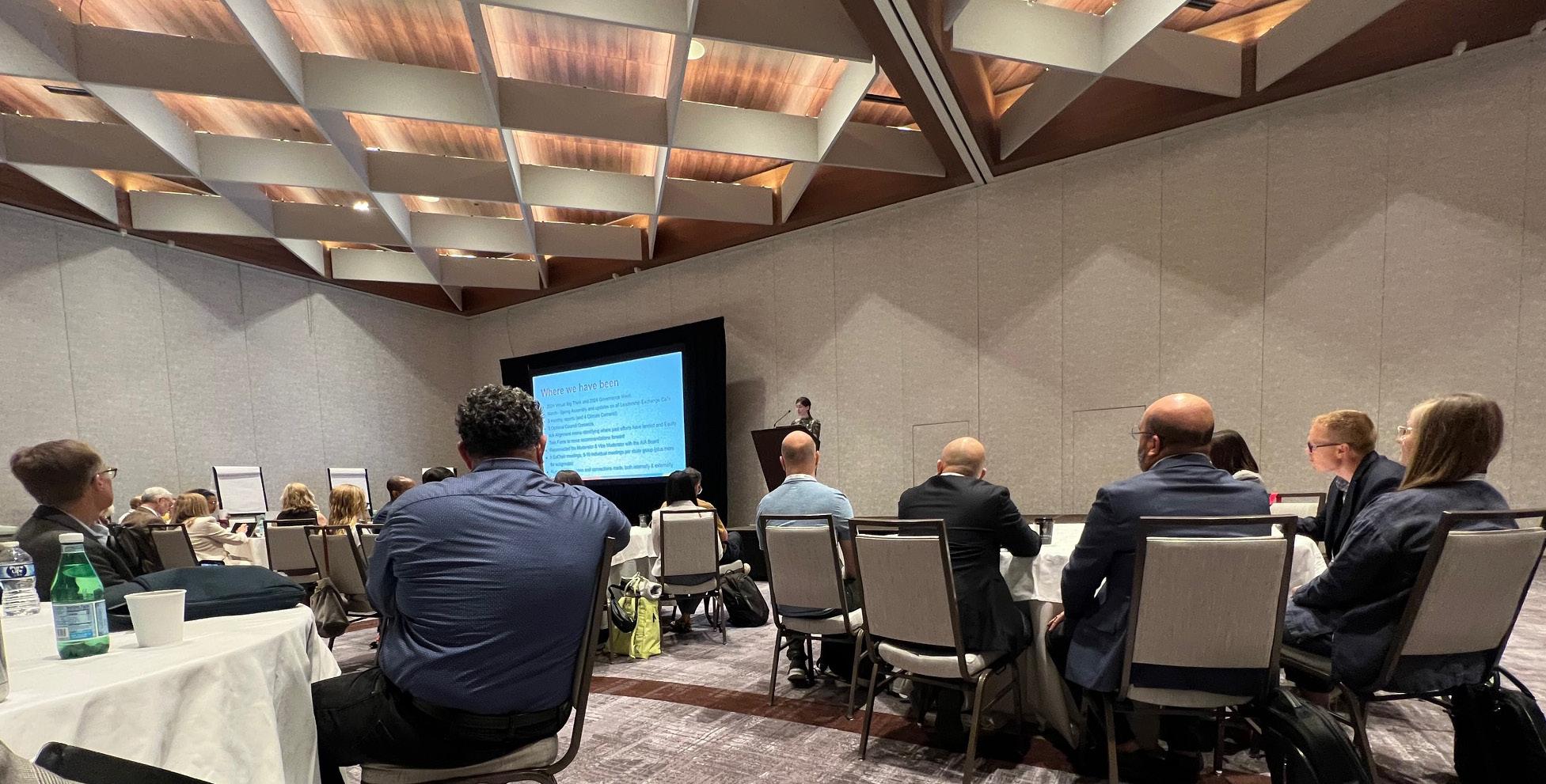
A meeting of the AIA Strategic Council.
One of the aspects I relish most is the opportunity for innovative solutions that emerges from this exceptional group of AIA leaders. Our councilors hail from across the country, representing a wide array of market sectors and working for firms and organizations of vastly differing scales from boutique practices to major public entities. The diversity of perspectives and experiences is truly astonishing, and it continually reinforces in my mind the inherent strength of the AIA as an institution. It’s been brilliant to engage with such a cadre of talented, intelligent, and dedicated design professionals. I am convinced that our collective efforts will not only bolster the relevance of the AIA to its members but also elevate its stature in the eyes of the public, both domestically and internationally.
Looking ahead, I eagerly anticipate deeper engagement in the second year of my tenure on the Strategic Council. As we delve more profoundly into the key elements of the AIA’s future strategies, I’m optimistic that we’ll position the organization at the forefront of all matters pertaining to the practice of the built environment. This role has reaffirmed my passion for advancing our profession, and I’m grateful for the chance to contribute to shaping its trajectory.
Thierry Paret, FAIA, NOMA, MRIAI, RIBA, LEED AP
Vice President of the NYC School Construction Authority’s AE Dept.
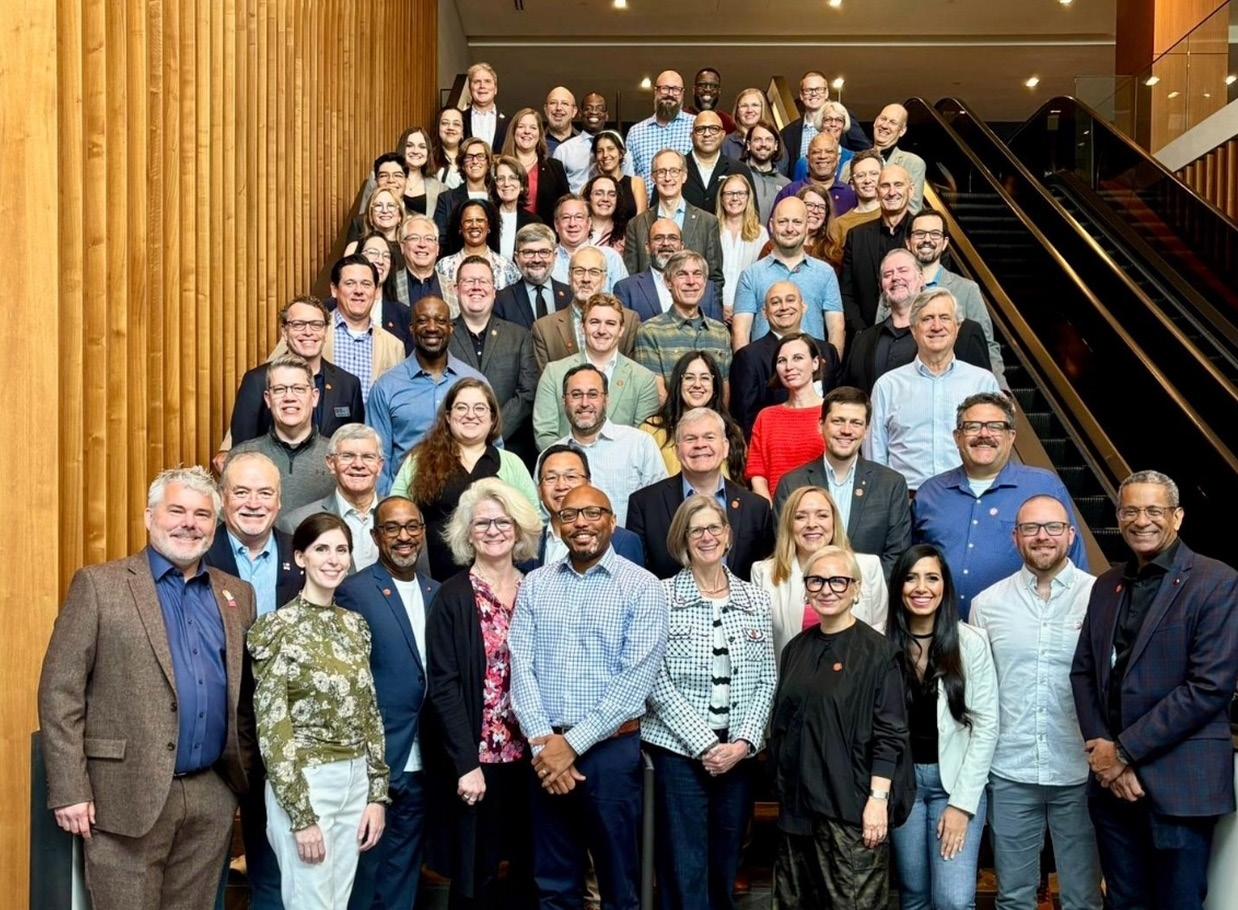
2025 AIA Strategic Council at AIA25
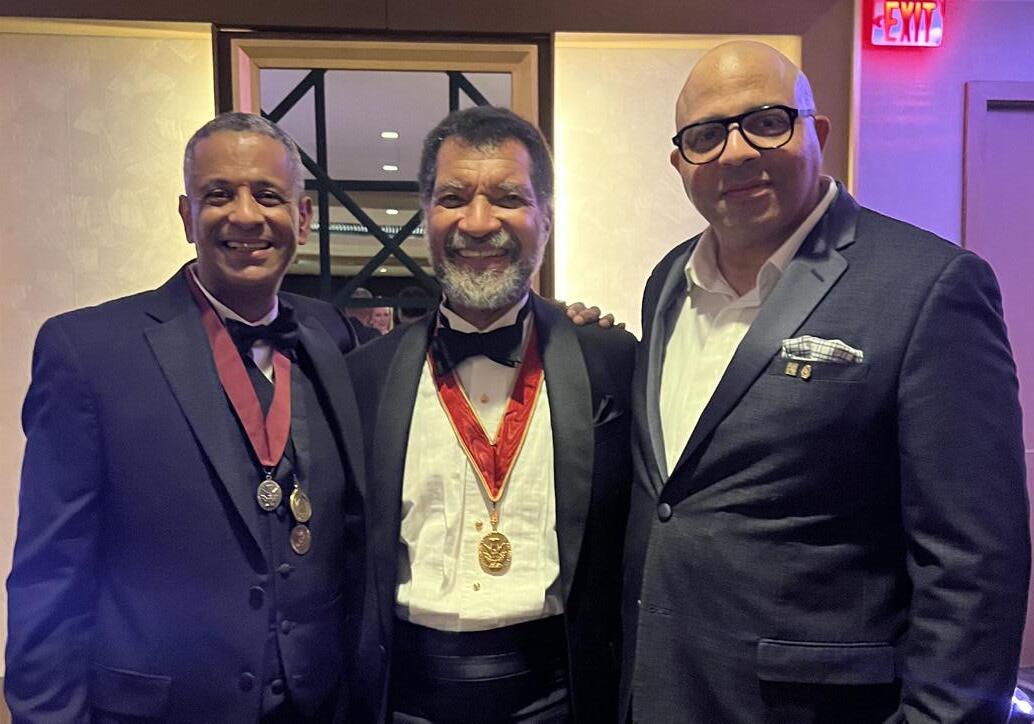
Left to Right: Thierry Paret, FAIA, Bill Bates, FAIA, and Winston Thorne, AIA
The Heavy Head That Wears the Crown
Navigating leadership, motherhood, and burnout while designing hope for others
Pandemic Beginnings: Isolation and Leadership
My son was born during the height of the pandemic in May 2020, when hospitals were tense, cities had shut down, and fear filled the air. We brought him home to a world of isolation: no visitors, no celebrations, just silence.
At the same time, I was adjusting to remote work and first-time motherhood. With no boundaries between home and office, no breaks, and no help from parents or friends who were stuck in a different country. I was stretched thin. I was expected to lead teams and deliver solutions while heating bottles between team calls.
Burnout doesn’t arrive all at once. It builds slowly through skipped meals, late nights, and the constant pressure to say yes. I wore my busyness like a badge of honor. But over time, the joy I once felt in the creative process turned into dreading Revit, RFIs, and Submittals. I wasn’t flourishing, I was just surviving.
Changing Outlook
During this period, I was also managing one of the most meaningful projects of my career: Washington, DC’s premier homeless shelter. An 85,000-square-foot facility designed to achieve LEED Gold certification. One that does not look and
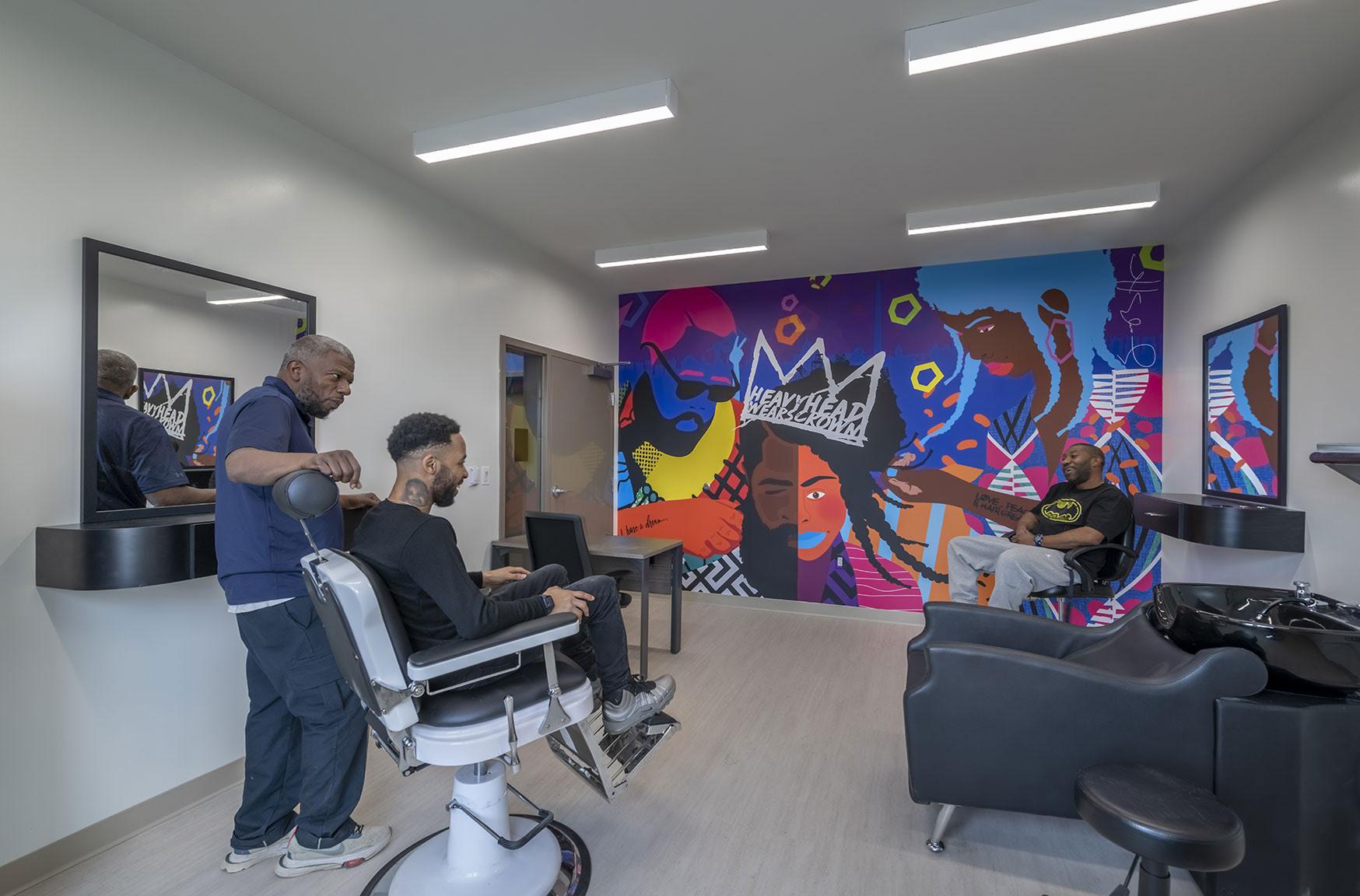
Salon at St. Elizabeth’s Homeless Shelter, Washington DC. Photo credit: Jeffery Sauers and Wiencek Associates Architects Planners
function as a shelter but instead turns into a dignified home and beacon of hope for people who are the most vulnerable.
Every detail was intentional from layouts that promoted privacy to artwork that echoed EMPOWERMENT and HOPE. One of the commissioned pieces, “The Heavy Head That Wears the Crown,” by a local artist, reflected the emotional weight carried by those experiencing homelessness. It resonated deeply with me as a designer, mother and a leader navigating the quiet heaviness of responsibility.
I was promoting hope and self-healing for our homeless clients with designing spaces that would help them feel safe, empowered, and seen. Yet, I wasn’t advocating the same for myself. I was pouring compassion into the project but not into my own life. I was creating environments for others to recover while ignoring the signs that I needed healing too. That disconnect became impossible to ignore. Something had to change, not dramatically, but intentionally!
Reclaiming Wellness: Small Steps Toward Self-Care
I began with small steps. I blocked time for walks, even if it was just around the block with a stroller. I started journaling— not about deadlines or deliverables, but about how I felt. I reintroduced boundaries with clients and colleagues, learning to say “no” without guilt. I sought out elements that nourished me: quiet car rides listening to music while baby slept in the car seat, naps, scrolling on my phone, delegating a small portion of the mental load to my partner and team, and even my own redesigned makeshift remote office filled with plants and sunlight.
The biggest shift wasn’t in my schedule but it was in my mindset. I stopped measuring my worth by output. I began to see wellness not as a reward for productivity, but as a prerequisite for creativity.
I don’t claim to have mastered self-care. I’m still learning and adapting.
Today: Leading with Boundaries and Grace
I serve as Director of the Architecture department in a multidisciplinary AE firm, managing multinational projects
Burnout taught me that balance isn’t a destination, it’s a daily practice.
across time zones and cultures. I’m also a mother to a newborn again. This time without the fear of pandemic.
The struggles remain familiar with sleepless nights, blurred boundaries, and the constant juggle between nurturing and leading. But this time around, I give myself more grace.
The demands are constant, and the stakes are higher, and while I wear the crown of leadership with pride, I often feel the weight of it pressing down on me. The truth is, the head that wears the crown grows heavy especially when it’s balancing deadlines, diapers, and the quiet ache of responsibility. I still work hard. But I also pause. I breathe. I listen to my body and advocate for wellness in every project I touch.
Burnout taught me that balance isn’t a destination, it’s a daily practice. Even with the crown still on my head, I’ve learned to carry it with more grace and a little less weight!
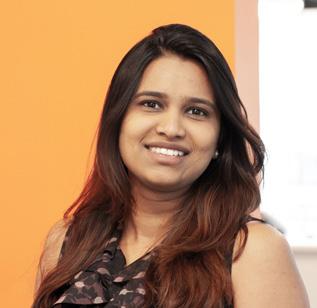
Krutika Shah, AIA, NCARB, LEED AP BC+C, SEED is a seasoned architect and mother of two, currently serving as the Director of the Architecture department in a multidisciplinary AE firm, Sheladia Associates, Rockville MD.
Advocacy in Action Series
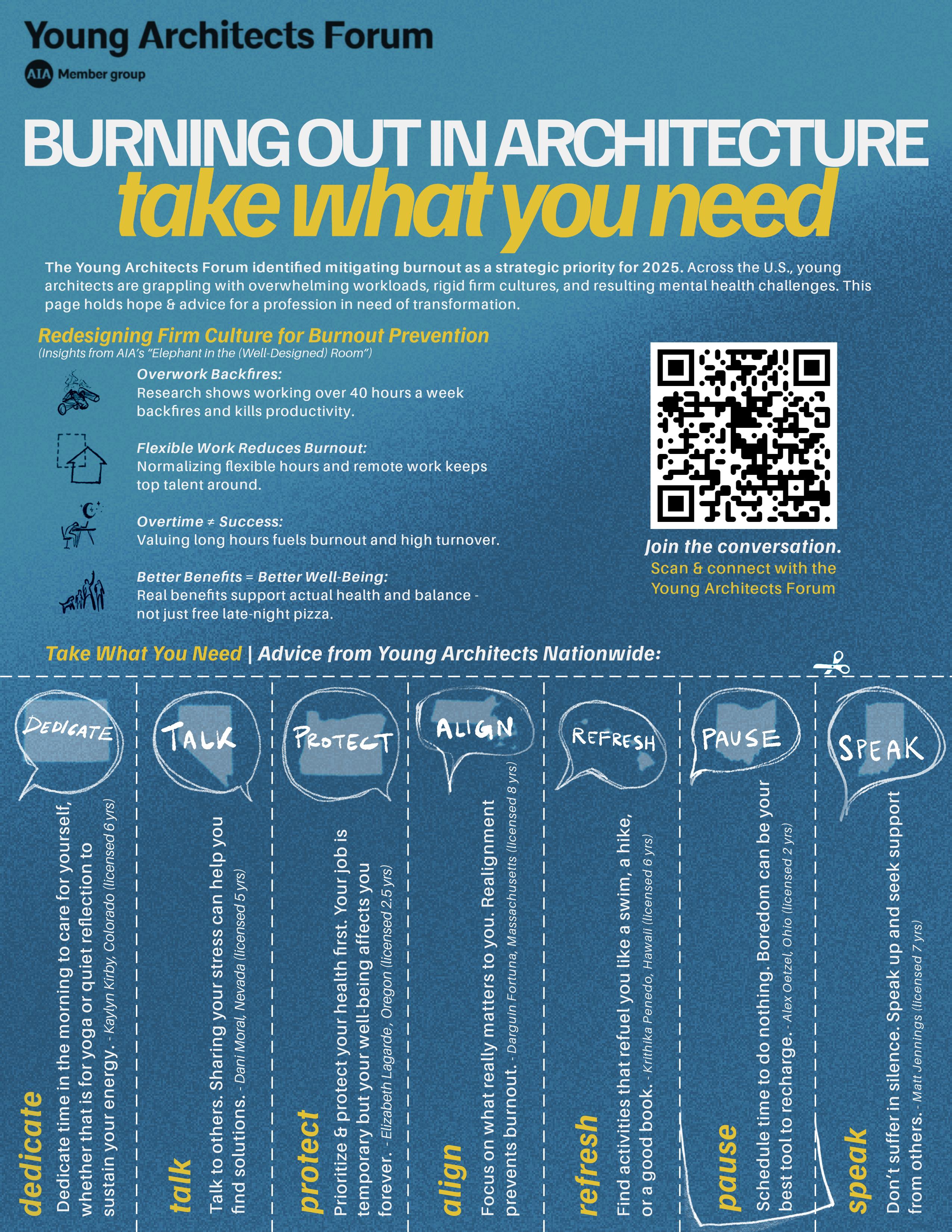
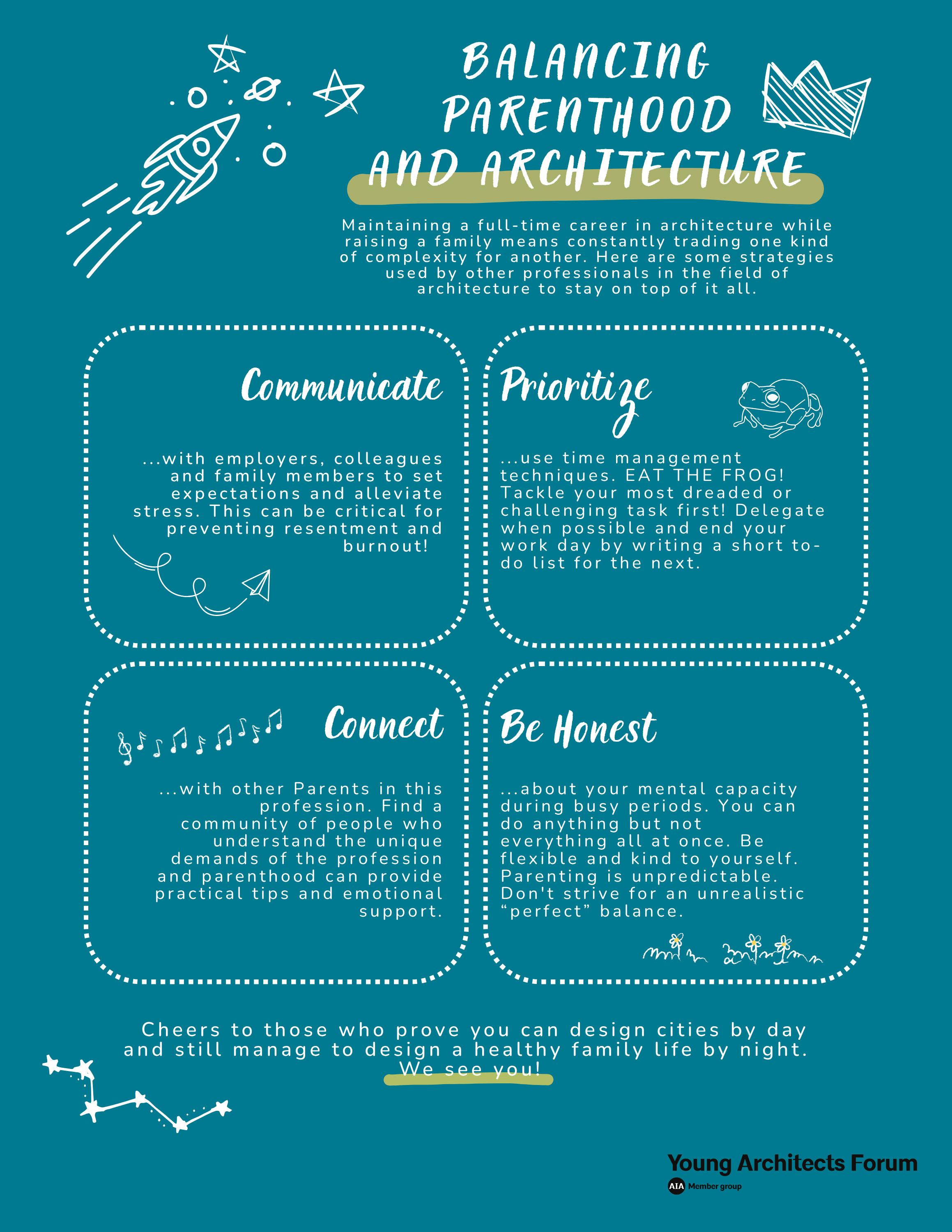
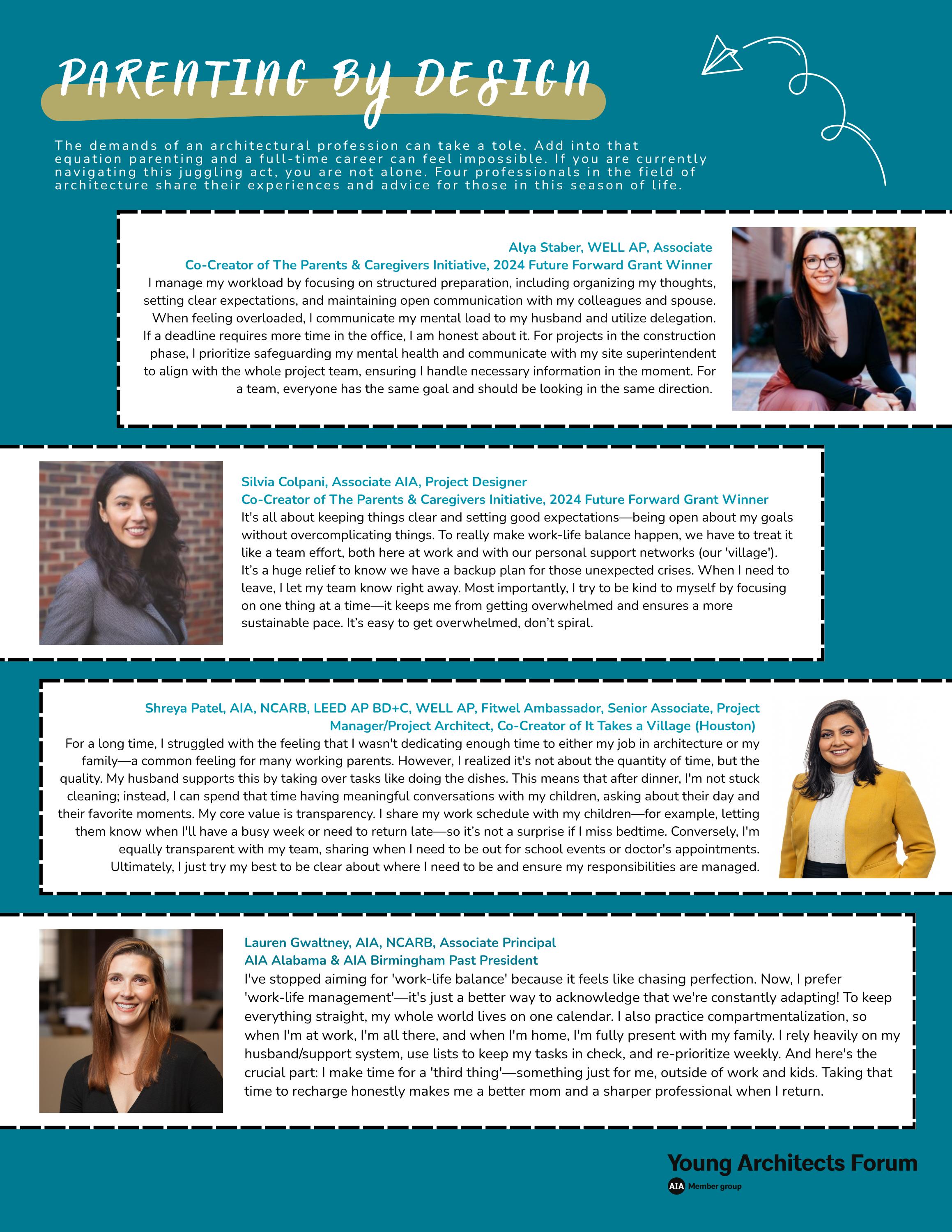
The Advocacy Focus Group is proud to present the Advocacy in Action Series--a curated collection of resource documents created by young architects, for young architects.
Through this initiative, the Young Architects Forum seeks to amplify the collective knowledge of early to mid-career professionals and create accessible tools that support growth, career resilience, and meaningful engagement in the profession. Each quarter, three new documents will be released, addressing topics that shape the young architect experience, including career development, leadership, self-advocacy, and wellness.
If you are interested in contributing your own resource document to the series, please reach out to Tanya Kataria, YAF 2026 Advocacy Director, at tkataria@integrusarch.com.
Tanya Kataria, AIA
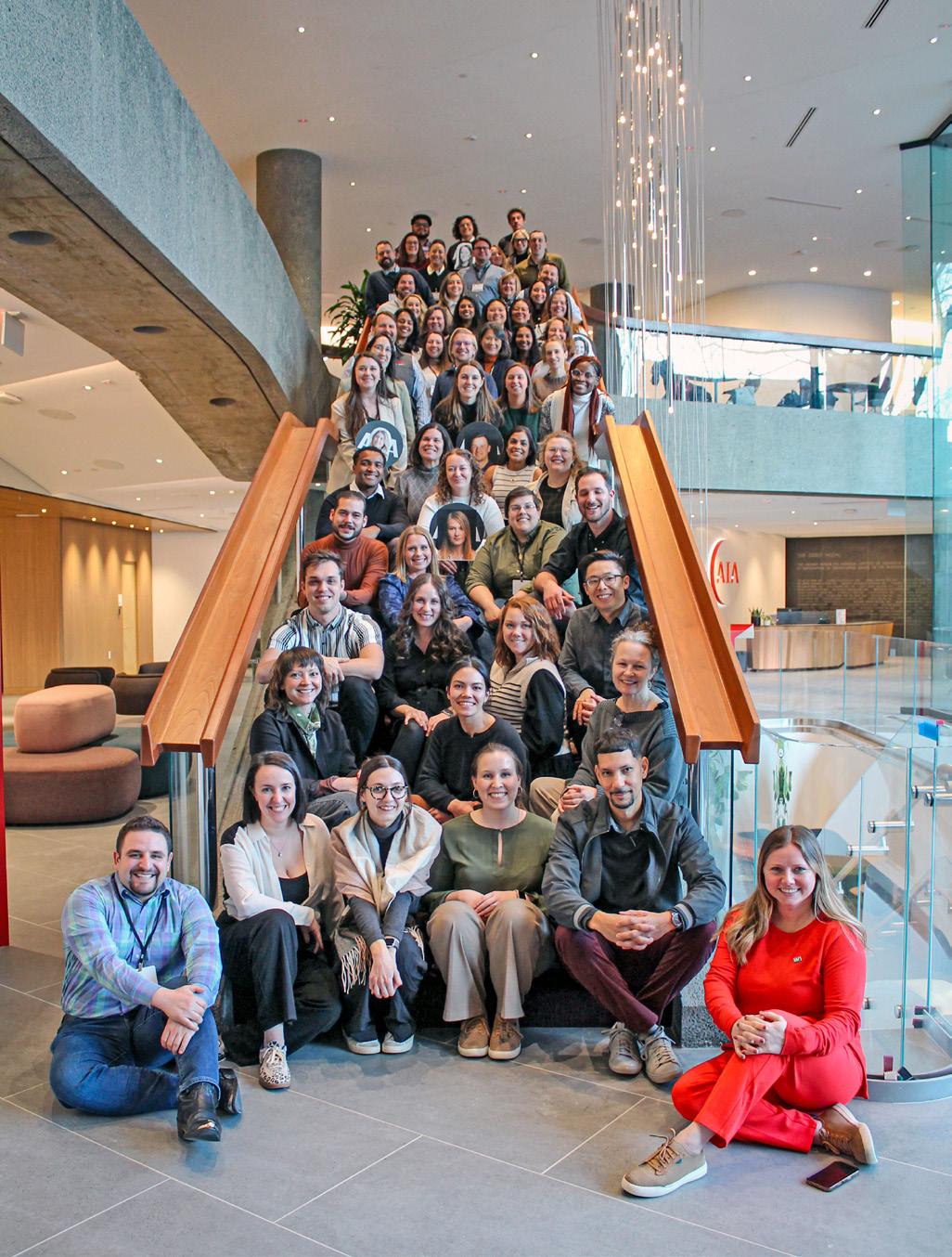
2026 Young Architect Forum Annual Meeting Attendees
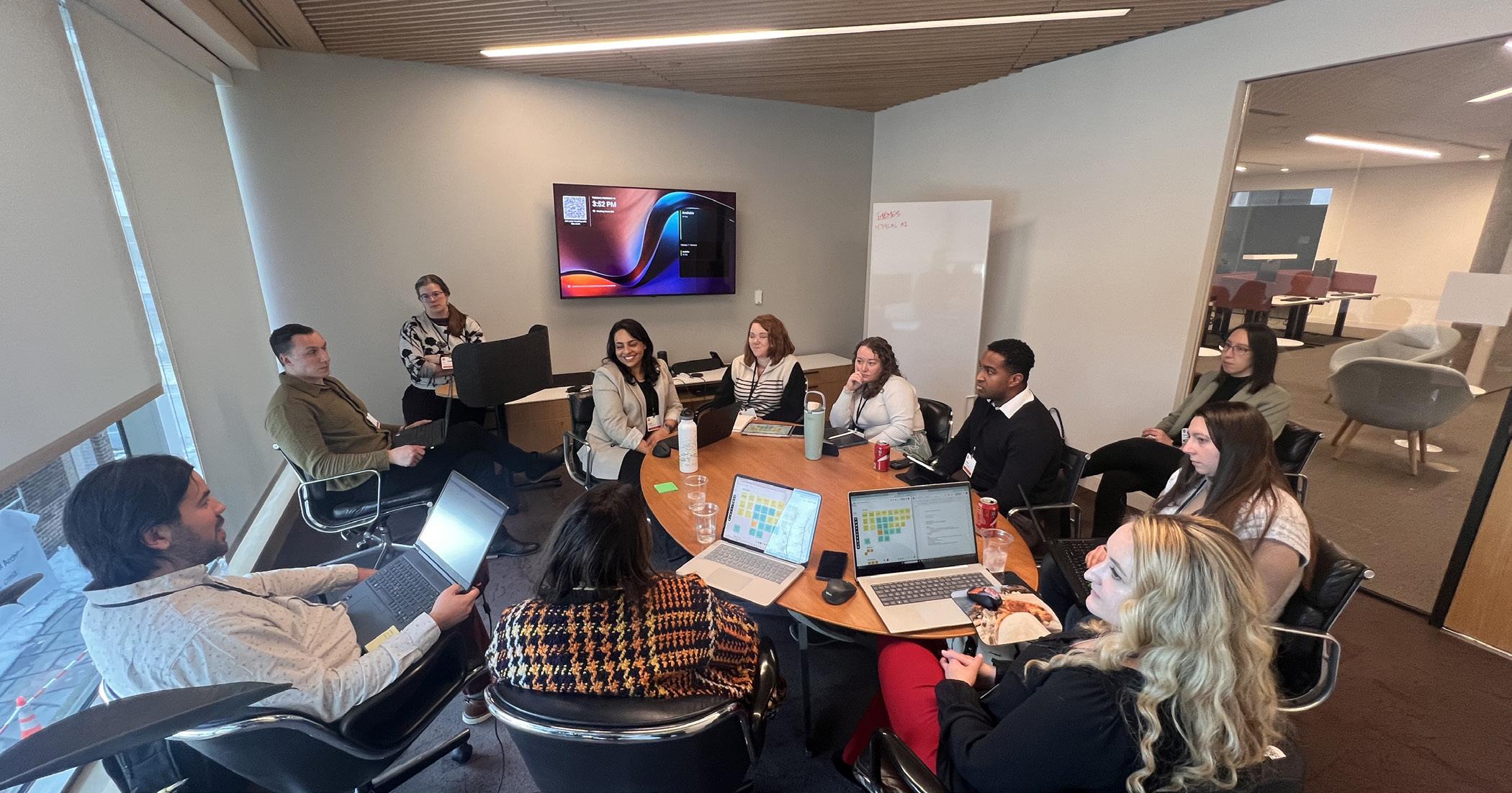
Advocacy Work Group in action.
Learning to Lead Before You’re “In Charge”
For many architects, leadership is imagined as something that comes later, after licensure, after promotion, after a new title appears on a business card. It is often framed as a destination rather than a behavior. But in practice, leadership rarely begins with formal authority. More often, it starts quietly, through action.
Across firms of all sizes, young architects are already leading, not from the corner office, but from the middle of project teams, training sessions, and day-to-day problem-solving. This form of leadership may be invisible, untitled, and informal; but it is increasingly essential to how firms operate, adapt, and grow.
Leadership as Action, Not Title
Leadership in architecture has traditionally been associated with hierarchy: principals lead, managers lead, those with ownership or tenure lead. Yet today’s practice environment challenges that top heavy model. The pace of technological change, evolving workplace expectations, and increasing project complexity demand leadership at every level.
Young architects frequently step into leadership roles long before they are officially “in charge.” They mentor interns, onboard new hires, streamline workflows, introduce new tools, and advocate for clearer communication or healthier work practices. None of these actions require a title — but all of them require initiative, empathy, and accountability.
In many cases, this leadership emerges not because someone was asked to lead, but because a need existed and someone chose to act.
Why Firms Rely on Invisible Leadership
Modern firms depend on this kind of informal leadership more than they may acknowledge. As practices adopt new software, refine hybrid work policies, or rethink internal processes, it is often emerging professionals who identify friction points and propose solutions. Their proximity to daily workflows allows
“In many cases, this leadership emerges not because someone was asked to lead, but because a need existed and someone chose to act.”
them to see inefficiencies and opportunities that might otherwise go unnoticed.
This “invisible leadership” helps firms stay agile. It bridges the gap between strategy and execution, vision and reality. While it may not always be acknowledged in a company’s organizational charts, it directly impacts productivity, morale, and firm culture.
Importantly, this leadership is not about replacing senior voices — it is about complementing them. When firms value leadership as a shared responsibility rather than a top-down directive, they create space for collaboration across generations, where experience and innovation inform one another.
Shifting the Mindset: From Waiting to Mentoring to Leading
Despite this reality, many young and mid-career architects hesitate to see themselves as leaders. The mindset of “waiting to be promoted” can create a false barrier, the idea that leadership must be granted rather than practiced.
For many professionals, mentorship becomes the first visible expression of leadership. Guiding interns, reviewing drawings, answering questions, and modeling firm standards are not secondary tasks, they are foundational leadership behaviors. Mentorship shapes culture, strengthens teams, and directly impacts project outcomes.
Yet because this work often happens informally, it can also go unrecognized. Leadership performed quietly can be mistaken for simply “doing your job.” For that reason, architects who step into these roles benefit from documenting and articulating the impact of their contributions. When leadership is made visible, through improved workflows, stronger team performance, or
reduced training time, it becomes easier for firms to connect that impact to advancement and compensation.
Shifting the mindset, then, is not only about acting like a leader before a title appears. It is also about recognizing the value of that leadership and advocating for it appropriately.
Practice in Motion
As the profession continues to evolve, so too must our understanding of leadership. Practice is no longer static, and leadership cannot be either. It lives in motion — in adaptability, collaboration, and a willingness to act before conditions feel perfect.
For young architects who are navigating the space between entry-level roles and senior leadership, this can be both unsettling and empowering. The absence of a title does not signal a lack of influence. In many ways, it signals opportunity.
Leadership does not begin with being “in charge.” It begins with choosing to lead — right where you are.

Devora Schwartz, AIA NCARB
is a Project Manager at LMV Architects in Poughkeepsie, New York. She is a mentor passionate about empowering future architects and just ran the NYC Marathon for the Cystic Fibrosis Foundation.
Visibility with Integrity:
Practice in the Social Age
Social media has become architecture’s public meeting room.
A new expectation is emerging across architecture: People want the work and proof of the people behind it.
Future practitioners want honest insight into culture and career paths. Clients want clarity and confidence in the process. Communities want proof their voices matter. And whether we like it or not, social media has become the public meeting room where these expectations play out in real time.
That shift is changing practice, recruiting, brand trust, and public engagement. The profession needs a shared framework for communicating with transparency while guarding against misinformation, boundary violations, and the erosion of trust that unchecked social media can bring. This presents an opportunity to share encouraging, educational content with an international audience by simply pressing record.
I’ll call it Visibility with Integrity.
Visibility with Integrity
Visibility with Integrity is public communication that makes our work clearer while protecting people, projects, and trust.
A shared standard looks like this:
• Credit the team and collaborators.
• Protect confidentiality and client trust.
• Get consent, especially when people and communities are involved.
• Tell the truth about your role and the reality of the work.
• Teach the process so the public can understand our value.
The authenticity era has arrived in architecture
Polished photography still matters. Beautiful work still matters. But as many architects know, storytelling is at the heart of a project that stays with you. With newer generations entering the profession, they are asking for receipts in short form content:
How did you get there?
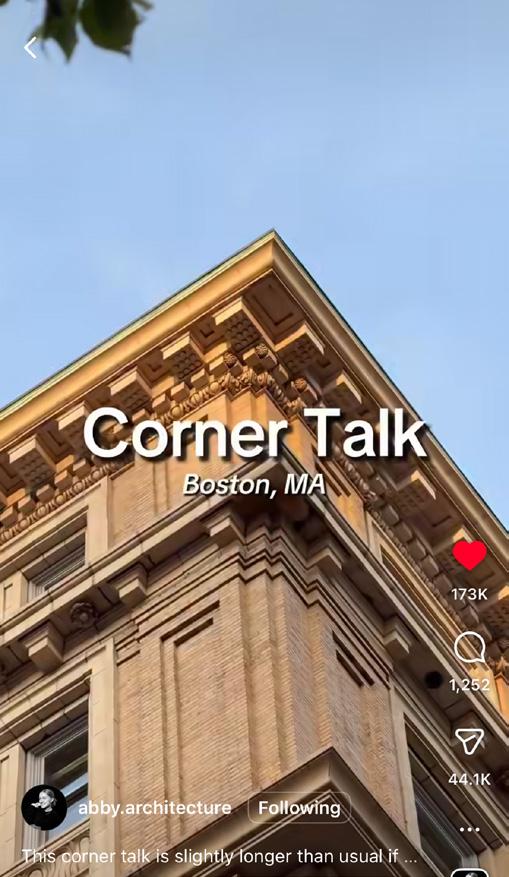
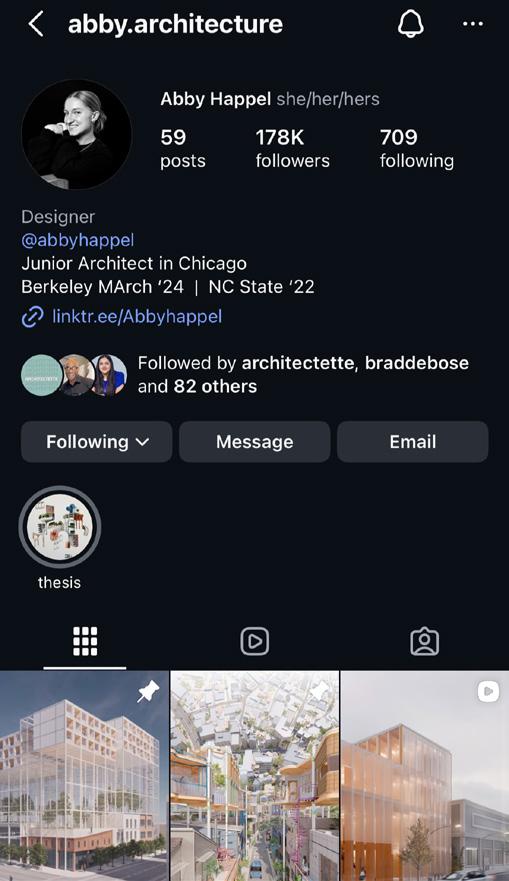
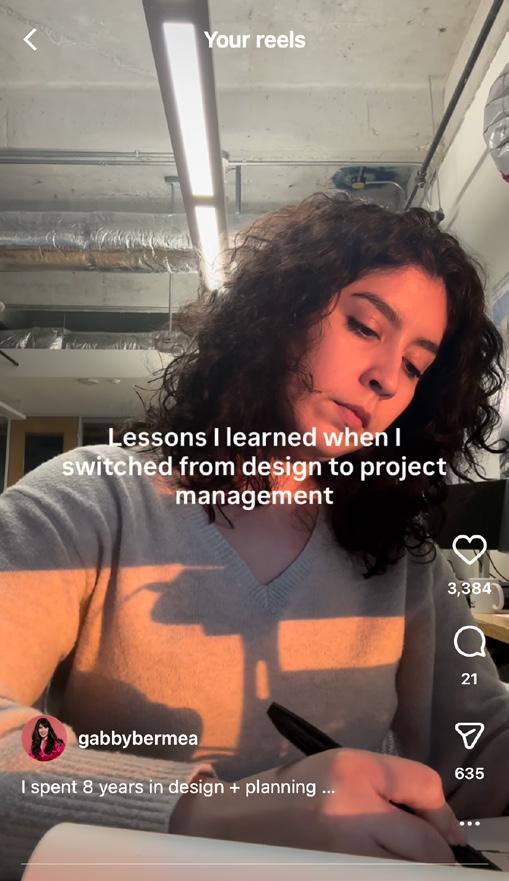
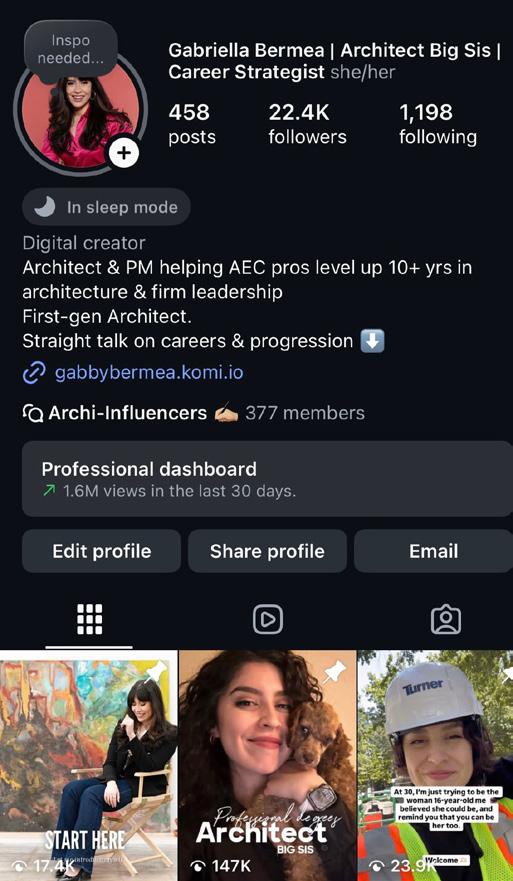
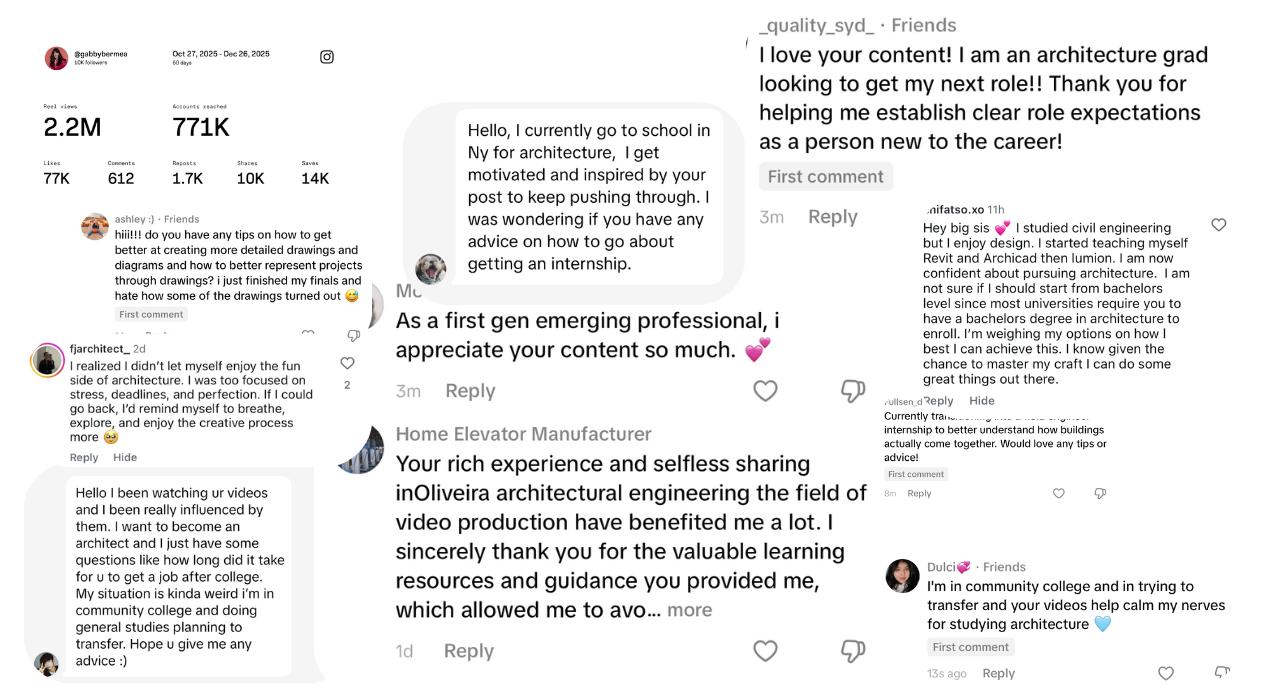
Instagram Screenshots
• Who did the work?
• What tradeoffs were made?
• What did you hear from the community—and what changed because of it?
This is mainstream expectation now. Brands learned it first: authenticity converts when trust and clarity are low. Architecture lives in the same environment today. The audience is bigger, the feedback loop is faster, and perception forms quickly.
In a recent pulse check on my platform, the strongest engagement signals weren’t only aesthetics. People responded most to design, then process and storytelling, with people/ culture as the trust-builder underneath it all. Translation: show the work, explain the work, and show the humans behind it.
Social media is not a side quest anymore
Treating social media as “just marketing” misses the point. Platforms now shape how practice is understood and evaluated, by recruits, by clients, and by communities. It functions like a public lobby, an open house, and a community meeting all at once. Sometimes it’s inspiring. Sometimes it’s funny. Usually it’s both.
The result: the curtain on architecture is being pulled back in real time.
And the definition of “authentic” is shifting inside our own profession. In crowdsourcing responses, one professor framed performativity plainly: “Performative is when someone is
overcompensating for something.”
A student put it even more practically: “I ask if those making the content would ever see it on their FYP.” In other words: if the content isn’t useful to the people living in the work, it reads as posturing.
And then there’s the cultural myth architecture still hasn’t shaken. One Young Architect voice said it best: “glorifying all-nighters and perfect models in school is a quick sign of inauthenticity. Authenticity includes boundaries. It includes honesty about the cost of the work, not just the aesthetics of it.”
But where can we start?
Do you need to jump right into content creation? Absolutely not. But how can we leverage where we are today? Start here:
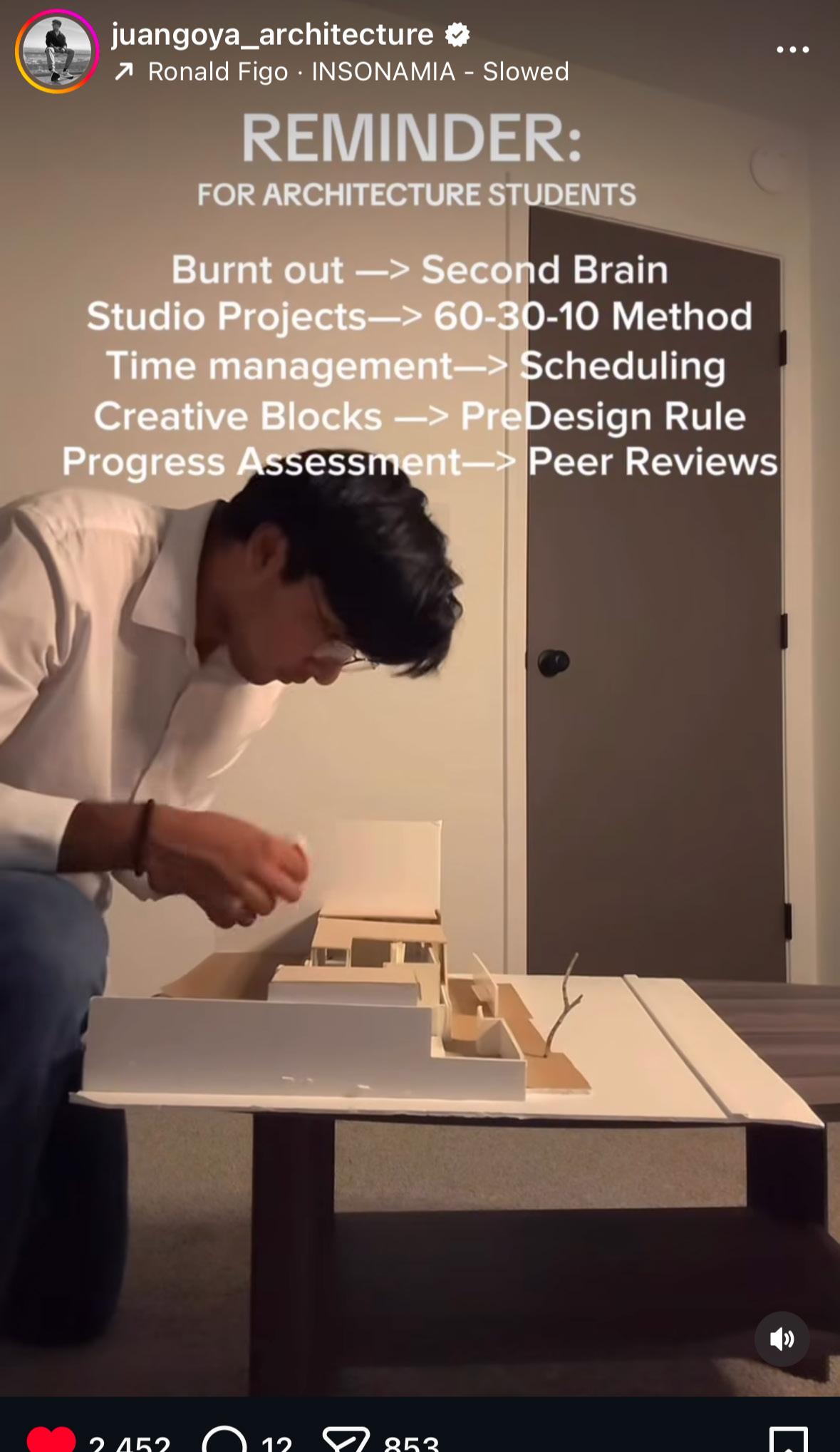
• Post what you struggled with (professionally). Share the decision, and the story behind the scenes: dead ends, constraints, client feedback that improved it. A note: personal story isn’t off-limits, but includes a filter. Share what connects back to the work, the process, or why you chose this profession. That’s the crossover.
• Turn knowledge into shareable frameworks. “3 questions we ask before moving a wall…”
• Make the process more visible than the render. Renders get likes. Process earns trust.
Instagram Screenshots
•
• Build an easy weekly rhythm: one framework + one process moment + a story crediting the team.
How social is changing practice in real time
1. Recruiting: culture is getting audited: Future practitioners don’t only ask what you design. They ask what it feels like to work with you—and whether growth is real. Social makes culture legible: mentorship, credit, leadership behaviors, and how teams talk about the work. Show how you lead, not just what you land.
2. Brand trust: process builds credibility faster than polish: Trust forms when people understand how decisions get made. When firms explain constraints, tradeoffs, and coordination, the public sees the actual value of architectural practice: synthesis, stewardship, leadership. Make the “why” visible—clearly, without spinning the truth.
3. Public engagement: the public expects proof: Communities want evidence that engagement mattered. Social platforms expanded the audience for engagement work and raised expectations for accountability. They also raised the stakes for how we represent people. Close the loop, protect dignity, and show accountability.
4. Impact: the ripple effect is the point. Social platforms make visible not just what you built, but what changed because of it. Less about the what, more about the why it matters, to the student who saw themselves in your work, the community that finally felt heard, the profession that moved forward.
Practice in motion
If we’re serious about elevating the profile of the architect, and making visible what we actually do, then let’s get to work.
Instagram Screenshots
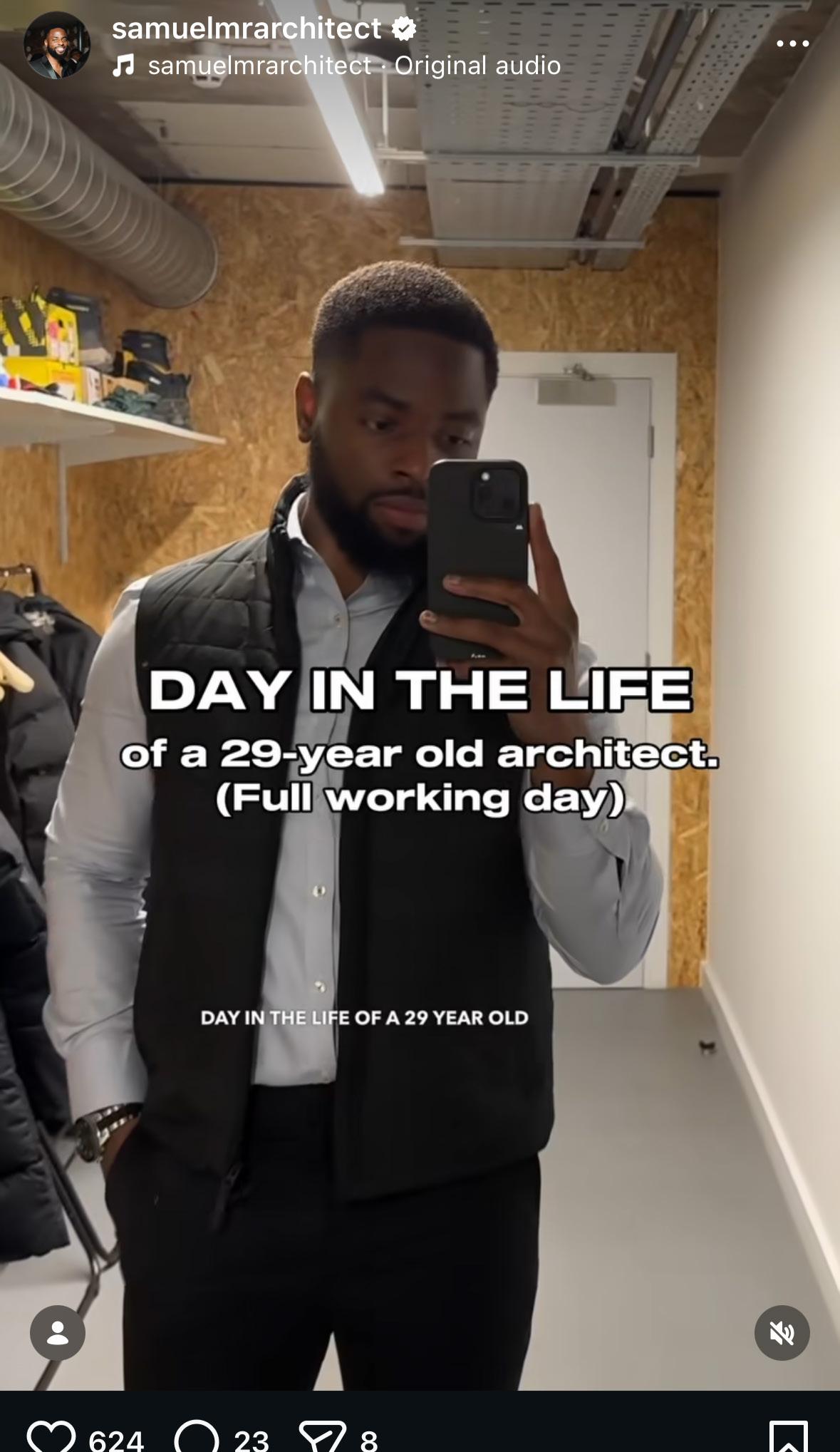
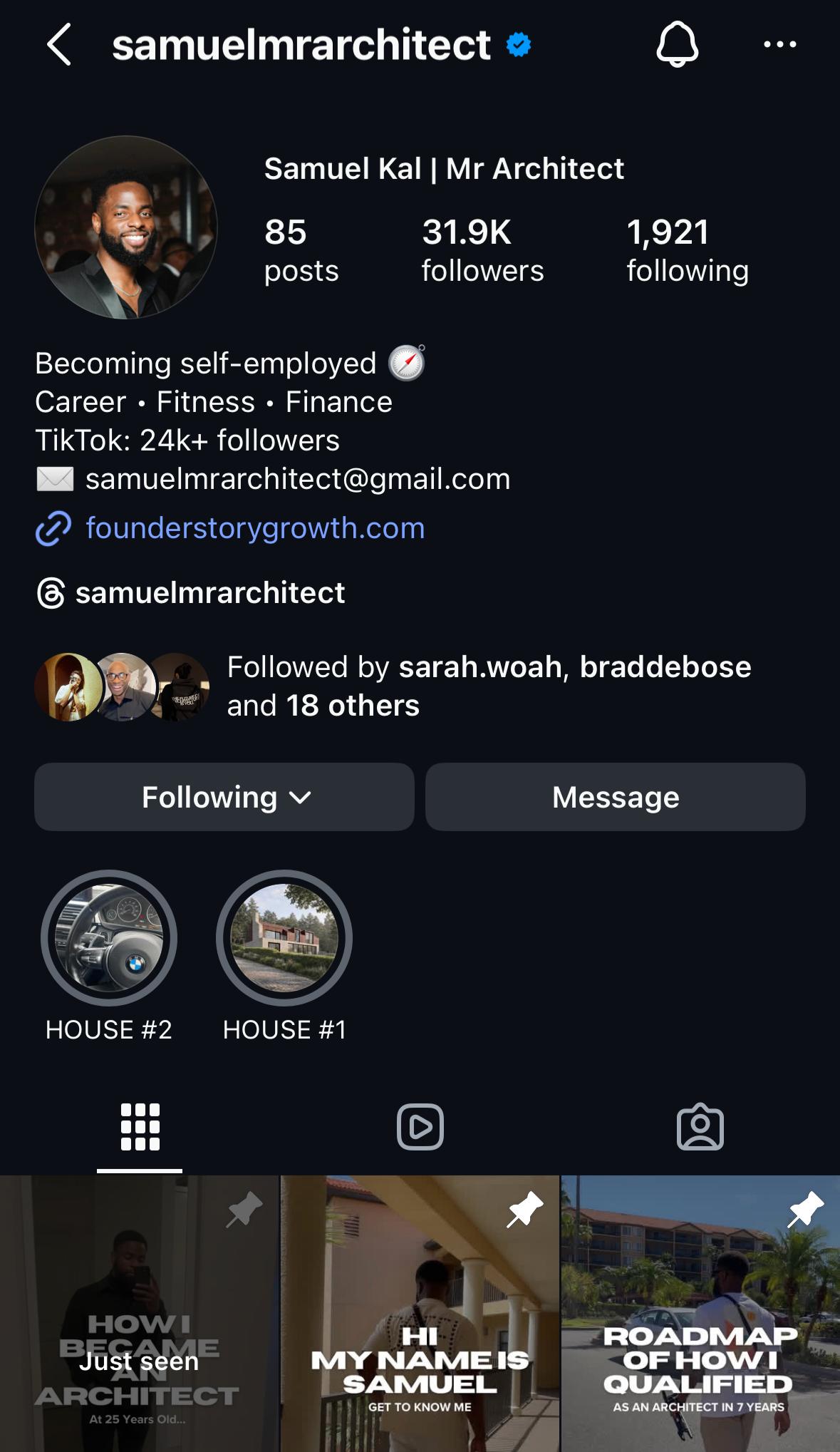
Practice is being interpreted in public, authentically, in real time.
Visibility with Integrity gives us a standard for showing up clearly, responsibly, and credibly. The profession doesn’t need louder marketing. It needs leadership people can see.

Gabriella Bermea, AIA, NOMA
Gabriella is a senior associate and project manager at Perkins Eastman in Austin, Texas, where she specializes in the design and construction of Pre-K-12 educational facilities. She is the Chair for NCARB’s Experience Committee and Co-Chair of NOMA’s Elevate committee.
Instagram Screenshots
Learning to Lead A CKLDP Journey
I never saw myself as a leader. By nature, I was a team playera follower, or so I believed before this journey began. Whether by luck, fate or sheer coincidence, I discovered the Christopher Kelley Leadership Development Program (CKLDP) in 2023, just two days before AIA Georgia’s introductory call for applicants. On a whim, I signed up, oblivious that this single decision would quietly shape everything that followed.
By the end of the call, my curiosity was piqued – but so was my anxiety. Public speaking had never been my strength, and stage fright was a lifelong challenge. Still, the opportunity felt too important to pass up. After much reflection, I applied, driven by a desire to push past my introversion rather than be defined by it. In 2024, I graduated from CKLDP, having stepped into a version of myself I had not yet imagined.
CKLDP was created to honor the legacy of Christopher Kelley, AIA - a deeply respected leader within Gensler’s Washington DC Office & the AIA National, known for his commitment to mentorship and advocacy for emerging professionals. In recognition of his influence, he received the Young Architect’s Award in 2010. Following his sudden passing in 2012, AIA DC reimagined its mentorship efforts and, in partnership with Kelley’s friends, launched the Program in 2013. Designed to nurture, train, and inspire future leaders, CKLDP offers a curriculum spanning marketing and business development, firm management, professional ethics and law, public speaking, philanthropy, community service, and the future of architectural practice. Since then, the Program has expanded nationally,
earning recognition for its impact at the 2018 AIA Grassroots(1), and establishing a strong presence at AIA Georgia, where it continues to cultivate leaders at all stages of their careers. The Program’s Georgia Chapter championed by Mindy Goodroe, AIA; Shelby Morris, AIA; & Tangela Monroe, CAE earned the 2021 AIA Georgia Bronze Medal Award.(2)
Whether you’re an emerging professional exploring your next chapter, or a firm leader seeking to lead with greater intention and impact, CKLDP is for you. At its core, this Program exists to do three things: help you cultivate what you feel you lack, build on what you already have, and share what you excel at. Growth doesn’t come without discomfort, but CKLDP’s strength lies in navigating that process together.
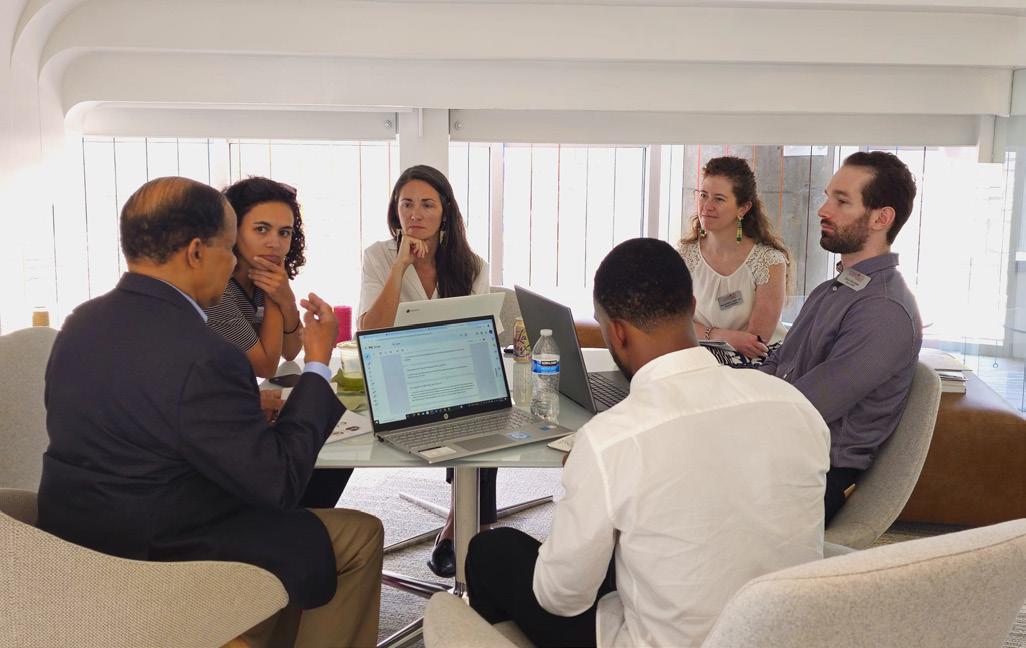
The Program is built on a flexible framework guided by the Executive Committee, allowing each cohort to shape it as their own. Unlike traditional programs, CKLDP’s curriculum is entirely peer driven, rooted in the interests, needs, and strengths of the scholars. “You get what you put in” is a recurring theme, as scholars are encouraged to take ownership of both their individual sessions and the collective learning process. Interaction, collaboration, dialogue and networking form the heart of the Program, with lasting insights emerging from openness and shared commitment.
My most beneficial session was one I planned with my team partner, Yikuan Peng, AIA titled “Rainmaking & Business Development”. From scouting venues to securing sponsorships
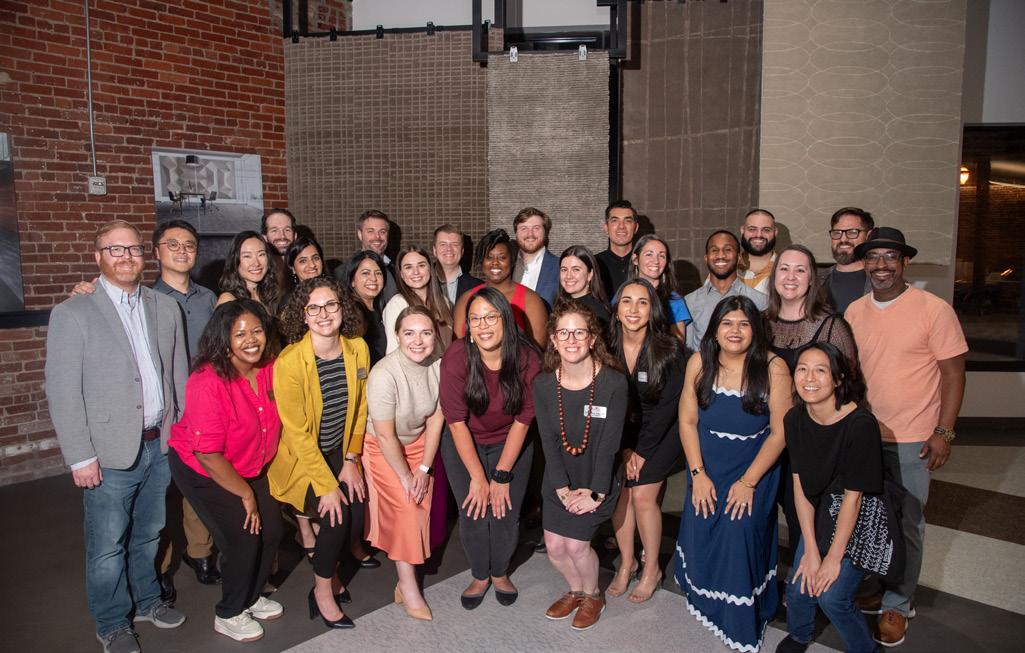
Above: Group Breakout during “Rainmaking & Business Development” CKLDP Session 2024. Photo Credit: Jane Rodrigues, AIA Left: AIA GA CKLDP Class of 2024 at their Graduation. Photo Credit: Brian Reeves
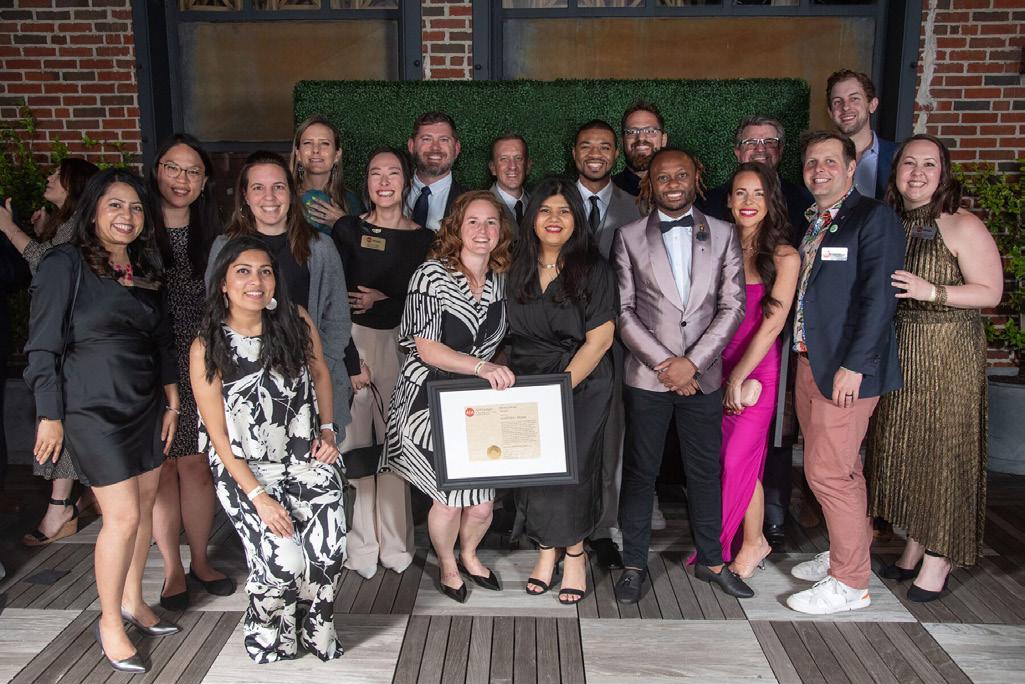
and interviewing speakers, we created an interactive session facilitated by Kurt Robbins, a seasoned marketing strategist and communications coach. Through discussions and handson workshops, participants engaged industry leaders, explored practical networking strategies, and developed “think-onyour-feet” skills essential to business development. Another memorable session, “Civic & Business Leadership” featured a workshop led by Sheba Ross, AICP CUD, EcoDistricts AP, CDT, LEED AP using Patrick Lencioni’s ”6 Types of Working Genius” framework. The experience was eye-opening, offering clarity around my strengths and reinforcing the value I bring to a team today.
One of the most powerful outcomes of CKLDP is the clarity it brings - not only to your professional goals, but to one’s sense of possibility. Through honest reflection, meaningful relationships, and challenging conversations, the Program helps participants identify their unique strengths, articulate their value confidently, and apply both in ways that drive positive change within their firms, communities, and the profession. For many, it offers an entirely new lens on the business of architecture and deepens their understanding of the diverse roles architects play - as
advocates, collaborators, problem-solvers, mentors, and leaders.
For me, this was the best decision I made - not because it offered answers, but because it sparked curiosity. I began to recognize the limits I had unconsciously placed on myself; assumptions about the kind of leader I could be, the roles I was “meant” to pursue, and where my influence began and ended. CKLDP gave me the confidence to advocate for myself, clearly articulate my value, ideas, and ambitions, and contribute beyond my workplace. More importantly, it reframed leadership as relational and expansive - grounded in trust, communication, and reflection - opening doors to opportunities I hadn’t known to seek and encouraging me to lead with intention, courage, and authenticity.
Architecture is a synthesis of art and science, demanding professionals who can skillfully balance both. Yet leadership in today’s architectural landscape extends far beyond technical expertise — it requires emotional intelligence, adaptability, and the courage to lead through uncertainty and change. Our world is complex and constantly changing, and it calls for leaders who are thoughtful, inclusive, and brave enough to imagine better futures. Leadership is not innate; it is cultivated through trust, self-awareness, training and experience. Because we are always evolving, leadership remains an ongoing practice rather than a fixed destination. CKLDP is not about becoming someone elseit is about becoming more fully yourself, with clarity, confidence, and purpose.
If you are an aspiring architect, I encourage you to consider the Program and the community it fosters. As the current Chair of CKLDP for AIA Georgia, I encourage you to discover your WHY, and I’ll leave you with this question: What kind of leader are you, and what kind of leader do you want to be?
Resources:
CKLDP Allied Locations: Albuquerque / New Mexico, Colorado, Detroit, Georgia, Houston, Indiana, Kentucky, Miami, Puerto Rico, Silicon Valley, St. Louis. Please visit https://www.ckldp. com/locations for more information and website links.
Footnotes:
(1) As noted on AIA DC’s website.
(2) As noted on AIA GA’s website.
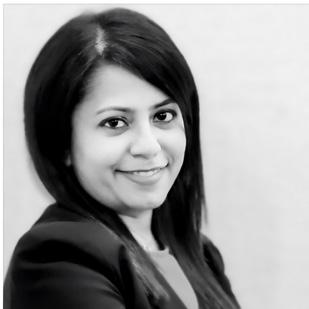
Jane Rodrigues, AIA, NCARB, LEED AP BD+C Rodrigues is a Project Manager at Dynamik Design in Atlanta, GA. Rodrigues is a licensed architect, 2026 CKLDP Chair and a 2024 AIA Georgia Carmen Stan Memorial Scholarship recipient.
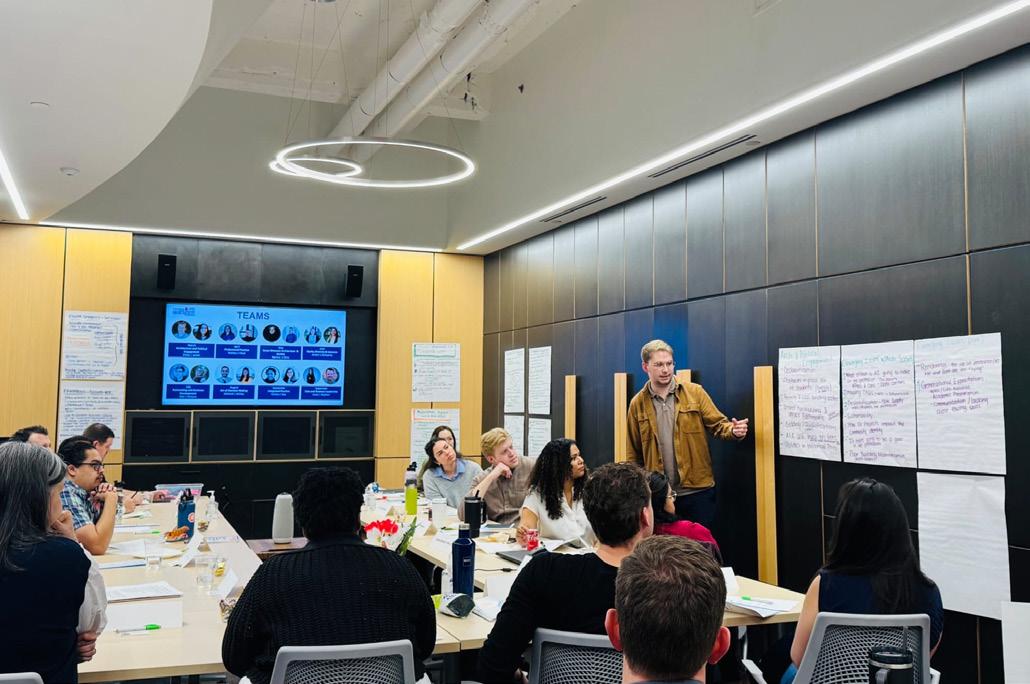
Top: CKLDP Alumni at the 2024 AIA Georgia Design Awards. Photo Credit: Brian Reeves Below: A Breakout Session Presentation at the AIA GA CKLDP 2026 Bootcamp. Photo Credit: Katherine Uhrin, AIA
The Multiplicity of Practice And the Importance of Differentiation
The word “practice” encompasses several related meanings that, in contemporary usage, are often conflated. This intertwining of definitions shapes everyday expectations and can generate a sense of constant pressure, one that frames practice as an endless pursuit of perfection. This challenge is often overlooked in everyday conversation, where words shape demands and expectations without their shifting meanings being acknowledged. While polysemy reveals how meaning changes across contexts, I argue that in contemporary life these contexts are increasingly interconnected, frequently aligned with industry, capital gain, or narratives of self-care and productivitydriven growth.

Above: The Polsemy (The linguistic phenomenom where a single word or phrase has multiple, related meanings) of the word “Practice”. Image by Zuzanna Bojarska
When we consider “practice in motion,” practice is framed as a process rather than a destination, something ongoing and unfinished. In contrast, phrases such as “practice makes perfect” or “there is no growth without practice” imply a fixed endpoint, positioning practice as a goal-oriented activity. These sayings are often embedded within contexts that demand improvement and measurable growth. Whether consciously recognized or not, this perspective shapes how practice is understood and enacted in daily life. As these expectations become increasingly intermingled, they risk contaminating habitual, personal, and communal spaces with the same pressure to perform toward perfection. This continuous demand for development, practice in every aspect of life, can easily lead to burnout, depression, and a looping sense of constant pressure to grow, regardless of how much growth has already been achieved.
How we contextualize practice ultimately shapes how we engage
with the act of practicing itself. Becoming aware of the narratives and pressures that surround discussions of practice can help us shift away from self-surveillance, anxiety, and constant comparison, and toward healthier frameworks such as “practice in motion.” To do so, we must first examine the language we use.
Similarly, the advice to avoid introducing oneself solely through the work one does and instead through who one is as a person, signals a necessary and positive shift. This separation is essential to protecting self-worth, as identifying primarily as “someone who practices X, Y, or Z” allows professional habits to spill into personal and communal realms, where logics of optimization, critique, and efficiency impose relentless pressure toward constant improvement, as well as an expectation of advancement from others.
These pressures inevitably impact the goals we set for ourselves, to practice cooking, practice coding, practice self-care, practice presenting, and so forth, risking a shift from practice as something joyful or sustaining to something extractive and performance-driven. The first step in addressing this is reflection: noticing and questioning what is implied by the language we use, and examining how, in contemporary contexts, terms like practice are often invoked with additive expectations that align closely with societal, cultural, and systemic pressures. By understanding these definitions and the nuances embedded in them, we can begin to redirect our engagement with practice, forming healthier, more intentional associations that emphasize process, adaptability, and sustainability rather than constant measurement or improvement. In doing so, practice becomes an active, living concept, responsive to context, informed by reflection, and liberated from the assumption that mastery or output defines its value.
How might we begin to enact this shift? One approach is to reframe practice as a process that is not purely outcome-driven, softening its ties to career advancement, financial incentives, time constraints, and the pervasive notion that failure to achieve mastery equates to failure itself. Instead, practice can be understood in terms of process-based goals rather than outcome-based ones, allowing us to disconnect ideals of perfection from the results of our efforts. This perspective emphasizes the value of moments in which practice stabilizes rather than progresses, moments that are neither unsuccessful nor absent. Practice, seen in this way, becomes practice in
motion: adaptive, responsive to unique individual contexts, that are not universally scalable. It is a sustaining movement rather than a sole mechanism of acceleration, prioritizing engagement and growth over relentless measurement or comparison.
Another approach to rethinking practice is to establish clear boundaries around the specific forms of practice in which one is engaging. By doing so, the habits and expectations associated with professional growth do not automatically carry over to other areas, such as practicing communication skills within personal relationships. It is important to recognize that practice does not need to be held to the same standard or rigor in every domain of life. Allowing for flexibility, adjusting priorities, and loosening the imperative of perfection across different contexts creates space for practice to be adaptive, sustainable, and meaningful rather than uniformly performance-driven.
When practice is conflated with perfection, productivity, or outcomedriven growth, it risks becoming a source of anxiety, burnout, and self-surveillance.
Yet, despite this reframing, cultural and societal pressures continue to shape how practice is enacted in everyday life. In contemporary cultural trends and movements, such as hustle culture or popular self-help discourse, practice is often framed as dependent on overconsumption and rigid routines of repetition aimed at achieving measurable success. But what happens when repetitive practice becomes little more than an extension of work itself? When practice infiltrates the weekly schedule alongside professional demands, personal relationships, and selfmaintenance, it is perhaps unsurprising that individuals adopt a highly instrumental perspective, treating each moment of the day as an opportunity to pursue selfrewarding goals. In this framing, practice is removed from its relational and experiential dimensions, valued primarily for the tangible outcomes it produces, rather than as a meaningful engagement or exploration in understanding the world in its own right. The result is a system in which the act of practicing is continually measured against expected rewards or marks of achievement, rather than appreciated as a sustaining or inherently valuable process.
We can also continue to rethink practice, as being defined across three categories: industry / career, habitual lifestyle, and communal relationships. Each category requires its own pace and type of engagement, allowing for growth in ways appropriate to the context. These categories also permit shifts in prioritization depending on the stage of life or the specific goals one is pursuing. Crucially, practice should not be understood as inherently outcome-driven; it may simply involve adaptation and the facilitation of daily life through unconscious, practiceoriented development and learning, independent of demands for tangible results or formal evaluation. To reiterate, the meaning of practice should neither be fixed
Above: Proposed approaches to understanding practice are organized into three categories, each of which can expand, shift, or be reprioritized based on an individual’s goals. This framework removes ithe expectation of perfection in all aspects of daily practice. Image by Zuzanna Bojarska
nor universal, rather it should be shaped by our personal inner contexts. When practice is conflated with perfection, productivity, or outcome-driven growth, it risks becoming a source of anxiety, burnout, and self-surveillance. By distinguishing between different forms of practice, professional, habitual, and communal, and embracing a flexible, process-oriented approach, we can preserve its intrinsic value while allowing it to support growth in multiple dimensions of life. Practice can transform from a mechanism of extraction into a sustaining and generative activity, enriching our personal development, relationships, and professional endeavors without collapsing under the weight of cultural pressures or unrealistic ideals of mastery.
How will you re-define practice?
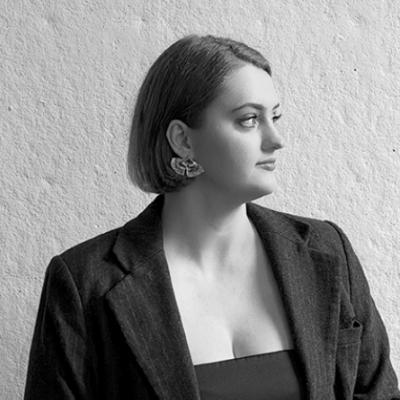
Zuzanna Bojarska, Assoc. AIA
Bojarska is an architectural designer exploring cultural exchange and community-centered practice. As a graduate student at Columbia University, her work advances inclusive, socially responsive approaches to the built environment.
Evolving Practice through a Culture of Mentorship An Ongoing Practice
Mentorship: An Ongoing Practice
Mentorship is a relationship- not a transaction. It extends beyond the limits of programs, prescribed frameworks, or formal requirements. Instead, it is an ongoing, collaborative partnership grounded in intention, reflection, and mutual accountability. Rooted in shared knowledge and lived experiences, mentorship often takes the form of one-on-one dialogue, built on feedback, trust, and respect.
My understanding of mentorship is shaped not only by professional frameworks, but by lived experience. After more than 15 years of international practice, I came to the US to pursue further education at Georgia Tech, having navigated much of my career without formal mentorship. That changed during my final semester, when I met my mentor, John Bencich, AIA, through the AIA Atlanta Student Mentorship Program. Approachable and generous with his time, John was instrumental in helping me understand professional practice in the US. Beyond reviewing my resume and portfolio, he organized a mock interview with his firm’s leadership to prepare me for the job market, wrote letters of recommendation, and encouraged me to ask critical questions and make informed decisions. His guidance- and continued support- profoundly shaped my transition into the U.S. professional landscape and inspired me to pay it forward. Five years in, we still meet over coffee to reflect on our respective journeys, a reminder that mentorship extends far beyond a single milestone. It also reinforces that mentorship is a twoway bridge: as I guide others, I gain insight, perspective, and renewed energy for my own practice. Today, I support graduate and undergraduate students through the AIA Atlanta Student Mentorship Program, mentor emerging professionals within my firm and the IAC Mentorship Program, and serve on the NCARB Licensing Advisory Board as my firm’s appointed advisor.
“...mentorship thrives on consistency, respect for each other’s time and experiences, and a shared commitment to growth.”
Mentors serve as advisors and counselors, while mentees actively shape their own growth. Emerging professionals rely on mentorship to navigate career paths, build confidence, develop professional judgement, and make informed decisions.
Depending on individual needs, discussions may address licensure, immigration processes, regulatory frameworks, professional ethics, specialization, career planning, and emotional support.
Like any meaningful relationship, mentorship thrives on consistency, respect for each other’s time and experiences, and a shared commitment to growth. It is not hierarchical or transactional, but reciprocal- benefiting both parties and strengthening the profession as a whole.
FORMS OF MENTORSHIP: NO ONE SIZE FITS ALL
Because no single mentor can address every challenge or question, mentorship is most effective when approached as a network rather than a singular relationship. Building a personal “circle” or “Board of Directors” allows individuals to draw support from mentors with varied expertise, perspectives, and lived experiences. Recognizing this, mentorship exists in several forms, each serving a distinct purpose.
Official or Mandatory Mentorship
This form is typically prescribed by a governing body or jurisdiction. An example of this is the Architectural Experience Program (AXP) as a part of licensure requirements. These programs require candidates to log hours across critical areas of professional development, offering a structured transition between academic education and architectural practice. As the AIA notes, such frameworks are designed to bridge theory and practice(1) while ensuring minimum standards of competency.
Formal Mentorship
Formal mentorship programs are often established within firms or professional organizations and may be managed by HR or leadership teams. Within firms, these programs are instrumental in retaining rising talent, identifying gaps in professional development, and supporting those who may otherwise be overlooked. Firm mentors can provide insight into office culture, firm politics, unwritten rules, and professional networking.
Formal mentorship also exists in academic and professional settings. Architecture schools frequently connect students with practicing professionals, while local AIA chapters often facilitate
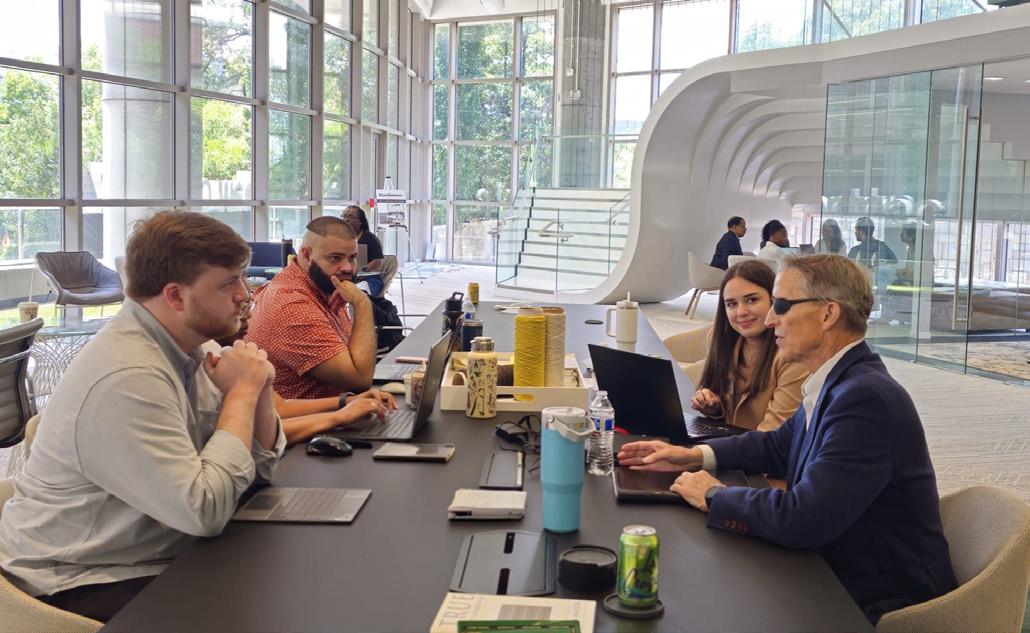
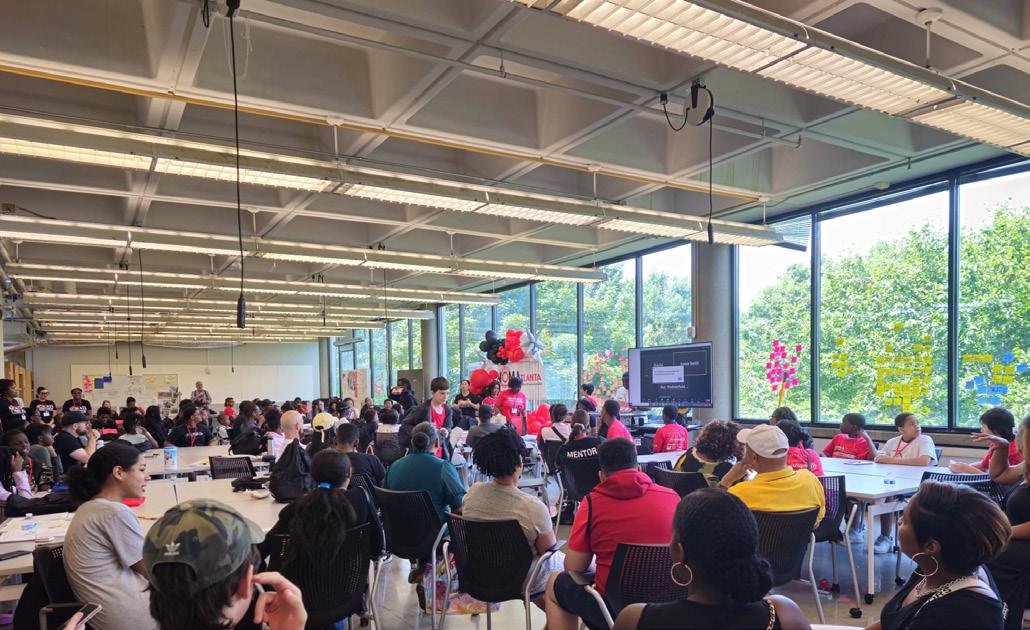
structured programs. One such example is the AIA Atlanta Student Mentorship Program, which connects professionals with students from Georgia Tech and Kennesaw State University.
Unprescribed or Informal Mentorship
Informal mentorship is often casual, organic, and unstructured. These relationships may develop by reaching out to someone you admire and can span an entire career. Learning occurs through conversation, observation, and shared experiences. While these relationships may lack formal structure, they are most effective when mentees clearly articulate their goals and areas of interest. In some cases, mentorship becomes so seamless that neither party explicitly labels the relationship as such.
Reverse Mentorship
Reverse mentorship challenges traditional hierarchies by allowing junior professionals to mentor senior staff, often in areas such as technology, digital workflows, or emerging tools. This model promotes adaptability, mutual respect, and continuous learning across generations.
Reciprocal Mentorship
Reciprocal mentorship emphasizes mutual advice, shared learning, and collective support. Leadership development programs such as the Christopher Kelley Leadership Development Program (CKLDP) are strong examples of peerdriven mentorship, where participants learn from one another through shared experiences rather than fixed roles.
Group Mentorship
Group mentorship brings together multiple mentees with one or more mentors, often around shared topics or career stages. This may take the form of presentations, panel discussions, licensure workshops, or group conversations, particularly effective when individuals face similar challenges and benefit from collective guidance. The IAC (Immigrant Architects Coalition) Mentorship Program beautifully incorporates this type of mentorship in
their overall structure by hosting weekly presentations by their mentors, and programs like the ACE Mentor Program, NOMA Project Pipeline and the ALIGN Mentorship program further demonstrate how group mentorship can provide meaningful guidance and support to participants.
ROLES AND RESPONSIBILITIES: MENTORS AND MENTEES
The Role of Mentors
Effective mentors understand that trust, visibility, and transparency are foundational. They share not only successes but also challenges and mistakes, offering realistic insights into professional life. When power imbalances exist, mentors bear the responsibility of making the relationship approachable and less intimidating.
Mentorship should be a safe space - whether within a firm or through professional or nonprofit organizations. Mentors can advocate for mentees, provide consistent support, and model ethical and professional behavior. Importantly, mentorship should extend beyond formal programs and be practiced daily, including within project teams.
“When power imbalances exist, mentors bear the responsibility of making the relationship approachable and less intimidating.”
Proactive mentoring can take many forms:
• Educate: Engage with local universities by participating in desk critiques, juries, review panels, office tours, or site visits.
• Engage: Connect with Emerging Professionals Committees, or Young Architects Forums within local AIA chapters. Whether serving on a board, volunteering for a program, or supporting an initiative, even small actions contribute meaningfully.
Above: Group Breakout during “Rainmaking & Business Development” CKLDP Session 2024
Right: Final Day of NOMA ATL Project Pipeline Camp Session 2 in 2024
• Empower: Encourage informal conversations, remain approachable, and sponsor success through recognition, advocacy, or financial support- such as enabling access to professional events or development opportunities.
Mentors can use this free course to learn more about the process and build skills to establish effective mentoring relationships.
The Role of Mentees
Mentees are not passive recipients of advice. Mentorship requires curiosity, commitment, and active participation. Embracing lifelong learning, building networks, and seeking mentors who inspire, and challenge growth are essential. Good mentors want to share their knowledge, but mentees must question, reflect, and apply what they learn.
Fear of appearing inexperienced should not be a barrier. Seeking guidance is not a sign of weakness but of ambition. Mentorship provides a platform to engage with professionals whose title or experience may have once felt intimidating, replacing hesitation with confidence and dialogue.
This free course for mentees helps them to develop strategies for active engagement and maximizing the value of mentorship programs.
WHY MENTORSHIP MATTERS TO THE PROFESSION
Mentorship is not only personally beneficial - it is critical to the sustainability and continuity of the profession. The AIA Code of Ethics (E.S. 5.2) calls on members to nurture fellow professionals throughout all stages of their careers, beginning in education and continuing through practice.(2)
Despite this, gaps persist. Findings from NCARB’s BUILDING
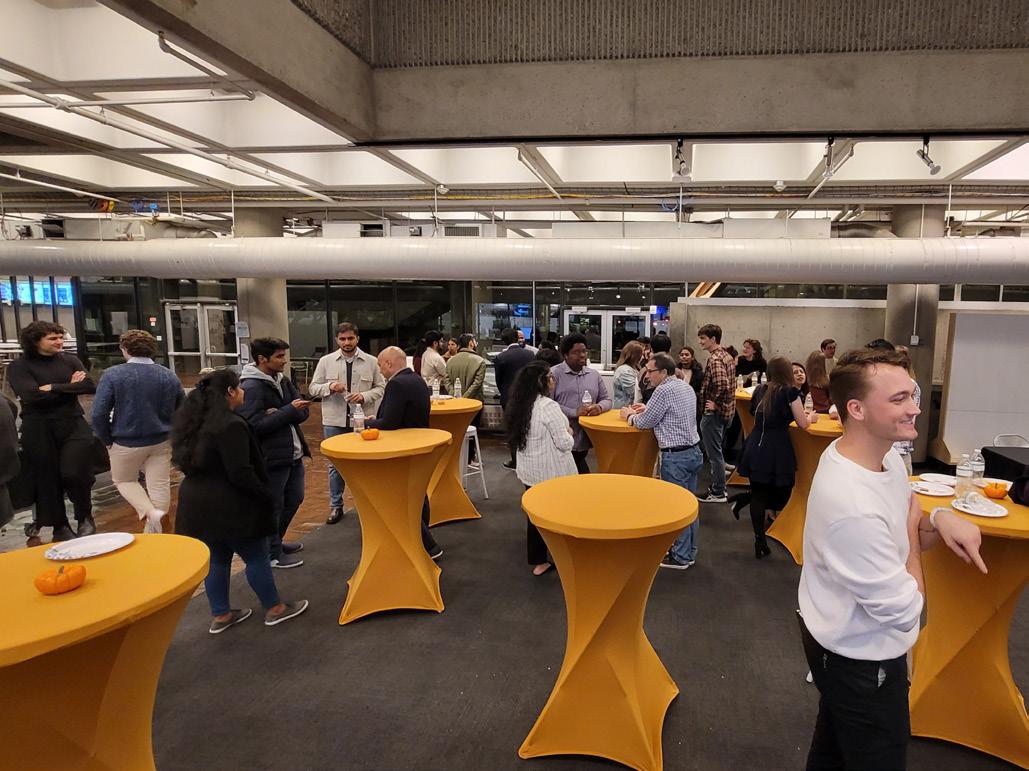
ON BELONGING (3) initiative reveal that nearly 50 percent of licensure candidates report limited advisor support, often due to lack of awareness of resources or scheduling conflicts.(3) The data further indicates that women and candidates of color face greater difficulty accessing meaningful mentorship.
“Seeking guidance is not a sign of weakness but of ambition.”
At a time when the profession faces a shortage of licensed architects relative to demand, proactive mentorship becomes both an ethical responsibility and a strategic necessity. Mentorship sustains the pipeline to licensure, transmits institutional knowledge and professional ethics, and promotes collaboration, sustainability, communication, networking, and technological advancement. It enables the profession to preserve its core values while critically examining and evolving beyond archaic practices - ensuring resilience, relevance, and long-term growth.
CHARTING YOUR MENTORSHIP JOURNEY: NEXT STEPS
Intentional mentorship begins with self-reflection. Identify where guidance is needed and determine which mentorship framework best aligns with those goals. Start with accessible resourcesyour firm, academic networks, or professional communitiesand seek mentors who have experience or expertise in the areas you wish to grow.
When preparing for an initial mentorship conversation:
• Discuss mentorship style, expectations, and structure.
• Establish clear goals and boundaries, even when uncomfortable.
• Create space for the relationship to evolve organically over time.
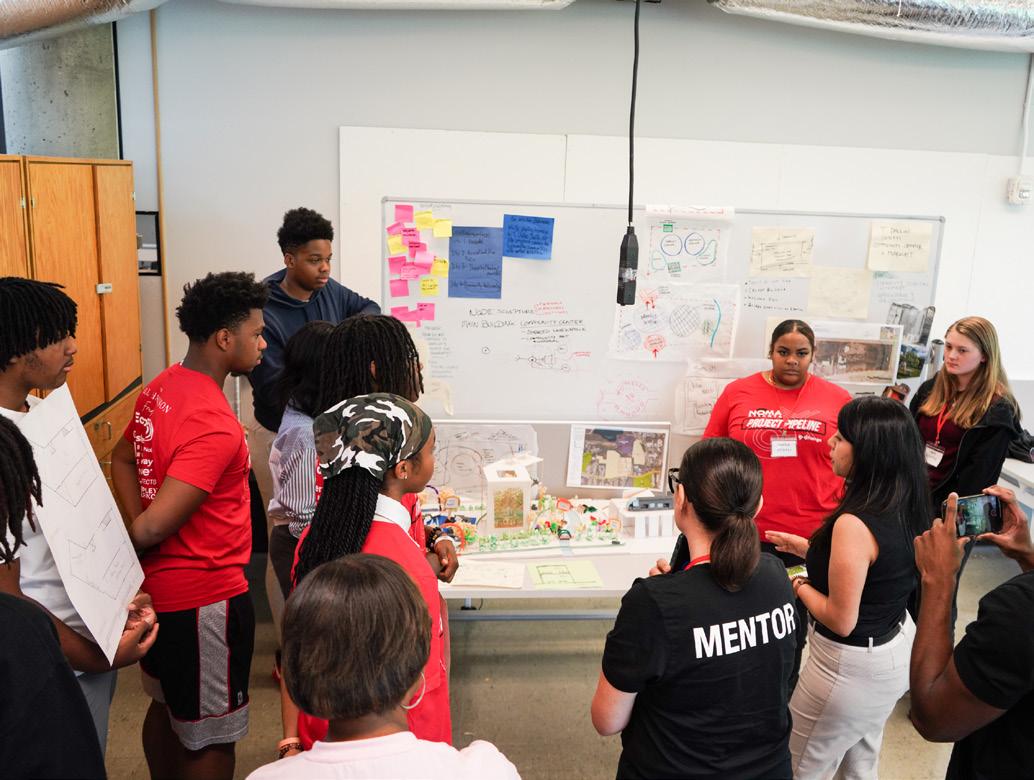
Left: Mentors & Mentees at the Kick-Off Event for the 2023 AIA Atlanta Student Mentorship Program. Photo Credit: Zachery Terry, Assoc. AIA, AFGA, NOMA Right: Jane Rodrigues, AIA addressing a group of students as a part of the design jury at NOMA ATL Project Pipeline Camp Session 2. Photo Credit: Project Pipeline Atlanta Chapter of the National Organization of Minority Architects
Mentors should encourage independent problem-solving, accountability, and self-reliance, while mentees remain engaged and reflective. Mentorship works best when it fosters growth without creating dependency.
CONCLUSION: RECIPROCITY AS THE FOUNDATION OF GROWTH
When done well, mentorship is not simply about transferring knowledge- it is about shaping the future of the profession. It allows architects to participate in transformation rather than reacting to change alone. Mentorship builds community, strengthens continuity, and lays the groundwork for the future of architecture.
The process is inherently reciprocal. Mentees gain guidance, confidence, and professional direction, while mentors benefit from renewed perspective, exposure to emerging trends, and growth in leadership and communication skills. Emerging professionals often bring fresh cultural, technical, and design viewpoints that enrich practice and challenge assumptions.
The beauty of mentorship lies in this ongoing exchange. It leaves no room for passive participation and serves as a bridge between experience and energy, tradition and innovation. To mentor is to give back, to pay it forward, and to keep the profession vibrant. By making mentorship a priority, we ensure that architecture continues to grow- not only in practice, but in purpose.
Additional Resources:
AIA International Global Mentorship Program – open to all, registration closes June 1st, 2026. Explore the Mentorship Program map tool for Mentors & Mentees
Footnotes:
(1) Mentoring Essentials for IDP Supervisors and Mentors, Nov. 2022: https://emfp.org/sites/default/files/uploads/aiamentoring-essentials-idp.pdf
(2) 2020 Code of Ethics and Professional Conduct, E.S. 5.2 Intern and Professional Development: https://www.aia.org/ pages/3296-code-of-ethics-and-professional-conduct
(3) NCARBs Baseline on Belonging https://www.ncarb.org/ sites/default/files/Baseline-on-Belonging_Action-PlanReport.pdf and mentoring data https://www.ncarb.org/blog/ nearly-50-of-candidates-have-a-mentor-most-say-mentorsdidn-t-help-them-become-licensed
Jane Rodrigues, AIA, NCARB, LEED AP BD+C Rodrigues is a Project Manager at Dynamik Design in Atlanta, GA. Rodrigues is a licensed architect, 2026 CKLDP Chair and a 2024 AIA Georgia Carmen Stan Memorial Scholarship recipient.
Why Defining the Problem Matters More Than Ever
For much of history, architecture has been understood as a problem-solving profession. Sometimes a program is defined and a site is known; other times the work begins earlier, in visioning and discovery, where the problem itself is still taking shape. Regardless of where it starts, the task has traditionally been to bring clarity and resolution to a complex situation. In time, digital tools improved how architects modeled, coordinated, and delivered solutions; but the overall structure of practice remained largely consistent.
Now, that structure is beginning to shift.
Advances in computation and artificial intelligence are making it easier to generate and evaluate design options, analyze performance, and coordinate complex systems. Tasks that once required significant effort can now be done faster and with greater precision. In many ways, the profession is becoming more capable at solving design problems.
This increased capability, however, is revealing a quieter change.
Architecture has always involved both solving and defining. What is changing is the balance between them. As tools reduce the effort required to produce solutions, more attention naturally moves toward clarity about intent, shared understanding across teams, and how decisions are framed early in the process. The difficulty does not disappear, rather it relocates.
“When generating solutions becomes easier, direction becomes more consequential.”
Artificial intelligence does not create this condition, but it makes its consequences more visible. When generating solutions becomes easier, direction becomes more consequential. The quality of framing, not just execution, begins to shape outcomes more clearly.
This has practical implications for practice.
Greater emphasis is moving toward early-stage clarity: aligning stakeholders, defining objectives, and establishing how success will be understood. The role of the architect increasingly includes shaping the decision environment, not only producing
design output. When direction is clear, improved tools reinforce coherence. When it is not, they amplify ambiguity.
There is also a risk embedded in this shift.
As capability increases, it becomes possible to move faster without improving understanding. A project can be technically refined yet conceptually misaligned. Tools can optimize performance, but they cannot replace judgment about purpose and long-term consequence.
What is changing, then, is not simply the technology used in architecture, but where the most important work occurs. As the cost of generating solutions decreases, defining what should be solved and why becomes more central to the value of the profession. The quality of the question begins to matter as much as the quality of the answer.
Yash Mehta, Assoc. AIA
Mehta is Regional Design Technology Director at Gensler in Chicago, where he leads efforts to integrate advancedtechnologies into design practice across the firm’s North Central Region.
Reducing Friction: From Lines to Logic
Let’s imagine the evolution of drafting and design tools as the way humans have learned to navigate cities over time.
In the early days, navigation depended on hand drawn maps. These maps were functional but demanded constant attention, experience, and memory. A wrong turn meant stopping, rechecking, and sometimes starting over. Manual drafting worked in much the same way. Every line was drawn by hand, every correction required erasing and redrawing, and every revision consumed significant time. Producing a single detailed drawing could take 6-8 hours, while a complete project routinely demanded 4,000 to 5,000 human hours. Progress was possible, but slow, labor-intensive, and heavily dependent on individual skill.
The introduction of CAD was comparable to the arrival of digital maps. Navigation became faster and more precise. Routes were clearer, edits were easier, and information could be copied and reused. Similarly, CAD transformed drafting by replacing handwork with digital accuracy. Drawing production time dropped dramatically; what once took an entire day could now be completed in 2-3 hours. However, digital maps still required users to interpret the route themselves. If a road changed, the map did not automatically adapt. In CAD, drawings remained disconnected. Plans, sections, elevations, and details existed as separate files or layers, requiring constant manual coordination. While CAD improved speed, it still relied heavily on human oversight to maintain consistency.
Revit and BIM marked a fundamental shift, similar to the transition from digital maps to GPS navigation. With GPS, routes are interconnected and dynamically updated. A single change recalculates the entire journey. In Revit, a wall drawn once appears simultaneously in plans, sections, elevations, schedules, and quantities. If the design changes, the entire model updates automatically. This integration reduced coordination errors, minimized rework, and improved collaboration across disciplines. A project that might require 2,500 hours in CAD could be completed in approximately 1,800 to 2,000 hours using BIM workflows. More importantly, BIM allowed designers to think holistically rather than in isolated drawings.
Today, industry stands at another transition point with Artificial Intelligence, which functions much like autopilot with real-time traffic prediction. AI does not merely respond to changes; it
anticipates them. Autopilot systems analyze traffic patterns, predict congestion, and suggest optimal routes before delays occur. In the design process, AI-powered plugins, drafting assistants, and intelligent chatbots automate repetitive tasks, flag potential errors early, and assist with detailing and documentation. For example, tasks such as dimension checks, schedule generation, flag missing annotations, clash detection, and specification writing that still take a couple of hours in Revit can often be reduced by half with AI support.
The numerical impact is significant. If AI reduces overall project time by even 25-30%, a 2,000-hour project could save 500600 hours. At an average professional billing rate of $80-$100 per hour, this translates to $40,000-$60,000 in time savings per project. These savings directly improve profitability while also reducing stress, fatigue, and rework for design teams.
It is important to note that just as drivers still choose their destination, designers still control design intent. AI does not replace professional judgment; it reduces friction in the process. History shows a consistent pattern: each technological shift, from manual drafting to CAD, from CAD to BIM, was initially met with resistance, yet eventually became indispensable. Therefore, the progression from hand-drawn maps to digital maps, from GPS to autopilot, mirrors the evolution of drafting tools in the built environment. Each step reduces uncertainty, increases efficiency, and allows professionals to focus on higher-value thinking. Artificial Intelligence represents the next logical step in this journey, bridging effort and intelligence, and redefining how time, efficiency, and value are created in the design profession.
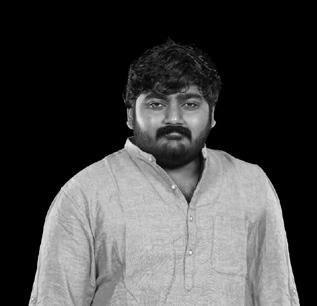
is an Architectural Designer in Rogers, Arkansas, and a researcher conducting indoor air quality studies at Arizona State University.
Sanand Maddipati
ABC | Archi-TEXT Book Club
Build the Life You Want by Arthur C. Brooks, A Review
For those view who attended the 2024 AIA Conference in Washington DC the name Arthur C. Brooks might sound familiar. A noted author, economist, and university professor; Brooks gave one of the the most attended keynote of the conference that year about his (then) newly released book “How to Build a Better Life”. If any of you were like me, sitting in the audience, eagerly scribbling notes on every word he was saying, you might think you have no reason to read this book. Well, I am here to tell you there is still plenty of wonderful insight to be pulled from these pages.
Given his position as a professor at Harvard, it is no surprise that Brooks does a good job of taking large complex topics and breaking them down into easily understood and actionable items. For example, the topic of “happiness” might seem like something very logical and straightforward, but when you start to really drill down on it, it loses form pretty quickly. His research and insight does a very good job of reframing the conversations around “what it means to be happy” and “how to achieve a meaningful life” in a way that removes it from being a nebulous concept and puts in into logical and digestible items. He then arms you with the tools and language to navigate the structure of this reframing that feels fresh and inspiring.
As an example, one of the early insights he gives is the idea that happiness and unhappiness are not polar opposite values that contribute to a zero sum game. They are instead are just indication markers of how you feel about a given situation to referenced and what you can base how you react on. Much like how smell is an indicator that some food is near, rather than the smell being the thing itself. Or how he compares the three constituent parts of happiness to the three macro nutrients that you need to balance in order to have a healthy diet.
I think the book gives a very usable vernacular to be able to look at situations in our lives and apply those terms / lessons to understand them better. It feels very similar to how learning the language of architecture in school gave us a different lens to look at the built environment and understand the everyday things we dealt with in a whole new light. The other architect applicable lesson I drew is the label of “Architect” itself. When
discussing work and how to deriving happiness from it (since it is one of the 4 main pillars to building a better life) the term “self objectification” was used. When you look at yourself through the narrow lens of a single use you objectify yourself and limit your ability to find meaning in other things. Think about how you would describe your whole life and self WITHOUT using the word “Architect”. mother, volunteer, gardener? I would imagine you derive a lot of meaning from those things just as much as being an Architect. Therefore, Brooks wants us to focus in making time for those aspects of your life just as much as the professional grind.
Overall, the book is really well structured, has actionable items, and if you listen to the audiobook, it is read by the author with a captivating performance. There are even some fun interjection notes read by Oprah! Who is also a co-author of the book, did I forget to mention that?! As with any project, having the tools and vocabulary to understand and look at a situation is just as powerful as the outcome. For that reason this books was a great guide to gaining those tools and lens to view the word so you too can building the life you want.

Justin Marquis, AIA, NCARB
Justin is a Project Architect with Somerville Architects & Engineers in Green Bay, Wisconsin. He serves as YAR for Wisconsin and serves on the Editorial Team for CONNECTIONS.
Connect + Chill
Cocktails & Streaming Content for the Casual Consumer
Each quater the YAF Knowledge Focus Group curates streaming video content and a cocktail / mocktail recipe to salute each quarterly theme. In Q4 we highlight Driving Wellness: Mitigating Burnout, Redefining Wellness with the following recommendations:
SPARKLE MOTION COCKTAIL

Ingredients:
2 oz Spiced Pear Liqueur
3/4 oz Lemon Juice
3/4 oz Simple Syrup Sparkling Wine Float
1 Lemon Peel – For garnish.
Instructions:
Shake Spiced Pear Liqueur, lemon juice, and simple syrup with ice. Strain into a chilled coup (or pour over ice) and top with a float of sparkling wine.
Garnish with a lemon peel.
Add some sparkle to your day! Warming spices meet bright citrus and a delightful float of sparkling wine in this quaffable cocktail. Serve it in a coup or enjoy on ice— it’s equally delicious either way!
Streaming Recommendations:
Each quarter the YAF Knowledge Focus Group curates streaming video content and a coctail and mocktail recipe to salute each quartely theme. In Q1, we highlight Practice in Motion through visual storytelling with the following Recommendations:
The Phoenician Scheme - After surving multiple assassanation attempts, wealthy businessman Zsa-zsa Korda appoints his only daughter, a nun, as sole heir to his estate. As Korda embarks on a new enterprise, they soon become the target of scheming tycoons, foreign terrorists and determined assassins. The film features Wes Anderson's signature style with symmetrical compositions, vibrant colors, and whimsical dialogue, while exploring themes of family dynamics, business intrigue, and moral dilemmas. Available to stream on Peacock and Amazon Prime.
Shaun the Sheep Movie - Fall in love with stop-motion animation and discover life at Mossy Bottom Farm, where the animals will do anything to get out of work. Shaun the sheep and his scheming friends devise a plan to put their master to sleep. However, the ruse backfires when the poor farmer finds himself transported to the big city, having lost his memory. The animal crew must travel to the metropolis and get him back, while not landing in even more trouble themselves. Available to stream on HBO Max.
Author: AIA YAF Knowledge Focus Group (Arlenne Gil, AIA/Melissa Gaddis, AIA/Abigail Benjamin, AIA/Mel Ngami, AIA/Robert Far, AIA/ Elizabeth Zachman, AIA/Reily J. Caldron, AIA/Diana Duran, AIA/ Krithika Penedo, AIA/Magdalini Vraila, AIA/Brooke DeYoung, AIA)

Instructions:
stir to combine. Chill until cold, about 1 hour.
To serve, divide strawberry mixture among 4 glasses filled with ice to come about halfway up; top off with club soda. Garnish each with a lime wedge and serve with straws if desired.
Author Bio: The AIA YAF Knowledge Focus Group is dedicated to identifying important issues of recently licensed architects and the creation of knowledge resources to enable young architects to advance their careers
