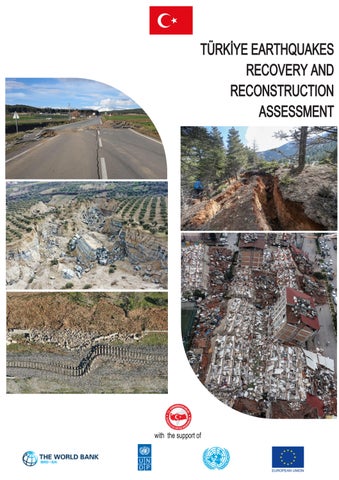
TÜRKİYE EARTHQUAKES RECOVERY AND RECONSTRUCTION ASSESSMENT
with the support of
Türkiye Earthquakes Recovery and Reconstruction Assessment
The European Union Delegation in Türkiye and the EU Joint Research Centre contributed inputs to this report. The contents of the report are the sole responsibility of the authors and do not necessarily reflect the views of the European Union. The United Nations Development Programme (UNDP), coordinating on behalf of the UN family in Türkiye, supported the preparation of this report. The findings, analysis and recommendations presented here do not necessarily represent those of UNDP or of any other UN agency, fund or programme. The designations employed and the presentation of the material in this report do not imply the expression of any opinion whatsoever on the part of UNDP or of any other UN organization. The published material is being distributed without warranty of any kind, either expressed or implied. The responsibility for the interpretation and use of the material lies with the reader. In no event shall any UN agency, fund or programme be liable for damages arising from its use. This document is the product of the Government of Türkiye prepared with the support of the United Nations and the European Union, with select inputs from World Bank staff. The data, findings, interpretations, and conclusions expressed in this document do not necessarily reflect the views of the World Bank, its Board of Executive Directors, or the countries they represent; any maps included in this work do not imply any judgment, endorsement or acceptance on the part of the World Bank in respect of any territory or boundaries. [ Valid for sections 1-7] Photo credits: Anatolian Agency
Page | 1
Türkiye Earthquakes Recovery and Reconstruction Assessment
Table of Contents Executive Summary ......................................................................................................................................................................... 8 1 Earthquake-Affected Region: Overview ........................................................................................................................ 13 1.1 Demographic and Social Outlook ........................................................................................................................ 13 1.2 Economic Outlook ..................................................................................................................................................... 17 2 Kahramanmaraş and Hatay Earthquakes ..................................................................................................................... 21 2.1 Türkiye: An Earthquake-Prone Country .............................................................................................................. 21 2.2 Türkiye Disaster Management System and Disaster Planning .................................................................... 27 2.3 A Major Disaster........................................................................................................................................................ 29 3 Emergency Response Measures ..................................................................................................................................... 35 4 Damage and Costs ............................................................................................................................................................. 38 4.1 Social Sectors ............................................................................................................................................................. 38 4.1.1 Housing ............................................................................................................................................................. 38 4.1.2 Education .......................................................................................................................................................... 47 4.1.3 Culture ............................................................................................................................................................... 57 4.1.4 Health ................................................................................................................................................................. 64 4.2 Infrastructural (Utilities) Sectors ............................................................................................................................ 68 4.2.1 Water & Sanitation ......................................................................................................................................... 68 4.2.2 Municipal Services ........................................................................................................................................... 71 4.2.3 Energy ................................................................................................................................................................ 78 4.2.4 Transportation ................................................................................................................................................. 84 4.2.5 Communication .............................................................................................................................................. 90 4.3 Economic Sectors ..................................................................................................................................................... 94 4.3.1 Agriculture Sector........................................................................................................................................... 94 4.3.2 Mining ............................................................................................................................................................... 101 4.3.3 Manufacturing Industry ...............................................................................................................................102 4.3.4 Tourism ............................................................................................................................................................. 107 4.4 Cross-Cutting Sectors............................................................................................................................................. 112 4.4.1 Employment and Social Protection .......................................................................................................... 112 4.4.2 Environment ....................................................................................................................................................124 5 Macroeconomic and Social Impact ..............................................................................................................................128 5.1 Macroeconomic Impact .........................................................................................................................................128 5.2 Social Impact ............................................................................................................................................................. 131 6 Total Financial Burden ......................................................................................................................................................136 7 Recommendations on Risk Reduction Measures for Disaster Resilience ..........................................................138 8 TERRA Recovery Vision ....................................................................................................................................................145 8.1 Socio-Economic Background ...............................................................................................................................145 8.1.1 Socio-economic context prior to the earthquakes..............................................................................145 8.1.2 Potential macroeconomic implications of the earthquakes .............................................................145 8.1.3 Macroeconomic outlook, challenges and opportunities ...................................................................146 8.2 Social Sectors ............................................................................................................................................................148 8.2.1 Housing ............................................................................................................................................................148 8.2.2 Education Sector............................................................................................................................................ 151 8.2.3 Health Sector ..................................................................................................................................................156 8.3 Infrastructure Sectors.............................................................................................................................................. 161 8.3.1 Water................................................................................................................................................................. 161 8.3.2 Municipal services .........................................................................................................................................164 8.3.3 Energy and Mining Sector ..........................................................................................................................169 8.3.4 Transport Sector ............................................................................................................................................174 8.3.5 Communication Sector ................................................................................................................................ 177 8.4 Economic Sectors ....................................................................................................................................................180
Page | 2
Türkiye Earthquakes Recovery and Reconstruction Assessment 8.4.1 Agriculture Sector..........................................................................................................................................180 8.4.2 Manufacturing Sector ...................................................................................................................................185 8.4.3 Culture and Tourism Sector ....................................................................................................................... 191 8.5 Cross-Cutting Issues ............................................................................................................................................... 197 8.5.1 Employment .................................................................................................................................................... 197 8.5.2 Social protection ............................................................................................................................................201 8.5.3 Environment ................................................................................................................................................... 207 8.5.4 Governance ..................................................................................................................................................... 211 8.5.5 Disaster risk reduction/civil protection ....................................................................................................214 Annexes ..........................................................................................................................................................................................216 Methodology............................................................................................................................................................................216
Page | 3
Türkiye Earthquakes Recovery and Reconstruction Assessment
List of Tables Table 1. Composition of Population in Earthquake-Affected Provinces by Age (2022, ABPRS) ........................ 13 Table 2. Key Labour Force Indicators (2021, aged 15+, 1,000 persons) ...................................................................... 14 Table 3. Employment by Province in Earthquake-Affected Region (2021) ............................................................... 14 Table 4. Share of the 11 Earthquake-Affected Provinces in National Income .......................................................... 17 Table 5. Share of Earthquake-Affected Provinces in GDP and Subsectors (2021) .................................................. 18 Table 6. Foreign Trade (2022) ................................................................................................................................................... 18 Table 7. Share of Earthquake-Affected Provinces in Total Exports, by Product or Sector (2022) ..................... 19 Table 8. Share of Earthquake-Affected Provinces in Central Government Budget Revenues (2022) ............. 19 Table 9. History of Earthquakes in Türkiye ........................................................................................................................... 21 Table 10. Number of IRAP Actions of Earthquake-Affected Provinces...................................................................... 29 Table 11. Number of Total Buildings in Earthquake-Affected Provinces .................................................................... 31 Table 12. Number of Buildings Included in Damage Assessment (6 March 2023) ................................................ 31 Table 13. Distribution of Risky Areas and Buildings in Earthquake-Affected Region ........................................... 33 Table 14. Additional Funds Earmarked under Law No. 2935 on State of Emergency .......................................... 36 Table 15 Distribution of DASK-Insurance Claims .............................................................................................................. 37 Table 16. Number of Houses in Earthquake-Affected Provinces................................................................................. 38 Table 17. Households in Earthquake-Affected Provinces, by Ownership Status (2021) ....................................... 39 Table 18. Percentage of Households by Construction Year, 2021 ............................................................................... 39 Table 19. Load-Bearing Systems of Buildings in Earthquake-Affected Region ...................................................... 40 Table 20. Damage Control Report by Province (as of 06 March 2023) ..................................................................... 41 Table 21. Total Damage and Loss for the Housing Sector............................................................................................. 42 Table 22. Disaster Houses Programme ................................................................................................................................ 44 Table 23. Distribution of Educational Institutions by Province (2021-2022) ............................................................ 47 Table 24. Number of Students by Province (2021-2022) ............................................................................................... 47 Table 25. Number of Teachers by Province (2021-2022) ............................................................................................... 48 Table 26. Universities in Earthquake-Affected Provinces ............................................................................................... 48 Table 27. Damage Assessment for University Structures ............................................................................................... 49 Table 28. Damage Status of Dormitories in Earthquake-Affected Provinces ......................................................... 50 Table 29. Cultural Assets in Earthquake-Affected Provinces ........................................................................................ 57 Table 30. Damage to Libraries in Provinces Affected by Earthquake ........................................................................ 59 Table 31. Healthcare Sector Capacity in Earthquake-Affected Region ...................................................................... 64 Table 32. Water and Sanitation Damage Status ............................................................................................................... 69 Table 33. Number of Municipalities, Districts and Villages in Earthquake-Affected Region ............................. 72 Table 34. Status of Buildings Collapsed or Requiring Demolition .............................................................................. 72 Table 35. Itemized Distribution of Assessed Damage in the Municipal Services Sector ..................................... 76 Table 36. Distribution of Assessed Damage in Energy Sector by Province (million TRY) ................................... 80 Table 37. Itemized Distribution of Assessed Damage in Energy Sector .................................................................... 81 Table 38. Assessed Damage in Rail Lines ............................................................................................................................ 85 Table 39. Assessed Damage in Airports ............................................................................................................................... 86 Table 40. Assessed Damage in Motorways ........................................................................................................................ 87
Page | 4
Türkiye Earthquakes Recovery and Reconstruction Assessment Table 41. Key Indicators for Electronic Communications Sector, by Province (2021) ........................................... 90 Table 42. Itemized Distribution of Assessed Damage in the Communications Sector ........................................ 91 Table 43. Irrigation Facilities and Areas in the Region .................................................................................................... 95 Table 44. Fishing Harbour Damage ....................................................................................................................................... 96 Table 45. Estimated Costs of Damage to Irrigation Sector in Earthquake-Affected Region ............................. 97 Table 46. Status of Major Dams that Sustained Damage in Earthquake-Affected Region ................................ 97 Table 47. Itemized Distribution of Assessed Damage in Agriculture Sector ........................................................... 98 Table 48. Number of Companies in the Manufacturing Industry in the Region (2023) .................................... 103 Table 49. Number of OIZs and SISs in Earthquake-Affected Region (2023)......................................................... 103 Table 50. Number of Companies Interviewed, by Province ........................................................................................ 104 Table 51. Total Damage to Companies, by Province (Compiled from Survey) ..................................................... 104 Table 52. Total Damage to Companies, by Province (Estimated) ............................................................................. 105 Table 53. Building Damage Status, by Scale (m2, Estimate) ....................................................................................... 105 Table 54. Number of Rooms and Beds in Ministry-Certified Facilities (2022) .......................................................107 Table 55. Accommodation by Provinces, (2022) ..............................................................................................................107 Table 56. Damage Status of Tourism Facilities in Earthquake-Affected Region .................................................. 108 Table 57. Accommodation Facilities Affected by Earthquake .................................................................................... 108 Table 58. Basic Labour Indicators (2021) (15+ years old, 1,000 people) ................................................................... 112 Table 59. Employment in Earthquake-Affected Region by Registration Status (2021) ....................................... 113 Table 60. Private Sector with the Largest Share of Employment in the Region (2021)....................................... 113 Table 61. Damage Assessment Report by MoFSS (as of 03 March 2023) ............................................................... 114 Table 62. Summary Table of Damage Caused by Earthquake .................................................................................... 115 Table 63. Protected Areas ....................................................................................................................................................... 124 Table 64. Emergency Expenditures ...................................................................................................................................... 136 Table 65. Public Sector Damage Costs ............................................................................................................................... 136 Table 66. Total Costs: Damage and Expenditures ...........................................................................................................137
List of Figures Figure 1. Türkiye Seismic Hazard Map .................................................................................................................................. 22 Figure 2: Türkiye Disaster and Emergency Management System ............................................................................... 28 Figure 3. Fault Lines in Earthquake-Affected Region ...................................................................................................... 30
Page | 5
Türkiye Earthquakes Recovery and Reconstruction Assessment
Abbreviations English Full Form
EN abb.
TR abb.
Address Based Population Registration System Disaster and Emergency Management Agency Ministry of Family and Social Services
ABPRS
ADNKS
Adrese Dayalı Nüfus Kayıt Sistemi
Turkish Full Form
AFAD
AFAD
Afet ve Acil Durum Yönetimi Başkanlığı
MoFSS
ASHB
Aile ve Sosyal Hizmetler Bakanlığı
Information and Communication Technologies Authority Individual Pension System
ICTA
BTK
Bilgi Teknolojileri ve İletişim Kurumu
IPS
BES
Bireysel Emeklilik Sistemi
Petroleum Pipeline Corporation
BOTAS
BOTAŞ
Ministry of Environment, Urbanization and Climate Change State Hydraulic Works
MoEUCC
ÇŞİDB
DSI
DSİ
Boru Hatları ile Petrol Taşıma Anonim Şirketi Çevre, Şehircilik ve İklim Değişikliği Bakanlığı Devlet Su İşleri Genel Müdürlüğü
Turkish Natural Catastrophe Insurance Pool East Anatolia Faultline
DASK
DASK
Doğal Afet Sigortaları Kurumu
EAF
DAF
Doğu Anadolu Fayı
Power generation Corp.
EUAS
EÜAŞ
Elektrik Üretim Anonim Şirketi
Meat and Milk Institution
ESK
ESK
Et ve Süt Kurumu Genel Müdürlüğü
Gross Domestic Product
GDP
GSYH
Gayri Safi Yurtiçi Hâsıla
Presidency of Migration Management
PMM
GİB
Göç İdaresi Başkanlığı
Ministry of Treasury and Finance
MoTF
HMB
Hazine ve Maliye Bakanlığı
Hydro-Power Plant
HPP
HES
Hidroelektrik Santrali
Provincial Disaster Risk Reduction Plan
IRAP
İRAP
İl Risk Azaltma Planı
Istanbul Technical University
ITU
İTÜ
İstanbul Teknik Üniversitesi
Nomenclature of Territorial Units for Statistics State-Owned Economic Enterprise
NUTS
İBBS
İstatistiki Bölge Birimleri Sınıflandırması
SOE
KİT
Kamu İktisadi Teşebbüsü
General Directorate of Highways
KGM
KGM
Karayolları Genel Müdürlüğü
Value Added Tax
VAT
KDV
Katma Değer Vergisi
Small Industrial Site
SIS
KSS
Küçük Sanayi Sitesi
Small and Medium-sized Enterprise
SME
KOBİ
Küçük ve Orta Ölçekli İşletmeler
North Anatolia Faultline
NAF
KAF
Kuzey Anadolu Fayı
Turkish Republic of Northern Cyprus
TRNC
KKTC
Kuzey Kıbrıs Türk Cumhuriyeti
Transition to Highschool System
LGS
LGS
Liselere Geçiş Sistemi
Spatial Population Registration System
SPRS
MAKS
Mekansal Adres Kayıt Sistemi
Before Christ
B.C.
M.Ö.
Milattan Önce
Ministry of National Education
MoNE
MEB
Milli Eğitim Bakanlığı
State of Emergency
OHAL
OHAL
Olağanüstü Hâl
Organized Industrial Zones Senior Organization Organized Industrial Zone
OSBUK
OSBUK
Organize Sanayi Bölgeleri Üst Kuruluşu
OIZ
OSB
Organize Sanayi Bölgesi
General Directorate of Forestry
OGM
OGM
Orman Genel Müdürlüğü
Middle East Technical University
METU
ODTÜ
Orta Doğu Teknik Üniversitesi
Automatic Participation System
APS
OKS
Otomatik Katılım Sistemi
Page | 6
Türkiye Earthquakes Recovery and Reconstruction Assessment
English Full Form
EN abb.
TR abb.
Turkish Full Form
Post and Telegraph Organization
PTT
PTT
Posta ve Telgraf Teşkilatı
Counselling and Research Centre
RAM
RAM
Rehberlik ve Araştırma Merkezleri
Compressed Natural Gas
CNG
CNG
Sıkıştırılmış Doğal Gaz
Non-governmental organization
NGO
STK
Sivil Toplum Kuruluşu
Social Security Institution
SGK
SGK
Sosyal Güvenlik Kurumu
Social Assistance and Solidarity Promotion Fund Strategy and Budget Office
SASPF
SYDTF
SBO
SBB
Sosyal Yardımlaşma ve Dayanışmayı Teşvik Fonu Strateji ve Bütçe Başkanlığı
General Directorate of Agricultural Enterprises Ministry of Agriculture and Forestry
TIGEM
TİGEM
Tarım İşletmeleri Genel Müdürlüğü
MoAF
TOB
Tarım Orman Bakanlığı
Housing Development Administration
TOKI
TOKİ
Turkish Grain Board
TMO
TMO
Toplu Konut ve Kamu Ortaklığı İdaresi Başkanlığı Toprak Mahsulleri Ofisi Genel Müdürlüğü
Turkish Airlines
THY
THY
Türk Hava Yolları
Türkiye Disaster Response Plan
TAMP
TAMP
Türkiye Afet Müdahale Planı
Türkiye Disaster Risk Reduction Plan
TARAP
TARAP
Türkiye Afet Risk Azaltma Planı
Türkiye Post-Disaster Recovery Plan
TASIP
TASİP
Türkiye Afet Sonrası İyileştirme Planı
Türkiye Disaster Management Strategy
TAYS
TAYS
Türkiye Afet Yönetimi Stratejisi
Turkish State Railways
TCDD
TCDD
Türkiye Cumhuriyeti Devlet Demiryolları
Turkish Electricity Transmission Corp.
TEIAS
TEİAŞ
Türkiye Elektrik İletim A.Ş.
Turkish Exporters Assembly
TIM
TİM
Türkiye İhracatçılar Meclisi
Turkish Statistical Institute
TURKSTAT
TÜİK
Türkiye İstatistik Kurumu
Turkish Petroleum Corporation
TPAO
TPAO
Türkiye Petrolleri Anonim Ortaklığı
Turkish Radio and Television
TRT
TRT
Türkiye Radyo Televizyon Kurumu
Association of Turkish Travel Agencies
TURSAB
TÜRSAB
Türkiye Seyahat Acentaları Birliği
Aircraft Rescue and Fire Fighting
ARFF
ARFF
Uçak Kurtarma ve Yangınla Mücadele
National Earthquake Strategy and Action Plan National Medical Rescue Team
UDSEP
UDSEP
Ulusal Deprem Stratejisi ve Eylem Planı
UMKE
UMKE
Ulusal Medikal Kurtarma Ekibi Birimi
International Air Transport Association
IATA
IATA
Uluslararası Hava Taşımacılığı Birliği
Examination for Higher Education
YKS
YKS
Yükseköğretim Kurumları Sınavı
Mandatory Earthquake Insurance
ZDS
ZDS
Zorunlu Deprem Sigortası
Page | 7
Türkiye Earthquakes Recovery and Reconstruction Assessment
Executive Summary Earthquake impact and recovery vision Türkiye was hit by a series of debilitating earthquakes in February 2023. Even for an earthquakeprone region, the disaster was unprecedented in its scope and the magnitude of the destruction it caused. Fatalities to date number 48 448; 3.3 million people have been displaced; and almost two million people are being sheltered in tent camps and container settlements. Apartment towers and village houses lie in ruins across a vast territory of 110,000 square km. As emergency response measures continue, the Government of Türkiye has announced ambitious reconstruction plans, including a commitment to rebuild all damaged residential housing. Alongside its own analysis, the Government collaborated with the United Nations Development Programme (UNDP) and the World Bank, along with the European Union (EU), in preparing a preliminary post-disaster needs assessment (PDNA) to be published ahead of a donor conference for the people of Türkiye and Syria on March 20, 2023. The Government assigned the Strategy and Budget Office (SBO) of the Turkish Presidency with the task of preparing the assessment. The partners agreed to adapt the PDNA methodology to the specifics of the earthquake disaster and timeline and to collaborate on preliminary analysis, called the Türkiye Earthquakes Recovery and Reconstruction Assessment (TERRA). The TERRA presented here comprises of an assessment of the financial impact of the earthquakes, applying modified PDNA methodology, and a “recovery vision.” The TERRA makes a preliminary conclusion that the impact amounts to 103.6 billion USD, or equivalent to 9 percent of Türkiye’s forecast GDP for 2023. This is a shocking amount, reflecting the almost unfathomable scope of the devastation experienced by Türkiye’s southern provinces. The path to recovery will be challenging and, even given the Government’s dedication of enormous state resources to the effort, will depend in part on support from the international community. The TERRA is designed to help understand the scale of the need and the priorities for reconstruction. The earthquakes and their impact Türkiye is located on the highly seismically active Anatolian Plate, on which massive earthquakes occurred throughout history. Since the year 1900, 20 earthquakes with a magnitude of over 7 have occurred in these lands, placing Türkiye among the top-listed countries affected by earthquakes. Türkiye has experienced 269 earthquakes that caused loss of lives and economic damage between 1900 and 2023. Of these, the top three earthquakes that claimed the most lives and inflicted the most severe damage were the 2023 Kahramanmaraş Earthquake, the 1939 Erzincan Earthquake, and the 1999 Marmara Earthquake with the epicentre of Gölcük. On February 6, 2023, two major earthquakes hit Türkiye, with the epicentres in Pazarcık (Mw 7.7; focal depth: 8.6 km) and Elbistan (Mw 7.6; focal depth: 7 km) districts of Kahramanmaraş, at 04:17 and 13:24 local time, respectively. On February 20, 2023, another earthquake with a magnitude of Mw 6.4 occurred, with the epicentre of Yayladağı, Hatay, at 20:04 local time. These earthquakes,
Page | 8
Türkiye Earthquakes Recovery and Reconstruction Assessment
all of which are unprecedented in recent history in terms of magnitude and coverage, caused major devastation in a total of 11 provinces. The earthquakes claimed the lives of more than 48,000 people, wreaked damage on over half a million buildings as well as communication and energy structures and led to significant financial losses. The total population of the 11 provinces affected by the earthquake was registered as 14,013,196 persons in 2022, accounting for 16.4% of the national demographic. While 13,553,283 persons in this population (96.7% of the total) live in provincial and district centres, the rest (459,913 persons and 3.3% of the total - except for the population in rural areas of metropolitan municipalities) lives in towns and villages. Additionally, 1,738,035 persons in the earthquake-affected region comprise the migrant population residing in Türkiye under temporary protection. According to data from 2021, there are 3.8 million employed persons in the disaster region and the share of regional employment in national employment is 13.3%. 2.3 million people are in formal and 1.5 million people are in informal employment. Informal employment across the disaster region is around 39%. The total number of buildings in the region is close to 2.6 million. Of such building stock, approximately 90% is residential, 3% is public buildings, and 6% is workplaces. The number of housing units in the 11 earthquake-affected provinces in 2022 is 5.6 million, with a 14.05% share in the total housing stock across Türkiye. The majority of the production activities in the region are carried out in the service, industry and agriculture sectors. The provinces affected by the earthquake had a share of 9.8% of the Gross Domestic Product (GDP) in 2021, and generate approximately 79 million USD of national income. The per capita national income level in the region falls significantly short of the national average. Taking the 2021 data into consideration, the average per capita GDP of the 11 earthquake-affected provinces is calculated as 5,924 USD. The 11 earthquake-affected provinces contributed by 0.98 points to the national economic growth, recorded at 11.4 in 2021. The 11 earthquake-affected provinces have an 8.6% share in exports in 2022. Gaziantep stands out with a 4.4% share in total exports, while Adana, Hatay and Kahramanmaraş have a share of 1.6%, 1.2% and 0.6 respectively. Gaziantep is the sixth province with the highest export rate. The share of the 11 earthquake-affected provinces in the 2022 imports is 6.7%. Gaziantep and Hatay stand out with a share of 2.3% and 2.1% in total imports, respectively. The total textile product exports across Türkiye is 14.2 billion USD for 2022, while the earthquakeaffected provinces have an export rate of 5 billion USD and a 35% share in total textiles exports. For exports by sector according to the Turkish Exporters Assembly (TIM) classification, or in terms of their share in total exports by product or sector, the prominent items include carpet, cerealpulses, fruit-vegetable (wet, dried) products, textiles and raw materials, leather products, steel and furniture, paper and forestry products.
Page | 9
Türkiye Earthquakes Recovery and Reconstruction Assessment
Shedding light on the extent of the damage caused by the earthquake, the report includes the assessments regarding major losses of life as well as the damage, losses and needs related to physical assets. It was difficult, as well as time-consuming, to compile the information from the field, as the earthquake-affected region covers a vast area and the infrastructure and public administrations in the relevant provinces were also affected by the earthquake. In order to overcome such difficulties, data was collected in coordination with numerous institutions and organizations under the coordination of the Strategy and Budget Office (SBO). Such data covers a multitude of areas, particularly post-earthquake actions, damage to physical assets, and the support provided with regard to public finance. The damage/costs caused by the earthquake, on the other hand, were addressed by sector in terms of convergence with international standards. In this context, the damage were examined by social sectors (housing, education, healthcare, employment, environment); infrastructural sectors (water and sanitation, municipal services, energy, transportation, communication), and economic sectors (agriculture, mining, manufacturing industry, tourism). Furthermore, recommendations on short-, medium- and long-term objectives were presented for each sector. The data from relevant ministries, unit costs and institutional opinions were combined and reflected in the report through the sectoral expertise of SBO, in order to ensure the utmost accuracy of the damage and loss data for each sector. The data from field are continuously updated as of the publication date of the report. Therefore, the damage picture may be revised over time. The earthquakes that occurred in the region once again underlined the importance of building earthquake-resilient cities and infrastructure. In addition to the major losses in human life, the damage to the physical capital is extremely costly. The burden of resources to be spent on reoperationalizing the cities is also very heavy. The most prominent component of the burden imposed by the earthquake on the Turkish economy is the damage in housing units by 54.9% (1,073.9 billion TRY; 56.9 billion USD). The second largest damage is the destruction of public infrastructure and damage to public service buildings (242.5 billion TRY; 12.9 billion USD). The damage incurred by the private sector except housing is estimated at 222.4 billion TRY (11.8 billion USD). This category includes manufacturing industry, energy, communications, tourism, healthcare, education sectors and damage to small tradespersons and houses of worship. Further, considering the losses to the insurance sector, revenue losses of tradespersons, and macroeconomic impacts, it is estimated that the total financial burden of the earthquake disaster for the country is 2 trillion TRY (103.6 billion USD), which is equal to 9% of GDP forecast for 2023. Recovery vision In light of the extensive damages caused by the earthquakes, this report recommends a range of changes in construction standards and regulatory policies to ensure that settlements across the country, both those newly constructed and those already standing, are resilient to earthquakes and other disasters. Additional measures are also proposed to promote resilience against disaster
Page | 10
Türkiye Earthquakes Recovery and Reconstruction Assessment
risks, based on the participation of all stakeholders (citizens, local administrations, public agencies, professional chambers and academia). These proposed measures are detailed in the recovery vision, which builds on the damage assessment presented in the report to flesh out a recovery vision for the region and identify some preliminary priority interventions in each sector and sub-sector. The TERRA outlines a set of key principles to ensure that the recovery from the earthquake is resilient, inclusive, green and sustainable. Across the sectors and priorities identified, Build Back Better principles need to be applied for resilient structures, institutions and communities, and Disaster Risk Reduction should be put into practice at all levels of education, policies and practices. Accountable decisions made with the participation of those affected will be crucial, particularly in considering the future of cities and towns built in areas of high seismic risk. Further, the “leave no one behind” principle of the Sustainable Development Goals (SDGs) should be applied in all phases: emergency relief, recovery and reconstruction, to ensure that groups with specific needs receive sufficient assistance and enjoy equitable opportunities. Employing green, nature-friendly solutions is seen as key to a sustainable future, to reduce energy demands and erect climate-proof infrastructure in line with Türkiye’s 2053 net zero target. Putting these guiding principles into practice will be paramount to ensure that recovery efforts are adequate to the scale of needs. The affected provinces already hosted half of Syrians under temporary protection and international protection applicants and status holders. Massive displacement raises fears of labour shortages, while the numbers of residents in need of social services has soared. These are daunting challenges, but they also provide opportunities for strategic investments to support a new vision for the region and put the economy on a green, resilient and inclusive path. In order to seize this opportunity, the recovery process needs to apply resources strategically, in a prioritized fashion. The TERRA provides some initial recommendation for key sectoral priorities and short, medium, and long term actions to be considered by the Government of Türkiye, local institutions, private sector and civil society, and supported by international actors. Social recovery priorities include the need to provide social assistance and protection for the vulnerable, strengthen public services in earthquake zone and outside, rebuild health and education services, and expand psychosocial support. For the economic recovery, it will be critical to define a shared vision for regional economic revival and growth and to devise policies to attract and retain a skilled workforce. Climate-proofing can be incorporated into measures to revive the region’s agriculture. Local businesses will need support to modernize and adopt digital technologies, and the region will benefit from “buy local” commitments, including in relief efforts. Infrastructure recovery and reconstruction should capitalize on science-based spatial planning and regulation for housing reconstruction and urban revival, rehabilitate and modernize transport and communications networks. Particularly given the region’s unique history, preserving and safeguarding cultural heritage will be vital to retaining local identity (an important factor that can dynamize the recovery) and also to spurring a revival in tourism.
Page | 11
Türkiye Earthquakes Recovery and Reconstruction Assessment
For the environment, it will be critical to restoring energy provision in line with a net-zero vision, to ensure safe debris management with resources recycled, and to prioritize nature-based solutions, including ecosystem restoration. Acknowledgements: This report was prepared by the Strategy and Budget Office (SBO) of the Presidency of the Republic of Türkiye, with select input from World Bank staff, and with the support of the United Nations Development Programme (UNDP) on behalf of the UN family in Türkiye, and the European Union (EU). UNDP coordinated input from the following UN agencies: FAO
Food and Agriculture Organization
ILO IOM UNESCO UNFPA UN-HABITAT
International Labour Organization International Organization for Migration United Nations Educational, Scientific and Cultural Organization United Nations Population Fund United Nations Human Settlements Programme
UNHCR UNICEF UNIDO UN RCO
United Nations High Commissioner for Refugees United Nations Children's Fund United Nations Industrial Development Organization UN Resident Coordinator Office
UNV UN WOMEN WFP WHO
UN Volunteers United Nations Entity for Gender Equality and the Empowerment of Women World Food Programme World Health Organization
The Ministry of Foreign Affairs and the Ministry of Treasury and Finance were key partners. The many actors involved in preparing the report worked in a genuine spirit of partnership. The understandings forged in preparing this report will be further developed in the coming period, in preparation of a detailed recovery strategy reflecting a joint commitment to overcome the massive damage caused by the earthquakes and map a path to full recovery and reconstruction in a way that, in line with the philosophy of the SDGs, leaves no one behind.
Page | 12
Türkiye Earthquakes Recovery and Reconstruction Assessment
1 Earthquake-Affected Region: Overview 1.1 Demographic and Social Outlook According to the Address Based Population Registration System (ABPRS) data, as of 31 December 2022, the total population of the 11 earthquake-affected provinces is 14,013,496, accounting for 16.4% of the national population of 85,279,553 persons. While 96.7% (13,553,283 persons) of the region’s population live in provincial and district centres, the rest (459,913 persons) lives in towns and villages. There are approximately 3.5 registered Syrians under Temporary Protection (SuTPs) in Türkiye. Nearly half of the total number of Syrians in Türkiye lives in the 11 earthquake-affected provinces; the region hosts 1,738,035 SuTPs. The ratio of Syrians to the overall population in the region is 11.48%. Approximately 46% of the Syrian population in the region is children aged 0-17, and 3% is elderly people over 65. 21.3% (4,805,937 children ) of the total child (aged 0-17) population in Türkiye and 2.6 million young people in the 18-29 age group, accounting for 16.7% of the youth population in Türkiye, live in the affected 11 provinces. The median age in the earthquake-affected provinces, except for Diyarbakır and Malatya, is below the national median age which is 33.5. The elderly ratio in the demographic structure of the earthquake-affected provinces is lower than in Türkiye in general. The elderly population rate in the region is 2.5 points below that of the country. Table 1. Composition of Population in Earthquake-Affected Provinces by Age (2022, ABPRS) Province Adana Adıyaman Diyarbakır Elazığ Gaziantep Hatay Malatya Kahramanmaraş Şanlıurfa Kilis Osmaniye Total Region Men Women Total Türkiye Men Women
Total 2,274,106 635,169 1,804,880 591,497 2,154,051 1,686,043 812,580 1,177,436 2,170,110 147,919 559,405 14,013,196 7,049,219 6,963,977 85,279,553 42,704,112 42,575,441
(0-17) 650,919 213,088 677,944 152,439 790,077 537,008 215,978 373,637 974,864 48,947 171,036 4,805,937 2,461,656 2,344,281 22,578,378 11,585,839 10,992,539
(15-24) 337,196 104,216 323,328 93,264 373,459 265,090 126,831 193,881 403,597 27,599 87,769 2,336,230 1,196,670 1,139,560 12,949,817 6,633,224 6,316,593
(15-29) 500,939 151,927 479,726 136,714 543,469 382,846 184,285 278,382 580,835 39,283 125,901 3,404,307 1,731,596 1,672,711 19,502,986 9,967,663 9,535,323
(0-29) 1,040,186 329,544 1,051,408 262,186 1,206,932 828,626 361,013 586,363 1,414,726 80,164 266,411 7,427,559 3,792,656 3,634,903 38,238,097 19,580,385 18,657,712
(15-64) 1,523,411 404,271 1,140,208 401,774 1,366,161 1,102,478 545,210 764,905 1,246,531 95,119 366,904 8,956,972 4,524,779 4,432,193 58,092,773 29,341,142 28,751,631
65+ 211,448 53,281 92,990 64,251 124,427 137,785 90,642 104,550 89,688 11,919 51,991 1,032,972 463,380 569,592 8,451,669 3,750,248 4,701,421
Source: Address Based Population Registration System, 2022
The number of registered persons with disability (PwDs) is 2,511,950 in the region; 1,414,643 of whom are male and 1,097,307 are female. The number of persons with severe disability is 775,012. A total of 5,252 individuals are served at the 66 PwD and elderly care centres of the Ministry of Family and Social Services (MoFSS) in the region. The employment rate and labour force participation rate across the earthquake-affected region is lower and the unemployment rate is higher compared to the national average. The labour force participation rate is 51.4% and employment rate is 45.2% in Türkiye; the provinces with the lowest
Page | 13
Türkiye Earthquakes Recovery and Reconstruction Assessment
rates of 40.6% and 34.5%, respectively, are in the TRC2 (Şanlıurfa and Diyarbakır) region. The employment rate in the TR63 (Hatay, Kahramanmaraş, Osmaniye) region is 17.1%, which is fairly above the national average of 12%. In terms of the distribution of those in employment, the service sector appears to dominate the region. While 17.2 of those in employment in Türkiye work in the agriculture sector, this rate reaches 31.8% in the TRC2 (Şanlıurfa, Diyarbakır) region. Thus, agriculture sector comprises significant labour force in Şanlıurfa and Diyarbakır. According to observations, the employment in the region is concentrated in jobs requiring low skills, such as the production of agriculture, trade, textile and food products. Table 2. Key Labour Force Indicators (2021, aged 15+, 1,000 persons) 15+ yearold Labour Not in the population force Employment Unemployed labour force
Labour force participation rate (%)
Employment rate (%)
Sectoral Distribution (%) Unemployment Service Industry Agriculture rate (%)
TR63
2,401
1,154
957
197
1,247
48.1
39.9
17.1
54.3
26.0
TRC1
1,936
969
871
98
967
50.0
45.0
10.1
48.5
32.4
19.8 19.1
TRC2
2,474
1,004
854
151
1,469
40.6
34.5
15.0
44.8
23.4
31.8
TRB1
1,352
653
587
67
699
48.3
43.4
10.2
51.9
19.1
29.1
TR62
3,137
1,579
1,371
208
1,558
50.3
43.7
13.2
58.5
22.5
19.0
Sum of Regions
11,300
5,359
4,640
721
5,940
47.4
41.1
13.5
-
-
-
Türkiye
63,704
32,716
28,797
3,919
30,989
51.4
45.2
12
55.3
27.5
17.2
Source: TURKSTAT, Note: Statistical Classification of Territorial Units Level 2 (NUTS2) classification is taken into account.
In the earthquake-affected region, 3,841,000 persons are employed; and the share of regional employment in national employment is 13.3%. Informal employment rate is 39%. Major gaps between men and women are observed in the region with regard to labour force participation and employment rates. In the provinces in the earthquake-affected region, labour force participation rate is 70.3% in men and 32.8% in women; employment rate is 62.8% and 28%, respectively; and unemployment rate is 10.7% and 14.7%, respectively. A total of 622,384 persons in the region are registered as unemployed. Table 3. Employment by Province in Earthquake-Affected Region (2021) (1000 People)
Total Employment
Formal Employment
Share of Provincial Employment in Disaster Region (%)
Provincial Employment Share in National Employment (%)
Adana
690
425
18.0
2.4
Adıyaman
122
81
3.2
0.4
Diyarbakır
446
248
11.6
1.5
Elazığ
212
124
5.5
0.7 2.5
Gaziantep
712
471
18.5
Hatay
477
296
12.4
1.7
Kahramanmaraş
338
210
8.8
1.2
Kilis
38
25
1.0
0.1
Malatya
257
149
6.7
0.9 0.5
Osmaniye
142
88
3.7
Şanlıurfa
407
227
10.6
1.4
Total Region
3,841
2,344
100
13.3
Türkiye
28,797
20,441
-
100
Source: SBO Calculations based on TURKSTAT Household Labour Force Survey
There are 3,029,422 households in the earthquake-affected region, with an average household size of 3.5 persons. Given that the average household size in Türkiye is 3.2 persons, the number of individuals in a household in earthquake-affected region is above the average value for Türkiye. There are approximately 2.5 million buildings/structures in the region. Approximately 90% of the Page | 14
Türkiye Earthquakes Recovery and Reconstruction Assessment
building stock is residential/houses, 3% is public buildings, and 6% is workplaces. The share of the number of houses in the 11 affected regions in the total housing stock across Türkiye is 14.05% (5,649,317 housing units). Home ownership rate of 62.3% in the region is above the national average of 60.7%. There are approximately 4.1 million students at all levels including higher education, and 21.4% of the students in Türkiye study in the earthquake-affected region. The region holds 21% of educational institutions and 19.1% of teachers. The schooling rate in primary education in the earthquake-affected provinces is close to the national average of 94.34%. The student per classroom across the nation is 23 while this figure goes up to 30 in Gaziantep and Şanlıurfa. Approximately 380,000 students and 45,000 academic and administrative staff carry out educational activities in 16 universities in the region. The number of students enrolled at the universities in the region account for 9% of the total number of students in Türkiye. 12.5% of the hospitals affiliated with the Ministry of Health (MoH), and 17.5% of the primary-level healthcare facilities are situated in the earthquake-affected region. The total patient bed capacity of the 8 university hospitals in the region is 7,806. While the number of patient beds per 10,000 people is 31.3 in Türkiye, this figure is slightly above the average, at 32.3, in the earthquakeaffected provinces. Additionally, 16.5% of the total medical specialists and general practitioners serving in the hospitals under MoH, and 15.5% of other healthcare staff work in the 11 earthquakeaffected provinces. The 11 provinces in the earthquake-affected region boast a rich cultural heritage including civil architectural works, relic, monuments, cemeteries of martyrs, and protected streets etc. The region has an inventory of 8,500 works of cultural heritage. MoCT owns 28 museums and 28 archaeological excavation sites. MoCT also serves people by its 11 provincial public libraries, 127 district-borough public libraries, 4 specialized libraries, 11 children’s libraries for a total of 153 libraries and 693 staff members. There are 14 buildings serving as cultural centres in the region, and 219 cinema buildings. There are 142 HPPs in the region with a total installed capacity of 12,339 MW. 19% of the number of dams and 39% of the installed hydroelectric capacity in Türkiye are located in the disaster region. Approximately 26 billion kWh of electricity is generated annually from HPPs. This amount constitutes 40% of Türkiye’s hydroelectricity production. There are 45 MW of licensed solar power plants, 924 MW of wind power plants and biomass and waste heat plants with a total installed capacity of 224 MW in the earthquake zone. On the other hand, a total of 58.1 TWh of electricity and 4.7 billion m3 of natural gas were consumed in 11 earthquake-affected provinces. These amounts are 19 percent and 8 percent of the national total consumption, respectively. The total length of the railways in the disaster region is 1,275 km. The number of passengers using the airports in the region account for approximately 6% (11.3 million passengers) of those in Türkiye. There are 13 ports operated by the private sector in the Iskenderun Bay, where 135.9 million tonnes, or 659.335 TEU of containers, have been handled. 15% of the existing motorway network, 12% of the national motorway network, and 14% of the provincial motorway network are
Page | 15
Türkiye Earthquakes Recovery and Reconstruction Assessment
located in the provinces affected by the earthquake. 15% of the total vehicle-km, 15% of the passenger-km, and 20% of the tonne-km on Turkish motorways occur in these provinces. There are 1,191,981 fixed telephone access lines and 12,002,276 mobile telephone subscribers in the 11 earthquake-affected provinces. In terms of internet subscription, there are 2,004,473 fixed broadband internet subscribers and 10,488,915 mobile broadband subscribers. The fixed and mobile telephone subscriber rates in the region are extremely low compared to those in Türkiye. While the rate of fixed telephone subscribers (number of subscribers in 100 persons) stands at 14.5% and the rate of mobile telephone subscribers at 101.9% across Türkiye, such rates are around 8.6% and 86.4, respectively, in the 11 earthquake-affected provinces. There are 161 municipalities in the 11 earthquake-affected provinces, constituting 11.6% of municipalities across the country. Of all the national total, 12.7% (124) of districts and 7.1% (1,300) of villages are situated in the region. Such dams of large reservoir capacity as Atatürk Dam, Kartalkaya Dam, Büyükkaraçay Dam are situated in the region, as well as numerous small dams. The water loss-and-theft ratio in the 11 provinces is 36.8% against the national average of 35.4%. Local administration build and operate sanitation and stormwater infrastructure, provide sanitation services to the entire population. The 11 earthquake-affected provinces also boast natural protected areas, nature parks, wetlands, forests, wildlife development areas and significant river basins that are all habitats of endemic plant and animal species. The size of protected areas in the region is 419,801 hectares, and 4.35% of ecologically significant areas of our nation fall within the boundaries of the region.
Page | 16
Türkiye Earthquakes Recovery and Reconstruction Assessment
1.2 Economic Outlook The provinces affected by the earthquake had a share of 9.8% of the Gross Domestic Product (GDP) in 2021. Approximately 79 million USD of national income is generated in this region. The per capita national income level in the region falls significantly short of the national average. Taking the 2021 data into consideration, the average per capita GDP of the 11 earthquake-affected provinces is calculated at 5,924 USD. With the assumption that their share in the national income stays the same as in 2021, an approximate national income of 1.441 trillion TRY (87 billion USD) is calculated for the 11 provinces according to the GDP estimates for 2022. The 11 earthquake-affected provinces contributed 0.98 points to the national economic growth recorded in 2021, while the most affected 5 provinces had a contribution of 0.6 points. Among the earthquake-affected provinces, those that have contributed the most to growth in 2021 include Gaziantep with 0.25 points, Adana with 0.21 points, and Hatay with 0.20 points. Table 4. Share of the 11 Earthquake-Affected Provinces in National Income
2011 2012 2013 2014 2015 2016 2017 2018 2019 2020 2021
Public Professional, administration, Financial administrative education, Agriculture, Information and Real and support human health Other forestry Manufacturing and Insurance Estate service and social Service and fishery Industry industry Construction Services Communication Activities Activities activities work activities Activities GDP 16.2 9.1 8.8 9.5 7.3 4.0 4.9 8.8 5.8 13.3 8.3 9.4 15.4 9.3 9.0 9.7 7.5 3.4 4.9 8.9 6.3 13.3 8.2 9.4 15.7 9.7 9.4 10.5 7.6 3.1 5.0 9.1 6.4 13.3 8.1 9.5 14.4 9.6 9.4 9.9 7.6 2.8 5.4 9.3 6.6 13.3 8.0 9.4 15.8 9.7 9.4 9.5 7.7 2.7 5.5 9.8 6.8 13.4 7.7 9.5 15.5 9.9 9.8 8.7 7.9 2.6 5.3 9.8 7.3 13.5 8.0 9.6 15.6 10.3 10.3 9.3 7.5 2.3 5.5 9.7 7.0 13.6 7.8 9.5 16.7 10.4 10.2 8.5 7.0 2.2 5.2 9.7 6.3 13.8 7.7 9.4 15.1 10.4 9.9 8.3 7.0 2.2 4.8 9.5 6.2 13.9 7.4 9.4 15.2 10.7 10.5 9.5 7.7 2.2 4.8 9.6 6.8 14.0 6.9 9.8 15.1 11.4 11.5 10.0 7.4 2.2 4.6 9.7 6.3 14.1 5.6 9.8
Source: TURKSTAT
The regional GDP comprises 8.6% in agriculture, 30.5% in industry, 5.2% in construction, 45.2% in services and 10.6% in tax subsidies. The majority of the production activities in the region are carried out in the industry and services sector. Such an upward trend in the regional share of national GDP demonstrates that the region has been through a significant transformation with a shift towards more advanced economic activities. Furthermore, the strong presence of industry and service sectors emphasizes the importance of such sectors for the economic growth and development of the region.
Page | 17
Türkiye Earthquakes Recovery and Reconstruction Assessment
Table 5. Share of Earthquake-Affected Provinces in GDP and Subsectors (2021)
Adana Hatay Kahramanmaraş Osmaniye Malatya Gaziantep Adıyaman Kilis Şanlıurfa Diyarbakır Elazığ Total
Public administr Professio ation, nal, education administr , human Agricultur Informati Financial ative and health e, forestry Manufact on and and Real support and social Other and uring Construct Communi Insurance Estate service work Service fishery Industry industry ion Services cation Activities Activities activities activities Activities 2.5 2.2 2.1 1.7 1.9 0.7 1.5 1.6 1.6 2.3 1.5 1.3 1.8 1.9 1.0 1.4 0.1 0.5 1.3 0.8 1.6 0.6 1.4 1.4 1.3 0.8 0.4 0.1 0.3 0.8 0.4 1.1 0.3 0.6 0.7 0.7 0.3 0.2 0.0 0.1 0.5 0.1 0.6 0.2 0.9 0.5 0.5 0.7 0.3 0.1 0.3 0.8 0.3 1.1 0.4 1.3 3.6 4.0 1.7 1.5 0.2 0.8 1.6 1.1 1.8 0.7 0.8 0.3 0.2 0.3 0.2 0.0 0.2 0.5 0.2 0.7 0.2 0.2 0.1 0.1 0.1 0.1 0.0 0.0 0.1 0.0 0.2 0.0 3.0 0.4 0.3 0.8 0.5 0.1 0.3 0.8 0.6 1.7 0.8 2.2 0.4 0.2 1.2 0.5 0.6 0.4 1.1 0.7 2.2 0.6 0.8 0.2 0.2 1.3 0.3 0.1 0.2 0.5 0.4 1.0 0.4 15.1 11.4 11.5 10.0 7.4 2.2 4.6 9.7 6.3 14.1 5.6
GDP 2.0 1.4 0.9 0.4 0.5 2.0 0.3 0.1 0.8 0.9 0.5 9.8
Source: TURKSTAT
The 11 earthquake-affected provinces have an 8.6% share in exports in 2022. When examining their export shares in 2022. Gaziantep stands out with a 4.4% share in total exports, while Adana, Hatay and Kahramanmaraş have a share of 1.6%, 1.2% and 0.6% respectively. Gaziantep is the sixth province with the highest export rate. The share of the 11 earthquake-affected provinces in the 2022 imports is 6.7%. Gaziantep and Hatay stand out with a share of 2.3% and 2.1% in total imports, respectively. Table 6. Foreign Trade (2022) Exports
Imports
million USD Percentage Share Gaziantep Hatay Adana Kahramanmaraş Diyarbakır Malatya Şanlıurfa Elazığ Osmaniye Adıyaman Kilis Total Türkiye
11,197 4,067 3,117 1,412 422 456 313 368 375 97 122 21,946 254,172
4.4 1.6 1.2 0.6 0.2 0.2 0.1 0.1 0.1 0 0 8.6 100
million USD Percentage Share Foreign Trade Balance 8,493 7,611 4,876 1,731 129 171 336 46 910 83 59 24,446 363,711
2.3 2.1 1.3 0.5 0 0 0.1 0 0.3 0 0 6.7 100
2,704 -3,544 -1,759 -319 293 285 -23 322 -535 14 63 -2,500 -109,539
Source: TURKSTAT, Turkish Exporters Assembly (TIM)
The total textile product exports across Türkiye is 14.2 billion USD for 2022, while the earthquakeaffected provinces have an export rate of 5 billion USD and a 35% share in total textiles exports. By the sectoral classification of the Turkish Exporters Assembly (TIM) in terms of their share in total exports by product or sector, the prominent items include carpet, cereal-pulses, fruitvegetable (wet, dried) products, textiles and raw materials, leather products, steel and furniture, paper and forestry products. Additionally, according to border statistics data, the earthquakeaffected provinces have a less than 1% share in total tourist numbers.
Page | 18
Türkiye Earthquakes Recovery and Reconstruction Assessment
Table 7. Share of Earthquake-Affected Provinces in Total Exports, by Product or Sector (2022) Province
Product or Sector
Percentage Share
Gaziantep
Carpet
60.6
Gaziantep
Cereals, Pulses, Oil Seeds and Products
31.7
Gaziantep
Fruit and Vegetable Products
17.4
Gaziantep
Textiles and Raw Materials
16.8
Hatay
Wet Fruits and Vegetables
15.6
Malatya
Dried Fruits and Products
15.5
Gaziantep
Leather and Leather Products
9.9
Gaziantep
Dried Fruits and Products
9.5
Hatay
Steel
9.1
Kahramanmaraş
Textiles and Raw Materials
8.5
Gaziantep
Furniture, Paper and Forestry Products
7.2
Gaziantep
Air Conditioning Industry
6.0
Adana
Textiles and Raw Materials
5.9
Adana
Aquaculture and Animal Products
5.1
Adana
Wet Fruit and Vegetables
4.9
Gaziantep
Chemicals and Chemical Products
4.7
Adana
Cereals, Pulses, Oil Seeds and Products
3.8
Adana
Chemicals and Chemical Products
2.6
Gaziantep
Machinery and Hardware
2.3
Hatay
Mining Products
2.1
Adana
Automotive Industry
2.0
Source: Turkish Exporters Assembly
There are a total of 538,371 enterprises in the region, 6,946 of which is in agriculture, 61,452 in industry, 35,690 in construction, and 434,283 in service sectors. A majority of such enterprises (80%) operate in the service sector. According to the Istanbul Chamber of Industry 2021 survey, there are a total of 153 enterprises in the earthquake-affected provinces, 71 in the first 500 and 82 in the second 500 among the top 1,000 largest industrial enterprises in Turkey. Table 8. Share of Earthquake-Affected Provinces in Central Government Budget Revenues (2022) (million TRY) Adana Adıyaman Diyarbakır Elazığ Gaziantep Hatay Malatya Kahramanmaraş Urfa Kilis Osmaniye Total (1) Across Türkiye (2) (1)/(2) (%)
Central Ent. And Interests, Donations Capital Budget Tax Revenues Ownership Shares and Other and Aids Revenues Revenues Rev. Penalties 34,921 31,764 431 5 2,126 146 449 1,842 1,588 55 1 134 23 42 9,223 7,275 183 5 1,323 96 340 3,033 2,520 62 1 160 43 247 17,124 15,757 240 1 750 110 266 47,565 45,457 467 9 1,365 54 214 4,520 3,548 87 1 718 25 142 6,679 5,995 138 2 281 38 224 5,131 4,408 162 0 268 36 256 1,201 998 16 0 163 4 21 1,983 1,590 88 1 165 35 103 133,221 120,901 1,929 26 7,452 610 2,302 2,802,355 2,353,286 104,675 30,859 236,810 12,361 64,365 4.8 5.1 1.8 0.1 3.1 4.9 3.6
Source: Ministry of Treasury and Finance
In the earthquake-affected region, there are 1,030 facilities certified as tourism enterprise with a total bed capacity of 74,352. In such facilities, 604,458 night-stays occurred in 2022. This volume constituted 6,7% of the national total in the said year. Accommodation data show that the region Page | 19
Türkiye Earthquakes Recovery and Reconstruction Assessment
is more preferred by domestic visitors rather than foreign tourists. Of all foreign visitors to our country in 2022, only 1.4% stayed in the earthquake-affected provinces. According to the Social Security Institution (SGK) statistics for the provinces for which force majeure was declared, 1.9 million people are covered by 4/a insurance and around 428,000 by 4/b mandatory insurance, accounting for 11.2% of the total insured workers. As of 2022, the earthquake-affected provinces have a 4.8% share of the total central government budget revenues. It was projected before the earthquake that a budgetary revenue of approximately 180 billion TRY would be obtained from the earthquake-affected provinces in 2023. The tax revenues collected in the region in 2022 reached up to 121 billion TRY, accounting for 5.1% of the national total. When examining the indicators related to access to financial services in the region; as of the end of 2022, approximately 9.4% of the total cash loan volume of the banking sector was used by the region, while the region has a 5.5% share in total deposits. As of the end of 2022, the gross amount of loans of the 11 provinces is 724.7 billion TRY; 375,1 billion TRY (51.8%) of which is in public banks and 349.7 billion TRY (48.2%) in private banks. In the context of the Individual Pension System (IPS) and the Automatic Participation System (APS) data, the ratio of IPS participants and the total IPS funds to those of the whole country is 8.4% and 6.3%, respectively. The ratio of the number of employees under APS and the total APS funds to those of the whole country is 8.7% and 8.9%, respectively.
Page | 20
Türkiye Earthquakes Recovery and Reconstruction Assessment
2 Kahramanmaraş and Hatay Earthquakes 2.1 Türkiye: An Earthquake-Prone Country Türkiye is located over the Alpine-Himalayan belt, one of the most significant seismic belts in the world. Our country is located between the Europe-Asia (Eurasian) Plate in the north and the African and Arabian Plates in the south, and it has geologically developed based on the ongoing movements of these plates as well as the enclosure of the Tethys Ocean, which is located between these plates, throughout the Bitlis-Zagros suture zone. Seismic activities in and around Türkiye are directly related to the ongoing complex plate tectonics between the Eurasian, African and Arabian plates. Among these complex tectonics are subduction, continental collision, extension and escape tectonics. Türkiye is located on the highly seismically active Anatolian Plate, on which massive earthquakes occurred throughout history. The oldest earthquake in this geography occurred in 411 B.C., according to historical records. There have been 20 earthquakes with a magnitude of 7 or higher since 1900. This places Turkey among the top-listed countries affected by earthquakes. In Türkiye, there have been 269 earthquakes that caused loss of lives and economic damage between 1900 and 2023. In terms of loss of lives and economic damage, the top three of these earthquakes were 2023 Kahramanmaraş Earthquake, 1939 Erzincan Earthquake, and 1999 Marmara Earthquake (epicentre: Gölcük). Table 9. History of Earthquakes in Türkiye Location Pütürge - Malatya Şarköy - Tekirdağ Burdur Tokat Ayvalık - Balıkesir Köprüköy - Erzurum Offshore Kaş Offshore Datça Kaman - Kırşehir Dikili - İzmir Çayırlı - Erzincan Erbaa - Tokat Adapazarı - Sakarya Ilgaz - Çankırı Gerede - Bolu Offshore Edremit Offshore Izmir Tercan - Erzincan / Yedisu - Bingöl Çerkeş - Çankırı Yenice - Gönen - Çanakkale Söke - Aydın Mediterranean Sea Abant - Bolu Karacabey - Bursa Varto - Muş Adapazarı - Sakarya Offshore Bartın Alaşehir - Manisa Çavdarhisar - Kütahya Bingöl
Date
Ms
04.12.1905 09.08.1912 03.10.1914 24.01.1916 18.11.1919 13.09.1924 18.03.1926 26.06.1926 19.04.1938 22.09.1939 26.12.1939 20.12.1942 20.06.1943 26.11.1943 01.02.1944 06.10.1944 23.07.1949 17.08.1949 13.08.1951 18.03.1953 16.07.1955 25.04.1957 26.05.1957 06.10.1964 19.08.1966 22.07.1967 03.09.1968 28.03.1969 28.03.1970 22.05.1971
6.8 7.4 7.0 7.1 7.0 6.8 6.8 7.7 6.6 6.6 7.9 7.0 6.6 7.2 7.3 6.8 6.6 6.7 6.9 7.2 6.8 7.1 7.1 7.0 6.9 6.8 6.5 6.5 7.2 6.8
Mw
Magnitude IX X IX IX IX X IX
Page | 21
Türkiye Earthquakes Recovery and Reconstruction Assessment Lice - Diyarbakır Çaldıran - Van Narman - Erzurum Armenia Erzincan Gölcük - Kocaeli Düzce - Bolu Sultandağı - Afyon Merkez - Van Offshore Bodrum (Gökova Gulf) Sivrice - Elazığ Offshore Seferihisar, Izmir Pazarcık - Kahramanmaraş Elbistan - Kahramanmaraş Defne - Hatay
06.09.1975 24.11.1976 30.10.1983 07.12.1988 13.03.1992 17.08.1999 12.11.1999 03.02.2002 23.10.2011 21.07.2017 24.01.2020 30.10.2020 06.02.2023 06.02.2023 20.02.2023
6.6 7.0 6.6 6.7 6.6 7.6 7.1 6.5 7.1 6.5 6.8 6.6 7.7 7.6 6.4
IX VII IX VIII XI X IX
Source: AFAD
The largest of these earthquakes originate from the boundary faults that accommodate relative motions of the African, Eurasian, and Arabian plates. The North Anatolian and East Anatolian Fault Systems have produced many earthquakes with a magnitude of 7 or more in the last 150 years, causing thousands of casualties. To indicate the earthquake hazard in Türkiye most clearly, the Türkiye Earthquake Hazard Map was published and took effect in 2018; according to this map, a large part of the Turkish territory is exposed to a high earthquake risk. Figure 1. Türkiye Seismic Hazard Map
Source: AFAD
Page | 22
Türkiye Earthquakes Recovery and Reconstruction Assessment
North Anatolian Fault System Having a significant role in the current tectonic kinematics in Türkiye, the North Anatolian Fault (NAF) lies along Anatolia in an east-west direction with a length of 1,400 km between Karlıova and the North Aegean Sea. The NAF is the most researched and therefore the best known fault system in the world due to both its extraordinary morphological characteristics and its capacity to produce destructive earthquakes; it is also one of the main energetic tectonic structures in Türkiye. The NAF caused many massive earthquakes in history. Throughout the NAF, there have been a series of earthquakes that started with the Erzincan earthquake in 1939, and in most of these earthquakes, there have been multi-segmented ruptures that resulted in surface ruptures. Each of these earthquakes triggered the fault segment towards the west and served as an initiator of the next earthquake. The last one of these earthquakes is the Düzce earthquake, which occurred on 12 November 1999. This rupture process demonstrates that there is a major earthquake hazard, particularly in the Marmara Region. Among these series of earthquakes, Gölcük, Kocaeli Earthquake, which occurred on 17 August 1999, and Düzce Earthquake, which occurred on 12 November 1999, were the largest earthquakes of the last century in terms of the extensiveness of the affected area as well as the material losses they caused. There were only three months between these two major earthquakes that occurred in the Eastern Marmara part of the North Anatolian Fault System. The magnitudes of the Gölcük Kocaeli Earthquake and the Düzce Earthquake were calculated as Mw 7.6 and Mw 7.1, respectively. The 17 August earthquake was felt in a large area, from Ankara to Izmir, being mostly in the entire Marmara Region, and resulted in 18,373 casualties and 48,901 injuries, according to the parliamentary inquiry report. The earthquake damaged 285,211 houses and 42,902 workplaces, affecting 16 million people at various levels. Therefore, the Marmara earthquake is considered one of the largest earthquakes of the last century in terms of magnitude, the extent of the affected area, and material losses. On 12 November 1999, about three months after this earthquake, another earthquake with a magnitude of 7.1 struck Düzce and was felt in a very large area, causing 845 casualties and 4,948 injuries. The 17 August earthquake is considered a continuation of the 1939 earthquake move. The main shock of the earthquake was on the west side of the surface rupture produced by the 1967 earthquake. The 1999 earthquakes occurred on the northern branch of the NAF system, producing a total of 193 km of surface ruptures, including 150 km by the Kocaeli earthquake and 43 km by the Düzce earthquake. The 1999 Kocaeli earthquake produces a multi-fragmented surface faulting, which followed the surface faulting produced by previous earthquakes. East Anatolian Fault System The East Anatolian Fault (EAF) system is one of the most active and energetic fault systems in Türkiye. The EAF system forms the border between the Anatolian and Arabian plates and accommodates, together with the NAF system, the westward motion of the Anatolian block. According to current GPS data, the current slip rate is approximately 11 ± 2mm per year. Starting from the Karlıova junction point (Kargapazarı) in northeast, the EAF system extends as a single zone towards the west of Çelikhan, where it splits into two branches. There, the southern branch Page | 23
Türkiye Earthquakes Recovery and Reconstruction Assessment
of the fault extends through the Gölbaşı basin and the north of Pazarcık until the Türkoğlu junction point in the southwest. The fault makes a right-lateral motion in the south of Türkoğlu, and progresses by forming a border for the Sağlık, Kocagöl and Amik plains from the west, and scatters and ends up in the south of Kırıkhan. In this part of the EAF system, the depression basin that includes the Sağlık and Narlı plains has a border, on the west side, with the Sakçagöz and Narlı segments of the Dead Sea Fault Zone. The Narlı segment starts at the north of Pazarcık and extends 30-40 km in the NNE direction towards the EAF system. Starting with the split of EAF system at the west of Çelikhan, the northern branch of EAF system, conforms to the morphology of the Southeast Taurus Mountain Belt” and forms a bend that is convex to the north. This branch progresses with Sürgü and Çardak segments, and then heads toward southwest at Göksun. Thereafter, the branch consists of Savrun, Çokak and Toprakkale segments. In the past, the Eastern Anatolian Fault System produced many major earthquakes until the early 1900s and was seismically active, particularly in the 19th century. The EAF system produced a series of earthquakes, starting with the 1789 Palu earthquake, which was followed by the 1822, 1866, 1872, 1874, 1875, and 1893 earthquakes, and finally completed with the 1905 Malatya earthquake at the beginning of the last century. Although the system seemed to be relatively inactive during the 20th century, it produced various moderate earthquakes, including the Bingöl earthquake on 22 May 1971 (M=6.8), and Doğanşehir earthquakes on 5 May 1986 (M=5.8) and 6 May 1986 (M=5.6). Having produced no earthquakes with a magnitude of 7 or higher in the 20th century and making itself almost forgotten, the EAF system produced a total of 13 earthquakes (Ms>5.0) that caused damage even in this period, when it was quieter than the 19th century in terms of producing major earthquakes. However, none of these earthquakes had a surface wave magnitude (Ms) over 6.8. The distribution of these earthquakes by epicentre tends to concentrate at the boundaries between the segments. The EAF system has been more active in the 2000s, and produced several destructive earthquakes at Bingöl (Mw 6.3) on 01.05.2003; Karlıova, Bingöl (Mw 5.8) on 14.03.2005; Doğanyol, Malatya (Mw 5.7) on 21.02.2007; Kovancılar, Elazığ (Mw 6.1) on 08.03.2010; Sivrice, Elazığ (Mw 6.8) on 24.01.2020; and Karlıova, Bingöl (Mw 5.7) on 14.06.2020. The most recent earthquakes produced by EAF system were at Pazarcık, Kahramanmaraş (Mw 7.7), and Elbistan, Kahramanmaraş (Mw 7.6), at 04:17 and 13:24 local time, respectively, on 06.02.2023. Institutional Setup Before the 1999 Marmara Earthquake, there were three public institutions that shared the responsibility for disaster management: the General Directorate of Disaster Affairs of the Ministry of Public Works and Settlement; the General Directorate of Civil Defence of the Ministry of Interior (MoI); and the General Directorate of Turkish Emergency Management, affiliated with the Prime Ministry. Besides, civil defence was organised on a provincial basis through the Provincial Directorates of Civil Defence. By a legislative regulation in 2009, the above-mentioned institutions were closed, and their duties and responsibilities were gathered under a single institution affiliated with the Prime Ministry: Disaster and Emergency Management Agency (AFAD). Besides, Provincial Directorates of Disaster
Page | 24
Türkiye Earthquakes Recovery and Reconstruction Assessment
and Emergency affiliated with Governors were established within Special Provincial Administrations instead of Provincial Directorates of Civil Defence. Furthermore, the Defence Secretariat and Defence Expertise units within public institutions and organizations were abolished. The law also established the Supreme Council for Disaster and Emergency at the minister level; the Coordination Board on Disaster and Emergency at the executive level; and the Earthquake Advisory Board, which consists of representatives of relevant organizations and is expected to serve under the chairmanship of the President of AFAD. The National Earthquake Strategy and Action Plan 2023 (UDSEP-2023), which came into force in 2011, was prepared to prevent or mitigate the physical, economic, social, environmental, and political damage and losses that may be caused by earthquakes and to establish new earthquakeresistant, safe, prepared, and sustainable living environments. Critical steps were taken to implement the actions in UDSEP-2023. With the Presidential Decree No. 4 of 2018, AFAD became affiliated with MoI and was given the authority to cooperate with and ensure coordination among public institutions and organizations, universities, local administrations, the Turkish Red Crescent Society, other sectoral NGOs, the private sector, and international organisations in matters related to its duties. The councils and boards assigned by the Law No. 5902 were abolished with the Disaster and Emergency Council was established with the Presidential Decree No. 67. In 2011, Türkiye Disaster Risk Reduction Platform was established. This platform is aimed at preventing disaster- and emergency-related hazards at the country level, increasing the disastersensitivity of society, ensuring the continuity of risk reduction efforts, and integrating risk reduction into plans, policies, and programmes at all levels. The platform consists of 73 high-level members, including representatives from relevant public institutions and organizations, NGOs, professional organizations, universities, local administrations, the private sector, and the media. AFAD was restructured with the Decree No. 103 published on 9 June 2022. Currently, AFAD carries out its activities through its central organisation as well as Provincial Directorates of Disaster and Emergency that are directly affiliated with governors in provinces and Directorates of Disaster and Emergency Search and Rescue Units located in 16 provinces. Ministry of Environment, Urbanization and Climate Change (MoEUCC) also has powers, duties, and responsibilities for issues before and after disasters. MoEUCC carries out various activities, including drafting legislation on settlement, environment, and land development; acts regarding urban regeneration and building inspection; ensuring the improvement of professional services; activities related to spatial planning, geological surveys and geographic information systems; damage assessment studies; debris removal; infrastructure works; demolition of damaged buildings; prevention of environmental pollution and protection of nature; and combating climate change. On the other hand, according to the land development legislation, it is the responsibility of metropolitan municipalities to make environmental plans that set out decisions on general land use for urban and rural settlements, development areas, and such sectors as industry, agriculture, tourism, transportation, and energy. The metropolitan municipalities are also responsible for land development plans that envisage the general patterns for the use of land pieces, the main zoning
Page | 25
Türkiye Earthquakes Recovery and Reconstruction Assessment
types, the population density of regions in the future, the tendency, size, and principles of development of various urban and rural settlements, urban, social, and technical infrastructure areas, and transportation systems. District municipalities are responsible for making implementation plans that determine land development requirements, such as building blocks, uses, building plans, building height, floor area ratio, building coverage ratio or plot ratio, building approach distance, as well as roads, pedestrian walkways, bicycle lanes, transportation relations, parks, squares, and urban, social, and technical infrastructure areas. For other provinces, it is the responsibility of provincial municipalities to make development and implementation plans, whereas MoEUCC is held responsible for the preparation of environmental plans. Outstanding Legislative Regulations Following the 1999 Marmara earthquake, the legislation was significantly changed to reduce earthquake-related risks. The Turkish Natural Catastrophe Insurance Pool (DASK) was established to issue Mandatory Earthquake Insurance (MEI) policies for residences falling under the Decree No. 587 on Mandatory Earthquake Insurance, which entered into force in September 2000. MEI was legalised with the Law No. 6305 on Catastrophe Insurance of 2012, and the coverage of the insurance was extended to include material damage resulting from fire, explosion, tsunami, and landslides caused by earthquakes. Pursuant to the Law, MEI insures the buildings constructed on registered and privately owned immovable properties for residential purposes, the detached units that fall under the Law No. 634 on Divided Co-property, the detached units within these buildings that are used for commercial, office, and similar purposes, and houses constructed either by the government or through loans given by the government due to natural disasters. MEI was developed for residents within the boundaries of municipalities and therefore does not cover buildings that are constructed in and around village settlements or in hamlets by those who are registered in the respective village’s population or are permanent residents of that village. MEI provides financial security to owners of insured residences against earthquakes and earthquake-related risks, indemnifying damage to buildings in the quickest way possible and contributing to the return of life to normal. MEI is aimed at accumulating resources in the long term to cover damage due to earthquakes, reducing the government’s financial burden during the recovery process, and distributing the financial obligation to international reinsurance and capital markets through insurance. The Law No. 4708 on Building Inspection of 2001 was first implemented in 19 pilot provinces, and as a result of the pilot implementation, which lasted for about nine years, the law took effect throughout Turkey in 2011 and was amended in 2018 in line with the needs that emerged over time in order to ensure better implementation of inspection activities. The amendment introduced new provisions to ensure the independence and effectiveness of building inspections. To ensure the construction of resistant buildings, the Regulation on Earthquake Resilience of Buildings was updated twice, in 2007 and 2018, in line with the new findings and needs determined after earthquakes. The final version of the Regulation on Earthquake Resilience of Buildings entered into force in 2019 after being published in the Official Gazette of 18 March 2018 issue
Page | 26
Türkiye Earthquakes Recovery and Reconstruction Assessment
30364-bis, and stipulates the necessary rules and minimum requirements for the design and construction of the whole or parts of public and private buildings and building-type structures that are to be reconstructed, renovated, or extended as of 2019, and for the evaluation of the resistance performance of existing buildings to earthquakes and reinforcing them, if required. The Regulation is of critical importance since it stipulates the minimum requirements for the earthquake-resistant design and construction of structures by taking into account the earthquake-related risks of the region and ground properties in terms of construction, engineering-architecture, technical consulting, and contracting services. The Türkiye Earthquake Hazard Map was renewed in accordance with Decree No. 2018/11275 of the Council of Ministers on the Türkiye Earthquake Hazard Map and Parameter Values, which was published in the same Official Gazette. The Law No. 6306 on Transformation of Spaces under Disaster Risk of 2012 regulates the procedures and principles regarding the improvement, disposal, and renewal activities in the disaster-prone areas and the plots and lands that are outside these areas but contain risky structures, so that healthy and safe living environments are established in accordance with scientific and artistic norms and standards. The Regulation on Making Spatial Plans, which was published in the Official Gazette of 14 June 2014 issue 29030, stipulates that spatial plans shall be based on disaster and geological data, and that for settlements with high disaster and other urban risks or the built urban environment, urban risk analyses or conservation planning studies shall be conducted, if deemed necessary, and the plans shall be based on risk reduction measures taken for disasters and other urban risks. With the Presidential Decree No. 49 on Geographic Information Systems of 2019, the Turkish Geographic Information System Board was established under the chairmanship of the Vice President and given the duty of determining the principles of producing and sharing geographical data regarding emergencies, disasters, and extraordinary situations; thus, the structure for the coordination of activities regarding producing and sharing geographical data was strengthened.
2.2 Türkiye Disaster Planning
Management
System
and
Disaster
The developments regarding disaster risk reduction in the national and international arena, demonstrates the extent to which a comprehensive disaster risk reduction system is crucial for both developed and developing countries. In this context, the figure below presents the relational illustration of the plans, which have an important place in Türkiye’s disaster risk management planning system being prepared by the Disaster and Emergency Management Agency (AFAD).
Page | 27
Türkiye Earthquakes Recovery and Reconstruction Assessment
Figure 2: Türkiye Disaster and Emergency Management System
The Türkiye Disaster Response Plan (TAMP) was prepared in 2014 in order to ensure effective response to disasters in line with the experiences gained from previous disasters. The TAMP ensured to identify the roles and responsibilities of the working groups and coordination units that will take part in disaster and emergency response studies and to determine the basic principles of response planning before, during, and after disasters. TAMP includes ministries, institutions, and organizations, as well as the private sector, NGOs, and real people, that will take part in responding to potential disasters and emergencies of all types and scales that may occur in our country. TAMP is aimed to develop a system that would minimise operational risks during disasters through its integrated planning approach and modular structure. The new version of TAMP was published in 2022 after being updated in light of the experiences gained from and the needs arose during the disasters between 2014 and 2022. The plan identifies the roles of the unit that are in charge of the coordination of 28 service groups in accordance with their areas of expertise and includes the basic principles of the planning of response before, during, and after disasters. The execution of the disaster response process in Türkiye is coordinated by AFAD in accordance with the TAMP instructions. TAMP can function effectively only if all responsible and relevant stakeholders own it, the relevant institutions and organisations work in coordination with each other, and the actions and targets determined are performed on time and in accordance with the general principles of the plan. Prepared under the coordination of AFAD, Türkiye Disaster Risk Reduction Plan (TARAP) (20222030) identifies objectives, goals, and actions related to public institutions and organizations, local administrations, the private sector, NGOs, and universities that will take part in risk reduction studies for disasters of any type and scale that may occur in our country. The strategic priorities in TARAP were determined in line with the internationally accepted strategic priorities in the Sendai Framework (2015–2030). The TARAP includes 17 goals, 66 objectives, and 227 actions for 11 different types of disasters. Regarding earthquakes, the plan includes seven objectives and 29 actions, such as determining Türkiye’s crustal structure and model, monitoring crustal
Page | 28
Türkiye Earthquakes Recovery and Reconstruction Assessment
deformations in active fault zones, and preparing liquefaction potential maps and local scale soil amplification potential maps, all aimed at reducing earthquake-related risks. Provincial Disaster Risk Reduction Plans (IRAPs) were prepared in order to ensure safe life in our provinces, reduce/prevent loss of lives, property, etc. that may be caused by disasters, raise awareness of disaster risk reduction, improve cooperation among stakeholders, decrease expenditures to be made for post-disaster response and recovery activities and ensure effective use of resources. Completed at the end of 2021, IRAPs lay down a total of 222 goals, 1,364 objectives and 12,925 actions. Each of 81 provinces prioritized their actions, and a total of 2,321 actions were determined as red (priority) actions. The number of IRAP actions of the earthquakeaffected provinces are presented in the table below. Table 10. Number of IRAP Actions of Earthquake-Affected Provinces Province Adana Adıyaman Diyarbakır Elazığ Gaziantep Hatay Malatya Kahramanmaraş Şanlıurfa Kilis Osmaniye Total
Total number of actions 231 107 102 87 98 203 191 215 49 91 129 1,503
Number of red actions 8 5 9 19 9 9 65 11 21 8 9 173
Earthquake-related actions 21 28 49 69 45 41 89 85 15 35 26 503
Source: AFAD
The recovery process is recognised as the period that covers returning to normal life, long-term reconstruction, and mitigation of risks for the following disasters. To plan the effective management of this process, the Turkish Post-Disaster Recovery Plan (TASIP) is being prepared. TASIP is in the drafting stage and aimed at making plans for systematic execution of post-disaster recovery works, ensuring efficient use of resources according to priorities, monitoring and evaluating practices in an effective manner, and ensuring expenditure-related reporting. The TASIP Implementation Plan (TASIP-UP) is a part of TAMP and prepared for the post-disaster process. This plan makes use of three separate forms and enables relevant institutions to plan, implement, monitor, and evaluate activities aimed at recovery and reconstruction after disasters of all types and scales in any settlement in our country. TASIP consists of 10 sectors and 39 primary duty areas determined as part of the post-disaster recovery works, the institutions responsible for these sectors and duties as well as the goals, strategies and actions.
2.3 A Major Disaster On 06.02.2023, two major earthquakes occurred in Türkiye, with the epicentres in Pazarcık (Mw 7.7; focal depth: 8.6 km) and Elbistan (Mw 7.6; focal depth: 7 km) districts of Kahramanmaraş, at 04:17 and 13:24 local time, respectively. On 20 February 2023, another earthquake with a magnitude of Mw 6.4 occurred, with the epicentre in Yayladağı, Hatay at 20:04 local time.
Page | 29
Türkiye Earthquakes Recovery and Reconstruction Assessment
Based on field observations of earthquakes’ epicentres and aftershocks occurred on the Eastern Anatolian Fault System, it was understood that the earthquake with an epicentre in Pazarcık broke a line starting from Çelikhan in the northeast and encompassing Erkenek (65 km between Çelikhan and Gölbaşı), Gölbaşı (90 km between Gölbaşı and Türkoğlu), Amanos (110 km between Türkoğlu and Kırıkhan) segments of the Eastern Anatolian Fault System and the Narlı segment at the northern end of the Dead Sea Fault System and that the second earthquake with an epicentre in Elbistan was related to the Çardak Fault and the Doğanşehir Fault Zone. Figure 3. Fault Lines in Earthquake-Affected Region
Source: AFAD
As a result of the earthquakes, more than 47,000 people died, approximately 280,000 buildings collapsed or sustained severe damage, and significant material losses were suffered in 11 provinces located on and around the North Anatolian Fault Line. According to the analyses conducted by various institutions, including ITU and METU, it was determined that the main determining factors in the destruction of buildings were the severity of ground motion, the low bearing capacity of the soils where buildings’ foundations were laid, the deficiencies in the quality of buildings in terms of design and construction, the ages of the buildings, the noncompliance of the construction of buildings with the legislation, and the difference between floor levels of buildings constructed adjacently.
Page | 30
Türkiye Earthquakes Recovery and Reconstruction Assessment
Table 11. Number of Total Buildings in Earthquake-Affected Provinces Province Resident Workplace Adana 404,502 29,920 Adıyaman 107,242 5,765 Diyarbakır 199,138 11,412 Elazığ 106,569 7,221 Gaziantep 269,212 22,829 Hatay 357,467 33,511 Kahramanmaraş 219,351 12,358 Kilis 33,399 1,526 Malatya 159,896 8,370 Osmaniye 128,163 9,428 Şanlıurfa 347,902 18,847 Total in 11 Provinces 2,332,841 161,187 Source: Spatial Population Registration System (SPRS)
Public 8,916 4,370 11,964 2,872 5,480 10,382 6,879 1,651 6,670 3,105 11,790 74,079
Other 7,779 3,119 3,165 7,051 8,162 5,489 4,565 736 4,051 2,384 4,089 50,590
Overall Total 451,117 120,496 225,679 123,713 305,683 406,849 243,153 37,312 178,987 143,080 382,628 2,618,697
As of 6 March 2023, damage assessment studies were completed for 1,712,182 buildings in 11 provinces affected by the earthquake. Accordingly, it was determined that 35,355 buildings collapsed, 17,491 buildings should be demolished urgently, 179,786 buildings were severely damaged, 40,228 moderately damaged, and 431,421 lightly damaged. In addition to residential buildings, historical and cultural structures, schools, administrative buildings, hospitals, and hotels collapsed or sustained severe damage. Table 12. Number of Buildings Included in Damage Assessment (6 March 2023) Status Undamaged Lightly Damaged Moderately Damaged Severely Damaged Collapsed Requiring Urgent Demolition Not Assessed Total
Number of Buildings
860,006 431,421 40,228 179,786 35,355 17,491 147,895 1,712,182
Number of Detached Units
2,387,163 1,615,817 166,132 494,588 96,100 60,728 296,508 5,117,036
Source: MoEUCC
Although such measures as ensuring quality in building construction, evaluating and reinforcing the building stock for resistance to earthquakes, and establishing principles and standards for disaster-sensitive development plans have been taken, the settlement problems, particularly on unlicensed constructions, could not be solved at the level desired. In Türkiye, spatial plans include a process in which decisions are taken regarding settlement areas, and they are made in the form of Environmental Plans, Development Plans and Implementation Plans in accordance with the Spatial Strategy Plans in terms of the area they cover and their purposes. In metropolitan provinces, environmental plans and development plans are made by metropolitan municipalities, whereas district municipalities make implementation plans. In nonmetropolitan provinces, provincial municipalities make development and implementation plans, and MoEUCC makes environmental plans. Authorities and responsibilities in spatial plan making and preparation are under the plan approval authority of the municipal council and technical decisions taken after approval cannot
Page | 31
Türkiye Earthquakes Recovery and Reconstruction Assessment
be changed. (Within the scope of Circular No. 2013/17, the MoEU conducts technical examinations and reports on each zoning plan amendment. However, these technical decisions cannot have a modifying effect on the decisions of the municipal council). In addition, due to reasons such as insufficient technical capacity and personnel, inadequacy of information systems containing urban data (building, ownership, plan, license, geological survey, stream bed, etc.), correct planning decisions cannot be taken in zoning plans, and urban textures containing settlements open to disaster risk may be formed.
Article 8 of the Regulation on Making Spatial Plans states that "For settlements or built urban environment where disaster and other urban risks are high, urban risk analyses or avoidance planning studies are conducted if deemed necessary. Risk mitigation measures for disasters and other urban risks shall be taken as basis in the plans." This regulation includes the concepts of "risk mitigation" and "avoidance measures" in spatial plans. Clarification of the criteria according to which risk mitigation measures will be taken as basis in plans and how the result data of
Page | 32
Türkiye Earthquakes Recovery and Reconstruction Assessment
geoscientific studies will be transferred to spatial plans in the legislation in question will facilitate monitoring and supervision of the conditions related to the measures in the following stages. Looking at the urban regeneration works that were carried out for the purpose of regeneration or renewal of disaster-prone areas and structures in our country, these works could not reach the desired speed in cities, particularly in the areas with old buildings, due to financing, ownership, etc. problems.
In the earthquake-affected provinces, a total of 37 risky areas (1,237 ha) were determined in accordance with Law No. 6306, and 17,686 of the 83,634 risky buildings in these areas were demolished. Regarding determination of risky buildings on a plot basis, a total of 64,033 buildings were determined risky and demolished. Table 13. Distribution of Risky Areas and Buildings in Earthquake-Affected Region
Adana Adıyaman Diyarbakır Elazığ Gaziantep Hatay Kahramanmaraş Kilis Malatya Osmaniye Şanlıurfa Total 11 Provinces Source: MoEUCC
Number of Risky Buildings 9.882 2.683 3.385 19.967 999 9.612 5.584 37 4.999 1.009 5.876 64.033
Number of Areas 8 3 3 7 4 2 3 0 5 0 2 37
Risky Areas Number of Detached Units 15.342 1.642 23.518 8.160 22.844 6.215 3.995 0 1.071 0 847 83.634
Number of Demolished Units 455 97 3.784 6.349 5.105 250 1.149 0 484 0 13 17.686
Within the scope of urban transformation efforts, the renewal of risky buildings was carried out in a partially in areas whose financing was based on precedent increases. This has led to the creation of new residential areas with high building density.
Page | 33
Türkiye Earthquakes Recovery and Reconstruction Assessment
Page | 34
Türkiye Earthquakes Recovery and Reconstruction Assessment
3 Emergency Response Measures A state of emergency (OHAL) for three months was declared on 8 February 2023 pursuant to Article 119 of the Constitution to enable expeditious performance of search and rescue and postdisaster activities. The objective is to facilitate urgent execution of such actions as provide emergency vital materials, demolish buildings posing risks, and restrict access to areas where buildings of collapse risks exist. Work is underway to alleviate the conditions that adversely affect public life following the earthquake. In this context, efforts are made to respond to emergency needs of people affected by the earthquake, and launch early recovery actions. After the earthquake, a total of 271,060 personnel have to date been deployed to the region including 35,250 search and rescue personnel, and public employees, personnel of NGOs, international search and rescue personnel, and volunteers to expeditiously provide all services. Currently, 18,048 pieces of heavy work machines are working in the region. Also involved are 75 aircraft and 108 helicopters. In the 332 tent-cities and 360,167 tents erected in the disaster zone, accommodation services are provided to 1,440,668 people. Work is underway to build and erect 189 container-cities and 90,914 container-homes. Currently 34,120 are accommodated in containers. In the accommodation areas additionally, there are 2,284 mobile shower units and 5,058 toilet containers. A total of 1,593.808 people are provided accommodation in the earthquake-affected region. Such facilities as boarding houses, teachers’ guesthouses and hotels are also used across the country to respond to temporary accommodation and food needs of the citizens affected by the earthquake.
There are 1,339,150 volunteers registered with the AFAD Volunteers System across the country. Of these volunteers, 199,931 have completed mandatory online training, and 21,652 have completed field training to become Supporting AFAD Volunteers. In the earthquake-affected region, 32,819 AFAD volunteers supported the erection and dismantling of tents, classification and distribution materials, and humanitarian aid.
Page | 35
Türkiye Earthquakes Recovery and Reconstruction Assessment
In the region, 369 mobile kitchens dispatched by the Turkish Red Crescent, AFAD, Ministry of National Defense (MoND), Gendarmerie General Command and NGOs have been established and operating to respond to the food needs. After the earthquake, an initial fund of 87 billion TRY was earmarked from the emergency appropriation to respond to emergency expenditures of public agencies including particularly AFAD, MoEUCC and MoAF. Table 14. Additional Funds Earmarked under Law No. 2935 on State of Emergency Agency
Additional Funding (billion TRY)
AFAD
50.0
To cover for appropriations required by all types of activities, works and procedures to alleviate earthquakes damage and provide aid in kind and in cash to families residing in the earthquake-affected provinces.
MoEUCC
5.5
To cover the repair and rehabilitation of infrastructure damage, identification of new settlement areas, preparation of geological and geotechnical study reports, conduct of soil studies, making development and land-plotting plans, and assistance of rent, moving and goods to beneficiaries under the Law No. 6306 on Transformation of Spaces under Disaster Risk.
AFAD
30.0
For transfer to TOKI to cover disaster housing units to be built through TOKI in the earthquake-affected provinces.
1.5
To be used as animal fodder disbursements in the provinces hit by the earthquake of 06.02.2023 and declared a disaster zone by the Presidential Decree No. 6808 of 16.02.2023 to ensure the continuity of livestock breeding, improve productivity, secure animal health and well-being.
MoAF
Description
Source: SBO
It is estimated that a fund of 128 billion TRY will be needed to cover the aid in kind and in cash to households affected by the earthquake, itemized broadly as follows:
19.3 billion TRY covering 10,000 TRY cash aid per household; 33 billion TRY covering payments to households in buildings collapsed, requiring urgent demolition, severely or moderately damaged, 15,000 TRY as cash aid for moving per household, and additionally 5,000 TRY of monthly rent aid per house owner, and 3,000 TRY per tenant, for a duration of 1 year; 2.2 billion TRY covering 100,000 TRY cash aid to be provided to survivors of those killed by the earthquake for emergency needs, and fuel assistance to earthquake victims who move by their own vehicles to provinces outside the earthquake-affected region; 25 billion TRY covering the procurement of in-tent materials (blankets, beds, bed-linen, heater etc.) and containers for temporary accommodation of earthquake victims; 40.5 billion TRY covering the expenditures of accommodation and food for earthquake victims; 10 billion TRY for other miscellaneous expenditures.
AFAD holds 27 regional disaster logistics warehouse, and 54 logistics support depot; and the Turkish Red Crescent holds 35 logistics warehouses in the central provinces to ensure dispatch of required materials across the country during disasters. In addition, local administrations including particularly metropolitan municipalities have depots for emergency materials such as tents,
Page | 36
Türkiye Earthquakes Recovery and Reconstruction Assessment
blankets etc. During the recent earthquake disaster, the materials in the said depots were used to respond to citizens’ needs. The number of DASK policies in the 11 earthquake-affected provinces is 1,143,249. The damage assessments by MoEUCC as collapsed, requiring urgent demolition and severely damaged are now being used by DASK to start payments of claims. As of 1 March, the number of claims for damage is 336,895 and the running total of claims payment has reached 2 billion TRY. Table 15 Distribution of DASK-Insurance Claims Extent of Damage
Count
Rate %
Severe
23,197
7%
Wholly Unusable
12,590
4%
Light
268,794
82%
Severe
22,314
7%
Grand Total
326,895
100%
Source: DASK. Based on the claims of policy-holders.
Page | 37
Türkiye Earthquakes Recovery and Reconstruction Assessment
4 Damage and Costs 4.1 Social Sectors 4.1.1 Housing 4.1.1.1
Pre-Earthquake Situation in the Region
As of 2022, the population of the 11 earthquake-affected provinces comprise 16.4% of the Turkish population. There are 3,029,422 households in the earthquake-affected region, with an average household size of 3.5 persons. Given that the average household size in Türkiye is 3.2 persons in the same period, the number of individuals in a household in earthquake-affected region is above the average value for Türkiye. 14.05% of the total housing stock in Türkiye is located in the 11 earthquake-affected provinces. The current housing stock in the earthquake-struck provinces is provided in the table below: Table 16. Number of Houses in Earthquake-Affected Provinces Province Adana Adıyaman Diyarbakır Elazığ Gaziantep Hatay Kahramanmaraş Kilis Malatya Osmaniye Şanlıurfa Total in 11 Provinces Total in Türkiye
2021 972,561 216,744 563,295 292,406 893,558 847,380 481,362 74,976 345,536 243,436 718,063 5,649,317 40,200,000
Source: TURKSTAT, UAVT, SPRS.
The housing ownership status of households in our country was determined based on the 2021 Population and Housing Census. Accordingly, 60.7% of the households own the house in which they live, whereas 27.6% of them are tenants. Furthermore, the percentage of households that live in government housing units or in houses that they do not own but are paid no rent for is 0.9 and 8.4%, respectively. The housing ownership status in the earthquake-affected provinces is given in the table below.
Page | 38
Türkiye Earthquakes Recovery and Reconstruction Assessment
Table 17. Households in Earthquake-Affected Provinces, by Ownership Status (2021)
Province Adana Adıyaman Diyarbakır Elazığ Gaziantep Hatay Malatya Kahramanmaraş Kilis Osmaniye Şanlıurfa Region Total Türkiye
# of HH Residing in Housing 632,875 155,300 394,867 173,836 522,947 449,151 230,499 311,458 40,020 156,199 411,421 3,478,573 25,329,833
# of Owners 357,430 98,012 245,655 114,463 290,044 294,845 156,250 206,833 25,083 105,087 274,185 2,167,887 15,384,812
% of Owners 56.5 63.1 62.2 65.8 55.5 65.6 67.8 66.4 62.7 67.3 66.6 62.3 60.7
# of Tenants 163,758 40,705 109,581 40,522 188,756 93,831 45,010 68,669 10,743 31,253 102,241 895,069 6,991,720
% of Tenants 25.9 26.2 27.8 23.3 36.1 20.9 19.5 22.0 26.8 20.0 24.9 25.7 27.6
Others* 111,688 16,583 39,630 18,850 44,148 60,476 29,240 35,956 4,195 19,859 34,995 415,620 2,953,301
Source: TURKSTAT, Population and Housing Census, 2021; TURKSTAT, Research on Building and Housing Characteristics, 2021. * Others include those who live in government housing units; who live in housing that they do not own but pay no rent for, or; whose status is unknown.
The percentage of housing ownership in the earthquake-affected provinces is higher than the average throughout Türkiye. Among the earthquake-affected provinces, only in Adana and Gaziantep is the housing ownership percentage lower than the average in both the region and Türkiye. The breakdown of buildings in the earthquake-affected provinces by construction year according to the 2021 Research on Building and Housing Characteristics is given in the table below. Table 18. Percentage of Households by Construction Year, 2021 Province
Building Construction Year (%) 1980 or before
1981-2000
2001 or after
Unknown
Adana
13.0
Adıyaman
8.7
34.8
38.7
13.5
23.6
52.3
15.4
Diyarbakır
6.5
26.6
58.1
8.8
Elazığ
10.0
23.6
52.8
13.6
Gaziantep
6.6
25.9
51.6
15.9
Hatay
13.5
32.6
50.0
3.9
Malatya
11.7
26.9
58.1
3.3
Kahramanmaraş
11.2
21.7
52.3
14.9
Kilis
14.0
28.1
48.4
9.5
Osmaniye
10.5
25.7
46.5
17.3
Şanlıurfa
5.5
18.5
61.0
14.9
Total 11 Provinces
10.0
27.6
51.1
11.3
Total Türkiye
12.6
30.9
47.4
9.1
Source: TURKSTAT, Research on Building and Housing Characteristics, 2021.
As can be seen in the table, the percentage of households residing in buildings that were constructed in 1980 or before is 10% in the region, whereas it is 12.6% throughout Türkiye. However, the above-mentioned percentage in Adana, Hatay, and Kilis is higher than the country’s average. The percentage of households residing in buildings that were constructed from 1981 to
Page | 39
Türkiye Earthquakes Recovery and Reconstruction Assessment
2000 is 30.9% throughout Türkiye, whereas it is 27.6% in the 11 provinces. The percentage of households residing in buildings that were constructed during this period in Adana and Hatay is higher than the average throughout Türkiye. The percentage of households residing in buildings that have been constructed since 2001 is 47.4% throughout Türkiye, whereas it is 51.1% in the earthquake-affected region. The percentage regarding this category in Adana, Hatay, and Kilis is lower than the average throughout Türkiye. This means that the building stock in Adana, Hatay and Kilis is relatively older. The SPRS data of MoI provides general information about the load-bearing systems of the buildings and apartments with a building permit in the earthquake-affected region. Table 19. Load-Bearing Systems of Buildings in Earthquake-Affected Region (%)
Reinforced Concrete
Steel
Masonry
Prefabricated
Other
86,7
2,4
3,5
3,6
3,9
Apartment 95,4 0,4 1,3 Source: Ministry of Interior, SPRS Note: Data collected for buildings and apartments with a building permit.
0,6
2,3
Building
In the earthquake affected region, 86.7% of buildings and 95.4% of apartments are made of reinforced concrete; load-bearing systems of remaining buildings are as follows: 2.4% steel; 3.5% masonry; and 3.6% prefabricated. The other category includes wooden, mixed or undefined loadbearing systems. 95.4% of apartments are made of reinforced concrete, and the rates of other types of load-bearing systems are very low. The percentage of masonry structures, the most problematic category in terms of earthquake resistance, is very low. On the other hand, it is seen that the percentage of steel construction structures, which are generally recognized to be earthquake-resistant even though they have a high cost, is very low. The fact that the majority of the building stock in the earthquake-affected region is made of reinforced concrete can only be interpreted if detailed information is obtained about the load-bearing systems of damaged buildings. Besides, it is also required to collect data on buildings without a building permit. Such buildings pose a higher risk since they have not been subjected to any controls or inspections during the design and construction phases.
Page | 40
Türkiye Earthquakes Recovery and Reconstruction Assessment
4.1.1.2
Damage Caused by the Earthquakes
According to the results of the damage assessment study carried out by the MoEUCC, 518,009 houses were determined as requiring urgent demolition, collapsed, or severely damaged. It is estimated that there are approximately 131,507 moderately damaged houses. In light of this data, 2,273,551 people were directly faced with accommodation problem after the earthquake. The ongoing adverse effects of earthquakes as well as conditions and uncertainties in the earthquakeaffected region further exacerbate the accommodation problem. Table 20. Damage Control Report by Province (as of 06 March 2023) Total Number of Urgent + Severely Damaged + Collapsed Houses
Number of Moderately Damaged Houses
Number of Lightly Damaged Houses
Adana
2,952
11,768
71,072
Adıyaman
56,256
18,715
72,729
Diyarbakır
8,602
11,209
113,223
Elazığ
10,156
15,22
31,151
Gaziantep
29,155
20,251
236,497
Kahramanmaraş
99,326
17,887
161,137
Malatya
71,519
12,801
107,765
Hatay
215,255
25,957
189,317
Kilis
2,514
1,303
27,969
Osmaniye
16,111
4,122
69,466
Şanlıurfa
6,163
6,041
199,401
518,009
131,577
1,279,727
Total Source: MoEUCC
The economic damage is calculated as 822.9 billion TRY for the houses requiring urgent demolition, severely damaged, or already collapsed; and 209 billion TRY for moderately damaged houses. Accordingly, the total economic damage to houses is 1,031.9 billion TRY, equivalent to 54.7 billion USD. On the other hand, in provinces where the earthquake was declared a “disaster affecting public life”, the entitlement process is ongoing also for barns and businesses. According to the Damage Assessment Report of 6 March 2023 of the MoEUCC, 14,314 barns were determined as severely damaged, demolished, or requiring urgent demolition in the earthquake-affected region. The number of businesses in the same category was determined to be 94,217. Accordingly, the total damage to barns and businesses is 42 billion TRY, equivalent to 2.2 billion USD.
Page | 41
Türkiye Earthquakes Recovery and Reconstruction Assessment
4.1.1.3
Post-Earthquake Actions
Following the Kahramanmaraş earthquake, the government decided to make a 10,000 TRY cash assistance to each household affected by the earthquake. The cost of this support is estimated to be 19.13 billion TRY. Households whose houses were destroyed, severely or moderately damaged, or require urgent demolition, will be given financial support including a one-off moving allowance of 15,000 TRY, and a 3,000 TRY or 5,000 TRY monthly housing benefit for one year for tenants and house owners, respectively. The assistance to be provided in this context is estimated to reach 33 billion TRY in total. Table 21. Total Damage and Loss for the Housing Sector Damage
billion TRY
billion USD
1,032
54.7
3
0.2
1
Reconstruction Cost of Unusable Housing Reconstruction Cost of Unusable Barns Reconstruction Cost of Unusable Businesses Repair Assistance for Lightly Damaged Housing
2
Furniture Cost in Unusable Housing Total Damage
39
2
12.8
0.7
58.5
3.1
1,145.3
60.7
Loss Debris Removal and Cleaning Cost3
29.8
1.6
Household Payments for Housing with Severe Damage + Requiring Urgent Demolition + Moderate Damage
6.5
0.3
Temporary Accommodation
25
1.3
Meal and Accommodation
40.5
2.1
Total Loss
101.8
5.3
1,247.1
66
Total Damage and Loss
Source: SBO (1) Estimate. Entitlement arises for houses, workplaces and barns according to the Law No. 7269 on Measures and Aids in Cases of Disasters Affecting Public Life. (2) No entitlement arises for lightly damaged housing, but a 10,000 TRY payment is made per household. This allowance is assumed to be for repair purposes. (3) Includes housing only.
Page | 42
Türkiye Earthquakes Recovery and Reconstruction Assessment
Expenditures to be made for the purchase of tents, in-tent materials (blankets, mattresses, sleeping sets, heaters, etc.) and containers for temporary accommodation of earthquake victims are expected to reach approximately 25 billion TRY. Meal and accommodation expenditures to be spent on the victims are expected to reach approximately 40.5 billion TRY. 4.1.1.4
Long-Term Recovery Framework
The right to housing is a fundamental right guaranteed by the Turkish Constitution. In this context, the primary objective is to provide earthquake victims with reliable and accessible accommodation services, including minimum public utilities (electricity, water, natural gas, internet), that are resistant to earthquakes and other disasters and at decent standards, so that they can satisfy their basic humanitarian needs. Although it can be evaluated according to the conditions in the disaster area, it is essential that short-term shelter solutions such as tents and containers should not exceed 6 months and that disaster victims have access to permanent housing as soon as possible. 4.1.1.5
Needs Assessment
According to the respective articles of Law No. 7269 on Measures and Aids in Cases of Disasters Affecting Public Life, AFAD shall have the authority and be responsible for the construction of permanent housing for disaster victims. AFAD shall provide people holding entitlement with housing through practices on various principles. AFAD shall carry out projects for disaster housing either through tender processes or via TOKI. If the plots for disaster housing are selected collectively, then a tender process may be initiated for the construction of houses. This method provides AFAD with flexibility, allowing that permanent housing projects can be implemented either by itself or through the MoEUCC and the Ilbank, according to the intensity. Other options that beneficiaries can apply for are the Assistance to Home Builders Method or the Crediting Method for the Provision of Ready-Made Housing. Beneficiaries who meet the application conditions in the Ready Housing Loan Circular can be granted loans for the purchase of ready-made housing. For severely damaged buildings, loans are provided for houses and barns in 18 equal installments for 18 years with no interest for the first 2 years; for workplaces, loans are provided in 8 equal installments for 8 years with no interest for the first 2 years and 4 percent interest. For moderately damaged buildings, loans are provided for houses and barns in equal installments of 8 years with no interest for the first 2 years, and for workplaces in equal installments of 3 years with no interest for the first year, and with 4 percent interest. Given the announcements made and actions taken in the aftermath of the Kahramanmaraş earthquake, it is understood that the construction of permanent housing will be the focus, particularly in the following 1-year period. Once the process for identifying beneficiaries is completed and the number of beneficiaries is clarified, options such as Support for those Building Their Own Houses and Credit Facilities for Already Constructed Houses can be put into practice. On the other hand, new powers regarding the permanent housing construction process were defined in Article 9 of the Presidential Decree No. 126 on Settlement and Construction under State of Emergency. Accordingly, within the frame of protocols to be executed, AFAD may cause the MoEUCC and its affiliated, related and associated institutions and organizations, as well as their
Page | 43
Türkiye Earthquakes Recovery and Reconstruction Assessment
subsidiaries, to undertake workplace and infrastructural facilities and the engineering services required in this context including maps, surveys, projects, land development plans, plotting of any type and scale, or AFAD may purchase the residences or workplaces which were constructed to be given to beneficiaries from the said administrations. In this context, AFAD may allocate resources to the MoEUCC and its affiliated, related and associated institutions and organizations, as well as their subsidiaries. The number of residences to be constructed, and the institutions by way of which such residences will be constructed, will be clarified after the damage control efforts and the process for identifying beneficiaries are completed. The number of housing units planned for construction in the 11 provinces, applicable as of 3 March 2023, is provided in the table below. Table 22. Disaster Houses Programme # of Planned Houses
# of Planned Village Houses
Adana
1,900
7
Adıyaman
47,350
13,987
Diyarbakır
6,000
716
Elazığ
4,500
1,602
Province
Gaziantep
27,150
6,506
Kahramanmaraş
88,500
18,874
Malatya
66,230
21,549
Hatay
146,650
14,997
Kilis
1,800
1,368
Osmaniye
12,425
2,731
Şanlıurfa
3,000
812
TOTAL
405,505
83,149
In addition to the 405,505 houses planned to be constructed in the earthquake-affected region, 83,149 village houses will be constructed. These village houses are planned to include barns and gardens and be constructed in a safe and healthy manner in compliance with the local architecture. The cost of construction of the 405,505 houses is calculated to be 608.3 billion TRY (32.2 billion USD), excluding the land price. The approximate cost of village houses is determined 192.7 billion TRY (10.2 billion USD). TOKI is among the most significant actors in this process due to its authority and duties regarding the planning and construction of permanent disaster housing and its ability to carry out construction projects quickly. The project design of the houses produced by TOKI is drafted considering the necessary infrastructure and social facilities, and attention is paid to the disaster resilience of the buildings. It is expected to lay foundations in the 11 provinces in March 2023, once the studies for micro-zoning and site investigations are completed at locations determined after in-depth geological surveys carried out by TOKI. Buildings with basement plus three or four storeys will be constructed on the raft foundation and with a tunnel formwork system, in compliance with the local architecture. The citizens whose entitlement to disaster housing became definite will be charged only for the cost of the superstructure and scheduled for a deferred payment period of 20 years, including a grace period of two years. 30 billion TRY of appropriations
Page | 44
Türkiye Earthquakes Recovery and Reconstruction Assessment
were allocated to AFAD to initiate the construction process for 100,000 houses in the following period. 4.1.1.6
Policy Recommendations
Short Term: It is considered important to take the following measures in the short term to provide the earthquake victims with emergency and temporary accommodation services:
Provide options such as tent-cities, container-cities, and prefabricated houses in accordance with the magnitude of the earthquake, size of area affected, and seasonal conditions; Satisfy new needs and provide additional financing for emergency and temporary accommodation solutions considering the existing stocks at TOKI and AFAD; Offer emergency and temporary accommodation areas in compliance with security and health standards while considering social and infrastructure needs; Offer accommodation units of various sizes to protect the integrity of families in emergency and temporary accommodation areas; Work in coordination with local administrations and non-profit NGOs when providing emergency and temporary accommodation solutions, Determine the areas where emergency and temporary accommodation solutions are to be provided, considering resilience, accessibility, and infrastructure needs in coordination with local administrations; After the emergency and temporary accommodation centres are evacuated by the earthquake victims, store the tents or containers to allow for reutilization.
Medium Term:
Ensure that the studies for the damage assessment of buildings are carried out in compliance with standards by experienced expert technical staff; Pay attention to disaster surveys during all technical processes, including the damage assessment of buildings; Identify people entitled to alternative support mechanisms, such as disaster housing, Support for those Building Their Own Houses, and Credit Facilities, in compliance with necessary requirements, Develop standard solutions and processes that shorten the processing time and take into account both the degree to which victims are affected by the disaster and the ownership status in a fair manner when identifying entitlement; Make the site selection, for disaster houses to be constructed, at disaster-resilient locations in coordination with local administrations, ensuring that ground surveys are conducted, and expropriating any areas when and where necessary; Focus on cost-effective solutions when AFAD is to determine the method for the construction of houses, Develop implementation projects before proposing disaster housing projects to be included in the Investment Program;
Page | 45
Türkiye Earthquakes Recovery and Reconstruction Assessment
Take the Investment Program process into account for projects to be carried out by TOKI; ensuring that AFAD and TOKI work together, in order to plan the necessary financing, before the construction period rather than opting for the method in which AFAD is charged by TOKI after the production of the houses; Ensure that disaster houses are constructed at sizes that comply with social standards and with durable materials; Include the earthquake-affected provinces in the scope of the “Support for those Building Their Own Houses” Project and prioritize such provinces in the utilization of the relevant allowances; make the loan utilization requirement under the project more favourable; generate healthy settlements in the rural areas of these provinces, in line with rules of science and art.
Long Term:
Ensure that everyone, particularly low-income people, has access to adequate, liveable, durable, safe, inclusive, affordable, sustainable, climate change-resistant, and energyefficient houses that are provided with basic infrastructure services; Pay attention to disaster-resilience criteria in all processes, from the issuance of building licenses to granting occupancy permits, Improve the technical and human force capacity constantly in terms of resilient structures, Improve the technical capacity and experience in terms of the provision of construction services; Enhance the scope of the building and housing census to know the detailed characteristics of the building stock; Ensure transparency and accountability for the expenditures to be made by both the public and private sectors to increase the resilience to earthquakes.
Page | 46
Türkiye Earthquakes Recovery and Reconstruction Assessment
4.1.2 Education 4.1.2.1
Pre-Earthquake Situation in the Region
In Türkiye, there are 56,259 educational institutions affiliated with the Ministry of National Education (MoNE), 21% of which are located in the 11 provinces affected by the earthquake. The below table presents the details of the 11,699 educational institutions that have 20,340 independent buildings, including various annexes such as lodging houses, sports halls, and workshops. Table 23. Distribution of Educational Institutions by Province (2021-2022) Provinces Adana Adıyaman Diyarbakır Gaziantep Elazığ Hatay Kahramanmaraş Kilis Malatya Osmaniye Şanlıurfa Total Region
Kindergarten
Primary School
Secondary School
High School
Teachers’ Guesthouse
157 78 129 233 36 165 69 20 60 42 179 1168
490 402 851 572 185 558 440 98 272 164 1260 5292
321 215 419 352 127 415 295 42 210 113 712 3221
220 88 179 212 72 160 145 25 111 63 219 1494
16 7 21 9 8 12 8 1 7 3 9 101
Public Education Centre
Vocational Education Centre
20 9 17 11 10 15 12 5 13 7 13 132
5 4 5 7 5 5 4 2 1 4 5 47
Special Education Practice School + CRC 30 21 23 30 8 38 23 9 12 17 33 244
Total
1,259 824 1,644 1,426 451 1,368 996 202 686 413 2,430 11,699
Source: MoNE
The number of students and teachers in the 11 earthquake-affected provinces are provided in the tables below. Accordingly, 21.4% of all students in Türkiye are schooled and 19.1% of all teachers work in the 11 earthquake-affected provinces. Table 24. Number of Students by Province (2021-2022) Pre-school
Primary School
Secondary School
High School
Total
Adana
51,507
170,891
163,084
187,182
572,664
Adıyaman
18,086
50,450
48,724
63,272
180,532
Diyarbakır
51,534
155,220
149,534
172,670
528,958
Elazığ
11,716
34,642
35,014
47,154
128,526
Gaziantep
60,087
227,818
209,289
210,860
708,054
Hatay
51,693
151,564
143,821
154,447
501,525
Kahramanmaraş
29,716
95,613
95,097
105,590
326,016
Kilis
5,816
19,231
18,222
16,156
59,425
Malatya
15,854
51,967
51,897
68,836
188,554
Osmaniye
14,457
44,260
41,723
50,362
150,802
Şanlıurfa
66,581
252,564
230,234
206,166
755,545
Total 11 Provinces
377,047
1,254,220
1,186,639
1,282,695
4,100,601
Türkiye
1,885,004
5,433,901
5,293,067
6,543,599
19,155,571
Source: MoNE
There are a total of 5,024 private educational institutions, including those offering formal and non-formal education and accommodation services, attended by 555,938 students/trainees in the region.
Page | 47
Türkiye Earthquakes Recovery and Reconstruction Assessment
Table 25. Number of Teachers by Province (2021-2022) Pre-school
Primary School
Secondary School
High School
Total
2,881
8,837
10,008
10,203
31,929
Adıyaman
906
2,938
4,046
3,658
11,548
Diyarbakır
2,439
8,522
9,760
8,244
28,965
Adana
Elazığ
592
2,114
2,702
3,191
8,599
Gaziantep
2,733
10,250
11,864
10,202
35,049
Hatay
2,453
8,696
9,649
8,207
29,005
Kahramanmaraş
1,331
5,080
6,454
5,933
18,798
Kilis
302
1,033
1,229
958
3,522
Malatya
888
3,090
4,312
4,840
13,130
Osmaniye
787
2,591
3,115
3,112
9,605
Şanlıurfa
2,725
11,244
13,012
9,462
36,443
Total 11 Provinces
18,037
64,395
76,151
68,010
226,593
Türkiye
107,171
310,477
376,747
389,307
1,183,702
Source: MoNE
Education and training activities are carried out by 380,000 students and 45,000 academic and administrative staff in 16 universities in the region. The number of students enrolled at the universities in the region comprise 9% of the total number of students in Türkiye. Together with the students in the 11 provinces directly affected by the earthquake and the students who resided in the region but continued their education in other provinces, the total share of affected students in formal education throughout Türkiye is around 18%. Table 26. Universities in Earthquake-Affected Provinces Year of Establishment
Total Indoor Area (m2)**
# of Academic Units
# of Campuses
Total # of Students*
# of Academic Staff
# of Administrative Staff
Adıyaman University
2006
240,196
24
8
18,715
937
551
Adana A. Türkeş Sci. and Tech.University
2011
74,775
8
1
4,192
376
343
Çukurova University
1973
681,599
36
16
47,173
2,248
3,278
Dicle University
1973
504,420
37
13
31,284
1,834
6,216
Fırat University
1975
510,627
32
9
37,359
2,018
1,275
Gaziantep Islamic Sci. and Tech. University
2018
102,688
12
2
1,760
98
72
Gaziantep University
1987
518,131
38
8
42,832
1,786
1,703
Harran University
1992
491,890
34
15
24,692
1,637
1,443
Hatay M. Kemal University
1992
290,283
28
6
24,990
1,206
2,049
İnönü University
1975
698,236
26
3
34,183
1,575
4,473
İskenderun Tech. Univ.
2015
123,924
15
6
12,233
385
390
Kahramanmaraş Sütçü İmam University
1992
338,612
26
7
32,701
1,439
3,721
Kahramanmaraş İstiklal University
2018
48,738
8
5
1,446
109
137
Kilis 7 December University
2007
95,541
10
3
9,572
454
300
Malatya Turgut Özal University
2018
86,076
17
7
4,849
414
370
Osmaniye Korkut Ata University
2007
171,739
16
2
12,241
486
347
-
4,977,475
367
111
340,222
17,002
26,668
University
Total Region
Source: Council of Higher Education, *Data for the 2021-2022 academic year: https://istatistik.yok.gov.tr/, **Formulated by taking into consideration the Higher Educational Institutions Investment Decision Support System (Mek-Sis) software programme data and administrative activity reports of institutions: https://meksis.sbb.gov.tr/
Page | 48
Türkiye Earthquakes Recovery and Reconstruction Assessment
Together with the 8 universities in the well-established universities category founded before 1992 and the 8 universities established after 2006 and as a result of the 2018 split-up, there are a total of 18 universities in the region. Approximately 70% of the total indoor area of university buildings in the region belongs to well-established ones, which predominantly have old building stocks. 4.1.2.2
Damage Caused by the Earthquakes
To date, 8,162 of the 20.340 educational buildings in the region have been inspected; 72 of them were destroyed (428 classrooms), 504 are severely damaged and require urgent demolition (3,739 classrooms), 331 are moderately damaged (3,693 classrooms), and 2,533 are lightly damaged (30,961 classrooms). The funding required to take these schools/institutions into service again is 39.69 billion TRY (2.11 billion USD). Moreover, this cost is expected to increase even further after all educational buildings are inspected. So far, 119 of the 5,024 private education institutions have been inspected; 14 of them were destroyed, 27 are severely damaged, 19 are moderately damaged and 58 are lightly damaged. Table 27. Damage Assessment for University Structures # of Collapsed Buildings
# of Severely Damaged Buildings
# of Moderately Damaged Buildings
# of Lightly Damaged Buildings
Unusable Buildings (m2)
Buildings Requiring Reinforcement (m2)
Adıyaman University
1
7
7
24
29,345
200,344
Adana A. Türkeş Science and Technology University
-
-
-
3
-
51,426
Çukurova University
-
3
1
48
4,049
252,981
Dicle University
-
4
7
39
8,540
188,391
Fırat University
-
11
2
42
8,127
122,076
Gaziantep Islamic Science and Technology University
-
-
-
6
-
73,390
Gaziantep University
-
-
1
48
-
289,734
Harran University
-
4
1
26
999
35,037
Hatay M. Kemal University
7
24
2
1
35,982
2,211
Inönü University
1
26
21
32
113,451
292,567
Iskenderun Technical U.
-
2
2
10
12,287
96,833
Kahramanmaraş Ist. U.
-
11
-
5
17,600
16,184
K.maraş Sütçü University
-
2
1
30
9,871
214,205
Kilis University
-
-
-
9
-
60,693
Malatya Turgut Özal U.
-
17
-
15
40,756
42,287
Osmaniye Korkut Ata U.
-
-
5
20
-
180,245
University
Imam
Sivas Cumhuriyet U.
-
-
1
-
-
4,230
Total
9
111
51
358
281.007
2.122.834
In the 17 universities1 in the earthquake-affected provinces, a total of;
9 service buildings, with a total indoor area of 7,714 m2, collapsed, 111 service buildings, with a total indoor area of 273,293 m2, were severely damaged,
It was determined that Sivas Cumhuriyet University suffered damage due to Kahramanmaraş earthquakes occurred on 6 February 2023. 1
Page | 49
Türkiye Earthquakes Recovery and Reconstruction Assessment
51 service buildings, with a total indoor area of 338,805 m2, were moderately damaged, 358 service buildings, with a total indoor area of 1,894,152 m2, were lightly damaged.
Of these service buildings, 120 damaged or collapsed buildings, with a total indoor area of 281,007 m2, need to be reconstructed. 409 service buildings with moderate and light damage, with a total indoor area of 2,122,834 m2, require damage recovery and must be made earthquake-resilient. A funding of 9,616,473,379 TRY (509 million USD) is required to carry out reconstruction and strengthening efforts and make these service buildings available for use. In terms of the dormitories in the provinces affected by the earthquake: 5 dormitory buildings with a total indoor area of 28,279 m2 were severely damaged, 19 dormitory buildings with a total indoor area of 128,684 m2 were moderately damaged, 52 dormitory buildings with a total indoor area of 320,802 m2 were lightly damaged. Of the said dormitory buildings, 5 dormitory buildings with a total indoor area of 28,279 m2 require reconstruction while 71 dormitory buildings, with a total indoor area of 449,486 m2, must be repaired and made earthquake-resilient. A funding of 1,505,010,228 TRY (79.4 million USD) is required to carry out such reconstruction and strengthening efforts. Table 28. Damage Status of Dormitories in Earthquake-Affected Provinces Lightly Damaged (m2) (can continue operating through minor repairs)
Collapsed (m2) (Needs to be reconstructed)
Severely Damaged (m2) (Needs to be reconstructed)
Moderately Damaged (m2) (can continue operating only through being strengthened)
Adana
-
-
-
-
-
Adıyaman
-
-
-
43,281
51,936,720
Diyarbakır
-
-
-
22,336
26,803,200
Elazığ
-
-
-
63,243
75,891,600
Gaziantep
-
-
30,804
47,674
368,080,752
Hatay
-
11,639
44,940
12,669
370,586,856
Kahramanmaraş
-
16,640
9,200
22,376
270,690,912
Kilis
-
-
8,116
18,133
60,716,592
Malatya
-
-
32,484
-
155,923,200
Osmaniye
-
-
-
25,111
30,133,416
Sivas
-
-
-
6,561
7,873,776
Şanlıurfa
-
-
3,140
59,418
86,373,204
28,279
2,306,685
320,802
11,796,402,516
Provinces
TOTAL
4.1.2.3
Total Estimated Cost (TRY)
Post-Earthquake Actions
Following the earthquake, academic activities were suspended throughout the country until 20.02.2023. The schools in the provinces affected by the earthquake start their academic practices at different times, depending on the soundness testing reports granted to them. In this context, education and training activities were commenced as of 01.03.2023 in the central and other districts of Kilis, Diyarbakır and Şanlıurfa. The academic suspension period was extended until 13.03.2023 in Gaziantep and Osmaniye, which fall into Category 2, and until 27.03.2023 in Adıyaman, Malatya, Kahramanmaraş and Hatay, which fall into Category 3.
Page | 50
Türkiye Earthquakes Recovery and Reconstruction Assessment
166,238 students in the earthquake-affected provinces were transferred to the provinces of their choosing. Secondary and high school students in the provinces where a state of emergency was declared were directly placed into the schools with boarding houses as free boarding students in the provinces where they may continue their education if they would like to. Students who were studying in the earthquake-affected region but were transferred to schools in other provinces will be exempt from absenteeism-related provisions during the second semester of the 2022–2023 academic year. Students who will take the High School Entrance Exam (LGS) will not be responsible for the 8th grade curriculum subjects applicable to the second academic term, and those who will take the Higher Education Institutions Exam (YKS) for the 12th grade curriculum subjects applicable to the second academic term. Moreover, 510 points for support and edification courses were established in the earthquake-affected region, with a view to supporting the students’ LGS and YKS preparations. The Post-Earthquake Psychosocial Support Action Plan was drafted and implemented. Seminar programmes were launched via the Teacher Cyber-Network to inform approximately 1.2 million active teachers across the country on various topics including disaster and crisis management and post-disaster mental health. Children are provided with psycho-social support by 4,000 specialists, in 418 tents built in earthquake-affected region as social activity spaces and playgrounds. 7,5 million schoolbooks and 5.5 million reference books were distributed to earthquake victim students, and distribution of stationery sets to meet needs of these students are still ongoing. 20,000 students who migrated from the earthquake-affected region will be provided with full scholarships during the second semester of the current academic year to continue their education in private schools in 68 provinces. Establishment of Mehmetçik Schools started in tent cities and container areas in earthquakeaffected provinces in cooperation by MoND and MoNE. Hospital classrooms were established for students who are being treated in hospitals in the region and the children of healthcare workers. 5,000 MoNE AKUB teams, fully comprised of specially trained teachers and other staff, participated in the efforts to rescue people from under the wreckage, in coordination with AFAD. A daily of 465,000 people were provided with accommodation and 1.5 million people received hot meal services at boarding houses, teachers’ guest-houses, in-service training institutions, practice hotels in the earthquake-affected region. Additionally, 97 mobile kitchens and 7 mobile bakeries continue their services in the region. The production capacity of vocational high schools was mobilized to serve the affected people. In this context, vocational high schools have been producing 1,800,000 breads and preparing 300,000 food packages to be delivered to the earthquake-affected region. So far, hot meal for 28 million people and 26.8 million breads were delivered to the people in the provinces affected by the earthquake. For the first time, the workshops in schools produced tents at AFAD standards as well as 10,000 heating stoves to be used in these tents and delivered them to the earthquake-affected region. Maturation institutes, public education centres and vocational high schools began sleeping bag production. A daily of 60,000 sleeping bags were delivered to the people in the disaster region. Accommodation spaces such as tent centres, dormitories, container centres in the earthquakeaffected region were included in the scope of transported education. The students in such places are transported to their schools free of charge. An amendment was made to the legislation to ensure that master instructors who work in return for an additional course fee and teachers who give lectures in return for a fee within the Ministry
Page | 51
Türkiye Earthquakes Recovery and Reconstruction Assessment
can receive additional course fees during the period during which education is suspended after the earthquake. As of the end of February, the total amount of the appropriation sent by the MoNE to the earthquake-affected region is 1.5 billion TRY, including goods and service procurement costs, current transfers and capital costs expenditure items related to the above-mentioned activities. The Council of Higher Education decided at first that the education and training activities to be carried out remotely and then made a re-evaluation for the possibility of switching to blended learning methods as of April. It was decided that the mandatory internships of the students who have graduated but missing their internship service will be carried out face-to-face in workplaces, pursuant to the Framework Regulation on Practical Training in Higher Education. Some universities in the earthquake-affected provinces were matched with universities in other provinces, enabling such universities to carry out academic and administrative appointment and cooperation activities among themselves. No matching was performed with regard to the universities with no hindrance to carry out education and training service. It was decided that students who were enrolled in programs that were subject to the Framework Regulation on Applied Education in Higher Education or in universities in the earthquake-affected province or who had immediate family members residing in the earthquake-affected region and were enrolled in universities located in provinces outside the earthquake-affected region could benefit from the special student status. Opportunities were introduced for requesting university students to freeze registration in the spring semester and for students who were unable to participate in examinations due to the earthquake, to take make-up exams. Non-damaged outdoor and indoor facilities of higher education institutions, and particularly buildings made of steel construction, were put at the disposal of the victims starting from the first day of the earthquake, to meet their various needs including food-beverage, shelter, heating, clean water, etc. In order to support field studies, such as for the determination of the effects and damage caused by the earthquake on the structures, making seismic observations, etc., TUBITAK made a call for proposals for the 1002-C Emergency Support for Fieldworks Focusing on Natural Disasters and evaluated the applications within 24 hours. The programme started to support 119 projects, through which 552 researchers from 59 universities and research institutes are conducting research in the region. Through field studies, various solutions related to infrastructure, transport, environment, disaster management, healthcare and social sciences will be developed, in addition to earthquake studies. The TUBITAK-BİÇABA Scholarship Programme was launched to enable undergraduate, postgraduate and doctoral students and postdoctoral researches who were directly affected by the disaster to take part in research projects that are either carried out at TUBITAK Centres and Institutes or supported by TUBITAK. In this context, a total of 7,659 scholarship student candidates will be received within the scope of 2,694 projects between 1-10.03.2023, including 1,926 graduate students, 2,239 postgraduate (with thesis) students, 1,969 doctoral students and 1,525 postdoctoral researchers. R&D activities carried out by researchers in the earthquake-affected provinces will be supported as part of the Special Call for Universities in the Earthquake-affected region under the TUBITAK 1001 Programme, whereas the TUBITAK 2221 Fellowships for Visiting Scientists and Scientists on
Page | 52
Türkiye Earthquakes Recovery and Reconstruction Assessment
Sabbatical Leave, will support the scientists and international researchers who would like to continue their earthquake studies in Türkiye. 4.1.2.4
Long-Term Recovery Framework
Schools will be designed to ensure taking care of the mental and physical development of children and support their safety and well-being; measures will be taken to maintain face-to-face education to the extent possible; students, particularly girls, children with disabilities, and socioeconomically disadvantaged students who were directly or indirectly affected by the earthquake and are currently in need of support of any kind, will be constantly followed up to improve their access to quality education. If needed, the students will be provided with make-up lessons and the necessary guidance services. In order to continue educational activities at the higher education level face-to-face as much as possible, it will be ensured that the predominant approach of central units and modular architectural and construction planning will be taken in university construction investments, also taking into consideration the master and layout plans drafted in campus design processes. It will also be ensured that a multi-criteria structure, similar to the performance assessment processes for investment decisions of a real property capital expenditure nature, is implemented. With a view to harmonizing investment decisions with the student, academic and administrative staff number development and planning in university strategic plans; ensuring the universities comply with the development perspective established in their strategic plans when determining their financing requirements; ensuring compliance with campus development plans, and ensuring that investment planning is carried out on a rational basis; it will be ensured to improve the communication and coordination by the managerial and administrative staff with specialized personnel in investment planning, preparation, implementation and management processes; the sharing of the required documentation; and the personnel. 4.1.2.5
Needs Assessment
Taking the schools controlled for damage into account, the funding required for the maintenance and repair of 2,533 lightly damaged educational facilities is 9.9 billion TRY (527 million USD) and for the extensive maintenance and repair of 313 moderately damaged educational facilities 9.8 billion TRY (520 million USD). If all schools were inspected, it is projected that an amount of approximately 24 billion TRY (1.3 billion USD) will be required to re-open lightly damaged schools and approximately 24.4 billion TRY (1.3 billion USD) will be required to re-open moderately damaged educational facilities. On the other hand, an estimated approximate of 1.2 billion TRY (69 million USD) funding will be required for non-damaged educational facilities that only require minor maintenance and repair. However, considering the damage caused by the earthquake, in addition to maintenance and repair activities, 72 of which were destroyed and 504 of which were severely damaged and need to be demolished urgently, 39.69 billion TL (2.11 billion USD) is needed to reopen these schools/institutions. Based on the assumptions that the demographic structure in the region will remain the same, there will be no domestic migration, the schooling rate for 5-year-olds in pre-school education will be 100%, and the rate of non-damaged or lightly and moderately damaged educational facilities among those that are yet to be inspected will be similar to that of those that have been
Page | 53
Türkiye Earthquakes Recovery and Reconstruction Assessment
inspected; an estimated approximate of 44.7 billion TRY (2.37 billion USD) will be required for the construction of new classrooms. Under the assumption that the demographic structure of the region will remain the same, it is considered that potential changes to the land development plans of provinces in the region may increase the transported education and school meal needs in these provinces. It is projected that the earthquake will bring an additional burden of 1 billion TRY (54.4 million USD) due to the increase in these activities. The annual current expenditure expected for the needs for transported education and meals is 6.1 billion TRY (326.7 million USD). It is expected that an additional funding of 4.1 billion TRY (218 million USD) will be required for extracurricular activities, including out-of-province trips, to integrate the students in the education system and enable them to socialize. At the higher education level, the need for physical infrastructure and human resources should be determined by examining the transformation in the demographic structure in the region due to reasons such as migration and death, and by considering the goals of providing theoretical and practical education face-to-face in the provinces in the earthquake zone. 4.1.2.6
Policy Recommendations
Short Term:
Conduct tests at all schools to determine their resistance to earthquakes and provide transported education services to students so that they can continue their education in safe schools in the region; Examine the destinations of people migrating from the region, ensuring that provincial and/or district directorates of national education in provinces/districts where these people temporarily reside contact families and facilitate the process for enrolment is schools, and provide earthquake victim students, who are in need, with scholarship opportunities; Establish such structures as container classrooms for students who did not migrate from the earthquake-affected region but had to take a break from education due to the earthquake to ensure that teachers travelling from nearby cities provide them with remedial education during the academic year as well as the summer vacation periods; Make use of hybrid education methods for remedial education, developing e-curriculum for earthquake-affected students in order to deliver online education, and organising urban trips as part of the efforts aimed at instilling the idea that life will return to normal in the students; Refer students with disabilities who migrated from the earthquake-affected region to public and/or private special education schools, providing children with disabilities residing in the earthquake-affected region with inclusive education through travelling teachers; Facilitate the enrolment of gifted students in schools that deliver specific education for such students, ensuring that they benefit from hostel services when and where required; Urgently perform earthquake performance testing at universities, determine the buildings that require demolition, reconstruction and strengthening and take structures into service. Provide the technical and information infrastructure and the technological equipment required to ensure the participation of the students who reside or have been continuing their university education in the earthquake-affected region and the students who live in tent-cities in remote education. Page | 54
Türkiye Earthquakes Recovery and Reconstruction Assessment
Ensure that students continue their education and training activities at the twinned universities until the completion of construction works on the campuses of universities, buildings of which were severely damaged by the earthquake, through bilateral cooperation/education protocols to be made for a period of one semester at the least between universities throughout Türkiye, particularly in the cities in the nearby region and not affected by the earthquake; Reschedule the YKS dates, and provide those who want with extra lessons to prepare for the exams; Continue and diversify various educational supports, such as BİÇABA Programme, which was launched by TUBITAK to enable researchers who were directly affected by the disaster to take part in projects.
Medium Term:
Monitor the social, academic, and affective abilities of the students who migrated from the earthquake-affected region and enrolled in schools in their new residential areas, providing these students with remedial education if required, and supporting students with guidance services throughout the process; Take necessary action for the early detection of individuals in the risk group in order to prevent their absence, dropout, and breakaway from school, ensuring the attendance of students, particularly girls, to school; Determine safe schools in the earthquake-affected provinces to direct the students in the region to the nearest safe school and transition to double-shift instruction in these schools if deemed necessary considering the student population in the region; Transition to all-day instruction in schools in the region, providing students with free meals and transportation opportunities; Direct teachers in the nearby provinces to the earthquake-affected region through transportation in order to meet the need for teachers and provide various financial support, including payment of additional wages to the teachers who will work in the region; Ensure that intercity trips organized for students continue in the medium term; Deliver in-service training, that includes specific training methods, to teachers serving in the earthquake-affected region; Support R&D and entrepreneurship projects aimed at developing advanced technology and technological products in order to satisfy the needs that occurred before and after the earthquake and bring such technological products into the inventory of relevant institutions; Carry out in-depth damage control and reporting studies for the university buildings, campus infrastructure and machinery-equipment and a costing study following the decision for strengthening and/or demolition after the buildings are surveyed.
Long Term:
Examine the change in the average age of the population in the region due to various reasons, including migration and death, and assess the needs for physical infrastructure and human resources; Design schools in such a way to take care of the mental and physical development of children and support their safety and well-being;
Page | 55
Türkiye Earthquakes Recovery and Reconstruction Assessment
Ensure a 100% participation rate in pre-school education for 5-year-olds in the region, and meet the physical infrastructural needs in this context. Increase the number of activities for scientific, cultural, social, artistic, and sporting purposes in schools in the region; Determine the earthquake-resistance of all schools throughout the country; Monitor closely the academic achievement and social-affective developments of earthquake victim students at all levels and grades and reporting such developments periodically; Amend the legislative provisions on building inspections to ensure that all buildings of educational institutions are subjected to tighter monitoring and inspection requirements and stating the sanctions to be imposed in a clear manner in the tender contracts; Install and develop early warning systems for post-earthquake disasters such as tsunami, etc.; facilitate the financial access of specialized and research universities, in particular, as well as other higher education institutions with a competent academic and research infrastructure to formulate risk models and conduct the necessary measurements and research; Ensure that the measurements regarding the methods and implementation principles for spatial planning of higher education institutions are made for universities, research centres, laboratories and all kinds of equipment throughout the country, based on the metric measurement data taken into account in the Mek-Sis software program, in such a way as to provide input to the mentioned planning. Develop cooperation with the industry so that applied education in universities is not disrupted during the reconstruction of buildings for higher education institutions that were significantly affected by the earthquake. Establish units replacing those that were destroyed/require demolition, particularly those in the universities that were founded after 2006 by being separated from existing universities, only in places deemed suitable, taking into account the current capabilities of the university as well as local and regional needs, and ensure specialization of these units.
Page | 56
Türkiye Earthquakes Recovery and Reconstruction Assessment
4.1.3 Culture 4.1.3.1
Pre-Earthquake Situation in the Region
As of 2022, there are approximately 8,500 historical pieces that fall in the cultural heritage category in the earthquake-affected region, as detailed in the table below. 844 of such pieces, most of which are religious structures, were built by foundations under the responsibility of the General Directorate of Foundations. There are 6 General Directorate of Foundations service buildings, as well as 28 museums and 22 archaeological sites affiliated with the General Directorate of Cultural Assets and Museums of the Ministry of Culture and Tourism (MoCT) in the region. Table 29. Cultural Assets in Earthquake-Affected Provinces
Provinces
Streets Under Protecti on
Monume nts
Administrati ve Buildings
Cultural Structur es
Martyrs Cemeteri es
Military Structur es
Industrial and Commerc ial Structures
Religiou s Structur es
Cemeteri es
Civil Architectu re
Ruin s
Total in Provinc e
Adana Adıyaman Diyarbakır Elazığ Gaziantep Hatay Kahramanma raş Kilis Malatya Osmaniye Şanlıurfa
3 2
1 2 1 4 3
54 2 70 36 36 50
143 46 261 89 95 144
5 3 1 3
39 6 11 5 6 16
85 7 4 22 53
75 54 153 72 77 114
56 14 90 22 36 85
320 8 606 80 797 576
95 25 22 9 8 62
876 164 1,220 315 1,081 1,108
14
9 2 4 1 1
5 5 23 13 26
58 28 119 24 155
1 2 3 2
25 5 5 8 7
41 13 14 1 13
46 35 99 19 120
32 4 35 25 74
327 356 454 45 1301
17 4 10 26 24
561 452 765 165 1,737
Total
19
28
320
1.162
20
133
253
864
473
4.870
302
8,444
In the region, there are a total of 153 libraries, with 693 personnel, serving under the General Directorate of Libraries and Publications, including 11 provincial public libraries, 96 district public libraries, 4 specialized libraries, and 11 libraries for children. There are 14 structures that serve as cultural centres in the region. There are also 11 Provincial Directorates of Culture and Tourism in the region, operating at various places such as the YIKOB building, cultural centres, governor’s buildings and rental buildings. There are a total of 219 movie theatres in the earthquake-affected provinces, including 31 in Adana, 36 in Hatay, 7 in Osmaniye, 38 in Gaziantep, 4 in Kilis, 12 in Kahramanmaraş, 20 in Malatya, 8 in Adıyaman, 23 in Şanlıurfa, 35 in Diyarbakır, and 5 in Elazığ. 4.1.3.2
Damage Caused by the Earthquakes
Cultural Heritage and Works by Foundations Damage control efforts are underway with more than 100 personnel coordinated by Relief and Monuments Directorates. As of 25.02.2023, 2,863 structures out of 8,444 historical pieces that fall under the historical category were inspected; 169 were destroyed, 535 were severely damaged, 390 were moderately damaged, 721 were lightly damaged, and 1,048 were non-damaged. There was partial damage to the Hatay, Elbistan, Adıyaman and Malatya museum buildings. There was no significant damage to the museums containing artefacts massive in size and value, such as the Hatay Archaeological, Şanlıurfa Edessa Archaeological and Haleplibahçe Mosaic Museums which were commissioned in the past decade, and the Gaziantep Zeugma Museum. Although an Page | 57
Türkiye Earthquakes Recovery and Reconstruction Assessment
old structure, the Adıyaman Museum was only lightly damaged, as well. Yet, a total of 90 artefacts, none of which were “unique”, were determined as damaged in the preliminary damage control studies conducted at museum directorates in the region. Damage control efforts for the artefacts displayed and preserved in the Hatay Museum Directorate collection are ongoing. While there are no significant damage in ancient cities and archaeological sites, the protection and landscaping applications in the Malatya Arslantepe Mound, which is on UNESCO’s list of World Heritage Sites, suffered severe damage. While damage control is ongoing, it is estimated that the damage to the cultural assets and museums under the responsibility of MoCT amounts to approximately 1 billion TRY.
With regard to the works by foundations, there was major destruction to mosques and similar structures. Buildings of high historical and symbolic value such as the Adıyaman Grand Mosque, Malatya New Mosque, Hatay Habibi Neccar Mosque, and the newly built mosque and annex in Nurdağı Ökkeşiye Shrine, were completely destroyed. Most of the historical mosques in Adıyaman, Hatay, Kahramanmaraş, Gaziantep and Malatya that were not destroyed are severely and moderately damaged, and are in no position to serve without extensive repair-restoration. Most of the mosques, both in the cultural heritage and newly built categories, whose main building was either non-damaged or lightly damaged, had their minarets destroyed. The total repair-restoration cost of the works by foundations is projected to be 8.2 billion TRY. Library Services and Culture Centres While 52 of the 153 library buildings serving in the region are undamaged, others suffer various levels of damage as detailed in the table below. It is observed that the buildings that were recently constructed or strengthened have light damage. As some libraries delivered services in inadequate spaces before the earthquake, the capacities of the buildings that are destroyed and severely damaged should be enhanced, since the majority of library users are children and teens, and over 21% of the children aged 0-17 and 17% of the youths aged 18-24 in Türkiye live in the earthquake-affected region. The reconstruction and repair costs according to current capacity as well as the new capacity required, are provided in the table
Page | 58
Türkiye Earthquakes Recovery and Reconstruction Assessment
below. Accordingly, it was determined that a total of 705 million TRY is needed to repair damaged buildings and build the new capacities required. Table 30. Damage to Libraries in Provinces Affected by Earthquake Item
Total Indoor Area (m2)
Total Cost Based on Existing Indoor Area (1)
New Indoor Area Needed (m2)
Total Cost of New Indoor Area
Collapsed
6
1,638
32,760,000
7,600
152,000,000
Severely Damaged
10
4,934
98,680,000
23,000
460,000,000
30,600
612,000,000
Moderately Damaged
4
3,045
18,270,000
Lightly Damaged
28
29,887
59,774,000
Requires Renovation
53
15,049
15,049,000
Undamaged
52
22,821
0
Total
153
77,374
224,533,000
Grand Total
705,093,000 (2)
(1) m2 unit costs are as follows; 20,000 TRY for reconstruction, 6,000 TRY for moderate damage, 2,000 TRY for light damage, and 1,000 for renovation. (2) Sum of the cost of the new indoor area needed and the cost of buildings with moderate, light or no damage.
Hatay Culture Centre, which was determined as non-earthquake-resilient and evacuated in 2020, collapsed while 7 culture centres suffered light damage and 6 culture centres were undamaged in the earthquake. One of the service buildings of the provincial directorates of culture and tourism collapsed, two were severely damaged, six were lightly damaged, and two were undamaged. Of the existing four musical community directorate buildings, two are undamaged and two are lightly damaged. Many places of worship and related service buildings in 11 provinces were determined to be damaged due to the earthquake. In the region, there are 120 Mufti's Offices, 80 Youth Centres, 2,687 Quran Courses and 11,776 mosques affiliated to the Department of Religious Affairs. In light of the preliminary assessment, it was determined that 28.3% of the mufti’s offices, 19.1% of the mosques and 16.5% of the Quran courses in the region collapsed or were severely or moderately damaged. It was also determined that three of the Alawite-Bektashi Cultural Association and Djemevi buildings collapsed and three had suffered severe damage. Furthermore, damage assessment studies are carried out in places of worship in the region that belong to other religious communities and that have historical characteristics. The total reconstruction cost of these buildings, including the ones that collapsed or were severely or moderately damaged, is estimated to be 24.1 billion TRY.
4.1.3.3
Post-Earthquake Actions
Participation in post-earthquake humanitarian assistance activities was a priority. With the establishment of tent- and container-cities, 36 mobile library vehicles and approximately 150 personnel was dispatched from other provinces to the earthquake-affected region. Some of these vehicles travelled through tent-cities and across villages and towns to organize various children’s activities including movie screenings, painting-drawing and games, providing moral support and motivation through entertaining educational and informative materials. Furthermore, psychosocial support and training tents were individually deployed and set up around the mobile libraries by such institutions as MoNE and MoFSS, establishing centres offering cultural and social Page | 59
Türkiye Earthquakes Recovery and Reconstruction Assessment
services in tent-cities. Through collaboration and joint events, these structures strived to relieve the psychological burden on the people in the earthquake-affected region, and particularly children and young people. As it was undamaged and robust, the Adıyaman Provincial Public Library was operationalized after necessary measures were taken and the building was cleaned up. The library has been offering psychosocial support to the groups of children brought from tent-cities through physical exercise including outdoor archery activities, in addition to cinevision and film screenings, painting and colouring activities. The library was opened for the daily use of the public, as well. Similar activities are planned to be carried out in other cities where library buildings were undamaged. The General Directorate of State Theatres deployed 2 truck theatres to the region and staging theatre plays in various cities. The General Directorate of State Opera and Ballet has been staging children’s plays. As the Hatay Museum as well as the museums in Elbistan, Adıyaman and Malatya were damaged, the necessary security and preventive protection measures were urgently taken to protect the artefacts. To that end, alternating security and museum personnel were deployed from nearby museum directorates. Damage control, artefact transport and documentation efforts are underway. Closed-circuit camera and alarm systems were made to operate without interruption in order to prevent the theft, loss and looting of the museum collections and to maintain existing security measures. As the Hatay Regional Protection Commission building was severely damaged, it was decided that all works and procedures to be performed under Law No. 2863 in Hatay and Osmaniye provinces will be carried out by the Adana Regional Protection Commission for a 1-year period. Registered cultural assets were marked with the necessary signs and plaques to prevent inadvertent intervention to cultural assets by confusing registered structures with newly built ones during the debris removal efforts carried out by the MoEUCC. The Turkish National Police and Gendarmerie units are actively involved in preventing illegal excavations and cultural asset trade in all registered areas, through regular patrolling in their respective jurisdictions. 4.1.3.4
Long-Term Recovery Framework
One of the key objectives in the recovery works for the earthquake-related damage is to return the population who sustain the authentic culture to their settlements, ensure the holistic rehabilitation of the historical-cultural texture, and maintain the relationship between the old town areas containing the historic fabric and the new urban settlements. Furthermore, it will be ensured that the new urban settlements allow for cultural interaction and include elements of cultural infrastructure that support social prosperity, such as libraries, museums, cultural centres and urban parks. The new settlements will be designed to recapture the memory of the city, and the cities that will maintain their current locations will be redesigned using public buildings of high symbolic and aesthetic value, cultural structures, urban parks, and memorials to remember the earthquake disaster.
Page | 60
Türkiye Earthquakes Recovery and Reconstruction Assessment
The possibilities for restoring the historical texture by using contemporary materials and construction techniques will be explored in creating such texture and preventing it from becoming damaged in potential new disasters. To that end, the need to introduce the necessary legislative and committee arrangements will be considered. 4.1.3.5
Needs Assessment
The historical-cultural heritage of high symbolic and sentimental value, and particularly those located in town centres, were largely affected by the devastation that occurred notably in Hatay, and Adıyaman, Malatya and Kahramanmaraş, and districts including Nurdağı, Islahiye, Elbistan, Doğanşehir and Pazarcık. The places that sustain and reproduce day-to-day culture, such as neighbourhoods, streets, marketplaces, cafés and restaurants, and strolling areas, which lacked registered historical structure status but were included in the living practices of the society, suffered major damage as well. Therefore, it is projected that some of these cities will be completely relocated while shifting the main axis of others. Furthermore, a significant part of their residents have migrated to various other regions. As known from migration studies, a major part of the migrating population keep living in the places where they managed to hold on to life, and do not return to where they used to reside before the disaster. All of these factors pose a significant threat to the longstanding cultures of living in the city as well as the historical and cultural heritage inherited throughout ages. Therefore, the postearthquake urbanization efforts should be performed with an approach that will rehabilitate the urban culture in neighbourhoods and streets, reconstruct the areas where societal memories are collected, and protect the historical and cultural heritage from the risks of desolation and turning into wreckage areas. In this context, taking the fact that the crisis has also brought along some opportunities into consideration, carrying out expropriation works in the largely destroyed town centres and designing new urban squares with public buildings of high symbolic and aesthetic value; culture and arts spaces such as libraries and culture centres; urban parks, social spaces, and monuments to keep memories alive, will help to establish a new urban culture. On the other hand, the holistic rehabilitation of the historical and cultural heritage which used to be trapped among haphazard structures before the earthquake will increase the perceptibility of the historical texture. This way, it is possible to build a new urban identity and characteristics around new city squares and a rehabilitated historical texture. Yet, there is also a risk that the historical texture might be excluded from day-to-day life and become isolated, desolated, and gradually turn into wreckage areas in the cities in which the settlements or main axes will change. Indeed, in the aftermath of the earthquake in Gediz in 1971, a new city was established when the city was moved approximately 7 km south, yet the old settlements which held many elements of cultural heritage became a desolate town in the name of Eskigediz (“Old Gediz”). Similarly, there is major destruction on the city axis extending along the Asi river, from the riverside to the perimeter. It is projected that this section, in particular, will largely be demolished and the city will be moved towards the slopes. Yet, this region hosts a majority of the structures that represent the cultural heritage of Hatay, such as Uzunçarşı, Habibi Neccar Mosque, gastro-cultural spaces, old neighbourhoods comprising authentic houses with courtyards, and boarding-house-like clusterings representing civilian architecture. Therefore, the Page | 61
Türkiye Earthquakes Recovery and Reconstruction Assessment
relationship with the old town areas need to be safeguarded in the new urban plans in order to sustain the urban culture in all settlements that will be relocated; additionally, other alternatives should be considered such as continuing partial development in condensed condition instead of giving up on developing these regions altogether. It will also be advantageous to implement space management models in these regions. It will also be advantageous to plan for the rehabilitation of historical and cultural assets by way of scientific advisory committees and commissions. The restoration projects for the pieces need to be prepared in as much detail as possible. The possibilities for using contemporary materials and construction techniques should be considered in restoration and reconstruction practices, as most artefacts, particularly those built by foundations, were severely damaged despite having recently undergone restoration. In this context, the need for renovation decisions to be taken in Law No. 2863 on Conservation of Cultural and Natural Assets and new resolutions to be taken at the High Council of Conservation of Cultural Assets should be considered. It is understood that the new urban settlements will be largely built via TOKI. It is stated that the new structures to be constructed will align with the local architecture and in general terms, follow a horizontal architectural style. Furthermore, it will be advantageous to construct the new neighbourhoods as how they were kept in societal and urban recollections. The new settlements must contain, at their centres, population-appropriate cultural spaces with high cultural interactivity, such as libraries, theatres and green spaces. These should be considered as elements to reduce feelings of alienation towards the new settlements as well as reinforce urban belongingness. On the other hand, the cultural infrastructure needs to be developed and the capacity of the existing ones need to be enhanced in the affected cities, by taking into consideration the aspects of culture and arts that support the prosperity and wellbeing of the society. In this context, by taking into account the fact that over 21% of the children aged 0-17 and 17% of the youth aged 18-24 in Türkiye live in the earthquake-affected region, city and neighbourhood libraries that expand from urban centres to the periphery should be built. Libraries should be considered essential, as they provide extensive cultural services and appeal to all segments of the society. Furthermore, it will be good to build city museums and monuments to preserve urban memory and ensure that the disaster will never be forgotten. According to current assessments, a funding of approximately 11.2 billion TRY (595.1 million USD) will be required as part of the efforts to protect cultural heritage and strengthen and reconstruct the cultural infrastructure. 4.1.3.6
Policy Recommendations
Short Term:
Increase the number of mobile libraries that serve in tent- and container-cities from 36 to 50, Increase film screenings and the number of films in the collection by providing the mobile libraries without screens and projectors with the necessary equipment, Continue the psychosocial support programmes and other activities as well as the library services by continuing the cooperation with MoFSS, MoNE and NGO units set up in tent- and container-cities,
Page | 62
Türkiye Earthquakes Recovery and Reconstruction Assessment
Commission the mobile library of the Konya Regional Theatre, in addition to the 2 mobile stages (theatre trucks) of the State Theatres, Commission the travelling cinema of the General Directorate of Cinema and the travelling museum of Çanakkale Historic Gallipoli Battlefields in the earthquake-affected region, The affiliated units of the General Directorate of State Opera and Ballet and General Directorate of Fine Arts to organize tours involving children’s plays and public concerts, Start emergency repair works for lightly damaged works built by foundations, Assess the extent of the damage to the damaged and destroyed sections and artworks in museums, and carry out emergency artefact recovery works; improve working conditions in the region; operationalize water, sewer, electricity, air conditioning, heating, CCTV, alarm, security systems, etc., Collectivize the damage control data of the MoEUCC, and other data of the General Directorate of Foundations, KUVAM, etc., Meet the equipment requirements to ensure that debris removal efforts in sections with ruins and cultural asset remains are carried out under the supervision of experts, Establish Disaster Excavation Presidencies to ensure that the historical layers in our national multi-layered historical fabric is preserved through scientific methods, Establish Scientific Advisory Boards comprising of academics from various universities, Re-evaluate the 2023 excavation and exploration programme of MoCT, as the drilling and rescue excavations as well as clean-up works will increase in the earthquake-affected provinces, Formulate performance assessment reports for library buildings, and opening those in good condition for service, Medium Term:
Convert at least 1 standard container in each tent- and container-city into a library by equipping it with 1,000 books for adults and 500 children’s books, Build 20 prefabricated libraries of at least 340 m2 to serve in the tent- and container-cities built at provincial/district centres, Meet the urgent repair needs of the culture centres in the 11 earthquake-affected provinces, Carry out the necessary works for the construction of a new culture centre in Hatay, Carry out the necessary works for the prioritization by damage status and rehabilitation of all works built by foundations in the 11 earthquake-affected provinces, Start urgent repair works for the artefacts of high symbolic and sentimental value, and particularly those situated at the centres, Maintenance and repair of damaged places of worship and cultural centres. Long Term:
Build a new library building, suitable for population size, in all permanent residential areas to be fully constructed, Build large libraries at provincial and district centres and smaller library branches (town libraries) at the peripheries, Produce Disaster Response Guidelines describing post-disaster response standards, Keep inter-institutional digital data sharing up-to-date and available for sharing, and execute the necessary protocols in this regard, Page | 63
Türkiye Earthquakes Recovery and Reconstruction Assessment
Make a visual documentation of immovable cultural assets, with the earthquake-prone provinces being of top priority, and keep their digital data available, Make all cultural structures earthquake-resilient, starting from the most risky ones, in line with country-wide analyses conducted according to earthquake risk and the year in which the building was constructed, First, complete the documentation of the cultural assets in all earthquake-prone provinces, and produce project records with regard to recovering any damage to be caused in potential cases of disaster in a healthy manner that is faithful to the original, Reconstruction of demolished places of worship and cultural centres.
4.1.4 Health 4.1.4.1
Pre-Earthquake Situation in the Region
There are a total of 927 secondary- and tertiary-level and 14,301 primary-level healthcare facilities, with a total hospital bed capacity of 166,949, under MoH in Türkiye. 12.5% of the secondary- and tertiary-level healthcare facilities and 17.5% of the primary-level healthcare facilities are located in the earthquake-affected region. As of December 2022, the number of hospital beds per 10,000 people is 31.3 in Türkiye, and 32.3 in the earthquake-affected provinces. Of the 118,675 medical specialists and general practitioners serving in the hospitals under MoH, 19,616 work in the affected 11 provinces. There are university hospitals in 8 of the provinces with a total hospital bed capacity of 7,806 that were affected by the earthquake. The data on the number of hospitals under MoH in the earthquake-affected provinces and their hospital bed capacities is provided in the table below. Table 31. Healthcare Sector Capacity in Earthquake-Affected Region # of Hospitals
Hospital Bed Capacity
Primary-Level Healthcare Facility
Adana
14
4,345
291
34,3
Adıyaman
10
1,184
125
22
883
Diyarbakır
18
2,703
264
28
2,723
8,145
Elazığ
8
1,690
135
54
1,047
3,709
Gaziantep
12
3,060
302
32
2,626
8,124
Hatay
12
2,847
350
27
2,373
7,443
Kahramanmaraş
10
1,934
329
27
1,579
5,846
Kilis
2
635
52
44
285
1,453
Malatya
12
1,733
226
44
1,540
5,163
Osmaniye
5
735
133
23
563
3,024
Şanlıurfa
13
2,987
247
20
2,311
8,300
Province
# of Beds per 10,000
# of Physicians**
Other Healthcare Staff
3,686
10,082 4,040
Region Total
116
23,853
2,454
32,3
19,616
65,329
Türkiye
927
166,949
14,031
31,3
118,675
421,377
Source: Ministry of Health, *Includes Ministry of Health, University and Private Hospital data. **Sum of the number of Medical Specialists and General Practitioners.
4.1.4.2
Damaged Caused by the Earthquakes
According to the current damage control data provided, a total of 42 hospital buildings in the region, 27 of which are owned by MoH, 6 by universities and 9 by the private sector, suffered severe and moderate damage. 94 hospitals in total were lightly damaged, including 75 hospitals of MoH, 12 university hospitals, and 7 private hospitals. Page | 64
Türkiye Earthquakes Recovery and Reconstruction Assessment
The total damage to the hospitals under MoH is approximately 58.3 billion TRY (3.1 billion USD), including 45.3 billion TRY (2.4 billion USD) for the repair of secondary- and tertiary-level hospitals and the reconstruction of the buildings beyond repair; and 13 billion TRY (688 million USD) for machinery and equipment. The total amount of the damage in the primary-level healthcare facilities, the damage control works for which are ongoing, is estimated to be some 14 billion TRY (742 million USD). An additional 6.9 billion TRY (367 million USD) funding is required for the reconstruction of the irreparable private hospital buildings, the repair of damaged buildings, and their machinery and equipment needs. The repair and machinery-equipment needs of the 8 university hospitals in the region are valued at 1.7 billion TRY (91.5 million USD). Accordingly, the total damage across the healthcare sector is valued at 80.9 billion TRY (4.3 billion USD). 4.1.4.3
Post-Earthquake Actions
Following the earthquake, the Medical Emergency Coordination Centre identified earthquakeaffected region, National Medical Rescue Teams (UMKEs) across the country were mobilized, and UMKE vehicles and ambulance staff were ordered to take off to earthquake-affected region. A total of 1,253 ambulances, 14 air ambulances, 245 UMKE vehicles and a total of 12,749 UMKE and 112 medical staff were deployed in the earthquake-affected region. A total of 51,581 people with injuries were transferred from the earthquake-affected region, including 2,496 via aircraft, 48,758 via ambulance and other vehicles, and 327 via marine vessels. 26,353 physicians and medical personnel were deployed at the healthcare facilities in earthquakeaffected region. 116 psychosocial teams, comprised of 202 personnel, provided psychosocial support services in the earthquake-affected provinces. 35 field hospitals were established in addition to the healthcare facilities that continue their services in the region. 19 of the field hospitals established by foreigners are still in service. 114 emergency response units were built in tent-cities and certain centres of population. The shortcomings of the hospitals that were undamaged or that were lightly damaged but could not operate due to lack of energy, etc., were quickly corrected and these hospitals started service delivery. 5 Emergency Hospitals with a bed capacity of 450 and 1 maternity and children’s hospital with a bed capacity of 200 were included within the scope of the Investment Programme to meet the healthcare needs in the region, while investment planning for 9 hospitals with a bed capacity of 1,975 are underway. 26 field pharmacies were established by the Turkish Pharmacists’ Association. Mobile pharmacies were commissioned. Mobile pharmacy permits were issued for the pharmacists in the region who owned a pharmacy. Pharmacy services are delivered in all hospitals and field hospitals in earthquake-affected region. From the first day of the earthquake, 161,366 doses of tetanus vaccine, 3,000 doses of tetanus antiserum, 10,400 doses of rabies vaccine, childhood vaccines under the Expanded Programme
Page | 65
Türkiye Earthquakes Recovery and Reconstruction Assessment
on Immunization (57,270 doses of combination, 47,000 doses of tuberculosis, 15,600 doses of poliomyelitis, 30,400 doses of hepatitis, 35,400 doses of measles-mumps-rubella, 47,000 doses of pneumococcal, 1,120 doses of meningitis, 5,100 doses of chickenpox vaccination) as well as snake and scorpion antivenoms were dispatched to the earthquake-affected provinces. Furthermore, disinfectants, chlorine tablets, granular chlorine, N95 surgical masks, and the medication required for routine patient treatment were dispatched to the region without any interruptions, against the risk of epidemics. A total of 31,315 pregnant and 24,744 post-partum women were monitored between 628.02.2023 in the earthquake-affected region, while 13,042 women gave birth in the same period. 4.1.4.4
Long-Term Recovery Framework
Taking into account that healthcare is a fundamental human right, the earthquake victims will be enabled conscious, active and healthy participation to economic, social and cultural life, in a state of complete physical and mental wellbeing; their quality of living will be upgraded by increasing their access to healthcare services, and the preparedness-coordination capacity of the healthcare sector will be strengthened against disasters and acute medical shocks. 4.1.4.5
Needs Assessment
The priority and urgent needs to support the healthcare services in the region after the earthquake are as follows: Meet needs of people with disabilities for orthosis, prosthesis and wheelchairs, Strengthen the home healthcare/care service capacity of physical medicine and rehabilitation hospitals (105 patient transfer vehicle, home healthcare kits), Maintain emergency healthcare services (300 ambulances, mobile command control vehicles, medical all-terrain vehicles), Ensure provision of primary-level healthcare services; support execution of screeningprevention-vaccination programs (establish 350 prefabricated family healthcare centres, procure 250 vehicles for mobile healthcare clinics, vaccine transfer vehicles, container vaccine storages, rapid test kits), Ensure access to medicine (300 mobile pharmacies), Meet device needs of mobile imaging-laboratory units, Increase analysis capacity to access fresh water, strengthening pest management capacity, Strengthen mental health service capacity (vehicles for mobile psychosocial support teams) In this context, a funding of approximately 6 billion TRY (320 million USD) is required. Furthermore, in accordance with the draft damage assessment report, the required amount estimates are as follows: A total of 74 billion TRY (3.9 billion USD) including 60 billion TRY (3.2 billion USD) for the repair of public hospitals (MoH and university hospitals), the reconstruction of irreparable buildings and machinery-equipment needs; and approximately 14 billion TRY (742 million USD) for the primary-level healthcare facilities, the damage control for which are ongoing, 6.9 billion TRY (367 million USD) with regard to the repair of private healthcare facilities and the reconstruction of the irreparable buildings,
Page | 66
Türkiye Earthquakes Recovery and Reconstruction Assessment
The anticipated required amount is 25.8 billion TRY (1.4 billion USD) for the hospital and specialized medical units (physical therapy, dialysis, mental health, addiction centres, etc.) in order to meet the additional healthcare service delivery needs in addition to the projects that are available in the Investment Programme in the earthquake-affected provinces. Accordingly, the total funding required for meeting urgent needs and efforts aimed at earthquake damage repair and reconstruction in the healthcare sector is 86.9 billion TRY (4.6 billion USD). Considering the anticipated cost of 25.8 billion TRY (1.4 billion USD) for building additional healthcare service delivery capacity after the earthquake disaster, the total financial requirement arising from earthquake-related healthcare services in the region is estimated at 112.8 billion TRY (6 billion USD). It is estimated 13.5 billion TRY (714 million USD) of resources will be required as part of building healthcare facilities to deliver in-patient and out-patient healthcare services in the provinces of migration destination. Considering the healthcare service delivery need in the destination provinces, it is projected that the total requirement for the healthcare sector will be approximately 126.3 billion TRY (6.7 billion USD. 4.1.4.6
Policy Recommendations
Short Term:
Facilitate the supply and delivery to the region of pharmaceuticals and medical supplies in order to avoid infection risks and contagious diseases, and ensure the supply of fresh water to the region; Inform citizens in the region, particularly pregnant women, to ensure their easy access to healthcare institutions and organizations, Ensure temporary assignment of personnel in other provinces to the earthquake-affected region in the event of a healthcare personnel shortage, Provide on-site and/or remote psychosocial support services for citizens affected by the earthquake, In disaster-prone regions, in accordance with the standard criteria to be determined based on the building area, ground structure, building height, etc.; if required seismic isolators obliged to be used for those health facilities, Carry out rehabilitation works for the hospitals and other healthcare institutions that should be reinforced-rehabilitated following the determination of the degree of damage to such facilities in the earthquake-affected provinces and supply these facilities’ urgent needs for the furnishing, devices, and infrastructure; Start the construction of facilities at locations where the ground is considered safer according to surveys in order to replace the healthcare facilities that either collapsed or were severely damaged and cannot be reinforced; Accelerate the construction of healthcare facilities in the region that are included in the Investment Program and prioritising proposals for new investments in the region based on need assessments; Reassess the feasibility/safety of the hospitals that were planned to be built on ground fill and stop the construction of those that are considered insecure; Page | 67
Türkiye Earthquakes Recovery and Reconstruction Assessment
Strengthen the capacity of preventive healthcare services, such as vaccination programs, to avoid potential health risks, particularly for women, children, and people with disabilities.
Medium Term:
Strengthen the capacity of UMKE teams, Re-evaluate the site selections for the projects in earthquake-prone provinces, and particularly the healthcare facility projects whose construction has not begun, by taking into consideration the soil risk status; perform risk assessments for buildings whose construction has started, Strengthen the capacity of transportation to the disaster region and response capacity, as well as the coordination between medical and search-rescue teams. Strengthen the healthcare service delivery infrastructure in the destination provinces that have received/will receive migration.
Long Term:
Strengthen the healthcare service delivery infrastructure in the earthquake-affected provinces; build mental health services capacity to treat potential mental disorders caused by the earthquake, Lifelong and free provision of the medical equipment-devices required by the people who sustained disabilities or lost their limbs after the earthquake, Starting from the regions with high disaster risk, test the earthquake resistance of the hospitals across the country, and urgently shut down the hospitals with unfavourable test results, Strengthen the content of the in-service training on disaster preparedness and response to disaster victims for all public personnel, and particularly medical personnel.
4.2 Infrastructural (Utilities) Sectors 4.2.1 Water & Sanitation 4.2.1.1
Pre-Earthquake Situation in the Region
There are dam reservoirs with large storage capacities including Atatürk Dam, Kartalkaya Dam, Büyükkaraçay Dam, as well as other relatively smaller ones in the region. Potable water is supplied from these dams, springs, or groundwater wells (GWWs). Water is transmitted from the water sources to settlements through supply lines in varying diameters based on population size and in varying lengths based on the remoteness of the water source. The transmitted water is then fed to the water network through reservoirs and pumping stations, the locations of which were designated according to the topography of the settlement. There are water treatment plants at various capacities in required places. The potable water theft-loss rate in the disaster region is high. The water leak-loss rate across the country is at 35.4%, and at 36.8% in the 11 earthquakeaffected provinces. Sewerage services are provided to almost the entire population in 11 earthquake-affected provinces.
Page | 68
Türkiye Earthquakes Recovery and Reconstruction Assessment
4.2.1.2
Damage Caused by the Earthquakes
It is quite difficult to perform damage control on the facilities that provide water and sanitation utilities, as they are mostly embedded underground. Nevertheless, efforts were made by relevant institutions to perform damage control to the extent allowed by technical possibilities. According to the study by the General Directorate of State Hydraulic Works (DSI), which is the institution responsible for potable and utility water supply to settlements, the replacement cost of the 169-km-long potable water supply line that has been damaged was calculated at 1.6 billion TRY (84.5 million USD); repair cost of the damaged water treatment plant with a 135,000 m 3/day capacity at 25 million TRY (1.3 million USD); repair cost of the damaged water tank with a 10,000 m3 storage capacity at 50 million TRY (2.6 million USD). The overall estimated cost of the damage to the potable water infrastructure was calculated at 1.7 billion TRY (88.5 million USD) According to the study by the Bank of Provinces (Ilbank), the institution responsible for municipal infrastructure investments, the overall cost is 13.3 billion TRY (705.0 million USD), broken down as follows: 2.1 billion TRY (112.2 million USD) for a supply line of 185 km, 1.8 billion TRY (93.5 million USD) for 2 water treatment plants, 1.6 billion TRY (84.5 million USD) for 7 wastewater treatment plants, 1.4 billion TRY (74.4 million USD) for a potable network line of approximately 500 km, 6.3 billion TRY (331.7 million USD) for a sewer network of approximately 1,842 km, 51 million TRY (2.7 million USD) for five pumping stations, 113 million TRY (6.0 million USD) for 23 water reservoirs. According to the study conducted by Special Provincial Administrations (SPAs), which are responsible for the infrastructural investments of villages; the estimated overall cost was calculated at 101 million TRY (5.3 million USD), broken down as follows: 100 million TRY (5.3 million USD) for a 241-km-long potable water network and storage tank and 800,000 TRY (42,000 USD) for five catchments. Table 32. Water and Sanitation Damage Status Item Potable Water Supply Line
Unit
Quantity
Cost* (TRY)
Data Source
km
169
1,595,000,000
DSI
m³/day
135,000
25,000,000
DSI
Water Reservoirs
m3
10,000
50,000,000
DSI
Potable Water Supply Line
km
185
2,119,000,000
ILBANK
Water Treatment Plant
piece
2
1,765,000,000
ILBANK
Water Reservoirs
piece
23
112,900,000
ILBANK
Potable Water Network
km
488
1,405,000,000
ILBANK
Sewer Network
km
1,842
6,262,000,000
ILBANK
Wastewater Treatment Plant
piece
7
1,595,000,000
ILBANK
Pumping Station
piece
5
51,000,000
ILBANK
Potable Water Network
km
241
29,000,000
SPA
Catchment Construction
piece
5
800,000
SPA
Water Tank
piece
22
71,000,000
SPA
Water Treatment Plant
Total
15,080,700,000
* Calculated based on repair/replacement needs for damaged parts and potential equipment needs. Approximate costs were estimated by using unit prices and past tender data. An average cost was not included, as each infrastructure involves different unit costs.
In conclusion, the total cost of the damage to the water and sanitation utilities, as identified at the early stage, was calculated at approximately 15.1 billion TRY (798.8 million USD). It is estimated that this figure will increase further once the damage control results are made clearer.
Page | 69
Türkiye Earthquakes Recovery and Reconstruction Assessment
4.2.1.3
Post-Earthquake Actions
The main approach taken at the early stage was to provide the affected settlements with potable and utility water and meet portable needs. Ilbank provided the people with access to potable water by repairing 98% of the potable water utilities in 11 provinces, except for those in severely damaged regions. As a result of the damage control efforts conducted across all of the existing potable water plants of 172 local administrations, a total of 800 breakdowns in 79 local administration reservoirs, pumping stations, supply lines and engineering structures were repaired. Potable water and wastewater connections in tent-cities and container-quarters were completed. Potable water is transported continuously from 5 different provinces through 30 water tankers and 10 trucks by the DSI to the settlements with potable water problems. 100 portable toilets manufactured at the DSI 8th Regional Directorate (of Erzurum) were delivered to earthquakeaffected region. With a high capacity of heavy machinery and equipment, DSI was mostly involved in search and rescue and debris removal efforts at the early stage. 4.2.1.4
Long-Term Recovery Framework
There is an increasing pressure on the water sources in Türkiye due to various reasons including global warming, drought, climate change impacts, and population growth. Türkiye’s water policy is directly related to the existing water potential and the precipitation regime. Due to its geographical diversity, Türkiye has various climatic types and precipitation regimes. The provinces that experienced the earthquake are located on Dicle-Fırat, Seyhan, Ceyhan and Asi basins, all of which, except for the Asi basin, have lower precipitation values than the national average. This means that the earthquake has affected a region in which water scarcity is relatively more salient. Furthermore, the current water leak-loss rate in the earthquake-stricken region is high; therefore, it is considered that the supply line and network improvements that must be made will also contribute to decreasing water loss. Although no leak -loss monitoring is currently performed for sewer networks, it is important to minimize the leakages in sewer networks in order to safeguard water sources and biodiversity. It is expected that the earthquake will result in the creation of new settlements and change the geographical distribution of the population. Establishing water and sanitation utilities for these new settlements introduces a major cost in addition to the recovery of existing damage. Therefore, following the earthquake, it should be the main goal to build inhabitable, eco-friendly and sustainable settlements for all, and to install water and sanitation utilities in such settlements, based on the principles of energy efficiency and protection of water sources and biodiversity. 4.2.1.5
Needs Assessment
The damage to the existing utilities need to be identified more clearly and repaired. The damage caused by the earthquake is calculated at approximately 15.1 billion TRY (798.8 million USD). However, it is seen that no damage control has been performed in some regions; therefore, it is projected that with better data over time, further extensive damage control will yield higher figures. It is estimated that the investments for the water and sanitation utilities, which will be installed for the first time in the new settlements to be established, will introduce an additional cost of 50 billion TRY (2.65 billion USD), thus, approximately 65 billion TRY (3.45 billion USD) will be required in total.
Page | 70
Türkiye Earthquakes Recovery and Reconstruction Assessment
4.2.1.6
Policy Recommendations
Short Term: Provide additional qualified personnel, devices and equipment from other provinces to conduct damage control for water and sanitation networks Make an exemption, in favour of the municipalities in earthquake-affected region, to the provision of supporting maximum two municipal infrastructure investments, one in the potable water and one in the wastewater sectors, of each municipality as part of the Water, Sewer and Infrastructure Programme (SUKAP) Cancel the projects in the 2023 Investment Programme that are in the water and sanitation sector and have not yet been physically launched, and make investments in the earthquake-affected region instead Quickly repair the damaged water and sanitation infrastructure in the villages in Kilis, Osmaniye and Adıyaman, all of which are covered by the KÖYDES programme Medium Term:
Upgrade the flexibility criteria for the pipes and joints used in water and sanitation utility works to ensure earthquake resilience, enhancing effectiveness in inspection services Plan, on settlement basis, which source to supply potable water from during disasters and crises Monitor and take measures against the sewer network leakages, as well, to prevent groundwater pollution in normal circumstances as well as during disasters Long Term:
Further develop the network monitoring systems to perform quick post-disaster damage control and repair, Establish Water and Sewer Administrations, which have been established in metropolitan municipalities only, in other municipalities as well.
4.2.2 Municipal Services 4.2.2.1
Pre-Earthquake Situation in the Region
There are 161 municipalities in the 11 earthquake-affected provinces, accounting for 11.6% of the municipalities in the country. 7 of the 30 metropolitan municipalities in Türkiye are in Adana, Diyarbakır, Gaziantep, Hatay, Kahramanmaraş, Malatya and Şanlıurfa, all of which were affected by the earthquake. There 124 districts and 1,300 villages within the boundaries of earthquakeaffected region. The problem of lack of quality is observed in rural services due to the fact that urban and rural services are delivered hand-in-hand in metropolitan municipality areas that were transformed from villages into neighbourhoods after the introduction of Law No. 6360. The intensive Syrians under temporary protection as well as international protection applicants and status holder population in the earthquake-affected region imposes additional burdens on municipalities, in the context of utilities investments.
Page | 71
Türkiye Earthquakes Recovery and Reconstruction Assessment
Table 33. Number of Municipalities, Districts and Villages in Earthquake-Affected Region Province # of Municipalities (1) # of Districts (2) # of Villages (3) Adana 16 15 Adıyaman 23 9 453 Diyarbakır 18 17 Elazığ 20 11 550 Gaziantep 10 9 Hatay 16 15 Kahramanmaraş 12 11 Kilis 4 4 138 Malatya 14 13 Osmaniye 14 7 159 Şanlıurfa 14 13 Total Region 161 124 1,300 Türkiye 1,391 973 18,293 Source: TURKSTAT, 2022, (1) The number of municipalities include metropolitan municipalities, as well. (2) The number of districts include provincial centres/central districts. (3) The number of villages include empty villages.
As part of disaster response, various projects were associated with the Investment Programme in order to finance, through external loans, the firefighting and emergency response rescue vehicle and equipment procurements of the requesting municipalities in the earthquake-affected region. Additionally, in order to ensure that they can use more affordable external financing opportunities, municipalities were set up to avail of programme-based loans with convenient interest rates and payment possibilities by Ilbank. 4.2.2.2
Damage Caused by the Earthquakes
As of 06.03.2023, a total of 35,355 buildings and 96,100 detached units were destroyed in the 11 provinces. In total, 17,491 buildings (60,728 detached units) require urgent demolition; while 179,786 buildings (494,588 detached units) suffered severe damage and 40,228 buildings (166,132 detached units) suffered moderate damage, all of which must be demolished as well. No damage control could be performed for 147,895 buildings (296,508 detached units). Based on available data, debris removal efforts must be carried out for 35,355 buildings (96,100 detached units) as well as demolition and debris removal for approximately 237,505 buildings (buildings requiring urgent demolition + severely damaged + moderately damaged (721,448 detached units)); it is projected that works on approximately 817,548 buildings will be carried out in total. As of 06.03.2023, 94,297 businesses were destroyed, required urgent demolition, or suffered severe damage. It is estimated that the total construction and debris waste will be between 100-120 million cubic meters. Table 34. Status of Buildings Collapsed or Requiring Demolition Status of Building Number of Buildings Collapsed 34,355 Requiring Urgent Demolition 17,491 Severely Damaged 179,786 Moderately Damaged 40,228 Not Yet Assessed for Damage 147,895
Number of Detached Units 96,100 60,728 494,588 166,132 296,508
Page | 72
Türkiye Earthquakes Recovery and Reconstruction Assessment
The cost of transporting the construction and debris waste from the affected areas to disposal sites is estimated to be approximately 34.2 billion TRY (1.81 billion USD).2 With regard to disposal plant expenses, it is estimated that construction and debris waste storage cost (6 TRY/tonne for costs including personnel, vehicle, fuel, etc.), excluding land cost of the facility, and stone crusher costs (50 TRY/tonne for costs including crusher, magnetic separator, etc.) will be at 7.66 billion TRY (406 million USD) in total.3 In that case, the total disposal cost for construction and debris wastes will be approximately 41.85 billion TRY (2.22 billion USD).4 The above calculation is formulated as follows: Cost of Removing Debris and Transporting to Disposal Plant = Number of detached units (number of houses collapsed+requiring urgent demolition+severely damaged+moderately damaged and number of businesses destroyed+requiring urgent demolition+severely damaged (911,845)) X Estimated debris removal cost per detached unit (Estimated per-housing-unit amount for debris removal in an average 5-floor building (37,500 TRY)) Cost of Storage of Debris at Disposal Plant = (personnel, vehicle, fuel, etc. (6 TRY/tonne) + crusher, magnetic separator, etc. (50 TRY/tonne) X Estimated tonnage of debris (Number of detached units x 150 tonnes)5 The inventories of the 11 affected municipalities include 56 ambulances, 5,466 automobiles, 388 funeral vehicles, 28 marine vessels, 755 fire trucks, 1,706 cleaning vehicles, 3,310 charge carriers, 3,067 heavy equipment and 862 other category vehicles, and their total current value (brand-new market price) is around 22 billion TRY. It is estimated that approximately 15 to 20% of these vehicles have become unusable due to the earthquake, and the corresponding damage amounts to an approximate cost of 3.3-4.4 billion TRY (175-233 million USD). Detailed description of the municipal structures that were damaged by the earthquake, according to the data received from the region until 03.03.2023, is provided below. 1- Municipal Service Buildings (Municipal Service Building, Fire Department Service Building, Municipal Police Service Building, Additional Service Buildings, Citizens’ Assembly building and similar buildings)
Collapsed: 17,700 m2 Severely damaged: 22,085 m2 Moderately damaged: 49,676 m2 Lightly damaged: 84,688 m2
Debris removal cost of a housing unit in a 5-floor building was estimated at 37,500 TRY, which is the average value in the region. 2
This calculation is based on the ISTAC study regarding the management plan for the debris waste to be produced in a potential Istanbul earthquake. Accordingly, 1 m3 of construction waste was assumed to weigh 2.5 tonnes. Therefore, in a 5-floor building with 10 residential units, with 2 on each floor, with a total of 1,200 m2 construction area (with the area of each unit being 120 m2); it is assumed that each independent unit will generate 150 tonnes of construction and debris waste. 3
4
The value of recyclable materials was not included in the calculation.
5
Land cost of the disposal plant not included. Page | 73
Türkiye Earthquakes Recovery and Reconstruction Assessment
2- Municipal Service Vehicles (ambulances, automobiles, funeral vehicles, marine vessels, fire trucks, cleaning vehicles, charge carriers, heavy equipment, other vehicles)
Severely damaged: 1 Cleaning vehicle (0.1 million TRY), 5 Garbage trucks (8.5 million TRY), 3 Trucks (14 million TRY), 1 Patient transport vehicle (2 million TRY), 1 32-m Fire truck (15 million TRY), 1 Fire truck with 24-m fire ladder (8 million TRY), 3 Disaster rescue vehicles and 5 Search and Rescue equipment (12.15 million TRY), 2 Water sprinkling trucks (5 million TRY), Sewage truck (7 million TRY), Woodshop slabbing machine (0.4 million TRY), 1 Heavy equipment Backhoe Loader (2 million TRY), 1 Pickup truck (0.8 million TRY), 1 Automobile (0.3 million TRY) Moderately damaged: 1 Cleaning vehicle (0.1 million TRY) Lightly damaged: 4 Heavy equipment (85,000 TRY)
3- Intra-city Roads, Pavements Construction of a new road of 1,188 km (3,350,628,582 TRY) 4- Municipal Social Facilities-1 (social facilities, funeral parlours, youth centre, cultural centre, life centre, art studio, information house, gym, sports complex, mansion (coffee, gastronomy, etc.), street market, wedding venue/hall, office/workplace building, business centre, car park, hotel, motel, bus terminal/intercity bus centre, swimming pool, Conference Hall) Collapsed: 9,845 m2 Severely damaged: 23,643 m2 Moderately damaged: 62,377 m2 Lightly damaged: 475,132 m2 5- Municipal Social Facilities-2 (Parks and Gardens, People’s Garden)
Severely damaged: 13,270 m2 Moderately damaged: 2,500 m2 Lightly damaged: 287,702 m2
Page | 74
Türkiye Earthquakes Recovery and Reconstruction Assessment
6- Municipal Urban Furniture (Bench, Bower, Picnic tables, Clock Tower, Spaceframe, City Entrance Tags) Severely damaged: 934 pieces (26,162,000 TRY) Lightly damaged: 1 piece (40,000 TRY) 7- Municipal Infrastructure and Production Facilities-1 (Solid Waste Landfill, Construction site, Synthetic pitch, Storehouse, Training park, Control and Inspection Centres, Asphalt Production Plant, Garage, Municipal Paving Stone Production Plant, Sand Sieving Plant, Borehole, Waste Delivery Centre, Water mill) Collapsed: 5,906 m2 Severely damaged: 195,462 m2 Moderately damaged: 2,510 m2 Lightly damaged: 30,401 m2 8- Municipal Infrastructure and Production Facilities-2 (Air Quality Monitoring Station, Halk Ekmek (People’s Bread) Factory) Severely damaged: 5 pieces (2 Bread Factories (22 million TRY), 3 Air Quality Monitoring Station (7.5 million TRY) 9- Municipal Retaining Walls (neighbourhood road retaining walls)
Collapsed: 3,626 m3 (2.11 million TRY) Severely damaged: 4,000 m3 (4 million TRY) Moderately damaged: 800 m3 (1.3 million TRY) The calculations related to buildings and facilities in the table below uses the unit costs designated in square meter terms for different structure categories within the framework of the 2023 Communique on Approximate Unit Costs for Buildings, to be Used in Calculating Architectural and Engineering Service Fees issued by the MoEUCC. In the calculations, the relevant figure set out in the Communique was used for the structures that collapsed or were severely damaged, whereas 50% and 20% of such amounts were used for moderately damaged and lightly damaged structures, respectively. As there is limited data on vehicles, estimated costs received from on-site studies were taken as basis. Estimated costs from on-site studies were also used for urban furniture and some facilities, as well. Additionally, works regarding the municipal buildings and facilities that collapsed or were damaged by the earthquake are underway. In Adıyaman, one of the earthquake-affected provinces, 80.6 km of the rural roads under the responsibility of the Special Provincial Administration is estimated to be severely damaged, 16 km moderately damaged, and 131 km lightly damaged; the total cost of the damage is calculated at 40.7 million TRY. The total damage cost of 3 civil structures (rural bridge) collapsed in Adıyaman is estimated at 90 million TRY. 26 km of the rural access roads in Elazığ was reported to be severely damaged, and 15 km lightly damaged; the total cost of the damage is calculated at 3.5 million TRY. The estimated cost of the damage to 6 civil structures in the villages of Elazığ is 1.3 million TRY.
Page | 75
Türkiye Earthquakes Recovery and Reconstruction Assessment
Table 35. Itemized Distribution of Assessed Damage in the Municipal Services Sector Unit Cost Unit Quantity (TRY/unit)
Cost (TRY)
Data Source
1-Municipal Service Buildings (Collapsed)
m2
17,700
6,825
120,802,500
MoEUCC
1-Municipal Service Buildings (Severely Damaged)
m2
22,085
6,825
150,730,125
MoEUCC
1-Municipal Service Buildings (Moderately Damaged)
m2
49,676
3,412,5
169,519,350
MoEUCC
1-Municipal Service Buildings (Lightly Damaged)
m2
84,688
1,365
115,599,120
MoEUCC
2- Municipal Service Vehicles (Severely Damaged)
piece
27
(1)
75,250,000
MoEUCC
2- Municipal Service Vehicles (Moderately Damaged)
piece
1
100,000
MoEUCC
2- Municipal Service Vehicles (Lightly Damaged)
piece
4
85,000
MoEUCC
3- Intra-city Roads, Pavements
Km
1,188
(1) 3,350,628,582
MoEUCC
4- Municipal Social Facilities-1 (Collapsed)
m2
9,845
6,350
62,515,750
MoEUCC
4- Municipal Social Facilities-1 (Severely Damaged)
m2
23,643
6,350
150,133,050
MoEUCC
4- Municipal Social Facilities-1 (Moderately Damaged)
m2
62,377
3,175
198,046,975
MoEUCC
4- Municipal Social Facilities-1 (Lightly Damaged)
m2
475,132
1,270
603,417,640
MoEUCC
5- Municipal Social Facilities-2 (Severely Damaged)
m2
13,270
3,200
42,464,000
MoEUCC
5- Municipal Social Facilities-2 (Moderately Damaged)
2
m
2,500
1,600
4,000,000
MoEUCC
5- Municipal Social Facilities-2 (Lightly Damaged)
m2
287,702
640
184,129,280
MoEUCC
6- Municipal Urban Furniture (Severely Damaged)
piece
934
(1)
26,162,000
MoEUCC
6- Municipal Urban Furniture (piece) (Lightly Damaged)
piece
1
(1)
40,000
MoEUCC
7- Municipal Infrastructure and Production Plants-1 (Collapsed)
m2
5,096
1,320
6,726,720
MoEUCC
7- Municipal Infrastructure and Production Plants-1 (Severely Damaged)
m2
195,462
1,320
258,009,840
MoEUCC
7- Municipal Infrastructure and Production Plants-1 (Moderately Damaged)
m2
2,510
660
1,656,600
MoEUCC
7- Municipal Infrastructure and Production Plants-1 (Lightly Damaged)
m2
30,401
264
8,025,864
MoEUCC
8- Municipal Infrastructure and Production Plants -2 (Severely Damaged)
piece
5
(1)
29,500,000
MoEUCC
9- Municipal retaining walls (Collapsed)
m3
3,626
2,195
7,959,070
MoEUCC
9- Municipal retaining walls (Severely Damaged)
m3
4,000
2,195
8,780,000
MoEUCC
9- Municipal retaining walls (Moderately Damaged)
m3
800
1,098
878,000
MoEUCC
44,200,000
Special Provincial Administration
91,300,000
Special Provincial Administration
Item
(1)
227 Rural road, rural access road, group road
km
(1) 9
Rural civil structure
piece
Total
(1) 5,710,659,466
Source: Data obtained by the MoEUCC from municipalities and data obtained from MoI from the special provincial administration. (1) Estimated costs from the field were used.
Therefore, the total cost of the damage in the context of municipal services, as identified at the early stage, was calculated as approximately 5.7 billion TRY (302.5 million USD). It is estimated that this figure will increase further once the damage control outcomes are clearer. 4.2.2.3
Post-Earthquake Actions
Post-earthquake damage control efforts are underway. According to the Regulation on Control of Excavation, Construction and Demolition Waste, civil administrators are responsible for establishing the principles related to the management of the wastes resulting from disasters and to that end, establishing a Crisis Centre and drafting waste management plans, in advance, against potential disasters, while municipalities are responsible for implementing the decisions by the Crisis Centre on the management of disaster wastes, established in coordination with the governorship. In this framework, the locations for the disposal of natural disaster wastes were determined by the relevant governors of the earthquake-affected provinces, and the transportation of the wastes to such areas was started.
Page | 76
Türkiye Earthquakes Recovery and Reconstruction Assessment
4.2.2.4
Long-Term Recovery Framework
The key purpose is to restore local administrations to a pre-earthquake level of service delivery. Thus, following the removal of debris, the necessary measures must be taken to re-operationalize municipal buildings and staff. In building local administration infrastructure; ensure that location selection and construction processes take disaster risk into consideration, and examine and strengthen the existing infrastructure for disaster resilience. It should be ensured that the infrastructure in the affected villages and rural areas are quickly repaired, and healthy settlements are established, in line with the rules of science and art, in the rural areas of these provinces. 4.2.2.5
Needs Assessment
The amount of damage in the context of municipal services in the 11 earthquake-affected provinces was calculated as 5.7 billion TRY (302.5 million USD) according to early assessments; it is evident that the total amount required to identify new settlements and establish further disaster-resilient infrastructure will far exceed this amount. 4.2.2.6
Policy Recommendations
Short Term:
Restricting the interventions and plan amendments made by municipal councils to zoning plans, and making the necessary legal arrangements in this context, Establish a multi-sectoral program (roads, electricity, social facilities, service buildings, drinking water, sewerage, waste collection, transportation and disposal, etc.) for the works to be carried out in order to restore the infrastructure of the municipalities in the earthquake zone, and determine the procedures and principles regarding the financing of the program (Support Program for Municipalities, etc.). Measures should be taken regarding hazardous substances such as asbestos, pesticides, etc. in construction and demolition wastes of demolished and planned demolished buildings. Defects in the waste management system related to facilities or collection and transportation vehicles should be eliminated and made operational. Studies should be carried out on materials that can be recycled from construction and demolition waste. It should be ensured that municipalities are allocated space from publicly owned buildings for temporary use until the buildings that will serve in place of the municipal buildings destroyed in the earthquake are built. For the reconstruction of the cities, municipalities and special provincial administrations should be assigned from other municipalities to the region for the supply of construction machinery, vehicles, equipment and personnel to use these vehicles. The number and types of construction equipment that can be considered surplus in other provinces and the number and types of personnel who will use these vehicles should be determined and distributed to the earthquake zone provinces in need.
Page | 77
Türkiye Earthquakes Recovery and Reconstruction Assessment
The shares of municipalities and special provincial administrations in the earthquakestricken provinces from the General Budget Tax Revenues Collection, which is the largest revenue item, should be increased for a certain period of time. Additional measures should be taken to increase local government revenues in provinces with increased population density as a result of migration from earthquake-stricken areas in order to prevent disruption in service delivery. Arrangements should be made to reduce electricity, fuel, etc. expenses of municipalities and special provincial administrations in the earthquake zone for a certain period of time. The contents of program-based external loans currently included in the Investment Program of ILBANK should be re-evaluated for the use of municipalities in the earthquake zone. Medium Term:
Regulations should be made to reduce the interest rates of loans to be received from ILBANK by municipalities and special provincial administrations in the provinces heavily affected by the earthquake and to waive the consultancy service fee.
4.2.3 Energy 4.2.3.1
Pre-Earthquake Situation in the Region
As of the end of 2022, the total installed capacity of the 11 earthquake-affected provinces is 24,476 MW in electrical energy terms, accounting for 23.6% of the total installed capacity in Türkiye. 50% of the installed capacity is hydropower plants (HPPs), 16% is imported-coal-fired power plants, 14% is domestic-coal-fired power plants, 13% is solar and wind power plants, 6% is natural gas plants, and the remaining 1% is other power plants. A total of 68.5 TWh of electricity was generated and 58.1 TWh of electricity consumed in the region in 2022, accounting for approximately 21% and 19% of the national total power generation and consumption, respectively. The total length of electricity transmission lines in the 11 earthquake-affected provinces is 10,646 km, accounting for 14.5% of the total length of transmission lines. The total substation installed capacity in these provinces is 23,399 MVA, accounting for 10.8% of the total substation capacity in Türkiye. As of 2021, the total electricity distribution line length is 199,857 km and the total substation capacity is 34,793 MVA in the earthquake-affected region, accounting for 16.2% and 16.3% of the total in Türkiye. A total of 4.7 billion m3 of natural gas was consumed in the 11 earthquake-affected provinces in 2021, accounting for 8% of the national total natural gas consumption. As of December 2022, there are 1,822,297 natural gas subscribers and 42,433 free consumers in the region; these figures comprise 9.6% and 5.9% of the country’s total natural gas subscribers and free consumers, respectively. Additionally, there is a natural gas transmission line of 2,224 km and a crude oil pipeline of 1,785 km in the region, which account for 11.5% and 56% of the lengths of national natural gas transmission and crude oil pipeline, respectively. The total length of natural gas distribution lines in the 11 provinces is 20,694 km, accounting for 12.4% of the total length in Türkiye. As the region used to be a focal centre of industrial production before the earthquake, the large facilities have significant energy demand. The region also has a substantial power generation capacity. There is the now-privatized Afşin-Elbistan A Thermal Power Plant and the Afşin-Elbistan Page | 78
Türkiye Earthquakes Recovery and Reconstruction Assessment
B Thermal Power Plant, which is owned by EUAS, in the earthquake-affected region. Both are domestic lignite-fired power plants; power plant A has an installed capacity of 1,355 Mw and power plant B of 1,440 MW. In 2022, approximately 3.7 billion kWh of electricity was generated in power plant A, and 2.8 billion kWh of electricity in power plant B. The total power generated in these two plants account for approximately 2% of the total national power generation. There are 3 imported-coal-fired power plants and 1 natural gas power plant, operated by the private sector, in the earthquake-affected provinces. In 2022, the Iskenderun Atlas Thermal Power Plant, which had an installed capacity of 1,260 MW in, generated approximately 8.7 billion kWh of electricity; the Iskenderun Iron and Steel Thermal Power Plant had an installed capacity of 239 Mw and generated approximately 0.9 billion kWh, and Sugözü Isken Thermal Power Plant had an installed capacity of 1,308 MW and generated approximately 8.3 billion kWh electricity. The natural gas-fired Erzin Thermal Power Plant, with an installed capacity of 904 MW, generated 3.1 billion kWh electricity in 2022. The total electricity generated in the said thermal power plants account for approximately 6.4% of national power generation. There are 142 HPPs with a total installed capacity of 12,339 MW across the 11 provinces in the disaster region. 19% of the dams and 39% of the hydropower installed capacity in Türkiye are situated in the disaster region. The HPPs in the region generate approximately 26 billion kWh of electricity annually, accounting for approximately 40% of the hydropower generated in Türkiye. There are licensed solar power plants, with a total installed capacity of 45 MW; wind power plants, with a total installed capacity of 924 MW, and biomass and waste heat power plants with a total installed capacity of 224 MW in the earthquake-affected region. A total of 3.5 billion kWh of power was generated from these power plants, corresponding to 7.5% of the total solar, wind, biomass and waste heat power generation in Türkiye. 4.2.3.2
Damage Caused by the Earthquakes
11 utility poles, connecting the electricity transmission line owned by the Turkish Electricity Transmission Corporation (TEIAS), with a total length of 1,128 km, was destroyed by the earthquake. The substations and equipments, with a total of 4,088 MVA power, were damaged. The electricity distribution lines and substations in the region, and particularly those in Hatay, Gaziantep, Kahramanmaraş and Adıyaman, were significantly destroyed. According to the results of the post-earthquake preliminary studies, it is estimated that there is a total damage of 717 million TRY (38 million USD) to the electricity transmission facilities owned by TEIAS, and 7,867.2 million TRY (416.7 million USD) to the private electricity distribution facilities in the 11 provinces that were declared as disaster zones. There were explosions and failures at about 20 different points of the natural gas transmission lines owned by Petroleum Pipeline Corporation (BOTAS) in the earthquake-affected region. The natural gas distribution lines and facilities in the region were damaged, as well. According to the damage control efforts carried out by BOTAS and the relevant distribution companies operating in the region, it is estimated that there is a total damage of 180.5 million TRY (9.6 million USD) to the natural gas transmission lines and facilities, and 646.4 million TRY (34.2 million USD) to the natural gas distribution lines. Minor damage was assessed in the crude oil pipelines in the region. Some buildings, substations, and switchyards of the EUAS power plants were damaged, valued at an estimated 517.5 million TRY (27.4 million USD). A total damage of 52.5 million TRY (2.8 million USD) was assessed in the power generation plants operated by the private sector. Page | 79
Türkiye Earthquakes Recovery and Reconstruction Assessment
Some gas stations and fuel storage facilities were damaged, and underground storage tanks and connection points in some stations collapsed. According to the damage control efforts, approximately 355 million TRY (18.8 million USD) damage is estimated to have occurred to the liquid fuel facilities. In sum, it is estimated that the disaster-related damage suffered by the energy sector is valued at 11,243.4 million TRY (595.5 million USD) in total, 2.3 billion TRY (123 million USD) of which was to public sector and 8.9 billion TRY (472.5 million USD) of which was to private sector facilities. Table 36. Distribution of Assessed Damage in Energy Sector by Province (million TRY) PUBLIC
Province
PRIVATE**
Natural Oil Electricity Power Gas Transmissi Transmissi generat Transmi on and on ion ssion Storage Other*
Natural Electricity Gas Power Distributio Distributi generati Total n on on
Liquid Oil Facilities
Total
GRAND TOTAL
407
512
83
-
-
1,002
151.2
37.1
329
1331
220.4
-
12.5
0.5
-
233.4
4,342.1
104.4
52 -
88.7
Hatay
113.3
4,559.9
4,793.3
Gaziantep
48.4
-
-
49.4
1,965
-
-
24.6
1,989.6
2,039
17.4
-
17.5
70.3
4
-
5.7
80.1
97.6
Adıyaman
13.1
0.1 -
1 -
-
Şanlıurfa
55
-
-
68.1
59.8
292.1
-
45
396.9
465
Malatya
-
-
30
-
-
30
297
177.5
-
67
541.5
571.5
Osmaniye
6.4 -
0.25
-
-
6.7
505.6
15.8
530
536.7
-
5.1
130.8
0.2
0.5 -
8.6
-
1
132
137.1
-
-
0
159.6
-
-
-
159.6
159.6
Kahramanmaraş
Diyarbakır Kilis
-
5.1 -
Adana
4.3
-
10.7
-
15
162.8
10.5
-
1.1
174.5
189.5
Elazığ
-
-
-
-
0
23
4.8
-
-
27.9
27.9
TOTAL
717
517.5
12.2
895.2
2,322.4
7,867.2
646.4
52.5
355
8,921
11,243.4
180.5
Source: Ministry of Energy and Natural Resources (MENR), Electricity Market Regulatory Authority (EMRA), (*) Represents the total damage suffered by DSI in the energy sector in the disaster region and cannot be sorted by province. (**) The data obtained from the relevant companies through EMRA.
The distribution of the earthquake damage in the energy sector by asset type is provided in the table below.
Page | 80
Türkiye Earthquakes Recovery and Reconstruction Assessment
Table 37. Itemized Distribution of Assessed Damage in Energy Sector Ownership Asset Type Sub-Item Public Electricity Transmission Substation Public Electricity Transmission 154 kV Electricity Transmission Line Pole Public Electricity Transmission 400 kV Electricity Transmission Line Pole Public Electricity Transmission Electricity Transmission Line Public Power generation Power generation Plant Public Natural Gas Transmission Natural Gas Transmission Public Natural Gas Transmission Port Public Oil Transmission Oil Transmission Public Oil Transmission Storage Tank Debris Removal and Spare Public Part Costs Liquid Fuel Cost and Spare Parts Debris Removal and Spare Public Part Costs Computer and Accessories Private Electricity Distribution Distribution Centre Private Private
Electricity Distribution Natural Gas Distribution
Private Private Private Private Total
Natural Gas Distribution Natural Gas Distribution Power generation Liquid Fuel Facilities
OG-AG Connecting Lines Natural Gas Pipeline and Fasteners RMS (pressure reduction and metering) Station Natural Gas Meter Power generation Plant Liquid Fuel Facilities
Unit piece, m2 piece piece km piece km m km m3
Cost (million TRY) 674,8 13,5 23,1 5,5 517,5 179 1,5 1 11,2
Data Source MENR MENR MENR MENR MENR MENR MENR MENR MENR
Litre
886,2
DSI
piece piece, m2, kva piece, kg, km, kva, m km, piece
9 581,2
DSI MENR, EMRA
7.286 559,1
MENR, EMRA MENR, EMRA
7,5 79,8 52,5 355 11,243.4
MENR, EMRA MENR, EMRA MENR, EMRA MENR, EMRA
piece piece Mwe m2
Source: Ministry of Energy and Natural Resources, Electricity Market Regulatory Authority * In calculating the costs of each item in the table, average unit costs could not be included since the table contains assets with different characteristics and damage status. However, for each item; unit costs, damage status and total cost information for facilities, equipment and machinery are available by province.
4.2.3.3
Post-Earthquake Actions
The damage to the electricity transmission facilities owned by TEIAS were quickly dealt with, and the problems in energy transmission were largely resolved on the third day of the earthquake disaster. Damage control and repair efforts for inner-city electricity distribution networks were continued in some regions. Power outage was continued in some severely damaged areas of provincial centres and districts of Kahramanmaraş, Adıyaman, Gaziantep and Hatay, for purposes of the safety of life and property. After the earthquake, the damage to the natural gas transmission lines of BOTAS were treated, and starting from 10.02.2023, natural gas supply to all settlement entrance stations was available. Efforts were made by relevant distribution companies to repair the damage to the natural gas distribution lines. BOTAS and distribution companies carried out joint efforts to provide provincewide, controlled and gradual natural gas supply, during which compressed natural gas (CNG) was supplied to the regions where natural gas supply was critical. It is known that the disaster caused no problem to the hydropower dams of DSI. It is critical to ensure dam safety throughout all stages of hydropower plants, from design to construction to operation, and urgent on-site evaluations (for cracks, water leaks, deformation) were conducted for the storage dams in the disaster region. Mobile power plants were provided by EUAS for emergency use, in order to bridge the electricity supply gap caused by the damage to the electricity transmission and distribution lines as well as the suspension of some power plants in the region.
Page | 81
Türkiye Earthquakes Recovery and Reconstruction Assessment
Lastly, repair works for the damage to fuel stations and storage facilities were conducted by the relevant companies. 4.2.3.4
Long-Term Recovery Framework
As with the pre-earthquake situation, the main goal is the uninterrupted, reliable and affordable energy provision to the region. The objectives in this context include damage recovery for the entire energy infrastructure; completing the required maintenance-repair and rehabilitation works; building disaster-resilient infrastructure in the place of collapsed or severely damaged structures; strengthening existing structures to withstand disaster, and drafting disaster energy supply plans to ensure preparedness for potential disasters that may occur in the long term. Furthermore, it is also important to take net zero emissions targets, energy efficiency and disaster resilience into consideration in the infrastructure investments to be made to the region by the public and private sectors. The general solar power potential of the 11 provinces affected by the earthquake is higher than the national average. The earthquake-affected region holds significant potential in terms of wind power, as well. Taking into account the need for considerable amounts of new solar and wind power to reach the net zero emissions target by 2053; solar and wind power investments can be directed to the 11 earthquake-affected provinces through the special incentives to be provided to them, thus supporting the development of the region. It will be advantageous to prioritize the local administrations in the earthquake-affected region when designating the local administrations for which the financing provided by international financing institutions for projects aimed at climate change mitigation (particularly renewable energy and energy efficiency projects). 4.2.3.5
Needs Assessment
Energy-related damage are valued at 2,322.4 million TRY (123 million USD) in the public sector and 8,921 million TRY (472.5 million USD) in the private sector, with the total damage valued at 11,243.4 million TRY (595.5 million USD). Post-earthquake damage repair works on the public and private energy infrastructure continues. In the process of reconstructing or rehabilitating the energy infrastructure in the earthquake-affected region in the upcoming period, it is important to implement a new infrastructure construction approach that is resilient to disaster risks and includes issues such as energy efficiency and climate change adaptation. In this context, the reconstruction costs are expected to be higher than the Assessed Damage costs. 4.2.3.6
Policy Recommendations
Short Term: Assess the impact of the earthquake on the electricity transmission and distribution lines and facilities in the region, and perform damage control and performance assessment on the lines and facilities in the earthquake-affected region to urgently assess their suitability for use, and maintain and repair suitable ones as needed, Examine and urgently perform maintenance and repair in the power plants, natural gas transmission and distribution lines and facilities as well as fuel stations in the disaster region, as needed. Medium Term: Conduct an extensive earthquake performance assessment of the electricity and natural gas transmission and distribution lines and facilities; strengthen or rebuild those that are considered to be risky, as needed, Page | 82
Türkiye Earthquakes Recovery and Reconstruction Assessment
Design mobile solar power plants that are independent from the network and integrated with a battery storage system with a view to mitigating the earthquake-related problems arising from the electricity network in disaster-prone regions, and set up such mobile power plants to ensure the continuity of critical activities, even for a short term, under a specific plan, Prioritize regional or environmentally sensitive (waste heat, heat pump, solar power heating, etc.) heating-cooling systems in the new settlement units to be built in earthquake-affected region, Complete the natural gas underground storage facility and Floating Storage and Regasification Unit (FSRU) platform and connection-line investments, with a view to ensuring the continuity of natural gas supply, Pay attention to disaster resilience in investments for the modernization and rehabilitation of pipelines and facilities with a view to strengthening the natural gas transmission and distribution infrastructure, Strengthen the CNG supply infrastructure, and make the necessary infrastructure investments in this regard, in disaster regions to ensure preparedness for emergencies, Enhance the earthquake resilience of underground fuel storage tanks and connection points; formulate plans and programmes regarding liquid fuel supply to disaster-struck regions in emergency situations, Assess the likelihood of the power plants built in potential disaster areas to be affected by disasters in the medium and long terms; strengthen them to withstand potential future disasters, Establish the infrastructure needed for the mobile electricity power plants of EUAS to be used in the areas at risk; perform a needs assessment for additional mobile power plants, During the evaluation of the power generation plants that are likely to be established in the potential disaster area in the future, the probability of these power plants to be affected by disasters and their distance from fault lines should be taken into consideration, Increase the number of periodic examinations with measuring devices according to the type, location and seismic characteristics of dams; conduct terrestrial and aerial monitoring for the dams, Strengthen the service buildings and government housing units of the power plants in disaster areas; perform a needs analysis for the provision of container and prefabricated sites to be used if required. Long Term: Formulate long-term disaster energy supply plans for earthquake-affected region; take note of including mobile renewable power plants and integrated battery storage facilities in these plans, Promote micro-networks that can be operated independently from the national electricity transmission and distribution network in disaster regions, and minimize the power outages arising from the national electricity transmission networks during potential disasters, Review regional plans and network designs in order to strengthen the national electricity transmission network against disaster risks, and plan for the power plants with a black-start feature (ability to self-start even without any energy in the electricity transmission system) in order to prevent potential large-scale power outages, Take long-term disaster risks into consideration in the investment plans for the modernization and rehabilitation of pipelines and facilities, with a view to strengthening natural gas transmission and distribution infrastructure,
Page | 83
Türkiye Earthquakes Recovery and Reconstruction Assessment
Develop Geographic Information System-based software, into which all data can be integrated, that will enable quick decision making during or after a disaster, and connect such software to SCADA systems. Digitalize all of the energy value chain actors, and particularly consumers, and enhance the resilience of the entire energy infrastructure, including ensuring cyber security, in the actions to be taken in this regard.
4.2.4 Transportation 4.2.4.1
Pre-Earthquake Situation in the Region
Rail Transport The total length of the railways in the disaster region is 1,275 km. There are conventional tracks for freight and passenger transport purposes between Adana-Hatay-Osmaniye-GaziantepKahramanmaraş-Malatya. The Sivas-Çetinkaya-Malatya-Narlı-Iskenderun corridor is critical in terms of freight transport across Türkiye, as exported goods, and particularly mines, from Southeastern and Eastern Türkiye are transported to the Iskenderun Port through this track. With railway track values up to 8-10 million tonnes per year, Osmaniye and Hatay are the busiest among all tracks in railway freight transport.
Air Transport Adana, Elazığ, Hatay, Adıyaman, Şanlıurfa, Diyarbakır, Malatya, Gaziantep and Kahramanmaraş have airports open to civil aviation traffic, with a total annual passenger capacity of approximately 27 million. The airports in the region were used by 11.3 million passengers in 2022, accounting for approximately 6% of the overall value in Türkiye. There are 2 heliports in Adana, and 1 heliport each in Hatay and Diyarbakır. The “emergency taxiway”, which is a back-up runway, is present only at the Diyarbakır Airport. Water Transport There are 13 ports operated through the private sector in the Iskenderun bay, where dry bulk cargo, general cargo, container, wet bulk cargo, liquid cargo and passenger transportation are carried out. By the end of 2022, 135.9 million tonnes, or 659,335 TEU of containers, have been handled in the region.
Page | 84
Türkiye Earthquakes Recovery and Reconstruction Assessment
Land Transport As of 2023, 15% of the existing motorway network, 12% of the national motorway network, and 14% of the provincial motorway network are located in the provinces affected by the earthquake. In 2021, 15% of the total vehicle-km, 15% of the passenger-km, and 20% of the tonne-km on Turkish motorways occurred in these provinces. The northern and western regions are connected to the Habur Border Gate and the Mersin and Iskenderun ports through motorways. 29 of the 264 traffic control stations of the Turkish National Police (EGM) are located in the 11 provinces affected by the earthquake. 4.2.4.2
Damage Caused by the Earthquakes
Rail Transport The Mersin-Adana-Osmaniye-Narlı, Toprakkale-Iskenderun, Fevzipaşa-Islahiye, KöprüağzıKahramanmaraş, Nizip-Gaziantep-Narlı, Narlı-Malatya, Çetinkaya-Malatya, Malatya-Elazığ, and Malatya-Yolçatı-Diyarbakır sections of the railway network were affected by the earthquake. The total length of railway tracks on which maintenance and repair was carried out in this context is 1,204 km. The damage to the tracks generally include tunnel cave-ins, subsidence of tracks, stone and rock falls, and structural damage on bridges. The damaged sections are located on the corridors that are operated the most for railway freight transport purposes in Türkiye, with bottlenecks caused by challenges in meeting demands even before the earthquake. From this perspective, the earthquake is expected to have severe impacts on the rail transport sector. After early damage control efforts, repair works were carried out on parts of the damaged tracks, and some tracks were re-opened to operation. Together with the tracks that were opened for restricted operation, it is estimated that a total of 17.4 billion TRY resources are required for the tracks affected by the earthquake. Further damage control and cost estimates are provided below. Table 38. Assessed Damage in Rail Lines Damaged Railway Sections Fevzipaşa-Nurdağ-Narlı Line Narlı-G.Antep-Nizip Line Narlı-Başpınar Rail Line Köprüağzı-K.maraş Rail Line İskenderun-Bahçe Rail Line Bahçe-Nurdağ Rail Line Malatya Çetinkaya Rail Line Başpınar Nizip Rail Line Approximate Total Cost
Assessed Damage Deformations in tunnels, stones and rocks fallen to the tracks, superstructure defects, damage to electromechanical systems in various sections
Planned Expenditures 3 billion TRY 9.5 billion TRY 663 million TRY 187 million TRY 1.8 billion TRY 238 million TRY 1.6 billion TRY 435 million TRY 17.4 billion TRY
Source: TCDD
In addition to the lines, the earthquake also affected the stations where operating activities were carried out. According to early assessments in the earthquake-affected region, a total of 26 buildings collapsed and 165 buildings were damaged. It was determined that around 3.7 billion TRY resources are required for reconstructing the railroad terminal and station buildings and other premises that collapsed and for the maintenance-repair of those that were damaged. The total damage to rail civil structures, including deteriorated and deformed tunnels, viaducts, bridges etc., amount to some 1.2 billion TRY. Page | 85
Türkiye Earthquakes Recovery and Reconstruction Assessment
The earthquake also caused damage to rail system vehicles, in addition to the lines and stations. 1 train set, 4 railway locomotives and 30 freight wagons in the TCDD Transport Inc. (Turkish Railways) General Directorate inventory were damaged due to rollover and rock fall. The earthquake damage to rail system vehicles is around 19.6 million TRY. A 50-km section of the Mersin-Adana-Osmaniye-Gaziantep High Standard Rail Tracks which is still under construction was moderately damaged. Rehabilitation works valued at approximately 260 million TRY are required to repair this damage. Air Transport Damage to airports are shown below. Table 39. Assessed Damage in Airports Airport
Hatay Airport
Malatya Airport Adıyaman Airport Kahramanmaraş Airport Approximate Total Cost Source: DHMI
Damage Control The runway was broken and the apron was severely damaged. Ground subsidence was detected on the airport floor, and it was reported that infrastructural drainage, electrical and mechanical systems were not functioning. The currently used terminal building was added two shafts earlier, of which one was damaged. Light damage to the superstructure. Light damage to the superstructure.
Planned Expenditures
2.5 billion TRY
295 million TRY 181 million TRY 354 million TRY 3.3 billion TRY
Water Transport 3 traffic surveillance stations and 2 beacons in Hatay and Adana were damaged by the disaster. Such damage to the facilities operated by the General Directorate of Coastal Safety is valued at around 38 million TRY (2 million USD). Additionally, it was reported that damage was assessed in nearly 1,500 containers after the fire that broke out in the Iskenderun Port, yet no significant damage was done to the port infrastructure. Road Transport The road infrastructure in the network of roads under the responsibility of KGM in the 11 earthquake-affected provinces is summarized in the table below. The total cost of such damage is estimated at approximately 12.2 billion TRY (645 million USD).
Page | 86
Türkiye Earthquakes Recovery and Reconstruction Assessment
Table 40. Assessed Damage in Motorways Asset/Structure Type Motorway Road Tunnel Viaduct Bridge Signalization, guardrail, vertical and horizontal signs Tunnel Electro-mechanical Works Tolling Station Tolling Building Current Expenditures as Part of Disaster Response
Unit Km Km Km Km Km Km Km Piece Piece
Total Damage 61 71 11.7 3.1 0.7 18,354 3.6 5 2
Cost in TRY
12.2 billion TRY
Source: KGM
4.2.4.3
Post-Earthquake Actions
Rail Transport At the first stage, replacement, maintenance and repair efforts were carried out in infrastructure, superstructure and electromechanics systems in the track sections affected by the earthquake, in order to meet restricted operating conditions; some sections of the tracks were opened to traffic limited to emergency use and earthquake relief trains. Correction works for the deformations on the damaged tracks are underway. Air Transport The broken runway in the Hatay Airport was fully repaired, and the airport was opened for all civilian flights as of 12.02.2023. There is no damage that may prevent flights in other airports. Water Transport The fire in the Iskenderun Port that broke out after the earthquake was taken under control through sea, land and aerial response, after which cool-down efforts were carried out. Road Transport The emergency damage to the road infrastructure assessed at the early stage was repaired, and the road was opened to controlled traffic. Page | 87
Türkiye Earthquakes Recovery and Reconstruction Assessment
4.2.4.4
Long-Term Recovery Framework
Rail Transport It is important to repair the major damage to the 182-km-long Malatya-Narlı tracks, one of the line sections that were significantly affected by the earthquake, and open this track for operation. Building the new 155-km-long double-track railway, which was planned to be built on the same route to allow for 160-200 km/h speed, will enable to boost capacity through the removal of the bottlenecks in the freight corridor that passes through the region. This will re-connect the region to ports, contributing to national economy. Air Transport Taking into consideration the significant migration rate from the region after the earthquake, it is critical to prioritize air transport investments regarding flight and passenger safety, instead of the planned investments related to passenger comfort and capacity building. Furthermore, it is important to finish the construction of the Çukurova Regional Airport, and thus make quality contributions to employment in the region. Water Transport The fire control regulation applicable to the ports and coastal facilities in the region should be revised, also taking post-disaster crisis situations into consideration. Road Transport The roads and motorways in the earthquake-affected provinces, as well as the civil structures thereon, should be subjected to further technical inspection, and maintenance and repair works should be carried out for light to moderate damage caused by the earthquake. Assessment and strengthening efforts need to be carried out after earthquake resilience measurements on the road and rail civil structures, by taking into consideration the disaster-proneness of the region. Furthermore, it is important for road traffic safety to rebuild the 5 traffic control stations that collapsed or were severely damaged in the earthquake. 4.2.4.5
Needs Assessment
Rail Transport Approximately 22.3 billion TRY (1.18 billion USD) of resources are required to replace the infrastructure including bridges and tunnels; superstructures such as rails; and electrification facilities such as signalization, telecommunication, transmission lines, and to re-establish the preearthquake operating conditions on the affected tracks. Air Transport Approximately 3.3 billion TRY (175.5 million USD) of investments are required in order to ensure the safety of the airports in the region. In the next stage, steps should be taken to strengthen all airports near active fault lines across the country. Road Transport Approximately 12.2 billion TRY (645 million USD) resources are required to repair various sections and civil structures, such as viaducts, bridges and tunnels, that were damaged in the region, and to ensure uninterrupted road transport by replacing the superstructure where needed.
Page | 88
Türkiye Earthquakes Recovery and Reconstruction Assessment
4.2.4.6
Policy Recommendations
Rail Transport Short Term: Repair the deformations in the existing rail tracks and minor infrastructure damage in the region. Medium Term: Through the Central Traffic Control System (CTC) Project, formulate risk scenarios that will ensure the shortest and safest post-disaster transport of human and machine power to disaster areas, Rehabilitate the Malatya-Kahramanmaraş track. Long Term: Increase the share of Test Vehicles in the inventory, with a view to enabling the identification of possible disaster-related breakdowns in the tracks, Develop earthquake warning systems; develop critical braking systems of trains, particularly on the tracks where high-speed train operations are carried out, and expand the use of technologies that enable gradual speed decrease during an earthquake. Air Transport Short Term: Carry out soil investigation and rehabilitation works for the runways, aprons, taxiways and terminal buildings in the airports in the region, Increase the flight frequency in the region, arranging for additional trips, and keep ticket prices at a minimum level for a reasonable period of time. Medium Term: Build a minimum of one heliport in the provinces in the earthquake-affected region, by taking into account active fault lines and roadblocks, Plan for the use of the ARFF (Aircraft Rescue and Fire Fighting) vehicles in airports during times of disaster, and deliver periodic training to the ARFF operating personnel. Long Term: Build “emergency taxiways” that allow for the take-off and landing of passenger and cargo aircrafts in airports, depending on the prioritization based on various criteria including provincial population, passenger traffic, and disaster-proneness of the region. Water Transport Short Term: Repair the damage to port and shore protection structures. Medium Term: Update port disaster and emergency action plans to cover fire prevention and effective fire extinguishing practices. Long Term: Revise the projects of port and shore protection structures that are planned to be built, by taking active fault lines into consideration, Designate emergency transport routes in order to ensure the fast and safe delivery of the postearthquake logistical support by sea.
Page | 89
Türkiye Earthquakes Recovery and Reconstruction Assessment
Road Transport Short Term: Repair the damage to the road infrastructure. Medium Term: Include EGM buildings in the definition of the buildings required to be utilized after the earthquake in the Building Earthquake Code of Türkiye, upgrade the building importance coefficients in the design of such buildings.
4.2.5 Communication 4.2.5.1
Pre-Earthquake Situation in the Region
As of 2021, there are 1,191,981 fixed telephone access lines and 12,002,276 mobile telephone subscribers in the 11 provinces in the earthquake-affected region. In terms of internet subscription, there are 2,004,473 fixed broadband internet subscribers and 10,488,915 mobile broadband subscribers. While the pre-earthquake rate of fixed telephone subscribers (number of subscribers in 100 persons) stands at 14.5% across Türkiye, this rate is around 8.6% in the earthquake-affected region. For the mobile subscriber rates, the national average is 101.9% while the average of the region is 86.4%. The key indicators for 2021 for the electronic communications sector in the earthquake-affected region are presented in the table below. Table 41. Key Indicators for Electronic Communications Sector, by Province (2021)
Adana
Number of Fixed Telephone Access Lines
Number of Mobile Phone Subscribers
Number of Fixed Broadband Internet Subscribers
Number of Mobile Broadband Subscribers
Fibre Optic Cable Length
223,688
2,264,528
439,737
1,970,465
10,459
Adıyaman
53,844
631,291
73,010
605,646
2,984
Diyarbakır
102,842
1,446,818
180,712
1,145,563
6,198
Elazığ
73,164
524,379
90,557
439,433
4,475
Gaziantep
187,299
1,866,506
376,784
1,627,258
7,651
Hatay
161,455
1,495,348
281,416
1,295,280
5,432
Kahramanmaraş
115,174
981,572
169,214
848,666
5,979
Kilis
14,215
169,305
28,185
145,276
1,021
Malatya
110,152
697,626
137,849
612,496
5,409
Osmaniye
49,969
444,550
85,330
406,044
2,569
Şanlıurfa
100,179
1,480,353
141,679
1,392,788
5,730
Regional Total
1,191,981
12,002,276
2,004,473
10,488,915
57,907
Türkiye
12,310,016
86,288,834
18,135,736
70,029,003
471,020
Source: ICTA
4.2.5.2
Damage Caused by Earthquake
Damage control efforts by public institutions and the private sector are underway, and the determined damage situation as of 06.03.2023 is as follows: According to the information received by the Information and Communications Technologies Authority (ICTA) on the electronic communications infrastructure, there is a total estimated damage of 2.117 billion TRY, including 439 million TRY to operator devices at the exchange points,
Page | 90
Türkiye Earthquakes Recovery and Reconstruction Assessment
272 million TRY to the network infrastructure, 1.275 million TRY to base stations, and 131 million TRY to end-user equipment. It is considered, however, that this estimate may only become clearer as the damage control efforts progress. Damage assessment for the 2006 base stations in the region has not been completed. While the base stations on towers are mostly estimated to be undamaged or lightly damaged, damage control efforts are continued in the base stations that were built on collapsed buildings and in crowded areas of city centres. It was reported that the Diyarbakır Yenişehir Regional Directorate Building of ICTA had been moderately damaged, but the costs are yet to be calculated. According to the assessments, 8 of the 394 offices of PTT A.S. (Postal and Telegraph Corporation) in the region collapsed, 92 were severely damaged, 23 were moderately damaged, 207 were lightly damaged, and 50 were undamaged; the total damage cost is estimated at 1.3 billion TRY. Damage control efforts are ongoing in 14 offices. 94 TRT transmitting stations in the region are lightly damaged or undamaged, as they are small stations mostly built on mountainous areas. The total damage to the TRT Regional Directorate buildings and government housing units in Çukurova and Diyarbakır was reported to be at approximately 2 million TRY. Table 42. Itemized Distribution of Assessed Damage in the Communications Sector Ownership
İtem
Unit
Quantity
Unit Cost (TRY/unit)
Cost (TRY)
Public
PTT Office
m2
139,487
6,267
874,101,860
PTT
Public
Mail Processing and Distribution Centres
m2
63,350
4,078
258,358,570
PTT
Public
PTT Office Equipment
Piece
473
346,502
163,895,500
PTT
Public
Mail Processing and Distribution Centres
Piece
22
1,213,757
26,702,650
PTT
Public
Government Housing
m2
11,208
6,651
74,548,800
PTT
Public Total
1,397,607,380
Private
Telecom Exchange Assemblies
Piece
367
1,195,175
438,629,136
ICTA
Private
Network
Piece
9,922
9,436
93,627,487
ICTA
Private
Network
km
15,212
139,641
178,619,100
ICTA
Private
Base Station
Piece
1,203
1,059,887
1,275,044,036
ICTA
Private
End-User Equipment
Piece
202,996
648
131,442,270
ICTA
Private Total
2,117,362,029
Grand Total
3,514,969,409
4.2.5.3
Data Source
Post-Earthquake Actions
After the earthquake, a crisis table under AFAD was established by the Ministry of Transport and Infrastructure (MoTI) and the ICTA officials to coordinate the works related to the recovery of the communications infrastructure in the region. VSAT satellite communication terminals, mobile base stations, emergency communication vehicles and generators were delivered to the earthquakeaffected region after the disaster. Coordination efforts are carried out for the determination and repair of broken fibre connections, energy supply to and recommissioning of the base stations with service interruptions, and rebuilding mobile networks through mobile base stations. According to recent information, around 160 million TRY has been spent by operators to sustain the infrastructure. The interruptions to mobile communication and internet services after the earthquake were primarily caused by the power outages in the earthquake-affected provinces. While mobile base stations were sent to the region, limited service could be delivered through generators that could Page | 91
Türkiye Earthquakes Recovery and Reconstruction Assessment
only provide an average of 3-4 hours of energy. With the decrease in energy outages, communication services began to be delivered for longer periods of time. Damage control and new investment planning efforts for base stations and fixed infrastructure are underway. 4.2.5.4
Long-Term Recovery Framework
Policies should be followed that aim to increase efficiency and competitiveness in the economy, and ensure the access of individuals to quality communication services at affordable prices. A response plan should be drafted that follows the vision of diversifying nationwide communication infrastructure and prioritizes next-generation mobile infrastructure in which common infrastructure use is strengthened, number of tower-type base stations is increased, and in which base stations are built at points that were tested for earthquake resilience. In this context, it would be advantageous to explore new means of communication, including personal satellite communication, and begin their services in Türkiye. It is deemed important to establish a holistic structure in which 5G infrastructure are reinforced with fibre connections, accompanied by the fixed infrastructure, will serve at the backbone level and the mobile infrastructure will serve at the user level. 4.2.5.5
Needs Assessment
It is important to assess the need for support to the sector within the framework of concession contracts and authorizations, without imposing disproportionate financial burdens on the public, and by taking into account the fact that electronic communications services are delivered by the private sector. Operators are not expected to undertake a rapid investment process in the provinces of the region. It would be beneficial to use public resources and ownerships with a new investment approach and by considering the sectoral competition, which is currently not strong, in order to overcome the shortcomings in the fiber infrastructure and to strengthen the mobile infrastructure. Furthermore, current transfers may be introduced to the agenda in order to reduce service access costs at the user side. In order to project the resources that will be required for the complete restoration of communication services, first, the damage to the infrastructure should be determined more clearly. Based on the existing data, the damage caused by the earthquake is valued at around 1.4 billion TRY in the public sector and 2.1 billion TRY in the private sector. Yet, it is known that there are regions where no damage control has been performed yet. Therefore, larger figures are envisaged in the more extensive damage control works that will be conducted in the upcoming period. In addition to the replacement of damaged infrastructure, new infrastructure investments will need to be made in the new regions that will be opened for settlement in the case that urban land development plans are renewed. In this context, based on sectoral experience, the total required resources are estimated to reach around 10 billion TRY, which is twice the amount for the damage assessed. 4.2.5.6
Policy Recommendations
Short Term: Review the damaged infrastructure in the region and ensuring uninterrupted and quality communication service delivery, Use the resources transferred from electronic communications operators to ICTA revenues to restore the broadband infrastructure in the affected areas,
Page | 92
Türkiye Earthquakes Recovery and Reconstruction Assessment
Explore the possibilities of next-generation base stations that are portable and may be less affected by earthquake, Make new investment plans based on the changing socio-economic and demographic conditions of the region. Medium Term: In the medium term, evaluate communications infrastructure hand-in-hand with other infrastructure investments, and implement within the framework of a strategy. Arrangements such as shared facilities, permissions and right of access, etc., should be effectively implemented by ICTA in order to establish the infrastructure that will allow for fast and quality service delivery. An assessment should be made regarding the need of public funding for fibre infrastructure installations, and a support mechanism should be designated if required. The settlements to which service will be delivered as part of universal services should be redesignated with respects to the situation after the earthquake. Provide domestic base station equipment such as ULAK, ÇINAR and MILAT to electronic communications operators, at a reasonable profit level. Provide fibre infrastructure support in industrial zones Draft regional action plans that designate coordination and response mechanisms for public institutions and private operators to ensure continued communications during disasters Long Term: Ensure that in the new authorizations to be made upon the termination of the concession contracts of operators, the clauses related to communication requirements in disasters and emergencies are set out in detail. Effective regulation should be ensured in the earthquake-affected region, as with the whole country. Make necessary regulations for broadband services delivered through low earth orbiting satellites, broadcasting through LEO satellites instead of VSAT after disasters, Develop a fibre support model, in line with the new land development plans for the relevant provinces, in order to ensure the delivery of the 5G infrastructure, which is expected to become available soon in Türkiye, in the earthquake-affected region as well.
Page | 93
Türkiye Earthquakes Recovery and Reconstruction Assessment
4.3 Economic Sectors 4.3.1 Agriculture Sector 4.3.1.1
Pre-Earthquake Situation in the Region
As of 2021, the contribution of the earthquake-affected region to GDP was 713.9 billion TRY, 8.6% of this figure corresponding to 61.3 billion TRY was derived from the agriculture sector. 15.3% of the agricultural product of the country is generated in the earthquake-affected provinces. In provinces other than Gaziantep, the share of agriculture in economy is above the country average. For example, the share of the agriculture sector in total production is 20.8% in Şanlıurfa, 14% in Kilis and Diyarbakır, and 13.1% in Adıyaman. The agriculture land of 40.3 million decares in the region equals to 16.9% of the total agricultural land in our country. As of 2022, 26% of fruit growing areas and 16.2% of field agriculture areas in Türkiye was located in these provinces. The region has an important place in the country’s agriculture in terms of apricot, almond, pomegranate and olive growing. In Türkiye, 13% of bovine animals and 17.8% of ovine animals is located in earthquake provinces. In 2022, 2,375 boxes of silk worm were bred in the region, corresponding to 42.6% of the total national production. There are Food Control Laboratories in Adana, Diyarbakır, Elazığ, Gaziantep, Hatay, Şanlıurfa operating under MoAF. Malatya and Elazığ Sugar Factories under Turkish Sugar Factories Corp. and Elbistan Sugar Factor from the private sector and Adana and Diyarbakır Meat Plants of the Meat and Fish Institution operate in the region. The earthquake-affected region boasts approximately 11% of our country’s forests, 6% of forestry stocks and 7% of annual increments. In 2021, 19% of the total sapling production, 24% of industrial plantation efforts and 23% of forestation activities were realized in these provinces. According to 2021 records, the region has 2,311 forest villages inhabited by 1,003,119 forest villagers6. In Türkiye, approximately 12% of aquaculture takes place in the earthquake-affected region. Trout farming is one of the prominent activities in the region. According to 2021 data, 38% of the total trout production in inland waters comes from the region7. As to production from farming at sea, 1.6% comes from Hatay. There is also an Aquaculture Research Institute in Elazığ operating under MoAF. There are 2 fishing harbours and 1 natural shelter in Adana, and 4 fishing harbours in Hatay. The provinces in the earthquake-affected region are located on Seyhan, Ceyhan, Asi and Fırat basins, among the richest basins in terms of water sources in our country. These basins cover 30% of rainfall basins and 39% of the annual flow in Türkiye. There are 140 storage plans and 234 irrigation facilities in operation in the earthquake-affected region. These facilities irrigate an area of 943,778 hectares. The following table shows the distribution of irrigation facilities and areas in the region by provinces.
6 General Directorate of Forestry, Forestry Statistics, 2021 7 https://biruni.tuik.gov.tr/medas/?kn=97&locale=tr
Page | 94
Türkiye Earthquakes Recovery and Reconstruction Assessment
Table 43. Irrigation Facilities and Areas in the Region Province Kahramanmaraş Gaziantep Malatya Diyarbakır Kilis Şanlıurfa Adıyaman Hatay Osmaniye Adana Elazığ Total 11 provinces
Number of Irrigation Facilities
Irrigation Area (Hectares)
32 17 31 18 3 18 12 31 11 21 40 234
52,260 34,382 81,972 41,710 1,137 329,062 14,328 43,246 29,112 287,147 29,422 943,778
3,057
3,536,890
Total Türkiye
Source: Irrigation and Swamp Rehabilitation Facilities Built and Commissioned by DSI (2021).
4.3.1.2
Damage Caused by the Earthquakes
Damage assessment in the livestock sector is underway, and it has to date been established that 8,241 bovine animals, 64,260 ovine animals, 42,000 poultry died. Moreover, 533,000 chicks in Adıyaman and 168,000 chicks in Malatya perished. In this regard, it is estimated that livestock breeders’ loss is 602.5 million TRY (31.9 million USD) due to animal deaths. Of the 233,230 barns and pens in the earthquake-affected region, 13,284 collapsed and the cost of damage is addressed in the section on the housing sector. In the region, 5,756 of the 1.6 million beehives have to date been determined as damaged. The restoration (re-supply) cost is estimated to be 8.6 million TRY (456,000 USD).
Of the 12 storage facilities owned by the private sector with a total capacity of 558,250 tonnes in Adana, Diyarbakır, Gaziantep, Kahramanmaraş and Hatay, 26.1% by capacity is severely damaged,
Page | 95
Türkiye Earthquakes Recovery and Reconstruction Assessment
33.4% is moderately damaged, and 40.6% is lightly damaged. The total cost of these damage is estimated to be 221 million TRY (11.7 million USD). Of 18 depots owned by TMO with a total capacity of 315,100 in 10 provinces, 9.5% by capacity is demolished, 22.1% is moderately damaged and 68.4% is lightly damaged. The total damage is estimated to be 81.6 million TRY (4.3 million USD). At Malatya-Sultansuyu Agricultural Enterprise of the General Directorate of Agricultural Enterprises (TIGEM), damage occurred to horse barns and to pentroofs where rough fodder was kept. At Ceylanpınar Agricultural Enterprise, damage was determined at irrigation units. The total damage in the said enterprises is estimated as 134.1 million TRY (7.1 million USD). In the aquaculture sector, no damage has been assessed in the fishing harbours in Adana; however the cost of damage to the fishing harbours in Hatay is as follows: Table 44. Fishing Harbour Damage Fishing Harbours Hatay – İskenderun Hatay – Dörtyol Hatay – Işıklı-Konacık Hatay – Çevlik (Samandağ) Total
Approx. Damage (TRY) 165,200,000 129,800,000 100,300,000 94,400,000 489,700,000
Source: Ministry of Transport and Infrastructure, AYGM
101 tonnes of fish and 37.4 million fish fries died due to the damage to some inland water aquaculture facilities owned by the private sector. The total cost of fish was calculated at 63.2 million TRY (3.4 million USD). In the food sector, approx. 27 million TRY (2.7 million USD) of damage was assessed on the machinery and equipment in Hatay Food Control Laboratory due to the fire caused by the earthquake, and approx. 1.3 million TRY (69,000 USD) of damage on Malatya and Elazığ Sugar Factories operating under Turkish Sugar Factories Corp. Of the 819 buildings and facilities owned by General Directorate of Forestry with a closed space of 224,000 m2 in the 11 provinces of the earthquake-affected region, 12 collapsed, 65 were severely damaged, 32 moderately damaged and 89 lightly damaged. Further, damage occurred to work machines, various equipment and young tree facilities owned by OGM. The total damage to OGM buildings and equipment is estimated at 3 billion TRY (159 million USD). DSI’s preliminary damage estimates are approximately 19.5 billion TRY (1.03 billion USD). The table below a summary cost of damage to storage, flood control, irrigation systems and regional directorate facilities in the earthquake-affected region.
Page | 96
Türkiye Earthquakes Recovery and Reconstruction Assessment
Table 45. Estimated Costs of Damage to Irrigation Sector in Earthquake-Affected Region Facility Type
Unit
Quantity
Unit Cost (TRY/unit)
Estimated Cost (TRY)
Dams and Ponds 1
hm3
-
-
4,105,000,000
piece
787
1,175,349
925,000,000
hectare
923,976
11,981
11,070,307,851
piece
39,113
14,829
580,000,000
2
m
89,380
22,634
2,023,000,000
hectare
864,000
889
768,000,000
Flood Control Facilities Irrigation Facilities
2
Drilling Wells Facilities of Regional Directorate
3
Land Aggregation and TİGH Total
19,471,307,851
(1) While cost calculations were performed based on the extent of damage that occurred in the dams, unit prices were not taken into account since the damage characteristics of each dam are different. However, detailed status of major dams that sustained damage in the earthquake zone has been provided in the following table, (2) Although the damage assessment of irrigation facilities continues, since it is not possible to supply water to the channels due to seasonal conditions, the amount of damage has been determined with a holistic approach and as an estimate, (3) Damages were detected in a total area of 89,380 square meters in the buildings and facilities of the regional and affiliated branch offices of DSI located in the earthquake zone. Of this figure, 68,730 square meters are the facilities collapsed due to the earthquake, and 20,650 square meters are the facilities with minor damage..
In the category of dams and ponds, the damage to the largest 14 dams and ponds is estimated at 2.7 billion TRY (141.8 million USD). Table 46. Status of Major Dams that Sustained Damage in Earthquake-Affected Region
Hatay-Reyhanlı Dam
Body Volume (m3) 20,730,055
Malatya-Sultansuyu Dam Osmaniye-Bahçe Arıklıkaş Pond Kahramanmaraş-Kartalkaya Dam
3,205,000 615,000 1,452,000
Name of Storage Facility
Malatya-Erkenek Pond
370,000
Malatya-Sürgü Dam
1,220,000
Status of Damage
Moderately Damaged (may continue operations only after reinforcement) Severely Damaged (must be reconstructed) Severely Damaged (must be reconstructed) Moderately Damaged (may continue operations only after reinforcement) Moderately Damaged (may continue operations only after reinforcement) Moderately Damaged (may continue operations only after reinforcement) Lightly Damaged (may continue operations after minor repair) Lightly Damaged (may continue operations after minor repair) Lightly Damaged (may continue operations after minor repair) Lightly Damaged (may continue operations after minor repair) Lightly Damaged (may continue operations after minor repair) Lightly Damaged (may continue operations after minor repair) Lightly Damaged (may continue operations after minor repair) Lightly Damaged (may continue operations after minor repair)
Estimated Cost of Damage (TRY)* 750,000,000 705,000,000 260,000,000 250,000,000 250,000,000 100,000,000
Hatay-Yarseli Dam 3,000,000 100,000,000 Hatay-Büyükkaraçay Dam 2,500,000 50,000,000 Hatay-Hassa Demrek Pond 358,325 45,000,000 Osmaniye-Kalecik Dam 843,000 40,000,000 Hatay-Samandağ Karamanlı Pond 359,000 40,000,000 Malatya-Çat Dam 2,500,000 35,000,000 Hatay-Kırıkhan Kurtlusoğuksu Pond 362,872 30,000,000 Gaziantep-Nurdağı Hamidiye Pond 150,000 20,000,000 TOTAL 2,675,000,000 * While damage assessment on facilities continues, the damage has been determined holistically and as an estimate as it is not possible to feed water to the channels due to seasonal conditions.
Page | 97
Türkiye Earthquakes Recovery and Reconstruction Assessment
Table 47. Itemized Distribution of Assessed Damage in Agriculture Sector Ownership Private Private Private Private Private Private Public Public Public Private Private Public Public Public Public Public Public Private Public Public
İtem Bovine animals Ovine animals Poultry animals Chicks Beehives Product Depot (Private) Product Depot (TMO) TIGEM Facilities Fishing Harbours Fish Fish Fries Food Control Laboratory Sugar Factories Dams and Ponds Flood Control Facilities Irrigation Facilities2 Drilling Wells Land Aggregation and TİGH DSI Land Aggregation OGM Land Aggregation Total
4.3.1.3
Unit
Quantity
piece piece piece piece piece piece piece piece piece Tonne piece piece piece hm3 piece hectare piece hectare m2 m2
8,241 64,260 42,000 701,000 5,756 12 10 2 4 101 37,427,000 1 2 787 923,976 39,113 864,000 89,380 224,000
Unit Cost (TRY/unit)* 40,000 4,000 50 20 1,494 70 1.5 1,175,349 11,981 14,829 889 22,634 13,572
Cost (TRY) 329,640,000 257,040,000 2,100,000 13,720,000 8,600,000 221,000,000 81,600,000 134,100,000 489,700,000 7,070,000 56,140,500 50,000,000 1,300,000 4,105,000,000 925,000,000 11,070,307,851 580,000,000 768,000,000 2,023,000,000 3,040,050,000 24,163,368,351
Data Source MoAF MoAF MoAF MoAF MoAF TMO TMO TIGEM UAB MoAF MoAF MoAF TurkSugar DSI DSI DSI DSI DSI DSI OGM
Post-Earthquake Actions
With regard to the livestock sector, activities were initiated to save animals from demolished barns and pens. With animal rescue operations, efforts continue to bury dead animals to prevent epidemics. 1,208 animal tents and 3,324 canvases were distributed for shelter of animals.
As it became impossible for farmers to supply animal feed due to the earthquake, feed was supplied from factories in neighbouring provinces and delivered to the earthquake-affected region by the MoAF. Feed sources such as dry clover, silage and straw were supplied to the earthquake-affected provinces to meet animals’ needs for rough feed. The Meat and Milk Institution bought stockers from farmers who were unable to take of their animals by adding a premium of 56 TRY/kg on top of 116 TRY/kg carcass slaughtering price. Since Page | 98
Türkiye Earthquakes Recovery and Reconstruction Assessment
the earthquake, the Meat and Milk Institution bought 700 bovine animals and 2,000 ovine animals. Moreover, meat, fried meat and canned meat from the inventories of the Meat and Milk Institution was transported to the region and distributed to people. In the forestry sector, search and rescue and debris removal operations are performed by the General Directorate of Forestry on the field with 3,209 personnel and 1,754 tools, machinery and equipment. Furthermore, 46,805 tonnes of wood was distributed as of 01 March 2023 to the earthquakeaffected provinces. In this regard, an approximate cost of 312 million TRY (16.5 million USD) was estimated for the operations performed in the earthquake-affected region between 6 February and 1 March. The loan instalments were postponed without the need for application for forest villagers and cooperatives that were granted loans under the Regulation published in the Official Gazette of 23 February 2023. 146 personnel were commissioned by TurkSugar, 277 tents were built on the field of Malatya Sugar Factory and 1,450 earthquake victims were provided accommodation and allowance. 2,000 vehicles from the machinery park of DSI are currently operating in the earthquake-affected region. For the said construction equipment for a 90 day period planned for debris removal activities after search and rescue efforts, fuel and oil cost is estimated to be 786.2 million TRY and spare past cost 100 million TRY. 4.3.1.4
Long-Term Recovery Framework
With an aim to ensure a sustainable production environment by recovering the plant production and livestock farming sectors to the pre-earthquake situation in the shortest time possible, it is intended to take necessary measures to rehabilitate or rebuild all agricultural infrastructure damaged in the earthquake provinces, compensate with replacement of live animal loss, increase public efficiency in agricultural marketing, encourage employment of agricultural workers to reduce the possible negative impact of migration from the region on production, and ensure farmers do not quit production. In the long term in the aquaculture sector, it is considered important to grow the sector by increasing the share in agricultural aids for increasing aquaculture production and create alternative employment opportunities for local people, increase allocation of breeding fields in dams to small scale enterprises under the rehabilitation of the region, increase employment through full capacity operation of breeding facilities, and offer funding for establishment of new facilities. In the long term in the forest sector, it is considered important to increase the number of Forest Rescue Teams (ORKUT) established for firefighting purposes, improve their qualifications by including modules for disasters such as earthquake, flood etc. to their training, act with a perspective of urban forestry where urban life and forest are together, which is of great importance for urban ecology, while redesigning the architecture of demolished cities, promote the use of earthquake resistant wood in buildings considering the balance of protection-usage,
Page | 99
Türkiye Earthquakes Recovery and Reconstruction Assessment
create model villages where woods are used widely in the context of zero-waste and zeroemission to contribute to preventing outmigration and sustaining agricultural production. In the long term in the irrigation sector, it is considered important to maintain continuity of irrigation services which are of great importance for agricultural economy and employment in the region by repairing the facilities and prevent migration from the region by increasing agricultural aids. 4.3.1.5
Needs Analysis
The preliminary assessment shows that the total damage in the agriculture sector is approximately 24.2 billion TRY (1.3 billion USD). It is also needed to allocate 580.3 million TRY (30.8 million USD) of grants to the Agricultural Support Budget for compensating loss of animals due to the earthquake. There is a need for a 1 billion TRY (53 million USD) grant for feed that has been bought so far and will be bought in the upcoming period to be distributed to livestock breeders. 4.3.1.6
Policy Recommendations
Short Term: Identify and destroy dead farm animals to prevent zoonotic diseases Repair damaged barns and pens, rebuild demolished ones Supply animal tents for animals that have accommodation problems due to demolished barns and pens Provide animal farmers with rough and concentrate feed, drugs and vaccines, Repair and rebuild structures such as depots, processing plants and silos Compensate damage caused by loss of animals in a way to let breeders buy livestock Provide seed and fertilizer support to producers to ensure plantation in the spring Take measures for employment of sufficient seasonal agricultural workers in the region Assess damage on agricultural machinery, mainly tractors, and make them operable again Act with a perspective of urban forestry where urban life and forest are together, which is of great importance for urban ecology, while redesigning the architecture of demolished cities, use urban forests as gathering points in disasters Write off all debts of irrigation plants in the region Identify damaged land irrigation systems and start repairing/compensating damage by MoAF Re-evaluate the use of ground waters in irrigation in the region due to possible changes in the ground water level or chemistry after the earthquake Medium Term: Rehabilitate warehouses and storage facilities Increase the number of temporary procurement centres for more efficiency product procurement by TMO Ensure ESK operates more efficiently in the region for the solution of possible marketing problems in animal products to encourage livestock farming Identify lands not to be planted due to migration and rent them through MoAF Increase the number of areas of controlled use such as resort locations around settlements to meet increasing recreational needs of urban residents, meet the infrastructure need for using these areas in disasters
Page | 100
Türkiye Earthquakes Recovery and Reconstruction Assessment
Take necessary measures against disasters inside and around the pre-planned residential areas, industrial and tourism facilities and areas of protection, implement regional evacuation plans to ensure life safety in these areas considering legal regulations Create a resource inventory (tools and capacities/specifications etc.) of public institutions and organizations that can intervene with disasters such as fire, earthquake, flood and avalanche, develop a programme to provide information flow to the coordinator institutions before and during a disaster Make subsector specific assessments to identify impact of earthquake on the agriculture Implement capacity building exercises on risk mitigation practices Increase the number of air and land vehicles used in firefighting and develop disaster fighting capacity in our country by ensuring their efficient use in all disasters Increase activities of ORKÖY that is executed by OGM in the scope of development of forest villages and also expected to contribute to the preservation of demographics in the earthquake-affected region Evaluate dams in the earthquake-affected region comprehensively in terms of liquefaction, cracking, potential fault slides, deformations and seismic loads, Reserve funding for research and development activities to identify and maintain safety of storage facilities Long Term: Implement support programmes for the earthquake-affected region to prevent exits from the agriculture sector Rehabilitate or construct agricultural research centres and government buildings Give certified disaster intervention training to the personnel of institutions with a tool and machinery park such as DSI, OGM, KGM Implement integrated basin rehabilitation projects under soil preservation, erosion, flood, avalanche control considering the regional characteristics, take measures to prevent migration from the earthquake-affected region by improving the income level of people in the rural Build earth fill, rock fill and concrete heavy dams proven to better perform under seismic load rather than Roller Compacted Concrete (SSB) dams in the earthquake-affected region Establish earthquake recording devices which record seismic activity that is exposed to during actual earthquakes in dams built in the earthquake-affected region, obtain information based on observation to improve knowledge and experience on the behaviour of dams during earthquakes Establish early warning systems that include various sensor types including reservoir/tail water level monitoring, flow indicators and weather measurements in dams in the earthquakeaffected region.
4.3.2 Mining 4.3.2.1
Pre-Earthquake Situation in the Region
Although the earthquake-affected region does not have production at a critical scale for mining activities, there are 732 licensed mining operations in the earthquake-affected region, 68 of which engages in underground extraction. 4.3.2.2
Damage Caused by the Earthquakes
There are temporary suspensions in the mining activities across the region. No permanent loss of production is expected in the mining activities in the region. Page | 101
Türkiye Earthquakes Recovery and Reconstruction Assessment
Damage of 2.7 million TRY (0.14 million USD) occurred to the petroleum production facility owned by the Turkish Petroleum Corporation (TPAO) in Adıyaman. 4.3.2.3
Post-Earthquake Actions
Damage and performance assessment was conducted in the crude oil production facilities in the disaster region to examine their fitness for use/production. It was determined that the crude oil production facilities in the disaster region were adversely affected by the earthquake. Work was started to conduct preliminary damage/status assessment for the campus of TPAO Adıyaman Regional Directorate, production camps, depots and warehouses with a view to put forward detailed damage reports. 4.3.2.4
Long-Term Recovery Framework
It would be useful to take measures to meet raw material needs in rebuilding operations in the region, mainly in the construction sector. 4.3.2.5
Policy Recommendations
Short Term: Postpone enterprises’ legal liabilities such as activity report statements, state’s right and tax Ensure iron, debris and waste from demolitions are collected, sorted and used in certain areas to be reused Support investments for production increase in current and future quarries in the region for the supply of cement and aggregate that are among the construction materials to be necessary in the region Determine the impact of the earthquake on petroleum production facilities and fuel stations, and undertake necessary repair and maintenance Medium Term: Commission Çöllolar Lignite Site under the possession of TKİ believed to have important potential in reviving the regional economy for Afşin Elbistan B Thermal Plan and thus, provide employment to 1,000 people directly and 10,000 indirectly Long Term: Develop qualified and private state aids mechanisms based on districts and centres directly affected by the earthquake for new mining investments of critical importance for rural development due to the requirement that mines should be operates where they are located.
4.3.3 Manufacturing Industry 4.3.3.1
Pre-Earthquake Situation in the Region
In 2022, of the total country exports of 254.2 billion USD, 21.9 billion USD equivalent of 8.6% was provided from the provinces in the region. The share of the manufacturing industry in the provinces in the region in the country GDP was 11.5% in 2021. The sectors with exports over 300 million USD in the region are chemistry, textile and food in Adana, chemistry, food and fresh fruit, textile, machinery and furniture in Gaziantep, iron-steel, and fresh fruit in Hatay and Osmaniye, and textile-clothing in Kahramanmaraş.
Page | 102
Türkiye Earthquakes Recovery and Reconstruction Assessment
Table 48. Number of Companies in the Manufacturing Industry in the Region (2023) Large
Medium
Small
Micro
Total
Adana Adıyaman Diyarbakır Elazığ Gaziantep Hatay
58 4 4 3 152 23
126 13 34 12 308 60
886 96 285 124 1,269 285
8,308 1,817 3,209 1,703 11,798 4,148
9,378 1,930 3,532 1,842 13,527 4,516
Kahramanmaraş Kilis Malatya Osmaniye Şanlıurfa Total
55
92 8 43 17 66 779
301 26 194 71 232 3,769
3,863 358 2,682 1,467 3,366 42,719
4,311 392 2,926 1,561 3,666 47,581
7 6 2 314
Source: Ministry of Industry and Technology (MoIT), Entrepreneur Information System
The distribution of the companies in the earthquake-affected region is presented in the above table. Additionally, 38 Organized Industrial Zones (OIZ) operate in the region. These OIZs have 4,997 companies employing approximately 550,000 people. The employment in the OIZs in the region equals to about 22% of the employment in all OIZs. There are 31,127 workplaces in 116 SISs in the region. Table 49. Number of OIZs and SISs in Earthquake-Affected Region (2023) Province
OIZ
SIS
Adana Adıyaman Diyarbakır Elazığ Gaziantep Hatay Kahramanmaraş Kilis Malatya Osmaniye Şanlıurfa TOTAL
3 4 3 2 5 5 6 1 3 2 4 38
9 5 10 3 15 12 10 3 9 8 32 116
Source: OSBUK
4.3.3.2
Damage Caused by the Earthquakes
According to initial assessments, it was understood that the earthquake did not cause a significant damage to planned industry areas (OIZ and SIS) in the region. However, it is believed that production can be interrupted for a period of time in certain facilities due to the damage to the power and transport-communication infrastructure or insufficient work force. The most important and hardest to compensate impact of the earthquake on the manufacturing industry is the loss in qualified work force. Interruptions are expected in the operations in certain facilities due to loss of personnel and challenges caused by personnel conditions.
Page | 103
Türkiye Earthquakes Recovery and Reconstruction Assessment
There are problems with logistics and infrastructure as numerous roads are damaged and inaccessible. The dock collapsed and some containers were partially damaged at the İskenderun port. A negative impact is expected on exports due to interruptions in production and delivery because of damage to certain organizations which engage in export-oriented production and facilities that produce intermediate goods for these organizations. The demand gap to occur in certain products due to interrupted production will be met by imports. A total of 8,599 companies in the 11 provinces were interviewed in the survey and field study conducted by MoIT; 2,398 companies were interviewed face-to-face and 6,201 via phone. The distribution of the companies by province and scale is given in the table below. Table 50. Number of Companies Interviewed, by Province Large Adana Adıyaman Diyarbakır Elazığ Gaziantep Hatay Kahramanmaraş Kilis Malatya Osmaniye Şanlıurfa Total
Medium 56 5 6 8 118 19 57 2 15 20 4 310
89 20 30 11 182 42 84 3 57 28 67 613
Small 478 97 92 55 648 200 184 15 154 60 128 2,111
Micro 1,056 231 211 167 1,221 756 702 121 520 218 362 5,565
Total 1,679 353 339 241 2,169 1,017 1,027 141 746 326 561 8,599
Source: Ministry of Industry and Technology
According to this study, the total damage for 8,599 companies amount to 81,155 million TRY; 31,117 million TRY of which is building, 24,852 million TRY of which is for machinery, and 15,126 million TRY of which is stock damage. The distribution of the damage by provinces is given in the table below. Table 51. Total Damage to Companies, by Province (Compiled from Survey) Province
million TRY
Page | 104
Türkiye Earthquakes Recovery and Reconstruction Assessment Total (million USD) Adana Adıyaman Diyarbakır Elazığ Gaziantep Hatay Kahramanmaraş Kilis Malatya Osmaniye Şanlıurfa TOTAL
71 134 10 22 421 1.094 2.166 12 293 41 39 4.303
Total 1.343 2.525 194 424 7.931 20.630 40.847 220 5.530 781 731 81.155
Infrastructural Damage 127 98 9 35 331 4.915 4.116 1 326 39 62 10.060
Building Damage 985 1.462 118 351 5.178 4.120 14.823 217 2.857 577 428 31.117
Machinery Damage 73 463 15 16 796 6.724 15.392 1 1.271 84 17 24.852
Stock Damage 158,0 501,7 50,7 21,6 1.625,0 4.870,9 6.515,9 1,0 1.076,3 80,9 224,3 15.126
Machinery Damage 176,4 1.202,0 124,4 109,1 1.533,6 11.720,5 20.205,7 1,8 2.239,9 164,2 132,1 37.610
Stock Damage 894,0 1.457,4 695,0 63,7 4.495,3 13.391,1 11.545,1 1,9 2.825,3 138,6 1.462,4 36.970
Source: Ministry of Industry and Technology
Table 52. Total Damage to Companies, by Province (Estimated) Province Adana Adıyaman Diyarbakır Elazığ Gaziantep Hatay Kahramanmaraş Kilis Malatya Osmaniye Şanlıurfa TOTAL
Total (million USD) 194,7 372,4 109,5 62,0 1.092,9 2.351,8 3.176,8 23,8 564,4 71,7 184,8 8.205
Total 3.673 7.023 2.064 1.170 20.612 44.356 59.914 449 10.645 1.353 3.485 154.742
Infrastructural Damage 380,5 320,1 94,4 129,4 2.670,3 9.113,3 7.726,5 2,9 785,8 116,5 566,4 21.906
million TRY Building Damage 2.221,7 4.043,8 1.150,4 867,3 11.912,5 10.130,8 20.436,4 442,5 4.794,0 933,2 1.323,8 58.256
Source: Ministry of Industry and Technology
According to the following table resulting from the same study, the destroyed part generally belongs to small enterprises. However, large enterprises usually suffered less destruction but more severe damage. Table 53. Building Damage Status, by Scale (m2, Estimate) Company Scale/Damage Status Large Light Micro Moderate
Destroyed 33,375 157,672 251,904 93,800
Severely Damaged 861,200 460,924 435,122 503,120
Moderately Damaged 531,593 334,015 320,049 407,940
Lightly Damaged 4,324,883 1,950,626 1,496,309 3,594,387
Undamaged 9,478,649 4,470,412 3,012,048 6,575,092
Source: Ministry of Industry and Technology
4.3.3.3
Post-Earthquake Actions
Repayments for the Treasury assisted loans provided by Halkbank to craftsmen and artisans whose works and/or enterprises were damaged by the earthquake were postponed without interest for 6 months. In the post-earthquake period, the CGF package, which was recently announced as 250 billion TL, was increased by 100 billion TL to 350 billion in order to facilitate access to financing for more
Page | 105
Türkiye Earthquakes Recovery and Reconstruction Assessment
firms within the scope of the Treasury Backed Guarantee System and to reduce the negative effects of the earthquake on economic activities and commercial enterprises across our country. Container house and prefabricated building exports are prohibited for 3 months from 15 February. 4.3.3.4
Needs Analysis
According to initial assessments after the earthquake, there is no serious problem with the building and machinery-equipment in industrial facilities, the main problem is expected to be with human resources. It is believed that companies will have serious problems with workforce due to personnel who lost their lives, lost their families and had to migrate, and this will influence production processes in return. Therefore, comprehensive studies are necessary on the loss of and need for workforce. In this respect, damage assessments continue by MoIT on building, machinery-equipment and human resources, and necessary regulations will be made according to the cost information to be obtained. 4.3.3.5
Policy Recommendations
Short Term:
Make damage assessments and controls in the shortest time possible and immediately start production in industrial facilities in usable condition Offer support to meet annual depreciation needs in the companies in the region to accelerate start of production Transfer export connections in companies which are influenced by the damage, especially in the ready to water sector, to other companies and have contracted production to prevent loss of export markets Facilitate loan and tax conditions in purchasing commercial vehicles and agricultural tractors to cover vehicles damaged by the earthquake Improve loan rates used by OIZs and SISs at the sector and regional level by MoIT Postpone amortization depending on damage on OIZs and SISs which have begun or will begin repayments according to their amortization plans in OIZ and SIS loans Give priority to the region in OIZ and SIS progress payments Postpone debts for 1 year for those whose production was interrupted by the earthquake and used investment and/or operation loans among SMEs, and extend payment free period by 1 year in investment loans Increase loan support limits by 100% for building, machinery and equipment repair or purchasing new machinery in industrial facilities within the SME definition Offer one off added value tax and custom tax for machinery and equipment purchase in enterprises that will replace their damaged equipment
Medium Term:
For the person or organization that is the owner of the motor vehicle for which traffic records were deleted due to damage caused by the earthquake and their living heirs, in resupply of motor vehicles; under the following conditions, (i) to be a domestic product, (ii) not to be transferred or sold in a certain period of time, and (iii) to be recorded and registered in their own province, offer easy and low cost loan from Halkbank for driver
Page | 106
Türkiye Earthquakes Recovery and Reconstruction Assessment
craftsmen to buy a commercial vehicle and Ziraatbank for farmers to buy an agriculture tactor, and make tax burden zero in consumer loans to be used to purchase motor vehicle or agriculture tractor in the earthquake-affected region, Making arrangements for the implementation of earthquake insurance for enterprises operating in existing and newly constructed OIZs and SISs as soon as possible.
Long Term:
In the long-term, move industrial plants from the earthquake-prone Marmara region to other regions, thus mitigate the potential earthquake damage as well as reduce other economic and environmental problems arising from unplanned urbanization, Review the damage suffered by the provinces and districts in the earthquake-affected region, and revise the incentives available, Ensuring that industrial facilities are built in more earthquake-resistant structures, especially steel construction.
4.3.4 Tourism There are 1,030 facilities with a total bed capacity of 74,352 and 39 facilities with a total bed capacity of 10,686 in construction certified as tourism enterprise by MoCT in the earthquakeaffected region. The below table lists the number of rooms and beds in Ministry-certified facilities and their distribution. Table 54. Number of Rooms and Beds in Ministry-Certified Facilities (2022) Provinces Adana Adıyaman Diyarbakır Elazığ Gaziantep Hatay Kahramanmaraş Kilis Malatya Osmaniye Şanlıurfa Total Region Türkiye
Number of Facilities 159 33 99 49 95 230 215 4 48 13 85 1,030 19,980
Enterprise Certificate Number of Number of Beds Rooms 6,389 12,775 1,446 2,862 3,998 8,227 1,873 3,773 5,387 10,827 7,264 14,894 4,684 9,353 132 266 2,309 4,480 499 995 2,670 5,900 36,651 74,352 847,385 1,743,687
Number of Facilities 4 1 5 1 8 8 4 8 39 646
Investment Certificate Number of Number of Beds Rooms 540 1,128 48 80 358 633 142 284 897 1,799 1,270 2,764 181 3,140 371 858 3,807 10,686 70,404 155,013
Source: MoCT, December 2022.
In these accommodation facilities in 11 provinces, in 2022, 7,185,814 overnight stays were recorded and this figure equals to 3.9 % of overnight stays of visitors in our country. Accommodation data shows the provinces in the region were rather preferred by domestic tourists than foreign tourists. In 2022, 1.1 % of foreigners in our country stayed in the provinces that are affected by the earthquake. Table 55. Accommodation by Provinces, (2022) Adana Adıyaman Diyarbakır Elazığ Gaziantep Hatay
Number of Arrivals at the Facility Foreign Domestic Total 106,165 800,200 906,365 9,632 175,087 184,719 51,909 479,344 531,253 4,276 187,845 192,121 168,079 862,663 1,030,742 49,433 560,033 609,466
Foreign 223,504 16,019 79,070 8,398 304,872 108,118
Overnight Domestic 1,250,127 260,134 748,816 317,811 1,344,099 1,050,464
Total 1,473,631 276,153 827,886 326,209 1,648,971 1,158,582
Average Period of Stay Foreign Domestic Total 2.11 1.56 1.63 1.66 1.49 1.49 1.52 1.56 1.56 1.96 1.69 1.70 1.81 1.56 1.60 2.19 1.88 1.90
Page | 107
Türkiye Earthquakes Recovery and Reconstruction Assessment Kahramanmaraş Kilis Malatya Osmaniye Şanlıurfa Total Region Türkiye % Share
8,094 3,720 7,535 2,425 18,807 430,075 37,566,092 1,1%
290,566 13,642 253,069 48,134 297,036 3,967,619 32,676,318 12,1%
298,660 17,362 260,604 50,559 315,843 4,397,694 70,242,410 6,3%
16,210 5,553 13,882 6,981 32,190 814,797 123,308,334 0,7%
491,177 26,759 370,030 63,100 448,500 6,371,017 62,593,776 10,2%
507,387 32,312 383,912 70,081 480,690 7,185,814 185,902,110 3,9%
2.00 1.49 1.84 2.88 1.71
1.69 1.96 1.46 1.31 1.51
1.70 1.86 1.47 1.39 1.52
3.28
1.92
2.65
Source: MoCT, December 2022.
4.3.4.1
Damage Caused by the Earthquakes
The data collected by MoCT in the light of the damage control reports drafted so far in the field studies on the status of accommodation facilities are provided below. Damage control efforts for 242 facilities, 63 of which is facilities with tourism license and 179 of which is plain accommodation facilities with tourism license, are ongoing. Table 56. Damage Status of Tourism Facilities in Earthquake-Affected Region Facilities with Tourism License Severely Moderately
Lightly
Province Collapsed Damaged Damaged Damaged Adana 1 Adıyaman 7 1 5 Diyarbakır 4 Elazığ 1 Gaziantep 13 Hatay 4 5 8 2 KMaraş 7 1 19 Kilis Malatya 3 2 2 7 Osmaniye 1 4 Şanlıurfa 5 Total 21 7 13 61 Region Source: MoCT, MoEUCC
Plain Accommodation Facilities with Tourism License Undamaged
Severely Moderately Lightly Undamaged Collapsed Damaged Damaged Damaged
42 4 28 25 26 17 15 1 5 10
5 13 4 3 1 -
1 4 1 10 6 8 1
23 4 2
2 4 13 4 7 25 15 1 8 5 9
97 5 46 18 7 69 11 2 3 1 28
173
26
31
29
93
287
The findings and assessments to date indicate the following totals costs of damage: 1,413,285,418 TRY (74,856,219 USD) for collapsed and severely damaged tourism facilities; 199,082,617 TRY (10,544,630 USD) for moderately damaged tourism facilities; 544,622,448 TRY (28,846,527 USD) for lightly damaged tourism facilities; the total cost related to tourism facilities was calculated as 2,156,990,185 TRY (114,247,361 USD). The cost estimations for damaged tourism facilities in the region are as follows in unit cost per bed as designated by the Ministry for 2023: 454,422 TRY (24,069 USD) for 5-star hotels; 314,022 TRY (16,633 USD) for 4-star hotels; 232,871 TRY (12,334 USD) for 3-star hotels; 97,578 TRY (5,168 USD) for 2-star hotels. apart hotels. facilities certified as basic accommodation enterprises; 83,574 TRY (4,427 USD) for 1-star hotels. and 40% of the total cost is attributed to moderately damaged facilities, and 20% to lightly damaged facilities, Table 57. Accommodation Facilities Affected by Earthquake Item 1-star Facility (lightly damaged) 2-star Facility Collapsed
Unit Number of beds Number of beds Number of beds
Quantity 40 732 177
Unit Cost (TRY/unit) 16,708 52,681 97,578
Cost (TRY) 668,328 38,562,826 17,271,306
Page | 108
Türkiye Earthquakes Recovery and Reconstruction Assessment Severely Damaged Moderately Damaged Lightly Damaged 3-star Facility Collapsed Severely Damaged Moderately Damaged Lightly Damaged 4-star Facility Collapsed Severely Damaged Moderately Damaged Lightly Damaged 5-star Facility Collapsed Severely Damaged Lightly Damaged Basic Accommodation Facility Collapsed Severely Damaged Moderately Damaged Lightly Damaged Apart Hotel Collapsed Lightly Damaged Special Accommodation Facility Severely Damaged Moderately Damaged Lightly Damaged Boutique Hotel (collapsed) Ranch House (lightly damaged) Boarding House (lightly damaged) Total
4.3.4.2
Number of beds Number of beds Number of beds Number of beds Number of beds Number of beds Number of beds Number of beds Number of beds Number of beds Number of beds Number of beds Number of beds Number of beds Number of beds Number of beds Number of beds Number of beds Number of beds Number of beds Number of beds Number of beds Number of beds Number of beds Number of beds Number of beds Number of beds Number of beds Number of beds Number of beds Number of beds Number of beds
108 104 343 3,155 572 354 518 1,711 3,670 1,052 74 634 1,910 3,618 476 504 2,638 8,744 1,734 1,487 1,273 4,250 471 40 431 212 50 96 66 66 20 12
97,578 39,031 19,516 108,899 232,871 232,871 93,148 46,574 150,730 314,022 314,022 125,609 62,804 189,355 454,422 454,422 90,884 51,112 97,578 97,578 39,031 19,516 26,145 97,578 19,516 217,780 454,422 181,769 90,884 454,422 16,715 14,764
10,538,424 4,059,245 6,693,851 343,577,873 133,202,212 82,436,334 48,250,871 79,688,456 553,180,855 330,351,144 23,237,628 79,635,679 119,956,404 685,086,607 216,304,872 229,028,688 239,753,047 446,926,756 169,200,252 145,098,486 49,686,718 82,941,300 12,314,344 3,903,120 8,411,224 46,169,275 22,721,100 17,449,805 5,998,370 29,991,852 334,296 177,173 2,156,990,185
Post-Earthquake Actions
For investments and enterprises and travel agencies in the earthquake-affected region, which are certified/will apply to be certified by MoCT, it was decided until 01.01.204 to not collect application fees, document fees and plate fees in all kinds of transactions including document and plate renewals for the Tourism Investment Certificate and Tourism Enterprise Certificate, postpone all deadlines granted based on previous transactions, postpone sanctions of “Warning” under Article 32 of the Tourism Encouragement Law and cancellation of certificate under Article 34 of the Law, not collect application fees and document fees in all kinds of transactions including certificate renewal for travel agencies, postpone inspections of facilities and agencies in these provinces other than demands and complaints, and it will deemed that already granted investment certificates are extended by one year. The practice relating to Türkiye Sustainable Tourism Programme Phase I Certification for accommodation facilities in 11 provinces was postponed until 31.12.2023. State Railways Transport Corp. took over the trips of the Touristic Oriental Express operated between Ankara-Kars-Ankara under force majeure until 01.01.2023, and it allocated its current fleet capacity to the earthquake-affected region. After the decision, it was reported that all payments made to TCDD by agencies would be returned without deduction.
Page | 109
Türkiye Earthquakes Recovery and Reconstruction Assessment
Turkish Airlines (THY) announced that they would give free of charge change and refund rights to passengers registered in all THY and AnadoluJet flights with departure from, arrival to and transit over Kahramanmaraş and surrounding provinces between 06-21 February 2023 for prearranged tickets, Pegasus Airlines announced that they would give free of charge change, suspension and cancellation rights for tickets to passengers whose travel plans were altered for Kahramanmaraş and surrounding provinces. As of 15.02.2023, IATA implemented an exceptional protocol for the provinces in the earthquake zone for the first time, and the IATA term payments of the Association of Turkish Travel Agencies (TÜRSAB) members in these provinces were extended up to 3 months. By MoI, Turkish National Police, to prevent any interruptions for our citizens coming and going to Turkish Republic of Northern Cyprus (TRNC), it was reported that limitations on travels to KKTS for citizens under 15 years of age with a non-photograph bearing identity card were suspended, and until the second order, procedures would be completed with the new type identity cards without the need for a photograph. TRNC Ministry of Interior announced that Turkish citizens who were victims of the earthquake and had their close ones in TRNC and were willing to go to TRNC would be permitted to enter TRNC for 90 days with their passports that were expired or with an expiry period of less than two months or their other travel papers, and persons who lost their passports or other travel papers in the earthquake would be permitted to enter by submitting a photograph bearing document that could replace the travel papers to be obtained from the T.R. General Directorate of Civil Registration and Nationality. 4.3.4.3
Long-Term Recovery Framework
The revival of tourism in the region depends on the willingness of domestic and foreign tourists to travel to the region and the region recovering its ability to provide touristic services again. In this regard, it is necessary to eliminate damage to historical, cultural and natural values, complete infrastructure needed by visitors, eliminate shortcomings in service delivery mainly with workforce, and for the life to return back to normal again in the region. It is considered that return to normal in tourism activities will take a while although at a varying degree by provinces as a result of the negatively affected reputation of the region by the earthquake, reduced workforce due to loss and migration and damaged tourism facilities. 4.3.4.4
Needs Analysis
As transport infrastructure is needed to travel, which is the foundation of tourism, the improvements in land and air transport in the region will also directly serve the tourism sector. Therefore, repair and rebuilding works in inter-city roads, intra-city roads, airports and railways are important for tourism. Assessing damage to historical and cultural heritage in the region due to the earthquake and eliminating damage under a certain order of priority will contribute to the realization of tourism activities. It will help the tourism sector return back to normal to support persons/enterprises that preserve intangible cultural heritage, produce authentic, local and traditional products that are offered to visitors as tourism products or have such knowledge.
Page | 110
Türkiye Earthquakes Recovery and Reconstruction Assessment
4.3.4.5
Policy Recommendations
Short Term:
Complete damage assessments in touristic facilities damaged in the earthquake, mainly in accommodation facilities, and put these facilities in use on a gradual basis Make regulations on contributions and tax payments of travel agencies and accommodation facilities in earthquake-affected provinces Postpone loan payments due to cancellations in the domestic and foreign market in travel agencies and accommodation facilities Repair damaged infrastructure (landscaping, parking lot, walking track, service road, pedestrian road, daily service unit etc.) under a certain order of priority at touristic points on routes or with a high number of tourists
Medium Term:
Prepare a master plan for tourism and complete tourism infrastructure (landscaping, parking lot, walking track, service road, pedestrian road, daily service unit etc.) according to the prioritization of the plan Review current tourism routes, redesign routes if necessary depending on the condition of tourist points on these routes Identify needed tourism facilities, mainly accommodation facilities, and provide guidance to the private sector by doing so Facilitate access to funding needed for the rebuilding of tourism facilities Update promotional materials, launch promotion work focusing on cultural and gastronomic tourism.
Long Term:
Assess the status to date in the process of rebuilding tourism facilities and facilitate, as necessary, the access of private sector to financing Offer all tourism modalities/types by region to tourists and engage in effective promotion on this initiative.
Page | 111
Türkiye Earthquakes Recovery and Reconstruction Assessment
4.4 Cross-Cutting Sectors 4.4.1 Employment and Social Protection 4.4.1.1
Pre-Earthquake Situation in the Region
Looking at the Basic Labour Indicators, in 2021, the labour force in Türkiye was 32,716,000 people, whereas the labour force participation rate was 51.4%. In 2021, the employment and unemployment rates in Türkiye were 45.2% and 12%, respectively. The breakdown of employees by sectors was as follows: 17.2% in the agricultural sector, 27.5% in the industrial sector, and 55.3% in the service sector. Considering the regions in accordance with the Nomenclature of Territorial Units for Statistics Level 2 (NUTS-2), which includes also the 11 earthquake-affected provinces, in the TR63 region, which includes Hatay, Kahramanmaraş and Osmaniye, three of the most affected provinces by the earthquake, the unemployment rate was 17.1% according to the 2021 Basic Labour Force Indicators of TURKSTAT. This ratio was 12% throughout Türkiye. The labour force participation rate and employment rate in the region were 48.1% and 39.9%, respectively, both of which were lower than the average labour force participation rate (51.4%) and the average employment rate (45.2%) throughout Türkiye. The breakdown of the data on the basic labour force indicators by regions (according to NUTS-2) before the earthquake is presented in the table below. Table 58. Basic Labour Indicators (2021) (15+ years old, 1,000 people)
TR63 TRC1 TRC2 TRB1 TR62 Total Türkiye
Labour force 15+ yearparticipation Employment old Labour Not in labour rate rate Unemployment population force Employment Unemployed force (percent) (percent) rate (percent) 2,401 1,154 957 197 1,247 48.1 39.9 17.1 1,936 969 871 98 967 50.0 45.0 10.1 2,474 1,004 854 151 1,469 40.6 34.5 15.0 1,352 653 587 67 699 48.3 43.4 10.2 3,137 1,579 1,371 208 1,558 50.3 43.7 13.2 11,300 5,359 4,640 721 5,940 47.4 41.1 13.5 63,704 32,716 28,797 3,919 30,989 51.4 45.2 12.0
Source: TURKSTAT, Note: Statistical Classification of Territorial Units Level 2 (NUTS2) classification is taken into account.
According to TURKSTAT’s 2021 data on Employees by Sector, 54.3% of employees in the TR63 region, which includes Hatay, Kahramanmaraş and Osmaniye, worked in the service sector, whereas 26% in the industrial sector and 19.8% in the agricultural sector. 48.5% of the employees in the TRC1 region, which includes Gaziantep, Adıyaman and Kilis work in the service sector, whereas 32.4% in the industrial sector and 19.1% in the agricultural sector. The breakdown of employees in the TRC2 region, which includes Şanlıurfa and Diyarbakır, by sectors is as follows: 44.8% in the service sector, 23.4% in the industrial sector and 31.8% in the agricultural sector. In the TRB1 region, which includes Malatya, Elazığ, Bingöl and Tunceli, 51.9% of the employees work in the service sector, 19.1% in the industrial sector and 29.1% in the agricultural sector. In the TR62 region, which includes Adana and Mersin, 58.5% of the employees work in the service sector, whereas 22.5% in the industrial sector and 19% in the agricultural sector. According to ISKUR’s 2021 data, there are 622,384 registered unemployed people in the region. As of 2021, there are 3.8 million employed persons in the disaster region which includes 11 provinces; the share of the regional employment in national employment is 13.3%. 2.3 million
Page | 112
Türkiye Earthquakes Recovery and Reconstruction Assessment
people are in formal and 1.5 million people are in informal employment. Informal employment across the disaster region is around 39%. The labour participation rate in the region is 70.3% for men and 32.8% for women. The employment rate is 62.8% for men and 28% for women. The unemployment rate in the region is 10.7% for men and 14.7% for women. Table 59. Employment in Earthquake-Affected Region by Registration Status (2021)
Adana Adıyaman Diyarbakır Elazığ Gaziantep Hatay Kahramanmaraş Kilis Malatya Osmaniye Şanlıurfa Disaster Region (11 Provinces) Türkiye
Total Employment (1,000 people) 690 122 446 212 712 477 338 38 257 142 407 3,841 28,797
Registered Employment (1,000 people) 425 81 248 124 471 296 210 25 149 88 227 2,344 20,441
Share of Provincial Employment in Disaster Region (percent) 18.0 3.2 11.6 5.5 18.5 12.4 8.8 1.0 6.7 3.7 10.6 100 -
Share of Provincial Employment in Country (percent) 2.4 0.4 1.5 0.7 2.5 1.7 1.2 0.1 0.9 0.5 1.4 13,3 100
Source: Calculated by SBO based on TURKSTAT’s Household Labour Survey
Looking at the breakdown of the employment in the region by activities, it is seen that the employment is concentrated in low-skilled jobs in agriculture, trade, textiles, and the manufacturing of food products. Table 60. Private Sector with the Largest Share of Employment in the Region (2021) Employment (000 people) Crop and animal production, hunting and related service activities Retail trade, except of motor vehicles and motorcycles Construction of buildings Manufacture of textiles Land transport and transport via pipelines Wholesale trade, except of motor vehicles and motorcycles Food and beverage service activities Manufacture of wearing apparel Manufacture of food products Social work activities without accommodation Wholesale and retail trade and repair of motor vehicles and motorcycles Specialised construction activities Other service activities Human healthcare activities Services to buildings and landscape activities
1,047 415 218 191 144 136 130 109 101 100 98 89 77 70 59
Share in the Total Private Sector Employment (percent) 27.4 10.9 5.7 5.0 3.8 3.5 3.4 2.8 2.6 2.6 2.6 2.3 2.0 1.8 1.5
Source: Calculated by SBO based on TURKSTAT’s Household Labour Survey
The number of institutions that are affiliated with MoFSS and provide services for groups requiring special policies in 11 provinces before the earthquake is as follows:
There are 17 Women's Shelters as well as 11 Violence Prevention and Monitoring Centres (VPMCs), including one in each province. There are 35 childcare institutions with a capacity of 1,964 (including children’s houses) receiving residential care services from institutions serving children. There are 66 nursing homes and rehabilitation centres for people with disabilities and the elderly, serving 5,252 people. Page | 113
Türkiye Earthquakes Recovery and Reconstruction Assessment
4.4.1.2
Damage Caused by the Earthquakes
Although the damage to the industrial and production facilities in the disaster area is limited, it is clear that the human resources are seriously affected. It is known that the number of people who migrated from the region only by notifying the official authorities is close to two million. In addition, the high rate of unregistered employment (39 percent) in the region stands out as a factor limiting the impact of the employment protection measures. In this respect, it is thought that the unregistered employment (700 thousand people) in the five provinces most affected by the disaster may remain out of both employment and labor force for two quarters. On the other hand, the region's civilian population aged 15 and over, the number of deceased persons (26.1 thousand) and the possibility that some of the injured in employment (estimated 23.2 thousand people) will not be able to return to the workforce this year should be taken into account. The number of persons who were evacuated from the earthquake-affected region by the Gendarmerie General Command or through their own means, and applied to the governorships and district governorships to register in their destination provinces is 1,971,589. The damage to the social service buildings which serve groups including PwDs, children, elderly people and women may further increase the vulnerability of these groups. As evident in the table below, a total of 18 buildings owned or rented by MoFSS are severely damaged while 82 suffered moderate or light damage. The total damage costs to these buildings are calculated as approximately 890 million TRY. Table 61. Damage Assessment Report by MoFSS (as of 03 March 2023) Number of severely damaged building owned by Ministry
Number of moderately or lightly damaged building owned by Ministry
Number of severely damaged buildings rented by Ministry
Number of moderately or lightly damaged building rented by Ministry
8
37
4
3
2
18
0
1
0
8
1
2
3
5
0
1
0 13
7 75 841,645,345 TRY
5
7 47,830,550 TRY
Social Service Centres and Provincial Directorates Social Service Institutions for Children (Children’s Houses Sites, Children Support Centre, etc.) Social Service Institutions for Women (Women’s Shelters, Violence Prevention and Monitoring Centres, etc.) Social Service Institutions for the Elderly (Nursing Homes, Nursing and Rehabilitation Centres for the Elderly) Social Service Institutions for the People with Disabilities (Nursing and Rehabilitation Centres for Barrier-Free Living, Nursing and Rehabilitation Centres for People with Mentally Disabilities) Total Total Cost of Damage
Source: Ministry of Family and Social Services
Of the youth centres affiliated with the Ministry of Youth and Sports (MoYS), 3 youth centres in Kahramanmaraş (Pazarcık), Malatya (Battalgazi) and Şanlıurfa (Viranşehir) were severely damaged; Kahramanmaraş Onikisubat Youth Centre was moderately damaged; and 6 youth centres in Diyarbakır, Hatay, Malatya and Şanlıurfa were lightly damaged. Besides, Gölbaşı Youth Camp in Adıyman was also severely damaged.
Page | 114
Türkiye Earthquakes Recovery and Reconstruction Assessment
Service buildings of the provincial directorates of migration in Adıyaman, Gaziantep, Hatay, Malatya and Osmaniye become unusable. Removal centres in Hatay and Malatya need to be reconstructed or rehabilitated. The total cost of damage to the mentioned structures is estimated to be approximately 216 million TRY. Provincial Directorates of ISKUR in Adıyaman and Kahramanmaraş were severely damaged and need to be reconstructed. The annex service building of the Provincial Directorate of ISKUR in Şehitkamil, Gaziantep, was moderately damaged but may be used after reinforcement. Besides, a total of 11 buildings of provincial directorates were lightly damaged and can be used after rehabilitation. In short, the total cost of the damage to the aforementioned buildings is expected to be around 101 million TRY. Among the service buildings of the Social Security Institution in the earthquake-affected region, a total of 11 buildings should be reconstructed, including the Malatya Doğanşehir Social Security Centre which was demolished, and two buildings in Adana and Adıyaman, three buildings in Malatya, two buildings in Hatay, and one archive building in Kilis, which were severely damaged. A total of five service buildings, including one in Adana, one in Gaziantep, two in Osmaniye, and one in Şanlıurfa, were moderately damaged but can be used after reinforcement. A total of 69 service buildings and three archive and storage buildings of SGK were lightly damaged. The damage to the buildings of the MoFSS, MoYS, ISKUR, PMM and SGK as well as private social service centres is outlined in the table below. Accordingly, the total cost of the damage in the region is calculated as 1,825,870,895 TRY. Table 62. Summary Table of Damage Caused by Earthquake Type
Breakdown
Unit
Quantity
Public Public Public Public Public Public Public Public Public Public Public Public Total Public Private Private Private Private Private Private Private Private Private Private Private Total Private Total
Social service buildings Social service buildings for children Social service buildings for women Social service buildings for people with disabilities Social service buildings for the elderly Youth centre Youth camp Service building Service building Removal Centre Service building Archive-storage building
m² m² m² m² m² m² m² m² m² m² m² m²
51,084 73,367 20,240 6,534 58,327 35,475 3,355 33,255 10,458 68,250 209.044 6.499
Unit Cost (TRY/unit) 3,862 2,694 2,149 3,563 6,514 4,863 18,881 3,031 6,741 2,125 1.446 1.000
Social service buildings Social service buildings for children Social service buildings for women Social service buildings for the elderly Social Assistance and Solidarity Foundation Daycare and childcare centres and kids clubs Nursing centres for people with disabilities Nursing homes and nursing centres for the elderly Service building Service building Archive-storage building
m² m² m² m² m² pieces pieces pieces m² m² m²
4,815 300 1,644 2,983 5,642 66 11 1 535 208,537 12,469
8,168 1,000 4,382 335 6,700 935 1,629 642
Cost (TRY) 197,276,340 197,677,485 43,490,520 23,281,000 379,920,000 172,500,000 63,345,000 100,800,000 70,500,000 145,000,000 302,250,000 6,500,000 1,702,540,345 39,327,300 300,000 7,203,250 1,000,000 37,800,000 500,000 35,700,000 8,000,000 123,330,550 1,825,870,895
Data Source MoFSS MoFSS MoFSS MoFSS MoFSS MoYS MoYS ISKUR PMM PMM SGK SGK MoFSS MoFSS MoFSS MoFSS MoFSS MoFSS MoFSS MoFSS PMM SGK SGK
Page | 115
Türkiye Earthquakes Recovery and Reconstruction Assessment
4.4.1.3
Post-Earthquake Actions
Psychosocial support efforts including needs assessment, psychological first aid, individual meetings, etc., are carried out by the MoFSS psychosocial support and response teams by wreckages or in hospitals, tent sites, or in other areas where people have been taking shelter in the affected areas. A total of 3,984 psychosocial support personnel, including 418 in Adana, 484 in Adıyaman, 401 in Diyarbakır, 271 in Gaziantep, 638 in Hatay, 630 in Kahramanmaraş, 135 in Kilis, 463 in Malatya, 319 in Osmaniye, and 225 in Şanlıurfa (a total of 7,810 when the personnel in provinces outside the earthquake-affected region is included), are continuing to work on the field; so far, they have conducted 1,220,744 interviews. Non-governmental organizations were quickly mobilized to deliver post-earthquake support and took over assistance activities, with search and rescue being in particular. Volunteers were also involved in the response activities, producing quick solutions to the immediate needs of victims on many issues. A total of 4,795 people, including the personnel working at Social Assistance and Solidarity Foundations (SASFs), the personnel working at the General Directorate of Social Assistance and volunteers, offer services in the earthquake-affected region with 748 vehicles. A total of 67 warehouses were established to collect in-kind donations from corporate and individual donors and deliver them to those in need; efforts are ongoing for the collection of donations, delivery to disaster areas, and distribution to needy people. There are 203 social marketplaces in the region, and 5 mobile social marketplaces in service in Malatya. An emergency appropriation of 271 million TRY was transferred to the SASFs in the earthquakeaffected region to respond to emergency and basic needs of households affected by the disaster. An additional periodic apportionment of 675,078,840 TRY from the Social Assistance and Solidarity Promotion Fund (SASPF) was transferred to 1,003 Social Assistance and Solidarity Foundations, to be used exclusively for earthquake victims. Regarding home care allowances, a sum of 505,269,312 TRY was paid to 117,927 people with disabilities, including 53,633 women and 64,294 men, in the earthquake-affected region. 862 of the children receiving services from the residential child care institutions affiliated with MoFSS were transferred to other institutions in the same or different provinces. Children’s houses sites in the region are used for taking care of children who were affected by the earthquake and are in need of protection. Efforts are carried out in coordination with the MoFSS to bring the children who were separated from their families due to the earthquake, back together to their families and close ones. Those of the unaccompanied children in the earthquake-affected region that were identified were reunited with their families, while others are still going through an identification process and being cared for by the MoFSS in children’s home complexes. Those who require treatment are monitored in hospitals. The needs of disabled and elderly people affected by the earthquake are communicated to the Earthquake Support Line for Disabled and Elderly Citizens established by the MoFSS by nongovernmental organizations or themselves, and thus, they are quickly resolved. Until early March 2023, a total of 3,168 requests for food, evacuation, institutionalization, wheelchairs, hearing aids, etc. received through mobile applications were met in cooperation with relevant institutions and
Page | 116
Türkiye Earthquakes Recovery and Reconstruction Assessment
organizations. Another 346 requests for individual tents, containers and battery-powered cars will be resolved in the process. A total of 1,666 persons, including 1,133 persons with disabilities and 533 elderly persons, were relocated to 70 institutions in 33 provinces in Adıyaman, Hatay, Kahramanmaraş, Malatya and Gaziantep. In addition, 214 elderly and 752 disabled people who were sheltering in tents and in need of care after the earthquake were placed in institutions in different provinces. Of the 17 women’s shelters with a total capacity of 357 affiliated with MoFSS in the earthquakeaffected region, 10 with a total capacity of 216 were evacuated. 43 women and 39 accompanying children in Adana, Adıyaman, Gaziantep, Hatay, Kahramanmaraş, Malatya and Osmaniye were transferred to other provinces. Seven women’s shelters with a total capacity of 141 in Adana, Diyarbakır, Elazığ, Kilis and Şanlıurfa are continuing to serve. Women Dressing and Hygiene Tents are being set up in the region, to be used in meeting the special needs of women and children victims. A total of 27 Women Dressing and Baby Care Tents (WDBCTSs) were put up, including 8 in Kahramanmaraş, 8 in Hatay, 2 in Malatya, 4 in Adıyaman, 1 in Osmaniye, and 4 in Gaziantep. One more tent, each, is planning to be set up in Hassa, Payas and Reyhanlı in Hatay. A team of 120 sign language interpreters, including those working at MoFSS or NGOs and individual volunteers, was involved in response activities in the field to communicate with and meet the needs of the hearing-impaired earthquake victims. 320 hearing-impaired individuals were evacuated and placed in hotels as well as the dormitories affiliated with the Credits and Dormitories Agency (KYK), and more than 500 hearing-impaired people were provided with support, including 2,300 boxes (13,800 pieces) of batteries, 140 hearing aids, two implant cables, 45 implant applications, and 110 tents. For 10 provinces affected by the earthquake, ISKUR allocated a quota for 22,100 people under the Community Benefit Program, including 19,150 for 10 governorships in the state of emergency region and 2,950 for other provinces to support the services provided to children, people with disabilities, women, and the elderly transferred to other provinces. An appropriation of approximately 1.6 billion TRY was allocated for the execution of activities under the program. The total cost of the 6-month insurance premium postponement covering March-August, 3month short-time working allowance and cash wage support covering March-May, and 6-month Community Benefit Program payments to earthquake-affected employees was calculated as 13.3 billion TL. Before the earthquake, there were approximately 47,000 Syrians living in seven temporary accommodation centres; following the earthquake, the number of such centres increased to 12, and the number of Syrians residing in these centres reached approximately 88,000. The Presidency of Migration Management assigned 500 personnel to the region from other provinces, in addition to the approximately 7,000 personnel already serving in the earthquake-affected provinces, to meet the needs of Syrians under temporary protection as well as international protection applicants and status holders and organize public services. The Presidency of Migration Management is also coordinating the humanitarian actions of international organizations and foreign NGOs.
Page | 117
Türkiye Earthquakes Recovery and Reconstruction Assessment
4.4.1.4
Long-Term Recovery Framework
Disasters have a greater impact on such groups as young people, the elderly and the people with disabilities, particularly children and women. It is a priority to take the well-being of these groups into consideration as a basis for post-earthquake restructuring and to ensure that they are involved in any kinds of disaster management-related mechanisms and that their distinctive needs are taken into consideration. Regarding long-term recovery activities, it is important that the public, NGOs, and private sectors work in cooperation with each other and that participatory processes are implemented to be able to take the needs of all segments into account. In addition, in the labour market of the region; it is also important to provide job opportunities to all segments of the society by taking into account the sectoral distribution, groups requiring special policies, especially women and youth, and to meet these jobs in line with the sectoral labour market needs of the provinces in question. 4.4.1.5
Needs Assessment
The effects of the earthquake are not limited to the earthquake zone, and problems such as housing, income, education, employment, social cohesion with the province of destination, etc. can be seen in the provinces where the population migrates due to the earthquake. For this reason, there is a need to take measures in the provinces of migration as well as the earthquake provinces. In addition, it is important to make separate plans for the provinces receiving and giving migration with detailed studies on the current situation of the population in the earthquake region and how it may change in the post-earthquake period. It may be necessary to provide not only health, shelter, food, education services but also psychosocial support for the population under 30 years of age living in the region before the earthquake. There is a need for children to continue their education, educational material support, playgrounds, toys, peer environments, psychosocial support, and it is also important to support mothers and children in earthquake zones in terms of early childhood development. When the needs in terms of social services provided to the elderly living alone or with their families are evaluated; it should be taken into consideration that the needs related to humanitarian aid and infrastructure will continue along with the measures taken in the first phase to meet the needs of tents and food provided to the elderly. In addition, the need to provide psychosocial support services and rehabilitation services to the elderly (to be started immediately in tent and container cities in the first phase), the health needs of the elderly (the need for medication and control of chronic diseases, the need for general health services) and the need for nutrition may also need to be met. Multi-purpose cash and in-kind assistance for new life building, adaptation and livelihoods will also be supportive. It is foreseen that the current disabled population will increase with the injured survivors of the earthquake and it may be necessary to increase the number and capacity of institutions providing services for the disabled. Persons with disabilities who are bedridden, dependent on medical devices or constantly taking medication need electricity and supply of these devices and medication in order to continue their lives. It is important to respect the privacy of individuals with
Page | 118
Türkiye Earthquakes Recovery and Reconstruction Assessment
intellectual disabilities and to ensure that they are housed in safe environments with reliable people. In addition to all these needs, there will be an increase in the number of people in need of social assistance and social services due to the earthquake, an increase in the assistance for disabled people due to the increase in their number, an increase in the number of institutional care and assistance for the people who are elderly and have lost their families, and an increase in social assistance for families where unemployed people and people who have lost their livelihoods live. Due to the damage to basic agricultural activities and livestock breeding that meet the food needs in the region, the increase in the demand for food aid and the actions to be taken to ensure food security may also increase the financing need. In addition to these needs, a total of TL 13.3 billion (USD 705 million) is needed for the 6-month insurance premium postponement, 3-month short-time working allowance and cash wage support and 6-month Community Benefit Programme payments to the employees affected by the earthquake. Additional vocational training programmes will need to be organised within the scope of the changes to be experienced regarding the employees to be employed in the existing workplaces whose activities will continue after the determination of the damages in the region. In this way, it will be possible to solve the problem of experienced staff that may arise in some occupational groups. Provincial Directorates of Labour and Employment Agency will need to conduct labour market analyses in the earthquake provinces to reveal the current situation on sector basis. In this framework, it will be possible to produce solutions for issues such as the current profiles of the unemployed in the cities and the needs of the workplaces. Service buildings were also damaged in the earthquake zone. It is necessary to meet the building repair, relocation, reconstruction, furnishing, personnel and vehicle needs of the organisations arising from the earthquake. Considering that the estimated size of the damages identified so far is 1.8 billion TL (98 million USD), it is estimated that the financial resources needed for investments to be made in order to maintain employment and social protection services, including public and private sectors, may increase. In the earthquake-affected region, needs such as shelter, health, education and social cohesion have increased for host communities as well as foreigners in the region, including Syrians under temporary protection as well as international protection applicants and status holders. Considering the scale of the earthquake in the region, international co-operation is needed in this regard due to its transboundary nature and global dimension. This co-operation should not only be perceived as financial or in-kind aids, but a fair responsibility and burden sharing is important. 4.4.1.6
Policy Recommendations
Short Term: Establish transparent procedures for the management and exercise of the resources received from the public budget, international funding and donations for the efforts to be carried out in earthquake-affected region as well as in other provinces, and provide the public with regular information. Page | 119
Türkiye Earthquakes Recovery and Reconstruction Assessment
Determine the labour losses (dead, injured, left the region after the earthquake) and the labour needs caused by the earthquake, broken down by public/private sector, skilled/unskilled labour, and sectors. Carry out efforts to determine the labour force to work in developing the earthquake-affected provinces and prioritize utilizing the existing labour force. Support, as soon as possible, employers, tradesmen and self-employed workers to return to their jobs; revamp the economic life and increase employment opportunities in the earthquake-affected provinces. Take inventory of the workplaces in the earthquake-affected region and perform a damage assessment. Meet the public personnel needs of the earthquake-affected provinces through assignment, appointment and secondment, and create spaces where such personnel can safely stay and feel secure. As household compositions will change after the earthquake, deliver assistance according to T.R. Identification Numbers. Taking into account that a significant part of the families who may be in need in the earthquake-affected region comprises small agribusinesses, provide them with support such as micro-loans, in addition to social assistance. Extend Public Benefit Programmes in the earthquake-affected provinces. Increase the number of social marketplaces, mobile social marketplaces, women’s clothing, and infant care tents serving in the earthquake-affected region. Ensure the systematic distribution of the assistance, in cooperation with NGOs and private and public sectors. Urgently perform repair and maintenance works for all social service institutions that are in repairable condition; ensure that all social service buildings to be constructed are designed as safe buildings that meet earthquake, fire and accessibility standards. Improve existing social service buildings to enable the easy evacuation of its users, and PwDs and elderly people in particular, in cases of emergency such as fire. In order to restore the feeling of normalcy in shelter areas, create common social spaces, childcare centres, libraries, computer labs, etc. where women, young people and children can spend time and various courses can be organized. Ensure that common areas are well-lit and easily accessible by all in order to prevent violence against women and girls and increase security measures in shelter areas. Women become more vulnerable during times of disaster, due to pregnancy-related health problems, maternal or infant deaths, infections and bleeding caused by inadequate postdelivery care or hygiene. Re-establish healthcare systems very quickly to ensure the delivery of such services in healthy conditions and by competent persons. Ensure that the private hygiene needs of women and girls are met.
Page | 120
Türkiye Earthquakes Recovery and Reconstruction Assessment
Involve women and experienced female NGOs in disaster relief organization efforts. Keep all disaster-related records, conduct a field study focusing on this issue, and formulate long-term planning according to such data and study results. Ensure that PwDs and elderly people are provided with continuous psychosocial support. Plan temporary shelter facilities by taking disability statuses into account; ensure that the PwDs who lost their companions or relatives are placed in care facilities or have found their companions or relatives; identify the PwDs who lost their medical or auxiliary devices. Cooperate with other provinces in the determination of and medication delivery to elderly people who need medication due to chronic illnesses. Enhance the nursing home capacities, including social service staff requirements, in the provinces to which elderly people were transferred (migration destination provinces) from the earthquake-affected provinces, Meet the care and protection needs of elderly people who lost their families in the earthquake and were left by themselves, and provide them with cash assistance, psychological support and counselling. Prioritize the provision of containers and houses to the families that would like to care for their relatives with disabilities or elderly relatives themselves, and support such families with home care assistance. Recruit nurses, physical therapists, psychologists, social workers, and other personnel to deliver healthcare and social service support to elderly people.
Enhance international cooperation, taking into account the scale of the earthquake and the number of Syrians under temporary protection as well as international protection applicants and status holders in the region.
Urgently make disaster sub-fund planning to ensure that the international funds under the currently implemented Regional Refugee Response Plan (3RP) cover the Syrians under temporary protection as well as international protection applicants and status holders as well as the local people in the earthquake-affected provinces.
Medium Term: Meet the labour demands of enterprises, particularly for skilled workers, caused by labour losses, through active labour programmes (vocational training courses, on-the-job training programmes, etc.) Provide public and private sector-specific supports (incentives, tax exemption practices, insurance premium support, etc.) to offer employment opportunities in the region. Prioritize the employment of the original people of the region in future investments. Draft the redevelopment plans based on the approach of building better and promoting the well-being of the people in the region. Taking future field study results into account, formulate plans that consider the varying needs of groups requiring special policies such as women, youth and children, and that such groups participate in and contribute to.
Page | 121
Türkiye Earthquakes Recovery and Reconstruction Assessment
Train the personnel of all relief organizations, particularly public institutions and NGOs, within the framework of the prepared plans. Provide NGOs that operate in humanitarian aid, disaster search-rescue-response, psychosocial support and education with project-based support to enhance their capacity. Enhance the capacities of local NGOs that deliver social service activities, particularly for groups requiring special policies, in the earthquake-affected region, through project preparation training as well as matching and consultancy programmes. Ensure that the earthquake victims as well as those who deliver services to the victims receive regular psychosocial support from professional teams, in order to overcome their trauma faster and healthier. In coordination with NGOs, enhance social awareness of disasters in order to build a disasterresilient society and deliver public training, particularly to women and children, on what to do during an earthquake to ensure the maximum protection of children. As a priority, refer women and girls to vocational training and skills development courses to ensure the continuity of their livelihoods or their access to such resources, and promote their participation in the labour force. Support the mothers and children in earthquake-affected region to promote early childhood development. Ensure the camp environments are healthy and hygienic for children and offer them adequate nutrition and accommodation. In the temporary shelters set up in the earthquake zone, the emphasis should be placed on toys and books provided to young children and on communication with children; especially adolescent groups should be directed to sports, cultural activities and education; they should be strengthened with psychosocial and post-traumatic support; peer education, environments where peers can spend time together, sports fields, working environments with facilities such as computers and internet where they can continue their education should be provided. Considering that the majority of women working in agriculture work as unpaid family workers and do not have any social security, new support mechanisms should be established for the continuity of the activities of farmer women, who are more disadvantaged than those working with security after the disaster. Prioritize female entrepreneurs and women’s cooperatives in public procurement activities to ensure the quick recovery of the regional economy. Deliver affordable and physically accessible child, elderly and PwD care services in the 11 earthquake-affected provinces, in order to ensure women’s labour force participation after the disaster and the fast recovery of household economies through further resilience. Increase employment opportunities for persons who sustained disabilities after the earthquake; ensure that PwDs take priority in claiming the new TOKI houses; draft disaster plans at the care facilities for persons with disabilities; complete the maintenance-repair or reconstruction works in damaged buildings of the relevant institutions.
Page | 122
Türkiye Earthquakes Recovery and Reconstruction Assessment
As receiving instant information from and locating people is important to give priority to elderly people and other groups requiring special policies in disaster response; develop a system, in cooperation with other public institutions and organizations, that covers PwDs and other groups, helps to locate individuals during disasters, and ensure evacuation with minimum risk. Prepare a disaster guide for elderly people, containing elderly-specific measures in all areas including risk, damage mitigation, response, nutrition and shelter. Train elderly people on what to do during a disaster, in the context of raising social awareness of disasters. Enhance the capacity of elderly psychosocial support services to be delivered in times of disaster and emergency. Design a model that will be implemented during disasters “on a voluntary basis”, regarding the evacuation, accommodation opportunities, medical assistance and healthcare services, and communication and transport of people with specific needs especially elderly people and people with chronic diseases. To examine the services in good country practices in the field of Elderly-Sensitive Disaster Management, measures taken for elderly groups in certain emergencies and disasters, and examples of institutional structures, and to develop cooperation with international organizations for the development of disaster management planning and implementation sensitive to elderly / special needs individuals on the basis of central and local governments, In the Elderly Support Program, which is carried out by the Ministry of Family and Social Services and where projects to be prepared by municipalities for the protection, support and facilitation of the lives of the elderly are evaluated, the number of services offered to the elderly should be increased and diversified according to needs, as well as expanded implementation within the scope of resilience, protection and facilitation of the lives of the elderly in the disaster area, Local planning to ensure the transfer of elderly/special needs individuals, together with their caregivers, to predetermined temporary shelters in the closest and most appropriate region to where they live, taking into account that the damage caused by disasters is deepened due to fear of displacement and novelty, Supporting projects and programs for cooperation and capacity building of national and international NGOs and universities planning to provide psychosocial support services to groups in need of special attention, including children, women, persons with disabilities and the elderly by the Ministry of Family and Social Services, Establishment of an integrated portal on the work of national and international NGOs in the field to ensure the holistic coordination of the work of NGOs providing services, including psychosocial support for the elderly, capacity development for service delivery competence, one-stop access and increased awareness, and complementarity of the work, Long Term:
Page | 123
Türkiye Earthquakes Recovery and Reconstruction Assessment
Establishment of emergency rescue teams, preparation of non-governmental organizations, trainings within education and training institutions, individual trainings, etc. to train human resources in combating disasters for the future, Taking into account the differentiated needs of women and girls in Disaster Action Plans and including actions to address them, After the disaster, evaluation of the plans and methods followed in the field in terms of groups requiring special policies, especially women, Creating a region-based disaster risk map of Turkey and making and implementing plans to minimize the vulnerability of women, children, disabled and elderly individuals according to risk priorities, Including actions for children, women, persons with disabilities and the elderly in Disaster Action Plans and Climate Change Action Plans and including these groups in policy-making processes for disasters that take their needs into account, Considering that there is no shelter or accommodation arrangement in Turkey for the elderly and individuals with special needs, most of whose health needs are met in the home environment, to provide care and treatment outside the hospital in case of disaster and emergency, special planning and regulation should be made in this area, With the help of Geographical Information Systems, vulnerability, capacity map and risk assessments developed with disaster scenarios based on the hazard probability calculations of the province/region that pose a risk with the help of Geographical Information Systems, and creating response plans that include the groups of the society that are most likely to be affected, including individuals such as the elderly, disabled, children and women.
4.4.2 Environment 4.4.2.1
Pre-Earthquake Situation in the Region
There are natural protected areas, wetlands, forest lands, wildlife improvement areas, and significant river basins which host endemic plant and animal species in the 11 earthquake-affected provinces. Information on these areas are provided below. Table 63. Protected Areas Status National Park Nature Park Nature Conservation Area Natural Monument Wildlife Improvement Area Wetlands of Local Importance Ramsar Areas Wetlands of National Importance Preservable Forests City (Urban) Forests Gene Protection Forests (in-situ) Seed Stands (in-situ) TOTAL Source: Compiled from protected area statistics on tob.gov.tr
Total Area (Ha) 109,349 9,150 663 1,190 174,463 1,716 34,553 71,062 12,194 852 1,527 3,082 419,801
Page | 124
Türkiye Earthquakes Recovery and Reconstruction Assessment
The ratio of the size of ecologically important areas in the affected provinces to Turkey's total is 4.35 percent. According to the Turkey Environmental Problems and Priorities Assessment Report (2020), air pollution in Kahramanmaraş Adana, Şanlıurfa, Hatay, Osmaniye, Gaziantep and Kilis, water pollution in Malatya, noise pollution in Adana, and wastes in Adıyaman, Elazığ and Diyarbakır were identified as the first priority environmental problems. In provinces where air pollution is identified as the first priority environmental problem, the source of the problem is generally stated as heating, stubble burning, industrial facilities and mining activities. In Malatya, where water pollution is the first priority environmental problem, discharges without treatment come to the forefront. Unorganized storage facilities in Adıyaman, Elazığ and Diyarbakır are stated as the most important factor in the issue of waste, which is seen as the first priority environmental problem. 4.4.2.2
Damage Caused by the Earthquakes
So far, no quantitative assessment has been made on the impact of the earthquakes on the ecosystem in the 11 earthquake-affected provinces. However, earthquakes will inevitably produce unfavourable impacts on the ecosystem functions (such as water retention, soil conservation, carbon storage, etc.) in the region. The areas affected by the earthquake are expected to be more vulnerable to climate change due to the deterioration of their ecosystem. Damage control efforts continue to assess various damage in the following protected areas: Mount Nemrut National Park (Adıyaman), Gölbaşı Nature Park (Adıyaman), Kapıçam Nature Park (Kahramanmaraş), Beydağları National Park (Malatya), Belen Nature Park (Hatay), Wildlife Breeding Station (Malatya), Kapıçam Partridge Production Station (Kahramanmaraş).
4.4.2.3
Post-Earthquake Actions
The debris from the buildings destroyed by the earthquake includes various substances, such as chemicals in isolation materials, harmful plastic derivatives and asbestos, which are harmful to both human health and ecosystem. In each province, areas where demolition waste is to be landfilled were designated in accordance with the requirements set out in the Regulation on
Page | 125
Türkiye Earthquakes Recovery and Reconstruction Assessment
Control of Excavation, Construction and Demolition Waste. Such storage areas are chosen particularly on impermeable soils and within old mine sites. Also, construction waste is subjected to disinfection and liming processes. The waste is sprayed in order to prevent the dust and fumes that emerge during debris removal from mixing into the air. Damage assessment studies are carried out in facilities where hazardous and chemical waste is present. In the long view, it is planned to carry out studies for the recovery of metals collected from the debris. In designating the areas for demolition waste management, the topographical and geographical characteristics of the site are taken into consideration; attention is paid that such areas are not situated on agricultural lands, potable and utility water basins, wetlands, places with high flood risk, valleys that prevent stormwater flow, riverbeds, and landslide, avalanche and erosion sites. Coordinated efforts with the Ministry of Labour and Social Security (MoLSS) are carried out with regard to the management of the asbestos from the demolition wastes in temporary dumping sites. Contaminated demolition wastes in areas such as pesticide stores and pharmaceutical warehouses on the ground floors of buildings are accumulated in sites where sealing and security measures were taken, and sent to licensed facilities. 4.4.2.4
Long-Term Recovery Framework
It is of great importance to carry out the reconstruction process in the earthquake-affected region, taking into account the climate risks in the region and including studies aimed at improving the ecosystem. 4.4.2.5
Policy Recommendations
Short Term:
Response if a potential hazard is identified, as the release of oil or hazardous substances from underground and aboveground storage tanks damaged by an earthquake could pose significant health, safety and environmental problems, Since asbestos-containing insulation materials may be found in building debris, necessary precautions should be taken in debris disposal works, Identifying areas that may contain potential hazardous waste during debris removal operations and raising awareness of personnel at the work site against potential health and environmental impacts, Minimizing the potential negative impacts on human health and the environment through emergency intervention when necessary by making situation determinations regarding the contamination of surface water resources in the region, Protecting groundwater systems and infrastructure and treatment systems from contamination and overuse due to damage or waste leakages and ensuring their rehabilitation where necessary, establishing artificial recharge programs, monitoring networks and groundwater modeling in the medium term, Identifying the potential risk of hazardous waste spillage in industrial facilities, taking necessary precautions in terms of soil, air and water pollution and planning response activities,
Page | 126
Türkiye Earthquakes Recovery and Reconstruction Assessment
Determining the post-earthquake condition of ecologically valuable areas (wetlands, nature parks, national parks, natural monuments, etc.) in the earthquake zone, and making improvements in a way to minimize the impact on biodiversity and ecological balance, Disposal of materials and rubble from earthquake-damaged buildings to a special excavation dumping site outside agricultural, drinking and potable water areas, Ensuring the control of waste treatment plants of factories damaged in the earthquake,
Medium Term:
Determine the extent to which wetlands and protected areas in the region are affected and carrying out site-specific studies for the recovery of the capacity, resilience, and ecological functionality of the wetlands or protected areas, Stabilize areas with high landslide risk and slopes in critical areas by means of vegetative, bioengineering, and structural approaches in order to reduce sediment pollution and landslide risk, Increase awareness on the protection of water resources, tighten the implementation of land use restrictions, and improve polluted areas in order to secure potable water resources from pollution due to domestic, agricultural, and industrial wastewater and hazardous waste areas, Separate the materials and debris from the collapsed buildings to ensure that they are recycled.
Long Term:
Incorporate ecosystem improvement efforts into restructuring efforts, Restore habitats, Prevent the destruction of ecosystems.
Page | 127
Türkiye Earthquakes Recovery and Reconstruction Assessment
5 Macroeconomic and Social Impact 5.1 Macroeconomic Impact The Turkish economy grew by 3.5 percent in the fourth quarter of 2022 compared to the same quarter of the previous year, and by 5.6 percent in the whole of 2022. When the first preliminary data for 2023 in the pre-earthquake period are examined, it is estimated that the growth rate may be above the MTP (2023-2025) prediction. However, the magnitude of the earthquake disaster experienced in the next period makes it necessary to re-evaluate the predictions. When the main macroeconomic factors are evaluated, the destruction caused by the earthquake on the current production capacity, human capital, labor and capital stock may adversely affect the potential output level of the country. Evaluating the short-term effects of the earthquake, it is expected that there will be significant negative effects on output, foreign trade, inflation, employment and public finances. The disaster will have short-term effects through the channel of disruption of business continuity, loss of labor and capital leading to production losses, disruption of the supply chain, and a decline in total demand, with retail and wholesale trade being interrupted. In assessing medium- and long-term impacts, the cost of replacement and renovation to compensate for losses and the implications for macroeconomic indicators of the constraints on long-term resource allocation need to be taken into account. However, the extent of the impact of reconstruction on total factor productivity and technological transformation cannot yet be fully predicted. The appropriateness of the resources to be created in this process will be effective in rationalizing priorities and allocations, and thus the growth dynamic will be able to return to its previous course in a shorter period of time. The speed at which the infrastructure damage in the 11 provinces affected by the earthquake will be repaired has the potential to affect the economy in general in terms of determining the resumption of production, export and tourism activities in these provinces. As a matter of fact, the elimination of the destruction in road, railway, communication, energy, natural gas and water infrastructures and the rapid solution of logistics problems, especially the Iskenderun port, will create positive externalities and will enable the restoration of economic and social life and at least have important effects on the healing of economic wounds. In order to assess the effects of the earthquake on potential output, various scenario analyses were conducted through the SBBMAKRO model with a production function approach. Accordingly, the earthquake is estimated to have a negative impact of between 1.0 and 1.4 percentage points on growth in 2023. However, it should be taken into account that this effect may vary depending on the extent of the damage and the speed of the revival of economic activity. This output deviation is expected to be more limited in 2023, especially due to the public expenditure multiplier effect. The model works with capacity utilization rate-adjusted capital stock and employment variables as factors of production. Under the first scenario, assuming a 1.3 percent decline in the capital stock, a 1 percentage point fall in the capacity utilization rate and a 0.9 percent decline in employment, growth in 2023 is estimated to be about 1.4 percentage points lower than the
Page | 128
Türkiye Earthquakes Recovery and Reconstruction Assessment
baseline scenario. According to the results of the second scenario, under the assumption that the loss in the first scenario will be compensated by some increase in investment, the growth rate in 2023 is estimated to be about 1.0 percentage points lower than the baseline scenario. The above forecasts are based on production-side assumptions. On the expenditures side, considering the effects of economic activity through consumption, export and import channels, the losses on growth are expected to be more limited, especially if the losses in private consumption expenditures in the region are compensated through current transfers, similarly, the damage to industrial facilities in the region is compensated more effectively and export losses are prevented. Since the earthquake occurred in the middle of the first quarter of 2023, the deepest effects of the devastation are expected to be felt throughout the first half of the year. Accordingly, the loss of momentum in growth is expected to become more pronounced in the first and second quarters of the year, and the growth rate is expected to decelerate by 0.6 percentage points throughout the year, based on a forecast approach that takes into account both production and consumption channels. This deceleration in the national income growth rate is expected to be driven by losses in the industrial and services sectors. In the short run, factory buildings, production facilities and roads destroyed or damaged by the earthquake are expected to have a limiting effect on production in the first place, leading to a decline in industrial value added throughout the year (1.1 percentage points downward deviation from the national target). Similarly, in the services sector, the deviation from the annual value added growth target is projected to be about 0.4 percentage points lower. However, no significant deviation is expected in agricultural value added due to seasonality. The share of earthquake-affected provinces in exports is 8.5 percent (USD 21.6 billion) as of 2022. If exporter/producer firms in the region cannot quickly compensate for the loss of machineryequipment and labor force required for production, export performance may decline in the short term. However, exports in some sectors (iron, steel, cement, textiles, wet-dry food, cereals) are expected to face limited pressure as reconstruction strengthens domestic demand. However, considering the recent global developments, no significant impact on exports is expected throughout the year. The share of the provinces in imports in the region is 6.7 percent. The negative impact of the earthquake on the country's growth performance may have a restraining effect on imports. On the other hand, the reconstruction of the region is likely to boost the demand for imported goods to a limited extent. Taken together, the earthquake is likely to have a negative impact on the foreign trade balance in 2023. The tourism sector plays an important role in the development of the earthquake region. However, due to the damage to historical monuments in earthquake zones, the inability to commission accommodation facilities quickly, the time it takes to solve infrastructure problems, and the concerns of domestic and foreign tourists about traveling to the region, there is a possibility of loss of income in tourism activities across the country. Taken together, the earthquake is estimated to cause a deterioration of approximately USD 5 billion in the current account balance in 2023.
Page | 129
Türkiye Earthquakes Recovery and Reconstruction Assessment
Other macroeconomic variables will also be affected by the earthquakes in the short term. Due to the extraordinary conditions in the earthquake zone, inflation is expected to be affected by the difficulties in data compilation in the first months, while the effects through both supply and demand channels are expected to become more pronounced in the following months8. On the other hand, population mobility across the country and the change in location preferences caused by the earthquake and the perception of earthquake risk have pushed rents and housing prices significantly upwards. However, the region's position in the supply chain in sectors such as agriculture, textiles and iron-steel and the additional demand that may emerge during the reconstruction process may feed upward pressures on the general level of prices. In terms of labor markets, the earthquake disaster affecting 11 provinces is expected to have impacts primarily in the Earthquake Zone through channels such as casualties, injuries, temporary migration and changes in economic activity. As of 2021, 3.6 million people are employed in the Earthquake Region, which covers 11 provinces, and the share of the region's employment in national employment is 13.3 percent. The severity of the earthquake and the high proportion of the population in the area of the earthquake, the education, qualifications and formalization composition of the labor force and employment in the region are among the determining factors in terms of the effects that may be observed in labor markets. However, after 2022, when the effects of the pandemic have largely ended and strong growth has contributed positively to employment, pre-earthquake realization data for 2023 indicate that key labor market indicators such as the employment rate, labor force participation rate and unemployment rate may be better in 2023 compared to the MTP (2023-2025) projections. However, the earthquake disaster reversed this additional improvement. On the other hand, postearthquake measures in labor markets aimed to limit employment and income losses. Forecasts including the effects of the earthquake suggest that labor market indicators for 2023 are likely to be close to the MTP (2023-2025) projections. An analysis of the effects of the earthquake disaster on public finances reveals that these effects were primarily in the form of an increase in operational expenditures. These expenditures were made in areas such as post-disaster search and rescue, temporary shelter, provision of vital needs, damage assessment, security services, rent and relocation assistance. Presidential decrees added to the appropriations of public institutions such as AFAD, SYDTF, ASHB, MoAF, MoEU, and MoEIDB. The postponement of social security and tax obligations in earthquake-affected provinces resulted in a loss of revenue in public finances, but indirect revenue support was provided to taxpayers. Immediate post-disaster activities consisted of programs to sustain economic activity and normalize life. These consist of expenditure programs within the scope of on-site damage assessment studies, cleaning of destruction areas, determination of healthy housing areas, encouraging the return of the region to production, and the establishment of social and physical infrastructure required by basic public services. In addition, as of the date of the earthquake,
8
Due to the earthquakes, "field prices" could not be compiled in the provinces of Gaziantep, Malatya and Hatay in February 2023. On the other hand, in the provinces of these three Regional Directorates, the use of "business barcode scanning data" and "price data compiled from the internet" by data scraping method continued.
Page | 130
Türkiye Earthquakes Recovery and Reconstruction Assessment
taxpayers in these provinces were postponed their tax obligations and installments arising from restructuring, tax rates on certain disaster-related goods and services were reduced, and arrangements were made to deduct donations and aids from tax bases. It is assessed that the earthquake disaster and related tax regulations will lead to a decrease in public revenues. The burden of disaster-related emergency operational activities on the public sector reached approximately 0.6 percent of GDP in 2023. In these provinces, which account for 11.2 percent of total insured workers according to Social Security Institution (SSI) statistics, social security premium collections are expected to decline in the upcoming period due to the problems in economic activity and working life caused by the earthquake. On the other hand, programs such as short-time working allowance, cash wage support and work for the benefit of the community have started to be implemented for the welfare of employees and protection of employment. The impact of the earthquake on public finances through the SEE system will be realized in the short term. The first of these effects will be through the increase in SEE investments through the renewal, reconstruction and repair of damaged infrastructure and facilities, and the second through a limited decrease in operating revenues. On the other hand, SEEs will be used as a precautionary tool as SEEs, which have generated a financial surplus during the period, will generate additional revenues for public finances. Moreover, the expectation of a more favorable realization in energy prices than the program period projections is expected to reduce the budget contribution to the SEE system in 2023, which may create an additional source of disaster financing for public balances. Another negative impact on public finances due to the earthquake is the uncollected own revenues of local governments. Moreover, significant capital investments are required to compensate for the losses in local infrastructure stock and machinery and equipment assets of local governments. Considering the expected expenditures and revenue losses throughout the year, the ratio of these costs to GDP is likely to rise to 2.6 percent.
5.2 Social Impact The earthquake disaster posed the risk of partial loss of the gains achieved in the past decades within the scope of the Sustainable Development Goals, which include achieving targets such as eradicating poverty in all its forms and dimensions, ensuring food security and improving nutrition, ensuring equal opportunities for women and men, empowering women, access to quality education and quality health services by 2030. Different segments of society, particularly the poor, precarious labourers, the elderly, persons with disabilities, women, youth and children, are likely to be more deeply affected by this disaster. For these segments of society, problems such as social exclusion, poverty, housing in inhumane conditions, difficulties in accessing basic public services, unhappiness and hopelessness may arise. The fact that the earthquake-affected region covers a vast area in which a significant part of the Turkish population lives further intensifies the severity of the problem. While the earthquake has devastating impacts on all people, its impacts on some population groups were more crushing.
Page | 131
Türkiye Earthquakes Recovery and Reconstruction Assessment
Studies show that women and children, in particular, were much more affected by this process. Due to a lack of data, no information or assessment is available on the responsiveness of disaster management plans to groups requiring special policies, and the impacts produced by the response policies before, during and after a disaster. Similarly, the problems increasingly continue for people with disabilities and elderly people, who are exposed to further mistreatment throughout the process. The problems are not limited to the earthquake-affected region, but increasingly continue in the provinces of migration destination for the population who fled the earthquake. The problems there should be considered as well, in addition to those experienced in the provinces struck by the earthquake. Such problems include shelter, income, education, employment, social cohesion in the destination province, etc. Furthermore, perhaps the most important problem area that hinders planning includes the inability to calculate the current situation of the regional population and how much it decreased, and the uncertainties in which population profile to conduct studies for and how many of the departing groups will return to the affected cities and when. Elimination of poverty in all its dimensions and reducing inequalities through the national policies to be formulated to heal the wounds of the earthquake will only be possible by way of humancentred, sustainable and inclusive economic development. Ensuring that economic growth produces meaningful results and achieving a stable, coherent and peaceful society requires social inclusion and social cohesion policies that should be developed and implemented in cooperation with the public sector, civil society, academia, and private sector. The significance of the presence of non-governmental organizations in times of disaster and crisis was proven once again; yet, unplanned and unsystematic cooperation generally limits the impact of the activities. In the process of reconstruction of the cities, it is important that such reconstruction is humanoriented as well as preservative of the old urban fabric and elements that will sustain and recapture history. This should be seen as an opportunity in repairing the devastation caused by the disaster, planning cities that are suitable for children, the youth, women, the elderly and people with disabilities (PWDs) will be the most significant factor in making the cities attractive again for people. Various points should be taken into consideration, including placing human beings at the centre of all reconstruction plans and projects; thinking of the target groups with regard to roads, schools, investments, etc.; the height, accessibility, lighting, heating, sustainability of these structures as well as their contribution to green works, and even if it may seem like a minute detail, the presence of public restrooms and their suitability for these groups. Parks, youth centres, green spaces and sports grounds for children and young people should be considered as basic needs. Educational institutions such as schools and universities that will be built, should be re-planned in line with the needs of the population in the region. The ones that collapsed in the earthquake should not be rebuilt in the same form and number. In addition to traditional jobs, the business spaces to be created in the region should include businesses that use/develop new and advanced technologies that will be in demand by young people and make it attractive for them to live in the region.
Page | 132
Türkiye Earthquakes Recovery and Reconstruction Assessment
Taking into consideration the population below the age of 30 who used to live in the region before the earthquake, a significant part of the human capital in Türkiye was situated in this region. This group should be able to access healthcare, shelter, food, education and security services and psychosocial support as soon as possible, as the services that are lacking at this time are very likely to appear before us as major problems in future years. Services missing or deficient at this time may likely revisit us in the form of major problems in the years to come. However, it is still not possible to exactly identify or establish what size of such population live in their homes, tents or containers in their former region, or moved to other provinces because the population is still on the move (or population mobility has not ceased). Planning must be made for provinces of migration destination and origin. In times of disaster, earthquake and crisis, children are exposed to various risks and problems including loss of parents, health problems, early and child marriage, child labour, removal from school/education, psychological problems, as well as increased cases of abuse. The recent earthquakes in Türkiye left thousands of children without a home or parents. At this stage after the earthquake, the children were first provided with food, shelter and clothing support. Yet, it is still too early to see the impacts of the earthquake on the mental health of children. After the earthquake, especially children at the ages of preschool and elementary school suffer from earthquake trauma and may experience fear, developmental retardation and some psychological issues. The situation of the children traumatized by the earthquake, and the assistance with which they will be provided, is an important policy area. The extent to which children are affected by earthquakes varies according to their age, sex, and developmental stage, post-earthquake changes in their lives, their losses, and their relationships with their families. Continuing education, educational material support, playgrounds, toys, peer environments, and psychosocial support are all critical for children. In terms of early childhood development, a significant need is to support mothers and children in earthquake-affected regions. During this period, it is important to establish a full emotional bond and to provide adequate nutrition and health assistance for the healthy mental and physical development of children. Safety and addiction stand out as areas of priority with regard to the children and young people who live in the earthquake-affected region and tent- or container-cities, in particular. General problems such as the open-space nature and close-togetherness of tent- and container-cities, electricity and heating problems, limited security, remoteness of toilets and bathrooms, and lighting constitute major problem areas for children and young people, especially for girls. Particularly young people and adolescents who are mentally and psychologically unwell, who do not know which way to look, and who have concerns for their future may be drawn to addiction, addictive substances and providers of such substances. Furthermore, as the involvement of women in the decision-making processes at the stages of disaster preparedness and disaster management is limited, they cannot express their different needs; therefore, the needs of women, who constitute half the population in the disaster region, cannot be properly taken into consideration. For example, as women and girls have limited access to safe environments due to the disaster, they become more likely to be exposed to violence. Furthermore, some women and girls go missing in such events of crisis. The care obligations
Page | 133
Türkiye Earthquakes Recovery and Reconstruction Assessment
imposed on women increase after a disaster; in an atmosphere of destitution and deprivation, it becomes difficult for women, who have already suffered major trauma, to fulfil their care responsibilities in decent conditions. In times of disaster, access by pregnant, elderly and/or single women to healthcare services becomes a prominent problem; school attendance of girls, in particular, significantly decreases. Elderly people are usually vulnerable to disasters and cases of emergency. An elderly person who requires support due to hearing or sight impairment, cognitive impairment, reduced mobility, limited access to resources, and social isolation is more affected than other individuals in times of disaster and emergency such as earthquakes, due to various reasons including difficulties in accessing, comprehending and responding to emergency situations; reaching evacuation areas; accessing basic needs, such as food and water distributed after a disaster, as well as medication; and the situation triggering various medical conditions, including cardiac arrest, caused by stress and high blood pressure. People with disabilities (PWDs), who require further psychological support due to their special conditions, have a higher risk of becoming traumatized. They are also more likely to be psychologically affected by the disaster due to mental disabilities, or as they may already have experienced prejudiced behaviour due to their disability. In addition, it is estimated that the total number of PWDs will increase with the injured survivors. There is a risk of deterioration in the health status of PWDs who are bedridden, dependent on medical devices or constantly taking medication if their medical needs are not met. Considering that companions play an important role in the survival of PWDs and that these persons are mostly family members, there is a possibility that persons with disabilities who lost their family members in the earthquake or who were hospitalised may be left without a companion. In addition to host communities, the earthquake brought along problems in a broad socioeconomic sphere of influence, such as shelter, healthcare, education and social cohesion, for the Syrians under Temporary Protection (SuTPs), as well. The population in the earthquake-affected provinces is expected to decrease partially, as people migrate to other provinces. Many sectors, particularly the housing sector, will be affected by such migration. If those who migrated never return, this will lead to the loss of the labour force required in agricultural and industrial sectors, especially in the earthquake-affected region; therefore, it is deemed critical to preserve the regional population. Existing workplaces in the region were significantly damaged and labour force losses occurred. Within the scope of the changes to be experienced regarding the employees to be employed in the workplaces whose activities will continue after the damage assessments, the experienced staff problem that may arise in some occupational groups can be prevented by organising additional vocational training programmes. In addition, it is important to reveal the current situation of the labour market on the basis of provinces and sectors, to develop solutions for issues such as the current profiles of the unemployed remaining in the cities and the needs of the workplaces in order to reduce the effects of the earthquake on employment and the labour market.
Page | 134
Türkiye Earthquakes Recovery and Reconstruction Assessment
Taking the scale of the earthquake and the number of Syrians under temporary protection as well as international protection applicants and status holders in the region into consideration, the transboundary nature and global dimension of the issue require international cooperation. In this context, a fair responsibility and burden sharing is emphasized whenever possible and the perception of this issue merely in terms of financial or in-kind aids complicates solving this issue once and for all.
Page | 135
Türkiye Earthquakes Recovery and Reconstruction Assessment
6 Total Financial Burden This chapter lays down the monetary cost of destruction created by the earthquake of February 2023 on physical assets, and the magnitude of emergency expenditures on account of the decline in the said capital stocks. The estimations also include the damage to infrastructure as well as the expenditures for removal of debris & wreckage of wholly unusable buildings. The extent of damage is disaggregated by public and private sector. Table 64. Emergency Expenditures Emergency Appropriation Additional periodic apportionment from the Social Assistance and Solidarity Promotion Fund (SASPF) to 1,003 Social Assistance and Solidarity Foundations 10,000 TRY cash aid per household affected by the earthquake To households in damaged buildings, 15,000 TRY as cash aid for moving per household, and additionally 5,000 TRY of monthly rent aid per house owner, and 3,000 TRY per tenant, for a duration of 1 year 100,000 TRY cash aid to survivors of those killed by the earthquake for emergency needs, and fuel assistance to earthquake victims who move by their own vehicles to provinces outside the earthquakeaffected region Expenditures for procurement of tents, in-tent materials (blankets, beds, bed-linen, heater etc.) and containers for temporary accommodation of earthquake victims Expenditures for accommodation and food for earthquake victims Other Miscellaneous Estimated Total
million TRY 271.0
million USD 14.4
225.0 16,790.0
11.9 890.2
33,000.0
1,749.7
2,200.0
116.6
25,000.0 40,500.0 10,000.0 127,986
1,325.6 2,147.4 530.2 6,786
Source: SBO
Upon the occurrence of earthquakes, the initial expenditures covered primarily the execution of search and rescue activities and emergency repairs for the infrastructural damage. Covered in addition were the needs for temporary accommodation and emergency humanitarian needs such as food. Such expenditures amounted to approximately 128 billion TRY (6.8 billion USD). Table 65. Public Sector Damage Costs Organization/Institution
million TRY
million USD
MYB
194,700
10,323
SOEs
27,049
1,434
Local Administrations
17,254
915
Entities with Special Status
1,205
64
240,209
12,736
Grand Total Source: SBO and relevant public agencies
Based on the data compiled from the public agencies, the total damage in the public sector is estimated at 240.2 billion TRY (12.7 billion USD). A significant part of this damage is to public service buildings (hospitals, schools, municipalities etc.) and equipment involved (machinery, equipment and vehicles). That part of damage also includes damage to infrastructure assets.
Page | 136
Türkiye Earthquakes Recovery and Reconstruction Assessment
The magnitude of damage to basic infrastructure and distribution facilities owned by the private sector is assessed at 19.3 billion TRY (1 billion USD). A major part of such damage relates to power distribution facilities and fibre/copper networks of enterprises. Another significant damage category covers barns and pens. Table 66. Total Costs: Damage and Expenditures Estimated Total Costs (1) Emergency Expenditures Estimated Public Damage (2) Estimated Private Damage (3) Estimated Housing Damage (requiring urgent demolition + collapsed + severely damaged) Costs of Domestic Goods Cost of Excavation (100-120 million m3) + Crusher (Public + Private) Damage to Private Motor Vehicles (4) Subtotal Cost of Motor Vehicle Insurance Compensation (4) DASK (5) Revenue Loss by Tradespersons (6) GDP Output Loss (7) Grand Total
billion TRY
billion USD
Rate of GDP (%)
128.0 242.5 222.4
6.8 12.9 11.8
0.6 1.1 1.0
1,073.9 58.5 41.9 6.1 1,773.2 1.2 36.4 13.9 130 1,955
56.9 3.1 2.2 0.3 94.0 0.1 1.9 0.7 6.9 103.6
5.0 0.3 0.2 0.0 8.2 0.0 0.2 0.1 0.6 9.0
(1) Estimates based on damage assessments as of 01.03.2023. (2) Quantities reported from the field including public service buildings, machinery and equipment. (3) Including tradespersons, industry, houses of worship. (4) Compiled from regional motor insurance data (5) DASK estimate based on total claims and damage in the region. (6) Excludes losses of rental revenues, real-estate-related revenues, and relevant banking sector revenues. (7) The implied amount calculated at the current exchange rate over the GDP output loss.
The most prominent component of the burden imposed by the earthquake on the Turkish economy is the damage in housing units by 54.9% (1,073.9 billion TRY; 56.9 billion USD). The second largest damage is the destruction of public infrastructure and damage to public service buildings (242.5 billion TRY; 12.9 billion USD). The damage incurred by the private sector except housing is estimated at 222.4 billion TRY (11.8 billion USD). This category includes manufacturing industry, energy, communications, tourism, healthcare, education sectors and damage to small tradespersons and houses of worship. Further, considering the losses to the insurance sector, revenue losses of tradespersons, and macroeconomic impacts, it is estimated that the total burden of the earthquake disaster on the Turkish economy is 2 trillion TRY (103.6 billion USD), which may amount to 9% of GDP in 2023.
Page | 137
Türkiye Earthquakes Recovery and Reconstruction Assessment
7 Recommendations on Risk Measures for Disaster Resilience
Reduction
The earthquakes with the epicentre of Pazarcık district of Kahramanmaraş, Elbistan district, and Defne district of Hatay once again revealed the importance of building settlements and infrastructure that are resilient to disaster risks. In addition to the major losses in human life, the damage to the physical capital was extremely costly. The burden of the resources spent on reoperationalizing the cities are too heavy as well. This situation is also unfavourable in terms of long-term economic prosperity due to the efforts put in to recover major losses after each earthquake. For this reason, measures formulated through a multi-dimensional and holistic approach to expand the scope of disaster-resilient living spaces across the country. Additionally, systematic changes are also recommended to promote a culture, based on the cooperation of all stakeholders (citizens, local administrations, the state, professional chambers, the academia, etc.), that prioritizes rigour in the correct implementation of such measures. Institutional Capacity Through the regulations implemented over the years, disaster management in Türkiye has become centralized in order to ensure that power and responsibility are gathered at a single centre during disasters, such as earthquakes, that require quick decision-making and intervention. The Türkiye Disaster Response Plan (TAMP), which designates the institutions and organizations to take charge to ensure effective and organized response to disasters and emergencies of any type and extent, was drafted in 2014 and entered into force. TAMP, Turkey Disaster Risk Reduction Plan and Provincial Risk Reduction Plans prepared for 81 provinces include a multi-actor disaster management approach that distributes duties and responsibilities to different institutions and organizations. However, even though these plans have a multi-actor character, they have revealed the problems that may be caused by the fact that the authority and responsibility are mainly under the control of the central government as a result of the earthquake being widespread in 11 provinces at the same time. Complications regarding the implementation of TAMP during disasters and emergencies were observed. TAMP should be updated in the light of the recent experience. Managers of institutions with responsibilities related to TAMP implementation should be informed regularly (especially after changes of duties); in this context, regular drills should be conducted with the authorities. It is considered useful to ensure that the information of governors and district governors, who are responsible for the disaster response process at the local level, is always upto-date and their awareness is raised. Considering that AFAD is a coordination unit, it would be appropriate to determine its powers and responsibilities in a proportionate manner, in line with its manpower capacity and in a way to ensure effective coordination.
Page | 138
Türkiye Earthquakes Recovery and Reconstruction Assessment
It would be beneficial for AFAD to adopt a horizontal organization and to make the necessary legislative arrangements to accelerate and increase its ability to respond in the event of a disaster by increasing its powers. AFAD's Security and Emergency Coordination Center facilities should be utilized more effectively under disaster conditions. Ensuring continuity in public administration and preserving the institutional capacity built through institutionalization are considered important for rapid response to disasters. However, it would be more appropriate to take the necessary measures by identifying the deficiencies in the functioning of the current structure in detail instead of changing the authorities and responsibilities of AFAD with a new institutional structure and wasting time with the establishment of the system in order to eliminate the problems related to disaster management. In this context, in line with focusing on solutions that offer technological and innovative solutions to the use of expert personnel and continuously increase the institutional capacity, it is considered important to ensure the employment of expert and technical personnel with the highest quality and experience in minimizing disaster damages. Both at national and local level, measures should be taken to ensure the employment of the staff required for the task and to retain experienced personnel. During disasters, in cases that the search and rescue teams in the provinces are inadequate, staff from the nearest Search and Rescue Unit Directorate are transferred to the disaster region. However, there were delays in the Kahramanmaraş earthquake, caused by the large number of provinces affected and the damage to the roads. In terms of pre-disaster risk and damage reduction, local administrations in Türkiye mostly have powers and responsibilities regarding building inspection, land development legislation and urban regeneration. This disaster brought to light the requirement to increase the powers as well as the administrative, technical and institutional capacities of the local level, at least in the crisis management stage of the first response process of the disaster. Lack of local technical personnel and experts to provide adequate response, search and rescue, damage control and first aid services causes problems, particularly in terms of response and damage control. Municipalities as well the local organizations of central government institutions such as provincial directorates of AFAD and disaster and emergency search and rescue unit directorates should be structurally strengthened by enhancing their disaster capacities in terms of equipment, know-how and expertise. The Kahramanmaraş earthquake proved the requirement for collaboration among central and local public institutions and non-public actors in disaster and emergency management, as well as sharing responsibilities, resources, expertise, knowledge, and communication. The failures in disaster response should be assessed; measures should be taken to eliminate such failures before a potential new disaster, and the disaster response capacity of the region should be enhanced. In this context, a system should be established with regard to designating sister province(s) for each
Page | 139
Türkiye Earthquakes Recovery and Reconstruction Assessment
province, taking into consideration various factors such as geographical distance, population size of the provinces, whether or not the provinces share the same characteristics in terms of their disaster risks, etc.; and coordinating governorships, municipalities, other public agencies and NGOs during disasters. The bounds of power among the institutions with overlapping roles and powers in the disaster management legislation should be clearly separated, and a coherent working environment should be ensured during disasters. The disaster legislation should be addressed and updated with a holistic approach, brought together under a sustainable disaster risk management law; and institutional powers and responsibilities as well as coordination mechanisms should be readjusted to boost the effectiveness of the response efforts conducted during and after a disaster. The frequent change of experienced staff in institutions that have responsibilities in all stages of disaster management also poses an obstacle to building know-how and institutional memory, making effective disaster management difficult. It is important that all staff receive regular and quality disaster training. In this context, it will be beneficial to train the personnel of institutions such as DSI, OGM, KGM with available equipment and machine pools, on how to respond in times of disaster. In carrying out search and rescue efforts, it should be ensured to communicate correctly with the victims, to provide the victims with correct and reliable guidance, to pay regard to professionalism which includes emotional and anger management, and to clearly set the powers of field coordinators who can provide officials with accurate and up-to-date information. It is important to set the standards of and introduce a certification system for the disaster training to be delivered. The equipment and materials used, damaged or consumed in response efforts should be resupplied and made available for a potential disaster, and taken for long-time storage without being damaged. Resilient Settlements Spatial plans should be re-drafted in line with the historical, social and cultural textures of the cities as well as their sectoral development strategies, by taking geological surveys and microzoning studies into consideration. The areas where land development will be prohibited should be determined by taking ground conditions into account. The land development legislation should be readdressed with regard to planning, implementation, inspection and sanctions by taking multiple disaster risks into consideration. The Spatial Planning Building Regulation should be developed according to risk mitigation (avoidance) criteria. It should be ensured that there are sufficient and qualified gathering and sheltering areas to be used in case of a possible new disaster and emergency. It is important to keep the assembly areas ready with the infrastructure and superstructure facilities that will be needed in case of a disaster. Sub-disaggregated data on damages caused by earthquakes should be compiled in a healthy way and shared with relevant institutions for future planning. Page | 140
Türkiye Earthquakes Recovery and Reconstruction Assessment
Public buildings to be rebuilt after the earthquake should be located in a way to ensure spatial interconnection. Geological-geotechnical and microzonation survey reports should comprehensively specify the studies/interventions to be carried out to mitigate risks in zoning plans (e.g. determining the number of building floors according to the suitability for settlement). Authorizations of local administrations in zoning planning and implementation works in settlements in first and second degree earthquake zones and in areas with high disaster risk such as floods etc. should be reviewed, and in this context, penal sanctions for plan authors regarding faulty plan amendments should be reviewed. In order to create a disaster-resilient urban planning, decisions regarding the systemic functioning and spatial configuration of the city should be taken in line with transportation plans. It is important to restructure the process of obtaining building permits, which can be issued by governorships or municipalities under the Zoning Law, to be subject to the supervision of a central institution or the relevant Ministry. In this context, it is important to restructure the zoning powers of local governments, especially in the 1st and 2nd degree earthquake zones, especially in settlements with high disaster risk, making technical capacity and decisions stronger and more effective in these settlements, strengthening the legislation to include scientific principles, risk mitigation criteria and intervention authority to change risk mitigation criteria, and making it public interest-oriented, and urgently completing information systems containing urban data for fast and effective results, It is necessary to transfer the result data of scientific studies to spatial plans, to make the results of the studies binding in construction decisions in settlements with priority for disaster risk, and to establish legal and administrative mechanisms for monitoring and auditing the conditions related to the prohibitions and precautions specified in the studies at later stages. Urban Regeneration In order to realize urban transformation in a fast and effective manner, legislation should be revised to prioritize according to risk status and appropriate financing models should be developed. It is considered important to develop artificial intelligence-based advanced seismic data processing and analysis technologies for post-earthquake prediction and risk analysis, and to develop artificial intelligence and Internet of Things-based damage prediction and early warning systems based on big data in the earthquake zone by taking seismic data into account. Resilient Buildings First of all, the quality and risk status of the building stock in our country should be determined according to its quality and risk status, and high-risk buildings should be prioritized for transformation. For the durability of the building stock, the risk status of the buildings that have received building registration certificates across the country, especially in the earthquake zone, should be
Page | 141
Türkiye Earthquakes Recovery and Reconstruction Assessment
questioned. Illegal buildings should be identified, sanctions against illegal buildings (prohibiting their purchase and sale, etc.) should be strengthened and the increase in the number of illegal buildings should be prevented. Developing procedures and principles for periodic inspection and audit of buildings according to their performance levels will be useful for regular monitoring of the soundness of buildings. It is important to expand the use of building health monitoring systems in buildings. Prediction and early warning models and emergency response systems for all new and existing critical infrastructures should be developed and implemented. Building inspection is one of the most important elements of building durable structures in compliance with the legislation. In this context, it is necessary to develop a system that enables regular monitoring of building inspection firms through examinations and evaluations by relevant institutions and organizations. In order to increase the quality of building inspection services, which is a process requiring expertise, there is a need to establish specialization training programs for inspection personnel and to certify their competence. In addition to the conditions required for an engineer to work as a responsible engineer in buildings planned to be reconstructed in earthquake zones, he/she should be evaluated with an exam that measures his/her earthquake-specific knowledge, application of technical legislation and design experience. It would be useful to establish a certification process based on the professional experience of engineers and architects after graduation, within the framework of the examples of good countries with earthquake risk. Similarly, measures should be taken to ensure that technical capacity and experience are taken into account in the provision of contracting services. It would be useful to require that houses that can be subject to loans have "identification" information accessible by the title deed owner through e-government and shared with the bank or the purchaser. Recovery Comprehensive and holistic planning is imperative in order to return economic and social life in the disaster regions to normal as soon as possible, and to make them even more advanced and resilient to risks. It is important to carry out recovery activities under the coordination of a Central institution, in the frame of a single master plan that was drafted in a participatory and transparent manner, has concrete targets, and takes a holistic approach rather than adopting individual measures. Furthermore, it may be beneficial to establish a technical committee including public institutions, local administrations, academics and NGOs to identify the priorities and future needs during planning. The damage control efforts in the infrastructure and superstructures affected by the earthquake should be carried out and quickly completed by experienced and expert technical personnel, in line with the standards, and reconstruction efforts should be prioritized.
Page | 142
Türkiye Earthquakes Recovery and Reconstruction Assessment
Finance Holistic planning should be made to diversify and develop the financial instruments for the recovery of earthquake-related damage and ensure the effective use of financial sources. To ease the financial burden caused by the disaster, it is essential to develop, and expand across the country and particularly the earthquake-affected region, a mandatory earthquake insurance mechanism that covers all disaster hazards, and ensure the effective monitoring of disaster insurance statements and payments. A legislative arrangement should be made with regard to developing systems that enable to insure public-owned infrastructural and superstructural assets, as well. It should be ensured that the appropriations allocated by local administrations to mitigate disaster risks are used effectively. The financial gap between insured and uninsured damage should be closed by expanding the scope of individual and company insurance coverage, and risks should be shared with the public sector. Information Systems According to observations, the ability of the information systems developed by various public institutions to work in integration is critical in disaster management. There can be an urgent need for virtually any type of information in the disaster management process. The information systems that are considered to be directly useful in this process are as follows: Disaster Management and Decision Support System Project (AFAD) Spatial Address Registration System (MoI) Turkish National Geographic Information System (MoEUCC) e-Municipality (MoI and MoEUCC) Mobilization Resource Planning System (SEKAPS) Village Infrastructure Support Project (KÖYDES) Geological Survey Information System (MoEUCC) A holistic decision support system infrastructure should be formulated through ensuring that the data in such systems are associated, produced at common standards and shared with other systems. AFAD information systems should be expanded to include the stakeholders including relevant public institutions, NGOs, private sector institutions, public and civilian disaster response forces, disaster volunteers, disaster victims and their families in the disaster management process during times of disaster, depending on the type and magnitude of the disaster. The disaster management system should be able to use social media channels, internet pages, news agencies, GSM operators in order to ensure communication among stakeholders and the community during a disaster. A decision support system, with artificial intelligence features, should be established, which will enable the designation of the roles and responsibilities of the human resource required for disaster response and their referral to the right areas as well as where to procure and dispatch the required materials.
Page | 143
Türkiye Earthquakes Recovery and Reconstruction Assessment
The instruments that will provide aerial photographs and satellite images, which can be available for immediate use in disasters and meet Türkiye’s orthophotography needs in other times, should be strengthened. In this context, the capacities of the General Directorate of Mapping and the General Directorate of Land Registry and Cadastre, which are responsible for the provision of such images, should be enhanced. In cases of extreme emergency for which the capacities of our relevant institutions fall short, cooperation should be established with foreign sources that can quickly provide data, before a disaster occurs. Innovative technologies proved to be effective in post-earthquake search and rescue efforts. Technology offers significant possibilities with regard to the detection of weak sound waves or locating the persons trapped under the wreckage through heat-sensing devices; early detection of disasters through sensing devices; instant damage assessment by sending satellite images to mobile phones, using facial recognition and matching software to identify missing persons etc. Some of these technologies are known to have been developed/used by TUBITAK, universities and defense industry enterprises. It is necessary to promote R&D and entreprenurial projects to develop advanced and domestic technology products that can potentially be used before, during and after an earthquake, and include them in the inventories of relevant institutions including particularly AFAD. It is also deemed important to promote innovative projects and entrepreneurial activities to supply accommodation, food and water to disaster victims.
Page | 144
Türkiye Earthquakes Recovery and Reconstruction Assessment
8 TERRA Recovery Vision 8.1 Socio-Economic Background 8.1.1 Socio-economic context prior to the earthquakes The world economy has been grappling with overlapping crises. The continued negative impact of COVID-19 pandemic, a cost-of-living crisis exacerbated by the war in Ukraine, climate change, and worsening poverty have defined the world economy in recent years. Rising inflation combined with slowing economic growth is posing critical trade-offs for macroeconomic policy makers. Türkiye has not been an exception. Even though the country recovered swiftly from the pandemic and registered strong growth in 2021, rising inflation triggered a set of macroeconomic fragilities that underpinned the currency slide of December 2021. Türkiye’s response to the impact of the war in Ukraine has occurred against this background. The major impact has been further increases in inflationary pressures, which have also led to significant current account pressures, increasing external financing needs, and weakening economic buffers. Despite these difficult circumstances, Türkiye performed well in terms of economic activity, job creation and fiscal balances with a GDP growth of 5.6% in 2022. Despite positive developments in job creation for both men and women, structural/historical gaps in the labour market persist. The labour force participation rate for women stands at 36.3%, as opposed to 71.8% for men (as of December 2022). Similarly, the employment rate for women stands at 31.1%, compared to 65.9% for men in the same period.9 A prudent fiscal stance has been a long-lasting anchor for the Turkish economy. Despite the global economic turbulence of the last years, fiscal balances have remained strong, and Türkiye's public debt ratio compares favourably to international averages. The earthquake-affected provinces exhibit multiple, overlapping socio-economic vulnerabilities, which should ideally be addressed in the response. In addition to hosting half of the Syrians living under temporary protection in Türkiye, the SBO highlights that the region’s absolute poverty rate is high compared to the national average, ranging from 20.43% in the Şanlıurfa, Diyarbakır region to 5.1% in Gaziantep, Adıyaman, Kilis and Malatya, Elazığ, Bingöl, Tunceli regions.
8.1.2 Potential macroeconomic implications of the earthquakes Macroeconomic analyses may not be particularly useful in assessing the human impact of the earthquakes in Türkiye. Nevertheless, several macro-economic implications can be identified, indicating that while the national macro-economic impact might be limited, affected regions future outlook will be inevitably affected, calling for a government-led recovery and investment plan. Economic activity might slow down due to damages to infrastructure, physical capital and other assets, due to loss of labour and human capital, and due to downtime of businesses in the affected
9
Turkstat, Labor Statistics, seasonally adjusted figures.
Page | 145
Türkiye Earthquakes Recovery and Reconstruction Assessment
region. This might be offset by increases in economic activity in sectors where demand has increased with reconstruction spending in the affected region. As the earthquakes occurred during the first quarter of 2023, its strongest macro impacts are expected in the first half of the year; economic growth is expected to slow but remain positive. The Government’s macro-econometric model estimates that 2023 GDP growth will be between 0.6 percentage points below the 5.0% pre-earthquake projected increase. Fiscal balances will see some deterioration due to lost/foregone revenues, increased expenditures to address emergency needs and compensation of asset and other losses (current spending), and because of infrastructure reconstruction (the fiscal implications will depend on cost sharing arrangements between the public/private actors, and also between the public and beneficiaries). This might in turn result in increasing debt to cover larger fiscal deficits. Likewise, the postponement of tax obligations in the earthquake-affected provinces has already reduced budget revenues. However, as these provinces only provide about 6% of Türkiye’s budget revenues, the fiscal hit seems likely to be relatively modest (estimated by the SBO at 0.8% of projected 2023 GDP). Limited implications are expected regarding external balances, due to reductions in exports and increasing import demand due to reconstruction efforts. As the affected areas only account for some 8% of Türkiye’s merchandise exports, the earthquakes are not expected to have a significant impact on the country’s overall trade balance. While reconstruction expenditures are likely to increase imports, these provinces’ relatively small role in the national economy suggest that increases in import growth are likely to be moderate. When anticipated reductions in tourism (the affected areas only attracted some 1% of Türkiye’s foreign tourists in 2022) and capital inflows (e.g., for real estate purchases in the affected areas) are added to the deteriorating merchandise trade balance, projected external losses are estimated by the SBO at approximately 5 billion USD—less than 1% of projected 2023 GDP. This would be unlikely to have a critical impact on Türkiye’s external position. As for Inflation and price dynamics, there will be inflationary pressures, due to increases in rental prices resulting from large displacement, potential losses in agricultural production in the short run, and expected wage premia due to increased labour demand in the construction sector. Financing needs will be affected by emergency response and reconstruction efforts and possible increases in borrowing costs (unless significant financing is secured outside of financial markets).
8.1.3 Macroeconomic outlook, challenges and opportunities Türkiye will need to address the socio-economic impacts of the earthquakes facing this combination of macroeconomic strengths and weaknesses. Robust fiscal balances, low debt levels and the country’s ability to undertake the reconstruction process can be considered as strengths for recovery. Already inflationary pressures, and high financing needs can be seen as limiting Türkiye’s capacity to respond to the scale of the disaster. Going forward, efforts to strengthen macroeconomic policy credibility and macro-financial stability, and to strengthen institutions, can be listed as critical elements of sustainable recovery and reconstruction. Macroeconomic stability, which is a necessary condition for addressing
Page | 146
Türkiye Earthquakes Recovery and Reconstruction Assessment
reconstruction needs of this scale, will attract financing flows, reduce borrowing costs, and support the longer-term development prospects of the affected region. These factors are also critical for strengthening the resilience of the rest of the country as well. The investment needs for resilience and preparedness outside of the affected region are also huge and requires resources. Türkiye has a strong and diversified economy, which also proved to be quite nimble during the Covid-19 pandemic and its aftermath. It has the productive capacity to face the country’s reconstruction needs. Both industry and the construction sector are capable of responding to the scale of these challenges. Regional socio-economic analyses of the earthquakes’ impact on the affected provinces, and local programming to create new income- and employment-generation opportunities through “building back better” activities in these provinces, are needed to support local economic recoveries. Indeed, reconstruction offers opportunities to fast track green transition in the affected region, and to move this perspective to the centre of recovery and development policies. Recovery strategies for the region should emphasize low-carbon, environmentally and socially sustainable approaches. Employment intensive approaches in public works can become a strong driver for job creation, , while also allowing for resilient economic growth and sustainable development. Ensuring macroeconomic stability, strengthening the regulatory environment and institutional capacities, and a renewed commitment to sound macroeconomic policies and to long-term development targets will be critical for achieving the SDGs. A virtuous cycle based on a strong macroeconomic policy mix to consolidate confidence in the economy, reduce risk perceptions and strengthen economic performance could be achieved during the reconstruction process. These elements would also help to support the transformation of the economy towards a green, resilient and inclusive path.
Page | 147
Türkiye Earthquakes Recovery and Reconstruction Assessment
8.2 Social Sectors 8.2.1 Housing 8.2.1.1
Earthquake impact - Summary of preliminary findings
By far the most destructive impact of the earthquakes was on housing. Thousands of individual houses and multi-story apartment buildings collapsed or were so heavily damaged as to preclude further use, or even safe entry. The timing of the first earthquake, at 4:17 AM when families were home sleeping, translated these collapses into a high number of human casualties. Almost all of the fatalities caused by the earthquake were attributable to residential building failures amidst dramatic shaking, which in the initial earthquake lasted unimaginably for more than 90 seconds. Although the magnitude of the destruction differed from province to province, the damage was highly concentrated in the south-eastern provinces of Hatay, Kahramanmaraş, Malatya, Adıyaman, and Gaziantep. 518,000 individual housing units were assessed as totally destroyed (either collapsed entirely or sufficiently damaged to require demolition); 131,500 were moderately or partially damaged; and 1,279,727 housing units recorded limited damage. A top priority for reconstruction is thus the rebuilding of 649,500 residential units. According to preliminary data gathered by the SBO, damages and losses for the housing sector amount to 1,247 billion TRY (66.1 billion USD), which accounts for the largest share of reconstruction costs. This total breaks down into damages assessed at 1,145.1 billion TRY (60.7 billion USD) and losses estimated at 101.8 billion TRY (5.4 billion USD), covering the costs of both temporary shelter and demolition and rubble removal. February 2023 estimated 34.2 billion USD in direct physical damages in Türkiye based on the data available within the first two weeks of the disaster. In this initial analysis, the direct damages to residential buildings accounted for 53% ($18 billion) of the total damage. The newer estimates include additional categories of damages and thus are far higher in the dollar estimation. The GRADE assessment offers a telling illustration of the scale of damage on the ground, however, showing, for example, that 40 percent of all buildings in Hatay – the worst-hit province – were destroyed in the earthquakes. The volume of debris generated by the collapse and demolition of so many structures is huge. The EU Joint Research Centers conducted a rubble estimation from damaged buildings estimating that the rubble generated by 192,089 buildings with large-scale damage will amount to a total of 179 million tons rubble.10 The Ministry of Environment, Urbanization and Climate Change puts the estimate of total debris volume even higher, at 210 million tons or 100 million cubic meters. This volume dwarfs most other disasters and is almost ten times the Marmara earthquake result. The collapse of so many buildings has drawn attention to construction practices and regulatory compliance,it will require simultaneous concerted efforts in education, legislation, regulation and
10
Source: European Commission, DG Joint Research Centre, Directorate for Space, Security and Migration, Disaster Risk Management Unit. The estimation relies on the average size of the building area and on the average number of floors in the affected area as available from the Turkish Statistical Institute. The estimation of the debris has been performed based on the Hazus Earthquake Model Technical Manual (Hazus 4.2 SP3). Building type of C3M (Concrete Frame with Unreinforced Masonry Infill Walls) has been selected as the representative building type for the earthquake impacted region in Türkiye. Unit Weight (in tons per 1,000 ft 2) for Structural and Non-structural Elements for this type of building is 94 tons (1.01 tons per m2) (source: HAZUS Inventory Technical Manual).
Page | 148
Türkiye Earthquakes Recovery and Reconstruction Assessment
enforcement, which need to be at the heart of “build back better” principles to ensure people’s safety in the future. 8.2.1.2
Recovery needs & strategy
The right to shelter is a fundamental right guaranteed by the Turkish Constitution. In this context, the recovery vision is to provide all earthquake victims, whether they stay in the region or migrate elsewhere, with reliable and accessible accommodation and shelter, including minimum public utilities (electricity, water, natural gas, internet), that are resistant to earthquakes and other disasters and at decent standards, so that they can satisfy their basic human needs. The recovery strategy is summarized in the table and detailed below: Short-term
Priorities
Medium-term
Long-term
Reconstruction Housing rehabilitation reconstruction
Undertake Disaster Housing Program and Construct permanent housing with BBB principles Update Master Plans in the earthquake-affected provinces
Introduce interest-free credit facilities with a grace period for inhabitants of severely and moderately damaged buildings
Recovery Conduct capacity building on BBB for construction industry and regulators Enact safe management of housing debris Adopt and enforce building regulations and standards and zoning rules to ensure residences and other buildings are earthquake-resilient BBB for women – childcare facilities Inclusive and BBB for persons with disabilities – accessible housing accessible buildings. program sensitive to the needs of affected population Building back better (BBB) in the housing sector
1.
Complete housing reconstruction process based on BBB Conduct geotechnical research work to identify disasterresilient locations
Conduct reconstruction monitoring
Ensure universal access to adequate, liveable, durable, safe, inclusive, affordable, sustainable, climate change-resistant, and energy-efficient houses
Housing rehabilitation/reconstruction
The Government’s proposed reconstruction strategy includes a Disaster Housing Program, to be implemented by AFAD, that will construct a total of 488,654 houses. The precise number of houses to be built and the institutions through which this will happen is to be updated after the completion of damage assessments in the region. Total construction costs are estimated by SBO at 801 million TRY (42.4 million USD). In the short term, permanent housing will be built for disaster survivors, in a process led by AFAD. Architects, construction companies and others involved in the design, planning, construction and inspection of residential housing should receiving trained in “building back better” (BBB) principles. Preparation and updates of master plans in the 11 affected provinces will be undertaken to enhance risk reduction and resilience building. When determining the location of new
Page | 149
Türkiye Earthquakes Recovery and Reconstruction Assessment
settlements, safe distance to fault lines will be respected. In addition, studies for micro-zoning and site investigations will be completed at locations determined as a result of detailed geological surveys by TOKI and AFAD. In the medium and long term, for severely damaged buildings, applicants will be provided with interest-free credit facilities with a grace period of two years to be paid with monthly instalments for 18 years in the case of a house, and with credit facilities with an interest rate of four percent and a grace period of two years to be paid with equal monthly instalments for eight years in the case of a workplace. For moderately damaged buildings, applicants will be provided with interestfree credit facilities with a grace period of two years to be paid with monthly instalments for eight years in the case of a house or stable, and with credit facilities with an interest rate of four percent and a grace period of one year to be paid with equal monthly instalments for three years in the case of a workplace. In addition to the housing reconstruction and rehabilitation programme, it will be critical to embed disaster resilience, building back better, climate-neutrality and inclusivity principles throughout the reconstruction process. 2. Building back better houses In the short and medium term, further capacity building on BBB will be needed for local officials and the construction sector for housing rehabilitation and reconstruction. This should be continued over the long term to improve the technical and human force capacity constantly in terms of resilient structures and improve the technical capacity and experience in terms of the provision of construction services. Furthermore, raising awareness in the communities and carrying out other disaster risk reduction activities will be important. Construction material waste from buildings that are not being used should be removed, transported, and recycled considering the environmental aspects. For the building reconstruction process, the two main earthquakes showcased the importance of adhering to scientific guidance on the seismic resistance of structures, based on the latest Turkish Seismic Code. The reconstruction process would benefit from the application of the TBDY 2018, which was adopted in accordance with the most state-of-the-art seismic design codes in the world (Eurocode 8: 2004, ASCE 2010). Geotechnical research work will be necessary as the ground in certain areas affected may not be safe for reconstruction, which is why new locations within the same neighbourhood/in the proximity may need to be explored and/or plans for relocation developed, based on expert assessments, including potential liquefaction and scale soil amplification maps. Any decision on relocating earthquake-affected communities should be undertaken in the participatory fashion, with the voices of those affected, both those who have remained and those who have left the region, heard and heeded. In the long-term, reconstruction monitoring should rely on evidence which can be provided by satellite-based products of the Copernicus Emergency Management Service.11 This monitoring
11
https://emergency.copernicus.eu/mapping/ems/risk-and-recovery-mapping-portfolio
Page | 150
Türkiye Earthquakes Recovery and Reconstruction Assessment
would provide statistics and descriptions on the reconstruction progresses, comparing the most recent situation with the baseline and all the subsequent monitoring results, and updated calculation of reconstruction progress rates and affected population. To mitigate the risk of future disasters of this scale, development plans must continue to respect seismic risk and other disaster risk reduction guidance. Urban data management needs to be improved; permit issuance and inspections needs to be more stringent for the future safety of residents of earthquake-prone regions and ensuring confidence in building structures. 3. Inclusive and accessible housing programme sensitive to the needs of vulnerable groups In the short term, there is a need to dedicate support and increase funding for local initiatives that integrate and support women (for example, by ensuring access to local and affordable childcare opportunities) as well as persons with disabilities (accessible buildings). Throughout the displacement and reconstruction period, special attention should be paid to women and groups such as children, the elderly, the poor and persons with disabilities, to ensure that everyone has access to disaster-resilient, adequate, liveable, durable, safe, inclusive, affordable, sustainable, climate change-resistant and energy-efficient houses that are provided with basic infrastructure services.
8.2.2 Education Sector 8.2.2.1
Earthquake impact - Summary of preliminary findings
The earthquakes have profoundly affected the education of many children and young people and the education community at large. Regular classwork was disrupted for over 7.1 million students (4.5 million students in formal education, others in adult learning and other forms of education) enrolled at all levels and 281,927 education personnel who were teaching in 20,344 education institutions in the 11 affected provinces before the earthquake. Damage to school infrastructure was extensive, with 1,842 facilities fully destroyed, 637 partially damaged and 17,951 experiencing minor damages (as of 8 March 2023). All education was halted for 3-7 weeks depending on the province. To help avoid longer disruptions, flexible enrolment policies were adopted, and 242,904 children in pre-primary, primary and secondary school and an undetermined number of university students moved outside the affected region to attend educational institutions12 in other provinces. Despite the widespread damage, the MoNE has swiftly provided various interim education measures in the region. The MoNE deployed a phased approach to school reopening based on the extent of the damage. However, these measures are unlikely to prevent a setback in learning for all age groups owing to the disruption of structured in-person education, even where hybrid and remote solutions have been put in place for higher education. Like their parents and teachers, students are traumatized, with a negative impact on physical, mental and emotional wellbeing also affecting learning attainment. The number of children attending school is also expected to fluctuate owing to widespread disruptions in housing,
12
Information on enrolments in higher education are not included in this calculation.
Page | 151
Türkiye Earthquakes Recovery and Reconstruction Assessment
migration, the physical conditions of replacement institutions and the skills and attitudes of teaching professionals. Furthermore, schools in provinces receiving internally displaced children and young people continue to grapple with overcrowded classrooms and facilities. The burden on teachers has grown and the number of teaching shifts has risen at a time when many educators have lost family members and homes. The MoNE is adding spending to provide housing for teachers, recruit and train additional staff, and offer ongoing psychosocial support and counselling. Estimates vary as to the total damages and losses experienced in the education sector. With damage assessments still under way, the cost estimation is based on the education buildings assessed to date. Hence, the needs may differ when the damage assessments are completed in the coming days and weeks. Without calculating losses and using findings from the education facilities inspected as of 3 March 2023,13 the SBO estimates that the earthquake has caused 50.81 billion TRY (2.7 billion USD) in damages to education infrastructure, including 39.69 billion TRY (2.11 billion USD) of damages to schools, 9.62 billion TRY (509 million USD) of damages to universities, and 1.5 billion TRY (79.4 million USD) of damages to dormitories. However, these should be viewed as lower-bound estimates, since the building damage assessment and detailed sectoral assessment for education have not been completed. Moreover, private sector damages and losses have not yet been tallied and will add significantly to the total. In addition, the MoNE has identified losses related to the provision of alternative teaching and learning opportunities in both affected and non-affected locations, costs related to the safe return to education, and costs related to the physical, mental and emotional health and well-being of education personnel. 8.2.2.2
Recovery needs & strategy
The education sector recovery vision focuses on enhancing the education system at national, provincial and school levels and on becoming ‘shock responsive’, and more resilient to risks and hazards of all kinds, in line with the MoNE's Education for Sustainable Development agenda. The Government’s approach builds on experience in crisis management during the Syrian refugee crisis and the COVID-19 pandemic. The recovery strategy is designed across the age continuum and all levels of education to support and address the well-being of teachers, to nurture the full development of children and support their safety and well-being; to maintain face-to-face education to the maximum extent possible to ensure social interaction and buffer against the stress and trauma of earthquakes. Implementation of the strategy will ensure full and equitable access to inclusive quality education for all students, not only those affected by the earthquakes but also children with special needs, those under temporary and international protection. It will also focus on building social cohesion and community solidarity which contributes to resilience. The recovery strategy is summarized and costed in the table below and detailed afterwards:
13
8,162 of the 20.340 educational buildings in the region were inspected.
Page | 152
Türkiye Earthquakes Recovery and Reconstruction Assessment Priorities Reconstruction Rebuild education facilities/ buildings and related infrastructure (WASH, sports facilities, teachinglearning material) with a focus on "building back better" Recovery Ensure learning continues for all, address learning gaps leaving no one behind and support wellbeing of teachers and learners
Short-term (1year)
Medium-term (2-3 years)
Long-term (3-5 years)
Assessment of all education institutions/infrastructure Reconstruction of schools and education facilities Minor repairs/ refurbishment and improvement of schools for immediate access
Reconstruction of schools and education facilities to higher quality standards with greater resilience to earthquakes and other disasters
Development of advanced technologies in higher education institutions on building more resilient and safe education facilities
Screening to identify and verify the school-age children population Information campaigns on educational awareness and temporary facilities available Disinfection of education institutions and continued hygiene ensured Provision of education supplies for children and students Installation of containers/ prefabricated schools and temporary learning spaces Transportation services to safe schools for students and teachers Scholarships for most affected students residing in hostels or having lost parents/caregivers, University twinning programmes for higher education students MHPSS for students Remedial/catchup/accelerated learning/Turkish language programmes including through hybrid methods Special rehabilitation & referral services for children with disabilities and with other special needs Nutritional support to students Assistive devices and enrolment support for children with new disabilities Efforts to universalize preschool education for 5 years of age Teacher training to support learning-related programme Support teachers and Teacher living containers education personnel Teacher training for contract teachers
Provision of learning support programmes to recover any learning losses Scholarships for most affected students residing in hostels or having lost parents/caregivers, Targeted Outreach for out-of-school children, and back to school programmes Special rehabilitation services for children with disabilities Early school warning systems to identify learning deficits Investment in skill development especially for women and adolescent girls, specifically TVET to avoid skill bottlenecks in the region Continue efforts to universalize pre-school education for 5 years of age in the region
Page | 153
Türkiye Earthquakes Recovery and Reconstruction Assessment Mental health/well-being of teachers & education personnel Strengthen education policies, strategies, and coordination to enhance resilience of the education system
1.
Asset management to maintain investments for the buildings Emergency preparedness, contingency plans at schools Incorporation of disaster risk reduction (DRR) into all curriculum programmes and school/communitybased DRR training
Recovery plan for infrastructure and modernized learning systems Education transformation framework with climateand digitally oriented learning. Evidence generation focused on learning of affected children and youth
Reconstruct school buildings and related infrastructure (WASH, sports facilities, teachinglearning material) with a focus on "building back better"
The MoNE estimates put the cost of reconstruction of damaged education institutions at 133.40 billion TRY (7.07 billion USD). Reconstruction will be prioritized in the short-to-medium term and sequenced based on demographic patterns and internal migration flows in the affected areas. In the immediate term, the MoNE and the Ministry of Environment, Urbanization and Climate Change will complete an assessment of all remaining education institutions and infrastructure. The reconstruction, especially over the longer term, will include "building back better" that addresses infrastructure and modernised learning approaches, including blended/hybrid learning systems. Before the earthquake, the Government had already embarked on building new schools "with enhanced sustainability measures," including energy and environment-efficient solutions and improved safety and quality standards, and accessibility/inclusivity standards defined by the Government. New schools will be constructed in affected regions aligned with these principles. Where feasible, higher education institutions will encourage research/development and other entrepreneurship projects to develop advanced technologies and products to build more resilient and safe education institutions in the longer term. Ensuring the inclusive education and being responsive to the needs of all students lie at the core of building back better. The reconstruction will be done in a manner to foster equal and safe access of female students and teachers in the education institutions. 2. Ensure learning continues for all, address learning gaps leaving no one behind and support well-being of teachers and learners To ensure learning continues for all (including early learning), face-to-face education remains the priority for the MoNE to ensure higher enrolment levels and minimize learning losses. Nearly 600 prefabricated container schools with WASH facilities (including pre-primary schools) need to be established as a provisional measure in the affected regions for a duration of at least one year. However, extension is possible based on realistic timelines for reconstructing damaged buildings, including educational institutions. Schools will also be supported with allowances/conditional
Page | 154
Türkiye Earthquakes Recovery and Reconstruction Assessment
grants to undertake minor rehabilitation/retrofitting and alleviate the pressures of overcrowding and strain on existing school resources. The Government will prioritize the procurement and distribution of key education supplies and strategic ICT equipment (such as laptops/tablets), and address children's nutritional and economic needs with nutritious school meals and scholarship schemes. Targeted interventions by Special Education schools and Research and Counselling Centres will help identify and support the needs of children with disabilities in the short term and medium term and ensure proper referrals to other support services are made in a timely manner. The Ministry will collaborate to identify and address needs related to assistive technology and products to facilitate children's return to education/learning and support their continuation in education beyond the timeframe of this recovery plan. For higher education, the government will ensure that students continue their education and training activities at the twinned universities through the university twinning and bilateral cooperation/education protocols for at least one semester. Once service delivery is resumed, the MoNE will focus on addressing learning gaps and supporting the overall wellbeing of teachers and learners. Initiatives such as catch-up learning programmes, and capacity development of approximately 30,000 education personnel will be prioritized to address lost learning, ensuring women teachers’ equal access to learning opportunities. Capacity development of teachers to deliver learning programmes will also be prioritized. In addition, existing early warning systems to identify students at risk of dropout will be used to meet the emerging needs of students affected by the earthquake. MoNE will support the deployment of over 4,500 trained personnel as guidance teachers/psychosocial counsellors to affected areas to address the psychosocial, mental, and emotional health of children and young people in the short and medium terms, with differentiated support for young children, children with disabilities, and other vulnerable groups such as refugees. 3. Support teachers and education personnel In the immediate term, the MoNE will prioritize urgent support to address the housing needs of educators through prefabricated containers/accommodation spaces for one year, with an extension depending on the pace of reconstruction across other sectors, particularly housing. In addition, to fill the staffing gap in these affected areas, contract teachers will be recruited, adequately compensated, and sufficiently trained to ensure adequate motivation and retention to ensure high-quality teaching-learning for at least three years. Equally important is the need to promote teachers' social-emotional competencies and resilience and invest in their psychosocial skills to support students better – both in the immediate and medium term. 4.
Strengthen education policies, strategies, and coordination to enhance resilience of the education system
Across the time frame of the reconstruction and recovery plan, the Ministry will continue to review, revise and monitor education policies and strategies, strengthen coordination mechanisms to increase resilience of the education system. These initiatives will help mitigate the earthquake's impact, reduce the future impact of disasters, and improve disaster preparedness throughout the system. In line with the Ministry's broader Education for Sustainable Development agenda and Page | 155
Türkiye Earthquakes Recovery and Reconstruction Assessment
Build Back Better recovery plan, specific interventions such as contingency planning through education policy and programmes, developing a comprehensive framework with clear climate and digitally oriented learning and labour outcomes and resource mobilization plan (with a special focus on girls, and most vulnerable children and communities), and adapting the curriculum to include elements of disaster risk reduction will be prioritized with the intent to address both infrastructure and modernized learning systems. The MoNE will continue to engage TVET students in recovery efforts and prevent gaps in essential skills and services in the postearthquake workforce in the affected regions, including in agriculture. Evidence generation to investigate and document the short- and long-term impacts of the earthquake and other related emergencies will be commissioned to identify policy, implementation, data, and knowledge gaps that will provide an evidence base to inform programme and advocacy strategies, particularly on learning of affected children and young people.
8.2.3 Health Sector 8.2.3.1
Earthquake impact - Summary of preliminary findings
The earthquakes were a major catastrophe for health across the 11 affected provinces. The death toll reached 48,000 in mid-March 2023, with thousands still reported missing. In addition, more than 126,000 people were injured. Millions of people survived the earthquakes but were then exposed to harsh winter conditions and prolonged displacement before being accommodated in tents and, later, containers. Sanitation and hygiene conditions were substandard owing to postdisaster shortages in water, toilets, showers and laundry facilities. Millions have been deeply traumatized by the experience. Many survivors report a prolonged fear of closed spaces, particularly at night; some are still sleeping in cars; and up to 3.3 million people have been displaced. Disability rates are certain to have risen owing to amputations, other injuries, and high levels of stress. The specific healthcare needs of women need attention in the aftermath of the earthquake. Estimates are that 226,000 women are currently pregnant in the affected area, with 25,000 expected to deliver in any single month. They are at higher risk because of disruptions in services and increased access barriers. Patients with chronic illnesses such as diabetes, chronic obstructive pulmonary disease and cardiovascular disease are also at higher risks for complications due to disruptions of continuity of care. All these conditions are likely to result over time in higher levels of mortality and morbidity across the affected region. At the same time, the earthquakes caused severe damage to the region’s healthcare infrastructure. According to SBO data, 42 hospital buildings in the region – 27 of which are owned by the Ministry of Health, six by universities and nine by the private sector – suffered severe or moderate damage. Another 94 hospitals in total were lightly damaged, including 75 hospitals of the Ministry of Health, 12 university hospitals and seven private hospitals. In addition, 34 of 97 migrant health centres serving the 1.7 million people under temporary and international protection in the region have stopped functioning. At least 448 health workers died and 528 were injured in the earthquakes. Many more were unable to come to work as their homes were destroyed, or they suffered loss in their families. Health workers, mostly women in Turkey are providing services under difficult conditions and are now
Page | 156
Türkiye Earthquakes Recovery and Reconstruction Assessment
suffering from extreme fatigue. Most of the health workers are staying in tents. Improving these conditions and providing psychosocial support for the health workforce, especially for women health workers will be crucial for the quality and sustainability of services. In the public sector hospital system, total damage amounts to approximately 58.3 billion TRY (3.1 billion USD), including 45.3 billion TRY (2.4 billion USD) for the repair of secondary- and tertiarylevel hospitals affiliated with the Ministry of Health and the reconstruction of buildings damaged beyond repair; and 13 billion TRY (688 million USD) for equipment and furnishing needs. In addition, the total amount of the damage in the primary-level health facilities, the assessment of which is ongoing, is estimated to be some 14 billion TRY (742 million USD). In the private sector, another 6.9 billion TRY (367 million USD) is needed for the reconstruction of destroyed hospital buildings, repair of damaged buildings and replacement of damaged diagnostic and medical and equipment. The needs of the eight university hospitals in the region are valued at 1.7 billion TRY (91.5 million USD). In total, this brings the damage across the health sector system as a whole to 80.9 billion TRY (4.3 billion USD). Some of the losses identified by the Ministry of Health (MoH) include the cost of providing services through temporary prefabricated health facilities, mobile pharmacies, public health laboratories, mobile health services, ambulances and, strengthening the delivery capacity of home health-care services etc. In the emergency response, the MoH already deployed National Medical Rescue Teams (UMKE) and mobile medical teams. Looking ahead, the MoH will need to devote additional expenditure to fully restore the full range of health services in the affected areas, address increased morbidity such as the trauma and increased mental health problems, revive health governance, and enact measures to mitigate and control increased health risks linked to the disaster. Recovery needs & strategy Considering that health is a fundamental human right, the recovery vision for the health sector is to increase access to health services for all and strengthen preparedness and coordination capacity for health shocks to ensure the full physical and mental well-being of those affected by the earthquake, to enable them to enjoy healthy and active participation in economic, social and cultural life. This is an inclusive right, applying equally to women and men, persons with physical, mental, intellectual, and sensory disabilities and persons at all different levels of income. Following the initial emergency response to address increased needs, the recovery focuses on restoring access to essential quality services, in particular for women of reproductive age and children, and continuity of care for those with chronic illnesses. Increased needs and rehabilitative care for trauma and mental health will receive priority, and where appropriate, these services will be strengthened at primary health care level as part of building back better. To address increased risks to health during the recovery period, the MoH will need to put in place several measures for prevention and health promotion, and to detect and control communicable diseases, including strengthening of surveillance and public health laboratory capacities. Lessons
Page | 157
Türkiye Earthquakes Recovery and Reconstruction Assessment
learned through after-action reviews will guide strengthening preparedness and response for disasters and pandemics. Medium- to long-term support during the recovery phase will need to focus on the reconstruction of public hospitals with improved seismic-risk preparedness and greener, energy-efficient approaches. As such, these key areas remain critical as part of building back better in the affected provinces and nationally. Where needed, governance and oversight will be strengthened at provincial level, to ensure adequate capacities to manage the implementation of the recovery, including the required health information systems to monitor progress. Mechanisms for mutual accountability will be put in place at all the required levels. The SBO estimates total recovery costs for the healthcare sector at 126.3 billion TRY (6.7 billion USD). The recovery strategy is summarized in the table below and detailed afterwards: Priorities Short-term (1 year) Reconstruction Reconstruction Initial repairs of partially damaged and repair of health facilities health facilities Demolition and rubble removal where repair is not possible Detailed damage assessment and implementation plan for reconstruction Recovery Restoration and Establish temporary prefab health improvement of facilities, including reproductive health services health units, and pharmacies Delivery of needed pharmaceuticals and medical supplies, including reproductive health commodities Strengthen health service delivery capacity in provinces receiving migration from the earthquakeaffected region Treatment and care for physical and mental trauma, upskill health workers, and including medical assisted devices Creation of mobile health teams to provide neighbourhood-level services including reproductive health teams Restore healthcare services for migrants and persons under temporary and international protection Continue the rotation of health workers from unaffected areas, and provide more semipermanent prefab/container housing
Medium-term (2-3 years)
Long-term (3-5 years)
Reconstruction of destroyed facilities, with a focus on "building back better" including improved seismic risk preparedness, greener and energy-efficient approaches, possible relocation and rightsizing of the network Retrofitting of undamaged and repaired health facilities Assessment of earthquake resistance of hospitals across the country in high disaster risk areas Treatment and longterm care for physical and mental trauma Increase national capacity for prosthetic and other medical assisted device production Strengthening capacities for treatment of mental health and psychosocial problems at primary healthcare level Introduction of integrated systemsapproach with technology and stronger holistic case management for primary healthcare
Financial and rehabilitation and integration support to persons with disabilities Establish inpatient psychiatric units in general hospitals and increase number of communitybased mental health centres
Page | 158
Türkiye Earthquakes Recovery and Reconstruction Assessment Strengthen Restore functionality of damaged health system Directorate Health Offices governance Strengthen capacity of provincial health offices for the coordination and reporting of the ongoing emergency response and recovery Manage Surveillance, detection, and increased health investigation of epidemic diseases risks Water quality testing in prioritised high-risk areas and health facilities Establish semi-permanent prefab public health laboratories Risk communication and community engagement, targeted at all vulnerable groups Vaccination campaigns
1.
Strengthen the content of in-service and formal training of health workforce and managers on disaster preparedness and response Enhance system design and public funding for preparedness, response and management of public health emergencies, building on recent COVID pandemic, earthquake and other natural and climaterelated disasters After-action review for strengthening of disaster and epidemic preparedness and response capacities Integrate Minimum Initial Service Package (MISP) for reproductive health in Crisis Situations and responsiveness of mental health and psychosocial services to National Disaster Response Plan.
Reconstruction and repair of health facilities
The MoH will take a two-pronged approach to infrastructure reconstruction. For health facilities assessed to have minor and partial damage that are still at least partially functional, the MoH will carry out initial repairs and rehabilitation works and supply urgent needs for furniture, supplies, equipment, and diagnostics. In parallel, the Ministry will implement a more detailed damage assessment and is developing a plan for reconstruction. This will entail a review of existing investment plans and accelerated construction of planned new health facilities in line with the changing demographics and health care needs of the affected populations. In the medium and longer term, reconstruction efforts will focus on the retrofitting of undamaged and repaired health facilities in the affected areas while new facilities are being constructed. The reconstruction of public hospitals should focus on "building back better" including improved seismicrisk preparedness, greener and energy-efficient approaches, while other hospitals across the country in high disaster risk areas should also be assessed for resilience and be retrofitted where necessary. The total funding required for earthquake damage repair and reconstruction efforts in the health sector, as assessed by the SBO, amounts to 112.8. billion TRY (5.6 billion USD). This includes repairs, reconstruction and loss costing 86.9 billion TRY (4.6 billion USD) and additional health service delivery capacity costing 25.8 billion TRY (1.4 billion USD). 2. Restoration and improvement of health services Given the number of people who sought shelter outside the earthquake-affected region, the capacity for health service delivery in provinces receiving this outward migration will require strengthening. The costs here will depend heavily on how many people stay away for how long, and what share opts to remain permanently outside the region. Assuming that some share of the population from the affected region will settle permanently in other provinces, additional support will be required to expand existing health facilities or build Page | 159
Türkiye Earthquakes Recovery and Reconstruction Assessment
new ones to deliver in-patient and out-patient healthcare services in the provinces of migration destination. If the share is higher, however, additional resources will be required to ensure adequate delivery in new host communities. In the earthquake zone itself, to restore healthcare service delivery in the short term, some mobile health teams will need to be retained, and semi-permanent prefab health facilities (hospitals, family health centres, reproductive health units, other primary healthcare facilities and pharmacies) will need to be established in priority locations until reconstruction is completed. Damages stocks will be replenished through the delivery of pharmaceuticals and medical supplies, including reproductive health commodities. Migrants and refugees, especially women, face added healthcare risks in the earthquake zone, since many migrant health centres are non-functional. Their restoration is vital, with due attention to the language barriers. In terms of staffing and personnel, the rotation of health workers from unaffected areas will have to continue. More semi-permanent prefab and container housing will be needed for health workers and administrative staff from the affected areas who lost their homes, as well as for the health workforce rotated in from other parts of the country, taking into account specific needs for female health workers. Health workers will need additional training to expand mental health and psychosocial support services and inpatient psychiatric units in general hospitals, with an increased number of community-based mental health units. Rehabilitative care for moderate and severe trauma patients and those with long-term disabilities will also require significant expansion, including medical assistive devices and upskilling of the health workers. In the medium term, the national capacity for prosthetic and other medical assisted device production will need to be increased. Pre-earthquake treatment of mental health and psychosocial problems will be reviewed for its longer term strengthening at primary healthcare levels. To improve maternal, newborn and adolescent health among affected populations, health workers will need to be trained for strengthened services on reproductive health service delivery. Adopting an integrated systemsapproach with technology and stronger holistic case management, emphasizing needs of women, children and the most vulnerable populations, will help transform primary health care services and resilience. In the long term, assistance to patients with long-term disability resulting from the earthquake and patients with pre-existing disabilities affected by the earthquake should include providing them with support in full social integration, and income support. 3. Restore and improve health system governance In addition to restoring functionality of damaged Directorate Health Offices, there will be an overall need to strengthen capacity of provincial health offices for the coordination of the ongoing emergency response and develop a Disaster Recovery Framework that will provide more detailed planning, funding and implementation of recovery. This will include health information systems to monitor and report progress for mutual accountability. Equal participation of women and men at decision making levels and coordination bodies should be ensured.
Page | 160
Türkiye Earthquakes Recovery and Reconstruction Assessment
In the medium and long term, the content of the formal and in-service training on disaster preparedness and response to disaster victims will need to be strengthened for medical personnel and health managers. The health system should also enhance system design and public funding for preparedness, response and management of public health emergencies, building on recent the COVID pandemic, the earthquakes and other disasters. 4. Manage increased health risks The risk for communicable diseases has increased in the earthquake-affected region, especially in the tent settlements and container cities. Crowded shelters and limited access to water, hygiene products and cleaning supplies all increase health risks. In the short term, this will require establishing and maintaining intensified surveillance, detection and investigation of potentially epidemic diseases. Water quality testing needs to be conducted in prioritized high-risk areas and in health facilities until the water supply system has been fully restored, while health actors should facilitate the supply and delivery to the region of pharmaceuticals and medical supplies to avoid infection risks and contagious diseases and ensure the supply of fresh water to the region. Semipermanent prefabric public health laboratories will be established and provided with the required supplies and equipment. Health actors should implement regular health promotion as well as risk communication and community engagement (RCCE) campaigns for the duration of the increased health risks to address barriers and restore utilization, especially for pregnant women, children, people with disabilities and patients with chronic diseases. Tailored approaches are needed to ensure women and girls have equal access to services, and that their specific needs for safety and wellbeing are taking into account.
In the medium to long term, an after-action review with key partners of the preparedness and response will help define priorities for the strengthening of disaster and epidemic preparedness and response capacities. This will need to integrate Minimum Initial Service Package for reproductive health in Crisis Situations as well as mental health and psychosocial services responsiveness to National Disaster Response Plan.
8.3 Infrastructure Sectors 8.3.1 Water 8.3.1.1
Earthquake impact - Summary of preliminary findings
The earthquakes of 6 and 20 February and the thousands of aftershocks that followed, many of them also high in magnitude, have caused significant damage to water supply and wastewater treatment systems across the affected region. These disruptions have cut off sources of clean drinking water to many locations and interrupted the transmission and treatment of sewage. These have in turn caused public health risks and environmental pollution. DSI and IlBank acted quickly to provide mobile toilets and drinking water to the affected areas to mitigate the risk of diseases. The most affected asset types are water transmission lines, treatment plants and water and sewerage networks particularly in Kahramanmaraş, Hatay and Adıyaman. According to studies by Page | 161
Türkiye Earthquakes Recovery and Reconstruction Assessment
the State Hydraulic Works (DSI -responsible for water resources management) and by Ilbank (responsible for municipal utility investments), the damages have affected 3545 kms of potable water supply lines; approximately 500 km of water networks; approximately 1,842 km of sewer networks; four water treatment plants in Şanlıurfa and Gaziantep; seven wastewater treatment plants; 50 dams, ponds, tanks and storage facilities; and five pumping stations. According to the initial SBO infrastructure assessment and the cost estimation conducted by Ilbank and DSI, the total cost of the damage to the potable water and sewer utilities is around 15 billion TRY (793.5 million USD). This estimate includes two components: 13.3 billion TRY estimated by Ilbank and 1,7 billion TRY estimated by DSI. This is not a full estimate, since water sources (dams, groundwater wells, springs) used for water supply are not included. A broader assessment of the damage and recovery needs is underway to strategize the short-, medium- and long-term recovery processes. The 3.3 million people estimated to have moved to other cities which were either less affected or not affected by the earthquake (for instance Mersin, Adana, Antalya, Konya, Samsun, Ankara, Eskişehir, Van, and more) will also generate additional demand for water services in these cities. 8.3.1.2
Recovery needs & strategy
Recovery vision: Following the earthquake, the main goal is to build liveable, eco-friendly and sustainable settlements for all, and to install potable water and sewer utilities in such settlements, based on the principles of energy efficiency and protection of water sources and biodiversity. The ultimate aim of the recovery strategy should be to ensure people’s continuous access to safe water supply and wastewater services. As an initial step, access to safe water supply and wastewater services for the people in temporary settlements (tent and container cities) should be ensured through mobile facilities, which are equally accessible. Immediate actions to fix the damages in the transmission lines, networks and water and wastewater treatment plants need to be identified in line with the new settlement strategies and plans. The recovery strategy is summarized in the table and detailed below: Priorities Short-term Medium-term Reconstruction Reconstruction of Rapid assessment of water Construction of water infrastructure supply and wastewater water and sewer infrastructure utilities in new Repair to damages of settlements existing utilities Recovery Improved water and Provision of temporary Application of wastewater services river basin management Tailored awareness rising models (RBM) systems through outreach to and integrated groups identified as water resources having greater WASH management needs (IWRM) in the Provision of additional planning of new qualified personnel, infrastructure devices and equipment
1.
Long-term Development of network monitoring systems to perform quick post-disaster damage control and repair
Coordination and enhanced dialogue between the central authorities, local governments and the private sector Creation of alternative financing mechanisms including green finance and public-private partnership (PPP) opportunities Strengthening the capacity of local governments
Repair and rehabilitation of critical water and wastewater infrastructure
Page | 162
Türkiye Earthquakes Recovery and Reconstruction Assessment
As an early priority for reconstruction, the damages to existing utilities need to be identified more clearly and repaired. The damage caused by the earthquake is calculated by SBO at approximately 15.1 billion TRY (798.8 million USD). When examining the data, however, it is seen that no damage control has been performed in some regions; therefore, it is projected that with richer data over time, further extensive damage control will yield higher figures. Furthermore, SBO estimates that the investments for the potable water and sewer utilities to be installed in newly constructed settlements will introduce an additional cost of 50 billion TRY (2.65 billion USD), as calculated by Ilbank. Thus, SBO preliminary figures based on current damage assessment estimates that at least 65.1 billion TRY (3.45 billion USD) will be required in total for reconstruction. Following a rapid assessment, it will be necessary to focus both on reconstruction but also on support to infrastructure failures of wastewater treatment plants through equipment repair (including repairing equipment and parts such as welding machines, pipes, valves and repairs themselves in wastewater treatment plants which lead to wastewater by-pass discharge to the receiving bodies) or support for mechanical parts and crack repair in the treatment ponds. This is critical to protect the water resources, since nearly all wastewater treatment plants suffer from malfunctioning and wastewater collected ends up in the receiving water body without proper treatment, through bypass systems. In the medium term, there will be a need to ensure that the rehabilitation and reconstruction of new settlements includes water and wastewater services that are resilient and adapted to urban changes and stresses – including planning, on a settlement basis, which source will be used to supply potable water during disasters and crises. Cities where people affected by the disaster have moved will also need support to extend their services accordingly. In the long term, network monitoring systems should be created for quick post-disaster damage control and repair. 2. Improved water and wastewater management systems In complement to the repair and reconstruction work mentioned above, the recovery phase will also need to focus on ensuring that the overall water and wastewater systems are managed sustainably and inclusively. In the short term, while water infrastructure is being rehabilitated, there is a need to provide temporary solutions to ensure continuity of water and wastewater services. This includes the provision of temporary sex-disaggregated sanitation facilities (including facilities that are accessible to persons with disabilities and older persons), additional equipment and machinery which is identified in consultation with the women and the community, treatment chemicals such as coagulators and disinfectants, as well as mobile water supply and treatment units and kits including mobile and easy-to-use water-quality testing devices, and elevated tanks, water storage units, mobile toilets, mobile wastewater collection and treatment units. Ensuring the proper use of these facilities is very critical, considering the outreach efforts should be targeted towards those who may have a greater need for water, which could include people with specific needs such as women, children, and refugees and factors such as location, socioeconomic status, or cultural practices. Additional qualified personnel, devices and equipment from other provinces can assist in conducting damage control for potable water and sewer networks.
Page | 163
Türkiye Earthquakes Recovery and Reconstruction Assessment
In the medium term, recovery will require the development of effective and speedy monitoring of water and wastewater networks for anticipated continued cracks and losses (through installatin of monitoring/testing gauges along networks). At a more systemic level, finalizing and updating River Basin Models (RBMs) and adopting the Integrated Water Resource Management (IWRM) approach will be crucial in the planning of new infrastructure for the municipalities affected – via mapping, utilization and development of ecosystem services in the recovery and reconstruction phase that take into account changes in water sources; protect and where necessary restore watersheds and recharge areas; and reconcile the needs of different users and biodiversity requirements. In the long term, improved strategy planning in general will be needed to translate high-level policy goals into locally applicable strategies and action plans. This will require improved coordination and enhanced dialogue between the central authorities, local governments and the private sector in policy making, regulations and reforms for each sub-sector, and in turn to reinforce the capacity of local governments to implement the sector strategies including enhancement of private sector engagement. This could help generate alternative financing mechanisms, including green finance and Public Private Partnership (PPP) opportunities, for the central government and the private sector and improve local government access to alternative finance opportunities for water, wastewater and solid waste services.
8.3.2 Municipal services 8.3.2.1
Earthquake impact - Summary of preliminary findings
The most direct impact of the earthquake on municipal services is related to solid waste and the safe management of debris from collapsed buildings. The SBO estimates that total construction and debris waste volume will be between 100-120 million cubic meters. Transporting the construction and debris waste from the affected areas to disposal sites will cost an estimated 34.2 billion TRY (1.81 billion USD).14 With regard to disposal plant expenses, it is estimated that construction and debris waste storage cost and stone crusher costs will be 406 million USD in total.15 In that case, the total disposal cost for construction and debris wastes will be approximately 41.85 billion TRY (2.22 billion USD).16 The earthquakes destroyed large amounts of municipal equipment and infrastructure. Roughly 15-20 percent of municipal vehicles (including ambulances, fire trucks and cleaning vehicles) have become unusable, and the corresponding damage amounts to an approximate cost of 3.3-4.4 billion TRY (175-233 million USD). If municipal buildings and social facilities, roads, pavements and urban furniture, solid waste infrastructure, municipal production facilities and retaining walls are included in the damage calculations, the estimated and preliminary total for damages to these services has been calculated at approximately 5.7 billion TRY (302.5 million USD).
14
Debris removal cost of a housing unit in a 5-floor building was estimated at 37,500 TRY, which is the average value in the region.
This calculation is based on the ISTAC study regarding the management plan for the debris waste to be produced in a potential Istanbul earthquake. Accordingly, 1 m3 of construction waste was assumed to weigh 2.5 tonnes. Therefore, in a 5-floor building with 10 residential units, with 2 on each floor, with a total of 1,200 m2 construction area (with the area of each unit being 120 m2); it is assumed that each independent unit will generate 150 tonnes of construction and debris waste. 15
16
The value of recyclable materials was not included in the calculation.
Page | 164
Türkiye Earthquakes Recovery and Reconstruction Assessment
In addition to damage to municipal assets, other critical social and community infrastructures have been damaged in affected municipalities. Most of the care institutions and community centres for women, children, youth, elderly and persons with disabilities were damaged and service provision has been interrupted since service providers and professionals were among the affected populations. Of the 55 youth centers operated in the region by the Ministry of Youth and Sport (MoYS), at least 15 are heavily damaged. A detailed assessment of damages to and replacement costs for municipal infrastructure and buildings is still being conducted by the MoYS and the Ministries of National Education; Environment, Urbanization and Climate Change; Family and Social Services; as well as the Union of Municipalities of Türkiye (UMT) and the municipalities themselves. One of the major considerations in any future planned for the affected provinces, as well as for the locations to which survivors have moved since the earthquakes, will have to be the sheer immensity of the movement of people. Some 3.3 million people were displaced by the earthquakes and around 2 million are estimated to have moved to other cities which were either less affected or not affected by the earthquake (for instance Mersin, Adana, Antalya, Konya, Samsun, Ankara, Eskişehir and Van). Kilis municipality, which was relatively less affected by the earthquakes, marked a 40 percent increase in population overnight, with commensurate increases in waste and water usage. Investment needs will need to be calibrated to the additional burden imposed on municipal services infrastructure (waste management and social infrastructure) of the cities receiving internally displaced people following the earthquake, as well as to providing the vast funds needed for a sustained recovery of the earthquake-affected provinces themselves. 8.3.2.2
Recovery needs & strategy
The recovery vision for municipal services is to restore local governments to at least a preearthquake level of accountable and efficiency service delivery, with a particular focus on improving and scaling up waste management and other social services tailored to the increasing needs of all populations from an inclusive “leave no one behind” perspective, while ensuring the safe and sustainable management of debris generated by the earthquake. The recovery strategy is summarized in the table and detailed below: Priorities Short-term (1year) Reconstruction Reconstruction Rehabilitate/repair slightly and repair of damaged community municipal infrastructure services and Provide temporary/mobile equipment services Borrow/lend heavy equipment from other provinces Safe and Provide equipment sustainable (including PPEs) and identify management of and train labour force debris Determine temporary and permanent sites for debris collection and handling Assess damaged industrial sites and chemical accident sites
Medium-term (2-3 years)
Long-term (3-5 years)
Rebuild local government infrastructure in line with disaster resilience and green standards following consultative process with men and women. Provide material and equipment for community infrastructure Provide capacity support, including additional funding and staff Enforce building codes, improve building materials and neighborhood improvement. Develop debris recycling Manage/recycle debris strategy for Restore sites of temporary reuse/repurpose of sorted camps when they are materials (circular economy vacated involving local communities) Remove uncontrolled debris from potentially polluting sites, recycling of debris
Page | 165
Türkiye Earthquakes Recovery and Reconstruction Assessment Manage hazardous material including asbestos and pesticides Recovery Restoration of Provide equipment and sustainable vehicles for waste collection waste Construct transfer stations, management and temporary storage services facilities Identify/plan new landfill spaces/options Scaling up and Establish, refurbish and tailoring of operationalize temporary social services at women-friendly community municipal level infrastructure in temporary accommodation centers Create mobile units for affected people in temporary accommodation centers Conducive Increase the revenue of enabling affected and neighbouring environment municipalities and relief of and support expenditures system for efficient municipal recovery
1.
Design and construct integrated waste management facilities Review of waste management plans and develop disaster waste management strategies at national/regional/provincial level
Establish accessible day care centres for children youth, women, older persons, and persons with disabilities. Create safe spaces and centres for women and girls,including for those who are at risk of different forms of violence Set up child and family friendly, accessible hubs to provide multi-sectoral services including home care services Rehabilitate centres for persons with disabilities based on the type of disability, age and sex Provide livelihoods, skills development and vocational trainings for women and girls Support Programme for Re-allocate Ilbank Municipalities Affected by investments to affected Earthquake municipalities Increase government transfers to affected municipalities. Reduce interest rates for Ilbank loans to municipalities Provide capacity support, including additional funding and staff
Reconstruction and repair of municipal services and equipment
In the short term, priority will go to the rehabilitation/repair of slightly damaged community infrastructure and provision of temporary/mobile services, particularly for underserved groups, such as the elderly. With regard to the provision of the heavy equipment required by municipalities and special provincial administrations to recover from the earthquake disaster and redevelop the affected cities, other municipalities could loan and distribute redundant heavy equipment as well as operator staff to the provinces most affected by the disaster, i.e., with Kahramanmaraş, Hatay, Malatya and Adıyaman being top priority. Until the buildings that will replace the municipal buildings destroyed in the earthquake are constructed, public buildings should be allocated for temporary use by municipalities. In the medium and long term, when rebuilding local government and community infrastructure, technology selection, location selection and construction processes should be evaluated according to disaster risk and in consultation with the affected population, including with women’s organizations. Works should be carried out to examine and reinforce the existing infrastructure for disaster resilience but also consider accessibility for all, quality standards and sustainable aspects (energy efficiency, renewable energy, recycling). These actions will need to be accompanied by the provision of materials and equipment for community infrastructure and Page | 166
Türkiye Earthquakes Recovery and Reconstruction Assessment
municipalities’ social infrastructure as well as shock-responsive service planning, preparedness and inclusive governance for recovery management. The reconstruction of municipal services provides the opportunity to engage with women’s and other community organizations in the consultations, planning and design, which will help to “build back better.” The procurement and job opportunities created in this way need to benefit women, for example by including womenled businesses in the supply chain. 2. Safe and sustainable management of debris The sheer amount of rubble generated by the earthquakes will pose a critical challenge to municipalities to ensure the safe and sustainable disposal, management, and where possible recycling of debris. Early estimates from the Ministry of Environment, Urbanization and Climate Change indicate that transporting the rubble would take a minimum of five months, and another five years for recycling. In the short term, this will require equipment and labour, determination of temporary and permanent sites for debris collection and handling, assessment and prioritization of damaged industrial sites and chemical accident sites according to their NACE codes, provision of equipment and PPEs for debris removal, management of hazardous material including asbestos and pesticides, and training and guidelines for workers on debris removal and toxic content of the debris and potential chemical accidents and contaminations. In the medium term, a debris recycling strategy for repurposing sorted materials, removing uncontrolled debris from potentially polluting sites needs to be prepared. In the long term, municipalities will need to focus on the sustainable management and recycling of debris while also restoring the sites of temporary camps when they are vacated.
3. Restoration of sustainable waste management services In addition to the actual disposal and management of debris, municipalities must urgently reinitiate waste management services in the affected provinces, while provinces outside the region that are welcoming large additional population from the earthquake zone will also need additional support and resources. This will require providing in the short-term equipment and vehicles for waste collection (garbage containers and collection trucks), transfer stations and temporary storage facilities with adequately equipment (excavators, loaders and compactors). Identification and planning of new landfill spaces and other disposal options will also need to be done quickly so that the design and construction of the integrated waste management facilities and transfer stations needed in 11 provinces can be undertaken in the medium and longer term. Review of waste management plans and development of disaster waste management strategies at all levels is also essential in the mid-term. Existing facilities and practices will provide a sound foundation for new and additional municipal investments. 4. Scaling up and tailoring social services at municipal level Considering that municipalities have a strong track record of being efficient implementing bodies of the social protection system and that the local communities, especially in rural areas, rely heavily on the municipalities as their first point of call in need of assistance, they have a critical Page | 167
Türkiye Earthquakes Recovery and Reconstruction Assessment
role to play in addressing the increased need for social protection and assistance in affected and neighbouring provinces. In order to do so, in the short term, there is an urgent need for restoration of critical social, psychosocial and community services through the establishment, refurbishment and operationalization of temporary community infrastructure in tent camps and container camps and mobile units, and through the restoration and strengthening of critical telecommunications infrastructure for essential social and community services. Provinces out of the region need to be supported in order to provide services and assistance to meet the urgent, increasing and diversified needs of the populations who are displaced from the region, such as basic needs, housing/shelter, health and education. In the medium term, accessible municipal day centres for children, women, older persons and persons with disabilities in the heavily affected provinces should be established to ease the psychological scars caused by the earthquake. The capacity of existing counselling centres and women’s shelters should be assessed, and new ones should be established accordingly. Child-, women- and family-friendly hubs should be established to provide multi-sectoral services including child- and women-friendly and family-oriented activities. These hubs can also be set up for tent/container settlements. To better address to the needs of the affected populations, inclusive governance practices should be introduced wherever affected populations are represented. It is also important to create common areas where women can gather safely and engage joint community activities. Provision of livelihoods, skills development and vocational trainings for women and girls, which are linked with employment opportunities, are critical for ensuring building back better. Municipalities will play a critical role in fostering women’s equal access to income generation opportunities created in the settlements, also through enabling those who provide care services to receive adequate compensation. 5. Conducive enabling environment and support system for efficient municipal recovery A conducive multi-level support framework and enabling environment will be critical for municipalities to lead and coordinate local recovery and reconstruction efforts. In the short term, in order to prevent disruption of service delivery in the provinces where the population has increased due to migration from the regions affected by the earthquakes, additional measures should be taken with regard to increasing the funds available to local governments. Parallel arrangements should be introduced to compensate municipalities and special provincial administrations in the heavily affected provinces for the additional electricity, fuel and other spending required for a fixed period of time. In the medium term, a comprehensive Support Program for Municipalities Affected by Earthquake should be drafted to lay out how the efforts to restore municipal infrastructure across multiple sectors – roads, electricity, social facilities, service buildings, potable water, sewerage waste collection – will be supported by other stakeholders. The fiscal transfer to the municipalities and special provincial administrations in heavily affected provinces could be increased for a fixed
Page | 168
Türkiye Earthquakes Recovery and Reconstruction Assessment
period of time. On the other hand, arrangements should be introduced to ensure that the municipalities and special provincial administrations in the heavily affected provinces enjoy reduced interest rates for the loans they will receive from Ilbank and pay no consultancy service fees. Other Ilbank program-based foreign loans in the Investment Program could be re-directed to the municipalities in the earthquake-affected regions. The increased roles and responsibilities of municipalities should be matched with adequate capacity support. Additional funding and staff should be provided to municipalities affected by the earthquakes to support and manage recovery operations, as well as to municipalities that have received large numbers of displaced earthquake survivors to sustain the increased workload and maintain a sufficiently high quality of services to an increased number of clients.
8.3.3 Energy and Mining Sector 8.3.3.1
Earthquake impact - Summary of preliminary findings
The earthquakes caused substantial damage to the region’s power infrastructure. According to the Ministry of Energy and Natural Resources (MoENR), so far 9,788 damage records have been reported as per latest site assessment at state-owned energy enterprises, electricity/gas distribution companies, electricity generation facilities, oil production facilities and fuel stations. Many power generation facilities were damaged, including hydroelectric, thermal, wind, cogeneration, biomass, andone solar photovoltaic stations. 383 fuel stations are reported to have been damaged in Adana and Hatay, and five LPG units in Adiyaman, Hatay and Diyarbakir. There were explosions and failures at 23 different points of the Petroleum Pipeline Corporation (BOTAS) natural gas transmission lines in the earthquake region. Most damages identified by electricity distribution companies (DISCOs) relate to lines and transformers used for distribution to consumers, as well as poles, structures, conductors, cables, hardware and energy meters. Around 30 substations and some transmission lines owned by the General Directorate of Türkiye Electricity Transmission Company (TEIAS) were damaged, as well as distribution company lines and substations. According to preliminary SBO data, energy-related damages are valued at 2.3 billion TRY (123 million USD) in the public sector and 8.9 billion TRY (472.5 million USD) in the private sector, with the total damage amounting to 11,243.4 million TRY (595.5 million USD). Post-earthquake repair works on both public and private energy infrastructure continues. The reconstruction costs are expected to be higher than the identified damage costs as it is important to implement a new infrastructure construction approach that is resilient to future disaster risks and includes energy efficiency and climate change adaptation practices. The problems in energy transmission were largely resolved on the third day of the earthquake disaster, though damage control and repair efforts for inner-city electricity distribution networks continue in some regions. It is reported that the disaster caused no problem to the storage dams of the General Directorate of State Hydraulic Works (DSI). As it is critical to ensure dam safety throughout all stages of hydropower generation, urgent on-site evaluations were conducted for the storage dams in the disaster area; however, detailed assessment is still to be conducted.
Page | 169
Türkiye Earthquakes Recovery and Reconstruction Assessment
Damage control and performance assessment were done on the natural gas transmission and distribution lines and facilities as well as the raw petroleum production plants in the disaster area. Mobile power plants were provided by Electricity Generation Company (EUAS) for emergency use in the earthquake-affected areas. Access to affordable and clean energy sources (electricity, gas and fuels) has been hampered by damages to infrastructure and buildings. This in turn has aggravated energy poverty, limiting access to hygiene and sanitation, disrupting transportation and hindering rescue operations. Over 14 million people suffered from energy service disruptions as a result, including impacts on the delivery of water and sanitation services.. Although the electricity and gas supply has been restored gradually, there are direct losses due to unserved energy until recovery. The impact of the disaster on the manufacturing sector has led to a decrease of nearly half the electricity use in Organized Industrial Zones as per the Umbrella Organization of Organized Industrial Zones (OSBUK). Although the earthquake area does not have production at a critical scale for mining activities, there are 732 licensed mine operations, 68 of which operate with underground mines. Losses and damages are not provided for the sector. A broader assessment of the damage and recovery needs is under way to strategize short-, medium- and long-term recovery processes. The ultimate aim of the recovery strategy should be to ensure people’s uninterrupted access to clean, affordable and reliable energy supply and services. As an initial step, access to clean energy supply for the people in temporary settlements (tents and container cities) should be ensured through mobile, portable and modular facilities. Immediate actions to fix the damages in the transmission and distribution lines, generation facilities and fuel stations need to be identified in line with the new settlement strategies and plans. 8.3.3.2
Recovery needs & strategy
Following the earthquakes, the vision must be to ensure a ‘Net Zero Recovery’ by rebuilding these provinces in line with Türkiye’s long-term low-carbon energy and climate targets. This will include the energy-efficient recovery and reconstruction of commercial and residential buildings, designing near zero emissions buildings running on renewable energy and developing disasterresilient smart and digitalized energy infrastructure. The recovery strategy is summarized in the table and the narrative section below: Priorities Short-term Medium-term Reconstruction Reconstruction of Conduct rapid assessment Assess and reinforce energy of energy infrastructure and resilience of energy infrastructure impact on infrastructure in infrastructure in potential destination provinces disaster areas Repair damages of existing Build efficient and resilient utilities by ensuring energy generation, energy-efficient distribution and modernization transmission networks in Restore services and new settlements energy security
Long-term Develop new disaster and climate resilient, digitalized, smart energy networks and generation units Include mobile renewable plants and battery storage in long-term power sector plans
Page | 170
Türkiye Earthquakes Recovery and Reconstruction Assessment Provide clean and efficient energy for temporary container/pre-fabricated settlements and rural communities Recovery Improved energy Provide temporary and/or services and net additional services zero recovery Facilitate rental of temporary premises Train personnel Hire additional qualified personnel Procure additional devices and equipment Complete demolition and rubble removal Ensure debris and waste from demolitions are recycled/reused for aggregate purposes
Complete ongoing/required gas infrastructure investments
Utilize district heating and cooling systems and deploy sustainable building design and practices. Design mobile solar power plants integrated with battery storage systems Carry out legislation studies for new settlements to obligate and incentivize green urbanization and transportation Raise awareness of public regarding net zero recovery Provide vocational trainings for renewable energy Design the damaged industrial zones in line with the approaches such as eco-green parks and OIZs
Deploy energy efficiency and renewable energy solutions Digitalize and decentralize energy networks Develop alternative financing models for decentralized and distributed energy generation and energy efficiency improvements in residential, commercial and industrial buildings Design green hydrogen production valleys, and repurpose existing infrastructure for hydrogen blending in gas pipelines Investigate the potential for and implement plans mining and processing of rare earth elements critical in renewable energy and battery technologies
The reconstruction and recovery priorities are summarized in the above table in line with Türkiye’s 2053 net zero emission targets and damages and losses reported by the government. A preliminary costing for damages and reconstruction has been completed by the SBO, whereas the loss data and costing are currently missing. 1.
Reconstruction of energy infrastructure
In the short term, a rapid assessment of energy infrastructure is needed to assess the impact and extent of damages. In-depth review reports should be drafted for all dams in the disaster area, and maintenance-repair and rehabilitation projects carried out where needed. It is necessary to increase the periodic examination of the data on measurement instruments according to the type, location and seismic characteristics of the dams; conduct terrestrial and aerial monitoring of the dams; and maintain the stability of the water level or perform controlled discharge during events that are hazardous or that require emergency intervention. An assessment of the impact of the internally migrated population on the electricity and gas networks of the destination provinces should be carried out to ensure the rest of the country is prepared to address abrupt surges in power and energy demand due to human mobility. Repairing damages of existing utilities (power and gas distribution and transmission assets, power generation and HEPP units, and fuel stations and networks) must be accompanied by ensuring energy efficient modernization. Another topic would be the restoration of services and energy Page | 171
Türkiye Earthquakes Recovery and Reconstruction Assessment
security for the next heating and cooling season and ensuring that the basic infrastructure is rebuilt to enable an adequate level of services to the residential and key infrastructure sectors (including industry, hospitals, airports and schools). Last but not least, provision of clean and efficient lighting, heating and electricity supply for temporary container/prefabricated settlements and supplying of bioenergy solutions for rural communities should be high-priority issues. For the mining sector, the recycling and reuse of debris and waste from demolitions and rubble removal must be ensured for aggregate purposes. For this, it would be needed to support investments for a production increase in current and future quarries in the region for the supply of cement and aggregate that are among the construction materials needed for the reconstruction of the region. In the medium term, an assessment should be conducting on the likelihood that solar and wind power plants built in potential disaster areas would be affected by earthquakes and take into account their distance to seismic fault lines in selecting locations for the power plants that are planned to be built in the future. This should be accompanied by strengthening electricity generation plants against potential future disasters and carry out works to eliminate their shortcomings as well as other reinforcements on existing assets to increase resilience against disasters and climate change. Building energy efficient and resilient energy generation, distribution and transmission networks in new settlements is one of the most important aspects of reconstruction along with completion of the natural gas underground storage facility and floating storage regassification unit (FSRU) platform and connection-line investments, with a view to ensuring the continuity of the natural gas supply. In the long term, developing new disaster- and climate-resilient, digitalized, smart energy networks and generation units must be the overarching vision. This includes planning for longterm electricity generation in the earthquake zones by including mobile renewable power plants and integrated battery storage facilities in plans.
2. Improved energy services and net zero recovery In the short term, efforts need to focus on the provision of temporary and/or additional services, the rental of temporary premises, the training of personnel, the hiring of additional qualified personnel, the procurement of additional devices and equipment and the demolition of destroyed structures and rubble removal. In the medium term, utilizing district heating and cooling systems and deploying sustainable building design and practices, including passive or nearly zero emission buildings (with rooftop solar PV, energy efficient heating/cooling/water supply and lighting, EV charging systems, smart energy management systems, insulation and integrated nature-based solutions) would contribute directly to the net zero recovery of the region. On the other hand, designing mobile solar power plants that are independent from the network and integrated with battery storage systems with a view to mitigating the earthquake-related problems arising from the electricity network, and ensuring the continuity of critical activities, even for a short term, under a specific plan will be required.
Page | 172
Türkiye Earthquakes Recovery and Reconstruction Assessment
For a more impactful green recovery, legislative studies must be carried out for new settlements to obligate and incentivize green urbanization and transportation through a participatory and consultative process in which expert and end user concerns are considered. In parallel, awareness raising and effective communication with the public regarding net zero recovery will be key in achieving results. Another area of concern would be contributing to the creation of green jobs through such interventions as provision of vocational trainings for renewable energy operations and maintenance particularly for youth and women not in employment, education or training (NEET). For recovery of businesses, designing the recovery of damaged industrial zones in line with the approaches such as eco-green parks and OIZs will render useful outcomes in terms of green transformation and employment opportunities. The OIZ model of Türkiye could be a great opportunity for emergency needs and fast recovery for the economy and industry. Green OIZ transformation aims not only to align with the Sustainable Development Goals and reduce the effects of climate change but also to meet immediate needs and activities after the disaster. This approach will transform the OIZs into a structure that can operate off-grid, minimizing the effects of earthquake-induced damage on water, electricity and other infrastructures. It will be supportive to prioritize the design and construction of the infrastructure as resilient to earthquakes and other disasters. The off-grid approach which is supported by renewable energy can be applied to critical infrastructures such as hospitals, schools, assembly areas and tent/prefabricated cities and also can be applied to district design. While these design approaches support the resilient city concept, they also reveal alternatives for symbiotic relationships between the city, industry and the energy sector. In addition to the above, the general solar power potential of the 11 provinces affected by the earthquake is higher than the Turkish average. The affected area holds significant potential in terms of wind power, as well. Taking into account the need for considerable amounts of new solar, biomass and wind power to reach the net zero emissions target by 2053, solar and wind power investments can be directed to these provinces through special incentives, thus supporting the development of and hopefully return of residents to the area. It would be advantageous to prioritize the local governments in the affected area when distributing financial allocations provided by international financing institutions for climate change mitigation projects (especially projects on renewable energy and energy efficiency). In the long term, deployment of energy efficiency and renewable energy solutions such as district heating and cooling, co/trigeneration, bio-methanization, biomass production, energy efficient industrial equipment modernization and similar initiatives, must be planned. The focus must be on digitalizing and decentralizing energy networks with smart/micro grids, interoperability and distributed generation to minimize power outages during potential disasters and unlock the renewable potential. Development of alternative financing models for decentralized and distributed energy generation and energy efficiency improvements in residential, commercial and industrial buildings will be needed to leverage the policies and incentive schemes. As part of the government’s 2053 net zero emission target, green hydrogen production valleys can be established in the region as well as repurposing of existing infrastructure for hydrogen blending in gas pipelines.
Page | 173
Türkiye Earthquakes Recovery and Reconstruction Assessment
8.3.4 Transport Sector 8.3.4.1
Earthquake impact - Summary of preliminary findings
The earthquakes caused roads to buckle and crack in many places and bent railway lines out of alignment. In some cases, road damage was cited as an obstacle to the emergency response. Three airports, in Adana, Gaziantep and Hatay, briefly shut down for commercial air traffic after the earthquakes struck. The disaster caused a fire at the port in Iskenderun, which took four days to extinguish and damaged 1,000 containers, but the facility was able to resume full volume quickly afterward. On the whole, the roadway and air traffic system held up relatively well, enabling deliveries of humanitarian aid to reach their end destinations once the emergency response was fully under way. The region is served by a network of 8,103 km of state roads plus 638 km of motorways and 1,275 km of railways. Total roadway damage was estimated at 12.2 billion TRY (645 million USD). The railways, which are particularly important in transporting freight headed for export from across the region to the Iskenderun port, suffered greater damage than the roadways, probably owing to their greater age. Repairs were needed for 1,204 km of track, with the total cost estimated at 21.6 billion TRY (1.14 billion USD). Damages to railway rolling stock appear on the low side. For the airports, only Hatay Airport experienced major damage, owing to its construction on the alluvial deposits of the Amik Plain. Swift repairs to the damaged runway enabled flights to resume on 12 February 2023. The cost of repairs to Hatay, Adiyaman, Kahramanmaras and Malatya airports was estimated at 3.3 billion TRY (175.5 million USD). Total public sector damages reported to the SBO by the Ministry of Transport and other agencies amount to 37.1 billion TRY (2 billion USD). This likely understates the impact given that further data collection and analysis is needed to factor in private sector damages and economic losses for both public and private sectors. As to losses, with the current data, only a crude approximation could be done on the basis of transport values and the overall revenues of the agencies, which yields an understated total of just 740 million TRY (40 million USD) for railway and road losses. Recovery needs & strategy The recovery vision for the transport sector is to rebuild safe and sustainable rail, air, maritime and road transport infrastructure while mitigating any future risk and vulnerability to disasters and increasing the resilience of the transport network so as to improve disaster response. The recovery needs must focus on reducing transport costs that have been increased due to the effects of the disaster. In the case of the affected area, this arises mainly from increased vehicle operating costs (VOC) and time costs associated with road and railway closures. Recovery measures will reduce these costs by reopening roads and railways. The recovery strategy is summarized in the table and detailed below.
Page | 174
Türkiye Earthquakes Recovery and Reconstruction Assessment Priorities Reconstruction Reconstruction rail transport
Short-term (1year)
of Replacement, maintenance and repair of infrastructure, superstructure and electromechanics systems in damaged track sections Reconstruction and rehabilitation of air transport
Reconstruction and Infrastructure damage and rehabilitation of repair in Iskenderun port water transport complex Reconstruction and Emergency repair of rehabilitation of damages to the road road transport infrastructure Recovery Measures for safe Analysis of the aggregate and sustainable increase in transport costs recovery for the Transport reconstruction transport sector plan identifying safe emplacements for transport infrastructure
1.
Medium-term (2-3 years)
Long-term (3-5 years)
Repair of major damages to the 182-km Malatya-Narlı tracks Development of earthquake warning systems and of critical braking systems of trains
Air transport investments Plan for the use of the focused on flight and Aircraft Rescue and Fire passenger safety Fighting vehicles in Construction of the airports during times of Çukurova Regional Airport disaster Construction of one Building “emergency heliport taxiways” in airports Revision of the fire control regulation applicable to the ports and designation of emergency transport routes. Further technical inspection, maintenance and repair for light to moderate damages Reconstruction of the five destroyed traffic control stations
National survey of the seismic vulnerability of all of Türkiye’s transport infrastructure and definition as per the highest standard of seismic resilient design Upgrade of all road and railway sections not already compliant with the latest seismic design codes
National review of the resilience of transport to ensure a degree of redundancy and the availability of alternate routes
Reconstruction and rehabilitation of rail transport
At the first stage, replacement, maintenance and repair efforts were carried out in infrastructure, superstructure and electromechanics systems in the track sections affected by the earthquake, in order to meet restricted operating conditions; some sections of the tracks were opened to traffic limited to emergency use and earthquake relief trains. Correction works for the deformations on the damaged tracks are underway. In the medium term, first priority goes to repairing the major damage to the 182-km MalatyaNarlı tracks, one of the line sections that were significantly damaged by the earthquake, and to re-open this track for operation. Building a new double-track railway, which was planned before the earthquake for the same route to allow for 160-200 km/h speeds, will help to boost capacity through the removal of the bottlenecks in the freight corridor that passes through the region. This will re-connect the region to ports, contributing to local recovery and national economic growth. This should be complemented by the development of earthquake warning systems and of critical braking systems of trains, particularly on the tracks where high-speed train operations are carried out, expanding the use of technologies that enable gradual speed decrease during an earthquake.
Page | 175
Türkiye Earthquakes Recovery and Reconstruction Assessment
2. Reconstruction and rehabilitation of air transport Emergency repairs have already enabled all of the region’s airports to restore normal flight Taking into consideration the significant migration rate from the region after the earthquake, it is critical to prioritize air transport investments aimed at improving flight and passenger safety over planned investments designed to enhance passenger comfort and capacity building. Furthermore, the construction of the Çukurova Regional Airport should be completed and introduced to the economy as soon as possible, and thus make quality contributions to employment in the region. To support future disaster response, construction of at least one heliport in the region is recommended, as is the plan to use Aircraft Rescue and Fire Fighting (ARFF) vehicles in airports during times of disaster, and deliver periodic training to the ARFF operating personnel. In the long term, “emergency taxiways” should be constructed to allow for the take-off and landing of passenger and cargo aircrafts in airports, depending on a prioritization based on various criteria including provincial population, passenger traffic, and how disaster-prone the region is. 3. Reconstruction and rehabilitation of water transport The fire in the Iskenderun Port that broke out after the earthquake was brought under control thanks to a combined sea, land and aerial response, after which cool-down efforts were carried out. In the short term, all elements of the Iskenderun port complex should be surveyed for infrastructure damage and the Limak container terminal should be repaired in the wake of the fire. Looking longer term, redundant and resilient links between Iskenderun and Mersin ports should be established to serve the hinterland in case of future disruption of either port. The fire control regulation applicable to the ports in the region should be revised, taking disasters into consideration. 4. Reconstruction and rehabilitation of road transport The emergency damages to the road infrastructure that were identified at the early stage were repaired, and all roads were opened to controlled traffic. In the medium term, the roads and motorways in the affected provinces, as well as the civil structures thereon, should be subjected to further technical inspection, and maintenance and repair works should be carried out to address light to moderate damages caused by the earthquake. Assessment and strengthening efforts need to be conducted after road and rail civil structures are measured for earthquake resilience. Furthermore, to ensure road traffic safety, the five traffic control stations that were destroyed or heavily damaged in the earthquake need to be rebuilt. 5. Safe and sustainable recovery for the transport sector Beyond restoring connectivity, further measures are needed to increase the resilience of transport to future disasters and accessibility of transportation hubs and means for underserved
Page | 176
Türkiye Earthquakes Recovery and Reconstruction Assessment
populations, including women with disabilities and older women who may face additional barriers to accessing these spaces and services, due to design failures, and/or social norms restricting their mobility and social interactions. In the short term, analysis is needed of the aggregate increase in transport costs associated with the disaster. This will provide an upper bound on the cost of reconstruction in the transport sector. The Ministry of Transport should plan for transport reconstruction to be done on safe emplacements. Transport infrastructure in the worst-affected areas should be physically displaced to more secure locations wherever the seismic risks warrant relocation. A road section heavily damaged because of poor geotechnical characteristics of its initial emplacement should be reconstructed on a different alignment with better geotechnical properties. This principle converges with the approach applied to reconstructing residential and commercial buildings away from the areas of high seismic risk. These newly reconstructed buildings will need to be served by new roads and railways. Reconstructed transport infrastructure must adhere to the highest standard of seismic-resilient design. In addition, plans should be made to upgrade all road and railway sections not already compliant with the latest seismic design codes. The need for this measure is evident in the difference between the disruption of the road network and that of the rail network in the affected area. The older rail infrastructure suffered relatively greater damage and disruption than the newer and more seismic-compliant road network did, even though the latter is far more extensive. A national survey of the seismic vulnerability of all of Türkiye’s transport infrastructure is warranted. This could be used to develop an inventory of assets that shows what is and what is not compliant with relevant design standards, and to derive a resilience investment plan from this inventory, ranked in order of urgency. Beyond the resilience of any single infrastructure link or specific built asset, the resilience of the network itself must be considered. To this end, a degree of redundancy and the availability of alternate routes becomes an important consideration and can be studied at the national level to establish vulnerability maps based on network resilience and establish prioritized investment plans.
8.3.5 Communication Sector 8.3.5.1
Earthquake impact - Summary of preliminary findings
Communications is a cross-cutting sector with a major impact on society, the environment and the economy. It also plays a central role in emergency response. The physical infrastructure for communications, particularly electronic communications, was damaged during the earthquakes, with interruptions to mobile and internet services caused by power outages in the affected provinces. Base stations, network infrastructure, operator devices at the exchange points and enduser equipment have all be damaged, along with some transmitting stations and the regional directorate buildings of Turkish Radio and Television (TRT) in Adana and Diyarbakır. 17 Eight post
17
Damage control efforts by public institutions and the private sector have been initiated, the estimations are as of 27 February 2023.
Page | 177
Türkiye Earthquakes Recovery and Reconstruction Assessment
offices in the region were completely destroyed, 123 were heavily damaged and an additional 207 were lightly damaged. The critical communications infrastructure has been restored and the Government, local authorities and the private sector continue repairs. Further investment is needed to restore full connectivity for individuals and business. According to SBO data, the total damage in the telecommunications sector amount to at least 1.4 billion TRY (73.56 million USD) in the public sector and 2.1 billion TRY (111.44 million USD) in the private sector, accounting for a total damage of 3,5 billion TRY (185 million USD). In terms of losses, according to SBO data, around 160 million TRY (8.4 million USD) has been spent by operators to sustain the infrastructure. 8.3.5.2
Recovery needs & strategy
The recovery vision for the sector entails a strong focus on diversifying nationwide communications infrastructures and prioritizes next-generation mobile infrastructures tested for earthquake resilience. In this context, it would be advantageous to explore new means, including personal satellite communications, and begin service in Türkiye. The aim should be to establish a holistic system in which 5G infrastructure, reinforced with fibber connections and accompanied by fixed infrastructure, serves at the backbone level and mobile infrastructure serves at the user level. In addition to the replacement of damaged infrastructure, new infrastructure investments need to be made in regions opened for new settlements, requiring around 10 billion TRY (530 million USD) investment for recovery. The recovery strategy is summarized in the table and detailed below: Priorities Reconstruction Restored and modernized communications services available to all
Recovery Designing nextgeneration communication infrastructure and resilient services
1.
Short-term (1year)
Medium-term (2-3 years)
Long-term (3-5 years)
Review damaged infrastructure to ensure uninterrupted and quality communications service Restore broadband infrastructure Pilot the use of nextgeneration base stations Provide state subsidies for telephone and internet in the affected provinces Develop new investment plans based on the changing socio-economic and demographic conditions of the area.
Promote joint infrastructure arrangements such as shared facilities, permissions and right of access Provide of domestic base station equipment such as ULAK, ÇINAR and MILAT to electronic communications operators Provide fibber infrastructure support in industrial zones.
Assess delivering broadband services through low earth orbiting satellites as an alternative and official commissioning of operators to broadcast through LEO satellites instead of/in addition to VSAT after disasters
Assessment the need of fibber infrastructure installations Draft regional action plans for continued communications during disasters
Include disaster and emergency clauses in contracts with new operators Develop fibber support model in line with the new land development plans for 5G
Organize digital skill building programs for women, youth and persons with disabilities, ex-convicts, survivors of violence and Syrians under temporary protection.
Restored and modernized communications services available to all
For recovery and building back better, major investment by Government, local authorities and private sector are required. For the short term, restoration of critical telecommunications Page | 178
Türkiye Earthquakes Recovery and Reconstruction Assessment
infrastructure is the critical issue. While reinstalling the infrastructure, disaster resilience must be incorporated. Establishing base stations, network infrastructure and operator devices should be accomplished quickly and resiliently, with efficient and sustaining power sources to prevent blackouts. Meanwhile, equipment for end-users should be provided with financial supports, establishing co-working places with high connectedness and other support tools for individuals and businesses. In the medium term, service facilities for communication need to be reinstalled for Government, businesses and individuals. Each household and business should enjoy an adequate level of connectedness, while supporting digital skills. In the long term, the key issue for communication sector will be the digital divide. Disparities between urban and rural areas, men and women, young and old and wealthy and poor should be overcome in digital access and skills. Connectedness of women and youth and persons with disabilities, Syrians under temporary protection should be enhanced through skill building and ease of accessing to end-user equipment. 2. Designing next-generation communications infrastructure and resilient services It is important to assess the need for support to the sector within the framework of concession contracts and authorizations, without imposing disproportional financial burdens on the public, and by taking into account the fact that electronic communications services are delivered by the private sector. Many companies in the electronic communications sector are already losing money or breaking even. Therefore, the expectation that operators will dive into a speedy investment process in the relevant provinces is unrealistic. It would be advantageous to utilize public resources and ownerships with a new investment approach and promoting sectoral competition, which is currently weak, in order to remedy the defects in the fiber infrastructure as well as to strengthen the mobile infrastructure. In the medium term an assessment should be made regarding the need for fibber infrastructure installations to be publicly funded, and a support mechanism should be designated if required. The settlements to which service will be delivered as part of universal services should be redesignated in the affected provinces, according to the emerging socio-economic conditions. This can then inform the drafting of regional action plans for continued communications during disasters that designate coordination and response mechanisms for public institutions and private operators. In the long term, authorization contracts to new operators should include detailed clauses related to communication requirements in disasters and emergencies. A fiber support model could be developed in line with the new land development plans for the relevant provinces, to ensure uptake of 5G infrastructure in the earthquake area as well.
Page | 179
Türkiye Earthquakes Recovery and Reconstruction Assessment
8.4 Economic Sectors 8.4.1 Agriculture Sector 8.4.1.1
Earthquake impact - Summary of preliminary findings
The region is critical for agricultural production, the food industry and agricultural livelihoods. The number of farmers registered in the Farmer Registration System is 307,355, 18 accounting for 14 percent of all farmers in Türkiye. The agricultural sector is one of the main sectors for employment in the region, including for the 1.7 million Syrians under temporary protection residing in the earthquake zone. The 11 affected provinces contribute approximately 15 percent of the country’s total agricultural GDP. Damage estimates are based on preliminary information.19 Around 25 percent of all areas planted across the 11 affected provinces, amounting to 450 000 hectares in total, largely with winter wheat and other important perennial export crops such as pistachios, grapes, citrus fruits, apricots and olives, were adversely affected by the earthquakes. More than 815,000 farm animals perished, and 5,756 beehives were destroyed. In addition, damages to public and private infrastructure such as government buildings, research centres and storage facilities including 13,284 animal barns and pens, 13 inland aquaculture facilities and countless greenhouses, agro-food processing production facilities, machines and equipment have been reported partially or totally destroyed across the 11 provinces. The direct and indirect impacts of the earthquake, including damage and destruction of agricultural land and irrigation systems, coupled with roads and farm access constraints, especially in Hatay and other areas close to the earthquake epicentres, could jeopardize the start of upcoming spring and summer planting seasons for many farmers. Those farmers who manage to restore their agricultural land by removing debris, cleaning and restoring irrigation canals and have access to seeds and other inputs may still be able to plant in time or use short-cycle varieties that could be planted later. For the rest of the farmers who are not able to restore their land and access agricultural inputs, the spring and summer season, and related production, might be wasted and mean lost income or even completely lost livelihoods. It will be important to monitor the number of farmers who do not return to plantation. Importantly, the impact of the earthquake has resulted in a large displacement and outmigration of the local population which will severely limit the available agriculture workforce. Due to fear of additional earthquakes, many people continue to leave the affected areas, a situation which will jeopardize the sustainability of agriculture and livestock enterprises potentially in the medium and longer term. The SBO’s preliminary assessment puts total damages in the agriculture sector at some 24.2 billion TRY (1.3 billion USD). The main damage was to agricultural infrastructure (storage facilities,
18
MOAF, Farmer Registration System Data, 2023.
Due to lack of primary information some assumptions were necessary to consider a potential impact on 25 percent of all agricultural planted area in 2021/22 across all the 11 provinces affected for four of the main crops namely, winter wheat, pistachio, grape and olive. The same 25 percentage was used as an average to estimate the potential reduction of production (calculated for one year/season 2022/23) considering additional stressors caused by the earthquake such as the labor shortage due to migration, water availability (damage to irrigation), lack of inputs and direct impact on the standing crops due the earthquake effects. 19
Page | 180
Türkiye Earthquakes Recovery and Reconstruction Assessment
warehouses, irrigation infrastructure, dams, flood control systems and regional directorate facilities) and to crops, livestock, fishery and aquaculture. The most affected crop was pistachio, followed by olive, citrus (mandarin, orange, lemon and grapefruit), grape, winter wheat and apricot. Some of the perennial crops affected might require complete removal and replacement which will also incur additional future losses as the new plants will be unable to produce for several years. However, more in-depth assessment and discussion with MoAF will be required to confirm the extent of total replacement needs. Livestock production losses from the death of animals – calculated for the next full year – include immediate production loss in milk, eggs, wool and honey, as well as the estimated production loss from lost livestock offspring. The spread of animal diseases such as foot and mouth disease (FMD) were also reported among the affected live cattle population which, coupled with a lack of feed and shelter, might contribute to reduction in current and future production for the rest of the affected livestock population. These are the main assumptions that were used to estimate the final production losses for the entire dead and live animal population. The disaster is expected to widen inequalities between women and men in the agricultural sector, which manifest directly in the form of access to real estate, property, livestock, agricultural machinery and equipment and financial resources. Furthermore, 50 percent of agricultural workers are women – a greater percentage than most other sectors, and these women often lack the protection of social security due to informal employment arrangements, implying that women and female-headed households are at greater risk of poverty, food insecurity and material deprivation. 8.4.1.2
Recovery needs & strategy
The agriculture sector recovery strategy will need to be based on inclusive and participatory community-based approaches, with a special focus on smaller and mid-sized farmers and women and vulnerable groups, as well as direct support to currently displaced farmers. Given the loss of income resulting from the earthquakes, many small and subsistence farmers, as well as livestock keepers, will be facing significant hardship to return to production and rebuild their livelihoods. The aim of the recovery and reconstruction efforts in agriculture will be to revive economic activities across the sector and to strengthen farmers’ capacity to be more resilient to similar future shocks in accordance with the principles of “building back better” (BBB). The recovery strategy is summarized in the table and detailed below: Priorities Short-term (1year) Recovery & Reconstruction in Agricultural Subsectors Inclusive and Provide annual crop input sustainable recovery support including seeds, of the crop fertilizers, and drought subsector tolerant varieties to small size farmers, including women and vulnerable groups. Provide annual crop input support including seeds,
Medium-term (2-3 years)
Long-term (3-5 years)
Organize capacity building exercises (i.e., Farmer Field Schools) in farm operations using Climate Smart Agriculture and Resilient Agriculture practices, which include water conservation and soil health restoration and management.
Support the creation and continuation of standardized weather/holistic hazards index-based crop insurance systems for the most vulnerable farmers living in the hazards prone areas.
Page | 181
Türkiye Earthquakes Recovery and Reconstruction Assessment fertilizers to medium-size farmers. Provie seedlings and saplings and additional required inputs for perennial (fruit trees) and high value crops (i.e., pistachio).. Provide financial support for land preparation/rehabilitation and replanting of damaged agricultural land, including machines, tools, and equipment. Rehabilitate and improve on-farm private irrigation (water channels/management) to ensure water availability using “BBB” principles. Incentivize seasonal labour force by ensuring attractive living and working condition opportunity and by promoting volunteerism. Support the establishment of a pilot machinery park in all affected provinces.
Facilitate financial support to farmers for the upcoming next agricultural seasons. Develop an agricultural employment support program/mechanism for 11 provinces through Agricultural Information System (AIS) of MoAF. Rehabilitate government buildings as well as research institutes, and specific equipment. Rehabilitate and improve damaged dams and larger irrigation schemes using “BBB” principles. Provide financial support (combination of grants and inputs (for SMEs) and interest rate compensation for agricultural production loans for the restoration of agro-food industry facilities and replacement of productive machineries, tools and equipment.
Improve public agriculture research system to develop climate resilient and climate smart agriculture practices to support farmers in disaster prone areas.
Inclusive and Conduct vaccination sustainable recovery campaigns and provide of the livestock animal drugs. subsector Scale-up the provision of animal feed. Restock lost animals, especially small ruminants, for most vulnerable women and other affected small livestock keepers. Provide financial support for rehabilitation of animal shelters using “BBB” principles for low-carbon models and climateresilient animal shelters.
Reconstruct and rehabilitate government offices, vet hospitals and clinics. Create surveillance and monitoring system for the control of transboundary animal diseases. Conduct capacity building for government field extension staff, veterinarians, and livestock keepers on climate smart practices. Provide support to private sector and animal processing industry. Build capacity on climate resilience and risk management in small and medium size enterprises on aquaculture practices for government officials and fish farmers. Ensure access to financial support for small scale fishermen, especially more
Create and continue standardized weather/holistic hazards index-based livestock insurance systems targeting small holders and rural landless needs in the most hazards prone areas.
Inclusive and Rehabilitate destroyed sustainable recovery fishponds. of the fisheries and Rehabilitate public facilities aquaculture (hatchery, office buildings, subsector fishponds) considering “BBB” principles. Restock hatchery facilities. Rehabilitation of docks and harbours.
Page | 182
Türkiye Earthquakes Recovery and Reconstruction Assessment
Inclusive and sustainable recovery of the forestry subsector
Improved human capital and organizational capacity for agriculture recovery
Support (grants/soft loans) provision of new fishing gears, boats, equipment, and reparation of the damaged ones. Provide seedlings and saplings and inputs (fertilizers, etc.) for replanting of affected forest areas. Conduct landscape rehabilitation and replanting including machinery, tools, and equipment. Facilitate access to financial support for forest-villagers, to maintain their income generating activities. Support individual and local social recovery process through Rural Recovery and Development Centres (i.e., psychosocial support). Provide consultancy and voluntary labour through mobility interventions (ERASMUS Mobility type interventions to bring in students and volunteers to the region).
vulnerable group (youth and women) to compensate their income losses and support their livelihoods. Rehabilitate damaged nurseries, greenhouses, research centres and government facilities.
Enact local capacity improvements through organization-level partnerships at the national and international level (ERASMUS and grant support for NGOs).
Conduct local collective recovery and development initiatives through multisectoral interventions.
1. Inclusive and sustainable recovery of the crop subsector
In the crop subsector, short-term activities will address immediate needs by ensuring preparedness for the upcoming spring and summer seasons through land clearance and preparation, distribution of agri-inputs (seeds and fertilizers) to small and medium farmers (owning up to 5 ha and 20 ha of land, respectively). The provision of seedlings and restoration of orchards and fruit tree plantations together with the rehabilitation of greenhouses, warehouses, and storage facilities and government buildings will be a key component of reconstruction. Further resources will be required to support with the establishment of a machinery park in all affected provinces. Farmers who went into further debt and lost employment opportunities, should be able to access immediate financial support. The seasonal labour force will need to be strategically incentivized by ensuring attractive living and working conditions, decent pay opportunities and by promoting volunteer working experiences targeting youths and students. In addition, young agricultural professionals’ resident in the earthquake provinces who recently graduated from the agrifood disciplines can provide their technical services as UN Community Volunteers to support agricultural extension services for small and medium-scale farmers in the affected rural areas. In
Page | 183
Türkiye Earthquakes Recovery and Reconstruction Assessment
this context, higher education students in these disciplines and provinces also can be considered for their applied training in line with the curriculum requirements. These initiatives can be built upon multilateral partnerships among the relevant agrifood stakeholders. The rehabilitation of irrigation schemes, including the clearing and repairing of watercourses, channels, and on-farm infrastructure, should be implemented through grants and cash for work schemes where possible. The Department of Agriculture and other public institutions should be encouraged to mobilize machinery and equipment to execute land clearance and remove debris and other material hampering a rapid return to production. In the medium to long term, various capacity building exercises on risk mitigation practices such as support for eco-friendly and climate smart agriculture will also need to be conducted with small and medium farmers, as well as extension officers. Increasing disaster resilience will be achieved by improving land resource management, establishing improved irrigation systems where required, distributing resilient crop varieties, and introducing new agricultural technologies adapted to the local context. Crop insurance schemes appropriate to the local risks and hazards should be further explored and promoted. 2. Inclusive and sustainable recovery of the livestock subsector
In the livestock subsector, immediate and short-term activities will support the survival and rehabilitation of animal production through the scaled-up provision of feed, veterinary drugs and vaccines, as well as restocking of small ruminants, particularly targeting women and the most vulnerable animal keepers. Ensuring access to financial support and services for the same groups of people, together with support for the restoration of destroyed animal shelters will need to be a primary focus. Damaged public infrastructure which supports sector functionality, such as offices, veterinary hospital and clinics, needs to be rapidly repaired or rebuilt. In the medium to long term, capacity building for field veterinarians and livestock keepers on climate smart and disaster resilient practices for livestock rearing may be mainstreamed within extension services. The adoption of standardized, index-based weather and holistic hazards livestock insurance systems targeting small and medium-sized livestock holders may be also promoted. 3. Inclusive and sustainable recovery of the fisheries and aquaculture subsector
In the fisheries and aquaculture subsector, immediate and short-term recovery measures should aim to bring aquaculture and fisheries systems to their pre-earthquake production. The rehabilitation of public facilities including hatcheries, ponds, processing, and storage facilities, as well as government and private sector office buildings, is of extreme urgency. Capacity building on sustainable and climate-resilient aquaculture practices, and the introduction new technologies, is also recommended in the medium to long term.
4. Inclusive and sustainable recovery of the forestry subsector
The forestry subsector will be supported with provision of seedlings and saplings for tree replacement, and additional inputs to ensure the survival of existing and new trees (such as Page | 184
Türkiye Earthquakes Recovery and Reconstruction Assessment
fertilizers, mechanization and maintenance). Landscape rehabilitation and restoration should be considered where needed including the provision of planting materials, machines, tools and equipment. Support for the rehabilitation of nurseries, greenhouses, research centres and government buildings damaged in the earthquake will also be imperative. Specific programs will be needed to ensure access to financial and technical support for forest-villagers, to restart or continue income-generating activities. 5. Improved human capital and organizational capacity for agriculture recovery The adoption of a localized and community-based approach such as LEADER,20 customized to conditions in each of the provinces and districts which were severely affected by the earthquakes, will be required, together with the provision of some psychosocial support for the affected farmers. Agricultural cooperatives and producer organizations could be mobilized to address the needs. Technical, material and financial recovery efforts will need to be accompanied by (i) complementary social recovery and development interventions; (ii) individual and organizational level capacity building interventions; (iii) value chain improvement interventions focusing on enhancing linkages within the value chains; and (iv) strengthening urban-rural linkages with complementary measures. In the immediate and medium term, reconstruction efforts for the agri-food sector must include the restoration of assets at the individual / community level, as well as support to the private sector. Reconstruction efforts must address disruptions along the production and supply chains for many products produced in the impacted areas. Specifically, in relation to the restoration of the agri-food industry, the replacement of damaged infrastructure and processing technology (machinery, tools, and equipment) as well as damaged processing facilities will be required to guarantee the continuation of export levels. Additional subsector specific assessments will be required to have a more complete understanding of the impact of the earthquake on the agriculture sector. Further analysis will be required to understand ongoing breakdowns in supply and value chains, as well as market impacts as the recovery process evolves. At the moment the calculation of additional potential losses of production cannot be entirely completed until further analysis is undertaken.
8.4.2 Manufacturing Sector 8.4.2.1
Earthquake impact - Summary of preliminary findings
The latest field survey from the Ministry of Industry and Technology (MoIT) on the earthquakes’ impact on businesses, quoted in the SBO report, provides some initial indication of the massive damages caused to the manufacturing sector, particularly for small businesses. Indeed, the companies surveyed by the ministry report a total of 81 billion TRY (4.3 billion USD) of damage. When extrapolating these results to other non-surveyed companies, the ministry reaches the figure of 154 billion TRY (8.2 billion USD) in damages for the manufacturing sector overall. According to damage assessment activities of the Upper Management Board of Organised Industry Zones (OSBÜK), two Organized Industrial Zones (OIZs) in Adıyaman and Erkenez contain demolished buildings, and 17 OIZs house slightly and moderately damaged buildings. Power, natural gas and water were disrupted but were restored to the OIZs and companies restarted 20
https://enrd.ec.europa.eu/leader-clld_en.
Page | 185
Türkiye Earthquakes Recovery and Reconstruction Assessment
production gradually.21 In areas and industrial zones and sites with no or little damage, production typically resumed after a couple of weeks (with OIZs often used as temporary shelters) in most industrial zones, but the labor shortage due both to population movement and to psychological trauma of employees is hindering manufacturing activities across the board, particularly in Hatay, Kahramanmaraş, Malatya and Adıyaman. In addition to damages, the earthquake will generate substantial losses – still to be quantified – as the general economic production will be heavily affected by the loss in qualified work force due to the population movement induced by the earthquake, with 3.3 million people displaced and many workers are now far away from their employment locations. In the most affected provinces, manufacturing production is only functioning at a small fraction of its pre-earthquake level, down to 10% in Kahramanmaras as reported by local officials. This is compounded in some areas by damages to the power and transport-communication infrastructure. As a consequence of this impact on production, imports are expected to increase and exports to decrease. For SMEs, the decline in the labour force will also have a significant negative impact on business continuity as the SMEs are expected to lack employees, skills and entrepreneurs, but also have fewer potential customers. Decreased demand is expected to cause economic decline in SMEs in the service sector. Tradespersons and craftspersons in the region also suffered from the earthquake.22 In addition to many infrastructure damages in businesses, because of total or partial loss of merchandise, sales breakdown and loss of customer base, the earthquake has had a more negative impact on micro and small enterprises that are generally family-run, women entrepreneurs and informal workers. SMEs outside the region are also expected to experience decreased demand from SMEs in the earthquake region.23 On the other hand, the construction sector and related industry and services are expected to grow in the short term.24 Overall, this heavy direct and indirect impact of the earthquakes on manufacturing activities is expected to generate very significant losses which will be assessed and quantified in the next iteration of this research. 8.4.2.2
Recovery needs & strategy
The overall recovery strategy should be comprehensive to ensure a sustainable and inclusive recovery process in manufacturing, which will in turn be critical to the overall social and economic recovery of the affected provinces. The recovery strategy needs to address the needs of all businesses in manufacturing, including reconstructing resilient physical infrastructure to reduce future disaster risks and vulnerabilities, but emphasizing the need to attract and retain an appropriate labour force, including through specific measure to improve skills and include diverse
21
Ministry of Industry and Technology, General Directorate of Industrial Zones, initial assessment.
According to the confederation of Turkish Tradespersons and Craftpersons (TESK) there are 367,000 tradespersons and craftspersons in 415 profession in the affected region. 22
23
Ministry of Industry and Technology, 2023. https://gbs.sanayi.gov.tr/Home/Report.
24
J.P. Morgan, 2023. “Turkey: The economic implications of the earthquake.”
Page | 186
Türkiye Earthquakes Recovery and Reconstruction Assessment
groups who are less represented in the labour force, such as youth neither in education employment or training, women and persons with disabilities. This will require providing additional infrastructure and equipment support to industrial zones and manufacturing businesses, while focusing on retaining or replacing the workforce, ensuring business continuity and transformation, and fostering disaster-resilience manufacturing sector. The recovery strategy is summarized in the table and detailed below: Priorities
Short-term (1 year)
Medium-term (1-3 years)
Long-term (3-5 years)
Reconstruction Infrastructure/equipment Reconstruct damaged Establish and/or infrastructure in OIZs and reconstruct small needs of manufacturing small industrial areas industrial sites businesses (SISs) Provide green energy Support temporary and water supply for workforce and OIZs and SISs equipment for OIZs, SMEs and SISs Provide temporary accommodation for labor force working in manufacturing Provide energy infrastructure and utilities to SMEs Recovery Retain, replace develop workforce
and Provide wage subsidies for businesses Extend specific incentives to employ vulnerable groups
Business continuity
Provide loan, debt and tax relief for businesses
Business transformation
Increase digitalization level of SMEs Increase remote working opportunities for employees
Resilience and disaster risk Identify hazardous production facilities reduction in the manufacturing sector
Rehabilitate small industrial sites with a greener and inclusive perspective
Expand vocational Establish subsidized job training and skills placement programme development Establish incubators for Provide decent and creative entrepreneurs inclusive living spaces for OIZ workforce Provide loan subsidies to Stimulate local demand purchase equipment through cash assistance Extend incentives and procurement Support model factories to help affected businesses on lean manufacturing Expand model factory services to support inclusive recovery period Complete Disaster Prevention Plan and an Emergency Action Plan for OIZs Establish database and possible contingency stock of emergency equipment for businesses
Support twin transition of SMEs in post-disaster recovery process Enact investment promotion for emerging business opportunities Create entrepreneurial accelerators to support ideas and solutions for greater disaster resilience Undertake disaster resilient industry planning
While actual reconstruction costs in the manufacturing sector are difficult to estimate at this stage, the MoIT survey quoted by the SBO estimates the damages to businesses to represent over 1
Page | 187
Türkiye Earthquakes Recovery and Reconstruction Assessment
million square meters of business surface with worse than moderate damage, particularly affecting small businesses. While more limited damages have occurred in industrial sites, it is already apparent that a combination of strong equipment/reconstruction schemes and business recovery support are necessary to ensure the sustainability and inclusiveness of the recovery of the sector. The following priorities have been identified to serve the recovery vision: 1.
Infrastructure and equipment support for OIZs and affected businesses
In the short term, it will be necessary to rehabilitate and reconstruct damaged Organized Industrial Zones (OIZs), and to provide temporary workplaces (containers or re-purposed common spaces), machinery and equipment for MSMEs, entrepreneurs, tradespersons and craftspersons for business continuity, while supporting government’s efforts in re-establishing resilient infrastructure in production sites. This can include provision of energy and telecommunication solutions for businesses25 while the urban infrastructure is being reestablished. SMEs are in need of establishing internal infrastructure and energy. Such efforts need to be supported for re-operationalizing businesses. In the medium term, the MoIT and local authorities should coordinate the establishment of generators or alternative green energy sources (solar farms, for instance) and water storage for industrial facilities in OIZs as well. In parallel, a priority will be the creation or reconstruction of small industrial sites, to help SMEs in the industry sector particularly in Antakya,26 Hatay, Adıyaman and Kahramanmaraş.27 Such small industrial sites reduce investment cost compared to individual initiatives and should therefore be planned and established in collaboration with the MoIT DG Industrial Zones and local authorities by ensuring compliance with new urban plans and ground studies. In the long term, new small industrial sites will need to be developed with a greener and inclusive perspective in the districts with more damage with specific incentives and support to foster the adoption of green production techniques and include inclusive facilities for women and persons with disabilities. 2. Retain, replace and develop workforce On the recovery side, the SBO impact assessment clearly outlines that the main challenge for the sustainable recovery and long-term development of the region is the outward migration of the affected population, particularly of the qualified workforce. This calls for specific measures to retain the workforce in the short term through wage subsidies to companies and support with social security premiums, and dedicated job placement assistance to place those who lost their jobs into other businesses. In parallel, a variety of incentives and relief schemes should be developed urgently, ranging from unemployment benefits to keep workers in the region, and also affirmative actions to help workers and employers from disadvantaged groups, who in many cases
TÜRKONFED, 4718.pdf. 25
2023,
https://turkonfed.org/Files/ContentFile/turkonfed2023kahramanmarasdepremiafetdurumraporu021023-
26
DHA, 2023. https://www.dha.com.tr/foto-galeri/antakya-sanayi-sitesi-depremde-harabeye-dondu-2204677.
27
Interview with MoIT..
Page | 188
Türkiye Earthquakes Recovery and Reconstruction Assessment
were less likely and able to leave the affected regions. This could include for example setting up dedicated schemes to provide loans to groups farther away from the labour force. In the medium term, it will be critical for businesses to be able to find and hire new qualified workers to replace employees who might well choose to remain outside the region. This will require developing major vocational training programs and upgrading the skills of the employees in the region. In parallel, it will be necessary to provide temporary accommodation for OIZs and/or large companies in OIZs to create decent and inclusive living spaces. Free-of-charge childcare/elderly care facilities and services should be considered as well as training facilities for OIZs. In the long term, talented, creative entrepreneurs and skilled individuals also will need to be attracted to work in the region. This will not be easy, given the trauma of the disaster. Still, temporary internship programs financed by the public authorities could be offered to young graduates in the disaster-impacted region and industrialized parts of the country. To attract and support the return of entrepreneurs, academicians, engineers, artists, designers, software developers, co-working spaces should be established, and high-profile events should be organized in the region. 3. Supporting business continuity Manufacturing businesses and SMEs that are unable to operate at full capacity need to be provided with the necessary support to survive in the short term, recover in the medium term and prosper in the long term. This will necessitate developing well-thought-out and immediate financial support, low-interest longer-grace-period loans, short-term grants to enterprises and the like. The government agencies including the Turkish Employment Agency (İŞKUR), the Small and Medium Enterprise Development Organization (KOSGEB), and regional development agencies should be financially supported to increase their effectiveness in protecting and expanding employment. Moreover, financial institutions including private banks, insurers and business associations should also be encouraged to support employment continuity. In addition, facilitating loan and tax benefits to re-purchase lost equipment for SMEs, postpone amortization of damages on OIZs and small industrial sites, postpone debut repayment as well utility bills and tax and social security premiums seems necessary to preserve both large and small affected businesses. In the medium term, discounts and forgiveness should be offered on loans and taxes in purchasing of commercial vehicles and agricultural tractors to cover vehicles damaged by the earthquake. To create demand for businesses, cash assistance program for the wider affected population will be helpful, and simplified procedures in government procurement favouring the industrial producers in the disaster-stricken regions will also stimulate their production. 4. Business transformation The overall impact of the earthquake will require many businesses and the manufacturing sector at large to drastically transform their operating model. In the short term, there will be a need to transfer export connections of impacted, especially in the ready-to-wear sector, to other
Page | 189
Türkiye Earthquakes Recovery and Reconstruction Assessment
companies and have contracted production to prevent loss of export markets, while large companies that are suffering supply-chain breakdown digitalize end-to-end supply networks. As traditional businesses have been affected significantly due to damage to the built environment and infrastructure, an economic slowdown is likely, at least at the regional level. Thus, increasing the digitalization level of SMEs will enhance efficiency and outreach to new customers. Similarly, increasing remote working opportunities for staff of SMEs, wherever applicable, and increasing awareness among business owners will help. As the COVID-19 pandemic triggered a swift digitalization among SMEs,28 a similar adaptiveness should be expected after the earthquakes. In the medium term, business transformation can be catalysed through the support services provided by Model Factories, which can help businesses to adjust their production in accordance with lean production techniques. Existing support programs should increase their scope and scale for all manufacturing firms located in the earthquake zone. In the long term, the manufacturing sector eco-system and support structure should foster the twin transition of SMEs in post-disaster recovery process. As many of the businesses are expected to be re-established or new businesses are expected to emerge, both digitalization and green transformation should be promoted. Affirmative actions to be taken to encourage participation of women in business as well as in decision-making bodies such as chambers of commerce in affected and neighbouring cities. SMEs should be supported in aligning with the EU Green Deal and reaching sustainable finance opportunities. To support and develop businesses of SMEs, investment opportunities should be developed for entrepreneurs from other regions and from abroad, including determination of investment sites with a disaster- and environment-aware approach and making pre-feasibility studies for investments and efficient investment promotion to potential investors. Impact and SDG investing opportunities should also be considered. 5. Resilience and DRR in the manufacturing sector To minimize and manage the impact of any future disaster in the region, it will be important to mainstream resilience and risk management into the support provided to manufacturing recovery. In the short term, this could include performing damage assessment studies on buildings in industrial production facilities, identifying hazardous production facilities and preparing an emergency response card showing how to respond according to hazard types. In the medium term, ensuring that OIZs have contingency and response plans in place, preparing a database/firm list producing necessary equipment (containers, tents, mobile kitchens and bathrooms) for the early recovery phase after disaster, mapping the strategic industries and improving their resilience to the earthquakes through designing digital twins and providing emergency first aid training for OIZ managements will help overall disaster preparedness. In the long term, increasing the business continuity and resilience capacities of SMEs will including supporting them in adopting standards for these purposes including ISO 22301 and ISO 27001 certification. For large companies, OIZs and productive infrastructure, measures to reduce the impact of future disaster risks and vulnerabilities will require conducting ground studies in new
Business for Goals Platform, 2021. https://www.business4goals.org/wp-content/uploads/2021/03/B4G_Covid-19-Q4-AnketRaporu_TR.pdf 28
Page | 190
Türkiye Earthquakes Recovery and Reconstruction Assessment
zoning areas, digital twinning of the main organized industrial zones in the regions under the threat of upcoming earthquakes, and also entrepreneurial accelerators to support ideas and solutions for greater disaster resilience, mitigating disaster-related vulnerability and reducing the aftermath and enhancing post-disaster recovery (e.g. automated smart city solutions, easily deployable airborne communication networks, domestic solar and alternative power storages) will be crucial. Because women are dealing with many disadvantages within the sector and in the labour market and become more vulnerable to shocks, women participation in manufacturing should be specifically approached and encouraged in all these interventions to build greater resilience.
8.4.3 Culture and Tourism Sector 8.4.3.1
Earthquake impact - Summary of preliminary findings
The rich and diverse cultural heritage of the region suffered from the earthquakes. The earthquake region hosts notable museums and historical sites, some of which are included in the UNESCO World Heritage List and Türkiye’s Tentative List. Although many ancient treasures withstood the shaking well, Diyarbakır Fortress and Hevsel Gardens Cultural Landscape and the Arslantepe Mound in Malatya were damaged. A total of 50 important buildings have been moderately or fully damaged, including public buildings related to cultural heritage management, registered cultural assets, museums, historical site visitor centers, libraries and cultural centres. The culture sector damage and loss in the region deserves a very detailed analysis which should also cover intangible cultural heritage assets and the culture and creative industries. It is inevitable that losses will negatively affect the social, cultural and economic life at regional and country level, and restoration should have high priority. Additionally, 84 accomodation facilities with a total bed capacity of 6,646 were demolished. The cultural and creative industries and the tourism sector, which are significant sources of livelihood for the people living in the region, are likewise in urgent need of comprehensive recovery. While assessment is still ongoing, the SBO estimates that the damage to cultural assets and museums under the responsibility of the Ministry of Culture and Tourism amounts to at least 1 billion TRY (53 million USD) and 2.14 billion TRY (113.6 million USD) for tourism facilities. This likely understates the ultimate damage and loss figures. 8.4.3.2
Recovery needs & strategy
In the shorth term, restoration and rehabilitation interventions should be initiated rapidly along with the completion of detailed damage and loss assessments in touristic facilities, cultural heritage (including built heritage, movable heritage and repositories as well as intangible cultural heritage), cultural administrations, libraries and cultural centers, and cultural and creative industries affected by the earthquake. Restoration efforts can help to protect livelihoods and preserve cultural resources that are important to community identity while also providing employment opportunities including for community volunteers. Moreover, the role of culture professionals, including staff of cultural institutions, artists and communities is key to contribute to recovery through sustainable tourism as well as the inclusive socio-economic development of the country, including through the cultural and creative industries. For this reason, it is important to have a comprehensive vision of the culture sector,
Page | 191
Türkiye Earthquakes Recovery and Reconstruction Assessment
both with respect to its tangible assets and the contribution of its stakeholders, for recovery planning. Furthermore, the disaster has necessarily deeply affected the safeguarding of intangible cultural heritage and creativity, undermining the social fabric, daily practices and livelihood of living heritage practitioners. Parallel to this, financial support, including regulations on tax payments of travel agencies and cultural and creative industries in the region and the postponement of loan payments, should be initiated. In the medium and long run, a disaster-resilient culture and tourism recovery plan should be prepared; tourism routes should be reviewed and shortcomings in the service sectors should be eliminated to accelerate the recovery. Population movement decreasing the labour force, as well as loss of cultural diversity, should also be taken into account in defining priorities. The recovery strategy is summarized in the table and detailed below: Priorities Short-term (1year) Reconstruction Reconstruction, Complete damage rehabilitation and assessment and recovery preservation of planning cultural institutions, Undertake urgent museums and cultural stabilization measures to facilities prevent further damage and losses Reactivate basic cultural services Enhance cultural services of new urban settlements Reconstruction and Damage assessments of rehabilitation of touristic facilities touristic facilities Rehabilitate touristic facilities Provide financial and tax relief for the touristic industry Recovery Restoration, Urgent inventory and rehabilitation and damage assessment of preservation of cultural assets tangible cultural Enact emergency measures heritage (including for immoveable and built heritage, moveable cultural property movable heritage, Conduct lifting, packaging historic and religious and storage of assets buildings) Arrange transportation and temporary storage of artefacts Safeguarding Conduct community-based intangible cultural needs-assessment survey on heritage (ICH) ICH with identification of priorities for urgent safeguarding measures
Restoration of cultural livelihoods, including recovery of cultural and creative industries (CCIs)
Provide immediate financial support/loans to cultural and creative workers Conduct needs-assessment survey on CCIs
Medium-term (2-3 years)
Long-term (3-5 years)
Rehabilitate less damaged Reconstruct and restore cultural institutions, damaged cultural museums and cultural institutions and facilities with facilities a build back better (BBB) Support interventions on approach new urban settlements to Systematic integration of enhance cultural services BBB approaches in the Prepare risk assessment and management of cultural disaster management plans institutions and facilities for all cultural institutions Establish open storage and facilities in the country museums Reconstruct tourism facilities inclusive to persons with disabilities. Prepare master plan for tourism and complete tourism infrastructure
Protect and recover movable artefacts and complete restoration of damaged assets Implement priority measures for restoration, rehabilitation and preservation of built heritage Develop a comprehensive recovery plan
Transport artifacts to their museum of provenance Implement the recovery plan and systematic integration of BBB approaches into cultural heritage and urban management plans
Provide resources and support for communities to develop and undertake safeguarding measures or plans, and enhance the mitigation capacity of their intangible cultural heritage
Develop long-term followup actions for fostering ICH safeguarding Engage intangible cultural heritage in fostering dialogue, mutual understanding and reconciliation
improve the working conditions of staff employed in the CCS Implement priority recovery measures for CCIs
Page | 192
Türkiye Earthquakes Recovery and Reconstruction Assessment
1.
Reconstruction, rehabilitation and preservation of cultural institutions, museums and cultural facilities
In the short term, this will require structural damage assessment and recovery planning at cultural institutions, museums (such as main structure, main carrier systems, storage and exhibition areas) and other cultural facilities, establishment of necessary steps on restoring their daily operations before urgent recovery in the post-earthquake period. Urgent stabilization measures should prevent further damage and losses, including debris removal, stabilization, securitization of sites, inventorying and temporary transfer of collections to safe storage. In parallel, urgent care and infrastructure works required for the water, electric, sewage, air conditioning, heating, camera, alarms and security systems will be implemented. This will also include the improvement and re-commissioning of existing systems as much as possible. In the short term, efforts should also focus on the reactivation of basic cultural services, and technical advice shall be provided for interventions on new urban settlements to enhance cultural services, activities and interactions. In the medium term, the focus should be on the rehabilitation of less damaged cultural institutions, museums and other cultural facilities. These works will include simple construction works such as re-operationalization and strengthening of the cultural institutions that were slightly damaged in the earthquakes or whose equipment was destroyed to achieve earthquake-resistant status. In addition, interventions on new urban settlements to enhance cultural services, activities and interactions should be supported, while developing risk assessments and disaster management plans for all cultural institutions, museums and cultural facilities in the country. The bulk of the effort will be in the long term, with the reconstruction and restoration of the several damaged cultural institutions and museums with a BBB approach. Implementation of the recovery plan and systematic integration of BBB approaches in the management of cultural institutions, museums and cultural facilities will be pivotal to strengthening their resilience towards natural disasters, while ‘open storage museums’ could be developed with an aim to reestablishing the storage areas where all artifacts are stored to an exhibitable and visitable structure. To inform these reconstruction efforts, risk assessment studies will be required for vulnerability analyses of movable and immovable cultural assets from all types of disasters (including climate change) throughout the country and the determination of risk factors and risk levels in all museums across Türkiye. These studies will feed in the preparation disaster management plans for both cultural properties and institutions, as well as the training of all relevant personnel. These cultural institutions, sites and repositories shall be rehabilitated or reconstructed in order to strengthen their capacity to respond to future risks (see section three below for further insights on cultural heritage assets). It will be paramount to involve local residents, especially among the elderly, in planning for preservation activities as they are invaluable resources for local history and the meaning of cultural heritage. 2. Inclusive reconstruction and rehabilitation of touristic facilities Any action to be taken to revitalize the tourism sector will have social and economic effects, and equality between men and women and social inclusion should be always considered. The first
Page | 193
Türkiye Earthquakes Recovery and Reconstruction Assessment
short-term step would be a complete damage assessment of touristic facilities damaged in the earthquake, mainly in accommodation facilities. The assessment should help to prioritize the rehabilitation of touristic facilities in use on a gradual basis, starting with repairing damaged infrastructure (landscaping, parking lots, walking tracks, service roads, pedestrian roads, daily service units, and the like) on well-travelled touristic routes or with a high number of tourist visitors. In the GAP Region, the restoration and repair process should be initiated rapidly in the bazaars in order for cities to return to normal and accelerate the normalization process. For example, restoration and repair works in Oturakcilar Bazaar, the historical bazaar of Adıyaman city center, will be an important step towards normalization. In order to alleviate additional burdens on the tourism industry, there is also room to suspend some tax payments of travel agencies and accommodation facilities or postpone loan payments due to cancellations in the domestic and foreign market in travel agencies and accommodation facilities. In the medium term, inclusive tourism should be promoted, for example by building back the cultural sites and tourism enterprises to ensure they are accessible for persons with disabilities, and by creating employment opportunities for women and persons with disabilities, consulting and encouraging the participation of local communities in the planning and decision making processes. In parallel, the Ministry of Culture and Tourism can prepare a master plan for tourism and complete tourism infrastructure (landscaping, parking lots, walking tracks, service roads, pedestrian roads, daily service units and the like) according to the prioritization of the plan. This will include reviewing current tourism routes, redesigning routes if necessary, depending on the condition of tourist points on these routes, identifying needed tourism facilities, mainly accommodation facilities, and mobilizing and guiding the private sector. 3. Restoration, rehabilitation and preservation of tangible cultural heritage (including built heritage, movable heritage, historic and religious buildings) Short-term emergency measures would include urgent inventorying and damage assessment, including debris removal, stabilization, securitization of sites, lifting, packaging and storage of assets, transportation and temporary storage of artefacts. This would apply to tangible cultural assets, both movable and immovable, spanning museum collections, historic and religious buildings, archaeological excavation sites and civil architecture. This could start with improving the working conditions of museum staff.. In addition, ensuring museum staff affected by the earthquakes can benefit from physical and psychological health services can also be included. In buildings and museums as well as other sites that are considered cultural assets, the damaged sections and artifacts should be identified and mapped. Additionally, a complete damage assessment for all World Heritage properties, and those sites that are included in the country’s tentative list shall be undertaken, along with the identification of emergency measures, as well as restoration and conservation interventions to prevent further degradation and looting compatible with the World Heritage status. Once this is done, staff of the Ministry of Culture and Tourism will be able to proceed with lifting, packaging and storage of assets in priority areas and creating safe storage areas in or around the
Page | 194
Türkiye Earthquakes Recovery and Reconstruction Assessment
museums for the transportation and temporary storage of artifacts which are located in risky areas. In the medium term, there will be a need to install mobile protection booths in order to start implementing priority measures for the restoration, rehabilitation and preservation of movable and immovable assets damaged in the earthquake as soon as possible. The historical artifacts damaged by earthquakes will first be subjected to maintenance and repair procedures. A comprehensive recovery plan, including disaster risk reduction plans to be integrated into cultural heritage (including World Heritage) and urban management plans should be developed. In the long-term, additional measures will include transportation to their original repositories/museums of provenance of the historical artifacts that had been packed and moved to temporary storages. Insurance and transportation expenses will be needed for these operations. In the long run, infrastructure works required for the rehabilitation of the cultural properties that were severely damaged in the earthquakes will also be implemented, including restoration and, whenever feasible and appropriate, reconstruction of destroyed parts. At a policy level, the implementation of the recovery plan and the systematic integration of disaster risk reduction and BBB approaches into cultural heritage and urban management plans will be pursued. 4. Safeguarding intangible cultural heritage Intangible cultural heritage exists only in its enactment by the communities who practice and transmit it, and is inseparable from their social, cultural and economic life. Its safeguarding is therefore indivisible from the protection of the lives and well-being of its bearers. In addition, the safeguarding of intangible cultural heritage has a dual role to play in the context of emergencies: on the one hand, intangible cultural heritage is directly affected by emergencies, and on the other hand, it can effectively help communities to prepare for, respond to and recover from emergencies. Accordingly, emergency measures and plans in this context should be inspired by the operational principles for safeguarding intangible cultural heritage in emergencies, with a view to prioritizing, resourcing and supporting the capacity of concerned communities to identify and address, through a community-based approach, their immediate safeguarding needs and draw upon their intangible cultural heritage in mitigating the immediate effects of the disaster. 5. Restoring cultural livelihoods, including recovery of cultural and creative industries Cultural and creative industries are major economic drivers and a source of employment for many in the earthquake-affected area, including women and young people, and are closely related to other key sectors such as tourism. This is also reflected in Gaziantep and Hatay being part of the UNESCO Creative Cities Network, both in the Gastronomy Cluster. In addition, through the diversity of content they generate, they are also conveyers of meanings and identities that are vital to societies, including in terms of post-disaster response and recovery. Post-disaster measures and plans shall include emergency measures aimed at supporting the livelihood of the concerned creators, cultural professionals and businesses, as well as a thorough assessment of damages and losses. On this basis, measures should be identified, planned and implemented to support the recovery of the creative sector in the mid and long-term, establishing Page | 195
Türkiye Earthquakes Recovery and Reconstruction Assessment
enabling conditions for the creation, distribution and access to cultural goods and services in their full diversity. Necessary conditions are also to be ensured for the creation of a safe working environment where museum experts, museum conservators-restorers and engineers who are temporarily assigned to the earthquake-affected areas can carry out their work efficiently. In addition, ensuring museum staff affected by the earthquakes can benefit from physical and psychological health services can also be included.
Page | 196
Türkiye Earthquakes Recovery and Reconstruction Assessment
8.5 Cross-Cutting Issues 8.5.1 Employment 8.5.1.1
Earthquake impact - Summary of preliminary findings
The earthquakes have already had a dramatic effect on the labour market, both in the affected provinces and outside them. This impact is due both to obvious causes such as death and injury, the destruction of workplaces and the abrupt displacement of residents from their ruined homes, and to less obvious ones, including the temporary or permanent migration of millions of survivors to places outside the region. The immediate impact has been a dramatic labour shortage, for agriculture and industry, leading businesses to worry about their future prospects. One major open question is whether such dramatic fluctuations in the labour force will be temporary or permanent. Local employers could consider offering incentives such as accommodation and bonuses to accelerate the return of workers. Expanded vocational training is also seen as a necessity, both to fill newly emerged skill gaps in the market and to ensure that newly hired workers can replace those who have departed. But workers also face new risks in the earthquake-affected area. Many workplaces in the region were heavily damaged by the earthquakes, and safety risks remain. Occupational safety and health (OSH) is a concern due to the high volume of asbestos in the rubble of collapsed buildings. During the post-earthquake debris removal period, workers risk exposure to asbestos and injuries from falling debris, exposure to hazardous materials, electrical hazards and ergonomic risks. Unionization rates are also expected to fall. Many survivors of the earthquakes are traumatized and remain fearful of confined spaces or tower buildings; psychosocial support should thus be a component of any human resources package of healthcare and benefits. Agriculture plays a larger role in the region than is true in other areas of Türkiye. Some 2.6 million people live in rural areas of the affected region. Many of them lost agricultural structures, equipment and machinery and farm animals as a result of building collapses during the earthquakes. As much agricultural employment is informal, in the recovery period, measures should thus be taken to monitor and protect the living and working conditions and livelihoods of farmers, small agricultural producers, seasonal laborers in the region and to prevent the resort to child labour. Women are exposed to specific risks. With the collapse of so many buildings and the outward migration of millions of employers and customers, many women lost home businesses or paid domestic work outside their own homes. Earthquake displacement has also increased the burden of unpaid care work performed by women – a factor that may additionally constrain their ability to take on employment in the future. The labour market administrations have experienced damages that will constrain their services. Two buildings utilised by the Provincial Directorates of ISKUR in the region and three buildings in Adıyaman and Kahramanmaraş are heavily damaged and need to be reconstructed. Another 11 facilities have suffered limited damage, for a total cost of 101 million TRY (5 million USD). Social partners also reported damages to their branch offices across the region.
Page | 197
Türkiye Earthquakes Recovery and Reconstruction Assessment
Workforce and income losses in all sectors need to be analysed thoroughly, also considering sexdisaggregated data. 8.5.1.2 Recovery needs & strategy The recovery vision for employment is to ensure decent job opportunities for all segments of society in the region’s labor market, taking into account the groups, particularly women, youth, persons with disabilities and refugees, that require specific supportive policies. The recovery and reconstruction strategy needs to promote creating green jobs and digitalization in line with the needs of the sectoral labour market in the affected provinces. Measures to compensate for dramatic demographic shifts across the country also need to be undertaken. The recovery strategy is summarized in the table and detailed below: Priorities Recovery Employment assessment
Short-term (1year) impact
Decent labour market access and integration of affected communities through employment services, and job placements
Supporting enterprises for decent and sustainable job creation
Supporting restoration and capacity development of labour administration and labour market institutions Promoting and realizing fundamental labour rights
Assess the changes in the labour supply and demand in the region (age and sex disaggregated) and the impact of outward migration on the national labour market Create temporary employment through extensive public work programmes and employmentintensive investment programs Provide widespread and accessible care services to facilitate full participation in the labor market Create tailored job opportunities for persons with pre-existing and earthquake-related disabilities Immediate financial support to damaged businesses including women owned businesses/ cooperatives Prioritize women-owned businesses and cooperatives in procurement processes Offer incentives and business development services to SME’s, cooperatives, social enterprises and own-account workers Provide psychosocial counselling and return-to-work mentoring Reestablish and provide capacity development support to the key labour market institutions including OSH Offer capacity development for programs targeting the unemployed Apply effective toolsto promote and realize fundamental labour rights for women and men. Distribute social / unemployment benefits for earthquake survivors
Medium-term (2-3 years)
Long-term (3-5 years)
Re-allocate local labour supply through training, counselling, referring and matching on the basis of skills needs and employment impact assessments, complemented with holistic community-based posttraumatic stress management approach Provide tailored support to workers who moved to other provinces, but also refugees and migrants, so as to foster their return or integration in new labor markets
Create new businesses and employment opportunities related to reconstruction efforts and the use of accessible and sustainable infrastructure and technology
Promote supply-chain development and reintegration of local suppliers in the global supply chains’ responsible business models. Facilitate socially, economically and environmentally sound public–private partnerships
Enhance the labour inspection system and operate it proactively in reconstruction work in the region
Encourage the transition of workers and enterprises to the formal economy
Page | 198
Türkiye Earthquakes Recovery and Reconstruction Assessment
1.
Analysing the composition of the workforce and assessing employment and skill needs
A sound employment strategy should be based on a strong analysis determining the changes in the labour supply dynamics in the region, including changes emanating from life losses, injuries, displacement and withdrawal from the labour market due to the earthquake for reasons such as increasing care burden and psychological trauma, while also considering data disaggregated by sex, age and disability and migration status. Such analysis should also determine the income losses and losses of workdays, with sectoral and sex disaggregation, and carry out damage assessment studies based on a workplace inventory, including the cooperatives in the earthquakeaffected region. Recovery should be based on an analysis of labour demand and workforce qualifications in the region, both in the public and private sectors. Identifying increasing labour demand in recovery and reconstruction related activities, including social services and large-scale reconstruction projects, will ensure the most effective labour force planning, decent job creation, and skills matching. This should include the identification of labour market mismatches in the affected region and outside of the region due to the scale of displacement with a focus on locations with a significant influx of displaced people and determining the needs of the agricultural work force with a particular focus on seasonal agricultural workers in agriculture. 2. Supporting decent labour market access for all and integration of the affected community The recovery strategy should focus in the short-term on immediate temporary employment creation, complemented with sufficient personal protective equipment and OHS measures, through extensive public work and employment-intensive investment programs, ensuring women’s participation for increased resilience and empowerment. This will require establishing widespread and accessible care service mechanisms, including for children, older persons and persons with disabilities, and decent working conditions for care workers. In parallel, incomegeneration opportunities, stable employment and decent work will need to be promoted, with a focus on special needs of disadvantaged groups, including persons with pre-existing and earthquake-related disabilities. In the medium term, employment recovery will focus on re-allocating local labour supply through training, counselling, referring and matching on the basis of skills needs and employment impact assessments, tailored also to the specific needs of workers who moved to other provinces, but also refugees and migrants, so as to foster their integration in new labour markets. For people living in temporary shelter areas, such active labour market programmes should be provided in combination with psycho-social support programmes nearby/inside with a holistic community-based post-traumatic stress management approach. Women, persons with disabilities and youth should be targeted for increased and diversified opportunities of employment, with specific focus on NEET and persons living in rural areas, for example through digital training, capacity-building and increased job opportunities for women, persons with disabilities and youth for equal access to information and communications technologies, mobile devices and the internet.
Page | 199
Türkiye Earthquakes Recovery and Reconstruction Assessment
3. Supporting enterprises for decent and sustainable job creation In addition to meeting the labour demand of enterprises through job placement and active labour market policies, it will also be necessary to provide customized support specific to both the public and private sectors (including female responsive incentives, tax exemptions, social insurance premium support) to catalyse new employment opportunities in the region, particularly for women and refugees, youth, persons with disabilities. This could include short-term measures such as providing immediate financial support, such as long-term loans without interest or grants and tax relief, to damaged businesses and workplaces, including women-owned businesses and women's cooperatives, so that they can start operations as soon as possible. There might be as well opportunities to prioritize women-owned businesses and women's cooperatives from the disaster area in procurement processes conducted by public and private organizations. Providing psycho-social counselling and return-to-work/resumption mentoring for both workers and employers of the enterprises heavily damaged by the earthquakes will be vital. Employment creation in the construction sector might be hard to access for persons with disabilities. Nonetheless, it should not be assumed that persons with disabilities cannot join the workforce. More generally, decent and sustainable job creation should be stimulated through multidimensional support to SME’s, cooperatives, social enterprises, own account workers considering sectors and rural-urban specific needs (incentives and subsidies, social security incentives, physical asset support, mentoring, start-up support, re-integration into global supply chains, quota applications). Similar multi-dimensional support should be given to farmers and rural producer organizations in the form of of production inputs and equipment, access to local and national markets, and technical support for development of local supply chains for food processing and marketing. In the medium term, there are opportunities to develop new businesses and employment opportunities related to reconstruction efforts and the use of accessible and sustainable infrastructure and technology, including in rural areas, such as access to safe water and sanitation, including water for irrigation, energy, transport and information and communications technology, and other physical infrastructure for public services. In the long term, economic recovery should go hand-in-hand with facilitating a just transition towards an environmentally sustainable economy creating new jobs and income-generation opportunities, notably by supporting supply-chain development and reintegration of local suppliers into global supply chains’ responsible business models; supporting the public sector and promoting socially, economically and environmentally responsible public–private partnerships and other mechanisms to promote a green and inclusive economic recovery. 4. Supporting restoration and capacity development of labour administration and labour market institutions In the short term, reestablishment and capacity development support to the key labour market institutions will take priority, including for İŞKUR, SSI and social partners’ local offices in the region and in the major receiving provinces, including by adding appointed, assigned or seconded personnel to resume activities on the necessary scale.
Page | 200
Türkiye Earthquakes Recovery and Reconstruction Assessment
In the medium term, relevant institutions will need capacity development for programs targeting women, female heads of households, single-parent households, persons with disabilities and NEET groups for increased employment. There will also be a need to monitor reconstruction efforts by enhancing the labour inspection system and operating it proactively in reconstruction work in the region. The construction sector and manufacturing sectors that produce inputs for construction sector should be prioritized in this respect. In the long term, priorities include mentoring and facilitating the re-activation of provincial employment and vocational training councils, providing incentives for public personnel delivering critical services in the region, carrying out studies for training employees on coping with disasters (such as establishing emergency rescue teams, preparing non-governmental organizations, delivery of training within educational institutions and individual training events). 5. Promoting and realizing fundamental labour rights This priority rests on recognizing the vital role of employers’ and workers’ organizations in the earthquake response. All measures provided should be developed or promoted through effective use of social dialogue mechanisms. This will require implementing effective tools to prevent discrimination and any risk of violence against women and girls at work, with a rights-based approach in the framework of rapid response and recovery, taking the necessary measures to prevent, identify and eliminate child labour and guaranteeing effective implementation of OSH in the reconstruction and recovery process, including compliance by the newly established enterprises. Earthquake survivors should benefit from social protection, including social security insurance, social services, social assistance and unemployment benefits, while apprentices and journeymen who lost their workplaces should continue to receive incentive payments from the unemployment fund. In the medium to long term, the aim should be to fight discrimination in employment and ensure that persons with disabilities, including those who acquired a disability because of the earthquakes, are provided with opportunities for rehabilitation, education, specialized vocational guidance, training and retraining, and employment. In the long term, there will be opportunities to encourage the transition of workers and enterprises to the formal economy in the region and to develop and implement family-friendly policies, including care services to allow both women and men to reconcile work and family life.
8.5.2 Social protection 8.5.2.1
Earthquake impact - Summary of preliminary findings
The earthquakes undermined the provision of basic social services across the affected region. Operational capacities of provincial social services were reduced owing to infrastructure damage or provincial personnel and their families being directly affected by the earthquake. Some services were restored temporarily by personnel from neighbouring provinces. The outward migration of people to other locations has also created a burden on social service delivery in the receiving provinces. Therefore, the effects on service delivery should be considered not only in frame of the
Page | 201
Türkiye Earthquakes Recovery and Reconstruction Assessment
disaster region but also provinces outside of it which are receive vast numbers of displaced people. The disaster increased the risk of exploitation, assault and abuse for many groups who are vulnerable to all type of inequalities. The lack of referral pathways and formal complaint and reporting mechanisms has raised concerns around safety risks for children and the risk of violence to women, people with disabilities and unaccompanied minors. Although the primary needs should come first in emergency conditions, this should be supported by social service provision for the differentiated needs of groups requiring special policies. The earthquake caused a huge increase in the demand for psychosocial support (PSS) while reducing the supply, with PSS delivery disrupted while trauma, injuries, loss of life and displacement dramatically increased the need. Before the earthquakes, socio-economic indicators such as child poverty, early childhood education enrolment rates and NEETs in the affected provinces were already worse than the national average. The disaster is expected to worsen conditions for deprived children and families. Child protection is also a concern requiring specialized services to ensure protection and safety. Women and girls face particular challenges in accessing essential services and vital relief items, to remain safe and cover their basic needs for appropriate shelter, hygiene and sanitation, healthcare and protection. This is particularly acute for women who are pregnant and breastfeeding and single women and single mothers, and those with disabilities or from rural areas. Female-headed households need particular assistance as well. Illiteracy and digital illiteracy are also noted to be constituting barriers in access to information about available services and aids. In the aftermath of any sudden-onset disaster, there is a need for prioritization of violence against women prevention and response, legal and psychosocial protection services and support to women’s empowerment to mitigate the possible risk of increasing violence in the aftermath of the disaster. The social impact on women and children includes negative effects on education, health, and well-being, and a perpetuation of inequality between men and women. Disruption of social services to older persons and persons with disabilities impacts their lives more severely since in many cases this is their only opportunity to interact and participate in the public sphere. Persons with disabilities and those who need special care, people with cognitive deficiencies like dementia and other psychological disorders were hit the most severely since available public resources for their basic needs were already very limited before the disaster. In addition, private care services infrastructure was hit hard, and the mobility of people after the disaster broke the supply and demand chains in private caretaker services. The earthquake-affected provinces are home to 1.75 million refugees (Syrians under temporary protection and international protection applicants and status-holders). Alongside their host communities, they lost family and friends, homes and livelihoods. Refugees need to be included in the social protection support available for local people, including prevention and response, shelters, non-food items and cash. The refugee population is not homogeneous and access to information and assistance is not equal between different refugee groups; therefore, specific attention should be paid to demographic characteristics.
Page | 202
Türkiye Earthquakes Recovery and Reconstruction Assessment
8.5.2.2
Recovery needs & strategy
The recovery vision considers social protection as an indispensable part of recovery planning at local and national levels. Considering long-term impacts and the inefficiency of one-time social assistance measures, strong recovery needs to be supported by an inclusive, , participatory and community-driven social protection system that is informed by an analysis of the affected populations. In specific terms, the capacity of the social protection system should be enhanced to better respond to the needs of the persons who are dependent on social services and social assistance in order to respond to the increasing specific needs of women, children, persons with disabilities, older persons and other groups such as refugees with an inclusive perspective. The recovery strategy is summarized in the table and detailed below: Priorities Short-term (1year) Recovery Strengthening Scale up social assistance, disaster resilient cash transfer and public work social infrastructure programs for deprived and assistance and affected households protection schemes Provide additional social for affected support to children and populations families Provide and disseminate information on assistance available to all affected populations including refugees. Scaling up Expand PSS measures quickly psychosocial to cover the population both support measures in affected and non-affected tailored to all areas, including for relief affected groups workers Designing and Address specific needs of offering specific women and girls: womenrecovery measures friendly/safe spaces, static for women and mobile health services including SRH; provision of dignity / maternity kits; multipurpose support centres to address women’s and girls’ needs, including prevention and protection services from violence.
Provision of Relocate children in protection, support government care institutions and new Build national capacities for opportunities for prevention, mitigation and children response to violence against children Provide MHPSS to adolescents, parents and caregivers
Medium-term (2-3 years)
Long-term (3-5 years)
Develop and support disaster-resilient social infrastructure as well as disaster response and recovery plans specific for each service unit in line with the regional and provincial priorities Maintain inclusion of all affected populations including refugees in access to public services
Issue inclusive, rights-based, results and evidenceoriented PSS methodologies practice and programs to ensure standards of services Develop innovative, participatory, and experience-based group practices including through the use of volunteerism and community action Analyse and respond to the risks, priorities and needs of women in the post disaster period across all sectors of recovery and reconstruction. Ensure women's full participation and equal opportunities in the recovery and reconstruction process and the implementation of the National Disaster Response Plan Ensuring women’s access to finances, services, resilient infrastructure, livelihoods and businesses Provide care services targeting children, elderly, and persons with disabilities to relieve care responsibility on women Provide accessible playgrounds and spaces for collective workshops and early childhood development services for children
Page | 203
Türkiye Earthquakes Recovery and Reconstruction Assessment
Tailoring assistance and recovery opportunities to persons with disabilities, older persons and other vulnerable groups.
Establish age-specific friendly spaces for provision of integrated response Provide accessible, safe spaces for socializing, lifelong learning opportunities and volunteer community actions
Ensuring refugee Provide and disseminate inclusion in the information on assistance recovery phase available to refugees. Reissue affected refugees' Turkish ID cards and travel permits Open temporary work opportunity schemes for refugees
1.
Provide spaces for group practices promoting positive interaction and rehabilitation
Provide care services targeting children, older persons, and persons with disabilities. Provide flexible working arrangements for caregivers Establish communitybased care centres Maintain refugees’ inclusion in access to public services Facilitate issuance of or waiver for work permits for refugees to participate in reconstruction efforts and fill labour gaps
Strengthened social assistance and protection schemes for affected populations
Households that were already poor or low-income prior to the earthquake need to be supported through public work opportunities, social assistance and cash transfer schemes in the short and medium term. The cash transfers should consider the number and the situation of children in the households and be adjusted accordingly. In addition, the service provision in the neighbouring provinces where victims of the earthquake are relocated should also be supported with additional capacity. It is also important to recognize, guide and support the role of civil society and volunteer action during the emergency response. Municipalities have a key role to play, and making municipal services fit for the needs of families and children would support the speed and impact of early recovery. In the medium term, strengthening the social protection system in Türkiye is key to building resilience to disasters. It should be inclusive, responsive to the needs of women and men, participatory and community driven. It should be informed by analysis as well as the knowledge and experiences of the various stakeholders. In this regard, a full-fledged response mechanism for social services in emergency, conflict and disaster situations should be introduced in the Türkiye Disaster Response Plan (TDRP). In addition, disaster response and recovery plans specific for each service unit should be developed in line with the regional and provincial priorities, benefitting from the latest digital solutions, including volunteer developer communities. Given the presence of national social protection systems to build on, international funding can support a rapid roll-out of cash transfer programs for children and families to assist early recovery and long-term system strengthening against future shocks. 2. Scaling up psychosocial support measures tailored to all affected groups People living in both affected and non-affected areas are in need of psychosocial support. MHPSS delivery thus needs to expand to reach a far larger share of the population than simply those who
Page | 204
Türkiye Earthquakes Recovery and Reconstruction Assessment
were directly affected in the earthquake zone. Experiences of field workers of public, local, civil, or volunteer networks and their teams that interact with the directly affected population also expand the need for MHPSS measures. This is especially vital for ensuring the quality and sustainability of disaster relief measures. MHPSS delivery methodologies are needed to cover vast and diverse geographic locations and ensure advanced accessibility for those who lack it otherwise. Minivans converted into PSS delivery spaces work well if networked and coordinated efficiently in remote or deprived locations. However, potential risks related to unstandardized or inefficient MHPSS measures or malpractice should be considered. Inclusive, rights-based, results- and evidence-oriented MHPSS methodologies and directives are vital in the medium term under the leadership of the Ministry of Family and Social Services (with MoH and MoNE), particularly to ensure field workers or social workers are working in decent conditions and have sufficient rest time and whose managers prioritize their psychosocial wellbeing. Clear and objective performance targets, fair distribution of roles and responsibilities, and teamwork are safeguards for successful implementation of PSS policies. Innovative, participatory, and experience-based group practices focusing on empowerment and leadership can improve PSS delivery in the long term. Volunteer and community actions like preparing shelters, participating in communal kitchens, or providing stray animal care in tent camps and affected areas may create positive interaction among disaster survivors or those in need of PSS. 3. Tailoring specific recovery measures for women The short-term specific needs of women and girls include establishment of women-friendly/safe spaces to provide PSS and process cases of violence and offering static and mobile health services, including sexual and reproductive health services to address the needs in different districts; scaling up provision of dignity kits and maternity kits and other targeted relief and services for women and girls; establishing multi-purpose support centres to address women’s and girls’ protection, legal, psychosocial and livelihood needs (services should include older persons, pregnant and lactating mothers and widows), and raise awareness on WASH, nutrition, health, and that link medium-to-long-term needs to other services. In addition, women need more dedicated spaces where they can build trust, self-esteem and empower themselves and find relief from the additional burden of care for their family members in post-disaster conditions. Those spaces should promote socializing and offer respite from daily chores. Policies and programs should be developed in the medium and long term to better access and analyse the specific risks, interests and needs of women in disasters; systems and measures responsive to inequalities should be developed and implemented. These can be done through addressing the underlying causes of disproportionate risks that women face in disasters; identifying ways to transform harmful norms, roles and relations; promoting equality between men and women; and incorporating strategies to support women’s empowerment, agency and leadership. Women’s and girls’ resilience to disasters, threats and freedom from violence should be strengthened by ensuring women’s access to finances, services, resilient infrastructure, livelihoods and businesses.
Page | 205
Türkiye Earthquakes Recovery and Reconstruction Assessment
4. Provision of protection, support and new opportunities for children Child protection should focus on urgently addressing critical child protection concerns, evacuation of children in government care institutions, building national capacities for case management including identification and provision of individualized care to unaccompanied and separated children, risk mitigation and response, provision of mental health and psychosocial support to adolescents, parents and caregivers and establishment of age-specific friendly spaces. Children’s capacity to contribute to their own protection and wellbeing should be recognized and supported to empower them as active agents of change by ensuring continuity of education, early childhood development and learning in temporary accommodation centres, provision of recreational and teaching/learning materials and enhancement of educational personnel’s capacity with psychosocial support/referral mechanisms. In the medium term, children need accessible playgrounds and spaces for collective workshops in their temporary residential areas after similar disasters also taking into account that displacement may disrupt traditional roles and norms, which can have both positive and negative consequences for equality and children's wellbeing. 5. Providing tailored assistance and recovery opportunities to persons with disabilities, older persons and other vulnerable groups. Tailor-made measures should be provided to persons with disabilities and older persons, who need accessible, safe spaces for socializing and building trust. Older persons rely on routines. Lifelong learning opportunities and volunteer community actions prove to be resourceful measures to increase their functionality. People with severe health conditions, who need special care and cannot care for themselves and are unattended in the post-disaster context, should be provided with the technical services they need according to their underlying conditions. In the medium term, group practices promoting positive interaction between these groups are also resourceful to create local and national synergies in disaster relief measures. Socializing spaces for the young people, adolescents and women, as well as persons with disabilities and older persons, are vital to support trust-building, self-realization and functionality. These spaces should be linked to formal and life-long learning exercises, taking into account that women with disabilities and older women may face additional barriers to accessing these spaces, such as lack of transportation, accessibility issues, and social norms that restrict their mobility and social interactions. In the long term, building back better requires investment in the provision of care services targeting children, older persons, and persons with disabilities in the region and in provinces where affected populations have relocated. This is critical as the care responsibilities will increase in the medium and long term and considering the low coverage of care services before the earthquake. Care responsibilities overwhelmingly fall on the shoulders of women and girls and create obstacles to their full participation in education, the formal labour market and social life. The recovery period presents an opportunity to redistribute roles within domestic sphere for the equal sharing of responsibilities between women and men, as well as between families and public institution and employers. Providing flexible working arrangements and support for caregivers, including access to affordable and quality child and older persons care services, to enable them to balance their care responsibilities with paid work and other activities is also necessary. This Page | 206
Türkiye Earthquakes Recovery and Reconstruction Assessment
could include establishing community-based care centres, providing training and support for primary caregivers, and promoting the involvement of men and other family members in care work. The provision of psychosocial support services should be expanded to include not only the earthquake survivors but also the caregivers who may be experiencing high levels of stress and anxiety due to their increased responsibilities. Affordable ergotherapy services need to be activated including persons who became physically impaired after the earthquake, in a way to encourage their socio-economic participation and access to labour market. 6. Ensuring refugee inclusion in the recovery phase Refugees (Syrians under temporary protection as well as international protection applicants and status holder) who were affected by earthquakes need accommodation. They may lack social network and language capabilities to access information and assistance; therefore, they need accurate information on specific rights and procedures and help in applying for social assistance that may be available to them. Only a limited number of refugees work formally and many lost their income in formal and informal sectors. Many have a physical disability or have experienced a loss of their breadwinners, and they need to be included in social protection assistance. Refugees need livelihood opportunities, especially during the reconstruction phase, in such schemes as cash for work. There is a need to make sure that refugees, particularly women and girls, who face specific and intersecting forms of discrimination and violence that can access and use services, and other vulnerable people are not excluded or exploited in seeking public and social services and assistance. In the reconstruction phase, refugees who were residing in the 11 affected provinces should also be assisted in finding shelter. Their inclusion in public and social services, including in health and education, require a committed facilitation. Transition from being a recipient of cash assistance to employment may be enabled during the reconstruction phase.
8.5.3 Environment 8.5.3.1
Earthquake impact - Summary of preliminary findings
While a quantitative assessment of the environmental damage and losses caused by earthquakes is pending, it is already certain that the disaster has had adverse effects on the region’s ecosystems. Water quality, soil conservation and carbon storage have all been degraded. As a result, the region has become more vulnerable to climate change. In addition to immediate and short-term impacts, there is a long-term risk of land degradation in forests, wetlands and grasslands due to derogations from existing legislation on ecosystem protection and monitoring and new legislation allowing reallocation of pristine nature areas and some agricultural land for temporary and permanent settlements after the earthquake. There is also a risk that illegal activities such as hunting and logging will increase, threatening critical species and habitats due to shifting priorities of the authorities and compromised management efficiency. Such risks call for greater monitoring and protection of natural resources and protected areas and species.
Page | 207
Türkiye Earthquakes Recovery and Reconstruction Assessment
As highlighted in other chapters, the earthquake also damaged water supply and collection systems, including transmission mains, water and sewerage networks and collectors, and wastewater treatment plants. It is also possible that warehouses for numerous chemicals, fertilizers and pesticides may have been damaged, which in turn is expected to have an adverse impact on the quality of surface and ground waters as well as soil quality. Waste management has also been undermined by the earthquakes, both through the destruction of municipal infrastructure and through significant population shifts to areas perceived as safer that are unprepared for an influx. Sound management of the resulting disaster wastes is critical for the environment. The recent earthquake in Türkiye had a catastrophic effect on buildings that generated millions of tons of debris in 11 cities. The total volume of the rubble of destroyed buildings is estimated as 100 million cubic meters. This includes vast amounts of cement, wood, steel and glass with high economic value. Recycling of debris in an environmentally sound manner and the recovery of debris waste is critical since it will decrease the extraction of raw materials and natural resources. Uncontrolled debris dumping and temporary storage of debris in vulnerable sites may also cause degradation of the ecosystem, and hence the site selection should be done carefully for continuation of ecosystem services. 8.5.3.2
Recovery needs & strategy
Environmental management in the earthquake recovery and reconstruction requires both urgent actions and long-term solutions in order to reduce ecological damage and manage natural resources efficiently, in line with the “build back better” approach. The SBO emphasizes that the reconstruction process in the earthquake-affected region should be carried out taking into account climate risks in the region and aimed greener solutions that improve the ecosystem. The recovery strategy is summarized in the table and detailed below: Priorities Short-term (1year) Medium-term (2-3 years) Long-term (3-5 years) Recovery Complementary Prepare guidelines and Develop joint debris recycling strategy and inter-institutional policy support and conduct trainings to work roadmaps. guidance on with hazardous materials Prepare chemical accident plans during disasters and sustainable debris and waste, including training staff and volunteers working for disaster aid management and asbestos hazardous material Increase risk monitoring and intervention capacity related to spills of oil or dangerous substances Monitor the potential risk of the release of wastes/ chemical substances/ hazardous waste in industrial facilities Ensure safe debris management/removal for the affected population and the ecosystems
Page | 208
Türkiye Earthquakes Recovery and Reconstruction Assessment Participatory Ensure environmentally revising or preparing sound site selection and land use plans overall planning and considering the management for long-term needs temporary and permanent settlements, including for water/wastewater services and retaining vegetation
Ensure stricter implementation of land use restrictions and protect potable water resources Integrate climate change vulnerability and hazard information into urban and rural planning
Preserving air, soil Monitor air, soil and water and water quality against pollution and identify potential pollution sources Conduct rapid assessment of chemical accidents/ contaminated sites Assess the environmental impact of sourcing natural environmental resources in reconstruction and identify alternative sources of supply Preserving Assess the situation of ecologically valuable ecologically valuable areas areas and mitigation measures Employ remote sensing techniques and on-theground inspections of debris and waste disposals in critical ecosystems and habitats. Enhance natural regeneration of the environment in and around temporary settlements
Identify and remediate contaminated hotspots caused by chemical accidents and damages to chemical facilities Prepare waste management plans during disasters Stabilize areas with high landslide risk and slopes
1.
Assess impact on wetlands and protected areas Prepare and implement recovery plans for priority ecological sites
Incorporate ecosystem improvement efforts into restructuring efforts and urban planning Promote nature-based and low-carbon development practices during reconstruction Enforce building codes and environmental improvement of building materials Manage forest and grasslands to enhance water quality and quantity in the region Develop integrated water basin plans considering climate change impacts
Develop and implement action plans to restore natural habitats and ecosystem services
Cross-cutting policy support and guidance on sustainable debris management and hazardous material
Debris management is key to an environmentally sound recovery. The debris resulting from the buildings destroyed by the earthquake includes substances, such as chemicals in insulation, plastic derivatives and asbestos, which are harmful for both human health and the ecosystem. Some of the debris removed from the disaster area has been dumped in locations that pose a risk to water resources or cultural heritage. While measures to manage debris are detailed in the Municipal Services chapter, the issue requires cross-cutting policy and strategy support. From an environmental perspective, short-term measures that are vital include preparing guidelines for local and national staff and trainings on how work with hazardous materials and hazardous waste, including disposal of asbestos.
Page | 209
Türkiye Earthquakes Recovery and Reconstruction Assessment
In parallel, there is a need to increase risk monitoring and intervention capacity related to the release of oil or dangerous substances from underground and above-ground storage tanks due to earthquake damage. This should be complemented by studies determining the potential risk of the spread of organic, chemical or hazardous waste that may occur in industrial facilities, taking precautions to prevent and remedy soil, air and water pollution. In the medium term, a joint debris recycling strategy and inter-institutional roadmaps need to be prepared. This should include strategies for the reuse and repurposing of sorted materials and removal of uncontrolled debris from sites where it poses risks to environmental and cultural capitals. Measures should ensure that debris management/removal does not constitute risks to the affected population and the environment. Protection of agricultural lands, forests, steppes, underground water resources, wetlands and rivers should also be prioritized. 2. Revising or preparing land use plans considering long-term needs A second critical environmental priority is related to land use planning and sustainable reconstruction. Detailed actions are found in the Housing chapter, but the issue affects all sectors. In the short term, proper site selection for temporary and permanent settlements, including environmentally sound discharges and waste dumping facilities considering critical habitats and ecosystems, is vital, along with monitoring and control of leakages to rivers and aquifers. In the medium term, stricter implementation of land use restrictions should be imposed, and drinking water resources should be protected from pollution due to domestic, agricultural, and industrial wastewater and hazardous wastes. Medium-term planning should integrate climate change vulnerability and hazard information in urban and rural areas. The temporary and permanent settlements should be planned and built taking into consideration of natural environmental resources. Any risk or adverse impact of the settlement sites on nature, agricultural land or forests in the long-term should be assessed and avoided at all planning levels. Trees and other vegetation should be planted and protected to stabilize the soil and provide protection from weather extremes at the settlement sites. Local populations should be involved in land use planning processes, through inclusive and participatory forums. In the long term, incorporating ecosystem improvement efforts into restructuring efforts and urban planning will facilitate sustainable livelihoods and ease climate change pressure. This will include promoting nature-based and low-carbon development practices during reconstruction, such as energy management systems (ISO 50001) in cities; efficient and low-carbon waterworks, transport, buildings and city services; and smart grids and smart waste refineries. Enforcement of building codes and environmental improvement of building materials will be critical, including determining a rate of mandatory usage for recycled products such as aggregate as raw materials and considering imposing a nearly zero-emission building directive. Other actions should include promoting value chain development for sustainable (liveable) cities new energy vehicles and sustainable building materials. 3. Preserving air, soil and water quality In the short term, air, soil and water resources should be monitored for pollution with organic materials, chemicals and hazardous wastes. Rapid assessment of chemical accidents and contaminated sites due to the earthquakes and rapid assessment and repair of failures of potable Page | 210
Türkiye Earthquakes Recovery and Reconstruction Assessment
water treatment systems, water distribution networks, wastewater treatment plants and sewerage collection networks for improved hygiene and sanitation will be needed. In the short to medium term, the monitoring capacity of the institutions in charge of environmental quality needs to be improved and strengthened, through the repair, replacement or reconstruction of testing and laboratory facilities. In the medium and long term, action plans should be developed to support the identification of contaminated hotspots caused by chemical accidents and damages to chemical facilities and remediation of the contamination of air, soil, integrated waste management facilities and water resources. Plans need to be prepared for waste management during disasters. Areas with high landslide risk and slopes in critical areas need to be stabilized by means of vegetative, bioengineering, and structural approaches to reduce sediment pollution and landslide risk. The environmental impact of harvesting and allocation of natural resources such as water, construction timber, sand, soil and grasses should be assessed; use of alternative or complementary sources of supply for the building of temporary and permanent settlements should be prioritized to reduce any long-term adverse environmental impact. 4. Preserving ecologically valuable areas The post-earthquake situation of ecologically valuable areas (such as forests, grasslands, rivers, wetlands, natural parks, national parks, natural monuments) in the earthquake-affected region needs to be assessed to take mitigation measures to preserve biological diversity and ecological balance. In parallel, there is a need to use remote sensing techniques and on-the-ground inspections of debris and waste disposals in critical ecosystems and habitats (wetlands, riverbanks, dunes, etc.). Enhancement of the natural regeneration of the environment in and around temporary communal settlements through appropriate environmental rehabilitation measures should be ensured. In the medium-term, dedicated assessments should determine the extent to which wetlands and protected areas in the region are affected and site-specific studies should outline the recovery of the capacity, resilience, and ecological functionality of wetlands or protected areas. In the long term, detailed action plans will help outline how to restore natural habitats and ecosystem services and to map out a path to full-scale restoration actions.
8.5.4 Governance 8.5.4.1
Earthquake impact - Summary of preliminary findings
Following the earthquake, a three-month state of emergency was declared in the affected provinces. Natural disasters often prompt restrictions and limitations on the governance structures that are in force under normal circumstances. On the other hand, attention should be given to ensure that earthquake driven circumstances do not delay legal proceedings, and measures should be taken to provide easy access to free legal aid services. Two important changes have been made to the country’s legal framework and enforcement measures in the wake of the earthquakes. The first, the Presidential Decree on Settlement and Construction, grants the Ministry of Environment, Urbanization and Climate Change discretion in
Page | 211
Türkiye Earthquakes Recovery and Reconstruction Assessment
deciding on places of new settlements and lifting some provision of the zoning law. Care needs to be taken to ensure that this measure does not limit opportunities for participatory processes to ensure that those affected have a say in decisions, or environmental and social assessments. Second, legislative processes are underway for the creation of a Disaster Reconstruction Fund. The objective of the fund is to provide, manage and transfer the necessary resources for zoning, infrastructure and superstructure works to the relevant public institutions and organizations in the earthquake affected areas. Public oversight is important. 8.5.4.2
Recovery needs & strategy
Good governance mandates transparency, accountability and the participation of local communities in the use of public resources for recovery and rebuilding. Mechanisms should be established to enable the participation of local communities in decisions on urban planning, reconstruction and other recovery activities. Effective data governance supported by use of new technologies would improve the transparency of these processes and the quality of decisionmaking in disaster response and recovery. The widespread damage and destruction of residential buildings leaves owners and tenants in need of augmented legal support for housing and property rights, ownership issues, loss of legal documentation, insurance claims and inheritance issues. The recovery strategy is summarized in the table and detailed below: Priorities Short-term (1year) Recovery Access to Strengthening existing information and national local agencies, data governance recourse mechanisms, bureaucratic procedures, psychosocial support and protection services Community Promote positive resilience social interaction between cohesion and diverse communities and participation groups. Use digital infrastructure to ensure participatory, accountable and transparent governance mechanisms in recovery and reconstruction periods Fundamental rights, Legal support for housing access to justice and property rights Support the free legal aid system and augment finance and staffing for judicial services
1.
Medium-term (2-3 years)
Long-term (3-5 years)
Strengthen the infrastructure of the Yerelbilgi system Build and connect the different municipal IT systems
Differing needs of the elderly, disabled, children and women should be integrated in recovery and reconstruction policies and participatory policy making tools should be utilized
Expand provision of legal support to all, including persons with disabilities and the elderly in accessing social services and other groups in need. Support mainstreaming the rights of persons with special needs in relevant response and recovery policies
Access to information and data governance
Key needs include improvements in the data governance systems to strengthen the effectiveness of recovery interventions. Key informants indicate that the YerelBilgi system has already proved to be a useful tool in the immediate response to the earthquake; data gathered were immediately transferred to AFAD for urgent mobilization of resources by municipalities all over Türkiye. Based Page | 212
Türkiye Earthquakes Recovery and Reconstruction Assessment
on this, strengthening the infrastructure of the Yerelbilgi and increasing the number of data management modules of the system is needed. Such improvement in the YerelBilgi system would be accompanied by building and connecting the different the municipal IT systems in the region. 2. Community resilience, social cohesion and participation Efforts to building the resilience of communities can be integrated into early recovery policies. The post-disaster context has also highlighted the need for responsible public procurement in contracting for goods and services to aid recovery. Support for municipalities in strengthening and re-establishing participatory mechanisms can include replication of good practices such as “the Civic Panel” tool or continuous “urban forums” at local level. Additionally, participatory budgeting at local level can be promoted as an effective tool for recovery and building back better for good local governance. Civic engagement and participation is conducive of good governance. In this scope, among the needs are development of a code of conduct for effective public-civil society cooperation (especially in the field of disaster management) accompanied by a legal framework to ensure the rights of volunteers. An important requirement of the post-disaster context is a mechanism that enables participation of affected populations especially children, women, elder and disabled in decisions such as on urban planning, reconstruction and other recovery plans where it will be possible for people to effectively exercise their rights. In such participatory systems, the involvement of vulnerable people needs to be ensured to avoid deepening already existing inequalities. At the same time, crises represent opportunities for “building back better” in a way that reduces pre-existing gaps and redistributes resources in an equitable way. An important limitation for the participatory approach to recovery can be overcome by “managing haste” in planning. In the short-term, bypassing participatory processes poses counterproductive risks to the sustainability and effectiveness of the recovery efforts that are meant to be put into place at high speed. Developing or adjusting geographic information system tools for analysis of data and monitoring of affected areas is crucial for more efficient and cost-effective urban planning, building plans and service mappings. Such digital infrastructure can help ensure participatory, accountable and transparent governance mechanisms in recovery and reconstruction. 3. Fundamental rights and Access to justice Widespread damage and destruction of residential buildings require legal support for housing and property rights such as ownership issues, loss of legal documentation, insurance claims, legal representation and protection of children, and inheritance issues. Given the potential increase in demand as well as the decrease in the workforce, the free legal aid system will need immediate resources. The judicial processes, protection mechanisms and required expertise for groups that have special needs, especially for women and survivors of violence should be enhanced. In the medium term, other groups such as persons with disabilities and elderly individuals will need easy access to justice services. All services and facilities in the earthquake zone should be accessible to persons with disabilities and the elderly. Supporting the Ministry of Justice and Bar Associations’ outreach to those groups would strengthen access to justice services
Page | 213
Türkiye Earthquakes Recovery and Reconstruction Assessment
8.5.5 Disaster risk reduction/civil protection 8.5.5.1
Earthquake impact - Summary of preliminary findings
Human resources and structures dedicated to civil protection and disaster risk reduction (DRR) were heavily affected by the earthquakes. The impact area covers 11 provinces and the directly affected population is estimated as 9.1 million who needed support. The emergency response mobilized a wide range of organizations and groups from central and local governments, municipalities, civil society, the private sector, citizens and international society. The search and rescue effort was a notable reflection of international solidarity, with 90 countries in all sending more than 10,000 personnel to complement the hundreds of thousands deployed under AFAD leadership.The unprecedented scale of the destruction posed major challenges to the civil protection structures, which themselves suffered physical damages from the earthquakes.. It should also be noted that while the earthquake had minimal consequences for ongoing mine action activities in Türkiye, five of the affected provinces (Hatay, Kilis, Gaziantep, Sanliurfa and Diyarbakir) have a significant amount of landmine contamination, totalling 37.7 million m2) which prevents land use for economic purposes. 8.5.5.2
Recovery needs & strategy
The aim of civil protection and disaster risk reduction is to prevent earthquakes and other hazards from becoming disasters. In this situation, given the high human cost, with almost 50,000 fatalities recorded as of mid-March 2023. Many losses were the result of building collapses and will require a far-reaching examination of construction policies and practices in high-risk areas for earthquakes (see the chapter on Housing). Unfortunately, the disaster was a tragic reflection of the adage, “earthquakes don't kill, buildings do.” But analysis will also be required of the emergency response, to assess what worked well and what did not. DRR actions need to be multi-hazard and multi-sectoral, inclusive and accessible in order to be efficient and effective, enhancing coordination and a broader and more people-centred preventive approach to disaster risk. The disaster should be taken as an opportunity to reassess Türkiye's civil protection system and structure, to replenish AFAD's assets and personnel, and DRR training at the national level., and more widely, in the recovery and reconstruction phase, to increase public education and awareness of disaster risk while also sharing lessons learned with all of society. The recovery strategy is summarized in the table and detailed below: Priorities Reconstruction Firefighting buildings & equipment for local services
Short-term (1year)
Medium-term (2-3 years)
Long-term (3-5 years)
Reconstruction needs should be identified with municipalities
To be identified with municipalities Increase response teams by municipalities and provincial units of central government authorities
Reconstruction of damaged municipal buildings for DRR
Page | 214
Türkiye Earthquakes Recovery and Reconstruction Assessment Other DRR buildings
Recovery Avoid the re-creation of disaster risks in affected sectors during the reconstruction and recovery phases
Improving disaster risk understanding and facilitating resilient recovery
MoEUCC and MoAF shall provide detail information on meteorology and forest fire systems
Rebuilding or repairing infrastructure of volunteer and civil society organizations focused on civil protection
Integrate DRR concepts and principles into the framework of the reconstruction and resilient recovery operations Strengthen prevention and risk management capability of AFAD, Ministries, provincial directorates, local community and municipality Undertake a lessons learned analysis of the emergency response to the disaster Review coordination mechanisms in implementing recovery among public, civil society and private institutions and organizations Increase cooperation with the Union Civil Protection Mechanism
Review and harmonise DRR legal frameworks, standard operating procedures, and protocols aligning with Presidential Decree No.4 on AFAD, with inclusion of CSOs, private sector and local authorities participation and capacity in prevention (e.g. building code, insurance) and recovery (e.g. (operational continuity plans, first-aid training).
Mainstream seismic risks and DRR into spatial planning
Integrating demining issues in recovery
Enabling research and development actions for resilient recovery Applying all-ofsociety principles in resilient recovery
Ensuring sustainable financing and risk transferring
Conduct explosive ordnance risk education in villages close to areas in need of demining Stimulate research on the immediate impact of the earthquake and response including good practices and lessons-learned Provide psychological support to emergency responders
Extend compulsory insurance to cover all types of disasters and increase its content
Regularly conduct multi-risk, multi-hazard and multi-sector assessments and preparedness activities Increase effectiveness of Turkey Disaster Risk Reduction Plan by strengthening legal obligations and deadlines, Update Disaster Preparedness Plan at the national and provincial levels Update Türkiye Disaster Response Plan (TAMP) Develop Disaster Logistic Plan Design, update and deliver professional education and training for emergency responders Develop of professional liability insurance schemes for engineers and third-party insurance and licencing requirements for special structures and public use facilities. Develop and implement chartered/professional engineering categorisation for structural designers Screen building stocks for earthquake resistance and study and prioritize high risk buildings for reconstruction works Review and update territorial spatial strategy and land development plans including technical guidelines for DRRintegrated spatial planning Review seismic zoning maps for at-risk provinces/cities Reconstitution of equipment for Türkiye demining teams to recommence demining operations and integrated border management along the eastern and southern borders of Türkiye Promote seismological and earthquake engineering research
Apply good practices and lessons learned in planning documents and DRR actions at national and provincial levels
Develop local and community capacities to mitigate, plan and respond to earthquakes and other disasters Upgrade community infrastructure for protection and rescue, increased number of first level responders Develop coordination mechanism between central and local as well as public and civil society organisations. Engage the private sector and integrate their knowledge and expertise in the resilience-building activities Developing financial protection policies and instruments for risk reduction including insurance subsidized schemes for earthquake
Page | 215
Türkiye Earthquakes Recovery and Reconstruction Assessment
Annexes Methodology To convert the macroeconomic impact into cost estimates, SBO short-term projections and SBOMAKRO macro-econometric model were used concurrently. For the first approach, when analysing cyclical data, the pre-earthquake trends in agriculture, manufacturing industries, services and foreign trade data were taken as the baseline. This takes into account the shares by sector of the earthquake-affected region in the GDP, and the weights in total supply and total demand. Oil prices, domestic consumer and producer prices, expected foreign exchange rates were used as external data for estimation. On top of that, the estimation was made in the light of preliminary data from the earthquake-affected region. In this framework, it was projected that the potential loss of production, loss of exports and weaking tourism activities would have a downward impact; reconstruction would create some stimulation in the construction sector, but the demand for imports would remain limited. It was projected that the general level of prices would be upward moving for some time due to demand for rental homes and housing. On the public finances front, the burden imposed on the budget by emergency current expenditures and expected expenditures was added as loss to the system. Considering assumptions and pathways holistically and in a balanced manner, the decline projected in GDP was accepted as macroeconomic losses and expressed in monetary terms. The second approach involved analyses of the impacts of the earthquake on potential output through various scenarios with a production function approach. This econometric model works through the capital stock and employment variables adjusted by the capacity utilization rate, which is one of the production factors. Under the first scenario, it is projected that the capacity utilization rate will decrease by approximately 1 percentage point and employment by approximately 0.9%, in addition to the average depletion of 1.3% in capital stocks compared to the base scenario. Under the second scenario, it was assumed that the national revenue loss could be somewhat compensated with the reconstruction of the earthquake-affected region and the resumption of economic activity, while the capacity utilization rate loss would also be compensated to an extent in parallel with the possible production increase across the country. Modelling Assumptions
It is considered that the rate of collapsed buildings particularly in Kahramanmaraş and Hatay was higher than in other earthquake-affected provinces. The “Preliminary Report on Building Damage Estimates” by the Department of Earthquake Engineering of Boğaziçi University estimates that approximately 40% of buildings in Kahramanmaraş collapsed or were moderately / severely damaged. In that context, when estimating the magnitude of potential loss in the capital stock, it was assumed that the capital stock sustained damage at 40% in the most-affected provinces Hatay and Kahramanmaraş; 20% in Adıyaman, Gaziantep and Malatya; 10% in Adana, Osmaniye and Kilis; and 5% in Şanlıurfa, Diyarbakır and Elazığ.
Page | 216
Türkiye Earthquakes Recovery and Reconstruction Assessment
When estimating the capital stock by province, the capital stock series across the economy was distributed by provincial share in the real GDP. It was assumed that building and infrastructure stock constituted 77% of the overall capital stock.29 It was assumed that every sector experienced equal rates of loss in capital stock and employment. Such assumption may later be updated depending on the actual magnitude of damage by sector. A decline in capacity utilization rates is projected considering that certain enterprises in the manufacturing industry in the earthquake-affected region may suspend production. A positive impact is however taken into account due to the probability that production may increase both in neighbouring provinces and across the country to respond to the needs of the earthquake-affected region.
In this framework, in the first scenario, capital stock is 1.3↓ percent, capacity utilization rate is 1↓ percent and employment growth is 0.9↓ percent. In the second scenario, it is assumed that the reconstruction of the earthquake zone and the resumption of economic activity in the earthquake zone will compensate for the loss in national income to some extent, and the loss in the capacity utilization rate will be compensated to some extent in line with the increase in production across the country. (Capital stock 1.3 percent↓, capacity utilization rate 0.8 percent↓, employment growth 0.8 percent↓, additional fixed capital investment increase 10 points ↑) Estimating Damage to Industrial Enterprises To assess damage to industrial enterprises due to the earthquake epicentred at Kahramanmaraş, questionnaires were administered both face-to-face and by telephone to enterprises identified by province, size and sector from among those registered with the Industrial Registry Information System In this context, the survey questionnaire was administered to a total of 8,599 enterprises, 2,398 of which were by face-to-face, and 6,201 by telephone. The questionnaire included 22 question items that inquired every respondent enterprise of the status of and damage to electricity, natural gas, water, telephone and internet infrastructure (i.e. utilities); building damage status, holding of closed and open spaces, status of usability of and damage to machinery; damage to stocks including raw materials and manufactured goods Damage costs for all items of infrastructure were estimated by province. Estimating Damage to Buildings: To estimate damage to buildings, the closed space (m2) and damage status (collapsed, severely damaged, moderately damaged, lightly damaged and undamaged) were considered. For the estimation of total of costs, the following unit prices as laid down in the 2023 Communique on Approximate Unit Costs of Buildings from MoEUCC were used: (i) 3,200 TRY/m2 for micro- and small-sized enterprises as laid down in the Communique for single-storey officese, shops and unsophisticated workshops; (ii) 4,600 TRY/m2 for medium-sized enterprises as laid down in the Communique for industrial facilities (fully-equipped workshops, manufactories, forgeries); and (iii) 6,825 TRY/m2 for large-sized enterprises as laid down in the Communique for integrated industrial facilities. Accordingly:
29 Estimates from Penn World Table. https://www.rug.nl/ggdc/productivity/pwt/?lang=en
Page | 217
Türkiye Earthquakes Recovery and Reconstruction Assessment
If the building is reported undamaged, the cost of damage is estimated at 0 TRY. If the building is reported lightly damaged, the cost of damage is estimated at unit m2 price by enterprise’s size category x 0.25 x building floor area. If the building is reported moderately damaged, the cost of damage is estimated at unit m2 price by enterprise’s size category x 0.50 x building floor area. If the building is reported collapsed or severely damaged, the cost of damage is estimated at unit m2 price by enterprise’s size category x 1.00 x building floor area.
Damage costs for all buildings were estimated by province. Estimating Damage to Machinery: The total damage to machinery is estimated based on the status of usability machines. The response given TRY figures to the question on machinery damage is directly incorporated into cost estimation. Damage costs for all machinery were estimated by province. Estimating Damage to Stocks: Damage costs for all stocks were estimated by province. Estimating Costs of Municipal Services, Debris Removal Cost of Debris Removal = Cost of Dismantling, Loading and Transporting Debris to Disposal Facility + Cost of Storing Debris at Disposal Facility The following is a detailed explanation of how the figure of 37,500 TRY is obtained as the estimated cost of dismantling, loading and transporting the debris of a detached unit: 37,500 TRY (Cost for non-recyclable debris removal for a detached unit) The estimation is based on a building of 5 storeys, 2 detached units per storey of 120m2 for a total of 10 detached units and 1,200m2. The demolition will be executed by heavy work machines (excavators, frontloaders etc), and it is estimated that the debris removal for a building will take 1 month. It is also estimated that the said 5-storey building will produce 600m3 of debris that is assumed to be 1,500 tonnes of debris. Hence: 4 workers x 1,000 TRY (incl. social security, food) 4,000 TRY x 20 days = 80,000 TRY 2 work machines x 7,500 TRY (incl. fuel and operator’s wage) 15,000 TRY x 15 days = 225,000 TRY 30 truck-load of debris x 1,500 TRY = 45,000 TRY Other expenses 25,000 TRY Total cost for non-recyclable debris removal for a building = 375,000 TRY Total cost for non-recyclable debris removal for a detached unit = 375,000 TRY / 10 = 37,500 TRY. 27,500 TRY (Cost for recyclable debris removal for a detached unit) For a 5-storey building, 15 tonnes of waste iron is recyclable; and it is contemplated that: 5,000 TRY x 15 tonne = 75,000 TRY for waste iron 25,000 TRY for other materials (doors, windows, cables etc.) 100,000 TRY in total may be obtained per building from the waste materials. Where the recycling revenue is set of against the debris removal cost for a 5-storey building: Total cost for recyclable debris removal for a building = 375,000 TRY - 100,000 TRY = 275,000 TRY Total cost for recyclable debris removal for a detached unit = 275,000 TRY / 10 = 27,500 TRY.
Page | 218