Wild Ingleborough
INGLEBOROUGH NATURE RESERVE EXPANSION AND A FOCUS ON FUNGI
By Ellie Parker, Wild Ingleborough Community Engagement Officer
In September 2025, an additional 179 hectares of land were officially added to the Ingleborough National Nature Reserve as part of the launch of the King’s Series of National Nature Reserves, established to celebrate His Majesty the King’s Coronation in 2023.
The expansion brings the total safeguarded area to 1186 hectares, equivalent to 2.2 billion Yorkshire Tea bags, making it one of the largest protected landscapes in northern England. It brings together decades of work by Natural England and Yorkshire Wildlife Trust, to tackle the climate crisis, restore degraded habitats, and create a resilient landscape for people and nature. The extension recognises the national importance of these sites for their unique habitats, and the species they support, and will allow for improved public access to nature with visitors benefiting from closer access from Ribblehead railway station on the famous Settle–Carlisle line.
A mosaic of nature in action, from moorland fell top to meadow.
Ingleborough National Nature Reserve is one of the best places to see a mosaic of nature in action, from moorland fell top, blanket bog and heath to rush pasture, fen and woodland and then to species rich meadows and rivers, which can all be found in a single section of
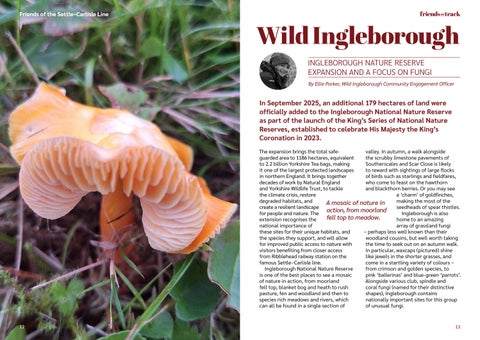
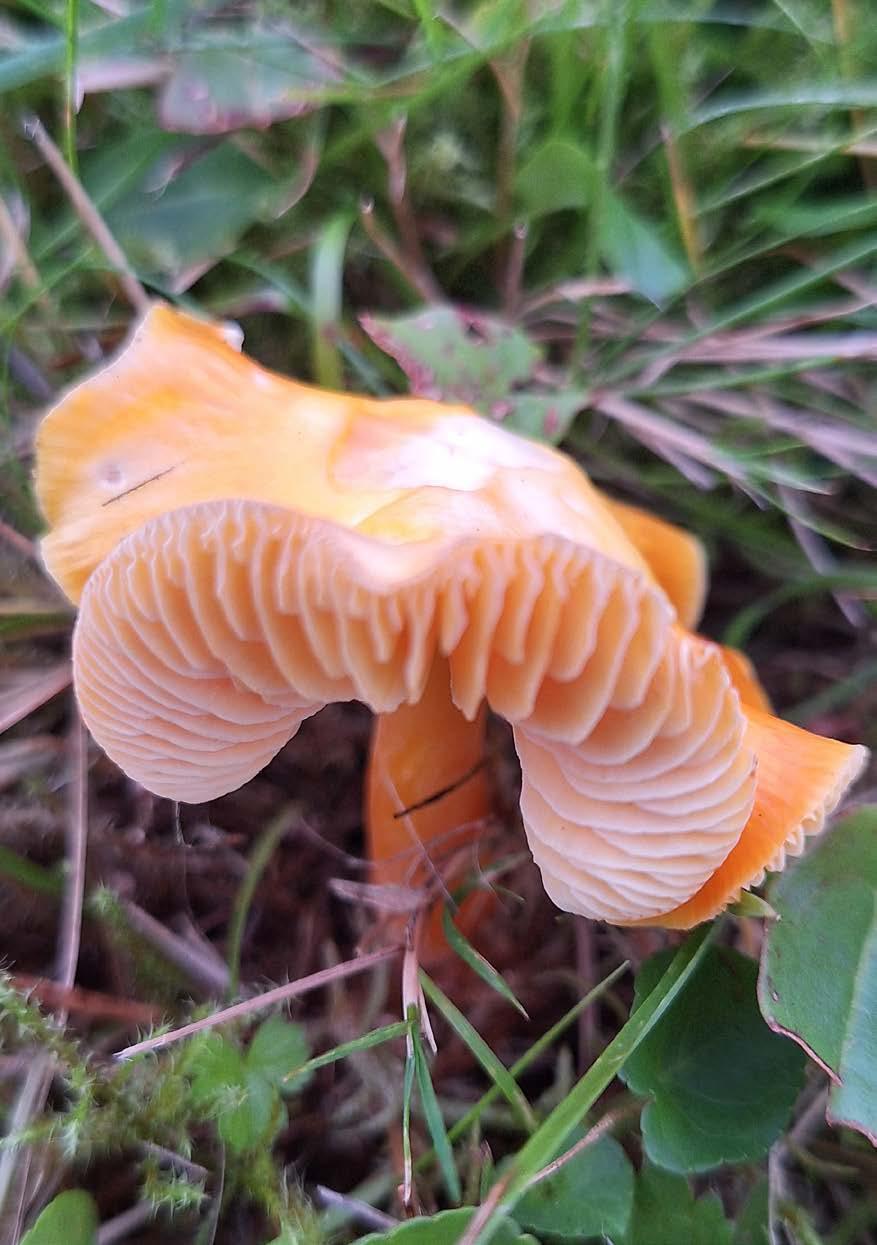
valley. In autumn, a walk alongside the scrubby limestone pavements of Southerscales and Scar Close is likely to reward with sightings of large flocks of birds such as starlings and fieldfares, who come to feast on the hawthorn and blackthorn berries. Or you may see a ‘charm’ of goldfinches, making the most of the seedheads of spear thistles. Ingleborough is also home to an amazing array of grassland fungi – perhaps less well known than their woodland cousins, but well worth taking the time to seek out on an autumn walk. In particular, waxcaps (pictured) shine like jewels in the shorter grasses, and come in a startling variety of colours –from crimson and golden species, to pink ‘ballerinas’ and blue-green ‘parrots’. Alongside various club, spindle and coral fungi (named for their distinctive shapes), Ingleborough contains nationally important sites for this group of unusual fungi.
Running in the Wild and Wonderful
By Ellie Parker, Wild Ingleborough Community Engagement Officer
As I write this from the relative warmth of the Wild Ingleborough office, a few hundred hardy souls are currently passing through the area on the Montane Winter Spine Race – a formidable challenge in which competitors take on the whole 268 miles of the Pennine Way in one go, through all the worst weather winter can throw at them.
While few have the resilience to undertake such an extreme endeavour, adventure challenges in our remote landscapes have seen an explosion in popularity in recent years. One of the most popular is the Yorkshire Three Peaks, with tens of thousands of visitors attempting to conquer Pen-y-ghent, Whernside and Ingleborough in under 12 hours. Several miles of the route pass through the Ingleborough National Nature Reserve, offering weary walkers the chance to see Wild Ingleborough in action. On the north side, the limestone pavements of Southerscales give way to the steeper slopes of High Lot, where we’ve planted mixed native broadleaf trees in the gullies – in the future they’ll provide shade and shelter for a pit-stop before tackling the summit. On the final leg of the challenge, the limestone grasslands of Sulber in springtime are tinged pink with beautiful
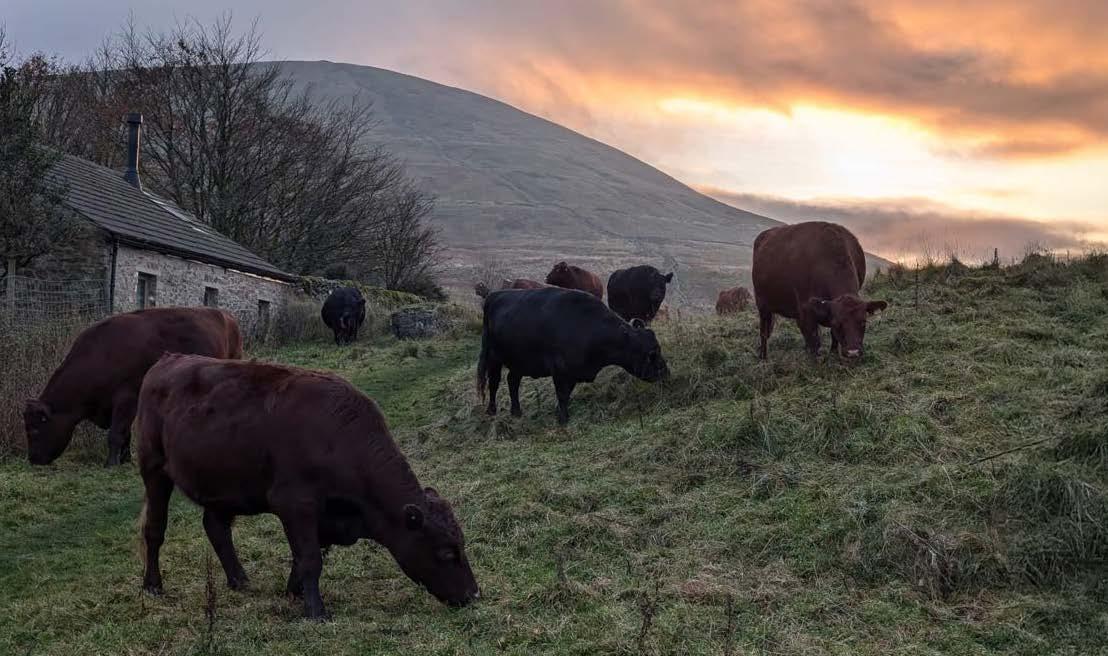
bird’s-eye primroses. On both sides of the mountain our conservation grazers are hard at work – hardy native breed cattle such as Red Polls and Belted Galloways keep the landscape in optimum condition for wildflowers, invertebrates and birds to thrive.
Maintaining a nature reserve on one of the busiest footpaths in the country is both a challenge and an opportunity. Heavy footfall has the potential to disturb wildlife and livestock, especially when dogs are brought into the mix. The impact on the land and the soil is undeniable – the Yorkshire Dales National Park Authority has a Three Peaks ranger
team dedicated to maintaining the footpaths and minimising erosion along the route. And while most walkers behave responsibly, litter can be a problem too.
But at the same time, what a golden opportunity to show people the best our landscape has to offer – and imagine if just a fraction of those Three Peaks Challenge walkers were inspired to take action for nature and wildlife?
As we look ahead to the warmer months and make plans for the year ahead, the Wild Ingleborough engagement team is thinking about how we can help these walkers deepen their connection to, and be inspired by, the nature and wildlife
around them. Using social media and face-to-face events, we’ll be encouraging people to lift their eyes from the path, and see Ingleborough not just as a playground, but a living, breathing, working landscape that needs all of us to help care for it. What to look for this month:
Towards the end of February the curlews start returning to the Dales – listen for their distinctive, mournful call and be reassured that spring isn’t far behind!
To find out more about Wild Ingleborough and Yorkshire Wildlife Trust’s work in this area, visit www.wildingleborough.org.uk and follow us on our social media channels.
Wild Ingleborough – Red Pole cattle are a hardy breed. Photo courtesy of Dwayne Martindale, age 5.
Wild Ingleborough
By Ellie Parker
Spring comes late to the western Dales, and it isn’t unusual to be caught in an April snow flurry on the higher slopes of Ingleborough, Whernside and Pen-y-ghent.
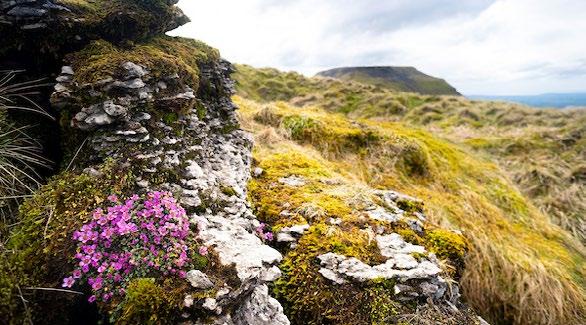
Despite the freezing temperatures that persist in these upland areas, one plucky montane flower signals the end of the long winter - March sees the welcome return of the purple saxifrage. It is found throughout the Arctic and in mountainous areas in the northern hemisphere, and on Ingleborough can be seen at the southern edge of its range in England. It only remains on a few remote, rocky outcrops, although once would have been abundant in the area – and could be again thanks to Wild Ingleborough’s upland plant nursery, which is working to restore fragmented plant populations across the mountain.
Continuing the purple theme, early purple orchids begin to appear from the middle of April. These will later be followed by common spotted, heath spotted and northern marsh orchids, as well as several other less common orchid species. A great place to see them is on along the well-walked paths around Sulber and Moughton on the eastern side of Ingleborough, which can be accessed via the footpath from Horton-in-Ribblesdale station. This is also one of the best places in the area to see bird’s-eye primrose, another scarce northern species – a beautiful pale violet primula which thrives in limestone grasslands.
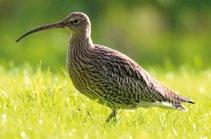
Spring brings wildflowers and also the birds. This is a hotspot for breeding ground-nesting birds such as the Eurasian curlew, northern lapwing, and golden plover, amongst others, who move to higher ground for the months of March – August, joining the ubiquitous skylarks and meadow pipits whose calls and songs are woven into the soundscape of the Dales. Hearing the various distinctive sounds of the moorland birds is one of the great joys of spring in the Dales – the Merlin app (other apps are available!) is a great way for beginner birders to get to know the different calls and songs.
Some of these species’ populations are in steep decline, particularly the curlew – the UK breeding population has halved since the 1990s, with multiple factors threatening its survival. Wild Ingleborough and the Three Dales Landscape Recovery Scheme led by Yorkshire Wildlife Trust are spearheading habitat restoration work across this landscape, which will improve conditions for curlews and other ground nesting birds (such as black grouse and ring ouzel, who are both just clinging on in the area).
Every spring Wild Ingleborough and the Yorkshire Peat Partnership hold “Ground Nest Fest”, a week-long celebration of our ground-nesting birds and their habitats. This year it runs from May 2nd to May 10th, with guided walks, farm visits, craft workshops and much more – join us and see our website for more details: www.ywt.org.uk/events/ground-nest-fest
Top: Purple Saxifrage, Flowers, limestone, Ingleborough. Photo by Finn Varney.
Above: Curlew. Photo by Nick Goodrum.
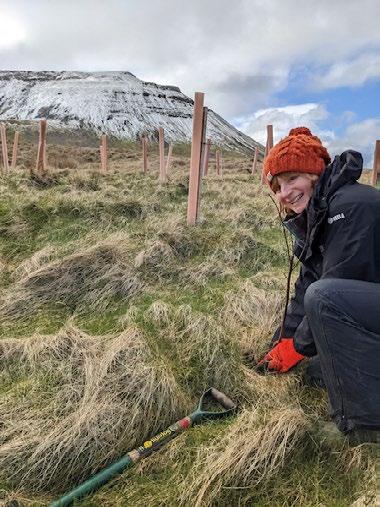
Left: Ellie Parker, Tree Planting at Ingleborough. Photo by Dwayne Martindale.
Journey
TO A WILDER FUTURE
Ellie Parker, Wild Ingleborough Community Engagement Officer (Yorkshire Wildlife Trust), gives an insight into what to look out for as Winter moves on.
Launched in summer 2021, Wild Ingleborough is a multi-partner, landscape-scale conservation project creating a wilder future for this part of the Yorkshire Dales.
Step off the train at Ribblehead and look west towards one of the most iconic views in the Dales –the three summits of Park Fell, Simon Fell and the unmistakable flat-top of Ingleborough itself. On this corner of Ingleborough sits Natural England’s Ingleborough National Nature Reserve, and several smaller nature reserves owned and managed by Yorkshire Wildlife Trust, which in 2021 joined forces with four other conservation organisations to form the Wild Ingleborough Partnership. Fragmented woodland, limestone grassland, traditional hay meadows and peat bogs are being restored by dedicated volunteers, with a vision for Ingleborough where nature and people are thriving. Connecting and extending this mosaic of habitats means wildlife can move and
expand freely through the landscape, and the unique biodiversity of this mountain stands a better chance of flourishing in an uncertain climatic future.
Conditions on Ingleborough’s exposed slopes can be punishing in winter, but hardy souls who do venture up here won’t regret it. Spectacular limestone vistas, dramatic fast-changing skies and low winter sun make this one of the best times of year for photography. Limestone pavement provides the perfect habitat
Below: Redwing courtesy of Willerby Richard Willison.
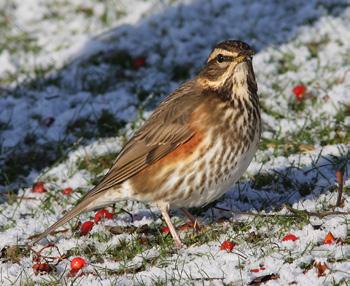
for thorny scrub – along its edge you will likely see flocks of fieldfares and redwings feasting on the abundant hawthorn and blackthorn berries.
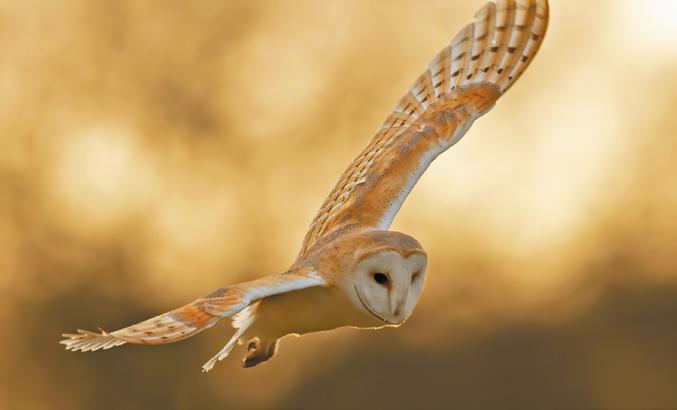
Take a walk on the lower slopes of Park Fell in the morning or late afternoon and you might encounter a barn owl or two, ghost-like, hunting for small rodents across the cattle-grazed pastures. Though normally nocturnal hunters, the
“You
might also meet the herds of red poll and belted Galloway cattle”
pressures of winter force them to become crepuscular (dawn- and dusk-flying) or even diurnal (day-flying) as they seek out the increasingly elusive food sources.
You might also meet the herds of red poll and belted Galloway cattle who range across this part of the reserve: hardy native breeds which are perfectly happy outdoors all winter, their only supplementary feed being local hay when there’s snow on the ground. Their grazing habits encourage the
specialist wildflowers that thrive here in spring and summer.
Those who make it right to the summit, especially on colder days, may be lucky enough to meet snow buntings. Elusive fluffballs, these winter visitors from Scandinavia and the Arctic move in flocks, and can be found feeding on the ground in the highest parts of the Dales. With around 10,000 wintering birds in the whole of the UK, they are not a common sight and it’s a rare treat to come across them.
But perhaps the best thing of all about a winter walk on Ingleborough is the solitude! Most walkers use the well-trodden Three Peaks paths or the popular route up from Ingleton, but the path up from Ribblehead is far quieter – in winter, you might even be lucky enough to have it to yourself.
To find out more about Wild Ingleborough visit www.ywt.org.uk/ wild-ingleborough-vision-future or follow Wild Ingleborough on facebook/Instagram.
Right: Barn Owl, photo courtesy of Russell Savory.