All rights reserved. No part of this book may be reproduced, stored in a retreival system or transmitted in any form or by any means, electronic, electrostatic, magnetic tape, mechanical, photocopying, recording or otherwise without prior permission in writing of the publisher.
ISBN NUMBER Published by:
YO23 2BB
Design by Bivouac.co.uk
Printed in the UK by Browns CTP
Acknowledgements
This book could not have been written without the help and support of many people whose experience, knowledge and expertise are gratefully acknowledged here. The bulk of the research for the history of Art and Technical education in York has been done at the City of York Archives by Avril Cheetham and Marjorie Harrison and many thanks are due to Rita Freedman, the City Archivist, and her unfailingly helpful colleagues, especially Victoria Oxberry. Also Jane Eddington and staff at the City of York Reference Library, Peter Young, Archivist at the Minster Library, Karen Baker at the National Railway Museum and Sue Killoran at Harris Manchester College, Oxford.
We would also like to thank the following: David Poole, William Dixon Smith and Hugh Murray who have generously given advice and answered many questions about York in the 19th and early 20th centuries. Elizabeth Smith, George Robson and Dorothy Reed have provided information from their own researches into the history of the Ashfield Estate and Dringhouses. Darrell Buttery kindly allowed a picture from his collection to be reproduced and Yvonne Clarke’s expert help on the Lycett Green family history was invaluable. Terry Gardiner’s informative essay The Masonic Jar was extremely helpful.
Barbara Scott has written an account of her years at the Marygate Centre and both George Hargreaves and Dr David Mason have
made considerable contributions. Photography was undertaken by Ron Hudson, Caroline Bolton, Jack Casling and Sarah Hargreaves, and Laurie Prime interviewed many of those listed below and transcribed their stories. Jill Sissons and the York College Marketing Department provided images and general support with this project. In addition, David Poole, Elizabeth Smith, Chloe Cheetham and Chris Brace have read the text and corrected errors – any remaining are our own.
We have tried to incorporate memories and photographs into the latter part of this book; space has not permitted them all to be included but they are valued and have been preserved for future reference. We are most grateful to the following for their contributions: Jocelyn Appleyard, Ray Atkinson, Roy Bendall, John Bisson, Marion Blacker, Thelma Blakey, Trevor Bousfield, Chris Brace, David Brogden, Michael Brown, Bob Brumby, Joan Campbell, Jack Casling, Pat Chapman, Brian and Sue Christie, Kay Christie, Joe Coulthard, Mary Coyle, Neville Cumberland, Margaret Cummings, Dave Danby, Brenda Drummond, Kate Fraser, Mike Floyd, Ann Forshaw and friends, Dave Gibson, Dennis Grainger, Roger Hallam, Angela Haw, Peter Heaton, Robert Hopwood, Derek Huntington, Emma James, Shirley Johnson, Linda Laverick, Len Lowther, Edith McHugh,
Stuart MacPherson, Paul Marsh, Kay Moneta, Betty Nankivell, Angela Newdick, Peter Nichol, Ralph Peacock, Kate Pettitt, Malcolm Pipes, Diane Poole, Keith Potts, Pat Reed, Jenny Rivron, Liz Rogers, Noel Shouksmith, Jane Smedley, Joyce Smith, Oonah Smith, Shirley Smith, David Thomas, Eurig Thomas, Thelma Thorpe, Vic Warren, Chris Watson, Ken Williams and Betty Wilson.
The York Sixth Form College chapter is substantially based on the log maintained by YSFC’s Principals as a requirement while the college operated under schools regulations, and continued thereafter until June 1995. Particular thanks are owed to Peter Brown, Deputy Principal 1985-1996, for insights into the setting up of the college, its subsequent evolution, and the cultural change at the time of incorporation,and for loan of his personal archive of press cuttings.
Thanks are also due to Mrs Jean Frost, John Harris, Anne Cassidy, Mike Hume and York College Marketing department for the loan of images.
The photograph of Dr Frost is reproduced by kind permission of Express Newspapers. Our families, friends and colleagues also deserve thanks for all their help and support during the year in which this book has been in preparation.
Preface
It was the impending opening of the new college which led me, as Principal in late 2006, to commission a history of York College and its antecedents. When the idea was first mooted, it seemed appropriate both because the move to the new college in 2007 represented a particularly important milestone in the college’s history, and also because that year would mark the 180th anniversary of the establishment of the Mechanics’ Institute in York. In commissioning the history, I was aware that this was an important, and previously untold, story; one which had significance not only for the history of education in York and its hinterland, but which also touched on wider themes.
However, it was only as the story began to unfold with the expert and enthusiastic involvement of its three authors that the centrality of the college, in its numerous previous guises, to the development of the city became apparent. If the history of York, as is often asserted, is the history of England, then the history of the college is certainly the history of York in the industrial and post-industrial eras. It is clear from this account of the past 180 years that the college has not simply reflected the changing social, political, economic and cultural environment in which it found itself, but has also helped to shape that environment. What this history has brought home forcibly to me is that York would be a different, and diminished, place without the existence of the college. Few other institutions in the city could, I believe, claim to have systematically touched the lives of so many of its residents – and, of those, arguably none with such positive and life-enhancing results.
The surprise perhaps is that an institution which has had such an influence has had to wait 180 years for its first recorded history. This may say something about perceptions of technical education, and what has latterly become known as the Further Education sector, in Britain over the years. Despite the contribution colleges around the country have made to their local communities, few, it seems, have merited their own history. We hope that this volume will inspire others to chronicle their history and, in doing so, to take increased pride in that contribution.
From a personal point of view, I take a perverse consolation from the fact that my predecessors as Principals, despite the fact that they were leading very different organisations from the present-day York College, were clearly struggling with many of the same issues (funding, the status of technical education, the need to balance responsiveness and stability) which have marked my own period as Principal. It’s allowed me to conclude that my failure to resolve all of these issues may not have been entirely down to my personal inadequacies.
Mike Galloway December 2007
ABBREVIATIONS
BEC Business Education Council
BTEC Business and Technician Education Council
C & G City & Guilds
FE Further Education
FEFC Further Education Funding Council
GCE General Certificate of Education
GNVQ General National Vocational Qualification
HMI Her/His Majesty’s Inspector
HNC Higher National Certificate
HND Higher National Diploma
LEA Local Education Authority
LNER London and North East Railway
MSC Manpower Service Commission
NVQ National Vocational Qualification
NYTEC North Yorkshire Training and Enterprise Council
ONC Ordinary National Certificate
RI Railway Institute
TEC Technician Education Council
YCA York City Archives
WEA Workers’ Educational Association
YCAT York College of Arts and Technology
YCFHE York College of Further and Higher Education
YCRL York City Reference Library
YEP York Evening Press (now The Press)
YMCA Young Men’s Christian Association
YOPS Youth Opportunities Programme
YTS Youth Training Scheme
From Mechanics' Institute to York College
1 The early years: 1827-1881
19 Chapter 2 A grand design: Clifford Street 1882-1892
25 Chapter 3 Philanthropy gives way to the State: 1892-1918
33 Chapter 4 Rising standards, the effects of the Depression and World War II: 1918-1945
43 Chapter 5 From Clifford Street to Tadcaster Road: 1945-1974
55 Chapter 6 On one site at last: the growth of the Tadcaster Road campus 1945-2007
73 Chapter 7 Tadcaster Road to Sim Balk Lane: overall growth and change 1974-2007
79 Conclusion
Marjorie J Harrison
Introduction
In 1820 York was a pre-industrial city; it provided a market for its rich agricultural hinterland and was a social centre for the high concentration of gentry and professional people who lived in and around it. Others from further afield visited York for the season, based on the Assizes, assemblies and other social occasions, as well as horse racing. They increased the demand for luxury goods and services provided by many small artisan workshops, traders and shopkeepers in the city as well as the professional services of lawyers and medical men.
At the beginning of the 19th century the population of York was 16,846; it grew steadily and accelerated during the 1840s, helped by inward migration from Ireland. In the 1880s, boundaries were extended, parts of the new suburbs of Holgate, Fulford, Clifton and Heworth were taken into the city and by 1901, numbers of those living in and around the city had risen to 83,058.1
The Municipal Corporations Act of 1835 ended the self-elected, often inward-looking, government of York and brought much needed change. In the 1820s and 1830s York was energised by a group of entrepreneurs, mainly Dissenters, who drove change and growth in the city but, despite their input, the huge expansion of the industrial towns of the West Riding could not be matched. With no nearby natural resources and the many problems of navigation along the Ouse, York was a city with few prospects. But by midcentury, the railway was well established and became an industry in itself as well as providing the means for the existing confectionery industry to reach wider markets, and enabling commerce generally to flourish better. Although two large manufacturing chemists, a glass works and leather trades were expanding and banking and insurance companies were founded, York lost its position as one of the most important cities in England. Leeds, Sheffield and Hull had already overtaken it by 1801 and a century later, in 1901, York had been reduced to the 41st city in the land.2
Living conditions within the walls in 1800 were poor. Many of the old medieval houses were still standing; they had been adapted over
the years and their back gardens and courtyards gradually filled with small houses. As the population grew, these crowded areas, particularly in low-lying Hungate and Walmgate near the River Foss, became insanitary and cramped, but later the new suburbs outside the walls provided better housing for the rising numbers of workers in the railway and confectionery industries.
Although York children fared better in their schooling than those in the rapidly growing industrial areas, education was still very rudimentary for the poor. They had fewer employment opportunities than children in the factory towns and so were free to attend school until they could take an apprenticeship or go into domestic service. This was, of course, provided that their labour at home could be spared, as well as the small school fee if their place was not endowed by charity. In addition to the Day Schools there was an established pattern of Sunday Schools; fifteen were organised by the Church of England Sunday School Committee and five Nonconformist sects provided teaching at nine other Sunday Schools. Despite this, schooling was a hit and miss affair and in 1836 a Parliamentary Committee on the Education of the Poorer Classes reported on the state of education in York:3
Scholars of the working classes, at day and dame schools 1,494 Scholars at better schools 2,697 Attending Sunday Schools in connection with the Established Church 1,708 Attending Sunday Schools in connection with Dissenters 1,665
The York Courant reported, at about the same time, that a third of the children aged between five and fifteen were receiving no schooling at all. There were already several charity schools in York and many Day Schools were founded between 1811 and 1877 by both the Established Church and Nonconformists. A large number of free places were available but fees still had to be paid at many schools. In 1880 legislation made education compulsory until the age of ten but it was still not free. The York School Board was formed in 1889, six new non-denominational schools were built and, by 1891, basic education was available for all children and fees were abolished.
The Sunday School numbers cited in the 1836 Report were divided almost equally between the Established Church and Nonconformists. Apart from the main aim of propagating religion, these schools helped both children and adults to learn to read or improve on their reading skills. The huge success of Nonconformist movements was instrumental in the setting up of the York Mechanics’ Institute.
Throughout the country, newspapers and books had become more freely available and circulating libraries were firmly established in many towns and cities. Debating, literary, antiquarian, art and music societies were springing up in the late 18th and 19th centuries. In York, the foundation of the Yorkshire Philosophical Society in 1823 typifies this movement. These societies were middle class in character but the idea of further education became attractive to some working men and women who were seeking to advance themselves and move away from the poverty which was the lot of the uneducated poor. The Industrial Revolution had promoted an interest in science and technology and produced a demand for engineers in the rapidly expanding industrial centres. It was in this climate that Mechanics’ Institutes were founded.
The York Mechanics’ Institute, established in 1827, did not come as a result of huge industrial expansion or a movement of working men, but rather as a philanthropic idea put forward by Nonconformists and Quakers whose philosophy was selfimprovement. These were self-made men who had risen through their own efforts, driving the economy of the city and expanding its industries. Their initial vision was the advancement of science and technology, enabling working men to better themselves, but along the way there were many crises and setbacks diluting their high ideals. Nevertheless, local politics, national legislation and the demands of local industry have shaped the institution, right through to the newly-built York College in 2007, giving continuous education and training to the citizens of York for over 180 years.
The early years: 1827-1881
William Hargrove, a founder member and a lifelong supporter of the York Mechanics’ Institute, was the proprietor of both the York Courant and the York Herald in the 1820s. Headlines and stories carried by his newspapers during 1827 gave a varied picture of life in the city: gale damage in York, proposed demolitions to create a new market on Parliament Street, the establishment of Turkish baths on Blake Street and, bizarrely, a giant mushroom measuring 38 inches in circumference found on Dringhouses Moor. Although it was quite a different world, those events would not seem out of place today.
The Courant and Herald were used by Hargrove to promote the concept of further education for working class men and youths. The Herald in an article on 28 April commended the London Society for the Diffusion of Useful Knowledge, which aimed to produce pamphlets cheaply for the working classes on scientific subjects. On 5 May, a correspondent expressed surprise and regret that a city like York should not have an institution for advancement in mental knowledge for the operative classes. (This letter was signed A friend to mental cultivation.) On 12 May, Amicus Literaturus wrote in stronger terms: York with all its rich associations of past glory, its mouldering records of antiquity and all its present importance… should not yet have the honour to boast of an institution calculated to promote the blessings of science and diffusion of knowledge amongst the lower and middle classes of its occupants.
The Courant of 15 May continued the theme, supporting libraries and institutes for agricultural labourers, saying: The establishment of Mechanics’ Institutes has commenced a new era in the annals of our operative manufacturers and mechanics and we see no reason why our village labourers should be kept behind them in the march of the mind. Letters continued in the newspapers to support the idea although not everyone was in favour; the vicar of Askham Bryan was a noted critic.
At this time the only means of communication available to a wide audience was the press, which was read avidly. Local news items were of great interest but stories about the expanding Empire, exploration, politics, wars and other events also encouraged the reading of newspapers during the 19th century and gave them a far greater circulation than today. The paper used in manufacture was much tougher and they were read and passed on to others many times. William Hargrove’s influence, and the power of the press, helped to create the
right climate for the foundation of a Mechanics’ Institute in York. He was a Whig at a time when York politics were divided, with the Tories to the right. The Whigs adopted Reformist ideas as Capitalism was rapidly changing the lives of working men and women, making their world a much harsher place. Electoral reform turned out to be a long way off but in 1827 it may have been thought that by improving the lot of the working classes, their votes could be counted on when emancipation came. The Tories saw this as encouraging public disorder; the events of the Peterloo massacre in 1819 were not forgotten.
The man most strongly associated with the Institute was Charles Wellbeloved, who came to York in 1792 as assistant minister of the then Presbyterian Chapel in St Saviourgate. (Mr Cappe, the minister, had introduced the congregation to Unitarian beliefs – this was continued by Wellbeloved.) He was also the principal of Manchester College, based in Monkgate, which had moved to York in 1803 especially for him to take up the appointment; the College later moved back to Manchester in 1840. It provided higher education for Dissenters who were denied a place at Oxford or Cambridge until the 1850s because entrance was dependent on membership of the Church of England. Wellbeloved was a huge intellectual force; his many published works included three books on the history of York and a new translation of the first five books of the Old Testament. He became involved in the establishment of learned societies in the city and, after the scandalous treatment of lunatic paupers in 1813, the reform of the York Lunatic Asylum. All this, in addition to his teaching and preaching, shows a man with unlimited energy and a strong social conscience1.
Two tutors at the College, William Hinks and John Kenrick, joined with Sir George Cayley, the aeronautical pioneer and engineer, William Hargrove, Charles Wellbeloved and others, including the Quaker businessmen Joseph Awmack, Joseph Spence, Joseph Rowntree and Samuel Tuke2, to found the Institute ‘For the diffusion of useful and entertaining knowledge’. The Tory Yorkshire Gazette report of the inaugural meeting at the Red Lion Inn near Monk Bar on 21 June 1827 commented rather frostily: We trust that the institution will be conducted so as to avoid polemical or political topics. William Hargrove took on temporarily the positions of secretary and treasurer and two committees were formed, one to find accommodation and the other to formulate the rules.
1 Kenrick, J A biographical memoir of the late Revd Charles Wellbeloved (London 1860) passim
2 Wright, S Friends in York: the dynamics of Quaker revival 1780-1860 (Keele 1995) p 80
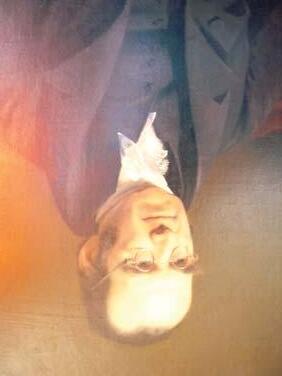
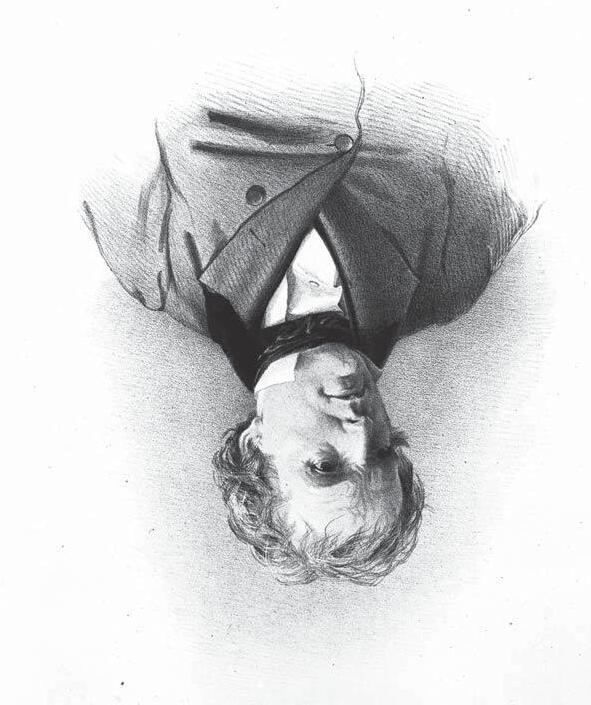
Above: Portrait of Charles Wellbeloved by J Lonsdale 1826 (in the collection of Harris Manchester College, Oxford)
The York Courant of 26 June reported the meeting as part of a long article, describing it in much more favourable terms but suggesting that there were those who would not welcome a Mechanics’ Institute with the same pleasurable feelings under which we record it. There are some who will view the work with suspicion; there are some who will behold it with alarm; and it may be, there are others who will contemplate the labour with jealousy. Some will suspect, that extensive efforts to awaken the dormant powers of the mind in the middling, but more especially in the lower, classes of society … will be to disorganise the machine of social order, and to disarrange the routine of civil society.
Following a second meeting in Mr Chapman’s large room in Ogleforth the rules were published and a house in Bedern, recently occupied by Mr Shepherd, a librarian, was taken for three months. Sir George Cayley was chosen as president, Charles Wellbeloved and Jonathan Gray vice-presidents and Thomas Agar took on the job of secretary. Membership stood at 116 at this early stage and the Courant commented on 10 July: The York Mechanics’ Institute is now organized and heartily entered into by the classes for whose benefit it is more immediately designed. Classes in mathematics, drawing and writing were quickly established and formation of a chemistry class was in hand. The property contained a large room for meetings, a library and other rooms – the library was well under way at this early stage.
By 1 September membership was reported to have risen to 272. The monthly meeting (the previous Tuesday) had been held in the Merchant Adventurers’ Hall because the premises in Bedern were too small. Mr Hansom, a York architect, had drawn up plans for a new building, the estimated cost of £550 to be raised by offering £10 shares at 5% interest. The frontage of the proposed building was 54 feet long by 30 feet in depth, housing two classrooms, a room for a librarian and a working laboratory. Above this would be a large room for general meetings capable of holding 450 people, also housing the library. The business of the evening continued with Mr Richard Dalton lecturing on the steam engine, illustrating his points with drawings and models of high and low pressure engines; he also had a working model of a coach drawn by a steam engine.
A measure of the support for the Institute was that the funds were quickly raised and property bought on St Saviourgate. Lectures continued in January 1828 at the Merchant Adventurers’ Hall and in March the committee looked over the
new premises; conversion work had been undertaken, shelving and a counter made for the library, gas installed for lighting and a workshop fitted out. It is not clear from the minutes whether any new building had taken place at that time or existing property converted. (The deeds of two dwelling houses and an additional house were listed when the property was sold in 1883.)
During the first year of operation, 453 members were admitted. Membership was on three levels; patrons were first class members paying £1 per year, second class members paid 10s (50p) and the third class, mostly juveniles, paid 6s (30p). The latter were the group that should have benefited most from education in science and other related subjects. All members had free admittance to lectures, classes and the library.
Lecture subjects included Fishes of the Ouse and Foss, and Mechanical Philosophy as well as series on Botany, Chemicals and the English Language But it was realized very quickly that the educational level of many who wanted to attend these lectures was inadequate and some basic classes were put on to support those who wished to improve. For all the zeal of both the founders and members, the outcome was disappointing. Altogether, class numbers for mathematics and English grammar were poor; the most popular class was drawing with 60 enrolled, followed by 25 for writing, 18 for arithmetic, 14 for chemistry and 12 for botany. Attendance numbers were even lower and it was clear that although some members liked the idea of classes, their application did not match their enthusiasm. Nevertheless, the Institute had survived its first year and was moving to larger premises.
At the opening in March 1828 Charles Wellbeloved, in an address to members, congratulated them on having obtained the new premises in which they were assembled. He spoke of premises so reputable and convenient as to their situation; and in respect of the number, size, and arrangement of the rooms – so well suited to the purposes to which I hope they will be long applied. Had the first friends and founders of the Institute conceived it possible that so great an interest would be so soon excited in its favour, they would not have engaged the house which it has hitherto occupied. He went on to comment on the opposition to the Institute, saying: We cannot therefore be surprised if the novel projects of imparting to the working classes of society instruction in various branches of science, hitherto considered as accessible to the members of the learned professions,
or to men of leisure or of wealth only – should be viewed by many with jealousy and fear: that prejudice and misapprehension should endeavour to thwart the labours of the friends and patrons of Mechanics’ Institutes. The Institute had got off to a flying start and in August 1828, the librarian was ordered to shut the library on Wednesday nights and man the front door to prevent non-members attending,
The Institute was feeling its way as far as teaching was concerned. A Mr Davy from Wales was engaged to teach arithmetic, mechanics and mathematics. He was to make models and other apparatus and generally make himself useful around the place. In return he received 12s (60p) a week plus house rent and coals with the promise of further earnings. Davy lasted less than six months before resigning. Others gave their teaching services free of charge.
Money was always short and, during Festival week in September 1828, Mr Bell (the librarian) and Mr Terry offered their services to solicit donations for the Institute. This proved fruitful and two £10 donations with promises of more were collected but early the following year an overdraft of £100 was necessary to pay the bills. Worse was to come; membership started to decline and from a peak of 660, resignations brought numbers down to 262 in June 1829. The poor financial state was helped by a large donation of £21 from George Cayley, the president. Apparent in all the early records is the great generosity of those closely involved with the Institute and how frequently they bailed it out in the early days. As late as 1856 the treasurer had to loan £40 out of his own pocket.
The library was an important part of the initial vision and an early appeal was made for books when the Institute was founded. The library built up rapidly through donations, purchases and exchanges and at the end of its first year contained over 500 books. The committee had regular discussions about specific texts such as the eight volumes of Reid’s Elements of Practical Chemistry bought for 14s (70p) in 1830. A reading room was established with a wide range of newspapers and journals. Mr Bell also taught a writing class and, along with his wife, was caretaker; they had accommodation in the house, coals and gaslight, and a salary of £10 a year.
Third class membership was monitored by the committee who divided the city into eight districts and appointed visitors to wait upon parents and masters of the boys proposed as members of the third class to ascertain their wishes with respect to admission and attendance at the classes and also to provide a report
on the boys. This followed the recommendation to expel Arthur Wood in 1831 for misconduct as well as for using improper and abusive language to the librarian and teachers. Third class members were not allowed to borrow new books from the library until they had been on the shelves for twelve months. They would have to wait some time to borrow the two additional copies of Robinson Crusoe bought in 1831, and the following year it was resolved that the circulation of novels or books of mere amusement be confined to members of the first and second class. So the working class youths which the Institute had aimed to educate and improve did not always find themselves popular or deserving of amusement. There were complaints about the young people who attended classes. The Yorkshire Gazette published a letter from an anonymous York citizen in October 1830:
Sir
I am, on the whole, friendly to Mechanics’ Institutes as I think they are a means of conveying much useful knowledge to the lower classes; but I think the mode of conducting them might be improved. You must know I am of the old school, and of course am in the habit of having my family about me at nine o’clock for prayer, and to retire to rest. I have several apprentices, some of whom are members of the Institute; and there are lectures and classes three or four times a week which begin at eight o’clock and do not generally leave before ten; which I humbly think is much too late for apprentices to be out of their masters’ houses. If they were to begin at half past seven, and conclude at five or ten minutes before nine, it would be much better; and those who attend them would have an opportunity of being home at a proper time. Those who are single, are surely much better at home than being late in the streets; and those who are married, set only a poor example to their families, by being out late. I should be sorry to hinder any over who I have control from obtaining what knowledge they can, but if I cannot have them at home by nine o’clock, I shall be under the necessity of putting a stop to their attendance altogether.
The letter continued with a complaint about the astonishing numbers of loose girls who openly and wantonly parade not only the back, but even the most public streets of the city; insulting and ensnaring those who are about their lawful callings. The writer commented that the police did not come out until 10pm when the girls had retired to their dens, and finished with a PS: Those girls at present laugh at the police, and dare them to touch them before ten o’clock.
The annual report of 1831 noted in a similar vein that boys, under the pretence of attending the classes, idle away their time in the street, instead of coming to the Institute. Much effort had been put into publicity and providing classes attractive to apprentices and their masters. An architectural drawing class was proposed and plain and ornamental drawing for cabinet-makers and joiners was discussed in conjunction with this; 250 handbills were distributed amongst workmen in York to promote the classes.
By 1832 membership had declined to 147 and the following year, the librarian was paid to go out and collect unpaid subscriptions. Things were even worse in 1834; in the annual report, the committee expressed their sincere concern that they were unable to congratulate the members on any improvement on the state of the Institute or in its prospects. Apathy was prevalent and it was astonishing that members did not see the value of knowledge, remaining indifferent to the success of an Institution designed and adapted to check the progress of Frivolity, Dissipation and Vice; to encourage habits of Sobriety, and of a useful employment of time. Patrons were withdrawing their support and the membership had declined by 30 over the year. Lectures on interesting subjects had been delivered and classes for younger members were conducted by able and willing teachers.
Much of the work of the Institute was done through voluntary effort; teachers and lecturers gave their own time but may have had poor understanding of the real needs of the young people they were trying to help. Meagre standards of elementary education meant that the high ideals seen at the outset were unrealistic and the depressed state of funds led to a lack of quality in what was on offer. Lectures and classes were clearly not pitched at the right level to counter the attractions, frivolous or otherwise, which were found on the streets and in the public houses of York. Another attempt was made in 1834 to draw attention to the classes run by the Institute when 300 handbills were printed and distributed.
Membership applications show members’ wide ranging trades and occupations – cabinet-maker, confectioner, joiner, carver and gilder, comb-maker, druggist, innkeeper, glassblower, tailor, printer, bookbinder, butcher, shoemaker, stonemason, writer, plasterer – all these and more held second and third class membership in the early days. We can see the emergence of York businesses as in George Black, aged 14, at Mr Terry’s, confectioner, admitted in 1835. Workers from the Yorkshire Insurance offices (today known as the Norwich Union) were also becoming members at this time.
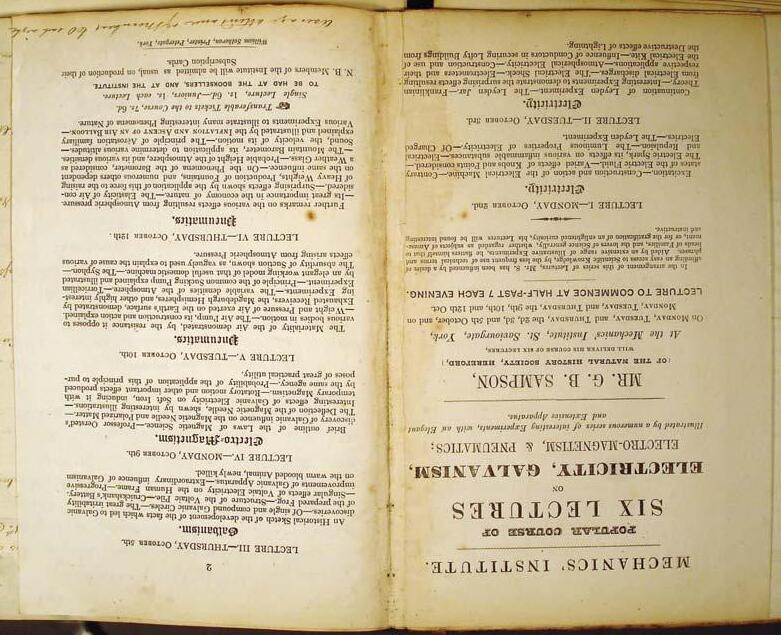
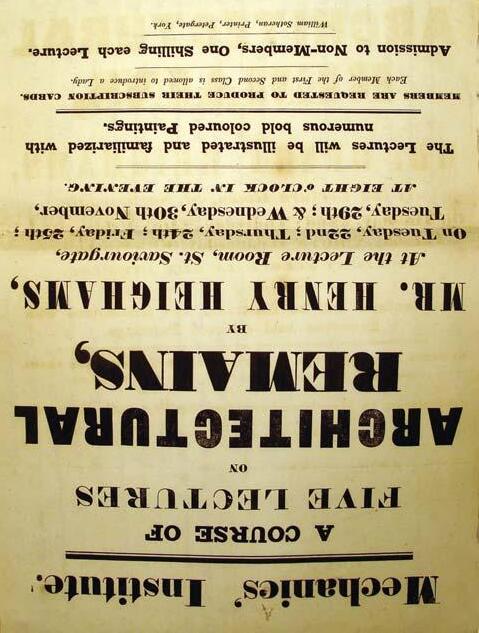
Above: Lecture programme 1837 (YCA)
Right: Lecture programme 1836 (YCA)
Things came to a head in 1836 when a payment could not be made to the Institute’s bankers, Messrs Swann & Co, and six committee members were asked to advance £5 each, to be repaid by instalments. But a more positive note that year was the establishment of a mutual improvement class of second and third class members meeting on Saturday nights. The committee hoped that this would lead to social, moral and intellectual improvement of the members of the institution. The class had fifteen members and although this represented a tiny fraction of the population of York, it was exactly what the Institute had set out to achieve initially.
The female connection
Lectures on non-scientific subjects had been put on occasionally and were very popular. Five lectures on architectural remains were held in 1836 and first and second class members were allowed to introduce a lady. The Institute premises were too small for the growing numbers attending these kinds of lectures and the Merchant Adventurers’ Hall was used for a series given by Miss Macaulay in February 1837. The subject was the Philosophy of Society and the topics were Female education; Impetuosity; On the passion of jealousy; Courtship and marriage; and Crime: its causes and consequences. Sadly Miss Macaulay died the day after the third lecture but this was a real attempt to widen participation.
In York, as elsewhere, the large number of public houses aimed at working class drinkers added to the social problems of the city. The Institute allied itself to the York Temperance Society and York Total Abstinence Society hoping to recruit new members who would benefit from what was on offer for the mental and moral improvement of the working classes. The committee had also been giving some thought to the female connections of the members and had organized an outing on the Ebor Steam Packet to the Banqueting House at Naburn Lock, where the first social tea meeting was held in the summer of 1838. Tickets were 2s (10p) for members but half price for accompanying ladies and included the fare, tea, music and a most instructive and highly interesting address on ‘The importance of science in extending and facilitating social intercourse’ given by Charles Wellbeloved.
A major change took place in 1838 when the Institute was renamed the York Institute of Popular Science and Literature and more lectures of a non-scientific
nature began to be held. Science it seems could only be made interesting if illustrated by brilliant experiments and in many cases the experiments formed the attraction rather than the principles they demonstrated.3 Gradually, the Institute became much more a part of city life, participating in processions such as the one for Queen Victoria’s coronation celebrations, members carrying a green silk banner proclaiming the new name in gilt letters.
According to the 12th annual report of 1839, the Institute was prospering. The first winter meeting had been held in January at the Merchant Adventurers’ Hall, where 300 attended a lecture on phrenology by Mr Husband. This subject –interpreting the mental powers of an individual by the external appearance of the skull, otherwise known as reading bumps on the head – held a huge fascination for Victorian audiences and by now women were becoming regulars at Institute lectures. A railway excursion to Leeds was arranged in June in conjunction with members of the Leeds Mechanics’ Institute – this may have been the first experience of a train journey for many. Three hundred tickets were sold, half for women. The first class fare was 5s 6d (27½p) and 4s 6d (22½p) for second class; the ticket included admission to a public exhibition of works of art, and tea in the Commercial Buildings. Hard bargaining was done with the directors of the York & North Midland Railway Company, some of whom were connected with the Institute. These excursions were popular. They went again to Leeds the following year and in 1840 members went to Hull to witness the laying of the foundation stone of the new Mechanics’ Institute there. Also that year, 350 members of the Leeds Institute visited York; the Yorkshire Philosophical Society opened its museum, parts of the Minster not generally open were available to them and tea was provided, with York members and guests swelling the numbers to 800.
Larger attendance at lectures led to a proposal in 1839 for a new hall to be built on ground to the rear of the building. John Harper, an architect, had surveyed the area and estimated the cost at £500. The room would measure 40½ feet x 27½ feet – the ground floor allowing 18 x 24 inches per person, giving room for 378 people, and the gallery a further 189. (People were much smaller then.)
Sir George Cayley started the building fund off with a donation of £10, but the plan stalled and was judged a failure the following year.
The scheme was soon revived, possibly due to an average of 180 attending the 39 lectures laid on in 1840, and the committee looked at other options. But at a
special general meeting in July 1841, following a motion proposed by George Leeman and the secretary, Ambrose Smith, the committee was instructed to carry out an expanded plan for a new lecture hall on the St Saviourgate site. An appeal was made for £2,000 through subscriptions – the publicity leaflet described the way in which many ladies, as well as members, are zealously exerting themselves. The list is a rich source of names, occupations and addresses of the supporters of the Institute in York and elsewhere at that time. Membership had grown to 400; more were anticipated if the premises were bigger but the money was hard to raise and it was another five years before the new hall came into being.
The Institute had operated with a large amount of voluntary teaching and lecturing which created its own problems; sometimes teachers were late or did not turn up at all, sometimes it was hard to criticize the quality when someone was giving their own time. A move away from volunteers is seen as teachers were engaged for basic subjects. Perhaps there had been some recognition that this might be more beneficial to the semi-literate working class men and boys for whom the Institute had been originally founded.
The annual report for 1841 began buoyantly, reporting increased income and new plans. It ended: The prospect of the future is full of encouragement and hope. There is abroad a spirit of calm but anxious enquiry into the cause of crime and misery, and your committee believe that the result will produce a stronger and deeper conviction that ignorance is the prolific parent of both and that improvements would result in a richer harvest gathered of human happiness and virtue.
Another development in 1841 was considered by the committee. The Lord Mayor had passed on a circular from the Council of the School of Design, Somerset Palace, London, asking about the practicalities of operating a branch School of Design in conjunction with any existing institution in the city. This was aired at the winter meeting in the Merchant Adventurers’ Hall but the Institute did not take up the option and a School of Design was established in York independently through the good offices of William Etty, the important York artist. The broader aims of the Institute were demonstrated at this time by a donation of £5 – a large amount when funds were so short – towards the endowment of a professorship of machinery and manufacture at the University of London, to be known as the
Birkbeck Professorship. (George Birkbeck is famed today as the founder of the Mechanics’ Institute movement. He was Professor of Natural Philosophy at the University of Glasgow in 1799 and established cheap courses of lectures on science. These developed into the Glasgow Mechanics’ Institute in 1823 and he founded another in London in 1824.)
A preliminary meeting for a female instruction society was held in the lecture room in February 1842. The following year, the committee was firmly convinced of the important role played by women in the life of the Institute; a social evening had been held at the De Grey Rooms as the Merchant Adventurers’ Hall had been considered too small. Tea and dessert were provided as a brass band played in an adjoining room and it was noted that such meetings should never be attempted without the assistance of ladies. The Institute by now was very firmly part of the social scene in York; women went to the lectures and outings, they were involved in the organization of social events and could arrange their own classes. Library purchases included Sense and Sensibility, and Emma; both by Jane Austen and The Parson’s Daughter by J T Hooke. Arabian Nights Entertainments in four volumes was another title attractive to women.
The growth of a reasonably wealthy, well-educated middle class with more leisure time meant that many women were developing interests outside their home and immediate social circle. Travel was becoming easier and writers such as Sir Walter Scott popularized history in a way that academic writers could not. The emergence of geology, archaeology and natural history as separate disciplines created a climate where interests could be pursued more easily. Women were finding new outlets from the constraints of Victorian life and the Institute offered opportunities for socialising and attending stimulating lectures.
1843 brought a drop in membership attributed to a depression in trade felt all over the country. More importantly, another establishment with similar objectives was challenging the Institute’s provision – was this the School of Design, now well under way? Comments were also made about the under-used reading room; it had been well calculated to afford a pleasant resort during long evenings of winter and thus become a formidable rival of the tavern and the smoking room. The latest copies of The Times, the York Courant, the Yorkshire Gazette and the Yorkshireman were displayed along with many other newspapers and journals but the room was only available to first and second class members.
The men’s mutual improvement class was still going strong. It began with a fifteen-minute session for reading, recitation, or an introduction of some other topic and then the meeting was open to discussion. It ran itself with a chairman, treasurer and secretary, all appointed by the members. They may well have taken part in the essay competition of 1844 when £10 was donated for prizes by H R Yorke Esq MP; the subject was ‘Is the increase of machinery to be regarded as injurious or beneficial to the interests of society?’ – a loaded question when machinery was taking away jobs but creating wealth.
Better facilities and continued expansion
Building work was taking place during 1845; weekly lectures were initially suspended and then alternative accommodation was arranged. Mr Wilkinson offered the use of his schoolroom so that classes could commence in September. An application was also made to the Architectural Society for the use of their room in Minster Yard for lectures, and the lecture hall on Goodramgate was used. George Leeman, in his capacity as both supporter of the Institute and a York solicitor, prepared a deed appointing twenty trustees to guarantee the Institute’s debts. The new hall was opened on 31 March 1846 and Professor John Phillips FRS gave an address. In it he said: The York Institute was founded expressly for the purpose of assisting those persons who had not the telescope of Lord Rosse, or the laboratory of a Faraday, and who had not the leisure of a Herschel. It was founded for the purpose of benefiting all ingenious minds, whether young or old, and enabling them to gather as much information as could be acquired by mutual instruction, on all these various subjects. The cost of the hall was not quite met and a debt remained to the Institute’s bankers for many years. Fund-raising had included a bazaar which made over £194 and more than 4,500 people had visited an exhibition of works of nature and art which made a small profit – among the exhibits were an electric telegraph and clock, borrowed from the Leeds Mechanics’ Institute.
Many more lectures were put on during 1846-7 following the opening of the new hall. There were 30 on literary and popular subjects with an average attendance of 216, the 35 scientific lectures averaged 70, and 26 chemistry lectures averaged 57. The winter annual meeting was held in the Lecture Hall, Goodramgate, on 17 March 1847 with George Hudson in the chair. Glee singers and the York Union
Society of Handbell Ringers entertained the 350 people present – half of them women. Tea and speeches were also on the agenda and the cost was 1s 6d (7½p).
Members of the Institute requested that the committee organise a ball in 1847. The swift response was that it was not expedient to have a ball in connection with the Institute. This was a step too far; it would not do to accede to such frivolous social ideas although musical concerts were acceptable. At the winter meeting that year a long programme included Mr George Leeman speaking on The female members of the Institute. Ladies had become well established not just as visitors to lectures or excursions, or assisting with fund-raising, but as members who attended classes albeit of more genteel subjects like botany. Lectures that year included Mr George Wallis, who was engaged at a cost of £3 10s (£3.50p), to speak on The Fine Arts or Industrial Arts and Mr Balfour’s series of lectures included The female sovereigns of Europe; The romance of biography; On the female characters of Sir Walter Scott’s novels or, The influence of women in society. Tickets for ladies were 5s (25p) a year and these were lectures specifically aimed to appeal to them.
The Institute had been in existence for twenty years and the time had come to appoint a permanent secretary, working for six hours a day, to assist the honorary secretary. This implies that administration work had increased in addition to the general organisation of lectures and classes. William Hands was appointed at a salary of £30 a year; he had to supervise the library, collect subscriptions and generally see to the running of the premises on a day-to-day basis. It must have all been too much for he handed in his resignation less than a year later and a Mr Birke was appointed to the post.
New techniques were taken up by the Institute. In August 1848, Mr Pitman offered two lectures on phonography – writing according to sound – and in return was allowed the use of the classrooms twice a week for a class, providing he paid for the gas needed for lighting. It seems that these classes followed interest from an initial lecture and a mutually convenient arrangement was made. We can assume that this was Isaac Pitman, who had begun publishing books on phonography in 1837 and by this time had become widely known as his method of shorthand increased in popularity.
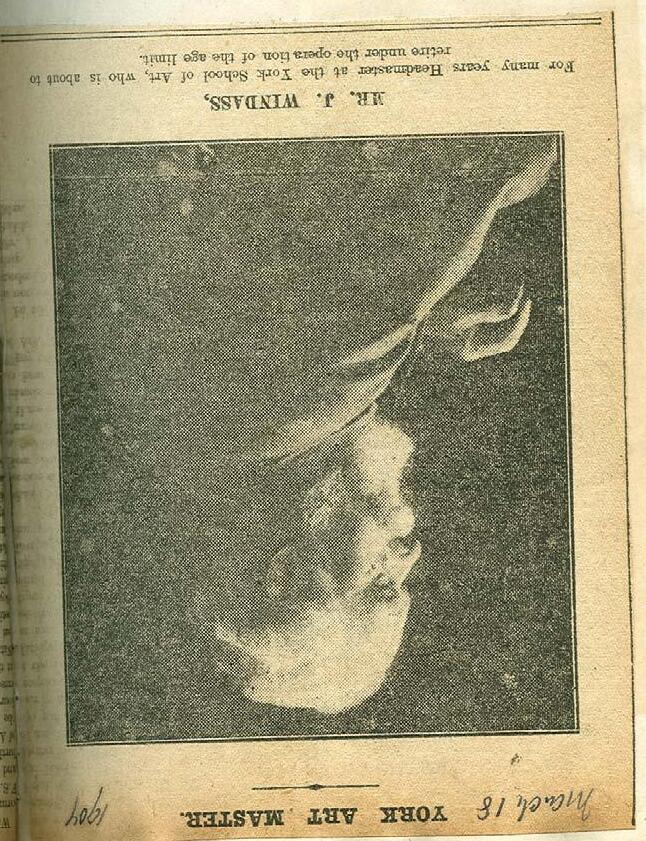
Examinations were begun in 1851 and by 1857 the advantages of the Society of Arts examinations, recognised national qualifications, proved to be very popular and brought increased attendance. The subjects included physiology, mathematics, grammar, English language, geography, bookkeeping, writing, French and drawing. Elementary education was not neglected and a night school had been opened at the Merchant Adventurers’ Hall aimed at working men who did not want to be in the same class as youths. The Institute persevered with ups and downs of membership and occasional financial crises. Falling membership was blamed on a trade depression in 1862 and the establishment of a working men’s club and institute in 1864, although lecture attendance was better than average. Also that year, John Windass received a prize for drawing, a box of instruments; he went on to become the head of the Institute Art School and later the joint Art School, not retiring until 1913 at the age of 70.
The establishment of a number of cheap singing salons and music halls in the city was blamed in 1868 for a decline in younger members and to counteract that evil influence gymnasium facilities had been installed with great success. In 1870, the Elementary Education Act was received with enthusiasm by the committee; they hoped that compulsory elementary education would eventually improve the aptitude and willingness of young people to learn. The following year the usual cry was heard, that parents and guardians were indifferent to the education of young people and the ordinary education obtained by the majority was too defective to enable youths to appreciate higher studies and the advantages of the Institute Examining boards at this time were the Society of Arts, the Yorkshire Board of Education and the governmental Science and Art Department.
The Institute was in the doldrums in the 1870s as far as the education of the working classes was concerned. Class numbers were declining and lectures such as A visit to the Giant’s Causeway with photographic illustrations, shown on a screen with oxy-hydrogen light, failed to draw large audiences. Reorganisation in 1873 separated the lectures, library and newsroom (unsystematic) and classes (systematic). The latter were elementary (basic English, arithmetic and writing), drawing, chemistry, mathematics, physical geography, phonography, French, German and Latin. Classes in music and a drawing class for ladies were to be added. The following year numbers were improved and the library and reading
room as popular as ever but lectures were disappointing. They had been pitched at a lower level than before but it had not helped attendance. The committee complained of counter-attractions; there were many meetings of varying sorts going on in York, plus lectures put on by other societies, concerts, balls and even circuses!
It is interesting to see the political hot potatoes of the day being debated at the Institute. In 1876 Charles Sellers introduced the question ‘Is it desirable to form a school board in York?’ The City Council had decided that this was unnecessary in 1872 and again in 1876, but its hand was forced by the government in 1888 when a board was established and Shipton Street, Fishergate, Park Grove and eventually Scarcroft schools were built.
1877 saw the Institute finally freed from the debt incurred after the re-building at St Saviourgate and membership was rising. The premises were being squeezed; elementary classes, which had already been taking place elsewhere, relocated to the Merchant Taylors’ Hall in the early 1880s. The Art classes had become much more successful under Mr Windass, both in numbers and examination results, and premises were found to form a separate School of Art on King Street, near the river below Ouse Bridge. The report of 1881 notes that for the first time some of the pupils have taken advantage of the Technological Examinations set by the City and Guilds in London. The death of Mrs Bell, widow of the first librarian who had been a faithful and valued servant, taking over her husband’s duties after he died, is also acknowledged.
The existing premises were no longer adequate and the Institute was about to undergo another great change. The committee looked towards the future within the developing framework of the modern city; it hoped to relieve the accommodation problem by erecting a prestigious new building which was to raise the profile of both the York Institute, and Walter Penty, its honorary secretary and a working architect.
Below:The St Saviourgate premises today (C Bolton))
A grand design: Clifford Street 1882-1892
On 6th June 1882 a deputation led by the president, Dean Arthur Purey Cust, the vice-presidents, trustees and committee met with the Corporation to discuss the purchase of a new site. Skeldergate bridge had recently been opened and the dreadful Water Lanes1 slum area was being cleared as part of the Castlegate improvement scheme. Land on what was to become Clifford Street was offered, and accepted, at half the commercial price. The Corporation were thanked for their very liberal concession in favour of the Institute. A sub-committee went to visit similar institutions elsewhere, taking note of their buildings, and a bazaar committee was formed for fund-raising.
Having secured a site, the sale of the property on St Saviourgate was the next step and the Freemasons of the Eboracum Lodge, having heard of the plans, wrote from the Queen’s Hotel in York enquiring if the Institute premises were for sale. The committee offered the building and the cottage behind for £1,450, which the Lodge thought too expensive. It was then advertised for private sale but must have stuck because the Lodge came back with a more acceptable offer of £1,250 in December and the sale was agreed.
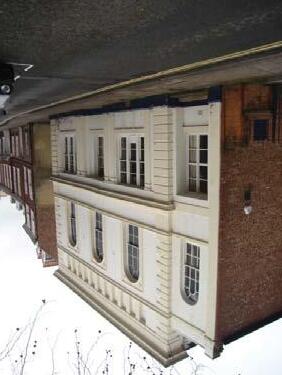
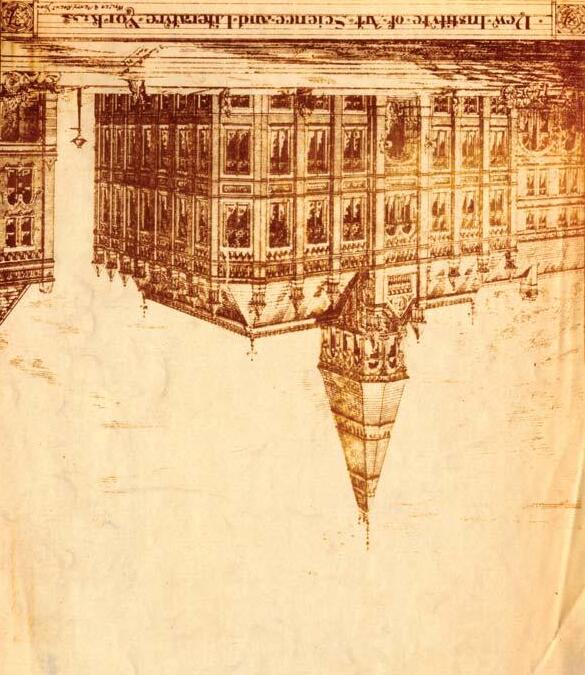
Walter Penty, the Institute’s honorary secretary, dealt with the sale and drew up the plans for the new building. He had begun his career at Walker’s Iron Foundry on Walmgate and was only 29 when he designed the new Institute, a Romanesque building, in red brick, with fine decorative buff terracotta panels. In more recent times, York Civic Trust has described it as one of the finest Victorian buildings in York 2. The creation of Clifford Street was in its early stages; the Law Courts and the Grand Opera House had not yet been built. The York Institute of Art, Science and Literature and the Rechabite building opposite, probably also by Penty, were early developments on the new street.
Through the sale, Penty became interested in Freemasonry and in November was proposed for initiation into the Ebor Lodge. Events moved very quickly after this. In March 1883, George Leeman MP wrote to the Prince of Wales’ secretary, asking if the Prince would lay the foundation stone for the new building in July when he was in the city for the Yorkshire Agricultural Show and other engagements. At this point, the committee did not even have legal possession of the site and once the Prince had agreed, the Town Clerk was requested to make the necessary arrangements with speed. Penty was instructed on 5 April to let the contract for the building of the foundations separately from the main build so that it could be ready for the visit.
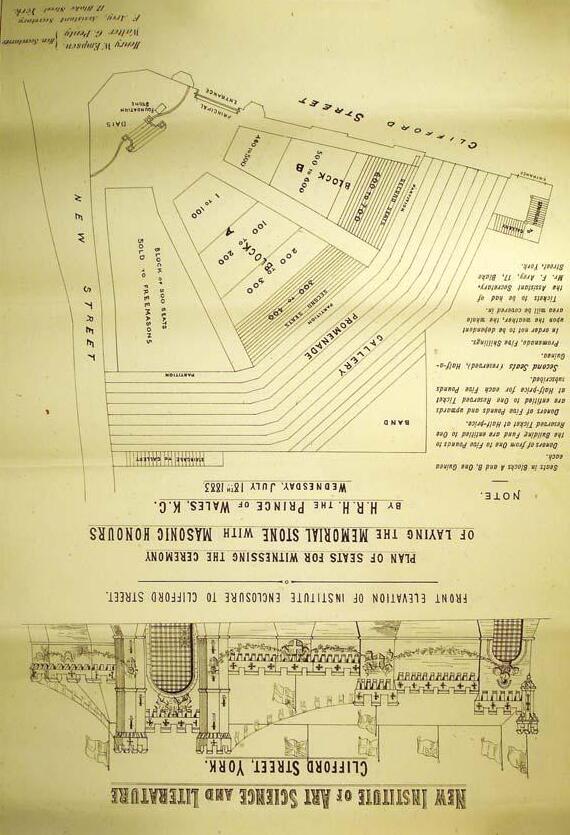
Right: Plan showing the seating layout at the stone laying ceremony in 1883 (YCA)
This was an
of
poor housing running between Castlegate and the river. The Lanes were replaced by Cumberland Street, Friargate and King Street.
The foundation stone ceremony
The stone-laying ceremony was a huge affair. A wooden mock-up of the Castle walls was erected around the site and tickets were sold for the 1,200 seats inside. The ceremony at Clifford Street was a great Masonic occasion – the Prince of Wales was the Grand Master of All England. Members of all the 28 Lodges in the Province of York were represented in large numbers – they were dressed formally in black frock coats with high hats and Masonic Craft clothing. Not to be left out of the events, the Lord Mayor, Alderman Thomas Varey, was admitted to the Craft only the day before. The grand procession of civic dignitaries, Freemasons and members of city and county society left the Mansion House, walking along Coney Street to Clifford Street accompanied by the band of the 3rd Battalion of the West Yorkshire Regiment. A large amount had been spent by the Corporation on public decorations. These displays were added to by many shops and businesses along the way and the streets were full of flags, bunting and flowers, all no doubt enjoyed by the thousands who lined the route: 45,000 alone had come to York on excursion trains. They were rewarded by a glimpse of the Prince in his Masonic robes and a procession displaying the ancient origins of the city – the Lord Mayor and Aldermen in their traditional robes with the civic regalia – and also the overt display of the power of Freemasonry in the modern city. It was described in the 1883 annual Institute report as one of the most imposing and impressive ceremonies ever witnessed in this ancient city
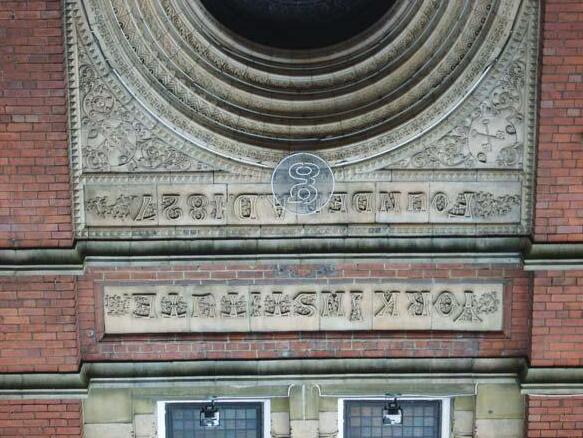
With the new building came another name change: York Institute of Art, Science and Literature, commemorated in well-crafted buff terracotta lettering above the arched main entrance and on the facade. A century later, the foundation stone was removed when the building was sold; behind it was a jar decorated with a Masonic symbol, specially made and decorated by York Glassworks. Newspapers, coins and other items were also found3
working classes, may arouse public sympathy and ensure the success desired by its promoters. This report also showed that the Institute had now become a part of the mainstream, supported by the Established Church as well as Nonconformists, and politically by both Tories and the Liberals (who had their origins in the Whig party). Early supporters such as Alderman Agar and Alderman Terry were vicepresidents along with a second generation of founder members, amongst them Sir James Meek. The death of Henry Rowntree was regretted; he was for years one of the most zealous and active members of the committee but the Rowntree family continued to support the Institute in the ensuing years.
The new building did not open for business until 10 September 1885 but in December 1884, building work had progressed sufficiently for a long-planned bazaar to be held there. It was arranged as a Moorish market square with stallholders no doubt in fancy dress, and continued for three days. The Lady Mayoress and several ladies of influence in the city had been energetically organising this event and many entertainments were laid on, ‘Mr Barnum’s Original Waxworks’ and Mr Baines ‘Illusionist, Anti-Spiritualist and Swordsman’, amongst others. The Institute Dramatic Society put on a farce twice daily and there were several concerts, including one given by the ‘Moorish Minstrels ’.
3 YCA Open shelf 28/20 ms Gardner, T The York Institute and the Masonic Jar (1998)
4 Tindall-Hart, A Ebor: The Archbishops of York (York 1989) p 167
5 YCRL Y374/S The Moorish Mosquito 9-12 December 1884
Money, as always, was an issue. Donations and subscriptions had raised £2,000, the sale of the St Saviourgate property had realised £1,250 and the new site had cost £1,375. A debt of nearly £5,000 was remaining but fund-raising was planned. The annual report contained the following statement: Stepping on the threshold of an important future, the committee trust that the recognition by royalty of a scheme for the advancement of education, intended specially to benefit the
The opening address by Archbishop Thomson was based on the Institute motto, ‘Art, Science and Literature’. The Institute, he said, was of great service to Art, if out of its crowd of students it brought one or two who were endowed with genius to the front. The aim of the art classes should not be so much to make artists, as to educate the people to appreciate art. As for promoting Literature, he suggested it should replace the rejected free library – still a sore point in York; and novelreading gave readers a knowledge of life without having to go thro’ its troubles and difficulties. Science would and should occupy a great part of the education of the future. Knowledge and true belief travelling in parallel lines need never collide Perhaps there was a reference here to controversial scientific theories such as evolution, which conflicted with church teachings. (Thomson was a great friend of the working classes4 and during his long incumbency, the Institute moved away from its initial strongly Nonconformist origins.)
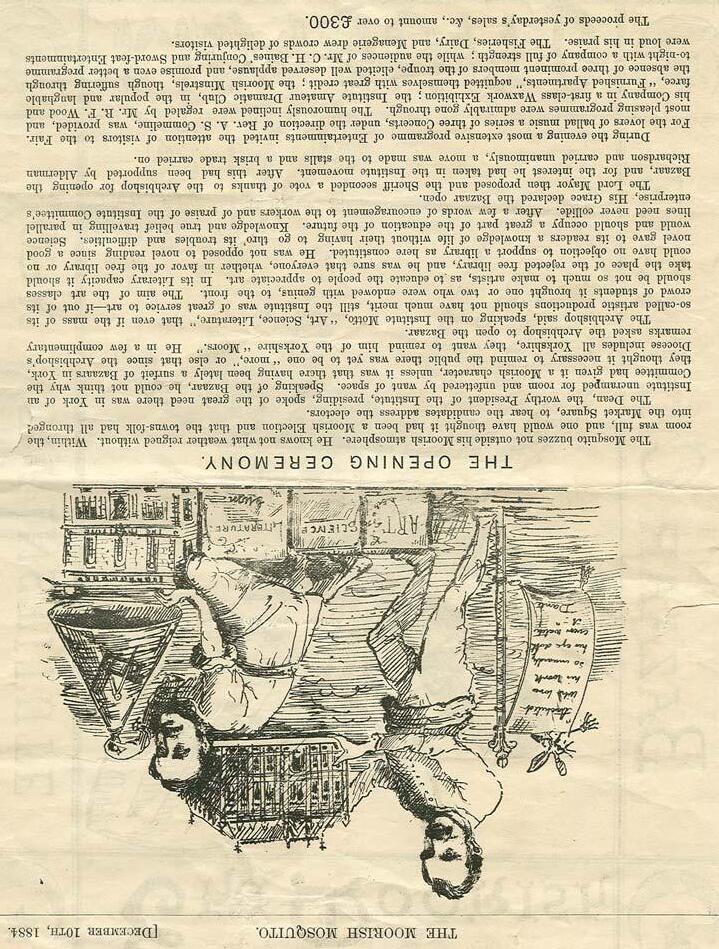
We learn all this from The Moorish Mosquito: York New Institute Bazaar Chronicle published daily during the bazaar5. It contains an illustration of a man – surely
Above: The glass phial or jar found behind the commemoration stone laid in 1883
Walter Penty – holding a miniature new Institute and another placing a cover with a Masonic symbol over the St Saviourgate building. In the absence of contemporary images for comparison, we can guess that the latter is Alderman Sykes Rymer, a prominent Freemason with strong Institute connections6. This publication, illustrated by George Milburn and Mrs S J C Phillips7, tells us a lot about contemporary life in the city and contains many advertisments for local businesses.
Left: An Illustration from the Moorish Mosquito 1884 showing Walter Penty holding the new Institute (YCRL)
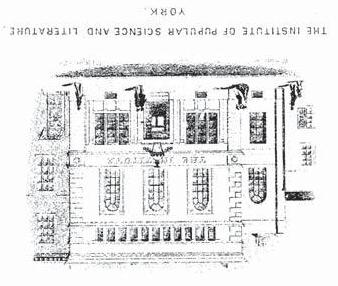
Below: Copy of an engraving of the new Institute (York College – origin unknown)
The new Insititute
6 I am grateful to Hugh Murray for this information. Dean Purey Cust, the president of the Institute, also had strong Masonic connections and is illustrated elsewhere in The Mosquito.
7 She is described as an artist of Bootham Bar in The Mosquito and a handwritten note also tells us that she was the wife of the sub-editor of the York Herald.
The committee minutes record great activity in early 1885 now that the building was almost complete. New organisation was put in place: Mr Dutton, the assistant secretary and librarian, was required to hand in his notice and by February, Arthur Furnish of Wakefield had been appointed in his place and Mr and Mrs Newbold were given the job of caretaking. Furniture and library fittings were
ordered and some of the old bookshelves utilised. Money was spent carefully: 100 cane-seated chairs at 17s 6d (87½p) per half a dozen delivered to York with 5% discount for cash was one of the purchases and gymnasium equipment not exceeding £50 was authorised. The existing financial arrangement with Mr Windass, the art master, was confirmed; his remuneration was based on 5/7th of the whole fees received from the students in addition to his salary. Extra chairs and easels were bought as well as casts for use in drawing lessons. An application for use of the main hall for Department of Science and Art examinations was made and Mr Frederick Arey of New Street, who had no connection with the Institute, was suggested as an independent correspondent to deal with this important aspect of its work8
The Institute was open for business in its new premises on 10 September that year. Charges had been increased in March and it now cost £10 to be a life member, first class membership was £1 1s, (£1.05p), second class, 10s (50p) or 3s (15p) per quarter, and third class 7s 6d (37½p) or 2s (10p) per quarter. Lady members were charged 6s (30p) or 1s 9d (8p) per quarter and could have the use of the library and reading rooms and bring another lady to the lectures.
Different rates applied for employers who paid for their workers and separate payments could be made for access to the library and newsroom only. Classes had continued at the old building so there had been no interruption in the educational or lecture programmes.
A very noticeable effect of the move to Clifford Street was the demand from outside organisations for the use of the hall and other rooms. A scale of charges was fixed but it was firmly decided that there should be no balls. Miss Milner, president of the York Factory Girls’ Club, wanted accommodation for meetings (this could not be granted), Salem Chapel had their bazaar there, the Ebor Lodge of Good Templars applied for use of rooms and were given 20% discount. The new building must have been seen as a very attractive venue for local organisations.
The gymnasium was hugely popular and it was decided to issue tickets for twiceweekly practice sessions at 5s (25p) and a further 7s 6d (37½p) for admission to the class if one was formed. There was separate instruction for ladies and children and York Athletics Club applied for its use, but gymnasium ticket holders objected as it might restrict their access.
8 Fred Arey acted as secretary to a multitude of local organizations and events, becoming known as ‘the workhorse of York’. (I am grateful to David Poole for this information.)
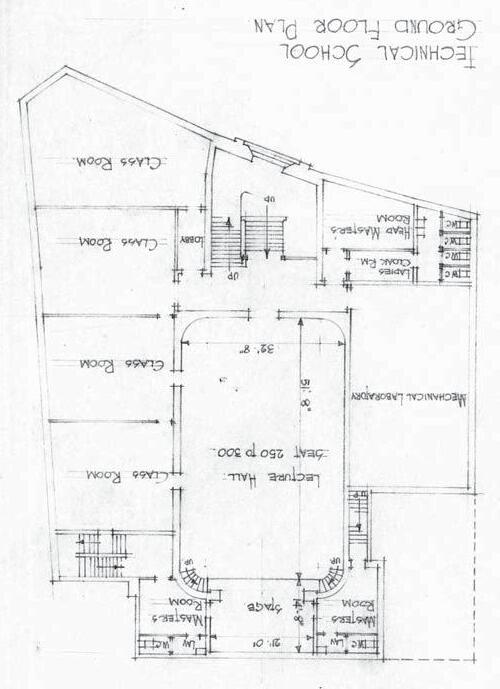
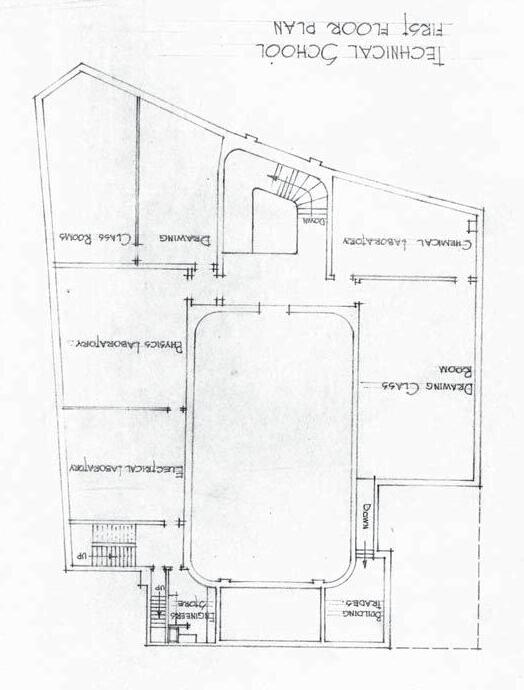
Left: Ground floor and first floor plans of Clifford Street (YCA)
Despite the large sum of nearly £904 raised at the bazaar of 1884, a considerable debt remained on the building and it was recommended in September 1885 that £4,800 be borrowed from the Leeds Permanent Building Society. January the following year saw fund-raising ideas being generated; a trip to Lake Windermere by rail and steamer, inclusive of breakfast and tea, would cost members 9s 6d (47½p) and bring in a profit. At a meeting at the Mansion House with the Dean of York in the chair the ladies of the city agreed to organise another bazaar in February 1887 – some time ahead. The Institute continued to be used by outside groups and the evening lecture programme, now illustrated by limelight lantern, was switched to Monday nights, allowing the York Music Society to use the central hall for practice on Tuesdays. The York University Extension Society had applied to use the hall and three Masonic Lodges used various rooms although one of these fell foul of the committee and had their goods confiscated until an outstanding room rent was paid.
Local employers were always involved in the management of the Institute. In 1886 Messrs Buckle, Masterman, Holmes, Douglas, Sowden, Marchant, Swales, McKay, Russell, Leaf, Penty and Wilkinson, many prominent in local commerce and industry, were on the committee.
A special meeting was held in February 1887 to discuss a proposal that the Corporation should take over the whole or part of the Institute – this was as a result of their wish to adopt the Free Libraries Act in connection with the Queen’s Silver Jubilee. There had been considerable discussion for many years about a free library and in response the Institute had extended its library hours, opening in the afternoons as well as the evenings – but only to members. The Corporation, as usual, had not rushed into action and despite three polls in favour, only now felt the time was right. This was welcomed and negotiations began although it was some time before a free library was established.
The Institute committee had already been appealing for funds for a free library but this had been abandoned as their financial situation deteriorated. The appeal was switched to one for help from the general public but by September a call of £2 4s
(£2.20p) had to be made on each trustee to cover the deficiency in the annual accounts. More fundraising was planned: a ‘Conversazione’ took place on two evenings in March 1888, one attended by Prince Albert Victor who was stationed in York with the 10th Hussars. The Prince also distributed prizes early the following year9. The City Council applied to use the hall for their general meetings, paying 30s (£1.50p) per session, providing their own furniture and paying a storage charge. Investigations were made into how lettings (clearly seen as an important source of income) could be improved without affecting normal usage.
More foreign language classes were proposed. The annual report for 1888, hoping for increased attendances, suggested that some knowledge of Continental languages had become essential to people contemplating a commercial career
Changes following the Technical Instruction Act 1889
The York School Board – anxious to see the benefits of the Technical Instruction Act of 1889 conferred on the city – sent a representative (Revd G H Hewison) to meet with the committee. A sub-committee was formed to look at this and reported in March the following year that they were unable to provide any extension to existing science and technology lessons on their present income. They outlined ways of utilising a grant but made a statement to the effect that an alternative scheme, whereby the Corporation could take over the Institute building and establish it as a technical school for the city, would be possible. The Act was promoted to allow financial support from the rates for the teaching of general principles of science and technology, along with some manual instruction. It was not designed to support teaching a trade which could be learned in the workplace. Money from the later Local Taxation Act of 1890 could also be applied for educational purposes.
The Institute skeleton now used in the Institute School of Art dances through the records; a request for its loan by the St John Ambulance Association for the instruction of drivers and firemen of the North Eastern Railway was declined in February 1890.
In July, when the foundation stone of the Law Courts next door was laid by Prince Albert Victor, members had access to the Institute building at a charge of 6d (2½p) to watch the procession – non members had to pay 1s (5p); royalty yet again proving a huge draw.
Left: Detailing over the door at Clifford Street (J Casling)
9 Prince Albert Victor, Duke of Clarence, was the eldest son of the Prince of Wales. He died in 1892.
Mr Buckmaster, an inspector representing the government Department of Science and Art, met with the committee in September. He gave advice on the best way forward under the new conditions caused by the Act and was concerned about money being wasted by duplication of classes in schools and other institutions within the city. By this time the Institute, School Board and Railway Institute were all putting on classes – mutual agreements were suggested so as not to overlap. No part of the £150 grant on offer could be used for subjects other than those listed in the Science and Art Directory. Once Institute classes were approved by the Corporation and supported by the department, payment of the grant would be approved. He also said that the department would favour the taking over of the Institute by the Corporation and would probably give a grant to free the Institute building of its debt.
The York Railway Institute (founded in 1854) had opened new premises modelled on the Institute in 1889, providing a library and classes for railway workers, and also giving them a dining room and recreational facilities10. Some competition ensued; the 1890 Institute annual report commented that class numbers in some subjects were lower because railway employees were admitted to their classes at lesser fees. It was hoped that arrangements beneficial to both could be made so that classes were not duplicated. The success of Alfred Bramley, an art student, was celebrated – he had won a South Kensington medal. The report went on to say that a grant of £150 was expected from the Corporation to be used in promoting the advancement of technical education in the City. More support was called for if the Institute was to continue as one of the chief popular education centres of York…it has been of inestimable service to the people…and an almost indispensable institution in the City.
By 1890 membership stood at 847. There is no doubt that the new building had attracted more members, of whom 239 were women – an increase of 72 since 1886 – but finances were tight and a large debt remained on the building. Changed conditions, both locally and nationally, led to a new phase in the history of the York Institute of Art, Science and Literature and after prolonged negotiations it was resolved to hand over to York Corporation the Institute building in Clifford Street, along with all class and School of Art furniture and appliances, for the purpose of carrying on a Technical School, for the sum of £3,960 being the amount of the debts owing on the building fund. This was on condition that the library,
newsroom and use of the central hall for occasional lectures could be retained until such time as they were needed for technical education purposes, or until the establishment of a free library, when the whole of the books and the newsroom and library furniture would be donated.
Negotiations were also taking place with the School of Art and Design in Exhibition Square, which ran parallel with the Institute Art School. Both were to continue in their separate buildings, but under Corporation control, for some time to come.
The Institute committee retained its influence on future developments through the five members nominated to the Corporation Technical Instruction Committee. Ordinary members were informed of developments in the 1891 annual report, which began with positive comments about the work going on. Student numbers had increased, Mr Windass had a picture hung at the Royal Academy, in the science and technical division the most popular class was shorthand with practical, plane and solid geometry following. The elementary classes, attended by 59 male and 23 female members, were commended by the government inspector. The report continued: as the Corporation had decided to establish a technical school … this would mean ruin to the Institute and there was no option but to negotiate.
Arthur Furnish was appointed secretary of the Technical School by the Corporation and by 1892 free library negotiations were well in hand. A special silver key was purchased for the public ceremony, transferring the whole of the building, on 19 October. The committee arranged a dinner at Harker’s Hotel on 15 November when Mr Furnish and Mr Windass each received an illuminated address; in addition, a good art book was presented to Mr Windass. This is the last entry in the Institute minute book.
Despite enlargement and alterations in the 1840s, the Institute had outgrown its St Saviourgate premises where it had been for nearly 55 years. A new era, beginning with Walter Penty’s vision for the new build in the 1880s, was to take the citizens of York much nearer to the technical education for all which had been the original objective of the founders.
10 Murray, H Opportunity of Leisure: the history of the York Railway Institute 1889-1989 (York 1989)
Philanthropy gives way to the State: 1892-1918
Both the Institute building on Clifford Street and the Exhibition building, which housed the School of Art and Design, were formally taken over by York Corporation on 8 August 1892, at the same time as the opening of the new Courts of Justice. Prince George1 had been invited to do the honours but was unable to oblige and so the Lord Mayor performed the joint ceremony. Afterwards, a luncheon was held in the Mansion House and in the evening a ‘Conversazione’ took place in the Exhibition building, giving an opportunity for leading citizens to socialise in the art gallery and public rooms there. The Corporation was now responsible for administering a much wider range of educational objectives within the city and suburbs.
The Free Library
The lack of a public library had been a long-term issue in the city; a subscription library became established in 1794 but calls for a free library were being heard from the 1850s. Finally in 1893 the Free Library, incorporating the Institute library and occupying part of its building, was opened by the Duke and Duchess of York.
In the first six weeks 3,575 applications for borrowers’ tickets were issued; daily average issues were 660 volumes with fiction topping the list. Visitors to the library (now lit by electricity) numbered 2,000 per day and to the newsroom 1,258. This huge response clearly met an overwhelming demand in the city and was repeated nationwide as free libraries were established elsewhere. It was not long before the freely-available warm reading-room caused some problems and complaints were made about loafers. As a deterrent, the police were requested to call in when passing.
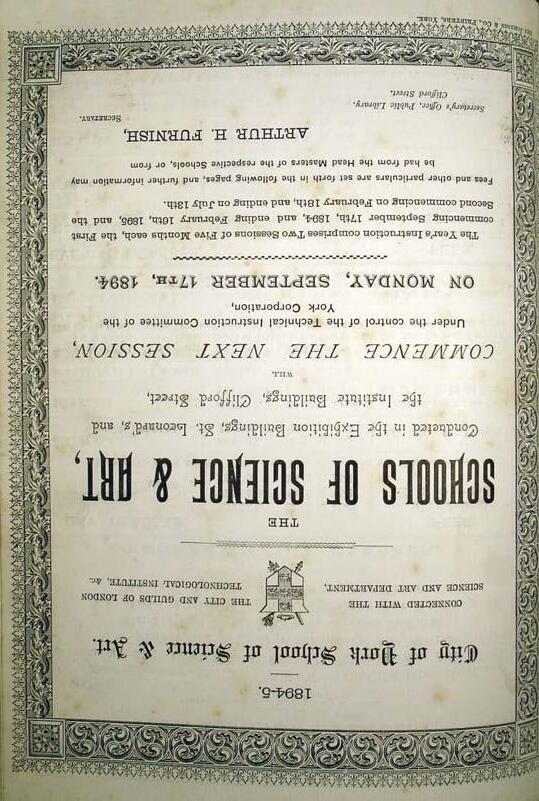
It took some time for the Corporation to find their feet as far as their added educational responsibilities were concerned; an early move to merge the two art schools had been considered but found impractical. A Technical Instruction Committee (which ran in conjunction with the Public Library Committee) was formed and the curriculum divided between the two buildings and the Railway Institute, which also received a grant.
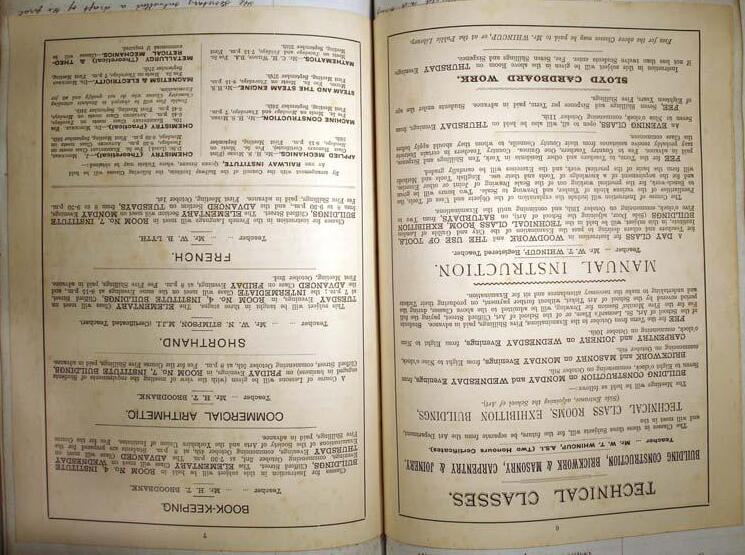
The headmaster of the Exhibition School of Art was Arthur Turner; he had five members of staff plus Herr Padel, who took classes in singing and the rudiments of music. Building construction, brickwork, masonry, woodcarving, carpentry and joinery classes, all under Mr Whincup, were also at Exhibition Square.
John Windass ran the Art School at the Institute with four teachers, and other classes at Clifford Street were administered by Mr Furnish, the secretary. These were commercial arithmetic, bookkeeping, shorthand and French. At the Railway Institute, applied mechanics, machine construction, steam engineering, mathematics, chemistry, magnetism, electricity and metallurgy were taught.
The huge success of the free library led to a reference library being established very quickly. J S Rowntree was instrumental in raising £500 for this purpose, so extending the service of the library to a different class of our citizens to those now using it. By December 1894, Mr Windass was pressing for reference books from the library to be taken into the Institute School of Art for use by the students. The secretary wrote to librarians in other towns for advice on the practice and the outcome was that the committee be recommended not to allow books in the Reference Department to be removed from the Library. (Librarians everywhere will recognise this situation today.) Users of the newsroom may have been hampered at this time as the electric light was cut off to boost the supply to the Law Courts next door.
The skeleton reappeared in 1895. This time it was requested by the Police for use in ambulance classes, the condition of the loan being that the chief constable was to be personally responsible for its safe custody.
Above: School of Science and Art prospectus 1894 (YCA) 1 Prince George was created Duke of York in May 1892 following the death of his brother, Prince Albert Victor, Duke of Clarence.
During the 1890s it is evident from the minute books that the art side was very popular, with more emphasis on the Exhibition Art School which catered for upper class students. Arthur Turner in December 1895 queried fees: Young ladies who are attended by their governesses – may I enter the governess at a reduced fee, say £1 1s (£1.05p) per session? I know many who attend would like much to become pupils, but are prevented by inability to pay fees on the same scale as their mistresses. This was left to the discretion of the chairman.
Staff were very strictly censured for bad behaviour. A library assistant, Mr L Huntley, had been convicted of drunkenness; he was hauled up before the chairman of the committee, lost a week’s salary and was demoted to probationer for six months. Clifford Street itself must have been nearing completion at this time; the granite sets proposed for the road surface met with opposition as noise would disturb both classes and library users so McDougall’s blocks were substituted instead. Other events in York are shown in these minutes including a request by Henry Hillyard for the use of the Exhibition building for a public meeting to protest against the adoption of the electric lighting scheme under municipal management or by means of municipal capital. There were those who did not agree with the rates being used for this purpose. The York Cyclists Lantern Parade Committee also wanted to use the building for a concert in aid of the County Hospital.
Amalgamation of the Art Schools rumbled on. The grant from the Department of Science and Art in 1897 reflected the balance of teaching and based on attendance was £374 3s 6d (£364.17½p) for Art and £22 10s (£22.50p) for Science. (It should be remembered that construction and woodwork came under Art and Design.) A report was prepared and each head of school maintained he could absorb the other’s students. The committee thought otherwise. They said it would be too crowded and detrimental to students’ learning; they also liked the existing friendly rivalry between the two schools and said the sites suited people from different areas of town.
Elaborate workings-out of savings showed little benefit in a merger, although there was a suggestion that both schools could be run with one head. The committee also proposed that technical construction classes, woodcarving and other manual instruction could move to Clifford Street which, with some alterations, could accommodate more students. Still, both heads of school were re-appointed for another year with some adjustment of salaries and grants.
Classes could be instigated by demand from particular groups; the postal telegraph clerks requested telegraphy and telephony and the committee agreed to oversee these so that City and Guilds examinations could be taken. Pupilteacher numbers were growing and some attended drawing classes on Saturday
mornings; part of their fee was refunded if they completed the course and sat the required examinations.
By 1898 Mr Furnish had taken on the role of librarian as well as secretary to the Technical Instruction Committee; his salary was £200 per year. Later that year Alderman Gray, the Lord Mayor, wrote to the committee passing on a recommendation. Mr Foerster of the gymnastic staff at Aldershot has been introduced to me by Colonel Fox with the highest testimonials as to ability as a gymnastic and physical drill instructor. The gymnasium equipment had been sold when the old Institute committee had been wound up but it was resolved to give Mr Foerster a try and a room under the library was allocated. The classes were aimed at young men and women separately and would cost 7s 6d (37½p) and 5s (25p) respectively per term. Fencing and boxing instruction could be given and it was thought that such a class…would be highly beneficial to a large number of young people of the city, especially those who are engaged in sedentary occupations
Room for improvement
Committee members and inspectors from the Department of Science and Art in Kensington met in February 1900 to discuss the future of technical education in York. The inspectors thought the situation unsatisfactory and suggested the time was right for expansion. The chairman’s personal opinion was that a large and well-equipped technical school would eventually be built but the inspectors’ view of the present was that the Railway Institute classes were simply not good enough – there was inadequate accommodation and equipment. Some subjects were totally neglected, there was no provision for practical work in physics and the Railway Institute chemistry laboratory had been on the point of being disqualified for some years. An engineering student could not get his education in York.
A school for electrical engineering, chemistry and related subjects would cost between £5,000 – £10,000 and Dr Hoffert (one of His Majesty’s Inspectors) said it was very desirable to provide for the continuing education of those who leave the secondary schools. The Railway Institute committee were considering their insufficient accommodation and it was an opportune moment for the Corporation to examine the question of an extension of technical education and consolidate technical teaching in York. No decisions were rushed into and things continued as they were for a little longer.
Over 18 months later the Railway Institute requested a grant for science classes on the grounds that it had insufficient income for the purpose. As some subjects were not provided elsewhere in the city it was agreed to give £50 which should not be regarded as an annual grant. Changes in the law as the Education Act of 1902 came into force meant that the Corporation had to take over any technical instruction then being run by the School Board. It was shown that science day classes, begun in 1896, were in place at Fishergate, Park Grove and Scarcroft Board Schools. Evening classes in science were also run at Scarcroft School. In March 1902 the Technical Instruction Committee, the School Board and His Majesty’s Inspector held a conference to discuss the needs of the city with regard to higher education. Provision of a higher elementary school run by the School Board with night classes run by the Technical Instruction Committee, or alternatively, a science school wholly run by the committee, were suggested. The inspector criticised the School Board; it had neither provided for elementary students nor compelled attendance up to the increased school leaving age of twelve and many had left school earlier than they should. No resolution was reached. June 1902 saw the committee and the School Board agreeing to continue as before, providing classes did not overlap.
By February 1903 the Board of Education, exasperated over the lack of improvement to the building construction class accommodation, reduced their grant. No action had been taken despite observations in 1901 by the inspector. The last meeting of the Technical Instruction and Public Library Committee, which had not yet got to grips with the 1902 Act, took place on 27 October 1903.
Improving facilities and better opportunities
The record continues in the Higher Education Sub-Committee minute book, which immediately begins with the re-modelling of the two Schools of Art.
At the Exhibition School, the saloon, together with the rooms used for the building construction classes, were to be wholly devoted to art classes and estimates were obtained for the necessary work. Mr Creer, the city engineer, was asked to submit plans for a new storey to be added to the building in May 1904.
The Railway Institute, following the installation of a new laboratory, was given a grant of £75 in June.
Although plans were not complete, the Board of Education was asked to permit the existing arrangements, including evening schools and the new pupil-teacher centre at Brook Street, to be continued for another year as a temporary measure. The Art School plans were forwarded to the board along with a proposal that painting and decorating classes be established as at Bradford and Leeds.
A big shake-up was taking place in York as far as education was concerned. Nationally, public welfare rather than private philanthropy was seen as the way to a better society and in York the Corporation was now responsible for most of the schools in the city through its Education Committee. Preparatory classes and a day centre for pupil-teachers, and also a proposed scheme for classes in elementary schools set to form secondary education for more able pupils of the poorer classes, were discussed. Clever children were being encouraged to stay on at school and progress further, going on to teacher training; this was the only area in which boys and girls in theory had equal opportunities, family circumstances permitting.
The Board of Education, still unhappy with building construction class accommodation, withdrew their grant in 1905. This led to construction equipment being moved to the basement at Clifford Street. Other matters were moving on and the long-awaited amalgamation of the Art Schools took place in October when Mr Turner was appointed head teacher of both.
Some evening classes were suffering from low attendances and heads of large firms in the city were informed that they would be discontinued if their employees did not attend. Three months later, the Railway Institute came under fire; homework was practically non-existent, students were apathetic and numbers low. On a positive note, the committee heard that a loft has been fitted up and makes a fair mechanical laboratory. It is well supplied with apparatus and models but this was not enough to prevent the existing grant being reduced.
Again, in 1908, technical provision was questioned. A total of 1,602 students were enrolled at night classes; this was only 2% of the population of York at that time and below the average of comparable towns in the north-east. An inspector’s report directed the attention of the Local Authority to the importance of a technical school building large enough for present requirements and on a site big enough to allow for future extension. Preliminary courses were in place providing a broad
base for later specialism, but although free tuition, at both evening schools and building trades’ classes, was available it was not always followed through.
Some of the money given to the Corporation for educational purposes came from the Customs and Excise Beer and Spirits Duty (locally collected) so the more the population of York drank, the more money went into the coffers. In 1908 it was £1,076 13s 9d – slightly lower than the previous year. Finances were rigorously watched, accounts regularly published and included teachers’ salaries. Scholarships too were carefully monitored so that public money was not wasted.
Students were beginning to travel to Leeds Technical School in larger numbers; capitation fees of 20s (£1) per head were paid to Leeds Education Committee for twenty York students in 1909 and raised to 30s (£1.50p) later the same year. City scholarships awarded for four years were instituted for intending pupilteachers and other able children, so that staying on after twelve was not such a financial problem for their families. Teacher training had already been reorganised in 1907 so that candidates aged between thirteen and fourteen received a £10 grant when going on to training college. For many years children had been used as cheap labour in schools, firstly by the monitor system and then by becoming pupil-teachers at an early age. Gradually, much more rigorous training was imposed and examinations put in place to provide better quality teaching for the greater numbers of children now in the schools. The Technical Institute provided some additional teacher education through evening and Saturday classes.
Broader educational provision was increasing but it was hard to persuade the early school leavers to improve their education by continuing at evening classes once they were working. Head teachers were asked to increase efforts to promote attendance at the evening schools. In the poorer areas, where many of the errand boys, young factory workers and girls in domestic service and shop work lived, the subjects offered had to compete with the many cheap, free attractions for winter’s evenings (we are not told what these are) and so at the Bedern Evening Centre, singing and needlework were offered to girls and English and drawing to boys. (Technical education as far as girls were concerned was centred on domestic subjects.) The young people working at Rowntree’s Cocoa Works may not have felt the same need as a Domestic School for girls and a Boys’ Club were provided for them by the company.
A General Election was underway in January 1910 and there were fears that events might get out of hand at political meetings; the Higher Education Sub-Committee, responsible for the Exhibition building, gave directions that the glass roof should be protected with tarpaulin when meetings addressed by Mr Lloyd George (Liberal) and Mr Balfour (Tory) were held. This election was hotly contested; it was brought about by higher taxation to fund old age pensions and also re-armament, proposed by the Liberals, being opposed so strongly in Parliament that they had to go to the country. The final result was a tie of 273 seats each for Liberal and Tory but support from Labour and the Irish National MPs allowed the Liberals to remain in power. The General Election and several successive wet Thursdays militated considerably against average attendance in January and February was a comment made about classes for men in the annual Bedern Evening Centre Report for the 1909/10 session. (These classes in English and arithmetic were formed for the benefit of men who had discontinued their education after leaving school and were well supported, as having the building to themselves induced many to join.)
Many other attractions competed with further education; roller-skating became popular quite late in York and by 1910 there were two rinks, although the boom was short-lived. Film shows were being put on as well as the more usual popular entertainment provided by the Theatre Royal, Grand Opera House and Victoria Hall. York was soon to get its first purpose built-cinema (the Electric, Fossgate, which opened in 1911) and the newly-built tram system made travelling around the city and suburbs easier for recreation as well as work.
Construction classes, by now at Clifford Street, consisted of building construction in three stages and honours, ordinary and theoretical brickwork, theoretical masonry, both ordinary and honours, and carpentry and joinery along with manual training in woodwork. Only 51 students were attending in 1910 – was this a reflection of lack of space in the Institute building, part of which was still being used by the Free Library? In October 1911 building students attended the Railway Institute for practical mathematics and applied mechanics.
Some agreements between representatives of principal employers in the city and the York Board of Studies were reached at a conference held in November 1910. When taking on under-eighteens, further education might be made conditional on getting a job. Consideration would also be given to reducing the working hours of
those attending classes and refunding fees when students received satisfactory reports. The Board emphasised the need for promotion and wage increases, dependent on gaining qualifications, which would motivate workers to attend classes and make for a more skilled work-force. Many firms had shown an interest, Ben Johnson and Co, Messrs Delittle, Fenwick and Co, Henry Leetham and Co, York United Gaslight Co, T Cooke and Sons Ltd, London Joint Stock Bank Ltd, Bleasedale’s Ltd and the York Equitable Industrial Society had all requested posters to put up in their factories and workplaces promoting further education.
In 1912 the Board of Education in London reported on the Technical School and Evening Schools in York. The previously complex scheme of management of Technical and Further Education had been simplified and extended to the Railway Institute and Rowntree’s Factory School. Efforts had been made to compel all students under seventeen to follow a course of study after leaving school, rather than individual subjects, but this had not been too successful. A popular preliminary technical course was running at the Railway Institute where a new mechanical laboratory along with increased classroom accommodation and equipment was now in place. The Workers’ Educational Association had held a course in York for the first time and the Board thought a special class in cookery, designed to meet the requirements of camp life for Boy Scouts, worthy of note. It was also suggested that a more liberal approach to the building trades classes might be pursued; strength of materials and structures, practical mathematics and the opportunity of performing experiments in a mechanical laboratory should be offered in addition to the usual curriculum.
A local report on technical education in the City, produced in February 1913 by the Revd W Johnson and Councillor S H Davies, arrived at some perceptive conclusions. York had lagged behind other cities and unwittingly handicapped a host of boys and possibly girls at the outset of their careers…the chief business of technical education is to promote industry. It is a public investment for national ends. They said that it was impossible to provide a university in York – Leeds and Sheffield could fill that gap – but we can hope to supply the training necessary for the rank and file in the hope that more able students could go on to better things. The report went on to propose how the activities of a new technical college might be organised, and discussed the merits of a trade school.
The idea of scholarships for school leavers who wanted to take courses in motor engineering or electrical installation was raised that autumn but the committee could not help. Practical plumbing, however, was added to the range of classes at nearby Castlegate School. There was a decrease in attendance at evening schools due to half-fees being charged for second year students. (Classes had previously been free.) The committee commented that the increase in the number of picture palaces to four, with a fifth imminent, had adversely affected attendance. Day continuation classes for errand boys had been started at Clifford Street and, so that library users would not be disturbed, matting was laid on the stairs to deaden the noise of changing classes. These were free but needed co-operation from employers as very few boys of fourteen and fifteen years of age are capable of realising the importance to themselves of a good education
World War I
The spring of 1914 saw Messrs Cooke & Sons (instrument makers) arranging for 88 of their apprentices to attend day classes, but the situation quickly changed; the advent of war brought a full order book and the lads could not be spared – they had to attend at night instead. The War rapidly made its presence felt in other ways: Monsieur Duchene, the French tutor at Scarcroft Evening School returned to France to join the army, the Board of Education established training for voluntary aid, and special efforts were made to put on classes for unemployed young persons.
Eleven boys were offered technical scholarships that summer after attending evening classes at various centres. Their jobs bore little resemblance to the employment pattern found locally today; listed were a fitter, carriage builder, instrument makers, engineer, motor mechanic, mathematical instrument maker and millwrights.
There had been problems at the Railway Institute and both committees seemed to be at loggerheads, the Railway Institute refusing to allow day classes on their premises. Complaints had also been received from the engineer at the Cocoa Works about teaching and marking of homework. Day technical classes were moved to Clifford Street and Mr F Winterburn was engaged to teach. He was 25 years old, employed by Messrs Cooke Ltd as a draughtsman, and held a first
Class Certificate in Advanced Machine Construction. In March 1915, when Mr Boothroyd of the Railway Institute attempted to justify payment for the usual grant of £250 from the Education Committee, he was asked who should provide technical instruction in the City. In reply, his own opinion was that, if an accommodation was made by the City, the Railway Institute would raise no objections to closing their classes.
An increase in military activity, in what was a garrison town, brought a government circular regarding evening activities for men serving with the colours. Instruction in various subjects, including French conversation, was offered by the Higher Education Committee but classes were not well supported by the soldiers. When Belgian refugees arrived in York, free education was provided for their children. The war created many problems which the Education Committee dealt with; they supported lectures by the Historical Association, firstly on The rise and growth of Prussia and another on The making of the German Empire, clearly an attempt to help local people understand the causes of the war. Some classes were discontinued as teaching staff joined the Army; these included a class for policemen and the Boy Scouts’ class.
The Government issued an appeal in March 1915 for women to sign on for war work; as men left to join the forces, clerical and factory work was opened up to them. In September, Armstrong Whitworth & Company had set up a shell producing plant in two sheds rented from the North Eastern Railway2 and a scheme for training munitions workers was established at Clifford Street where both teachers and engineering equipment were utilised. These were short courses for both men and women and for the first time we can reach back to a memory, albeit second-hand. An engineering student in the 1950s recalled working on the same machine lathes in the basement used by his father (then aged fourteen) to turn shell cases in World War I. By February 1916 the numbers applying for the munitions classes had risen to 465 and were accommodated in both daytime and evenings. Concern for the safety of girls was raised by the National Association of Women Workers; the committee were aware of the dangers on the streets and urged parents to meet their daughters after classes, or provide a suitable escort. Messrs Armstrong & Whitworth employed many girls following training at the Technical School. On the commercial side, more training was put in place and over 60 applications were received from women.
2 Peacock, A J York in the Great War 1914-1918 (York 1993) p 346
The Association of Teachers in Technical Institutes raised concerns in a letter to the committee. Fears of increased post-war competition from America were expressed, the more dangerous because she is now able to make preparation and to obtain priority in the markets and because of the highly organised efforts which will be made in Germany. It was vital that efficiency in technical education be maintained; any reduction in expenditure or loss of experienced staff in active service was not in the best interests of the nation.
Many of the York schools had been requisitioned by the military. This affected evening centres and so in July 1916, all the commerce evening classes were transferred to central premises at Castlegate School. Conscription had come into force that year and reduced numbers of both staff and students. Shorthand teachers were difficult to get – this skill was highly valued in the armed forces.
The war promoted development in new areas and a class in glass manufacture was established in conjunction with Sheffield University, enabling workers to gain a scientific knowledge of glassmaking and assist in the development of the industry at a time when imports had been cut off. Day classes for apprentices in the building trades were discussed with interested employers and would be put in place as soon as conditions permit. So, thought was being given to the future needs of trade and industry in the city.
Some classes went on as before; in September 1916 after the GPO messengers had taken their examinations, the postmaster observed with satisfaction that the boys had done well. In other areas numbers of candidates were greatly reduced as older students had joined the army and others were working longer hours. By the end of October, 21 evening classes had been discontinued. It was dangerous to be out at night, owing to the darkness of the streets and the possibility of Zeppelin raids and remaining classes were changed to an earlier time. (May 1916 had seen a Zeppelin raid on York when 18 bombs were dropped, 9 people were killed and 40 injured.)
A head teacher, Mr J Hume, was appointed to what had now become the Castlegate Evening Commercial School; he worked for four nights a week at eight shillings per night and later became head of the Day School as well. Changing times were reflected in a short course of lectures for lady bank clerks given by
Mr French, manager of the National Provincial Bank, and on the technical front, following an increase in numbers of engineering students, another room over the Library was needed.
There were two national outbreaks of Influenza, seriously affecting the City. The first was in July 1918 and the second between October and the following January; all places of entertainment, schools and college classes were closed, visiting stopped at the County Hospital and at its height there were 61 deaths in 3 weeks. At York Cemetery soldiers were drafted to dig graves. All this seriously disrupted life in York, its citizens already worn down by the war. The TB officer reported to the Education Committee that the health of many children was at risk through malnutrition and consequent vulnerability to the disease. Cheap school meals at 2d (1p) each were being given to 130 children a week in 1918.
York, along with the rest of the country, had experienced a sea-change in attitudes to working women as a result of the war. They had stepped over the boundary into the kind of jobs previously done by men and even though many servicemen were returning home the great losses in manpower meant that life in the workplace would never be the same again.
Rising standards, the effects of the Depression and World War II: 1918-1945
Immediately after the First World War, the school leaving age was raised to fourteen, jumping a whole two years. In preparation, a ‘Plan for Further Education in York’, issued by the Board of Education in 1917, revised existing arrangements, calling for the local college to be the crown of Further Education in the area, and the Head Teacher is to be responsible for the supervision of the syllabuses of instruction in the continuation schools etc, in order that the work may so be graded as to lead up by progressive stages to the higher courses at the Local College Any development would be impeded by lack of accommodation and the space occupied by the Public Library was beginning to be an issue at Clifford Street.
During the academic year 1920/1 several changes of staff were made in the Technical School Engineering Section. This, along with a burst boiler, resulted in those students being rather unsettled and lacking in progress. By contrast, the Evening School of Commerce had its most successful session since it was opened in 1916. A record number of students had enrolled and took their work very seriously. In their annual report, the Education Committee noted that the new scheme of Messrs Rowntree’s & Co has tended to make students from their offices work more assiduously. The newly-opened Day School of Commerce now had 75 full-time and 75 part-time students; it was located in a house in Bootham taken for this purpose.
Elsewhere in the city, higher grade secondary schools were established for pupils aged between eleven and twelve who stayed on until they were sixteen with a further two-year advanced course available. The Education Committee opened Nunthorpe School in 1921, which along with Archbishop Holgate’s School, Queen Anne’s School and Mill Mount School collectively accommodated over 1,000 pupils. Entrance for half of these places was by scholarship and a maintenance grant was available for poor families1.
In 1922, considerable correspondence took place between Rowntree’s and the Further Education Committee. The annual cost of the in-house education provided by the company was £3,827, a great investment in their workforce. Grants were being questioned due to re-organisation; it was thought that a large proportion was more ‘welfare’ (domestic training for girls and physical education for boys) but engineering and clerical skills were also taught. A reduced grant continued to be given to the company. Other organisations providing education
were supported, namely Leeman Road and South Bank Working Men’s Clubs and the Old Priory Adult School run by the Workers’ Educational Association (WEA).
Evening school numbers were down that September, reasons given being an increase in fees, youth unemployment and closure of some evening centres. After the war there had been a brief boom but by this time, a depression in trade meant that many young people were out of work. January 1923 saw the Ministry of Employment, along with the Board of Trade, providing 75% of funding for centres for unemployed juveniles; who were required to attend as a condition of receiving unemployment benefit. The classes were half-time, one for fifteen to sixteens and the other for sixteen to eighteen-year-olds, and taken up by 108 boys. Subjects were general and practical, along with physical education. Lectures from notable York citizens such as Seebohm Rowntree on Trade and Industry, Dr Maud Sellers on York Craftsmen in bygone days and Alderman Birch on Local Government were also arranged for them.
Following a request from Rowntree’s for classes in mechanics, physics and English to prepare students for the entry examinations of the Institute of Mechanical Engineers, the committee canvassed interest from other firms in the city. A positive response was recorded. Classes in carriage building were put on at this time. The annual report for 1923 showed an increase in numbers – 1,868 had enrolled for evening classes and the examination results were good, although it was commented that students had to pay their own fees and could not be compelled to sit them, and as a rule those who take the examinations require the certificates for business purposes. Some exceptional results for the Evening School of Commerce were noted – medals had been awarded by the Royal Society of Arts to Thomas Ewing, who had gained the highest mark in the country for advanced theory and practice of commerce, and George Cawthorn for the same in intermediate French.
Unemployment levels rose and fell. Classes for unemployed youths were discontinued in November but reconsidered the following April when the Ministry of Labour increased their grant to 100%. A measure of the local situation was that 95 men applied to teach these classes. Practical work included engineering shop work, taking down and reassembling a motor car and instruction in simple
1 Morrell, J B & Watson A G (eds)
repairs. A boot-repairing class was suggested (not taken up as it would affect local cobblers) and general studies included newspaper reading with discussion on current topics.
A comprehensive Board of Studies report on every facet of further education in the city was produced in June 1924. Social as well as educational needs were being provided for; the general election had stimulated an entertaining mass debate at the Fishergate Centre and singing and gymnastics were popular classes elsewhere. (Broadening of liberal and general adult educational objectives by the government was taking place during the early 1920s.) Concern was expressed that an alteration in pay for night class teachers had led to some of the older and more experienced instructors declining re-appointment, the new teachers having little or no works experience.
The Public Library, occupying a large portion of the Clifford Street building, was again under discussion by the Corporation; a new library in a different location would benefit the Technical Institute by freeing much-needed rooms and the citizens of York would be served with better facilities. The Education Committee put forward plans to the Board of Education showing how the whole building could be utilised; their response, amongst other comments, was that classrooms should be divided by wood and glass partitions instead of curtains and His Majesty’s Inspectors (HMI) be consulted regarding furnishings. The committee were not going to get away with cheap solutions.
The curriculum was extended in January 1925 to include classes in breadmaking and flour confectionery, and as there were no facilities in place, Councillor Woolgrove offered the use of his bakery. Following criticism of slack discipline and the lack of teaching of modern methods from the Master Builders in May, there was some reorganisation of the construction curriculum. A workshop at the back of no. 11 Castlegate was fitted up for bricklayers and masons but carpentry and joinery remained at Clifford Street. All building trade apprentices would now be required to take up the preparatory trades courses at Fishergate School, adapted specially for them and providing a basis for further instruction. By the end of the year, the construction classes were re-organised and a total of 108 students enrolled. The following year, although numbers were reduced in some areas of further education, for building and engineering classes they went up. This was partly due to the London & North Eastern Railway Company, who were anxious
that classes should be established for their apprentices. Twenty youths from the wagon shops had been identified and the company was willing to release them for two half-days a week.
The Public Library moves out
A new building for the Public Library was under construction in Museum Square during 1927 and was due to open on 1 October. This released additional accommodation for classes at the Technical Institute and in November, when the committee discussed another report on further education in Yorkshire by the Board of Education, one comment was that there was no day technical education for women in York. Also: The most serious need in York in connection with technical education is a central building to house the classes. Arrangements are on the way to adapt the Public Library Building. This will make it possible to carry out the instruction under much more convenient conditions and to make provision for the necessary experimental work. The Board assessed the situation generally in York, saying that it could not be compared with Bradford and Sheffield because there was no predominant industry and the percentage of the population enrolled was satisfactory.
Other educational opportunities for adults were offered by the WEA (these classes were held at the Co-operative Building on Railway Street, now George Hudson Street), and St Mary’s Settlement (then in its original home in St Mary’s). The University of Cambridge, through the University extension courses, also held classes and the Leeds University Joint Committee were proposing a three-year course on economic history to be held in York. These classes were taken up mainly by mature adults and were increasingly becoming a way of self-improvement for working class men and women as well as the middle classes.
Commercial classes did well in the city and students were frequently commended on their good examination results. The Board of Education in its report of June 1928 said that the Evening Institute of Commerce had done exceptionally good work; the classes in advanced English, advanced bookkeeping and business economics were splendid. The butchers’ apprentice class and the grocers’ assistants were also praised. The social side was not neglected: an annual ball was arranged for the students and social
evenings were held fortnightly during the winter. The Board recommended that confectionery design and decoration classes be held at the School of Art, along with drawing and design for typography students already enrolled at the Technical Institute. Additional classes in banking and insurance were to be tried out.
The gramophone requested by Mr Hume in 1928 raised some eyebrows on the committee; he explained that it was needed for teaching rhythmic touchtyping and phonetic French lessons. Although Mr Hume was head of the Day and Evening Schools of Commerce, at this time there was no equivalent for the Technical Institute. The committee, after agreeing to appoint a head, discussed with Mr Margetson, (HMI), the qualities required; he thought personality was the thing to look for, someone who will have some standing when he enters works to interview employers. A degree man with mechanical and electrical qualifications was needed and the inspector said that no less than £600 a year should be offered to the new principal of the Technical Institute and head of the Engineering Department. Mr F Wilkinson got the job but died shortly after taking up the appointment and was followed by Mr Thomas H Jones, head of the Engineering Department at Leicester College of Technology in 1929.
One result of this was that Mr Whincup’s position was altered. He had run the evening building classes for many years and, although 73 years old and only present three nights a week, had been responsible for them. The change in management of the Institute meant that he was no longer in charge and his honorarium of £70 a year was reduced to £50 on the understanding that he actually taught one night class. He had served the Institute for over 40 years.
November 1929 saw numbers in further education increasing: 2,486 students were attending, a record for the city. Examination results for commerce were above average but some subjects were criticised – geometry in the building trades classes had not done well. The bakery and confectionery classes were popular and the time had come for facilities to be installed at Clifford Street; requests were sent to several firms for assistance and the response was good enough for a bakery to be established at the Technical Institute. Receipts from the sale of food baked there were ploughed back into the operation.
Effects of the Depression
The unemployed boys, whose numbers had fluctuated in the 1920s, were out in the potato fields in the autumn of 1930, and during the following year they were fed into various classes instead of some organised specifically for them. Girls receiving unemployment benefit were required by the Ministry of Labour to attend night classes three times a week as a condition. Unemployment benefit was only available for fifteen weeks per year, numbers of jobless were rising and it would not be long before the means test was in place.
A measure of the way women had changed their employment pattern is seen in a request from Mrs Drew, of Poppleton Hall, who asked if high class cookery for women could be put on. Women were now used to working in factories and offices and there had been a sharp fall in numbers in domestic service. The committee did not oblige and suggested she contact the West Riding Education Committee.
Leetham’s milling operations in York had expanded rapidly at the end of the 19th century and provided major employment. Spillers had taken over in 1928 and then closed down the mills in the city at the end of 1930, resulting in unemployment for about 1,000. The knock-on effect for the Technical Institute was a loss of 47 students in the flour manufacturing classes and many apprentices deserting the engineering classes. A similar number of men and youths were laid off at the Carriage Works. Around 4,000 were unemployed in York in 1931 and financial problems were evident at that time of national slump. A decision made by the City Council that the car owner-drivers’ class should be self-supporting led to only four students enrolling against 50 the previous session. This is another indication of the social climate in York; ownership of motor vehicles was popular despite the ups and downs of the economy but owners were not prepared to stump up to learn how to look after their cars. Nationally, there were well over two million motor vehicles of all kinds on the roads in 1930.
Mr Jones had been busy; he had made arrangements with the tramways’ manager for 32 of their employees to take a course in motor engineering. Also there was a prospect of a glass technology class starting up again as the National Glass Works expressed an interest after taking over the old glass factory on Fishergate.
Advances in commercial technology are seen in the purchase of a comptometer in 1931 and classes for its use put in place. Classes were also begun that year to prepare candidates for the Chartered Institute of Secretaries and Chartered Accountants examinations.
A draft scheme for education and training of young people in mechanical and heavy engineering trades in Yorkshire was discussed by the Higher Education Sub-Committee in February 1931. The suggestions contained were not applicable to the conditions found in York but an important aspect was the concern raised about provision of classes in handicrafts, suitable hobbies, general knowledge and cultural subjects for young people engaged in repetitive manual work which would help them to improve their situation. For many years subjects like singing, physical education, woodwork and cookery had been available to those living
in the poorer areas of the city but some thought was being given to broadening this kind of provision.
In May that year individual enrolments reached 2,886, another record. The building trades classes had been recognised for National Certificate purposes, awarded jointly by the Institute of Builders and the Board of Education. Since the 1921 Education Act there had been an enormous increase in the take-up of further education. Construction classes had been reorganised and a huge amount of effort had been put into commerce classes that had grown out of the conditions in World War I, as well as higher level courses in many subjects. This was despite the economic depression leading to varying levels of unemployment and financial restraint. The Government had imposed salary reductions across the board for public employees in 1931; the depression had cut deeply into the national purse
Right: Science laboratories at Clifford Street from the 1935 prospectus (YCA)
and the teaching staff found themselves 10% worse off. Some protests were made and the committee did accommodate one or two staff members who maintained that it was not worth their while to teach various classes.
Over the previous ten years a night class culture had emerged. School leavers were expected to enrol at junior evening institutes to do a preparatory course and then go on to the senior equivalent. Scarcroft was the biggest junior centre with 342 attending in 1932 but this included unemployed youngsters who were required to attend as a condition of receiving benefit. At the Technical Institute, 470 were pursuing a full course of instruction, attending three nights per week, but this was soon to change. The annual reports all include social aspects but Fishergate Junior Evening Centre reported that social evenings which had been a marked success in previous years could not be arranged this winter, as a dance cannot be held at less admission fee than 1/- (5p) and for this sum the Rialto Hall opposite is now offering a dance with a professional orchestra and longer hours
The gloomy economic situation in York and throughout the country is seen in the Education Committee minutes. Cooke, Troughton and Simms (previously Thomas Cooke & Sons Ltd) were no longer able to give their apprentices day release, class numbers were dropping and staff were asking for more pay. Arrangements were made for the unemployed to attend classes free of charge and there was a dramatic rise in numbers of children aged between fourteen and sixteen released from minor scholarships in the schools because they had found work that would assist the family income. (The school leaving age was still fourteen but poor parents could apply for fees and a maintenance allowance for bright children to stay on.) Even the amount set aside by the committee to cover exceptional hardship was reduced from £200 to £100. In March 1933 a means test was discussed and questions drafted for those applying for maintenance allowances and scholarships. All family income was to be taken into account, including board payments from lodgers and grandparents who were living in the family home. For a short time, the income of applicants is listed in the minute books and by December, maintenance grants were paid in arrears, increasing hardship even more for poor families.
Efforts were made to take junior classes to the Technical Institute to look at what the seniors were doing, also using films to attract future students. Senior students visited factories and the BBC Northern Regional Broadcasting station; this made courses more interesting and showed the reality of working in industry. Practical subjects like manufacture and laying of electrical cable could now be demonstrated through films. Technical education was moving out of its old rigidity as different teaching methods were adopted and new courses on more modern technology were put on.
Language classes at the Settlement, which had by now moved to Holgate, had affected enrolments at the Evening Institute of Commerce and their grant in 1934 was conditional on French and German classes there being adopted by the Institute and administered by Mr Hume. This arrangement seemed to work very well and continued for many years.
Above: Students and staff of the Day School of Commerce pictured on the steps of the Magistrates Court, Clifford Street 1937/8. Front row 4th from right Mr Farra, next Mr Smith (Geography) Mr Hume (Head) Mr Dickinson (English) Mr Hayward (Typewriting) and Miss Linneker (Mathematics) (M Ferry)
Despite the continuing stream of children leaving post fourteen full-time education due to financial circumstances and, occasionally, poor health, the economic situation in York by now appeared to be slowly improving. The perennial quest for a new college site was back on the agenda, and in November 1936, land owned by York Corporation on Piccadilly had been discounted and Mill Mount Paddock, a site on Scarcroft Road in front of Mill Mount School, was under consideration. Salary lists for 1937 no longer showed a 10% reduction and Mr Jones applied for, and got, an increase in salary.
Student numbers were again rising, boosted by the ‘take-over’ of the Day Continuation classes for boys employed at Rowntree’s Cocoa Works by the Education Committee in November 1936. Other employers were taking a great interest in training. A deputation from the York Branch of the Institute of Motoring met the committee in April 1937; they wanted a greater variety of practical work and were prepared to loan modern examples of car chassis, engines and parts which could be exchanged periodically as newer models became available. They also said the present accommodation was inadequate and later, Messrs Myers & Burnell of Davygate placed workspace at the disposal of the committee for a token rent.
At the end of 1938 the Royal Air Force requested school premises and cooperation in readiness for the training of fitters and riggers. The following February, admission of refugee children to York schools was discussed and by March, an Air Raid Precautions Committee was in place. A need for cookery classes was identified by the Women’s Royal Voluntary Service, who were preparing to work in hospital and other canteens. First aid lectures were put on for teachers and an application was received for the first refugee boy (Herbert Wunsch) to be admitted to Nunthorpe School as a fee payer.
Amidst all the concerns about the possibility of war, a full schedule of buildings for a new technical college was considered. These showed accommodation for the day and evening students in the Technical and Commerce Institutes, a junior technical school of 6 forms of 24 boys and a proposed senior women’s institute. In June, drawings were exhibited for two sites, Holgate and Hungate.
World War II
War was finally declared on 3 September 1939 and far more important matters were on the agenda. A Board of Education circular of 29 September said: In view of the importance of preventing the social consequences likely to result from the absence of any form of occupation for young people after their day’s work, … Evening Institutes SHOULD BE UTILISED AS FAR AS POSSIBLE as an agency for combating the dangers both to adolescents and to adults. They fully realise the difficulty due to darkened streets which must affect the enrolment and regularity of attendance of students, but they hope that in spite of this handicap it will be possible to secure a substantial volume of instruction and other activities in the evening. Despite this, by the end of 1939, evening attendances across the board were drastically reduced.
The following year saw a food economy campaign. There were lectures and demonstrations throughout the city in school cookery centres and also the City Electricity Department, York Gas Company, and Electricity House, Davygate. Recipes and copies of the Wise Housekeeping in Wartime leaflet were issued by the Ministry of Food. In efforts to keep teachers, a 6% War Allowance was paid to those who earned less than £260 a year with an adjustment for those earning more. A bonus was also paid to teachers serving in the forces.
Training for wartime work, as seen in World War I, was again put in place. The Ministry of Labour and National Service wanted an early start in the training of women who could go into the engineering industry. A scheme was worked out with staff working day and night shifts, the trainees were paid and courses lasted eight weeks. The trainers themselves were trained at Sheffield University.
Mr Jones had formed an Air Training Corps at the Technical Institute and free classes in mathematics were put on for the 200 cadets. He and Mr Clayden (who had taken over as Head of both Day and Evening Schools of Commerce) expected to receive commissions. Another war-time problem was the loss of teaching hours as a result of air raids. If a raid all-clear was heard between midnight and 3am, day classes started at 9.50am but if after 3am, there were no morning classes. At this time, evening class numbers were boosted by the free admission of servicemen and women stationed locally.
2 This included a few who died subsequently from injuries. Some were from council houses in Clifton; although they belonged to the City, they were technically in Flaxton Rural District Council. (I am grateful to David Poole for this information.)
3 Feinstein, C Population, occupations and economic development 1831-1981 in Feinstein, C (ed) York 1831-1981: 150 years of scientific endeavour and social change (York 1981) p 143
Until May 1941 the reserve age for teachers was 30 so those of that age or under were liable to be called up into the armed services if needed. The war began to affect staffing even more as the age was raised to 35, but special consideration for deferment was given to those staff teaching building or engineering courses, as well as students studying at a higher level.
From London, the Board of Education, in response to an application from the Secretary of the Education Committee, declared that the Technical Institute comprising technical day and evening classes, and the Day School of Commerce (although not the Evening School) would now be recognised as a College for Further Education. This would no doubt come as a great boost to all concerned in these difficult times.
Special courses to fit war-time needs continued to be put on; a radio mechanics course was intended to train men who would in turn train army personnel. A class was held for training Army tradesmen in acetylene welding, and a Government course established for Auxiliary Territorial Service recruits, partly provided by the Education Committee (typewriting and English) with the Army giving four hours Physical Education and six hours in military subjects.
Stan Tyson, a gifted engineer who was to have a long-term association with the College, puts in his first appearance in the records as a night class teacher in February 1942.
Although York was lucky in that it escaped serious bombardment, there were some incidents and after the Baedeker raid of 28 April, the Education Committee sent a letter of condolence to the governors and staff of the Bar Convent Secondary School on the loss of 5 nuns – there were many other fatalities and the final total was 92 dead 2. A shortage of teachers meant that, for the period of the war only, the committee was prepared to appoint married women teachers to temporary staff vacancies. (Previously, female teachers had to resign on getting married.)
Great consideration was given to a training scheme for entrants to the building trades when Mr Hay, an inspector, attended a meeting. He wanted to get university men into construction and said those who obtained degrees should not just be builders’ sons. Technical colleges could deal with fifteen to nineteen
year-olds working for National Diplomas and those students would fill posts of assistant managers. The Board of Education wanted Local Education Authorities to address this need at once: a large number of men would be required for the building trade and there would be steady employment for ten to fifteen years. Later, a report on forming junior technical schools of building was discussed, taking boys from the age of thirteen. This was justified as follows: The Building Industry is likely to expand rapidly after the war by reason of reconstruction in bombed areas and the overtaking of arrears of housing schemes and similar projects; and such training … will give the Building Industry a “flying start” by having a number of partially-trained apprentices to hand. Entry would be from senior and higher grade schools by entrance examination.
Engineering firms in the city were still fully stretched and the manager of Cooke, Troughton and Simms, although prepared to allow his apprentices to leave at 5pm to attend evening classes, indicated that day classes were out of the question. The firm had moved to a new factory on Haxby Road in 1939 and was heavily engaged in the manufacture of optical and other instruments for the armed forces.
By January 1943 the war had become a way of life. During the year approval was given for the Air Raid Precautions Officer to use the chemistry laboratory at the Technical College for gas testing should an emergency arise. Fuel and power economy lectures, aimed at industry, were requested by the Ministry. ‘Make do and mend’ classes were arranged with 250 women attending and the Board of Education wrote expressing appreciation of the way secondary school pupils had helped with the Christmas mail. The York Aircraft Repair Depot at Clifton Aerodrome asked for 28 of their young workers to be instructed in technical subjects for a half-day per week.
During the war, Rowntree’s suffered from a scarcity of raw materials and rationing of confectionery, cutting their output3. In 1942 they had requested Matriculation classes on five half-days a week for a dozen or so students aged between fourteen and sixteen-years-old; the successful candidates would later be offered progressive posts within the firm. In February 1944, the company asked for 80 to100 boys to spend 2 half-days and 1 evening, rather than 1 half-day and 2 evenings at the Continuation School. Similarly, they proposed that 80 girl
employees aged between 14 and 15 attend half a day per week for 3 months at the School of Art. This may have been seen as a way of keeping them usefully occupied when work was scarce and would be typical of this great philanthropic company.
Mr Jones, in his annual report that summer, said there had been staff problems but vacancies had been filled. The building section was affected more than any other by the war, many students having volunteered or been called up. There were no National Certificate building candidates that year but the Junior Builders course had opened with 23 boys and by September, numbers would double. A bright spot was the Handley Page apprentices, who were attending one half day and two evenings a week, but the Air Training Corps was suffering from a constant flow of members into various branches of the Royal Air Force and relatively few recruits. The demand for war production work had now ceased –it had started in the critical days of 1941 and continued through 1942 and 1943.
Mr Clayden in his report talked of the factors affecting the Evening School of Commerce. On the whole the session was satisfactory and the usual co-operation of staff and students made it possible to surmount the difficulties of the times. These are even more pronounced than last year. Attendance and punctuality have been greatly affected by the direct and indirect demands of the forces, various forms of civil defence, fire guard, youth movement, restricted transport. The last has almost entirely cut off our out of town enrolment. The following up of absences has revealed that this year there is an additional interference. Many offices through shortages of staff have been compelled to lengthen office hours. Combined with overtime, this has contributed markedly to irregular attendance and unpunctuality. There is not only the physical difficulty of getting to classes but the fatigue factor
Above: Day School of Commerce students and staff in the central hall at Clifford Street, 1945 (J Smith)
cannot be ignored, especially as those affected are quite often girls. Despite all, there is an improvement in the percentage of students remaining in attendance, 54% against 47%. As might be expected in view of the City’s war-time population, there was an increase in the number joining the Institute for the first time, many of these being older students taking one or two subjects to enable them to hold war-time appointments. This is very effective comment on the conditions affecting the whole city in 1944.
Work in the Further Education sector continued with a great emphasis on plugging the gaps created by the loss of men, in both trade and industry, during the war and the effects of bomb damage throughout the country. In anticipation of peace, training in engineering, building and teaching was put in place.
The work of the Technical College during the war years was summarised by Mr Jones in a report made to the Higher Education Sub-Committee in June 1945. In the early days the Government had asked for help in training craftsmen and women and also in actual production of munitions. Some better-equipped colleges had started quickly but York, having relatively meagre facilities, was not involved until the dark days of 1940. An appeal had been made to retired engineers and others able to help on a voluntary basis, as well as past and present engineering students who could work evenings and weekends. There was an immediate response. Seventy-four names were received in addition to the Technical College staff and a rota was prepared to ensure maximum use of machines and tools every day and evening of the week for munitions manufacture. This was superseded quite quickly by a training scheme for women who continued the production work. Also at this time, work was carried out for the firms in the city who were manufacturing instruments and other equipment for the War Office. Two years later the scheme closed due to a scarcity of female recruits. Nearly 250 women had been trained and almost all placed in industry in various parts of the country. Special mention was made of some volunteers: C Morrell JP, H Pepper, G Yates, C C Holt, E Sheriff, G Gray, H W Moore, G O Tyson, J B Turner and P Smith.
Mr Jones finished with this statement: Many of our students and former students who also gave assistance during evening and weekend periods in production work were later called upon to give further service in one branch or another of the Armed Services and in munitions works. Some are still so engaged, others have been prisoners of war and a few have been killed in active service. To all those who spontaneously responded to our appeals for equipment, instruments, skilled assistance, or to those who offered help in any other way, our thanks are here recorded. They have the deep satisfaction of knowing that their services were appreciated and they played a part alongside others in all parts of the land when the help of everyone was so direly needed to bring the issue to so successful a conclusion. One result of the war years was that teaching staff now received a higher rate of payment for the job, ranging between 7s 6d (37½p) and 10s 6d (52½p) per hour.
A Ministry of Education Circular was considered in July 1945; it addressed the immediate problems of emergency accommodation needed to house the growing Further Education sector, particularly in the building industry. The committee recommended that accommodation be provided on the proposed site for the permanent building of a new Technical College. Ashfield had now entered the frame. The Ministry sanctioned expenditure of £5,248 on adapting Ashfield House and finally the long-awaited establishment of a further education college on a single site was under way.
From Clifford Street to Tadcaster Road: 1945-1974
Ashfield
House and estate
At the turn of the 19th century, a traveller leaving Micklegate Bar would negotiate busy Blossom Street before continuing along The Mount and Mount Vale. Once on London Road (as Tadcaster Road was known then) he would quickly find himself in open countryside, and, apart from Dringhouses village, there was little else along the way1. By mid-century, large new villas had begun to appear along the road, overlooking the Knavesmire. Some were built by wealthy manufacturers and entrepreneurs such as the Terrys, and later the Rowntrees and Bleasedales, who were making their home away from the dirt and bustle of the city and yet within easy reach of it.
Other self-made men had an eye to development further down the road and as early as 1809 Thomas Swann started to buy up land in the Middlethorpe area. This was added to by his son George and in 1842 a plan of Ash Tree Farm was produced for George Swann showing a house with a farm complex adjacent and land running down to Sim Balk Lane2. Earlier, the 1841 census recorded Ash Tree Farm, occupied by William Tindale aged 65 and his wife Isabella, who were clearly farm tenants.
The Swann family emerged in 18th century York as coopers; they began to trade in butter (at this time butter was sold in small barrels so these were complementary businesses) and they became butter factors and merchants. Thomas Swann, who died in 1832, moved into banking and he and his son George bought Ash Tree Farm and its lands with, no doubt, a view to creating a grand house and estate near to York. It is perhaps significant that it was directly opposite Old Moor Lane, leading to the Askhams. Robert Swann, George’s uncle, lived in the old hall at Askham Richard3
The 1851 census recorded George living at what was still called Ash Tree Farm with his wife Frances and children along with his brother-in-law Edward Dixon –a commander in the Royal Navy – and a governess and butler. Other staff may have lived out. The house shown on the 1842 plan had been enlarged and the agricultural buildings extended at the southern end sometime before the 1852 OS survey. The property by now matched the status of this prosperous family.
The 1861 census enumerator found George Swann again at home with his wife and family, this time a butler and footman along with a housekeeper and housemaid were living in. His occupation was given as banker and landed proprietor.
Major General George Dixon was brother to Frances Swann; after his retirement from the Army he came to York and probably used the stables at Ash Tree Farm.
1 YCRL Y912 Samuel Parsons’ The Plott of the Mannor of Dringhouses’ (1624) is a map giving a very graphic depiction of rural aspects of Tadcaster Road in the past.
2 YCA TC1821.3 Ashfield Estate Papers
3 YCA Open shelf 59/35 Hugh Murray’s Pedigrees and YCRL Y920 Skaife’s Civic Officials
Above and right: Plan showing Ashfield Farm in 1842 (YCA)
His old horse, The Nigger, was buried in a copse on the northern boundary adjacent to what was then Middlethorpe Lodge, and a stone erected which reads:
Here lies the Nigger aged 20 years
For ( 4 ) years faithful servant of Major Genl. G. Dixon C.B. He served with the 77th regt in the Crimea And bore his master gallantly
Through the battles of Alma & Inkerman
And during the Seige of Sebastopol 5
George Swann died in 1868 but Frances stayed on in the house until 1873 when, having moved to Mount Vale, she put the estate on the market. The property by this time was known as Ashfield and the sale particulars describe it as being two miles from York and near the kennels of the York and Ainsty Foxhounds6 (hunting was the major recreation of the gentry in the winter season). There were 83 acres of first-class land stretching along Tadcaster Road to Sim Balk Lane, and an excellent family residence of modern construction containing four reception rooms and thirteen bedrooms, with pleasure grounds, a conservatory and an ice house. The plan of the buildings in the sale particulars (and also in the conveyance) is based on the 1842 plan of the property and so is not a true reflection of the expansion of the house and buildings during the period 1842-18737. A detached bailiff’s house complete with farm buildings, yard, stables and coach-house along with a well-stocked kitchen garden were nearby8 Although the bank (Swann & Clough) was not bankrupt until 1879, finances may have forced the sale.
A small part of the estate comprising eleven acres was sold separately and used for the development of Dringthorpe, another large house newly in existence in 1881 and, according the census return, occupied by George Oldfield. Dringthorpe was demolished just after World War II and St Leonard’s Hospice today occupies what were once its stables and associated staff living quarters.
Walter Cattley of Bishopthorpe, a timber merchant, bought the rest of the property for £13,250 and moved in along with his wife and eight daughters, ranging in age from six to twenty. Twenty-four years later, the Ashfield estate was sold by Cattley to Edward Lycett Green for £15,000. Other land in the vicinity, some on the west side of the road, was added to the holding9
Comparison between the 1852 and 1891 OS maps show that the property was improved during this period by the addition of a double-fronted cottage, built to the north (on the site of the present 157 Tadcaster Road). The range of agricultural buildings was only slightly altered.
The first baronet, Sir Edward Green, was a wealthy industrialist based in the West Riding. He married Mary Lycett in 1859 and their son, Edward, added her surname to the family name. His wife was Ethel, the daughter of Arthur Wilson, a wealthy shipowner and partner in the Ellerman Wilson Line. The family home was Tranby Croft, near Hull, where Ethel and Edward were staying along with the Prince of Wales at the time of the Baccarat Scandal, when a member of the house party was accused of cheating in 1890. This came to court and both Edward and the Prince of Wales gave evidence for the prosecution, which led to some notoriety.
The Lycett Greens were according to the 1891 census living in Knavesmire Lodge, one of the Mount Villas; their household consisted of Edward and Ethel, three children, six female servants, a butler and two grooms. At this time, Edward’s father was living at Nunthorpe Hall, a magnificent Victorian mansion10, and his brother, Frank, had bought the Treasurer’s House.
4 Illegible.
5 In 2007 the stone was very badly eroded and no longer in situ. I am grateful to George Robson for allowing me to use his transcript, made when it was more legible, and Elizabeth Smith for further information.
6 YCA TC1821.3 op cit
7 YCA OS 1852 Yorkshire sheet 174
8 YCA TC1821.3 op cit
9 Ibid
10 This house was situated above Albemarle Road, overlooking the Knavesmire. It has since been demolished.
Above: The 1873 particulars for the sale of the Ashfield Estate (YCA)
11 am grateful to Mike Floyd for this information; he saw the evidence for this when the wall was re-built.
12 See YCRL OS 1891 25 inch Yorkshire sheet 174:14 and the same for 1909
13 YCA TC1821.3 op cit
14 Ibid
15 Ibid
16 Ibid
In 1901 only the butler, footman, cook and maids were at home in Ashfield House; the family were staying at the Grange Hotel, North Lonsdale, along with their personal servants and children’s governess. Building work may have been going on at this time - the house and associated agricultural buildings were re-modelled sometime before 1909. Ashfield House itself was extended to the south, the end wall itself possibly supporting a conservatory11. Other alterations were made to the service quarters and a new Home Farm buildings complex erected near the boundary with Dringthorpe12 – this was eventually demolished to create an access road for the new College. Edward was a JP and his interests were hunting, shooting and sports. He was Master of the York and Ainsty Foxhounds from 1886 to 1909 and a keen horsebreeder. During World War I his wife ran a military hospital at Nunthorpe Hall.
Ashfield was a small part of the Lycett Green estate which comprised 1,500 acres (some in Norfolk), but must have been convenient as the family remained there until 1940 when the War Department took part of the estate by agreement with the executors after his death. A description of the property in July that year shows that some of the rooms were designated for clerical use, there was an officers’ mess and a men’s mess room or lounge. It is not clear whether it was used as a billet although there were eight bedrooms, some dressing rooms and four servants’ bedrooms. The Air Raid Precautions (ARP) wardens had the use of the stables for any loose horses. Iron railings, running alongside the boundary on Tadcaster Road, were removed in 1941, providing scrap metal for the war effort13
Mrs Rosemarie Dorrien-Smith took the farm, then consisting of 106 acres, and the valuation describes the contents of the blacksmith’s shop, foldyard, turnip-house and cow-house14
Despite occupation of the house, stable-block and garage by the Military, the estate was put on the market in 1942. Edward Lycett Green’s association with horse-breeding is noted in the particulars, the nine loose boxes, a four-stall stable and two further loose boxes used by the last owner for his famous blood stock Two garages (the second smaller for four or five cars), harness room and two saddle rooms with accommodation for grooms above were mentioned and the particulars suggest that those buildings standing alongside the main road could be developed as a garage or hacking stables. The land was on both sides of Tadcaster Road15.
Sir Edward had two sons and two daughters, David, Francis, Nancy and Phyllis. David Lycett Green was the Master of the York and Ainsty South Foxhounds in the late 1920s, following his father. Francis had bought Finchcocks (a large house in Northamptonshire) in the 1930s and pursued his interest as a connoisseur of art –his collection was given to the City of York Art Gallery in 1955.
The purchaser of the Ashfield Estate was Hector Rawson, a rag merchant of Linton near Wetherby, who quickly sold it on to York Corporation in January 1943 for £12,00016. The house was by now over 100 years old and continued its existence at the heart of the College. Change of use meant survival – two neighbouring large houses, Dringthorpe and Middlethorpe Lodge are both lost, almost without trace.
Right: Edward Lycett Green c1895 (D Buttery)
For many years whilst in College occupation, Ashfield House was written off as an object of financial expenditure. The new buildings meant that it would eventually be redundant but Charles Macmillan (the principal from 1965 to 1979) decided that it enhanced the College site and gave it an identity. His commitment to renovation rather than demolition saved the house which continues its existence as part of the history of Middlethorpe and Dringhouses.
The College in transition
In November 1945, Further Education in York again had its own Sub-Committee, reflecting the importance of education and training in the development of postwar Britain. Two representatives of industry and commerce, along with others from voluntary bodies such as the Settlement and the Workers’ Educational Association, were appointed and councillors with relevant experience in local building, engineering, printing and bakery firms formed advisory sub-committees. This was nothing new but there was an awareness that much needed to be done. Stan Tyson’s appointment as full-time assistant master in engineering subjects was confirmed and a generous donation of machinery from Bootham Engineers came in at this time.
The Ashfield Estate site at Dringhouses, covering 55 acres, represented a great vision for the future and the largest educational project ever taken on by the City of York. Despite being on the outskirts, development of new suburbs meant that it was as near as the city centre for many. A modern college, standing in its own grounds with adequate playing fields, surrounded by countryside and with space for the development of higher-level courses was a long-awaited facility. There would be ample space to have at a later date a hostel for students from further afield. Although the site had been acquired, it would be a long time before much more than piecemeal development could take place and so premises in York were sought to ease the pressure created by extra courses. The Canadian Young Men’s Christian Association (YMCA) Hostel in Marygate (a collection of pre-fabricated buildings) was considered; it was used initially as a residential hostel for an emergency teacher training scheme (the Local Education Authority working together with St John’s Training College) and also to provide overflow accommodation for the School of Art.
May 1946 saw the Principals of both the Technical College and Evening Institute of Commerce agreeing that the end of the war and lifting of blackout conditions had made a huge difference to attendance. Class times had reverted to the pre-war timetable and suspended classes had been reinstated. Mr Jones reported that the new workshops set up at Dringhouses were going ahead; carpentry, plumbing, brickwork, motor engineering, oxy-acetylene and electrical welding, sheet metalwork, electrical installation and a machine shop for woodworking were all in hand. New laboratories were to be equipped for building science, advanced mechanics and printing. A number of new classrooms would also be available as Ashfield House itself, the stables and military buildings had all been utilised. At Clifford Street the hall had been cleared so that it could be used for lectures, film displays and meetings of societies, and all the rooms in the building had been re-decorated. The Principal was unhappy about National Service for men aged eighteen; this had proved discouraging to many students as a break of two years at this critical time of their studies was disturbing. Mr Jones thought a later call-up at 20 or 21 years of age would be preferable.
Above: Undated post-war plan showing the military huts on the Ashfield site (YCA)
The Junior School of Building
The Junior School of Building, set up in 1944 as a two-year course, moved in September 1946. This was an extremely important development in the history of the College, being the first course to re-locate from Clifford Street. The move was a very make-shift affair: coal wagons belonging to a local company were used and in September 1946, one student remembered as a fifteen-year-old loading and unloading the heavy equipment. More portable items were carried by the boys on the local buses. (A similar story is told of the newly built Ashfield Secondary Modern School, where the masters and boys loaded the desks and equipment from Scarcroft School into Whitby Oliver vans for their move in 1958.)
An ex-student, Ralph Peacock, recalls taking the entrance examination for the course on Saturday 16 March 1946. There were three papers: Arithmetic lasting two hours, General knowledge which took half-an-hour, and, after a lunch-break, a two-hour English paper. The General Knowledge paper was wide-ranging; it covered basic building technology, which way the river Ouse flowed and who the Lord Mayor and Sheriff of York were at that time as well as the more usual history, geography, scientific and mental arithmetic questions. In Ralph’s words: We were all (as far as I know) failed eleven plus pupils, aged around thirteen and a half, attending secondary schools. A good all-round knowledge and competence in Mathematics and English was required to get on the course which was regarded as a great opportunity by these boys and their families.
Every aspect of the trade was studied including painting and decorating –still being taught at Exhibition Square. This presented some problems and in February 1947 approval was given to a painting and decorating shop being set up in one of the existing hutment rooms at Dringhouses. For some of the boys it was the first time they had worn long trousers. They were taught in smaller groups and found the experience quite different from secondary school.
Boys aged between fourteen and sixteen, studying in industrial applications, were allowed dried cocoa and milk powder which Mr Shepherd, the caretaker, made up in a big urn – it was served with teacakes from Whittaker’s Bakery. Those who stayed for dinners (brought in from the Acomb kitchen of the School Meals Feeding Centre) were served by Mrs Cockerel and Mrs Shepherd in the main hall in Ashfield House. Weekly assemblies also took place there including a short service complete with hymns: they were accompanied by records on a wind-up gramophone that
Above: Students surveying around Ashfield House in the early days of the College occupation (York College)
Right: Undated photograph of a junior building class (York College)
inevitably slowed down as they sang. The course was reduced to one year after the school leaving age was raised to fifteen in 1947. Ted Edwards was the head of the Junior Building Department and stayed in post until he retired in 1966.
In the countryside, local firms making hand-made furniture, blacksmiths and wheelwrights were seeking training for their workers. The Council for Small Industries in Rural Areas and the Department of Building worked together to provide the appropriate craft training at the College.
The harsh winter of 1946–7 had a serious effect on life in the city, and at the Technical College in Clifford Street the basement was flooded to a depth of at least two feet and most of the electric motors in the engineering workshop suffered damage. Almost half the students at Dringhouses, Clifford Street and Castlegate did not attend during February and March due to the long period of heavy snowfall and ensuing floods.
Phyllis Everitt was appointed in 1946 to organise further education for girls; there was a shortage of accommodation and the Co-operative Department Store helped out these Day Continuation classes in early 1947 by providing premises on Railway Street (now George Hudson Street). An agreement was made on the understanding they would be rented and equipped by the Local Education Authority and that students from other companies in York could attend. At that time there were 120 girls in this type of education.
Developments following the raising of the school leaving age
The raising of the school leaving age to fifteen that year had implications for the junior courses and the age of entry was raised for both the Junior School of Building and the Day School of Commerce. Admission to both was by examination and there was no shortage of entrants from York and the surrounding areas. The need for a different staffing structure was obvious as provision in building and engineering expanded, particularly in view of the split site. Advertisements were placed in April 1948 for the separate posts of head of the Building and Engineering Departments and Mr Dickinson (Huddersfield Technical College) and Mr Wadman (Wandsworth Technical College) were respectively appointed.
There had never been so many students in further education in the city – 4,059 were reported in December 1948. It had been decided to take the Bluecoat School (St Anthony’s Hall on Peasholme Green) as a temporary home for the Boys’ Continuation Day Classes and the Marygate Hostel, to be vacated by the teachers in February 1949, would provide accommodation for the girls, as well as catering courses, daytime classes for housecraft and allied activities, and evening and weekend adult education courses.
Post-fifteen full-time education was well under way at the Day School of Commerce, the School of Art and at Dringhouses, with the Junior Builders. A full-time Junior Engineering course was under consideration and would soon become a reality.
In March 1949, Messrs Hyde and Walker, the tenants of Ashfield Farm, agreed to release part of the site from July so that the first phase of the new College could begin. This was premature as the Department of Education kept putting off their approval. Demands on accommodation for technical and commercial education were higher than ever before in York. Skilled men and women who had died or were incapacitated during the war had to be replaced. Technology was rapidly advancing and needed a well-trained workforce; the growing economy in the pre-computer age needed shorthand typists, bookkeepers, accountants and managers. Also, people were at last finding time to learn for pleasure after the long hard years of World War II and they attended classes in growing numbers –there were 5,791 students in further education in 1950/1.
1950 was a significant year: Mr Jones, who had taken up his post as the first Principal in 1929, retired. He had overseen the transition from School to College of Technology and implemented many higher-level courses. During the war years he and all the staff had worked under difficult conditions. The munitions work, much done on a voluntary basis, was organised by him and he also ran the Air Cadets. In the post-war years he had been instrumental in moving the building and related courses to Dringhouses and making the best use of the existing Ashfield House, the outbuildings and the old military huts. The Inspection Report of 1947 wrote of him: The present Principal came to the College in 1929 at a time when the Technical Institute (as it was then) was nothing more than a senior Evening Institute. During the years following, he established appropriate advisory committees, won over the co-operation of industry and was accepted in York and district as a sound educational adviser in technical matters and a real friend to the
apprentice and young worker. In June Mr Jim McHugh was appointed head of the Department of Commerce which combined both day and evening schools, and in December Mr Reginald Kagan became head of the Technical College, overseeing the Departments of Building, Engineering and Science, and for the first time, the Department of Commerce. He had clear objectives – he was looking for centralization and the co-ordination of departmental activities. He and Mr McHugh were both capable men of great energy and enthusiasm who took the College forward into a new era.
Economies, requested by the Ministry of Education, led to an increase in fees for over-eighteens and October 1951 saw adult enrolments at Evening Institutes throughout the city 40% down. The grants normally paid to the Settlement were withdrawn, prompting a question in the House of Commons. Approval for the first phase of building at Dringhouses finally came that year although it was not completed until 1955. A long list of equipment for the new Engineering Block was drawn up along with essential requirements for the Commerce and Science Departments. The total expenditure for the new Central College (as it was then known) came to £10,000. Owing to long delivery periods, it was necessary to order well in advance but first, the list had to get past the Ministry.
Local firms generously helped; printing, always an important part of Further Education provision, benefited from the donation of a linotype machine and 612lbs of reconstituted type from the Yorkshire Herald. This was set up in one of the typography rooms in 1953.
The Junior Engineering course had started in 1949. Along with Building and Commerce, these courses for fifteen to sixteen-year-olds were seen as a way of giving able secondary modern students, unable to transfer to the grammar schools due to lack of capacity, qualifications accepted by employers as the
equivalent of two or three ‘O’ levels. One Junior Engineer in 1954 spent the year attending classes at both Clifford Street and Dringhouses. Upstairs rooms were used for classes in Ashfield House and the large room downstairs was the assembly hall. Motor Engineering was amongst the subjects taught and he recalled the tutor, Mr Grant, announcing one day by way of a change from the internal combustion engine, I have been deputed to talk to you about sex His education was moving on!
The first phase of the Engineering Block was well on the way to completion in 1954 and the official opening by Dennis Vosper, MP, took place on 22 July 1955. It was a show case for technical education, equipped with the latest machinery and providing spacious accommodation which had been seriously lacking during the previous ten years. By this time Stan Tyson was a senior lecturer. One exstudent recalled that he taught all the ‘best’ classes and was another lecturer who made a great impression on me as a student. His contribution to local industry was considerable. Most of his students eventually held senior positions in local companies and held Stanley in high esteem.
By 1956, it was reported that the work of the College had increased by 68% since 1950. There had been frequent requests for more clerical staff over the years and there was a real need for a registrar. The Further Education Sub-Committee agreed with this proposal but the Salaries Committee objected, saying a clerk should be appointed instead. (A registrar was eventually approved.) Expansion had brought with it other problems and, as with the building programme, financial constraints made short-term difficulties for the organization.
Commercial Education
Meanwhile, day and evening commercial education was flourishing under Mr McHugh at Castlegate School and Clifford Street, where extra space had been made available through the departure of the Engineers. This was very soon absorbed as higher-level subjects such as human relations and management were offered in conjunction with the Personnel Management Division of the Ministry of Labour. Continuing expansion meant that classrooms in other schools were regularly used and students and staff often had to trek across town to Priory Street, Fishergate and Scarcroft Schools. Even the staffrooms were cramped –by 1959 a caretaker’s room was used for this purpose.
Left: The official photograph of the new Engineering block in 1955 (York College)
Two students in the 50s have clear memories of their time at the Day School of Commerce. One member of staff, Mr Farra, was remembered with affection; Shirley Smith, a student from 1952 to 1954 said: I clearly remember learning to type on the heavy old manual typewriters; Mr Farra had a bootlace on a stick, if you were seen looking at the keys he lashed it along the row of typewriters, although I never remember him hitting anyone’s fingers. I was a firm favourite because I lived on a farm and when we killed a pig I would take some trotters along for him Joan Campbell thought Mr Farra was about 70 in 1956 when she was a student; he was still teaching shorthand and typing. She wrote: He told us he had been an official shorthand writer in the First World War and showed us a notebook written under trench conditions with copper-plate outlines. He was a hard taskmaster and could tell which way you had placed the hook on an outline even if you were sitting at the back of the classroom. He gave us a pride in learning shorthand
Marygate
At Marygate, by now a well-established provider of catering, nursing and home management education, new part-time courses were considered for 1957/8 to attract more adults – the history of York, interior decorating, rush and cane seating, indoor gardening, good grooming, patchwork and poetry – all pointing to a more affluent society looking for ways to improve themselves and their lifestyle. These kinds of courses were well supported when inexpensive but in August 1957, arguments were going on between Education Committees in Yorkshire and the Ministry of Education about an increase in fees imposed from above. These were, according to the sub-committee breaking with tradition…tantamount to an instruction to Local Education Authorities on a matter which has hitherto been primarily within their discretion. There were fears that this would curtail the demand for further education at a time when its encouragement was of prime national importance. Fees had already been raised in 1954, resulting in a drop in numbers for recreational classes, but enrolments had improved and were as high as 6,931 in 1956, falling to 5,819 in 1957. Those post-eighteen-year-olds on vocational courses, needing qualifications for career purposes, inevitably paid up but others who were learning for pleasure opted out.
Later that year, Her Majesty’s Inspectors reported on Marygate, recording that, difficulties have been ably and ingeniously met. They centre, perhaps, round three main problems, how to civilise, what to teach and how to challenge to full effort…
Day continuation work was outstandingly successful. The Adult Education there was also commended. Miss Everitt had gained a reputation for her inspired leadership and often felt that the interest generated brought too many visitors, inspectors and others, wanting to see what was going on but interrupting her work. Twelve years after the war, temporary buildings were still being used and it would be another twenty years before the Centre could be transferred to Dringhouses.
The stop-start economic situation resulted in the second phase of the College development being delayed but in June 1957 nearby residents of the Middlethorpe Lodge Estate were getting anxious about the siting of the building and possible noise levels. They were assured by the Education Authority that there would be no inconvenience. Preparation of the site was slowly moving along: the tenants had released some land in autumn 1958 so that a hardstanding games area could be made in advance of phase two. Early the following year the Highway Authority gave notice of a planned new road (Moor Lane, entering Tadcaster Road opposite the College), and so a proper access to the site had to be created to replace the previous gap in the wall. This necessitated gaining possession of the Ashfield Home Farm buildings for demolition. Later that
Above: The Construction and Engineering block in the 1960s (York College)
year the furniture, technical equipment and apparatus were identified for the new build, the cost being estimated at £22,765. Finally, in 1960, the Department of Building had a brand new home.
The Inspectors’ Report, considered by the Further Education Sub-Committee in June that year, commended the Building Department for being well and efficiently organized. There were close links with industry, good enrolment and numbers of day release apprentices were high.
The Report noted that the Department of Commerce was suffering from an acute shortage of accommodation despite the departure of the Engineers and Builders to Dringhouses. In 1951 there had only been one full-time class of students over the school leaving age – now there were twenty. In view of the heavy load of classes, each typewriting room should have its own gramophone with teaching discs. The Department should also provide facilities … for duplication of outlines of lessons to be distributed to students. Mr McHugh was praised for his close connections with schools and employers and the report went on to say: The Head of Department is a careful and painstaking organizer... development since he took office is a reflection of his hard work.
Hairdressing had become the Cinderella of Clifford Street – banished to the attic. The Inspectors said that the classes were being taught under very difficult conditions and did not measure up to modern requirements; also the approach by wooden staircase to an inadequately ventilated room should be immediately investigated. This room was also used for other subjects and desks were folded and stacked at one end, causing congestion. (Eventually, when White Cross Lodge was acquired in 1963, the course moved there.)
Engineering was criticized for enrolling some students on unsuitable courses and even the new building did not escape. Consideration might be given to the adaptation to teaching use of some of the over-generous toilet space in the new College, perhaps to provide workshops for Radio and TV Servicing
Inevitably, on such a difficult split site, administration was thought inadequate; there was a lack of unity and insufficient liaison between the various buildings
of the College. Also, a Students’ Union was needed now that there were over 700 full-time students. Nevertheless, despite these criticisms, the inspectors thought that the College was fully serving the needs of the city and surrounding area.
The governors of Burton Stone Lane Secondary School were concerned about the lack of opportunities for girls in traditional male subjects and, following a recommendation from them, the sub-committee resolved that future publicity of full-time junior courses at the College be so worked as not to exclude girls from applying to the junior full-time courses in engineering
The governing body of the College, under discussion since 1959, was finally in place and first met on 5 November 1963. The delay was due to some members of the Further Education Sub-Committee wanting to retain control during a period when large amounts of their money were being spent on development.
Phase three, comprising assembly hall, gymnasium, refectory, common room, office accommodation and library, was well under way at this time. Completion in 1964 made administration much simpler. Although the Marygate Centre and the Department of Commerce were still running courses in the city, everything else was concentrated at Dringhouses where construction and engineering courses expanded rapidly. The refectory was welcomed, opening from 10.15am until 6.30pm, and providing lunches and hot meals for those coming straight from work. The College and the Police Authority had worked together on the best way of dealing with the traffic and accommodating the expected increase in vehicles of all types. A part-time attendant was considered essential to control the car park. Motor bikes were the preferred mode of transport for engineering students who would race down the road towards the Engineering block at great speed before braking hard at the T-junction – still remembered by one student as the chicken run
The fourth phase of development was continually delayed by the Ministry of Education, and councillors, concerned about lack of continuity, had sent a deputation to see the Minister in 1963. It was eventually included in the programme for 1965/6 but not completed until 1969. Meanwhile accommodation at Scarcroft School was used as a temporary overflow for the Department of Commerce and at this time new dictating machines and tape recorders were bought for audio work.
Above: The The new refectory in 1965 (YEP)
A new Principal
After 13 years as principal, Reginald Kagan retired in 1964; he had been a familiar sight cycling to work along Tadcaster Road, preferring his bike to a car. In College, when an engineering class was lacking a tutor, he promptly volunteered his services, asking only for chalk, a slide-rule and a pipe full of tobacco. Although born in Belfast, he grew up in Liverpool and before moving into education there, his early working years were spent as a marine engineer with the Blue Funnel shipping line. After war service he returned to teaching and later became Principal of West Hartlepool Technical College before coming to York. Kagan was a very visible presence around College and, unlike Mr Jones, was a ‘hands on’ Principal, commissioning a lot of the new engineering equipment and even planning and supervising the car-park layout himself. He was replaced in January 1965 by Charles D MacMillan, previously Principal of Keighley Technical College. Under his leadership the College continued to grow; computer appreciation courses made their appearance in 1965 at Dringhouses and, like the audio typing pioneered by Mr McHugh in 1963, signalled the beginning of a new age. In anticipation of the new Commerce building, proposals for Higher National Diploma courses in Business Studies were considered.
Also looking hopefully ahead, the Further Education Sub-Committee applied to the Department of Education for the final instalment of the College to be included in the 1967/8 programme to replace the Marygate Centre and its annexes. The Secretary of State was unable to oblige and it was to be another twelve years before the Community Studies block was opened.
A forward-thinking proposal by Mr MacMillan for a professional investigation of the uses of computers in colleges in the Yorkshire area was considered by the sub committee, the anticipated expenditure to be borne by the appropriate authorities. Another response to current trends was the course for repair and servicing of colour televisions.
Back in town, Marygate, under the leadership of Phyllis Everitt, was playing an increasingly important part in continuing education for girls as well as providing overflow accommodation for the Art School. Diane Poole, an ex-student, remembered her as a bit awesome! She was a large lady, extremely well dressed and spoken – she did not suffer fools gladly and commanded respect. The
Marygate day began at 8.30am and finished at 5pm, reflecting the hours people worked in a real job; everything was geared up to giving students the best qualifications and training for that, regardless of background.
White Cross Lodge had become available in 1963 and was used to expand catering courses; its large ground floor kitchen had eight units, each with sink, cupboards, a table and industrial stove. Upstairs was a bathroom, bedroom and sitting room used for practical housekeeping. Work experience was a major part of the housekeeping and child care courses, and students were also encouraged to help at a youth club for underprivileged children one night per week. Placements were often distant; Diane worked in a hotel on the Isle of Wight for the summer – memorable because that year (1969) Bob Dylan played at the first Pop Concert on the island.
The Marygate ethos was based on hard work by staff and students alike and the tutors commanded great respect. Mrs Copley, Mrs Scott, Mr Clows and Mr Procter are all remembered by Diane Poole, who has continued to pass on what she was taught there in the 1960s – training and teaching catering skills and management.
At Dringhouses, hairdressing was boosted in September 1968 when the City & Guilds course was moved to the Science Department from White Cross Lodge. A major change by Rowntree & Co led to their previously in-house education for girls being absorbed by the College at this time. The Department of Liberal and General Studies had been set up in 1966 and took on two members of Rowntree’s staff along with their students in 1968.
The opening of the new building – Business Studies as it became known – took place in 1969 and in March 1970 the Duchess of York was shown round along with the Lord Lieutenant of the County and civic officials; they were greeted with great enthusiasm by the staff. Clifford Street, since 1885 the home of further education in York, was now empty along with Castlegate School, its long-time annexe. The departments of the College were then: Building, Engineering, Commerce, Science and related subjects, Liberal and General Studies, the School of Art and the Marygate Centre. Mr McHugh retired in 1970 after nineteen years’ service. He had gained an OBE, sat on many liaison committees and was to continue this aspect of his work at home and abroad for many years after.
Numbers in Further Education had been steadily rising from 7,221 in 1960 to 10,469 in 1968 but declined to 9,545 in 1971 before rising again. The minutes from 1971 to December 1973 include the resignation of Mrs Hare, who taught for 21 years at the School of Commerce, the rental of a computer terminal at the Dringhouses campus and the retirement of Phyllis Everitt, Principal of Marygate, under whose inspirational direction the centre had flourished, numbers of students there rising from 344 in 1950 to 2,000 in 1973.
The Further Education Sub-Committee ended its long connection with the College in December 1973 as boundaries were redrawn and North Yorkshire County Council became the Local Education Authority.
The Marygate Centre as remembered by Barbara Scott
The Marygate Centre was a collection of temporary buildings sited behind the Art Gallery and off Marygate, on a small site near the Exhibition Bowling Green. It was comprised of three prefabricated buildings joined together by a corridor across the width of all three; the central building had a corridor running from endto-end and contained classrooms, offices, dining room, kitchens and cloakrooms. Every inch of space in the buildings was utilised, some for specific purposes such as teaching human biology and needlework. The School of Art also occupied part of one of the buildings.
There were two annexes, White Cross Lodge, where catering was taught in the main building and hairdressing in a portable classroom, and Priory Street School, once the old Manor School. The following account of the Centre, contributed by Barbara Scott who joined the staff in 1961, captures not only the spirit of the times but the dedication of Phyllis Everitt, the principal. Comments in brackets were made by Oonah Smith, her friend and companion.
In 1946 Miss P M Everitt was appointed by the York Education Committee to set up a centre for the education of women and girls. This was seen by Mr Oldman, the Education Officer at the time, to be lacking in the city. [He later became a great supporter, saying “I don’t know what Miss Everitt will get up to next but whatever it is will be well prepared and I will support her as much as I can.”]
She began in rooms above the then Co-operative Department Store in George Hudson Street by offering further education to girls working at the Navy Army & Air Force Institute (NAAFI), Boots and the Post Office. Two other full-time lecturers were appointed, Miss Betty Peacock, a Physical Education teacher, and Mrs Scarborough, who taught Domestic Science. Other hourly-paid staff were used to fill the gaps in these day-release programmes, which were intended to build on the girls’ school experiences and extend their general education.
The Marygate Centre of Further Education was opened in a series of pre-fabricated huts previously used during the war as a convalescent centre for soldiers from overseas. There seems to have been little adaptation of the premises both at the time of opening and during the whole time they were used, until the department moved to the Dringhouses site in 1974. The expansion of the work undertaken led to the use of the old Priory Street School for laboratory space etc., and White Cross Lodge for cooking, catering and hairdressing classes. The move to Marygate in 1949 gave Miss Everitt greater scope for implementing her ideas, and to fulfil her vision of what was possible within York for her students. She began an amazingly comprehensive programme of classes in recreational subjects with particular appeal to women, as well as launching a wide range of courses based on the City & Guilds programmes of subjects in craft areas, leading to recognised national qualifications.
In 1961 I became a part-time teacher at Marygate, teaching nursing cadets and pre-nursing students. The prenursing courses were not popular with the senior tutor at the York School of Nursing because he said the students came with too much knowledge!!
In 1968, Rowntree & Co. decided to close their day continuation school, and the general education of girls from the factory was transferred to Marygate. It was expected that all girls would
Above: Phyllis Everitt, head of the Marygate Centre (O Smith)
Below: One of three Marygate huts still surviving (York College)
have one year as a compulsory element of their employment, and the second year would be voluntary. It is a credit to what the girls were doing at Marygate that the vast majority opted for the second year.
With the growing number of part time staff we were able to offer general education to cadet nurses and trainee nursery nurses in the city. It became apparent that these courses gave an opportunity for training to a very small number of fifteenyear-olds. There was some opposition to starting full-time courses so Miss Everitt devised courses where students were three days in College and two days in placements. Again, the courses led to nationally-recognised certificates in Home Management and Child Care, Residential Care, Nursery Nursing, Catering and Hairdressing. These courses were extremely popular and, even with the raising of the school leaving age to sixteen in 1975 after the move to Tadcaster Road, they continued to grow in number and in scope.
The premises in which we worked were often inadequate. I remember taking a laundry class as part of the Home Management Certificate in the girls’ cloakroom – plenty of sinks but an open gully outlet underneath them. With sixteen girls doing laundry we often had wet feet at the end of the class! Moving between three premises was a timetabling nightmare for staff, though it was possible to keep the movement of students to a minimum by basing certain courses in certain buildings.
An exciting part of working at Marygate was the encouragement we were given to try new things – to “have a go”. This could lead to embarrassing situations, as when we started the Diploma in Nursing, validated by London University, and enrolled students before we had the necessary validation! This led to a visit from London of the person who was responsible for the courses. Fortunately she was pleased with what we were doing and allowed us to continue – huge sighs of relief, as we had a very keen bunch of mature nurses on the course. We also started the Home Office course leading to a certificate in Residential Child Care; this ran for several years at Marygate until the Home Office deemed that such courses should be run by Higher Education establishments and it moved to Leeds Polytechnic.
One of the most satisfying things about any teaching is seeing how students progress. I think few people had more pleasure than the Marygate staff in seeing someone start with a recreational cookery class, go through all the City & Guilds certificates and finish up as a full-time member of staff. Jean Woods was the first
such person at Marygate. Another was Connie Abell (nèe Marshall) who as one of Jean’s students followed the same path some years later. We also saw people become eminent chefs and cooks in city establishments and in managerial posts in social care and social work, from what were “humble beginnings” in educational terms.
Offering students the opportunity to widen their horizons was an element of their education from the earliest days at Marygate. Miss Everitt (with others) took about 25 girls to Switzerland on more than one occasion in the early years. [She also in the early days organised a day trip to the Dutch bulb fields by aeroplane, giving women an opportunity they would never otherwise have had to experience flight.] Educational cruises were used by Miss Woods and Mr Procter to give students an experience that few in similar circumstances could have. Residential visits to places of interest in this country often saw large numbers of staff and students enjoying time together away from York. We once took a whole train-load to Edinburgh for a day with places to visit being chosen according to the interests of the students.
Many of the courses we ran were definitely a second chance for people who had left school with no qualifications. [And also those who had failed their ‘O’ levels at the grammar schools.] Those of us involved in planning and teaching these courses were encouraged to use a variety of learning methods, and we developed skills in group teaching, leading to some exciting work. Taking adults on residential learning weeks was something we did on a regular basis with good results in personal and professional development.
It is easy to imagine the delight with which news of purpose-built premises on the Dringhouses site was greeted in the early 1970s and, after much planning, the move took place in the summer of 1974. Miss Everitt remained the Principal of the Centre until 1973 when Miss M Clamp was appointed to oversee the final stages of the new building and the move to the new premises.
I became a full-time member of staff in 1965 and saw tremendous changes before I retired in 1991. I believe I taught through the most satisfying period in further education, a period of expansion and sympathy for what we all hoped to achieve.
On one site at last: growth of the Tadcaster Road campus 1945-2007
The Ashfield Estate, with its existing buildings and large green-field site, presented a great opportunity for the development of Further Education in the City of York. From 1946 onwards there was a massive evolution in the courses offered to students as the College, and its departments, continually responded to needs of the people of York and beyond. At the same time, changes in government funding and policy significantly affected the organization of the College. Now, well within reach of living memory, we can leave the archive material behind and look at the development of the different departments on the Tadcaster Road campus through the eyes of both students and staff.
The Department of Construction
The first department on the Tadcaster Road site was Building; it had started off in the military huts left by the Army in 1946 and parts of Ashfield House itself were used as workshops. By 1974 it was well established in its own purpose-built accommodation, adjoining the Engineering Department.
Day-release in all the Building Crafts Ordinary and Higher National Certificates and Construction Technician courses had started by the mid-1950s and by the 1960s, evening classes in these subjects had declined as more students were able to attend during the day. Block-release courses also became established, the first being Heating and Ventilation in 1968. More mature students continued to attend in the evening for Higher National Certificate courses in Estimating, Concrete Practice and Concrete Technology. Independent testing of materials was a service offered to industry – the machinery was also used for teaching. At that time, local companies had to go much further afield to test relatively new materials like nylon rope and plastic knobs as well as cast iron moulds and concrete beams. John Cable was involved in this new venture; he had joined the staff in 1947 and was responsible for organising National Certificate courses in Building until his retirement in 1977.
Women were starting to make an appearance on construction courses: in 1970 Christine Thorpe had just taken her HNC in Building examinations and Denise Wheatley had completed her Construction Technician’s Certificate (a four-year course) and had started to study for a Licentiate of the Institute of Building. Although this seemed a breakthrough at the time, Betty Thorpe (now Wilson) had been a student even earlier, from 1947 until 1952, first at Clifford Street and then
Tadcaster Road. She wrote of the year 1949/50: The curriculum changed because the young men in the class (all of them, I was the only girl!) had to do National Service, and to get the Higher National Certificate before they were 21 years old, the course was condensed.
1972 saw the first full-time Diploma course and most successful students went on to University or Polytechnic; at the other end of the scale, the raising of the school leaving age to sixteen saw the demise of the Junior Builders. In 1979, the head of department, Lawrence Watson, wrote: Over its 30 years the course had become highly regarded by the industry, and was the premier source of recruitment by several firms. Some of its earlier students had reached positions of considerable standing in the industry and associated professions. Frank Davidson, who had run the Juniors along with Ted Edwards since 1944, saw it through from start to finish and retired the following year.
Below: Construction Department staff 1986/7. Back row left to right: R Calpin, B Orr, K Calpin, J Wood, A Blenkinsop, H Dixon, T Lupton, N Shouksmith, A Winstanley, J Baker, D Brogden, K Clancy, J Carroll, J Rhodes. Front row: P Duck, P Wilson, S Browett, C Simms, C Johnson, J Wilson (N Shouksmith)
Three-year apprenticeships, relatively new at this time, affected attendance on some courses as the funding to employers ceased on the nineteenth birthday of an apprentice. Young men, who had reached that age, and, effectively served their time, had to forgo a day’s pay to continue attending College to gain more qualifications. Mr Watson and his staff felt that a three-year apprenticeship was too short anyway– Mr Watson himself had started his working life as a bricklayer before training as an architect and later going into teaching, and spoke from experience.
Expansion of higher-level courses in both Civil and Structural Engineering was stimulated by a growth in the steelwork industry in North Yorkshire. Technician courses also grew in these fields and in 1979 a three year Technician Education Council (TEC) Technician Diploma Programme was successfully running. Looking ahead, Mr Watson envisaged that York could become a national centre for Conservation Studies for Craftsmen, parallel to the one-year conservation course for architects and other professionals which is provided at York’s Institute of Architectural Studies.
The poor economic situation in the early 1980s meant a set-back for the construction industry as a whole, stability was threatened and LEA cutbacks affected vocational training. John Shannon, chairman of York Civic Trust, speaking at the annual prize giving in 1980 stressed the importance of conservation to York: The city with the finest architectural heritage in Britain relies on good craftsmanship for its preservation
Employer relationships have always been important in every aspect of technical education, no more so than in the construction industry. Many of the building firms in York are long-established and value the theory and practical skills learned at College as well as on the job. York demands skilled craftspeople to maintain, repair and conserve its historic fabric; Mr Watson foresaw this in his comments in 1979 and in 1985 the College became the North of England Centre for Stonemasonry and today holds Centre of Vocational Excellence status.
Harry Rogers, a lecturer in Fabrication, won an Insignia Award in 1984 – the highest award of the City and Guilds of London Institute – for developing a ventilation system to remove fumes from welding stations, providing a safe working environment for trainees. Colleagues and students were involved in
this project and other colleges took it up. Harry later became responsible for facilities on site and was involved in creating more space on the campus by altering and extending existing buildings, using ‘in-house’ skills.
A General National Vocational Qualification (GNVQ) in The Built Environment was a new course established in 1994 but recession had again hit the building industry in the 1990s; by 1995 many school leavers had decided construction did not have a future and some courses were cut back. Despite this, antique furniture restoration came into its own, stone masonry continued to expand and computer aided design was also in great demand.
Students and staff of the Construction Department have taken part in countless projects involving the community: the Roman chariot used for the 1900th anniversary celebrations of the City of York in 1971, and the set design and construction (liaising with the Art Department) for the ‘Creation’ wagon play (in the 1998 Mystery Plays) are just two among many.
Above: Students enjoying their re-creation of a Roman chariot for the 1900th anniversary celebrations of the City of York in 1971 (York College)
Left: Alan Winstanley and Paul Shepherd at the Construction Awards ceremony 1993 (York College)
The York Guild of Building
The Guild was inaugurated in 1954 and from the beginning, York College has been represented on its Council by the head of the Construction Department. Many activities have been supported by the Guild; its silver and bronze medals are awarded annually to outstanding students. Members of the Guild have acted in an advisory capacity on local needs for construction training, flagging up skills shortages and encouraging recruitment. Some, like Jack Birch, were well known figures at Tadcaster Road, taking a keen lifetime interest in the Department and its work.
The Department of Engineering
Coupled with the apprentice system, attendance at night classes three or more times a week was the norm in the 20th century. Some students would cycle from as far away as Tockwith after a day’s work, or have bus journeys of an hour or more. Before day release was introduced this made long days for boys as young as fifteen.
One such student left school in 1951, aged fifteen, with no qualifications and started work as an apprentice engineer. He attended College part-time for six years before attaining a Higher National Certificate. (The normal period was five years but his poor educational background made a preliminary year necessary.) After National Service – deferred until aged 21 – he became a draughtsman at Vickers, continuing his technical education at the College and going on to become senior designer. By 1967 he had undertaken teacher training and was employed as a lecturer, later becoming curriculum manager. This combination of hard work and experience in the workplace is part of the continuing tradition of further education.
The first head of the Engineering Department at Tadcaster Road was Mr Wadman, who arrived in 1949 from Wandsworth Technical College. (When he retired in 1966 he promptly signed up as a part-time lecturer.) He and his successors tailored courses to the needs of local industries. British Rail, Cooke, Troughton and Simms (later Vickers), Armstrongs, Bootham Engineers and the General Post Office (GPO), which in those pre-British Telecom days looked after the telephones, were predominant and, along with many other companies, employed the majority of engineering students.
The Junior Engineers were full-time youngsters on a one-year course, often going on to be apprenticed and then returning to College to study for their qualifications. The lecturer responsible for them during this time was Norman Shevills, who was in effect a headmaster for up to 100 young students between the ages of fourteen and sixteen. He set high standards for students and staff alike. Norman was a keen sportsman and took the boys for sports; when they played cricket against him, he put half crowns on the stumps instead of bails and claimed that in all his years at College he only ever lost 7s 6d when he was batting. Later the Junior Engineers became part of the Science and Mathematics Department.
In 1976 Dr George Farnworth was appointed head of Engineering and Building. He too had left school with no qualifications, starting work and continuing his education at night and eventually through day release. His teaching career began at Blackburn Technical College and he gained his Doctorate whilst lecturing at
Above: A The Creation wagon made and operated by the Construction Department in 1998 for the York Mystery plays with Dame Judy Dench posing with actors and operators. (York Guild of Building)
The Creation wagon with director Anthony Ravenhall waiting for the message to go. (York Guild of Building)
Below right: Presentation to Jack Birch by David Mason in 1993 (York College)
Loughborough University. Both George Farnworth and Stanley Tyson have left enduring memories amongst post-war engineering students.
Stanley Tyson had worked on bridge engineering; he designed Poppleton Road Railway Bridge during the Second World War and is first mentioned in 1942 as an assistant lecturer. He also taught engineering to construction students and would astound them by producing the most complicated mathematical formulae out of his head, writing them on the board and explaining them. Railways and industrial archaeology were his passions and many students still remember his vast collection of slides. Well thought of by staff and students alike, he had a long career at the College. George Farmer is another name often mentioned by students and staff associated with the early days of the Engineering Department; he was a conscientious teacher and sometimes slept in the prep room if a nightclass finished late making him miss his train home to Scarbrough.
Computers put in their appearance in the early 1970s; they were very big machines at that time and one was installed in the Department. Later, BBC model B computers were brought in for engineering students who found them hard to get used to.
One of the most important employers in York, British Rail, began to adapt to economic changes and the Beeching rail closures of the 1960s greatly affected the industry. The demise of the British Rail York Wagon Works in 1965 marked the beginning of a decline in traditional engineering, although the works did carry on for some time on a reduced basis. The separate Carriage Works continued but ran into trouble in the mid 1980s along with many other firms 1. (The Works finally closed in 1995.) Elsewhere in the city some companies went out of business and those that were left employed reduced numbers. By the late 1970s, the industrial needs of York were changing and, although computer studies had been in place as part of the business education courses on offer at the College, new industrial applications took longer to become embedded.
With the appointment of John Bradley 2 as senior lecturer and, later, the arrival of Ray Lyall as head of department in 1988, staff were encouraged to expand their knowledge of Information Technology solutions. Trevor Bousfield and Neville Cumberland took the lead in computer-controlled machining, generating specific courses on the subject. The explosion in demand for Computer Aided Design (CAD) and Computer Aided Machining (CAM) courses, combined with
able lecturers, brought the Engineering Department back to the forefront as a leading provider of this kind of education.
Motor vehicle engineering was fundamental to the work of the Department and courses were continuously developed. In 1979, four courses were taught: Motor Vehicle Technicians, Vehicle Body Engineering Technicians, Motor Vehicle Craft Studies and Vehicle Body Craft Studies. A different kind of learning was required and examinations included mathematics and drawing. Len Lowther, who retired in 1987 as deputy head of the School of Technology, commented that: Traditional apprenticeship schemes were discontinued in 1983 and replaced by Youth Training Schemes (YTS). The division participated in a number of other schemes under the auspices of the Manpower Services Commission (MSC) using the experience gained in servicing a number of Youth Opportunity Programmes (YOPS) in previous years. Since then, the technology and the curriculum have changed dramatically, City and Guilds courses were replaced by TEC (later BTEC) 3, National Certificate and Higher National Certificate courses, and today the three-year Motor Vehicle Progression Award is based on the Technical Certificate requirement for a Motor Vehicle Apprenticeship. Over the years there were considerable changes in the utilisation and equipping of workshops and laboratories; these were part of the day-to-day responsibility of the lecturers in charge.
1
2 John Bradley competed in motor cycle racing at national level and published a well-regarded technical guide
3 Formed by the merger of the Business Education Council and the Technician Education Council in 1983
Righ: Motorcycle workshop 2005 (York College)
Below right: BMW training in the Motor Vehicle workshop (D Gibson)
Appleby, K Britain’s Rail Super Centres: York (Shepperton 1993) p 57
1990 saw the Department providing training for BMW apprentices, one of only three colleges in the country to participate in this national scheme. The BMW connection led to a group of National Diploma students visiting Germany in 1995 and spending several days at manufacturing plants as well as enjoying the cultural delights of Munich. The automotive industry now demands knowledge of electronics, diagnostics and management; vehicles are increasingly reliable but more complex and present day courses reflect this.
Electrical engineering was split into two distinct areas, electrical craft and the National Certificate requirements, both ordinary and higher. Student numbers could be as high as 100 until the decline of the engineering industry in York caused them to fall. As electrical craft developed more into installation and maintenance, numbers began to creep up again. Over the years the curriculum adapted to the requirements of industry, evolving with changes in the Institute of Electrical Engineers Regulations and Health and Safety legislation.
Changes in industry in the 1990s saw the department becoming more proactive in seeking outside work related to electronic and electrical engineering and much lab work was replaced by computer simulation. Amongst other courses, a full-time HND was set up in conjunction with the University of York.
Peter Nichol recalled: Part-time students still did National Certificate or Higher National Certificate but the full-time students had changed to the General National Vocational Qualification (GNVQ), Advanced GNVQ and then to the Advanced Vocational Certificate in Education (AVCE).
Recent years saw the closure of the Terry’s (Kraft) and British Sugar plants but an increase in rail signalling design companies in York such as Westinghouse Rail Systems, Network Rail, Grant Rail and others has maintained part-time student numbers. Part-time students still study the National Certificate but the HNC has now been replaced by the Foundation Degree course. Full-time students have returned to the National Diploma.
The Yorkshire Rail Academy was established in 2003 as a partnership initiative between the National Railway Museum and York College, housing the Centre of Vocational Excellence in Railway Engineering with a specific focus on signal engineering. The aim of this initiative was to work closely with the rail industry in providing training, education and career progression at all levels and in many ways the partnership brought the Engineering Department round full circle, linking engineering past with engineering present.
The Department of Science and Mathematics
Following recommendations after the Inspection of 1959, the Science Department was set up, ensuring better co-ordination where courses had a science content. It was established in the Engineering block in 1961 under Joe Chapman. Initially there were many part-time courses such as Hairdressing, which needed very elementary science, and other practical courses like Bakery, Confectionery, Institute of Meat qualifications, and Compositing, all with a scientific basis. In the early days some of these were still taught at Clifford Street and staff travelled into town. Junior Engineering, a highly-regarded one-year full-time course, was also brought under the Science umbrella and employers queued up to take on the students as they finished, such was its excellent reputation.
John Bisson arrived in the 1950s to teach science in the Engineering Department; at that time Harry Smith was in charge of mathematics and Jeff Walford taught physics. John found a different culture in York: I came here from a secondary modern school in London – I thought I was in heaven – the kids were so pleasant.
Re-structuring took place in 1971 when the Science Department was expanded to include mathematics. Much of the work was concerned with servicing the science and mathematics element of courses in other departments, plus GCE ‘O’ and ‘A’ level subjects. Dr Stuart MacPherson took over in 1976 when
Right: The Mechanical Engineering workshop in 1988 (P Nichol)
Far right: The Electronic Engineering workshop in 1998 (P Nichol)
Above: The Electrical Craft workshop in 1998 (P Nichol)
Joe Chapman retired; already an ‘A’ level induction course was running for twelve Venezuelan students and this course was the forerunner of ‘A’ level courses catering mainly for overseas students, which became a major source of income for the College. Gradually, some of the old courses went elsewhere or closed but new ones began: in the mid-1970s the Royal Yachting Association certificate courses were run and a less exotic Ordinary National Diploma in Science course was established, followed by an Open University Preparatory course in Science. Dr MacPherson brought a lot of new ideas to the Department, liaising with industry and looking for new areas to develop. A City & Guilds Special Certificate for Precision Optical Crafts course, linked with Vickers Instruments, was put in place. This was residential and ran in the summer holidays, the students staying in a hostel at St John’s College. The Cocoa, Chocolate and Sugar Confectionery course was re-developed in conjunction with the industry and was well supported by Rowntree Mackintosh, Terry’s and Craven’s. (The Rowntree students came from Newcastle, Edinburgh and Halifax as well as York.) This course posed a problem as it was necessary to carry out experiments to test the viscosity of chocolate at different temperatures. On one occasion, a large 10kg block, sent by Rowntree’s before it was needed, was too great a temptation and certain members of staff took to knocking pieces off with a hammer, resulting in an urgent request for an emergency supply.
Science and mathematics lecturers mainly serviced other departments and had to be extremely versatile; there was a lot of ‘twilight’ and evening teaching and, in the early days, lecturers had to do whatever hours were offered just to maintain full-timetables. As the Department developed and expanded, it took on a greater responsibility for science in particular, and mathematics across the College; it was eventually absorbed into the School of Technology in 1984.
Ray Atkinson, starting in the Science Department in 1962 as a technician, spent 38 years working at the College, eventually becoming chief technician. One of his many tasks was to maintain and generally look after the ‘Technobus’, a mobile learning centre used by the College in the early 1990s to take the classroom out to rural areas and also into York. It carried computer equipment used for teaching mathematics, computer skills and any other short courses that could be taken to the community.
Further educational establishments as part of their remit have an obligation to monitor local employment trends carefully and try to match them with training provision. By 1994 the University of York had established its Science Park and the Ministry of Agriculture had built new scientific laboratories at Sand Hutton. The indications were that more science training would be needed locally and, after a great deal of work, the College put in a joint bid with Askham Bryan College for funding for a new Bioscience Centre to be built at the Tadcaster Road campus. This was successful and the Centre opened in 1997; the new laboratories and greater space brought benefits to staff and students, especially after the merger with York Sixth Form College.
Left: The Technobus with Ray Atkinson (R Atkinson)
The Department of Liberal and General Studies
As long ago as 1957, Ministry of Education circular 323, aimed at ensuring a liberal outlook in technical education, was noted with approval and support by the York Education Committee. However, because of a shortage of accommodation, implementation was difficult and it was several years before this new element could be put it into effect as part of the curriculum.
As the Tadcaster Road site was developed, more space became available and in 1966 the Department of Liberal and General Studies was established in Ashfield House with John Copeland as head. Its courses served the vocational departments, providing a wider curriculum. More or less the same work was being done at Rowntree’s Day Continuation School and when that closed in 1968, two members of the staff, Trevor Faulkner and Brian Turner, along with the students there, transferred to the Department.
A General Studies course was considered to be part of the personal development of a student, a recognition that the needs of the whole human being should be addressed rather than simply training a worker. In the early days it was not too well regarded around the College; tutors of construction crafts, engineers and other manual trades did not see the necessity for broadening the minds of their young students who they felt should be concentrating on learning their skills.
It was a difficult timetabling issue; slotting in extra sessions for other departments called for much tact and gentle persuasion. Gradually, opposition was overcome and, with a lot of hard work, General Studies became a recognised part of the curriculum for all courses apart from the Department of Art and Design.
Part of the College mission statement was that it should be a bridge to the community and, after Eurig Thomas arrived as head of department in 1971, courses already established were developed further for sixteen-plus youngsters
who were disabled, and those with learning difficulties and special needs. Derek Westaway was responsible for this work. Adult literacy was another area supported by the Department. A scheme where teaching was assisted by volunteers was put in place and the BBC ‘On the move’ television programme, featuring Bob Hoskins, encouraged a campaign to address this area of education. Some of the content was filmed at the College. Eurig Thomas wrote about this period: The Department was very successful in responding to different national developments. It was to provide education of a pre-vocational type for the very many unemployed school leavers. This involved the introduction of Work Experience and Youth Opportunities courses and the servicing of governmentfunded pre-vocational courses. They were delicate operations and many youngsters felt under-valued and could display resentment. However, overall the classes were successful
Following the influx of very many Vietnamese refugees into North Yorkshire and the government requirement to provide English as a foreign language to both adults and children, the Department was charged with this formidable task based at centres in the county. It involved responsibility for provision for large numbers in
Right: Farewell to Liberal & General Studies cartoon by John Heu (York College)
places far afield but all responded well to a tragic humanitarian problem. To display professional versatility, the Department was also required to exercise overall responsibility for education at two different Prison establishments
Elective studies, offering over 30 options for students to take on Wednesday afternoons, were popular. A wide range of subjects like photography, community service, languages, swimming, drama and music were available for students to choose from, giving them a chance to pursue something outside their normal sphere of studies. The Department was extremely student-orientated at a time when such an approach was not particularly fashionable. These courses went on through the 1970s and 1980s. Physical Education played a far greater part in the curriculum then, full-time classes were allocated up to 90 minutes a week. The emphasis was placed on recreation and enjoyment, with a variety of activities.
Languages on an adult education basis had for many years been taught at the Settlement but in 1970 the section was transferred to Liberal and General Studies. In 1979 there were three full-time language tutors and this number was to grow over the coming years as the Department provided teaching for expanding business courses with a language element and also due to the increasing demand for languages from adult education night classes. The language laboratory was housed on the top floor of the Business Studies block.
The merger of Liberal and General Studies with Community Studies is recorded in a witty cartoon, drawn by John Heu in 1983. The comments attached to the coffin of the Liberal and General Studies Department show what the reaction of other departments might be to this event: With undisguised joy – Engineering; With deepest satisfaction – Building; and With some trepidation – Community Studies, its new partner. Eurig Thomas commented: The earlier attitudes to the Department were cleverly recaptured by a gifted and clever cartoonist. Initially the merger may have been a rather delicate arrangement but over a period of time it developed a very harmonious nature
Department of Business Studies
The move from Clifford Street to the new building on the Tadcaster Road site was very exciting for students and staff alike. Dennis Grainger, who had spent ten years working in cramped conditions at Clifford Street and Castlegate, thought that having a modern, purpose-built building was a very pleasant change. Pressure of numbers had been such that classrooms at Priory Street and Scarcroft and Fishergate Schools were also regularly used by both the Day School and evening classes. One student remembered the nice shiny new building that looked very impressive – each room was distinctive.
The Department of Commerce, or Business Studies as it came to be known, was, along with Engineering and Construction, the bread and butter of the Technical College. The Day School of Commerce was a large part of it; the first year covered the basic elements and students could stay on for a second year, following a more varied course of study. Shorthand and typing was a major part of the curriculum and for many years the clatter of a large number of typewriters would greet those climbing the stairs to the first floor. In addition to commerce examinations, students took GCE ‘O’ levels in a variety of traditional subjects. There were many popular teachers, Don Morgetroyd being one universally remembered by students.
The new audio system for typing was recalled by one as hit-and-miss, and we wasted lots of lessons whilst the electricians sorted it out. Many of us hated the ear-plug type headphones we had to use. This heralded the era of audio-typing and shorthand teaching eventually declined as the technology for audio work improved. Jim McHugh, head of department since 1950, made his name through developing audio-typing and expanded business education both at the College and nationally through his work on the Business Education Council (BEC).
Above: Artists impression of the Business Studies Block 1967 (YEP)
In 1970, when Roy Bendall arrived as head, courses were concentrated on the education of fifteen-to-seventeenyear-olds with twelve full-time Junior Commercial groups leading to GCE ‘O’ level examinations, secretarial examinations or both. Two advanced Senior Commercial groups could take GCE ‘A’ levels as part of a one-year course. Mr McHugh had run the Department like a school, students respectfully stood up when he entered a room and some staff even addressed him as ‘Headmaster’. This feeling lingered and in 1974, Michael Brown, a new member of staff coming straight from a business background, was surprised that the atmosphere was more like school. There were the same morning, lunch and afternoon breaks, the holidays were the same and there was a great emphasis on marking the register. Looking on enviously as the Community Studies building went up, he thought it looked much friendlier than the forbidding concrete block he taught in.
Derek Huntington, a tutor who had started work at Clifford Street in 1966, commented on one aspect of the changes following local government reorganization in 1974: this put York into North Yorkshire and in 1975 full-time ‘A’ level courses were lost and students had to go to Harrogate. We thought there had been a carve-up and argued that it was wrong, especially for those living to the east of York. However, part-time classes were retained.
More changes were in store when the school leaving age was raised to sixteen in 1975. The balance was altered and one successful strategy was school link courses, where secondary modern pupils could attend College for a number of hours a week to study vocational subjects. There had previously been a heavy reliance on secretarial studies and Roy Bendall commented on this period: Much more was necessary to replace the fifteen to eighteen-year-olds full-time groups, and staff in Business Studies were quick to seize opportunities. Full-time or short-time courses were offered and taken up: in management training for individual firms, in computer studies (after eager and willing staff had themselves been seconded to industrial firms for training); Training Opportunities Schemes
(TOPS) – responding to government initiatives; one-year Certificates in Office Studies courses; National Diploma two-year courses; a one-year full-time course for Medical Secretaries and also for Hotel Receptionists, and block full-time training for Medical Receptionists. More advanced (post-‘A’ level), a one-year Secretary-Linguist course, subsequently expanded to a two-year course, included both an exchange with similar students at Colleges in France, Germany and Italy and a ‘stage pratique’ College-arranged placement overseas during the long vacation. Other higher-level courses included a series of twelve-week full-time International Business courses for graduates of the Hoger Imelda Institute in Brussels in 1978/9.
Roy Bendall was invited to take up the post of Assistant Principal in 1981 and Ernest Buckley took over as head of Business Studies. From commerce and bookkeeping, the professional courses had steadily grown, taking in the Institutes of Purchasing and Supply, Marketing, Banking, and Chartered Accountants’ examinations. Other courses were developed, some directly related to economic conditions, such as the Executive Development course, aimed at people in
Above: Some of the first students in the new Business Studies Block from left to right: G Jaremyn, E Sadler, A Forshaw, R Carter, C Johnson, J Chittock, F Stabler, H Ashburn and S Baker. Front row: J Gallimore and M Dennison (A Forshaw)
Right: Jim McHugh pictured with the Duchess of Kent 1970 (YEP)
Above: The Business Studies staff c1978 (D Huntington)
middle management who had been made redundant. (York, along with the rest of the country, suffered from recession, increasing from the early 1980s and peaking in 1984.) Brian Green succeeded Ernest Buckley in 1987 as head of department, bringing an entrepreneurial spirit to the job.
The curriculum continued to expand. Supervisory Studies gave people in ordinary jobs the skills to manage others in the workplace. Another stream of business education was growing through Ordinary National Certificates and Diplomas, offered in part-time day-release as well as evening classes. The links with partner schools were established, particularly for the National Diploma in Business and Finance in the latter part of the 1980s. Full-time vocational programmes were very strong, among them Travel and Tourism which was burgeoning. These eventually developed into General National Vocational Qualification (GNVQ) courses, although new National Diplomas were to re-appear early in the 21st century.
David Heseldin had been deputy and took over as head of department in 1993 – he was the last to take this ‘traditional’ role before re-structuring fragmented the Department in 1994. Curriculum areas were created and Ken Williams was appointed manager of Business; Kay Christie took on Management and Professional Studies; Elke Jury became manager of Languages and Communication, and Marion Blacker, IT and Office Skills. Later, in 1996, Business merged with Management and Professional Studies and from then on, some extra courses came to the Department such as Access (allowing more mature students to gain qualifications for Higher Education) and Teacher Training. A top-up programme leading to an Honours Degree in Business Management (validated by the University of York) had been designed and developed in 1995 by Mike Smith, Ken Williams and the team. Ken commented: this was an important step forward for the Department and a great cause for celebration when the first cohort graduated in 1997
The first full Further Education Funding Council Inspection took place in 1996/7; this was very challenging for staff after all the changes. Further re-structuring took place in 2001 and the following year another inspection, this time by the Quality Assurance Agency for Higher Education, reviewed and approved Business Management education in the College. Meanwhile, courses in management had continued to grow, including some validated by the University of York, and, more recently, Certificate and Diploma programmes (to Executive level), validated by
professional bodies. Other courses such as the Association of Accountancy Technicians also grew very rapidly.
Well before this time the ‘school atmosphere’ had vanished, the pattern of teaching was radically different and recruitment was much more flexible. Gone were the days of long queues in September to get on a course; tutors had to be available so that prospective students could contact them direct. This put a lot of pressure on staff but was a better way of dealing with enrolments, ensuring that students got on the right course. The old traditional six-week summer break had by now become a distant memory and business education was a much more professional affair.
Information Technology
By 1970, computers were becoming established in large businesses; they were huge machines occupying whole rooms and needing programmers and operators. Courses were designed to service this new technology: the prospectus for 1980/1 offered a part-time Business Education Council/Technician Education Council (BEC/ TEC) National Certificate in Computer Studies (although still awaiting approval) as well as computer appreciation and basic programming courses. Within the College, the Division of Computer Studies, Information Processing and Office Administration was set up and courses in all the different aspects of IT were expanded.
A Honeywell Level 62 mainframe computer was donated in 1982, installed in its own air-conditioned room in the Administration block and used to teach Common Business-Oriented Language (COBOL), addressing the demand from large companies and other concerns in both the city and county. Not long after, personal computers became more developed and available.
The College had appointed Don Morgetroyd, who had taught for many years in Business Studies, as co-ordinator of computer studies, recognising that this was going to be an important aspect of the curriculum; in 1985 he became head of the
Below: George Hargreaves in the computer room 1984 (York College)
Department of Office and Information Technology (DOIT).
Over £70,000 had been spent on equipment and the College was well ahead of other similar establishments in North Yorkshire.
The National Computing Centre was involved in much of the computer training going on in College and was highly rated by industry. Schools sent their teachers to learn as BBC computers were promoted for educational use. Word processing began to supersede manual typing, using machines which at that time could do nothing else. Marion Blacker (who became curriculum manager for IT and Office Skills in 1994) recalled that during this time there was a rapid change in technology and as the personal computer became more accessible, and software more user-friendly, there was a greater uptake in those wanting to learn more about computers whether it be for the office or for home use. The promotion of the division was often in captions, saying ‘Just DOIT’ and many flocked in to the College to learn.
An ‘Electronic Office’ was developed and eventually changed into a real work environment for students – useful for the Higher Diploma in Administration Systems and Procedures where supervisory experience was needed, and for the newly-established National Vocational Qualifications (NVQs), providing real work to support qualifications.
Marion Blacker commented that as the technology improved, it was accepted more widely by staff and some undertook the IT teaching within their own department. Also, as staff developed their skills, so the quality of their handouts improved – out went copies created on the Banda machines, in came word processed documents full of captions and colour. Students were encouraged to achieve as many qualifications as possible; there was a great mix of skills being learned by the admin students – the possibilities were enormous and many left with a wide range of qualifications that could be applied in a business context
This area of the curriculum had to adapt to a virtual explosion in IT and a huge diversity in the demand for courses. By 1995 the College was running a fulltime BTEC National Diploma in Computer Studies along with GNVQ Information Technology, and by 2007 covered a much broader range of subjects at all levels: programming, networking, database design, project management, hardware configuration, and IT in Business, along with Web design and multimedia courses.
A new E-Top-up Degree developed by Sheffield Hallam University will allow learners to move up from a Foundation Degree to a BSc with Honours via an on-line programme in 2007/8. Information Technology in a short space of time has become a vital key skill which all students must have access to and be able to use, whatever their level of study. To facilitate this over 1,000 PCs, 300 tablet PCs, 170 projectors and 64 servers with wired and wireless access were installed in the new college in 2007.
Department of Community Studies
Since 1948, education initially linked with women had taken place in substandard accommodation at the Marygate Centre. It had been so successful that students and staff often led a nomadic life as other buildings around the city were used for classes. Margaret Clamp, the head of department, had taken over from Phyllis Everitt in 1973, just before the reorganisation of local government (1974) and so planning begun by the City of York was continued under North Yorkshire County Council. After many delays, the Community Studies building, the final stage in the development of the Tadcaster Road campus, opened in 1977. At long last the Centre had new facilities and modern accommodation all on the same site.
The new building had state of the art hairdressing salons, sewing and dressmaking rooms with walk-in wardrobes, floor to ceiling mirrors and the best
Left: Don Morgetroyd with a computer class in 1985 (YEP)
Below: Thelma Blakey (centre) in the Hairdressing Salon (T Blakey)
equipment. There was a flat, fully furnished and equipped for students to learn home management; the catering kitchens were purpose-built and well-equipped and the art rooms very spacious. The lecture theatre, with projection room and demonstration equipment, seated 100. The students made all the soft furnishings for the flat, staff offices and Miss Clamp’s office suite, using the best fabrics from an exclusive range. The staff were very close and supported each other; it was a female environment and they were known as 'the Marygate Mafia'. Barbara Scott was assistant head of department and many others, including Betty Nankivell, Kay Moneta and Liz Rogers, transferred from Marygate and became long term members of Community Studies staff.
Miss Clamp suffered ill health in 1982 and Roy Bendall took over as acting head. When she retired in 1983, the Department was combined with Liberal and General Studies under Eurig Thomas. This was a culture shock for existing Community
Studies staff; initially ‘Eurig’s boys’, as they were known, stayed in Ashfield House but the two Departments eventually settled down together, all enjoying far better teaching conditions in the new building. This, as Kay Moneta commented, led to ongoing expansion of the range of courses, and over the years, pressure for more teaching and office accommodation became a perpetual problem – the unwanted effects of success
Hairdressing became increasingly popular and was run on a day release basis until 1975 when a full-time course was started. In the late 1970s and early 1980s, students were coming from a wide area; there were no other colleges providing this kind of training in North Yorkshire. Some came from as far away as Lancashire, and accommodation had to be found for them locally – often by the hairdressing staff. There were no beauty therapy classes then, only cosmetic make-up and manicure, and so students had to go elsewhere for those courses.
The new building had two salons, one large and one small, both with banks of hairdryers. Permanent waves using machines, and shampoo and sets, were the order of the day but as time went on, blow-drying and cold perms became more fashionable. The salons were open to local people, many of whom became loyal customers for many years. Science was always an important part of the curriculum; the City and Guilds qualification called for knowledge of anatomy, physiology and chemistry and the students also studied art. Competition hairdressing was another area in which students could take part – often with great success. Many students will remember Liz Hunter Dowling, Thelma Blakey and Shirley Johnson, tutors who have all made an important contribution not just in their teaching but also by taking students on visits to London and elsewhere to see major hairdressing exhibitions and by organising other trips, some to the Continent.
With the advent of National Vocational Qualifications, the curriculum changed and monitoring was by continuous assessment instead of examinations. In more recent years, new beauty rooms were developed and the salon was re-vamped in 1997. The demand for beauty therapy and other alternative and holistic therapies overtook that for hairdressing, making a considerable contribution to the work of the Department.
Pre-nursing courses were very successful in the 1970s and 1980s; many students went on to the York Nursing School and elsewhere. A Diploma in Nursing from
Above: Farewell to Liz Hunter-Dowling – cartoon by John Heu (B Drummond)
London University was available for qualified nurses; this was affected as other colleges and polytechnics eventually set up similar courses. Also there was a lack of clear policy on secondment by the National Health Service. Home management and family care may sound old-fashioned but in 1977 this was a course attracting students who went on to work in residential homes for children and the elderly and as hospital auxiliaries, although 20% went on to do further training in nursing. Nursery nursing was another growth area at that time.
Catering was expanding in the 1980s, with many students going on to work in hotels and restaurants, as well as in schools, hospitals and large-scale catering establishments. When Keith Potts arrived in 1983 as a part-time tutor, he became involved in running a training restaurant at Northallerton College, taking York students there two days a week in a minibus. Food was suddenly becoming fashionable and television programmes, foreign travel and new cookbooks brought a greater willingness to try different dishes. The tourism industry was also growing, as a result of which courses were refined and higher-level students recruited to fill the need for managers in hotel, restaurant and catering jobs. The training restaurant on the third floor (re-modelled in 1996) was never in the right place, and although it had many regulars, the quality of food available should have brought in many more. Also, like the hairdressing students, competitions gave catering students a real feeling of excitement and encouraged them to aspire to a much higher level. Such was the reputation of the College that NVQ craft catering students were invited to compete in the Guernsey Salon Culinaire in 1996 and won top awards. Competing at home and abroad was part of the ethos of the Department. Residential visits abroad, led by staff, gave students the opportunity to sample different foods and wines.
Left: Health Care students sponsored bedpush 1984 (YEP)
Above: Almost ready to go in the Ashfield Restaurant 1990 (L Illingworth)
Changes in both the curriculum and College management altered the structure of Community Studies in the 1990s and NVQs changed the way students worked, now much more by assessment than examinations. Child Studies became a discrete curriculum area and has grown to encompass training for playgroup workers, learning assistants and all other aspects of child care and education. The many changes in legislation relating to children meant that courses had to be constantly re-evaluated and updated. The College Nursery, created in the area under the Business Studies block and opened in 1990, provided an in-house training ground for students as well as a valuable service to staff and the general public. Through good contacts with the sector, students were placed in many other establishments, some quite challenging, providing a real variety of experience. Establishing links with a Swedish college in 1994 was a new departure and staff and students took part in an exchange.
Hospitality, Leisure, Sport and Tourism were all brought together in 1994, making a major curriculum area and responding to the demands of the employment market. Within this area, a new BTEC National Diploma in Sports Science was on offer. Health and Social Care also emerged as a separate part of the curriculum, along with the new Public Services courses, developed to fill the gap left by the changing employment situation, not just in York, but nationwide as manufacturing industry gradually diminished.
The College has had notable success with Pre-Vocational Education, courses preparing students with learning difficulties for work, further education or training. The Key Independence programme has given just that to many students with more severe learning difficulties. Learning support was a massive cross-college development begun in 1992 with caring and effective staff and the latest technology. Students with many disabilities are able to learn in different ways, enabling them to progress and gain employment.
This account of Community Studies over the last 30 years has only scratched the surface. Many thousands of students passed through its doors, benefiting from the education and training needed for their working life in the broad area which had become known as ‘Services to People’.
Above: Mark Walsh and Jennifer Thaxter with their awards from the Guernsey Salon Culinaire 1996 (YEP)
Tadcaster Road to Sim Balk Lane: overall growth and change 1974-2007
From 1945 onwards, developments at York College of Arts and Technology were maintained at a steady pace, but the speed of growth and change from 1974 to 2007 surpassed that of any previous years in the history of the College. The Tadcaster Road campus will eventually merit a book on its own; what follows can only be a brief account of its history.
North Yorkshire County Council had taken over as the Local Education Authority (LEA) in 1974. Charles MacMillan, the principal, although having had a longstanding relationship with the City of York, adeptly facilitated the changeover. From being a single college in a small LEA, York College of Arts and Technology was now the biggest of seven Further Education colleges in North Yorkshire, creating a powerful alliance; the Principals supported each other and worked together in overall planning. There were some unavoidable changes in administration, particularly a tightening up in financial management.
Roy Bendall, who was appointed head of Business Studies in 1970, commented that MacMillan developed and expanded the departments within the College based on student hours; this was in line with the Burnham Report. He said: In 1970 both Engineering and Business Studies were given a LEA grading of four and by 1980 this had risen to grade six (the highest possible departmental grading for FE in England and Wales). That meant an increase in the numbers of senior and principal lecturers, which in turn provided motivation and promotion opportunities for staff. Other departments similarly experienced upgrades during that period
The Art building had been completed by 1974 followed in 1977 by the Community Studies block, replacing the Marygate Centre and its annexes, and the campus was now complete. The College was
also providing education for Askham Grange Prison and would go on to develop a pre-release programme.
George Hargreaves was appointed Principal in 1978 and took up his post in January 1979. An engineering graduate, he worked in industry for eight years and then had a varied teaching career beginning in his home town of Oldham. Eventually, at the age of 35, he became one of the youngest Principals in the country at North East Liverpool Technical College, moving to Barnsley College of Technology four years later and then coming to York.
An Inspection was looming and one of the first major tasks of the new Principal was to oversee the production of brochures, for use by the Inspectors, giving information and statistics for each department. These provide a valuable account of the College in the year of his arrival; for the first time, all the departments were inspected together on the same site. This exercise helped George Hargreaves in the inevitable assessment, consolidation and preparation for change that is every new Principal’s brief.
On the administration front, the establishment was run with military precision by Steve Hollingsworth, the chief administration officer; huge tasks like enrolments were efficiently organised and controlled. The enormous queues of students have today long since vanished along with the typing pool, where the female secretaries sat in rows supervised by Joan Lawrence. The caretaker and heating engineer were both accommodated in new houses; the engineer needed to be on hand to stoke the coke-fired boiler early in the morning and for emergencies. Mr Shepherd, the first caretaker on the campus, had lived in very poor accommodation in Ashfield Cottage and so this represented a great improvement for key College staff.
The curriculum began to change. Computing developed rapidly in relationship to both business and technology. September 1985 saw the College becoming the North of England Centre for Stonemasonry. Links between secondary schools were already established, leading to new ‘out-centres’ for vocational courses, and an English language course was provided in Kirkbymoorside for refugees – the Vietnamese boat people.
An experimental park and ride scheme, the first in York, had begun to operate in 1985 from the College car park. This scheme was a joint venture with the City
Below: Senior management staff with Charles MacMillan in 1978: G Hargreaves, P Norman, L Watson, M Clamp, E Buckley, C Macmillan, I McPherson, G Farnworth, E Thomas, R Bendall (York College)
Council and no-one could foresee the benefits to both York and the College that it would bring in the future. The Students’ Union became more active and through Rag Day and other activities raised considerable sums of money for charity. As for staff, the Local Education Authority had applied tight controls on new appointments, applying the Burnham Report to staff provision and putting an even tighter hold on the recruitment of administrative and technician staff. George Hargreaves put a lot of effort into getting a new graded structure in place for the technicians.
The management structure when Mr Hargreaves arrived was: Principal, Vice-Principal (initially Paddy Sheen followed by Michael Norman), seven academic departments plus HMP Askham Grange. He broadened it by appointing Roy Bendall in 1981 as Assistant Principal and then gradually restructured so that by 1986 the departments of Building, Engineering, and Science and Mathematics had combined to become the School of Technology, and Liberal and General Studies had been merged with the School of Community Studies. Roy Bendall was appointed Acting Vice-Principal in 1984 and Stuart MacPherson (previously head of the School of Technology) took his place as Acting Assistant Principal. Both posts were confirmed in 1986.
Economic recession and changes in funding meant Further Education nationally was undergoing some upheaval. The Manpower Services Commission (MSC) became established, work patterns changed and expansion of the full-time Higher Education sector by increasing the number of universities was proposed. Locally, it was becoming more important than ever to respond quickly to employment needs, LEAs were required to produce three-year development plans and York College of Arts and Technology was designated by North Yorkshire County
Council for the provision of advanced work in Further Education in its plan for 1986/9. George Hargreaves was invited to become a part-time MSC advisor in 1986 and decided to resign as Principal; in his words this would be good for me personally and would enable a new person to be appointed as College principal more or less at the start of a period of considerable change in Further and Higher Education. He retired in September 1986 and his successor was Dr David Mason, a research physicist, who had worked in universities, polytechnics and industry before becoming Vice-Principal of Melton College in 1979 and Principal of Hinckley Further Education College in 1983. Roy Bendall stood in as acting principal for three months before Dr Mason took up his post in January 1987.
After a settling-in period, the management structure of the College was expanded, the team eventually consisting of Principal, Vice-Principal, Senior Assistant Principal, four Assistant Principals and Heads of schools. New members of this team were recruited from outside; Richard Atkins came in initially with responsibility for the curriculum in 1987, later becoming an Assistant Principal, and Janet Price was appointed Vice-Principal in 1991 following Roy Bendall’s retirement. Others were promoted from inside the College: Stuart MacPherson became Senior Assistant Principal, Mike Floyd (previously head of the Department of Construction), Eurig Thomas (head of Community Studies), Ray Lyall (head of Technology), and Brian Green (head of Business Studies) all became Assistant Principals.
The poor economic climate in 1987 had led to new initiatives for increasing funding. The Open College, newly created, was promoted and the old Music Room taken over for this purpose. Access courses were established and were the first of this type in North Yorkshire, designed for adults with little or no academic experience and enabling them to progress to higher education.
Badly-needed updating of facilities was prevented by lack of funds; pressure on accommodation could not be relieved by adding new buildings and so other solutions were found. Mike Floyd, along with Harry Rogers, worked on this project, starting with the open area under the Business Studies block. This began to be enclosed in 1989, eventually creating the Nursery, a staff common room and the Business Support Office. The Governors’ minutes of March 1989 recorded that the conversion has shown that high-quality accommodation can
Left: George Hargreaves, Reginald Kagan and Charles MacMillan with Steve Hollingsworth (chief administration officer) in the foreground. 1983 (York College)
be provided at modest cost. The old assembly hall and library – under-utilised space at the heart of the College – was adapted to create a Learning Resources Centre in 1992, providing computers linked to a network (a new development giving students open access) and open learning materials along with books and resources for staff and students alike. It was also an attempt to create a common space that might change the ‘bunker mentality’ in which each department was a separate entity. Mary Coyle, often associated with innovative College projects, led this development. A new sports hall on the site, named after former principal Charles MacMillan, filled the gap for sports provision and the old boiler house was converted to give greatly improved facilities for the Students’ Union.
Overseas students had been coming to the College for some time, frequently through informal links with ex-members of staff. This was now seen as an area for greater expansion and the Principal, along with members of staff, visited Hong Kong and other places to promote the College. A ‘bridge course’, in collaboration with the then College of Ripon and York St John and Leeds Polytechnic, was devised to give students aiming for university a pre-entry course. To back up this drive, the International and European Office was created in 1991 to further recruitment and give support to overseas students.
At the end of the 1980s, Polytechnics had become independent and some Further Education colleges were looking for the same kind of freedom. The government responded in May 1991 by publishing a White Paper entitled Education and training for the 21st century. Although there had been much discussion earlier, this marked a turning point and the College worked very hard in preparation for future incorporation when links with the local authority would be lost. The Further Education Act of 1992 formalised this and, funded by the newly-created Further Education Funding Council (FEFC), the College began to manage its own affairs as an independent charitable corporation on 1 April 1993. Administration was an area where new systems had to be put in place; personnel and financial management had previously been done at County Hall, and with no computer link, procedures were very bureaucratic. Responsibility also had to be taken for the College buildings and grounds. Some key appointments were made and the necessary organisation put in place.
Future Prospects was set up in 1992 in the old Evening Press building on Coney Street, initially for the remaining five-month tenure of the lease kindly
donated by the Press. This was supported by both the North Yorkshire Training and Enterprise Council (NYTEC) and the City of York Economic Development Unit. It was so successful that new premises were sought and a ten-year lease was taken on new premises on Swinegate. NYTEC, although remaining in full support, was reluctant to take on this new financial commitment and so the lease was signed by Dr Mason on behalf of the College. A one-stop shop in the centre of town, providing careers advice and learning support was innovative, and Future Prospects continued to give valuable service to the community. Sandra Furby was at the heart of this project and received the MBE in 2004 for her commitment to adult learning.
The refectory was remodelled and better facilities for students put in place –a casualty was the cosy, waitress-service staff eating area. The upper floor of Ashfield House had been deemed unsuitable for teaching purposes and so the management team moved across from the Administration block to take up residence there. Another change of name took place, York College of Further and Higher Education, reflecting the increasing range of opportunities offered and a formal association with the University of York.
Learning support was developing alongside the Learning Resources Centre (LRC). This was a massive project: the vision of opening the College up for people who had been previously unable to participate in Further Education because of physical or learning disabilities was a great sea-change in terms of inclusion. The Tomlinson Committee was set up in 1993 to address the issue of inclusive learning nationally and that year, Jane Smedley was appointed to manage and develop this, along with core skills, since expanded as a separate strand of the curriculum. In her comprehensive account of the period 1993 to 2005 she wrote: York College did not wait until the published outcomes of the Inclusive Learning report but recognised the need to get started in making changes. In order to develop a cross-college Inclusive Learning model within the College, a detailed audit of Teaching and Learning methods and resources was carried out. This applied to all Vocational areas. Not only did this require internal changes, putting in the right specialist staff and equipment, but collaboration with the Local Education Authority, NHS Primary Care Trust, Social Services and many other local authority departments was necessary. The team was actively involved in both local and national planning. It is a measure of its success that whereas in 1993/4 the numbers of students with learning difficulties or disabilities
within the College was less than 100, by 2004/5 this had increased to over 1,000, although some of the increase would be accounted for by changed definitions and improved identification.
The internal structure of the College altered in response to the changing curriculum; the mid-1990s were a difficult time as a major staff reorganisation took place and a small strategic management team was formed. The Further Education Funding Council reduced the average unit of spending per student in 1995, a major blow, and a large budget-cut followed. Despite this, new projects continued and the Lycett Centre, a joint venture involving the College and North Yorkshire Training and Enterprise Council, opened in 1995. There, teenagers who had dropped out of full-time education were given support and the opportunity to gain National Vocational Qualifications (NVQs), so improving their work prospects. Phase two of the Learning Resources Centre, converting the old gymnasium to provide open Applemac computer access, a Computer Aided Design suite, reprographics room and a large area with over 100 computers for students, became available at this time.
In 1994 Richard Atkins moved on to become Principal of Yeovil College and was replaced by Debbie Thornton. Along with all the staff, she put an enormous amount of work into the 1997 inspection and the report was good enough to provide a boost to morale. A new Bioscience Centre, the result of a joint bid for European Union funding along with Askham Bryan College, the University of York and other partners, was opened.
Nationally there were all sorts of pressures on colleges to merge, and bi-lateral talks were held with Askham Bryan College. These came to nothing but at the same time, a long process of consultation began with York Sixth Form College. The two Colleges had been working together since 1994 and a formal Joint Governors’ Working Group was set up in 1997. (Even earlier, at the inception of the Sixth Form College in 1985, George Hargreaves had looked forward to a possible exchange of students and staff for specialist studies.) The two Colleges merged in 1999 to become York College.
At the merger, Dr Mason took retirement and was succeeded by Mike Galloway, previously head of the Sixth Form College. In a speech made in 1999 Mr Galloway referred to the enormous amount of work that had been involved and
David Mason’s vision, energy and commitment. He also outlined the work of the newly-merged College: Firstly, we help individuals and organizations to achieve their full potential. All educational institutions do this but, almost uniquely, further education offers such opportunities not just once but for a second, third or fourth time, and often to people whose previous experience of formal education has been that of failure, humiliation and disillusionment. It’s little wonder that colleges are seen as the engine behind the Government’s drive to achieve a society of lifelong learners, and that’s a responsibility we take very seriously
Below: David Mason and Mike Galloway at the merger in 1999 (York College)
Opposite: Senior College staff in 1999. The original picture is not to be found but this adaptation caused a lot of hilarity at the time (H Armer)
Secondly, we make a significant contribution to the economic well-being of the community we serve. If Britain is to make the transition to the high-skills, high-wage economy of the 21st century, it will be because of our investment in and intelligent use of human capital. The College has a major part to play in ensuring that York has people at all levels in the workforce who are confident, creative and flexible, as well as having the occupationally specific skill-sets required by particular employers.
Thirdly, we have a significant role to play in the creation of a socially inclusive community. The evidence shows that, as growing opportunities over the past fifteen years have paradoxically produced an increasingly polarized society, further education has reached out successfully to under-represented groups in a way which is unmatched by any other educational sector. Now that widening participation and social inclusiveness are central tenets of Government policy, we expect to be even more involved in ensuring that we create a society in which everyone has a stake
Initially, the College maintained its two separate identities, but interchange of staff, students and physical resources gave everyone a great deal of exercise as they walked along Tadcaster Road between the two sites. Management reorganisation resulted in the establishment of a senior management team, and a structure based on four faculties was introduced in 2001. These were: Services to People, Technology and Science, Creative and Expressive Arts, and Management and Humanities.
In a move recognising the need to understand, influence and respond to the needs of the wider community, the college also adopted a 'branding strategy' in 2000 which was, at the time, unique in the Further Eduction sector. This identified the five key markets for the college (16-19; Higher Education; Lifelong Learning; Employer; International) and enabled it to structure its provision around them.
Building a new college was not a sudden move as already in the 1990s the idea of a new build had been under discussion. Many factors had to be considered and eventually, once the decision was made, re-allocation of under-utilised space at the Tadcaster Road site and the addition of two-storey temporary classrooms in 2005 allowed the students at Sim Balk Lane to move in. Their old building, originally Ashfield Secondary School and then York Sixth Form College, was now empty and the way clear for Mr Galloway to take the College forward to the new build in 2007. Another phase in the long life of the College was about to begin.
Conclusion
The citizens of York have reason to be grateful to the Rowntree family for their great philanthropy not just as employers but as educators both within their workplace and by promoting the value of education and self improvement through external means. Joseph Rowntree, as an early supporter of the Mechanics’ Institute, along with Charles Wellbeloved and many others, brought a new dimension to education within the city.
York College, from the Mechanics’ Institute to the new College opened in 2007, has a history that has touched most families in York and the wider area.
The records have shown how the Institution has responded to educational developments, economic booms and depressions, war-time conditions, and skills shortages affecting the population both locally and nationally. It has had several homes and changes of name but the provision of education and training for employment, self-improvement and pleasure, the aims of the founders in 1827, still apply today but are offered in a far more inclusive way.
Those founders in 1827 included William Hargrove, the proprietor of both the York Courant and York Herald newspapers; his family monument in York Cemetery was repaired and renovated by trainee stonemasons from the College in 1997. Their work brought the vision of Hargrove and his friends full circle, linking the arts, crafts and educational aspirations of men and women in the past with today’s world.
Drawing for restoration of the Hargrove monument in 1997 (York College)
The Hargrove monument in York Cemetery (C Bolton)
Casts, copies and creativity:
165 years of York School of Art
Avril Cheetham
A cultural change: the impact of Government policy on Art Education
Prior to looking at the specific history and development of York Art School, it is worthwhile spending some time becoming familiarised with the roots of art education. York School of Design was one of the first state funded art education institutions to be established in this country. It was founded in 1842 following the introduction of British national art education in 1837. Art education has been prevalent in society since the ancient cultures and many qualities about the lifestyle of civilisations are evidenced through art and artefacts that have been produced by masters and learners demonstrating accomplished specialist art, craft and design skills. Methods and systems of giving instruction into theoretical, intellectual and practical knowledge of the creation and production of artworks have gone through evolving change. The rich and varied artefacts that have been produced are evidence of the value of visual culture to any society.
The concept of art education as distinct from craft training was realised in Italy in the sixteenth century where it was recognised that works of art were products of the intellectual rather than the skilful hand. The achievements of masters such as Michaelangelo, Leonardo Da Vinci and Raphael endorsed the fact that painting and sculpture were far more than ‘mechanical arts’. However Art has been regarded as essential for as far back as can be traced and the Ancient Egyptians are prime examples of people who created and applied art works as an intrinsic part of their lifestyle. To be able to do this, they trained thousands of artist/craftsmen. The Egyptians held craft in high esteem, to them, the world was a piece of craftsmanship formed by the god Ptah of Memphis. Their working practice was that artist/craftsmen and apprentices were formed into a huge colony near to each great temple under construction. In contrast, Artists in Greece worked for payment; they also expected to be paid to train their pupils. Working for their masters, young artists acquired professional skills in art or craft. It is understood that they received some theoretical instruction in accurate drawing, geometry and art appreciation. However, the Ancient Greeks regarded their artists as craft technicians unless the concept and content of their work reflected a moral purpose. This view was passed onto the Romans, who regarded painting and sculpture as similar to craft trades such as tailoring, and these qualitative skills were not highly valued; art workers were rated beneath people working in areas such as agriculture, hunting and medicine. This low rating was due to the belief that painting and carving were merely craft skills acquired by apprenticeship to the master of a shop who, like a baker, bought raw materials and then sold for a
profit articles produced by the properties of his craft. The change in attitude came in the High Renaissance as the demand arose for intellectual artists capable of conceiving imaginative, historic, religious and poetic compositions.
In this country all medieval craftsmen were members of a guild, unless they were in holy orders. The guilds were first mentioned by Saxon scribes in the eighth and ninth centuries, and evolved as associations for mutual aid and protection. Due to the rise of the craft industries in the thirteenth and fourteenth centuries, as illustrated through decorative Gothic churches, armour and costume, a number of separate guilds developed to control each craft. Each guild had its own oath and conditions, including annual subscription fee, insurance scheme and patron saint. As the masons and glaziers produced the most conspicuous crafts of the Gothic period, most aspiring artists entered their guilds. Each guild employed a strict hierarchy for their work force to gain working knowledge and expertise. The guilds’ prominence declined as strong central governments were established in the fifteenth and sixteenth centuries across Europe. Craft apprenticeships were integral to the medieval scene. Bound apprenticeships usually began at 13 or 14 years of age and after 5 to 7 years, if the apprentice reached a recognised standard of craftsmanship and gave satisfactory service, he obtained a certificate from his guild and was then able to work as a journeyman. As a journeyman it was customary for the individual to assist his master, or obtain his own commissions for work that he produced in his master’s shop. After 3 to 4 years as a journeyman, a craftsman could submit a test piece of work that was then judged by the principal master and councillors of his guild. If successful, the craftsman received permission to set up as master of his own shop.
Academies of Art were set up in Italy and France in the sixteenth and seventeenth centuries respectively. The establishment of the academies represented a new concept of art that became prevalent in the sixteenth century; this was that art was a scientific subject with liberal qualities and properties that demanded academic enquiry. The Italian academies offered debates on theory, master classes in drawing and a study of areas such as anatomy. The French academies offered an academic training that started with drawing each part of the body from models based on parts of Greek statuary, and ended with compositions of classical epics. Prospective pupils were expected to demonstrate ability in perspective, anatomy, design, life drawing and history prior to selection.
Left: School of Art studios in the Exhibition Buildings taken from 'Knowles: York School of Art and Design 1842-1928' (York City Archives)
In Britain national art education was authorised in 1837. The reason for the establishment of national art education was economic; prior to this art education had been provided by private educational establishments. The first Academy of Art in Britain was established in 1711 by Godfrey Kneller in Queen Street London. The Royal Academy of Arts in London opened in 1769. Included in the portfolio of the Academy were The Schools of Design of the Royal Academy. These were established by the Instrument which instructed:
‘IX That the Schools of Design may be under the direction of the ablest Artists there shall be elected annually from amongst the Academicians nine persons, who shall be called Visitors; they shall be Painters of History, able Sculptors, or other persons properly qualified; their business shall be, to attend Schools by rotation, each month, to set the figures, to examine the performances of the Students, to advise and instruct them, to endeavour to form their taste, and turn their attention towards the branch of the Arts for which they seem to have the aptest disposition.’ 1
At the Academy, there were elected Professors of Anatomy, Architecture, Perspective, and Painting. A Keeper was elected to keep order and give advice and instructions to students.
The Schools of the Royal Academy were opened in 1769 in Pall Mall. To gain entrance to the Schools, drawings had to be submitted; the required exercises were along the lines of: a chalk drawing from the antique, a drawing from an anatomical figure, and a drawing from a skeleton. Prospective pupils had usually attended private preparatory classes to develop and acquire skills as required for the examination exercises.
During the 19th century the approved length of course at the Royal Academy varied from 5-10 years, but a medal winner could become a Life Student.
William Etty, who was to be highly influential in the founding of an art education establishment in York, was a Life student at the Royal Academy, for over twenty years he frequently attended life classes there to paint from the model. William Etty was from York, the seventh child of a miller and baker. Etty’s artistic talent was initially applied through a 7-year apprenticeship to a printer. It was only due to the generosity and financial support of an uncle that in 1807 Etty was able to gain admission to the Royal Academy School. Etty was elected an Associate of the Royal Academy in 1824 and became a Royal Academician a year later; he was a highly regarded painter of the nude figure, his work was usually an interpretation of classical themes.
Prior to attending an establishment such as the Royal Academy students would have gained some knowledge of drawing and observation by attending private classes or classes in local educational establishments such as a local Institute or Mechanics' Institute. A Mechanics' Institute usually rented rooms that accommodated a library of books and prints, a lecture theatre and a museum of machines, minerals, models, antiques and stuffed animals. Activities related to Art education tended to take two forms, they were either high brow lectures, or art classes of a low standard, primarily due to lack of teachers. Mechanics' Institutes provided the sole chance the artisans had of learning to draw until the establishment of the Schools of Design. In York the Mechanics' Institute opened in 1827. Drawing classes were offered from inception and 60 people enrolled in the first year.
National Art Education was authorised by the British Parliament in 1837, following the findings of a Parliament appointed Select Committee on Arts. It was established for economic reasons as the Committee of Privy Council for Trade was disturbed at the expenditure on French designs by British manufacturers, particularly from Lyon where there was a thriving Academy from which a number of accomplished designers emerged. At this time the British public rarely saw any works of art, other than ecclesiastical work and portraits of officers and officials. An historical painter Benjamin Robert Hayden took up the challenge to coerce prominent people to support his proposal that public buildings should contain a greater range of art works than portraits of officers and officials. Hayden also campaigned for art education for artisans.
In 1835 the Government had intervened in art education for the first time.
A Select Committee on Arts who could make a connection with manufacturers was appointed by Parliament to investigate ways of extending knowledge of the Arts and principles of Design to a wider audience, particularly those associated with manufacturing. The Select Committee was also charged to look into the constitution of the Royal Academy and its effectiveness, or lack of it. It was a matter of concern that there was little inward investment in design for manufacturing and so much work of this nature was sent to France. Practically all the interested parties consulted agreed that French manufacturers were superior
1 Hodgson J E & Eaton F A: The Royal Academy and its Members (London, 1905) 345 cited in MacDonald Stuart: The History and Philosophy of Art Education (Cambridge 2004)
Above: William Etty (from the Evelyn Collection by kind permission of the Yorkshire Architectural and York Archaeological Society)
to British in design. Merchants pointed out that there was no point in paying for an original design in Britain, where there was no copyright, as in France any British design could be copied immediately. Merchants and manufacturers thought that the safest course was to buy new French designs or copy old ones, all contributory factors to the low standard of design in Britain at this time.
Following a series of hearings from merchants and academics a decision was made to establish Schools of Design. In February 1836 the Select Committee recommended that a Normal School of Design should be established in London and there should also be Provincial Schools of Design that should be assisted by grants. (York was to be one of the first provincial cities in the country to gain approval to establish a School of Design.) The Select Committee also decided that civic museums and galleries should be founded, and that sculpture and paintings should be used to embellish public buildings.
The Board of Trade obtained a grant of £1500 from Parliament to establish the Normal School of Design in London. A Council for the Schools of Design was formed that was made up of people who fell into 3 categories: artists, manufacturers, and amateurs, led by a permanent chairman. Public art education was to be controlled by this body until 1848. The Council was empowered to govern the first Normal School of Design and the total grant for art education.
William Etty, the respected artist from York, was a member of the Council. Of those selected to be on the Council for the Government funded Schools of Design, he was the only Council member who favoured an art training for the artisan that included life drawing. Etty’s own educational background served as endorsement of his conviction of the importance of study of the human figure for School of Design pupils. The York School of Design was established in 1842 with a grant from the Council of the Schools of Design and a curriculum that he had influence over. Etty kept in close contact with the York School of Design until he died, aged 52 in 1849; he would sometimes teach drawing classes there, and presented the School with a number of his drawings and prints.
The Normal School of Design opened at Somerset House Aldwych in 1837, (also known as the Central or the Head School of Design). The staff at the School were the first in Britain to be salaried out of public funds. Pupils at the School were aged 12 upwards. There were different categories of pupils; Morning School consisted of apprentices in architecture and in many crafts and manufactures,
these boys were voluntarily released by employers, and usually in their early teens. In addition a large proportion of the pupils were boys who, despite the regulations, hoped to become artists, some aspiring to enter the Royal Academy Schools. In order to comply with regulations these pupils were described as ‘occupation undetermined’.
(It is worth noting that The Normal School of Design based at Somerset House, became the Central Training School at Marlborough House (1852), then South Kensington (1857), renamed the National Art Training Schools (1863), reconstituted as the Royal College of Art (1896) which moved into its present buildings at Kensington Gore in 1962).
The school struggled with poor enrolment, partly because the pupils had to provide their own drawing equipment and pay a fee of 4 shillings per week. Employers were not enthusiastic about boys attending the morning classes as they could see no difference between the work of this class and current evening classes in Ornamental drawing that had existed for some years in Mechanics' Institutes. When the popular Evening school was started late in 1837, minimum age 15, the proportion of craft apprentices was greater, and the youths aspiring to be artists and designers much smaller. In the early years many pupils were aiming to be interior decorators (known as Arabesque or Ornamental Painter/ Decorators). Initially there was a poor take up of places at the London School and the Provincial Schools, people preferring to attend the freer classes offered by the Mechanics' Institute which permitted drawing from life.
The curriculum followed by the Schools of Design in the early years was influenced greatly by William Dyce. Dyce was an Edinburgh based portrait painter, who held strong convictions about industrial art. He had made recommendations about improving the manufactured arts in Scotland, and his views had impressed the Council of the Schools of Design in London. Dyce was commissioned by the Council to visit and report on art education in Europe in 1837. Dyce’s report informed that at this time there were eighty recognised Schools of Art in France under the supervision of the Ministry of Public Instruction and Fine Arts. In addition, museums, galleries and cultural buildings were open for long hours with free admission. Municipal buildings contained works of art. In contrast there was little visual culture to be seen by the general public in Britain outside of religious buildings. In France there was not a distinction between high and low art as
there was, and still is to some extent, in Britain. The designers of manufactured products were as highly regarded as the fine artists. Pupils did not decide whether to enter the fine arts department or the ornamental department until they had completed a basic course of drawing and painting. Life drawing was an important part of the course and the life class was open every evening.
In contrast, Dyce found that art education in Germany took a very different approach. In Prussia there were four trade schools, responsible to the Privy Councillor of Finance, and one central principal school that the best pupils could be forwarded to. Instruction was free and the curriculum included maths and physics. The thrust of education was geared towards arts related manufactures rather than education in art. Pupils could increase their technical knowledge by reference to the museums of the Institute, the Museum of Industrial Inventions, or the Museum of Models.
Of all the European countries he visited to observe the application of art education, Dyce favoured the system he observed in Bavaria; it appealed to his mentality. In the system adopted by Bavaria all the primary schools had classes for outline drawing of geometric shapes and simple elements of ornament. No embellishment such as tone or colour was applied at this stage. Perspective was also taught. Following on from these optional primary design classes pupils could choose to attend one of 30 secondary ‘gewerbeschulen’ that existed in Bavaria for training artisan designers. In gewerbeschulen pupils learnt French, History, Philosophy and Chemistry, and continued to draw in outline until they were able to draw architecture very accurately and model with precision. On selection, pupils were then admitted to one of the 3 Bavarian Polytechnics, where they could pursue Engineering, Architecture, Water theory, Forestry, Mining and Languages. At this level design had little to do with art; it related to technical subjects and local industry.
In order to ensure that his preferred educational option was applied to the Government funded Normal School of Design, Dyce framed his report to the Council to imply that governments that did most for art education did not always benefit from the greatest profits from exports. Even though it was widely acknowledged that the French system produced superior designers, Dyce chose to put emphasis on the technical expertise that Bavarian educated designers had. His recommendations were adopted and in 1838 Dyce was appointed
as Superintendent and Professor of the Normal School of Design in London. This decision contributed greatly to the negative attitude given to the Schools of Design by their potential clients. As soon as he was appointed, Dyce attempted to turn the Schools of Design into ‘gewerbeschulen’ applying the principles that had impressed him in Bavaria.
Once Dyce took over responsibility for the Schools of Design he organised the School into seven classes that very much resembled the pattern followed in the German structure, and disregarded the qualities of the French art education system. The seven classes at the Normal School of Design at Somerset House were planned so there was little fine art influence. The classes proved to be unpopular as the home audience felt frustrated by the prescribed mechanical approach that offered little opportunity for artistic application.
Pupils had to work for 3 months copying outlines, first drawing straight lines with a hard lead pencil then bisecting and trisecting with more straight lines. Once pupils achieved a satisfactory standard they were allowed to copy geometric figures and curves on grids.
In the next stage they learnt how to shade objects by copying diagrams of shaded cubes, cylinders, spheres and cones in chalk. Once achieved, the following stage was modelling from casts of ornament, fruit, flowers and shells. After this, drawing ‘in the round’ was permitted and pupils drew from casts of ornament and natural form. Colour was then introduced and pupils copied from existing drawings of fruit and flowers in elementary colours.
Pupils who progressed were first allowed to copy elementary outlines of the human figure ‘from the flat’ and then draw from casts of the figure ‘in the round’. The final stage consisted of instruction in the history, principles and practice of Ornamental Design, and its application to the various processes of manufacture, including the study of oil, tempera, fresco, encaustic and wax painting, and the practice of various branches of decorative art. Drawing from life was not included in this general course
It was a policy decision of the Council of the Schools of Design that the School of Design must not produce artists. An ‘express minute’ of the Council of the Schools of Design prohibiting the study of the human figure had been passed. It was as a result of this and the school’s practice of copying ornament, that
artisans sought some fine art influence for their work elsewhere, possibly at a Mechanics' Institute. Eventually the committee had to retract their prohibition of making studies of the human figure. Partly as a result of the rigid course set up by Dyce, a class was introduced specifically to train art teachers, which included specialist vocational art training. People on this course practised teaching on the younger students in the School. It was intended to produce teachers of ornamental drawing. Mr Lambert, the first Master at York School of Design, came from the initial group trained.
Prior to their inception, the Provincial Schools of Design in Britain had been promoted by Benjamin Hayden who took a different stance to Dyce. Whilst Dyce was viewing and evaluating design education in Europe, Hayden had spent time touring Britain sharing his enthusiasm for art education for artisans. In his presentations, Hayden drew attention to the career opportunities that artisans could select to follow on completion of a freehand course that included life drawing; artisans could choose to be designers, others could be painters or sculptors. Had he realised that Dyce would be so influential in the selection and delivery of the School’s programme, Hayden might have acted differently. Once he knew that Dyce’s recommendations had been adopted he voiced his concern. Speaking at venues such as Mechanics' Institutes Hayden shared his thoughts with audiences openly criticising the Government’s decision to back Dyce’s preference for the rigid Germanic system, and his own preference for the more open approach taken by the French educational institutions to train designers.
The view expressed by Hayden may have influenced the delivery of the curriculum at the first Provincial/Branch Schools of Design. The first Provincial/Branch School of Design was in Manchester, it opened in 1838 and was recognised as being eligible for Government funding on 16 March 1842. York School of Design was the next, recognised on 26 July 1842. These were followed by Nottingham, Sheffield, Coventry, Birmingham and Newcastle-upon-Tyne in 1843. All the Branch Schools introduced elements into the delivery of the prescribed Design programme that deviated from Dyce’s rigid structure.
In practice, it became evident within a few years of the establishment of the Branch Schools of Design that few of the Masters or pupils were interested in the original concept of schools for ornamental design as advocated by Dyce. The schools were, by their intention, destined to become Schools of Art.
Manchester under the guidance of its first Master quickly developed into an Art School, which became an issue with representatives of the Governing Council of the Schools of Design. York was also a prime example of a Branch School of Design working beyond its set parameters. The School at York was popular to the extent that within 6 years of being established it had to move from its premises in Little Blake Street to larger premises in the Minster Yard, to accommodate the number of students enrolled, many of whom attended painting and drawing classes in addition to following the prescribed curriculum associated with the Branch Schools of Design. The School produced several promising artists, including Henry Moore, R A, the marine painter. The fine art policy was tolerated at York by the Council of the Schools of Design due to the association of William Etty.
The Local Committees of the Provincial Schools of Design preferred to put a privately trained drawing master in charge, especially one skilled in water colours, to a School of Design trained Master. J Patterson (Master at York 1843-51) was an example of this; he was recognised for his skill as a flower painter. Ironically, former students of the Schools of Design course in Ornamental Design looking to become Art Masters were given inferior teaching posts. It was decided that neither of the educational training routes available produced ideally equipped individuals to be Masters of the Schools of Design and that there should be a National School for training certified art masters to teach across the various strands of pupils who needed art instruction.
The Schools of Design that later became Schools of Art, fulfilled two main needs for female visual education. Firstly ladies could learn from the Headmaster how to paint landscapes and flowers, secondly, the Schools promised the possibility of a career as a governess or freelance designer to the less fortunate ‘reduced gentlewoman or daughters of tradesmen’. Public education was regarded as a charity for the poor and provision for ‘ladies’ classes’ in Government schools was regarded as a misappropriation of charitable funds. In 1849, the Select Committee of the Schools of Design contained reference to the fact that York School had 7 ladies regularly attending classes at the School who should not have been there being supported by Government funds. The seven ladies in question had been identified as being direct relatives of wealthy professionals. However, the Headmasters did not want to discourage such pupils; their
presence encouraged parents of more modest families to send their daughters to the Schools of Design. In contrast, though it was seen as acceptable for ladies in reduced circumstances to attend Schools of Design, this did not apply to middle class men. Art was not considered a suitable profession for gentlemen. Until the 19th century, art was regarded as a spare time pursuit for gentlemen. When the members of the Select Committee of 1836 and 1849 were considering the Schools of Design they realised that there was a need to generate a new class of designers, to compete with the well-educated French designers, who could be permanently employed by British manufacturers.
There were two main viewpoints about the purpose of art education in the mid 19th century. The first was that public art education was a charity provided for the improvement of artisans. The second, progressive but unfashionable, was that the best way of producing a new class of designers was to encourage all social classes to enrol at the Schools of Design.
The Great Exhibition in 1851 affected a change in attitude to Art and Design by making many aware of the impact of art and applied art within society. A collection was formed of ornamental manufactures from the Great Exhibition. This consisted of textiles, ceramics and metalwork from the British, Foreign and East India stands. To these were added some artefacts from Buckingham Palace. This collection was exhibited at Marlborough House and named the Museum of Ornamental Manufactures. It was the basis around which The Victoria and Albert Museum was built.
1852-73 saw the most rapid increase of art institutions in British history and included the establishment of the first training school for Art Masters, the first Government art examinations and teaching certificates, the first state art education in the country’s public day schools, the first Art Masters' association, and the first great museum of applied art (later named the Victoria and Albert Museum).
During this period, the emphasis was on education in drawing, not design. All pretence to be teaching artisans to design for trade was dropped after 1864, when artisans’ classes were referred to as night classes for drawing. The failure to train youths of the artisan class had arisen due to the refusal both of the Government and local manufacturers to provide scholarships for apprentices
to study in day classes. Victorian art was a time consuming occupation that demanded more time than artisans could cover through evening studies, for which they had to pay fees.
The Department of Science and Art was introduced in 1853. This led to the establishment of the Department of Practical Art. A major influence in this was Henry Cole, who as General Superintendent of the Schools of Design, introduced sweeping changes to the delivery of art education in this country. The Provincial or Branch Schools of Design were renamed Schools of Practical Art. There was a definite shift away from vocational training for the Board of Trade’s purposes towards general art education.
The intention of the Department of Practical Art was that the Branch Schools should concern themselves with elementary drawing and supply the newly named Metropolitan Schools (formerly the Head School of Design at Somerset House and the Female School of Design at Gower Street) with good students who could develop their potential further. This system was the practice adopted in art education until the end of the 19th century.
This was also the introduction of a uniform system for public art education. The success of the different Schools was judged by the number of prizes awarded to them through the National Competition for Schools of Art. Work was submitted for the different levels as offered within the National Course and prizes and medals were awarded to individual pupils. The medals were the measure of achievement and these were regarded as benchmarks of qualitative work. Annual exhibitions took place showing examination work for the National Course from the Schools of Art. The examinations were set exercises. By 1859 there were 73 Schools of Art in England. In 1861 the Schools of Art in the UK were giving instruction to over 84,000 people. York School of Art alone was educating about 800 pupils (this figure includes the teaching of younger pupils in National schools).
The National Course of Instruction was introduced in 1853. All work in the Schools of Art up to the 1889 Technical Instruction Act was based on this course. Most of the students were on stages 1-10 and on occasions as many as half of them were on Stage 2. It is worthwhile looking at the curriculum content of the National Course to appreciate what pupils were expected to learn during their period of study.
The
National Course of Instruction for Government Schools of Art in Britain
THE DRAWING COURSE
Ornamental Stages
Stage 1. Linear drawing with instruments
a Linear geometry
b Mechanical drawings of architectural details
c Linear perspective
Copies: plates mounted on card of Geometry, Architectural detail and Perspective from the Department
Stage 2. Freehand outline of rigid forms from the flat copy
a From a copy of an object
b From a copy of an ornament
Copies for a. Brown’s eight plates of freehand drawing; for b. copy of Tarsia Scroll supplied by the Department, No. 256; or the Trajan Scroll from Specimens of Ornamental Art by L. Gruner; or the Trajan Frieze from Albertolli, Department No. 1271
Stage 3. Freehand outline from the round (solids or casts)
a From models and objects
b From a cast of ornament
Cast; either lower portion of the pilaster of the gates from La Madeleine, or a portion of the two pilasters from the tomb of Louis X11, Department Nos. 460 and 478
Stage 4. Shading from the flat, examples or copies (usually in chalk)
a From copies of models and objects
b From a copy of ornament
Copies: for ornament, either Renaissance Rosette, Department No. 291, or copy of an ancient car or biga from Specimens of Ornamental Art by L. Gruner (p.14)
Stage 5. Shading from the round, solids or casts (usually in chalk)
a From solid models and objects
b From cast of ornament
c Time sketching and sketching from memory
Cast: either the Egg Plant of the architrave of the Gates of Ghiberti, or the lower portion of the Florentine Scroll, Department No. 474
Figure and Flower drawing stages
Stage 6. Human or animal figure from the flat
a In outline
b Shaded
Copies: outline of ‘Laocoon’, Department No. 249 or 579or Farnese; Hecules’, Department No. 501; or outlines of the figure by Mr Herman, 22 plates
Stage 7. Flowers, foliage and objects of natural beauty from the flat
a In outline
b Shaded
Copies: Dicksee’s Foliage, Fruit and Flowers, mounted 25in. x 21in. [e.g. The wallflower, the Passion Flower], or Albertolli’s Foliage, 8 plates
Stage 8. Human or animal figures from the round or from nature
a Outline from cast
b Shaded from cast
c From the nude model
d Draped
e Time sketching from memory
Casts: a. the Panathenaic frieze from the Parthenon, department No.497, British Museum 30, to be drawn 22in. x 251/2 in.; or b. the ‘Discobolus’ of Myron, Department No. 453, or the Discbolus of Naucydes, or the ‘Fighting Gladiator’
Stage 9. Anatomical studies
a Of the human figure from the flat
b Of animals from the flat
c Of either modelled
Examples: bones and muscles filled with the outline of the ‘Discobolus’ of Myron, Department No. 459, or man and horse from the Panathenaic frieze
Stage 10. Flowers, foliage, landscape details and objects of natural beauty from nature
a In outline
b Shaded
THE PAINTING COURSE
Stage 11. Painting ornament from the flat
a In monochrome
b In colour (water colour, tempera, or oil for both)
Copies: The Trajan Scroll for a. and J.C. Robinson’s Collection of Coloured Ornaments, Plates 3 or 9, department Nos. 588 and 594
Stage 12. Painting ornament from the cast
Cast: Roman Rosette from the Capitol (hexafoil with re-curved leaves), Department No. 30; or pomegranate and Egg Plant portion of the architrave of the Ghiberti Gates; or Trajan Scroll No.471
Stage 13. Painting flowers, objects of natural beauty or landscapes from the flat
Copies for flowers: Torrenia Asiatica, Department No. 306, or Pelargonium, Department No. 300; for copies in tempera: Brooks’s Studies of Flowers; for flat tints: Department Nos. 1536 or 1539
Stage 14. Painting the above from nature (a favourite with advanced Ladies Classes)
Stage 15. Painting sketches of an object or a group as a colour composition
Stage 16. Painting the human figure or animals in monochrome from the cast
Cast: female torso from British Museum, Department No. 455, or dancing girl with wreath (high relief in panel)
Stage 17. Painting the human figure
a From the flat copy
b From nature, nude or draped
c Time sketches and compositions
THE MODELLING COURSE
Stage 18. Modelling Course
a From the cast
b From drawings
c Time sketches from example and memory
Cast: nest of the scroll of pilaster from the Villa Medici, Department No.475
Stage 19. Modelling the human figure or animals
a From the cast or models of animals
b From drawings
c From the nude or draped
Cast: ‘Hercules’, or the ‘Discobolus’ of Myron or of Naucydes
Stage 20. Modelling flowers, fruit or foliage or objects of natural history from nature
Stage 21. Time sketches in clay of the human figure or animals from nature
THE DESIGN COURSE
(To win the highest award, a National Scholarship to the Central School, South Kensington, a student or teacher must have won a National Medallion at the national Competition in one of the sub-sections below)
Stage 22. Elementary design
a Natural objects ornamentally treated usually botanical
b Ornamental arrangement to fill a given space in monochrome
c In colour (shape and plant prescribed by the Department e.g. fill a hexagon with an arrangement of mallow)
d Studies of historic ornament drawn or modelled
SPECIAL TECHNICAL STAGE
(These advanced stages were based on the Special Classes set up in 1852 in Marlborough House and later at South Kensington)
Stage 23. Applied design. Technical studies
a Machine and mechanical drawing, plans, mapping and surveys
b Architectural design
c Surface design
d Plastic design
e Moulding, casting, chasing
f Lithography
g Wood engraving
h Porcelain painting
Until 1866, the exams for the four Second grade papers were taken during the annual visit to the School of Art by one of the Science and Art Department Inspectors. When an Inspector arrived, all work that had been produced since his previous visit was displayed. The Inspector would award medals for selective pieces. The Second Grade papers were then worked in his presence, when he had read out the question. The Inspector would then take away the examination work along with the medal winning work (these were then entered for the National Competition). In 1866, this practice was abandoned due to expense and from then until 1896, when there was a shift in policy, all work was sent to London for appraisal. The Schools of Art were, as is still the case now, regularly inspected by Government officials. The Inspector’s role was, as it is now, to ensure that the educational establishments deploy educational policy to recommended standards.
It was commonplace in the1850s and 1860s for Schools of Art to be housed in rented accommodation, as was the case in York. Public funding did not allow for investment in permanent accommodation. By 1859, guidelines were drawn up by the ‘Government Science and Art department form number 359, Building grants for Schools of Art’. The principles are still in use today. In fact, this was the introduction of what is today called ‘formula funding’. The maximum contribution that the Science and Art Department would make towards an approved building for a School of Art was £500 at the rate of 2s 6d per square foot, provided that certified masters were teaching the Government’s course in the respective School, and provided the plans had been approved by relevant Government officials. These requirements formed the basic plan around which Colleges of Art have since been funded. Masters of the Schools had initially been paid fixed salaries. In 1853, it was decided that a proportion of the pupils’ fees should be paid to the staff of the Schools. In reality, the Government was aiming to make the Schools of Art self funding, and had introduced a system of payment linked to enrolments and results.
The Victorians did much to improve resources for the population. It is due to them that most towns and cities have cultural resources such as art galleries and museums that are accessible for citizens. The impact of the introduction of an educational system must be regarded as a valuable investment in the nation’s human resources. Through this, the application and subsequent awareness
of the impact of visual culture is evidence of the positive sweeping changes that developed through the first 60 years of structured Government funded art education in this country.
Radical changes took place in art education when the Provincial Schools of Art were released from the control of the Science and Art Department and handed over to local Councils at the beginning of the twentieth century. Once again instead of being primarily drawing schools the Schools of Art took on the dual role of being both an art school and a trade school. Many of the managers of the Schools of Art were already associated with the main industries in their areas and welcomed the fact that Schools of Art were able to develop qualities within their curriculum that matched the needs of local manufacturers.
In many Schools training local worker/craftsmen became the prime focus. The means of making provision for trade classes became very complex. From 1905 the Board of Education paid grants to Technical Instruction Committees for day technical classes to fill the gap between youths leaving Elementary Schools at thirteen and starting apprenticeships at sixteen. Some classes in crafts for this group were provided in Schools of Art, some in Technical Schools. Craftsmen over sixteen years of age on day release or attending evening classes attended Trade Classes in Schools of Art, Technical Schools, or in separate Trade Schools. At York School of Art, the classes for painters and decorators are a good example of how a local trade benefited from positive collaboration with the art school.
However, the main structure of the Schools of Art was planned for the general students who were working to gain internal diplomas and the Board of Education’s examinations. Following the example of the Royal College of Art (formerly known as Head School of Design) in 1901, local Art Schools had been divided into departments: Design, Modelling and Painting. Larger Schools sometimes had an Architecture department. Within this structure the most important teacher after the Headmaster was the Design Master, who supervised many of the general classes and all the craft classes. (The emergence of the Art and Craft Movement had raised awareness of the importance of ensuring that learners were given the opportunity to acquire good craft skills). General students studying branches of design could choose to work in a craft class. Design consisted mainly of drawing and painting designs on paper, following
the various categories of the Board of Education’s examinations such as design in outline, and natural form from casts. Theory lectures were given in principles and history of styles by the design staff and lectures on techniques of various industrial and craft processes were given by designers and craftsmen. Visits to museums and industrial production establishments were included in Design courses, the ultimate aim being to produce versatile designers. Though craft classes were the responsibility of the Design Masters, they were not integrated into design courses and were considered practical subjects of the craft sections. As far as the policy makers were concerned, design was art that could be applied to craft work hence the term ‘applied art’. Craft was the crafting of materials regardless of the origin of the design.
By 1931 the Board of Trade had appointed a Committee to consider the ‘Production and Exhibition of Articles of Good Design and Everyday Use’. The Committee was appointed as there had been concern about the slump in demand for British products. The Committee’s report, published in 1932, suggested that co-operation between Industry and Art Schools was not as close as it should be. It recommended that there should be more input from practising designers and craftsmen working in a part time capacity in the Art Schools.
The Board of Trade subsequently formed the Council of Art and Industry in 1934. The remit of the Board was to promote understanding between art and industry. The aim was that both parties should have an input in instilling knowledge and experience relating to understanding of the use and application of methods and processes of manufacture. Following the 1932 Report, recommendations were made for closer co-operation between art schools and local industry, and for exhibition centres at schools. The Board of Education in 1933 issued Circulars 1431-2 which proposed a hierarchy of art classes, art schools and art colleges, which led to the introduction of Regional Art Colleges. The organisation of Regional Art Colleges was to be the responsibility of the local authority. World War II delayed the full implementation of this policy, though immediately after the war the new system was adopted.
Examinations were changed in 1946 that introduced more creative design in craft. The Board of Education Examination in Drawing, usually taken after 2 years of study, was replaced by the Ministry of Education’s Intermediate Examination in Arts and Crafts. For this, students were required to submit actual work in a chosen craft, a small cast model of a human figure, a life drawing, a pictorial
memory composition, and a general knowledge paper which covered lettering, the history of architecture, the history of costume, and other subjects, which the student was required to illustrate from memory. In the same year, the Ministry of Education National Diploma in Design replaced the existing Board of Education Final Examination in the following; Painting, Modelling, Industrial Design or Pictorial Design. Students were now able to specialise in areas such as Painting, Illustration, Fabric Printing, Dress Design or Pottery, allowing students to pursue practical craft work for the whole of their 4-year course.
In January 1959, the Minister for Education appointed the National Advisory Council on Art Education, under the chairmanship of Coldstream. Coldstream was charged to consider the suggestions of the Report of the National Advisory Committee of Art Examinations of 1957, and the Ministerial recommendations that a new diploma of higher standard should replace the existing National Diploma in Design (NDD). The first report of the Council was published in 1961 and outlined the requirements for the new award, a Diploma in Art and Design (Dip AD). The recommendation was to offer a pre-diploma course of one year under the name of National Diploma in Foundation Studies, followed by a 3-year Diploma course, specialising in one of four areas, namely Fine Art, Graphic Design, Three Dimensional Design and Textiles/Fashion. History of Art was to be studied throughout all stages of all courses and in conjunction with complementary studies account for 15% of the course. Students would have to be 18 years of age before starting a Diploma in Art and Design, and usually achieved at least 5 passes at Ordinary level General Certificate of Education. The Advisory Council also recommended that an independent body should be established to administer the new award, hence the establishment of National Council for Diplomas in Art and Design in 1961.
Applications to run the new Diplomas in Art and Design were invited from the country’s Art Schools. 87 colleges applied to run 201 Dip AD courses and only 61 courses were approved at 29 colleges. This sent shock waves across the art education sector. Prior to the introduction of Dip AD, the regional colleges had been judged fit to offer advanced art education courses. The small fraction of approved art educational centres that gained validation for their course submissions left vast areas of the country without accredited higher education courses in Art and Design. It was the intention of the National Advisory Council to ensure that educational establishments delivering the new qualification should
be of a high standard. They were particularly concerned that Art History and Complementary Studies should not be compromised. By 1969, 40 Colleges of Art had achieved recognition for Dip AD courses. Fewer courses led to stiff competition for places. In the 1960’s there were only 1480 places on Dip AD courses. Pre-diploma students had a 50% chance of being selected to progress onto a Dip AD course. York School of Art was not selected to deliver Dip AD. However, the School was able to offer the Pre-Diploma in Foundation Studies course, which still exists today (under the name of Foundation) as a thriving successful one year diagnostic Art and Design course.
By the early 1970s it was recognised that Dip ADs were worthy of being awarded degree status. The Diploma in Art and Design courses challenged students’ ability to research and apply information in a number of areas exercising increasing academic rigour. In many cases the existing Dip AD courses required little change to make them appropriate for degree validation. The Council for National Academic Awards started awarding Bachelor of Arts to appropriate courses in 1974. As a consequence of the change in Government policy in 1992 that abolished the Council for Academic Awards, Polytechnics took over responsibility for validating their own courses. The Polytechnics had to apply for University status to be able to do this. Art and Design degrees have been awarded by individual universities since.
York College, as the derivative organisation of York School of Art, did not offer Art and Design degrees until 2003 when BA (Hons) in Graphic Design, and then in 2005 BA (Hons) Contemporary 3D Crafts courses were validated by the University of York. Foundation degrees in Fashion and Creative Digital Communications were added to the portfolio in 2007, validated by York St John University. However, post 1961 York School of Art continued to offer a range of courses that fitted into a regional framework.
Following the introduction of Dip AD, a number of collaborative initiatives were formed by regional clusters of Art Schools. Regional awarding bodies were established that offered support and accreditation for Art and Design courses. The Yorkshire colleges formed a collaborative awarding body known as Yorkshire and Humberside Council for Further Education (YHCFE), and drew up a number of 3-year vocational courses that awarded regional certificates. Students could
start studying on these courses from 16 years of age. The courses were geared towards people who responded well to a practical work based learning situation.
In 1982 it was recognised that the regionally accredited vocational courses that had become popular across the county should fit into a National framework. The Design and Art Technical Education Council, later merged with the Business and Technician Education Council, were to act as the awarding body. National and Higher National Diplomas and Certificates in Art and Design were introduced. These courses were of 2 years’ duration. After 2 years’ study, students could, if successful, progress from National Diplomas onto Higher Diplomas and Certificates, and study for a further 2 years. Alternatively, students could seek relevant employment on completion of a National Diploma. Comparisons have been made between the National and Higher National Diplomas in Art and Design and the earlier qualifications Intermediate and National Diploma in Design that were the recognised art education qualifications in the 1940s and 1950s.
York School of Art (by this time part of York College) has delivered both National Diplomas (ND), Higher National Certificates (HNC) and Higher National Diplomas (HND) now awarded by EDEXCEL, since their inception, in a range of Art and Design courses.
State supported Art Education in this country has progressed considerably from its introduction in 1837. The content and delivery of the curriculum has been affected and influenced by a number of individuals and groups. The structure that the Victorians instigated has proved to be a sound foundation. The fact that there has been sequential change and development of curriculum content, evidences the fact that visual culture, whether fine art, applied art, or design evolves, around the ever changing needs and requirements of society. York School of Art has been involved in the delivery of art education from the very early days of state funded art education in this country, and through this its staff and students have been and will continue to be, valued contributors who promote and put on record qualities of the region through visual culture and manufacture.
Locations of York School of Art 1842-1974
The School of Art in York has been housed in a number of buildings during its history. The selection of premises and facilities has been affected by stipulations prescribed for public funded art and design education since 1842. The requirements and resources have changed with shifts in Government policy. Though the buildings that have been home to the School of Art vary considerably, the culture of Art and Design education in York has throughout its 165 year history continued to thrive and be effective in all its locations.
In looking at the sites of the School of Art, it is possible to chart the development of the increased provision of art education in York.
There is little information available about the resources of the first home of the School of Art (known as the School of Design) other than that York was given approval to have a School of Design provided the City of York could guarantee to contribute £150 per year for 3 years, and a suitable room. A number of York citizens agreed to make donations towards the mandatory funding requirement necessary to host a School of Design in the city of York. Once this was established, the Government agreed to give a collection of casts to be used for drawing to the value of £500 and hand over £150 per year to match the £150 pledged by local citizens.
Originally the intention had been to house the School of Design in the Hospitium (in Museum Gardens), however as the building was in a dilapidated state, alternative accommodation was sought. By April 1842, the Committee for the School of Design had negotiated to lease the Freemasons’ Hall in Little Blake Street and the public house adjoining it for an annual rent of £40. The Schedule of fixtures as taken by the School of Design at the Free Masons’ Lodge in 1842 specify that there was a Lodge room, a Back Sitting room, a Kitchen and Cellar, a Bar, a Sitting room (upstairs), and a back Lodging room. There were back and front Lodging rooms in the Attics and there was also a Billiard room. Illumination was supplied by gas lights. Some of this accommodation was allocated to the appointed Porter to the School of Design and his wife, (both of whom worked for the organisation for 12 shillings a week). The Master of the School of Design was also housed in the building. The School of Design Committee wanted a room set aside for their monthly meetings. Once the accommodation for the Master and the Service staff is extracted from the provision within the building, the space available for teaching must have been considerably reduced though there are no
room sizes available. Though not named, the public house was most likely the Shakespeare Tavern that disappeared from records in 1875. Little Blake Street was redeveloped around this time and renamed Duncombe Place.
The School of Design stayed in these premises until 1848. However, apart from entries in School of Design records citing that there was a need for larger accommodation, there are no clear descriptors of how the space was utilised there by the School of Design. William Etty, the eminent York painter who campaigned for the establishment of the York School, had made recommendations about appropriate accommodation for the School of Design in a letter to R Davies, one of the original Committee of the School of Design, in 1842:
‘The room ought to be a large room with a northern or eastern aspect, or lights, lofty windows the better. Six feet of bench will accommodate four pupils. The larger casts of figures might be so placed in a room that it might occasionally be used for other purposes, but the smaller ones that are immediately wanted for elementary instruction must be in a room permanently, but both together in the same building.’
The reference to casts is important as much of the educational programme was based around copying from casts of classical statuary. There is correspondence from the start of the School of Design about the supply of casts, (66 were supplied in 1842) copies of ones at the British Museum that had been commissioned by the Board of Trade for use in the Schools of Design.
All the Schools of Design were issued with casts as primary teaching and learning tools. The casts were used to copy from in both two-dimensional and threedimensional forms. They were then used as models for examination purposes, pupils being required to make drawn or modelled copies of specific pieces.
The School Inventory of 1870 lists numerous casts in it. Though the casts have disappeared over the years as learning methods have changed, the casts of the Partheneon Frieze that York School of Design received were retained and displayed by York School of Art until 2006 when they were sold. (In the York College buildings at Dringhouses the panels formed an architectural feature in the Art and Design Exhibition Foyer.)
Demand for space due to the popularity of classes at the York School of Design meant that the original accommodation was quickly outgrown. At a School of
Opposite: The School of Design premises (1842-48) are identified on sheet 9 of 6 inch Ordnance Survey Map 1852 (YCA)
Left: Pages from the School of Art Inventory, 1870 (YCA)
Design Committee meeting held on 7 October 1847, the Minutes recorded make reference to the increased number of pupils and restrictions of the School of Design buildings. The Committee resolved to look for more appropriate accommodation in a better location:
Negotiations took place to relocate the School of Design into premises in the Minster Yard that had recently been vacated by St Peter’s School. The building in question had been constructed in 1833 for St Peter’s School, who then moved out in 1844. The school was built in a Tudor Gothic style. It had a simple rectangular ground plan with the Hall in the centre of the building; there was a vestibule entrance in front of this, between projecting cross wings at each end that formed two extra rooms. It is assumed that this would give 3 teaching rooms, one large and two smaller ones. The total floor space amounted to 2038 square feet.
In order to be able to move into the Minster Yard premises, the School of Design needed to gain extra patronage, in which it was successful. On 17 January 1848, The Minster Yard became the new home of the School of Design.
York School of Design, later renamed as York School of Art, was based in the building in Minster Yard from 1848 to 1892.
It was normal practise for Schools of Design to be located in rented rooms in the mid 19th century. However, in 1859 Form number 359, Building Grants for Schools of Art, was issued. Schools of Art could apply for financial contribution from the Government towards a new building. Form 359 identified the recommended components for a School of Art, which were as follows:
Abstract of the Science and Art Department’s Form 359, Building Grants for Schools of Art, first issued in September 1859
1 Elementary drawing room, east to west 20ft x 30ft x 16ft high. Top lighted
2 Exhibition room for casts, books etc. 30ft x 40ft x 16ft high. Top lighted
3 Painting room 20ft x 15ft x 16ft high. Side lighted, over roof and north lighted
4 Modelling room 20ft x15ft
5 Master’s room 12ft x 15ft north lighted
6 Female cloakroom 12ft x 8ft
7 Toilets
8 Kitchen and a bedroom for an attendant 12ft x 10ft
It was a requirement that the classrooms should communicate with one another, as well as by corridor and those windows must be large.
Only three classrooms were regarded as essential; the most important was the Elementary Drawing room. This was often divided into two halves by a curtain, separating the male class from the female class. Usually a large black board dominated the room and the class would sit on forms at long desks on which card diagrams could be propped for copying. In the male section of the room there usually stood several large flat tables for geometrical and mechanical drawing.
In the Modelling room there were to be long stands or tables with planks erected over them, upon which the casts recommended by the Department could be placed for copying.
The Painting room was used only by advanced students and the ‘ladies’ classes.
In the Art Schools, gas burners were used for lighting and often there would be large classes in attendance; a combination of which led to ventilation problems and subsequent health issues.
York School of Art, numbers increased greatly through the 1870s. With the increase in attendance, problems arose with the accommodation. When the School had moved into the Minster Yard in 1848, there were 77 students enrolled; by 1875 there were 181 registered pupils. Following an Inspection in 1875 the Inspector’s report referred to the use of space, or the lack of it, in his observation that the building was not ideal for the current demands being made on it. He was concerned that the large casts were overcrowded through lack of space which prevented the pupils from being able to make studies of the all important casts from any distance.
At a meeting with the Art School committee in 1884, Turner, the newly appointed Master of the School of Art, suggested that the accommodation should be improved. He based his argument on the fact that student numbers had continued to increase. When the School moved into its premises in the Minster Yard in 1848 there was an average enrolment of 80 pupils per year. This grew to an average of 150 per year by the 1870s and by 1886 enrolments had exceeded 200.
In 1885, an application was made by the School of Art to the Yorkshire Fine Art and Industrial Institution to accommodate the School of Art within the Exhibition Buildings. The response from Yorkshire Fine Art and Industrial Institution was that, as the building stood, there was insufficient space for the School of Art. The proposal was not dismissed though, as it was suggested that conversion of some of the Exhibition Buildings and additional building could provide accommodation for the School of Art. Following this communication on 11 March 1889, the Subcommittee of the Art School visited the proposed suite of rooms in the Fine Art Institution. After their visit the Sub Committee reported that they were all satisfied that appropriate and sufficient accommodation for the School of Art could be provided by occupation of the Antiquarian Room and the small office in front of it; the two North Galleries, then used for the Old Master’s Collection, and the Burton Collection, the first class refreshment room and the kitchen behind and also the second class refreshment room. Building alterations were required to make the premises suitable. It was estimated that the total costs of alterations would not exceed £500.
Relocation into the Fine Art Institution would give the School of Art a total area of 4974 sq ft – more than double the amount that they had in Minster Yard (2038 sq ft), giving a gain of 2936 sq ft. The annual rent was to be set at £75.
The advantages of moving to the new buildings were qualitative. It would enable the Fine Art Institution to obtain exhibits from the collection held at South Kensington. It was a condition of the loan of work that there must be suitable accommodation for exhibiting work and a connection with the School of Art. Advanced students from the School of Art would be able to make copies of work in the Exhibition Galleries. In fact both parties saw the benefits of the relocation of the School of Art into the Exhibition buildings.
Above: The Minster Yard building, location of York School of Art, 1848-1892
It was suggested that there should not be permanent separation between the Art School and the Art Gallery, (this would enable large exhibitions similar to the exhibition for which the original Exhibition buildings were built) to be sited there. In 1889 a sub committee that included Mr Taylor (Fine Art Institution) and Mr Dermaine (School of Art) was formed to consider details and make a report relating to the School of Art proposed relocation to Exhibition Square. By 1890, final agreements had been identified. Both parties agreed that the doors communicating between the Exhibition Buildings and the School of Art should have bolts on each side so that neither party could gain access without the consent of the other. Additions and modifications were made to the existing buildings to accommodate the School of Art.
In 1892 the School of Art moved into its new accommodation in Exhibition Square – student recruitment numbers immediately increased by 50 more than the previous year. The accommodation and resources affected work in a positive way, as records indicate that results were perceived to be greater in number and of better quality than in previous years.
Radical changes took place in art education when the local Schools of Art were released from the control of the Science and Art Department and handed over to local Councils at the beginning of the twentieth century. York Corporation was given control of Art Education within the City. Art classes at Clifford Street (formerly the Mechanics' Institute) had been in existence since the establishment of the York Mechanics' Institute in 1827.
At a meeting of the Sub committee of York Corporation Technical Instruction Committee on 20 February 1900, a report was given following the visit of 3 Inspectors from the Science and Art Department (January 1900). The purpose of the Inspectorate visit was to confer upon the general condition of Technical and Secondary Education in York. When asked his view of the School of Art’s accommodation in the Exhibition Buildings, the Chairman of the Committee expressed a personal view that the site would, in time, accommodate a well equipped Art and Technical School.
At the meetings on 29 March 19 April and 22 April 1904 the Corporation Technical Instruction Committee again had the Amalgamation of Schools of Art on the agenda. The Committee chose to look at alternative recommendations. They decided to ask for an estimate and have plans drawn up to put an extra storey above the present School of Art, named St Leonard’s School of Art, in Exhibition Square.The decision to extend the School of Art at the Exhibition Buildings was, in essence, to accommodate the classes held at Clifford Street, giving York one amalgamated Art School.
The Report of the Higher Education Committee 13 May 1904 recommended that Mr Creer (Architect in the City Engineer’s Department) should be asked to prepare plans and submit an estimate for putting a storey above St Leonard’s School of Art in the Exhibition Buildings.
Above: Plans of York School of Art, Exhibition Buildings, 1890 (YCA)
By 8 July 1904, plans had been prepared for additions and alterations of the St Leonard’s School of Art buildings. The plans had been revised in accordance with suggestions of Mr Harvey Allport (Chief Art Inspector for the district), and as revised, approved and forwarded to the Board of Education for approval.
The additional floor would provide:
Antique room 25ft6ins x 29ft
Painting room 23ft x 29 ft
Studio 20ft x 19ft
Life room 34ft x 25ft
Added to the existing ground floor provision of:
Architectural room 23ft x 18ft
Lecture room 38ft 6ins x 28ft 9ins
Elementary room28ft 6 ins x 9ins
Design room 34ft x 25ft
Modelling room 24ft 6ins x 14ft 6ins
General Modelling room 49ft x 23ft
Also areas for administration, storage and cloakrooms would provide spacious rooming resources for the number of students and range of work carried out within the curriculum.
By January 1905 the Board of Education had approved the plans for the proposed alterations for the School of Art. The Higher Education Sub-Committee asked Mr Creer from the City Engineer’s department to prepare a specification and obtain estimates for carrying out the work at the School. It was anticipated that the alterations would cost £1850. At the Sub committee meeting on 2 May 1905, there was a debate about lighting of the Exhibition building and School of Art by electricity. Until this point, gas lights had been used to illuminate the School of Art. It had been highlighted in Form number 359 of the Building Grants for Schools of Art published in 1859, that the combination of gas burners and crowded classes in poorly ventilated rooms could cause severe health problems. The amalgamated Schools of Art were accommodated in the extended Exhibition Buildings in 1905.
The First World War (1914-18) affected York School of Art. The School was temporarily housed at 47 Bootham in 1917. This followed a request from the Assistant Quartermaster of the Northern Command who wished to locate the Army Pay Department in the School’s buildings, for the latter part of the war. In fact, the School of Art did not fully return to the Exhibition Buildings until 1920.
Again the Second World War (1939-45) impacted on the School’s accommodation. Mr Cotterill (Head of School of Art) made reference to this in October 1940 in a report when he pointed out that handing over the upper floor
Left: Plans of York School of Art, Exhibition Buildings, 1915 (YCA)
Above: School of Art studios in the Exhibition Buildings taken from ‘Knowles: York School of Art and Design 1842-1928’ (YCA)
of the Art School building to the Royal Army Pay Corp, had reduced the studio space by approximately one third. (In fact the military vacated the accommodation following severe damage to the building caused by an air raid in 1942, freeing up the remains of the building for the Art School).
Further effects of World War II directly impacting on York School of Art are recorded citing the loss of accommodation due to a heavy air raid across York on 28-29 April 1942. The air raid destroyed a number of the School’s resources, namely, the Modelling room, the small Craft room (used for lithography), the Painting and Decorating Department, also a store room, male toilets and a proportion of a connecting passage. Considerable damage was also caused to the remaining building, including the destruction of the roof over the main Craft room and the loss of window frames. As a result of intensive effort to repair and make good the building, the School was able to re-open about two weeks after the air raid. The replacement of the roof took several months to complete. Classes had to be shifted around and some of the accommodation assigned for classes was not fit for purpose, mainly due to restricted space and poor light.
In 1945, York Corporation agreed that the School could have improved lighting in the room used for life study. The new lighting, when installed, was a system of fluorescent strip lights and spot lights.
The Painting and Decorating Department, which had become a major growth area for the School of Art, gained new accommodation in part of Marygate Hostel. This growth was surely influenced by the focus of the Council of Art and Industry, formed by the Board of Trade to promote closer co-operation between art schools and local industry. Areas covered by this section included sign writing and coach painting, as well as specific decorating techniques which were readily linked to the railways.
The increase in student enrolments continued to grow, as did the number of courses offered. Again influenced by the needs of local industry, courses for female workers at Rowntrees’ and the Military Police are examples of this in York. Sometimes the increase was accommodated by employing additional staff to
take the classes and make maximum use of the resources available. Mr Cotterill wrote numerous letters requesting additional staff, the outcome of which was usually successful.
Eventually the School of Art gained more space. So much had the School’s range and demand of courses increased that by the 1960s there were small outposts in Aldwalk (typography), the former stables of Ashfield House (interior decorating and coach painting) ex-army huts Marygate (lithography, screen printing, letterpress and etching) and photographic studios and a garage that became an annexe at the back of the main Art School buildings in Marygate. Facilities for modelling, carving, metalwork, jewellery and bronze casting were housed in the annexe, referred to as ‘the terrapin’, as were the fashion related resources. In fact, the introduction of the awards of Intermediate and National Diploma in Design had offered the opportunity for students to undertake a much broader educational experience in Art, Craft and Design. To be able to respond to the scope of the courses, more diverse, specialist resources were required.
Above: School of Art studios in the Exhibition Buildings taken from ‘Knowles: York School of Art and Design 1842-1928’ (YRL)
Right: Exhibitions Buildings front elevation, highlighting the School of Art accommodation
However, after only being in use for a couple of years, severe fire damage in March 1966, gutted the annexe used by the School of Art for modelling, carving, metalwork, jewellery and bronze casting leaving it as a burnt out shell. A decision was taken in September 1966 by York Corporation to carry out reinstatement works for the Art School damage. This decision endorsed the importance of retaining the existence of specialist facilities within the Art School resources.
To add to its cluster of buildings, in 1965 the Art School put in a request to have a greenhouse. They would pay for it from their allocated budget. The School wanted one so that there could be a constant supply of living plants from which to make visual studies. The local press decided to challenge the notion of the benefit of this resource and a subsequent heated debate took place through the Yorkshire Evening Press letters column. The letters also raised awareness of the cramped conditions in which the School delivered its portfolio of classes and courses.
The long term aim of the City Council was to move all the City Further Education establishments to a site at Dringhouses, the Ashfield Estate site on Tadcaster Road. The Art School had been scheduled to move there in 1961. In 1961, they
were informed that it would be 10 years before they were relocated. In fact the Art School moved to the new site in 1976. The purpose-built building offered generous resources with specialist facilities to carry out study across the range of Art and Design disciplines.
The design of the Art School buildings for the Dringhouses site was undertaken by the City of York Architect’s Department. Originally, when the decision was made to site the School of Art at the Further Education site at Tadcaster Road, Dringhouses, the intention was to rename the college as the Central College of Further Education and the Art School would be known there as the Department of Art. The architect assigned to handle the design and realisation of the buildings by the City of York Architect’s Department was Dick Sawyer who also took responsibility for the design of the Barbican Centre in York.
In order to generate accommodation that was fit for purpose, Sawyer liaised closely with staff at the Art School. He would visit them at their school premises in Exhibition Square and discuss their requirements for the proposed new building. Certain directives were given by Dennis Donn (Head of the School of Art) who gave an instruction that, aside from the teaching areas, there should be store rooms but no individual staff offices apart from ones for the Head of School and the secretary, though there was to be a general staff room. He also specified that all the studios as far as possible should be built without windows, receiving natural light from north facing sky lights. Donn felt that windows would serve as a distraction for students who needed to concentrate on their work.
The Art School staff were able to have an input into the design and resourcing of their specialist areas. When the School of Art relocated into its purpose-built accommodation in 1976, there were spacious and well equipped suites of studios for drawing and painting for Foundation and the diagnostic courses. The Fashion department was accommodated in a connecting suite of rooms that had facilities for design, pattern cutting and machining. The Graphics section, as well as its cluster of studios, housed a photography suite comprising of studio and dark rooms, and specialist print rooms equipped for both commercial printing and
Above: View of Art and Design building at York College on the Ashfield Estate site, Tadcaster Road
Left: Students in the Ceramics workshop Exhibition Square, circa 1960
traditional printmaking. The Three Dimensional Design workshops were separate from the main building, though connected by a covered walk way. This prevented the noise of busy workshops affecting the quieter areas of Art and Design. Again, the 3D workshops were designed to support creative practice in Ceramics, Sculptural techniques, Fine and Heavy Metalwork and Wood.
The Painting and Decorating section, that was to remain under the umbrella of Art and Design for a further 15 years, was housed separately. The Painting and Decorating section had spacious accommodation that consisted of a range of practice rooms and facilities for spraying and sign writing. Again, this was located in close proximity to the main Art and Design block.
The main Art and Design building included a student common room, an art library, a lecture theatre and an exhibition space which, until 2006, had the casts of the Parthenon frieze as given to the School of Design in 1842 for the purpose of learning by copying, as an architectural feature sited within it.
Over the 30 years that Art and Design education was conducted at the Further and Higher Education College site at Dringhouses, the use of space within Art and Design was changed and adapted as required. What had initially been spacious accommodation in the 1970s for just over 100 full time students and around 850 part time students, struggled to house the ever increasing numbers of students wanting to study areas of Art and Design which led to the original
use of space being continually redefined to permit individuals to engage, learn and achieve qualifications in Art and Design disciplines. By 2007, there were over 500 full time and approximately 250 part time students (not including Performing Arts students based in the Art and Design building), attending courses in Fine Art Design and Craft at York College. The building was adapted and space reassigned to include resourcing for the use and application of information technology equipment, an all important area in the 21st century that was no more than notional when the building was erected.
In 2007, Fine Art Design and Craft, as a part of the York Further and Higher Education establishment that is currently named York College, has just relocated into a new purpose-built college building on Sim Balk Lane. Again, the building has been sympathetically designed to accommodate both traditional and contemporary aspects of Art and Design education. The studios and workshops are equipped to enable students to be educated in Art and Design through a range of learning experiences in specialist environments. Though it is no longer housed in its own individual building, the culture of art education in York, as delivered by the organisation that has been known through its history by the derivatives of the School of Design, School of Art, School of Arts and Crafts, Art and Design, and currently Fine Art Design and Crafts, will be nurtured and developed for future generations of visual arts students in York.
Below: York School of Art, casts of the Parthenon frieze
Masters and Management of York School of Art
The leadership and management of any organisation are intrinsic to the culture that is associated with it. When York School of Design was established in 1842, it was one of the first Government supported art education establishments in this country. As with most organisations, the School has, over its history operated, within the guidelines of the Government prescribed, procedural rationale. The practices adopted have varied according to the characters involved with the School at different levels. National and local policies have been prescribed and adopted as required, though there is evidence of some instances, that will be identified in this script, where influential individuals have had a profound impact on the culture of the York School of Art.
In 1835 the British Government intervened in art education for the first time. It was widely recognised that British manufacturers bought designs from France in preference to designs generated in Britain. As a direct result of this, the Board of Trade formed a governing body for a proposed Normal School of Design, to be based in London. Among the members of the Governing body was William Etty. William Etty was an acclaimed artist, who originated from York. Etty himself had only been able to study to become a painter when a relative offered to give him financial support that subsequently enabled him to become a student at the Royal Academy School. Without the generosity of his relative, Etty would have had a very different career. He had started his working life by serving a 7-year apprenticeship to a Hull Printer. When the Provincial Schools of Design, accountable to the Normal School of Design in London, were established Etty campaigned for York to have one of the first Branch Schools of Design in the country.
The York School of Design was established in 1842. It was the second Provincial School of Design to be recognised outside London. The Branch/Provincial Schools of Design were financed by match funding methods. The proposed School was required to raise half the sufficient funds to operate itself for 3 years; once this was achieved the Government would pay the rest. In the case of York, £150 per year was pledged by citizens. Usually subscribers were associated with the arts, possibly manufacturers from the area. The School was officially recognised as a Branch School of Design on 26 July, 1842. It was managed by an elected Local Committee who were expected to work within the criteria prescribed by the Central Council.
Left: A Statue of William Etty stands in front of the Exhibition Buildings, Exhibition Square, York (J Casling)
Draft Regulations for the appointment and duties of Local Committees of Management for Local Schools of Design, as recorded in 1842 in the York School of Design Minute Book (1842-55)
1 Each Committee shall be elected annually from the number of Subscribers to the School and by a general Meeting of the subscribers held for that purpose.
2 The Committee shall consist of 13 Members and when elected shall choose their Chairman and Vice Chairman for the year.
3 As the Subscribers generally represent the interests of the Manufacturers of the district the Committee ought to include individuals connected with each of those interests, that there may be always at hand persons to afford advice and assistance in turning the studies of the pupils to the best practical account.
4 The Committee shall make provision for the conduct of the business of the School and the correspondence connected with it, the expenses of which will form part of the incidental expenses of the School.
5 The Committee will superintend the local management of the School under which the following particulars of duty are to be comprehended.
I To make choice of a proper Room or Rooms for the purpose having due regard to the Conditions specified in the annexed memorandum.
II To make arrangement for the lighting, warming and ventilating the rooms.
III To use the necessary means for making the School known by advertisement or otherwise, and to induce the attendance of the full complement of students.
IV To determine the number of Scholars for whom it may be necessary to provide accommodation.
V To admit students
VI To decide whether the School shall be open in the Morning or the Evening, or both and to decide the School hours.
VII To fix the times of Vacation
VIII To have the charge and safe keeping of the property such as Casts and Books furnished by the Council, it being understood that such property in the event of the School being closed shall revert to the Council.
IX To determine the amount of fees, subject to the approval of the Council.
X To expand for the benefit of the School such of the money received from fees, as shall not be appropriated towards the Salary of the Master.
XI To hear complaints against students & to expel them if necessary.
XII To make arrangements for the distribution of Prizes.
XIII To have the ordinary supervision of the Master in the execution of his duties.
XIV To visit the School by rotation and generally to see that the mode of tuition recommended by Council is carried into effect.
XV To Complain, if necessary, of the failure of the Master in the execution of his duties, in order to his removal or otherwise by the Council.
‘The Committee is to afford information on the School on such points, at such times and in such a form as the Council may hereafter determine.
The Committee, bearing in mind that the School is intended for the improvement of taste in patterns and designs, for the prevailing manufacturers of the district, are in that view to afford every possible facility to the students towards a thorough practical acquaintance with these manufactures.
The Committee is to state from time to time for the consideration of the Council, such measures as may require their co-operation, and to accompany these statements with estimates.’
George Lambert was the first Master of the York School of Design. The appointment of the Master was made by the Central Council for the Schools of Design in London who selected George Lambert; he had been one of the first students to complete the Normal Class at the first School of Design in London. No doubt he was selected as an ambassador of the Government adopted curriculum. Before he was able to make much impact through his role as Master of the School of Design, Lambert died of typhus in January 1843. Tribute to his artistic ability was reflected through the inscription on his gravestone that read Mr Lambert was a clever artist especially of animals1. Due to the nature of the dangerous illness that had led to Lambert’s death, the School Committee took the decision to close the School for two weeks. The Central Council and the Local Committee had held Lambert in high esteem and admired his ‘amiable disposition and unassuming deportment’.2
His successor was J Patterson, again selected by the Council in London; a surprising selection for one of the flagship Schools of Design. Patterson was described as a being a crude draughtsman, yet this was the skill that the Schools of Design wished to firmly embed. His strength was perceived to be his ability as a competent flower painter and this accomplishment no doubt affected the popularity of the non-vocational drawing classes. In common with many artists at the time he did have experience as a house painter, an occupation that required a range of skills and expertise that would be directly applied by pupils at the School of Design as their careers progressed. Patterson was paid £100 per year.
J W Knowles started as a pupil at York School of Design in 1848. Knowles was closely associated with the School until the 1930s, first as a pupil and then as a Committee member. Throughout this time, he kept a scrap book about the School. In it he made personal observations about the School including his view of the Masters as they came and went. Knowles suggests that the vocational pupils did not hold Patterson in high regard. His comments indicate that Patterson was morose and strong-headed. According to Knowles Patterson would correct pupil drawings using a heavy black chalk line. An incident is recorded by Knowles of a pupil (Maddison, who later became an Art Master himself), being so enraged at Patterson’s interference in his drawing that he ‘jumped up from his seat and threatened the Master with fisticuffs’3
1 Knowles J W : York School of Design 1842-1928 (YCRL Yorkshire Collection)
2 Ibid 3 Ibid
Entries in Knowles’ scrap book reinforce the general view that Patterson’s artistic strength was as an excellent flower painter in tempera. Patterson died suddenly in 1853. He had been taking a walk in St George’s Field when he had a fit and died on the spot.
William Etty was highly influential within York School of Design. It was due to his authority within the National Council that the York School came into existence. The fact that the School was given a grant as a School of Design and that it was not strongly criticised for its policy towards a fine art style of education was surely due to Etty’s position on the Design School’s Council. When his own career progression is taken into consideration, Etty would certainly have been determined to ensure that pupils were given a broad range of art education experiences. The School did in fact develop a strong strand that facilitated drawing and painting classes for aspiring artists and well-born young ladies, which is where Patterson would have been appreciated, though he was a surprising choice as Master for the delivery of the Provincial Schools of Design curriculum. The philosophy that the Schools of Design endorsed did not fit naturally with the selection of York as a base for a School of Design as York was not a major industrial centre.
Early pupils of York School of Design were, or became, employed in areas such as architectural decoration and ornamental decorating, the railways, lithography, engraving, cabinet making and as modellers. Members of the Local Committee acted as Visitors to the School, sharing knowledge of their own subject with the pupils. Their individual specialist knowledge of different areas of applied art methodology was beneficial to the pupils making them aware of the working practice of different art workers.
The Local Committee for York School of Design were prepared to follow Etty’s chosen direction for the School. The fact that the School’s enrolments kept increasing was evidence that the School was effectively reaching an audience, unlike those Schools that were administered strictly to the rationale specified for Government Schools of Design, most of which in their early years failed to attract and retain many pupils.
In 1839 the Committee of Council for Education had decided that funds should not be granted without ‘the right of Inspection’ a practice that has been operated
ever since. The School was directed to operate within the guidelines of a National specification that was delivered by a Headmaster who was directed by a Local Committee. The Local Committee would take the role of what is currently recognised as a Governing Body.
The first Inspector of Art for the Schools of Design was appointed in 1843 and initially there seemed to be little sense of purpose linked to Inspectorial visits. There are records that the Inspector would arrive without notice in a Provincial School, look around for half an hour, and then leave without meeting with the local Committee.
Left and opposite: Letters and documents relating to the founding of York School of Design, 1842 (YCA)
By 1845, the duties of Inspectors of Provincial Schools had been formalised and were issued as follows:
‘Duties of the Inspector of Provincial Schools
1 The Inspector’s duty shall be to visit and inspect the Provincial Schools once every three months, and at other times when required to do so by the Council; but never the less, so that demand upon his time is not to exceed thirty three days in any one year.
2 Among such visits are to be included those which the first formation or setting on foot of new Schools may require.
3 Order of Inspection – The times of the Inspector’s visits being determined by the Council, the Secretary shall give notice to the Secretaries of the provincial Committees, and request them to summon Meetings of their respective Committees on the days fixed upon.
4 For the manner of his proceeding, the Inspector will take as his guide, the particulars contained in the last Quarterly Report of Attendance, &c. made by each Provincial Committee to the Council
A The School – He is to verify generally the statements in such Reports
a To enquire into the progress of the Students in all classes and branches of study enumerated.
b To explain any opinion he may have formed on this point, by submitting to the Council specimens of the pupils’ work; and to ascertain as far as practicable, whether any of the Students have obtained employment as designers and in what branches and to what extent.
c To ascertain whether each department of study is duly provided with the requisite examples or models
d To observe and report upon, the efficiency, fitness, and proper arrangement of the furniture of the School
e To enquire whether the instruction, in reference to the application of Design to manufacture, is properly conducted; to state what branches of manufacture are specially kept in view; whether any other might, with advantage be included in the list; and what additional models or designs might be necessary for instruction in reference to such branches as are either already included, or might be so, advantageously.
B The Master –To report upon the Master’s continued fitness for the duties required of him.
a To suggest for the consideration of the Council whether the Master should not be required to engage under the superintendence of the Director, in any, and what, new branch of study, for the purpose of qualifying himself more fully for the discharge of his duties.
b To report any case in which it might appear advisable to transfer the Master to another School
c To report the Master’s general conduct, and attention to his duties, and to ascertain how far they are satisfactory to the Provincial Committee.
d To enquire whether he be employed as a designer for any branch of industry; and to procure, for the satisfaction of the Council, any specimens of his work, as well as specimens of designs which he may have executed for the use of his pupils.
e To enquire what pains he may have already taken towards the more complete qualification of himself for his office; and to state, for the information of the Council, any particulars that may have transpired in relation to this point.
5. The Committees – The Inspector is generally to communicate with the Provincial Committees on every point of his enquiries, but more particularly in reference to those matters which may seem to demand animadversion in order to procure any explanation they have to offer. He is to ascertain their wishes on the affairs of the School generally and specially; and to enter on any questions, either of a financial or other nature, on which it may be desirable that a verbal explanation, pro re nata, should be given, with the view to a formal communication between the Council and the Provincial Committees, through their respective Secretaries.
6. Advice of the Inspector on points of Management –Though it may be convenient that the Inspector should give his advice, and that the Provincial Committee should act upon such advice without waiting for the sanction of the Council, it is understood that no advice or recommendation that he may offer is to be considered as sanctioned by the Council, unless it be communicated to those Committees by the Secretary of the Council; and, in all cases, the Inspector is to communicate to the Council in writing whatever advice he may have given.
7. Inspector’s Reports may contain Observations of a general nature – In the case that the Inspector should have to refer to matters not included in the particulars before specified, the observations he may wish to make are to be given in the form of a postscript or appendix to his Report; the Report itself being made in the order, and under the heads, above set forth.’
In the Inspection report of 1851, School Inspector Mr Poynter gave York School a very favourable report, and arranged for a skeleton to be sent for the use of students. This was the start of a shift in art education as prescribed by the State; the emphasis in the Provincial Schools was from then on to be focused on drawing, not design.
The third Master of York School of Design was Thomas Colchett who took up his position as Master in 1851. J W Knowles in his scrap book makes reference that Mr Colchett was favoured by the students. He encouraged them in their work and made new suggestions. Knowles continued to say that he thought that Colchett found it difficult to work with the Local Committee. In fact, Colchett found he was unable to work amicably with the Secretary of the Local Committee. This could be linked to Colchett being called to order by the Committee following the disclosure that he had sent a letter to the parents of two of the female pupils without informing the Committee of his intention to do so. In 1855 he decided to resign from his post, Knowles claims, much to the regret of the pupils. Colchett’s impact on the School was positive during his short period as Master. Student numbers increased reflecting his effectiveness.
Archibald Cole acted as temporary Master, until he left for India (he had already been commissioned to establish a similar institution in the east). Charles Sturtevant was appointed Master in 1855, though he was forced to resign in 1856 due to ill health.
What the School needed was stabilised leadership that they hoped they would achieve when Charles Swallow became Master of the Art School in 1856. His appointment followed a request from the Local Committee to the Department of Art and Science for a recommended replacement. Swallow had worked at the Leeds School. At a meeting on 9 December 1854, Henry Cole, acting on behalf of the Central School in London, advised the Local Committee that they should restructure the educational provision at York School of Art to match the new recommended guidelines for art education, these being Elementary, Advanced and Special. The Master of the School of Art should in future receive half the fees taken in School and have the support of two pupil teachers who would carry out the elementary teaching. By 11 December of that year, recommendations had been submitted to the Board of Trade to employ two Pupil Art Teachers to support Swallow at York School of Art.
Comments in Knowles’s scrap book indicate that Knowles felt Swallow raised the status of the School and that Knowles personally found him to be a ‘most capable teacher in the freehand and geometric’.4 Knowles also stated that during his time as Master, Swallow cultivated the art of clay modelling for pupils who achieved some excellent results. The change in direction orchestrated through the remodelling of the curriculum for Art education and the additional contribution made by the appointment of two Pupil Teachers would have affected the positive impact of Swallow on the School.
Swallow was Master for 14 years, apart from a period in 1861 when he was indisposed through illness and John Bell, an accomplished oil painter, stood in. During this period radical changes took place in the policy for public funded art education in Britain. Swallow responded to the changes showing creative initiative in an attempt to build and maintain student numbers – the lack of a permanent Master at York in the period prior to Swallow’s appointment as Master had affected attendance at classes.
Swallow, also as result of a Government initiative, employed what could be described as marketing techniques, offering free introductory classes that led on to fee paying ones. The establishment of free classes for schoolboys and school girls and working men in 1857 brought numbers back up to the capacity of the Minster Yard premises (216 students). This initiative had been prompted by the introduction of a new regulation by the Government that sought to revive a national engagement with art education. The offer was made to anyone who could pass a set examination in freehand drawing, model drawing and geometry; successful applicants could receive free instruction at the School of Art for 12 months. The Government would pay the school fees for this period and possibly a further 12 months, in the case of a pupil receiving a medal. The aim was to encourage young people with artistic talent to achieve their potential through the Government recognised art education system. The introduction of a mechanical drawing class proved to be a particularly popular class for working men.
In 1861, the School of Art made an application to accept responsibility for pupils attending classes at the Mechanics' Institute at York. The Minutes of the Art School Committee meeting, held on 24 September 1861, report that the
application was turned down by the Committee of the Mechanics' Institute to transfer pupils to the School of Art5. This could be seen as the onset of an issue surrounding duplication of resources for the provision of art education in York that was not resolved for another 40 years.
The Inspection system at this time seemed to be working to advantage for York School of Art, as in 1862, following an Inspection, the Government Inspector G R Wylde reported that he approved of the instruction given to pupils. The Inspector also made reference to the noticeable progress of pupils and acknowledged that the School was working to the set guidelines for Schools of Art.
In November 1864, the Committee of York School of Art joined with the Committee of Leeds School of Art and a collaborative memo was sent by them to the Committee of Council of Education based in London. Across the country, the administrators of the Government funded Art Schools were objecting to proposals made by the House of Commons that would seriously affect the Schools of Art. If approved, then, in essence, there would be no further grants made for building, renting or repairing Schools of Art, there would be no more grants made for purchasing examples, models, casts or apparatus and fewer prizes and no medals would be given by the Central Department for local examinations at the Schools of Art.
The Committees of the Art Schools were so concerned that, in 1865, a Special meeting of the officers of the Yorkshire Schools was held in Leeds. Following this, a deputation was made from Art Schools across the country to Earl Granville (representative of Committee of Council of Education). At a meeting between Granville and representatives of the Art Schools, the representatives of the Art Schools voiced their concern that the propositions of November 1864 would destroy all the Schools of Art in Yorkshire and affect many across the country. Earl Granville responded by saying that it was not the intention of the Government to destroy the Schools of Art. In fact, the Government were actually proposing to make payments based on results.
In 1866, financial changes to fees came into effect as a result of the implementation of Government policy. The implementation of the new financial measures were to make a transition from a position where the Art Schools
were sustained by centralised Government blanket funding, to one based on the effectiveness of local recruitment and achievements. If the Schools were to survive, then their Committees were compelled to remodel the terms of admission to their classes and increase fees, which were doubled in some cases. This affected the artisan classes particularly; in many establishments attendance dropped to half of the previous numbers. York fees were less than the average charged by other schools.
The fees in York were reduced in 1867-8 to try to increase numbers. The action was effective as some former students returned to classes. In a letter written to the Committee of the School of Art in 1868 Swallow pointed out that his salary had dropped to less than a third of what it had been in his previous post. He claimed that he had taken a reduction in salary when he took up his post at York. This amount had now reduced again with the introduction of the new method recommended by the Government to determine the salary of Masters at Art Schools. The Local Committee were not in a position to affect National policy, a factor which could have influenced Swallow’s attitude for the remaining years he spent as Master at York.
Swallow’s discontentment seemed to affect his later years at York. There are on record two incidents at which he is at odds with his situation; the first occurred in 1868 when Swallow took exception to comments and actions of the Inspector during an Inspection of the York School. In a report presented by Swallow to the Committee of York Art School on 1 December 1868 the Master justified his reaction to comments made about the poor level of work of one particular pupil by the visiting Inspector. It would seem that following the Inspector’s criticism of the work of one pupil, Swallow insisted on escorting the Inspector to meet a number of other pupils who he felt gave a true reflection of the level of work achieved by pupils at York School of Art.
The second incident occurred in 1870 resulting in work submitted by the School of Art at York being disqualified from an exam. Pupils practising a study of a typical still life set up of some furniture and were confronted by Swallow who tore up drawings being produced, exclaiming that the pupils should not be drawing the examination piece. In fact, Swallow had instructed his Assistant Master to assemble the set up of ‘a chair placed on a board upon a box stool’6 5
6
7 YCRL Yorkshire Collection Knowles J W : York School of Design, 1842-1928
8 YCA acc 203 York School of Art Minute Book 1855-1885
By coincidence, a Government Inspector was visiting the School of Art at the time. The incident was reported to the Department of Science and Art along with some other complaints (that were later withdrawn) by a pupil, about the Headmaster. The pupil also claimed that other people had been made aware of the subject that would be set as an examination piece. The Department of Science and Art chose to respond by excluding the work set by York Art School pupils from the model drawing examination that year. Swallow was not allowed to compete for the Master’s prizes for three years.
Swallow resigned in 1870, and gave his reason as the illness he had suffered in 1869. Immediately after leaving York, Swallow assisted at the South Kensington School. He eventually took up a post in the Isle of Wight.
In 1870, J S Dominy who had held the position at Yarmouth School of Art, was appointed Master at York School of Art. Again, Knowles commented that Dominy was ‘punctilious in all his duties but had very little artistic taste’7. The observation that he was punctilious is reflected through records that indicate that attention was given by Dominy to the attitude of artisans and railway apprentices to their studies. He found that they responded well to ‘mechanical copying’; but were reluctant to study antique and other classical works. The School’s Annual Report of 1871 mentioned that a number of pupils had been unable to complete competition work due to pressure from employers, preventing pupil attendance. Dominy worked to redress the experience for artisan pupils and built up numbers in the artisan classes. He introduced a life class for male pupils for study of ‘the male draped figure’8 Dominy also introduced additional classes that were linked to the decoration of surfaces such as tiles, painted walls and fabrics. It was Dominy’s view that participation in courses of this type would help pupils gain employment, Dominy stayed in post at York for 10 years and resigned in 1880 when he relocated to London to study at the Royal Academy.
In order to find a new Master, the Local Committee produced a job description that was circulated to various Art Schools. It was now their responsibility, rather than that of the Central School, to appoint a Master. After considering a number of testimonials, they invited Kean from Doncaster School of Art for interview.
J A Kean took up office as Master of the School of Art in 1880. Again, Knowles’s scrapbook informs of his opinion that Kean was a conscientious worker, but Knowles felt that he lacked enthusiasm for art. He introduced life classes with
Right: Cover of York School of Art Annual General Meeting 1879
an undraped model in 1881. These classes were held for 2 hours on Saturday evenings and only advanced male pupils were allowed to attend, strict regulations were drawn up that had to be followed by class participants. Kean only stayed at York for 4 years. He resigned and took up the post of Master of Leek School of Art. His decision to leave was influenced by tension between himself and Windass, a former Assistant Master of the York School of Design who had taken charge of the art classes held at the Mechanics' Institute.
Following Kean’s resignation, the Art School Committee took a different approach to the process of appointing a new Master. They advertised the post of Head Master in the ‘Art Journal’, in an attempt to attract a wide selection of applicants for the position of Master. The advertisement attracted 19 applications for the post. Nine candidates were asked to submit examples of their work for inspection by the Committee. Three of these people were invited for interview, though only two were able to attend. W Arthur Turner was appointed in 1884 as Master of York School of Art. Turner had been Second Master at the Derby School of Art.
Turner steered York School of Art through a great period of change. Not only did he take the Art School into a new building, he was Head when the funding and administration of Art Schools changed, and he also had to deal with reorganisation following the amalgamation of the two York Art Schools. When York Corporation took over the responsibility for funding local education establishments from the Government he had to learn to work with a very different committee. Prior to the take over by the Corporation, the Masters of the School of Art had been answerable to the Art School Committee. This had involved working with a receptive group of people who prioritised the effective and successful promotion of art education in York. The Committee members were usually associated with the production of manufactured applied arts, often as employers. They gave their time and commitment voluntarily, taking responsibility for administrating the business of the School on an honorary basis. In contrast Turner had to learn to navigate his proposals, matched to relevant National education policy, through York Corporation Officers and elected Councillors. Though these people had an interest in the provision of art education in York, the School of Art was just one of a number of local establishments for which they took responsibility.
Masters of York School of Art had struggled with the limited space available at their Minster Yard premises for a number of years. Student numbers had more than doubled from the first occupation of this site by the School of Art and the proposal of extending the building occupied by the Fine Arts Institution to also house the School of Art looked to be beneficial to both parties. The School of Art Committee working in collaboration with the Fine Art Institution negotiated an agreement that was fair to both parties. The School of Art doubled their available accommodation when they relocated into the Exhibition Buildings in St Leonard’s in 1892.
The change in funding education was the next significant transition that Turner had to work through. Instead of being funded through National Government, local patrons and fees, York Corporation would take responsibility for the financial support of the School of Art. The School Committee would be replaced by the York Corporation Technical Instruction Committee. At this point in time, Turner was asked by the Art School Committee not to take part in any public discussion without the sanction of the Art School Committee. This instruction was given because Turner had written to the Yorkshire Herald about some educational funding issues.
The final meeting of the School of Art Committee was held on 11 October 1892. York Corporation took over the responsibility for the School of Art on 19 October 1892 and also had responsibility for the art classes held at the Technical Institution in Clifford Street. The Corporation had two Heads of Art, both of whom would have liked to take over the other School. On 15 March 1897, both Masters were interviewed and asked identical questions at the Technical Schools of Art amalgamation Sub-Committee meeting. Both Turner and Windass (Head of Art at the Technical Institute) advocated that they could absorb the students from the other establishment. The Sub-Committee thought otherwise; it was their view that there would not be enough space for the number of students and classes and the Department of Art and Science, who now monitored educational establishments and resourcing, would be concerned about over-crowding and how this would affect potential student learning. In fact, the Committee liked the rivalry between the two Schools. The Sub-Committee decided to defer any decision other than to continue to employ both Masters at their individual institutions for the next year.
A comparison of the two Art Schools was made at a Council meeting in October 1897. Both institutions had high enrolments; 294 at Exhibition Square and 258 at Clifford Street. When comparisons were made of achievements of the two Schools, the School of Art based at St Leonard’s had fared better that year with more passes and higher grades. Over the following years the high enrolments continued, each establishment gaining positive results and achievements. Both Turner and Windass continued to have their contracts renewed annually for several more years. By 1901, the Sub-Committee had recommended that the two Schools should be amalgamated into one under the control of one Headmaster. This was part of a restructuring plan affecting the delivery and provision of Art, Science and Technical education across York. The decision to restructure was based on recommendations made by 3 Inspectors from the Science and Art Department in 1900.
In 1903 the decision was finally made by the newly formed Education Committee that there would be a remodelling of present arrangements for the provision of art education in York. The following year, the Exhibition Building was once again extended to facilitate the amalgamated Schools into one building. The two Schools amalgamated in1905. Arthur Turner (Master of School of Art at St Leonard’s) was appointed as Head Master of the combined Schools of Art, to be known as York School of Art in July 1905. He was offered an annual salary of £500.
Turner’s appointment was confirmed at a meeting of York Council held on 2 October 1905. Following debate about the initial salary he had been offered in July, the Education Committee reduced their original salary offer of £500 per year to £450.
On 13 October 1905, John Windass, Master of Clifford Street School of Art (Technical Institution) was told his services were no longer required. Seven assistant teachers were appointed, three assistant teachers from Clifford Street were found to be surplus to requirements. The decision to appoint Turner over Windass led to a flurry of correspondence through letters sent to the Yorkshire Herald by ex-pupils of John Windass, decrying his treatment.
At the same time, debate and comments about the large salary being paid to Turner were raised through York Council meetings and the local press. Turner
Right: John Windass, Master, York School of Art 1906-1913 (York Gazette)
was highly valued by the School of Art and Art workers in the City as an established successful Artist with a proven record for achievement and progression for pupils from the School of Art.
In January 1906, Turner resigned due to ill health which had been brought on by the strain of reorganisation of the School of Art. Mr J Cossins, the second Master of the York School of Art, agreed to take temporary charge of the School until a new Head Master could be appointed. John Windass, the former Master of the Clifford Street School, was appointed as Turner’s successor at a salary of £300 per year in April 1906. York Corporation had paid Windass a settlement of £270 7s 6d as compensation for a year’s salary when Turner was appointed Head of the amalgamated School, in preference to him. Therefore, the Council decided to deduct a proportional amount from Windass’s first year of salary as Head of the amalgamated School.
John Windass had started his own art education aged 17 at York School of Art in 1860. He had been an assistant teacher when the School was based at the Minster Yard. Windass stayed as Master of the Art School until 1913, when he was forced to retire as he had reached the age of 70. At the time, there was no National pension scheme for teachers in place; Windass requested that the Corporation should give him a pension as he had worked in art education for 40 years and made a major contribution to art education in York. Initially the Corporation agreed to give him £100 per year for 5 years, though this offer was later reduced to £50 per year. The Corporation also resolved that in future retirement age would be 65.
During his period of leadership at the School of Art, Windass had to adapt the curriculum to match the shift in Government educational requirements. This was highlighted following a visit by HM Inspector in 1908. The Inspector complimented the resources of the School of Art and the level of attainment in classes. However, one of the recommendations made was that there should be more prominence given to design by means of class lectures. The Inspector was, in
fact, highlighting the focus that had been identified through current Government educational policy to develop an awareness of the needs of manufacturers.
William Edward Parkinson was appointed as Head Master of the School that had, by now, been renamed the School of Arts and Crafts in June 1913. Parkinson had a breadth of qualifications that covered areas including painting, modelling, design and architecture. He had studied in Paris after completing his studies at the Royal College of Art. Prior to taking up the post at York, Parkinson had been employed as Art Master at of the North East County School at Barnard Castle.
The effects of the First World War concerned Parkinson’s early years as Head Master at York. Some of his teaching staff joined up to serve in the armed forces. The war affected classes offered at the School as so many young men were involved in active service. Parkinson was directed to offer free admission to classes at the School of Art to soldiers. The resources of the School of Arts and Crafts were made available for the training of disabled soldiers in artistic crafts such as bookbinding and sign writing.
Another effect of the war was the occupation of half of the School buildings by military authorities. Some classes were relocated to premises in Bootham. The war had a direct effect on student numbers; initially there was an increase in numbers of people attending through the intake of service men, though, naturally, post war numbers decreased. Staff contracts were affected due to the reduction of enrolments. In order to try to stimulate interest and participation in classes, Parkinson introduced a number of additional classes, ones that reflected the interest in the prominent Arts and Crafts movement such as leatherwork and metalwork. He also marketed the qualities of the School of Arts and Crafts by visiting York schools, talking about the classes held at the School of Arts and Crafts, and showing examples of work to pupils. An additional responsibility of the School of Arts and Crafts was to direct art instruction at St Peter’s School, a role that the Board of Education found to be effective as their report of 1915 stated:
‘The Art instruction is now under the direction of the Head Master of the York School of Art and shows a very great improvement. The course has been carefully devised...’.9
Left: William Edward Parkinson, Head of York School of Art 1913-1927 (York Gazette)
There is no doubt that following the war, Parkinson had to try to revive interest in art education in York. His task was no different to that of any other British Art School following the effects of the 1914-18 war. By 1924, there were seven members of staff on permanent contracts at the School of Arts and Crafts. Between them, they delivered a wide range of full-time and part-time classes. These consisted of diagnostic visual studies classes, including design and craft, and courses associated with trades such as painting and decorating, printing and lithography, and architecture. There were recurring problematic issues between employers of trainee painters and decorators and the School of Arts and Crafts. These were brought to the attention of the Further Education sub Committee in 1925 at a meeting where strong views and criticisms of the course delivered through Parkinson’s staff were voiced. The pressure was on Parkinson not only from the employers of apprentices attending the School of Art and Crafts, but also he made reference in a report in 1926 that he felt there was a lack of support from the staff within the School. Parkinson was found dead in his bed 27 May 1927.
Reginald Cotterill was selected to be the next Head of the School of Arts and Crafts, however he could not be released from his post at Leeds College of Art straight away, so C C Allison was engaged as Acting Head for one term. Allison, during his short period as Head, made some positive proposals, the main one being that courses should be offered in Painting and Decorating, Sign Writing, Coach Painting, Ticket Writing and Poster-Work to soldiers undergoing vocational training to prepare them for civil work.
Cotterill had started his career working in the pottery trade in Staffordshire. He had gone on to study at the Royal College of Art and gained first class results in the Schools of Architecture, Design, Painting and Modelling, and various craft courses. Like many, Cotterill had served in the war and had returned to the Royal College of Art to complete his studies after the war. As soon as he arrived, Cotterill’s influence was apparent as there was an increase in student enrolment and attendance. The social side of the Art School seemed to be revived with social evenings becoming a regular feature.
Working in collaboration with the Education Department at the City Council, he dealt with some of the staffing issues that had troubled Parkinson and liaised with the Chief Education Officer throughout his period of employment as Head of School. Like Parkinson, Cotterill had to deal with circumstances that affected
the School of Arts and Crafts during the Second World War. Once again, space in the School was commandeered for use by the armed forces, resulting in the loss of the upper floor of the School’s Exhibition building. However worse was to follow, as the building was badly damaged during an air raid in 1942. As in the First World War, staff were once again called up for active service for the duration of the war. Locally-based members of the armed forces participated in classes at the School; a course in Sign Writing was generated solely for the Military Police. Again, during Cotterill’s term of office enrolments were affected by local citizens being called up for military service for the war.
Cotterill’s influence was apparent through his actions; the School of Arts and Crafts, like other educational establishments in York, ran courses that were beneficial to local industry. Cotterill introduced a class for Rowntrees’ female employees. Though the School buildings were restored following the damage made during the air raid, he raised awareness of the lack of space in the current School buildings to deliver the range of classes required by the different strands of the School’s curriculum. Cotterill achieved some success with his argument, initially gaining additional accommodation for the Painting and Decorating courses. He also successfully introduced and embedded the new Ministry of Education qualifications of Intermediate and National Diploma in Design. Cotterill’s letters are evidence of his commitment to make the Arts and Crafts School at York one that gave a worthwhile experience to formative study at both vocational and academic levels. He remained at York until he retired in 1948.
Dudley Holland took up his appointment as Principal of the School of Art in January 1949. He was primarily a painter, though he also produced murals and prints. Holland had worked at Willesden, Harrow and Goldsmiths Art Schools prior to taking up his position at York. His first task at York was to compile a plan to reorganise the work of the School following a critical report made by H M Inspectors in November 1947. With support from City of York Education Committee, Holland implemented changes that affected the use of the School’s accommodation. He improved the equipment for some of the specialist areas, reassessed staffing and restructured the delivery of full time courses. Dudley Holland left York in 1951 to take up a post at Guildford School of Art. He was killed in a road accident in 1956.
Above: Reginald Cotterill, Head of York School of Art 1927-1948 (York Gazette)
Above: Dennis Donn and Art and Design staff in the Art and Design Lecture Theatre at York College of Arts and Technology, Ashfield Estate, Tadcaster Road
Dennis Donn became Principal in 1951. He was a charismatic Head, and stories about his eccentricities are still shared by individuals who were students or staff during his period of office. Donn, like many senior art educators, had been a student at the Royal College of Art. He had gained a travelling scholarship (Painting) and continuation scholarship from the Royal College of Art. He had been a student of the British School of Archaeology at Athens. Donn often made reference to classical and contextual texts in his reports. He recognised the aesthetic value of the casts of the Parthenon frieze that the School possessed and it was a personal project of his to get the panels restored and have them installed in the interior of the Art and Design building when the School of Art moved to the Tadcaster Road site in 1976. The panels were a prominent architectural feature in the Art and Design Exhibition space where they stayed until they were sold in 2006.
A number of letters exist that illustrate his communication skills, which was sometimes in verse, and strength of character. He was prepared to challenge bureaucratic directives and decisions both locally and nationally to champion his philosophy about art education. Working under Dennis Donn’s leadership was a bit of a roller coaster ride as he would adopt attitudes in response to situations, fiercely defending his staff to the outside world, even though he might, himself, chastise the actions of staff. Donn would affect meetings feigning sleep if he did not want to be involved in topics under discussion. However Donn was also a generous character, who gave personal financial support to students and causes he believed to have good potential, if they themselves had limited resources and backing.
Donn was devastated by the failure of York to gain accreditation to offer a Diploma in Art and Design. A paper that he read in 1961 at the Annual Meeting of the Association of Art Institutions at Liverpool University confirmed his personal view that there had been an unofficial strategy applied to the selection of courses and educational establishments in the region that excluded smaller colleges, such as York, in Yorkshire.
There was more to the issue of the unsuccessful Dip AD application by York School of Art, as the absence of an independent Board of Governors, and the blank refusal to appoint one for York School of Art, was given as the main reason for refusal by the National Council to giving York School of Art the opportunity to deliver and award a Dip AD in Fine Art. Donn also thought that the
Art School buildings in Exhibition Square had been a major contributory factor to the rejection of the course proposal, particularly as a new building was planned, but, according to Donn, York Council were not prepared to borrow £1,000,000 to pay for the building to be constructed. In fact, the original submission for a Diploma in Fine Art made by York School of Art in 1963 read very different to the majority of approved Dip AD courses. It had a general look to it that comprised of a wide range of cross disciplinary subjects running throughout the three years of the course, which was in contrast to the Dip AD courses that gained approval. The approved Dip AD courses focused on specific specialist areas.
Dennis Donn did see a new-purpose built School of Art become a reality in 1976. He was influential in the qualities of the building, insisting on features such as north facing natural overhead lighting and minimal windows for the studios and workshops. At Exhibition Square, Donn had ruled the staff room, sitting at the head of the table and instructing different staff to sit next to him at whim and it was his decision that there should not be individual staff work rooms in the building at Tadcaster Road. This decision was presumably because he intended to continue his practice of summoning staff to his presence in the one general staff room included in the building. In 1976 the School of Art relocated to its long awaited new building on the Further Education College main site on Tadcaster Road. Although the transition had been planned for some years, the School of Art now physically became part of York’s further and higher education college, at the time named York College of Arts and Technology.
Donn retired in 1978 and was succeeded by Michael Pullee who was Head of the School of Art and Design until 1982, when he decided to further his career as a Government Inspector. The next Head of the School Art and Design was Roger Butler, who transformed the vocational courses awarded by Yorkshire and Humberside Further Education Board into BTEC National Diplomas and Higher Diplomas. Butler had joined the College having worked at Barnet College. His initial energy and enthusiasm regenerated Art and Design within the College, however the positive start faded as his health and personal life became more complicated.
Following Butler’s resignation in 1992, Art and Design was left temporarily in the safe hands of Bob Brumby who had worked as Deputy Head of the School of Art and Design at York for a number of years. Bob Brumby, a postgraduate Designer of the Royal College of Art, was recognised as an accomplished
artist who had handled prestigious commissions including art works for Coventry Cathedral, design work for mass produced ceramics and had his own Ceramics studio in York. It had been Bob Brumby’s task to oversee the realisation of the Art and Design buildings on the Tadcaster Road site. As Head, he gave the staff reassurance following the period of Roger Butler’s erratic leadership. However, Bob Brumby had already made plans to retire; so on his retirement at the end of 1992, the temporary leadership of Art and Design was assigned to Roger Hallam.
Roger Hallam, like Bob Brumby, had worked for the organisation for a number of years. He held the reigns of Art and Design for 3 months until Bob Saynor, the newly appointed Head of School of Art and Design was able to take up his appointment in 1993. Prior to taking up his post as Head of School of Art and Design, Bob Saynor had been at Leeds College of Art and Design as Assistant Principal (Curriculum). A decision to restructure the Senior Management team of York College meant that, two years after taking up his post as Head of the School of Art and Design at York, Bob Saynor was promoted to the post of Curriculum Director within the organisation. The restructuring of management implemented within the College meant that Art and Design was no longer under the responsibility of one Head, but, for a couple of years, there were instead 5 Curriculum Managers who took charge of specific areas, such as Graphics, Fashion etc. This practice was modified and the original components of Art and Design, with some new additions, are currently run under the auspices of Chris Brace, Curriculum Leader, Fine Art, Design and Craft.
Chris Brace has spent most of his working life at York, joining the staff of the School of Art in the 1970s. Originally from Norfolk, he first studied at Great Yarmouth then progressed on to the Royal College of Art where he gained
MA (RCA), specialising in Printmaking. Chris Brace is acknowledged as an eminent Printmaker, he has exhibited widely and has work in a number of collections, the content of his work often based on his personal reflective interpretation of situations. His prints often portray humour with a dash of irony.
Chris Brace was one of the five Curriculum Managers appointed in 1995 when York College restructured its management system. Since then he has gradually taken responsibility for the art and design programmes that now form an academic cluster named Fine Art, Design and Craft at York College. Chris Brace has steered the area through expansion and changes in the curriculum portfolio, including the establishment and embedding of Art and Design degree programmes. His calm manner, sense of humour and ability to listen have enabled him to empathise with more than one generation of art and design students in York, in fact to many Chris Brace and art education in York are synonymous.
The commitment, energy and enthusiasm that has, over the years, been invested by staff and management alike to provide a creative learning environment, has continued to grow and develop within Fine Art, Design and Craft at York College as part of a larger organisation. Education of visual awareness and application in individuals requires perceptive and innovative direction. The Masters and Managers who have taken responsibility for steering art education at York have all contributed qualities that have generated and instilled creative energy and skills into receptive learners many of whom have progressed to be effective contributors to the cultural and creative industries.
Masters of York School of Art
1842-1843 George Lambert (died typhus)
1843-1851 J Patterson (died of a fit on 7 June 1851)
1851-1855 Thomas Colchett (resigned) 1855 Archibald Cole (temporary)
1855-1856 CF Sturtevant (resigned, ill health)
1856-1870 JC Swallow (resigned)
1861 John Bell temporary (Swallow indisposed)
1870-1880 JS Dominy (resigned went to study at Royal Academy)
1880-1884 JA Kean (resigned went to be Head of Leek School of Art)
1884-1905 AW Turner (resigned, stress)
1906-1913 J Windass (retired at age 70)
1913-1927 WE Parkinson (found dead)
1927-1948 RT Cotterill (retired)
1949-1951 Dudley Holland (resigned, went to work at Guildford Art School)
1951-1978 Dennis Donn (retired)
1978-1982 Michael Pullee (resigned, went to be H M Inspector)
1982-1992 Roger Butler (resigned, ill health)
1992-1992 Bob Brumby (temporary, retired)
1993-1993 Roger Hallam (temporary)
1993-1995 Bob Saynor (promoted Curriculum Director, York College)
1995-2008 Chris Brace
Below left: Bob Brumby, Acting Head of Art and Design 1992
Left: Chris Brace, Curriculum Leader, Fine Art, Design and Craft 1995 onwards
1 MacDonald Stuart: The History and Philosophy of Art Education (Cambridge, 2004)
2 YCA acc 203 York School of Design Minute Book 1842-1855
The Learning Experience
Art education in York has changed much since the establishment of the Government funded York School of Design in 1842. The style and delivery of art education today bears little resemblance to the curriculum that the first pupils had to follow which challenged their powers of concentration and observation, but prevailed against creative observation and application. Today’s students who are encouraged to make creative individual personal responses to challenges, would find it a very different experience to learn by making copies and replicas of existing designs and art works. Courses that current students follow have been informed by the experience of former students at the School. Although the educational journey has changed and adapted to meet the demands of Government policy, accomplished successful artists, designers and craftsmen have continually emerged from the School. Whatever curriculum has been followed, students educated at York School of Art have actively contributed to the production of fine and applied arts both locally and nationally throughout the existence of the School.
When it was established in 1842, York School of Design was expected to follow the National guidelines as defined by the Central Council for the Schools of Design with regard to recruitment and timetabling. The academic year usually ran from early August until the end of June with breaks at Christmas and Easter. Students could start at Schools of Design at age 12 for morning classes. It is recorded that the morning classes ran from 10am until 4pm at the Normal School of Design in London, and, as all Schools were expected to work to the same format it has to be assumed that the York School classes were scheduled to run at the same times. The Morning School was for apprentices in architecture and many crafts and manufactures, voluntarily released by employers. However, despite the strict regulations of the Schools of Design, as dictated by their constitution, a proportion of the pupils who attended the Morning Schools were hoping to become artists. In order to include these pupils within the teaching of the Schools, the reference used for the aspiring artist pupils was ‘occupation undetermined’.1
The evening classes were attended primarily by apprentices who were working within the same related fields as the Morning School pupils. They were not allowed to attend evening classes until they had reached 15 years of age.
Pupils were taught by the Master who followed the prescribed curriculum as laid down by the Normal School of Design in London. The initial curriculum delivered by the Schools of Design primarily trained the pupils to be able to copy. Pupils were expected to copy existing drawings of decorative applied art examples. When this was achieved, they were allowed to copy from classical casts, initially making drawings of examples in the School and then model replicas, and in 1843, elements of perspective were introduced into the York School of Design curriculum which challenged the pupils to calculate as well as render copies.
The curriculum was good training for the execution of copies, but frustrating for those wishing to create, and possibly compete with, the French Designers whose designs were always in demand and preferred by British manufacturers.
By 1844, plans to open a library set up in the School building at York were realised ‘for forming the taste of the higher classes of pupils in carrying out the object of designing’2
In the early years at York many pupils were aiming to be Interior Decorators (known as Arabesque or Ornamental Painters/Decorators). York School of Design was recognised as an establishment that developed pupils’ skills in woodcarving, plaster figure work, stone sculpture and paper staining, all skills that the competent interior decorator needed. There are entries in the School’s Minute book recording the successful career progression of a number of pupils who worked on the decorative architectural features of country house properties. There is an entry in October 1847 making reference to a former pupil of the School producing ornamental work for the New Palace at Westminster, and another working on architectural embellishments at Wentworth House
By 1845, the School was offering additional classes between 2 and 4 in the afternoons on Monday, Wednesday and Friday of every week for females.
At these classes, pupils could make copies from French lithographs of flowers and from still life set-ups of flora, an area of work in which Patterson (the Master) was recognised as having expertise. William Etty, the established artist from York who was intrinsic to the founding of the York School of Design, used to sometimes conduct the still life classes. These were classes that did not fit within the remit of the School of Design policy, but were tolerated by the Central Council, mainly because of Etty’s association with the York School.
The prizes awarded in October 1845 give an indication of the priorities of the curriculum as delivered at York School of Design and included the following:
Best stained glass design
Drawing of the figure
Shaded drawing from cast
Shading from a copy
Outline from a copy or cast
Improvement in outline
Best model
Second best model
Painted flowers
Second best painted flowers
Improvement in shading
Though the School offered an experience in art education that was beyond the remit of the Central Council, it was meeting the demands of industry, and in more fields than interior decoration. Examples of this are evidenced through two more pupils, William Smith and George Drummond, who gained employment preparing lithographic drawings for the London Geographical Society in 1847. Also at the General Annual Meeting of the York School of Design on 22 December 1848, the following statement was made:
‘The practical advantages of the School have been apparent in preparing youths for apprenticeships and engagements which they have been able to enter upon, under more favourable circumstances, from the instructions previously received in this school.
A considerable number of youths employed in the ordnance survey, and likewise of those engaged in the locomotive establishment of the Railway companies, have diligently availed themselves of the advantages of attending this school, and it is confidently anticipated that they will derive a corresponding advantage from their increased facilities in drawing.’
The range of art worker trades covered at York School of Design continued to expand, and by 1851, classes were being delivered that were of relevant use for modellers, wood carvers, marble engravers, lithographers, decorators, plasterers, workers in metals, moulders, machinists and other forms of work requiring a working knowledge of applied arts practice.
When the Schools of Design had been in existence for ten years, it was recognised at the Central Council for Schools of Design that the original philosophy adopted for the Provincial Schools of Design needed amending. Over the following decade, a number of changes were implemented that had a long-lasting impact on state-funded art education in this country. It was accepted that the curriculum that had originally been specified for the Government Schools of Design was not effective, and subsequently there was a shift towards making drawing a priority in the Schools rather than copying of existing designs. The adoption of a proposal to introduce an Elementary course in National Schools illustrates the change in emphasis. This course would be delivered by pupil teachers freeing the Master to deliver more advanced classes. In 1851, the School of Design admitted 16 pupils to undertake training to become Pupil teachers ready for when the scheme could be implemented. The practice of copying from casts and outstanding designs still continued as a key skill complemented by drawing of other subjects.
The effect of the liberation of drawing is evident through the supply of drawing reference materials sent from the Central Council which took the form of a series of landscape studies for pupils to work from. The Central Council also sent a skeleton to York to aid pupils’ study along with specimens of flower paintings on vellum. The introduction of a draped model class i.e. a cast with drapery placed on it, was initiated in the autumn of 1851, the popularity of it was shown by its average attendance of 20 pupils, which was evidence of a positive response to the new class.
The range of categories for prizes awarded in 1851 again illustrates the start of change in emphasis of Government funded art education and its application at the York School. Categories for prizes to be awarded were:
Male class
Design for ornamental ceiling;
A geometric stained glass window; Group of flowers in watercolour;
Outline of the Venus de Medicis from the round; Venus de Medicis shaded in chalk;
Shaded outline of the Apollo Belvidere from the cast; Dancing fawn painted in chiaro scuro;
Outline of ornament from cast of Greek ornament; Ornamental cornucopia frieze shaded in chalk;
Panel shaded in chalk of Romanesque style, copy of arabesque ornament in Oil;
Chalk drawing of ornament from the flat; Outline of ornament from the flat; Original model of a bracket;
Model of an anatomical figure; Design for an embroidered waistcoat; Drawing for a salver in chiaro scuro; Outlines of 3 figures from the flat.
Female class
Drawing in chalk of the head of Apollo Belvidere; Best copy in chalk from the flat; Best flowers from the flat.
By 1853, the School’s success was evidenced through the demand for extra classes and a morning class for females was introduced. In the same year, a student obtained a scholarship to progress to the Head School of Practical Art at Marlborough House and 4 pupils were admitted to the Royal Academy. This was an interesting achievement for the School as the Royal Academy was recognised
for the study of high art, an area that was not the prime objective of study at a Provincial School of Design.
In 1854 the National Course was introduced by Henry Cole, the Secretary of the Board of Trade, Department of Art and Science, also the General Superintendent of the Design Schools. The National Course would keep pupils attending for a longer period of time, through the division of study into the categories of Elementary (the course for training had been put in place for pupil teachers in 1851 in readiness for the introduction of this programme) and the more advanced Applied Design Course. Achievements would be accredited by the award of varying degrees of medals. Details of the National Course are included in the Background to Art Education section of this publication.
Cole recommended a model time-table for delivery of the National Course to be implemented at all the Schools of Design:
Mondays and Thursdays: Classes
Gentlemen’s Morning Elementary: 11am to 1pm
Ladies’ Elementary: 2 to 4pm
Boys’ Evening Elementary (under 15): 7 to 8pm
Artisans’ Evening Elementary: 8 to 9pm
Tuesdays and Fridays: Classes
Gentlemen’s Advanced (or Special Class): 11am to 1pm
Ladies’ Advanced (or Special Class): 2 to 4pm
Artisans’ Advanced (or Special Class): 7 to 9pm
Wednesdays and Saturdays
Class for Schoolmasters and pupil teachers: 6 to 8pm
The number of pupils attending at the York School of Design in 1854 as recorded in the School Minute Book was as follows:
Average number of pupils: 131 over the year (238 being the greatest number in any one month)
Architects and Engineers: 8
Merchants and fitters: 12
Joiners and bricklayers, masons and plasterers: 18
Decorators and house painters: 14
Stonemasons: 2
Woodcarvers and cabinet makers: 7
Lithographers: 5
Non-professional and not known: 18
At school: 131
Masters and teachers at public schools: 27
This was a huge increase in student numbers, as for the first 10 years of its existence, the School [1842-52] had averaged an enrolment of 73 pupils per year.
In 1855, Cole visited the renamed York School of Art in person to inform the School Committee and Master of his recommendations about the way classes should be conducted:
‘1. That the system of teaching in classes should be introduced into the school, so that instead of each student working separately being able to receive a limited portion of the master’s attention, simultaneous instruction should by means of lecture be given to a large body of students at once.
2. That the instruction given should be divided into three courses; Elementary, Advanced and Special, and that all who entered the school should without distinction be required to pass through the Elementary course.’ 3
When the Building Grants for Schools Directive (another of Cole’s initiatives) was issued in 1859, Cole also recommended that pupils should not be allowed to talk or move about once classes had begun; a very different learning environment from that in which students learn in today.
In 1856, free classes were established at York for school boys, school girls and working men. The classes were in response to a new Government initiative. In an attempt to call out the artistic talent of the rising generation4 a new regulation had been introduced by the Government stating that
‘anyone who passes a satisfactory examination in free hand drawing, model drawing, and geometry may receive free instruction at the School of Art for 12 months’5
The Government would pay the school fees for this period and possibly a further 12 months in the case of a pupil receiving a medal. The introduction of a mechanical drawing class proved to be particularly popular with working men. In fact this and the offer of free classes, took student numbers to the capacity that the School building could accommodate (216 students).
In the Annual Report of the School of Art 1860, there is an acknowledgment of the value of vocational art related classes for females:
‘It was satisfactory to find that Schools of Art had been the means of instructing females in a branch of art in which they were well competent to excel (needle-work).’
This was breaking new ground to recognise that females as well as males could earn a reasonable living through application of the applied arts. There was, however, concern about the artisan pupils who tended to be spasmodic in their attendance, and a largely transient cohort. This was a problem that had to be continually addressed for a number of years at the Art School.
In 1871 the Annual Report made reference to the fact that a number of pupils had been unable to complete work for submission for the National competition. This was attributed to pressure of work from employers, which subsequently prevented School attendance. The report also highlighted the attitude of artisans and railway apprentices who responded well to mechanical copying but were reluctant to study antique and other classical works.
In 1872, a Life Class was established for male pupils for study of ‘the male draped figure’6. By 1876, other additional classes had been introduced at York School of Art that were linked to the decoration of surfaces e.g. tiles, painted walls and fabrics. The classes had been started at the instigation of the Master, Mr Dominey who thought the knowledge gained through these classes would be of benefit to pupils seeking employment in related applied arts.
3 YCA acc 203 York School of Art Minute Book 1855-1885
4 Ibid
5 Ibid
6 Ibid
Above: Programme of classes, York School of Art 1871 (YCA)
8
7
The School records of 1877 make reference to the introduction of a system of anonymous marking of exam work. From then on, all of the exam work submitted to London by the Art Schools would not openly display either the name of the candidate or the Art school from which the work derived. The reason for this was to make a common standard across the country. However, at York School of Art, as well as the National awards of Medals, there would be local prizes awarded to York School of Art students by the Committee of the Art School.
In 1881, Life Classes with an ‘undraped model’7 were started, though the model would ‘wear bathing drawers or the like’8. The classes were for advanced male pupils only. Anyone attending had to adhere to strict regulations. The classes were held on Saturdays from 7 until 9pm. This class, like all of the evening classes, would be illuminated by gas light in the winter months. The School year at this time lasted for 10 months, broken down into two 5-month sessions, running from mid-September until the middle of February, then starting again the following week in February and continuing until mid-July.
Every year, the Annual Meeting of the Art School gained extensive coverage in the local newspapers. The meeting would include a report from the Master and representatives of the Committee. It was chaired by an invited notable dignitary. Prizes would be awarded to pupils and achievements of the National Medals announced. At the meeting in 1887 much attention and subsequent media coverage was given to the attainment of a former pupil Richard Jack who, having secured a National Scholarship to study at the Central School in South Kensington, had continued to make notable achievements. He had gone on to win a Gold Medal travelling scholarship. Jack was recognised as being particularly good at figure drawing, he also produced designs for glass panels. He had gained an award in France and taken first prize at the Julian Academie, Paris.
Another former student of York School of Art was responsible for the statue of George Leeman unveiled in York in 1885. George Walker Milburn, who had been a student at the School of Art in the 1860s, was selected against national competition to create the statue that still stands in the centre of York today. Radical changes took place in art education when the local Schools of Art were released from the control of the Science and Art Department and handed over to
Above: Statue of George Leeman by George Walker Milburn (J Casling)
Right: Programme of classes, York School of Art 1889 (YCA)
Left: School of Art prospectus 1894 (YCA)
local Councils at the beginning of the twentieth century. This affected York School of Art; the dual character that the School had from inception adopted at different levels at different times to suit both vocational and non-vocational learners was once again seen to be a vital part of the School’s portfolio.
In 1904, Painting and Decorating classes that realised their own qualification were attainable at the School of Art, an area that was to feature prominently in the history of the School in the first half of the twentieth century. The renewed provision for training painters and decorators can be viewed in parallel with the employment sector targeted by the School of Design through the classes it ran in its very early days when many pupils were acquiring knowledge and skills aligned with interior decoration and architectural embellishment.
Other changes had impacted on the culture of the School of Art, one of which was, since the 1890’s, males and females were no longer always taught in separate classes. The influence of the Art and Crafts movement can be seen by the introduction of additional craft classes, one of which was a Woodcarving class for ladies that was introduced in 1904 and classes in repoussé work in 1911.
Furthermore, the system of categorising local prizes to be awarded exclusively to male or female students no longer existed. Entry for prizes and scholarships was open to all, providing applicants could meet the entry requirements. The scholarships had formerly been for students progressing onto the Central School in South Kensington. By 1911 there were local scholarships awarded (11 in total that year) that enabled local pupils to enrol on art education classes at York School of Arts and Crafts. The local awards were for a number of years offered as Senior and Junior Scholarships. The Scholarships covered the cost of tuition fees, materials and a maintenance allowance.
Up until 1913, the School academic calendar had been delivered in 2 sessions each of 5 months’ duration. From September 1913 onwards the School year was divided into 3 terms. In the same year a selection process was introduced for students wishing to join the evening classes who were under 14 years old. Applicants would only be offered a place if they were able to show evidence of satisfactory work or pass an entrance exam.
With the outbreak of Word War I in 1914, there was an effect on student numbers. Many young men who would otherwise have been training for a career in the field
of applied arts joined up for active service to support the war effort. However, in January 1915 a decision was taken by the Higher Education Sub-Committee that all soldiers should be admitted free to classes at the School of Arts and Crafts. This was advocated as a good opportunity for soldiers who had been injured to gain new skills and they were directed towards the craft classes in areas such as Bookbinding. The Military had taken occupation of part of the School which forced the School to operate some classes from accommodation in Bootham. The presence of the Military must have impacted on the culture of the School of Arts and Crafts for the period of its tenancy within the School buildings.
By 1925 the timetable for the School of Arts and Crafts read quite differently to the former curriculum that had changed very little from the middle of the 19th century until the beginning of the 20th century. Even though the curriculum had started to include design and craft early in the 20th century, the classes had continued to be heavily biased towards copying from casts and existing two dimensional artworks. The timetable for 1925 was still published as a selection of classes that when compiled together in specified clusters generated enough subjects to achieve one of a range of qualifications. In general, the subjects included within the time table offered more scope for personal understanding, expression and visual interpretation.
The timetable for Art students at the School of Arts and Crafts in 1925 was divided into Upper School and Lower School. Students attending these made progressive achievements starting with the Junior Art Course Examination followed by a one year course consisting of specific classes from the Upper School timetable to enter for the Board of Education Examination. After this, students could undertake a Primary Teachers’ course, followed by the Art Teachers’ Course, awarded by the Board of Education or the University of Oxford.
Information in the School of Arts and Crafts Prospectus for 1925 showed the subjects offered through the School timetable. Combinations of classes were grouped to enable students to pursue the following courses:
‘The Embroiderers’ Course
The Wood and Stone Carvers’, Plasterers’, Letter Cutters’, and Plumbers’ Ornamental Work Course
The Lithographers’ and Printers’ Course
The Engravers’, Illuminators' and Illustrators’ Course
This page: City of York School of Arts and Crafts prospectus 1925
The Photographers’ Course
The Jewellers' and Metalworkers’ Course
The Cabinet Makers’ Course
The Stained Glass Workers’ Course,
The Architects and Building Trades’ Course.
The Painters’ and Decorators’ Courses’9
Painters and Decorators had to pass their course in 3 stages, the content of which included skills such as Heraldic drawing, Roman lettering and Architectural Schemes of Decoration. By the third stage of the course, the Painters and Decorators were prepared for City and Guilds Final examination. The classes for Painters and Decorators were classified as Special Classes.
Lower School students would work for two years on the following subjects:
Drawing: Freehand; Object and Memory; Lettering; Perspective; Light and Shade; Geometry; Heraldry
Painting: Plant and Nature
Modelling: Ornamental etc.
Design: Design Theory; Embroidery; Stencilling
On successful completion of this students would achieve the Junior Art Course Examination.
Upper School students would study a range of the following subjects (depending on the qualification they were attempting):
Architecture: Historic; Design; Drawing of Ornament
Painting: Head:- Life or Antique, Figure:- Life or Antique, Costume, Figures in Action, Drapery, Still Life, Landscape Composition, Anatomy, Antique Details
Modelling; Head – Life or Antique
Design; Theoretical – Principles of Design; Applied Design; Figure Composition
Printing; Metalwork; China Painting; Illuminating; Leatherwork.
Aside of the main timetable of classes, there were Special Classes that were to facilitate specific training requirements, these were:
Printers’ Design
Painting and Decorating- Elementary; Advanced; Theory, Design.
Again, the effects of war were felt by the School of Arts and Crafts for the duration of the Second World War 1939-45. As in World War I the Military took over some of the School’s accommodation, though they relocated to other premises after the Art and Crafts School building in Exhibition Square was seriously affected by a bombing raid in 1942. The School carried on working, as many other organisations did, in compromised accommodation. Members of the Armed forces again were offered access to classes and courses. A course in Sign Writing was developed specifically for the Military Police and short courses were formed for Rowntrees’ female workers. The courses for Rowntrees’ employees were Drawing, Leatherwork, Dress cutting and Embroidery, though there was difficulty in obtaining fabric because of rationing, which affected the attendance at the Dress cutting course.
The Annual Reports of the School of Art and Crafts that cover Second World War years make reference to a number of projects that students undertook. These included a Freedom Casket for the Prime Minister, twelve shields for the 6th Battalion West Kent Regiment, a booklet for York Education Committee, and a copy of the Houghton Bequest Memorial that had been destroyed in the Guildhall fire.
Enrolments at the School had naturally been affected by the number of people involved in active service, but after the war numbers quickly increased as people returned home and needed both academic and vocational education. The School of Arts and Crafts responded to both strands. The new qualifications of Intermediate and the more advanced National Diploma in Design, were offered as 2 year courses. (These are described in the section Background to Art Education). Vocational courses for Painters and Decorators became extremely popular, recruiting double the amount of students they had in the past.
The increased interest and participation in forms of art education at this time linked to the shift in curriculum content can be contextualised through reading a statement in the Head Master’s book of Letters. In 1943, Mr Cotterill listed the following as the Functions of Art Education:
9 YCRL School of Art and Crafts Prospectus, 1925
Functions of Art Education:
General
a To develop the spiritual side of the individual
b To extend existing powers of self expression
c To develop the power to use drawings as a means of expression and explanation whenever the need arises
d To aid in the development of logical thoughts
e To aid in the development of manual control and dexterity
f To aid in the study of other general subjects such as History, Geography etc. the teaching of which can be helped by drawing
Cultural
a To develop and train an ordered judgment in all matters affecting Design in daily life.
b To develop an appreciation and enjoyment of the finer visual things which occur in nature and life
c To develop an appreciation and enjoyment of the artistic activities in all forms and in all times and to intelligently assess new artistic phenomena as they occur.
d To develop the power to intelligently discuss the above matters with their fellows
Specialised
a To train Artists, Designers and Craftsmen, to carry on the traditions of the past, to enrich the present, and to leave a notable mark in history as contributors from their generation.
b To assist in the education and training of all engaged in Industry and commerce to whom some form of Art training is necessary or useful
c To train Art Teachers on whom the wise future development of all Art matters largely depend.
Adult
a To assist the general public to appreciate and enjoy the Arts and Crafts both from the consumer’s point of view and that of executants where
desired, broadening the interest and enjoyment of life by the fuller employment of its natural gifts and instincts.
This statement clearly identifies the change in approach to learning through art education. At the turn of the century, there had been a partial shift away from art education being a didactic course of study for pupils who wished to contribute to the Creative Industries in this country. Now the notion of copying from existing two dimensional artworks and casts was history. The introduction of the new curriculum as specified for Intermediate and National Diploma in Design permitted engagement with creativity based on visual and contextual investigation and application.
Right: Youth Take Your Choice, cover design by York School of Art 1944 (YRL)
Though Mr Cotterill’s philosophy, as identified through his statement about the Function of Art Education, implied that he was able to apply the principles of the new qualifications framework at York School of Art and Crafts, a highly critical report by HM Inspectors in 1947 clearly stated that the School needed to address a number of problematic issues.
The report contained criticism of the School’s accommodation; both the use of space and the condition of the rooms and equipment. There was criticism about the poor retention of students on the Intermediate and National Diploma in Design course. The allocation of duties staff were required to undertake was perceived as unrealistic. The range of provision within the curriculum was thought to be limited. In essence, the Inspectorate thought that the School suffered from a lack of organisation. They wanted the entire timetable re-planned and additional teaching staff employed within a better structure. The Inspector’s report had to be acted upon if the School of Art and Crafts was to survive as a valued centre of learning.
Mr Cotterill retired in 1948 and when the new Head took up his position in 1949 he was tasked to plan the re-organisation of the School. As well as addressing the problems highlighted in the Inspector’s report about improved resoucing of the School through staffing and accommodation, the student timetable took on a very different look.
The School still offered the opportunity to train for a range of careers. Instead of students attending a number of classes, courses were structured (though part time students could attend some of the sessions that made up the full time courses). The School had been criticised for its lack of range of subject areas, now the timetable for Intermediate and National Diploma in Design included subjects such as Lino printing and Wood engraving, and students could access evening classes in a number of Crafts. The pathways in Fashion and Graphics were clearly defined. The part–time courses in Painting and Decorating and Coach-painting were timetabled to facilitate progress by day or evening attendance, and such was the demand for related skills there were classes offered in areas such as Graining, Paper Hanging and Sign Writing. Classes for Architects’ assistants preparing for the Royal institute of British Architects exams were included in the School’s portfolio. The ever popular non-vocational classes in Drawing, Painting and a range of crafts still existed, as did a course in Confectionary and Cake decoration. There was still a class for Juniors (school
children aged over 13 but under the school leaving age) held on Saturday mornings. The existing classes were retained, as well as the introduction of new subject areas. The difference was the organisational approach read as being more orderly and formulated.
The introduction of Diplomas in Art and Design in place of National Diplomas in Design in the 1960s meant that York School of Art had, once again, to restructure to survive. Even though students from the School of Art regularly progressed onto advanced courses at establishments such as the Royal College of Art, the School failed to gain validation to run any Dip AD courses. York School of Art did gain approval to run a Pre-Diploma Foundation course, a full time diagnostic course that introduced students to the rigours of academic art education prior to specialising on a Dip AD course.
This page: York School of Art students in the School of Art studios and workshops circa 1960
This page: York School of Art fashion show circa 1960
The School of Art was able to retain full-time 3 year courses in Graphics and Fashion due to the introduction of regional vocational qualifications. Certificates were awarded for these courses by the Yorkshire Council for Further Education. The YCFE courses proved to be a continuation of the practice that had been in place at the School of Art since it began. Though the courses had their own particular qualities, on completion, many students successfully gained employment in local related industries.
A range of part-time classes continued in similar subjects to those that had been in existence since the period between the wars. Some had gone, such as Confectionary and Cake decoration, some had been condensed into classes that covered more than one related skill; Dress Accessories is an example of this; it seemed to embrace the former classes in Embroidery and Leatherwork with some Jewellery included. Part time courses in Painting and Decorating continued, again, modified to meet the requirements and demands of employers and examining boards.
When the School of Art moved into the purpose built accommodation at Tadcaster Road in 1974, it took with it a sturdy portfolio of established courses. These courses were to change in the 1980s, when the Business and Technician Education Council recognised that there should be national awards for vocational courses in Art and Design. The existing Y&HCFE courses in Graphics, Fashion and Three Dimensional Design were adapted and validated to be run as two year National Diploma courses. A Diploma in Fine Art was also validated, as was an introductory diagnostic First Diploma Art and Design course for students who had not achieved sufficient grades to join a full Diploma course. Further courses have been introduced to accommodate learners who had not achieved their potential at school.
This page: York School of Art students in the School of Art studios and workshops circa 1960
Students who successfully completed a National Diploma were then able to apply to continue their study at York or elsewhere, following Higher National Diploma or Degree courses. A number of students selected to continue their education by applying to join one of the HNDs or HNCs offered In Art and Design at York College in Graphics, Fashion or Three Dimensional Design Crafts. The HND courses attracted applicants not only from York and the region, but also from across the country, and sometimes from overseas.
Changes in educational policy and funding changed the relationship between Art and Design and Painting and Decorating. As part of York College, a large Further Education and Higher Education establishment, Painting and Decorating educational needs and demands sat more comfortably within the Construction Department, and when there was a reorganisation within York College in the 1990s the Painting and Decorating Section moved into the Construction Crafts area.
The part-time classes have continued, though, again, a shift in educational policy changed the nature of these. Instead of being non-vocational classes, all part-time classes offered by Art and Design at York College now carry vocationally orientated Open College accreditation with them. The Open College network was introduced as an alternative method of gaining assessed qualifications that could be used as evidence of a level of attainment.
The HNDs in Graphics and Three Dimensional Design Crafts were phased out early in the new millennium and superseded by BA (Hons) degrees. The HND in Fashion was replaced by a Foundation Degree.
The changing needs of society have instigated a change in the range of courses available. The content which for so many years relied on visual recording and contextualising skills, now is dependent on the support of information technology systems. Courses exist for new disciplines such as Media and Digital Imaging. Dennis Donn, who was Head from 1951 until 1978, would have been pleasantly surprised to see that Performance Art courses, including Dance, have been introduced at York College. During his time as Head of York School of Art, Donn expected students to adhere to the philosophy of the Bauhaus that advocated exercising before starting the day’s work. When Donn was in post students were expected to appreciate music and participate as a group in exercises to music prior to starting class. Donn even included dance as a component of the unsuccessful 1961 Dip AD submission.
In essence, Art and Design education in York has added greatly to the quality of resources in the region. As the establishment that introduced state funded art education in York in 1842, the School of Design and its subsequent organisational titles, has throughout its history, not only enriched the lives of its pupils, it has also affected the culture and associated industry of the area. The methodologies for developing awareness, knowledge and expertise within the fields of Art, Design and Crafts have continually shifted, but the responses, and achievements of learners have been constant.
Right: Fashion student from the 1970s
Below right: Design studios in the 1970s
This page: A selection of newspaper cutting and images dating from 1950-1969
This page: A selection of newspaper cutting and images dating from 1970-1979
This page: A selection of newspaper cutting and images dating from 1980-1989
This page: A selection of newspaper cutting and images dating from 1990-1999
This page: A selection of newspaper cutting and images dating from 2000 to the present day
School of Art student numbers
1842-3 between 5-14 morning 32 and 68 evening
1843-4 between 14 and 18 morning, 37 and 67 evening
Note male classes morning and evening, female classes afternoons
1852-3 males 42 -88, females 22 -49
1853-4 male 39-99, female 16-70
1854-5 numbers dropped average of 102 for the year as Colchett left and the School had a temporary Master, Cole
1855-6 average of 96
1856-7 average of 216
1857 between 103 -216
1858-9 average of 134
1861-2 average 99
1862-3 average 111
1863-4 average 124
1864-5 average 100
1866-7 average 51 (following increase of fees)
1867-8 average 67
1868-9 average 83
1869-70 average 80
1871-2 152
1873-4 165
1874-5 181
1910 169, technical classes 51
1911 195, technical classes 65
1912 152, technical classes 76
1913 136, technical students 77 (decrease in numbers partially attributed to separate collation of evening students (counted across the city instead of separate institutions) and the opening of picture palaces)
1914 160 and 121 technical pupils
1915 192 (includes 54 St Peter’s scholars) and 123 technical pupils
1916 160 (includes 73 St Peter’s scholars) (Note decreasing numbers, due to War)
1922 169 day students 35 Evening students 134
1940/41 Total 338 Full time 13 Part time day and evening 54 Vocational P&D 41 Vocational other 61 Teachers course 10 Non vocational 159 (includes members of HM Forces)
1941/2 Total 268 Full time 17 Part time day and evening 48 Vocational P&D 30 Vocational other 57 Teachers course 13 Non vocational 103 (includes members of HM Forces)
1944/5 407 Full time 18
1945/6 460 Full time 29
1946/7 606 Full time 37 Part time day 100 Vocational evening general
59 Vocational evening P&D 122 Non Vocational evening 210 Junior School of Building 87
1947/8 616 Full time 32 Part time day 114 Vocational evening general 76 Vocational evening P&D 100 Non Vocational evening 198 Junior School of Building 96
1949/50 791 Full time day 36 Day release 86 Part time day 49 evening 592 Juniors 28
1950/1 556 Full time day 49 Day release 90 part time day 21 Evening 374 Juniors 22
1951/2 693 Full time day 53 Day release 76 part time day 67 evening 441 Juniors 56
1952/3 765 Full time day 57 Day release 87
juniors 73
1955 Full time 36
1957 Full time 51
1958 Full time 58
1961 84
1962 Total 588 Full time 89 part time day and evening 40 Architects day and evening 8 Coach painters 11 Painters and Decorators 62 Confectionary decoration 9 evening Art Design and Craft 240 Juniors 72
1967/8 Total 1041 Full time 112 part time day 439 part time day and evening 105 Evening 385
1972 1000 total 128 full time
1973 948 total 75 full time
1974 1043 total 108 full time
Post 1976 Art and Design student numbers have been recorded through Central York College data collection.
Ashfield to Ashfield: a short and partial history of York Sixth Form College
Kaye Green
1 Lloyd, Jean F. (ed) The story of a school (York 1985) p2
2 Threlfall, J (ed) Secondary Education: Report of a working group of teachers (York 1965) p1
Ashfield to Ashfield: a short and partial history of York Sixth Form College
When York Sixth Form College (YSFC) opened in September 1985, it seemed that over twenty years of planning had finally come to fruition.
The task facing the then York City Corporation in the early 1960s, as it contemplated “going comprehensive”, was a formidable one. It had four single sex grammar schools. The ancient Church of England foundation of Archbishop Holgate’s Grammar School for boys (1546) had been joined by Queen Anne Grammar School for girls in 1910, Mill Mount School for girls in 1920, and a second Grammar School for boys, Nunthorpe, in 1921. Over the years no fewer than twelve secondary modern schools were added to the provision. The city was proud of its schools, and had invested generously in building and resourcing them. The planning brief for Queen Anne, for example, sets a standard that modern planners can only envy, concluding as it did: “The whole of the work is to be executed in the very best known manner in every detail.”1
The task of reorganisation would have been complex even without the added complications of political boundaries and demographics. In the 1960s, the City of York boundary lay well inside that of the greater York settlement, and responsibility for the education of children outside the boundary lay with the education authorities of the three Ridings. Children requiring a grammar school education were accommodated within the city schools, but secondary modern provision was provided by the county councils on the periphery. As these authorities completed their own comprehensive reorganisation, Fulford, Huntington and Joseph Rowntree schools became 11-18 schools with their own sixth forms. Given a falling birth rate, the planners thought it unlikely that demand for sixth form places within the city itself would greatly increase.
In 1964, a teachers’ working group was convened to investigate “the possibility of organising secondary education in York by 1970 on the basis of comprehensive schools accommodating about 500-600 pupils through an age range 11-16… followed by education in a new organisation, a Sixth Form College, and the Central College of Further Education”2. The working group, chaired by the Chief Education Officer Mr J Threlfall, and comprising 18 representatives of primary and secondary school heads and teachers, the FE college, St John’s College and the University of York, reported back in October 1965, having established that the proposal was impractical within the given time scale.
There appears to have been no ideological objection but rather an objective view that the proposed size of the 11-16 schools was too small to provide a viable modern education, and serious doubts about the availability of teachers and building funds to meet essential requirements.
A new working party, of six city councillors, two representatives of the Church authorities, and six teacher representatives, was convened in 1965 to undertake a wider review of options. The sixth form college scheme was reconsidered along with two variations on the theme of junior, middle and high schools. By the time the working party made its recommendation in January 1967, a new factor needed to be taken into account. A local government boundary review brought the Water Lane and Bell Farm housing estates from the North Riding, and Badger Hill from the East Riding, into the city, but rejected the option of drawing in the whole of the York urban area. This freed the Ridings to develop their own comprehensive schemes on the periphery.
The working party carefully reviewed the potential operation of a sixth form college scheme, but concluded that the disadvantages of lack of curriculum continuity, short duration of the 16-18 phase, and loss to the younger pupils of senior role models and mix of staff, outweighed the advantages of economical use of specialist staff and a more mature ethos for students. The recommendation was to create five 13-18 schools based on the four grammar schools together with Ashfield Secondary Modern, and eleven 9-13 schools based largely on the remaining secondary modern schools. At the early planning phase, two of the 13-18 schools, Archbishop Holgate's Grammar School (AHGS) and Mill Mount, would retain their single sex status, while the remainder would have a mixed intake – however this plan appears to have been abandoned at an early stage. The plan envisaged some movement between sites, with Queen Anne moving to a new building on a site in Heworth, and Mill Mount migrating to the site of Knavesmire Secondary School (currently occupied by the College of Law).
The working party report dispels any idea that the city and its teachers were fighting a rearguard action against government policy. Educational advantage lay at the heart of the arguments, and there was a close eye to increasing the rate of staying on beyond compulsory education, plotting the likely impact of
Left: The quad in summer
the new Certificate of Secondary Education, and accommodating changes in teaching methods. “Areas especially equipped for team teaching and the use of mechanical aids” are specifically recommended, and “a games area or swimming bath instead of a second gymnasium” illustrates the liberalisation of the physical education curriculum3
Planning, appointments and building work over the following seven years were designed with transition in mind. Queen Anne, for example, had acquired a drama hall and new teaching block. The single sex schools began to address the gender balance of their teaching staff – the girls’ schools with faster progress than the boys’. Teachers appointed in the early seventies took up their posts on the understanding that they would be working in a comprehensive system within five years – an essential reassurance both to young teachers and new heads of department, because by now York was way behind the national trend. It was about to fall even further behind. A major local government reorganisation wiped out York’s independent status and brought it into the new North Yorkshire County Council with effect from April 1974. One of the side-effects was to wipe out some of the premises on which the York comprehensive plan was based, and the new authority almost immediately went back to the drawing board.
The new plans were finalised in a very different context from the late sixties. The word “cuts” was about to take on a new meaning in the national lexicon. Far from worrying about how to find enough teachers, the LEA had to contemplate the probability of redundancies. Economics and demographics necessitated reduction of the existing secondary provision to nine 11-16 schools, three of which were earmarked for probable closure in the forseeable future. Economies of scale and a changing view of the 16-18 age-group meant that the advantages of a sixth form college scheme now outweighed the perceived disadvantages. However, the new authority balked at the idea of a greater York reorganisation, and bolstered by their excellent reputations and defined community links, the 11-18 comprehensive schools remained outside the scheme. The Roman Catholic schools underwent their own separate reorganisation outside the county scheme.
The choice of Ashfield Secondary Modern school for the sixth form college site seems to have been at bottom a matter of politics (nominating one of the existing grammar schools would have been bitterly resented by the supporters of the
other three) and economics (Ashfield appears to have been deemed less costly to adapt). Already, however, the potential for co-operation with York College of Arts and Technology (YCAT) was seen as an advantage, and the thought of an eventual merger was discussed in staffrooms.
The staffing of the college and its partner schools was a formidable logistical exercise. Heads and their deputies were appointed during 1983. In the ensuing year, every single secondary teacher who wished to continue in the LEA’s employment submitted a formal application indicating the posts for which they wanted to be considered. Posts of responsibility were strictly ring-fenced, so that for example only teachers currently holding a scale 3 post could apply for that scale in the first round of appointments. Daily through the early spring, teachers made their way to the operations centre at Park Grove school, where a panel of heads chaired by Mrs Jean Williams, the LEA Senior Advisor in charge of the project, interviewed with exemplary thoroughness and attempted to square the circle.
It was not simply a matter of attempting to match each teacher’s skills and experience with the curriculum needs and staffing structure of each school. The even more demanding aim was to ensure that each pupil transferring from school to college or from a closing school to their new one, would have at least some staff continuity. It is a tribute to the intentions and practice of all involved that there were not more perceived injustices than those grieved over in every staff room in the city.
The Sixth Form College was generously staffed. Its founding Principal, Dr Michael Frost, had been appointed head of Archbishop Holgate’s School in 1978 with the specific brief of leading its development as a 13-18 school. In his new role, he was supported by three deputy principals, one from AHGS and two from Mill Mount, and three senior teachers, one each from AHGS, Nunthorpe and Queen Anne. The team, instantly designated with the soubriquet “The Magnficent Seven”, included only one woman. This, together with the proportion of ex-AHGS appointments, led to a widespread assumption of sexism and an undue price exacted by the Church of England in return for its collaboration in the scheme. In point of fact, the less than ideal structure was the inevitable consequence of previous decisions. The two boys' grammar schools had no female staff at senior teacher level. The two girls’ schools each had one female and one male deputy.
3 Threlfall, J Memorandum on Reorganisation (York 1967) p11
Miss Irene Whittaker OBE, the dynamic head of Queen Anne, reached statutory retirement age in the year the school closed, and her female deputy likewise opted to retire. Miss Cook, head of Mill Mount, had been appointed head of the new Millthorpe School. There was therefore only one woman in the system with the requisite sixth form experience.
A similar though less marked effect was apparent at Head of Department level. Where the other three grammar schools were managed by a small team of head and deputies, Nunthorpe Grammar School was noted for its collegiate structure. Its retiring head, Mr Donald Frith, operated through a forum of strong heads of department. It was therefore almost inevitable that Nunthorpe men dominated the middle tier, with again only three heads of academic departments drawn from the girls’ schools.
Although the legacy of the grammar schools was to have a longlasting impact on the culture of the new college, it is remarkable that it did not generate more open tension than it did. The founding staff recollect a certain amount of debate about the detail of the curriculum, negotiation over allocation of teaching spaces, a notable argument over the philosophy of the pastoral system, and the occasional stand-up row about points of organisational detail, but overall, a sense of excitement, team spirit, and incipient pride in what the LEA chose to designate its “flagship”, prevailed.
All four schools brought a tradition of high aspirations for their students and a striving for academic excellence, but each contributed its own ingredients to the eventual mix. AHGS staff contributed a strong tradition of dramatic performance, and one of its senior staff with access to the University of York’s mainframe computer, undertook to computerise the timetable. Mill Mount introduced an early engagement with A level coursework. Queen Anne offered well-developed non-A level provision, while Nunthorpe brought a distinctive approach to musical performance. The combined curriculum gave a choice of 25 A level syllabuses drawn from 21 subjects, together with a wide range of O levels available as retakes and new subjects. The computer programme enabled the college to establish the principle of free individual choice from the outset. Exam courses were supplemented by an extensive programme of sport, community service
and general activities. On the whole the ethos of the girls’ schools led pastoral provision: each senior manager acted as senior tutor to a cluster of pastoral tutors. Students were as far as possible allocated to a tutor who was not one of their subject tutors, on the principle that this gave them a disinterested champion in the event of academic or disciplinary problems.
Ashfield Secondary Modern School underwent major redevelopment to accommodate the new college – a whole new wing was added, a number of large classrooms were subdivided into seminar rooms, a new sports hall was constructed, and the school hall was remodelled into a showcase library with a drama studio/AV room behind it. Even with these modifications, the building from the outset was unable to accommodate everything. Permanent accommodation planned for 650 students was supplemented by eight “temporary” classrooms: in those heady early times it was generally felt that the college had little scope for expansion. Loss of the assembly hall left the college without a stage or appropriate space for large-scale events. The old gymnasium was fitted with stage lighting, but despite the creativity of generations of stage designers, it looked like an old gym to the end of its days.
Dr Frost was granted the luxury of a year’s sabbatical to set up his college. Everyone else throughout the system continued in their old post while taking on the responsibilities of their new one. This appears to have impacted particularly heavily on the deputy principal designate, Mr Peter Brown, who from his post as deputy head of AHGS, took on much of the logistical work of the transition year. At the operational end of difficult decisions, fending off rumour and anxiety, and attempting to create a timetable to turn aspiration into reality, while supporting a new school headmaster, he looks back on it as the worst year of his life. Yet his work with the school heads, to create a timetable that provided not simply continuity of curriculum but wherever possible continuity of teaching for the transferring “Upper Sixth”, was one of the triumphs of the opening year.
For the majority of staff, the abiding memories are of travel backwards and forwards across the city attending cross-college working parties and building new departments, and of unpacking endless cardboard boxes, larger than modern health and safety regulations permit, and full of none knew what. Amidst its larger concerns, the LEA appears to have done nothing to co-ordinate the redistribution of stock. Members of the English department vividly recall unpacking box after
Above: Dr J M Frost, Principal 1984-1989 (Mrs J Frost)
box of venerable copies of Ben Jonson’s The Alchemist, but failing to find key O level texts, while all the past A level General Studies papers in the city arrived unannounced and unsorted in the head of general education’s office. The box of books emblazoned with the sticker “Protect From Frost” holds a special place in the founding librarian’s memory.
The college finally opened, with no official fanfare, on 3rd September 1985, with 63 teaching staff, two caretakers, four administrative and clerical staff, five technicians and two catering staff. The 288 transferring upper sixth students arrived on 5th September, followed by a lower sixth of 377 A level and 113 one-year students on the 9th. Seven part-time staff with an hours equivalence of 1.5 additional teachers were authorised on September 6th.
It was a lively year, setting a precedent for the first phase of the college’s existence. A student council was inaugurated in October; a production of In the Pink was given at the end of the autumn term; an augmented choir and orchestra performed Mozart’s Requiem in the first of a series of Guildhall concerts; the staff performed A Midsummer Night’s Dream at more or less the appropriate time of year. Girls had the opportunity to attend a Challenge of Management conference, the language department ran its first exchange visit, and numerous day and evening visits and internal events were organised by subject departments. On the minus side, scheduled minor works continued until the end of October, and May brought heavy rain which flooded the sports hall and led to the rescheduling of public examinations in accommodation kindly loaned by YCAT. And despite all the planning, no-one had quite anticipated the extent to which workable systems for running school sixth forms would fail to translate to the new scale. At the end of the year, an 81.3% A level pass rate brought general relief and satisfaction.
Peter Brown still pays tribute to the work of the founding staff , believing that this first intake of students experienced a minimally disrupted and in many respects enhanced education, and felt little of either the effort needed to get there or the underlying tensions that remained. For students, the college rapidly established
itself as the place to be, attracting enquiries from well outside the planned catchment, and living up to its aspiration to be a place where young people could reach their individual potential in a supportive but open environment that enabled them to take increasing responsibility for themselves.
Disruptions caused by problems with the premises continued well into the next decade. The car park needed resurfacing at the end of the first year; January 1987 saw the start of boiler problems that recurred in every cold spell through to 1990; different bits of roof developed leaks; and a prolonged battle with the LEA about ownership of the playing fields, eventually resolved in the college’s favour, was still in the hands of solicitors in 1992.
More disruptive to staff-room unity was the threat of compulsory re-deployment, which hung over four departments for over a year. The fact that all four staff eventually nominated for redeployment originated from Nunthorpe School was almost certainly a coincidence, but it was an unfortunate one. In the event, the development of new syllabuses and changing admission trends brought a reprieve for three of the four, but scars remained.
Local issues were played out against a background of national change –“Baker days”, the introduction of GCSE, the continued development of coursework assessment in A levels, the introduction of parent governors, the TVEI initiative, the atrophying of traditional subjects like Home Economics, Latin and Classical Studies and the growth of new ones meant that in YSFC as elsewhere, change was the norm and stability something that few teachers claimed to remember. In summer 1989 came the end of a first era with the retirement of Dr Frost from the Principalship to take full Anglican orders. Sadly his second career was to be brought to a premature end with his sudden death in 1998.
The second Principal, Mr John B Harris, inaugurated his tenure with the terse logbook entry: “Night of Wednesday 16th/Thursday 17th August. Pavilion on college field burns to ground. Police involved.”4 In all other respects growth and development were in the air. Applications to the college were starting to exceed its planned admissions level, and increasing numbers of out-of-city applications were being received. In the absence of a formal LEA policy for dealing with these, the applicants seldom knew whether they could have a place until after the start of the autumn term. The log-book entry for 6th September 1989 records that
Left: Orienteering Champions (YEP)
the Principal put to the staff the question put to him by the Education Office: “Would the College accept ex-city applicants in sets where numbers are under 18 but no extra staffing.” The “Overwhelming ‘yes’” was to be the basis of gradual expansion until the LEA finally conceded to the College the right to set its own limits, subject always to meeting and developing the demand from its partner 11-16 schools.
Through the early 90s the college increased its numbers while maintaining its reputation for academic excellence. There was matching success in extra-curricular activities. Highlights included the orienteering team which in close partnership with Eborienteers regularly secured the British Schools Tertiary trophy and individual honours including membership of the national junior squad. Music and drama productions received consistently favourable press reviews, and the annual Guildhall Concert featured premiers of compositions by Dick Blackford, Head of Music.
1992 unexpectedly brought a new tradition. An enterprising economics tutor brought together a group of students to run a summer arts festival (in part perhaps as a counter-attraction to the Glastonbury Festival, which regularly brought its quota of AWOL students.) As luck would have it, a mallard duck nested in the quad, which was put out of bounds while the eggs hatched. When the family was old enough to be relocated to the Archbishop’s pond, the students branded their festival “Duckfest” to celebrate reclaiming their territory. For most of the decade the festival was an annual event and remained Duckfest even to generations who couldn’t quite bring themselves to believe the story behind the name. It finally died out when the students were split between two sites.
Meanwhile a new national initiative was on the horizon: the withdrawal of the Further Education sector from Local Authority control. The rumour that Sixth Form Colleges were included in the legislation because the then Minister, Tim Eggar, did not realise that they were not the same as FE colleges, was never proved one way or the other, but staff found it convenient to believe it. To a considerable extent, the preparations for incorporation were similar for YSFC and its larger neighour. The college log starts to record a sequence of courses and conferences
on Management Information Systems, Marketing, Press Relations, Financial Controls and Strategic Planning, as a team of school head and deputies squared up to the task of turning themselves into business directors. The process was to alter the college culture irrevocably. On the one hand new staff with strange titles – Bursar, Marketing Manager, Personnel Officer – joined the team; on the other, the senior managers found themselves compelled to shed their teaching, though not yet their pastoral, commitments.
The journal entry of 31st March 1993 contains no overt comment, but conveys something of the way in which the event was regarded: “So ends at midnight the College’s connection with North Yorkshire County Council. From midnight under the terms of the Further and Higher Education Act, York Sixth Form College leaves local authority control and becomes independent, funded directly by Central Government through the Further Education Funding Council.” A “Vesting Day” celebration attended by governors, staff and LEA officers was held in the College library on April 1st (prudently timed to start at 1 pm).
The journal entry for Monday 7th June 1993 would pass unnoticed but for subsequent events. It reads “JBH [Principal John Harris] involved in FEFC interviews for Head of Regional (NE) Office…Mr Galloway appointed. Interviews held at YSFC.” (It goes on to report a full staff meeting, the bursar’s annual holiday, and the introduction of a computerised absence system.)
Independence soon translated itself, as the Principal used to put it, as “In dependence.” The college found itself in a double bind. On the one hand, the FEFC set itself to bring all colleges into an even-handed national funding regime.
For a college like York, backed by generous LEA financing, this was to mean cuts. In financial year 1995-6, it took a cut of 5.2%. On the other, demanding expansion targets were being set. The Planned Admissions Limit victory rapidly proved a hollow one because it artificially inflated the crucial benchmark year on which subsequent targets were to be based.
The years of intensive change had taken their toll of senior management, and after a period of prolonged ill-health, the second Principal retired in July 1995. To the last he had attempted to combine the day to day work of an old-style headmaster with the role of a new CEO Principal, and perhaps never quite conceded that it could not be done. The work record of the final logs covers detailed personnel management, student disciplinary work, staff appointments,
Above: Mr J B Harris, Principal 1989-1995 (J Harris)
quality management, curriculum development, marketing – and still playing an active part in student admissions interviews, which for the greater part of the college’s lifetime were undertaken by the senior management team.
John Harris left the college in academically excellent shape – second in the national league table of colleges with its best ever set of A level results. Its first full FEFC inspection, conducted over a prolonged period between June 1994 and May 1995, involved 67 inspector days looking at direct educational provision in addition to inspection of aspects of management systems. The description of the college indicates the extent and direction of growth: “…914 students. Of these, 91 per cent were following GCE A level or advanced GNVQ programmes, and the remainder were engaged on GCSE or intermediate GNVQ programmes. Eightyfive students in all were enrolled on GNVQ programmes.”5 Three broad curriculum areas together with staffing resources were assessed at grade 1; the five other curriculum areas together with all but one remaining management functions were awarded grade 2. Quality assurance, at grade 3, was held to show a balance of strengths and weaknesses. Inevitably the staff translated this as “We’re good but we can’t always prove it.” The summary recommendations involved increasing enrolments, expanding IT resources, and improving strategic planning.
1995-6 reorganised the 22 departments into four faculties, and indirectly led to the early retirement of a number of former heads of department. Review was probably overdue; the manner of it, involving the issue of formal redundancy notices, although legally necessary, generated bitterness that spilled into the pages of the local press. But jobs were not the only issue: underlying the reforms was a debate about what the organisation stood for. At one extreme were those who saw the way forward in a more specialised and selective college with a mission to maintain the highest possible academic standards for the City; on the other was a vision of a fully comprehensive sixth form for the fully comprehensive schools. Inevitably the latter approach led towards rethinking of relationships with what was now York College of Further and Higher Education (YCFHE). A strategic development report on the future accommodation needs proposed options for large-scale building conversions, but inevitably highlighted the inadequacies of the existing plant6. YCFHE had under-utilized accommodation. Barely were the tensions of restructuring dying down and the new faculties beginning to establish themselves than as early as 1997 merger was in the air.
5 Further Education Funding Council York Sixth Form College inspection report (Coventry 1995) p3
6 Dunn, W.R York Sixth Form College: Strategic development (Unpublished 1996)
7 YSFC Principal's Log 1985-93 (Unpublished)
John Harris’s successor, Mr Michael Galloway, arrived at the end of this prolonged inspection from a period of employment with the FEFC. He may have inherited an academically strong organisation, but he thoroughly understood the financial risk from the direction that FEFC funding was taking. An external consultancy exercise showed the extent to which historical costs (for example the high salary costs of a very stable and therefore aging teaching staff, and a number of protected salaries dating back to the 1985 reorganisation) and generous staffing of minority subjects and non-examination courses were limiting the resource available for new development. Peter Brown describes a new philosophy: hitherto, when the college was short of money it had only tried to save. From now on, when it was short of money it would set about increasing its income. There were still savings to be made, however, and the college was about to embark on one of the most painful periods of its existence. A sweeping management restructuring through
Throughout its history, YSFC had been aware of its much larger neighbour. From the earliest announcement of its intended site, the possibility of eventual merger had been mooted. Under LEA control, the distinctive roles which probably suited both colleges were maintained as a matter of central policy: YSFC was the sixth form for the city’s 11-16 schools; YCAT was the alternative option for the less academic. Meetings between the two Principals appear to have been a matter of courtesy. Joint consultations began in earnest as the two colleges prepared for incorporation. When in 1993 YSFC embarked upon GNVQs, and in 1996 dipped its toe into adult education, it did so in close collaboration with YCFHE. It is unclear whether plans for a draft partnership laid down in a meeting of 16th July 1993 ever came to fruition. However there were shared projects on student retention and work experience, and increasing attempts to share resourcing of for example GNVQ additional units7
The decision of the two governing bodies to explore more formal partnership, and its outcomes, has been detailed in an earlier chapter. In the Sixth Form College staffroom, it was possible to identify every possible view on a scale from virulent opposition through to positive embracing of new opportunity, but it is probably fair to say that everyone experienced the process as a mounting tide of inevitability which made it difficult for a time to feel any sense of ownership. This time, the
Above: Waiting to enrol (York College)
Above: Mike Galloway (centre front) with group of teaching and support staff (A Cassidy)
issues were too public to keep from the students, and again many of the tensions were aired in the pages of the local press. One former student who took her A levels in 1998 recalls that she and her contemporaries believed that they were at a good college and felt keenly that merger would dilute its identity and compromise its standards.
There were those who clung to the belief that while central management functions were rationalised and centralised, the Sixth Form College could continue to function as a college within a college, and for a while this may have been a convenient marketing image. However the FHE site had well-equipped and under-used language and science labs, while those at Sim Balk Lane were in need of refurbishment. Science and languages duly moved to the FHE site, and increasing numbers of staff and students made the daily trek along Tadcaster Road. The old Ashfield site was rapidly becoming an anomaly, and with all the old maintenance problems, an increasingly expensive one. Logic demanded a single site; feasibility studies determined the eventual location, and the remaining residents prepared themselves for their first big move.
It was a bitter-sweet time. If they were totally honest, the half dozen or so survivors of the founding staff recalled the reservations as well as the optimism of the early years: the challenging size of classrooms based on 1970s sixth form class averages; the lack of appropriate accommodation for major events; the barn-like space in which concerts and theatre were housed; the architectural idiosyncracies such as the roof-cavity that regularly relayed the chanting of Buddhist monks from RE videos into Maths and English classes. Nobody was going to miss the flaking stairwell ceilings or the pre-safety glass that occasionally fell out of tilting windows that could only be closed by slamming them. But they regretted the passing of the quad with all its memories of outdoor productions, festivals, and the occasional Principal being “flanned” in the interests of the latest charity appeal; the grassy areas where students had spent their lunch breaks in the sun; and perhaps most of all the trees. “Rob’s tree”, a sapling planted in memory of a student who experienced a brief respite from depression at college
before relapsing and taking his own life, was removed to safe keeping and will be replanted. It remains to be seen how long it takes the new plantings to restore the sense of a green environment and soften the edges of modern car-parking space.
A state-of-the-art new building stands on the old site. Like its predecessor, it offers exciting new facilities and gives rise to some reservations. Like its predecessor, it carries proudly the weight of expectation of its immediate and wider communities. It seems likely to have other things in common. By some quirk of fate the student union liaison officer is a former president of the YSFC student council. He has told his executive an old legend that has caught their imagination. At the time of writing, plans are in hand to celebrate the summer with Duckfest 2008. Generation after generation, the students reclaim their territory.
Above: Music in the Quad (M Hume)
Above: Front of building with a favourite tree (M Hume)
Above: Demolition in progress (M Hume)
Right: York Sixth Form College ground plan (A Hicks)
The move to Sim Balk Lane
What the earlier chapters show is that much of the college’s history has been marked by changes of premises in an attempt to accommodate a growing and increasingly diverse range of students. This was certainly a critical driver in the decision to move to new premises on Sim Balk Lane but it was by no means the only influence on that decision. Several other interconnected factors also played their part. The desire to complete the work started with the merger of York Sixth Form College (YSFC) and York College of Further and Higher Education (YCFHE) in 1999 by creating a more integrated offer to students was one of those factors. Another was the need to overcome the sense of “colleges within a college” which was partly the product of the incremental history of the institution, but which was further reinforced by the configuration of 6 major buildings on the Tadcaster Road and Sim Balk Lane sites, each of which was dedicated to a particular curriculum area. A connected factor was the substantial, but often hidden, communication costs that came with operating out of a number of different buildings with the associated duplication of organisational infrastructure necessary for each of them to work effectively. Finally, there was an acknowledgement that the configuration of buildings militated against both the flatter, more flexible and fluid organisational structures which characterise successful organisations in the 21st century, and the full exploitation of new technology which is transforming not only data storage and retrieval but also wider pedagogical practices. It was the confluence of these factors which gave rise to the oft quoted maxim that the building was not an end in itself but rather a means to an end. Its success will largely be judged by the extent to which it has effectively removed these obstacles and enabled the college to more fully exploit its potential.
Whilst the desire to remove the unhelpful and socially divisive barriers between the “academic” and the “vocational” was undoubtedly the major rationale for the merger of YSFC and YCFHE, there was a recognition during the negotiations that led to the merger that a subsidiary benefit would be the greater opportunities it would create for a root and branch review of the
college’s estate. Consequently, as early as 1998 a joint Governors’ working group was set up to consider the options. By 2002 it was agreed that the ideal solution would be to construct a single building and to decant all of the college’s campus-based activities into it. The existing buildings were beginning to feel tired and a feasibility study had concluded that it would take an investment of £25m+ to bring them up to anything like the standards required. What’s more, it was clear by then that, though the merger had been a success, the students’ ability to fully exploit all of the resources at the college’s disposal was seriously compromised by the configuration of buildings. The decision was given added momentum by the government’s commitment to capital investment in the Further Education sector on a scale unprecedented since the immediate post-war years. Further detailed work led to the conclusion that purpose designed and built accommodation would enable the college to reduce its built space from approximately 40,000m2 to around 30,000m2 and still have potential for growth in student numbers.
Having agreed that a single building of 30,000m2 was required, the next step was to identify the optimum site. Among those considered and eventually discarded was a location as part of the so-called “York Central” development, a major city centre proposal behind the railway station, which has been under discussion since at least the mid-90s. At the time of writing, a start on the York Central site still looks some years off. Another site considered was on the Hull Road in a location which would have been immediately adjacent to the later stages of the University of York’s Heslington East development and would have provided some opportunities for shared use of facilities and, perhaps, a closer relationship with the University. In the end this location too was rejected on the grounds that the University’s proposals had still not secured planning approval and, even if they were successful, the part of the University’s proposed estate closest to the Hull Road was not scheduled to be built for a further 20 years. In addition to the site-specific concerns, a general feeling emerged that the college should seek a solution over which it had maximum control, which
meant building on its own land. Once it was established that the new build would fit onto a 10 acre site, the decision to build on the Sim Balk lane site and to sell the Tadcaster Road was relatively straightforward. As the larger of the two sites, the Tadcaster Road site generated capital receipts covering around half of the cost of the £60m new build with the rest coming from a grant from the Learning and Skills Council, college reserves and borrowing.
The period from February 2004, when the decision to build on the Sim Balk Lane site was made, to the handover and occupation of the new building in the summer of 2007 was one of intense activity. Appointing and building effective relationships with lead advisers, architects, specialist consultants and contractors; the detailed work to secure planning permission for the new building on Sim Balk Lane and for housing on the Tadcaster Road site; the sale of the Tadcaster Road site; the securing of the finance package; providing timely and effective communication to both internal and external stakeholders; all of these presented substantial challenges – not least in terms of ensuring that they were achieved without detriment to the everyday running of the college and the experiences of the existing students. It’s a tribute to everyone involved that the building was delivered on time and on budget and that York now has a building to house its Further Education college which is a landmark for the city and the sub-region, and one which has the potential to inspire future generations of students and educators in ways which we hope would make those visionary figures of the 1820s proud.
1910 Queen Anne Gramar School for Girls opened
1920 Mill Mount
1940 Munitions training starts again
1944 Junior Building course established
1946 Junior Building course moves to new site at Tadcaster Road
1949 Junior Engineering course begins Marygate Centre opens under Phyllis Everitt
1950 Reginald Kagan appointed Principal of the Technical College
1 Minster Yard 2 Little Blake Street 3 Bedern 4 St Saviourgate
5 Art Gallery 6 Clifford Street 7 Marygate
8 York College (Tadcaster Road site)
9 York Sixth Form College and York College (from 2007)
Sources and Bibliographies
Mechanics Institute to York College
For Mechanics Institute to York College the bulk of the information used for the period 1827 to 1974 has been taken from the minute books of various bodies held at York City Archives. In addition, many personal memories have been used for the chapters covering the years from 1945 to 2007. To footnote every reference would interrupt the text considerably and so the minutes have been listed chronologically below along with other archive sources and the names of contributors. The reader should be easily able to identify where to look if more detail is required. Other sources have been footnoted in the normal way or clearly referred to in the text.
CHAPTER 1
1827-1883
York City Archives
TC49/1 Mechanics’ Institute
TC49:1:1 Minute book 1827-48
TC49:1.2 Minute book (monthly meetings)
1832–41 & annual reports (gaps)
TC49:1:3 Minute book 1881-84
TC49:1:4 Minute book 1884-91
TC49:1:5 Minute book 1891-92
TC49:1:15 Book listing lectures, classes etc
1827–51
TC49:1:16 Leaflet plan for erection or purchase of new building c1841
TC49:1:17 Opening address 1846
TC49:1:22 Explanatory leaflet c1857-60
TC49:1:18a Rules of the Institute 1872
York City Reference Library
Y374 York Institute Reports volume 2 (volume 1 missing)
Y920 Skaife, R F York Civic Officials ms
York Courant, York Herald and Yorkshire Gazette newspapers for 1827
CHAPTER 2
1883-1892
York City Archives
TC49:1:4 Minute book 1884-90
TC49:1:5 General committee minutes 1891-92
TC49:1:18b Plan of seating foundation stone ceremony 1883
TC49:1:19 Draft conveyance 1884 Open shelf
28/20 Gardner, T The York Institute and the Masonic Jar (1998) ms
City of York Corporation printed Education Committee Minutes 1918-19 & 1919-20
York City Reference Library
Y374/S York Institute of Art, Science & Literature: The Moorish Mosquito 9-12 December 1884
Y711.6 York Civic Trust Annual report 1977-78 Website www.imagineyork.co.uk
CHAPTER 3
1892-1918
York City Archives
Technical Institute Committee & Public Library Committee minute books:
BC30:1: 1890-96
BC30:2: 1896-1909
City of York School Board
BC:48:2:3 Minute book 1889-93
Higher Education Sub Committee minute books
BC48:7:1 1903-07
BC48:7:2 1907-10
BC48:7:3 1911-13
BC48:7:4 1913-16
BC48:7:5 1914-25
CHAPTER 4
1918-1945
York City Archives
Higher Education Sub Committee minute books
BC48:7:5 1914-25
BC48:7:9 1932-36
BC48:7:6 1925-29
BC48:7:10 1936-40
BC48:7:7 1929–31
BC48:7:11 1940-43
BC48:7:8 1931-32
BC48:7:12 1944-45
Further Education Sub Committee minute books
BC48:13:1 1922-25
BC48:13:2 1925-28
BC48:13:3 1928-32
CHAPTER 5 1945-1974
York City Archives
Further Education Sub Committee minute books
BC48:13:4 1945-51
BC48:13:9 1962-64
BC48:13:5 1951-54
BC48:13:10 1964-68
BC48:13:6 1954-57
BC48:13:11 1968-71
BC48:13:7 1957-59
BC48:13:12 1971-74
BC48:13:8 1959-62
TC1821:3 Ashfield Estate
Plan of Ashtree Farm 1842
Sale particulars 1873
Recital of deeds 1873
Schedule of the condition of ‘Ashfield’ Dringhouses 1940
Valuation for incoming tenant 1940
Plan showing railings to be removed along Tadcaster Road 1941
Sale particulars 1942
B1510 Ashfield House plan post-war
D609 City of York plan showing military buildings at Ashfield
Open Shelf
59/35 Hugh Murray’s Pedigrees ms 29/48 Wilson, D F History of a York bank 1771-1971: National Westminster Bank York 1971 ms
York City Reference Library Y920 Skaife, R York Civic Officials ms
A large part of this chapter has been based on the personal recollections of those named below:
Jocelyn Appleyard Ralph Peacock
Kathryn Bell Diane Poole
Marion Blacker Liz Rogers
Joan Campbell Joyce Smith
Joe Coulthard Oonah Smith
Dennis Grainger Shirley Smith
Derek Huntington David Thomas
Edith McHugh Margaret Wake
Kay Moneta Vic Warren
Betty Nankivell Chris Watson
Barbara Scott Betty Wilson
CHAPTER 6
1974-2007
Personal recollections came from:
Ray Atkinson Dennis Grainger
Roy Bendall Angela Haw
John Bisson Richard Hind
Marion Blacker Ron Hudson
Thelma Blakey Derek Huntington
Trevor Bousfield Linda Laverick
David Brogden Len Lowther
Michael Brown Stuart MacPherson
Brian Christie Paul Marsh
Kay Christie David Mason
Sue Christie Kay Moneta
Mary Coyle Betty Nankivell
Neville Cumberland Peter Nichol
Margaret Cummings Malcolm Pipes
Dave Danby
Mike Floyd Noel Shouksmith
Ann Forshaw & friends
Smedley
Kate Fraser Eurig Thomas
Dave Gibson
CHAPTER 4
1974-2007
Personal recollections came from:
Bendall
Hargreaves
Bibliography
Appleby, K Britain’s rail supercentres: York (Shepperton 1993)
Feinstein C H (ed) York 1831-1981: 150 years of scientific endeavour and social change (York 1981)
Hall, V Further education in the United Kingdom (London 1994)
Hutchinson, J & Palliser, D M York (Edinburgh 1980)
Kenrick, J A biographical memoir of the late Revd Charles Wellbeloved (London 1860)
Kessler, L The great York air raid: the Baedeker bombing attack on York (Lancaster 1979)
Morrell, J B & Watson, A G (eds) How York governs itself (London 1928)
Murray, H Opportunity of leisure: the history of York Railway Institute 1889-1989 (York 1989)
Nuttgens, P (ed) The history of York: Yorkshire (Pickering 2001)
Peacock, A J Adult education in York 1800-1947 in York History no. 5 (nd)
Peacock, A J York from 1900 to 1914 (York 1992)
Peacock, A J York in the Great War (York 1993)
Royal Commission on Historical Monuments (England) City of York volume III: South-west of the Ouse (London 1972)
Sessions, W K & E M Printing in York from the 1490s to the present day (York 1976)
Stacpoole, A The noble City of York (York 1972)
Summerfield, P & Evans, E J (eds) Technical education and the state since 1850 (Manchester 1990)
Tillott, P M (ed) Victoria County History: A history of Yorkshire: the City of York (Oxford 1961)
Tindall-Hart, A Ebor: the Archbishops of York (York 1989)
Tylecote, M The Mechanics’ Institutes of Lancashire and Yorkshire before 1851 (Manchester 1951)
Wright, S Friends in York: the dynamics of Quaker revival 1780-1860 (Keele 1995)
Art and Design
York City Archives
Town Clerk Records, City of York Maps
Acc 203 York School of Design Minute Book 1842-55
Acc 203 York School of Art Minute Book 1855-85
Acc 203 York School of Art Minute Book 1886-92
Acc 203 York School of Design papers City of York Archives
Technical Institute Committee and Public Library Committee minute books
BC30:1: 1890-1896
BC30:2: 1896-1903
Higher Education Sub Committee Minute books
BC48:7:1 1903-1907
BC48:7:2 1907-1910
BC48:7:3 1910-1913
BC48:7:4 1913-1916
BC48:7:5 1914-1925
BC48:7:6 1925-1929
Further education Sub Committee Minute books
BC48:13:1 1922-25
BC48:13:2 1925-28
BC48:13:3 1928-32
York City Reference Library
J Knowles scrapbook City of York Reference Library
York School of Art Reference box Yorkshire Gazette microfilm
York College Archive
Mr Cotterill’s book of Letters 1938-48
Ministry of Education Report York School of Art and Crafts November 1947
York School of Art files 1948-74
Yorkshire Evening Press
York Minster Archive
St Peter’s School records
Image of Minster School layout
Bibliography
Hall V Further Education in the United Kingdom (London 1994)
Macdonald S The History and Philosophy of Art Education (Cambridge 2004)
Murray H A Directory of York Pubs 1455-2003 (York 2003)
The Victoria History of the Counties of England A History of Yorkshire (London 1961)
Dunn, W.R. York Sixth Form College: Strategic Development, Alternative Options (unpublished 1996)
Further Education Funding Council
York Sixth Form College: Inspection Report 115/95 (Coventry 1995)
Lloyd, Jean F. (ed) The Story of a School: Brook Street to Queen Anne 1910-1985 (York 1985)
Morrell, J.B. and Watson, A.G. (eds) How York Governs Itself (London 1928)
Threlfall, J (ed) Secondary Education: Report of a Working Group of Teachers (City of York Education Committee 1965)
Threlfall, J Memorandum on Reorganisation (City of York Education Committee 1967)
York Sixth Form College 1985-1993 Principal’s log (unpublished)
York Sixth Form College 1993-1995 Principal’s log (unpublished)
Biographies
Avril CheethamKaye GreenMarjorie Harrison
Avril Cheetham is a lecturer in Fine Art, Design and Craft at York College. She is a prime example of someone who has followed the recognised conventional route of art education in this country. Initially she undertook a Pre-Diploma Art Foundation course and progressed on to successfully achieve a BA (Hons). Her subsequent career progression matched the recommendations of this country’s art education policy that states graduates should be equipped to work in industry, as on completion of her degree she worked as a graduate design apprentice, sponsored by the Worshipful Company of Goldsmiths’, in the Birmingham Jewellery Quarter, and thereafter designed for industry, undertook commissions and produced work for galleries. When she later took a post graduate teaching qualification she studied for an Art Teacher’s Certificate, the teaching qualification that was originally formulated by the Normal School of Design.
Having worked within Art and Design at York College since the 1980s Avril Cheetham has been closely involved with course development that has taken place within the curriculum area; the introduction and delivery of BTEC National Diplomas, Higher National Diplomas and BA (Hons) programmes.
Her interest in the history of York School of Art was triggered through her responsibility for the Exhibition Programme at York College. The exhibition space in Art and Design at the Tadcaster Road Site, housed casts of the Parthenon Frieze as an architectural feature. Investigation into the reason for the presence of these, linked with her M A specialist knowledge of Cultural Policy, led her to research the history of Art and Design education, as delivered through York School of Design; the original art education establishment in York, which, though it has been known by a number of titles, is currently named Fine Art, Design and Craft at York College.
Kaye Green took up a teaching post at Queen Anne Grammar School in September 1972, and at the time of writing has technically completed almost 36 years of continuous full time employment in York. In practice, she has held six posts under four employing bodies in four buildings on three sites – currently working as Enrichment Co-ordinator at York College. She does not claim living through most of the recorded events as a qualificiation for the task of writing her chapter, and has chosen her title advisedly. The story of the sixth form college remains a live political issue for many of those who took part in it, and it remains for a new generation to produce its complete and objective history.
Marjorie Harrison has recently retired from her position in the Learning Centre at York College where she had worked for the previous 15 years. Her interest in local history began in the mid 1970s when, after moving to the south west of York, she and others began to research the history of her community. As the scope of her research grew, taking in the surrounding villages, she took advantage of the increasing availability of higher education for mature students by gaining a Certificate in Local History and later, a Masters Degree in History from the University of York. In 2000, after 25 years of research, she published Four Ainsty Townships: a history of Bolton Percy, Appleton Roebuck, Colton and Steeton 1066-1875 and in 2003 Acaster Selby in the parish of Stillingfleet 1066-1875. This was followed in 2005 by My Dear Son: letters to America 1852-1901. The history of York College was a change of direction, and also a great challenge, looking at the history and development of the Institution in relation to the City of York. Current projects include a web site and book based on the 19th century history of her ‘home’ villages, a contribution to a forthcoming history of Copmanthorpe and long term, a history of the Ainsty, the ancient County of the City of York.