Going Home with a Ureteric Stent

Page 1


Going Home with a Ureteric Stent

What is a ureteric stent?

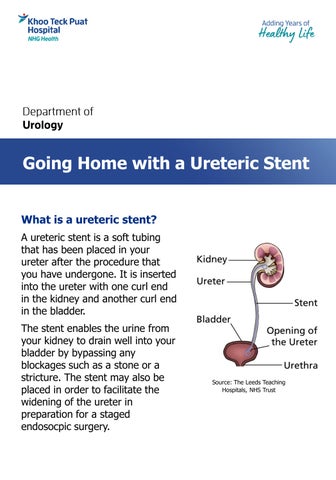
A ureteric stent is a soft tubing that has been placed in your ureter after the procedure that you have undergone. It is inserted into the ureter with one curl end in the kidney and another curl end in the bladder.

The stent enables the urine from your kidney to drain well into your bladder by bypassing any blockages such as a stone or a stricture. The stent may also be placed in order to facilitate the widening of the ureter in preparation for a staged endosocpic surgery.

Source: The Leeds Teaching Hospitals, NHS Trust

Stent Symptoms

Due to the stent in the ureter, it is common to experience some stent symptoms. These symptoms may last for the first few days after your discharge. In some cases, the symptoms may persist until the stent is removed.

• A small amount of blood in your urine. You may notice your urine may be stained pink to light red with or without small strands of blood clots. This will improve when you drink more water.

• Discomfort in your bladder and the flank on the side of the stent.

• Mild discomfort, sometimes described as pulling sensation, may be present particularly when you pass urine or during prolonged walking/strenuous activities.

• Irritation of the bladder

This may manifest as mild burning sensation when you pass urine, increased frequency of urination and a need to rush to the toilet (urgency). Occasionally, you may feel a sensation of incomplete emptying of the bladder.

• Men may experience some pain at the tip of the penis.

• Women may sometimes experience minor episodes of urine leak (incontinence).

When to seek medical attention?

Do consult a doctor or return to Emergency Department if you experience one or more of the following symptoms:

• Fever

• Worsening bleeding in urine

• Worsening abdominal or flank pain

• Inability to pass urine

• Sense of feeling unwell

• The stent gets dislodged - the stent is protruding outside of the body through the urethral meatus (urine pipe opening)

What should I do at home?

You are advised to drink 2.5-3L of water (unless if you have medical conditions for which your doctor has advised you to limit your fluid intake).

For mild discomfort/pain, you may take some painkillers as prescribed by your doctor.

What happens next?

The stent is a foreign body which cannot be left permanently in your body due to the risk of infection and encrustation (formation of stones on the stent itself).

For short-term stents you are be advised to return for removal of the stent or a staged operation typically within 2-6 weeks.

What should I do if I do not know my follow up appointment or have concerns?

Please call our contact centre at 6555 8828 if you have not received an appointment for the removal of the stent or the date of staged surgery, within 2 weeks of discharge. You may also walk-in to Urology clinic C44 (Tower C, level 4) to enquire about the appointment.

For clinical concerns or enquiries, please call our Urology Nurse Telecare Hotline at 9674 5239 (a service charge applies).

Stent insertion Record

Side Left / Right / Both

Date inserted

Expected date for removal/change of stent

Please call KTPH contact centre at 6555 8828 if you have not received an appointment for the removal of the stent or the date of staged surgery, within 2 weeks of discharge.

You may also walk-in to Urology clinic C44 (Tower C, level 4) to enquire about the appointment.

For clinical concerns or enquiries, please call our Urology Nurse Telecare Hotline at 9674 5239 (a service charge applies).

Turn static files into dynamic content formats.

Create a flipbook