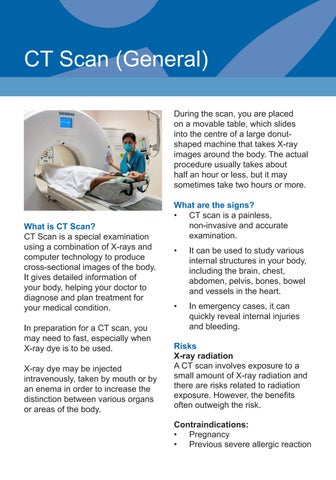
CT Scan (General) During the scan, you are placed on a movable table, which slides into the centre of a large donutshaped machine that takes X-ray images around the body. The actual procedure usually takes about half an hour or less, but it may sometimes take two hours or more.
What is CT Scan? CT Scan is a special examination using a combination of X-rays and computer technology to produce cross-sectional images of the body. It gives detailed information of your body, helping your doctor to diagnose and plan treatment for your medical condition. In preparation for a CT scan, you may need to fast, especially when X-ray dye is to be used. X-ray dye may be injected intravenously, taken by mouth or by an enema in order to increase the distinction between various organs or areas of the body.
What are the signs? • CT scan is a painless, non-invasive and accurate examination. •
It can be used to study various internal structures in your body, including the brain, chest, abdomen, pelvis, bones, bowel and vessels in the heart.
•
In emergency cases, it can quickly reveal internal injuries and bleeding.
Risks X-ray radiation A CT scan involves exposure to a small amount of X-ray radiation and there are risks related to radiation exposure. However, the benefits often outweigh the risk. Contraindications: • Pregnancy • Previous severe allergic reaction
What is X-ray dye? X-ray dye is a special liquid, known as contrast medium. It is injected intravenously through a small tube placed in a vein, often in your forearm during a CT scan to better define and enhance blood vessels and to outline abnormal tissue and organs. Risks of X-ray dye i) Allergy Some patients may develop allergic reactions to X-ray dye. These are usually mild and will spontaneously disappear. Allergic reactions may include headache, sneezing, vomiting, confusion, weakness, warmth, sweating, nervousness, difficulty in breathing, sickness in stomach, metallic taste, watery eyes, itchy eyes, itchy bumps on skin, red-colored skin, pale skin or uncontrollable shaking. Your risk of contrast medium allergy is usually higher if you have a history of asthma or multiple drug allergies. Please inform your doctor if you have a history of asthma or drug allergies. ii) Extravasation There is also a very small risk of extravasation, whereby the X-ray dye leaks out into the surrounding tissues in your arm causing swelling.
iii) Kidney damage There may be a small chance of kidney damage if you have any of the following conditions: pre-existing renal insufficiency, Diabetes mellitus, on nephrotoxic drug, hypertension, hyperuricemia or gout. Please inform your doctor if you have any of the above conditions. You will need a blood test to check your creatinine level, prior to the CT scan with intravascular X-ray dye. Depending on the degree of pre-existing kidney damage, the IV contrast enhanced CT scan may or may not proceed. This is to protect your kidneys from further damage. Important Points to Note 1. Please inform us if you have asthma, diabetes, renal problems or any drug allergy 2. It is recommended that you drink 500 ml of plain water before the scan and 250 ml of plain water every hour for 8 hours after the scan if you are not on fluid restriction 3. Patients who are diabetic may require to stop METFORMIN on the day of the scan and to resume after 48 hours of the scan. 4. Patient with asthma or has 3 or more different classes of drugs allergies will be given premedication.
5. If you have asthma / previous minor reaction to injection of contrast media, your doctor may have prescribed Prednisolone 10mg three times daily a day prior of the CT examination.
Please note that if your heart rate remains persistently high, we may not be able to proceed with the scan and your appointment may be rescheduled to another day. You may also be advised to go for an alternative procedure by your doctor.
6. Please take the medication as advised before coming for the CT scan. 7. Do inform your doctor and the CT radiographer if you are pregnant or unsure if you are pregnant. Preparing for your scan CT Scan Preparation •
Fast 3 hours before CT scan
•
You may take your medicines with small sips of plain water
TO NOTE •
Prior to your appointment, your doctor may prescribe certain medications. Please take these as prescribed
•
Please avoid any caffeinated drinks (coffee, tea, milo, coke, etc.)
•
Do not use Viagra, Cialis, Levitra for 48 hours before and after the scan
CT Enterography •
Fast 6 hours
CT Coronary Angiogram is a procedure to look for any narrowing in the blood vessels in your heart. During the scan, X-ray dye will be injected into your arm and a CT scan of your chest region will be done to take images of your heart, which involves ionising radiation. The scan will take about 20 to 60 minutes depending on your heart rate. It is important you to stay calm and follow breathing instruction for this duration so that the best possible images can be obtained.
After the procedure •
You can drive yourself home and return to normal activities
•
Drink lots of water for the next few days to flush the X-ray dye from your body
•
If you feel unwell, you should seek medical attention
Name _________________________ Venue Tower B, Level 2 (B25), Diagnostic Radiology Appointment Date _________________________ Appointment Time _________________________ Examination Fee _________________________ *If you are unable to keep the appointment, kindly call 6602 2700 (office hours) to inform us two working days before appointment and request for a new date.
DDR.PE.01.0225