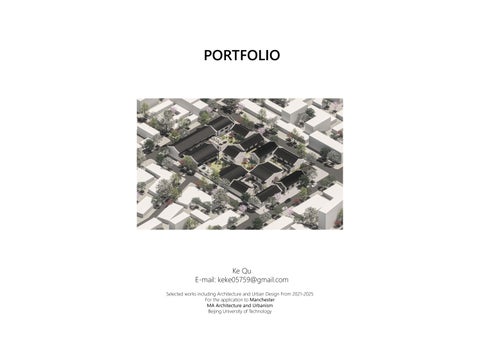
Ke Qu's Portfolio

Page 1


Beijing University Of Technology

B.Arch. in Architecture (Five-year Program) |GPA: 3.67/4.0 AWARD & HONOR

Architecture Internship, China Architecture Design and Research Group

1.Beijing Tongzhou Branch of the Military Museum of the Chinese People's Revolution: Participated in the production of physical models; conducted 3D modeling, as well as the creation of renderings and exploded view analyses; and drafted government bidding documents.

2.New Student Dormitory (Phase I), Baotu Spring Campus, Shandong University: Used SketchUp (SU) for 3D modeling, conducted site design and supplemented the site model; produced section axonometric drawings for analysis and use in government bidding documents.

3.Quanzhou Hotel: Used Rhino for 3D modeling, conducted site design and supplemented the site model; produced section axonometric drawings for analysis in government bidding documents.

Third Prize, 2023 (9th) Beijing University Students' Engineering Design Expression Competition

Top Project, 25th “Xinghuo Fund” college Innovation Competition

Gaozhi Scholarship at Beijing University Of Technology

Gaozhi Scholarship at Beijing University Of Technology

2025.08 Honorable Mention, ASIAN DESIGN AWARD COMPETITION

Responding to Wangfujing’s multicultural urban context through layered, organically growing circular volumes, the project adopts a “bamboo-joint” spatial order to create an urban cultural inn that integrates public accessibility with artistic expression.

Computer InDesign, Rhino, Grasshopper, Sketch-Up, Illustrator, D5, Unreal Engine 5, Revit, Blender, Photoshop

Language English (Fluent), Mandarin (Native)

01 Restoration Courtyard

Individual Work Site: Beijing,China

Instructor: Meizi Li Time: 2025.4-2025.9

This project is a course design that intends to establish a location in Beijing, China, where vulnerable members of society can unwind, heal, and receive treatment. Violence, natural disasters, and emotional neglect have caused irreversible harm in today's fast-paced society, leaving many unmet needs among those affected, including social disconnection, obstacles in public facilities, and inadequate care and treatment.

Through architecture, the design aims to address these groups' psychological and physical needs. With its features of enclosure and communal interaction, the traditional courtyard (Siheyuan) offers a spatial model of healing and care. The project transforms architecture into a medium of support and communal living by reinterpreting this typology within the framework of modern demands, creating an open and inclusive complex where communication, companionship, healing, and learning naturally occur.

Background

People In Need

By analyzing the various events that China has experienced since 2000, which have led to many people enduring suffering, these individuals can be categorized into three age groups: elderly, Disabled and Psychological unhealthy
The site is located in the Chaoyang District of Beijing, adjacent to the Third Ring Road.
People who are victims of domestic violence.
persons
with psychological trauma
Teenagers who are bullied
seniors

Relaxation Space

Two residential units are connected by a corridor to form one integrated area, with a green space in between and accessible pathways provided.

Public Activity Space

The open space between the psychological therapy room and the medical room serves as a public activity area, where people can practice tai chi or relax in the shade.

Reading Lounge

Larger windows are placed on the sun-facing side to enhance natural light, creating a more comfortable environment for reading and relaxation.

Second-Floor Lounge

The second-floor leisure space provides better sunlight exposure, encouraging social interaction and strengthening connections among people.

02 Equine Training Complex

Group Work Team Member: Ke Qu, Jiayi Shang Site: Liebestadt, a village in Dresden, Germany Academic Project, Instructor: Yu Zhai Time: 2024.09-2024.12

This project investigates how an equestrian centre can blend in with a mountainous setting without changing the topography. The architecture follows the natural topography because the design is integrated into the slope rather than producing a single dominant structure. The project is accessible while maintaining the separation of professional functions thanks to the arrangement of training spaces, stables, and public areas along a continuous, terraced path. In addition to extending the hillside, the green roofs enhance thermal efficiency and rainwater retention. The project transforms a conventionally closed facility into an open space for learning and experience by linking training, viewing, and educational spaces through a clear circulation system.

Site Analysis

LIEBSTADT - This small town located in the southeastern part of Saxony was once an important base for agricultural and forestry activities in East Germany. The estate is located on the edge of the forest, surrounded by forests on three sides and facing open grasslands and ponds on one side, with rich landscape layers. There are ancient horse stables and agricultural buildings preserved nearby,

Generation

on the ground floor, while the

level frames the arena and audience seating, drawing the surrounding forest into the viewing experience. Educational programs transform the venue into a place of learning and discovery, merging equestrian practice with encounters with nature.

Community gatherings-Opportunitiesfor public events and festivals, enhancing theproject's social role.

and

riding asleisure and educational activities for visitors and thecommunity.

This two-story equestrian center combines professional equestrian training with public performances, creating a “vital equestrian venue in symbiosis with the environment.” The cylindrical volume responds to both function and context, giving the project a strong spatial identity.

Volumn Generation
Curvilinear Framework Generation
Planar Field Organization
Volumetric Articulation
Regional culture and history - The surrounding areafeatures
Topography and landscape-The surrounding mountainsand lake shape the site's natural character and inspire thebuilding form.
Equestrian sports-Highlighting horse trainingand professional riding activities as the progject's corefunction.
Riding
education-Horseback

1st Floor Plan

Equestrian

The project includes an indoor riding arena, a stable, and an entrance exhibition space. The wooden structure creates a warm and natural atmosphere, while ensuring good ventilation and comfort for both horses and riders. The design aims to provide functional spaces for training, care, and cultural exchange within the equestrian environment.

Roof and Facade
Grid Framework And Beams
Column
First Floor Plan
Ground Floor Plan

03 Senegalese Primary School

Individual Work Site: Tieval Lao, Kolda,Senegal Instructor: Shen Gao Time: 2024.2-2024.6

Africa's education problems are getting worse. In Senegal, rural primary schools often don't have enough resources, which makes it hard for students to learn. For example, classrooms are too full, toilets aren't clean, and there isn't enough safe water. Also, the heat and bright sun make the campus less comfortable. The project begins by making educational resources better and incorporating the local culture and climate to make a campus that is open, shared, and long-lasting. The design takes into account the direction of the wind and the sun, which creates well-ventilated courtyard layouts with shaded corridors that keep the inside cool and make it more comfortable. There are more classrooms and bathrooms, as well as purification systems to meet basic needs. The school was built with local wood and corrugated metal to save money. It also has a band of ventilating louvers above the walls to make it more comfortable.

The site has been selected along the main road connecting two villages, with students primarily coming from nearby villages and using this main road to get to school.
The surrounding trees are retained, and the ground consists of typical sandy terrain.
The stream serves as the village's primary water source, with the site situated close for easy access.
The students mainly come from two nearby villages, typical African rural areas with a primitive living environment.
villages
Nearby villages
Mosque
wind
road
Senegal, Africa Kolda, Senegal Tieval Lao, Kolda

Wooden purlins span between trusses to support roofing materials.

Medical Room

Office

Classroom

5. Dining Room

6. Kitchen

7. Storage Room

8. Toilet / Restroom

structure composed of beam-column frames and trusses

An activity space enclosed by red bricks and wooden fences.

The roof is constructed with wooden roof sheathing beneath corrugated iron sheets.

Individual Work Instructor: Yihan Shi

Vertical Contract World looks at how extreme cold and a lack of energy change the way space is organized. In this situation, urban systems have to grow up, putting survival, production, and control all in one building.

The project suggests a centralized, modular vertical structure that combines living spaces, energy systems, and ways to run them. This model makes it easier for the environment to adapt and for operations to run more smoothly, but it also makes enclosure, hierarchy, and control stronger, showing how power and resources build up around a few key areas.

Architecture is generated not by form-making, but by environmental constraints, functional demands, and systemic rules. Standardized modules are stacked and rearranged according to a single logic, which creates a very strict spatial order. As height rises, density diminishes, and access becomes increasingly limited, creating a vertical gradient of authority.

A vertically structured contractual society

Module Connection Rules (WFC)

Human Habitat Clusters

Both cube clusters serve as human living zones, including residential education, medical , agriculture, and healthcare. However, the upper and lower clusters are strictly separated. Except for designated administrators, cross-level movement is prohibited, ensuring an absolute and controlled hierarchical order.

Supporting Platforms

The intermediate platform system acts as a transitional interface between the modular volumes and the structural framework. These platforms both receive loads from the upper cubes and organize spaces horizontally, defining connections and boundaries between different functional units. By introducing platforms, volumetric complexity is translated into a clear and legible spatial hierarchy.

Load-Bearing Structure

The structural system forms the primary load-bearing framework, transferring loads from volumes and platforms to the ground. Platforms adopt four-point or three-point support based on structural demand. Triangular truss columns and spatial trusses beneath platforms ensure stability, stiffness, and efficient load distribution.

Core Processing Cluster

The central cube cluster is dedicated to energy collection, processing, and computational operations that sustain the functioning of the system. Access is strictly restricted, and only authorized technical personnel are permitted to enter this zone, ensuring security, efficiency, and operational control.

The elevator is anchored to the supporting platforms and serves as the sole vertical connection between the upper, middle, and lower cube clusters. Each unit consists of an internal cabin enclosed by a glass shell reinforced with circular steel rings. Access is restricted to authorized administrative and technical personnel.

Other Work

01 Container Transformation Using Mycelium

Background

The increasing number of discarded shipping containers presents both a challenge and an opportunity. While their steel structures remain intact, conventional disposal methods lead to resource waste and environmental burden.

Mycelium, a bio-based material grown within organic substrates, enables agricultural waste to be transformed into stable building components, offering new possibilities for low-carbon and circular container architecture.

02 Design Representation

High-rise hotel design

Cultivation substrate Sterilization and disinfection Inoculation of mycelium Injection of nutrient solution Mold into shape Incubate in darkness Oven drying

Manufacturing operation Customized Mycelium Board Molding

First, place the mycelium into a mold to form usable-sized panels, and demold them after the natural growth cycle is complete, as shown in the figure on the right. Next, laminate the prefabricated mycelium panels with steel sheets to produce movable panels for practical use. Steel sheets for the upper and lower surfaces: Galvanized color-coated steel sheets with a thickness of 0.4–0.8 mm are adopted; alternatively, aluminized-zinc colorcoated steel sheets or plain galvanized steel sheets can be used as required.

Handmade
Site: Wangfujing, Beijing, China
Instructor: Ning Li
Date: 2025/03

Turn static files into dynamic content formats.

Create a flipbook
Issuu converts static files into: digital portfolios, online yearbooks, online catalogs, digital photo albums and more. Sign up and create your flipbook.