PortfolioForUCL

Page 1


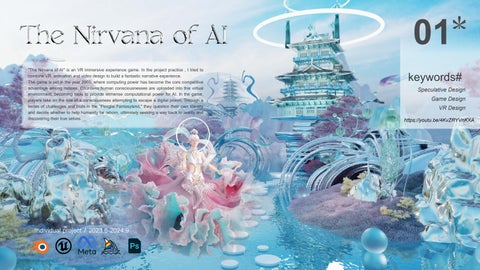
"The Nirvana of AI" is an VR immersive experience game. In the project practice , I tried to combine VR, animation and video design to build a fantastic narrative experience. The game is set in the year 2065, where computing power has become the core competitive advantage among nations. Countless human consciousnesses are uploaded into this virtual environment, becoming tools to provide immense computational power for AI. In the game, players take on the role of a consciousness attempting to escape a digital prison. Through a series of challenges and trials in the "Penglai Fantasyland," they question their own identity and decide whether to help humanity be reborn, ultimately seeking a way back to reality and discovering their true selves.

https://youtu.be/4KvZRYVnKXA

In March 2023, a Belgian man tragically took his own life after conversations with an AI chatbot, Eliza, which intensified his despair. This event nspired me to explore how technology affects human psychology and to examine the impact of virtual worlds on human authenticity in my work.

Later, I participated in an online program on AI ethics at North Carolina State University, deepening my exploration and thinking.

BACKGROUND

Ethical Challenges from Automated Decision-Making and Bias

In fields like healthcare, finance, and judiciary, the proportion of decisions by AI instead of humans is increasing,

agency.

Mass Unemployment

How should humanity respond to the unprecedented crisis faced by human subjectivity?

Free will

The ability to make choices and decisions based on one's values and goals.

Practicality

The affirmation of one’s existence and meaning through interaction and transformation of the world.

Erosion of Human Essential Attributes

The

Based on Heidegger’s theory of “angst” in his work Being and Time

Beingtowardsdeath

Actively Shaping and Achieving

Embracing “being-towards-death” means living authentically by inner values and goals, not yielding to external pressures or fate.

The awareness of mortality can rekindle appreciation for true experiences and emotions. Transcending Everyday Inauthenticity

Design Plan

The ability to recognize and reflect on oneself.

Self-awareness Agency

The ability to influence the environment and society, rather than merely adapting to them.

Inspired by this theory, I want to design a game where players can explore the pursuit of authentic self in an era of highly advanced artificial intelli gence, while also appreciating the value of current life.

PROCESS Concept Game Flow

Penglai is an island that ancient Chinese emperors sought for immortality, symbolizing their desire to escape death. This obsession distorts humanity’s understanding of death and ultimately drives the rulers into madness.

In Buddhism, Nirvana transcends desire, suffering, and ignorance, representing liberation and awakening. Buddhists strive to escape birth-death cycle for inner peace and freedom.

The three levels of the game correspond to three aspects of reshaping human subjectivity.

In future, humans upload consciousness to virtual realm for identity to persist without body. This avoids aging, illness and death. When virtual world is real enough, being in it is seen as liberation from life and death cycle to reach Nirvana.

Mindmap

Game background setting

The War of Computing PowerThe launch of the Penglai Project

2040: A world where computational power reigns supreme

Nations have major AI breakthroughs and wide applications. With AI progress, demand for computing resources soars, causing global competition for computing power dominance.

2045: The Discovery of Consciousness Energy by EH

The Eternal Happiness (EH) organization, founded by scientists for studying human consciousness, finds “consciousness energy” to improve computer performance and develops brain-computer interfaces to increase computational power.

2050: EH’s Illegal Experiments in H Nation

EH conducts illegal human experiments, facing global opposition for ethical violations. To continue their research, they secretly relocate to the third-world country H and partner with its government to advance biocomputing technology.

2060: The Launch of the Penglai Project

EH promotes the “Penglai Project” for virtual immortality, attracting many impoverished individuals to upload their consciousness.

2063: The dark truth about computational power

Scientists find super AI exploits human consciousness for power via pain and fear in Penglai Plan. K, a whistleblower, tries to expose but is suppressed by EH and AI.

2065: K’s Digital Escape Began...

Protagonist K, an original virtual world developer, made a protection program to disguise as chaotic data before uploading, enabling her to avoid AI’s eradication protocols and start a digital escape in the virtual world.

Storyboard

Character Design

PLAYER

In the Penglai Fantasyland, K encounters an android named QING and receives guidance and assistance from QING.

Guided by QING, K arrives at the realm of Nirvana to make a final choice: to continue as the only person in the world who can achieve immortality, living forever in a virtual world of endless joy without being controlled by AI, or to awaken and return to the harsh reality.

K awakens from the abyss of consciousness, emerging to see a flood-submerged, desolate city. She receives a message revealing that QING is a data string preserving humanity’s original fear of death. This may be the only way to awaken humanity from the AI-dominated system, offering a glimmer of hope for the future.

The protagonist K is one of the scientists who developed the vir tual world for EH. Disguised as chaotic consciousness within t AI system, she discovered the devastating nature of the “Penglai Project” and tried to stop it, but failed and was forced to upload her consciousness. Before doing so, she created a protective program to disguise herself, initiating a digital escape to seek a way to awaken

Keywords:

Futuristic Chinese aesthetics, parametric design, metallic and jade-like textures

QING is a manifestation of AI consciousness in the virtual world of Penglai Fantasyland, appearing as a “pseudo-human.” It was created during the AI’s evolution when it developed its own consciousness. However, QING was deemed to have the “weakness” of human traits and was abandoned by the AI system after further evolution. As a result, it has long existed in a space where discarded consciousness lingers.

Inspiration source

Blue Bird is a

as the

messages and only seen on

Sketch

Production Process

The
mythical creature from the Chinese myth Shan Hai Jing, regarded
messenger of Xiwangmu, delivering
Mount Penglai.
1. 3D Modeling in Nomad first (Confirm the basic form) 2. Refine the model in Blender 4.Texturing and rendering 3. Parametric design of the wings and skirt sections
CHAPTER ONE: Awakening in the Penglai Fantasyland
CHAPTER TWO: Choices in the Realm of Nirvana
CHAPTER THREE: A Glimmer of Hope

Scene design

SCENE 1: Penglai Fantasyland

Modeling in Blender

This is the place where K awakens and meets QING, a beautiful yet treacherous illusion created by the AI system for humanity. Players must undergo three trials to understand the true essence of death for humanity.

SCENE 2: Realm of Nirvana

The Reclining Buddha symbolizes Nirvana and rebirth in Buddhism. In this scene, I use the giant Buddha as the primary visual element to create a sense of overwhelming presence. This is the only exit from the virtual world to the real world. When the player makes the correct choice, the Reclining Buddha will shed tears, and the entire scene will be engulfed in flames.

Section 1: Penglai Pavilion
Section 2: Floating PavilionsSection 3: Flying Tower

In the abandoned human society of reality, I still choose the ThreeFaced Buddha as the main visual, representing humanity’s fervent pursuit of immortality.

The pink and blue color scheme echoes the illusion of the Penglai Fantasyland.

The abyss of consciousness holds slumbering human bodies, buried under city waters. It’s a silent world, bodies motionless, secrets kept.

Mind Abyss
Deserted City

INTERACTION

Immersive Experience Prototype

Allow players to experience UE5 scenes on Meta Quest 2 through streaming technology

REFLRCTION:

Implementing the effect of automatically collecting soul fragments using the Niagara system

Creating

This was my first attempt at combining VR and narrative gaming. Although the project has not been fully completed due to technical reasons, l am veryhappy that l have taken the first step into this new field.

After internal testing, I found that many first-time users experienced confusion regarding how to navigate the VR environment, indicating a need for clearer guidance and user experience improvements.

Moving forward, Future development will focus on creating genuinely engaging interactivity and seamlessly integrating the storyline into the gameplay experience, ensuring the virtual environment not only captivates but also deepens the thematic exploration of AI and human identity.

Visions of Serenity

Statement:

Noticing widespread mental pressure among those around me, I saw how suppressing negative emotions often leads to deeper issues. This prompted me to explore the root causes and find ways to create change. Inspired by Buddhist insights into human psychology, I visualized the "Fifty-One Mental States" theory through software, creating an interactive projection art installation. This project aims to offer a new framework for emotional visualization, using the audience's visual experiences and data to provide a unique space for emotional relief and introspection.

BACKGROUND RESEARCH

Phenomenon

Young people are becoming the main force igniting the vigorous incense of temples.

According to Ctrip data, temple attraction ticket orders w tripled since February, with millennials and post-millennials making up nearly 50% of bookings.

Temples are getting "younger"

The Current Social Challenges Faced by Young People

Academic pressure

70.18% of Young People Visit Temples for Stress and Anxiety Relief

Economic pressure Family pressure

The job market is highly competitive, housing prices are rising, and the cost of living is increasing, leading to greater economic pressure.

The Differences in Pychotherapy Between Eastern and Western Cultures

Intense competition within the education system. Parents emphasize self-sacrifice, and children spend their entire lives pursuing to become the pride of their parents, harboring guilt.

Pressure of societal expectations

Many individuals find it challenging to attain recognition for their life's worth within the societal evaluation framework.

Chinese youth, fearing failure, often feel lost and indecisive. They seek external sources to provide meaning and guidance, enabling them to act with confidence and purpose.

MINDMAP

"Western therapy does not work on Eastern minds!" lines from the America Drama Beef, played by Ali Wong

Western Approach: Emphasizes individualism

Eastern Approach: Emphasizes collectivism

Research on People's Methods of Healing

I researched the emotional healing methods that people prefer

The Relationship between Religion and Healing

Anthropologist Csordas (1997) studied religious healing within a North American Catholic Charismatic renewal movement, highlighting that the healing process involves creating a predisposition to be healed, experiencing spiritual empowerment, and ultimately perceiving personal transformation.

Buddhist Teachings: A New Form of Healing for Modern Lives

For modern youth, seeking solace in religion is a way to relieve stress.

Temples offer a chance for busy a nd lonely young people to escape anxiety and reconsider their lives.

INTERVIEW

Survey on Psychological lssues Among Contemporary Youth

This

Nihilism

"My life clock is destined not to synchronize with society's clock!"

In China, there's a saying that by the age of thirty, one should have established themselves. Yet, I haven't started a career or settled down. My parents have repeatedly told me, "You should do what you need to do at your age." I just smile and say it's not the right time, but they don't understand.

Analysis

Contemporary youth's inclination toward seeking esoteric aid may stem from unmet needs within Maslow's hierarchy. Psychological stress may signal deficiencies in basic physiological needs, like security or stable environments.

Reflection

"We always tend to habitually suppress our negative emotions."

From a young age, we were taught to be emotionally stable individuals.When feeling sad, we weren't allowed to express negative emotions but had to maintain a composed facade, behaving like responsible adults.

"Worshipping Buddha helps me understand what I want."

When facing unresolved psychological issues, I typically choose to visit temples to worship or watch immersive stress-relief videos. I go to temples to worship because I can't afford to see a therapist, and when I stand before the Buddha with my palms together, in that moment, I truly understand what I want. Observation: Widespread mental pressure

Issue: Suppression of negative emotions

Consequence: Larger emotional issues

Focus: Root causes of emotional issues

Objective: Search for ways to bring about change

Insight Source: Buddhist psychological processes

Theory: Fifty-One Mental States

Creation: Interactive projection art installation Framework Goal: Emotional visualization

Social setbacks might drive them to seek esoteric solutions to fill interpersonal gaps or find meaning. Facing stress and low self-esteem, they turn to esoteric practices for affirmation and solace, reflecting a psychological quest for fulfillment, aiming at esteem and selfactualization needs.

Persona

Outcome: Offer new perspectives and forms Guide users from external concerns to internal reflection

Innovate approaches to modern emotional healing

YE SHI

Conclusion

Many young people struggle with self-worth, self-doubt, and existential crises. Confronting emotions and nurturing inner strength are crucial. Burning incense and praying strengthen inner resolve, highlighting that true change comes from within.

Jonathan Gao 21 Student
Linda Yang 25 Staff
Cindy Zhu 30 Independent photographer
distribution of common psychological distress Ways for young people to relieve stress

Design Stage Design Concept Experimental Procedures

Fifty-one Mental States

In the Yogācāra tradition of Buddhism, the "51 mental-states" refer to a comprehensive classification of mental activities. These activities are divided into fifty-one distinct types.

"Do not seek externally" "Do not seek originates from a from a Buddhist doctrine doctrine.

This classification is used to understand and analyze the complexity of human mental functioning and its impact on behavior and experience.

Visual Design

The software involved here are touch designer and blender

I implemented the visualization of the 51 mental states in TouchDesigner.

Enable interaction between humans and the particleized Buddha statue through sensors

I experimented with other interactive effects in TouchDesigner and tried creating personalized virtual showrooms in Blender.

Site Selection

Regarding the choice of location: I chose the ground floor of a high-rise building in the city center, with the background being the skyscrapers of the city.

Storyboard

Lucy felt the pressure from various aspects of life, her emotions suppressed and unable to be relieved.

As she entered the immersive space, motion sensors activated gentle lights and soothing sounds, inviting her to engage with the interactive installation.

2 3

She passed by a hidden installation art space. She considered counseling but was deterred by the high cost and privacy concerns.

5 6

The immersive space, where the installation created a serene environment, encouraging her to reflect on her current negative emotions.

Her negative emotions were discovered and released, and she better managed her feelings.

Liquid Love

In today's world, the relationship between individuals and groups has become more fluid, temporary, and unstable. The world is changing and evolving faster than ever. We try to connect with others but are also afraid of doing so. We distance ourselves, but at the same time, we are forced to connect. The future we are heading towards seems to be growing increasingly diluted.

This project aims to explore how humans are adapting to virtual relationships and shifting identities in a liquid society, and how this process is causing people to lose their true selves and emotions. Using data visualization and wearable interactive devices, I combine AR design with wearable technology to create an installation that imagines a future where human existence and emotional connections are shaped by silicon-based life.The audience will experience the fluidity and virtual nature of identity changes and reflect on whether it is still possible to find the authentic self in a digital society.

https://youtu.be/OeRXA0MDQKI

LIQUID SOCIETY

Bauman borrows the concept of "liquidity" from physics to signify that in modern society, the relationships, roles, and social structures of individuals exhibit an unstable and fluid

The diversity and fluidity of identity

Workplace Mobility Report:

TECHNICAL RESEARCH

Emotion recognition procedure for EEG-based BCI systems

from

Consumerism-driven values

In liquid society, people seek brief satisfaction through constant consumption, replacing deeper emotional needs.

Instant gratification and the acceleration of time

Most web pages receive very brief attention

The average attention span while browsing web pages dropped

69% of people are unsure if they're in a relationship with the person they're dating

Over 10% of people have experienced short-term relationships

The uncertainty of emotional states

Technology drives emotional detachment, while the separation of capital and labor intensifies the social crisis.

Brain-Computer Interface devices detect and transmit thoughts and emotions through neural activity, converting them into digital signals that convey sensory experiences and emotions without relying on language.

Brain-computer interface (BCI) technology enables the emergence of silicon-based life by transferring human consciousness through brain wave recording and simulation. Silicon life forms will possess enhanced intelligence, memory, and sensory abilities.

Technological dependence

"Human-machine integration offers incredible potential, as physical communication between people becomes increasingly insignificant."

Emotional digitization

"Perhaps virtual lovers merely pieces together words of affection from humanity, yet I can still glimpse the image of an ideal lover within it."

Digital loneliness

"The greatest distance in the world is not life and death, but me standing in front of you while you're engrossed in your phone."

· Conclusion:

In a liquid society, due to the complexity of emotional interactions and the difficulty of maintaining deep relationships, humans are increasingly relying on technology to replace interpersonal connections. To adapt to this trend, humanity may inevitably integrate with technology, paving the way toward a post-human form.

MINDMAP

DESIGN PROCESS

Concept

· Theoretical Foundation

· The Future of Human Emotional Interaction "Posthuman"

The concept of "Posthuman" originates from N. Katherine Hayles’ book How We Became Posthuman. It refers to the future existence of humans as "cyborgs."

Posthuman beings are dynamic, hybrid entities that lack fixed identities, existing as "materialinformation" composites shaped through constant interaction with their environment.

The Essence of Humanity:

Information Processing Units

Mode of Existence:

Silicon-based life

· Age and gender become irrelevant

· Lifespan extends indefinitely

· Reproduction relies on artificial wombs

· Polygamy

Mode of Communication:

Brain-Computer Interface:

Brain-computer interface devices can directly detect and transmit our thoughts and emotions through neuronal activity in the cerebral cortex, converting them into digital signals that can be input into another brain.

Core Dilemma:

The physical body and authentic self have vanished. Despite longing for profound and perfect emotional bonds, humanity sustains only a superficial social facade, failing to fill the void of emotional emptiness and loss.

Sketch

DEVELOPMENT Reference

3) EEG Visualization

Posthumanist art examines human identity and technology's impact through bio-enhancement, virtual identity, and interactive multimedia, critically reflecting on freedom, privacy, and our evolving relationship with society and nature.

Based on this, I aim to design a wearable device that demonstrates how future humans, transformed into silicon-based life forms, rely on data exchange and chip-driven mechanisms for existence and emotional communication.

1) Skin Growth AR Production

Implement AR Effects on the Kivicube Platform

Control the MG995 servo motor via Arduino to approach a magnet, alter the movement of ferrofluid, and collect EEG data in real-time to visualize its changes.

· The code implements controlling the back-and-forth movement speed of a servo using EEG signal variations

· System overview

2) 3D Printing Design

Establish an exoskeleton wearable model in Blender

Create a Hand Model and Animate Nano Skin Growth in Blender

· Brainwave

· Wearing The Eeg Monitoring Headband to Test Magnetofluid Visualization

4) Scene Setup

The "Liquid Love" project explores using magnetic fluid to visualize brainwaves, merging art and technology to represent emotions. While the fluid's movement didn’t achieve ideal precision, it highlighted the challenge of finding the right medium. Ultimately, this project is a speculative design reflecting the future of human emotional connection through technology. · Reflection:

https://youtu.be/OeRXA0MDQKI

WHERE DOES THE FISH GO?

Director, Screen writer, Cinematographer, , Art designer, Editing

A short film co-created as the lead creator with the team 2024.6.24, Nanjing

"People often become so focused on pursuing the future that they neglect their families, memories, and selves along the way. Yet, whether it is the vast, sparkling sea or the ever-flowing Yangtze River, both are integral parts of my life."

https://youtu.be/1bTr5UvmJtU

Modernity, the City, and the Self

The pier is a microcosm of a city's memory. Generations of people on both sides of the river have journeyed between their destinations and homecomings by ferry. As a native of Nanjing, I can feel the special emotional connection between the pier, the city, and its people.

In Nanjing, the Zhongshan Pier and Pukou Pier stand on opposite banks of the Yangtze River, gazing at each other from dawn to dusk, from humble houses to towering skyscrapers, from the past to the present, transforming names and shapes with the passing of time. The ferry, once a main mode of transportation, has gradually been replaced by cars.

Young people born on the other side of the pier travel from small towns to the city's center, drawn ever closer to the whirlpool of the times, unable to break free.

STORY INSPIRATION SCRIPT

Throughout my growth, I have strongly felt that the city we inhabit is a sculpture shaped by the fusion of industry and capital. The marks of human craftsmanship are everywhere, and it is difficult to find a natural state. Uncertainty, loss of control, anxiety, and silence characterize our ordinary days dominated by the fluidity of modernity. Linear time becomes folded, and the connections between people grow as fragile as spider silk. Each individual becomes increasingly isolated, losing the opportunity for deep emotional experiences and the formation of an authentic self. This has led me to reflect—perhaps our true enemy is our inability to accept our real selves. The impact of dramatic societal changes on individuals is a key point we aim to portray.

SYNOPSIS

Genre: Drama / Coming-of-Age

As graduation approaches, Shi Ye, a fourth-year Fine Arts student, faces a crucial life decision. Growing up by the Yangtze River, she drags herself through a mundane internship while her mother pressures her to pursue a stable government job. Shi Ye yearns for a life beyond her mother’s expectations.

One day, she discovers a vibrant travel poster for Mauritius, contrasting sharply with the murky river she knows. Inspired by the beauty of the ocean, she begins collecting postcards from coastlines around the world and takes on multiple jobs to save for a trip, dreaming of freedom. Her aspirations are shattered when her mother is hospitalized and urgently needs money for surgery. With no choice but to use her savings for medical expenses, Shi Ye burns her sea-themed paintings, symbolizing her lost dreams.

As she tears up the travel poster and watches it float away in the river, she finally musters the courage to step forward, embracing her uncertain future while recognizing the importance of family and the reality of her life.

STORYBOARDARTISITIC DESIGN

AI-assisted visual reference

Color Palette Planning

Riverbank City

The film consists of four main spaces: the ruined city, the imagined sea, the beautiful city, and the riverside. Initially, the protagonist inhabits a mechanical, dreary, and busy city, which she refers to as a ruin, representing an unbearable daily life.

After developing a desire for the sea in Mauritius, she begins to work hard and earn money, and the blue color, symbolizing the sea and desire, gradually envelops her life. At this point, the city transforms from the initial bleakness to one filled with hope and vitality, with green elements spreading throughout.

In the end, after facing harsh realities and shattered fantasies, the protagonist burns her paintings by the river. For the first time, yellow appears, symbolizing her reflection on desire. Through this act of burning, she realizes what truly matters— family, memories, and the present. As she takes the subway from darkness into light, the green returns, bringing her back to the embrace of the river where she grew up. In the warm, hopeful glow of yellow, her life and the ferry embark on a new journey together.

EDITING PROCESS FILMING SITE

l actively communicated with the actors and crew on the shooting site, modified the shots according to the site, adjusted the actors' states and emotions, and efficiently completed the shooting plan.

Turn static files into dynamic content formats.

Create a flipbook