
North of Boston | Massachusetts 250th

Page 1


250 Ways to Explore, Discover, and Celebrate

What Cheer?

That’s the friendly greeting you may have heard in the streets North of Boston at the time of the American Revolution. Now we say “Hello” or “Whaasup?” And our welcoming spirit extends to everyone, in every season of the year.

You may know our region for Salem and its witch lore. For Gloucester and its fishing prowess. For Ipswich and its perfectly fried clams. But in this place where the seeds of our nation were planted, there’s more to the story.

Have you been to Hamilton, Massachusetts—the first city named after Alexander (187 years before LinManuel Miranda was born)? Tasted Joe Froggers, the

chewy cookies invented in Marblehead by formerly enslaved tavern owner Joseph Brown? Traced your ancestors in a library where diaries, photos, and postcards have been stashed away for generations?

As America celebrates 250 years of independence, this guide, created in collaboration with our partners at Yankee Magazine, is filled with 250 ways you can discover more of our collective history and your own story in vibrant towns and cities where there’s still a rebellious desire to define what’s next. Come. Celebrate our past. Meet our future. And feed your mind and soul.

For more travel ideas, visit our website: northofboston.org

Nancy Gardella , Executive Director

Rebecca Shackford , Marketing & Group Sales Manager

Holly Perry, Digital Content Manager Editorial & Production Services

Jenn Johnson, Senior Managing Editor

Kim Knox Beckius, Travel Editor/Project Manager

Keith Polasko, Copy Editor

Katharine Van Itallie, Art Director

Heather Marcus, Senior Photo Editor

Dave Ziarnowski, Production Director

Jennifer Freeman, Senior Production Artist

Contributing Writers

Kim Knox Beckius, Madeline Bilis, Michael Colbert, Andrew Collins, Mariya Greeley, Kim Foley MacKinnon, Elyse Major, Andrea McHugh, Alexandra Pecci, Mike Urban, Laurie Bain

PHOTO: DENIS TANGNEY
COVER PHOTO BY ROBERT SERBAGI
THIS PAGE: The seafaring past mingles with present-day fare at Gloucester Harbor, where
smartphone-narrated HarborWalk trail winds among boutiques, eateries,
PHOTO: DENIS TANGNEY JR/ISTOCK

Visit Revolutionary War Sites North of Boston

The North of Boston region has major bragging rights when it comes to sites associated with the nation’s fight for independence. While Lexington and Concord get recognition for “the shot heard round the world,” other Massachusetts towns also witnessed pivotal events that shaped the country’s future. On a trip north to Newburyport from Salem, these 10 lesser-known sites will give you a fresh perspective on this chapter in history.

Salem

In late February 1775, Salem’s spirited locals rallied against British Lieutenant Colonel Alexander Leslie and his troops in what became known as Leslie’s Retreat , aka the Salem Gunpowder Raid. Historians credit it as the first armed (albeit nonviolent) resistance to royal authority, predating the battles of Lexington and Concord. A historical marker at the intersection of Commercial Street and Green Trail commemorates the episode.

The Pickering House, which dates to 1660, is the birthplace of Colonel Timothy Pickering, a soldier in the Revolutionary War who was appointed Quartermaster General by the Continental Congress. George Washington once visited his house, and you can too; today it’s a museum operated by the Pickering Foundation.

Swampscott

On a fateful Christmas night in 1776, General John Glover rowed General Washington’s Continental Army across the Delaware in a surprise attack on Hessian mercenaries. The General Glover Farmhouse, built in the 1700s, was this hero’s final home, and it remains standing on Salem Street. The community is saving it from demolition with hopes of restoring it for America’s 250th.

Gloucester

Stage Fort Park, dating to 1623, still dominates from its high vantage point, with pretty harbor views once crucial to defenses in the Battle of Gloucester. Today, a plaque honors the soldiers and sailors who aided the cause of freedom. And you’re free to enjoy the peaceful beaches, playground, and visitor center.

Rockport

The 1623 Benjamin Tarr House, one of many colonial houses in Rockport, is a revered landmark where 66 villagers gathered before marching to Charlestown to bear arms in the Battle of Bunker Hill. As time marched on, the house became a tearoom (oh, the irony!), apartments, a newspaper office, and, currently, a vacation rental you can book on Airbnb.

Marblehead

During the war, the Sons of Liberty, including Elbridge Gerry (think gerrymandering) and General John Glover held meetings upstairs at the Old Town House—if only walls could talk. The handsome yellow clapboard Georgian built in 1727 still stands in Market Square.

Built in 1755 to store muskets, ammunition, and gunpowder, the

circular brick Powder House is believed to be one of only three remaining preRevolutionary powder houses in the U.S. Located on Green Street, the building is not open to the public, but its ability to contain a potential explosion of unstable black powder can be admired from the outside.

After a rebuild in 1775, Gale’s Head Fort had Marblehead’s back during the Revolution, and at one point was garrisoned by Colonel John Glover’s Marblehead Regiment. Now known as Fort Sewall, this public park boasts waterfront vistas as well as bunkers and underground rooms that once held prisoners.

Newbury

In September 1775, 1,100 men set out on the ill-fated Quebec Expedition, led by Benedict Arnold. The bronze Benedict Arnold Encampment Memorial on Newbury’s Upper Green marks the site of Arnold’s military training ground. The green also happens to be a lovely spot for picnics and pond skating.

Newburyport

The Old South Presbyterian Church was a gathering place for patriots seeking to connect the roles of faith and independence during the Revolutionary War. The church is also where Benedict Arnold gathered his troops before departing for Quebec. Fast forward a couple centuries: An America 250 Patriots Marker was recently dedicated here by the Daughters of the American Revolution to commemorate the 250th anniversary of the Quebec Expedition.

LEFT: Banners yet wave at Fort Sewall, plus there are dazzling panoramas of Marblehead Harbor and surrounding islands. RIGHT: Marblehead’s Old Town House has been in continuous use for nearly 300 years and features an arresting local-police museum on the first floor.

Attend a North of Boston

This summer, the nation will party like it’s 1776 (but with air conditioning . . . and with more all in “liberty and justice for all”). Get out your powdered wig, dust off your breeches or corset—or, you know what? Just do you. Because this eventful 2026 is all about independence. We flagged these 11 commemorations in towns where the revolutionary spirit lives on. And where a cold Sam Adams is never terribly far away

Topsfield

Citizens of this agricultural town bravely helped fight back the British at the Lexington and Concord battles, and the Topsfield Historical Society is devoted

to researching and memorializing their heroism. The society’s 57th Strawberry Festival takes place June 13, 2026, on the town’s common. Their Parson Capen House, a prime example of First Period architecture dating to 1682, overlooks the common, and tours of the house are offered during the festival. Children’s games, music performances, and arts and crafts round out the fun. Plus, there’s the true hero of the festival: strawberry shortcake.

North Andover

This colonial town’s contributions to the fight for independence are brought to life at the North Andover Historical Society.

The Redcoats may not be coming, but you can still feel a patriotic rush when Glover’s Marblehead Regiment shoulders the muskets for an authentic reenactment.

Aspirations of Ordinary People—The Stories of the American Revolution from a Local Perspective, an exhibition that runs through December 31, 2026, is part of REV250, a series of programs dedicated to shining a light on the Revolutionary record.

Beverly

Ken Burns’ six-part documentary, The American Revolution, features the exquisite military scenes that now hang in Beverly’s 1781 John Cabot House as part of its American Revolution: A Story of the War in 28 Paintings. The public showing runs through July 4, 2026.

Haverhill

Visit the Museum of Printing to see “the most lethal weapon of the American Revolution,” a replica of a colonial-era printing press, Saturdays until November 2026. In addition to receiving an onrequest demonstration of the machine, guests will learn how The Declaration of Independence was printed (before the signed, handwritten version) using movable metal type—in other words: how printing created the United States.

Newburyport

Yankee Homecoming is an annual summer tradition that began in 1958 to celebrate New England’s heritage. Weeklong festivities include walking tours of historical sites, nightly waterfront concerts, a veterans luncheon, cornhole competitions, a kids talent show, and Coast Guard tours (the Coast Guard was born in Newburyport), and culminate with a parade and fireworks. This year’s Yankee Homecoming, July 25 to August 2, 2026, will be a Yankee Doodle Dandy.

Gloucester

The annual volunteer-run Gloucester Fishtown Horribles Parade tackles a political or cultural topic with themed floats and costumes. The procession, slated for July 3, 2026, ends with a bang of pyrotechnics over Gloucester Harbor,

the same harbor that played a starring role in the Battle of Gloucester early in the American Revolution.

Marblehead

The Fourth of July is always a starspangled fete in this seafaring town. The harbor is brightened with flares ignited along the coastline, and combustibles burst in air as part of the town’s annual Fireworks and Harbor Illumination. Anticipate a banner spectacle for America’s 250th.

Each third weekend of July (July 18 to 19 in 2026), Glover’s Marblehead Regiment , a reenactment troupe, marches from Fort Sewall to the beach, as they imagine Revolutionary soldiers would have done in response to British ships stalking the harbor. The occasion is bedazzled with fife-and-drum music, children’s activities, butter-making demos, and sea shanties. And, yes, muskets will be fired.

Salem

In May, the country’s oldest continuously operating museum, the Peabody Essex Museum, debuts an exhibition about Salem printer Ezekiel Russell’s involvement in circulating the Declaration of Independence, including a modern interpretation of the nation’s founding document. Pressing Importance: Salem and The Declaration of Independence is on view May 2, 2026, through July 25, 2027.

Honoring America’s Semiquincentennial and Salem’s quadricentennial, the 18th annual Salem Arts Festival takes place June 5 to 7, 2026. The family-friendly event casts a spell over attendees with unexpected popup art displays; a live mural slam; and theater, music, and dance performances.

The annual Salem Heritage Days festival will salute Witch City’s 400 years and the USA’s 250th birthday in 2026. Forward-thinking pursuits include planting shade trees to beautify the city and combat climate change. And on August 1, 2026, a Salem Through the Centuries parade will entertain with chronologically organized floats and bands that represent periods of Salem’s evolution.

Taste Dishes that Have Been Around Since Colonial Days

Got an appetite for classic New England dishes the colonists would have raved about if they’d only had Yelp? Here’s your guide to essential 17th-century eats, along with suggested North of Boston restaurants that make time travel possible for your taste buds.

Chowder

From clam to corn, you’ll find chowders of all kinds on menus across the region. In Newburyport, check out the chowder at The Grog, a convivial restaurant on Middle Street. Their version features a milky broth loaded with minced clams and finely diced potatoes. And it’s speckled with a red-hued ingredient that adds its own unique flavor. Is it sherry? Paprika? The staff isn’t saying, but it definitely sets this chowder apart.

Brown Bread

New England brown bread became “the thing” during the 17th and 18th centuries, when colonists used rye and cornmeal in their bread baking. The loaves were steamed over open fires, with molasses making its way into the mix once it became available through international trade. Eventually, the now-familiar can method took hold for forming and steaming the dough. For an authentic homemade brown-bread experience, check out Nason’s Stone House Farm in West Boxford, where they sell fresh and frozen versions.

Apple Cider Donuts

The wedding between apple cider and donuts is generally believed to have occurred during colonial times. Cider Hill Farm in Amesbury is one of the best places to go for this autumnal treat. The farm presses its own cider and makes cider donuts by the hundreds every fall day. You can purchase a bagful or just one, fresh out of the fryer in the cavernous farm-stand barn, and enjoy it with a cider slushie, hot

cider, or hard cider if you’ve reached the ripe old age of 21.

Salt Cod

Since there was no refrigeration in colonial days, salting cod became a method to keep this bountiful New England fish preserved for lengthy periods of time. Salt cod is cured in beds of salt then soaked for several days to desalinate prior to cooking. Today, Portuguese Americans remain particularly fond of salt cod. At the

Trackside Bar and Grill in Peabody, you can enjoy the popular Portuguese saltcod dish known as bacalhau. You’ll be charmed by this neighborhood restaurant as you sample the type of cod that kept many American colonists alive during the long winter months.

Yankee Pot Roast

Stewed beef with vegetables, which became known in New England as Yankee pot roast, served as a staple in colonial kitchens for decades and was

Bake Joe Froggers at Home

At newengland.com/food/ desserts/joe-froggers, you’ll find an authentic recipe from Yankee Magazine for this treat invented in Marblehead.

often accompanied by a fresh-baked loaf of bread for sopping up the rich, flavorful gravy. In Ipswich, 1640 Hart House serves up a piquant pot roast in its tavern restaurant, and it comes with mashed potatoes on the side.

Clambake

Clambakes originated with pre-colonial Indigenous Americans, and they’re still a ubiquitous offering thanks to several fine catering operations in the region. Not hosting a catered event? You can

FROM LEFT: An abundance of locally sourced seafood and sides spreads before you at Woodman’s of Essex; Joe Froggers cookies are named after Joseph Brown, the Revolutionary soldier who owned the tavern where they were first served.

always improvise by going to Woodman’s of Essex and ordering boiled lobsters, steamers, and corn on the cob to feast on beneath their tents out back.

Roast Turkey

Turkeys are native to North America, and colonists made good use of them in much of their cooking. Raymond’s Turkey Farm in Methuen is a great place to indulge in all things gobbler. The farm raises its own birds, and they may be purchased (fresh or frozen) for roasting back home or in the form of turkey pies, homemade gravy, or even single servings of meat and sides for instant gratification.

Joe Froggers Cookies

These soft, chewy cookies date back to the late 1700s. They were invented by Lucretia Brown, whose husband, Joseph Brown, was a formerly enslaved man who owned a tavern in Marblehead. Flavored with rum, molasses, ginger, allspice, nutmeg, and cloves, the cookies were popular throughout the colonies. The Muffin Shop in Marblehead still bakes batches of these colonial confections and features them regularly in their display case.

Have a Pint at a Tavern Where Revolution Was Whispered

Taverns were centers of community for American colonists, who gathered to raise a pint with their neighbors and talk politics. But as rumblings of dissatisfaction with the British king grew louder, taverns became important meeting places for people like Sam Adams and other patriots to speak in hushed tones—and eventually shout—about revolution.

Just 20 years after the Pilgrims landed in Plymouth in 1620, a tanner named Thomas Hart built himself a one-room house in the North Shore town of Ipswich. Centuries of additions and transformations later, that modest home is now the 1640 Hart House, where each room is its own cozy, intimate dining area, and you can toast some of America’s earliest beer drinkers with each ale you toss back.

Before becoming one of Salem’s most beloved breakfast and lunch spots, Red’s Sandwich Shop was the circa 1698 London Coffee House, a meeting place for patriots to discuss taxes and tyranny in the lead-up to the American Revolution. Visit today for a beer and steak tips Benedict (no judgment here!), and plot your own bold move.

Toast 250 at North of Boston’s Breweries and Cideries

Just like in colonial days, local beer and hard cider are beloved North of Boston. Design your own pub crawl with this guide, and raise a glass to all the innovation that’s brewing.

Housed in an antique mill building on the Merrimack River, The Tap Brewing Company in Haverhill pairs a brewpub lunch or dinner with a rotating selection of on-tap beers, like the Riverman, a roasty, chocolatey London porter, or the Golden Slipper, a light and fruity Belgian tripel.

Bent Water Brewing Company concocts its beer onsite from start to finish, right down to the canning, starting with Lynn’s award-winning (really!) municipal water. Sample ever-changing seasonal and limited-edition brews, or year-round faves like the New England double IPA Super Sluice and the pre-Prohibition-style Premium Lager.

True North Ale Company’s Ipswich alehouse bustles with trivia nights, live music, drag shows, craft classes, and the Big Pig Barbecue food truck parked outside. At the center of it all, though, are the beers, like the light and refreshing Cerveza Mexican lager and the hazy, fruity North Shore IPA.

Beers like Plum Island Belgian White and Green Head IPA deliciously nod to Newburyport Brewing Co.’s coastal Newburyport home. Pack a picnic dinner (or have dinner delivered right to the bar) to enjoy these and other suds along with live music five nights a week. Bonus? They also have a free-to-join pickleball club.

Far From The Tree leans into Salem’s witchy vibes at its tasting room with scarily good hard ciders. Try the kiwi-, jalapeño-, and bell-pepper-flavored Ectoplasm; the spiced, black-tea-infused Apple of My Chai; and even ciders named for Hocus Pocus characters like the Winifred, with apropos bursts of tangerine, cherry, and ginger.

With exposed brick and beams in its

taproom, and a riverside patio, Andover’s Oak & Iron Brewing Co. is a cozy spot to enjoy small-batch New England–inspired craft beverages. Sample beers like Summer on the Shawsheen wheat ale, Rivah Bendah IPA, and the malty Smith & Dove Scotch ale.

The family- and dog-friendly tavern and terrace at Granite Coast Brewing in Peabody invites long, leisurely days sipping the brewery’s creative takes on classic beers. There’s always something new on tap, like Kessel Spice Run amber ale or the rich Noir vanilla-bourbon imperial stout.

Brewery Silvaticus crafts traditional European beers like Belgian farmhouse ales and German-style lagers right in Amesbury’s brick-front downtown. This dramshop with an outdoor beer garden on the Powwow River features small bites and rotating kegs, including the light and crisp Y Knot American lager and the Oblivion black lager with its notes of coffee and pumpernickel.

Trivia nights, live music, and hearty snacks and sandwiches keep patrons engaged at Backbeat Brewing Company in Beverly. The mercurial draft list includes brews like the Hoppy Wife Hoppy Life IPA and the Rock On dry Irish stout.

Twisted Fate Brewing is a nanobrewery (even smaller than a microbrewery) producing beers so limited the on-tap list is published weekly. Visit the Danvers taproom to sip a Mature Winter Squash Ale, brewed with pumpkin and pumpkinpie spices, or a New England hazy IPA dubbed A World of Dreams.

LEFT: You’re welcome to watch the beer being made at The Tap Brewing Company— or just sip it. MIDDLE AND RIGHT: Eating, drinking, and being merry? All easily accomplished at Brewery Silvaticus, where you can also try out the food truck of the day.
PHOTOS: COURTESY OF BREWERY SILVATICUS (CHEERS, BREWERY SCENE)

Dine at the Region’s Most Innovative Restaurants

For centuries, the Bay State’s gastronomy has been tightly knotted to the spoils of the Atlantic: lobster rolls, clam cakes, cod, fried clams, creamy chowder. But these days, there’s an extraordinary culinary movement, driven by epicurean trailblazers who have new ideas for the abundance of what’s harvested from land and sea. The next time you’re craving wow-factor food, these 10 restaurants provide a detour from the ordinary.

The Bell Inn and Tavern, Peabody Upstairs, it’s New England in a nutshell: a 19th-century mansion that’s part inn,

part restaurant, and home to a host of historic tales. But for a modern twist on a Prohibition-era speakeasy, head to the underground bar serving contemporary cocktails that are almost too pretty to drink.

Blacksmith Shop

Café, Rockport

After a long dormancy, this Rockport icon reopened in 2025 to much fanfare. Currently a cozy spot for delightful soups, sandwiches, and pastries, the eatery is slated for expansion, so stay tuned for a novel restaurant that will be part of a training center for culinary arts and hospitality.

The Blue Ox, Lynn

A city fixture since 2009, The Blue Ox delivers on season-friendly dishes like hearty risotto in winter and salmon with sweet corn in the summer. But the restaurant is best known for its newfangled burger that pays homage to Lynn’s unofficial moniker: the Sin Burger topped with applewood smoked bacon, truffle aioli, Swiss cheese, lettuce, and tomatoes.

Capri Seaside Italian Kitchen & Pizzeria, Salisbury

Certain things endure for good reason, such as family-owned-bistro charm and recipes handed down over generations (Capri has both covered). Then again, the flawless Neapolitan pies baked in this trattoria’s high-tech Forno Bravo pizza oven confirm that change can be delish.

Flying Saucer Pizza Company, Salem

This gourmet-pizza hotspot in spirited Salem defies convention with inventive pies (with equally clever names). Scifi-themed decor attracts Star Wars fans and Trekkies, but a menu that includes vegan, vegetarian, and gluten-free options ensures there’s something for everyone on the planet. The cocktails and mocktails are otherworldly.

Grove at Briar Barn Inn, Rowley

Farm-to-table standout Grove leans into the sustainability-minded trend of seasonal menus, with dinner and brunch offerings that change regularly based on what’s fresh from local growers. Think microgreens from Wildly Rooted , a regenerative, no-till farm; honey from Pete’s Backyard Beehive just down the road; produce from certified-organic Iron Ox Farm; and seafood from Castle Hill Lobster Company in Ipswich.

Kalamata Greek Kitchen, Gloucester

In just one year, Kalamata Greek Kitchen has won over the city’s diners with an unorthodox approach to breakfast and lunch. Sidestep American favorites like buttermilk pancakes and club sandwiches, and order Greek fare, as the locals do. Authentic scratch-made souvlaki, moussaka, spanakopita, falafel, gyros, and a hearty pastitsio—the Greek version of lasagne—are where the café truly shines.

Qué Mas, Beverly

Spearheaded by celebrity chef and North Shore native Alex Pineda, along with chef Noe Ortega, Qué Mas forks over flavors that draw on the duo’s Latin American background—and seemingly every other gastronomic tradition. Though edible excellence is in Pineda’s DNA (his mother is culinary icon Lydia Shire), the chef has blazed his own trail, with national acclaim as a finalist on Food Network’s show Chopped . Wine dinners are a sure-fire way to experience the restaurant at its fusion-forward best.

CLOCKWISE FROM LEFT: The laidback farmhouse vibe at Grove belies the complexity of the cookery; Sala Restobar brings people together with sharable cross-cultural tapas; Grab a seat downstairs at The Bell Inn and Tavern, where you’re reminded that Prohibition has come and gone; Grove’s fish chowder spotlights freshly caught ingredients.

Sala Restobar, Beverly

Two of the world’s most lauded cuisines collide on chef-owner Alex Curran’s pioneering menus: Southeast Asian street food and Latin staples. Curran cultivated his cooking skills at award-winning restaurants across the globe from Nantucket to Bangkok, and his small plates, served in the style of Spanish tapas, combine elements of multiple cultures and encourage sharing and connection.

Sea Level Oyster Bar, Salem and Newburyport

At both the Salem flagship and the Newburyport offshoot, Sea Level Oyster Bar puts its own spin on saltwater favorites, offering dishes such as gasp-worthy seafood towers and oyster tacos. Bring an appetite for the Salem Sound Clambake showcasing lobster, littlenecks, mussels, chorizo, seasonal veggies, and Old Bay roasted potatoes. Pair it with the signature Bloody Mary—a shellfish extravaganza in a pint glass.

View Revolutionary-Era Documents and Letters in North of Boston Archives

Archives across the region are a treasure trove of Revolutionary knowledge.

If you’re a history geek who wants to dig deeper as we honor America’s big birthday, the North of Boston region calls to you. “A lot of small museums and local historical societies have Revolutionary War collections,” says Bethany Groff Dorau, executive director at the Museum of Old Newbury. “Our duty as people who love to uncover stories that haven’t necessarily been heard before is to go to and be invested in these small, local archives.”

Salem City Archives

Though best known globally for the 1692 witch trials, the city of Salem has preserved its long history in the city archives. Under the administration of

the city clerk, the collections include original letters to locals penned by George Washington, Samuel Adams, and John Hancock—visitors can even purchase copies.

Danvers Archival Center at the Peabody Institute Library

With papers dating back to the 17th century, the Danvers Archival Center harbors an ocean of material related to Salem and Danvers. Founded in the 1970s, the center houses town annals, pamphlets, genealogical records on such families as the Putnams and Proctors, and publications related to the Salem witchcraft hysteria.

Historic Beverly Research Library and Archives

Located inside the historic Cabot House, the archives in Beverly document the city’s and Essex County’s past. Guests can make an appointment to peruse local directories and maps, newspapers, maritime and genealogical records, and personal effects such as diaries and postcards.

Marblehead Museum

Known as a seafaring community, Marblehead celebrates this heritage in its local museum. Among the specimens are the papers of John Glover, who rowed George Washington across the Delaware River, as well as letters the two men wrote each other, which include their signatures.

PHOTO: DNY59/ISTOCK

Gloucester Archives

Maintained since 1987 by a volunteer committee, the Gloucester Archives boasts it “contains one of the most complete collections of municipal records in the U.S.” As the city was incorporated in 1642, that’s a boatload of files including engineers’ maps, Overseers of the Poor records, and military logs from the Revolution.

Cape Ann Museum

Down the road in Gloucester, the Cape Ann Museum illuminates what life was like for people living on the North Shore during the Revolution. Field notes from Patriot and British forces, currency, portraits of local residents from around 1780, and a letter written by Paul Revere will surely inspire scholarly types to burn the midnight oil.

Perkins Art and Research Center

Since its founding in 1877, the Museum of Old Newbury has collected archival

material of national significance. There’s no shortage of personal histories here, including diaries and volumes of poetry, which brightly illustrate the way people lived, providing fresh angles for genealogical researchers.

Newburyport Public Library Archival Center

Complementing the Perkins Center, this public library maintains an assemblage of civic papers, many from before the Revolution. Among them, visitors can find the Committee of Public Safety’s meeting minutes and the official town record book, both of which chronicle week by week the topics of conversation during the Revolution and perspectives on Benedict Arnold’s Quebec expedition.

Historic New England Center for Preservation and Collections

Historic New England is preparing to move over 125,000 objects and 1.5 million archival documents to this new center in a former factory building in Haverhill. Spread out over 39 historic properties across the Northeast, the organization’s holdings are chockablock with written

records, furniture, and other relics of New England life in the 17th century and beyond. Until the Haverhill Center opens, inquisitive minds can explore online via the Collections Access Portal, or make an appointment to visit Historic New England’s Library and Archives in Boston.

Phillips Library at the Peabody Essex Museum

A wellspring for local-history aficionados, the Peabody Essex Museum’s library in Rowley offers something for nearly every interest: an array of documents on New England maritime activity, early prison records, extracts of resolves from the Massachusetts General Assembly, and the Massachusetts Supreme Judicial Court’s passel of legal files from the Salem witch trials.

The journals of Ashley Bowen shed light on the life of a mariner at the time of the Revolution.
LEFT: Dip into local collections that allow you to peruse primary source material created long before the invention of the ballpoint pen. ABOVE: Gain insight into everyday life during the Revolutionary era at Cape Ann Museum.
PHOTO: STEVE ROSENTHAL FOR THE CAPE ANN MUSEUM

See Churches That Witnessed Revolution

To live North of Boston during the Revolution was to know, in one way or another, the force that Protestantism exerted in the organization of daily life. Visit one of these churches today, and appreciate the architecture, not just of buildings but of spiritual practices that have stood the test of time.

Old South Presbyterian Church, Newburyport

When Benedict Arnold concocted his plan for a Quebec offensive to garner support in the Canadian colonies, 1,100 troops assembled at Old South to pray. This still-in-use church was built in 1756 to house a congregation founded 10 years earlier by George Whitefield, the famous preacher who rose to prominence through the Great

Awakening and brought this religious movement to New England. Whitefield was a leader of Calvinistic Methodism and reportedly attempted to convert Benjamin Franklin. Whitefield is buried inside the church, and visitors can join historical tours to see the crypt.

First Parish Unitarian Universalist Church, Beverly

Though best known today for his midnight ride, Paul Revere was also a silversmith who crafted church bells. First Parish, which was first built in 1667 (the current structure dates to 1770), was the recipient of one such bell. However, historian Charles Wainwright noted that Revere “was not so good” at the craft, and his bell “rang sour and off-key.” The church ultimately melted it down and

recast it. Today the bell tolls for no one, firmly planted on a concrete slab near Garden City Church.

St. Michael’s Episcopal Church, Marblehead

Founded in 1714 by sea captains and local donors, St. Michael’s is the oldest Episcopal church building on its original site in New England. A “handsome church” for a seafaring community, the church has long celebrated music during worship and features stained-glass windows from 1888.

FROM LEFT: Beverly’s First Parish Unitarian Universalist Church building was already 159 years old when this photo was taken in 1929; The Gloucester Fisherman’s Memorial declares the city’s inextricable link to the sea, honoring thousands of locals lost to the waves.

These Congregations Have Worshipped Since Before America Was Born

First Church, Salem (1629): One of the oldest Protestant parishes in the country, First Church in Salem is today Unitarian Universalist and assembles in a Gothic Revival meetinghouse built in 1836.

First Church of Christ, Lynn (1632): The fifth church in Massachusetts, First Church of Christ was formed by a minister just three days after he landed in Boston from England.

First Church, Ipswich (1634): Ipswich’s First Church is steeped in legend, from lightning strikes to the “devil’s footprint.” In 1692, its meetinghouse stood near the jail where people suspected of witchcraft were imprisoned during the Salem witch trials. The parish circulated a petition defending the accused.

Old North Church, Marblehead (1635): Founded by fishermen and mariners, Old North Church still displays the pulpit bible from their 18th-century preacher Parson Barnard.

First Parish of Newbury (1635): When settlers left Ipswich to establish Newbury, they organized their community around the First Parish church. The meetinghouse was replaced several times in the 17th century, and the current building was completed in 1869.

PHOTO: LEON H. ABDALIAN/BOSTON PUBLIC LIBRARY

Go on a Historic Walking Tour

Their boots were made for walking; in fact, the typical American Revolution army footed it an average of 10 to 15 miles a day. So, buckle up for these walking tours in towns that played pivotal roles in the Revolutionary War. You’ll walk the talk of things learned in textbooks for some enlightenment and exercise—a win-win. And you’ll saunter away with a sense of pride and enthusiasm for the USA’s 250th, which really springs to life in this neck of the woods.

Salem

It’s no mystery that Salem is home to all things witchy. After all, the Salem witch trials transpired here. Less transparent is the 400-year-old town’s role in the Revolution. Yet Salem was home to patriots, privateers, and events that helped win the fight for the nation’s

independence. Witch City Walking Tours wisps through Salem, celebrating the town’s spirits—both ghastly and patriotic.

Gloucester

The Revolution brought us freedom, and the self-guided Gloucester HarborWalk is free to explore. The 1.2-mile walkway—with 42 strategically planted granite posts—navigates the nation’s oldest seaport town. You won’t need a lantern like our forebears but will need a smartphone to “hear ye, hear ye!” insightful info. Revolutionary sites include Stage Fort Park, which will host a reenactment of the Battle of Gloucester June 21 to 22, 2026

Ipswich

Take a Historic Ipswich walking tour led by local historian Gordon Harris to

parade through the town’s remarkable sites. Stops include Treadwell’s Tavern where John Adams was a frequent guest and which hosted the 1774 Essex County Convention that voted to establish a Provincial Congress. Harris also conducts custom genealogy tours for those with ancestral Revolutionary ties.

Essex

“One if by land, two if by sea” resonates at the annual two-week-long Trails & Sails event held by the Essex National Heritage Area each September. One fascinating surf-and-turf-oriented walking tour explores the evolution of coastal farming at Cogswell’s Grant, from its inhabitation by Indigenous people through the Revolutionary period to the present day. Mark September 12 to 27 for 2026’s happenings.

Newburyport

Explore the lanky necklace of 13 selfguided Clipper Heritage Trail walking tours in this storied maritime town. Celebrated sites include St. Paul’s Episcopal Church, one of two Anglican churches in Massachusetts that remained open during the Revolutionary War, where the Declaration of Independence was read in 1776 by Tristram Dalton, who became Massachusetts’ first U.S. senator.

Celebrate Maritime History and Marine Innovation North of Boston

From the mid-17th century onward, shipbuilding, maritime trade, and commercial fishing shaped the economy and the character of the coastal and Merrimack River towns of Essex County. Learn about this rich legacy on a seven-stop driving tour encompassing fascinating maritime-history collections, art and model-ship exhibitions, and workshops that preserve the region’s timehonored wooden-boat building traditions.

Start in the colonial heart of Marblehead at the Dr. Ray Cole Maritime Museum, on the ground floor of Abbot Hall. The museum contains a trove of memorabilia related to boating in this community that supplied the Continental Army with its first armed schooner, the Hannah , in 1775, thereby establishing Marblehead’s claim as the birthplace of the U.S. Navy.

Continue just up the coastline to explore the Salem Maritime National Historic Site’s restored buildings and

half-mile wharf. This engrossing livinghistory museum shines a light on the region’s seafaring prowess, including the inglorious period of Triangle Trade, when ships carried rum, sugar, cotton, and enslaved people. Highlights include the 1819 Salem Custom House and the Friendship of Salem , a replica of a 1797 East Indies merchant ship. A few blocks away, check out the exceptional Maritime Art and History gallery of the Peabody Essex Museum.

Cut inland to Andover’s stately Addison Gallery of American Art to view its impressive collection of 24 1/4-inch-scale ship models, including a 1930 model of the lightning-fast Flying Cloud clipper ship. The collection also includes a remarkable newer model, Wanderer, created in 2006 by Yinka Shonibare, which depicts the last ship to (illegally) carry enslaved people from the Congo to the United States, in 1858. Drive northeast through Haverhill,

where the Merrimack riverfront was a prolific hub of wooden shipbuilding during the colonial era—it would decline with the advent of larger ships that were too big to navigate the river. Follow the Merrimack to Lowell’s Boat Shop in Amesbury. Founded in 1793, it’s the country’s oldest continuously operating boat builder. You can watch artisans produce these famously sturdy and sleek dories using traditional techniques and even sign up for classes.

Continue downriver to Newburyport’s handsome Custom House Maritime Museum, constructed in 1834 by renowned architect Robert Mills of granite quarried on Cape Ann. It contains three floors of model ships, maritime paintings, and relics tracing the seafaring heritage of this bustling town near the mouth of the Merrimack. You can view an 1897 Fresnel lighthouse lens, an exhibit that documents Newburyport’s role as the 1791 birthplace of what would become the U.S. Coast Guard, and the interactive Children’s Discovery Center.

Follow Route 1A about 17 miles south into Essex, which lies along a sweeping marsh bisected by the Essex River. A center of boat building since 1668, the town grew dramatically in importance after the British decimated New England’s fishing fleet during the American Revolution. The Essex Historical Society and Shipbuilding Museum displays several historic boats and some 8,000 artifacts, dioramas, and tools related to the manufacture of wooden schooners and two-masted Chebacco boats, which were critical to the fishing industry of nearby Gloucester. Like Lowell’s Boat Shop, the museum invites visitors to watch shipwrights build boats and also offers classes.

A scenic eight-mile drive southeast leads to Maritime Gloucester, an engaging open-air museum overlooking the picturesque harbor. Here you can explore the family-friendly Maritime Science Education Center, an art and history gallery containing the cockpit of a fishing trawler, a small outdoor aquarium, and a wharf featuring the nation’s oldest continuously operating marine railway, several historic wooden vessels, and a dory-building workshop.

FROM LEFT: Get your family hooked on history with hands-on exhibits at Maritime Gloucester; The impressive gold eagle perched atop the Custom House Maritime Museum is a reproduction, but the restored 1826 original can be viewed up close inside.

Tour Historic Homes North of Boston

From timber-framed First Period houses to lavish estates of wealthy business magnates, historic homes North of Boston invite you to open doors to the past.

Climbing the secret staircase is just one highlight of visiting The House of the Seven Gables in Salem, which inspired Nathaniel Hawthorne’s classic Gothic novel of the same name. You can study the frilly opulence of the 1668 mansion, stroll Colonial Revival gardens, and explore other historic buildings on the two-acre, seaside campus.

In 1692, Rebecca Nurse was accused of witchcraft and hanged during the Salem witch trials. Today, the Rebecca Nurse Homestead in Danvers preserves the saltbox-style house her family built in the 1670s. Since 1909, the house has undergone several restorations to remove modern fixtures and replace period-correct details. Take a moment to appreciate the exposed beams and horsehair-plaster walls in the house, then have a look around the family cemetery and the replica of the first Salem Village meetinghouse, built for the miniseries Three Sovereigns for Sarah Quaker poet and abolitionist John Greenleaf Whittier was born in 1807 on his family’s humble Haverhill homestead, which serves as the setting of his most famous poem, “Snow-Bound.” The 1688 house at the John Greenleaf Whittier Birthplace has changed little since Whittier’s time there, and you too can bask in the pre-industrial rural atmosphere, if you make a reservation.

Gazing at antiques surrounded by paneled walls in the 1690 manor house is just one way you can spend time at the family-friendly, 230-acre SpencerPeirce-Little Farm in Newbury. There

In 1909, The House of the Seven Gables founder Caroline Emmerton worked with architect Joseph Everett Chandler to lay out the garden of lilacs, roses, and geraniums you see today.

are farm animals for kids to flock to and festivals replete with food and music. Plus, 19th-century rivalries are renewed in historically accurate 1864-style baseball games played by old-school rules.

American folk art steals the show at Cogswell’s Grant , a 1728 farmhouse in Essex. Take in the rustic charm of the historic house and see the massive art collection that belonged to Bertram K. and Nina Fletcher Little, who purchased and restored the colonial-era property in 1937.

Part of the Marblehead Museum, the Jeremiah Lee Mansion is a 1768 Georgian home preserved in nearly its original state, down to the rare 18thcentury English hand-painted wallpapers. The craftsmanship of the building alone is worthy of your admiration, plus there are gardens, early American furniture, and 18th- and 19th-century decorative arts like ceramics, silver, and textiles.

Beauport, the Sleeper-McCann House was the summer home of one of America’s first professional interior designers, so naturally, the 1907 mansion looking out on Gloucester Harbor is filled to the brim with wonders and whimsy. Each of the 40 rooms has a distinctive

theme, from the number eight in the Octagon Room to the library-of-yourdreams Book Tower.

Though constructed in the 1920s, the house at Long Hill in Beverly is a reproduction of an 1802 Federal-style home in Charleston, South Carolina. While it boasts a music room, a library, and oodles of southern grandeur, the gardens are the property’s real star. Explore five separate garden “rooms” in the historic Sedgwick Gardens, along with the newly built Summer Garden, woodland trails, and an apple orchard.

Crowning the 2,100-acre Crane Estate in Ipswich is the 1928 Great House, a 59room, Stuart-style mansion overlooking the ocean from atop Castle Hill. Let a guide show you around the columns, vaulted ceilings, and grand staircases inside or wander through the spectacular grounds and walled gardens on your own. Don’t miss the splendors of the Italian Garden, Rose Garden, and half-mile Grand Allée.

This House Was Made for Prayin’

Built in 1785, Rocky Hill Meeting House in Amesbury was the center of civic life, even welcoming George Washington as he traveled through the region. Today, the building is nearly perfectly preserved, with its original 18th-century hardware and centuries-old paint on the pulpit and upper pillars.

The Jeremiah Lee Mansion defines the word “luxury” and houses period furnishings crafted by cabinetmakers from Boston, Salem, and Marblehead.

Explore Historic Cemeteries

Visit one of these early American burying grounds and pay respect to lives that unfolded not so long ago.

Some of the richest history in North of Boston towns lies underground. Visit centuriesold graveyards, and you’ll find they are places to take a breath and be alive to the pivotal and everyday people mourned at the very headstones you’re standing beside. First, let’s dig into cemeteries with Revolutionary ties.

Old Burial Hill, Marblehead

Overlooking Marblehead Harbor, Old Burial Hill is equal parts historic and picturesque. Some 1,000 grave markers are packed into this circa 1638 cemetery, with 60 of them representing Revolutionary War veterans including General John Glover. It also holds the remains of a free Black man named Joseph Brown, who fought in the

Revolution and owned a tavern in town.

Charter

Street Cemetery, Salem

As the oldest European burial ground in Salem, founded sometime before 1637, Charter Street Cemetery is where almost a dozen important historical figures were laid to rest. They include Chief Justice of Massachusetts Benjamin Lynde Jr., who presided over the Boston Massacre trial, as well as Nathaniel Mather, the son of Increase Mather, a Puritan clergyman who influenced the Salem witch trials.

Old North Cemetery, Ipswich

When English colonists founded Ipswich in 1634, they were quick to establish Old North Burying Ground, as it was originally known. It’s thought the

first person interred here was Martha Winthrop, the young wife of John Winthrop Jr., who was the son of the founder of the Massachusetts Bay Colony. SAR (Sons of the American Revolution) markers will help you find the final resting places of Ipswichites who served the American cause.

Union Cemetery and Golgotha Cemetery, Amesbury

Golgotha Cemetery was Amesbury’s first burial ground, established in 1654. Beside it, another cemetery—where poet John Greenleaf Whittier is buried—is now part of the greater Union Cemetery, which started in 1663. Union Cemetery’s original parcel, however, is referred to as the “Revolutionary War Section,” with a sign displaying a list of veterans and a map.

FROM LEFT: Salem witch trials victim Wilmot Redd finally received a memorial at Old Burial Hill in 1998; Charter Street Cemetery contains the only surviving headstone of a Mayflower passenger; This First Burial Ground grave marker displays customary colonial funerary art

Daddy Frye’s Hill Cemetery, Methuen

As Methuen’s oldest cemetery, Daddy Frye’s Hill is rife with town history. It’s one of the only surviving elements of Methuen’s original town center and is named for tavern owner Jeremiah Frye. Though this graveyard is closed to the public, Historic Methuen conducts tours on Patriots’ Day to highlight the Revolutionary War veterans buried here.

DELVE DEEPER INTO HISTORIC GRAVEYARDS

OLD NORTH BURIAL GROUND, Manchester-by-the-Sea

Visitors here are greeted by an iron gate topped with a “1661” legend, hence its other name: 1661 Cemetery. It harbors more than 400 of the area’s early settlers.

HOLTEN’S BURYING GROUND, Danvers

Named for Founding Father Judge Samuel Holten, a delegate to the Continental Congress, this burial yard foregrounds his large headstone near the entrance.

OLD FIRST PARISH BURYING GROUND, Rockport

“Here lie most of the early settlers and many of the officers and soldiers of the French and Indian, Revolutionary, and 1812 Wars,” reads the sign beside this memorial park.

BRADFORD BURIAL GROUND, Haverhill

This arcadian boneyard is located at the site of Bradford’s first two meeting houses, as well as the first schoolhouse. Created in 1665, it’s where several of the town’s earliest ministers were laid to rest.

FIRST BURIAL GROUND, North Andover

Dating back to 1650, this site’s wellknown graves include poet Anne Bradstreet, one of the colonies’ first literary figures, and several men involved in the Salem witchcraft hysteria of 1692.

Teach Your Kids a Bit of History

Spark your kids’ imaginations as they travel back in time and step into history at these fun, immersive spots.

The Saugus Iron Works National Historic Site reconstructs Hammersmith, a 17th-century smelting operation on the banks of the Saugus River. Take a tour of the ironworks house and industrial site to see forges, mills, a reconstructed blast furnace, and active waterwheels—still mesmerizing marvels.

Lawrence’s history as an immigrant mosaic and industrial powerhouse shows in every brick of its antique mill buildings and planned grid of streets. Lawrence Heritage State Park brings the city’s storied past to life with interactive

exhibits in the visitors center (a restored 1840s boarding house) and walks along the Merrimack River esplanade overlooking the water that powered the city’s textile mills.

Antique firetrucks, firefighting tools, and equipment are just a few of the treasures waiting for families at the Haverhill Firefighting Museum. You and your offspring can learn how hydrants work and even dress up in uniforms and helmets in the hands-on Hero Headquarters.

From Yin Yu Tang, a centuries-old, astonishingly preserved house moved

from China and reassembled in Salem, to the Ropes Mansion (and its free garden), which appeared in the movie Hocus Pocus, to the witchy-looking 1665 Samuel Pickman House, the Peabody Essex Museum’s collection of historic houses is an architectural journey through ages and eras.

Sail the seven seas and hear true tales of the infamous pirate “Black Sam” Bellamy and his crew at Real Pirates Salem. On display are genuine coins, cannons, and weapons from the Whydah , the only authenticated pirate shipwreck ever discovered.

Check Out These Libraries that Keep History Alive

You’re bound to find more than books at these community hubs.

A library is not only a treasured spot for bibliophiles, it’s also a voluminous resource for anyone interested in local history and ancestry. Some libraries are also eye candy—architectural jewels with delightful details. Here are five gems that illuminate North of Boston’s storied past in more ways than one.

First Chapter: Lynn

Like many libraries back in the day, the Lynn Public Library debuted as a social library in 1815 (translation: a private club exclusively for paying patrons). Many sequels later it became a free public library in 1862 and in 1900 relocated to its current North Common Street home. Visitors can check out the reference collection, and staffers happily help with genealogical and Lynn-history searches.

Second Chapter: Salem

Before there was the bewitching Salem Athenæum, there were two libraries whose tales were influenced by colonial rebellion. The Social Library, founded in 1760, was headed for a sad ending post Revolution, as many of its Loyalist members fled Salem. The Philosophical Library, on the other hand, was established in 1781 from a stash of books captured from a British ship. Plots thickened in 1810 when the two entities merged to form the Salem Athenæum, which opened the handsome, cozy building it now occupies in 1907. If you’re craving intellectual conversation, it’s the place to be during summer salons on Friday evenings.

Third Chapter: Beverly

Find the Historic Beverly Research Library and Archives in the stately Cabot House, once home to John Cabot, who owned privateer vessels during the Revolution. The space is now home to a wealth of historical matter with a strong focus on the American Revolution, including maps, photos, diaries, letters, and postcards. Visitors can also research their family trees (if your name is Cabot, you’re especially in luck).

Fourth Chapter: West Newbury

G.A.R. Memorial Library began as the clubby First Social Library in 1819, with locations in a schoolhouse, a barber

shop, and the First Parish Meeting House. In the late 1930s, the library found its present-day home, which has since tripled in size. Make an appointment to view enlightening documents from the Local History Collection.

Fifth Chapter: Newburyport

Founded in 1854, the Newburyport Public Library has a plum downtown location in the historic Tracy Mansion, former home of Nathaniel Tracy, a ship owner and patriot who entertained George Washington and Thomas Jefferson here. An appointment will put an abundance of genealogy and local-history material at your fingertips in the Archival Center. Imagine paging through the Atkinson papers, for example, spanning generations of one family’s deeds and doings from 1764 to 1943.

FROM LEFT: Learn how the “Prince of Pirates” was actually pretty nice to his captives at Real Pirates Salem; One of 16 enchanting rooms to roam in Yin Yu Tang, i.e., the “Hall of Plentiful Shelter”; You can help The Salem Athenæum restore important works by participating in their Adopt-a-Book conservation program.

View Public Art Installations that Celebrate North of Boston’s History

Keep an eye out for the graceful sculptures and spectacular murals that shine a light on the region’s rich heritage.

Dozens of striking art installations portray everything from legendary Revolutionary War–era figures to everyday scenes of workers, immigrants, and unsung heroes who shaped the North of Boston region. It doesn’t cost a penny to see these works, which is fitting for 2026—the first year since 1793 that no pennies will be minted in the U.S.

Beyond Walls Murals, Lynn

More than 80 murals reflecting this thriving city’s multicultural makeup have appeared since 2017 through a project spearheaded by the nonprofit Beyond Walls. Highlights include the thoughtful series of wheatpasted photos by Sheila Pree Bright that portray young voters from different backgrounds posing with a U.S. flag, and two murals by Angurria that salute Lynn’s Dominican American community. Sign up for one of Beyond Walls’ hour-long walking tours.

Founders Monument, Newbury Crowned with a replica of The Mary and John, a ship that carried many of the town’s first settlers from England in 1634, this austere monument on Newbury’s Lower Green dates to 1905. Passengers named on the monument include Nicholas Noyes, who would go on to play an infamous role in the Salem witch trials.

George Washington Statue, Newburyport

The nation’s first president is immortalized in an imposing 1878 bronze by sculptor John Quincy Adams Ward that anchors the southeastern corner of Newburyport’s Bartlet Mall. Shortly after being elected, Washington slept in a home that is now part of the Newburyport Public Library. While

you’re in town, go for a stroll on the Clipper City Rail Trail, a 3.3-mile multiuse track that passes by several captivating art installations including Steam Loco, an interactive play sculpture for kids.

Ipswich

Riverwalk Mural, Ipswich

Completed by Alan Pearsall in 2007, this multipart mural covers a huge portion of a mill building on Ipswich’s enchanting riverwalk. It’s just downriver from the scenic 1764 Choate Bridge, which is featured in one of the painting’s historically driven scenes.

Josiah Bartlett Statue, Amesbury

This towering freestanding statue commemorates the life of the Amesbury

native, renowned physician, and Declaration of Independence signatory who would later become the first governor of neighboring New Hampshire. Amesbury resident and esteemed poet and abolitionist John Greenleaf Whittier wrote a poem for the statue’s dedication in 1888.

Lynn Stories Mural, Lynn Unveiled in 2015 on the LynnArts Building, this collaboration by David Fichter, Yetti Frenkel, and Joshua Winer includes a depiction of the escaped enslaved man and author Frederick Douglass, who penned his influential autobiography here in the 1840s. Renderings of a General Electric Aerospace technician and women factory workers allude to Lynn’s industrial roots.

home stands the graceful sculpture (Alfred M. Duca, 1996) of famed artist Fitz Henry Lane, notepad in hand, sketching one of the countless ships gliding across Gloucester Harbor.

Millyard Murals, Amesbury

Maritime Sculptures, Gloucester

Three poignant statues overlooking the waves show the personal side of Gloucester’s seafaring pedigree. Bracketed by flower beds along a paved walkway, Leonard Craske’s 1925 Gloucester Fisherman’s Memorial portrays an intrepid sea captain grasping a ship’s wheel, a tribute to over 10,000 locals who perished at sea. A short stroll west, the Gloucester Fishermen’s Wives Memorial (Morgan Faulds Pike, 2001) depicts a mother and two young children gazing somberly but stoically across the bay. And on a grassy bluff in front of his former

Local painter Jon Mooers has created several works on factory buildings, including a 1999 mural visible from the Main Street bridge that pays homage to the town’s bygone carriage-making prowess. Another Amesbury industry is centered in Kate Delaney’s 2024 wall painting beside the Amesbury Carriage Museum. Its woven-twill background echoes the fabric once produced in the mill, while symbols reveal how the building’s use changed over time.

Punto Urban Art Museum, Salem Comprising 75 large-scale murals set

along three blocks near Salem Harbor Walk , this open-air museum embraces a mission of social justice through art. Many works show the faces and cultural gifts of Salem’s increasingly diverse populace, including Generaciones by David Fichter, Migrar by Felipe Ortiz and Ivan Salazar, and Totem by Ledania. Discover more about these works on one of the museum’s guided tours.

Roger Conant Statue, Salem

Depicting its subject clad in a dramatically billowing cape and a broadbrimmed Pilgrim hat, this formidable 9-foot-tall statue (Henry Hudson Kitson, 1913) rises from a massive 60ton boulder in front of the Salem Witch Museum. Passersby often mistakenly assume it depicts a male witch, but it commemorates Salem’s founder, who would go on to serve as the first governor of the Massachusetts Bay Colony.

FROM LEFT: Artist Sipros completed this supersize caricature of Salvador Dalí at Punto Urban Art Museum in a single day; The rescue of the 1677 Whipple House from demolition is vividly memorialized along Ipswich’s Riverwalk.
PHOTO:

Know Your Revolutionary War Heroes from North of Boston

With independence hanging in the balance, this region’s forebears helped tip the scales.

Glover’s

Troops Traverse the Frozen Delaware

Colonel John Glover forsook shoemaking, bought a fishing schooner, and soon amassed a fleet of vessels. By the time the “shot heard round the world” was fired, he commanded the Marblehead militia. A trusted friend of George Washington, Glover was enlisted to move supplies and famously rowed Washington’s army across the icy Delaware River. His legacy is kept alive by Glover’s Marblehead Regiment , which holds reenactments at Marblehead’s Fort Sewall.

Pickering’s Supply Chain Seals Capture of Cornwallis

Salem’s Timothy Pickering was a Harvard-educated lawyer who devoted his time to civic duties and penning the widely used An Easy Plan of Discipline for a Militia (read a copy at the Phillips

Library in Rowley) As Quartermaster General and a Board of War member, he provisioned the military during the leadup to the siege of Yorktown and capture of General Cornwallis.

A Cruel Keepsake for Kennison’s Widow

Known as “the first Beverly man to die for his country,” Reuben Kennison was tending fields when church bells signaled the call to action. Wife Apphia outfitted him with a horn of gunpowder, and off he went to the Battle of Menotomy. En route he was shot and bludgeoned by British troops. Heartbroken, Apphia kept his bloodstained shirt for the rest of her days. Find Kennison’s grave at Leech Cemetery in Danvers.

Coffin’s Sand Dunes Dupe the Royal Navy

Spotting a 14-gun sloop in Squam

Harbor, Major Peter Coffin of West Gloucester assembled a handful of armed neighbors, who hid behind sand mounds, shooting in rapid fire. Believing they had a bigger fight on their hands, the British retreated to their ship, abandoning their plans to steal sheep and invade Gloucester by land.

Poor’s

“Brave and Gallant”

Actions Prompt Petition

Salem Poor was born an enslaved person in Andover. He bought his freedom at age 22 for 27 pounds before enlisting. At the Battle of Bunker Hill, he took the life of British Army Lieutenant Colonel James Abercrombie. Fourteen officers petitioned, unsuccessfully, to have him cited for heroism, the only such documented commendation from the American Revolution.

Meet Women Who Shaped North of Boston’s Early History

PCoburn Carries a Uniquely High Rank

Sampson Coburn joined the service from Cape Ann, fought in William Prescott’s regiment in the Battle of Bunker Hill, and remained on the muster rolls through August 1775. Little is known about his life and service, but his rank of corporal is the highest received by a patriot of color in the American Revolution.

Nurse Hollers from House, Emboldens Cause

When British soldiers decided to walk the streets of Salem looking for weapons hidden by colonists, they didn’t factor in getting yelled at by nurse Sarah Tarrant From her window she barked at them to go home, and when a musket was pointed at her, she taunted, “Fire, if you have the courage, but I doubt it.” Tarrant and her sharp tongue are at rest in Salem’s Broad Street Cemetery (she lived to be 85).

Misspelled March Honors

General Brickett

Brigadier General James Brickett was a doctor and soldier from West Newbury. Highlights of his career include being injured by a cannonball at Bunker Hill but soldiering on to help the wounded, and later marching prisoners to Cambridge for repatriation to Great Britain, commemorated in the tune “General Bricket’s March.”

erhaps more than anything else, education can level the playing field for people, offering a path to a better life, more opportunities, and a fairer society. That’s what Judith Sargent Murray, author of “On the Equality of the Sexes,” firmly believed. The Gloucester essayist, poet, and playwright argued that women should have access to education and the right to control their own money, dismissing the prevailing views of the time that women were somehow intellectually inferior to men. Her essay, which was published in 1790, along with Mary Wollstonecraft’s 1792 Vindication of the Rights of Woman, are two important examples of how women were pushing for equality in the late 18th century.

Murray sometimes penned her work under a pseudonym, common for women then. In 1792, she started writing a column called “The Gleaner” in The Massachusetts Magazine, using a male persona. Six years later, she published a book of her columns and, ever enterprising, presold 800 copies. As she was married to a minister, Murray’s work was a vital source of income for her family.

And of course, she lifted up other women. In 1803, she helped her cousin, Judith Saunders (also from Gloucester), and artist Clementina Beach (from Gloucester by way of England) open the Saunders and Beach Academy, an elite school for girls in Dorchester. The academy, long closed, was turned into a multifamily home, and is listed on the Boston Women’s Heritage Trail.

FOUR MORE GROUNDBREAKING WOMEN

PURITAN AND POET

Anne Bradstreet , who immigrated to America in 1630 with the Winthrop Fleet of Puritans, lived in Ipswich and Andover and was the first female poet published in both England and the New World. At the Ipswich Museum , an appointment will allow you to look through an early edition of her poems published in 1678.

CANDY MAKER AND ABOLITIONIST

Massachusetts is known for many firsts, and one of the sweetest may be the Gibralter, America’s first commercially sold candy, created by Mary Spencer in Salem in the early 1800s. Perhaps even sweeter, Spencer was also an abolitionist who secretly transported escaped enslaved people to safety. Ye Olde Pepper Candy Companie, which bought the business from Spencer’s son, is still operating.

AUTHOR AND SOCIAL REFORMER

While this portrait of Judith Sargent Murray gives the impression of a stylish and elegant socialite, she was also a successful writer and an influential champion of women’s rights and education.

Without a doubt, Harriet Beecher Stowe’s Uncle Tom’s Cabin, one of the country’s first bestsellers, helped turn the tide of public opinion in favor of emancipation. Stowe moved to Andover in August 1852 when her husband Calvin Stowe became a professor at Andover Theological Seminary. She is buried in Andover’s Phillips Academy Cemetery.

PHILANTHROPIST AND PRESERVATIONIST

In 1908, wealthy philanthropist Caroline Emmerton bought the Turner-Ingersoll Mansion, credited with inspiring author Nathaniel Hawthorne’s 1851 novel The House of the Seven Gables, and turned it into a nonprofit museum. Over time, five additional structures with historic significance were added to what is now The House of the Seven Gables attraction in Salem, including Nathaniel Hawthorne’s Birthplace (circa 1750).

FROM LEFT: Emanuel Leutze’s Washington Crossing the Delaware animates the mettle of America’s earliest soldiers; Before handling logistics for the Continental Army, Timothy Pickering commanded militias in battle.
PHOTOS:

Learn About Black and Indigenous Figures from North of Boston’s History

Poets, musicians, activists, militiamen—these Black and Indigenous leaders changed the course of local and national history. Consider these teaser biographies your invitation to learn more.

Masconomet

The sagamore of the Agawam tribe, Masconomet ruled the territory from Cape Ann to the Merrimack River. When Puritan colonists arrived in 1633, they brought with them disease that decimated the tribe. Masconomet, who survived, sold the land to John Winthrop Jr. of the Ipswich settlement. If you’re moved to pay your respects, Masconomet’s gravesite can be found on Sagamore Hill in Hamilton.

Phillis Wheatley

Born in West Africa in 1753, Phillis Wheatley was enslaved in Boston at a young age. She published her first poem, “On Messrs. Hussey and Coffin,” at age 13, and her elegy for Reverend George Whitefield, whose body still lies in a Newburyport crypt (learn more on a free Sunday tour of Old South Presbyterian Church), elevated her to national prominence. Her book of poetry was published in London, and after her tour there, she obtained her freedom.

Joseph and Lucretia Brown

The son of a Gay Head Wampanoag man and an enslaved African woman, Joseph Brown grew up in North Kingstown, Rhode Island. During the Revolution, he served in the militia and obtained his freedom. In Marblehead, he married Lucretia Brown, and the couple opened a beloved tavern on Gingerbread Hill, which still stands today as a private residence.

Joseph English

her first book of poems in 1773, was engraved by enslaved African-American artist Scipio Moorhead.

the American Revolution. His legacy of cooperation with English colonists is the subject of Benjamin Webster’s recent Harvard thesis, which theorizes that this partnership was a strategy to deflect hostility for the sake of survival.

Charlotte Forten Grimké

Masconomet’s grandson, Joseph English, grew up in Ipswich and served as a scout throughout the Merrimack Valley during

After growing up in a free family in Philadelphia, Charlotte Forten Grimké moved to Salem where she continued her family’s legacy of abolitionism. A poet and women’s rights activist, she became the first Black student to enroll at Salem Normal School—today Salem State

University—in 1856 and subsequently became the first Black teacher at Salem public schools.

Julian Steele

Born in Savannah, Georgia, Julian Steele moved to Boston with his family in 1915. A Harvard graduate, he directed the Armstrong Hemenway Foundation and supported affordable-housing efforts. The first Black Massachusetts Congregationalist moderator and first Black town moderator in the state, he is honored with a historic marker in front of West Newbury’s town hall.

Roland Hayes

The lyric tenor of a generation, Roland Hayes cut his teeth with Fisk University’s Jubilee Singers, and he stayed in Boston after visiting on tour. Not only did he sing for England’s King George V in 1921, but he also became the first African American soloist to perform with the Boston Symphony Orchestra. With the support of Julian Steele, he decided to purchase a summer home in West Newbury, where he often put on community concerts. Recordings online allow you to listen to his sweet tones as you explore this town on the Merrimack River.

Manuel’s Black and White Orchestra

Founded in Beverly in 1916 by Otis Alvin Manuel Jr. and David Manuel, Manuel’s Black and White Orchestra was one of the first racially integrated bands in the country. Performing swinging jazz in snazzy tuxedos, they shared the stage with Duke Ellington and the Dorsey Brothers. The band continued to entertain until 2008.

Scholars believe this portrait of Phillis Wheatley, which graced

Dive into Forgotten Stories Hidden in Towns North of Boston

Some of the Revolutionary era’s most interesting incidents aren’t in your typical textbook.

There won’t be a test, but you’ll have a higher degree of respect for North of Boston’s contributions to America’s founding when you consider these six stories from the 1700s.

1 What happened when British officer General Thomas Gage shared fake news about brass cannon pieces being stored in Salem? The correct answer is: The Salem Affair of February 26, 1775. British Lieutenant Colonel Alexander Leslie and troops attempted to raid the city for the artillery but were blocked by scrappy colonists and shipped up to Boston in what’s known as Leslie’s Retreat.

2 Nathaniel Tracy was a merchant turned privateer and fervent supporter of the cause. His vast Newburyport-based Tracy Fleet captured 120 British vessels and 2,225 prisoners. Once considered the richest man in the colonies, he loaned $167,000 to the

Revolutionary government and even paid for supplies. Tracy lost his fortune and spent his last decade in bankruptcy but was given a pass by his creditors for his service to the country.

3

What is now Andover’s Powder Mill Square condos was once a gunpowder mill, running around the clock to manufacture ammo during the early days of the Revolutionary War. George Washington initially deemed the powder’s quality subpar and sent it back, but production continued through the end of the war, with a brief hiatus to rebuild after an explosion in 1778.

4

Overshadowed by the Battles of Lexington and Concord, the Battle of Menotomy saw many thousands of militiamen ambush the British as they retreated through current-day Arlington to Boston. Minuteman companies from Lynn and Danvers marched for hours to help defend the territory against the

redcoats. The gory melee charged from house to house, leaving people and property in shambles.

5

Nancy was a 250-ton British brig carrying muskets, fuses, cannons, and other artillery. The vessel was captured and sailed to Beverly, where the booty was loaded onto wagons and hauled to George Washington’s headquarters in Cambridge. The towns of Georgetown and Rowley each possess a cannon that they claim is the true “Old Nancy” taken from the ship, one of which can be seen in the basement of Georgetown Town Hall.

6

Many women took up arms, not with weapons but at spinning wheels. As colonists began to boycott British-made goods, meet-ups called “spinning bees” assembled in towns like North Andover, where homespun yarn was created to be woven into fabric. “Wear none but your own country linen,” was a song lyric of the day.

FROM LEFT: At the close of the Revolution, Nathaniel Tracy was left with only 13 of his 120 vessels that were used to impede British merchant ships; Colonial women made their own yarn to avoid giving business to the enemy.

Don’t Believe These American Revolution Myths

Brush up on ye olde trivia (and impress your friends) with these five factoids that dispel lingering legends.

The Lore: The USS Hannah was the first United States Navy vessel.

The Lesson: Technically, the Hannah can’t make that claim because there was no United States nor a U.S. Navy at the time of the American Revolution. However, the Beverly-built schooner saw plenty of action—it was the first armed ship, captured Britain’s HMS Unity, and even had a mutiny—all before her name was changed to Lynch, and she sailed off to France.

The Lore: The first round discharged during the Revolution was the “shot heard ‘round the world” at the Battles of Lexington and Concord, April 19, 1775.

The Lesson: Turns out a shot was fired on August 24, 1774, at the Danvers home of Loyalist Robert “King” Hooper, who lent his digs to British Governor Thomas Gage. Dismissed by historians as Gage’s summer vacation, it was more of an 87-day occupation intended to quell provincial dissent.

The Lore: Most of the American Revolutionary War soldiers who were lost died in battle.

The Lesson: It’s estimated that George Washington lost more troops to smallpox than combat, resulting in the Continental Army’s first immunization policy. Bonus Round: An early booster of inoculation was Cotton Mather, the minister and citizen scientist of Salem witch trials fame.

The Lore: The British planned to storm Ipswich, Massachusetts, on April 21, 1775.

The Lesson: A rumor spread like wildfire that two British ships were en route to burn down Ipswich. When Captain Jonathan Burnham returned after an all-night march, he found folks in a panic with many already fled, in what was titled “The Ipswich Fright” by writer John Greenleaf Whittier.

The Lore: Lynn outfitted Continental Army soldiers with waistcoats.

The Lesson: It was boots that were made in Lynn, already on its way to becoming the “shoe capital of the world.” Pride in this legacy is evident in the city seal featuring a black boot at the top.

Though the fighting really got going once musket balls flew at the Battles of Lexington and Concord, the earliest recorded puff of Revolutionary gunpowder came eight months earlier in Danvers.

Sleep at Haunted Inns and Hotels North of Boston

These six historic haunts are never vacant thanks to the presence of guests from the past.

There’s no better review a hotel can receive than “I never want to check out!” That’s the verdict cast night after restless night by the phantoms who linger round these North Shore properties.

1. A ghostly woman, furniture on the move, and things that go bump in the night make the Hawthorne Hotel in Salem one of the most haunted hotels in the United States. Room 325 is said to have the most active poltergeists. The sixth floor and room 612 are other paranormal hot spots.

2. When Sarah White Banister’s father died in 1827, the Brown Square House in Newburyport became hers. Some say she remains to this day. Legend has it that her spirit still wanders through what is now the 24-room Garrison Inn. Stay overnight or visit Ladyfinger’s Tea Lounge for a glimpse of her specter.

3. The Merchant was once the home of wealthy Salem sea merchant Joshua Ward. But that’s not where the 1784 building’s supernatural history starts. The Salem witch trials’ notorious Sheriff George Corwin once lived and maintained his jail on the site where the 11-room boutique hotel now stands, and it’s said

that his innocent victims still roam there.

4. The Salem Inn has 40 rooms across three historic homes in Salem, but only one is known as “The Haunted Room.” That’s room 17 in the 1834 West House, where three ethereal beings—a woman known as Katherine, a little boy, and even a cat— regularly visit guests.

5. Not only does Morning Glory Bed & Breakfast lean into Salem’s witchy past with rooms named for witch-trial victims, but guests have reported hauntings as well. Keep your eyes peeled for phantasms, including those of a young woman and children, at the restored circa 1808 Georgian Federal home.

6. While The Hotel Marblehead might not be known for its resident apparitions, it gets an honorable mention here for playing a spookily convincing haunted house in the Adam Sandler movie Hubie Halloween. The film transformed the elegant blue-and-white 1871 Victorian into a creepy set, complete with a gray exterior, boarded-up windows, and overgrown vines. Not to worry, though: The 14-room boutique hotel was returned to its pretty self after filming.

Don’t let the cheery paint schemes at The Merchant fool you (or do if you’d rather just have a relaxing stay); the unquiet souls of people wrongfully imprisoned during the witch trials of 1692 may check in from time to time.

Rest Your Head at North of Boston Properties That Put a New Twist on Hospitality

There’s no place more synonymous with historic stays than New England, but properties in these parts are far from stuck in the past. You’ll love checking in at these eight North Shore inns and hotels that welcome you with a suite of on-trend amenities and bespoke experiences.

1. Essex Street Inn, Newburyport

You don’t have to choose between an atmospheric stay and accumulating hotel points. The three Victorian-era homes that make up Essex Street Inn have stood proudly on a narrow street, steps from Newburyport’s shops, restaurants, and waterfront, since the 19th century. Yet, like any Ascend Hotel Collection by Choice Hotels member property,

the rooms here are contemporary and comfortable, and your visit earns you Choice Privileges Rewards. Even more satisfying on a brisk day: complimentary soup on arrival.

2. Blue – Inn on the Beach, Newbury There’s a new take on mornings at this contemporary Plum Island inn: breakfast in a basket. Brought to guests’ doors by 8 a.m. with piping-hot brewed coffee and juice, the delivery can include scones or croissants, chia pudding or overnight oats, deviled eggs, fruit, and other sweets and savories.

3. Addison Choate, Rockport

Blending classic New England charm with custom-designed experiences, innkeepers

Courtney and Marshall Tulley learn about their guests’ interests in advance, then curate outings, recommending local gems befitting their lifestyles. “Whether they’re into art, the outdoors, shopping, or they are foodies, we help guide them to the best spots on Cape Ann,” says the couple.

4. Emerson Inn, Rockport

This historic inn plays up Cape Ann’s Hollywood ties with a newly renovated art deco–style lounge featuring an 85inch screen showing movies filmed in the area. Enjoy flicks like The Perfect Storm, Manchester by the Sea, The Proposal, The Love Letter, and CODA in style.

5. Beauport Hotel, Gloucester

This 94-room hotel’s unique partnership

his hosts before and during his stay. Lucky for you, tech-savvy staff are always a text, email, or WhatsApp message away, and they’ll reply instantly with personalized suggestions for things to see, experience, and savor around town.

8. The Bell Inn and Tavern, Peabody Plenty of Massachusetts inns tout their historic past. But minutemen gathering on your site during the American Revolution? Now, that gives you serious bragging rights. Don’t miss the inn’s trendy speakeasy. It’s in a cellar from the 1780s, and ghost hunters say its most “regular” guest is the spirit of a man named Frank. Sip on a Pour One Out for Frank cocktail paired with snacks from the late-night menu and try not to get spooked.

with Rockport Music’s Shalin Liu Performance Center rewards performance attendees with special room rates. The intimate oceanview concert hall lures top talent from Grammy- and Oscar-winning vocalists to classical ensembles, who perform on a stage with a glass wall that shows off the rolling waves.

6. Hawthorne Hotel, Salem

This century-old landmark hotel’s Girls’ Getaway experience comes with a greeting of libations, a list of lovely locations for memorable pics, and a morning delivery of mimosas and muffins—perfect sustenance for exploring Witch City.

7. The Merchant, Salem George Washington famously slept here, only the first president didn’t have the luxury of cutting-edge technology to engage with

CLOCKWISE FROM LEFT: If the coastal prospects from Blue – Inn on the Beach inspire you to seek more natural beauty, you’re in luck as guests receive complimentary passes to Parker River National Wildlife Refuge; After a day of adventuring on Cape Ann, your evening at Addison Choate will be especially restful thanks to their hybrid foamand-coil mattresses; You could stick to gazing at the Atlantic from the porch at the Emerson Inn or you could multitask and hop in the ocean-view pool.

Discover 10 Salem Attractions You Didn’t Know Existed

Salem makes no bones about leaning into its haunting history, embracing its “Witch City” nickname, but this coastal enclave was built on much more than its otherworldly renown. Compelling maritime history, spellbinding natural beauty, talented artists, captivating collections, and inspired food and drink artisans show a side of Salem waiting to be unearthed.

Deacon Giles Distillery

Don’t be fooled by the industrial-looking auto-repair building or give up on its tricky-to-find entrance. It’s worth following the glowing red pendant light to uncover Deacon Giles Distillery. Following in the footsteps of the dozenplus rum distilleries that thrived here in the early to mid-1800s, Deacon Giles

is Salem’s first distiller in more than a century. Over the past decade, it’s earned a cult-like following for its wickedly good craft spirits made on site.

Notch Brewery

Since 2016, Notch has been winning over beer aficionados and casual sippers with their German- and Czech-focused craft beers. Housed inside a onetime warehouse perched on Salem’s picturesque Harborwalk, Notch is known for its jovial vibe. An expansive outdoor year-round biergarten invites visitors (and their four-legged friends) to come, stay, and play a while.

Salem Willows Park

Any time of year, “the Willows” makes it easy for visitors to digitally disconnect,

whether taking in the beauty of this waterfront park’s more-than-35 acres, enjoying a picnic or summertime concert, letting loose behind the wheel of a bumper car, experiencing a sunset kayak or paddleboard tour, battling it out for bragging rights at the classic arcade, or taking a nostalgic ride on the 1905 carousel.

Stephen Phillips House

Not long after Chestnut Street was laid out in 1796, it became one of the North Shore’s most fashionable addresses. Today, the Stephen Phillips House, a National Historic Landmark, is the only manse on this elite street open to the public. Originally built as a Federal-style home for a millionaire sea captain, Anna Phillips led a 14-month renovation in

1911 that transformed the property into the impressive Colonial Revival admired today.

The Satanic Temple

You might expect devil worship to be the order of the day at a satanic temple. However, the non-theistic religious movement headquartered in this 1882 former funeral home doesn’t concern itself with the underworld; its main cause is promoting autonomy for Earth’s inhabitants. While there’s no shortage of occult symbolism and esoteric relics

to ponder here (plus an art gallery and, of course, a gift shop), the institution preaches the straightforward virtues of science, reason, humanity, and societal equality—beneficial practice for people of all faiths.

North Shore Glass School

The artists at North Shore Glass School aren’t about to gatekeep the secrets of glass artistry. Instead, they invite people to partake in the millennia-old craft by offering classes throughout the year. Glassblowing, fused glass, stained glass,

and lampworking techniques can be learned in workshops or during special events for adults, kids, teens, and tweens.

Pickering Wharf

Fanning out from the edge of Salem Harbor, this historic waterfront district buzzes once again as it did in the city’s maritime past. Quaint mom-and-pop shops stocked with candles, crystals, and witchcraft supplies, as well as boutiques with whimsical finds, can be found alongside a hotel, a working marina where sailing tours depart, and beloved local restaurants.

New England Pirate Museum

Salem has no shortage of museums telling stories of the city’s past, but the New England Pirate Museum is a uniquely intriguing gem. Beyond viewing the bevy of authentic artifacts, treasures from the deep, and pirate dioramas, guests can board a full-length pirate ship, explore an 80-foot cave, and experience a recreated dockside village that brings 1692 Salem to life.

Count Orlok’s Nightmare Gallery

Horror-film aficionados, this one’s for you. Count Orlok’s Nightmare Gallery is a singular cinematic wax museum that brings visitors face to face with more than 60 life-size versions of iconic monsters, creepy creatures, and scream queens from the past century of the silver screen.

Salem Witch Board Museum

Tucked into the back of the Remember Salem storefront, you’ll find the Salem Witch Board Museum, which proudly claims the title of the world’s first museum dedicated to the history and mystery surrounding the Ouija board. Small but powerful, the museum has guides who tell tales of the strange and supernatural, and the collection of talking boards really is something to talk about.

FROM LEFT: Order a side of exercise with your nature at Salem Willows Park, where you can rent paddleboards and kayaks by the day, hour, or week; Treat your family to the glory of redeeming several feet of Skee-Ball tickets for prizes at Willows Arcade.

Encounter Landscapes That Have Inspired American Artists

Even if you’ve never so much as doodled, you’ll see why these sites have stirred creative hearts for generations.

With its storied fishing fleet and striking downtown skyline, Gloucester Harbor has appeared in thousands of paintings and photographs, most famously during the peak years of American Impressionism from the late 1880s through the 1910s. Noted examples, several of which are exhibited in the Cape Ann Museum , include Frank Duveneck’s Horizon at Gloucester (1905), which captures the harbor panorama from Eastern Point, and Fitz Henry Lane’s Gloucester from Rocky Neck (1844)

Perhaps no artist is more closely associated with the area than Lane, who resided in an imposing Gothic Revival stone house on Rocky Neck , a craggy peninsula of Gloucester that juts into the harbor and supports one of the nation’s longest-running art colonies. Luminaries such as Milton Avery, Mark Rothko, and Nell Blaine also practiced their craft there, and today artists are

still enchanted by the same scenes.

Out of the waters west of Rocky Neck rises Ten Pound Island , the subject of several works by Winslow Homer, who painted some of his dramatic breeches-buoy rescue scenes while living on the island. Across Gloucester, on the eastern shore, Childe Hassam painted Top of Cape Ann (1918), showing two nude women sunbathing at Bass Rocks , which is also the site seen in Edward Hopper’s celebrated watercolor Gloucester Beach, Bass Rocks (1924).

On the north shore of Gloucester, idyllic Annisquam captivated a multitude of painters including Postimpressionist Maurice Prendergast, who created several watercolors between 1915 and 1925 depicting locals in colorful swimsuits cavorting against a backdrop of bathhouses and cottages.

In central Cape Ann, wooded trails snake through the eerie, long-abandoned colonial settlement of Dogtown . It

was captured on canvas by John Sloan (Dogtown, Ruined Blue Fences, 1916) and in several works by Marsden Hartley that focus on the area’s massive granite boulders, which led the artist to describe the scenery as “a cross between Easter Island and Stonehenge.”

Now flooded with water, the former granite quarry at Rockport’s Halibut Point State Park caught the eye of Abstract Expressionist Jan Matulka, who presents it in an almost Cubist style in Rockport Quarry (1929). Leon Kroll celebrates sunlight reflecting off its jagged, rocky shoreline in Babson Farm Quarry, Halibut Point (1913). Not far to the south is Bradley Wharf and the iconic red fishing shack rendered in artworks so many times it earned the moniker Motif Number 1.

Salem’s waterfront has witnessed mariners setting off on or pulling in from nautical voyages for three centuries. Viewed from Winter Island

Park , scenes of schooners and sloops have been immortalized in brushstrokes by scores of artists, including Fitz Henry Lane in his fanciful 1853 oil painting Salem Harbor.

On Plum Island, just off the coast of Newbury, Parker River National Wildlife Refuge preserves a pristine expanse of windswept dunes and migratory-bird habitats. The seeds of numerous late-19th-century landscape paintings by American Impressionist and Amesbury native Charles Harold Davis were planted here.

CLOCKWISE FROM LEFT: The Annisquam Light is clearly ready for its closeup but must be viewed from afar at Wingaersheek Beach; Winslow Homer’s Boys in a Dory foreshadows the luminosity of his later works; Infinite artistic opportunities await on Plum Island.

PHOTOS: WINSLOW HOMER, BOYS IN A DORY, 1873. WATERCOLOR. BEQUEST OF MOLLY FLAGG KNUDTSEN, 2001. THE METROPOLITAN MUSEUM OF ART, NEW YORK, 2001.608.1 (PAINTING); NORTH OF BOSTON CONVENTION & VISITORS BUREAU (BEACH)

Be Inspired by the Independent Spirit of North of Boston Artists and Artisans

Meet 13 autonomous thinkers putting their own stamp on the present.

To paraphrase an old TV jingle, the spirit of North of Boston is the spirit of America. Nowhere is this more evident than in the artist community. Selecting just a baker’s dozen of merit was a challenge for the ages. Once you read about how they’re engineering steel into sculptures, painting on nautical charts, and depicting coastal life with pigments and pulp, think independently yourself and set out to find even more makers who call this creative region home.

Sammia Atoui and Adrian Rodriguez, Salem

Fans of woodblock and linocut relief prints are sure to dig the work of Atoui and Rodriguez, whose studio name, MiraMar, translates to “look to the sea.” The pair drops collections in eclectic

themes ranging from mythological (mermaids) to Massachusetts (Nahant Beach).

Nate Bibaud, Amesbury

Primary colors punctuate the beauty of the ordinary in the prints and paintings of this former skateboarder. Left paralyzed from the neck down by a car accident, Bibaud put his punk-rock ethos to the test by soldiering through therapies and learning to draw without assistance. Today, his vast body of work—and merch—is an inspiration for everyone.

Meg Black, Topsfield

The process and tools behind Black’s texture-rich renderings of flowers are palpable. Her canvases are handmade from a mix of raw cotton, bananaplant fiber, and water, and she applies

colored pulp with a baster for a threedimensional effect.

Lisa Boemer, Marblehead and Swampscott

Boemer’s use of NOAA navigational charts as canvases led to her fascination with endangered right whales, once the dots representing the animals’ habitats caught her eye. More than just visually appealing backdrops, the maps glimpsed beneath her paintings are also intended to raise awareness about vulnerable species.

Alan Bull, Newburyport

Bull’s vivid brushstrokes have appeared on everything from birch-wood panels to album covers, but his monotypes of sand dunes convey quiet luxury with their muted tints. Every print is inherently unique as the inked printing plate can’t be used more than once.

Beverly Cook, Lynnfield

From even a few steps back, it’s difficult to comprehend that atmospheric scenes, like a boat on the harbor at golden hour, were hand stitched with embroidery thread by this award-winning fiber artist.

Joe Higgins, Gloucester and Rockport Higgins brings the Japanese tradition of gyotaku to the North Shore, where he applies ink directly to a fish, covers it carefully with rice paper, and rubs along the raised portions, resulting in a patterned print with seaside allure.

Vanessa Michalak, Gloucester

Emotion abounds in the expressionist oil paintings of Michalak. With points of view that feel personal, and inventive brushwork lending a dreamlike feel, it’s

easy to get lost in her depictions of the natural world.

Garima Parakh, Andover

Techniques like wet-on-wet application and painting outdoors combine to bring immediacy to the lush oil work of Parakh. Born and raised in India, her work is a love letter to her adopted country, with subjects including Essex Marsh and produce from the Andover farmers market.

Dale Rogers, Haverhill

For his large sculptures, Rogers opts for either rust-proof stainless steel or sure-

to-rust weathering steel. Whether shiny or patinated, each larger-than-life creation makes a whimsical statement that’s hard to miss.

Jonathan Sherman, Marblehead

Rebelling against the latest trends, Jonathan Sherman creates new works that seem sprung from the 19th-century gallery of an art museum. Portrait drawings using the sight-size method, sculptures in bronze, and still lifes painted in oils on stretched canvas are all part of a repertoire that is as current as it is classical.

George Sherwood, Ipswich

Whether you know it or not, you’ve likely been dazzled by Sherwood’s glittering kinetic sculptures, as they’ve made their way into numerous New England museums and botanic gardens. Each stainless-steel piece moves with the wind, reflecting the world around it.

CLOCKWISE FROM LEFT: Nate Bibaud picks a side in Salisbury’s long-standing Christy’s-versus-Tripoli beachpizza debate; It’s the Essex skyline’s moment to shine in Dusk by Alan Bull; You don’t need glasses to spot the flamboyant cardinals on Dale Rogers’ ten-foot-tall Birdman; Impeccable composition and technique mark the work of Jonathan Sherman; Lisa Boemer stresses the importance of ecological conservation in Last of the Right Whales; George Sherwood’s hypnotically rippling When There Was Water lives up to its name.

Explore TreasureFilled Antique Shops—and Learn What to Buy at Each

Find the specific heirlooms you’re after with this where-toshop guide.

For lovers of antiques, there’s no better place to mosey around than North of Boston towns. That’s thanks to a high concentration of shops within a relatively small radius. Browsing them is fun, but sometimes it can be helpful to know what you’re looking for—or looking at. Ahead, find some of the best treasure-filled antique shops in the area, plus advice on what you should buy at each of them.

Howard’s Flying Dragon, Essex

It’s only natural a town so close to the sea would be teeming with nautical antiques. Lose yourself in an ocean of maritime relics (think model sailboats,

wooden seagull statues), as you peruse three floors of wares, the barn, and the side yard at this destination with its own 50-plus-year story.

Todd Farm Antiques, Rowley

Those in search of the aristocratic aesthetic should head to Todd Farm Antiques, a store rich in fine clocks, period furniture, regal rugs, and plenty of oil paintings. Scope out both the house and the barn, and on weekends, the Hour Hand Clock Shop.

Oldies Marketplace, Newburyport

Sometimes the hunt is really about

Even if you’re not an antiques collector or vintage hound, Oldies Marketplace is well worth a visit just for the museum-like browsing experience. But don’t say we didn’t warn you: Chances are you’ll discover something you never knew you needed. BELOW: Sundays, April through November, you can comb through the flea market at Todd Farm Antiques, but the treasurefilled historical house and barn are open year round.

finding the strangest, most unique thing you can. If that’s your goal, you’ll delight in Oldies Marketplace, which overflows with objects like framed snake skins, copper diving helmets, and funky art. Plan to take your time, too, as the place stretches to 12,000 square feet.

Andrew Spindler Antiques & Design, Essex

While there’s a lot to love at Andrew Spindler Antiques, the shop is home to something exquisite: art from the Folly Cove Designers, an artisan guild on Cape Ann that operated from 1938 to 1969. Their folk-art-adjacent designs were cut into linoleum blocks and

typically printed onto fabric.

Vintage on 2, Peabody

Moving into a new home, or just feeling like a redesign? Drive your roomiest vehicle to Vintage on 2 at the Mills for striking furniture and statement pieces. Midcentury-modern coffee tables, rattan bookshelves, and framed retro prints are all part of the browsing experience.

AnnTiques, Ipswich

If your style skews a little more traditional, you’ll have a tough time making decisions at AnnTiques, which could double as a museum. Go here for one-of-a-kind table, floor, and swag lamps, and weave your way through beautiful wicker baskets in all shapes and sizes.

Main Street Arts & Antiques, Gloucester

Some shoppers have a weakness for cookware. If you’re in that camp, stop in for a kaleidoscope of colorful glass and kitchen items. You’ll find teacups, crocks, and bowls (not to mention platters and goblets) in cobalt, amber, green, and other vibrant shades.

The

Scrapbook, Essex

Art and print connoisseurs know some

of the best finds turn up at framing shops. That’s certainly the case at The Scrapbook, where you can lay eyes on antique prints, American maps, botanical illustrations, and other ephemera. (And you can choose from a vast array of frame options, naturally.)

Bent Emporium, Georgetown

Sometimes an outfit calls for a 1960s wool coat, a 1970s tunic, or even a poofy 1980s blouse. It’s vintage clothing galore at Bent Emporium, where you can try on all of the above and then some. Don’t skip the accessories and jewelry; there are gems to be found literally and figuratively.

GOT SOMETHING TO SELL?

Maybe you’re not on the hunt for a particular item, rather you’re looking to part with one. Bob Cianfrocca, owner of Salt Marsh Antiques in Rowley, offers free appraisals of small items on Fridays in his shop. Live out your Antiques Roadshow fantasies and learn what would be a fair price for your valuables.

Shop at Modern Businesses in Historic Buildings

Retail finds await inside colorfully painted colonial houses and stately Victorian redbrick mills.

Throughout this alluring North of Boston region, meticulously cared-for buildings dating back centuries contain enchanting boutiques, antiques shops, and gift purveyors. Cross the thresholds of these stores knowing your purchases help sustain local entrepreneurs and these unique environments.

Andover Bookstore, Andover

You’ll find this cozy shop with a fireplace and vaulted beam ceilings inside an 1858 Tudor Revival building, but the company began in 1809, making it America’s oldest independent bookstore. In addition to the thoughtful selection of reads, check out the knitting supplies and locally made cards.

Canal Street Antique Mall, Lawrence

Exposed air ducts, brick walls, and timber floors showcase the industrial history of this pair of 19th-century buildings beside Lawrence Heritage State Park. Retro clothing, heirloom furniture, and vintage collectibles from around 100 dealers fill this nearly 40,000-squarefoot space.

Emporium 32, Salem

In a three-story 1805 redbrick house on Salem’s Essex Street Pedestrian Mall, peruse carefully curated art and gifts by 140 independent artists as well as vintage-inspired jewelry and the shop’s own brand of soy-wax candles. There’s a second location at the venerable 1925 Hawthorne Hotel.

F.L. Woods Inc., Marblehead

On the ground floor of a creaky 1790 wood-frame house in the heart of Marblehead, this purveyor of maritime apparel and gear has been outfitting

seafarers since 1938. It’s a favorite source of timelessly stylish sailing jackets, sweaters, and accessories.

Lee & Co., Amesbury

Part of downtown’s mid-1800s Amesbury Millyard, this smartly curated lifestyle and homegoods boutique sums up its aesthetic perfectly with its logo tagline: “modern meets vintage.” Artful pillows and throws, plants and vases, framed prints, and holiday decor fill this highceilinged space.

Mills 58, Peabody

Inside a four-story brick complex that began life in 1890 as one of Peabody’s dozens of leather mills, you’ll encounter a diverse mix of businesses including 2nd Floor Antiques, Eleventh House Vintage, and Spiritus Arcanum magic shop, plus art studios and eateries.

The Pewter Shop, Rockport

This seafaring village’s bustling Bearskin Neck peninsula is lined with dapper 18th- and 19th-century buildings housing restaurants and retailers, including this 1935 artisan shop inside a red Victorian house. Admire the selection of handcrafted pewter candlesticks, jewelry, wish boxes, and ornaments featuring local landmarks.

Tannery Marketplace, Newburyport

This expansive retail complex comprises several striking buildings with massive windows, exposed rafters, and brick floors and patios. Built in 1845, it served as a cotton mill and then a tannery before being transformed into its present form in 1992. It’s home to more than 50 businesses, including Jabberwocky Bookshop, Affamata kitchen goods, and Riverside Cycle bike shop.

Todd Farm Antiques, Rowley

This picturesque, tree-shaded compound with a rambling paleyellow Federal-style farmhouse and a cavernous 1890s barn houses several dealers specializing in everything from fine clocks to folk art. On Sundays, April through early November, there’s a giant flea market on the grounds.

The Village Studio, North Andover

This cheerful boutique is the retail centerpiece of the elegantly restored 1830s–1860s Davis and Furber Mills campus, which also contains residences, offices, and restaurants. Browse for kids’ puzzles and whimsical gifts, many of them produced locally, like Plum Island Soap Company bath products and Soney Bees honey.

Virgilio’s Bakery, Gloucester

Gloucester fishermen have long depended on this Italian bakery and grocery for their famous St. Joseph deli sandwiches, plus sauces, olive oils, and cannolis. George Clooney even stopped in while filming The Perfect Storm . The business dates to 1934 and has occupied this old-fashioned storefront since 1953.

Waite & Peirce, Salem

In an early 19th-century wood-frame warehouse that was rescued from the wrecking ball in the 1970s, this thoughtfully stocked general store also serves as a visitor center for the Salem Maritime National Historic Site. Many of the toys, kitchen goods, and decorative homewares—from model ships to fragrant spices—relate to Salem’s global-trade era. Several other period buildings line adjacent Derby Street, including the country’s oldest candy company, Ye Olde Pepper Companie , which was founded in 1806.

Make no bones about it, Newburyport Fish Market purveys an extensive variety of fresh fish, lobster, crabs, and oysters sourced daily from the Boston Fish Pier, plus frozen or smoked options, prepared seafood, and trimmings from the sea. It’s one of a boatload of businesses residing within Tannery Marketplace, which infuses retail therapy with architectural intrigue.

Buy Souvenirs Unique to North of Boston

There’s tangible magic north of Boston, from astounding history to the enchanting sea. Take North Shore vibes home with these 10 special souvenirs created here. You can shop online, too, and support these businesses all year.

Wish you could relive the scents of fresh salt air or coastal pitch-pine forests? The small-batch, coconut- and soy-blend candles from Farm + Sea in Amesbury will transport you right back. Try

distinctive fragrances like Cozy Harbor, Beach Pines, Ocean Bluff, and Sea Salt. Since 1848, Gloucester fishing vessels (including the Andrea Gail of The Perfect Storm fame) have loaded up dockside with frosty crystals from Cape Pond Ice to keep their catches fresh at sea. Be one of the “The Coolest Guys Around” with merch like hats, hoodies, T-shirts, mugs, and decals.

Ye Olde Pepper Candy Companie was founded in 1806, when Mary Spencer sold her Gibralters from the steps of a church in Salem. Today, America’s oldest candy company has locations in Salem and North Andover and still sells peppermint- and lemonflavored Gibralters, alongside blackstrapmolasses-flavored Blackjacks, another historic confection. Chocolates, jellies, and other sweets may also tempt you.

Stone-milled organic wheat from local farms is the star of the flours, baking mixes, breads, bagels, tortillas, and other wholesome goodies at One Mighty Mill . Visit their test bakery and mill in downtown Lynn to fill your shopping bags (and your belly) with deliciousness.

Whether you’re a calm, cool blue or a fiery, lively orange, the aura photos at Salem’s HausWitch are more than just pretty Witch City souvenirs. They’re also a glimpse of your energetic field. Step into the booth, say cheese, and let one of the shop’s Rainbow Readers interpret your colors.

American folk-art painter Ralph Fasanella captured the grit and workaday beauty of city life. You can capture posters and prints of his paintings, like Lawrence 1912: The Bread and Roses Strike, when you drop by the museum shop at Lawrence Heritage State Park in Lawrence.

The picturesque vineyards at Alfalfa Farm Winery in Topsfield yield complex, award-winning wines. Stop by their tasting room for a sip and pair yourself with a few bottles for later. Try estategrown varieties like Maréchal Foch, Léon Millot, Aurore, and Seyval Blanc.

Cape Ann Sea Salt is handharvested straight from the waters off Cape Ann and evaporated under the sun. The result is delectably pure salt that captures the multifaceted essence of the sea. Find it in shops and farmers markets across the region and online.

Plum Island Soap handcrafts bath products in small batches using allnatural ingredients, right from their little workshop on the eponymous barrier island. Visiting this cheery boutique is a delight, as is lathering up with scents like Salty Mermaid, Ocean Mist, and Wild Lavender.

If quaffing a glass of mead makes you think only of Renaissance fairs, think again. Mead is an ancient tipple that’s made an updated comeback at 1634 Meadery in Ipswich. Their artisanal honey wines take inspiration from the North of Boston region, like the oak-aged Puritan Pride or Blueberry Dream, made with berries grown at Cider Hill Farm in Amesbury.

FROM LEFT: Walk out of Plum Island Soap piled high with personal-care gifts (for yourself and others) that refresh skin and restore energy, such as the autumnally scented Black Currant Soap Bar; Known more for their old-school treats, Ye Olde Pepper Candy Companie can also surprise you with novel concoctions like their watermelonflavored licorice that puts a new twist on twists.

Support Diverse Entrepreneurs Shaping North of Boston Today

Explore the North of Boston region through 10 distinctive businesses where creativity and local pride make every visit memorable.

From bakers of goodies to purveyors of witchery, entrepreneurs North of Boston are ushering in a new era of shopping, eating, and imbibing. Each business brings a unique background and blend of tradition and innovation, offering a glimpse into the region’s evolving character and the people shaping its next chapter.

1. Raagini Indian Bistro, Andover

Family-owned Raagini Indian Bistro is a hidden gem serving authentic North and South Indian cuisine. With a focus on nutrition, bold flavor, and warm hospitality, it offers fresh, aromatic dishes, vegan and gluten-free options, a full bar, and a popular all-you-can-eat lunch buffet.

2. Marble Ridge Winery, North Andover

Run by the same family that founded Marble Ridge Farm in 1680, this New England winery carries forward a legacy of exceptional quality through handcrafted, small-batch wines made from sustainably grown grapes. Visitors can enjoy tastings Friday to Sunday, light bites, and overnight farm stays where guests receive complimentary tastings and exclusive wine discounts. Walkins are welcome, but reservations are recommended.

3. La Victoria Taqueria, Beverly

This locally beloved counter-service restaurant celebrates the vibrant flavors of Mexican street food. Made with family recipes and fresh, local ingredients, can’t-miss entrées include burritos, quesadillas, tacos, and tortas (Mexican sandwiches).

4. Eat Drink Explore Provisions (Edex), Peabody

Stop by New England’s first Blackowned cheese shop, where the “Cheese for All” mission cultivates a culture of inclusivity through vegan, nut-free, and gluten-free options. Visit weekends for cheese, charcuterie, or grilled cheese— and check out private-event options like Cheese & Beer Pairing, Build Your Own Charcuterie, and Mocktail & Mixers workshops.

5. Sandpiper Bakery, Ipswich Ipswich’s Sandpiper Bakery is a femaleowned gathering place known for standout pastries as well as breakfast and lunch plates made with locally sourced ingredients. Owned by longtime bakers Susanne Clermont and Molly Friedman, the bakery emphasizes sustainability, supports local farmers, and fosters a welcoming atmosphere for the community. Expect rotating menus inspired by what’s freshest.

6. Wolfe Adventures & Tours, Newburyport

For more than 20 years, woman-owned Wolfe Adventures & Tours has been choreographing customized group travel experiences. Whether guests wish to explore seaside towns on Boston’s North Shore or jet off to destinations around the world, Wolfe designs unforgettable group itineraries with expert guides, smooth logistics, and personal attention to detail.

7. Denim Blanket Company, Rockport

In true New England fashion, Denim Blanket Company transforms rugged denim into ultra-soft, American-made

fleece- and sherpa-lined blankets built for cabins, coastlines, and cozy nights in. Browse the shop’s selection of handmade blankets, apparel, and home goods from partner American makers. Plus, add nostalgic flair with iron-on patches from the shop’s Patch Bar.

8. Susie’s Stories, Rockport

Founded in 2019 by writer Susie Rich and her husband, Doug, this quaint, welcoming bookshop on Rockport’s scenic Bearskin Neck is home to thoughtfully curated shelves for readers of all ages. Susie’s Stories celebrates diverse voices, local authors, and timeless favorites. Each book is handpicked to surprise and delight book lovers from near and far.

9. HausWitch Home + Healing, Salem

Marking 10 years of modern magic, HausWitch blends “earth magic,” intentional living, and interior decorating in one open-minded Salem destination. The boutique features witchy wares and handmade goods from independent makers and hosts

public and private events, including aura photography, Salem walking tours, tarot readings, and DIY witchcrafting workshops.

10. East Regiment Beer Company, Salem Veteran founded, and housed in a restored 1847 firehouse, East Regiment Beer Company honors Salem’s history and brews a bevy of craft beers with local pride. The family-friendly taproom hosts live music, children’s activities, and community events, while the heated, covered patio welcomes dogs year round. Grab a pint here, and comfort food from Crazy Good Kitchen, between adventures downtown.

CLOCKWISE FROM LEFT: Shopping at Denim Blanket Company is a logical way to celebrate the birth of the nation as everything you see for sale here is made in America; Start your day with a croissant, quiche, or sandwich from Sandpiper Bakery, where your only regret will be that it’s not open for dinner; Sandpiper’s owners joined forces in 2017 after owning a bakery (Suzanne, right) and cooking for acclaimed restaurants (Molly, left).

6 Reasons the Spirit of Revolution Still Lives North of Boston

You’re dipping your toes in the bubbly foam, admiring what kids can build with just sand and water. You’re peering off the bow of a whale-watching boat, all senses primed for that moment when a marine giant surges into view. You’re watching an artist’s brushstrokes turn a blank canvas into a forever treasure. You’re closing your eyes as you bite into fried wholebelly clams because this is what summer tastes like.

In one of the myriad sensorial moments a North of Boston getaway holds, it will hit you: You feel free here. Inspired. Refreshed and ready to head in uncharted directions. Eager to write an entirely new story.

Why does this region remain such a stronghold of independence that it seeps into your soul? We have our theories … six of them … as to why the spirit of ‘76 is alive and well in ‘26.

1. Geography

With more than 200 miles of stunning coastline luring you toward “the edge” of America and ports that have launched countless ships, you always feel on the cusp of discovery and adventure.

2. History

Showing off its role in America’s coming-of-age story with historic sites around every bend, this region motivates you to shake up your routine and make things happen, just like our ancestral overachievers.

3. Abundance

The freshest seafood and produce around, yielded from local farms and fishmongers, stirs chefs’ creative juices. As you feast on the fruits of this culinary alchemy, your hunger to savor more of what this locale has to offer grows stronger and stronger.

4. Culture

In addition to more galleries, museums, and public art installations than you can imagine, over a dozen theaters and music venues attest to the fact that this is a place where artists take the lead—and innovation follows.

6. Livability

There’s a reason most locals make this their year-round home, not a summer escape: The quality of life is exceptional. Residents strive to keep their cities and towns exciting throughout all four seasons, and visitors can find intellectual stimulation, outdoor exhilaration, and delectable dining no matter what the calendar says.

5. Diversity

North of Boston communities are truly welcoming to all. The wellspring of festivals, celebrations, cuisines, and experiences on tap is pure authenticity flowing from deep within this place that broadens perspectives and fosters understanding.

America’s big day wouldn’t be quite the same without the rockets’ red glare and bombs bursting in air. Every Fourth of July, the Marblehead Fireworks and Harbor Illumination delivers the goods not long after the twilight’s last gleaming.

Turn static files into dynamic content formats.
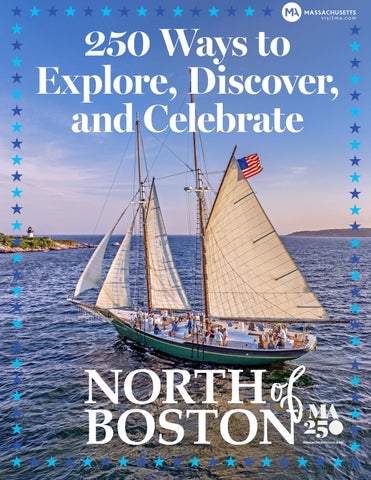
Create a flipbook