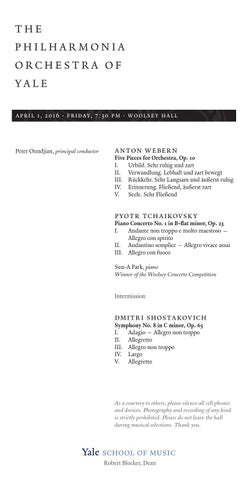
THE PHILHARMONIA ORCHESTRA OF YALE a p r i l 1 , 2 0 16 · frid ay, 7:30 pm · woolse y h all
Peter Oundjian, principal conductor
anton webern
Five Pieces for Orchestra, Op. 10 I. Urbild. Sehr ruhig und zart II. Verwandlung. Lebhaft und zart bewegt III. Rückkehr. Sehr Langsam und äußerst ruhig IV. Erinnerung. Fließend, äußerst zart V. Seele. Sehr Fließend
pyotr tchaikovsky
Piano Concerto No. 1 in B-flat minor, Op. 23 I. Andante non troppo e molto maestoso — Allegro con spirito II. Andantino semplice — Allegro vivace assai III. Allegro con fuoco Sun-A Park, piano Winner of the Woolsey Concerto Competition Intermission
dmitri shostakovich Symphony No. 8 in C minor, Op. 65 I. Adagio — Allegro non troppo II. Allegretto III. Allegro non troppo IV. Largo V. Allegretto
As a courtesy to others, please silence all cell phones and devices. Photography and recording of any kind is strictly prohibited. Please do not leave the hall during musical selections. Thank you.
Robert Blocker, Dean
p ro g ram notes
Anton Webern » 1883–1945 Five Pieces for Orchestra, Op. 10 Anton Webern wrote his Five Pieces for Orchestra between 1911 and 1913, during a period of despair and extreme dissatisfaction with his position as a theater conductor in Stettin (Szczecin), Poland. Though Webern left the routine tutelage of Schoenberg in 1908, he remained very close with his mentor as well as fellow pupil Alban Berg. Arguably, the artistic kinship between these three composers has in some way shaped or inspired nearly all the aesthetic trends of contemporary Western repertoire. More so than its chromatic language, Webern’s music is characterized by an intense fragility. Richard Taruskin notes that Webern “lays everything bare.” The vulnerability of each gesture makes each moment cataclysmically important, simultaneously at the edge of silence and on the brink of outburst. The approximately five-minute-long Five Pieces for Orchestra is no exception to this delicate and focused approach, despite being scored for such a potentially cumbersome ensemble. Each of the aphoristic movements are connected only by their shared attention to timbre and orchestration. A sense of phrasing emerges not from harmony or melody, but rather, from a sense of continually associative and reactionary gestures. This music asks its listeners to listen presently, to be pulled into the immediate and away from the before and after that weigh down many of our momentto-moment experiences. – Katherine Balch Pyotr Ilyich Tchaikovsky » 1840–1893 Piano Concerto No. 1 in B-flat minor, Op. 23 Long before writing his Fourth, Fifth, and Sixth Symphonies, before Swan Lake or Sleeping Beauty, the young Tchaikovsky was trying to cobble together a living from his compositions. In 1874, he began a piano concerto that he hoped would bring him enough success to allow him to leave his teaching post at the Moscow Conservatory. Near the end of the year, he sought the advice of Nikolai Rubinstein, an excellent pianist and the director of the Moscow Conservatory. As Tchaikovsky later wrote:
There burst forth from Rubinstein’s mouth a mighty torrent of words. He spoke quietly at first; then he waxed hot, and at last he resembled Zeus hurling thunderbolts. It appeared that my concerto was utterly worthless, absolutely unplayable; passages were so commonplace and awkward that they could not be improved; the piece as a whole was bad, trivial, vulgar… I cannot produce for you the main thing: the tone in which he said all this. An impartial bystander would necessarily have believed that I was a stupid, ignorant, conceited note-scratcher, who was so impudent as to show his scribble to a celebrated man. Furious, Tchaikovsky removed Rubinstein from the dedication and rededicated the work to Hans von Bülow, who premiered it in Boston on October 25, 1875. The work created a sensation, and Tchaikovsky’s career took off. The concerto opens with one of the most familiar themes to today’s audiences, notable not only for its sweep and immense piano chords, but also in that the concerto starts in the “wrong” key of D-flat major. Another unusual trait is that the opening theme never returns in any form in the rest of the concerto. The music dies down with the trumpets intoning a distant dotted rhythm. Finally, five minutes into the work, we are in the “correct” key of B-flat minor, and the piano presents the snapping main theme in dialogue with the woodwinds. Tchaikovsky said that this curious first theme was inspired by a tune he heard sung by a blind beggar at a street fair. The second theme is quintessential Tchaikovsky, all bittersweet lyricism. These two themes dominate the movement, culminating in a large-scale cadenza and brilliant coda. The simplicity of the second movement’s threepart structure (A–B–A) is augured by the purity of its opening — a languid melody wrapped in the silvery tones of the solo flute, accompanied by quiet, plucked chords from the strings. The contrasting middle section functions as the scherzo, with puckish snippets of melody stated pianissimo in the piano and the orchestra. A quick waltz briefly finds its way in. The crisp rhythmic final movement has all the spirit of a Cossack dance. Later, this theme is contrasted with a lush romantic melody. The two themes contend, but it is the flying Cossacks who have the last word to bring this Concerto to an exhilarating finish. – Michael Mizrahi
art ist p ro f i le s
Dmitri Shostakovich » 1906–1975 Symphony No. 8 in C minor, Op. 65 Shostakovich composed his Eighth Symphony in the summer of 1943 in the wake of two great triumphs; one personal – the worldwide acclaim that greeted his Seventh Symphony of the previous year, and the other national – the Soviet victory over the Nazis at Stalingrad in February, a decisive turning point in the war. The traditional sounds of triumph, however, are nowhere to be found in it. The opening movement gives wide room to somber tones, allowing the Adagio tempo – normally reserved for an introduction alone – to occupy a full-fledged sonata form exposition. Only halfway through the development section does a standard first-movement tempo (Allegro non troppo) set in. Here a depictive logic takes over, forcing reflection to be set aside. A war scene, a march culminating in tutti explosions ordered by the snare drum, passes by. In its wake a lone English horn is left to survey the empty and desolate landscape before picking up the pieces and helping the orchestra recount what it can of the movement’s earlier themes. A pair of scherzos follows. The first (Allegretto) does its best to make the usually contemplative key of D-flat major jovial. The second returns us to the Allegro non troppo of the first movement, now spelled out in all its relentlessness. While this does not lead to any new conclusion, the response is extraordinary: the solo English horn is now converted to the entire orchestral collective at the unison. This melody immediately plummets an octave to become the subterranean ground of a passacaglia (Largo). The finale resumes the mask of an Allegretto only to see the snare drum-led explosions return. But now the responding voice, once again on its own, has grown old, dropping to the bass clarinet. Only the negative image of its timbre – strings sustaining what would be its overtones – is offered at the very end as hope. – Nicholas Betson
Yale Philharmonia 2016–2017 We are very pleased to announce the coming season. Please see the program insert for details. current subscribers: Look for your renewal materials in the mail. If you are interested in becoming a subscriber to the series, please contact the box office.
Samplers go on sale August 1 Single tickets go on sale September 1 Box Office 203 432-4158 music.yale.edu/concerts
a rt i st p rofiles
Sun-A Park, piano
Peter Oundjian, principal conductor
Hailed as “incredible” by the great pianist Martha Argerich, Sun-A Park has received international recognition in several competitions including first prize at the 61st Kosciuszko Foundation Chopin Competition (New York), and top prizes at the 5th International Sendai Music Competition (Sendai, 2013), the 58th Ferruccio Busoni International Piano Competition (Bolzano, 2011), the New York International Piano Competition, and the Gina Bachauer International Piano Competition (Salt Lake City).
A dynamic presence in the conducting world, Toronto-born conductor Peter Oundjian is renowned for his probing musicality, collaborative spirit, and engaging personality. Oundjian’s appointment as Music Director of the Toronto Symphony Orchestra (TSO) in 2004 reinvigorated the orchestra with numerous recordings, tours, and acclaimed innovative programming as well as extensive audience growth, thereby significantly strengthening the ensemble’s presence in the world. He recently led the TSO on a tour of Europe which included a sold-out performance at Amsterdam’s Concertgebouw and the first performance of a North American orchestra at Reykjavik’s Harpa Hall.
Sun-A is an enthusiastic chamber musician, solo recitalist, and orchestral collaborator. She was featured in the Holland Music Sessions “Young Masters on Tour” Series, with recitals at major venues in the Netherlands (Het Concertgebouw) and Slovakia (Slovak Philharmonic Hall). Additional concerto engagements have included performances with the Houston Symphony Orchestra, San Marino Republic Orchestra, Orchester Haydn, Hannover Hochschulorchester, New Jersey Symphony, Albany Symphony, and the Symphonic Orchestra of Castilla y León under the direction of such conductors as Eiji Oue, Arthur Hagen, Krzysztof Urbanski, and Alastair Willis. Sun-A has enjoyed appearances at important venues including Alice Tully Hall and Benaroya Hall in the United States, National Dublin Hall in Ireland, Sejong Arts Center in Korea, the Miguel Delibes Cultural Center in Spain, and the Sendai Cultural Center in Japan, where she recently performed concertos and recitals with the Sendai Symphony Orchestra. Sun-A was born in Busan, South Korea and grew up in New Jersey. She began to play the piano at the age of four and later studied with Seymour Bernstein of New York University. Sun-A enrolled at the Juilliard School at the age of nine in the Pre-College Division and went on to complete her undergraduate and graduate studies at Juilliard with Yoheved Kaplinsky and Matti Raekallio. In 2014, Sun-A completed the prestigious Soloklasse Programm in Hannover, Germany with Bernd Goetzke. She is currently under the tutelage of Professor Boris Berman at the Yale School of Music.
Oundjian was appointed Music Director of the Royal Scottish National Orchestra (RSNO) in 2012. Under his baton, the orchestra has enjoyed several successful tours including one to China, and has continued its relationship with Chandos Records. This season, Oundjian and the RSNO opened the Edinburgh Festival with the innovative Harmonium Project to great critical and audience acclaim. Few conductors bring such musicianship and engagement to the world’s great podiums— from Berlin, Amsterdam, and Tel Aviv, to New York, Chicago, and Sydney. He has also appeared at some of the great annual gatherings of musicians and music-lovers: from the BBC Proms and the Prague Spring Festival, to the Edinburgh Festival and the Philadelphia Orchestra’s Mozart Festival, where he was Artistic Director from 2003 to 2005. Oundjian was Principal Guest Conductor of the Detroit Symphony Orchestra from 2006 to 2010 and Artistic Director of the Caramoor International Music Festival in New York between 1997 and 2007. Since 1981, he has been a visiting professor at the Yale School of Music, and in 2013 he was awarded the school’s Sanford Medal for distinguished service to music.
a b o ut yale p h ilh armonia
The Philharmonia Orchestra of Yale is one of America’s foremost music school ensembles. The largest performing group at the Yale School of Music, the Philharmonia offers superb training in orchestral playing and repertoire. Performances include an annual series of concerts in Woolsey Hall, as well as Yale Opera productions in the Shubert Theater. The Yale Philharmonia has also performed on numerous occasions in Carnegie Hall and Alice Tully Hall in New York City and at the Kennedy Center in Washington, D.C. The orchestra undertook its first tour of Asia in 2008, with acclaimed performances in the Seoul Arts Center, the Forbidden City Concert Hall and National Center for the Performing Arts (Beijing), and the Shanghai Grand Theatre.
peter oundjian Principal Conductor philharmonia staff roberta senatore Assistant Manager heejung park Assistant Conductor
The Philharmonia Orchestra of Yale violin i Ludomil Wojtowski Yurie Mitshuhashi Marie Oka Diana Do Hyung Kim Inyoung Hwang Linda Lee Celia Zhang Jiwon Sun David Loke Kai-Yuan Ethan Hoppe Tzu Ti Chang Ruda Lee violin ii Elly Toyoda Yefim Romanov Wynton Grant Adelya Nartadjieva Suyoun Han Manaka Matsumoto Marianne Di Tomaso Kyung Min Lee Diomedes B. Saraza Jr. Sophia Mockler viola Emily Brandenburg Ryan David Alexandra Simpson Joshua Newburger Danielle Wiebe Hee-Sun Yang Julia Clancy Wei Peng cello Chang Pan Mingyao Zhao Nayeon Kim Jiwon Kang
Eric Adamshick Pall Kalmansson Yoonha Yi James Rosamilia bass Lee Starovich Samuel Suggs Joshua Depoint Kaden Henderson Erez Meyuhass Luke Stence flute Felice Doynov2 Evan Fojtik Hye Jin Park 3 Joanna Wu 1 oboe Ron Cohen Mann Lydia Consilvio Timothy Feil 1 Ross Garton Michelle Nguyen 3 Winona V.R. Van Alstyne 2 clarinet Kenta Akaogi 3 Sam Boutris Graeme Steele Johnson Jesse McCandless 1, 2 bassoon Carl Gardner 3 Matthew Gregoire Yen-Chen Wu 2
horn Sarah Boxmeyer Reese Farnell 1 Sarah Ford 3 Matthew Gray Cody Halquist Valerie Sly Joshua Thompson 2
harmonium Heejung Park
trumpet Aaron Krumsieg 3 Andrew Stadler 1 Daniel Venora 2
administrative assistants Andrew Robson Valerie Sly
trombone Omar Dejesus 3 Richard Liverano Alexander Walden 1 2 Johnathan Weisgerber tuba John Leibensperger 3 timpani Yifei Fu 3 Se Um 2 percussion Maria Chlebus Yifei Fu Matthew Keown Kramer Milan Jeffrey Stern Se Um harp Noël Wan 1 celeste Cornellia Sommer
guitar John Kossler mandolin Chris Garwood
music librarians Bora Kim Yefim Romanov Valerie Sly stage crew Eric Braley Maria Chlebus Lydia Consilvio Chris Garwood Julia Ghica Reese Farnell Nozomi Imamura Matthew Keown John Kossler Richard Liverano Noël Wan 1 Principal on Webern 2 Principal on Tchaikovsky 3 Principal on Shostakovich
up co ming events
» music.yale.edu APR 5
APR 13
APR 29
box office 203 432-4158
Miami String Quartet Oneppo Chamber Music Series Morse Recital Hall | Tuesday | 7:30 pm Beethoven: String Quartet No. 11 in F minor, Op. 95, “Serioso,” and music by Schulhoff and Mendelssohn Tickets start at $26 • Students $13 Yale Cellos YSM Ensembles Morse Recital Hall | Wednesday | 7:30 pm Aldo Parisot, director • A concert of music for solo cello and cello ensemble Tickets start at $10, Students $5 The Planets Yale Philharmonia Woolsey Hall | Friday | 7:30 pm Peter Oundjian, principal conductor Mozart: Symphony No. 41 in C major, “Jupiter”; Holst: The Planets Tickets start at $10 • Students $5 • Staff $8 $3 surcharge for purchases at the door
concert programs & box office Krista Johnson Kate Gonzales communications Donna Yoo Katie Dune operations Tara Deming Christopher Melillo piano curators Brian Daley William Harold recording services Eugene Kimball Matthew LeFevre Austin Kase
Thank you for your support! Become a Yale School of Music patron and support our performance programs. Earn benefits ranging from preferred seating to invitations to special events. To learn more, visit us online or call 203 432-4158. charles ives circle $600 and above Anonymous paul hindemith circle $250 to $599 Serena & Robert Blocker Prof. Michael & Mrs. Maryann Bracken Richard H. Dumas Edwin M. & Karen C. Duval Paul Gacek Richard & Evelyn Gard Francesco Iachello Patty & Tom Pollard Mary-Jo Worthey Waren Ransom Wilson & Walter Foery Michael Zuber & Zachary Zander horatio parker circle $125 to $249 Joyce Alton Roger & Linda Astmann Craig Baker Derek & Jennifer Briggs Leo Cristofar & Bernadette DiGiulian Elizabeth M. Dock
Joan K. Dreyfus Raymond & Jean Gambardella Carolyn Gould Margaret Lord & Arthur Kover Judy Long Mark Ludwig Ann Marlowe Stephen Marsh Susan Matheson & Jerome Pollitt Martha & Vincent Oneppo Arthur T. Rosenfield, M.D. Suzanne Solensky & Jay Rozgonyi Monika & Fred Volker samuel simons sanford circle $50 to $124 Anonymous Nancy Ahlstrom Helen & Blake Bidwell Henry & Joan Binder Barbara Blake Harold & Maureen Bornstein Mindy & Stan Brownstein Barbara & Frank Dahm Thomas & Judith Foley
James V. Freeman Saul & Sonya Goldberg Lawrence Handler Alexandra Isles James Mansfield Joel Marks Betty Mettler Ron & Sue Miller Barbara & Bill Nordhaus James V. Pocock Rocco and Velma Pugliese Fred & Helen Robinson Leonard J. Rutkosky Suzanne Tucker Mr. & Mrs. Peter Uhrynowsky Carl Wies & Margot Hardenbergh Werner & Elizabeth Wolf Donna Yoo gustave jacob stoeckel circle $25 to $49 Mr. & Mrs. Ken L Grubbs James N. Trimble as of March 31, 2016