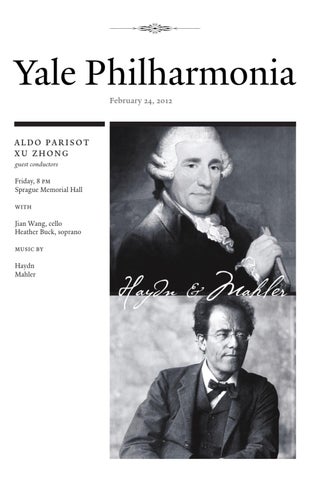
Yale Philharmonia February 24, 2012
aldo parisot xu zhong guest conductors Friday, 8 pm Sprague Memorial Hall with Jian Wang, cello Heather Buck, soprano music by Haydn Mahler
Haydn & Mahler
Robert Blocker, Dean
february 24, 2012
Yale Philharmonia joseph haydn 1732–1809
Cello Concerto No. 1 in C major, Hob. VIIb/1 I. Moderato II. Adagio III. Allegro molto Aldo Parisot, conductor Jian Wang, cello
intermission
gustav mahler 1860–1911
Symphony No. 4 in G major Arranged for chamber orchestra by Erwin Stein I. Bedächtig, nicht eilen II. In gemächlicher Bewegung, ohne Hast III. Ruhevoll, poco adagio IV. Sehr behaglich Xu Zhong, conductor Heather Buck, soprano
As a courtesy to others, please silence all cell phones and devices. Photography and recording of any kind are strictly prohibited. Please do not leave the hall during musical selections. Thank you.
philharmonia orchestra of yale
Shinik Hahm Conductor Krista Johnson Managing Director Roberta Senatore Music Librarian Kate Gonzalez Production Assistant Yang Jiao Assistant Conductor Paolo Bortolameolli Assistant Conductor
Violin 1 Sun Kyung Ban, *1 Geoffrey Herd, *2 Brian Bak Shawn Moore Cordelia Paw Jiin Yang Ji Hyun Kim
Oboe Kaitlin Taylor, 2
Violin 2 Won Young Jung, *1 Kayla Moffett, *2 Laura Keller Eun-young Jung Go Woon Choi Yuan Ma Yoon Won Song
Percussion Victor Caccese, 2 Jonathan Allen, 2
Viola Leonard Chiang, *1 Colin Brookes, *2 Sara Rossi Timothy Lacrosse Cello Arnold Choi James Jeonghwan Kim Sung Chan Chang Jurrian Van Der Zanden Bass Michael Levin, *1 Jonathan McWilliams, *2 Flute/Piccolo Kyeong Hoon Seung, 2
Clarinet Igal Levin, 2 Timpani Cristobal Gajardo-Benitez, 2
Piano Eun Taek Kim, 2 Minsol Cho, 2 Harmonium Stephen Whale, 2 1 – Performer in Haydn 2 – Performer in Mahler * – Principal Player
philharmonia orchestra of yale
Assistant Benjamin Firer Music Librarians Cristobal Gajardo-Benitez Timothy Hilgert Wai Lau Qizhen Liu Rachel Perfecto Holly Piccoli Matthew Rosenthal Kathryn Salfelder Kaitlin Taylor Stage Crew John Allen Jonathan Allen Jeffery Arredondo Colin Brookes Timothy Hilgert Michael Levin Shawn Moore Matthew Rosenthal Aaron Sorensen Gerald Villella
The Philharmonia Orchestra of Yale is one of America’s foremost music school ensembles. The largest performing group at the Yale School of Music, the Philharmonia offers superb training in orchestral playing and repertoire. Performances include an annual series of concerts in Woolsey Hall, as well as Yale Opera productions in the Shubert Performing Arts Center. In addition to its New Haven appearances, the Philharmonia Orchestra of Yale has performed on numerous occasions in Carnegie Hall and Alice Tully Hall in New York City and at the Kennedy Center in Washington, D.C. In 2008, the Philharmonia undertook its first tour of Asia, with acclaimed performances in the Seoul Arts Center, the Forbidden City Concert Hall and National Center for the Performing Arts (Beijing), and the Shanghai Grand Theatre. The beginnings of the Yale Philharmonia can be traced to 1894, when an orchestra was organized under the leadership of the School’s first dean, Horatio Parker. The orchestra became known as the Philharmonia Orchestra of Yale in 1973, with the appointment of Otto-Werner Mueller as resident conductor and William Steinberg, then music director of the Pittsburgh Symphony, as Sanford Professor of Music. Brazilian conductor Eleazar di Carvalho became music director in 1987, and Gunther Herbig joined the conducting staff as guest conductor and director of the Affiliate Artists Conductors program in 1990. Lawrence Leighton Smith, music director of the Louisville Symphony Orchestra, conducted the Philharmonia for a decade, and upon his retirement in 2004, Shinik Hahm was appointed music director.
notes on the program
joseph haydn 1732–1809
Cello Concerto in C major In 1761, Joseph Haydn began his long period of employment with the Esterházy family. The richest and most influential members of the Hungarian nobility, the Esterházy princes were great patrons of the arts. Haydn was to work for the family as an honored member of the court for nearly thirty years, but in the early part of his tenure, Haydn was repeatedly called upon to prove his worth to his powerful employers. Around the year 1765, Haydn made a catalog of his compositions to refute charges that he was unproductive. That Haydn should have had to do this now seems patently absurd, as Haydn was one of the most prolific composers in history. Still, this catalog has proven a boon to our knowledge of Haydn’s works through the late 1770s. It is in this document that a Cello Concerto in C major was listed, presumably composed for the Esterházy court cellist Joseph Weigl. Though it had been presumed lost for nearly two centuries, the manuscript parts were discovered in 1961 in the National Museum of Prague by the musicologist Oldrich Pulkert. Since then, the concerto has regained its rightful place as one of the cornerstones of the cello repertoire. The first movement of the Concerto in C major features a stately theme that shows off the full resonance of the cello. This theme is subtly varied with each additional iteration of the melody. Abundant lyricism overshadows virtuosic passagework in the second movement, a sensuous aria for cello and strings alone. The third movement features the brilliant charm and wit of Haydn’s best finales, while testing the soloist’s skills with fleet-fingered scalar runs and flights into the highest reaches of the cello’s range.
All program notes by Jordan Kuspa
notes on the program
gustav mahler 1860–1911
Symphony No. 4, arr. Erwin Stein In 1918, Arnold Schoenberg founded the Verein für musikalische Privataufführungen (Society for Private Musical Performances) in Vienna, in order to provide a forum in which interested listeners could hear quality performances of the finest modern music. To exclude concertgoers who were merely seeking to deride the latest musical developments, only members of the society were allowed entry to performances. Professional critics were not allowed, and applause after works was not permitted. Amidst this atmosphere of extreme seriousness, 154 different works were performed in just under three years (the Society disbanded in 1922 due to inflation in Austria). Among these were several orchestral works, which were heard either as piano reductions or in original arrangements for chamber ensemble. Schoenberg did some of these arrangements himself, while others were left to his former composition students. In 1921, one such student, Erwin Stein, arranged Gustav Mahler’s Fourth Symphony for soprano and fifteen instrumentalists for the Society. At first it might seem strange that Mahler’s Fourth Symphony, now amongst his most popular and frequently performed works, would be included on a performance by an organization with such a modernist outlook. However, at its premiere in 1901, the Fourth Symphony was roundly booed—audiences expected a work of titanic scope and drama and instead were treated to a relatively modest work (though the symphony is still nearly an hour long) of a generally bucolic character. While the music’s seeming naïveté surprised audiences, striking some as mere affectation, more unsettling was a level of contrapuntal development heretofore unseen in Mahler’s oeuvre. Early critics accused Mahler of “posing insoluble problems,” “amusing himself by using thematic material alien to his nature,” and “taking pleasure in shattering the eardrums of his audiences with atrocious
notes on the program
and unimaginable cacophonies.” It is no wonder that Schoenberg would want to present Mahler’s work in a forum free of the judgment of such short-sighted criticism. After all, Mahler had acted as a mentor to Schoenberg when few major musicians supported the younger composer. Schoenberg would later speak of Mahler as a saint. The version of the Fourth Symphony heard on tonight’s program was reconstructed in the early 1990s by Alexander Platt, who worked from Erwin Stein’s annotated score of the original version of Mahler’s work. As the original parts had been lost, it is impossible to know exactly how Stein himself condensed the forces of Mahler’s orchestra for the Society performances. One important feature was the inclusion of harmonium and piano four-hands to thicken harmonic textures and provide sonic heft throughout. (In tonight’s performance, what were originally solo string parts are now performed by small sections for similar reasons.) While it might seem strange to hear a work for full orchestra performed by so few players, the chamber arrangement highlights the contrapuntal depth of the music, while also exposing how heavily Mahler himself relied upon chamber music textures within the scope of the massive orchestra he deployed. One such transparent texture is found at the outset of the first movement, where sleigh bells briefly accompany an intertwining flute and clarinet motive before the strings begin a jaunty tune. Theodor Adorno likened this opening to the “once upon a time” of fairytale literature. The genial nature of much of the first movement is somewhat twisted in the second movement scherzo, which Mahler had originally described as “Death strikes up the dance for us; she scrapes her fiddle bizarrely and leads us up to heaven.” In this movement, the first violinist plays a solo on an instrument tuned a whole step higher than normal, giving the sound a bright, metallic quality. Mahler once said that the expansive Adagio “laughs and cries at one and the selfsame time.” For the composer, this movement was representative of a “solemn, blessed peace; serious, gentle gaiety, such is the character of this movement, which also has deeply sad moments, comparable, if you wish, to reminiscences of earthly life, and other moments when gaiety becomes vivacity.” Finally, the concluding song, Das himmlische Leben, taken from the Des Knaben Wunderhorn poetry that Mahler drew upon for so much of his inspiration, catalogs the joys of heaven, particularly those of food and music. The soprano sings with a “joyful, childlike expression,” as the symphony concludes on a note of almost shocking tranquility.
text & translation
Gustav Mahler: Symphony No. 4 Text from Des Knaben Wunderhorn by Achim von Arnim (1781–1831) and Clemens Brentano (1778–1842)
Das himmlische Leben Wir genießen die himmlischen Freuden, D’rum tun wir das Irdische meiden. Kein weltlich’ Getümmel Hört man nicht im Himmel! Lebt alles in sanftester Ruh’. Wir führen ein englisches Leben, Sind dennoch ganz lustig daneben; Wir tanzen und springen, Wir hüpfen und singen, Sanct Peter im Himmel sieht zu.
Heaven’s Life We enjoy heavenly pleasures and therefore avoid earthly ones. No worldly tumult is to be heard in heaven. All live in greatest peace. We lead angelic lives, yet have a merry time of it besides. We dance and we spring, We skip and we sing. Saint Peter in heaven looks on.
Johannes das Lämmlein auslasset, Der Metzger Herodes d’rauf passet. Wir führen ein geduldig’s, Unschuldig’s, geduldig’s, Ein liebliches Lämmlein zu Tod. Sanct Lucas den Ochsen tät schlachten Ohn’ einig’s Bedenken und Achten. Der Wein kost’ kein Heller Im himmlischen Keller; Die Englein, die backen das Brot.
John lets the lambkin out, and Herod the Butcher lies in wait for it. We lead a patient, an innocent, patient, dear little lamb to its death. Saint Luke slaughters the ox without any thought or concern. Wine doesn't cost a penny in the heavenly cellars; The angels bake the bread.
Gut’ Kräuter von allerhand Arten, Die wachsen im himmlischen Garten, Gut’ Spargel, Fisolen Und was wir nur wollen. Ganze Schüsseln voll sind uns bereit! Gut’ Äpfel, gut’ Birn’ und gut’ Trauben;
Good greens of every sort grow in the heavenly vegetable patch, good asparagus, string beans, and whatever we want. Whole dishfuls are set for us! Good apples, good pears and good grapes,
text & translation
Die Gärtner, die alles erlauben. Willst Rehbock, willst Hasen, Auf offener Straßen Sie laufen herbei!
and gardeners who allow everything! If you want roebuck or hare, on the public streets they come running right up!
Sollt’ ein Fasttag etwa kommen, Alle Fische gleich mit Freuden angeschwommen! Dort läuft schon Sanct Peter Mit Netz und mit Köder Zum himmlischen Weiher hinein. Sanct Martha die Köchin muß sein.
Should a fast day come along, all the fishes at once come swimming with joy! There goes Saint Peter running with his net and his bait to the heavenly pond. Saint Martha must be the cook.
Kein' Musik ist ja nicht auf Erden, Die unsrer verglichen kann werden. Elftausend Jungfrauen Zu tanzen sich trauen. Sanct Ursula selbst dazu lacht. Kein’ Musik ist ja nicht auf Erden, Die unsrer verglichen kann werden. Cäcilia mit ihren Verwandten Sind treffliche Hofmusikanten! Die englischen Stimmen Ermuntern die Sinnen, Daß alles für Freuden erwacht.
There is just no music on earth that can compare to ours. Even the eleven thousand virgins venture to dance, and Saint Ursula herself has to laugh. There is just no music on earth that can compare to ours. Cecilia and all her relations make excellent court musicians. The angelic voices gladden our senses, so that all awaken for joy.
artist profiles
aldo parisot guest conductor
Aldo Parisot, long acknowledged as one of the world’s master cellists, has led the career of a complete artist — as concert soloist, chamber musician, recitalist, and teacher. He has been heard with the major orchestras of the world, including those of Berlin, London, Paris, Amsterdam, Stockholm, Rio, Munich, Warsaw, Chicago, Los Angeles, and Pittsburgh, under the batons of such eminent conductors as Stokowski, Barbirolli, Bernstein, Mehta, Monteux, Paray, de Carvalho, Sawallisch, Hindemith, and Villa-Lobos. As an artist seeking to expand his instrument’s repertoire, Mr. Parisot has premiered numerous works for cello, written especially for him by such composers as Camargo Guarnieri, Quincy Porter, Alvin Etler, Claudio Santoro, Joan Panetti, Ezra Laderman, Yehudi Wyner, and Heitor Villa-Lobos, whose Cello Concerto No. 2, written for and dedicated to him, was premiered by Mr. Parisot in his New York Philharmonic debut. Since then he has appeared with the Philharmonic on nearly a dozen occasions. He created a sensation when he introduced Donald Martino’s Parisonatina al’Dodecafonia at Tanglewood. Mr. Parisot has recorded for RCA Victor, Angel, Westminster, and Phonodisc. His Yale Cellos recording for Delos, Bach Bachianas, was nominated for a Grammy Award in 1988. He was awarded an honorary Doctor of Music from Shenandoah University in 1999, an honorary Doctor of Fine Arts from Penn State University in 2002, and the Award of Distinction from the Royal Northern College of Music in Manchester, England, in 2001. A Yale faculty member since 1958, Mr. Parisot was named the Samuel Sanford Professor of Music at Yale in 1994 and received the Gustave Stoeckel Award in 2002.
artist profiles
xu zhong guest conductor
Xu Zhong, an internationally renowned Chinese pianist and conductor, is a founding member and artistic director of the China Shanghai International Piano Competition and the executive artistic director of the Shanghai Philharmonic Orchestra. He has enjoyed successful collaborations with many renowned musicians, including Paul Badura-Skoda, Sergiu Commissiona, Philippe Entremont, and Ian Hobson. His early childhood music education with Wang Yu at the Shanghai Conservatory of Music was followed by study with Dominique Merlet at the Conservatoire National Superieur de Musique de Paris. Xu Zhong has won numerous international competitions, including the First Hamamatsu International Piano Competition, Santander Paloma O’Shea International Piano Competition, Fifth Tokyo International Piano Competition, and Tenth Tchaikovsky International Piano Competition (Moscow). Since then, his concert career has spanned Europe, North and South America, and Asia. He has worked with Orchestre de Paris, China Philharmonic, Moscow State Symphony Orchestra, and the Concertgebouw; the chamber orchestras of Vienna, Holland, and Israel; and the symphony orchestras of Vancouver, Houston, and Tokyo, among others. As an educator, Xu Zhong gives master classes in France and is a regularly jury member of international piano competitions such as the Busoni (Bolzano, Italy), Clara Haskil (Switzerland), AXA Dublin, and Leeds. As an administrator, Xu Zhong has been the artistic consultant for the China Shanghai International Arts Festival and the artistic director of French Culture in Shanghai 2003/2005. He was nominated to be a music consultant for Shanghai Concert Hall, a member of the Shanghai Grand Theatre Arts Group Artistic Committee (2005), and the deputy chairman of the Shanghai Oriental Art Center Arts Committee.
artist profiles
jian wang cello
Jian Wang began to study the cello with his father when he was four. While a student at the Shanghai Conservatoire, he was featured in the celebrated documentary film From Mao to Mozart: Isaac Stern in China. Mr. Stern’s encouragement and support paved the way for him to go to the United States, and in 1985 he entered the Yale School of Music under a special program where he studied with the renowned cellist Aldo Parisot. Jian Wang has since performed with many of the world’s leading orchestras, including the Cleveland, Philadelphia, Chicago, Boston and Detroit Symphonies, Berlin Philharmonic, Royal Concertgebouw, London Symphony, the BBC orchestras, Zurich Tonhalle, Gothenburg Symphony, Stockholm Philharmonic, Santa Cecilia, La Scala, Mahler Chamber, Orchestre National de France, Orchestre de Paris, Czech Philhamonic, and NHK Symphony. These concerts have been with many of the greatest conductors, such as Abbado, Sawallisch, Jarvi, Chailly, Dutoit, Eschenbach, Chung, Alan Gilbert, and Gustavo Dudamel. Jian Wang has made many recordings, his latest release being an album of short pieces for cello and guitar titled Reverie. He has also recorded the complete Bach Cello Suites and a Baroque album with the Camerata Salzburg; Brahms Double Concerto with the Berlin Philharmonic Orchestra, Claudio Abbado, and Gil Shaham; the Haydn Concerti with the Gulbenkian Orchestra under Muhai Tang; Messiaen’s Quartet for the End of Time (with Myung-Whun Chung, Gil Shaham and Paul Meyer); and Brahms, Mozart, and Schumann chamber music with Pires and Dumay. His instrument is graciously loaned to him by the family of the late Mr. Sau-Wing Lam.
artist profiles
heather buck soprano
In 2011–2012 Heather Buck sings as La Princesse in her debut with Virginia Opera in Glass’ Orphée; as Hero in Béatrice et Bénédict in a return to Opera Boston; as soloist in Medeamaterial, by Dusapin with Teatr Wieki, Opera Naradowa (Warsaw, Poland); and in Carmina Burana with the North Carolina Symphony Orchestra, under Grant Llewellyn. Recent engagements include her return to the roster of the Metropolitan Opera for Nixon in China, Angel in Dusapin’s Faustus: The Last Night (Concertgebouw), Zerbinetta in Ariadne auf Naxos (Toledo Opera), Mabel in The Pirates of Penzance (Opera Columbus), soloist in Fanny Mendelssohn’s Musik für die Toten der CholeraEpidemie and Louis Spohr’s Die letzten Dinge (American Symphony Orchestra/Carnegie Hall); Lulu Baines in Elmer Gantry (Florentine Opera: Grammy Award-nominee on Naxos label, and Opera News “Best of 2011”), and the title role in Rihm’s Proserpina (Spoleto Festival USA/American premiere). On the concert stage she has performed songs by Thomas Larcher and George Crumb for the American Composers’ Forum; and Previn’s Vocalise for soprano, solo cello, and orchestra at New York’s Le Poisson Rouge, in celebration of the composer’s eightieth birthday. Other highlights include singing as soloist in Mahler’s Symphony No. 2 in Beijing during the 2008 Summer Olympics, and Santa Fe and English National operas debuts as Queen of the Night in Die Zauberflöte. Her debut with New York City Opera in the title role of Wuorinen’s Haroun and the Sea of Stories (world premiere) garnered the 2005 Kolozsvar Award, recognizing artists who excel at new and unusual repertory.
yale philharmonia 2011-12 Patrons
Becoming a patron is a wonderful way to support the Yale School of Music’s performance programs. Enjoy benefits ranging from preferred seating to invitations to special events. To find out more about becoming a Yale School of Music Patron:
» music.yale.edu/giving You can also add a contribution to your ticket purchase to any of the Yale School of Music concerts. Concert Office · 203 432-4158
charles ives circle $600 and above Myrna F. Baskin Richard H. Dumas Ronald & Susan Netter Thomas Masse & Dr. James M. Perlotto paul hindemith circle $250 to $599 Serena & Robert Blocker Carole & Arthur Broadus Marbelia Gonzalez Dr. & Mrs. James Kupiec Ms. Dezarie Mayers Tom & Patty Pollard Clifford & Carolyn Slayman horatio parker circle $125 to $249 Angelo A. Alonzo & Nancy R. Reynolds Roger & Linda Astmann Brenda & Sheldon Baker Ann Bliss Prof. Michael Bracken & Maryann Bracken Derek & Jennifer Briggs Joan K. Dreyfus Edwin M. & Karen C. Duval Mrs. Lory ffrench-Mullen Paul Gacek Evelyn & Richard Gard
Francesco Iachello Paul Jacobs Carleton & Barbara Loucks Rev. Hugh J. MacDonald Susan Matheson & Jerome Pollitt Jane & Alfred Ross Richard & Mary-Jo Warren Ransom Wilson & Walter Foery
Suzanne Solensky & Jay Rozgonyi Joseph C. Stevens Caesar T. Storlazzi Rev. Dr. Michael Tessman & Mrs. Carol Tessman Mr. & Mrs. Gregory Tumminio Robert B. Wheeler Werner & Elizabeth Wolf
samuel simons sanford circle $50 to $124 Anonymous Cecle & Josef Adler Nancy Ahlstrom William & Joyce Alton L.S. Auth Irma & Bob Bachman Annette & Max Bailey Dr. & Mrs. Dwight P. Baker Blake & Helen Bidwell Henry & Joan Binder Peter & Nancy Blomstrom Muriel & Ernest Bodenweber Michael Hall & Otto Bohlmann Harold & Maureen Bornstein Anna Broell Bresnick Antonio Cavaliere Joel Cogen & Elizabeth Gilson Mimi & John Cole Leo Cristofar & Bernadette DiGiulian Frank & Barbara Dahm R.R. D’Ambruoso Mr. & Mrs. Dana Becky Daymon Mr. & Mrs. William C. Dickerson Elizabeth M. Dock Keita Ebisu Thomas & Judith Foley Dolores M. Gall Martin & Katie Gehner Saul & Sonya Goldberg Henry Harrison & Ruth Lambert Sharon & Thomas Haskell Marjorie M. Healy Susan Holahan Raejeanne Kier Margaret Lord & Arthur Kover Dave & Liz Kozma Colonel & Mrs. Thomas LaCrosse David & Diane Lawrence Peter & Suzanna Lengyel Judith & Karl-Otto Liebmann Nancy C. Liedlich & William R. Liedlich Judy Long Helen & Doug MacRae Betty Mettler Donald & Eva Nemeth Jim & Mimi Niederman Martha & Vincent Oneppo Dr. E. Anthony Petrelli James V. Pocock Rocco & Velma Pugliese Helen & Fred Robinson Arthur T. Rosenfield, MD Red Wine Audio
gustave jacob stoeckel circle $25 to $49 Anonymous (2) Greg Berg & Nina Binin Jennifer Bonito Rose & Frank Bonito Mindy & Stan Brownstein Rosemarie S. Chaves Mr. Charles Forman Fred & Bernice Gillman Mr. Eric J. Glover Helen W. Greene Mrs. Ken L. Grubbs Debra & Mark Halvorsen Mary Ann Harback Victoria Hoffer Charles & Shirley Johnson Tom & Fran King J. & A. Kugielsky Joel Marks Ann Marlowe Mr. & Mrs. Ronald Miller Dr. Adria Pearlman Kevin R. Poole Sondra Rothberg Leonard Rutkosky Patricia & Joseph Rutlin Henry & Doris Rutz Betsy Schwammberger Karen & Mel Selsky Allan R. Silverstein Mr. James N. Trimble Mr. & Mrs. Gordon Turnbull Peter & Dana Uhrynowski Monika & Fred Volker as of 21 February 2012
upcoming
Yale Philharmonia Sat, Feb 25 | 8 pm | Sprague Hall | Free
media sponsor 91.1 fm · 800 937-6045 yale school of music Box Office · 203 432-4158 concerts & public relations Dana Astmann Danielle Heller Dashon Burton new media Monica Ong Reed Austin Kase operations Tara Deming Christopher Melillo piano curators Brian Daley William Harold recording studio Eugene Kimball
music.yale.edu
William Christie guest conducts the Yale Philharmonia and the new Yale Choral Artists in an all-Handel program. The concert includes the Overture to Solomon, The Ways of Zion Do Mourn (Funeral Anthem for Queen Caroline), the Concerto Grosso in G minor, and Coronation Anthem III, “The King Shall Rejoice.” With Arthur Haas, harpsichord, and the Yale Baroque Ensemble. This program will also be performed in Zankel Hall at Carnegie Hall on Sunday, Feb 26 at 7:30 pm. Tickets are available at carnegiehall.org or CarnegieCharge: 212 247-7800.
La Morra Sun, Feb 26 | 3 pm | Sprague Hall Tickets $20 | Seniors & Yale Staff $15 | Students $10 Lacrime di Leo: A Concert for the Pope Leo X. Featuring frottole, madrigals, chansons, and instrumental music by Constanzo Festa, Bartolomeo Tromboncino, Alexander Agricola, Josquin des Prez, Johannes Ghiselin, Joanambrosio Dalza, Francesco Canova da Milano, and Pope Leo X.
Stefan Parkman Conducts Sun, Feb 26 | 4 pm | Woolsey Hall | Free Music of Bach, Bossi, Brahms, Mäntyjärvi, and Sandström with the Yale Glee Club, Yale Schola Cantorum, and Yale Camerata. Presented by the Yale Institute of Sacred Music with the Yale Glee Club.