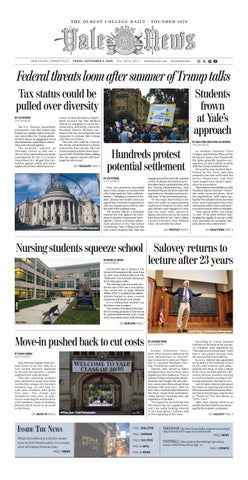
T H E O L D E ST C O L L E G E DA I LY · FO U N D E D 1 8 7 8
NEW HAVEN, CONNECTICUT · FRIDAY, SEPTEMBER 4, 2026 · VOL. CXLIX, NO. 2 · yaledailynews.com · @yaledailynews
Federal threats loom after summer of Trump talks Tax status could be pulled over diversity BY LEO NYBERG STAFF REPORTER The U.S. Treasury Department introduced a rule that would strip federal tax-exempt status from private universities the Trump administration deems as engaging in racial discrimination, including in admissions and school programs. The proposal, released on Thursday, arrives as Yale and a slew of other universities are under investigation by the U.S. Justice Department for alleged discrimination against white and Asian applicants in their admissions pro-
cesses. In May, the Justice Department accused the Yale Medical School of engaging in racial discrimination, and in July, University President Maurie McInnis confirmed that the investigation had expanded to include Yale College and Yale Law School. The new rule could be a tool for the Trump administration to extract concessions from schools, Yale Law School research scholar Linda Greenhouse LAW ’78 told the News, adding that she expects schools will challenge the rule in court. SEE TREASURY PAGE 4
Students frown at Yale’s approach Garrett Curtis / Staff Photographer
Hundreds protest potential settlement BY LEO NYBERG STAFF REPORTER
Abby Assouad / Staff Photographer
BY ARIA LYNN-SKOV AND LEO NYBERG STAFF REPORTERS
Over 300 protesters descended upon Cross Campus on Tuesday with a list of demands for Yale’s administration — bringing a summer of student, alumni and faculty advocacy against the University’s negotiations with the Department of Justice into the start of the academic year. The protest follows a turbulent summer for Yale against the backdrop of a Justice Department investigation, which scrutinizes admissions practices at the Yale School of Medicine, Yale College and Yale Law School. Reports that Yale was
engaging in settlement talks sparked a wave of alumni and student activism objecting to a potential deal with the Trump administration. Yale President Maurie McInnis called the negotiations a “required and reasonable step” of the resolution process. “It was really heartening to see what was really an unprecedented coalition of students, faculty, sta! and alumni to get engaged in a way that not many other schools in higher education across the nation have been able to do,” Yale College Council President Alex William Chen ’28 said after the event.
As students traversed Cross Campus and Beinecke Plaza on the first day of classes, they shared with the News generally negative perspectives on Yale’s e!orts to settle with the Trump administration. None of the nine students interviewed by the News said they wanted to see Yale settle with the Justice Department, and their views ranged from staunch opposition to uncertainty. The students were divided on Yale President Maurie McInnis’ University-wide communications about the negotiations, with some saying the Yale administration has been much more transparent than other universities while others said McInnis needs to listen better to students. “Yale cannot settle,” Zoe Kanter ’27 said. “If we settle without challenging this legally, it sets up a really scary precedent for academic freedom and for other universities.”
SEE PROTEST PAGE 4
SEE REACTIONS PAGE 4
Nursing students squeeze school Salovey returns to lecture after 23 years BY MICHELLE CHEON STAFF REPORTER
On the first day of classes at the School of Nursing last fall, more than 120 first-year students filed into the “fishbowl,” a lecture hall nicknamed for its three glass walls. The entering class was nearly double the size of the one a year before. One course was so large, Mikayla Walker NUR ’27 recalled, that administrators hurried to open a second classroom and bring in extra chairs. It is a workaround students say they have come to expect. The number of students in the master’s in nursing program at Yale rose by 65.3 percent between the 2022-23 and 2025-26 academic years. Azita Emami,
Nick Tabio
SEE NURSING PAGE 7
Jolynda Wang / Contributing Photographer
Move-in pushed back to cut costs BY SASHA CABRAL STAFF REPORTER Yale shortened upper level student move-in by two days in a cost-saving measure expected to become permanent, a senior administrator told the News. This fall, returning students were allowed to move into their residential colleges for two days between Aug. 30 and Aug. 31. Last year, students were given four days. The change was intended to save costs, in addition to reducing the workload for staff members, Dean of Students Melanie Boyd wrote in an email to the News. SEE MOVE-IN PAGE 5
William Qian / Staff Photographer
INSIDE THE NEWS Pedals Smoothie and Juice Bar closed down its York Street location. It is unclear what will replace the local chain. PAGE 9 NEWS
BY JOLYNDA WANG STAFF REPORTER Former University President Peter Salovey delivered his first Introduction to Psychology lecture in 23 years on Thursday to a packed Sheffield-Sterling-Strathcona auditorium. Salovey, who served as Yale’s president from 2013 to 2024, was a popular lecturer dubbed as “Easy A Salovey” before entering the administration and taught the introductory course more than a dozen times between 1986 and 2003. After his first class, students interviewed by the News voiced their excitement, citing Salovey’s teaching style and experience in the field. “It is great for me to be back in the classroom on a regular basis, and I am really looking forward to this next phase,” Salovey said at the beginning of his class.
PAGE 2 BULLETIN PAGE 3 OPINION PAGE 8 SCI-TECH PAGE 10 ARTS PAGE B1 WKND
According to Course Demand Statistics at the time of his lecture, 337 students were registered for “Introduction to Psychology,” more than a 100-person increase from the course’s fall 2025 rendition. In 2003, Salovey was appointed as the dean of the Graduate School of Arts and Sciences and subsequently the dean of Yale College from 2004. He then held the University provost position starting in 2008 and before serving as University president starting in 2013. Last October, Salovey announced his return to teaching and told the News he missed lecturing for Introduction to Psychology, long known as “Psych 101” but now known as “PSYC 1100.” After class, Salovey wrote in an email to the News that he was encouraged by his students’ excitement. SEE SALOVEY PAGE 5
TAKEOVER The New Haven Police Department enlisted help to thwart ATV usage and vehicle theft.
PAGE 9 NEWS
FOOTBALL Take a look at the Bulldogs' upcoming season, which kicks o! on Sept. 19. PAGE 11 SPORTS
PAGE 2
YALE DAILY NEWS · FRIDAY, SEPTEMBER 4, 2026 · yaledailynews.com
BULLETIN This Day in Yale History, 1985 September 4, 1985 / Drinking rules sober students By Peter Dwoskin Hundreds of twenty and twenty-one-year-old students lined up in SSS 114 this week to receive drinking cards as part of the Yale administration’s response to the new Connecticut drinking age of 21. The Old Campus will be affected the most drastically as no alcohol is permitted at parties there. However, a number of parties with alcohol have already been held in the past week. The administration has not yet decided what to do about upperclassmen who are of drinking age living on Old Campus.
UE TO
IODS D R E P D E S MIS
STRESS, INTENS E EXERCISE, OR NOT EATING ENOUGH?
You may pre-qualify for an investigational treatment study. Qualified participants may receive compensation for time and participation. Please note that this clinical trial will use an investigational drug product, the safety and efficacy of which has not been fully evaluated by Regulatory Authorities and which has not received marketing authorization in any country.
Learn More
Behind the Headline By Leo Nyberg As the Yale Daily News kicked off regular production for the 2026-27 school year, student activists and protestors had a kickoff of their own. After a summer of activism against Yale’s negotiations with Trump, over 300 students, professors and alumni gathered on Cross Campus to send the administration a message. I stood in the crowd and bounced back and forth between speaking with protestors, listening to the speeches and briefly talking with administrators. Inperson conversations with sources after a summer of dialing numbers and meeting on Zoom was a refreshing way to get back to in-person journalism. It turns out that the News was lucky. As I went to a press gaggle with student body president Alex William Chen ’28 and actor Sam Waterston ’62, I heard that some non-student reporters had been asked to leave Cross Campus by Yale public affairs officials in accordance with a Yale policy. Chen remarked that it was good news for the Yale Daily News. Read “Hundreds Protest Potential Settlement” on page 1.
Puzzles
YALE DAILY NEWS · FRIDAY, SEPTEMBER 4, 2026 · yaledailynews.com
PAGE 3
OPINION GUEST COLUMNIST
S TA F F C O L U M N I S T
C O R I N N E C O WA N
NA N C Y G E RT N E R A N D J O H N S H AT T U C K
A Yale response to higher The best deal for Yale with Trump is no deal education’s challenges This summer, the Department of Education released a letter to American university presidents and boards asking them to describe their commitments to the American people. The letter asks six questions, which cover all the hot topics in higher education today: admissions and financial transparency, ideological pluralism and free speech. How should Yale answer? Our response to the Department of Education must be a response that is unique to our identity. To start, we might draw on our historical commitment to the principles of a liberal arts education. Yale’s identity as a liberal arts institution has long been connected to debates over the role of higher education. In the nineteenth century, well before the Committee on Trust in Higher Education released its 2026 report, Yale underwent a similar process of self-reflection. The Yale Report of 1828 was a harsh rebuttal of the thengrowing emphasis of higher education on professional and specialized education. Faculty of Yale College defended the value of a “classical education” in Greek, Latin and ancient literature against concerns over such a curriculum’s impracticality. In this way, Yale served as a defense of general education over the teaching of specialized subjects. Our path forward need not require that all students learn Latin, but it certainly can draw from the idea that the point of a liberal arts education is to produce wellrounded students. Yale’s response to the Department of Education’s letter will likely take the form of a public statement of our principles and thus must reflect the value that Yale places on a liberal arts education. Our answers to the letter’s questions on the value of a Yale degree, adapting to the AI revolution and our research enterprise should stand as a testament to Yale’s commitment to a general education. Specifically, we ought to be careful about the Department of Education’s concern with the “return value” of a degree. A Yale education does not easily lend itself to post-grad salary measures of value. We must not succumb to the pressures to define ourselves through our graduates’ technical skills, noting that the usefulness of technical skills changes constantly in the age of AI. The Woodward Report is another key part of Yale’s identity. Though Yale’s history of public cancellations and student ce n so rs h i p demonstrates how we fall short of the principles of free expression, a response to the Department of Education’s questions that explains why free speech is intrinsically tied to a thriving liberal arts community will be more successful. I imagine that one of the more difficult questions to answer will be the relationship between Yale
and America. The Department of Education’s letter explicitly calls for universities to emphasize their commitment to “put Americans, and American interests, first.” Don’t mistake this idea for a primitive nativist sentiment. However global or multicultural Yale may be now, our origins are still distinctly American. Yale’s early history was defined by a combination of Enlightenment ideals, Christian theology and spirited revolutionary sentiment — all key parts of American identity. Our liberal arts character is directly tied to the fact that America is a liberal, or free, society and one born out of the idea that citizens must be educated in order to effectively participate in a democracy. Even as Yale changed throughout the years — opening up to women, expanding financial aid and access — change was made out of respect for the American principles of equal opportunity and freedom. As far as Yale’s large population of international students and faculty goes, though? The Department of Education’s letter makes it clear that they hope all universities will cut back on international students and faculty to prioritize Americans. To be honest, I have no idea how Yale should respond to these challenges. Suffice it to say that it is entirely within Yale’s power to maintain similar numbers of foreign-born students and faculty while redoubling efforts to invest in America, through civic engagement and contributions across the country. So a successful response might be grounded in Yale’s identity as an American liberal arts institution — what else? When I think of Yale and similar institutions, I’m reminded of how our student culture sets us apart. Yale students tend to be more intellectually curious, interdisciplinary and open-minded. Unique elements of Yale culture — Directed Studies, the Yale Political Union, meal culture, the prevalence of double majoring — are a testament to our peculiarities. While it’s probably difficult for Yale’s answers to reflect this, my hope is that our response will be infused with these aspects of student culture. Administrators should take into account this part of our identity when considering questions about academic rigor, free speech and AI policy. Only time will tell whether or not Yale can survive the challenges that higher education faces today. But when President McInnis and the board of trustees answer the Department of Education’s questions in the coming months, I hope that their response will look to the past and present of Yale’s identity. CORINNE COWAN is a sophomore studying history. She can be reached at corinne.cowan@yale.edu.
YALE DAILY NEWS PUBLISHING CO., INC. 202 York Street, New Haven, CT 06511 (203) 432-2400 Editorial: (203) 432-2418 editor@yaledailynews.com Business: (203) 432-2424 business@yaledailynews.com
EDITOR IN CHIEF & PRESIDENT Asher Boiskin MANAGING EDITORS Jaeha Jang Olivia Woo Reeti Malhotra PUBLISHER Henry Hoak DIRECTOR OF AFFAIRS Kate Soo Hyun Kim
UNIVERSITY EDITORS Olivia Cyrus Jerry Gao Henry Liu Isobel McClure CITY EDITORS Elijah Hurewitz-Ravich Sabrina Thaler
SPORTS EDITORS Liza Kaufman Walter Royal SCIENCE & TECHNOLOGY EDITORS Michelle So Hari Viswanathan
CITY EDITORS Kiva Bank Gemard Guery
OPINION EDITORS Manu Bosteels Rohil Mohan
INVESTIGATIONS EDITORS Sasha Hurowitz
WEEKEND EDITORS Stephanie Altschul Hana Tilksew
MAGAZINE EDITORS IN CHIEF Ethan Kan Claire Nam HEAD PHOTOGRAPHY EDITOR Martín Peralta HEAD PRODUCTION & DESIGN EDITOR Ezra Helfand HEAD COPY EDITOR Nate Stein
ILLUSTRATIONS EDITOR Rana Roosevelt HEAD PODCASTS EDITOR Amiya Vashi DATA EDITOR Adriana Petrizzo HEAD AUDIENCE EDITOR Emily Seo
THIS ISSUE COPY EDITORS: Leandro Menchu, Nate Stein, Jack Tompros; COPY STAFFERS: Oliver Browne, Alina Chakarova, Gaurav Chaudhuri, Perry
Dye, Leo Gabara, Clare Griffin, Maria Gregory, Ella Kim, Miriam Levenson, David Liu, Ruby Nichols; P&D STAFFERS: Olivia Dick, Maria Andreu Bird, Lucy Bland, Micheal Chang, Gabriela Ewart, Delilah Sonenshein, Jolynda Wang, Sarea Leung, Dani Klein, Aria Lynn-Skov
EDITORIALS & ADS
Content on this page with bylines represents the opinions of those authors and not necessarily those of the Managing Board. Opinions set forth in ads do not necessarily reflect the views of the Managing Board. We reserve the right to refuse any ad for any reason and to delete or change any copy we consider objectionable, false or in poor taste. We do not verify the contents of any ad. The Yale Daily News Publishing Co., Inc. and its officers, employees and agents disclaim any responsibility for all liabilities, injuries or damages arising from any ad. The Yale Daily News Publishing Co. ISSN 0890-2240
NEW HAVEN, CONNECTICUT
SUBMISSIONS
All letters submitted for publication must include the author’s name, phone number and description of Yale University affiliation. Please limit letters to 250 words and guest columns to 750. The Yale Daily News reserves the right to edit letters and columns before publication. E-mail is the preferred method of submission.
ISSUES PRINTED BY
Valley Publishing Co, Derby, CT
DIGITAL ARCHIVE
YDNHistorical.Library.Yale.edu
COPYRIGHT 2026 — VOL. CXLIX, NO. 1
ADVERTISEMENT
(203) 432-2424 (before 5 p.m.) business@yaledailynews.com Direct all letters, columns, artwork and inquiries to: Contact the Opinion Editors at opinion@yaledailynews.com
Direct all comments regarding the fairness or accuracy of stories to: Asher Boiskin Editor in Chief & President editor@yaledailynews.com
Yale is the latest target of the Trump administration’s scheme to coerce universities into surrendering their academic freedom. Trump is demanding that Yale give the Department of Justice broad review over Yale’s admissions practices based on unproven and baseless charges of discrimination. In response to the DOJ demand, Yale is reportedly considering a settlement. If it settles, Yale would become the most prominent university victim of Trump’s “regulation by dealmaking.” The Trump administration’s settlements with universities are nothing more than extortion. By making a deal, Yale would give up its constitutional, statutory and administrative rights, including academic freedom protected by the First Amendment, due process rights to contest the charges against it and procedural rights under federal civil rights laws enacted by Congress. In return, Yale would receive — at best — an unreliable promise of relief and the likelihood of further illegitimate administration demands. We know this from Trump’s record with other universities and, more recently, a proposed rule by the Office of Management and Budget. One of us is a former employment lawyer and former federal judge. A review of the administration’s case outlined in its “letter of findings” makes it clear that the charges could not be more spurious. The letter presents what it describes as “statistical evidence of intentional discrimination” at the Yale medical school. The “evidence” consists of tables showing that median GPAs and MCAT scores were slightly lower among admitted Black and Hispanic students than among admitted students of other racial groups for the 2023, 2024 and 2025 incoming classes. The variations are minor; they cluster at the very highest range
of the GPA and MCAT distributions, suggesting that all incoming students meet Yale’s rigorous standards. The letter fails to show that these minor variations are anything but random. Nor does the government’s analysis take into account other factors — such as household income, firstgeneration status, state of origin, prior publications, prior work experience or stated research interests — factors which are lawful under the Supreme Court’s 2022 affirmative action decision. Even if the Trumped-up charges against Yale had merit, it would be a grave mistake for Yale to surrender its procedural rights to fight them. First, under Title VI of the federal civil rights laws, the Justice Department is required to give Yale an “opportunity for hearing,” a formal, trial-like proceeding before an independent administrative law judge. Second, it must provide an “express finding on the record” of any “failure to comply” with Title VI. Third, it must file a “full written report of the circumstances and grounds” for any termination or refusal of federal funding. Fourth — and above all — any finding of noncompliance with Title VI is subject to full judicial review. Apart from the fact that the allegations against Yale are baseless, and that Yale has the right to contest them, settling now will not buy Yale peace. New rules proposed by the Office of Management and Budget would allow the administration to do indirectly what the courts have stopped it from doing directly: defunding research that does not comply with Trump’s personal agenda. They would give Trump’s appointees unbridled power to distribute government funds, rewarding universities that adopt Trump’s agenda and punishing those that do not — censorship, pure and simple. The rules would transform Trump’s ad hoc “regulation by dealmaking” into a binding,
government-wide regulatory framework. Settlements like the one Yale is considering would be useless. Yale cannot bargain its way out of that future. Even without the rules, Trump’s record with university settlements shows that it does not honor the deals it makes. Columbia reached an initial agreement to restore research funding by acceding to Trump demands to change some of its academic policies. Then, several months later, Columbia had to make a $221 million payment in the final stages of the settlement. One of us has seen this before at Central European University in Hungary a decade ago. An authoritarian government that disregards the rule of law cannot be trusted to keep an agreement. The government of Viktor Orban disregarded Central European University’s Hungarian accreditation and demanded that it abolish or alter accredited programs on gender studies and Hungarian history. When the university refused, Orban forced it out of Hungary, an action later declared by the European Court of Justice to have violated Hungarian and European Union law. Yale has a longstanding reputation for defending academic freedom and the rule of law. We know; we are proud graduates of the Yale Law School. We urge the University to stand up for these values by recognizing that the best deal it can make with the Trump administration is no deal at all. NANCY GERTNER is a former United States District Judge. She graduated from Yale Law School in 1971. JOHN SHATTUCK is the former president of Central European University. He graduated from Yale in 1965 and Yale Law School in 1970.
S TA F F C O L U M N I S T HANNAH OWENS PIERRE
The truth about Yale’s settlement talks Amidst news that Yale is seeking a deal with the Trump administration, many Yale students and faculty have reacted with outrage. How dare Yale’s leaders “sell out to the billionaire class” and capitulate to an evil administration, they ask. What is left out of these critics’ statements is what Yale’s leaders are fighting against. Let’s be clear: The Trump administration is not attacking Yale for no reason. There is a specific charge against the University. The administration claims that Yale is discriminating against students on the basis of race in its application process in violation of federal law, namely Title VI of the Civil Rights Act. The evidence in support of this proposition is strong. As the Department of Justice cites in its Letter of Findings, numerous documents from the Yale School of Medicine mention race as a criterion for evaluating candidates, both implicitly and explicitly, despite the Supreme Court ruling that racial-conscious admissions programs are unlawful. Even more damning, the DOJ finds that “Yale’s use of race resulted in a Black applicant being as much as 29 times higher odds of getting an interview for admission than an equally strong Asian applicant with similar academic credentials.” As a result, Black applicants appear to have an advantage in medical school admissions. This advantage is compounded by the fact that the medical school’s admissions data shows that in 2025, incoming Black and Hispanic students’ median GPAs were roughly 0.10 points lower than incoming Asian students’ median GPA. Their median MCAT scores were 5 and 6 percentile points lower, respectively, than those of white and Asian students. Notably, this disparity has hardly changed since 2022, prior to the
Supreme Court ruling overturning affirmative action. W h i l e t h e se a g g re ga te differences do not prove discrimination on their own, in conjunction with the context of suspected race-conscious admissions at Yale, the thesis becomes likely. Moreover, these are not mere “minor variations” as some would like you to believe. To put these numbers into perspective, imagine if your admission to Yale was contingent on getting a 4.0 and 36 on the ACT, while your classmate could get in with a 3.90 and a 31. In this scenario, one applicant clearly has an unfair advantage. Given this context, it is no wonder that the DOJ is going after Yale’s admissions standards. If Yale were to instead grant male medical school applicants preferential treatment on the basis of women being overrepresented in medical school, in violation of Title IX, practically everyone would acknowledge that this is legally prohibited. Admissions cannot assign applicants different standards because of their gender or because of their race. It’s also no wonder why the actual reason the DOJ has gone after Yale has received little coverage, with outrage instead aimed at the very idea of agreeing with the Trump administration on any issue. Organizations like Indivisible claim that negotiations are about “academic freedom” and “free speech,” while not even mentioning the real issue at hand. It seems it is easier to be generically anti-Trump than it is to be proaffirmative action, especially after it was struck down by the Supreme Court. Those who defend raceconscious admissions argue that it leads to better healthcare outcomes, as patients have better outcomes with diverse doctors. To the extent that this is true, it doesn’t address the legal concerns
behind the practice, which ought to be Yale’s primary focus. Putting aside these concerns, however, it is also not a compelling argument in favor of different standards for applicants. Ending preferential treatment in admissions doesn’t mean that there will be no minority doctors, it simply means that they will be placed in medical schools that match their test scores. Besides, we must recognize that admissions to colleges necessarily involve tradeoffs. Prioritizing a minority applicant who doesn’t meet admissions standards means turning away a white or Asian applicant who does. The fundamental issue here is one of fairness. Keep in mind that these white and Asian applicants enhance diversity in a plethora of ways, such as through socioeconomic status. Indeed, a study in the Journal of Political Economy Microeconomics found that race-conscious universities are more likely to admit upperclass minorities, at the expense of less economically privileged applicants. So ending raceconscious admissions does not mean doing away with the benefits of diversity altogether. It is time for Yale students and political activists to stop misrepresenting the nature of Yale’s negotiations with the Trump administration and admit a simple truth: Race-conscious admissions programs were deemed unconstitutional by the Supreme Court, and if Yale is engaged in this practice, which evidence suggests it is, it must reform its admissions standards. HANNAH OWENS PIERRE is a junior studying Ethics, Politics, and Economics. Her column examines Yale policies and broader politics. She can be reached at hannah. owenspierre@yale.edu.
PAGE 4
YALE DAILY NEWS · FRIDAY, SEPTEMBER 4, 2026 · yaledailynews.com · @yaledailynews
FROM THE FRONT
“Life, as I see it, is not a location, but a journey. Life flows.” HENRY FORD AMERICAN INDUSTRIALIST
Demonstrators flout protest policy, receive no rebuke PROTEST FROM PAGE 1 Attendees at the event ranged from Yale alumni to New Haven union members, and speakers included students from the Endowment Justice Collective, history professor David Blight, New Haven’s official historian Michael Morand ’87 DIV ’93 and Emmy Award-winning actor Sam Waterston ’62. Speakers at the event addressed four demands: democratizing University governance, codified academic freedom, relaxed restrictions on protests and no negotiations with the Trump administration over the investigation into admissions. The event preceded a mandatory orientation event for firstyear students titled “The University and Democracy,” led by Yale College Dean Pericles Lewis and trust committee co-chair Beverly Gage ’94. Gage stopped by Cross Campus Tuesday afternoon and told the News she wanted to hear what the protestors had to say before her event. In speeches to the crowd, some condemned Yale’s negotiation strategy, while others criticized the Yale Corporation’s opaque operations and alumni elections process and slammed a recommendation in the Committee on Trust in Higher Education’s April report which led to a new University mission statement. The gathering on Cross Campus was also one of the largest protests at Yale since a pro-Palestine encampment took place on Beinecke Plaza in April 2025. That demonstration resulted in the University’s revoking Yalies4Palestine’s club status, citing the group’s role in promoting the event. Yale said the move stemmed from the club’s violation of free expression rules and referenced concerns raised about antisemitism at the encampment. Organizers for yesterday’s protest — which included the student-run Endowment Justice Collective, the Yale chap-
ter of the American Association of University Professors and alumni advocacy group Stand Up for Yale — said they intentionally skirted the free expression guidelines banning outdoor gatherings that have not been granted permission by administrators. Administrators stood on the sides of Cross Campus during the protest but did not interfere with the event. “Yale is deeply committed to fostering open debate and protecting freedom of expression while creating an environment in which a wide range of ideas can be expressed and heard civilly,” Yale spokesperson Tina Posterli wrote in an email to the News. “As recommended in the Woodward Report, Yale regulates the time, place, and manner of expression to support both free expression and the functioning of the university community. University Life reached out to the organizers to remind them of these policies.” Chen and Yale College Democrats President Riley Getchell ’27 said that Yale would be employing a “double standard” if it did not crack down on Tuesday’s rally after referring students to the executive committee during pro-Palestine protests. Posterli did not directly respond to a question about Yalies4Palestine and whether Yale was enforcing a double standard. Chen also pointed to a performative male contest near Cross Campus last September, when administrators did not pursue disciplinary action against organizers of the contest but issued warnings after the event that they had violated Yale policy. Tuesday’s protest was purposefully scheduled to not interfere with classes or events, he added. “This is an albeit small act of civil disobedience but I think it’s important to show students that pre-2024, pre-promulgation of all these new restrictions that this is what college campuses looked like, this is what Yale looked like going back to the sixties,” Chen
Garrett Curtis / Staff Photographer Students, faculty, alumni and New Haven residents demanded four reforms to University governance and administration at a Tuesday protest. said. “If you go through all of the most righteous, most famous student assemblies, none of that would be allowed today.” Chen and Yale College Council Vice President Michelle Jimenez ’28 sent an email to undergraduates encouraging them to attend the teach-in, but Chen said that the Council did not officially organize the event and that he spoke to protestors in his personal capacity. A press release before the event listing organizers and attendees included the YCC, among other organizations. Observers from the National Lawyers Guild were on cross campus in bright yellow hats. Diego Suchenski Loustaunau ’27 said organizers requested the observers in case of any interactions with police. He described the request as “standard practice” to ensure safety. The event lasted around two hours. Contact LEO NYBERG at leo.nyberg@yale.edu
New rule could deter donations Students mixed on McInnis messaging
TREASURY FROM PAGE 1
The Treasury proposal is part of a broader effort by the Trump administration to force schools to abandon diversity measures or policies that benefit minority students. “Under President Trump, this Administration is standing up for America’s students by ensuring racial discrimination has no place in American education,” Treasury Secretary Scott Bessent ’84 said in a press release. “Schools rebranding racebased preferences as equitable, inclusive or diversity-enhancing does not change their discriminatory nature.” Yale spokesperson Karen Peart wrote in a statement to the News that Yale will “carefully review” the proposed rule. “Yale is committed to following the law and does not tolerate discrimination of any kind,” Peart wrote. “The university is also committed to free expression, academic freedom, and Yale’s ability to determine who is admitted in accordance with the law.” Yale Law School professor Vicki Schultz wrote in an email to the News that the new regulation is “part of the Trump administration’s all-government approach to wiping out the last vestiges of affirmative action.” As a 501(c)(3), Yale is currently exempt from paying federal income tax. They are also exempt from many
Abby Assouad / Staff Photographer
Connecticut taxes due to a clause in the state’s constitution. Alex Zhang GRD ’18 LAW ’21, a professor of taxation law at Emory University, said the loss of tax-exempt status could hurt Yale’s private fundraising efforts. “Some of the bigger costs for some of the universities is not really the loss of the 501(c)(3) exempt status, but the fact that donors will not be able to take a Section 170 charitable contributions deduction from their own income taxes,” Zhang said. The proposal would apply to taxable years beginning on or after May 31, 2027, which the Treasury Department said will give schools time to bring their policies into compliance. A public comment window for the rule is also set to open upon the proposal’s official publication on Friday. In July, Yale provided a public institutional comment opposing a proposed White House rule that would give political appointees the power to cancel research grants and contracts. Yale professors, post-docs and students also posted their own comments on the rule. The Trump administration has frequently targeted university finances in an effort to bring universities like Columbia and Harvard into line with their priorities, which have often included prohibiting race-conscious admissions, establishing restrictions on cam-
Experts said the proposed rule could hurt Yale’s fundraising efforts and will likely be challenged in court.
pus protests and promoting political diversity on campuses. Experts told the News that they anticipate legal challenges to the rule. “Any kind of executive decision can be challenged in court,” Zhang said in a phone interview. “It’s hard to say, this is in very early stages, but I’m fairly certain that at least one university might challenge this particular rule and if it gets challenged of course, the courts will at least have a say on it.” The Internal Revenue Service’s power to strip a private university’s tax exempt status rests on a 1983 Supreme Court decision which allowed the organization to revoke Bob Jones University’s status as a 501(c)(3) because the university prohibited interracial marriages. Zhang said the Trump administration’s rule is a reversal of how the case Bob Jones University v. United States has traditionally been interpreted. “It’s a bit of a flip because early on, Bob Jones was very much a power utilized by the state to guarantee racial equality and education,” Zhang said. “Now, it is used by a very different constituency to ensure that admissions are done in a colorblind way.” Greenhouse also wrote that the process of proving that a school is engaged in racial discrimination is long and would vary school by school. Zhang noted that a new Democratic administration in 2028 might reverse the Treasury Department rule since the proposal has not been legislated. In addition to the ongoing investigation into Yale’s admissions, Yale was previously investigated by the Department of Education for cooperating with a diversity program for doctoral candidates. As part of their resolution agreement, Yale agreed to cut ties with the program. In July, a group of Connecticut legislators threatened to revoke Yale’s tax-exempt status if McInnis cuts a deal with the Trump administration. Contact LEO NYBERG at leo.nyberg@yale.edu.
REACTIONS FROM PAGE 1 News broke in late June that Yale was considering a deal with the Trump administration in response to the Justice Department’s investigations into admissions at Yale College, Yale Law School and the Yale School of Medicine. In a May letter of findings, the Justice Department had alleged racial discrimination against white and Asian applicants in medical school admissions. The summer was filled with pushback from students, faculty and alumni, from open letters to a press conference with Sen. Richard Blumenthal LAW ’73 and other politicians. With students back on campus, activism has continued in person. “I think the general sentiment is kind of the clash between whether we should sacrifice our values or kind of protect the University,” Sofia Heredia ’29 said about the debate surrounding the negotiations. She noted that there is likely “a tactful way to find a middle ground,” adding, “we have to be practical.” Kayo Pouchous ’29 said the topic of the Justice Department negotiations has scarcely come up since he got back to campus, but as the year progresses, he said, “it’s going to be at the top of our minds.” Heredia echoed Pouchous’ remarks, saying she expected the negotiations to receive more attention from the student body as students settled into the academic year. Amine Bit GRD ’32 said Yale has handled communications about the settlements better than Columbia, from which he recently graduated. The school’s July 2025 settlement included a $200 million fine to the federal government and a series of changes demanded by the Trump administration, such as the disclosure of its admissions data
and review of its Middle East-related academic programs. “I will say that at least here, there seems to be a bit more of an effort at transparency,” Bit said. McInnis has sent two campus-wide messages addressing the negotiations since news of a potential deal broke in late June. The first, sent on July 13, confirmed that Yale was negotiating with the Department of Justice and articulated five principles that Yale would not budge on. Yale later posted a page answering frequently asked questions about the negotiations on the University president’s website. In an Aug. 21 email to Yale affiliates, McInnis wrote that the University has continued to provide information to the Justice Department, as required by law, and reiterated the five principles, stating that Yale’s “fidelity to academic freedom is absolute” and that admissions and hiring decisions must be made independently by the University. Students offered mixed reviews of these communications. “I feel like they were very bland,” Juan García Ortiz ’30 said of McInnis’ messages. “She’s definitely responding to the pressure that students are putting, but I don’t think she’s quite addressing it completely.” Faith Zhao ’29 said that it’s important for students to receive updates on the negotiations but that the University’s actions “matter more than the words being sent through email.” Some students were unaware or apathetic about the negotiations. Many declined to share their opinion with the News because they had not been closely following the negotiations. Contact ARIA LYNN-SKOV at aria.lynn-skov@yale.edu LEO NYBERG at leo.nyberg@yale.edu.
YALE DAILY NEWS · FRIDAY, SEPTEMBER 4, 2026 · yaledailynews.com · @yaledailynews
FROM THE FRONT
PAGE 5
“Labor is the superior of capital, and deserves much the higher consideration.” ABRAHAM LINCOLN 16TH U.S. PRESIDENT
Upper level move-in Students psyched for Salovey delayed by two days SALOVEY FROM PAGE 1
MOVE-IN FROM PAGE 1 “Shifting upper-level move-in closer to the start of classes distributes the work more evenly,” Boyd wrote. “It also reduces the cost of reopening each year, allowing those funds to be preserved for other priorities.” Between move-in and the beginning of class, undergraduate students have access to dining halls and other amenities on campus. Aside from cutting costs, Boyd attributed the shift to the quick transition between summer programs housed in dormitories, like Yale Summer Session and First-Year Scholars, and undergraduates’ move-in. Staff members are also busy assisting with job training and pre-orientation programs, as well as the arrival of first years, transfer students
Chloe Edwards / Staff Photographer
and athletes, she wrote. With those factors in mind, Boyd wrote, she foresees the University will “stick with this schedule in the coming years.” Last year, Yale drew flak for various budget-saving moves intended to prepare the University for the endowment tax hike that went into effect in July. Those measures included reducing summer funding for undergraduates, laying off Yale College staff and cutting graduate student enrollment. Students criticized this year’s tight move-in timeline. Carly Thinfen ’28 said she preferred the prior academic year’s move-in dates. She described this year’s move-in timeline as “hectic,” noting tight scheduling with job training and extracurricular meetings. “I only have two full days to move in, see everybody, get acclimated back into the Yale environment,” Thinfen said. “All in all, it’s a little rushed.” Johnathan VonAllmen ’29 wrote in a text message to the News that the altered timeline provided less time for him to reconnect with peers, although it had little effect on his move-in itself. First years traditionally move in approximately one week before upper level students. “I preferred last fall’s move in time if only because it gave plenty of time to prepare for the year on campus using Yale and New Haven resources and with easy access to peers to discuss those things, as doing so on campus ended up being quite fond memories,” VonAllmen wrote. This semester, the first day of classes is Sept. 2. Contact SASHA CABRAL at sasha.cabral@yale.edu.
“People talk about students being more anxious in the post-COVID era as well as ‘hiding’ behind technology these days, but — in fact — I didn’t sense either of these issues in the first meeting of the class today,” Salovey wrote to the News, reflecting on comparisons to his previous courses. “At the end of the day, students come to Yale because they are excited to learn new things!” According to the course’s syllabus, Salovey invited former Yale College Dean and professor of psychology and neuroscience Marvin Chun to teach in a guest lecture on functional brain imaging on Oct. 20. Chun has also taught “Introduction to Psychology” after his administrative tenure. Salovey wrote to the News that he often guest-lectured for Chun when he taught introductory psychology. Chun previously told the News that Salovey’s course is an “extraordi-
nary opportunity” for Yalies and that “his charismatic care will be evident throughout the class.” “My goal in the class is always to have more people say to me they became psychology majors after taking Introduction to Psychology. That’s how I measure the success of my class,” Salovey told students. Following the lecture, nine students interviewed by the News expressed excitement about the course, citing Salovey’s teaching style, expertise and experience as reasons for enrolling. The class has drawn students from a range of academic disciplines, many of whom said Salovey was a major factor in their decision to take the course. William Wakefield ’29 said that while he is not a psychology major, knowing that Salovey was the instructor was a large driving force in his choice to take the class. “I think it’s one of the best courses offered this semester,”
Wakefield said in an interview with the News following the lecture. “It’s incredible to see him coming back to teach this class after more than 20 years.” Raquel Frankel ’30 wrote in an email to the News that taking the course was an “incredible opportunity” to be taught by Salovey. “I was excited walking into the lecture hall and I left equally, if not more, enthusiastic. Professor Salovey made the standard first-class overview entertaining, engaging and fascinating,” Frankel wrote. “I am incredibly grateful to delve into the subject with someone so proficient in the field, and I feel lucky to be in his first class after 23 years.” Salovey served as Yale’s 23rd president. Contact JOLYNDA WANG at jolynda.wang@yale.edu.
Jolynda Wang / Contributing Photographer Former Yale President Peter Salovey taught “Introduction to Psychology” more than a dozen times before entering the administration.
What to know about Yale’s negotiations with Trump BY ARIA LYNN-SKOV STAFF REPORTER Students returned to campus this fall after a tumultuous summer for Yale’s relations with the federal government. Since the start of the second Trump administration, universities have faced heightened pressure through threats to federal research funds, criticism of diversity policies and scrutiny into alleged antisemitism on campuses, and many of them have reached settlements. Yale seemed to be an exception. But not anymore. While Yale was largely spared from targeted attacks into the end of this spring, the Department of Justice’s investigations into its admissions practices, released in May, have brought the University to the negotiating table with the Trump administration. News of a potential settlement with the Justice Department came in late June, sparking immediate pushback from students, faculty and alumni, who have urged Yale not to settle. Now, as the academic year begins, the status and details of the federal negotiations remain unclear, although University President Maurie McInnis has released several comments about Yale’s talks with the federal government as pressure mounts against any settlement with the Trump administration. The ongoing period of uncertainty in the negotiations “may well continue, and we do not know for how long,” McInnis wrote in an Aug. 21 message to the Yale community. Here’s an overview of what happened over the summer. News of a potential settlement breaks, prompting a big-tent opposition In a May letter of findings, the Justice Department accused the Yale School of Medicine of discriminating against White and Asian applicants. The Justice Department wrote that “Yale discriminated against other applicants to benefit preferred race classes of Black and Hispanic,” citing GPAs and standardized medical exam scores from the 2023, 2024 and 2025 admissions cycles.
On June 28, The New York Times reported that Yale was engaged in settlement talks with the Justice Department over the department’s inquiries, which had expanded to include admissions at Yale College and Yale Law School. The University had o!ered a settlement proposal to the Trump administration, The New York Times reported, and hired as outside counsel for its negotiations the Richmond-based law firm McGuireWoods, used by the University of Virginia in its 2025 settlement with the federal government. The next day, alumni advocacy group Stand Up For Yale sent out a petition calling on Yale to reject any settlement that would compromise “Yale’s lawful commitment to building a diverse and inclusive academic community” or constrain “Yale’s ability to pursue lawful holistic admissions.” It now has over 5,500 signatures. As alumni responded to reported negotiations, so did factions at Yale. The New York Times reported on July 7 that law school faculty members, including Yale Law School Dean Cristina Rodríguez ’95 LAW ’00, opposed a settlement and had lobbied Yale leaders to stop a deal. A Yale professor briefed on the matter confirmed that report, as well as the report of the initial settlement and the hiring of McGuireWoods, to the News. Undergraduate and law school students have also mobilized to push back against a deal. Student leaders organized a July 10 roundtable discussion followed by a press conference held in front of the Law School with local and state politicians. Those in attendance included Sen. Richard Blumenthal LAW ’73, who told attendees that Yale had made a second settlement offer after the first had been rejected. His remarks were confirmed by the Yale professor briefed on the negotiations. New Haven Mayor Justin Elicker, Ward 1 Alder Elias Theodore ’27 and two state representatives also spoke at the event. The following week, state legislators sent a letter to McInnis and Yale’s trustees threatening to revisit Yale’s tax-exempt status if the University struck a deal with the Justice Department.
The status of Yale’s second proposal to the Trump administration, or any talks beyond that, remains unknown. Other recent advocacy efforts against a settlement include an advertisement placed by a Yale alum in The New York Times and two billboards on Interstate 95 backed by a national advocacy group. McInnis addresses Trump talks and gives mixed assurances in private McInnis confirmed that negotiations with the Trump administration were underway in a July 13 message to the Yale community. In her message, she described the “process for the parties to engage in seeking a voluntary resolution” as a “required and reasonable step,” and wrote that the University was “participating in good faith.” McInnis added that Yale is approaching these matters with five fundamental principles, including protecting independent hiring and admissions decisions, academic freedom and free expression.
Two days before first years moved into campus, McInnis sent a second update about the negotiations, acknowledging the uncertainty about the negotiations and reaffirming Yale’s commitment to those five principles. “Even though the current period of uncertainty about the investigations may well continue, and we do not know for how long, we can be certain that Yale is committed to following the law and adhering to our guiding principles, from which we will not deviate,” she wrote. She also linked to a page answering frequently asked questions about Yale’s federal negotiations. McInnis spoke with faculty and student leaders this summer to discuss the settlement, leaving them with mixed degrees of assurance. Michael Farina, chair of the Faculty of Arts and Sciences and School of Engineering and Applied Sciences Senate, wrote to the News in July that he had spoken with McInnis, and was confident in her e!orts to “safeguard both Yale’s autonomy and our ability to accept the students of our choice,”
describing her words and actions as “clearly heartfelt and forthright.” “She has given us no reason to doubt her absolute sincerity in defending our academic freedom, the university, our faculty, and our students,” he wrote. But after a July 21 meeting with undergraduate and graduate student leaders, Yale College Council Vice President Michelle Jimenez ’28 wrote to the News that McInnis did not directly address their concerns, leaving her unassured, and YCC President Alex William Chen ’28 criticized Yale administrators’ lack of transparency. “Yale leaders have been exceedingly nontransparent with students,” Chen wrote in an email to the News after his meeting with McInnis. Back on campus, students are continuing their advocacy in person. On Tuesday, the day before classes began, over 300 students, alumni, faculty and community members gathered on Cross Campus to rally against a settlement. Contact ARIA LYNN-SKOV at aria.lynn-skov@yale.edu.
William Qian / Staff Photographer The 2026-27 school year is beginning amid a period of uncertainty for Yale as it continues negotiating with the Trump administration.
PAGE 6
YALE DAILY NEWS · FRIDAY, SEPTEMBER 4, 2026 · yaledailynews.com
NEWS
“The most difficult thing is the decision to act. The rest is merely tenacity.” AMELIA EARHART AMERICAN AVIATION PIONEER
At Battell Chapel lectern, Lewis returns to teaching after four years BY ANAYAH ACCILIEN STAFF REPORTER Yale College Dean Pericles Lewis returned to the classroom for the first time in four years on Wednesday, when he opened this year’s DeVane Lecture series in front of hundreds of audience members. The dean spoke from behind the lectern at Battell Chapel,
where some 250 people attended the first lecture of his fall course, “Purposes of College Education.” Lewis said last academic year, one marked by student criticism in response to several of his office’s budget-tightening decisions, that University President Maurie McInnis had asked him to teach the course this fall. As of Thursday evening, 83 students are officially enrolled in the course, though
Wednesday’s lecture — which, like all DeVane lectures, was open to the public — saw members of the New Haven community, alumni and retired faculty in the audience. The class is a revamped version of an undergraduate lecture course Lewis has previously taught and examines the history and purpose of higher education with a focus on Yale. During Wednesday’s lecture, he cited declining trust in higher
GARRETT CURTIS / STAFF PHOTOGRAPHER
Yale College Dean Pericles Lewis ended his four-year hiatus from teaching on Wednesday at the first lecture of his fall semester course “Purposes of College Education.” In the audience sat students, alumni, New Haven residents and retired faculty.
education as a reason to discuss the course’s subject matter now, referencing the Committee on Trust in Higher Education’s report on trust in universities published this spring. “I still think there is time for us to change our lives,” Lewis told attendees, adding that he hoped they will find the lessons from his DeVane Lecture valuable, even “for those of you who are perhaps more at my end of the spectrum than student’s end of the spectrum.” To begin his lecture, Lewis posed a series of questions encouraging members of the audience to converse for roughly five minutes with whomever was sitting beside them about reasons they did or did not choose to pursue higher education. Next, Lewis outlined what he called the four central “internal, intrinsic purposes of education” that the course would cover in the first half of the semester, adding that the last few lectures will cover the social context of higher education. He presented “Character” as the first topic of discussion, opening with a quote from Marcel Proust’s In Search of Lost Time, a novel that touches on themes of youth and growth. “The notion here is that all mistakes you make in your youth shape you and turn you into who you are,” Lewis noted. “So what I hear is that more and more high school students are curating their identity as it’s represented by social media.”
Victoria Mandes, a former Yale employee who worked for 20 years at the Yale School of Medicine, told the News she had been anticipating the lecture series. “We and the larger community must understand what educational opportunities Yale provides to students, and through that understanding, what the new leaders of tomorrow are learning and what they will hopefully contribute to society,” Mandes told the News. Arianna Pereira ’30, who is registered for the class, said she was motivated to take courses that would frame her perspective on why she was at Yale as a firstgeneration student. Pereira said although Lewis’ budget cuts may have garnered unpopularity among students, she believed that the lecture series is important to attend since “the course is not just based on his opinion, but it’s based on ancient philosophers as well.” After the lecture, Lewis said he was excited to welcome members of the community to engage with his course. “It’s really fun to be back teaching in the classroom,” he said. “But it’s a little intimidating to be teaching in a chapel because it all feels much more serious.” Lewis entered the final year of his first five-year term as Yale College dean this fall. Contact ANAYAH ACCILIEN at anayah.accilien@yale.edu.
First years attend panel on protests and Yale’s place in democracy BY ANAYAH ACCILIEN STAFF REPORTER For the first time, firstyear students were mandated to attend an orientation event that asked them to consider the interplay between higher education and democracy. The conversation — led by Yale College Dean Pericles Lewis and History professor Beverly Gage ’94 — took place in two sessions on Tuesday afternoon. The conversations, w h i c h c e n te r e d o n t h e relationship between higher education and American democracy, touched on topics including campus protests and free speech — which were also discussed at a teach-in marketed as an alternative to the panels themselves. “ I wo u l d say t h e f i rs t obligation to the university is to play the role that they ought to play in the democratic society, which is as a protected space for the production, dissemination, and creation that you can’t do in other places,” Gage said. In the sessions — which each hosted students from seven residential colleges — Gage encouraged students to consider how universities can respond to federal pressure while maintaining academic f re e d o m a n d i n s t i t u t i o n a l independence. Hours before the first session b e ga n , ove r 3 0 0 a l u m n i , students, professors and local union members gathered on Cross Campus in a teach-in, headlined “Democratize Yale,” to demand the protection of student free speech and assembly, the democratization of the University board of trustees, the codification of academic freedom and that Yale not settle in negotiations with the Trump administration. Ya l e C o l l e g e C o u n c i l President Alex William Chen ’28 and Vice President Michelle Jimenez ’28 wrote in a Monday email to the student body promoting the event that the teach-in was intended to serve as “alternative programming” to the discussions hosted by Lewis and Gage. “Yale’s mandatory panel comes as the University has i n c rea s i n g ly b e t raye d t h e democratic values it claims to cherish,” Chen and Jimenez wrote. “Yale is cracking down on student free speech and assembly, negotiating with the DOJ over a baseless admissions investigation, and refusing
to codify academic freedom protections for faculty, all under the governance of an undemocratic, unaccountable Board of Trustees.” The Tuesday panels, which took place in Woolsey Hall, fo l l owe d a q u e s t i o n - a n d answer format in which Lewis interviewed Gage. The pair also responded to audience questions, which students could submit by scanning a QR code. During the first session, Gage, who co-chaired Yale’s Committee on Trust in Higher Education, spoke on some of the central issues discussed in that committee’s widely-praised April report on declining trust in universities. She said that the erosion
of confidence in institutions of higher education is part of a trend that reflects broader questions about American society and its institutions. In the second conversation, G a ge sa i d t h a t a ca d e m i c freedom should be distinguished from broader free speech protections, explaining that the former primarily concerns professors’ ability to pursue their areas of study and research and to determine what they teach. Both sessions’ conversations a l so to u c h e d o n s t u d e n t protests and other forms of political expression on campus, addressing why universities may place restrictions on protests and the difference
between academic expression and other forms of expression. Lewis said during the later session that protest regulations were necessary to “ensure the ability of each student to get an education, the ability to back them, and to teach.” He noted Yale has “rules regarding the time and place and manner, not content related rules,” and that protesters can protest an issue from both sides. Maor Baker ’30, who attended the second event, said he was surprised that the conversation did not focus directly on democracy. Instead, he said, the conversation centered more on how Yale has changed over time, as well as Yale’s approach to issues including protest and political violence.
Baker said he agreed with Lewis’ comments on the “time, place and manner” of protests, saying he would not want demonstrations to interfere with students’ ability to learn. He also said he appreciated Gage’s emphasis on the importance of students having a “love for America,” though he said he wished she had emphasized that point more clearly during the discussion. Gage traversed the country over the course of writing her book “This Land Is Your Land: A Road Trip Through U.S. History,” which was published in April. Contact ANAYAH ACCILIEN at anayah.accilien@yale.edu.
ANAYAH ACCILIEN / STAFF PHOTOGRAPHER
On Tuesday afternoon, new students attended a mandatory conversation regarding the role of a university in a democratic society, led by former Committee on Trust in Higher Education co-chair Beverly Gage ’94 and Yale College Dean Pericles Lewis.
YALE DAILY NEWS · FRIDAY, SEPTEMBER 4, 2026 · yaledailynews.com · @yaledailynews
FROM THE FRONT
PAGE 7
“Yesterday is gone. Tomorrow has not yet come. We have only today. Let us begin.” MOTHER TERESA ALBANIAN-INDIAN CATHOLIC NUN
Room, resource capacity stretched by rapid growth NURSING FROM PAGE 1 the School of Nursing’s dean, celebrated enrollment growth as a reflection of student belief in the school’s vision. But students currently enrolled in the master’s in nursing degree program — by far the largest program at the school, encompassing 486 of 558 total nursing students last academic year — said that the school has strained to keep pace with its own growth. In an April 7 announcement, Emami called the School of Nursing’s enrollment increase from the 2023-24 to the 2025-26 academic year — in which the number of master’s students rose by 44.1 percent — “a powerful testament to the confidence that students place in YSN as a leader in nursing education and leadership development.” Conversations with current students reveal a complicated picture of how enrollment growth has affected the classroom experience. “You do just feel like a number,” Alana Plumb NUR ’28, a student in the family nurse practitioner track, the largest nursing specialty, said this spring. “I don’t think they often know your name.” Plumb estimated that her class of first-year students — who complete a year of intensive coursework to become nurses before entering the two-year MSN program — consisted of 112 people. The master’s program also enrolls registered nurses who are seeking an advanced degree. Growth in MSN degree program enrollment was the driving factor behind the school’s 50.8 percent enrollment increase between the 2022-23 and 2025-26 school years. The sharpest jump came in the 2023-24 school year, when the school added nearly 100 students. The MSN program’s growth can be directly linked to Yale’s rise in a recent U.S. News & World Report national ranking of master’s programs in nursing. The degree program rose this year from No. 30 to No. 14 in the ranking, which Emami said deserved celebration in the April message. The U.S. News & World Report weighs the number of master’s students enrolled at a nursing school, along with the number of master’s degrees the school awards, as 9 percent of its ranking methodology. But nine nursing students said that clinical opportunities and course quality have lagged behind a rapid expansion of the student body. “YSN recognizes that growth creates pressure,” the school said in an April statement to the News, adding that it has taken steps to align faculty, staff and clinical preceptor capacity to accommodate a larger student body.
Spaces under strain The School of Nursing occupies a unique space in American nursing education. It was the first to train nurses through university education rather than hospital apprenticeship, and its graduate entry pre-specialty in nursing program, or GEPN, remains one of the field’s most compressed routes into advanced practice. Recent student enrollment growth has coincided with shortages not only in classroom space but also in school supplies. Plumb said that professors have stopped supplying scratch paper for exams, citing budget constraints and requiring students to bring their own materials. Academic buildings open at 7:30 a.m. By 8 a.m., Lara Keskin NUR ’27 said, the study rooms are all taken “because there’s so many students now.” In the school’s simulation labs, where students practice clinical skills on high-fidelity medical mannequins, supplies are increasingly reused rather than replaced — and often, items like IVs don’t come prepared for use, Plumb said. “If I need to learn how to start an IV from a bag, it needs to have fluid in it,” she said. “I need to know how to actually clear the line and get the air out.” Starting an IV on an empty bag means students may only be able to practice insertion mechanics, not the downstream steps of priming the line and removing air bubbles. Without fluid-filled IV bags, students have fewer opportunities to practice the procedure in full before encountering it in a clinical setting. Keskin, who also serves as a teaching assistant for the simulation lab — a central part of YSN’s training model and a key draw for prospective students, offering early hands-on clinical experience — said classmates have described more limited access to the center as the first-year cohort expands. In a statement to the News, the school said its Simulation Center has achieved national accreditation and that these efforts “support both the capacity and quality of student training by expanding access to a wide variety of well-supervised clinical learning environments.” Inside the classroom Several students interviewed by the News, including Walker, said they were frustrated by institutional pressures tied to enrollment growth — reflected, they said, in larger classes, disorganized teaching and an accelerated pace of coursework. Keskin questioned the motivations behind the school’s enrollment expansion and expressed concern that further growth would inhibit future students’ ability to
receive the “maximum education that they can get.” The strain on the School of Nursing’s educational infrastructure is most visible in core courses that members of each cohort take together, regardless of specialty: pathophysiology, health assessment and pharmacology. These courses are designed to give the entire student body a shared clinical foundation before students diverge into their specialty tracks during their master’s years. Last year’s first-year cohort, which had doubled in size from the year before, still attended mandatory lectures in a single classroom. Unlike undergraduate lecture courses, where large class sizes are the norm, the School of Nursing has traditionally emphasized small cohorts. Several students, including Plumb, said the current scale makes it difficult to engage or to be known. Complaints about Care of Adult Patient, a required first-year class, have circulated through the school long enough that students said they entered already having been warned about the course. Students across program years gave similar accounts of abrasive commentary from faculty during the class’ first assessment. “‘Don’t cry in here. If you want to cry, go to the bathroom and cry,’” Belinda Kuo NUR ’28, a second-year MSN student, recounted a professor saying in an interview with the News this spring. The school did not respond to questions about specific classroom incidents, citing policy against commenting on faculty performance. Unfulfilled promises Along with the accelerated threeyear direct-entry structure it offers, the Yale School of Nursing is one of the few nursing schools that arranges clinical placements on students’ behalf. For some, that promise has not been fully realized. Clinical placements are shifts in care settings where preceptors — licensed clinicians who agree to supervise a nursing student — provide hands-on training. Students complete up to 1,000 clinical hours to graduate and qualify for a nursing license that allows them to independently diagnose illnesses, prescribe medications and create treatment plans. But clinical placements are
Dining menus run on cycles BY ANAYAH ACCILIEN STAFF REPORTER “Shifting upper-level move-in closer to the start of classes distributes the work more evenly,” Boyd wrote. “It also reduces the cost of reopening each year, at. 2. Yale’s flagship residential communities find themselves this year in communities of their own — distinguished not by mascots and traditions, but by varying menu cycles. In order to triple the food options available to students, the 14 residential college dining halls have been organized into three different clusters — called “dining communities” — that each operate on different weeks of a fourweek menu schedule. Additionally, Commons will now feature sushi, poke bowls and Latin-inspired cuisine, functioning for the first time on a rotating menu cycle. “Students were definitely craving more of a diversity in the options that were available to them, each and every day throughout the dining ecosystem,” Brendan Kaminski ’28, Yale College Council chief of staff and last year’s deputy dining policy director, said in a phone interview with the News. A Yale Hospitality spokesperson wrote that through close collaboration with the YCC and Heads of Colleges, as well as the solicitation of student feedback, administra-
tors were able to expand salad bar protein choices, including plant-based options like beans, lentils and tofu. “While expanded protein choices are one component, the broader priority is variety, balance, and customization,” a Yale Hospitality spokesperson wrote in an email to the News. The changes to Commons menus and the creation of the three dining communities were announced to students in two Aug. 20 emails — one from Yale Hospitality and one from YCC President Alex William Chen ’28 and YCC Vice President Michelle Jimenez ’28. Both emails included a graphic depicting the breakdown of the three residential college groups, accompanied by thick color-coded lines mapping the paths between the dining communities’ member residential colleges. According to the Yale Hospitality website, one dining community consists of Pauli Murray, Benjamin Franklin, Silliman and Timothy Dwight colleges; another comprises Ezra Stiles, Morse, Trumbull, Berkeley and Grace Hopper colleges and the third is made up of Davenport, Saybrook, Pierson, Branford and Jonathan Edwards colleges. The website notes that grilled cheese and chicken tender lunches will continue to rotate on Thursdays in every residential college dining hall. Greek yogurt, a popular breakfast offering, is also
returning to the residential college dining halls this year, according to the Yale Hospitality email. “I’d also often hear students from a variety of backgrounds asking for more protein options in the dining hall, especially as last year’s dining options included significantly less Greek yogurt,” Thy Luong ’28, who served as a YCC dining director alongside Kaminski last year, wrote in a text message to the News. Luong said that the change gives more options to students with dietary restrictions, increasing accessibility and “making students happier about the autonomy they have over their dining choices at Yale.” Yale Hospitality has previously made unpopular changes to dining at Yale. Students expressed discontent over the reduction in hot food offerings at certain dining halls with the introduction of “Greens, Grains, & Grill” menus in spring 2025, along with a switch from ceramic to bamboo plates. Last fall, clementines replaced chocolate chip cookies among Commons offerings — a move that was rolled back and replaced with a rotating clementines-and-cookies system in response to student feedback. Contact ANAYAH ACCILIEN at anayah.accilien@yale.edu.
dependent on a preceptor pool that has not kept pace with nursing enrollment growth. A nationwide shortage of willing preceptors has strained clinical education across nursing programs, and the nursing workforce remains stretched following the pandemic, with fewer experienced clinicians feeling able to take on students. At Yale, the placement system is further strained by the growth in the number of students it must find preceptors for. Yale New Haven Hospital, one of the largest academic medical centers in New England, is frequently cited by the nursing school as a central site for clinical training. Liz Daskalakis NUR ’26, a second-year master’s student, said she discovered after enrolling that the hospital does not routinely take YSN students, and that placements instead send students across Connecticut — and sometimes outside of the state. “I never realized that you weren’t always at that hospital,” Daskalakis said. “That’s one of the draws to the school.” Some students said they commute more than four hours a day to reach their assigned clinical sites. Kuo said her labor and delivery rotation was assigned to a hospital in Danbury, roughly an hour away. Students in larger specialty cohorts have been warned they may be placed out of state next semester. “Our professor said, ‘I’m going to draw out of a hat and you guys just have to go,’” Keskin recalled, “‘because we have no other placements to put you guys in.’” Asked about strain on clinical placements, YSN said it has worked to keep pace with enrollment. “When student numbers increase, YSN takes steps to align faculty, staff and clinical preceptor capacity and to expand access to clinical placements through formal agreements and partnerships,” the school wrote in its statement. “Program growth is necessary for YSN's sustainability and is central to addressing the nationwide nursing
shortage that endangers lives.” But because clinical hours are mandatory, the location and quality of an assignment can have outsized consequences for nursing students. Amid rising frustration, students endure Students consistently pointed to the community they build with one another as one of the program’s most enduring strengths. The intensity of a three-year program, they said, produces close relationships that persist across cohorts. Dang Lam NUR ’26, like many graduating second-year MSNs, expects the “the Yale name — the Ivy League name” to carry weight when he returns home to California. “But it’s nothing crazy,” he said. “I think it’s just a little boost.” Students across cohorts, including Walker and Daskalakis, said they approach the program with growing pragmatism. Given the pace and structure of the curriculum, several said their focus has shifted away from trying to change the system and toward simply completing it. In response to these student criticisms, the school cited its 2025 graduating student survey, which it said showed “strong outcomes in overall satisfaction, preparation for employment, and likelihood to recommend YSN” to prospective students. It also identified “opportunities for continued improvement in communication, coordination, and consistency.” “A lot of us are very disappointed. For how much we’re paying in tuition and the Yale name, I would expect things to be a lot more organized,” said Kuo. “A lot of us don’t even like telling people we’re at Yale, not because we’re embarrassed, but because we’re just so disappointed.” Yale School of Nursing was founded in 1923. Contact MICHELLE CHEON at michelle.cheon@yale.edu.
PAGE 8
YALE DAILY NEWS · FRIDAY, SEPTEMBER 4, 2026 · yaledailynews.com
SCI-TECH
“Some people want it to happen, some wish it would happen, others make it happen.” MICHAEL JORDAN AMERICAN BASEBALL PLAYER
With new grants, Yale-partnered quantum projects eye expansion BY ANYA GEIST STAFF REPORTER The Na t i o n a l Sc i e n c e Foundation awarded two Yaleaffiliated technology projects millions of dollars in grants this summer to strengthen partnerships between university researchers and the commercial industry. QuantumCT — a public-private partnership between Yale, the University of Connecticut and the state — received a $15 million National Science Foundation Regional Innovation Engines award, and Yale-led research project Erasure Qubits and Dynamic Circuits for Quantum Advantage (ERASE) received a separate $4 million grant to continue its study of quantum error correction. Both grants are intended to bolster development of quantum technologies in New Haven, promote realworld applications of quantum research and encourage workforce development. “The QuantumCT Engine is one of the largest and most c o m p re h e n s i ve economic development and technology commercialization efforts ever undertaken in Connecticut,” Michael Crair, Yale’s vice provost of research and chair of the project’s board of directors, wrote in an email to the News. In May, QuantumCT announced that it had launched collaborations between researchers at the University of Connecticut and Yale and companies including Microsoft and Pfizer. Those projects use quantum technology to advance communications, d e fe n s e and h e a l t h c a re infrastructure. In addition to expanding the project’s collaborations, Crair wrote, the QuantumCT grant will go toward the creation of a deeptech incubator —intended to support the development of earlystage startups— in New Haven. He added that though the incubator is in the initial phases of planning and design, it aims to ultimately provide entrepreneurs and companies with co-working spaces, engineering resources and entrepreneurial support. According to the QuantumCT
TIM TAI
Grants for two Yale-associated projects — QuantumCT and Erasure Qubits and Dynamic Circuits for Quantum Advantage — awarded this year by the National Science Foundation aim to foster quantum education for young students and connect academic and industrial pursuits. website, the initiative also aims to connect emerging startups with industry partners and government funding. “The incubator is important because successful innovation ecosystems require more than research excellence — they require the ability to transform discoveries into companies, jobs, and economic impact,” Crair wrote. The Na t i o n a l Sc i e n c e Foundation grant will also help to launch QuantumCT’s workforce development program, called QuantumPath, Christine Broadbridge, a professor of physics at Southern Connecticut State University, wrote in an email to the News. The program will include quantum education for gradeschool students, quantum apprenticeships for young adults and opportunities for undergraduate and high school
students to take part in research involving a real-world industry use case. “I really believe [in] making sure that nobody is left behind. Making sure that, especially with emerging technologies that we provide educational experiences, workforce opportunities, for everyone,” Broadbridge said. Steven Girvin, Sterling Professor of physics and professor of applied physics, noted that QuantumCT has also created opportunities for academic researchers at universities in Connecticut to interact with industry professionals, including collaborations with aerospace and pharmaceutical companies in Connecticut. Girvin also serves as a principal investigator for ERASE, the Yale research project that received $4 million in June through the National Science Foundation’s
National Quantum Virtual Laboratory program. Launched in 2023, the program “aims to develop and utilize use-inspired and application-oriented quantum technologies,” according to its website. ERASE hopes to deliver a working quantum computer by improving quantum error correction with novel dual-rail hardware, in which quantum information is stored in a pair of boxes sharing a single photon, Girvin said. He explained that this method makes it easier to identify and correct the loss of a photon, which is a common error. Like QuantumCT, ERASE fosters collaboration between academia and industry. The team completed conceptual design in December 2025, and is now beginning its two-year preliminary design phase. The project is set to partner with the company
D-Wave, which recently acquired the Yale-professor-created Quantum Circuits in New Haven and will build the hardware for the quantum computer. Researchers, collaborators and industry professionals across the country will have access to the computer once it is complete. For Girvin and Broadbridge, this opensource development is exciting. Girvin stressed that “all these amazing technologies in the 21st century basically come from academia, and it’s very important that we continue to fund fundamental curiosity-driven research.” According to its website, QuantumCT was granted a $1 million award by the National Science Foundation in May 2023. Contact
ANYA GEIST at anya.geist@yale.edu.
Students to bring startup incubator from San Francisco to Yale BY MELISSA ADAMANTIDI STAFF REPORTER After a summer in San Francisco where Yale undergraduates lived and built companies together, raising millions, the Yale Entrepreneurial Society is bringing the model to New Haven this fall. The Yale Hacker House, a live-in startup residency in the city’s Nob Hill neighborhood, ran for 10 weeks from May through August and housed 10 teams working across robotics, AI, defense, biotech and financial technology. After a successful summer, student founders said they hope to inject a stronger startup culture into a campus that they feel is not conducive to entrepreneurial ambitions. “Now we are taking the same successful model from the Hacker House and bringing it to campus centered around a New Haven House,” Ariyan Patel ’29, co-president of the Yale Entrepreneurial Society, wrote in an email to the News. “We are once again working with Yale alumni as well as partner VCs and law firms, and we would be interested in having Yale on board this time around.” The 15 founders collectively raised $17 million in earlystage funding over the summer, according to Patel, and the house was featured in a July Wall Street Journal feature on students choosing startups over corporate internships. In New Haven, the Hacker House will be backed by Yale alumni, partner venture capital firms and law firms, Yale Entrepreneurial Society leaders said. Nicolas Gertler ’27 co-founded the Hacker House with Lucas Santos ’27 and former presidents Leïa Ryan ’28 and Oliver Hime ’28. The organization’s leaders described the effort as a response
to what they see as a gap between Yale’s traditional recruiting pipelines and students who want to build companies. Patel said the founders pitched their idea of creating the Hacker House to Yale’s Tsai Center for Innovative Thinking in February but were turned down. In response, the organizers found funding from outside partners. “Truthfully, Yale, as an institution, is not traditionally strong at c u l t iva t i n g entrepreneurship,” Patel wrote in an email to the News. “It’s not just about the resources or the centers for innovation. Building and founding a company is a culture. It means foregoing conventional structures. It means taking risks and
failing — a lot. Rather than being unmotivated, we doubled down on our vision and raised from partner VCs and firms. We knew we needed a home, and we built one ourselves.” Gertler, a cognitive science major, co-founded the AI legal startup Density Partners this summer. But the process did not come without challenges, he wrote in an email to the News. “This summer was a success, there is no doubt about it,” Gertler wrote. “But what the WSJ article leaves out are the long days, the wrong turns, the things that did not pan out, and the conversations we’re still thinking about. In those times, we leaned on each other — for co-founder disputes, raises, or personal issues. We realized that
if Yale wasn’t going to provide this community, it was our job to build it.” Sofia Teifeld ’29, co-president of the organization, said the advancement of AI technology helps facilitate startup culture, even at a traditionally humanitiesoriented school like Yale. “Entrepreneurship at Yale has been around for so long, yet it hasn’t been normalized the way it has at other schools,” Teifeld wrote. “The age of AI has lowered the barriers to entry for launching startups, making a liberal arts education, where the quality of ideas matters most, absolutely essential.” Zain Anwar ’29, a member of the Yale Entrepreneurial Society who
visited the Hacker House over the summer, called the collaborative energy in the house “the most inspiring thing I saw all summer” and said he’s excited to see that culture in New Haven. Getler wrote that his group wants to be the first point of contact for Yalies considering a startup. “And if and when they’re ready, they reach out to us,” he wrote. “Our hope is that the YES community will be their first call, ready to support.” The Yale Entrepreneurial Society was founded in 1999. Contact MELISSA ADAMANTIDI at melissa.adamantidi@yale.edu.
ARYAN PATEL
The Yale Entrepreneurial Society — which ran a 10-week residency in San Francisco this summer where founders raised a total of $17 million — plans to bring the model to campus and build a stronger startup culture.
YALE DAILY NEWS · FRIDAY, SEPTEMBER 4, 2026 · yaledailynews.com
NEWS
PAGE 9
“In the end, the most important thing is to be true to yourself and those you love and work hard.” MICHAEL JACKSON AMERICAN SINGER
Democratic Socialist vying to represent Ward 9 in special election BY NELLIE KENNEY STAFF REPORTER Two Democrats, including a Democratic Socialist, are running to represent Ward 9, which includes parts of East Rock and Fair Haven, in a special election in two weeks. Former Ward 9 Alder Caroline Tanbee Smith ’14 SOM ’25 stepped down in August, teeing up the special election. In a June email announcing her resignation, Tanbee Smith wrote that she was moving out of the ward — and, per the city’s charter, could no longer
serve as its alder. Running to replace her are Maria-Threese Serana, a biology teacher and Democratic Socialist, and Gavin Arnold, who works at Webster Bank. I f Se re n a , e n d o rse d by the Connecticut branch of the Democratic Socialists of America, were to win, she would continue the legacy of Charles Decker GRD ’18, a fellow Democratic Socialist who represented Ward 9 from 2018 to 2022. She is running on a platform of affordability and school funding, while Arnold
CHRIS RANDALL AND WILL GRUBBS
Maria-Threese Serana, a Democratic Socialist, is facing off against Gavin Arnold to replace former Alder Caroline Tanbee Smith ’14 SOM ’25, who stepped down from her position representing parts of East Rock and Fair Haven in early August.
is also focusing on issues like public safety. Two other candidates — Blaise Berglund, the agricultural programs manager for a local nonprofit, and Conor Gilligan, an adjunct biology professor at Connecticut College and Sacred Heart University — have dropped out of the race, although their names will still appear on the ballot. Both said they would support Serana. Serana was endorsed by the Ward 9 Democratic Ward Committee at an August meeting, as well as New Haven Federation of Teachers President Leslie Blatteau. Serana said that her experiences as a teacher, along with what she heard from her son during his time as a student representative to the Board of Education, informed her decision to run. “Why are our facilities leaking roofs?” she asked. “Why are there no teachers in the classrooms?” If elected, Serana said that she would be interested in looking into details of where school funding is going. New Haven Public Schools has run on a deficit for over a decade. In May, Tanbee Smith was the only alder to vote against the current city budget, calling for more transparency about the Board of Education’s expenses. Serana said that as an alder, she would draw on the “mentality that every one of us has a responsibility to really make the change happen,”
a mindset which she said is central to the Democratic Socialists of America’s platform. Serana also expressed concern about the cost of housing. East Rock, where she currently lives, is “so expensive,” she said. She suggested that one way to address this issue might be for groups of residents to collectively buy abandoned houses in the neighborhood and turn them into multi-family homes. Arnold said that his decision to run for alder “comes down to thinking about” how he can “make an impact” in the ward and “affect it in a positive way.” Arnold said that in conversations with residents, he’s heard concerns about housing prices, pedestrian safety and road safety. Pedestrian safety is top-ofmind for him, he added. “It’s nice to live in a place that you can walk around. It’s nice to live in a place where kids can walk to school and be safe,” he said. Addressing these concerns wo u l d i n vo l ve building relationships in the city government, Arnold said. “From there, you can start to drive change a little bit iteratively with conversations and getting support for various projects,” he said, citing Tanbee Smith’s work addressing traffic issues on Willow Street as an example of this process. Early last year, the US Department
of Transportation awarded New Haven $2 million to study ways to reconnect the neighborhoods disrupted by the highway. Arnold suggested that there is “a lot to be done” with the underpasses of Interstate 91 that currently connect East Rock and Fair Haven. “The most important thing is ensuring that the Fair Haven side feels connected to East Rock just as much as the East Rock side feels connected to Fair Haven,” he said. That will involve “starting to make those spaces under the bridge feel nicer, have less trash,” he said. Serana said she would want to ask constituents, particularly those in Fair Haven, what she could do to help them feel connected to the rest of the ward. Tanbee Smith said in a Thursday phone interview that she was “excited about the energy” that the contested election represents. “I’m a big believer that of course an exciting outcome of elections is who’s elected, but I also think the best elections and the best campaigns are opportunities to have a surge of involvement and engagement in a community,” she said. Early voting will begin on Sept. 10. Contact NELLIE KENNEY at nellie.kenney@yale.edu.
Vibrant smoothie bar closes York Street branch after financial strain BY ELSPETH YEH STAFF REPORTER As students flooded back to campus for the new academic year, one trendy establishment was not there to greet them. Pedals Smoothie and Juice Bar, the local chain known for its acai bowls and fresh fruit smoothies, closed its location at 284 York St. on Aug. 14. While Pedals maintains its New Haven presence with its storefront in East Rock, its York Street location was especially convenient for many Yale College students. Katie Hughes-Nelson SOM ’21, who owns Pedals, said that the York Street location had a particular bond with the Yale community. “We’re very sad to leave York Street,” she said in a phone interview. “When the students were there, we did well, and when the students weren’t there, we often did very poorly, and it was just tough to make money that way.” The 284 York St. space is currently being cleaned out, and The Shops at Yale team is looking to place the location on the market in the near future. Hughes-Nelson said the York Street Pedals location barely broke even — a stark contrast to her other successful ventures, including a restaurant
in Middletown, Conn., that services Wesleyan University. When evaluating the location’s performance over the last five years, Hughes-Nelson and her husband struggled to find a way to make the business more profitable, and eventually decided it should close, she said. The lease for Pedals’ York Street location — first signed during the COVID-19 pandemic when Hughes-Nelson was inspired to create a healthy, nutrition-based restaurant — expired this year. To renew the lease, she would have had to commit to another five years. “I got my MBA from Yale School of Management five years ago now, and a lot of those lessons came into play too with the risk of running a business that only makes a bit of money,” Hughes-Nelson said. There were other aspects of the lease that Hughes-Nelson found unfavorable. For one, the lease prohibited her from selling the business if she decided to move on. It also required her to maintain the HVAC system. The storefront at 284 York St. is owned and managed by Yale University Properties, and Pedals was affiliated with The Shops at Yale. “University Properties works closely with each of our tenants to establish lease terms that support a
successful and sustainable tenancy,” David DelVecchio, the director of real estate asset management for University properties, wrote in an email to the News. “As with most commercial leases, there are provisions governing the sale or transfer of a business to ensure that any prospective new operator is appropriately qualified,” he wrote. The loss of Pedals is already being felt within the Yale student body. Pedals’ focus on sustainability and community involvement was a significant draw for Mercuri Lam ’28, who said they were an avid customer. “I’ve always been super into health foods and I shop at a lot of local businesses, so the fact that they were also pretty present in the New Haven farmers market scene was really important to me,” they wrote in a text message. Lam enjoyed using Pedals as a study space, and even spent their birthday there. They spoke highly of the service they received and had been hoping to apply for a position behind the juice bar before the closure. Hughes-Nelson found that Yale athletes, stopping by on their way to the gym, seemed to particularly enjoy Pedals. Keeran Murray ’28, a varsity athlete on the Yale men’s track and field team, said he was a regular customer at Pedals and is sad to see
the York Street location go. “I go to Pedals after really difficult training sessions,” he wrote in a text message. “It gives me a healthy snack on my way to study in Sterling.” Lam wrote the closure “speaks to how unattainable and hard it is to operate a small business in New Haven especially on Yale owned property.” According to DelVecchio, supporting a “diverse mix of local, regional, and national businesses” remains a priority for The Shops at Yale team. “We just love all things Yale so much that it was hard to say
goodbye,” Hughes-Nelson said. Pedals continues to serve at its State Street location and from popups at local markets, and HughesNelson hopes to remain involved in future Yale events. “We definitely think of it as a successful venture, even if it didn’t make a lot of money,” Hughes-Nelson said. “As far as I’m concerned, it was, and we loved meeting the students.” Pedals’ York Street location opened in November 2021. Contact ELSPETH YEH at elspeth.yeh@yale.edu.
MARTIN PERALTA / STAFF PHOTOGRAPHER
After five years of blending, Pedals Smoothie and Juice Bar is closing down its York Street location due to subpar business performance. It is unclear what venture will replace the local chain beloved by students for its healthy offerings.
Arrests made following local street takeover as crackdown continues BY EVELYN RONAN STAFF REPORTER In a garage chock-full of confiscated all-terrain vehicles, or ATVs, a host of law enforcement personnel — including newlyappointed Yale Police Chief John Healy — announced the arrests of 11 participants in a gathering of motorists over the weekend.
The four-wheelers were forfeited following the arrests of the riders, who participated in a street takeover — a type of gathering in which riders on ATVs and dirtbikes swarm streets and clog intersections at night to engage in reckless driving — that began last Friday at New Haven’s Long Wharf. New Haven Police estimated that between 200 and
EVELYN RONAN / CONTRIBUTING PHOTOGRAPHER
With Yale police and multiple Connecticut agencies, New Haven police thwarted ATV use and vehicle theft after motorists took to city streets last weekend.
300 participants raced through the streets of downtown New Haven and into other Connecticut towns during the takeover. The gatherings of motorists h ave l o n g p l a g u e d New H ave n a n d s ty m i e d l o c a l leaders. Mayor Justin Elicker h a s s t a u n c h l y s u p p o r te d legislative pushes to increase fines on riders and impound more illegal ATVs. Owners can appeal the seizure of their vehicle, but if denied, city officials can crush forfeited ATVs instead of auctioning them off under a state law passed in June 2025. The New Haven Police Department announced in a Friday Facebook post that they were aware of the “End of Summer Ride Out,” a scheduled street takeover with ATVs, dirtbikes and stolen vehicles, and said the department intended to make arrests where appropriate. “We will catch you, we will hold you accountable and the accountability is pretty severe,” Mayor Justin Elicker said, addressing ATV riders. “We’ve had enough.”
The mayor also noted that many convicted ATV riders are also carrying illegal firearms. Matt King, captain of the Connecticut State Police Department’s Central District, said that ATV riders are often intoxicated and carry dangerous or deadly weapons. T h e m u l t i - a ge n cy tea m behind the arrests consisted of the New Haven, North H ave n , We s t H ave n , Ya l e and Connecticut State police departments. Together, they se i ze d 1 8 AT Vs a n d m a d e 11 arrests. So far this year, New H ave n h a s re cove re d 381 stolen vehicles and made 1 1 0 co r re s p o n d i n g a r re s ts, according to New Haven Police Chief David Zannelli. S ta te l aw p ro h i b i ts l aw e n fo rce m e n t f ro m c h a s i n g off-road vehicles. Elicker said police departments have thus had to come up with “creative solutions” for apprehending ATV riders. Zannelli said the department’s strategy for derailing these street takeovers is “intelligence-
driven” but also relies on tips from community members. He said that technology like Stopstix, a tire deflation device, and Starchase, a GPS tracker that can monitor fleeing vehicles, are “safe ways to track people” who are evading arrest. “The beauty of our technology is that we have cameras everywhere,” Zannelli said. Offenders who are not already in custody could face charges upon video footage review, he added. Addressing would-be riders, Elicker offered his own advice: “Find another activity that is much more productive to the community, like painting and art, like playing music. There’s all kind of different activities that one can do for their pleasure that don’t impact negatively other communities.” Connecticut’s Joint Regional Dirt Bike and ATV Task Force was formed in September 2023. Contact EVELYN RONAN at evelyn.ronan@yale.edu.
PAGE 10
YALE DAILY NEWS · FRIDAY, SEPTEMBER 4, 2026 · yaledailynews.com
ARTS
“Concentrate all your thoughts upon the work at hand. The sun’s rays do not burn until brought to a focus.” ALEXANDER GRAHAM BELL SCOTTISH INVENTOR
What to know about rushing a cappella at Yale BY SIMRAN RANDHAWA STAFF REPORTER As the fall semester commences, Yale’s 14 undergraduate a cappella groups will open their doors to first years and sophomores in an annual two-week process of concerts, auditions, callbacks, meals and — most excitingly — tap night. The Singing Group Council, or SGC, which oversees all a cappella tryout processes, will host an informational session for rushees Wednesday at 7:30 p.m. in Linsly Chittenden Hall. Yale is home to 14 nonsenior a cappella groups, each differentiated by musical style, singing range and history. They consist of the Alley Cats, Cadence, Doox of Yale, Living Water, Mixed Company, The New Blue, Out of the Blue, Pitches and Tones, Proof of the Pudding, Redhot and Blue, Shades, The SOBs, Something Extra and Spizzwinks(?).
If a rushee doesn’t know which one to join, they can hear every group sing at two concerts hosted during the first week of classes, which normally include performances from each a cappella group before their rush process begins. The process officially begins with Woolsey Jam on Friday at 8:30 p.m. in Woolsey Hall, which traditionally features one song from every group. Marsh Jam, which will take place next Monday at 7:30 p.m. in Marsh Lecture Hall, will feature each group performing two songs. Students will be able to sign up for auditions immediately following the concert. The 14 undergraduate groups participating in the SGC rush process are divided by the voice parts they sing. SATB groups sing soprano, alto, tenor and bass parts. SSAA groups sing soprano and alto parts. TTBB groups sing tenor, baritone and bass parts. Information for each group can
be found on each group’s website as well as rushyale.com. Once students have a sense for what each group has to o!er, they can begin rehearsing for auditions. Tryout time Auditions will begin after Marsh Jam on Sept. 9 and continue through Sept. 13. Individual groups will communicate with rushees on when and where to audition and what materials to prepare. Students should not approach this process by trying to determine which groups are the most prestigious, said Dayne Bolding ’27. Bolding, a member of the council overseeing a cappella, said that one of the biggest mistakes rushees make is “not prioritizing themselves and what they want in the group.” Bolding, who was previously a member of Doox of Yale, said that, if selected, students will be spending a lot of time with their fellow group members. Rushees
ZOE BERG / STAFF PHOTOGRAPHER
Yale’s two-week a cappella rush process officially kicks off this Friday with Woosley Jam, where groups will sing for prospective new members. Here is a breakdown of auditions, callbacks, pre-taps and everything else rushees need to know going into the
should base their decisions on “their own judgment and not what other people say about the perception of the group,” he said. According to the SGC handbook, an audition should not last longer than 15 minutes. “Everything inside the room up to that point — what happens in those 15 minutes — is up to the groups themselves,” Abril Tello Cornejo ’27, an SGC member formerly in Spizzwinks(?), said. H a n n a h S h i n d e r ’ 2 9, a member of Out of the Blue, said most groups test rushees on several different musical styles. Having rushed six different a cappella groups her first year, she recalled singing vocal warmups used to determine a singer’s range, pitch matching, singing in a quartet to test blending and performing a solo. “We listen for a bunch of things during auditions,” Shinder said. “Most groups have auditions that test a range of musical skills to see rushees’ musical assets.” Rushees should generally come prepared with a short solo of their choice that is around a minute long. They will also be assigned pieces and songs from the group’s repertoire. Ayannah Obas ’27, an SGC member, said having previous singing experience is not “super important.” “There’s a wide variety of backgrounds in my a cappella group,” Obas, who was formerly in Mixed Company, said. Obas said she had no singing experience before coming to Yale — “to this day, I still can’t read sheet music,” she said. The number of openings for particular voice parts varies between di!erent groups and from year to year, Cornejo and Obas said. Callbacks On Sept. 14, groups will notify rushees whether they have been invited to callbacks. Then through Sept. 18, groups can invite rushees to rush meals
and walks. These informal ways of getting to know prospective members give rushees an opportunity to determine which group they are the best cultural and social fit for. Callbacks will take place during the weekend of Sept. 19 and Sept. 20 and each audition lasts no longer than 30 minutes. Groups may ask rushees to prepare additional music beforehand. The time required for preparation can add up. Cornejo said rushees may have to learn new music and prepare another song in the roughly week-long period between auditions and callbacks. “You want to make sure that you’re dedicating enough time to all of them,” she said. The tap process Groups can begin extending pre-taps, or official o!ers to join a cappella groups, from Sept. 21 through Sept. 23. Rushees can accept, decline or take time to consider a pre-tap. During those three days, groups can continue holding meals and walks with rushees. Rush culminates on Sept. 23 in the form of tap night, when students who do not receive a pre-tap may still receive a regular tap. As rushees accept their taps, current members of each group prepare for a night of festivities to induct the new members through initiation traditions. For students who rush but do not ultimately join a group, Bolding stressed that a cappella is only one corner of Yale’s performing arts community. “I think the b i g ge s t misconception is that it determines your success in the arts at Yale,” Bolding said. “So many people will rush a cappella and really hyperfocus on it during September. But there are so many other ways to be able to do art at Yale.” The SGC’s rushee information session will take place in LC 102. Contact SIMRAN RANDHAWA at simran.randhawa@yale.edu.
These classics professors did not mind the modernity in Nolan’s Odyssey BY ALEX GELDZAHLER STAFF REPORTER The domestic release of “The Odyssey” over the summer attracted millions of moviegoers across the world — including some of Yale’s classics professors. The movie, directed by Christopher Nolan, adapts Homer’s “Odyssey,” following the journey of the hero Odysseus as he returns home from the Trojan War. While professors interviewed by the News said the film was far from a complete reflection of the nearly 3,000-year-old poem, they said it transposed a nuanced understanding of the original work to the medium of a modern movie. “Of course I have questions, or I wonder, why did they do it this way? But as a whole, I think it’s a coherent understanding of the poem,” Egbert Bakker, a classics professor who specializes in Homeric studies, said. Just under three hours, Nolan’s film attempts to condense the roughly 12,000-line epic into a movie for global audiences. The story itself, an enduring tale which remained popular throughout antiquity and into the modern age, mixes teleological stories from the ancient world with the mythological lore of ancient Greece. Extended IMAX screenings will run until Sept. 16. “As someone who knows Homer well, I couldn’t help watching the movie in the second degree, comparing whatever I saw with what is (or is not) in Homer. There is no comparison with reading Homer (which I do in the original), because the poem’s formulaic language leaves much to the imagination that movies readily supply visually,” Bakker wrote in a statement prior to an interview. Nolan preserved certain aspects of the original story while leaving others out. Such choices have generated discussion in the academic community, notably from Emily Wilson GRD ’01, who published two modern translations of the “Iliad” and the “Odyssey.”
Wilson, whose translation was used in the film, published a critical review in the London Review of Books, highlighting many of the academic disputes over Nolan’s adaptation. James Uden, a classics professor at Yale, said that he’s aware of the criticism of choices Nolan made in his adaptation of the text. “I think his movie should be judged against other movies, not against the original poem. Of course, the Odyssey contains countless nuances and plot points you can’t squeeze into a threehour movie. That’s why we should read the original!” Uden wrote in an email to the News. “But omitting parts of the poem doesn’t make the film itself bad: it’s just di!erent.”
Various parts of the film have drawn significant criticism, some of which the interviewed professors echoed. One such part is the famous scene with the cyclops Polyphemus, whom Odysseus and his crew encounter early in their journey homeward. Compared with the original text, Nolan’s version simplifies the exchange between Odysseus and Polyphemus, omitting a pun where Odysseus replies, “nobody,” to the cyclops when asked what his name is. “In this version, Odysseus is more of a soul-searching hero, rather than the cunning, clever trickster of words,” Milette Gaifman, a classics professor and the chair of the History of Art
Department, said. Gaifman’s observation about the poem and film points to a larger difference between the two, a conflict touched on by both the Yale Classics Department and Wilson’s critique: the characterization of Odysseus, played by Matt Damon. A key moment in the film comes near its conclusion, as Odysseus reveals his guilt for his trickery in the war, infiltrating Troy using a wooden horse, as well as the fallout from the bloody sack of the city — a major departure from the original text. “The ancients did not have, of course, concepts like PTSD, but I think it is legitimate to depict warriors in those modern terms,”
Bakker wrote. Uden and Bakker ultimately emphasized the need to read and devote time to the original text itself, either in translation or in the original. They also highlighted the positive attention the film has drawn to classics. “It’s fantastic exposure for our field. If anyone has seen the film and wants to explore further, we Classics profs are all ready to help you dig deeper into this world,” Uden wrote. Yale’s Classics Department is located in Phelps Hall at 344 College St. Contact ALEX GELDZAHLER at alex.geldzahler@yale.edu.
ABBY ASSOUAD / STAFF PHOTOGRAPHER
Since its July release, Christopher Nolan’s “The Odyssey” has sparked debate about its fidelity to the original poem. Members of Yale’s Classics Department said the film reflects a nuanced, modern understanding of the nearly 3,000-year-old epic.
YALE DAILY NEWS · FRIDAY, SEPTEMBER 4, 2026 · yaledailynews.com
PAGE 11
SPORTS Team 153 enters season as heavy favorites to continue playoff run FOOTBALL BY BRODY GILKISON STAFF REPORTER Team 153 has a new head coach, but it is still the heavy favorite to win the conference. Just a season ago, the Bulldogs kicked off what became a recordsetting year with Head Coach Tony Reno at the helm, ready to take on the new era of Ivy football with playoff implications. As conference champions, the team reached its first playoff run in history. This time around, Kevin Cahill will make his debut as Yale’s head coach and look to uphold the winning standard left for him. Cahill, the 2025 FCS Coach of the Year, was named the 35th head coach of Yale football earlier this year on the heels of Coach Reno’s exit due to health issues. The new hire had previously spent a decade as an assistant on Reno’s staff. “I know how things work around here, which has been super helpful,” Cahill said in an interview with WTNH. A look at the roster In preseason polling, the Bulldogs are viewed as heavy favorites to win their second straight conference title and FCS Playoff berth. Despite losing stars Josh Pitsenberger ’26, Inumidun AyoDurojaye ’26, and Spencer Mermans ’27 to the league and the portal, Team 153 retains an abundance of talent on the roster, team captain and two-time Ivy Defensive Player of the Year Abu Kamara ’27 leading the way. Zairion Jackson-Bass ’27, James Cave ’28 and Mack Johnson ’28 are set to play in the trenches. Behind them,
Kamara will team up with Phoenix Grant ’27, who was second in tackles last year, as well as Osize Daniyan ’27, who is back from injury after missing a large portion of the 2025 season. With several younger guys also expected to earn more playing time, the new-look group is eager to prove their worth. “We are a hungry group,” Kamara said in an interview with WTNH. On offense, quarterback Dante Reno ’28 will be working with several new playmakers compared to last season. Sophomore Hugo Djeumeni Kemeni ’29 will be taking over the role once held by Pitsenberger as spearhead of the ground attack. While Kemeni has seen limited historical usage, his performance in fall camp, according to his teammates, has given fans reason for excitement. His efforts will be supplemented by Cuttler Adams ’28, who missed nearly the entire 2025 season with a leg injury. On the receiving end of Reno’s passes will be Jaxton Santiago ’28, taking over the lead role from Nico Brown ’26. Santiago, who was hurt in last year’s playoff game against Youngstown State, has made a full recovery and is expected to improve dramatically from his nearly 700 yards and five touchdowns. Lucius Anderson ’29, Reid Jones ’29 and Garon Kemp ’26 will also receive a large number of targets as once-filled roles have now opened up above them. The first half schedule As is tradition, the Bulldogs will kick their season off by taking on the Holy Cross Crusaders, a game that has remained the opener for Yale for several years now.
LIZA KAUFMAN, STAFF PHOTOGRAPHER
After reaching the first playoff run in Yale’s history last year as the Ivy League champions, the Bulldogs are looking to build on their success ahead of their Sept. 19 season kickoff against Holy Cross. The second week sees a road trip up to Ithaca for the Bulldogs’ first conference game of the year. With Big Red Head Coach Dan Swanstrom now in year two leading the program, expect to see Cornell take a step forward from their mediocre (4–6, 3–4) showing a season ago. Cornell was picked to finish fifth in the preseason poll. The Bulldogs finally get to host a game at the Yale Bowl when Merrimack comes to town in week three. Merrimack lost 35–7 to Rhode Island in week one. Week four will be another home game for Team 153, with Dartmouth slated as the conference home
opener. The Big Green, who have won four Ivy titles in the past six years, will return several starters on both offense and defense. As many Yale fans may remember last season, a late-game special teams blunder and defensive breakdown blew the game for the Bulldogs. With that loss at the forefront of their minds, the Elis will take the field seeking revenge against the Big Green. The following week, Yale’s highest-ranked opponent comes to town in what is expected to be the most difficult game of the season for both teams. Yale is currently ranked 16th, while Rhode Island is seventh in
the most recent FCS Rankings. Both teams advanced to the second round of last year’s FCS Playoffs and will look to add to their resumes in this midseason test. To Yale’s advantage, the Rams return less talent from last season than the Bulldogs. And with Captain Kamara’s penchant for big plays in big moments, the defense may be in good hands. The Yale Bulldogs will kick off their season at 2 p.m. in Worcester, MA against Holy Cross on Sept. 19. The game will be available on ESPN+. Contact BRODY GILKISON at brody.gilkison@yale.edu.
Men’s team to face Penn in semifinals of Ivy League tournament MEN'S SOCCER BY ELI RATNER STAFF REPORTER
Following a 3–9–3 record last season, where the Bulldogs finished sixth in the Ivy League, men’s soccer (1–1–0, 0–0–0 Ivy) started the 2026 season with mixed results in opening games against Quinnipiac University
(2–1–0, 0–0–0 Metro) and Army (1–1–2, 0–0–0 Patriot). The Elis kicked off the weekend hosting the Bobcats for their home opener on Friday night under the lights at Reese Stadium, where a dominant first
LIZA KAUFMAN, STAFF PHOTOGRAPHER
After suffering a 3-4 loss to Quinnipiac University in its home opener, the Yale men’s soccer team quickly recovered with a clean sheet victory over Army, handing the Black Knights their first loss of the season.
half showed significant promise for the season ahead. Yale took an early lead as a shot from Teague McCammon ’28, assisted by Caleb Layton ’29 and Angelo Zhu ’29, in the fifth minute put the Bulldogs on the board. Twelve minutes later, Sebi Roy ’29 scored on an assist by Simon Adjakple ’27, putting Yale up 2-0. Although Quinnipiac University bounced back in the 37th minute to narrow the deficit to one, Yale quickly regained momentum through a solo goal by Ethan Otterberg ’30, giving the Bulldogs a 3-1 lead going into halftime. But the Elis’ first-half lead did not last long. The Bobcats came out of the locker room hungry for victory. Led by Taehyeon Lim, who recorded a second half hattrick, Quinnipiac overtook Yale and returned to Hamden with a 4-3 win. “As you can imagine, I was really pleased with the first half. I can’t remember the last time we scored three goals in a half, but it shows this team can create and score goals,” Head Coach Kylie Stannard told Yale Athletics. Although the home opener ended in a disappointing loss, the Bulldogs quickly recovered as they traveled to West Point,
New York, on Monday to face off against Army. Following a scoreless first half, the Bulldogs drew first blood from a shot by Nate Harmon ’29 in the 51st minute, assisted by Sven Meacham ’28 and Otterberg to put Yale up 1-0. In the 87th minute, Meacham recorded his second assist of the night as he found Salif Leintu ’28. Leintu’s goal marked his first collegiate goal and carried the Elis to victory over the Black Knights. A strong performance in the net from sophomore goalkeeper Josh Linebaugh ’29 contributed to the Bulldogs’ clean sheet, as Linebaugh made 5 saves in his first collegiate start. Wi t h t h e v i c to ry, Ya l e improved to 1–1, while Army fell to 1–1–2. With a tally in the win column, the Bulldogs will now look to build on Monday’s success as they continue out of conference play before beginning Ivy play at the end of September. The Elis will next head to State College, Pennsylvania, to take on the Pennsylvania State Nittany Lions (1–2–0, 0–0–0 Big Ten) on Friday at 7 p.m. Contact ELI RATNER at elijah.ratner@yale.edu.
Yale sees mixed results from early matches with Northeastern and UVA WOMEN’S SOCCER BY GIAN LOMBEYDA CONTRIBUTING REPORTER The Yale women’s soccer team (2–2, 0–0 Ivy) defeated the Northeastern University Huskies (2–2–2, 0–0 CAA) in the third match of the season three days before a narrow defeat by nationally ranked No. 12 University of Virginia (4–0, 0–0 ACC) on Sunday. The Bulldogs put on a show in the first 14 minutes against Northeastern in last Thursday’s game, shocking the Huskies’ staunch defense with two quick fire goals in enemy territory. Leading the attack was forward
Anita Thorvaldsdottir ’27, who has two assists this season after recording three goals and an assist last year. Thorvaldsdottir did not take long to make an impact, bursting into the box along the left flank of the field and making a perfect cross to fellow senior Abigail Solomon ’26. Solomon beat her defenders to tap Thorvaldsdottir’s assist into the net, snagging her first goal of the season and her second at Yale. As the Bulldogs celebrated, the Huskies gathered in a huddle, visibly shaken. Solomon’s point marked the first time Northeastern goalkeeper Eliza Teplow had allowed a goal in over 485 minutes of play, dating back to last season. Yale took advantage of Northeastern’s lapse in confidence and struck again seven minutes
later off a corner kick taken by Alex Chang ’27. After being punched away by Teplow amidst chaos in the box, the ball fell to Jojo DeNegri ’29, who shot it home in her first career goal at Yale. The second half did not see as much offensive production from the Bulldogs, but Yale held the line to conclude the match with a 2-0 victory. The win lifted the Bulldogs to a 2–1–0 start to the year, a record identical to those it has boasted after the third game of each of the last three seasons. Still, the team’s fourth game has often marked a turning point for Yale, and this year the Bulldogs faced off for the first time in team history against the University of Virginia. The squad, ranked twelfth in the nation, started this season with three wins.
The match began with an early onslaught by the Cavaliers’ offense, and midfielder Ella Carter scored in the eleventh minute. Just one minute later, the University of Virginia was awarded a penalty, which was saved by first-year goalkeeper and Ivy League Defensive Player of the Week Isabel Willems ’30. Gaining momentum, the Bulldogs struck against the run of play in the fourteenth minute through the deft footwork of Thorvaldsdottir, who tallied her first goal of the season and eighth at Yale. The Bulldogs withstood eleven more shots to stay level by the halftime break. Still, the University of Virginia attack would not relent. In the 75th minute, the Cavaliers finally breached Willems’ goal, lifting
the team to a one-point lead that would prove conclusive. The match ended 2-1 with 26 shots on the night for University of Virginia and a career-high nine saves for Willems, who more than doubled the saves she had accumulated in every preceding match of the season combined. “It was a gritty defensive effort for our group today,” coach Sarah Martinez said to Yale Athletics after the match. “I’m proud of the discipline and resilience we showed against a top team on the road in the heat.” Yale will host Hofstra University (0–3–1, 0–0 CAA) in a 7 p.m. match on Thursday at Reese Stadium. Contact GIAN LOMBEYDA at gian.lombeyda@yale.edu.
FRIDAY, SEPTEMBER 4, 2026
WEEKEND
THE SUMMER ISSUE
PAGE B2
YALE DAILY NEWS · FRIDAY, SEPTEMBER 4, 2026 · yaledailynews.com
WEEKEND COLUMN COLUMN
Why I am starting another AI column —
in WKND // BY NINA BODOW No, It’s the second day of classes, and I’ve done a fair amount of shopping around. I like to start my semesters by trying out a bunch of different classes — seminars, lectures, “leminars” — heck, maybe even a Jackson School or Law School course — which leads to a few different results. 1. I am beat. 2. I have a booksworth amount of printed syllabi. And 3. I am sensing what disciplines, professors and note-taking trends are dominating. I have thus far experienced two classes where professors practically begged students to leave the room, as it was way overfull. Both of those classes were centered around artificial intelligence. It’s an understatement to say that AI is a hot topic. Bubble or not, artificial intelligence is everywhere. Every class you’ve attended has spent 10 minutes reviewing its AI policy. Your friends mention “Chat” more than they mention you. News on data centers — and data center hate — consumes headlines. If I had a dollar for every time someone said “AI start-up,” I might have enough money to fund my own. But here I am, zero AI startups deep and five paragraphs into a column about AI. I’m writing, in part, for myself. The field of AI is an opportunity to explore disparate topics and ways of thinking. I’m excited to put some of those into writing. But not just any writing style. I aim to write content about AI that is accessible and enjoyable, keeping myself and those similarly scared, curious, eager, confused, bothered — or all of the above — in the loop. There is no shortage of AI-centered writing. Yet I know many of my peers have no interest in scrolling
through technology columns in whatever news source they read. Writing about AI has not succeeded in interesting most parties, a fact completely disproportionate to the reach of AI into nearly every field. WKND, as opposed to the more traditionally aligned Scitech Desk or the Opinion Desk, allows for a more personal, less professional tone. I am not saying this is the only way to write about tech, but I think it is an essential step to make tech more approachable. Much writing about AI is inaccessible to those who are not already interested in the field, especially students who are figuring out how to navigate their future in a world shaped by AI. You don't need to have a specific interest in this technology to realize that it will impact you, and maybe you should know a bit more about what it is, how it works and how it’s changing the world around you. That’s what I’m here for. I am not an expert. The process o f
writing this column is also a process of my investigation into the field. But in the interest of building your trust as a writer, here are my credentials: I spent the past two summers creating a curriculum and teaching high school students about AI. I am a part of the BlueDot community, a talent accelerator focused on frontier AI safety. I am a philosophy major, and I’m particularly interested in the ways in which this technology allows for practical philosophical thinking. I aim to work in AI safety and alignment. It’s going to take a lot to make this all go well. I’m invested in helping that effort. And I believe having more people understand what’s going on, how it’s happening and what they can do is crucial. You don’t have
to ever write a line of code to be invested in or understand this world. To start, I surveyed a few of my peers about what they were thinking about in regards to AI. What are they excited for? Confused about? Scared of? People were scared about data security and data centers. People didn’t understand how large language models work. People were excited about the potential of AI in medical research and development. People worried about us losing our ability to think critically. People wondered about AI consciousness.
AI is an enabler; it can take you further into whatever you're already curious about. But it can just as easily disable, doing the thinking you were supposed to be doing. The balance lies in using AI to save the right time, not the wrong time. This column will explore many of these topics while integrating ideas, conversations and questions from Yale students, faculty and AI professionals. I hope it is informative, engaging, perhaps even entertaining. Email me with questions. Or just ask Chat — who am I to judge? Contact NINA BODOW at nina.bodow@yale.edu.
ANNA QIAN
WKND RECOMMENDS: “TAKE ME TO YOUR LEADER” BY INCUBUS
YALE DAILY NEWS · FRIDAY, SEPTEMBER 4, 2026 · yaledailynews.com
PAGE B3
WEEKEND WIRED PERSONAL ESSAY
Lend Me Your Ears: Song of the Summer? I Hardly Know Her! // BY CIELO GAZARD
ILLUSTRATION BY JESSAI FLORES
Was everyone “Choosin’ Texas” this summer? The smash hit by country singer Ella Langley is currently in its 20th consecutive week atop the Billboard Hot 100 Singles Chart, and it now holds the record for the longest-charting non-holiday single in the nearly 70 years of the Hot 100’s existence. If we are to uphold the Billboard charts as the ultimate metric of song popularity in the United States, “Choosin’ Texas” is the undisputed song of summer 2026. Why, then, are some reluctant to designate the song thus, and why do others believe that something nefarious must be the reason for its chart dominance? Until writing this article, I had never heard “Choosin’ Texas.” Modern country music is a blur to me, except for the bro-country my hygienist plays in the dentist’s office – loud, upbeat country songs about beer, trucks and partying. Upon listening to the song for the first time, I can understand why it has had crossover appeal. Its chorus is catchy and it’s not braggadocious or obnoxious. All and all, it’s not a bad song. But it also sounds like it was manufactured in a
lab in Nashville, too polished to be the latest female pop-country crossover hit. It baffles me how this has been No. 1 on the charts for so long. The first time I had heard of “Choosin’ Texas” was when it became the longest-charting non-holiday single by a female artist during its 15th week at No. 1. The songs which previously held this title are “We Belong Together” by Mariah Carey and “I Will Always Love You” by Whitney Houston. To me, those songs being smash hits makes total sense, mainly because Carey and Houston were well-established artists by the time the singles were released. “We Belong Together” was Carey’s 16th chart-topper and “I Will Always Love You” was the lead single off the highest-selling soundtrack album of all time. Comparing Langley to two of the most famous pop divas of all time doesn’t seem fair, but “Choosin’ Texas” breaking all these chart records forces her to be in conversation with music royalty. Is it right to cry foul with regard to the success of “Choosin’ Texas”? It’s not for no reason that some ponder the possibility that the song was
astroturfed to the top of the pop charts. But “Choosin’ Texas” has a big name credited as a co-songwriter and background singer on its track: Miranda Lambert. The Nashville music scene thrives on a sense of community. The fact that Langley got someone like Lambert, who has stayed close to Nashville and her country roots, seems to be more a case of an established woman in country music helping a smaller artist than the result of some malicious backroom deal by a record executive. Perhaps the biggest issue pop music fans have with the success of “Choosin’ Texas” stems from its genre. Until very recently, country music was not as dominant on the Billboard Hot 100. The genre existed in its own separate bubble, with radio still being the way for up and coming artists to make it big in Nashville. No longer does that seem to be the case. While the outlet’s exact calculations are unknown, “Billboard” determines chart positions from a mixture of physical sales, radio airplay and streaming data. “Billboard” announced at the end of 2025 that streaming would
“add more weight” to the outcome of a song’s chart position. It appears that country music fans have come out in droves to support their favorite artists en masse. “Last Night” by Morgan Wallen was the first song by a solo male country artist to top the Hot 100 in over 40 years. Last month, the top 5 slots on the Hot 100 were occupied by country or country-adjacent songs. This genre dominance is unlike anything we’ve seen before, even in the country crossover heydays of the 1990’s. Has country music become the new pop music? Two years ago, it seems like we had a surplus of summer pop hits. It was “Brat summer,” for crying out loud! But last year, there was no clear consensus on the top summer smash. Nothing seemed to stick out from the rest. Some music writers declared that the concept of the song of the summer was dead. This year, pop music has seemingly grown stagnant. Veteran pop stars release a new album, buzz lasts a few weeks, then everyone moves on except for die-hard fans. Controversies and concerns about singers’ personal lives seem to dominate headlines more than al-
bums. Through having a large and dedicated fan base, country music has seemingly filled the void on the top song rankings. Songs like “Choosin’ Texas” have called into question the reliability of the charts. However, this reliability has always been brought into question. For as long as there have been music charts, there have been ways to manipulate the sales data through the ever-evolving ways of payola. This is not a new phenomenon with the rise of streaming. Plenty of bad songs have charted in the Top 40. Plenty of inoffensive, middle-ofthe-road songs like “Choosin’ Texas” have topped the charts. Perhaps there is a silent majority who just can’t get enough of “Choosin’ Texas.” Maybe there are some shady deals going on between Nashville record labels and streaming services. Whatever may be the reason for the song’s continued chart dominance, there is no denying that “Choosin’ Texas” has inked its way into the history books. Records are meant to be broken, sometimes in ways we may not want or may not expect. Contact CIELO GAZARD at cielo.gazard@yale.edu
WEEKEND RECOMMENDS: PUT YOUR HEADPHONES ON
PAGE B4
YALE DAILY NEWS · FRIDAY, SEPTEMBER 4, 2026 · yaledailynews.com
WEEKEND CULTURE & ARTS PERSONAL ESSAY
Nolan’s Odyssean Problem // BY RACHEL KRETH Oh muse, sing me the song of… The ending of that first line in the Odyssey distinguishes each translation, iteration and authorial choice of how to describe Odysseus. Emily Wilson, the first woman to translate the Odyssey, asked the muse to sing her a song of “a complicated man.” In Robert Fagles’ version, read by every pretentious Directed Studies student you know, the muse sings the song of “a man of twists and turns.” In Christopher Nolan’s recent film adaptation, Odysseus, a war strategist and a famously cunning man, is, for once, none of the above. “The Odyssey” is an Odyssean project to take on, indeed. The entire epic is rich with subplots, tangents, stories within a story and was, no doubt, incredibly hard to bring alive on the big screen. Nolan’s $250 million effort was beautiful and commendable. Using the same 10 faces audiences have grown used to, Nolan attempted to bring the spoken story to life in a loud IMAX feast for modern audiences. Although Nolan successfully adapted the epic for the silver screen in order to appeal to the masses, his adaptation seemed to consistently take the easier route of plot and narrative at the expense of a more meaningful message. Anne Hathaway’s performance as Penelope is
some of the best acting in the film. Although she bore a son who cannot seem to fight off even one attacker, her canonical loyalty and devotion to Odysseus is palpable. Penelope weaponizes men’s ignorance for how long a funeral shroud should take in order to buy herself time, all while basically ruling as de facto King of Ithaca. Penelope’s feminist speech to Telemachus about her own years of experience and unfair lot as a woman was satisfying as a viewer to watch. However, I would have preferred her actions to carry the weight — a moving speech written for the screen that Nolan created himself felt like a violation of the essential theatre creed of “show, don’t tell.” Penelope and Odysseus, contrary to the film, are two halves of the same coin. Both characters are supposed to be crafty. Odysseus has truly met his intellectual and strategic match in Penelope. The Greek word “mêtis” means intelligence and strategy, and is an adjective that Homer ties into the descriptions of both characters. While Penelope is weaving a shroud to buy time, Odysseus is constantly weaving plans of deception. When Odysseus unveils his beggar’s disguise and kills the suitors, the original Penelope does not rush into his arms with tears in her eyes. No, she continues
to test him by asking a servant to move their marriage bed. Odysseus made their marriage bed out of a tree, and it could not have been moved without cutting the trunk. Penelope knows that and continuously tests his identity. Although Penelope is just one example — with Calypso’s and Athena’s treatments being unsatisfactory as well — her depiction demonstrates how Nolan seems to be committed to the dumbing down of female characters and the softening of the male. A Homeric poem is not black and white. While Nolan attempts to glean some pseudo-Christian moral truths from the story, portraying Odysseus as the fundamentally noble hero who wrestles with some regret, the viewer loses the nuance of his actions, the menace behind them and the stakes with which he played. For example, in the epic, when Odysseus’s true identity is discovered by his maid Eurycleia, he does not simply shush her as he does in Nolan’s adaptation. In the epic, he violently chokes a woman who has nursed him since childhood. Similarly, in the original, after defeating the suitors, Odysseus orders his son Telemachus to kill the ladies’ maids who had been sleeping with the suitors — let us, for now, ignore the obvious power imbalance between enslaved women
and noble suitors. Rather than slitting their throats, though, Telemachus deviates from his father's orders and hangs them publicly. The implication is clear: only a painful, violent and public death suited their so-called “betrayal.” In Nolan’s adaptation, he incorporates another unsavory twist in which Penelope acts in anger against the maids in some “girl boss” fashion, which, in turn, paints Telemachus and Odysseus in an uncharacteristically moral light. In the epic, the treatment of the maids is far more sinister, even inspiring Margaret Atwood's “The Penelopiad” when she read it. Again, a powerful, albeit difficult, scene was forgone for most of the same island hopping and mass crew death. The treatment of women is grotesque, and rather than simply alluding to the men’s “pig-like” nature on Circe’s island, Nolan would rather not show the audience the reality of rape and abuse. This is necessary for the audience to keep cheering on another man who sometimes feels bad for his own war crimes — cue Oppenheimer. Perhaps this is why Odysseus is not regularly seen cheating on Penelope throughout his voyage, and when he alludes to infidelity, it is unconsciously masked by the lotus flower. Rather than attempting
something more complicated, portraying Odysseus as the man of twists and turns, the least controversial route is routinely taken in exchange for beautiful shots and a neatly packaged hero’s journey storyline. Nolan’s forte is clearly not dialogue, as it routinely took me out of the movie. He seems to be committed to being as anachronistic as possible. The line, “the face that launched a thousand ships” — originating from a 1604 play — to describe Helen of Troy seemed included entirely for the sound byte, felt out of place and made me viscerally cringe, and having Odysseus call his own age “the bronze age” was laughable. You cannot possibly name an age that you are currently in. Also, please use the word “xenia” for hospitality instead of force-feeding me “Zeus’ law” at least a thousand times to make sure I and the modern audience understand it. Despite all of these critiques, I thoroughly enjoyed watching the movie. More people than ever are buying the epic because of it, and even more are becoming increasingly interested in the classics. As someone passionate about the humanities and committed to their longevity, I am elated that Nolan took this project on so that we could have these conversations at all. Contact RACHEL KRETH at rachel.kreth@yale.edu.
ILLUSTRATION BY CECILIA LEE
WEEKEND RECOMMENDS: WATCHING A MOVIE WITH FRIENDS
PAGE B5
YALE DAILY NEWS · FRIDAY, SEPTEMBER 4, 2026 · yaledailynews.com
WEEKEND CULTURE & ARTS PERSONAL ESSAY
Getting along for the summer? // BY ASHA ROY
“I told you not to join my Jam.” “Too bad you’re not the only one in this car.” “What? Did you rearrange my queue? Put it back, asshole.” Ever since my sister learned to drive this summer, she has insisted on monopolizing the car stereo. We have been engaged in a cold war of skipping, coupled with a milieu of surprise attacks and covert operations that involve joining each other’s Spotify Jams. Suki Waterhouse, Robyn and Lorde face off against Treaty Oak Revival, Morgan Wallen and Ella Langley on the battlefield of our car speaker as we speed down backroads in Maine. Amidst the clashing synths and twangy guitar riffs, our mom rubs her temples in the back seat. One thing I would never tell my sister: sometimes, in the safety of my headphones, or far out on a trail run, I find myself playing a staple or two from her playlist. I have even caught myself, to my dismay, singing along in a fake southern accent at times. Our insistence on outwardly hating each other’s music is a manifestation of something endemic to our relationship. We’re both ambitious, but our ambition drives us in different directions. She is a meticulous planner who remembers her passport every time she goes to the airport. I’m a chronic airplane conversationalist who has forgotten my passport three times. Both of us arrive at our destinations, but we prioritize different things along the way. My sister once told me it would be so much easier for everyone if I thought things through like she does. I can’t help but think that our relationship would be so much easier if she thought more about how her words and actions affect other people. We are both thoughtful people, but we each fail to think in the manner that the other
one values most. Both of us end up feeling inadequate. When people ask me if my sister and I are close, I never know what to say. How do I tell them that I love her more than anyone else in the world but never know what to say to her? How do I tell them that we have stood in the same rain, fire and wind, under the same shooting stars and trees and ceilings for all of our lives but exclusively talk about what we had for dinner or watched on “Love Island?” Or how personally I take her praise but also her insults? Sometimes I feel like she can see through me, but other times I think she doesn’t understand the first thing about me. So I say that we are close — but complicated. After my sister returned from a backpacking trip this summer, I was helping her unpack when I noticed a pair of wire headphones peeking out of the bright orange pack. Just last summer she had expressed how stupid she thought they made me look, and now here they were. They were hiding from me, but not well enough. I pulled them out and dangled them in front of her. “And what do we have here?” I asked. “I thought you hated these.” “Yeah I guess so.” Later that day, I told her that I put on one of her favorite songs in the car. I told her that I liked it a lot. A ceasefire, for now. One day, she and I will find a common language. Until then, we will have to settle for concessions in our musical battle. A song here and there. Headphones. Maybe soon we will admit that we have enough in common to understand one another. Contact ASHA ROY at asha.roy@yale.edu.
ELIZABETH WATSON
YALE 101
What your FroCo won’t tell you // BY LILY SCHECKNER
As you wide-eyed and bushy-tailed first years stare up at the “Welcome Class of 2030” sign, there are probably a million thoughts coursing through your brain. “How am I actually at Yale? What am I going to do about my crushing homesickness? Why am I signed up for L5 Portuguese?” Thankfully, there is one person on campus who is handsomely compensated to answer these very questions. Enter: your First Year Counselor, also colloquially known as a FroCo. Your FroCo is your cool older sibling, your academic advisor and, as it happens, your number one buzzkill. Experiences vary, but you can generally expect your FroCo to bequeath you a number of helpful yet generic nuggets of wisdom: don’t do credit overload in your first semester, join extracurriculars that inspire you, avoid being Yealthed. Still, the most essential pieces of advice are the ones that your FroCo is most reluctant to share. I hope you take these tips and put them to use. 1. Get off the elevated surfaces in frat backyards — I’m looking at you, freshmen boys. 2. Just give up on dining hall breakfast. You will wake up early enough when mercury is in retrograde. A Yaffle for brunch on the weekends is always a good idea, though. 3. Wait until the end of the semester to make a move on that special someone in your 10-person seminar. 4. Clean your water bottle. 5. Go to GHeav before an all-nighter and after a night out. It doesn’t matter the time or who you’re with — just go. And get a bacon, egg and cheese with chipotle mayo. 6. Start accumulating formal wear. You are about to experience some of the most
well-dressed, inebriated nights of your life. Maybe add some stain remover to the Amazon cart, too. 7. If you live on the first floor, close your window shades. You never know who might be watching while you struggle into your going out top. Naked neighbors are alright while they’re anonymous — not when you spot them in your 8 a.m. discussion group. 8. Be kind to yourself during the coming audition season. A capella and standup comedy will only feel this serious once in your life. 9. Don’t join consulting. I mean, if you really want to, do it. But don’t. 10. Call your family. It makes the walks to science hill go a lot faster. 11. Walk around alone, while the weather is still nice enough. Listen to music or just the sounds of campus, but drink in the fact that you’re here, at Yale. 12. See what’s on the other side of your Old Campus exit door. Don’t ask why, just do it. 13. Find the people who make you happy and spend time with them in excess. Time with people who don’t make you happy is precious time wasted. There’s always more to say and more advice to give, and I know with absolute certainty that some of you will be getting yourselves into predicaments that I never could’ve expected. Mistakes, missteps and plenty of character growth are what makes your first year so magical. All I can say is good luck, and if you have questions… my door is not open. Please knock on your FroCo’s. That’s what they’re here for! Contact LILY SCHECKNER at lily.scheckner@yale.edu.
SASHA CABRAL
WEEKEND RECOMMENDS: STRIKING A TRUCE WITH YOUR SIBLINGS
PAGE B6
YALE DAILY NEWS · FRIDAY, SEPTEMBER 4, 2026 · yaledailynews.com
WEEKEND MEMORIES PERSONAL ESSAY
My summer investment in unselfishness // BY RACHEL KRETH
How’d you spend the summer? Private equity internship your parents got you? Marvel filmmaker set? London School of Economics? Study abroad with solely Yale people? I spent mine at summer camp! As I returned as a counselor to my former home of ten summers, I felt a bit alienated from the “typical” Yale summer experience. But the lessons I learned at camp were no less impactful, and perhaps even more important than those I would have had working a more serious job or even studying abroad. I spent twelve weeks in the beautiful mountains of Zirconia, North Carolina. I had four cabins, and the longest session I worked spanned five weeks, 41 campers and two different co-counselors. I counseled girls going into first, fifth, sixth and ninth grades. As I shepherded each group through trials and tribulations, I myself was brought back in time, digging deep into my own memories as a camper. Even though it was only six years ago, I can barely remember what it was like to be going into ninth grade, but as I led my campers, I was sucked back into how that reality felt. The veil is again lifted when I think of my old counselors, whom I so looked up to as a camper. I realize now how young they were and exactly what stage of life they were in. They likely shared some of the concerns I experience now — they were all college students, probably as tired and as stressed as I am, but they always put my experience as
a camper first. At Camp Greystone, an allgirls Christian camp, we say that the secret of Greystone is “unselfishness,” and as leaders, we try to showcase that behavior. I learned to serve every meal to others before I served myself, spend free time with my campers forming connections and create devotionals to read every single night — rituals that have been passed down from generations of counselors before me. At Greystone, unlike in the echo chambers of internship meetings, summer offices and Yale classrooms, no one cares what college you go to or what you accomplished in high school. Campers care about whether you make an effort to get to know them, sing and dance with them, and truly love to spend time with them. Childlike wonder shines through all facades. But unselfishness sounds easy until you have to live it for twelve weeks. It meant running around at Carnival in clown face paint even when I was exhausted. It meant leading lake activities every day, even when I did not want to. It meant singing and dancing until I lost my voice. It meant being woken up in the middle of the night because someone was homesick. It meant spending a whole summer without air conditioning — European style — and being home for fewer than three consecutive days. My unselfish tenure included writing campers “plane letters” to read on the way home, telling
each one how I had watched her grow and how I hoped she would approach the year ahead. We often tell campers to play “The Camp Game,” and as counselors, we try to play it ourselves. The Camp Game involves an active decision to accept all of summer camp’s absurdities that undoubtedly look “cultish” to outsiders. It means acting in a way that is not often celebrated in our culture of “cool,” while accepting the uniquely Camp Greystone G-rated summer — I am aware that many camp experiences are more risqué. Initially, I was worried about spending my summer at camp; I was measuring my summer by metrics like success and bragability — footnotes on a LinkedIn post — but somewhere along the 78 days spent in nature, I realized that I was measuring the wrong thing. Being a counselor has shown me what I’m made of and a path for how I could live my life. Camp Greystone is all about “servant leadership,” and I want to bring that same devotion to campus. Superficial appearances and comparing resumes are, for better or for worse, cultural trademarks at Yale. Rather than giving into these compulsions next semester, I’m bringing the Camp Game to campus, and consciously continuing to think more about others than myself. The game isn’t fun with only one player, though — play along. Contact RACHEL KRETH at rachel.kreth@yale.edu.
BY MAIA WILSON
WEEKEND RECOMMENDS: PLAYING THE CAMP GAME