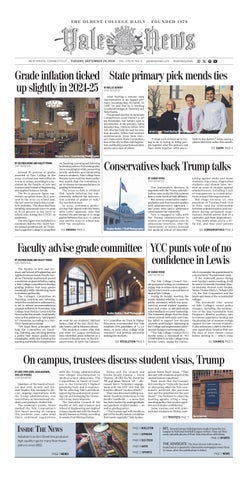
T H E O L D E ST C O L L E G E DA I LY · FO U N D E D 1 8 7 8
NEW HAVEN, CONNECTICUT · TUESDAY, SEPTEMBER 29, 2026 · VOL. CXLIX, NO. 8 · yaledailynews.com · @yaledailynews
Grade inflation ticked State primary pick mends ties up slightly in 2024-25 BY NELLIE KENNEY STAFF REPORTER
After beating a veteran state representative in an August primary, incoming Rep. Eli Sabin ’22 LAW ’26 said that he is working to rebuild bridges in Hartford and New Haven. The general election to represent Connecticut’s 92nd District is set for November, but Sabin’s spot is uncontested. In his primary, Sabin defeated Rep. Patricia Dillon SPH ’98, who has held the seat for over four decades. Dillon had received endorsements from New Haven’s Democratic Town Committee, four of the city’s other state legislators, politically powerful local labor unions and a slew of alders.
TimTai
Ariela Lopez / Contributing Photographer “I think a lot of what we’re trying to do is trying to bring people together after the primary and then work together with every-
body in the district,” Sabin said in a phone interview earlier this month. SEE SABIN PAGE 4
Shayam Suva / Contributing Photographer BY JOLYNDA WANG AND HAILEY YOUNG STAFF REPORTERS Around 81 percent of grades awarded at Yale College in the 2024-25 school year were either an A or an A-minus, according to a resolution by the Faculty of Arts and Sciences and School of Engineering and Applied Sciences Senate. The 80.75 percent figure represents an uptick from 78.97 percent in the 2022-23 school year, the last year for which data is publicly available. The share had been trending downward since its peak of 81.97 percent in the 2020-21 school year, during the COVID-19 pandemic. The new figure was included in a resolution that the FAS-SEAS Senate passed unanimously on Thursday to urge the College’s Committee
on Teaching, Learning and Advising to develop policies that make grades more meaningful while preserving faculty authority and minimizing harm to students. Yale College Dean Pericles Lewis told the News earlier this month that the committee is set to release recommendations on grading in November. The 2024-25 data is evidence that “grade inflation has substantially reduced the information content of grades at Yale,” the resolution says. In 2023, economics professor Ray Fair shared with the News, with Lewis’ approval, data that showed the percentage of A-range grades between the 2010-11 school year and the 2022-23 school year, with the exception SEE GRADES PAGE 4
Conservatives back Trump talks BY SARAH RIVAS STAFF REPORTER
Braden Mathis / Staff Photographer
The University’s decision to negotiate with the Trump administration came under fire this summer from a wide swath of Yale affiliates. But several conservative undergraduates said they have few qualms with administrators’ approach — and some even said a settlement could benefit the University. Yale is engaged in talks with the Trump administration to resolve an investigation into its admissions practices, after the Department of Justice accused the medical school of discrimi-
nating against white and Asian students. Since June, disgruntled students and alumni have leveled an array of charges against administrators, including a lack of transparency in communications around the negotiations. But Diego Victoria ’27, vice president of Turning Point USA at Yale, said the relationship between administrators and students during settlement negotiations should mirror that of a caretaker and their dependents. “You know when you’re a little kid, and then your parents SEE CONSERVATIVES PAGE 4
Faculty advise grade committee YCC punts vote of no confidence in Lewis
BY JOLYNDA WANG AND HAILEY YOUNG STAFF REPORTERS
The Faculty of Arts and Sciences and School of Engineering and Applied Sciences Senate Faculty Senate on Thursday unanimously passed a resolution on grade inflation, urging a Yale College committee to develop grading policies that keep grades meaningful while minimizing harm to students and faculty. The College’s Committee on Teaching, Learning and Advising, which the resolution is addressed to, is set to release recommendations on grade inflation in November, Yale College Dean Pericles Lewis told the News earlier this month. A full faculty vote on that guidance is “anticipated in” December, according to a FASSEAS Senate press release. “We hope these principles will help the Committee on Teaching, Learning, and Advising develop a policy that makes grades more meaningful, while also fostering the learning and intellectual exploration
BY SARAH RIVAS STAFF REPORTER
Braden Mathis / Staff Photographer we want for our students,” Michael Farina, chair of the FAS-SEAS Faculty Senate, said in the press release. The resolution comes after Yale and other Ivy League institutions have identified grade inflation as a concern in the past year. As the document notes, in April, the Universi-
ty’s Committee on Trust in Higher Education recommended that Yale establish GPA guidelines of “a 3.0 mean, or some other college-wide standard,” and provide percentile rankings for students. SEE RESOLUTION PAGE 5
The Yale College Council Senate postponed voting on a statement urging Yale to refrain from appointing Pericles Lewis to a second term as dean of Yale College. During its Sunday meeting, the senate debated whether to pass the public statement, which was sponsored by several student organizations and comes as administrators solicit feedback on Lewis’ leadership. The statement alleges that the dean, whose current term ends next June, has failed to support low-income students amid budget-tightening in the College and implemented detrimental changes to advising policy. “The Yale College Council (YCC) hereby issues a statement of NO CONFIDENCE in Yale College Dean Pericles Lewis, urging the Univer-
sity to reconsider his appointment to a second term,” the statement reads. If the statement passes during next Sunday’s senate meeting, it will be sent to University President Maurie McInnis, Provost Scott Strobel, Senior Trustee Marta L. Tellado GRD ’02, the Yale Corporation and the heads and deans of the 14 residential colleges. The document cites several of Yale College’s recent policy changes, including the termination of the Yale Sustainable Food Program’s director position, cuts to summer experience funding and the phasing out of summer storage support for low-income students. It also references a shift to the firstyear registration timeline that saw the class of 2030 choose classes before moving in — which some SEE COUNCIL PAGE 5
On campus, trustees discuss student visas, Trump BY ARIA LYNN-SKOV, SARA AGRAWAL AND LEO NYBERG STAFF REPORTERS Members of the board of trustees met with faculty and student leaders this weekend to discuss ongoing negotiations with the Trump administration, visa restrictions on international students and graduate student life. The weekend’s events, which marked the Yale Corporation’s first board meeting on campus this academic year, came amid Yale’s continued negotiations
with the Trump administration over alleged discrimination in medical school admissions. The Corporation, or board of trustees, is the University’s highest governing body and is responsible for selecting Yale’s president, approving the endowment spending rate and managing the University’s long-term interests. The Executive Council of the Faculty of Arts and Sciences and School of Engineering and Applied Science Senate met with the board’s faculty liaisons on Friday, according to senate chair Michael Farina.
Farina said the council and trustee faculty liaisons — David Thomas ’78 GRD ’84 ’86, David Sze ’88 and Jaime Teevan ’98 — discussed Yale’s “voluntary engagement with the DOJ” but that the trustees offered “no new details.” They also discussed adding academic freedom protections to the faculty handbook — a move that has been backed by undergraduate and graduate student leaders — as well as grading policy. “The trustees met with faculty as part of the faculty liaison committee that meets regularly,” Yale spokes-
person Karen Peart wrote. “They also met with students as part of the student liaison committee.” Peart wrote that the trustees’ fall meeting is “typically focused on discussing what the Yale community achieved the previous year and the priorities for the year ahead.” She declined to share the meeting agenda, citing a longstanding policy that renders agendas and minutes confidential. Some trustees met with international students on Friday, new-
INSIDE THE NEWS
PAGE 2 BULLETIN
Kebabian’s on Elm Street has produced high-quality rugs for many New Haven patrons since 1882.
PAGE 8 SCI-TECH
PAGE 7 NEWS
PAGE 3 OPINION
PAGE 9 ARTS PAGE 11 SPORTS
SEE TRUSTEES PAGE 5
Christina Lee
NFL Several former Bulldogs have made it from the Ivy League to National Football League rosters. They say they carry valuable pieces of their Yale education with them. PAGE 12 SPORTS THE ADVOCATE The New Haven Advocate relaunched as a quarterly alternative newspaper more than 50 years after the publication’s debut. PAGE 7 NEWS
PAGE 2
YALE DAILY NEWS · TUESDAY, SEPTEMBER 29, 2026 · yaledailynews.com
BULLETIN This Day in Yale History, 1981 September 29, 1981 / Squash courts trap players as doors refuse to budge
By Roy Herbst The squash courts in Calhoun and Jonathan Edwards colleges are discovered to have doors that jam shut when closed, trapping players inside. Multiples students have spent more than two hours attempting in vain to escape, and in at least one case, two squash players remained stuck in the JE court from midnight to 3 a.m.
ILLUSTRATION BY ANNA CHAMBERLIN
Behind the Headline By Cyrus Turner Nothing felt more classically New Haven than covering a pizza-themed Guinness World Record attempt for my debut Yale Daily News article. The event — which took place on the New Haven Green, less than a block away from my dorm — was already packed with people when I arrived around 5 p.m. I waited at the costume stand as those around me pulled their pizza-slice-attire over their heads, and I began to interview students, residents and visitors alike. When asked about their favorite kind of pizza, my interviewees lit up with responses that ranged from pizza with peppers and onions to a sauce pie with grated cheese and garlic. Attendees of the event could purchase from a range of food trucks lining College Street. Given the forecast nor’easter, I was relieved the weather was nothing out of the ordinary for the start of fall. The light drizzle created an extraordinary rainbow to conclude the evening.
CORRECTION: In last week’s issue, the This Day In Yale History used an incorrect headline. The correct headline is “Dining hall employees protest excess workload.”
Read “New Haven attempts, fails to break food costume Guinness World Record” on page 6.
ILLUSTRATION BY BEATRICE BARILLA
ILLUSTRATION BY ANNA CHAMBERLIN
ILLUSTRATION BY CLARISSA TAN
YALE DAILY NEWS · TUESDAY, SEPTEMBER 29, 2026 · yaledailynews.com
PAGE 3
OPINION GUEST COLUMNIST
GUEST COLUMNISTS
PENELOPE WILLIAMS
D A N I E L L E PA C I A A N D B E A T R I C E B R O W N
Grade caps, but not the Harvard way
Stephen Latham: questions asked and community built
This past May, Harvard announced a plan to cap all A grades at roughly 20 percent. This follows months of intense faculty debate, consideration of several different grading proposals and substantial student backlash. In November, Yale is expected to release a blueprint of its own revised grading guidelines. When responding to grade inflation, elite universities like Harvard and Yale are faced with a challenging dilemma: maintaining their academically rigorous reputation while not hampering the ability of their students to succeed. Harvard’s approach — strictly limiting the amount of A’s — is the first of its kind to come out of the Ivy League. It is as bold as it is foolish — the policy’s stringent authority reflects a total misunderstanding of what grades are, how they develop and what they ought to be. Yale is thereby obligated to seek and implement a better response. A s s t u d e n t a d m i ss i o n s become more competitive — and admitted students generally more academically capable — A grades naturally become more common. This is aligned with what A’s reflect: mastery of course content. It is thus senseless to impose a cap on A grades — implying that only a certain percentage of students are capable of demonstrating content mastery is immediately draconian and fundamentally incorrect. Furthermore, grades should evaluate student performance in relation to an overall standard, not in relation to the performance of one’s peers. Implementing the latter would not only result in a skewed grading system that weighs classmate quality over personal ability — a physics section in which Albert Einstein is enrolled, for example, would be harder to succeed in than a section lacking Einstein’s presence — but also prompt an endless cycle of course “cherrypicking,” in which students only take classes they know they can succeed in, rather than courses they are most interested in. This stands fundamentally at odds with Yale’s liberal arts mission. If Yale wants to combat grade inflation, it should modify its interpretations of content mastery instead of restricting the amount of A’s professors can give their students. This would foster collaboration rather than competition, curiosity rather than complacency, and effort rather than circumvention. Yale can accomplish such a task by introducing a new, elevated and capped grade distinction: an A+. A+’s would represent superior mastery of content, thus rewarding Albert Einstein while still ensuring those who are brilliant, but not the most brilliant, remain able to earn an A. A+’s would be capped at —
and this number is just an example — 20 percent of the class, and be worth 4.0 in GPA calculations. A’s, by contrast, would be 3.9. This is a fair compromise: top students can differentiate themselves from their classmates in a way that does not seriously injure classmates’ GPAs and thus preserves classmates’ chances at gaining entrance to prestigious graduate or professional school programs. The A and A+ distinction would also prompt a slight deflation in grades, helping regulate Yale’s extremely over-saturated market of nearperfect GPAs. In addition, this new A+ grade is immune to grade inflation. Because A+’s are capped at a strict 20 percent, it is impossible for the rate of their distribution to increase. To be clear: as a Yale student myself, I am naturally inclined to dismiss any grading policy that would make it harder for me to earn top grades. However, this doesn’t change the fact that it is wrong for students to be subject to grade deflation policies that firstly pit them against each other — something which is at direct cross-purposes with Yale’s established sense of community — and crucially are not in place at other institutions. One of the biggest problems a Yale A cap would present is that it would unfairly disadvantage its own students in graduate school admissions. In other words, unless sweeping grade policy was implemented identically in each of the United States’ top schools, it is simply unjust to force Yalies to battle each other for grades that others are acquiring by merely showing up to class. While I think “sweeping grade policy” that revolves around an A cap is inherently misrepresentative and wrong, it would be far worse if Yale instituted it without, at minimum, the rest of the Ivy League doing so as well. Yalies should not be disadvantaged because their school is one of the few with an A cap. Overall, while it is necessary to adopt a plan that mitigates grade inflation’s negative effects, this plan should, at all costs, steer clear of uncompromising restriction and overt authoritarianism. Rather than copy the example of Harvard, Yale should provide an original interpretation that puts students first, rather than school perception first. In doing so, Yale may set an example for the rest of the higher education world, elevating its status from shrewd classmate to Albert Einstein himself. PENELOPE WILLIAMS is a freshman in Grace Hopper studying philosophy and classics. Her column focuses on Yale educational policy. She can be reached at penelope.williams. plw28@yale.edu.
YALE DAILY NEWS PUBLISHING CO., INC. 202 York Street, New Haven, CT 06511 (203) 432-2400 Editorial: (203) 432-2418 editor@yaledailynews.com Business: (203) 432-2424 business@yaledailynews.com
EDITOR IN CHIEF & PRESIDENT Asher Boiskin MANAGING EDITORS Jaeha Jang Olivia Woo Reeti Malhotra PUBLISHER Henry Hoak DIRECTOR OF AFFAIRS Kate Soo Hyun Kim
UNIVERSITY EDITORS Olivia Cyrus Jerry Gao Henry Liu Isobel McClure
SPORTS EDITORS Liza Kaufman Walter Royal
CITY EDITORS Elijah Hurewitz-Ravitch Sabrina Thaler
SCIENCE & TECHNOLOGY EDITORS Michelle So Hari Viswanathan
ARTS EDITORS Kiva Bank Gemard Guery
OPINION EDITORS Manu Bosteels Rohil Mohan
INVESTIGATIONS EDITORS Sasha Hurowitz
WEEKEND EDITORS Stephanie Altschul Hana Tilksew
MAGAZINE EDITORS IN CHIEF Ethan Kan Claire Nam
ILLUSTRATIONS EDITOR Rana Roosevelt
HEAD PODCASTS HEAD PHOTOGRAPHY EDITOR Amiya Vashi EDITOR Martín Peralta DATA EDITOR HEAD PRODUCTION & Adriana Petrizzo DESIGN EDITOR Ezra Helfand HEAD COPY EDITOR Nate Stein
HEAD AUDIENCE EDITOR Emily Seo
THIS ISSUE COPY EDITORS: Jack Tompros; COPY STAFFERS: Leo Gabara, Oliver Browne; P&D STAFFERS: Olivia Dick, Delilah Sonnenshein, Aria Lynn-Skov, Ashley Skinner, Cyrus Turner, Maria Andreu Bird, Liliana Dumas, Jolynda Wang, Evan Bonilla, Kai Tasmin Bwor
EDITORIALS & ADS
Content on this page with bylines represents the opinions of those authors and not necessarily those of the Managing Board. Opinions set forth in ads do not necessarily reflect the views of the Managing Board. We reserve the right to refuse any ad for any reason and to delete or change any copy we consider objectionable, false or in poor taste. We do not verify the contents of any ad. The Yale Daily News Publishing Co., Inc. and its officers, employees and agents disclaim any responsibility for all liabilities, injuries or damages arising from any ad. The Yale Daily News Publishing Co. ISSN 0890-2240
NEW HAVEN, CONNECTICUT
SUBMISSIONS
All letters submitted for publication must include the author’s name, phone number and description of Yale University affiliation. Please limit letters to 250 words and guest columns to 750. The Yale Daily News reserves the right to edit letters and columns before publication. E-mail is the preferred method of submission.
ISSUES PRINTED BY
Valley Publishing Co, Derby, CT
DIGITAL ARCHIVE
YDNHistorical.Library.Yale.edu
COPYRIGHT 2026 — VOL. CXLIX, NO. 8
ADVERTISEMENT
(203) 432-2424 (before 5 p.m.) business@yaledailynews.com Direct all letters, columns, artwork and inquiries to: Contact the Opinion Editors at opinion@yaledailynews.com
Direct all comments regarding the fairness or accuracy of stories to: Asher Boiskin Editor in Chief & President editor@yaledailynews.com
A mentoring conversation with Professor Stephen Latham, former director of the Yale Interdisciplinary Center for Bioethics, might begin with a puzzling bioethics question and end with him sketching out an entirely new career path for you. He might connect you with someone who would become a lifelong friend or tell you a story from his days performing magic in Harvard Square. At Yale, Professor Latham’s course, Bioethics and Law, enrolled roughly 485 students at its height. Since last spring, Professor Latham has retired, leaving behind a remarkable legacy. We knew Professor Latham as a professor at Yale and as a cornerstone in the field of bioethics—not only through his scholarship and leadership, but through the extraordinary network of bioethicists he brought together. We are writing because we believe his approach to teaching ought to be emulated and remembered. Before arriving at Yale in 2007, Professor Latham served as director of ethics standards at the American Medical Association and taught health law at several universities. In his career, he authored more than 150 publications that appeared across medical, scientific, legal and bioethics journals, including JAMA, Nature, the New England Journal of Medicine and leading law and bioethics journals. But far more important than the papers he published or the conferences at which he spoke was what he brought to the people around him, including his infectious humor, extraordinary integrity and palpable humility. In the spirit of what we believe to be his greatest legacy—his students
and mentees—we spoke with some of them and asked about Professor Latham’s impact on their life. Professor Rachel Fabi, now an associate professor at SUNY Upstate Medical University, remembers taking Professor Latham’s exam, “crush[ing] it,” and then making a decision that would change her career: instead of going to her physics midterm, she went to the registrar and changed her major to an interdisciplinary political science degree focused on bioethics and health policy. She later earned her PhD in bioethics and health policy and is now a professor of bioethics. Professor Carly Zubreski, an associate professor of law at the University of Connecticut, took his classes as an undergraduate and was a teaching assistant for those same classes while in law school. What stayed with Professor Zubreski most was how seriously Professor Latham took her ideas when she was still a student. He encouraged a colleague to assign portions of her senior thesis in a graduate seminar, an experience that reinforced something that would stay with her for years: that her own thinking mattered. Professor Brian Earp, who is an associate professor of biomedical ethics at the National University of Singapore, remembers Professor Latham’s ability to break down complex ideas, use storytelling and command a room’s attention in a large-lecture format. Professor Earp describes Professor Latham as “deeply humane and thoughtful,” taking the material he taught seriously and allowing it to remain as complex and nuanced as it was. To us, the two co-authors of this piece, Professor Latham is more
than an academic mentor: he is the person we credit with bringing us together. Before starting our master’s program in bioethics, we sought each other out because Professor Latham told us to. He somehow knew, before we did, that we would really hit it off. Fo r P ro fe sso r L a t h a m , mentorship was never simply about teaching. He strengthened not only the field of bioethics, but also what makes academia so special—the people we are lucky enough to meet and the impact they and their perspectives ultimately have on our lives. Professor Latham’s influence lives on in the students who became scholars, the scholars who became mentors and his students who became best friends. He has a rare ability to see people not simply as students, colleagues or young professionals, but as people—with interests, personalities and possibilities. That patient attention, and the kindness that accompanied it, is what we believe makes a mentor—and Stephen Latham in particular—truly extraordinary. Yale will not be the same without him, but campus is genuinely a better place because of the impact that he has made. DANIELLE PACIA is a second year student at Yale Law School. She received her master’s degree in bioethics from Harvard. She can be reached at danielle.pacia@yale.edu. BEATRICE BROWN is a law clerk. She received her bachelor’s degree from Yale College in 2019, and she graduated from Yale Law School in 2025. She can be reached at beatrice.brown@yale.edu.
GUEST COLUMNIST CA M I L O SA L GA R
A dancing lesson from Gustavo Dudamel Two years at Yale, and I still cannot rid Gustavo Dudamel, the Venezuelan conductor and current Music and Artistic Director of the New York Philharmonic, from my mind. I know, in my heart of hearts, that Yale students must learn from Dudamel how to dance. Each month in New Haven confirms this. What I mean to say is that Dudamel’s persona can teach us a thing or two about what mastery actually looks like. Almost two years ago, I had the privilege of watching Dudamel conduct the Los Angeles Philharmonic at a concert in Bogotá, Colombia. Almost forty minutes had elapsed since the beginning of the concert. The third movement of Ravel’s Piano Concerto in G Major was upon us. The hallowed silence of an orchestral concert’s first moments had passed. Like so with the whispered chitchat that comes after the first couple solos of the night. The performers sat up a little straighter, the audience melted into the music, and as tension rose in a rhythmic portion of the third movement, Dudamel began to swing his hips side to side. By convention, the conductor stands with his back towards the public so his facial expression is hidden from view. He casts a serious, secular figure in his dark suit, dull and grey haired. Yet mastery need not be dull, and with Dudamel the opposite was the case. That night in Bogotá, he cut through the air, hemisphere to hemisphere. He threw out his arms abruptly, and the intensity of his expression was clear even in the brief glimpses the audience received, visible only when he looked towards the sides of the orchestra. Sitting at, or close to, the summit of classical music,
Dudamel enlaced his mastery with charisma. Here is where Dudamel can teach us a lesson. The problem is not that we are in Bass until two in the morning — the problem is that we fail to express the energy that we should be imbuing into every portion of our lives. If classical music is not too serious for a conductor to be swinging their hips
YALIES POSTPONE THEIR ENERGY, CONSTANTLY JUSTIFYING THEIR CURRENT STATE OF BEING “LOCKED IN” FOR A FUTURE WHERE THEY WILL BE ABLE TO “LOCK OUT.” to on stage, then your philosophy seminar should not be too serious for you to show how passionate you are about your distaste of John Stuart Mill’s “Utilitarianism.” One may think that such an outpouring of energy is only tolerated because Dudamel has already reached the top of his profession. However, it is only a matter of finding videos from back in his career to make it clear that such charisma is part of his career journey. Nineteen years ago, being already an established conductor but nowhere near the level he is at today, Dudamel’s curls jump up and down as he performs everything short of a split while conducting.
A Dudamel-type figure is not one that remains dull for the majority of their career, waiting to reach the top, jump up in the air and finally show their energy. Yalies postpone their energy, constantly justifying their current state of being “locked in” for a future where they will be able to “lock out.” But if our path towards a supposed notion of success is dull and lifeless, chances are slim that a day will come when everything changes and we can finally jump in the air. As students, if our paths are not invigorating, how can we expect the destination to feel any different? In such outpourings, it is not only Dudamel who enjoys himself, but rather entire audiences, and even the musicians themselves, as they savor his energy. We need more of those students who are unabashedly enthralled by a topic in the classroom, students who feel connected to the work they produce and feel like something is at stake when they participate in class discussions. Last month, Yale announced that Gustavo Dudamel will be given the Henry E. Howland Memorial Prize, one of the University’s highest honors. The prize serves to honor a distinguished individual who “reflects idealistic principles and contributes meaningfully to society.” I believe this award is well deserved. Dudamel’s overflowing energy provides an understanding of mastery that is often too sullied. CAMILO SALGAR is a sophomore in Davenport College studying applied math and philosophy. His column focuses on voicing an international student’s perspective on University affairs. He can be reached at camilo.salgar@yale.edu.
PAGE 4
YALE DAILY NEWS · TUESDAY, SEPTEMBER 29, 2026 · yaledailynews.com · @yaledailynews
FROM THE FRONT
“Only want to see you underneath the purple rain” PURPLE RAIN PRINCE
About 81 percent of grades were in A-range, faculty say GRADES FROM PAGE 1 of the 2019-20 school year, which included the beginning of the COVID-19 pandemic. The share of A’s and A-minuses steadily increased from 67.23 percent in the 2010-11 school year to 72.95 percent in the 2018-19 school year but skyrocketed to 81.97 percent in the 2020-21 school year, according to the data. While the share of A’s and A-minuses dropped slightly to 79.62 percent in the 2021-22 school year and to 78.97 percent in the 2022-23 school year, the figure of 80.75 percent from the 2024-25 school year represents a deviation from that downward trend. Lewis had told the News in March that grade distribution had remained “pretty consistent” over the last four years. The required GPAs for cum laude distinctions has seen a parallel rise in the recent decade. The cutoff for summa cum laude, representing the top 5 percent GPA of the graduating class, increased from 3.93 in 2010 to 3.98 in 2023 — before inching yet
higher to 3.99 for the class of 2026. The FAS-SEAS Senate’s resolution arrives as Yale and its Ivy League peers seek to address the widespread issue of grade inflation. In April, Yale’s Committee on Trust in Higher Education recommended that the University establish a GPA guideline of “a 3.0 mean, or some other college-wide standard,” and include course-specific percentile data in transcripts. In May, Harvard’s faculty voted to start capping A’s at roughly 20 percent next fall. The share of A-range grades at the school had risen from 60 percent in the 201011 school year to 79 percent in the 2020-21 school year — still lower than Yale’s 81.97 percent figure from that year. Amanda Claybaugh, Harvard’s dean of undergraduate education, graduated from Yale College in 1993. Contact JOLYNDA WANG at jolynda.wang@yale.edu and HAILEY YOUNG at hailey.young@yale.edu.
Ellie Park
The figure of 80.75 percent, included in a Thursday resolution by the Faculty of Arts and Sciences and School of Engineering and Applied Sciences Senate, represents an uptick from the share of around 79 percent in the 2022-23 school year.
Incoming state representative beat 21-term incumbent SABIN FROM PAGE 1 That includes “folks who were on all sides of the race.” Sabin, a 26-year-old Yale Law School graduate, had served three terms as a New Haven alder before the primary. In August’s race, he also defeated Justin Farmer, who had been endorsed by the Connecticut branch
of Democratic Socialists of America. Sabin’s win came alongside a victory for Wildaliz Bermúdez, the Democratic nominee in the 97th district, who also defeated a candidate supported by the city’s Democratic establishment. Mayor Justin Elicker endorsed both Sabin and Bermúdez, splitting from other prominent Democrats.
Although party support was divided during the primary, Sabin said that he thinks Democrats in the city have “shared values and priorities and really love the city.” He noted that he particularly looks forward to working with labor leaders, many of whom he said he has “sat down with” since the election. Local 34, Yale’s clerical and techni-
Garrett Curtis / Photography Editor
In August, former alder Eli Sabin ’22 LAW ’26 defeated longtime state representative Patricia Dillon SPH ’98 in a Democratic primary for Connecticut’s 92nd district. Dillon had been endorsed by a broad coalition of local Democratic leaders.
cal workers’ union, the local Teamsters union and two service workers’ unions all endorsed Dillon. Board of Alders President Tyisha Walker-Myers, who serves as the chief steward of Local 35, Yale’s service and maintenance workers union, said in an interview that she respects “the title and the position” of state representative. “I’ve worked with Eli Sabin before. I’m willing to work with him after the election. The work doesn’t stop,” she said, although she emphasized that Dillon is still the district’s representative until Sabin officially takes office. In August, Walker-Myers, along with five other alders whose wards overlap with the 92nd district — most of whom are financially backed or endorsed by UNITE HERE unions — penned an op-ed in the New Haven Independent endorsing Dillon. The letter said Sabin experienced “growing pains” while on the Board of Alders and that he was “not ready” to serve as state representative. Ward 3 Alder Angel Hubbard, one of the alders who signed the August op-ed, described the result of the August primary as “personally” difficult because Dillon has been supportive of her in the past. Still, she said, she respects Sabin and has found him to be very responsive. “Every time I call, he always picks up,” she said. “There has not been a
time when he has not made himself available for our ward.” According to a post on Sabin’s Instagram account, Sabin and Bermúdez met with Governor Ned Lamont SOM ’80 on Monday. They discussed “how we can increase school funding, protect our immigrant neighbors, build affordable housing, fight against SNAP cuts, and much more,” Sabin wrote in the post. Affordability and school funding have been top-of-mind in many of Sabin’s recent conversations, he said. Asked on Monday about his work with Sabin since the election, Elicker said Sabin was focused on updating the funding formula for New Haven’s schools, a goal Sabin is “very enthusiastic” about, according to Elicker. Sabin said he and Dillon spoke after the August results were announced, but that she has not responded to a more recent communication. Dillon did not respond to the News’ question about that communication. “I’m definitely hoping to have a chance to talk with her and get advice as much as possible about the role and talk about ongoing projects in the district,” Sabin said. District 92 covers New Haven’s parts of the Dwight neighborhood as well as Amity, Edgewood, Westville and the Hill neighborhoods. Contact NELLIE KENNEY at nellie.kenney@yale.edu.
Some students see no need for more transparency CONSERVATIVES FROM PAGE 1 have grown-up problems that only they know how to deal with, and you’re kind of out of the picture?” Victoria said. “It kind of feels like that right now: we’re the little kid, and the administration are the parents.” Hannah Owens Pierre ’28, a fellow at the Buckley Institute who is also a staff columnist for the News, commended the Yale administration’s effort to be “as transparent as possible” in the face of legal constraints requiring confidentiality, citing the University’s website communicating information and updates on the investigations. “The student reaction to these talks has been quite one-sided, which is unfortunate, but that is to be expected given the fact that Yale students are predominantly on the left,” Owens Pierre wrote in an email to the News. Given the student body’s “overwhelmingly negative” reaction to the negotiations, conservative students may be reluctant to publicly share their support or even neutrality towards the issue, Owens Pierre added. Victoria said that the administration doesn’t have “much to improve” by way of being forthright about the talks, citing emails McInnis has sent to the Yale community containing updates on the
investigation process. However, Mór Szepesi ’27, former president of the Yale Political Union and former chairman of the Party of the Right, said the University should seek to be more transparent, suggesting that administrators collaborate with a small group of professors, students and alumni to hear out the range of campus perspectives as talks continue. “I worry that the lack of transparency, combined with a lack of representation, is why many people in the Yale community do not trust the process,” said Szepesi. “The administration needs to think about how to build that trust, and inviting a few more people to the table would help.” Some conservative students agreed that a potential settlement may have a positive effect on the University’s political diversity. Victoria said that a settlement could help Yale become a “beacon of academic freedom” by encouraging more conservative students to apply. Laina Allen ’29, the vice president of Yale College Republicans, wrote in a statement to the News that a settlement could build trust in the University amongst Yale conservatives by demonstrating that Yale is committed to respecting “good-faith investigations” by the federal government, regardless of the political affiliation of the president. “Yale should welcome intellectual
diversity, including political diversity,” Szepesi wrote. “If a settlement reached through an inclusive process rebuilds trust and strengthens the
value of a Yale education, students across the political spectrum should welcome that change.” Yale’s chapter of Turning
Kalina Sabala Montes / Staff Photographer
Point USA emerged this spring. Contact SARAH RIVAS at sarah.rivas@yale.edu.
Amid widespread backlash to the ongoing settlement talks between administrators and the Department of Justice, some conservative students expressed support for the University’s communication strategy and a potential settlement.
YALE DAILY NEWS · TUESDAY, SEPTEMBER 29, 2026 · yaledailynews.com · @yaledailynews
FROM THE FRONT
PAGE 5
“I'm singin' in the rain, just singin' in the rain” SINGIN' IN THE RAIN GENE KELLY
Grading should minimize stress, faculty senate says RESOLUTION FROM PAGE 1 In May, Harvard’s faculty voted to cap A’s at roughly 20 percent starting next fall. Amanda Claybaugh, Harvard’s dean of undergraduate education, said in August that Harvard could enforce the grade cap by
automatically converting all A’s to A-’s in courses that did not adhere to the limit. In an interview later that month, Claybaugh backtracked and said the enforcement was still a proposal. The FAS-SEAS Senate’s resolution considered how grades are a “signif-
Kimberly Angeles / Photography Editor
The Faculty of Arts and Sciences and School of Engineering and Applied Sciences Senate passed a resolution that seeks to reduce harm to students and faculty.
icant” source of stress for student wellbeing, recognizing that changes in grading policies could be harmful by increasing competition, diminishing collaboration and adding risks to academic exploration. That stress has been “found to be particularly harmful for students who were racially or socioeconomically marginalized,” the resolution says. “Any policy designed to reduce grade inflation should be implemented only alongside measures that limit its impact on student health and welfare, especially during the transition period,” it reads. David Post, the deputy chair of the FAS-SEAS Senate, also said in the press release that instructional faculty, whose contracts often depend on student evaluations, need protection from changes to grading policies and potentially negative e!ects on student evaluations. The resolution recommended that those protections be put in place before any new grading policy is implemented. Instead of endorsing a uniform
grading distribution, the FAS-SEAS Senate’s resolution calls on the Committee on Teaching, Learning and Advising to follow the informational purpose of grades through reporting course and department grade distributions and decoupling Latin honors and awards from raw GPA thresholds. The resolution also recommends a common grading framework across Yale College, to “clarify collective academic standards and determine grade distributions” while simultaneously preserving faculty authority over individual courses. “Faculty must retain final authority over grading policy in their courses,” the resolution says. “At the same time, a common framework approved by the faculty should be implemented consistently across all departments and divisions.” Finally, the Senate called for increased student and faculty consultation throughout these policy developments. The Student A!airs Committee of the FAS-SEAS Senate, which drafted the resolution, focuses on policies concerning academic
support for undergraduate and graduate students. Yale College’s Standing Committee on Teaching, Learning and Advising, convened by Yale College Dean Pericles Lewis and University President Maurie McInnis, is chaired by economics professor and former University provost Benjamin Polak. The committee, composed of 19 members, includes faculty, administrators and representatives from the Yale College Council. Farina emphasized that Lewis is “dedicated to addressing grade compression in a collaborative manner that incorporates faculty input” and praised Polak for his e!orts in leading the committee. The next FAS-SEAS Senate meeting is scheduled for Oct. 15 in Dow Hall. Contact JOLYNDA WANG at jolynda.wang@yale.edu and HAILEY YOUNG at hailey.young@yale.edu.
Proposed statement slams dean’s decision-making COUNCIL FROM PAGE 1 said enhanced student stress. Silliman senator Michael Canudas ’28 raised concerns during the Sunday meeting that the statement was not fair to Lewis and did not accurately assess his term thus far as dean. “I’m just a little bit concerned that we’re sort of cherrypicking the negatives,” Canudas said.“I just think we’re pinning a lot on Dean Lewis here.” Lewis did not immediately respond to the News’ request for comment. As of Sunday evening, the statement was sponsored by Yale First-Generation and/or Low-Income Advocacy Movement, Yale QuestBridge Scholars Network, Rural Students Alliance at Yale and Mecha de Yale — a student organization dedicated to political activism for the Latinx population and other underrepresented communities, according to its website. “With so many Latine students identifying as FGLI, the continuous and staggering budget cuts have disproportionately impacted us,” Mecha de Yale co-moderator Lineth Miramontes ’28, wrote in an email to the News, referring to first-generation, low-income students. “We will not stand for Dean Lewis’s pol-
icies or rhetoric that continue to disregard and dehumanize Latine students at Yale.” Ximena Solorzano Castillo ’28, a YCC senator and co-president of Yale First-Generation and/or Low-Income Advocacy Movement, echoed this critique in a testimony given through Zoom at the YCC meeting. Solorzano Castillo is also a former head photography editor for the News. “Various FGLI first-years have felt like they were not properly supported due to the lack of advising as their course registration was moved to during the summer and not when they first came onto campus,” Solorzano Castillo said. “They felt like they didn’t have the adequate resources or the connections to make a good schedule that would best accommodate their transition onto campus.” The statement claims that Lewis has not fulfilled his promise to strengthen the residential college system, and instead has centralized key responsibilities that were once under individual colleges’ jurisdiction. It also criticized Lewis’ communication style, alleging that the dean confirmed summer
storage support would cease only six weeks after telling YCC senators that student support programs would not receive any more major cuts. Lewis said earlier this year that he had forgotten about the cuts when meeting with student leaders. “Dean Lewis has abandoned the mantle of leadership, leaving the Yale College community without clear guidance or transparency,” the statement reads. The senate voted to table the public statement because some senators wanted additional time to review the language of the document and better understand the “purview of decision making” in the Yale College administration, Kyler Parker ’29, speaker of the YCC Senate, wrote to the News. On Sunday, Parker, who suggested the senate vote on the statement anonymously, acknowledged that some senators might fear that approving the statement would strain their working relationship with Lewis, who is attending the YCC Senate meeting on Oct. 11. “As Michelle and I meet with Dean Lewis multiple times a month, email him multiple times a week, I don’t think that this would
negatively impair our relationship to the point where he’s going to not work with us,” YCC President Alex William Chen ’28 said during the meeting. “I think it is very fair for all senators to vote their conscience.” Chen added that he had given Lewis a “heads up” that the state-
ment was coming. The Yale College Council was established in 1972. Jolynda Wang contributed reporting. Contact SARAH RIVAS at sarah.rivas@yale.edu.
Olivia Woo / Contributing Photographer
The Yale College Council considered issuing a public statement that urged top administrators not to reappoint Yale College Dean Pericles Lewis.
Yale Corporation gathered for first of four meetings TRUSTEES FROM PAGE 1 ly-elected alumni fellow Mariko Silver ’99 said. Saturday morning’s meetings were held in the Greenberg Conference Center, near the Yale Divinity School. In past years, the trustees met in the Corporation Room at Woodbridge Hall. When asked in March why the Corporation no longer meets in Woodbridge Hall, Peart wrote that the Corporation now uses meeting spaces with more room and better technology. This year, the board of trustees are scheduled to meet on campus four times — a decrease
Ximena Solorzano / Photography Editor
from the five on-campus meetings in previous years. Student organizations scheduled protests to coincide with the Corporation’s September visit to campus, but postponed the demonstration to Oct. 2 due to the weekend’s forecasted nor’easter. The storm caused flooding in parts of Connecticut. On Saturday morning, the three new trustees, Derek Chang ’89, Phillipe Costeletos ’87 and Silver, as well as Maryana Iskander GRD ’03, met with Graduate and Professional Student Senate President Raekwon Fuller DRA ’27 and Graduate Student Assembly Chair Anushka Potdar GRD ’30.
In the Yale Corporation’s first in-person meeting of the academic year, trustees met with faculty and student representatives and also spoke with international students.
“They hear a lot from undergrads, they say, and know more about undergrad life,” Fuller said outside the conference center on Saturday. “They want to hear more about the graduate and professional student experience.” Topics that Fuller and Potdar brought up in the “listening session” included discrepancies in career development opportunities among the graduate and professional schools, accessibility and safety concerns, differences in opportunities between undergraduate and graduate students and financial transparency about the cost of attending graduate school. Fuller said that the trustees met with international students on Friday, where they discussed the Office of International Students and Scholars along with “new visa changes and how international students feel.” Yale’s ongoing negotiations with the Trump administration about the School of Medicine’s admissions practices “did not come up in this meeting,” Fuller said. The trustees brought up the reduced numbers of doctoral candidates, according to Fuller and Potdar. Fuller described the four trustees in the meeting as “very receptive.” “They were clearly very curious to learn more. They didn’t know some things about our graduate school experience,” Potdar said. The meeting comes as trustees have faced scrutiny, from a faculty committee and students across campus, over their private agenda.
According to a Saturday Instagram post from the Endowment Justice Collective — which advocates for ethical investment practices — banners reading “Shared Governance Now,” “Trustees You Can’t Hide” and “Fight Back Don’t Settle” hung on buildings across campus. The post’s caption read, “Good morning and welcome to campus, Yale Board of Trustees! We came across some notes left for you.” The Committee on Trust in Higher Education included a recommendation in their April report calling on the University to “Build trust with the trustees.” The Trust Committee called for Yale’s faculty to appoint liaisons to the trustees to provide “academic perspective to trustee deliberations” and report back to the wider community. It also called on the corporation to maintain scholars and academic leaders as members. Many of the trustees have backgrounds in finance or business. Thomas, an alumni fellow on the board, is currently a professor at Harvard University and served as president of Morehouse College. At their meeting last April, trustees declined to comment on specific recommendations from the trust report. Marta Tellado GRD ’02, the senior trustee, wrote in a statement provided through Yale’s central communications office in April that she appreciates the committee’s work, but did not directly respond to questions about their calls to build trust with the board.
When approached before their Saturday meetings, a few trustees spoke briefly to the News. “This is the beginning of the year so we talk about the budget,” Tellado said. “We have so much committee business to do that we talk about anything that is related to our job as the Yale Corporation.” When asked what the board would be discussing, trustee Felicia Norwood LAW ’89 answered, “all the things we always discuss. The kinds of things that keep Yale at the forefront and continue to make us better.” “We always want to make Yale a world class institution, and I think all the conversations around how we do that is what matters most,” she said. Norwood said the trustees would be “certainly trying to make sure we understand the things that impact all of you.” Chang said the trustees would be discussing “normal board matters.” John Barden, Vice President for Information Technology and Campus Services, entered the Greenberg Conference Center around 10:30 a.m. University Provost Scott Strobel was also seen walking into the building earlier that morning. The Corporation’s next on-campus meeting will take place on Dec. 12. Contact ARIA LYNN-SKOV at aria.lynn-skov@yale.edu SARA AGRAWAL at sara.agrawal@yale.edu and LEO NYBERG at leo.nyberg@yale.edu.
PAGE 6
YALE DAILY NEWS · TUESDAY, SEPTEMBER 29, 2026 · yaledailynews.com
NEWS
“Seems it never rains in Southern California” IT NEVER RAINS IN SOUTHERN CALIFORNIA ALBERT HAMMOND
School of Medicine, Law School students share Trump concerns BY GILLIAN PEIHE FENG AND IRENE KIM STAFF REPORTERS When nearly 200 Yale School of Medicine students last week signed a letter to administrators urging the University against a settlement with the Trump administration, they were not the first group of Yale graduate students to write a letter of that nature this year. A!liates of Yale Law School — which, like the School of Medicine, has faced a Department of Justice investigation into its admissions practices — had written an open letter two months ago that opposed a settlement with the federal government. Earlier this month, Yale President Maurie McInnis told the News that the University’s negotiations with the Justice Department only concern the School of Medicine and not the Law School or Yale College, which is also facing an investigation. The Justice Department has only released a letter of findings for its investigation into the School of Medicine. But in interviews with the News, students from the Law School and the School of Medicine alike expressed strong opposition towards the prospect of Yale settling with the Justice Department. While medical students in particular were concerned about what they called administrators’ lack of communication, transparency and openness to student input, some Law School students said they feel more detached from the negotiations because their school is not involved. Yale spokesperson Karen Peart did not respond to the News’ request for comment. School of Medicine students slam accusations Students at Yale School of Medicine expressed disbelief in the Department of Justice’s allegation that the medical school practices race-based discrimination in its admissions process. They further called for greater transparency and communication from Yale administration during its negotiation with the Justice Department. In May, the Justice Department released a letter accusing Yale School of Medicine of continuing to “intentionally discriminate against applicants based on their race,” which violates the 2023 Supreme Court ruling that ended race-based a!rmative action. The
letter claimed that the admissions process put Black and Hispanic applicants at an unfair advantage, while discriminating against White and Asian applicants. “When the letter of findings came out, I think my initial response, and I think the response of a lot of our peers, was disbelief,” Manu Sundaresan MED ’33 said in a Zoom interview with the News. He further called the findings “disingenuous.” Kyle Gavulic MED ’29 GRD ’29 said that the Justice Department’s findings are not fully supported by the evidence it presents in the letter. “When you dig into the actual report that the DOJ has produced on its findings, it’s very clear that there’s a large misunderstanding or chosen misunderstanding of how holistic missions and medical school admissions work across the country,” Gavulic said in a Zoom interview with the News. “The statistical claims and evidence that they present, are extremely elementary, and a lot of the claims that they make cannot actually be drawn from the quote evidence that they claim to present.” In its letter of findings, the Justice Department presented admissions data from the School of Medicine that showed discrepancies in GPAs and standardized medical exam scores by race among admitted applicants in the 2023, 2024 and 2025 admissions cycles. M ichelle Mantilla MED ’33, who identifies as a Latino student from a first-generation, low-income background, said that the Justice Department’s investigations and findings have added to the pressure that many medical school students from underrepresented backgrounds are already under. The medical students further expressed disappointment in Yale’s handling of its negotiations with the Justice Department, demanding greater transparency, better communication and an openness to input from medical school students. “Despite being the only ones that have had findings that are against our school, it doesn’t feel like she’s really getting student input from the School of Medicine,” Samiksha Chopra MED ’29 said in an interview to the News, referring to McInnis. Chopra pointed out that while McInnis has met with representatives from Yale College and the Yale Graduate School of Arts and Sciences to discuss the Justice Department investigations, no medical school student has so far
been included in these talks. That meeting happened in July. “It’s really the School of Medicine that these allegations are targeting, but if that’s the case, why not talk to School of Medicine students?” Chopra said. “I feel like there’s a lot more they could be doing to kind of address these things, particularly at the student level. But right now, it really, really feels like they’re prioritizing their own reputation and their relationship with the current administration, and not prioritizing the students who actually make the school.” For Gavulic, Yale’s lack of transparency on what exact information of medical school students has been shared with the Justice Department is particularly concerning, especially with regard to the fact that Yale has provided “applicant-level admissions data” to the Justice Department, as stated in the department’s letter of findings. “It’s unclear to us with this environment of lack of transparency what information of ours has been shared with the government,” Gavulic said. Law School students opposed, but somewhat detached Saavni Desai LAW ’27 said that she had been following the initial probe into the medical school and was surprised that the Law School was targeted next. “It was a little bit surprising that Yale was being targeted for these kinds of investigations, especially after we’d been excluded from prior rounds of settlement negotiations,” she said in a phone interview. “The Yale Law School one did feel a little bit close to home, so that was jarring.” Because the news came in July, classes were out of session. Grady Short LAW ’28, who serves as a co-president of Yale Law Democrats, said in a phone interview that this meant “there was not a day when everyone was at the Law School and talking about it as a fresh thing.” Still, law students, professors and alumni gathered in resistance when news suggesting that the University was open to negotiating with the Trump administration broke. Students circulated a July petition by Stand Up For Yale, an alumni advocacy group, around the Law School, encouraging their peers to join the some 5,000 signatories who called any settlement with the Department of Justice a “slap in the face to current students and generations of alumni.”
CHRISTINA LEE
Students from both schools have in recent months signed letters demanding that Yale not settle with the federal government, which has probed both schools. Faculty members, including Yale Law Dean Cristina Rodríguez ’95 LAW ’00, quietly met to organize lobbying efforts against any negotiations — and even explored whether the Law School could be excluded from a potential deal with the federal government. The same week, Yale Law Democrats came together to author an open letter to McInnis, Rodríguez and the Board of Trustees, which urged the University “not to enter into a settlement with the federal government concerning admission.” The letter, signed by nearly 200 students and 27 student organizations, claimed that “if the university signs an agreement its own law school would advise against, it will teach us more vividly that fair process, even rule of law itself, must ultimately yield to power.” The Law School admits around 200 students every year. Echoing sentiments seen across other faculty, student and alumni efforts, the letter concluded: “Yale’s reputation was not built by accommodation to political power and it will not be preserved that way.” Mc I n n i s ’ most re c e n t announcement about the Law School’s exclusion from investigations has not changed the picture for most law students. Many think that any settlement with any part of the university — like the School of Medicine — could still affect their lives. “I don’t see the law school as operating in a silo that is disconnected from the rest of the university,” Anna BrentLevenstein LAW ’28 said in a phone interview. “Until there is an announcement that there will be
no settlement that affects any of the schools, law students are still concerned about any settlement the university could make.” Desai said that this sentiment is felt across the student body. “There’s strong opposition among most of the law students to the Trump administration’s targeting of institutions of higher education, including Yale and its various schools,” she said. Still, neither the announcement of investigation updates nor lingering negotiations between the School of Medicine and the Justice Department seem to much affect day-to-day life over at Wall Street. “Since there haven’t been major developments beyond what the president of the university has said about it,” Short said, life hasn’t changed much at the Law School. Students said that professors rarely mention the negotiations in class, and that the topic comes up only casually in conversation. Though the announcement of the investigations surprised Desai, she said she and her peers have become used to their education being part of a national political spectacle. “Maybe we’re a little bit desensitized to these kinds of things affecting us, our job opportunities and our law school,” she said. Combined, Yale Law School and the School of Medicine enroll approximately 1,200 students. Contact GILLIAN PEIHE FENG at peihe.feng@yale.edu and IRENE KIM at irene.kim.irk24@yale.edu.
New Haven attempts but fails to break food costume world record BY CYRUS TURNER CONTRIBUTING REPORTER Just one year after attendees of the 10th New Haven Apizza Feast beat the Guinness World Record for “Largest Pizza Party,” more than 700 attendees of the event’s 11th iteration attempted another record-breaking feat. They did not succeed. Organizers of last Friday’s pizza event hoped to beat the record for the largest gathering of people dressed as food. The title is currently held by a community organization in Kusatsu, Japan, which in 2017 had 888 people dress as wasabi mustard greens. New Haven pizza costumewearers came about 100 people short of that record.
The nor’easter storm forecasted for the weekend impacted participant turnout, event organizer Colin Caplan wrote in an email after the gathering. “Over 1200 tickets were p u rc h a se d b u t o n ly 7 7 8 participated,” Caplan, who founded Taste of New Haven — which operates food tours of the city — wrote. “Had 111 more people showed up and entered the attempt we would have broken the record. Instead we got the most beautiful rainbow and sunset!” A double rainbow graced the sky to cap off the world record attempt, which was part of the broader annual A-1 Toyota Apizza Feast and New Haven Grand Prix Cycling Race event. Attendees could purchase from
CYRUS TURNER, CONTRIBUTING PHOTOGRAPHER
Participants in the 11th annual New Haven Apizza Feast tried to beat the record for the largest gathering of people dressed as food but were thwarted by a forecasted nor’easter.
more than 70 vendors on and around the New Haven Green as they listened to live music performed by Carlos Santiago y Su Momento Musical. Caplan said the world record attempt was inspired by the success of last year’s gathering. “It was so rewarding to see that come together that I ended up wanting to do something else with Guinness World Records,” he said. Guinness World Records adjudicator Natalia Ramirez, who oversaw the event, reassured the pizza-wearing attendees from a stage on the Green. “You have to beat a minimum established in Japan,” Ramirez said. “Unfortunately, we didn’t beat that number today, but it doesn’t mean that you didn’t make history. You are almost 700 souls dressed as pizza.” The annual event raises money for the Connecticut Cycling Advancement Program, Caplan said. This year, he added, a percentage of the proceeds will go to the Boys and Girls Club of Greater New Haven. “This whole event is to support small businesses, community organizers and leaders and our youth,” Caplan said to the crowd. “It’s all about the youth.” R a m i rez sa i d t h e re a re established guidelines for each record attempt. “We have to validate the accountability process from the beginning of the participants’ registrations,” she said. “We have some stewards inside of the record attempt area, that was the witnesses who see if the
participants have the costume. We have a closed and secure record attempt area with only two entrances, without an exit.” Participants lined up outside of a fenced area on the New Haven Green between 6 p.m. and 7 p.m., where they were counted in groups of 100, according to the Taste of New Haven website. Once inside the enclosed area, participants were required to remain there until counting had finished. Caplan said he designed the costumes to look like a slice of Frank Pepe’s pizza and ordered 5,000 of them from an online merchandise supplier. At te n d e e s o f t h e eve n t could purchase the pizza slice costume, which sold for around $25, online or in person. Taste of New Haven also set aside 250 free costumes for Yale students, Caplan said. Heather Owens, a former postal worker from Rhode Island, said the costumes were one appeal of the event. “We love pizza, so we decided to come down and be a pizza,” Owens said. Winston Choo ’30, who did not purchase a costume, said his decision to attend the Apizza Feast was spontaneous. “I was sitting in my room and then I heard a bunch of noise outside,” Choo, who lives in Bingham Hall, said. “I looked out the window, there were a bunch of people in pizza costumes, so I came down because I was hungry.” Catering manager for Frank Pe p e P i z ze r i a Na p o l e ta n a Cedric Gibbs said events like
the Apizza Feast offer a way to become connected with the New Haven community. “You have people that actually educate us on pizza,” Gibbs said. “I’m 60. We have people that come in in their eighties and nineties that have been eating Pepe’s since they were a baby.” Fr a n k Pepe Pizzeria Napoletana is an integral part of New Haven’s apizza tradition, Gibbs explained. “We are the originators of the apizza,” he said. “1965, Frank Pepe’s started and now it’s blown into what you see here.” Emma Baldeh ’30, who is from Nebraska, said she attended the event to familiarize herself with the city. “It’s a really great opportunity to go out and see New Haven, be a part of the community and celebrate great pizza and New England culture,” she said. O we n s s a i d i n c l e m e n t weather should not dissuade event organizers from future world record attempts. “It would be great if there wasn’t a big storm coming, or people would come. I think it’d probably be better next year,” she said. Caplan did not say whether Taste of New Haven would attempt another record next year. “There’s no specific plans in the works, but we’ll keep our ears open for ideas!” he wrote. Winds reached speeds of around 17 miles per hour at the start of the event. Contact CYRUS TURNER at cyrus.turner@yale.edu.
YALE DAILY NEWS · TUESDAY, SEPTEMBER 29, 2026 · yaledailynews.com
NEWS
PAGE 7
“If you walk away, everyday it’ll rain, rain, rain” IT WILL RAIN BRUNO MARS
This rug store has woven the Elm City’s fabric for five generations BY NORAH CHOWDHURY CONTRIBUTING REPORTER Down Elm Street, just past the New Haven Green, an Americanastyle sign emblazoned with “Kebabian’s Rugs” juts out above the sidewalk. A peek into the store, where Persian rugs are spread over every visible surface, offers New Haveners a glimpse into a bygone era. Kebabian’s represents the old and the new — a family business that’s been carrying traditions for 144 years while adapting to the new customs of each era. Kebabian’s was founded in 1882 by Turkish-Armenian Yale student John C. Kebabian, class of 1888. He imported rugs from Constantinople to pay for his tuition. Now, the store is run by fourth-generation owner John P. Kebabian Jr. The business is involved in every step of the rug-making and maintenance process: Kebabian’s helps customers source designs and imports them from countries like Nepal, India and Afghanistan. It also cleans and helps restore older rugs. The Kebabian family prides themselves on a qualityfirst philosophy, with a strong emphasis on the humane treatment of workers, both in the store and overseas. The New Haven storefront employs mostly refugees from the countries their rugs come from, John P. said, both out of a desire to help people in need and because they have the most experience dealing with textiles. “People from around the country buy the rugs from
Kebabian’s because of the quality,” Thomas Masse, a lifelong New Haven County resident, said. “When I did go into the store, my first time, I found it to be a very pleasant, helpful, educational process. Just a very nice buying experience.” Kebabian’s makes rugs meant to last at least 100 years, Joshua Kebabian, John P. Kebabian Jr.’s son, remarked — the only problem is that there are no return customers. For Joshua’s father, the hand-made rug business is especially satisfying because of the immense effort and expertise it requires. “I know from start to finish who touched that material and the final product,” he said. “It’s rewarding when you see the final product, and the smile on the face of the customer.” In the early years of the 20th century, the rug store’s nextdoor neighbor was a tack shop. But unlike the saddle store, Kebabian’s was able to survive both the arrival of automobiles and the shifting tastes of local consumers. Although family heritage and history still matter deeply for the Kebabians, John P. and Joshua said they’ve taken the business in a more modern direction. Nowadays, the store’s main customers are interior designers looking for custom rugs. “We can make it exactly the way they want it: exact size, exact texture, exact color,” the elder Kebabian said. Given the store’s age, many patrons have purchased its rugs across generations, and many New Haveners consider the store
ETHAN SULLIVAN / CONTRIBUTING PHOTOGRAPHER
Kebabian’s on Elm Street has produced high-quality rugs for many New Haven patrons, including Yale affiliates, since 1882, when a Turkish-Armenian student at Yale started the business to help pay for his tuition. a community fixture. “My daughter now lives in Puerto Rico, and she is getting all of her rugs from Kebabian’s,” Stephanie O’Malley, a Yale psychiatry professor, said. O’Malley said three generations of her family are Kebabian’s customers. “It’s an institution,” she said. Over the years, the Kebabians have witnessed the evolution of downtown New Haven, and have mixed feelings about the city they call home. As a child, John P. saw downtown New Haven
lose its status as Connecticut’s premier shopping destination with the rise of suburban malls. The family also recently clashed with city leaders over a proposed bus rapid transit system, which would see a fast-moving bus lane created along Elm Street. The plan would effectively eliminate the parking spots for many Elm Street businesses. Despite occasional disputes with local officials — and conversations about moving out of New Haven during the 1960s and 1970s, when New
Haven’s downtown was in decline — the Kebabians feel strongly that New Haven is their home. John P. said that over its five generations, the store has provided Yale with almost all of its rugs. “I see New Haven as a very unique city, with tremendous potential,” he said. Kebabian’s is located at 73 Elm St. Contact NORAH CHOWDHURY at norah.chowdhury@yale.edu
After 13 years, a revamped New Haven newspaper returns to print BY DIYA SHRISHRIMAL CONTRIBUTING REPORTER 13 yea rs a f te r cea s i n g publication, the New Haven Advocate is back on local newsstands. Earlier this month, volunteers distributed 10,000 copies of the publication, a now-quarterly arts and culture newspaper, across the city. The Advocate ran as an alternative weekly — an independent paper typified by The Village Voice in New York — from 1975 until 2013, when the Tribune Company, the thenowner of the Hartford Courant, bought the publication and rebranded it as CTNow in 2013. The revived paper’s small editorial team, which operates the publication from New Haven coffee shop Spruce Coffee, said the reboot follows years of preparation and described it as a return to the communitya u t h o re d j o u r n a l i s m a n d traditional print media that characterized the old Advocate. “If you make something that’s supposed to appeal to
everybody, it loses 100 percent of its spirit and relatability,” John Guillemette, an editor of the relaunched Advocate, said. “We’re just trying to make something that is for the people of New Haven, and it’s very clear that that’s the case. It’s of high quality. There’s a lot of substance. You can really sink your teeth in.” Tom Smith and Colleen Van Tassell, both former writers for the New Haven Advocate in its first iteration, partnered with Guillemette — a writer, artist and cartoonist — to relaunch t h e p u b l i ca t i o n . T h e n ew Advocate’s first issue, published on Sept. 1, included feature stories, profiles, humor writing, commentary and writing about the local arts scene. Van Tassell said she wrote for the Advocate from 1996 through 2004, contributing columns and features. For the last five years, she said she had been hoping that the Advocate would come back, and when she met Guillemette at an event last year at Yale’s Schwarzman Center,
she said, her “pipe dream became a reality.” Guillemette said he was i n te re s te d i n t h e p ro je c t because of its print format. The newspaper’s webpage features a map of locations where readers can pick up the Advocate, and some stories are only available to read in the print issue. “ W h i l e i t’s te c h n i c a l ly possible, please don’t read us online,” the website’s homepage reads. “We’re too sexy for that.” Van Tassell and Guillemette said they met two days after Guillemette had finished putting together an exhibit at Lost in New Haven Museum focused on the history of New Haven’s newspapers. After seeing print publications disappear during his childhood, Guillemette said that working on the exhibit was akin to “the process of watching newspapers die again.” “Cartoonists face a lot of the same challenges that journalists face in terms of reckoning with m e d i a co n g l o m e ra te s wh o have taken everything over,” Guillemette said. “I like engaging
with a real piece of paper: it gives you way more lateral. The uniqueness takes a huge hit when you go digital.” Van Tassell said that the new Advocate is not exactly like its predecessor, which was published on a weekly basis. The quarterly does not currently include “listings” that showcase local venues and restaurants, for example. Van Tassell said she’s received requests to re-incorporate “personals,” a feature of the old Advocate through which people could leave messages to other readers. While the Advocate’s editorial staff is small, Guillemette said, “the contributors are large.” “Our only submission guideline is that the piece pertains to New Haven. We are decentralizing the media out of the conglomerate and returning it to the hands of people,” Guillemette said, adding that 35 writers contributed to the fall edition of the publication. Smith explained that the publication, penned “ by the public and for the public,” is trying to carve out its own lane in
New Haven’s media landscape. “We are not trying to compete with other news outlets in town. We think there is an opening for the stuff we are planning to provide,” Smith said. On the publication’s launch day, Van Tassell said a truck carrying 10,000 copies arrived at Erector Square, where volunteers met to pick up and distribute papers. Within two hours, 8,000 copies of the Advocate “were all over the city.” A launch party for the publication drew guests in their 20s and in their late 70s and 80s. Smith said the group “keeps running into people” who say the new Advocate reminds them of its predecessor. “‘It looks like it. It reads like it. It smells like it,’” Smith said, recalling readers’ observations of the revived publication. “‘Must be it.’” The New Haven Advocate is set to release its next issue on Dec. 1. Contact DIYA SHRISHRIMAL at diya.shrishrimal@yale.edu
DIYA SHRISHRIMAL / CONTRIBUTING PHOTOGRAPHER
Earlier this month, the New Haven Advocate re-launched as a quarterly alternative newspaper more than 50 years after the publication’s debut, featuring news, commentary and humor.
PAGE 8
YALE DAILY NEWS · TUESDAY, SEPTEMBER 29, 2026 · yaledailynews.com
SCI-TECH
“Oh, thunder only happens when it’s raining” DREAMS FLEETWOOD MAC
Websites ease GLP-1 access without doctor oversight, Yale study finds BY MOHID KHAN AND EDIS MESIC CONTRIBUTING REPORTER AND STAFF REPORTER Weight loss drugs like GLP-1s have become increasingly popular among Americans — but not everyone is acquiring them with clinical oversight, according to a Yale study. Researchers at the Yale School of Medicine in early July published an article examining the ease of GLP-1 access for telehealth patients. After posing as a potential patient on telehealth websites,
the team of researchers found that 92 percent of websites prescribed GLP-1 medications with minimal clinical oversight. “I remember going up to one of these compounding pharmacies, and they were selling oral tirzepatide for around $100 to $200. And remember, at that time, the out-of-pocket price to get semaglutide or tirzepatide was well over $1,000,” Ashwin Chetty MED ’27, one of the first authors of the study, said. “So this was truly amazing, and they were just so open about it.”
ILLUSTRATION BY NELLIE KENNEY
In a recent study, researchers at the Yale School of Medicine posed as a hypothetical patient to find that GLP-1s can be obtained within minutes on telehealth systems, often without clinician interaction.
The main problem: FDA-approved GLP-1s were too expensive for the everyday American. That’s where telehealth comes in. According to Chetty, telehealth platforms provide faster and “more convenient care where you don’t need to go to a primary care clinic.” As a result, drug manufacturers turned to direct-to-consumer models, selling to patients directly through these telehealth platforms and therefore keeping prices low. Instead of selling FDA-approved GLP-1s, online telehealth platforms sell compounded GLP-1s, which are custom-mixed by pharmacies. While that decreases costs of the medication itself, compounded GLP-1s are not FDA-approved. However, that’s not why compounding started in the first place. According to Chetty, compounding was intended for patients who could not take the medication as prescribed, such as an allergy to a component. “You can imagine when you have many, many different patients with all these different specific modifications that they need, the FDA can’t require a trial for each of these new medications,” Chetty said. According to the study, many of the sites’ basic questionnaires asked “leading questions” that patients were unlikely to decline but failed to inquire about
patients’ eating disorder history. In some cases, GLP-1s were mixed with substances like vitamin B12 that claimed to reduce nausea, when in reality, no clinical evidence would suggest that. Some telehealth platforms allowed video or phone visits, allowing for engagement with the clinician. However, Reshma Ramachandran MED ’22, a co-author and assistant professor at the Yale School of Medicine, said the team found that “there wasn’t really information relayed around risks and benefits of the product.” “It was very much like a kind of a ‘pro forma’ sort of visit, like, ‘Let’s check the box,’” Ramachandran said in an interview. Ramachandran said another major problem is the motivations of these platforms, which may not necessarily have the patient’s safety in mind. She cited a particularly concerning anecdote, where doctors were over-prescribing medication to the hypothetical patient to the point of overdose. “There were three platforms, including one that had a video visit, where the same doctor prescribed the same medication to the same patient across multiple platforms, which is fairly egregious, right?” Ramachandran said. Proponents of the online telehealth systems disagree with the study’s viewpoints, arguing that
these platforms expand access for people who couldn’t receive obesity treatment otherwise. Alissa Chen, an assistant professor at the School of Medicine and a co-author of the study, suggested a balance between access with safety. “In an ideal situation, patients would be evaluated for obesity treatment by their primary care doctor and then referred to a platform to receive obesity treatment, if the primary care doctor lacked the availability to do this,” Chen wrote in an email to the News. “These platforms would then provide routine check-ins on side effects, amount of weight loss and nutritional and exercise therapies.” Most experts interviewed by the News agreed that in the future, telehealth platforms will continue as is. But Chetty had hope. “I think there is a world where telehealth and a good standard of care can coexist. Telehealth can really improve access for many people,” she said. “You can do telehealth and still do it much better than what the current state is.” The research letter was published in the Journal of the American Medical Association. Contact MOHID KHAN at mohid.khan@yale.edu and EDIS MESIC at
edis.mesic@yale.edu.
Fashion made from trash displayed at City Hall upcycling exhibition BY ALISSA SUNDRANI CONTRIBUTING REPORTER Upcycling fans from across Connecticut gathered in New Haven over the weekend to put on a fashion show using repurposed material. T h e “ E co E l e ga n za ” wa s organized by Rebekah Fraser ’03, who runs the nonprofit Trash to Fashion, and was the product of workshops hosted a c r o s s C o n n e c t i c u t o ve r the last two years. At these wo rk s h o p s, “ Tra s h i n i s ta s ” — Fraser’s term for artists who turn trash into fashion, w h o ra n ge d i n a ge f ro m seven to over 70 — generated ideas, learned skills, sourced materials and created apparel all from upcycled material. “You teach people how to turn trash into fashion, to reduce pollution and give people a lived experience in environmental
action that is rooted in joy, creativity and community,” Fraser said. Fraser said she has been making trash fashion since 2007 and is passionate about sharing her love for the art through events such as the one held Friday. A goa l fo r t h e eve n ts i s to b e a cce ss i b l e a n d g u i d e participants through the hands-on element of turning trash into fashion, according to Derek Faulkner, a project co o rd i n a to r a t So u t h e r n Connecticut State University who volunteers with Trash to Fashion. The event was free and open to the public, but past workshops have required p re - re g i s t ra t i o n i n o rd e r to h ave e n o u g h m a te r i a l s a n d fo o d fo r eve ryo n e a n d minimize waste. In the face of the “doom and gloom” surrounding climate
ALISSA SUNDRANI / CONTRIBUTING PHOTOGRAPHER
On Friday, upcycling enthusiasts gathered at City Hall to celebrate a display of upcycled fashion created during statewide workshops held over the past two years. Attendees ranged from young children to septuagenarians.. c h a n ge d i s c u s s i o n , Tra s h to Fashion hopes to instill
optimism and play within the creative process. Joy was a
recurring theme at the event. “You can do this. You can do something. And it can be fun,” Faulkner said. “You don’t need to be a fashion model or a wealthy designer, a well known notorious designer in this region, you can still do stuff, you can still upcycle.” What constituted “trash” was broad in scope, encompassing discarded textiles and the soles of shoes. Kathryn Frund, a local artist, created a garment sourced e nt i re ly f ro m Go o dwi ll , constructed from a beaded sari and a men’s button-down Oxford shirt. The necklace was made from tin cans. Fa u l k n e r a n d M i c h a e l Corey, who is “perhaps Trash to Fashion’s biggest fan,” according to the wall label displayed next to his creation, created a garment that featured a repurposed Target bag and a structural hat made from garment pads. Eight-year-old Sage Wintermeyer said she enjoyed the process of making a dress with her mother. “ I t ’s ve r y c o m fo r ta b l e and it makes me feel proud,” Wintermeyer said. Nana Acquah, a longtime New Haven resident, said he was glad to attend the event, which gave him creative designs to use as inspiration. Looking at Wintermeyer’s work, he remarked on how “that shows that creativity is born with us, and it’s up to us to develop it, and it’s up to our community to help us bring that to life.” Trash to Fashion established a partnership with Dwight Hall at Yale in 2025. Contact ALISSA SUNDRANI at alissa.sundrani@yale.edu.
YALE DAILY NEWS · TUESDAY, SEPTEMBER 29, 2026 · yaledailynews.com
ARTS
PAGE 9
“Feel the rain on your skin / No one else can feel it for you” UNWRITTEN NATASHA BEDINGFIELD
Artists blend original jazz and spoken-word poetry at New Haven Museum BY REGINA JONES CONTRIBUTING REPORTER Jazz Haven, a local organization that promotes jazz music, visited the New Haven Museum on Saturday for a night of original poetry — to the background of some jazz. The program featured artists such as Jesse Hameen II, a board member of Jazz Haven, on the drums; Zwelakhe-Duma Bell le Pere, a member of multiple G ra m m y Aw a r d - w i n n i n g ensembles, on bass; Darren Litzie, an adjunct professor of music at Sacred Heart University, on piano; Will Cleary, a National Endowment for the Arts composer, on saxophone and various spoken word poets. “There’s such a rich music history here in New Haven,” Cynthia Riccio, the director of programs and planning at the New Haven Museum, said. “Jesse approached us about doing this event here, and it seemed like a perfect fit.” Under the chandelier of the museum’s second-floor auditorium, the musicians improvised throughout the entire program while poets performed their original pieces during music breaks. The musicians did not even rehearse or hold a sound check, Hameen said. During the show, Hameen remarked that he was hopeful about the future of music and how the performance still included the core principles of jazz — improvisation, the blues and swing. “I feel so good knowing that the music is in good hands,” Hameen said.
The performance also h i g h l i g h te d t h e p e rs o n a l convictions of some artists. Craig O’Connell, the president of Jazz Haven and one of the spoken-word artists, shared that during his time as an elementary school teacher, he developed a curriculum on how to incorporate jazz into one’s daily life. One of the tasks he assigned his students was to recite spoken word poetry by greats such as Langston Hughes, he said. O’Connell shared a poem, inspired by Miles Davis, written for his students. As jazz rang through the halls of the building, so did the claps, laughs and voices of the audience. “What I love about this particular space, this ballroom, is that music sounds so beautiful in here and it travels all the way through the museum,” Riccio said. At one point during the show, Stanley Welch, a poet, invited the room to participate in the show by reciting a chant alongside him. The room enthusiastically joined him. “Music brings people together, and there’s healing in music. My two big loves are music and poetry, so this is perfect,” Kate Rushin, a spoken word poet who performed on Saturday, said. “Just look at the wide range of people here. It brings people from all over.” Jazz Haven was founded in 1996. Brett Penk contributed reporting. Contact REGINA JONES at regina.jones@yale.edu.
REGINA JONES / CONTRIBUTING PHOTOGRAPHER
Jazz Haven brought together award-winning musicians and artists at the New Haven Museum on Saturday.
First exhibition on Nguni diaspora opens at Yale University Art Gallery BY KARISSA CHENG CONTRIBUTING REPORTER The Yale University Art Gallery on Thursday celebrated the opening of “Nguni: Migrant Nations of Southeast Africa,” a pioneering exhibition focused on the art of the Southern Africa-based Nguni diaspora. The exhibition, which the gallery describes on its website as the first exhibition on the diaspora’s early-19th century works, features artifacts from
that century, as well as specially commissioned photographs and graphic designs. The opening ceremony featured remarks f ro m Ja m e s G re e n , c h i e f curator of the exhibition, and a performance by the Yale Gospel Choir. “I think there’s been a big problem with the study of African art, that it’s presented as being traditional, presented as being from outside of history, ahistorical,” Green said. “So I think this is a moment of just
situating it in the present, and also creating something new.” The exhibition was created with no intended path in mind for visitors; rather, they should begin with the part they are most drawn to, Green said. W h i l e t h e gos p e l c h o i r performed their second song, they guided attendees from the YUAG lobby to the exhibition rooms on the fourth-floor mezzanine. “The idea is not so much that there’s a linear narrative,
from Victorian train station to Victorian train station down a train track. That’s not the idea,” Green said. “It’s more that you can dip in, dip out, see an object, see a photograph, and whether you like it or not, you are going to learn something about Nguni culture.” Nomawonga Khumalo, director of the film “isilulu,” and Nandipa Sipengane, the isiZulu language lector at Yale, also made remarks on Thursday. “In the spirit of this gathering, we too have become a pa r t o f a co m m u n i ty,” Sipengane said of the choir during her remarks. “We’re sharing culture, storytelling, and the knowledge and the experiences that are going to be represented in this space, in this exhibition tonight.” According to Green, the ex h i b i t i o n d i s p l ays m a ny works from natural history museums that were never on view for the public. The objects were illuminated in a way that emulated a jewelry show to better showcase the intricacies of the objects. Attendees spanned from students and professors to New Haven community members, curators and appraisers.
Cara Borelli, an assistant professor at the Yale School of Medicine, said she attended the event with her sisters while they were in town to learn about the textiles and beadwork displayed in the exhibition. “I was not expecting the music,” she said. “The music wa s b e a u t i f u l . L i k e t h e harmonies, the drum beats. It was really such an extraordinary talent.” According to Kailen Rogers, t h e a sso c i a te d i re c to r o f exhibitions at the Peabody Museum who attended the event, the Peabody is also planning to launch a complementary exhibition to “Nguni” later this year. The day after the opening, the gallery held a screening of Khumalo’s film “isilulu,” which explores the oral history that contextualizes the exhibition’s objects. Khumalo said it’s a priority to preserve the original voices of the communities explored. The exhibition will stay on view at the YUAG until June 20, 2027. Contact KARISSA CHENG at karissa.cheng@yale.edu.
KARISSA CHENG / CONTRIBUTING PHOTOGRAPHER
The Yale University Art Gallery celebrated the opening of “Nguni: Migrant Nations of Southeast Africa” on Thursday.
PAGE 10
YALE DAILY NEWS · TUESDAY, SEPTEMBER 29 · yaledailynews.com
ARTS
“It’s raining men! Hallelujah!” IT’S RAINING MEN THE WEATHER GIRLS
REVIEW
In MFA exhibition, Yale artists reveal human strangeness in bold moves BY ELLIE KOO VISUAL ARTS CRITIC The meaning of objects we encounter in our daily life have become so automatized in our perception that we often forget to consider or question their nature. Part of art’s enduring allure lies in its ability to present the familiar in a new lens — to pull us from the routineness of what we know and force us to reconsider what is possible. Art brings to the surface the strangeness of human existence, expressing things that words often cannot. The School of Art’s secondyea r ex h i b i t i o n — t i t l e d “Overcurrent” — excels in that regard. On display in the Green Hall Gallery through Oct. 4, the exhibition features artwork from all four areas of Yale’s Master’s of Fine Arts program — graphic designers, painters and printmakers, photographers and sculptors. Through the reworking of vaguely recognizable forms and objects presented in entirely new ways, a transformative and electric quality runs through the show. With such a wide range in medium, form and content, the exhibition takes viewers on an uninhibited sensory ride. Fastpaced and bursting with vitality, “Overcurrent” leaves viewers with their minds reeling, a statement to the creativity of the works these artists bring to the School of Art. The show is one of tension and contrast. Pieces are juxtaposed in ways that feel conflicting yet stirring. “GGL526,” a sculpture by Bobby Smith ART ’27 that is positioned in the center of the first floor’s left rooms, resists easy interpretation. The lifesized form resembles a satellite, a telephone wire, an alien spaceship and a Mars rover all at once. Amplifying that ambiguity are the warbling, echoed sounds emanating from the top of the sculpture. Within the whitecube space of the gallery, Smith
encourages viewers to consider the strange tangibility of electricity, technology and manmade structures that surround us in everyday life. On the wall behind this sculpture hangs an oil painting by Idris Young ART ’27, titled “Tailings.” Rendered in shimmering tones, the piece depicts a full-bodied, slightly abstracted figure turning to the left. As the eye travels down the canvas, the painting begins to erupt with specks of vibrant purple, red, teal and periwinkle. With an emotional ambiguity reminiscent of the works by Gustav Klimt or Frank Auerbach, “Tailings” retains a recognizable figurative form while pulling the viewer in through its visible brushstrokes and evocative color palette. Seeing Young ’s painting in the same periphery as Smith’s mechanized sculpture underscores the vast possibilities of artistic creativity. The two form a striking contrast, but not necessarily a divide; both speak to the seemingly endless potential of visual expression in contemporary art. This tension manifests itself in not just the placement of the works, but also within the works themselves, particularly in their transformation of everyday materials into something uncanny and unfamiliar. “Heaven’s Gate (Engedi),” a sculpture by Josh Vasquez ART ’27, is almost overlooked at a first glance across the gallery. Yet take a step closer, and something disturbing emerges. The sculpture is a plastic water dispenser — but instead of water, it holds a dark purple, toxic-looking substance, and submerged within this murky liquid is a pair of Cortez shoes. These are all materials we immediately recognize and interact with, but arranged in this manner, they become disorienting and uncomfortable. Vasquez prompts us to consider what we put into our bodies, what we consume and what we put back into the world. The currents of imagination and creativity continue to run
ELLIE KOO / CONTRIBUTING PHOTOGRAPHER
“Overcurrent,” the exhibition for second years at the Art School, features artwork from multiple disciplines and resists viewer expectations. Several works stretch the boundaries of the transformative potential of artmaking. strong on the lower level of the gallery. “Canerows” by Charitssa Stone ART ’27, a series of three prints arranged horizontally, is presented directly next to “Little Things” by Grace Han ART ’27, a series of 12 prints oriented vertically and stretching towards the gallery’s ceiling. The works are both twodimensional and of a similar papery material, but that’s perhaps their only point of connection. “Canerows” draws you closer, with its almost hypnotic patterning and blackand-white mark making. The effect is dizzying. Take one step to the right, however, and “Little Things”demands a different kind of attention.
The prints contain swaths and blobs of color, reminiscent of the moment a camera flash goes off, leaving behind spots of vivid color and expanses of pure white in your vision. There’s a moody, discombobulated quality to the work, and as viewers tilt their heads upwards to take in the full vertical arrangement, the warped perspective further destabilizes their vision. It is evident from the exhibition that Yale’s artists are able to achieve and express their full potential for art making. In “Giotto’s Probe” by Young Grace Cho ART ’27, for instance, a fresco is incorporated directly into the gallery wall. As a result, the work feels ephemeral and
tangible — not simply placed in the space for viewing, but a direct product of an artist working within it. “Overcurrent” is hard to place within a singular category — much like art itself. Every piece resists definition, traversing the bounds of form and meaning. Through their bold subversion of notions of what art can be, these artists create something new, transformative and brilliantly alive. Like many other Art School exhibitions, this is not a show to approach with preconceived expectations; it is one that simply must be experienced firsthand. Contact ELLIE KOO at ellie.koo@yale.edu.
Alley Cats tap two women, including one of color, for the first time BY BRETT PENK AND ZORA PENAGER DAVIDSON STAFF REPORTER AND CONTRIBUTING REPORTER For the first time in its 82-year history, the Yale Alley Cats tapped a class that included two women, including among them the a cappella group’s first woman of color. Savannah Emery ’30 and Miah-Reese Govan ’30 were tapped for the group, which was Yale’s first a cappella group to begin touring internationally, l a s t We d n e sd ay a l o n gs i d e four other first-year students. The Alley Cats tapped their first female member, current Whiffenpoof Ryann Schaffer ’27+1, in 2023, a year after officially dropping its “all-male” moniker — though women had been able to rush the group for years before that. “It was just so much relief because I was very scared on and off that I would be the end of the women in the Alley Cats, or at least for a year, and I wanted to
COURTESY OF JADEN NICITA
make sure that I would still be on campus when we welcomed the girls into the group,” Schaffer said in a phone interview. Govan said that when she was tapped, she was “completely unaware” that she and Emery had made history. “It didn’t feel like I was doing something big because they made me feel like I was one of them,” Govan said in a phone interview. Over the past few decades, Yale a cappella groups have begun to embrace gender inclusivity despite decades of initial hesitation. When Yale first became co-ed in 1969, existing student organizations, including a cappella groups, remained apprehensive about admitting women. Yale’s first historically female a cappella group, The New Blue, formed in 1969. The first all-gender a cappella group, Redhot and Blue, was founded in 1977. In 2017, the Doox — formerly known as the Duke’s Men — became the first historically allmale group to open auditions to all gender identities. That same
The historic moment comes three years after the a cappella group, Yale’s fourtholdest and its first to begin touring around the world, tapped its first woman. The last 50 years have seen a gradual shift away from male-only campus a cappella groups.
year, they tapped their first non-male member and former Whiffenpoof, Morgan Baker ’21+1. Many groups declined to follow suit at the time. A year later, the Whiffenpoofs — the world’s oldest collegiate a cappella group — tapped their first female member, Sofía Campoamor ’19+1, a member of the group Mixed Company. For three decades prior, the group had voted to tap only males, though women had auditioned as early as 1987. Whim ’n Rhythm, a traditionally female senior a cappella group and the Whiffenpoof counterpart, also opened their audition process to all gender identities in 2018. In 2022, the Singing Group Council, the organization that governs Yale’s a cappella groups, began requiring all of its member ensembles to label themselves by voice part, not gender, and allow anyone to audition. The Alley Cats opened auditions to women before the SGC’s mandate. Since 2022, all Singing Group Council TTBB groups — those composed of tenor and bass voices — have tapped non-male members. Those groups include Yale’s second- and third-oldest a cappella groups, the SOBs and the Spizzwinks. “A lot of the tap process isn’t governed by the Alley Cats specifically — it’s governed by the Singing Group Council,” Jaden Nicita ‘28, Yale Alley Cats president, said in a phone interview. “But, as far as our philosophy this year, we really every year just try to take what we consider the best singers.” In years past, Alley Cats members have cited non-male rushees’ comfort levels singing in the group’s tenor-bass range as a reason for delaying integration. While members said vocal register is still important to the Alley Cats, attitudes about non-male singers’ abilities have changed.
“We just want people to know that we support all voices that feel full and supported in our tenor, tenor, bass sound, and we’re super excited to welcome Savannah and Miah-Reese,” Lyle Mondano ’28, head rush manager for the Alley Cats, said in a phone interview. Schaffer said joining the group was a gamble at first, s i n ce m a ny o f h e r c l ose relationships were female. “I went into this expecting a lot of toxic masculinity, a kind of frattiness and feeling I’d be left out of this frattiness that is so inherently male,” Schaffer said. According to Schaffer, the a cappella group’s choice to become co-ed not only allowed for a more inclusive space, but also allowed for a diverse, improved sound. But being the first non-male in a traditionally all-male group also had its challenges, Schaffer said. “When you are the person that people are taking a chance on, I fear that my voice is going to bring down the group,” Schaffer said. “Is my being here actually beneficial to the group?” However, she said her time in the Alley Cats has been rewarding. “These past three years have really, really changed a lot of who I am, mainly because of the people I’ve been surrounded by,” Schaffer said. “Even though there wasn’t another woman in the Alley Cats, I found a really great queer community through it. I also met some of my best friends.” While Emery, who ran her high school’s a cappella group, said she was starstruck and excited to audition for the Alley Cats after watching them perform, Govan said she was more hesitant. “I thought a cappella would be a fun way to continue singing,” Govan said in a phone interview. “After Marsh Jam, I decided to rush the Alley Cats on a whim.” According to Govan, she originally couldn’t really see
herself in the group before beginning the rush process, but now feels welcomed by all members of the group. Emery said she was grateful for the opportunity to sing with the Alley Cats, especially alongside Govan. “It’s nice having another girl,” Emery said. The other new Alley Cats were also excited that their class was making history. Ethan Savage ’30, a new member tapped alongside Emery and Govan, said in a video interview that he is thrilled at “such an amazing step forward for the group.” “There’s lots of love and adoration for this new class from the most senior Alley Cats to the ones just in the year above,” Savage said. After a retreat last weekend, all of the new members said they are excited about the year ahead. Cary Friedrich ’30, another new tap, said he thinks that the diversity of voices present in the newest tap class will “create opportunities for really interesting music experiences.” “It’s important to have space for everyone who wants to make art,” Friedrich said in a phone interview. Additionally, he thinks it’s a “testament to meritocracy and social progress” that the most qualified applicants can be admitted regardless of their identities. For Schaffer, the moment the group decided to tap two women was both emotional and a relief. “I think we’re gonna start sounding fuller, and I think we’re going to be a lot more welcoming,” Schaffer said. “And I’m just really, really proud of the Cats right now,” Schaffer said. The Yale Alley Cats were founded in 1943. Contact BRETT PENK at brett.penk@yale.edu and ZORA PENAGER DAVIDSON zora.penagerdavidson@yale.edu.
MLB BREWERS 6 CARDINALS 4
MLB ROYALS 3 GUARDIANS 2
SPORTS
NFL BRONCOS 30 RAMS 26
NFL RAIDERS 35 SAINTS 27 FOR MORE SPORTS CONTENT, VISIT OUR WEB SITE yaledailynews.com
YALE DAILY NEWS · TUESDAY, SEPTEMBER 29, 2026 · yaledailynews.com
PAGE 11
“I know I can last these tough matches, having my team and coaches support me.” KRISH GUPTA '28, MEN'S TENNIS
Bulldog comeback falls short in stormy loss to Cornell FIELD HOCKEY BY VINCENT HUANG CONTRIBUTING REPORTER Amid the wind and driving rain at Johnson Field on Saturday, the Yale Bulldogs (5–1, 1–1 Ivy) fell 3-2 to Cornell Big Red (3–4, 2–0 Ivy) in a five-goal Ivy epic. When they entered the weekend’s contest, the undefeated No. 15 Bulldogs were favored to defend home turf for Yale’s sixth straight win of 2026. Cornell had, however, proven to be a difficult opponent for the Elis in recent history, defeating the Bulldogs in seven of their last 10 matchups. Though the Big Red took an early two-goal lead on Saturday, the Bulldogs clawed their way back to level the match at 2-2 late in the fourth quarter, seemingly on track for a second overtime game in as many weeks. Yet with just over two minutes left, Cornell secured the victory. After a scoreless first quarter, Cornell struck twice early in the second, converting a pair of penalty corners to go up 2-0. But Cornell’s commanding cushion would last for less than a minute, with Emma Ramsey ’27 swiftly answering with a goal of her own to put the Bulldogs back on the Big Red’s heels. But with under five minutes remaining in the fourth quarter and rain whipping across Johnson Field, Cornell — having withstood an
onslaught of Yale shots and penalty corners — clung to its reduced lead. When Yale finally broke through to equalize the game at 2-2, the score once again came off the stick of Ramsey, who would finish the game with a clinical statline of two shots, both on target and both in the back of the net. Amid the roaring excitement of former Bulldogs, many of whom had made long journeys for the team’s Alumnae Day, it looked like Ramsey had just sent the Bulldogs into a second straight overtime contest. But their jubilation was to be short-lived. With under three minutes to play, a Cornell midfielder launched a high-arcing aerial pass that cut through both wind and rain as it travelled the length of the field to its target — a pair of Cornell forwards perfectly positioned behind Yale’s defensive backline. An accurate crossing pass across the goal sent keeper Amelie Schwarzkopf ’29 the wrong way, creating a decisive Cornell chance — and the decisive Cornell score. Yale tried to equalize in the dying seconds of the game, going so far as to pull Schwarzkopf for an 11th outfield player, but it would not be enough. Saturday’s loss to Cornell marked the first defeat of Yale’s 2026 field hockey campaign. The loss came despite the fact that the Bulldogs held the lead in both shots (15–8) and penalty corners (9–4). “The weather was irrelevant to the scoreline on Saturday,” sophomore
LIZA KAUFMAN / PHOTOGRAPHY EDITOR
Yale suffered the first defeat of its 2026 field hockey season in a closely fought 3-2 loss to Cornell. Though the Bulldogs erased a 0-2 deficit, Cornell found a late score in the game’s dying minutes to secure victory. midfielder Carys Isherwood ’29 wrote in an email to the News. “Both teams were playing in the same conditions and Cornell put up a really good fight.” Yale’s Sunday game against Hofstra University was canceled
because of inclement weather conditions on Long Island. The Bulldogs will be hoping to put up a good fight against the Princeton Tigers (4–3, 1–1 Ivy) on Friday.
Friday’s match will be the Bulldogs’ first road game of the season. Contact VINCENT HUANG at vincent.huang@yale.edu.
Bulldog doubles reign over Yale Invitational, while singles stumble MEN'S TENNIS BY REMI CLARK-REDSTAR STAFF REPORTER The Yale men’s tennis team competed on their home courts for the first time this season at the Yale Invitational last weekend, where they saw strong doubles victories and singles performances that improved throughout the weekend. Coming off the week’s preparation for the tourney, the Elis hit the ground running, aiming to put into practice the lessons learned from the prior weekend’s Chowderfest. In the doubles lineup, head coach Benjamin Johnson had Bryan Assi ’30 and Krish Gupta ’28, who made his return to college tennis after not playing since February, team up
along with Jim Ji ’27 and Ethan Chung ’29. The Bulldogs wasted no time in asserting themselves over Quinnipiac, their first opponent of the weekend. Gupta and Assi, who made his Yale debut in the match, breezed their way through the competition to a 6-1 win; Ji and Chung likewise pushed through to a smooth 6-3 triumph, ensuring Yale swept the first day of doubles. “Doubles was extremely clean, we put a large emphasis on the doubles in our practices,” Johnson said in an interview. “We are executing in doubles, and that is where we are showing that the hard work is paying off.” In the singles, the four doubles players returned to the court, while Troy Kudrjavtsev ’29 and Magnus Weng ’30 joined the fray in Weng’s debut tournament playing for Yale. Yale met stiff competition. Assi, Ji, Weng and Kudrjavtsev fell to
ALYSSA CHANG / STAFF PHOTOGRAPHER
the Bobcats, going down swinging with scores of (6-0, 6-7, 5-10), (6-0, 4-6, 5-10), (1-6, 6-1, 8-10) and (2-6, 6-1, 7-10), respectively. But Chung and Gupta earned the singles wins of the day. Chung secured the first set in quick fashion at 6-3 before gaining the solitary break of the second set at 7-5. Gupta likewise won the first set decisively at 6-3 and then outlasted his opponent in a tiebreak, winning 7-6. On the second day, Weng and William Zhang ’30 teamed up, joining the Assi-Gupta and Ji-Chung duos in the fight against Columbia and the New Jersey Institute of Technology. The first-year team put up a valiant effort but were bested 4-6 by NJIT. Assi-Gupta and Ji-Chung avenged their defeat, overcoming the competition 6-4 against Columbia and 6-2 against NJIT. In the singles, Yale pulled out two wins out of six matches played.
Over the weekend, the Yale men’s tennis team put on a strong showing in the doubles, only dropping one set throughout the competition. The tournament also marked the college debut for the team’s three rookies.
STAT OF THE DAY
Gupta snatched his second singles win of the invitational; with a firstset tiebreak win, he snatched the wind from his NJIT opponent’s sails, comfortably securing a 6-3 victory. Ji secured a speedy straight-set victory of 6-4, 6-3 over Columbia. Weng, Chung, Assi and Zhang were defeated (4-6, 4-6), (6-7, 6-7), (3-6, 6-4, 7-10) and (5-7, 5-7). “We showed very good energy, attitude and effort was in the right place, but execution is a work in progress,” Johnson said. Coming into the final day, the Elis did not slow down in the doubles department, not dropping a set. In the morning session, Ji and Chung defeated Columbia 7-6; in the afternoon session, Ji returned to the court, teaming up with Varun Verma ’29, along with Gupta-Assi and first-year duo Zhang and Weng, against Fairfield. Ji and Verma fought hard, with Ji securing a critical break at 5-all with a lob to the midcourt. Verma served big in the following game to win the set 7-5. Gupta-Assi played an aggressive game with big serves from the two and nice hands from Gupta, performing two overhead smashes in a row to finish out the set at 6-3. Zhang-Weng had a tough battle with their opponent going to a tiebreak. Tied at 6 all, Weng reached into his bag of tricks with a clean down-the-line forehand, which his opponent was unprepared for. His opponent volleyed into the net before he finished out the tiebreak with an equally decisive big serve. Final score: 7-6. In the singles, Yale broke through on the third day, only losing one match. Chung started off in the morning session, driving his adversary from Columbia off the court in straight sets of 6-1 and 6-3. In the afternoon, the Bulldogs picked up where they left off in the morning. Gupta continued his strong serving, opening his singles match with an ace and following up by immediately breaking his opponent. He won his match 6-2, 6-1. At the invitational, Gupta earned five match wins out of six played, securing the highest win
record across doubles and singles of the tournament. “It is great to get back to competing; it has been a while since I last played college matches,” Gupta said in an interview. “The coaches and team are continuously pushing me to get better, and I have been working on my fitness. I know I can last these tough matches, having my team and coaches support me.” Among the rookies, Assi, in his match, was a baseline tactician moving his opponent all over the court with crisp angles, taking a handed win 6-0, 6-1. Zhang started off rough with an 0-6 loss in the first set, but he bounced back in the following two with precise shot placement that got his opponent off balance. He roared back into the victor’s circle with a final score of 0-6, 6-2, 10-5. Weng likewise ripped through his opponent, taking the win 6-2, 6-3, finishing off the final set with a huge forehand rip. Ji took his match down to the wire, with both sets going to tiebreaks, but ultimately fell to Fairfield 6-7, 6-7. “It feels great,” Weng said in an interview after his first singles victory for Yale. “The atmosphere is very different than anything I have done before; being with the boys, the energy is much higher. It is a team sport.” He went on to acknowledge the unique team spirit of the Bulldogs team. “This team, it could not be better,” Weng said. “I have heard that some teams have good chemistry and others not so good chemistry. I feel I have hit the jackpot here. We see each other everyday, we are all very close, we all support each other. I could not be more happy to be on such a great team.” The men’s tennis team will play next at the ITA Northeast Regionals in Cambridge, Massachusetts from Oct. 8 to Oct. 12.
IN THE SINGLES, YALE PULLED OUT TWO WINS OUT OF SIX MATCHES PLAYED.
Contact REMI CLARK-REDSTAR at remi.clark-redstar@yale.edu.
SPORTS
FOR MORE SPORTS CONTENT, VISIT OUR WEB SITE yaledailynews.com
PAGE 12
YALE DAILY NEWS · TUESDAY, SEPTEMBER 29, 2026 · yaledailynews.com
“You got to prove it, that you belong in the NFL.” FOYESADE OLUOKUN '18
Bulldogs in the NFL say Yale guided them to — and through — the league FOOTBALL BY LUCY BENJAMIN CONTRIBUTING REPORTER When Foyesade Oluokun ’18 entered the National Football League, he said, his Yale degree did not carry the same weight in a football locker room that it did elsewhere. Oluokun is now one of several former Bulldogs playing professional football. Alongside players such as Ben Mann ’25 and Jackson Hawes ’24, his path from New Haven to the NFL is emblematic of a group of Yale alumni competing at football’s highest level. “You come to the NFL and everybody’s looking down,” Oluokun said in a phone interview. “It’s kind of a knock, like, ‘Oh, you play in the Ivy League though. They suck at football up there.’ Because they don’t, but that’s just
the perception of it.” For the Bulldogs who have made the jump to professional football, being recruited by Yale brought them to an environment markedly different from those experienced by most players at major football programs. Oluokun, who was selected in the sixth round of the 2018 NFL Draft by the Atlanta Falcons and now plays linebacker for the Jacksonville Jaguars, said one of the most important skills Yale gave him was adaptability. “I think just being adaptable and learning on the fly,” Oluokun said. He said Yale taught him how to be successful in new situations, both in the classroom and on the field. While Oluokun is suiting up with the Jaguars for his fifth season, long snapper Mann is entering his rookie season with the New York Giants after signing
LIZA KAUFMAN / PHOTOGRAPHY EDITOR
While Yale may not be a traditional football powerhouse, several former Bulldogs have made it from the Ivy League to National Football League rosters. They say they carry valuable pieces of their Yale education with them.
as a free agent in April, following a transfer season at Boston College. Former Yale kicker and punter Nick Conforti ’26, who played alongside Mann at Yale in the special teams unit, said he and his teammates recognized Mann’s professional potential well before he reached the league. “We used to talk about him all the time, like, ‘There’s no way this guy doesn’t make it to the NFL,’” Conforti said in a phone interview. He described Mann as both physically gifted and dependable. “You knew that no matter what, he’s going to go out there, he’s going to get his job done.” Conforti said that for a long snapper, simply earning an NFL roster spot is particularly difficult. “There’s only 32 spots in the league,” Conforti said. “For Ben, he’s one of 32.” On the offensive side of the ball, Hawes, a tight end with the Buffalo Bills, charted a more recent Yaleto-NFL path after being drafted in the 2025 NFL Draft. Now in his second season, Hawes said he has one goal for the season: “Win the Super Bowl, of course, and have a ton of fun doing it.” Former Bulldogs differ from many of their teammates who come from Power Four schools where football is the priority, since Yale players often refrain from making their sport their entire identity. Conforti said that distinction becomes especially apparent once practice is over. At Yale, “when you leave the athletic facilities, you really got to focus on the other parts of your life,” he said. While at a larger football program, being an athlete might feel closer to being a fulltime professional, demanding academics and other parts of campus life at Yale force players to divide their attention. Conforti said this co m pa r t m e n ta l i za t i o n wa s beneficial — if “football isn’t going well, my whole life isn’t going into the ground,” he said. Yale football broadcaster Jim Cain praised Bulldogs’ composure outside the locker room.
“There’s a poise about these players,” Cain said in a phone interview. “There’s a certain confidence that they breed and just the way they carry themselves.” He described the Yale undergraduate football program as creating not simply a wellrounded athlete, but a “wellrounded person.” Cain also pushed back against the idea that Yale recruits academically accomplished students who merely happen to be good at football, asserting that the Bulldogs have strong talent across the roster. “These are some of the best football players in the country that also value their education,” Cain said. While many players arrive in New Haven looking to pursue both academics and athletics at the highest level, some of the players themselves say some of their strongest memories of Yale have little to do with either academics or athletics. H awe s s a i d wh a t h e remembers most is simply being around his teammates. “I wouldn’t even say it has anything to do with the football itself, but just hanging out with the fellas,” Hawes said. “Going out on the weekends with the guys, celebrating big games, hanging out in the locker room and just kind of joking with each other and just having a good time. I feel like that’s the part that I miss the most.” Oluokun similarly pointed to the relationships he formed in New Haven. Years after leaving Yale, he said, he still makes an effort to stay connected with his former teammates. “Those are my real friends,” Oluokun said. “They know me for me.” Oluokun said p l aye rs from major football programs so m e t i m e s a ss u m e d t h a t competing in the Ivy League meant he had never faced serious talent. “You got to prove it, that you belong in the NFL,” he said. Hawes said he encountered a more lighthearted stereotype. “A lot of guys, when I first got out here, would make nerdy jokes
about Yale,” he said. Yet both players also described elements of Yale that they now see as useful at the professional level. Hawes said Yale gave him the ability to communicate with people from very different backgrounds. Growing up in Utah, he said he was largely surrounded by similar people. Yale exposed him to professors and classmates from around the world. “Yale is crazy diverse,” he said, adding that the NFL was similar. “You got people from all over the country coming together for a common goal.” Oluokun recalled a conversation with his strength coach after an NFL scout had asked the coach if Oluokun loved football. His coach had said that Oluokun had chosen to dedicate time to the sport despite not having “all the resources the big schools have.” “In order to get to that level, there was no doubt that I had a love for the game,” he said. He said he would give a similar message to current Yale players hoping to follow him to the NFL. “You want to believe that you’re good. But you’re not competing against the Ivy, you’re not competing against your teammates, you’re competing against the dude at Alabama who thinks you don’t even play football,” Oluokun said. “You’re not going to be the top of the top being the same as everybody else.” He said that younger Yale players hoping to play professionally could not satisfy themselves with doing the same work as everyone around them. “If you want more,” he said, “become more.” Oluokun will travel with the Jaguars to face the Cincinnati Bengals on Sunday, while Mann and the Giants play the Arizona Cardinals at home. Hawes will next take the field with the Buffalo Bills against the New England Patriots at the newly opened Highmark Stadium. All three games will take place at 1 p.m. on Sunday. Contact LUCY BENJAMIN at lucy.benjamin@yale.edu.
In Ithaca, Team 153 suffers first loss of the season FOOTBALL BY BRODY GILKISON STAFF REPORTER The No. 17 Yale Bulldogs (1–1, 0–1 Ivy) fell 38-25 to the Cornell Big Red (1–1, 1–0 Ivy) on Saturday in their second game of the season. The Ithaca matchup marked the first time Cornell and Yale have played each other since last September, when Yale prevailed 41-24. But on Saturday, in the first half of a game that marked both teams’ conference opener, Cornell smothered the Yale offense, holding the unit to just three points. While the Bulldogs mustered a valiant comeback effort, it was too little too late. “We made too many mistakes and allowed Cornell to control the game,” head coach Kevin Cahill said following the game. “They are a very good football team, and when you give them extra opportunities, they will take advantage of them.” Though Dante Reno ’28 just last week opened his second season as Yale’s starting quarterback with an impressive 454-yard, 5-touchdown showing, Charlie Hewitt ’29 opened the game on Saturday — marking the sophomore quarterback’s firstever collegiate start.
T h e A s s o c i a te d P re s s reported that Reno sustained an injury to his left elbow during the Holy Cross game last weekend. The yardage total from that game placed Reno second all-time on Yale’s single-game passing yards leaderboard. On Saturday, Team 153 got off to a slow start offensively, putting up just three points in the first half. Still, Hewitt remained aggressive the entire half and continued to improve as the game progressed. After the Bulldogs found themselves down 28-3 halfway into the third quarter due to several defensive breakdowns, Hewitt finally settled in and managed to lead Yale down the field for their first touchdown of the game, connecting with four different targets along the way before hitting tight end Graham Smith ’26 for the score. A successful two-point conversion made the score 28-11. Then, the Bulldog defense started to show some signs of life and forced a punt to give Yale the ball back. Again, Hewitt connected with a diverse group of targets as he marched the Bulldogs back down the field. Running back Hugo Djeumeni Kemeni ’29 punched it from a yard out to cut Cornell’s lead to just 10. With just over 13 minutes
STAT OF THE DAY
remaining, the Bulldogs had gotten themselves back in the game but needed their starstudded defense to force a Cornell punt. Unfortunately for Yale, Big Red quarterback Garrett BassSulpizio led his squad down the field with a methodical sevenminute drive to set up an easy field goal and extend their lead to 13. While not putting the game totally out of reach, the clock was not on the Bulldogs’ side. They still needed to find the end zone twice more in six minutes, a tall task for a young quarterback. The pressure was on Yale, and the Bulldogs were unable to respond, turning the ball over on downs in just four plays. Three minutes later, Cornell was back in the end zone, seemingly putting the game out of reach for the Elis, as the score was now 38-18 with only three minutes to go. Hewitt retook the field with his offense, and while victory now seemed unattainable, he had another chance to build confidence in his new role. The Bulldogs were able to put together an efficient 75-yard drive in under two minutes to add another seven points to the Yale score. But as the final seconds ticked off the clock, the
LIZA KAUFMAN / PHOTOGRAPHY EDITOR
With a new signal-caller at the helm, the Bulldogs were unable to overcome early setbacks and fell 38-25 to the Cornell Big Red in a Saturday game. scoreboard read 38-25. “We learned a lot more about ourselves today,” Cahill said. “We will clean up our mistakes and move on to next week. A lot to learn from and a lot to grow from. Really proud of the fight that Charlie played with today. He made some big plays to bring us back into the game. There is a
lot for him to grow from after his performance.” Yale will be back in action on Saturday when the Bulldogs host Merrimack in their first home game of the season. Contact BRODY GILKISON at brody.gilkison@yale.edu.
THE NO. 17 YALE BULLDOGS (1–1, 0–1 IVY) FELL 38-25 TO THE CORNELL BIG RED (1–1, 1–0 IVY) IN THEIR SECOND GAME OF THE SEASON.