T H E O L D E ST C O L L E G E DA I LY · FO U N D E D 1 8 7 8
NEW HAVEN, CONNECTICUT · FRIDAY, SEPTEMBER 11, 2026 · VOL. CXLIX, NO. 3 · yaledailynews.com · @yaledailynews
Renewal weighed for dean under fire
Foreign student summers at risk Garrett Curtis / Staff Photographer
BY LEO NYBERG AND GILLIAN PEIHE FENG STAFF REPORTERS Yale is reviewing its standard for approving international students’ internships following memos from Immigration and Customs Enforcement that called for tighter compliance, according to Ozan Say, the director of the University’s Office of International Students & Scholars. The review to determine whether internships are critical to students’ programs of study arrives after two August messages from ICE that accused schools of sponsoring international students’ internships that have little relation to their programs of study. Say had told the News in an Aug. 17 email, SEE INTERNSHIP PAGE 5
Martin Peralta / Photography Editor
States, killed nearly 3,000 people. The militant group al-Qaeda hijacked two commercial planes that flew into New York City’s Twin Towers, causing them to collapse, and a third and fourth plane crashed into the Pentagon in D.C. and a field in Pennsylva-
As student disapproval of his leadership bleeds into the new academic year, Pericles Lewis’ tenure as dean of Yale College is being considered for renewal. University Provost Scott Strobel announced that the dean’s reappointment was under review in a Sept. 3 email to the Yale College community soliciting feedback on Lewis. In interviews with the News, undergraduates said criticism of the dean was widespread but expressed doubt about whether administrators would take student input into account. “I don’t see him as a good representation of what Yale should be standing for and what Yale should be doing to provide for its students,” Jaida-Nyelle Sinkler ’28 said. She said that Lewis’ March comment that students should not “buy too much stuff” after his office phased out summer storage funding for low-income students “really did not sit well” with her. “I would hope that a new dean wouldn’t make unnecessary comments towards students who are
SEE REMEMBRANCE PAGE 4
SEE LEWIS PAGE 5
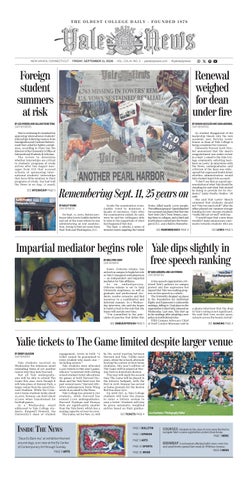
Remembering Sept. 11, 25 years on BY HAILEY YOUNG STAFF REPORTER On Sept. 11, 2001, history professor John Lewis Gaddis darted in and out of the room where he was administering an oral examination, trying to find out news from New York and Washington, D.C.
Inside the examination room, Gaddis tried to maintain a façade of normalcy. Only after the examination ended, he said, were he and his colleagues able to take in the magnitude of what had happened that day. The Sept. 11 attacks, a series of terrorist events targeting the United
BY ANAYAH ACCILIEN AND SARA AGRAWAL STAFF REPORTERS
Impartial mediator begins role Yale dips slightly in free speech ranking BY ARIA LYNN-SKOV STAFF REPORTER
Dawn Osborne-Adams has arrived on campus to begin her role as Yale’s inaugural ombudsperson — an independent and impartial mediator for Yale affiliates. As an o m b u d s p e rs o n , Osborne-Adams is set to help University employees, as well as graduate and professional students, resolve concerns and find resources in a confidential and informal manner. In a Wednesday interview, she said she hopes to build a trust in the role that she hopes will sustain over time. “I’m committed to the principles of practice that define this
Yale News
SEE OMBUDSPERSON PAGE 5
BY SARA AGRAWAL AND LEO NYBERG STAFF REPORTERS A free speech organization criticized Yale’s policies on campus protest and free expression but argued that Yale was making progress on free speech as a whole. The University dropped 14 places in the Foundation for Individual Rights and Expression’s nationwide rankings, falling to 72nd place in the organization’s latest tally, released on Wednesday. Last year, Yale shot up in the rankings after adopting a new policy on institutional voice. FIRE Campus Advocacy Chief of Staff Connor Murnane said in
YuLin Zhen / Staff Photographer
a phone interview that the drop in Yale’s rating is not significant. He said that over recent years, schools across the board, includSEE RANKING PAGE 4
Yalie tickets to The Game limited despite larger venue BY BRODY GILKISON STAFF REPORTER Yale students received on Wednesday the infamous email reminding them of yet another reason why they hate Harvard. Not all Yale undergraduates will be able to attend The Game this year, even though it will take place at Fenway Park, a larger venue than the usual Harvard Stadium. While the Crimson’s home stadium holds about 25,000, Fenway can hold about 37,000 when transformed for football games. I n a We d n e sd ay e m a i l addressed to Yale College students, Burgwell Howard, the University’s dean of student
engagement, wrote in bold: “a ticket cannot be guaranteed to every student who wants one — including seniors.” Yale students were allocated 2,900 tickets to this year’s game, which is “consistent with visiting school student ticket allocations for games at both Harvard Stadium and the Yale Bowl over the past several years,” Harvard Athletics spokesperson Darin Wong wrote in an email to the News. Yale College has around 6,700 students, while Harvard has around 7,100 undergraduates. Harvard Stadium and Fenway Park are significantly smaller than the Yale Bowl, which has a seating capacity of over 60,000. The Game, set for Nov. 21, will
INSIDE THE NEWS “Deus Ex Bark-ina,” an exhibition themed around dogs, is on view at the Ely Center of Contemporary Art through Sunday. PAGE 9 ARTS
be the 142nd meeting between Harvard and Yale. Unlike most years, when the schools alternate hosting the contest at their home stadiums, this year’s edition of The Game will be played at Fenway Park in downtown Boston. This year will mark the second time The Game will be played in the historic ballpark, with the first in 2018. Fenway has served as home grounds for the Boston Red Sox since 1912. Up until Oct. 4, Yale College students will have the chance to enter a lottery system to earn a ticket. Students will also be given automatic weighted entries based on their graduaSEE TICKETS PAGE 4
Liza Kaufman / Photography Editor
PAGE 2 BULLETIN PAGE 3 OPINION PAGE 9 ARTS PAGE 10 SPORTS PAGE B1 WKND
COURSES Students in the class of 2030 were the first to navigate Yale’s course registration system from home. PAGE 7 NEWS
BIBIMBAP A restaurant offering build-your-own rice
and salad bowls opened last week on Whitney Avenue. PAGE 8 NEWS
PAGE 2
YALE DAILY NEWS · FRIDAY, SEPTEMBER 11, 2026 · yaledailynews.com
BULLETIN This Day in Yale History, 2002 September 11, 2002 / A year after tragedy, Yale reflects on Sept. 11 attacks By Rebecca Dana Yale plans multiple memorial events commemorating the first anniversary of the September 11th terrorist attacks, including a campuswide moment of silence at 8:45 a.m., a memorial concert at the Beinecke Rare Book and Manuscript Library at 5:15 p.m. and a candlelight ceremony at 9:00 p.m., led by University President Richard Levin.
Behind the Headline By Elspeth Yeh I was walking to a meeting on Whitney Avenue when I saw the banner advertising the new restaurant “Bibim.” Immediately, my stomach was rumbling. I love bibimbap. So, I was thrilled when we decided to run an article on Bibim’s grand opening. Cindy and I agreed on a time to dine at Bibim, and solicit sourcing for our article. When I walked in, the atmosphere was quiet, yet festive.Streamers still draped across the room,and diners spoke softly to each other over Bibim bowls. Setting our stu! at a table, Cindy and I embarked on a turn about the room, starting conversations with the students eating at the restaurant and the employees behind the counter. To our delight, we spoke at length with one group of Bulldog Racers in the class of 2028! We quickly discovered we had mutuals. At last, we ceased interrupting their meals to begin our own. In my dinner with Cindy, I discovered the true value of writing this article was not just sharing Bibim’s story, but creating memories with my fellow reporter. Together we ate, laughed, and I cried over my Bibim bowl with extra spicy Buldak sauce. I hope our article inspires you to make a new friend over Bibim as well. Read “Health-oriented Korean rice bowl opens on Whitney Avenue” on page 8.
Puzzles Pitch Perfect ACROSS 1. Singer Del Rey 5. Spanish island 10. Online auction site 14. Word-of-mouth 15. Roman date 16. Alma Mater of Taft 17. Classroom expansions? 19. Singer Fitzgerald 20. Singer Carly ___ Jepsen 21. Nathan with a famous statue 22. "Come on ______" [singing] 24. "Cheers" character 26. Fire remnants 27. "West Side Story" choreographer 30. Billionaire Musk 31. Behaves like a protein 32. Beat out 33. Torment 35. Trick that goes with this puzzle's theme? 38. Corporeal 40. River next to Khartoum 41. Didn't hesitate 45. Texter's "So funny!" 46. Common deli order (Abbr.) 47. Big name in water 48. Elegant white bird 49. Not of this time 52. Actor Novello 53. Vatican leader of today 56. Remnant of a minor accident, sometimes 57. Latin eyes 58. Transmit 59. -ish 60. Ballerina's skill, in Paris
Jack Berrien '29 1
2
3
5
4
14
7
8
9
10
15
17
18
20
21 24
27
6
11
12
13
35
36
37
49
50
51
16 19 22
23
26
25 29
28
30
31 33
32 38
34
39
40 42
41 45
43
44
46 48
47 54
55
52
53
56
57
58
59
60
61
61. Small favors DOWN 1. Tolkien trilogy, briefly 2. Operatic solo 3. Get personal, in gossip 4. Pub order 5. Ridiculous 6. Steam source 7. "Picnic" playwright 8. Meditative practice 9. Crowded place? 10. Telescope part 11. Hay machines 12. Everything, in Essen 13. Bear a lamb 18. Phony
Struggled? Last week’s solution is here.
23. Research paper abbr. 25. Particle with inequal electrons and protons 26. Black, in poetry 27. Joe Namath, for example 28. Chess rating 29. Bygone 33. Shrimp-like crustacean with a flat body 34. Mother Earth 35. Places to aim, in some video games 36. Boxing icon 37. Start of many a hide-and-seek countdown
R A H S A A L O E S Y A L E B L D N A R E S O L E O L D W I V C L E A Y A L E H R A G Y O U D E M E S N R E A R L A R T Y A F I T O C T E E B E
S P U D
T R E E
38. Indonesian leader for over 30 years 39. Yemen neighbor 40. Where you might find panthers, ducks, and sharks? 41. Mamoa and Alexander 42. Boot attachments 43. Bad way to get caught 44. Kind of pool 45. Actress June of the 40's and 50's 47. "Thank You" singer 48. Went 'round 50. Connect 51. Film holders 54. Andean stew veggie 55. Eggs
R A L R A P U C E O W E D O T M A T E R C A K E L E A R N E R E S Y A L E N A A D S O U S E R O C K T A G R O N V E G O T Y A L E E T W O W A Y I M O O W L L E B L A Z E R S E L O T A R B S D D E D H S I A
YALE DAILY NEWS · FRIDAY, SEPTEMBER 11, 2026 · yaledailynews.com
PAGE 3
OPINION GUEST COLUMNIST
GUEST COLUMNIST
JEAN-CLAUDE PIERRE III
ELIAS THEODORE
What is fair and true
Alder’s welcome
I am writing to respond to an article written by Hannah Owens Pierre ’28. In it, she calls for Yale to reform its admissions standards to match with settled law. I recommend you read it. I appreciate the input Owens Pierre offers to this conversation, and hope to respectfully offer some counterpoints. First, some arguments in the article are misleading. Owens P ierre uses a hypothetical c a s e o f m a l e a p p l i c a n ts receiving preferential treatment to remedy women’s overrepresentation in medical school admissions to a rg u e a g a i n s t ra c e conscious admissions. This is a bad analogy. Gender is not generationally passed within family units in the way that race is, nor are men systemically disadvantaged in the way people of color are. Bolstering male admissions would not be the same as bolstering admissions for students of color. She also alludes to the recently studied postaffirmative action cascading effect to argue that “Ending p re fe re n t i a l t rea t m e n t i n a d m i s s i o n s d o e s n ’t m ea n that there will be no minority doctors, it simply means that they will be placed in medical schools that match their test scores.” This argument is scarily comfortable with the notion of relegating doctors of color to “inferior” schools. Equally important, it isn’t necessarily true. Being able to attend a more competitive medical school is helpful towards obtaining strong residency placement opportunities, which is connected to how often a doctor goes from medical school to a position in the most soughtafter specializations. Furthermore, Owens Pierre’s hypothetical comparison between a presumably white or Asian student with a “4.0 and 36 on the ACT” and a presumably Black or Latine student with a “3.90 and a 31” is harmfully narrow. There are far more people qualified to attend Yale School of Medicine than are admitted each year. Focusing solely on comparative scores obscures this fact by making a harmful implication that the 3.9 GPA student is not qualified to be there at all, and ignores how race — and the diversity of thought and experience it creates — can positively contribute to an applicant’s qualification. More broadly, I’d like to put aside the question of settled law and focus on ethics, since a case against settlement on legal grounds has already been written. In a history where constitutional interpretation has repeatedly been weaponized against Black Americans, it is crucial to emphasize how morality often lies beyond
the boundaries of our settled law. Owens P ierre doesn’t just make the claim that raceconsciousness has been ruled as unconstitutional; she asserts it is unfair. I believe the latter assertion is more dangerous than the former. Her logic is as follows: White and Asian students are, on average, more qualified on the basis of grades and test scores, and therefore, in a fair world, should be admitted at a higher rate than their proportion in the population. Because, as Owens Pierre puts it, “the fundamental issue here is one of fairness.” To that, I ask: why are white a n d A s i a n s t u d e n ts m o re qualified? It is either because of systemic concerns that have created an imbalance in outcomes, or because there are some genetic or cultural deficiencies that predispose Black and Latine people to inferior outcomes. I hope that we can agree on it being the former. “The fundamental issue here is one of fairness.” Owens Pierre emphasizes a need to end race consciousness without considering, or even mentioning, the broader inequality and unfairness that race-conscious systems sit within. “ T h e f u n d a m e n ta l i ss u e here is one of fairness.” I have family members that could have died because their lifethreatening medical conditions were consistently overlooked by white doctors, only to be finally acknowledged by a Black one. I don’t see how any of this is fair to them. “The fundamental issue here is one of fairness.” Do we expect to make a world of white and Asian Ivy League scholars, who go on to become white and Asian leaders of our societies, to pass on their wealth, connections and opportunities to their white and Asian children, and somehow create a world that is fair to Black and Latine people? A f f i r m a t ive a c t i o n i s a positive good and — until the continued plunder at the roots of this nation is remedied — a necessary one. I truly hope for a world where affirmative action is no longer needed. But that is not the world we live in today. How fully and honestly we can confront this truth is a question that goes beyond race. It is one that touches to the roots of our humanity, in all its beauty and flaw, and is fundamentally connected to our ability to love — ourselves and one another, tantalizingly so, amidst the cruelty of an unjust world. To that end, perhaps this simple question is the most important question of all. JEAN-CLAUDE PIERRE III is a junior studying American Studies. He can be reached at jean-claude.pierre@yale.edu.
YALE DAILY NEWS PUBLISHING CO., INC. 202 York Street, New Haven, CT 06511 (203) 432-2400 Editorial: (203) 432-2418 editor@yaledailynews.com Business: (203) 432-2424 business@yaledailynews.com
EDITOR IN CHIEF & PRESIDENT Asher Boiskin MANAGING EDITORS Jaeha Jang Olivia Woo Reeti Malhotra PUBLISHER Henry Hoak DIRECTOR OF AFFAIRS Kate Soo Hyun Kim
UNIVERSITY EDITORS Olivia Cyrus Jerry Gao Henry Liu Isobel McClure
SPORTS EDITORS Liza Kaufman Walter Royal
CITY EDITORS Elijah Hurewitz-Ravitch Sabrina Thaler
SCIENCE & TECHNOLOGY EDITORS Michelle So Hari Viswanathan
CITY EDITORS Kiva Bank Gemard Guery
OPINION EDITORS Manu Bosteels Rohil Mohan
INVESTIGATIONS EDITORS Sasha Hurowitz
WEEKEND EDITORS Stephanie Altschul Hana Tilksew
MAGAZINE EDITORS IN CHIEF Ethan Kan Claire Nam
ILLUSTRATIONS EDITOR Rana Roosevelt
HEAD PHOTOGRAPHY HEAD PODCASTS EDITOR EDITOR Amiya Vashi Martín Peralta HEAD PRODUCTION & DESIGN EDITOR Ezra Helfand HEAD COPY EDITOR Nate Stein
DATA EDITOR Adriana Petrizzo HEAD AUDIENCE EDITOR Emily Seo
THIS ISSUE COPY EDITORS: Leandro Menchu, Nate Stein, Jack Tompros; COPY STAFFERS: Maria Gregory, Clare Griffin; P&D STAFFERS: Anayah Accilien, Aria Lynn-Skov, Kushan Mahesh, Kalina Sabala Montes, Delilah Sonnenshein, Aryeh Hirshaut, Sarea Leung, Jolynda Wang, Cyrus Turner, Willow Mintz, Ashley Skinner
EDITORIALS & ADS
Content on this page with bylines represents the opinions of those authors and not necessarily those of the Managing Board. Opinions set forth in ads do not necessarily reflect the views of the Managing Board. We reserve the right to refuse any ad for any reason and to delete or change any copy we consider objectionable, false or in poor taste. We do not verify the contents of any ad. The Yale Daily News Publishing Co., Inc. and its officers, employees and agents disclaim any responsibility for all liabilities, injuries or damages arising from any ad. The Yale Daily News Publishing Co. ISSN 0890-2240
NEW HAVEN, CONNECTICUT
SUBMISSIONS
All letters submitted for publication must include the author’s name, phone number and description of Yale University affiliation. Please limit letters to 250 words and guest columns to 750. The Yale Daily News reserves the right to edit letters and columns before publication. E-mail is the preferred method of submission.
ISSUES PRINTED BY
Valley Publishing Co, Derby, CT
DIGITAL ARCHIVE
YDNHistorical.Library.Yale.edu
COPYRIGHT 2026 — VOL. CXLIX, NO. 3
ADVERTISEMENT
(203) 432-2424 (before 5 p.m.) business@yaledailynews.com Direct all letters, columns, artwork and inquiries to: Contact the Opinion Editors at opinion@yaledailynews.com
Direct all comments regarding the fairness or accuracy of stories to: Asher Boiskin Editor in Chief & President editor@yaledailynews.com
Welcome to New Haven. You may not have thought of yourself this way before arriving, but you are now a resident of this city. For the next few years, you will spend the majority of your days here. You will meet lifelong friends, grapple with the world’s hardest questions and sing and laugh and play here. Some of the most formative years of your life will be spent in New Haven. As a representative on the city’s Board of Alders, a rising senior at Yale and someone who grew up here, I have experienced the Yale-New Haven relationship from both sides. I am writing to tell you that we are happy to have you and to offer a few thoughts on what it means to live in New Haven. You probably already sense that Yale is an enormous part of New Haven. I hope you will come to understand that New Haven is still much bigger than Yale. In your first few weeks, you will meet classmates from all over the country and world who — like you — have just arrived. But you will also meet the workers who keep Yale and New Haven running, the business owners and artists who keep our city vibrant and residents who have called New Haven home for generations. Yale’s population is transient, but New Haven is not. It has a community and identity that extend far beyond the University and that you can become part of during your time here. You may have arrived with preconceived notions about New Haven and the relationship between the University and the city. It is true that this relationship has been marked by c o n te s ta t i o n : d e c a d e s of grievance and division, enormous institutional wealth alongside immense community need and persistent demands for more from Yale. And it is true that New Haven, like many cities, has faced serious challenges with poverty, crime and disinvestment. Whatever notions you may have — and whatever truth they may contain — you are now a steward of this centurieslong relationship. The way you choose to engage with the city,
JAMES LARSEN / SENIOR PHOTOGRAPHER
the way you treat the people you meet and the way you speak about Yale and New Haven, here and back home, will be a part of this history. I have two asks of you as you assume this privilege and responsibility. First, enjoy this place. Explore its neighborhoods beyond downtown and East Rock. Eat the pizza and not just the big four. Go to an arts event off campus. Visit the waterfront, which is closer than you think. And most importantly, get to know the people who make this city what it is. New Haven is extraordinarily diverse. Alongside a fifthgeneration New Havener often lives someone who settled here just months ago. Nearly one in five New Haveners is an immigrant, with Mexico, China, Ecuador, Jamaica and India among the largest countries of origin. About a decade ago, FiveThirtyEight published a study finding that the New H ave n m e t ro p o l i ta n a rea was the most “normal,” or representative, metro area in the United States, closely mirroring the demographic makeup of the country as a whole. N o r m a l c y i s n ’ t a l wa ys something to brag about. But in a country as diverse as ours, this statistic is remarkable and exciting. In just one small corner of the Northeast, you can experience the beauty and diversity of America. My second ask is that you go beyond enjoyment: contribute.
There are countless ways to do this: learn the names of the people you see every day downtown, work part-time at a local restaurant, volunteer in a New Haven public school or hospital, play in a local chess tournament, treat unhoused neighbors with dignity and kindness, coach a youth sports team, support small businesses throughout the city or spend a summer in New Haven. If you don’t know where to start, Dwight Hall can help. Fi n d so m e t h i n g t h a t i s important to you, and show up. As Yale students, our job is not to think we have the answers to New Haven’s problems. It is to recognize those already hard at work in the city, to remember we are members of this community, to be active participants in it and to acknowledge how much we have to learn along the way. I wholeheartedly believe you will get the most out of your time at Yale if you find meaningful ways to engage with the city beyond Yale. Some of the people you meet here will change your life. Some of the most important things you learn here won’t be in the classroom. I feel confident that if you let it, New Haven can become more than the place where you went to college. Welcome to our city. I hope you come to love it as much as I do. ELIAS THEODORE is a senior majoring in Urban Studies and the Ward 1 Alder. He can be reached at elias.theodore@yale.edu.
LETTER TO THE EDITOR AMINE BIT
Refusal is only the beginning Dear Editor, O n S e p te m b e r 3 , t h e Yale Daily News published a n a r t i c l e i n c l u d i n g so m e remarks by me regarding Yale’s potential settlement with the Department of Justice. While I do not dispute the accuracy of the remarks attributed to me, the article does not fully convey my position. Given the stakes of the current moment, I am writing now to clarify and contextualize my opinion. I graduated from Columbia i n 2 0 2 5 , f o l l o w i n g t wo yea rs o f s t u d e n t p ro te s ts that were quickly met with administrative repression, and eventually, state intervention. Columbia initially attempted to s h owca se a ve n e e r o f agreeability and dialogue at the beginning of the encampments, but these attempts were soon overshadowed by the reality of the university’s actions. By the time I was a senior, seeing NYPD officers around campus was a regular occurrence and a c ts o f c iv i l d i so b e d i e n ce were repressed immediately, w i t h o u t a n y a t te m p t a t negotiation. Trust between the students and the university was at an all time low, a distrust which was bolstered by the fact that Columbia’s Office of Institutional Equity did not
m ea n i n g f u l ly a c k n owl e d ge the nominal unacceptability of anti-Arab discrimination and Islamophobia until after it brutalized, arrested and suspended its students in the spring of 2024. It likewise struck me when, upon arriving, Yale seemed to be more open to articulating its institutional position regarding the settlement. In that sense, I suppose Yale is doing “better,” albeit that means very little in light of its own record of repressing student protesters. I did not get the chance to voice my opinion at length during my interview but I will offer this word of advice when it comes to Yale’s potential settlement: I speak from experience when I say now that the Trump administration’s thirst for subservience is interminable. If Yale settles, there will be another settlement. Then an “agreement.” And then, before you know it, academic departments will be put into receivership, new free speech guidelines outlining the protection of “American values” implemented, and eventually, to paraphrase the words of one of my former Columbia professors, the university as we know it will no longer exist. Because the current federal government’s
modus operandi is not mutual understanding but fiat. The language of egalitarianism and free speech is flipped on its head in the service of a political agenda that is diametrically opposed to these values. But that was then and this is now, and Columbia’s past capitulation does not have to be Yale’s future. Yale can succeed where Columbia failed. Even refusing a settlement would not, by itself, constitute success. Political recognition in the form of a refusal to settle is insufficient as long as it is not reinforced with both legal and material redistribution. The transformation of the university’s illusory democracy i n to rea l d e m o c ra cy w i l l o n ly b e c o m p l e te d wh e n the long-term demands of the students and faculty are considered and actualized. This includes, most importantly, divestment from the militaryindustrial complex which is funding Israel’s genocide of Palestinians. Refusal is only the beginning, and its importance and urgency is non-negotiable. AMINE BIT is a doctoral student in the Department of Comparative Literature. He can be reached at amine.bit@yale.edu.
PAGE 4
YALE DAILY NEWS · FRIDAY, SEPTEMBER 11, 2026 · yaledailynews.com · @yaledailynews
FROM THE FRONT
“Give light, and people will find the way.” ELLA BAKER CIVIL RIGHTS ACTIVIST
Professors recall Yale response to terrorist attacks REMEMBRANCE FROM PAGE 1 nia. Ahead of the 25th anniversary of the attacks, Yale professors reflected on teaching in the days — and years — that followed. “It may be something that changes the entire country for your next four years, possibly even for your lifetime. It may be something that falls short of that. We just don’t know,” Gaddis recalled saying as he began a lecture the day after the attacks, in front of a crowd of approximately 300 undergraduates. He encouraged his students to mourn first, before returning to work, and to continue their Yale experience as normally as possible. Nine Yale alumni lost their lives in the attacks: David Berray ’84, David Berry ’80, Bennett Fisher ’66, Elizabeth Gregg GRD ’77, Bradley Hoorn ’01, Richard Lee ’91, Charles McCrann LAW ’72, Christopher Murphy ’88 and Stacey Sanders ’98. In an emailed statement, former Yale President Richard Levin directed the News to a speech he gave at a 9/11 commemoration ceremony held on Cross Campus in honor of the tenth anniversary of the attacks. There, Levin — who led the University during 9/11 — spoke of Yale’s response to the attacks beyond the classroom, which was marked by “tolerance and mutual understanding.” Levin said in the 2011 speech that these attitudes represented the biggest lesson of the attacks, “that the best weapon in the war on terror is an open mind.” He applauded the opportunities the University offered students to challenge and develop individual beliefs, allowing them to “confront darkness and prejudice with light and truth.” In a Thursday article published in the journal “Just Security,” history professor David Blight questioned whether the Sept. 11 attacks continue to be remembered with the same “intensity and meaning” today as they were 25 years ago. “9/11 is forever a day and an event of enormous loss, grief, and foreshadowing of war, indeed ‘forever wars,’ which began with Afghanistan, Iraq, and now Iran,” Blight wrote in an email to the News. “9/11 is also forever a marker in the history of the place of the United States in the world of nations.” While many Americans have grasped the complexity and tragedy of history and 9/11, “clearly some have not,” Blight added. Pointing to “fierce attacks” by the Trump administration on histori-
Harry Simperingham cal institutions like the Smithsonian Museum of Natural History and the National Park Service, Blight claimed that “those who insist that history must tell triumphal, patriotic stories will never grasp the essential tragedy in the human condition.” Describing today’s students as inheritors of America’s past, Blight encouraged those born after 9/11 to pursue an education that engages with history and memory. The professor, who was born eight years after Pearl Harbor, said his own parents never stopped remembering World War II. Blight said he hopes the legacy of 9/11 is never forgotten. “Whatever your interests become, whatever you choose to study, you should know that history is always waiting for you; it will come to grasp you, take you up in its currents, and throw you back down sometimes in places you will not understand. You cannot know when it is coming for you,” Blight said. In total, 2,977 people died on the day of the Sept. 11 attacks. Contact HAILEY YOUNG at hailey.young@yale.edu.
Earl Lee Yale affiliates and New Haven residents gathered on Sept. 11, 2011 to commemorate the 10th anniversary of the 9/11 attacks. Then University President Richard Levin spoke at the candelight vigil on Cross Campus.
Lottery still to decide Yale scolded for protest rules Harvard game tickets RANKING FROM PAGE 1
Liza Kaufman / Photography Editor
Even though this year’s game against Harvard will take place at Fenway Park, only a select group of lucky Yale College students will earn a ticket. TICKETS FROM PAGE 1 tion year, with seniors receiving four, juniors three, sophomores two and freshmen one. Students can also maximize their chances of earning a ticket by attending various Yale fall sporting events, with the first being the men’s soccer game against the University of Massachusetts, Amherst, next Saturday. The drawing will occur on Oct. 5, and those selected will be able to purchase a ticket for $27. Those
not selected will be placed onto a waitlist, which will grant them access to any unpurchased tickets starting Oct. 12. The class of 2027 is looking to be the second straight senior class to never lose a game against Harvard. Leo Nyberg contributed reporting. Contact BRODY GILKISON at brody.gilkison@yale.edu.
ing Yale, have improved on free speech, and credited this trend to an increased belief among student bodies that university administrations will “protect speech rights” on campus. The annual rankings are based on student surveys, as well as a review of institutional policies and handling of campus events. For Yale, FIRE’s survey sample size this year was 280 students. Yale College Dean Pericles Lewis and University President Maurie McInnis did not respond to a request for comment. The release of this year’s FIRE rankings comes a week after students and faculty members convened on Cross Campus for a teach-in called “Democratize Yale.” One of the demands posted on the organizers’ website is that “Yale must adopt a new free expression policy presuming noninterference with non-violent direct action, including rallies, sit-ins, teach-ins, protests, and demonstrations.” The teach-in intentionally flouted campus free assembly regulations by not registering the event with Yale, a requirement that organizers criticized on their website. FIRE’s report cites one specific incident from April 2026 that hurt Yale’s overall score. The report explains that administrators told student organizers that they were not permitted to hold a protest on Cross Campus because they were not a part of a registered student group. Sophia Stone ’28, a member of the Yale Student/Farmworker Alliance, the group that held the
event, spoke about the incident at the teach-in on Sept. 1. “As we’ve learned, throughout social justice movements across history, including in the fight for fair food, there is no time, place or manner in which speaking up for human rights and for justice is wrong,” she said at the teach-in. “And a university worthy of these principles cannot make meaningful dissent contingent upon suppressive and arbitrarily enforced guidelines.” FIRE rates the university speech codes that impact students on a red, yellow and green light scale. Murnane said a school would earn a green light if its policies fell in line with what would be required from a public university under the First Amendment. Yale earned a yellow light. Joe Cohn, a former policy director at FIRE who now runs the Center for Academic Freedom and Free Speech at Yale, said in a phone interview that yellow light policies “might not infringe on student rights on their face, but they’re written broadly to empower enforcement to make that call.” Yale jumped to third in the nation for political tolerance, from 70th last year. Yale continued to earn points for a policy on University leadership’s public commentary that the FIRE organization describes as “institutional neutrality.” While Yale has not officially adopted neutrality, McInnis accepted in 2024 a report that recommended administrators refrain from commenting on issues of public importance unless they directly impact Yale. Cohn said that he thought the
Yale administration has been “introspective” and that it “wants to improve.” He described institutional practices as a “relatively easy” fix, but addressing campus culture as a more difficult task. In the survey of 280 Yale students, 24 percent said they thought violence was acceptable in at least rare cases to prevent someone from speaking. One respondent said it is “always acceptable” to use violence to stop a campus speaker. “There were an alarming number of students that still thought that disrupting other events was acceptable, at least sometimes, or using violence to do so was acceptable sometimes,” Cohn said, adding that a policy change would not resolve such a cultural issue. Cohn added that regardless of whether student perceptions of the administration’s free speech policies were inaccurate, “if students perceive that the administration doesn’t have their back on these matters, then that in and of itself is important.” Nearly half of respondents in the survey said they self-censored on campus at least once or twice a month. There are around 4.8 liberal students for each conservative student at Yale, according to the report. Dartmouth leads the Ivy League, sitting in sixth place while Harvard finished in 71st, one spot ahead of Yale. Columbia ranked 246 out of 261 colleges ranked. Contact SARA AGRAWAL at sara.agrawal@yale.edu and LEO NYBERG at leo.nyberg@yale.edu.
YALE DAILY NEWS · FRIDAY, SEPTEMBER 11, 2026 · yaledailynews.com · @yaledailynews
FROM THE FRONT
PAGE 5
“For there is always light, if only we're brave enough to see it. If only we're brave enough to be it” AMANDA GORMAN POET AND ACTIVIST
Internship standard for international students reviewed INTERNSHIP FROM PAGE 1 after the first memo, that his office was “not planning to make any changes” to its process of approving the Curricular Practical Training program at the time. “OISS has been reviewing this guidance and working directly with individual schools and programs to ensure CPT requests clearly meet the standard that CPT must be an integral part of an established curriculum and directly related to a student’s major area of study,” Say wrote in a Tuesday email to the News, citing the second ICE memo. “We are confirming program requirements as part of that review.” ICE’s second message, on Aug. 24, clarified that schools cannot approve internships for international students based on optional courses. Yale will continue processing internship approvals when practical training is required for students’ academic programs, Say wrote. Last week, Harvard halted CPT approval for most of its schools, and Princeton said it would likely not approve more CPT, while Brown said it will temporarily restrict approval. Universi-
ties across the country have similarly paused CPT authorization or tightened their policies. Say wrote that he has not released a “broad announcement” yet because the office has been coordinating with individual schools and programs to determine whether the program meets the requirements for CPT approval. His office will share further updates as more information becomes available, he added. In its first memo to universities that sponsor student visas, on Aug. 12, ICE said designated school officials are certifying sponsorship information under the penalty of perjury and emphasized that they must only approve internships that are “truly integral” to students’ academic programs. The federal government has seen a rise in “authorizations that do not meet regulatory requirements, specifically those not constituting an integral part of an established curriculum,” ICE also said in that memo. ICE’s two August messages and Yale’s review follow the Trump administration’s series of efforts to limit international students’ ability to study and work in the U.S.
In July, the Department of Homeland Security announced a rule that established a “fixed time period of admission and an extension of stay procedure” for international students and scholars admitted into the nation on an F-1 or J-1 visa. Prior to that change, international students and scholars could stay as long as they met the requirements of their F-1 and J-1 status, which include making satisfactory progress toward the completion of their degree or research projects. Now, they are admitted for a fixed length of up to four years, and students whose programs extend beyond these four years need to apply for an extension of stay. International students see threat to career exploration Five international students at Yale told the News they were concerned about the updates from ICE and worried Yale could be next to limit CPT approval. All five students spoke under the condition of anonymity fearing retaliation from the federal government. “To be honest, I feel a little bit stressed,” one graduate student said. “I know it is really diffi-
cult to find a job in the U.S. after graduation as an international student, and it is really important to get an internship during the summer to find a job after you graduate.” She further said it is relatively common for graduates of her program to pursue careers not directly related to their field of study. By strictly limiting international students to pursuing only internships directly related to their field of study, she said, the tightening of CPT approvals could have a great effect on the career choice of the international graduates of Yale. “My first reaction was that this could change almost all of the career plans I had made before coming to Yale,” another graduate student wrote in a text message to the News. “My original plan was to finish my PhD, work in the U.S. for a couple of years to gain industry experience, and then decide what I wanted to do next. What concerns me most is the uncertainty.” The student further wrote that she had not expected such changes to U.S. student visa programs when she applied to Yale. Had she known about this beforehand, she said it would
factor into how she compared studying in the United States with that in other countries. “The ability to do internships and potentially work in the U.S. after graduation was also part of how I imagined my Ph.D experience and my career,” she wrote. An undergraduate student said in an interview that restricting international students’ ability to pursue internships outside her specific field could hurt their college experience. “College is precisely when students are supposed to explore what kind of work they want to do. An internship can answer questions that a classroom simply cannot,” she said. “So requiring the experience to already be embedded as a mandatory degree restricts exploration before students know what direction they want to pursue.” Yale had 1,230 students in practical training programs, including CPT, in 2024, according to the OISS. Contact LEO NYBERG at leo.nyberg@yale.edu and GILLIAN PEIHE FENG at peihe.feng@yale.edu.
After year of cuts, students blast Lewis’ leadership LEWIS FROM PAGE 1 complaining — or not necessarily complaining, but giving their feedback on cuts that we weren’t notified of prior to them being cut,” Sinkler added. In the spring, Lewis apologized for “any perception” that he might not recognize the funding phaseout’s effects on stu-
dents. Lewis told the News in March that he had forgotten about the changes to summer storage support and did not mention the phaseout in a meeting with Yale College Council leaders. In his email, Strobel wrote that Lewis’ current five-year term is set to end in June 2027. The provost’s message linked to a form with an open space for comments,
Garrett Curtis / Staff Photographer
Pericles Lewis, who is being considered for a second term as Yale College dean, came under fire last year for unpopular budgetary decisions.
which Strobel wrote would be considered confidential. The form lists faculty, staff, students and members of The Parents Leadership Council — a group that engages in volunteer work and philanthropy related to the College — as possible respondents. “As we consider Dean Lewis’s reappointment, President McInnis and I are eager for the community’s input,” Strobel wrote. “We are particularly interested in your thoughts about the state of Yale College under Dean Lewis’s leadership, his strategic vision, and his ability to guide Yale College into the future.” Six of the seven students interviewed by the News on Monday said they had a generally negative impression of Lewis, and the same number expressed doubt that the administration would take survey responses seriously when deciding on Lewis’ reappointment. Emily Singh ’28 said that she didn’t think the survey results would be taken into consideration, claiming that from her perspective, student advocacy has “not been received very well by administration” in the years that she has been at Yale. Strobel did not immediately respond to a request for details behind the reappointment process, including how students’ response will be incorporated. Elsa Holahan ’27 said she was not planning on filling out the
form, in part because she was unclear about what Lewis’ role as dean entailed. Four of the seven interviewed students, including first-years, said they were not aware of the specifics of Lewis’ job or the policies he has pursued. “I think any administrative job feels somewhat unattached to student life,” Holahan said. “I also don’t know how well they communicate what these administrators do in general. I don’t think it’s something specific to him, but I don’t know what anybody on Hillhouse does.” Lewis wrote in a Monday statement to the News that he is aware that the budget cuts made last year were not ideal. He said that he hopes to create more opportunities for students moving forward, citing the announcement of free laundry for undergraduates last spring. “Fortunately, although we had to make some difficult decisions last year, the College budget is now balanced so I expect we will be on a pretty even keel going forward financially,” he wrote. In anticipation of the endowment tax hike that took effect this July, Lewis’ office halved the number of non-competitive summer grants available to students on financial aid. The move, which was announced last November, was met with a YCC-sponsored petition that demanded the restoration of
funding and was signed by a quarter of undergraduates. Jonah Hicks ’30 said that in his first weeks at Yale, he has heard from upperclassmen that Lewis is “not a very well liked figure,” but that he was not sure why. Singh said the overall impression she has received of Lewis from her friends and the broader campus community was “not favorable.” Four out of the seven students mentioned unprompted Lewis’ comment that students should “not to buy too much stuff.” Nelly Cepeda ’29 said that Lewis “doesn’t get Yale,” adding that she felt as though there was a limited period of time for her and her friends to adjust their storage plans once they found out about the summer storage funding phaseout. “That really put a sour taste in my mouth,” Cepeda said. Lewis said that he is proud of the progress he has made with students. The dean wrote that he feels a sense of accomplishment knowing he has worked with students to expand financial aid for lowand middle-income students and strengthened academic advising. Lewis was named dean of Yale College in May 2022. Contact ANAYAH ACCILIEN at anayah.accilien@yale.edu SARA AGRAWAL at sara.agrawal@yale.edu.
Yale becomes final Ivy to welcome ombudsperson OMBUDSPERSON FROM PAGE 1 role, and my sense is that the University is as well,” Osborne-Adams said in a Wednesday interview. The structural independence of an ombudsperson “allows it, in practicality and perception, to be free,” Osborne-Adams said, adding that that independence leads to impartiality, which in turn “inspires trust” in the role. She emphasized that community members can come to her with anything, noting that “there’s no concern that’s too small.” University President Maurie McInnis announced last October that Yale was creating an ombudsperson position, and that a search advisory committee had been formed. The news arrived after years of faculty and student calls to establish an ombuds office at Yale, which was the last Ivy League institution to add the position. O s b o r n e -A d a m s , w h o s e selection was announced in May, began her role on Sept. 1. Before coming to Yale, Osborne-Adams had served as ombudsperson at the University of North Carolina at Chapel Hill since 2018. In addition to previous ombuds
positions at other universities, her legal experience includes work in the federal judiciary. “I hope that adding a university ombudsperson will strengthen Yale’s community by providing a confidential, neutral, and independent place to navigate workplace or academic concerns and clarify goals and options,” McInnis wrote in a Tuesday email to the News. McInnis added that she anticipates “the role will help Yale address systemic issues by engaging constructively across the community while remaining separate from formal dispute-resolution channels.” “Dawn Osborne-Adams stood out for her expertise, judgment, and deep commitment to this work, and we are excited to welcome her to Yale,” Elizabeth Conklin and David Post, co-chairs of the search advisory committee who selected Osborne-Adams, wrote in a joint Thursday statement to the News. Osborne-Adams said as the inaugural ombudsperson, she understands many people may not understand the position and looks forward to beginning “a
journey to cultivate understanding across campus.” The co-chairs added that since the position is new for Yale, they “want to make sure the community has a clear picture of what an ombudsperson is and is not.” The role is grounded in four core values — confidentiality, impartiality, independence and informality — they wrote. “While the ombudsperson reports directly to me, Dawn Osborne-Adams operates independently of existing formal or informal dispute resolution procedures and administrative offices,” McInnis wrote in her Tuesday email. “In addition, the ombudsperson works under rigorous confidentiality standards.” As an o m b u d s p e rs o n , Osborne-Adams works to support “informed, deliberate and enlightened decisions,” with the individual retaining control, she said. When asked about her long-term goals, Osborne-Adams said she hopes to “create something that’s going to sustain over time.” For that to happen, she said, a “foundation needs to be built” through “many, many conversations,” as she works to understand “the soul and fabric
of the University.” Alex Rich GRD ’27 was president of the Graduate and Professional Student Senate the year prior to serving on the search advisory committee, and said she had “extensively talked” with McInnis about establishing an ombudsperson position. She was invited to join the committee when it was later convened. Having a neutral and confidential source for people to approach is critical, Rich said, emphasizing the importance of a “guarantee of confidentiality” for graduate and professional students. “If you have an issue with your mentor or a member on your thesis committee, oftentimes you’re directed to talk to your director of graduate studies, which is another faculty team member in the department,” she said. “So oftentimes that kind of creates a tension, a lot of students won’t report issues because of that.” Another important role of the ombudsperson is directing people towards the correct resources, Rich, who was the only student on the five person search advisory committee, said. “We have so many resources
on Yale’s campus,” Rich said. “It’s just that people can’t find them and they’re super decentralized and no one knows how to access them.” She said that the committee received feedback that people wanted someone knowledgeable who could walk them through their options and direct them towards the proper resources. Raekwon Fuller DRA ’27, the current president of the Graduate and Professional Student Senate, is in his third year in the leadership body. He recalled years of conversations about the addition of an ombudsperson from his previous roles as co-chair of the advocacy committee and general senate body member. “I think the ombudsperson acting as an impartial, neutral source is actually very healthy for the relationship and communication between Yale faculty, staff and students and the administration,” Fuller said. Dartmouth was the latest Ivy League before Yale to implement an ombudsperson in 2022. Contact ARIA LYNN-SKOV at aria.lynn-skov@yale.edu.
PAGE 6
YALE DAILY NEWS · FRIDAY, SEPTEMBER 11 · yaledailynews.com
NEWS
“There is a light that never goes out.” THE QUEEN IS DEAD THE SMITHS
Increased dining offerings and staggered menus spark joy for students BY ANAYAH ACCILIEN AND HAILEY YOUNG STAFF REPORTERS A f te r Ya l e Hos p i ta l i ty introduced rotating menu cycles to college dining halls and poke bowls to Commons, undergraduates noted improvements in food quality during their first weeks back on campus. The changes, announced in August, organized Yale’s 14 residential college dining halls into three clusters with staggered menu rotations. Additionally, Yale brought two new food stations to Commons, which now also operates on rotating menu cycles. “I’ve got to say the quality of the food in the first week so far is better than the peak of last year,” Karolis Chandler ’29 said after trying orange chicken and a pasta dish served at Commons. Kayla Ruano-Lumpris ’28 said she appreciated the wider range of options in Commons and anticipates that the dining hall will appeal to more students, including those with personal and religious dietary restrictions. “They’re adding more different cultural cuisines, like the Nori station, which is Japanese influenced, and Sazón, which is Latin American influenced,” Ruano-Lumpris said. In the dining halls, too, students have been pleasantly surprised. Mitchell Ichinkhorloo ’29 said he had “nothing bad to say” so far about the dining hall. He said that he experiences “great joy” from the new four-week rotating menu cycle and that it allows him to satisfy any cravings he has all throughout the week. Ichinkhorloo said he especially appreciated the expanded breakfast offerings at Davenport, including new toasters, waffle machines and batter dispensers, and a “life-changing” smoked salmon cream cheese. “I would like to gatekeep it, but I have to mention it. It is
MARTIN PERALTA / HEAD PHOTOGRAPHY EDITOR
Yale College’s 2026-27 total tuition and fees will mark a 3.92 percent bump, continuing a decade-long trend of similar increases. A proposed Yale College Council referendum would ask if students condemn the price amid cuts affecting student life. amazing,” Ichinkhorloo said. Chandler also highlighted the variety of protein options available at each meal. “It’s very helpful to be able to decide whether I want chicken or pork or beef,” Chandler said. “We didn’t have that privilege last year and it kind of felt like we were eating the same thing week after week.” In a statement to the News, Assistant Vice President of Yale Hospitality Jodi Smith Westwater wrote that this
academic year’s menu changes were based on collaboration with the Yale College Council and heads of colleges, along with student feedback. “This year’s changes were designed to respond directly to that feedback — expanding the variety of options available to students and improving speed and ease of service during peak lunch periods,” she wrote. Westwater added that the Yale Hospitality team and YCC representatives meet every
three weeks to review student feedback in order to “collaborate on future dining initiatives.” “While it is still early in the academic year, the anecdotal feedback received from students and YCC thus far has been positive, particularly around the increased variety across dining halls and enhanced food quality,” she wrote. Though the changes have exce e d e d m a ny s t u d e n ts ’ expectations, both Chandler and Ichinkhorloo expressed
skepticism that Yale Hospitality offerings will remain satisfactory all yearlong. “It’s a little bit suspicious how good the dining halls have been. I think something’s gonna crack pretty soon. But I’m very grateful so far,” Chandler said. Commons can seat 750 people. Contact ANAYAH ACCILIEN at anayah.accilien@yale.edu and Contact HAILEY YOUNG at hailey.young@yale.edu.
Special election shapes up in Edgewood as longtime alder resigns suggested the possibility of a contested election. In an August letter to Mayor Justin Elicker announcing her resignation, Hamilton wrote that she “deeply appreciated the opportunity for personal growth, invaluable experience gained, and the chance to contribute to the city’s success” during her time as an alder. In 2011, Hamilton, then a member of Yale’s clerical and technical workers’ union, was first elected to the seat alongside more than a dozen successful union-backed challengers. Currently, she is serving as the chair of the Alder-
to run for the seat after considering Hamilton’s example. As a co-chair, Furlow worked with Hamilton on addressing “crises” in the ward and “motivating people to get involved,” he said to the News. Residents he has spoken to have pointed to road safety, crime and the cost of living as major concerns, Furlow said. He also emphasized the diversity of Ward 24. “We have a multiplicity of age demographics that are represented in our ward,” Furlow said. “We have some people that have been there for a very, very long time as well as some people that
are just moving into the ward.” The ward is a “microcosm for the city” and represents a range of “socioeconomic needs,” Democratic Town Committee Chair Vincent Mauro Jr. also said in a phone interview. Per Connecticut’s general statutes, there are no primaries in municipal special elections. Rather, members of the ward committee for each party select their party’s official nominee, and other candidates may also petition to be on the ballot. The nomination process will be the same for Furlow, a ward committee chair, as it would be for any other candidate, Mauro said. “We can’t punish people for being a co-chair,” he said. Furlow said that in his capacity as Democratic ward co-chair, he has heard “rumblings” about other people who are interested in the role, but that no one else has expressed official interest. Republican Town Committee Chair John Carlson said in a phone interview that he hopes to back a Republican candidate in the ward. Because Ward 24 has no Republican co-chairs, identifying potential candidates will likely fall to him, he said. That process will involve reaching out to Republicans in the ward, and possibly to independent and unaffiliated residents as well to “see if anyone’s interested, anyone would make a good candidate,” Carlson said. Ward 24 has a history of “long, stable leadership,” Mauro said, and is not “prone to easy turnover.” Former Alder Elizabeth McCormack represented the ward from 1987 to 2009. Marcus Paca served for one term before Hamilton’s election. Hamilton could not be reached for an interview about the special election. Six alders currently double as Democratic Town Committee ward co-chairs.
Martin Peralta / Head Photography Editor In what is set to be New Haven’s third special election this year, Randall Furlow, a co-chair of the ward’s Democratic committee, is mounting a bid to replace Ward 24 Alder Evette Hamilton, who is resigning after 15 years in her seat.
Contact NELLIE KENNEY at nellie.kenney@yale.edu.
BY NELLIE KENNEY STAFF REPORTER New Haven’s third special alder election of the year is shaping up after Ward 24 Alder Evette Hamilton announced she will step down at the end of the month. Randall Furlow, co-chair of the ward’s Democratic committee, told the News he plans to run for the seat, representing part of the city’s Edgewood neighborhood. No other candidates have signaled a bid yet, but Furlow and the chairs of New Haven’s Democratic and Republican town committees
manic Affairs Committee. Hamilton’s resignation arrives as another special alder election enters its final stretch. Former Ward 9 Alder Caroline Tanbee Smith ’14 SOM ’25 stepped down at the end of August, spurring a Sept. 15 election that is set to test the viability of democratic socialism in the ward. In February, Ward 7 Alder Christine Kim ’99 won her seat in a special election following the resignation of Eli Sabin ’22 LAW ’26 in January. Furlow said in a Wednesday phone interview that he decided
YALE DAILY NEWS · FRIDAY, SEPTEMBER 11, 2026 · yaledailynews.com
NEWS
PAGE 7
“Oh, your love is sunlight.” SUNLIGHT HOZIER
YCC calls on Yale to end Trump negotiations, defends admissions policies BY EMILY AKBAR STAFF REPORTER In its first meeting of the school year, the Yale College Council Senate endorsed the demands of a teach-in last Tuesday entitled “Democratize Yale” — including a call for Yale to end its negotiations with the Department of Justice over allegations of racial discrimination in its admissions processes — and advanced three policy proposals. On Sunday, senators nearly unanimously passed a statement joining in calls for reform of University governance and policy, including the adoption of free expression and academic freedom protections. YCC President Alex William ’28 spoke at the rally where the demands were expressed but did so in his “personal capacity,” he said after the protest.
The council’s endorsement marks an expansion of student leaders’ support for reform. “Yale must exit settlement negotiations with the DOJ and publicly commit to defending its admissions policies in court should the need arise, because those policies are lawful and because recruiting an outstandingly well-qualified student body necessarily includes Black and Latine students,” the statement, which passed with one vote in opposition, reads. It was sponsored by the YCC alongside the Endowment Justice Collective, the Black Student Alliance at Yale, Mecha de Yale — a student social justice group — and the Yale College Democrats. Marah Rigaud ’28, who represented the Black Student Alliance at Yale at the council meeting, spoke in favor of
the call for Yale to cease negotiations with the federal government. She said that such a settlement would disproportionately target Black and Latine students. “I’ve heard since my first year, even after being in the incoming class after affirmative action has ended, that our place on this campus is questionable, and that in general we’ve sometimes been labeled as unqualified to be on this campus,” Rigaud said. T h e s ta te m e n t’s o t h e r demands, which echo those listed on the “Democratize Yale” website, include a call for Yale to reform the selection and operation of the Yale Corporation. Siena Grouf ’29, who represented the Endowment Justice Collective at the meeting, read aloud the statement’s proposed changes to Corporation policies.
KALINA SABALA MONTES / STAFF PHOTOGRAPHER
On Sunday, the Yale College Council Senate backed demands expressed last Tuesday by student and faculty protesters for reforms to University governance and claimed Yale’s admissions policies — alleged to be discriminatory by the federal government — are lawful.
“Trustee meeting agendas must be published online one week prior to each board meeting, minutes must be made publicly available before the next scheduled meeting, and board meetings must be open to the public, livestreamed online and include time for public comment,” Grouf read. At Sunday’s meeting, Chen described the statement’s demands as “all rooted in the same problems with democracy at Yale.” He explained that the statement was intended to consolidate previous organizing around shared governance, free speech, academic freedom and Yale’s interactions with the federal government. “The YCC, representing the Yale undergraduate student body, proudly endorses and joins in these calls for reform,” the statement passed on Sunday reads. Beyond the statement, senators approved three policy proposals that YCC members will take to University administrators. One proposal, sponsored by YCC Speaker of the Senate Kyler Parker ’29, Silliman Senator Michael Canudas ’28 and Trumbull Senator Siena Valdivia ’28, calls for every Yale College student to receive at least 20 gigabytes of Google Drive storage. Students who enrolled in Yale on or after August 15, 2023 currently have a quota of five gigabytes, while students who enrolled before that date received 20 gigabytes, according to a Yale Information Technology Services website. “Michael, Siena and I are prepared with this proposal to finally get a clear answer for why we have a pitifully small amount of Drive storage, and hopefully increase that to at least 20 gigabytes,” Parker said during the meeting. “I hope to push as far as we can with Drive storage.” Benjamin Franklin Senator Jaden Franklin ’29 asked Parker whether the new proposal would interfere with the storage that Yale provides to students through Microsoft’s Onedrive service. Per an ITS website, Yale students have access to 2 terabytes of storage via Onedrive.
Parker responded that the goal was not to bargain away Yale-provided Microsoft Onedrive storage. “Most of Yale’s peer institutions provide comparable Onedrive storage in addition to reasonable Google Drive storage. There’s no reason Yale should only provide one or the other,” he wrote in a text message to the News. Senators also backed a proposal from Silliman Senator Johnathan McGee ’28 to develop a “Navigating Yale Resource Guide” for first years. The guide would consolidate information about academic advising, mental health care, accessibility services, financial resources, cultural centers and residential college support into a single document, McGee explained. The Senate also approved a proposal seeking to reduce health insurance costs for students taking leaves of absence. According to the proposal, active students pay $3,764 per year for Yale Health Hospitalization and Specialty Coverage, while undergraduates on medical leave must purchase an affiliate plan that costs $11,332. Students on non-medical leave face a $10,832 annual premium. Sponsored by Health and Accessibility Policy Chair Justin Kung ’28 and co-sponsored by Chief of Staff Brendan Kaminski ’28, the proposal calls for students on approved medical or academic leaves to remain eligible for the standardrate health insurance plan for as many as two semesters and one summer. Kung described the current system as effectively imposing a threefold increase on students who step away from Yale, including students who take leave for mental health reasons. The proposal argues that the additional cost could discourage students from taking medically necessary time away. Yale College Dean Pericles Lewis will attend the YCC Senate meeting on Oct. 11. Contact EMILY AKBAR at emily.akbar@yale.edu
After first years chose classes at home, some say timeline drew stress BY ANAYAH ACCILIEN STAFF REPORTER This summer, members of the class of 2030 were the first to navigate Yale’s course registration systems virtually — a mode that some students said made it difficult to get individualized attention as they chose classes. The change to Yale College’s first-year registration timeline allowed incoming first years to begin registering for courses six days before moving in. When the change was announced in the spring, Yale College Dean Pericles Lewis said it was intended to reduce stress brought on by the hourslong registration period that traditionally occurs after first-year move-in. Seth Baker ’27 said that based on his experience as a Saybrook first-year counselor and those of his fellow FroCos, moving the registration time earlier did not eliminate the stress of course selection. He cited technical challenges he encountered when trying to support his first years, adding that timezone differences can create difficulties when students choose classes from home.
“I didn’t have any international students, but a lot of my fellow FroCos do,” Baker said. “So you’re having to get up in the middle of the night in order to register for classes.” That concern was cited by three former head FroCos in a petition penned last spring that protested the registration timeline change. The document, which was signed by over 100 former FroCos, said the new schedule would result in disparities in access to registration resources and limit the ability of future FroCos to advise first year students. In March, Lewis said the timeline adjustment would be accompanied by a change that designated students’ residential college deans as their default academic advisors. “The new system of students meeting with their deans by Zoom during the summer and registration opening in midAugust seems to be working well. Residential college deans tell me it has helped them to get to know their students sooner,” Lewis wrote in an email to the News last week. Baker described the new registration process as “inequitable,” echoing concerns addressed in the spring petition. He said he
experienced difficulty in trying to support first-generation, lowincome students virtually because he realized that those who needed the most help were the same ones that felt “more awkward” and “nervous” to reach out. Matthew Chu ’30 said that Yale provided useful resources before the day when registration opened. But when a course on his worksheet was labeled “pending,” or when he was waitlisted, he said, he experienced more stress than he anticipated because he did not know while at home whether the issue was on Yale’s end or his own. Chu said he attended a meeting with his dean and found it useful as a confirmation of some of the classes he chose to take this semester. “We didn’t talk too much about what you’re aiming for in the fall, but more of how I’m gonna set up for the future,” Chu said. Jacob Glover ’30 said he attended his scheduled meeting with his dean, which he found was “a good first step” to confirm that he was meeting his requirements, but that the format made it “very difficult to give individual advice.”
“I feel very lucky because I did DS, so most of my classes were guaranteed. So I didn’t have that stress,” Glover said to the News, referring to the Directed Studies program. Lewis wrote on Monday that the new registration timeline for first years still allows students to adjust their courses during add/ drop period. “Regarding f i rs t -yea r advising, this was the first year of implementing a new system after three years of planning,” Lewis wrote. “There might still be a few kinks to work out but I think the new system has already contributed to first-year students having better information and advice when they choose their courses.” Baker said that despite disagreeing with the registration timeline change, he does think that there has been an increase in advising for first-years, which he believes makes incoming students more prepared. He argued, however, that available advising jumped from being “virtually nonexistent” to there being “too many resources,” and characterized first years’ mandatory 15-minute Zoom meeting with a residential college dean as dispensable.
Aisha Salad ’30, a first-year FGLI student, said she did not meet with her dean. She said because she participated in FirstYear Scholars at Yale, a six-week summer program to help transition incoming first years and to connect them with the FGLI community, she entered registration “with somewhat of an idea” of how the process worked. Still, she said she “did feel a little lost.” She said she did not speak with her FroCo before the add/drop period began, though they had provided resources and office hour slots for help that she has yet to use. “I’m in Intro to Ethics, and I signed up for the class thinking it would be a very easy class,” Salad said. “And now every time I say, ‘I’m in Intro to Ethics,’ I get a certain expression on people’s faces. I don’t think I would’ve signed up for it if I had known before, but now all the other classes I could have done instead of that class are full.” Add/drop period ends on Friday at 5 p.m. Contact ANAYAH ACCILIEN at anayah.accilien@yale.edu.
Yale trustees to reduce in-person meetings amid calls for transparency BY ARIA LYNN-SKOV STAFF REPORTER Yale’s board of trustees is set to be less present on campus this year, at least for official gatherings, after removing one of its annual in-person meetings from its schedule. The Yale Corporation’s website currently lists four meetings for the 2026-27 academic year, a decrease from the standard minimum of five established in its bylaws. According to Yale spokesperson Karen Peart, the trustees will meet virtually throughout the year as well. The change comes amid student and faculty calls for
increased transparency with the trustees, who form the University’s highest governing body. “The trustees adjusted their in-person meeting schedule from five to four meetings a year to be more consistent with practices at peer institutions,” Peart wrote in a Wednesday email to the News. “This schedule includes off-cycle virtual meetings to supplement in-person meetings and allows the trustees to maintain regular engagement.” Of the seven other Ivy League institutions, the comparable governing bodies of Brown and the University of Pennsylvania meet in full three times a year; Dartmouth’s, Cornell’s and
Columbia’s meet at least four times; Princeton’s meets five times per year; and Harvard’s meets seven to eight times, according to the Harvard Crimson and universities’ bylaws and websites. “Trustees also meet with students throughout the year, including at each in-person meeting through the standing Student Liaisons Committee, and many trustees participate i n a va r i e t y o f c a m p u s activities and events outside the formal meeting schedule,” Peart wrote. During the Corporation’s February campus visit last year
— the one removed from the upcoming year’s calendar — around 25 invited student leaders had lunch with the trustees. Ahead of the Corporation’s April meeting last spring, t r u s te e s M a r ya n a I s k a n d e r L AW ’ 0 3 a n d Fr e d K r u p p ’ 75 ea c h s p o ke a t eve n ts h o s te d by t h e Ya l e A l u m n i No n profit Alliance. In a Wednesday interview, Diego Loustaunau ’27 — an organizer with the Endowment Justice Collective, a student group that often advocates for greater transparency from the trustees — criticized the reduction of in-person meetings.
“They don’t want to hear the dissent of students, faculty, staff and alumni who are routinely left out of decision making processes, and they don’t want to be held accountable to these constituencies who regularly mobilize and invite the trustees to meet with them when they are on campus,” Loustaunau said. The 18th recommendation of the Committee on Trust in Higher Education’s report starts with the sentence, “Build trust with the trustees.” Contact ARIA LYNN-SKOV at aria.lynn-skov@yale.edu.
PAGE 8
YALE DAILY NEWS · FRIDAY, SEPTEMBER 11, 2026 · yaledailynews.com
NEWS
“Let nothing come between you and the light.” HENRY DAVID THOREAU AMERICAN ESSAYIST
ICE agents detain Southern Connecticut State student at Tweed airport BY EVELYN RONAN AND NORAH MCPARTLAND STAFF REPORTERS Immigration and Customs Enforcement agents arrested a Southern Connecticut State University student-athlete at Tweed New Haven Regional Airport on Friday afternoon. The arrest is the latest in a recent wave of increased ICE activity across Connecticut and follows reports of covert federal law enforcement operations at Bradley International Airport in Hartford over the summer. “On September 4, at the Tweed New Haven Airport, ICE arrested Deng Deng, an illegal alien from South Sudan,” a spokesperson for the Department of Homeland Security wrote in a statement to the New Haven Independent. “He legally entered the U.S. and illegally overstayed, violating the immigration laws of our country. All of his claims will be heard by an immigration judge and he will receive due process. This administration will not ignore the rule of law.” Deng, who announced his commitment to play basketball at Southern Connecticut State University in a May Instagram post, is currently in custody at Wyatt Detention Facility in Central Falls, Rhode Island, according to ICE’s Online Detainee Locator System. Per online court records, Deng’s lawyers filed a petition for a writ of habeas corpus on Friday, which would require the federal government to justify his detention in court. United States District Judge Vernon Oliver issued an order the same day mandating that Deng not be transferred to any detention facility more than 150 miles away from the Connecticut border. The case was transferred to the district court of Massachusetts on Wednesday. “Tweed-New Haven Airport, like all public-use airports, is subject to federal law enforcement agencies and has no visibility into or influence over
enforcement activity,” a Tweed spokesperson wrote in an email to the News when asked about ICE activity in the airport. Anne Watkins, an organizer with the New Haven Immigrants Coalition, said the volunteer organization has received numerous tips about federal agent presence at Tweed since last week and alleged that the agency detained at least two people since then. “We know that they are parking in the Tweed parking lot, and we know that they’ve been stationed at the TSA checkpoints,” Watkins said in a phone interview, referring to the Transportation Security Administration. Watkins alleged that the airport has issued security passes to ICE agents, which provides them with unrestricted access to the airport. “For operational security purposes, ICE does not disclose information pertaining to current or ongoing operations, including law enforcement plans, tactics or strategies,” a spokesperson for ICE’s Boston field office wrote in an emailed statement on Tuesday. In photographs of the arrest obtained by the New Haven Independent, ICE agents wore photo identification cards that resemble Tweed-issued security badges. In response to a question about whether the airport was badging federal agents, a Tweed spokesperson cited a federal statute requiring airport operators to authorize “ u n e s c o r te d access for qualifying government e m p l oye e s, i n c l u d i n g l aw enforcement officers, as long as a background check was part of the employment process.” “Access and credentialing remain subject to the airport’s T SA- a p p rove d security program and other applicable security requirements,” the spokesperson wrote. In July, state officials and the Connecticut Airport Authority confirmed ICE activity at Bradley International Airport in
ZOE BERG / STAFF PHOTOGRAPHER
Local organizers say that federal immigration agents are conducting operations at Tweed New Haven Regional Airport amid mounting anxiety about Immigration and Customs Enforcement activity statewide. Hartford. Connecticut Insider reported that month that despite concerns that federal agents were stationed inside the airport, Tweed personnel had not received any notification from TSA of ICE activity at airports. “The CAA has no authority to intervene or prevent such operations, which occurred predominantly in areas under the control of the federal government,” the Connecticut Airport Authority wrote in a statement to the Connecticut Mirror. “The mission of the CAA is to provide the safest and most convenient facilities for our workforce and the many families and individuals traveling through Bradley International Airport, and this initiative does not further that mission.” Watkins said that New Haven Immigrants Coalition and other immigrant protection
groups across the country are “concerned about ICE’s tactics of terror” and encouraged New Haven citizens to “share information, not spread fear.” Watkins said any ICE sightings should be reported to New Haven Immigrants Coalition through their hotline at (854) 666-4472. In April 2025, Avelo, which operates most planes flying out of Tweed, announced that it would be the first commercial airline to partner with the Department of Homeland Security to run deportation flights via a d e pa r t m e n t co n t ra c to r. Avelo cited low revenue from Tweed New Haven airport as a motivating factor. Nine months later, following a petition by the New Haven Immigrants Coalition —which amassed over 40,000 signatures — local protests and anti-Avelo billboards along the I-95, Avelo
moved to “pause” its relationship with DHS in January. An Avelo spokesperson did not immediately respond to a request for comment on whether the airline resumed its relationship with DHS after the January pause. Avelo CEO Andrew Levy announced in a company-wide email earlier this year that the returns of chartering deportation flights were not sufficient to maintain the partnership with Immigration and Customs Enforcement. CSI Aviation, the company that previously chartered Avelo’s deportation flights, made over $1.2 billion in ICE contract revenue in the first year of Trump’s second term. Contact EVELYN RONAN at evelyn.ronan@yale.edu and NORAH MCPARTLAND at norah.mcpartland@yale.edu.
Health-oriented Korean rice bowl restaurant opens on Whitney Avenue BY ELSPETH YEH AND CINDY ZHONG STAFF REPORTERS BIBIM, a restaurant offering build-your-own Korean rice and salad bowls, opened last week on Whitney Avenue. The eatery occupies the former address of sushi and hot pot restaurant Tiger Daddy and hopes to attract Yalies looking for healthy, cost-effective meals. Gracemarie Luciano, a manager of the restaurant, said it has sold 1,000 bowls in its opening week. Joseph Park, BIBIM’s owner, said his weight loss journey inspired him to open the restaurant. “I truly believe having a good meal can really change somebody’s life,” Park, who also owns the franchised branch of bb.q Chicken next door to BIBIM, said in a phone interview. When Park saw Tiger Daddy was preparing to close its location between Trumbull and Grove streets, he decided to try out a different restaurant concept at the storefront. The restaurant owner said he lost over 100 pounds in one year — which he said he achieved by eating bibimbap for lunch every day. Bibimbap, which translates literally to “mixed rice,” is a Korean dish consisting of rice, various vegetables, and a protein, then often topped with an egg. Park said he previously we i g h e d 3 1 0 p o u n d s a n d suffered from severe health issues related to his weight. When a doctor informed him that he might not make it to 50 years old with his current lifestyle, he said, the restaurant owner decided it was time to make a change. Through BIBIM, he hopes to share bibimbap with local patrons. “ I ’m t ry i n g to b u i l d something very healthy for the kids, healthy for the people, and the price is actually something that is not going to be breaking their bank,” Park said. Bibim’s signature bowl costs
$14.95 before tax, and the restaurant currently offers a 10 percent discount for students. Each bowl also comes with a complimentary side of soup, which changes day to day. Park said that conversations with students who would come into bb.q Chicken informed BIBIM’s prices. He said he has often heard students complain that their dorms did not include kitchens and that they often found themselves buying meals for over $20. The restaurant owner said he also noticed that there were
many Asian students in the area, and thought they might be homesick for familiar flavors. He hopes that bibimbap, something that reminds Park of his parents’ cooking, will provide “a little comfort” to these students. He said that promoting Ko rea n c u i s i n e to t h o s e unfamiliar with it was a large part of his mission with BIBIM. Since Park thought that not everyone would enjoy gochujang, a Korean chili sauce traditionally mixed into bibimbap, he underwent a process of “trial and error” to
come up with the six sauces on BIBIM’s final menu. When she visited BIBIM on Saturday with other members of the Bulldog Racing team, Thais Burgess ’28 said that it was her first time eating bibimbap. After trying a custom bowl, she said she was “pleasantly surprised.” Jenny Trang ’28, one of B u rge ss ’s tea m m a te s, sa i d she frequently walks down Whitney Avenue to attend club meetings. She added that she was intrigued by the new restaurant and that she enjoyed the customizable nature of
BIBIM’s bowls. Over the course of one evening, multiple groups of Yale students came to order food to-go from the electronic kiosks. Traditional bibimbap often incorporates white, red and blue or black, yellow and green ingredients to embody the traditional Korean five-color spectrum known as obangsaek. Contact ELSPETH YEH at elspeth.yeh@yale.edu and CINDY ZHONG at cindy.zhong@yale.edu.
MARTIN PERALTA / HEAD PHOTOGRAPHY EDITOR
BIBIM, a new venture from the owner of bb.q Chicken, aims to offer affordable, healthy Korean fare in a customizable form. In its opening week, the restaurant has sold 1,000 bowls, according to a manager.
YALE DAILY NEWS · FRIDAY, SEPTEMBER 11, 2026 · yaledailynews.com
ARTS
PAGE 9
“Darkness cannot drive out darkness; only light can do that.” MARTIN LUTHER KING JR. CIVIL RIGHTS LEADER
Dog days of summer continue in Fair Haven contemporary art exhibit BY ANGELINA KOVALCHUK STAFF REPORTER Colorful canines abound in Fair Haven’s Ely Center of Contemporary Art, where “ D e u s E x B a r k - i n a ,” a contemporary art exhibition themed around dogs, is on view through Sunday. The exhibition showcases works from more than 50 artists, including state locals and Yale alumni. While dogs have long remained in the background of paintings, organizers and artists said, moving them to the forefront can illuminate traditional themes. “Though the subject matter i s se e m i n g ly s i m p l e , t h e relationship between humans and dogs is complex when you explore its history,” Aimée Burg, the center’s director, wrote in an email to the News. “This exhibition has created space for those connections and also highlighted the many ways art is being created today.” Michael Morgan, a recent graduate of the Master of Fine Arts program at Cornell U n i v e r s i t y, c u ra t e d t h e exhibition. His goal was to depict dogs as independent beings rather than simply a “prop in a painting.” “I felt that for hundreds, if not thousands, of years, dogs have flanked white male heroes,” Morgan said. “I wanted to focus on works that depict dogs in situations where they are viewed more as autonomous beings rather than just as a domestic being.” The exhibition features several sections, corresponding to a particular theme around dogs and their symbolism. Themes include regality, quotidian life, abstraction, work, play and wildness. Animals in visual art convey
emotional reactions as objects viewers can empathize with, and the drive to use animals as allegories is a longstanding one, Morgan said. “We’ve always used animals to tell stories,” he said. Upon entering the exhibit, the view is greeted by what Morgan called a “welcome mat” of paintings of three dogs, including “Mars at the Door” by Kati Gegenheimer ART ’13. G e ge n h e i m e r ’s p a i n t i n g depicts her own dog, Mars, splayed atop a colorful rug with a wide-eyed gaze. Gegenheimer said the subject carries “much emotional resonance” for her. “This portrait of Mars is about love and companionship, and how they can transcend place and time,” Gegenheimer said. “He’s generally patient, but by the end of a long day, h e’ l l a s s u m e t h i s p o s it io n on t h e l it t l e c olor f u l r u g, dutifully notifying me that it’s time to go. T his reminder that we have a l i fe to live beyond the studio door is necessary and important.” Morgan credited Gegenheimer’s work as one of his first inspirations for the gallery. “That set the stage for my desire to find works that treated their dogs in a genuine or organic manner,” Morgan said. The exhibit also features sculptures and mixed media. Outside of the gallery space, a skeletal sculpture by Korean artist Hyunjin Park called “Three bodies of Cerberus” — a nod to the multiheaded hound of Hades, the god of the dead in Greek mythology — guards the entrance. “Hatshepsut’s Collar,” a mixed-media piece by Leeza Meksin ART ’07, is inspired by female pharaoh Hatshepsut in the 15th century B.C.
COURTESY OF MICHAEL MORGAN
“Deus Ex Bark-ina,” an exhibition themed around dogs and their meanings, is on view at the Ely Center of Contemporary Art through Sunday. Former Yale Public Safety dog Heidi is set to make an appearance at its closing reception. Meksin wrote in an email to the News that Hatshepsut’s successors largely erased her achievements from history. “The story of Hatshepsut still resonates in a personal way for me and many other women, gender-non-conforming and queer-identifying humans who get elbowed out of the historical record by bullish force,” Meksin
wrote. “Dogs are great and pliant companions, easily trained and brought to heel.” Burg said the reception for the exhibition has been positive and that the “lively conversations” among viewers have lived up to the gallery’s mission. “There is a real sense of joy and curiosity that this exhibition has inspired,” Burg wrote.
In a closing reception this Sunday from 3 p.m. to 6 p.m., former Yale Public Safety dog Heidi will be present at the gallery. The Ely C e n te r for Contemporary Art is located at 162 James St. Contact ANGELINA KOVALCHUK at angelina.kovalchuk@yale.edu
After leave of absence, orchestra conductor back at Yale BY HANNAH LIU STAFF REPORTER After taking a medical leave of absence last academic year, Yale School of Music associate professor Elizabeth Askren returned this fall to direct the Yale Symphony Orchestra as it begins its 2026-27 season. Askren took over as the group’s director after William Boughton retired last spring. She conducted the ensemble’s opening concert in September 2025 before leaving campus, wh e n a va r i e ty o f g u e s t and student conductors — i n c l u d i n g B o u g h to n a n d graduate students from the Yale School of Music — stepped in to support the orchestra.
“It was so beautiful to see everyone come together and collectively support me in my absence and support each other,” Askren said in a Zoom interview. “There’s a big sense of community singular to the YSO, a profound love and commitment to what it is that we do.” In the time before she departed Yale last fall, Askren co-taught a Yale School of Music class called “Introduction to Conducting” with Thomas Duffy, director of the Yale University Bands. In the days leading up to her medical leave, Askren said, she wanted to be very transparent with her students about her departure and was honored when some students shared their own health journeys with
her. She said that she returned to Yale this spring to lead an opera masterclass — drawing on her background in opera — in collaboration with the Yale School of Music. This year’s YSO season will be centered on the theme “Death and Transfiguration,” which Askren said related to her own experiences coming back to lead the orchestra. “I think it’s really powerful to draw from your personal experiences when you’re creating art,” Askren said. “I think it really is carpe diem: celebrate life. Celebrate each and every day that you can get to know yourself and others more deeply. It’s a renewed sense of commitment and dedication to what you do.”
Former YSO director John Mauceri returned in March to conduct Mahler’s Symphony No. 2 as part of the orchestra’s 60th anniversary concert, though he said he had planned to lead the concert prior to Askren’s departure. “Conducting something that I first conducted with the Yale Symphony, 55 years later, was of course a curious and uniquely musical experience because music has a way of defying time, and yet it’s all about time,” Mauceri said in a phone interview. “There I was on the same stage, which hasn’t changed much at all since I was the music director back in the late 1960s.” I n Fe b r u a ry, P ro fe sso r Adjunct of Music and Orchestral
YULIN ZHEN / STAFF PHOTOGRAPHER
During Elizabeth Askren’s time away from campus, an array of music school affiliates — including guest conductors, previous directors and graduate students — stepped in to help lead the orchestra and work with undergraduate student leaders.
Conducting Peter Oundjian and graduate students Thomas Nettle MUS ’27 and Ezra Calvino MUS ’26 conducted the YSO’s Valentine’s Day concert. Ne t t l e a n d C a lv i n o a l so stepped in to lead several re h ea rsa l s fo r co n ce r ts i n O c t o b e r a n d N o v e m b e r, wo rk i n g a l o n gs i d e fo r m e r YSO p re s i d e n t To b i a s L i u ’ 2 6 a n d s t u d e n t a ss i s ta n t co n d u c to r To m m a so B a i l o ’ 2 7, w h o c o n d u c te d t h e annual Halloween show and commencement concert. “I think the challenge of losing a conductor halfway through the year is, of course, you have a lot of different guests come in,” Liu said in a phone interview. “But there’s a lot of really real benefits that come from that too, as an orchestra, getting to learn from a whole host of extremely incredible different conductors across the spectrum.” Throughout the year, Bailo a n d YSO s t u d e n t l ea d e rs also focused on expanding partnerships with the New H ave n c o m m u n i ty. T h o s e included a concert in Union Station performed alongside Music Haven, a group that provides accessible musical e d u c a t i o n to New H ave n students, and a collaboration w i t h t h e Ya l e Ce n te r fo r Engineering Innovation and Design this January. “One of the really cool things about the YSO is that it’s this d y n a m i c s t u d e n t - fa c u l t y leadership,” Liu said. “You have the real pros of expertise from expert faculty like Maestro Askren and our manager Brian, but it’s also led by students who are very involved day-to-day and get to shape the direction of the orchestra.” Bailo described Askren as a “figurehead” and an eager educator. “I can fully see her expanding the undergraduate conducting curriculum or creating a mentoring program,” he said in a phone interview. The YSO recently concluded auditions for the 2026-2027 season. Contact HANNAH LIU at hannah.liu@yale.edu.
SPORTS
FOR MORE SPORTS CONTENT, VISIT OUR WEB SITE yaledailynews.com
PAGE 10
YALE DAILY NEWS · FRIDAY, SEPTEMBER 11, 2026 · yaledailynews.com
“Josh was somebody that stood out from the second he stepped on the field at Yale.” JUSTIN GALLANTY, FORMER ESPN+ COMMENTATOR
New NCAA eligibility model could draw athletes to Ivy League NCAA BY AZARA MASON STAFF REPORTER An age-based eligibility model approved by the NCAA Division I Cabinet in June could make playing at an Ivy League school more appealing to high school athletes. The so-called five-for-five model, which allows varsity athletes to compete in five seasons across five years of college enrollment, is replacing a framework that permitted competition for only four seasons over five years. Since graduate students cannot compete in Ivy League athletics, an athlete at a school like Yale would need to transfer after four years of undergraduate play in order to use their fifth year of eligibility — which for some recruits could be an enticing opportunity. “The new framework will definitely help Ivy League coaches recruit players with the selling point that they can get an elite education while competing for four years, and still be promised an opportunity to play on a bigger stage when done,” football player Brice June ’27 wrote in a text to the News. Under the previous system, Ivy athletes hoping to preserve a season of eligibility often had to make difficult decisions around their athletic careers — whether that meant limiting competition during a season, taking a leave of absence or graduating early before transferring. For some athletes, that meant strategically limiting how much they competed. June said he had heard of peers playing in as many games as they could before hitting their sport’s redshirt cutoff — after which they could no longer sit out the season — before taking the year off to preserve eligibility. Former Yale football player and member of the undergraduate class
of 2027 Spencer Mermans did exactly that. As a first year, Mermans played in four games before deciding to sit out the remainder of the season to preserve a year of eligibility. He spent three years at Yale before transferring to Georgia Tech, where he now has two seasons of eligibility remaining. “It really helps athletes because they don’t have to worry about it anymore,” Mermans said of the new model in a phone call with the News. “Deciding to redshirt my freshman year was a big decision. You’re coming in as a freshman, you’re just trying to play, you don’t want to think about something that’s happening four years later.” An athlete’s five-year clock begins upon full-time college enrollment or in the academic year following their 19th birthday, whichever comes first. The new model also offers athletes more flexibility by eliminating traditional redshirt rules, seasonof-competition limits and many of the eligibility waivers that have long complicated collegiate careers. Former Yale men’s basketball center Samson Aletan ’26, who entered Yale as a member of the class of 2027, graduated from Yale last spring, a year early, after playing three seasons for the Bulldogs. He then transferred to Providence, allowing him to use his remaining eligibility with the Friars. Under the new “five-for-five” model, those calculations become much simpler. An athlete can compete for four full seasons at and earn an undergraduate degree from an Ivy League school, then enter the transfer portal with another season of eligibility still available. The system creates a straightforward pitch: spend four years developing as both a student and an athlete in the Ivy League and, if the opportunity presents itself, use a fifth season at another Division I program. Yale men’s basketball has already
LIZA KAUFMAN / PHOTOGRAPHY EDITOR
The so-called five-for-five model, which was approved in June, guarantees collegiate athletes five years of competition. For the Ivy League, which limits athletes to four undergraduate seasons, the new rule could prove to be an unexpected advantage. offered another glimpse of what that pathway can look like. Former Yale forward Nick Townsend ’26, the 2026 Ivy League Men’s Basketball Player of the Year, transferred to Stanford for his final season of college basketball after four years with the Bulldogs. For Ivy programs, players like Townsend succeeding after transferring could become evidence that the conference is capable not only of attracting talented athletes, but of preparing them for the highest levels of college competition. Richard Kent, a sports lawyer and sports law professor at Rutgers Law, said on his podcast “March to March” that fifth-year transfers could ultimately benefit the conference even if the Ivy League maintains its four-year limit.
“But if we get the five years now and we see all of these grad transfers going out of the Ivy League, I do believe that they can have a significant impact at all these places,” Kent said. That impact matters beyond the individual athletes who transfer. The Ivy League rarely competes with major-conference programs for the very top tier of high school recruits. Its programs have instead often relied on identifying players who can develop over several seasons. Under the new model, every successful fifth-year transfer gives coaches another example to point to on the recruiting trail. Aletan, who will now compete in the Big East at Providence, credits his three seasons at Yale with preparing him for that transition. “Thanks to playing at a program
like Yale, we’ve played some great competition and I’ve learned a lot,” Aletan wrote in a text to the News. “I can combine that with my physical attributes to hopefully help make an impact in the Big East.” “If we see them then producing at the next level, that development happened at an Ivy League school,” Kent said. That may be the five-for-five model’s most important consequence for the Ivy conference — its inability to offer athletes a fifth year of play could become part of its appeal. The new rule was approved by the NCAA Division I Cabinet on June 23, 2026. Contact AZARA MASON at azara.mason@yale.edu.
How two recent Yale football stars are making career headways FOOTBALL BY AUDREY KIM STAFF REPORTER After graduating from Yale last year, two star players of Team 152 — running back Josh Pitsenberger ’26 and wide receiver Nico Brown ’26 — took their careers to the next level. Pitsenberger, who was the Bulldogs’ captain, signed with the Houston Texans during NFL free agency, where he was injured in a preseason game and is set to recover by the end of this year. Brown transferred to the Stanford Cardinals for a graduate year, taking advantage of recent changes to NCAA transfer rules to gain a better shot at future professional prospects. “Josh was somebody that stood out from the second he stepped on the field at Yale,” former ESPN+
play-by-play commentator Justin Gallanty wrote in a text message to the News. “Putting aside his play on the field, being voted captain by your teammates certainly stands out at a place where there is only one captain.” Pitsenberger and Brown were key contributors to Team 152’s historic 2025 season. After going 6-1 in conference play — including steamrolling Harvard 45-28 in the 141st edition of The Game, handing the previously undefeated Crimson their first loss of the season — the Bulldogs secured the Ivy League regular season title and clinched the Ivy League’s first auto bid to the FCS playoffs. The Elis then continued to make history, becoming the first Ivy team to win an FCS playoff game when they overcame a 29-point deficit to defeat Youngstown State in the first round, before falling to Montana State, who then went on to
become the champions. Harvard’s strong season earned the Crimson an at-large bid to the playoffs, but their run ended in the first round where the team collapsed before the Villanova Wildcats, 7-52. Yale quarterback Dante Reno ’28 said his two former teammates’ work ethic set them apart from the rest of the team. “I think the biggest trait that sets both Josh and Nico apart from other players is their competitive edge,” Reno wrote in an email to the News. “Both guys will endlessly watch film, protect their bodies and make sure they are 100% both on and off the field. Then when they are on the field, they are willing to do whatever it takes to win.” Pitsenberger in injury recovery at NFL Pitsenberger, who hit the gas the second he touched down in
LIZA KAUFMAN / PHOTOGRAPHY EDITOR
After leading the Bulldogs’ first playoff run in history, Team 152’s Josh Pitsenberger signed with the Houston Texans and Nico Brown transferred to Stanford, both in hopes of taking their athletic career to the next level.
New Haven, was named Ivy League Rookie of the Year his freshman year and continued to be an asset to Yale’s offense throughout his four years representing the Blue and White. In his senior season, Pitsenberger was named the league’s Offensive Player of the Year after boasting 313 carries for 1571 yards and 19 touchdowns, three of which were scored in the postseason game against Youngstown State. He also scored the game-winning touchdown of that game with a 56-yard run in the fourth quarter, which Reno described as his favorite memory with Pitsenberger. After the 2025 season, Pitsenberger signed with the NFL’s Houston Texans as a free agent. He played one game during the NFL preseason against the Chargers, rushing for 33 yards across nine attempts before leaving the game with an ankle injury. Pitsenberger was then placed on injured reserve in August before reaching an injury settlement, and he is expected to be healthy again later this year. “I think Josh would have gotten a chance at the next level regardless of what happened in last year’s postseason but his performance certainly had to garner more attention,” Gallanty wrote. Similarly, Jim Cain, an ESPN+ play-by-play commentator, pointed to P itsenberger’s impressive performance across his four years that made him a strong professional prospect. “With how dominant he was, pro teams had no choice but to pay attention to him,” Cain wrote in a text message to the News. Brown takes advantage of new transfer rules While Pitsenberger turned his attention to the NFL, wide receiver Brown went a different route and entered the transfer portal after the 2025 season,
migrating to Stanford for a graduate year. Recent changes in the NCAA’s transfer portal rules enabled Brown to enter the transfer portal and immediately take the field this season, without having to sit out a season. In 2021, the NCAA allowed all athletes a one-time transfer with immediate eligibility and no waiting period, and in 2024, the NCAA authorized unlimited transfers for athletes. Those developments expanded flexibility and opportunity for athletes to move from an FCS or FBS Group of Six team, to a team within the FBS Power Four, the top tier of college football conferences. Gallanty wrote that the changes increased NFL prospects for Ivy League athletes, enabling them to play in the Ivy League for a few years before transferring to play at a higher level. “I do believe that talent will get found wherever it is and there are plenty of examples of players from the Ivy League or other FCS conferences making it to the NFL,” Gallanty wrote. “With that said, there is no doubt that the opportunity to play against better competition week-toweek and having more eyeballs on your games absolutely gives players a better chance to get noticed by NFL personnel.” In Brown’s breakout senior season at Yale, he averaged 108.5 receiving yards per game and totaled 1085 yards and 11 touchdowns. “He was so dangerous and made Yale’s offense so dynamic,” Cain wrote. Brown and the Stanford Cardinals will face off against the Duke Blue Devils on Sept. 19 at 4 p.m. Eastern. Contact AUDREY KIM at audrey.kim.ajk234@yale.edu.
MLB MARINERS 4 RANGERS 3
MLB ASTROS 2 PHILLIES 1
MLS NEW ENGLAND 2 NEW YORK CITY 1
SPORTS
MLS VANCOUVER 3 LOS ANGELES 0 FOR MORE SPORTS CONTENT, VISIT OUR WEBSITE yaledailynews.com
YALE DAILY NEWS · FRIDAY, SEPTEMBER 11, 2026 · yaledailynews.com
PAGE 11
“We’re out to prove that we’re the best team in the Ivy League.” JORDAN BRATHWAITE ’28
With new stars and old foes, Yale to seek March Madness return MEN'S BASKETBALL BY AZARA MASON STAFF REPORTER The Yale men’s basketball team announced its schedule for the 2026-27 season on Friday. With a nonconference slate reprising historical rivalries and adding in five new foes, the path is set to a potential ninth NCAA Tournament berth for the Bulldogs. When Yale opens the season against Howard University in November, the team’s lineup will look different. Four of last season’s five starters are no longer on the roster. Despite the turnover, expectations for the reigning Ivy League regularseason champions remain high. The Elis lost significant talent and experience when seniors Nick Townsend ’26 and Casey Simmons ’26 graduated this year. Townsend, last season’s Ivy League Player of the Year, played for the Philadelphia 76ers in the 2026 NBA Summer League and is now spending his 5th year of eligibility with Stanford. Simmons, the reigning Ivy League Defensive Player of the Year, recently signed a contract to play professionally in Spain with Cultural y Deportiva Leonesa Baloncesto. Yale also lost two key contributors in the transfer portal. Forward Isaac Celiscar — formerly a member of the class of 2028 — transferred to Baylor University, while center Samson Aletan ’26 graduated early and joined Providence College, leaving the Bulldogs with significant production to replace in the frontcourt. Joining Yale alongside five freshmen in the class of 2030 will be Washington University transfer Connor May ’28. In an interview this month with Ivy Hoops Online, Yale head coach James Jones praised the 6-foot-6 forward as “very skilled, tough, and a good shooter.” May will bring a dangerous outside option to the Bulldogs’ offense, headed by top three-point shooters Riley Fox ’28 and
Jordan Brathwaite ’28. As the Bulldogs integrate their new additions, captain Trevor Mullin ’27 — Yale’s only returning starter — emphasized the importance of building chemistry with younger players off the court while helping them gain confidence on the court. He said that includes encouraging players to learn from mistakes early. “We understand that new guys and younger guys will make mistakes; it’s human nature,” Mullin wrote to the News in a text message. “We want to get those mistakes out of the way now so when it’s time to play games they are ready to go.” Mullin expressed enthusiasm about this season’s “very talented” team, adding that he believes every player can help lead the Bulldogs to victory. Yale enters this year looking to replicate a strong non-conference showing from last season, when the Bulldogs lost just two games before Ivy League play. One of those losses came against then-No. 14 University of Alabama, 102–87. This year’s schedule features no opponent ranked as highly as the Crimson Tide was, and Yale has an opportunity to enter conference play with an even stronger record. The Bulldogs will open their season on Nov. 2 at the John J. Lee Amphitheater. They will face off with Howard University, a familiar foe that Yale defeated in dramatic fashion just last February. Trailing by three with less than three seconds remaining, Yale forced overtime when Brathwaite knocked down a contested corner three before pulling away in the additional period to defeat the Bisons. Howard University, fresh off a First Four victory in last season’s NCAA Tournament, will return to New Haven looking to reverse that outcome. Yale will then embark on a twogame trip south to take on a pair of Big 12 opponents, the only high-major conference matchups on their regularseason slate. The first of these two face-offs will come at the University of Central Florida on Nov. 6.
Yale will then travel to Waco, Texas, on Nov. 10 to face Baylor University in the second leg of the trip. The Bears will look to bounce back after a disappointing 2025-26 campaign in which they finished 6–12 in Big 12 play. The matchup also carries historical significance: the only previous meeting between the two programs came in the first round of the 2016 NCAA Tournament, when Yale stunned Baylor University 79–75 to earn the program’s first-ever NCAA Tournament victory. This year’s game in Waco will also reunite the Bulldogs with Celiscar, their former teammate. Brathwaite named Baylor as the game he is most looking forward to this season. “Celiscar and I came in the same class together, and he was one of my closest friends on the team, so I’m looking forward to going out there and competing against him,” Brathwaite wrote to the News in a text. “I think it’ll definitely be a memorable experience.” Yale will then travel to Boston for its first-ever meeting with Northeastern University. The Huskies are coming off a disappointing season in which they finished last in the Coastal Athletic Association, but an overhauled roster will aim to bounce back this year. Brayden Young, a player for Northeastern, said the team has already identified the Yale game as an important early-season test. “We’re eager to play Yale,” Young told the News. “It’ll be a great nonconference game to get us momentum going into conference play and hopefully have a great year.” Yale will then return to their home court to welcome a very familiar nonconference opponent, the University of Vermont. The two midmajor powerhouse programs have met every season since 2008. Yale trails in the all-time series 10–7. Last season, 6-foot-9 forward Gus Yalden demonstrated his physicality, scoring 22 points toward the University of Vermont’s victory. With Yalden returning, Yale’s frontcourt will face an important early-season test. Over Thanksgiving break, the
YALE ATHLETICS
The Bulldogs enter the season looking to return to the NCAA Tournament after a heartbreaking loss to the University of Pennsylvania in last season’s Ivy Tournament championship game denied Yale a third consecutive March Madness appearance. Bulldogs will travel to Orlando to compete in the 2026 ESPN Events Invitational Showcase from Nov. 23 to Nov. 25. The six-team field features Akron University, Belmont University, St. Bonaventure University, Wichita State University and Wright State University alongside Yale, giving the Bulldogs the opportunity to face several quality mid-major opponents early in the season. Akron University also shared the floor with the Elis in their last Thanksgiving week tournament, in which Yale defeated the Zips 97-94 to capture the Paradise Jam championship in the United States Virgin Islands. On Dec. 9, Yale will host Rhode Island College in New Haven.When they transition to conference play a month later, the Bulldogs will look to capture the Ivy League regular-season title for the third consecutive year when they transition to conference play. Their title defense will begin at home on Jan. 4 when the Bulldogs take on Brown before welcoming Princeton to the John J. Lee Amphitheater five days later. The Tigers missed the Ivy League Tournament in the 2025-26 season after would-be senior stars Xavian Lee and Caden Pierce transferred to Florida and Purdue, respectively. This season, however, Princeton returns 100 percent of its minutes played. Yale will host Penn on Jan. 23 in a clash of Ancient Eight heavyweights. The Quakers enter this season as one of the Ivy League favorites, returning
First Team All-Ivy forward TJ Power and adding Notre Dame transfer Sir Mohammed, son of 2-time NCAA Champion and 18-year NBA veteran Nazr Mohammed, to an already talented roster. The Jan. 23 matchup will be Yale’s first meeting with Penn since last season’s Ivy League Tournament championship, when Power erupted for a career-high and tournamentrecord 44 points to lead the No. 3-seeded Quakers past the top-seeded Bulldogs and secure Penn’s first NCAA Tournament bid since 2018. Another marquee home matchup will come on Feb. 12, when Yale hosts perennial rival Harvard, who finished just one game behind the Bulldogs in last season’s Ivy League standings. After several Bulldog and Crimson players spent the summer as teammates representing the United States at the 2026 International University Sports Federation World University Championship 3-on-3 tournament, this season’s two meetings will feature familiar faces on opposite sides. Despite the roster turnover and a strongconferencefield,Brathwaitemade the Bulldogs’goal for the season clear. “We’re out to prove that we’re the best team in the Ivy League,” he said. The official schedule release announcement can be found on the Yale Athletics website. Contact AZARA MASON at azara.mason@yale.edu.
With new coach and strong rookies, Elis aim for back-to-back NCAA bid TENNIS BY REMI CLARK-REDSTAR STAFF REPORTER Yale men’s tennis is coming off a strong season last year that ended with its best regular season campaign since 2017 and an appearance in the NCAA Championship. This year, the Bulldogs have one goal in mind: returning to the tournament. “If last year was the first sign of a new era, reaching the NCAA, this year is hopefully the start of a new era,” Ethan Chung ’29 said. “We are working hard to follow up on last year and start a great tradition and legacy of Yale men’s tennis.” With a new coach, solid returners and a ready lineup of first years, the men’s tennis team returns to campus optimistic for another successful
season. New coach, new captain Over the summer, Yale hired a new head coach, Benjamin Johnson, to helm the tennis ship. Hailing from Louisville, Kentucky, Johnson began his collegiate coaching career at Davidson University as an assistant coach in 2007, helping elevate their team to their highest Intercollegiate Tennis Association recruiting class, which ranked at No. 5 in 2009. After four years at Davidson, Johnson began his head coaching career at the University of Richmond in 2011, where he would remain for six seasons. Transforming the program into an Atlantic Top 10 team, he led the Spiders to 20 all-conference selections and Atlantic 10 Tournament top seeds in 2015 and 2017, as well as the team’s first conference championship appearance in 2017. Following that year’s success,
LIZA KAUFMAN / PHOTOGRAPHY EDITOR
Following its best regular season record since 2017 and equipped with a new head coach, the men’s tennis team is hungry to make a return to the championship stage.
STAT OF THE DAY
Johnson served as the assistant coach for the Southern Methodist University’s tennis squad until 2019, when he was promoted to associate head coach. In that position, which he held until last season, he led the team to back-to-back American Athletic Conference Championships in 2022 and 2023. This May, Johnson led the Mustangs to a first-round win over Princeton in the NCAA Championship. The program’s highest ranking under his leadership was No. 20 on the ITA rankings, their highest ranking in over 20 years. “Coach Ben is super organized and has experience that in the past we may not have had,” Edward Liao ’28 said in a phone interview. “His experience at SMU, the ACC mentality, he brings it to the Ivy League. He knows what to do at any given time, and I am excited to see what comes.” Joining Coach Johnson in a leadership role is newly elected captain Jim Ji ’27. A native of San Diego, California, Ji has had a distinguished career at Yale. In his first year, he finished the season with a 22-8 singles record and qualified for the ITA Super Regionals in singles. The following year, he was a CSC Academic All District Honoree and won 13 doubles matches with Eric Li ’26 and Jason Shuler ’27. Last season, Ji was once more named a CSC Academic All District Honoree, notched 12 singles wins at the No. 4 and No. 5 positions as well as six doubles wins at the No. 3 position. “Jim is a senior, but I would say he is one of the closest guys I have on the
team. We are all very tightly connected as a team,” Chung said. “He is one of those guys that is a super hard worker, a great athlete and a great supporter of the team. He wants to be a resource for all members, and he makes the team what it is.” The returners Though many stalwarts of the team have left, most notably Vignesh Gogineni ’26 and former captain Li, the Bulldogs still have players ready to make their mark on Yale tennis history. Fans may recall the likes of Liao,who certainly made his mark last season. Liao competed at the No. 2 singles position and triumphed with a 16-7 record, being named second-team All-Ivy in singles and first-team AllIvy in doubles. In his previous season, he went 22-9 in singles with a 16-8 doubles record. Shuler secured 17 wins in singles at the No. 3 position in the lineup last season, as well as 15 doubles triumphs with partner Dylan Tsoi ’27. In his first Yale season in 2024, Shuler was ranked No. 17 in singles in the New England region, picking up 18 wins in singles and 14 in doubles. The frosh All players who spoke with the News made note of the first-year class. “There is a lot of raw talent, I’m really excited about this freshmen class,” Ji said in a phone interview. “They’re really great movers and ball strikers, and their work ethic really stands out to me. You can see a lot of passion and grit and determination. A lot of potential in store for us. They can
really be a game changer.” Joining the team this year is Bryan Assi ’30 of Hilo, Hawaii, who was ranked No. 17 nationally in the 2026 recruiting class by TennisRecruiting. com and reached the No.1 ranking in the USTA 18-and-unders doubles rankings. He won the USTA Winter National Championships Level 1 18-and-under doubles title in 2024 and the Hawaii State Individual Singles Championship in 2025. Magnus Weng ’30, hailing from San Jose, California, was ranked as high No. 36 in the 2026 recruiting class and attained a national rank of No. 4 in the USTA 16-and-under division and No. 17 in the 18-and-under division. Weng was also a back-to-back USTA Northern California 18-and-under Sectional Champion. William Zhang from Irvine, California, finishes out the new addition. He was a semifinalist in the 16-and-under Orange Bowl and received a Bronze Ball at the 16-andunder Easter Bowl. He has also been a finalist in ITF J200 and ITF J60 events and won two ITF J30 singles titles and an L4 18-and-under championship. Zhang has competed in ITF World Tennis Tour M15 and M25 professional futures tournaments, where he won four ITF trophies, two of which are tournament titles. The first match of the season is scheduled for Sept. 18 at the Chowderfest Invitational in Chestnut Hill, Massachusetts. Contact REMI CLARK-REDSTAR at remi.clark-redstar@yale.edu.
JOINING THE TEAM THIS YEAR IS BRYAN ASSI ’30 OF HILO, HAWAII, WHO WAS RANKED NO. 17 NATIONALLY IN THE 2026 RECRUITING CLASS BY TENNISRECRUITING.
FRIDAY, SEPTEMBER 11, 2026
WEEKEND
Cover by Stephanie Altschul
PAGE B2
YALE DAILY NEWS · FRIDAY, SEPTEMBER 11, 2026 · yaledailynews.com
WEEKEND CULTURE PERSONAL ESSAY
You are what you eat: the algorithmic news diet // BY ASHA ROY It’s no secret that I love a good TikTok video essay on the state of the Chinese economy or obscure legal precedents with dark histories. I am mesmerized by the dizzying compilation of bright images, clips flashing across my screen and Pavlov’s dog-adjacent keyboard clicks as a disembodied omniscient narrator talks at double speed. One of the struggles of being a young person in the world today is feeling predetermined. It’s as though we have swapped the pilgrimatic predestination of our predecessors for algorithmic echo-chamber manifest destiny. My actions — from what I make for breakfast or what clothes I wear to the political beliefs I espouse — are a manifestation of the media that I consume. That diet presents many problems — self image, expectations, desensitization and probably a whole host of things I haven’t even thought of yet. For the sake of this article, I want to focus on
the political repercussions of an algorithmic news diet on the lives of Yalies. As Mattie Epstein ’29, an associate editor of The Politic, put it, “people have the tendency to like certain videos and view certain content, and not think much about what that viewership does in practice.” “They’re only going to be fed what it is they enjoy consuming because of the nature of algorithms, and I think that that produces a society that's less conducive to hearing from and learning from disparate opinions,” she added. I think Mattie is right to point out that our listening skills have diminished since the dawn of the algorithm. However, I would take her claim one step further and assert that the nature of algorithms makes our society not only “less conducive to hearing from and learning from disparate opinions,” but also less able to hear and understand our
own. Take my habit of listening to video essays, for example. Am I really absorbing one idea before the obscenely fast narrator moves on to another? And when the video is done, am I sitting and thinking about what it posited? No. I’m scrolling to a video about the newest it-girl trend or a brainrotted, anti-woke meme. I also talked to Massimo Mejia ’28, the chair of the Yale Political Union’s Progressive Party. When I asked him about the role of algorithmic targeted news in the YPU, Massimo agreed it definitely plays a role in the visibility of certain issues in the union, especially hyper-local ones. But in a larger sense, he said, “the YPU has been a break away from that sensationalism and that algorithm, since there’s a lot of discourse surrounding or fueled by personal experience.” As a member of the Progressive Party myself, I can attest to Massimo’s claim about the centrality of personal experience to the work of
the YPU. While it’s not necessarily a solution to the problem that the algorithm imposes, the YPU at least provides members with a room full of diverse opinions. Massimo also mentioned the impact of shock value in social media news sources. “The algorithm kind of wakes us up a lot of the time and grabs our attention because that’s what it’s designed to do,” he said. “The algorithm creates this sort of imagined community where you hear a story handpicked across the country.” While coming together over shared convictions is a fundamental part of American democracy, Massimo pointed out that online communities should not be a replacement for communities like the YPU where people are not vetted ahead of time on whether they all agree with your views. The term “imagined community” itself has a complicated history in politics.
Imagined community is the bedrock of nationalism. One might imagine all of the people in their country or of their race as being their allies or family, even though they’ve never met. When we imagine online communities, we do a similarly divisive thing by positioning ourselves against our neighbors and our real community in exchange for a digital one. While I won’t sit here and police your Instagram time limit that you password-override daily, I will say that real community is more accessible for many people in college than at any other place or time. Instead of imagining our communities, it might be wise to make the most of the one right outside our dorm-room doors, whether that means your YPU comrades or your daily conversations waiting for the shower. Contact ASHA ROY at asha.roy@yale.edu.
ILLUSTRATION BY NELLIE KENNEY
WEEKEND RECOMMENDS: TALKING POLITICS AT THE DINNER TABLE
YALE DAILY NEWS · FRIDAY, SEPTEMBER 11, 2026 · yaledailynews.com
PAGE B3
WEEKEND CULTURE & ARTS PERSONAL ESSAY
How to stop being jaded // BY INEZ CHUIDIAN At the beginning of our first year, we entered Phelps Gate wide-eyed and thrilled. We left our dorms each morning with no idea about who we’d see, where we’d go or how long it would be until we returned. We changed majors, shopped classes and reneged on which houses threw the best parties. We marveled at every moment without trying — and as my friends and I have found ourselves saying this year, they were “the good old days.” I’ve heard that this same air returns come senior year — this time tinged with nostalgia, as we recreate memories that have come full circle. We return to the same restaurant we ventured to in freshman year, close out frats and experience Yale with full embrace and awe. In doing so, our college experience ends with a sense of completion as we return to what we started with. But what about the limbo in between? What about the sophomore and junior years, when the spectacle of new beginnings has faded but the nostalgia of an ending has yet to arrive? Sophomore
and junior years become the middle children of the Yale family that this community forms. Kind of just there. Now, this piece applies to both years sandwiched between the beginning and end of our academic careers — but it is truly for my juniors. While sophomore year still offers some of the comfort of freshman year, junior year seems to be plagued by a jaded flatness. A stillness that comes from having been there and done that. And there must be a way to circumvent this. Yet even as I write this essay, I gaslight myself into believing I know what I’m proposing. Because I am jaded. And cynical. I roll my eyes when someone suggests a semesterly tradition that I would, now, be performing for the fifth time. I laugh at any idea that would have sounded dreamy to my firstyear self. I crave the freshman wonder I once held for every club meeting I’d attend, only to eventually drop. I miss not having an urge to retreat to my apartment every time I leave for class.
But I wish to approach this junior dilemma using more than a cliché. I don’t want to propose that the middle children on this campus merely must “try something new” or “return to the firstyear mindset” to feel better. Because frankly, that seems backwards. As nostalgic for first year as we may be, who actually wants to restart? Or find a new hobby? Or leave the house with no idea of what we will be doing that day? Ask many of my friends: as much as we reminisce, you couldn’t pay us to be 18 again. Perhaps it is precisely because we lived so deeply and outwardly in those first years of college that we now feel so distant from such an era, so “washed” in comparison. To go back would be to lose the new retrospective maturity we find ourselves with — the maturity that reconsiders drinking a beer before going to the library, or taking a class completely irrelevant to your major when you have five looming requirements. There’s a term for this in tech and business circles —
the Gartner Hype Cycle — where an innovation rides a wave of hype, crashes into a “trough of disillusionment” and eventually settles into something called the “plateau of productivity.” A flat era where things pause. I think that’s exactly where junior year sits. In this pause, we don’t actually need to restart. Or go back. We don’t need a wave of excitement in our eyes that comes with a new beginning. Rather, our sandwiched years at Yale call for a different approach entirely — one rooted in an appreciation for stillness. It looks like deepening our roots in whatever we’ve already touched over the past two years. Not attending club meetings as a newcomer, but supporting the recruitment process for the one club you actually stuck with. Not chasing something new, but circling back to the freshman friend you lost track of after they studied abroad. Not shopping five different classes hoping one surprises you, but sticking with the professor whose class you
already know will kick your ass in the best way. So really, to be jaded is a privilege — a sign that you’ve done enough, lived enough, to inevitably feel a little tired from it all. And maybe the junior fix is not to stop feeling jaded at all, but to sit in it. Laugh at the freshmen badgering TAs at office hours. Take the night in. Live the same weekend you’ve lived for the last two years. There’s a degree of seniority that has to be earned to act this way, so we may as well enjoy it while we’re here. Because one day, we’ll walk back through Phelps Gate for the last time — not wide-eyed, but aged, retracing our steps to the same restaurant, the same frat, the same everything we once called ordinary. And we’ll call these, too, “the good old days” — failing to believe we ever got bored of a place we knew this well. Contact INEZ CHUIDIAN at inezchristina.chuidian@yale. edu.
ILLUSTRATION BY LUCAS CASTILLO
WEEKEND RECOMMENDS: TAKING TOO MANY PHOTOS
PAGE B4
YALE DAILY NEWS · FRIDAY, SEPTEMBER 11, 2026 · yaledailynews.com
WEEKEND CULTURE & ARTS PERSONAL ESSAY
The regressive cool girl: out with the new, in with the old // BY LILY SCHECKNER If there is one thing that is in style right now, it is what was once in style. Trends from decades ago are no longer considered archaic. They’ve been revamped, newly shiny and desirable. At times, it seems even cooler to own the scuffed relic than the fresh product — it means you put in a degree of effort instead of clicking “buy now” on the Shein trending page. You have earned bragging rights to the trend via vintage reclamation. Whether they have embraced the movement in a pair of bootcut jeans or an ’80s chart topper, young women in particular have grown to love the old. It’s a form of escapism — a return to a simpler, sleeker and more stylish time. For some, this escapism is defiant, even radical in nature. It embraces times of social change and protest, subtly interlacing political undertones with vinyl records and neon pink sequin mini skirts. This specific “coolness” and progressivism historically go hand in hand, casually aligning on the premise of differing from the norm. Beyond the political implications, it’s fun and stimulating to participate in these trends. Girls pose behind brilliantly saturated filters and aviator sunglasses, listening to synth pop and swearing it’s 2016 all over again. Others swallow themselves in vintage leather and rolls of camera film. A smaller number of people go even farther back, diving into the dress silhouettes and homemaker aesthetics of the ’50s and ’60s. Yet just as social media birthed this curated retro aesthetic, it
is permanently connected to its seedier, more controversial cousin: regressive politics. There’s a strange push and pull between these sides — sides of social media, sides of politics, even sides of campus here at Yale. They are both strangely aligned and diametrically opposed. It is uncomfortable but necessary to recognize the seeds of conservatism in the same vintage aesthetics we praise for sustainability and perfunctory liberalism. It’s fascinating to think, for example, of 2016, the same year that is having a stylistic comeback, as also being the birthplace of today’s conservative MAGA landscape following Hillary Clinton’s defeat in the presidential election. Zooming in on specific trends yields particularly unsavory results. Alongside Y2K fashion, extreme thinness — so-called heroin chic — and the popularization of ozempic have come into the trend cycle. Yes, vintage shopping and supposed ‘sustainability’ are still in fashion, but there has been an increasing focus on boutiques and brands rather than Goodwill’s endless racks. Endless examples present themselves when walking quickly around Yale’s campus: the return of cigarettes, the old money aesthetic, the rising apathy towards social issues that once demanded online support — the death of wokeness in favor of nonchalance. This dichotomy forces us to ask the question: is coolness still progressive? Have all things vintage actually become another symptom of today’s backwards political landscape?
ILLUSTRATION BY SERINA YAN ILLUSTRATION BY SERINA YAN
It’s a grim thought, in more ways than one. By conflating these two hostile movements, the agency in our reclamation of the vintage is ripped away. While some, like the countless TikTok trad wives, might endorse the reemergence of both the vintage and the traditional, others have accidentally stumbled into the normalization of conservatism. What once made girls feel radical and unique has forced some into
a sociopolitical movement they never agreed to, one that proudly champions the dismantlement of women’s rights. We live in a world undeniably run by appearances. From the smallest interpersonal interactions to the larger image we display to the public, so much depends on how things are perceived, not their reality. Deep down, the issue of regressive aesthetics depends on a correction
of that discrepancy. For once, it’s not something we must institutionally battle to fix. We can fix it simply if we care enough to do so. If we can dig beneath the shiny appeal of our own coolness, of our thinness, of our wealth, of our love of the past, we can attempt to peek into the future. Contact LILY SCHECKNER at lily.scheckner@yale.edu.
What Homer and FIFA have in common // BY AMELIA LEBLANC I finished “The Odyssey” at midnight, the night after the FIFA World Cup Final. On my cheek, there was still a trace of a Spanish flag tattoo — I’d claimed allegiance after a summer abroad. I was barraged with questions all day. People asked who my favorite player was and what I thought of the referee’s takes and on the winning goal. I didn’t want to take it off because, in doing so, I’d be admitting the tournament was over. After the final whistle blew, I wanted to talk about it immediately. I pulled out my phone to replay the goal, argue over the red card decision and question substitutions. The game was over, but I wasn’t finished with it. The next night, I was at the Alamo Drafthouse with friends to see “The Odyssey.” Walking out of the theater, after almost three hours of intense combat, moving speeches and Christopher Nolan’s Odyssean fantasy, my friends were already talking over one another, comparing observations from the Cyclops and the horse scenes to the actual poem and arguing about why Nolan made the change. I felt the same restlessness I had felt at the final whistle. The movie was over, but I wasn’t over with it. The match and the movie had left me doubly speechless and wanting to talk nonstop. I asked myself the following: why did two seemingly different experiences lead me to the same internal dilemma? One thing I love about being a soccer fan is learning the intricate layers of a constantly changing world — the sports world — which is similar, in a way, to learning mythology. The longer you live in both worlds, the more a name begins to
contain. Everyone knows Zeus, just as everyone knows Messi. Fewer know Hermes and fewer still know Haaland. Further down the pipeline, there are names that acquire meaning only after you know the stories around them: Lamine Yamal, who was photographed as a baby with Messi and who years later defeated him on the field — pretty homeric? — or Maradona’s Hand of God, controversial to this day. The people who live in these worlds begin to feel like friends, enemies, versions of ourselves. We feel ourselves pushing against or rooting for them in the same way we would with our siblings. I had been an adamant Argentina skeptic throughout the World Cup, but watching the camera pan to 39-year-old Messi tearfully apologizing to fans after the final left a twang in my heart. The longer we watch them, the players on the world stage, much like the characters in homeric epics, are given a third dimension. When watching “The Odyssey,” I also empathized with someone unexpected. In the middle of the movie, Agamemnon tells Odysseus about his death in the underworld. He survived ten years of war, made it home and was killed at his own welcome feast before he was able to metaphorically unpack. I disliked Agamemnon more than I had “hate-watched” Argentina. He appears as a cold, tyrannical character in every context I’ve heard of him. Listening to him weep over his homecoming made it hard to truly resent him. My surfacelevel judgement of both of these faces lacked nuance — nuance I only understood upon closer inspection. You don’t have to like someone to recognize what they have lost.
One of my friends had never opened a work by Homer before this year. She bought Emily Wilson’s GRD ’01 translation of “The Odyssey” almost as a joke, something to have in common with the rest of my “nerd” friends in humanities programs. Shortly after her gag-purchase, she became furious with Odysseus. Twenty years, she argued over lunch, was nowhere near enough punishment for what he had done to his crew. She was furious with a man who had been dead, fictional or both for three thousand years. She had inherited the story, familiarized herself with it and formed fresh opinions. The same thing happened in reverse with soccer. A year before Mbappé’s first World Cup appearance, another friend couldn’t pick him out of a lineup. The World Cup came around and with those games came the midnight texts. Why did Mbappé used to play wing and now play striker? Would Doué or Barcola start? What is an offside and how the hell does one work? Eventually, the questions changed from basic queries on rules to more complex moves into the soccer world. The friend began sending me articles, tactical observations and references to Champions League finals from the early 2000s. By the World Cup Final, he had bought a jersey and had players he felt personally bound to; he felt he needed them to win because of his allegiance to them. He had inherited the stories, and along with them, opinions. Homer’s works have had this effect for millennia; soccer does it every Sunday. Spectators join in age-old discussions, add their own spin and continue the oral tradition of sports — and poetry.
The lights came up at the Alamo, and my friends immediately started arguing. I thought about the final whistle the night before and about my peculiar need to find someone who had heard it too. Walking out of the theater and turning my phone off silent, I found I had already received a text sending me an article of a movie
review, highlighting the Cyclops scene. I felt safe knowing the story wasn’t done. The worlds of sports — and of poetry — are the ones we inherit, reshape and hand to someone else. Contact AMELIA LEBLANC at amelia.leblanc@yale.edu.
AMELIA LEBLANC / CONTRIBUTING PHOTOGRAPHER
WEEKEND RECOMMENDS: COMMITTING TO THE BIT
YALE DAILY NEWS · FRIDAY, SEPTEMBER 11, 2026 · yaledailynews.com
PAGE B5
WEEKEND CULTURE & ARTS PERSONAL ESSAY
How to curate the perfect ‘Yinsta’ // BY RIYA NADKARNI There are a few rites of passage in becoming a Yale woman. The transition to the leather tote, the turtleneck and the casual boot. But there’s a greater phenomenon that occurs in a girl’s first semester at Yale. Somewhere between your FOOT trip and Halloweekend, you realize that your niche hometown Insta has transformed into the it-girl Yinsta. Is it a deliberate movement? What would your Psych 101 professor say about the conformality of the Yinsta — actually who cares? A much more reliable source, Fizz, tells us: “All ‘hot girls’ here post the same.” So, for those of you in this transitional period of your lives, here are some tips on curating your Caroline Bessette-chic but still Ibiza-loving Yinsta — after all, you’re old money but still know how to have fun: 1) Never look at the camera: You wouldn’t want anyone to think you posed for this photo, right? No, you just coincidentally had your cute Spring Fling outfit and a niche borg name on display because that is your natural state. Look off to the side, at your friends, or even at your borg — but never, ever at the camera. 2) Curating a low-key party post: An overhead photo at a frat, candid fit check — yes, girl, you have the most unique black skirt and going-out top combo. Your friend’s on an elevated surface — you can’t take that girl anywhere! Story post of the pregame with the caption “we’re so back” — bonus points if you discovered the story song through your situationship. 3) Mandatory world — Western Europe — tour: Country-hopping is no big deal for you, so make sure to not seem bug-eyed. Laundry
hanging to dry on a balcony in Venice, a cappuccino in Paris, martinis in Barcelona and maybe a blurry shot at the club in Berlin if you’re feeling risque. 4) The studious feature: You’re not just a party girl. You’re an intellectual. And the best way to tell? Post a picture looking out from your resco library window. Add a performative picture of your laptop open on Beinecke. Stop by Atticus to get a coffee and book photo before continuing your three-hour TikTok scroll — this time with caffeine. You can’t forget the cute outfit in the YUAG — again, be sure to not look at the camera. You don’t want people to think that you’re not totally absorbed in the Monet… 5) By the way, I go to Yale: As said by my friend the first week of first year, “Make sure to get the Yale logo on your sweatshirt in that ice cream pic.” And yeah, the payoff for the academic stress is the aesthetic campus that takes over your Yinsta. Make sure to post at least eight stories of Cross Campus with different angles at first snow. In fall, add an outdoorsy East Rock pic. That is probably the only time that you will use your one pair of Patagonia baggies on campus. 6) Finsta: The Yale It Girl has been unleashed! Copy everything I’ve already told you, but this time throw in a couple cigs. As the saying goes, “If a tree falls in a forest and nobody’s around to hear it, does it make a sound?” Obviously not! Because if it’s not on Instagram, are you even casual, chic and intellectual?
ILLUSTRATION BY SERINA YAN
Contact RIYWA NADKARNI at riya.nadkarni@yale.edu.
PERSONAL ESSAY
WiFi off, third spaces on // BY ESMERALDA VASQUEZ-FERNANDEZ Weaving through crowds became a part of my daily routine this summer. I spent two months abroad in Barcelona in an apartment with a view of the Sagrada Familia. I landed in the city a few days before my program started, and before any relationships could form, I got to explore it on my own. On my first night, I ventured from my hotel to the nearest Burger King to get the best vegan chicken nuggets that they inconveniently do not sell in the United States. I brought the brown bag to the
Gothic Quarter and ate on some steps as I watched people sip glasses of Sangria around metal wickered tables, chatting for what looked like hours. A month into the program, my roommates and I became those people. Every night, we found a third space to spend hours in. Dinner wasn’t an obligatory rushed meal, but three hours of organic conversation. The city felt made up of third spaces — a place separate from one’s home, work or academic life. From beaches to parks to farmer’s markets and, my
favorite, ample benches to sit on, there was a sense of community everywhere. When Jasmine, my best friend from Yale, visited me, we spent hours on a bench debriefing, sketching and reading. Europe rewarded the art of aimless people watching and sitting without imminent plans. Her time in Barcelona healed something deep within me. In California, I found third spaces in community gatherings, coffee shops, dog parks and a music club called Sound Waves. Every Tuesday, I brought notes about Sound Waves’ assigned album and listened to people of all ages discuss it. Fleetwood Mac, The Velvet Underground & Nico, David Bowie, Aretha Franklin and Lesley Gore became familiar, and so did the strangers. Sound Waves became an integral third space in my routine. But summer ended and I found myself back in New Haven. Suddenly, the comfort of endlessly scrolling through TikTok videos, rewatching episodes of “The Vampire Diaries” and listening to records on my own replaced the warmth of the in-person community I had found.
Text chains from my study abroad roommates are filled with nostalgia. I can’t send another “I miss you” text without wanting to relive the two months through a shared photo album. My phone is like a morgue for old memories capturing all the places and social spaces I’ve been lucky to experience. Hourlong FaceTime calls to my friends from California do not eliminate the loneliness. Yes, personal time is healthy, but to equate virtual connection with in-person interaction can leave space for dissatisfaction. Calls and replying back to various group chats all end when I turn off my phone. Online bubbles pop, and I look up to see that I am still alone in my room. Third spaces around campus can feel hard to come by because many gatherings and hangouts are work oriented. But that doesn’t mean there are no available third spaces to enjoy. Cross Campus is the closest space that captures the feeling of belonging within a community because it resembles what I love so much about Barcelona: strangers interact, people largely spend time outside and hangouts last hours. Barcelona carves out time for
community. Similarly, on Cross Campus, people blow bubbles, play music, take pictures, talk for hours and embrace the sun. Additionally, the Good Life Center is an amazing place to read, play instruments in the music room and even take a siesta in the nap room. Yoga classes at the Divinity School allow people to connect over peaceful movement. My personal favorite is grabbing matcha from the Acorn and sitting in the Siliman courtyard with my friends. When the sun goes down and people are back in their dorms, it is often friendships on-campus that staves off loneliness. My friends’ dorms, and my own, become a safe place. Third spaces are important because they remind people that they do not just exist to get good grades and wait for the next academic break. Community should not only exist online. Personally, I don’t want to be left with something that only exists when the internet is on. Contact ESMERALDA VASQUEZFERNANDEZ at esmeralda.vasquezfernandez@yale.edu.
ILLUSTRATION BY SEBASTIAN WOODS
WEEKEND RECOMMENDS: TREND-HOPPING AT THE THRIFT STORE
PAGE B6
YALE DAILY NEWS · FRIDAY, SEPTEMBER 11, 2026 · yaledailynews.com
WEEKEND CULTURE & ARTS
PERSONAL ESSAY
Post-DS Depression // BY RACHEL KRETH There are myriad ways you can spend your freshman year at Yale University. You can devote yourself to the arts and join sketch comedy, a cappella or stand-up comedy — I will let you decide for yourself how funny it is. You can pursue your lifelong political passions within the Yale Political Union and vow to change the world. You can even sign your life away to the lacrosse-finance-seguepipeline, and coffee-chat your way into Yale Student Investment Group, Yale Undergraduate Consulting Group or whatever finance group will have you. Or you can take the easier route and lean into Yale’s time-honored tradition of knowing someone who knows someone. I say all this with love, as I’ve done more than one of these things myself. No judgment here. However, I would argue that one of the most beneficial ways in which you can spend your first year on this campus is Directed Studies. DS is a first year intensive classics
program comprised of triweekly lectures and three seminar classes. Within the small cohort, many meet lifelong friends, develop a love for the classics, hone their writing skills and learn how to pull an all-nighter — an essay is due almost every single week, worth 20% of your grade. Now, there are no secret DS members. They won’t let you forget it. I’m guilty as charged, obviously. DS monopolizes your first year, especially if you lean into the culture of the program. I decided, as a recent DS alum, to ask other alumni of the program how they are feeling since graduating, and how they now spend the excess time on their hands. Over text, Lionel Augustine ’29 told me, “In DS, I felt a bond with the people around me that extended beyond shared academic interests. Outside the HQ lectures, I always felt an energy of students ready to have their minds, and even lives, changed by the next 50 minutes.” Lily Scheckner ’29, who is also a WKND staff writer,
texted me a similar sentiment, stating, “The students of DS had such a great energy, but also there was a sort of community within the texts that you read, because they were all matched to create a rounded, shared experience every single week — equally literary, historical, and philosophical.” Augustine said that this year, though he has tried to keep the Directed Studies “sentiment” alive, “through book clubs, normal clubs, and just in conversations with friends, I do find myself missing the feeling of DS as a big group project.” Scheckner echoed a similar feeling of nostalgia, writing that the “classics are always relevant, but something I struggled with during DS was what felt like a very urgent desire to address current sociopolitical issues that weren’t being addressed in DS.” I also talked to sophomores who are still involved in the DS program as tutors and mentors for the current freshmen. Asha Roy ’29, who is a peer tutor for the program, said in
a voice memo that the biggest change to her schedule this year is “having classes with people I don’t know.” She said this “makes connecting more difficult because it’s not like all these people want to talk about Plato with me after class is done.” Unless, of course, you’re taking DS Professor Dan Schillinger’s class on Plato. She says the classics are definitely still relevant to her and give her “a way to think about issues.” Margot Kelsey ’29, another peer tutor for DS, wrote to me, “I’ve definitely felt the loss of the built-in community of DS. By the end of the year, we had a shared storehouse of references that enriched our conversations in and out of class.” When looking at sophomore year, she wrote, “I’ve sought out smaller classes this semester because DS taught me to love the seminar format. I want to continue struggling with the questions that define DS, from how we can create the ideal government to what it means to live a good life.”
Ultimately, these questions stay essential before and after Directed Studies. Students inside and outside of the program learn about and attempt to answer them, but DS gives, and continues to give, a backbone of knowledge that, it seems, keeps on giving. A similar idea was echoed across these conversations with peers: The community of DS is there for you forever. Even now, my DS friends and I have standing lunches and dinners that are reminiscent of our meals after lectures and late-night writing sessions on Thursday nights. To first years in DS, I say enjoy your time the best you can; the specter of sophomore year is looming in the distance, but know that DS will carry you through it. If you’re frightened by the sheer workload of the program, this is my call to arms to stick with it; when you’re done, you’ll never regret it. Contact RACHEL KRETH at rachel.kreth@yale.edu.
ILLUSTRATION BY BEATRICE BARILLA
WEEKEND RECOMMENDS: TEXTING HER BACK