T H E O L D E ST C O L L E G E DA I LY · FO U N D E D 1 8 7 8
NEW HAVEN, CONNECTICUT · FRIDAY, OCTOBER 9, 2026 · VOL. CXLIX, NO. 11 · yaledailynews.com · @yaledailynews
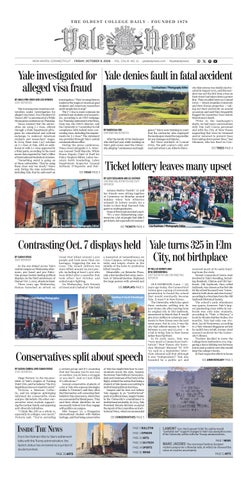
Yale investigated for Yale denies fault in fatal accident alleged visa fraud Liza Kaufman / Photography Editor
BY ARIA LYNN-SKOV AND LEO NYBERG STAFF REPORTERS Yale is among nine American universities under investigation for alleged visa fraud, Vice President JD Vance LAW ’13 announced at a White House press conference on Thursday. Vance claimed that the universities are using J-1 visas, offered through a State Department pProgram for educational and cultural exchange, to undercut American students and researchers’ wages. In 2024, there were 1,917 scholars on J-1 visas at Yale, with an additional 26 with J-1 visas approved by a third party, according to the most recent data reported by Yale’s Office of International Students & Scholars. “Something weird is going on at these universities. They’re using these visas way too much,” Vance said, listing the nine universities, including Yale, that he said merit an
investigation. “They’re using them to undercut the wages of American grad students and American researchers and it simply has to stop.” The J-1 visa is more common for postdoctoral students and researchers, according to an OISS webpage. In a Thursday statement to the News, Ozan Say, the OISS’s director, said the University is “committed to full compliance with federal rules concerning visas, including the requirements for J-1 visas.” The statement was provided through Yale’s central communications office. During the press conference, Vance stood alongside U.S. Attorney General Todd Blanche, White House Deputy Chief of Staff for Policy Stephen Miller, Labor Secretary Keith Sonderling, Labor Department Inspector General Anthony D’Esposito and FedSEE VISAS PAGE 5
BY NAUSICAA CHU CONTRIBUTING REPORTER After the family of the landscaper who died last year while working on Yale’s golf course sued the University, alleging “carelessness and negli-
gence,” Yale is now claiming in court that the contractor who employed the landscaper should be responsible for any damages and injuries. But three residents of Conrad Drive, the golf course’s only exit road and where Luis Alberto Moro-
cho Marcatoma was fatally electrocuted in August 2025, said the incident was not the first time a tree on their street had taken down a power line. They recalled trees on Conrad Drive — which straddles University and New Haven properties — taking out their electricity on several occasions and said they frequently flagged the hazardous trees before Marcatoma’s death. “Prior to the landscaper’s death, we had many conversations with Yale Golf Course personnel and with the City of New Haven requesting that trees be trimmed and/or removed to prevent trees from taking down power lines,” Joel Abraman, who has lived on ConSEE TREES PAGE 4
Ticket lottery leaves many upset BY LUCY BENJAMIN AND ELI RATNER CONTRIBUTING REPORTER AND STAFF REPORTER Aahana Mehta-Vasisht ’27 and her friends were sitting together at Commons on Monday around midday when Yale Athletics released its lottery results for a ticket to their final Harvard-Yale game as undergraduates. None of them had clenched a spot. “It’s a very disheartening experience for a lot of people that didn’t get tickets, but especially for seniors,”
Martín Peralta / Head Photography Editor
Liza Kaufman / Photography Editor
SEE TICKETS PAGE 4
Contrasting Oct. 7 displays held Yale turns 325 in Elm City, not birthplace
BY SARAH RIVAS STAFF REPORTER
As the sun shined across Yale’s central campus on Wednesday afternoon, pro-Israel and pro-Palestine groups hosted dueling political displays on the third anniversary of Hamas’ Oct. 7, 2023, attacks in Israel. Three years ago Wednesday, Hamas launched an attack on
Israel that killed around 1,200 people and took more than 250 hostages, triggering the war in Gaza. The Israeli military has since killed around 74,000 people, including at least 1,400 who were killed after a ceasefire that took effect last October and ended major fighting. On Wednesday, Yale Friends of Israel and Chabad at Yale held
Kailyn Huynh / Contributing Photographer
a memorial of remembrance on Cross Campus, setting up a long table and empty chairs in the middle of the lawn to symbolize killed Israelis. Meanwhile, on Beinecke Plaza, only a few hundred feet away, members of Yalies4Palestine displayed five large posters with artwork and SEE DISPLAYS PAGE 5
Courtesy of Jacob Schonberger
Conservatives split about speech BY SASHA CABRAL AND SARAH RIVAS STAFF REPORTERS Diego Victoria ’27, the vice president of Yale’s chapter of Turning Point USA, said he believes “the R in Republican does not stand for racist.” Victoria, a Mexican Catholic, said his religious upbringing informed his conservative views and pro-life beliefs. His other conservative views include supporting the nuclear family and opposing anti-diversity initiatives. “I think like DEI as a whole is, especially in colleges, very racist,” Victoria said. “You’re excluding
a certain group and it’s assuming that just because you’re one race or another, you do have a struggle or you don’t. And so I just think it’s ridiculous.” Several conservative students of color at Yale who espouse ideologies similar to Victoria’s said they often find themselves self-censoring their beliefs in Yale classrooms, where they are surrounded by liberal peers. They said their ethnic identities do not necessarily inform how they engage with politics on campus. Mór Szepesi ’27, a Hungarian international student with Malian heritage, said that being conservative
INSIDE THE NEWS From the Vietnam War to Yale's settlement talks with the Trump adminsitration, the lipstick status has remained as a symbol of student protest. PAGE 10 ARTS
BY NELLIE KENNEY AND DIYA SHRISHRIMAL STAFF REPORTER AND CONTRIBUTING REPORTER OLD SAYBROOK, Conn. — 325 years ago today, the Connecticut colony gave a group of reverends permission to found the school that would eventually become Yale. It wasn’t in New Haven. The University, which has spent three centuries settling into its now-home city after moving from its original site in Old Saybrook, announced in March that it would give $230 million in voluntary payments to New Haven over the next seven years. But in 1716, it was the city that offered money to Yale — between £1,500 and £2,000 — in a bid to bring Yale to New Haven rather than Hartford. In its early years, Yale was “very much a Connecticut institution,” New Haven city historian Michael Morand ’87 DIV ’93 said in a September interview. Morand said that although it was “independent,” Yale was founded by a public act and
at Yale has taught him how to communicate across the aisle. Szepezi, the former Yale Political Union president and chairman of the Party of the Right, refuted the notion that being a student at Yale means succumbing to institutional political doctrines. Szepesi said he does not believe Yale engages in an “institutional” push of political ideas, largely thanks to the University’s commitment to institutional neutrality. In 2024, Yale President Maurie McInnis accepted the report of the Committee on Institutional Voice, which recommended
received much of its early funding from the state. Several Connecticut towns were involved in Yale’s founding, including Branford, Clinton and Old Saybrook. Old Saybrook, then called Saybrook, was chosen as the first site for the school because it was “convenient to both shore and river towns,” according to a brochure from the Old Saybrook Historical Society. The school’s early attendance was sparse, however. Yale’s largest graduating class while in Saybrook was only nine students, according to “Yale: a History,” a book by Brooks Mather Kelley. For months, Yale had only one student, Jacob Heminway, according to a Yale Alumni Magazine article by Judith Ann Schiff, former chief research archivist for the University’s library. Trustees decided to move the College from Saybrook in 1715, triggering a fierce bidding war between towns and a contest over who would keep the college’s books. In their respective efforts to house SEE ANNIVERSARY PAGE 5
Diya Shrishrimal / Contributing Photographer
SEE CONSERVATIVES PAGE 5
PAGE 2 BULLETIN PAGE 3 OPINION PAGE 10 ARTS PAGE 13 SCI-TECH PAGE 14 SPORTS PAGE B1 WKND
LAMONT Gov. Ned Lamont SOM ’80 said he would “probably not” support changes to Yale’s tax exemption even if the University settles with the Trump administration. PAGE 7 NEWS
MARC JACOBS The renowned fashion designer
visited campus for a Monday talk, in which he stressed the value of creative uncertainty. PAGE 11 ARTS
PAGE 2
YALE DAILY NEWS · FRIDAY, OCTOBER 9, 2026 · yaledailynews.com
BULLETIN Behind the Headline By Nausicaa Chu Last Thursday, I visited the New Haven Superior Court website to find the court records of a person who tried using a cloned ID last year to break into Berkeley College. I failed. Instead, I randomly clicked on links, somehow ended up on a judge’s short calendar and stumbled upon a wrongful death lawsuit filed by a Yale Golf Course landscaper’s family against the University. I emailed the family’s lawyer, who said residents near the golf course had complained about hazardous conditions “well before” the landscaper’s death. I thought I would simply write a story about the lawsuit. But my editor suggested that I travel to Conrad Drive to speak to the residents themselves. I had just started reporting for the News, and it was my first time knocking on doors. I did not expect the residents to talk to me, much less talk about how they had told Yale about hazardous tree conditions prior to the landscaper’s death. A few whirlwind days of emailing, texting and re-texting later, the story went live. I never expected Internet browsing to lead to an article like this, but, as I’ve learned, anything can happen at the News.
This Day in Yale History, 1957. October 9, 1957 / Pierson Court Considered Site for Parking Lot; Tentative Proposal Praised, Criticized by Faculty The University is considering a proposal to convert the land behind Pierson College, currently known as Pierson Court, into a parking lot. This proposal has gained a lot of mixed opinions, with one history professor describing it as “absolutely terrible,” while a member of the Haunt Club, which uses the space for periodic drinking events, said they don’t mind “as long as they leave room for our punch bowl.”
Read “Yale denies fault in fatal accident” on page 1.
CORRECTION: Due to an editing error, an earlier version of Emily Akbar’s article, “YCC passes statement condemning Lewis,” misstated the number of senators who voted for an amendment to a public statement. Six senators, not 20, voted in the amendment’s favor. An earlier version of Lucy Benjamin’s article, “This street by Payne Whitney saves time, creates community for athletes,” misstated the time of a Nov. 2 basketball game between Yale and Howard. The game is scheduled for 7 p.m., not 1 p.m.
ILLUSTRATION BY SASHA CABRAL
ILLUSTRATION BY GRACE GLADSON
ILLUSTRATION BY GRACE GLADSON
ILLUSTRATION BY ANNA CHAMBERLIN
YALE DAILY NEWS · FRIDAY, OCTOBER 9, 2026 · yaledailynews.com
PAGE 3
OPINION S TA F F C O L U M N I S T
S TA F F C O L U M N I S T
GIUSEPPE DIMASSA
S U L L I VA N H O
Are Yale students adults?
Focus on catheters
The News recently quoted Diego Victoria ’27, a friend of mine and the vice president of Yale’s Turning Point USA chapter, arguing in support of the Yale administration’s approach to negotiations with the Department of Justice. In his words: “you know when you’re a little kid, and then your parents have grown-up problems that only they know how to deal with, and you’re kind of out of the picture? It kind of feels like that right now: we’re the little kid, and the administration are the parents.” Ouch. The irony is that Yale has tried this approach to leadership before — and it wasn’t exactly a success. In 2015, Yale’s Intercultural A!airs Committee sent a pre-Halloween email asking students to avoid “culturally insensitive” costumes. Erika Christakis, then the associate head of Silliman College, critiqued the missive in a separate email to the Silliman student body, arguing that it “implied control over college students.” Factions formed along a similar question to the one we’re debating today — is the top-level administration’s judgement sufficiently more competent and trustworthy than students’ judgement to merit deference? Two groups of students apparently thought so, calling for Christakis’s removal as associate head of College. On the other side, 49 Yale faculty members signed an open letter defending Christakis, explaining that they saw the dividing line of the dispute as whether “monitoring and criticizing such expression should be done in a top-down manner.” Even prominent libertarian and conservative organizations came to Christakis’s defense. On the libertarian-leaning side, the Foundation for Individual Rights in Education — or FIRE, whose executive director spoke at the Yale Political Union in 2024 — re-published an op-ed statement by Christakis originally written for the Washington Post. The conservative Wall Street Journal opinion columnist Roger Kimball GRD ’77 ’82 called students “crybullies” precisely because he expected them to self-govern better rather than rely on administration to shield them from uncomfortable views. Three months after Halloween, in an interview with The New York Times, Christakis questioned whether we should “be talking more transparently about when it’s appropriate for administrations to insert themselves into issues that arise in students’ lives.” The disputed question in 2015 — are students children? — is back up for dispute in 2026. It’s true that the stakes are vastly greater this time around. Moreover, it’s theoretically possible to allow di!erent people to adopt di!erent standards of Halloween costumes; it’s impossible for Yale to make separate consent decrees for every student. Still, recall what Victoria argued: students are little kids whose views don’t even deserve to be considered. It’s a hardline view, and the opposite of what Kimball supported back in 2015.
What explains this radical turnaround in ideological positioning in the course of barely a decade? In 2015, conservatives were insistent that Yale children act like adults and accept responsibility. Today, Victoria claims the opposite. Why? Political Economy gives us a critical toolkit. A solid body of literature in political science, including recent game-theoretical work in political science research and methods, models political devolution as a response to political power. It found that parties tend to support decentralized political authority if they think that their party is likely to lose an upcoming election, face difficulty in implementing policy, or partisanship is high. If national-level governance seems unlikely, it makes the most sense to simply cut losses and try to win local or state-level elections. By comparison, a party in control of national offices tends to oppose devolution. Victoria’s opinion is not hypocritical — he wasn’t a student during the Halloween controversy — but his stance illustrates that the internal politics of Yale have changed dramatically over the last decade.
BUT HIS STANCE ILLUSTRATES THAT THE INTERNAL POLITICS OF YALE HAVE CHANGED DRAMATICALLY OVER THE LAST DECADE. In 2015, conservative elites had good reason to suspect that the Yale administration wasn’t amenable to conservative interests. Consequently, “devolution,” in the form of greater student trust, autonomy and adulthood, was the most probable path to at least some conservative-coded victories. Today, however, Yale’s conservatives are facing an inverse situation: a solid change of a long-term McInnis presidency, high on-campus polarization from TPUSA to Stand Up for Yale and relative ease in implementing national policy — just sign a consent decree! Thus, the game-theoretical optimal equilibrium for conservative-leaning students is widespread deference to the administration. Ultimately, Diego’s argument raises an important point: views of students’ adulthood are often secondary to broader political goals. In 2015, when it suited conservatives, we were adults; now we’re not. Adulthood for Yale students, just not when it threatens conservative political interests. GIUSEPPE DIMASSA is a junior in Ezra Stiles College studying religious studies and a staff columnist for the Opinion Desk. He can be reached at giuseppe.dimassa@yale.edu.
YALE DAILY NEWS PUBLISHING CO., INC. 202 York Street, New Haven, CT 06511 (203) 432-2400 Editorial: (203) 432-2418 editor@yaledailynews.com Business: (203) 432-2424 business@yaledailynews.com
EDITOR IN CHIEF & PRESIDENT Asher Boiskin MANAGING EDITORS Jaeha Jang Olivia Woo Reeti Malhotra PUBLISHER Henry Hoak DIRECTOR OF AFFAIRS Kate Soo Hyun Kim
UNIVERSITY EDITORS Olivia Cyrus Jerry Gao Henry Liu Isobel McClure
SPORTS EDITORS Liza Kaufman Walter Royal
CITY EDITORS Elijah Hurewitz-Ravitch Sabrina Thaler
SCIENCE & TECHNOLOGY EDITORS Michelle So Hari Viswanathan
ARTS EDITORS Kiva Bank Gemard Guery
OPINION EDITORS Manu Bosteels Rohil Mohan
INVESTIGATIONS EDITORS Sasha Hurowitz
WEEKEND EDITORS Stephanie Altschul Hana Tilksew
MAGAZINE EDITORS IN CHIEF Ethan Kan Claire Nam
ILLUSTRATIONS EDITOR Rana Roosevelt
HEAD PODCASTS HEAD PHOTOGRAPHY EDITOR Amiya Vashi EDITOR Martín Peralta DATA EDITOR HEAD PRODUCTION & Adriana Petrizzo DESIGN EDITOR Ezra Helfand HEAD COPY EDITOR Nate Stein
HEAD AUDIENCE EDITOR Emily Seo
THIS ISSUE Copy Editors: Ruby Nichols, Clare Griffin, Maria Gregory; Copy Staffers: Ashley Skinner, Aria Lynn-Skov, Kai Tasmin Bwor, Cyrus Turner, Maria Andreu Bird, Jolynda Wang, Willow Mintz, Lucy Bland, Liliana Dumas
EDITORIALS & ADS
Content on this page with bylines represents the opinions of those authors and not necessarily those of the Managing Board. Opinions set forth in ads do not necessarily reflect the views of the Managing Board. We reserve the right to refuse any ad for any reason and to delete or change any copy we consider objectionable, false or in poor taste. We do not verify the contents of any ad. The Yale Daily News Publishing Co., Inc. and its officers, employees and agents disclaim any responsibility for all liabilities, injuries or damages arising from any ad. The Yale Daily News Publishing Co. ISSN 0890-2240
NEW HAVEN, CONNECTICUT
SUBMISSIONS
All letters submitted for publication must include the author’s name, phone number and description of Yale University affiliation. Please limit letters to 250 words and guest columns to 750. The Yale Daily News reserves the right to edit letters and columns before publication. E-mail is the preferred method of submission.
ISSUES PRINTED BY
Valley Publishing Co, Derby, CT
DIGITAL ARCHIVE
YDNHistorical.Library.Yale.edu
COPYRIGHT 2026 — VOL. CXLIX, NO. 11
ADVERTISEMENT
(203) 432-2424 (before 5 p.m.) business@yaledailynews.com Direct all letters, columns, artwork and inquiries to: Contact the Opinion Editors at opinion@yaledailynews.com
Direct all comments regarding the fairness or accuracy of stories to: Asher Boiskin Editor in Chief & President editor@yaledailynews.com
What should you be working on? If you believe recent tweets, sorry, posts on X, maybe you should work on AI safety. Democratize Yale thinks you should reshape universities in the image of “shared governance.” Aristotle wants you to pursue eudaimonia. But what does any of that actually mean? If you listen to the problems Yale students want to work on, everything’s really big. “Forwarding pro-social causes.” “Reshaping educational initiatives.” “Advocating for underrepresented communities.” Yale students clearly want to change the world. But for some reason, they’re only able to talk in vague generalities. Have you ever thought about the correct way to insert a catheter? Hopefully not. After all, it’d be a waste of time — Peter Pronovost already figured it out. In 2001, while at Johns Hopkins, he developed the procedure for inserting catheters to minimize the risk of infection. The solution was relatively simple, just a standardized procedure jotted down on a random scrap of paper. Over the next decade, infections from catheter-induced infections fell by 58 percent. Or take the seatbelt. A less sexy invention is hardly imaginable. Not only is the seatbelt boring, but in its original form it wasn’t even particularly good at saving lives. That is, until Nils Bohlin replaced the hip-to-hip design with the current three-point design, which could be easily attached with one hand. Usage rates spiked, and this marginal development of the world’s unsexiest invention is attributed with saving over a million lives. Neither of these improvements are particularly cool. They are not discussed in Plato’s Republic or on NBC. They will probably not win you a Rhodes. But they work. This is how the world gets changed. If Yale students are serious about making an impact, they should go to the margins. They should focus
on catheters. Marginal solutions work exactly because they are ignored. Healthcare and food stamps and industrial policy have already been colonized or lambasted by the relevant political parties. These days, bipartisan policy only gets passed on something as dry as licensing requirements for micro-reactors. How many laws do you think our current Congress has passed? If you ask the average disillusioned Yale student, they might guess two, 10 or maybe even 20. Not even close — it’s 118. But you only ever hear about the One Big Beautiful Bill Act or the
WHEN WE NARROW OUR FOCUS, THE PROBLEM BECOMES BOTH MORE APPROACHABLE TO SOLVE AND MORE LIKELY TO HAVE A SOLUTION THAT GETS IMPLEMENTED. Inflation Reduction Act, no headlines on the Quantum Computing Cybersecurity Preparedness Act or the TRANQ Research Act. Even if they aren’t as newsworthy, they represent victories of smart, focused people working on marginal problems. And they both passed the House and Senate unanimously. The gap between our awareness of these marginal solutions and reality helps explain why Yale students are so pessimistic about changing the world. If you asked the protestorturned-consultant why they
abandoned their political dreams, they’ll probably say something about Congress not doing anything anyways. If you ask the climate activist why they’re recruiting for investment banking, they’ll tell you our rainforests are too cooked to repair. Acknowledging and then focusing on the marginal solution gives agency in an otherwise depressing political age. When we narrow our focus, the problem becomes both more approachable to solve and more likely to have a solution that gets implemented. But say you haven’t given up. You still want to solve a big problem. Maybe you believe in Roko’s Basilisk, the thought experiment that says we should all work to develop AI so it doesn’t torture us when superintelligence inevitably arrives. Or perhaps you’re on the other side, concerned with AI misalignment and specification gaming. Maybe you’ve got other big problems to solve — climate change or democracy or urban violence. All these are commendable goals, with the exception maybe of developing a super evil AI. But even here, a mind towards catheters is helpful. That is because there is not really such a thing as a big problem. There are just many little problems we collectively assign to one big label. There will be no solution to climate change. There will be permitting reforms and innovation subsidies, shifting norms and grid investments, and then one day we’ll reach into the bin of little problems labeled climate change and there’ll be no more problems to solve. This is how you solve big problems — with marginal solutions. Now go find your catheter. SULLIVAN HO is a sophomore in Pauli Murray College studying economics and humanities, and a staff columnist for the Opinion Desk. He can be reached at sullivan.ho@yale.edu.
S TA F F C O L U M N I S T S A L I S TA I R B R O W N I N G A N D G O N I WO N G
Why the left must debate On Sept. 29, the Yale Political Union hosted Aaron Withe, the CEO of the Freedom Foundation, who debated for the resolution, “Ban Public-Sector Unions.” It’s not a popular argument at Yale. At least, that’s what you’d gather from the YPU Instagram poll posted in the hours before the debate: nearly 80 percent of respondents were opposed. Would it surprise you to learn that, at the end of that evening, the YPU voted 35-25 in favor of the resolution? The same argument, roughly as popular as herpes, won a comfortable victory. How did an initially marginal view end up sweeping the room? It could be, of course, that Withe is simply a rhetorical phenomenon. Perhaps, purely through the powers of argumentation, he won over a broadly liberal student body. This argument would be compelling if it were true. On Sept. 29, very little cross-ideological voting occurred. The union’s four right-leaning parties voted in favor of the resolution, while the Progressives and the Party of the Left stood in almost unanimous opposition. What mattered was that right-wing party members turned out — and left-wing ones didn’t. What mattered, ultimately, was that conservatives showed up to debate — and progressives didn’t. So what? Maybe progressive Yalies just find praxis more important than theory. Isn’t on-the-ground advocacy a better source of our time and attention than attending a somewhat pompous debate club? It’s an understandable impulse. Indeed, enshrined into the mission of the Progressive Party — the pre-eminent left-wing party at Yale — is the pursuit of practical
avenues towards a progressive future. But rhetoric still matters. Persuasion still matters. Debate still matters, and it’s increasingly become a practice associated with conservatism. Right-wing media built a brand for itself on the basis of its supposed debate superiority. Ben Shapiro got famous for it. Charlie Kirk built one of the largest on-campus political organizations in the country — Turning Point USA — on the idea that he could set up a tent, prop up a mic and dunk on liberal college kids. The YouTube videos and Instagram clips these provide might seem shallow, but the hits and clicks of these viral videos matter. Rhetoric is a precursor to ideology, and ideology is a precursor to action. In other words, if you want people to work on your causes, you need to win them over. Of course, it’s not fair to attribute political debate’s right-wing association solely to the actions of conservatives. The language of the American left — complaints that certain beliefs are simply too objectionable to confront — is often counterproductive even to the advancement of leftwing causes. By their argument, platforming right-wing voices is tantamount to endorsing them. But this argument ignores a simple fact: right-wing media already has a massive, outsized platform. Fox News accounted for 63 percent of the entire 2025 cable news audience. Spotify’s top 10 podcasts include The Joe Rogan Experience and The Tucker Carlson Show. Conservatives have platforms. A refusal to debate won’t change that — it’ll only cede more territory. The same trend appears at our university. At Yale, William F. Buckley Jr. ’50, the architect of modern conservatism and one of our most prominent political
alumni, had a legacy makeover in 2011 when conservative students got together and established the Buckley Institute, providing a forum for “intellectual diversity” and “free speech.” The recently inaugurated Turning Point Yale chapter describes itself as pursuing “non-partisan, thought-provoking discussion.” Is that really what Turning Point practices? You might disagree — but you have to make that case. In short, when progressives forswear the proverbial microphone, we only allow the conservative megaphone to subsume it. This isn’t a novel idea. The foundational Woodward Report asked Yalies to “challenge the unchallengeable.” That charge was never partisan property; it belongs to whoever shows up to claim it. So to the progressives of Yale: maybe you aren’t swayed by highminded arguments about the importance of discourse, the value of talking to those we disagree with and the necessity of overcoming a polarized society. That’s fine. But even if your only interest is the advancement of your political project, well, debate is still invaluable. If you want to be persuasive, compelling and convincing, you need to persuade, compel and convince. Because if you give up the microphone today, well, who’s to say you’ll get it back tomorrow? ALISTAIR BROWNING is a first year in Davenport College studying history and a staff columnist for the opinion desk. He can be reached at alistair. browning@yale.edu. GONI WONG is a first year in Timothy Dwight College studying political science and a staff columnist for the opinion desk. He can be reached at goni. wong@yale.edu.
PAGE 4
YALE DAILY NEWS · FRIDAY, OCTOBER 9, 2026 · yaledailynews.com · @yaledailynews
FROM THE FRONT
“Dreams are the touchstones of our characters.” HENRY DAVID THOREAU AMERICAN ESSAYIST
Residents say trees have damaged power lines for years TREES FROM PAGE 1 rad Drive since 1978, wrote in a text message to the News. Marcatoma, an employee of Yale contractor Eastern Land Management, was leaving work when he tried to move a tree that had fallen across Conrad Drive, according to a Connecticut Public Utilities Regulatory Authority investigation into the incident. Marcatoma touched a power line pulled down by the tree and died of electrocution, the report furthers. The lawsuit filed by his family in April alleges that Yale failed to protect Marcatoma from the “rotted, decayed, and/or structurally compromised” tree. This July, Yale filed a complaint against Eastern Land Management, alleging that the contractor is wholly responsible for any potential damages. On Wednesday, Eastern Land Management filed a response to Yale’s claims, denying “any negligence.” Golf course manager was ‘aware of everything’ Residents of Conrad Drive complained to Yale about dangerous trees “well before” Marcatoma’s death, according to Patrick Kennedy, an attorney who represents Marcatoma’s family. Kennedy added that Yale had the trees assessed but “inexplicably” decided not to prune and remove them. “We believe this incident could have been avoided had Yale simply prioritized the safety of the people performing the work on the golf course,” he wrote in a Friday statement to the News. Ellen Abraman, Joel’s spouse, said she and her neighbors were “pretty shaken” after Marcatoma’s death. Ellen Abraman said that when a Yale tree fell in her front yard, then-Yale Golf Course General Manager Peter Palacios “sent his crew down” to get it off her lawn. She said that if she noticed something amiss, she would call Palacios and “just let him know.” Conrad Drive resident Leslie Pitiger told the News that she had texted Palacios about the fallen tree prior to Marcatoma encountering it. She said she has lived on Conrad Drive for 28 years. “Peter was aware of everything,” Pitiger said on Saturday when asked about the extent of Palacios’ knowledge of incidents involving falling trees. Palacios, who was reached by the News via a phone number provided by the Abramans, later responded via email denying responsibility for tree removals along Conrad Drive. He did not immediately respond to the News’ further inquiries regarding residents’ claims that they would text him to remove trees.
“Any suggestion that I was re s p o n s i b l e fo r d e c i s i o n s regarding tree removal is factually incorrect,” Palacios said in his Tuesday email to the News. He said that he did not have the authority to identify or mark trees along Conrad Drive for removal and was not tasked to do so. At least two Yale trees in the area where Marcatoma died had fallen prior to the incident, Pitiger said. One of those trees, she said, knocked down an electric wire and set a resident’s lawn on fire. Palacios left Yale earlier this year and now works for the Claremont Country Club in California, according to his email signature. Since then, the Yale Golf Course has been transferred from Yale Athletics to the Yale Office of Facilities after poor maintenance led to deteriorating conditions, according to a Sept. 29 article in The Athletic. When asked about the plaintiff’s claims, Ronnie Rysz, a spokesperson for Yale’s Office of Facilities, wrote in an email that “Yale does not comment on pending litigation.” Yale’s Office of Public Affairs and Communications did not respond to the News’ request for comment. Ongoing litigation In July, Yale filed an apportionment complaint against Eastern Land Management, the contractor that employed Marcatoma. The complaint stated that if “negligence on the part of anyone” harmed Marcatoma, such negligence was “wholly caused” by ELM’s actions. The complaint claims ELM failed to give Marcatoma enough guidance about electrical hazards. In August, Yale filed a cross complaint against ELM, alleging that Marcatoma’s death was “the direct result of the acts and/or omissions” of Marcatoma himself. It states that Marcatoma “knowingly and willingly touched” the electrical wires, despite the golf course’s superintendent telling him not to. The Connecticut Public Utilities Regulatory Authority’s investigation into the incident said eight out of 10 witnesses observed Marcatoma touching the wire with both hands. “Mr. Marcatoma’s passing has deeply affected many throughout the ELM family,” attorney Carmen Nicolaou, who represents ELM in the case, wrote to the News in an email. “Because the case remains pending before the court, ELM cannot comment on the allegations or otherwise address the merits of the claims.” On Wednesday, ELM responded to Yale’s apportionment complaint, writing that the alleged harm was due to the “negligence, recklessness, or carelessness” of entities other than ELM, “including but not limited to Yale.”
‘They all point the finger’ Conrad Drive is located along the border between Yale property and New Haven. Houses line one side of the street, while the other side contains a wooded area. Pitiger said stakes with pink tape near the wooded area delineate the line between Yale and New Haven. Joel Abraman said trees began regularly falling on power lines about ten years ago. He said that he would see wires in the street sometimes “sparking.” Though the residents had raised concerns about many Yale trees in need of removal, the trees had not been cleared out, Ellen Abraman said. She described a lack of clarity about which trees belonged to Yale or New Haven. If a tree leaned over the street, one side of it might be on Yale property, while the other side might be on city property, she explained. “If something falls on whatever the line is, wherever that line is, no one seems to be able to figure out who should be responsible,” she said. “They all point the finger,” Joel Abraman said. Annie Mixsell, the city’s tree warden, wrote in a Tuesday email that the New Haven Parks Department inspects every city-owned tree on Conrad Drive “for maintenance needs” and to identify trees that require removal or pruning. “That work has been ongoing and is near completion,” Mixsell wrote.
“It is our understanding that Yale has retained their own arborist to inspect and manage the privately-owned trees on its property as well.” Palacios wrote that while he accompanied the tree warden to assess trees along Conrad Drive, “the authority to determine which trees would be removed rested solely with the appropriate municipal and utility authorities.” Pitiger said that last year, arborists marked trees that needed to be removed with orange tags. Some, but not all, of those trees were removed, she said. It was unclear whether the trees were marked before or after Marcatoma’s death. As of Saturday, two trees on Yale’s side of the pink tape were marked with orange tags, including one that leaned over the street near a power line. Pitiger said Yale did not take all the trees down because of the delineation between Yale and New Haven property. “There was a question between theirs and mine. It’s like, well, that might be on New Haven’s property,” she said. Falling trees, frequent power outages Joel and Ellen Abraman said that fallen trees cut off their power around five times per year, and Pitiger said that she lost power seven or eight times in 2025.
Pitiger said she observed a tree by the golf course entrance, near where Marcatoma died, that fell during a storm before Marcatoma’s death. It caused a power outage for about three and a half hours, she said. Conrad Drive resident Renee Kohn said that power outages used to occur “all the time” and that the falling trees were primarily on Yale’s property. “Just a slight wind and we would be out of power,” she said. Before Marcatoma’s death, a tree on Yale’s property near the golf course entrance knocked down an electric wire, setting the lawn of 170 Conrad Dr. on fire, Pitiger said. Pitiger said that her neighbor was walking a dog in that area when the tree fell and the lawn ignited. The neighbor called the fire department, Pitiger said. Joel Abraman said he recalled a “sparking live wire” on the ground that ignited the foliage. The New Haven Fire Department used the fire hydrant in front of their house to put out the fire, Ellen Abraman said. “Yale should have known,” Pitiger said when informed about the lawsuit. “But Yale didn’t care.” The lawsuit is set to go to trial in October 2027, according to Connecticut’s Judicial Branch website. Contact NAUSICAA CHUat nausicaa.chu@yale.edu.
Nausicaa Chu / Contributing Photographer
This is Conrad Drive, the street where a landscaper was electrocuted last year. Resident said trees regularly took down power lines prior to his death and that they had flagged precarious trees to the Yale Golf Course’s general manager at the time.
Less than half of Yale college has tickets to The Game TICKETS FROM PAGE 1 Mehta-Vasisht said in a phone interview. “This is such a milestone for us to cap off our four years, and I think being able to go to every other game, and then not going to our last, definitely feels like a punch in the gut.” In just over a month, Yale students will flock to Boston and cover the city in Yale Blue for the 142nd edition of The Game, which is considered to be the pinnacle celebration of Yale Athletics every year. Fenway Park will host the game for the first time since 2018 as the oldest rivalry in college sports takes the field in one of America’s most iconic baseball parks. But the limited number of tickets and a weighted lottery system has left more than half of Yale’s near6,700 undergraduates without a ticket for one of Yale’s most anticipated traditions. Only 2,900 students were allocated tickets, leaving around 3,800 students, or 57 percent, without a ticket. “We were all shocked at first,” Mehta-Vasisht said. “It was definitely frustrating because The Game is at Fenway and a lot of us were excited for this new venue, and then it did not work out for myself and so many others.” While resale tickets are available for unlucky students, Mehta-Vasisht said that is not a financially realistic alternative for her. Other students, who were lucky enough to secure a ticket, said the low share of students with a ticket
diminishes The Game’s experience for everyone. In the lottery, seniors were by default given four entries, juniors were given three, sophomores were given two and first years were given one. To boost their chances, students could earn up to five additional entries by attending select Yale Athletics events. Colleen Murphy, the assistant athletic director for strategic communications, emphasized in an email to the News that the lottery system was clearly communicated to students. “We worked closely with the Yale College Dean’s Office to ensure students had clear information about the process and their opportunities to participate,” she wrote. “Students selected through the lottery received a purchase link and deadline directly through their Yale email address.” Murphy added that Harvard’s allocation to Yale remained the same as in previous years. Harvard Athletics spokesperson Darin Wong told the News last month that the allocation of 2,900 tickets per game is “consistent with visiting school student ticket allocations for games at both Harvard Stadium and the Yale Bowl over the past several years.” While the Crimson’s home stadium can hold about 25,000 people, Fenway can hold around 37,000 when transformed for football games. The Yale Bowl has a seating capacity of over 60,000.
Léa Mansour ’28, a junior from Georgia and a football fan, said in a phone interview that The Game offers a rare opportunity to experience the kind of intense school spirit, packed stadiums and tailgating culture more commonly associated with large college football programs. “The experience of Harvard-Yale is so sacred to me because I finally get to feel that way even at a high elite institution where sports do not really matter to the student body,” she said. Sophomore Jack Smithwick ’29 said he was disappointed. Left without a ticket, Smithwick wrote in a text message to the News that he was going to look “at other options including buying from other Yale friends, Harvard students, and other websites, however all are more expensive.” Mehta-Vasisht said buying a resale ticket was not a realistic alternative “unless you want to drop a couple hundred bucks.” “I do not have the means to drop that much on a football game,” Mehta-Vasisht said. With high listings for seats for the general public and no tailgates outside the stadium, some Yale students are considering ditching the trip to Boston altogether. “I just think they should automatically give all students a ticket,” Mansour said, emphasizing the relatively small size of the Yale undergraduate population
Liza Kaufman / Photography Editor
Some Yale students expressed frustration after Yale Athletics’ Monday afternoon email notification about lottery ticket results for The Game, compared to the number of seats in the stadium. “It honestly takes away from students’ experience of such a crucial part of Yale.” Even students who received tickets expressed frustration with the process. Alya Bedawi ’29 told the News that, despite securing a ticket, her overall enthusiasm for The Game has diminished. “I’m less excited because so much of what makes Harvard-Yale meaningful is the sense of community surrounding it,” Bedawi said. “It’s about experiencing the tradition with the
people you care about, and if they aren’t there, it feels like some of that meaning is lost.” Students lucky enough to have won the lottery will head to Boston next month, while those less fortunate will hope to secure a ticket off the waitlist. Team 153 will play the Crimson on Nov. 21 at 3:30 p.m. at Fenway Park. Contact LUCY BENJAMIN at lucy.benjamin@yale.edu and ELI RATNER at eli.ratner@yale.edu.
YALE DAILY NEWS · FRIDAY, OCTOBER 9, 2026 · yaledailynews.com · @yaledailynews
FROM THE FRONT
PAGE 5
“The biggest adventure you can take is to live the life of your dreams.” OPRAH WINFREY AMERICAN MEDIA MOGUL
Events diverge on Oct. 7 meaning Vance slams student visas at alma mater DISPLAYS FROM PAGE 1
slogans like “Israel Bombs Yale Pays” and “Apartheid Didn’t Start Oct 7.” “They chose the single deadliest day for Jews since the Holocaust to do this, to mock us, to intimidate us and to claim our day of mourning for themselves,” Elijah Wiesel ’28, the community outreach manager of Chabad at Yale, said. But Camila Torres ’28, a member of Yalies4Palestine, said the group’s art installment is unique to Oct. 7 because the day marks the “third year of genocide.” “What is violent or dangerous about this? It could be provocative, sure, because there’s political and historical messaging,” Torres said. “However, none of this is dangerous or violent, and this builds a community space where we can talk about Palestine.” The University revoked Yalies4Palestine’s registered student group status in April 2025 for the organization’s role in promoting a protest that administrators said broke Yale’s protest policy. Wednesday’s memorial on Cross Campus was a registered event,
VISAS FROM PAGE 1
Courtesy of Maor Baker
On the third anniversary of Hamas’ Oct. 7 attacks in Israel, pro-Israel and pro-Palestine groups hosted events only a few hundred feet apart from each other. while the Yalies4Palestine event was not registered and was considered as a “gathering of individuals who did not identify themselves
Reeti Malhotra / Multimedia Managing Editor
as affiliated with any particular group,” Assistant Vice President for University Life Pilar Montalvo wrote in an email to the News. Noam Barenholtz ’27 said that in previous vigils commemorating Oct. 7, the empty table represented the Israeli hostages who were taken by Hamas and “should have been home celebrating Shabbat with their families.” The last surviving hostages were released in October 2025. “Maybe there aren’t hostages anymore who can’t celebrate Shabbat, but there are 1,200 people who lost their lives, who can never can never celebrate with their families again,” Barenholtz said. “So that empty table still symbolizes that.” In Judaism, Shabbat is the weekly day of rest between sunsets on Friday and Saturday. Contact SARAH RIVAS at sarah.rivas@yale.edu.
eral Trade Commission Chairman Andrew Ferguson. The officials did not present any direct evidence that Yale or the other universities — among them Harvard, Brown, Stanford, Arizona State and University of California, Davis — have committed what they described as visa fraud. Vance and D’Esposito said these universities use J-1 visas for federally funded grants 61 percent of the time compared to the national average of 38 percent. Vance said the J-1 visas were being used to undercut American graduate student wages, who he said make $20,000 more on average than international J-1 visa holders. D’Esposito, the inspector general, said the investigations had already begun. “Subpoenas have been served, investigations are underway and nobody will be getting a free pass because their name is carved into an expensive building,” D’Esposito said. Say and Yale’s public affairs office did not respond to questions about the statistics Vance cited, but said Yale will review documents about the investigation “once they are received.” “I don’t care how large your endowment is, how powerful your alumni are or how many politicians you have on speed dial,” D’Esposito said, as Vance stood behind him. Following the Thursday press conference, the Department of Education X account posted that with help from Vance and his signature project, the White House Task Force to Eliminate Fraud, “ED is cracking down on decades of waste, fraud, and abuse in higher education.” The post was accompanied by a poster of Education Secretary Linda McMahon, who has praised Yale’s efforts to address declining trust in higher education, with the words “FRAUDSTERS, BEWARE.”
The investigation arrives after a turbulent summer and beginning of the semester for international students’ statuses. Two August memos from Immigrations and Customs Enforcement announced a stricter interpretation of policies on internships for international students. The messages from ICE threatened to hold any university officer who improperly approves work for an international student criminally liable. Following the messages, Say told the News that Yale was reviewing its approval standards for international students’ internships. On Thursday, the Department of Homeland Security also proposed a rule to add fees for Optional Practical Training, which enables temporary employment for students on F-1 visas after they graduate. The rule, open to public comment through Nov. 9, has a stated purpose of combatting fraud and protecting U.S. workers. One international undergraduate student, who spoke under the condition of anonymity due to fear of retaliation from the federal government, described widespread concern about the changes among their fellow international students. The student, who is currently on an F-1 visa, said the investigation into J-1 visas, whose recipients include instructional faculty, has increased their concerns. Going beyond students and targeting instructors, the student said, would cause amplified damage. Yale is currently under Justice Department investigation for its undergraduate, law and medical school admissions practices. Contact ARIA LYNN-SKOV at aria.lynn-skov@yale.edu and LEO NYBERG at leo.nyberg@yale.edu.
New Haven bid more than Hartford to house Yale in 1716 ANNIVERSARY FROM PAGE 1 Yale, New Haven bid between £1,500 and £2,000 and Hartford bid around £700, according to another Yale Alumni Magazine article by Schiff. New Haven was a controversial choice. Two Hartford trustees, Rev. Timothy Woodbridge and Rev. Thomas Buckingham, circulated a letter claiming that Hartford and New London had paid “the Greatest part of the Money given for the Subsisting of the Collegiate School” and that therefore those should have been given “Good respect” when choosing the College’s final location. At the time of the move, Yale’s books were stored in the Saybrook home of Daniel Buckingham, the son of founding trustee Thomas Buckingham. Daniel Buckingham refused to give the books up, claim-
ing that they belonged to his father and not to Yale. Upon the appeal of Yale’s trustees, Gov. Gurdon Saltonstall sent a sheriff to retrieve the books, which were piled into carts and driven to New Haven. Outraged Saybrook residents knocked over the carts and dismantled bridges to impede their passage. Ultimately, around 260 books were lost, according to an 1838 history of New Haven. In 1975, the mayor of Old Saybrook offered an official apology for the conflict, which is sometimes called the “Battle of the Books.” Then-University President Kingman Brewster accepted the town’s apology for Saybrook locals’ “impulsive and misguided” behavior, according to The New York Times. The first Yale building in New Haven, called “College House,” was
built in 1718. Connecticut Hall, which is located on Old Campus and is the University’s oldest building still standing, was built in 1750. Morand pointed to its name as evidence of the close relationship between Yale and the colony at the time. “Connecticut Hall is called ‘Connecticut Hall’ because the money came from multiple sources, but the biggest came from the colony of Connecticut,” Morand said. That money came in the form of “payments of everyday expenses” and capital expenses, he added. History professor Mark Peterson said in a July interview that the relationship between Yale and Connecticut became more distant after the advent of public state schools like the University of Connecticut in 1881. “That division between the state public universities and the private
universities became clearer” and “stronger” during that time, Peterson said. For decades, Yale, New Haven and the state have engaged in skirmishes over the University’s property tax exemption, which excludes academic properties as well as some nonacademic properties from being taxed. Over half of New Haven real estate is currently tax-exempt. When Yale President Maurie McInnis announced the University’s new voluntary contribution agreement with the city in March, she pointed to New Haven’s original gift to the school. “It’s not an exaggeration to say that Yale wouldn’t be here if not for the generosity of the denizens of this city,” McInnis said. A boulder at the corner of an Old Saybrook cemetery marks the spot
where Yale reportedly originally sat. The spot, boxed in by hedges and marked with a plaque, faces a cove off the Connecticut River. Old Saybrook still feels “connected” to Yale, two residents who live near the boulder said. “So many people come by” and read the plaque, according to Jeannie Abrahamson, whose house sits across the street from the site. Those people often stop and talk about Yale, Abrahamson said. The Yale Club of New Haven is set to host a ceremony at the boulder on Friday to commemorate the chartering of the college. Contact NELLIE KENNEY at nellie kenney@yale.edu and DIYA SHRISHRIMAL at diya.shrishrimal@yale.edu.
Some students say they self-censor in the classroom
Ethan Sullivan / Contributing Photographer
Four students of color who are members of right-wing political groups on campus said their ideologies have largely been unaffected by their racial identities. CONSERVATIVES FROM PAGE 1 that Yale leaders refrain from speaking on matters of public significance. Szepesi said that his membership in the Yale Political Union, the Party of the Right and the Buckley Institute
have “taught me to be more openminded to different perspectives when engaging deeply with those with whom I have profound disagreements.” “I think that, therefore, if there is an indoctrination, a secret indoc-
trination plan that I’m not aware of, they’ve been unsuccessful with me,” he added. Yale College Republicans President Shailen Sharma ’27, who is white and Indian, said that as an institution, Yale cultivates students from across the political aisle. He added that in his humanities classes, professors did not guide conversations in “a certain political direction.” “Yale is a place of deep intellectual curiosity and a deep search for the truth, which seems to align with my views on support of civilization,” Sharma said. “I feel that Yale’s tradition in itself does promote conservative values while still being a majority liberal institution.” This freedom of expression extends to the classroom, according to Victoria, who recalled positive experiences with a few Yale professors in the presence of whom he felt “comfortable” voicing his conservative views, even though they are liberal-leaning. Victoria said, however, that he did feel several courses at Yale are “truly trying to impose their views.”
He said he has refrained from voicing his views in some classes, adding that he has to “pick and choose” his battles. “Why am I going to start trying to argue or debate something right now if it’s a huge lecture and I’m the only conservative voice in my section or seminar?” Victoria said. “At the end of the day, I care about my grades, I care about school and just because I stay silent in certain classes doesn’t mean that I’m taking what they’re lecturing or teaching on as to be true.” Eunice Han ’27, treasurer of the Yale College Republicans, wrote in an email to the News that some professors are “forceful about their own viewpoints,” which can make students “more hesitant to speak openly in the classroom.” Han, who is Korean-American, said Christian teachings, such as Jesus’s command to “stand up for the weak,” have influenced her politics. “These values come directly from the Word of God, so I suppose I fall in the conservative bucket,” Han wrote. “Every other identity— including the fact that someone might call me
a conservative—feels incredibly light by comparison. As light as a feather, actually.” Conservative students of color said their racial identities have had minimal effects on their political views. Sharma said his “motivation to uplift this country” has been foundational to his politics, regardless of his “ethnic, family and religious background.” Szepesi said race in Europe is much less politicized than it is in America and on American college campuses, in part, due to America’s history with political prejudice against certain groups and identities. “A race shouldn’t matter. It’s just who I am. It’s something that I can’t change,” Victoria said. “Just because I’m born Mexican, just because I’m born a certain way, I can’t think for myself?” The Yale Political Union was founded in 1934. Contact SASHA CABRAL at sasha.cabral@yale.edu and SARAH RIVAS at sarah.rivas@yale.edu.
PAGE 6
YALE DAILY NEWS · FRIDAY, OCTOBER 9, 2026 · yaledailynews.com
NEWS
“You may say I’m a dreamer, but I’m not the only one” IMAGINE JOHN LENNON
Before Trump cuts, years of efforts to strenghten graduate funding BY SARA AGRAWAL STAFF REPORTER Concerns over the evolution of Yale’s graduate student support in the past decade persist among some Yale faculty members, as the University navigates a tumultuous federal funding landscape. The second Trump administration has brought a wave of uncertainty to universities’ federal funding access. Last spring, the National Science Foundation placed Yale on a freeze list, delaying Yale researchers’ access to grant money for months. The University’s federal funding dropped by around $11.6 million, or 1.5 percent, between fiscal year 2026 and 2027, according to data available on Tuesday. And President Donald Trump is now pursuing a 41 percent cut to the National Institutes of Health’s budget, which could further financially constrain Yale research. “The reality is that Yale can’t replace the federal government’s funding,” physics department chair Sarah Demer said in a phone interview. “We can’t even replace it with private foundations.” Yale faculty have long expressed concern about federal funding volatility — even before Trump returned to office in January 2025. A 2018 report by Yale professors and administrators on STEM programs recommended more sustained support from the Graduate School of Arts and Sciences to doctoral students, while in 2023, the unionization of graduate students prompted calls from professors for increased support from the graduate school. “These discussions were being had a decade ago,” chemistry professor Seth Herzon said. “A decade ago, it was abundantly clear that the current financial model is not sustainable, that we needed more support from the university.” A 2018 report called for increased graduate student support. In 2018, the University Science Strategy Committee, charged with developing “a strategic plan for STEM at Yale that could be implemented in the coming decade,” released a report with recommendations including raising Yale’s investment in STEM graduate student support. Yale’s graduate student funding model varies by department and school. The Graduate School of Arts and Sciences funds the tuition and living stipends for the first one to two years of a graduate student’s doctoral program. After that period, fellowships or research grants fund students’ stipends and some of their tuition. The 2018 committee report
explained that Yale’s system of graduate student support relied “heavily on external funding sources, which puts significant burdens on faculty to raise the requisite funds and further limits the number of students who can be supported.” The report stated that “over the last few years, the federal funding pipeline has become seriously constrained, and is no longer as reliable a source of support as it was in the past.” David Skelly, a professor of ecology at the School of the Environment, wrote in an email to the News that for “much longer than 15 years there has been a steady increase in the competition for funding even as the agencies have shifted priorities in ways that affect support for graduate study.” In a Saturday email to the News, Daniel Colón-Ramos, a cell biology and neuroscience professor and a member of the committee, cited the Graduate Student Tuition Matching Program — which began in 2023 — as a source of “significant progress on the areas of growth identified” in the report. Dean of Graduate School of Arts and Sciences Lynn Cooley said in a Tuesday interview that under a previous policy, faculty members who paid for a student’s stipend from their research grants would also pay for half of that student’s tuition. The graduate school covered the other half of tuition. Under the Graduate Student Tuition Matching Program, faculty members who paid that 50 percent of tuition using their research grant would receive 35 percent of their payment back from the graduate school in the form of flexible research funds, whose use was determined by that professor, Cooley said. In 2025, the graduate school’s share increased from 35 percent to 50 percent of the tuition that the faculty member paid. Anna Marie Pyle, a professor of molecular, cellular and developmental biology and chemistry and a member of the University Science Strategy Committee, said she does not think that Yale has made good progress towards improving graduate student support in accordance with the University Science Strategy Committee’s report. “USSC committed to greatly advancing support for our science graduate students,” Pyle said in a phone interview. “This was one of the features that I think led members of the faculty to be broadly supportive of the USSC priorities. And so therefore I think it’s unfortunate that, in fact, this core goal has fallen short.” Pyle mentioned that the 2018 report had called for longer years of stipend and tuition support,
ZOE BERG
Under the Trump administration, Yale is facing unprecedented uncertainty around federal funding for graduate school research. But concerns about the stability of the University’s financial support for graduate programs is not new. more than the current one or two years, from the graduate school. The report called for “an endowment to provide three full years of support to all science and engineering graduate students that is independent of faculty research grants and irrespective of nationality.” In a Wednesday email to the News, Cooley cited several areas of progress since the report, including “raising endowment for fellowships; implementing and then increasing the tuition match program; increasing University Fellowships from nine months to 12 months; instituting relocation awards for incoming PhD students; expanding our pipeline programs; and developing interdisciplinary programs in partnership with Yale Planetary Solutions and Foundations of Data Science (FDS).” “The vast majority of the Graduate School’s budget goes toward supporting PhD students and the important research they are doing,” she wrote. “This significant investment reflects the university’s deep commitment to research and discovery, and to the graduate students who enable this research.” Graduate students unionize, prompting stipend change. The 2023 ratification of a contract between Yale and Local 33, the graduate workers’ union, built further pressure on researchers, two faculty members said. The contract, which went into effect in December 2023, guaranteed an average 30 percent raise to graduate students’ salaries and stipends over the course of the five-year contract period.
“To expect faculty who are functioning on fixed budgets from research grants to all of a sudden be able to up the amount they’re paying their grad students with no warning, we judged unfair,” Cooley said. Cooley said that she worked with the University provost to “ease that transition,” and Yale offered funding to faculty members in direct response to the stipend changes. “We provided faculty who were paying for their students with enough money to pay the difference from January to August,” Cooley said. “And with the understanding that the next academic year, they would have to figure out a way to pay the higher levels.” Herzon criticized the limited duration of this aid from the university. Pyle said that while the contract was “probably good for the students and for the research enterprise,” the University should have contributed to “making it a success, which includes greatly enhancing the amount of resources available for grad students support.” Cooley said that one initiative the university has taken since the contract’s implementation was increasing support for researchers whose graduate students are partially funded by fellowships. Graduate student fellowships from the federal government do not cover a student’s entire stipend, Cooley said. Faculty are also not allowed to “make up that difference between the fellowship stipend and the Yale stipend using federal research grants,” Cooley said. The increase of stipends for graduate students negotiated
in the union contract made it difficult for faculty to pay that difference, according to Cooley. Two years ago, Cooley said, the medical school and the graduate school decided that the University would “fund the difference in stipend in a federal fellowship to an individual student compared to the Yale stipend.” Demers, the physics department chair, said that in her department, recent reductions in graduate student enrollments have not been drastic, unlike in other departments where uncertainty about federal funding has led to cuts in the number of graduate students they enroll. Demers said that research related to quantum and AI still have “really strong sources of funding that a lot of people in our department are benefiting from,” including private foundations. She noted that the funding landscape varies by department. C o o l e y w r o te i n h e r Wednesday email that changes to the tax on the tax of the University’s endowment income and to the way federal research grants are awarded have “created challenges for all large research universities like Yale.” “Faculty in the sciences are facing a much more competitive grant environment. Despite t h e se b u d ge t co n s t ra i n ts, cutting-edge research at Yale continues,” she wrote. Postdoctoral researchers voted to unionize in April. Contact
SARA AGRAWAL at sara.agrawal@yale.edu.
Lawsuit challenges order limiting foreign student internships BY LEO NYBERG & ARIA LYNN-SKOV STAFF REPORTERS The Association of American Universities and several other higher education groups filed a lawsuit on Monday in an effort to prevent the Trump administration from restricting international students’ access to internships. The lawsuit challenges Immigration and Customs E n f o r c e m e n t ’s stricter interpretation of requirements for universities when approving United States-based jobs for international students. ICE first announced enforcement of internship rules in an Aug. 12 message and clarified these standards in a second announcement on Aug. 24. The second message clarified that internships should not be approved unless they are necessary for completion of a curricular program. The Curricular Practical Training program, which allows student visa holders to work in the United States if the job is an “integral” part of the curriculum and “directly related to the student’s major area of study,” is overseen by an ICE division. “This sudden change was issued with no substantive explanation, opportunity for comment, or even acknowledgement of the change, but with maximal impact on affected students and institutions,”
the association’s complaint says. Ya l e P re s i d e n t M a u r i e McInnis sits on the board of the Association of American Universities, which Yale is a member of. On Wednesday, two days after the lawsuit was filed, Yale’s Office of International Students & Scholars posted an update about curricular practical training and the lawsuit on its website. O za n S ay, t h e o f f i c e ’s director, wrote in an Aug. 17 email to the News that his office was not planning to change how they approve internships. In a response to the clarification from ICE, Say told the News that the office was reviewing whether individual programs were eligible for curricular practical training. This Wednesday, Say wrote to the News that he had no updates on the review and did not directly respond to questions about whether Yale College or any other school will be affected. “OISS has processed CPT requests only when the practical training is an integral part of an established curriculum and is required of all students in the program for degree completion,” the Wednesday announcement on the OISS webpage reads. The complaint argues the new rule violates the Administrative Procedure Act — which governs federal agencies’ actions —
because it reverses longstanding enforcement of the internship policy and could retroactively punish school officials who approved curricular practical t ra i n i n g u n d e r t h e o l d enforcement of the rules. McInnis did not respond to questions about the lawsuit, including whether she was involved in the decision to file the lawsuit or if she supports it. University spokesperson Karen Peart referred to the association’s webpage about the lawsuit. Peart did not say whether Yale was backing the lawsuit. When asked in September wh a t s h e wo u l d s ay to international students considering applying to Yale, McInnis responded, “They are absolutely welcome here.” “We have a remarkable Office of International Students & Scholars that works hard both to ensure that our students are able to get their visas in a timely fashion, so that they can join us, and that they are an absolutely essential part of our vibrant intellectual community,” she said in a Sept. 15 interview. The Association of American Universities filed its complaint in the United States District Court for the District of Massachusetts alongside three other higher education groups — the Presidents’ Alliance on H igher Education and
ABBY ASSOUAD / PHOTOGRAPHY EDITOR
The Association of American Universities, which Yale is a member of, filed a complaint against the Trump administration to block a stricter interpretation of a work authorization rule that would make it harder for international students to pursue summer internships. Immigration, the Association of Independent Colleges and Universities in Massachusetts and NAFSA: Association of International Educators. “ S t u d e n ts h ave borne the most immediate blow: institutions have been forced to halt CPT authorizations midstream, cancelling longp l a n n e d i n te r n s h i ps a n d other placements—including opportunities scheduled for this academic year that students secured months ago and, in many cases, cannot replace,” the complaint reads.
This is the second lawsuit from the association this month. Last week, it filed an emergency lawsuit to prevent the Department of Education from publicizing the names of universities’ international donors. Yale backed the lawsuit to block the publication of international donor names, according to a Monday email from Peart. Contact LEO NYBERG at leo.nyberg@yale.edu and ARIA LYNN-SKOV at aria.lynn-skov@yale.edu.
YALE DAILY NEWS · FRIDAY, OCTOBER 9, 2026 · yaledailynews.com
NEWS
PAGE 7
“I like the dreams of the future better than the history of the past” THOMAS JEFFERSON THIRD PRESIDENT OF THE UNITED STATES
Lamont doubts he would support Yale tax hike in case of Trump deal BY NELLIE KENNEY STAFF REPORTER Gov. Ned Lamont SOM ’80 would “probably not” support changes to Yale’s tax exemption even if the University reaches a settlement with the Trump administration, he said in a Tuesday interview. In July, a group of Democratic Connecticut lawmakers threatened to revisit Yale’s state tax exemption if the University strikes a deal with the federal government over Department of Justice findings in May that claimed that the Yale School of Medicine discriminates against white and Asian applicants. Once legislation has passed through the Connecticut General Assembly, the governor has the power to sign or veto it, although the veto can be overridden by a twothirds assembly vote. Lamont said he is not opposed to Yale’s ongoing settlement negotiations with the Trump administration, provided that the University does not compromise certain principles. Yale should do “nothing to compromise academic integrity” and should not allow the federal government “say” over its admissions policy, Lamont said. “With those guardrails, you can do anything, but you have to have those guardrails,” he said. In a July message to Yale affiliates, University President Maurie McInnis wrote that Yale’s approach to the negotiations is guided by “fundamental principles,” including a commitment to academic freedom, campus free speech and the “right to decide who we admit and hire in accordance with the law.” The University’s property tax exemption, which excludes academic properties and some nonacademic properties from taxation, has roots in the state constitution and in Yale’s founding charter. Lamont pointed to other financial pressures on Yale, which he suggested he would not want to add to.
COURTESY OF BRIAN M. O’CONNOR
Some lawmakers threatened in July to revisit Yale’s tax exemption if it settles with the federal government. In an interview with the News, Gov. Ned Lamont SOM ’80 said he would not oppose a settlement as long as it does not compromise Yale’s independence. “I’m trying my best to keep our colleges afloat,” Lamont said, although he noted that Yale’s financial picture is sturdier than that of other Connecticut schools. An endowment tax hike included in the One Big Beautiful Bill Act, which President Donald Trump signed into law in 2025, is costing Yale $247 million this fiscal year, per the University’s budget book. The federal government has also opened investigations into the admissions practices of Yale College and Yale Law School, but the Justice Department has not released a letter
of findings for either case. Reports of Yale’s talks with the federal government have sparked backlash from local, state and federal Democrats. Last Friday, Connecticut Sen. Richard Blumenthal LAW ’73, Rep. Rosa DeLauro and New Haven Mayor Justin Elicker joined a protest at Beinecke Plaza that saw students lambast the Yale administration over the negotiations. In a press conference before the rally, Blumenthal implored Yale to resist “tyranny” by standing up to Trump and said McInnis “must
know that what’s happening here is bigger than Yale.” In July, a group of state legislators, most of whom are Yale alumni, wrote a letter to McInnis and the Board of Trustees urging them not to settle with the Trump administration. In that letter, the legislators suggested that they might challenge Yale’s tax exemption if it reached such a settlement. Previous attempts to limit or clarify the exemption have failed to gain traction. Lamont was on campus early Tuesday afternoon for an event
with Yale Law Democrats. The event, which was closed to the press, consisted of a question-and-answer session covering “a range of policy topics,” Grady Yuthok Short LAW ’28, a co-president of the group, wrote in an email to the News. Lamont and Connecticut Lt. Gov. Susan Bysiewicz ’83 are both ex officio trustees of the University, per a 1792 amendment to Yale’s charter. Contact NELLIE KENNEY at nellie.kenney@yale.edu.
Annual report suggests slight uptick in sexual violence in 2025 BY NORAH MCPARTLAND STAFF REPORTER Slightly more crimes were reported in 2024 than 2025 on and near Yale’s campus, according to an annual crime report released last Thursday. 422 crimes were reported in 2025, marking a small uptick from the 399 recorded the year before, but still a decrease from 491 in 2023. Reported cases of rape, fondling and aggravated assault on campus ticked up from 2024 to 2025, while overall arrests rose, according to the report. Five instances of hazing — an offense that appeared on the report for the first time, in accordance with new federal law — were reported in 2025. Yale Public Safety’s annual Campus Crime Report, which the University releases by Oct. 1 each year in compliance with the Clery Act, includes a count of all crimes reported on and near campus during the previous three calendar years. “Overall, the campus saw an
uptick in the number of reported crimes between 2024 and 2025,” Duane Lovello, the head of Yale Public Safety, wrote in an email. “The latest numbers follow a significant decrease between 2024 and 2023 when the incidence of reported crime fell.” Total reported crimes increased by 23, or around 6 percent. Reported instances of rape increased from 19 in 2024 to 27 in 2025. There were 56 reported instances of rape in 2023. All 27 reports of rape in 2025 were on campus in residential facilities, compared with 11 out of 19 reported in residential facilities in 2024. The remaining eight reports in 2024 included two on-campus instances not in residential facilities and six from non-campus or public property. Fondling also increased from 19 reported instances in 2024 to 36 reported instances in 2025, marking a three-year high. In response to an increase in rates of intimate partner violence and stalking between 2019 and 2024 shown in the sexual
ADRIANA PETRIZZO / DATA EDITOR
misconduct climate survey, Yale’s Title IX Office launched a new prevention, education and outreach division in fall 2025 and updated its mandatory online training in August 2025. Title
ELLIE PARK
Yale Public Safety last week released its annual report on safety on and near campus, showing a decrease in some offenses between 2024 and 2025. The report arrives amid increased national attention to sexual violence on college campuses.
IX Office’s education offerings were also expanded, according to University Title IX Coordinator Elizabeth Conklin. Still, the 2025 data saw an increase in rapes, while rates of intimate partner violence and stalking stayed largely the same. “Even though we see areas of progress, we know that even one incident of sexual misconduct is one too many, and our work is not yet finished,” Conklin wrote. The report was published amid widespread attention to Cornell University’s handling of a 2024 rape allegation made by a former Cornell student against seven members of a fraternity. Last month, the student sued the university, the fraternity and the seven men, igniting a national conversation about sexual misconduct on college campuses. “Recent incidents of sexual assault and other violence on college campuses underscore the importance of maintaining a focus on prevention, reporting, timely response, and support for those affected,” Lovello wrote. Offenses re p o r te d in residential facilities have overall seen a sharp decline, from 169 in 2023 to 68 in 2025. There were five reported instances of hazing in 2025, three on campus and two on non-campus property. Hazing
was added to the list of offenses universities must report in 2025 in compliance with Stop Campus Hazing Act, which became law in 2024. According to the report, hazing is defined by Yale College as “any initiation or affiliation activity that endangers physical or mental health, intimidates, or humiliates individuals.” R e p o r te d i n s t a n c e s o f aggravated assault increased from 23 in 2024 to 35 in 2025, while burglary reports decreased from 50 in 2024 to 30 in 2025. Rates of robbery remained consistent since 2023, with 20 reports in 2025. Weapons arrests rose from nine in 2024 to 14 in 2025, and drug arrests also rose from six in 2024 to 11 in 2025. There were four drug referrals in 2025, up from zero in 2023 and 2024. Between drug arrests and weapons arrests, arrests rose to a three-year high in 2025. There have been zero reports of murder for the past two years, down from one in 2023. 2025 saw 10 hate crimes reported. The Clery Act was signed into law by President George H.W. Bush ’48 in 1990. Contact NORAH MCPARTLAND at norah.mcpartland@yale.edu.
PAGE 8
YALE DAILY NEWS · FRIDAY, OCTOBER 9, 2026 · yaledailynews.com
NEWS
“This dream isn’t feeling sweet / We’re reeling through the midnight streets” RIBS LORDE
Oct. 7 survivor recounts Nova festival massacre at Slifka Center BY ALIZA SHYOVITZ CONTRIBUTING REPORTER Rom El-Hai, a survivor of the Nova music festival massacre, where hundreds of people were killed on Oct. 7, 2023, spoke at the Slifka Center for Jewish Life on Monday night. Around 35 people attended the speech and question-andanswer session, which was organized by the Slifka Center in honor of the third anniversary of the 2023 Hamas attack on Israel. El-Hai, who was at the festival when the attack began, presented a slideshow displaying images and videos that he and his friends captured on their phones while the attack was taking place. “Sharing his story is one way that we educate the Yale community about Jewish life, loss, history and resilience,” Uri Cohen, the executive director of the Slifka Center, wrote in a Wednesday email to the News. “The events of October 7, 2023, hit our community hard, as many of our students had friends and family who were directly affected, including at the Nova Festival.” On Oct. 7, 2023, Hamas militants invaded Israel starting at about 6:30 a.m. They killed approximately 1,200 people and took 251 people — including children — hostage, according to NBC. The overnight Nova music festival, which was located near Kibbutz Re’im in southern Israel, was one of the sites of the attack.
Over 360 people were killed at the festival site, and 44 were taken hostage there. “I was just a person who went to a party and survived the most terrible attack,” El-Hai said in an interview following Monday’s event. In the videos he presented to audience members, El-Hai could be seen hiding in bushes. Gunfire could be heard, which El-Hai said he was able to identify at the time as coming from AK-47 guns commonly used by Hamas. El-Hai detailed the events of the morning and described his fear upon realizing the gravity of the attack. As he was attempting to escape, he said, he heard people being shot and killed around him. He recalled traveling three miles on foot over the course of a few hours as he avoided gunfire and being saved by a police officer who brought him to a nearby village. El-Hai said he began sharing the story of his survival with American audiences a few months after the attacks. “I thought to myself: What can I give? I looked for purpose. I looked for something to be active. I said, I didn’t even know how to speak English, but I felt like, what do I have to lose?” Elijah Wiesel ’28 said he attended the event in order to help ensure that the memories of the victims remain alive. “I came because I believe it is my duty to bear witness to the atrocities that happened at the Nova festival and to hear from the people who survived
MARTÍN PERALTA / HEAD PHOTOGRAPHY EDITOR
Rom El-Hai, who survived the festival massacre on Oct. 7, 2023, spoke at the Slifka Center for Jewish Life this week in honor of the third anniversary of the attack. Students said they attended the event to remember the victims of the attacks. it, so that the memory of those who were killed there is not forgotten,” Wiesel said. El-Hai said that one of the most meaningful parts of speaking around the United States has been connecting with American Jews. “I always knew that there is Jews that live in the diaspora, and I thought okay, they have their own life, their own problems. They don’t live in the same reality, and I didn’t know how much they care about Israel,”
he said, adding that speaking on college campuses has shown him how much some American Jews actually care about Israel. “I found a lot of people gave me hugs and support, which made me feel good,” El-Hai said. Hannah Rubin ’27 said that she was impressed by El-Hai’s willingness to share his story. “I think it’s important to me to remember the extent of the tragedy that occurred on Oct. 7 and respect someone who
experienced so much trauma on that day and is willing to share his story in a different country,” Rubin said. “It’s a very vulnerable story to tell, and it’s one that needs to be shared with as many people as possible in this country.” The Slifka Center for Jewish Life is located at 80 Wall St. Contact ALIZA SHYOVITZ at aliza.shyovitz@yale.edu.
Law School ‘Olympics’ bridging the aisle return for a second year BY IRENE KIM STAFF REPORTER
COURTESY OF FREDERICK LIU
The series of friendly athletic competitions between the liberal American Constitution Society and the conservative Federalist Society, touted by affiliates as a way to build community across the aisle, returned for a second straight year.
Yale Law School’s liberal American Constitution Society and conservative Federalist Society met at Scantlebury Park over the weekend for the second annual “FedSoc-ACS Olympics.” The games kicked off on Friday and continued until Monday, when the historically rival student organizations met for a tie-breaking round of spikeball. Members of both groups interviewed by the News praised the event for bringing students with varied political inclinations together. Before the tie-breaker, the Federalist Society and American Constitution Society faced each other across six athletic competitions: basketball, Capture the Flag, dodgeball, flag football, golf and kickball. With the final round of spikeball, the Federalist Society bested their progressive counterpart 4-3 to capture the title for the second year in a row. Tobias Johnson LAW ’27, the president of Yale’s chapter of the Federalist Society, lauded the event’s dual purpose of getting students outside and bringing the traditionally opposed groups together. “We thought it’d be a great way for us to get out here, have some fun and bring ACS and FedSoc together,” he said in a Saturday interview. The inaugural FedSoc-ACS ‘Olympics’ last year won praise from then-Interim Dean Yair Listokin LAW ’05 for helping students bridge ideological divides. Students commended the improvement in relations between the two groups that the event has come to symbolize. Sadie Cheston Harris LAW ’29, who was recently elected as the 1L class representative, said she didn’t feel the same division in her class that previous students of the respective organizations may have experienced. “As a whole, our 1L class has been really kind, social and excited to get to know one another,” Cheston Harris said. Gabriel Voorhis-Allen LAW ’27, who is on the board of the American Constitution Society, agreed with Cheston Harris’s observations. In an interview with the News, he noted that “it was extremely rare in years past to have friendships across lines.” He said based on conversations with law school alumni, the groups used to have quite poor relations. “A lot of times, they’ll express some measure of shock that we
would do an event like this, that we would have friendships across these lines,” Voorhis-Allen said of alumni he’s spoken with. Back then, “if an American Constitution Society person was friends with a FedSoc person, it would subject you to social stigma and threaten your standing in either organization,” he said. Now, things have changed. Both Voorhis-Allen and other students the News interviewed described a growing sense of collaboration between the two groups after a period of heightened antagonism. “The law school, like a lot of the country, was a pretty divided place for a few years,” VoorhisAllen added. To Ibrahim Dagher LAW ’28, a member of the Federalist Society, events like the annual ‘Olympics’ are symbolic of a larger community. “I think we’re a really unified community anyways, but these events are a nice symbol of that fact,” he said. The Olympics will not be the only time the American Constitution Society and the Federalist Society collaborate this year. The two have already co-sponsored three speaker events together, including a student debate on foreign policy with the Paul Tsai China Center, and plan to host several more this semester. The Federalist Society took the trophy home for the second year in a row — in the event’s twoyear history. Named after Byron White LAW ’46 — a Yale Law School alumnus, NFL player and associate Supreme Court justice — the “Byron White Award for Supreme Excellence” is meant to reflect both the “athlete and jurist,” Ilani Nurick LAW ’27 said. In an email to the News, Johnson wrote that the trophy will be held in the law school and engraved with the winner of the games each year. Ultimately, all seven students the News spoke to agreed that the games were a light-hearted way to have fun outdoors while bringing the two organizations together beyond the classroom. “A lot of our politics are unempathetic, I think, because we don’t see each other as humans,” Voorhis-Allen said. The American Constitution Society was founded in 2001 at Georgetown University, while The Federalist Society was founded in 1982 at Yale. Contact
IRENE KIM at irene.kim.irk24@yale.edu.
YALE DAILY NEWS · OCTOBER 9, 2026 · yaledailynews.com
THROUGH THE LENS
THE BALCONY Behind the scenes of the Dramat’s Fall Ex show, “The Balcony,” directed by Alice Kasdan ’28. Photos by Shyam Suva ’30 and Reeti Malhotra ’28.
PAGE 9
PAGE 10
YALE DAILY NEWS · FRIDAY, OCTOBER 9, 2026 · yaledailynews.com
ARTS
“Dream, dream, dream. Dreams transform into thoughts, and thoughts result in action.” DR. A.P.J. ABDUL KALAM FORMER PRESIDENT OF INDIA
From Vietnam War to Trump, lipstick statue endures as symbol of protest BY HANNAH LIU AND EMILY AKBAR STAFF REPORTERS Yale’s iconic lipstick sculpture returned to Beinecke Plaza last Friday after 56 years — or at least a replica of it. As part of a rally that protested Yale’s negotiations with the Trump administration to settle an investigation into the University’s admissions practices, student organizers installed a cardboard recreation of “Lipstick (Ascending) on Caterpillar Tracks” on the plaza. The original statue was created by Claes Oldenburg ’50 in 1969 as a symbol of anti-war protest during the Vietnam War and has followed Yale through its history of student protest. It stayed on Beinecke Plaza for several months until early 1970. “We were really pleased that it was resurrected as a symbol, actually, in circumstances that are not terribly dissimilar from what
they were when we did it 57 years ago,” Sam Callaway ’64 ARC ’69, who was part of the group that commissioned the original statue, said in a phone interview. The art piece was originally commissioned by a studentfaculty group called the Colossal Keepsake Corporation and installed on Beinecke Plaza as a surprise gift to the University. It juxtaposes a lipstick, a playful feminine cosmetic item, with tank tracks, a masculine symbol of military machinery. Since 1969, the Lipstick has been adopted as a symbol by different social and political movements, including the women’s rights and gay rights movements, Stuart Wrede ’65 ARC ’70, who was also part of the Colossal Keepsake Corporation, said in a phone interview. Now, in the face of both a president who has shown unprecedented hostility to higher education and Yale’s efforts to strike a deal with
his administration, the sculpture has reemerged as a symbol of student protest. “It’s become a kind of universal symbol of positive dissent,” Wrede said. “Internationally, it became famous after the events in ’69 — not just because it’s a very wonderful piece of sculpture with such a rich amount of associations, but because it was very specifically designed for a significant site, to achieve its effective protest.” The Friday rally was also intended to violate Yale’s protest policies that require registration fo r d e m o n s t ra t i o n s and permission for erecting sculptures in outdoor spaces. Siena Grouf ’29, a student organizer who spoke at the Friday demonstration, wrote in a text message to the News that “our demands have been same for decades” throughout the history of student protest at Yale: “that an educational institution like Yale not be complicit in violence DANI KLEIN / CONTRIBUTING PHOTOGRAPHER
ALEX HONG / STAFF PHOTOGRAPHER
abroad, that dissent is protected, and that students, faculty and New Haven community members have a voice in how the university is governed.” While the symbolism of the Lipstick has endured, the sculpture itself has undergone several relocations since 1969. That year, the board members who commissioned the piece presented Yale with a deed of gift requiring that the sculpture remain on Beinecke Plaza and be maintained by Yale, according to Wrede. Yale never formally accepted the gift, he said. In 1970, the sculpture was moved from the plaza to a workshop facility after being heavily covered in graffiti and posters. There, it was restored by Oldenburg from its original wood and vinyl to aluminum, fiberglass and steel materials. Several years later, under pressure from the History of Art Department and the Yale
University Art Gallery, Yale requested the return of the sculpture. It was donated to the gallery and loaned to Morse College in 1974 under Master Vincent Scully ’40 GRD ’47 ’49, a faculty member of the Colossal Keepsake Corporation. Wrede said that during its extended time at Morse, the statue lost its historical context and was seen as somewhat of a pop-art symbol for the residential college, rather than a symbol for free speech and anti-war dissent. “ O l d e n b u rg designed this specifically for Hewitt Quadrangle, you call it Beinecke Plaza, and that was essential to the success of the meaning of the whole thing as a protest against a conservative university and the Vietnam War,” Wrede said. “It was shocking to us six years ago that no one at the University knew about its history.” Beinecke Plaza is the colloquial name for Hewitt Quadrangle. After instances of vandalism last year, the sculpture was relocated, against the wishes of Wrede and the alumni who commissioned it, from Morse College to the YUAG, where it now remains. Wrede and Callaway have since advocated for the statue to be transferred back to Beinecke Plaza, a place that they said highlights the message of the Lipstick against the grandeur of the classical plaza. Yale College Council President Alex William Chen ’28, who attended and helped organize the demonstration, said there is “striking symbolism” in the Lipstick’s emblematic return to Beinecke Plaza. “We want students to know that there is a rallying point behind this, and harkening back to the Lipstick is such an important thing,” he said. Oldenburg, the creator of the Lipstick, died in 2022. Contact HANNAH LIU at hannah.liu@yale.edu, EMILY AKBAR at emily.akbar@yale.edu.
KAILYN HUYNH / CONTRIBUTING PHOTOGRAPHER
MARTIN PERALTA / HEAD PHOTOGRAPHY EDITOR
ALEX HONG / STAFF PHOTOGRAPHER
KAILYN HUYNH / CONTRIBUTING PHOTOGRAPHER
A cardboard replica of “Lipstick (Ascending) on Caterpillar Tracks” was erected on Beinecke Plaza last Friday during a rally protesting Yale’s negotiations with the federal government. It was not the first time the sculpture emerged as a symbol of student protest.
YALE DAILY NEWS · FRIDAY, OCTOBER 9, 2026 · yaledailynews.com
ARTS
PAGE 11
“Deep into that darkness peering, long I stood there, wondering, fearing, doubting, dreaming dreams no mortal ever dared to dream before” EDGAR ALLAN POE AMERICAN WRITER
Peabody opens exhibit exploring time through natural objects BY BRETT PENK AND ASPYN KASKALLA STAFF AND CONTRIBUTING REPORTERS Few people ever get to see an object that is more than 4.5 billion years old. But “About Time: Measuring the Natural World,” an exhibit at the Yale Peabody Museum that opened last Friday, puts on display some of the museum’s oldest artists — including meteorite specks dated 4.5 to 4.6 billion years old. The exhibit incorporates objects from all 10 of the Peabody’s collecting divisions to tell a story centered on the passage of time. “Humans like to describe time, measure time.” Kailen Rogers, associate director for exhibitions at the Peabody, said. “When you work in a museum, like the Peabody. It’s really important for us to know with any story telling, where in time are we? And how much time are we talking about?” The exhibit begins with exploring how humans have used devices to measure time. As visitors subsequently walk through, the display shifts the viewer’s focus to the natural world. Time scale rulers appear throughout the gallery, showing how long each object has existed. The units of measurement in the exhibit range from seconds to hours to weeks to billions of years. According to Rogers, the curators worked with New Haven Public Schools teachers on the exhibit because an education leader at the Peabody realized that the exhibition covers learning material from all grades for various subjects like English, science and social studies.
The teachers suggested labeling items with historical events from the corresponding years to give visitors a sense of time, Rogers said. For example, one of the cicadas from 1928 is paired with the invention of sliced bread in the same year. “Throughout this exhibition, we really tried to help visitors put themselves in the shoes of scientists, with things that you can observe yourself,” Rogers said. “And then we talk about the scientific principles behind them.” The exhibit, which opened on Friday, was temporarily closed on Sunday due to a temporary power outage. “There was a planned network power outage as part of a Facilities project next door at Kline Geology Laboratory and it had a temporary unexpected impact at the Peabody,” Steven Scarpa, the museum’s associate director of marketing and communications, wrote in a statement to the News. The exhibit reopened to standard museum hours on Tuesday. Rogers said his team wanted to ensure the collection is accessible to the public. Throughout the gallery, placards feature information in both English and Spanish. Objects in the exhibit were selected based on how well they embody their stories on their own, Rogers said, adding that “we can’t expect people to sit here and read pages and pages of information.” Wendy Walter GRD ’32 said she came to the Peabody specifically for the exhibit in preparation to lead a class discussion. Her History of Science, Medicine, and Public Health course looks at how
ANDY MELIEN / YALE PEABODY
From meteorite specks to ginkgo trees, “About Time: Measuring the Natural World” explores what fossils, plants, animals and meteorites say about the complexity of time. The exhibit will be on display at the Yale Peabody Museum until next August. conceptions of the future shifted from predetermined to something humans can intervene in, she said. “We don’t think in 17-year cycles, but the cicada emerges on a 17-year cycle,” Walter said. “All of these different factors point to the different kinds of time that exist alongside each other in the natural world.” From meteorite specks older
than the Earth’s oldest rocks to images of ginkgo trees visitors pass on their way out, the exhibit shows time running at many speeds at once. For Walter, that approach sets the exhibit apart. “This natural perspective is a unique one,” Walter said. “I haven’t seen other places do this, even other natural history museums.” “About Time: Measuring the
Natural World,” will be on display at the Yale Peabody Museum through Aug. 9, 2027. The Yale Peabody Museum is located at 170 Whitney Ave. Contact BRETT PENK at brett.penk@yale.edu. and ASPYN KASKALLA at aspyn.kaskalla@yale.edu.
Marc Jacobs embraces uncertainty at School of Art lecture BY SIMRAN RANDHAWA AND LENA KATIR STAFF REPORTERS Hastings Hall was packed on Monday evening with audience members listening to designer Marc Jacobs, who emphasized the value of uncertainty as a necessary component of his creative process. I n c o n ve r s a t i o n w i t h p h o tog ra p h e r Gregory Crewdson ART ’88, Jacobs spoke to the audience about the inherent uncertainty in innovation. The pair discussed a variety of topics, ranging from Jacobs’ start in the industry as a teenager begging to work at an experimental boutique to eventually having his own collections featured at New York Fashion Week. The discussion offered a look beyond Marc Jacobs’ status as one of American fashion’s most recognizable names and designer labels. “Of course you don’t know what you’re going to do. You haven’t done it yet,” Jacobs said, quoting art critic Jerry Saltz. Jacobs, who served as creative director for Louis Vuitton from 1997 to 2014, started his own line of accessories, Marc Jacobs, in 1984. “I don’t give advice,” he said in response to a question from an audience member. “I can share my experience, and I hope you got something from it.” The conversation, titled “Fashion, Art, Life,” was held as part of the Yale School of Art’s Distinguished Lecture Series, a program supported by Yale alumnus John Carrafiell ’87 and his wife, Kate Carrafiell. “I don’t know what we’re doing,” Jacobs said, describing a phrase he repeats to his design team throughout the monthslong process of putting together a collection. “None of this makes any sense.” Rather than waiting for a fully formed idea, Jacobs described creativity as a process of giving yourself something to react to. “I am really bad with a blank piece of paper,” Jacobs said, adding that he knows what he’d like to change after putting a circle or square on it. Though he drew inspiration f ro m re s p e c te d fa s h i o n practitioners like Bob Fosse a n d Yve s S a i n t L a u re n t , Jacobs said, he also collected inspiration from all aspects
of life. Jacobs said he used to watch people pass by as a child, and he was once intrigued by a skinny man he saw dressed in a motorcycle jacket and Converse sneakers with red, pink and orange hair. Known for his punk-rock aesthetic, Jacobs told the audience he developed a taste for the music genre after being introduced to its fans’ fashion. De s p i te h i s e s ta b l i s h e d status, Jacobs said, he still feels insecure at times. He described the “stressful” weeks leading up to a runway show. “Fabrics come damaged, fabrics don’t come in, some t h i n gs d o n ’t a r r ive , so m e things that you think you’re going to be very happy with, you’re not very happy with in the end,” he said. According to Jacobs, doubt remains even after a fashion show ends, and that he looks at online reviews and opinions, seeking validation. “I need that validation,” Jacobs said. “And it sucks because I really don’t want to be that person, but I am.” Despite his own tumultuous career, he said, it is important to find joy within the creative journey — or as Jacobs puts it, “the sunlight buried in a black dress somewhere.” Flores Espinosa ’24, who attended the event, said he appreciates Jacobs’ versatility between aesthetics. “When you’re looking at the whole selection of his collections, they’re not as cohesive, but every single one is iconic,” Espinosa said. Second year architecture student Gabrielle Newman ARC ’28 said she was drawn to the conversation by both Jacobs and Crewdson’s ties to New York City and by the parallels she saw between architecture and other forms of design. “Whether it’s fashion or graphic design, I think we’re kind of unified by the push and pull of design logic,” Newman sa i d . “ L ea r n i n g f ro m t h e perspective of someone who is so well established in the industry was really interesting.” Hastings Hall is located on 190 York St. Contact SIMRAN RANDHAWA at simran.randhawa@yale.edu and LENA KATIR at lena.katir@yale.edu.
SIMRAN RANDHAWA / CONTRIBUTING PHOTOGRAPHER
The renowned American fashion designer spoke on Monday about his decades-long career to a packed Hastings Hall. He emphasized the constant flux in his creative process and noted that he often feels insecure, despite his successful career.
PAGE 12
YALE DAILY NEWS · FRIDAY, OCTOBER 9, 2026 · yaledailynews.com
ARTS
“I have a dream” DR. MARTIN LUTHER KING JR. CIVIL RIGHTS LEADER
Black sacred music choir formed this year aims to preserve heritage BY REGINA JONES AND LAURENTIA WOO CONTRIBUTING REPORTER AND STAFF REPORTER The Yale Jubilee Chorale, a new 24-person ensemble formed this year in collaboration with the Institute of Sacred M u s i c ’s I n te r d i s c i p l i n a r y Program and the Black Church at the Yale Divinity School, has begun its first rehearsals. T h e c h o i r, n i c k n a m e d “Jubilee,” was formed to share and preserve the heritage of Black sacred music. The choir is led by Jeffrey Allen Murdock, professor and associate director of the Interdisciplinary Program in Music and the Black Church. Murdock was brought to Yale to form and conduct the choir, which had its first rehearsal on Sept. 17, a few weeks after auditions were held. “Yale Divinity School and Institute of Sacred Music decided to put together an ensemble that was faculty-led in which students can come together and sing the same music,” Murdock said. “This is the choral answer to that ensemble, just to ensure that we can do that kind of music, and do it at a high level, adhering to the performance practice.” E n t ra n c e i n to t h e c h o i r re q u i re d a n a u d i t i o n a n d a n i n te r v i ew, u s e d to eva l u a te a s i n g e r ’s t e c h n i q u e a n d co n n e c t i o n to t h e t ra d i t i o n of gospel and spiritual music. M e m b e rs a re c o m p e n s a te d for their time during rehearsals and performances — the choir is one of the few that do so at Yale. “I jumped at the opportunity to be part of a choir that sings B l a c k sa c re d m u s i c,” L e i f Steele ’28, a member of the choir, said. “Gospel music is, in my opinion, one of the most rigorous styles of music, so it’s also very helpful in terms of sight reading and my technical abilities. They’re getting much better in this choir.” I n t h e re h ea rs a l ro o m , Murdock conducts the choir
REGINA JONES / CONTRIBUTING PHOTOGRAPHER
The Yale Jubilee Chorale, which is open to both undergraduate and graduate students, is led by Je!rey Allen Murdock, a new professor in the Yale Institute of Sacred Music who was hired to create the choir. from behind the grand piano. Even when he is working with one section of the choir, each member is attentive to and immersed in the music. “I’ve really enjoyed getting to l e a r n n e w m u s i c , a n d though we move at a pretty fast pace, it’s a fun challenge,” AnaSofia Rice ’29 said. “It’s a n h o n o r to wo rk w i t h D r. Murdock, and I look forward to our continued work through
the next few months.” Students in the chorale, both from Yale College and the graduate schools, said they have found the group to be a welcoming community. M u rd o c k sa i d h e h o p e s the Yale Jubilee Chorale will s p ea rh ea d e d u c a t i o n a n d community engagement initiatives. The choir will mainly perform at services led by students at the Divinity
School open to the public. “For some people, it’s an outlet because, ‘I need to be able to worship.’ For other students, it is, ‘I get to experience my blackness, my roots,’” Murdock said. “At other spaces that I’ve been in, students who are able to participate in an ensemble like this have told me I would have dropped out of school if it wasn’t for this, or I would have made some different life choices.”
Murdock was named the 2021 GRAMMY Music Educator of the Year Award and awarded the 2016 Connor Endowed Faculty Fellowship in the J. William Fulbright College of Arts and Sciences. Contact
REGINA JONES at regina.jones.raj53@yale.edu and
LAURENTIA WOO
at laurentia.woo@yale.edu.
Latino Yalies explore culture and identity at La Casa poetry night BY ALVIN LEE CONTRIBUTING REPORTER Dozens of Yale students attended “Poetry and Identity Night” on Tuesday at the La Casa Cultural Center de Julia de Burgos. The event was hosted by the center’s affiliate student organizations, ¡Oye! Spoken Wo rd a n d De Co l o re s, a n a f f i n i t y g ro u p fo r q u e e r Latino students, as part of a m o n t h l o n g p rog ra m m i n g s e r i e s c e l e b ra t i n g L a t i n e Heritage Month. The center derives its full name from Puerto Rican poet Julia de Burgos, according to the Yale website. In her poetry, de Burgos reflects on her identity a s a n A f ro - L a t i n a wo m a n through themes of feminism, social justice and colonialism. Emily Singh ’28, the president of ¡Oye! Spoken Word, said she hoped the poetry event would foster a space where participants feel comfortable sharing about their identities and cultures. “¡Oye! has a catchphrase growing nowadays, ‘poetry of people,’ and we believe spoken word is a very powerful way to connect people of all cultures and of all backgrounds,” she said in an interview prior to the event. O l u to l a B r i t to ’ 2 8 s a i d La Casa and ¡Oye! share a common mission. “La Casa means my home, right? And I do feel like every time I go to La Casa, I feel at home,” Britto said in a phone interview after the event. “¡Oye! is proud and happy to be part of La Casa, and I think the same for La Casa, because we are both pushing each other to be better for students. Not just for Latinos, but for every student.” At the event, Singh prompted participants to write poetry as a group. Participants wrote verses reflecting on their identity and cultural background, then took
turns sharing out loud and remarking on parts of writing that they found most impactful. Some students brought poetry they previously wrote to the event. Blessed Makahamadze ’29 shared “Everything and Nothing,” a poem reflecting on his changing relationship with self-identity by comparing himself to an imagined superhero representing his ideal self.
“And everything I’m not is crucial to defining what I am,” Makahamadze recited to the crowd. “And I never will be perfect. If I was, I wouldn’t be me.” The audience answered with snaps and applause. Makahamadze said he h o p e d h i s p o e m wo u l d act as a reminder that our imperfections are what makes us who we are.
“I think oftentimes we try to push our flaws to the side. We try to perfect ourselves. I think everything you are not plays such a valuable role in defining who you are,” he said in an interview after the event. Makahamadze said the act of sharing poetry itself helps him grapple with his identity. “Listening to other poets from ¡Oye! has, first of all, helped me
realize that I’m not alone in a lot of things I’m feeling, but it’s also helped me learn a lot more about myself,” Makahamadze said. “Poetry is a deeply vulnerable exercise, and ¡Oye! really just allows you to share yourself.” La Casa was founded in 1977. Contact ALVIN LEE alvin.lee@yale.edu
KAILYN HUYNH / CONTRIBUTING PHOTOGRAPHER
As part of a monthlong series of events in celebration of Latine Heritage Month, student organizations ¡Oye! and De Colores hosted a night of creating and reading poetry to reflect on Latine culture.
YALE DAILY NEWS · FRIDAY, OCTOBER 9, 2026 · yaledailynews.com
SCI-TECH
PAGE 13
“If you will it, it is no dream” THEODOR HERZL JEWISH JOURNALIST AND VISIONARY
Yale fights the ‘Yague’ even amid low local respiratory illness numbers BY JOSEPH HWANG CONTRIBUTING REPORTER Even as coughs, sneezes and sniffles in classrooms and residential colleges mark the return of the “Yague” — Yale students’ catchall term for infectious viruses that spread around campus — respiratory illness levels in the New Haven area remain relatively low. Tim Brown, the director of communications for Yale Health, said clinicians at the medical center are seeing students with a range of cold-like symptoms, which is consistent with an increase in respiratory illnesses typically seen this time of year. Dr. Scott Roberts, an assistant professor of infectious diseases at the School of Medicine, said respiratory illness in the broader New Haven community is occurring at a lower frequency than expected. “Right now, I’m cautiously optimistic, because numbers are low,” Roberts said in an interview. “But, you know, hard to predict, and I think if we have this conversation in a few weeks, the numbers would be higher for probably most viruses.” Roberts said that detected rates of rhinovirus, responsible for the common cold, are currently the highest, followed by COVID-19. He added that other respiratory viruses, including influenza, adenovirus, parainfluenza and human metapneumovirus, remain substantially less common. According to Gordon Streeter, the chief of student health and athletic medicine at Yale Health, recent virology data from Yale New Haven Hospital shows that the most widespread respiratory virus
is adenovirus. He said the virus can cause cold and flu-like symptoms similar to rhinovirus. “We’re currently seeing respiratory illness activity that is consistent with what we would typically expect for early October,” Streeter said through a statement from Brown. Some students interviewed by the News said they felt that the Yague has been consistently widespread. Sophia Xu ’30 said she noticed people coughing and sniffling almost immediately after returning to campus from her first-year orientation program at the end of August. When she later fell ill herself, she said, she experienced a sore throat and nasal congestion. Xu said that some students may not take active steps to prevent the “Yague,” despite the potential severity of its effects. “It’s a real thing, like you get the symptoms and you’re dead for a week,” Xu said in an interview. “But people don’t try to stop it, so it’s more of an ‘oh well, you’re out for a week’ situation.” Students have reported seeing sick peers continue to attend classes, events and even exams. During both of her math and economics midterms, Xu recalled, students were coughing and sneezing right next to her. “People do still go to events when they’re sick, and they don’t wear masks or anything,” Xu said. For some students, however, the “Yague” symptoms can feel debilitating. Siyeong Kim ’29, who recently came down with a respiratory illness herself, summarized the experience bluntly.
“It felt like a truck ran over my spine,” Kim said in an interview. Even while sick, however, Kim said she continued studying for her organic chemistry midterm. “It was not very pleasant, but I believe that if I pushed it off, then I would be screwing my immediate future over,” Kim said. Kim said she believes students are particularly likely to spread illnesses while studying together in close proximity during exam seasons. According to Roberts, the close quarters of college life and daily interactions with hundreds of people can make university environments particularly conducive to the spread of respiratory illnesses. The symptoms students associate with the “Yague” may often be consistent with rhinovirus, Roberts said. Rhinovirus commonly causes a runny nose, congestion and a sore throat. Distinguishing a common cold from COVID-19, influenza or allergies based solely on symptoms, however, can be difficult. According to Roberts, “nothing’s hard and fast” and disease symptoms can present with degrees of variability. To prevent getting sick, Roberts recommends students receive seasonal vaccines, wash their hands regularly, avoid close contact with sick people when possible and improve ventilation by opening windows or spending time outside. Taking precautions can become especially important as students prepare to travel home for fall and winter holidays, Roberts added, particularly for those returning to households with infants, older adults or immunocompromised family members.
TASHA FU / CONTRIBUTING ILLUSTRATOR
Some undergraduates have employed an array of methods to fend off the “Yague,” a colloquial term used to reference the assortment of illnesses that spread across campus each year. Still, New Haven has recorded fewer respiratory illness cases than usual. Roberts suggested that students who are concerned about their immediate symptoms seek testing through Yale Health. Some students said they had decided against a visit to 55 Lock St. “I did consider going to Yale Health, but because it was so far away, I decided that it would make me sicker than if I had just not gone,” Kim said. Students have also developed their own less-than-clinical approaches to surviving the annual wave of sickness. Kim said that her personal “Yague” cure was to consume “cough drops and chug iced lattes.” Xu said that she ate 90 vitamin gummies in a week, and that her
sickness prompted her to wash her hands “so frequently that they became dry.” Roberts advised choosing a “brainless” form of entertainment during a bout of illness, such as reality TV. But when asked what she would tell sick students sitting beside her in class, Xu’s advice was simpler. “Stop coughing on me. You can cough any other way. Just don’t cough on me,” Xu said. According to the CDC, the flu season is expected to peak in December and last through February. Contact JOSEPH HWANG at joseph.hwang@yale.edu.
Yale-led trial tests anti-inflammatory drug against Parkinson’s BY KATE CASTRO CONTRIBUTING REPORTER Yale researchers have started enrolling patients in a first-ofits-kind multicenter clinical trial to test whether a common anti-inflammatory drug can curb the earliest signs of Parkinson’s disease in highrisk individuals. The trial, called PRISMS, is funded by the Marcus Foundation and the National Institute on Aging. PRISMS is the first study to test a drug’s ability to prevent onset of Parkinson’s through the immune system, according to Jesse Cedarbaum MED ’78, a Yale neurology professor and one of the trial’s lead researchers. Over the next year, researchers will enroll about 100 participants at 15 sites in the United States and Canada, and results are expected in
about three years. “If we can identify people who are likely to get Parkinson’s disease here, 10, 15, 20 years before, and we start treating them, maybe we can prevent them from d eve l o p i n g Parkinson’s disease at all,” Cedarbaum said. Parkinson’s disease is a progressive nervous system disorder that impairs movement and coordination, causing tremors, slowness of movement, muscle stiffness and other symptoms. The exact cause is unknown but experts believe the disease results from a mix of genetic and environmental factors. The drug whose effect is being tested, adalimumab — sold as Humira — is commonly used for autoimmune conditions like rheumatoid arthritis and ulcerative colitis. A d a l i m u m a b re d u c e s t h e
activity of TNF, an immune system protein that causes inflammation. The trial will follow qualifying individuals who do not have a Parkinson’s diagnosis, but have lost their sense of smell and have REM sleep behavior disorder, or RBD. Both are early warning signs of Parkinson’s disease. During normal and healthy REM sleep, the brain paralyzes the muscles so a person does not act out their dreams. In RBD, that mechanism fails, and people physically act out vivid, often violent dreams. RBD can appear years or even decades before classic motor symptoms of Parkinson’s disease like tremors and muscle rigidity. “If you act out your dreams like this, you have a 90 percent lifetime chance of developing Parkinson’s disease or the related disorder Lewy body
dementia,” Cedarbaum said. Pa r t i c i pa n ts w i l l e i t h e r receive the drug adalimumab or a placebo, injecting themselves every two weeks. Researchers will track participants with rating scales for daily activities, m ove m e n t , m e m o r y a n d thinking. Additionally, PET brain scans will measure changes in how the brain uses glucose, a pattern that worsens over time as people at risk move toward Parkinson’s. “If this shows improvement i n t h e p r i m a r y o u tc o m e (PET) imaging, with some ea rly ev i d e n ce o f s l ow i n g p r o g r e s s i o n , t h i s wo u l d warrant definitive studies,” Ronald Postuma, professor of neurology at McGill University a n d l ea d i n ve s t i ga to r i n Canada, wrote in an email to the News. A back-worn sensor will record activity and walking
YU LIN ZHEN / PHOTOGRAPHY EDITOR
A Yale-led clinical trial has begun enrolling participants in the United States and Canada to test if the drug adalimumab can prevent Parkinson’s disease in people with REM sleep behavior disorder.
for one week every six months. The trial hopes to reduce declines on any one of these rating measures by 50 percent. Additionally, about half of the participants will be asked to have a spinal tap to check whether the drug is changing immune activity as intended. According to Cedarbaum, people with inflammatory conditions like rheumatoid a r t h r i t i s o r i n f l a m m a to ry bowel disease are at greater risk of developing Parkinson’s. But studies have found that those treated with anti-tumor necrosis factor drugs, such as adalimumab, developed Parkinson’s less often. D a v i d H a f l e r, a Ya l e professor of neurology and immunobiology and another lead researcher on the trial, said spinal fluid from healthy people typically contains zero to one white blood cell. In people with pre-symptomatic Parkinson’s, he said the average is around five to eight cells, which is “almost exponentially increased.” These findings, Hafler noted, are unpublished or under review. Hafler hypothesizes that immune cell responses damage the brain, initiating the process o f n e u ro d e ge n e ra t i o n i n Parkinson’s patients. “Maybe if we block this early inflammatory pathway, we can prevent the onset of Parkinson’s,” Hafler said. However, adalimumab also carries risks, including higher susceptibility to infections like tuberculosis and hepatitis and symptoms that resemble multiple sclerosis. Hafler said participants are walked through the risks in detail, as in any study approved by an institutional review board. Finding participants will be a challenge. RBD is uncommon, and many people with the condition don’t know it can be a warning sign for Parkinson’s or haven’t been referred to a n e u ro l og i s t . Ce d a rba u m said many patients are open to taking part in research but don’t hear about it from their doctors. In the United States, an estimated 90,000 people are diagnosed with Parkinson’s disease each year. Contact KATE CASTRO at kate.castro@yale.edu.
WNBA DREAM 101 LIBERTY 98
WNBA VALKYRIES 83 ACES 81
SPORTS
MLB BREWERS 3 PADRES 1
MLB RAYS 4 YANKEES 3 FOR MORE SPORTS CONTENT, VISIT OUR WEB SITE yaledailynews.com
PAGE 14
YALE DAILY NEWS · FRIDAY, OCTOBER 9, 2026 · yaledailynews.com
“No one who’s practiced or competed against Will and Dave is surprised they were selected in the NLL Draft.” HUGH CONRAD ’26
Yale looks to secure first conference win by avoiding Hanover hangover FOOTBALL BY BRODY GILKISON STAFF REPORTER Team 153 (2–1, 0–1 Ivy) is set to host the Dartmouth Big Green (1–2, 1–0 Ivy) at the Yale Bowl on Saturday. After quarterback Dante Reno ’28 led Yale’s fourthquarter 41-24 comeback victory over Merrimack in the team’s home opener last weekend, the Bulldogs are looking to pick up their first conference win of the 2026 season. Yale will be out for revenge this weekend against the Big Green, which has beaten them for the past two years. Yale enters the matchup after staging their second come-frombehind victory of the season, again behind the dynamic duo of Reno and Jaxton Santiago ’28. On the other hand, the Big Green come to town with a losing record, though both of their losses have been onescore games against formidable opponents this year in No. 5 Lehigh (6–0, 4–0 Patriot) and No. 24 Monmouth (4–2, 3–0 CAA). A look at Dartmouth The signal caller for the Big Green, Grayson Saunier, will provide an interesting challenge for the Bulldog defense. Saunier comes in averaging less than 200 yards per game through the air, yet ranks second in efficiency in the Ivy League. He has thrown for four touchdowns and just one pick this year, and ranks second in to u c h d ow n - to - i n te rce p t i o n ratio to Reno, who has thrown for nine scores and one pick in just two games. Saunier has not just been solid passing the ball — he also averages 40 yards per game on the ground on about 10 carries per contest, which makes him the second leading rusher on his team. Leading the rushing attack for Dartmouth is second-year running back Myles Craddock, who has averaged about 80 yards per game on 4.6 yards per carry.
After Craddock and Saunier, the rushing statistics fall off significantly, so the Bulldogs will only need to focus on shutting down those two on the ground. In terms of defense, the Big Green may have one of the worst squads in the league. While Dartmouth may have a case for having the toughest strength of schedule thus far among the Ancient Eight, that doesn’t change the fact that they remain at the bottom of the conference in nearly every defensive category. The Big Green have at times struggled to get off the field this year and have given up an average of 378 yards per game so far. They have also managed just one sack and one turnover each in their first three games, which should be a good sign for a Yale offense that has struggled with both. Yale’s keys to victory Turning to Yale, the team’s ideal first point of focus could not be more obvious. Many Bulldog fans remember the heartbreak of the last two games against Dartmouth, both contests in which special teams errors played a key role. Luckily for Team 153, the Bulldogs have been very solid in their first three games. Noah Piper ’29, who was named a Freshman All-American last season, has been perfect on twelve point after touchdowns and missed just one field goal in five tries. If the Bulldogs can remain solid in this phase of the game — as they have all season — that will certainly aid in Yale’s odds of coming out on top. Second, on offense, all we need is for Reno and his receivers to keep doing what they’ve been doing. In the two games he has played, Reno has been by far the best quarterback in the conference. He is averaging 376 yards per game passing with over a 60 percent completion rate. Santiago and Lucius Anderson ’29 have been equally spectacular, ranking one and two, respectively, in receiving in the
LIZA KAUFMAN / PHOTOGRAPHY EDITOR
After falling short the past two years against Dartmouth, Yale will be looking to get back in the win column on Saturday. The Bulldogs are coming off of a comeback win against Merrimack in their home opener last weekend. Ivy League. Together, they have hauled in over 700 yards and seven scores, and have looked nearly impossible to contain. If the trio can keep it up, it will be nearly impossible for opposing defenses to stop the Bulldogs from finding the endzone this year. The one thing that the Yale offense really needs to focus on is their rushing game. After depending heavily on Josh Pitsenberger ’26 to create a dominant ground attack for several seasons, the Bulldogs have now been forced to turn to a group of younger backs. Hugo Djeumeni Kemeni ’29 has averaged around eighty yards per game and accounts for two-thirds of the total rushing yards. Cuttler
Adams ’28 has also contributed, averaging just under 20 yards per game. However, both backs will need their offensive line to start opening up more holes at the line and allow the ground game to get on a roll as conference play heats up. One major flaw in Yale’s defense stands out. The Bulldogs have given up thirty points per game in their first three games, all against what can be considered as weaker opponents. All of their opponents’ best offensive games of the season have come against Yale, which should be a warning sign. While the Bulldogs have been able to produce streaks of consistently shutting down the opposing offense, much like they did in the fourth quarters of the
Holy Cross and Merrimack games, the team desperately needs a full 60 minutes of solid defense. Yale has yet to play a game in which it dominates in all three phases, and this weekend will provide them with an opportunity to do so. If the defense can heat up and eliminate the mental errors that have plagued it during the first three games, Team 153 should be in a good place to win its first conference victory of the season. The Bulldogs will kick off against the Big Green at noon on Saturday at the Yale Bowl. The game will be broadcast on ESPNU. Contact BRODY GILKISON at brody.gilkison@yale.edu.
Two former Bulldogs selected in 2026 National Lacrosse League draft MEN'S LACROSSE BY VINCENT HUANG CONTRIBUTING REPORTER Two Bulldogs who graduated last year — David Anderson ’26 and William Sheehan ’26 — were selected in the latest edition of the National Lacrosse League’s Entry Draft on Sept. 24. Following their successful
careers at Yale, Anderson was selected ninth overall by the Georgia Swarm, and Sheehan 23rd by the Toronto Rock, making them the newest additions to the Bulldogs’ representation in professional lacrosse. “I’m just really excited to keep playing lacrosse and compete at the highest level,” Anderson wrote in a text message to the News. “Getting to play with and against guys who have been doing this professionally for years is something I’m really looking forward to, and I’m excited
to get started with the Swarm.” During Anderson’s time at Yale, he appeared in 43 games, in which he recorded 69 goals and eight assists. He is the product of Canadian lacrosse royalty — his grandfather and greatgrandfather are the first and only father-son inductees into the Canadian Sports Hall of Fame, both for their contributions to the country’s development of lacrosse. Now, Anderson, an attacker by trade, will seek to continue his
LIZA KAUFMAN / PHOTOGRAPHY EDITOR
The 2026 National Lacrosse League Entry Draft last month saw the selection of two Bulldogs who graduated last year: David Anderson ’26, taken ninth overall by the Georgia Swarm, and William Sheehan ’26, taken in the second round by the Toronto Rock.
STAT OF THE DAY
family’s legacy and fill their large shoes with the Swarm, the 2017 national champions. Sheehan, a native of Oakville, Ontario and a midfielder during his time with the Elis, is coming off a breakout 2026 season in which he played all 15 games, scored 17 goals and tied for the team lead in man-up goals. His new team, the Toronto Rock, is tied for the most championships in NLL history, having won seven league championships, including the most recent 2026 title. “I’m looking forward to a full circle moment playing in Toronto, a team I grew up around,” Sheehan said. While Sheehan is excited to play professionally, his current work as a systems engineer for a New Yorkbased artificial intelligence startup will likely preclude him from playing in this upcoming season, delaying his professional debut to 2027. Anderson and Sheehan are the latest products of a strong Yale program that has become a factory for professional talent in recent years. Across the three major professional men’s lacrosse leagues — the National Lacrosse League, Premier League Lacrosse and Major League Lacrosse — Yale has been credited with 23 selections in the last 10 years. The NLL is the top level of professional indoor box lacrosse — a format different from the outdoor field game contested in NCAA Division 1.
Head coach Andy Shay wrote in an email to the News that Anderson and Sheehan’s experiences with the college game will serve them well in their transition to the NLL’s indoor format. “They both had to learn the field game, deal with being covered by a long stick, and I would like to think it augmented their overall ability,” Shay wrote. “They are similar players in that they are goal scorers, so I think they will be huge additions to those teams.” Their dynamic ability as goal scorers has been especially clear to their teammates, who have had to practice against them. “No one who’s practiced or competed against Will and Dave is surprised they were selected in the NLL Draft. They’ve been terrorizing our defense in practice for years, so the rest of us are just glad the NLL gets to deal with them now,” goalkeeper Hugh Conrad ’26 wrote in a text message to the News. “We couldn’t be more excited to watch them represent Yale Lacrosse and compete at the highest level of the sport.” The 2026-27 National Lacrosse League season will begin on Friday, Nov. 27, with the first match for Anderson’s Georgia Swarm facing off that Saturday as they take on the Buffalo Bandits. Contact VINCENT HUANG at v.huang@yale.edu.
THE BULLDOGS FACE DARTMOUTH FOOTBALL THIS WEEKEND AFTER LOSING TO THE BIG GREEN FOR THE PAST TWO YEARS.
SPORTS
FOR MORE SPORTS CONTENT, VISIT OUR WEB SITE yaledailynews.com
YALE DAILY NEWS · FRIDAY, OCTOBER 9, 2026 · yaledailynews.com
PAGE 15
“New leaders are emerging.” MIKE GENNARO, HEAD COACH OF MEN'S HEAVYWEIGHT CREW
Yale set to open fall season this weekend at the Head of the Housatonic HEAVYWEIGHT CREW BY AUDREY KIM STAFF REPORTER The Yale heavyweight crew team will kick off its fall season on Sunday on the Housatonic River, its practice site in Derby, Conn. At the Head of the Housatonic, Yale will be looking to start their season with a strong performance against their Ivy League opponents and gather momentum for their race next weekend at the Head of the Charles, the largest three-day regatta in the world. “We are looking forward to racing these next two weekends at the Head of the Housatonic and the Head of the Charles,” head coach Mike Gennaro wrote in an email to the News. “Although it is early in the season and there are advancements to be made over the next nine months, there is nothing we enjoy more than racing and competing against other teams
in our league.” The team had a busy summer, with Yale competing in the Eastern Sprints Championships, IRA National Championships and the Henley Royal Regatta. At the IRA National Championships in May, all three Bulldog boats placed within the top 10 of their division. The 1V and 2V boats both qualified for their respective petite final, with the 1V coming in second, or eighth overall, and the 2V coming in third, or ninth overall. The 3V qualified for the grand final and came in sixth overall, the highest of all Yale boats. Among the 1V rowers was Ulrik Pharo Lohne ‘27, a now-senior who was appointed team captain during the offseason. “The team has, in the first five weeks of training back together, made good progress despite the short time, and are very excited for the upcoming races,” captain Ulrik Pharo Lohne ‘27 wrote in an email to the News. “The races take on a different format than our usual side by side spring racing, but are very
good indicators on how we stand against the rest of the league.” Last year, the Bulldogs were among the top teams in the nation, achieving a peak national ranking of No. 6 by the IRCA/IRA Men’s Collegiate Rowing Poll. Ahead of the IRA National Championships, the 1V, 2V and 3V boats were ranked No. 10, No. 12 and No. 12, respectively, in the poll. Many of the Elis’ frequent opponents also consistently ranked in the top 15, including Harvard, Princeton and Brown. “Even though many oarsmen from last season are returning, everyone has a new role to play. New leaders are emerging, and we are welcoming an incoming class of first-years to the program,” Gennaro wrote. “I am very pleased with the progress the team has made these first four weeks and the enthusiasm they’ve brought to practice every day.” The Head of the Charles will take place from Oct. 16 to Oct. 18 between Boston and Cambridge, along the Charles River. The event is the largest three-day regatta
YALE ATHLETICS
The Heavyweight Crew team will compete on home water this weekend, marking the team’s first race of the school year. The Bulldogs will then head to the Head of the in the world and features a wide range of competitors from IRA Division 1 collegiate teams to community clubs. The Head of the Housatonic will
take place on Oct. 10 in Derby, Conn. Contact AUDREY KIM at audrey.kim.ajk234@yale.edu.
After strong doubles showing, Bulldogs head to Cambridge for regionals MEN'S TENNIS BY REMI CLARK-REDSTAR STAFF REPORTER Wi t h t h e t r i u m p h s o f the Yale Invitational behind
them, the men’s tennis team is readying itself to compete in its ITA Regional Championship, the Northeast Regional Championship in Cambridge. In the team’s last two outings, Bulldog doubles have outmatched the competition, performing to strong results at both Harvard’s Chowderfest
LIZA KAUFMAN / PHOTOGRAPHY EDITOR
The men’s tennis team looks to carry the momentum of victories at last month’s Yale Invitational, where they also saw strong showing from rookies, into the ITA Regional Championship in Cambridge, which starts on Thursday.
Invitational and the Yale Invitational. At Chowderfest, doubles went four for six, and at the Yale Invitational, they secured a dominant seven wins out of eight sets played. “Doubles has been good for us so far,” assistant coach Sebastian Vile said in an interview. “We are trying to focus on being aggressive all across the board. The new guys have picked that up well and are playing with great energy.” Notably, the pairing of Jason Shuler ’28 and Dylan Tsoi ’27 proved effective at Chowderfest with three victories in as many matches across the threeday event. All three sets were comfortable 6-3 wins. Similarly, the pairs of Bryan Assi ’30 and Krish Gupta ’28 and Jim Ji ’27 and Ethan Chung ’29 debuted to strong results at the Yale Invitational. Assi and Gupta showcased strong service and aggressive netplay, which made fast work of their opponents in two of their wins. They appear particularly adept at holding serve well and forcing the break. Ji and Chung are versatile, capable of decisive action and staying in the game for the long haul, as their 7-6 tiebreak win on the third day proved. Ji, in
particular, has a grit to stay in the match at all costs, which he revealed in both his singles and doubles play. “ I n d o u b l e s , we h a ve different guys playing different tournaments, experimenting with different pairings,” Ji, who is also team captain, said in an interview. “I am currently playing with Eddie, which is a bit of a different set up, but it’s fun, two big servers, optimistic, sending in four very solid teams into this weekend, Krish and Bryan and Ethan and Magnus. We are trying to build day by day and by competing as we will this weekend.” In the singles, the Elis have had a more difficult time finding their footing. Across the three days of Chowderfest, Yale earned three wins out of the 12 total matches. At the Yale Invitational, the team started off rough on the first two days, winning four matches out of 12; however, on the third day, singles went five for six, including notable victories from three first-years: Assi, Magnus Weng ’30 and William Zhang ’30. Of the singles players, Gupta and Edward Liao ’28 stand out. At Chowderfest, Liao focused when it mattered, knocking off Harvard’s nationally No.
44-ranked singles player in a close contest while also breezing to an easy straight sets victory. He demonstrates the ability to both speedily pick apart his opponent’s defenses and stay in the match in spite of pressure. Gupta, with a dominating win record of five out of six at the Yale Invitational, has a strong court presence and a similar dual ability to Liao. Of particular note is his serve, which he uses to great effect in both singles and doubles. Vile said the team has to enter a “competitive mindset” at their level of play. “We want them to focus on themselves and how to maximize the conditions to be at our best, where it is all about us Bulldogs and not who is across the net. More time wo r ry i n g a b o u t o p p o n e n ts and line calls is energy away taken from us,” he said. “This weekend is a great opportunity to compete and get better. It is a continuous process.” The Yale men’s tennis team will begin the Northeast Regionals Championship campaign on Thursday. Contact REMI CLARK-REDSTAR at remi.clark-redstar@yale.edu.
Bulldogs return home for doubleheader against Columbia and Temple FIELD HOCKEY BY VINCENT HUANG CONTRIBUTING REPORTER After a hard-fought New Jersey road trip that saw the Bulldogs pick up their first ranked victory of the 2026 campaign, Yale’s players will return to Johnson Field for their last home doubleheader of the season. Yale is currently ranked 20th in Division I by the NCAA’s Ratings Percentage Index, but their 1-2 conference record — a product of tough losses against Cornell (5–4, 3–0 Ivy) and No. 10 Princeton (6–4, 2–1 Ivy) — sits only fifth in the Ivy League table. A win against third-placed Columbia (5–3, 1–1 Ivy) would be significant in Yale’s quest for a second consecutive Ivy League Tournament appearance. But with two games this weekend, the Bulldogs do not plan to compromise their focus on either matchup. “We take every game one at a time
so whoever we’re playing next is the most important game,” captain Hettie Whittington ’27 wrote in an email to the News. Despite suffering a relative slump in the last weeks, Yale remains nationally ranked in a number of metrics. The Bulldogs offense ranks within the national top 20 for goals per game, assists per game, scoring margin and scoring average. On defense, goalkeeper Amelie Schwarzkopf ’29 remains stellar, keeping the Bulldogs at third in the nation for save percentage at 0.818, and 14th in the nation for shutouts per game. Her heroic defensive efforts against Princeton and Monmouth University won her the Ivy League’s Defensive Player of the Week Award on Monday. In the former, she recorded a career-high 10 saves, including a spectacular diving denial of a penalty, and in the latter, she delivered the Bulldogs their third shutout of the season. Last week’s games also saw the debut goal of starter Emilia Puddicombe ’30, who will look to
continue her strong form. The newcomer has played heavy minutes in all of Yale’s contests this season, having proven herself to be an immediate high-level contributor for the Bulldogs. “This weekend, like every weekend, is going to be really important,” Puddicombe wrote in an email to the News. “We are planning on having a really good week of practice to make sure we are ready to go out hard against Columbia and Temple. We take each game at a time and put all our focus into each game.” The Bulldogs will face Columbia at 5 p.m. on Friday and Temple (5–4, 1–1 Big East) at noon on Sunday. Their match against Temple will be their penultimate home game of the season, as four of their last five regular season matchups will take place on the road. Yale field hockey plays at Johnson Field. LIZA KAUFMAN / PHOTOGRAPHY EDITOR
Contact VINCENT HUANG at v.huang@yale.edu.
After splitting last weekend’s matches, The Bulldogs will continue their season with a pair of home games against Columbia and Temple University. Yale sits fifth in the Ivy League with their current record.
PAGE 16
YALE DAILY NEWS · FRIDAY, OCTOBER 9, 2026 · yaledailynews.com
FRIDAY, OCTOBER 9, 2026
S D R A C T POS E M O H M O FR
WEEKEND
LOIZAGA RTER CLAUDIA ING REPO T U IB R T CON
AR RIDES C D N A E K APPLE CA
t in the car; always quie thoughts ’s it c, si u m und y own world gro hs. nsists of m a different San the silence co brother’s steady breat to in ed rt o y to its sp m p sp u h an it -1 tr ve w A ri I’m ngled r, the The d a por- ta hours of snoring late railings. We h summer. e e each Spanis the A-1 highway is it wh , Fiv on and a Concha’s n-bleached Sebastián us out by L gs off the leather seats ht here the su w , la h P tc an re g li le st ti ei y k w as ic C ve st e ti l th tal. This ec ee ills p our coll fields of h t t y d ea ea ck ea h to d ro w y g d w n ad eral e re yello angli ay to the em y, feels ar anzana. Det teau give w of the Basque Countr year. in tarta de m hours in a car is objecg air a ve and cooler me with each passin gh all limbs after fi le, yet here, behind ho ab rou to er th is ke s p m ca ee le ly sl p more like ve ap , my brother th wide ti Haven, no Most times this odyssey, his mou rests desk in New e is nothing I would f er er o st th si und, k; my tated by five hours d hangs bac n her lap, who be fo do more than be irri ea h is h as ther open . ians o enter- ra ve the most y pomeran her two tin into space, thoroughly ; my the people I lo ts ly pty though and stare blank eir own em sic Contact t tained by th the front, playing mu ot on OIZAGA a at heavy fo LAUDIA L veira@yale . ’s C er parents sit th fa y out m agaoli the road bickering ab ace the white lines of claudia .loiz u . ream ed st tr I le ; g al n si ed a p the lend into b k ac em b f th o ch m and wat es the hu aint. Besid of liquid p ILLUSTR AT IO
AN ASHLEY CH TER ING REPOR T CONTRIBU
KING
OO POPO’S C
N BY MA IA WI
LS ON
to add onto ite acrylic e became h w e th r o t, sh lions some poin in tual. scal became a ri d- their canvas. At canvas that I painted I it , ay d ry e : an n th gr io f y o at m On that ve ct serv bje rs of by pure ob rickety stai o l, the su d I ran up the a fter sc h o . my mind, framed nders of the day peeke t en m rt a p ai a ep s, m d st ’s n re li al e er b n th th fi w mo the indo d how ping over out note h the dilapidated w ed almost trip n’t — and my worng her scrunch u d ro n u th o ar in es id n p on d li u I e t ce n li y, u fi il e sa es ck Lu le To ing th e soy hers Twink phant stomp. etch ws and rendering th . I still make pink Sketc m n ro me eyeb ening brow with my triu ng celebration d nutty aroma of sesa e her fingers a glist class through panti m m an o ca now fr s m I k ay h g w ac u b al o h ay en The war lt w ch A o p o ” my threshold. rily from the kit oil coming the actual sight of “P n- steps up to the Asian snacks arbitra ri to re tersp o r af o d o te d an la y il n o m o to me bef d , le pen ble she eyebal t, I’m se. She o e coffee ta herself, as wok with ea . The placed on th e sun is beginning to se s to er h to in r in ce th ri eg en b d h e ie w fr sh s : n kled ginge te as oo g my favori hite rice on one n inded of my “Popo” was makin rem ver w o ft — le er — . th o er ts pare dinn ingredien siu on the island pre opped char end, pre-ch d across her kitchen palContact le eir were spraw paints laid across th inner HAN e st’s ASHLEY C le .edu . like an arti h I couldn’t unravel th tioya @ ug at ash .chan see the ra ette. Altho eir minds to ts, they both th f o gs in work cemen e diced d these pla nale behin knew where to find th y el iv ct instin
ILLUSTRAT ION BY MAIA WILSO N
ABIGAIL BERNSTEI N CONTRIBUTING RE PO
RTER
NOT AS BAD AS I THOUGHT One of my favorite memories of home is the thrifting trip my you nger siblings and I took this past year. The sun was hot on that July day when my brother and sister piled into the car wit h me behind the wheel. We were on our way to a local thrift store. My brother had outgrown all his clothes and was in dir e need of new ones. He sat next to me, beg rudging the idea of going shopping unt il I reminded him of the worse alterna tive: the mall with my mother. My sister was excited and controlled the music from the back seat, talking about all the clothes she wanted to buy for school. I was excited
because I love the thr ill of fin din g a “steal” while thrifting and was share one of my favorite act elated to ivities with my siblings. We ended up at the store for hours trying on ridiculous outfits, laughing over weird T-shirts and debating the pra cticality of pur ple cow boy boo ts. Afterwards, we went to Rit a’s, our favorite ice cream shop, and at the end of the day, my brother leaned ove r to me and said, “That wasn’t as bad as I thought.” Contact ABIGAIL BERNSTEIN at abigai l.bernstein@yale .ed u.
PAGE B2
YALE DAILY NEWS · FRIDAY, OCTOBER 9, 2026 · yaledailynews.com
WEEKEND CULTURE PERSONAL ESSAY
The hymn of home // BY RIYA NADKARNI My earliest childhood memory starts here: I am wearing a colorful Indian suit, running around with my cousins and my uncle is singing at a jagran — a full night devotional where the music never ceases. He is not the only musician in the family; my grandfather also led jagrans and my mother is a singer and sitar player. My summers in India passed with these jagran nights where the whole community gathered together to worship, to tell stories and to celebrate. I spent most of my developmental years engulfed in music. I picked up the guitar, sang in the choir, danced and sat with my mom in the kitchen while she hummed. She told me how bhajans, or devotional songs, reminded her of her father, and I told her that Rihanna reminded me of her. I would strum mindlessly on my guitar and she would come up with a melody in the background. When I didn’t understand her culture, or she mine, I understood her music and she mine. When I started at Yale last year, I found myself turning to old Indian music like Lata Mangeshkar or Jagjit Singh when
ILLUSTRATION BY STEPHANIE ALTSCHUL
I felt stressed. I have always felt slightly detached from my Indianness. I had my summers in India growing up, and I was familiar with traditions and customs, but it always felt like I was trying to borrow from an identity that wasn’t mine instead of inhabiting it. I spent
so long trying to diminish my cultural identity that it seemed foreign by the time I recognized it. But in those spare moments of freshman year, I felt belonging despite being thousands of miles from home, and for the first time, I truly felt that Indianness was a part of me.
A recent study shows that connection to music is actually linked to genetic pathways. Over hundreds of years, humans have evolved so that our affinity for music is woven into our DNA, so that our stories connect us through generations. My ancestors told their histories
through bhajans, a form of storytelling that survived famines, colonization and the throes of time. I don’t consider myself a religious person, but I do feel a connection to something much larger than my own life when I hear the sitar. Although I never met my grandfather and grew up in Seattle instead of Chandigarh, his music has shaped my life. It’s present in the car with my mother on the way to school, it’s in packing up my childhood room to move to Texas, it’s in my mother’s hands as she does my hair for prom and it’s here in this piece. Therein lies my Indianness; it’s the story that persists and builds on itself in every generation. Every jagran ends with a shared meal: chole (chickpea curry) and puri (flatbread). When I go home, I’ll sit in my mother’s kitchen while she makes the same dish and hums the same bhajans her father once sang. And beside me will sit my grandfather, my parents, the generations before them and my Indianness. Contact RIYA NADKARNI at riya.nadkarni@yale.edu.
PERSONAL ESSAY
Call your mom: An undercover investigation into the Yale Parents Facebook group // BY ERIN MUSE My name is Nicole Ann Johnson. I am the proud mother of a Yale first year. My profile picture is tasteful but approachable. I am concerned about my child. Of course, none of this is true. Nicole is my secret identity, my alter ego, my fake Facebook account I have kept tucked away for occasions requiring a middle-aged woman on the internet. She is the maker of artisanal candles, a drinker of pumpkin spice lattes and, as of last week, the mother of a Yale student. With Family Weekend approaching, Nicole had been called upon for her most important assignment yet — infiltrating the Yale Parents Facebook group. I had heard rumors about the group, seen the screenshots that occasionally escaped containment. Somewhere out there, beyond the reach of Yale students, our parents were talking about us. They were worried about our diets. Our laundry. Our winter coats. Whether we were sleeping. Why we weren’t calling them. Once on the inside, however, I discovered something disappointing: Yale parents were, for the most part, behaving themselves. I had expected a panopticon of parental anxiety: mothers monitoring dining hall menus, fathers tracking New Haven temperatures, families comparing how many consecutive hours their children had gone without responding to a text. Instead, I found advertisements. Lots of advertisements. Tutors. Storage companies. Moving services. Family Weekend promotions. Posts that seemed to have been generated by artificial intelligence for the sole purpose of being liked by six other artificial intelligences. If the Yale Parents Facebook group was going to reveal something profound about the relationship between parents and their newly independent children, I would first have to excavate it from several layers of digital sediment.
For a while, my investigation began to feel less like an exposé on helicopter parenting and more like evidence for the Dead Internet Theory — a cultural concept and former fringe conspiracy theory which asserts that the internet no longer features meaningful human activity, having been taken over entirely by bots, automated content and algorithmic curation. But the parents were there. Every so often, between the ads and algorithmic debris, someone would ask a real question: “Has anyone heard of ‘soiling the nest’?” “Why hasn’t my daughter received my letters?” “Is laundry detergent provided?” “How many outlets are in an L-Dub common room?” There were questions about homesickness and winter coats, move-in-day photos and embarrassing childhood pictures. Taken together, the posts offered a strange portrait of Yale from the outside. Our parents knew about the big things: move-in, classes, Family Weekend, but seemed preoccupied with the little ones. The mail. The outlets. The cold. Whether we were adjusting. At first, I found the mundanity funny. But the longer I scrolled, the more I realized that these were exactly the kinds of things our parents used to know without asking. For most of our lives they didn’t need Facebook to find out whether we were sick or homesick, whether we had enough outlets or enough friends. They knew what we ate because they watched us eat it. They knew when we were sick because they heard us coughing down the hall. They knew who our friends were because those friends appeared in their kitchens and left shoes by their doors. Then we went to college. Suddenly, all of that information disappeared. Our parents knew what we chose to tell them, which, judging by the Facebook group, was not much. A life they once witnessed
ILLUSTRATION BY CLARIS SHIN
in its most boring detail now came in fragments. A FaceTime dorm tour. A 15-minute phone call. A “fine” in response to “How are classes?” For us, “fine” is often a complete answer. It means that nothing has gone sufficiently wrong to warrant a report home. It can encompass an entire week — the midterm we bombed, the person we met, the cold we got over the weekend, the argument with a roommate, the Tuesday afternoon that was unexpectedly wonderful — and flatten it into four letters. For the person on the other end of the phone, those four letters may be nearly everything they know. I had gone into the Facebook group looking for parents who knew too much about their children’s lives. Slowly, I began to realize I had found the opposite, and that realization felt strangely familiar. I had spent days scrolling past
advertisements, promotions and digital detritus, trying to find the real parents underneath it all while they were doing the same, looking through screens for us. Maybe that’s why the questions are all so mundane. A winter coat is a problem with an answer. So is an airport shuttle. So is where to buy cold medicine. Harder questions cannot be crowdsourced to Facebook. Is my kid happy? Have they found their people? Do they still need me? Are they really fine? So parents ask about the coat. With Family Weekend upon us, those questions will, briefly, become easier to answer. Parents will arrive in New Haven and see the rooms they have glimpsed over FaceTime. Friends who previously existed only as names will acquire faces. Dining halls, libraries and courtyards will become real places
instead of details in stories told over the phone. Then, they will go home. And once again, they will have texts and photographs and phone calls and whatever pieces of our lives we decide to send back with them. The Dead Internet Theory argues, essentially, that behind much of what we encounter online, there may no longer be a real person at all. After a week undercover in the Yale Parents Facebook group, I had become convinced of almost the opposite. Behind the ads and AI slop and unanswered questions were real people trying to reach other real people. Unfortunately for them, those people are 18 years old and keep saying they’re fine. Call your mom. Contact ERIN MUSE at erin.muse@yale.edu.
WEEKEND RECOMMENDS: CARPOOL KARAOKE
YALE DAILY NEWS · FRIDAY, OCTOBER 9, 2026 · yaledailynews.com
PAGE B3
WEEKEND CULTURE & ARTS PERSONAL ESSAY
What four years of tuition gets you
ILLUSTRATION BY LUCAS CASTILLO-WEST
The following is satire and does not reflect the author’s own opinions, actions or facts. Except for the part where she is depressed and broke. That part is real. I’ve heard enough of Branford bragging about the fact that when you Google “Yale,” an image of their college pops up, thanks to Harkness Tower. Actually, I’ve had enough of every pretty, impractical location hogging the spotlight as if it contributes anything to student life. Harkness, Sterling, Cross Campus — what have they ever done for you besides look tall, dark and handsome? Not that I dislike tall, dark and handsome. Quite the opposite. But that’s neither here nor there. Visiting parents this weekend, ditch the standard campus itinerary. If you’re truly invested in learning what has gotten your children through Yale, this is the tour for you. Behold: The Yale tour they don’t want you to take. 1. Humanities Quadrangle Bathrooms When I spent my summer here at Yale, the greatest piece of knowledge I gained wasn’t from philosophical discussions or rudimentary calculus. It was discovering that Yale has, in fact, built a bathroom fit for human civilization. After any matcha latte, my lactose intolerance inevitably catches up with me. And considering that nearly every other bathroom on campus is a Donnerbalken, HQ feels like time-traveling 3,000 years into the future. Air conditioning. Automatic flush. Modern sleekness. As someone who knows all too well the urgency of finding a decent bathroom, I can attest that HQ is nothing short of a sanctuary. And as a cherry on top, you can even thank your future baristas on your way out. Just peek into any HQ classroom,
where rows of English, film and art majors are hard at work earning the degrees that will one day qualify them to ask, “Would you like that hot or iced?” 2. G-Heav The next snapshot you’ll want to take is of the place that has all but replaced your home cooking. You may ask yourself: wouldn’t that be the dining hall? Well, that would require your college student to maintain a balanced diet. Every time I walk into G-Heav, formally known as Good Nature Market, I have to stop and ponder what’s more impressive: the endless aisles of snacks, the hot food buffet, the seemingly endless deli options — or the sheer lack of Red 40. I’d recommend visiting around 3 a.m. on a Friday to see G-Heav at its busiest. Whether students are stumbling drunk after a night out or fueling an all-nighter is up to fate. As someone who has done both, I can testify to its indispensable role in Yale’s culinary economy. To ensure with 100 percent certainty that you’ll witness the first brand of students, visit Popeye’s instead. 3. The Stacks Have you ever gone about your day and thought, “I wish I were miserable right about now?” No? Well, your children certainly did when they applied to Yale, accepted their offers and then proceeded to rush finance clubs. If you’ve ever wanted to get inside your child’s head and understand a Yale student’s thought process, I present: the Stacks. 16 floors of bookshelves, dim lighting and, admittedly, access to centuries of knowledge that would make any parent proud. It’s an incredible place to actually learn something, with absolutely nobody around to tell you that whatever you’re thinking is a bad idea. Now, we may be in the minority, but the first time a couple of friends
and I saw the Stacks, we took one look around and thought: the Cracks. Sixteen floors of accumulated knowledge, and somehow we managed to throw it all out the window, where it promptly landed in the gutter. Turns out, we weren’t entirely wrong. 4. Any frat party — DKE excluded for obvious reasons After Dante left Inferno, he had to go through Purgatorio before he could reach Paradiso, as any Directed Studies student will jump at the opportunity to tell you. After a long day of studying at Bass, you have to go through “Touse” before reaching the Yuzz’s single. If you’re unsure who is throwing during your visit, promptly download Fizz. Hell, put it on your dock, snug right next to Phone and iMessage, because your child probably uses Fizz just as much. Certainly for more time than they’ve spent calling you. Hopefully, we can trust our beautiful frat brothers to be respectful of their elders, so you won’t have to do much pushing and shoving at the door before reaching the mulchy backyard, where you’ll discover your newfound appreciation for house music. If yo u ’re lucky, y o u
might even get a photo on Luther’s stairs. I’m beginning to realize this tour reflects my own priorities. Notice the glaring lack of lecture
halls, classrooms or anything remotely related to getting an education. Apparently, the Yale experience is less about what you learn and more about where you end up at 3 a.m. In pursuit of those noble goals, I somehow find myse l f s p e n d ing an awful lot of time at places like those frat backyards. And what do I have to show for it? I’m single, without a ticket to the Game and $8 poorer after buying a drink at G-Heav. So this is what four years of tuition gets you. Still, I’d like to use this space to say thank you, Harkness, for your bells. You woke my hungover self up for my Sunday 10 a.m. volunteering shift when I forgot to set my alarm. If nothing else, Yale has made sure we’re awake enough to keep paying for our decisions. Contact MISCHA PERZANOWSKI at mischa.perzanowski@ yale.edu.
STEPHANIE ALTSCHUL / WKND EDITOR
WEEKEND RECOMMENDS: CALLING YOUR PARENTS
PAGE B4
YALE DAILY NEWS · FRIDAY, OCTOBER 9, 2026 · yaledailynews.com
WEEKEND CULTURE & ARTS CULTURE
Sex on the WKND: What about the kids?
Parents, guardians, siblings and other victims of the Yale student body: We’re worried, and you should be too. Let us introduce ourselves before we commence our crackdown. We, at Sex on the WKND, are here to bring you the high-brow run-down on your kid’s sex life. That’s exactly what the title conveyed, so, Grandma, you brought this knowledge on yourself. Looking for some flowery disguised innuendos instead of our conclusions reached
through high-caliber investigative journalism? Feel free to turn to Rumpus. Let’s preface with the following: despite co-habitating in exceptionally small dorms, your angsty teen has become all the more sexually liberated since moving away from your influence. SOTW thought long and hard on how to approach this sticky subject and decided to give you an official Parent’s Weekend Conversation Guide. Consider this your syllabus for the weekend.
Four years ago, you mustered up the courage to barrage your baby with the universally required “talk.” No, not a long-winded land acknowledgement or a hastily added slide detailing the dangers of AI use in humanities classes: the birds and the bees — simultaneously the most aggravating and uncomfortable discussion of any young high school student’s youth. The conversation ended, likely with a highly sensationalized “Oh my God, Mom, I know,” and you trusted your child would use their newly endowed
wisdom to unlock the doors of healthy relationships, communication and abstinence — or protected sex, at least. It seems, though, that sexual wisdom doesn’t have swipe access for Old Campus’ entryways. SOTW’s preliminary investigations concluded the following: no measurable changes in free-condom levels since the start of term. The stock of Plan B at the CVS on Chapel? Down. Yale loves nakedness. Sit in Sterling for long enough and you’ll hear murmurings of naked parties, naked runs, naked — well — study sessions? Sex on the WKND has no such experience, so we really can’t weigh in. There are house rules at all of these gatherings, so parents, don’t worry too much. No staring, no touching, no phones — more rigorous guidelines than any other campus gathering, certainly. Ask your kid what they did the night prior and, if they stare at their shoes while mumbling something about a “society mixer” or a “small party with close friends,” that’s your cue to stop the questioning. Here’s the upside: the Goldman interviews your child has been passing with flying colors? It’s likely due to the phenomenal eye contact they’ve been practicing at said fully clothed mixers and parties. Now, what’s up with this “naked run” business? For the legacy parents in the crowd, you
know that has been going on as long as Yale College has existed, or at least since the ’70s. ’Twas the night before finals when all through Sterling Memorial Library, hoards of students clamored to the top of the stacks, stripped and ran down the nine flights of stairs to the basement of Bass Library. This happens twice a year, and we guarantee that your kid has either spectated or participated. Like we said, great eye contact skills. Pro tip: don’t ask about dating unless prompted. We promise, your child is in a 10-person seminar with both their ex and their failed situationship. They’re a perpetual third-wheel to their friend’s perfect relationship that somehow budded after a one-night stand. They need your guidance on being happily single — for the married parents reading, invite your divorced friends to dinner. Don’t lose all hope. Sex on the WKND wants to remind you that your 18 years of at-home education were not in vain. The relationships, sexual and otherwise, that your child is fostering at school are teaching them myriad things about themselves, each other and the human condition — more so than any Directed Studies seminar could. Also good news: With each fleeting heartbreak, they have even more excuse to call you.
HOROSCOPES
Family Weekend Horoscopes // BY JULIA YAKIREVICH
Well, we’ve made it through the first month. It’s that time of year when we can finally be treated to an off-campus meal we don’t have to worry about paying for, and, most importantly, understand why our friends are the way they are — by meeting the people who raised them. Enjoy these days with your parents, and if they aren’t able to make it to New Haven this weekend, remember that any family here is ready and willing to adopt another Yalie into the bunch. But even with the return of the familiar, if you need guidance navigating these next days, whether you’re a student or parent —because, let’s face it, some of us really do — the stars might be able to help. Libra: It’s birthday season for you, Libra! That means a shopping spree with your parents, and presents that aren’t just their presence. In fact, ask for the present that every student wants: more Fizz karma. Party hard and hopefully some of that fresh ageearned wisdom can make up for all those nights at LEO instead of the library — midterm season spares no one. Scorpio: Please hold your parents’ hands while they cross College Street — they’re not ready for the bikers. Scorpio parents, even if you take your kid’s friends out to dinner, you’re not allowed to manipulate them into convincing your kid they shouldn’t be an English major. That expectation should’ve been set before you let them leave the nest. Sagittarius: If you promised your friends you would bring your parents to their shows, you actually have to do it. Keeping promises is essential. Fair warning, though, your parents are probably going to forget about you
once they hear the Alley Cats. Capricorn: Capricorn mothers, please refrain from commenting very loudly and publicly on your child’s “freshman fifteen” at brunch with all of their suitemates — especially if they’re the only one who ordered french toast. Perhaps a mimosa instead? Aquarius: Aquarius dads, don’t be confused when your child refers to their roommate as “they” — there’s still only one. And Aquarius students, make sure you play this right: you have roughly 48 hours to convince your parents to fund your YaleHarvard ticket. Even if you had remembered to enter the lottery, odds are you wouldn’t have gotten one anyways. Pisces: Pisces, don’t be a bitch to your parents: let them take photos of you outside Sterling, Harkness Tower and your dorm entryway. Pisces parents, it’s okay that your son joined a comedy group. That’s actually cool here! And skills are super, totally employable. Aries: Aries men, please don’t parade your cute little sister around campus to show off your sensitive side. We all know you haven’t spoken to that eightyear-old since you got on campus. Taurus: For the confused Taurus parent, a capella rush just ended; Greek rush is in the spring. Your kid is rushing both, but they’ll be incredibly annoyed if you confuse Theta for The New Blue again. Taurus, be sure to kindly ask that your Yinfluencer roommate doesn’t clip your parents in their family weekend vlog. You can even use it as a natural segue to encourage them to give up their TikTok influencing dreams. Gemini: Oh, Gemini. We know your suitemate’s single dad is hot stuff. Consume with your eyes
only. We know they call you twofaced for a reason. Cancer: Dear Cancer, no need to cry worrying that you won’t make a mark on this school. You’ll always have your legacy. Make sure to conveniently tune out your dad’s wistful pinings over the resco suite he lost his virginity in. Leo: Be smart this weekend, Leo. Don’t use the fact that your roommate is sleeping over with their
parents at a hotel as reason to invite your ex-situationship over. Leo parents, there’s no need to passive-aggressively mention that your child’s roommate got the entire suite sick in earshot of every adult nearby. Virgo: Has life not been feeling exciting enough for you, Virgo? Well, don’t worry, it’s about to get a lot more entertaining when you run into your campus crush
and your mother manages to embarrass you in front of them. Meeting the parents before the first kiss has got to be good luck, maybe. Virgo parents, yes, your kid in DS has actually read more books in the past month than you have in the past decade. Contact JULIA YAKIREVICH at julia.yakirevich@yale.edu.
ILLUSTRATION BY SAVANNAH ROBERTS
WEEKEND RECOMMENDS: CONFESSING YOUR ILLICIT ACTIVITIES