T H E O L D E ST C O L L E G E DA I LY · FO U N D E D 1 8 7 8
NEW HAVEN, CONNECTICUT · TUESDAY, OCTOBER 13, 2026 · VOL. CXLIX, NO. 12 · yaledailynews.com · @yaledailynews
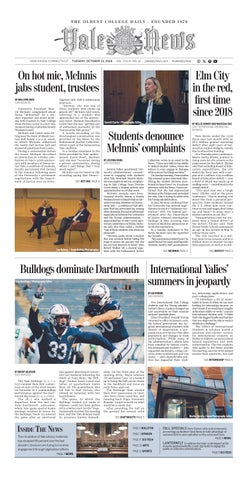
On hot mic, McInnis jabs student, trustees BY ARIA LYNN-SKOV STAFF REPORTER University President Maurie McInnis complained about being “ambushed” by a student organizer and about meeting with trustees to Yale College Dean Pericles Lewis in a hot-mic moment during a Saturday Family Weekend event. McInnis and Lewis were sitting near the front of Marsh Lecture Hall before a 10 a.m. event, in which McInnis addressed the nearly-full lecture hall and answered questions from Lewis. During a conversation before the event, McInnis described an interaction at a Friday celebration of Yale’s 325th anniversary with members of Democratize Yale, a coalition of students, faculty and alumni that formed in the summer following news of the University’s settlement negotiations with the Department of Justice over an inves-
tigation into Yale’s admissions practices. “Anyway, she was one of those students who shows up pissed off,” McInnis told Lewis, referring to a student who approached her at the anniversary event. McInnis described to Lewis that she was “getting sort of ambushed-journalist by the Democratize Yale group.” A screen recording of the livestreamed conversation was provided to the News by the Endowment Justice Collective, which is part of the Democratize Yale coalition. In a Sunday statement to the News provided by Yale spokesperson Karen Peart, McInnis said she was “recorded during a private conversation, during which I said things that I very much regret.” McInnis can be heard in the recording saying that DemocSEE HOT MIC PAGE 4
Leo Nyberg / Contributing Photographer
Elm City in the red, first time since 2018 Garrett Curtis / Photography Editor
Students denounce McInnis’ complaints BY JOLYNDA WANG STAFF REPORTER Several Yalies questioned University administrators’ commitment to engaging with students after Yale President Maurie McInnis was caught on hot mic complaining to Yale College Dean Pericles Lewis about a student activist who approached her at a Friday event. McInnis’ remarks were livestreamed shortly before a Family Weekend event in Marsh Hall on Saturday morning. Members of Democratize Yale — a coalition of Yale affiliates that has advocated for, among other demands, the end of settlement negotiations between the University and the Trump administration — approached her at Yale’s 325th anniversary celebration on Friday, McInnis said. She then called a student “one of those students who shows up pissed off.” “McInnis spoke about a student this way seconds before taking the stage to assure our parents that she has our best interests in mind,” John Robert Walker ’28, a student organizer with the Endowment Justice
BY NELLIE KENNEY AND NAUSICAA CHU STAFF REPORTER AND CONTRIBUTING REPORTER
Collective, wrote in an email to the News. “I have zero faith in her ability to defend student values, when she refuses to even engage in dialogue with us about the things we value.” On Sunday morning, Democratize Yale released a press statement identifying the student McInnis mentioned as Siena Grouf ’29. In a phone interview with the News, Grouf confirmed that she had approached McInnis at the Friday event and asked her why Yale is trying to settle with the Trump administration. In July, McInnis confirmed that the University has entered negotiations to reach a “voluntary resolution” with the federal government after the Department of Justice released investigation findings in May accusing Yale School of Medicine admissions of racial discrimination. In a Sunday statement to the News, McInnis said she regretted her remarks. “My words did not reflect how I’ve spent the last two years meeting with students, faculty, staff, and alumni to
New Haven ended the 2026 fiscal year last month with an $8.5 million general operating deficit after eight years of balanced or surplus budgets, mainly due to education funding. At a Thursday press conference, Mayor Justin Elicker pointed to rising costs for city schools as the main reason for the deficit. Elicker said that excluding Board of Education expenditures, the city ended the fiscal year with a surplus of $1.1 million. A $9.6 million Board of Education deficit — over a third of which was made up of staffing costs — contributed to the overall deficit. “This past year was a tough year,” Elicker said at the press conference. “You’re hearing a lot about this from a personal perspective from residents around the U.S. about how costs continue to rise and wages don’t keep up, and there’s in many ways a similar narrative in our city.” Transportation costs for students were a “major driver” of the deficit, Elicker said. New Haven Public Schools announced an opt-in bus system in May to reduce those costs. The city received $1.3 million more in tax revenue and $2.6 million more in interest income than expected, as well as $3 mil-
SEE MCINNIS PAGE 5
SEE DEFICIT PAGE 4
Bulldogs dominate Dartmouth International Yalies’ summers in jeopardy
Liza Kaufman / Photography Editor
BY LEO NYBERG STAFF REPORTER Five international Yale College students said the Trump administration’s flurry of policy changes has cast uncertainty on their summer and post-graduate plans. Since President Donald Trump returned to office in January 2025, the federal government has targeted international students with threats of deportation, a proposed $100,000 fee for visas after graduation and changes to work authorization. While many of the administration’s efforts have been rebuffed by federal courts, five international students — who requested anonymity, citing concerns about employment and visa status — said unpredictable politics has impacted their stud-
BY BRODY GILKISON STAFF REPORTER The Yale Bulldogs (3–1, 1–1 Ivy) claimed their first conference victory of the 2026 season on Saturday in a commanding performance against the Dartmouth Big Green (1–3, 1–1 Ivy). The 28-7 win marked a departure from the last two Ya l e - Da r t m o u t h o u tco m e s, where late-game special teams mishaps resulted in losses for the Bulldogs. Team 153 entered the game after an emotional
win against Merrimack University last weekend following the death of Tony Reno, the Bulldogs’ former head coach and father of quarterback Dante Reno ’28. The quarterback, who led Yale to that victory, also shined on Saturday with two touchdowns. The game, in which the Bulldogs totaled 550 yards of offense, could not have gotten off to a better start for the ’Dogs. Dartmouth received the opening kick, and the Yale defense made its presence known immedi-
INSIDE THE NEWS The circulation of Yale Library materials has dropped 65 percent over the last decade. Librarians are trying to increase engagement through digitization efforts. PAGE 7 NEWS
ies, internship applications and post-college plans. “It introduces a lot of uncertainty in terms of when we can start looking for internships because we don’t know if we would have a legally authorized ability to work,” a junior international student said. “I think that’s the biggest hurdle and that fact that you might not be able to work is definitely a challenge.” The Office of International Students & Scholars hosted a question-and-answer session for international students on Friday to address concerns about federal regulations and work authorization. The five students who spoke to the News outside the meeting said the OISS helped answer their questions, but said SEE INTERNSHIP PAGE 5
ately. On the third play of the opening drive, Mack Johnson ’28 and James Cave ’27.5 teamed up to bring the ball carrier down in the backfield and force an early three-and-out. The Bulldogs then started their first possession on their own forty-three-yard line, and running back Hugo Djeumeni Kemeni ’29 got to work on what would be a career day. After pounding the ball on the ground for several solid SEE DARTMOUTH PAGE 5
PAGE 2 BULLETIN PAGE 3 OPINION PAGE 9 SCI-TECH PAGE 10 ARTS PAGE 11 SPORTS
Martin Peralta / Head Photography Editor
FALL SPECIALS New Haven cafés and restaurants
are serving up limited-time items to take advantage of seasonal flavors and capitalize on the autumnal buzz. PAGE 6 NEWS
LANTERNFLY To address the large-scale impact of the
invasive spotted lanterfly, a new app seeks to engage the public in collective extermination. PAGE 9 SCI-TECH
PAGE 2
YALE DAILY NEWS · TUESDAY, OCTOBER 13, 2026 · yaledailynews.com
BULLETIN Behind the Headline By Chuer Cindy Zhong
I first heard about La Cocina de Sandra from Denisse Cruz-Contreras, a co-director of Havenly, a nonprofit that trains refugees and closed its café over the summer due to federal grant cuts. When I interviewed Sandra for my very first YDN article of the year, she mentioned that a new restaurant started by one of their cohort graduates would be taking Havenly Cafe’s place. I knew right away that I had to be at their grand opening. What can I say? I wanted to write about something starting instead of ending, a “passing of the torch,” as Galvez so perfectly described. When I walked into the restaurant, Denisse greeted me in a bright dress with an even brighter smile and thanked me for being there. For the next hour, I talked to guests and jotted down details about the space. Enveloped by the chatter of different Spanish dialects and the smell of wafting spices, I felt at home in a place I never could have pictured myself in just a year or two ago. These days, it’s easy to grow numb to the news. When I write about local businesses and how their owners are affected by the nation’s policies, I hope to show our community that what happens in Washington, D.C., doesn’t just stay there. The Capitol can seem a world away, until its decisions reach the shop down the block.
This Day in Yale History, 1989. October 12, 1989 / Whiffenpoofs to Sing National Anthem at World Series Opener
The Whiffenpoofs announce that they will be performing the national anthem at Game 1 of the 1989 World Series in the Oakland Coliseum. The a cappella group is dedicating its performance to A. Bartlett Giamatti ‘60, the former Yale president and commissioner of Major League Baseball who died in September.
Read “Guatemalan eatery moves into former refugee nonprofit cafe site” on page 8.
CORRECTIONS: An earlier version of Nausicaa Chu’s article, “Yale denies fault in fatal accident,” misstated the entity to which responsibility for the Yale Golf Course was transferred this year. It is Yale Operations, not the Yale Office of Facilities.
ILLUSTRATION BY ZAHRA VIRANI
An earlier version of Jayden Dao’s article, “Athlete majors skew toward social science,” included graphs that contained incorrect data. The graphs with corrected data can now be found online. A previous version of the article also misstated the percentage of sampled athletes and non-athletes who majored in the humanities and arts. Majors in the humanities and arts represented 7.5 percent of athletes, not 8.3 percent, and 20.8 percent of non-athletes, not 24.2 percent. Due to an editing error, an earlier version of Sasha Cabral and Sarah Rivas’ article, “Conservatives split about speech,” misstated the name of Mór Szepesi.
ILLUSTRATION BY MAIA WILSON
ILLUSTRATION BY CECILIA LEE
ILLUSTRATION BY LUCAS CASTILLO-WEST
YALE DAILY NEWS · TUESDAY, OCTOBER 13, 2026 · yaledailynews.com
PAGE 3
OPINION S TA F F C O L U M N I S T
S TA F F C O L U M N I S T
GEORGE BEEVERS
T O M D AW B E R
School spirit sold separately
Public sector unions are the problem? Start with the police.
Harvard and Yale celebrate The Game as a defining tradition of school spirit, rivalry and student life. Their ticketing policies suggest that undergraduates being in the stands is a secondary concern. This year, Yale o!ered a mere 40 percent of its students the chance to buy tickets through a random lottery, weighted by seniority, with additional entries available as a reward for attending other Yale sporting events. Inevitably, a lottery system resulted in many students who had no intention of attending The Game being distributed tickets, to then be sold for vast sums in secondary markets, as opposed to the “first come, first serve” system last year when Yale hosted The Game. Amongst unlucky seniors who feel that their last opportunity to experience a time-honoured Harvard-Yale rite of passage has been robbed of them, the lottery has unsurprisingly caused some frustration. But the lottery merely distributes a shortage; it does not explain why that shortage exists. The more important question is not which students deserve the available tickets, but why Harvard and Yale have retained an arrangement that leaves so many students out. Student access to The Game should be a starting point, not an afterthought. Harvard has long been the lowest common denominator for visiting student attendance, with their stadium being around 2.5 times smaller than the Yale Bowl. Both schools therefore traditionally agree to a 2,900-student away section cap reciprocal, based on Harvard Stadium’s capacity. However, as the Yale Bowl can hold 60,000 spectators, when Harvard students come to Yale for The Game, they are able to buy relatively cheap general admissions tickets beyond the student section, whereas when Yalies travel to Boston, they have to rely on secondary black markets and commercial platforms charging extortionate prices. This year, Harvard’s infrastructure is no longer a limiting factor. If only for 2026, Harvard Stadium is out of action, and The Game will be hosted at Fenway Park. To the untrained eye, this might look like the perfect opportunity to accommodate everyone — the combined undergraduate student bodies of both schools would take up just 35 percent of Fenway’s seating! However, the learned university administrator would understand that this is an opportunity to do nothing and retain the same policy. Students are naturally up in arms about administrative laziness when The Game is hosted with so many more seats and the same meager few student tickets. Surely a student-centred approach would treat the change of venue as a reason to reconsider how many students can attend? Retaining the same cap raises questions as to the core purpose of The Game for Harvard and Yale. The answer may lie in an unfortunately obvious consideration: By limiting the student away section to 2,900, the tens of thousands of remaining seats can be converted into highly profitable revenue
streams from expensive corporate sponsorships and wealthy alumni. The sentiment that the two schools might be stifling a huge community tradition for the sake of raking in some extra cash is widespread on campus, and not going down particularly well. Whether the unchanged allocation reflects financial incentives, administrative convenience or simple inertia, the result is the same: students are excluded from a tradition promoted as central to their university experience. The need to keep alumni involved is completely understandable. The university-alumni relationship is one with mutually beneficial connections and sources of donation that keep these universities such coveted and prestigious institutions. It is important not to forget that current students are future alumni. If students are routinely denied the option to buy tickets to what is supposed to be a unifying, exciting event for the entire undergraduate class in favour of wealthy alumni and corporate platform ticket sellers, Yale and Harvard could be shooting themselves in the foot. I would be
STUDENT ACCESS TO THE GAME SHOULD BE A STARTING POINT, NOT AN AFTERTHOUGHT. willing to bet that The Game memories alumni look back on most fondly aren’t of when they last bought general admission tickets to reminisce, but of those original experiences of first attending with all their friends, or their last hurrah rushing the field in senior year. If we undermine the opportunity for current students to make these memories, The Game ceases to be special for them today and as alumni in the future. Harvard and Yale should begin with a di!erent question in mind: how can we make room for as many students as possible? That means reconsidering student allocation when the venue changes, explaining genuine constraints and treating student participation as a priority rather than accepting the existing cap by default. And if Harvard’s concern is the prospect of losing for a fifth consecutive year in front of an even larger crowd of Yalies, that’s a problem for its football team — not its ticketing policy. GEORGE BEEVERS is a sophomore in Pierson College studying History. His column, “The Learning Curve,” examines how students and institutions navigate the evolving standards, pressures and possibilities that define the pursuit of knowledge today. He can be reached at george.beevers@yale.edu.
YALE DAILY NEWS PUBLISHING CO., INC. 202 York Street, New Haven, CT 06511 (203) 432-2400 Editorial: (203) 432-2418 editor@yaledailynews.com Business: (203) 432-2424 business@yaledailynews.com
EDITOR IN CHIEF & PRESIDENT Asher Boiskin MANAGING EDITORS Jaeha Jang Olivia Woo Reeti Malhotra PUBLISHER Henry Hoak DIRECTOR OF AFFAIRS Kate Soo Hyun Kim
UNIVERSITY EDITORS Olivia Cyrus Jerry Gao Henry Liu Isobel McClure
SPORTS EDITORS Liza Kaufman Walter Royal
CITY EDITORS Elijah Hurewitz-Ravitch Sabrina Thaler
SCIENCE & TECHNOLOGY EDITORS Michelle So Jake Robbins
ARTS EDITORS Kiva Bank Gemard Guery
OPINION EDITORS Manu Bosteels Rohil Mohan
INVESTIGATIONS EDITORS Sasha Hurowitz
WEEKEND EDITORS Stephanie Altschul Hana Tilksew
MAGAZINE EDITORS IN CHIEF Ethan Kan Claire Nam
ILLUSTRATIONS EDITOR Rana Roosevelt
HEAD PODCASTS HEAD PHOTOGRAPHY EDITOR Amiya Vashi EDITOR Martín Peralta DATA EDITOR HEAD PRODUCTION & Adriana Petrizzo DESIGN EDITOR Ezra Helfand HEAD COPY EDITOR Nate Stein
HEAD AUDIENCE EDITOR Emily Seo
THIS ISSUE Copy Editors: Jack Tompros; Copy Staffers: Leo Gabara, Oliver Browne; P&D Editors: Cyrus Turner, Allison Palmer, Willow Mintz, Delilah Sonnenshein, Olivia Dick, Maria Andreu Bird, Ashley Skinner
EDITORIALS & ADS
Content on this page with bylines represents the opinions of those authors and not necessarily those of the Managing Board. Opinions set forth in ads do not necessarily reflect the views of the Managing Board. We reserve the right to refuse any ad for any reason and to delete or change any copy we consider objectionable, false or in poor taste. We do not verify the contents of any ad. The Yale Daily News Publishing Co., Inc. and its officers, employees and agents disclaim any responsibility for all liabilities, injuries or damages arising from any ad. The Yale Daily News Publishing Co. ISSN 0890-2240
NEW HAVEN, CONNECTICUT
SUBMISSIONS
All letters submitted for publication must include the author’s name, phone number and description of Yale University affiliation. Please limit letters to 250 words and guest columns to 750. The Yale Daily News reserves the right to edit letters and columns before publication. E-mail is the preferred method of submission.
ISSUES PRINTED BY
Valley Publishing Co, Derby, CT
DIGITAL ARCHIVE
YDNHistorical.Library.Yale.edu
COPYRIGHT 2026 — VOL. CXLIX, NO. 12
ADVERTISEMENT
(203) 432-2424 (before 5 p.m.) business@yaledailynews.com Direct all letters, columns, artwork and inquiries to: Contact the Opinion Editors at opinion@yaledailynews.com
Direct all comments regarding the fairness or accuracy of stories to: Asher Boiskin Editor in Chief & President editor@yaledailynews.com
Last month, Aaron Withe, CEO of the Freedom Foundation, defended the resolution Ban Public Sector Unions at the Yale Political Union. Discrediting the fiction that conservative Yalies are some oppressed minority with no place to call their own, the measure passed. I’m a pro-union son of a sailor-turned-carpenter and a teacher. But I acknowledge that in a few rare cases, unions wield too much power and act in ways that are antithetical to the public good. One need look no farther for a union like this than the New Haven Police Department. In July, the New Haven Independent reported that, based on guidance from the police union, at least one police officer has refused to cooperate with a Civilian Review Board investigation. The CRB was established in 2019 by a city ordinance, after the public voted during the 2013 charter revision to authorize its creation. It’s difficult for localities to legislate police oversight into existence. The union rightly points to their federal Garrity rights — if a public employee is forced to answer questions under threat of losing their job, then no evidence that results from that investigation can be used to prosecute the employee. They call these protections “federal law,” but this fig leaf stems wholly from a 1967 Supreme Court decision, Garrity v. New Jersey, which was decided 5-4, and decided wrongly. Justice Harlan had the right of it when he wrote in his dissent, “it is surely plain that New Jersey may, in particular, require its employees to assist in the prevention and detection of unlawful activities by officers of the state government. The urgency of these requirements is the more obvious here, where the conduct in question is that of officials directly entrusted with the
administration of justice.” There is good reason for the people of New Haven to demand this kind of oversight of NHPD. The department has a long history of violating the public trust. From the illegal wiretapping scandal of the 1960’s and 70’s that resulted in a $1.75 million settlement, to the concealment of evidence and manipulation of witnesses that led to two wrongful murder convictions in 1999 and resulted in a $30.5 million set-
NHPD HAS NO RIGHT TO THE BENEFIT OF THE DOUBT. tlement, to the 2022 paralysis of Randy Cox that led to a $45 million settlement, to Chief Karl Jacobson’s alleged embezzlement of over $85,000 uncovered just this year, generations of irresponsibility and corruption in NHPD have cost New Haven taxpayers tens of millions of dollars. NHPD has no right to the benefit of the doubt. The CRB was created by the representatives of the people of New Haven to check a department in desperate need of oversight. The police union is now thumbing its nose at the will of the people. Police unions haven’t always enjoyed the level of power they do today. Sociologist Stuart Schrader writes that “The police union movement emerged in reaction to a lot of the pushes for change in American society in the 1960s.” As the civil rights movement was winning its most important victories, “Police union militants took the language and, in some cases, the political repertoires of protest from some of the movements active at the
time, even when in their day-today work they were on the other side of the barricade.” We now live in a climate where politicians are terrified of police unions. The New York Times cites retribution by police unions in Minneapolis, St. Louis and New York, where the sergeants union released personal information about the daughter of thenMayor Bill DeBlasio. The Times names more unions nationwide who have vocally and proudly opposed attempts at reform. So what is to be done in the Elm City? NHPD’s contract is up for negotiation in 2028. City Hall must be prepared. Mayor Elicker should assemble a crack team of negotiators — lawyers and others who will fight like hell to protect the interests of all New Haveners. I’d like to see him reach out to Yale Law School professors and local alumni who have experience in high stakes negotiations. Furthermore, the city needs to anticipate the union holding the city hostage by walking o! the job. There will be many issues on the table in 2028, but full cooperation with CRB investigations must be a hard line. The people have the right to demand more of those placed in positions of public trust. The people should be able to hold accountable those entrusted to enforce the law. Garrity represents a major impediment to this goal, and New Haven should stand up to the NHPD union and be the case that will allow Garrity to be overturned. TOM DAWBER is an Eli Whitney student and a junior in Pierson College studying history. His column looks critically at city policies, as well as state and federal policies when they directly impact the lives of Yalies and New Haveners. He can be reached at tom.dawber@yale.edu.
S TA F F C O L U M N I S T S H R I S H I TA S H A H
On hometowns and bios During my first few days at Yale, I feared I was doomed to spend the rest of my first year providing the holy trinity of introductory information: my name, major and where I am from. Hrishita. Economics and Computer Science. Mumbai. Camp Yale offered an escape through the hometown, a delivery of a summary of my life to the seven strangers in my orientation program. With all the stories of FOOT groups that were forever bonded by the experience, I was convinced at the time that they would go on to become my best friends. Spoiler alert: they didn’t. But I realize now that it was never the point. Yale’s hometowns are valuable, they say, not because they make strangers intimate, but because they give strangers permission to begin becoming intimate. But that permission matters only if we, the listeners, recognize that the hometown is only the beginning of a process toward building relationships. Hometowns definitely have their benefits. For starters, they are a much-needed break from freshman small talk. They push us to take a leap of faith and be vulnerable with neurotic, highly accomplished people. Although it is, to a certain extent, manufactured vulnerability, it remains an important push in the right direction: a push toward the understanding that deeper bonds or connections in college require familiarity with another persons’ lived experience. Looking back on my first year, however, I wonder whether the structured and fleeting nature of hometowns ultimately limited their potential to foster the deeper
connections they promised. Being vulnerable is not enough: you should want to be vulnerable and you should get to choose how you are vulnerable. During my hometown, I didn’t feel like I had much to say — I ended up talking about my favorite books in relation to different parts of my childhood. After hearing everyone else’s stories, I tried to fit mine into the typical chronological structure. Now, this structural problem — falling into the patterns of the people who go before you — is an
HOMETOWNS INVERT THE PROCEDURE OF RELATIONSHIPBUILDING IN AN UNNATURAL WAY. easy one to solve. What bothered me the most about my experience with hometowns was that it did not produce the sort of connection with my group that the hometown was intended to foster. I knew, of course, that a single conversation couldn’t turn seven strangers into lifelong friends. But some part of me had expected it to, and the presentation of hometowns as an exercise suggested this would be the case, too. After all, between us, we’d exchanged stories that ordinarily take months or years to come out. H o m e tow n s i n ve r t t h e procedure of relationshipbuilding in an unnatural way.
Usually, we start with small talk, develop trust and then share personal stories, but with hometowns we have strangers diving into personal stories and then hoping trust may develop. But hometowns are finite, ephemeral. We quickly move on to the next activity as soon as a hometown is done, and they never come up again. Perhaps, more than for the storyteller, hometowns create an important responsibility for listeners: to ensure the person’s hometown persists. I think the problem lies in confusing disclosure with intimacy. Knowing personal details about someone is not the same as building intimacy. The sort of intimacy that characterizes genuine relationships develops not simply through the exchange of information, but through its persistence: we feel close to our friends when, among other cases, they remember details about our lives later on. This dedication to someone else’s life story shows that they matter to you, and this is the aspect of information sharing that actually counts. As I look toward my senior year and the society bio, I am grateful for the opportunity to choose how I present myself. More than anything I hope that the telling isn’t the end. I hope those listening will ask me about the things I leave out and try to continue discovering the person I become afterward. HRISHITA SHAH is a junior in Silliman College studying economics and computer science and a staff columnist for the opinion desk. She can be reached at hrishita.shah@yale.edu.
PAGE 4
YALE DAILY NEWS · TUESDAY, OCTOBER 13, 2026 · yaledailynews.com · @yaledailynews
FROM THE FRONT
“I think the apple’s rotten right to the core” APPLE CHARLI XCX
McInnis, Lewis were mic’d up for Family Weekend talk HOT MIC FROM PAGE 1 ratize Yale members started a video during their Friday interaction after standing in line for a selfie. McInnis said she “didn’t say anything,” to which Lewis responded, “Of course.” McInnis said that when the students took the camera down, she told them that she has “clearly articulated my principles” and that “we’re not deviating.” A Sunday morning press release by Democratize Yale identified Siena Grouf ’29 as the student who spoke with McInnis. In a Sunday phone interview, Grouf confirmed McInnis’ account of their conversation. She and another student approached McInnis at the event, Grouf said, and asked “why Yale was entering negotiations with the Trump administration.” “I think it’s extraordinarily disappointing to see McInnis speak that way about other trustees, about students,” Grouf told the News. “There are no other opportunities for us to sort of engage with her and the rest of the trustees. So it shouldn’t be the case that we have to approach her at events on Cross Campus, but unfortunately it is.” After McInnis’ complaint about her Friday interaction with the “pissed off” student, Lewis responded: “Those are a little hard to avoid. We might see some in Commons on Monday.” During their conversation, Lewis and McInnis also discussed the 2024 Family Weekend, when the board of trustees met on the same weekend. She called that weekend “painful.” “Trustees are exhausting,” McInnis said. In her Sunday statement, McInnis said her words do “not reflect how I’ve spent the last two years meeting with students, faculty, staff, and alumni to hear their ideas, concerns, and aspirations for our university.” “Nor were my words reflective of my deep gratitude for our trustees, alumni volunteers who give so much of their time and energy to help strengthen this institution,” McInnis said. “Going forward, I’ll continue to meet with members of the Yale community and hear their wide range of perspectives. And I’m committed to continue working with my colleagues to steer the university we all love through this moment of unique uncertainty for higher education.” In a Sunday email to the News, Lewis also expressed regret about the conversation. “President McInnis and I were having an informal, private conversation and didn’t know we were being recorded,” Lewis
Aria Lynn-Skov / Contributing Photographer
Before a Saturday Family Weekend event with Yale College Dean Pericles Lewis, University President Maurie McInnis was heard saying that she was “ambushed” by a student organizer on Friday and that “trustees are exhausting.” McInnis has since said she regrets those statements. wrote. “She has been very committed to getting input from students, faculty, staff, alumni, and community members. We both care a great deal about students and their perspectives, and I’m sorry that any remarks I made might have implied otherwise.” McInnis told Lewis that the students then asked why McInnis had not met with Democratize Yale and that she responded she had met with “many people on these topics.” McInnis told Lewis she has met with Yale College Council President Alex William Chen ’28 and Ward 1 Alder Elias Theodore ’27, two student leaders who have collaborated with Democratize Yale. Chen, with other undergraduate and graduate student leaders, met with McInnis in July to discuss Yale’s negotiations with the Trump administration, before Democratize Yale — which hosted its first protest on Sept. 1 — formed as a coalition. In a Sunday text message to the News, Theodore wrote that he met with McInnis and Associate Vice President for New Haven
Aria Lynn-Skov / Contributing Photographer Partnerships and Development Alexandra Daum on Sept. 28, following a Board of Alders public hearing on a resolution calling on Yale not to settle with the Trump administration. “I invited them to come to the hearing, but they opted to meet
privately instead,” Theodore wrote. “I attended this meeting in my capacity as Ward 1 Alder and a Yale student, not as a representative of Democratize Yale.” Joliana Yee, a Yale College assistant dean and the director of the Asian American Cultural
Center, was also present for the beginning of the conversation and later introduced McInnis to the event’s audience. Contact ARIA LYNN-SKOV at aria.lynn-skov@yale.edu.
Deficit mainly due to school funding, Elicker says DEFICIT FROM PAGE 1 lion in supplementary revenue from the state, Elicker also said. New Haven’s rainy-day fund has given the city “a buffer for rainy days
Jiyoo Nam / Contributing Photographer
like this one,” Elicker said. As of May, the fund totaled around $56 million, according to a statement from the mayor. In that statement, Elicker, who has long emphasized the importance of fiscal caution, touted
his administration’s “more responsible approach to city budgeting.” The budget for the 2027 fiscal year, which the Board of Alders approved after a vote of 28 to 1, totals $744.3 million.
Mayor Justin Elicker announced the deficit at a Thursday City Hall press conference. The budget was dragged down by city school funding but has been boosted by Yale’s increased voluntary contributions to New Haven, among other factors.
The city’s financial burdens were lightened by a $22 million contribution from the state this spring and by a recent boost to Yale’s voluntary contribution to New Haven, which is set to total around $30 million this year. The city has put that money toward its 2027 budget. But Elicker said New Haven will face “significant headwinds” in the future. The city must spend its grant funding from the American Rescue Plan Act by the end of 2026. Elicker added that the city faces “additional borrowing costs” related to policing cases of the 1980s and 1990s. In August, New Haven reached settlements totalling $30.5 million with two men who were wrongfully imprisoned after a 1999 shooting. Earlier this week, the Board of Alders voted to take out $27 million in bonds to pay the portion of those settlements not covered by the city’s insurance. The city is currently seeking a new trial for a jury’s decision that would have it pay $38 million in another wrongful conviction case. Elicker said the settlements themselves “didn’t have an impact” on the city’s debt in fiscal year 2026 but did lead to increased legal fees. New Haven is set to pay off the bonds at a
rate of around $2.6 million a year for the next 20 years, although those payments will likely decrease over time, according to Ron Gizzi, the city’s acting budget director. Elicker stressed that the city has “come a long way,” pointing to the contributions from both Yale and the state and recent quantum development. On Tuesday, QuantumCT, a joint initiative between the state of Connecticut, Yale and the University of Connecticut, opened a quantum technology hub in New Haven. T h e c i ty i s wo rk i n g to address “inherited” challenges, like unfunded pension liabilities and past over-borrowing, Elicker said. “We can’t take our foot off the gas,” Elicker said. “But we also can’t bear all the burden of the past wrongdoing all at once.” The city has not seen a deficit since 2018, according to annual financial reports. “The good news is that our fund balance is still in a really good place,” Elicker said. Elicker filed for re-election in April. Contact NELLIE KENNEY at nellie.kenney@yale.edu and NAUSICAA CHU at nausicaa.chu@yale.edu.
YALE DAILY NEWS · TUESDAY, OCTOBER 13, 2026 · yaledailynews.com · @yaledailynews
FROM THE FRONT
PAGE 5
“And all that I can see is just a yellow lemon tree” LEMON TREE FOOL'S GARDEN
Yale earns first conference win McInnis has said she regrets remarks
DARTMOUTH FROM PAGE 1
runs, Yale finally had a second-and-short attempt on the Dartmouth nine. Reno took the snap and handed it to Djeumeni Kemeni, who bounced around to the right side and did his best Saquon Barkley impression as he hurdled the defender and waltzed into the endzone. The Big Green offense, then down 7-0, took the field trying to even the score, but walked off just three plays later after another three-and-out forced by the Yale defense. Yet again, the Bulldog offense gained possession and got right back to work. In just four plays, Reno moved the ball seventy yards down the field after a few big connections with Jaxton Santiago ’28 and Lucius Anderson ’29. Less than a minute later, Yale doubled its lead after Reno hit Santiago in the endzone for what would be the first of two times that day. With Yale leading 14-0, Dartmouth finally started to show some signs of life and put together a scoring drive of its own to cut the deficit to seven. From there, the scoring cooled off for a little. Yale’s offense had a couple of drives reach into Dartmouth territory, but the Bulldogs were unable to convert them into any points. Luckily, while the offense stalled, the Bulldog defense continued to excel, a welcome sight after some struggles in the season’s first games. The defensive line kept wreaking havoc in the backfield, and the defensive backs limited big plays through the air, keeping the score at 14-7 at the close of the half. As the second half kicked off, Yale was on the receiving end and started the third quarter with possession of the ball. With 282 yards of offense in the first half and just 14 points to show for it, Yale focused on converting the opportunities to put points on the board in the last 30 minutes of the contest. It seemed as if the first drive
of the half would stall out, but after punter Reese Keeney ’28 was illegally hit, a roughing penalty kept the drive alive for the Bulldogs. A few first downs later, Yale was knocking on the door of the red zone. That was where the drive ended, but a 43-yard field goal by Noah Piper ’29 extended the lead to 17-7. Both teams traded a few punts before Yale put together another promising drive thanks to several solid runs by Djeumeni Kemeni, but the Bulldogs left points on the field after turning the ball over on downs on the Dartmouth nineteen. T h e d e fe n s e c o n t i n u e d to stand strong despite the offense’s struggles to convert scoring opportunities, and Team 153 captain Abu Kamara ’27 was able to tip a ball to himself for his first interception of the year. Six consecutive runs by Djeumeni Kemeni later, Yale had another field goal attempt, which Piper drilled to put the Bulldogs up 20-7. Sensing the window of opportunity closing quickly, the Big Green regained possession and finally showed signs of urgency. A big passing play set them up deep in Yale territory, but as they had all game, the Bulldogs bent but refused to break. Four downs later, the drive was over without any points added to Dartmouth’s total. With just under seven minutes left in the game, Reno hit a few of his receivers for big passing plays of their own, and the Bulldogs were set up with a first-and-goal. Two plays later, Reno threw a fade to the back left corner of the end zone, and this time, Santiago was the one tipping it to himself to secure the ball for his second touchdown of the day. A two-point conversion later, and Yale was up 28-7 with just over three minutes to go. With time running out, the Bulldog defense continued to overwhelm the Dartmouth offense, and a strip-sack by
Cave, his fourth tackle-for-loss of the day, ended any last-second hopes the Big Green might have held. Two minutes later, the clock hit zero, and Team 153 had picked up its first Ivy League victory of the season. Among the offensive stars of the day were Reno, who threw for 325 yards and two scores, Djeumeni Kemeni, who rushed for 174 yards and a touchdown and Santiago, who hauled in 13 catches for 147 yards and two touchdowns. On defense, Cave led the way with two sacks and two TFLs. Kamara had the game’s only turnover, as well as a TFL, and tackle Jaylin Tate ’27 accumulated eight tackles and a TFL of his own. “We’re still building our identity, and Dartmouth’s 2.4 yards per carry was a piece that we can take with us,” Kamara said in a post-game press conference, according to Yale Athletics. “I think we pride ourselves on collective defense every day. We practice that way. We communicate that way. So when it happens out on the field, it’s like second nature.” While the offense was able to put up 537 yards of offense and the defense held Dartmouth to only 225, it is equally important to recognize the success of the special teams unit. “I was excited about how we played complementary football, which we had struggled with this season, and it was a good step forward for us for that,” head coach Kevin Cahill told Yale Athletics. “We got some work to do in there, and we’ll focus on that. But we’ll enjoy the win tonight and move on to next week.” Yale will be back in action for its final nonconference game of the year against the University of Rhode Island (3–3, 1–2 CAA). Kickoff is slated for noon on Saturday at the Yale Bowl. Contact BRODY GILKISON at brody.gilkison@yale.edu.
Jolynda Wang / Contributing Photographer
McInnis pictured at a Friday event. Several students said McInnis’ hot-mic characterization on Saturday of a student organizer as “one of those students who shows up pissed off” reflects a dismissive attitude toward student concerns. MCINNIS FROM PAGE 1 hear their ideas, concerns, and aspirations for our university,” she said. “And I’m committed to continue working with my colleagues to steer the university we all love through this moment of unique uncertainty for higher education.” McInnis’ remarks were unsurprising to Maya Evans ’27, who said she found the comments to be a “pretty gross dismissal” of the student body’s widespread frustration about Yale’s attempts to strike a deal with the Trump administration. Other students argued that the comments raised questions about her willingness to engage with student activists. Isabel Matos ’28, a student organizer with the Endowment Justice Collective, contrasted McInnis’ characterization of the student with her claims to being committed to listening to students. “For as long as I’ve been at Yale, McInnis has insisted that she is committed to dialogue and takes student concerns seriously, and she has done nothing but host ‘listening sessions’ and scripted ‘Q&As’ to prove it,” Matos wrote in an email to the News. “It comes as no surprise to me that she hasn’t actually been listening.”
Ethan Schroyer ’28 said McInnis’ complaint about the student reflected a broader disconnect between University leadership and student activists. Schroyer called on McInnis and other senior administrators to engage more frequently with students across the political spectrum, including through public discussions and informal conversations on campus. Avi Rao ’27 wrote in an email to the News that he wasn’t “particularly bothered” by the comments but hoped that McInnis and Lewis would be more precise in how they discussed the negotiations. “If someone is necessarily hostile to the administration and assumes bad faith on their part, I get how it can feel like an ambush,” Rao wrote. “I think so many of the issues that have come up around them are semantic and could be easily solved.” During their Saturday conversation, McInnis also complained to Lewis about meeting with the University’s trustees, calling them “exhausting.” Marsh Lecture Hall is located at 260 Whitney Ave. Contact JOLYNDA WANG at jolynda.wang@yale.edu.
Trump announced flurry of visa curbs INTERNSHIP FROM PAGE 1
Liza Kaufman / Photography Editor
Team 153 outgained the Big Green by nearly 350 yards en route to a 28-7 victory on Saturday and Yale’s first Ivy League win of the season.
they were still worried about their summer plans. The junior told the News that “a lot of international students in the session were asking about how to do jobs outside the U.S.” The Friday event was held off-the-record. Last year, the Trump administration tried to add a $100,000 fee for processing H1-B visas, which allow select foreigners with a U.S. job offer to come to work. In June 2026, a federal court halted the plan. Later that summer, Immigrations and Customs Enforcement sent two messages announcing tighter enforcement on approving Curricular Practical Training — a work authorization often used for summer internships — unless the training is required for all students to complete their studies. Under federal regulations, Curricular Practical Training can only be approved if it is directly related to a student’s major area of study and an integral part of their curriculum. On Oct. 5, the Association of American Universities filed a lawsuit to block ICE’s new enforcement of the Curricular Practical Training rule. On Oct. 7, the Department of Homeland Security announced a new $70,000 fee for Optional Practical Training, a program that allows students to work summer internships related to a student’s major but not required for graduation. OPT can also be completed after graduation while CPT cannot. One sophomore international student said he was already considering backup plans for the summer in the case that he cannot get Curricular Practical Training or Optional Practical Training. “I’m worried that employers will put my application to the side, not because I’m not quali-
fied but just because they don’t know whether I can get approval,” the sophomore said. Yale’s international students office has published statements tracking the policy changes and providing advice to international students for handling summer work. Following the DHS’ Optional Practical Training announcement, the office encouraged students not to make “abrupt decisions” about “studies, travel, or job plans” in an Oct. 8 update. It also provided a link to submit public comments, a required step in the rulemaking process for federal agencies, on the Optional Practical Training rule. “Yale is reviewing the proposal and will work with peer institutions and associations to preserve students’ access to OPT,” the update reads. The Yale webpage gives information on how and when to apply for Optional Practical Training. The students who spoke with the News said they usually do not submit applications until later in the first semester or during the second semester. One first-year student said he plans to ask the Office of International Students & Scholars more about the fee for Optional Practical Training. First years are generally not eligible because CPT recipients must be enrolled in an academic program for over a year. “But if it’s too complicated this year, I’ll do what a bunch of people will do and go work back home,” the student said. “Things are changing, but I think I’ve got time.” The comment period on the $70,000 fee on Optional Practical Training ends Nov. 9. Aria-Lynn Skov contributed reporting. Contact LEO NYBERG at leo.nyberg@yale.edu.
PAGE 6
YALE DAILY NEWS · TUESDAY, OCTOBER 13, 2026 · yaledailynews.com
NEWS
“Make you banana pancakes, pretend like it’s the weekend now.” BANANA PANCAKES JACK JOHNSON
Some YCC senators unsatisfied after questioning Lewis on budget cuts BY EMILY AKBAR AND ANAYAH ACCILIEN STAFF REPORTERS After Yale College Dean Pericles Lewis participated in an offthe-record Yale College Council Senate meeting on Sunday, senators expressed varying degrees of satisfaction with the dean’s leadership. Lewis attended the meeting alongside Associate Dean of Student Affairs Hannah Peck, one week after the body passed a statement of no confidence in Lewis’ leadership that urged Yale not to reappoint him to a second
term. The document criticized, among other Yale College policy decisions, changes to summer funding that combined the two non-competitive summer awards for low-income students — the International Study Award and the Summer Experience Award — into one grant. The change was made in anticipation of an increased tax on Yale’s endowment. Branford Senator Maneet Mehta ’29 said he came into Sunday’s meeting hoping Lewis would justify budget cuts made in response to the tax hike. Mehta said that while Lewis did
justify the cuts, he did not leave with a “clear understanding” of the University’s choices around budget allocations. “There was a large push towards explaining that a lot of the cuts were made in an effort to maintain or even increase financial aid opportunities for FGLI students in some way,” Mehta said, referencing firstgeneration, low-income students. “But to me, it seemed like if a large part of that is coming out of things like tuition increases or just reallocating or redistributing funding from
COLETTE YERRID / CONTRIBUTING PHOTOGRAPHER
Senators at the Yale College Council meeting on Sunday, which was attended by Yale College Dean Pericles Lewis, said they were frustrated by a lack of communication from administrators amid cuts that they say adversely affect student experience.
the ISA or SEA to things like the 200k tuition cap, et cetera, it’s not really so much of an expansion and so much of it is like a superficial redistribution,” he said, referring to the International Study Award and Summer Experience Award. D ea n o f Un d e rg ra d u a te Admissions Jeremiah Quinlan ’03 told the News in January that the grants were combined to allow increased income thresholds for financial aid guarantees. The University announced that month that tuition would be covered for families earning under $200,000 for the class of 2030 and beyond. YCC Se n a te Speaker Kyler Parker ’29 said he was “optimistic” after the meeting, and that Lewis said the College has entered into a “cautious growth phase.” “We are no longer making these cuts. That was very important,” Parker said. “I don’t think that’s something that has been discussed in the YCC, that we are going to a growth phase. ‘Cautious growth phase’ is the impression that we got. That’s very promising because it means that we as YCC have the opportunity to push new initiatives.” Last month, Lewis told the News that Yale College’s budget is “now in balance” after the College saved $3 million in its operating budget last year. “I think it’s very important that this meeting happen because the deans are often not as accessible as we’d like them to, and this is the most direct student facing contact that we do once a semester,” Parker said. Jaden Franklin ’29, a senator representing Benjamin Franklin
College, said she attended the event hoping to understand Yale’s financial priorities. She said the University has expanded its student body while students experience “a reduction in student quality of life.” Beginning with the class of 2029, Yale College admitted 100 more students to each incoming class, aiming to bring the total undergraduate student body to 6,600 students. Franklin questioned why Yale was not making greater use of its endowment to protect students f ro m f i n a n c i a l p re ss u re s, including the endowment tax. “We have the endowment. It’s supposed to be a tool that we use to ensure the continuation of quality education at Yale,” she said. Franklin described Lewis as a “good speaker,” but she said the event left important questions unanswered, particularly about the administration’s plans for financial recovery. “What are they actually planning to do to make sure that there actually are no cuts?” Franklin said. Franklin said that cutting resources for students wh o a re a l rea dy u n d e rre so u rce d u n d e r m i n e s t h e administration’s credibility. The summer storage aid phaseout, which was recently reversed after YCC advocacy, affected low-income students. The YCC senators met with Lewis and Peck at SheffieldSterling-Strathcona Hall. Contact EMILY AKBAR at emily.akbar@yale.edu and ANAYAH ACCILIEN at anayah.accilien@yale.edu.
New Haven chefs launch seasonal dishes inspired by fall flavors BY ELSPETH YEH AND CRISTINA ORTIZ STAFF REPORTER AND CONTRIBUTING REPORTER As temperatures dropped in New Haven, so have new menu items at the city’s popular eateries. Hoping to capitalize on the autumnal buzz, some restaurateurs are debuting dishes exclusive to the season, inspired by classic flavors and New England harvest-time produce. “I just try to think of things that are gonna highlight the season and highlight flavors that people are anticipating,” John Brennan, the chef-owner of Elm City Social and Olives and Oil, said in a phone interview. “Obviously, pumpkin spice season has become its own kind of genre in and of itself, but I think a lot of those flavors that people associate with pumpkin spice season really lend well to other varietals that come out during the time.” For Brennan, fall means squash. He said the restaurants’ purveyor sources fresh squash and apples from southern Massachusetts and Connecticut for their seasonal dishes. Butternut squash features heavily in Brennan’s early fall menu items. At Elm City Social, a butternut squash grilled cheese with maple aioli and freshly sliced apples has been “super popular” with guests, he said. At Olives and Oil, Brennan’s team is serving up butternut squash alfredo with freshly-made linguine and a roasted butternut squash pizza, topped with balsamic onion jam and hot honey. Brennan said he loves to highlight fresh, seasonal produce in his cooking, adding that even in a time when most fruits and vegetables are available year-round, there’s nothing better — or more flavorful — than enjoying them in their prime. At H a rve s t Wi n e B a r & Restaurant, squash is also taking center stage. The restaurant introduced its housemade butternut squash ravioli this week, prepared with organic eggs and farmfresh produce. “We introduced the squash ravioli last week, and it’s the bestseller we have,” one of the restaurant’s chefs and owners, Kleber Nube, said. Harvest is also serving duck
with butternut squash, blueberry sauce and poached pear. On the drinks side, the restaurant is experimenting with seasonal cocktails, including apple cider and spiced pumpkin martinis. Nube said that the bartenders are “doing a trial, and we’re tasting different flavors to see what’s best for the fall season.” For some eateries, the timeline for coming out with fall specials starts early. Now that chains like Starbucks have begun releasing fall menu items in August, other businesses are pressured to follow their lead, Brennan said. Mariam Tabrez of Sixer Coffee, a mobile coffee cart based in New Haven, said in a phone interview that she started researching trends almost two months ago. The cart’s seasonal specials include a pumpkin spice latte and apple crisp latte. Tabrez said that the apple crisp lattes have outsold other menu items, which she attributes to the quality produce coming out of the many local apple orchards in Connecticut. “You can technically offer anything at any time, but it’s just not going to taste the same,” Tabrez said. “It’s not going to taste right because the fruit or the flavor is not in season.” Tabrez also said fall specials capitalize on the “sense of urgency” consumers feel when it comes to menu items available for a limited time. At Pistachio Cafe, fall flavors have a Middle Eastern twist. The cafe is offering pistachio cardamom croissants and a new pumpkin spice pistachio cold brew. Pistachio Cafe is offering midweek study discounts for students and a seasonal combo deal pairing specialty fall drinks with fresh pastries. At Ashley’s Ice Cream, fall flavors also bring a boost in sales. Store manager M ike Kochis said in a phone interview that its pumpkin ice creams are “hot sellers.” The pumpkin ice cream base at Ashley’s is made from the same ingredients one would find in pumpkin pie. Its popular varieties feature gingersnap cookies or Oreos as mixins. According to Kochis, the fall flavors are always fresh —
since Ashley’s sells out so frequently, its staff is always making new batches. Ashley’s has also recently begun offering a monthly sundae special. For the month of October, its menu features a pumpkin ice cream sundae, topped with cheesecake, whipped cream and graham cracker crumbs. Kochis said because Ashley’s rents from Yale University Properties, the
Yale media team has been helping advertise the promotional sundaes. For non-pumpkin lovers, Ashley’s also scoops up seasonal flavors such as apple crumble, maple walnut and bourbon brown sugar. While the pumpkin flavors are popular in the fall, Kochis said that “after January, we can’t even give it away.” He added that Ashley’s will stop making its pump-
kin ice cream after December. Elm City Social and Olives and Oil will rotate their seasonal menus mid-November, according to Brennan. Contact ELSPETH YEH at elspeth.yeh@yale.edu and CRISTINA ORTIZ at
cristina.ortiz@yale.edu.
YALE DAILY NEWS · TUESDAY, OCTOBER 13, 2026 · yaledailynews.com
NEWS
PAGE 7
“Honey honey, how you thrill me, a-ha, honey honey” HONEY, HONEY ABBA
Library ramps up digitization amid drop in physical item circulation BY EHI OCHE AND ADA GORDON CONTRIBUTING REPORTERS The Yale Library is working to digitize more of its collections as the circulation of physical materials has fallen significantly over the last decade. Between 2016 and 2025, circulation of physical library materials through the Yale Library fell about 65 percent, from about 381,000 items in 2016 to about 132,000 items in 2025, according to Patricia Carey, the director of communications strategy for the library. Several librarians said they are looking to increase student engagement with library resources through increased digitization efforts. In Yale’s 2026 fiscal year, the Yale Library created about 4 6 0,0 0 0 n ew i m a ge s o f collection material and put about 3,800 newly digitized audio and video recordings online, according to Jonathan Manton, the director for digital collections and access at the Yale Library. “Looking ahead, transformative digital access is one of the library’s strategic priorities,” Manton wrote in an email to the News, “so this is an area where students should expect significant expansion in the coming years. Haruko Nakamura, Yale’s librarian for Japanese studies, said part of the downtick in circulation is due to the pandemic, which shifted student interaction with digitized library materials. During that period, she said, access to print resources was limited, leading the library to adjust to meet student and faculty research needs. “Overnight, we had to figure out how to turn a physical library system into a virtual library,” Carey said in a phone interview. Carla Baricz GRD ’13 ’17, the librarian for literature in English and comparative literature, said that
SHYAM SUVA / CONTRIBUTING PHOTOGRAPHER
The circulation of physical Yale Library materials has dropped 65 percent over the last decade. Librarians across specialties say they are trying to increase student engagement through increased digitization efforts. despite the fall in materials usage figures over the last decade, the level of student engagement with the library’s resources has remained relatively stable. Baricz said, however, that the format for much of that engagement has shifted. “I do see more people requesting to read materials online,” Baricz said. “One of the things that I work a lot on is thinking about our e-collections, our electronic collections in my subject areas and also some building of the collections in Overdrive.”
Overdrive houses the Yale Library’s online digital collection and includes a variety of both fiction and nonfiction works. When it comes to research materials and archival databases, Carey said, “students at Yale are really lucky to have this extraordinary range of options. She added that the Yale Library remains committed to maintaining and growing its print data collection, “with particular emphasis on materials that are not available in electronic form.”
“There’s definitely less use of print resources,” Colin McCaffrey, the library’s subject specialist for classics and philosophy, said, referring to those fields. “But for the actual discipline, reading is almost the point.” Looking toward the future, l i b ra r i a n s s a i d t h ey a re committed to ensuring the continuation of reading as a skill for students to foster and develop, both in and out of the classroom, through physical and digital media.
“Maybe we need to do a better job of reminding people why this is not just something that they need to do for work or to write a paper or to take a class, but it’s actually a kind of practice of growth and of self development,” Baricz said. Yale Library’s first online management system began in 1989. Contact EHI OCHE at ehi.oche@yale.edu and ADA GORDON at ada.gordon@yale.edu.
Affiliates celebrate 325 years of Yale at Old Saybrook site BY LAIKA PATEL CONTRIBUTING REPORTER OLD SAYBROOK, Conn. — Roughly 70 people commemorated Yale’s 325th anniversary around a boulder marking the University’s founding in Old Saybrook on Friday.
The Ya l e Boulder C o m m e m o ra t i v e Marker represents the site where Yale was founded and operated from 1701 to 1716. For the 325th anniversary, residential college deans, Yale Club of New Haven leadership and University professors gathered
to mark the boulder, which the University still owns. “Yale exists today because of all of us who are gathered here and many others, both come together to understand the importance of a university and its role; in preserving history and culture, illuminating
our understanding of the human condition, offering solutions to timely and complex challenges, and improving the lives and the well being of our world,” University Provost Scott Strobel said at the event. After opening remarks, Marie McFarlin, the president of the
LAIKA PATEL / CONTRIBUTING PHOTOGRAPHER
Alumni, faculty and administrators gathered on Friday at the town 30 miles east of New Haven to reflect on the history of the University at the historic site of the Yale Boulder. Yale College relocated from Old Saybrook to New Haven in 1716.
Old Saybrook Historical Society, described Yale’s founding in October 1701 as “an act of liberty.” She also noted that the average class size from Yale’s inception until 1716 was between three and nine students each year. The University’s move from Old Saybrook to New Haven catalyzed the 1718 “Battle of the Books,” where Old Saybrook residents seized over 250 books en route to New Haven as a form of protest. Four speakers were invited to the stage to share reflections on Yale at 325 years of age. One speaker, Alison Cole ’99, the executive director of the Yale Alumni Association, said that “it is the people, individuals and groups, who have been the beacons of Yale.” The speakers were followed by the placing of the commemorative marker and a singing rendition of “Bright College Years,” Yale’s unofficial alma mater, where alumni stood and waved white handkerchiefs. Jay Wong ’17, an associate fellow in Pierson College, wrote in a text message to the News that he came to the celebration to contend with Yale’s past in order to consider the University’s future. “I came to the 325th anniversary celebration of Yale to hear the anthem of our past and to understand, more wholly, the weight and measure of our present moment,” Wong wrote. “More still, it was to experience the full majesty in the quest of discovering what Yale symbolizes in the imagination of America and what it could symbolize for the rest of the world.” Eric Fleischmann ’83 also said that it was a “memorable and historic event.” “One can only imagine how Yale would have developed had their effort succeeded,” Fleischmann wrote in a text message, referencing the “Battle of the Books.” “It might have become a quiet seaside campus, more picturesque than Princeton.” The Collegiate School was renamed to Yale College in 1718, in honor of its primary book donor, Elihu Yale. Contact LAIKA PATEL at laika.patel@yale.edu.
PAGE 8
YALE DAILY NEWS · TUESDAY, OCTOBER 13, 2026 · yaledailynews.com
NEWS
“Tangerine, tangerine / Living reflections from a dream” TANGERINE LED ZEPPELIN
Pasta shop from Olmo Bagels co-founder opens on College Street BY CHUER CINDY ZHONG STAFF REPORTER The team behind Olmo Bagels, the popular bagel shop on Whitney Avenue, is looking to shake up the New Haven food scene again by serving up fresh Italian pasta. Twirl, which describes itself on its website as an “affordable fun pasta restaurant,” began serving bowls at its 260 College St. storefront on Oct. 3. The restaurant will host a ribbon-cutting ceremony on Wednesday after “redefining roles” for its staff to accommodate for the demand they saw in the first days of opening, according to Craig Hutchinson, the co-founder of Olmo and Twirl. Visitors can choose their preferred variety of fresh pasta and sauce, then pick add-ins. Hutchinson said the inspiration for Twirl came from Olmo’s original concept when it first opened in 2018. The restaurant has always served bagels, but also offered pasta, sandwiches and salads in its early years. “I wouldn’t really call us a bagel spot back then, we were like a new American meets Italian restaurant,” Hutchinson wrote in an email, referring to Olmo. “We were taking fine dining and we were dressing it down.” But during the COVID-19 pandemic, Hutchinson said, he had to cut down Olmo’s menu and staff size. Even after the shop rebounded from the pandemic, he said, “there was always this part of me that was just super sad that we weren’t cooking pasta.” Hutchinson said that he hopes Twirl can provide Yale students with a dining experience that would be cheaper than a dining hall meal swipe. He added that Twirl could also serve theatergoers looking for a quick meal before a show, since “it’s hard to get out of” other New Haven restaurants “in under an hour and a half.” H u tc h i n so n said the restaurant’s opening process — from the acquisition of the
MARTIN PERALTA / HEAD PHOTOGRAPHER
This month, the team behind the popular bagel joint opened Twirl, which aims to bring fast and affordable Italian cuisine to locals and Yale students. The co-founder of both eateries said Twirl takes inspiration from the original concept for Olmo. property to its ribbon-cutting on Wednesday — took about three and a half months to complete, which was faster than the expected four-month schedule. He thanked the team at The Shops at Yale, which owns Twirl’s storefront, for their help preparing for the opening. As for Olmo, Hutchinson said, he’s taking a step back. “I know that it’s important to evolve and constantly tweak a business,” Hutchinson said. “But at the end of the day, tweaking it can be too much,
and just letting it be its own gem is important.” He added that “giving the reins over to people with fresh ideas” has been “great.” Twirl has been in communication with several Yale student organizations about future collaborations, Hutchinson said. Nicolas Gertler ’27, a leader of the Yale Entrepreneurial Society, said the organization is currently in the preliminary stages of planning a partnership with Twirl. He said he was a frequent customer at Olmo before he
heard about its founders opening the pasta restaurant. “It is not only a place that offers great bagels,” Gertler said, referring to Olmo, “but a place where people go in because there’s a smile on everyone’s face.” The collaboration, he said, will be focused on helping establish Twirl as a gathering place and a “staple in the New Haven food scene for folks to enjoy Italian cuisine.” Yale College Council Business Director Elizabeth Ovelil ’29 wrote in a text message that the YCC has also been working with Twirl to
plan a free student sampling night on Oct. 20. She wrote that the YCC had plans to reach out to other Yale student organizations, including the Yale College Chess Club, to incorporate games and other activities into the event. Gertler said “almost every seat was taken” at Twirl when he visited Thursday night. A standard bowl of pasta from Twirl costs $10. Contact
CHUER CINDY ZHONG at cindy.zhong@yale.edu.
Guatemalan eatery moves into former refugee nonprofit cafe site BY CHUER CINDY ZHONG STAFF REPORTER La Cocina de Sandra, a Guatemalan-influenced restaurant, opened in the heart of Downtown New Haven on Sunday. The restaurant’s Temple Street storefront once housed Havenly Cafe, where the refugee nonprofit Havenly used to train refugee women. After federal grant cuts led Havenly to close its physical location
in July, Sandra Trigueros, La Cocina de Sandra’s founder and a graduate of Havenly’s job-training program, asked Havenly’s co-director, Caterina Passoni, about the space. Trigueros’s son, Elmer E. Galvez Jr., said Havenly encouraged Trigueros to start her own business in August 2021. According to Galvez, the operation began as a ghost kitchen, catering food and using Havenly’s kitchen when the cafe wasn’t open. Later, the
business also operated a food truck. Galvez said the La Cocina de Sandra will be “a space for immigrants and refugees, just like Havenly was.” Galvez said it felt important to open the restaurant in light of the Trump administration’s aggressive stance toward immigrants. The restaurant’s debut is like a “middle finger to the administration,” he said. “We’re still gonna open up anyways,” he said. “You cannot intimidate us.”
The Sunday event featured a ribbon-cutting ceremony, and attendees could try free noodles, drinks and Latin American dishes made fresh from the restaurant’s kitchens. Galvez said that opening the brick-and-mortar location “felt like a passing of the torch.” The restaurant has a plan for what to do in case Immigration and Customs Enforcement agents come, according to Galvez. In late August,
CHUER CINDY ZHONG / CONTRIBUTING PHOTOGRAPHER
Sandra Trigueros started La Cocina de Sandra as a ghost kitchen in 2021 after encouragement from refugee nonprofit Havenly. Now, her business has moved into the nonprofit’s former storefront after federal grant cuts led Heavenly to move out.
ICE’s Boston office carried out a four-day “targeted immigration enforcement operation” in southern Connecticut, arresting 118 people. Last month, the agency arrested at least two people at Tweed New Haven Airport. The restaurant’s grand opening was attended by former Ward 9 Alder Caroline Tanbee Smith ’14 SOM ’25 and Havenly members. Several other New Haven residents and Yale students also gathered to celebrate the new restaurant. One New Havener, Ena Fisher, said she was excited to try the restaurant’s food because she is “from the Carribean, and their food is not too different from mine.” Katherine Escalante ENV ’27 and Christian Deras said they first found out about La Cocina de Sandra’s opening from social media. After learning about the restaurant’s Guatemalan influence, Escalante said they knew they had to go because “there’s a true deficit of Central American spots in New Haven.” “A lot of the dishes that they’re serving are kind of a fusion of Central American cuisines,” Escalante said. She said the restaurant’s pupusas, a flatbread stuffed with savory fillings, and empanadas were “like the delicacy in my household, so it’s so fun seeing it and having it closer to home.” Deras added that he liked the opening’s warm atmosphere, which “feels very nice, very wholesome, like going to a family party.” Escalante said she worked in the U.S. Senate this past summer, where struggling small businesses, especially Hispanic-owned ones, were “a really big conversation.” “It’s a hard time economically for a lot of our community,” Escalante said. “I feel a lot of emotions when I see something like this because I think it’s a really important symbol of resistance in a time where it can be really easy to surrender to fear.” La Cocina de Sandra is open every day of the week from 12 p.m. to 8 p.m. Contact CHUER CINDY ZHONG at cindy.zhong@yale.edu.
YALE DAILY NEWS · TUESDAY, OCTOBER 13, 2026 · yaledailynews.com
SCITECH
PAGE 9
“Let me take you down / ‘Cause I’m going to Strawberry Fields” STRAWBERRY FIELDS FOREVER THE BEATLES
Law student’s app rewards users for exterminating invasive lanternflies BY KARISSA CHENG CONTRIBUTING REPORTER Like the dots scattered across their distinctive wings, spotted lanternflies seem to be a ubiquitous presence at Yale in the weeks after move-in. These invasive bugs have posed a threat to ornamental plants and crops alike, meriting aggressive stomps from some. One Yale Law student seeks to generate a more coordinated a p p ro a c h to e ra d i c a t i n g lanternflies on campus. Ilani Nurick LAW ’27 launched Lantern Hunt, an app where users earn points by squishing the bugs or their egg masses, just over a week ago. “Oftentimes, climate and environmental issues, they feel massive, and it makes people feel powerless, as if there’s nothing we can do,” Nurick said in an interview. “Invasive species removal is a problem in that same sphere, where small repeated actions by individual people can actually make a difference.” The app uses lanternfly reports from users to create a map showing where the insects are most concentrated. Nurick said he plans to use this data to help local or state governments prevent the lanternfly from spreading further. He also wants to expand his app to the West Coast and Pennsylvania, the “frontier of the spotted lanternfly infestation.” Where do lanternflies come from? According to the U.S. Animal and Plant Health Inspection Service, the spotted lanternfly was first reported in 2014 in Pennsylvania and likely traveled to the U.S. from China, where it is native. Currently, 19 states and the District of Columbia experience some form of infestation. Garret Jolma, a Peabody M u se u m a ss i s ta n t i n t h e entomology department, said that the bugs spread across states primarily through the transportation of goods, because egg masses may be laid in wooden pallets or on vehicles. Connecticut reported two established populations of the
bug in 2020, and its presence has become widespread since. In 2025, the Connecticut Agricultural Experiment Station issued a quarantine order on the lanternfly, which regulates transport of outdoor equipment and agricultural products to prevent the spread of the bug across state lines. The U.S. Animal and Plant Health Inspection Service instructs people to check their outdoor items and backyards for lanternfly egg masses and smash them, especially if they live in areas where lanternflies are particularly pervasive. The lanternfly eats grapevines, hoptrees and other tree varieties. As it feeds, the lanternfly may cause sooty mold growth on the plant, which inhibits photosynthesis. According to the National Invasive Species Information Center, the lanternfly “poses a serious economic threat to multiple U.S. industries, including viticulture, fruit trees, ornamentals and timber.” Lanternflies at Yale The insects are especially concentrated at Yale due to trees on campus, but students who work at the Yale Farm say they have not found them to be environmentally harmful yet. The lanternfly primarily feeds on the tree-of-heaven, which Yale Facilities estimated in 2020 makes up approximately 0.5 percent of the total tree population on campus. A 2025 study found that lanternflies who feed on the tree-ofheaven become bitter-tasting, providing a layer of protection from predators like birds. Jolma said the tree-of-heaven is also invasive, and can grow in disturbed land and empty lots. Maple trees, which constitute approximately 15 percent of the total tree population on campus, are another significant food source. Claire Newman ’27, a student manager at the Yale Farm, wrote in an email that she previously tried to get Yale to remove the tree-of-heaven specimens lining the Prospect Street sidewalk adjacent to the Grove Street Cemetery wall a year or two ago. She said couldn’t identify the landscaper
ISABEL LI / CONTRIBUTING ILLUSTRATOR
The invasive spotted lanternfly, which has emerged in Connecticut over the last several years, feeds on campus trees and crops. To address the large-scale impact of the invasive insect, a new app seeks to engage the public in collective extermination. responsible for their planting, so she stopped pushing. Lanternflies could potentially cause agricultural damage at the Yale Farm. Jules Morris ’27, a student manager at the Yale Farm, said that the lanternflies concentrate around the Yale Farm’s Concord grape vines, although she said she is unsure if this has actually affected grape production. Morris said that while people like to pick grapes as they pass by the farm, grapes are not regularly donated to local families or used for programming. “There hasn’t really been a problem, because the farm is so actively worked and actively used,” Morris said in a phone interview. According to Jolma, the initial spread of lanternflies caused a panic, since researchers predicted substantial crop d a m a ge . R e c e n t s t u d i e s , however, suggest that the effect
is not as bad as feared — aside from in vineyards. A 2020 study from Penn State University economists estimated that the lanternfly’s unregulated presence in Pennsylvania could cost the state at least $324 million in revenue and almost 3,000 jobs. A second study, published in 2023, found that some of the tree species initially perceived to be under threat are less vulnerable than previously thought. “Right now, people are nervous that they’re going to spread to the West Coast to California and Washington and stuff because they could be damaging for hops,” Jolma said. A future for extermination As for here in New Haven, Samuel Moyn, a Law School professor and the head of Grace Hopper College, said he downloaded Lantern Hunt to support Nurick, who is one of his students. “I think we shouldn’t become a version of the thing we hate, in
killing these things that threaten us,” Moyn said in an interview. “If we want to keep the natural environment the way it’s been, then maybe it’s for a good cause.” The app is meant to gamify the elimination of lanternflies, in a similar manner as Pokémon Go, Nurick said. Currently, players can spend their points on growing and accessorizing digital lanternfly nymphs. “Eventually, and hopefully soon, that will transition into a much stronger and more direct incentive of money,” Nurick said. Jolma remarked that smashing lanternfly egg masses is much more effective at population control than smashing adults. On Lantern Hunt, a smashed egg mass earns 80 points as opposed to 10 for an adult fly. Contact KARISSA CHENG at karissa.cheng@yale.edu.
Yale Center for Natural Carbon Capture showcases student research BY ALISSA SUNDRANI CONTRIBUTING REPORTER The Yale Center for Natural Carbon Capture hosted its annual Fall Research Showcase on Friday, showcasing student work on topics relevant to climate solutions.
Held in the Kline Geology Laboratory auditorium, the showcase was part of a series of events hosted by Yale’s Office of Sustainability as part of this year’s Sustainability Week. Presenters on Friday largely consisted of graduate students, postdoctoral
students, research scientists and faculty on projects sponsored by or relevant to the center. “The YCNCC Fall Research Showcase is one of the Center’s most inspiring events in that it shows the incredible quality and range of the work happening
ALISSA SUNDRANI / CONTRIBUTING PHOTOGRAPHER
As part of the Office of Sustainability’s programming last week, the center’s annual Fall Research Showcase provided a vehicle for Yale students — including graduate students and one undergraduate — to present on their research findings and network.
across the YCNCC to advance our mission to translate climate mitigation research at Yale into safe, effective, and scalable realworld impact and outcomes,” Toby Bryce, the managing director of the center, wrote in an email to the News. Of the 21 students presenting at the showcase, Natalie Haase ’27 was the only undergraduate. She gave a talk on her work to enhance electrode performance under David Kwabi, a faculty member of the center. The showcase began with an introduction by Peter Raymond, the center’s director, before a series of “lightning talks,” or fiveto seven-minute presentations showcasing research findings. Talks given on Friday ranged across fields with three primary focus areas: industrial carbon utilization, ecosystem capture, and geological and ocean capture. Many presentations grappled with issues within forestry, carbon crediting, satellite imagery and ocean alkalinity. The center was founded in 2021 as a part of the larger project called Yale Planetary Solutions, which focuses on climate and sustainability initiatives. Haase points to the center’s infancy as an explanation for the lack of involved undergraduates. “I think just because they’re so new and they’re building out there’s less of an undergrad presence,” Haase told the News in a video interview. She said that the center is open to undergraduates, though its focus is on employing fellows and doctoral students. Prospective presenters at Friday’s showcase filled out an application prior to the event, detailing a working abstract along with a brief explanation of their research.
“Becoming a Yale researcher is itself a selective process, but the purpose of the Showcase is to provide a forum for all YCNCC researchers to share their work. As such we do not turn away any credible and relevant talks. If there are more talks than time permits, we will invite some applicants to present via a poster session, but this year we were able to accommodate all as lightning talks,” Bryce wrote. Kerry Chen GRD ’31, a secondyear doctoral student who works in the lab of chemical and environmental engineering professor Lea Winter, said the experience was impactful for her. “I feel like it actually opened my eyes because I didn’t really know that these kinds of research exist. I’m pretty limited by my vision of engineering,” Chen told the News in a video interview. The session ended with closing remarks by Bryce and a reception hosted in the Kline Geology Laboratory, where presenters and interested attendees could connect with one another. Haase said it was interesting to connect with people from across disciplines, and said she spoke to other presenters about economic strategies during the reception. “If no one is talking to each other, I think that’s when things get lost and that’s how we lose forests,” Haase told the News. Presenters were affiliated with the Yale School of the Environment, the Department of Chemical and Environmental Engineering, the Department of Earth and Planetary Sciences and the Yale Applied Science Synthesis Program. Contact ALISSA SUNDRANI at alissa.sundrani@yale.edu.
PAGE 10
YALE DAILY NEWS · TUESDAY, OCTOBER 13, 2026 · yaledailynews.com
ARTS
“If you like piña coladas / And gettin’ caught in the rain” ESCAPE (THE PIÑA COLADA SONG) RUPERT HOLMES
‘East of Eden’ showrunner discusses adaptation of Steinbeck novel BY ASPYN KASKALLA CONTRIBUTING REPORTER Vi ewe rs f l o c ke d to t h e Humanities Quadrangle on Thursday evening to watch the first episode of Netflix’s latest limited series “East of Eden,” which premiered Oct. 1 on the streaming platform. The seven-episode limited series stars Florence Pugh, Christopher Abbott and Mike Faist. The show is an adaptation of John Steinbeck’s 1952 novel and follows the dysfunctional Trask family across multiple generations. Following the screening, Zoe Kazan ’05, a co-showrunner and writer of the show, discussed her adaptation with Yale senior lecturer Karin Roffman GRD ’04. “This whole book and this material is so deeply questioning what it means to be good and what it means to be evil, and how we all have the capacity for all things inside of ourselves,” Kazan said. The event, which was free and open to the public, also included clips from episodes beyond the first one. The novel was previously adapted into a 1955 film directed by Kazan’s grandfather, Elia Kazan. Kazan first read “East of Eden” at 15 years old, she said, but hesitated for years to step further into her grandfather’s shadow. She changed her mind after having her first child, wanting to prioritize working on projects that she felt were worth the effort, money and time spent away from family. “I really had this strong feeling of like, ‘Well, someone has to make the thing that’s in my head,’” Kazan said. “I just didn’t think it was going to be me.” Kazan said she watched the
1955 film a few months after first reading the novel and was shocked by how much was missing from the plot. The film left out the “intergenerational aspects” of the story as well as the characters of Lee, Samuel Hamilton and “almost everything about Cathy.” Kazan’s adaptation restores Lee, the Trask family’s servant and moral anchor, who is played by Hoon Lee in the series. Kazan said she reread the novel at 36 years old, with a toddler at home, and identified with the way Lee showed up in the Trask family’s daily life. During the discussion, Roffman said that the narration of the show is a “striking choice” that sets the series apart from the source material. In the novel, a male, “ S te i n b e c k - l i k e ” n a r ra to r tells the story. On the other hand, Cathy Ames, the book’s primary antagonist, narrates the opening scene in the series, Roffman explained. Kazan said she based the changes in narration on letters Steinbeck wrote to his editor while drafting the book. While writing the script, she used the letters as “a secondary text to work off of,” she said. Kazan added that she wanted viewers not to judge Cathy but “be invited to a kind of selfidentification with her.” Some attendees were already familiar with the story. Rachel Fine GRD ’24, the executive director of the Schwarzman Center, said she watched the series in two sittings. “It is riveting,” Fine said after the event. “It’s like a novel you can’t put down.” Others were less familiar with the series. Zachary Lu ’30 said he came to the screening
ASPYN KASKALLA / CONTRIBUTING PHOTOGRAPHER
In a Thursday evening lecture, Zoe Kazan ’05, the writer and co-showrunner of Netflix’s newest limited series, spoke about her experience diving into John Steinbeck’s archives to envision the show and transitioning from an actor to a showrunner. knowing neither the book nor the show. “Going in, I honestly had no idea what to expect, having not seen the show or read the novel previously,” Lu said after the event. “I became quickly invested.” Kazan said she originally planned eight episodes, one of which was written in collaboration with novelist Alexander Chee and would have followed Lee through San Francisco’s Chinatown. According to Kazan, budget forced her to cut the episode, along with 10 pages from each
remaining episode. In all, she said, she lost roughly “140 pages right before production began.” “I gave myself one night to be mad about it,” Kazan said. “The next day, I just started the work.” Kazan said limits became a creative principle for her. “I have learned to find the joy in limitations,” Kazan said. Becoming a showrunner also meant unlearning habits from her acting career, Kazan said. After 20 years of trying to please directors, she had to learn to say, “We don’t have the money for that. Period.”
When asked by a student in the crowd about her time at Yale, Kazan recalled applying for the Sudler Fund to stage a “fourperson Romeo and Juliet in a basement.” She referred to her time at Yale as “completely unharnessed from commercial needs.” The event was co-sponsored by Yale Public Humanities, the American Studies Program, the English Department and the Schwarzman Center. Contact ASPYN KASKALLA at aspyn.kaskalla@yale.edu.
Renovated Downtown gallery opens exhibit on connection to land BY JAMES EWART CONTRIBUTING REPORTER The recently renovated Wábi Gallery opened its doors last Friday for its inaugural exhibition, “Grounded,” that celebrates human transience, ancestral legacies and the ever-evolving relationship between Americans and the land they live on. Organized by curators Kim Weston and Moshopefoluwa Olagunju ART ’27, “Grounded” unites the works of artists Nona Faustine, Inkpa Mani ART ’26 and Yves François Wilson. Through their photographs, sc u l p t u re s, pa i n t i n gs a n d m u l t i m e d i a a r two rks, t h e exhibition explores common themes of memory, migration and materiality. “I wanted to build a gallery that was welcoming to established artists, up-and-coming artists but also artists that were getting their start, recognizing their talent and giving them a place in New Haven to have their new beginning,” Weston said. Graduating with a master of fine arts degree jointly offered by Bard College and the International Center of Photography, Weston is also an accomplished artist herself,
JAMES EWART / CONTRIBUTING PHOTOGRAPHER
having been featured in the deCordova Sculpture Park and Museum and the Housatonic Museum of Art. As an artist, Weston said, she knows firsthand the difficulties of breaking into the art world. Weston said she worked extensively with Olagunju to decide how the gallery’s new space could enhance the inaugural exhibition. Olagunju paid particular attention to cloth’s depiction in the artworks, linking art by different artists together, he said. “A l l t h e se t h i n gs we re connected with each other, even though they’re all visually distinct,” Olagunju said. That unification was central to Weston’s planning, who said she hoped to “tune” the various perspectives of these artists and their processes. Weston’s focus on the visual medium extended to the gallery’s name. As an Afro-Indigenous artist, Weston said, she chose the name “Wábi” because it means “to see” in the Algonquian language of Connecticut’s Indigenous peoples. Similarly, “Grounded” honors the land’s memory, restoring histories that have been ignored or erased. The late Nona Faustine
JAMES EWART / CONTRIBUTING PHOTOGRAPHER
Curators said Wábi Gallery offers new community-focused opportunities for all artists in the New Haven scene. Its first exhibition explores the relationship between humanity and land. met Weston at the ICP-Bard program. Her photography on display at the Wábi Gallery unearths New York City’s oftendismissed complicity in the American slave trade. Posed above concealed slave burial grounds in places like Wall Street, Faustine’s self-portraits
emphasize the importance of remembering this brutal history. She died in 2025. “It’s a visual history lesson, and it makes you dive deeper. That was one of the reasons why Nona made this,” Channon Anita Faustine, Nona Faustine’s sister, said. According to Channon Anita, when Weston asked her late sister about displaying her art in Wábi Gallery, Nona said she would allow it “if she could be the first person to be displayed.” “Grounded” is a fulfillment of that request. “Her work is rooted in connecting to the past and the land we’re on and reclaiming space, and I really connect with that,” Wilson said about Faustine’s work. W i l s o n ’s ow n wo rk i n “Grounded” repurposes objects like cigarettes and tobacco products to demonstrate how materials hold memories. Raised in Bridgeport, Wilson said, she has noticed “a generational disconnect” between the Black people who migrated North during the Great Migration and Wilson’s generation. Weston said Wilson watched his father cultivate tobacco as a child and later used these objects to interrogate American
culture and Black identity as an adult. That focus on materiality connects Wilson’s art to the land and agriculture. Inkpa Mani’s series “Muki,” d i s p l aye d i n “ G ro u n d e d ,” focuses on the relationship between cloth and culture for Indigenous communities. Mani said fabric is “intimate” because “it’s one of those materials that is always around and on us.” He also utilizes natural resources like earth and stone to pay homage to his Indigenous and Mexican ancestry. “My artistic practice is an earth-based material practice,” Mani said. “For my tribe and my ancestry, one of our creation stories is that we were made from clay and corn and that as long as we honor these materials, we will be a perpetual culture.” In a speech at the Friday event, Weston told the crowd that this land “is our home now, and it’s important that we stay connected, we stay grounded, and we stay in love with each other.” “Grounded” will be on view until Nov. 20 at the Wábi Gallery’s new location at 126 Court St. Contact JAMES EWART at james.ewart@yale.edu.
MLB BREWERS 2 DODGERS 1
MLB GUARDIANS 2 WHITE SOX 0
SPORTS
NFL BENGALS 31 DOLPHINS 24
NFL 49ERS 32 SEAHAWKS 29 FOR MORE SPORTS CONTENT, VISIT OUR WEB SITE yaledailynews.com
YALE DAILY NEWS · TUESDAY, OCTOBER 13, 2026 · yaledailynews.com
PAGE 11
“You could also certainly make the argument that some of these players are tight ends in name only,” JUSTIN GALLANTY, FORMER YALE FOOTBALL PLAY-BY-PLAY BROADCASTER
The tight end revolution takes root from Yale to the NFL
LIZA KAUFMAN / PHOTOGRAPHY EDITOR
Yale’s tight end room has been crucial to its offense, reflecting an evolution in tight end usage at all levels of football.
FOOTBALL BY AUDREY KIM STAFF REPORTER Yale’s football program has propelled a number of tight ends — the hybrid blockers and receivers — from New Haven to the national stage. The tight end position adds a level of versatility to offensive schemes, an element that Yale has capitalized on. Among the notable tight end alumni produced by the Bulldogs are Jackson Hawes ’23, who plays for the Buffalo Bills, and Spencer Mermans, who transferred to Georgia Tech following the 2025 season. “The Tight End position has become more recognized over the past few years,” Yale football head coach Kevin Cahill wrote in an email to the News. “Teams are trying to use the position groupings to attack the speed of defenses. This allows an offense to be more versatile against defenses that are more pass defense oriented.” Hawes was drafted to the Buffalo Bills in 2025 and made their 53-man roster as the third-string tight end. During his rookie season, he took the field during 487 regular season snaps and participated in 43 percent of the Bills’ offensive plays. Hawes is known to be an outstanding blocker whose talents complement those of Dalton Kincaid, Buffalo’s first-string tight end who heavily leans into his role as a receiver. When a team, such as the Bills, places two or three tight ends on the field at
once, the formation is known as 12 or 13 personnel, respectively. These tight-end-heavy personnel formations have been on the rise across all teams in the National Football League, with the Bills using 13 personnel about 34 percent of the time through the first two weeks of the 2026 season, according to Yahoo Sports. “It’s sort of a natural progression of offense based on what defenses have done over the last ten years or so. Defenses started getting lighter and faster, and playing more and more nickel and dime, meaning five or six defensive backs on the field,” ESPN NFL analyst Mina Kimes ’07 said in a phone interview. Defenses have evolved to be lighter to better protect against long passes, which has allowed offenses to use heavier formations. These configurations favor shorter passes and running the ball, which help exploit opponents’ weaknesses. “In response to that, offenses, when they have multiple tight ends on the field, can run on those aforementioned light defenses, or when defenses respond by putting an extra linebacker on the field, they’re usually able to find mismatches in the pass game,” Kimes continued. “It sort of allows offenses to take advantage of defenses’ weaknesses based on who they put on the field, but defenses have invested so much in their secondaries that at times they’re kind of vulnerable to this sort of look from offenses.” The most common personnel formation in football is 11 per-
STAT OF THE DAY
sonnel, which means one running back, one tight end and three wide receivers. When teams choose to play more tight ends, they forgo additional wide receivers, who specialize in catching passes from the quarterback. However, when teams play in 12 or 13 personnel, their tight ends are able to either act as receiving options in a pass play or as extra blockers in a run play, giving the offense a new level of versatility which enables them to be unpredictable. Cahill wrote that tight end utilization has been a focus of Yale’s “in game planning and recruiting.” “It allows our offense to operate the run game and pass game more effectively,” he wrote. Mermans, who transferred to Georgia Tech following the Bulldogs’ record-breaking 2025 season, earned a Pro Football Focus grade of 91.3 during his final year with the Elis — the highest PFF grade of any Division I tight end in either the FCS and FBS. Mermans and the rest of Yale’s tight end room played a pivotal role in securing the Ivy League title and making a run in the FCS playoffs last year, before Cahill took over as head coach. “The tight ends provided a headache with our defensive scheme,” Cahill told the News, referring to the times he faced Yale when serving as Lehigh’s head coach in 2024 and 2025. “They created more gaps to defend and played aggressively.” The advantage of using tight ends is that they are versatile, especially now that more and more tight ends are leaning into their roles as receiving options.
“You could also certainly make the argument that some of these players are tight ends in name only,” former Yale football play-by-play broadcaster Justin Gallanty wrote to the News in a text. “Everyone who watches the NFL can easily name a handful of players who look like tight ends but are really functioning as wide receivers.” Three tight ends currently rank in the top 20 for NFL receiving yards in the 2026 season: Detroit’s Sam LaPorta, Las Vegas’ Brock Bowers and Arizona’s Trey McBride. Buffalo’s Dalton Kincaid is currently the Bills’ top receiving player, outranking their wide receivers Keon Coleman and DJ Moore. The tight end position evolved as a response to a shift in defensive formations — but defensive coordinators can adapt in response, according to Gallanty. “This is all a cat and mouse game,” he wrote. “Defenses will eventually adjust to teams running 12 or 13 personnel and then the offenses will make a shift in another direction. Nothing is permanent when it comes to football.” The main threat of tight-endheavy formations is that they make an offense unpredictable, especially when a team features a tight end corps with both blocking and receiving talent. “Something I think defenses want right now is a nickel corner or a third safety who’s a really good tackler, and Seattle is a great example of that,” said Kimes. “Their draft pick last year, Nick Emmanwori, who’s an amazing player, pivotal to their
Super Bowl run, allowed them to defend a run against teams that put a tight end on the field because he’s so good at tackling, but then he’s a safety so he can also cover too.” Adaptable players set themselves apart with their ability to be playmakers in any situation. As NFL offenses put more emphasis on tight end usage and defenses seek equally versatile players as a counter, teams’ needs will be mirrored in their NFL draft picks. “It’s absolutely something that happened in the draft this year. There was a huge run on tight ends in the second and third rounds of the draft, particularly blocking tight ends, which was a signal that the NFL wanted that sort of versatility in their tight end group, and you’re seeing a lot of them get a pretty significant amount of snaps early on,” Kimes said. The recent emphasis on versatility can be seen in all levels of football. Having more tight ends on the field allows teams to create offensive formations that can effectively execute both pass and run plays, while simultaneously adding an element of unpredictability. And as NFL teams prioritize a need for multifaceted players, college football teams may choose to follow the same trends with their own play style and development. Yale football currently lists five tight ends on its 2026 roster. Contact AUDREY KIM at audrey.kim.ajk234@yale.edu.
THE MOST COMMON PERSONNEL FORMATION IN FOOTBALL IS 11 PERSONNEL
SPORTS
FOR MORE SPORTS CONTENT, VISIT OUR WEB SITE yaledailynews.com
PAGE 12
YALE DAILY NEWS · TUESDAY, OCTOBER 13, 2026 · yaledailynews.com
“The results are a testament that the work we have been putting in every day is paying off, and that's a great feeling to carry forward.” ULRIK PHARO LOHNE ’27, MEN'S HEAVYWEIGHT CREW
Bulldogs sweep Tigers and Quakers on the road, extend win streak to three VOLLEYBALL BY TANNER BATTLE, STAFF REPORTER After a trip down to Princeton and Philadelphia, the Bulldogs (10–3, 4–1 Ivy) returned to New Haven having completed a weekend sweep. T h e B u l l d ogs b ea t t h e Princeton Tigers (5–8, 3–2 Ivy) 3-0 on Friday and then rode the momentum into Saturday, where they also defeated the University of Pennsylvania Quakers (10–5, 2–3 Ivy) 3-0. After an unexpected 2-3 loss to Harvard (12–2, 3–2 Ivy) last weekend, the Elis have since swept all three Ivy League teams they have faced, including Dartmouth, to improve to 4–1 in
conference play. “Away trips are challenging, but I think we stayed composed a n d c o m p e te d we l l t h i s weekend,” Ava Poinsett ’29 wrote in a text message to the News. “We stayed aggressive and did a great job of playing as a team and making adjustments when needed.” After jumping out to early leads in both matches, the Bulldogs left no hope of a comeback for either team. They beat Princeton by at least five points in each set and Penn by at least eight. Yale’s mindset going into the weekend focused on their play rather than the outcomes, which proved successful. “We are feeling good about this weekend,” Betsy Goodenow ’27 wrote in a text message to the News before their successful weekend.
“We are excited to get better.” Across the two matches, Goodenow contributed on offense, recording 22 kills, complemented by Poinsett, who made 16 kills against Penn. The Elis’ three consecutive conference wins have given them strong momentum as they head into the backend of the season and prepare for a post-season run. They now return home and set their sights on extending the streak to five. The Bulldogs will host the Columbia Lions (7–7, 1–4 Ivy) at 6 p.m. on Friday and then take on the Cornell Big Red (9–5, 5–0 Ivy) at 5 p.m. on Saturday at John J. Lee Amphitheater. Contact TANNER BATTLE at tanner.battle@yale.edu.
GRAHAM SHABINO / CONTRIBUTING PHOTOGRAPHER
Despite not having home-court advantage, Yale crushed Princeton and Penn, taking both matches in straight sets. The weekend improved their conference play record to 4–1.
Yale beats Brown in kickoff regatta, gearing up for Head of Charles CREW BY AUDREY KIM STAFF REPORTER The Yale heavyweight crew team placed boats first and third on Saturday at the Head of the
Housatonic, its first regatta of the school year. The Bulldogs raced four boats. Yale’s 1V boat finished with a time of 12:51.299, while Brown’s 1V came in second with a time of 12:59.566. The Bulldogs’ 2V trailed close behind Brown and finished with a time
of 13:04.719 to claim third, trailing the Bears by only five seconds. The 3V and 4V boats also finished eighth and 11th. “The team is very pleased with the results from the Head of the Housatonic,” captain Ulrik Pharo Lohne ’27 in an email to the News. “The results are
COURTESY OF YALE ATHLETICS
The heavyweight crew team outraced Brown on Saturday at the Head of the Housatonic regatta, hosted on the same river that Yale’s Gilder Boathouse sits on. The Bulldogs walked away with both the first and third place titles.
a testament that the work we have been putting in every day is paying off, and that’s a great feeling to carry forward.” The team’s success at its debut home race shows that the Bulldogs have made good use of their offseason, as Brown outranked Yale in the final ICRA/IRA Men’s Varsity 8+ Poll in May 2026. “I am very pleased with the progress the team has made these first five weeks and the enthusiasm they have brought to each session,” head coach Mike Gennaro told Yale Athletics. “The performance of our crews today was great. It is an indication that what we are doing is working, but there is still work to be done and improvements to be made. We are looking forward to the next steps in the process.” This weekend, Yale will travel to Cambridge, for the Head of the Charles, the largest three-day regatta in the world. The event, from Friday to Sunday, will feature a range of competitors, from community organizations
to the top Division I programs in the nation. The strong performance at the Head of the Housatonic has allowed the Elis to start their season with a burst of momentum that they will be looking to carry into next week when they race on the Charles River. “Looking past the raw times, the crews were very pleased with how they executed their pieces, and we are excited to keep building on this momentum,” Pharo Lohne wrote. “Having the lower boats pushing the higher boats is also very valuable, as it keeps the pressure from the bottom and up, so everyone has to bring their absolute best day in, day out. Even tougher competition awaits us at the Charles, so we must keep our heads down and get ready for that.” Both Yale and Brown will compete at the Head of the Charles this weekend. Contact AUDREY KIM at audrey.kim.ajk234@yale.edu.
Yale falls to Brown despite second-half comeback attempt WOMEN'S SOCCER BY GIAN LOMBEYDA CONTRIBUTING REPORTER The Yale women’s soccer team (5–7–0, 0–3–0 Ivy) lost 3-2 in dramatic fashion to Brown University (8–2–2, 2–0–1 Ivy) on Saturday in Providence. Three unexpected screamers for Brown left Yale with their third defeat of conference play ahead of a crucial matchup with rivals Harvard (8–3–1, 2–1–0 Ivy) this weekend. While seniors Alex Chang ’27 and Anita Thorvaldsdottir ’27 found the back of the net in the second half, the Bears controlled the match intensity despite being a player down. “Disappointing to not get a result on Saturday against Brown,” Head Coach Sarah Martinez wrote in an email to the News. “Having another starter scratched pregame with an injury didn’t help our day, but we certainly had plenty of opportunities to earn a result.” Yale has been forced to rotate their lineup significantly
in recent weeks. Sophomores Tana Sands ’29, JoJo DeNegri ’29 and Avery Johnson ’29, who all contributed significant minutes in the opening matches of the season, have been out with injury. Defender Alicia So ’28, who returned from injury earlier this season, was the most recent addition to the Bulldogs’ injury list. Still, it was the Bears who faced the biggest on-field setback at the start of the match. Only two minutes into the match, Brown attacker Corine Gregory was sent off for an elbow to the face of Yale’s Andie Miller ’27. That did not stop the Bears from breaking the deadlock in the 30th minute. Brown’s JaelMarie Guy scored straight off of a corner kick with a rare variety of goal called an olimpico. Remarkably, the Bulldogs rallied to respond with an olimpico goal of their own in the 53rd minute, courtesy of setpiece specialist and defensive stalwart Chang. In yet another unexpected turn of events, the goal was soon followed up by a second olympico for Brown’s JaelMarie Guy, who received Ivy
STAT OF THE DAY
League Offensive Player of the Week honors for her two-goal contribution. It was a wake-up call for the Bulldogs’ typically staunch defense. “We need to clean up the goals we gave up and find a way to be on the front foot more and playing into our advantages,” Martinez wrote. Brown found a third goal in the 75th minute from forward Joy Okonye. However, Yale responded only two minutes l a te r wh e n s ta r a t ta c ke r Thorvaldsdottir capitalized on a loose ball at the edge of the 18-yard box. With some nifty footwork, she found an opening to shoot the ball into the back of the net. U n fo r t u n a te l y fo r t h e Bulldogs, Brown was able to hold onto their 3-2 lead for their seventh win at home this season. Now first in the co n fe re n ce s ta n d i n gs, t h e Bears remain undefeated at Stevenson-Pincince Field in Providence. The Bulldogs have dropped to last in the Ivy League standings and will be eager to regain their winning ways as they approach the final stretch of conference play. With four
m a tc h e s l e f t , eve ry re s u l t matters if they want to reach an elusive top-four playoff position for the first time since the postseason Ivy League Tournament was reestablished in 2023. Yale will look to take that crucial first step towards the postseason in their next game, a rivalry match against the
Harvard Crimson. Martinez wrote that the Bulldogs “need to stay disciplined defensively and hungry in the attack.” The Bulldogs will face the Crimson this Saturday at 1 p.m. in Cambridge. Contact GIAN LOMBEYDA at gian.lombeyda@yale.edu.
ALYSSA CHANG / STAFF PHOTOGRAPHER
In a match that saw red cards and goals straight off of corner kicks, the Bulldogs ultimately fell to a Brown University team that is still undefeated at home. Yale will look to learn from defensive errors to challenge for a playoff position.
YALE’S 1V BOAT FINISHED WITH A TIME OF 12:51.299