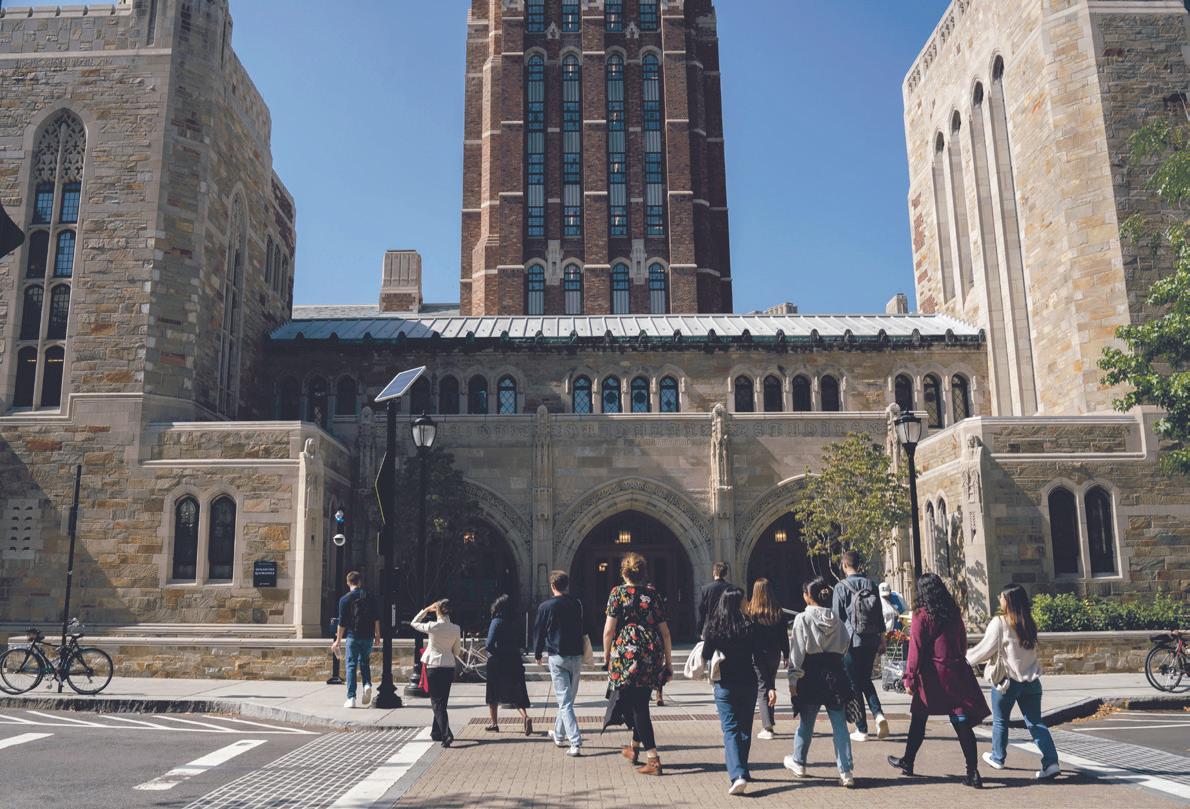
A newly established Committee on the Principles of Academic Freedom — comprising nine faculty members — will review the “historical, legal, and ethical foundations of academic freedom” over the coming months, a Tuesday statement on Yale provost’s office website said.
The office of University Provost Scott Strobel announced the new committee on its website without an email to the broader Yale community, saying that the committee will release
BY ELIJAH HUREWITZ-RAVITCH STAFF REPORTER
Henry Fernandez LAW ’94 has a lot on his plate.
The 57-year-old Harvard College and Yale Law School graduate runs a strategic consulting firm, a polling firm focused on Black Americans and a youth nonprofit. And these days, he is tasked with wrangling financial commitments from Yale to New Haven as the city’s representative in town-gown negotiations touching on the University’s voluntary contribution to the municipal budget. Fernandez is “an incredibly busy person who straddles multiple worlds at once,” Kica Matos, the president of the National Immigra-
tion Law Center and Fernandez’s wife, said in a phone interview. “He works his ass off.”
Fernandez — a former mayoral candidate who now volunteers as an envoy for his onetime opponent, Mayor Justin Elicker SOM ’10 ENV ’10, in talks with their shared alma mater — occupies a unique position in Yale’s relationship with its home city of 310 years.
In an interview last Wednesday at the Dixwell Community House, or the Q House, where Fernandez’s nonprofit runs programs, Fernandez said that he prioritizes listening to “what the other side needs.”
BY JERRY GAO STAFF REPORTER
The Yale Hunger and Homelessness Action Project kicked off its spring fundraising fast on Tuesday with a shortened donation window — one that student organizers say is too narrow.
According to a Wednesday email sent by the Yale Hunger and Homelessness Action Project, or YHHAP, students have until 8 p.m. on Thursday to donate meal swipes and until 11:59 p.m. on Friday to donate dining points through Yale Hub. Previously, the group organized a 10-day period in which students could donate only the value of their meal swipes to New Haven charities.
“The donation period used to be 10 days and now it’s two for meal swipes and three for points,” Jaeyee Jung ’27, a co-director of YHHAP, said in an interview on Wednesday. “We’re trying to just make a big push today and tomorrow to get the word out.”
The compressed timeline is the latest in a series of changes to the annual fast. In September, Yale Hospitality told student organizers that it would support the fundraiser only once per year, citing budgetary constraints. Previously, students and Yale Hospitality organized fasts twice per year.
BY LEO NYBERG AND ARIA LYNN-SKOV STAFF REPORTERS
Two military graduate fellowships at Yale will be canceled next year, Defense Secretary Pete Hegseth wrote in a Thursday memo announcing sweeping changes to the Pentagon’s relationship with elite universities. In early February, Hegseth ordered a review of Ivy League and other universities to determine whether the Pentagon should continue its graduate programs with the institutions.
The Pentagon has traditionally partnered with universities to help turn senior officers into better strategic thinkers, according to an Army website.
“We cannot and will not continue to send our most capable officers, senior officers, into graduate programs that undermine the very values they had sworn to uphold,” Hegseth said
in a video posted on X. “That’s why today, just like we did with Harvard, I am ordering the complete and immediate cancellation of all Department of War attendance at institutions like Princeton, Columbia, MIT, Brown, Yale and many others, starting next academic year 2026-2027.”
The memo, signed by Hegseth, includes a table which reveals the number of cancelled Senior Service College Fellowships. Yale has two such fellowships, according to the memo, while Harvard leads the pack with 21. The Department of Defense cut ties with Harvard in February.
“Yale learned of the Department’s announcement on Friday and worked quickly to reach out to students who may be affected,” University spokesperson Karen Peart wrote in a statement to the News. “Yale is working to under-
BY ELIJAH HUREWITZ-RAVITCH STAFF REPORTER
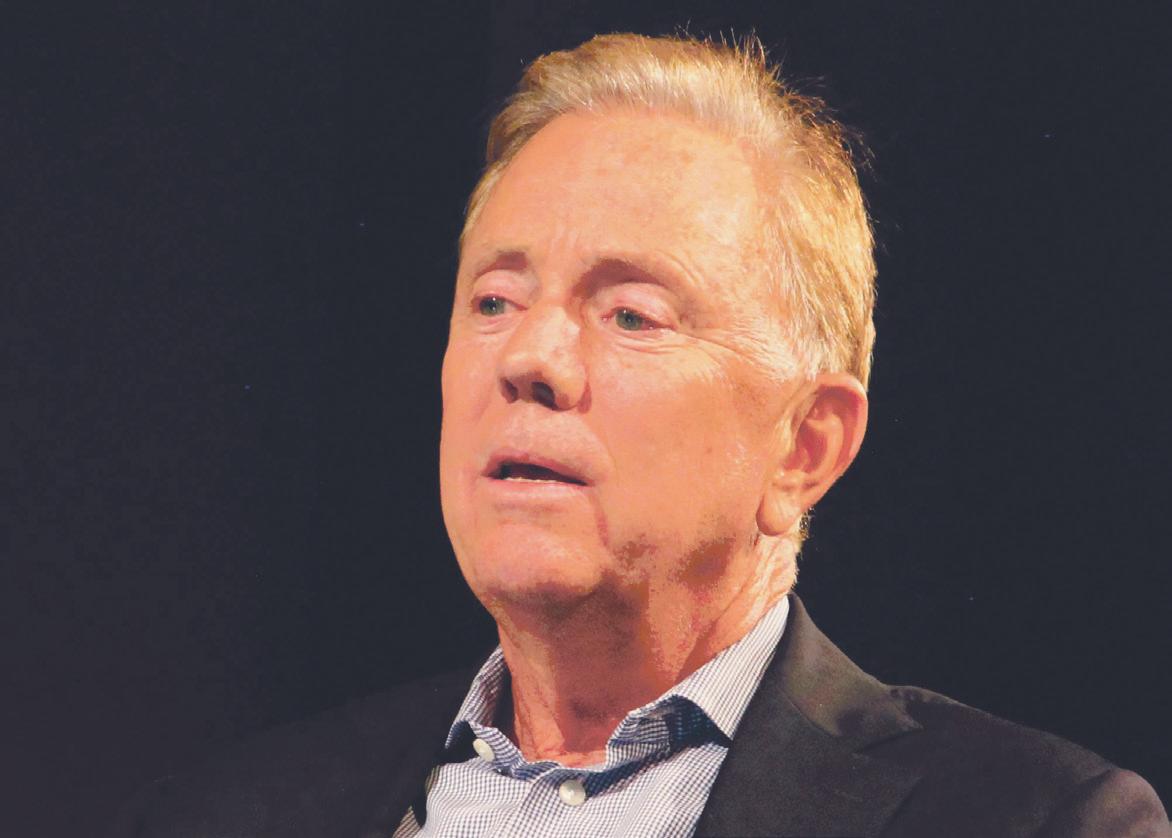
Gov. Ned Lamont SOM ’80 weighed in on the recent arrest of former New Haven police chief Karl Jacobson in a Friday morning interview with the News.
Lamont, who is running for a third term leading the Nutmeg State, said that Jacobson’s arrest does not point to a larger issue in statewide policing, but he expressed concerns about the online gambling platforms that may have fueled Jacobson’s alleged embezzlement of public funds. Lamont also commented on Yale’s voluntary contribution to the city and expressed his desire to make Connecticut a place where “the cool kids” want to stay.
The Connecticut state’s attorney for New Britain two weeks ago charged Jacobson with stealing more than $85,000 from two city funds in 2024 and 2025.
“In many ways, the system worked, and we caught this person, and now they’re going to have to be held accountable,” Lamont said. He added that the incident is not “symptomatic of anything chronic going on, police or anywhere else.” Jacobson’s alleged theft appears to have been driven by a gambling habit. According to the affidavit by a state police lieutenant in the application for Jacobson’s arrest warrant, Jacobson wagered $4.4 million on online sportsbetting platforms DraftKings and FanDuel in 2025 alone.
“It was clearly driven by gambling addiction,” Mayor Justin Elicker said in an interview last week.
“I will remind everyone that an arrest is not evidence of guilt and allegations are not proof,” Gregory Cerritelli, Jacobson’s lawyer, wrote in a Friday statement to the New Haven Independent on the former police
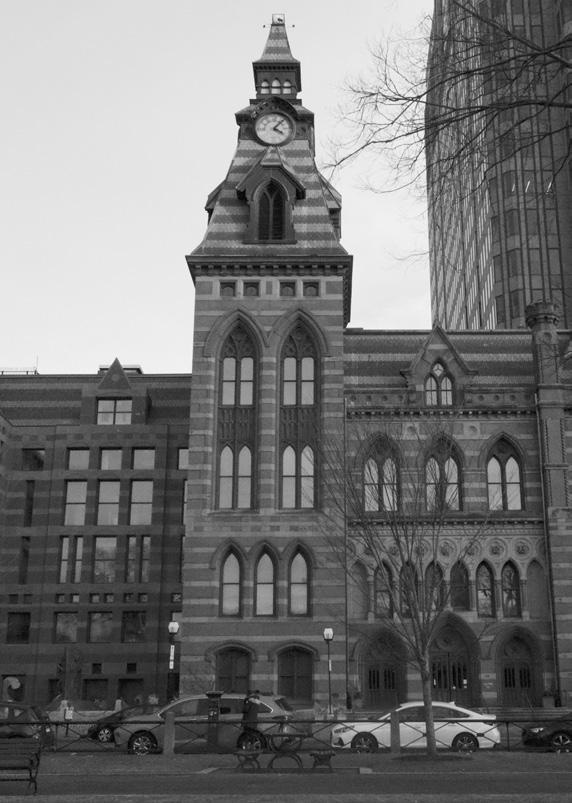
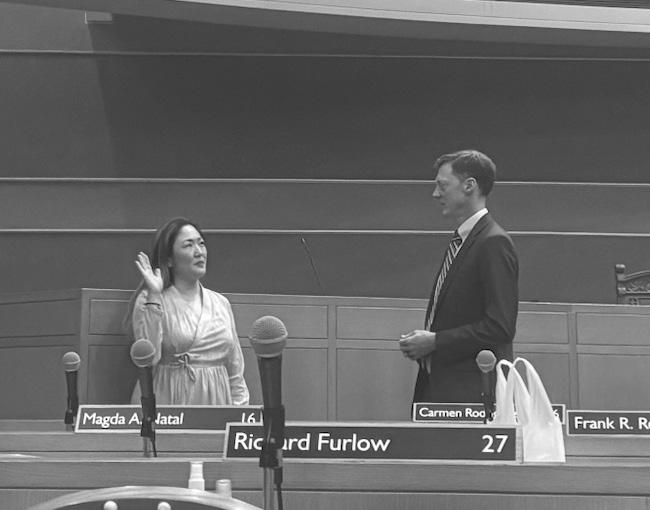
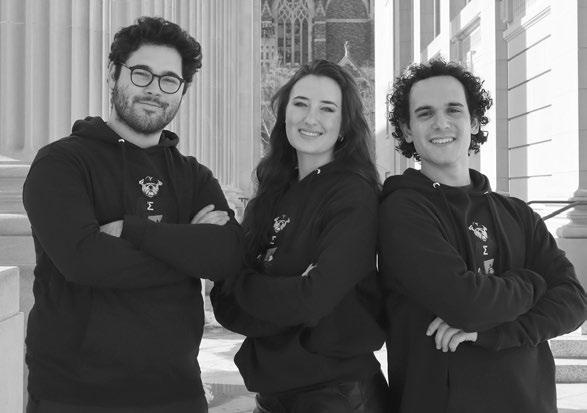
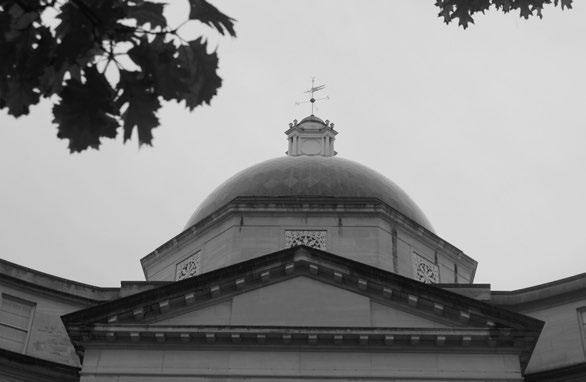
Ellie Park, Senior Photographer
John Wright via Wikimedia Commons
Elijah Hurewitz-Ravitch, Staff Photographer
Liam Enea via Wikimedia Commons
Ximena Solorzano, Head Photography Editor
This Day in Yale History, 1988
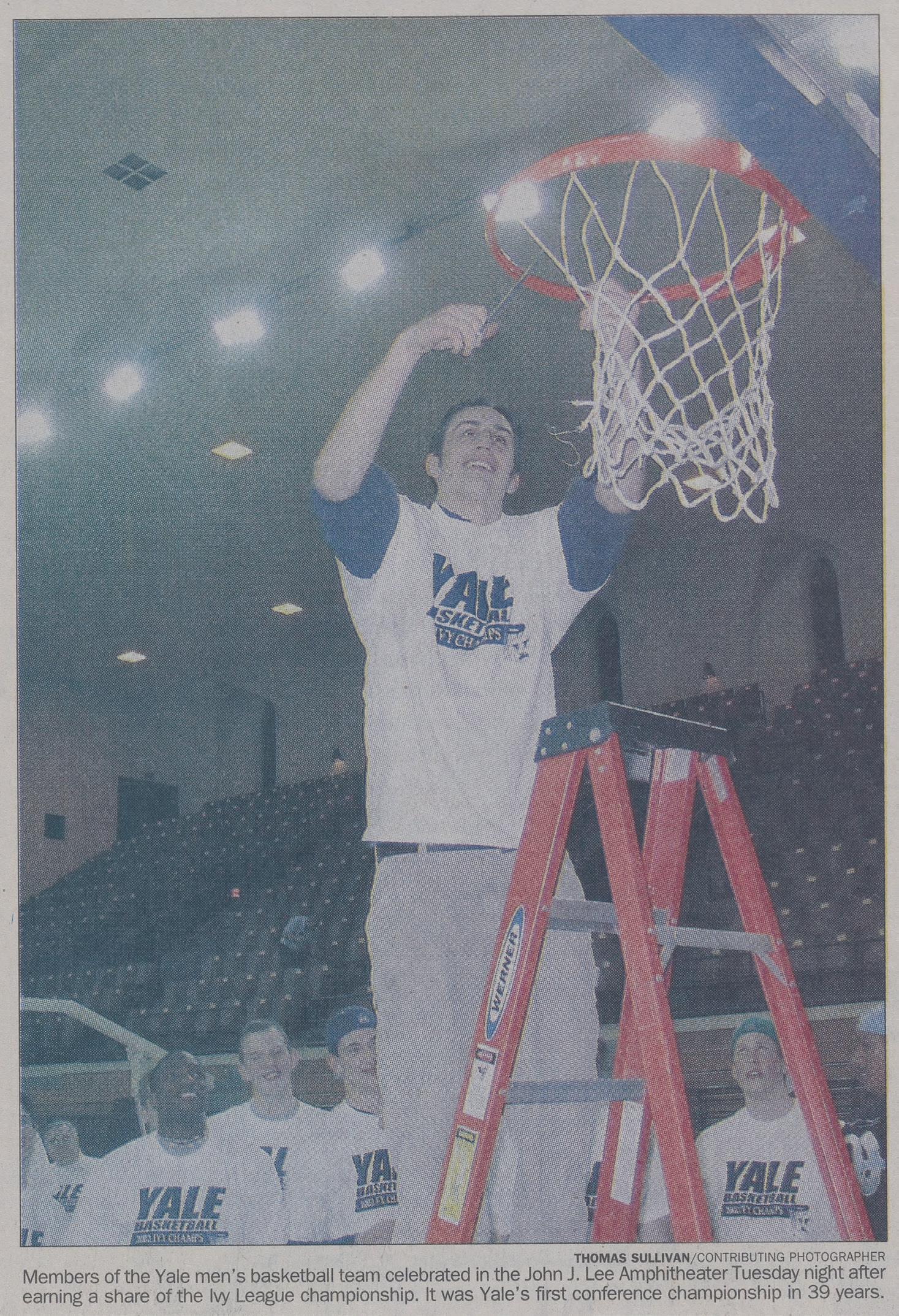
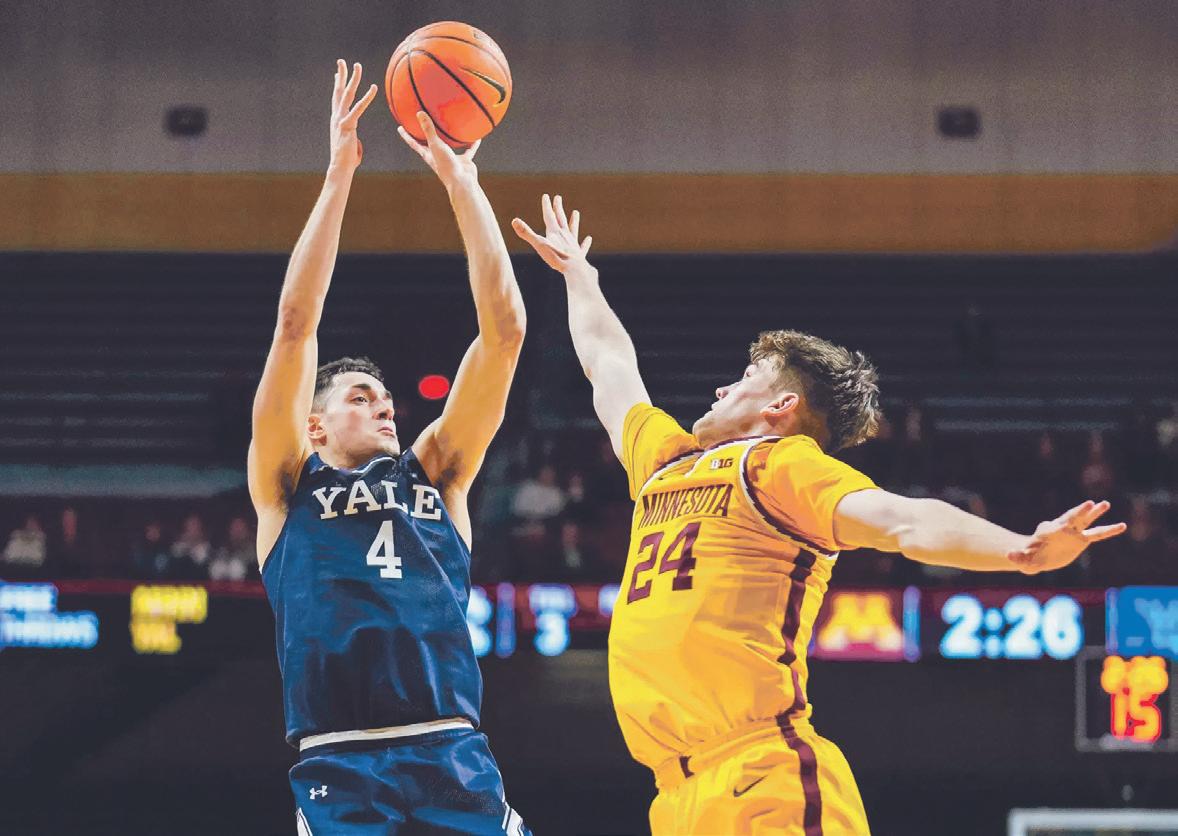
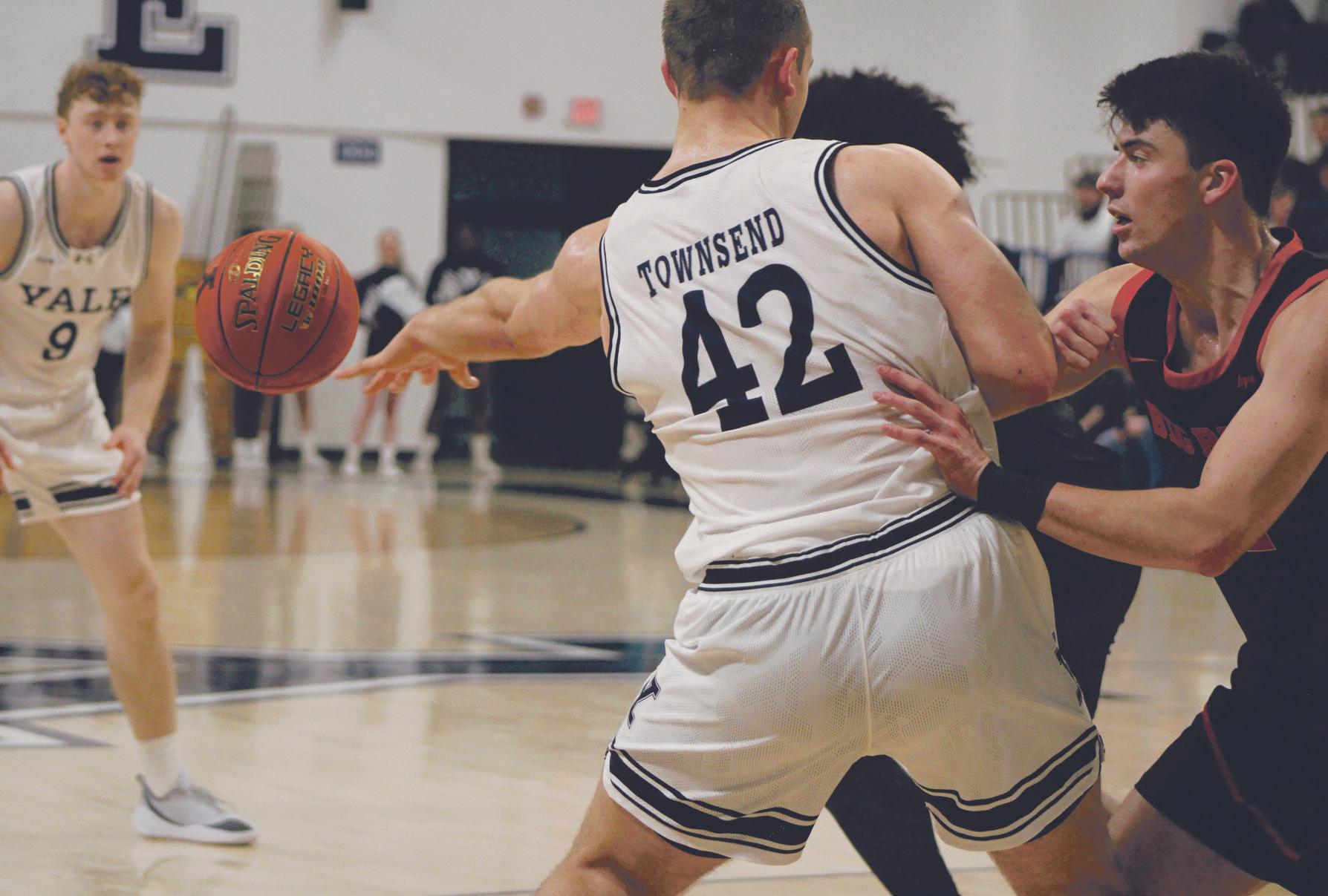
March 3, 1988 / Basketball shares Ivy League Title
By Jeremy Licht
A 39-year title drought ended last night as the men’s basketball team claimed a share of the 2002 Ivy League championship With Princeton’s 64-48 loss to Pennsylvania, Yale (19-9, 11-3 Ivy) moved into the first three-way tie for the championship in league history, joining the Tigers and the Quakers atop the conference. Not only did the Penn win end nearly four decades of Eli frustration, it also highlighted the turnaround engineered by Yale head coach James Jones, who in three years has taken a cellar dweller to the league’s pinnacle.
Behind the Headline
By Elijah Hurewitz-Ravitch
A discussion in my social theory class had just wrapped — we were comparing how Mandeville, Smith and Kant saw the relationship between ends and means in public life — when I hopped in an Uber to talk to someone who seems to consider these questions daily.
I was headed to the Dixwell Community House, or Q House, a pillar of the Dixwell neighborhood, to talk to Henry Fernandez LAW ’94. Fernandez is representing New Haven in negotiations with Yale over the University’s annual voluntary payment to the city. He’s a true behind-the-scenes operator, and currently straddles the town-gown divide that has so long been a point of contention around these parts.
Our conversation was wide-ranging — we talked about local journalism, car-buying techniques and that school up in Cambridge. New Haven’s spokesperson announced that a new “commitment and plan to support the city’s finances” is set to be disclosed Friday morning. I encourage you to give my profile a read and learn a little bit about New Haven’s negotiator-in-chief.
Read “Negotiator at center of town and gown” on page 1.
Puzzles
MAIA WILSON
JOLYNDA WANG
GUEST COLUMNIST
MANU ANPALAGAN
GUEST COLUMNIST
GALEN JONES
Liberal elitism fails American universities Hegseth’s break with universities insults our military leaders
On Monday morning, the News
published an opinion piece by Milan Singh ’26 titled “Reject ideological affirmative action.” In it, Singh argues that the lack of conservative voices at Yale can be explained by a simple reason: because conservatives are “less intelligent than liberals.” He then repeats this claim several times, insisting that “conservatives are just not as smart as liberals,” and concludes that any effort to address ideological imbalance would require lowering academic standards.
Singh is entitled to his views, but the tone and substance of his argument reveals a deeper problem that goes beyond a single op-ed. His piece exemplifies the elitism that has become increasingly common in progressive academic spaces, where political disagreement is dismissed as evidence of moral or intellectual inferiority.
Reducing nearly half the country to a deficiency in intelligence is not serious scholarship. It is arrogance that substitutes ridicule and mockery for intellectual debate. When disagreement is explained away as stupidity, discussion becomes unnecessary and democracy itself begins to look like an inconvenience rather than a shared project.
More troubling, however, is what such claims imply about entire cultures, religions and communities. Social conservatism is not a fringe ideology invented in America. Many of the world’s major religions prescribe moral frameworks that emphasize values commonly associated with social conservatism. These include the centrality of the family, norms around marriage and personal conduct, obligations to community, respect for tradition and moral accountability. To describe conservatives, by and large, as dumb or less intelligent is not merely an insult directed at a segment of American voters. It’s a dismissal of billions of people across cultures and continents whose beliefs do not conform to elite progressive norms.
This attitude is especially concerning at Ivy League institutions that pride themselves on global awareness and intellectual humility. Yale students are among the most privileged people in the world and the beneficiaries of extraordinary educational, social and economic advantages. When members of that group assert that their political views are the natural byproduct of superior intelligence, while claiming that dissenting views reflect cognitive failure, they reveal just how out of touch elite academic culture can be with the vast majority of Americans.
This sense of moral and intellectual superiority is quite dangerous. It creates a framework in which disagreement is immediately dismissed instead
of being engaged with. Instead of arguing against conservative ideas on their merits, Singh’s article suggests that those ideas can be ignored because the people who hold them are allegedly incapable of serious thought. That logic is a precursor to silencing.
We have seen this impulse before on the national stage. In 2016, Hillary Clinton LAW ’73 famously referred to half of Donald Trump’s supporters as a “basket of deplorables.” In 2024, Joe Biden described Trump supporters as “garbage.” The backlash that followed in both cases was indicative of the growing sense that elites no longer saw their fellow citizens as worthy of respect. Singh’s argument belongs in the same camp, where political failure is explained not by flawed ideas or unpopular policies, but by the supposed defects of the people who disagree with you.
Conservatives at Yale are not asking for ideological affirmative action, as Singh suggests. We’re not asking the University to lower standards or to admit students who are unqualified. We’re asking for honesty about discrimination. Numerous conservatives have experienced firsthand the social penalties imposed on those who dissent from progressive orthodoxy in admissions, hiring and academic life. I’ve seen this myself as a conservative leader on a campus where many of my friends worry about the social, academic and career ramifications of expressing their conservatism publicly. In my experience, many students — afraid their grades may suffer if they voice the “wrong” opinions — feel the need to self-censor in the classroom.
Conservative students are not less capable, they are simply less welcome. And by insisting that intelligence explains ideological imbalance, liberals avoid confronting this uncomfortable reality. The narrative shifts from bias to biology. It’s a convenient story — but a false one. If Yale and other academic institutions truly want to commit themselves to intellectual diversity, they must reject the myth of liberal superiority and recommit themselves to genuine debate. That begins by treating conservatives not as objects of ridicule or diagnosis, but as equal participants in the pursuit of truth. , Yale will be able to persevere and fulfill its mission of serving the “Publick” for another three centuries to come.
MANU ANPALAGAN serves as the founding president of the Yale college Republicans. He is a senior in branford College studying Economics and Political Science. He can be reached at manuneethy. anpalagan@yale.edu.
Secretary Pete Hegseth studied at both Princeton and Harvard. Army Secretary Daniel Driscoll LAW ’14 went to Yale. Navy Secretary John Phelan graduated from Harvard.
Last week, the Pentagon decided those schools are too dangerous for our troops.
Secretary Hegseth’s decision to pull military officers from elite universities, including two fellowships at Yale, isn’t a defense of the armed forces. It’s an insult to their capability and deprives our leaders of a key training tool.
When I joined a U.S. Army Special Forces team at 24 years old, I was the only soldier in the room with left-leaning politics. For years, in the brutally honest atmosphere of a Special Operations team room, I faced every challenge imaginable to my ideas, every argument and technique one could imagine. In the morning, I would have heated political arguments pitted against up to four or five of my teammates. The same evening, we would go out to train, where I trusted them with my life.
After four years of ideological bombardment from fellow Green Berets whose views were often quite opposite to my own, did I emerge a newly converted conservative? Much to what I imagine would be Secretary Hegseth’s chagrin, no, I did not. My views shifted slightly in response to ideological exploration, but the real transformation was in my capacity to fight intellectual battles: to understand opposing viewpoints, to stress-test my own and to sharpen my arguments against genuine resistance. In short, I became more mentally “lethal.”
Secretary Hegseth’s decision to cancel fellowship programs bringing active-duty military
leaders to top universities ignores this truth, and in doing so, betrays the very warfighters he claims to champion.
Secretary Hegseth might believe that our top officer are wildly impressionable — that they will arrive at Harvard or
experience, a finely calibrated instinct for threat assessment and a professional obligation to question and judge.
Yale and return to their units indoctrinated. As a veteran who has spent nearly three years studying alongside active-duty officers, I can tell you: This is an insult to the professionalism and competency of our military ranks. These are mid-career officers and non-commissioned officers at the top of their fields. They are accomplished, disciplined and secure enough in their own convictions that a provocative professor or an unfamiliar idea is not a threat. Military leaders do not arrive on campus ready to mindlessly absorb whatever they hear. They bring years of hard
The strategic cost makes Secretary Hegseth’s decision even harder to bear. Consider what is actually being dismantled. The Space Force chose Johns Hopkins University’s School of Advanced International Studies as its official graduate education partner for senior officers. Yale has hosted an annual Special Operations Forces Conference attended by leaders from across the Special Operations community. Massachusetts Institute of Technology operates the Department of Defense’s single largest federally funded research and development center, producing the advanced technology that undergirds American national security. These are not institutions hostile to the military. They are institutions the military once chose. If Secretary Hegseth truly wants to build stronger leaders, he should not shelter them from difficult ideas. Instead, he should send them directly into the fray. His decision doesn’t just insult the service members it claims to protect. It dismantles partnerships the military spent decades building and deprives our most promising leaders of exactly the kind of intellectual combat that has always made them exceptional. If you want a sharp knife, you bring it to a whetstone. You don’t put it back in the sheath.
GALEN JONES is a former U.S. Army Special Forces medic pursuing dual master’s degrees in business and public health at Yale. He can be reached at galen.jones@ yale.edu.
WILLIAM
Reject intelligence, embrace education
There is only one adjective that could describe Yale at any point in its tricentenarian history: preprofessional. The University’s charter of 1701 calls for the establishment of a collegiate school to fit young men “for Publick employment both in Church & Civil State,” anticipating the stage for today’s battles over Morgan Stanley internships and start-up loans.
Yet the character of such employment has undoubtedly changed since Yale’s inception.
The Yale of old sought to instruct students in the “Arts & Sciences” and suit them with the skills necessary to serve church and state — institutions with an inherently “Publick” identity. In contrast, what is the goal of a Yale education today? Late statements by both University students and administrators indicate something vastly different.
The author of a recent op-ed in the News made the argument that expanding political diversity on campus would be detrimental to the University because conservatives are “just not as smart as liberals.” Citing a loose collection of studies, he claims that offering spots to conservative students and faculty would “lower” the university’s standards and equate to a form of costly, unjust affirmative action.
I will not venture to combat the statistical claims made in the piece, as the infirmity of the evidence pointing towards such conclusions should be obvious to everyone. Those with more statistical chops than I may bear that burden. Instead, the onus falls upon me to argue from first principles that such belief in intelligence as the telos of education fundamentally misses the object of Yale’s purpose as an institution.
Classicist and former Yale
instructor Allan Bloom once wrote that the mutual contempt between social scientists and humanists stems from their different conceptions of man: the former claim him to be a predictable creature, while the latter claim that he is not. I fear that those who use tests and data to argue for the genetic predisposition of an individual’s admission to Yale fall too far into the view of man as a mappable being. IQ scores, cognitive abilities, verbal faculties — these quantitative measures are not the traits that make us human, and they certainly should not be the traits that make us qualified as Yale students. For 300 years, our University has instructed us to serve the “Publick” in occupations that require much more than raw intelligence to be executed successfully. Where does an adherence to manners, a proclivity to empathy, an orientation to faith and a sensitivity to beauty fit in this new scheme of things? In years past, the Yale gentleman served as the model for such an appropriate balance of mind, body and soul; in the wake of his death, we have yet to fill the moral void presented by his absence. This mode of hyper-rationalist, optimization-based thinking cannot possibly create a flourishing society. At best, it rudely tears off all the “decent drapery of life” as warned by statesman Edmund Burke in 1790, creating a world devoid of “love, veneration, admiration [and] attachment.”
At worst, it leads to much darker places — places Yale inhabited in an all-too familiar way at one time in our recent past. Researchers and columnists have documented such problems extensively, most notably David Brooks in a famous Atlantic article from 2024. I took his hiring
as Yale’s inaugural Presidential Senior Fellow as an indication that Yale was taking many of his criticisms to heart. Hence my disappointment to read in a recent interview that President McInnis’ top institutional priority is the continued expansion of programs in “physical sciences and engineering.” At Yale, the tally only continues to grow for those who believe in the predictability of man.
In order to balance the fight, Yale must recommit to favoring education over intelligence as the primary end of its institutional mission by ensuring its resources are applied to the institutions that offer the most to students and the broader community. From the implementation of a service requirement for all undergraduates to the continued funding of the Center for Civic Thought, from increased Chaplain’s Office programming to the preservation of our worldclass humanities departments, the administration must ensure that Yale not become, as Burke would label it, a place exclusive to “sophisters, economists and calculators.”
Investing in the humanities does not require divesting from the social sciences, and I gladly welcome any academic improvement that would accompany further investment at Yale. Yet we must be watchful that our growth in intelligence serves only our humility and never our pride. With these things in mind, Yale will be able to persevere and fulfill its mission of serving the “Publick” for another three centuries to come.
WILLIAM BARBEE is a senior studying History. Psychology. He can be reached at william.barbee@ yale.edu.
FROM THE FRONT
“All life is the same, as citizens of the human State: the animating limits are within, to be killed and mourned, over and over again.”
Volunteer again represents New Haven in Yale talks
“I don’t feel the need to win at the expense of somebody else,” he said. “What I want is to be able to win and have the other side feel like they won too, because then we can enter into negotiations again.”
Back to the negotiating table Fernandez led the city’s delegation in negotiations with the University in 2021, when Yale and New Haven leaders reached a landmark agreement that lasts through June 2027.
Under the terms of that deal, the University agreed to pay New Haven annual sums of some $23 or $24 million — except for the final year, in which Yale’s payment was slated to drop to $16 million. In 2021, then–University President Peter Salovey referred to the decrease as “a reminder that we need to get down to business” and begin negotiations on the next deal.
A Yale official confirmed Friday that the University had agreed to head off the drop, after Elicker announced a budget proposal relying on at least a consistent contribution from the University next fiscal year.
For Fernandez, Yale’s lump sum financial commitment reflects respect for New Haven’s democracy.
“All of that money goes to the Board of Alders, and they decide how to spend it — just like if you pay property tax, that money goes to the Board of Alders,” he said. “It is not earmarked.”
In the 2026 fiscal year, New Haven’s budget was $702.3 million. Just under half of that revenue came from property taxes, and Yale’s $24.3 million contribution is equivalent to around 7 percent of the total tax revenue.
The city could face “massive layoffs” and cuts to “a lot of services” without Yale’s payment, Fernandez speculated.
Elicker “obviously tapped him for a reason,” said Karen DuBois-Walton ’89, who worked alongside Fernandez in city government for several years in the 2000s and now leads the Community Foundation for Greater New Haven. “Absolutely he’s thought of as a very strong negotiator.”
As former Mayor John DeStefano’s economic development administrator from 2000 to 2005, Fernandez said he “did a lot of the negotiating with Yale.”
Fernandez brokered the sale of the land on which the University would eventually build the Yale Health Center and the Yale Police Department headquarters along Lock Street — a process that was, in his telling,
‘System
“rocky.” And he also helped bring Gateway Community College to downtown New Haven and IKEA to Long Wharf, according to previous reporting by the News.
In 2021, Fernandez and the rest of the city’s team secured a $10 million increase in Yale’s annual payment to New Haven, which local leaders heralded as “historic.”
Alexandra Daum, Yale’s associate vice president for New Haven affairs and University properties, and Jack Callahan ’80, the former senior vice president for operations, previously wrote in a statement that the University’s contribution to New Haven’s budget is “the most significant commitment to the local community” made by any American university.
The pair is working together on the University’s side of the ongoing negotiations, after Callahan represented Yale in the 2021 talks.
“Henry is very smart, tough but fair, and deeply committed to the community, both New Haven and Yale,” Callahan wrote of Fernandez in a text message Tuesday.
A New Haven stalwart
The son of a computer programmer and an activist, Fernandez grew up in Poughkeepsie, New York.
He characterized Poughkeepsie as a college town, but added that, in his youth, Vassar College had almost no involvement in the local community. Growing up, he said, “none of us ever thought about” a town-gown relationship in Poughkeepsie.
Fernandez said his parents — a Black father and white mother — both impressed the value of public service upon him from an early age.
As a Harvard undergraduate, Fernandez worked at an after-school program in a Mission Hill housing project, he said. But when he came to Yale for law school, he was disappointed by the University’s community service offerings.
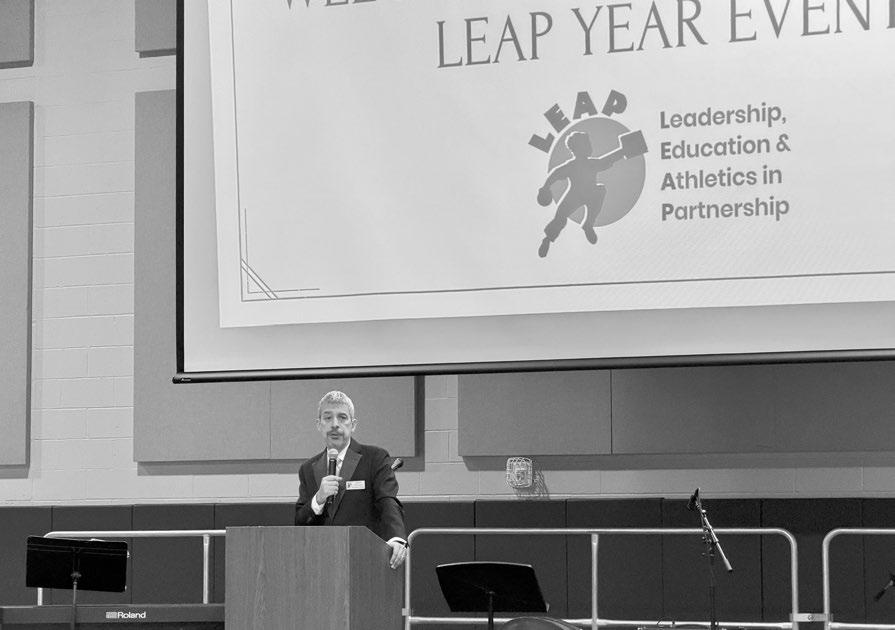
And so in 1992, while still a law student, Fernandez founded Leadership Education & Athletics in Partnership, a nonprofit that aims to “address the historic disinvestment in young people of color” in New Haven, as its website says. The organization now serves over 1,000 children.
In electoral politics, Fernandez’s track record is uneven.
Immediately after graduating from Harvard, he helped elect Kenneth E. Reeves to the Cambridge City Council. Later, in 2006, Fernandez managed DeStefano’s campaign for Connecticut governor, during which DeStefano narrowly
won the Democratic primary but lost in the general election.
In 2013, when DeStefano announced he planned to end a two-decade tenure as mayor of New Haven, Fernandez ran for the office himself. Despite an early fundraising lead and an endorsement from the New Haven Register, he came in third place in the Democratic primary. Toni Harp ARC ’78 won that race, and Elicker — who would go onto unseat Harp in 2019 — came in second.
These days, aside from his work as New Haven’s negotiator, Fernandez also runs two businesses: the African American Research Collaborative, a polling firm, and the consulting group Fernandez Advisors. And he has served as LEAP’s executive director since 2014. At the nonprofit’s annual fundraiser last Thursday, Fernandez emceed and drummed up donations, though in a very different context from his volunteer work for New Haven. The organization had fallen $40,000 short of its target of $600,000, and so Fernandez staged an impromptu auction to make up the gap.
Yale’s Office of New Haven Affairs donated $10,000 to the LEAP fundraiser, according to an event webpage and a guide to sponsorship levels.
worked’ in Jacobson arrest, governor tells News
chief’s behalf. “This is the beginning of a very long process. I urge everyone to keep an open mind and avoid a rush to judgment.” Online gambling, Lamont said, is “everywhere around the world. There’s not much I can do about it, except for try and regulate it. So we try and make sure people under a certain age don’t have access to it.” But, he added, “it’s really tough to control that.”
Lamont said that he is more concerned with prediction markets like Kalshi and Polymarket, which he deemed “the Wild West.” The platforms are less regulated than typical sports gambling apps, according to The New York Times.
“We’re trying to keep up with the new technologies — make sure we provide at least some guardrails to protect people,” the governor said, although he acknowledged that the state is not able to act nimbly enough to effectively regulate.
The patchwork system of stateby-state regulation makes things more difficult, Lamont added.
“It’s happening at such breakneck speed,” he said. “And then the idea that 50 states are all going to do their own thing is a bit of a confusing mess.”
Meanwhile, Lamont is running for a third term, but he tries to “keep the politics in the back seat,” he said.
Currently, negotiations between Yale and New Haven for the University’s next voluntary contribution deal with the city are coming to a close.
Asked whether he thought Yale should up its annual payment — as city leaders have called for — Lamont said that “Yale is a big piece of New Haven, and got to be a good partner there.”
“Yale will tell you they contribute more to the New Haven economy than probably any other Ivy League does to their community,” he pointed out.
Indeed, Alexandra Daum, Yale’s associate vice president for New Haven affairs and University properties, has pointed out several times in emailed statements to the News that Yale’s “voluntary financial contribution to the city is the most significant commitment to a local community made by any higher education institution across the country.” Daum and Jack Callahan ’80, Yale’s former senior vice president for operations, are representing the University in talks with the city. And the city’s negotiator — Henry Fernandez LAW ’94, who also headed the city’s negotiating team in 2021 — said in an interview last week that “our deal is the best deal ever,” referring to the current deal between Yale and New Haven.
“Does that mean they can’t do more? No, they can do more,” Lamont said. “They’re a big piece of that community, and they own a big piece of the community, which is tax exempt.”
“Every mayor is asking the state to pay them more or their local not-for-profits — in this case, Yale — to pay more,” Lamont added. He said that city leaders “also have got to figure out, ‘Am I
managing my way in the best way possible for the taxpayers?’”
Connecticut cities like New Haven are also facing federal cuts, and the governor acknowledged a “challenging federal environment.”
He said that Connecticut has “probably doubled” municipal aid to cities through its payment in lieu of taxes program. That aid to New Haven increased by more than 100 percent in 2021, and in the city’s most recent fiscal year, it received around $101.1 million from the state.
“We’re trying to keep up and do our part in these very inflationary times,” Lamont said. “I also understand the incredible stress our municipalities are going through.”
The governor identified one issue that keeps him up at night.
“I want to make sure this is a state where people like you and your friends want to stay,” Lamont told a News reporter.
For about 20 years, Lamont said, people streamed out of the state. General Electric left, he added, and “the cool kids were all moving to New York City or Boston.”
“We’re beginning to turn that around,” Lamont said. “Our cities are coming back to life, a lot more vibrant than they were 20 years ago. You know, really good job opportunities, trying to make sure that pipeline is clear, so even the Yale students say, ‘Hey, I’m going to take a second look at Connecticut.’”
Contact
ELIJAH HUREWITZ-RAVITCH at elijah.hurewitz-ravitch@yale.edu.
Negotiator-in-chief
By now, Fernandez said that he has built a strong “rapport” with “the Yale folks,” although he added that the relationship was once more strained.
One early lesson in negotiation came from his friend Miguel Pittman — a local restaurateur who has, in the past few years, mounted several unsuccessful bids for alder in hotly contested races — when Fernandez, then a relative newcomer to New Haven, was preparing to buy his first car.
Fernandez said Pittman taught him to recognize that in negotiations, the other party is “not trying to rip you off; they’re trying to meet their obligations to their employer.” Fernandez recalled that advice as he described current talks with Yale.
In the negotiation process for the next voluntary contribution deal, he said he had an “early meeting” with Elicker, Callahan and Yale President Maurie McInnis. After that, Callahan and Fernandez have “really engaged,” and their “last couple of meetings” have also included Daum.
“I have learned something from every one of my conversations with Henry,” Daum wrote in an email Tuesday. “I admire his impressive historical background on every nook and cranny of City Hall.”
Talks have taken place at Yale, at the Q House, at a couple of coffee shops and over Zoom, according to Fernandez. He added that “every face to face meeting has been me and Jack,” referring to Callahan.
State Sen. President Pro Tempore Martin Looney said in an interview that Fernandez, whom he has known for many years, “sets ambitious goals and knows that sometimes you have to reach them incrementally.”
If New Haven and Yale reach a “good” updated deal, Fernandez said, “it will be better than all the deals that any universities in this country have ever done with their host city.” Fernandez predicted that the negotiations will finish before June. “Both sides are confident that we will be in a position very soon to announce a multi-year contribution,” Daum wrote in a statement last week. Fernandez said that he met most recently with Callahan and Daum last Wednesday over Zoom, though they “have communicated briefly since then.”
In the University’s first voluntary contribution agreement, signed in 1990, Yale pledged to give around $1.5 million to the city each year.
Contact ELIJAH HUREWITZ-RAVITCH at elijah.hurewitz-ravitch@yale.edu.
‘Fast’ organizers object to change
Three student organizers interviewed by the News said they believe the compressed timeline could affect donations and would make campaigning for the fast more challenging.
“I think we’re going to definitely see a decrease in sign ups just because with the 10-day sign-up period we could have a huge tabling campaign where we would have volunteers at different dining halls,” Kate Johnson ’27, a fast co-chair, said. She added that the shortened donation window “is tough just because we can’t speak to as many people as we would have been able to.”
The spring 2025 fast generated $8,326 from meal plan donations. In fall 2024, the fast raised $18,360, of which $13,176 came from meal swipe donations.
A Yale Hospitality spokesperson wrote in an email to the News that the changes to the fast were done in collaboration with student organizers.
“In close partnership with YHHAP, we reimagined the structure of the YHHAP Fast. This year, students are able to donate both meal swipes and dining points over an extended three-day period, March 4th, 5th, and 6th,” the spokesperson wrote, adding that “Yale Hospitality is actively supporting and promoting the initiative across all dining units to ensure broad awareness and participation.”
The spokesperson did not address the News’ questions about whether the reduced window for donations is related to budget constraints. In light of an upcoming endowment tax hike, Yale has required schools and divisions across campus to shrink their budgets.
Student organizers said they plan to pivot to social media and emails to encourage student donations before the donation window ends. Additionally, YHHAP opened its online donation page earlier this year to allow for more monetary donations.
On Wednesday evening, Ward 1 Alder Elias Theodore ’27 posted a video on Instagram encouraging students to donate to the fast.
Other changes to the fast, such as allowing students to donate meal points, earned praise from organizers for the flexibility they provide to students, though they still expressed worry that students would be less willing to donate their limited points, which they need to get meals at Commons — another dining change this school year.
“I feel like a lot of people I know would prefer to donate their swipes for the day over points,” Jung said, but she is “glad that both are options.”
The spring 2024 fast had an 11-day donation period, according to a poster by the student organization.
Contact JERRY GAO at jerry.gao.jg2988@yale.edu.
LAMONT FROM PAGE 1
FUNDRAISER FROM PAGE 1
Elijah Hurewitz-Ravitch / Staff Photographer
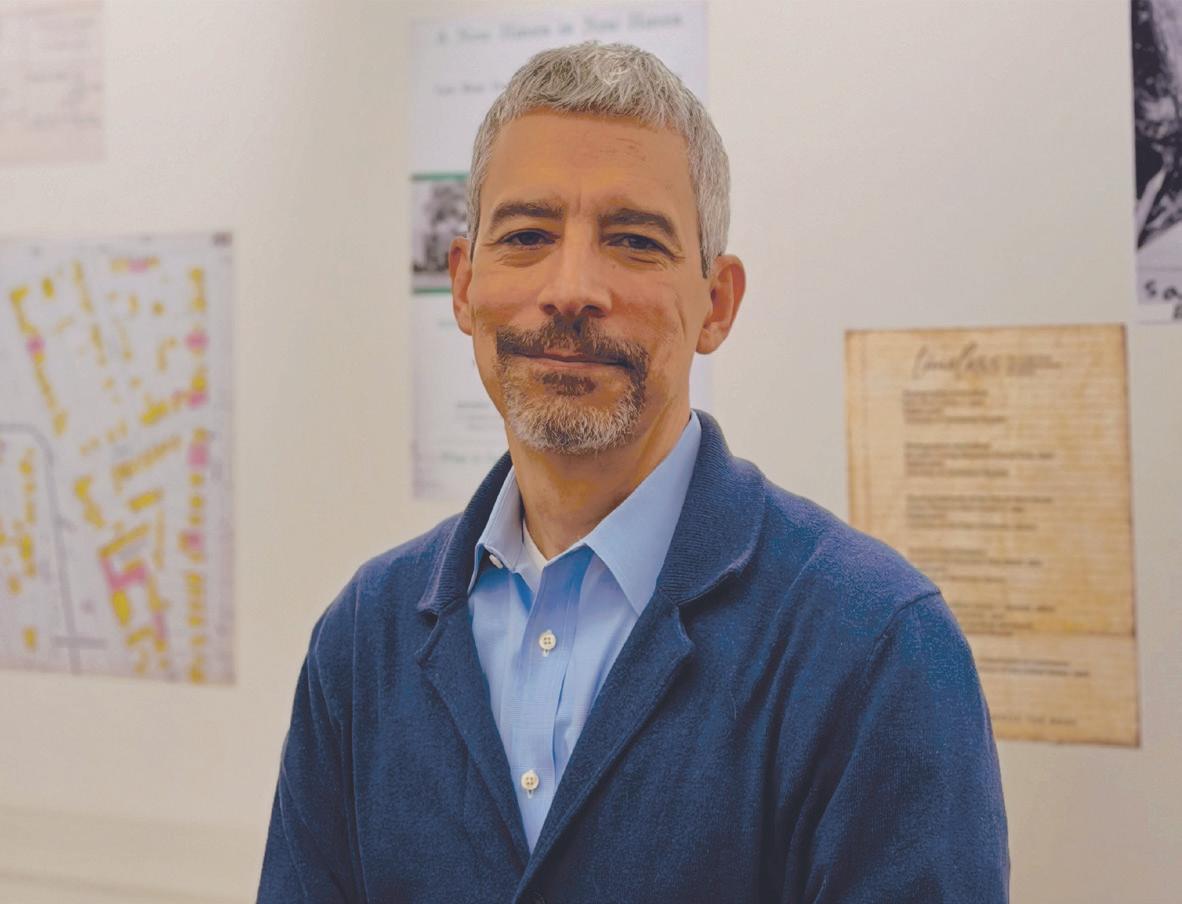
As New Haven and Yale renegotiate the University’s voluntary contribution to the city’s budget, Henry Fernandez — a nonprofit and business leader with a Yale degree and a long local history — is playing a central role behind the scenes.
FERNANDEZ FROM PAGE 1
FROM THE FRONT
“Two things are infinite: the universe and human stupidity.”
Top foreign source of donations: tiny English Channel island
DONATIONS FROM PAGE 1
licans have claimed that elite universities are influenced by foreign actors, especially China.
“We have put a number of measures in place in order to ensure that there shouldn’t be any concern from the foreign funding that we receive,” Yale University President Maurie McInnis said in an interview last Wednesday. “We have a research security and integrity office that reviews everything that would be in that bucket of space. And then we also have a gift and grant review committee that reviews any potential funding.”
Tina Posterli, a Yale spokesperson, wrote that Yale would “under no circumstances” allow foreign donors or researchers to influence Yale research, cause Yale to violate its academic principles or undermine “objectivity and integrity” of scholarship at Yale.
Yale’s single largest foreign funding source is Guernsey, a self-governing British Crown dependency of roughly 65,000 people that sits in the English Channel and functions as a prominent offshore financial center. According to the portal, Yale received $446 million from Guernsey, nearly $53 million more than it received from China — its second-largest foreign source at approximately $393 million.
Because Guernsey offers low tax rates and strong financial privacy, donors elsewhere sometimes base their foundations there, making it difficult to trace the ultimate source of funds.
Ian Oxnevad, who researches counter-terrorism and money laundering and writes for the National Association of Scholars, said Guernsey is a “tax haven and secrecy haven” which attracts corporations and the ultra-wealthy.
“That money could be coming from anywhere,” Oxnevad told the News. “That could be Putin, that could have been bin Laden back in the day. I mean that could be anybody.”
Lars Erik Schonander, a fellow at the Foundation for American Innovation who has researched education and national security, said the money tied to Guernsey is likely from donors concealing their true countries of origin.
“Yale has not received funds from the sources named, nor would it ever knowingly accept funds from these or similarly situated sources that would potentially violate U.S. sanctions,”
Tina Posterli, a University spokesperson, wrote in an email to the News, responding to a question about Russian President Vladimir Putin and the dead al-Qaida founder Osama bin Laden.
McInnis said the University has declined certain funding opportunities on its own initiative.
“We have turned down a number of opportunities because they did raise our own concern,” McInnis said.
“So we work really hard to ensure that there could not be, and could not even be perceived to be, any risk to any of the funding that we have taken.”
McInnis added that “most of our funding has come from our own alumni who just happen to be international and live in other places.”
Yale has more than 130,000 living alumni, according to the Yale Alumni Magazine — nearly twice the entire population of Guernsey. A search for Yale alums living in Guernsey in the Yale Alumni Directory reveals only two names.
Posterli told the News that the University “generally does not publicly comment on donor identities or gift information.”
“As part of Yale’s foreign gift and contract reporting, Yale does provide donor names on a confidential basis to the Department of Education,” Posterli added.
The portal is a step in the right direction towards more disclosure, Oxnevad and Schonander said.
In 2020, during the first Trump administration, the Education Department investigated Yale for allegedly failing to report foreign funding in compliance with federal law, part of a sweeping series of probes into prominent universities that together uncovered $6.5 billion in previously undisclosed funds.
University spokesperson Karen Peart wrote to the News at the time that Yale failed to appropriately disclose the funding it receives from foreign sources.
Posterli told the News on Tuesday that since the 2020 investigation, the University “has worked diligently to develop and maintain an effective compliance program for reporting foreign gifts and contracts as required under federal law.”
In 2025, the University’s Office of Federal and State Relations engaged with the DETERRENT Act, a federal bill “related to disclosures of gifts and contracts,” according to federal filings, though it is unclear whether Yale advocated for or against the legislation. The bill would lower the threshold for reporting foreign funding from most countries from $250,000 to $50,000, and to $0 for donations from Russia, China and other “countries of concern.”
When asked about the DETERRENT Act in October, Peart did not provide an answer about how Yale viewed the bill.
The American Council on Education, a higher education lobbying group which Yale is a part of, opposed the DETERRENT Act. The bill passed the House of Representatives but has not yet passed the Senate.
Contact ASHER BOISKIN at asher.boiskin@yale.edu and LEO NYBERG at leo.nyberg@yale.edu
Hegseth calls elite universities ‘woke’
MILITARY FROM PAGE 1
stand the changes in the Department’s policy and remains deeply committed to educating leaders who serve our nation.”
Brandon Colas GRD ’29, an active-duty service member and graduate student in political science, said the fellowships are a “finishing school” for high-ranking officers who could be promoted to general.
“It’s not gonna crush the military, but I think it’s unfortunate because universities are doing stuff that the military just doesn’t do in house and for good reason,” Colas said about the; changes. He added that universities like Yale help conduct “cutting edge data science” research that the military would not normally do.
Colas said his military boss told him that he would likely be able to finish his program of study, in which he researches Army recruitment data.
In a memo to a superior officer outlining his work at Yale, which Colas provided to the News, he wrote that Yale has provided access to resources like unique commercial datasets that are usually unavailable to other universities due to cost and that the military does not currently use.
In addition to the fellowships, Yale has active-duty graduate students — like Colas — throughout its schools. Yale also has a Marine Corps visiting fellow at the Jackson School, who researches and takes classes at Yale, and a colonel who is a visiting fellow at the MacMillan Center.
Yale has about 130 undergraduates enrolled in its Reserve Officers’ Training Corps, or ROTC, program, according to Yale’s military affairs liaison, Holly Hermes.
Hegseth said Ivy League universities are “woke” and do not reflect the Defense Department’s values.
“The Ivy League and similar institutions have gorged themselves on a trust fund of American taxpayer dollars, only to become factories of anti-American resentment and military disdain,” Hegseth said in the X video. “They’ve taken our best and brightest, the men and women who have pledged their lives to this nation, and subjected them to a curriculum of contempt.”
Colas told the News that he has not done any research he considers “woke” at Yale, and that his research was applicable to the Army’s mission.
“Ultimately, I’m doing this to benefit the Army. That’s the only reason they’re paying my salary and paying this ridiculous tuition,” Colas said.
Hegseth attended Princeton as an undergraduate, in the class of 2003, and graduated from the Harvard Kennedy School of Government in 2013.
Peart wrote that Yale has a long history of faculty research on national security and global affairs and has educated students who aspire to careers in the military.
“Yale faculty also conduct scientific and engineering research relevant to the Pentagon’s mission,” Peart wrote. “Yale is proud of its faculty, students, and alumni who contribute to our national security and our country’s global standing.”
Yale largely avoided direct attacks from the Trump administration in the first year of the president’s second term. The University has faced investigations into antisemitism and cooperation with an allegedly race-based program for business school students.
Contact LEO NYBERG at leo.nyberg@yale.edu and ARIA LYNN-SKOV at aria.lynn-skov@yale.edu.
Faculty committee to produce statement by end of 2026
COMMITTEE FROM PAGE 1
a statement on “the principles that guide the academic freedom of Yale faculty” by the end of the 2026 calendar year, alongside a summary report.
“Despite the phrase ‘academic freedom’ being invoked frequently, we have not as a community of faculty had a chance to dive deeply into how this phrase is understood and to what end,” incoming committee chair Gregory Huber, a political science professor, wrote in a Thursday email to the News.
Strobel contacted him “a couple of weeks ago” regarding the committee, Huber wrote. The committee includes faculty members from across Yale, including Jennifer Herdt, the Divinity School’s senior associate dean of faculty affairs, and Anoka Faruqee ’94, the School of Art’s associate dean.
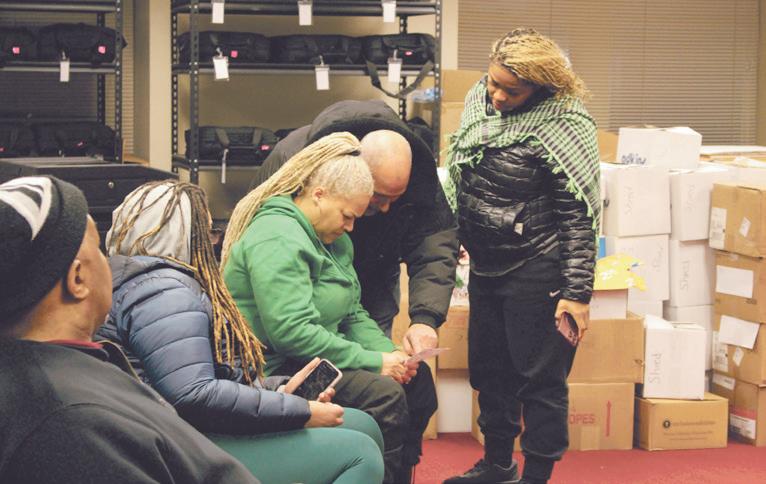
Last month, the Yale chapter of the American Association of University Professors launched a campaign calling on Yale to bolster its formal commitments to academic freedom. Faculty members wrote postcards to University President McInnis at the launch event, expressing their personal commitment to the issue.
The AAUP chapter’s website proposed revisions to the faculty handbook, with measures including an explicit definition of “academic freedom” and ensured faculty consultation for handbook revisions.
“For more than a year, President McInnis and I have sought to understand how best to steward academic freedom, a fundamental tenet of universities and one we are unequivocally committed to at Yale,” Strobel wrote in a Thursday email to the News. He did not respond to questions about whether the committee was formed in response to the AAUP’s campaign or the postcards addressed to McInnis.
Daniel HoSang, the chapter’s president and a professor of American Studies, provided a press release from the chapter in
which he is quoted as saying, “We welcome the administration’s recognition that academic freedom is the lifeblood of the university.”
“The committee will consult broadly with the faculty across all Yale schools, with the exact details of that process to be worked out when we begin meeting as a committee after spring break,” Huber wrote, noting that he hopes to “leverage the expertise and diversity of the committee” and “broader faculty.”
The release includes a statement from Amy Kapczynski LAW ’03, a Law School professor and member of the AAUP chapter’s Executive Committee, stating that “faculty need action, not statements.”
“Protecting academic freedom requires clear, enforceable protections and procedures, including processes through which alleged infringements on academic freedom can be adjudicated by faculty peers,” her statement said.
Jeff Wickersham, an associate professor of medicine, is quoted in the release critiquing the timeline of the committee’s efforts and the gap between recommendations and concrete protections.
Wickersham noted that the committee members seem “to have been appointed directly by the Provost and its membership,” and does not include “non-ladder faculty or assistant professors—groups that are among those most vulnerable to threats to academic freedom,” according to the AAUP’s press release.
Strobel described the committee as an “effort led by faculty for faculty, reflecting our belief that academic freedom should be stewarded in partnership with those who practice it,” with faculty members from across disciplines bringing varying experiences of academic freedom.
John Cohn, the executive director at the Law School’s Center for Academic Freedom and Free Speech, said in a Thursday interview that “every institution in the country needs to do a close look at its protections for free speech on campus and for academic freedom.”
Cohn served as a panelist at the AAUP’s academic freedom campaign launch event last month. He said that while the Law School center has “no formal relationship with” the faculty group, academic freedom is central to the center and the AAUP’s respective missions.
He expects to find “common ground” with the AAUP in future years.
“I’m certain that sometimes we’ll disagree on the margins too, but on this big picture question of, can Yale University do better, I think we would both say the answer is yes,” Cohn said.
He cited a 2023 federal court case, in which Cohn said the Uni-
versity argued that “the promises it makes with respect to academic freedom in faculty handbooks are too general to confer specific, legally binding protections.”
“Since they went to court to win on that grounds, now they need to look internally and commit to protections that will be binding, and this committee, I think, is a solid first step in that direction,” Cohn said, praising Yale leaders for their willingness “to be reflective” and “open minded” about improvements.
Among the committee’s members are Keith Whittington GRD ’95 — a law professor and the faculty director of the Center for Academic Freedom and Free
Speech — and Robert Post LAW ’77 — a Sterling professor of law and panelist at the AAUP’s campaign launch event.
“Our charge is to act as an independent body on behalf of the larger faculty,” Huber wrote, when asked about the committee’s independence. He noted that the committee could call on “the president or provost as needed” for “particular insight” at the committee’s discretion. Huber directs the Behavioral Research Lab at Yale’s Institution for Social and Policy Studies.
Contact ISOBEL M c CLURE at isobel.mcclure@yale.edu.
Tim Tai
The office of University Provost Scott Storbel announced on its website this week that a new nine-member faculty committee will produce a statement on academic freedom by the end of 2026. A
“Don’t
believe what your eyes are telling you. All they show is limitation.”
RICHARD BACH, JONATHAN LIVINGSTON SEAGULL
David Brooks rues state of conservatism in first talk as new fellow
BY ARIA LYNN-SKOV AND LEO NYBERG STAFF REPORTERS
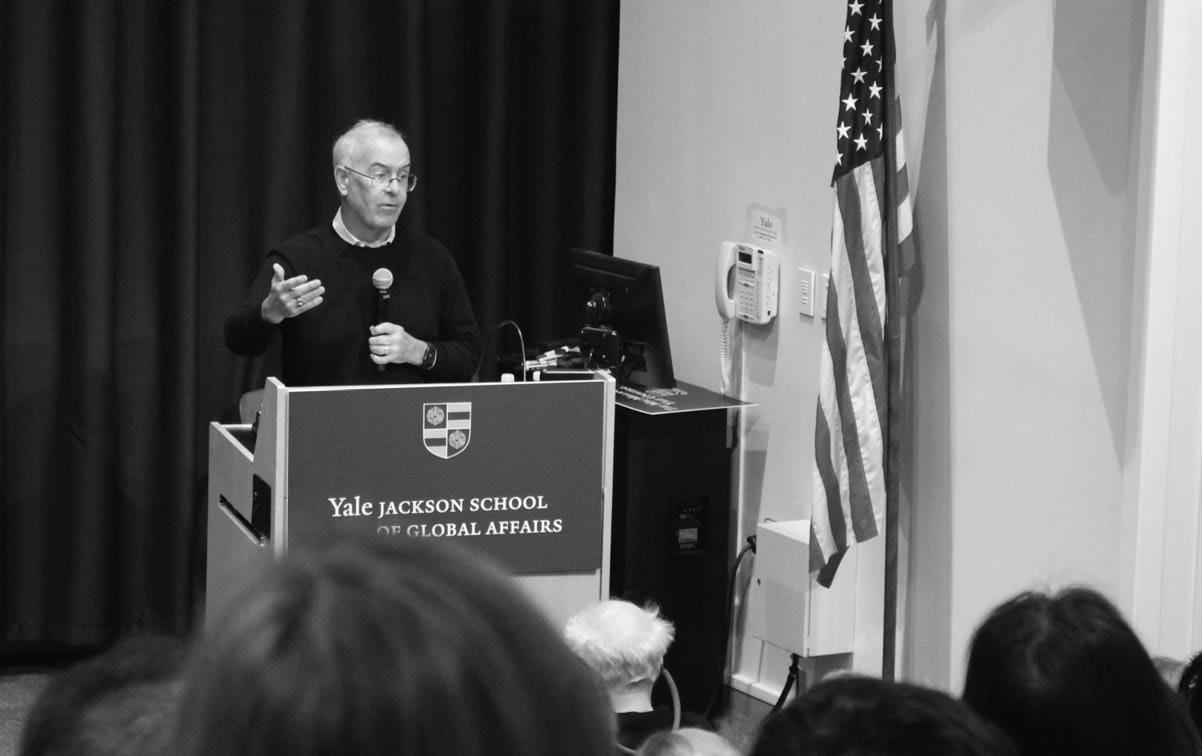
David Brooks, a former New York Times columnist and Yale’s inaugural presidential senior fellow, spoke about his views on conservatism to a full auditorium on Tuesday afternoon and spoke with a small group of students after.
At the end of January, University President Maurie McInnis announced that Brooks would be the inaugural fellow as part of a new program aiming to boost intellectual diversity at Yale and bridge the gap between the University and the broader public.
During his five years at Yale, Brooks will be hosted by the Jackson School of Global Affairs.
“The political project I sort of dedicated a large part of my life to — basically creating Alexander Hamilton-style moderate Republicans — that’s going great,” Brooks said sarcastically during his talk, eliciting laughs from the audience.
“And so I tell young people who believe the kind of conservatism I believe, it will come back. It’s a good thing to dedicate your life to keeping this intellectual tradition alive,” Brooks said. “But it won’t be in my lifetime.”
At the lecture, which was titled “Why, Despite Everything, I Still Call Myself a Conservative,” Brooks shared his intellectual influences and criticized the current Republican party. At the conversation after the event, ten students debated and asked questions about political philosophy, immigration and what it means to be a conservative.
To open the lecture, Jackson School Dean Jim Levinsohn outlined his and McInnis’ goals for the presidential senior fellowship.
“When I spoke with President McInnis about this project, we agreed that the goals would be five: First, to widen intellectual diversity; second, to nurture a culture of argument and discussion; third, to create a twoway highway connecting Yale and the Academy to the wider world; fourth, to showcase the resources of Yale to help people better understand their lives and their society; and last, to create and share knowledge widely,” he said. “There are few people better equipped to accomplish these goals than David Brooks.”
Levinsohn wrote in an email to the News after the event that McInnis first brought up the idea of the fellowship last semester. During the lecture, Brooks traced the history of philosophers whom he admired, including Edmund Burke, Alexander Hamilton and William Buckley Jr. ’50. Brooks said he is disillusioned by the current direction of the Republican party. Instead, he highlighted the principles of American conservatism he aligns with and the conservative thinkers he admires. Brooks, a self-proclaimed conservative “never-Trumper,” said in an interview last month that he plans to help bring more diverse opinions to Yale’s campus.
But after his lecture and smallgroup discussion, some students were unconvinced that Brooks provides the type of conservative perspective that is common in the Republican party.
“He doesn’t have a controversial opinion when
it comes to the big questions of our modern era,” Hekmat Aboukhater JGS ’27, a first-year student in the Jackson School, said in an interview after the events. “He’s on the mainstream when it comes to immigration, he’s on the mainstream when it comes to tariffs, he’s on the mainstream when it comes to voting against Trump.”
Aboukhater believes Brooks’ moderate ideology will not be an adequate spark for discourse and productive disagreement on campus.
“I disagree with Dean Levinsohn that he brings intellectual diversity to campus,” said Aboukhater.
“I thought David’s talk was fantastic. To me, anyway, it provided insight into how he came to the set of principles that guide him.” Levinsohn wrote after the lecture when asked if he believes Brooks will bring intellectual diversity to Yale.
“I can’t speak to whether others found that thought-provoking, but I did. I’m delighted he was so
open and honest. The goal here is to encourage conversations and I think today’s talk did just that,” Levinsohn added.
Rafael Gonzalez GRD ’27 said he came to the lecture and discussion because he heard Brooks was a great speaker but said Brooks was “cosplaying as a conservative.” Gonzalez said that Brooks doesn’t match the modern definition of conservative.
“He kind of has his own thing now,” Gonzalez said.
In a discussion with Aboukhater and Alejandro Domínguez GRD ’27 following Brooks’ conversation with students, Danielle Frankel ’26 said she was a fan of Brooks and was happy he was at Yale.
She disagreed with Aboukhater’s argument about Brooks’ potential ineffectiveness, stating that it is more important to find someone who can ask thoughtful questions that encourage healthy debate than to bring in a more controversial figure.
For Ethan Chiu ’26, Brooks’ take on conservatism was something new.
“I think that he presents a very different perspective on conservatism than I hear on the news, or that I read about,” he said. After the lecture, older attendees, including faculty members and Yale staff, said Brooks was a hit.
Gregg Chase, who works at Yale Printing and Publishing Services, said he appreciated hearing Brooks speak.
“His approach to conservatism made me rethink everything, because as far as I was concerned I couldn’t be more left,” Chase said. He expressed his frustration with the “screaming extremes,” and appreciated Brooks’s commitment to political discourse. Brooks’ next talk, scheduled for March 31, is entitled “How to be Ambitious Without Being a Jerk.”
Contact ARIA LYNN-SKOV at aria.lynn-skov@yale.edu and LEO NYBERG at leo.nyberg@yale.edu.
Heritage Foundation president criticizes liberalism at campus debate
BY SARAH RIVAS STAFF REPORTER
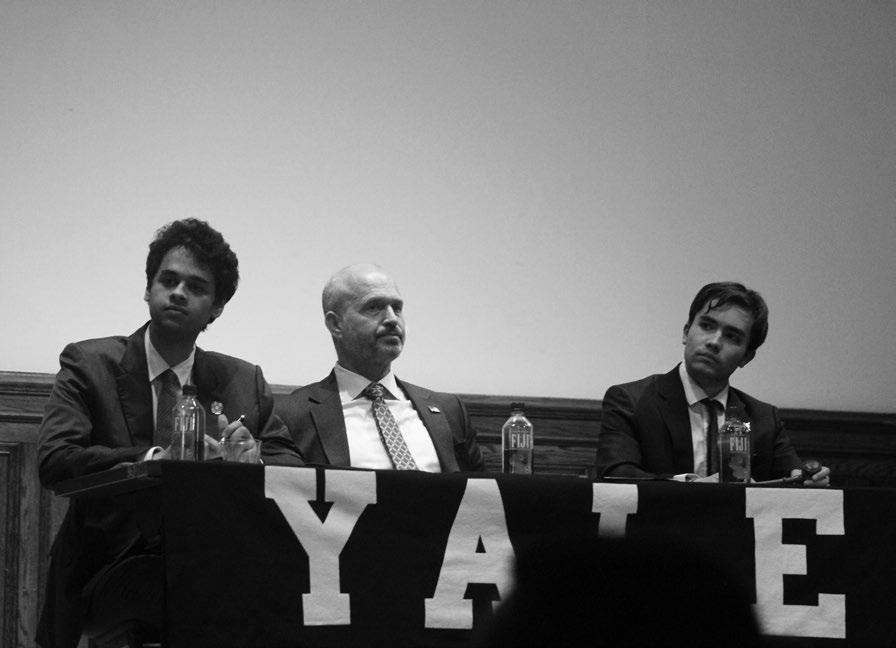
Kevin Roberts — the president of the Heritage Foundation, a prominent right-wing think tank — criticized American liberalism at a Yale Political Union debate this week.
Roberts spoke Tuesday evening in favor of the resolution “Liberalism Has Failed,” arguing that liberalism is “a movement of destruction” that has ripped “asunder the very fabric of
American life.” “Liberalism hasn’t merely failed. It has failed spectacularly, even embarrassingly,” Roberts said.
The Heritage Foundation is known for the 2025 Presidential Transition Project, also called Project 2025, a series of policy recommendations that have been regarded as an inspiration for the second Trump administration.
Roberts told the News that he estimated that Trump has implemented around 750 of Project 2025’s recommendations.
Roberts said that he condemned not “classical liberalism” but the “social and economic liberalism of the modern American left.” Liberalism, Roberts argued, has damaged “mediating institutions” such as the Boy Scouts of America, the military, the public school system and higher education.
“Think about colleges themselves,” he said. “With all due respect to you personally and to your very fine historic institution,
not excepting Yale University, modern liberals see institutions as vehicles of state power so they can impose their vision.”
When asked in an interview with the News why he chose to speak at Yale despite his critiques of higher education and particularly of Ivy League universities, Roberts said he still has hope for “institutional reform” to counteract “decades of institutionalized hostility” towards conservative students, maintaining that he still respects “the heck” out of the University.
Other charges Roberts leveled against liberalism were that it eroded the nuclear family, small businesses, local community, American power abroad and the dignity of the human person. Roberts also said that liberalism has “replaced religion with the state.”
As a consequence, Roberts argued that climate change has been a “religion of the left.”
Responding to the audience’s laughter, “Yes, the mastermind of Project 2025 came here to speak the truth.”
In November 2025, Roberts faced backlash for defending Tucker Carlson after Carlson conducted an interview with the white nationalist political commentator Nick Fuentes. Roberts later apologized and explained that he was not fully aware of Fuentes’ views, since he does not “have time to consume a lot of news,” according to The New York Times.
When asked by the News how he would respond to critics who argue that he should have been aware of Fuentes’ record of antisemitism before defending Carlson’s interview, Roberts responded that his “default is always to defend free speech.”
He added that at the Heritage Foundation, he has “actually led the
charge” to combat antisemitism.
“We need to be really careful about doing anything other than defending free speech. But what I learned is, if you’re going to do that, you’ve got to be really clear about the ideas that are terrible, in this case, particularly antisemitism, to say nothing of the terrible things he says about women,” Roberts said, referring to Fuentes.
After Roberts spoke at Tuesday’s debate, Riya Bhargava ’26 argued against the resolution, saying that Roberts misidentified liberalism as the “disease” that threatens society, rather than modern economic conditions and “unchecked markets.”
Raymond Perez LAW ’26 also defended liberalism, which he argued is essential as “a continuous project” that is “oriented towards equality under the law.”
Bryce Falkoff ’29, however, supported Robert’s resolution, arguing that liberalism lacks identity and a common goal. Falkoff suggested that “liberal movements should adopt civic nationalism” to combat their issue of “fragmentation.”
Roberts predicted that American voters would soon recognize and oppose the dangers of liberalism.
“The glorious thing about this debate is that when the 2030 census comes around, in the next presidential and congressional elections, Americans, whom you can always trust, will put an end to this nefarious modern version of American liberalism.”
The resolution proclaiming liberalism’s failure failed 27-37, with four abstensions.
Contact SARAH RIVAS at sarah.rivas@yale.edu.
In his first lecture as Yale’s inaugural presidential senior fellow, Brooks criticized the modern Republican party and discussed what influenced his own conservative beliefs.
“Believe in your infinite potential. Your only limitations are those you set upon yourself.”
For three Yale researchers with federal grants intact, snags remain
BY ANNA KOONTZ STAFF REPORTER
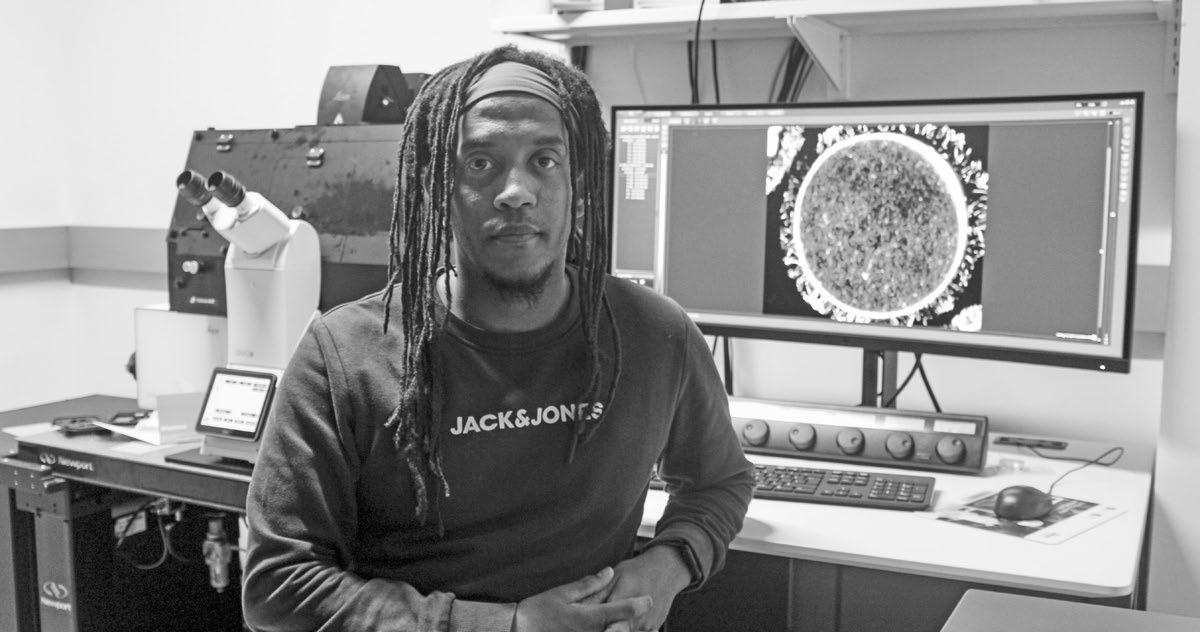
Nikhil Malvankar has dedicated over 20 years to studying how a common soil bacteria survives without oxygen. His research depends on the support of American taxpayers.
Despite the volatility of federal research funding during President Donald Trump’s second term, it continues to support researchers whose grants have remained fully or partially intact. Three such professors at Yale — who are currently receiving federal funds for studies ranging from molecular biophysics to reproductive sciences to cell biology — told the News that the funding has enabled their work, even as grant policy changes cause complications.
“I’m just really fascinated by this country and how much faith they have shown in basic science,” said Malvankar, an associate professor of molecular biophysics and biochemistry who is from India. “I just hope that going forward, we can continue keeping the faith.”
The first year of Trump’s second term impacted about 120 grants at Yale, including 50 terminated grants that were later reinstated, according to Michael Crair, Yale’s vice provost of research.
Labs currently receiving federal funding still experience the effects of recent policy changes — such as a longer application process for future grants and difficulties with international collaborations.
Bacterial breathing
Malvankar and his longtime colleague, researcher Sibel Ebru Yalcin, use federal funding from the National Science Foundation and Department of Energy to research how Geobacter bacteria survive without oxygen.
For bacteria living deep within the ground and ocean, protein nanowires act as “snorkels” that exhale electrons, Malvankar said in a Zoom interview. Understanding how the bacteria breathe has implications for environmental and human health.
“We were able to find something which is not just new from basic science, it also has a lot of applications to cure diseases and maintain our environment,” Malvankar said.
However, Malvankar said that Trump administration policy changes have “greatly affected” his lab’s work. Some of his funding
programs were cancelled or substantially reduced, he said, and program managers that he worked with for the past decade have now left federal agencies.
Malvankar said that research projects, even those without “immediate use in everyday life,” are opportunities to train younger scientists and provide a foundation for future discoveries.
He cited the decades of mRNA research that enabled the rapid development of COVID-19 vaccines.
In addition to federal funding, Malvankar noted that philanthropic foundations and private funding have been important in developing his research.
“They helped us to get necessary preliminary data, which allowed us to build a much stronger proposal to be competitive for federal research,” he said.
Reproduction lab relying on slower processes
Binyam Mogessie — an assistant professor of molecular, cellular and developmental biology and of obstetrics, gynecology and reproductive sciences — has dedicated his career to studying reproductive health.
“These are really timely problems,” Mogessie said in a
phone interview. “They just don’t wait even if you choose not to do the research.”
The Mogessie Lab receives federal funding from the National Institute of Health, or NIH, to research female meiosis and reproductive longevity. The lab studies the processes and failures of egg formation with the goal of improving assisted human reproduction technologies.
Beyond deepening our understanding of biology, Mogessie’s research has a “large consequential impact at the socioeconomic level,” he said. Extending female reproductive life would provide women with more flexibility when deciding when to pursue a career or start a family.
Federal funding currently enables the lab to maintain an average workforce of about six to ten people. Since grants only last for a few years, Mogessie is continually applying for new funding. He estimated that he wrote 12 or 13 applications in 2025 alone, half of which were for federal funding.
Complications with policy changes and government shutdowns slow the application and approval process, limiting researchers’ ability to secure funds, Mogessie said. But federal grants
remain unparalleled, he said.
“No one funds at the level of the NIH,” said Mogessie. “The loss of federal funding would be completely catastrophic to the American research landscape.”
Split from Irish collaborators
One of the least understood aspects of physiological regulation is how forces from gravity, muscle contraction and blood flow affect our tissues, Martin Schwartz said. The professor of medicine, biomedical engineering and cell biology researches the processes by which those forces affect the functions and behaviors of cells and tissues.
Schwartz’s research, largely funded by the NIH, contributes to the development of new treatments for disease.
“You have to understand the basic mechanisms in order to develop therapeutics. And working across that whole spectrum, from very fundamental to applied, is what I love about it,”
Schwartz said over Zoom.
Although Schwartz’s lab is wellfunded, he said policy changes under the second Trump presidency have limited his ability to work with international researchers.
Schwartz had been working with a lab in Ireland until it got “kicked off” the grant and lacked
funding to continue, he said. “The Trump administration simply decided that no NIH money was going to go outside the country.”
An increasing number of foreign researchers have also lost interest in coming to the United States, Schwartz said. Those that do wish to work in America can experience difficulties with visas.
One of Schwartz’s postdoctoral researchers recently visited his sick father in China and was not allowed to return despite having a J1 visa, he said.
Schwartz also expressed concerns about “political meddling that will distort who gets funded.” He referenced the recent discontinuation of vaccine research and closure of departments based on ideology.
At the same time, Schwartz is optimistic that “the political tide is turning.”
“After Trump’s attempt to drastically slash NIH and NSF budgets, Congress reinstated their budgets,” Schwartz said. “So resistance is building.”
The Malvankar Lab has offices on Science Hill and on Yale’s West Campus in West Haven.
Contact ANNA KOONTZ at anna.koontz@yale.edu.
With data and Yalie consultants, soup kitchen nearly triples meals
BY TED CLARKE CONTRIBUTING REPORTER
A New Haven soup kitchen last year boasted a 185 percent increase in meals, which its leaders attributed to a new datadriven approach to fighting food insecurity.
When a new executive director and board chair took the helm of the Community Soup Kitchen in January 2023, they set out to shrink the gap between meals served by local food banks and the total meals food-insecure residents needed. Since then, they have added five new
locations across the city and nearly tripled the number of meals they served, according to a February internal report provided to the News.
“I’ve never seen a soup kitchen run in such a way,” Xinzhi Qiu ’27, who has worked with a team of fellow Yalies to streamline the kitchen’s operations since August 2024, said. “Even some companies don’t run in such a data-driven way.”
Eleven of 16 city neighborhoods face poverty rates above 25 percent, according to a report by the local nonprofit DataHaven, leaving more than 16,000 residents food insecure even after accounting for Supplemental Nutrition Assistance Program, or SNAP, benefits and meals already being served by food banks and pantries.
Throughout 2023, the kitchen’s senior leadership drew on data from the city, the Connecticut Foodshare and DataHaven to calculate the number of meals that food insecure New Haveners needed but existing resources did not provide. According to the February report, this gap was approximately 2.5 million meals a year. The kitchen’s executive director, Winston Sutherland, and its board chair, Gregory DePetris, sketched out a threeyear plan — included in the February report — that would ultimately close 15 percent of the gap, or roughly 374,000 meals annually, by 2027.
The kitchen has operated
out of a hub at Christ Church, at 84 Broadway, for nearly five decades, Sutherland said in a Zoom interview. The kitchen offers free dine-in, takeout and delivery meals, as well as running public shower and clothing distribution programs, according to its website.
In April 2024, the kitchen launched its first sub-agency in the Newhallville neighborhood.
Within nine months, the subagency’s daily meals served grew from 40 to 230, according to the kitchen’s February report, which chalks the increase up to the success of the new neighborhooddriven model.
The kitchen now operates out of five neighborhood subagencies — in Newhallville, the Hill, Dwight and two locations in Fair Haven — plus its original downtown location. According to the report, the organization maintains an 87 to 93 percent program efficiency rate across the sites, which means that the vast majority of every dollar raised goes directly to food service.
DePetris also noted that the kitchen has expanded its food supply channel since implementing its new strategic plan.
“I think the success that we’ve had so far has attracted a lot of partners into the mix,” he said. “Recently, Trader Joe’s in Hamden made us one of the principal recipients of their food rescue program.”
Qiu collaborates with the kitchen through Yale’s Urban Philanthropic Fund, a student
investment organization that provides consulting services to local nonprofits.
In the past year and a half, Qiu and his fellow student analysts have helped build the digital infrastructure that replaced the kitchen’s pen-and-paper record keeping with real-time data dashboards, he said in an interview with the News. Qiu added that he has been impressed by the rapid pace of the kitchen’s expansion.
DePetris and Sutherland’s changes to the kitchen’s operations have coincided with cuts to federal assistance for food-insecure people. The federal One Big Beautiful Bill Act, which President Donald Trump signed into law last July, tightened SNAP eligibility requirements and reduced benefit levels nationwide.
“The second half of every month, we serve between 20 and 25 percent more meals than the first half of the month,” DePetris said, attributing the pattern to SNAP benefits running short before the month’s end.
Since the megabill’s enactment, the number of visitors to the kitchen has spiked, according to Sutherland. He noted that this heightened traffic may also stem from increased awareness of the kitchen’s services.
The Community Soup Kitchen was founded in 1977.
Contact TED CLARKE at edward.clarke@yale.edu.
XIMENA SOLORZANO / HEAD PHOTOGRAPHY EDITOR
Three Yale professors described their experiences with federal funding and some complications affecting their work.
“If there was no suffering, man would not know his limits, would not know himself.”
New Haven students lobby in Hartford for more public school funds
BY SABRINA THALER AND EVELYN RONAN STAFF REPORTERS
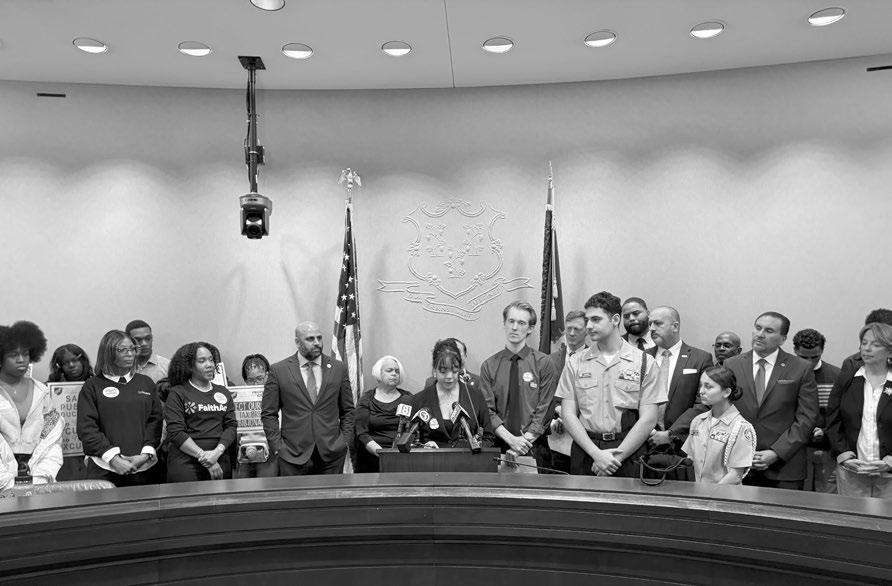
HARTFORD — The Legislative Office Building in Hartford was unusually busy on Wednesday, one month into the ongoing legislative session.
A throng of high schoolers visiting from across the state — including more than 100 New Haven Public Schools students — crowded underneath the vaulted glass ceiling of the building’s lobby, backpacks in tow. As teacher chaperones corralled the crowd, students approached Mayor Justin Elicker for photos.
For the second year in a row, the mayor’s office partnered with New Haven Public Schools to bring students to visit the state capitol and advocate for increased education funding from the state. According to Monica Abbott, the district’s social emotional learning coordinator who helped organize the trip, a total of 111 students traveled to the capitol, along with students from nine other Connecticut school districts.
This year, district advocacy focused on support for Senate Bill 7, “An Act Concerning Educational Equity,” on which the Connecticut General Assembly Education Committee held a public hearing Wednesday.
The legislation, which was sponsored by Senate President Pro Tempore Martin Looney, who represents parts of New Haven and Hamden, would raise the state’s per-student foundation amount for the first time in more than a decade — an update that New Haven education activists have long said would be necessary to achieve educational equity in Connecticut.
“Our local leaders have acknowledged that the urgency of this issue is serious. They have already taken steps to help allocate additional funding to our schools. But local action alone cannot solve a statewide problem,” Diana Robles, a 12th grader at New Haven’s High School in the Community and an intern with the New Haven Federation of Teachers, said at a crowded press
conference at the capitol Wednesday morning. Other speakers included Elicker, Hartford Mayor Arunan Arulampalam and the superintendent of Bridgeport Public Schools.
The legislation, which was designed to increase funding for public schools, would change the formula Connecticut uses to calculate per-student aid through the Education Cost Sharing formula. The central proposal of the bill is raising the formula’s foundation amount, or the baseline per-student cost used to calculate how much funding the district will receive.
The formula’s funding amount has remained at $11,525 per student since 2013, which means that schools are being funded with budget assessments that do not account for inflation and what districts say are rising staffing costs. According to a December report from the School + State Finance Project, these factors have grossly outpaced Education Cost Sharing growth.
Senate Bill 7 would raise the formula’s per-student foundation amount in increments of $1,000 each year until it reaches $15,500 in 2030. After that point, the foundation would increase at a rate proportional to inflation or increases in “personal income.”
State Senator Douglas McCrory, a co-sponsor of the bill, said the proposed increase would benefit school districts across Connecticut, including New Haven’s.
“Every school district will benefit from the ECS increase.” McCrory said in a phone interview. “New Haven’s benefit level will likely be in the neighborhood of $6 or $7 million.”
McCrory described the formula tweak as the first in a series of legislative moves to shift the fiscal burden away from local governments and revise existing state education policy.
“This is the beginning of a set of bills. There are other issues we haven’t addressed within this bill that need additional attention like special education,” he said. Only about 36 percent of Connecticut schools’ funding comes from the state. The majority comes from local property taxes, which advocates say leads to funding
disparities between urban districts like New Haven and wealthier towns.
On the bus ride up to Hartford, Ben Scudder, a history teacher at High School in the Community and a member of the New Haven Federation of Teachers, handed students American Federation of Teachers-branded stickers reading “Fix the Formula” and distributed copies of a one-page guide designed to help them advocate for the bill, which included an explanation of the formula. Throughout the ride, Scudder explained the details of the formula and Senate Bill 7’s proposal to different groups of students.
In an interview on the bus ride, Scudder said that increased state funding was a point of agreement for the city and its teachers union, which have had a history of “ugly debates” about public school funding on the local level, he noted.
“We all acknowledge — the Board of Ed, the district, the union, everyone — the fact is that we’re underfunded from the state,” Scudder said. “We have been for years, maybe forever.”
At a January budget forum, NHPS Chief Finance Officer Amilcar Hernandez claimed that if the formula were to reflect present-day inflation rates, it would increase to $16,000 per student. Scudder said that while Senate Bill 7 ensures it would near this value in 2030, its phased structure may push the district “behind the curve” in the intervening years.
In testimony to the Education Committee, Abdellah Aly, a student representative on the New Haven Board of Education, restated the $16,000 figure, noting that the difference between the current and inflation-adjusted per-student cost amounted to millions of dollars for big school districts like New Haven, leaving gaps school districts are left to make up. “Those costs don’t just disappear, but instead, the districts are forced to make difficult decisions,” Aly told the Committee. “They can increase class sizes, they can delay infrastructure improvement, they can reduce or get rid of academic support pro -
grams and put pressure on local property taxes.”
At least five New Haven students attending Wednesday’s event at the capitol described poor school infrastructure as an issue that increased state funding could help remedy.
Yahaira Roman, a senior at Wilbur Cross High School, referred to yellowed, water-damaged ceilings throughout her school. Her classmate, Anahy Nophal, described bathrooms with only one working water fountain. Justin Harmon, a spokesperson for New Haven Public Schools, told the News in an October interview that the district currently lacks the resources to be able “do regular, ongoing preventive maintenance” in its schools. Connecticut’s Education Cost Sharing formula took effect in 1989.
Contact SABRINA THALER at sabrina.thaler@yale.edu and EVELYN RONAN at evelyn ronan@yale.edu.
Alders debate administrators’ pay before OK’ing new school contracts
BY NELLIE KENNEY STAFF REPORTER
Alders clashed over a pay raise for school administrators as they voted to approve new union contracts on Wednesday.
In January, New Haven’s Board of Education voted unanimously to approve new contracts with the New Haven Federation of Teachers and the School Administrators Association. The teachers’ contract includes a 13.5 percent bump in teacher salaries over the next three years, as well as smaller class sizes and a new healthcare plan for teachers. The administrators’ contract includes a 9.6 percent pay increase in the next three years.
The contracts, which were approved by the Board of Alders, will take effect on July 1. While the teachers’ union contract received unanimous support, alders were split on
whether to approve a pay raise for administrators, with those opposed citing already-high salaries. Alders Elias Theodore ’27 and Sarah Miller ’03 urged their colleagues to oppose the contract. Ultimately, 18 alders voted in favor and 10 voted against.
Theodore, who represents the downtown Ward 1, explained that his experience as a student at Wilbur Cross High School in New Haven informed his vote. His Spanish teacher left the school partway through his junior year to take on a position in Norwalk that offered better pay and health care benefits, Theodore said.
He added that in his experience at Wilbur Cross, “assistant principal positions, those administrative positions, are highly sought after. And I think they are incredibly competitive with other urban districts in the state.”
“When we have a teacher shortage and buildings that are falling apart, I think the top is a logical place to, not even cut back, but just not increase spending,” Theodore said, adding that his position was “not a comment on these people’s contribution and performance.”
“We have a deficit,” she said of New Haven Public Schools.
“We’re struggling to cover really basic needs of the district, and under those circumstances, we should only do the things that we really have to do, that are focused on kids, and this to me is not one of those.”
At a Monday budget workshop,
NHPS Chief Financial Officer
Amilcar Hernandez said that the district has exceeded its current $213 million budget by $8.9 million and
has spent an additional $10 million on contract increases, leaving them with a total deficit of $18.9 million.
“Teachers’ contracts must be our priority, since it is they who teach our students, and we have faced critical shortages in the past few years. That said, most of our administrators also work in schools; they tend to be former teachers,” Justin Harmon, a spokesperson for the school district, wrote to the News. “Their new compensation package shows a lower rate of increase than does the teachers’. We are trying our best to be fair to all concerned and to keep our talent in New Haven.”
Ward 25 Alder Adam Marchand
GRD ’99, who represents Westville and chairs the board’s Finance Committee, acknowledged that school administrators make “really good salaries” but said that post-pandemic inflation justified “them getting strong raises.” The Finance Committee had voted to recommend the contracts for approval in February.
When Marchand thinks about the administrators’ contract, he thinks about the principals and assistant principals at his kids’ schools, he said.
“I know that the work that they do is critical. It’s a very difficult job,” he added.
Fellow Finance Committee member and Board of Alders President Tyisha Walker-Myers echoed Marchand’s sentiments.
“Everybody — it doesn’t matter how much they get paid — deserves a little more,” she said, adding that the union “negotiated a fair contract.”
Ward 9 Alder Caroline Tanbee Smith ’14 SOM ’25, who represents parts of East Rock and Fair Haven, also voted in favor of the contract. She said that because of inflation, administrators experienced “negative real wage change” despite increases in salaries in the previous contract.
“My understanding is the reason why it was marginally higher in part is because there were real wage losses over the last year’s contract,” she said. Alders agreed that teacher retention was a major concern for the district. New Haven is currently short on teachers. The New Haven Register reported in August that the district was entering the 20252026 school year with 87 certified teacher vacancies.
“I’m hoping that we’re able to retain teachers with more competitive wages, and that we are able to fill those vacancies,” Ward 13 Alder Mildred Melendez, who represents Fair Haven Heights, said. “Teachers are the most important part, right? We need someone in the classroom to teach kids.”
Marchand agreed, describing New Haven’s teachers as “underpaid” and noting that “we don’t have enough of them.” He said the school district’s teacher retention problem was “much like” the difficulties with officer retention that preceded a 2024 salary increase in the New Haven Police Department union’s contract.
In January, Mayor Justin Elicker said that the teachers union “drove a hard bargain,” gesturing to “real financial constraints” on the city, although he agreed that teachers should be paid more. On Feb. 27, Elicker presented a proposed city budget for the next fiscal year, which included a $5 million boost in funding to public schools for a total school budget of around $218 million.
New Haven Public Schools employs 2,500 full-time employees, according to the school district’s website.
Contact NELLIE KENNEY at nellie.kenney@yale.edu.
SABRINA THALER / CONTRIBUTING PHOTOGRAPHER
Over 100 New Haven high school students took buses to Hartford on Wednesday morning to advocate for state legislation that would update the state’s per-student education payment.
“The
Alder loses Democratic organizer role to wife of former opponent
BY NELLIE KENNEY AND GEMARD GUERY STAFF REPORTERS
A New Haven alder from the Hill will not continue to represent her ward as a Democratic Town Committee co-chair after a nailbiting election on Tuesday.
Democratic co-chairs — two for each of New Haven’s 30 wards — encourage voter engagement in their neighborhoods, help register voters and endorse Democratic nominees to local office. All but two wards’ co-chair pairs went uncontested this year.
But in the Hill’s Ward 3,
incumbents Angel Hubbard and Clarence Cummings faced off against challengers Sandra Pittman and Lisa Velazquez Torres. In Ward 29, which includes Beaver Hills, Bryanna Wingate and Betty Alford ran a friendly race against Alexandra Taylor and Jorge Lopes after the ward’s previous cochairs stepped down. In the last two years, Hubbard and Miguel Pittman, Sandra Pittman’s husband, have competed in three Ward 3 races — most recently an alder general election last November in which the two candidates traded cheating
accusations, the New Haven Independent reported.
Tuesday’s co-chair election was the first time Sandra Pittman had run for office, she said.
A red tent flanked by signs which read “YALE: RESPECT NEW HAVEN” faced a food truck from Pittman’s restaurant, Sandra’s Next Generation, outside of Career High School as voters went to cast their ballots.
Hubbard received 120 in-person votes and Pittman received 119 in-person votes. To the surprise of many, it seemed the two would serve together as co-chairs, splitting the two slates. In tears, Hubbard expressed relief that the Pittman-Hubbard saga had come to an end, with both apparently elected co-chair.
However, after absentee ballots were counted at City Hall, the winners in Ward 3 were Pittman and Velazquez Torres with 168 and 150 total votes, respectively. Hubbard received 19 absentee votes, and Cummings received 15.
“I knew that a lot of my supporters told me they were going to be here rain, sleet, or snow because they didn’t like what happened with my husband in the election prior with our name being smeared,” Sandra Pittman said in an interview following the announcement of her victory. “They were upset about that. People lost faith, people lost trust, but they are
Two alders want to cater to local caterers by lowering license fees
BY JESSICA HICKLE CONTRIBUTING REPORTER
As they push for licensing reforms, two alders have a clear message for city officials: It is too expensive to start a food business in New Haven.
Alders Caroline Tanbee Smith ’14 SOM ’25 and Sarah Miller ’03 are advocating for two specific policy changes that, if implemented, would significantly reduce the cost of obtaining a catering license for local businesses.
The alders’ first proposal would eliminate fee requirements for catering businesses in their first year of operation. Businesses would pay $250 in fees in subsequent years.
According to Tanbee Smith, catering businesses are currently required to pay a fee of $650 in their first year and $550 in subsequent years.
Rick Langerak, a Newhallville resident, said the proposed changes would be transformative for his nascent home baking business Bapple Pie, which specializes in Langerak’s native Dutch pies and cookies. After starting his business in October 2025, he said he cannot afford a catering license in New Haven at the current cost level.
“It’s just such a small budget. I would be broke right away,” he said.
Tanbee Smith and Miller’s second proposal earned its nickname, the Pickle Jar Permit, because it targets businesses selling consumer packaged goods, like teas, cereals, sauces — or pickles.
Under the current requirements, these businesses must pay the same $550 licensing fees as catering businesses to sell their products at venues like farmers markets or fairs. But advocates say these local requirements unnecessarily duplicate the rigorous state- and federal-level certifications that consumer packaged good businesses must obtain. The new proposal would waive these fees by creating a new licensing category for consumer packaged good businesses.
Hamden resident Kwame Asare, founder of Oh Shito!, a local brand of Ghanaian hot pepper sauces, said the city’s high fees deter him from selling at New Haven farmers’ markets.
“I would love to be able to return to the farmers’ market because that’s where my journey began. But the current licensing requirements have become a significant issue,” Asare said.
Tanbee Smith presented the two proposals at a meeting of the
Board of Alders Health and Human Services Committee last Thursday. She was joined by Langerak, Asare and at least a dozen other local food entrepreneurs and community members who voiced their support for the initiatives. Some carried colorful signs branded with the campaign’s slogan, “Best City to Start.”
“We’ve seen a spirit of buoyancy and joy and forward-looking momentum,” Tanbee Smith said of the group. “We hope to carry that energy as an increasingly larger coalition towards any policy or change that we want to see.”
Tanbee Smith has used her Instagram page to build support among business owners and the broader community. In a video posted last week, Tanbee Smith spoke with Bill Frisch, owner of the local bakery East Rock Breads, about how small businesses like his own help communities grow and flourish.
“It’s a gathering place for so many neighbors,” Tanbee Smith said in the video. “Through Best City to Start, we’re hoping to make it easier for entrepreneurs to start bakeries and other places just like this that we love.”
Business owners and community members can sign up for updates on the campaign through a link on Tanbee Smith’s Instagram page.
In addition to local business owners, Tanbee Smith and Miller have collaborated with officials from the New Haven Health Department to develop the proposals. Speaking at the Feb. 26 committee meeting, Brian Wnek, the city’s environmental health director, described the rigorous inspection process and requirements for catering businesses.
“Temporary food service operations follow the same code as food service establishments do, so the rules don’t change because the location changes,” Wnek said.
Tanbee Smith said the proposed fee reduction would not introduce any changes to the inspection process or requirements for catering businesses.
The proposal would also have little impact on the city’s bottom line. Tanbee Smith said in a phone interview that the fees account for only 0.00004 percent of the city’s $700 million budget.
In the long run, Tanbee Smith added, the reforms might result in increased overall revenue by enabling more businesses to start and grow. The bulk of the city’s revenue from permits, licenses and fees is derived from building permits.
starting to believe again.”
Pittman, Hubbard and Ward 3 residents all expressed exhaustion with the repeated competitive elections. Before the final results were tabulated, Hubbard said she was “over the whole ‘Pittman versus Hubbard,’” adding that she felt the focus on the ward had been lost, with neighborhood leaders unwilling to collaborate.
Stacie Jones, a Ward 3 resident, said she wished the separation between Pittman and Hubbard supporters could end and that the community could come together. She said she voted for Pittman, citing her longtime familiarity with the family.
“I love that she’s familyoriented and feels like family. If you’re lacking something, you could go there, and they’d help you,” Jones said.
Meanwhile, there was little drama in Ward 29. The four candidates stood bundled under a pair of tents outside Beecher High School during the day, talking with residents of the ward as they headed in and out of the polls.
Wingate and Alford — who received 115 and 105 votes, respectively — will serve as co-chairs. Taylor received 65 votes and Lopes received 63.
Wingate and Alford agreed that the biggest challenge facing the ward was affordability. Wingate, who is a member of UNITE HERE Local 34, the Yale
clerical and technical workers’ union, echoed recent union calls for Yale to significantly increase its voluntary contribution to the city to $110 million.
“They don’t pay taxes. So I think that is really important,” Wingate said, pointing to high rent costs and the 4 percent property tax increase included in Mayor Justin Elicker’s proposed city budget. Elicker has suggested that a bump in Yale’s contribution might allow for a lower tax increase.
After the votes were read, Taylor hugged and congratulated Wingate.
Taylor and Lopez each said that running was a “win” regardless of the outcome of the race.
“We met amazing people. We introduced ourselves. We sent a message out there that you can believe that there’s someone out there that loves where they live and would like to do amazing things there,” Taylor said.
Alford, who serves as the lead cook at Truman Elementary School, echoed the sentiment. All the candidates are “winners,” she said, “because we all still continue to fight.” Ward 3 is centered on The Hill neighborhood in southern New Haven.
Contact NELLIE KENNEY at nellie.kenney@yale.edu and GEMARD GUERY at gemard.guery@yale.edu.
New alder sworn in, filling downtown seat
“And how do we get building permits? That’s when small businesses actually have a fighting chance to start and actually occupy a storefront,” she said.
Tanbee Smith, who co-founded the local small business accelerator Collab in 2017, said the idea for the two initiatives grew out of her years of experience working with food entrepreneurs.
“I had the privilege to be able to work with hundreds of entrepreneurs in the city and one issue that came up over and over again when we were working with food entrepreneurs is the permitting and licensing process,” she said.
She has also taken inspiration from similar programs in other cities. Tanbee Smith cited San Francisco’s First Year Free program, which began in 2021 and waives permit and business registration fees for new small businesses. And, closer to home, Tanbee Smith said she has not identified a nearby city with higher licensing fees than New Haven.
Tanbee Smith and her allies hope that bringing fee requirements in closer alignment with other Connecticut cities will draw more entrepreneurs to New Haven.
“It will make it more allowable for food businesses and small businesses to start,” she said. “We’ll see more catering, more food business activity, more resilience.”
The Board of Alders Health and Human Services Committee will next meet at 6 p.m. on March 26 at City Hall.
Contact JESSICA HICKLE at jessica.hickle@yale.edu.
BY NELLIE KENNEY STAFF REPORTER
A downtown alder was sworn in Wednesday evening to fill a seat on the Board of Alders that has been empty since January.
Christine Kim ’99 was elected to represent Ward 7, which includes parts of downtown and East Rock, in a sleepy special election two weeks ago. The seat had been vacant since New Year’s Day, when former Alder Eli Sabin ’22 LAW ’26 stepped down minutes before his own swearing in. Kim, a community organizer and longtime New Haven resident, said she plans to focus on public safety and quality of life as she assumes her duties as alder.
“I’m a very opinionated middle-aged woman,” Kim said in an interview after her swearing in.
“However, I believe — and this is what I’ve talked to my constituents about — that I’m their advocate, and I’m their voice here. And so their priorities are my priorities.”
Kim said she has spent the past several weeks “talking about rents and how we can help our residents stay in our city.” Many love the city but feel they have “no choice” but to move elsewhere because of concerns related to affordability, public safety and quality of life, she said.
Kim added that she hopes to follow in the footsteps of a former Ward 7 alder, Frances “Bitsie” Clark, by supporting the arts, which she said are “pillar institutions in our community.” Clark, who died in 2025, was known for her patronage of local artists, according to previous reporting by the News.
In a brief speech following her swearing-in, Kim credited a 2021 phone call from Mayor Justin Elicker with inspiring her to become involved in the city.
Elicker asked her who he should reach out to about addressing antiAsian hate in the city, Kim said.
“I thought, well, there’s this Chinese church here, there’s this leader here, but there was not really a space or a group,” she said. Following the conversation, Kim reached out to Caroline Tanbee Smith ’14 SOM ’25, now the alder for Ward 9, and other community members, with whom she collaborated to found the pan-Asian collective called aapiNHV, she said.
“So that was the first time I really took a leap locally to get involved, and it’s just been an amazing, enriching, fulfilling part since then,” Kim said. “I blame you,” she added to Elicker.
Addressing Kim before her swearing-in, Elicker said she was “throwing herself into the fire.”
“It’s a thankless job, it pays virtually nothing, but it’s a really important job for the function of our city, so thank you for stepping up,” he said.
Tanbee Smith said she didn’t think Kim “needs advice” as she enters her first term.
“She’s new to this role, but she’s been a longtime advocate in the city and brings just tremendous experience, joy, vibrancy, creativity,” she said.
The ceremony took place in the Aldermanic Chambers on the second floor of City Hall.
Contact NELLIE KENNEY at nellie.kenney@yale.edu
COURTESY OF SADIE SCHOENBERGER Christine Kim ’99 took her oath of office in a brief ceremony at City Hall on Wednesday.
KIMBERLY ANGELES / STAFF PHOTOGRAPHER
Alder Angel Hubbard was voted out of her position as a Democratic Town Committee co-chair in Ward 3, where two challengers won instead.
MARTIN PERALTA / STAFF PHOTOGRAPHER Alders Smith and Miller have proposed licensing new catering businesses without fees for their first year.
SCITECH
“I want to live and feel all the shades, tones and variations of mental and physical experience possible in my life.”
THE UNABRIDGED JOURNALS OF SYLVIA PLATH SYLVIA PLATH
Yalies to pack a Bay Area house, seeking start-up investors
BY ANYA GEIST STAFF REPORTER
This summer, the Yale Entrepreneurial Society will launch its first hacker house in San Francisco to provide 12 undergraduate founders across all classes with the opportunity to work full time on startup projects.
In hacker houses, groups of entrepreneurs live together in shared spaces, working independently on their startups and connecting with nearby founders and donors.
According to student entrepreneurs like Leia Ryan ’28, Yale has a small startup scene compared to schools like Stanford. Founded by the entrepreneurial society’s presidents Ryan and Oliver Hime ’28, as well as Nicolas Gertler ’27, the house is meant to provide an opportunity for five teams of Yale students to pursue entrepreneurial projects.
“You’re in a really high-energy environment, where everyone is dedicating all they have to building their projects,” Ryan said. “And you kind of have this compounding effect of motivation and encouragement to just go even harder.”
The entrepreneurial society rented a six-bedroom house in Nob Hill, San Francisco, for late May through the end of July. In addition to spending the summer developing their projects, hacker house participants will network with other entrepreneurs and mentors in the Bay Area, Ryan said. In particular, she hopes that the participants will form strong relationships with local venture capitalists who could provide guidance, support and funding for the startup projects.
Ryan noted that the hacker house is mainly sponsored by Raymond Tonsing, the founder of Caffeinated Capital, a venture capital firm.
How hacker houses work
In venture capital, early-stage startups raise money and capital from investors known as venture capitalists. The investors hope their funding will help the startup to scale up quickly and provide big returns on their investment, Gertler explained. While venture capital can promote the rapid growth of startups, it is also a riskier form of investment for investors. In standard private
equity finance, entrepreneurs raise money slowly and financiers invest more cautiously, hoping for long-term returns.
Ryan said it was challenging to find investors to sponsor the hacker house itself, which does not provide short-term returns.
“Getting VCs to invest was kind of difficult, but you just have to find the ones that share the vision and share conviction” and “are kind of okay that it’s not going to necessarily increase their wealth,” Ryan said, referring to venture capitalists.
However, investors could indirectly gain returns farther down the line. If the startups from the hacker house grow, they will seek more investors — likely among the venture capitalists who helped with the hacker house.
That way, the hacker house serves as an incubator for startups, giving entrepreneurs dedicated time to work on their projects while familiarizing them with the “ecosystem” of San Francisco, Ryan said.
“It’s distinct from what’s offered in New Haven and even New York,” Gertler said, “insofar as there’s just sort of this mentality that you can build things, you can figure things out. You can really start a generational company there.”
Compared to other schools, such as Stanford or MIT, Yale has less infrastructure to support students building startups, Gertler said.
While groups like TSAI City offer programs for entrepreneurs, Gertler emphasized that those programs focus on promoting innovation more broadly rather than technical startups specifically.
In general, students at Yale direct their energy toward other professional fields, Gertler said.
“Too many smart people go into consulting and finance. We need more of the smartest minds going into technology and looking to build companies, not necessarily just venture companies, but companies in general,” Gertler said. “And there’s never been a more exciting time to build a company with AI. The barrier to entry is lower than ever, to build a product, get feedback, to iterate, to expand and grow.”
Ryan added that although schools like Stanford support many more student startups, this can make the entrepreneurial environment in those schools “saturated.”
Ryan explained that this may make it challenging for founders to find a clear path to growth. It also makes it harder to know which students take their project seriously, she added. At Yale, Ryan said she found it is easy to tell which students care about their startup projects, making it easy to select students for the hacker house.
“There was a very clear line between someone who was serious about it and someone who was not. And also most of the people who applied were serious,” Ryan said.
Who is joining the hacker house?
Ryan and Gertler will be among the students living in the hacker house this summer, along with Ariyan Patel ’29.
Ryan and her cofounder, Riya Bhargava ’26, created CORTEX, an operating system that aggregates data for biology labs. Instead of manually copying data from spreadsheets, this new technology would collect all that data in one place, making it easier to create graphs or additional statistics, Ryan said. Currently, Ryan said, CORTEX is working with Keck Mass Spectrometry, a biotechnology lab at the School of Medicine.
“We’re kind of considering ourselves almost like a Palantir for biology, in the way that we allow you to create this shared ontology, or shared map of your lab,” Ryan said.
Ryan said she is planning to take a leave of absence from Yale next semester to relocate to San Francisco and pursue CORTEX full time. She and Bhagarva aim to rent office space, hire their first three employees, raise an initial round of capital from investors, and build the software version of the app, Ryan added.
Choosing to take a leave of absence was a complicated decision for Ryan, who originally planned to pursue a PhD in cancer biology or computational bioinformatics, she said.
“I just simply don’t want to wait that long. And I think that this field is moving so fast, and that I already have so many ideas about how to address problems in it,” Ryan said.
Gertler and his cofounder, Lucas Santos ’27, are working on an entirely different project. Their startup, called Mylon, is an AI educational assistant, which can summarize, analyze and teach high-level content. Santos, the COO, started working with Gertler,
the CEO, in the summer of 2025.
In the spring of 2024, Mylon worked with Yale philosophy professor Luciano Floridi to create the Luciano Floridi Bot.
“We took the manuscripts of his entire academic career and we fed them into an AI agent, such that the AI agent could essentially answer questions based on his literature, or help researchers scan his literature to write a paper based on his work,” Gertler said.
Right now, Gertler described Mylon as being in “stealth,” meaning he did not want to release what the company is currently working on. However, he said that Mylon is focused on promoting democratized access to academic resources, particularly in an increasingly AI-involved world.
Ariyan Patel ’29 is currently working on a product called PATH, which stands for Pretty Amazing Talking Helper, a voice assistant that aids people with impaired vision. The project started when Patel was a junior in high school. With his cofounders, Kush Patel and Ron Sarany, both first years at Stanford, Patel created glasses that used a camera and voice directions to help users navigate objects while walking. However, over time, Patel and his team realized that their users actually had different problems than they anticipated.
“We figured out that the problem was just access to technology in
general,” Patel said. They created PATH, “a voice assistant that integrates into the apps and software used on a daily basis. It provides you their power entirely hands free.”
Over the summer, Patel will live in the hacker house, and his cofounders plan to rent a living space nearby. The team is hoping to develop PATH to be used in common apps like Gmail, Uber and DoorDash. They have already started meeting with a team at Microsoft that works in AI, Patel said, and are hoping to integrate PATH into Microsoft products.
Despite his hopes for PATH and the opportunities available in places like San Francisco, Patel said he was not thinking of taking a leave of absence.
“I really do want to keep going and apply the skills that I’ve been learning, and also start solving the problems I see around me full time because I love it,” Patel said. “But at the same time, on the other hand, I love the friends that I’ve made here in just these short eight months.”
However, Patel said that if he takes a leave of absence, there will be no going back. Right now, he does not feel ready to leave Yale just yet.
Nob Hill, San Francisco, is southeast of the Golden Gate Bridge.
Contact ANYA GEIST at anya.geist@yale.edu
For Yale’s second-year medical students, clinical training is underway
BY EDIS MESIC STAFF REPORTER
In January, many secondyear students at the School of Medicine began their clinical clerkships: a set of four 12-week interdisciplinary training blocks that let students apply their classroom knowledge to real patient care.
Clerkship blocks last from January to December, with each centered around specific themes, including internal medicine and neurology; surgery and emergency medicine; pediatrics, obstetrics and gynecology; and primary care and psychiatry. Before the new year, students could submit their preferred order for all four blocks to help shape their studies.
“People go through the blocks in different orders, but eventually we all go through the same general specialties within each of the blocks,” Miguel Fuentes MED ’28 said in an
interview with the News.
The decision to begin clerkships halfway through the second year of studies reflects a recent trend across medical schools to shorten the preclerkship period and accelerate the start of formal clinical training. While many schools still follow the traditional twoyear pre-clerkship format, a year-and-a-half period before clerkships is becoming more common, with a small fraction of schools even shortening studies to a single year.
During clinical clerkships, students transition from the classroom to the hospital or clinic and have the opportunity to apply the knowledge gained in their studies under the supervision of staff members and physicians. According to Fuentes, students can be assigned to a variety of sites ranging from as close as Yale New Haven Hospital to as far as Greenwich, Connecticut.
Fuentes explained that this variety of medical exposure can have its advantages and downsides.
On the one hand, students have the opportunity to learn from a wide array of resident and attending physicians. On the other hand, the training experience can vary widely by assigned site, with some prioritizing the learning experience more than others.
While the system is not perfectly standardized, Fuentes said that, over the year of training, things tend to “average out” to provide each student with a comparable experience.
For MD-PhD students like Alan Cooper MED ’32, clinical clerkships operate on a slightly extended schedule. While MD students complete all four core clerkship blocks over a year, Cooper said MD-PhD students complete two blocks before pursuing their PhDs and then return for the final two after four or more years of research.
Cooper added that clerkships can have their fair share of challenges. In his case, beginning with the pediatrics, obstetrics and gynecology block — where students cycle through new environments like the labor and delivery floor or inpatient gynecology each week — has been a learning experience.
“I think the pace is challenging because with each shift change, you’re getting a new team, a new attending physician, new diseases to study, new protocols. It can be a little jarring,” Cooper told the News.
Despite the brisk pace of clerkships, Stacy Ahn MED ’28 shared that the most meaningful part of her experience has been interacting with patients and seeing the information in her studies come to life.
“This is why I’m studying so hard. This is why I’m working so hard to make these patients better, and just being able to be part of that is really meaningful and a good reminder that being in this profession is truly a privilege,” Ahn said.
Fuentes has also found that his time with patients has had a profound impact on his medical journey. He has appreciated the process of connecting with patients and becoming someone to whom they feel comfortable talking.
Through clerkships, Fuentes said he feels that he is developing a “personality” as the doctor he will become.
Cooper also expressed that clerkships have given him the space to discover which fields of medicine interest him. He stated that his experiences in the operating room, outpatient clinics and inpatient medicine have given him a better idea of what direction he hopes to pursue in his future career.
Clinical clerkships follow 18 months in the pre-clerkship phase, during which students complete integrated courses, participate in interactive clinical workshops and pursue research and other extracurricular activities.
Looking back on her preclerkship experience, Ahn emphasized the flexibility of the Yale System of Medical Education, which encourages self-directed learning while also differing from the more structured nature of clerkships, where students follow the hospital or clinic schedule. Ahn said the shift in students’ ownership over their schedules can be an adjustment, but for her, it preserved the core value of self-directed learning.
“Day to day, you are interacting with your attendings, residents, and patients, and you’re the one telling yourself: ‘Okay, I need to learn this in order for me to better understand this patient and to feel like I can contribute to my team,’” Ahn said.
Ahn said that, as someone who took two gap years before beginning medical school, she valued the time to be a student again. Getting to know each of her peers’ diverse passions and backgrounds during preclerkship has been a highlight for her, she added.
While the clerkship period is fully dedicated to clinical training, students also have chances to gain hands-on clinical experience during preclerkship.
While operating on a busy schedule, Fuentes shared that his time before clerkships was also a moment to practice finding a balance in his time management. In his case, outside of classes, Fuentes recalls volunteering at the HAVEN Free Clinic, leading two ESL programs, pursuing research, rock climbing and finding time to visit his girlfriend and family.
Fuentes believes that preclerkship gave him the space to organize his activities meaningfully.
“I think what I’m most proud of is learning how to manage so many things at once, and learning to slow things down so that I can fit so many things into my schedule,” Fuentes said.
The School of Medicine was founded in 1810 as the Medical Institution of Yale College.
Contact EDIS MESIC at edis.mesic@yale.edu
COURTESY OF LEIA RYAN
Twelve Yale students will live together in a hacker house in San Francisco over the summer to focus on building companies while networking with local venture capitalists.
SPORTS
Poulakidas makes NBA debut for Dallas Mavericks, playing 14 minutes
MEN’S BASKETBALL
BY WALTER ROYAL STAFF REPORTER
John Poulakidas ’25 made his NBA debut on Tuesday evening, playing for the Dallas Mavericks against the Charlotte Hornets.
In his 14 minutes and 28 seconds on the court, he grabbed five rebounds and dished two assists.
The Mavericks announced on Sunday that Poulakidas signed a two-way contract, meaning that he will split his time between the NBA team and its G-League affiliate. Before signing with Dallas, Poulakidas shot 45 percent from three and scored 12.5 points per game in the G-League for the San Diego Clippers.
Against the Hornets on Tuesday, Poulakidas took the floor to start the second quarter, and the Mavericks immediately erased their 23-31 deficit with a 10-2 run. While a first bucket eluded him, his plus-minus of -7 was the
second best on the team in the 27-point loss.
Poulakidas is just the third Yalie since 2003 to play in basketball’s most prestigious professional league. Miye Oni ’19, the cousin of current Bulldog power forward Daniel Ogunyemi ’29, was the last to come directly from Yale. Danny Wolf, who transferred to Michigan following his sophomore season at Yale, was selected 27th overall by the Brooklyn Nets in the 2026 NBA draft.
The Mavericks, who currently rank 27th in the league in threepoint percentage and 29th in freethrow percentage, have just four healthy guards on their roster with Kyrie Irving out for the season. After releasing Tyus Jones and converting Ryan Nembhard’s two-way contract to a full-time deal, Dallas had an open two-way slot to give to Poulakidas.
Following his senior season at Yale, when Poulakidas led the Ivy League in scoring, he went undrafted and signed an Exhibit 10 deal with the Los Angeles Clippers. While he was
subsequently waived, that type of contract has a provision for G-League affiliation. The guard was designated as a G-League affiliate of the Clippers, allowing him to play for the San Diego Clippers, the minor league club for the Los Angeles team.
G-League affiliates are free agents. Any NBA, Euroleague, National Basketball League or otherwise professional team may offer a contract to an affiliated player, who would have no obligation to deny the offer.
The lack of exclusivity is what allowed Poulakidas to sign with Dallas, but his new contract is less flexible. Unless he is waived, Poulakidas will be with the Mavericks organization for the rest of the season.
For a full season contract, a player may play up to 50 games for the major league club, and receive a salary equal to half the rookie minimum, according to the NBA’s collective bargaining agreement.
In the 2025-2026 season, a twoway player would earn $636,435 for a full season. If this contract is signed partway through the
season, both the salary and game limit are prorated. Poulakidas’ contract thus allows for up to 12 games on the Dallas Mavericks and a $153,622 salary.
Dallas will play the Orlando Magic on Thursday and the
Bulldogs to host Princeton, honor three seniors in final home game
MEN’S BASKETBALL
BY BRODY GILKISON STAFF REPORTER
The Yale men’s basketball team (22–5, 10–3 Ivy) is set to host the Princeton Tigers (9–19, 5–8 Ivy) on Saturday for the team’s final home game of the season.
Having already clinched the regular season Ivy League championship, the game will be a chance for one final tuneup before the team heads north to Ithaca, New York, with hopes of punching their ticket to March Madness for the third straight year.
While this weekend’s game holds no significance for conference seeding, which was finalized last weekend, the events leading up to the game may be the highlight of the day.
Three seniors — guard Devon Arlington ’26, forward Casey Simmons ’26 and team captain Nick Townsend ’26 — will be honored on the court alongside their families.
“I’m really grateful and blessed to have been part of this team and to attend a place like Yale,” Arlington
wrote to the News. “It’s been an amazing experience the past four years, and I couldn’t have done it without my teammates, coaches, family, and everyone who’s supported me along the way.”
Last spring, the senior class of John Poulakidas ’25, Bez Mbeng ’25, Jack Molloy ’25 and Teo Rice ’25 set the school record for most wins as a class, having won 85 games in four years. Now, this senior class will own the new record, having won 87 games already, with plenty of opportunities ahead of them to increase that number.
In this the class of 2026’s first season, the Bulldogs fell to Princeton in the Ivy League championship and were left out of the Big Dance. Since then, Yale has advanced to the NCAA tournament each of the past two seasons and is currently the favorite to represent the Ivy League once more this year.
“We’re excited to play Princeton at home since we lost to them,” Simmons said, referring to a January game in which the Bulldogs fell, 60-76. “We’re trying to make the necessary strides towards winning the Ivy tournament so we can
PHOTOGRAPHY EDITOR
LIZA KAUFMAN,
After the men’s basketball team already clinched its second consecutive Ivy League championship, three seniors will be recognized before a matchup with Princeton on Saturday.
make it back to the NCAA tournament. And beating Princeton on our senior night is the first step.”
Yale tips off against Princeton at 2 p.m. on Saturday at the John J. Lee Amphitheater.
Contact BRODY GILKISON at brody.gilkison@yale.edu.
Bulldogs to face Princeton in final regular-season game
On the heels of a 57-45 win over Cornell (8–18, 3–10) over the weekend, the Yale women’s basketball team (7–19, 3–10) will play its final regular-season game against Princeton (23–3, 11–2) on
Saturday.
Senior captain Kiley Capstraw ’26 and Mary Meng ’28 both had a double-double versus the Big Red. Meng, a transfer student from Michigan State, has now
scored in the double digits in two consecutive games. Alongside Columbia (20–6, 11–2), Princeton is the No. 1 seed in the Ivy League. The Elis lost to the Lions by 21 points on Friday,
ATHLETICS The women’s basketball team will travel
an improvement from their last matchup, when the margin was 27 points.
Yale outscored Columbia in the first quarter 16-12 but could not hold the lead after that in the second quarter. The Lions extended their margin in the third quarter, outscoring the Bulldogs by 18 points. The Elis were unable to make up the deficit in the fourth quarter.
In the Bulldogs’ last faceoff against the Tigers, they lost to Princeton, 50-76, due to a below-average scoring night by Ciniya Moore ’28 and Capstraw. Princeton has the top-scoring offense in the Ivy League, averaging 73 points per game, while Yale averages 58 points per game. The Bulldogs will need to try to keep the Tigers’ offense at bay and have an above-average scoring night in order to pull out a win.
While the Elis have had an underwhelming season in Ivy League play, they have a chance to get redemption against the league’s top team. However, this game will be even more difficult, considering that Princeton will have home-court advantage over Yale.
Yale will play Princeton at 2 p.m. on Saturday in Princeton. Contact TANNER BATTLE at tanner.battle@yale.edu.
Boston Celtics on Friday.
Poulakidas wears No. 1 for Dallas.
Contact WAKTER ROYAL at walter.royal@yale.edu.
YALE ATHLETICS
The former All-Ivy League sharpshooter made his NBA debut on Tuesday in a 90-117 loss to the Charlotte Hornets.
WOMEN'S HOCKEY
BY AUDREY KIM STAFF REPORTER
The No. 7 Yale Bulldogs (24–8, 16–6 ECAC) will face off against the No. 11 Cornell Big Red (20–10–2, 13–7–2 ECAC) on Friday in an ECAC semifinal game in Lake Placid, New York.
Yale and Cornell will be competing for a spot in the ECAC championship game, which is scheduled for Saturday. The conference champion earns an automatic bid to the NCAA playoffs.
“We are excited to build off of momentum this past weekend and have the opportunity to compete for the ECAC playoff championship alongside our regular season title,” Sophia Levering ’28 wrote to the News. “While in league bragging rights are the main focus of the weekend, a ticket to the NCAA tournament as well as potential at large bids are also up for grabs (3/4 semi final teams are currently in position to make the tournament).” No. 8 Quinnipiac (26–8–3, 14–6–2 ECAC) and No. 9 Princeton (23–9, 16–6 ECAC) will face each other in the other ECAC semifinal on Friday, and both teams’ sights will also be set on a postseason title.
The NCAA women’s ice hockey tournament includes 11 teams that face off in a single elimination tournament. Five teams will qualify automatically for winning their conferences, and the remaining six teams are selected via at-large bids.
Yale is currently ranked No. 7 in the U.S. College Hockey Online poll — the highest of all ECAC teams. No. 1 Wisconsin, No. 2 Ohio State and No. 4 Minnesota all play in the Western Collegiate Hockey Association, No. 3 Penn State belongs to the Atlantic Hockey conference, while No. 5 Northeastern and No. 6 UConn play in the Hockey East.
Yale, No. 8 Quinnipiac and No. 9 Princeton are all currently in a position to receive bids to the NCAA tournament, but the playoff picture could fluctuate as teams across the country finish out their conference postseasons.
“While it’s fun to talk and think about league championships and NCAA possibilities, ultimately we need to win the period in front of us and focus in on details that have gotten us here,” Levering wrote.
The Bulldogs have been an unstoppable force for the past few months, recording zero regulation losses in 2026 and only one overtime loss to Quinnipiac.
So far this regular season, Yale has played Cornell twice, losing one game and winning the other.
However, the Bulldogs avenged that loss when the teams faced off again at Ingalls in January.
The upcoming semifinal game will be different from the regular season matchups in that the game will take place on neutral ice in Lake Placid. Yale finished as the regular season champions and clinched the first seed in
Bulldogs to face Colgate Raiders in first-round playoff match
MEN'S HOCKEY
BY LIZA KAUFMAN STAFF REPORTER
The Yale men’s hockey team (8–21–1, 7–14–1 ECAC) will return to the ice this Saturday when the squad plays No. 7 seeded Colgate (12–18–4, 9–10–3 ECAC) in the opening round of the 2026 ECAC Men’s Hockey Tournament.
After celebrating the seniors and concluding regular season play at home last weekend, the Bulldogs will travel to Hamilton, New York, to take the ice at the Class of 1965 Arena for a single-elimination opening round matchup.
While every team in the conference earns a spot in the playoffs, the top four teams in the ECAC — No. 1 Quinnipiac (26–7–3, 17–4–1 ECAC), No. 2 Dartmouth (19–7–4, 13–5–4 ECAC), No. 3 Cornell
(20–8–1, 15–6–1 ECAC) and No. 4 Princeton (15–12–3, 11–9–2 ECAC) — earned automatic byes to the quarterfinals, which will be held from March 14 to 15. In the first round this weekend, the remaining eight teams will vie for spots in the quarterfinals.
On Friday night, No. 6 Harvard (14–14–2, 11–10–1 ECAC) will host No. 11 St. Lawrence (7–24–3, 6–15–1 ECAC) in Boston, and No. 9 Rensselaer Polytechnic Institute (11–22–1, 8–13–1 ECAC) will play No. 8 Clarkson (15–16–3, 9–10–3 ECAC) in Potsdam, New York. On Saturday night, two Ivies will seek to come out on top in New York. While the Elis face the Raiders, No. 12 Brown (5–23–2, 4–16–2 ECAC) will leave Providence to take on No. 5 Union (21–10–3, 11–9–2 ECAC) in Schenectady, New York. These single-elimination games have high stakes, as many of the teams will seek to seize the playoff opportunity to recover from their losing seasons.
In the quarterfinals, the winner of Union-Brown will play Quinnipiac, Harvard-St. Lawrence will face Dartmouth, Colgate-Yale will take on Cornell and Clarkson-Rensselaer will battle Princeton. The four surviving teams will advance to Herb Brooks Arena, site of the 1980 “Miracle on Ice,” with an automatic berth to the NCAA tournament on the line. The semifinals and championship game will take place at the Lake Placid Olympic Center on March 20 and 21, respectively. Last season, Quinnipiac, Cornell, Clarkson and Dartmouth made the trip to Lake Placid. Quinnipiac was seeded No. 1, Clarkson No. 2, Dartmouth No. 5 and Cornell No. 6. Upsets happen in this tournament, as last year proved. Cornell, the underdog, came out on top in the championship game. After a first round bye, Cornell earned its spot at Herbs Brooks Arena following an upset over No.
3 seeded Colgate. The Big Red soundly defeated the Raiders 4-1 and 3-0 in Hamilton for a sweep straight to the semifinals. With the odds against them, Cornell edged out top-seeded Quinnipiac in an overtime thriller to secure its place in the trophy game. In the championship game, two unanswered goals early in the first frame proved critical to the squad’s 3-1 victory over No. 2 Clarkson.
Looking to Cornell’s underdog victory as inspiration, the Bulldogs will seek to replicate Cornell’s success over Colgate this weekend. When the Bulldogs and Raiders first met in November, Yale nearly beat Colgate in Hamilton. The Elis came out hot, with Micah Berger ’28 tallying the first goal 13 seconds into the game. A late Colgate power-play goal knotted the game. In the second frame, the Raiders took the lead at 1:06, but 18 seconds later, the Elis answered right back when Donovan Frias ’28 drove it home. Ronan O’Donnell ’28 cashed in on a pow-
er-play five minutes later to give Yale a one-goal lead. However, a Colgate goal in the final frame tied it up and sent the game into overtime, where the Raiders came out on top. To close out January, the Elis hosted the Raiders at Ingalls Rink. Once again, Yale took an early lead when Kurt Gurkan ’29 potted his first collegiate goal. In the second frame, Will Richter ’27 extended Yale’s lead to 2-0, but two backto-back from the Raiders equalized the score. A four-goal offensive surge in the third period sealed the victory for the Raiders. For Yale to steal one in Hamilton, the Bulldogs will need a fast start and disciplined special teams, especially against a Colgate squad that has shown an ability to flip momentum late in the game. Colgate will enter the matchup after a split weekend at home. On Friday night, the Raiders fell to the Clarkson Golden Knights 1-4. Following a scoreless first period, the Golden Knights came out flying, putting up the first goal of the game 49 seconds into the second frame. Colgate equalized the score three minutes later, but two more unanswered Clarkson goals sealed the victory. Another Clarkson goal in the third period capped off scoring. However, the Raiders bounced back and showed resilience on Saturday night against St. Lawrence. The Saints tallied the first two goals, but the Raiders answered right back. In a two-minute span, Colgate netted three of their own to take a one-goal lead. At 17:20, St. Lawrence tied it up. In the second frame, the Raiders’ offense found the back of the net three more times while the defense held the Saints scoreless. Entering the final frame up 6-3, a power-play goal at 15:45 finished the game 7-3. While Yale enters as the underdog, the Bulldogs have twice pushed Colgate to the brink this season. In a single-elimination setting, a fast start and disciplined defensive effort could be enough to flip the script.
Puck drop is at 7 p.m. in Hamilton. Contact LIZA KAUFMAN at liza.kaufman@yale.edu.
The Elis fell to the Big Red in a frustrating loss on Halloween in Ithaca, ending the game down three goals to zero despite tallying double Cornell’s shots on goal.
YALE
LIZA KAUFMAN
WEEKEND
get ready with me
// BY STEPHANIE ALTSCHUL
A common occurrence: Sitting on the heater in the corner of my suite, makeup still done and an essay unwritten, I open TikTok to decompress from a long day of skipping lectures and socializing. The first three videos I see, perhaps the fault of my algorithm, are influencer “Get Ready With Me” clips that weave together product placement, brand promotions and girl talk. I cannot help but think that self-care, a term that could gesture to anything from knitting to botox, has gone too far.
I won’t bore you by listing the dozen new beauty fads of the past two days, like thousand-dollar red-light devices and serums that promise to reshape your face while you sleep, because it is self-evident that the selfcare industry is gargantuan. It primarily targets burntout women and individuals managing McKinsey-level work-life balances on a McKinsey-level salary. Self-care feeds our individuality complex in all its forms. The term literally places Self before Care, which provides some linguisting food for thought. There really is no community to be found or empathy to be developed in three hours spent in front of the mirror. The modern, neoliberal self-care is concerningly self-obsessed. The term “self-care” was coined by Black feminist activist Audre Lorde as a radical attack of the status quo. “Caring for myself is not an act of self-indulgence,” she wrote in her 1988 essay collection “A Burst of Light.” “It is self-preservation, and that is an act of political warfare.” While battling cancer and fighting for inclusive liberation, Lorde advocated for self-care insofar as it let her live another day despite a system’s desperate effort
to wear her down. Time spent on oneself is time spent away from the office, so in a way this trend represents an anti-capitalist sentiment that we should carry into the twenty-first century. Prioritizing skin care over money could still be radical.
I’m trying to find this disconnect. Self-care no longer feels like preservation. It’s exhausting. It’s oversaturated with trends and buzzwords and must-buy products. Rather than a respite from the office, self-care constitutes another full-time job.
Still scrolling, I find a video with, as of March 3, 5.2 million likes. The “Get Ready With Me” from TikTok influencer @manelparletrop begins as Manel, looking as though she just underwent an intensive reconstructive facial procedure, removes an elastic jaw compression strap from her face and peels her overnight face mask off. After using 42 products in her morning routine, she changes out of her pajamas and concludes the video. I look at the caption. Manel has tagged the brands of every product she has used, starting with chin strap and ending with mascara.
Much of modern self-care is more tame than these overproduced and sensationalized videos. It serves many purposes — feeding our cultural obsession with vanity, to be sure — but also it acts as a more accessible, and many times more affordable, alternative to health care, especially for women. This emphasis on preventative care is backed up by science, but it can quickly turn from healthy to paranoid. If I, running from a horde of costly medical issues, apply just one more Magic Dream
Youth serum, will I be saved?
Indeed, part of the appeal of these self-care practices lies in control. Through elaborate routines, we curate our own appearance as much as the one we present to others, vanity displays doubling as social signaling. In every example I’ve listed, women are at the center of this industry. Beyond the unnecessary consumerism that plagues the selfcare trend cycle, the actual act of self-care takes hours.
In a world where our time is measured in “productive hours” defined by our labor contributions to the economy, the self-care industry increasingly keeps women caged in “idle” hours, separated from work and excluded from social mobility under capitalism.
So where did Lorde’s version of self care get lost in this consumerist shuffle? Political rebellion aside, modern self-care focuses entirely on the consumable. To force a homophone, we’ve replaced care for one’s soul with care for one’s sole.
In 1808, Charles Fourier wrote that, “Often, when we think we are merely enjoying ourselves, we are involved in political processes of the highest importance.” To reduce this philosophical musing to a pithy aphorism, joy is radical. Capitalism has convinced us that we exist as isolated economic agents, but community care could be, perhaps, the best self-care. In other words, wine nights with the girls might be the next cure-all face mask. Care for yourself, yes, but not selfishly.
Contact STEPHANIE ALTSCHUL at stephanie.altschul@yale.edu.
The music of letting go
Looking back on The Strokes’ “Ode to the Mets
// BY REETI MALHOTRA
Julian Casablancas, the frontman of The Strokes, penned the lyrics to “Ode to the Mets” while waiting for the 7 train after the New York Mets lost to the Giants in the 2016 Wild Card game. The ode is the sixminute finale to the band’s Grammy-award winning album, “The New Abnormal,” and possesses a visceral quality I can’t quite articulate, one that somehow makes me crave both fresh air and a cigarette.
Casablancas was a longtime Mets fan. But as Sports Illustrated’s Stanley Kay notes in a 2020 interview with Casablancas a month after the album’s release, the song has little to do with baseball.
It appears to be more about loss — loss and love that never ceases to disappoint. Kay cites the band’s drummer, Fabrizio Moretti, for the ode’s alternative meaning. The song evokes “something that you set your heart to and that you love unconditionally but that continues to disappoint you,” Moretti says in a 2020 video interview.
I agree with Moretti and, despite my best efforts, can’t stop listening to it.
According to my Spotify streaming data, I played it at least 37 times during a three-day span last week. That figure feels conservative. As a whiny story I posted to my Instagram close friends can attest, I stayed awake until 2 a.m. on a Tuesday night listening to it on repeat. I just couldn’t turn it off. I still can’t.
But there’s more to the song than my ceaseless streaming and fixation.
The Strokes, formed in New York City in 1998, have a skill for expressing the existential dread that comes with standing on the cusp of adulthood, relinquishing the liberty of youth and trudging into a life burdened with responsibility. But they are careful to avoid overt sonic melancholy. The band layers pensive lyrics atop a garage rock revival sound that keeps their audience’s blood pumping.
“Is This It,” the first song of the band’s debut album, ruminates on the singer’s apathy and exhaustion, not knowing where to go in life; finding himself in the same, unfulfilling relationship that promises more than it delivers. By its conclusion, Casablancas is no longer asking for an answer to the song’s title. “Is this it?” becomes a rhetorical question, a cynical, morose statement.
“Ode to the Mets” is no different in
its lyrical focus. It perhaps typifies The Strokes’ familiar, melancholic questioning. But it feels different, because released 19 years after the band’s debut, it is especially painful to still be musing upon the same yet again.
As Casablancas croons through his typical gritty, disaffected and intense vocals during the bridge: “Gone now are the old times … Old friends, long forgotten … The only thing that's left is us, so pardon the silence that you’re hearing.”
Casablancas expresses the grief of getting older and life changing in a way one would not expect. Or at least that is how I find myself interpreting his lyrics as a 20-yearold waiting to go on spring break, enervated by the semester and frustrated that I am. We have four years here — I am two years in. I should relish it all more, but I’m just so tired. But Casablancas does not succumb to his exhaustion. The Strokes’ frontman channels his sentiments into his musicmaking. The final lyrics of “Ode to the Mets,” reflecting on the “deafening, painful, shameful roar” that has become the backdrop to life, is an act of recognition rather than defeat. Casablancas accepts that disappointment and loss are the price of caring for something truly and deeply. It’s a trade off he’s willing to make. It is this feeling that transforms Casablancas’ gritty croon into a form of comfort for me. Beneath Casablancas’ visceral weariness is a steady persistence. Even as the guitars swell, the rhythm steadies, and Casablancas sings about the inevitable, overwhelming sorrow of life, the song still moves forward. As do we.
Disappointment is a guarantee in our lives. Some people try to bury that fact; others run from it. Occasionally, someone channels the sentiment into something else entirely: a poem, a painting, a six-minute song that a 20-year-old college girl will listen to while wallowing in her disappointment, looking for a way to free herself from it.
If disappointment is unavoidable, “Ode to the Mets” tells us to do something with it: Feel it, let it overwhelm us and to transform it. Hope, persistence and art are all we have — that’s not a bad lesson to live by at twenty.
Contact REETI MALHOTRA at reeti.malhotra@yale.edu.
COLUMN Lend Me Your Ears:
// BY CIELO GAZARD
Does popular music of the 2020s have a unified aesthetic? What makes music from our current decade sound like “today?” Much of the Top 40 sounds like it’s been done before. Music from the last six years seems to resemble and be inspired by the trends of Y2K club music, ’80s synthpop and ’70s pop rock. The most defining aspect of 2020s music is that there is no uniquely identifiable aesthetic.
Borrowing from musical trends from decades past and reviving old songs, the 2020s is the era of misremembered nostalgia.
With music streaming services like Spotify and Apple Music, an artist’s entire discography is at one’s fingertips. Social media apps like TikTok and Instagram have revived decades-old songs, putting them back into the zeitgeist for a new generation. Due to its inclusion in the series “Stranger Things” and the consequent TikTok videos, Kate Bush’s 1985 single “Running Up That Hill” reemerged in 2022 as a long-dormant hit. I have been a massive fan of Bush since 2019 after watching her “Wuthering Heights” music video on YouTube, so it was gratifying to see everyone I know finally discover her after “Running Up That Hill” went viral.
Resurgence of an older song after its inclusion in a TV show, movie or advertisement is nothing new. But the sheer number of trending audios on TikTok that come from older songs is new. Even new songs are callbacks to other recent hits. The song “Say So” by Doja Cat, one of the biggest and most viral songs of 2020, is a callback to ’70s funk and disco. More recent hits are even taking inspiration from “Say So,” as some music critics have pointed out sonic similarities between it and Sabrina Carpenter’s 2024 smash “Espresso.”
Hit songs are built around earlier musical trends. Then they’re the basis for later hit songs. What does this say about what the music industry is looking for in the next smash hit? TikTok has drastically changed the way artists promote their music. Many pop artists have called out the industry for its overreliance on getting a “viral moment” and pushing them for a quick snippet of their next single to go viral on TikTok. The marketing teams at major labels are fully aware of the power of social media and its ability to revive old hits.
We are living in an epidemic of sampling and interpolation. Sampling is an artform that few producers and music-makers have mastered. But some recent hits like David Guetta and Bebe Rexha’s nauseating “I’m Good (Blue)” with its painfully obvious sample of “Blue (Da Ba Dee)” demonstrate how virality and listener recognition may matter more than innovation. At the same time, however, I think that if a newer artist builds a new song around an already proven hit, it only makes the listener yearn for the original song. Similar backlash was seen with Doechii’s “Anxiety” which blatantly sampled Gotye’s “Somebody That I Used to Know,” even though the original song is built around a 1967 bossa nova instrumental: “Seville” by Luiz Bonfá.
There is still innovative, potentially decade-defining pop music being released in the 2020s. The easiest and most cited example has been Charli xcx’s “Brat.” While informed by 2000s club music, “Brat” has punctured the zeitgeist and stands alone as a unique musical and commercial achievement. Looking beyond the Top 40 on the Billboard charts or the TikTok algorithm, one will find a vast array of songs by artists carving out a sound of their own.
This decade isn’t the only one that has been criticized for relying on previous hits. The current critiques aren’t new or groundbreaking. What is different is the sheer number of pop icons who have “daughters,” broods of newer artists who take clear inspiration from their predecessors. 2000s pop stars like Britney Spears and Avril Lavigne’s aesthetics and music have influenced musicians like Tate McRae and Olivia Rodrigo. Even some very new singers like Addison Rae are already inspiring recently viral TikTok stars like Mckayla Twiggs. Since anyone can upload a video on TikTok, anyone can piggyback on the trends and aesthetics of an already established artist.
Usually, the passage of time boils decades of music down to a handful of “classics.” There has been “bad” and uninspired music in every decade. The 1980s were not all synthpop. The 1970s were not all disco. The 2020s are not all rehashing and reviving trends and aesthetics from prior decades. When the dust settles on our current time, who knows what musical trends musicians of the future will take inspiration from, or whose pop daughter lineage will reign supreme?
Contact CIELO GAZARD at cielo.gazard@yale.edu.
WEEKEND RECOMMENDS: LISTENING TO MUSIC ON THE SUBWAY
MAIA WILSON
WEEKEND GROWING UP
ESSAY
Listen to your inner child
Why I still live for my younger self.
// BY HANA TILKSEW PERSONAL
I’ve always felt oddly haunted by the thought that everyone else is growing up while I stay the same. Sure, I’ve gotten taller over the years. My voice is lower and my wisdom teeth have come in. But my inner world is still relatively unchanged since childhood. And don’t think that was a happy accident: I’ve made a conscious effort to stay the girl I once was. My childhood friends and I were artistic nerds that wrote short stories together and talked about book characters like they were our pals. We wrote original songs and performed them at a frightening
PERSONAL ESSAY
pitch on the playground. At the time, several of us said we’d grow up to be creatives. Now, I’m the only one of the group actually pursuing a creative field. When we got older and I discovered that most of the girls who acted out scenes from “Frozen” and illustrated “Dork Diaries” knockoffs with me were now pre-med, I was befuddled. Was I the only one who truly meant what we said in that third grade classroom? Was I the only one who took it all seriously?
The promises I made to myself in elementary school — that I would become a writer, that I would dress like a character out of my favorite video game “Style Savvy,” that I would never date a loser — come to the forefront of my mind the minute I’m tempted to break any of them. Overwhelming
guilt that washes over me when I consider relaxing any one of these guidelines. Should I change my major from English? Should I give that guy a chance? 10-year-old me would say no, so no it is.
On the outside, I’ve definitely changed. I wear my hair differently and talk to strangers. But these differences are less about evolution and more about self-actualization. My approach to personal growth has never been about changing who I am, but about becoming closer to who I have always felt I was. Being a child felt like a cage in which I was never free to express myself fully. There were school dress codes and authority figures’ rules to adhere to. Now that those barriers between my inner self and my expressed self no longer exist, I’m free to make the choices that I’ve always wanted to.
Others have criticized me for my rigidity. I’ll admit, there are possible downsides to my approach to life. Maybe my childhood self was an idiot without enough experience, and her worldview can’t help me do anything meaningful with my life as an adult. Maybe my life’s calling is to be a surgeon and there’s no point in denying it just because 10-year-old me would be offended at the prospect. Maybe it’s a waste of time to let a juvenile’s taste rule your life.
But consider this: Christ said, “Unless you turn and become like children, you will never enter the kingdom of heaven.” Louise Glück wrote, “We look at the world once, in childhood. Everything else is
memory.” If the child me was the most lucid, upright, blessed form of me, why would I not listen to her?
I stumbled on a series of childhood photos last night and cried. I cried because the girl in those photos has come a long way and she would be endlessly happy if she knew who the 20-year-old version of herself had become. What’s the alternative? Being confronted with your childhood self and crying out of regret? Knowing that a more optimistic version of yourself had a certain vision for your life, and you allowed something as silly as pragmatism to disrupt those dreams?
No thanks. I’ll stick with my inner child.
Contact HANA TILKSEW at hana.tilksew@yale.edu.
Suffering and opportunity
On being a first-generation student
// BY ESMERALDA VASQUEZ-FERNANDEZ
My mom ran for her high school’s track and field team and survived El Salvador’s civil war. Her classes were interrupted by routine bombings and torched schoolhouses. My dad survived extreme poverty and did not graduate middle school. He worked at a factory in Mexico City once his family realized he could only find work in the city, not in their town. They survived. And somehow I’m the one who got the opportunity to go to college.
In high school, I ran cross-country and track, like my mom — except I sported carbon-plated shoes at races. I’ve been to Mexico City, but when I went I bought local artisan cuisine without thinking too much about the price. My first job was at a beach shack called The Stand, and the hardest part was taking out a 25-pound bag of compost around the back. When I couldn’t read, and my parents couldn’t help me with my first grade reading assignments, they got me a tutor. I grew up in the suburbs of Orange County, California, where I didn’t have to worry about bombings.
At 14, I thought I had it hard making acai bowls for $14 an hour. My first car was a 2002 Jaguar that I bought for $2,000 and got picked on for having. When I was 18, I became a server and thought I’d learned the art of working a real job. But no matter how hard I thought I worked, or the fact that I maintained a 4.0 GPA throughout it all, my parents were working 12hour days of manual labor. I knew I couldn’t change that by working extra hours or repaying my parents for the privilege of thinking I had it hard.
Around a year ago, I finished working a full shift at Ike’s Love & Sandwiches and then ran to an extended family dinner. My sleeves were still wet from washing
dishes for hours when I arrived at the table. I’d found out a couple weeks before that I’d gotten into Yale. My cousin, who wasn’t able to graduate high school, congratulated me on my college acceptances. She said it must be nice to like school.
For the first time in my life I questioned if I deserved the opportunity in front of me. I had never thought about it. Had I earned the privilege of attending school? Why did I get to work an easy job? Why was I the one from my community college to get accepted to Yale? Why, of all the industrious and hardworking people in my family, was I the one to go to an Ivy League school?
I smiled and thanked her. I knew that my parents didn’t have the luxury of asking if they deserved the few things they had. I had the luxury of looking the gift horse in the mouth.
There’s pressure that comes with the opportunity to break generational barriers. Navigating an
unfamiliar world is daunting. For most of my time at community college, the stress kept me on a strict regimen that offered little space for creative outlets. I do not regret living so rigidly because I
can’t confidently say I would have gotten into Yale otherwise.
In my “Life Worth Living” course at Yale, I have learned to see hardship in a different light. Some people suffer hardships. Some people don’t. There’s no reason behind it; that’s what makes it so frustrating. My mom is stronger than me. My dad has a better work ethic. My entire extended family works harder than me, just to make a living, while I panic over having to write a fivepage essay. I felt inconvenienced by my fast food job and somehow was still deemed worthy of the opportunity to pursue an education, even though I’m not the best candidate, not even within my own family.
I could spend the rest of my life questioning whether or not I deserve the opportunities set before me. But what good would that do? Questioning why I’m the one who found a path to education won’t help my more deserving family members. Opportunity and suffering are random. It’s not about who deserves what.
My parents survived immense hardship so that I could have the opportunities I do. I won’t take that privilege for granted.
Contact ESMERALDA VASQUEZ-FERNANDEZ at esmeralda.vasquez-fernandez@yale.edu.
CULTURE
How ‘looksmaxxing’ became a powerful punchline
// BY PETER BURNS
Are you ready to ascend, bro? Are you prepared to take any means necessary to maximize your sexual market value and optimize your canthal tilt and bizygomatic width? If not, you will wither.
This is the language of “looksmaxxing,” the internet movement that preaches an objective standard of physical beauty for men and offers strategies to achieve it, many of which are strange and clearly unhealthy.
The recent cultural proliferation of “looksmaxxing” did not come out of nowhere. It is the convergence of internet culture, online memes and the ever-present danger of toxic masculinity. At its core lies a recognizable, yet questionable, anxiety: Where can young men locate objective standards in a world that they perceive to be discounting them in all respects?
Stable and infallible criteria for success and self-worth become paramount, especially within incel culture and the manosphere — a space dedicated to the narrative of male victimhood at the hands of women who do not want to go out with them. Looksmaxxing offers a way out, a way to ascend and embody the ultimate form of beauty.
Internet “gym bro” culture is woven into the fabric of looksmaxxing. I want to preface my argument by saying that there are many positive aspects of gym culture that I celebrate and believe others should, too, but in this current moment, it is impossible and dangerous to ignore the vices. The “gym bro” ecosystem plagues social media with heavy lifts and sculpted physiques that align closely with traditional visions of masculinity.
The message is consistent: You have the power to transform your body and look like these people, but you fail to make it a reality. What could be empowerment to make a change is instead antagonism. To become something that you are not, you must recognize that you are less than — worse than — the ideal.
In this way, self-optimization has been politicized. Physical insecurity is a proxy for broader grievances propagated by the manosphere. Feminism and shifting gender norms allegedly eroded the natural advantages of the male sex, and so, by investing in male physical appearance, adherents to looksmaxxing reclaim a supposedly lost glory. This language of “ascending” and “maxxing” is a therapeutic fantasy.
Kick streamer and internet personality Clavicular, whose real name is Braden Peterson, is responsible for the recent attention to looksmaxxing. According to an article by Joseph Bernstein in The New York Times, Peterson uses drugs, cosmetic surgery and hormone therapy to optimize the features that he and other looksmaxxers value. A viral tweet posted by the account @chromheart600 also helped catalyze the looksmaxxing movement, using language that can only be described as opaque nonsense: “jestergooning,” “foids,” “chadfishing,” “SMV.” Packed into this comical jargon is a dog whistle to members of an in-group coded by shared ideology.
That very nonsense drives the movement’s virality because it is so overtly ridiculous. Like the “6-7” meme of 2025, the joke is that there is no intended joke. There is no satire or angle that produces humor. Mere repetition manufactures meaning out of the meaningless.
Online linguist Adam Aleksic, with the handle @etymologynerd, has argued that Clavicular embodies this pattern: Looksmaxxing presents itself in an overwrought, self-serious manner, turning its inherent emptiness into a punchline.
The very fact that this language is meaningful to some people only serves to underscore the absurdity of it all. “Mogging,” which means defeating someone in a battle of looks, maps victory, already an abstract and context-bound concept, onto beauty, itself a culturally contingent notion.
This fad is just “Zoolander” in real life.
I am fascinated by the reaction to looksmaxxing’s newfound prominence. I think that the internet’s tongue-in-cheek tolerance of it on account of its ridiculousness arises because of the aesthetics of common sense. Our shared yet tacit linguistic norms and narrative expectations govern ordinary discourse.
When looksmaxxing hit the scene with its shock factor, laughs and finger-pointing abounded. That reception is precisely why it gains traction. Looksmaxxing exists in a dialectical relationship with mockery. It exists to be made fun of, clinging like a parasite to internet discourse. As a result, everyone who engages with this content is ultimately furthering it, which is the ultimate goal of the incel ideology in the first place: to be recognized as a force in the world, despite the feeling that the world is working against them.
Contact PETER BURNS at peter.burns@yale.edu.
HOROSCOPES
// BY KIVA BANK
A lone sunbeam gleams through the stained glass of Sterling, gracing seasonally depressed Yalies with the barest hint of warmth. Temperatures — and spirits — are slowly rising. Conditions are ripe for the mayhem that is to ensue during the spring break “Euro” trip that’s really just Greece, Italy and one night in Paris.
People came back from winter vacation with new hair cuts, glasses and trench coats worthy of the Yale mantle. What will they return with from spring break? Probably nipple piercings, a botched butterfly tattoo and hazy memories of a drunken make-out session.
Go forth, and make ol’ Elihu proud. Here’s what your spring break horoscope says about you:
Aries
You are stuck on vacation with your ex-situationship because you are both in the same a cappella group. As if singing together wasn’t bad enough, you now have to share the same hotel in Jamaica. You can’t enjoy the scenic beaches without evil lurking in the background of every Instagram photo. Take this as a personal lesson to never again engage in a cappella-cest.
Taurus
The prospect of sunny weather in a Puerto Vallarta resort is the only thing that has gotten you through the dreary winter nights in the stacks. Unfortunately, your flight got cancelled at the last minute and thanks to the cartel violence, so did all the others for the foreseeable future. Looks like the beach bod you’ve been working on will have to wait until the summer. At least you can enjoy spending hours on the phone with the airline company trying to get a refund.
Gemini
You’re sad you have to go home and won’t be able to gossip with your friends in the dining hall during break. The dining hall workers need a respite from all the overheard conversations about blowjobs and post-naked party threesomes. And you need to hide from the opps for two weeks.
Cancer
You thought everyone goes home for spring break, but you’ve just realized that everyone has plans to travel to Puerto Rico or Miami or Daytona Beach for the millionth time. Oh dear. You’ve suddenly become aware that Yale is an elitist institution and class distinctions are real. You sweet, sweet summer child — literally. Time to wake up and smell the trust fund-scented roses!
Leo
Everybody is getting cuffed to cope with cabin fever, and you’ve been caught up in the couple craze. You’ve been seeing someone and aren’t sure whether the relationship will last over spring break. You’ve never been good at long distance … or sharing your feelings, but things are getting serious. You can close the distance — emotionally — but not physically. Let’s hope that exclusivity crosses state lines.
Virgo
You made plans for spring break. Then rescheduled, dealt with people flaking left and right, booked the flights and made the reservations. With your travel dates fast approaching, you thought you could finally rest. Despite all your carefully laid plans, you forgot your passport back in your hometown: Nowhere, USA. Good luck making it to Guatemala.
Libra
You just found out that your friends have ditched you for a trip to Japan. Turns out they’ve been planning this “lastminute” vacation all along with your spit sister. They’ve clearly chosen sides in the war for a mediocre douchebro. You’ll have a hard time beating her targeted Kyoto thirst traps while you’re stuck in New Haven.
Scorpio
At this point, all of your New Year’s goals have been completely abandoned. No amount of blocker apps can stop your phone addiction. Enjoy the next two weeks of doomscrolling and living vicariously through the Instagram stories of your Type A vacation planner friends.
Sagittarius
You’ve been slacking this semester and can’t answer the ever-present question asked in all superficial encounters: What are your plans for the summer? You will spend the next two weeks scrambling to find an internship or a fellowship or an externship while your classmates are on cruise ships through the Caribbean, sponsored by the J.P. Morgan internship they secured last year.
Capricorn
You already had a two-week internship lined up for spring break months ago. Unfortunately, your pride will quickly fade once you realize you’ve committed to crunching numbers for 80 hours a week when you could’ve been spending your parents’ money on piña coladas in Bermuda. Sigh. Nepotism just isn’t the same anymore. You have to actually work these days.
Aquarius
Your epic spring break plans involve binge drinking on St. Patty’s Day. With the luck of the Irish, you’ll find your way to a frat at a random state school so you can enjoy a real party. Not like these lame functions the nerds at AEPi throw. The jello shots were a nice try, although Guinness would have been a better choice — not that they know how to split the G or find the G-spot.
Pisces
You matched on date drop with your TF. Yikes! You’ve been avoiding them in lecture lately, but fortunately you’ll be in a different country for the next two weeks forgetting that they exist. Just don’t check your Canvas notifications.