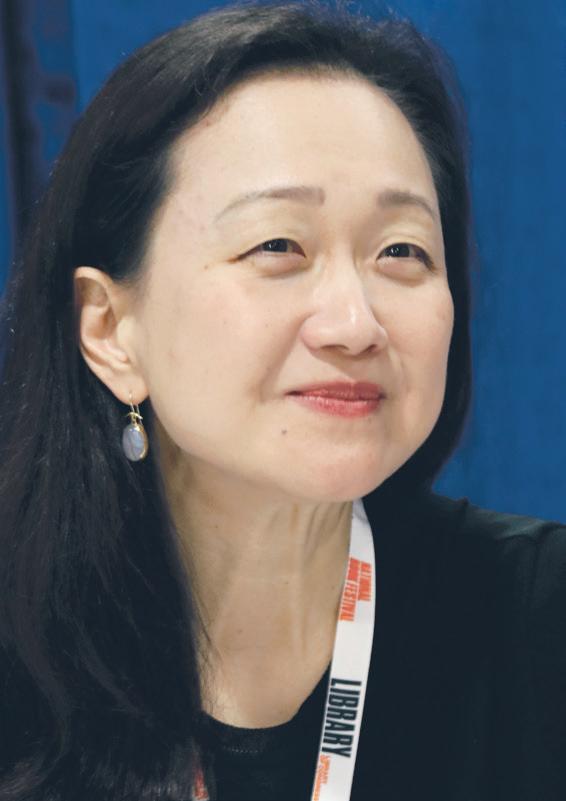
The novelist Min Jin Lee ’90 will be the 2026 Class Day speaker, Yale announced Monday. Lee is best known for her 2017 novel “Pachinko,” which was a finalist for the National Book Award. She was born in South Korea and moved to New York with her family when she was 7. A former student in Trumbull
Thousands attend ‘No Kings’ protest
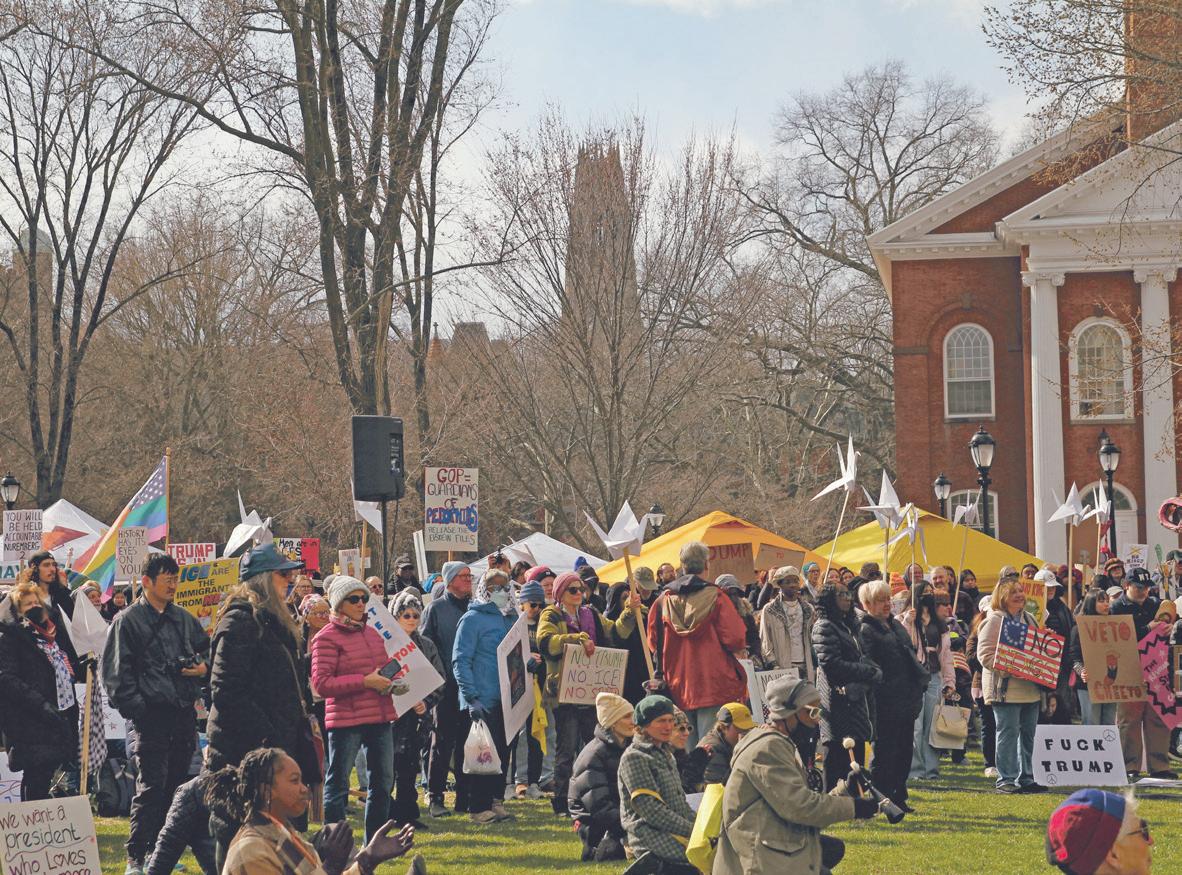
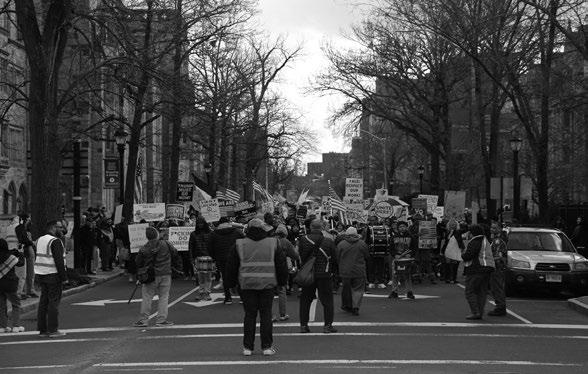
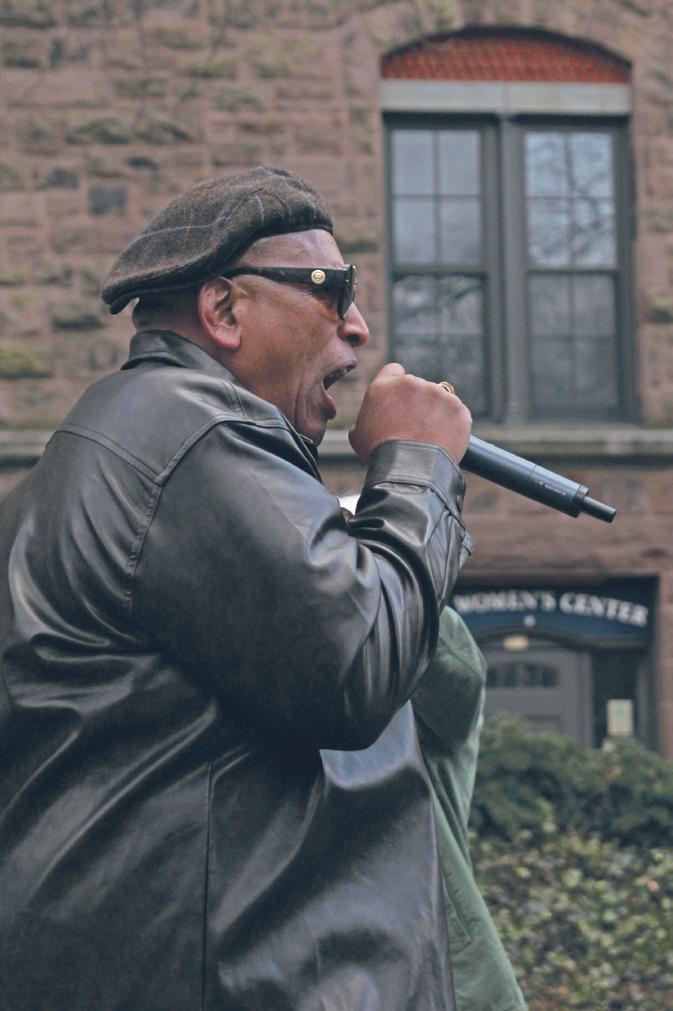
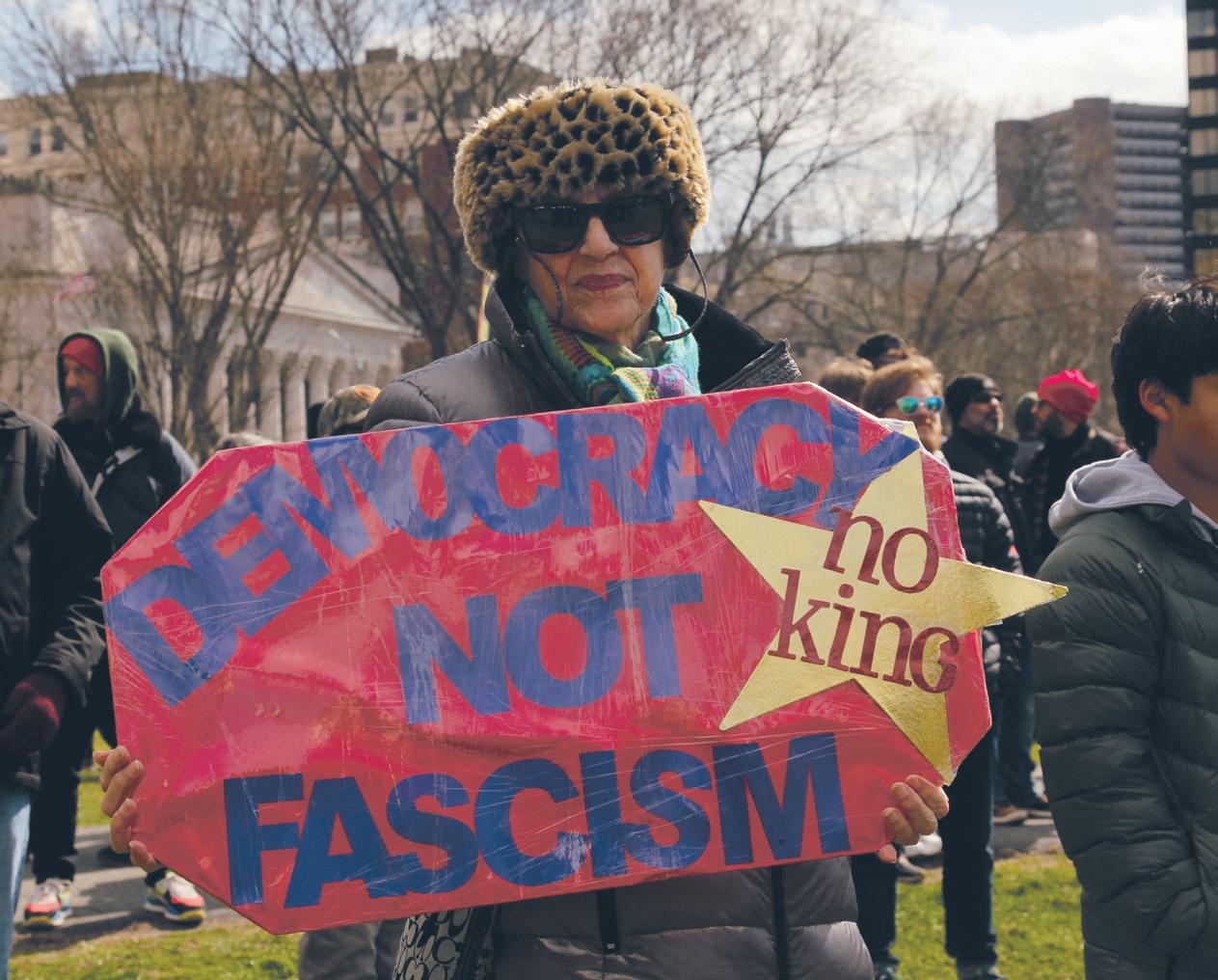
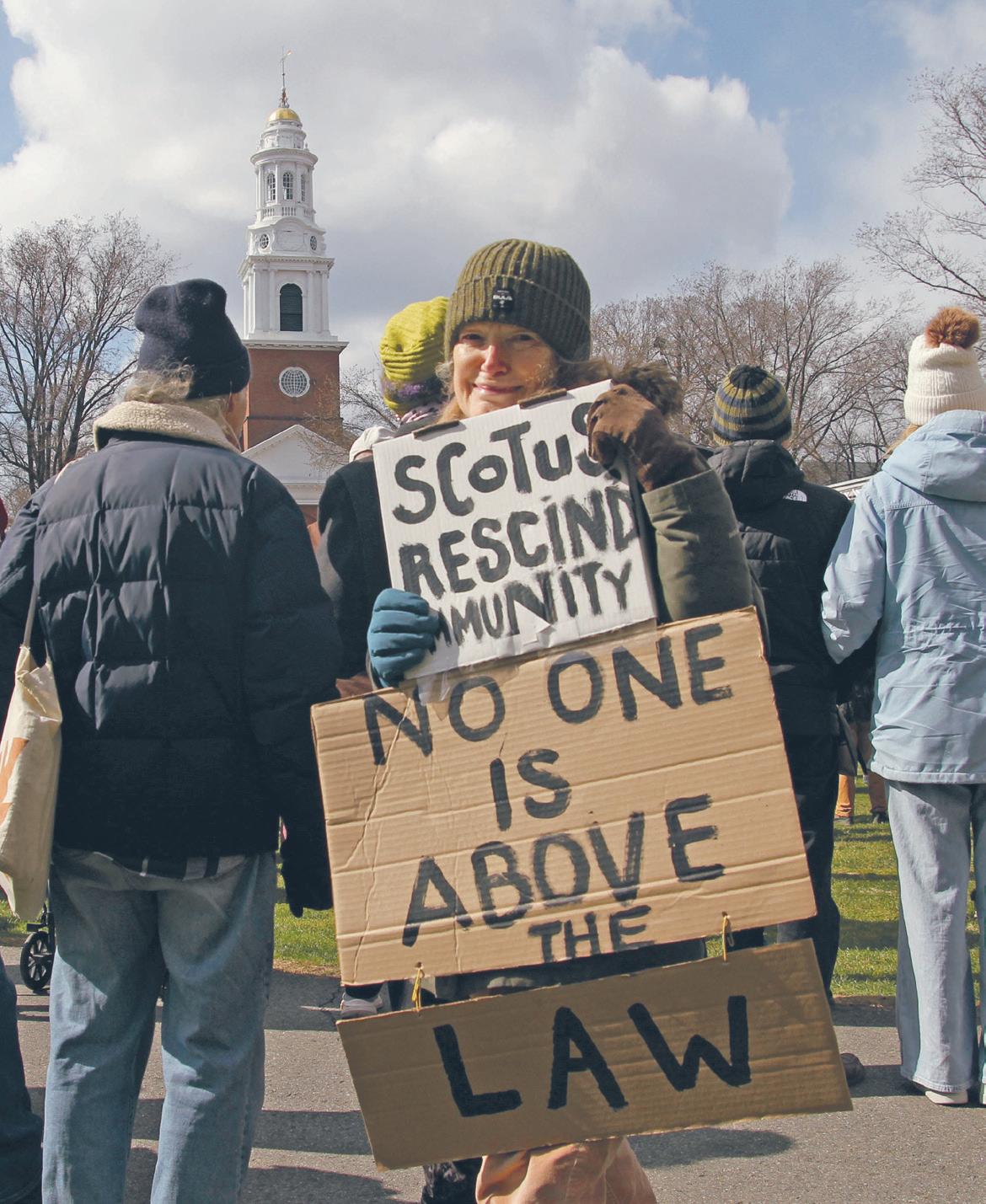
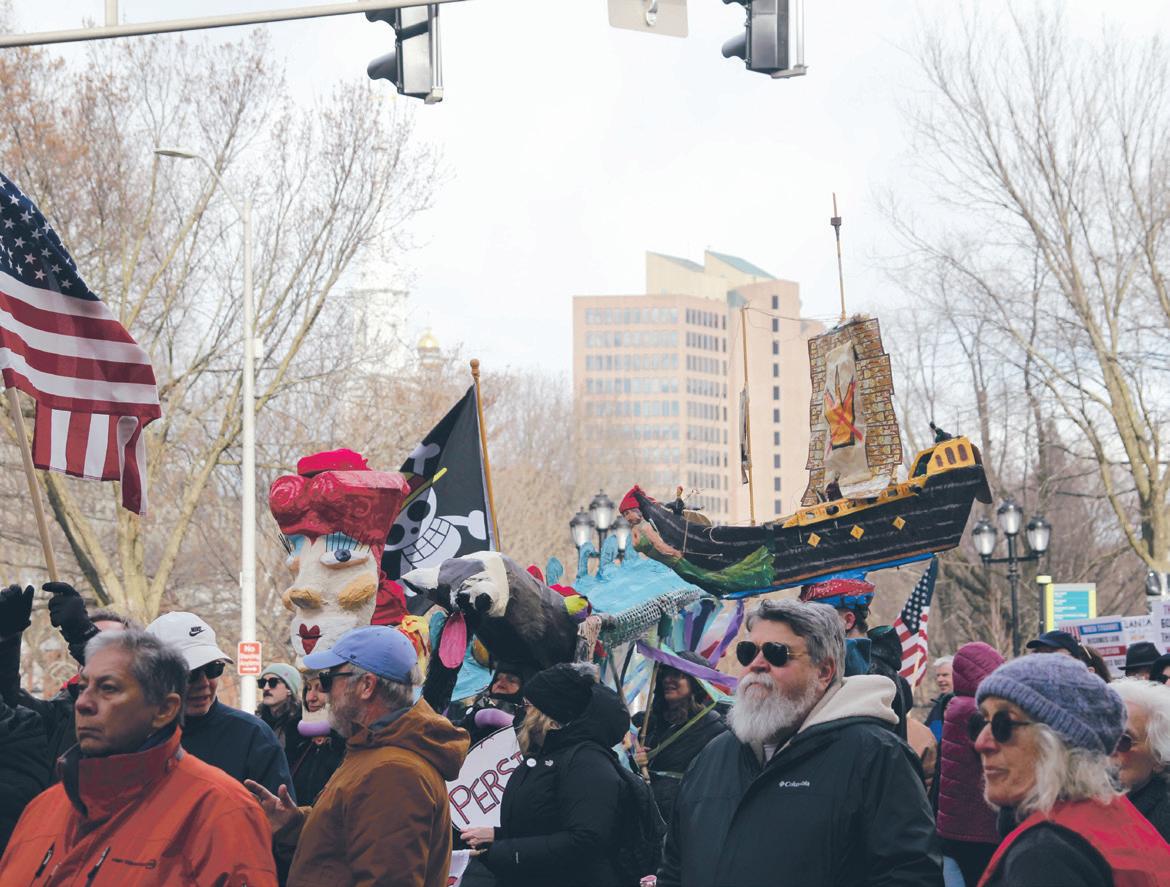
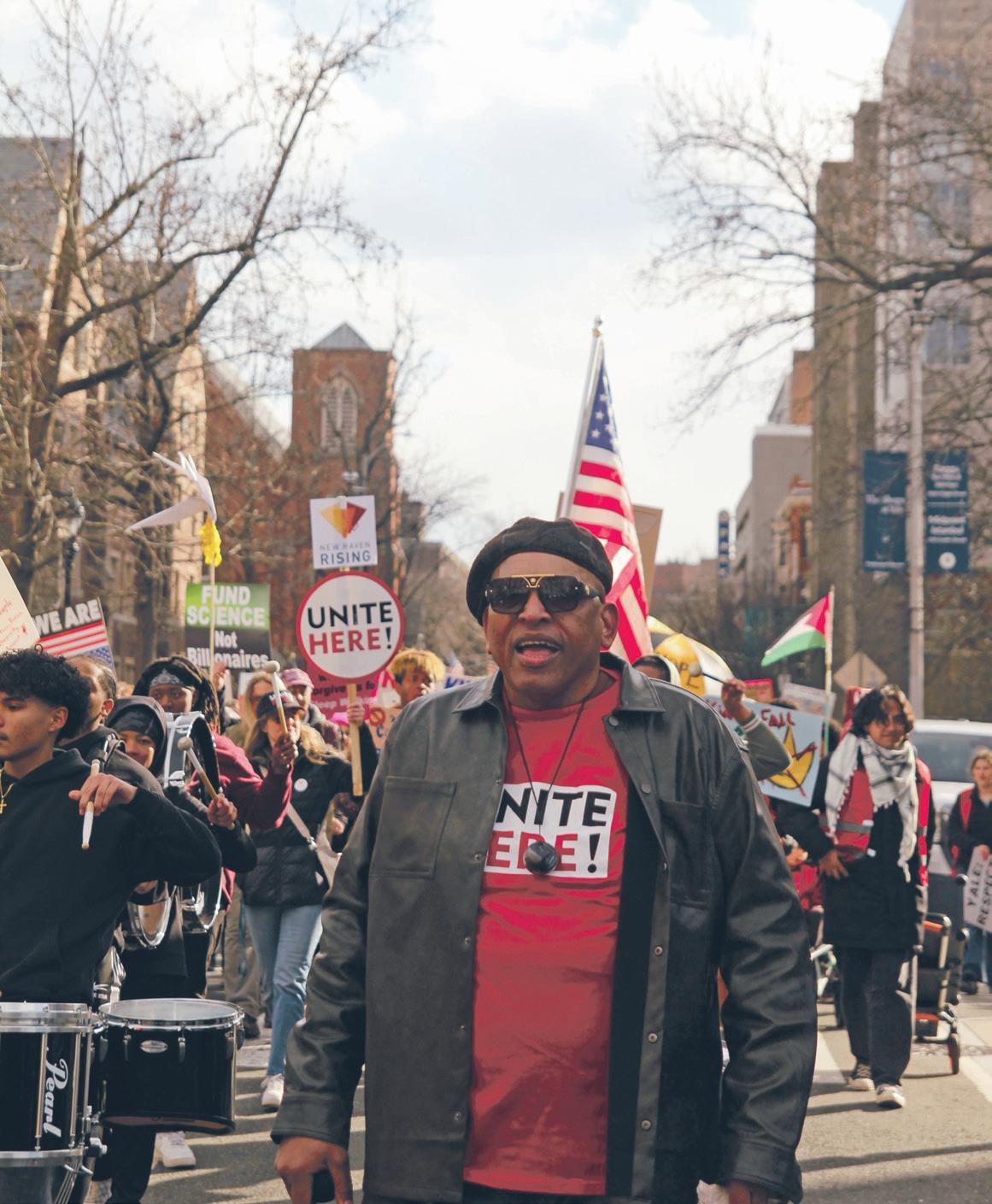
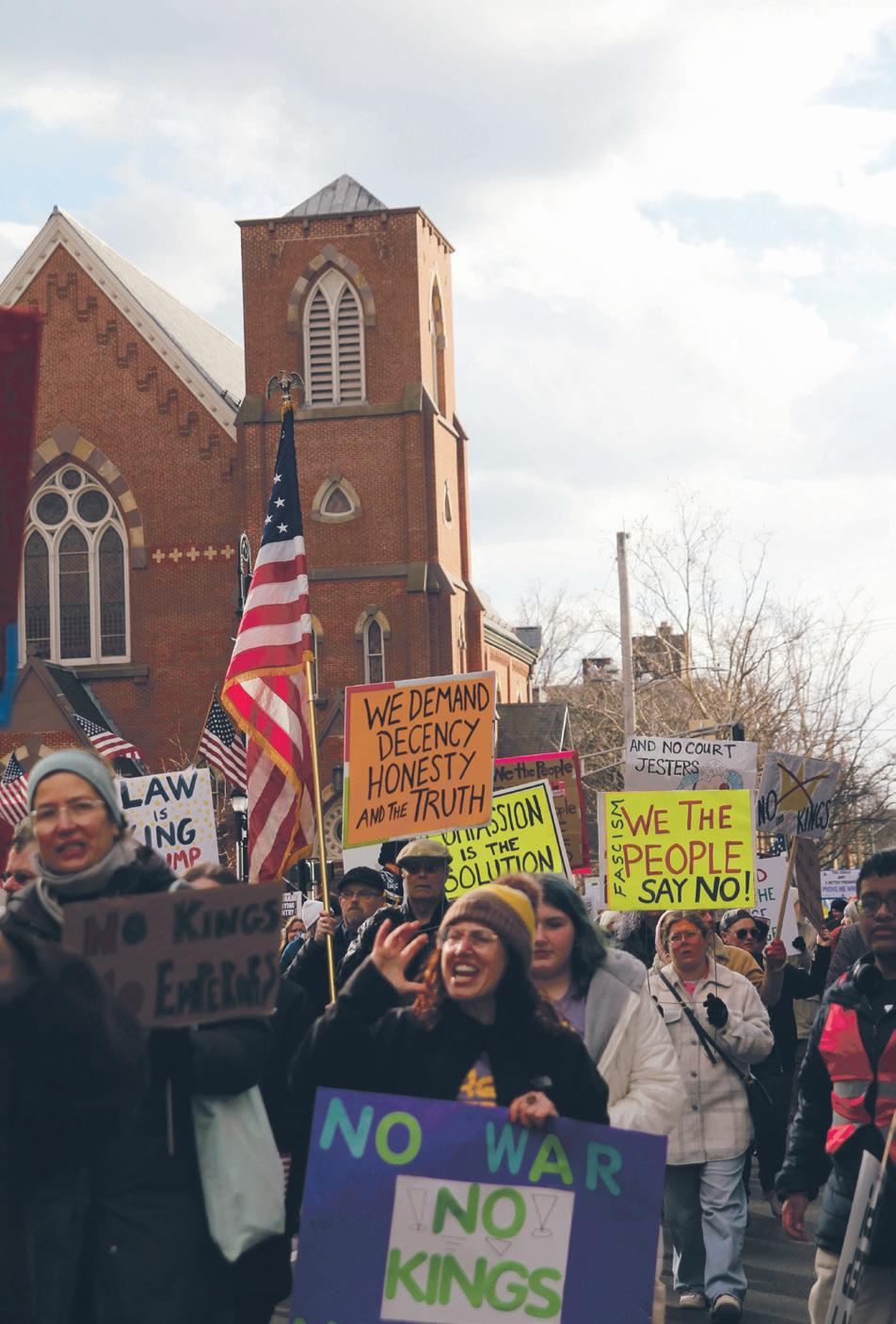
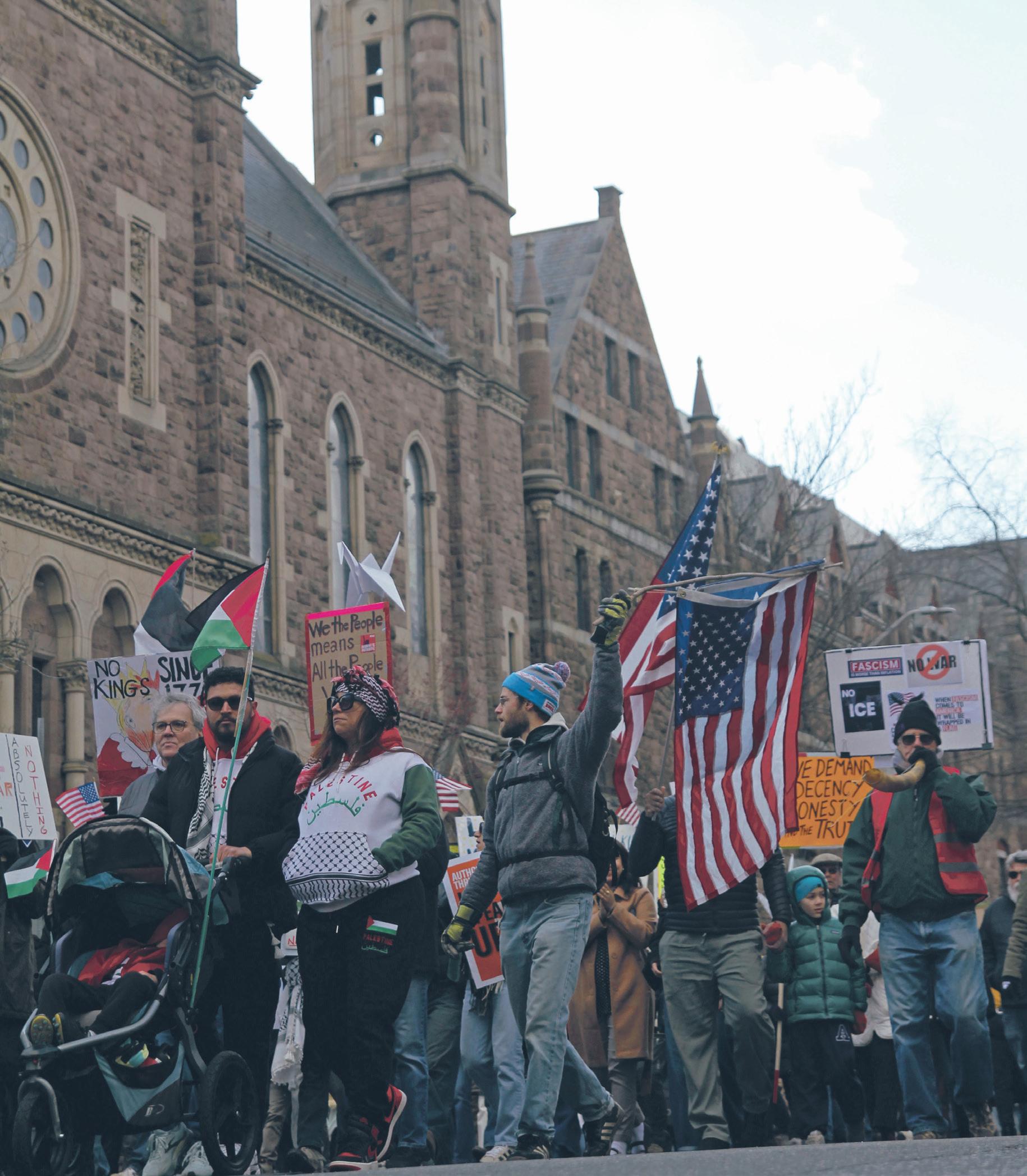
Hundreds of paper cranes, hoisted high on towering wooden poles, soared above the New Haven Green on Saturday afternoon as thousands gathered to protest against President Donald Trump’s administration. The cranes, which were meant to symbolize peace and resistance amid the United States’ war against Iran that started last month, became one of the visual centerpieces of New Haven’s “No Kings” rally — a protest that was one of thousands held at the same time across the country on Saturday. New Haven Mayor Justin
BY JAEHA JANG STAFF REPORTER
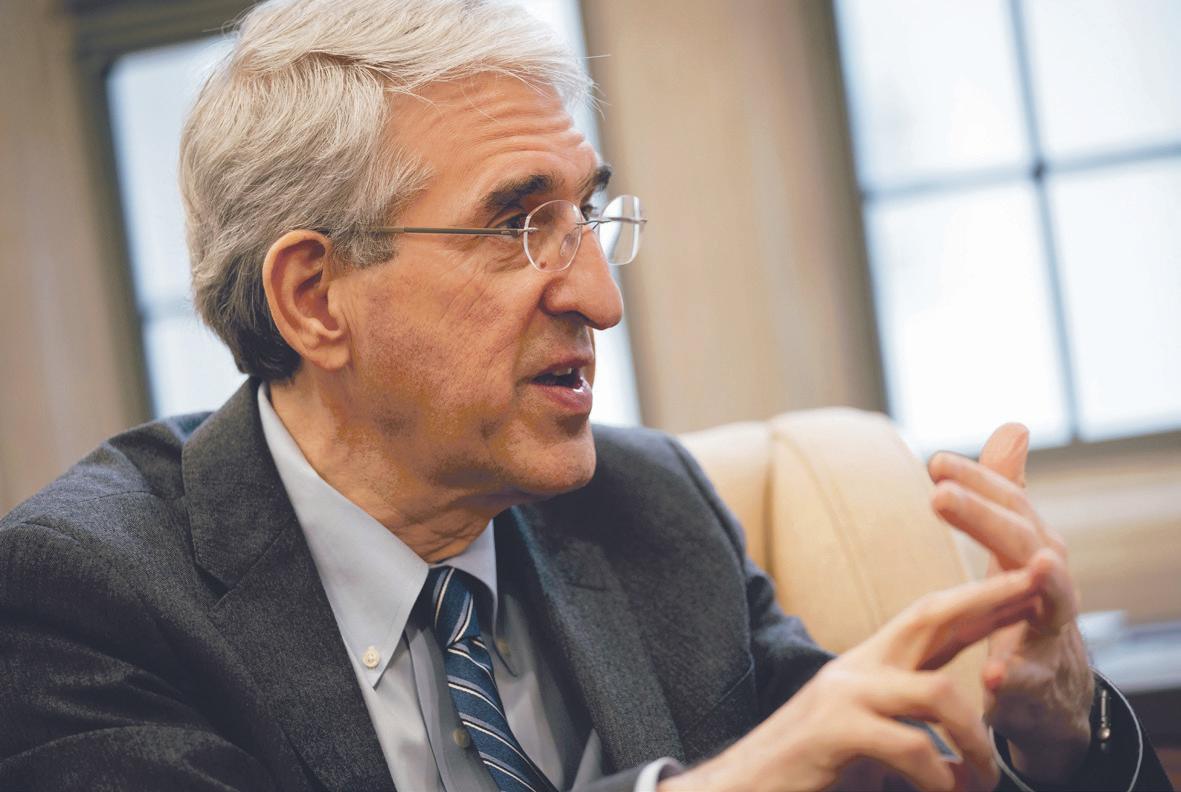
Former University President Peter Salovey estimates that around 6,000 to 8,000 students took “Introduction to Psychology” with him between 1986 and 2003. That number is set to increase next semester.
Salovey, who was dubbed “Easy A Salovey” by students during his teaching career, is listed as the instructor for the psychology department’s introductory lecture, long known as “Psych 101” and now officially called “PSYC 1100.” Four former instructors of the course told the News that they are excited for Salovey’s return, citing his experienced career and “charismatic care.”
“I have been thinking about what to teach for some time and had thought I would offer seminars on psychology and higher education or psychology and leadership,” Salovey wrote in an
email to the News. “But when I discovered that the Department of Psychology needed someone to teach Introductory Psychology in the fall, I thought, ‘why not?’”
Having taught the lecture “about 15 times,” Salovey wrote that the course’s structure is familiar to him, and updating his teaching of the course now will be a “good way” for him to update his knowledge of the field. “So I am looking forward to the fall!” Salovey added. “I especially enjoy when students take my course and then decide to major in psychology.”
Marvin Chun, a former dean of Yale College who also taught “Introduction to Psychology” after his administrative tenure, wrote in an email to the News that Salovey’s return to the lecture will be an “extraordinary opportunity” for Yalies. Chun cited Salovey’s academic
Elicker, along with Connecticut State Senator Martin Looney and Connecticut Attorney General William Tong, took the stage at Saturday’s rally. Each spoke about their efforts in suing and pushing back against the policies of the Trump administration.
Multiple music groups, including Movimento Cultural, the band Groovement and Singing Resistance, performed between speeches, and two seniors from High School in the Community in New Haven presented poems, called “17” and “When We Fight, We Win,” which were both about resisting oppression.
SEE PROTEST PAGE 4
BY OLIVIA WOO AND OLIVIA CYRUS STAFF REPORTERS
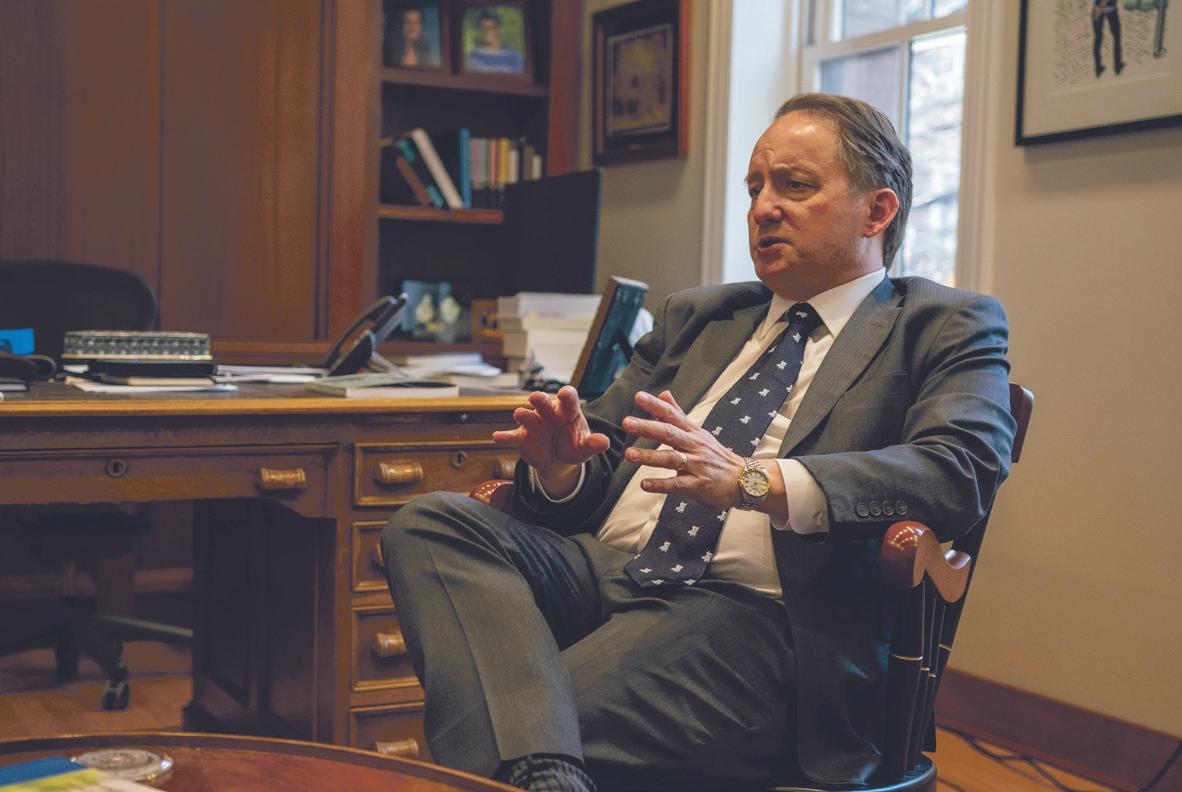
Yale College Dean Pericles Lewis apologized for suggesting that low-income students could accommodate the end of financial support for summer storage by reducing their possessions, hours after Yale College Council leaders decried the change and announced plans for a new stipend program to replace the aid using their budget.
In an interview with the News last Wednesday, Lewis said that Yale College would no longer provide summer storage funding for low-income undergraduates. Financial assistance for summer storage was first offered in 2023 — after Yale College stopped
offering students the option to store their belongings in their residential colleges — and decreased over the next two years to $225 available to some students last summer.
In a Monday afternoon Yale College Council email, President Andrew Boanoh ’27, Vice President Jalen Bradley ’27, Senate Speaker Alex W. Chen ’28 and chief of staff Surabhi Kumar ’26 announced their intentions to propose allocating “much of” the council’s remaining budget to summer storage stipends. They expressed “disappointment” about not
BY JERRY GAO STAFF REPORTER
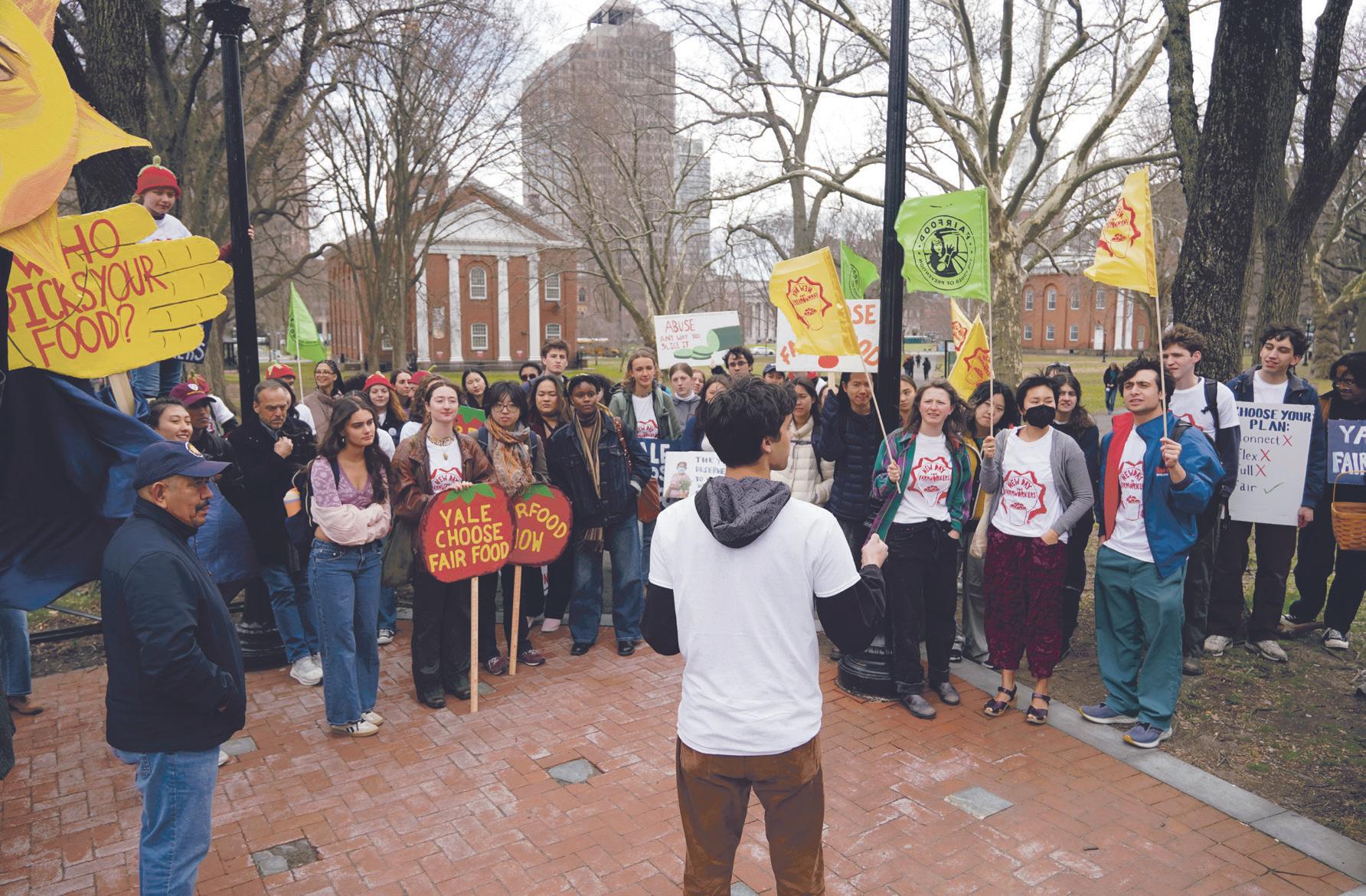
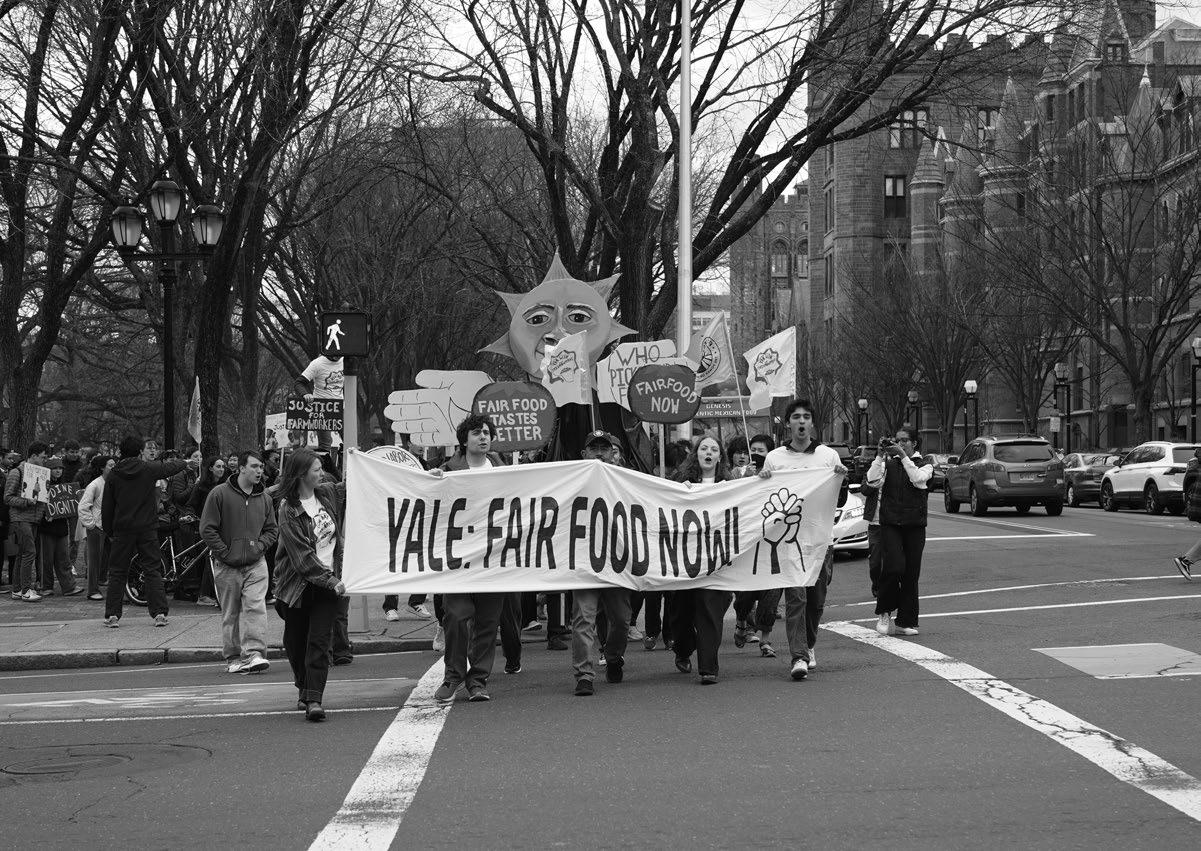
Several dozen students — joined by a few visiting activists — marched on Friday from the New Haven Green to a building housing Yale Hospitality offices, delivering a petition urging Yale to commit to a farmworkers’ rights program.
The demonstration by over 70 people was the latest step in the Yale Student/Farmworker Alliance’s campaign urging Yale Hospitality to join the Fair Food Program — an initiative that requires participating buyers to purchase produce from farms that comply with worker protection rules and pay a one-cent-per-pound premium to farmworker wages. The program started with tomato farmers in Immokalee, Florida,
in a group called the Coalition of Immokalee Workers.
“Students don’t want abuses in the supply chain that serves Yale’s dining halls, and we’ll continue organizing until Yale does what’s right and joins the Fair Food Program,” Andrew Storino ’27, a Yale Student/Farmworker Alliance organizer, said in an interview.
In an email to the News, Alexa Gotthardt, a Yale Hospitality spokesperson, wrote that Yale “is not currently positioned to become a formal signatory to the FFP, given its role further downstream in the supply chain,” but added that the University is “aligned with the program's goals.”
According to Gotthardt, more than 64 percent of Yale Hospitality’s tomato purchases through
suppliers are sourced from growers affiliated with the Fair Food Program. Gotthardt wrote that Yale is transitioning to new suppliers for the 2026-27 academic year and will “prioritize purchasing that demonstrates the highest commitment to fair labor and social responsibility.” Yale Hospitality told the News in November that it hopes to increase its percentage of tomatoes from program-affiliated growers to 90 percent. As the procession moved through downtown New Haven, organizers played songs including “The Revolution Will Not Be Televised” through a portable speaker. Some carried a banner reading “YALE: CHOOSE FAIR
Alex Hong, Staff Photographer
Garrett Curtis, Photography Editor
Jerry Gao, Contributing Photographer
Wikimedia Commons
Tim Tai
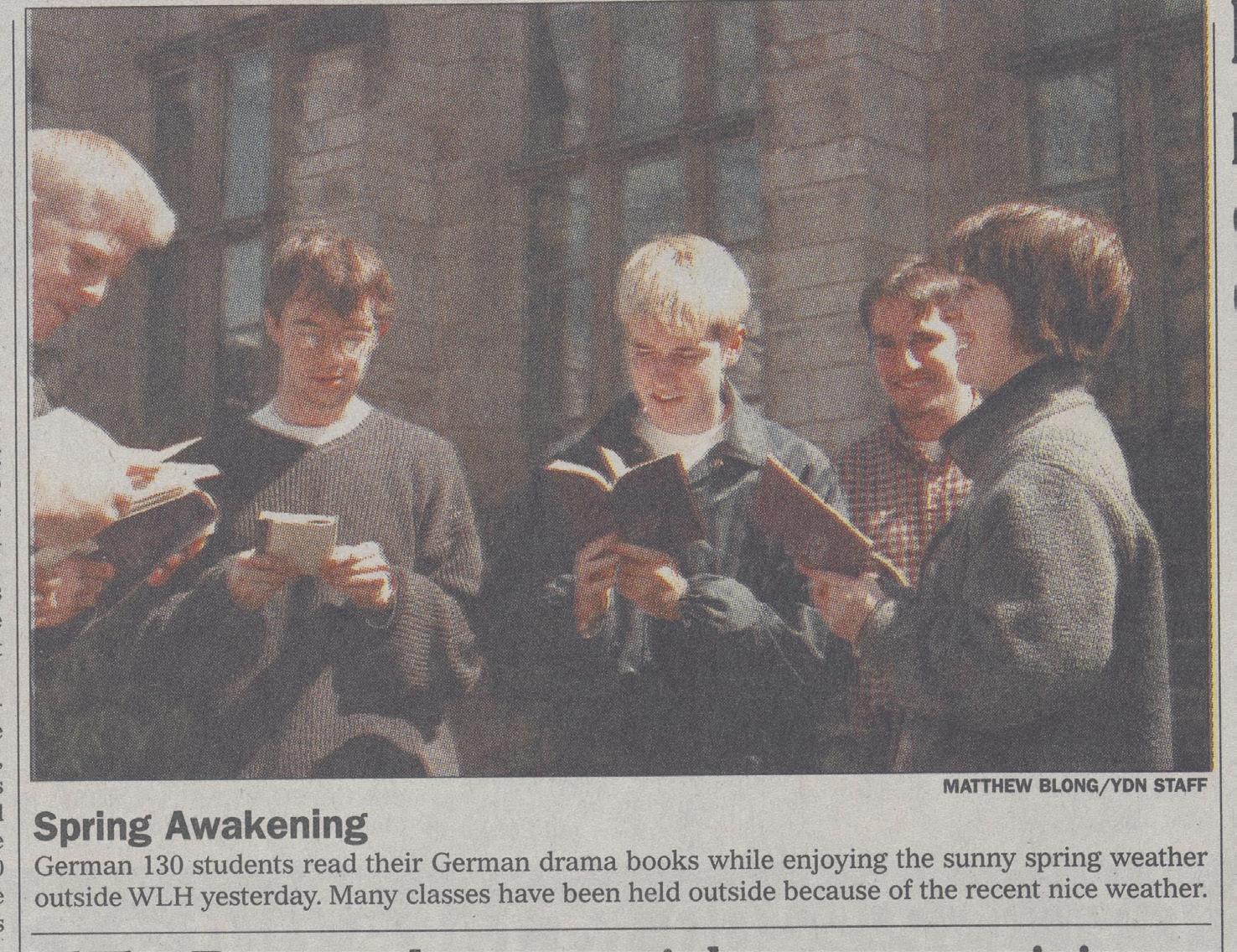
This Day in Yale History, 1999 Behind the Headline
CORRECTION:
CROSSWORD
ACROSS:
1. Deck cleaner
5. Better qualified
10. With 10-down, The Big Dance, whose results last year are shown in the circled letters
15. Russian news agency acronym
19. Aching
20. Ryan Gosling’s character in “Project Hail Mary”
21. Treasure, say
22. Indian garment
23. One way to describe the first set of circled letters
25. Like an iamb
27. Defect
28. “Me ___”
29. Kind of pad
30. Yellow Teletubby
31. Pirate’s domain
33. Actress Amanda
34. Time being
35. “Funny”
38. Camera bursts
42. “The Sorcerer’s Apprentice” composer
43. Ford contemporary
45. Secures
46. Others, in Latin
47. Govt. ID
50. Words to a traitor
51. Refrigerant gas
52. Shoe part
53. Nobleman
54. “Vitruvian Man” artist
56. Perez or O’Donnell
58. Thief
60. Sicilian peak
62. Air Force rk.
64. Grabbed suddenly
65. Acquired kin
by Jack Berrien
69. “Man ____ Mancha”
72. Yankee manager after Stengel
74. Irritable
75. Smart way to score in Soccer?
77. Cooper’s buddy in “Interstellar”
79. Sample
81. Dress
83. Note above A 86. North African country
91. Smear 92. Some kitchenware
94. In _____ (at once) 96. Tik Tok count?
97. Jungfrau, e.g. 98. Bristle 99. Extend 100. Pads
103. “Titanic” star, for short 104. Makes like a train 105. Elation 106. Print measures 109. “Trust me” 111. Lose 112. Penn, e.g. 115. Two fives for ____ 118. Coward, playfully 120. Divine revelation 123. Road side?
124. Most minimal 125. Oscar de la _____ 126. Deceives 127. Not much 128. “Fiddler on the Roof” character
129. Steph Curry shot result, often
By Alex Hong
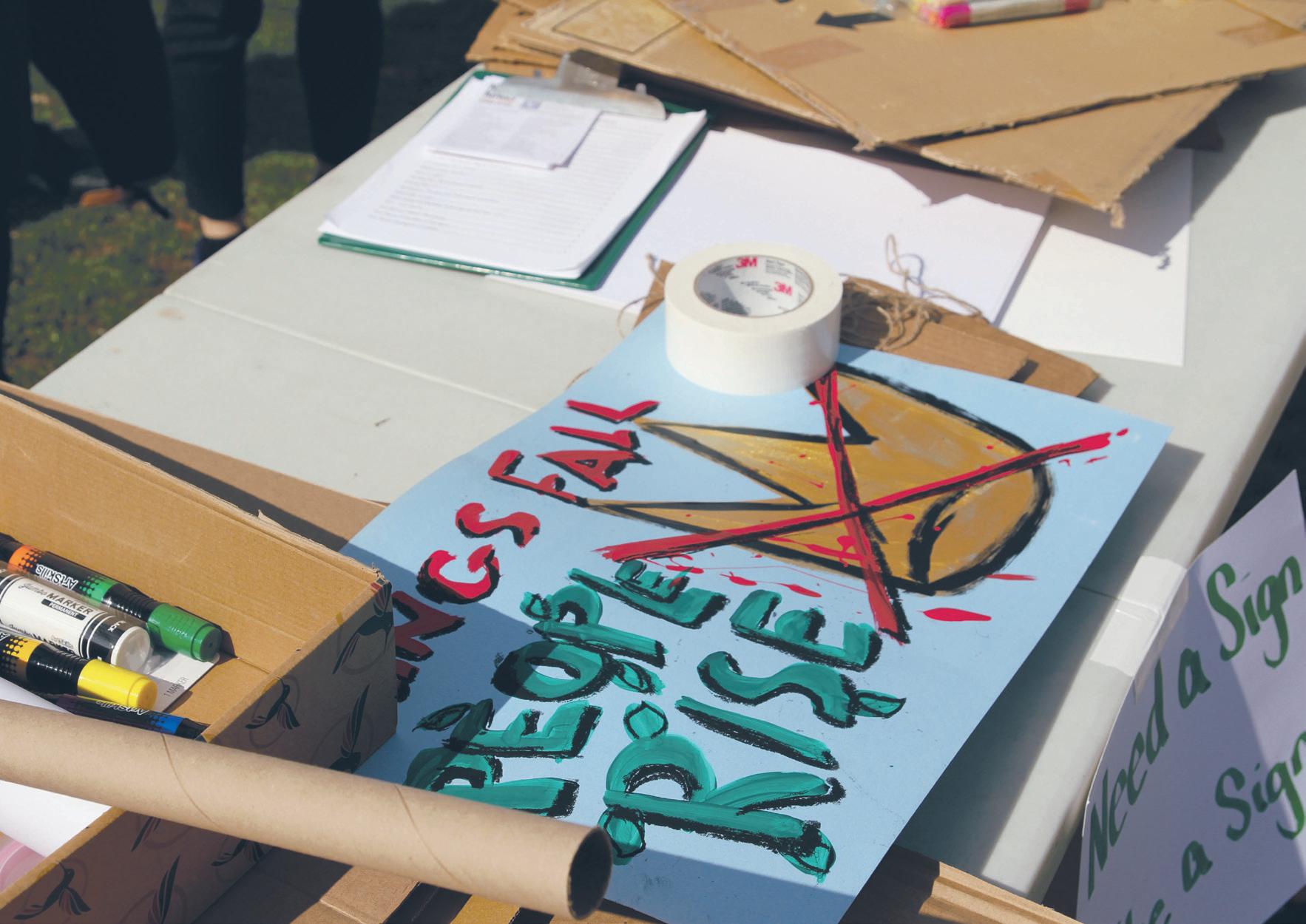
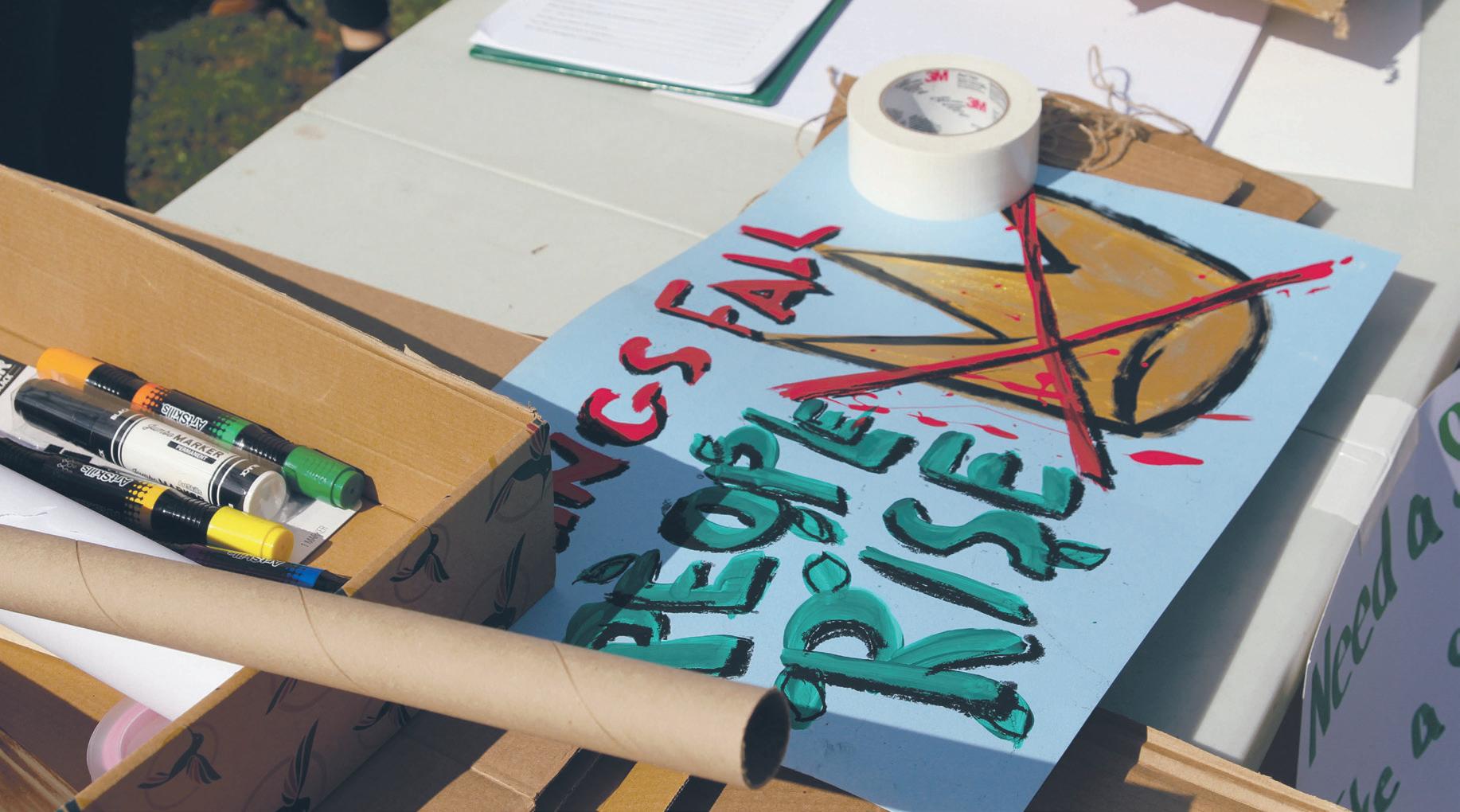
I was assigned to photograph the No Kings Protest in New Haven on March 28.
I arrived at the New Haven Green shortly before the event started and was surprised to see the creativity and variety of the posters, flags and creations on display. When I saw the Straw Hat flag, a black flag featured in the anime “One Piece,” I tried to take a shot to capture the symbol of freedom in a dynamic photo. To find a better angle, I joined other photographers on the stairs of the Yale University Art Gallery to capture the crowd as it moved down Chapel Street.
130. Behold, to Brutus DOWN: 1. Compass dir.
Devour
Seed protector
Secondary versions
Like Stone or Bronze
King Charles, for one
Titicaca, por ejemplo
Resound 9. Steep 10. *See 10-across
11. “Sorry, I’m on _____” 12. “Titanic” star character
13. Yell (out)
14. Cartoon character who is five apples tall
15. Jason of the Harry Potter movies
16. Statistics tool 17. Opera solo 18. Costa ____ 24. Lamb’s mom 26. Place to relax
29. Sharpest
32. Modify 33. Chemical prefix 34. Zeros
35. Did garden work
36. Utah ski spot
37. Clear to see, abbr.
39. Hispanic American 40. Volcanic residue
41. Trek beginning?
42. “Lost” actor Daniel ___ Kim
44. ___ generis
47. Pouts
48. Shooting game
49. One who loves math, maybe
52. “And away ____!”
53. Hamlet, for one 55. Modern comparative?
57. Kind of suffix?
59. Apt description of a predator 61. Behind 63. Hot spot 65. “If _____ nickel...” 66. Himalayan nation
67. Drink like a dog
68. Just a bit
70. Instrument holders?
71. Pound sound
73. Japanese garment
76. Over and over
78. Spoke, as a drunk
80. Cooking show judge?
82. Large water lily
84. Make ____ of it
85. Tussle
87. Electrical resistance unit
88. Barbecue essential
89. Lovable
90. roughly
93. Bar keeper?
95.Trigonometry’s ___-CAH-TOA
98. Keep (away)
99. Colorful board
101. Worsened
104. Ethiopian lake
105. Large, white Minecraft mob
107. Bad start?
108. Drip
109. Like Cuba
110. Future doc’s exam
111. Quick search
112. Exude
113. Author ____ Morrison
114. Play parts?
116. Long tale 117. Tiny time div. 119. ___-haw 120. MGM motto word 121. “Thank God”
Compass reading
“‘No Kings’ in New Haven” on page 9.
EDITOR’S NOTE: In the March 27 print edition, a headline about New Haven’s incoming city controller Michael Gormany was published erroneously atop the text of a separate article about the New Haven Board of Education. The story about Gormany, “Finance chief to return to City Hall with lessons from West Haven stint,” is printed in full on Page 6 of this issue. The News regrets this error.
ALEX HONG
STAFF COLUMNIST
HRISHITA SHAH
Embrace imperfect photos
As Yalies, we are a little obsessed with photos.
Don’t believe me? Open Instagram in the days after spring break. The evidence is immediate: cerulean water, linen dresses, glowing sunsets, friends arranged just so against beach horizons. Everyone appears to have had the most beautiful week of their lives, and — more impressively — the foresight to document it perfectly.
There is something almost athletic about it all. We don’t just focus on the travel itself but on the performance of travel: the posing, the retaking, the selecting, the posting, the song choice, the careful curation of a life that looks both effortless and enviable.
And every spring, looking at this collective display, I find myself wondering the same thing: are we actually enjoying these moments, or are we enjoying how they will look later?
So much of college life now seems to exist twice: once in reality and once in the camera roll. I still remember getting ready for my first Yale formal. We spent what must have been close to an hour taking pictures. I have dozens from that stretch of time — slightly different poses, slightly different angles, endless variations of the same moment. Yet when I try to remember the hour itself, what comes back is not excitement or joy but something more like tedium.
Looking back now, I am grateful for the photos. I loved sending them to my parents. I loved having them. They made the evening feel substantial, preserved, worth remembering. That is what makes “capturing the moment” so complicated. Photos can feel shallow in the immediate and meaningful in retrospect. They can interrupt an experience and then later become the very medium through which we cherish it.
Spring break made this contradiction impossible for me to ignore. Everyone’s stories featured gorgeous visuals, but what those photos rarely captured was the less glamorous reality behind them: the uncomfortable dress sinking into sand, the long process of getting ready, the sweating, the waiting, the trudging to the right location, the strange amount of labor required to produce something that looks spontaneous.
Of course, I did the same. I took the aesthetic photos. I curated the soundtrack. I posted the version of my trip that I wanted to remember and the version I wanted others to see.
After too much scrolling through too many beautiful vacation posts, I came to a dramatic conclusion: we need to take fewer pictures. It seemed like the only antidote to the strange poison of over-documentation.
But on the long flight back, as I sat with my camera roll and the very practical problem of storage, my
certainty started to dissolve. I started doing what everyone does after a trip: deciding what to delete and what to keep. For nearly two hours, I swiped through breathtaking landscapes, dramatic coastlines and impossibly lovely views, without being able to delete a single one. They were gorgeous, but after a while they began to blur together. Then I came across one photo of my friends and I eating ice cream by the river while people busked nearby. It was not a good photo, at least not by Instagram standards. It was blurry, and not in a charming, cinematic way. The lighting was harsh. Neither of us looked especially polished. Nothing about it was conventionally picturesque. And yet it was the only photo that made me laugh out loud. I remembered the exact moment immediately. We had just realized we needed to make it up a rough hourlong hike in about thirty minutes, and instead of panicking, we found the whole thing hilarious. The photo captured none of the grandeur of the landscape and all of the reality of the trip: the rush, the absurdity, the friendship, the shared joke. I realised then that the problem is not that we take too many pictures. The problem is that we often take too many of only one kind.
There are pictures for others. Pictures for Instagram. Pictures that let us shape how a moment will be seen and maybe even how it will be remembered. There is nothing inherently wrong with that. Curating a life is, in its own way, an art form.
But we also need the other kind of photo: the real one. The accidental one. The ugly one. The one with bad lighting and no clear composition. The one that would never make it to a story but somehow says more than all the polished ones combined. The ones that preserve not just what something looked like, but what it felt like.
Maybe the answer is not that we need fewer pictures. Maybe we need to reclaim the photo from perfection. To remember that a camera roll does not have to function only as a gallery of marketable memories. It can also be a private archive of real life.
So yes, take the perfect picture. Post the sunset. Curate the version of yourself you want to project. But also take the silly ones, the exhausted ones, the laughing-sohard-you-can’t-stand-still ones. Take the photos you keep just for yourself. The small, unremarkable, treasured ones — because years from now, the picture that stays with you may not be the most beautiful one.
HRISHITA SHAH is a sophomore in Silliman College studying Economics and Computer Science. She can be reached at hrishita.shah@yale.edu.
Letter: What happened to Yale’s activist spirit?
Dear Yale students:
I graduated from Yale in 1974 as a proud member of the second class of women.
During my student years, I was equally proud to be a participant in many rallies on the New Haven Green — where I protested the Vietnam War, advocated for women’s reproductive rights and supported local unions. For me and many of my classmates, it was a given that intellectual growth and civic engagement should go hand in hand.
On Saturday, fifty-six years after my first rally, I came back to New Haven to attend the No Kings rally on the Green. Where were the students?
It was dismaying to find that among the thousands of people at this protest, I saw very few people of college age — even though ours was a nationallycoordinated rally against the most dangerous, immoral, greed-fueled and unhinged presidency in American history.
A rally, like more than three thousand others across the country yesterday, aimed at creating visible national urgency around the multiple domestic and worldwide crises of this government’s making.
A rally that was literally in your front yard.
Why weren’t you there?
Would you respond that you did your bit by posting an opinion on social media? I hope not. Mass protest movements don’t succeed without people taking to the streets in huge numbers — whether those streets were in Washington, DC in 1963; in Prague during the 1989 Velvet Revolution; or across the United States after the killing of George Floyd in 2020. And in 2026, the federal government withdrew seven hundred ICE agents from Minneapolis only after huge street protests over the killings of civilians. Crowds are crucial. Photos and videos of those crowds are crucial, to show the depth and breadth of discontent; crowd experiences — lively, synergistic engagement with each other — are crucial, helping us to stay energized and politically active. Would you respond that the Trump administration hasn’t personally impacted you or your classmates? Maybe they haven’t, yet. But there’s the fact that Yale’s NIH funding fell by a full third last year. There’s the fact that many people in your city — yes, it’s your city now— are having a harder time feeding their children. There’s the fact that thousands of people who are your age but lack your
STAFF COLUMNIST TOM DAWBER
privileged status are deployed to the Middle East, right now. Don’t you feel some personal urgency around these facts?
I continue to love Yale. And I trust that, since you’re Yalies, many of you are thinking seriously about how you might contribute to civic and social causes you believe in.
I hope you’ll consider the idea that showing up at a protest can have real power, real consequence. This May Day, I hope to see thousands of you joining the spirited townies, resolute boomers and mad-ashell high school students in your front yard.
Sincerely, Tricia Tunstall ’74 Co-founder, New Haven Women’s Health Services, 1975
City Hall is throwing good money after bad
Like many New Haveners, I was shocked and angry when Police Chief Karl Jacobson abruptly resigned and was later arrested for allegedly stealing over $85,000 from the New Haven Police Department’s confidential informants fund and the Police Activity League, which finances programs for the city’s youth.
I was shocked once again when Mayor Elicker announced that the city would spend $87,000 to hire the Police Executive Research Forum, or PERF, to analyze and compile a report on the police department’s confidential informant policies to inform the city as it drafts a new general order outlining a confidential informant policy.
On its face, this seems like a wise course of action. Taxpayer dollars were stolen by a person in a high-level position of trust, so the city is hiring a specialized organization to develop policies to ensure that something like this never happens again. But, really, Mayor Elicker’s decision just doubles taxpayer losses by throwing good money after bad.
the day, it is an administrative issue. It’s not necessary to spend $87,000 for a team of policing experts to tell the city how to manage what is essentially a petty cash fund. Small businesses all over the country successfully manage petty cash accounts — albeit not funded by public money and not worth tens of thousands of dollars — that can be accessed by multiple people.
An accountant would be just as qualified as PERF to help the city to draft this new policy. I don’t think you even need an accountant. Mayor Elicker, here’s an outline of a new general order. We should be able to finalize the details together over one working lunch.
First, a two-person team from the city’s Department of Finance must have control of the account. They will fund it and regularly audit all withdrawals. These audits should be randomly executed and unannounced. It is crucial that oversight of this fund lies outside of the command structure of the police department. When Chief Jacobson was promoted to his position in 2022, control of the fund was supposed to be turned over to Assistant Chief David Zannelli, recently tapped by Mayor Elicker to replace Chief Jacobson, but that never happened.
Placing control of a pile of cash in the hands of an assistant chief creates the potential for a difficult situation. What is a subordinate supposed to do when their superior, the head of their entire department, doesn’t follow procedure? Having nonpolice city officials responsible for the account could remove this tension.
I am not criticizing PERF, which appears to be an admirable nonprofit organization that does good work. I support any efforts to improve policing in this country, and PERF has issued reports on body cameras, vehicular pursuits and women in police leadership, among many other issues pertaining to policing best practices.
But this isn’t a policing issue. It is a cash handling issue. It is an oversight issue. At the end of
Second, store this pile of money in a safe in a secure room that can be accessed only by authorized personnel via a logged ID swipe or fingerprint scan. The room should be equipped with both audio and video surveillance. The safe should require an ID swipe or a fingerprint scan. There must be a written record of time, date, name of the officer or detective, amount withdrawn and purpose of the withdrawal. Third, a body camera should be worn by anyone who is accessing the safe. By recording
the actions of the withdrawing officer or detective from their point of view, auditors will be able to see what is actually taken and cross-reference that with what is logged. The Department of Finance officials in charge of the fund should also be equipped with body cameras when they are carrying out these duties. While we have to be able to trust our public officials, we should remember President Ronald Reagan’s wise words: “Trust, but verify.”
IT IS CRUCIAL THAT OVERSIGHT OF THIS FUND LIES OUTSIDE OF THE COMMAND STRUCTURE OF THE POLICE DEPARTMENT.
A RALLY THAT WAS LITERALLY IN YOUR FRONT YARD. WHY WEREN’T YOU THERE? IT’S
But, at the same time, I fear that these efforts will amount to nothing. A new policy — whether purchased for $87,000 or accepted gratis from a humble student — is worthless if it isn’t followed. The department already had a general order for the management of this fund when Chief Jacobson allegedly stole from it. Less than one minute before announcing his intention to hire PERF, Mayor Elicker acknowledged the existence of that general order, but added: “these protocols were not followed.”
In sum: we had a policy, that policy wasn’t followed, so now we’re going to spend $87,000 of your money to draft a new policy. If this were fiction, it would be hilarious.
TOM DAWBER is an Eli Whitney student, and a junior in Pierson College studying history. His column looks critically at city policies, as well as state and federal policies when they directly impact the lives of Yalies and New Haveners. He can be reached at tom.dawber@yale.edu.
FROM THE FRONT
“All I see is a big balloon, halfway up to the moon, he’s wrapped
Local protesters join latest national anti-Trump push
The rally was part of the third nationwide “No Kings” campaign. Saturday’s rally, like the last “No Kings” event in New Haven, which took place in October, was organized by Greater Westville Indivisible, which was founded a year and a half ago by
Nan Becker and her neighbors. Saturday’s rally brought together more than 30 activist organizations, including Connecticut For All, the New Haven Federation of Teachers and New Haven Rising. Becker said that when the group realized no one was going to organize a New Haven “No Kings” rally in October, mem -
bers of Greater Westville Indivisible raised their hands and “put that show together.”
The organization decided to take charge of planning another rally in March. Reflecting on the October rally’s successes and flaws, they decided to invest in a better sound system, organizers said.
“Last time, people who were quite a bit farther away from the stage could hardly hear,” Maria Mauldon, another member of Greater Westville Indivisible, said in an interview.
The group also heard that after the October rally, many attendees were left wondering, “Now, what do I do?” Becker said.
Becker said the group wanted to ensure that when people left the protest, they felt that “they’re connected to actions in the future, that they’re connected to joining groups that are actually involved.”
“So we spent a lot of time reaching out to all of these community groups,” she said. “There’s 34 that were registered, and there’s probably 40 tables on the Green today, and they’re all sharing their information. People are signing up.”
Greater Westville Indivisi -
ble also introduced its roving ambassador program at Saturday’s protest.
“We have individuals walking, talking to all the rallygoers with a QR code that links to a document with all of the actions in the organizations on the Green today, as well as some others, into a document that will live on our website,” Becker explained. The American Civil Liberties Union, or ACLU, of Connecticut was one of the organizations the ambassadors were promoting. At the ACLU table, people were handing out buttons and pamphlets with information about how to become more involved in the organization’s activities.
Gus Marks-Hamilton, the campaign manager for the ACLU of Connecticut, said that Saturday’s rally was different from previous rallies he’d attended in the past.
“What was going on last year was people simply felt like they needed an outlet. They needed to come together,” Marks-Hamilton said. “Now, a year later, you’ve seen people already able to table in ways they didn’t. Last year was people making makeshift signs and simply showing up and being together. But now there’s actually
groups that have time to reach out to their members, to invite anybody that wants to come by, to make sure that people have signs prepared.”
Protestors at the “No Kings” rally said they attended it for a variety of reasons.
“The latest thing he did was veto the U.N. resolution recognizing the Transatlantic slave trade as one of the worst atrocities in human history,” Tudy Hill, who participated in the protest, said, referring to Trump.
Hill said she came not only for herself, but also on behalf of family members who felt they couldn’t participate.
“I represent the rest of my family who are biracial — Chinese and Black — and they’re afraid to come,” she said in an interview. “Because I’m white and I’m female and I’m old, I represent them proudly.”
The rally went on for two hours and ended with a march around New Haven’s downtown.
Contact CHUER CINDY ZHONG at cindy.zhong@yale.edu and DAVID LIU at david.c.liu@yale.edu.
Students promote farmworkers’ rights campaign
FOOD” and held signs with slogans including “JUSTICE FOR FARMWORKERS” and “FAIR FOOD TASTES BETTER.” Several wore yarn hats shaped like tomatoes, and one demonstrator stood on stilts above the crowd.
Student advocacy groups first began calling for the University to join the initiative in September. Later in November of the fall semester, the Student/Farmworker Alliance collected over 150 signatures in support of Yale Hospitality joining the FFP. According to organizers, the petition now has over 300 signatories.
At 246 Church Street, which houses Yale Hospitality offices, the protesters were met with several security guards and Nina Fattore, an associate director for University life. The demonstrators gathered in an adjacent parking lot, chanting before organizers delivered speeches and handed a copy of the petition to Fattore.
The event drew Lucas Benitez, a co-founder of the Coalition of Immokalee Workers — the organization that began the Fair Food Program — who said he had traveled to New Haven for the demonstration.
In an interview, Benitez, who spoke Spanish as an organizer translated, described the Fair Food Program as having “helped to eliminate systematic abuse in the tomato industry and other agriculture industries in the U.S.,” adding that its purpose is “to alleviate the denial of human rights for farmworkers.”
According to Benitez, the Coalition of Immokalee Workers had not yet seen significant progress on getting university dining systems to join the program, which is why it has been visiting campuses — including a planned trip to University of California, Berkeley, the following week and ongoing organizing in Michigan.
“Now is the time for Yale to do things the right way, and now is the moment for students and farmworkers to join together and demand fair food,” Benitez said in his speech near 246 Church St. “What do we say to the University if they don’t do it correctly?
We’ll be back.”
The group had originally planned to begin the demonstration on Cross Campus. Arjun Warrior ’26 told the News that the group “relocated to the Green
because it made more sense,” but added that the University had told organizers they could not use the space.
Tina Posterli, a University spokesperson, confirmed the relocation in an email to the News, writing that because the gathering was “not organized by a registered student group, the organizers relocated the event to the New Haven Green.”
According to Yale College Undergraduate Regulations,
being registered as a student group gives organizations the ability to reserve Yale facilities.
Camila Torres ’28, who said that she attended Friday’s march at the invitation of an organizer, said she supported the campaign because of her own background.
“As someone with immigrant parents myself who grew up low-income, I really see how workers get exploited in their day-to-day life,” Torres said in an
interview. “Farmers are the foundation of every society — they work so hard to provide us with every grain of rice, every cherry tomato, every bit of chicken. Of course I want them to have fair wages and working conditions.”
The Yale Student/Farmworker Alliance was founded in April 2025, per a statement from the group.
Contact JERRY GAO at jerry.gao.jg2988@yale.edu.
Salovey’s fall course marks a return after 23 years
expertise as “the father of emotional intelligence,” as well as what he described as Salovey’s deep commitment to students’ learning and wellbeing that was demonstrated during his presidential tenure.
“President Salovey is a legendary, award-winning teacher, having led some of the most popular, largest classes in Yale College history,” Chun wrote, adding that “his charismatic care will be evident throughout the class.”
Yarrow Dunham, the psychology department’s director of undergraduate studies who taught the introductory lecture in 2015 and 2017, wrote in an email to the News that he was “very excited” when Salovey expressed interest in returning to the course’s teaching rotation. Salovey was “beloved” as the course’s lecturer for many years, and his “long and distinguished career” will bring a “unique perspective” to the lecture, Dunham wrote. “And this may be one of the very last chances for Yale students to
experience his take on the class!” Dunham added. Dunham wrote that the lecture is “probably the most important class” in his department because of its high demand and the fact that it is often students’ first exposure to psychology. The lecture’s instructor can “make the class their own and impart their own vision of the field” because of the breadth of it, he added.
Samuel McDougle, who taught “Introduction to Psychology” in fall 2023 and 2024, wrote in an email to the News that the intro
ductory lecture is his favorite course to teach because it is rewarding to see students discover their interests in psychology and it gives him an opportunity to stay updated on “exciting topics” in the field.
Stephanie Lazzaro, who taught the course between 2021 and 2024, also called Salovey’s return “wonderful.” She wrote that she would love to attend Salovey’s lecture and see him teach and that students are “lucky to have him back.” When Salovey told the News in October that he planned to
resume teaching, alumni who took his classes expressed widespread enthusiasm for his return, recalling his engaging teaching style and approachable character.
McDougle echoed this enthusiasm, noting that he will have “big shoes to fill” when he teaches the course after Salovey.
“Can I register?” McDougle added.
Salovey was Yale’s 23rd president.
Contact JAEHA JANG at jaeha.jang@yale.edu.
Jerry Gao / Contributing Photographer
Over 70 people marched to Yale Hospitality’s offices on Friday in the latest push by student advocates for the University to join the Fair Food Program.
Alex Hong / Staff Photographer
On Saturday, thousands of people, including members of dozens of activist organizations, rallied against President Donald Trump on the New Haven Green as a part of the national “No Kings” movement.
“In these old familiar rooms, children would play. Now there’s only emptiness, nothing to say”
KNOWING ME, KNOWING YOU
Student leaders decry aid phaseout
STORAGE FROM PAGE 1
the News reported on Monday.
“The decision to do this represents another negative instance of the continued degradation of undergraduate support at Yale,” the council leaders wrote. They encouraged students to write testimonials in opposition to the end of the College’s storage funding.
Lewis wrote in a Monday email to the News that when meeting with YCC leaders, he “forgot about” the phaseout of summer storage funding, which had been planned for several years, and “did not mention it.”
“I’d also like to apologize for any perception from the brief quotation included in this morning’s article that I might not recognize the effects on students,” Lewis continued, referring to his recommendations in an interview last week that students “acquire less” and not “buy too much stuff.” “We recognize that summer storage is a challenge and we hope to let everyone know about it well in advance so they can plan accordingly,” Lewis wrote.
In the interview with the News last week, Lewis said that his office “did notify people a couple of years ago” that summer storage funding would be phased out. In March 2023, Dean of Students Melanie Boyd ’90 sent an email making clear that summer storage funding would be temporary, the News previously reported. Among the current undergraduate population, only students in the class of 2026 would have received that email from Boyd.
“It was not a new decision, but I recognize that we could have communicated it more effectively,” Lewis acknowledged in his Monday email.
“It really is incumbent on the university, on the college, to inform people ahead of time what the changes are,” Chen said in a Monday interview. “Relying on institutional memory from emails that only seniors would have had access to is not sustainable, nor is it fair, especially to younger students.”
Chen characterized the lack of communication between administrators and the YCC as “unacceptable.” He added that the relationship between the two is built upon mutual discussion.
Boanoh declined on his and Bradley’s behalf to comment on Monday beyond the YCC email.
Jaden Cohen ’29 said that among the first-year class, he sensed “no real emotional response” to policy changes such as the phasing out of summer storage aid, “because unlike the upperclassmen we haven’t actually” experienced the previous policies.
Chen called that kind of reaction from younger students “unfortunate.”
“It’s natural for institutional memory to degrade over time, especially on a four year cycle. But I think part of our job is to not let that be an excuse for the degradation of student life,” Chen said. “Administrators will long outlast many generations of Yalies, but part of our job in our duties to posterity, to future generations of Yalies, is to do our work to advocate against those changes now.”
A Yale College Council draft budget proposal for a summer storage stipend program quickly emerged on
Monday. It would allocate $12,500
across at least 125 stipends, providing that first-generation, low-income undergraduates will receive priority in the disbursement of stipends.
Chen said in an interview on Monday that the total funds allotted are “subject to change” and could increase before the proposal is approved. The email from the Yale College Council leaders said the proposal would be first on the Senate’s agenda at the upcoming Sunday meeting.
Stipend applications would be received through a Google form, the preliminary draft of which reviewed by the News on Monday evening required students to upload “proof of purchase,” such as a receipt or screenshot confirming that they paid for summer storage. The form would open to students on Monday, April 6, and close two days later, according to the proposal. According to this timeline, students would need to pay for summer storage by next Wednesday in order to be eligible for a reimbursement. According to the current budget proposal, undergraduates besides first-generation, low-income students would be eligible for the stipend if fewer than 300 FGLI students apply for reimbursement.
Contact OLIVIA WOO at olivia.woo@yale.edu and OLIVIA CYRUS at olivia.cyrus@yale.edu.
College is ending its financial support for summer storage
BY OLIVIA CYRUS STAFF REPORTER
This summer, Yale College will no longer provide summer storage funding to low-income students, Dean Pericles Lewis said in an interview with the News last week.
The financial aid program’s end was the latest change in Yale College’s support for student storage in the summer, after administrators had been phasing the program out for the last few years, Lewis said.
Before 2023, undergraduates were permitted to store their belongings in the basements of their residential colleges for free. But that year, residential colleges stopped providing storage for students’ belongings, a change that Dean of Student Affairs Melanie Boyd attributed at the time to varied storage capacities across the 14 colleges. In the summer of 2023, low-income students could receive $400 to support storage expenses. In 2024, that number fell to $340, and last year, it was $225.
“My recommendation is not to buy too much stuff,” Lewis said in a Wednesday interview, after confirming the end of storage funding, when asked for updates on the program. “Use the storage companies that are available that can make it a little bit easier on you. But my general advice to everybody is to
acquire less stuff.”
Lewis then said that the University has recommended companies like Bulldog Beds and SummerStore with “reasonable prices” to help students make arrangements to move their belongings off campus after the year’s end.
Seline Mesfin ’27, a first-generation, low-income — or FGLI — student, said that the funding program has assisted her over the last two years. In her first year, she explained that she was unable to afford the standard costs for summer storage and was advised by her first-year counselor to take advantage of the support.
“It really was a lifesaver,” Mesfin said. “The service is a necessity, everyone needs it, but it should be fairly reduced for people who have different backgrounds and income. It has also allowed me as an FGLI student to be able to financially spend my money in other places.”
When asked what alternatives she foresees exploring in light of the cut, Mesfin said that she’s unsure but is considering splitting a storage unit or U-Haul with her friends. Those options remain “difficult” for Mesfin, due to the logistics of rationing space and allocating boxes among several people, she said.
Favour Akingbemi ’26 said the funding provided valuable support for the summer after her first
year. She said the cuts would hurt first-generation, low-income students and students who don’t live in the Northeast.
“It’s already hard to move in and out every year, but cutting that funding cuts an important resource to being able to be home for the summer,” Akingbemi said. “There are a lot of FGLI students at Yale who might be seriously financially hurt if they have to pay for storage on their own.”
Mesfin also said that Lewis’ recommendation to have fewer items was “not a realistic” one. She explained that, after living on Yale’s campus for nearly three years, most of her belongings are not frivolous expenditures but things she acquired over time to turn her dorm rooms into homes.
“Hundreds of dollars are not easy to come upon and this institution is one that definitely has money and being able to support the students who can't afford them is better than completely ripping the service out of their hands,” Mesfin said.
SummerStore was founded by Kennedy Smith ’27 in the spring of 2024.
Olivia Woo contributed reporting. Contact OLIVIA CYRUS at olivia.cyrus@yale.edu.
Min Jin Lee, author of ‘Pachinko,’ named 2026 speaker
College, she graduated from Yale College in 1990 with a history degree. Lee has credited a Trumbull College tea that she attended as an undergraduate as inspiring her to write “Pachinko.”
Seniors praised Lee’s selection as this year’s Class Day speaker.
“I am extremely excited — like when I first got into Yale, the Yale alum I could identify off the top of my head included Min Jin Lee,” Anh Nguyen ’26 wrote in a text message to the News. “We have a seriously accomplished author and an icon in Asian American literature coming, and I can’t wait to hear her speech.” Lee praised Yale for shaping her worldview.
grew difficult, I needed more than what was in my head, so I returned to what my classmates, professors, clergy, and the people who worked at Yale had put into my heart to carry me through.”
novel, “Free Food for Millionaires,” and was “very impressed” with the storytelling and use of language in both, Nguyen added. Tina Huang ’26 wrote in a text message to the News that the announcement was “such a lovely surprise.”
“It’s so important to me that we have an Asian woman speaker,” Huang wrote. “She’s so inspiring and brilliant, and as an English major who is still muddling over my future, to know that she’ll be speaking is very comforting in a way.”
contexts of what she writes about, Min Jin Lee will be able to take us through history, the present moment, and prompt us to imagine a better future that we as new graduates can do our part to build,” Nguyen wrote. “Will she? Again, I’m not sure, but I expect that I will leave Class Day feeling hopeful and inspired.”
Contact JAEHA JANG at jaeha.jang@yale.edu and ISOBEL MCCLURE at isobel.mcclure@yale.edu. SPEAKER FROM PAGE 1
Lee also quipped in the first post that she “got mogged” — overshadowed in appearance — by the members of the 2026 Class Day committee, with whom she is photographed.
“My four years at Yale shaped my point of view on history, literature, English, politics, sociology, and ethics,” Lee is quoted as saying in a University press release. “However, when life
Lee added that it would be a “privilege of a lifetime” to speak at Class Day. Class Day is an annual tradition for departing seniors that takes place on Old Campus on the Sunday before their Commencement. Jacinda Ardern, the former Prime Minister of New Zealand, was last year’s Class Day speaker. Other past Class Day speakers include former Secretary of State Hillary Rodham Clinton LAW ’73, writer Tom Wolfe GRD ’57 and former President Joe Biden, who delivered the speech in 2015 as the vice president. Nguyen wrote to the News that she “freaked out” when she learned about the announcement. She has read both “Pachinko” and Lee’s first
Nguyen added that she is curious whether Lee, as someone who has written about immigration and identity, will mention the current political climate in the United States and send a message of togetherness and solidarity.
“I also think that as an author who is invested in deeply understanding the historical and anthropological
In two Instagram posts on Monday, Lee wrote that she returned to Yale’s campus over the weekend. She explored the archives and read letters she wrote as a sophomore, Lee wrote in one post, attaching photos of documents from a Korean Studies Task Force, which lists her as a co-chair.
In another post, Lee wrote that she connected with Korean Studies librarian Jude Yang, Associate University Archivist Jeanne Lowrey, former Korean professor Seungja Choi and Hesung Chun Koh, whom Lee described as her former sociology professor.
Yale College Dean Pericles Lewis also expressed his excitement about Lee’s address in the University press release, describing her novels as “extraordinary.”
“Her writing invites us to see the world, and understand our places in it, with fresh eyes and greater compassion,” Lewis, a professor of English and comparative literature, is quoted as saying.
Class Day this year will take place on May 17 at 2 p.m., according to the Yale Commencement website.
Abby Assouad / Staff Photographer Yale’s aid for summer storage arrangements, which began in 2023 after students could no longer keep
will
fully phased out. Yale College Dean Pericles Lewis urged students “not to buy too much stuff.”
“The sight of you will prove to me I’m still alive.”
SUPER TROUPER BY ABBA
With two residents and a guitar, mayor pitches budget at tiny town hall
BY ELIJAH HUREWITZ-RAVITCH STAFF REPORTER
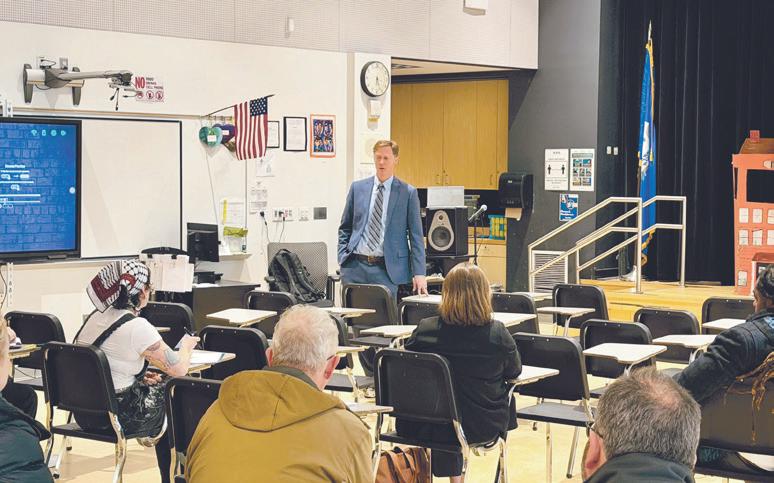
Just two New Haveners turned out for Mayor Justin Elicker’s third budget town hall on Thursday evening. Still, in the cafeteria of the East Rock Community Magnet School, the mayor walked them through his $733.3 million proposed budget for the coming fiscal year.
Elicker stressed fiscal responsibility, sketching out his yearslong push to “right our financial ship.” That includes paying down debt service and funding pensions and employee benefits — which together make up nearly 40 percent of the total budget — along with contributing to the city’s rainy day fund.
With two residents and seven city officials seated at tables and Elicker standing in front of a slideshow, the town hall had a certain scholastic quality. As he waited for residents to arrive, the mayor picked up a guitar and strummed, singing, “Budgets can be fun.”
The city has received an additional windfall in the weeks since Elicker first submitted his budget. His proposal accounts for a $24.8 million financial contribution from Yale University. But a week after the proposed budget’s unveiling,
Yale and New Haven announced the University would increase its voluntary payment to $29.9 million for fiscal year 2027 as part of an updated multi-year deal.
Elicker’s proposed budget includes a 4.01 percent increase in the city’s property tax rate. He said on Thursday that if the city puts the additional $5 million in Yale dollars towards reducing the tax increase, it would shrink to just 2.5 percent.
That decision rests with New Haven’s Board of Alders, which has until May 14 to amend the budget.
But Elicker said that “if I were to recommend to the alders, I would put the funding towards the decrease in the tax increase, because a 2.5 percent increase is closer to inflation.”
“We want to make sure New Haven remains affordable, and so we’re always trying to balance these things,” he added.
Another source of increased revenue is new development, Elicker said. New Haven’s grand list — the value of its total taxable property — is this year around $9.25 billion dollars, up by about 2.5 percent from last year.
“The more buildings we have, the more we get tax revenue,” the mayor said. “And so we want to encourage that growth, particularly in places where there’s not
people living in productive properties already.”
For an example, Elicker pointed to The Winston — a five-story, mixedincome apartment building unveiled Thursday morning — which was built on the site of a former parking lot in Science Park.
The proposed budget includes funding for more traffic cameras around the city. After Elicker’s presentation, Sarah Pimenta, a painter and community activist, peppered the mayor with questions about New Haven’s use of the technology and the datasharing practices of the companies it works with.
Elicker said that the city’s vendors do not share data with the federal government. He added that the city has solved many more homicides thanks to a separate network of police cameras but said that he understands concerns over excessive surveillance.
“I don’t know what the right balance is,” he told Pimenta.
The painter said that she came to the town hall because she is “interested to know where the city’s money goes. I personally don’t like to see police budgets and things like that being padded and money being taken from the community.”
The other attendee from the public was Davis Taliaferro LAW ’28, who
came to learn about how the budget process works.
“I’m a law student, so even the nitty-gritty stuff is interesting to me,” he said. At the close of his presentation, Elicker joked, “Class dismissed.”
Sean Matteson, Elicker’s chief of staff, said that 15 people attended the first budget town hall. Two came to the second, the mayor said. Contact ELIJAH HUREWITZRAVITCH at elijah.hurewitz-ravitch@yale.edu.
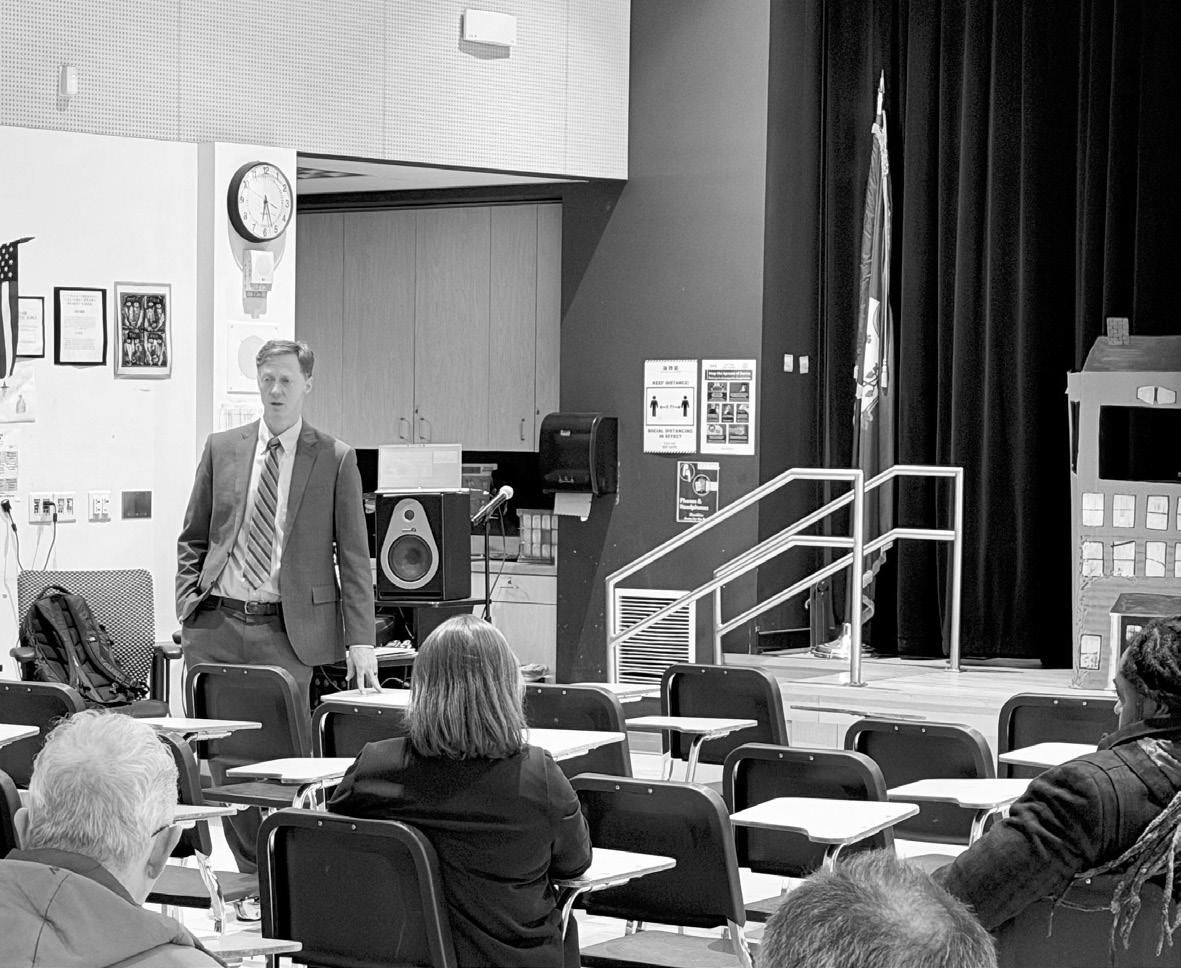
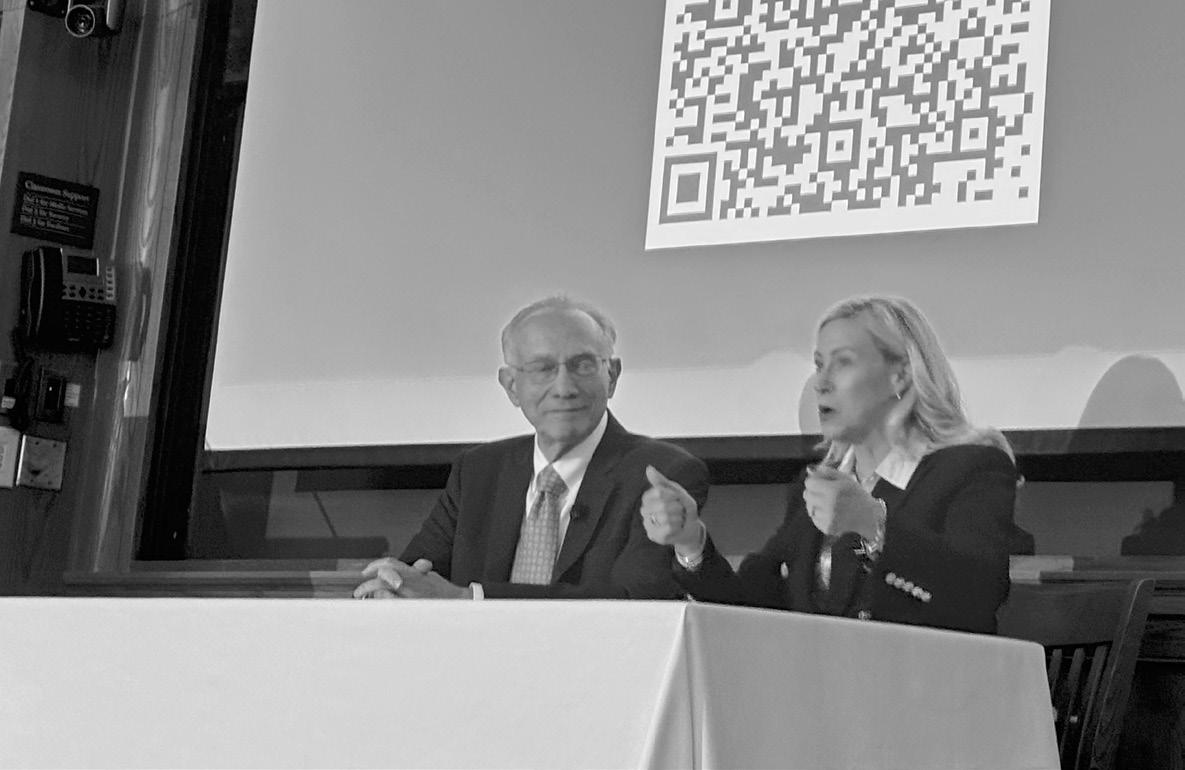
Researcher invited by McInnis gives talk touting investment in science
BY ARIA LYNN-SKOV STAFF REPORTER
Harvey Fineberg started his Thursday lecture with a question for his audience: What country has the world’s largest economy, strongest military, world-standard currency and greatest cultural influence?
Fineberg’s answer, 19th-century Great Britain, was met with laughter from a crowd of around 100 that included students, faculty, Yale President Maurie McInnis and Yale College Dean Pericles Lewis.
“Here’s another answer: Great Britain, 1885. All the same qualities. We could have said Spain
in the 15th century, Rome in the first century. The lesson is that there’s nothing guaranteed,” Fineberg said. No country has a “guarantee of lasting supremacy,” he added. Fineberg, a physician and health policy researcher who is an emeritus professor at Harvard’s T.H. Chan School of Public Health, is the latest expert brought to Yale for McInnis’ Presidential Lecture Series. Fineberg’s talk — titled “The Race for the Future: Which Countries and What Values Will Prevail?” — focused on the importance of investing in science research and bridging the gap between the public and scientists.
Harvard’s
criticized the federal government’s cuts to funding for scientific research.
He spoke in detail about China’s investment in science and showed how the country is pulling ahead of the United States in many areas of research and technology. Fineberg cited recent cuts to research funding in the United States, such as the $500 million for vaccine research cut by Secretary of Health Robert F. Kennedy Jr., which a Yale study found could cost tens of thousands of lives annually.
The federal government has also canceled federal research grants for universities across the country, which has affected Yale researchers. Last February, after the National Institutes of Health stripped funding for indirect research costs, McInnis issued a public statement condemning the cuts.
“Remember: Don’t tell me where your priorities are. Show me where you spend your money, and I will tell you what they are,” Fineberg said, quoting economist James Frick. “And the honest truth is that neither party, over a long period of time, has accorded science in America sufficient priority to keep us in the lead.”
One of McInnis’ main goals with the lecture series is to bring in lecturers to speak about issues she thinks are “enormously important for this moment,” she said in an interview after the event.
McInnis said she hopes students will hear Fineberg’s call to
“continue to pursue their passion” in science and to “understand that at this moment their role can be even larger” as individuals by “sharing what they are doing with the broader audience.”
This is “an important piece of keeping the science ecosystem healthy in America,” she added.
McInnis has spoken in the past about protecting Yale’s work in patient care and research. Initiatives for open dialogue and rebuilding trust in universities have also been a priority for McInnis during her tenure as president. These topics were part of why McInnis brought Fineberg to Yale, she said.
“The decline of trust in higher education and science is one of the most important factors, one of the most important issues, that I think is facing us as a university,” McInnis said. “Dr. Fineberg is one of the great sort of experts on that type.”
Lewis, who said he attends all of the presidential lectures, believes the good news is that “science hasn’t yet taken a big cut as we feared that it might, and so I think there’s still reason to go into science as a profession.”
“I hope people won’t get frightened off from a scientific career, and I think his remarks, while giving us some realism about it, also gave us reason to be hopeful,” Lewis said after the lecture.
When asked what she hopes students take away from the lecture, Megan Ranney, the dean of
the Yale School of Public Health, said “it’s the commitment to asking the big questions.”
“How do you ask the big questions and make sure that you’re moving towards getting the answers that actually matter to the world?” she asked. “I also think the other thing for young scientists was his emphasis on starting with rigor — so making sure that the science that you do is outstanding — but not stopping with just doing great scientific research; also thinking about your commitment to translating it out into the world.”
Nick Jacobson ’23, an associate program manager at Yale’s Tobin Center for Economic Policy, said he tries to attend “anything that President McInnis hosts,” and was at the last presidential lecture, which was given by Jonathan Haidt ’85, a social psychologist and bestselling author. Following Fineberg’s presentation, McInnis joined him on the stage for a question-and-answer section. In addition to posing several questions of her own, she asked questions submitted online by attendees.
Jacobson heard Fineberg answer his question about private enterprise, which he said he “appreciated.”
Fineberg previously served as president of the U.S. National Academy of Medicine and was provost of Harvard University.
Contact ARIA LYNN-SKOV at aria.lynn-skov@yale.edu
Finance chief to return to City Hall with lessons from West Haven stint
BY NELLIE KENNY STAFF REPORTER
After two years away, the city’s former chief finance officer will return to New Haven’s government in April — but plans to continue to live outside of city limits.
Michael Gormany, whom Mayor Justin Elicker appointed to serve as New Haven’s city controller for the next four years, is seeking the Board of Alders’ permission to continue to live outside of the city as he assumes the role, he said. Gormany has served as West Haven’s finance director since he departed New Haven City Hall in 2024. In 2023, a local financial consultant filed a lawsuit against the city alleging that Gormany, then budget director and acting controller, and fellow city official Alex Pullen were violating New Haven’s charter by serving while living outside of city limits.
During the 2023 charter revision process, Mayor Justin Elicker encouraged the Board of Alders to remove residency requirements for city department heads. The Board of
Alders did not lift the requirement, although it introduced a narrow exception for the top officials classified as city coordinators.
Gormany said the 2023 lawsuit had “nothing to do” with his decision to take a job in West Haven the following year. He grew up and attended school in West Haven, and working there was “an opportunity to help my hometown,” he said.
Conversations with West Haven Mayor Dorina Borer at the time gave him the sense that the city “needed an experienced person” to “work out processes and procedures and work with the state,” he said.
Gormany’s experience in city finance stretches back to the 1990s. He first worked on New Haven’s finances as an intern when he was 17 years old, he said. After graduating from New Haven’s Albertus Magnus College, he joined the city’s Department of Finance full time. In 2017, he was named the city’s budget director, and, in 2020, he became acting city controller. In 2024, Elicker announced that Gormany was leaving the Elm City’s government. Since then, he has
served as finance director for West Haven. But in April, Gormany will return to New Haven, where he will reassume his duties as city controller — in a permanent capacity this time.
“My agenda is really just looking at some of the things that I learned here in West Haven, and certainly bringing those to New Haven,” Gormany said, adding that he thinks he “did a decent job” in New Haven, but that he has learned about “how to make things very efficient.”
When Gormany arrived in West Haven, the city was under financial oversight by Connecticut’s Municipal Accountability Review Board. During that oversight, the board reviewed West Haven’s monthly financial reports, annual budget and debt obligations and had the power to approve some contracts and bonds, according to a report by the board. In 2025, the city was released from financial oversight.
Borer wrote in an email that“Michael is great with numbers and was instrumental in organizing our finances and most importantly working with me on designing internal controls so that we had safe guards in place.”
Every month, Borer and Gormany would “present to the Municipal Accountability Review Board to demonstrate our efforts and more importantly, our results which gave them the confidence to conclude that our City could stand on our own two financial feet!” Borer added.
In a 2024 press release announcing Gormany’s retirement as budget director, Elicker similarly lauded Gormany’s work guiding the city through financial hardship and called him a “wise and steady hand.”
“When I first took office in 2020, New Haven was facing a deep financial crisis unlike we had seen in decades, and we were facing a $66 million budget deficit,” Elicker said in the press release. “While we still have our challenges, we’ve now produced five straight years of budget surplusses.”
Elicker added that “that turnaround doesn’t happen without Michael Gormany at the helm.”
Gormany’s return to New Haven is for “personal” reasons, he said.
“Without getting into too much, there were some perks that New Haven by charter could offer me
that West Haven can’t,” he said, adding that New Haven offered greater stability.
Outside of work, Gormany is an avid sports fan and loves watching horror movies and playing video games with his son, he said.
Gormany’s colleagues in West Haven said that he will be missed.
“It’s very hard thinking that he’s not going to be there because he’s such a rock in the department,” Diana McManus, who works for the West Haven finance department, said. “He helps develop the roles. He’s seen things, and he brainstorms with you.” To the right of the door to Gormany’s office hangs a whiteboard, on which his colleagues often leave jokes and notes of encouragement, McManus said.
On a Thursday morning in early March, one message read “This man deserves Accolades!” Another read “This man has a wealth of knowledge beyond most!”
Gormany will assume his role as New Haven controller on April 6.
Contact NELLIE KENNEY at nellie.kenney@yale.edu.
ELIJAH HUREWITZ-RAVITCH / STAFF PHOTOGRAPHER
Mayor Justin Elicker outlined his $733.3 million budget proposal in a New Haven classroom on Thursday evening. Before a painter and a law student arrived, Elicker strummed a guitar and sang, “Budgets can be fun.”
GARRETT CURTIS / PHOTOGRAPHY EDITOR
As a part of University President Maurie McInnis’ Presidential Lecture Series, Harvey Fineberg, an emeritus professor at
public health school,
“I thought that our love was at an end but here I am again.”
Another Yale Rep show, and a more pessimistic approach to the moment
BY ZOE FROST STAFF REPORTER
Earlier this year, the Yale Repertory Theatre brought in the Estonian clown Julia Masli, whose onewoman show, “ha ha ha ha ha ha ha,” offered messages of hope in uncertain times. Masli responded to audience members’ concerns about political unrest with whimsy and optimism; I left the theater feeling lighter, reassured by the power of theater to bring people together.
Eugène Ionesco’s
“Rhinoceros,” which ended its three-week run at the Yale Rep on Saturday, could not have left a more opposite impression: At the conclusion of Thursday evening’s performance, I walked out onto Chapel Street in a fog, weighed down by confusion and an overwhelming sense of dread. This production scared and saddened me. I have not been able to stop thinking about it since.
The 1959 absurdist play is a thinly veiled critique of fascism and groupthink, in which the residents of a town in France begin to turn into rhinoceroses. The Yale Rep’s production offered no comfort to audience members worried about ideological extremism in our present day. Rather, it boldly rejected the notion of individual agency triumphing over collective hysteria, leaning into the terrifying and disheartening elements of the play.
Director Liz Diamond presented a thought-provoking and timely telling of Ionesco’s work, which seemed to assert that, in trying times, art that is pessimistic and frightening has as much value as art that gives hope.
“Rhinoceros” opens peacefully, the lights rising on an outdoor café — waiters can’t help but slip into easy, carefree dance between wiping tables. A walking bass line and smooth alto sax improvisation gently invite the audience to join Berenger and his friend Gene in
a Sunday chat. Their morning argument about Berenger’s excessive drinking is quickly interrupted, however, when a rhinoceros comes charging through town.
The play is composed entirely of caricatures, their two-dimensional personalities emphasized by the cast’s excellently exaggerated performance choices. Phillip Taratula’s Gene was perfectly poised, his mouth pouted and ankles crossed as he pulled out a spare tie, comb and pocket mirror for his unkempt friend. Reg Rogers played Berenger with bombastic humor in every gesture, his rumpled shirt and sagging posture establishing him as a walking midlife crisis. Tony Manna and Will Dager played Papillon and Dudard, uptight employees in a gray and dimly lit office, while Elizabeth Stahlmann embodied an insufferably cliched ingénue in her portrayal of Daisy, Berenger’s workplace crush.
As the townspeople themselves begin to turn into rhinoceroses,
CRITIC’S TAKE REVIEW
the play’s true nature as a political critique begins to emerge. Characters begin to turn voluntarily, spouting truisms like “if you’re going to criticize, it’s better to do so from the inside” and “there’s no such thing as absolute right.”
In the show’s tragic penultimate scene, Berenger and Daisy, having just confessed their love to each other, seem to be the last two humans in the town. He pleads with her to maintain hope: Being a human is better than being a rhinoceros, he argues, and together, the couple may be able to repopulate the human race. In response to his claim that “the world is sick,” Daisy says simply, “We can’t be the ones to cure them.”
We would all like to fancy ourselves Berengers: committed to our morals when the world has gone topsy-turvy. “Good for you, Berenger!” we think as he loses his friends and colleagues to the herd. “Stick to your guns, Berenger,” we chant silently as Daisy abandons him and walks towards the army of quadrupeds. But on Thursday evening, watching this wacky-haired character gesticulate wildly to an unconvinced partner, I couldn’t help but feel a tug of hope that he would just throw in the towel.
After all, what does Berenger have to lose? Not his friends, not a woman. Not even his tedious, nondescript job — the office, naturally, has been trampled by rhinoceroses. In the opening scene, Berenger laments that he drinks because he “just can’t get used to life.” But rhinoceroses don’t know about cognac, and they appear to be used to life, even in a French town.
Early on, Dudard asks, “What could be more natural than a rhinoceros?” This line sounds funny in a scene with three human actors in a theater of human audience members, but by the end of the play, Berenger stands alone on the stage while the rest of the cast, wearing rhinoceros heads, closes in on him. It becomes difficult to entirely reject the notion that turning into an animal would, in fact, be the natural choice.
In succumbing to the herd, Ionesco’s characters escape the confines of the stereotypes written for them. Gene trades his sharp suit and elaborately patterned silk pajamas for leathery skin and a horn; Dudard leaves his pursuit of a managerial role behind to live by the hierarchies of nature rather than those of a corporate workplace. These transformations make them more interesting, and more free. When Berenger delivers his final line — “I am not capitulating” — he is not the last hero standing but a man who will die alone, the single human in the town, while everyone he knows lives together in a community completely inscrutable to him. The theme of “Rhinoceros” is not that every voice matters, or that love and community will always triumph over hate and ignorance. It argues instead that being a thinking person surrounded by propaganda and societal distress is exhausting. Even more, it asks: Is being a thinking person in times like these, whether 1959 or 2026, even worth it?
“ha ha ha ha ha ha ha” would argue that it is worth it, that just going to the theater and forming a community with other audience members makes the absurdity of modern life easier to bear. But it is hard to ignore the increasing frequency of rhinoceros sightings — surreally absurd political events, like a White House video portraying Iranian officials as angry bowling pins knocked down by American forces set to Lynyrd Skynyrd’s “Free Bird.”
Ionesco’s terrifying work feels urgently honest in the country’s current political climate. It is impossible to always fight rhinoceroses with laughs and warm feelings. The Yale Rep’s choice to bring this show to New Haven on the heels of Masli’s optimism is an acknowledgement of that reality.
Contact ZOE FROST at zoe.frost@yale.edu
‘Jesus Christ Superstar’ finds new stage: Yale Divinity School chapel
BY CAMERON NYE STAFF REPORTER
With Easter just around the corner, ’tis the season for visits from magical bunnies, hunting for eggs in every crevice imaginable and that biannual trip to church your parents drag you to.
For Christians, it’s a time for celebration, for rejoicing in Jesus’ resurrection and man’s salvation from sin. For thespians, it’s a time for “Jesus Christ Superstar.”
Every Easter, without fail, I see a flyer or an advertisement for a production of “Jesus Christ Superstar,” a festive rock opera depicting the passion of Jesus Christ, scored by musical theater juggernaut Andrew Lloyd Webber and Tim Rice. I am always intrigued by these productions attempting to capture the work in new, interesting ways.
Completely sung through, the show follows Jesus in his final days, reinterpretting the accounts of the Gospels with a special emphasis on Judas. The follower of Christ has grown displeased with his teacher’s handling of his fellow apostles and eventually betrays him. It’s a gritty, raw reshaping that humanizes Jesus — combining rock and roll with the greatest story ever told. This school year, a new group emerged on campus to take on the musical theater staple: Yale Divinity Drama, formed to celebrate the intersection of drama and faith, whose production of “Jesus Christ Superstar” opened Thursday and continued for a second and final performance on Friday evening. Any theater fan with a pulse has likely collided with Webber’s unforgettable shows — “Phantom of the Opera,” “Evita,” “Cats,” etc. These megamusicals, as they would eventually become known, feature spectacular staging and received massive international acclaim. His
pop-influenced scores, known for bombastic overtures and striking 11 o’clock numbers that creep their way up the Billboard Top 100, are many people’s first forays into the world of musical theater.
When you walk into the Divinity School’s Marquand Chapel at 409 Prospect St., the space doesn’t exactly appear conducive to a theatrical performance of Webber’s magnitude. Typically used for worship, the gleaming white hall had been reconfigured for this weekend’s production. Rows of wooden chairs carved out an ovular space in the chapel’s center. On what appeared to be the stage sat three plain wooden tables, situated under a glistening crystal chandelier.
However, as the overture began, it became clear that this production would not be limited to the center area. Rather, the entire chapel was the stage. Cavalcades of actors danced through the aisles. They shimmied in the rafters. They loomed in the pulpit. No space was off limits for this ragtag group of performers.
I say rag-tag because this is Divinity Drama’s inaugural production, under the co-direction of Benjamin Lowry DIV ’27 and Julia Warren DIV ’26. “Jesus Christ Superstar,” which premiered on Broadway in 1971, seems like the obvious choice, and I could not possibly think of a more appropriate group on campus to stage it. Their product glistens as a delightfully earnest and heartfelt rendition of Webber’s work. It’s clear the cast is having a blast from the moment they step onstage. Grinning ear to ear, the apostles enter wearing flowing, floral blouses and vibrant pastels that make them seem comfortingly mundane. Jesus himself wears a sunshiney sleeveless cable-knit sweater and white jeans. Judas dons cargo pants and a grey, zip-up hoodie.
It’s unmistakable that this will not be a particularly glitzy production, a common theme among “Superstar” restagings. Buckets of glitter won’t be launched off balconies and avant garde costumes won’t make the production feel superficial. Rather, the glitter lies in the cast itself — in their talented vocal performances and commitment to the show’s messages.
Emmy Brett DIV ’28 kicks off the show with a grungy rendition of “Heaven on Their Minds,” their powerful vibrato slicing through the chapel with the gumption of a true performer’s. They play Judas with angst and perturbation, and we watch that anxiety grow as their vocals go from raspy low notes to soaring in the stratosphere with operatic height. Brett is the force that drives the show, both thematically and musically.
Other standout performances include Sarah Golemon-Mercer DIV ’27 as Pontious Pilate, whose powerful soprano in “Trial Before Pilate” is undeniably piercing and fiercely brutal. Wearing a trailing red skirt, a criss-crossed lace top and a silver laurel tiara, she has Christ whipped and — under the duress of an angry mob — eventually calls for his crucifixion. Her portrayal is one of both brutality and confliction, as Pilate struggles to decide Christ’s fate.
Mary Magdalene, played by Izzy Barbato MUS ’26, is the closest thing this show has to a love interest. Magdalene soothes Jesus with her recurring promises that “everything will be alright,” a pleasantry she takes to heart as a follower of Christ. Barbato brings the flawed character to life with a mesh shirt and slicked-back bob, her voice resonating with a quiet reverence until her love becomes too much to bear and she begins to cry out.
Of course, “Jesus Christ Superstar” would not be complete without its titular character, and Aaron Ventresca SOM ’26 plays him excellently. His entrance on stage is accompanied by blinding lights that illuminate the entire chapel, reflecting off alabaster walls and sterling organ pipes. It’s an entrance fit for a king — in this case, the King of the Jews. He’s dressed as a rock star: tight, sleeveless mesh tops that expose his bulging muscles. His approach feels nuanced — capturing Christ as a pensive, preoccupied leader grappling with the weight of having superstardom thrusted upon him. His laments are commanding and sorrowful, his sermons compassionate and emotional. A vocalist in his own right, Ventresca’s screams echo throughout the entire chapel while his more tender moments resonate in the audience’s hearts.
Within the physical setting of a chapel, religious iconography is naturally present throughout the duration of the show. Divinity Drama uses this to its advantage, particularly in moments of extreme tension and conflict. While Judas contemplates betraying Jesus, he stands facing the golden cross that occupies the back of the altar. Staring at the way his teacher would ultimately meet his demise, a fraught Judas feels the weight of his actions as the cross glistens under the overhead light. The same happens for Jesus, who can’t help but notice the cruel symbolism as he contemplates his fate. These moments of crisis and confliction remind the audience of the story’s tragic inevitability — the violence that precedes resurrection.
As much as this production dwells on the more liturgical aspects, there is still a great amount of whimsy. Freddie Swindal-Endres DIV ’26 plays King Herod as a bumbling buffoon who enters in a purple
tracksuit with the word “king” bedazzled on his back. Carried in by his guards and wildly gyrating, he demands that Jesus prove his divinity, stomping like a toddler when he refuses during the toe-tapping number “King Herod’s Song.”
Another campy moment emerges during the resounding “Superstar,” when the ensemble appears from the wings wearing white robes and halos, although those who look closely will notice that instead of the stereotypical renaissance imagery, this production decided to be as biblically accurate as possible — depicting the angelic figures as multieyed seraphim with googly eyes glued to their winged head bands.
Staging shows in unconventional spaces does have its own risks, and unfortunately “Superstar” is no exception. Marquand Chapel was obviously not designed as a venue for megamusicals, and, with few microphones, hearing what the cast was saying was sometimes a struggle. Similarly, with the circular setup, seeing all of the action proved impossible . As someone who has staged a show in a high school cafeteria, I am all too aware of the difficulties that come with unorthodox spaces. Hopefully, as time goes on and Yale Divinity Drama continues to find its footing, the group can learn to use the space to its full potential.
“Jesus Christ Superstar” took me to church — literally. It’s a playful reminder of the magic of musical theater and how the art form can bring new life to even the most antiquated stories. It may not have been the most polished performance, but “Superstar” has the heart and soul many shows can only hope for.
Contact CAMERON NYE at cameron.nye@yale.edu.
COURTESY OF THE YALE REPERTORY THEATRE
A powerful production of Eugène Ionesco’s absurdist play “Rhinoceros,” left a News critic with a sense of dread.
“Somewhere deep inside, you must know I miss you.”
SOMEONE ELSE’S STORY ABBA
Bulldogs open spring season by claiming Albert Cup over Brown
HEAVYWEIGHT CREW
BY AUDREY KIM STAFF REPORTER
The Yale Bulldogs traveled to Sarasota, Florida, over the weekend to enter three of their boats in the Intercollegiate Rowing
Association’s Sarasota Invitational. The regatta also included the battle for the Albert Cup, an annual competition between the Elis and the Brown Bears. During the 2025 season, Brown won the Albert Cup over Yale for the first time since 2013. However, on Friday, Yale’s first boat claimed the victory for the Bulldogs.
“It was great to finally kick off the spring racing season this past weekend in Sarasota. On Friday evening, the 1V crew had an excellent race in their win against Brown and Northeastern,” heavyweight head coach Mike Gennaro wrote to the News. “With only two returning 1V oarsmen from last year and three freshmen in the crew, I am extremely pleased with how they prepared and performed at a high level in tight racing. We are thrilled to have the
Elis beat Brown, winning fifth straight match
WOMEN’S TENNIS
BY BRODY GILKISON STAFF REPORTER
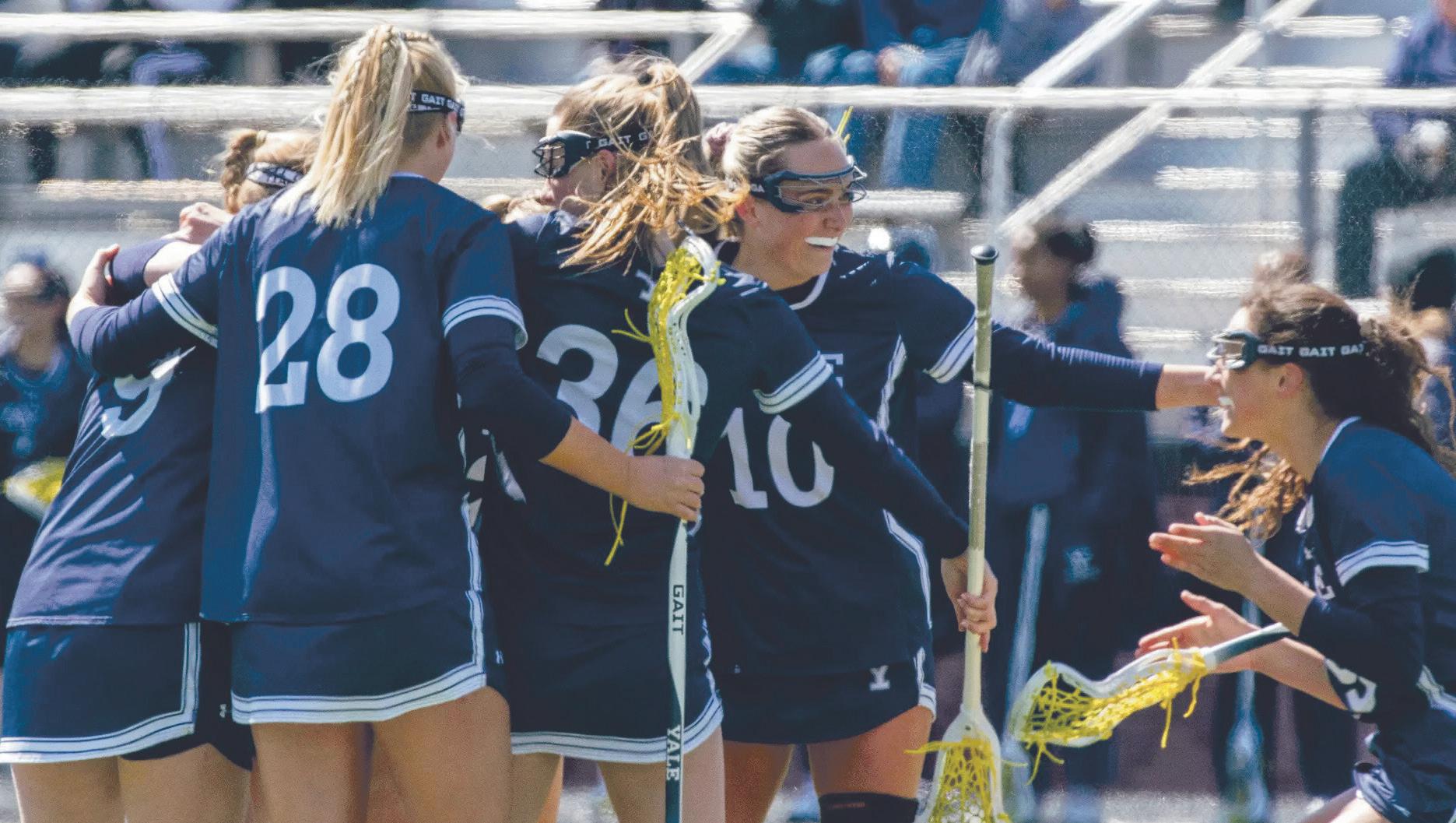
The Yale women’s tennis team (14–2, 1–0 Ivy) beat Brown (12–5, 0–1 Ivy) 4-1 on Saturday in the team’s conference opener. The Bulldogs have now won five straight matches — the second time the team has done so this spring.
Yale got off to a strong start in doubles with two victories to put the first point on the board.
The dynamic duo of Erin Ha ’27 and Shyla Aggarwal ’27 won the first match 6-2 before Angela Huang ’28 and Julia Werdiger ’28 beat their opponents 6-4 to put the Bulldogs up 1-0.
In singles, it was more of the same dominance that we’ve seen from Yale as of late. In the No. 1 spot, Orly Ogilvy ’27 defeated Hannah Shen 6-4, 6-2. In the No. 2 spot for Brown, Dani Ben-Abraham retired mid-match to give Leena Friedman ’29 a win and put the Bulldogs one point away from clinching. Brown’s Abigail Lee defeated Huang for the Bears’ first and only point of the day. However, team captain Ha slammed the door on Brown with a 6-3, 6-3 victory, giving the Bulldogs their fourth point to win 4-1.
The Bulldogs will be back in action at Cornell next Saturday as they look to pick up their sixth consecutive victory.
Contact BRODY GILKISON at brody.gilkison@yale.edu.
Bulldogs sweep Penn in three-game series
BASEBALL
BY JUSTIN LEAHY
CONTRIBUTING REPORTER
After a slow start to the year, Yale baseball (13–8, 4–2 Ivy) needed a statement performance. Over the weekend, they got one. At George H.W. Bush ’48 Field, the Bulldogs swept the Penn Quakers in three games.
The series featured almost everything, from an improbable nine-run comeback to a complete game shutout by a pitcher hardly throwing over 80 miles an hour.
The opener on Saturday was the wildest game of Yale’s young season. The Quakers took a quick 14-5 lead through six innings and knocked out starter Jack Ohman
’28, a preseason All-American, after just 2.2 frames. It was the second consecutive start where Ohman was knocked out early with many runs. Then, out of nowhere, the Bulldogs woke up. In the seventh inning, Yale scored five runs with the help of Colin Sloan ’27, Jackson Hays ’29, Kaiden Dossa ’27 and Garrett Larsen ’27, cutting the deficit to two. In the eighth, the Bulldogs completed their comeback, as Owen Turner ’28 laid down a beautiful suicide squeeze with two strikes, driving in both the tying and go-ahead runs. Then, to cap the inning, Hays stole home. Yale got a cushioned 16-14 lead. Tate Evans ’27 entered in the eighth inning then retired the final five Penn batters to earn the win.
Albert Cup back at Yale.”
On Friday, the Elis competed in the opening heats, vying for a top three placement in order to qualify for the finals on Saturday.
The first boat placed won its heat, with Northeastern and Brown following, earning the Bulldogs the Albert Cup and a spot in the championship race. Both the second and third boats placed third in their heats, qualifying all Yale boats for their respective championship races.
While the heavyweight team has facilities to practice indoors during the winter, this year’s intense snowy season delayed the team’s return to practicing on the water at the Gilder Boathouse, giving them limited practice with the dynamic wind and current conditions they face on the water.
In the grand finals on Saturday, all Bulldog boats placed sixth of the six boats in each championship race.
“The 1V’s race on Saturday did not quite go as planned, similarly to the races of the 2V and 3V crews. I think the minimal time we have had on the water this spring due to
the long winter certainly showed at various moments throughout the weekend in all three boats,” Gennaro wrote to the News.
The first boat finished with a time of 05:58.78 in the first varsity championship, trailing Northeastern by 2.7 seconds. The second boat competed in the second varsity championship and recorded a time of 06:03.83, 5.23 seconds behind the fifthplace Stanford boat. In the third varsity championship race, the Bulldogs put up a time of 06:15.55, finishing 2.42 seconds later than fifth place Stanford.
“Nevertheless, the racing was productive because it gave us valuable information on what the crews are doing well and it highlighted areas for improvement,” Gennaro wrote. “I am confident in this group and we are all looking forward to getting back to work this week.”
Yale’s next regatta will be the Princeton Invitational in Princeton on April 11 and 12.
Contact AUDREY KIM at audrey.kim.ajk234@yale.edu.
Sunday was the complete opposite of Saturday. In the first game of the doubleheader, Daniel Cohen ’26 had his best outing of his four-year career. The righthander retired 23 consecutive batters after the second inning and finished with a complete game shutout in 100 pitches, Yale’s first of the year. Larsen also hit his first home run of the year in the sixth. The Bulldogs cruised to a 4-0 victory. Game two on Sunday went down to the wire. With the rest of the bullpen stretched thin due to Saturday’s monster of a game, Evans made his first collegiate
start, after 55 relief appearances over his three years. He was almost untouchable through seven, striking out nine batters and just giving up two runs. In relief, Teo Spadaccini ’27 was sharp, tossing several scoreless frames to lower his season ERA to 1.76. With the Bulldogs down 1-2 in the bottom of the ninth, Bryce Miller ’29 drove in pinch-runner Breyden Ruiz-Weiss ’28, tying the game at two. In the bottom of the tenth, Sloan walked it off on a 1-2 fastball to center to win it for the Bulldogs 3-2. It was Yale’s first sweep over Penn since 2019. Just recently,
Yale had dropped a series to Brown at home and sat 1-2 in Ivy League play. The Bulldogs had faced real questions about their ability to live up to their preseason billing as the returning Ivy League champions. This weekend likely helped assuage their worries. On Tuesday, the Bulldogs head west to play Fairfield. This weekend, the Bulldogs head to Princeton, New Jersey, for a threegame series against the Tigers. Contact JUSTIN LEAHY at justin.leahy@yale.edu.
YALE ATHLETICS
Yale’s heavyweight crew team traveled to Florida, to race in the Intercollegiate Rowing Association’s Sarasota Invitational.
LIZA KAUFMAN / PHOTOGRAPHER EDITOR Yale beat Brown 4–1 over the weekend to extend their win streak as they entered Ivy League play. In the top match, Orly Ogilvy ’27 defeated the Bears’ Hannah Shen 6–4, 6–2.
‘NO KINGS’ IN NEW HAVEN
Photos by Alex Hong Staff Photographer
Bulldogs
MEN'S LACROSSE
BY LIZA KAUFMAN STAFF REPORTER
The Yale men’s lacrosse team
(4–4, 1–2 Ivy) delivered its biggest win of the season thus far on Saturday, upsetting No. 9 Cornell (5–3, 2–1 Ivy) in Ithaca, marking the team’s first Ivy League victory this year.
The Bulldogs handed the defending NCAA champions their first conference loss of the season and did so in Ithaca, where Yale had not beaten Cornell since 2018.
“We’ve been so close these past two Ivy League matchups and we knew what we were capable of and just kept working,” long stick midfielder Francis Keneally ’28 wrote in a text message to the News. “Definitely feels great to pull out.”
Despite being outshot and losing the faceoff battle, Yale capitalized on key moments and leaned on elite goaltending to secure the win. A 20-save performance from Ben Friedman ’28 in the net and four goals from attackman Peter Moynihan ’27 powered the Bulldogs to the 13-12 victory.
Saturday was also Yale’s first time defeating Cornell since a 22-15 victory in the semifinals of the 2023 Ivy League Tournament, when the members of the senior class were first years.
The win carries added weight for the Bulldogs, coming on the same field where Cornell ended Yale’s season in last year’s Ivy League Tournament semifinals.
“We came out of the gates firing, because we knew we could play with them going into it,” Friedman wrote in a text message to the News.
Yale was aggressive from the
WOMEN'S LACROSSE
BY AZARA MASON STAFF REPORTER
opening whistle. Moynihan struck twice to open the scoring, setting the tone early as the Bulldogs jumped out to a 2-0 lead. Cornell responded with a goal of its own to cut the deficit to one, but the Bulldogs hit back and continued generating offense, as attackmen Sean Grogan ’29 and Connor Gately ’28 each found the back of the net to give Yale a three-goal lead.
The Big Red answered right back with two of their own to put the game at 4-3, but a Luke Pascal ’28 goal with 2:05 to go cushioned Yale’s lead. With a minute and a half remaining, Cornell equalized.
By the end of the first quarter, the score stood tied at 5-5.
Entering the second quarter tied at 5-5, a Dylan Blekicki ’29 to Cole Cashion ’27 connection restored the Elis’ lead. However, Cornell capitalized on a man-up opportunity to level the score. At 11:02, Grogan potted his second goal of the game to put Yale up 7-6, but a three-goal Big Red comeback ended the half with Cornell leading 9-7.
“It was definitely a game of runs with Cornell throwing their haymaker to end the half,” Friedman wrote. “Wanted to hold the line for my teammates, who were hustling for every loose ball and initiating bigtime contact all over the field.”
Out of halftime, Yale flipped the script.
The Bulldogs tightened defensively, holding Cornell to just three second-half goals, while Friedman anchored the turnaround with a series of key saves.
“Going into the second half, our coach kept emphasizing that if we could just ‘hold the line,’ we’d give ourselves a real chance to win,” captain and defenseman Patrick Pisano ’26 wrote in a text message to the News. “That’s exactly what happened. I think it says a lot about our defense’s
resilience and mentality.”
Yale took control in the third quarter. Behind that defensive stand, Yale clawed back. Pascal’s second goal of the day at 11:46 cut the deficit to one. Cornell answered with its only goal of the quarter, but Yale countered with a Blekicki man-up goal and a hat trick from Moynihan to knot the game at 10-10.
“Midway through the third quarter I drew my line in the sand, as did Eric Platten, Patrick Pisano, and Konrad Miklazewski. From then on our offense kept rolling,” Friedman wrote. “They just compounded and we found ourselves with the W.”
The Bulldogs carried that momentum into the fourth. Gately found David Anderson ’26 for a
man-up to give Yale an early lead.
Two minutes later, Cole Jackson ’27 scored unassisted to extend the Bulldogs’ lead to 12-10. Cornell’s Brian Luzzi potted his fourth of the game at 6:57 to put the game within one. However, Moynihan said not today, netting his fourth at 2:52.
The Big Red fired two late shots on goal, but Friedman turned both away. With 21 seconds remaining, Cornell again brought it within one, but Friedman delivered once more at the 5 second mark, making a crucial save to preserve the 13-12 victory and seal Yale’s upset. Teammates rushed the field as the Bulldogs celebrated the program’s first Ivy League win of the season and an upset over the defending national champions.
“It’s been a while, so it’s definitely a great moment for everyone as well as our seniors,” Keneally wrote about Yale’s first victory over Cornell in three years. Having taken down the defending national champions, Yale will look to build on the result next weekend against Dartmouth (4–5, 0–2 Ivy) in Hanover.
When the Elis hosted the Big Green last year at Reese Stadium, Yale crushed Dartmouth 21-12 to punch their ticket to the Ivy Tournament. Faceoff is slated for 12 p.m. in Hanover, and the game will be streamed on ESPN+.
Contact LIZA KAUFMAN at liza.kaufman@yale.edu.
The No. 8 Yale women’s lacrosse team (9–1, 3–0 Ivy) faced the No. 19 Princeton Tigers (4–4, 1–1 Ivy) in New Jersey on Saturday and returned to New Haven with another win. Princeton struck first just over three minutes into the game, as Haven Dora — the Ivy League’s alltime assists leader — set up Meg Morrisroe, who is second in the Ivy League in goals per game.
the Ivy League in goals per game, earned an 8 meter and was able to get past goalie Amelia Hughes, who ranks second nationally in saves per game. Holmes got the first point for the Bulldogs to tie up the game 1-1.
A few minutes later, attacker Kelly Holmes ’28, who is sixth in
The Tigers found themselves at the Bulldogs 8-meter mark just a couple of minutes later. They capitalized on the foul as well and got their lead back 2-1.
Off of two back-to-back draw controls by midfielder Kate Gould ’29, the Bulldogs quickly scored and claimed a 3-2 lead. Ashley Kiernan ’27 got to the 8-meter mark and scored on Hughes to extend their lead 4-2. The Bulldogs then had two more shots before the end of the first quarter; however, they both hit the post. They finished the
quarter with a 4-2 lead. Just nine seconds into the second quarter, the Tigers scored to put them down by only one goal. Then, on a free position opportunity less than a minute later the Tigers were able to tie it up 4-4. For the rest of the game, the Tigers never came closer to walking away with a win.
From there, Yale dominated, launching an 8-0 run that spanned deep into the third quarter. The Bulldogs’ defense held Princeton scoreless for nearly the entire third, with goalkeeper Niamh Pfaff ’28 anchoring a shutout until a late free-position goal broke the streak. Yale entered the fourth quarter with a commanding 12-5 lead.
Foul trouble hindered Princeton in the final quarter, and Yale capitalized on multiple player-up opportunities, scoring three times with the advantage.
The last shot the Bulldogs scored was a quick releasebehind-the-back shot from Ashley Newman ’26. That shot marked the second game in a row that the senior attacker had a flashy behind-the-back goal.
On Saturday, Newman led the Bulldogs in scoring with four goals.
Yale closed out the game with a 16-8 victory to remain undefeated in the Ivy League.
The Bulldogs will look to extend their winning streak against No. 16 Army West Point (8–2, 4–0) this week. On Tuesday at noon, the Bulldogs will face off against Army at Reese Stadium.
Contact AZARA MASON at azara.mason@yale.edu.
LIZA KAUFMAN / PHOTOGRAPHY EDITOR
On Saturday in Ithaca, the men’s lacrosse team earned its first Ivy League victory on the road, downing No. 9 Cornell.
YALE ATHLETICS
Yale’s women’s lacrosse team, which is currently ranked No. 8 in the nation, beat Princeton 16-8 on Saturday.