

BY ELIJAH HUREWITZ-RAVITCH STAFF REPORTER
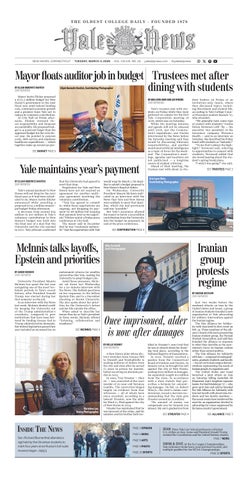
Mayor Justin Elicker proposed a $733.3 million budget for New Haven’s government in the next fiscal year amid federal funding cuts, continued economic growth and a promise from Yale not to reduce its voluntary contribution.
At City Hall on Friday afternoon, Elicker stressed fiscal responsibility and financial accountability. His proposed budget is 4.4 percent larger than the approved budget for the 2026 fiscal year. He pointed to pension costs, debt service and employee healthcare expenditures — which together make up around 40 per-
BY ELIJAH HUREWITZ-RAVITCH STAFF REPORTER
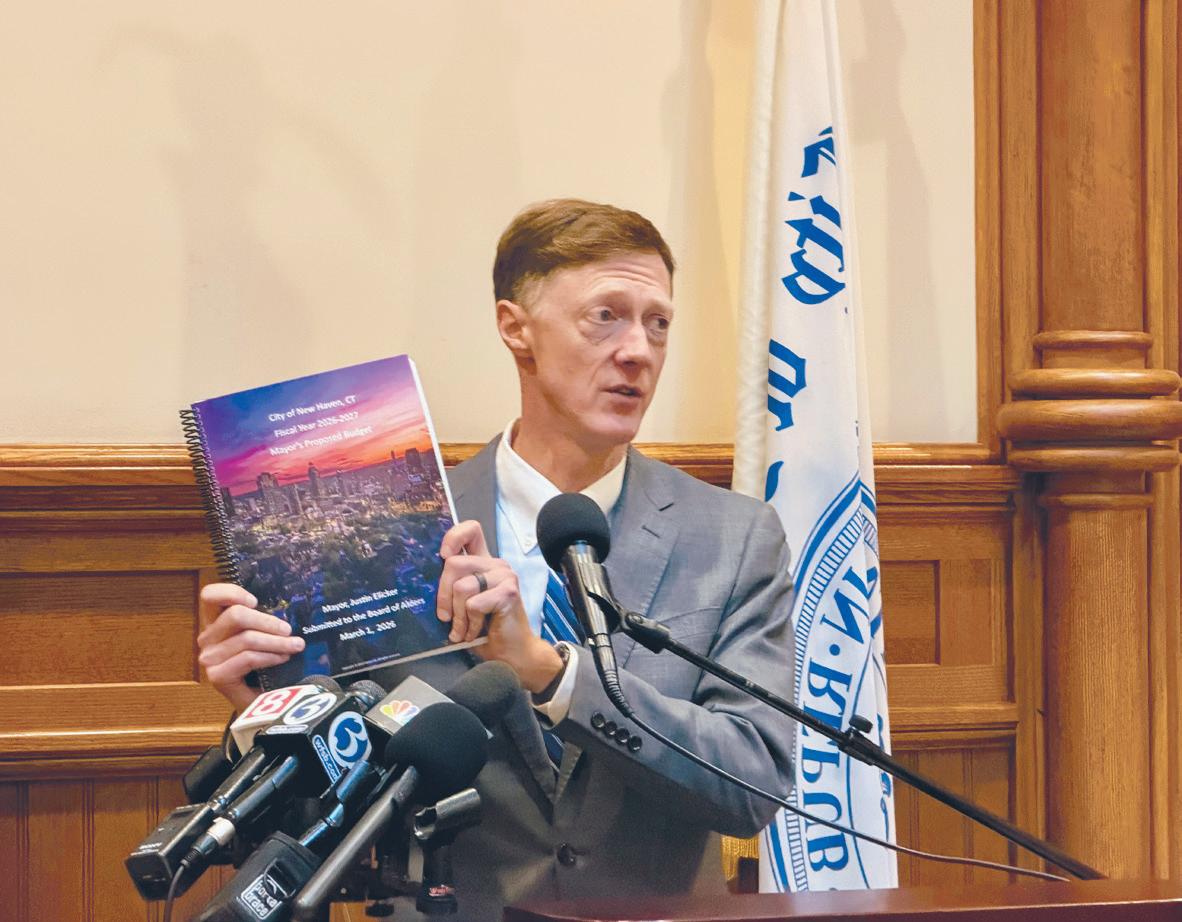
Yale’s annual payment to New Haven will not drop for the 2027 fiscal year as it had been scheduled to do, Mayor Justin Elicker announced while unveiling a proposed $733.3 million municipal budget Friday afternoon.
A decrease from around $24 million to $16 million in Yale’s voluntary contribution to New Haven’s budget was built into the final year of a deal that the University and the city reached in 2021. Yale officials confirmed
that the University had agreed to avert that drop.
Negotiators for Yale and New Haven have not yet reached an agreement for another multiyear agreement involving the voluntary contribution.
“Yale has agreed to commit to, while these negotiations are ongoing, not dropping its payment by $8 million but keeping that payment level as we negotiate,” Elicker said at a Friday press conference at City Hall.
The mayor said in December that he was “cautiously optimistic” that the negotiations with Yale
BY ASHER BOISKIN STAFF REPORTER
University President Maurie McInnis has spent the last year navigating one of the most turbulent periods in Yale’s recent history, after President Donald Trump was elected during her first semester on the job.
In an interview with the News last week, McInnis denied credit for keeping the University out of the Trump administration’s crosshairs, compared to peer institutions that have been battered by funding freezes tied to Trump administration demands. But federal legislation passed last year included an increased tax on
endowment returns for wealthy universities like Yale, leading the University to adopt budget cuts.
Amid those pressures, McInnis sat down last Wednesday for a 30-minute interview with the News. She fielded questions on her responses to the Jeffrey Epstein files and to a December shooting at Brown University. She also spoke about her priorities for the University’s future and her life outside the office.
When asked to describe her tenure thus far as Yale’s president in three words, McInnis offered “listening, collaboration and steadiness.”
SEE MCINNIS PAGE 4
would wrap by March 1, his deadline to submit a budget proposal to New Haven’s Board of Alders.
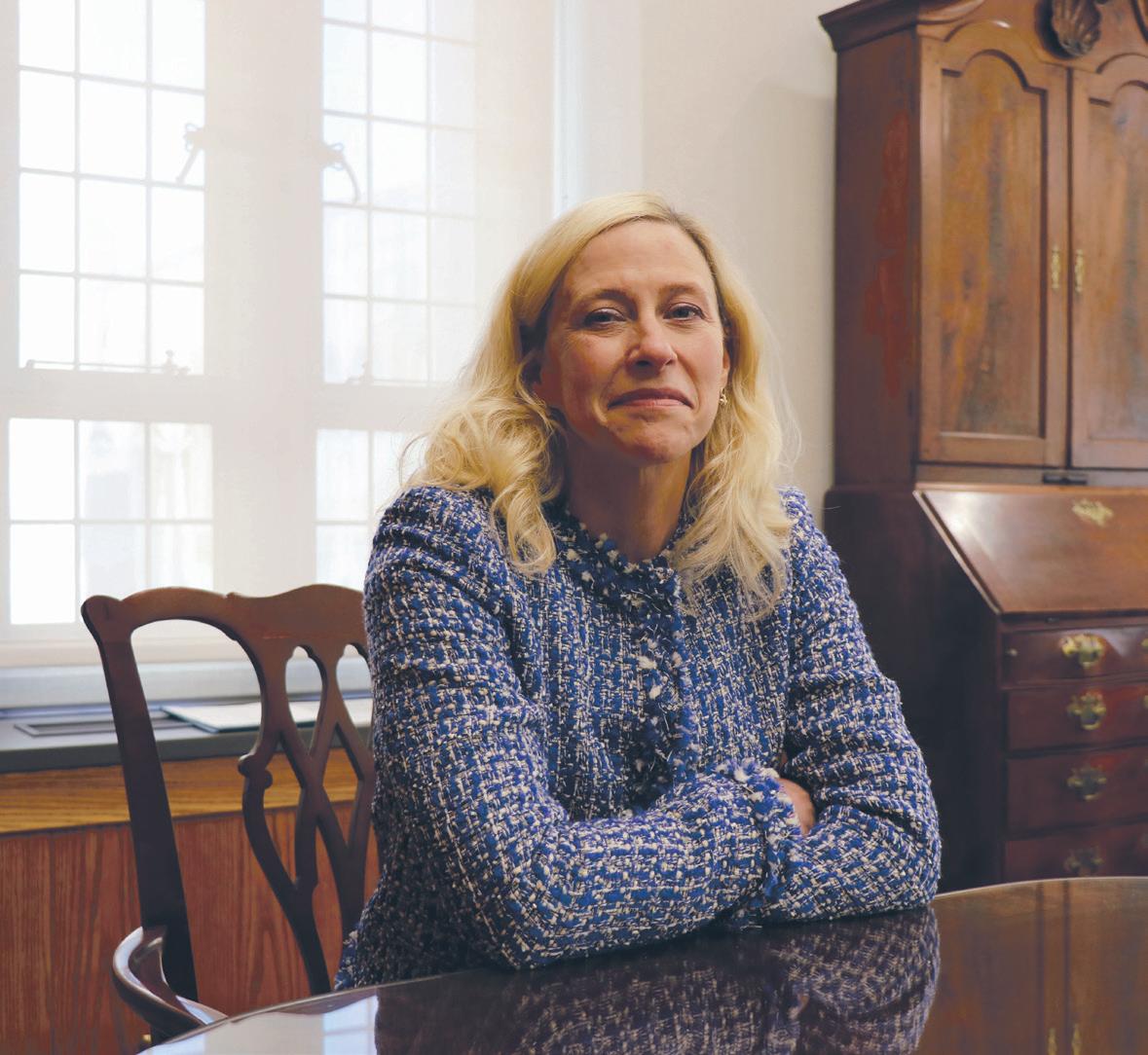
On Wednesday, University President Maurie McInnis indicated in an interview with the News that Yale and New Haven were unlikely to meet that deadline, which she had previously said was “possible.”
But Yale’s assurance allowed the mayor to factor a $24 million contribution from the University into the budget he proposed, he said at the press conference.
SEE CONTRIBUTION PAGE 4
Abby Assouad, Staff Photographer
BY ARIA LYNN-SKOV AND LEO NYBERG STAFF REPORTERS
Yale’s trustees met with students on Friday while they were gathered on campus for the first Yale Corporation meeting of 2026, which was on Saturday. While the meeting minutes and agenda will not be released until 2076, per the Corporation’s regulations, one trustee interviewed by the News before the Saturday meeting said they would be discussing fiduciary responsibilities, and another mentioned artificial intelligence as a topic of focus for the weekend. The Corporation’s meetings, agendas and locations are not publicized — a longtime source of student criticism.
Ahead of their meeting, the trustees met with about 25 stu -
dent leaders on Friday at an invitation-only lunch, where they discussed topics including divestment and student life, according to Yale College Council President Andrew Boanoh ’27, who attended.
“We generally have some type of contact with students,” trustee Felicia Norwood LAW ’89 — the executive vice president of the insurance company Elevance Health — said in an interview on Saturday. She described the Friday lunch with students as “fantastic.”
“To me that’s always the highlight,” Norwood said, referring to opportunities to connect with students. Norwood added that she loved hearing about the student’s spring break plans.
“I wish I was going!” she said.
SEE TRUSTEES PAGE 5
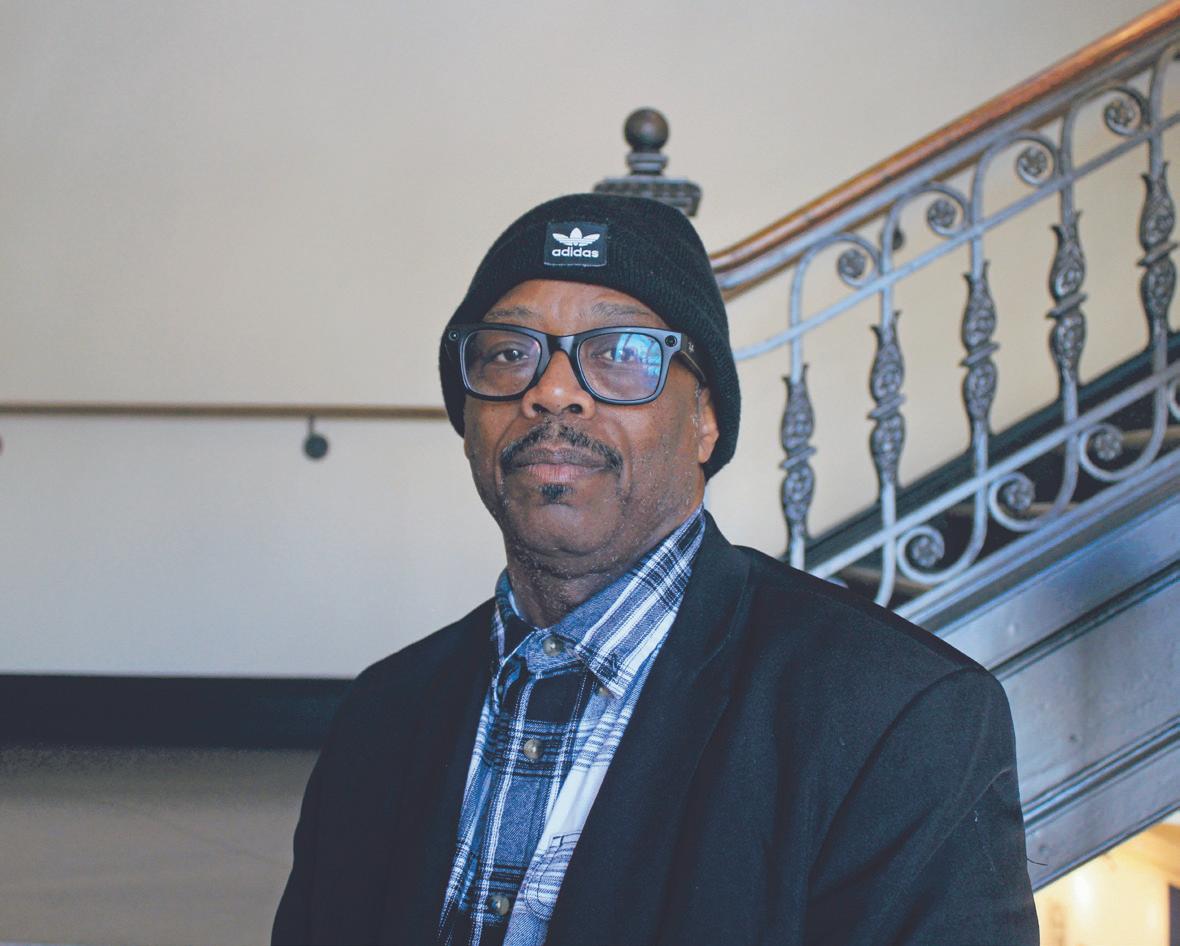
Once imprisoned, alder is now after damages
BY NELLIE KENNEY STAFF REPORTER
A New Haven alder whose district stretches from Science Hill to Dixwell and Newhallville is seeking millions of dollars from the city and state after he served 23 years in prison for murder, before receiving an absolute pardon in 2022.
In 1993, Troy Streater — then 26 — was convicted of the 1990 murder of 19-year-old Terrance Gamble. The conviction hinged largely on evidence from four witnesses — all of whom have since recanted, according to a lawsuit Streater, now the alder for Ward 21, filed against the city of New Haven in 2024.
Streater has maintained that he was innocent of the crime, and his minister and his brother both tes-
tified in Streater’s 1990 trial that he was at church when the shooting took place, according to the National Registry of Exonerations.
In 2022, Streater received a pardon from the Connecticut Board of Pardons and Paroles. In January 2024, he brought his suit against the city of New Haven, seeking $100 million in damages. He separately sought $12 million from the state, in accordance with a state statute that prescribes a formula for calculating damages. On Feb. 10, Robert Shea Jr., the state’s claims commissioner, issued a decision recommending that the state give Streater around $5.75 million.
“No amount of money can compensate you for funerals you missed. My son’s graduation from
BY ANAYAH ACCILIEN STAFF REPORTER
Just two weeks before the weekend attacks on Iran by the United States and Israel, a group of Iranian students founded a new organization at Yale advocating for military intervention against the Iranian regime.
The Yale Alliance for Solidarity with Iran held its first event on Feb. 14. Three members of the alliance’s board criticized a preexisting Iranian student group, the Persian Student Association, and said they founded the alliance in response to what they describe as the association’s focus on Iranian culture rather than current politics.
The Yale Alliance for Solidarity with Iran — composed of undergraduates, graduate students and faculty — has set out to lead campus demonstrations representing the needs of Iranian people, its organizers said.
The United States and Israel launched a joint attack on Iran on Saturday, killing Ayatollah Ali Khamenei, Iran’s longtime supreme leader. For Hadi Mahdeyan ’27 — who grew up in Iran and said he founded the Yale Alliance for Solidarity with Iran last month with about nine students and two faculty members — the recent events have reinforced the need for an organization devoted to advocating for voices suppressed by his home country’s government.
5
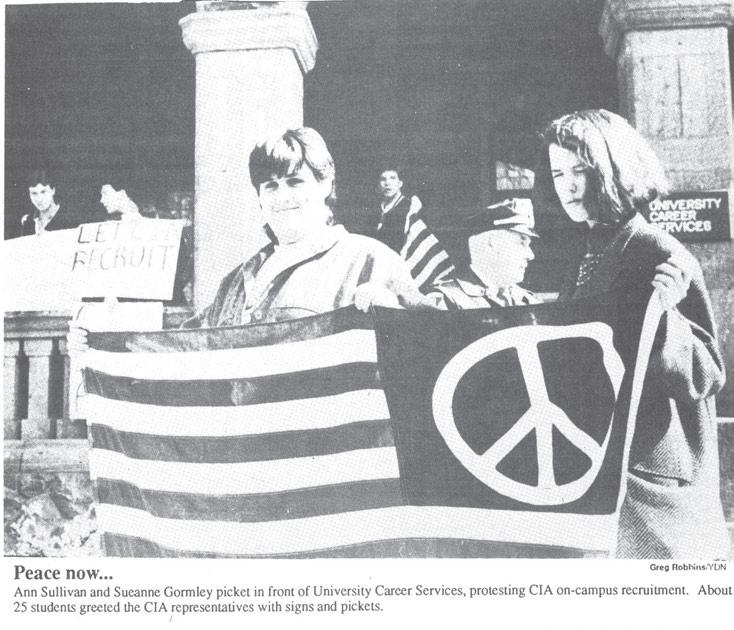
March 3, 1988 / Students blast CIA for recruitment
By Rob Fuentes
Approximately twenty-five students gathered early yesterday afternoon in front of University Career Service to protest CIA on-campus recruitment. The agency’s district officers conducted job interviews as the students carried placards denouncing “illegal activities” and chanted “stop the terror, stop the lies, we don’t want no goddamn spies.”
“We hope we can influence students towards being a little less receptive towards the CIA,” said Jennifer Middleton ’88, a member of the Democratic Socialists of America. “And we’re letting the CIA know that all of Yale is not happy with Yale’s substantial historical involvement with the CIA.
A similar protest three years ago led to the arrest of six students when students stormed the CIA interviewing room.
By Nellie Kenney
I approached Troy Streater to schedule an interview after a Monday Board of Alders meeting. Over the phone that Thursday, Streater described his lawsuit against the city and his love for his ward and encouraged me to investigate other wrongful conviction claims from the ‘80s and ‘90s. We commiserated briefly about the New Haven winter, and I signed off.
I had just tucked my notebook into my bag when my phone rang again. On a whim, I picked up, and discovered that it was Dieter Tejada, an exoneree whom Streater had referred to me. Tejada spoke passionately about his work as a financial representative for exonerees, and shared how his wrongful conviction had dogged him as he searched for a job in the years since his five-month stint in a Bridgeport jail. Much of my conversation with Tejada didn’t make the article, but his description of the challenges brought on by a wrongful conviction, which he said are “not limited” to the time a person spent in prison, stayed with me as I researched and wrote about Streater’s experience.
Read “Once imprisoned, alder is now after damages” on page 1.




COLUMNIST AADI NAIR
I come from a long lineage of schoolteachers and professors. Nearly everyone in my extended family taught back in India, often in the same small village that raised them. My parents initially followed that trend too, earning their degrees from local Indian universities and spending a couple of years in the classroom. In 2005, however, they immigrated to Los Angeles, breaking tradition to pursue careers in business and IT. Nevertheless, my parents raised me with the belief that schooling and higher education are essential to a secure and promising future. Yet, in the United States, attitudes toward higher education are markedly more ambivalent than in India. The staggering cost of college is the most visible source of concern, but the conversation in America often ends there, as if tuition alone explains the growing skepticism.
THIS EXPLORATION THAT WE VALUE REQUIRES SUSTAINING A WIDE RANGE OF DEPARTMENTS, EXTRACURRICULAR OPPORTUNITIES AND BUREAUCRACY FOR VARIOUS FIELDS OF STUDY.
Through conversations with my parents and relatives about their experiences in Indian education, I’ve noticed stark contrasts with the U.S. system. In India, degree programs are complete commitments upon admission, and what we would consider graduate programs, like law or medicine, begin right after high school. University isn’t a place for intellectual freedom, but a place to execute a career decision that’s long been made. By contrast, a sophomore engineering major in the U.S. can make a snap decision to consider law school post-graduation; with the right grades and LSAT preparation, a decent law school is well within reach.
The differences can even be seen in high school. My 15-year-old cousin’s tailored schoolwork and exams are already priming him to become
a doctor, at the expense of electives and extracurricular opportunities that I was fortunate to explore.
The structural difference between these systems reflect two different philosophies on education. The Indian model is pipeline-oriented and standardizes outcomes around defined professions. The American model is more people-oriented, and being a student is treated as a formative experience that values intellectual exploration over preprofessionalism. It’s no surprise, therefore, that nearly 50 percent of bachelor’s degree students switch their major at matriculation at some point before they graduate.
This exploration that we value requires sustaining a wide range of departments, extracurricular opportunities and bureaucracy for various fields of study. The pipeline system in India is cheaper because it narrows variance. Our universities have to maintain faculty and advising systems even as student interests shift. When students are given the opportunity to change their trajectory, the institution inevitably absorbs the cost.
This phenomenon is further exacerbated by differences in the job market. In India, students interested in humanities and social sciences are left with fewer pathways and opportunities than peers in more technical fields. Meanwhile, political science is one of Yale’s most popular majors despite it not neatly corresponding to one singular profession. The crossdisciplinary skills it teaches open doors into a variety of fields — like in journalism, consulting or think tanks — legitimizing a more exploratory vision of undergraduate study.
University President Maurie McInnis’ Committee on Trust in Higher Education mentions fostering the free exchange of ideas and minimizing partisanship as its top priorities. The committee’s mission statement notably omits any reference to the affordability crisis in higher education, reflecting Yale’s complacency toward the issue.
Our emphasis on peopleoriented education is what gives rise to gripes over cost. Addressing it requires not just changes in financial aid for optics, but fighting for national policy reforms to make attending university more accessible. In the meantime, we must recognize that our scrutiny of higher education is inseparable from the very freedoms we value within it.
AADI NAIR is a first year in Pierson College. He can be reached at advaith.nair@yale.edu.

MILAN SINGH
On Friday, the News published a rather unfortunate piece by Hannah Owens Pierre ‘28, titled “Yale needs more conservatives.”
Owens Pierre writes that throughout her time at Yale, she has been “disappointed” by the lack of ideological diversity.
While “[e]ntire departments, such as Women’s, Gender and Sexuality Studies, are rooted in progressivism,” she has been unable to locate a single “class rooted in conservative political thought.”
She must not have been looking very hard, because it took me about 30 seconds to find some classes that fit her description — a course taught by Sterling Professor David Bromwich on Burke; a course taught by professor Elli Stern on the history of right-wing political thought from the 18th century to the present; a seminar taught by professor Timothy Kreiner on the rise of the far-right.
Truly, there are cathedrals everywhere for those with the eyes to see them, or at least those who can use CourseTable.
To Owens Pierre, the lack of conservative voices at Yale is “a symptom of a much larger issue: a culture of exclusion against conservatism by elite institutions.”
Nearly half of Americans are Republicans, so why is the share at Yale so much lower? “Is there some innate difference between Democrats and Republicans that makes the latter vastly less likely to pursue academia?”
Yes, there is an innate difference.
To put it bluntly, conservatives — particularly social conservatives — are, on average, less intelligent than liberals.
For example, a 2012 paper by Gordon Hodson and Michael A. Busseri finds that “lower
cognitive ability predicts greater prejudice, an effect mediated through the endorsement of right-wing ideologies.”
THUS, AN ADMISSIONS PROCESS THAT SCREENS FOR GENERAL INTELLIGENCE WILL MECHANICALLY OVERREPRESENT POLITICAL LIBERALS, NOT BECAUSE OF ANY BIAS BUT BECAUSE OF THE UNDERLYING CORRELATION BETWEEN INTELLIGENCE AND POLITICAL BELIEFS.
Another paper, this one from 2008, which finds that “[c]onservatism and cognitive ability are negatively correlated.” A 2010 study found that students in grade 7 who scored lower on verbal intelligence tests were more likely to hold right-wing views in grade 12. A 2024 paper found that DNA-based predictors of intelligence tend to predict political beliefs within families, concluding that “genetically predisposed to be smarter
LETTER
causes left-wing beliefs.” I could go on, but I don’t wish to bore readers with citations. Does that mean all conservatives are stupid? Obviously not. There are plenty of intelligent people who happen to be on the right politically.
But on average, conservatives are just not as smart as liberals. If intelligence is normally distributed, that means that the tail end of the distribution — where the top high school students are — will be disproportionately liberal.
Thus, an admissions process that screens for general intelligence will mechanically overrepresent political liberals, not because of any bias but because of the underlying correlation between intelligence and political beliefs.
Owens Pierre concludes her piece by writing that while Yale is “largely an ideological bubble, the rest of the world is not,” and that the University will fail in its mission to prepare students for post-graduate life if it does not “amend its hiring and admissions practices and welcome more conservatives among its staff and student body.” What she seems to be requesting is for Yale to lower its hiring and admissions standards to allow in more conservative students. She’s asking for affirmative action for students who otherwise wouldn’t make the cut, so that the University has a greater diversity among the student body. Sound familiar?
MILAN SINGH is a senior in Pierson College studying Economics and a former Opinion editor for the News. He can be reached at milan.singh@yale.edu.
HANNAH OWENS PIERRE
In my piece, “Yale needs more conservatives,” I noted the tendency of ideologues to stereotype and demonize their opponents. Unfortunately, in a response to my article, Milan Singh ‘26 does just that, suggesting that the lack of conservatives at Yale is due to conservatives being “on average, less intelligent than liberals.” It would be a convenient justification for liberals if it were true. Unfortunately, it is not.
In defense of this claim, Singh cherry-picks a few studies, ignoring evidence against his conclusion. For example, Singh cites a study about verbal intelligence — which noticeably measures correlations with right-wing authoritarianism among children, not general conservatism among adults — neglecting to mention that a more recent study finds that those who identify as Republicans have higher verbal intelligence, greater probability knowledge and better question comprehension than Democrats. This study has been corroborated by the further finding that Republicans score between two and five IQ points higher than Democrats on verbal
intelligence. Another study found that those who identified as center-right had the highest IQ, controlling for gender, age, education and income. Finally, a 2021 meta-analysis concluded that economic conservatives have higher cognitive ability.
EVEN IF SINGH IS CORRECT THAT LIBERALS ARE “MORE INTELLIGENT,” IT WOULDN’T EXPLAIN THE ABSENCE OF CONSERVATISM AT YALE.
Nevertheless, it would be foolish and overconfident to assert based on these findings that Republicans are more intelligent than Democrats, and I don’t think that’s true either. Effects are small in either


direction, and it is a notoriously flawed method to make causal inferences from correlations, yet this is exactly what Singh does. Even if Singh is correct that liberals are “more intelligent,” it wouldn’t explain the absence of conservatism at Yale. A further study found that differences in intelligence between liberals and conservatives account for “less than half of the disparity on liberal versus conservative ideology, and much less than half the disparity on Democrat versus Republican identity.” Notably, Singh cites no evidence to the contrary and simply assumes that any difference in intelligence would justify having almost no Republican professors.
So, no, the reason there aren’t many conservatives at Yale is not that they are less intelligent. Still, to his credit, I applaud Singh for breaking with liberal orthodoxy and joining me in rejecting “affirmative action.”
HANNAH OWENS PIERRE is a sophomore in Benjamin Franklin College studying Ethics, Politics, and Economics and Psychology. She can be reached at hannah. owenspierre@yale.edu.
“When you look annoyed all the time, people think you’re busy.”
GEORGE COSTANZA
McInnis has followed the Epstein revelations, including Yale ties
Asked about computer science professor David Gelernter ’76 GRD ’77 — whose email correspondence with the convicted sex offender Jeffrey Epstein was released by the Department of Justice in January — McInnis called his conduct incompatible with Yale’s standards.
“I was very concerned with the statements that professor Gelernter made,” McInnis said. “They did not comport with our standards of conduct and professionalism, and so we have both initiated an investigation into that and removed him from the classroom.”
Gelernter exchanged emails with Epstein between 2009 and 2015. In a 2011 email to Epstein — sent three years after the financier’s Florida conviction for soliciting prostitution from a minor — Gelernter described a Yale undergraduate as a “v small goodlooking blonde” while recommending her for a job. After the email surfaced, Gelernter defended it in an email to School of Engineering & Applied Science Dean Jeffrey Brock ’92, writing that he had kept “the potential boss’s habits in mind.” Gelernter has said he developed a close relationship with the student and does not regret his association with Epstein.
McInnis told the News that she has been following the recent release of the Epstein files “at a headline level” and has “paid attention to people with Yale affiliations” included.
“What we are all increasingly seeing is the extraordinary breadth of Epstein’s connections across many areas of influence in American life, including higher education,” McInnis said. “There have been increasing numbers of people involved in employment positions, either presidents of universities, who were interested in trying to raise money from
him, or faculty members, many of whom themselves were interested in getting support from him in support of their research.”
Nicholas Christakis ’84, now a Sterling Professor of social and natural science, met with Epstein in 2013 and maintained contact with him until 2016.
Christakis sought to raise funds for his Human Nature Lab from Epstein. Christakis told the News he had “very limited interactions” with Epstein, and University spokesperson Karen Peart wrote to the News at the time that Yale has no “record of any related financial gift.”
McInnis called layoffs ‘unfortunate’ but necessary In July 2025, Trump signed the “One Big Beautiful Bill” into law, raising the tax on Yale’s endowment investment income from 1.4 percent to 8 percent — a levy
McInnis immediately warned would cost the University roughly $280 million in its first year alone. In response, administrators have reduced non-salary expenses by 5 percent and sought to shrink the University’s workforce, including through layoffs whose scope remains unclear.
When asked whether she had personally spoken with any staff members whose positions had been eliminated, McInnis said no.
Asked whether she felt regret over the layoffs, McInnis said: “Obviously, but the financial reality of any university is we can only spend the money that is available to us.”
McInnis called the cost of the endowment tax “a really significant amount of money” and said the University has been “pulling out a little bit across the many planning units of this University” to address it. She added that the layoffs are “unfortunate” but “a reality of modern life.”
In November 2024, McInnis told the News that she had heard complaints from Yale affiliates about inefficiencies in University processes and that
she and her team were working to decrease the time spent on administrative tasks.
Last Wednesday, McInnis expressed hope that “over the next few years” the University can work to improve its operational efficiency — “that is, how do we deliver the administrative work we do here at Yale in ways that we can hopefully save money from those activities in order to drive it increasingly towards our academic priorities?”
She added that some “good areas to think about” for cost-saving measures include procurement and construction, as well as “some of those administrative units.”
McInnis explained her response to a ‘tragedy’ at Brown
Following the December shooting at Brown University that killed two students and wounded nine others, McInnis did not issue a statement, unlike three other Ivy League university presidents. Some students criticized her for not addressing the shooting.
At the time, McInnis attributed her silence to guidelines she adopted from the Committee on Institutional Voice in the fall of 2024. The guidelines advise Yale leaders to limit their public statements on “matters of public, social, or political significance,” except in “rare cases.” They also state that leaders can speak on matters that “directly implicate the university’s core mission, values, functions, or interests” or infrequently “make statements of empathy or concern in response to events outside the university.”
When asked on Wednesday why a shooting at a peer institution did not meet the criteria outlined in the committee’s report, McInnis said: “I could throw it back to you, to why would it?”
“Shootings happen on college campuses and high schools and schools, unfortunately, way too regularly in modern life,” she added.
McInnis described the actions she did take in response to the
shooting, including verifying with Yale’s public safety officials that there was no threat to campus, heightening campus security and personally calling Brown President Christina Paxson to offer condolences and assistance.
“It is one of the most horrific things as a university leader that you could ever have to go through,” McInnis said, recalling a 2017 incident at the University of Texas at Austin, while she served as provost there, in which a student stabbed four people, killing one fellow student. “I understand the emotional difficulty of being a leader of a community in that kind of pain.”
McInnis said that she has offered help to Paxson many times “in the months since that tragedy happened.”
McInnis is prioritizing physical sciences and engineering
McInnis was quick to point to the physical sciences and engineering when asked to name her top priority for investment if Yale had more financial resources immediately available.
“Our top priority is and remains and needs to be — but it’s going to take a decade to fulfill the vision — is to strengthen our areas in physical sciences and engineering,” McInnis said. “We have been working to both plan the physical spaces, begin the construction of the physical spaces, and begin to add faculty. And so we’re kind of eight years into that, and we have another decade to go.”
McInnis told the News in August 2024 that she views investments in science and engineering as one of Yale’s top priorities. Two years prior, under then-Yale President Peter Salovey, the University announced an extensive 10-year plan to ramp up its investments of its science and engineering scholarship — including by modernizing campus buildings and hiring new faculty members.
The University’s cost-saving measures in anticipation of the
high school, my grandkid’s graduation,” Streater, who was first elected as alder in 2023, said in a phone interview, calling the commissioner’s decision “bittersweet.”
people whose wrongful convictions have not yet been addressed. He pointed to a “pattern of coercion, false arrests, intimidation,” which he said ran rampant in the 1980s and 1990s, and of which he said he was “not the only” victim.
corded testimony attributed to her by officers was not her own.
MCINNIS FROM PAGE 1 CONTRIBUTION FROM PAGE 1
On Friday, the State Senate Judiciary Committee reviewed Streater’s case. Lisa DiLullo — the wife of deceased former New Haven Police Detective Anthony DiLullo, who Streater’s suit against the city claims intimidated, coerced and bribed witnesses — testified before the committee, as did Gamble’s mother, sister and nephew.
Lisa DiLullo, a retired federal law enforcement officer who testified inq her capacity as a private citizen, said that during her marriage she “personally witnessed” behaviors which “seemed to be part of a larger pattern of misconduct.”
“I was not surprised when I learned the details of what they allegedly did to witnesses in Mr. Streater’s case — threatening them, pressuring them, following them — because it was consistent with what I personally observed during my time working alongside and married to Detective DiLullo,” she said.
Gamble’s family members opposed Streater’s wrongful conviction claim.
Gamble’s nephew, also named Terrance Gamble, said that his grandmother had “found solace” in the fact that the person accused of murdering her son had “been brought to justice,” adding that he did “not believe that technical grey areas such as pardoning or recharacterization of long-settled facts should result in millions of taxpayer dollars being awarded in a case where innocence has repeatedly been rejected by the courts.”
The committee did not reach a decision on Streater’s case on Friday.
However, Streater said that he is optimistic that his legal challenges will “shine the light” on
Streater’s lawsuit against the city names as defendants four former New Haven Police Department officers — Joseph Greene, Vincent Raucci, Robert Lawlor Jr. and Vaughn Maher — all of whom have been named in legal documents in connection to other convictions which have been the subject of legal challenge in recent years.
Lawlor’s and Maher’s 2024 affirmative defense in response to Streater’s suit contended that the officers “did not violate any clearly established constitutional or federal statutory right” of which they “reasonably should have been aware,” and that they did not act with “malice and/ or with reckless disregard to plaintiff’s rights.” Greene’s answer rejected the suit’s allegations that he had “intimidated, coerced, and bribed witnesses” and denied that he had committed any misconduct.
Raucci’s answer also rejected claims of misconduct and included in affirmative defense that his actions and conduct “to the extent that they occurred as alleged, were objectively reasonable under the circumstances of which he was aware.” Raucci’s lawyer, James Tallberg, wrote in an email on Friday that “Detective Raucci denies all allegations against him, and will be vindicated in court.”
Lawlor died in 2026. Greene’s and Maher’s attorneys did not respond to requests for comment.
Carolyn Cheek, one of the witnesses in Streater’s case, testified at Streater’s second trial in 1993 — after his first ended in a mistrial — that she did not recall whether she had given the police a statement, and that the voice in a tape-re -
Joseph Preston, another witness in the case, said in a taped statement in 1994 that his testimony at the time of the trial was coerced, according to the memorandum of decision of Streater’s 1998 habeas corpus hearing.
“Maybe they didn’t receive the proper training,” Streater said of the officers, or maybe the city “wasn’t monitoring the officers the way that they should.” Either way, the officers in his case were “acting under the colors of the city of New Haven, also the city of New Haven employed them, so they are responsible for their actions,” Streater said.
New Haven filed an answer to Streater’s lawsuit in court in 2024, denying that the city had been aware of misconduct by detectives, as Streater’s suit alleges.
Current acting Corporation Counsel Roderick Williams, who serves as the city’s top lawyer, wrote in a statement provided to the News by a city spokesperson that the “incident predates this administration, however, every individual deserves fair and impartial justice under the law whether a matter occurred in 1990, as this one did, or today in 2026.” Williams added that the city would “towards an appropriate conclusion, whether it be by trial or settlement.”
City Hall spokesperson Lenny Speiller wrote to the News that, according to Williams, Streater had not cast any votes concerning funding for outside lawyers that defend the city in wrongful incarceration lawsuits, and that there were “no other identifiable conflicts among his duties as alder.” Streater denied that the case posed any conflict of interest for him as alder.
“At the time that it happened, I wasn’t an alder. At the time that it happened, this current administration was not in office. So, no, there is not any
endowment tax increase have included plans to pause construction projects.
“Most of our construction projects have gone forward,” McInnis said last week. “We have slowed some of those in order to be able to make the sort of financial adjustments that we need to make and savings in those areas.”
‘Bridgerton’ and ‘The Diplomat’ are among McInnis’ go-to TV shows During the Wednesday interview, McInnis offered a window into her personal routines, including what she’s currently watching and reading.
McInnis said that “the only TV” she watches is when she works out in the morning. She explained that she likes to watch shows that are not “too heavy” and do not distract from her exercise. McInnis said she favors British murder mysteries, as well as “series that are popular at the moment,” including “The Diplomat,” “Bridgerton” and “Shetland.”
“The Diplomat” follows a career diplomat who gets unexpectedly appointed as the United States’ ambassador to the United Kingdom. “Bridgerton,” a steamy regency romance series, explores the lives of the fictional Bridgerton family in 19th-century England, while “Shetland,” a British crime drama series, tracks a police team working to investigate murders in the Shetland Isles.
McInnis also makes time to read.
“I’m reading ‘Hamnet’ right now,” McInnis said. “I always like to have a work of fiction that I’m working my way through.”
The acclaimed 2020 novel by Maggie O’Farrell fictionalizes the death of William Shakespeare’s son.
The 2025 film adaptation of “Hamnet” received eight nominations for the upcoming Academy Awards.
Contact ASHER BOISKIN at asher.boiskin@yale.edu
conflict at all. And I think that the city is fully aware of that. I know I’m fully aware of that,” he said. “If someone is done unjust, they have the right to seek legal ramifications.”
Alex Taubes LAW ’15, Streater’s attorney, said Streater’s suit against the city is in the pre-trial discovery phase, in which the parties exchange information and establish facts before a case goes to trial.
“We took the deposition of one of the witnesses in the case,” Taubes said. “We’ve exchanged a ton of documents between the parties. The parties have hired experts and are working on expert reports.” Taubes suggested that the trial for the case would likely be held in 2027 or 2028.
Streater’s claim against the state appears to be moving more briskly.
Dieter Tejada, a Fairfield financial representative who works with exonerees, received a decision from the claims commissioner about his own wrongful conviction compensation on the same day as Streater did. He explained that he and Streater, who both received pardons before seeking compensation, took an unusual path.
“We couldn’t get exonerated through the normal court process,” he said. “We had to go through the pardon process and do a pardon on innocence grounds, which is entirely different from a regular pardon.”
Normally, people seeking pardons must “show remorse,” Tejada said. “We’re not going to do that. Why would I feel remorse for something that I didn’t do?”
Connecticut had paid about $129 million in wrongful-conviction compensation in total as of 2025 under a wrongful conviction statute passed in 2008, according to the CT Mirror.
Contact NELLIE KENNEY at nellie.kenney@yale.edu
“Yale is glad to be able to make that commitment as a precursor to a renewed multi-year commitment,” Alexandra Daum, Yale’s associate vice president for New Haven affairs and University properties, wrote in an email. Daum and Jack Callahan ’80, Yale’s former senior vice president for operations, are representing the University in talks with the city.
“Both sides are confident that we will be in a position very soon to announce a multi-year contribution,” Daum added in the statement.
The city’s negotiator — Henry Fernandez LAW ’94, who also headed the city’s negotiating team in 2021 — called the planned $8 million drop a “trigger” in an interview last month. He said that the deal “was designed this way” so that town and gown alike “would get to the table” well in advance of the 2021 deal’s expiration.
Elicker’s proposed budget includes a 4 percent increase in the property tax rate. He said in an interview that if Yale increases its financial contribution to the city, an updated budget “will include a hopefully lower tax increase.”
The $733.7 million general fund budget is 4.4 percent larger than last year’s budget, which totaled about $702 million.
Contact ELIJAH HUREWITZ-RAVITCH at elijah.hurewitz-ravitch@yale.edu.
“Serenity now!” FRANK
COSTANZA
TRUSTEES FROM PAGE 1
Ahead of the Friday lunch with trustees and University President Maurie McInnis, Boanoh said some students asked him to express their concerns or desires on their behalf.
He said students reached out to him about “a lot of the hot topic issues that are happening on campus right now, so things ranging from divestment from weapons manufacturing to free laundry. A very wide range.”
Boanoh said a lot of students were aware that the trustees were meeting on campus and reached out to him with items they wanted him to put on the table for the trustees and McInnis to consider.
“So I of course did that,” Boanoh said.
Recently, students have called for the Corporation to divest from companies with connections to Immigration and Customs Enforcement, Israel and weapons manufacturers. Last week, the Endowment Justice Collective, a student group, expressed frustration that their pitches to divest from companies with ties to ICE were rejected by the
Advisory Committee on Investor Responsibility, which is responsible for reviewing requests about divestment and making recommendations to the Corporation’s committee focused on investments.
Boanoh said that people at the lunch were seated at several different tables and that his table included trustees, students and a Yale administrator. “A good number of trustees” attended the lunch, Boanoh said, in addition to the “about 25 selected student leaders.”
According to an email invitation reviewed by the News, the lunch was held at 43 Hillhouse Ave., which is the official residence of the University president.
“Trustees’ engagement with the campus community is an important part of their responsibilities,” University spokesperson Karen Peart wrote in an email to the News on Sunday. “The annual lunch with student leaders is a longstanding tradition and always a highlight of their campus visits.”
In the past, trustees have met with students. In October 2016, 30 students met with Corporation members for a breakfast at Mory’s, the
News reported at the time. In the fall, trustees Neal Wolin ’83 LAW ’88 and Fred Krupp ’75 GRD ’22 hosted events open to students on the Thursday ahead of their Saturday meeting.
On Thursday, trustee Jaime Teevan ’98 hosted a talk focused on artificial intelligence as part of the Engineering Dean’s Invited Speaker Series. The event was described as one focused on discussing how AI innovation can accompany traditional collaborative and human work.
When approached by News reporters on Saturday morning with questions about the content of the meetings, most trustees declined to comment. Norwood, however, mentioned artificial intelligence.
“We’ve been learning a lot about AI,” Norwood said when asked on Saturday morning what the board would be discussing. “I just think it’s transformational in terms of what it’s doing in the classroom and the rest of the broader world.”
“Yale’s trustees regularly engage with issues shaping higher education and society. Recent discussions about artificial intelligence reflect the university’s commitment to preparing students to lead in a world where
these technologies are increasingly important. These conversations are part of the board’s responsibility to stay informed,” Peart wrote. Peart wrote that Yale has taken a “community-engaged approach to AI,” referencing the Yale Task Force on Artificial Intelligence, which reviews AI in the context of the University. The task force is guided by University Provost Scott Strobel. The Corporation is split into 12 subcommittees with specific focus areas, such as finances, honorary degrees and investor responsibility. According to a Yale website, “some or all of the standing committees conduct their own meetings” before the trustees convene in full. While no agendas were made public, trustees left The Study at Yale, a hotel, over the course of several hours on Saturday morning and arrived at Betts House on Prospect Street, where the full-board meeting appeared to be held, at varying times.
Senior trustee Marta Tellado GRD ’02 said in an interview on Saturday morning by the hotel that there was “one more meeting to go.” Tellado said the Corporation would be discussing “the usual —
fiduciary responsibilities we have.”
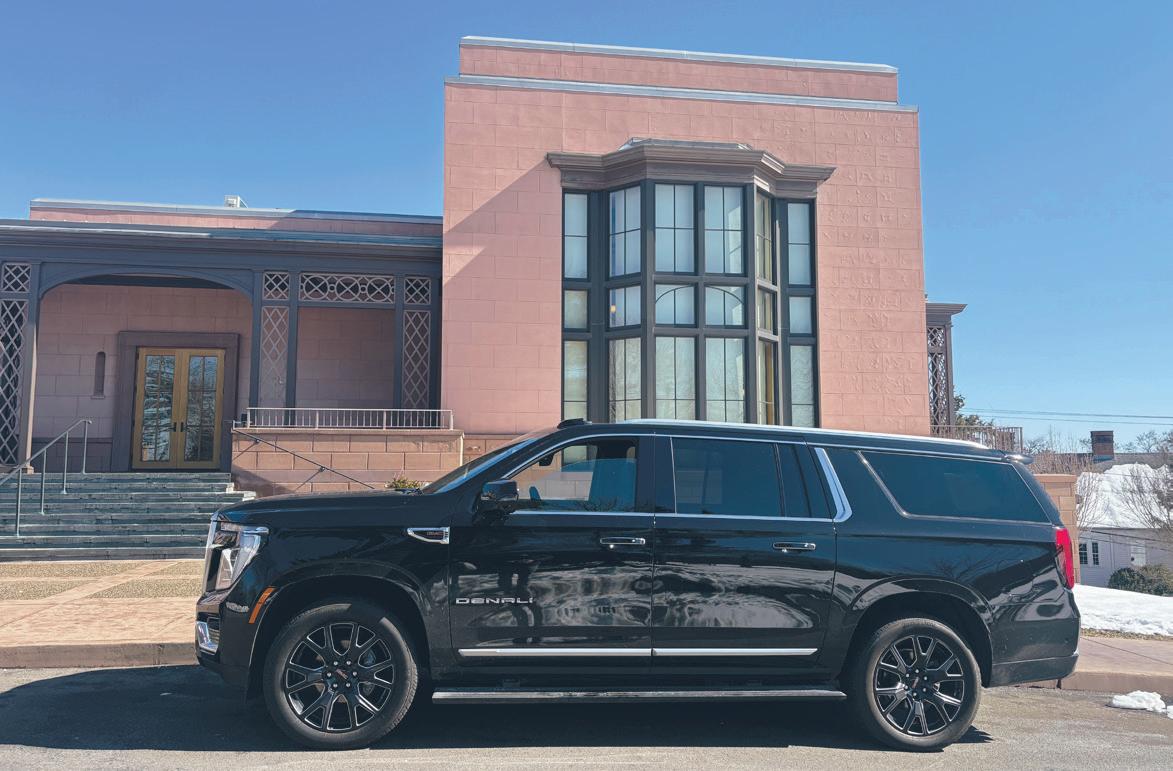
Trustees trickled out of the Greenberg Conference Center at Betts House around 12:30 p.m. on Saturday and hopped into black cars, many with packed bags.
Henry “Sam” Chauncey ’57, a former Yale administrator, said in an interview Saturday morning outside The Study that the board used to meet in the Corporation Room in Woodbridge Hall on central campus. Betts House is north of Science Hill.
“The Corporation now uses meeting spaces with more room and technology support to accommodate sessions,” Peart wrote to the News.
Elizabeth Connolly, an official with Yale’s Office of Public Affairs and Communications, asked News reporters not to approach the trustees as they left the Betts House meeting out of respect for their privacy.
The Corporation’s next meeting is scheduled for April 25.
Contact ARIA LYNN-SKOV at aria.lynn-skov@yale.edu and LEO NYBERG at leo.nyberg@yale.edu
BUDGET FROM PAGE 1
cent of the general fund budget — as major drivers of the increase.
The budget relies on Yale’s commitment of an $8 million addition to its annual voluntary contribution — even as town-gown negotiations involving future years’ payments continue — and also includes a new internal auditor position, partially in response to former Police Chief Karl Jacobson’s alleged theft of $85,500 from two city funds.
The value of the city’s total taxable property has grown by around 2.5 percent this year, the city’s budget director, Shannon McCue, said.
That will help pay for new programs even as the city faces “headwinds given the challenges that our federal government is providing us,” Elicker said. “We’re balancing these two things.”
The proposed budget boosts funding for the city’s public schools by $5 million, from around $213.3 to $218.3 million.
Elicker said that in the past six years, the city has increased its education funding by 63 percent, “which is an astounding number.” The mayor, who often calls for the state to up its per-student contribution to public education, noted that Connecticut has not raised the Education Cost Sharing formula base amount since
2013. He called a recently proposed state Senate bill that would boost funding for public schools by about $2,000 per pupil “inspirational.”
He also hopes to continue a free tutoring program in New Haven Public Schools that had previously been funded with money from the 2021 American Rescue Plan Act. With the Biden-era COVID19 response funds winding down, Elicker proposed “bringing that initiative into the general fund.”
New Haven has around $20 million left in ARPA money, Finance Department Project Coordinator Ron Gizzi said at the press conference. That money must be spent by the end of 2026.
Elicker said that his proposal moves the city’s two-person Office of Climate and Sustainability — another initiative that received funding from the 2021 federal law — into the regular city budget.
Elicker said that his proposal “focuses on ensuring that we have a high level of financial accountability,” and his budget includes two new positions focused on that goal — a deputy controller and an internal auditor.
The addition of a new internal auditor was “in part” a response to Jacobson’s alleged embezzlement, Elicker said. The Connecticut state’s attorney for New Britain two weeks
ago charged Jacobson with stealing from two city funds in 2024 and 2025.
“In general, it’s helpful to have more capacity to identify potential problems that we have with misuse of funds,” Elicker said. The city employs over 1,400 people, he said, and “unfortunately, it’s just possible with so many employees that we’re going to have other instances of fraud, and it’s important for us to catch them as quickly as possible.”
Elicker said in an interview last week that an internal auditor would be able to “spend more time” reviewing employee expenses and identify potential problems with employee transactions.
Presenting the budget, Elicker also emphasized fiscal responsibility. His proposal puts over $94 million toward pension costs “because we have forced ourselves to put more into our pension funds to slowly chip away at the unfunded liability there,” Elicker said. And it allocates around $72 million for debt service. Elicker said that he expects New Haven’s bond ratings — which last fall were upgraded by each of the three major credit rating agencies — continue to improve.
McCue said Friday afternoon that the city plans to refund its debt “very soon, probably before the end of this fiscal year.”
Elicker announced at the same press conference that Yale has agreed not to drop its payment to the city for the upcoming fiscal year — from around $24 million to $16 million — as was originally planned in the University’s 2021 agreement with the city.
Alexandra Daum, Yale’s associate vice president for New Haven affairs and University properties, confirmed Friday in an emailed statement that the University will hold its voluntary contribution at $24 million for this year while negotiations for the next multi-year deal are ongoing. Daum wrote that a new multi-year agreement would be finalized “very soon.”
In 2021 — when Yale and New Haven were negotiating the sixyear deal that would boost the University’s payments to the city — Elicker presented two budget proposals to the Board of Alders. One factored in an increase in Yale’s voluntary contribution. The other, called the “Crisis Budget,” envisioned city spending without additional help from Yale. It proposed a tax increase of nearly 8 percent and the closure of a library, a senior center and a fire station.
The mayor said that such a strategy was unnecessary this year, both because New Haven’s “financial situation is much better, even though
it’s not ideal” and because there is now a much larger base commitment from Yale.
“Last time around, we were much — while we had already had conversations, we were in a different place,” Elicker said in an interview. “I feel more confident.”
Elicker’s proposed budget includes a 4.01 percent increase in the city’s property tax rate, but he indicated Friday that if Yale increases its financial contribution to the city beyond the $24 million, “we may be able to alleviate some more of that burden.”
“I guess in some ways, you can see this is two budgets,” he added in the interview. “One is the budget that I presented, and as I said today, should Yale come through with some changes, the second budget will include a hopefully lower tax increase.”
The budget adoption process at City Hall lasts around three months. Throughout the spring, the Board of Alders Finance Committee will hold workshops and public hearings to amend the mayor’s proposal. During last year’s negotiations, around $1.4 million was whittled off Elicker’s proposed budget.
Contact ELIJAH HUREWITZ-RAVITCH at elijah.hurewitz-ravitch@yale.edu.
“We think that it’s necessary to have a group that tries to represent the voice of the people in Iran right now because our families and our sons are celebrating and a lot of people are celebrating besides just our families and friends,” Mahdeyan said.
Mahdeyan said his first year on campus felt isolating because, as one of few undergraduates who have recently lived in Iran, he struggled to find a campus space that reflected the experiences of students directly affected by events in his home country. He said that the Persian Student Association focused on matters more relevant to immigrants of Iranian descent.
“Because all of the officers, all of the members, were Iranian Americans or, second generation, third generation, it felt like that the things that they were concerned with, and the activities that they wanted to have as part of the Persian Student Association, did not really align with the experiences of people who were not second generation, who were not American,” Mahdeyan said in an interview with the News. “It did feel a bit too Americanized for me.”
In a joint statement to the News responding to criticisms of the Persian Students Association, the association’s board affirmed its stance against the “brutality” of the current Iranian regime.
“What makes our community strong is this very criticism,” read the Persian Students Association’s statement, provided on the condition of anonymity. “We are united in one mission: a free Iran is the only way forward. Time spent attacking one another could instead be used to amplify a stronger, collective voice for this shared goal. The PSA’s record and its stance against the regime’s brutality and killing of Iranians are clear. Now is the time to unite.”
Mahdeyan said he began connecting with Iranian graduate students, many of whom had come directly from Iran. Mahdeyan said attempts to collaborate with the Persian Student Association revealed disagreements over how explicitly events should address politics.
Mahdeyan said those disagreements became more pronounced after a vigil the Persian Students Association held in January to honor the lives lost in the recent Iranian protests. While Mahdeyan said he appreciated the effort to gather the community, he said that event organizers were “erasing part of the history” by discouraging overt political statements against the current Iranian government. He said that when he and others raised concerns, the response was “not met with very positive reactions.”
Shervin Issakhani GRD ’30, a board member of the Yale Alliance for Solidarity with Iran,
wrote that the Persian Students Association primarily focuses on Iranian American perspectives and presents Iran in ways that he believes downplay the country’s political realities.
“We cannot separate Iranian culture from the reality that many of our friends and family are in danger,” Issakhani wrote to the News.
The alliance’s leaders now plan to establish a consistent campus presence. Members will gather every Thursday from 7 to 8 p.m. to read the names of individuals who have lost their lives due to violence in Iran, Mahdeyan said.
Sofiia Tiapkina ’28, an alliance board member, said the weekly readings provide continuous focus on anti-government pro
testers in Iran.
“We read 100 names each week to remember those who were killed,” Tiapkina said. “Other events may focus on specific topics, but this vigil is dedicated to acknowledging those lives.”
A Ukrainian herself, Tiapkina noted the broader significance of the ritual, drawing connections between civilian casualties in Ukraine and the recent killings of protesters in Iran. She encouraged passersby to engage.
“Every person has a story,” she said. “Their lives were cut short, and it’s important to acknowledge that. We hope people stop by, look at some stories, and ask questions.”
From Tuesday through the last
day before spring break, Mahdeyan said the alliance will be tabling every day on campus to support students in open discussion about the war in Iran and “let them know why we support the current attacks on the regime and clarify some propaganda news headlines such as those about the school bombing.” Herlock Rahimi GRD ’29, a member of the alliance’s board, wrote to the News that the organization is planning to have “celebrations, speaker panels, community dinners, and forums for open dis-
cussion in the coming years.”
“Beyond hosting events, we wanted to build real connections not only during difficult political moments, but also through cultural traditions like Yalda, Nowruz, and other gatherings that strengthen bonds and shared identity” Rahimi wrote. Yalda is a celebration of the winter solstice, and Nowruz is the Persian New Year.
Contact ANAYAH ACCILIEN at anayah.accilien@yale.edu
“And you want to be my latex salesman”
JERRY SEINFELD
BY ANAYAH ACCILIEN AND ARIA LYNN-SKOV STAFF REPORTERS
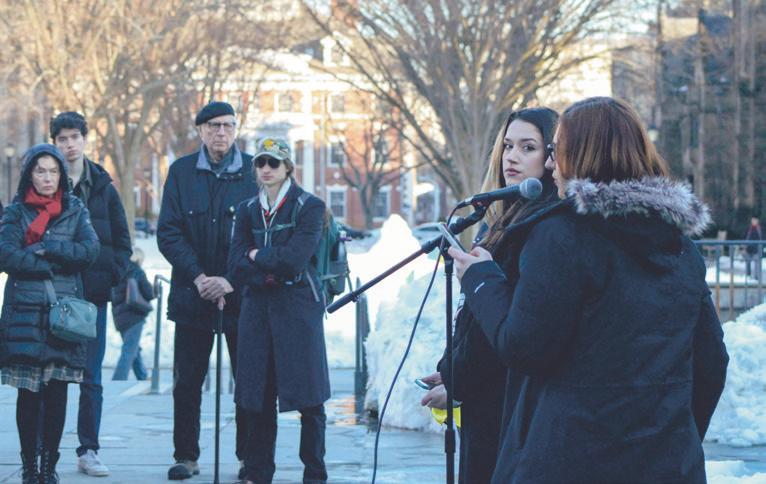
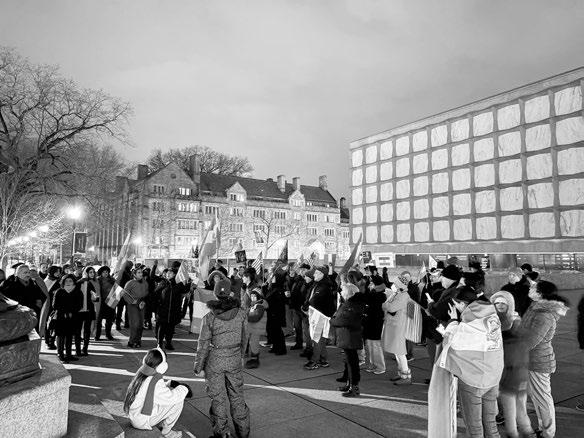
Around 50 people gathered in front of Sterling Memorial Library on Friday afternoon to commemorate four years since Russia launched its full-scale invasion of Ukraine.
The vigil, organized by Ukraine House at Yale, brought together Ukrainian students and other members of the Yale community to share personal stories and honor Ukrainians who have died since war began on Feb. 24, 2022. The vigil was originally scheduled for Tuesday, Feb. 24, but was rescheduled to Saturday because of the weather.
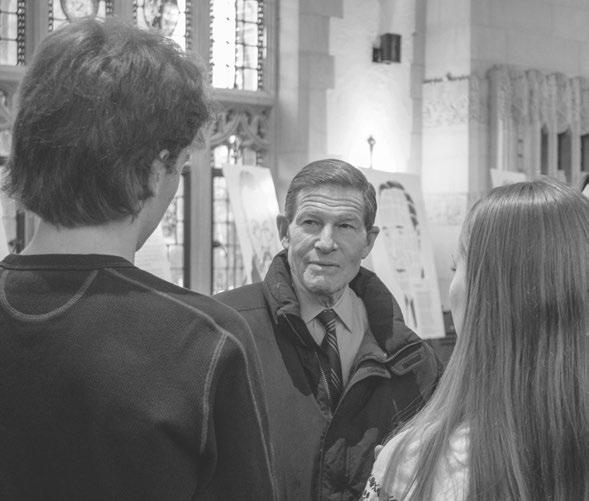
Afterwards, attendees went to a reception with an art exhibit showcasing the work of Ukrainian scientists. Connecticut Sen. Richard Blumenthal LAW ’73, a Democrat, attended the reception and spoke about the importance of supporting Ukraine.
The Ukraine House at Yale, which was formed after Russia’s 2022 invasion, has hosted frequent events since its creation, including vigils, speaker events and fundraisers. Four years into the conflict, Ukrainian students encouraged attendees to continue to pay attention to the war and speak out against it.
“Whenever you speak of Ukraine, try to keep in mind that you’re speaking of actual people,” Nataliia Shuliakova ’27, the president of the Ukraine House, said in an interview.
Speakers at the vigil highlighted the human stories behind the casualty numbers, pointing to young volunteers killed in combat and families enduring repeated strikes on civilian infrastructure. They urged attendees to continue paying attention to the people affected by the war.
Diana Razumova ’28, the club’s social media and outreach chair, said in an interview that she fears that “the statistics of how many kills and how much infrastructure was destroyed” during the invasion
overshadow the stories behind each number.
“Use your safety to protect those who don’t have it. Use your voice to amplify those who were silent. Use your freedom to defend freedom,” Razumova said in her speech. “The question is, ‘Will you be just observers, or will you be remembered as a generation that refused to look away?’”
Mariia Hodovanets ’28, the vice president and director of events for Ukraine House, spoke about the difficult conditions Ukrainians endure due to Russia’s attacks.
“Infrastructure is currently severely damaged for people during this harsh winter, where it’s been really, really cold,” she told the News, describing the lack of heating and electricity. “I’ve been just recently during the winter break, visiting my family.”
Hodovanets, who is originally from Kyiv, said she visits her family in Ukraine whenever she can.
“For me, it matters a lot,” she said.
Maytal Saltiel, the University chaplain, and Olha Tytarenko, a lector who teaches Ukrainian, also gave speeches at the vigil.
After the vigil, attendees and organizers went to a reception in the student lounge of the Humanities Quadrangle. There, an art exhibit showcasing the work of Ukrainian scientists was on display.
Viktoriia Moroz ’28, the Ukraine House treasurer, explained that the art exhibit was “a gift from Wesleyan University” that the group “happily accepted” for the day.
“The exhibition itself is about ten Ukrainian scientists, and it’s about the freedom of science, how Ukrainian science was really constrained because of Russian oppression, and the years of Soviet aggression,” Moroz said. “We are commemorating Ukrainian scientists who brought change into this world, and who have paid a very high price for that attempt to create their own discoveries. So the exhibition is about freedom.”
Titled “Freedom in the Equation,” the exhibition was created by Science at Risk, a group that works to support Ukrainian scientists suffering from the war with Russia.
Science at Risk “collects information on how Ukrainian scientists and institutions are affected by Russian aggression,” Moroz explained.
Blumenthal, who has been one of Connecticut’s senators since 2011, recently met with Ukrainian President Volodymyr Zelenskyy during a visit to Ukraine, according to The New York Times.
“I have been the leading advocate in the United States Senate for supporting Ukraine,” Blumenthal said in an interview. “I just returned from my ninth trip there a week ago, and I wanted to participate in the vigil and this gathering because it’s so important to mark the fourth anniversary with a strong outcry on the part of everyone who cares about Ukraine.”
When Blumenthal addressed the group at the reception, he emphasized standing up against Russian President Vladimir Putin by increasing support for Ukraine. He also shared his appreciation for the Friday gathering.
“I am here just to thank you for your support because it enables me to say, to my colleagues in the United States Congress, as the leading advocate there for Ukraine: ‘The people of America, whether they’re Republicans or Democrats, support Ukraine. The reason they support Ukraine is they know about the fight for freedom,’” he said.
The Ukraine House at Yale’s next event will be a discussion titled “Bring Them Home: Ukrainian Women Held in Russian Captivity,” which will feature portraits of women currently held in captivity.
Contact ANAYAH ACCILIEN at anayah.accilien@yale.edu and ARIA LYNN-SKOV at aria.lynn-skov@yale.edu.

BY SARAH RIVAS STAFF REPORTER
Members of the Yale and New Haven communities celebrated Black History Month at Yale’s Afro-American Cultural Center through a series of events ranging from networking to performances.
This year’s theme for the events
was “Honoring the Past, Rewriting the Future.” The month capped off on Saturday with a performing arts showcase featuring student groups.
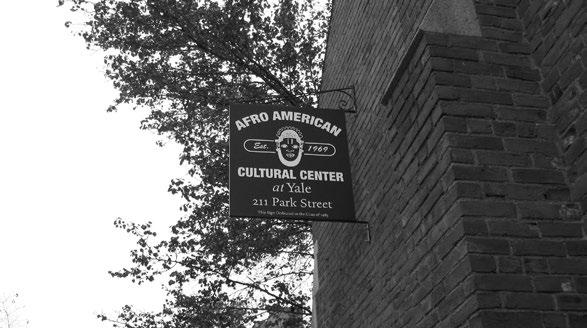
The Af-Am House, which celebrated its 55th anniversary last year, crafted a theme to honor the history of their organization, “especially with so many other black cultural centers around the country clos-
For
Yale’s
Center hosted events centered around an “Honoring the Past, Rewriting the Future” theme.
ing,” Timeica Bethel ’11, the director of the Af-Am House, told the News.
“The first ‘honoring the past’ piece is just acknowledging and celebrating how long we’ve been here and the impact we’ve made on campus. And the ‘rewriting the future,’ that piece came from just thinking through the current time that we’re in as a nation and how it’s going to impact the house for the next 55 plus years,” Bethel said.
Events including fitness workshops, jeopardy and additional speaker events took place throughout the rest of the month.
The performing arts showcase featured a cappella, dance and spoken word.
Adedotun Adekeye ’29 said he was drawn to the event by a desire to “embrace Black culture,” after growing up in a “predominately white environment.”
“Having a school that has a Black population like Yale’s is truly such a rare occurrence in America. And I think it’s important that, at least for me, to take the opportunity to get immersed in Black culture as much
as I can,” Adekeye said. Many students also attended Black History Month events coordinated by student groups affiliated with the Af-Am House, including the “Afri-Experience!” cultural showcase by the Africa Business & Society Club and the “Call Upon Jesus!” concert by the Yale Gospel Choir.
A group of students also coordinated the Black Solidarity Conference, which took place at the beginning of the month. At the conference, students had the opportunity to speak with Black professionals from groups such as JP Morgan, Adekeye told the News.
“I feel like it very much tied back to that House theme of ‘re-honoring our past,’ just because it spoke to the legacy of like, how much Black individuals in the U.S. have shaped the nation as we know it today,” Seline Mesfin ’27, the vice president of the Black Solidarity Conference, told the News.
Additionally, the Yale Black Women’s Coalition hosted “A Happy Galentine’s: Giving Black Women Their Flowers,” in which students
created flower bouquets and wrote love letters to themselves or others, according to Sage Jones-Flores ’28.
“I think inherently, there’s a sense of community in black culture,” Jones-Flores told the News, adding that this community is “felt by everyone.”
Other groups around the University hosted events during Black History Month to honor Black culture, such as The Dragaret Ball, which was coordinated by the Yale Cabaret. The event, which fused drag and ballroom culture, allowed undergraduates and performers from the broader New Haven community to compete.
“It’s essentially about the joy of what this culture is that comes from Black gay men, that comes from the effort to connect with Black women,” executive producer Davon Williams DRA ’27 told the News.
The Af-Am House is located at 211 Park St.
Contact SARAH RIVAS at sarah.rivas@yale.edu.
BY HENRY LIU STAFF REPORTER
After the United States and Israel conducted military strikes on Iran on Saturday, killing its supreme leader Ali Khamenei, Yale Law School professors broadly condemned the attack as a violation of international law.
Three professors argued that President Donald Trump lacked the constitutional authority to declare war without Congress.
Sterling Professor Harold Hongju Koh, who served as a legal adviser to the State Department during President Barack Obama’s administration, argued that Trump violated the United Nations charter by killing Iran’s leader without a legitimate reason for self defense.
“This is a war of choice that is unlawful under both US and international law,” Koh wrote to the News.
Besides Khamenei, the attacks killed many of Iran’s high-ranking political and military leadership, hundreds of Iranians and six American service members, as of Monday night, according to The New York Times. U.S. officials have said the military campaign will continue, the Times reported.
Trump has defended the attacks as necessary to protect American interests. Ahead of a Medal of Honor ceremony at the White House on Monday, Trump called Iran’s missile capabilities a “very clear colossal threat” to the U.S. and its allies, according to NPR.
Professor Oona Hathaway, who specializes in international law, condemned Trump’s attacks in a post on X.
“Today’s attack on Iran is an attack on the postwar legal order. Yet again, Trump has taken an action that threatens to end an era of historic peace and return us to a
world in which might makes right. The cost will be paid in human lives,” Hathaway wrote.
Hathaway also re-posted past op-eds she had written on the United States’ June strikes on Iranian nuclear facilities and January seizure of former Venezuela President Nicolás Maduro. She argued that both decisions violated international law.
On Jan. 3, Trump ordered a predawn military strike in Venezuela that led to the arrests of Maduro and his wife, Cilia Flores. The strike was condemned by other legal scholars alongside Hathaway as a violation of the U.N. Charter. Additionally, Koh criticized Trump for striking Iran despite previously claiming that the Iranian nuclear threat had been eliminated during the June strikes. Koh added that the strikes were a distraction from the Epstein files and a recent Supreme Court ruling
that invalidated many of Trump’s tariffs.
“In falsely framing the choice as between attack and doing nothing, he ignored the obvious third way: addressing the threat through multilateral diplomacy, which the Obama administration had done via the Iran Nuclear Deal, before Trump tore it up with no backup plan and now no exit strategy,” Koh wrote.
Professor Samuel Moyn argued that international condemnation of American aggression has been ineffective and called for a broader antiwar movement.
“Which is more surprising? That the illegality of our attempt at Iranian regime change is so undeniable, or that few draw the equally undeniable conclusions when its illegality doesn’t matter one more time?” Moyn wrote. “Condemnation of violations of the rules makes no difference.
Only an antiwar movement aiming at better control of warlike powers — including all of Iran, Israel, and the United States — might.”
In a brief interview, Sterling Professor Akhil Amar declined to comment specifically on the Iranian attacks, saying it was too early to see the scope of the operation. Amar referred to his previous comment on the Venezuela operation, in which he appeared skeptical that it constituted war.
“There are nice questions about how much force is necessary before we call something a war. Was Grenada a war? Was the bombing of Libya a war? Was the raid on bin Laden a war? These are the hard questions worth asking,” Amar said in an interview at the time.
Khamenei ruled Iran for over three decades.
Contact HENRY LIU at henry.liu.hal52@yale.edu.
“The sea was angry that day, my friends! Like an old man trying to return soup at a deli.”
GEORGE COSTANZA
BY KAMALA GURURAJA AND QAMAR AL-TAMEEMI STAFF REPORTER AND CONTRIBUTING REPORTER
While snow from a January storm was still piled up throughout the city, New Haven residents braced for yet another historic snow storm last Sunday.
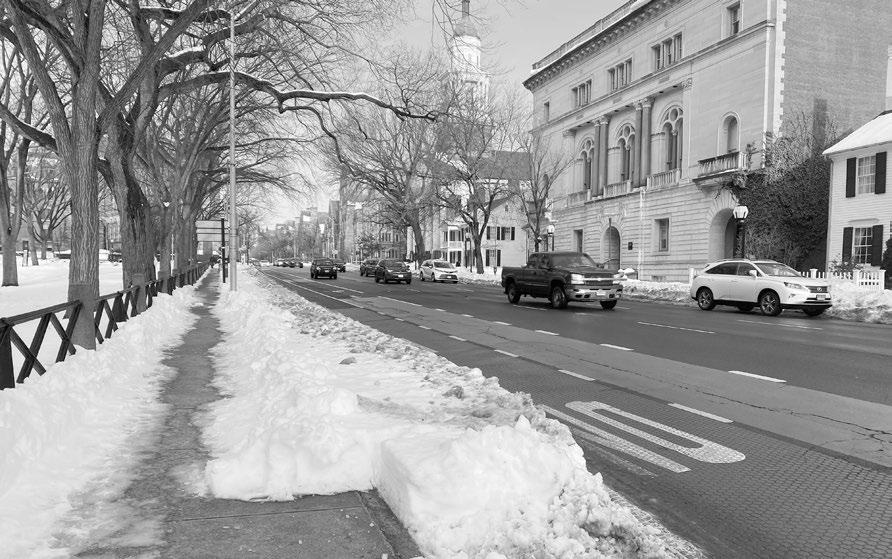
After the Jan. 25 storm, locals voiced frustration in interviews with the News about what they described as a drawn-out snow clearance process. But in the wake of last week’s blizzard, which blanketed city streets and sidewalks with what the National Weather Service said was 16 inches of snow, 13 New Haveners and commuters were more complimentary of the city’s efforts, which they largely described as an improvement from the response after the previous storm.
Last Tuesday, Union Station remained bustling well after its typical rush hour, with the quiet hum of the station interrupted every few minutes by announcements about train delays. Five commuters told the News they had experienced snow-related delays.
Vicki Ciralli, 61, is a Connecticut resident who was passing through Union Station on her way to Philadelphia on Tuesday. Her train
was delayed by 45 minutes, which Ciralli said was “to be expected” because of the snowstorm.
Ciralli opted to take a train because she didn’t want to drive all the way to Philadelphia in the weather, she added.
“The highways are very clear,” she said. “The New Haven roads are not so good once you get off the highway.”
Riley Metcalfe, 22, was originally supposed to take a train to Delaware on Monday, which was canceled because of the snowstorm, she said. Her train on Tuesday was delayed by an hour and a half.
“They did a better job this time than I’d say the last storm, but coming into New Haven, all of a sudden, it was not plowed very well at all,” she said of the city’s snow clearance efforts. “In my town, it was plowed fine, especially the highways, but as soon as I took the exit to get on the train, there was slush and everything everywhere.”
Metcalfe lives on the shoreline near Madison, she said.
Downtown resident Thew Smoak, 39, was traveling out of Union Station on Tuesday. He noted that although the sidewalks in his neighborhood were piled up with snow on Monday, they were “pretty clear” the following day.
“I did notice that they were quicker with the street clean up,” he said, referring to the city’s snow clearance efforts after last month’s winter storm.
Ward 1 Alder Elias Theodore ’27, who represents parts of downtown including much of Yale’s campus on the Board of Alders, sat in the passenger seat of a plow truck from 7 to 10:30 p.m. last Sunday night to point out challenging spots from the last storm and gain insight into the city’s snow clearance process, according to a video posted on his Instagram account.
Theodore cited seeing challenges to snow removal efforts, such as violations of the parking ban, which began last Sunday at noon and was extended to 6 a.m. on Thursday in the downtown area.
“There are dozens of parked cars on downtown streets that we don’t have the capacity to tow,” Theodore said in a phone interview. In those situations, he explained, the city often leaves tickets on the cars so residents will move them.
In a phone interview, Mayor Justin Elicker said, “My hope is that people will understand that these problems are more complicated than meets the eye.”
“I often hear, ‘Oh, I go over to Hamden or another town and the streets are much clearer.’ Well, they
don’t face the kinds of challenges that we do of having congestion and narrow streets,” Elicker added.
Elicker described a multi-step snow clearing process, saying, “The first pass through the city is to just make sure every street is passable.” In particular, the city works to ensure that emergency vehicles can access buildings if needed. Plows are assigned to push back snow in different neighborhoods, and if need be, the city removes and disposes of snow in dump trucks.
“The only area that we will spend some more time on is downtown, because there’s a lot of vehicle, pedestrian, and bicycle traffic, and there’s a significant need for on street parking and just a lot of congestion,” Elicker said. “If we don’t clear out downtown, it can be a real problem for the city’s activities and businesses.”
Elicker noted the differences between January’s snowstorm and this most recent one, pointing out the higher snowfall and saying, “it was very sticky and wet snow that made it more difficult to clear. A lot of our plows actually got stuck when they were clearing snow, and so we had to pull other vehicles off their routes to go and pull out the plows.”
“We don’t have an unlimited capacity, and it can be really frustrating for residents who see that they moved their cars off the street but then one or two people didn’t and it makes the street very difficult to clear,” Elicker said.
“We’re a city. A lot of residents need street parking. They don’t necessarily have driveways like the suburbs do, or garages.”
Elicker told the News that the city had towed over 350 vehicles and ticketed over 400 over the course of the most recent storm.
Theodore encouraged residents to provide feedback on the city’s snow clearance through New Haven’s SeeClickFix website. He added that he keeps an eye out when walking around downtown for uncleared sidewalks in front of businesses.
Eight residents cited snow piling up at bus stops and public transportation delays due to the storm.
While waiting at a bus stop downtown, Milford resident Sean Kane, 22, described the city’s cleanup after the most recent blizzard as an improvement over the response to last month’s storm.
“In January’s storm, we did not have a good strategy to triage bus stops,” said Elicker, noting that there are over a thousand bus stops in New Haven.
“We ended up prioritizing by the amount of people that are using bus stops,” Elicker said. “We also cleared some bus stops that had more vulnerable populations near them.”
Leamond Suggs, who operates a fragrance cart downtown on Church Street, echoed Kane’s sentiment that the city had improved its snow clearance efforts since the last storm. However, Suggs still had to shovel part of the sidewalk downtown to make room for his cart.
“I’ve been doing this for 25 years, and I realized years ago that I need to bring a shovel, a couple of shovels, to do it myself, to cut out a space on the sidewalk for me to put this cart,” he said.
Hao Sumlin, a student at Gateway Community College who commutes from Meriden, criticized the ice build-up on sidewalks.
“Not everybody has proper shoes for that kind of thing,” she said.
However, Sumlin said the city has handled the two large storms “pretty well.” She added that the city cleaned the streets more thoroughly this time around, describing big piles of snow in the street after the previous storm that prevented her friend’s car from making turns.
Kira O’Brien, manager at Lou Lou Boutiques on Broadway, walks to work from East Rock each day, she said.
“Snow removal on the sidewalks is a little bit better than the roads, but not by much, especially at crosswalks,” she said when asked about the most recent snowfall.
O’Brien added that the city had cleared snow more efficiently when compared to the previous storm. She stressed that the city should better prepare for snowfall by coating streets and sidewalks with sand or salt.
The city’s parking ban began last Sunday at noon and ended on Wednesday at 6 p.m. in residential areas. It was extended to 6 a.m. on Thursday in the downtown area to streamline snow removal efforts.
Contact KAMALA GURURAJA at kamala.gururaja@yale.edu and QAMAR AL-TAMEEMI at qamar.altameemi@yale.edu.
BY ERIC SONG STAFF REPORTER
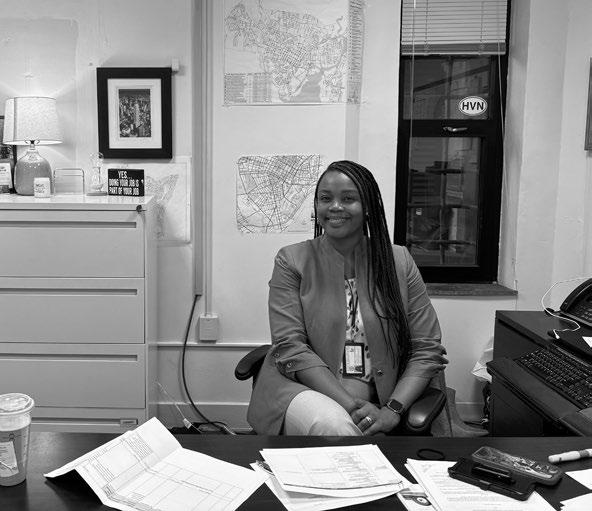
On a pouring Friday morning in mid-February, Haley Simpson sat in her office with a lot on her plate.
“Sorry about the mess,” said Simpson, the new director of New Haven’s transportation, traffic and parking department. Binders full of policies and plans were neatly filed in the bottom shelves of the office bookshelf, and stacks of papers relating to various developments around the city were strewn across her desk.
Simpson arrived during a busy time for New Haven: bus rapid transit is on the move, establishing dedicated bus corridors through downtown; the city has given speed and red-light cameras the green light; Chapel Street is slated for a two-way conversion.
Mayor Justin Elicker named Simpson to the job on Jan. 23 at a press conference at City Hall. Former department director Sandeep Aysola left the position due to the high pressure of the job, according to reporting by the New Haven Independent.
Simpson previously served as deputy chief of staff to Elicker, a position she took on in April of last year. During her tenure, she supported the rollout of the bus stop arm enforcement program, which installed stop violation cameras on public school buses last fall.
In her position as deputy chief of staff, Simpson wanted to “drive home the importance of safety and changing behaviors in terms of safe driving,” she said.
Before joining the mayor’s office, Simpson worked at The Glendower Group, the development arm of the New Haven Housing Authority.
She described herself as being “responsible for the development and redevelopment of a number of projects” relating to “converting public housing to beautiful new affordable housing.”
Simpson emphasized her role in redeveloping these spaces into communities and her involvement in the “thoughtful process” of planning these projects. It was her involvement in community planning that opened up her move into the mayor’s office, she said.
Now, in her new role, Simpson said her goal is “to make sure everyone has an opportunity, a safe opportunity, to reach their destination through all modes of transportation.” She looked back on the work of previous department heads fondly, focusing on their “mapping out” of plans that align with this goal.
“A lot of what they have started, I’m in a really good position to further implement it,” Simpson said.
In an interview with the New Haven Independent after his departure, Aysola talked of the job as “extremely stressful” and “extremely rewarding.” Aysola reflected on the difficulty of implementing a strong safety culture during his tenure, stating that “the most dangerous weapon that we have these days is an automobile.”
Simpson echoed his sentiment.
“My goal is to change behaviors,” she said. “We’re seeing folks run red lights, run bus stop arms, just running, you know, really unhealthy and unsafe sort of behaviors that are dangerous to folks who we are sharing the road and sidewalks with.”
The camera rollout planned for later this spring aims to do
exactly that, she said. As part of New Haven’s Safe Routes for All initiative, Simpson said the cameras would help remind drivers that “there is always a risk to getting caught speeding or running red lights.”
In an email statement about the program, Elicker concurred, stating “once these cameras are up, they will make our schools and streets safer and save lives.”
However, according to Simpson, safer roads are only a part of the equation. For residents without a car or a bike, getting around the city has been a different challenge entirely, she said.
Simpson referenced Via, New Haven’s rideshare program launched last spring, noting that if residents do not have a vehicle, “they’re able to utilize a service that would be willing to take them to where they need to go.” Via had almost 2,000 riders at the end of last year, according to the New Haven Independent.
The largest of these forwardthinking initiatives, she said, is bus rapid transit, a state-led project establishing three routes through some of the city’s busiest roadways.
According to Simpson, the routes will connect Dixwell, West Haven and Hamden to Union Station and the New Haven Green, and will focus on pedestrian safety and multi-modal accessibility.
The plan has massive political support behind it, having been announced at a press conference three years ago by Gov. Ned Lamont, Connecticut Sen. Chris Murphy, Connecticut Rep. Rosa DeLauro and Elicker.
“Transit is a lifeline in this state and is a major priority for hardworking families to make ends
meet,” DeLauro said at the time. When asked what Simpson envisioned transportation would look like in New Haven in a few years, she spoke of friendliness.
“I would love for transportation in this city to really look friendly. I envision this looking like folks being able to share the road with cars and bikes and scooters,” Simpson said. “Though, I don’t believe that’s actually what will happen. I feel like it may be more traffic just based off of all the cool things that are happening around New Haven.” Simpson pressed on, turning towards accessibility and behavior.
“For those who may not be able bodied, I envision us being a lot
more mindful, a lot more, what is the word that I’m looking for?” She paused. “Really inclusive in terms of transportation.” She smiled at that thought.
During the interview, Simpson opened and consulted about half of all the papers on her desk. The binders remained on the bookshelf. The rain was still pouring by the end, and city buses were passing by her office.
The Transportation, Traffic & Parking Department is located at 200 Orange St. in downtown New Haven.
Contact ERIC SONG at e.song@yale.edu.
“Well I was just curious why you didn’t use an exclamation point”
BY CAMERON NYE STAFF CRITIC
“What good is sitting alone in your room? Come hear the music play!”
It’s an irresistible invitation — buoyant, brassy, alive with possibility. In “Cabaret,” the line promises liberation from loneliness, from politics, from consequence. Step inside the Kit Kat Club, the song suggests, and let the outside world dissolve. But the genius lies in the question beneath the question: What happens when the music becomes a distraction?
“Cabaret” — which opened Thursday night in the Theater, Dance, and Performance Studies Black Box at 53 Wall St. — explores the answer through the hedonistic twilight and seedy nightclub scenes of the Weimar Republic. Aspiring American novelist Cliff Bradshaw moves to Berlin in pursuit of creative inspiration but finds himself enraptured by the sleazy Kit Kat Club and its cabaret singer Sally Bowles, played by Hannah Kurczeski ’26.
Overseeing the antics is the omniscient yet grotesque Emcee, a genderbending master of ceremonies
who lives to entertain the club’s patrons. Directed by Amara Neal ’26 and a senior thesis production for Kurczeski and Sadie Pohl ’26, the choreographer, “Cabaret” combines showstopping musical numbers and ominous political developments to examine inaction in the face of a rising Nazi regime in Germany. The characters of “Cabaret” are cripplingly nuanced and deeply flawed. The Emcee personifies unbridled sexual freedom. Sally Bowles represents the self-indulgent decadence the Nazis turned into propaganda and the passivity that catapulted them to power. Fraulein Schneider resigns herself to being the silent objector who believes she is powerless to stop them, while Herr Schultz fools himself into believing in the inherent goodness of humanity. Cliff Bradshaw, late in the show, exudes morality and social conscience.
As audience members, we want to see ourselves in Cliff’s unfailing moral compass, but in reality, we are confined by inaction and complicity just like we are confined to our chairs. “Cabaret’s” cast delivers these archetypes. Sasha Fedderly ’27 and

Ben Heller ’27 play off each other with delightful chemistry and warm vocals as Schneider and Schultz, respectively. When Schultz presents Schneider with a pineapple, their platitudes soar with a tender sincerity that feels defiant in a world hardening around them, only to be shattered by the undeniable rise of fascism.
August Rivers ’28 plays Bradshaw with striking earnestness and tragic inevitability. From his unwitting entanglements with Nazi financiers to his increasingly volatile treatment of Sally, Rivers charts a slow, sickening recognition of the ideology tightening around him. You can see the moment idealism falters — when political detachment turns into horrified awareness.
Thomas Kannam ’26 dons a myriad of sequined drapes, plunging gowns, scarlet overcoats and black suspenders as the Emcee. They charm their way through the audience, inviting unassuming patrons up on stage and twirling them while the orchestra roars. Kannam watches as the show’s charm curdles into something more violent and dangerous. They bring elements of grunge and Germanic flair to the role in their vocal stylings, starting with the opening number “Willkommen.”
Of course, the star of the show is Kurczeski’s Sally Bowles. She leans into Sally’s almost grating neediness, weaponizing a slightly whiny timbre and a brazen vibrato. She demands attention, and that’s precisely the point. She embodies the cabaret singer as both spectacle and shield, teetering between bravado and desperation. In “Maybe This Time,” her wistful
longing and realization that she is worthy of love has the audience eating out of the palm of her hand. Kurczeski’s Sally is almost willfully shrill at times, clinging to performance as if it were oxygen.
The choreography by Pohl is razor-sharp and unmistakably reminiscent of Bob Fosse — angular wrists, slinking shoulders and predatory stillness. In the Kit Kat Club numbers, the ensemble oozes decadence. Fishnets flash under harsh lights as bodies gyrate and thrust with calculated seduction. Smirks curl across powdered faces. And then, in one chilling reveal, the Emcee lifts their traditional German dirndl to expose a swastika beneath — a grotesque collision of eroticism and rising fascism that lands like a punch to the gut.
Few musicals feel as eerily prescient as “Cabaret.” Set against the crumbling democracy of Weimar Germany, the story traces how ordinary people — artists, lovers, business owners — convince themselves that politics are something happening just beyond the walls of the nightclub. It is a cautionary tale about apathy, about the seduction of spectacle and the danger of believing that extremism will simply burn itself out.
In today’s political climate, where democratic norms feel increasingly fragile and polarized rhetoric grows louder by the day, “Cabaret” is not so much distant history but rather a timely warning. The glitter, the fishnets and the bawdy humor may dazzle, but beneath them lies a stark reminder: Fascism does not arrive overnight. It creeps in,
often while we are sleeping. For a show as frequently mounted as “Cabaret,” the bar for reinvention is high. Over the decades, directors and performers have twisted and reimagined the material in daring, inventive ways, reframing the Emcee as omniscient puppet master, collapsing the boundary between audience and performer or foregrounding the political parallels to unsettling contemporary effect. This production, by contrast, opts for a largely faithful rendering of the script and score. The beats land where they should, the iconography remains intact and the emotional arcs unfold as written. There is value in that clarity. Still, one occasionally longs for a sharper interpretive lens — a risk, a rupture, a conceptual choice that pushes beyond competent revival into something urgent and newly revelatory.
By the show’s end, Cliff’s admission — “we were both fast asleep” — hangs heavier than any final chord. It is less confession than indictment. The line does not belong solely to 1930s Berlin. It ricochets outward, implicating anyone who mistakes comfort for safety or spectacle for insulation. This production may revel in theatrical flair, but its final warning is unmistakable: Democracy erodes in the small permissions we grant it to decay. “Cabaret” leaves us with a choice. We can hum the tunes on the walk home, dazzled and detached. Or we can recognize the stirrings of history and refuse the luxury of sleep. Contact CAMERON NYE at cameron.nye@yale.edu.
conviction and youthful energy.
BY ZOE FROST STAFF CRITIC
At nearly three hours long, Tom Stoppard’s “Arcadia” is a time-traveling, scandalous and witty play. Staging the show would be a feat for any team, but this spring, members of the class of 2029 took it on as the Yale Dramatic Association’s FirstYear Show, which opened at the University Theatre on Thursday night under the direction of AJ Jones ’29.
The maturity of these young artists in tackling Stoppard’s play — obsessed with history, time, science and desire — points to a bright future for theater on this campus.
The entire play takes place in the space of one room in a British countryside estate. It spans over 100 years, shifting back and forth between 1809 and Stoppard’s present day, the 1990s. The characters in the late 20th century investigate the archive left behind by those in the early 19th century; chaos theory is central, as is Lord Byron, as is sex.
Sixteen year-old Thomasina Coverly, played by Mattie Epstein ’29, and her tutor, Septimus Hodge, played by David Robaina ’29, form the central duo of the earlier crew.
While Thomasina is a genius, making groundbreaking scientific discoveries during lesson time set aside for Latin, which she’s already mastered, she is also naive: When Septimus defines “carnal embrace” as “the practice of throwing one’s arms around a side of beef,” she readily believes him. Epstein embodies this role delightfully. She whines at her mother, paces around the room explaining a mathematical proof and blushes when Septimus finally teaches her, by candlelight, to waltz. Robaina’s Septimus is charming, dryly witty and flirtatious, but not rakish. He moves between the playful space of Thomasina’s lessons to the more adult business of actual carnal embrace — and its disastrous consequences for everyone in the house — with lightness and ease.
The two are joined in the play’s one room by Lady Croom, played by Ella Kim ’29, whose poised and proper characterization makes her submission to Septimus’ charms even more striking. Jack Miller ’29
and Kevin Hidalgo ’29 play the cuckolded Ezra Chater and the self-important Captain Brice, respectively, with farcical antics that contrast with the other characters’ down-toearth personalities. Their bombast is a hilarious and welcome respite from the show’s largely cerebral tone. Henry Cohen ’29 portrays Jellaby with the watching and judging eye of a butler who sees everything in the house. In his portrayal of Noakes, the landscaper, Derrick Smith ’29 emphasizes the importance of the play’s physical setting — the characters’ Arcadia, their utopia. In between scenes, the lighting shifts slightly from warm to cool, and suddenly the characters whom the audience has grown to love have been dead for nearly 200 years. The new geniuses are literary scholars Hannah Jarvis, played by Hannah Shinder ’29, and Bernard Nightingale, played by Sasha Ranis ’29, as well as the perpetually frustrated “maths” student Valentine Coverly, played by Mina Feldman ’29. Shinder plays Hannah Jarvis with delicious sharpness: she’s spunky, quick and a little mean, softening only in the show’s ending sequence. Ranis is a perfectly flustered Englishman, winningly obsessed with his theories on Byron. His passion makes it all the more disappointing when, in the second act, a sexual proposition to Hannah reveals that he may be nothing more than a run-of-themill misogynist academic. As Valentine, Feldman deftly flies through long explanations of entropy, iterative functions and his family history — all while acting with incredible
Coral Harris ’29 plays Chloe Coverly, the most decidedly modern of this ’90s group. With a twinkle in her eye and the confidence that comes with being the beauty in a family of nerds, Chloe focuses on winning Bernard’s affections in advance of a dance in the estate’s famous gardens. Bryan Chen ’29 does double work, playing Gus Coverly in the present and Augustus, Thomasina’s rowdy brother, in the past. As Gus, Chen utters not a single line, but his shy smile and careful gait endear him to the audience and other characters, making him a central figure in the play’s dynamic.
Thomasina realizes that the world moves unidirectionally towards entropy. This play does doo. New documents are uncovered, duels proposed and timelines collapsed. In one scene, characters from both time periods sit at the table together, light shifting from warm to cool as the focus moves from past to present.
As Hannah and Bernard argue over the minutiae of letters and hunting logs from 1809, the audience lives every archivist’s dream, seeing for ourselves the reality of the past play out at the very same table as researchers in the present. Our two casts come so close, inches apart and almost united in their knowledge of science and one another; the tension is unbearable, but the characters cannot close the gap of nearly two centuries.
Contact ZOE FROST at zoe.frost@yale.edu.
BY ELLIE KOO STAFF CRITIC
How does one make sense of identity in all its nuance and complexity? And how can that nuance be communicated to others?
“To-Gather” — a Yale School of Art show by master of fine arts students that was on view at the at 32 Edgewood Gallery from Feb. 20 to March 2 — didn’t try to resolve these questions, but leaned into them. Bringing together a group of Asian artists with distinctive and forceful creative visions, the show transformed the white cube gallery into a space of dynamic interaction between viewer and work. Filled with tension, intimacy and contradiction, the exhibition insisted on multiplicity and fluidity in its understanding of Asian identity. In many works, cultural interpretation and meaning become intertwined with deeply individualized visions. In “Take Care” by Grace Han ART ’27, cheery green, yellow and purple plastic sheaths — reminiscent of takeout bags — hung suspended from the wall and fluttered lightly in the air. Han elevated the disposable, everyday material into a structure that felt almost ceremonial in scale. In this radical work, what’s typically ignored or discarded became monumental; fragments of daily life and cultural memory that were once overlooked became newly visible.
“Self-Portrait With Andy” by Alec Dai ART ’27 operated differently but landed with equal force. The two photographs depicted two tattooed Asian men in a neighborhood setting, yet dramatic shadows and hardened gazes destabilized any sense of casual documentation — there’s a palpable tension to the piece. Dai allowed gallery visitors a glimpse into his world but still held the viewer at an arm’s length away, raising questions of visibility and stereotypes.
Other works turned inward, probing how identity is constructed through childhood and memory. An encounter with “Stand Properly, Sit Properly” by Ningxin Yao ART ’27 was particularly haunting. A dated, boxy television played a Chinese exercise program that might have once signaled routine or comfort.
However, the footage was distorted with glitching and high-pitched static, rendering the cheerful children on the screen uncanny. When the program abruptly cut to pink text — with sentences such as “Is it a dream?” or “More than an endless nightmare”— accompanied by eerie music, nostalgia curdled into discomfort. Yao captured the disorientation of looking at a past that no longer feels yours, turning a scene of comfort into one of estrangement. Alongside these works prompting introspection were pieces that invite interaction. At the center of the gallery space, three seating areas encouraged viewers to slow down and linger. Staged like a living room, a soft green couch faced a low wooden table with the sculpture “Jongie Cow Oar Pear” by Sok Song ART ’26. The hefty ceramic sculpture resembled folded paper, with origami-like creases and quilt-inspired patterns. Placed in a domestic setting, the object felt intimate rather than unapproachable. The staging subtly collapsed the divide between art, lived environment and identity so they converged as one.
Moving through the gallery in a loop, visitors arrived at a final “Reading Room,” where five tactile works could be physically handled, a rare and refreshing departure from standard museum protocol. Flipping through “MiaoTou” by Le Liu ART ’28, a notebook-sized white paper book bound with green string, left one reeling from the intimacy of such a personal encounter with the object. Even without an understanding of the dense Chinese text, the act of turning the pages created a vulnerability and deeply personal connection between artist and viewer.
“To-Gather” resisted flattening and simplification. It offered a fresh and urgent view of the Asian experience, expanding how culture and diaspora can be encountered in a visual arts space. In its breadth and depth, the exhibition revealed the many ways artists grapple with identity. Here, identity emerged as three-dimensional, fluid and selfassured.
Contact ELLIE KOO at ellie.koo@yale.edu.

by Rachel Mak



BY JUSTIN LEAHY CONTRIBUTING REPORTER
The men’s swim and dive team concluded its season on Saturday at the Ivy League Championships with a historic finish and multiple accolades.
Across four lengthy days of competition, the squad finished second with a score of 1,274.5, which just trailed behind Princeton’s 1474, making this Yale squad the most successful men’s team since 1972, when the Bulldogs last won the entire meet, according to Yale Athletics.
“When I take a step back and think of how far we’ve come in my time, from finishing 6th my freshman year to being now true title contenders, I couldn’t be prouder,” Noah Millard ’26 wrote to the News. “This team has shaped who I am and I will forever look back at Ivy champs as a source for great memories.”
The road to success began in the late fall. In November, the Bulldogs opened their season with a pair of strong Ivy League road wins against Brown and Columbia. Over the month of December, the Bulldogs kept their strong momentum with a dominant win against Southern Connecticut before holiday break.
With the New Year came the heart of the Ivy League meet schedule for Yale. The Bulldogs kicked off their 2026 in a commanding fashion. In Philadelphia, the Bulldogs swept both Penn and Dartmouth on the same weekend, breaking eight pool records in the process. Back home at Kiphuth Exhibition Pool just a week later, the Bulldogs celebrated an emotional Senior Day with a strong victory over Cornell.
These strong conference wins showcased the team’s strong abilities before they headed to their toughest Ivy meet, the high-stakes HarvardYale-Princeton competition in Boston. During this meet at the end of January, Yale fell to Princeton and suffered a heartbreaking loss on the final relay to Harvard.
Millard told the News how that close loss gave the program the fuel it needed before heading into the championship season.
“We knew we wanted to beat Harvard all year long, but this experience was a tangible way to put that feeling into overdrive,” Millard wrote to the News. “The
BY AZARA MASON STAFF REPORTER
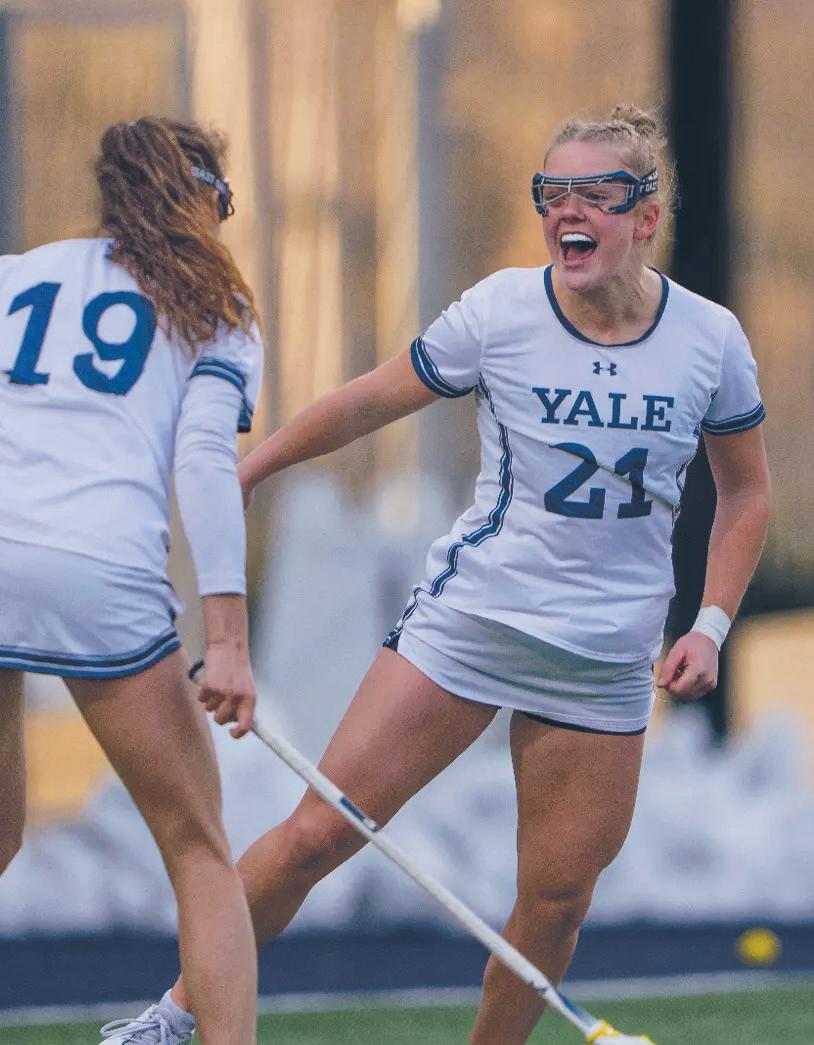
season is long, so it’s helpful having small moments like that along the way to refocus you and remind you what’s important.”
From the outset of the Ivy League Championships on Wednesday evening, Yale opened the meet in dominant fashion. The quartet of Lucius Brown ’26, captain Alexander Hazlett ’26, Nick Finch ’28 and Deniel Nankov ’27 set an Ivy League meet, team and pool record with a gold medal time of 1:23.55 in the 200-yard medley relay. This quartet earned an NCAA “A” Cut, which is an auto-qualifying bid for the upcoming NCAA National Championships.
Then, the 800-yard freestyle relay of Jake Wang ’28, Lars Kuljus ’28, Mak Nurkic Kacapor ’27 and Millard took silver, with a team record time of 6:13.92, also earning an NCAA “A” Cut. After that strong performance on opening night, the Bulldogs were tied with Princeton in first place.
On day two, Millard and Finch led the team, each earning individual golds. With Yale faithful in the stands, the Elis put on a show.
“We had so many families, friends and alumni in the stands so we could really tell we stand on the shoulders of giants and those who came before us,” Millard wrote to the News.
In the 500-yard freestyle, Millard set a pool record with a time of 4:10.19, making an NCAA “A” Cut. His performance was the secondfastest in Ivy Championship history and his third consecutive Ivy League title in the event.
In the 50-yard freestyle, Finch captured gold in 18.82 seconds, setting a pool and meet record, while also making an NCAA “A” Cut. In the 200-yard individual medley, Wang broke the team record in the 200yard individual medley in a time of 1:42.86, earning bronze and making an NCAA “A” Cut.
Yale then took silver in the 200yard freestyle relay, with Finch, Nankov, Kacapor and Wang going on to set a new team record. At the end of the second day, Yale sat in second place with 459.5 points, trailing Princeton.
“I feel like no matter the meet or race our team is always very energetic and hyped whether that be cheering for others or competing in general,” Ethan Guo ’29 wrote to the News. “I think this makes every meet and every race very competitive and people are performing at a very high level from the start of the season to the end, in no small part thanks to the energy.” With a boost from his teammates’

vocal support, Finch broke the Ivy League 100-yard butterfly record twice: in the morning prelims, then in the evening final — with a time that was the eighth-fastest in the country this season.
Then, a quartet of Wang, Charlie Egeland ’27, Finch and Nankov broke the Ivy League 400-yard medley relay record, en route to gold. Wang’s opening backstroke leg set a Yale record of 46.11. In the 1000-yard freestyle, Millard earned a silver, finishing in a Yale record time of 8.45.38. To finish off the meet, Egeland and Wang served up a one-two punch in the 100-yard breaststroke, each earning NCAA “A” Cuts. After the third day, Yale trailed Princeton closely. On the fourth, and final, night, Yale brought in four more medals. This night was also the most emotional of the four for the senior class.
“On the last night, many of the seniors shared parting sentiments and there wasn’t a dry eye around,” Millard wrote to the News. “It really showed to us seniors how much the team valued us, and what a bond all of the guys have. We are a family, and every swim was from the heart. It is such a satisfying feeling knowing that the work these guys have put in every day got to be put on display in the best way possible.”
That night, in the 1650-yard freestyle, Millard took silver in a time of 14:41.76. Then, Finch and Nankov finished second and third respectively in the 100-yard freestyle, with Finch earning an NCAA “A” Cut.
The captain, Hazlett, broke the Yale 200-yard butterfly record during prelims, before later placing seventh in the A final. The quartet of Wang, Finch, Millard and Nankov closed out the meet with a silver medal in the 400-yard freestyle relay. After a tally of the final scores, Yale secured second place with 1,274.5 points. Millard said the culture that facilitated these results was produced on the ethos of relentless self-improvement.
“We have been moving on an upward trajectory the last four years and I’m really impressed with how the team has been able to celebrate the success each year but then reassess goals moving forward,” Millard wrote to the News. “The guys who won the B final now want to make the A final, the guys who made the A final want to win, the guys who won want to break school records. We don’t have a group that rests on their success and instead everyone is hungry for more.”
At the end of the meet, Millard, who finished his Ivy League career with 352 points, was named the Harold S. Ulen Career High Point Swimmer. This honor was significant, but for Millard, who had battled pneumonia midseason and competed through two labrum tears that significantly limited his training, this honor was secondary to everything else that the meet represented.
“On an individual level, I’ve had a really tough year,” he wrote. “A few
weeks ago, I was hopeful that I’d get to go to NCAAs on a relay with the guys. Being able to come here, win the 500 for a third consecutive year and perform well in my other events has made it one of the most special meets I’ve ever had.”
The Bulldogs’ performance in Princeton re-defined Yale among its Ivy peers and propelled several Bulldogs to the NCAA Championships. Finch, who earned NCAA “A” Cuts in the 50-yard freestyle and 100-yard butterfly, enters the national championship stage as one of the Ivy’s premier sprint swimmers. Wang will join him in Atlanta. Egeland, with silver in the 100-yard breaststroke, will also join as an individual qualifier. To round out the team, the relay squads that broke the Ivy records in the 200-yard and 400-yard medleys, as well as the 200-yard freestyle relay, will also be a part of the Bulldog contingent heading to Georgia.
“We are no longer a team who hopes for things to go right at Ivy Champs,” Millard wrote. “We are now a team who are capable of performing on a national level, and whether that is individually for people or on relays, this team has the potential to score at NCAAs.”
The Bulldogs will compete at the NCAA Championships from March 25 to March 28 in Atlanta.
Contact JUSTIN LEAHYat justin.leahy@yale.edu.
The Yale women’s lacrosse team (4–0) extended their perfect start to the season on Saturday by beating the No. 5 Michigan Wolverines (3–2) in Ann Arbor by a score of 11-6.
The victory provided momentum for the team as it prepares to begin Ivy League play. “A win like this gives us a lot of confidence heading into Ivy League play,” attacker Kelly Holmes ’28 told the News. “It builds momentum at just the right time.”
This victory was also an indication of the Elis’ potential this season, even with the departure of 16 seniors last spring. Last February, the Bulldogs hosted the Wolverines in New Haven and secured a decisive 12-6 victory. This February, the Bulldogs had another decisive victory — this time in Wolverine territory. On the offensive end, Bulldog attackers were not hesitant to fire shots on Michigan goalie Elizabeth Johnson, who was awarded both Big-10 Freshman of the Week and Big-10 Defensive Player of the Week last month. Holmes, fresh off a seven-goal performance against Boston University, continued to show her offensive prowess and put up her third hat-
trick of the season. Holmes is currently second in the Ivy League in goals per game — averaging 3.5 goals per game.
“It’s all credit to my teammates.” Holmes said. “They set me up for every goal, whether it comes from a perfect pass or a clear from the defense after a stop. It’s never an individual goal. We’ve just been playing our game and playing with confidence, and that’s helped us to execute at a high level.”
On Saturday, Holmes capitalized on a woman-up situation in the opening minutes of play to break open the scoring. With Ashley Kiernan ’27 adding another goal to the scoreboard, the Bulldogs ended the first quarter up 2-0. This was the first of two quarters to which the Yale defense held Michigan scoreless.
Less than a minute into the second quarter, first-year midfielder Kate Gould ’29 wasted no time to score another goal and put the Bulldogs up 3-0.
Gould, who last week was named Ivy League Offensive Player of the Week, continued to show her worth offensively, tallying a goal and two assists against the Wolverines. Michigan quickly responded,
though, and back-to-back goals from reigning Big Ten Offensive Player of the Week Emma Bradbury pulled the Wolverines within one.
Shortly after, Holmes responded with back-to-back goals to put the Bulldogs up 5-2 with less than five minutes to go in the first half.
The second of the back-to-back goals was Holmes’ favorite on the day.
“It was a huge momentum shifter for us. At that point in the game we were starting to build rhythm and gel together as a team. Getting that lead early on boosted everyone’s confidence and allowed us to control the pace of the game,” Holmes said.
Yale entered the halftime break up 5-4.
First-year Nell Ducey ’29 notched her second collegiate goal a couple minutes into the second half to put the Bulldogs up 6-4.
Ashley Kiernan ’27 scored shortly after to extend the Bulldog’s lead to three at 7-4. Then, Ashley Newman ’26 had back-to-back goals to allow the Bulldogs to close out the third quarter with a comfortable five goal lead at 9-4.
In the fourth quarter, the teams traded goals. First-year Whitney Froeb ’29 accounted for both of
Yale’s tallies. Although Michigan matched Yale’s scoring in the final 15 minutes, the deficit created by the Bulldogs’ third-quarter surge proved too large to overcome. Yale secured the 11-6 win.
The Bulldogs’ defensive unit, anchored by goalie Niamh Pfaff ’28, held Michigan to its lowest goal total of the season.
“Our unit was disciplined, connected and really committed to taking away the looks Michigan’s top players usually get,” Pfaff said. “Slowing down their strong players was a total team effort in preparation and execution.”
Despite facing a high-powered offense, Pfaff tied her career high with 10 saves. Her first came midway through the first quarter on a free-position shot from Bradbury.
“I think my favorite save was the first one,” Pfaff said. Before hosting Columbia (3–1) on Saturday, Yale will face Central Connecticut State (0–3) on Wednesday at Reese Stadium. Faceoff is scheduled for 3 p.m.
Contact AZARA MASON at azara.mason@yale.edu.