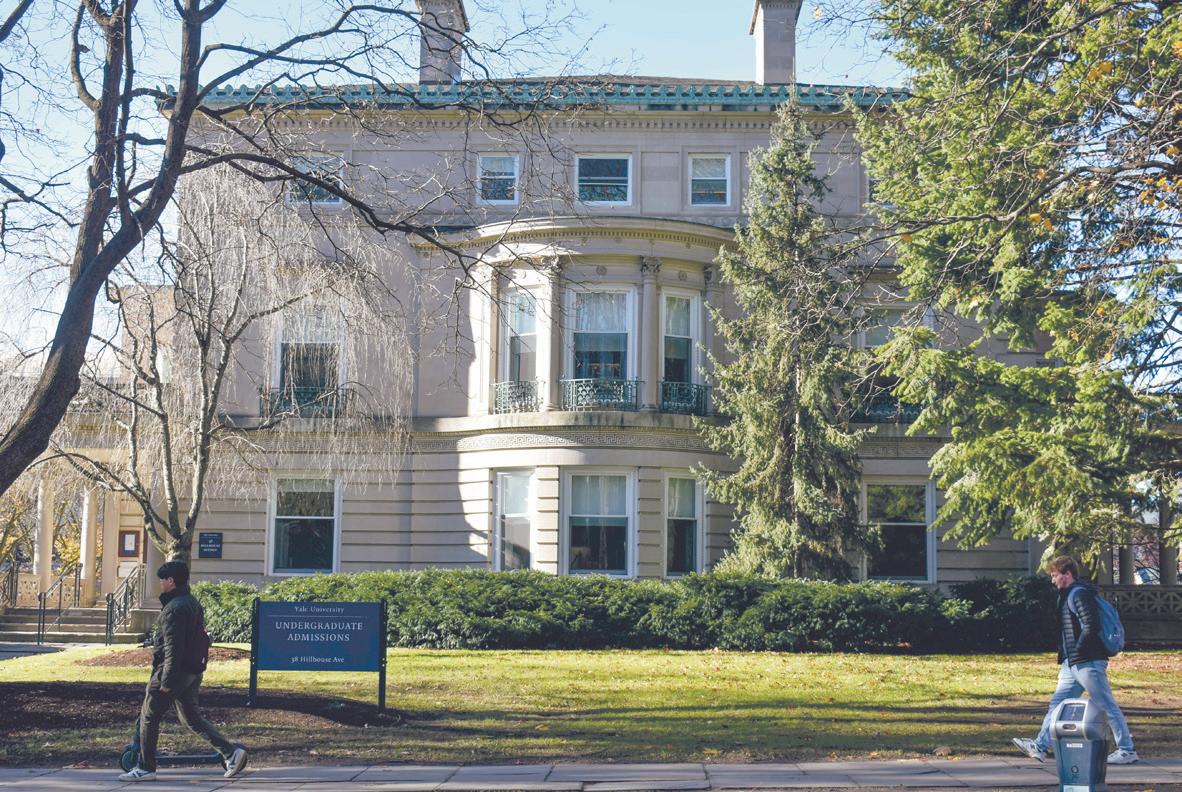
On Thursday evening, 1,431 applicants to Yale College were greeted by a screen of singing bulldogs and the Yale fight song.
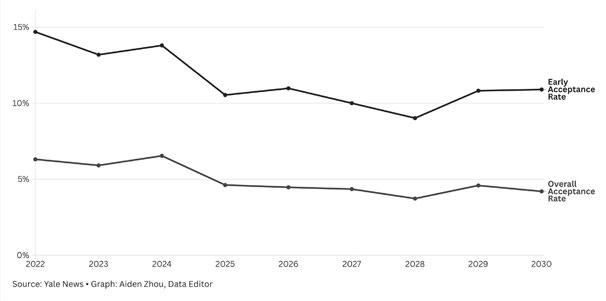
In total, 47,779 prospective students applied in the regular decision cycle. The total pool for regular decision included an additional 1,285 deferred students, or 18 percent of the 7,140 early applicants. The News calculated that the regular decision acceptance rate, when accounting for deferred students in the pool, was about 2.9 percent — a decrease from last year’s regular decision acceptance rate of 3.65 percent.
The regular-decision admits join 779 students who were accepted in December through Yale’s early action program, as well as 118 students who were admitted through QuestBridge,
a nonprofit organization that helps lower-income students apply to selective colleges. An additional 37 students who deferred their admission from previous years will also join the class.
In total, 2,328 students were admitted to the class of 2030 out of a pool of 54,919 applicants across early, regular and Questbridge admissions. The overall acceptance rate was 4.2 percent, a decrease from last year’s 4.59 percent rate. According to a Yale press release, this year’s applicant pool was the second largest in Yale’s history, second only to the class of 2028. Mark Dunn ’07, the undergraduate admissions office’s director for outreach and recruitment, wrote in an email to the News that students admitted through QuestBridge are
Acting police chief tapped to stay on
BY CHANTAL EULENSTEIN AND REETI MALHOTRA STAFF REPORTERS
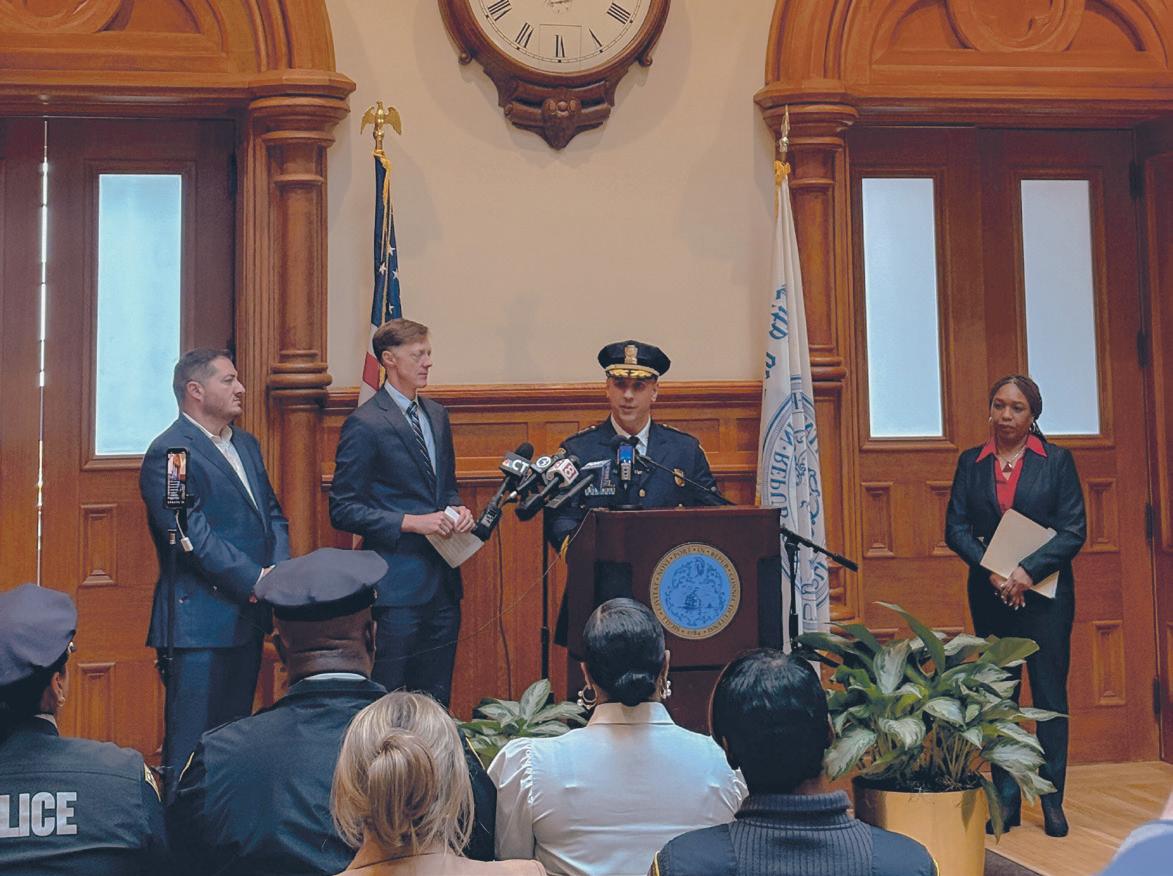
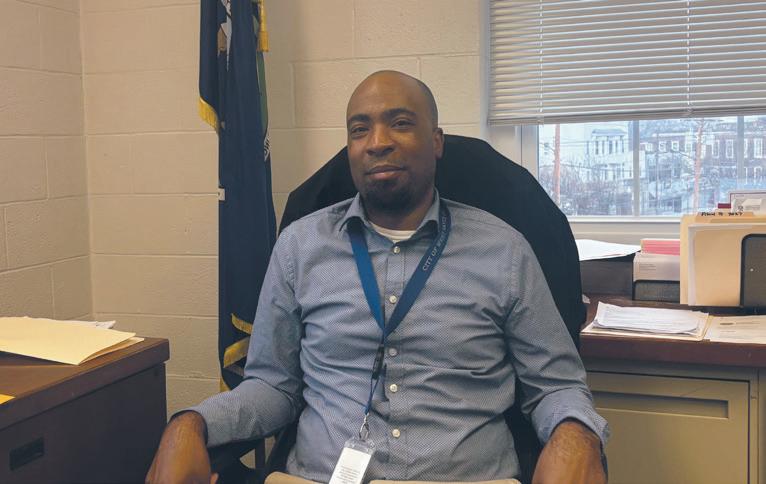
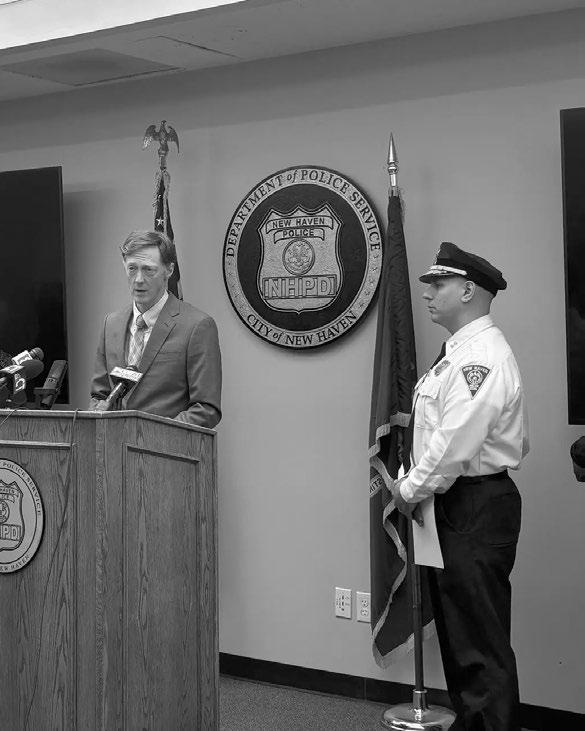
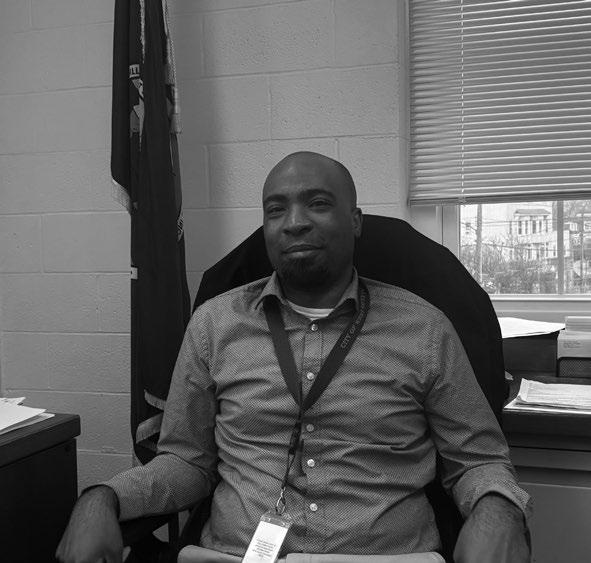
Mayor Justin Elicker has nominated the acting police chief, David Zannelli, to be New Haven’s next permanent police chief. Zannelli, formerly the assistant chief of police, was named acting chief by Elicker in January following the abrupt departure of former chief Karl Jacobson following his alleged admission to stealing funds from the city’s confidential informants program. Zannelli’s appointment to the permanent chief role, which Elicker announced at a press conference at City Hall on
Trump’s Fed target visits Yale
BY GILLIAN PEIHE FENG STAFF REPORTER
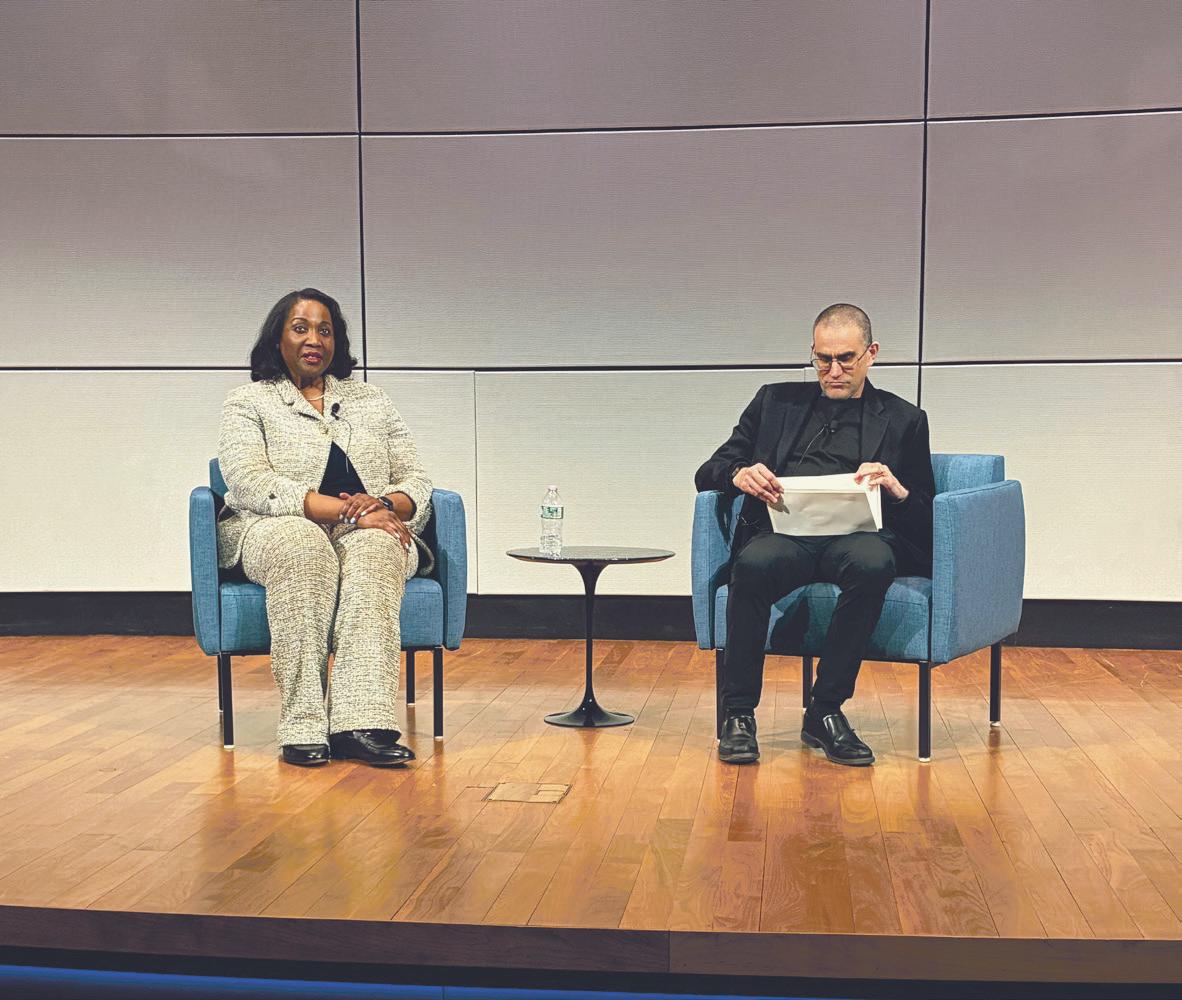
Lisa Cook, a governor of the Federal Reserve Board whom President Donald Trump attempted to remove last August, gave a talk Thursday at the Yale School of Management on her work in financial stability.
Cook, who is the first Black woman to serve as a Federal Reserve governor, sued Trump after the president said he would fire her on the basis of mortgage fraud allegations. The Supreme Court heard oral arguments in the case in January.
Yale’s Program on Financial Stability invited Cook to speak at the School of Management. The program’s director, finance and
BY ADELE HAEG STAFF REPORTER
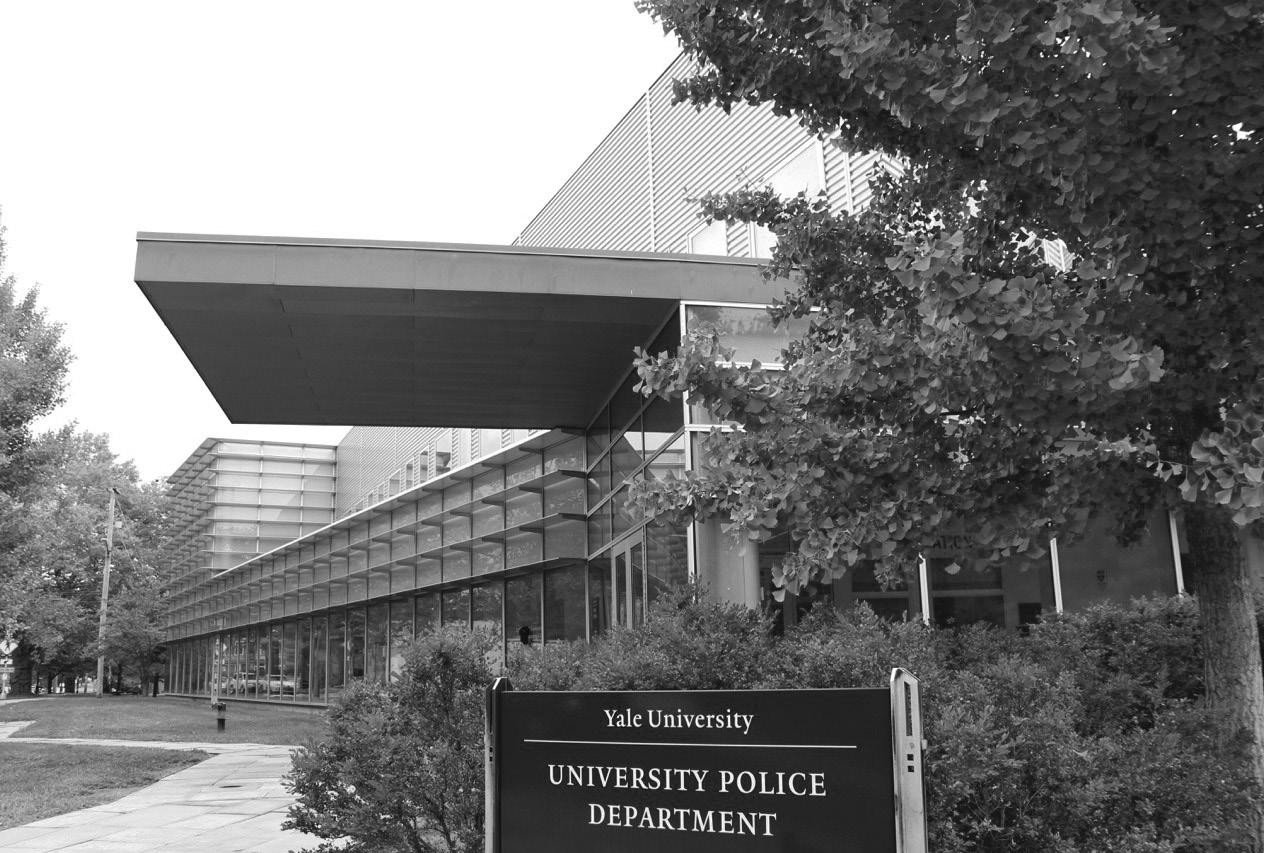
Yale Public Safety plans to relocate the University’s police dispatchers from the Yale Police Department’s headquarters to the new Public Safety Operations Center in Science Park.
The announcement of the change left dispatchers “heartbroken,” Mike Hall, the president of the Yale Police union, said.
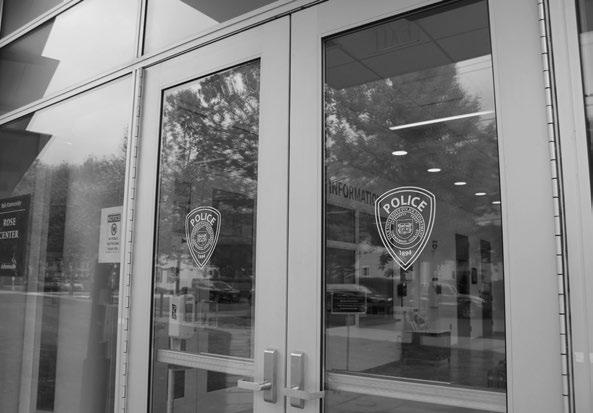
Dispatchers — who answer emergency calls and monitor campus alarm systems — have worked alongside police officers in the Yale Police Department since the Rose Center on Ashmun Street opened in 2006,
according to Hall.
The dispatchers learned of the move after Duane Lovello, Yale’s head of public safety, posted an announcement to the Yale Public Safety website on Feb. 19. The announcement said that “preliminary discussions” about relocating dispatchers to the new facility were underway.
“No one knew this was even a possibility,” Hall said in a phone interview.
About six months ago, Yale Public Safety removed dispatchers’ campus camera monitoring system from the Rose Center without explaining why, Hall said. Then, in February, dispatchers heard that the whole
dispatch unit would be leaving the police department, he said. Hall said neither the Yale Police Benevolent Association nor dispatchers were con
sulted before Lovello posted the announcement online.
“Employees will be engaged as part of the process. During and after the future relocation, there will be no noticeable change to members of our community who seek our services,” Lovello wrote in an email statement to the News. According to the announcement, the consulting firm 21CP Solutions recommended the
Wednesday afternoon, is subject to confirmation by the Board of Alders. “David Zannelli has stepped up to lead the police department through a period of great progress and reduced crime and a period of real challenge during an unexpected leadership change,” Elicker said. Elicker expressed his admiration for Zannelli’s integrity as well as his strong commitment to the New Haven community. Zannelli stood out especially to Elicker because he was one of the officers who chose to confront Jacobson for allegedly embezzling funds from the
SEE CHIEF PAGE 4
BY LEO NYBERG AND ANAYAH ACCILIEN STAFF REPORTERS
The proportion of Yale College students who identified themselves as Jewish has decreased from about 16 percent on average in the 2010s to 9 percent in 2024, the most recent year with publicly available data, according to the Chaplain’s Office and a new report from a Jewish alumni group at Harvard.
The report found that the share of Jewish students has fallen at Harvard and Yale. The report does not make a conclusion about the reasons for the decline, Adrian Ashkenazy, the president of the Harvard Jewish Alumni Alliance and a co-author of the report, told the News. When asked about the findings, University officials and campus Jewish leaders alike praised the state of Yale’s Jewish community.
Between 2010 and 2020, 16.42 percent of Yale College first years indicated that they were Jewish, according to data from the Chaplain’s Office. In 2024, 9.5 percent reported that they were Jewish.
BY LIZA KAUFMAN STAFF REPORTER
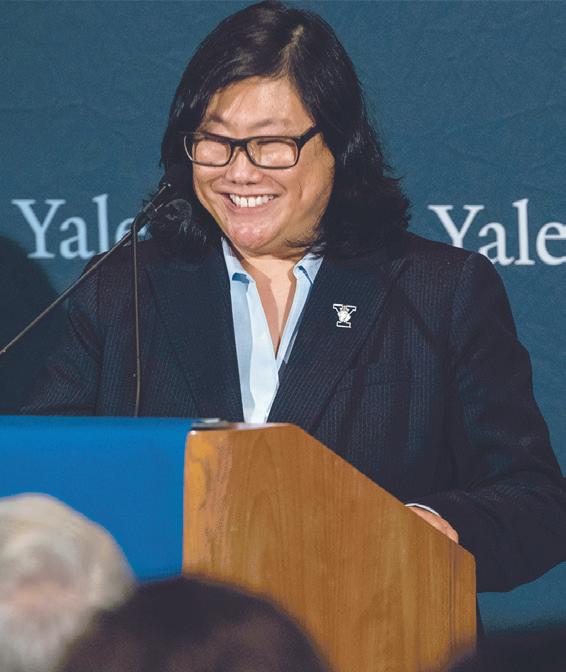
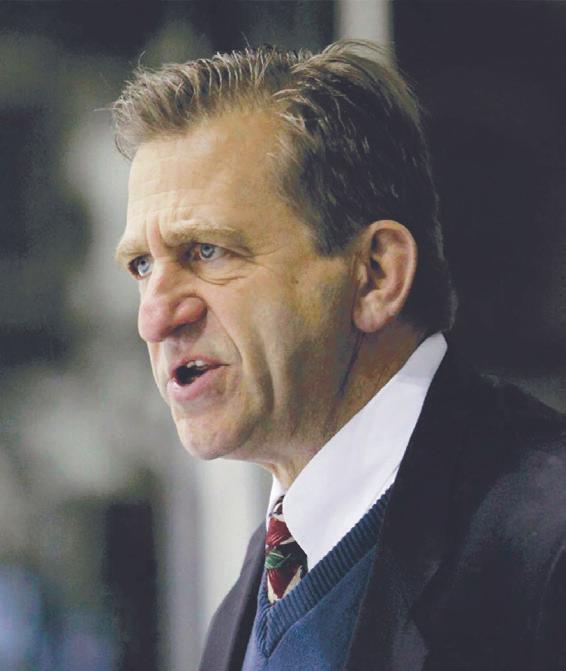
Retired Yale men’s hockey coach
Keith Allain ’80 criticized Athletic Director Vicky Chun’s leadership in a letter to University President Maurie McInnis, Fox News reported Monday evening.
In the letter — sent in October, two months after announcing his retirement — Allain described Chun as “the absolute worst leader” he had encountered and alleged that she fostered a culture that discouraged dissent within the athletic department, according to Fox News.
The Yale Daily News has not reviewed the letter, which the Fox News article said Allain had confirmed as authentic. Neither Allain nor McInnis responded to the News’ requests for comment. Chun did not respond to the News’ emailed request for comment about the accusations raised in the letter quoted by Fox News.
The revelation of Allain’s letter came at an important time, with Chun’s contract up for renewal this year. Former University Pres-
2021 until June 2026.
Allain, who was the starting goalie for the men’s hockey team from 1976 to 1980 and recorded 2,337 career saves, became head coach of the squad in 2006. During his 19 years at the helm, the Bulldogs made six appearances in the NCAA Division I men’s ice hockey tournament, including a 2013 national title. He also led the team to seven Ivy League championships. Allain announced his retirement last August. As both a former player and coach at Yale, Allain reportedly wrote that he felt “compelled” to share his thoughts about Chun’s leadership as the University decided whether to renew her contract. He wrote that he was sending the letter “at the urging of several head coaches in our Athletic Department,” Fox News reported. Allain described Chun as “dishonest, self centered and inacces-
ident Peter Salovey named Chun the Thomas A. Beckett director of athletics in 2018 and later extended her contract in
Reeti Malhotra, Contributing Photographer
SEE COOK PAGE 5
Yale Athletics
Yale News
Luke Huh, Staff Photographer
Gillian Peihe Feng, Contributing Photographer
This Day in Yale History, 1979
March 27, 1979 / Anonymous tip leads police to missing jewels
By Paul Bass
The latest mystery in the bizarre case of the “Iranian Avenger” unravelled Sunday night, when an anonymous caller led Yale police to more than $2,000 worth of stolen jewelry.
Campus police informed Berkeley senior Laila Amin yesterday that they had recovered a $2,000 watch, two gold rings, and other valuables. She reported the jewels stolen on March 5 by a masked burglar claiming to represent Ayatollah Ruhollah Khomeini, Iran’s revolutionary leader.
Behind the Headline
By Olivia Woo
I received an email last September asking me to fill out a survey to evaluate my dean, but I don’t remember filling it out — in fact, I had forgotten I’d received it until I reported last week on the mid-semester departure of Berkeley’s dean. Upon comparing the September email in my inbox with the one sent to Berkeley students this January, I was confused by two conflicting assertions: one email stated that reviews were “routinely” conducted in the second year of a dean’s term, and the other said that the process began in their third year. In an interview with Yale College Dean Pericles Lewis, I learned that beginning this spring, review processes had not only been moved up a semester but also shortened by half. I received more detail about how student feedback is used, information which I relayed right away to students milling about in Berkeley’s and JE’s sunny courtyards. After gathering some of their insights into their relationships with their deans and their critiques of the feedback solicitation, I decided I’d better begin thinking of careful responses for the next feedback form I receive.
Read “Changes expedited performance reviews for Berkeley, JE, Murray deans” on page 7.
LUCAS CASTILLO-WEST
CLARIS SHIN
JANE CALLANAN
STAFF COLUMNIST
WILLIAM BARBEE
GUEST COLUMNIST
SOFIA HEREDIA
The tyranny of the teaching fellow Value intellect, not high grades
As the battle for trust in higher education continues to capture public attention, Yale has taken yet another step to preserve its institutional reputation. The recently-announced Committee on the Principles of Academic Freedom will examine the “historical, legal, and ethical foundations of academic freedom,” ultimately producing a report designed to build upon Yale’s existing policies regarding this “sacred principle.” Akin to a modern, albeit less groundbreaking, Woodward Report, the output of this committee will likely contribute some meaningful defense of free expression. Without ruffling too many feathers, it will keep in line with the precedents set by President Maurie McInnis’ other established committees.
Still, this latest iteration in Yale’s series of attempts to reassert its standing as a leading academic institution has the potential to make meaningful headway in the fight for intellectual diversity on campus. As they conduct their research, those on the committee must not be afraid to recognize that promoting academic freedom may, in some cases, necessitate restricting it. Nowhere can this principle be better applied than in those small, cloistered classrooms in which one entity — the teaching fellow — rules supreme.
Nearly every undergraduate at Yale will at one point take a class that requires section attendance with a teaching fellow, or TF. They are as much a part of the classroom experience as tenured professors, with students exposed to them for at least a third of in-person time for many lecture courses. For such an integral component of student life, one would imagine the administration has developed detailed policies to ensure uniform standards for TFs across departments. Unfortunately, such standards have proven inadequate in preventing curricular hijacking by ideological graduate students.
The horror stories are too abundant to count. From my own experience, derived chiefly from courses in American history, I have had TFs trade handouts on Alexander Hamilton for those on Jacques Derrida, spending 30 minutes on deconstructionist state theory in a section meant to provide understanding of the federal bank. I have had TFs abandon any effort to teach material on the Civil War, exchanging discussion of the readings for a round of online quizzes on American pop culture.
I have had TFs ask directly why I continue to try in class when postgraduate life, and even the university itself, is nothing but a rat race.
The lack of viewpoint diversity within sections often makes these issues one-sided. Most TFs stifle attempts to disagree with their left-leaning ideological framing of certain political, historical or moral
questions, giving such opinions little time or seriousness. The trope of doctrinaire academics teaching “what to think” instead of “how to think” is closer to home than we are led to believe — nowhere more so than in TF-led sections.
To label such encounters as dispiriting would be an understatement. At best, they make for an underwhelming class experience that forces one to reconsider one’s enrollment at a university of such renown as Yale. At worst, they represent the fundamental fear held by millions across the country: that the modern university has become a mere front for indoctrination.
I do not mean to deliver superfluous complaints, nor do I wish to paint the entire community of teaching fellows with a singular brush. I have enjoyed the sections of several TFs and even had the pleasure of getting to know some personally outside of class. But the fact that selecting a section at Yale is akin to playing a game of Russian roulette poses a serious problem to students who expect to receive a quality education at Yale.
The process of rectifying this situation begins where all university processes begin: administrative policy. The current, publiclyavailable guidelines for faculty and teaching fellows offer no rules for how TFs ought to conduct themselves in section, and they certainly offer no means by which undergraduates might communicate lackluster performances outside of the mandatory end-of-semester class surveys. If Yale’s Committee on Academic Freedom can achieve anything, it is the tightening of expectations for TFs in classroom settings. Such guidelines should state clearly that there ought to be no unusual deviations from course syllabi, no divergence from course material without express professorial approval, and no dismissal of undergraduates on the basis of political opinion. In positive terms, there ought to be free and open discussion in all sections, with undergraduates who perceive that a violation of said rules has taken place being able to report such matters to the course professor or university.
These proposals do not serve to create a safe space for undergraduates who cannot stand a liberal professor — they seek to remove one for TFs who cannot stand a conservative student. If the guidelines remain as vague as they are now, I fear there will be no other way for us to overthrow the tyranny of the teaching fellow.
WILLIAM BARBEE is a senior in Silliman College studying History. His column, “Standing athwart history,” offers constructive criticism of Yale following in the tradition of William F. Buckley, Jr. He can be reached at william. barbee@yale.edu.
In the past decades, numerous committees from Ivy League universities have attempted to pass policies rectifying grade inflation. Few have gone anywhere. A Dartmouth committee’s policy proposals in 2015 were never implemented by the university. At Yale, 2014 committee recommendations were left to instructors to implement, resulting in little to no change.
Attempts at mitigating grade inflation have failed because they have been too extreme, and because faculty have faced backlash from students when attempting to grade more harshly. Yet actually solving grade inflation may require the harsh action that universities have been attempting. It will be on students and faculty to adjust over time.
Recently, Harvard began discussions on a proposal to cap the amount of A grades given in a course. Yale’s Dean Pericles Lewis said recently that Yale will be looking closely at how things progress at Harvard. A grade cap may be in our future.
If all goes well, students and faculty will adjust to fewer As after a couple years of discomfort. Achieving the A will be a cause for celebration rather than an expectation and source of relief. Students will feel less pressure to take “guts”, or easy classes, instead opting for courses that genuinely interest them.
Drawbacks of a grade cap policy include students feeling threatened by a lower GPA, which would make them less competitive in the job and graduate school market, and professors’ preoccupation with whether they’ve assigned
an appropriate percentage of As and Bs, with perhaps less concern about providing helpful feedback to students.
There is a way to combat these hurdles at Yale. Yale needs to rearticulate its institutional values in a way that is public and clearly understandable. Currently, Yale’s grading information websites are practical and informational for students seeking guidance on administrative matters. They lack, however, a clear narrative behind the University’s grading system and are textually dense. A grading website page should explain how Yale’s grading policy is coupled with a pedagogical philosophy, one that furthers values like growth and learning. Brown, for example, references its Open Curriculum as a pedagogical reason for their grading system. The Yale College mission statement explains that Yale’s liberal education seeks to develop students’ “intellectual, moral, civic, and creative capacities to the fullest” in order for them to become “curious, engaged citizens.” Yale also seeks to help students “develop as active learners who thrive in complex environments.” Traits like creativity, active learning and curiosity can best be fostered through academic exploration and growth. If students and faculty can adhere to this spirit inside and outside of the classroom, then we can achieve a positive academic culture that is compatible with grade caps. Ultimately, the A should retain the value of excellence, but Yale should assume responsibility for making
sure A-receiving students are producing truly excellent work. As a result, the standard of the A should increase as students improve throughout the year. Striving for student growth looks like ample written feedback from professors on assignments, classroom discussions that encourage disagreement and opportunities for students to collaborate.
A grading statement that takes inspiration from the college’s mission statement will be instrumental to maintaining a spirit of curiosity and growth through academic discourse. Professors will be encouraged to uphold the pedagogical values a Yale education strives for, reducing the risk of numerically driven grading that lacks feedback for students.
By making this grading statement accessible for employers and graduate schools, students wouldn’t have to worry about being punished by admissions officers for lower GPAs. Respect and understanding will be built for how Yale grades its students. Despite student worry, attacking grade inflation with grade caps may be the catalyst for cultural change we need on campus. Yale students wouldn’t be fearful of exploring challenging courses, and classrooms would be imbued with a spirit of curiosity and intellectual rigor. And isn’t the ultimate mission of Yale to foster emboldened intellectual pursuit?
SOFIA HEREDIA is a first year in Timothy Dwight College. She can be reached at sofia.heredia@yale.edu.
Picture the perfect liberal arts institution. What I envision is a collegiate gothic campus, an intellectual haven where students engage in lively debate, wrestle with crazy ideas and seek out the passionate tension of disagreement.
I’d say that most students here would agree that Yale does its best to get as close to this vision as possible, but there are a number of practical considerations that complicate the institution’s reach for perfection. And I, for whatever reason, have spent the last few months fixated on just one: intellectual isolation.
As coddled as we admittedly are, everyone on the spectrum of liberal to conservative is charged with some burden. To the slim conservative minority — let’s be generous and call them the 5 percent — goes the burden of grace: to listen respectfully, to be challenged constantly and to argue clearly.
To the vast liberal majority — the remaining 95 percent — goes the burden of curiosity: to seek out disagreement and to value difference of opinion.
It’s no secret that liberal viewpoints are the prevailing ones on campus, but I honestly don’t buy many arguments about how differences in politics lead to social isolation — maybe in extreme cases, which are rare. Intellectual isolation, on the other hand, is pervasive and problematic.
Simply put, a conservative student at Yale cannot avoid opinions with which he disagrees. This applies in a formal classroom setting as much as it does during a casual dining hall meal. He routinely stares down the possibility of being written off or explicitly ridiculed, and to nix that underlying stress, he must cultivate a unique kind of grace: the ability to engage
thoughtfully without growing defensive, combative, flustered or disillusioned.
To extend this grace is not a choice. If he wants to participate in Yale’s intellectual community at all, it is essential. He is forced to listen more carefully, question his assumptions more often and articulate his points more clearly. He must constantly and tactfully navigate his identity and his beliefs, all the while resisting the relief that his own echo chamber, no matter how small, is always poised to provide.
A liberal student at Yale leads an entirely different life.
He faces the opposite problem: sometimes he cannot even find opinions with which he disagrees. Many students enter Yale with their ideological views solidified, but given the prevailing culture on campus, liberal students in particular have no incentive to step outside their comfort zones and engage with conservative or right-leaning ideas. The liberal student should be pushed to question his beliefs and actively seek out ideas that challenge his assumptions — in fact, he should want to do just that.
But as I — and I’m sure many others on campus — have seen, this is not the world we live in.
Yale is not the perfect liberal arts institution — far from it.
It’s too easy for a liberal student here to remain inside his ideological bubble, stunting the necessary intellectual growth that comes from exposure to diverse perspectives.
The problem becomes clear.
The 5 percent must practice grace, but the 95 percent, by virtue of their majority status, are not held to the same standard for curiosity. Conservatives are expected — I won’t quite say “forced,” but it’s not far off — to engage with ideas they find disagreeable or offensive, while
liberals are rarely expected to do the same and definitely never forced. The conservative experience at Yale is one of constant engagement with difference and dissonance, an opportunity for growth that the majority so often denies itself.
I do not advocate for arbitrarily more conservative representation on my campus. That would only attempt to address the symptoms of a much deeper cultural disease — I write “attempt” because I don’t believe it would even do much at all.
Instead, a cultural reckoning has to happen, one that encourages everyone, regardless of political affiliation, to seek out diverse perspectives. One that holds both the 5 percent and the 95 percent to equally high standards. One that coddles none of us. One that stems from good faith.
A Yale education is not just about mastering academic knowledge. It’s about acquiring the intellectual flexibility to engage with a wide array of ideas and people. In a polarized world like ours, that flexibility is more important than it ever has been, and the University does us no service by neglecting to hold that in mind and act accordingly.
If we are ever to seriously bring Yale closer to that perfect institution — where ideas of all kinds are listened to, challenged and refined — we must seriously consider the imbalance between those of us burdened with grace and with curiosity, and we must all commit to listening more intently, challenging more respectfully and refining more carefully. Our institution’s intellectual health depends on it.
NATE STEIN is a sophomore in Saybrook College studying political science. He can be reached at nate.stein@yale.edu.
included in Yale’s totals for the regular decision round, not early action.
According to the announcement, admitted students represent all 50 states, Washington, D.C., two U.S. territories and 75 countries, and they will graduate from more than 1,650 secondary schools. Prospective majors span 83 of Yale’s undergraduate programs.
“As always, the quality of the pool of applicants is much more important than the number of applications we receive,” Dean of Undergraduate Admissions and Financial Aid Jeremiah Quinlan ’03 wrote in a statement to the News. “This year’s applicant pool included thousands of extremely well qualified students.”
Quinlan added that the admissions committee faced difficult decisions because of the number of strong applicants but ultimately selected students “with the greatest potential to contribute to the Yale community and to take advantage of its extraordinary resources.”
This year’s regular-decision admissions come after Yale College announced an expansion of its financial aid program, guaranteeing free tuition for families earning under $200,000 and eliminating all expected costs for families earning under $100,000.
“With this announcement, we reiterate and reinforce Yale’s commitment to ensuring that cost will never be a barrier between promising students and a Yale College education,” Quinlan said in the
Yale press release. Dunn wrote that the financial aid expansion could not have influenced applicants’ decisions to apply to Yale because their applications were due before the announcement.
“However, these newly admitted students will benefit from the new aid policies, and I expect that many will find that Yale is their family’s most affordable option,” Dunn wrote to the News. He added that the expansion may influence future applicants, particularly younger students beginning their college search.
Admitted students have until May 1 to accept their offer of admission.
Contact FABEHA JAHRA at fabeha.jahra@yale.edu.
department, the mayor said.
State police arrested Jacobson last month on two charges of first-degree larceny. His lawyer has said in a statement that “an arrest is not evidence of guilt and allegations are not proof.”
Zannelli graduated from the University of New Haven with a master’s degree in public administration and is an 18-year veteran of the New Haven Police Department. He has supervised its homicide unit and led the internal affairs unit.
“I’d like to thank him for placing his trust in me to lead the best law enforcement agency in the country at this time,” Zannelli said at the Wednesday press conference, referring to Elicker.
“Thank you, mayor. This is truly a dream come true.”
If confirmed, Zannelli would like to return to traditional community policing efforts such as walking beats while still exploring other, more innovative approaches, he said at the press conference.
He also said he hopes to ensure that morale in the department remains high by focusing on applicant diversity while continuing to hire the most well-qualified candidates.
Zannelli does not currently reside in New Haven, a requirement for New Haven police chiefs. Elicker is currently looking to change that requirement, he said at the press conference.
According to the New Haven Independent, Zannelli lives in Stonington, Connecticut, about an hour’s drive from New Haven.
Alder Frank Redente Jr., who represents Fair Haven’s Ward 15, serves as the Board of Alders’ representative on the Civilian Review
Board, which handles civilian complaints against the police.
“He’s a stand-up guy and an incredible person. The mayor made the right choice,” he said, adding that he was confident Zannelli’s nomination would go through. “He’s got an incredible amount of support in the Board of Alders.
On Tuesday, the Civilian Review Board sent a letter to Elicker advocating for Zannelli’s nomination.
“He creates an environment of trust, honesty and includes the community, something very important,” AnneMarie Rivera-Berrios, the review board’s chair, wrote in the letter. “He is involved with the youth and is eager to keep them involved and safe. He has shown integrity, dedication and professional competence necessary to continue leading our law enforcement team effectively.”
Asked Wednesday whether or not he would allow the New Haven Police Department to cooperate with federal Immigration and Customs Enforcement agents, Zannelli said that the work of the police department would remain separate from that of federal agents.
“We don’t care about somebody's documentation status. We care if you commit a crime. If you commit a crime, you’re still going to be arrested the same way,” he said.
Amid President Donald Trump’s deportation push, ICE has conducted a number of arrests in New Haven.
Contact CHANTAL EULENSTEIN at chantal.eulenstein@yale.edu and REETI MALHOTRA at reeti.malhotra@yale.edu.
Facing relocation, Yale police dispatchers sound the alarm
move “to consolidate Yale Public Safety’s disparate communications and monitoring centers” after the firm performed a “comprehensive assessment” of the police department in 2020.
“The myriad recommendations offered by the 21CP report provided Yale Public Safety with a roadmap of opportunity that ultimately positions Yale as a leader in campus public safety,” Lovello wrote in the announcement.
If the proposal to move the center as part of the 21CP plan goes ahead, Yale Security and dispatchers will operate out of a new public safety operations center at 25 Science Park, which is a mile away from the Rose Center. Police officers will continue to work out of the Ashmun Street department.
Senior dispatcher Anthony Notarino, who said has been a Yale dispatcher since March 25, 1996, was one of many dispatchers who approached Hall with concerns about the move after he saw the online announcement. The center employs 11 dispatchers.
“This was definitely a group effort. Nobody wants to go,” Notarino wrote in a text message to the News.
“We want to stay in our home, and we don’t want to be separated from the cops,” Notarino said in a phone interview.
In response to concerns he heard from Notarino and other dispatchers, Hall said he spoke with Lovello on Monday to inform him of “opposition” among dispatchers. Hall added that he plans to send Yale Public Safety a letter officially opposing the move. In a draft of the letter reviewed by the News, the union demanded that “dispatch remain physically housed within the Police Department.”
The letter, which is signed by
Hall, states that “this position is not rooted in resistance to modernization, nor is it based on tradition or convenience. It is based on operational structure, officer safety, supervisory integration, and risk management.”
Dispatchers worry the move will cause “enormous inconvenience,” Hall said, especially because he does not know of “any plan” to staff the new dispatch center with police officers.
The “dispatch center is more or less a welcome center” that is staffed constantly and where dispatchers and police officers collaborate closely, Hall said. He added that “cops have no reason to go to 25 Science Park so those relationships will just end.”
Dispatchers “do a lot of leg work” for police officers while they are in the field, Hall said, including providing officers with records, warrants and motor vehicle checks.
Dispatchers located in the building “develop a working familiarity with personnel, patrol deployment patterns, and command expectations that enhances field safety,” according to the letter. “They recognize tone changes, stress indicators, and contextual nuances
that are often not captured in CAD entries or radio transmissions alone,” the letter reads, referring to computer-aided dispatch systems.
He said that dispatchers feel like they are a part of the police department and “that familiarity is built through proximity and daily interaction.”
“You’re just a call-taker, you’re not a police dispatcher anymore,” Hall said of how dispatchers may feel after the relocation. “It’s going to be odd.”
“Our function is with the police officers and we need to be with them,” Notarino wrote in an email.
New Haven Police Department dispatchers and officers operate together out of that police department’s main headquarters, an arrangement that Hall said was the norm for most local police departments.
The Rose Center opened in 2006, named for benefactor Deborah Rose ’72, who donated a gift to the University for the new department building, according to a press release.
Contact ADELE HAEG at adele.haeg@yale.edu.
Kimberly Angeles / Staff Photographer
headquarters to Yale’s new Public Safety Operations Center. The police union is asking Yale Public Safety to reverse the plan.
Reeti Malhotra / Contributing Photographer Mayor Justin Elicker on Wednesday announced his choice of David Zannelli to permanently lead the New Haven Police Department. Zannelli became the acting chief after the departure of chief Karl Jacobson amid allegations of embezzlement.
Kalina Sabala Montes / Contributing
Kimberly Angeles / Staff Photographer
FROM THE FRONT
“Spring is the time of plans and projects.”
Report examines Jewish presence at elite colleges
Ashkenazy said the trend of the declining Jewish population was more striking at Yale than at Harvard, because Yale has increased the size of its firstyear class in the past decade — most notably with the opening of two new residential colleges in 2017 — but the Jewish population has still shrunk, according to the data Ashkenazy and his team analyzed.
Noting that a vast majority of American Jews are white, Ashkenazy said that the report’s authors wanted to figure out if the decline in Jewish students’ proportion correlated with a decline in the percentage of white non-Jewish students amid efforts to increase the representation of students of color.
“Admissions priorities that have come forward in the last twenty years, and when you look at each one and you compare them to the demographics of the Jewish population you would logically assume that pursuing those policies would lead to a sharp decline in the Jewish community on campus,” Ashkenazy said, describing the hypothesis of the report’s authors.
But they found that the proportion of Jewish students declined more than that of white non-Jewish students — or, precisely, white students minus Jewish ones — indicating that the declining Jewish population was not a byproduct of efforts to increase racial diversity.
“It really is designed to put the larger question in the laps of places like Harvard and Yale, and say, ‘Listen, we don’t understand why the numbers turned out like this. Maybe you can explain it,’” Ashkenazy said.
Yale leaders said it was important to take the numbers showing a decline in Jewish enrollment with a grain of salt.
Yale College Dean Pericles Lewis said in a Wednesday interview with the News that he had not seen the Harvard report and that Yale has a “thriving” Jewish community.
“I think that would be very hard to measure,” he said in a Wednesday interview with the News, referring to the conclusion that the undergraduate Jewish population had declined. “So many students — like, I’m half
Jewish — a lot of people might consider themselves Jewish but not answer the question in a particular way.”
University Chaplain May -
tal Saltiel, who arrived at Yale in 2013 and in 2024 became the first Jew to hold her current position, wrote in an email to the News that, in her personal experience at Yale, she has noticed increasing levels of participation from Jewish students in Chaplain’s Office programs, especially since the COVID-19 pandemic.
“Many of our students are part of multiple religious communities and may come from multi-religious households,” Saltiel wrote. “Religious identification in college is often fluid, as some students may be exploring who they are and what values they hold most dear.”
Yale School of Medicine professor Evan Morris, the founder
of the Yale Forum for Jewish Faculty and Friends, told the News he was “alarmed” by the report and would like to see administrators address declining Jewish enrollment “head on.”
“This begs a very serious question: How the heck can it happen? Particularly this episode at Yale, where overall enrollment goes up but Jews go down,” Morris said in an interview. “That just seems quite striking and, to the naive guy that I am, it makes me wonder, how could this possibly happen without intentionality?”
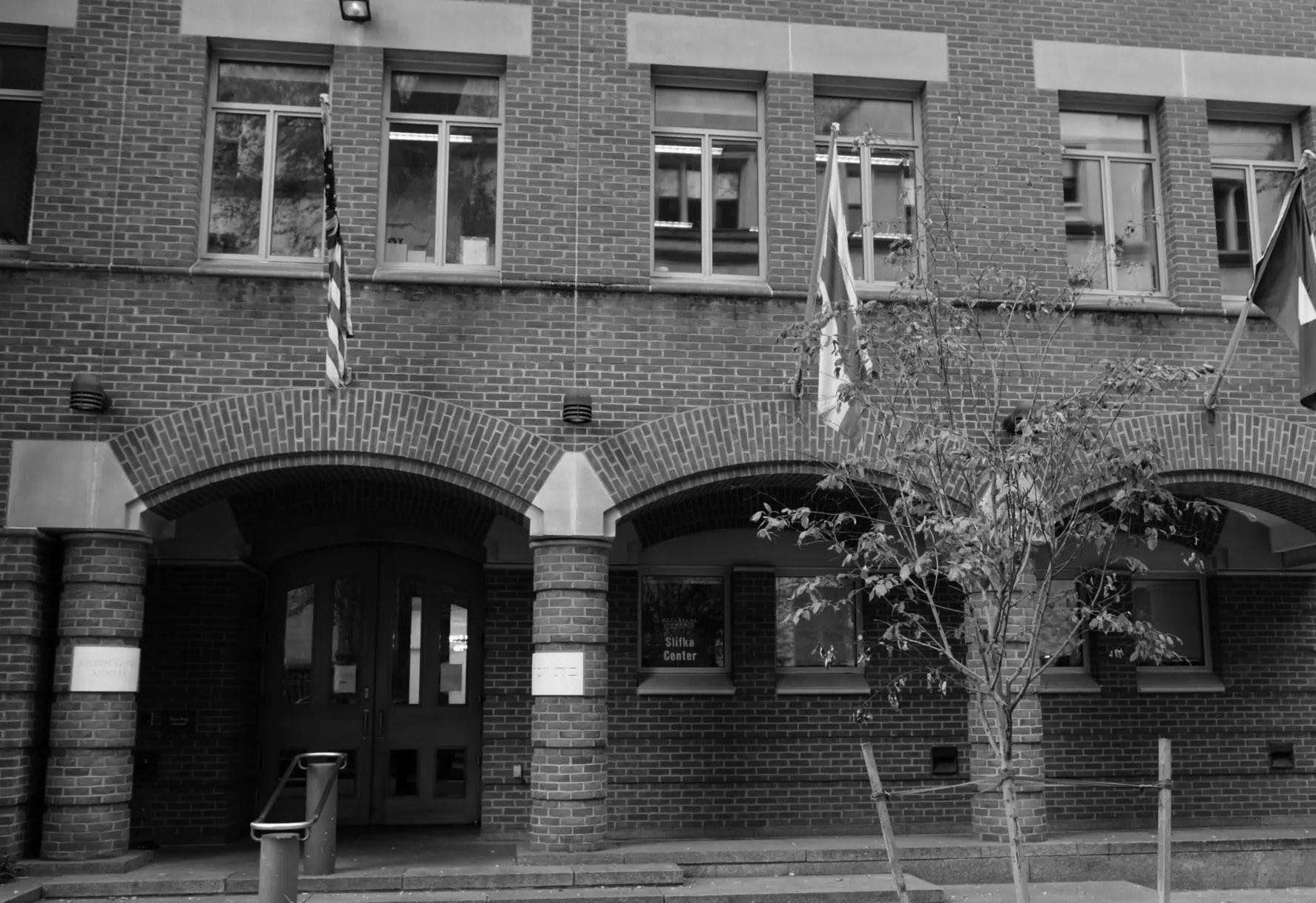
Yale spokesperson Karen Peart wrote in an email to the News that “information on students’ religious affiliation and ethnic identity is not collected or considered in the university’s admissions process.” She touted Yale’s Jewish student organizations, including the Slifka Center for Jewish Life and Chabad at Yale.
Peart added that Yale “has also established a standing advisory committee on Jewish student life” and “developed education programming on antisemitism and the experience of Jewish students on campus.”
Jewish leaders on campus said the community is strong and were not overly concerned about the figures.
Uri Cohen, the executive director of the Slifka Center, wrote in a statement to the News that, because of Slifka’s “strong working relationship” with the admissions office, the Jewish population at Yale has remained “generally consistent” over the past eight years, when he has been on campus.
“Every year, I ask first-year students why they chose Yale,” Cohen wrote. “Many of them talk about the vibrancy of the Jewish community at Yale via Slifka as a big part of their decision-making.”
“At a time when hatred of Jews is intensifying across our country, it is imperative for every institution, including universities, to ensure that Jews are welcome and safe,” Cohen wrote.
Zach Pan ’27 and Yossi Moff ’27, the co-presidents of the Slifka Center’s Hillel Student Board, wrote in a joint statement to the News that “Yale’s Jewish community is thriving at Slifka,” having broken attendance records at events in the last year.
The Chaplain’s Office has public data on religious demographics at Yale dating back to the 1930s. Olivia Woo contributed reporting.
Contact LEO NYBERG at leo.nyberg@yale.edu and ANAYAH ACCILIEN at anayah.accilien@yale.edu.
Athletic director’s contract ends soon
LETTER FROM PAGE
sible” in the letter quoted by Fox News, and went on to say that she had “created a toxic environment within the department where she is insulated by a cadre of administrators whose main task seems to be silencing any dissent.”
The letter might come as a shock to Yale men’s hockey fans who attended this season’s home opener against Quinnipiac, where Chun welcomed Allain and his family onto the ice for a pregame ceremony to honor his contributions to the historic program.
The letter prompted a range of reactions from Yale alumni and athletics supporters, with some expressing support for Chun and others echoing concerns raised in Allain’s letter.
Jack Ford ’72, a Yale football alumnus and ESPN football analyst and broadcaster, said he has had positive experiences working with Chun through his involvement in Yale Athletics and Ivy League events.
“I’ve chaired the George H. W. Bush Lifetime of Leadership selection committees for many years and I’ve always found Vicky absolutely accessible, engaged, innovative, thoughtful and supportive of all of our efforts. And I would offer the same assessment of the many staff members I’ve worked with during her tenure,” Ford wrote in an email to the News.
Richard Kent, a sports attorney and longtime Yale Athletics supporter who covers Ivy League men’s basketball for Ivy Hoops and occasionally appears as a commentator on Yale’s WYBC sports radio, offered a different perspective.
“I have heard a bevy of stories from former employees which are quite
consistent with what Keith said,” Kent wrote in an email to the News.
When asked for her reaction to the Fox News article, Barbara Miller ’72, who has been a longtime Yale men’s and women’s hockey fan and regularly attends the games, wrote to the News that she noticed Chun’s decision not to deliver the keynote speech at a 2022 ceremony commemorating 50 years of women’s varsity sports at Yale.
Miller added that “she left that task to a subordinate.”
Asher Boiskin contributed reporting.
Contact LIZA KAUFMAN at liza.kaufman@yale.edu.
At SOM, Fed’s Lisa Cook discusses financial stability
COOK FROM PAGE 1
management professor Andrew Metrick ’89, wrote in the email to the News that the program’s interest in inviting Cook was primarily academic, relating to her role as the chair of the Federal Reserve Board’s Committee on Financial Stability.
“Governor Cook chairs the financial stability committee at the Federal Reserve Board. And we are the ‘Yale Program on Financial Stability,’” Metrick wrote. “So she is a very important person in our field and we have been trying to arrange this visit for a long time.”
During the event, Cook did not address her ongoing lawsuit against Trump. Instead, she framed her talk as an opportunity for her to “reflect upon” her “four years of careful attention” to the topic of financial security. She began by recounting her longstanding interest in this topic, which she connected to her studies of the Russian banking system and her later career as an economist at the Council of Economic Advisers.
Cook discussed the Financial Security Report, a semiannual report issued by the Federal Reserve Board that presents its evaluation of the resilience of the U.S. financial sector. For Cook, the report is “a platform that policymakers build upon to develop their own views about the system’s overall resilience rather than expressing a centralized view.”
“The value in the FSR lies in the consistent attention to, and updating of, the underlying indicators of both the resilience and
evolution of the financial system,” Cook said.
Cook further discussed scenario analysis, a mechanism for assessing financial stability by “analyzing the implications of a sequence of shocks” on the financial system. To illustrate the workings of this mechanism, Cook raised a hypothetical situation: “What if AI disappoints?”
“Although tech booms and periods of technological progress have occurred in the past, it is difficult to know if any compares to the current situation,” Cook said. Scenario analysis, she added, “helps us break free of the wellknown human tendency to believe that tomorrow will be like today.”
Cook concluded her talk by sharing her thoughts on how policymaking can contribute to financial stability. She stressed the importance of getting “high quality data” to support assessments of financial stability, cultivating the resilience of a highly interconnected, multiparty financial system and staying open to positive reforms.
“I hope I've made clear that while I and the Fed have learned much in recent years, financial stability is an exercise in continual study and improvement,” Cook said. “Similarly, it is important to keep you, and the public more generally, informed of this work.”
June Rhee, a senior editor for the Yale Program on Financial Stability, wrote in an email to the News that Cook’s double role as an economist and policymaker makes her a particularly valuable speaker to the Yale community.
“Hopefully, hearing from the
current national policymaker, Yale students, who are headed into the world and whose work inevitably will be influenced by the global economy, will gain meaningful insight into policy-making by central banks.” Rhee wrote.
“Maybe some will be convinced to join the policy making world.”
Cook’s speech was followed by a question-and-answer session with Metrick. According to Metrick, the questions were “curated” from questions posed by audience members, who could submit questions for Cook when registering for the event.
During the session, Cook talked about the “lessons” she learned through studying in 1990s Russia that are applicable to the current U.S. financial system, as well as the increasing involvement of AI in financial activities.
When asked for her thoughts on how AI would impact the job market faced by newly graduating Yale students, Cook exhibited a neutral attitude.
“It can be the biggest labor market transition that we’ve seen in generations,” Cook said, referring to the impact of AI on the job market. She claimed herself to be “right in the middle” of the divide between pessimism and optimism towards AI’s impact on the labor market.
A Federal Reserve Board spokesperson said Cook was unavailable for an interview with the News.
The Yale School of Management is located at 165 Whitney Ave.
Contact GILLIAN PEIHE FENG at peihe.feng@yale.edu.
Martin Peralta / Staff Photographer
enrollment
but suggested that it could not be attributed to racial diversity efforts. Yale Jewish leaders said the religious community is flourishing.
Tim Tai In a letter reported by Fox News, former men’s hockey coach Keith Allain criticized Athletic Director Vicky Chun’s leadership.
“The
frosts of winter had ceased; its snows were melted, its cutting winds ameliorated.”
JANE EYRE CHARLOTTE BRONTË
Cornel West speaks at Yale event about Black politics
BY LEO NYBERG STAFF REPORTER
Cornel West, a left-wing academic who mounted a longshot bid for president as an independent candidate in 2024, spoke in Battell Chapel on Thursday afternoon at a panel on Black politics “in dark times.”
As a part of a day-long symposium on Harvard professor Brandon Terry’s new book called “Shattered Dreams, Infinite Hope,” which is about the history of the Civil Rights Movement and how popular accounts often romanticize the movement, West spoke with Terry and Columbia professor Farah Jasmine Griffin about progress and pessimism in what he described as today’s “grim” political climate — all the while avoiding direct mention of President Donald Trump.
Panelists referenced current events, including the United States’ and Israel’s war in Iran, the shooting of Renee Good in Minneapolis by an Immigration and Customs Enforcement agent, and the federal government’s crackdown on universities. The panelists, however, did not utter Trump’s name, instead referring to him indirectly or as “the gangster in the White House” and “the current administration.”
“We should be overwhelmed when we have a gangster in the White House,” West said. He said we are in a moment of “grimness and dimness,” and the panelists largely agreed that the Black political movement is in crisis. West, who currently teaches at the Union Theological Seminary, is a long-time critic of capitalism and has claimed that the United States is facing “moral collapse and democratic decay.”
Cajetan Iheka, the director of the Whitney Humanities Center, which hosted the symposium, said in an interview after the event that he was not concerned about bringing in potentially controversial speakers and believes that it is important for Yale and other universities to continue doing so.
“At an event like this, even among people you would think are homogeneous, they disagreed,” Iheka said. “And there are people who will disagree with even the principle or philosophy of an event like this. That’s why it’s a university.
It’s a place where we should be able to do different events, different kinds of programs that advance thought.”
Megan O’Donnell, the center’s communications director, said in an interview that the Whitney Center hosts symposiums throughout the year. Some symposiums are recurring, such as the Tanner Lectures, while others are one-offs based on faculty interest. This symposium was the latter.
O’Donnell said that 60 people registered for the day-long symposium, but the final panel discussion was open to anyone without registration. The symposium centered on Terry’s book, which West and Griffin both praised as “magisterial.”
The panel featuring West was moved to Battell Chapel to accommodate a larger audience, according to the event’s website.
During the panel, Terry explained one of the central premises of his book’s argument about the Civil Rights Movement.
“One consequence of the romantic story that we’ve been telling about the Civil Rights Movement for a very long time is that our present settlements, the settlements that are being unravelled by the current administration and the surge of forcible authoritarianism, that those settlements are treated as unadulterated triumphs,” Terry said.
Terry said those consequences are present in discourse about race today.
“If the idea of biological racism becomes fully government policy or the reigning idea in American institutions, I suspect that is one of the few ideas that would produce near universal Black solidarity,” Terry said.
The panelists took questions from the audience at the end of the conversation. Some audience members asked about Afropessimism and nihilism.
West said he was skeptical of “-ism” labels and distinguished between his type of pessimism and nihilism.
He said his pessimism was about acknowledging historical and current “catastrophes” for Black people, while continuing to fight for justice. He ended the conversation by saying that no
one — even people who commit suicide — are true nihilists, a philosophy he claims is impossible to fully practice.
He concluded by saying that he wanted to end on a “good note,” which elicited laughter from the crowd. In an interview after the discussion, Iheka emphasized optimism amid dark times and crisis.
“What is more striking about these events is that, as you heard, despite our challenges there is room for hope,” Iheka said. “As thinkers we need to keep that hope.”
Battell Chapel is located at 400 College St.
Contact LEO NYBERG at leo.nyberg@yale.edu.
Restaurant Week ends Sunday after two weeks of special menus
BY NICOLAS CIMINIELLO, CHANTAL EULENSTEIN AND QAMAR AL TAMEEMI STAFF AND CONTRIBUTING REPORTERS
Twenty-three restaurants across eight neighborhoods are offering fixed price menus at affordable prices during New Haven’s Restaurant Week, which will end Sunday after two weeks.
The event, run by Market New Haven, also takes place in November. Patrons can get a two-course lunch for $25 at select restaurants and a threecourse dinner for either $45 or $55. The event expanded to two weeks in the fall due to diner and restaurant feedback, according to a November email from Bruno Baggetta, director of Market New Haven.
driven dishes that range from traditional classics to inventive small plates and fondue, offering diners the flexibility to curate a unique dining experience,” Baggetta said in a press release.
Six participants said the event offered opportunities to eat at fine dining establishments at relatively affordable prices.
“The Spring Restaurant Week menus feature chef-
Heirloom, the restaurant located on the ground floor of
The Study at Yale hotel, has participated in the event since its 2008 launch.
“We’ve always found it to be a great opportunity to invite people in that probably aren’t too familiar with the restaurant,” Anthony Moir, Heirloom’s general manager, said.
During Restaurant Week, Heirloom is always much busier, according to Moir.
Heirloom’s Restaurant Week menu offers dishes that are not on its usual menu.
“It’s a nice opportunity to try something different,” Moir added.
Sonia Salazar, executive chef and co-owner of 80 Proof American Kitchen & Bar, said in a phone interview that her restaurant has participated in the event for the past four years.
“It brings people to the city,” Salazar, who also co-owns Barracuda Bistro & Bar and Te Amo Tequila Bar & Tacos, said.
“We have people from Milford, Shelton, Hamden, and that makes it a lot of fun.” Salazar described the event as “a taste of four different items for the cost of one.” She estimated that 80 Proof experienced an 18 to 20 percent increase in business during the event.
Stacey Porrello, the general manager of Caffe Bravo, said its special options included sweet-and-sour calamari and burrata with maple-roasted carrots and pistachios.
“We try to pick items that we don’t have on our regular menu, try to get a little more creative,” Porrello said in a phone interview. Joseph Iannaccone, the head
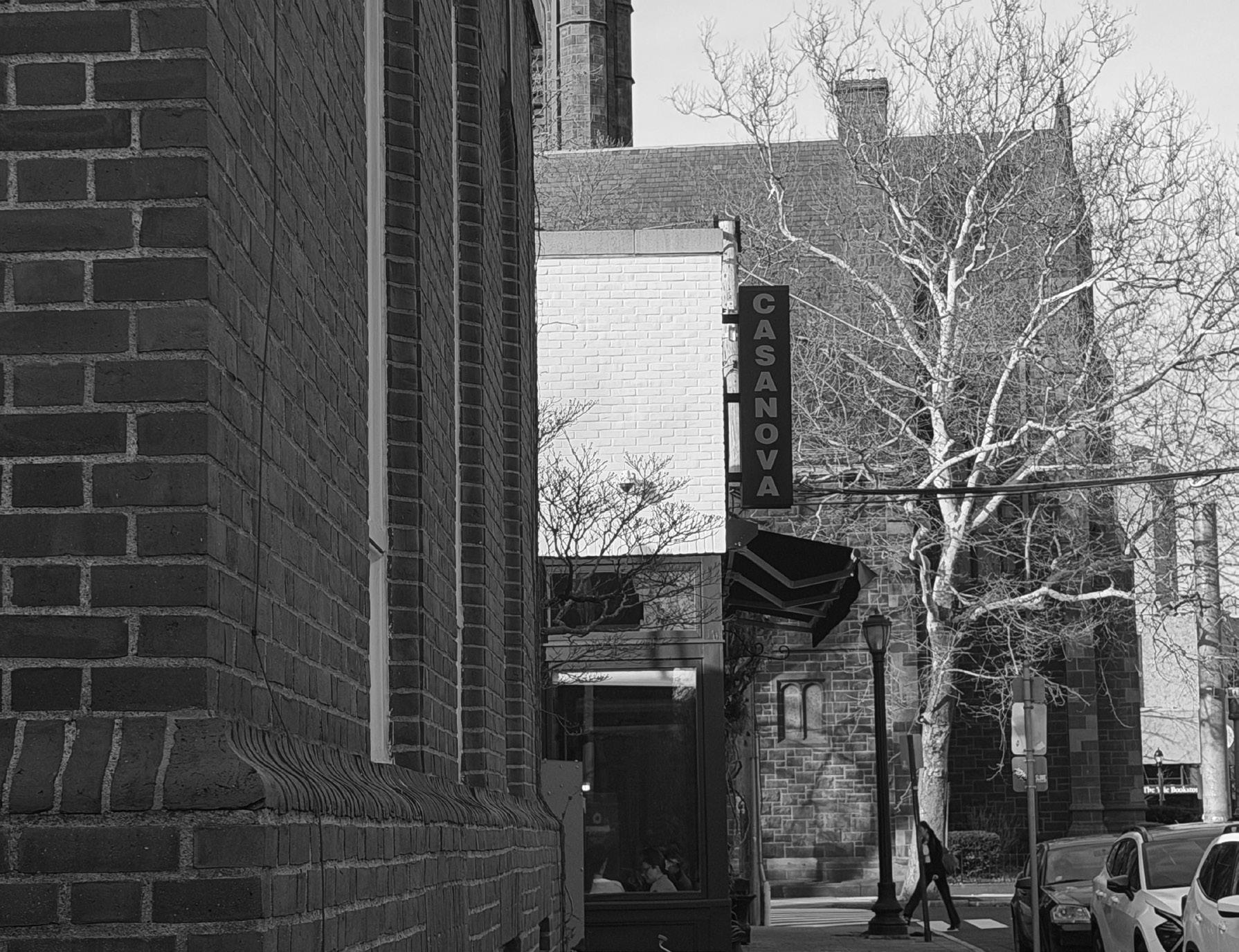
chef and co-owner at Casanova, said in a phone interview that Restaurant Week is important for introducing new patrons to the city’s fine dining scene.
“It’s all about getting new guests in and having new people try a restaurant,” Iannaccone said, “and it also gives the guests a little bit of an edge when it comes to payment.”
He added that Casanova sees an increase in business, particularly on weekdays, during the two-week event.
Joshua Krewall, a server at Villa Lulu, spoke with pride about the restaurant’s food.
“We’ve always been happy to participate, and I think we do things really high quality here, and so it’s a way for us to kind of showcase that,” Krewall said of Restaurant Week.
Andrea Coppola, an owner of Encore by Goodfellas, said in a phone interview that the restaurant has participated in the event since its launch.
“We always say Restaurant Week is the best week,” Coppola said. Preparation for the event begins about a month in advance, she said, adding that the event requires extra staff.
“It’s a lot of preparation, but it’s definitely worth it,” Coppola said. This year’s event marks the first year of participation for the Wooster Square Italian restaurant Gioia Cafe and Bar.
Contact NICOLAS CIMINIELLO at nicolas.ciminiello@yale.edu, CHANTAL EULENSTEIN at chantal.eulenstein@yale.edu and QAMAR AL TAMEEMI at qamar.altameemi@yale.edu.
LEO NYBERG / CONTRIBUTING PHOTOGRAPHER
As a part of a symposium on a new book about how accounts of the Civil Rights era often romanticize the movement, Cornel West spoke at a panel with the author, Harvard professor Brandon Terry, as well as Columbia professor Farah Jasmine Griffin.
“You can cut the flowers but you cannot keep spring from coming.”
PABLO NERUDA POET
Changes expedited performance reviews for Berkeley, JE, Murray deans
BY OLIVIA WOO STAFF REPORTER
This academic year, the review process that determines whether the contracts of residential college deans will be renewed was moved a semester earlier — beginning four semesters into a dean’s term instead of five, Yale College Dean Pericles Lewis said in a Wednesday interview.
The length of the review process was also halved for the three deans most recently evaluated, taking three months instead of six, Lewis added. Together, the changes resulted in the conclusion of three deans’ performance reviews about a year earlier than would previously have been expected. Deans are hired on three-year contracts.
Evaluations of former Berkeley College Dean Bárbara Cruvinel Santiago ’17, Jonathan Edwards College Dean Yaser Robles and Pauli Murray College Dean Aaron King — all of whom began in their roles in August 2024 — began in January and recently concluded, Lewis said. Before this year’s changes to the review process, those reviews would have begun this coming September and ended next spring.
The changes to the review timeline occurred in the months leading up to Cruvinel Santiago’s mid-semester departure from her role as dean of Berkeley College during spring break. In response to the News’ questions regarding Cruvinel Santiago’s departure, Lewis said in an email last Thursday that he could not “offer any information about individual staff members.”
On Wednesday, he added that some Yale College employees announcing their departures midyear might opt to “wait and leave in the summer,” while others may “have some reason they have to leave sooner, and we try and just fill in as appropriate.”
Lewis said that the system under which deans were evaluated at the beginning of the third and final years of their contracts left them “waiting on tenterhooks during the academic year” in which their reviews occurred.
“We decided to move it to January of the second year,” Lewis said. “If a person is not going to renew — and, of course, it’s a two way street, they might tell me, ‘I’m not interested in renewing’ — it’s good for them to have a year to think about where they’re going to go next.”
Feedback for deans currently in the third years of their terms was solicited last September. Both the reviews involving that feedback and the reviews that began in January have “just been completed,” Lewis said.
Lewis said residential college deans’ contracts are renewed “more often than not.”
He added that the process for determining whether a dean will be reappointed involves the collection and analysis of feedback from
Silliman
members of the residential college community they serve, including students, faculty, staff, college fellows and the head of college. The offices with which they interact at the University are also consulted, he said.
Administrators solicit feedback from students, staff and fellows through a survey distributed via email at the beginning of each dean’s review process.
As part of the review cycle that began most recently, members of the Murray and JE communities received emails from Lewis inviting them to offer anonymous feedback about their respective deans’ “professional performance.” Those emails were sent on Jan. 15, and the surveys accepted responses until Jan. 30.
Nearly two weeks later, on Jan. 28, Berkeley students, staff and fellows received an email — identical to the other two save for the names of relevant administrators — asking them to provide feedback on Cruvinel Santiago by Feb. 13.
According to those emails, review committees consisting of three administrators “gather comments from the community” and write a report to inform Lewis’ decision about the reappointment of each respective dean. “Your observations
dean to leave post for Yale College administration role
BY ANNA KOONTZ STAFF REPORTER
Tycie Coppett, the dean of Silliman College, announced in a Tuesday email to Silliman students that she will be departing from her role in June.
Coppett, who has been the dean of Silliman since 2023, will step into a new position as an interim assistant dean in Yale College and help with academic advising initiatives, she wrote in her email. Coppett’s departure was announced after Bárbara Cruvinel Santiago ’17 recently left her position as dean of Berkeley College over spring break.
“It was my honor to serve as your dean and to watch you develop as scholars and young adults. Thank you for trusting me and allowing me to share this monumental moment in your lives,” Coppett wrote. Coppett, who is associated with the sociology department
and teaches the class “Have We Lost Faith in Higher Education,” was previously an administrator at Harvard University, as well as an athlete and a body builder.
Head of College Arielle
Baskin-Sommers and Yale College Dean Pericles Lewis will form a committee to hire a new Silliman College dean by the fall semester, Coppett wrote.
In her email, Coppett thanked Baskin-Sommers and members of the residential college, dining and facilities staff. She also shared words of encouragement for current Silliman students.
“I look forward to the many memories we will continue to make and share,” Coppett wrote. “Now, and always, I am here to support you.”
Silliman College occupies the block surrounded by College, Grove, Temple and Wall Streets.
Contact JAEHA JANG at jaeha.jang@yale.edu.
and experiences,” Lewis wrote, “are central to this process.”
He did not specify in those emails how feedback from different members of the residential college community would be weighed in the decision-making process.
On Wednesday, Lewis said that during a typical review, he receives “100 different comments, and maybe half of those would be from students, and half would be from colleagues or fellows, roughly speaking.”
In making his decisions about whether to extend a dean’s tenure, Lewis said in a Wednesday email that he tends to “place the most weight on detailed comments, whether those come from students, staff, faculty, or fellows.”
Multiple students interviewed by the News said they wanted more transparency around how their feedback is used to determine whether a dean’s contract will be renewed.
“To an average Berkeley student who is not actively looking into the depths of the situation, Dean Santiago’s feedback process felt a lot like a black box because we were never really told how our feedback would end up being perused,” Andrey Sokolov ’27, a Berkeley
student, wrote in a Wednesday text message to the News.
Sokolov said in a Sunday interview that he had completed the survey Lewis sent in January, in which he conveyed a “hope that Dean Santiago remains” in her role.
Kelly Tran ’27, a JE student, received the January email asking for feedback on Robles but said she did not complete the survey. She said she would have been more likely to respond had its importance been made clearer, either by bodies such as the Jonathan Edwards College Council or the Yale College Council or from additional messaging from the administration.
Tran said that if students aren’t aware of how their comments are used, then it is difficult for them to know how “to best fill it out to better serve themselves and other students.”
“Just generally, maybe the college should be more transparent about the role students play in dean renewal and other things that they really actually want student feedback on,” Tran said, adding that “maybe a survey is or is not the best thing.”
Elizabeth Swaine ’27, who is in JE, suggested that feedback about residential college deans’ performance should be solicited two semesters after they begin in the role,
“so that the dean can implement” the feedback that they are given before they are up for review.
“If you know that your opinion that you give is directly impacting whether or not your dean gets hired, I think it’s difficult to be critical because you don’t want to be the reason why your dean is being hired or fired,” Swaine said. Daniel Landry ’28, a student in Berkeley, said he provided feedback for Cruvinel Santiago because he feels it is his duty “to be a helpful student.”
He said he mainly interacted with the former dean at Berkeley events and intramural games, or while walking around campus. It was “always fun to just talk to her,” he added. Residential college deans are also able to suggest certain individuals from which they wish to receive feedback, Lewis said in a Wednesday email. Those individuals receive a “special invitation” to complete the same survey that is initially sent out to the residential college community. According to the Careers at Yale website, the salary for a residential college dean ranges from $68,000 to $120,500.
Contact OLIVIA WOO at olivia.woo@yale.edu.
TIM TAI / STAFF PHOTOGRAPHER
According to Yale College Dean Pericles Lewis, adjustments to the review process for residential college deans resulted in both earlier and quicker evaluations for three deans.
“It
Downtown volunteer group reconvenes after eight-month hiatus
BY JESSICA HICKLE CONTRIBUTING REPORTER
McTiernan Huge ’27 at the helm.
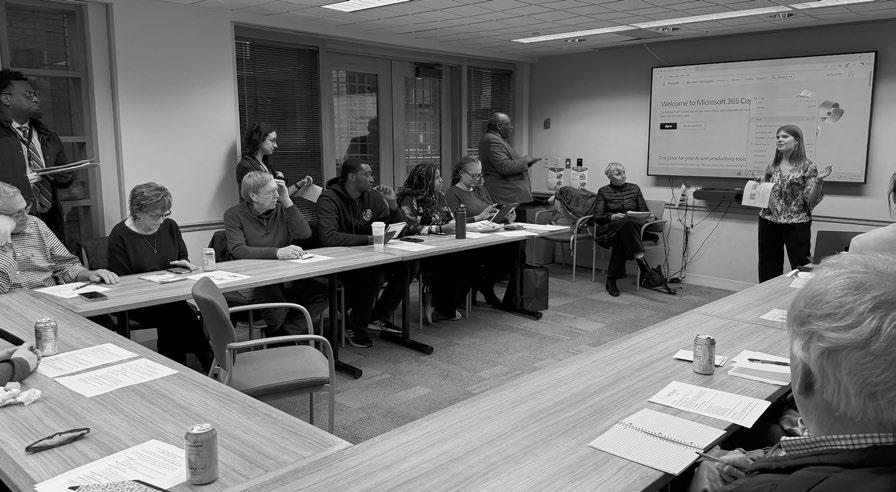
At least 30 local residents attended the meeting — including alders, police officers and staff from the New Haven Free Public Library and the Yale Office of New
Haven Affairs — and discussed a range of topics. Public safety and cleanliness issues were among the most common concerns, and some residents expressed worry that problems could worsen as the weather turns warmer.
The team serves as “a forum for addressing quality-of-life issues in the Downtown and Wooster Square neighborhoods,” according to its website. According to McTiernan Huge, the team’s new chairwoman, the revival of the group grew out of enthusiasm from neighborhood residents.
“I had heard from so many people who were like, ‘The CMT isn’t meeting. Why is that?’” she said in an interview after the meeting. McTiernan Huge previously launched a campaign to represent downtown New Haven on the Board of Alders, but dropped out before the primary election to back the current Ward 1 alder, Elias Theodore ’27.
Theodore, who represents a part of downtown that includes much of Yale’s campus, said he received similar feedback from constituents about the importance of the team.
“I heard from people in my ward, especially people who are not Yale undergrads, that this is something the community is really missing right now,” he said in an interview after the meeting.
Until last summer, the team met regularly on Zoom, but attendance dwindled and meetings eventually ceased, according to Theodore.
Since then, McTiernan Huge worked with members of the Board of Alders, the New Haven Police Department and the team’s former chairwoman Sarah Ficca to organize Tuesday’s meeting, McTiernan Huge said.
For her part as chairwoman, McTiernan Huge does not have any set priorities for the team and instead hopes to play a “neutral, facilitating role” among the group’s participants, she said.
“I hope it helps people stay more informed about what’s going on and just stay more connected to decisionmaking in the city,” she said.
The team plans to next meet on April 21 at 6 p.m. at City Hall.
Contact JESSICA HICKLE at jessica.hickle@yale.edu.
Gubernatorial hopeful talks ranked-choice voting at Yale event
BY NELLIE KENNEY STAFF REPORTER
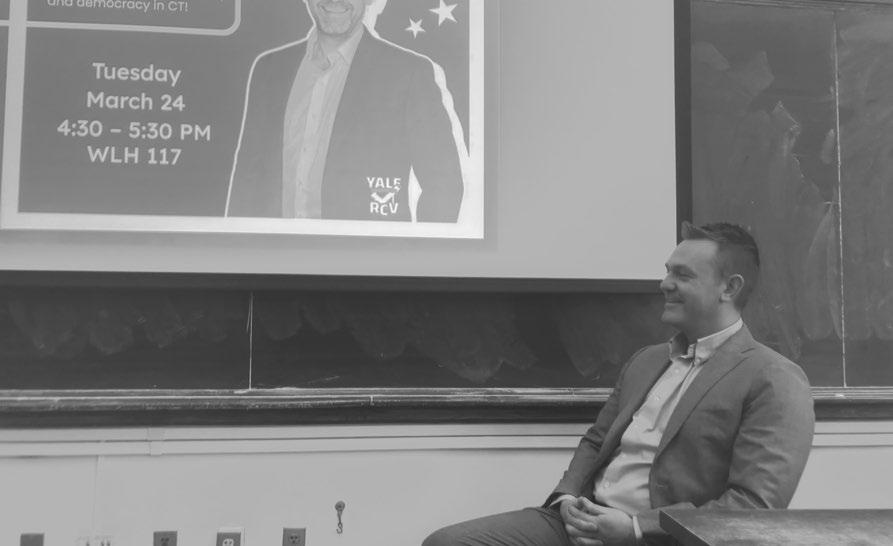
Connecticut gubernatorial challenger Josh Elliott joined a small group of Yale students to talk electoral reform and campaigning in a William L. Harkness classroom on Tuesday.
The conversation was hosted by Yale Students for Ranked Choice Voting, a nonpartisan student organization which advocates for electoral reform. Elliott, who is challenging the two-term Democratic incumbent Gov. Ned Lamont SOM ’80, has supported ranked-choice voting — which would allow voters to rank multiple candidates on their ballots according to preference — since his election to the Connecticut House of Representatives in 2016.
“The systems of voting determines what kind of elected officials you have,” Elliott said, pointing to ranked-choice voting as an opportunity for more “fringe” candidates to garner votes.
Elliott said that his support for ranked-choice voting in 2016 made him “far and away the outlier.” That is no longer the case, as the intervening years have seen a “slow drip, drip, drip of people becoming aware of it,” he said.
On March 12, Senate Bill 386, which would allow municipalities to opt for ranked-choice voting for party caucuses, conventions and primaries,
was advanced by the state legislature’s Government Administration and Elections Committee.
Elliott called the bill a “foot in the door” for ranked-choice voting, but cautioned that he thinks it will be a “long road yet.” Elliott also discussed his own campaign for governor, which he launched last July. Elliott hopes to face off against Lamont in an August Democratic primary. Elliott said that his current focus is making sure that potential supporters know he is a “viable” candidate.
That means “getting on the ballot and raising money,” he said. Elliott needs to raise $335,000 in small donations in order to reach a state fundraising threshold that will allow him to receive public financing for his campaign. Elliott said he believes his campaign is on track to raise the money by early June.
Yale Students for Rank Choice Voting Chair Alden Okoh-Aduako ’28 said that the group first reached out to Elliott “not just to ask for a speaker event, but also just to ask for advice on state advocacy.” The conversation was “successful,” Okoh-Aduako said, and so the group asked Elliott to come speak formally.
In an interview before the event, Okoh-Aduako pointed to the small size of the gathering, which comprised eight attendees, as an opportunity for an “interesting
dynamic” between the group and the speaker.
In an interview after the event, Elliott said he chose to speak with the group because he loves “people who are passionate about the same things that I’m passionate about.”
Attendees suggested they had been impressed with Elliott. William Kessler ’29 said that he found Elliott “pretty persuasive.”
“He painted quite a vivid picture of Connecticut politics,” Kessler said. Elliott co-owns a natural food
store named Thyme and Season in Hamden.
Contact NELLIE
NHPD oversight board says it has cleared backlog of complaints
BY ADELE HAEG STAFF REPORTER
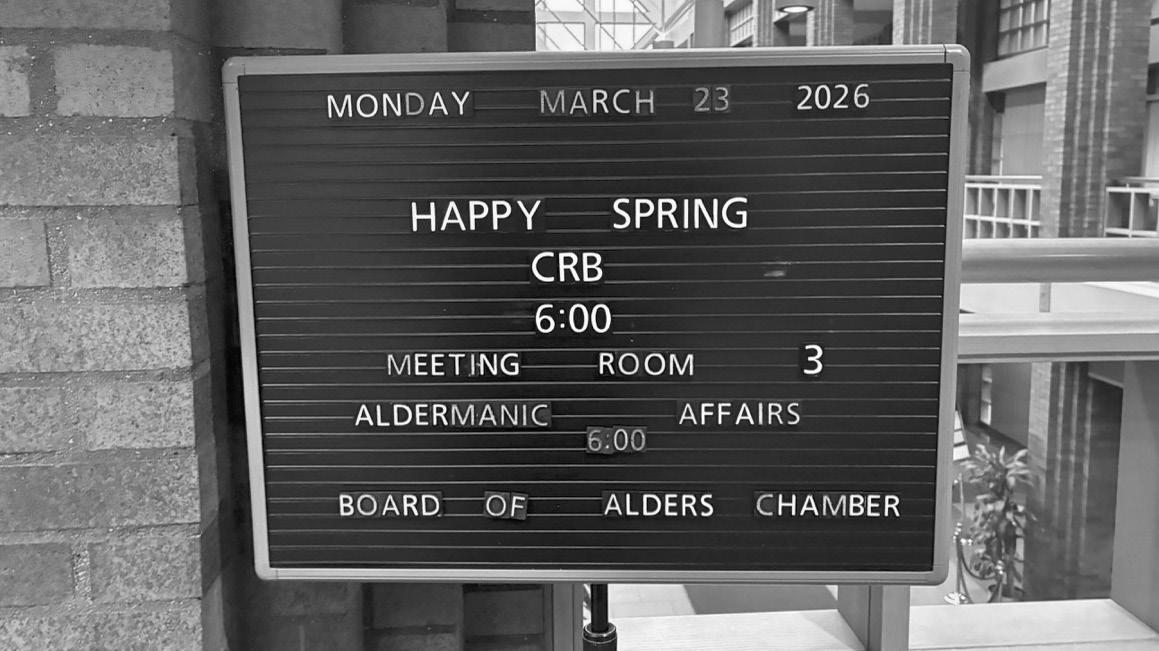
All civilian complaints logged against the New Haven Police Department between 2022 and 2024 have been closed, the New Haven Civilian Review Board announced at a Monday evening meeting.
Since the board began reviewing complaints in 2021, some officers and complainants have had to wait years for a resolution, according to board chair AnneMarie RiveraBerrios. Now, without a case backlog, the review board and the police department’s internal affairs unit hope to close all new complaints within 90 days,
including the 17 received in 2026 so far.
“The community needs to hear that if their complaint comes in, it’s not going into a backlog. Actually, we’re moving forward with everything,” Rivera-Berrios said to the six other members present in person and one on Zoom. Assistant Police Chief Manmeet Bhagtana
was also in attendance at City Hall.
To close a civilian complaint against the department, the internal affairs unit, led by Lieutenant Jessie Agosto, must complete an investigation of the complaint and assign it to the Civilian Review Board. The board must then review it and make recommendations to the department if necessary, as part of its oversight responsibility. The police chief must sign off on each complaint to officially close it.
All cases from 2022 through 2024 have been closed, and cases from 2025 have been assigned or closed.
“We have to give huge kudos to Lieutenant Agosto and her team because that’s tremendous,” RiveraBerrios said during the meeting.
When the board started reviewing complaints in 2020, it had a “huge backlog” of open complaints against the police department, RiveraBerrios said. Now, according to a December 2025 report passed out to meeting attendees on Monday, there are only 28 open cases from 2025.
“It’s very time consuming” to review complaints, Rivera-Berrios said, which is why members of similar review boards across the country “get a stipend to review cases,” she said. The New Haven review board’s members do not receive stipends. Delays in complaint resolution could potentially cause delays in
disciplinary action, if that is what board members were to determine that was necessary in a specific case, according to Rivera-Berrios. By city ordinance, the board can have up to 15 members. As of the report’s release, it had seven members, and it now has six, with one stepping down after the Monday meeting, according to Rivera-Berrios. The position of Civilian Review Board administrator has also been vacant since the beginning of 2026.
Though the cases are being cleared quickly, they are “also thorough investigations. So it’s not just quick, just for the sake of being quick, they’re very good, thorough, appropriate investigations,” Lieutenant Michael Fumiatti said.
“We have been working collaboratively very hard in a small group” with the police department, Rivera-Berrios wrote in a text to the News. “I put a whole lot of hours of my time into this,” she added. In 2023, only 11 percent of cases were closed within three months. In 2024, that number was 27 percent. In 2025, that jumped to 60 percent of cases closed within 90 days. “That’s a huge difference,” Rivera-Berrios said.
The Civilian Review Board was first created by a city ordinance in 2019. Contact ADELE HAEG at adele.haeg@yale.edu.
NELLIE KENNEY / CONTRIBUTING PHOTOGRAPHER
Josh Elliott, a Democrat who represents Hamden in the Connecticut House of Representatives, is set to challenge Gov. Ned Lamont in an August primary. Elliott spoke at an event hosted by Students for Ranked Choice Voting.
For the first time in eight months, New Haven’s Downtown-
Wooster Square Community Management Team met Tuesday evening at City Hall — this time, with Rhea
JESSICA HICKLE / CONTRIBUTING PHOTOGRAPHER
Rhea McTiernan Huge ’27, who once campaigned to represent downtown on the Board of Alders, led the effort to revitalize New Haven’s Downtown-Wooster Square Community Management Team.
“Every
spring is the only spring — a perpetual astonishment.”
ELLIS PETERS, AUTHOR
Finance chief to return to City Hall with West Haven lessons
BY NELLIE KENNEY STAFF REPORTER
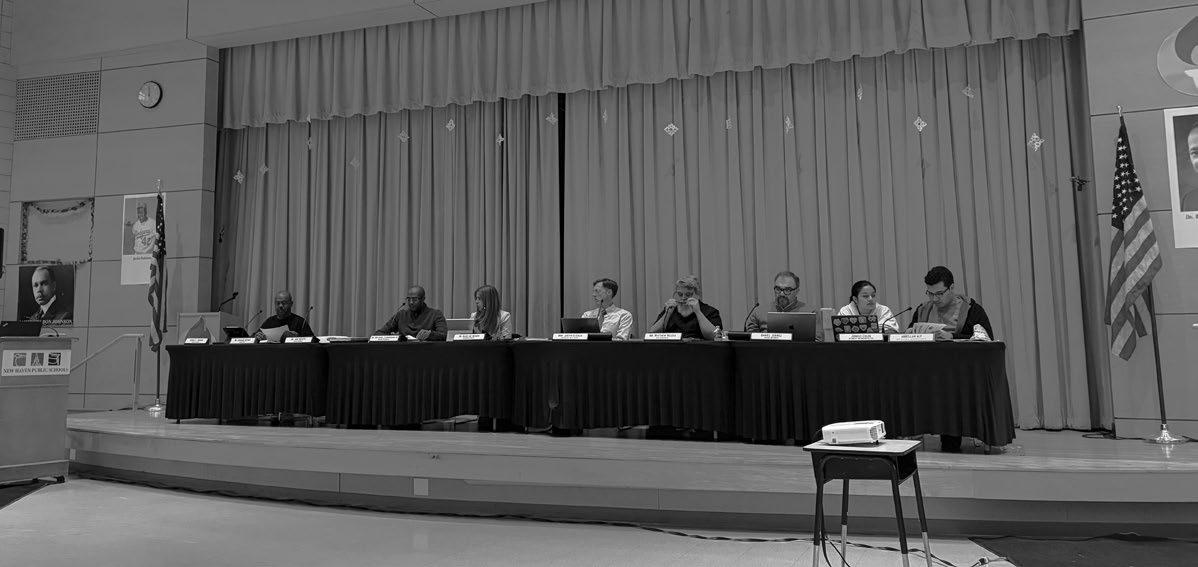
New Haven’s public school leaders are seeking roughly $252.6 million from the city for the district’s fiscal year 2026-27 operating budget, a request that substantially exceeds the mayor’s proposed allotment of $218.3 million.
For at least the last decade, the district has failed to secure its proposed budget amount from New Haven, according to a district official — a perennial problem that district and city leaders alike have attributed to insufficient state funding. They allege that the state’s formula for education funds is outdated and fails to account for rising costs and income inequality between the state’s school districts.
The district’s newest budget proposal — outlined by New Haven Public Schools Superintendent Madeline Negrón and Chief Finance Officer Amilcar Hernandez at a Monday Board of Education meeting and subject to a vote by the full board in June — is what the district needs to maintain current operations, cover budget deficits from recent years and account for increases to salaries, special education expenditures and transportation costs, Hernandez told the board on Monday.
The presentation also included an “adjusted” proposal of $232 million, which accounts for $20.5 million in state and federal grant funding that may help cover general operating costs. The $252 million and $232 million proposals would represent increases of $39.4 million and $18.9 million from the current fiscal year budget, respectively.
Just weeks before Monday’s
meeting, Mayor Justin Elicker released his proposed city budget for the 2026-2027 fiscal year, which included an increase of only $5 million for public schools, for a total of $218.3 million. Without a larger funding increase from the city, the district is likely to face a budget deficit of more than $10 million next fiscal year.
“The state is not doing their part to keep up with not only inflation, but also the increase of costs, and to support our teachers and our school staff that deserve not only the increases they are getting, but more than that,” Hernandez said at the board meeting.
Earlier this month, Elicker’s office partnered with New Haven Public Schools to organize student advocacy for state legislation that would increase the state’s Education Cost Sharing formula, a per-student payment that has not changed since 2013. He and a contingent of local high schoolers traveled to the state capitol in Hartford to testify.
In his presentation to the board on Monday, Hernandez detailed the district’s increasing operating costs across sectors.
He reported steadily increasing expenditures on transportation, including regular busing and transportation for students attending schools outside of the district. This fiscal year, the district underbudgeted for transportation costs by between $7 and $9 million, according to a presentation Hernandez gave at a Finance & Operations Committee meeting last Monday.
Hernandez projected that salary increases this year, in accordance with contracts across the school system’s professional unions, would cost the district $7,358,000 in the coming fiscal year.
Next year’s budget also accounts for an increase in special education costs. Despite the district’s declining overall enrollment, its population of students with disabilities is steadily climbing and now represents 18 percent of the school system’s population, Hernandez said. In the current fiscal year, the district spends about a third of its general fund budget on special education expenses, Hernandez said. The district outsources much of its speci al education instruction to neighboring districts. Hernandez said that the district pays tuition for 278 New Haven resident students with disabilities to attend schools out of the district, at a total cost of $36 million during fiscal year 2026, the presentation showed.
Hernandez outlined how the district used funds from the Individuals with Disabilities Act, or IDEA, to cover more than $7 million in costs for special education, which include salaries for paraeducators, psychologists and social workers, as well as pupil services and tutors.
At Monday’s meeting, Hernandez repeatedly discouraged Board of Education members from relying too heavily on outside grants to cover general operating expenses and staffing, noting that under “the current climate at the federal level,” the district should not take these awards for granted.
On Thursday, President Donald Trump signed an executive order directing his secretary of education to “facilitate the closure of the Department of Education,” the latest step in his campaign to dismantle an agency that administers programs like IDEA, among dozens of grant programs
for public schools across the country.
“I will take this opportunity to tell you how dangerous it is for us to keep relying on grants to pay for the services for our students,” Hernandez said. “We celebrate when we get them. It makes us happy, because it gives us additional funding to provide the services at the level that our students deserve, but it can also create a very bad habit where we start functioning under the assumption that we are going to get this grant every single year.”
Elicker, who serves on the Board of Education and appoints four of its members, noted that it would be unrealistic to operate
without grant funding, and cautioned against attempting to pay for all of the district’s expenditures with the general fund.
“We cannot live without grants,” board member Abie Benitez agreed at the board meeting. “But I like the dream. I like the fact that we are dreaming that we could find that money that grants give us and not need it.”
In fiscal year 2026, New Haven Public Schools received $213,263,784 from the city, much of which came from the state’s Education Cost Sharing program.
Contact NELLIE KENNEY at nellie.kenney@yale.edu.
Public school leaders seek more money than mayor proposed
BY SABRINA THALER STAFF REPORTER
New Haven’s public school leaders are seeking roughly $252.6 million from the city for the district’s fiscal year 202627 operating budget, a request that substantially exceeds the mayor’s proposed allotment of $218.3 million.
For at least the last decade, the district has failed to secure its proposed budget amount from New Haven, according to a district official — a perennial problem that district and city leaders alike have attributed to insufficient state funding. They allege that the state’s formula for education funds is outdated and fails to account for rising costs and income inequality between the state’s school districts.
The district’s newest budget proposal — outlined by New Haven Public Schools Superintendent Madeline Negrón and Chief Finance Officer Amilcar Hernandez at a Monday Board of Education meeting and subject to a vote by the full board in June — is what the district needs to maintain current operations, cover budget
deficits from recent years and account for increases to salaries, special education expenditures and transportation costs, Hernandez told the board on Monday.
The presentation also included an “adjusted” proposal of $232 million, which accounts for $20.5 million in state and federal grant funding that may help cover general operating costs. The $252 million and $232 million proposals would represent increases of $39.4 million and $18.9 million from the current fiscal year budget, respectively.
Just weeks before Monday’s meeting, Mayor Justin Elicker released his proposed city budget for the 2026-2027 fiscal year, which included an increase of only $5 million for public schools, for a total of $218.3 million. Without a larger funding increase from the city, the district is likely to face a budget deficit of more than $10 million next fiscal year.
“The state is not doing their part to keep up with not only inflation, but also the increase of costs, and to support our teachers and our school staff that
deserve not only the increases they are getting, but more than that,” Hernandez said at the board meeting.
Earlier this month, Elicker’s office partnered with New Haven Public Schools to organize student advocacy for state legislation that would increase the state’s Education Cost Sharing formula, a per-student payment that has not changed since 2013. He and a contingent of local high schoolers traveled to the state capitol in Hartford to testify.
In his presentation to the board on Monday, Hernandez detailed the district’s increasing operating costs across sectors. He reported steadily increasing expenditures on transportation, including regular busing and transportation for students attending schools outside of the district. This fiscal year, the district underbudgeted for transportation costs by between $7 and $9 million, according to a presentation Hernandez gave at a Finance & Operations Committee meeting last Monday.
Hernandez projected that salary increases this year, in
accordance with contracts across the school system’s professional unions, would cost the district $7,358,000 in the coming fiscal year.
Next year’s budget also accounts for an increase in special education costs. Despite the district’s declining overall enrollment, its population of students with disabilities is steadily climbing and now represents 18 percent of the school system’s population, Hernandez said. In the current fiscal year, the district spends about a third of its general fund budget on special education expenses, Hernandez said. The district outsources much of its special education instruction to neighboring districts. Hernandez said that the district pays tuition for 278 New Haven resident students with disabilities to attend schools out of the district, at a total cost of $36 million during fiscal year 2026, the presentation showed.
Hernandez outlined how the district used funds from the Individuals with Disabilities Act, or IDEA, to cover more than $7 million in costs for
special education, which include salaries for paraeducators, psychologists and social workers, as well as pupil services and tutors.
At Monday’s meeting, Hernandez repeatedly discouraged Board of Education members from relying too heavily on outside grants to cover general operating expenses and staffing, noting that under “the current climate at the federal level,” the district should not take these awards for granted.
On Thursday, President Donald Trump signed an executive order directing his secretary of education to “facilitate the closure of the Department of Education,” the latest step in his campaign to dismantle an agency that administers programs like IDEA, among dozens of grant programs for public schools across the country.
“I will take this opportunity to tell you how dangerous it is for us to keep relying on grants to pay for the services for our students,” Hernandez said. “We celebrate when we get them. It makes us happy, because it gives us additional funding to provide the services at the level that our students deserve, but it can also create a very bad habit where we start functioning under the assumption that we are going to get this grant every single year.”
Elicker, who serves on the Board of Education and appoints four of its members, noted that it would be unrealistic to operate without grant funding, and cautioned against attempting to pay for all of the district’s expenditures with the general fund.
“We cannot live without grants,” board member Abie Benitez agreed at the board meeting. “But I like the dream. I like the fact that we are dreaming that we could find that money that grants give us and not need it.”
In fiscal year 2026, New Haven Public Schools received $213,263,784 from the city, much of which came from the state’s Education Cost Sharing program.
Contact SABRINA THALER at sabrina.thaler@yale.edu.
NELLIE KENNEY / CONTRIBUTING PHOTOGRAPHER
Michael Gormany — who in April will return to the role of New Haven controller, now in a permanent capacity, after two years as West Haven’s finance director — is looking for permission to keep living outside of New Haven.
SABRINA THALER / CONTRIBUTING PHOTOGRAPHER
New Haven Public Schools superintendent Madeline Negrón proposed requesting more than $252 million for the district next year, a nearly $40 million increase from this year’s budget. Mayor Elicker has proposed a $5 million increase.
“We have been through a lot of adversity over the past few seasons, and I think it has brought out team much closer together...” WILL RICHTER ’27 MEN'S HOCKEY
Yale dominance interrupted by renewed Quakers with fresh coach and star
MEN'S BASKETBALL
BY WALTER ROYAL STAFF REPORTER
The Yale men’s basketball team
(24–7, 11–3), despite a heartbreaking Ivy League tournament final loss, posted its highest win total of the James Jones era en route to a second straight Ivy regular-season title in the 2025-26 season. While last year’s gaudy 13–1 conference record may seem to dwarf this season’s 11-win performance, this season’s Bulldogs faced a newly minted contender in a stronger Ivy League.
The Penn Quakers (18–12, 9–5) posted a five-win increase in their conference record from last season to this year. Fueled by new head coach Fran McCaffery and junior transfer TJ Power, Penn was able to end Yale’s run of consecutive NCAA tournament bids.
Jones, Yale’s head coach, recognized the significance of the Quakers’ rapid rise to power.
“Fran has done a great job with that team and that program in his first year to get them back to the NCAA tournament. I think this is his fourth or fifth team that he's brought to the NCAA tournament,” Jones said in a
press conference following the Ivy tournament. Penn has a storied history as an Ivy basketball powerhouse. With a Final Four run in 1979 and AP poll rankings as high as second in 197172, the Quakers have reached levels of success unknown to the rest of the Ancient Eight. That success, however, started fading in 2008. While a Penn squad coached by Steve Donahue won both Ivy trophies in 2018, the other 16 seasons preceding this year ended without hardware for the Quakers.
After Donahue’s dismissal, Penn hired McCaffery, a Quaker alum and former coach for Lehigh, UNC Greensboro, Siena and Iowa. The swap bore immediate fruit, with this year’s Penn squad scoring six more points per game and allowing three fewer per game than last season’s Quakers.
McCaffery was able to attract Power, a high-profile forward and former top-25 recruit, in the transfer portal. By Power’s own admission, he would not have been a Quaker had McCaffery not been the coach.
“I came to play for Coach McCaffery. That was the bottom line. Wherever he was going, I made the mistake twice saying no to him. I didn’t want to make that the third time,” the Ivy tournament MVP said following his otherworldly 44-point
championship performance.
Richard Kent, an Ivy League basketball commentator, underscored Power’s importance to the team in an interview.
“Penn doesn't go to the Ivy tournament without Power, for sure. So, in the Ivy League — and I'm not singling out the Ivy League, in a lot of one-bid conferences — one guy can make a huge difference. And that guy is Power,” Kent said.
Kent, however, did not minimize McCaffery’s impact.
“He also instilled the winning attitude in the rest of the team. I think that they were beleaguered last year,” he said, when Penn won only four Ivy League games.
Jones no doubt has a similar effect. His eight regular-season crowns and four tournament titles both lead among active coaches in the Ivy League and have come with varied rosters.
Penn graduates three key contributors this spring. Ethan Roberts, the Quakers’ leading scorer, will receive his diploma alongside starting guard Michael Zanoni and late-season emergent star Cam Thrower. Still, with Power back for his second season in the Ivy League, the Quakers will look to defend their title next season with their star at the helm.
The Quakers lost to the
University of Illinois in the first round of March Madness. Yale defeated Auburn 78-76 and lost to Texas A&M in its past two NCAA tournament first rounds. Contact WALTER
Bulldogs to face Cornell on the road, seeking first conference win
MEN'S LACROSSE
BY LIZA KAUFMAN STAFF REPORTER
The Yale men’s lacrosse team (3–4, 0–2 Ivy) will travel to Ithaca, New York, this weekend to face off against No. 9 Cornell on Saturday afternoon. The game will mark Yale’s first conference game on the road after
the Bulldogs opened Ivy League play at home at Reese Stadium against then-No. 3 Princeton (5–2, 1–1 Ivy) and then-No. 19 Penn (4–4, 1–1 Ivy).
In the March 14 Ivy home opener, the Bulldogs nearly upset the Tigers when a four-goal fourth quarter by the Bulldogs brought Yale within one of evening the score. However, despite a Dylan Blekicki ’29 goal in the final seconds of the game, the Tigers edged out the Elis 11-10.
Although the game ended in a heartbreaking loss, Yale’s ability to push Princeton to the edge proved that this Yale squad can compete with any team in the country.
Now, the Bulldogs prepare to take on the Big Red, the defending NCAA champions. Led last season by powerhouse senior attackman CJ Kirst, Cornell defeated Maryland to win its first NCAA title in 48 years. Kirst, who was the No. 1 pick in the 2025 PLL and NLL drafts and now plays professionally, broke the NCAA record with 247 career goals against Dartmouth last April.
Even with its star player having graduated, Cornell (5–2, 2–0 Ivy) has had a strong start to the season, picking up three non-conferences victories, including away wins over UAlbany (4–4, 2–0 AEC) and then-No. 17 Denver (4–4, 0–0 Big East) and a home opener win over
Hobart College (2–6, 0–1 A10).
However, Cornell then suffered back-to-back losses to then-No. 3 Richmond (8–0, 2–0 A10) and then-No. 14 Penn State (5–3, 1–0 Big Ten). Although Cornell was leading at halftime, Richmond’s six-goal second-half performance resulted in Cornell’s first loss of the season.
Cornell then fell in an 7-19 upset loss to Penn State in Happy Valley. Penn State came out hot, putting up seven goals in the first quarter, while holding Cornell scoreless.
The Big Red found the back of the net twice in the second quarter, but the Nittany Lions led 10-2 at the half. Another Penn State seven-goal performance in the third quarter cemented the victory.
The Big Red rebounded to open Ivy play with an 18-9 victory over Brown (5–3, 0–1 Ivy) and a major 13-11 upset win over then-No. 3 Princeton at Sherrerd Field in New Jersey last weekend. A five-goal first quarter start for the Big Red set the tone for the afternoon as a strong offensive showing answered each Princeton goal to give Cornell a perfect 2-0 start to conference play.
While Cornell will enter Saturday’s Yale matchup on the heels of two Ivy victories, the Bulldogs will seek to return to the win column and claim their first conference victory.
Yale has a strong foundation on both sides of the center X and is well-positioned to challenge Cornell this weekend.
On offense, Connor Gately ’28, who leads the squad with 27 points, including 12 goals and 15 assists, is ranked 18th nationally and third in the Ivy League in assists per game and fifth in the league in points per game. First-year attackman Sean Grogan ’29, the team’s leading scorer, has made an immediate impact on Yale’s offensive unit since joining the squad and sits eighth in the conference in goals per game and 10th in assists per game.
On defense, long stick midfielder Luke Michalik ’27 is third in the Ivy League in caused turnovers and eighth in ground balls per game, captain Patrick Pisano ’26 is fifth in the conference in caused turnovers per game and goalie Ben Friedman ’28 is 15th in the NCAA in saves per game. Faceoff is slated for 3:30 p.m. on Saturday at Cornell’s Schoellkopf Field. The game will be streamed on ESPN+.
Contact LIZA KAUFMAN at liza.kaufman@yale.edu.
Yale to open outdoor Ivy League play after triumphant spring break
MEN'S TENNIS
BY REMI CLARK-REDSTAR STAFF REPORTER
With the first of seven Ivy matches on the horizon, the Yale men’s tennis team (13–5) enters the final leg of the season with optimism after wins on a string of away matchups. In preparation to face Brown, which is 0-7 against Ivy teams, on Saturday, interim head coach Eduardo Ugalde and assistant coach Sebastian Vile will review the videos of their February win against the Bears in order to replicate the successes of that previous matchup.
Ugalde said that he and his staff also addressed the Bulldogs about the more emotional and personal nature of playing Ivy teams and how all teams are making a “final push to end the year strong.” Ugalde’s goal was to ensure that his athletes are ready to play in the new, end of the season environment, he added.
Over spring break, the Bulldogs showed just how fierce of an opponent they can be when they’re playing at their best.
“It was a great spring break for us,” Ugalde said. “We knew that it was going to be a very
important and difficult week for us as we played ranked teams on their courts.”
Starting off strong, the Bulldogs secured a 6-1 win against Tennessee State on March 10. The doubles struggled in this match, with Jason Shuler ’27 and Dylan Tsoi ’27 picking up the only win, while duo Vignesh Gogineni ’26 and Edward Liao ’28d, as well as duo Jim Ji ’27 and Eric Li ’26, were defeated 3-6 and 6-7, respectively. But, in singles, the Bulldogs took care of business and swept the board without dropping a single game.
The next day, Yale was back on the court against Middle Tennessee, a team that put up a strong fight. Yale’s doubles units bounced back and secured the crucial doubles point with duo Shuler and Tsoi and duo Ji and Li’s victories of 6-4 and 6-3, respectively. Gogenini and Liao’s match was unfinished 4-5. On the singles court, it was a split with Yale’s Gogineni, Shuler and Li taking wins, while Liao, Ji and Ethan Chung ’29 fell.
The day ended with a 4-3 victory in Yale’s favor.
“I think we did a great job of spending time together,” Liao said. “I think it made us closer as a team and gave us the confidence to work together.”
In the final two matchups of the break, a tight-knit and confident squad rolled to dominant finishes.
Against Charlotte, a team the Elis beat 5-2, the Yale duos clinched the doubles point early with 6-3 and 6-4 wins by duo Gogineni and Liao and duo Shuler and Tsoi. Gogineni, Liao and Shuler picked up gritty singles victories, which ensured the team’s triumph. Li also captured a win of 2-6, 6-3, 7-6. The only two losses of the day came in singles, with Ji and Chung going down after competing hard. Ji and Li’s doubles match was unfinished 4-5.
In the final matchup on the awaygame roadtrip, Yale conquered St. John’s with a 4-0 victory. The story of the competition mirrored that of the one against Charlotte, with a momentum-filled sprint to the win, with duo Gogineni and Liao and duo Li and Ji taking the doubles point early. Gogineni, Liao and Ji finished off St. John’s. Shuler and Li’s matches were unfinished, but both Yale men held leads before they ended. Similarly, doubles duo Tsoi and Shuler also had an unfinished match of 5-5.
“We were also transitioning from indoor to outdoor tennis which is difficult. The team was up for the challenge and up for making the necessary adjustments in the
new conditions. I was proud of the effort from the team and the concentration we had during these matches,” Ugalde said.
With a four-match win streak, the Bulldogs now look to their next match, the first of seven against Ivy League teams, leading up to the NCAA tournament.
“We beat a very good MTSU team that had beaten two Ivy teams before us. We also beat a very good Charlotte team that was undefeated at home before our match. Both teams ranked in the top 50 in the country,” Ugalde said.
First up on the Ivy docket is Brown, a team the Bulldogs will play on Saturday. In their last outing against Brown at the ECAC Tournament, Yale beat the Bears 4-0, going two for three in doubles and six for six in singles.
“I’m super excited for the upcoming match,” Chung said.
“Our team has been building on a lot of momentum with good practices and matches throughout the last couple of weeks, and the match this weekend will be another opportunity for us to put ourselves to the test on the road against a good Ivy League team.” The Yale men’s tennis team will take the court on Saturday at 1 p.m. in Providence.
Contact REMI CLARK-REDSTAR at remi.clark-redstar@yale.edu.
LIZA KAUFMAN / PHOTOGRAPHY EDITOR Yale will play the No. 9 Cornell Big Red in the Bulldogs’ first away conference game of the season.
YALE ATHLETICS
The Penn Quakers, who defeated Yale in the Ivy League tournament final this month, returned to relevance this season following a program overhaul.
YALE ATHLETICS
The Bulldogs won all four of their spring break matches and are looking ahead to a spate of Ivy League matches before the NCAA tournament.
“If people did not love each other, I really do not see what use there would be in having any springtime.”
LES MISÉRABLES VICTOR HUGO
New British art exhibit explores what it means to be ‘modern’
BY ANGELINA KOVALCHUK STAFF REPORTER
The Yale Center for British Art explores what it means for art to be “modern” in its exhibition “Going Modern: British Art, 1900-1960,” which opened on Feb. 12.
The free exhibit, which is located on the second floor of the museum, greets visitors with bright color palettes and a range of media and forms, from abstract sculpture to colorful portraiture.
“I think the main point that comes across from what you see in this exhibition is the sheer diversity of approaches,” said Lucinda Lax, a curator of paintings and sculptures and the interim head of the curatorial division at the museum. She believes this “plurality” is what makes British modernism distinct.
In the period from 1900 to 1960, Britain was characterized by intense social and cultural upheaval, including two world wars, the expansion and decline of the British Empire, and the Industrial Revolution transforming everyday life, according to the exhibition’s brochure.
“In this dynamic context, artists explored shifting ideas
of British identity and how it was shaped by class, gender and sexuality,” Rachel Stratton, the author of the gallery’s interpretative materials, writes in the brochure.
One of the exhibition’s key themes is the conflict between urban environments and natural forms. The growth of urbanism, coupled with the Industrial Revolution, led many artists to retreat into nature and take inspiration from organic forms.
“This turning away, for some artists, to the land and to the organic, is a kind of response or reaction to some of what is going on within the greater social realm,” Lax said.
Lax highlighted Barbara Hepworth’s sculpture, titled “Sea Form,” which is featured at the entrance to the exhibition.
The piece greets visitors with rippling, organic shapes, which invite movement around the sculpture itself. Visitors can circumnavigate the piece, viewing its dimensionality from all angles.
“She’s interested in materiality and form, but form in space as well,” Lax said of Hepworth.
Lax cited the landscape of the southwest coast of England,
particularly Cornwall, as the inspiration for Hepworth’s piece, as well as others in the gallery. “Something like this is directly inspired by the rocks she encountered that had imprints of all these ancient fossilized creatures on it.”
The naturalistic works are contrasted with city and urban paintings within the gallery, notably from artists such as Robert Polhill Bevan, who depicted the bustling markets of inner London.
The exhibition also explores themes of identity and class through its collection of portraits.
Stratton writes that while portraiture was “long a focus of British art,” it “evolved to express new approaches and concerns.”
Portraits by artists such as Vanessa Bell and Keith Vaughan depict new attitudes towards femininity and same-sex attraction respectively, reflecting the progressive ideals that began to emerge during the turn of the century.
Despite the uncertainty and upheaval of the period, Lax believes that these featured works also highlight a growing sense of optimism about the future.
According to Lax, British
modernism is also distinctive for its interaction with traditional forms of painting, namely, the representation of physical objects.
The exhibition features “May 1955,” a piece by Ben Nicholson, as indicative of the transition toward the abstract forms commonly associated with modernist movements.
“The art sort of hovers somewhere,” Lax said, referring to the tension between traditionalism and abstraction.
“Even though it’s kind of moving towards the almost purely abstract, there are still these aspects of it which can be identified as representational objects.”
Lax believes that this “amazing period of experimentation and innovation” is at the “heart of the show.”
Kathleen Quaintance GRD ’28, one of the doctoral candidates present at the exhibit’s debut, discussed the significance of this exhibition, particularly on the viewer’s perception, in an email to the News.
“Thinking and talking about British modern art means that we have to interrogate our perceptions and prejudices around what we believe is stereotypical,” Quaintance said. “That approach is important to consider today as we debate the relative obsolescence of certain ways of thinking with the rise of new technologies.”
The exhibition will close on Aug. 9, 2026.
Contact ANGELINA KOVALCHUK at angelina.kovalchuk@yale.edu
Senior’s glam rock opera about Nietzsche’s life to open Thursday
BY KIVA BANK STAFF REPORTER
Friedrich Nietzsche and a rock concert are perhaps not a combination many people would think of, but this weekend, viewers won’t have to use their imagination.
Written and composed by Zeph Siebler ’26, “OVERMAN: A Rock Opera” will premiere its first act on Thursday. The production explores the life of the famous German philosopher through an original, rock and roll-inspired score.
Advertised on its poster as “The man who killed God, live,” the story spans the first 30 years of Nietzsche’s life, focusing on his relationship with his sister Elizabeth and the composer Richard Wagner, both of whom turn to nationalism and antiSemitism in pre-war Germany. Three sold-out performances are scheduled to run at the Nick Chapel Theater from March 26 to March 28.
This is not Siebler’s first original production; he previously wrote and composed a musical called “Magpie’s Song.” The Chinese
mythology-inspired production premiered in Saybrook College’s Underbrook Theater last year and was performed at the Lincoln Community Playhouse in Lincoln, Nebraska, last month.
Siebler also plays Nietzsche in “OVERMAN,” which he wrote for his senior thesis as a music major. He has worked on the production for six years, he said, having been inspired in high school when he was studying German and a neighbor gifted him an anthology of Nietzsche’s writing.
When he read the works, including “Thus Spoke Zarathustra,” the prose felt “electric,” he said.
“It really captured that sort of sense of the electricity and the scale and the height of the ideas that he was dancing with,” Siebler said. “It immediately felt very musical.”
He said in a phone interview that he was initially primarily familiar with Nietzsche through what Siebler called Nietzsche’s “tagline” — “God is dead and we have killed him.” The opera focuses on this philosophy, which appears in Nietzsche’s work “Thus Spoke Zarathustra.”
Siebler became interested in Nietzsche as both a philosopher and artist after reading the story.
“The sort of iconoclastic way that came together made me feel he was really like a rock star,” he said.
The production incorporates 19th-century elements alongside the glam rock aesthetics of the 1970s and 1980s. The score reflects this with the incorporation of an infamous tune from “2001: A Space Odyssey” and other influences, ranging from Strauss to Queen to Radiohead, Siebler said.
Ava Gaughan ’26, who plays Franziska Oehler, Nietzsche’s mother, said the show has numerous vocal tracks that dip into a variety of genres, including musical theater and jazz. It also features 70s folk rock, which becomes characteristic of her role, in particular.
“That’s a really fun thing, both as a performer and as a listener, you really just get to jump between genres,” Gaughan said, noting that the production’s synthesis of diverse musical styles still “feels
really cohesive.” The costumes also reflect a mashup of aesthetics. Wagner wears a beret and gaudy, maximalist attire similar to his real life persona, but he also appears in clothing that would not actually be worn in the period, like a red leather jacket.
Siebler said he performed a concert presentation of “OVERMAN” in his first year, but he has changed the majority of the musical and lyrical material since then.
The cast also performed a staged concert version of “OVERMAN” in December in Jonathan Edwards College’s theater. Since then, two new numbers have been added to the production, according to director Tomás Fuchs-Lynch ’26.
He said in a phone interview they added an opening number titled “Knowledge is power,” which “gets the energy up for the beginning of the show.” Originally, the show opened with Franziska’s lullaby, sung to Nietzsche by his mother shortly after his father dies when he was a little boy.
Another new addition, “Building a New Germany,” focuses on the historical context of the plot as Germany becomes a modern nation state and nationalism rises in the late nineteenth century. Audiences will watch as a rift grows between Nietzsche and his sister and Wagner due to the latter pair’s nationalistic, antisemitic views.
In a phone interview, Siebler said these changes were necessary to ensure the story focuses on Nietzsche’s “bildung,” which is German for “self-cultivation.”
“Learning about shaping that through line really tightly has been really valuable in creating a really dramatic piece and not just a sort of Wikipedia summary of his life, which has been an interesting challenge, but I think one that we’ve navigated in a way that I’m quite
happy with,” Siebler said. Fuchs-Lynch described the show as “very rewatchable.” Only the first act will be performed this weekend because Siebler said he is still developing the second. Siebler said he knew he wanted to work in the “European mega musical style,” which he explained are typically two act productions that combine classical and rock elements, such as “Les Misérables” or “Jesus Christ Superstar.” He said he developed the first act to follow Nietzsche’s character arc, culminating in his “magnum opus,” which Siebler says is his triumph with the writing of “Thus Spoke Zarathustra.”
Siebler said that the second act will explore Nietzsche’s life from that point until his death in 1900, along with posthumous receptions to his work as his sister manipulates his writing in support of the National Socialist project.
“Who listens to you and who tells your story after you’re gone?” is a question Siebler will explore in the second act, he said.
In a phone interview, FuchsLynch said that this weekend’s performance doesn’t feel “incomplete.”
“Even though there’s still more to the story, I think it’s a very satisfying culmination for the first act,” Fuchs-Lynch said. “Hopefully people will see that and be excited for act two.”
Dennis Jin ’28, the show’s stage manager and lighting designer, said that the story doesn’t “glamorize” Nietzsche’s life, despite the show’s glam rock aesthetic.
“I think it’s a pretty honest depiction,” they said. “I think Zeph does a really good job of humanizing this person, while also making him worthy of a rock opera and this amazing story.”
In 1900, Nietzsche died at the age of 55 in Germany.
Contact KIVA BANK at kiva.bank@yale.edu
KIVA BANK / STAFF PHOTOGRAPHER
Written by Zeph Siebler ’26, who plays Friedrich Nietzsche, the first act of “OVERMAN: A Rock Opera” will premiere in the Nick Chapel Theater in Trumbull College. The production addresses themes of nationalism and antisemitism in Germany.
ANGELINA KOVALCHUK / CONTRIBUTING PHOTOGRAPHER
An exhibition called “Going Modern: British Art, 1900–1960” showcases a range of art, including abstract sculptures and colorful portraits.
MEN'S BASKETBALL
BY JUSTIN LEAHY CONTRIBUTING REPORTER
Six members of the men’s swim team will compete in the NCAA Division I Men’s Swimming and Diving Championship in Atlanta this week.
According to senior Noah Millard ’26, this is the largest squad the men’s swim and dive team has sent to the national championship in recent years. The men’s team recently posted Yale’s best finish at the Ivy League championships since 1972, breaking 13 records and winning five gold medals.
Last week, at the NCAA Division I Women’s Swimming and Diving Championship, Caroline Riggs ’27 finished 28th in the country in the 1650yard freestyle. She was the first member of Yale’s women’s team to compete at the NCAA championships since 2022, when Iszac Henig ’23 competed as a woman before transitioning to the men’s team.
This week, the men get their shot. Millard will lead the way for the Bulldogs, looking to win gold in the 500-yard and 1650-yard freestyle races. Millard is a firstteam all-American in the 1650yard freestyle and a three-time Ivy League champion in the 500yard freestyle, winning it this past year in a pool-record time after battling pneumonia and two labrum tears.
Nick Finch ’28 also enters as one of the most exciting sprint swimmers at the meet. Finch set Ivy League records in the 50-yard freestyle and 100-yard butterfly at the Ivy League championships, and his butterfly ranked eighth
fastest in the nation this year. Rounding out the squad that’ll be heading to Atlanta are the relay swimmers, Charlie Egeland ’27, Deniel Nankov ’27, Mak Nurkic Kacapor ’27 and Jake Wang ’28. The Bulldogs will be competing in the 200-, 400- and 800-yard freestyle relays, as well as the 200- and 400-yard medley relays.
“In the last four to five years we have gone from qualifying zero people, to one or two individuals, to now multiple individuals plus relays and scoring within the top 20 in the country,” Millard wrote to the News. “I think the next few years will see an even greater
Bulldogs
HEAVYWEIGHT
CREW
BY AUDREY KIM STAFF REPORTER
number of swimmers and divers qualify and continue this momentum.”
Millard was quick to spread the credit beyond just the swimmers competing at the national championships.
“Us seven are the tip of the iceberg that the public sees, but really it is a combined effort that couldn’t have been done alone,” Millard wrote.
“This larger squad is a result of not only those here swimming at the meet doing well, but can be extended to all of our teammates back home who trained, raced, pushed and encouraged us all year.”
In Georgia, Millard said the goal is clear for the team: They want to finish better than last year and chase a relay top-16 finish, something that Yale hasn’t achieved in decades.
“My first two years at NCAAs were really difficult for me and I think a lot of that comes down to the inability to shift mentally from Ivies to NCAAs,” Millard wrote ot the News. “Letting yourself remember that you deserve to be there as much as the next guy, there was no pity invite to the competition, you all earned your way there.”
In his final college meet,
Millard plans to embrace that high-stakes environment, he said. When asked to describe this year’s group, he wrote they’re a “loud, energetic and hilarious group of brothers full of love who swim for each other,” he wrote. On Wednesday through Saturday, the Bulldogs will compete in the men’s NCAA championships at the McAuley Aquatic Center in Atlanta, Georgia. The meet is hosted by Georgia Tech.
Contact JUSTIN LEAHY at justin.leahy@yale.edu.
to race in Florida for first regatta since October
The men’s heavyweight crew team will row in the Albert Cup in Sarasota, Florida on Friday and Saturday for the first regatta of the spring season and the Bulldogs’ first race since the Head of the Charles in October.
“For the fourth straight year, our first race of the season will be in Sarasota, Florida against the University of Washington, Harvard, Brown, Northeastern, and Stanford,” heavyweight head coach Mike Gennaro wrote to the News. “At last year’s I.R.A.
National Championships, those five crews finished 1st, 2nd, 5th, 8th, and 9th, respectively. The racecourse at Nathan Benderson Park is the best our country has to o er. There is no better way to kick o the spring racing season than to be competing against those teams at that venue.”
So far this academic year, the Elis have raced in two other
regattas, both of which took place in October.
On Oct. 11, Yale hosted the Head of the Housatonic, where all five varsity boats raced. Brown finished first, with Yale’s first boat finishing second, while the second, third, fourth and fifth boats finished fourth, sixth, ninth and 14th, respectively. At the Head of the Charles on Oct. 19, the Bulldogs entered their first and second boats, which finished 13th and 22nd, respectively, out of the 30 boats in the men’s championship eights. The first boat was coxed by Edward CrosthwaiteEyre ’29 and stroked by Ben Mead ’28 while the second was coxed by Emerson Harris ’26 and stroked by Bailey Foster ’29.
Five freshmen competed at the 2025 Head of the Charles, with three first-year oarsmen rowing the second boat, and both a first-year oarsman and coxswain sitting on the first boat.
In Sarasota this weekend, the Bulldogs will have more total first years competing, including on the first boat.
“We have a younger team this year with three freshmen sitting in our 1V crew and nine freshmen in the top three boats traveling to compete this weekend,” Gennaro wrote. “With the help of the guidance and leadership of our upperclassmen, the development of our first-year oarsmen has been terrific. The squad has been working hard and we are all eager to line up and race in the coming days.”
Following the Albert Cup, Yale will compete in five more regattas during the months of April and May before the Intercollegiate Rowing Association national championships in Sacramento, California.
Yale will return to the water on Friday at Nathan Benderson Park in Sarasota, Florida, for the Albert Cup.
Contact AUDREY KIM at audrey.kim.ajk234@yale.edu.
YALE ATHLETICS
The men’s swim and dive squad has six swimmers heading to Georgia Tech to compete for national titles. Last week, Caroline Riggs ’27 competed at the women’s national championship, finishing 28th in the 1650-yard freestyle.
YALE ATHLETICS
The men’s heavyweight crew team will open its spring season this weekend at the Albert Cup in Sarasota, Florida.
what’s the behind happening camera?
SAY CHEESE
constricting lives to their best moments WEEKEND
// BY LILY SCHECKNER
A bikini-clad girl smiling, shielding her face from the sun. Perfectly blue waves breaking on the shore or a disco ball reflecting multicolored strobe lights. A tanned unisex friend group leaning against the wall of a classy yet subtly rustic Airbnb. These are the building blocks of that not-so-elusive thing: the archetypal Yale spring break Instagram post.
In the past week, these posts have dominated the social media of undergraduates, or, at least, they have dominated my feed. Beyond the usual array of carefully curated, Canon G7X-sourced photos, inside jokes and memorable moments have emerged through comments and word of mouth. Students exalt their vacations, full of unexpected moments of hilarity. Yet, condensed down to between four and 16 pictures, everyone’s spring breaks have taken on a sort of lifeless homogeneity. As I scrolled through the posts on the train ride back to campus, I felt like I was being bombarded with admittedly well-done replicas of the same beachy Pinterest board. It would be intensely hypocritical for me not to point out that this was the case for my own social media. I spent a week of my spring break in Costa Rica — not with a unisex friend group, but with one friend and both our moms. While we had a single blissful day on the beach, the vast majority of our time was spent in a rural
area called the Orosi Valley, where I ditched the makeup and bathing suit. Instead, after two six-hour drives, I spent three days laying concrete for a playground as part of a program called Globe Aware. I ate meals with local families, went to bed early in our hostel’s bunk beds and tried — and failed — to rock climb on our day off. After that, I went back to my hometown in Maryland and caught up on much-needed sleep.
Needless to say, the intricacies of my spring break did not make it onto my Instagram. I posted a collection of blue- and green-tinged photos taken during the brief moments we were reunited with my friend’s digital camera. The friend’s sister commented: “I fear these pics misrepresent the vacation - how about the car ride? The concrete? The bunk beds?” I replied: “Does not compute. No aesthetic pictures of these endeavors.” At the time, I thought nothing of it. But since then, I’ve begun wondering why we feel the pressure to sanitize and compress our breaks down to the same sunny, subtly wealthy aesthetic. We yearn to present ourselves as fun and vibrant and affluent, if only to conform with what everyone else is posting. But in reality, that makes for something a little boring.
I feel the need to stylize my life as much as — if not more than — the next person. My Instagram grid is something I’ve always taken great pride in, and over the past five years I’ve racked up an unhealthy amount of
screen time on Pinterest. However, the urge to aestheticize has taken on a new life for me here at Yale. Here, a good portion of students had traveled the world before they learned how to drive. Some went to boarding school, or were on television, or just owned a lot of designer handbags. Subconsciously, the glittery lives of my peers make me want to present as more worldly than I probably am, and the easiest way to do so is through social media — the one place where I can constrict my life to its best moments. This mindset is intrinsic to social media, and it’s not going anywhere. While there might be a grounding effect if we all posted an honest recap of our spring breaks, that would take much of the shiny appeal and expectation out of Instagram — a place where I can invent myself as opposed to simply representing myself. I know that I’ll continue to take pleasure in picking out the best pictures from a semester or vacation and committing them to Instagram’s infinite memory, creating a montage of my favorite people and places. I can only hope that I won’t let each post swallow the reality behind it. Just as my life contains intricacies social media doesn’t know about, so does everyone else’s. Who knows what’s happening behind that digital camera?
Contact LILY SCHECKNER at lily.scheckner@yale.edu.
COLUMN
Lend Me Your Ears: Broadway’s “Dog Day Afternoon” is a doggone mess
// BY CIELO GAZARD
For a play about a high-stakes botched robbery, “Dog Day Afternoon” doesn’t take itself too seriously. The play, currently in previews at the August Wilson Theatre on Broadway, is a stage adaptation of the 1975 film of the same name starring Al Pacino. The film was inspired by an actual failed bank robbery which occurred in Brooklyn on a sweltering summer day in 1972.
Unlike the film, the play drags on for far too long, and the movie’s central themes of queerness and rebellion are muddled.
Since the majority of “Dog Day Afternoon” takes place in a singular setting, it seems like it would be the easiest part to adapt, and the set designs were the best part of the play. The bank operates like a swing set, with one side representing the interior and the other the exterior of the bank. The audience acts as the crowd of onlookers that formed in the hours following the botched robbery. I thought this played well in the play’s climax at the end of Act 1, when bank robber Sonny — played by Jon Bernthal — walks outside to see the crowd and sea of cops pointing their guns at him. I was in the mezzanine of the theater, surrounded by cops aiming their guns at Sonny and immersing the audience in the chaos.
Frequent readers of this column will know that I am quite the music fan, particularly of music from the ’70s. The original movie version of “Dog Day Afternoon” begins with one song: “Amoreena” by Elton John. We get shots of the Brooklyn streets and neighborhoods surrounding the bank. The music cuts just as Sonny and his accomplices Sal and Stevie enter the bank. The play uses a lot more music than the film. “Amoreena” makes an appearance just as Act 2 begins, but numerous cuts by David Bowie were used when the set swung from exterior to interior.
This might be nitpicky, but I’m the type to notice historical inaccuracy. While nearly all the songs used in the play were released before 1973, there were a few songs I heard which came out after the events of the play. “I Zimbra” by Talking Heads, the song that plays when the audience is introduced to Sonny, was released in 1979.
I don’t begrudge directors for taking their artistic liberties. But unjustified choices like this come across as uninspired, especially when the play tries so hard to tell the audience that it’s 1972. There are too many references to historical events, like when the hostaged bank tellers talk about Bella Abzug or when the cops and the FBI agents quarrel about New York City being on the brink of bankruptcy. When we enter the theater, a neon red sign indicating the date — Aug. 22, 1972 — is all we can see on stage. We know when and where we are. We don’t need it spoonfed with every cultural reference.
The dialogue and drawn-out interactions between characters are what bogs down this play. While there are a number of jokes throughout the original movie, the play cranks up the comedy to a nauseating degree. Instead of quick wisecracks that move the story along, it sounds like every character is doing a bad
stand-up routine whenever it is their cue to talk. Scenes drag on for far too long. Characters’ backgrounds, particularly those of the bank tellers held hostage, are revealed through awkward interactions and self-deprecating jokes. While these seem to be attempts to humanize the secondary characters, the unnecessary exposition adds nothing to the plot. In fact, the high stakes surrounding the events of the play — the fact that the FBI is threatening to bomb or shoot up the bank — are lessened by the comedy.
The play didn’t know what to do with Sal, played by Ebon Moss-Bachrach, a standout from Hulu’s “The Bear.” Sal is made one-dimensional. He’s a murdering drug addict with psychopathic tendencies, and not much else. The comedic force he carried in the original film is absent in a play that seems to prioritize one-liners.
The film “Dog Day Afternoon” is defined by the scene where Al Pacino screams “ATTICA!” in reference to the police killings of 43 prisoners at Attica State Prison. The waiting crowds of civilians are swayed in Pacino’s favor by this callback to prior police brutality. The scene is completely defanged by the play in a back-and-forth between Jon Bernthal and the audience. The head bank teller is the one to prod SonnyBernthal into reminding the audience of Attica. It’s not an impromptu character moment for the lead; it’s a staged, put-on act that comes off as disingenuous for Sonny rather than compelling.
The motive of the bank robbery should be the heart of the play. In the film, Sonny’s motive for robbing the bank is to get money for his wife, Leon, to have gender reassignment surgery. The film and real life story’s queerness is unqueered in the play. In the film, Leon is revealed first to the crowd surrounding the bank when he is escorted by police. Someone in the crowd then blurts out, “He’s queer?” in reference to Sonny. The crowd turns on Sonny as the news falsely reports that the bank is being robbed by “two homosexuals.” This crowd interaction, exposing the homophobia of the spectators, is removed in the play. Sonny, who never labels himself gay or bisexual in the film, blankly states “I’m a homosexual” after the news broadcast plays in the bank on stage. This is then made into a joke when the head teller blurts out, “I knew it!”
detective talks with Leon about his relationship with Sonny, the nature of Sonny and Leon’s relationship is unclear. Leon describes himself as a “whore” and a “prostitute” and casts doubt on what Sonny sees in him. Leon’s gender dysphoria, suicide attempt and stay at Bellevue hospital are made into a joke.
Sonny says he cares about Leon, especially when he finally gets to talk to him on the phone, but it is unclear if he is being sincere. He rambles to Leon that they are going to get on a plane and head to Switzerland so he can get his genderaffirming care when this is all over. That is ridiculous and Leon knows it. Sonny’s queerness is made the butt of the joke and does nothing to humanize him near the end of the standoff. It’s quite shocking that a film from 1975 has more progressive politics surrounding complex queer relationships than its 2026 adaptation.
Sonny’s agency is completely destroyed at the end of the play. Sal is shot dead, the hostaged banktellers are escorted from the crime scene and Sonny is arrested. On his knees, the FBI agent stands behind him and says, “Keep your mouth closed and your eyes open. And don’t rob a bank.” Is that the moral of the story?
In the film, Sonny gets the final line. As a gun is held to his head, he softly says, “Don’t shoot me.” The play, however, adds an unnecessary dream-like final scene where a bright light from the bank reveals Leon dolled up after his medical transition. I find this scene insulting. There is no happy ending for Sonny. It is unclear whether Leon gets to become his true self. The events of the play actually happened in real life. That is what makes the story of “Dog Day Afternoon” so compelling. Why create a fantasy when the reality of the situation is fascinating as it is?
Perhaps this adaptation of “Dog Day Afternoon” is meant to show the sheer absurdity of the event which occurred on that sweltering
summer day. However, in doing so, the heart of the story — an imperfect queer love story — is lost. When leaving the theater, the song “Heroes” by David Bowie, released in 1977, played through the venue. But this isn’t a story about heroes and villains. It is unclear what kind of story this play wants to tell.
“Dog Day Afternoon,” the play, has the unfortunate task of being compared to an Academy Award–winning film. The script won Best Original Screenplay. The film is an exhilarating watch. Sadly, for me, the play was an exhausting drag.
Sonny and Leon’s fraught relationship is brought out in the emotional high-point of the play, but still falls flat. When the head
Contact CIELO GAZARD at cielo.gazard@yale.edu.
PHOTOS BY CIELO GAZARD
CULTURE
A defense of the dorm
Written across the door to my dorm is a message in green marker. I first noticed it back in the early days of first semester, when we used to keep the door locked, and I consequently spent a lot of time fumbling with the key. It reads “ANGELA, YOUR DAD CALLED HE WANTS” and then becomes illegible. The words are faint, faded by both time and cleaning supplies. You really only notice them in the right light. Reading them triggers fleeting echoes of some other time and person, a bit like déjà vu. Facing the front of my door, staring at the words, I wonder if it’s possible that I am standing exactly where the person writing it did.
The college dorm, while occasionally glamorized on television, has an incredibly negative connotation. It’s known for being cramped, hot, dirty and maybe even mouse-infested. Often, from the second you move in, moving out is framed as the light at the end of the tunnel, reflecting off of the shiny new apartment or house or wherever it is that’s next. The dorm, and one’s confinement to it, is itchy, too easily outgrown and — if you have a roommate — overcrowded. None of these stereotypes are necessarily untrue. The dorm is certainly not glamorous, but too often it is reduced to this singular part of its identity.
Like many college students, I’ve lived in the same room in the same house my entire life. Back in August, it was hard to imagine that the lofted twin XL bed, brown desks and dresser with a hopelessly broken top drawer could ever truly feel like home. Yet, while “home” may feel like a stretch sometimes, the dorm, in particular the first year dorm, does take on a certain and undeniable role in the college experience.
If the childhood home is what helps you grow into a person, then the dorm is what helps you grow into yourself. For most, it’s the first space where you are allowed to be intentional. The first space where it is your decision how often to do laundry, whether to keep it messy or clean, social or quiet. In my Lawrance dorm, for example, I keep my shoes by our “back” door and sticky notes
PERSONAL ESSAY
from my parents on the wall. I shove my laundry under the bed and have tea mugs borrowed from the dining hall stacked on the top shelf. My desk is immaculate, but the drawer is almost nonfunctional with the amount of random objects crammed inside. We like the windows open when the weather is warm but lived off of the tiny Yale-supplied space heater when the months got cold.
In the very beginning of college, the dorm is one’s only space in an entirely new and incredibly overwhelming world. During the mad haze of orientation week, it becomes a haven, a consistent place of return even as college begins its work of altering the student. The dorm watches your friendships develop from slightly awkward, common-room couch “tellme-what-you’re-majoring-in” chats to movie nights under your covers. It holds the exhaustion, excitement, pregames, notebooks, insomnia, late nights, meltdowns, phone calls home, snow days and ever overflowing laundry baskets. Without wavering, it holds it all.
// BY HANNAH ROLLER
using the same hall abbreviations, gives one a sense of unity with the thousands of students the gates have held before.
Dorming at Yale is by no means standardized. The more modern colleges, Pauli Murray and Benjamin Franklin, are often more spacious. For this, one might prefer them to the cramped and old halls of Old Campus. Yet the dorms on Old Campus, with their variety of bed configurations, in-suite bathrooms and room sizes, have a specific charm. Living in the history, walking and then cutting through the same uneven stone paths,
At Yale, the dorm acts as a thread. I will never know Angela, or who wrote the message from her dad on my door. I do know, however, that my footprints are layered on top of hers on the floor of our shared room. The dorm, with all of its faults and inconveniences, has a timeless ability to act as a branching point from which one establishes who and how they want to be, at Yale and the world beyond. In many ways, dorm life can live up to its reputation, but at the same time it's indispensable to the becoming of the college experience.
Contact HANNAH ROLLER at hannah.roller@yale.edu.
Packing for Yale
I remember when I packed for Yale. I was seated between two open suitcases that looked smaller than I had expected, and I began to throw in what seemed most important to me. Black T-shirts. Four pairs of GU jeans. Cling-wrapped stacks of blank notebooks. A mug wrapped in a T-shirt. I also added things at the last minute, like a book I hadn’t opened in months, just in case I felt unprepared later on.
A week later, it was move-in day. I carried everything up in two trips to my room in Franklin, my hands stinging from the plastic grips of my storage bins. By the time I moved everything, I had sweat through my emergencypurchase hoodie from the airport. A slight scent of Clorox wipes filled the room. My parents hovered awkwardly as I rummaged through
drawers and pretended to know I had a plan of where to put everything.
After my parents left, I stood in my room for a minute without engaging in anything productive. One suitcase was still half-zipped on the floor, and my desk lamp began to tilt to one side. I could still hear people in the hallway introducing themselves, chuckling in the effortful way people do when trying not to seem nervous. I remember sitting at the edge of my bed and thinking, “So this must be it. This is where I live now.”
The first weeks went by in pieces of monotony. Every day, I mingled with other first years at events and forgot their names only seconds later. There is no graceful way — I realized — to enter a dining hall alone when everyone is already
// BY LEONARDO CHUNG
eating with someone else. I kept waiting for a clear transformation. I expected the version of myself who went to Yale to appear fully formed, but it never happened.
What surprised me was not that Yale was difficult, but the type of difficulty. I expected the work to be hard, and it was. The average Yalie spends a great deal of their time reading, writing, solving problem sets, reviewing for tests, staying up late and learning how many assignments you can fit into a week. The stranger part was the challenges that came from smaller things. I wasn’t anticipating the experiences of having to introduce yourself again and again until your own biography became rehearsed, or trying to act natural in spaces that made you deeply self-conscious.
They say that repetition builds confidence. And yes, the life of Yale slowly began accumulating by repetition. I took the same routes to class, sat in the same chairs in Bass, and ordered the same items at Steep every day. Soon enough, I felt adjusted.
Only six weeks remain in my first year. It feels impossible that time has passed by so quickly. It feels as if Fall Fest was just last month. Clearly, I had packed some things — the notebooks, the mug — because I thought they would help me feel like myself. I did not know at the time that the more difficult task would be letting myself change without feeling like I was formally entering a Yale transformation.
This year has been a gradual rearranging. A life unpacked in increments. Some things have stayed where I put them initially, and other things had to be moved around in order to make sense. And now, with the end of the year coming into view, I keep thinking back to those two open suitcases on my bedroom floor and how impossible it felt to prepare for a life in a place I had never been, well, since Bulldog Days. I was right, in a way. I could not prepare for it. I could only arrive over and over again until the campus and life began to feel like things I now inhabited.
Contact LEONARDO CHUNG at leonardo.chung@yale.edu.
WEEKEND RECOMMENDS:
ILLUSTRATION BY CLARIS SHIN
ILLUSTRATION BY JANE CALLANAN
REVIEW
// BYESMERALDA VASQUEZ-FERNANDEZ
It has been almost four years since Harry Styles released an album, and fans, myself included, have been patiently waiting for his return both to music and the public eye. I have been anticipating a new era since leaving the “Harry’s House” tour at the Kia Forum in Los Angeles as a senior in high school. Styles set up shop in the stadium for 15 days for his last tour. On March 6, Styles reappeared in pop culture to dance with his fans into his new era and soundscape, electronicpop, with “Kiss All The Time. Disco, Occasionally.” The album is 42 minutes long with 12 songs.
“Aperture” was the album’s first single. Styles’ voice haunts the track like a shadow at a techno night club. The ambient synth music, reminiscent of a podcast intro, is the main focal point of the song, from the 45-second intro until the last chord. It feels like you are waiting for his voice to be louder. He emerges from the shadows for the chorus with his voice amplified at “we belong together.” Fitting because the start of the song feels like you are waiting for him to join you in the song. This feeling remains for the rest of the album.
A lot of lyrical tunneling occurs throughout the album. Key words and phrases from Styles’ previous albums are called back to here. “Aperture lets the light in,” a lyric from “Aperture,” provides a belated response to the “Lights Up” lyric “lights up when they know who you are” from H2, his second solo album. But, similar language aside, the album enters a new era that stays away from mainstream pop music. At this point, Styles knows his audience. It’s clear he no longer feels any pressure to pander to a larger crowd. After all, he’s Harry Styles. His fan base is large enough.
I was anticipating an album like one of LCD Soundsystem’s. However, Styles’ album doesn’t fully encompass the loose disco feel of the early 2000s. It doesn’t step into true club hedonism or pop. Rather than an album inspired by the sweaty catharsis of the club, this one feels manufactured in a synth laboratory. Despite the album not being my favorite on his discography, I believe that it is his best produced one. The songs flow together seamlessly, and as an entire piece there are no skips.
Undeniably, this album is bittersweet. It is mature. There is longing and acceptance. Yet the audience feels hope. With lyrics like “must be lonely out in Paris if you talk like that,” from “Taste Back,” the audience feels like they are being called out. It reminds me of talking with a friend who has no optimism when it comes to dating. Wait, maybe I am that friend. But sometimes, even in Paris, one could be lonely because of their own outlook. Actually, I will likely be visiting Paris this summer — email me. Maybe we can meet up for coffee somewhere.
There is a lot of repetition in this album. Sometimes it feels like the listener is waiting for the buildup of the song to hear a different lyric only to hear the same. This is clear in “Season 2 Weight Loss,” in which Styles repeats “Hoping you will love me now. Do you love me now?” with almost the same melody intonation. The tracks are stagnant and anti-climactic but seemingly on purpose.
‘But Daddy I Love Him’
Personally, my heart stung listening to “Paint by Numbers.” It is very nostalgic. Since the last album, Liam Payne, a member of One Direction, sadly passed away. As a One Direction fan, I’m reminded of the band’s water gun fights that they had on stages across the globe. Many fans wish they could still see “the kids with water guns … run.” I certainly do.
“Coming up Roses” is one of my favorite songs on the album. It warms my heart. For some reason, it reminds me of “Bridgerton” and “Wuthering Heights.” Lyrics like “Judging why you drive” parallels “Should we just keep driving” from HS3, his third album. Except this time, it is clear that there are only two people in the car, when Styles sings “There’s only me and you” and “It’s only me and you.”
That is exactly what Styles normally makes the listener feel. But with this album, the listener is on a solo journey. Frankly, Styles is not loud enough. And while that’s definitely a calculated production decision, it makes the listening experience frustratingly akin to being in a loud club, unable to hear the person yelling into your ear. This isn’t a love song where he gently stares into your eyes. You have to stare into your own.
The girls on this album are “Katie” and “Carla.” It has been a tradition for him to name drop a girl’s name in his album. “Carla’s Song” is the perfect last song for the album. I mean, who doesn’t like to be reassured that “it’s all waiting there for you.”
“Pop” and “Season 2 Weightloss” exhibit the sounds that I expected to define the entire album. But that sound is elusive outside these tracks. Maybe I feel this way because my favorite song on the album is “Pop,” and it stands out sonically from the album.
Though the album seems perfectly crafted, I don’t love it in the same way as previous albums. Maybe, like his album, I’ve matured. There isn’t a typical fangirl pop song in the mix. Yet the lyrics, and a listener’s personal history with the artist, elevate the album. I wouldn’t feel compelled to listen to this album on repeat if it weren’t Harry Styles. But it is, and so, contrary to my first impression, I have ended up a fan. I still feel the urge to scream “I know what you really like. I don’t have to read your mind.” His lyrics always hit — that is a constant.
The album is good, but it didn’t make me feel like I needed to hear the entire album live. I do in fact need to hear “Aperture” and “Pop” live. That being said, as a true fan, I feel the anxious urge to hear it live because I want to see him live. If my dad tells me that I should sell my concert tickets for his upcoming tour I will reply with, “But Daddy I love him.” See you there. Maybe we can be together, together.
Contact ESMERALDA VASQUEZ-FERNANDEZ at esmeralda.vasquez-fernandez@yale.edu