

BY ARIA LYNN-SKOV STAFF REPORTER
At her inauguration last spring, University President Maurie McInnis GRD ’90 ’96 said she “found a second home in New Haven” as a Yale graduate student and mentioned her “small apartment on Chapel Street.” In her speech at the opening assembly for the class of 2029, McInnis described New Haven as the “vibrant city we’re lucky to call home.” And this month, McInnis announced that Yale would contribute increasing sums to New Haven’s budget in the coming years.
But, since returning to Yale as president in 2024, McInnis hasn’t lived in New Haven full time.
Property records reviewed by the News identify Dean Johnson,
BY ELIJAH HUREWITZ-RAVITCH STAFF REPORTER
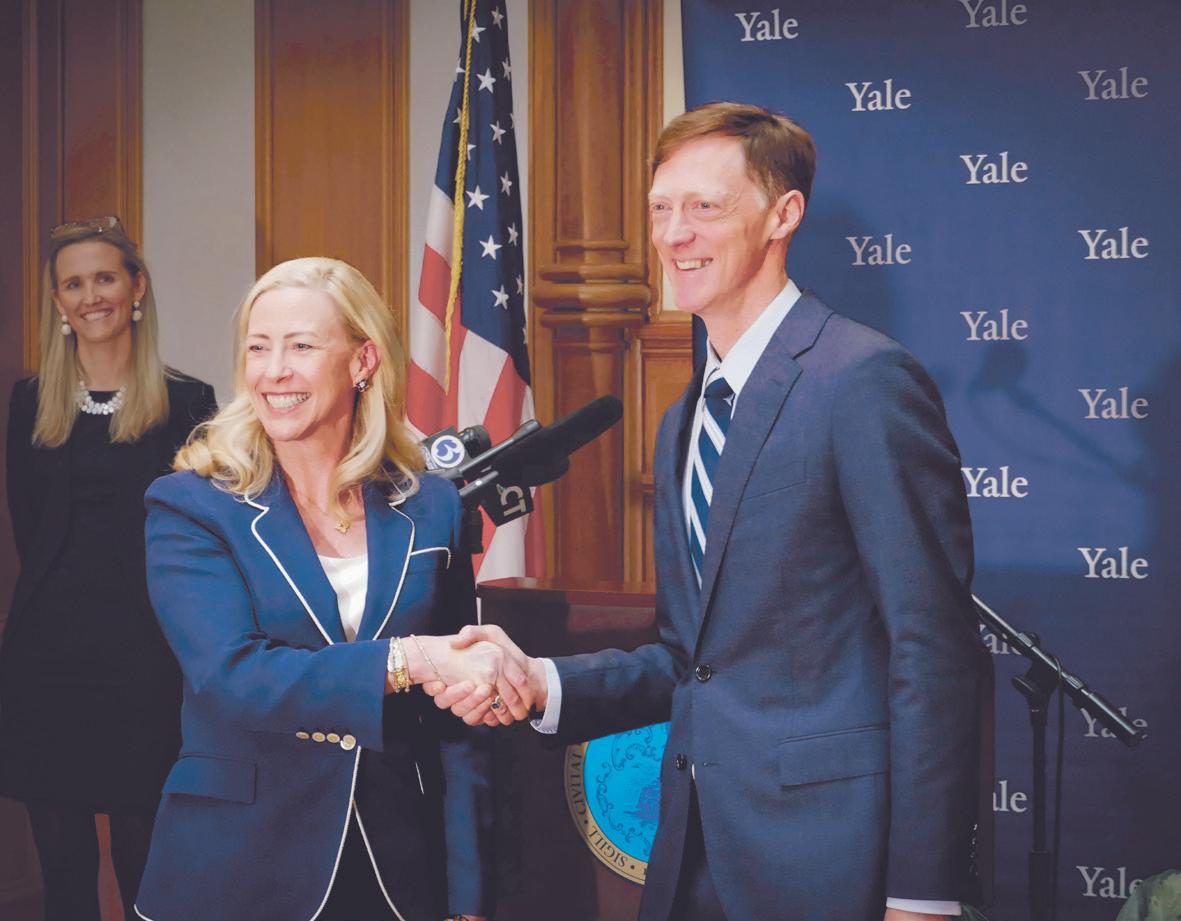
Yale’s payments to New Haven will total over $230 million in the next seven years under a new agreement that significantly increases the University’s pledged voluntary contributions to the city budget, University President Maurie McInnis and Mayor Justin Elicker announced at City Hall earlier this month.
The annual payment will increase to around $29.9 million next fiscal year and reach $33.6 million in fiscal year 2033. The University has contributed some $23 or $24 million to the city each fiscal year since 2021,
when Yale and New Haven negotiators reached their last deal on the voluntary contribution.
“It is gratifying to be able to say that Yale is increasing our voluntary payment to New Haven,” McInnis said at a press conference on Friday, March 6, as Yale College’s spring break began. Her announcement of the new $230 million total elicited a round of applause from the 100-odd people in attendance at City Hall.
In her remarks, McInnis discussed financial uncertainty under the Trump administration, which has so far spared Yale from targeted federal
BY LEO NYBERG STAFF REPORTER
The United States’ secretary of education, Linda McMahon, will speak next month at an event hosted by the Buckley Institute, an organization that describes itself as a hub for “intellectual diversity” and “enlightened conservative thought” at Yale. McMahon, who has run President Donald Trump’s Department of Education for over a
BY MICHELLE SO STAFF REPORTER
3.5 million glass bottles on the wall. 3.5 million glass bottles. Take one down, pass it around, and it might end up as cement in Yale’s Physical Sciences and Engineering Building under construction.
Yale’s ongoing construction on upper Science Hill will feature 600,000 gross square feet for the School of Engineering and Applied Science and more. In accordance with Yale’s promise to achieve net-zero carbon emissions on campus by 2035 and zero actual carbon emissions by 2050, the development will include a thermal utilities plant that will produce energy for the facilities.
But even if operations are sustained by on-site energy production, creating a building from raw materials is quite carbon-intensive. Instead, some of Yale’s building materials will use Pozzotive, an industrial filler made from recycled glass such as drink bottles — the equivalent of 3.5 million of them, to be
precise, according to a slideshow used during a recent tour of the glass recycling facility. At the tour last month, organized by several students at Yale’s School of the Environment, a group of Yale affiliates explored Urban Mining Industries’s facility in Beacon Falls, Connecticut, where recycled glass is processed and turned
into a powdery building material known as pozzolan.
Concrete is an essential building material for modern-day structures.
Standard concrete consists of aggregate like pebbles or gravel, sand, water and cement — the powdered binding agent, often confused with concrete, that gives concrete its integrity.

BY KIVA BANK STAFF REPORTER
The film “One Battle After Another” swept the Oscars last Sunday in one win after another, securing Best Casting for the selection of an ensemble that included a seemingly unlikely member — Paul Grimstad, a Yale lecturer and the director of undergraduate studies of the humanities program.
Directed by Paul Thomas Anderson, the film follows an ex-revolutionary, played by Leonardo DiCaprio, as he searches for his missing daughter while being hunted by a deranged colonel from his past.
Grimstad plays Howard “Billy Goat” Sommerville, the radio coordinator for the radical group, and his capture catapults the film into action.
year, is slated to speak about diversity, gender and the department’s role in American education policy, according to an event description. This is the first time the Buckley Speaker Series has hosted one of Trump’s cabinet members since the beginning of his second term.
“Secretary McMahon’s perspective is critical for understanding the challenges faced by and the path forward for American education, from kindergarten through
BY KIVA BANK STAFF REPORTER
Last month, The Yale Review’s executive editor, Meghan O’Rourke ’97, announced on Instagram that the literary journal would adjust its operations due to University-wide budget reductions that are a part of Yale’s preparation for the impending endowment tax hike.
The annual Yale Review Festival was cancelled for this spring, and the magazine will reduce its online content to keep its website free and instead prioritize print, according to an Instagram announcement and an email The Yale Review and O’Rourke sent to subscribers. Since the launch of the journal’s website in 2021, which features digitized print editions and online-specific content, readership has reached numbers of nearly a million people online, according to O’Rourke.
O’Rourke expects the decrease in online publishing to cause a
“substantial reduction” in readership of The Yale Review due to the diminishing likelihood of people converting to print subscriptions. She said the digitized version of the print edition will remain available for free online.
“It’s unfortunate that the endowment tax was passed at a moment when we were already kind of stretched past our budgetary realities and looking for ways to create sustainability,” O’Rourke said in a phone interview.
The magazine publishes essays, fiction, poetry and criticism, and O’Rourke said it has experienced significant growth since she became executive editor in 2019. O’Rourke said that some of President Donald Trump’s early cuts to other schools’ funding in the spring of 2025 prepared The Yale Review for the possibility of having to reduce its budget.
“Everybody’s got a part somewhere in them, a part to play,” Cassandra Kulukundis, the film’s casting director, said in a phone interview with the News. Kulukundis won the first ever Academy Award for Best Casting last Sunday.
Although the cast features known actors like DiCaprio, Teyana Taylor, Regina Hall and Benicio del Toro, Grimstad’s back -
Grimstad previously played a supporting role in Ronald Bronstein’s 2007 film “Frownland” and also appeared in the Oscar-nominated film “Marty Supreme.”
ground was not uncommon for Kulukundis’ casting habits.
“A lot of people I put in movies never did another movie again, had no interest in doing another movie,” Kulukundis said.
She said she originally wanted to cast Bronstein for the role of Sommerville, but he suggested Grimstad instead.
Grimstad said he has been friends and collaborators with Bronstein for years.
“The casting process came out of the blue and was at first disorienting,” Grimstad wrote in an email to the News.
Grimstad said that he is more accustomed to working as a composer on films, including Bronstein’s “Frownland” and “Heaven Knows What” directed by the Safdie brothers. In an email to the News, Grimstad said he initially assumed that
graduate school,” Lauren Noble ’11 — Buckley’s executive director — wrote in an email to the News. McMahon’s higher education agenda has included investigations into antisemitism and diversity programs on college campuses, including Yale. Under McMahon, the Education Department has canceled billions of dollars worth of federal grants to universities across the country. SEE OSCARS PAGE 6
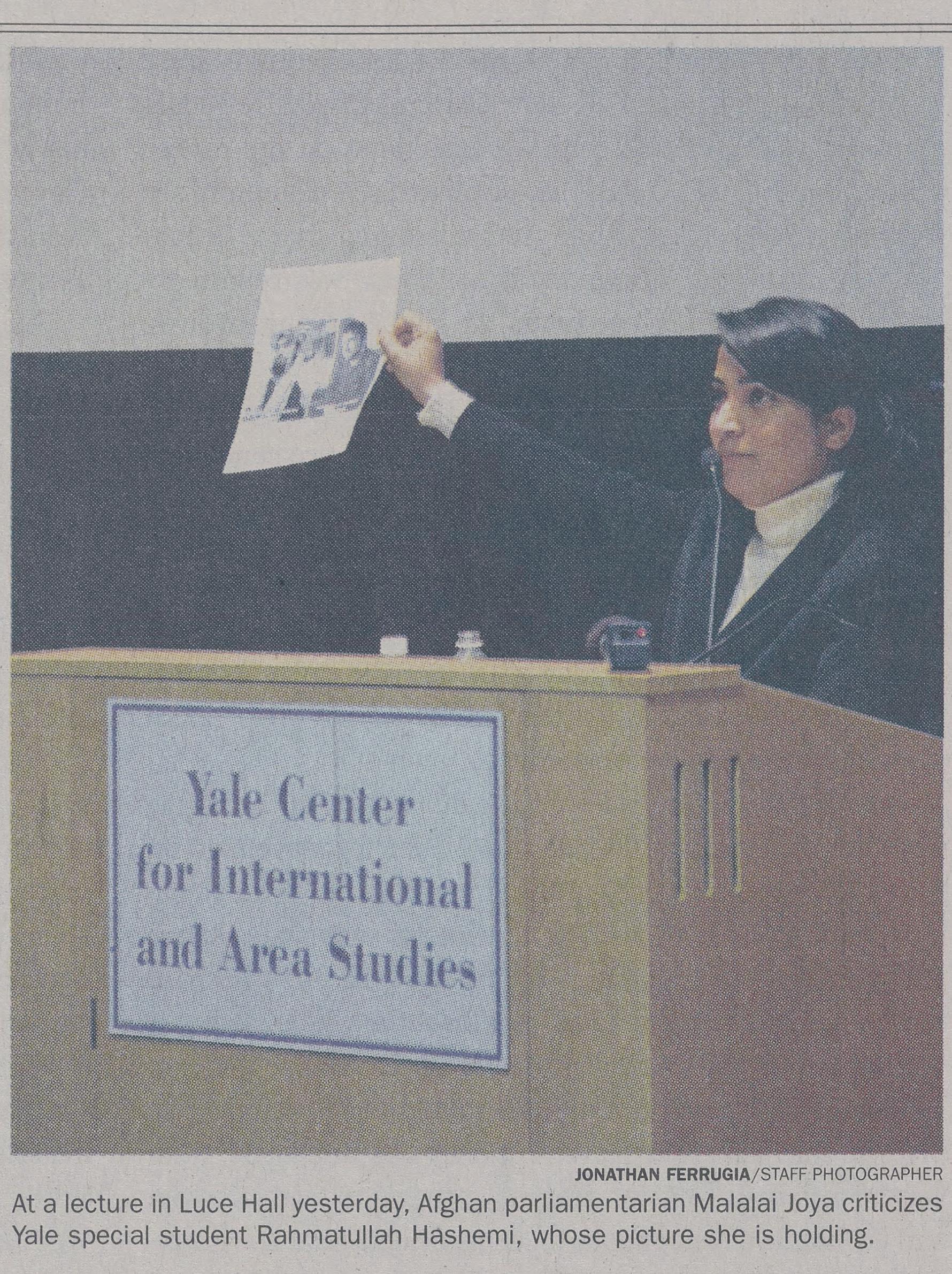
March 24, 2006 / Joya talks on Afghanistan, Hashemi
By Cari Tuna
Female Afghan parliamentarian Malalai Joya criticized current U.S. policy in Afghanistan, as well as the presence of former Taliban spokesman and foreign ministry official Sayed Rahmatullah Hashemi as a special non-degree student at Yale, both during and after her speech, “Women’s Rights, Warlords, and the U.S. Occupation of Afghanistan” on Thursday night.
The lecture, which was co-sponsored by the Yale Center for International and Area Studies and the Afghan Women’s Mission, drew a full crowd in Luce Hall Auditorium and was preceded by a documentary film addressing women’s rights in Afghanistan.
By Aria Lynn-Skov
When the News received a tip about a Zillow listing in Hamden with a closet of blue suits that looked uncannily like McInnis’, I searched through Hamden property records to verify the connection. I found that McInnis’ husband, Dean Johnson, was listed as the owner of the house set just over the Hamden-New Haven border. McInnis previously told us that she splits her time between the Yale president’s official residence and a private home.
The News’ archives have nearly a century and a half of stories about 43 Hillhouse, the president’s official residence. Today, Hillhouse Avenue is almost entirely Yale-owned, with properties including the Jackson School, the Admissions Office, and the provost’s house. When 43 Hillhouse was first built in 1871, its owner Henry Farnam (of Farnam Hall on Old Campus) was one of many professors who lived in the area. This transformation of Hillhouse, which had lost its neighborhood feel by the early 20th century, is part of what has led some presidents to split their time between the official house and a private residence.
Read “McInnis home on sale in Hamden” on page 1.



EMILY HETTINGER
Over the last few weeks, there has been heated discourse in the News about whether or not Yale is ideologically diverse and whether or not Yale should be making more of an effort to admit conservative students. But thus far, no one has questioned the premise that Yalies are, on average, deeply liberal. Now, I will concede the point that the average Yalie likely identifies as a Democrat, and an overwhelming majority probably voted for Harris in 2024. However, professed beliefs — and even voting practices — do not tell the whole story. When I look at the companies my peers are headed to after graduation, I can’t help but wonder: are we liberal in words alone?
Let me pose a thought experiment. Imagine asking every Yale student, one by one, whether they would work for Immigration and Customs Enforcement upon graduating. ICE pays well, so the number would probably not be zero. But I believe it would be exceptionally low — maybe between 1 and 5 percent. Now, imagine asking every Yale undergrad whether they would work for McKinsey & Company upon graduation. Given that McKinsey is the second-largest first employer of Yale students, after Yale itself, that number would likely jump to 30 or 40 percent.
The difference between these two industries? One is bigger, a little more cross-sectoral, and a lot more prestigious. But until 2018, both built systems to detain and deport undocumented immigrants. And one — hint: not ICE — proposed such egregious cost-saving human rights violations that leaders in the other agency started protesting their involvement in the project.
McKinsey has also reduced worker safety, consulted for authoritarian regimes and shares responsibility for thousands of deaths in the U.S. opioid epidemic, as Walt Bogdanich and Michael Forsythe reported in their book “When McKinsey Comes to Town.” Sure, they also do pro-bono projects for non-profits and the like, but that doesn’t erase their other work. The No. 3 first employer of Yale students, Goldman Sachs, played a major role in the 2008 financial crisis and is one of the biggest investors in fossil fuels, according to Bank Green. And things don’t get more liberal as you travel down the list: Boston Consulting Group (No. 5) designed a ploy that displaced Palestinians in Gaza, and algorithms used by Meta (No. 9) helped Donald Trump win the presidency in 2016. Whether or not you agree with the ethics of each of these employers, they clearly do not align with the views of the Democratic party, much less the views of the far left.
If we are so woke and liberal, why do we move in droves to work for the organizations that many of us protest?
Rob Henderson ’18 might call it luxury beliefs — we have performative liberal views to gain social status but don’t
act on these views because we benefit from the power hierarchies of the current status quo. As Yalies, we have the privilege of entering fields that are prestigious and well-paying but also give us a degree of separation between ourselves and the things we disagree with; we don’t have to abduct people on the street because, for triple the salary, we can design recruitment fairs for the people who do.
The crowd at Payne Whitney Gymnasium, or PWG, notably ignores one machine: the curved treadmill. It purportedly burns 30 percent more calories. It’s non-motorized. And, it’s really, really hard to use. These machines are treachery exemplified. They’re wolves in sheep’s clothing. And I am convinced you need to try them.
Our pair of machines sits comfortably between the standard treadmills and the manual treadmills in the Israel Fitness Center. I first saw them upon arriving at PWG at 4:30 p.m. on a Tuesday, a tactical error so egregious any seasoned gym-goer might be tempted to call me new to this whole exercise thing. Every treadmill was taken, as was every Stairmaster. Accessing the weights machines was unthinkable, and the free weights were decidedly not free. The curved treadmills alone were forsaken.
But I had no choice. I was already dressed and ready to run. I would not be held back by a gentle curve. I hopped onto the plastic planks and began to jog, allowing the small screen a chance to light up and display my statistics. The sensations of this machine are indescribable without a playby-play. The planks move like an airport moving walkway — until they don’t. Responding to your attempts to get up to pace, the belt will begin to glide. You’ll feel like you’ve hit a patch of black ice. As you slow, the machine seems to push your feet back, instructing you in your unworthiness. The treadmill demands your energy and refuses to accept it. That the treadmill seems to punish effort feels unusual and unexpected.
Figuring the machine out takes trial and error, and even then the belt’s behavior is mercurial. The curved treadmill isn’t your friend, and it makes you wonder why you think it should be. Technology doesn’t need to be antagonistic — this would certainly be unprofitable — but the occasional square peg
There is some validity to this argument, but I don’t think it tells the whole story. To me, sociologist Musa al-Gharbi’s explanation is a little more complete. In his book “We Have Never Been Woke,” al-Gharbi claims that our “wokeness” might not be performative, but it seems to accept the weak equity strategies of the broader U.S. elite as standard; we think it’s enough to have twohour diversity training in our New York City highrise offices instead of actually questioning our own positionality. If our commitment to liberalism were more than just words, we would have to do the uncomfortable work of sacrificing our wealth, prestige and power. I don’t think most of us are ready to do that. So yes, we have classes about interracial friendship and postcolonial theory. And yes, there are people, myself included, who take these classes and drift further to the political left as a result. But let’s be honest about who we are en masse: our most popular class is in introductory economics and a lot more people try to join the Undergraduate Consulting Group than the Endowment Justice Collective. If “liberal” means voting for Kamala Harris and then working in a field that contributes to climate change, proliferates wealth inequality and supports displacement both domestically and abroad, then I want no part of it.
EMILY HETTINGER is a senior in Pierson College studying Psychology and Education Studies. She can be reached at emily.hettinger@yale.edu.

The machine is bizarre. New technologies vying for adoption must be immediately familiar and intuitive, or have some other draw that justifies making a switch. The curved treadmill is simultaneously streamlined and bulky, intimidatingly elevated and interestingly curved. In a regimented schedule of insertbody-part-here days, adding a new, untested machine is extra mental labor. Resistance to change is natural, and we’ve all heard the saying, “If it ain’t broke, don’t fix it.” Still, humans are notoriously curious and risk-taking. The issue could be the reality that most people hate embarrassing themselves. Investigating a new machine might seem low-stakes, but the gym can feel like an arena — looking or simply feeling incompetent on a machine is a no-no.
Machines aren’t supposed to make us feel less than them. Artificial intelligence is meant to be useful, not just impressive. Machines are tools for human use, just as clearly as chairs must bear our weight and soles of shoes must be worn down. Things occasionally give us their comeuppance, like when you stub a toe, but such moments aren’t intentionally designed.
I’m not arguing for the end of the built environment, but all this convenience is dangerous. Fast food is unhealthy, only ever walking short distances is unhealthy, talking to people online instead of in-person is unhealthy, scrolling is unhealthy and asking AI to do your homework is also unhealthy. These choices are not always made consciously, but complacency is easy because our surroundings are shaped to accommodate us. This is where the curved treadmill comes in. It is a machine designed to be useful, no doubt, but it is decidedly not servile.

MACHINES ARE TOOLS FOR HUMAN USE, JUST AS CLEARLY AS CHAIRS MUST BEAR OUR WEIGHT AND SOLES OF SHOES MUST BE WORN DOWN.
reminds us how things could be. There was once a time before AI summaries and self-driving cars. Let us remember that life used to require struggle and failure. It still does. Exercise is already the art of regulated pain; the curved treadmill makes that discomfort feel uncontrollable. It’s a rare privilege to experience helplessness so immediately — and to be able to get away so easily. So try the curved treadmill, even if just for the relief of stepping off.
UMA SUKHU is a sophomore in Trumbull College studying Comparative Literature and Molecular Biophysics and Biochemistry. She can be reached at uma.sukhu@yale.edu.



“For the vast majority of life’s necessities you rely blindly on the help of other experts, whose own knowledge is also limited to a tiny field of expertise.”
CONTRIBUTION FROM PAGE 1
funding cuts, even as the University tightens its budget in anticipation of a slated increase in the tax on wealthy universities’ endowment returns.
“Yale, like New Haven, is facing uncertainty,” McInnis said, “but uncertainty is actually a prerequisite for making a commitment to our community.”
She added that the University is committing to a greater payout to the city because “we don’t know what will come but we do know that we want to go through it together.”
The development followed months of negotiations between the University and its host city.
Alexandra Daum, Yale’s associate vice president for New Haven affairs and University properties, and Jack Callahan ’80, the former senior vice president for operations, led negotiations on Yale’s side. Henry Fernandez LAW ’94 represented New Haven. All three stood beside Elicker and McInnis at the City Hall press conference, and Daum spoke extensively about additional initiatives in the new deal.
Elicker framed the deal as part of a new stage of the city’s centuries-long relationship with Yale.
The University has provided a voluntary contribution to the municipal budget since 1990 and substantially increased it in a 2021 agreement overseen by Elicker and former University President Peter Salovey GRD ’83 ’84 ’86.
“That commitment came from the top with the leadership of President Peter Salovey, and as you have heard today, it’s a commitment that continues with President Maurie McInnis,” Elicker said before thanking the president.
The agreement inked Thursday eliminates the $8 million drop in Yale’s payment that was expected for fiscal year 2027 — a decrease that was built into the 2021 deal to kickstart negotiations on its successor. The new deal amends the payment for that year and schedules a series of payments through fiscal year 2033.
According to a letter sent by McInnis to Elicker and Tyisha Walker-Myers, the president of the Board of Alders, the new plan includes a “sim-
plified method” for calculating the University’s voluntary contribution.
Yale’s annual payment will begin with a lump sum of $25,545,000 for fiscal year 2027, which will increase by 2.5 percent per year through 2031. Payments in fiscal years 2031 through 2033 will remain mostly level, with increases of around $200,000 a year caused by the fire services payment agreement agreed to in 1990.
“As far as we are aware, this represents the largest voluntary payment, both annually and collectively, by any university to a municipality across the country,” Elicker said.
Fernandez, the mayor’s negotiator, said in an interview before the agreement was unveiled that if Yale and New Haven reached a “good” updated deal, it would “be better than all the deals that any universities in this country have ever done with their host city.”
In January, leaders of Yale’s unions, along with city leaders like Walker-Myers, held a rally and called for the University to increase its annual payment to $110 million.
Thursday’s agreement preserves two components of the 2021 deal. For every property Yale takes off the city’s tax rolls for academic use, the University continues to make payments equivalent to full property taxes for three years before decreasing this payment by 10 percent each year. Yale will also maintain its financial commitment to the Center for Inclusive Growth.
The University has also agreed to make a one-time $8 million payment to New Haven for this fiscal year to make up for a decades-old accounting gimmick. Elicker said that around 2005, “in order to cover a budget gap,” New Haven accounted for revenue from one of Yale’s payments in the previous year’s budget. Ever since, Elicker said, Yale has made an August payment that the city counted in the prior year’s revenue.
Elicker said that “from an accounting perspective,” this is “legitimate.”
Now, thanks to the extra $8 million from the University, Yale’s payments will “appropriately align with the city’s fiscal year to address this historical issue,” Elicker said. The
$8 million is part of the seven-year $232.7 million total.
The mayor said that his team raised the issue during the 2021 negotiations, and added that “this time around, Yale has been very generously willing to give us an $8 million payment so that we can correct that.”
Alongside the 2021 deal, Yale and New Haven announced a plan to convert the section of High Street between Elm and Chapel Streets into a pedestrian-friendly walkway. That plan was paused last February amid financial uncertainty at Yale, according to the New Haven Independent, but on Friday, Daum said that the University and the city will continue to “work together” on projects to convert “certain streets that feel like they would be more appropriately oriented towards pedestrians, as opposed to cars.”
High Street remains a likely candidate, per McInnis’ letter, as does Cedar Street between York Street and Congress Avenue.
Another “key area of focus” is housing availability and affordability, Daum said. Yale “recognizes” Connecticut’s affordable housing crisis, Daum added, and “we want to explore how we can help.”
“We’re going to look at vacant or underutilized University land and figure out how it can contribute to increased housing supply in New Haven,” Daum said. Yale will also create a fund, awarded over three years, for “targeted, strategic donations” to community nonprofits, according to Daum.
“Our partnership is a lot more than the money,” she said in an interview.
McInnis’ letter outlines two additional new initiatives: working groups composed of University and city officials aimed at sharing “best practices in the fields of information technology, economic development and longterm planning,” and planned investments by Yale in local food insecurity-focused nonprofits.
The president, who introduced herself as a “historian,” grounded her remarks in the 300-year financial relationship between Yale and its host city.
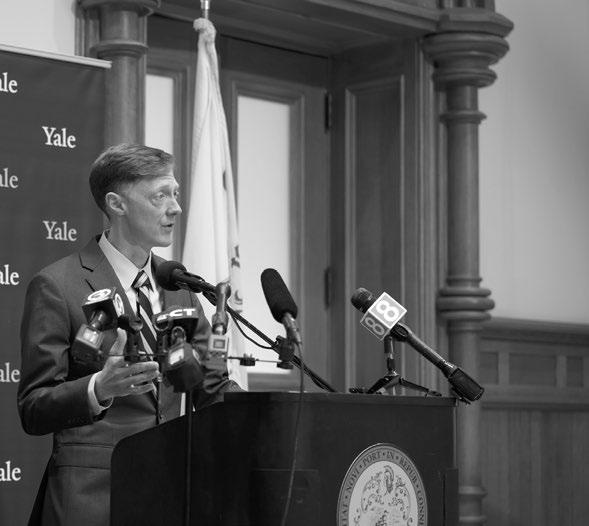
She pointed out that Yale only moved to New Haven because the town offered it £2,000 — more than Saybrook and Hartford — along with eight acres of land in the early 18th century.
“It’s not an exaggeration to say that Yale wouldn’t be here were it not for the generosity of the denizens of this city,” McInnis said.
In his remarks, Elicker thanked parts of the New Haven community that he said made the new agreement possible. He pointed specifically to the local UNITE HERE unions, which represent several groups of Yale employees; New Haven Rising, the unions’ politically powerful community organization; the Board of Alders; the city’s legislative delegation and Fernandez. Only two alders were present at the press conference: Richard Furlow, the body’s majority leader, and Christine Kim ’99, the new Ward 7 alder who was sworn in on Wednesday. The week before the Yale deal was announced, Elicker unveiled his proposed budget for fiscal year 2026, which included a 4.01
property percent tax increase. He indicated then that a voluntary contribution increase might allow the city to “alleviate some more of that burden.”
That budget is “in the alders’ hands now,” he said at the press conference about the towngown agreement. “Ultimately we will have, thanks to Yale, an additional $5 million to work with. And if that were put all towards the tax increase, the tax increase would go from 4 percent to 2.5 percent.”
The mayor added, however, that Yale’s payment is helping fund “a lot overall.”
Negotiations over the new payment plan began in September, Fernandez said, and involved nine meetings between city and University officials. Fernandez previously said that “every face to face meeting has been me and Jack,” referring to Callahan.
Contact ELIJAH HUREWITZ-RAVITCH at elijah.hurewitz-ravitch@yale.edu.
FROM PAGE 1
“This isn’t chemistry that we’re inventing,” Chris Cotulio, a material sustainability specialist at O&G Industries — a construction company that has worked with Urban Mining Industries — said during the tour. “The ancient Romans and Greeks used volcanic ash as a pozzolan in their structures over 2,000 years ago, and a lot of them are still standing because it makes more durable concrete. So this is just a modern twist, using a post-consumer recyclable as a vehicle for that silicon dioxide.”
During the tour, Cotulio and Urban Mining Industries CEO Louis Grasso Jr., who invented Pozzotive, walked Yale members through the process of creating the finished product.
The facility receives post-consumer glass from nearby material recovery facilities that collect refuse from ordinary recycling bins. Upon arrival, the material is put outside in foul-smelling mounds of muddy grit. Given the imperfect recycling systems, contamination from organic matter, plastics and metals isn’t uncommon.
The raw recycled glass is cleaned mechanically in a tumbler that Grasso called a “dryer” — which he said differs from most plants’ chemically intensive cleaning processes.
“Everything is really done correctly and transparently, so no chemicals or water goes through the dryer,” Grasso told the News. “The dryer tumbles the glass on itself, and it breaks off the paper labels, and it breaks off the dried organics as it goes through the tumbler or dryer.” Grasso founded the company over two decades ago and has since taken on large projects like the more-than-$3 billion JPMorgan Chase high-rise in Manhattan, which used 52,000 cubic yards of pozzolan-substituted concrete to build floors, according to the Pozzotive website.
This project and more were covered in a tour led by Cotulio and Grasso. In the factory control room, Cotulio showed the visitors the systems and operations screen, where a schematic of the factory's operations is constantly monitored for changes in operations and efficiency.
“What we’re seeing is an example of where the sustainable option is the better option,” Ayushi Khan ENV ’24, a postgraduate associate at the Yale Center for Industrial Ecology, said. “So this is a great, amazing example of why recycling can be so lucrative sometimes, and the better option sometimes. And this is easy to scale.”
Natural forces like motion, gravity and density are utilized by the plant to process this raw material. Harmful batteries are then removed by giant magnets.
Powerful fans blow out the lightweight plastics while leaving the denser glass pieces behind.
Mechanical grinding, akin to a geode tumbler, breaks down the glass pieces into the plant’s final product: pozzolan.
Pozzolan can be substituted for new cement at rates of 15 to 50 percent, according to Cotulio, though Grasso has experimented with blends containing up to 70 percent substitution. Due to the chemical composition of cement, a baseline proportion of cement is required to mix with water and make concrete, so full replacement with pozzolan is not possible.
The remainder of the cement is usually supplemented with fly ash, which is a coal-burning byproduct, or slag, a remnant of iron smelting. However, a partial replacement of traditional cement already significantly reduces carbon emissions, Cotulio said.
Recycling a ton of glass back into glass bottles saves roughly 166 kilograms of carbon dioxide, Cotulio said in his tour presentation. By comparison, recycling glass into concrete saves 980
kilograms — nearly a ton of carbon emissions. According to Cotulio, benefits of Pozzotive’s cement include increased resistance to chloride — useful for when sidewalks are salted in the winter — and that it shrinks less due to temperature fluctuations compared to traditional concrete, which can lead to structural cracks.
“It was also pretty amazing that the product itself is cost parity with regular cement, which means it’s the same cost,” Alfonso Panis SOM ’26, who was also on the tour, said. “It’s really just the supply chain, at least to my mind, that's the bottleneck, like the raw material sourcing.”
The Urban Mining Industries facility is located at 105 Breault Road in Beacon Falls.
Contact MICHELE SO at michelle.so@yale.edu.


McMahon is a long-time Connecticut resident who co-founded World Wrestling Entertainment, known as WWE, with her husband.
She later served on Connecticut’s Board of Education and mounted two unsuccessful Senate bids, according to her Education Department biography.
Buckley has hosted a laundry list of prominent conservative figures, including former Vice President Mike Pence, conservative columnist and podcaster Ben Shapiro, Florida Governor Ron DeSantis ’01 and former Secretary of State Mike Pompeo. Noble wrote that McMahon’s appearance on campus is a testament to Buckley’s ability to draw prominent conservatives to campus.
“American education is in need of significant reform,” the McMahon event description on the Buckley website reads. “Federal overreach and dangerous ideologies are smothering our nation’s classrooms, from kindergarten to the highest professional levels.”
In the fall, the Yale Political Union hosted Joe Biden’s secretary of education, Miguel Cardona, who now teaches at the School of Management. At the event, Cardona warned that efforts to eliminate the Education Department would “dissolve public education.”
McMahon is not the first Trump official to visit Yale’s campus during his second term. The Federalist Society at Yale Law School hosted Department of Justice Assistant Attorney General Harmeet Dhillon in September. Dhillon publicly critiqued Yale in the aftermath of pro-Palestinian protests last spring.
McMahon’s Education Department has frequently targeted elite
universities, and, last March, the department launched an inquiry into antisemitism at Yale.
“The Department is deeply disappointed that Jewish students studying on elite U.S. campuses continue to fear for their safety amid the relentless antisemitic eruptions that have severely disrupted campus life for more than a year.
University leaders must do better,” McMahon wrote last year in a press release about the department’s investigation of 60 universities, including Yale.
The Trump administration recently launched a new lawsuit against Harvard for alleged antisemitism at the university.
In March 2025, the Education Department investigated Yale and 44 other universities for partnering with a program that seeks to diversify the pool of students seeking doctoral degrees in business. Last month, the department announced that 31 of the universities investigated — including Yale — had agreed to cut ties with the program. At the time, a Yale spokesperson declined to comment on the department’s move or Yale’s ties to the program.
McMahon has also sought to crack down on universities receiving foreign funding. In a new database, the government displays foreign donations to universities. Yale ranks as the eighth-largest recipient of foreign funding, according to the database.
Trump signed an executive order last March to begin work to close the Department of Education. Experts previously told the News that the move could endanger federal financial support to Yale.
The Buckley Institute was founded in 2011.
Contact LEO NYBERG at leo.nyberg@yale.edu

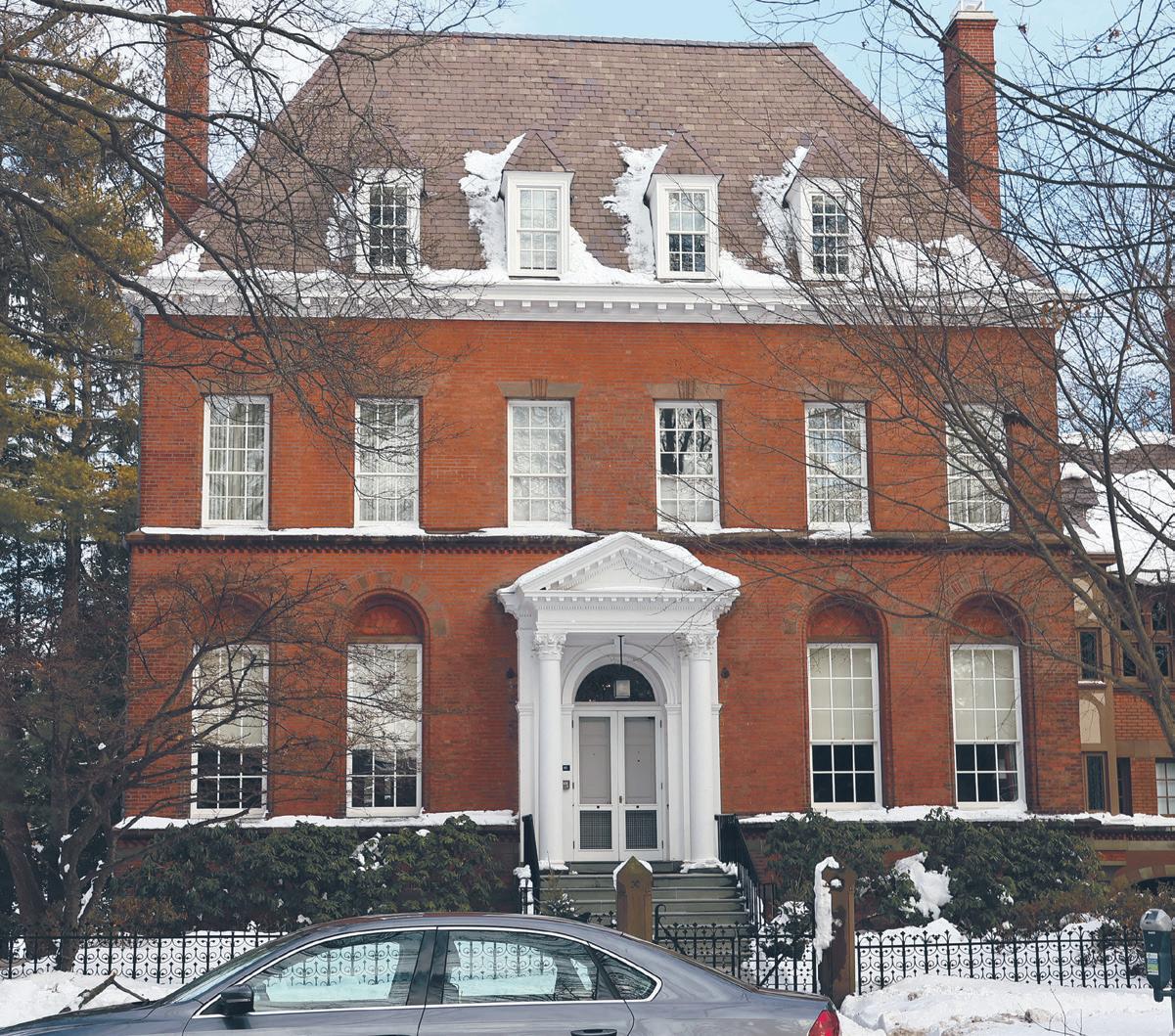
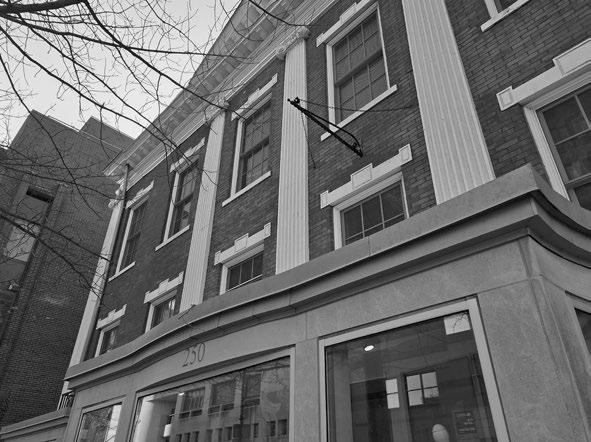
McInnis’ husband, as the owner since August 2024 of a house in Hamden — the first house on its block entirely over the town’s border with New Haven, and under two miles from McInnis’ office in Sheffield-Sterling-Strathcona Hall. As University president, McInnis also has an official residence at 43 Hillhouse Ave.
“I split my time between a small apartment in the president’s house and my private home, and I use the rest of the president’s house to host events for the university,” McInnis wrote in an email to the News last month.
Now, the six-bedroom, six-bathroom Hamden house is for sale with a price tag over $2.4 million, according to online listings posted in early January.
McInnis did not respond to the News’ emailed questions about her future plans given the house’s being on the market, including whether she would move within the New Haven city limits full time.
Yale presidents have chosen varied housing arrangements while on a job that carries considerable sway in New Haven, presiding over the city’s biggest employer and an evolving towngown relationship.
The home currently for sale in Hamden was built in 1910, and Johnson purchased it for just over $2 million, according to local property records, roughly two months after McInnis was named Yale’s 24th president.
Photos of the house’s interior on the online listings show bright, spacious rooms filled with art including paintings and sculptures. McInnis is an art historian. Blue is a theme throughout the home — Yale’s color covers rugs, walls and couches.
A photo on the home listings shows a closet filled with suits and shoes ranging from sky blue to cerulean, matching McInnis’ habitual attire.
Recent presidents have differed in their approaches to use of the official presidential residence on Hillhouse Avenue.
Six Yale presidents lived in the house before McInnis, according to the New Haven building archive. All presidents have held events at the house — from Halloween celebrations to student receptions — since it became an official presidential residence in 1937.
In 1960, the Whiffenpoofs trick-or-treated at the president’s house, singing to then-University President Alfred Griswold, who graduated from Yale College in 1929 and received a doctorate from the
“It must certainly be allowed, that nature has kept us at a great distance from all her secrets."
DAVID HUME AN ENQUIRY CONCERNING HUMAN UNDERSTANDING
Once Congress passed the One Big Beautiful Bill Act, which included an increased tax rate on the wealthiest universities’ endowment returns, O’Rourke said it was apparent the publication was going to have to adjust its budget. Administrators announced in the fall that Yale will reduce its budget targets across the University to prepare for the tax increase, which will cost about $300 million per year.
“The Yale Review is something of a unicorn,” O’Rourke said. “It is a rapidly growing literary magazine in an age of contraction and an age of cultural diminishment.”
O’Rourke said the website’s launch was directly connected to the increase in “reach and significance” of The Yale Review.
“That growth happened because of the work we did to publish weekly essays and poems online,” she said. “It’s very hard in this day and age to get attention in a very busy literary landscape if you don’t have a certain regularity to your publication schedule.”
Richie Hofmann has been a contributor to The Yale Review since 2013 and has published his poems in both print and online Poem of the Week series. He said he thinks both online and print are “essential to keep supporting.”
“Online is where most people encounter literature,” Hofmann said in a phone interview. “It’s just an inescapable part of our reality that so often we encounter at least links to magazines through online forums and social media.”
He said that the “ease of distribution” online is important for writers to gain exposure.
“I think online is a way to bring readers into the kind of culture and community of the magazine,” Hofmann said.
Adam Dalva, a contributing editor of The Yale Review, said that the online publication of certain essays brought the publication up to par with magazines like The New Yorker and The Paris Review in terms of readership. He cited the popularity of Garth Greenwell’s 2023 essay on Philip Roth.
“The review was suddenly in the top echelon,” he said in a phone interview. “Like it became a destination.”
Radhika Jones, who was the editor in chief of Vanity Fair from 2017 to 2025, has become an “avid reader” of The Yale Review under O’Rourke’s leadership. She said she has had a subscription to the print publication for a couple of years.
“When I was editing Vanity Fair, I would look to The Yale Review to discover writers who were on a way to explore the finer points of art and culture,” Jones said in a phone interview.
She commended the digital expansion of the publication under O’Rourke’s leadership.
“Since Megan expanded its digital presence, it’s become for me, this bridge between sort of university-style intellectual thinking and the realm of public discourse,” Jones said.
Hofmann echoed that cutting back online content will limit the reach of The Yale Review.
“It also kind of diminishes the place of literature in our everyday lives, on our devices,” he said.
The Yale Review will continue to publish its quarterly print edition, Poem of the Week series and Shakespeare and Company interviews on its website. O’Rourke cited labor constraints as a factor in the decision, noting that publishing the Essay of the Week series was “very time consuming.”
She said the demands of time and labor at the magazine have “quadrupled” in the past few years.
“We were getting a few thousand submissions when I arrived, and now we get more than 20,000 submissions a year,” O’Rourke said.
The Yale Review Festival was also a means of outreach to the student body, according to O’Rourke and previous panelists.
“The aim of The Yale Review festival was to bring the spirit of the magazine to life at Yale,” O’Rourke said.
“The spirit of the magazine is a place for the dynamic interchange of ideas and literature and a place to bring kind of like the highest levels of public thinking and writing by academics and novelists and poets to a really wide diverse group of readers.”
Dalva appeared on a panel about literary criticism at the festival last year and said he was saddened to hear the festival was cancelled this year.
He said the programming of the festival gives Yale students “access to all kinds of writers” and enables them to form connections that are import-
ant for aspiring writers and critics.
“The enthusiasm from the students was just amazing,” Dalva said. Dalva, who is the president of the National Book Critics Circle, recalled how students asked him questions after the panel, some of whom later became student members of the Book Critics Circle. He said these interactions make writers “feel much more approachable.”
Dalva said he was not surprised to hear of the festival’s cancellation.
Citing the layoff of The Washington Post’s books critics, he said that the culture of criticism has become “temporarily expendable.”
“Yale’s not seeing the value that the review gives. The value confers massive status onto Yale,” Dalva said. Greenwell participated in the festival in 2023 to discuss his essay on Philip Roth.
He described it as a “wonderful” experience and said he felt the absence of the festival this year is a “big loss.”
“To have the caliber of writers that the review attracts come in and work with students and contribute to the intellectual life of the university, seems to me a very remarkable thing,” he said in a phone interview. “I think it’s a disappointing decision on the part of the University to deprive the students of those kinds of opportunities.”
Jones said she hopes that the budget cuts will encourage more people to subscribe to The Yale Review, adding that she hopes the restrained period is temporary.
“I feel like this is a time for supporters of The Yale Review to subscribe and read avidly and talk about it and make sure to set it up to continue to thrive,” Jones said. The Yale Review Festival will return next year, O’Rourke said.
Contact KIVA BANK at kiva.bank@yale.edu
University in 1933, and his family. Former University President Richard Levin GRD ’74 and his wife hosted an annual Halloween party for students.
Peter Salovey GRD ’86, Yale’s president from 2013 to 2024, moved into the residence after it was renovated in 2014. Renovations included handicap accessibility and electrical system updates. Before Salovey and his wife moved in, the house had not been used as a residence since 1986.
While Salovey and his wife, Marta Moret SPH ’84, moved into the official residence, they kept their East Rock home where Moret operated a consulting firm.
Levin, Salovey’s predecessor, opted not to live in the residence full-time. He lived instead in his family’s East Rock home, but held hundreds of events at 43 Hillhouse Ave. over his two decades as president. Levin told the News in 2013 that his family remained in their off-campus home to avoid disrupting their children’s lives — the youngest of the couple’s four children was still in elementary school when Levin became president.
Levin and his two predecessors — Howard R. Lamar GRD ’51, president from 1992 to 93 and Benno Schmidt Jr. ’63 LAW ’66, president from 1986 to 1992 — were the three presidents who broke from tradition, causing the
nearly three-decade gap in presidents living at the house.
Recent events hosted at 43 Hillhouse include a lunch where student leaders met with McInnis and members of the Yale Board of Trustees.
The Hillhouse residence traces its roots to philanthropist and businessman Henry Farnam, who owned the house from its construction in 1871 to his death in 1883. Following his death, the News reported that Farnam left the property to Yale, under the stipulation that it would remain in his family’s possession through the lives of his widow and son.
When Farnam’s son, Yale economics professor Henry Walcott Farnam, who received a bachelor’s degree from Yale in 1874 and a master’s degree in 1876, died in 1933, the residence officially became University property. Eight months of renovations transformed the house from “Victorian Gothic to Colonial,” the News reported. Charles Seymour — a member of the Yale College class of 1908 who graduated with a doctorate from the University in 1911 — moved in after he took office in 1937 as president, a job he held until 1951. While serving as president, Schmidt split his time between New Haven and New York and
was criticized for his lack of on-campus presence. “‘Where’s Benno?’ rivals ‘Boola Boola’ here,” read a New York Times report from New Haven in 1989. Despite his frequent distance from campus, Schmidt signed Yale’s first deal with New Haven to make a voluntary contribution to the city budget: $2.5 million pledged in 1990, with $1.5 million per year afterwards.
At a March 6 press conference at City Hall, McInnis and Mayor Justin Elicker announced an increase in Yale’s annual voluntary payment to New Haven, which will reach $33.6 million by 2033. McInnis spoke about Yale’s history in the city.
“Fundamentally today, we are affirming Yale’s commitment to New Haven, affirming that our work is yes, for our nation, and yes, for humanity, but also for our city, our home,” McInnis said in her speech. When approached by the News after the press conference, McInnis declined to answer questions.
From 1800 to 1846, Yale presidents lived on Old Campus, according to the Yale Alumni Magazine. Asher Boiskin contributed reporting.
Contact ARIA LYNN-SKOV at aria.lynn-skov@yale.edu.
“The
superior man is distressed by the limitations of his ability.”
CONFUCIUS PHILOSOPHER
OSCARS FROM PAGE 1
an email inquiry from Warner Bros. was about composing a score. Instead, he learned it was to audition for an acting role. Although apprehensive at first, he “just jumped in.”
“I was reading everybody,” Kulukundis said. “I was looking at all sorts of different types of people, from retired actors to real-life technicians and composers and musicians and mathematicians.”
Kulukundis said that she considered professional actors for every role in the film before shifting towards people with similar backgrounds to the characters.
“It’s like he could be anybody,” she said. “He has to have an energy battery, a life force that perhaps you know can come from a real person who you know feels a little erratic.”
“I probably have some of the same nervous energy and volubility of the character, and even some of the tech-whiz stuff,” Grimstad wrote in an email to the News, specifying his interest in electrical and audio engineering. “So it all kind of fit at the level of attitude and temperament. But I’m certainly not in favor of planting bombs and blowing up buildings!”
Kulukundis echoed similar sentiments, describing Grimstad as “fast-talking, fast-thinking, very opinionated, very passionate.”
She said that Grimstad himself made the tone for the receivers that are used in the film to identify other members of the resistance group. In one scene with DiCaprio, Grimstad as Sommerville gives DiCaprio’s character the receivers and new IDs to prepare him to flee with his infant daughter.
In a New York Times profile, Grimstad said, “I’m basically that guy,” referring to his character in “One Battle After Another.”
Grimstad said he worked with
DiCaprio, whom he called “a genius,” for about a week as they shot the scene.
“Leo at one point was like ‘You’re killing it, brother!’’’ Grimstad wrote to the News. “That was such a confidence building thing to hear from him, and dissolved some of the intimidation and imposter syndrome I was feeling!”
Grimstad filmed a different scene with another nonprofessional actor, James Raterman, who played the interrogator and second in command to the film’s antagonist, Colonel Steven Lockjaw. Raterman is a retired Homeland Security Investigations special agent and security consultant. Grimstad said Raterman was, “despite his menacing presence on screen, a super nice chill guy.”
Kulukundis said that Raterman, who previously appeared in the 2018 documentary “The Trade,” had the right mannerisms for the role.
“There’s a way certain people in the military and armed forces and even, you know, police and fire department speak, that is its own syntax. It’s its own language,” she said.
Kulukundis said that although actors can replicate, having people play roles close to their own experiences is beneficial for consulting about real life scenarios, like with the military operations in the film that mostly included military personnel and “real ICE agents.”
“That is exciting and makes it raw and real all at the same time,” she said.
She said using nonprofessional actors who have that experience invokes a “visceral reaction” when viewing, adding that the high schoolers were played by non-actors, which heightened the sense of fear in the scenes.
Kulukundis said she hopes the film motivates people to vote and
become more engaged in the world around them.
“I think movies have a lot of power to do that,” she said, emphasizing that “the more real” the roles are cast, the better a story is translated onto the screen.
Kulukundis said that she hopes the establishment of an Academy Award for casting will raise the standards for the practice.
She said there are a few people who can play any given role, and she screens for those few before casting the final role based on the direction of the film. Part of her job is to figure out where they “need that reality” on screen.
“It is an art form,” Kulukundis said. “You’re looking for talent, and then you can foster talent.”
“One Battle After Another” won six Academy Awards.
Contact KIVA BANK at kiva.bank@yale.edu.
BY OLIVIA WOO STAFF REPORTER
Bárbara Cruvinel Santiago ’17 left her role as dean of Berkeley College over spring break, Yale College Dean Pericles Lewis announced in a Tuesday email to the Berkeley community.
Cruvinel Santiago — a physicist who, according to the Berkeley website, is originally from Brazil — began her tenure as dean in August 2024. Her responsibilities have been assumed by an interim dean, Karina López GRD ’25, who since November 2025 has served as interim dean of Branford College, Lewis wrote in the email.
“I’m leaving my role as Dean of Berkeley College and will now pursue other opportunities,” read a message attributed to Cruvinel Santiago and included in Lewis’ email. “It was the honor of a lifetime to support hundreds of Berkeley students through their academic and personal endeavors since 2024.”
Cruvinel Santiago’s departure comes as David Evans ’92 prepares to conclude his decadelong tenure as Berkeley’s head of
college, leaving students unsure about who will fill their college’s two senior most administrative posts for the coming fall semester.
During her time as a Yale undergraduate, Cruvinel Santiago served as a peer liaison for the Office of International Students & Scholars and a peer mentor for the Science, Technology and Research Scholars, or STARS, program. She led programs to enhance diversity and student wellbeing both at Yale and at Columbia, where she completed her doctorate in physics, according to the Berkeley website.
Cruvinel Santiago did not reply to questions about her leaving the role of dean that the News sent to the email address she used as dean and a separate one listed on her personal website.
An email from the News on Thursday to her primary Yale email was met with an automated response redirecting inquiries to Allison Van Rhee, an administrative assistant in the college. A Sunday email prompted a different automated response redirecting messages to both Van Rhee and López. Neither Van Rhee nor López responded to
BY MICHELLE SO STAFF REPORTER
The Board of Alders voted last week to give the city the power to acquire English Station, a decommissioned coal power plant — marking a pivotal step in Mayor Justin Elicker’s plan to turn the contaminated island into a public park complete with an aquatic center and lazy river.
The proposal, which passed 17-5, authorizes the city to acquire the two parcels of land in Fair Haven on which English Station sits via negotiated sale and purchase or, if necessary, eminent domain. Eminent domain would allow the city to take the privately owned land — which is contaminated with carcinogenic polychlorinated biphenyls, asbestos and heavy metals — and convert it to public property.
“The City is working to acquire the English Station site and accelerate the clean up of the former power, which is the responsibility of the United Illuminating Company. Following acquisition and clean up, the City intends to create a new public park,” Michael Piscitelli, the city’s economic development administrator, wrote in an email to the News. “With the park at the center, future initiatives in the area include housing development, the Mill River Trail and the Grander-Grand Avenue project, all aimed to fully restore a vibrant neighborhood in the heart of the city.”
The polluted plant on Grand Avenue has changed hands several times throughout the last century. Originally owned and
requests for comment.
Lewis declined to respond to the News’ questions about the reasons for Cruvinel Santiago’s departure.
“Although I can’t offer any information about individual staff members, it’s not unusual for deans and heads to announce their departures around this time of year,” Lewis wrote in a Thursday email to the News.
Unlike other administrative roles at the University, according to Lewis, each residential college dean position is “urgently needed” to be filled and cannot be left empty for extended periods of time.
“If a residential college dean were to leave,” Lewis said in a September interview with the News, “we would immediately start to fill that position.”
Andrey Sokolov ’27, who served on the Berkeley College Council during the 2023-24 and 2024-25 academic years, said he was disappointed by Cruvinel Santiago’s departure.
“I think that she definitely did make a massive effort in getting the University to feel more like home,” Sokolov said in a Sunday phone interview with the News.
“If I ever had any sort of issues, she was more than happy to support myself in handling and navigating the Yale bureaucracy.”
During her brief tenure as dean, which began only last academic year, Cruvinel Santiago hosted office hours with her golden retriever Fubá, which she dubbed “Pawffice Hours.” She also ran an Instagram account featuring pictures and videos of her dog, Sokolov said. “She made herself as accessible as possible. She tried her hardest to make the students feel less overwhelmed,” he added. “Dean Santiago really was able to toe the fine line between supporting the students all the while ensuring that they also adhere to undergraduate regulations.” Residential college deans are considered the chief academic officers for every undergraduate student. Sokolov said that Cruvinel Santiago made sure that Berkeley students understood their academic “rights” and “responsibilities.”
“I feel sad for her because of the fact she’s no longer going to be part of Berkeley,” Sokolov
said. “And I also feel sad as a student because of the fact she was great at her job.”
Harsh Patel ’27, who works as a Berkeley College aide and also took a class taught by Cruvinel Santiago, wrote in a Sunday text message to the News that the dean “brought genuine care and understanding to Berkeley.”
“She always notices things about her students, especially if they’re not doing well,” Patel continued. “ I personally think her departure is a huge loss to the Berkeley community. I think the new dean will be amazing as well but Dean Santiago had made herself a cornerstone of the Berkeley community.” Patel added that Cruvinel Santiago brought a “unique perspective” to the role because she was an undergraduate “not too long ago.”
Cruvinel Santiago was a student in Pierson College as an undergraduate. Hailey Young contributed reporting.
Contact OLIVIA WOO at olivia.woo@yale.edu.
powered by United Illuminating Co., the building transferred ownership to Quinnipiac Energy in 2001 and later to two private owners, Asnat Realty and Evergreen Power LLC, in 2012, according to Yale’s New Haven Building Archive records. According to United Illuminating’s website, the company is committed to the island’s remediation, since the company owned the property during the bulk of the pollution through the 19th century. However, a United Illuminating spokesperson told the News in February that the company could take little action with the current land owners not responding to or complying with the city’s requests to sell the property.
In January, city officials unveiled new design plans for the site at a community meeting. That same month, the Roxanne and Henry Brandt Foundation, a New York-based private foundation, sent a letter to Elicker expressing potential interest in financing $10 million for the park, the New Haven Independent reported. Elicker then submitted a proposal to the Board of Alders for the city to acquire the English Station property, either through purchase or eminent domain, if necessary.
Ward 1 Alder Elias Theodore ’27 said he felt hesitant about the project but ultimately voted yes after speaking with fellow alders, including Alder Amanda Martinelli of Ward 8, whose district contains English Station.
Theodore said he had received dozens of emails from community members and weighed their
opinions before the vote, with most of the locals’ sentiment being “positive towards the city purchasing this property.”
“I think I’m really skeptical of building a public pool right now, when we’re struggling to maintain a lot of other parts of our city,” Theodore said in a phone interview.
Theodore stressed that last week’s vote did not give Elicker’s plans the full green light.
“I voted yes because all that we were voting on that day was whether or not the city should begin the process of seeing what it would take to acquire this property,” Theodore said. “We are not committing to buying the property. We are not committing to any usage, any remediation, any expenditure. Right now we are just seeing, how much would this cost? Can we acquire through eminent domain? And to me, that makes sense.”
Around 50 members of the public attended last week’s public hearing, with 11 speaking in favor of the proposal and 15 speaking against, according to reporting by the New Haven Independent.
Lee Cruz, who chairs Fair Haven’s community management team, publicly voiced his opposition to the proposal. His wife, Ward 14 Alder Sarah Miller ’03, voted against the proposal at the Board of Alders meeting.
Cruz said he is concerned about the health impacts from a proposed demolition of the English Station plant.
“The building is hugely overbuilt,” Cruz said in a phone interview.
Cruz noted that winds could blow harmful dust particles as far
out as Branford, emphasizing the environmental harm the nearby Fair Haven neighborhoods could face. He noted that those neighborhoods are predominantly made up of people of color.
Cruz also voiced skepticism about the city’s plans for the proposed park during the off-season, pointing out that the weather for most of the year would be unsuitable for outdoor swimming.
Rafael Fuentes Jr., a 54-yearold resident of Fair Haven and previous aldermanic candidate, has also been a vocal critic of the proposed park at English Station.
Fuentes, who used to fish near the island, said he has witnessed water oozing from corrugated metal along the sides of Ball Island into the Mill River. The contaminated seepage created iridescent rainbows as it hit the river water — which can be a sign of oil pollution, according to the Petroleum Service Company.
“I wouldn’t recommend anybody having their child there,” Fuentes said. “I wouldn’t walk my dog there because the dog’s paws are going to be in that dirt.”
Cruz and Fuentes argued that remediating the land from a more lax industrial standard to a residential standard would cost the city more than what it has already spent on nearby remediation efforts.
In 2023, New Haven secured a $6 million grant to revitalize Grand Avenue, which runs perpendicular to Ball Island. The following year, the city received a $5 million Urban Act grant to “do some property acquisition of some key sites in the Mill River District for reuse, redevelopment,
housing,” according to Carlos Eyzaguirre, deputy administrator for New Haven’s Economic Development Administration.
“It’s gonna cost a hell of a lot more to remediate it,” Cruz said of English Station. Cruz and Fuentes also pointed to existing New Haven parks, including CriscuoloPark and Joslyn Park, which they said have been poorly maintained.
“What about the abandoned buildings that are dilapidated, the garbage, all this stuff?” Fuentes said. “Ball Island is an eyesore. But wait a minute, what about the eyesore of the syringes on the ground? What about the eyesore of the condoms on the ground?”
Fuentes said that cleaning up existing park sites and making public school pools operational should take precedent over English Station remediation efforts. As for the island itself, Fuentes suggested installing solar panels to feed energy back to the grid.
Cruz pointed to local nonprofit Manufacturing and Community Technical Hub, or MATCH, which turned a Mill Street property in Fair Haven into a job training center, as a possible alternative for English Station land.
“That’s the future that we need: income generating, job creation, job preparation. That’s what people are asking for, over and over again,” Cruz said. “No one’s asking for a pool.” The English Station Power Plant was constructed in 1894 by the New Haven Electric Company.
Contact MICHELLE SO at michelle.so@yale.edu
“Two
things are infinite: the universe and human stupidity. And I’m not sure about the universe.”
ALBERT EINSTEIN
BY OLIVIA WOO STAFF REPORTER
Next academic year, course registration for incoming first years will begin on Aug. 17, six days before the first-year move-in date listed on the Yale College website.
The new timeline gives firstyear students two weeks to register for fall courses before they begin, marking a departure from the traditional hourslong registration window that opens to first years during their first week on campus. The change has been met with concerns from current head first-year counselors, three of whom wrote a petition last month arguing that the new timeline will decrease equal access to registration resources and limit the ability of future FroCos to advise first years.
“Students need a little ramp-up time to plan what their courses are going to be,” Yale College Dean Pericles Lewis said in an interview earlier this month. He added that the traditional hourslong registration block created “too much stress” among first-year students.
“We need to make sure there are sections and classrooms available for them to take those courses, and we want them to not be making this decision in two or three hours on the day after they arrive on campus when they’re all wiped out from move-in,” Lewis said.
Fall term registration for current first years occurred from noon to 3 p.m. on Aug. 20, 2025, three days after they moved in on Aug. 17. The change to the registration timeline was announced to current head FroCos and dean’s office liaisons at a Jan. 30 meeting, according to the petition protesting the decision. The change has not been officially announced to incoming FroCos or any other members of the student body.
The petition protesting the change, which was written shortly after the January meeting, was circulated to Yale College administrators in the form of a letter and was also sent to current FroCos, 107 of whom signed on, in addition to the authors. The authors described in detail issues they foresaw around “accessibility,” “logistics,” “social/cultural concerns” and “pre-arrival advising infrastructure.”
“Classes will still fill up at the same rate as before the change,” the petition reads. “Rather than eliminating the stress, the
change simply shifts the stress from the first week of their Yale experience (when FroCos are present) to before they ever step foot on campus (when FroCos are not present). The lack of FroCo presence is a particularly important point since in-person advising is one of the main mitigators of stress during the registration period and add/ drop period.”
An email to the petition’s authors from Dean of Academic Affairs George Levesque, which was obtained by the News, acknowledged that the FroCos’ concerns “need to be taken seriously” but stated that “there are significant downsides” to the current first-year registration timeline.
“It was decided that the advantages of a revised timeline outweigh the disadvantages. Our focus now is on making the transition to the revised timeline as smooth as possible,” Levesque wrote in his email to the authors.
Juan Borrego ’26, a Silliman co-head FroCo and one of the petition’s authors, expressed disappointment with the lack of FroCo involvement in administrative decision-making in a statement to the News on Thursday, March 5.
“Beyond the decision itself, which to our knowledge is now finalized, the process by which the decision was made left enough ambiguity around the extent to and means by which student and FroCo input was considered that, unfortunately, many have come away feeling that it wasn’t valued at all,”
Grace Gibson-Snyder ’26, another of the petition’s authors, wrote in a statement.
In devising a new schedule for first years, Lewis said that administrators have “followed a lot of the advice” in the petition sent by the head FroCos — which Lewis received as a letter — though he said he could not provide further detail as to which recommendations have been employed.
“There are talks happening to have FroCos be formally involved in helping adjust Spring training in light of these new changes,” Borrego wrote.
According to the petition, the head FroCos first learned of the potential change to firstyear registration timelines in a Dec. 5 meeting. That day, Levesque joined a monthly meeting between head FroCos and dean’s office liaisons to float the suggestion of “moving the first day of Fall term course
registration to some time before first-year move-in.”
Borrego said that after the meeting, during which all 14 representatives from the residential colleges expressed unanimous opposition to the change, “there was absolutely no communication from the administration about the potential changes before the final decision.”
After the Jan. 30 meeting in which Associate Dean of Residential Life Ferentz Lafargue announced that the timeline had been adjusted, “there were lots of conversations among the FroCos in regards to our disagreement with the changes,” according to Borrego. Borrego added that he engaged in “oneon-one communication” with Lafargue to inform his writing the petition.
Borrego collaborated with Celene Bennett ’26, Timothy Dwight head FroCo, and GibsonSnyder, who serves alongside Borrego as co-head FroCo in Silliman, to draft the document. It was sent to the other head FroCos and dean’s office liaisons on Feb. 12 to be further distributed, Borrego said.
“Feedback from other FroCos about the petition was very positive, with 110 out of the 132 FroCos signing on in support of the position expressed in it,” Borrego wrote.
In the five-page petition, Borrego, Gibson-Snyder and Bennett laid out seven distinct arguments in favor of the change and outlined their concerns with each one. They ended the document with a proposed solution: to restore first-year registration dates to the status quo and extend the first-year registration period through the end of the current add/drop period.
In the petition, the trio wrote that the timeline adjustment would not eliminate the “highpressure 3-hour registration scramble” of the current model because lengthening “the registration window does not reduce the pressure of registering for classes.”
Instead of reducing inequities among first-year students by ceasing to favor those who register for classes the fastest, the petition continues, the new model might also disrupt the existing “level playing field” created by on-campus registration. “Differences in time zones, internet access, or home environments,” it states, mean that the new timeline
might increase inequities in access to registration.
Existing inequities may also have outsized effects on incoming firstyear students, the petition suggests, because “students with stronger pre-college networks, family experience with higher education, or informal advising channels” will “be better positioned to manage the process” in the absence of in-person FroCo support. The idiosyncrasies inherent to the Yale College academic system, including distributional requirements and first-year seminars, mean that those with access to more resources “would hold a quiet but consequential advantage,” the petition reads.
Seth Baker ’27, who will soon serve as a Saybrook FroCo, comes from a “very rural background” in Tennessee. Baker said in an interview with the News that he arrived at Yale with such little exposure to the college academic system that he had not yet learned what credits were. He said his FroCo was a vital resource in helping him choose his classes.
“It can be very disadvantageous to rural and FGLI students, especially, to move the advising to be over the summer,” Baker said. Without an in-person connection, he continued, it “feels much more intimidating to reach out” to FroCos.
“I do think it kind of puts students who don’t have connections coming into Yale at a disadvantage,” Baker said of the new registration timeline.
Lewis said that the College is allocating more resources to the advising system, including mandatory sessions with former
FroCos over the summer for incoming first years. Another change will designate students’ residential college deans as their primary academic advisors upon enrollment. College advisors will remain resources for incoming students but will specialize in more “personal advising.”
“College advisors are not in a position to give advice on particular courses. So that will now come from your college dean most of all and, to some extent, from the FroCos who are trained by the deans because we want to make sure that the advice students get on which courses to take is consistent,” Lewis said. “The dean will give you the academic advice and the approval of your course schedule.”
Lewis said that this advising system is being developed over the next two summers and is expected to be fully implemented by August 2027.
“We’re sort of piloting in August of 2026,” he added.
In addition to live resources, Lewis said, incoming first years can learn about course registration from weekly summer emails that have been updated to include more academic information, as well from Yale 101, which according to the Yale College website is “a series of short, interlinked videos designed to introduce you to a Yale education.” Incoming students will complete this training alongside the “Perspectives” training offered for the first time last summer.
This year, 358 members of the class of 2027 applied to be FroCos.
Contact OLIVIA WOO at olivia.woo@yale.edu
BY JAEHA JANG STAFF REPORTER
This coming fall, Yalies will have the chance to take Catalan language courses.
The Department of Spanish and Portuguese will offer “Elementary Catalan I” in fall 2026 and “Elementary Catalan II” in spring 2027, according to senior lector Lourdes Sabé, the program’s coordinator, who will also be teaching the courses. Professors told the
News that offering Catalan, which is spoken in eastern Spain, Andorra and parts of France and Italy, will allow students to better understand the region’s culture and history.
“I truly believe that offering Catalan shows that we recognize the linguistic diversity of the Iberian Peninsula,” Aurélie Vialette, the director of undergraduate studies for Spanish, wrote in an email to the News. “Catalonia has a rich culture, and we hope to create interest in our students not only for the language
but also for the history, literature, cinema, music, architecture, and in general Catalonia’s incredible cultural contribution to the world.”
Alongside Spanish, Catalan is the official language of three autonomous regions in Spain: Catalonia, the Balearic Islands and Valencia.
Sabé wrote in an email to the News that whether a student is interested in the arts, literature, history, politics, cultural studies, Romance language or other fields, the new Catalan program will provide them “an opportunity to grasp a culture in its entirety.”
Sabé added that although Catalan courses have been offered on occasion at Yale, there has been no official program despite student interest. After identifying student interest and receiving departmental support, Sabé wrote, she wrote a proposal that was then approved by the Language Study Committee and the Teaching Resource Advisory Committee.
Adam Stein, a program manager for Yale’s Directed Independent Language Study program, wrote in an email to the News that there has been “consistent interest” in Catalan through the program in recent years.
In addition to the Catalanspeaking region’s cultural importance, Sabé wrote, “its recent history as the most entrepreneurial region in Spain and a focal point of European economic activity” also means that offering Catalan has “practical value” for Yale and its students.
“Having Catalan offered in our department will open students’
horizon for sure,” Vialette wrote.
“Each time a new language is taught at Yale it is an open door to new knowledge for the students.”
History professor Paul Freedman, whose research interests include the history of Catalonia, wrote in an email to the News that the popularity of Barcelona, which is located in Catalonia, and the architecture of Catalan architect Antoni Gaudí, as well as the region’s prominent cuisine and long history of literature, “make the language important within a European context, if under-appreciated.”
“As someone who has devoted much of his research to Catalan history this means a lot because of the prominence of Catalan culture and the need to know some Catalan in order to understand it,” Freedman wrote.
Sabé added that Yale’s Catalan courses will also be offered to students at Cornell through the Shared Course Initiative, which, according to Yale’s website, allows students at Columbia, Cornell and Yale to share classes in “less commonly taught languages” through videoconferencing.
Yale’s offering of Catalan through the initiative is “important to maintain Yale’s commitment to diversity and inclusion” and “will strengthen the ties between Yale and the other SCI universities, which share the goal that teaching vulnerable linguistic communities helps promote linguistic diversity and understanding of global perspectives,” Sabé wrote.
Pol Berger Romeu ’26 wrote in an email to the News that he was
“really excited” to hear about the new program. His mother’s family is from Catalonia, and he grew up speaking Catalan, he wrote.
“I strongly believe that Catalan culture is incredibly rich and actually quite different from the general Spanish culture that most students know,” Romeu wrote. “I love the idea of there being an opportunity for the student body to learn more about a part of the world that is so important to me.”
Myroslav Bur ’28 wrote in an email to the News that he is “truly excited that Catalan will be offered at Yale.” He wrote that it is important to consider the history of “small European nations,” including Catalonia.
“As a Ukrainian, whose culture and language have long been under pressure from Russia, I deeply believe in the importance of linguistic sovereignty for each nation,” he added. Bur also wrote that it’s important for students to support the preservation of cultures and languages while traveling.
“For example, as an American tourist, you could choose to speak basic Catalan instead of Spanish when interacting with people on the streets of Barcelona,” he wrote. “CTLN 1100 would be very helpful for that!”
Last fall, the University started offering its first Filipino language courses after years of student advocacy.
Contact JAEHA JANG at jaeha.jang@yale.edu.
"Most real failures are due to limitations which men set up in their own minds."
BASKETBALL FROM PAGE 10
team in the league, but one Bulldog had emerged as the frontrunner for the Ivy League’s player of the year. Team captain Nick Townsend ’26 was, at that point, averaging an impressive stat line of over 17 points per game, seven rebounds per game and four assists per game.
After the team’s fourth straight win following the Princeton game, Yale head coach James Jones sang his captain’s praises in a postgame press conference.
“He’s just terrific. You just come to expect Nick to do this every night, and there’s going to be a night when he doesn’t, but hopefully that won’t be in my lifetime, right?” Jones told the News.
However, the following night
— Jan. 31 — the archrival Harvard Crimson put an end to Yale’s streak as they knocked off the Bulldogs in New Haven with a last-second banked-in three-pointer. With the win, Harvard tied Yale at the top of the Ivy standings with half of the season’s conference play remaining.
Once again, the Bulldogs squad showed an ability to bounce back from defeat, as they went on yet another four-game conference win streak putting pressure on the Crimson.
In the middle of that Ivy League win streak, Yale took a rare midseason trip to Washington, D.C., to take on an out-of-conference opponent, the Howard Bison, in one of the most exciting games of the year.
The Bulldogs took the court against Howard on Feb. 9, and the Bison, a team that went on to win the Mid-Eastern Atlantic Conference and earn a March Madness bid, looked as if they had secured the victory as the game entered its waning moments. However, Yale guard Jordan Brathwaite ’28 had other plans, and he hit a fadeaway corner three with a second to go in regulation to tie the game and send it to overtime, in which Yale came out on top.
After that victory, all Yale had to do to secure the top seed in Ivy Madness was go 2–1 in their final three Ivy games. The Bulldogs dropped the first of the three to Cornell in a buzzer-beater
loss, but the Bulldogs once more bounced back and won the final two matchups to finish with an 11–3 conference record and a 23-5 overall record in the regular season.
As the top seed in Ivy Madness, Yale matched up with Cornell for the third game of the year between the two squads. Prior to the semifinal, Townsend worked to ensure that the Bulldogs’ mental preparation was on point ahead of the contest.
“I think in the past few years, our team has done a great job of locking in and focusing in on the details just a little bit more around this time, so it will be key for us to do that again this year,” he told the News.
Engaged from the tip, the Bulldogs managed to put away the tournament-hosting Big Red thanks in large part to high-scoring efforts from Isaac Celiscar ’28 and Trevor Mullin ’27.
The following day, though, Yale fell victim to a historic 44-point performance from Penn’s TJ Power in the Ivy League championship game. The Bulldogs lost in an overtime thriller, 88-84.
Before the loss, Yale was
BY WALTER ROYAL STAFF REPORTER
ITHACA, N.Y. — The Yale Bulldogs (24–6, 12–4) fell to the Penn Quakers (18–11, 10–5) 84–88 in overtime in the Ivy League championship final this month, as Penn forward TJ Power carried his team to the win by scoring a tournament-record 44 points.
The loss on Sunday, March 15, all but ensured that Yale would not return for a third straight year to the NCAA tournament, after the Elis won the Ivy League championship and earned automatic March Madness bids in the past two seasons.
Despite coming into the game as favorites and the tournament’s No. 1 seed, the Yale defense failed to contain an offensive explosion by Power. While just one other Quaker scored in double digits, the Bulldogs had no answer for the 6-foot-9 junior. A late three from Power forced overtime, where Penn outscored the Bulldogs 13-9. Power was named tournament MVP afterwards, with Yale’s Trevor Mullin ’27 also making the All-Tournament team.
The game’s final minutes played out in a way few would have predicted. Penn’s Cam Thrower, however, said Penn head coach Fran McCaffery instilled a mindset that was key to the Quakers’ victory.
“Winning doesn’t happen the way you want it, but if you know that the end result is that you’re going to win, you’re not going to get rattled, you’re not going to get
BY BEN RAAB STAFF REPORTER
ITHACA, N.Y.
— Since the NCAA began allowing athletes to profit from their name, image and likeness in 2021, Ivy League basketball has faced a mass exodus of talented players to programs that can pay them. But this month’s Ivy League championship game between No. 1 seed Yale and No. 3 Penn featured a rarity in the NIL era: transfers who came to the league instead of leaving it.
Penn’s (17–11, 9–5 Ivy) top three scorers — Ethan Roberts, TJ Power and Michael Zanoni — all began their collegiate careers elsewhere. For Yale (24–5, 11–3 Ivy), forward Casey Simmons ’26, the Ivy League’s Defensive Player of the Year, transferred from Northwestern before the 2023–24 season. Across the rest of the conference, only two other transfers played
phased by anything and you’re just going to keep staying with the course and getting to that end result,” Thrower said at a press conference after the game. “That was his message, in timeout huddles and halftimes.”
The first four minutes of action showcased both teams’ stout defenses and elite three-point shooting. Samson Aletan ’26 and Isaac Celiscar ’28 both blocked shots in the paint, but a pair of Quaker threes and a hook shot by Power gave Penn the lead entering the first media timeout.
The Bulldogs then pulled off an 8-0 run, jumping out to a 13-8 lead off the back of four points and an assist from Trevor Mullin ’27. The Quakers were largely held in check by Yale’s stout defense, but then Power began to assert himself. A layup and two threes by him on the next three possessions helped Penn keep pace with the Elis, who made three layups of their own.
With the lead at three, the Bulldogs once again made a move, going on a 6-0 run capped by a violent Aletan rejection from behind on a would-be Quaker layup. A three by Penn’s Michael Zanoni and five more points from Power, however, annihilated the Penn deficit, bringing the score to 25-24. The teams wrestled for another three minutes before Power drew a foul on a tough three-point attempt. While the shot did not land, the junior forward drilled all three free throws to give Penn the lead. After an AJ Levine steal, Power knocked down yet another three to push his point total to 23.
With 3:44 remaining in the first half, Yale head coach James Jones called a rare timeout.
consistent minutes this season. Meanwhile, 11 players who could have been on Ivy rosters this season left the league, including six who transferred to high-major programs. At those schools, starters typically earn between $100,000 and $500,000 in NIL deals, while top players can make millions.
Former Princeton guard Xavian Lee, now playing for Florida, has reportedly earned more than $6 million this season.
“They want to play a high level of basketball, but they're coming here for the right reasons,” Penn coach Fran McCaffery said of his team’s transfer players at a press conference on Friday, March 13, before the Ivy League tournament began.
“They're coming here for education and for networking opportunities with some of the most powerful people on the planet.”
The transfers reflect a lingering faith in the Ivy League’s long-standing “40 not four” pitch –– which emphasizes the value of
projected by most bracketology experts to be slated as a No. 12 seed in the NCAA tournament. However, Penn secured the Ivy League champion’s automatic bid, and the Bulldogs found themselves left out of the tournament for the first time since 2023.
For Jones, the loss to Penn was disappointing, but the next game on hand was already in view. After all, the Bulldogs did have some more basketball left to play, as they were awarded the No. 3 seed in the National Invitational Tournament and were set to host UNC Wilmington at home two days later.
“We’re going to have to pick ourselves up,” Jones said after the game. “It’s going to be a long bus ride back to New Haven, but we'll have to pick ourselves up and get ourselves ready.”
On March 17, Yale got off to a strong start against UNCW, holding a lead as large as 14 in the second half, but the Seahawks climbed their way back into the game with several clutch shots from deep. Ultimately, the Bulldogs’ inability to make free throws at the end of the game
proved fatal. Shooting a seasonworst 9-22 from the charity stripe allowed UNCW to escape with a one-point win and end Yale’s season.
The team finished with a 24–7 record. The three seniors on this year’s team — Ivy Player of the Year Townsend, Devon Arlington ’26 and Ivy Defensive Player of the Year Casey Simmons ’26 — will leave Yale with the highest win total of any class in program history, a whopping 89 wins in four seasons.
In addition to the three exiting seniors, center Samson Aletan ’26 also announced his intention to enter the transfer portal last week in a post on Instagram. Aletan, who came to Yale as a member of the class of 2027, will be graduating early this spring before joining a new team in his final year of eligibility.
The 24 wins this season marked the most of any Yale team under Jones, who became the team’s head coach in 1999.
Contact BRODY GILKISON at brody.gilkison@yale.edu.
The Elis regained their footing coming out of the pause. Neither team got a leg up in the next three minutes, with Power on the bench for two of them. McCaffery, the Penn head coach, drew up a play for Power on the last possession, but a good contest from Casey Simmons ’26 forced a miss. Still, Penn led Yale 39-41 at the half.
Coming out of the break, a brief 5-0 run gave the Bulldogs a lead, and a three by Thrower tied the game at 44. Five more minutes of play passed, with neither squad able to pull away. Penn then made a move, scoring four quick points on a layup and a tough fadeaway jumper from Power. Simmons responded with a cutting layup, sparking a 9-0 Yale run to give the Bulldogs a commanding five-point lead, 63-58. A Power three ended the fun for Yale, but the Quakers remained on the back foot.
The teams traded blows into the final two minutes, where the margin sat at four. A Power layup put the score at 71-69. The Bulldogs made a defensive stand but could not score an insurance basket as time wound down. A missed Levine layup with 16 seconds remaining forced the Quakers to foul. A pair of Mullin free throws pushed the lead to four.
With the game on the line, Power brought the ball up himself, then pulled up from 25 feet for three. That shrunk Yale’s lead to one, 73-72.
Fouling again, Penn sent Mullin to the line for another two.
After the junior made both, Power brought the ball up again. Sprinting up to the left wing, he let another three-point shot fly.
“I thought I was going to catch it and they were going to foul,” Power
recounted in the post-game press conference. “Instead they backed up, so I kept pushing it down the floor. Casey’s a good shot blocker, so I put a little extra on it.”
The shot sailed in. With less than a second remaining, the score was tied, 75-75. Mullin’s heave clanged off the back iron, and the game went to overtime.
A tightly contested first three minutes of overtime left Yale down by one with 1:22 to play before a Thrower layup stretched the deficit to three. The Bulldogs then committed a shot-clock violation. However, Mullin intercepted the Penn inbound pass, giving the Elis a second life.
Yale came up empty on the ensuing possession and was forced to foul. Power hit both free throws before Riley Fox ’28 nailed a tough three to keep the game within one score. After another foul, Zanoni nailed two more free throws to give Penn a four-point lead with five seconds left. The Bulldogs missed their last shot, and as the clock struck zero, the scoreboard showed 84-88.
Jones took responsibility for the Elis’ decision not to foul at the end of regulation — which would have forced Penn to make consecutive free throws, foul Yale, then be in the same situation they were before, albeit with less time on the clock.
“I’ll take the hit for not fouling at the end to give them an opportunity to get the game in the overtime,” Jones said at a postgame press conference. “I’m very proud of my guys.”
Penn will now compete in the NCAA tournament for the first time since 2018. The Quakers’ opponent will be announced on
the selection show starting at 6 p.m. Sunday night. The loss to Penn was the last game for Yale’s illustrious senior class. Having set the record for most wins as a class, surpassing the class of 2025’s mark at 85, the group of Nick Townsend ’26, Simmons and Devon Arlington ’26 still had the opportunity to compete in the postseason, thanks to the National Invitation Tournament.
“I don't want to just say goodbye to those guys yet,” Jones said. “They got some more basketball to play. We’re going to have to pick ourselves up. It’s going to be a long bus ride back to New Haven, but we'll have to pick ourselves up and get ourselves ready.” Playing at home, the Bulldogs lost to the University of North Carolina Wilmington last Tuesday in the NIT’s first round. Contact WALTER ROYAL at walter.royal@yale.edu.
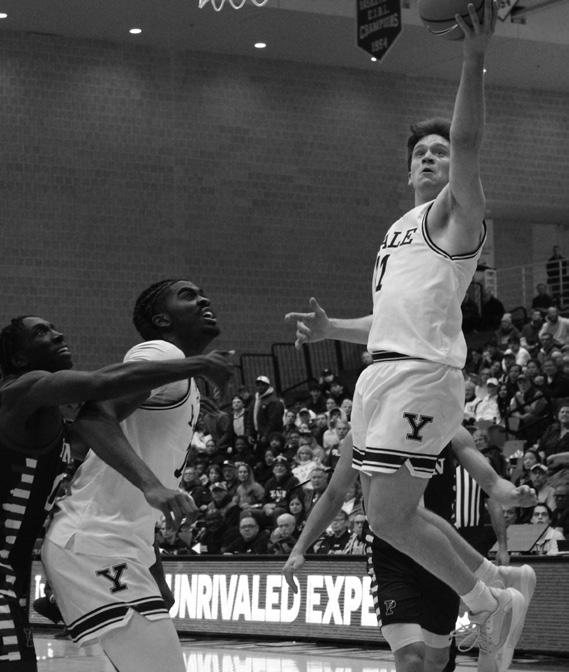
a 40-year career boosted by their education over a four-year basketball career –– even as more immediate financial opportunities exist elsewhere. The Ivy League remains the only Division I conference where athletes can neither receive athletic scholarships nor be paid directly by their schools.
In January 2025, the Ivy League declined to join the House v. NCAA settlement that allows schools to share up to $20.5 million in annual revenue with athletes, with the league’s executive director writing in a statement at the time that the move preserved an athletic culture “focused on academic primacy and the overall student-athlete experience.”
Yale and Penn, despite their success, have been no exception to the talent drain. The Bulldogs lost Danny Wolf ’26, now with the Brooklyn Nets, to Michigan two seasons ago and saw one of their top class of 2029 recruits, Nolan Groves, decommit from Yale in April to play for Texas
Tech. The Quakers lost second-team All-Ivy guard Sam Brown to Davidson, while former guard Tyler Perkins is now at Villanova.
The addition of Power, a former five-star recruit who transferred from Virginia after beginning his career at Duke, has helped fuel the Quakers’ return to the Ivy League championship after missing the tournament in the past two seasons. He led the team with 15.8 points per game before the conference final and earned first-team All-Ivy honors. For Yale, Simmons has served as a defensive anchor while contributing key rebounding and nearly 10 points per game.
The transfers have helped keep Yale and Penn ahead of other Ivy programs hit harder by NIL competition. Princeton, long a fixture atop the standings, fell to seventh place this season after losing all three would-be seniors to the transfer portal, including first-team All-Ivy players Xavian Lee, now at Florida, and Caden Pierce, who is headed to
Purdue. Brown slipped to last place after losing key contributors Kalu Anya and AJ Lesburt to the portal. The ability to insulate themselves from the loss of talent will likely be an important measure of success for Ivy League programs moving forward. That task will only grow harder as long as the league is unable to pay players, said Richard Kent, a sports attorney and NIL expert.
“Kids aren’t buying the 40-year argument when you’re looking at $500,000, $600,000 offers from other schools,” Kent said.
Spending on NIL products and services tied to men’s and women’s basketball reached an estimated $932.5 million in the 2025–26 season, according to a report from the NIL platform Opendorse. Penn defeated Yale 88-84 to claim the Ivy League title.
Contact BEN RAAB at ben.raab@yale.edu.






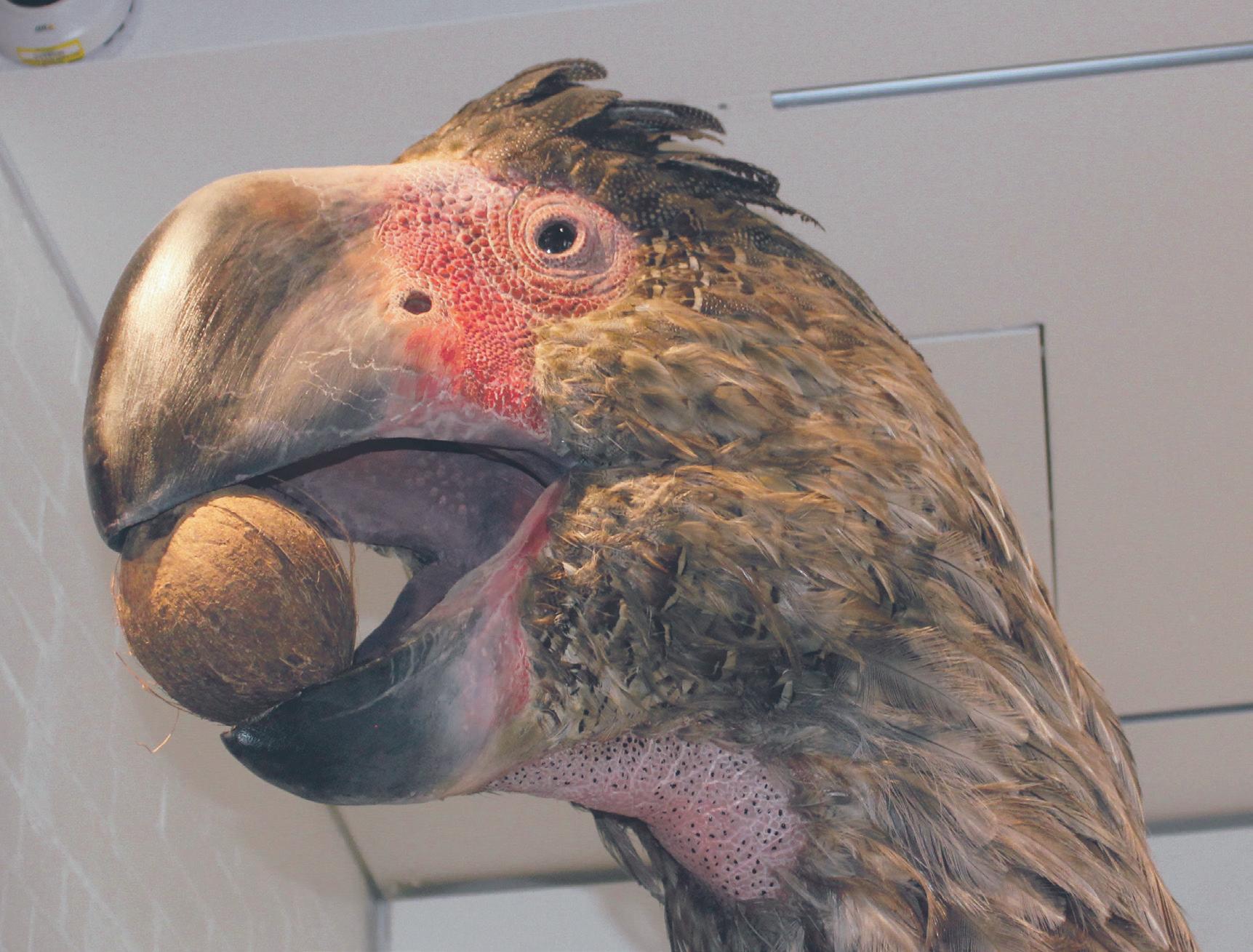

BY BRODY GILKISON STAFF REPORTER
Last Tuesday, as the final seconds ticked off the clock at the John J. Lee Amphitheater, a loss against the University of North Carolina Wilmington
BY LIZA KAUFMAN STAFF REPORTER
With a loss to Colgate in the opening round of the ECAC tournament, the Yale men’s hockey team (8–22–1, 7–14–1 ECAC) finished its first season under interim head coach Joe Howe earlier this month.
While the Bulldogs struggled to find consistency, especially on the road, the squad accomplished feats that broke long-time droughts and tallied two more wins than did last year’s team.
“I think our group learned a lot about what it takes to win big games,” captain David Chen ’26 wrote in a text message to the News. “It takes a full 60 minute effort every night and confidence in ourselves. I think the team next year should be excited and use the extra experience in tight games all year this season to their advantage.”
The Bulldogs opened the season with a 6-0 exhibition win over the Czech University Selects, a team of top Czech university players, at Ingalls Rink.
Following a difficult road loss to Dartmouth (22–7–4, 13–5–4 ECAC), the Bulldogs rebounded in their home opening weekend, which also marked the program’s Alumni Weekend and first two conference games.
On Nov. 7, Yale took down its cross-town rival, the then-No. 5 nationally ranked Quinnipiac Bobcats (26–9–3, 17–4–1 ECAC), by a score of 4-2. That was the first time the Bulldogs
BY AUDREY KIM STAFF REPORTER
The Yale Bulldogs (26–10, 16–6 ECAC) finished No. 8 nationally after a remarkable season, which
(27–7, 15–3 CAA) in the first round of the National Invitation Tournament — for teams that do not qualify for March Madness — brought the Yale men’s basketball (24–7, 11–3) season to a close.
This Bulldog squad had its fair share of highlights, honors and record-breaking performances, but also suffered from a number of bad breaks and errors which eventually prevented the team from achieving all of its preseason goals. Prior to the season’s start, guard Riley Fox ’28 listed what he thought of as the Bulldogs’ goals for the year: “Every year, we want to improve and grow together as a team throughout the season, get the No. 1 seed, win Ivy Madness, and make the NCAA tournament.”
In early November, Yale got off to a great start, winning 11 of its first 12 contests and enjoying a top 25 spot in the NCAA men’s net rankings — a metric the national tournament committee uses to determine seeding in March. However, a trip down south to Alabama resulted in a 24-point loss on Dec. 29, and, just two games later, the Bulldogs were upset by the Princeton Tigers for their first conference loss of the season.
After a weak shooting performance that resulted in the Jan. 10 loss against the Tigers, the Elis righted the ship and won four straight games, situating themselves at the top of the Ivy League with a record of 5–1 within the conference and 16–3 overall. By then, Yale had not only solidified its standing as the best SEE BASKETBALL PAGE 8
had defeated Quinnipiac in seven years. The next night, the Elis tamed the Princeton Tigers (18–12–3, 11–9–2 ECAC) 2-1 in an overtime thriller to go a perfect 2–0 in the start of ECAC play.
The two ECAC upset victories marked Yale’s strongest start since the 201011 campaign. “I have a lot of favorite memories but I think beating Quinnipiac at home this year was awesome,” junior forward Will Richter ’27 wrote in a text message to the News. “It was a huge game for us and our fans deserve more of those big time wins.”
Although road games continued to prove challenging for the team, the Bulldogs remained perfect at home over the start of Thanksgiving break, earning an ECAC victory over Brown (5–24–2, 4–16–2 ECAC) and a nonconference win over University of Nebraska Omaha (12–24–0, 8–16–0 NCHC).
The new year started with a quick trip to a rainy Palm Springs, where Yale competed in the second annual Cactus Cup, a four-team tournament featuring Division I programs from different conferences. There, the Bulldogs lost to two top-ranked opponents.
Back on home ice, the Bulldogs snapped a six-game skid with an 8-1 victory over St. Lawrence (7–25–3, 6–15–1 ECAC). First-year defenseman Hudson Miller ’29 opened the scoring, and five other Bulldogs also found the back of the net. In the final frame, sophomore Ronan O’Donnell ’28 and first-year Tom Molson ’29 each scored twice. Molson’s two goals marked his first two as a Bulldog. In their first road trip of 2026, Yale then swept New York’s Capital District to pick up its first two away
victories of the season.
An 8-3 victory over Rensselaer Polytechnic Institute (11–23–1, 8–13–1 ECAC) marked Yale’s second eight-goal performance in three games. A stout penalty-kill unit proved critical to the team’s success.
Against Union (22–12–3, 11–9–2 ECAC), the first years shined. Kurt Gurkan ’29 and Dylan Hunt ’29 assisted James Shannon’s ’29 game-winning goal, and Shannon and Molson each potted empty-netters to cap off scoring.
Despite inconsistent results in the following weeks, Yale showed resilience during a homestand against then-No. 12 Dartmouth and Harvard (16–16–2, 11–10–1 ECAC). Trailing 2-0 to the Big Green, the Bulldogs mounted a comeback to force overtime and a shootout against Dartmouth.
The following night, in a heated Valentine’s Day rivalry clash, the Elis defeated the Crimson in overtime in front of a packed crowd at The Whale. The crowd stood silent while referees reviewed footage of a potential goal. After the call on the ice was overturned in Yale’s favor, the team rushed the ice, securing its first win over Harvard in 14 meetings since 2018.
While the Elis struggled to find consistency down the stretch, they remained competitive in many of their final matchups.
“We have been through a lot of adversity over the past few seasons, and I think it has brought our team much closer together, especially our older guys,” Richter wrote.
At the close of the season, O’Donnell led the team with 12 goals, followed by Chen, Micah
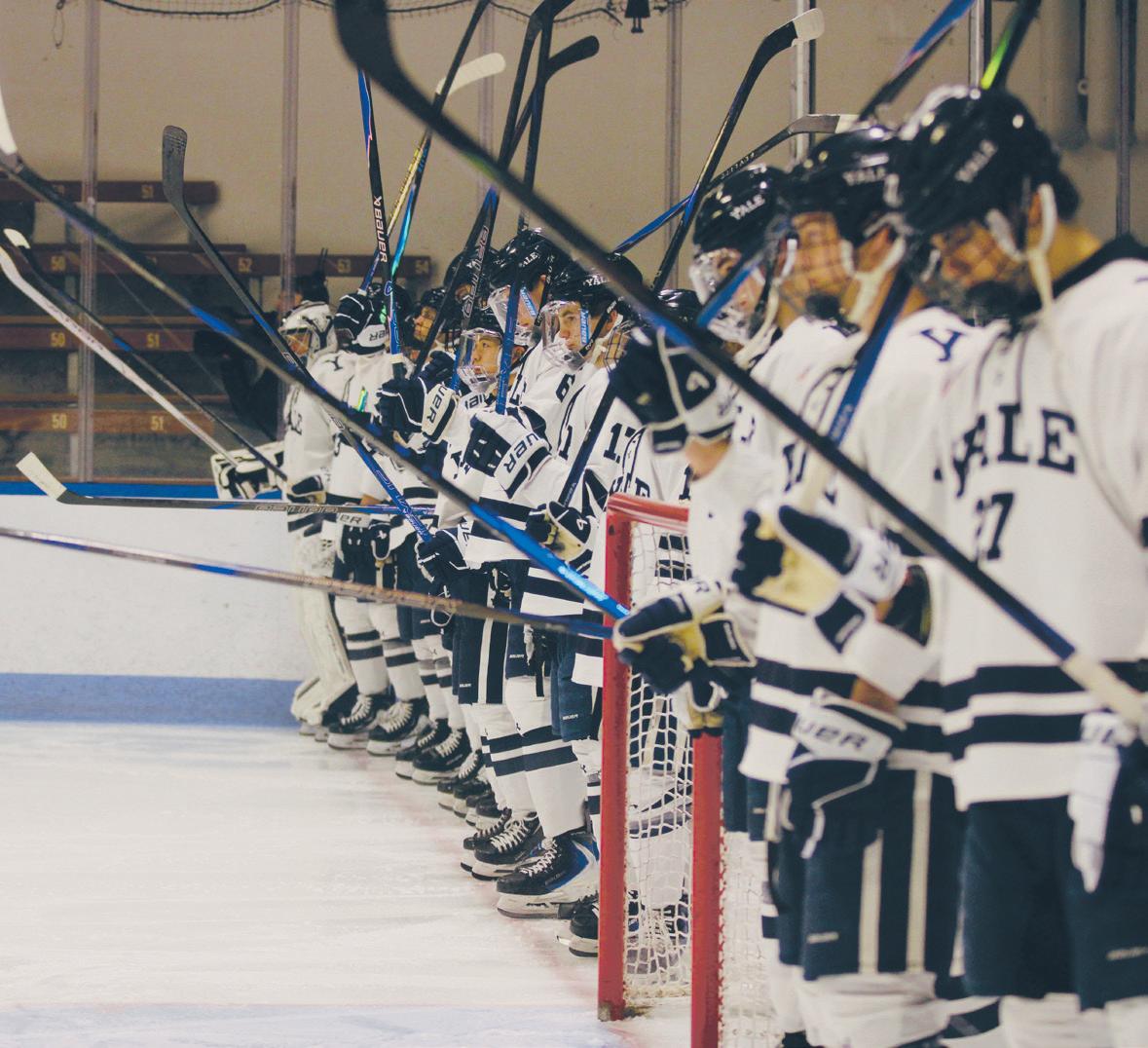
Berger ’28 and Richter with seven each. Chen’s 17 assists were a team high and also contributed to his team-leading 24 points.
Two Bulldogs also picked up Ivy League accolades. Chen earned Second Team All-Ivy recognition for his 10 points, 21 shots and 5 blocked shots against Ivy opponents, while Hughie Hooker ’28 was named All-Ivy Honorable Mention for his seven points, 14 shots and 5 blocked shots in the 10 Ivy games. Chen also made history as the first Bulldog to earn the ECAC’s highest academic honor, the ECAC Hockey ScholarAthlete of the Year award. With success this season
driven by key contributions from underclassmen and flashes of offensive power, the Bulldogs will look to build on their young talent as they head into the 2026-27 season, with rising seniors ready to step into key leadership roles.
“The season is still a long way away and we have a lot of work to do before then but I feel as seniors our role as a class puts us all in a leadership role where we will have to be a sort of rock for our team and lead from the front,” Richter, a rising senior, wrote. Yale’s men’s hockey team won the NCAA tournament in 2013. Contact LIZA KAUFMAN at liza.kaufman@yale.edu.
included capturing the ECAC regular season title and advancing to the quarterfinals of the NCAA national tournament.
The Elis finished the regular season atop their conference, earning themselves a first-round bye and home-ice advantage in the conference tournament. After taking down Colgate (19–16–1, 13–8–1
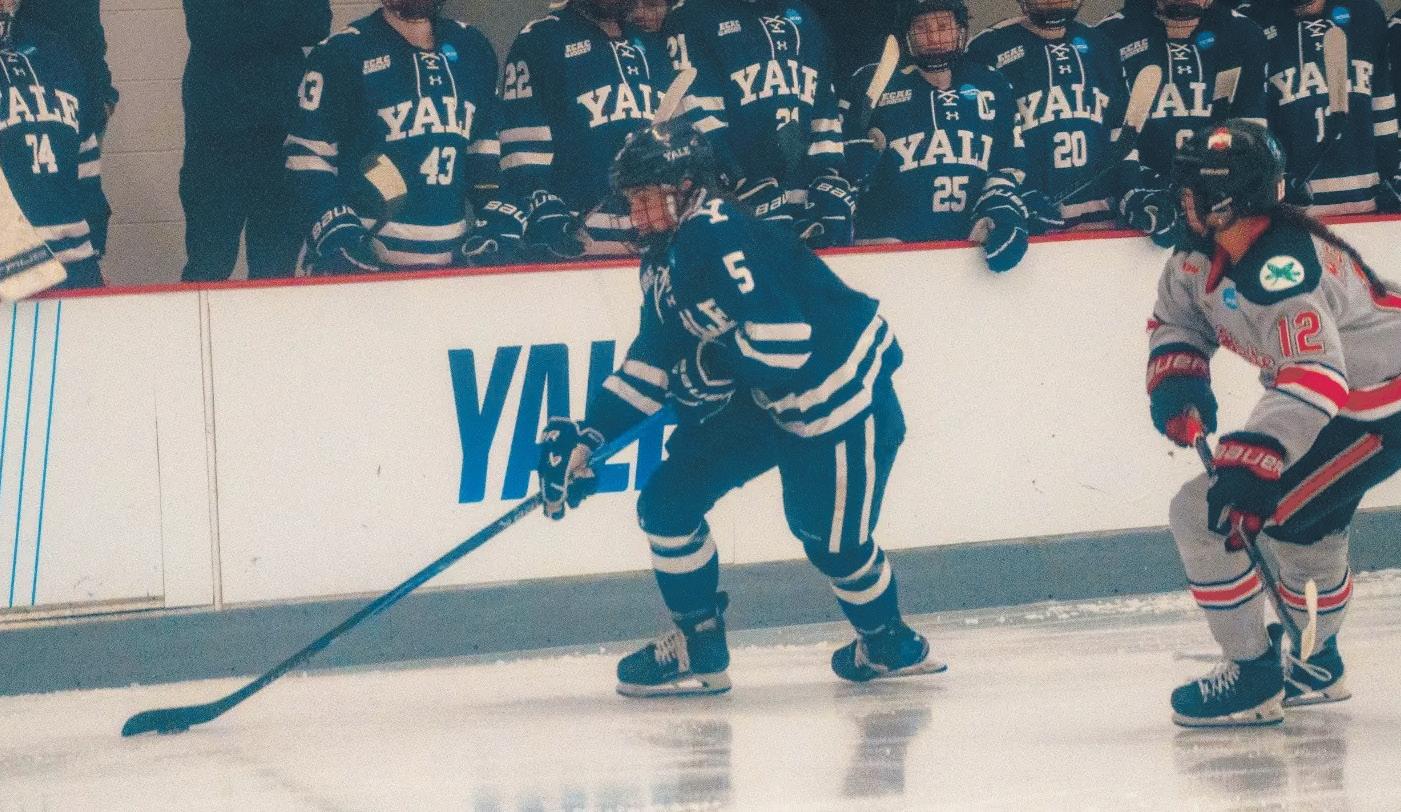
winning streak to rise from ninth in the ECAC to winning the conference’s regular-season title.
ECAC) in a dominant ECAC quarterfinal performance, the Bulldogs traveled to Lake Placid for the semifinal and championship matches. There, they defeated Cornell (20–11–2, 14–7–1 ECAC) in the semifinals on March 6, earning a place in the ECAC championship.
Despite falling to Quinnipiac (29–9–3, 14–6–2 ECAC) by four goals in the conference championship, Yale secured an at-large bid to the NCAA playoffs due to its high national ranking.
“This season was such an amazing experience for all of us. It was the first time the women’s ECAC championship was held in Lake Placid, and the arena was packed representing a great step forward for women’s sports,” Sophia Levering ’28 wrote to the News. “We played an amazing game against Cornell in the semifinals and were sad to come up short against Quinnipiac in the finals.”
The Bulldogs entered the NCAA tournament as the eighth seed, and the team beat Minnesota Duluth (20–15–3, 15–10–3 WCHA), the ninth seed, to advance to a quarterfinal game against first-seeded
Ohio State (36–5, 24–4 WCHA). In that matchup, the Bulldogs suffered a five-goal defeat.
“Having finished the first half of the season 9th in the ECAC, it was an amazing accomplishment to enter the NCAA tournament as the 8th seed nationally. Beating Minnesota Duluth was also a big bragging rights win for the ECAC versus the other strongest league, the WCHA. Ohio State was what you would expect of the best team in the country, but we are proud to have put our best foot forward and forced them to play a good game,” Levering wrote. Despite a less than ideal start to the 2025-26 season, in which the Bulldogs struggled to stay ranked in the nation’s top 15 and experienced several frustrating losses, the team was able to remarkably turn the season around halfway through. In December, the Elis began a 14-game win streak that propelled them to an ECAC regular season title and postseason first seed, a testament to the team’s growth and persistence. The 14-game win streak achieved during the 2025-26 came close to tying the record 15-game win streak that the Bulldogs notched during the 2022-23 sea-
son. The 2022-23 season was also the last time Yale appeared in the NCAA playoffs, when they fell to Northeastern in the quarterfinals.
“For the seniors, it was a full circle moment returning to the NCAA tournament which they had not been to since freshman year as the winningest class in Yale women’s hockey history,” Levering wrote to the News. “For everyone else, it was our first trip to the tournament and amazing to be able to participate in something we have watched since early in our careers. We have a lot to be proud of from the season, a lot to thank our seniors for, and a lot to build on for next year.”
Yale ended with the second highest national ranking in the ECAC, only trailing No. 7 Quinnipiac, and finished with the highest ranking in the Ivy League, leading No. 9 Princeton and No. 11 Cornell.
The Wisconsin Badgers (35–4–2, 24–3–2 BIG 10) defeated Ohio State to win their second straight NCAA women’s hockey title.
Contact AUDREY KIM at audrey.kim.ajk234@yale.edu.