
THEIR OWN

BY JANE PARK STAFF REPORTER
Marie cut ties with her parents at 21. While many people enjoy their parents’ phone or health insurance plans through college and beyond, Marie left that behind halfway through her sophomore year.
Marie — a current Yale senior who asked to be referred to by her middle name due to fear of retribution from her parents — had suffered a lifetime of
Librarian alleges unjust ouster
BY HENRY LIU STAFF REPORTER
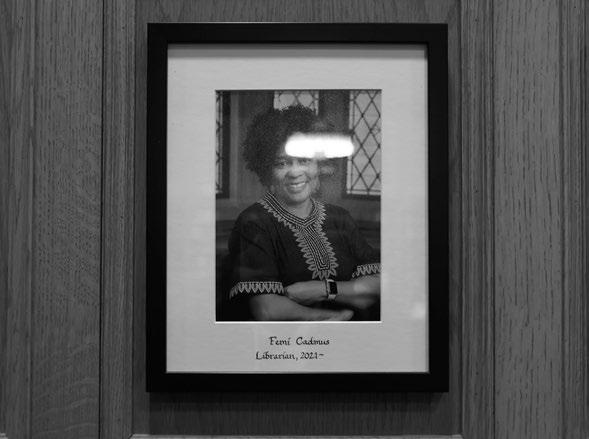
Femi Cadmus, who recently left her job as the top librarian at Yale Law School, defended her performance and said she had been unexpectedly fired, in a Zoom interview with the News on Thursday morning.
Cadmus was appointed the law librarian in 2021. Library staff reported that the workplace environment under her leadership was tense, stressful and marked by high employee turnover, a News investigation published in November found. The results of an employee engagement survey prompted an external review of the law library’s workplace culture, which was conducted by Jessica Wilen, an assistant professor at the Yale Child Study Center.
Cadmus said that her termination was “both improper and unlawful,” and she claimed that the Law School and the University represented her position as a tenured professorship, including in the human resources system Workday. She also disputed the results of the survey as grounds for termination and said she felt her firing was a “retaliatory response” to a complaint she said she submitted to
domestic abuse at her parents’ hands, she said in an interview. Though she’d considered emancipation during high school, Marie knew that she still needed her parents’ financial support to attend Yale, an “education that would sustain my life,” she said. After starting college, she began distancing herself from her parents and visiting home less frequently. Marie said she planned to end con-
Faculty ties to Epstein spark mixed views
BY JAEHA JANG AND OLIVIA WOO STAFF REPORTERS
A week after two Yale professors’ emails with Jeffrey Epstein were released, students and faculty members expressed mixed opinions about the professors’ contact with the convicted sex offender — and whether and how the University should respond.
Last Friday, the Department of Justice released some three million files related to Epstein, including his email correspondences with computer science professor David Gelernter ’76 GRD ’77 and with Nicholas Christakis, a Sterling professor of social and natural science –– both of which occurred after Epstein became a registered sex offender due to his prostitution-related convictions in Florida state court in 2008.
Gelernter — who exchanged emails with Epstein between 2009 and 2015 and described a student in one 2011 message to him as a “v small goodlooking blonde” — has told the News he had no regrets about his relationship with Epstein. Gelernter claimed in a Wednesday email to the dean of Yale’s engineering school, which the professor later forwarded to the News, that his message was a “rec letter” written with “the potential boss’s habits in mind.”
Christakis discussed his academic research and met with Epstein in 2013 to fundraise for his lab –– an effort that Christakis said did not result in any donations. In a statement to the News, Christakis described his interactions with Epstein as “very limited.”
Elicker stares down ‘Superstorm Donald’
BY ELIJAH HUREWITZ-RAVITCH AND NELLIE KENNEY STAFF REPORTERS
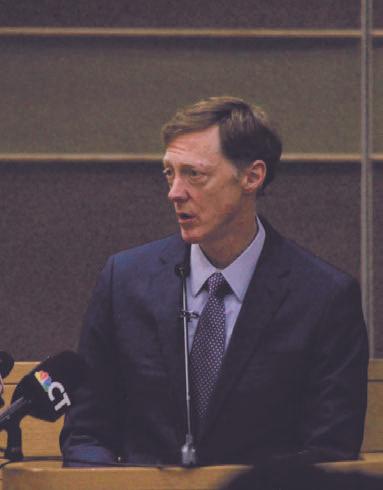
Mayor Justin Elicker declared that New Haven is “going big and being bold” in his State of the City address Monday evening as he sought to assure residents that President Donald Trump would not stand in the way of the city’s progress.
Touting his administration’s accomplishments over his six years in office, Elicker highlighted

Gelernter defends note on student
BY LEO NYBERG STAFF REPORTER
Computer science professor David Gelernter ’76 GRD ’77 defended his 2011 description of an undergraduate’s appearance as fitting for its recipient, the convicted sex offender Jeffrey Epstein, in a lengthy Wednesday afternoon email to the dean of Yale’s engineering school. Asked whether he regretted any part of his association with Epstein — which included newly released emails they exchanged between 2009 to 2015 — Gelernter wrote in a separate email to the News on Wednesday morning: “Nothing.”
Gelernter continued teaching as usual Tuesday, after a small group of students gathered outside his classroom.
In the Wednesday afternoon email to Jeffrey Brock ’92 — the dean of the School of Engineering & Applied Science — on which computer science professor Holly Rushmeier was copied, Gelernter gave an account of his relationship with an unnamed alumna whom he had described in the 2011 email to Epstein as a
STATE OF THE STATE
Lamont calls out high costs, ‘chaos’
BY ELIJAH HUREWITZ-RAVITCH AND NELLIE KENNEY STAFF REPORTERS
The country’s 250th anniversary was on the mind of Gov. Ned Lamont SOM ’80 as he opened Connecticut’s legislative session Wednesday, invoking Thomas Paine in his annual State of the State address. But the bulk of his 37-minute speech in Hartford was focused on the meat and potatoes of the state’s economy and the hard facts weighing on the wallets of state residents, whom he hopes will elect him this year to a third term.
“Unlike many other states, which are facing federal cuts or a deficit of their own, Connecticut is stepping up to protect our most vulnerable, and we’re trying to make life a little less expensive for working families and the middle class, who are getting slammed by higher costs,” Lamont said. Lamont highlighted his commitment to affordability and low taxes as the state enters its biennial budget revision process this year. On Wednesday morning, SEE STATE PAGE 5
Professors split time between NY, CT, MTA
BY JAEHA JANG STAFF REPORTER
History professor Daniel Magaziner wakes up at 5:15 a.m. on Tuesdays and Thursdays.
He then works out, grabs breakfast and leaves his apartment in Crown Heights, Brooklyn, by 7 a.m. to arrive at his Humanities Quadrangle office before his 11:35 a.m. class, he said in a phone interview. When he had to wake up at 4:30 a.m. for a 10:30 a.m. class many years ago, he “actually got very sick that semester” and “decided not to do that again,” he said.
Magaziner is not the only professor who commutes from New
York City. Every weekday morning, a small group of professors braves this interstate journey between New York and New Haven.
Four professors interviewed by the News said their long-established routines of traveling between the two cities — which include uniquely productive hours spent on the Metro-North or Hutchinson River Parkway — allow them to get the best of both cities in teaching, family commitments and cultural life.
Magaziner said when he started working at Yale 15 years ago, he decided not to move to

Garrett Curtis, Photography Editor
Nellie Kenney, Staff Illustrator
Ximena Solorzano, Head Photograpy Editor
YuLin Zhen, Photograpy Editor
This Day in Yale History, 1970
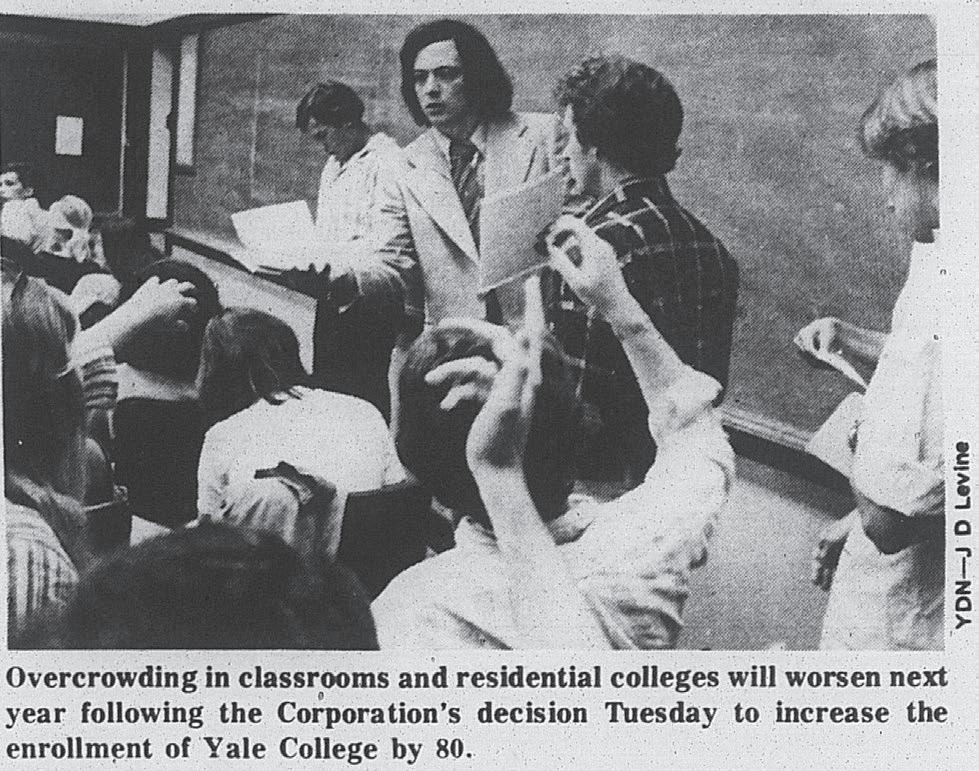
February 6, 1978 / Corporation raises enrollment by 80
By Leslie Eaton
The Yale Corporation voted last Tuesday to increase the size of Yale College by 80 students next year, the News has learned.
The increase will bring the total enrollment of the college to about 5150. Fall term enrollment was 5098 students last year, when colleges were already operating at 101.9 percent of their capacity, according to a report issued by the Council of Masters.
The increase in the number of students to be admitted is “in part related to the number of beds available on the Old Campus,” since the recent renovations, said University Secretary Henry Chauncey. The increase will include both freshmen and transfer students, he added.
The Corporation decided on the increase for financial reasons, Corporation Member William Bundy said. The increase is in effect for one year only, he said. “Next year, we may change our minds.””
by Maia Wilson

Behind the Headline
By Garrett Curtis, Photography Editor
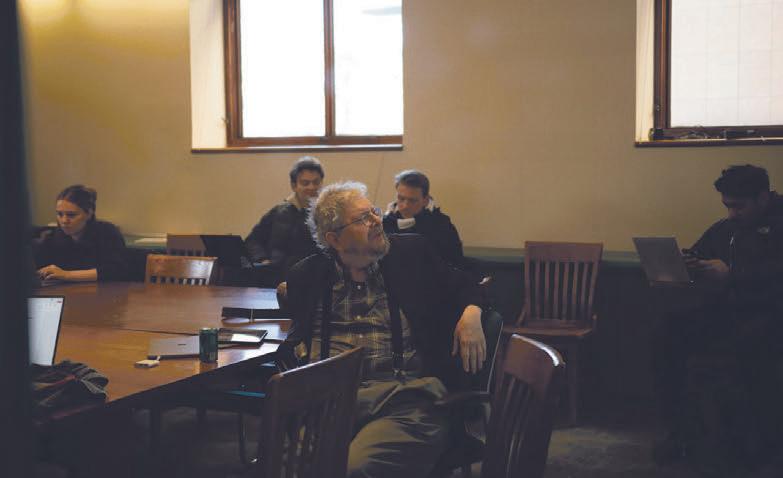
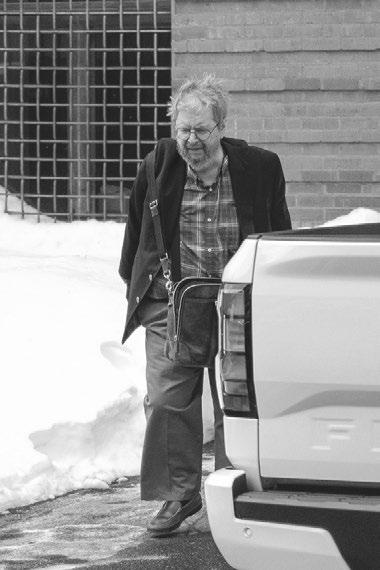
I was assigned to take a photo of professor David Gelernter, whose contact with convicted sex offender Jeffrey Epstein came to light in files recently released by the Justice Department, at his Tuesday class. I got to the building about 20 minutes before the class, but the “protest” against the professor that was all the buzz on the anonymous student app Fizz never really came together — people trickled in groups. When Nina Fattore, an administrator, reminded the small crowd that anything that disrupted the class would be considered a violation of Yale’s peaceful protest guidelines, it thinned out some. Gelernter arrived about 20 minutes late and slipped into the seminar so quickly that I could only get a blurry photo of the back of his head. Since the doors were made of glass, I took more photos through the doors. At the end of the class, I scrambled around back and, with luck, caught him leaving through the back door.






Read “Professor defends emails with Epstein, teaches after crowd gathers” on PAGE 7.
CORRECTION: An article published in the Jan. 30 edition about English professors’ policies for printed readings misstated the policy of writing professor Anne Fadiman. She requires students to buy the course packet and, when possible, to use physical copies of the books — not to buy either the packet or the books.
Substack and the personal brand
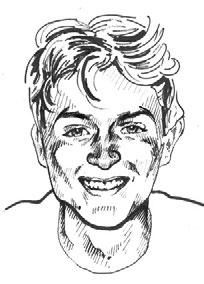
MANU BOSTEELS Staff columnist
Sometimes it feels like the mostread news site isn’t The New York Times or USA Today; more and more, it’s Substack. For those of you who haven’t heard, Substack is an increasingly popular writing platform that allows writers to publish newsletters and articles à la content creator. Here at Yale, it seems every week a new student’s Substack has gone up.
The list of everything that Substack is useful for certainly should not be ignored; here’s a nonexhaustive overview.
Substack helps remove the middleman from publishing. Less traditional forms of writing, especially creative writing, like poems, short stories and highly personal journal-style reflections, which typically are rather difficult to get published, are much easier to share on Substack. And in an era where many major news institutions are demonstrating their spinelessness in the face of Trumpism and business oligarchs consolidate control of publications to turn them into freemarket warriors, Substack allows responsible journalists to establish themselves independently from shifting bureaucratic leadership.
This article, then, is more of a cautionary tale: of the threat Substack poses, and more importantly, of the threat of the movement for the “personal brand.”
As with most new media platforms, Substack’s initial stars are people who are famous outside of Substack — current and former journalists, writers and pundits who can easily migrate to the latest monetizable writing format and bring along an already-established audience. Per Substack’s leaderboard for U.S. politics bestsellers, among the top 10 are Mehdi Hasan, Heather Cox Richardson, The Free Press and The Bulwark, all people and publications that were well established before Substack went mainstream.
However, I think it’s clear that, as with YouTube, X , Instagram, Tiktok and so on, Substack will soon be a platform where writers begin writing and become popular in the first place. This is where I think the situation gets fuzzy, particularly for journalism.
By removing the middleman, Substack turns journalism into an author-forward profession. I don’t think that’s a good thing. When you read The New York Times, the Guardian or The Wall Street Journal, you might gravitate towards the same names, but chances are you aren’t subscribed solely for Ross Douthat or Ezra Klein.
If you’re subscribed to Matthew Yglesias’ Substack, however, you are paying for Yglesias’ writing, full stop. What this does is elevate Yglesias — or any other author — as a name; not
just as an author, but as a personality.
It encourages journalists to build an audience not solely through their writing but through their own personal brand.
But there’s value in journalism, especially investigative writing, being faceless. It encourages journalists to prove themselves through meaningful reporting, not by writing charming bios or posting funny stories. It also means newspapers expose readers to several journalistic viewpoints; again, chances are you aren’t subscribed to USA Today just to read a single author. How many individual Substacks would you have to subscribe to in order to read the same variety of voices you can in just one or two newspapers?
The argument that Substack democratizes journalism, too, is a bit of an exaggerated or at least misleading invocation of “democracy.” Insofar as Substack allows anyone regardless of journalistic association to publish their writing, then sure, Substack democratizes journalism, in a barebones sense of the term.
Now take YouTube or TikTok; they, too, allow anyone to post their thoughts and build a following, regardless of background. Have YouTube and TikTok and the other algorithmic feeds seriously contributed to a more democratic, tolerant or informed society? I would argue they do the opposite. Part of the reason for this is that the process of atomizing organizational professions into individuals forced to create algorithm-marketable personas reduces the integrity of those professions. The proliferation of personal brands online also allows for parasocial internet communities that can quickly become extremist echo chambers.
There is significant value to institutions, too, even while many large outlets — I’m thinking here of The Washington Post and CBS — have proven themselves too weak to withstand external pressures and manipulation by political and corporate elites. But those associations are still more resilient than a single author on Substack, especially one who has to consider the direct relationship between what topics or opinions they write about and the subscriptions through which they make a living. And Substack is still a middleman here: What’s to stop Substack executives from turning against certain authors, or deciding to ban certain topics, or shadow-banning writers like other mass media platforms are accused of doing?
Substack isn’t an evil platform, and people should continue publishing their pieces there to their heart’s content. But like any other platform, it’s not perfect either, and when it comes to credible, highquality journalism, it has significant flaws. A Substack is not a newspaper, and we should be careful not to treat it as one.
MANU BOSTEELS is a sophomore in Pauli Murray College studying Philosophy and Math. He can be reached at manu.bosteels@yale.edu.

GUEST COLUMNISTS
TARREN ANDREWS & DAVID WATTS
Yale, defend academic freedom
Last month, Plato became the latest casualty of the escalating attack on academic freedom in the United States. An administrator forced a faculty member at Texas A&M to cut selections from the “Symposium” because of a new Texas law limiting discussions of race and gender on college campuses.
In a moment of intensifying attacks on higher education — including the termination of tenured and non-tenured instructors, state legislators positioning themselves as arbiters of faculty syllabi and university administrators cooperating with vague federal allegations at the expense of student rights and wellbeing — we all want to believe that Yale’s historical commitments are sufficient to protect ourselves, our colleagues and our students from the chilling effects of such assaults. They are not.
The opening lines of the celebrated Woodward Report, a 1974 assessment of the conditions of free speech at Yale, issue a soaring defense of “the need for unfettered freedom to think the unthinkable, discuss the unmentionable, and challenge the unchallengeable.” This broad language, and the way the report is reverently evoked at Yale might lead you to think that our academic freedom as faculty is institutionally guaranteed. But the university has argued otherwise.
Just two years ago, the academic freedom organization FIRE excoriated Yale for “shredding faculty rights” and turning its back on academic freedom. In response to a lawsuit brought by Bandy Lee MED ’94 DIV ’95, a voluntary clinical psychiatry professor let go in 2020 after tweeting about President Donald Trump’s “mental instability,” Yale’s Office of General Counsel made the remarkable choice to argue, in a brief in the United States Court of Appeals for the Second Circuit that the mentions of academic freedom in the Faculty Handbook, incorporated along with references to the Woodward Report, are not “sufficiently specific” to constitute a contractual promise. In short, the University asked the court

to treat the principles of academic freedom that it regularly celebrates as legally nonbinding. Chillingly, the court agreed. Yale’s legal position was protected, while its professed commitments were sacrificed.
Remarkably, under a new union contract which includes specific definitions of academic freedom, graduate students have more substantive protections than do researchers and faculty.
After researching several peer schools’ policies on academic
freedom and faculty governance — including Brown, Penn, Dartmouth, Cornell and Stanford — the newly established Yale chapter of the American Association of University Professors, joined by members of the FAS-SEAS Senate, drafted proposed revisions to the Faculty Handbook that aim to accomplish three modest but important things.
First, they define academic freedom in definitive, operational terms, and make clear that all Yale faculty, regardless of rank or tenure status, enjoy freedom in research and publication, freedom in teaching, freedom to participate and comment on matters of university governance and freedom to speak in public as citizens and public intellectuals.
Second, the changes propose that the handbook will not be further revised without first consulting a committee of Yale faculty chosen by the FAS-SEAS Senate along with faculty from the professional schools, who are not otherwise represented by the senate. Otherwise, the academic freedom portions of the handbook, and other terms of faculty employment, can be revised by Yale’s provost without notice or discussion with any representative body of faculty.
Burnout is not a
We’ve all sat at lunch listening to friends half-complain, half-brag about their packed schedules and lack of free time. When asked how they are, responses like “busy”, “swamped” or, a personal favorite of mine, “another day in paradise” are customary. Simple as they might seem, at Yale, these answers aren’t just updates. They’re credentials, proof of legitimacy and worth — that we must be doing something right. But in a place designed for learning, why does “doing well” so often look like “barely hanging on”?
Everyone gets tired in a busy college environment, and working hard is admirable, but displaying tiredness as a marker of commitment has become a norm of social currency at Yale. It’s both a subtle flex of how indispensable or in-demand you are, and a preemptive excuse for mistakes and slip ups. It can be a safety net for ego and self-worth. When we’re overextended, any failure can be rationalized as the result of exhaustion rather than lack of ability. Burnout isn’t necessarily seen as an urgent problem, but can instead be viewed as proof that we’re making the most of things.
Yale students arrive on campus highly conditioned by competition, pressure and extracurricular overload. Free time can often be equated with lost opportunity. Our institutional incentives reflect
Third, the revisions make clear what we believe is already the case but should be stated clearly: that faculty are employed by the university, not by departments, and that no department will be dismantled without consultation with faculty. We hope Yale will act quickly to adopt this modest proposal to put its professed commitments to academic freedom in writing.
President Maurie McInnis herself has emphasized the importance of action over mere statements. And faculty have spoken: for two years, faculty members across schools and divisions have made it clear in open letters with hundreds of signatories that Yale needs to be proactive in this moment of crisis, to protect the values we hold dear in deed, not just word.
In October 2025 the FASSEAS Senate voted affirmatively on the proposal and issued a recommendation that the University administration revise the Faculty Handbook accordingly. It is our understanding that the administration is considering the proposal, but we have received no firm timeline for an official response. This leaves the Yale community at an inflection point. Our peers like Columbia; Harvard; Northwestern University; the University of California, Los Angeles; the University of California, Berkeley; the University of Virginia and the University of Chicago have already demonstrated how quickly philosophical principles can be strained when financial security is at stake. In such moments, aspirational language, no matter how eloquent, cannot shield faculty, students, administrators or staff. We need real, enforceable protections of academic freedom. And we need them now.
TARREN ANDREWS is assistant professor in the Ethnicity, Race, and Migration and faculty in the medieval studies program. She can be reached at tarren.andrews@yale.edu.
DAVID WATTS is Alison Richard Professor of Anthropology. He can be reached at david.watts@yale.edu.
badge
this mindset: prestigious, selective clubs with lucrative leadership positions, competition for internships, honours, prizes and more. These aren’t necessarily bad things: Working hard and being proud of that work is a virtue. But sometimes our intentionality can be lost along the way.
Being busy isn’t the problem. The issue is staying busy just because you feel you are supposed to. Remaining focused on what you’re passionate about and engaging meaningfully is the point. As someone who is often guilty of this as well, it’s important to not become confused between viewing the best students as the ones who are in a perpetual state of ‘doing’ versus those who are actually learning and achieving. Higher education is an opportunity for deeper thinking and considering the bigger, more complex problems in our respective fields. As one of the few times in life when we are truly given space to do this, it would seem a shame to minimise it or make it part of a ‘to do’ list rather than really capitalize on it. A rushed, hectic culture isn’t designed to give scope for that. Being at Yale is an immense privilege and joy, and it’s understandable to want to maximise that experience. A culture of busyness undeniably has a vast array of motivating benefits that might seem to achieve this, but slowing down to focus can raise some uncomfortable questions. What do I want to do? What am I doing? How should I be doing it? These are questions that are difficult to confront in a flurry of commitments and activities. Broad shallow engagement, most would agree, is less desirable than deep work and
real involvement. Constant multitasking and jumping from place to place naturally fragments our attention. We skim instead of read, we produce writing instead of creating essays and we fall into the trap of “checking boxes.” If maximising the Yale experience means depersonalizing our days into “just getting through the week”, then how much value are we really extracting? Even worse, when burnout becomes a badge of honour, resting might become something that we hide, or apologize for.
Unstructured time can be anxiety-inducing for some, and staying busy provides community, identity and a sense of momentum. “Grindset” burnout culture doesn’t just exist because academic institutions like Yale reward it, but because we might sometimes fear what arises in its absence. Mental health and wellness support are great resources, but looking at the bigger picture involves aiming at things we really care about and are passionate about. What if we could answer the age-old question of “how are you?” with something other than “busy”? Would we feel more satisfied and oriented? I would argue that the real measure of how well we use Yale, or any other experience for that matter, isn’t how much of ourselves we’ve spent, but how much we’ve built up and developed.
GEORGE BEEVERS is a first year in Pierson College. His fortnightly column, “The Learning Curve,” examines how students and institutions navigate the evolving standards, pressures and possibilities that define the pursuit of knowledge today. He can be reached at george.beevers@yale.edu.
“Bring me the sunset in a cup.”
Professors who commute get the best of two cities
COMMUTE FROM PAGE 1
New Haven because of his wife’s job as a union lawyer. Since there weren’t a “plethora of options” for her in New Haven and her schedule was more demanding than his, “it obviously made sense for me to be the one to commute,” Magaziner said.
“This works for my life,” Magaziner said. “This is where my wife works and our community is, and so I don’t know that I would ever change it.”
English professor Pamela Newton, who also commutes to Yale from Brooklyn, wrote in an email to the News that she leaves her Brooklyn house around 7:45 a.m. and arrives to campus around 10:45 a.m. She also said that having many friends and family members in New York makes it difficult to relocate.
Born and raised in Manhattan, Newton is “very dug in” to the city, she wrote, and her husband’s family is in New Jersey as well. It would be a “big undertaking” for her husband, who is a woodworker, furniture maker and woodworking teacher, to “dissolve and restart his business” in New Haven, she added.
Randi Epstein MED ’90, an English professor who commutes from Manhattan, said that when she started her stint at Yale, she had four children who were attending school in New York, which made it difficult to move. Instead, she rides her fold-up bike from her uptown apartment to the Harlem 125th Street Station to board the Metro-North, she said in a phone interview.
“I’m one of those New York City people that thinks New York City is the greatest place in the world,” she said. “I just can’t imagine living anywhere else than near Central Park, near the theater, near everything New York City has.”
Newton also wrote that she’s a “real big-city person” who enjoys New York’s artistic and cultural scene. When she takes her students — from her two writing courses on the theme of cities — on field trips to New York, living in a city that demands a threehour commute can even be an advantage, she wrote.
Epstein, however, added that she is often unable to see her students’ extracurricular performances, such as concerts or dance recitals, because she doesn’t like to get back to New York late at night.
Aaron Tracy GRAD ’04, an English professor who commutes from Brooklyn Heights once a week, said he wishes he was able to “hang out” more with his peers. Derek Green, a colleague in the English department, had a reading for a new book recently, and Tracy missed it because he wasn’t in town, he said.
“But yeah, that’s the price I guess I have to pay for choosing to live in Brooklyn,” he said in a phone interview, adding that his favorite parts about Brooklyn Heights are the “million activities” for his two young children and the “million great restaurants and bakeries.”
Newton wrote that around twice a semester, she comes to New Haven on non-teaching days to attend meetings and sleeps over at a colleague’s house, a hotel room or an Airbnb.
Newton added that the cost of commuting is a challenge. When she was first hired by Yale, she wrote, she was “given a definitive no” on getting her commute reimbursed, and she saw her ticket prices as a minor burden that lets her “live this dual existence.”
“But it can really add up. And the prices just went up this month on all Metro-North fares, so the cost burden got significantly larger,” Newton wrote. “Another challenge is that it can be exhausting. Commuting for three hours in each direction takes its toll. I often feel like I spend the next day recovering.”
Three professors agreed that Zoom “changed everything” for meetings.
While Tracy said he drives up to New Haven a few hours before his first class on Wednesday so that he can meet with his students in person, he said he can meet with students on Zoom “any afternoon that they want.” Zoom is “just incredibly helpful,” he said, especially considering how busy Yale students are.
Magaziner, who regularly meets with students in his position as the history department’s director of undergraduate studies, said that he thinks many students prefer remote office hours. While he recognizes Zoom has limitations, he said he thinks “we all benefit from it.”
“If you have a simple question, lining up outside of someone’s office, especially when it’s cold out, like now, is not necessarily how people want to do it, so they’d rather log onto Zoom for five minutes,” he said. “Every day of the week, I’m doing Yale-related things. I just sometimes am physically, as I am right now, in my kitchen in Crown Heights and not in my office in New Haven.”
Newton also wrote that she never misses any of the monthly meetings for the departmental committee that she’s on because they are on Zoom. Meeting with students virtually as a writing tutor for Pauli Murray College, too, has worked “quite well,” she added — unlike teaching via Zoom, which she does not enjoy. Epstein, however, said that she tries her best to meet with students

in person and not on Zoom.
“I think that we, post-pandemic, we really appreciate in-person things now,” she said.
“I just think it’s a nicer way to get to know people and get to know students.”
An ‘office on rails’
Epstein said if she “just sat on the Metro-North and went from New York to New Haven back and forth all day long,” she would finish writing the book she’s working on “much faster.”
The two other professors who take the Metro-North agreed that the time they spend on the train is some of their most productive of the day.
“Once I’m on Metro-North, that’s like my happy place because I can spread out and I have two solid hours to get work done,” Epstein said. “New Haven is the last stop, so I can really focus on my work. I don’t have to pay attention that I’m going to miss my stop because when you get to New Haven, they keep yelling, ‘This is the last stop. Gather your belongings. Do not leave anything.’”
Magaziner said his time on the Metro-North is “dedicated work time.” He finds it so “conducive to work” that not riding the train during the pandemic even felt challenging. He said he does a lot of his administrative work, as well as reading and writing, on the train.
Having a home with children can be time-consuming and distracting, he added, so his time on the train — when no one is demanding anything of him besides work — is “sacrosanct.”
“I always very religiously only take Metro-North,” Magaziner said. “It’s slow, but it gets you there, and it has these big, beautiful windows that look at some really beautiful shoreline landscapes. And I just find it to be a net positive in my life.”
The subway, however, is one of the least favorite parts of his commute, he said. Newton also wrote that she is “quite productive and focused” on the Metro-North and that getting work done on the train — which she calls her “office on rails” — allows her to be more present at home. She has gotten “really good at knowing exactly how much work” she can get done in a twohour train ride, she wrote. Newton added that she prepares for class for most of her train ride in the morning, and while she tries to get work done on her way back home, she often finds herself “brain-fried” and does the New York Times crossword instead.
Adam Sexton, an English professor who moved from Park Slope, Brooklyn, to Guilford, Connecticut, after his second year of teaching at Yale, said he didn’t find his Metro-North commute particularly productive.
While he told himself he would work on the train, he found only two of the seven hours he spent commuting genuinely productive.
“Certainly the ride home, I tended to just pass out and sleep, you know, after a day of teaching and meetings and tutoring sessions and so forth, so that was wasted time,” Sexton said in an interview. “It was hard to work on the subway from Brooklyn to Grand Central, so that hour was sort of wasted.”
While he misses living in Brooklyn and used to think he and his wife would spend the rest of their lives there, Sexton added, he now appreciates his 30-minute commute, as well as being able to spontaneously get in the car and see his students’ performances.
Tracy, who teaches “Narrative Podcasts,” said he enjoys listening to podcasts and audiobooks during his drive between Brooklyn and New Haven. A self-described “podcast junkie,” Tracy said his commute — between an hour and 20 minutes and an hour and 45 minutes — is a “great opportunity to catch up” on his “very long queue” of podcasts.
“If you listen at 1.3 times speed, you can get a lot of podcasts finished,” he said.
The drive is also “lovely,” Tracy said, especially if one takes the Hutchinson River Parkway. While he took the Metro-North — which he “really liked” — when he lived in Manhattan, the extra leg from Brooklyn to Grand Central would have added too much time to the Metro-North commute, he added. According to Magaziner, having a routine is crucial for anyone who commutes for work.
“I think anyone who commutes for work, which, you know, would describe most Americans, knows that the key to doing it is to have a routine,” he said. “They just seem like, ‘This is what we do.’”
The Metro-North Railroad began its services in 1983, according to the Metropolitan Transportation Authority’s website.
Contact JAEHA JANG at jaeha.jang@yale.edu.
Former law librarian defends her record in interview
the Office of Institutional Equity and Accessibility in December.
“My firing was arbitrary, capricious and, quite frankly, reckless,” Cadmus said. “There are processes in place for faculty members that were not followed.”
“No one gets terminated over an employee engagement survey that projects low morale,” Cadmus added, while conceding that the results were “not good for sure.”
According to a screenshot of
her Workday page that Cadmus took on Thursday and shared with the News, her title is shown as “professor of law” and her tenure status is listed as “continuing.”
Alden Ferro, a Law School spokesperson, wrote that he could not discuss personnel matters and referred to a previous statement in which he denied that Cadmus’ position as law librarian entailed tenure.
“The Law Librarian does not have tenure. The title of Professor of Law is coextensive with service as the Law Librarian. The
conferral of tenure is an extensive process at Yale, requiring a faculty vote, recommendation to the provost, and approval by the Corporation. The Law Librarian position does not go through the tenure process,” Ferro wrote in the statement.
Cadmus said she was sent a formal termination last month with two-weeks notice, which she said was unprecedented for a faculty member. Her last day of employment was Jan. 29.
Cadmus added that when she dismissed three book monitors — who kept watch at library entrances to prevent book theft — over the summer, the employees were given 60-days notice.
Cadmus cited Yale’s Faculty Handbook, which details faculty ranks at Yale, including at the Law School, to support her claim that she held tenure as law librarian.
“It is not a vanity title,” she said, referring to the title of professor.
“If Yale’s giving a vanity title, are they doing that because I’m a person of color? I hate to bring race into it.” Cadmus is Black.
Cadmus then mentioned a provision in American Bar Association Standard 603 — for accredited law schools — which states: “Except in extraordinary circumstances, a law library director
shall hold a law faculty appointment with security of position reasonably similar to tenure.”
In an interview with the News, former law librarian Blair Kauffman told the News that when he held the job, he had tenure.
“I certainly understood that I had tenure, or I wouldn’t have taken the job,” Kauffman said. “I wasn’t going to leave that tenure post for a position at Yale without it,” he added, referring to the tenured position he held at the University of Wisconsin before coming to Yale.
Cadmus also said that the survey results were not as bad as some had suggested.
“I don’t know what the hierarchy of results were, but trust me, it’s Yale. I’m sure that there are other departments who had very bad results,” Cadmus said. “I was stunned.” Cadmus said she felt the termination was a retaliatory move after she submitted a complaint to the Office of Institutional Equity and Accessibility. She said she submitted documents on Dec. 22, in which she named former Dean Heather Gerken, Listokin and Senior Associate Dean Joe Crosby as parties. Cadmus said she alleged in her complaint that she had been treated “unfairly and inequitably” and that her ability to make
personnel decisions had been “limited.” Specifically, Cadmus said that the Law School had “stymied” some hires that she had approved.
Cadmus said that she was only shown a redacted version of Wilen’s report and did not see her recommendations. When asked to explain the low morale and high turnover at the law library, Cadmus defended her record.
“Everyone’s talking about what went wrong. No one’s talking about what went right,” Cadmus said. “Historically, things were not good. Addressing and shifting culture is not something that you do overnight.” Furthermore, Cadmus disputed the notion of high turnover, saying that many employees had left for promotions and the turnover rate was normal. When asked if she was considering legal action against the law school, Cadmus said, “I’m reserving my options.”
The Rev. William Woodruff Atwater was appointed by the Yale Corporation to be the first law librarian in 1873, according to a Law School webpage.
Contact HENRY LIU at henry.liu.hal52@yale.edu
YuLin Zhen, Photography Editor
Logan Dinkins, Staff Photographer
FROM THE FRONT
“All summer I made friends / with the creatures nearby.”
Mayor says Trump won’t stop progress on local policy
CITY FROM PAGE 1
continued growth in New Haven’s biotech industry. He also mentioned new investments in the city’s quantum technology industry, the expansion of transit programs like Veo e-scooters and the Via NHV rideshare service, plans to redevelop blighted sites like English Station and a youth center and a new school opening soon.
“The long-range forecast for our city is bright,” Elicker said, despite “Winter Storm Benjamin” — the recent snowstorm — and “Superstorm Donald.”
Including that meteorological moniker, Elicker mentioned the president and his administration eight times during his speech, up from two at his 2025 address.
Elicker pointed out last year’s drop in major crimes, though he also acknowledged “this moment when the police department has faced some unexpected challenges.”
The mayor did not explicitly address former New Haven Police Chief Karl Jacobson’s alleged theft of $10,000 from a department fund. But he thanked acting Chief David Zanelli for “stepping up.” In an interview after the speech, Zanelli said that he had not expected Elicker to mention the recent turmoil at the New Haven Police Department.
“The mayor has done a great job supporting the police department, as have all the alders,” Zanelli said.
Elicker drew attention to the new public safety technology he said the city has recently adopted, including new cameras, a new crime center and equipment for analyzing gun and DNA data. He added that the city’s work with state legislators has provided New Haven with “tools to hold ATV and dirt bike riders, street racers and people using mega speakers accountable.”
Pointing to the role of street design in public safety, Elicker discussed shifts underway in New Haven’s urban fabric.
The mayor said his administration is transforming the city’s roads from “thoroughfares designed for our suburban community commuters to get in of the city and out of the city as fast as possible to safer, multimodal streets that help our residents get around their own neighborhoods.”
Elicker also touted New Haven’s support for its local businesses and entrepreneurs, giving particular emphasis to the city’s growing life science and quantum technology industries. He highlighted the fact that the
new Connecticut quantum nonprofit QuantumCT will be based in New Haven.
The mayor said that two buildings that have sprouted thanks to the city’s “bioscience boom” — 100 College St., which is occupied in part by global biopharmaceutical company Alexion Pharmaceuticals, and 101 College St., which is home to the University’s entrepreneurship hub Yale Ventures — are contributing nearly $8 million to the city’s tax rolls.
But in discussing New Haven’s perennially underfunded public schools, Elicker called for Connecticut to increase its financial backing — the same plea he made in last year’s State of the City address and one he has continued to make.
“Our students and our teachers and our schools will never get the full support they need until the state of Connecticut updates its education funding formula,” Elicker said. The mayor added that he was “cautiously optimistic” that in the state’s upcoming legislative session, which begins on Wednesday, “we’re going to see some significant change to how the state funds public education.”
Though Elicker often calls on Yale and Connecticut in tandem to give New Haven more, the mayor mentioned the University just twice in passing. He shouted out a New Haven high school student who was admitted to the Yale class of 2030 and mentioned the money the city receives from the University’s voluntary contribution.
Negotiations between Yale and New Haven over how much the University will contribute are underway. In December, Elicker told the News that he was “cautiously optimistic” both parties would agree to an updated deal by March 1, when he must submit a proposed budget for the next fiscal year to the Board of Alders. Asked on Jan. 21 if that deadline still seems feasible, Elicker said that “it’s very important that we hopefully settle something prior to that date.”
‘Superstorm Donald’
Elicker opened the speech by acknowledging the Trump administration, which he called an “endless dumpster fire of chaos and cruelty.” New Haven has signed onto four lawsuits and two amicus briefs against the Trump administration since the beginning of the president’s second term. Last Friday, the city joined an amicus brief challenging the administration’s immi-
gration crackdown in Minnesota.
In Monday’s speech, Elicker continued to draw a sharp contrast between what he described as New Haven’s values and the president’s.
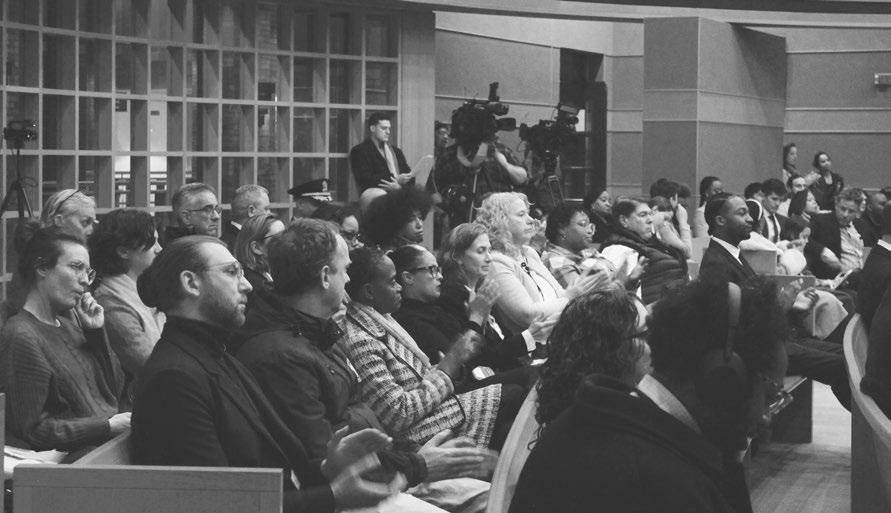
“We will continue to stand up for New Haven,” Elicker said. “When the Trump administration comes for one of us, they come for all of us.” His statement was met with lively applause.
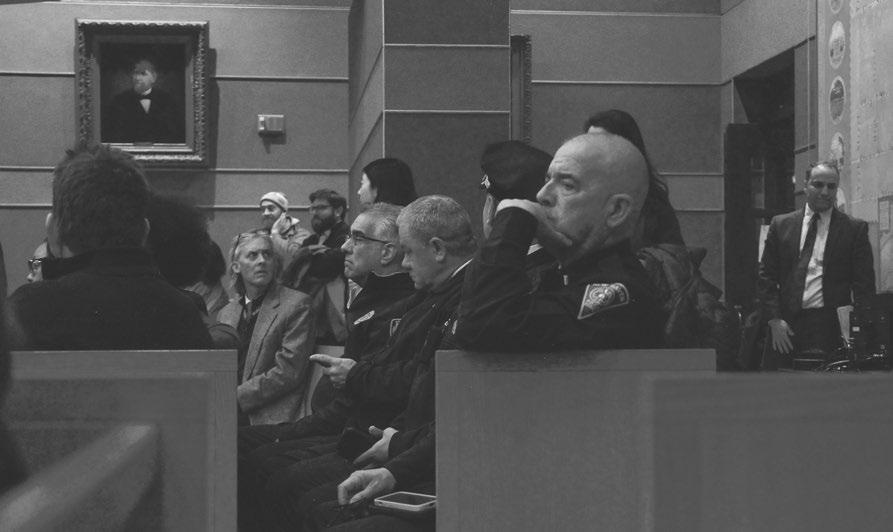
Nearly all of the city’s alders were present for the speech. Several city officials, plus around four dozen New Haveners, came to hear their mayor. Among the aspiring politicos in the audience were Christine Kim, the Democratic nominee in the special election for Ward 7 Alder, and Justin Farmer, the Democratic Socialist hoping to unseat state Rep. Patricia Dillon SPH ’98. Elicker concluded his speech
by calling for optimism.
“As a city, we will not let the Trump administration distract us from our continued work of improving our city every day, tackling these big problems every day and striving to accomplish great things together,” he said. Ward 27 Alder Richard Furlow, who represents parts of Amity, Westville and Beaver Hills, said he was less concerned about the president than he was about unity within the Democratic Party, both nationally and in New Haven.
“I don’t find Trump to be the issue,” he said. “I think the issue is we just need as a Democratic Party to keep our agenda tight. And when we do that, there will be nothing he can do.”
While Furlow said Elick -
er’s theme of “staying together in the storm” was “the right theme,” he added that the city’s “laundry list is a lot longer than our accomplishments.”
Ward 24 Alder Evette Hamilton, who represents Edgewood, said she was “optimistic” about the mayor’s speech and the year ahead. She said she agreed with Elicker’s emphasis on Trump.
“It’s a big agenda for 2026, but I’m ready — and we’re ready — for the challenge,” she said. Elicker’s speech lasted around 32 minutes.
Contact ELIJAH HUREWITZ-RAVITCH at elijah. hurewitz-ravitch@yale.edu and NELLIE KENNEY at nellie.kenney@yale.edu.
Governor stresses affordability, tells ICE to ‘go home’
the governor proposed a budget for the 2027 fiscal year that will be reviewed by lawmakers during the legislative session, which will center on revisions to the two-year budget passed in 2025.
Lamont did not once mention “Trump” or “the president” in his speech. But touting Connecticut’s continued fiscal stability — his hobbyhorse — he said that “the chaos in D.C. is the opposite of what we’re doing in Connecticut.”
Housing
Lamont said housing stock is essential to affordability, and he wants to make it easier to build more.
“Making life a little less expensive means more housing in a state where more and more people want to be — as long as they can find a place to call home,” Lamont said.
He celebrated housing development and praised Sen. Bob Duff and Rep. Jason Rojas, state legislators who championed a housing bill that Lamont signed into law in November after vetoing more aggressive legislation. The law is poised to boost housing construction in cities like New Haven.
Lamont said that local leaders should guide development.
“Towns take the lead,” he said. “Mayors, you tell us where you want housing and where you don’t want housing. Let’s say no to building in that open field. How about yes to reimagining that old parking lot, that
old mill sitting empty, that half empty suburban shopping mall, that under-used office building, all of which could be retrofitted for housing.”
Lamont also praised transit-oriented development, which he said has led to “much less need for cars, for parking lots, less traffic and less cost to you.”
Just two days ago, in his State of the City address, Mayor Justin Elicker highlighted just this kind of development as he discussed the coming redevelopment of a disused site across the street from Union Station.
Education
Acknowledging the tremendous wealth disparity among the state’s school districts, Lamont promised to sign an executive order creating a “blue-ribbon commission” on K-12 education that will “focus on an updated funding strategy.” It would also look towards ways to reduce overhead to save money “for the classroom and taxpayer.”
In 2023, Lamont established a panel charged with developing a five-year strategic plan for the state’s childcare system. That panel “worked, and it’s going to work this time as well,” he said.
In Elicker’s State of the City address on Monday, he called on the state to reform its education funding formula, which he called “outdated.” Elicker said that New Haven students’ needs have “far outpaced current levels of state funding.”
In a phone interview Wednesday afternoon, Elicker said that although he was hopeful the
governor’s commission would address systemic issues with education funding, New Haven needs an immediate boost.
“The need is urgent. The need is this year,” he said.
Elicker, who was in the state House of Representatives chamber for Lamont’s address, said that in that regard, he was unsatisfied and “disappointed” with the speech.
Lamont’s proposed budget for the 2027 fiscal year preserves last year’s $95 million increase to Education Cost Sharing funding but does not increase the program’s funding, putting him at odds with several Democratic lawmakers.
Lamont also highlighted plans to build on recent special education reforms. Last year, the Connecticut legislature unanimously passed a bill which increased state oversight of private special education providers and allotted an additional $30 million to the state’s 2026 special education budget. New Haven Public Schools would require about $8 million in additional funding each year to keep up with rising enrollment of special needs students, according to a 2025 analysis by the school district.
On Monday, Elicker celebrated New Haven’s cell phone ban in schools, recently expanded to all grades. Lamont echoed the sentiment on Wednesday, calling for “no phones bell to bell in any of our schools.” Many legislators stood and cheered.
The economy Connecticut’s economy is “strong, for now,” Lamont said,
which allows the state to increase its investments in education, housing, nonprofits and the state emergency reserve fund.
Lamont doubled down on his caution on taxation.
“Many of you over here want to add $500 million in tax cuts and over here $500 million in tax credits,” he said, gesturing to lawmakers of each major party. “That just leaves deficits in future years. ‘We’ll figure out how to pay for it later.’ Been there, done that,” he said. “Not again.”
But Lamont proposed an energy rebate of $200 per person or $400 per family to help residents “manage through” times he said were characterized by cold weather, high heating bills and inflating food and housing costs. Lamont framed Connecticut’s “common sense” as a backstop to federal chaos.
He pointed to the $500 million the state set aside in November to support social service programs imperiled by a federal government shutdown. More than $300 million remains, he said, money that he and state lawmakers last week pledged to extend.
Nutmeg values
Lamont bookended his speech with references to the charged state of the nation.
“These are the times that try men’s souls,” Lamont said, quoting Paine, and said that those words were just as applicable today as they were in 1776.
After celebrating the state police and municipal police
departments — remarks that elicited standing ovations — he denounced federal immigration enforcement officers.
“ICE, everywhere you go uninvited, violence follows,” Lamont said. “Go home. We’re keeping Connecticut safe without you.”
Lamont said that Renee Good — a U.S. citizen killed by an ICE officer in Minneapolis last month — reminded him of his daughter. And in his one reference to New Haven, Lamont mentioned students at Wilbur Cross High School. “We call them Dreamers,” he said, using a term for undocumented immigrants who came to the United States as children. “The White House calls them criminal aliens.” Generally, Lamont emphasized the state’s diversity and pluralism. Paine, he said, would “feel at home in Connecticut, where we’re staying true to our founding principles of life, liberty, and the pursuit of happiness, where all men and women are created equal.” Thomas Paine, for his part, was no fan of Connecticut, especially its religious practices. In his 1804 essay “Of the Sabbath Day in Connecticut,” Paine wrote, “the gloomy Calvinist of Connecticut” is “deaf, dumb and blind to everything around that God has made.”
Contact ELIJAH HUREWITZ-RAVITCH at elijah.hurewitz-ravitch@yale.edu and NELLIE KENNEY at nellie.kenney@yale.edu.
Martin Peralta, Contributing Photographer
Ximena Solorzano, Head Photography Editor
“The good earth! We could have saved it, but we were too damned cheap and lazy.”
KURT VONNEGUT
Nicholas Christakis met, emailed with Epstein about his research
BY JERRY GAO AND ASHER BOISKIN STAFF REPORTERS
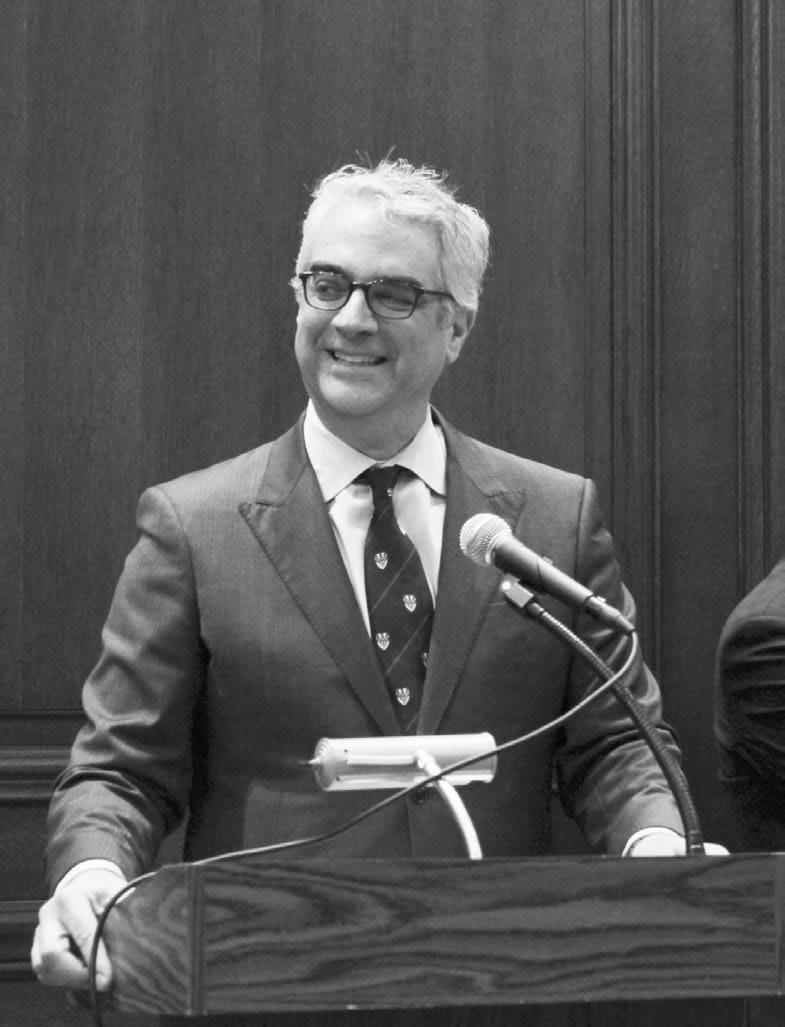
Yale Sterling professor Nicholas Christakis ’84 met with sex offender Jeffrey Epstein in 2013, and the pair maintained correspondence between 2013 and 2016, according to documents released on Friday by the U.S. Department of Justice.
The correspondence between Christakis, a sociologist and physician, and Epstein pertained to Christakis’s academic research and the professor’s attempts to meet Epstein shortly after he began teaching at Yale, according to files containing Christakis’ last name that were included in the Justice Department’s recent release and reviewed by the News.
Christakis wrote to the News in a statement on Friday evening that he met with Epstein at the financier’s Manhattan townhouse in 2013 “in the interest of raising funds” for his lab but that he did not receive any funds from Epstein.
“Like many other scientists who crossed his path, I was appalled by the revelations about Mr. Epstein that emerged after my very limited interactions with him in 2013 in the context of fundraising for my lab at Yale,” Christakis wrote in his Friday statement.
Christakis and Epstein briefly exchanged emails about the protests that broke out on campus after Halloween in 2015, when Christakis — then the master of Silliman College — became well-known for a confrontation with students in the college’s courtyard about an email his wife sent to students questioning proposed guidelines about culturally insensitive costumes. Epstein praised the way Christakis handled the situation.
In 2008, Epstein pleaded guilty in Florida state court to two felony charges related to prostitution and was required to register as a sex offender. More than a decade later, federal agents arrested Epstein and charged him with sex trafficking of minors. Emails between Christakis and Epstein reviewed by the News did not indicate that Christakis was aware of Epstein’s sex trafficking operation.
When asked about the extent of the University’s knowledge
about Christakis’ relationship with Epstein and whether it plans to investigate him, Karen Peart, a University spokesperson, provided a brief statement.
“The university has no knowledge of the information you’ve shared,” Peart wrote on Sunday afternoon. The emails reviewed by the News show that Christakis and Epstein first came into contact in April 2013, when Christakis informed the felon that he was leaving Harvard for Yale, and would like to meet him.
Lesley Groff, Epstein’s assistant, set a Google Calendar reminder to be sent to Epstein on July 1, 2013 — the date of Christakis’ move to Yale — which said that the academic would be “more available to meet in NY.”
The following month, in August, Christakis confirmed Groff’s assertion, writing to Epstein that he could “easily come to NYC since I have now moved to New Haven.”
“I’d still welcome the chance to meet you,” Christakis wrote to Epstein on Aug. 2, 2013.
In his statement to the News on Friday evening, the professor acknowledged that Epstein attended a September 2013 conference where Christakis delivered a lecture, but claims the two did not speak at the time.
Christakis told the News that Epstein wrote to him following the event “to suggest a meeting” about his research.
“I thought your talk was the only one o= substance lets schedule a time to meet?” Epstein wrote in a Sept. 8, 2013 email. In his reply, Christakis told Epstein he “enjoyed meeting” him at the conference, despite writing to the News on Friday that the two “hadn’t spoken during the event.”
Christakis also tried to schedule a dinner meeting with Epstein in the same email chain.
Later that September, the academic met with Epstein and a “small group of professionals,” all of whom were male, on the first floor of Epstein’s Manhattan residence, Christakis wrote in his statement to the News. The meeting went on “for approximately 90 minutes,” and the group “discussed science,” according to Christakis’s statement.
Emails between Christakis and Groff show that Christakis and
Epstein were scheduled to meet on Sept. 24, 2013, at Epstein’s home in Manhattan.
“The Yale development office was aware of and supported this meeting. The meeting happened given the obligation to fund my lab,” Christakis wrote, referring to his Human Nature Lab, which studies human interactions from an interdisciplinary perspective, according to its website. “At the time of this meeting, the extent of Mr. Epstein’s crimes was not widely known.”
Peart wrote in a statement to the News that Yale has no “record of any related financial gift” made by Epstein to the school. Christakis wrote to the News that he “never received” any funds from Epstein.
After the meeting, which Christakis told the News was his “only meeting ever with Mr. Epstein,” Christakis told “family and friends” that he “could not understand” Epstein’s role in the world of science philanthropy. Christakis wrote that he found Epstein to be “distracted and his understanding to be limited.”
In January 2016, Christakis invited Epstein to connect with him on the professional networking site LinkedIn, according to an email Epstein received. Christakis did not respond to the News’ question via email about whether he engaged any further with Epstein on the platform.
Christakis wrote to the News that he “unexpectedly received an email” later that year, in September, from Epstein, who had seen the viral video of the professor in the Silliman courtyard responding to what Christakis called a “large group of distressed students” during the “Halloween of 2015.”
That Halloween, Erika Christakis, his wife who then served as associate master of Silliman College, challenged a letter from Yale’s Intercultural Affairs Committee, which had advised students to “actively avoid” wearing potentially controversial costumes. Students protested her position, leading to a videotaped confrontation in the college’s courtyard with Nicholas Christakis that garnered significant national attention.
“watched that you tube with horror,” Epstein wrote in a Sept. 21, 2016, email to Christakis. “you were great.”
The email exchange about the Halloween incident was the last contact between the Yale academic and Epstein included in the documents released by the Justice Department. Christakis wrote to the News that he received more than 6,000 emails regarding the confrontation at the time and sent Epstein a “stock reply.”
Christakis’ reply included links to articles from The Atlantic and The New York Times about his confrontation with students, as well as links to and information about his research projects at the time.
“I had developed a standard
reply with links to news coverage of the events,” Christakis wrote. “I sent Epstein such a stock reply, and he responded by asking what new scientific work my lab was engaged in. I replied with links to research projects on our website.”
Christakis added that he felt “horrified by the subsequent revelations about Mr. Epstein’s criminal behavior.”
This semester, Christakis — a Sterling professor of social and natural science — is teaching a course called “Health of the Public.”
Contact JERRY GAO at jerry.gao.jg2988@yale.edu and ASHER BOISKIN at asher.boiskin@yale.edu.
Professor wrote to Epstein about women, including student
2009 and 2015.
BY ASHER BOISKIN AND JERRY GAO STAFF REPORTERS
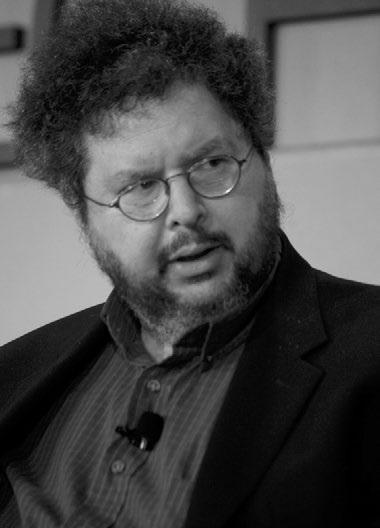
Yale computer science professor David Gelernter ’76 GRD ’77 invited Jeffrey Epstein to campus and described the appearance of an undergraduate in emails to the convicted sex offender between 2009 and 2015, documents released Friday by the Department of Justice show.
In emails exchanged over more than half a decade reviewed by the News, Gelernter also scheduled visits with Epstein in New York City and discussed the scent of women in Paris. The Department released some three million files related to Epstein in its Friday release, in response to a law passed by Congress in November requiring the disclosure of investigative materials about Epstein that have become a political flashpoint for the Trump administration.
In an October 2011 email to Epstein in which Gelernter appeared to discuss his software startup, he wrote: “I have a perfect editoress in mind: Yale sr, worked at Vogue last summer, runs her own campus mag, art major, completely connected, v small goodlooking blonde.”
It was not clear what role Gelernter was envisioning for the student. The emails reviewed by the News did not seem to implicate Gelernter in any crime or indicate that he was aware of Epstein’s ongoing sex trafficking operation.
Gelernter did not respond to the News’ multiple requests for comment, via email and phone call, since Friday afternoon.
Gelernter, who started teaching computer science at Yale at least four decades ago, has been described by the Washington Post as “a vehement critic of modern academia” and as having a “bombastic rhetorical style and disdain for elites.” In 1993, Gelernter was severely injured after opening a mail bomb from Ted Kaczynski, also known as the Unabomber, in Arthur K. Watson Hall. Gelernter’s name was floated around in the first Trump administration as a potential pick as the president’s top science adviser.
This semester, Gelernter is teaching “The User Interface,” a computer science course offered to both graduate and undergraduate students.
In 2008, the year before the earliest publicly released email correspondence with Gelernter, Epstein pleaded guilty to two felony prostitution charges in Florida. He was sentenced to county jail and required to register as a sex offender. At the time, The New York Times reported that authorities had identified Epstein as having “paid women, some of them under age, to give him massages that ended with a sexual favor.”
“I can’t believe anyone anywhere could be more of a character than Jeff Epstein,” Gelernter wrote in an email to John Brockman, a literary agent, in December 2009. “I’ve never talked to a more interesting guy or one w/ more all-around horsepower & faster acceleration.”
In 2019, federal agents arrested Epstein and prosecutors charged him in New York with sex trafficking of minors. Epstein had trafficked girls, including high school students, and young women, bringing many of them
to his private island in the Caribbean. Epstein died in 2019 in his cell at the Metropolitan Correctional Center in New York City.
Karen Peart, a University spokesperson, offered a brief response to the News’ questions about the extent of the University’s knowledge about Gelernter’s relationship with Epstein, whether it would investigate the academic and whether Epstein ever visited Yale.
“The university has no knowledge of the information you’ve shared,” Peart wrote in an email on Sunday.
In early December 2009, Brockman, the literary agent, forwarded to Epstein an email he received from Gelernter, who had written that he had “heard of Jeffrey Epstein only as a sort of brooding, mystical presence.”
“I wouldn’t have sworn he actually existed,” Gelernter wrote. “But I’m more than happy to talk to him,” he added, opening the door to a relationship with the convicted sex offender.
Over the course of the next six years, Gelernter and Epstein would exchange emails in which they discussed women, business dealings and Gelernter’s art projects. The two also planned several meetings and phone calls.
In their email correspondence, Gelernter and Epstein extensively discussed Lifestreams, Gelernter’s software startup that aimed to help computer users manage and share their electronic documents with others. Epstein provided advice to Gelernter about the budding company, even helping the professor revise his business pitch.
In one email chain from May 2011, Gelernter complained to Epstein that work on Lifestreams kept him from grading a “pile of final papers.” In a separate email chain two days later, Gelernter told Epstein that he had forgotten to issue grades for his senior students.
“Yes, & just found out my grades for srs are due yesterday or they won’t graduate,” Gelernter wrote to Epstein, in response to an email from early that
morning about whether he was awake.
After Epstein wrote in the same email chain that he was in Paris, Gelernter responded with an email in which he referred to walking along the Seine, seeing Parisian architectural sites and “French girls dressed & behaving like actual females everywhere.”
Epstein told Gelernter that the professor had left out of his Paris description “the smell of nutella crepe mixing with the cheap perfume of the streetwalker,” which Gelernter affirmed. The Yale academic responded that “any Paris group of spring girls is perfumed, just not as vividly as the golden-hearted whores.”
In another exchange of emails from 2009, Gelernter, whose paintings have been displayed on Yale’s campus, lamented to Epstein the suppression of sexuality in art. He described “beautiful women” as “the fuel source of all human creativity.”
In his reply, Epstein advised Gelernter to “consider focusing” his artistic capability on Hebrew letters.
“I think you might consider focusing on the negative spaces between the hebrew letters much more erotic a bulging shma, or throbbing ka,” Epstein wrote to Gelernter. Sh’ma means “listen” in Hebrew.
Gelernter apparently took heed of some of Epstein’s artistic advice. In November 2012, the academic placed 29 of his creations in an exhibit at Yeshiva University, in New York City, titled “Sh’ma/Listen.”
On multiple occasions, Gelernter and Epstein discussed scheduling meetings in New York City and also New Haven.
In correspondence with Lesley Groff, Epstein’s longtime executive assistant, Gelernter organized a March 31, 2011, meeting with Epstein “for breakfast” at Epstein’s Manhattan townhouse. And in December 2010, Gelernter invited Epstein to “see the paintings, the turkeys, the campus etc.” in New Haven.
“We’d love to have you,” Gelernter wrote.
Epstein asked whether there was a helicopter pad nearby. Gelernter suggested to Epstein that he could “send a car” to pick up Epstein from
Bridgeport-Sikorsky Airport or Tweed New Haven Airport. The professor added that he would check to see if Epstein could alternatively land on the Yale New Haven Hospital Heliport.
“Yale’s hpad is only med, but I’ll check that,” Gelernter wrote.
It’s not clear if Epstein then came to New Haven. Peart did not answer the News’ questions about whether or not Epstein received permission to land on Yale’s helipad.
Gelernter and Epstein’s email exchanges appear to have come to an end in 2015 after Epstein declined to invest in a software startup launched by his son, Daniel Gelernter ’10. On Oct. 12, 2015, Groff told Epstein that Gelernter wanted him “to meet with Dan” and provide him with advice for his company, which was then at what Gelernter called a “crucial branch point.”
Daniel Gelernter exchanged emails with Epstein, discussing his nowdefunct tech company, Dittach, that helped users manage email attachments. He asked Epstein on Oct. 14, 2015, to invest in his company, sending him a proposal for a $1 million investment and promising royalties in return. Epstein disagreed with the terms of the investment, pushing for more royalties.
Daniel Gelernter did not reply to the News’ repeated requests for comment. The last publicly known email exchange between David Gelernter and Epstein appears to have taken place on Oct. 25, 2015. After Epstein explained to Gelernter his decision not to invest in his son’s company, Gelernter wrote that he hoped to “get a chance to talk again someday” with Epstein, expressing regret that the investment “didn’t work out.”
Gelernter studied religious studies as both an undergraduate and graduate student at Yale, according to the alumni directory.
Contact JERRY GAO at jerry.gao.jg2988@yale.edu and ASHER BOISKIN at asher.boiskin@yale.edu.
DOC SEARLS VIA WIKIMEDIA COMMONS
Professor David Gelernter exchanged emails with the convicted sex offender Jeffrey Epstein between
YALE DAILY NEWS
Between 2013 and 2016, Yale Sterling professor Nicholas Christakis maintained correspondence with sex offender Jeffrey Epstein about academic research, and the pair met in 2013 to discuss fundraising for his lab.
“Say
something warm. Hello. You can sleep / forever in this grass and not be cold.”
RICHARD HUGO
Professor defends Epstein emails, teaches after crowd gathers
BY LEO NYBERG AND CORINNE COWAN STAFF REPORTERS
Around 30 students, two administrators and at least one security guard crowded in the lobby of Arthur K. Watson Hall to wait for professor David Gelernter ’76 GRD ’77 outside his 11:35 a.m. computer science class on Tuesday, after his sixyear email correspondence with the convicted sex offender Jeffrey Epstein came to light.
Gelernter and Epstein’s email exchanges between 2009 and 2015 were released Friday as part of the Justice Department’s latest tranche of files related to the financier — who was convicted on state prostitution charges in 2008, indicted for sex trafficking of minors in 2019 and died in a jail cell that year.
In one 2011 email to Epstein, Gelernter brought up a female Yale undergraduate and described her as a “v small goodlooking blonde,” after writing, “I have a perfect editoress in mind.”
In an email to the News on Tuesday afternoon, Gelernter appeared to refer to that 2011 message as a letter of recommendation, although it remained unclear for what role he was recommending the student.
“Anyone planning to censor my rec letters for my students might just as well go back to sleep. In recent years, there have only been a few. Those who have got them seemed pleased. (And who gives you the idea that you or anyone else are qualified to edit my private
correspondence, in order (what’s more) to apply your own worn-out 1990’s platitudes to the letters I write?”
Gelernter wrote to a News reporter.
Students waited 20 minutes after the class’s start time for Gelernter to arrive — a delay which Ian Gotcher GRD ’26, a graduate student in the class, said was not out of the ordinary. Gelernter’s class, “The User Interface,” covers the history of technological design, according to the course’s description.
Although most of the onlookers had dispersed by the time Gelernter arrived, one student called out “Epstein” as Gelernter took the short walk from the elevator to the classroom.
Gotcher said in an interview that Gelernter covered “normal course material” in the class.
After the class, Gelernter left the building through a basement exit.
“Students who are bored enough to spend their time demonstrating against the use of descriptions in private correspondence have got this whole Yale thing wrong. Is that why you came to Yale?” Gelernter wrote in his statement to the News.
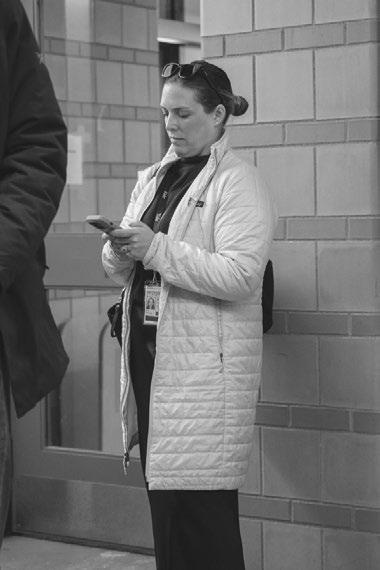
When the class was supposed to start, Nina Fattore — an administrator who told the people present that she was there for “free speech support” — asked the crowd not to disrupt the class.
“I wanted to remind you that it is not in line with our free speech and peaceful assembly guidelines to prevent a class from happening,” Fattore said.
Karen Peart, a Yale spokesperson,
wrote in a statement to the News on Tuesday that Gelernter’s class “proceeded without disruption.”
“Yale is committed to excellence in the classroom and to fostering an environment in which all members of our community feel respected and valued. Leadership in the School of Engineering and Applied Science became aware this morning of reports that a course might be disrupted. As with all instances when a course or event disruption is anticipated, a free expression facilitator and security were on site,” Peart wrote.
The emails between Gelernter and Epstein spanned topics including Gelernter’s art projects and business ventures. In December 2010, Gelernter invited Epstein to visit Yale’s campus, and the pair discussed the possibility of Epstein’s using the Yale New Haven Hospital heliport as a landing site.
CT Insider reported on Monday that Gelernter had said in a statement to the outlet that he did not know Epstein was a convicted sex offender. The emails between the men released by the Justice Department and reviewed by the News do not contain any indication that Gelernter was aware of Epstein’s sex trafficking scheme.
“Fondness for little girls is a perversion that runs way outside ordinary locker-room talk,” Gelernter wrote in the statement to CT Insider. “No one would ever introduce it into normal conversation.”
Gelernter further wrote that Epstein
was “one of the two (maybe three) smartest men I’d ever met” and a “brilliant & funny conversationalist.”
The gathering outside Gelernter’s classroom on Tuesday was preceded by several viral posts on the anonymous campus messaging app Fizz, which roused students to “harass” Gelernter at his class. One post, which encouraged students to “rush” the Tuesday lecture, gained over 2,000 upvotes.
Fifteen students are enrolled in the class, according to screenshots of the
course’s Canvas page reviewed by the News. The course is open to graduate and undergraduate students.
Arthur K. Watson Hall is where Gelernter was severely injured in 1993 after opening a mail bomb from Ted Kaczynski, also known as the Unabomber.
Contact LEO NYBERG at leo.nyberg@yale.edu and CORINNE COWAN at corinne.cowan@yale.edu.
Gelernter tells dean he stands by ‘rec letter’ to Epstein
FROM PAGE 1
“v small goodlooking blonde.”
Gelernter forwarded the email to the News 14 minutes after he initially sent it. “I was recommending her for a job I thought she’d like. When you do that--when you actually care about a rec letter--you keep the potential boss’s habits in mind,” Gelernter wrote in the email to his colleagues, seemingly referring to Epstein. “This one was obsessed with girls (like every other unmarried billionaire in Manhattan; in fact, like every other heterosex male), and if I hadn’t said what I did in that letter ten-odd years ago, he would certainly have called me & asked for a lot more aesthetic detail. (This is how men behave.)”
“So long as I said nothing that dishonored her in any conceivable way, I’d have told him more or less what he wanted. She was smart, charming & gorgeous. Ought I to have suppressed that info? Never!” he continued, italicizing
the last word. “I’m very glad I wrote the note.”
The News could not identify the woman or reach her for comment.
Gelernter previously told CT Insider he did not know Epstein was a sex offender. Epstein was convicted on Florida state prostitution charges in 2008, the year before his correspondence with Gelernter began. Epstein was indicted in 2019 on federal charges of sex trafficking of minors.
Gelernter wrote in another email to the News that Brock and Rushmeier had not asked him for an explanation before he sent them his email. He did not respond to the News’ questions about the nature of the job for which he was recommending the undergraduate to Epstein.
Brock did not respond to an emailed request for comment on Wednesday afternoon. Rushmeier declined to comment.
In his Wednesday morning email to the News, hours before he wrote to Brock and Rushmeier, Gelernter wrote that, since his emails with
Epstein were reported, he had been contacted by a University official only with regards to “crowd control” at his Tuesday class.
When asked about Gelernter’s original description of the student to Epstein and shown his email to Brock and Rushmeier, University spokesperson Karen Peart wrote in an email on Wednesday evening: “The university certainly does not condone the language used by the professor.”
In the email to his two colleagues, under the subject line “the disappointing facts,” Gelernter began by writing, “The ‘outcry’ following the totally pointless disclosure of the Epstein files seems to be almost over (in my case, I mean). But just for the record, I ought to tell you the facts. They’re boring, but you have a right to know.”
Gelernter then cited a News article about the correspondence with Epstein, which quoted an October 2011 email Gelernter sent to Epstein, among the roughly
three million files released Friday by the Justice Department: “I have a perfect editoress in mind: Yale sr, worked at Vogue last summer, runs her own campus mag, art major, completely connected, v small goodlooking blonde.”
Gelernter went on to write to his colleagues that the student seemed to trust him after they met during her sophomore year, when she was taking his class. He wrote that she “invited me to address an informal lunch” about global politics in her residential college, adding in parentheses, “Obviously, the first advance was hers.”
The News could not verify Gelernter’s assertions about his relationship with the student or her sentiments.
Gelernter wrote that she began visiting his office on some afternoons and he advised her about computer science and switching majors despite parental pressure.
Gelernter said he wrote her several letters of recommendation, as they
continued to meet and discuss art and literature. He also wrote that he and his wife took the student out to meals, and the student “slept over at our house at least twice.”
“She was one of the most impressive undergrads I had met in years.” Gelernter wrote. He wrote that the student lived in New Haven after graduation and continued to come to Gelernter’s office.
“As for the guilty email, there is nothing in it that could possibly offend any rational-minded person on earth,” Gelernter wrote, apparently referring to his 2011 message to Epstein, the only email to Epstein that Gelernter specifically mentioned in the email to his colleagues. This semester, Gelernter is teaching a computer science course called “The User Interface.”
Contact LEO NYBERG at leo.nyberg@yale.edu.
Students, faculty opinions mixed on professors’ ties to Epstein
VIEWS FROM PAGE 1
Several students and professors who spoke to the News criticized the two professors’ correspondence with Epstein — especially Gelernter’s description of the student’s appearance. They differed on whether the content of such private communications merits disciplinary action from the University.
Igor De Souza, the director of undergraduate studies for Women’s, Gender and Sexuality Studies, wrote in an email to the News that “any association with Epstein is, from my perspective, highly questionable, to say the least.” University spokesperson Karen Peart wrote in a statement to the News about Gelernter that Yale “does not condone the language used by the professor or the conduct he describes in his emails.”
In an email to the News on Tuesday, Peart also wrote that “faculty are expected to conduct themselves in accordance with the Faculty Standards of Conduct, and the university abides by its related procedures.”
According to the Faculty Standards of Conduct in Yale’s Faculty Handbook, professors are expected to “evaluate their students’ and trainees’ work solely on the basis of its intellectual merit and adherence to course or program requirements” and “maintain proper professional boundaries and never exploit the unequal institutional power inherent in the relationship
between faculty member and student or trainee.”
Elizabeth Shvarts ’27 said that Gelernter should be terminated immediately.
“I can’t imagine being a woman in his class and having to face him,” Shvarts wrote in a text message to the News. “Yale has a responsibility to protect its students, and by keeping him employed, Yale is showing they care more about their public image and pleasing predatory, rich men instead of ensuring their students, especially female students, are safe and respected.” Both Gelernter and Christakis are tenured professors. Tenured status protects faculty members from firing without direct cause, according to previous reporting by the News.
De Souza also wrote that he was “thoroughly disgusted” by Gelernter’s description of his former student as a “v small goodlooking blonde.”
“In no way is it ever, ever, ever acceptable to bring up anything about a student’s physical appearance in the context of a recommendation letter,” he wrote. “That is not standard practice by any means at all. Recommendation letters are professional documents and should only refer to the student’s professional abilities. Anything else is irrelevant.”
In his Wednesday email to the engineering school dean, Gelernter wrote that he described the undergraduate’s appearance — while “recommending her for
a job I thought she’d like,” which remains unclear — because Epstein “was obsessed with girls (like every other unmarried billionaire in Manhattan; in fact, like every other heterosex male).”
Gelernter also wrote that he formed a relationship with the unnamed student after she took his class and invited him to speak at a lunch in her residential college. He wrote that he advised her on academics, taking her out to meals and hosting her at his home.
De Souza made a distinction between Christakis and Gelernter’s exchanges with Epstein.
Christakis’s emails are a sign that fundraising with donors “requires a high amount of judiciousness in the process,” De Souza wrote.
Lucas Lee ’26 said that Gelernter’s actions should not be evaluated based on a single instance of misconduct, but rather on a “professional audit on his behavior in the past few years.”
The presence of a “periodic trend” of wrongdoing documented by students, Lee suggested, would be more revelatory than “one event.”
Computer science professor Joan Feigenbaum wrote in an email to the News that neither Christakis nor Gelernter has done anything illegal, based on their reported exchanges with Epstein.
It is “completely wrong” for people to “harass” the professors about their private email exchanges, she added.
“I urge everyone who is tempted to do so to think first about whether
he or she has ever said anything embarrassing or inappropriate in a private conversation or correspondence,” Feigenbaum wrote.
On Tuesday morning –– a day after the News first reported on Gelernter’s exchanges with Epstein –– around 30 students gathered outside Gelernter’s class in Arthur K. Watson Hall, with one student calling out “Epstein” to Gelernter. He arrived 20 minutes late and taught the class as normal.
Sofia Heredia ’29 said that individuals must “take responsibility for” private correspondences that become public, though this reckoning can be personal and selfdirected. Yale “doesn’t necessarily need to fire” Gelernter, she told the News in a Thursday interview.
“What he said was inappropriate, just objectively,” Heredia said. “If there were a student right now, an undergrad, who was like, ‘I am extremely hurt by this, this was really traumatic for me’ — that would be a different story.”
Women’s, Gender and Sexuality Studies professor Joseph Fischel wrote in an email to the News that while Gelernter’s description of a student’s physical appearance was inappropriate, he does not see “any plausible reason” for a Universityled investigation, let alone disciplinary action, based on the two professors’ reported exchanges with Epstein.
“The point of the phrase ‘guilt by association’ is that it is wrongheaded,” Fischel added.
“Do I think it is ill-advised to describe the physical appearance of students to potential employers? Certainly. Do I think it rises to the level of actionable misconduct? No,” Fischel wrote. “Emailing a man convicted of sex crimes does not, ipso facto, make the email sender a criminal. That we are collectively losing sight of this fact is probably a symptom of the fascist times in which we are living.”
American Studies professor Greta LaFleur also wrote in an email to the News that “it is not illegal to email someone who has been convicted of a crime, nor should it be, and university workers should not be disciplined for their associations, political or otherwise.”
Computer science professor Rex Ying drew attention to more prominent individuals who were identified in Epstein’s emails.
“I don’t know what is going wrong, since even a lot of United States presidents have such correspondences,” Ying wrote in an email to the News. “That seems to be a bigger issue?”
Former President Bill Clinton LAW ’73 will be deposed by the House of Representatives this month about his relationship with Epstein.
Leo Nyberg contributed reporting.
Contact JAEHA JANG at jaeha.jang@yale.edu and OLIVIA WOO at olivia.woo@yale.edu.
GARRETT CURTIS / PHOTOGRAPHY EDITOR Computer science professor David Gelernter struck a defiant tone in a statement about his contact with Epstein.
GELERNTER
GARRETT CURTIS / PHOTOGRAPHY EDITOR
Nina Fattore, an associate director for University life, stands in Arthur K. Watson Hall.
“If I were not human
Matchmaking app met with low expectations from students
BY ANYA GEIST STAFF REPORTER
Yale Date Drop, a new dating service, has spread across Yale’s campus, with more than 1,500 students signed up as of Feb. 3, according to the app.
Date Drop was originally founded by four Stanford students and launched on Stanford’s campus in September 2025, founder Henry Weng, who graduated from Stanford in 2025, told the News. On Yale’s campus, Date Drop was met with muted enthusiasm. Despite the founders’ claims that Date Drop helps students connect naturally with each other, many Yale students said they had low expectations for the app.
Weng wrote to the News in an email that Date Drop aims to be a consistent resource for college students looking for “someone special.”
This feature sets it apart from a similar program, Marriage Pact, which asks students to complete a detailed questionnaire and then matches them with their compatible “marriage pact.” Date Drop received a cease and desist letter from Marriage Pact last year, according to The Stanford Daily. Marriage Pact was also founded by Stanford students, in 2017.
Weng wrote that the letter had not affected the app. The Stanford Daily reported that the letter would likely not impact Date Drop’s operations because Marriage Pact made
broad claims in its letter, including allegations that Date Drop copied its language and overall premise.
Date Drop differs from Marriage Pact in its structure: the app releases multiple matches — one per week — as compared to Marriage Pact, which sends students a single match each year.
“We run for about three weeks instead of a single day, and we’re exploring whether it makes sense to run throughout the rest of the school year,” Weng wrote.
For now, Date Drop is scheduled to run only through Valentine’s Day, though the team may extend its run if the app continues to see demand, Weng wrote.
The app has expanded from Stanford to schools across the country, including Yale, Dartmouth, Emory, Northwestern, the University of California, Los Angeles, and the University of California, Davis.
Students typically email the Date Drop team with a request for the app to launch at their school, and if the team sees sufficient demand, they move forward with a launch, Weng wrote.
“Technology for social connection has felt broken for a while,” Weng wrote. “We want to build infrastructure that fights against that.”
Weng and his team created the survey’s questions using psychological and sociological research. Since then, they have incorporated feedback on how Date Drop matches progressed
to determine, through statistical analysis, which questions were most meaningful. Weng wrote that Date Drop aims to help students form and deepen “connections in an organic way.”
Date Drop includes AI-powered components. At the end of the questionnaire, students are given the option to chat with an AI bot, which helps the system better understand what type of person they are looking for in a match.
“AI lets us process that and use it for matching,” Weng wrote. “But we don’t see ourselves as ‘an AI app.’ AI is just a tool.”
Carrie Lange ’27 registered for Date Drop at the suggestion of a friend. She said it would be “fun to see what happens,” but emphasized that she had no expectations for the program.
When the first round of Date Drop matches was released last week, Lange was matched with someone she already knew, but neither have reached out to one another, she said.
Lange did not find the Date Drop user interface particularly notable and described the questions as similar to those used by Marriage Pact. Lange also said she was not interested in chatting with the AI bot.
“I think I just didn’t want to take the time to do it,” Lange said.
Robert Hodges ’27 chose not to sign up for Date Drop. As a junior, he said he was concerned that most
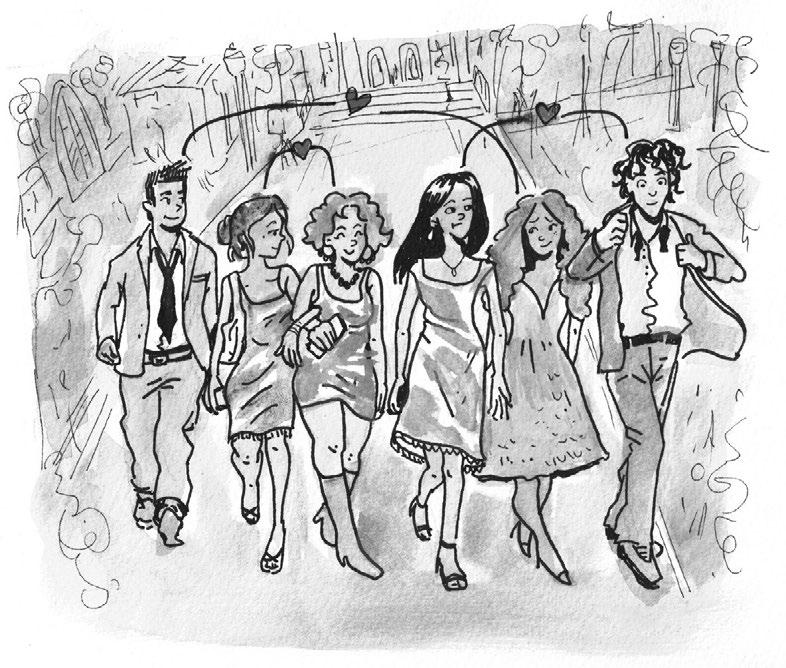
respondents would be first years and sophomores and felt uncomfortable filling out the questionnaire as an upper level student.
Hodges also felt that Date Drop’s mission was “not my vibe.”
“They find some random person, and then it’s a very casual thing, and then probably it will not work,” Hodges said.
viewed as
Pact in the
which
tradition. He added that most people he knew filled out Marriage Pact. Hodges did not see the same appeal in Date Drop. The second Date Drop was released on Tuesday.
He added that he would prefer to establish a stronger connection with someone he would be interested in. Hodges said he participated in
Contact ANYA GEIST at anya.geist@yale.edu.
YNHH asks to reduce $32 million penalty in infant death suit
BY HARI VISWANATHAN STAFF REPORTER
Aries-Reign Peterson was born prematurely at Yale New Haven Hospital on Jan. 30, 2018. Just days after doctors began feeding him a cow-based milk fortifier, he developed necrotizing enterocolitis, a lifethreatening intestinal condition, and died of the condition a few weeks later.
Yale New Haven Hospital asked a state court judge on Jan. 12 to reconsider a decision that ordered the hospital to pay $32 million to the infant’s parents. In the original lawsuit, the hospital was found liable for lack of informed consent and battery because the parents were not informed that doctors fed the baby with a cow-based fortifier. The hospital is now seeking to reduce the payment by $30 million.
“The court’s decision cannot stand because it is predicated on a misapprehension of the law regarding battery and informed consent,” the court motion detailing the hospital’s motion says.
History of the case
After Peterson was born, both parents communicated to the hospital that they only wanted the baby to be fed his mother’s own milk, according to court documents.
Peterson was transferred to a neonatal intensive care unit after birth for respiratory and nutritional issues, as well as weight loss.
On Feb. 22, 2018, in order to combat severe weight loss, doctors began to feed the infant milk that was enriched with a cow-based fortifier without discussing the decision with the parents or informing them about the risks associated with cow-based products, leading to necrotizing enterocolitis, the court documents say.
“The parents wanted to be involved in all treatment decisions and communicated their desire to the defendants,” one document states.
“Although Aries’ parents wanted only mother’s own milk to be fed to Aries, the defendants did not opt to increase Aries’ in-take of mother’s own milk or pursue another alternative.”
The next day, Peterson was diagnosed with necrotizing enterocolitis. His parents claim they were not informed of the connection between cow-based fortifiers and the disease, according to court records. Peterson died on April 18, 2018, due to respiratory and organ failure as a result of necrotizing enterocolitis. The parents claimed in the ruling that they would not have agreed to feed the infant cow-based fortifier had they known about the risk of their child getting necrotizing enterocolitis.
The judge, Karen Goodrow, said the hospital either should have stocked Prolacta, a fortifier derived from human milk, or transferred the baby to a hospital that carried human-derived supplements.
Attorneys representing the parents successfully argued in court that feeding an infant only human-
based products lowers the risk of necrotizing enterocolitis, citing multiple studies.
“Ms. Hunte credibly testified, and the court so finds, that Aries’ condition rapidly changed from appearing fine one day, to being at risk of death the following day, shortly after receiving bovinebased formula,” the ruling stated, referring to Anika Hunte, the infant’s mother.
On Dec. 12, 2025, after months of post-trial briefs, a Connecticut state court determined that the hospital should pay the parents $32 million. Goodrow found that doctors failed to obtain informed consent, or any consent, before adding cow-based products to the infant’s diet.
The verdict includes nearly $2 million in economic damages for medical expenses, funeral expenses and lost earning capacity. It also includes $30 million total for the loss of the infant’s ability to carry out life activities, pain and suffering, and death itself.
In her verdict, Goodrow said “the weight of the credible evidence” showed bovine-derived products were a “significant factor” in the infant’s death.
Hospital pushes back
On Jan. 9, the hospital submitted a motion asking the judge to reconsider her verdict and the case’s arguments.
The hospital’s motion argued that the verdict blurred the distinction between battery and lack of informed consent, and opposed both claims. The hospital claimed that the lack of informed consent did not apply in this case because the doctor was not reasonably expected to know that cow-based products increased the risk of necrotizing enterocolitis.
According to the motion for reconsideration, informed consent law applies if the doctor failed to disclose a “known material risk” and if that failure was a “proximate cause of his injury.”
“The court agreed that ‘reasonable expert minds can disagree about whether bovine-based products increase the risk of NEC and ultimately, of death, in premature babies such as Aries,’” the motion continued. Therefore, the hospital’s motion argued, it was reasonable that the doctor did not believe cowbased fortifiers increased the risk of necrotizing enterocolitis, and as such, he was not legally obligated to discuss a risk that he believed did not exist. If the infant’s family believes that the doctor’s medical knowledge was deficient, they should pursue a medical malpractice claim instead, the motion added.
Additionally, the hospital’s motion said that Goodrow misapplied the legal definition of battery, which generally refers to the intentional infliction of physical harm without consent. The motion also refuted the claim that the decision to feed a cow-based fortifier directly led to Peterson’s death.
The motion cited many factors, besides just a cow-based fortifier, that could have contributed to Peterson developing necrotizing enterocolitis, including prematurity, extremely low birth weight, being small for gestational age and an immature immune system.
Therefore, the hospital argued that no causal relationship could be established between the decision to use a cow-based fortifier and the development of necrotizing enterocolitis.
Peterson’s parents refuted these claims and urged the judge to maintain the original decision in their objection to the hospital’s reconsideration motion. They insisted that the battery charge be upheld because, regardless of the risks, they were still not informed of the procedure itself.
“The court had a factual basis to find that Aries’ parents did not want Aries fed bovine-based products, and that the defendants nevertheless fed Aries’ bovine-based fortifier and formula,” the parents said in their objection to reconsideration. “This is the definition of ‘no consent.’ This is the definition of battery.”
The parents also directly challenged the causation argument, citing expert testimony to show that cow-based fortifiers do, in fact, cause necrotizing enterocolitis.
On Jan. 20, the hospital eventually asked the court to reduce its $32 million infant death verdict to just $2 million, saying damages for the loss of enjoyment of life could not be awarded in addition to damages for the infant’s death itself.
According to Alex Taubes LAW ’15, a lawyer in New Haven who is familiar with the case, the hospital’s argument is faulty.
“There have been many cases in the past where life itself is a separate category of damages from loss of enjoyment of life. So they’re just wrong about that,” Taubes said.
Taubes explained that there is historical precedent and that this dispute has been settled in Connecticut. He also agreed that it would not be unusual for this to be considered battery.
Future of the case
Taubes believes this case could continue, although it is unlikely the ruling will be overturned.
“I think that the hospital is clearly in the wrong,” Taubes said.
“I mean, it’s not as though you have a runaway jury that issued an emotional award against Yale Hospital. This was an experienced Superior Court judge who looked at the evidence, gave it the appropriate weight, looked at the expert testimony and made a judgment call.”
Taubes believes that it is more likely the case will end in a settlement.
He also said that the case is indicative of a broader trend in similar lawsuits in which appeal court decisions are appealed.
“I think that’s a really important thing for people to understand. A lot of the time, big corporations, insurance companies, hospitals, try to paint verdicts as a result of an uneducated, uninformed jury, or, you know, people making, people who
are swayed by emotional appeals,” Taubes said. “That’s not the case in this situation.”
Stephen M. Reck, an attorney for the infant’s parents, stated that the hospital will likely appeal, which would drag the litigation on for at least another year.
He still believes, however, that the case is unlikely to be overturned.
“I’m very confident we will win on appeal,” Reck said in an interview. “But I would also invite Yale to settle the case for the parents.”
The infant’s parents separately sued Abbott Laboratories, Inc., the maker of the product Peterson received, with Reck noting that the company’s products are too dangerous and that it doesn’t warn parents about potential risks.
Reck hopes the case will raise awareness of the risks of necrotizing enterocolitis and prevent similar cases in the future.
“I certainly hope Yale changes, and I’m hoping that this judgment will cause all NICUs throughout the country to warn parents that there’s an extreme risk of NEC if you feed a cow-based fortifier and formula to their premature infant,” Reck said. The Yale entities are represented by Brock T. Dubin and Colleen Noonan Davis of Carmody Torrance Sandak & Hennessey LLP, and Michael G. Rigg of Stockman O’Connor PLLC. Dubin, Davis and Rigg did not respond for comment.
Contact HARI VISWANATHAN at hari.viswanathan@yale.edu.

“Morning. Vast. Imprecision. Fog has covered everything in gray absolute. This has lasted.”
Yale Rep performance canceled as sole performer protests ICE
BY KIVA BANK STAFF REPORTER
No one was laughing last Friday night at the Yale Repertory Theatre show “ha ha ha ha ha ha ha” — because the performance was canceled.
The production is a onewoman show starring the Estonian clown Julia Masli. She was set to perform at the theater as part of her “ha ha ha ha ha ha ha” tour with the Woolly Mammoth Theatre Company. But, in a statement to the News explaining her decision not to perform, Masli cited nationwide demonstrations against Immigration and Customs Enforcement.
“I, along with my collaborators Sebastián Hernández, Sarah Chapin, and Kim Noble, made the decision to cancel the show Friday night as part of the nationwide shutdown to abolish ICE,” Masli wrote in a statement provided by a Yale Rep spokesperson.
Student groups at the University of Minnesota, along with the 50501 group and numerous other organizations, called for a National Shutdown on January 30 with the intention of halting work, school and shopping activity in response to the deaths of two American citizens at the hands of immigration agents in Minneapolis, according to their website. Last Friday, protests erupted and business closed across the country, including in New Haven.
According to James Bundy DRA ’95, the dean of the David Geffen School of Drama and artistic director of the Rep, emails were sent last Friday morning to ticket holders as well as the broader Drama School and Yale Rep community.
Citing “circumstances beyond our control,” the Yale Rep’s email notified ticketholders that their purchases would be refunded and that the remaining performances — through the closing date of Saturday, Feb. 7 — were “all but sold out.” A similar message was displayed on the Yale Repertory Theatre’s website on Friday and Saturday, stating that ticket holders would be contacted via phone.
The Yale Rep’s email did not mention the reason Masli cited for the cancellation — namely, protesting ICE.
“We stand in solidarity with people who are enraged, grieving, and protesting abuses of power. We stand with those who are
dedicated to fighting for human rights,” Masli wrote as part of her statement to the News.
Bundy did not respond to the News’ question about why the Rep’s email did not include Masli’s reason for not performing.
Georgia Petersen DRA ’26 attended opening night of the show on Jan. 20 and also had tickets for Friday night’s performance. Masli attempts to solve the problems of audience members as part of the show, leading to an entirely different performance each night.
In a phone interview, Petersen described the show as “quite political” and said numerous audience members spoke about politics to Masli during the show she attended, in which Masli walked through the house.
Petersen said she did not know that the show was canceled due to the ICE protests, but had suspicions given that other businesses in New Haven were closing as part of the nationwide campaign.
Masli posted an image of people carrying signs with sayings such as “Abolish ICE” and “Melt ICE” to her Instagram story on Friday.
As part of her “ha ha ha ha ha ha ha” tour, Masli has performed at the Pasadena Playhouse in Los Angeles and the Woolly Mammoth Theatre in Washington, D.C., among other venues. The show at the Rep resumed as scheduled on Saturday night.
“Now, knowing that she’s made a statement, I certainly applaud her,” Petersen said. Petersen also said organiza -
tions like the Yale Rep might be careful in their public communications because the “stakes of visibility are fairly intense” given that the Rep is connected to Yale, which has international students.
Still, she said she hoped that the Yale Rep would be forthcoming with the broader community and announce the reason for the cancellation.
“I think it’s important to have some clarity about how this is being handled, and what it means for guest artists in the future,” Petersen said.
In a written statement to the News, Bundy stated that the show’s cancellation followed normal policies at the Rep.
“We regret that Friday’s ticketholders may not have an opportunity to experience ha ha ha ha ha ha ha before it closes on February 7,” Bundy wrote. “We also support and uphold Yale’s policies on free expression, which extend to all students, faculty, staff, and visiting artists at David Geffen School of Drama and Yale Repertory Theatre.”
This was the first instance of a Yale Rep show being canceled as a result of protest in recent memory, according to Bundy. The last shows canceled at the theater were “A Raisin in the Sun” and “Testmatch” in March 2020 due to the COVID-19 pandemic.
The Yale Repertory Theatre is located at 1120 Chapel St. Contact KIVA BANK at kiva.bank@yale.edu.
Student orchestra charts new ground playing in innovation center
BY MADISON AGUILAR CONTRIBUTING REPORTER
About 20 members of the Yale Symphony Orchestra performed in a concert on Friday evening in the Center for Engineering Innovation and Design studio, featuring four carefully selected pieces adhering to the theme of innovation in music.
The collaboration between the center and the orchestra began in September, when orchestra members were 3D printing gifts in the CEID.
When the conversation veered into a discussion of unconventional musical performance spaces on campus, the center’s executive director, Joseph Zinter, interjected and asked the musicians whether they would be interested in a collaboration. The result of this moment of curiosity: YSO’s first performance in the CEID.
“This performance showed what’s possible when two
creative communities meet,” Zinter told the News. “Innovation happens when different ways of thinking come together to test conventional boundaries.
Moments like these remind us that innovation isn’t always about technology; in this case, it was cultural and experiential.”
At a time when artificial intelligence and digital media threaten live musical performance, Friday’s performance suggested how to join those two seemingly contradictory realms.
The first piece of the performance was “Appalachian Spring, Suite for 13 instruments” by Aaron Copland. The work is intended to challenge the ideas of simplicity and innovation, two concepts often seen as being at odds, by “being able to experience joy in the little moment instead of
always trying to progress,” Tobias Liu ’26, the orchestra’s president and a violin player.
The second piece on the arrangement was “Last Round” by Osvaldo Golijov. The tensionfilled two-movement work was intended to act as an imaginary last round of a boxing match.
For this song, the musicians were arranged in a boxing ringstyle display, two sets of strings on each side of the mediating bass — mimicking a heated battle of egos amid the cornered bass.
The third piece was “Winter” by Antonio Vivaldi. This classic composition was chosen to highlight the controversy of Vivaldi pairing a sonnet with music, which challenged the idea of classical music in the 18th century. To close out the evening, the musicians performed Interstellar’s “Cornfield Chase” by Hans Zimmer.
While the CEID may seem like an unconventional performance space, Zinter and YSO members challenged that notion.
“At its core, the Center for Engineering Innovation and Design is a place for connection, collaboration, and experimentation — a place to exchange ideas, explore new ground, and celebrate the possibilities that emerge at the intersection of disciplines,” Zinter told the News. “The YSO didn’t just perform in our space — they transformed it, and in doing so helped our community imagine new possibilities for what can happen at the CEID.”
According to Jairus Rhoades ’26, a YSO pianist, the acoustics of the columns in the CEID allow for the perfect reflection and direction of sound, allowing the reverberation of the orchestral music to fill the space.
Liu highlighted the intimacy the CEID permitted between audience and musicians. The open nature of the performance space challenged the barrier that often stands between classical music performance and the audience.
“In the classical music world, we so often trap ourselves within the formality of the concert hall, and erect barriers under the guise of respecting tradition and convention,” Liu said. “The concert represented an attempt to break out of those barriers, to continue to innovate and collaborate towards a medium that is able to reach and express the humanity that connects us all.”
The CEID is located at 15 Prospect St.
Contact MADISON AGUILAR at madison.aguilar@yale.edu.
Junior’s art exhibit manipulates reality and distorts the past
REVIEW
BY ELLIE KOO STAFF CRITIC
The inevitable distortions that occur when we recall the past reflect the natural limitations of human memory. Lucky for us, those limitations often yield compelling art. Davianna Inirio ’27 attempts to capture this haze in her solo exhibition “Memoria Sustitutiva,” which will remain on view at the Trumbull art gallery until Feb. 15. The result is a masterfully assertive visual reconceptualization of memory as filtered through Inirio’s own perspective. At the heart of Inirio’s work are feelings of incompleteness and distortion. These qualities are present in “Bling!” — a zoomed-in depiction of an unidentifiable figure’s upper body clad in a white shirt and bright red zip-up hoodie. While Inirio drew inspiration from photographs of her childhood, it is in the work’s details where she takes the reins from realism and asserts her own vision: the use of pure white impasto paint at the shirt’s focal points; the divided, unshaded tones of periwinkle, lavender and pink; the swift, singular black brushstrokes that cut through the otherwise uninterrupted red of the hoodie. The fluctuation of line,
materiality and color pushes the figure to the brink of abstraction, rendering the familiar unfamiliar. In doing so, Inirio invites us to question not only the reality we perceive, but also the ways in which we recall our past — perhaps more hazily than we would like to admit.
Other works in the exhibition evoke an even stronger sense of fragmentation and distortion. On the central wall hangs a horizontal arrangement of five canvases. Each panel stands on its own; together, they form an oscillating, energetic sequence driven by Inirio’s continuous and deft traversal of the boundary between abstraction and realism. In the second panel from the right, no discernible form emerges; a vividly colored glassy smooth surface leaves viewers to only speculate what it could be.
In contrast with this is the center panel, a depiction of a girl sobbing violently, the rawness of her anger and anxiety heightened by saturated reds and oranges. And on the left, an isolated, partially clenched hand bursts forth from a mottled field of red and green. Fine, quivering lines of black paint contrast with thick, assertive passages of color and murky, undefined backgrounds.
It is difficult to pinpoint what is happening in this uncanny yet

deeply satisfying work — and that ambiguity is precisely the point. Further complicating the viewing experience is the piece’s title: “El Cumpleaño,” or “The Birthday.” Inirio’s final work, a sculptural piece titled “Ventana de Seguridad,” introduces a new dimension to the already swirling, mind-bending exhibit, and serves as a testament to her breadth as both an artist and a thinker. Against an intense red background, a wooden, lattice-like frame
extends towards the viewers from the right side of the space. The manipulation of solid wood is at once whimsical and unsettling. The structure recalls a broken window, yet what lies beyond it is not a view, but a solid mass of red. Inirio thus prompts us to consider not only what we see when we look through something, but also what might be distorted, obscured or missing from the larger picture. In a small basement art gallery in Trumbull, Inirio’s work shines not only for its technical precision and skill, but also for its fearlessly genuine exploration of memory as something emotional, personal and reconstructed. “Memoria Sustitutiva” ultimately suggests that while memories may not remain faithful to the past, they nonetheless represent a fidelity to the self.
Contact ELLIE KOO at ellie.koo@yale.edu.
JAKE HALPERN / CONTRIBUTING PHOTOGRAPHER
Last Friday’s performance of “ha ha ha ha ha
KAMINI PURUSHOTHAMAN / CONTRIBUTING PHOTOGRAPHER
Davianna Inirio’s solo exhibition “Memoria Substituvia” will remain on view through Feb. 15 at the Trumbull art gallery.
FROM THE FRONT
“You can’t step into the same / River even once.”
JAMES GALVIN
They cut ties with parents. How do they afford Yale?
INDEPENDENT FROM PAGE 1
tact with them entirely once she graduated from Yale. That moment came sooner than she’d anticipated. In the fall of 2024, during a gap year spent at home, Marie said the violence became unbearable.
“I thought I was going to die,” she recalled. “So I left.”
Picking up a second part-time job and draining her savings, Marie found a short-term lease in her hometown and lived with a roommate until returning to school in January 2025, she said. But she still needed to figure out one more thing: How would she pay for the cost of attendance at Yale now that she was estranged from her parents?
Students like Marie, who choose to break ties with their parents, often must find a way to pay for their Yale tuition without any family members pitching in. Students’ federal or Yale financial aid packages are calculated according to their parents’ incomes and assets. This means that students who no longer want to be financially supported by their parents must apply for independent student status — a condition that allows students’ eligibility for aid to be determined by their financial information alone.
The process of petitioning for independent status at Yale is shrouded by a lack of public information and requires students to convey and even prove their personal situations to financial aid officers, according to four students who have participated in the petitioning process. One of the students gave up before securing independent status.
The four students interviewed by the News described the application process as inaccessible, and said that financial aid officers were ill-equipped or insensitive in their responses to learning about students’ traumatic experiences. The News reviewed copies of therapists’ letters, medical records and email correspondences that four students submitted to the financial aid office to corroborate their accounts of domestic violence and homelessness.
Financial aid officers, in turn, must gather enough information to verify students’ claims and ensure that aid is given to students who truly need it, said Alex Muro, the senior associate director of the Yale Undergraduate Financial Aid Office. Muro and two other financial aid officers, Nicole Rothfuss and Rondell Butler, said that the process of granting independent status was necessarily opaque and rigorous to protect the interests of the financial aid office and other Yale students.
What emerges is a tension between students who say they need financial independence to escape abusive circumstances and financial aid officers who decide who qualifies for this aid — and who doesn’t.
Embarking on the path to independence
Qualifying for independent status and receiving considerable financial aid can help students avoid taking out substantial student loans in the wake of their estrangement. Through federal financial aid, independent students can receive up to $7,395, the maximum federal Pell Grant award. If they successfully petition for independent status through Yale’s financial aid office — a process that is separate from the Free Application for Federal Student Aid, better known as FAFSA — some students can attend Yale on a full ride, according to Muro.
Yet, a lack of publicly available information about the process of petitioning for independent status may prevent students from finding out about the option in the first place, some students said.
When students in the United States apply to college, they typically fill out the FAFSA with their parents’ financial information to determine their federal aid eligibility. Most students are considered “dependent,” though students who are married, orphaned, emancipated or homeless would be considered independent. This means that their eligibility for aid is determined only by their financial information — not that of their parents — according to the Federal Student Aid website.
Under federal law, only college financial aid administrators can change a student’s dependency status once the student is enrolled. Students thus need to petition for this status change through their institution’s financial aid office, citing domestic abuse or other extreme circumstances that justify them no longer being financially dependent
on their parents. Financial aid officers grant students independence based on their own discretion, while consulting the Federal Student Aid Handbook, Muro said.
Muro said that “probably a few dozen students” apply for independent status each year. He declined to share exactly how many independent students are currently enrolled at Yale.
Three of the independent students interviewed by the News said they began the petitioning process by submitting an inquiry to the financial aid office’s website. According to Muro, the office follows up with students who submit such inquiries and asks some to submit a personal statement and at least one letter providing “neutral, professional, thirdparty documentation” of the circumstances that led students to pursue independent status. This documentation can include therapist letters, police reports or court orders.
If students cannot provide any formal documentation, financial aid officers meet with them to discuss their reasons for applying for independence and sometimes waive the formal documentation process. According to Rothfuss, the financial aid office may also reach out to a “counselor, dean, or other campus professionals” to gather additional information about the petitioning student.
“That said, it is always most important for us to hear directly from the student, in their words, regarding the circumstances prompting their request for independence,” Rothfuss wrote in an email to the News.
When critical information is difficult to find Unable to find specific information about the process of applying for independent status on Yale webpages, Marie turned to college information websites and forums like Reddit. She said that she was “confused” about why there was so little information online — an experience that was shared by three other students interviewed by the News.
The term “independent student status” only appears on the financial aid office’s “Forms for Undergraduate Financial Aid” and the “Frequently Asked Questions” pages. The former includes PDFs of a “Verification Statement for Independent Students” — a CollegeBoard form that is not used in Yale’s petitioning process.
The “Frequently Asked Questions” page mentions “independent student status” when it explains that a parent’s refusal to pay is not a “sufficient” reason for students to petition for independence.
Muro explained this philosophy by providing a hypothetical scenario: Two students live in the same town and come from families with the same financial resources. It would not be “fair,” Muro said, for one student to receive aid because his parents refuse to pay while the other’s parents pay their expected contribution.
The office only considers students’ financial need separately from their parents’ financial ability in “rare cases,” based on a student’s “documented petition,” according to the webpage. But, the site doesn’t explain what a “documented petition” is or how students can access it. The website also doesn’t define the types of “exceptional situations” that would qualify the exclusion of parents’ financial information.
According to Marie, students are unable to make an “informed decision” about disclosing sensitive information in the petitioning process because they don’t know what information to share, who they should be prepared to share it with and how their information will be used.
“They take away some of your autonomy in your decision-making by not giving you that information,” she said.
Marie decided to do something about the lack of readily-available information on Yale websites and took matters into her own hands.
Starting in August 2024, Marie documented the steps she took during her petitioning process and created a guide to inform prospective independent students at Yale.
This guide is now 20 pages long and includes sections unrelated to the petitioning process, such as ways to budget, sources of emergency financial aid and housing resources for students unable to return home for breaks. Marie said she is in the final stages of editing the document and hopes to begin distributing it soon.
Some students said that the lack of information about the petitioning process — including what qualifies as
necessary documentation, the factors determining eligibility for independent status and the timeline of the petitioning process — hindered the process of attaining independence. Four of them also expressed frustration about what has become a decentralized, informal spread of information between students.
For some of the students interviewed, the Harbor Fellows program — a collective of students who lack parental support that is funded entirely by Yale faculty and anonymous benefactors — has provided them financial and social support they weren’t able to find elsewhere. Not all members of the Harbor Fellows program are independent students.
Andre Thomas ’27 said that he first heard about petitioning for independent status through his friend, who was already an independent student and a member of the Harbor Fellows program. Gaining independent status was a way for Thomas to sever his financial dependence on his mother. He said that their relationship had become a form of “emotional, like psychological abuse.”
Thomas successfully petitioned for independent status in September 2025. When Thomas applied the first time —a month earlier — his application was denied without explanation, he said. “I was in the dark pretty much the whole time.”
“When we do not approve a student’s request to be independent, it can be difficult to explain why in a compassionate and respectful manner. Another challenge is the need to avoid leading questions so that we can clearly understand the student’s experience,” Butler, the financial aid office’s point person for independent students, wrote in an email to the News.
A process that is opaque ‘by necessity’
According to Muro, the financial aid office has a reason for the lack of transparency surrounding the process of attain
ing independent status.
Every student’s circumstances are different, Muro said, which means that the process for filing for independent status is “not straightforward.” Students often submit a personal statement and a letter of documentation from third-party professionals in their petition, but the financial aid office sometimes makes exceptions to those requirements.
Butler recalled an instance in which the office could not obtain comment from a “neutral, third-party professional” and relied on the student’s sibling for corroboration instead.
While financial aid officers use the Federal Student Aid Handbook as a guideline to assess cases, Muro said that the Yale financial aid office doesn’t have a formal procedure it follows when evaluating students’ petitions. Instead, it’s a collaborative, twoman job, Muro said. After a petition reaches Butler, Muro signs off on the decisions. Muro said he believes the process does not require formalized policies, nor would it make sense to establish procedures for what can be a complicated process. However, Muro said that he understands why some students may want more information about the petition process than is available on the public webpages.
“I’m not dismissing that at all, but I think it’s impossible to ever eliminate that entirely,” Muro said. “I’m not going to make the claim to you that this is a transparent process. It isn’t. It is, by necessity, somewhat opaque.”
Some schools, like Stanford and Princeton, do publicize information about their petitioning processes, as well as the circumstances that would make students eligible to petition for independent status. Princeton’s webpage says the school grants independent status in instances of abuse or abandonment by a student’s parents and directs students to the necessary forms for petitioning.
Stanford’s website states that the office uses a “standard method” to review students’ financial circumstances and calculate an expected contribution. If students cannot meet that amount, the office awards or directs students to grants, scholarships and other resources. Financial aid officers at both Stanford and Princeton declined multiple requests for comment.
The difficulty of proving abuse
The nature of prospective inde-
pendent students’ circumstances, many of which involve domestic violence, can complicate the petitioning process. Four students interviewed by the News said that there were moments when they felt as though their experiences were invalidated or not dealt with proper sensitivity.
In one such instance, a sophomore, who requested anonymity to maintain privacy about her abuse, said that Anna Osman, then a counselor at Yale’s Sexual Harassment and Assault Response & Education Center — known as SHARE — emailed financial aid officer Nicole Rothfuss following a Zoom meeting that had upset the student.
In an email to the sophomore, which the News obtained, Osman wrote that she had received a follow-up email from Rothfuss and “was able to explain to her again my concerns about your being made to share your story to initiate the dependency override request process.” Osman wrote that Rothfuss had spoken to her supervisor and was willing to speak with a “trusted third party” to “obtain the background they require.”
The sophomore’s decision to pursue independent status came at the suggestion of Osman, to whom Yale Mental Health and Counseling referred the student after she told them about a traumatic event that occurred in her childhood.
In response to the News’ request for comment on SHARE’s involvement with the financial aid office, director Jennifer Czincz wrote in an email that the office is not “permitted to do any interviews or meetings” due to its “highly confidential nature.” Osman, whose LinkedIn profile says she no longer works at Yale, did not respond to multiple requests for comment.
The sophomore said that, prior to the meeting, Osman had informed the student that she didn’t need to explain more than the “bare minimum” details of her familial situation to Rothfuss. Despite this, the sophomore said that Rothfuss kept pushing for more information.
“She kept asking for the full picture,” the student recounted. Rothfuss wrote to the News that she could not speak in detail about specific student experiences, citing “privacy and other concerns.” She said that the financial aid office seeks only the “minimum detail to make a financial decision.”
The first question that the office asks students, according to Rothfuss, is, “Why, as in what is about your circumstances that suggest that we should make an exception to our general policy to require parents to submit their financial information to be considered in the determination of a student's financial aid eligibility?”
For financial aid officers, asking detailed questions is a necessary part of their jobs, even if it comes across as “unnecessary” or “invasive” to students, Muro said. According to Muro, this process is not intended to subject students to a higher standard, nor should it imply that the financial aid office does not believe students.
“We’re not asking unnecessary questions. We need to understand because it is our job to allocate the university’s resources, to spend money, to support students,” Muro said. “But we also need to make sure that the right students are getting the right support, and that we’re being fair and equitable.”
Occasionally, the financial aid office’s fiduciary duty to the University can clash with the professional opinions of mental health counselors, Muro said. In some instances, counselors write letters that justify students’ decisions to cut ties with their parents, but the documentation fails to explain the facts of the circumstances that led to estrangement.
“It’s well-intentioned, but the counselor is basically making the decision for us,” Muro said. “It’s like, ‘Whoa, we understand how you feel, but ultimately, it’s not your decision to make.’”
Some of the students interviewed by the News said that it can be difficult to prove instances of domestic abuse. Muro acknowledged the difficulty of asking students to present what would be the most convincing documentation — such as court documents, restraining orders and police records. These documents typically only emerge from extreme circumstances, Muro said.
It’s not uncommon for survivors of intimate family or partner abuse to not report their experiences to authorities. According to a 2018 U.S. Department of Justice survey on “criminal victimization,” only 47 percent of domestic violence
cases are reported each year.
“Proof is not always there,” Thomas said. “Sometimes, there’s not always going to be hard proof for someone to see that you’ve dealt with X, Y and Z, but it doesn’t mean that it doesn’t matter, that it doesn’t happen.”
Muro said that financial aid officers do not receive formal sensitivity training, but he said “everyone” on the financial aid team knows what to do if a student approaches a staff member in distress.
“I am an active and patient listener, who follows students to proceed through their process at their own pace and as they feel comfortable,” Rothfuss and Butler both wrote in their separate emails to the News.
Marie, who said she was confused by the lack of online information, was doubtful of Muro’s claim.
“I am not experiencing the sensitivity that I feel like there should be,” Marie said.
Harbor Fellows provides community, support
Despite being little known around campus, the Harbor Fellows program has provided its members with financial support and community that students are not able to find elsewhere, according to two students. From movie nights to advocacy events, the group brings together students who are estranged from their parents ––an experience that is largely invisible to the rest of the Yale community.
Housed in Dwight Hall, the program provides semesterly stipends and ad hoc emergency funds to its members. The program currently supports two dozen independent students, according to Topher Allen ’27, the student coordinator of the program.
Because it has limited funding, the program requires students to apply. Harbor Fellows is entirely funded by a small group of faculty and alumni who “prefer to remain anonymous,” Allen wrote in an email to the News.
Although its website lists Dwight Hall, the Yale College Dean’s Office and other Yale-affiliated groups as sponsors, Allen wrote that the group receives no funding from Dwight Hall, Yale’s endowment or any other external organization. Other members of the Harbor Fellows advisory board declined to be interviewed for this article.
The group has grown nearly four times its size since spring 2024, according to Allen, but he wrote that the advisory board has maintained an acceptance rate of “over 95%.” All accepted students receive funding that covers expenses that result from the “additional burden and uncertainty of not having a home to return to during breaks,” Allen wrote.
According to students interviewed by the News, the financial support covers housing, transportation and even medication. Harbor Fellows who live off-campus receive an additional $2,000 annual stipend due to the “increase in New Haven rental costs,” Allen wrote.
For Marie and Joseph Lee ’25, who was a Harbor Fellows member, the program is a way for students to share and advocate for their experiences in ways that they aren’t able to do otherwise. Lee joined Harbor Fellows as a senior, after hearing about the program from a friend already in the group.
Being a first-generation, low-income student is already a difficult process, and not having traditional parental support amplifies an already lonely experience, he said.
“I want Harbor Fellows to grow and flourish because, like, there’s something not just about the money support that’s important there, but like, having a community of people who get something that is sort of maybe unspeakable at first and hard to communicate,” Lee said.
Since becoming a member of the Harbor Fellows program, Marie said that she has taken part in initiatives, such as a mentorship program co-facilitated with the Poorvu Center and a “community listening session” for Harbor Fellows members to speak with representatives from Yale Health, the Poorvu Center and Yale faculty about their experiences.
“I will probably not see the outcome of this advocating because I’m going to graduate soon. But knowing that, at least, it will be easier for other students that come after me is a very comforting feeling,” Marie said.
Last week, Yale announced that it would waive the cost of tuition for newly admitted undergraduate students from families with annual incomes below $200,000.
Contact JANE PARK at jane.park@yale.edu.
“Nobody sees a flower really - it is so small it takes time - we haven’t time - and to see takes time, like to have a friend takes time.”
GEORGIA O’KEEFFE
Cristina Rodríguez begins tenure as dean of Yale Law School
BY HENRY LIU STAFF REPORTER
On Sunday, Cristina Rodríguez ’95 LAW ’00 became the 18th dean of Yale Law School.
As Rodríguez assumes the deanship, members of the Law School faculty expressed confidence in her abilities and highlighted her background in immigration law and government service. Several professors told the News that Rodriguez — who co-chaired the Yale committee that recommended administrators stay quiet on current events — was the right choice for a moment when universities nationwide are facing intense scrutiny, including from the White House.
“She’s a leading scholar on immigration law, which, almost every year for the last 20 years, has become more and more important,” professor William Eskridge Jr. LAW ’78 said in a phone interview.
Rodríguez’s scholarship has focused extensively on administrative, immigration and constitutional law — especially immigration law as it relates to executive power. In 2020, Rodríguez co-wrote a book titled “The President and Immigration Law” with Adam Cox, which chronicles the two-century-long process by which the president, as opposed to Congress, became the primary shaper of American immigration policy.
In a Zoom interview with the News, Sterling professor and former Law School Dean Robert Post LAW ’77 praised Rodríguez for her scholarship, calling her a “terrific constitutional law scholar” and “one of the two or three preeminent scholars in the field of immigration law.”
Rodríguez co-chaired President Joe Biden’s Commission on the Supreme Court in 2021, and previously served on Biden’s presidential transition team as part of the Department of Justice Agency Review Team. During the Obama administration, Rodríguez served as
a deputy assistant attorney general at the Justice Department’s Office of Legal Counsel.
Post said that Rodríguez’s experience with government has helped make her a more informed and credible scholar.
“She has been in government, she knows what it means to function in the bureaucracy, and she knows, therefore, how law and the conception of administrative law and constitutional law affects the actual working of the institution,”
Post said.
One of Rodríguez’s most wellknown journal articles is her forward to the November 2021 issue of the Harvard Law Review, titled “Regime Change.” In the article, Rodríguez used the most recently completed Supreme Court term to explore what she called “regime change,” or the changing of policies and constitutional interpretations between different presidential administrations.
The term, spanning the transition from President Donald Trump’s first term to the Biden presidency, was marked by shifts in legal arguments in cases the government had been arguing before the Supreme Court. Rodríguez argued that such shifts in legal positions between administrations should not be met with skepticism but instead should often be seen as “legitimate reinterpretations of law.”
In a statement to the News, Rodríguez wrote that she was “immensely excited” and called the deanship an “honor.”
“I’m looking forward to working with faculty, staff, students, and alumni and to learn of their hopes for our beloved law school. I have cherished this special community since my time as a student and throughout my many years on the faculty,” Rodríguez wrote.
“I step into this role during a pivotal time for the legal profession and the academy,” she added, “and I remain firmly committed to the core values of Yale Law School: the pursuit of ideas through research and free inquiry, intellectual
curiosity and rigorous study, engagement across differences, mutual respect, and dedication to the rule of law.”
Rodríguez served as co-chair of University President Maurie McInnis’ Committee on Institutional Voice, which released an October 2024 report advising that university leaders and administrators refrain from commenting on issues of public significance except in rare circumstances.
“I think she’ll follow her own advice,” Post said.
According to Eskridge, Rodríguez is accepting of a range of ideologies and has “championed hires” across the political spectrum. In particular, Eskridge said that Rodríguez was a main supporter of the appointment of associate professor Garrett West LAW ’18, who had recently clerked for conservative Supreme Court Justice Samuel Alito LAW ’75.
Eskridg told the News he expects Rodríguez to play a “dual role” of “standing firm for our principles,” such as nondiscrimination and intellectual diversity, while lowering the temperature of “unnecessarily conflictual discourse.”
Sterling professor of international law and former Law School Dean Harold Hongju Koh commended Rodríguez’s legal scholarship as broad and impressive.
“I am lucky to have known her for 27 years. In that time, I have watched Cristina become one of the country’s leading public law scholars, whose work ranges across immigration and refugee law, to administrative law, to constitutional law, federalism, and language rights,” Koh wrote.
“She has a calm, humble, collaborative, and compassionate style that accompanies an intense passion for fairness, social justice, and the rule of law,” Koh added.
Rodríguez in 2013 became the Law School’s first Hispanic tenured professor. She currently co-directs the Global Constitutionalism Seminar — which hosts an annual private forum for jurists and law professors to discuss pressing legal
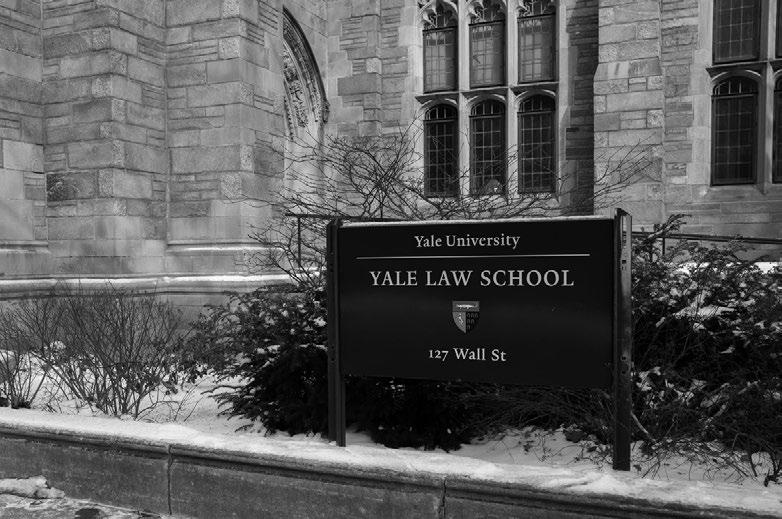
issues — with Law School professor Claudia Flores. Flores wrote in an email to the News that she was “genuinely enthusiastic” for the direction Rodríguez would take as dean.
“Cristina Rodríguez brings intellectual rigor, judgment, and real institutional leadership to everything she does. In our work together on the Global Constitutionalism Seminar, which engages judges, scholars, and practitioners on complex questions of law and legal institutions, she was consistently incisive and effective,” Flores wrote.
Elizabeth Bailey LAW ’27, co-president of the Yale Law Democrats, praised the selection of Rodríguez.
“She is very fair and has sound judgment, which is important in the current political environment,” Bailey wrote. “I was lucky enough to help out with the Global Constitutionalism Seminar, which she co-directs, and it’s clear that she is well-respected by renowned judges and justices from around the world. I think it means a lot that she sees a role for Yale in the international legal community.” Before she became dean on Sunday, Rodríguez worked with
former Dean Heather Gerken as deputy dean, an important administrative role. Gerken stepped down from the deanship at the end of July to become the president of the Ford Foundation; professor Yair Listokin served as interim dean for six months. Eskridge, who served as deputy dean from 2001 to 2002, said the deputy dean is charged with significant responsibilities such as putting the curriculum together every year and finding the right fit of professors to teach fall-semester courses for firstyear law students. In an email to the News, professor Samuel Moyn praised Rodríguez’s strong background as a legal scholar and leader.
“Dean Rodríguez is universally admired as a leader in the legal profession, as well as a brilliant scholar and a superb teacher. She is fully expected to have a storied deanship, and burnish Yale Law School’s reputation for the highest standards of intellectualism,” Moyn wrote. Rodríguez was born in San Antonio, Texas.
Contact HENRY LIU at henry.liu.hal52@yale.edu.
A day into fundraising week, four student groups surpass goals
BY OLIVIA WOO STAFF REPORTER
This year, 103 undergraduate student organizations are campaigning for funds from alumni, families and other supporters through the third iteration of an annual Yale College initiative.
The third class of participating groups in Yale Student Organizations Annual Raise is the largest in the program’s history, marking a 22 percent increase from the 2024-25 cycle, according to the Yale College website.
Yale Student Organizations Annual Raise, known as YaleSOAR, is a student-led giving week organized by the Yale College Office of Development in collaboration with The Dean’s Office and the Yale Alumni Fund.
Student organizations are encouraged to direct “targeted promotions to specific audiences” of alumni, family and other supporters to raise funds, but a “general solicitation from the Yale Alumni Fund” publicizes every group’s campaign on the program’s giving page, according to the Yale College website. The giving page
will be live until Feb. 10.
“Clubs with strong alumni networks tend to do well in these kinds of situations,” Yale College Dean Pericles Lewis said in a Wednesday interview. “Obviously not every student organization is going to wind up with exactly the same amount of money. But the goal is that students, whether they’re from wealthy families or low income families, get involved with philanthropy and understand it.”
This academic cycle, applications for the program opened in August, and approved student organizations were assigned a YaleSOAR advisor from the Office of Alumni Affairs & Development to assist them in designing their campaign efforts directed for February giving week.
During the 2024-25 cycle, giving week was held from Dec. 3 to Dec. 10, 2024, according to the Office of Development’s website. That week, 84 student organizations raised over $140,000, marking a 25 percent increase in dollars raised over the previous cycle.
Caleb Sim ’28, the treasurer of Korean American Students at Yale, said in a phone interview that
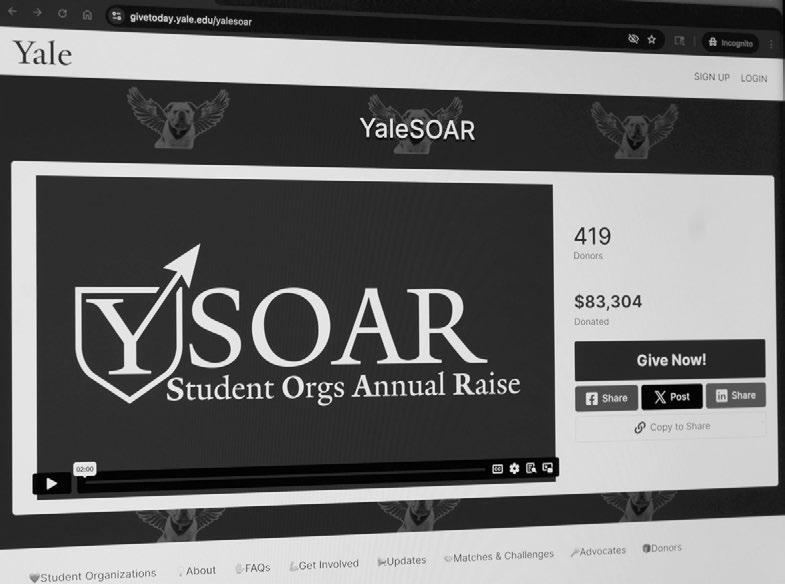
the group’s YaleSOAR campaign last academic year “was quite successful,” resulting in funds that comprised around 40 percent of the group’s budget. Sim said that Korean American Students at Yale also regularly receives funding through the Yale College Council’s Undergraduate Organizations Funding Committee and the Asian American Cultural Center.
“It’s just really amazing how much money we were able to canvass, and how much people donated,” Sim said. “It’s a lot easier for donors and alumni to see the money’s actually going to a good purpose, instead of just sending money to an organization any time throughout the year. So, a given time frame that they have to donate through shows it’s a legitimate process.”
According to Sim, the group raised $2,000 last cycle, which resulted in a $1,670 payout after a 12 percent “assessment” fee was absorbed by the University. Yale College’s website cites the “assessment” policy as helping to “cover essential administrative support and infrastructure” necessary to process donations and comply with the law.
The College website also clarifies that the Office of Development “cannot guarantee any amount raised through participation” in YaleSOAR. As of Wednesday evening, twenty participating student organizations had not received any donations on their campaign pages.
Korean American Students at Yale was among the four organizations to have surpassed their fundraising goal less than 36 hours after the commencement of giving week, having raised $2,750, or 137 percent of their $2,000 goal.
The organization that exceeded its fundraising goal by the largest percentage by Wednesday night, however, was the Episcopal Church at Yale, which had raised $27,500, or 156 percent of its $17,500 goal, from 22 donations.
The chaplain of the Episcopal Church at Yale, Reverend Alison Donohue DIV ’12, told the News in an interview that an alteration in this year’s timeline allowing for early giving aided the Church’s campaign.
“One day last week, Pericles Lewis sent out an email that surprised all of us that said, ‘early giving’s open.’
That must have gone out to alumni because people I hadn’t even had a chance to get in touch with emailed me and some of the students. And so I think the early giving really helped,” Donohue said. “Otherwise, we would probably not be quite where we are right now.”
Donohue called YaleSOAR funding “transformative” for the Episcopal Church, which she said operates under a “scarcity mindset.” It is only able to fund events like retreats and sports games through donations from the YaleSOAR program.
The leaders of four participating student organizations interviewed by the News said that the structure of YaleSOAR funding allowed for more freedom and flexibility when using the dollar amounts they fundraised than other sources of funding, such as money from the Yale College Council’s funding committee.
“I think they can be a little bit flaky in what they cover funding for, and it’s also generally hard to guess how much funding you’re gonna get every single round from the UOFC,” said Yale Discolf president Cameron Gray-Lee ’27, referring to the YCC’s committee.
Gray-Lee said that one funding need for Discolf is transportation to and from disc golf courses, “but UOFC typically doesn’t cover transportation.” As of Thursday night, Discolf’s campaign had raised $50 of its $5,000 goal from two donations.
Yale Discolf was founded in fall 2023, according to Gray-Lee.
“We’re still a very new club,” GrayLee said. “We don’t have a lot of resources as far as alumni, or, we have one alumni. It was great to see that they were still open to taking us on.”
Lewis said that every undergraduate student organization who fills out the form to apply to YaleSOAR in the fall is “in theory accepted.” Each group, however, must follow guidelines to develop a website and business plan, design a campaign and maintain a separate bank account dedicated to group operations.
Sim noted that unlike
funds from the YCC’s funding committee, YaleSOAR allows student groups to “accumulate capital” because every dollar raised does not have to be spent that academic year. Funding from the YCC or the Asian American Cultural Center, he said, must be returned if it is not spent in the year for which it was allocated.
Maya Evans ’27, the vice president of the Yale Dramatic Association, clarified that YaleSOAR asks groups to “clearly lay out” where money will be spent once it is raised. As of Wednesday night, the Yale Dramatic Association had raised $1,165 of its $4,000 goal, which marked a decrease from its goal of $5,000 last fundraising cycle.
That cycle, the group raised over $15,000, according to Evans.
“Last year, we were raising money specifically to increase our technical capacity and for some specific upgrades that were more expensive, and this year, we’re more investing in longterm investments,” Evans said. “We’re looking to first improve our scenic shop, so investing in more permanent storage spaces and restocking the paint shop and just making it a bit more organized.”
The Yale Hellenic Society is participating in YaleSOAR for the first time this year. Ari Tsomocos ’27, the group’s treasurer, said that the board of the Yale Hellenic Society had hoped that those with personal investment in Greek student culture at Yale might be incentivized to donate through YaleSOAR.
“We hope that, given that some of those people might have a personal connection with us, that is my mum, my dad, our relatives, who might be inclined to donate to our club because they know that we’re far away from home, and that club kind of is a big part of our lives here,” Tsomocos said.
As of Wednesday night, the Yale Hellenic Society had raised 116 percent of their fundraising goal with seven donations totaling $3,750.
Contact OLIVIA WOO at olivia.woo@yale.edu.
ELLIE PARK / SENIOR PHOTOGRAPHER Rodríguez, who is known as a leading scholar in immigration and constitutional law, earned praise from law professors for her scholarship and experience working in government.
XIMENA SOLORZANO / HEAD PHOTOGRAPHY EDITOR
In the latest and largest iteration of Yale Student Organizations Annual Raise, 103 participating student groups campaign this week to alumni, families and other supporters of student life at Yale.
“One peculiar organism aren’t we all together?”
ADRIANNE LENKER
Lewis to teach fall DeVane course covering Yale College history
BY OLIVIA WOO STAFF REPORTER
In a calendar year when both former University President Peter Salovey and former Faculty of Arts and Sciences Dean Tamar Gendler ’87 are returning to the classroom, Yale College Dean Pericles Lewis also plans to teach a course, for the first time in four years.
University President Maurie McInnis asked Lewis to teach a revamped course — called “Purposes of College Education” — as the 2026 iteration of the DeVane Lecture series in the fall semester, Lewis said in a Friday interview with the News.
“The course, which I’ve taught in the past, will be slightly differently structured because it’ll be the DeVane Lectures, so it’s open to the public,” Lewis said. “It has units on some themes that I talk about in some of my opening addresses. So this year, I think I talked about character and flourishing, and last year, I think I talked about citizenship. Those are both themes in the course.”
“Purposes of College Education” will relate these themes to the writings of Plato, which Lewis said will constitute about one-third of the course. Some lectures will also cover the history of Yale College as it celebrates its 325th anniversary this year, though Lewis said he had not yet finalized the course details.
The upcoming course will follow a spring semester in which the University offered five courses relating to higher education and Yale’s role in history. One new offering, “Trust
et Veritas: The Public Legitimacy of Universities,” is currently being taught by Benjamin Bernard ’11, who is affiliated with McInnis’ Committee on Trust in Higher Education.
David Blight, a Sterling Professor of American history, lectured on the Civil War and Reconstruction periods for last year’s DeVane Lecture course, “America at 250: A History,” and also taught the 2024 DeVane Lectures on Yale, slavery and the Civil War.
In a Monday interview with the News, Blight noted the timeliness of Lewis’ return to teaching the course.
“This idea of the purpose of liberal arts right now is so salient, so important, given all the assaults on higher ed. Look what’s happening in Texas,” Blight said, referring to a Texas A&M philosophy professor who was asked to remove Plato’s writings on race and gender from his syllabus. “It’s a great moment to do this.”
“America at 250: A History” was taught jointly last fall by Blight and fellow history professors Joanne Freeman and Beverly Gage. During the course registration process last April, the course was the most popular undergraduate class by enrollment for the fall semester, with over 400 registered students.
Lewis said he does not anticipate that this fall’s course will be as popular as the last DeVane Lectures.
In the fall 2022 semester, which was the last time he taught the course, “Purposes of College Education” enrolled 93 students, according to Yale Course Search.
Jacob Klein, a visiting professor of philosophy who is currently teaching
“Plato’s Republic: Moral Psychology and Defense of Justice,” suggested that the study of Plato lends itself to explorations of dialogue across intellectual differences.
In works like “The Republic,” Klein said, Plato offers “powerful portraits of people whose views he clearly rejects,” demonstrating the necessity of being “comfortable” with and critically minded toward opinions with which one disagrees.
This theme is emblematic of Lewis’ time as dean, during which he has spearheaded several efforts to encourage open dialogue on Yale’s campus. His Dean’s Dialogues were conceived to “model respectful, curious, and candid conversation about difficult topics,” according to the Schwarzman Center’s website.
The syllabus for the version of “Purposes of College Education” that Lewis taught four years ago includes “The Republic,” Aristotle’s “Nicomachean Ethics,” Virginia Woolf’s “A Room of One’s Own” and the autobiographies of Mohandas Gandhi and Martin Luther King Jr. Lewis, who is a scholar of literary modernism and ran Yale’s Modernism Lab from 2005 to 2012, has written about Woolf in the past.
Blight, reflecting on his two consecutive years of teaching the DeVane Lectures, pointed out the unique challenges of designing a course that is open to the public in addition to undergraduates.
“I admire the courage to step out and do this DeVane course, because you’re teaching two different constituencies at the same time. And
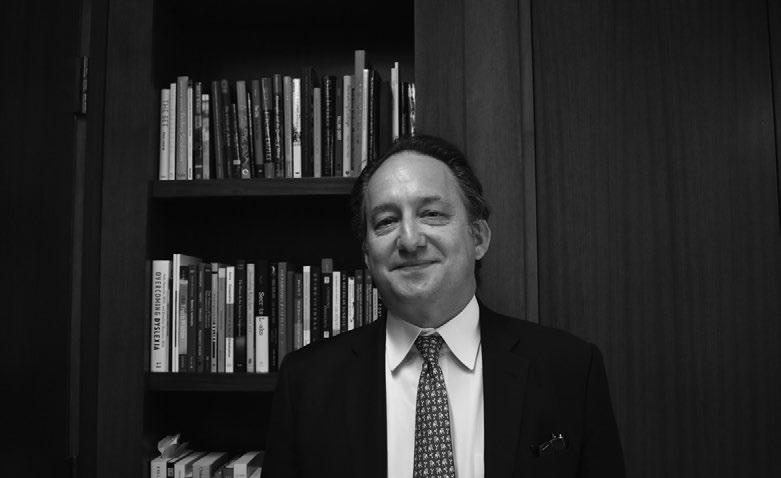
that’s not always simple,” Blight said.
He added that though last fall’s DeVane Lectures were an “unqualified big success,” he was disheartened by the fact that he “never felt very connected to the students.”
With regard to this fall’s series, Blight said he hopes Lewis will stress the ancient tradition of a liberal arts education whose “reshaped modern idea” is reflected in the approach of many colleges, including Yale, today.
Klein emphasized the centrality of a “liberal arts” philosophy to Plato’s teachings in Socratic dialogues like “The Republic.”
“I think it’s fair to say that the liberal arts tradition conceives of education as a kind of liberation,” Klein said in a Monday interview.
“Not from a particular person, or set
of circumstances, but from uncritical acceptance of ideas. And that is a theme that is all over in Plato.” Klein reflected upon his own studies of “The Republic” 20 years ago, during which he “always skipped over the parts about mimesis, and imitation and censorship.”
“Now, when you read The Republic, and it’s all about the dangers of imitation and images, and the potential need for censorship, it’s hard to imagine a more relevant set of topics,” Klein said. “So even some of the specific themes in Plato that looked sort of passé 20 years ago are suddenly looking relevant.”
Plato wrote “The Republic” in the fourth century B.C. Contact OLIVIA WOO at olivia.woo@yale.edu.
‘Computing, Culture and Society’ certificate to launch in fall
BY MELISSA ADAMANTIDI STAFF REPORTER
A new “Computing, Culture and Society” certificate at the intersection of subjects in humanities and STEM is set to launch in the fall.
The certificate program will combine courses from more than 12 departments to address questions related to artificial intelligence from both a computational and a societal perspective. The certificate was born out of School of Engineering & Applied Science Dean Jeffrey Brock’s effort to gather faculty from across Yale to address what he saw as a growing need for a structured inquiry into the implications of computational systems.
“The goal of the certificate is to prepare students to understand the social, political, and historical context of computing technology,” Theodore Kim, a computer science professor who will direct the certificate, wrote in an email to the News. “What are the implications of computational systems they may build in the future?
What are the larger geopolitical contexts of the systems being built right now?”
The certificate will require the completion of five courses. All students must take the foundational survey course, “Topics in Critical Computing.” From there, the requirements branch out into four distinct categories — introduction to computing for non-majors, social research, history and broader intersections with technology. According to the program’s official proposal, the certificate is primarily intended for computer science majors. The same proposal notes that, for years, faculty said students in the major have requested deeper instruction about the ethical and societal impacts of the software they create. Kim wrote that while the current Computer Science curriculum provides a “solid background in technical theory,” it has historically lacked classes that grapple with broader consequences. He described the certificate as the “glue” between technical proficiency and the
expertise housed in departments and programs like Anthropology, History, and Film and Media Studies.
While the program provides a structured path, Julian Posada — an American Studies professor and member of the certificate advisory committee — emphasized that the certificate will remain “flexible and open” to faculty across campus who wish to contribute new course offerings.
The push for the certificate comes at a time when AI-driven applications are increasingly integrated into daily life. Francesco Casetti, a Film and Media Studies professor and member of the certificate program’s advisory board, suggested that the intersection of STEM and the humanities is the only place where “critical thinking about AI” can flourish.
“The result is that it is often necessary to protect oneself from the devices that promise to protect you,” Casetti wrote to the News. “A critical analysis of AI is necessary today. STEM helps to analyze how the machine works; the Humanities help to understand the user’s point of view.”
Posada added that the program is not exclusively for STEM students.
“The certificate has been specifically designed so that CS students can take courses in the humanities and social sciences, and students in those fields can both enroll in an introductory computer science course and explore classes that examine computing from social and humanistic perspectives,” Posada wrote.
Kim noted that for non-STEM students, understanding that “algorithms are not magic” is critical for future roles in policy, law and advocacy.
One track of the certificate focuses on an introduction to computing for non-majors and includes courses like “Python Programming for Humanities” and “YData.” Another track addresses social research, politics, law and economics, featuring classes such as “AI, Ethics, and Society” and “Digital War.”
A third path students can take in the certificate program addresses history, digital media and culture, with offerings like
“Internet Cultures” and “Media, AI and Algorithmic Bias,” and a fourth track explores broader intersections in science, technology and society, including classes such as “Technology, Race and Gender” and “War Games.”
To ensure academic breadth, students can count a maximum of two courses that overlap with their major and no more than three courses from the same department for the certificate. Additionally, the certificate requires attendance at three approved lectures or events, followed by brief written reflections to be submitted to the director.
“I think this certificate is truly aimed at all students, regardless of major, who want to learn more about how computing impacts society and how society, in turn, influences computing,” Posada wrote.
A dedicated website listing eligible courses and events is set to launch before course registration opens for students.
Contact MELISSA ADAMANTIDI at melissa.adamantidi@yale.edu.
Advocacy group objects to Yale’s gender-neutral bathrooms
BY YOUSSEF MAZOUZ STAFF REPORTER
An advocacy organization called Defending Education filed a civil rights complaint with the Department of Education alleging that Yale’s bathroom policies violate the federal statute that prohibits sexbased discrimination at educational institutions that receive federal funds.
The administrative complaint against Yale, which was filed on Jan. 22, alleges that the University “has conflated sex discrimination with gender identity discrimination,” and “maintains a bathroom policy that denies the reality of biological sex,” referring to gender-neutral bathrooms in Yale dormitories. The group called on the Department of Education to “act swiftly to remedy unlawful policies and practices.”
“Title IX prohibits discrimination on the basis of sex, but Yale’s Title IX Office states that its mission is ‘to both prevent and respond to sex- and gender-based discrimination.’ Gender discrimination is not the same as sex discrimination under Title IX, and the Supreme Court has never held otherwise. But that has not stopped Yale from violating its students’ Title IX rights in its pursuit of ideological goals,” the complaint says.
“In my view there is no legal merit to the allegations,” Katie Eyer, a law professor at Rutgers Law School and
prominent antidiscrimination scholar, wrote to the News.
“Advocacy groups’ interpretations of the law have no binding force, and Yale does not have to follow them,” Eyer wrote. “Even the federal government’s interpretation is not binding on the courts, and in this case is inconsistent with the statutory language.”
Eyer acknowledged, however, that “were the DOE to become involved they might seek to cut off federal funding to Yale, which is a big stick, even if it is based on a legally erroneous interpretation.” She added that “many institutions have preemptively complied with an inaccurate interpretation of the law, even though they are not required to.”
“Practically speaking, Yale would need to be concerned about a potential halt of federal funds — at least temporarily until they could get the matter addressed in court,” Eyer wrote.
Yale’s Office of Public Affairs and Communications declined to comment about the complaint. Out of the three officials from Yale’s Title IX Office contacted by the News via email, two did not respond and one said they could not comment at this time.
Title IX, which former U.S. President Richard Nixon signed into law as a part of the Education Amendments Act of 1972, says that “No person in the United States shall, on the basis of sex, be excluded from participation in, be denied
the benefits of, or be subjected to discrimination under any education program or activity receiving Federal financial assistance.”
The origins of the law are derived from the 14th Amendment’s Equal Protection Clause, according to the U.S. Federal Courts’ website.
Defending Education’s complaint alleges that Yale has violated Title IX on two fronts, which the group claims are examples of “political pandering to a certain subset of students.”
The first claim alleges that “Yale misreads Title IX to cover gender identity,” citing the Yale Divinity School’s definition of gender as a set of social and psychological traits. The complaint asserts that Yale’s Title IX Office is incorrect in its determination that “Title IX applies to discrimination on the basis of both sex and gender.” Title IX, however, has been interpreted differently over the years by different presidential administrations, according to professor Kimberly Yuracko, a Northwestern law professor and former dean of Northwestern’s Pritzker School of Law.
“The Democratic administrations were interpreting Title IX to encompass both sex and gender discrimination,” Yuracko said in a phone interview with the News. “It seems pretty clear that the Trump administration is defining sex in terms of biological sex, in fact, in terms of
biological sex at birth as written on people’s birth certificates.”
Yuracko, who is one of the foremost legal scholars in antidiscrimination law, acknowledged the lack of consensus on whether Title IX covers both sex and gender based discrimination. She explained that as there has not yet been a Supreme Court case which formally interprets Title IX, Democratic and Republican administrations have largely had the ability to interpret the law as they see fit.
The second violation alleged by Defending Education is that “Yale’s bathroom policies likely violate Title IX.” The complaint alleges that there are certain Yale coeducational dormitory floors which have male and gender-neutral bathrooms but no female bathrooms. The complaint cites a Yale housing informational website that states that Yale’s residential colleges have female, male and gender-inclusive bathrooms which alternate such that “students can always find options by heading up- or downstairs.”
“Yale’s bathroom policy likely violates Presidential Executive Order 14168 regarding sex discrimination in federally funded programs. It also contravenes this Department’s stakeholder guidance on Title IX and the prevention of sex discrimination in federally funded programs,” the complaint says.
Presidential Executive Order 14168 — which is called “Defending Women from Gender Ideology Extremism and Restoring Biological Truth to the Federal Government” — rejects the association of sex with gender identity and establishes that the federal government only recognizes two biological sexes. The order asserts that people “fundamentally attack women by depriving them of their dignity, safety, and well-being” when they engage in “efforts to eradicate the biological reality of sex.” According to Yuracko, executive orders do not hold as much weight as concrete regulations, even going back to guidances interpreting Title IX issued under the Obama administration.
“They’re not judicial decisions,” Yuracko said in reference to executive orders. “A court can just say they’re not the right interpretation of the law.”
If the University is found in violation of Title IX by the Department of Education, Yuracko says that a settlement would be the most likely scenario, which could entail changes to restroom policies or Yale’s receipt of federal grants.
The landmark 1977 civil rights case, Alexander v. Yale, was the first to bring a sexual harassment case against an academic institution using Title IX.
Contact YOUSSEF MAZOUZ at youssef.mazouz@yale.edu.
BEN HERNANDEZ / STAFF PHOTOGRAPHER
Yale College Dean Pericles Lewis will adapt a course he taught in the fall of 2022 to reflect on the 325th anniversary of the College’s founding.
THROUGH THE LENS
STAYING WARM IN THE COLD
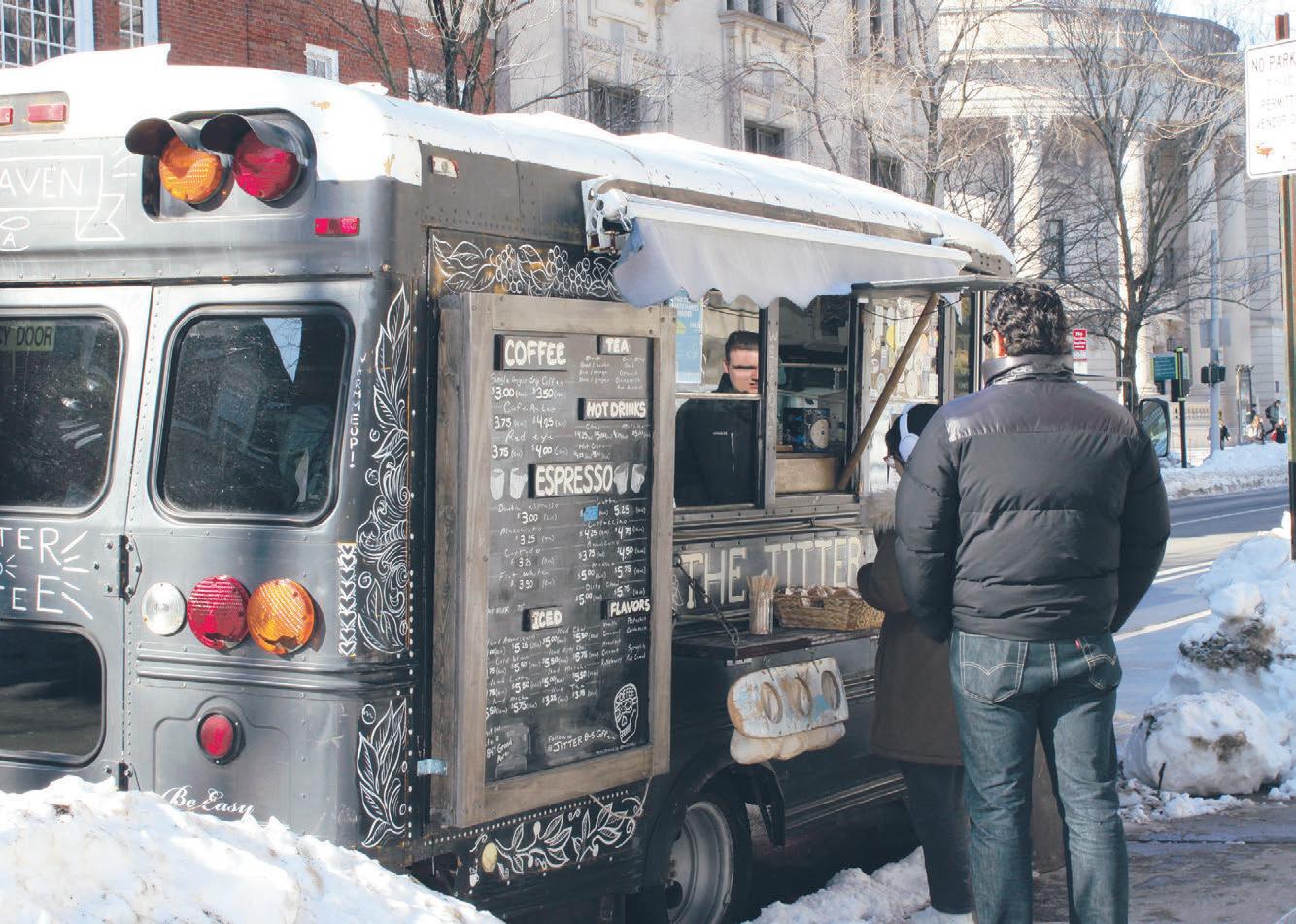
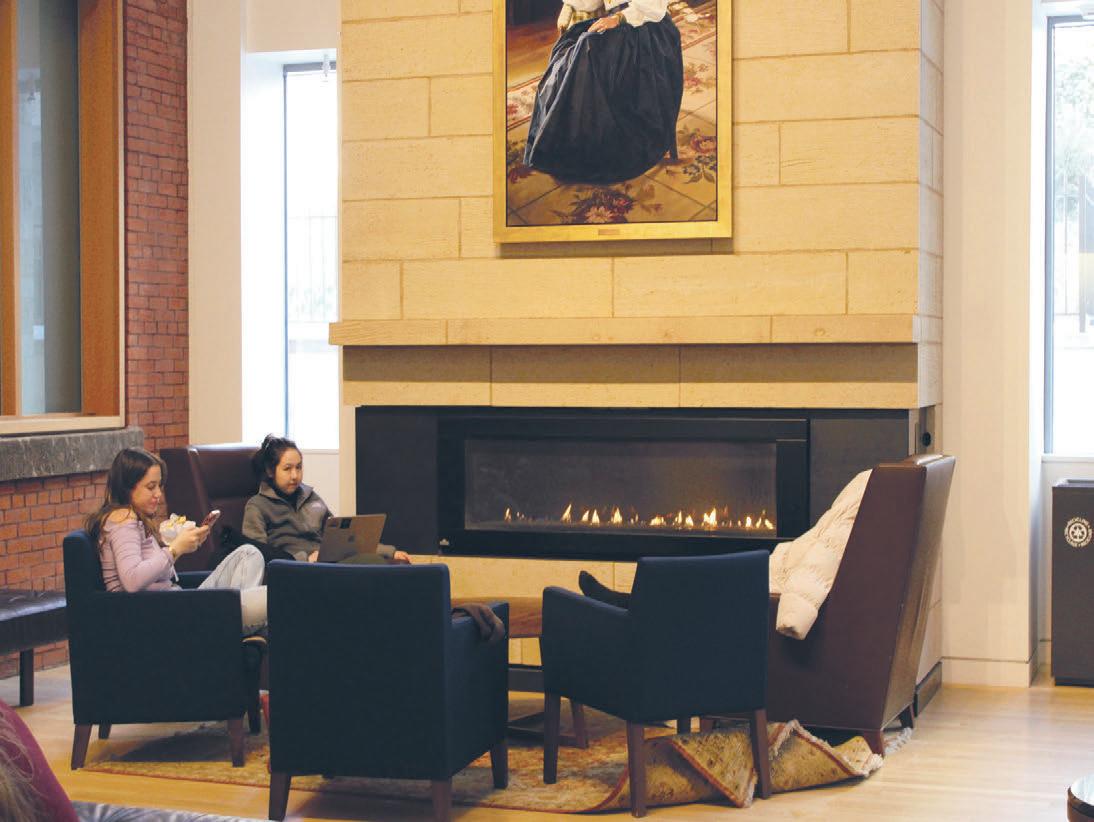

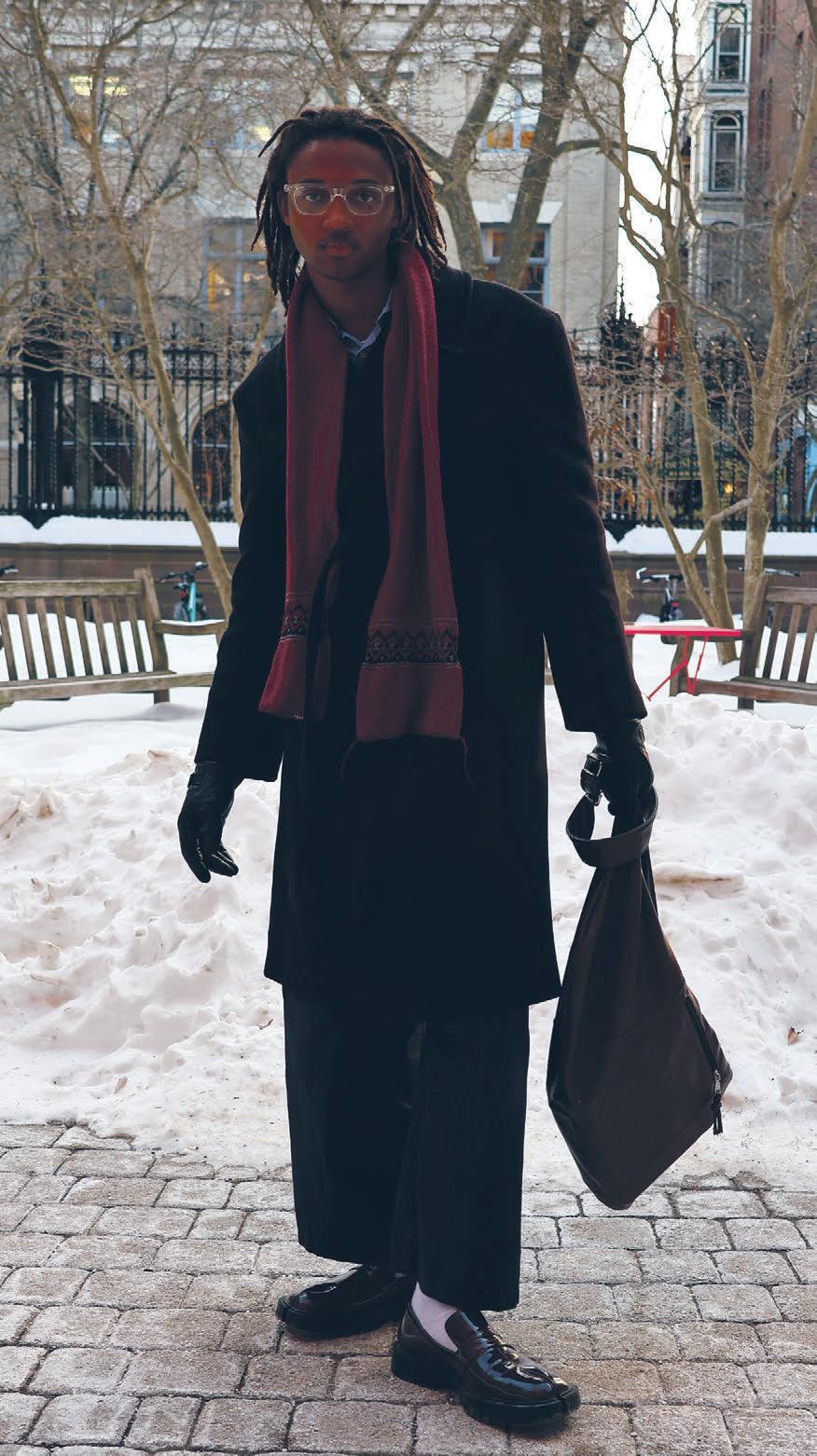
Photographs by Logan Dinkins and Abby Assouad Staff Photogrpahers


MEN'SHOCKEY
BY LIZA KAUFMAN STAFF REPORTER
The Yale men’s hockey team (7–15–0, 6–8–0 ECAC) will return to action this weekend when the Bulldogs will hit the road for matchups at Princeton (12–9–1, 8–6–0 ECAC) and Quinnipiac (20–5–3, 11–2–1 ECAC).
The Elis will face off against the Tigers at Princeton’s Baker Rink on Friday at 7 p.m. before returning to the Nutmeg state to play the Bobcats on Saturday at 7 p.m. at Quinnipiac’s 3,570-seat M&T Bank Arena, a short distance from Yale’s campus.
When the teams met earlier this season during Yale’s home opener weekend, the Bulldogs pulled off two major upsets, sweeping the Bobcats and the Tigers to pick up their first two conference victories.
In November, Yale took down Quinnipiac 4-2 for the first time in seven years in the annual War on Whitney. Despite the Bobcats taking an early two-goal lead in the first period, goals from David Andreychuk ’27 and James Shannon ’29 equalized the score. A backhander from captain David Chen ’26 and a Ronan O’Donnell ’28
Tigers and Bobcats
empty-netter sealed the victory.
From Shannon’s first collegiate goal in his first home game as a Bulldog, to the defense’s perfect penalty kill unit, to Yale’s first victory over Quinnipiac in the teams’ last 17 meetups, the 2025-26 home opener was one for the books.
The Elis then rode the momentum of the War on Whitney into the following night when they tamed the Tigers 2-1. Yale got on the board first with a power-play goal from Hughie Hooker ’28. Princeton came out flying in the final frame, equalizing the score fifteen seconds in. However, the Bulldogs refused to go down without a fight. Thrown into overtime, before the rowdy Ingalls crowd, Rhys Bentham ’27 drop passed to Zach Wagnon ’28, who buried the puck in the overtime game-winning goal to lead the Elis to their first victory over the Tigers since 2023.
The Bulldogs will seek to replicate these early season successes this time in cat territory.
Following a difficult weekend homestand against Cornell and Colgate, the Bulldogs will look to return to the win column this weekend, but that will not prove to be an easy task.
The Tigers are ranked No. 31 nationally and are fifth in the ECAC, while the Bobcats — who have dominated the ice since falling to Yale early on — are ranked No. 9 nationally and sit comfortably at third in the ECAC.
Going into Friday’s matchup, the Tigers enter after mixed success last weekend in upstate New York. Princeton defeated Clarkson 3-1 (11–14–3, 5–8–3 ECAC) before a devastating 2-6 loss to Saint Lawrence (4–21–3, 3–12–1 ECAC). Nonetheless, the Tigers have played exceptionally well at home, boasting a 9–1 record, with their only home loss coming to Union (15–9–2, 5–8–1 ECAC), whom the Bulldogs destroyed 4-1 last month. Princeton will seek to defend its home ice as the season winds down.
Saturday’s opponent, Quinnipiac, will look to rebound from its 2-4 loss to Yale earlier this season when it hosts the Bulldogs at M&T Bank Arena. After gliding to a 7-0 shutout at Saint Lawrence last Friday, the Bobcats emerged victorious in the shootout against Clarkson. Despite some early season losses and a recent 2-4 loss to UConn (15–7–3, 9–5–1 HEA) in the championship game of the Connecticut Ice Tournament that Yale hosted last month,
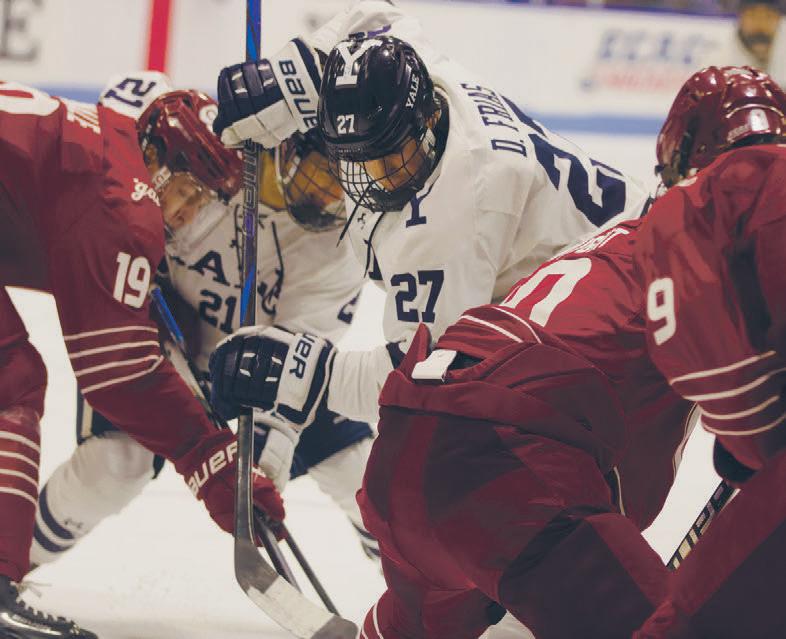
Quinnipiac has dominated both conference and non-conference play, with a 10–0–2 record at home and an 8–3–1 record on the road. Although it will be a tall task to overcome these two powerhouse squads, especially on the road, the Bulldogs have proven before they can defy the odds and come out on top. Puck drop is slated for 7 p.m. both nights. Contact LIZA KAUFMAN at liza.kaufman@yale.edu.
Yale to host Brown for lone conference game of the weekend
MEN'SBASKETBALL
BY BRODY GILKISON STAFF REPORTER
The Yale men’s basketball team (16–4, 4–2 Ivy) will host the Brown Bears (7–13, 1–6 Ivy) on Friday night for a matchup
between the Ivy League’s top and bottom squads. Though the Bulldogs dropped their last game to Harvard (12–9, 5–2 Ivy), Yale still holds the No. 1 spot in the conference standings. On the other hand, the Bears have been abysmal this season, having eked out just one win in conference
play and sitting firmly outside of the postseason picture.
The rest of the Ivy League squads are all competing for playoff spots. Harvard sits tied at the top with the Bulldogs after their last-second victory over the Elis last weekend. A rematch of the two teams is scheduled for next weekend on Valen-
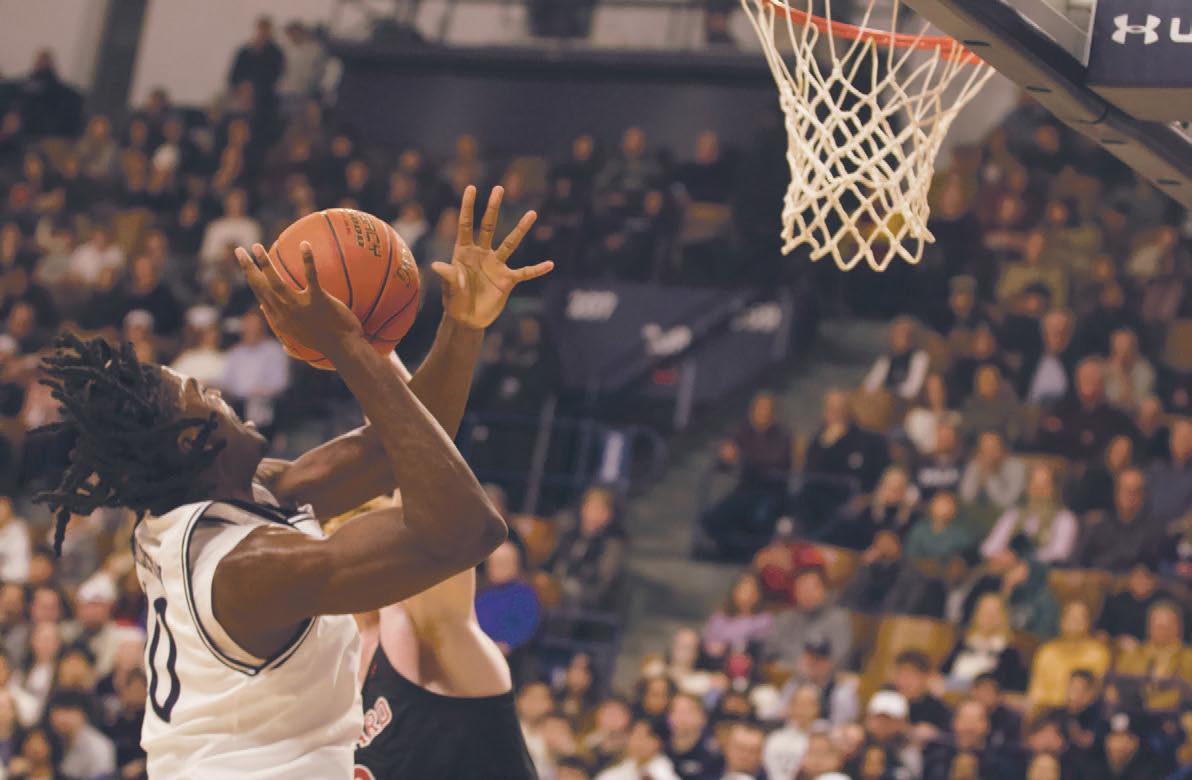
tine’s Day, when there will surely be no love lost between the two rivals as they duke it out for the top seed in the Ivy League. Sitting in a tie for third place are the Princeton Tigers (8–14, 4–3 Ivy) and Dartmouth Big Green (10–10, 4–3 Ivy), both just a game back in conference play from the Bulldogs and Crimson. At 3–4, and only a game out of the coveted top four seeds are Columbia (14–7, 3–4 Ivy), Penn (10–10, 3–4 Ivy) and Cornell (10–10, 3–4 Ivy).
With seven of the eight Ivy teams within two games of each other in the standings, it is important to remember that due to the small size of the conference, all teams face each other twice a season. Thus, even though the Bulldogs lost to Princeton and Harvard, they still control their own destiny and are able to lock up the number-one seed as long as they win the seven remaining conference games on their schedule.
Ahead of Friday’s matchup against Brown, Yale seems to outmatch the Bears both on paper and on tape. Offensively, the Bulldogs have been firing on all cylinders.
Ranked the 28th-best offense in the country by KenPom, Yale has been shooting a league-high 41.8 percent from beyond the arc, as well as a league-best 50.2 percent from the field.
The Bulldogs have been able to impose their offensive will on their opponents in almost every game with
their aggressive and efficient offense. Big men Nick Townsend ’26 and Samson Aletan ’27 have consistently anchored the paint all season, while guards Trevor Mullin ’27 and Jordan Brathwaite ’28 have emerged as dangerous sharpshooters.
Forwards Casey Simmons ’26 and Isaac Celiscar ’28 have proven to be multi-capable threats. They’ve used their athleticism to slip between cracks and attack the rim while also stepping back and hitting the occasional jumpshot. On defense, the Bulldogs rank fifth in the league in rebounding. Head coach James Jones has coached his squad into playing better three-point defense as the season has progressed, but the Bulldogs weakness of giving up second-chance baskets has proven to be painful in their close losses this year.
“We’re constantly getting better in practice, and we know we still have more room to improve,” guard Riley Fox ’28 said when asked about the team’s rebounding. “If we can clean this up, it limits the stress on our defense and produces more opportunities for our offense to go out there and score.”
Yale tips off against Brown in the John J. Lee Amphitheater at 7 p.m. on Friday night. The game will be aired on ESPN+.
Contact BRODY GILKISON at brody.gilkison@yale.edu.
Bulldogs look ahead to ECAC championship meet in Boston
TRACKANDFIELD
BY INEZ CHUIDIAN STAFF REPORTER
The Yale track and field team will travel to Boston University’s Track and Tennis Center on Saturday to compete at the ECAC Indoor Track and Field Championship. The meet will be the fourth consecutive competitive weekend for the team, meaning athletes have endured extensive training and high-stakes performances over the last month.
Since the season began, athletes have improved their performances and broken records. In 2026 alone, the Bulldogs have broken four standing school records in the weight throw, 60-meter hurdles, 60-meter sprint and 400meter sprint. For athletes who compete in a variety of events, success in one discipline often translates to another. Gloria Guerrier ’27, who broke the 400-meter school record at the Penn Invitational last weekend, hopes for such an effect on her upcoming races.
“Since I run ‘harder’ events such as the 500m and 400 hurdles, throwing down a good time for the 400m excites me for my potential in other races!” Guerrier wrote in a text message to the News. Guerrier also trains alongside her twin sister, Victoria Guerrier ’27, who she credits her racing success to.
“Practicing with Victoria is honestly like battling with myself because we are so close in fitness and performance,” Gloria Guerrier wrote. “I’m lucky I can always chase the best version of myself day in and day out.”
With the regular season winding down, the stakes rise for athletes as they shift their focus to the upcoming Ivy League and NCAA Championships. Unlike regular-season meets, these championships offer the Bulldogs a chance to clinch acclaimed titles.
After this weekend, the Bulldogs will only have the Giegengack Invitational and the David Hemery Valentine Invitational between them and the championship season.
“We’re coming off this last weekend with a lot of really
strong performances,” men’s captain Andrew Farr ’26 wrote, adding that he is “hoping to carry that momentum through this last training block and into championship season.” The ECAC Indoor Track & Field Championship will begin on Saturday and continue through Sunday. Field events will commence at 10 a.m. with track events following at 12 p.m.
Contact INEZ CHUIDIAN at inezchristina.chuidian@yale.edu.
Quinnipiac in Hamden.
LIZA KAUFMAN / PHOTO EDITOR
The men’s basketball team will host the Brown Bears on Friday night as they look to bounce back from a loss against Harvard.
WEEKEND




BEATLES BIOPIC BLUES



Are the upcoming
// BY CIELO GAZARD


biopics too big to fail?
It may seem odd, but there has yet to be a major motion picture about the life and times of the Beatles. With the exception of 1994’s “Backbeat” about the band’s very early days in Hamburg and 2009’s “Nowhere Boy” about John Lennon’s teenage years, there hasn’t been a biopic about the Beatles, and certainly nothing on the scale of “Bohemian Rhapsody” or “Amadeus.”
So, when it was announced last year that Sam Mendes will be directing a “four-film cinematic event” chronicling the lives of each of the four Beatles, I was taken aback. These films are set to be released on the same day in April 2028, and the first photos showing the four lead actors — Harris Dickinson, Paul Mescal, Joseph Quinn and Barry Keoghan— in character as the Fab Four were released last week.
Like many fans, I was quite shocked to see how little these actors actually looked like the icons they are portraying. Quinn’s Harrison appears much older than someone supposed to be in his mid-20s while Dickinson’s Lennon has hair that was far too thin.
Maybe us Beatles fans are being too nitpicky. After all, a trailer for these films has yet to be released. When it does come out, I am almost certain that fans will critique the actors’ ability to recreate the Beatles’ distinct Liverpudlian accents. At the moment, it is far too early to tell if we are gearing up for a massive let down or a major success.
Mendes is burdened with the near-impossible task of getting every historical detail about the Beatles correct. There have been countless books written about every waking moment of the band’s career. The smallest error could trigger a wave of backlash from obsessive Beatles fans. I can’t help but wonder who the creators of these films are catering towards.
There was a bit of backlash when the four lead actors
were revealed, with Lennon’s half-sister Julia Baird hoping that unknown actors from Liverpool would portray the city’s most famous residents. Perhaps, the decision to cast these four famous actors is meant to draw a greater audience.
However, as I mentioned previously, shouldn’t the fact that this is the first biopic about the Beatles be enough of a reason to go and see the film? Mescal, who was cast as Paul McCartney, said it is best for fans to go in “knowing as little as possible” about the films before seeing them. But I can almost guarantee that the vast majority of people who will go and watch all four films are dedicated Beatles fans, and that they will have scoured the internet for any and all information before arriving at the theater.
This brings me to another concern: Why release all four films on the same day? Movie theaters don’t operate as a place where attendees can easily jump from one theater to another.
The reasoning behind the “one film for each Beatle” model is so that each Beatle’s perspective is represented for the duration of one film. Little is known about how this will be executed. From the limited promotional material, it seems each Beatle will be depicted in a distinct phase of the group’s tenure. Will the film dedicated to McCartney be about the early days of the Fab Four and the film dedicated to Lennon be about the breakup?
Maybe, the four film model is built for streaming services. One can binge all four movies from the comfort of one’s home. However, this alongside Netflix’s plans to acquire Warner Bros. only reflects a concern that the film industry is disinterested in keeping the movie-going experience alive for the next generation of film lovers.
There’s been a growing trend in the musician biopic genre to focus on a few years in an artist’s life rather than
an artist’s entire career. “Springsteen: Deliver Me from Nowhere” focuses on just two years in Springsteen’s life. In my opinion, this same approach cannot be applied to the Beatles. While it is entirely possible to focus on, for example, the writing and recording of “Sgt. Pepper’s Lonely Hearts Club Band” alone, the stakes are too high for Mendes to do this small-scale approach.
However, how much can one fit in a two- or threehour movie about some of history’s most documented musicians? I think that the biopic format may be far too limiting to tell an accurate, riveting story about the Beatles. A limited series similar to that of “The Crown” might be a better way at exploring the band’s personal lives and creative endeavors. If this direction was successfully taken, it could have spelled the end of the biopic genre by elucidating the value of a slower, more attentive pace. However, if these films fail to live up to the enormous hype, that might just kill the genre quicker.
It is imperative that people recognize how the Beatles were able to change music so much in such a short period of time. If “Let it Be,” the Beatles’ final album, was released in 2026, their debut album would have come out in 2019 — that’s less than eight years of music-making. All of the Beatles were younger than 30 when their breakup was announced. Yet over 50 years after the breakup, we are still talking about them. As a sappy fan, I do believe that these films will be a success if just one kid listens to and falls in love with the Beatles after watching. However, the world’s biggest and greatest band needs to be handled with care on the big screen.
Contact CIELO GAZARD at cielo.gazard@yale.edu.
Snowstalgia
// BY LILY SCHECKNER
Spoon under my pillow. Pajamas inside out. Ice cubes flushed down the toilet. When I was little, snow days were mysteriously magical — yet, they were also painstakingly manifested. I struggled to fall asleep after hours of praying for a snow day. A mixture of anxiety and anticipation kept me awake. I spent the night hoping my parents would come into my room, gently shake me awake and tell me the news I awaited with baited breath: School was cancelled.
On those incredible mornings, I’d wake up early and slip into snowpants and waterproof boots. I’d join my little sister and we’d run down the stairs, throwing ourselves out the door onto the nearest snow mound, newly soft and blinding in its sunny reflection. Along with the childhood friends who lived on my street, I’d make snow angels and sled down hills. I’d sit in front of the fire and drink the gallon of hot chocolate my mom was kind enough to supply for me.
In short, I’d take the transformation of my neighborhood literally. When it was covered in snow,
it was a different world. It was a world where worries briefly ceased to exist — because I had worried so much in preparation. The moment when white turned to gray, powder to slush, was a time of mourning. It was both a return to school and a return to reality.
As time went on, my perspective irrevocably shifted. I began to view snow with the sharpness and definition turned up. I saw the piles of yellow snow, the food wrappers wedged beneath ice. It was a lot like learning Santa and the Tooth Fairy weren’t real.
The traditions of spoons and ice cubes faded. My childhood friends moved away. I replaced my snowsuit with jeans and a puffer. Every time I went outside, water soaked my pants and leaked into my shoes. So, mostly, I stopped leaving the house during snow storms. I viewed snow days as an opportunity to hunker down, catch up on much-needed sleep and binge watch a new TV show. It became about the absence of school more than the presence of anything else.
My traditions and prayers suddenly felt incredibly

PERSONAL ESSAY
Slipping through my fingers
Coming back from winter break, I have realized that my high school friends only know the high school version of me, and my college friends only know the college version. This perhaps makes sense given that this is the context in which each know me. But it’s interesting how different I am now from who I was two years ago.
Many parts of me remain unchanged.
I’m a morning person who can stay up late, someone who prefers reading to watching movies, loves having a physical calendar on my desk to cross off the passing days and views the world through rose-tinted glasses. In high school, I was archetyped as the short brunette who played varsity beach volleyball. At Yale, I’m often visually recognized by my bright turquoise Fjällräven backpack and my rotating collection of headbands.
My beach volleyball career didn’t end with a dramatic goodbye. It simply didn’t take root on the East Coast. A part of my identity in high school had been grounded in after-school practices on our courts — which I will forever remember were 80 percent packed dirt and 20 percent sand — with sunburned shoulders and the quiet confidence that came from playing a sport that typically required height. I certainly miss it; I even once proposed building beach volleyball courts on the top floor of Payne Whitney Gymnasium. Instead, I play for Trumbull’s intramural volleyball team. It isn’t the same. Before volleyball consumed my life, I was a ballerina for ten years. A few weeks ago, a friend invited me to a ballet class on campus, and my body surprised me. At the barre, my muscles executed combinations I hadn’t recalled in years. The experience felt less like reclaiming something I had lost and more like being welcomed back by something that had waited patiently for me all along. I recently joined Danceworks and will hopefully be dancing my heart out to “Lush Life” later this semester.
The same quiet shift has happened with reading. I don’t read for pleasure the way
I used to. As a child, I could breeze through at least five “Magic Tree House” books in a single day. In tenth grade, I read “Hamlet” for fun. Now, most of my reading is tethered to syllabi for my English and classical civilization courses.
Yet, I still find ways to read just for myself. Over fall break in New York City, I made it my mission to hunt down a copy of Dostoevsky’s esoteric short story “White Nights,” which led me to several bookstores before I finally found it. More recently, I’ve gravitated toward modern poetry. One evening a few days ago, I stopped by Grey Matter Books and located the poetry section. My fingers landed on a moderately sized hardcover titled “99 Poems” by Dana Gioia.
In a world that moves quickly, and with a GCal crowded with classes, office hours, YCC meetings and the like, poetry feels accessible in a way long novels no longer do. In high school, I wrote fictional short stories and published them online, and I once started but never finished a retelling of the Trojan War. Now, I’m writing these words on this page as well as starting a new Google Doc for my own poems.
For these reasons, I can’t say I’ve ever lost parts of my identity or my passions. I think I’ve been distracted from them temporarily, only for them to resurface later in altered forms. What once defined me hasn’t disappeared; it has simply been transformed. What slipped through my fingers fell into a new form at my feet. Although I have yet to find passion in physics, I’m starting to understand what Newton was talking about with the law of conservation of mass. Nothing is truly lost, nothing is created, everything is changed.
Contact SIENA VALDIVIA at siena.valdivia@yale.edu.
Forafewhours,a
childish. My manifestations were now reserved for exams and college decisions, family issues and friendship breakups. When classes turned virtual instead of being cancelled in my freshman year of high school, it was the last nail in the coffin of my beloved snow days. Then, it was my freshman year of college and it was midnight on a Sunday. I was running. The cold wind stung my face as I sprinted, stopping every few feet to scrape some snow into my gloved palm. I was ecstatic, even though my entire body was coated with cold, slushy liquid and my heart screamed, “You are not athletic enough for this!” As another friend tackled me to the ground, snow ball in hand, I gazed up at the night sky above Old Campus and felt transported back into a memory that seemed, to the untrained eye, entirely disparate: one of cold, bright mornings in my front yard.
Yale traditions are often driven by an almost performative level of maturity, meant to pair with the glitz and glamour characteristic of an Ivy League school. At the First Year Holiday Dinner, I stood in uncomfortable heels and watched in disbelief while a frankly absurd amount of food — the “Parade of Comestibles” — was wheeled around the room. At the Yale Symphony Orchestra Halloween show, my jaw dropped when Paul McCartney made his guest appearance in a student short film.
But at the first year snowball fight, there were no expensive gimmicks or evening gowns. For a few hours, a group of teenagers became children again. And, the next morning, I awoke with memories that had a hazy and dream-like quality.
For one night, the magic of snow days returned. It wasn’t something I obsessed into existence. In fact, it was completely spontaneous — I wasn’t even planning to go earlier that day. In a way, it was the natural next step of a childhood tradition’s evolution into its adulthood.
Now, even as I struggle through the remaining snow that’s blocking my way to class, it reminds me of something. Not home or childhood, exactly, but a feeling I associate with both. A feeling that now I can also associate with Yale.
Contact LILY SCHECKNER at lily.scheckner@yale.edu.

// BY SIENA VALDIVIA
Don’t fear your inexperience
Revisiting “Fast Times at Ridgemont High”
// BY PETER BURNS
My parents have always found the time to show me media from when they were my age. I’ve often dismissed it as boring or disconnected from my modern experiences; it always felt there was something better to do. But if there is any film they have shown me that has transcended its 80s pomp and grainy Technicolor presentation, it is “Fast Times at Ridgemont High.” I watched it for the third time over this past winter break and was stunned yet again by how relevant it feels.
The 1982 film, directed by Amy Heckerling and written by Cameron Crowe, looks exactly like the kind of movie that should not age well, especially in 2026. From surfacelevel descriptions, I would expect the oversexualization and excessive testosterone to be exhausting, and cheap laughs at young people’s expense feel just uncomfortable enough to make me question why I’m watching the movie in the first place.
Yet the movie platforms the voices of the familiar creatures of American high-school life — the burnout, the scrawny virgin, the stoner and the pretty girl reduced to a punchline — in a way far more observant and honest than you might expect from such a raunchy film. In between the bare skin and beers, “Fast Times” nails the experience of growing up: learning to navigate sex, relationships and the expectations both from ourselves and the people around us. These rites of passage are often romanticized in stories about adolescence, but “Fast Times” stays true to the moments that aren’t quite as pretty.
“Fast Times” is amoral. Early on, we are introduced to Mike Damone, played by Robert Romanus, as he scalps movie tickets outside the theater next to the restaurant where his crush works. This sort of youthful exploitation — making a buck while waiting for a glimpse of a pretty girl — is as much a part of the setting as it is the plot.
What’s more: this movie takes the notion of “sex sells” to a new level. There is no cathartic graduation scene that we might associate with films about high school, nor any grand redemption or moral. Instead, we witness small awakenings. Characters’ expectations collide with reality, and the product of that
reaction is maturity.
Consider Stacy Hamilton, played by Jennifer Jason Leigh. She’s a quintessential “nice” girl who works a part-time job on the weekends and after school. She thinks that sex and sexual experiences are the key to being an adult — that she can just do what her peers do. Yet, she quickly discovers that sex and relationships are awkward, and moreover, that they are supposed to be awkward. As Grace Neaves wrote in a piece in Collider, “Stacy’s enthusiasm about sex is never shamed or used as a plot point to cast judgment over her character.”
Sean Penn’s Jeff Spicoli, perhaps the film’s most iconic figure, is the laid-back surfer and stoner rebel, the scourge of all the teachers at Ridgemont High. He is disruptive in class and visibly high all the time — the very opposite of a square. He may not be the most eloquent, but his instinctive resistance to rules is not entirely foolish. As he says to his hateful American history teacher, Mr. Hand, “you know, we left this England place ’cause it was bogus; so if we don’t rule ourselves — pronto — we’ll just be bogus, too!” He understands the arbitrariness of authority better than anyone.
“Fast Times at Ridgemont High” calls the script of young adulthood exactly what it is: bogus. Along with my cohort at Yale, I arrived on campus after my peers and social media had often and forcefully instructed me that I should know everything about myself: what I like, what I want to study, what career I want. The characters in “Fast Times” claw forward without guidance and without asking for guidance. They mistake their proximity to adulthood for competence. Do we not do the same, but with LinkedIn, curated Instagram posts and meticulously planned futures? Uncertainty is not a failure for the creatures of Ridgemont High, and it shouldn’t be for us, either.
“Wherever you are, that is the place to be,” says Mike Damone. We have no reason to stress about plans and expectations for our experiences. Don’t overthink. Don’t try to be something that feels unnatural. Take that deep breath and enjoy every opportunity for what it is, not what you think it’s supposed to be.
Contact PETER BURNS at peter.burns@yale.edu.

BY
JACINDA WEBBER
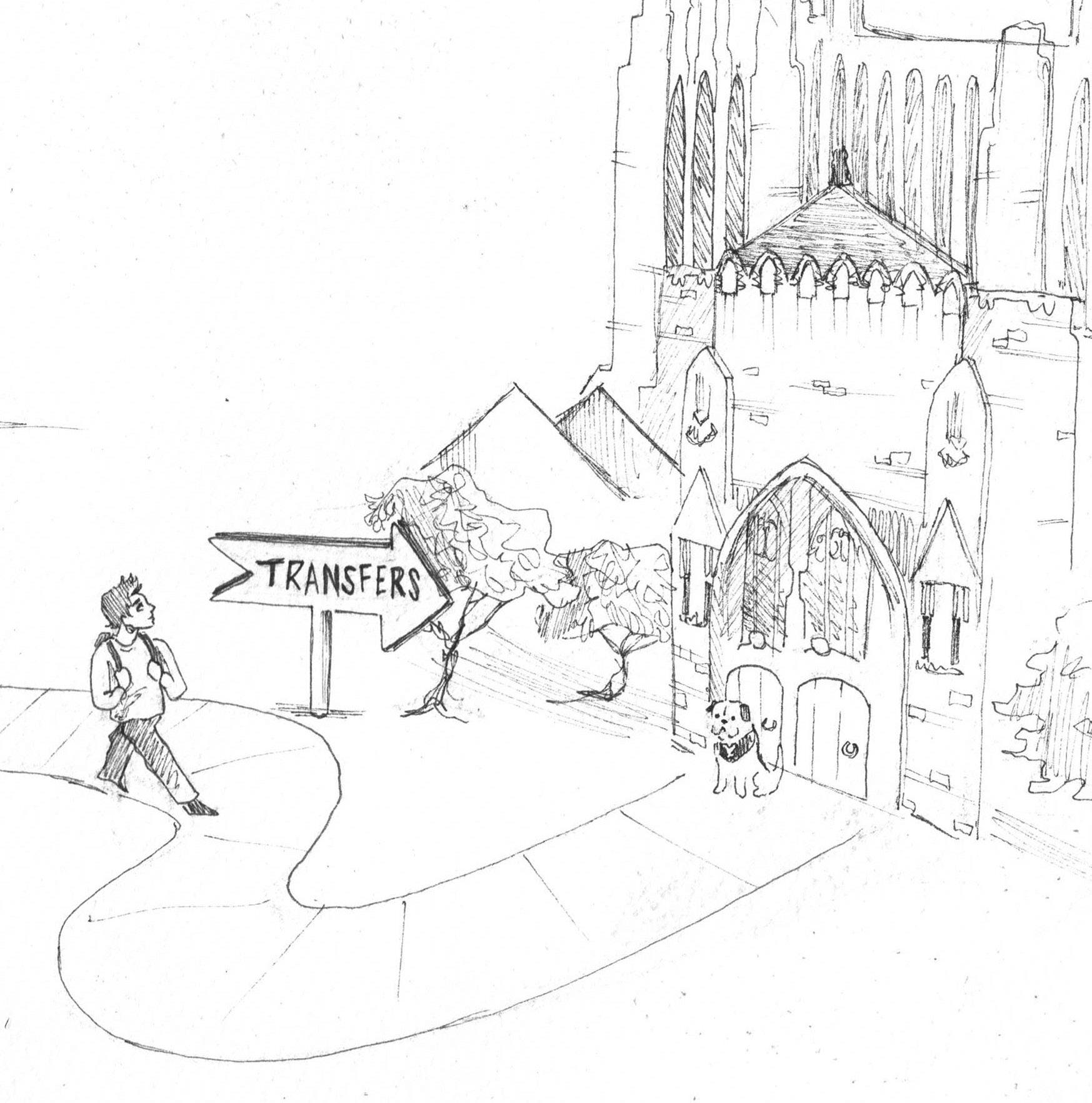
PERSONAL ESSAY
Anything can happen
One Yale transfer student’s experience on our campus
// BY ESMERALDA
VASQUEZ-FERNANDEZ
As a California resident, I always found it annoying to hear people claim that it’s easy to get into prestigious universities by transferring out of a community college. Yes, it is statistically easier to transfer to top state schools like University of California, Berkeley, and University of California, Los Angeles, so I guess I can give them that, but these comments always seem aimed at diminishing a worthy accomplishment.
In some ways, deciding to apply to universities like Yale and Brown was my attempt to get into a school that has a lower transfer rate. Yale’s acceptance rate for the class of 2029 was 4.59 percent. In my year, the transfer acceptance rate was around 2 percent. So yes, maybe I wanted to prove that statistics weren’t the only thing that I had in my favor. And I got what I wanted, but transferring to any university, especially one like Yale, is daunting and intimidating.
Getting to campus was exhilarating, especially since I had never seen it. Yale only gives transfers around a week to commit to matriculating — no biggie. To many people, it seems like a no-brainer. But for me, it never seemed that easy. I had a life envisioned, one that centered around the idea that I would be in Los Angeles living the true 2016 lifestyle. Instead, I found myself reimagining my life as a dark academic in a castle all summer.
I was let into a tiny dorm and my eyes immediately fell to an envelope on the bed. It read “Esmeralda.” The kind words from my transfer counselor washed away some of my anxieties about needing to navigate an entire life alone.
For many transfer students, loneliness is a familiar feeling. Since only around 30 students transfer each year, it can be hard to find friends among those who are in the same boat. The idea that every other junior already lives off campus with their group of best friends can contribute to that sense of being alone. But the transfer community is tight-knit. One of my closest friends at Yale is a transfer student, too. However, Yale’s effort to foster community among transfer students can also stifle connections with the rest of the student body.
I worked hard to get to Yale. I sacrificed a lot, just like most Yalies. So immediately I knew that I wanted to make the most of my opportunities here. I tried out for clubs and joined different organizations, even if I was the oldest person at tryouts. Nothing makes you feel ancient more than being asked by a first year about AP exams you took four years ago. Even sharing my life map in Yale’s Cultural Connections orientation program clearly displayed a life lived outside of high school.
My time at community college still means a lot to me. I’m not embarrassed of having been there — I credit it as a stepping stone in my career. The professors I worked with at community college passionately
prepared me to be a great student moving forward. I do not regret my weekly office hours with them because the knowledge they instilled in me has made my academic transition to Yale easy. I will admit that using Google Maps to find my classes as a junior can sometimes feel embarrassing, but I never forget how exactly a year ago I was praying to have an ounce of what I have today.
The main barrier I have encountered at Yale is a psychological one. Arriving at Yale as a first year means more time to figure out what you want to be or the areas of study you want to pursue. I am grateful to have already found my love for my major, but the lack of semesters that transfers have at Yale can be an obstacle.
It is very common for transfers to petition for extra semesters at Yale. At this time, I do not plan to do so, which makes planning for every semester so important. I want to take classes that genuinely interest me, which is easier to do since I transferred with many of my major requirements and almost all of my distributional requirements completed. That quantitative reasoning credit still hovers over me.
I think everyone who applies to Yale has some ego. You have to if you truly believe you have a shot at something so crazy. But I have yet to find a single person who isn’t willing to help me out here. Maybe it’s because I start a lot of my emails with “I am a transfer student,” gently hinting at my inexperience on Yale’s campus.
Before transferring, I was afraid I’d find myself with seasonal depression or imposter syndrome, but I haven’t — yet. Knock on wood that Yale’s winter doesn’t send me into a spiral. But if it does, I know that Yale has a plethora of resources to help me. This is a privilege, and as a former community college student I can say that the amount of institutional support is unmatched. Even if budget cuts are being implemented. I knew that once I committed to the next institution I would be unable to change my mind. I mean, being a two-time transfer student would be pushing how long I can put off getting a job. So, I am beyond grateful that I do not have regrets about coming to Yale. Every day I get to attend classes that challenge me in a way that is intriguing and entertaining. I get to hang out with people I love. But most importantly, I get to discover myself in ways I never would have if I had gone to a university closer to home with many of the students from my community college who transferred to California schools. I would not have it any other way.
Contact ESMERALDA VASQUEZ-FERNANDEZ at esmeralda.vasquez-fernandez@yale. edu.
ILLUSTRATION
COLUMN
On the Road: In the Temples of God
At Zion National Park, a religious reckoning.
// BY ALEXANDER MEDEL
The hikers around me were quiet. I was sure that now and then a whisper would escape someone’s lips, but I never heard one. Their mouths moved and whatever words they said were carried away, lost to the morning breeze. Their steps were silent and their movements unhurried. They coursed along the trail with the piety of pilgrims in a cathedral.
Indeed, we were in a cathedral. But in place of incense was the scent of cottonwoods and willows. The song in the air came not from a choir, but from a flock of birds taking flight. The river spoke a sermon while its current trickled and frolicked over stones by the shore.
Thesacredexistsbeyondthe confinesofanycathedralor placeofworship.
I looked up and saw, in place of mosaiccovered walls, trees adding a verdant hue to a nave otherwise colored in shades of brown and orange. No spires were to be seen except those of the cliffs around me that reached for the heavens and, at times, became one with the sun. Indeed, this was the church of Zion National Park, and it demanded my reverence.
Places like Zion — places of inordinate natural beauty — have always been peculiar to me. Most certainly not in a bad way. Their peculiarity stems from the fact that I can walk a trail and yet feel that I am walking down an aisle. I can sit upon a rock watching the sun set over a butte or the sun rise over a mesa and yet think I am sitting on a pew. I kneel to inspect a sunbeam, touch a sapling or watch my reflection shimmer in a stream. And every time I do, it feels like a genuflection. I am no stranger to these
places, for I have seen many in my life: Big Sur, the Grand Canyon, Monument Valley. I now had Zion to add to that list. Zion humbled me the way all these other places have. The canyon was the product of millions of years of geologic processes and erosion. There I stood, an observer of nature’s awesome power and the grandeur that can follow. It was quite a sensation, the knowledge that I stood on ancient ground, and even more awe-inducing to grasp that the canyons around me would last well beyond my lifetime. With every step I took on the trail, I was journeying into eternity.
The sacred exists beyond the confines of any cathedral or place of worship. It is not contained by stone masonry, marble floors or stained glass. It lives, breathes and touches the soul wherever you seek it. I sought it in Zion, and I found it in the trees dancing in the morning wind, the sun rising high above the canyon rims and the leaves descending toward the earth. Zion was no cathedral in a traditional sense, but I knew, as Isaac Behunin did long ago when he settled into the canyon, that I was in the temples of God.
Contact ALEXANDER MEDEL at alexander.medel@yale.edu.