

BY REETI MALHOTRA STAFF REPORTER
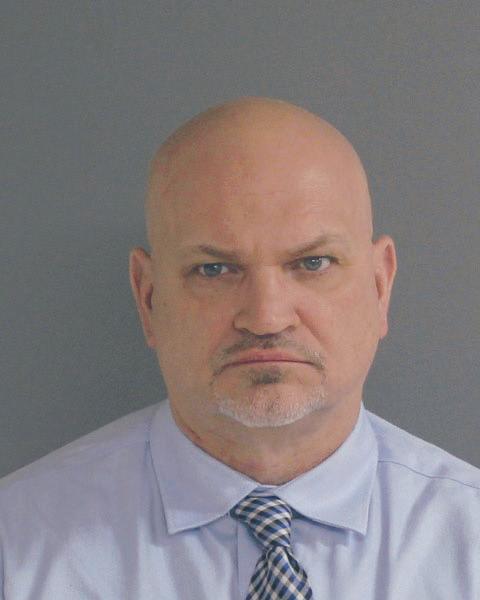
Former New Haven Police Chief Karl Jacobson was arrested by the Connecticut State Police and charged on Friday for allegedly embezzling $85,500 from two city funds during 2024 and 2025, according to a Connecticut Division of Criminal Justice press release.
Jacobson is being charged with two counts of first-degree larceny, and his bail has been set at $150,000.
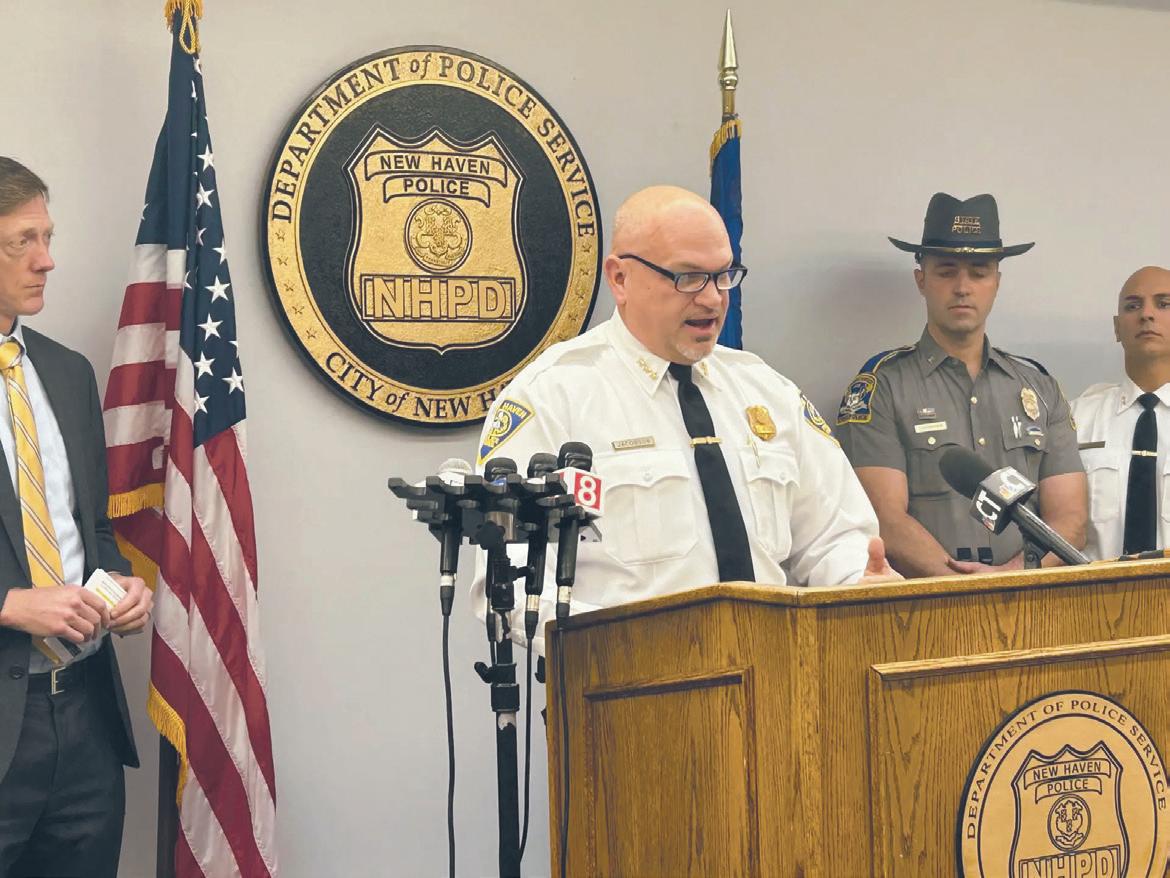
City officials previously announced that Jacobson admitted to stealing $10,000 from the New Haven Police Department’s confidential informants fund over the course of two months and abruptly left his position on Jan. 5. Just a day after the city unveiled a series of new accountability measures to surveil and restart the fund, Jacobson turned himself in to state police, Mayor Justin Elicker said at a Friday afternoon press conference.
According to the application for a warrant for Jacobson’s arrest, the former chief stole $81,500 from the confidential informants and public funds, and $4,000 from the Police Activity League, a youth programming organization for adolescents between the ages of 8 and 17, for which Jacobson was a board member. The league is primarily funded by monetary donations from New Haven businesses, residents, organized fundraisers, state grants, and automatic deductions from city police officers’ checks, according to the application.
“It’s a very sad day for the city to see a chief who was beloved by so many arrested for a theft of public money and also money that was intended for children,” Elicker said.
According to the affidavit in the application for the arrest warrant, Acting Police Chief David Zannelli — who was then an assistant chief — was alerted to “concerns” about the former chief’s “behaviour” by a sergeant in the intelligence unit on Dec. 23, 2025. Upon identifying potential issues with the confidential informants fund’s management, Zannelli relayed his concerns regarding Jacobson’s behavior to Assistant Chief Manmeet Bhagtana, the affidavit says. Bhagtana told Zannelli that Jacobson had made additional fund requests to repair a door dam-
BY REETI MALHOTRA AND ADELE HAEG STAFF REPORTERS
Less Former New Haven Police Chief Karl Jacobson was arrested on Friday and accused of embezzling $85,500 from public funds during 2024 and 2025 — while betting over $4 million on online gambling platforms last year, according to the application for his arrest warrant.
Jacobson abruptly retired from the New Haven Police Department on Jan. 5, just hours after he was confronted by now-Acting Police Chief David Zannelli and two fellow assistant chiefs for alleged mismanagement of the department’s confidential informants fund. During the meeting — which Zannelli recorded — Jacob-
BY NELLIE KENNEY AND SASHA CABRAL STAFF REPORTERS
BY LEO NYBERG STAFF REPORTER
Yale and 30 other universities have made deals with the Trump administration to end their partnerships with an organization that the government accused of discrimination for aiding members of underrepresented groups in seeking doctoral degrees, the Department of Education announced in a press release on Thursday.
The nonprofit organization, called the PhD Project, provides resources — such as mentoring, conferences and networking — to people from underrepresented groups who are seeking doctorates in business fields, and encourages them to enter academia or management.
A Yale School of Management
son admitted to having spent “too much on gambling” and that he had “sought help,” according to the affidavit by a state police lieutenant in the application for Jacobson’s arrest warrant.
“I have a problem. I fix my alcohol problem. I turned to gambling. I don't know why it just got worse recently,” Jacobson said to Zannelli in that meeting, according to the transcript of their Jan. 5 conversation included in the affidavit.
Six weeks after his sudden departure, the eight-page affidavit reveals the extent of Jacobson’s alleged wrongdoing and the gambling habit he maintained while serving as New Haven’s top law enforcement officer, recognized
BY JERRY GAO STAFF REPORTER
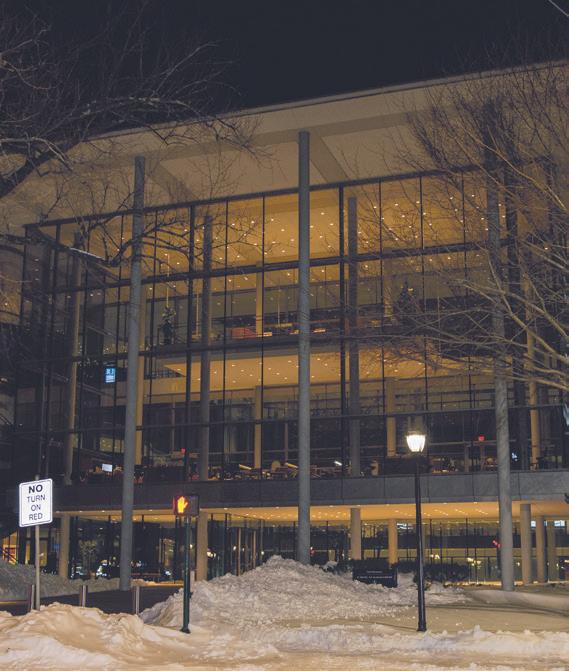
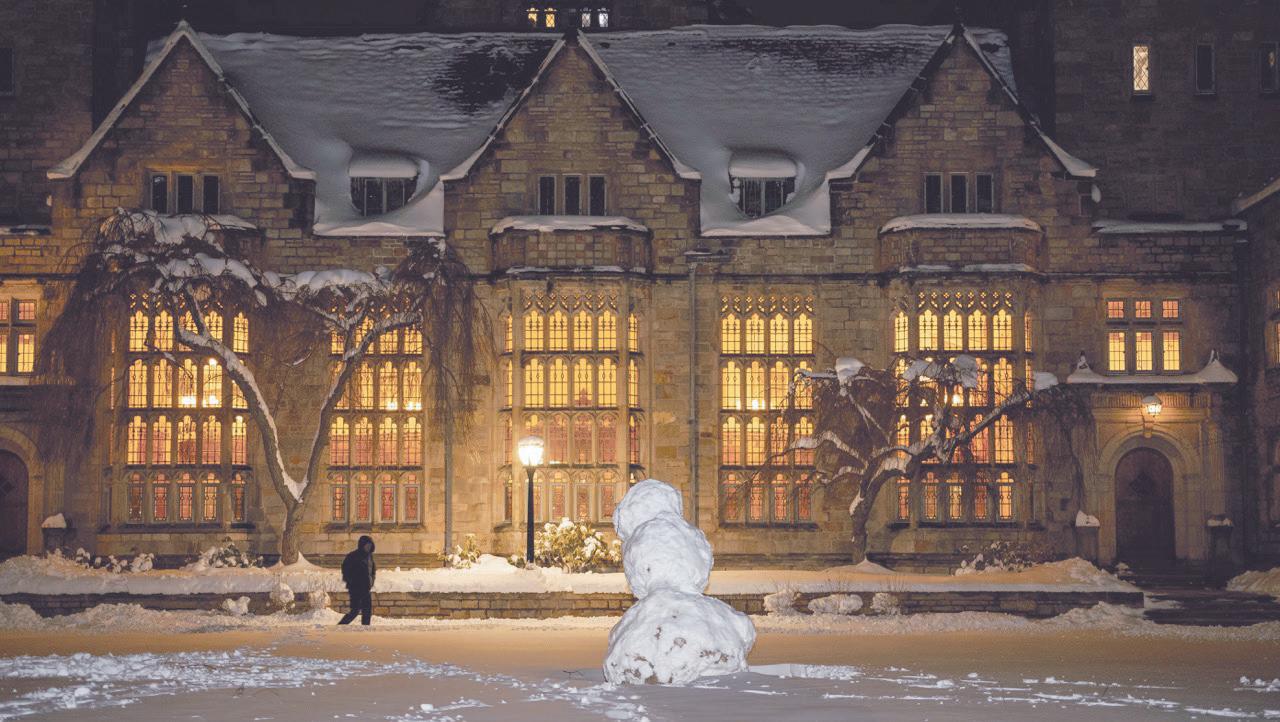
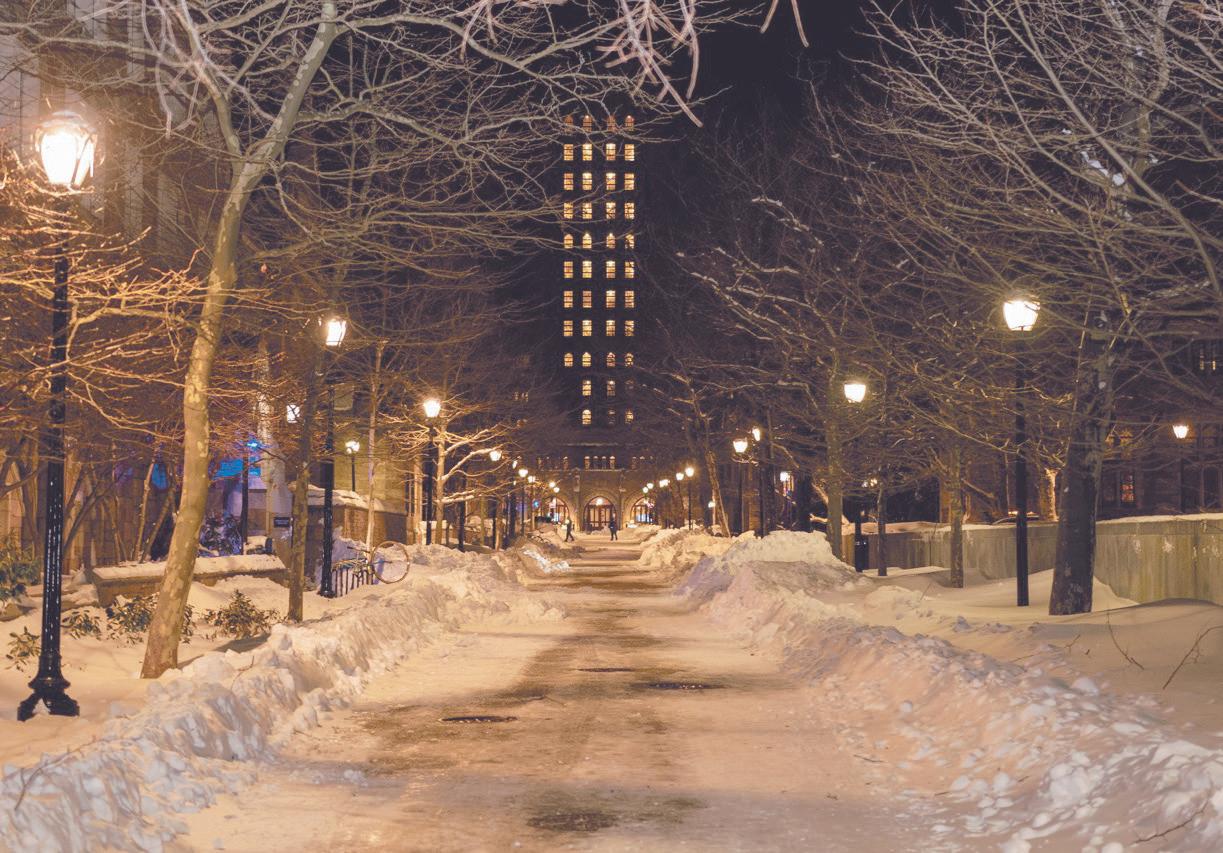
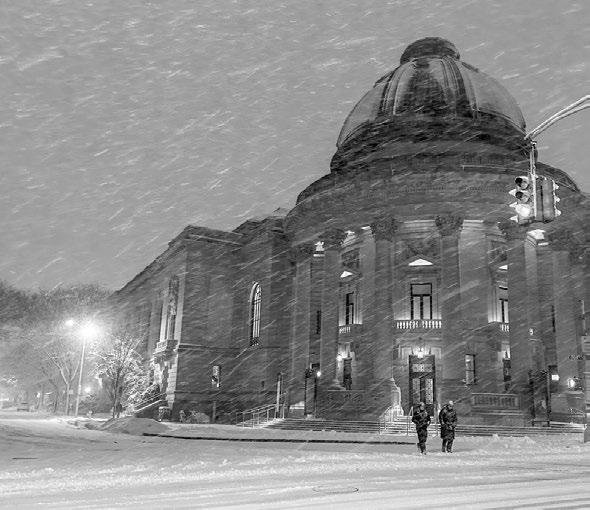
Yale administrators recommended a second day of remote instruction, after a blizzard affecting the
coated New Haven with over a foot of snow and brought a normally bustling campus largely to a standstill. In a message on Monday after-
noon, University Provost Scott Strobel and Senior Vice President for Operations Geoff Chatas encouraged classes and University work to be done remotely if possible, though still noting exceptions.
“We recognize that some labs and courses require an in-person format,” the administrators wrote. “We ask that faculty communicate directly with their students about
the status of their courses.” The announcement follows a Yale alert on Sunday that told Yale students and employees that all Monday classes and non-essential work would be moved to a remote format. More than 16 inches of snow fell on New Haven streets by Monday afternoon, according to the National
BY BRODY GILKISON STAFF REPORTER
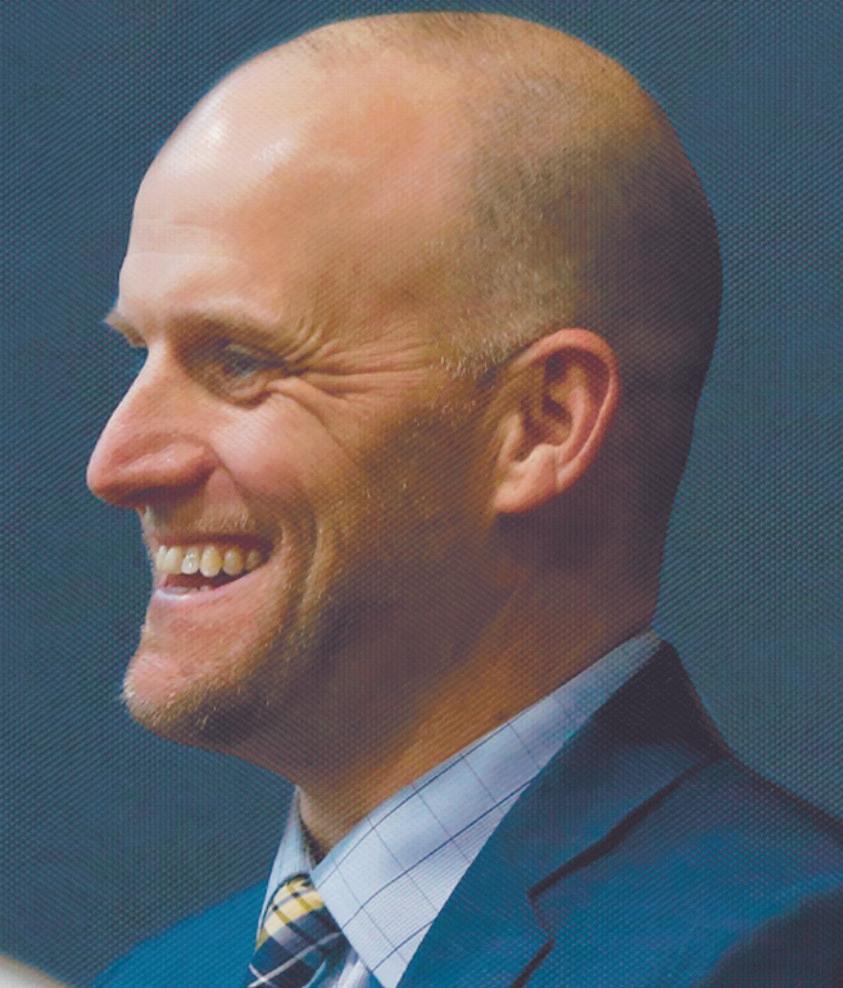
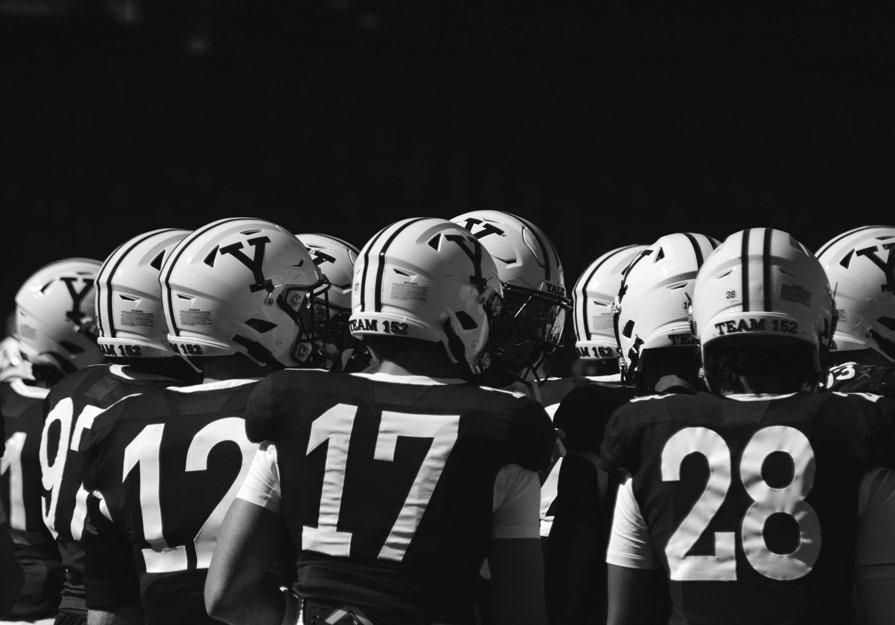
Kevin Cahill, Lehigh University’s head football coach, will be the next head coach of Yale’s team, Yale Athletics announced on Monday afternoon.
Cahill’s appointment comes after longtime Yale head coach Tony Reno announced last Tuesday that he was stepping down after 14 years at the helm, citing medical reasons. After declaring the commencement of a national search for Reno’s replacement, the Bulldogs have landed one of the top coaches in the Football Championship Subdivision.
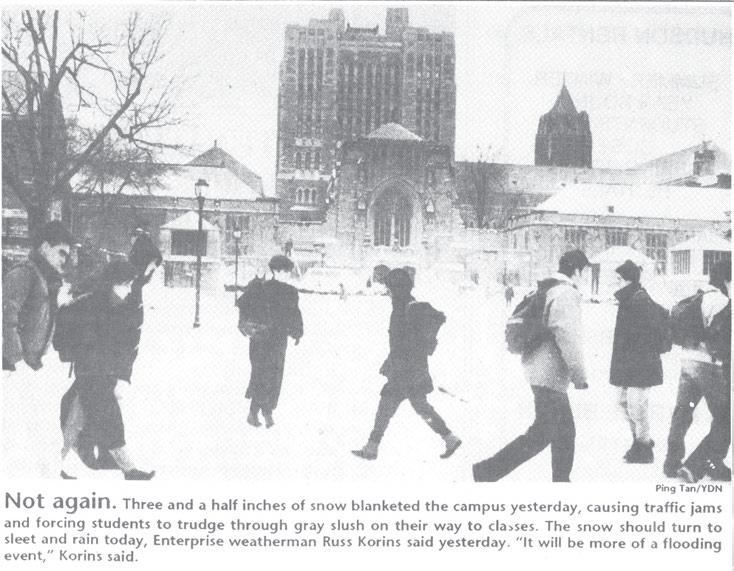
February 20, 1979 / Neither rain nor shine nor postal holidays will close this university
By Sascha Segan
Last Monday confused students wandered in and out of Yale Station wondering what had happened to the mail they relied on to cure their February blues. But Monday was President’s Day, a national holiday.
The post office was closed, but Yale was open for business
In fact, Yale is open on every national holiday which falls during term time including President’s Day, Labor Day, Martin Luther King Jr. Day, and Columbus Day. Though freshpeople express some bewilderment, jaded seniors have realized the truth: like WaWa, Yale never closes.

Love at the Yale Center for British Art, Through the Lens on Page 11

By Leo Nyberg
I woke up energized Thursday morning and forsook my usual morning routine of lying in bed for some reading. The Washington Post reported that morning that over 100 colleges and universities had cut ties with programs that help racial minorities after the Trump Administration had pressured them to do so. Yale was not featured in The Post’s story, so I decided to do some reporting of my own. I sent an email to the PhD Project, a group Yale had been investigated for partnering with, to find out if the University had cut ties with it.
The Department of Education beat me to the punch. Shortly after I read The Post article, the Office of Civil Rights posted a list of 31 universities that had agreed to cut ties, and at the bottom of the list was Yale. So, I emailed all the important actors to get comments over the weekend, preparing to file the story Sunday night. I reached out to other universities’ communications offices to see if they could offer more details than Yale would, and MIT responded. Although Yale and School of Management spokespeople declined to comment on the story, they kindly told me to stay safe and warm during the snowstorm.
Read “Agency: Yale left diversity program” on page 1.
CORRECTIONS:
In the Feb. 20 edition, an article about research into biodegradable plastics misstated some of the findings of a study by Yale School of the Environment researchers. The study found that substituting 46 percent of conventional plastics, not all of them, with biodegradable alternatives could reduce ecotoxicity by 34 percent — and could reduce global waste accumulation by 27, not 65, percent. The article also referred misleadingly to a team of industrial ecologists with whom associate professor Yuan Yao conducted the study; she conducted it with Zhengyin Piao, a postdoctoral researcher. And, due to an editing error, the article inaccurately identified Yao as a 2019 graduate of the School of the Environment. She is an associate professor at the school, but not an alumna.
An article about layoffs at Yale College printed in the Feb. 20 edition misrepresented a Yale spokesperson’s response to the News’ inquiries. The spokesperson provided a statement but did not directly answer the News’ questions about whether University employees had been laid off.
A Weekend article on a course in lithology published in the Feb. 20 edition misspelled a professor’s name. She is Irene Michnicki, not Michniki.
An Opinion column about the News’ practice of ending articles with a neutral fact published in the Feb. 20 edition misquoted an example of a neutral fact. The quote stated that the Qing dynasty fell in the early 20th century, not the early 13th century.
A review of Yale Opera’s “La Bohème” published in the Feb. 17 edition misstated the name of a performer due to an error in the show’s program. He is Chris Leimgruber, not Leimbruger.


The Yale Daily News is conducting a survey to help us determine how we can better serve our readers. As we experiment with increasing the frequency of our print paper, we’re especially interested in learning how you engage with our reporting and how we can tailor our print publication schedule to your interests.
SCAN HERE

Donald Trump has made clear what he thinks about elite universities. In 2024, during his campaign for president, Trump said that schools like MIT, Columbia, Stanford and Penn “will pay us billions for the terror they have unleashed into our oncegreat country.” Now, with the new endowment tax increase taking effect this year, President Trump is making good on his threat. His attacks against elite universities, particularly the Ivy League, are punitive. But they’re also politically astute: Only 15 percent of Americans say they have a great deal of trust in the Ivy League, according to a Manhattan Institute survey from last summer.
But that statistic, and the distrust that it shows, is misplaced. I’d like to think that if more Americans better understood these institutions, the public’s trust in them would look very different.
In 2023, I was a high school student at a small public school in a rural town in Kentucky. My hometown doesn’t look like an Ivy League campus. There is little racial diversity, and only 20.9 percent of people living there have a bachelor’s degree or higher, according to the Federal Reserve Bank of St. Louis. Where I’m from in Kentucky is one of the poorest places in the United States. In fact, the cost of a semester at Yale exceeds the median household income in my hometown, according to the U.S. Census Bureau.
You can imagine my surprise, then, when Michael Rebell and Michael Gregory, legal scholars from Harvard Law School and Columbia University’s Teachers College, reached out to the Kentucky Student Voice Team, or KSVT, where I was organizing and where I still lead as a senior advisor. The professors wanted to come to my town to develop a partnership with us, researching Kentucky’s public schools. I needed to show them around and scramble some students and teachers at my high school to speak with them.
Over two years, the professors visited my town and a dozen other towns around a state that could be called antidotal to common stereotypes about the Ivy League as a respite for liberal coastal elites.
The professors were curious about Kentucky, specifically Rose v. Council for Better Education, a Kentucky State Supreme Court case decided in 1989. In that decision, the state’s entire public school system was ruled unconstitutional for failing to provide an efficient and adequate education, prompting lawmakers to overhaul and rebuild it from the ground up. Rebell and Gregory, whom us students affectionately call “the Mikes,” are providing legal representation for KSVT in their capacities as professors at
Harvard Law School. Rebell left Columbia for Harvard in the time since I graduated high school. If their suit against Kentucky succeeds, it could force the state legislature to change Kentucky’s public schools, where nearly 700,000 students are enrolled.
Kentucky, to many, might seem like the last place Harvard and Columbia scholars would come looking. But it wasn’t. And they’re not the only Ivy League universities looking outside their campuses’ wrought iron gates.
Last summer, I found a job listing for an office assistant at Yale Law School’s Arthur Liman Center for Public Interest Law. Working there showed me how Ivy League law schools invest in the public good. My boss, Katherine Braner LAW ’93, teaches students at Yale Law School about solitary confinement and travels to correctional facilities in Connecticut to teach incarcerated people about their rights. And that’s only about a fifth of the work she does at the Liman Center. There are real reasons for Americans to be skeptical about the Ivy League. In 2025, more than onethird of students who graduated from Yale were hired by finance, tech and consulting firms, such as McKinsey, Goldman Sachs, Meta and JP Morgan. Those companies have not always given Americans good reasons to trust them. Meta has mishandled data and undermined elections. Goldman Sachs sold high-risk mortgages, leading to the 2008 financial crisis. Even still, those graduates aren’t the only ones that Yale has set into American society. Yale produced the first medical X-ray images, introduced penicillin and chemotherapy to the United States, developed the first artificial heart pump, discovered melatonin, identified Lyme disease, built the first insulin pump — the list goes on, and these are only medical contributions.
Yale is not perfect. Other universities aren’t either. But Trump, for his part, is simply a populist who understands that attacking the Ivy League bodes well with his base. He’s counting on most Americans not looking closely enough to complicate their feelings about institutions whose legacies are complicated. But the Mikes, who visit Kentucky to fight for better public schools, and Kate Braner, who teaches incarcerated people about their rights, are hallmarks of the Ivy League. Knowing their names, and their work, is necessary to keep what’s benevolent about where we study.
ZACHARY CLIFTON is a sophomore in Benjamin Franklin College studying political science. He can be reached at zachary.clifton@yale.edu.

There is something sacred about the Yale dining hall. It is a place where the University’s intellectual and social diversity truly comes to life, stripped of the formality of the seminar table or the hierarchy of the extracurricular board.
Meal culture is the heartbeat of this campus. Within the span of my first week here, I found myself sharing a meal with a competitive ice skater, a chess prodigy and an aspiring doctor. These are the “simply because” meals. They started with a quick text or a casual “we should get a meal,” and ended two hours later with a bowl of ice cream and a new best friend. My first real roots here were planted in those long, sprawling dinners where the conversation drifted from the ethics of artificial intelligence to the best place for late-night pizza.
But in our celebration of the communal, we have inadvertently cultivated a quiet, pervasive fear of eating alone.
I didn’t realize how deeply I had internalized this until a Tuesday afternoon when I saw my Google Calendar was unexpectedly blank. I hadn’t scheduled a meal. As I walked into the Silliman dining hall, a strange wariness took over. I found myself glancing around, checking the room for witnesses to my solitude. I didn’t just sit down to eat; I engaged in a frantic choreography of busyness. I chose a seat in the far corner, tucked against a window. I unsheathed my laptop with purpose. I put on my headphones, unsure of what — or whether — music was
even playing. I even pulled a book out of my bag for extra intellectual weight. If someone saw me, I wanted the narrative to be clear: This is a working lunch. I am far too occupied with my high-stakes academic life to bother with company.
I spent those thirty minutes scrolling through my phone with a forced, performative nonchalance. But then, as I looked up from my screen, the artifice began to crumble.
I realized that not one person was looking at me.
In the high-speed whirlwind of Yale, we often spend so much energy framing ourselves for the imagined gazes of our peers that we forget to actually live in the moments we are curating. I had spent my entire lunch viewing myself through the lens of other people’s supposed judgment, and in the process, I hadn’t tasted a single bite of my food.
This realization leads to uncomfortable questions. If we aren’t comfortable with ourselves, how can we expect anyone else to be truly comfortable with us? If we cannot enjoy our own company for a 20-minute lunch, are we truly connecting with others, or are we just using them to avoid the silence of our own thoughts?
Yale is a place of relentless velocity. We are constantly encouraged to be social, to be productive, to be engaged. But a table for one offers something that a table for eight cannot: a chance to slow down. It is a moment of necessary stillness in an environment that otherwise demands constant motion. When
GUEST COLUMNIST
WILLIAM BARBEE
WHEN WE TREAT EATING ALONE AS A STIGMA, WE ROB OURSELVES OF THE OPPORTUNITY TO CHECK IN WITH THE PERSON WE SPEND THE MOST TIME WITH – OURSELVES.
we treat eating alone as a stigma, we rob ourselves of the opportunity to check in with the person we spend the most time with — ourselves. We should continue to cherish the spontaneous dinners and the three-hour brunch debates. They are the core of the Yale experience. But we must also dismantle the idea that a solitary chair is a sign of social rejection. It is, if we allow it to be, a sign of self-sufficiency.
Embrace Yale’s meal culture. But when you happen to chance upon a meal alone, embrace that too. I’m still learning how.
HRISHITA SHAH is a sophomore in Silliman College studying Economics and Computer Science. She can be reached at hrishita.shah@yale.edu.
Yale stands at an inflection point regarding the future of the University. The identity of the American academy has eroded over time to the point where a majority of our fellow citizens have lost faith in the trajectory of higher education. The Yale administration has dutifully responded with a number of initiatives — including the Committee on Institutional Voice, Committee on Trust in Higher Education and the Center for Civic Thought — to address this growing crisis. But the problems stem deeper than mere bureaucratic reorganization. We, especially students, must reclaim the roots of what it means to attend Yale so that the tree of our austere institution can flourish.
The purpose of my column is to cast out seeds with the hope that a few might germinate in the minds of university leaders. As one of the leading voices in the conservative movement on campus, I believe I stand on firm ground to offer constructive criticism of the university — criticism that stems from a place not of contempt, but of admiration. If Yale is to persist as an institution of veneration, it must recognize its own shortcomings and address them with the rigor, tact and elegance that ought to be expected of an Ivy League university.
This process of reconciliation can only begin from the place where all great things at Yale first originate: conversation. And, regrettably, the state of conversation at our university today is sorely lacking.
I recently attended a debate hosted by the Buckley Institute, an organization for which I previously served as student president, on the American immigration crisis, entitled, “Resolved: Mass Deportation Is Necessary.” The debaters — one the Director of Immigration Studies at the Cato Institute, the other a former acting Secretary of Homeland Security — sparred for an hour on topics ranging from the feasibility of immigration reform to the economics of mass deportation to the executive orders of President Trump. I was impressed by the candor
of the Buckley Institute’s guests in their discussion of such a monumental and controversial topic. Yet, upon leaving the event, I could not help but feel a sense of disappointment in my fellow audience members — not due to their reactions, but due to their lack thereof.
IF YALE IS TO PERSIST AS AN INSTITUTION OF VENERATION, IT MUST RECOGNIZE ITS OWN SHORTCOMINGS AND ADDRESS THEM WITH THE RIGOR, TACT AND ELEGANCE THAT OUGHT TO BE EXPECTED OF AN IVY LEAGUE UNIVERSITY.
Seated in the second row from the front, I watched as not a steady flow, but a sporadic trickle of guests came through the doors of our WLH classroom to attend a debate on what is likely the most hotly-contested issue of our time. Instead of throngs of students lining College Street for miles, waiting to have their opinions shaped by leading figures in the field, this event was greeted with a half-empty auditorium of Buckley Fellows, curious newcomers and the occasional New Haven resident. The seats which event organizers hoped to be taken up within minutes were left underwhelmingly spare.
I will venture the opinion that the Yale administration would have benefitted from making attendance at this event a graduation requirement for all students. Since Yale has made engagement with the body politic its central mission as an institution — if the “For Humanity” campaign’s stated goal means
anything, it is to make Yale more public-minded — it must prioritize the dissemination of ideas from across the political spectrum, especially those that are opposed to one another.
How will students be able to fight for a more just, sound immigration system if they do not understand those against whom they fight? “Cultivating Conversations” workshops, for all the benevolent intentions behind them, are inadequate. Students require real exposure to real ideas from real leaders in a manner that forces both sides to grapple with themselves.
The only guests that seem to solicit attention from Yale students anymore are politicians like Curtis Sliwa — and not because of their overwhelming support for third party candidates and reform-based politics. Yalies would prefer to indulge in the words “glaze,” “Gotti,” and “Gambino” than to grapple profoundly with pressing political questions. It is the reason why Yale Political Union debates experience an exodus of students following the speech by the guest; it is the reason why the Buckley debate struggled to gain traction; and it is the reason why the American people distrust our university.
That is why I call upon the University to do what this column proposes and conserve conversations — at least those that already take place. If the only loci for public debates on campus are to be the Buckley Institute and YPU, then Yale must do everything in its power to ensure the perpetuation and flourishing of those institutions. From accessible funds for security and police presence at events to exclusive, designated auditoriums for debate, the university has the means to elevate its reputation as a leading institution for the free exchange of ideas. All it takes is the impetus to seize them, forever changing the trajectory of our university and our nation.
WILLIAM BARBEE is a senior in Silliman College studying History. He can be reached at william.barbee@yale.edu.
GAMBLING FROM PAGE 1
for taking a community-oriented approach since he became chief in 2022.
Jacobson wagered over $4.4 million on two gambling platforms, DraftKings and FanDuel, between Jan. 1, 2025 and Jan. 5, 2026, with a net loss of $214,365.74 over the year-long period, according to the affidavit. Connecticut legalized sports betting in 2021.
Jacobson is facing two counts of first-degree larceny in connection with his alleged theft of $81,500 from the New Haven Police Department Narcotic Enforcement Program Fund and $4,000 from the New Haven Police Activity League, a policerun youth programming organization, during 2024 and 2025, state prosecutors said in a Friday news release.
Jacobson turned himself in to Connecticut State Police on Friday. A Connecticut judge set his bail at $150,000.
“I will remind everyone that an arrest is not evidence of guilt and allegations are not proof,” Gregory Cerritelli, Jacobson’s lawyer, wrote in a Friday statement to the New Haven Independent on the former police chief’s behalf. “This is the beginning of a very long process. I urge everyone to keep an open mind and avoid a rush to judgment.”
Officer Christian Bruckhart, the New Haven Police Department’s spokesperson, said in a Friday phone interview that Jacobson, who was a New Haven police officer for 15 years before being named chief, had “a lot of close relationships” in the department and the city, and across the state.
“The job was his life. It’s been a very trying time,” Bruckhart said.
According to a sworn statement by Zannelli, provided on Jan. 8 and included in the affidavit, Jacobson — after being confronted by the assistant chiefs — “pleaded for them to let him replace the money, fix the logbook, and then retire” and asked for the “opportunity to avoid potentially going to jail and losing his pension for misusing government funds.”
Under Connecticut law, if any public official or state or municipal employee is convicted of or pleads guilty to any crime, their pension may be reduced or revoked. The status of Jacobson’s pension has not yet been determined.
Nathan Novemsky, a Yale School of Management professor who studies the psychology of judgment and decision-making, said that when it comes to addiction management, “sometimes one dangerous compulsion is replaced by another harmful compulsion.”
DraftKings and FanDuel — online betting platforms approved in Connecticut and free to download — each gained millions of users nationwide after the Supreme Court struck down a 1992 law barring state-authorized sports gambling in 2018.
“With the phone as the ever-present tool for seeking reward, if you now have gambling apps on there that are especially rewarding to you, it’s just like an alcoholic living in a liquor store or a bar,” Novemsky said.
“There’s less stigma today, frankly, to sports betting now that FanDuels and DraftKings are out there and on TV and advertisements,” Novemsky said. Still, Novemsky said, stigma remains a “barrier” for seeking help.
Per the affidavit, a New Haven police sergeant alerted Zannelli on Dec. 23, 2025, to “concerns” about the former chief’s “behavior.”
In November and December last year, Jacobson dispensed $2,000 from the confidential informants program to a lieutenant, who informed the sergeant who in turn alerted Zannelli, according to Zannelli’s sworn statement. The lieutenant also reportedly told Zannelli that Jacobson then took back $1,000, which he never returned, and left the lieutenant an “IOU” note.
ARREST FROM PAGE 1
aged during the serving of an arrest warrant, support controlled drug buys and pay informants, according to the affidavit. Following Zannelli’s investigation of concerns against Jacobson, he, Bhagtana and a third assistant police chief confronted Jacobson in a meeting on Jan. 5. Zannelli, “in fear” of how Jacobson might react to the allegations against him, “surreptitiously” audio-recorded the meeting on his phone, according to the affidavit.
When questioned about the missing funds and his recent behavior, Jacobson told the assistant chiefs he had a problem with gambling that had worsened over the last few months, and said he had “sought help” and had taken out a loan to replace the misappropriated funds, the affidavit describes. He admitted that he had taken $10,000 over the last two months from additional checks, per the affidavit.
According to Zannelli’s state-
ment in the affidavit, Jacobson “pleaded for them to let him replace the money, fix the logbook, and then retire” and asked for the “opportunity to avoid potentially going to jail and losing his pension for misusing government funds.”
According to Elicker, an investigation remains underway.
The Connecticut State Police began an investigation into Jacobson’s misappropriation of funds on Jan. 6., just a day after Jacobson was confronted by the assistant chiefs. A search and seizure of items from Jacobson’s office and of the former chief’s bank records corroborated his admission of stealing $10,000. It also identified an additional $4,000 stolen from the Police Activity League.
A further forensic analysis conducted by the Federal Bureau of Investigation comparing Jacobson’s personnel checking account to the confidential informants fund found $81,500 unaccounted for from the fund in 2024 and 2025, according to the affidavit.
A search and seizure war -
rant issued for records related to Jacobson’s activities from three gambling platforms — Fanatics, DraftKings and FanDuel — identified that Jacobson had wagered $4,464,884.26 and experienced a net loss of $214,365.74 from Jan. 1, 2025 to Jan. 5, 2026 on DraftKings and FanDuel. From the beginning of 2025 to Jan. 8, 2026, Jacobson also made 1,366 transfers, totalling $373,855, to the two applications, according to the affidavit.
“I think from the beginning, we really didn't know how deep this went,” Elicker said at the press conference.
Jacobson received a $180,000 annual salary as city police chief, according to the affidavit.
Jacobson was appointed as chief of the New Haven Police Department in 2022, and was due to retire on Jan. 31, 2026.
Contact REETI MALHOTRA at reeti.malhotra@yale.edu and ADELE HAEG at adele.haeg@yale.edu.
SNOW FROM PAGE 1
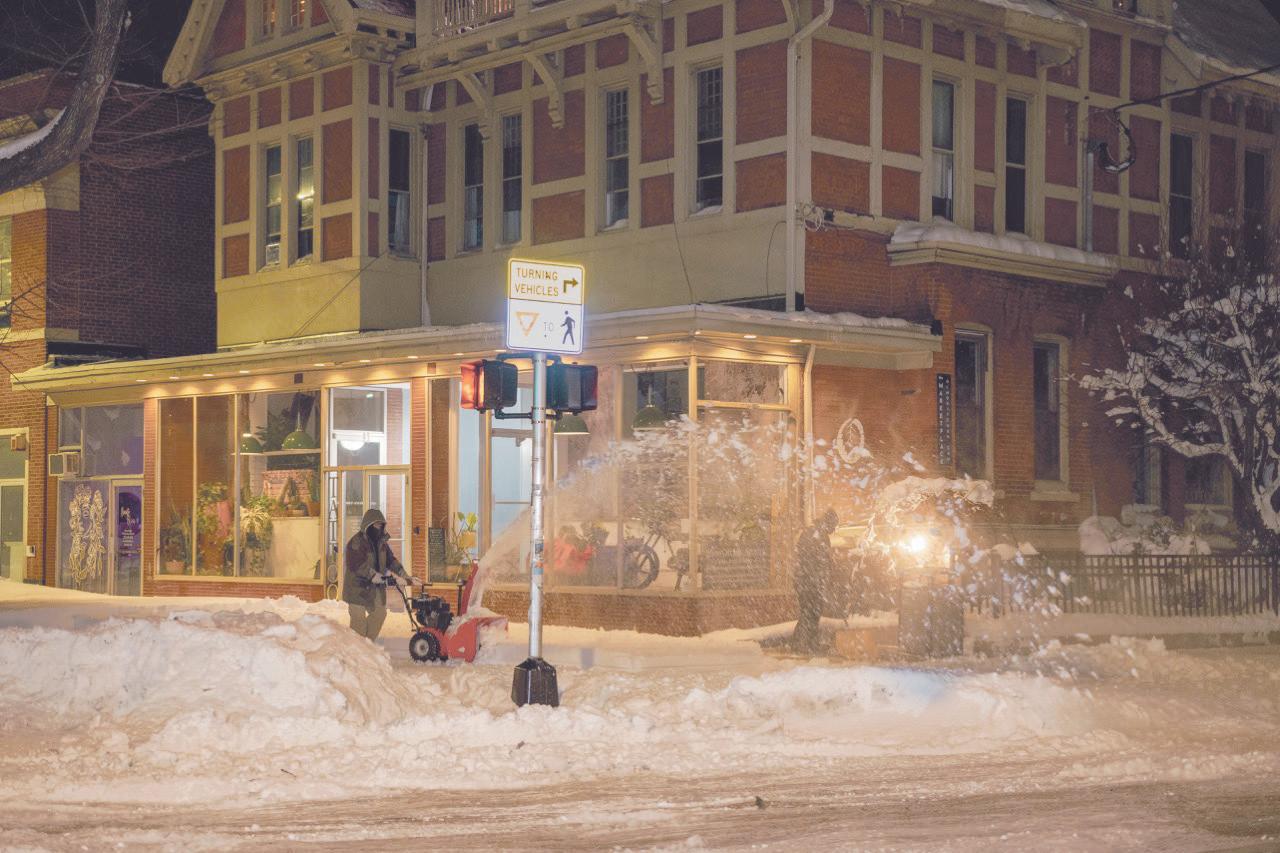
Weather Service. By Monday evening, snow had stopped falling, but many of the sidewalks on campus were still covered by varying amounts of snow and ice. Workers manning shovels, snowblowers and plow trucks roamed campus in efforts to remove snow as early as Sunday evening.
Parts of the administrators’ Monday message regarding remote classes and work were identical to an announcement sent in late January, when Yale was last hit with a severe snowstorm that halted classes and disrupted various services across campus.
George Hines, Yale’s director of emergency management, wrote in a statement provided to the News that Yale “continues to closely monitor the winter storm.”
“Emergency planning and operations teams are working closely with departments across campus to ensure these functions remain in place while keeping the safety and well-being of the community at the center of every decision,” Hines wrote. “Many dedicated staff members have ensured continuity of
operations during weather events, along with the faculty who sustain the university’s educational, research, and clinical missions despite disruption.”
Connecticut Gov. Ned Lamont SOM ’80 announced a state of emergency on Sunday. Lamont ended his emergency order prohibiting commercial vehicles on certain highways at 4:00 p.m. Monday but has yet to lift the state of emergency, which lasts until the end of Monday.
John Humphries, the instructor for Introduction to Data Analysis and Econometrics, wrote to students in an email reviewed by the News that he will hold an in-person lecture on Tuesday but noted that a recording will be made available on Canvas, Yale’s online course management platform.
Katja Lindskog, the director of undergraduate studies of the Directed Studies program for first years, wrote in an email to students that all Tuesday Directed Studies classes would be online in light of “the most recent updates from Yale Operations.”
The snowstorm caused Yale Hospitality to cancel breakfast and lunch hours on Monday, and only 10 res-
Zannelli further wrote in his statement that Jacobson had sole authority over receiving and dispensing money from the confidential informants fund, as well as maintaining a log of the fund’s transactions, according to the affidavit. Upon discovering potential issues with the fund’s management, Zannelli relayed his concerns about Jacobson’s behavior to Assistant Chief Manmeet Bhagtana.
Bhagtana explained to Zannelli that Jacobson had made additional fund requests to repair a door damaged during the serving of an arrest warrant, support controlled drug buys and pay informants for investigations. Zannelli, who also spoke to the lieutenant, learned that Jacobson had requested a “personal loan” of $500 from the lieutenant at the end of last December, according to the affidavit.
The lieutenant, who kept his own “logbook” of informant money transactions, explained that Jacobson “typically” cashed a $5,000 monthly check from the fund and had done so since 2019, when Jacobson assumed control over it as the assistant chief of investigations, according to Zannelli’s statement. Following a temporary pause in its operations, the confiden -
tial informants program is due to restart after city officials on Thursday unveiled a set of new guardrails for its fund.
When questioned in the Jan. 5 meeting with three assistant police chiefs, Jacobson admitted to having “spent too much” on gambling, which had worsened in recent months, Zannelli wrote in his statement.
The former police chief said he had “sought help” and had taken out a loan to replace the misappropriated funds, according to the affidavit. He conceded that he had taken $20,000 over the last two months from additional checks.
Jacobson said that only he was involved in his misuse of funds, and apologized “for not coming to” the assistant chiefs sooner, the affidavit says. Upon leaving the room, Zannelli wrote, he reported Jacobson’s malfeasance to the New Haven Chief Administrative Officer Justin McCarthy and had the locks on Jacobson’s office door changed.
Jacobson, who retired the same day he was confronted by the assistant chiefs, has not returned to his office, according to the affidavit.
Adele Haeg contributed reporting.
Contact REETI MALHOTRA at reeti.malhotra@yale.edu.
idential college dining halls were open for abbreviated hours between 3 and 6 p.m.
Yale Hospitality announced on Saturday that students on meal plans should pick up pre-packaged meals for Monday breakfast and lunch on Sunday afternoon. The message was followed by announcements from the Yale Shuttle service, Yale Health and the Payne Whitney Gymnasium of reduced or interrupted service.
Some residential college administrators reminded students about the storm.
“Yes: there is another snowstorm bearing down on Grace Hopper College,” Head of College Samuel Moyn wrote in an email on Sunday, adding that the college was “developing a system for you to drop off your wrap (in the lunch box) in the student kitchen” to refrigerate the pre-packaged meals.
Yale canceled classes for two days following a February 2013 storm, known as Blizzard Nemo, which dropped 34 inches of snow, according to the Yale Alumni Magazine.
Contact JERRY GAO at jerry.gao.jg2988@yale.edu.
of
mind as city leaders race to renegotiate the University’s voluntary contribution before Mayor Justin Elicker has to present his proposed budget to the Board of Alders on March 1.
If negotiations do not result in changes to the payment plan, the city will receive only $16 million from the University in the 2027 fiscal year, which is around $8 million less than what Yale has been paying New Haven each year since 2021.
Federal cuts to Medicaid and the Supplemental Nutrition Assistance Program are slated to leave locals in the bottom 25 percent income bracket losing an average of $1,100 a year, according to a study by DataHaven. And with the endowment tax set to cost Yale about $300 million each year alone, the University has made moves to cut costs, including by reducing administrative staff and shrinking budgets across schools and divisions.
Mayor Justin Elicker said in a phone interview that he believes Yale has “the capacity to give more,” and called public engagement with the issue “fantastic.”
Elicker said that federal cuts are “having an impact on a variety of things in our city,” pointing to the federal government’s move not to extend certain Affordable Care Act subsidies. The state has “stepped up and helped in certain cases,” Elicker said, but federal funding cuts make it “more important than ever that we see the University invest in the city that it calls home.”
Elicker acknowledged that the impending endowment tax hike has “had some impact” on the city’s conversations with Yale. The tax, which will come into effect in July, is a dramatic increase from the previous 1.4 percent tax on Yale’s endowment investment returns.
While Yale has “immense capacity,” they also have “significant, maybe higher expenses” because of the tax, Elicker said. He added that “for the federal government, that’s a drop in the bucket, but for Yale and the city, that’s a lot of money.”
The state has tried to step in to fill the gap in federal funding, but legislators have emphasized that the state has limited capacity to offset the full extent of the cuts.
At the first meeting of this year’s legislative session, state legislators elected to extend Connecticut’s Emergency State
Response Fund until the end of the 2027 fiscal year. The fund was instituted to “quickly respond to millions of dollars in ongoing cuts toward essential services that are being made by President Donald Trump and Congressional Republicans,” according to a press release from Gov. Ned Lamont’s SOM ’80 office in early February.
The state is “essentially keeping the lights on while everything else around them is falling apart,” New Haven Rep. Roland Lemar said in a phone interview before the start of the legislative session on Feb. 4.
“We can’t fix it all,” he added.
Tyisha Walker-Myers, the president of the New Haven Board of Alders and chief steward of Local 35, the Yale service and maintenance staff union, said in an interview that if federal funding cuts leave New Haven families struggling, Yale has a responsibility to pitch in.
“It’s different when someone can’t buy food for their three children because they lost money when a large corporation has money just sitting there,” Walker-Myers said. “If New Haven got all the money that they were due, we would be able to do a whole bunch of amazing things.”
In January, Walker-Myers joined other union leaders, clergy members and state officials in calling on Yale to up its annual voluntary contribution to $110 million. The number would be a steep increase from the $16 million it is currently slated to pay in the 2027 fiscal year.
Yale has paid about $23 million a year to the city since the current six-year voluntary contribution agreement was reached in 2021.
That agreement is set to expire in June 2027, and the city is negotiating a new sum for the coming years.
“Yale obviously will always do more for its students than people who aren’t its students, and that makes sense. That’s how any university would work. But I think when you share the same city and are such a dominant force in the same city, you have a responsibility to uplift everyone and make sure that your actions positively impact all New Haveners,” Alder Elias Theodore ’27, who represents the downtown ward including much of Yale’s campus, said in an interview.
Theodore argued that Yale’s investment into New Haven would benefit both parties, and emphasized the potential serious consequences of funding constraints for New Haven.
“It’s really upsetting to think about what that might look like,”
Theodore said. “It’ll look like things that are understaffed being even more understaffed. It might look like, you know, cuts to the programs which I think often go first which are social welfare related, climate related, mental health related, which are so important.”
Sean Matteson, Elicker’s chief of staff, acknowledged the influence of the endowment tax hike on voluntary contribution negotiations.
As of Tuesday, New Haven was “in conversation” with Yale, he said, although he also gestured to the city’s impending budget deadline.
Alexandra Daum, Yale’s associate vice president for New Haven affairs and University properties, wrote in a text message to the News that a statement she made in January “is still the latest on this topic.”
“ We value our close partnership with New Haven,” Daum wrote in the statement. “Looking ahead, while it is premature to discuss specifics aspects, we are optimistic that a mutually beneficial solution will be finalized in the coming months.”
In a December interview, University President Maurie McInnis said that the endowment tax hike “factors into everything.”
Grace O’Grady ’28, a former co-director of Yale’s FOCUS on New Haven orientation program, advocated for more involvement from parties outside of Yale administration and the New Haven government, such as members of Yale’s student body.
“I would also, just in general, be interested in seeing more people who are a part of unions, and also more students being integrated into the process of this discussion.” O’Grady said in an interview.
O’Grady said she is skeptical that Yale’s current budget tightening would prevent it from meeting the $110 million demand from union leaders.
“I do think that there is ability to get much closer to this number than Yale makes it seem,” O’Grady said.
The University’s voluntary payment to New Haven dates back to the 1990s, after then-mayor John Daniels encouraged state legislators to shoot down a proposal from State Representative Pat Dillon SPH ’98 to tax University buildings not used for educational purposes, according to an article in the New Haven Independent.
Isobel McClure contributed reporting. Contact NELLIE KENNEY at nellie.kenney@yale.edu and SASHA CABRAL at sasha.cabral@yale.edu.
webpage, whose text was captured by an internet archive and removed by last March, detailed diversity initiatives at the school and said that in 2020 the school announced “increased its engagement with the PhD Project, an organization focused on increasing diversity in the PhD pipeline, by organizing a school information session with four faculty and a current student.”
The webpage said that the “underrepresentation of Black people and other minorities in the pinnacles of leadership is a disgrace” and that the School of Management was “not exempt from this failing,” promising greater efforts to welcome people from diverse backgrounds to campus.
Spokespeople for Yale and the School of Management declined to comment on the Education Department’s announcement.
President Donald Trump has focused on dismantling diversity initiatives — commonly known as diversity, equity and inclusion, or DEI — since taking office last year. In February last year, the Department of Education published a letter outlining the administration’s interpretation of civil rights law and threatened to cancel federal funding for universities that maintained race-based programs.
The Education Department’s Office for Civil Rights last March opened an investigation into 45 universities, including Yale, related to institutions’ partnerships with the PhD Project. The office alleged that the PhD Project “limits eligibility based on the race of participants.”
The civil rights office claimed in March that Yale and the 44 other universities were “allegedly engaging in race-exclusionary practices” in violation of federal antidiscrimination laws.
“The PhD Project remains focused on our mission to expand the pool of workplace talent by developing business school faculty who inspire, mentor, and support tomorrow’s leaders,” Audrey Wayne, a spokesperson for the organization, wrote in a statement to the News on Friday. “Our vision is to create a broader talent pipeline of current and future business leaders who are committed to excellence and to each other, through networking, mentorship, and unique events.”
The PhD Project’s application for membership has been open to any U.S. citizen or permanent resident since “early 2025,” according to the organization’s website. The PhD Project was founded in 1994.
When asked whether Yale had severed ties with the program, Wayne referred the News to Yale for comment.
A spokesperson for the Massachusetts Institute of Technology, which also appeared on Thursday’s list of universities that had broken ties with the PhD Project after facing the Education Department investigation, told the News that schools including MIT had paid “a fee to participate in conferences or other opportunities” with the project, apparently triggering the inquiry.
“As a result of the nominal fee it paid, MIT was permitted to send representatives to staff tables at university fairs held by the PhD Project, where MIT representatives were available to answer questions about one of its Ph.D. programs,” Kimberly Allen, the spokesperson, wrote to the News on Sunday. She added that MIT had resolved the complaint “about a week ago” without admitting to wrongdoing.
The News could not verify what Yale’s partnership with the PhD Project entailed or whether it reached a resolution with the government.
Reached for comment, an Education Department spokesperson did not elaborate on the reasons for the investigation and instead referred the News to a March 2025 press release, which does not specify the nature of the 45 universities’ relationships with the PhD Project.
Yale and Cornell were the only two Ivy League universities under investigation. Cornell was not on Thursday’s list of schools who have signed “resolution agreements” with the Office for Civil Rights.
In the press release on Thursday, the Education Department said it was continuing to negotiate with the 14 schools under investigation that had not agreed to end partnerships with the PhD Project.
“We are hopeful that other institutions with similarly discriminatory practices will follow suit, paving the way for a future where we reject judging individuals by the color of their skin and once again embrace the principles of merit, excellence, and opportunity,” Secretary of Education Linda McMahon is quoted as saying in the Thursday release.
Trump and McMahon have attempted to shrink the department’s Office for Civil Rights and curtail its reach since taking office. The White House is attempting to eliminate the Education Department as a whole. The Yale School of Management was founded in 1976.
Contact LEO NYBERG at leo.nyberg@yale.edu.
“It is an honor to return to Yale Football,” Cahill said in a statement included in a Yale Athletics press release. “This legendary program has a proud history built on academic excellence, sportsmanship, and competitive success, and I look forward to working every day to build upon that foundation.” Cahill’s position as the Joel E. Smilow ’54 head coach of football will mark his second stint with the Bulldogs. He spent 10 years as an assistant coach for Yale before taking the head coach position at Lehigh in 2023. “We’re absolutely thrilled to welcome Kevin back home to
the Yale Bowl,” Athletic Director Vicky Chun said in the press release. “From his formative years under Coach Reno’s mentorship to his outstanding success at Lehigh, highlighted by being named the nation’s top FCS coach as the Eddie Robinson Award winner, Kevin has consistently built and supported
strong, values-driven programs grounded in character and culture.”
In his first stint at Yale, Cahill served as a special teams coordinator and wide receivers coach from 2012 to 2013, before being elevated to passing game coordinator and quarterbacks coach from 2014 to 2017. In 2018, Reno promoted Cahill once more to be assistant head coach and offensive coordinator, while still maintaining his role as quarterbacks coach. As one of the lead offensive coaches for the Bulldogs, Cahill played a large role in the development of two Yale legends, Kurt Rawlings ’20 and Nolan Grooms ’24, who each won Ivy League Player of the Year honors. Now, he inherits a star quarterback in Dante Reno ’28 — Tony Reno’s son, who, as a sophomore, was ranked the second best passer in the league last season.
“I have known Kevin for 12 years, ever since he joined Yale on my dad’s first staff,” Dante Reno wrote in a message to the News. “He is a great coach and an even better person. He knows the ins and outs of how our program works and the way it runs. He will bring the culture we have sustained ever since Coach Reno got here. The way he turned Lehigh around that fast was tremendous to see.”
After 10 years with the Bulldogs, Cahill accepted the head coaching position with Lehigh
in December 2022. In his three years at the helm of the Mountain Hawks, Cahill was responsible for leading the program through a complete turnaround after multiple losing seasons.
During his tenure, Lehigh won two Patriot League championships and the program’s first playoff victory since 2011. This past year, Cahill led the team to a 12–1 record and was presented with the Eddie Robinson Award for the FCS coach of the year.
Now, Cahill will be stepping into a different type of role. At Yale, he will not be tasked with the revitalization of a once-great program. Instead, Cahill will be handed the reins of a team coming off a historic season that saw both a conference championship and the first playoff win in school history.
“We are very excited to meet Coach Cahill and get to work,” linebacker Phoenix Grant ’27 said in a phone interview. “He’s obviously had a lot of success both at Yale and Lehigh, but most importantly, I know he had a great relationship with Coach Reno. With the unfortunate situation, I think Coach Cahill will do a great job building on the great program and culture Coach Reno built here.”
Cahill will be the 35th head coach in program history.
Contact BRODY GILKISON at brody.gilkison@yale.edu.
“Wherever they’s a fight so hungry people can eat, I’ll be there.”
BY OLIVIA CYRUS STAFF REPORTER
Two students are reactivating the Yale chapter of the National Association for the Advancement of Colored People, or NAACP, after years of dormancy.
The NAACP is a grassroots organization that advocates for civil rights and social justice nationwide, according to the organization’s website. College chapters of the NAACP hold programming such as voter registration events and civil demonstrations to increase social activism on college campuses.
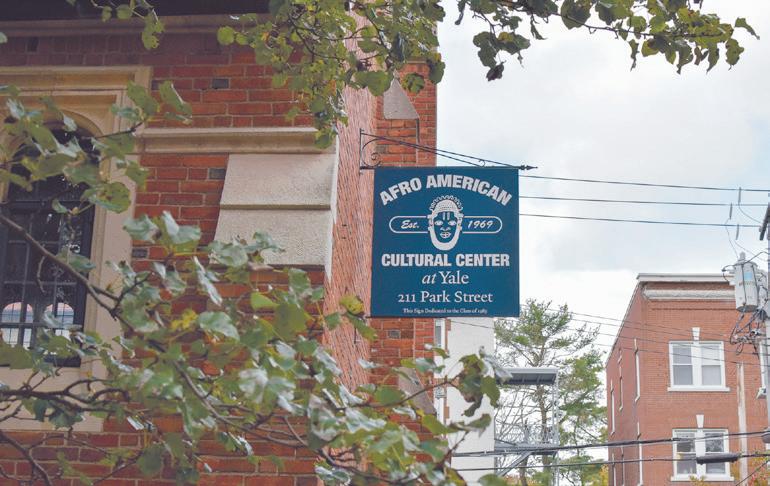
The formation of a chapter at Yale began as early as 1952, according to the News, which reported that undergraduate and graduate students met at Dwight Hall that year to discuss the chapter’s goals. Now, more than 70 years after the chapter’s initial founding, a revived chapter will held its first event, titled “Yale University NAACP Presents: The State of the Community (Re-Introduction of the Yale NAACP),” on Friday at the AfroAmerican Cultural Center, according to an email from organizers.
“Over the course of last year our e-committee worked directly with the Greater New Haven NAACP Board Members, Youth&College Connecticut State Division President, and National Board Administration to re-charter our Yale Chapter so that we could be recognized at the state, city, and national level,” Johnathan McGee ’28, a leader of the chapter’s reactivation, wrote in the email to more than 50 registered members last month.
Keith Pemberton II ’27, president of the chapter, first learned about the Yale chapter’s dormancy when he got to campus as a first year. An active member of his hometown NAACP chapter in High Point, North
Carolina, Pemberton wanted to make the Yale chapter equally active.
“I saw its impact from a civic engagement, educational programming and voter registration perspective and thought that would naturally continue into the collegiate environment,” Pemberton said. “So that’s when I really began becoming interested in a way to revitalize it.”
He believes that this reactivation will provide a structured space for Yale students and New Haven residents to engage in dialogue across differences. McGee added that in “our political climate” students need a place to discuss their thoughts and opinions on “what’s happening in America.”
Pemberton said the process of getting the chapter up and running began in spring 2024 during his first year, when he held a NAACP membership drive at the Af-Am House to establish that there was interest at Yale.
The next year, during McGee’s first year, the two began having conversations with the Greater New Haven Chapter members to see how they could reassert their presence on campus.
History of the chapter
The Greater New Haven Chapter has long been involved in sustaining an NAACP presence at Yale and in the city as early as the 1920s, according to Yale’s “Shining Light on Truth” research project.
While enrolled at the Divinity School from 1922 to 1923, student Stephen Gill, in the school’s class of 1923, served as a recording secretary of New Haven’s NAACP chapter and sat on the board that helped establish the Dixwell Community House, also known as the Q House.
He later was elected to the NAACP’s board of directors in 1954, underscoring the ties between Yale, New Haven and the NAACP.
When the Yale chapter was being launched in 1952, it was set to be the 85th college chapter of the NAACP. The chapter was largely active in the early 1990s, but interest in the organization decreased during the 2000s due to the graduation of student leaders, according to the News.
In 2007, after a period of inactivity, a Yale chapter was revived and held events including a Martin Luther King Jr. commemoration dinner, which drew 52 student attendees, the News reported. The chapter’s co-president at the time said she hoped the chapter would inspire students to revive ones at other Ivy League institutions that lacked them.
The chapter maintained its presence well into the next decade, co-sponsoring a “State of Black Yale” forum at the Af-Am House.
The chapter later went dormant, though, after several chapter leaders graduated, Pemberton said.
Looking to the future McGee, in the email to members, described the reinstatement process as “incredibly challenging,” in part due to communication with the national organization and understanding the various details of membership. He recalled a particular moment when he and Pemberton went through each line of the membership packet with the Greater New Haven Chapter members to ensure that all details were completed.
The process was finalized last summer, ensuring that the pair would be able to begin programming in time for Black History Month.
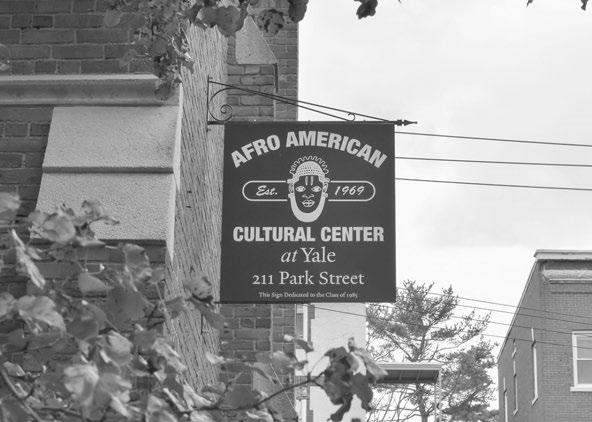
McGee described the chance to bring back one of the oldest NAACP chapters in the Ivy League as “insane to think about.”
“It’s honestly kind of historic and I’m really glad and proud to be reactivating,” McGee said. “This was a long time coming, especially since we’ve just been waiting, and I feel like there are not a lot of public serviceoriented clubs on campus, and we need to use the resources that we have and support the legacy that people before us created.”
Flematu Fofana ’28, a registered member of the group, said she is looking forward to the first meeting and making actionable change on Yale’s campus.
“It just feels so great to have another space on campus to be uplifted as someone interested in social justice and policy,” Fofana said.
Ayana Salahuddin ’28, a New Havener, said that she heard about the reactivation via Instagram.
“As a New Haven native, it is very exciting to see Black Yale pouring into the New Haven community with community service,” Salahuddin said.
McGee envisions in the next year beginning to hold voter registration drives across New Haven in advance of the 2026 midterms, holding student demonstrations that align with the organization’s mission and participating in national conventions. For now, though, he and Pemberton hope the first event will give an introduction to what the chapter is and could potentially be.
“I want people to ask questions about our intentions, how to foster community and how we can pass down information to continue building a legacy,” McGee said. The NAACP was founded in 1909. Contact OLIVIA CYRUS at olivia.cyrus@yale.edu.
BY HANNAH LIU STAFF REPORTER
Students gathered at the Afro-American Cultural Center for a lively jeopardy night on Thursday evening as part of the Af-Am House’s 2026 Black History Month programming.
The event was part of the Af-Am House’s efforts to create a diverse set of Black History Month events centered around the theme of “Honoring the Past, Rewriting the Future.” According to Af-Am House Director Timeica Bethel, the events are especially exciting because this year marks the 50th anniversary of the first Black History Month
and the 100th year since the first Black History Week.
“Whether you identify as Black or not, there’s always so much to learn about other cultures,” Bethel said. “There are opportunities to have fun, like tonight’s trivia night, and then there are more serious things, like the criminal justice reform panel. Yale is a very rare place where you can do that organically in different physical spaces.”
At the jeopardy night, teams of three to five students — with names ranging from “Choco Drop” to “Shelm” to “Oliver Twist” — competed against each other to answer trivia questions based on topics related to Af-Am House history and Black History Month events.
The event was open to all Yale students. In addition to the games, refreshments and prizes for the teams who made it to “final jeopardy,” students received Af-Am goodie bags to commemorate the night.
“I’m excited to just honestly learn at this point,” Caleb Mangesho ’27 said. “I like to think I know a lot of good general history, but they said it’s all House questions, and I don’t know as much about the House.”
Other events this month included a poetry mental health event with La Casa and a criminal justice reform panel. Many of the events are planned both by Af-Am House staff and student leaders.
“As part of the Student Success Programming Team, we also connect
students with different professional resources and host monthly panels in different sectors that connect black Yale alumni with current students in the graduate professional schools and Yale College,” David Woods ’26 said. In addition to Af-Am House programming, Yale student organizations have also hosted their own conferences this month, including the Black Solidarity Conference and the National Eritrean-Ethiopian Students Conference, a gathering of Ethiopian and Eritrean students from colleges around the Northeast.
Black History Month programming at the Af-Am House will continue until the end of the month, with keynote speakers Kahlil Greene
’22 and Tuskegee airman Enoch “Woody” Woodhouse ’52 coming on Feb. 23 and a performing arts showcase on Feb. 28.
“If you are interested in history, there’s something for you,” Bethel said. “If you are interested in the arts, there’s something for you. If you just don’t know much about Black culture and you want to get engaged, there’s something for you, right? We try to make the lineup of events and programming as diverse as possible.”
The Af-Am House was founded in 1969.
Contact HANNAH LIU at hannah.liu@yale.edu.
BY ANAYAH ACCILIEN AND HAILEY YOUNG STAFF REPORTERS
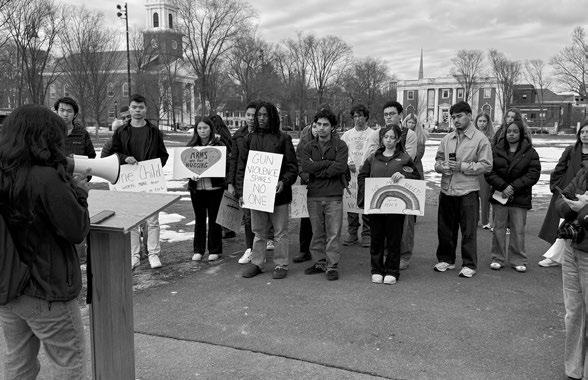
Yale’s chapter of Students Demand Action collaborated with the Yale College Democrats, the Yale College Council and community leaders on Saturday afternoon to honor people who have died due to gun violence and lobby for future legislation.
The event was the first that was sponsored by the newly revived chapter of Students Demand Action. Its president, Madison Aguilar ’29, said that she revived the chapter after being contacted by the founder of the
organization at Brown, who organized a walkout following an attack that killed two students on Brown’s campus in December.
“We have to remind ourselves that we are not alone. Though we’re a small group here, your action and presence mean more than ever,” she said in her closing statements to the crowd. “We have to remind ourselves that we’re not hopeless.”
Gathering on the New Haven Green, the protest focused on spreading awareness about the ban of “Glock switches,” devices that can convert semiautomatic pistols into fully automatic weapons.
of
after a December shooting at Brown that killed two students, honored victims of gun violence at a rally on Saturday.
Aguilar’s presentation directed attendees to House Bill 5043, which was introduced by Gov. Ned Lamont SOM ’80 on Feb. 5 to the Connecticut General Assembly. The bill would require safer design standards and mirrors a law passed in California, building on Connecticut’s gun safety efforts following the 2012 shooting at Sandy Hook Elementary School.
“Because we’re at an Ivy League school, the assumption is that we’re not affected by these things, or it’s mostly public universities or high schools that are facing school shootings,” Aguilar said. “But that shouldn’t be a reason not to take action towards stopping these things. And as we saw with Brown, these things are very possible in our own communities.”
Aguilar said her decision to revive Yale’s chapter of Students Demand Action was shaped by her experience as a member of the organization in high school, along with the death of her older brother, who was shot and killed near her childhood home, she said.
“I got the midnight call that changed my life forever,” Aguilar said during the rally. “No family should have to receive that call.”
Conor Webb ’28, the vice president of Yale Dems, said he was enthusiastic about partnering with Students Demand Action and drew on his experience organizing events to prevent gun violence.
“We were skeptical at first of the short turnaround. I told her Yale Dems would have the capacity to organize a rally and, more importantly, the grit. Soon, our grief became tenacity,” Webb wrote to the News.
During the protest, community leaders, including recently elected New Haven Alder Christine Kim ’99 echoed Aguilar’s remarks, sharing how her own path to public service was inspired by personal experiences with gun violence.
From seeing news coverage of Sandy Hook in 2012 to recently driving up to Providence to support her nephew at Brown, Kim emphasized the importance of making policy-level changes.
“We need to stop the cycle of pain,” she said. “To take care of each other and make sure this doesn’t happen again — in Newtown, in Providence or anywhere else.”
Yale junior and Ward 1 Alder Elias Theodore ’27 also spoke about the aftermath of Sandy Hook. His school began practicing lockdown drills for the first time, something previously “unimaginable,” but now a routine for many students across the country.
Theodore said it is now time for Connecticut to “step up” and address the issue of Glock switches.
“Connecticut has been a leader on gun violence before. Following the tragedy at Sandy Hook, the state passed one of the strongest gun laws in the country, expand-
ing the assault weapons ban, to strengthen background checks, and we limited high capacity magazines. We must step up again and focus on prohibiting the sale of fire alarms that are readily convertible,” Theodore said at the rally. Leonard Jahad, the executive director of the Connecticut Violence Intervention Program, described how the issue of shootings expands beyond victims. His team responds to retaliatory violence, works to connect victims and their families with resources and responds to calls in hospitals. The protest’s theme of policy change in tandem with community effort culminated in a moment of silence to honor the students killed at Brown, which was followed by student chants demanding action. For Aguilar, the protest is just the start for Yale’s chapter of Students Demand Action, and she said she hopes to organize more opportunities for students to collaborate on raising awareness.
Students Demand Action was first launched as a pilot in 2016 and later became a national organization in 2018 following a shooting at Marjory Stoneman Douglas High School in Parkland, Florida.
Contact ANAYAH ACCILIEN at anayah.accilien@yale.edu and HAILEY YOUNG at hailey.young@yale.edu.
“I saw my life branching out before me like the green fig tree in
BY SABRINA THALER STAFF REPORTER
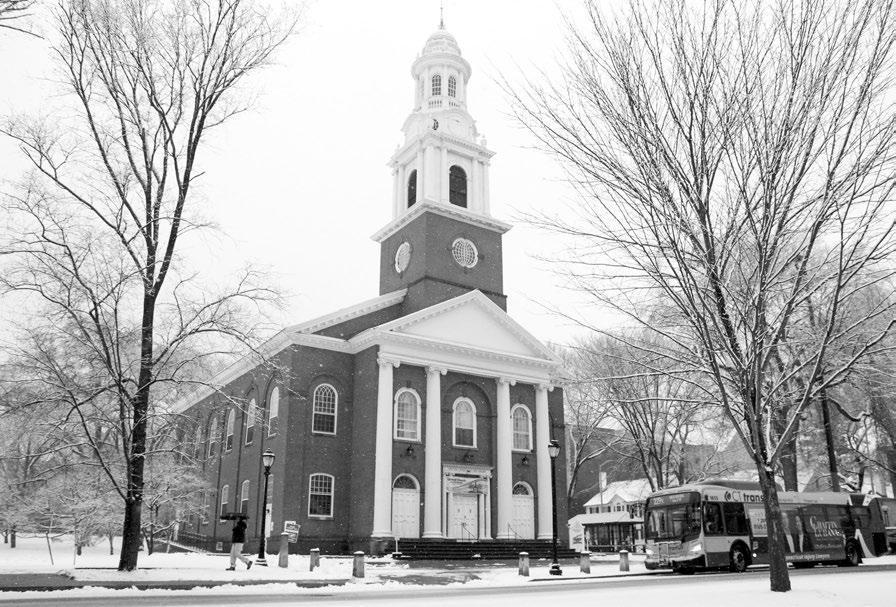
New Haven is experiencing another round of parking bans, snow clearing and emergency response measures as a major snowstorm strikes the area for the second time in a month.
The National Weather Service issued a blizzard warning for southern Connecticut and southeast New York from Sunday afternoon through Monday evening, forecasting between 17 and 24 inches of snow accumulation and winds of up to 60 miles per hour. A coastal flood warning was also issued for early Monday morning.
Connecticut Gov. Ned Lamont SOM ’80 declared a state of emergency on Sunday.
At a Saturday afternoon press briefing ahead of the storm, Mayor Justin Elicker announced a parking ban across New Haven that took effect at noon on Sunday. On downtown streets and along some emergency routes, parking is completely banned. In residential areas of the city, cars are permitted to park only on the side of streets with even-numbered homes.
Elicker also announced that New Haven Public Schools would be closed Monday and that trash and recycling services scheduled for Monday would be delayed by one day. The New Haven Free Public Library will close all its locations on Monday.
During last month’s storm — which blanketed parts of New Haven County in up to 17 inches of
snow — the city towed more than 500 cars in violation of its parking ban, Elicker said. “We don’t want to tow people. We don’t want to ticket people.
Just move your cars,” Elicker advised residents at Saturday’s briefing, adding that police officers would announce the parking ban from their cars via loudspeaker on Sunday.
Director of Public Works
Michael Siciliano said at the briefing that the city would deploy 37 plow trucks to clear snow from the streets, which amount to more than 230 miles of roadways.
Outside contractors are tasked with clearing major corridors, the mayor said.
Elicker explained that the Public Works Department would prioritize making streets passable for emergency vehicles before returning to “push back” and eventually remove the snow. The city will also ticket residents who do not shovel the sidewalks in front of their homes to allow for at least three feet of passageway, Elicker said.
Following last month’s snowstorm, New Haven residents and commuters told the News that the city’s slowpaced snow clearance impacted their travel into and around the city. In a Feb. 6 phone call, Elicker attributed the weekslong removal process to the “more complex challenge” presented by that storm.
“City crews are going to be working ’round the clock to clear the roads and keep the city moving, but this is going to
be a significant weather event, potentially even more significant than we just saw last month,”
Kayla Bland, the city’s emergency management director, said about Sunday and Monday’s snowstorm at Saturday’s press conference. Representatives from the police, fire and public works departments, among other city agencies involved in the response effort, will be stationed
in the Emergency Operations Center at 200 Orange St. for the duration of the storm, Bland said. To accommodate homeless residents, five warming centers across New Haven, including a recently opened site at 1570 Chapel St., would open their doors for 24-hour service until Wednesday morning, Elicker said. The city’s other warming centers are at Varick
and
centers on Grand
by Upon This Rock Ministries. CTtransit, the state’s public bus service, suspended operations on Sunday at 2 p.m ahead of the storm.
Contact SABRINA THALER at sabrina.thaler@yale.edu.
BY MICHELLE SO STAFF REPORTER
For over 25 years, an abandoned middle school has been a source of ire for Hamden residents, who have reported witnessing drug deals, arson and vandalism at the site.
The former site of Whelan Middle School, just north of New Haven, contains asbestos and other toxic materials, according to the Hamden Economic Development Corporation.
Now, nearly three years after receiving project funding, Hamden may be moving forward with demolishing the building. At a Thursday meeting hosted by the Hamden Newhall Neighborhood Association, a few dozen residents attended a community meeting to receive project updates and ask about the next steps.
“This is a voluntary program,” Carol Hazen, Hamden’s grants and capital projects director, said to the
audience. “You decide whether to participate. You review and approve the proposed work on your home before anything starts, and project oversight will include resident representatives from this neighborhood to make sure your voices are part of the decision making at every stage.”
Michael J. Whelan Middle School was built atop an industrial waste landfill, which was used by the Winchester Repeating Arms Company as a waste disposal site, according to the New Haven Environmental History Project. In the late 1990s, Connecticut’s Department of Energy and Environmental Protection began testing the school and neighborhood.
A report from the department detailed the findings from the contaminated waste site, including batteries, ammunition shells, ash, slag, coal waste and more. The middle school site was
officially decommissioned in 2002, with the 1,000 students relocated.
In 2023, Hamden received a grant award from the state to demolish the site.
Hamden Town Engineer Stephen White explained at Thursday’s meeting that the project planning phase for the middle school demolition was nearing completion.
“Those full demolition plans are 95 percent complete,” White said at the meeting. “Those plans have been kind of waiting on a whole bunch of different decisions to be made, and I feel like we finally have the clarity on decisions for my project team. So we’re very excited to get started on it.”
According to White, Hamden has a total of $6,425,000 in funding for the project: $5.4 million from the state’s Department of Economic and Community Development, $825,000 of local funds and $200,000 from
Community Development Block Grants, which are administered by the U.S. Department of Housing and Urban Development.
A consultant from Haley & Alrich, an environmental consulting company leading the foundation repairs front, detailed their survey process at the meeting. Surveys were sent to 305 property owners via mail and door-to-door outreach, with 188 questionnaires returned. Of those, 158 properties requested and received a property consultation. Ultimately, 75 properties were eligible for repairs.
“We know there are properties that we haven’t been in touch with out there that have issues based on information we have,” Chris Harriman, the consultant, said. “So we know that in reality, there’s actually more than 75 properties in the neighborhood. We just haven’t been able to be in touch with those owners.”
At this time, Haley & Alrich is no longer conducting outreach to find eligible properties. As for the middle school demolition, 7 Summits Construction will be overseeing the project, which will last five to six months, according to representatives at the meeting. Active demolition is slated to begin mid-2026.
“At the old middle school, we’re removing the buildings, and we’re putting back grass, and in some cases, like some of the pavement that are existing,” Sam Haydock, one of the construction leads for the project, said. “ Nothing’s planned at the middle school site right now.”
Michael J. Whelan Middle School is located at 550 Newhall St. Contact MICHELLE SO at michelle.so@yale.edu.
BY CHUER CINDY ZHONG
REPORTER
A Davenport dining hall worker is baking in the big leagues.
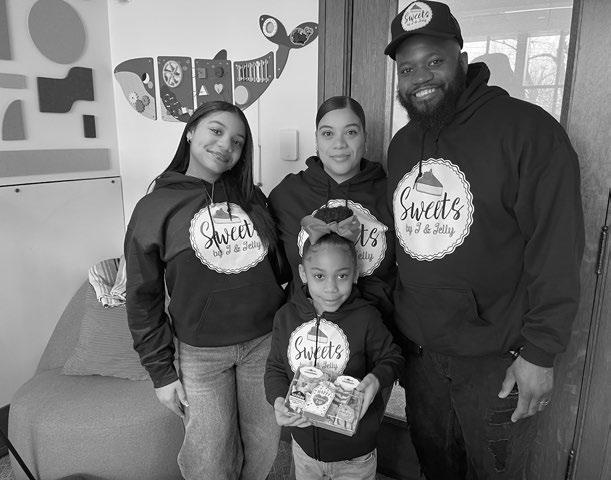
Jelani Williams and his family started their home bakery, Sweets by J & Jelly, five years ago. They started by selling cheesecakes and have now branched out to selling brownies, cookies and other pastries. Williams graduated from Lincoln Culinary School in 2009 and has been working as a dining hall staff member in Davenport residential college for several years, he said. Cooking and baking has long been a part of his and his family’s life.
“My grandfather was a chef. He worked as a chef during World War II, and also, after he got out of the war, he was a chef at various country clubs. So I learned a lot of stuff from him as well as my grandmother, just helping them out in the kitchen.”
not only how to improve their desserts but also how to elevate presentation and advertising. They run all of their social media accounts and their website themselves and also designed their own business cards and stickers.
matter,” Jelani Williams said. For Williams, juggling his responsibilities as a Davenport dining hall worker and a business owner is busy, but manageable.
“I’ve been cooking and baking since I was the age of six,” Williams said in an interview.
and
Going to culinary school was a pivotal experience for Williams, he said. One of the chefs from his alma mater, Richard Agamie, taught him and his graduating class the cheesecake recipe for which Sweets by J & Jelly is known.
After graduating from culinary school, Williams continued baking on occasion, typically for family celebrations, he said.
“During COVID, I ended up making some desserts for some family members, and they loved it,” Williams said. “So they ended up posting it on social media and we got a lot of other requests.”
“It was like overnight,” Joselyn Williams, his wife, said. “We had a conversation one night; by the next day, we had a page up, and we had pictures, the website.”
Jelani and Joselyn Williams said they decided to name their business after the nicknames of their two daughters.
“J for my daughter Jayla,” Jelani Williams said. “And Jelly for Jelise.”
As their business matured, Joselyn Williams said they learned
“We have pictures from the beginning, like the desserts that I started doing from the beginning and looking back, looking up to now,” Jelani Williams said. “We’ve gotten way better with presentation — with everything — and sometimes we look back and just say, wow, this is what it used to look like.”
“Some people that order from us say they didn’t like cheesecake until they tried ours,” Jayla Williams said.
Jelani Williams said that he believes part of the reason people are so drawn to his family’s desserts is because of their cultural relationship with food.
“I am of Jamaican heritage, my wife is of Puerto Rican heritage, and both of our cultures are known for cooking, food and putting love into what we do,” he said.
Currently, the owners of Sweets by J & Jelly don’t have plans to open a storefront.
“For the time being, we’re just getting our name out there because, as our motto says, if you have the best desserts and no one knows them, it doesn’t really
“I used to work a 6 to 2:30 shift, and that would give me ample time to do things business-related,” he said. Now, his shift is from 7 a.m. to 3:30 p.m.
“While it’s not the hugest of differences, that hour did help at times,” Williams said about the change in his hours.
His connection to Davenport has also opened the doors for some business opportunities, including catering a Davenport fellows dinner in early February, Williams said. Shaffrona PhillipChristie, Davenport’s assistant director of operations, reached out to order several desserts for the dinner from Sweets by J & Jelly, he said.
“We did four cakes: a pineapple coconut cake, an Italian fruit cake, an Oreo explosion cake and a Biscoff cookie cake,” Williams said.
“The reception that we received from everybody was raving.”
Phillip-Christie did not respond to the News’ request for comment.
Sweets by J & Jelly is based in East Haven.
Contact CHUER CINDY ZHONG at cindy.zhong@yale.edu.
"So we beat on, boats against the current, borne back ceaselessly into the past."
BY AZARA MASON STAFF REPORTER
The Yale women’s lacrosse team (3–0) hosted the Boston University Terriers (3–2) on Saturday at Reese Stadium, and the Bulldogs delivered a dominant performance en route to a 17-5 win.
This victory came after a 17-9 victory over cross-town rival Quinnipiac (0–2) on Tuesday.
So far this season, the Yale offense has overpowered teams with the help of impressive play from multiple underclassmen. At the same time, the Elis have been able to shut the door on teams with their stout defense and solid play in goal.
“The defense’s communication and toughness set the tone, and the connectedness they’re playing with makes my job a lot easier,” goalkeeper Niamh Pfaff ’28 told the News.
On Saturday, first-year midfielder Kate Gould ’29 wasted no time putting Yale on the board for the third straight game. She netted the opening goal, finishing with two goals and a team-high seven assists.
Meanwhile, sophomore attacker Kelly Holmes ’28 finished
with a career-high seven goals, which marked the most on the day for the Bulldogs. With seven goals on 10 shots, Holmes demonstrated her deliberate shot selection and shooting accuracy.
The Bulldogs closed the first quarter with a commanding 6-1 lead over BU. Yale added one more goal in the second quarter and entered halftime up 7-3. While BU narrowed the gap to 9-4 heading into the fourth quarter, still within striking distance, Yale crushed any hope of a comeback by outscoring the Terriers 8-1 in the final 15 minutes.
Defensively, the Bulldogs forced 11 turnovers compared to BU’s three.
On Saturday, Pfaff and the rest of the defensive unit will look to contain the No. 10 ranked Michigan Wolverines (3–1).
Pfaff expressed confidence heading into the matchup.
“We have a really great foundation as we start preparing for Michigan. It’s just about tightening the small details now,” she said. When asked how Yale’s transition play might be affected by a top-ranked opponent, midfielder Meg Bohan ’29 acknowledged the challenge, saying the game will be “very fast paced.” Nevertheless, Bohan expressed assurance in Yale’s ability to handle the challenge.
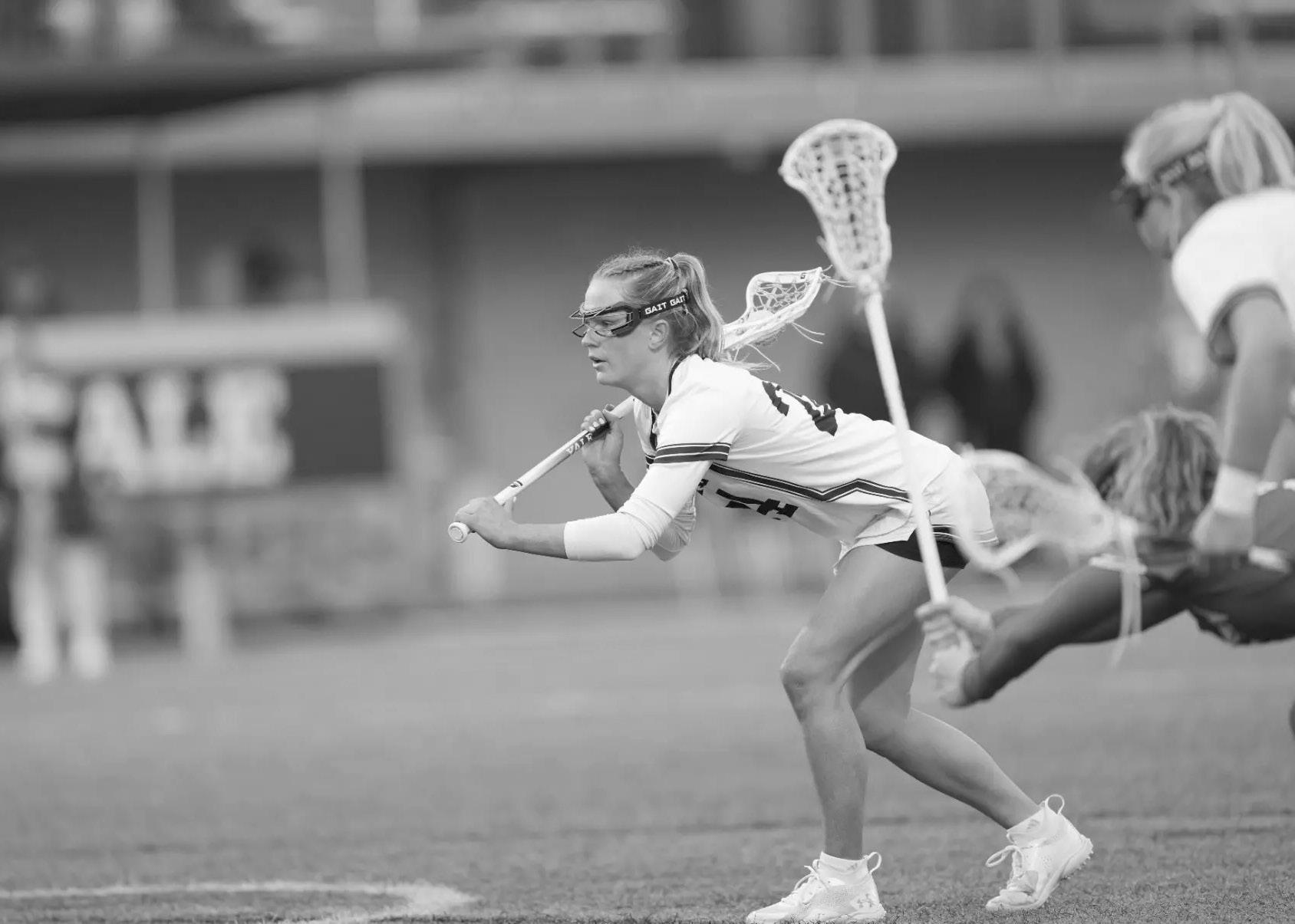
“Luckily, our team is so fast,” she said. “We move the ball quickly, and everyone on the field is a threat. I think we’ll thrive, even against a tougher defense.”
“My best friend is actually their starting goalie, so that will be so much fun to play against her,” Bohan added. The faceoff is set for 1 p.m. on Saturday in Ann Arbor. Contact AZARA
at azara.mason@yale.edu.
BY JUSTIN LEAHY CONTRIBUTING REPORTER
Captain Jessey Li ’26 stepped up to Ivy League blocks for the last time in her collegiate career at the Ivy League championships.
Li spent four years building one of the most decorated individual careers in recent history for the Yale women’s swim and dive program. By the end of the meet, she had added one more gold medal to her collection. Her strong individual performance closed the season on a strong note for this program.
The women’s swim and dive team concluded its 2025-26 season at the Ivy League championships, which were hosted by Brown University in Providence. The Bulldogs finished fifth overall after compiling 840 points across four days at the Katherine
Moran Coleman Aquatics Center. This season (5–4, 3–4 Ivy), the team faced many challenges in the competitive gauntlet of Ivy League swimming.
The regular season came with both highs and lows. Yale opened up early meets with strong showings, with a dominant 213-87 victory over Columbia in November and back-to-back wins over Southern Connecticut State and UConn in December. Then, in January, the Bulldogs kept themselves competitive in the Ivy League standings by knocking off Dartmouth and Cornell in some inter-conference action.
As the season wore on, their schedule grew much tougher, filled with more dominant conference rivals. Eventually, the team suffered losses against Ivy opponents Brown, Penn, Harvard and Princeton, which knocked them back fatally in the conference standings. Specifically, Yale’s back-to-back losses to Harvard and Princeton in late January, by scores of 207-93 and 209-91
respectively, were the most pivotal moments for the team as they headed into the postseason.
However, through all the setbacks, the Bulldogs continued to focus on what lay ahead for them.
“Our focus has been execution,” Li wrote to the News last week. “At this point in the season, the work is done. Now it’s about sharpening the details, staying healthy, and competing with confidence in the preparation we've put in since day one.”
Li made good on her word regarding that mindset, putting on a star performance for Yale at the championships in Providence.
The senior captain won gold in the 100-yard breaststroke and bronze in the 200-yard breaststroke. She later went on to break the Yale record in the 200-yard individual medley, with a time of 1:58.83 in the preliminary race on the second day of competition.
Li’s gold in the 100-yard breaststroke on the third day bookended her remarkable four-year run in
the specific event. After previously winning gold in her first year, then silver in her sophomore and junior years, she ended her career with a gold on Friday. Devyn Sargent ’28 emerged at the meet with a breakout performance. Sargent placed third in the 100-yard breaststroke relay, just behind Li, which was her first time placing in any event at the Ivy championships. Later, on Saturday, Sargent picked up another bronze in the 200-yard backstroke.
Wednesday night, the Bulldogs won bronze in the 200-yard medley relay, led by the quartet of Sargent, Li, Penny Zarczynski ’29 and Sara Plunkett ’27, finishing tightly behind Harvard and Princeton.
Later on, Lucy Walker ’27 had a strong fifth-place finish in the 200-yard individual medley A final with a time of 1:59.82. In the sprint 50-yard freestyle, Yale continued with Julia Ebli ’29, Zarczynski and Plunkett sweeping the top C final spots.
BY LIZA KAUFMAN STAFF REPORTER
The Yale men’s hockey team (8–19–1, 7–12–1 ECAC) closed out their regular-season road schedule this weekend, losing games at Clarkson (14–15–3, 8–9–3 ECAC) and St.
Lawrence (7–22–3, 6–13–1 ECAC).
The Bulldogs made the six-hour trek to Potsdam, New York, to face the Clarkson Golden Knights on Friday night at Cheel Arena, before

LIZA KAUFMAN / PHOTOGRAPHY EDITOR
As the regular season comes to a close, the Bulldogs played their last weekend on the road at
On the final day, Caroline Riggs ’27 delivered a strong fourthplace finish in the 1650-yard freestyle. Other highlights included Angela Wang ’29 placing fifth in the 200-yard butterfly and divers Lily Horenkamp ’26 and Paige Lai ’26 finishing fourth and fifth in the 3-meter dive B final. The Bulldogs finished the Ivy League championships in fifth place — a step back from their third place finish last year.
Li and several other seniors closed out their Ivy League careers in Providence. Now, they pass the torch forward to the program’s younger contributors, including the likes of Sargent, Zarczynski, Ebli and Wang.
The Bulldogs will next compete at the NCAA Diving Zones from Monday, March 9 to Wednesday, March 11 at the U.S. Naval Academy in Annapolis, Maryland.
Contact JUSTIN LEAHY at justin.leahy@yale.edu.
traveling to Canton, New York, to play the St. Lawrence Saints on Saturday night at Appleton Arena. Despite generating consistent offensive pressure, the Elis came up short in both contests.
On Friday night, the Bulldogs battled the Golden Knights. Clarkson got on the board first at 15:58 to take a 1-0 lead at the end of the first period.
In the second frame, the Golden Knights struck early, doubling the lead at 3:47. They then added another at 12:35. The Bulldogs answered in the final minutes of the period. At 18:42, Owen Forester ’27 sent the puck to Ronan O’Donnell ’28 near the blue line. O’Donnell passed it back to Forester, who took the shot, but it rebounded. Iisai Pesonen ’27 buried the rebound to narrow Clarkson’s lead. With 35 seconds remaining in the period, the Golden Knights potted another to retake a three-goal lead.
In the scoreless final frame, the Bulldogs took 10 shots on goal but were unable to get past Clarkson goalie Shane Soderwall. The Yale defense tightened to prevent further damage.
The following night, the Elis sought to replicate their January 8-1 victory over the Saints, but St. Lawrence, who entered the matchup after a 3-1 home victory over Brown (5–21–2, 4–14–2 ECAC) the previous night, put up
a strong fight on home ice. St. Lawrence opened the scoring at 3:54 with a power-play goal. In the second frame, the Bulldogs answered early with two back-toback goals. Three minutes in, captain David Chen ’26 threaded the puck to Micah Berger ’28 at the crease for the equalizer on a power-play. Two minutes later, Will Richter ’27 took the shot from the high slot to give the Bulldogs a one-goal lead. However, the Saints didn’t let the Elis celebrate for long. At 14:42, they equalized the score. In the final 20 minutes, both teams fought to take the lead. Four minutes in, St. Lawrence found its opportunity with two unanswered goals. Despite outshooting the Saints 13-4 in the final frame, the Bulldogs could not get back on the board. At 18:59, the Saints closed the scoring with an empty-netter. Back in New Haven, the Bulldogs will look to regroup ahead of their final regular-season games at home. Yale will host Union (19–10–3, 9–9–2 ECAC) on Friday night and Rensselaer Polytechnic Institute (9–22–1, 6–13–1) on Saturday night at Ingalls Rink. Puck drop is slated for 7 p.m. both nights.
Contact LIZA KAUFMAN at liza.kaufman@yale.edu.






“We
BY WALTER ROYAL STAFF REPORTER
Despite missing their captain and leading scorer Nick Townsend ’26, the Yale men’s basketball team (21–4, 9–2) came back from a 0-10 starting deficit to beat Penn (13–11, 6–5) on Saturday afternoon.
The Bulldogs clinched an Ivy League playoff berth with the hardfought win.
“We’ve been involved in a lot of really good college basketball games. That was another one today,” Yale head coach James Jones said after the game.
The Bulldogs struggled to get going without Townsend, who was out after the team’s Valentine’s Day victory at Harvard (15–10, 8–3).
“He’s fine. I expect him to be able to practice next week. That’s what we’re hoping for, and we’ll see that if that happens,” Jones said, referring to Townsend, in the postgame press conference.
While Yale started slow, Penn had no issues at the beginning. The Quakers sank five of their first six shots and jumped out to a ten-point lead over the span of the first four minutes. Their defense was similarly successful. Yale combined for five missed shots and two fouls before recording their first points on a Samson Aletan ’26 slam.
This was just the third 10-0 run
BY RACHEL MAK STAFF REPORTER
The Yale men’s squash team (6–5, 4–2 Ivy) fell to the University of Pennsylvania (14–2, 5–1 Ivy) over the weekend in the semifinal round of the inaugural Ivy League Squash Tournament in Princeton. The Bulldogs lost to the Quakers 6-3.
Rishi Srivastava ’28 crushed his Penn opponent in straight games, 11-4, 11-5, 11-4. Oliver Velasco ’29 also defeated his opponent 3-0, with game scores of 11-7, 11-4, 13-11. With the win, Velasco ended his regular season with a 7-4 record.
Jack O’Flynn ’27 came away with the Bulldogs’ third and final win on the day, a grueling five-game victory over Penn’s Hao Cui. The players traded games until O’Flynn came out on top in the fifth.
In the first position, Tad Carney ’26 faced Penn’s Omar Hafez. After Carney dropped his first two games, he rallied back to take the third 16-14. He then won the next one 11-6 to force a deciding game. However, Hafez took the final game 11-4.
Rohan Arya Gondi ’28 also dropped his first two games in the fourth position for the Bulldogs before taking the next two. He ultimately fell to Penn’s Alexander Dartnell 11-8 in the fifth, after putting up a fight.
Lachlan Sutton ’27, Rick Chen ’28 and Bennett Eun ’27 fell to their Penn opponents in three games. Arav Bhagwati ’26 retired from his match after dropping the first two games.
Yale will head to the College Squash Association National Team Championships in March, and Penn and Yale could meet for a third time this season.
Contact RACHEL MAK at rachel.mak@yale.edu.
Yale has conceded all season. The Elis have posted 13 such streaks of their own in their Ivy-leading 2025-26 campaign.
While Yale’s offense began to warm up, their Penn counterparts continued sizzling. By the six-minute mark, both TJ Power and Michael Zanoni had scored double-digit points for the Quakers. Penn still held a significant lead, 25-34, entering the final four minutes of the first half.
At that point, Aletan went for a contested layup under the basket, got the bucket and drew a foul. Though he failed to convert the three-point play, this sparked an 8-0 Yale run, bringing the score to 33-34. Penn rallied, however, and a Jay Jones jumper once again gave the Quakers a multi-score lead entering the break.
Jones, who had scored a careerhigh 17 points the previous week against Cornell, is the nephew of Yale’s own James Jones. Jones, however, refused to let family ties interfere with his job.
“I don’t even think about my nephew playing, to be honest with you. I think there was a time or two that it became real, but for the most part it’s just another guy on the court,” Jones said.
The second half mirrored the first, but this time, Yale began with a 10-0 run of its own. The Quakers failed to score for the first five minutes of the period, ending their drought with a tip-in at 14:55. The Bulldogs led 45-42 at that point.
With the pair of explosive scoring runs now behind them, neither
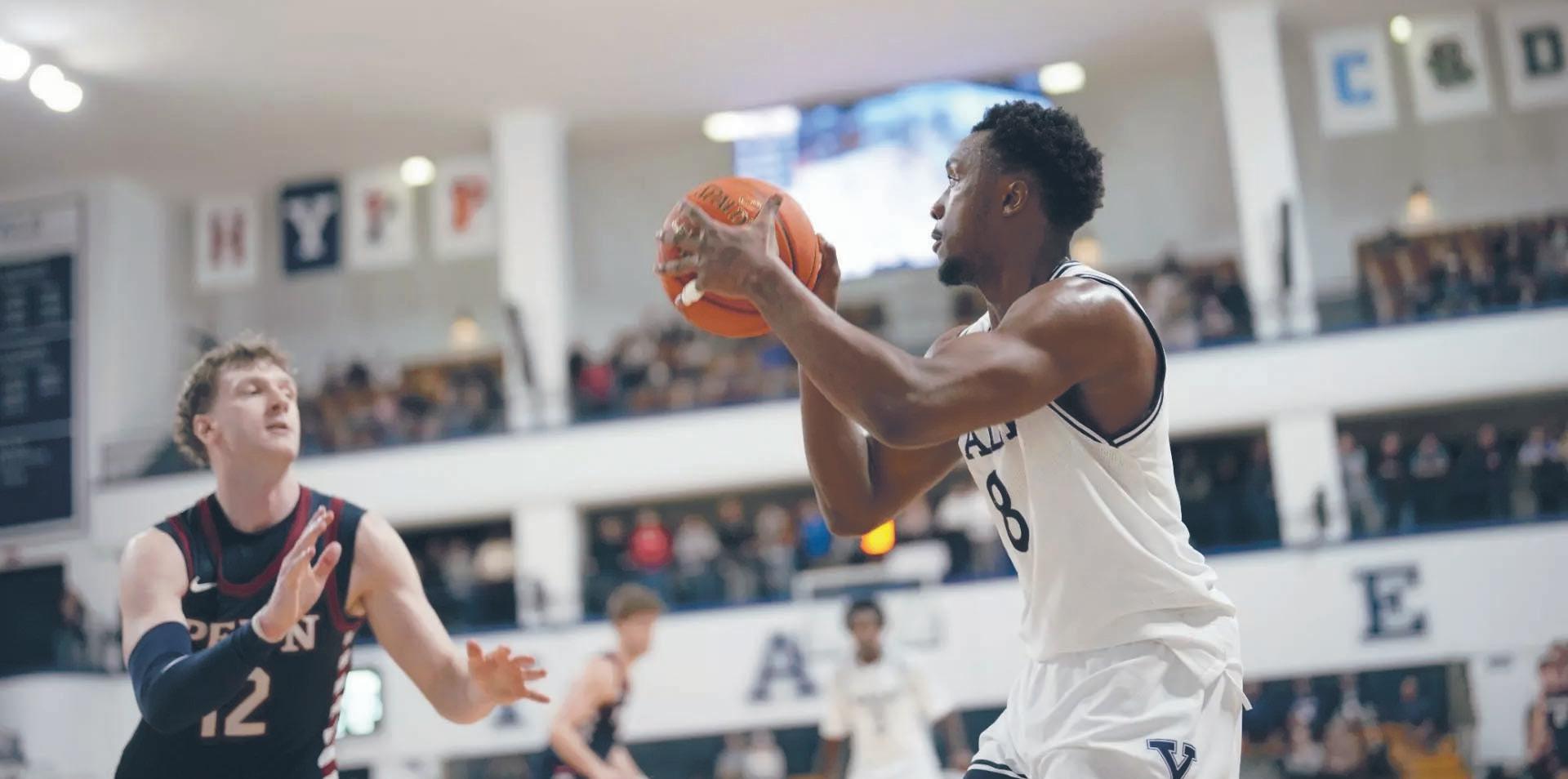
team could gain a clear edge on the other. The teams stayed within two scores all the way up until the last 90 seconds. An Isaac Celiscar ’28 jumper then put Yale up seven.
Yet, Penn answered with a Power three, and — following a Trevor Mullin ’27 free throw — another triple from Zanoni. Just two points separated the teams with 44 seconds left. Without their captain, the Bulldogs turned back to last week’s hero, Celiscar. The sophomore forward, who had already scored 12 points by then, brought the ball to the baseline. The six-foot-six-inch Celiscar
spun then stepped back for a long fadeaway two-pointer. Yale led, 70-66.
The Quakers cut the lead to two with a layup of their own but then had to foul. Celiscar sank two more free throws to effectively ice the game. A poor foul from Yale gave Penn second life for about thirty seconds before Mullin hit another pair of free throws to extinguish any remaining hope. The final score was 74-70.
Celiscar was proud of the groupeffort win, in which four different Bulldogs scored in double digits.
“We had to band together and just come together as a team,”
Celiscar said. With Yale’s win and Harvard’s victory over Cornell (12–12, 5–6) on Saturday, the Ivy rivals became the first two teams to clinch 2026 Ivy Madness spots. The tournament will take place at Cornell’s Newman Arena from March 13 to 15. The Bulldogs will hit the road later this week to face Cornell on Friday and Columbia (15–10, 4–7) on Saturday. Both games tip off at 6 p.m.
Contact WALTER ROYAL at walter.royal@yale.edu.
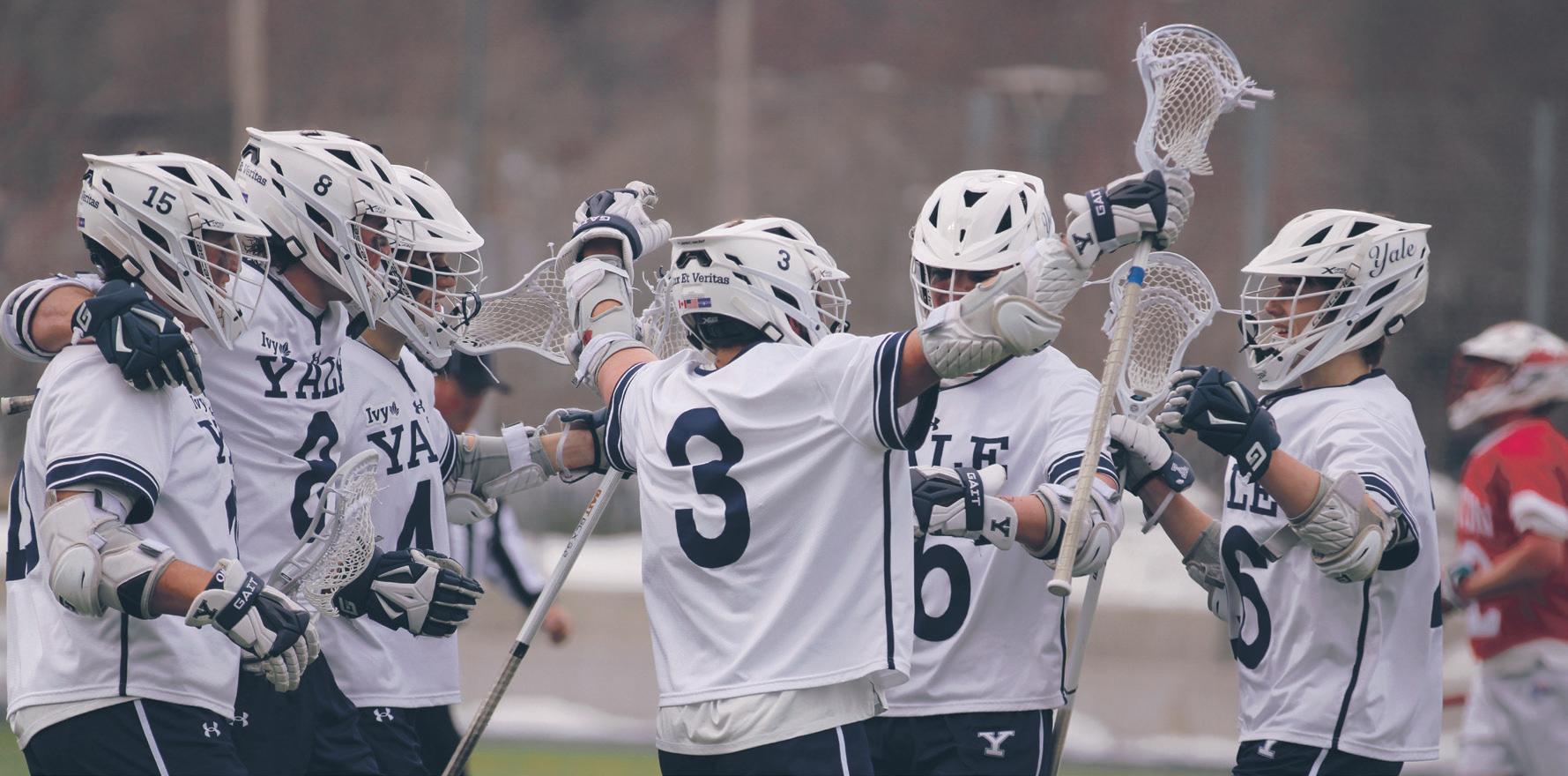
BY LIZA KAUFMAN STAFF REPORTER
Yale’s men’s lacrosse team (2–1, 0–0 Ivy) took care of business on Saturday, upsetting No. 18 Boston University (2–2, 0–0 Patriot) by a final score of 16-11.
With 21 saves from sophomore goalie Ben Friedman ’28, a careerhigh seven-point performance from sophomore attackman Connor Gately ’28 and four goals and one assist from senior David Anderson ’26, the Bulldogs earned their second straight home victory at Reese Stadium.
“Very exciting to get a big team win today in front of a great home crowd,” long-stick midfielder Luke Michalik ’27 wrote in a text message to the News. “It’s great to see all sides of the ball executing and complementing each other this early on in the season.”
For Gately, the offensive breakout built on his performance in Tuesday’s matchup against Marist (1–2, 0–0 MAAC), when he recorded five points on a goal and four assists.
“I think what’s been working well for me is just playing loose and trusting the preparation we’ve put in as a team,” Gately wrote in a
text message to the News. “The last couple games, I’ve really focused on staying aggressive, moving without the ball, and letting the game come to me instead of forcing anything. My teammates have been putting me in great positions, and honestly a lot of those points are a credit to them winning matchups and creating opportunities.”
A dominant offensive production from seven different Bulldogs contributed to the upset. Alongside Gately, Anderson also netted four goals, while Cole Jackson ’27, Sean Grogan ’29 and Peter Moynihan ’27 each found the back of the net twice.
The offensive surge, paired with a defensive effort that limited Boston University’s momentum, kept the Terriers from mounting a sustained wcomeback. The Terriers never came within more than three goals once the Bulldogs took the lead early on.
Head coach Andy Shay was proud of the team’s performance against the nationally-ranked team.
“It was a huge win over a ranked team. I’m proud of how our guys responded,” Shay wrote in an email to the News.
From the opening faceoff, the Bulldogs got off to a fast start with four back-to-back goals. Junior
midfielder Jackson got Yale on the board first at 12:34. Less than a minute later, Gately notched his first of three assists to Flynn Leonard ’29 to give Yale a 2-0 lead. Gately, assisted by Grogan, then potted a goal of his own to cushion Yale’s lead.
William Sheehan ’26 later found Jackson for his second goal of the quarter. BU’s Peyton Forte answered on a man-up opportunity to cut the deficit to 4-1. A minute later, Gately notched his second goal on an Anderson assist. The Terriers answered right back, and Yale led 5-2 at the close of the quarter. The Elis put up another four unanswered goals to open the second quarter, two of which came unassisted from Gately. At 13:17, Gately recorded a hat trick. Anderson followed that up with his first of the day, and then Gately netted another to give Yale a six-goal lead. Grogan closed out the four-goal campaign at 5:23. Refusing to let Yale end the half with a seven-goal lead, BU’s Timothy Shannehan potted two back-to-back to end the first half with Yale up 9-4.
The Terriers put up four goals in the third quarter but still were no match for the Yale squad. Asher Ziv ’29 passed to Anderson, who tallied for his third goal of the game.
On a man-up, the Terriers scored, but with Anderson’s goal, the Elis’ score was still double the Terriers at 10-5. Anderson then answered right back to retake the six-goal lead. BU notched two more goals, to which the Bulldogs countered with two of their own from Grogan and Luke Pascal ’28. The Terriers netted their fourth at 1:34 to close the period 13-8. In the final quarter, the Bulldogs continued to apply pressure. Down by five, Shannehan tallied his fourth goal for BU to open the scoring and cut the deficit, but three unanswered from Yale put the game out of reach for a Terrier squad that struggled to beat Yale goalie Friedman all day. A three-goal strike from Yale extended the team’s lead to seven. Moynihan scored unassisted, and then Gately tallied his final two assists on Anderson’s fourth and Moynihan’s second goals of the game. The Terriers scored twice more but had no hope of coming back. The Elis triumphed 16-11.
“It definitely feels great to have that kind of performance, especially in a ranked home win. I’m just proud of how we responded and executed as a group in a quick turnaround,” Gately wrote. “An upset like this early in the season is huge for us. It gives us confidence and shows what we’re capable of when we play our style and stick to our game plan. At the same time, it sets the standard — now we know the level we can reach, and the challenge is bringing that every single game.”
The Bulldogs will next play No. 10 Penn State (2–2, 0–0 Big 10), a team that reached the NCAA tournament semifinals last season before falling to Cornell (2–2, 0–0 Ivy), the eventual national title winners.
“Going to enjoy this one for about 24 hours then we’re all focused on the next practice and eventual next game at Penn State,” Michalik wrote. Faceoff is slated for 1 p.m. on Saturday. The game will be streamed on ESPN+.
Contact LIZA KAUFMAN at liza.kaufman@yale.edu.