In response to Yale College’s phase-out of summer storage aid for low-income students, the Yale College Council Senate has allocated the remainder of its budget for senate initiatives to a new program for summer storage stipends.
The budget proposal outlining the stipend program passed by a unanimous vote during the senate’s last meeting of the semester on Sunday in the Poorvu Center for Teaching and Learning. The proposal initially allotted $12,500 toward the program, covering at least 125 stipends of $100 each, but an amendment cleaned out the Senate Initiatives Budget to increase the funding allocation by about $300.
Two weeks ago, Yale College Dean Pericles Lewis confirmed in an interview with the News that financial aid for summer storage, which consisted last year of reimbursements of up to $225 for low-income students, would not continue this year. Lewis advised students “not to
SEE STIPEND PAGE 4
Faculty face grading dilemma
BY JAEHA JANG STAFF REPORTER
After Yale physics professor A. Douglas Stone taught a class recently, a student stayed behind to ask for a recommendation letter. The “very good” student, with whom Stone said he has a “nice relationship,” had what the professor thought was an unusual concern: They had received only an A-minus in a previous course with him. Stone thought it was “ridiculous” that the student was “very disappointed” about an A-minus. But after hearing more from the student about grading at Yale and the prevalence of straight A’s, Stone said he told the student, “Well, I guess then an A-minus feels like a bad grade.”
“Of course,” the student replied.
According to a 2023 report by economics professor Ray Fair, nearly 79 percent of grades in Yale College in
the 2022-23 school year were A’s or A-minuses. Yale College Dean Pericles Lewis said in an interview last month that the grade distribution has remained “pretty consistent” over the past four years. And last year, the GPA cutoff for Yale College graduates to receive the summa cum laude distinction remained at its record high of 3.98.
Harvard stepped up to a similar challenge in February when a faculty committee recommended that each class cap A grades at 20 percent, allowing for up to four additional A’s per class, beginning next school year.
Last Monday, Harvard administrators announced a revised proposal that would delay implementation until fall 2027 and also introduce a SAT+ grade, which recognizes outstanding performance in courses graded on a pass/fail basis.
Harvard’s Faculty of Arts and Sciences will vote on this proposal
this Tuesday, according to the Harvard Crimson.
The proposals at Yale’s Ivy League rival have prompted renewed discussion of grade inflation at Yale, including among the professors who assign grades each semester. Two dozen professors identified grade inflation as a problem that is far easier to recognize than it is to solve.
In a February interview, Lewis said it was “very sensible” that Harvard was trying to combat grade inflation, adding that grade inflation makes it harder to distinguish the “best-performing” students. Yale should monitor Harvard’s proposal, he said, because he doesn’t want “an A at Yale to be seen as a lesser A.”
Lewis also said that Yale’s standing Committee on Teaching, Learning and Advising is “aware of what’s going on at Harvard and will be look-
SEE INFLATION PAGE 4
Students support shielding faculty
BY JAEHA JANG STAFF REPORTER
The Yale College Council Senate and Graduate & Professional Student Senate have each passed a joint resolution in support of faculty groups’ demands for more explicit academic freedom protections. The resolution was the first official step by students amid a school year marked by faculty groups’ persistent efforts to revise the Faculty Handbook so it explicitly enshrines academic freedom and increases their say in University decisions.
“It’s prophylactic in some sense, but at its core, if faculty do not feel that they are 100 percent able to teach what they want to teach, and if Yale has not indicated that it’s willing to make faculty 100 percent comfortable, then that has real ramifications for whether or not students can receive the fullness of their education,” Alex William Chen ’28, the speaker of the YCC Senate, said in an interview after the council passed the resolution during its Sunday meeting. In October, the Faculty of Arts and Sciences and School of
5
YCC calls on Yale to divest from companies tied to ICE
BY ARIA LYNN-SKOV STAFF REPORTER
In their final meeting of the year, Yale College Council senators voted to issue a public statement calling for the Yale Corporation to divest the University’s endowment from companies with ties to Immigration and Customs Enforcement.
The statement characterized recent ICE actions as “inhumane and illegal surveillance, deportation, and detention of our neighbors.” It then detailed links the Endowment Justice Collective identified between the Yale
Suit against Corporation ends
BY SARA AGRAWAL STAFF REPORTER
A lawsuit challenging the nomination process by which alumni can be elected to Yale’s board of trustees failed to reach the Connecticut Supreme Court last month after being unsuccessfully argued in the state’s district and appellate courts since its initial filing in 2022.
But for the lawsuit’s two petitioners, Victor Ashe ’67 and Donald Glascoff Jr. ’67, the fight against Yale’s nomination process is just beginning.
“While the legal aspect has ended, the effort at persuasion and keeping the issue alive is very much there,” Ashe said in a phone interview on Thursday. Six of the 19 positions on the board are reserved for elected alumni fellows. Starting five years after their
graduation year, all Yale alumni are eligible to vote in the alumni fellow elections. Beginning in 1929, alums could earn places on the ballots by garnering signatures from three percent of the alumni eligible to vote. However, in 2021, former senior trustee Catharine Bond Hill GRD ’85 announced that alumni would no longer be able to petition to appear on the ballots. Now, the only way to be nominated as an alumni fellow is to be chosen by the Yale Alumni Association’s Alumni Fellow Nominating Committee. Each year, the organization nominates at least two candidates for election, according to its website. The website also states that, according to “tradition,” these nominees do not campaign. In 2022, Ashe and Glascoff submitted a formal complaint about the change to the Hartford district court
of the Connecticut Superior Court, alleging that it violated an 1872 amendment to the University charter. After the district court and the Connecticut Appellate Court ruled in favor of Yale in 2024 and 2025, Ashe and Glascoff filed a petition in December to argue the case before the Connecticut Supreme Court.
Last month, the Connecticut Supreme Court denied the request for it to hear the case.
In an email statement to the News on Sunday, University spokesperson Karen Peart wrote on behalf of Yale, “We are pleased that throughout this case, the courts have found Yale’s actions to be entirely appropriate.”
According to Ashe, the lawsuit had support from other alumni. Ashe said in an interview last week that
endowment and companies like Target Hospitality and TDR Capital, which they said support ICE’s efforts. The statement lists its intended recipients as University President Maurie McInnis, Yale College Dean Pericles Lewis, Dean of Students Melanie Boyd ’90 and the board of trustees. John Robert Walker ’28, an organizer with the Endowment Justice Collective, which sponsored the statement, presented it to the senate. The statement proposal passed nearly unanimously at the Sunday meeting, with several members of the senate voicing their support.
“I hope that this statement shows that ICE’s destruction is on students’ minds,” Walker said in an interview after the meeting. “Just about every student group on campus seems to be hosting a teach-in, organizing a fundraiser for migrant justice.”
The Advisory Committee on Investor Responsibility, which makes divestment recommendations to the Yale Corporation, has rejected the group’s pitches for divestment from several military contractors, including Palantir, a data analysis company that
Ellie Park, Senior Photographer
Garrett Curtis / Photography Editor
This Day in Yale History, 1989
April 7, 1989 / Law Students Stage Boycott
By Andrew Wexton
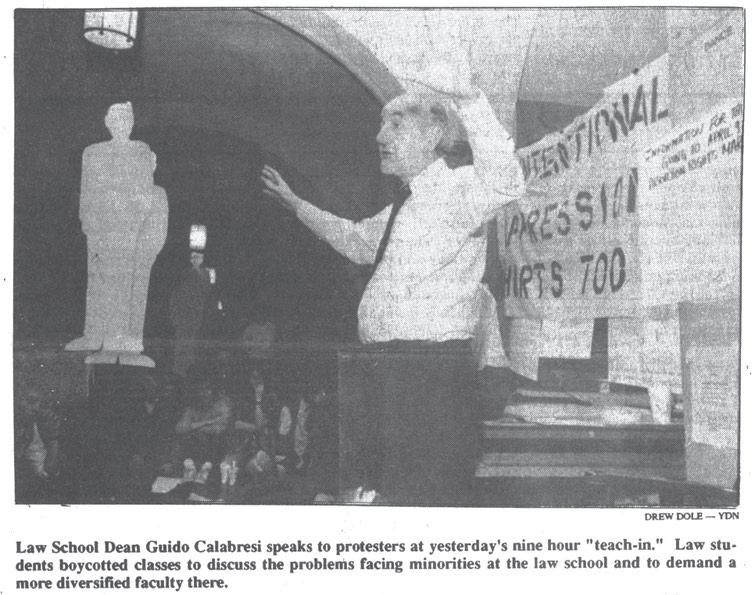
Hundreds of Law School students and professors packed the main corridor of the Sterling Law Building for over nine hours yesterday to educate each other on the problems facing minorities at the school and to demand greater diversity in the faculty, while dozens more quietly picketed classes being held despite a declared strike.
In a series of events organized by the Yale Law School Student Committee for Diversity, the community converged on the school as part of a nationwide strike for diversity in law school faculties and curriculums. Students boycotted classes to attend informational “teach-ins,” and the day culminated in a two and on-half hour town meeting where more than 50 members of the community expressed their thoughts and feelings to an audience of more than 200.
Behind the Headline
By Jaeha Jang
In February, a faculty committee at Harvard proposed a 20 percent cap on A grades per course set to go into effect next school year upon faculty approval. I immediately started wondering whether Yale faculty would support such a proposal, especially after Yale College Dean Pericles Lewis said it was “very sensible” that Harvard was trying to combat grade inflation.
I emailed more than 100 Yale professors, and when dozens of them replied, at length, I realized that grade inflation is an issue into which professors have been putting a lot of thought. After speaking more extensively with professors over Zoom and phone calls — and overcoming a temporary fear that, after the article’s publication, I would be referenced on the student social media app Fizz simply for calling out grade inflation — I published a nuanced article on grade inflation, which professors described as deleterious but difficult to solve.
Read “Faculty face grading dilemma” on page 1.
YULIN ZHEN / PHOTOGRAPHY EDITOR
What Yale’s Hong Kong program taught me about freedom
In February, Hong Kong publisher Jimmy Lai was sentenced to 20 years under the city’s National Security Law. His crime was journalism. Just weeks later, I visited Hong Kong for Yale-China’s spring break Yale University-New Asia Undergraduate Exchange Program, or YUNA, which pairs Yale students with peers from the Chinese University of Hong Kong, or CUHK.
Standing inside the Legislative Council, where the People’s Republic of China national emblem looms over Hong Kong’s own seal, I understood that freedom is not just something to argue about in the classroom.
YUNA begins in New England, where Yale students host their Hong Kong counterparts. We hiked East Rock and walked Boston’s Freedom Trail. Sharing familiar places with people whose own public spaces were shrinking made me notice what Yale students often take for granted: free speech, free assembly and the ability to walk through New Haven without watching what we say.
Before the trip, I wrestled with whether it was naive to send undergraduates into authoritarian contexts, potentially helping legitimate oppressive systems.
But YUNA’s value lies precisely in that discomfort. What makes Beijing’s national security regime so effective is its ambiguity. No one knows where the line is, so everyone draws it well before they need to. Our group of Yalies saw it in the small pauses in conversation and in the instinct not to say certain things too loudly.
The program showed me how Beijing was rebuilding Hong Kong in its image. CUHK tore down the “Goddess of Democracy” statue that once stood at its entrance, suspended fee collection for the student union and stripped union leaders of committee roles.
In February, national security police detained CUHK student Miles Kwan over a petition calling for accountability after a nearby fire killed 168 people. He was expelled. Seven other Yalies and I also taught at a Hong Kong middle school where nearly all the students were from the mainland, educated about national security since age 6.
Earlier, we had sat across from a former secretary for education who mandated that policy, barred students from protesting and required teachers to report violations or lose their licenses.
Meeting that system’s architect and then walking into a classroom it shaped was disorienting. Our CUHK peers spoke about Yale with admiration: the public debates, the protest culture, the freedom to criticize one’s own government without consequence. Their respect made me see the university as something worth defending.
Letter: ‘Don’t buy too much stuff’
In the summer of 1967, at 18 years old, I suddenly found myself with nowhere to live and no parental support. For a college student faced with paying tuition, personal care expenses, eating and summer lodging, it was a desperate situation. I hid out in a friend’s dorm room for three weeks and stashed my meager belongings in the dormitory basement. The college dean discovered me in hiding, got me a room in a boarding house and ultimately secured scholarships and jobs for me so that I could finish the remaining three years of university. She never asked me to move my “stuff” out of the basement, where it stayed until I graduated.
Yale has ended summer storage funding for lowincome students. Yale College Dean Pericles Lewis, perhaps
Inside Hong Kong’s Legislative Council, a proBeijing legislator explained that Beijing must approve the city’s chief executive, and that samesex marriage is not “culturally Chinese.” When I brought up Taiwan, a “culturally Chinese” democracy and the first in Asia to legalize same-sex marriage, he paused, then moved on. The Hong Kong students in our group exchanged glances but stayed silent. Outside, we bumped into pro-democracy organizers who told us their party had been banned from the chamber.
At Yale, almost 300 students pack the Rise of China lecture, eager to understand a country reshaping the world. But my YUNA trip offered what that course cannot: the temporary experience of living alongside those living under Beijing’s thumb. These student exchanges deserve Yale’s continued investment. They do not just teach you that freedom matters — they teach you what it feels like to have it and what it looks like when it is taken away, and that is the education that matters most. Jimmy Lai now sits in prison for freedoms we debate over coffee. YUNA made me understand what he lost.
ETHAN CHIU is a senior in Grace Hopper College studying History. He is also a first-year MPP student at the Yale Jackson School of Global Affairs. He can be reached at ethan.chiu@yale.edu.
attempting to be humorous, instead seemed arrogant when he suggested that low-income students should simply not “buy too much stuff.” Lewis apparently does not realize that those students don’t have
too much stuff; many have no money to move or store what little stuff they do have. If 20 percent of undergraduates are “low income,” Yale would save roughly $300,000 by eliminating the storage supplement. Yale’s endowment is around $44,000,000,000.
Yale’s administrative staff has increased exponentially in the past decade. Some estimate that administrators now outnumber undergraduates. With apologies to Jonathan Swift, may I make a modest proposal? Yale might consider eliminating two administrative positions rather than recouping $300,000 from those community members least equipped to bear that burden.
Glenda Elizabeth Gilmore
Peter V. and C. Vann Woodward Professor Emeritus of History
FROM THE FRONT
“Be more concerned with your character than your reputation.”
ing closely at it” and that faculty will receive recommendations on grade inflation “within a year or so.”
Faculty members expressed widespread skepticism about a sweeping grade cap such as the one envisioned in the Harvard proposal.
“The only advantage a cap has going for it would be that it would be an easy-to-implement rule,” mechanical engineering professor Udo Schwarz wrote in an email to the News. “It would be more an ‘expression of desperation’ that whoever implements it is trying to do something about grade inflation, which is a noble goal, but can’t come up with any better or fairer way to address it.”
The damage of grade inflation
Professors named various harms of grade inflation — including the difficulty for extraordinary students to distinguish their grades and an increased sense of stress and perfectionism.
Chemistry professor Patrick Holland wrote in an email to the News that grade inflation “takes away the opportunity for the most outstanding students to distinguish themselves,” noting that inflated grades are therefore “not victimless.”
He added that inflated grades do not reflect an “honest assessment” of student performance, and they also do a “disservice” to future employers, graduate schools and instructors of advanced courses, “telling them that a student is excellent at a subject when they were not.”
According to Stone, grade inflation has pushed those who want to excel in academics and are concerned about applying to professional schools to a “tiny GPA slot at 3.9 and above,” creating “anxiety about remaining near-perfect.” Students are afraid of exploring challenging courses, he noted, and they drop courses for fear of getting an A-minus.
Political science professor Dan Mattingly ’04 GRD ’08 added that he suspects grade inflation “may have had the weird effect of making students more stressed about grades than they used to be.”
“If everyone is getting A’s, getting a B+ or even an A- feels like a stain on
your record,” he wrote. “I’ve noticed more students over the years complaining about grades, even as grades are going up.”
Not all professors see grade inflation as a problem.
Film and Media Studies professor Charles Musser ’73 wrote in an email to the News that he is “not particularly worried about grade inflation.”
“These are students who have mostly gotten A’s all their lives,” he wrote. “There is enough anxiety going around among students. More than in the past. I want to reduce that, not add to it.”
A ‘collective action problem’
While grade inflation may seem like a self-imposed, correctable problem for professors, they told the News that the reality is more complicated. The pressure for student enrollment in their courses, as well as the significance of student evaluations in their review process, incentivize instructors to give generous grades, they said.
Mattingly called grade inflation a “collective action problem” — a situation, like the prisoner’s dilemma, where individual incentives conflict with a group’s — that administrators would need to help solve.
Stone said giving easy grades is “the path of least resistance” for individual professors, and solving the problem thus requires some “top-down component,” though he added that a solution should consider the variance between courses and not be “Draconian.”
Junior faculty members, especially, Stone added, are “intimidated out” of grading strictly for fear of receiving bad evaluations, which could lower their chances of getting tenure.
“I mean, most faculty will admit this, that if I give a lot of good grades and there’s no unhappy students, then nobody’s complaining to the chair, to their college deans, and, you know, students probably will give me pretty good evals, too,” Stone said. Some departments, he also said, have also recognized that handing students higher grades attracts more students to their major and vice versa — that “we won’t get
enough majors if we just make it too hard for everybody.”
Philosophy professor Thomas Pogge said in a Zoom interview that professors think combating grade inflation by themselves would selectively penalize their own students.
While professors may think lowering their grades does a “tiny little bit” to address the overall problem, it “seriously” impacts their own group of students and unfairly disadvantages them with a lower GPA, Pogge added. The same goes on a university-wide level, he said.
“If you do that in Harvard, then the professors are gonna say, ‘This is going to disadvantage Harvard students against other elite university students who will not have that same correction made,’” Pogge said. “Yes, somebody ought to do something about grade inflation, but why does one cohort of students, namely the Harvard students right now, why do they have to be sacrificed on the altar of a better grading system?”
No to grade caps
The Feb. 27 report by Harvard’s Subcommittee on Grading of the Undergraduate Educational Policy Committee also recognizes grade inflation as a collective action problem. A summary of two February town hall discussions between Harvard’s dean of undergraduate education, Amanda Claybaugh ’93, and students and faculty noted that strict enforcement of “agreed-upon limits, uniformly applied” would be needed to keep the problem from reemerging.
Still, more than a dozen professors at Yale indicated that they oppose a grade cap, raising concerns about the arbitrary nature of quotas and an increased sense of competition.
Chemistry professor David Spiegel MED ’04 GRD ’05 also wrote in an email to the News that he “strongly” opposes “any proposal to cap the number of A grades.”
Students at Yale are very talented, and those in a class may all master the material enough to merit an A, he added. “A grade cap, by contrast, would amount to punishing excellent students simply because they happen to be surrounded by even more excep-
tional ones,” Spiegel wrote. “Put differently, it would be unfair to assign ‘B’ grades to a room full of Stephen Hawkings just because there are a few Albert Einsteins in the class.”
English professor Michael Warner echoed that idea, writing that he disagrees “entirely” with the Harvard proposal or any grade distribution that renders a student’s grade a “function of who else happens to be in the class.”
“Like so much in American culture, it assumes competition,” Warner wrote in an email to the News. “I will not be told that only a limited number of my students will be allowed to succeed.”
History professor Dan Magaziner said he taught a seminar last semester that brought together “the most extraordinary group of students” he has ever taught. If he were to have been “forced to figure out some metric” to measure which 20 percent of them to give As to, he said, that would have been a misrepresentation of their contributions to the class and the grades they deserved.
Physics professor Meg Urry also wrote in an email to the News that under a grade quota, a student could benefit from peers’ doing poorly, but she thinks students learn best by working cooperatively.
Mathematics professor Gilles Mordant wrote that a grade cap could prompt professors to make their tests harder and include “tie-breaking questions” to “identify ‘the best 20%.”
“Tests should be about assessing skills and what was learnt, and sending feedback to the students,” Mordant wrote in an email to the News.
“It should not be about sieving.”
Alternative measures
Professors told the News that a sweeping grading cap like the Harvard proposal was a starting point for discussions but not the only possible solution.
Sterling professor of political science Ian Shapiro GRD ’83 LAW ’87 wrote in an email to the News that, while he would not want a grade cap in seminar, he would “favor a cap” in lecture courses with more than 30 students.
Pogge, the philosophy professor,
said the administration could assess the difficulty of courses using statistical analysis — if a typical B-plus student receives an A in a certain course, that course can be deemed easier — and adjust grade distributions according to that data. Such a system would also have to consider the seniority of students, Pogge added, recognizing that it would be unpleasant and unpopular.
But it could help ensure that “an A really means more or less the same thing across different departments, across different courses,” he said.
Pogge added that it’s also “worth thinking about” introducing the A-plus grade, which could add 0.33 points to the GPA scale and solve the problem of everyone being squeezed into “a very small part of the GPA scale” between 3.60 and 4.00.
That would be a temporary solution at best, though, because sooner or later, grades would inflate to include the A-plus grade, “a little bit like what some countries have done with monetary inflation” by removing zeroes from their currencies, Pogge said.
Statistics and data science professor Jay Emerson GRD ’02 noted that some other universities, such as the University of Toronto, better qualify a letter grade in their transcripts by also mentioning the student’s numerical grade and the course’s average letter grade, a system that he has found helpful during the graduate school admissions process as his department’s director of graduate studies.
“Even if I didn’t know anything about all the other courses taken, getting an A in a course where the mean (or perhaps median) was a B- tells me how the student stacks up,” Emerson wrote. In the 2023 report on Yale College grades, Economics department courses had the lowest share of A-range grades at 52 percent, and women’s, gender and sexuality studies courses had the highest share, at 92 percent.
Olivia Woo contributed reporting. Contact JAEHA JANG at jaeha.jang@yale.edu.
YCC Senate adopts plan for at least 127 storage stipends
STIPEND FROM PAGE 1
buy too much stuff,” a recommendation that has garnered significant backlash over the last week. Lewis apologized for the perception that he did not understand the aid phaseout’s impact.
In an email to the student body last Monday condemning the College’s discontinuation of summer storage aid, four YCC leaders — President Andrew Boanoh ’27, Vice President Jalen Bradley ’27, Chief of Staff Surabhi Kumar ’26 and Senate Speaker Alex William Chen ’28 — wrote that the decision “will be personally felt” by the 23 percent of undergraduates who identify as first-generation, low-income students. That fraction of Yale College’s 6,667 students amounts to roughly 1,500 students.
The program will fund at least 127 stipends, with priority given to first-generation, low-income students, the proposal’s final text says. During debate over the proposal, senators explored ways to increase allocations made to the stipend program but cited budgetary constraints as hampering their ability to do so.
Saybrook Senator Brendan Kaminski ’28, who sponsored the bill alongside Chen and Pauli Murray Senator Kyler Parker ’29, said Lewis had told senators at a Feb. 15 meeting that “no major cuts” to student programming were to be expected for the rest of the year.
“There’s a couple things that are problematic with that statement. Of course, one is he lied,” Kaminski said during the meeting.
Lewis wrote in an email to the News last week that he had forgotten to mention the summer storage phase-out to the YCC.
Kaminski touted the proposal as an opportunity for senators to join in “a defining moment for the YCC in its last session.”
The language of the final proposal states that the Google form soliciting stipend applications would be publicized to the student body on Sunday, the same day as the senate session, but Kaminski clarified after the meeting that students should expect the application to be released before the end of the month.
Students will need to send proof of their summer storage expenses by May 19, according to the bill.
In a Sunday evening interview, Davenport Senator Joseph Elsayyid ’26 expressed dissatisfaction with the stipend model often chosen by the council, claiming that stipend programs represent an attempt by the council to become an “imperfect, inequitable and ineffective financial aid office.”
A program such as the one passed “can help YCC members with their reelection campaigns, but it doesn't do very much for the student body,” Elsayyid added. He said that he did not think the timeline under which the policy was proposed was fair to candidates in the forthcoming YCC elections “who don’t have that level of election interference ability.”
“The stipend model is the laziest model that a student government could possibly take. It’s the equivalent of writing a five-minute Google form, and then just dumping money in a totally inequitable way because, number one, we can’t verify any low-income status,” he continued. “It limits what we’re telling FGLI students that they need money for, which I think doesn’t make sense.”
Elsayyid said he voted in favor of the summer storage proposal on Sunday because he felt that YCC funds had not been “effectively” spent this year, leading to “a huge amount of our budget sitting there” which could not be easily spent otherwise.
Chen, a sponsor of the bill, acknowledged in a statement to the News that “the stipend model is broken” but added that “it is only
right that we provide some relief” after administrators removed a source of financial support for low-income students.
The YCC has passed several stipend proposals over the past year, funding student purchases of Adobe Creative Cloud licenses — after the University ended free Adobe access for students — and formal attire, the latter of which will soon be funded through a stipend program proposal that also passed on Sunday.
During debate on the proposal, senators reallocated a portion of the Senate Outreach Budget — which had originally been allotted to senators to pay for events they hosted in their residential colleges — in order to fund the remaining bills on Sunday’s docket. Those included the formal attire stipend and a proposal creating wellness
cabinets in head of college offices that will include bandages, cough drops and other health supplies.
The council’s chief financial officer, Aaron Chen ’27, explained after the meeting that the clawback measure “freed up available cash that was previously promised, but unused.” Participants in the senate session considered other ways to fund the summer storage stipend program beyond YCC appropriations. Boanoh, for example, suggested that the YCC collaborate with other bodies on campus, such as Dwight Hall, to expand the reach of the stipend program.
The YCC budget this year was the largest in recent memory, totaling about $1.2 million.
Contact OLIVIA WOO at olivia.woo@yale.edu.
Zoe Berg
FROM THE FRONT
“Your decisions reveal your priorities.”
Alums’ suit against Corporation rejected by top court
over 700 alumni from over 40 classes donated funds to the legal effort. The News reported in 2021 that Bond Hill’s announcement sparked outrage among alumni.
“Yale needs more, not fewer, alumni support supporting it, in what I’ll describe as a difficult time for higher education,” Glascoff said in an interview last Thursday, specifically pointing to an impending tax hike on Yale’s endowment, which has caused budget tightening across the University.
Glascoff said that, despite the court ruling, he still disagrees with the nomination process.
“I think the more candidates you have and the more opinions you have and the more views you have, the better off the process is,” he told the News. “Since I cannot win on the law, I’m trying to win on the policy. I believe it to be a bad policy, and I’m trying to get people’s attention to agree with me.”
Glascoff said he retained a lobbyist in Washington. Ashe said that he would “join with him” in talking to “people who know members of Congress, know the executive branch and can talk about it, can be persuasive in getting them to try to influence Yale too.”
“I think the continuance of the policy as articulated in 2021 will get Yale in trouble, just as the issues at Columbia and Harvard have gotten them into deep trouble, issues of antisemitism and related topics” Glascoff said. He said that he was glad that, unlike Columbia and Harvard,
Yale had not been subjected to President Donald Trump’s targeted funding cuts, but that “if it wants to stay out of the crosshairs, I think the Corporation should very definitely revisit its policy on alumni trustee nominations and elections.”
Bond Hill’s rationale for eliminating the petitioning process, as stated in her 2021 message to alumni, was that the route to nomination had scarcely been used until recently, when it was being “embraced by issues-based candidacies, with intense campaigning by petitioners who are materially supported by organizations that seek to advance specific platforms.”
Bond Hill wrote at the time that nominees should be elected “without any agenda other than to bring independent judgment to the varied and complex issues facing the university.”
When asked about this rationale, Glascoff said: “For the board to function as best it can, I think that it should be objective in being aware of all of the issues of the day and all the policies that need to be considered. And if it is not aware of them, it could not become aware of them if all issuebased candidates were eliminated.”
Through the petitioning route, Ashe qualified to be on the ballot in the 2021 election of alumni fellows. A day after that election, which Ashe lost, Bond Hill announced the changes to the nomination process.
The Corporation’s next meeting is scheduled to take place on April 25.
Contact SARA AGRAWAL at sara.agrawal@yale.edu.
YCC adopts call for Yale to divest from ICE partners
has contracts with ICE and the Department of Defense.
“The Advisory Committee on Investor Responsibility considered this topic as part its review process and did not recommend any changes to investment eligibility policies, based on Yale’s criteria,” University spokesperson Tina Posterli previously wrote in an email to the News. “It’s important to note that just because a topic is reviewed by the ACIR, it does not mean the Endowment holds the investment,” she added at the time.
Alex William Chen ’28, the speaker of the senate, said he
“strongly supports” the statement the YCC passed on Sunday, and Saybrook Senator Brendan Kaminski ’28 voiced his thanks to the Endowment Justice Collective for organizing teach-ins about divestment.
“I think it just goes to show how many students and how many of our constituents are very passionate about this issue and want to be able to take a greater stance on it,” Kaminski said. Over the years, the YCC has called for changes to Yale’s investment policies multiple times. In 2006, the advisory committee cited YCC advocacy in its decision to recommend
divestment from oil companies operating in Sudan due to genocide against people in the Darfur region. In 2020, the YCC joined the Endowment Justice Collective in its calls for the University to divest from fossil fuels. In the fall, the senate passed a statement condemning Yale’s 2023 donation to Friends of the Israel Defense Forces.
The Endowment Justice Collective has been calling throughout this year for Yale to divest from companies connected to ICE. In late February, around 100 students gathered outside of McInnis’ office building to deliver letters that were addressed to
trustees and called for divestment ahead of their board meeting.
On the day of that protest, the number of letters that had been sent through an online petition was around 1,600. Now, the count stands at over 2,200, according to a public webpage that shows how many people have sent digital letters calling for divestment.
Of the advisory committee’s eight members, two are student representatives — one graduate and one undergraduate — according to a University webpage.
Contact ARIA LYNN-SKOV at aria.lynn-skov@yale.edu.
Student leaders back academic freedom demands
Engineering and Applied Sciences Senate and Yale’s chapter of the American Association of University Professors outlined five proposed revisions to the Faculty Handbook under the banner of academic freedom.
The undergraduate and graduate student leaders’ joint resolution, which endorses those proposals, was approved by the GPSS on Thursday with one opposing vote and by the YCC Senate unanimously on Sunday, during the council’s last meeting of the semester.
In February, the AAUP launched a campaign pushing for these stronger protections, which include commitments that Yale will consult faculty before making further revisions to the Faculty Handbook or terminating any school or department. More than 100 faculty members attended a launch meeting, where they sent postcards to University President Maurie McInnis about the need for stronger protections.
The same week, the FAS-SEAS Senate wrote an open letter to Provost Scott Strobel to “strongly request” clearer protections by the end of this semester.
Last month, Strobel announced the formation of a new committee of nine professors tasked with developing a “clear, forward-looking statement” on academic freedom.
In response, the AAUP released a statement that contained mixed faculty responses, from a welcoming of “the administration’s recognition that academic freedom is
the lifeblood of the university” to a call for “action, not statements.”
The students’ joint resolution echoes the faculty groups’ demand for action, noting that while the committee is a “welcome step,” it “stops short of providing concrete, enforceable, and sustainable protections.”
GPSS President Sam Haddad LAW ’26 said in a phone interview that the GPSS learned about the faculty groups’ advocacy through connections with faculty in the groups, as well as posters promoted by the AAUP.
American studies professor Daniel HoSang, the president of Yale’s AAUP chapter, wrote in an email to the News that the student resolution “reflects the views of a broad cross-section” of Yale’s undergraduate and graduate student bodies in support of faculty’s demands, including “the right to teach without fear of censorship or reprisal.”
To an inquiry last month about faculty demands for strong academic freedom protections and the criticism that a statement by the provost’s committee would not be enough, University spokesperson Tina Posterli wrote in an email to the News that the “Faculty Handbook states clearly that ‘academic freedom and the spirit of free inquiry are fundamental to Yale’s mission,’ and it includes both explicit protections and established procedures for review and redress.”
“Yale views academic freedom as a central element of our purpose and mission, and it is committed to protecting the academic freedom of faculty members,” Posterli wrote.
Zoe Murray SPH ’26, the GPSS advocacy chair, wrote in an email
to the News that the united front between faculty and students demonstrated that academic freedom is important for the intellectual life of the “entire Yale community.”
“I believe it is essential that university administration understand how a lack of academic freedom impacts students, as future researchers, educators, and professionals whose training depends on the quality and integrity of the academic environment that faculty are able to provide,” she wrote.
Chen said that student interests are “inextricable” from faculty’s freedom to teach and speak as they wish.
“If they are in some way feeling that they have to curtail what they
can teach, what they can speak about in the classroom, then that is stripping Yalies, undergrads and graduate, professional students alike, of the full breadth of an education that they otherwise would have received,”
Chen said. “Our education is only as good as the freedom that our teachers and faculty have to teach.”
The joint resolution also refers to the lawsuit Lee v. Yale, a 2021 case in which Yale argued that the Woodward Report and Faculty Handbook’s references to academic freedom were not contractually binding while defending the termination of a School of Medicine faculty member’s contract.
“Yale has, for too long, relied on the Woodward Report and the
Faculty Handbook’s vague protections, which it has even argued are not at all legally binding,” Murray wrote, adding that Yale must take “concrete, enforceable steps” to uphold academic freedom.
Posterli, the Yale spokesperson, wrote to the News that Lee had “a voluntary, unpaid appointment with a term limit, and therefore was not considered a Yale employee—a position the court agreed with.”
The Graduate & Professional Student Senate has 66 senators, according to its website.
Contact JAEHA JANG at jaeha.jang@yale.edu.
JEFF VAN GUNDY
Ximena Solorzano / Head Photography Editor
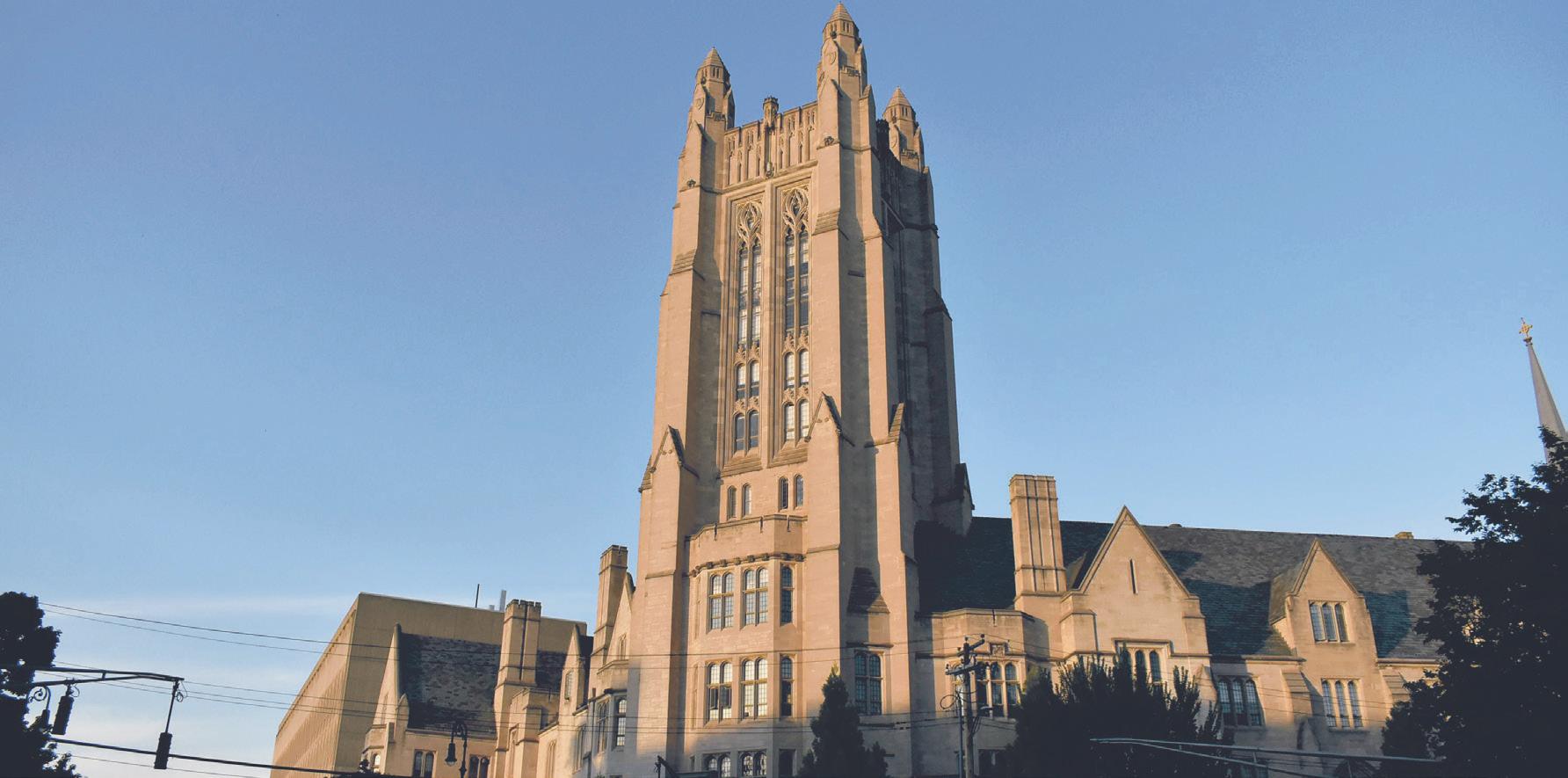
After Yale stopped allowing alumni to petition to be candidates in trustee elections, two alumni filed a lawsuit challenging the change in 2022. The suit was unsuccessfully argued in multiple courts before the state’s supreme court declined to hear it last month.
Baala Shakya
Student leaders weigh in on an ongoing faculty campaign for firmer academic freedom protections in the Faculty Handbook.
Garrett Curtis, Photography Editor
“In basketball—as in life—true joy comes from being fully present in each and every moment, not just when things are going your way.”
PHIL JACKSON FORMER BASKETBALL PLAYER AND COACH
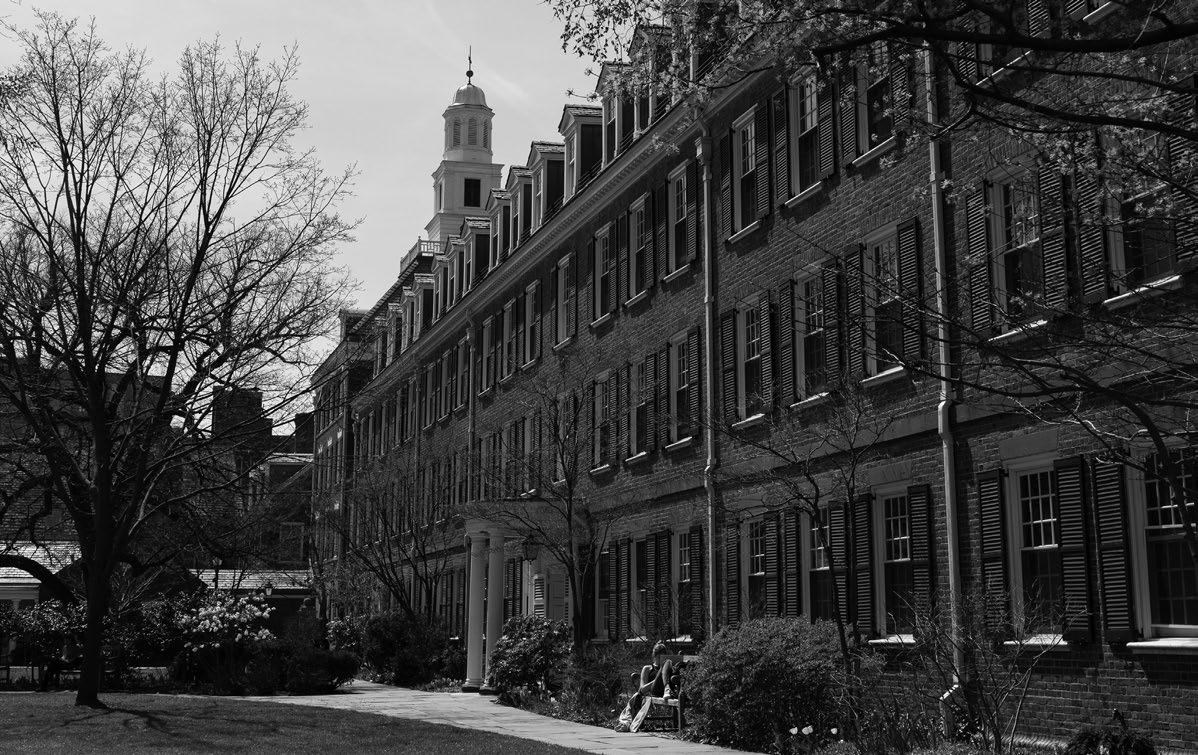
David Vasseur, another ecology chair, named next Saybrook head
BY OLIVIA WOO STAFF REPORTER
Many Saybrugians already have one thing in common with their incoming head of college, David Vasseur: years of looking up to the outgoing Saybrook College head, Thomas Near.
After Vasseur was named the college’s next head in the Saybrook dining hall on Thursday evening, he spoke to dozens of students and fellows about how his time at Yale has mirrored, in large part, the path of his soon-to-be predecessor. Near will conclude his time as head at the end of this semester.
“In my career, I’ve had the good fortune to follow in the footsteps of many great role models. But none have been more influential than professor Near,” Vasseur said. “From teaching in the intro bio sequence, I followed professor Near. As the chair of the Department of Ecology and Evolutionary Biology, I’ve had the opportunity to follow professor Near.”
Now, Vasseur and incoming Associate Head of Saybrook College
Chaundra Vasseur will follow Near’s 11-year tenure as Saybrook head alongside his wife, Allison Near. The Near and Vasseur families share a chance connection outside of Yale:
Chaundra Vasseur, who is a fifthgrade teacher, taught the Nears’ two daughters during their elementary school years, Thomas Near said.
After Yale College Dean Pericles
Lewis presented a certificate to Thomas Near on behalf of himself and University President Maurie McInnis, Near urged Saybrook students to support Vasseur, whom he called “an outstanding scholar,” and his family in their transition into their new roles.
“I think how we succeeded in this role,” Near said of himself and his wife, “came from students in the class of 2016, 2017 and 2018, in that those students engaged with us.”
“Those students helped us understand the parameters of our community and what was expected of us in our role,” Near continued.
“So much of what we did was shaped by our interactions with the students in those early days.”
Vasseur came to Yale from Canada in 2008, and he and his wife are currently Saybrook fellows.
Saybrugian Maria Arozamena ’26, a former editor for the News, said that she has interacted with the soonto-be head at fellows’ meetings and characterized him as “wonderfully kind.” She said that she appreciated how Vasseur concluded his speech on Thursday with the college’s oftrepeated slogan: “Say-what?”
That remark was met with a raucous “Saybrook!” from the crowd, which moments before had erupted in laughter when Vasseur brought up a question he said he answers “20 to 30 times a day:” that of his own height.
“I am 6’7, and I am more tired of that meme than probably anybody else,” Vasseur quipped. “So we got that out of the way.”
“To me, one of the greatest values that Yale’s residential college system provides is a sense of place,” he continued. “And I think sometimes we imagine a community as something that just happens, something atmospheric that we just find ourselves with or without. But the truth is that community is a practice. It’s dealing with sometimes the inconvenient decision to be present, to notice, to stay a little longer than we have to.”
Vasseur pledged to be active and present in his new role as head, noting that he was the first in his family to attend college. He expressed excitement about Saybrook’s traditions and the prospect of getting to know every student alongside his wife and three children — one of whom will be living in the head of college house.
Chaundra Vasseur said that she was looking forward to advising Saybrook students at “such an exciting stage of life,” especially after witnessing her two eldest children enter college. The two attend McGill University and Queen’s University in Canada, Lewis said during the ceremony.
“Looking at all the excitement and the enthusiasm they have as they start to launch into this next stage of their life — I think as a
parent, you sort of feel for these kids who are far away from home,” Vasseur said in an interview after the ceremony. She said she hopes to offer Saybrook students “another person in their corner.”
Saybrugian Jordan Epping ’28 told the News he thinks the soon-to-be head and associate head “are going to make a great team” and expressed “a lot of confidence that we’ll be under great leadership.”
Noah Torrance ’28 said he was “optimistic about what is coming for Saybrook in the future,” but expressed sadness about Near’s departure.
“Professor Near has been definitively the greatest part of my Saybrook experience. Just the amount of effort that he puts into our community, the cheer that he brings, the character that he brings, the support and love for IMs that he brings, has just improved everything about this place by leaps and bounds,” Torrance said. “I honestly wish that I was here a couple years earlier.”
As a professor, Near has garnered popularity for his course on ichthyology, which is the study of fishes. Vasseur said in his speech that he has yet to develop a passion for the subject but joked that he still has time to do so.
Vasseur is an expert in his own right in the study of community ecology, and he has been interviewed by the News on his work on the effects of climate change on endangered species.
When introducing Vasseur at the beginning of the ceremony, Lewis noted that the incoming head of college was “a fellow Canadian.”
“He has a strong interest in athletics and community engagement. Many of you will have seen him at Yale’s hockey games,” Lewis said. “I have a seat right behind him, which, admittedly, can be challenging.”
Near is one of three heads of college who will be stepping down at the end of this term. Of those three, he is the second whose replacement has been announced.
Contact OLIVIA WOO at olivia.woo@yale.edu.
First year makes experimental film with 3,000 printed images
BY TAJRIAN KHAN STAFF REPORTER
The film “Fireflies,” made by Noah Shin ’29, was showing in a Branford College student gallery last week.
The film runs 4 minutes and 15 seconds, each second created with twelve printed images, and has a score created by Grace Halak ’26. At a reception for the film on Thursday, Shin told guests that he had rendered over 3,000 digital frames, printed them on letter-sized paper and photographed them one by one while his iPad screen provided backlight for each sheet of paper. Shin used a Creative and Performing Arts award to fund the project.
Shin started learning animation during the pandemic when his sister asked him to make a film from a cartoon for her 18th birthday. Since then he has made
one film each year and “experimented with a different media with each one,” he said.
“I think physical film is interesting. This is paper, not even film, but just a different way of looking at film is interesting, because you have to be a lot more deliberate,” Shin said. “People always focus on the final product, but a lot of it really is more centered in the way you get there.”
The experimental process resulted in a distinct look that could not be achieved digitally.
“This is my first time seeing something like this,” Nevin Dabrah ’29 said at the Thursday reception. “I think the textures and the physicality make it really unique.”
Shin said he became interested in making a film in this form after taking “Introduction to Film Studies.” The grainy look
from photographing sheets of paper lit up by an iPad screen is his way of telling a story about how we remember the past: Some memories are clearer whereas others feature obscured details.
The film is called “Fireflies” because Shin wanted the film to be about “something that’s haunting, something that’s transient and only here for a short time,” he said.
“If you showed me this at a film festival, I would think this was made by an experienced, 30-year-old filmmaker,” said Jake Boston ’27, who met Shin in their “Introduction to Film Studies” discussion section and came to the reception. “Even though the process seems amateur, the finished product looks like an actual experimental film.”
Halak said she met Shin last fall while working on a student
film together. She is working on a senior thesis about sonic degradation for the Computing and the Arts major, for which she has spent the last two semesters putting music onto blank cassette tapes and degrading them — crinkling them, rewinding them, exposing them to heat with a flat iron and brushing magnets on the outside of the tape. Then she built a program that can emulate those degraded states for new audio files.
“There’s just something automatic when you hear something that is degraded and imperfect,” Halak said. “The way analog media preserves sound, it just immediately connects to memory and nostalgia.”
For “Fireflies,” she recorded digital music with synthesized violin and used sounds from her father’s home videos and manipulated the tracks with the pro -
gram she built for her thesis — a process of engaging with analog and digital media that complemented Shin’s film.
“Bringing something that is entirely digitally grown into the real world and altering it in a very organic way and putting it back into the screen,” Halak said, “is almost like how we remember the past.”
“The film was a beautiful collaboration between visuals and music,” Branford Head of College Enrique De La Cruz said.
Both he and Leslie Carmin, De La Cruz’s wife and the associate head of college, were excited about the film’s showing.
“This is what student galleries are for,” Carmin said.
Branford College is located at 74 High St.
Contact TAJRIAN KHAN at tajrian.khan@yale.edu.
TAJRIAN KHAN / CONTRIBUTING PHOTOGRAPHER
OLIVIA WOO / CONTRIBUTING PHOTOGRAPHER
Vasseur will be the second ecology and evolutionary biology chair in a row to hold the role.
“There are as many worlds as there are kinds of days, and as an opal changes its colors and its fire to match the nature of a day, so do I.”
As spring arrives, farmers market returns outside in Wooster Square
BY SUDARSHAN KRISHNAN CONTRIBUTING REPORTER
The Wooster Square Farmers Market is welcoming visitors back to an outdoor showcase of fresh, locally-sourced food.
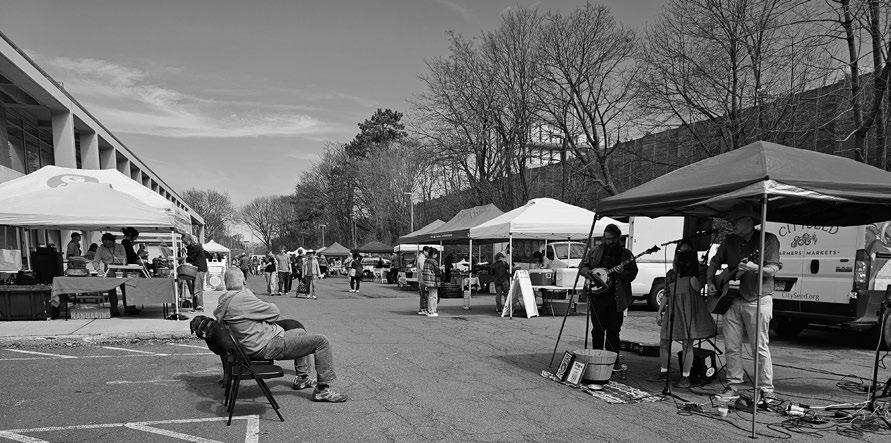
Though the market runs yearround every Saturday from 9 a.m. to 1 p.m., it began its outdoor season over the weekend. Two rows of stalls ran along the curbside parking lane of the Conte West Hills Magnet School. From beneath the shade of the canopy, vendors displayed offerings of seasonal produce, baked goods and a variety of other treats. Throughout the morning and early afternoon, visitors drifted down the lane, sampling the various products and getting a taste of the local farming scene.
“I think the theme would be good food and good community,” Allison Ping-Benguiat, the farmers market manager for CitySeed, an organization that organizes multiple farmers markets, said. “What makes us different from other farmers markets is we are very much food focused, and we focus on sourcing locally.”
According to Ping-Benguiat, all produce at the farmers markets is grown in Connecticut, and every business represented creates their products from Connecticutgrown ingredients.
While all the vendors maintain this principle, the exact lineup varies year to year, she added.
“A lot of them are longer established relationships. Some of them are newer and part of our Incubates program,” Ping-Benguiat explained, referring to a CitySeed initiative that aims to provide advising, resources and exposure to emerging food entrepreneurs in New Haven.
One longtime participant in the Wooster Square Farmers Market is Star Light Gardens, a farm based in
Durham and Middlefield that grows vegetables and flowers.
“We’re second generation of this farm,” owner Jenny Hill said. “The first owner was actually the first vendor to start at this farmers market, so our farm has been at CitySeed from the beginning.”
According to Hill, Star Light is a market garden, meaning that it grows its produce primarily for events like farmers markets.
“We want our tables to have a lot of colors, and a lot of selection, a lot of diversity and options for customers,” Hill said. Crates of organic root vegetables and potted herbs filled the stall.
Several other businesses are rooted in the farmers market scene. Quincy Horan, who started Waldingfield Farm Inc. with his two brothers, delivers a selection of organic vegetables at seven different markets throughout the state, he said. At Wooster Square on Saturday, he offered the last of the winter storage crops, as well as spring salad greens from the greenhouse and other seasonal pickings.
Downright Breads, which sold out of the majority of its baked goods on Saturday, is similarly invested. Employee Jacob Miller explained that for Downright, which started as a microbakery operating out of a home kitchen in West Haven, the main way to sell its products is through farmers markets. The bakery has since outgrown its cottage license and expanded its business into a commercial space.
Chef Deja Smith, the owner of the Khemi’s Vegan Cuisine food truck in Bridgeport, Connecticut, gave visitors a cooking demonstration featuring various ingredients sold at the farmers market.
Her table presented a bright array of vegetables, herbs and condiments, which she worked into a couple of
dishes, including a turmeric carrot soup. Smith is of Jamaican descent and appreciates the country’s plantbased cuisine, she said.
“I love sharing my knowledge on plant-based eating, and also my culture,” Smith said.
Sean Khong GRD ’26, a Yale graduate student, came to the market at the invitation of a friend and wanted to try something new, he said.
“I love that it is small and you can really interact with all the different store owners, who are super friendly and welcoming,” Khong said.
Chris Gottschalk, a Branford resident and neurologist who runs the headache medical program at Yale, has been coming to the market for over a decade, he said.
“I’m always in New Haven on Saturday morning ’cause I practice aikido in the dojo right over there. So I go to training, and I come here and try to buy as much fresh food as I can for the week,” he said.
Gottschalk enjoyed some Thai
food and a smoothie and looked forward to picking up some mushrooms, he said in an interview.
“I love the fact that it brings together a wide community of people from across the state, who are growing fresh healthy food,” he said.
The warm weather came as a welcome surprise to many returning vendors and visitors.
“I’d say it’s quite pleasant,” PingBenguiat said. “We had good luck. In the past, we always started our outdoor season with rain.”
The Conte West Hills Magnet School is located at 511 Chapel St.
Beyond the selection of food products, which ranged from Seacoast’s gourmet mushrooms to Sanctuary Kitchen’s readymade Thai food, CitySeed hosted some special guests. Ping-Benguiat highlighted appearances by Deja Smith, the Historic Wooster Square Association and the Parkway Ramblers bluegrass band, which performed lively renditions of classic tunes and
audience requests. As the farmers market takes place in the historic Wooster Square neighborhood, the organizers decided to invite the Historic Wooster Square Association (HWSA), an all-volunteer, non-profit neighborhood association. The organization intends to promote the neighborhood and activate its spaces, hosting tours, cleanups and meetups, among other activities, explained board member Barbara Lamb. The association is set to host its annual Cherry Blossom Festival on April 19th.
Narasimhan Ganapathi, a former chemistry professor at Yale who was encouraged by his daughter to volunteer for the market, felt that the day went very well. Ganapathi himself sampled the baked goods, and has made a point of stocking up on vegetables.
Contact SUDARSHAN KRISHNAN at sudarshan.krishnan@yale.edu.
New Haven economic officials discuss development at Yale club event
BY LARS WINKLER CONTRIBUTING REPORTER
At a Thursday night event on the “Economics of New Haven,” Yale students asked city officials how the Elm City can grow without worsening displacement and housing pressures.
Hosted by the Yale Undergraduate Economics Association, the event featured New Haven Economic Development Administrator Michael Piscitelli alongside fellow economic officials Dean Mack and Cathy
Graves. The discussion touched on housing, transit, small businesses and redevelopment and repeatedly turned to the trade-offs created by growth in a city with limited space.
For the student organizers, that practical focus was intentional.
“We wanted not only people who could look at the economy from the top down — professors and different specialists — but we also wanted people on the ground actually making stuff move,” Matthew Sprintson ’28, a co-president of the economics association, said in an interview.
The three officials said that much of New Haven’s recent housing growth has come from reclaimed land and former parking lots, creating difficult questions about where future development should go.
Students used the questionand-answer period to ask whether stronger public transit could reduce dependence on parking, how the city plans to balance new housing with affordability and what responsibility officials have to support homeless residents using public spaces.
The officials said transit decisions
are constrained in part by state and regional structures, though they pointed to coordination efforts involving Yale shuttle infrastructure. They also discussed city outreach programs for homeless residents and a proposed redevelopment of a deteriorating former power plant site.
Suren Clark ’28, the other co-president of the club, said the event was meant to connect Yale students more directly to the city around them.
“It was really important to us that we discussed the economics behind
it,” Clark said.
After the event, Piscitelli said he appreciated the chance to exchange ideas with students.
“The Yale student body really cares about the community where they go to school,” he said. Clark and Sprintson, who revived the Yale Undergraduate Economics Association this school year, hosted the club’s first event this January.
Contact LARS WINKLER at lars.winkler@yale.edu.
New Haven Museum exhibit showcases local apizza artifacts
BY JINGCHU SOPHIA ZHANG CONTRIBUTING REPORTER
The New Haven Museum hosted the owner for Modern Apizza on Thursday night in the latest installment of “The Monthly Slice,” which hones in on the city’s pizza landscape.
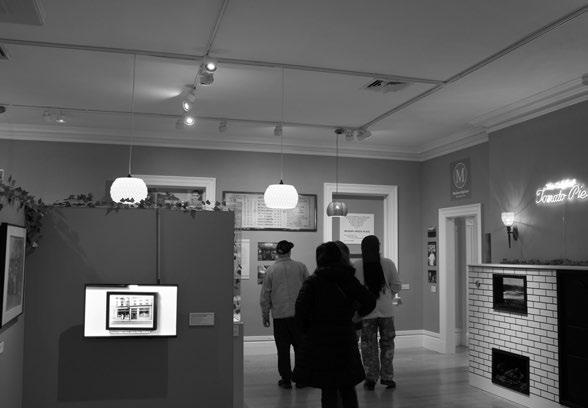
The museum hosts the monthly events in conjunction with its ongoing pizza-themed exhibit, called “Pronounced Ah-Beetz,” which opened last October. The exhibit was co-curated by Jason Bischoff-Wurstle, who is the museum’s director of photo archives, and Gorman Bechard,
Dean Falcone and Colin Caplan, who were the producing team behind the local pizza documentary, “Pizza A Love Story.” On Thursday, Bill Pustari — who has run Modern Apizza along with his wife, Mary, since 1988 — took Bechard behind the scenes of his pizza-making and -managing career. Pustari began working with pizza when he was 13, he said. One of Pustari’s favorite Modern anecdotes was the time he delivered the restaurant’s pizzas to the Red Sox. At the time, Pustari was friends with the team’s announcer, Joe Castiglione.
“I’m taking full credit on them breaking that curse, from all the pizzas I brought them,” Pustari said with a laugh during the event. “The entire season, Joe would call me if they were in a losing slump, saying, ‘Any way you can bring some pizza up here?’”
When comparing New Haven’s most well-known pizzerias — Frank Pepe Pizzeria Napoletana, Sally’s Apizza and Modern Apizza — Pustari brought up each restaurant’s different recipes and highlighted Modern’s mother yeast, which resides in a tub and is fed with flour and water each day.
During the event, audience members, some of whom were decked out in Modern merch, shared stories and asked questions. Even after the hourlong event concluded, audience members stayed behind to take pictures and tell the Pustaris about their memories with Modern.
According to Bischoff-Wurstle, he and Bechard had the idea for the “Pronounced Ah-Beetz” exhibit back in February 2020. But the real inspiration for the exhibit ran further back in time, the men added.
Bechard, Falcone and Caplan had been working on “Pizza A Love Story” since 2009, with the premiere in 2019. For Bechard, who grew up in Waterbury before moving to New Haven, the documentary felt like a natural extension of something he had loved since he was young.
The exhibit itself came together
between 2024 and 2025. It focuses on the history of Pepe’s, Sally’s and Modern but also incorporates items from other pizzerias across New Haven.
Artifacts shown include what is believed to be the oldest pizza box in the world, which originated from Pepe’s in 1936, as well as a 1950s flour sifter from Zuppardi’s Apizza, a cartoon poster for Sally’s 50th anniversary and a 1960s proofing bin from Modern. Pizza boxes signed by Hillary Clinton LAW ’73 and Conan O’Brien are among the more contemporary items on display.
Part of the yearslong process of preparing the exhibit was nurturing relationships with all of New Haven’s pizza institutions and the families that run them — being “welcomed into the fold,” as Bischoff-Wurstle put it.
“Next thing you know,” he said, “you’re being offered the oldest pizza box in the world.”
“The Monthly Slice” program began in January of this year. Bischoff-Wurstle kicked off the program with a guided tour of the exhibit, and since, there’s been a screening of “Pizza A Love Story” and a conversation with Doug Coffin, the founder and owner of Connecticut’s Big Green Truck Pizza.
“This series helps to follow through on those things that didn’t make into the show,” BischoffWurstle said, “or maybe there’s a phrase, or maybe there’s an item, or something that just opens up a whole new platform.”
Partly thanks to its lighthearted nature, “The Monthly Slice” also helps the New Haven Museum bring in new visitors.
“I remember we asked, ‘how many people have never been in the museum before?’” Bechard said, recalling the program’s second installment. “I think virtually everyone raised their hand. It brings people here because it’s a different sort, a fun exhibit.”
For instance, Laura Anastasio, who lives in North Branford, learned about the New Haven Museum through February’s screening of “Pizza A Love Story.” She has since become a member of the museum, she said.
“I really am just trying to get in and see different things every time I come, to really just spend some time here, because I never have before,” Anastasio said. “These events have been drawing me in. This is a start for me.”
To Bischoff-Wurstle and Bechar, the exhibit’s ultimate goal is to engage more community members like Anastasio.
“These are all currently businesses, these are all currently people, living, working,” BischoffWurstle said. “They’re still telling their stories. They’re still creating their history.”
The “Pronounced Ah-Beetz” exhibit will be in the New Haven Museum until October 2027.
Contact JINGCHU SOPHIA ZHANG at jingchu.zhang@yale.edu.
SUDARSHAN KRISHNAN / CONTRIBUTING PHOTOGRAPHER
JINGCHU SOPHIA ZHANG / CONTRIBUTING PHOTOGRAPHER
Bill Pustari, who has owned Modern Apizza for nearly four decades, brought history to life in a Thursday evening conversation that was part of the programming associated with the museum’s pizza-themed exhibit.
“Commitment separates those who live their dreams from those who live their lives regretting the opportunities they have squandered.”
BILL RUSSELL FORMER BASKETBALL PLAYER
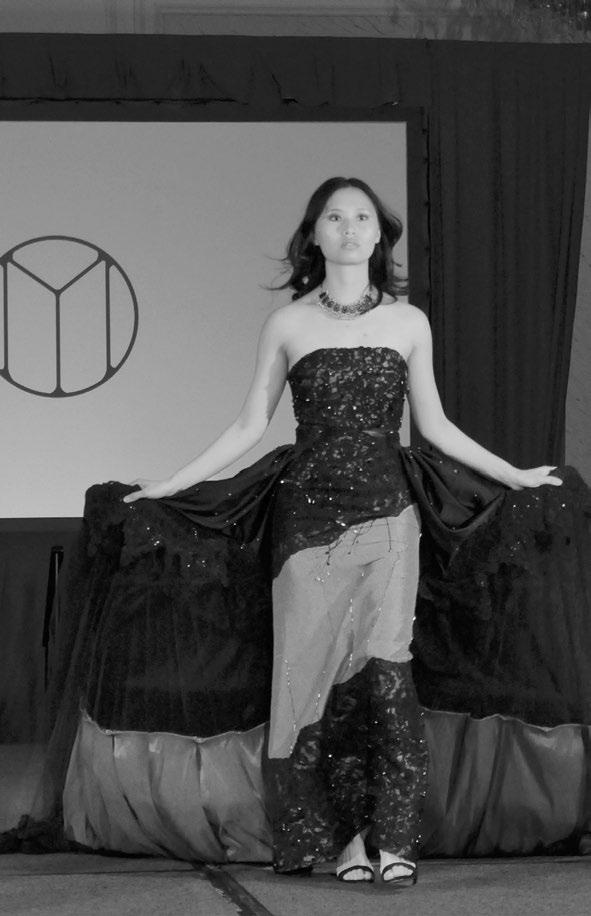
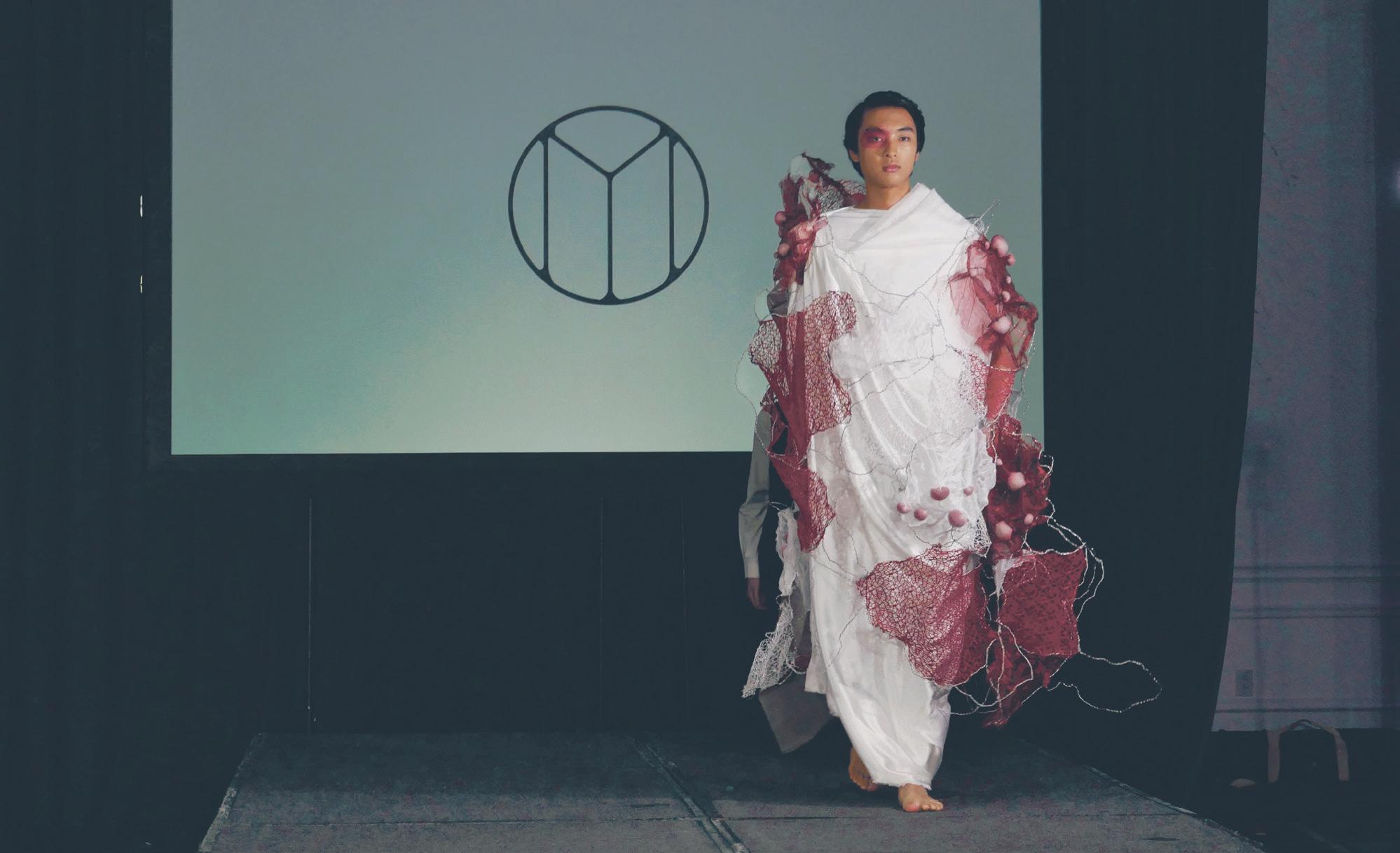
MAISON show brings memory to life with clothes made of shells and PVC
BY KAMINI PURUSHOT STAFF REPORTER
Performing for a crowd of fashion enthusiasts in the Omni New Haven Hotel, the a cappella group Shades of Yale sang “Wanting Memories” by Sweet Honey in the Rock, a lyric from which defined the showcase to follow: “I am sitting here wanting memories to teach me to see the beauty in the world through my own eyes.”
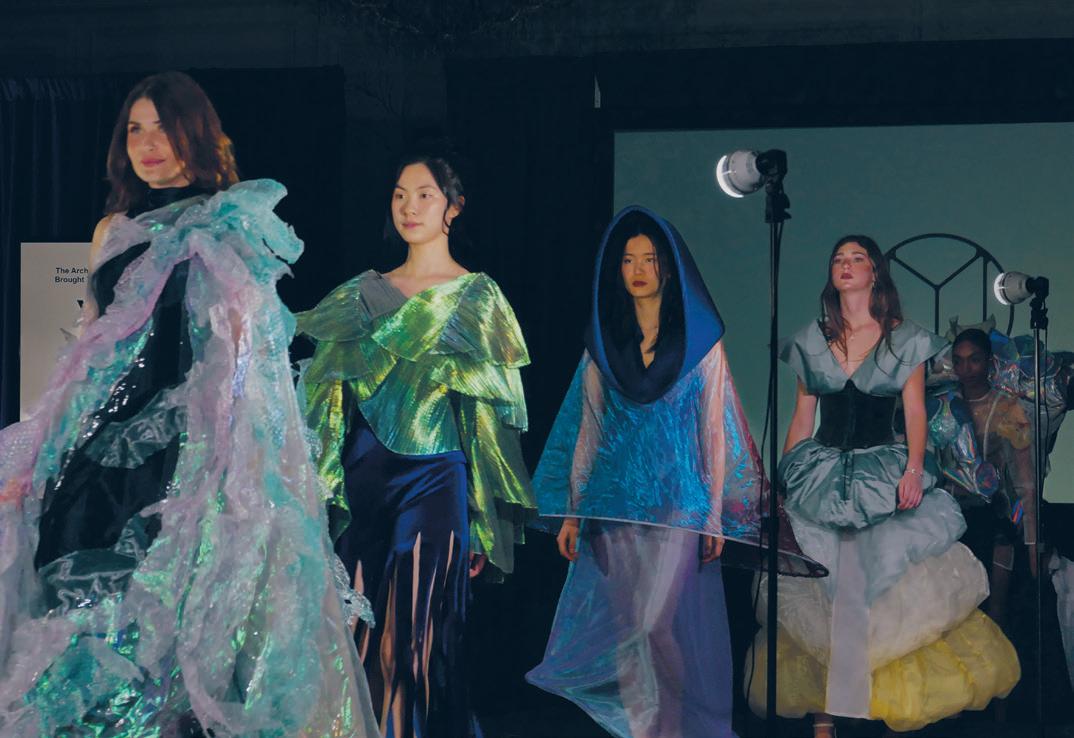
On Friday, attendees of the student fashion group MAISON’s 2026 show, “The Architecture of Memory,” saw the world’s beauty through 22 distinct collections inspired by personal and historical legacies.
Like any other nostalgia-loving attendee, I was tantalized by the exploration of “the function of clothing as an archive” promised by MAISON co-President Josh Chen ’27 in his opening speech. Throughout the show, designers made good on that promise with garments that bridged macro- and micro-histories.
Fashion Institute of Technology graduate Mehar Kohli’s collection evoked the princesses and mermaids of girlhood: Flowers sprouted from one model’s fishnet tights like she herself was in bloom, and another model seemed to emerge from the depths of the ocean as she strode across the stage in a turquoise and black dress whose train cascaded behind her like waves.
Hezi Xuan, a student at New York University, was attuned to the architectural side of the show’s theme, manipulating wire and cloth into structured grooves and twisting wrinkles. Another collection that alluded to the architectural qualities of cloth came from Aerin Chen. Chen’s designs fused the historical and contemporary. One of her gowns featured an underbust corset and a four-tiered skirt that bubbled like seafoam. Draped upon another dress was iridescent cloth that evoked the bioluminescence and form of a jellyfish. Chen’s most daring piece was a sheer, periwinkle dress with a conical, 3D poncho and navy blue hood.
Parsons School of Design graduate Soomin Oh’s “Monument to the Disposable” was particularly innovative. In an examination of the contemporary world, she salvaged
polyvinyl chloride, or PVC, and polyurethane, or PU, two of the most common synthetic materials, to make entirely new garments.
Oh’s designs invited viewers to imagine the life of these man-made fibers from their initial purpose to their reconstructed looks on the runway. Though not all the garments were perfectly tailored to their models, all was forgiven when I saw Oh’s standout design, a pair of pastel pink balloon pants paired with a gray double-breasted jacket. The two elements contrasted wonderfully, encapsulating humanity’s rigid imposition on nature’s softness.
Another designer, Caroline Solomon ENV ’26, brought that sense of innovation to the runway experience itself with her final piece, which was transformed from a shirt into shorts by the last pair of models. The former helped the latter don the modified garment, echoing architectural principles of renovation and sustainability. The transition lasted a beat too long, but Solomon’s creativity was worth the wait. I found myself wondering where I could acquire such a garment for myself.
Other highlights from the show included Bella Kim’s Edwardianinspired womenswear, Rosie Ding’s synthesis of cloth with seashell-like ceramic fragments, Chloe Hong’s ’25 ode to the year of the horse in the Chinese lunisolar calendar and Campbell Bas’ ’29 quirky manipulation of bows.
Perhaps the most thematic collection from the show was designed by Guilherme Vieira de Moraes Lacerda, a Brazilian artist who graduated from Parsons. With “Liminality,” Lacerda used conversations with relatives, family photographs and his own experiences to craft a deeply personal archive. Lacerda’s most compelling piece was more memory-collage than garment, synthesizing discoveries like a capsized boat he saw in his father’s home city and footage of his mother’s samba performances.
New Havener Tea Montgomery honored the designer-wearer relationship with garments beautifully tailored to his models. Many of his models repped the name of his clothing brand, Threads by Tea, and
his most unique look featured carefully pleated and sewn pants that defied the traditional menswear mold.
Connecticut-based Nancy Walker presented vibrantly colored mudcloth garments and fashioned cowrie shells — a currency often used by European traders to purchase enslaved West Africans, according to a collection description in the show’s program — into belts and hair accessories. One of the only designers to explicitly recall an oppressive history, Walker’s vibrant reimaginings felt uniquely empowering. Although dwarfed in height by her models, Walker stole the show when she followed them on stage.
This year, MAISON also introduced the work of its fashion design team, which was formed in 2025. The team of 14 students designed and sewed a series of garments, with four of those members also presenting independent work.
The fashion show’s greatest strengths came from its inclusion of a diverse cohort of students and professionals across various stages of their careers. Simultaneously, MAISON’s collaboration with local designers kept the showcase rooted in New Haven.
Of course, “The Architecture of Memory” was not without its flaws.
The narrow stairs leading on and off the runway made for a few awkward maneuvers and the occasional mishap, especially for those models dressed in particularly voluminous pieces.
Though MAISON had previously indicated that each model would be limited to one look per show to maximize the number of interested students that could walk the runway, a handful of models reappeared in different looks.
As the show concluded, I couldn’t help but feel that, while memory had remained at its forefront, architecture had receded into the background and sometimes disappeared entirely from the designs on display. The show’s choice of a title is perhaps a convenient one: Its main sponsor, Vitruvius, is named for the famed Roman architect.
MAISON also had a plethora of additional sponsors, including Tony’s Chocolonely and beauty brands like COSRX, Flower
Knows, KIKO Milano and Yepoda. Attendees could assemble their own gift bags with items from these companies while supplies lasted, while VIP ticket-holders received all the products. My most selfish critique is that none of these pastel makeup products suited — or in some cases, appeared at all on — my deep skin tone, a surprising oversight for a club that has faced controversies around inclusivity and diversity.
Still, “The Architecture of Memory” took me on an eclectic tour of past, present and future to
which I’m glad I opened the door. With its 2026 show, MAISON has laid the foundations for a fashion hub spanning geographies across the world and bridging campus and city.
“MAISON is still a relatively young organization, but we have a lot of hopes for what is going to grow in the next few years,” co-President Audrey Bae ’28 said in her opening speech. For what it’s worth, so do I.
Contact KAMINI PURUSHOTHAMAN at kamini.purushothaman@yale.edu.
‘Sheffield Scientific’ brings immersive theater to church’s basement REVIEW
BY KIVA BANK STAFF REPORTER
Seats were not filled at any of the performances of “Sheffield Scientific” over the weekend — because there were no seats. Instead, audiences were led in guided immersive tours through the dark basement of Trinity Lutheran Church.
From bulkhead doors to bowling alleys filled with flowers, the space was transformed into a 1950s landscape for the one-hour-and-40-minute show that followed a professor, played by Abram Knott ’27, who believed he had found a way to save humanity in the midst of nuclear fallout.
“The way this show is run, you truly have to experience it to understand it,” Alex Gross ’29, the show’s director, said in an interview. Gross said the production team was inspired by the history of Yale’s Sheffield Scientific School, and they wanted to create their own version of the institution, set during the Cold War “on a night of nuclear armageddon.”
“The audience is invited on a tour of the institution on its final night,” Gross said. “Through that, they’re asked to think about their own relationship to memories and dreams and whether we should choose to remember and what we should choose to forget.”
He did not clarify the specific date, but Eason Rytter ’27, a producer and actor, said participants would have been able to determine the timeframe if they looked closely at the set.
“Every single person will have a different experience simply because of where they choose to look,” Rytter, who plays the Agent, said in an interview before the production opened.
He compared the eyes of participants to the perspective of cameras in cinematography.
“The idea is that everything you see and look at is curated,” Rytter said. “We want people to feel as though they can’t tell the
difference between their eyes and the idea of watching a movie on a screen.”
After audience members entered the basement, they were allowed to explore the main candlelit area, which was filled with lockers, desks, typewriters and scattered typed correspondence to clue participants into the context of the story.
“If you see something that’s incongruous and doesn’t make sense, it’s likely because you didn’t get to see something in another part of the show,” Rytter said.
Attendees toured the basement in groups of around 10, and they were led by the actors. Some participants, including this reporter, were pulled aside for one-on-ones with the actors. The Agent pulled this reporter into a dark boiler room and quoted lyrics from a song in “Einstein on the Beach,” an opera about Einstein’s theory of relativity.
Gross founded Valley Road Theatre Company in 2022 in Larchmont, New York. The company has put on seven productions before “Sheffield Scientific,” which is the first Valley Road production to come to New Haven. Gross said he was excited to introduce his company to a Yale audience that has not witnessed an immersive show before.
According to Rytter, all the performances sold out in under two hours. Gross said his company and the production were not affiliated with Yale. Gross added that the immersive shows are “site specific” and would not be possible within the current spaces available on campus.
“A show is never complete without the location it’s performed in,” Gross said. “You are at all times, one foot inside the Sheffield Scientific Institute and one foot in the church.”
Jordan Mincy ’26, who played Docent 2, an assistant to the professor, said the production was his 15th show at Yale, but “Sheffield Scientific” was Mincy’s first time acting in an immersive theater experience. He said that, since the show had limited dialogue, he learned to express himself through movements.
“Immersive theater is so much more physical,” he said in an interview before the production opened. “I’m focusing much more on physicality, the way I move my body, the way I dance, and how my dancing reflects my character’s motivation.”
Jennifer Rayman ’29 and Remy Strichartz ’29 saw the show when it opened on Thursday night.
“After coming to see this production, I don’t think I would have ever expected how in-depth they went with the immersion,” Rayman said.
“I could not have anticipated or expected anything that I saw tonight,” Strichartz added. Rayman said that a character whispered something to her, which she declined to share.
“I think it’s really interesting that every person who watches the show will have a different interpretation and experience of it, especially considering how tied it is to memory,” Rayman said.
Trinity Lutheran Church is located at 292 Orange Street.
Contact KIVA BANK at kiva.bank@yale.edu.
YULIN ZHEN / STAFF PHOTOGRAPHER
The runway fashion show at the Omni New Haven Hotel highlighted up-and-coming designers from across the country, under the themes of nostalgia and innovation.
THROUGH THE LENS
Maison at Yale at the oMni
Photos by YuLin Zhen
Photography Editor
Bulldogs remain undefeated in Ivy League with win over Dartmouth
WOMEN'S LACROSSE
BY AZARA MASON STAFF REPORTER
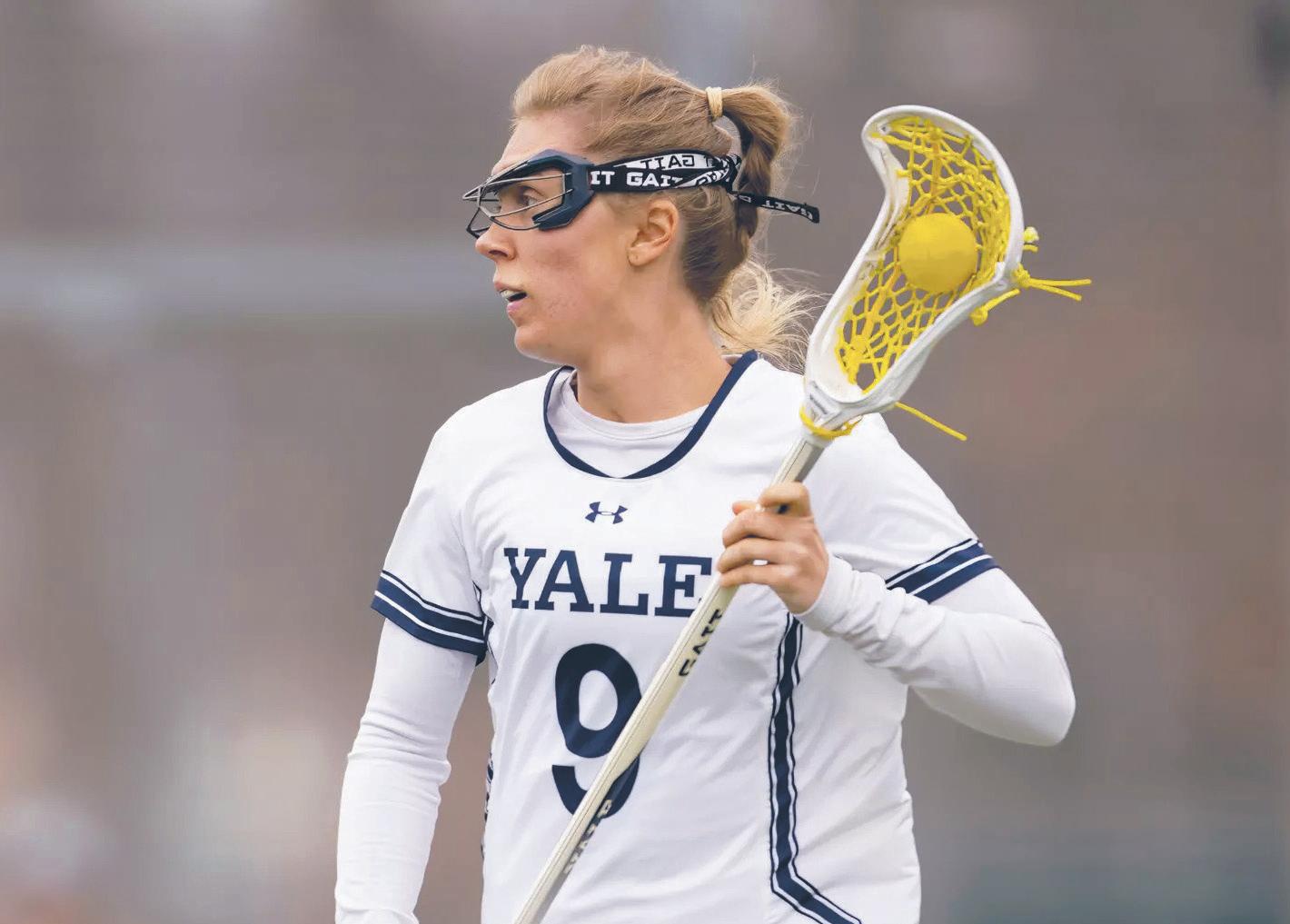
The Bulldogs (10–2, 4–0 Ivy) emerged victorious from a clash with the Dartmouth Big Green (6–5, 1–3 Ivy) in Hanover on Saturday.
Dartmouth’s Mia Puccio, who holds the Ivy League record for most draw controls, won the opening draw. Despite gaining early possession, the Big Green were unable to capitalize. Yale goalkeeper Niamh Pfaff ’28 opened the game with a save on Dartmouth’s first shot, the first of nine on the day, to set the tone defensively.
On another early opportunity, Dartmouth had a wide shot. Pfaff then completed a clear to midfielder Lindsay Thomas ’28, which eventually led to Yale’s first goal of the game. Ashley Kiernan ’27 found the back of the net on that possession to give the Bulldogs a 1-0 lead.
Pfaff was recently named by Inside Lacrosse to the midseason AllAmerican second team. She is the glue of a defense that is currently ranked second in the country in terms of scoring defense, allowing, on average, less than seven points per game.
On the other end of the field, Kiernan quickly took control of the game offensively, scoring three consecutive goals within just six minutes to record a hat trick and put Yale up 3-0. She
finished the game with a teamhigh four goals.
Dartmouth responded late in the first quarter, scoring on a free-position shot with under five minutes remaining to cut the lead to 3-1. Just minutes later, the Big Green added another goal, which narrowed the deficit to one.
With under a minute to go in the quarter, Kate Gould ’29, from behind the goal, found Ashley Newman ’26, who finished immediately on a quick, alley-oop-style play. Newman recorded three goals on the day, marking her third consecutive hat trick.
Yale closed the first quarter with a 4-2 lead.
However, back-to-back goals by Dartmouth’s Fiona O’Keeffe in under a minute turned the Bulldog’s lead into a tie game at 4-4.
With under a minute remaining in the first half, a goal by Kelly Holmes ’28, put the Bulldogs back up at 5-4.
Then, with two seconds left on the clock, Kiernan found Gould for a score. The Bulldogs finished the first half up 6-4.
Yale head coach Erica Bamford praised the offensive unit’s growing chemistry, especially that between Kiernan, Gould and Newman.
“It has been great to see our offense’s chemistry build throughout the season,” Bamford wrote to the News in a text message. “They have the opportunity to play against our talented defenders and goalkeepers every day, which has helped challenge them individually and as a unit.”
Within the first five minutes of the second half, Dartmouth scored to cut Yale’s lead back to just one at 6-5. The Bulldogs responded in force with a 4-0 run to close out the third quarter up comfortably 10-5.
Despite the Big Green outscoring the Bulldogs 3-1 in the final quarter, Yale’s earlier cushion proved enough to keep the game in their control. The Bulldogs
finished the match with an 11-8 victory.
In a postgame interview posted on Dartmouth’s women’s lacrosse team’s X account, Dartmouth head coach Josie Harper spoke to the game’s competitiveness, which she said was fueled by the tight standings in the Ivy League. “Everyone treats every game like it’s the Ivy Championship,” she said.
With the win, the Bulldogs remain atop the Ivy League, with the University of Pennsylvania (5–5, 3–0 Ivy) close behind. The two teams will face off on Saturday at noon at Reese Stadium.
Contact AZARA MASON at azara.mason@yale.edu.
Yale steamrolls Dartmouth, extending win streak over Big Green to 15
MEN'S LACROSSE
BY LIZA KAUFMAN STAFF REPORTER
Powered by a dominant offensive performance, the Yale men’s lacrosse team (5–4, 2–2 Ivy) cruised to its second straight conference win on Saturday afternoon at Scully-Fahey Field in Hanover.
The Bulldogs overwhelmed Dartmouth (4–6, 0–3 Ivy) 18-7, and senior attackman William Sheehan ’26 led the offensive explosion with four goals. Yale’s efficiency made the difference. The Bulldogs consistently generated high-quality looks, capitalized on extra-man opportunities and turned defensive stops into transition offense.
“It was a great team win,” Sheehan wrote in a text message to the News. “We had a lot of contributors offensively today. We moved the ball well, played fast in transition, and
that helped us create a lot of quality looks on goal.” Twelve different Bulldogs scored on the sunny afternoon in Hanover. Sheehan’s four were a team high, while Dylan Blekicki ’29, Sean Grogan ’29 and Peter Moynihan ’27 each scored twice. Four players — including first years Flynn Leonard ’29 and Oliver Nappi ’29, sophomore attackman Kyler Francis ’28 and senior captain Patrick Pisano ’26 — each recorded their first collegiate goals.
Although the 18-goal performance marked Yale’s highest output since the team’s 16-11 win over Boston University in February, it was the Big Green who got on the board first on Saturday. Dartmouth senior Emmett Paradine scored 90 seconds into the game, but the Elis responded with four unanswered, setting the tone for the remainder of the game. At 11:33, Luke Pascal ’28 found Blekicki on the doorstep for the equalizer. Less than two minutes later, Yale took the lead when Connor Gately ’28 emerged from
behind the net, did a spin dodge around the Dartmouth defenseman and put it home. Long-stick midfielder Luke Michalik ’27 then connected with Grogan to put Yale up 3-1. Grogan later assisted Sheehan for the first of his four goals of the day to close out the first quarter with Yale leading 4-1.
In the second quarter, Dartmouth sought to cut the deficit, but a steadfast Yale squad never let the Big Green take the lead. Just as in the first quarter, Paradine netted the first goal for Dartmouth to pull the Big Green within two. However, Grogan answered right back with an unassisted goal of his own to restore Yale’s three-goal lead.
The Big Green then scored two straight to cut the deficit to one, but the Bulldogs’ resilience was on full display, and they responded with a three-goal run of their own.
Moynihan, last week’s Ivy League offensive player of the week, buried one top shelf, followed closely by Cole Cashion ’27. With 1:37 remaining, Pisano picked up a
ground ball, pushed in transition and fed it to Gately, who found Blekicki for his second goal of the day to double the lead. As the buzzer sounded, Yale went to the locker room up 8-4 at the half. Dartmouth came out hot in the third quarter and threatened Yale, posting two back-to-back goals in the opening minutes, including a man-down goal to get within two. A four-minute Dartmouth penalty proved instrumental in flipping the momentum back in Yale’s favor. Yale capitalized with three goals during that stretch, including two from Sheehan, to break the game open.
Gately recorded his second assist on Sheehan’s second goal to extend Yale’s lead to three. Then, 30 seconds later, Francis found the back of the net for his first collegiate goal, to which the Yale sideline exploded in celebration. Next, Sheehan followed up with another to finish off the man-up opportunity. With a backhanded over-the-shoulder shot, Sheehan recorded a hat trick to push Yale up 11-6.
Sheehan then found David Anderson ’26 for Yale’s fourth straight goal of the period. Although the Big Green got back on the board at 3:52 with their last goal of the game, Yale’s strong special teams’ execution during the four-minute penalty shut down any Dartmouth hope of winning its first game against Yale since 2009. The Elis led 12-7 at the close of the quarter.
In the final 15-minute stretch, Yale’s offense continued its surge, netting six more unanswered goals. The defense excelled and held the Big Green scoreless. At 11:14, the Anderson-Sheehan duo struck again, with Sheehan burying his fourth goal of the game.
Then, Michalik recorded his second assist on firstyear midfielder Leonard’s first collegiate goal, doubling the lead 14-7. On that play, the Bulldogs showed their capability
of transitioning from defense to offense faster than Dartmouth could respond. Following a save by Ben Friedman ’28, Leonard and his teammates were off to the races upfield.
“I was really excited to score one today, especially for the defensive unit as a whole,” Leonard wrote in a text message to the News. “We’ve all been waiting for an opportunity to run the field, and right as I saw Friedman make that save, I was up and out. A juice goal like that had all the boys fired up.”
The six-goal run continued with Moynihan netting his second, followed by Nappi’s first collegiate goal. Then, the captain added a pole goal, his first as a Bulldog, to put Yale up 17-7.
The Bulldogs continued to press in the final minutes. After a long trip up to Hanover, the Bulldogs were hungry for one more. At the 10-second mark, first year Asher Ziv ’29 sailed one into the netting to cap off Yale’s 18-goal performance.
Michalik, who finished with two assists and four ground balls, pointed to Yale’s transition game, which was sparked by goalie Friedman, last week’s Ivy League Defensive Player of the Week, as a key factor.
“It starts with Ben making great saves and pushing it upfield,” Michalik wrote in a text message to the News, referring to Friedman. “From there we just move it and take the best shot available. Whenever we are able to score in transition it’s a huge momentum play for us.”
With the victory, Yale extended its win streak over Dartmouth to 15.
Riding two straight Ivy wins, the Bulldogs are ready to take on their archrival, No. 7 Harvard (9–1, 3–0 Ivy), for Alumni Day at Reese Stadium on Saturday afternoon. Faceoff is slated for 3:30 p.m.
Contact LIZA KAUFMAN at liza.kaufman@yale.edu.
LIZA KAUFMAN, PHOTOGRAPHY EDITOR On Saturday afternoon, the men’s lacrosse team earned its second straight conference win with an 18-7 victory over Dartmouth.
YALE ATHLETICS
Yale’s women’s lacrosse team beat Dartmouth 11-8 on Saturday in Hanover. The Bulldogs, who have not lost a conference game, are ranked first in the Ivy League.